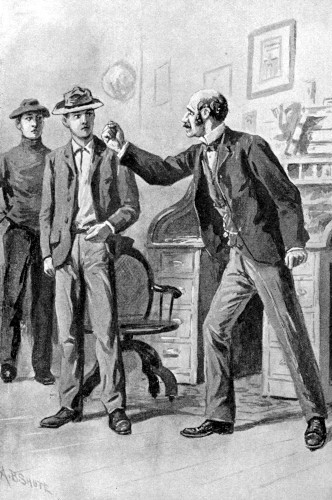
For the moment after Owen made the declaration that he was going to
leave his uncle and his aunt, the pair were speechless with amazement
and anger.
"Going to leave?" said John Hoover slowly. "Going to leave?"
"That is what I said, Uncle Jack."
"And I'm going with him," said Dale.
"To hear them—after all we have done for them!" ejaculated Mrs.
Hoover, her eyes flashing fire.
"I don't think you have done so very much for us," said Dale, who felt
it his duty to take his full share of whatever blame was coming.
"Don't you, now?" sneered the lady of the cabin. "I suppose I've cooked
for you just for the fun of it."
"It was the worst cooking I ever had to put up with."
"You aint going to leave me, nohow!" fumed John Hoover. "You've
contracted to stay here for the season, and you've got to stay. You
aint going to leave me in a hole—with so much timber contracted for."
"We are not under contract with you, Mr. Hoover. You said in your
letter that you would give us a trial, and we wrote back that we'd come
on for a trial. If our work hadn't suited, you would have discharged us
in double-quick order."
"Well, I'd have that right."
"Exactly, and we have the right to go away too."
"To be sure we have," came from Owen.
"I don't see it that way at all," roared the claim owner. "If I want to
keep you, it is your duty to stay."
"And my cookin' is good enough for anybody," came shrilly from his
wife. "I've given you more than you deserve."
A perfect war of words followed, and in the end Mrs. Hoover ordered
both of the young lumbermen "to pack their traps an' git out to once,"
or she'd "go after 'em with a broom."
"Now, Maria, let me settle this," interposed John Hoover, who did not
want to lose them. "They can board at one of the other cabins, but they
must stay the season out."
"I shan't stay another day," replied Dale. "I am going away inside of
the next hour."
"Then I shan't pay you a cent," snarled John Hoover.
"Very well, you can keep the money."
"I'm going with Dale," said Owen. "If you are mean enough to keep what
wages are coming to us, you are welcome to the amount, Uncle Jack."
After this both Dale and Owen refused to talk. Both packed their
belongings, and soon had them out of the cabin. As John Hoover refused
to transport either them or their baggage to the railroad station,
they, with the assistance of two men who were not afraid to lend a
hand, took their trunks and valises down the creek to the river. John
Hoover followed them, and begged them to come back, but they paid no
attention to him, and soon after secured passage on a lumber barge
bound for Saginaw.
"Well, we are well out of that," declared Dale, when on the way. "That
is an experience I don't care to repeat."
"I'm afraid I'm responsible," began Owen, when his chum stopped him.
"Not at all, Owen. We would have gone even if Hoover wasn't a relative
of yours. I think I'd cast him off," and Dale laughed.
"Well, you can consider him cast off," answered Owen, and then he
laughed too.
From the boatman both learned of the many troubles John Hoover had had
with his help, and of how many had deserted him every season for years.
"The men all over Michigan are getting to know him," said the boatman,
"and as a consequence, the only help he can get is from outside places."
The young lumbermen were surprised to find Saginaw a large and bustling
city, given over largely to the lumber and salt trade. They soon found
a cheap hotel, and here indulged in the first square meal they had had
since leaving Detroit.
"We might as well take it easy for a few days," said Owen. "Our money
will carry us through, and there is no need of our rushing into another
job until we are sure of what we are doing."
The sights around Saginaw were not many, but it pleased them to walk
around the lumber yards, and around the docks, where a number of lake
vessels were loading with lumber for Detroit, Cleveland, and other
points.
"We might get a passage on one of those boats bound for Detroit," said
Owen. "Let us ask the captain about it." And this they did, and secured
passage for little more than the price of meals, the master of the
schooner being glad to have them along, as they said they would help on
the cargo in case of rough weather.
On the evening before the schooner was to sail Dale and Owen had their
trunks and valises taken on board, and then started out for a final
look at the town.
"We may never get here again," said Dale. "So we may as well take in
everything worth seeing."
The young lumbermen had not gone far, however, before it began to rain.
To get in out of the wet, they entered a restaurant, attached to a
small hotel, where they ordered a glass of milk and a piece of pie.
Next to the dining room was the smoking room, and looking into this
they were surprised to see John Hoover, sitting there in company with
several individuals who looked like lumbermen.
"I'll wager he is after those men," whispered Owen. "Let us listen to
what he has to say."
They took another table which was close to a large doorway. As John
Hoover's back was toward them, the lumberman did not notice them.
"You'll be perfectly satisfied at my place," Hoover was saying. "All of
my men like it very much."
"Oh, listen to that!" said Dale, in a low voice. "How can he be so
barefaced?"
"I heard a little about poor eating up there," said one of the
lumbermen. "Now, I allow as how I like good feed."
"You won't be disappointed, Martin. Just you sign a contract with me
and you'll be perfectly satisfied, and you can go up to the camp in the
morning."
"I never signed a contract before," said another of the lumbermen
cautiously.
"Oh, that don't amount to much, Bond," answered John Hoover lightly.
"But our company requires it, that's all."
"I reckon it's O.K., boys," put in a fourth lumberman. "We might as
well sign and have done with it."
"That's the talk," said John Hoover eagerly. "Let's have the business
over with, and I'll stand treat at the bar."
He drew a folded paper from his pocket and asked for the use of the pen
and ink at the desk.
Just at that moment two lumbermen came in. The older was a man Dale and
Owen had met at the camp—one of the fellows who had helped them to
take their trunks to the river.
"Hullo, Martin, what's up here?" he called out.
"This aint none of your business, Peterson," cried John Hoover, in
alarm.
"We're going to contract for the rest of the season with Hoover,"
answered the lumberman named Martin.
"Don't you do it, boys."
"Why not?" demanded the four, simultaneously.
"If you do, you'll be sorry for it."
"You clear out!" roared John Hoover, his face growing as red as a beet.
"This is my business affair, you haven't any right to interfere."
"But I'll take the right," returned the newcomer. "Why, only two days
ago I helped two young fellows to get away. They said they wouldn't
stand it up to the camp. I'm going to leave myself as soon as my month
is up."
"You're telling what aint so!" stormed John Hoover.
"Aint I telling the truth?"
"No."
"I am—and I can prove it," said the newcomer.
He pointed to where Dale and Owen were sitting. John Hoover looked in
the direction and started.
"Wha—where did they come from?"
"From your camp. If you don't believe it, boys, ask the young fellows
themselves."
"We will," said Bond, and called to Dale and Owen. "Please come here a
minute, will you?"
"Certainly," said Owen, and moved forward, followed by Dale.
"Did you come from Hoover's camp a couple of days ago?"
"We did," answered Owen.
"Why did you leave?"
"See here, this aint fair, nohow!" spluttered the camp owner.
"And why not?" asked two of the lumbermen.
"We want to know the truth of this," added Martin.
"We left because we didn't want to work for Mr. Hoover any longer,"
said Dale. "He is a regular slave driver, and the food he deals out
isn't fit for a prisoner."
The men turned to Owen.
"Is that the truth, young fellow?"
"The food was certainly poor," answered Owen. "And he worked me harder
than I ever worked before, and I've done some pretty hard hustling in
the woods of Maine."
"Did you leave on account of the work and the poor food?"
"Yes."
"That's enough, then; I don't sign," came from Bond.
"Nor I," said Martin. "I said I'd heard about poor feed up there."
"See here!" stormed John Hoover, turning to Owen and Dale. "What do you
mean by spoiling my business? I've a good mind to have the law on you!"
"These men only asked us some questions, and we told the truth,"
answered Dale. He turned to the others. "Because we wouldn't stay the
season out he wouldn't pay us a cent," he went on.
"That was mighty mean," answered Bond.
"How are you fixed?" said Martin. "Perhaps we can help you a bit. One
good turn deserves another, they say."
"Oh, we're not suffering, thank you," replied Dale. "But we told you
this just to let you know how mean this man is."
"We won't work for him," came from two of the crowd.
The men walked out of the place in a body, Peterson and his friend with
them. Dale and Owen turned back into the restaurant, and settled for
the milk and pie. John Hoover followed them, his face full of anger.
"A nice trick you played me," he fumed. "Four first-class men, and I
might have had them all but for you!"
"I guess we are square on that question of wages," came grimly from
Owen.
"I'd rather have paid you the wages than had this happen!"
"No doubt; but it is too late now. After this, Uncle Jack, you had
better treat folks as they should be treated—then perhaps you won't
have any more trouble."
And with this parting shot Owen and Dale hurried from the restaurant,
leaving John Hoover to think over what they had said, and wonder what
he had best do next to get men to take the places of those who were
leaving his employ from day to day.