MR. GREATHEART AGAIN.
"Some will hate thee, some will love thee;
Some will flatter, some will slight;
Cease from man, and look above thee,
'Trust in God, and do the right!'"
NORMAN MACLEOD.
MR. GIRLING had taken a great fancy to Joseph and a firm friendship
rapidly sprang up between them. Joseph eagerly devoured the books which
the schoolmaster lent him. And by talking over his impressions of what
he read, acquired a habit of forming opinions for himself—in this way
not only laying up a store of useful information, but developing mental
muscle, and acquiring healthy views on many questions of social and
political importance.
In the meantime, his new friend did not permit him to overlook the
works of nature in his study of man. He himself was very familiar
with natural history, and, as the spring advanced, invited Joseph to
accompany him in his weekly ramble. The latter was surprised to find
how conversant he was with the life of the animal and vegetable world,
as well as with the deeper secrets wrested from nature by the progress
of science. He said so, one day.
"How have you found time to accumulate so much knowledge?" he asked.
"Little by little, and 'line upon line,'" replied Mr. Girling, "which
is the secret of most learning. When I was your age, every spare moment
was devoted to searching into these things, and in verifying what I
read, as far as possible, by personal observation. And I am still at
school in this respect. It is a study of such never-ending interest,
that the more one knows, the more there is to be learnt; and the deeper
one searches, the more one becomes convinced of the greatness and love
of the Creator."
But something further was also to result from their friendship. Joseph
expressed regret one day that, Mr. Girling being occupied at the
Sabbath-school on Sunday afternoons, they could not take walks on that
day also.
"It always does me good to talk to you," he said, "and I'm sure the
air would benefit you. My father said the other night that you would
certainly work yourself into a decline, if you stuck so hard to your
books."
Mr. Girling could not help smiling. "Never fear for me," he said. "I am
well enough. Moreover, I am in the path of duty, where less harm will
come to me than anywhere else. Besides, there is something higher than
the ways of nature to be learnt; that is why the Sabbath was given to
man."
Joseph felt reproved. He half fancied he had shocked Mr. Girling, and
hastened to inquire whether he regarded it as wrong to indulge in
walking on Sundays.
"I always attend service morning and evening," he said. "Of course it
would not be right to neglect that, but surely in the afternoon—"
"Not wrong. No study which brings us to a more perfect knowledge of God
can be wrong upon any day. But I have found a higher means than even
that. I learn by teaching others."
Joseph was silent.
"Why not join us, Joseph?" said Mr. Girling, presently. "And we will
have our stroll afterwards."
Joseph hesitated, objecting that he had done with Sunday-school two
years since. Mr. Girling, however, told him that he would not be
by any means the eldest member of the class, and the upshot of the
conversation was that Joseph yielded, and was thenceforth one of the
most regular attendants. He was surprised to find how much interesting
matter for thought arose out of the chapter. Most of the members of the
class were sensible, serious-minded young men, who, after seeking to
find out privately all that they could about the subject in hand, met
together and conversed freely about it, whilst Mr. Girling's thorough
knowledge of the Greek text enabled him to throw new light upon many
otherwise obscure passages, and thus the hour passed both pleasantly
and profitably to all.
Meanwhile, Joseph's admiration for Mr. Girling was increasing more
and more. He was so full of wisdom, so able to counsel, and yet so
brotherly and sociable, that the lad did not long wonder at the
strong influence which his words exerted over those with whom he came
in contact, and he, too, began to think of such work as the noblest
possible to his ambition.
Something happened one Sunday to determine him upon fitting himself to
undertake it.
A scarcity of teachers brought the superintendent to the door of the
class-room, with the request that one of the young men would come and
fill an empty place. But no one was inclined to go. They had never
attempted such a thing before, and enjoyed their hour too much to
desire any change. But a different spirit actuated Joseph. He not only
liked to listen to Mr. Girling's words, but longed to copy his actions.
Here was an opportunity. He seized it, and volunteered.
The class he had to take was composed of some twelve or fourteen little
boys of an age when teaching must be very interesting to induce them
to sit quiet. Between inexperience and the fear of hearing his own
voice, Joseph failed utterly. He confessed this to Mr. Girling on the
way home, and expressed his determination to conquer the difficulty,
saying that henceforth he intended to do all in his power to become a
Sunday-school teacher.
"So my ambition has marked out a good path for itself at last!" he
added.
Mr. Girling felt that Joseph had a great deal yet to learn before
"the live coal from off the altar" would touch his lips; at the same
time, he saw that he was in earnest. And a few evenings later, he had
practical proof of this fact. He was sitting quietly at his studies
when the lad made his appearance with a second-hand Greek Testament and
grammar, and begged for a lesson, in order that he might be able to go
on puzzling it out by himself.
It was slow work at first, for his education at the public school had
taken very little account of languages, and he had no special gift for
them. But assiduity did its best to supply the place of genius, and
with Mr. Girling's help, he soon made satisfactory progress.
At Easter, however, Mr. Girling went home to spend the holiday with his
mother and sister.
"Don't keep too hard at your Greek while I am away," he said, as Joseph
stood wishing him good-bye the night before Good Friday, with his books
under his arm. "That alone can never make a true man of you. Go out
into the fields and woods. There is far more to be learned there at
this season of resurrection."
Joseph did not forget these words.
There was no service at the chapel, so shortly after breakfast, he
slipped out, intending to take the shortest cuts to gain a road which
led out to a wood some miles beyond the town.
Daddy was in the market-place at his usual occupation. He looked up as
Joseph passed.
"Nice day! Aha!" he exclaimed, with a twinkle of enjoyment in his
glazed eyes. "Is it Good Friday, could ye tell me? My Sandy don't know
nothin' 'bout Sundays and feast days; but I always likes to go to
church!"
Joseph replied in the affirmative. "Don't you hear the bells going for
service, Daddy?" he added.
"Na-a-a!" the old man bleated, with a childish laugh. "Time was when I
could 'a' heerd 'em. It ain't much comes to my dull old ears now. But
I must be getting back for a brush up and my Sunday black. Thank ye
kindly—thank ye kindly!" And away Daddy tottered, feeling the ground
with his stick as he went, not turning to the right or to the left to
pick anything up, but only facing about occasionally and glaring round
to make sure which direction he was going in.
Joseph continued his walk somewhat amused. "I wish him safely there,"
he said to himself. "School holidays are bad weather for Daddy."
The woods were beautiful beneath the April sunlight, still leafless,
but bursting with life at every turn. Bud, seed-leaf, and moss changing
the dull brown of winter to tender green, primroses peeping from the
carpet of dead leaves, violets scenting the air from their hidden
nooks, whilst streamlets rippled and gurgled, as they brought down
the blessing of recent rains from the hill-tops, and every bough was
instinct with melody and song.
Coming up the road, Joseph had whistled. But here, he was silent. It
seemed like entering a temple, where it was sacrilege to add a sound
to the great anthem that was rising up; and his heart "stood still to
hear." But it was like listening to some grand cathedral music as its
words float upward on the wondrous strains, unheard. It was grand, it
was wonderful, but its full meaning was lost to him. For to understand
the true message of the spring, it is needful to know that faithful
promise of Him who is "the resurrection and the life":—
"Whosoever believeth in Me, though he were dead,
yet shall he live; and whosoever liveth and believeth in Me, shall
never die."
Joseph wandered on, enjoying his idleness and the fresh morning air,
and exercising the habit of observation which intercourse with the
schoolmaster had aroused. And in this manner, time passed rapidly on.
He was on the point of retracing his steps to the roadway, when his
attention was suddenly attracted by the barking of a dog.
Joseph halted and looked round, supposing that he must have come nearly
out on the further side of the wood. In that case, the easier way would
be to continue a little farther, and return by a different road from
that by which he had come. But as he stood, undecided which course to
pursue, he distinguished other sounds—cries as of persons in terror and
distress.
They were evidently in the direction of the brook, from which he had
now deviated some little distance. Without a moment's hesitation,
Joseph directed his steps thitherward. The undergrowth was so thick
at this part that it was impossible to gain a glimpse of what was
happening. But the dog was barking furiously now, and the cries became
increasingly distressed every instant.
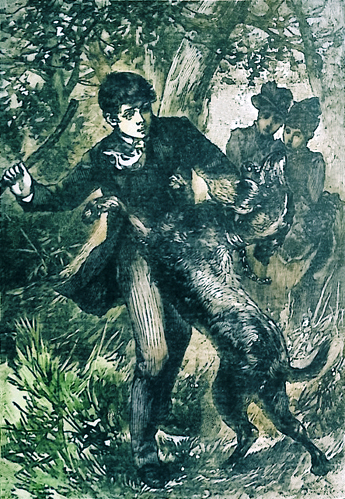
Joseph hurried forward, plunging through the thickest tangle,
regardless of face and hands, and in a few minutes emerged in the
opening at the bottom of which the streamlet ran. There, beyond the
brook, at the further side of the space were several girls, amongst
whom he at once recognised his cousin Mina and Miss Grandpont,
almost screaming in their terror at a huge, surly mastiff which was
threatening to tear them in pieces.
Young Greatheart did not stop to think twice. Looking hastily round
for something to arm himself with, he seized a stout club of dead wood
which the wind had brought down, and rushed to the rescue, clearing the
brook at a bound, and calling loudly to the dog to come off. But the
infuriated animal, descrying a more worthy opponent, transferred his
hostile advances to Joseph, and a serious conflict ensued.
The brute had no intention of yielding an inch of ground, and his fangs
looked fearfully blood-thirsty as he bared them at every growl. Joseph
began to have serious misgivings as to the issue. But he kept his eye
coolly fixed on the adversary, holding him at bay with his club, in
hopes that if—as seemed likely from the end of chain that dangled from
his collar—he had broken loose from the gamekeeper's lodge, his master
would hear the fray and come after him. But the minutes sped on, and
this hope seemed forlorn.
Each moment, the conflict grew more desperate. In vain, Joseph shouted
and threatened with his club; every instant the enraged brute seemed
about to spring at his throat. At last, in a desperate effort, he
struck him a blow across the muzzle, but the rotten wood snapped and
flew into the air, leaving only a short stump in his hand.
The dog was taken off his guard for an instant. But Joseph's weapon was
gone, and the next minute the animal had turned and was rushing upon
him with redoubled fury, amid the cries and screams of the girls, who
stood rooted to the spot, paralysed with fear. Not, however, before
Joseph had drawn and unclasped his knife, which, fortunately for the
safety of his life, was an unusually strong one. Nerving himself to
meet the worst, he clutched it firmly in his right hand, and stooping
slightly forward, awaited his enemy.
For a few seconds, the dog hesitated, as though uncertain what lay
behind this defiance. Then with a sudden growl, he sprang forward. But
Joseph was ready, and his good blade served him faithfully. With a yelp
of pain, the brute fell back, weltering in his blood, and panting in
his death-struggle. Another well-aimed blow, and all was over.
At that moment, a man in velveteens appeared, and before Joseph had
recovered breath sufficiently to speak, stood looking down at the
slaughtered animal.
"You'll have to answer for this, young man!" said he roughly.
"You may thank me that you haven't something worse to answer for,"
returned Joseph, drawing a long breath to steady his voice, which was
still a-quiver with excitement and exertion. "I came upon him attacking
those young ladies; and but for me, they might have been in his place
by now."
"You're trespassing," growled the man. "You've no business here at all."
"I was not here," returned Joseph. "I was some distance yonder, the
other side of the brook. I have no doubt the young ladies were ignorant
of the fact that they were on forbidden ground."
"If people won't take the trouble to read notice-boards, they must run
their own risks," grumbled the man. "Anyhow, you've lost me a valuable
dog, and you'll have to answer for it."
"All right," said Joseph. "My name is Joseph Adams." And taking a last
look at his slain foe, he turned on his heel, leaving the man to remove
the body.
The girls were still looking on. Joseph approached them, wiping the
stains of blood from his hands. He now perceived, for the first time,
that Cicely and Annie Cleveland were among their number.
"I hope you have not been very much frightened," he said. "It was
fortunate I chanced to hear you."
"It was, indeed," replied Mina, forced into politeness by such a
benefit as that which she had just received at his hands. "We had no
idea we were trespassing."
"Woods are dangerous places for young ladies to be in, alone," returned
Joseph. "I should advise you to avoid them for the future. I hardly
like to think how it might have ended," he added, with an involuntary
glance towards Cicely.
"I do not fancy we shall venture again very soon, after such an
adventure," remarked Miss Grandpont, who had been silently studying
their deliverer as he spoke. "I, for one, have been quite enough
frightened to take warning for the future. I am sure we can never thank
you sufficiently."
The words were said with the most heart-felt graciousness, and Alice
Grandpont's eyes glittered like black diamonds as she looked her
gratitude.
But Joseph's natural address was equal to the occasion. With a
bow which would have done credit to any gentleman in the land, he
replied,—"Your safety is all the thanks I need."
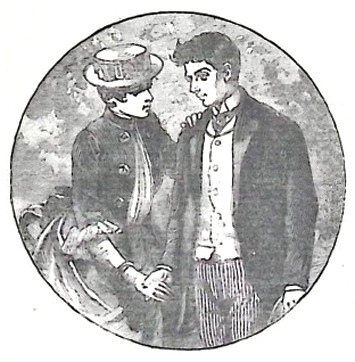
Then glancing towards Cicely, whose face was very white, he added, "If
you have all recovered sufficiently, I think we had better make our way
out of the place. I shall be glad to give you my protection as far as
the roadway."
The girls willingly accepted his offer, and went on with him, Cicely
and Mina walking behind in silence, Alice and Annie conversing
vivaciously on the subject of their encounter.
"It is not right for such a savage creature to be at large," remarked
Alice. "Supposing the school children had strayed here gathering
primroses for the Easter decorations, what a horrible tragedy might
have occurred!"
"According to that man, they have no business here, and must take their
chance," returned Joseph. "But the brute had evidently snapped his
chain. Didn't you see the broken end hanging to his collar?"
"Oh! We were too much alarmed to see anything but his horrid fangs!"
cried Annie.
"But we did not come across any notice to trespassers," said Alice.
"And the children certainly would not have observed it, if they had,"
put in Annie; "for they creep in anywhere; and there are not notices at
every gap in the hedge."
"That is the gamekeeper's strong point," answered Joseph. "No one has a
right to enter the wood by surreptitious ways, and if people will not
take the trouble to go to the correct entrance, where they may learn
whether or not they have a right to go in, they must run the risk."
In this way they chatted on, as they went back along the brookside. But
every now and then Joseph cast a glance back at Cicely, and he could
not help fancying that she looked very conscience-stricken, as well as
overcome by the terror she had passed through.
On reaching the gate of the wood, Joseph prepared to leave his fair
"protégées," and after again receiving very warm thanks—especially from
Alice Grandpont and Annie, he turned to pursue his way.
"Really we must have slipped back into the Middle Ages!" remarked
Alice. "What an adventure!"
"And what a knight-errant!" added Annie Cleveland. "Pity he is only a
carpenter's son!"
"He's a fine fellow, whoever he is," returned Miss Grandpont. "I should
have no objection to his riding by my palfrey!"
"Hush!" exclaimed Annie. "He will hear what you say."
"Perhaps he might not be annoyed," laughed Alice. "For all his fine
speech about 'our safety being ample reward,' the youth has a heart, by
the way in which he looked at me as he said it."
But Joseph had heard—though not Miss Grandpont's eulogy. "Only a
carpenter's son!" The words stung him to the quick. After he had risked
his life to save her, too.
Meanwhile, Alice's curiosity concerning him had been growing.
"Who is this carpenter's son?" she asked. "He gave the name of Adams."
"Why! Don't you know?" cried Annie. "A cousin of Mina's."
"Nonsense," retorted Alice—"except as we are all cousins in Adam."
"But he is, really," returned Annie; "and no joking in the matter."
"What a thousand pities he isn't something better, then!" exclaimed
Alice.
"Yes; poor Mina is terribly ashamed of him," said Annie, looking
mischievously round at Mina, whose face was uncomfortably hot.
"But the thing is, he is nobody to be ashamed of," exclaimed Alice.
"How well he expresses himself! Give him a fashionable tailor, and a
few society airs, and I could mention several whom he would throw into
the shade."
"Still, Mina could hardly ask him to her evenings, as he is."
"More's the pity!" sighed Alice.