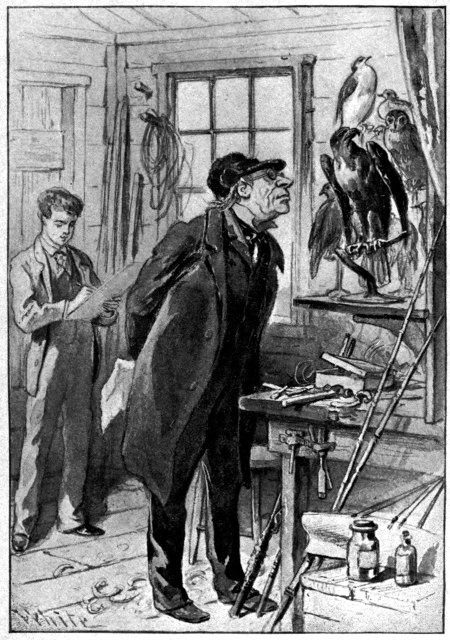
"You are not engaged in any regular occupation now, I believe?"
continued the professor.
"No, sir, I am not," answered Oscar, as soon as he could speak.
"Then I suggest that you keep yourself at liberty until you hear from
some of us. I shall return to the city by the first train, and, as soon
as I can see the committee, our secretary will drop you a line. I am
confident that I can put you in the way of making a name and a living
for yourself. Good-morning!"
The professor disappeared through the door, and Oscar, having seen him
close the gate behind him, drew a long breath, thrust his hands deep
into his pockets, and walked up and down the shop, thinking over what
had transpired. He was so highly excited that he could not have kept
still to save his life.
It hardly seemed possible that the art of taxidermy, which he had taken
up simply as a recreation, should be the means of making him rich and
famous, and he could not bring himself to believe that such was the
fact.
There was one thing that stood in his way. Everybody who came in
contact with his late visitor seemed to think that there was something
wrong with him, and Oscar himself had seen and heard enough to prove
that the professor was a very strange man.
Perhaps his name wasn't Potter, and perhaps, too, he had no connection
whatever with the Yarmouth University.
"I'll not build any hopes upon it," said the boy, as these thoughts
passed through his mind, "and neither will I say a word to mother when
she comes home. She would be very much disappointed if it turned out
to be a hoax, and I don't see how she can stand any more trouble. Sam
will be around some time to-day, most likely, and I'll ask him what he
thinks about it. He has good, sound sense, and, besides, he knows how
to keep a secret."
Oscar picked up his broom again, but very soon found that he had lost
interest in everything except Professor Potter and his astonishing
proposition.
He could not keep his mind on anything else, nor could he calm his
excitement; and believing that a brisk walk in the open air would be
more agreeable than working in the dusty shop, he locked the door,
picked up his wheelbarrow as he passed through the yard, and set out
for Mr. Peck's boat-house, Bugle leading the way.
He found his decoys, sail, and oars where he had left them, and having
packed them away in his wheelbarrow, he turned his face toward home.
As he was passing across the park he heard someone calling to him. He
stopped, and looking across the street, saw Mr. Anderson running toward
him and beckoning with his hand.
"What does he want, I wonder?" thought the boy. "I don't care to see
him; but if he wants to see me, he can come where I am."
He set down the wheelbarrow, and taking his seat on one of the handles,
looked at Mr. Anderson, who stopped in the middle of the street and
waved his hand to him.
"Come over here!" he shouted.
"I can't see it," said Oscar to himself. "I have been insulted in that
store once, and I never want to see the inside of it again. If he has
anything to say to me, we'll have the interview right here, for this is
neutral ground."
Oscar kept his seat on the wheelbarrow, and resting his elbows on his
knees, looked up and down the street in an indifferent sort of way,
as if he meant to show that Mr. Anderson and his movements did not
interest him in the least.
The junior partner, finding that the boy paid no attention to his words
and signals, came across the street and hurried up to him.
Our hero was astonished at his greeting. He thrust out his hand, and
Oscar placed his own within it.
"I am glad to see you again," said Mr. Anderson cheerfully. "It looks
natural to see you around. Come over to the store. Mr. Smith has
something very particular to say to you."
"I guess I had better not go," replied Oscar. "I am not in your employ
now; and I may say something I shall be sorry for."
"No, you won't, for the opportunity will not be given you!" exclaimed
Mr. Anderson earnestly. "You'll have no cause for saying hard things.
Be guided by me, just this once, and come in. You will never regret it."
Oscar took a few minutes in which to think about it. Finally he arose
to his feet, and pushing his wheelbarrow off the walk, out of the way,
he followed the junior partner across the street, and into the store.
When they entered the office, Mr. Anderson closed and locked the door.
Mr. Smith occupied his usual place on his high stool, but he scrambled
down from it with great haste and gave his former clerk a most cordial
welcome.
"Oscar," said he, "I find that I have done you very great injustice,
and I am sorry for it."
The boy's face relaxed on the instant. Knowing Mr. Smith as well as he
did, he had never expected him to make such a confession as this.
"Then perhaps you wouldn't mind telling me why I was discharged, and
why you refused to give me the letter of recommendation for which I
asked," said Oscar.
Mr. Smith cleared his throat two or three times, and climbed back to
his high stool again. It was hard work for him to answer that question;
and when he met the gaze of the clear, honest eyes that were looking
straight into his own, he wondered how he could ever have suspected
their owner of being a thief.
"Well, the amount of it is, that somebody has been robbing our till
systematically," said he, when he had mustered up courage enough to
give utterance to the words. "All our clerks except you had been with
us for a long term of years. We had the utmost confidence in their
honesty, and—and——"
"And you suspected me!" exclaimed Oscar, his face reddening with
indignation.
"Well, yes; that's the plain English of it. But we have since found out
that we made a woeful mistake. The guilty one has been discovered, and
has made a full confession, in which he took particular pains to clear
you of all suspicion. Now, we are anxious to make all the amends in our
power. Do you want to come back here at thirty dollars a month?"
"No, sir," replied Oscar promptly.
The two grocers seemed very much surprised at this answer. They looked
at each other and at Oscar, as if they were waiting for him to say
something more, but as he did not speak, Mr. Smith continued:
"Then we'll say thirty-five; and that is almost double the amount we
paid you before."
"I am very much obliged to you, but I cannot accept the offer,"
answered Oscar.
"You do not bear us any ill-will, I hope," said Mr. Anderson.
"None whatever, I assure you. I am overjoyed to know that you no longer
believe me to be dishonest, and I shall think of you with as kindly
feelings as I ever did; but I can't come back to the store, for I have
something better in prospect."
"For your sake, I am very glad to hear it; for my own, I am sorry,"
said Mr. Smith, and the words came from his heart. "If the time ever
comes when we can advance your interests in any way, do not hesitate
to call upon us. You are at perfect liberty to use the firm's name
whenever it will be of benefit to you. We know you to be an honest,
capable boy, and we shall take pleasure in recommending you as such."
"I am greatly obliged to you, sir, and I may some day be glad to take
advantage of your kind offer. Now, I will bid you good-by."
"Just one word more, Oscar," said Mr. Anderson, as the boy laid his
hand upon the door-knob; "if you don't secure that better thing of
which you were speaking, remember that your old position is open to
you."
"At thirty-five dollars a month," chimed in Mr. Smith.
"Thank you; I'll bear it in mind."
Oscar's excitement, which had been worked up to almost fever-heat by
the conversation he had had with the professor in his work-shop that
morning, was greatly increased by this interview; but still he managed
to keep a few of his wits about him, and when he passed out into the
store he ran his eyes hastily around to see if any of the clerks were
missing. They were all there except one.
"I'm glad to see you, Oscar!" cried Hudson, the oldest clerk in the
store. "You look as happy as a clam. Coming back?"
"It is hardly probable," was the reply. "Where's Stuart?"
"Stuart has been sick in bed ever since Friday—something like brain
fever, I think," answered Hudson.
"He works here yet, I suppose?"
"Oh, yes; he'll be back as soon as he gets well. And I'll tell you
something, Preston, which surprised me when I first found it out: Mr.
Smith's got a heart. I heard him say that Stuart's wages would go right
on."
"It is very strange," thought Oscar, as he closed the door behind him.
"None of the clerks have been discharged, so the till-tapper, whoever
he is, must still be in the store. I was dismissed when there was not
the least proof against me, and now a confessed thief is allowed to
retain his situation. I don't see much justice in that. Well, perhaps
the guilty fellow is one of their trusted men, and Smith & Anderson
don't want to make any stir about it."
"Morning, Oscar!" exclaimed the post-office clerk, who just then
hurried by, with his face buried in the collar of his overcoat. "Letter
in your box."
Oscar, thanking him for the information, turned down the street, and
crossed over to the post-office, and all the while he seemed to be
treading on air, so light and buoyant were his spirits.
He had heard good news from two sources that forenoon, and there was
something else agreeable in store for him, as he found when the letter
was placed in his hands.
It proved to be from Calkins & Son, who acknowledged the receipt, in
good order, of the eighteen brace of ducks that had been sent to them
on Saturday, asked for a shipment of grouse, quails, or hares at once,
and enclosed their check for $7.20, made payable to Oscar's order.
After reading the letter, he put it into his pocket, seized the
wheelbarrow, which now seemed as light as a feather, and trundled it
home in much less time than he had ever consumed in making the journey
before.
He let himself into the shop, and while he was busy putting away his
decoys, a lively whistle sounded in the yard, and Sam Hynes came
rushing in.
"O Sam!" exclaimed Oscar.
"Hallo! What's the matter with you?" demanded the visitor, who saw that
his friend was greatly excited about something.
"I've had the best luck in the world to-day," answered Oscar. "In the
first place, the fellow who got me into all that trouble with Smith &
Anderson has been discovered, and has made a full confession."
"No!" cried Sam, opening his eyes and looking very much surprised.
"It's a fact. Mr. Smith informed me, not an hour ago, that he had done
me great injustice, and he was sorry for it."
"You don't tell me so!" cried Sam, seating himself on the bench and
looking the very picture of amazement and delight. "Who was the guilty
rascal?"
"I don't know, and I couldn't find out. I didn't ask Mr. Smith, and he
didn't volunteer the information. The clerks were busy in the store
to-day, and they were all there except Stuart. He is ill, and will come
back as soon as he gets well; so the thief, whoever he is, still holds
his position."
Sam was really astonished now, and the delight he feigned became
genuine when Oscar continued:
"Mr. Smith told me that my old situation was open to me at thirty-five
dollars a month."
"Good!" exclaimed Sam, jumping off the bench and extending his hand.
"When do you go back?"
"I am not going back at all. I have something better."
Sam opened his eyes again, and listened attentively while Oscar went
on to describe the interview he had had with Professor Potter, and to
tell him of the liberal offer the latter had made him.
He did not forget to inform his friend that the professor still wore
his (Sam's) cap on his head, and that he had probably carried it to the
city with him.
As Oscar proceeded with his story, the look of astonishment on Sam's
face gradually gave way to an altogether different expression, and when
Oscar ceased speaking, he seated himself on the bench again, and gazed
down at the floor in a brown study.
"Now, then, what's the matter with you?" demanded Oscar.
"If I answer your question at all, I shall say just what I think,"
replied Sam.
"That is what I want you to do. Speak out."
"I will. You have missed it. If you are wise, you will lose no time in
telling Mr. Smith that you will take those thirty-five dollars a month."
"But, Sam, I can't do it. I promised the professor that I would keep
myself free until I heard from him."
"Professor!" exclaimed Sam, with great disgust. "He is about as much a
professor as I am."
"If you had heard him talk this morning, you wouldn't think so. I tell
you he is educated."
"That may be; but a man who will go on as he did when we pulled him out
of the water, and who hasn't sense enough to know when he is wearing
a cap belonging to somebody else, can't have much wit. Professor! He
never saw Yarmouth University, and you'll never hear from him again,
either. What have you got there?" added Sam, glancing at a piece of
wood which his companion just then took from the work-bench.
"I wrote down some of his hard words," replied Oscar, passing the board
over to Sam. "You are fresh from your books, and I'd like to have you
translate them for me. I'll tell you what's a fact: I have come to the
conclusion that I don't know anything about natural history."
"He talked in a regular scientific style, didn't he?" said Sam, after
he had run his eyes over the board. "The animal kingdom, as you know,
is divided into branches, classes, orders, families, genera, and
species. The branch Vertebrates is divided into five classes—fishes,
batrachians, reptiles, birds, and mammalia. The class birds is divided
into seven orders, two of which you have put down here. The Rasores
are scratchers, such as the turkey and grouse, and the Insessores are
perchers. To this order belong all our songbirds."
"Well, he went down the river after some specimens of the Fuligula
Valisneria," said Oscar. "What are they?"
"That's a conundrum," replied Sam.
"What's a Bombycilla Carolinensis?"
"I give it up. There are only a few words more here that I can
understand; and, Oscar, I'll say this much for you: your spelling is
simply fearful. The Pachydermata are thick-skinned animals, such as
the elephant and rhinoceros; the Ruminantia are those that chew the
cud, like the cow and sheep; the Digitigrades walk on their toes—the
cat and dog belong to this family—and the Plantigrades walk on
their heels. To this family the bear belongs. That is as far as I
can help you. But I'll tell you what we will do," added Sam, jumping
down from the bench and pulling out his watch. "I'll be around here
to-night, within fifteen minutes after school is dismissed, and you go
home and take supper with me. In the early part of the evening I'll
beat you playing a game of chess, and then we'll go over and call on
Mr. Chamberlain. He will make everything clear to you. I don't believe
you have been near him since you left school."
"No, I haven't," answered Oscar. "I was obliged to neglect everybody
while I was in the store. I'll be ready for you."
Sam rushed out, slamming the door behind him, and hurried toward the
gate; but, just then, Oscar happened to think of something, so he ran
to the door and called him back.