THE BATTLE OF ALLATOONA.
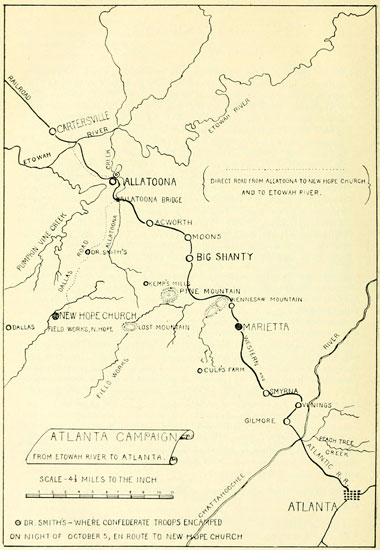
From Lovejoy's to Lost Mountain—Big Shanty—Acworth—Destroying
Railroad—In the Rear of Sherman—Situation of the Two Armies—Orders
to Destroy the Etowah River Bridge—To Fill Up the Railroad Cut
at Allatoona—Hood Not Aware that Allatoona Was Fortified and Garrisoned—March
to Allatoona—Summons to Surrender—No Answer—Gen.
Corse's Report Erroneous—The Fortifications—Strength of Forces—Equalization
of Forces—Some Federal Dispatches—The Battle—Corse's
Account—Col. Ludlow's Description—Desperate Fighting—The Main
Line Captured—Enemy Driven into an Interior Fort—Dispatches from
Gen. Armstrong Respecting Movements of the Enemy at Big Shanty—Withdraw
to Avoid Being Surrounded by Converging Forces—Corse's
Dispatch to Sherman—Provisions—Confederates Three Days and Nights
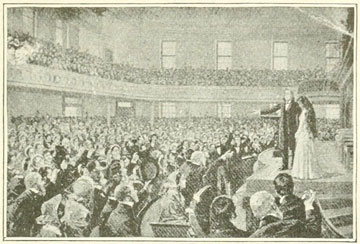
without Rest or Sleep—Pass by the Enemy—Evangelist P. P. Bliss
Writes the (Gospel) Hymn, "Hold the Fort"—Hood and His Erroneous
Publications in His Book—His Admiration for Corse—My Admiration
for the Confederates—The Soldier's Grave—The Lone Grave—Lieut.
Gen. A. P. Stewart's Note in Regard to This Account of the Battle.
September 29. This morning Loring's, Walthall's, and my divisions
moved on the Pumpkinton road and crossed the Chattahoochee river and encamped
beyond Villa Rica. The following day we marched to near Brownsville
Post Office.
Saturday, October 1. I remained in camp. At 10 A.M. all the division
commanders were invited to Gen. Hood's headquarters, and the object of
the move was discussed. I found in the room on my arrival Gens. Stewart,
S. D. Lee, Loring, Walthall, Stevenson, and Clayton. As soon as I
entered the room Hood said to me: "Gen. French, what do you think Gen.
Sherman will do now?" I replied: "I suppose he will turn southwest and
move on to Mobile; or he may go to Augusta to destroy our powder mills,
and then make for Charleston or Savannah." "In that event do you believe
he can sustain his troops on the march if our cavalry lay waste the
country before him?" I answered: "He will find all he wants as he moves
on." To this Hood replied: "Well, I have nothing to do with that, as the
President has promised to attend to that matter." Every officer present
disagreed with me save Gen. S. D. Lee. He thought all would have difficulty
to subsist except the cavalry.
On the subject of destroying Sherman's communications my
diary says:
I was in favor of an immediate move on the railroad above Kennesaw
with the whole army, and expressed my regrets at the delay.
I received orders to move to-morrow. We were requested to inform
the brigade commanders of the object of moving in the rear of Sherman's
army, and they were to inform the regimental and company officers.
2d. I left camp and marched to Moon's, and this brought us to the same
ground we occupied on the 24th of May.
3d. When Sherman discovered that Hood had crossed the Chattahoochee
and was marching to obtain possession of his line of communication, he
immediately adopted measures to defeat Hood's plans and give him battle.
The general situation of the two armies to-day is: Sherman's main body
of troops is at Atlanta, with garrisons at the Chattahoochee, Vining's, Marietta,
Kennesaw, Big Shanty, Moon's, Acworth, Allatoona Creek, Allatoona
fortifications garrisoned by just about one thousand men, Gen. Elliott,
chief of cavalry, with his command at Kennesaw, Gen. J. E. Smith, with
his division, at Cartersville, Gen. J. M. Corse at Rome with a division, and
the garrisons at important places on up to Chattanooga, as disclosed by
the movements of troops, dispatches sent directing their movements, and
subsequent information.
Hood's army marched to Lost Mountain, where he remained with two
corps, while Stewart's Corps went thence in the rear of the enemy's line
of fortifications to Big Shanty. Gen. Featherston captured some forty
prisoners at Big Shanty, and commenced destroying the railroad. Loring,
sent to Acworth (near Allatoona), captured about two hundred prisoners,
and Walthall took seventy prisoners at Moon Station. All night
every one was hard at work destroying the railroad, and the next day by
noon we had about eight miles of the track taken up and the rails twisted.
4th. At noon, when filling up the railroad cuts at Big Shanty, I received
orders to fill up the deep cut of the railroad at Allatoona, and then,
if possible, destroy the railroad bridge over the Etowah river. About this
time some one living near by told us that the enemy had fortifications at
Allatoona, well garrisoned and commissary stores there. Under these
peculiar orders (which will be given in full hereafter in my report) I left
Big Shanty with my division at 3 P.M. for Acworth and thence to Allatoona,
while Loring and Walthall were ordered in the direction of New
Hope Church. I was now entering the zone of active movements of the
Federals, and away from all support, and all support from me, and the
enemy converging on Allatoona from all directions. I reached Acworth
about dark, and was detained there till 11 P.M., awaiting rations and getting
some one for a guide. I saw camp fires of the enemy east of the railroad
and north of Kennesaw, and night signals from Allatoona to Kennesaw.
From two young ladies, who to-day had visited Allatoona, I obtained
the name of the commander there, and the probable strength of the
enemy in the several works. I also succeeded, through some of the citizens,
in getting a boy for a guide. I moved from Acworth about 11 P.M.,
and on arriving at Allatoona Creek I left there the Fourth Mississippi
Regiment and one piece of artillery, with instructions to burn the bridge
and capture the garrison of one hundred men in the blockhouse. When
at Acworth I sent fifteen men from a Capt. Taylor's company of cavalry,
Pinson's Regiment, to strike the railroad near the Etowah river and
tear up the track to prevent reënforcements from reaching Allatoona. I
moved on then from the creek, and arrived before Allatoona about 3 A.M.
All was darkness; nothing could be seen except occasional lights flitting
about the place. I put the artillery, eleven guns, in position, or rather
left them in what the guide said was a good place, and also left two regiments
of Ector's Brigade under Col. Andrews as a support to them. With
the guide directing, I moved the division to gain the flank and rear of the
line of works. There were five detached works on the high ridge through
which the Western and Atlantic railroad runs. No road leads to this ridge
except the Cartersville road, that ascends the ridge by a winding ascent,
and enters the works, passing within a few feet of the main redoubt, under
its guns, and then runs on the crest of the ridge for two hundred and
fifty yards to where it passes out through the fortifications. So the guide
directed us through the dark woods and up the steep, rugged, rocky hills,
and down into deep valleys until we were lost, and the guide acknowledged
that he could not find the way. This determined me to stop and rest till
daylight. The pickets had been driven in, and now and then shots were
exchanged. Starting again at dawn, I reached the high ridge on which
the redoubts were at 7:30 A.M. with the leading brigade. I halted Cockrell's
and Ector's Brigades on the ridge, and sent Gen. Sears to gain the
rear of the works. The artillery opened fire on the forts (one on either
side of the railroad) about 7 A.M., and when we gained the ridge appeared
to keep the enemy quiet.
These dispositions being made, about 8 A.M. I summoned the commander
to surrender the place. I then supposed the garrison consisted of only
about nine hundred men, as reported to me at Acworth. Maj. D. W.
Sanders was instructed to allow about twenty minutes for the officer to
whom he delivered the message to go and return with the reply. After
waiting longer than the specified time, he returned without an answer.
Believing Sears was now well around on the north side, and having waited
to hear his attack so long, I put Cockrell's Brigade in motion, supported
by Ector's Brigade (of four regiments), to make the attack, as it was now
10:20 A.M.
The three companies of the Ninety-Third Illinois that were in the two
extreme west redoubts abandoned them without making much resistance,
and fell back to a very strong line of defense protected by all the entanglements
of modern warfare. Through the center of this work ran the
Cartersville road. This part of the defensive work was occupied by the
Thirty-Ninth Iowa, Seventh Illinois, and seven companies of the Ninety-Third
Illinois, making, in officers and men, a total of just about nine hundred.
Against this force, placed in carefully constructed works, I could
send only the Missouri brigade and four regiments of the Texas brigade,
in all one thousand three hundred and fifty. I had been informed by
Gen. Armstrong that the enemy's cavalry was moving up east of the railroad.
Then again I received from him a second dispatch informing me
that the Federal infantry was passing through Big Shanty and moving up
the railroad. This dispatch was dated 9 A.M. Knowing that this column
could reach the junction of the Sandtown and Dallas roads before I could,
I determined to withdraw, trusting to arrive there first.
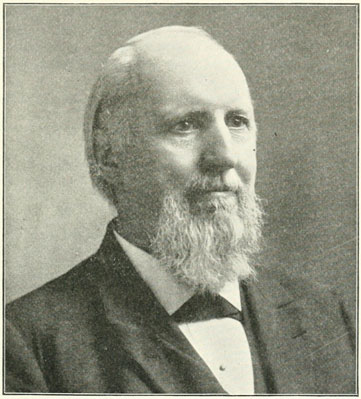
F. M. COCKRELL.
But as all these matters are more fully referred to in my report,
I will here quit, for the present, further extracts from my
diary, and give the report.
In Volume 39, Series 1, page 814, will be found in the "War
Records" the following report:
Headquarters French's Division, }
Tuscumbia, Ala., November 5, 1864.}
General: Sometime since I had the honor to submit to you a brief preliminary
report of the battle of Allatoona. As the report of the brigade
commanders are now in, I have the honor to forward one embracing some
of the details of the battle.
About noon on the 4th of October, when at Big Shanty, the following
order was handed me by Lieut. Gen. Stewart, it being a copy of one to
him:
Headquarters Army of Tennessee, October 4, 1864, 7:30 A.M.
Lieut. Gen. A. P. Stewart, Commanding Corps.
General: Gen. Hood directs that later in the evening you move Stevenson
back to Davis's Cross Roads, and that you bring two of your divisions
back to Adams's and between Adams's and Davis's Cross Roads,
placing them in such a way as to cover the position at Adams's now occupied
by Stevenson, and that your third division (say French) shall move
up the railroad and fill up the deep cut at Allatoona with logs, brush,
rails, dirt, etc. To-morrow morning at daylight he desires Stevenson to
be moved to Lieut. Gen. Lee's actual left, that two of your divisions at that
time at Adams's shall draw back, with your left in the neighborhood of
Davis's Cross Roads, and your right in the neighborhood of Lost Mountain,
and the division that will have gone to Allatoona to march thence to
New Hope Church and on the position occupied by your other troops—that
is, that the division shall rejoin your command by making this march out
from the railroad and via New Hope. Gen. Hood thinks that it is probable
that the guard at the railroad bridge on Etowah is small, and when French
goes to Allatoona, if he can get such information as would justify him, if
possible move to that bridge and destroy it. Gen. Hood considers its destruction
would be a great advantage to the army and the country. Should
he be able to destroy the bridge, in coming out he could move, as has been
heretofore indicated, via New Hope.
Yours respectfully,
A. P. Mason,
Assistant Adjutant General.
Soon after an order, of which the following is a copy, was sent me:
Headquarters Army of Tennessee, }
Office of the Chief of Staff, October 4, 1864, 11:30 A.M. }
Lieut. Gen. Stewart, Commanding.
General: Gen. Hood directs me to say that it is of the greatest importance
to destroy the Etowah railroad bridge, if such a thing is possible.
From the best information we have now he thinks the enemy cannot disturb
us before to-morrow, and by that time your main body will be near the
remainder of our army. He suggests that if it be considered practicable
to destroy the bridge when the division goes there and the artillery is placed
in position the commanding officer shall call for volunteers to go to the
bridge with lightwood and other combustible material that can be obtained,
and set fire to it.
Yours respectfully,
A. P. Mason,
Major and Assistant Adjutant General.
Gen. Stewart's Corps had struck the railroad at Big Shanty on the evening
of the 3d, and all three of his divisions had worked all night destroying
the railroad from near Kennesaw up to Acworth Station. As we had
been informed at Big Shanty that the Allatoona pass or cut was fortified,
and that the enemy had a garrison there of three regiments, and had accumulated
a considerable amount of provisions, it was considered a matter
of importance that the place should be captured, and after the orders
were handed me, at my request, Gen. Stewart sent me (with Maj. Myrick)
four additional pieces of artillery. It would appear, however, from these
orders that the general in chief was not aware that the pass was fortified and
garrisoned that I was sent to have filled up. Under these orders I left Big
Shanty about 3:30 P.M., and marched to Acworth, a distance of six miles,
arriving there before sunset. There I was detained, awaiting the arrival
of rations and cooking them, until 11 P.M.
As I knew nothing of the roads, the enemy's works or position, it was
important to procure a guide, and at last a young man, or rather boy, was
found who knew the roads, and had seen the position of the fortifications
at Allatoona, he being a member of a cavalry company. At Acworth
Capt. Taylor, of Pinson's Regiment of cavalry, with twenty-five men, reported
to me for duty. He was immediately directed to send fifteen men
under a trusty officer to strike the railroad as near the Etowah railroad
bridge as possible, and take up the rails and hide or destroy them, to prevent
trains from reaching Allatoona with reënforcements, as well as to
prevent any trains that might be there from escaping. From an eminence
near Acworth the enemy could be seen communicating messages by their
night signals from Allatoona with the station on Kennesaw; and to the east
of us were the fires of a large encampment of the Federals and apparently
opposite Moon's Station. Citizens residing here informed me that there
was a blockhouse with a garrison of about one hundred men at the Allatoona
bridge; that at Allatoona there were two small redoubts with outworks,
defended with four pieces of artillery and garrisoned with three
and a half regiments of infantry. About 11 P.M. the march was resumed.
The night was very dark, and the roads bad. After crossing Allatoona
creek, Col. Adaire, with his Fourth Regiment, Mississippi Volunteers, and
one piece of artillery, was left near the blockhouse with instructions to
surround it, capture the garrison, and destroy the bridge over the creek.
Continuing the march, the division arrived before Allatoona about 3 A.M.
Nothing could be seen but one or two twinkling lights on the opposite
heights, and nothing was heard except the occasional interchange of shots
between our advanced guards and the pickets of the garrison in the valley
below. All was darkness. I had no knowledge of the place, and it
was important to attack at the break of day. Taking the guide and lights,
I placed the artillery in position on the hills south and east of the railroad,
and the Thirty-Ninth North Carolina Regiment, under Col. Coleman, and
the Thirty-Second Texas were left as a supporting force, both under command
of Col. J. A. Andrews, commanding the latter regiment. This being
done, I proceeded with the guide to gain the heights, or ridge, crowned
by the works of the enemy. Without roads or paths the head of the line
reached the railroad, crossed it, and began ascending and descending the
high, steep, and densely timbered spurs of the mountains, and after about
an hour's march it was found that we were directly in front of the works,
and not on the main ridge. The guide made a second effort to gain the
ridge, and failed, so dark was it in the woods. I therefore determined to
rest where we were and await daylight. With the dawn the march was
resumed, and finally, by 7:30 A.M., the head of the column was on the
ridge about six hundred yards west of the main fortifications, and between
those he occupied an abandoned redoubt on our left.
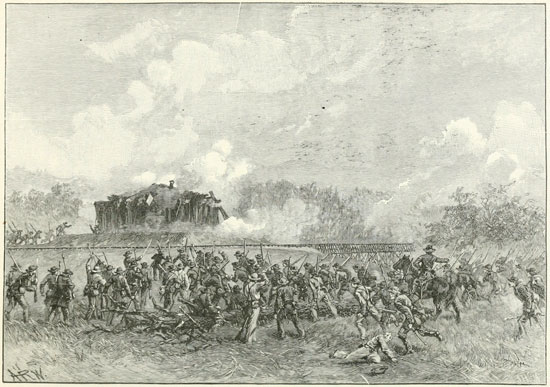
CAPTURE OF BLOCKHOUSE, ALLATOONA CREEK, OCTOBER 5, 1864.
Here the fortifications, for the first time, were seen, and instead of two
redoubts there were disclosed to us three redoubts on the west of the railroad
cut, and a star fort on the east with outer works and approaches defended
to a great distance by abatis, and nearer the works by stockades
and other obstructions. The railroad emerges from the Allatoona Mountain
by crossing this ridge through a cut sixty-five feet deep. Dispositions
for the assault were now made by sending Gen. Sears's Brigade to the
north side or rear of the works, Gen. F. M. Cockrell's (Missouri) Brigade
to rest with its center on the ridge, while Gen. W. H. Young, with the four
Texas regiments, was found in the rear of Gen. Cockrell.
Maj. Myrick had opened on the works with his artillery, and was ordered
to continue his fire until the attacking force should interfere, or until
he heard the volleys of musketry.
Gen. Sears was to commence the assault on the rear, and when musketry
was heard Gen. Cockrell was to move down the ridge, supported by
Gen. Young, and carry the works by (as it were) a flank attack. So rugged
and abrupt were the hills that the troops could not be gotten into position
until about 9 A.M., when I sent a summons to surrender. The flag was
met by a Federal staff officer, and he was allowed seventeen minutes to
return an answer. The time expired without any answer being received,
whereupon Maj. D. W. Sanders, impatient at the delay, broke off the interview
and returned. No reply being sent me, the order was given for
the assault by directing the advance of Cockrell's Brigade. Emerging
from the woods and passing over a long distance of abatis formed of felled
timber, and under a severe fire of musketry and artillery, nobly did it
press forward, followed by the gallant Texans. The enemy's outer line
and one redoubt soon fell. Resting to gather strength and survey the work
before them, again they rushed forward in column, and in a murderous
hand-to-hand conflict that left the ditches filled with the dead they became
masters of the second redoubt.
The third and main redoubt, now filled by those driven from the captured
works on the west side of the railroad, was further crowded by those
that were coming out of the fort on the east side of the road, from the attack
of Gen. Sears. They had to cross the deep cut, through which our
artillery poured a steady and deadly fire. The Federal forces were now
confined to one redoubt, and we occupied the ditch and almost entirely silenced
their fire, and were preparing for the final attack.
Pending the progress of these events I had received a note from Gen. F.
C. Armstrong, dated 7 A.M., asking me at what time I would move toward
New Hope, and informing me also that the enemy had moved up east of
the railroad above Kennesaw and encamped there last night. I had observed
this movement when at Acworth, but at 12 M. I received another
dispatch from him, written at 9 A.M., saying: "My scouts report the enemy's
infantry advancing up the railroad. They are now entering Big
Shanty. They have a cavalry force east of the railroad."
On the receipt of this second note from Gen. Armstrong I took my guide
aside and particularly asked him if, after the capture of the place, I could
move to New Hope Church by any other route than the one by the blockhouse
at Allatoona creek and thence by the Sandtown road to the Acworth
and Dallas road, and he said I could not. Here, then, was Gen.
Sherman's whole army close behind me, and the advance of his infantry
moving on Acworth, which changed the whole condition of affairs. Ammunition
had to be carried from the wagons, a mile distant at the base of
the hills, by men, and I was satisfied that it would take two hours to get
it up and distribute it under fire before the final assault. I had learned
from prisoners that before daylight the place had been reënforced by a
brigade under Gen. Corse. I knew the enemy was at Big Shanty at 9 A.M.
By noon he could reach Acworth and be within two miles of the road on
which I was to reach New Hope Church. I knew Gen. Stewart had been
ordered to near Lost Mountain. My men had marched all day on the 3d;
worked all the night of the 3d destroying the railroad; that they had worked
and marched all day on the 4th; marched to Allatoona on the night of the
4th; had fought up to the afternoon of the 5th; and could they pass the entire
third day and night without rest or sleep if we remained to assault the
remaining works? I did not doubt that the enemy would endeavor to get
in my rear to intercept my return.
He was, in the morning, but three hours distant, and had been signaled
to repeatedly during the battle. Under these circumstances I determined
to withdraw, however depressing the idea of not capturing the place after
so many had fallen, and when in all probability we could force a surrender
before night. Yet, however desirous I was of remaining before the
last work and forcing a capitulation, or of carrying this interior work by
assault, I deemed it of more importance not to permit the enemy to cut
my division off from the army. After deliberately surveying matters as
they presented themselves to me, I sent to Gen. Sears to withdraw his men
at once, moving by the route he went in, and directed Gen. Cockrell to
commence withdrawing at 1:30 P.M.
Before the action commenced it was foreseen that it would be impossible
to carry any wounded, on litters, to the road where the ambulances
were placed, owing to the steepness of the hills, the ravines, and the dense
woods. Accordingly the wounded were brought to the springs near the
ridge. All who could be moved without the use of litters were taken to
the ambulances. The others were left in charge of surgeons detailed to
remain with them.
The troops re-formed on the original ground, west of the works, and
marched to the south side near the artillery, and at 3:30 P.M. commenced
the move toward New Hope. After the troops left I rode on down to Col.
Andrews's position in front of the works and directed him to remain until
5 P.M., and then withdraw and move on in our rear.
Before I commenced to withdraw the infantry from the captured works
(but after the guide said I would have to return by the way I came) I sent
orders to Maj. Myrick to send two batteries and caissons to a point beyond
the blockhouse on the Sandtown road, to act in concert with the troops left
there. Having been informed by Col. Andrews that the blockhouse at the
Allatoona bridge had not been captured, I directed Capt. Kolb, with his
battery that had remained with Col. Andrews, to move on and report to
Gen. Cockrell for the purpose of taking the blockhouse.
Shortly after 4 P.M., and when not a person could be seen in or around
the forts, I left the command of Col. Andrews and overtook the division
near the blockhouse. Col. Adaire had burned the railroad bridge over
Allatoona creek (over two hundred feet long), and also the duplicate of
the bridge, which had been already framed to replace the old structure.
Under the increased artillery fire the garrison of the blockhouse surrendered.
We captured two hundred and five prisoners, one United States flag,
and the colors of the Ninety-Third Regiment of Illinois, a number of
horses, arms, etc., and killed and wounded seven hundred and fifty of the
enemy, being, with the garrison of the blockhouse, over one thousand.
History will record the battle of Allatoona one of the most sanguinary
of the war; and when it is remembered that the enemy fought from within
their strong redoubts the desperate deeds of daring performed by our
troops in overcoming so many of the foe will win a meed of praise for
their heroic valor.
The artillery opened about 7 A.M., and, except when the flag of truce
was sent in, continued until 2 P.M.
The attack, commencing about 10 A.M., continued unremittingly until
1:30 P.M., and the rattle of musketry did not cease entirely until 3 P.M.,
when it died away, and a silence like the pall of death rested over the
scene, contrasting strangely with the previous din of battle.
I cannot do justice to the gallantry of the troops. No one faltered in
his duty, and all withdrew from the place with the regret that Gen. Sherman's
movements—closing up behind us—forbade our remaining longer
to force a surrender of the last work.
After leaving out the three regiments that formed no part of the assaulting
force, I had but little over two thousand men.
My entire loss in killed, wounded, and missing was 799, as follows: Cockrell's
Brigade: Killed, 42; wounded, 182; missing, 22. Sears's Brigade:
Killed, 37; wounded, 114; missing, 200. Ector's Brigade: Killed, 43;
wounded, 147; missing, 11. Staff: Captured, 1. Total: Killed, 122;
wounded, 443; missing, 233; captured, 1. Grand total, 799.
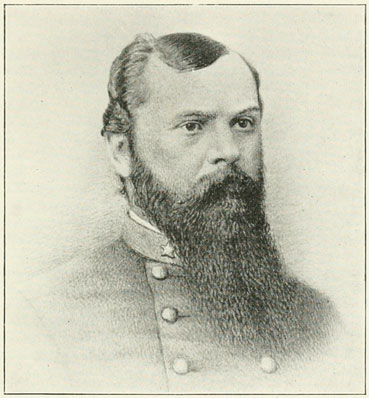
MAJ. D. W. SANDERS.
Among the killed from Sears's Brigade is Col. W. H. Clark, Forty-Sixth
Mississippi. He fell in the advance, near the enemy's works, with the battle
flag in his hands. He was an excellent and a gallant officer. Also,
were killed Capt. B. Davidson and Lieuts. G. C. Edwards, J. R. Henry,
and J. D. Davis. Col. W. S. Barry, Thirty-Fifth Mississippi, and Maj.
Partin, Thirty-Sixth Mississippi, were wounded, together with Capts. R.
G. Yates and A. J. Farmer and Lieuts. J. N. McCoy, G. H. Bannerman,
J. M. Chadwick, J. Copewood, R. E. Jones, E. W. Brown, G. H. Moore,
and Ensigns G. W. Cannon and A. Scarborough.
Texas will mourn for the death of some of her bravest and best men.
Capt. Somerville, Thirty-Second Texas, was killed after vainly endeavoring
to enter the last work, where his conspicuous gallantry had carried
him and his little band. Capts. Gibson, Tenth Texas, Bates, Ninth Texas,
Lieuts. Alexander, Twenty-Ninth North Carolina, and Dixon E. Wetzel,
Ninth Texas, were killed while gallantly leading their men.
Brig. Gen. W. H. Young, commanding the Texas Brigade, was wounded.
Most gallantly he bore his part in the action. Col. Camp, Fourteenth
Texas, one of the best officers in the service, was seriously wounded. Also
Majs. McReynolds, Ninth Texas, and Purdy, Fourteenth Texas. Of the
captains wounded were Wright, Lyles, Russell, Vannoy, and Ridley, and
Lieuts. Tunnell, Haynes, Gibbons, Agee, Morris, O'Brien, Irwin, Reeves,
and Robertson.
In the Missouri Brigade were killed or mortally wounded Majs. W. F.
Carter and O. A. Waddell, Capts. A. J. Byrne, A. C. Patton, John S. Holland,
Lieuts. Thomas S. Shelly, Joel F. Yancey, G. R. Elliott. R. J. Lamb,
G. T. Duvall, and W. H. Dunnica, and Ensign H. W. De Jarnette—men
who had behaved well and nobly during the whole campaign.
Among the wounded are Maj. R. J. Williams, Capts. Thompson Alvord,
G. McChristian, G. W. Covell, and A. F. Burns, Lieuts. Joseph Boyce, Silas
H. F. Hornback, J. L. Mitchell, A. H. Todd, and H. Y. Anderson, and
Ensign William A. Byrd.
I have named the killed and wounded officers in this report. The names
of the private soldiers who fell or were wounded will also be filed with this
as soon as they are received. It is due to the dead, it is just to the living,
that they who have no hopes of being heralded by fame, and who have
but little incentive except the love of country and the consciousness of a
just cause to impel them to deeds of daring, and who have shed their
blood for a just cause, should have this little tribute paid them by me,
whose joy it was to be with them.
For the noble dead the army mourns, a nation mourns. For the living,
honor and respect will await them wherever they shall be known, as faithful
soldiers, who, for their dearest rights, have so often gone through the
fires of battle and the baptism of blood. It would perhaps be an invidious
distinction to name individual officers or men for marked or special services
or distinguished gallantry where all behaved so well, for earth never
yielded to the tread of nobler soldiers.
I am indebted to Gens. Cockrell, Sears, and Young for bravery, skill,
and unflinching firmness.
To Col. Earp, on whom the command of the gallant Texans devolved,
and to Col. Andrews, who commanded on the south side, and Maj. Myrick,
commanding the artillery, I return thanks for services. Maj. D. W.
Sanders, assistant adjutant general, Lieut. Wiley Abercrombie, aid, Capt.
W. H. Cain, volunteer aid, Capt. Porter and Lieut. Mosby, engineers, were
zealous in the performance of their duties, and E. T. Freeman, assistant
inspector general, was conspicuous for his gallant conduct. I commend
the last-named to the government for promotion.
Col. E. Gates, First and Third Missouri, Maj. E. H. Hampton, Twenty-Ninth
North Carolina, and W. J. Sparks, Tenth Texas, and Lieut. Cahal,
of Gen. Stewart's staff, are named for gallant services.
Lieut. M. W. Armstrong, Tenth Texas, seized the United States standard
from the Federals, and after a struggle brought it and the bearer of
it off in triumph.
In the inclosed reports of brigade commanders will be found the names
of many officers and soldiers that I know are entitled to commendation
and all marks of distinction that the government can award.
The cavalry officer who was sent to cut the railroad (early in the afternoon
of the 4th) and failed to perform that duty is, in my opinion, much
to blame. Had he taken up the rails (and there was nothing to prevent it),
reënforcements could not have been thrown in the works, and the result
would have been different. After events showed that a cavalry force and
Corse's other brigade arrived just three hours after we left Allatoona, and reënforced
the garrison in the fort.
Very respectfully submitted.
S. G. French,
Major General Commanding.
You have now my official report of the battle of Allatoona as
it was written soon after the event, and I will say here that, had
I known it would have been so incorrectly reported by Gen.
Corse, it would have embraced much matter of detail elucidating
what occurred. I shall now proceed to copy some part of Gen.
Corse's report, after which its errors will be pointed out as substantiated
by facts not then known, and some that were not regarded.
So, with my report, unintentional errors have been
made known, as shown by subsequent information.
Gen. Corse's Report.
... I directed Col. Rowett to hold the spur on which the Thirty-Ninth
Iowa and the Seventh Illinois were formed, ... and taking
two companies of the Ninety-Third Illinois down a spur parallel with the
railroad and along the bank of the cut, so disposed them as to hold the
north side as long as possible. Three companies of the Ninety-Third,
which had been driven from the west end of the ridge, were distributed
in the ditch south of the redoubt, with instructions to keep the town well
covered by their fire, and to watch the depot where the rations were stored.
The remaining battalion of the Ninety-Third, under Maj. Fisher, lay between
the redoubt and Rowett's line, ready to reënforce wherever most
needed.
I had barely issued the orders when the storm broke in all its fury on
the Thirty-Ninth Iowa and the Seventh Illinois. Young's Brigade of Texans
had gained the west end of the ridge, and moved with great impetuosity
along its crest till they struck Rowett's command, when they received
a severe check, but, undaunted, came again and again. Rowett, reënforced
by the gallant Redfield, encouraged me to hope that we were safe
here, when I observed Gen. Sears's Brigade moving from the north, its
left extending across the railroad (opposite Tourtellotte). I rushed to the
two companies of the Ninety-Third Illinois, which were on the brink of
the crest running north from the redoubt, they having been reënforced by
the retreating pickets, and urged them to hold on to the spur; but it was
of no avail; the enemy's line of battle swept us back like so much chaff,
and struck the Thirty-Ninth Iowa in flank, threatening to ingulf our little
band without further ado. Fortunately for us, Col. Tourtellotte's fire caught
Sears in flank, and broke him so badly as to enable me to get a staff officer
over the cut with orders to bring the Fiftieth Illinois over to reënforce
Rowett, who had lost very heavily. However, before the regiment sent
for could arrive, Sears and Young both rallied, and made their assaults in
front and on the flank with so much vigor and in such force as to break
Rowett's line, and had not the Thirty-Ninth Iowa fought with the desperation
it did, I never should have been able to get a man back inside the redoubt;
as it was, their hand-to-hand conflict broke the enemy to that extent
that he must stop and re-form before undertaking the assault on the
fort. Under cover of the blows they gave the enemy the Seventh and
Ninety-Third Illinois, and what remained of the Thirty-Ninth Iowa, fell
back into the fort.
The fighting up to this time, about 11 A.M., was of the most extraordinary
character. Attacked from the north, from the west, and from the
south, these three regiments (the Thirty-Ninth Iowa and the Seventh and
Ninety-Third Illinois) held Young's and a portion of Sears's and Cockrell's
Brigades at bay for nearly two hours and a half. The gallant Col.
Redfield, of the Thirty-Ninth Iowa, fell shot in four places, and the extraordinary
valor of the men and officers of this regiment and the Seventh
Illinois saved to us Allatoona.
So completely disorganized were the enemy that no regular assault could
be made on the fort till I had the trenches all filled and the parapets lined
with men. The Twelfth and Fiftieth Illinois, arriving from the east hill,
enabled us to occupy every foot of trench, and keep up a line of fire that,
as long as our ammunition lasted, would render our little fort impregnable.
The broken pieces of the enemy enabled them to fill every hollow,
and take every advantage of the rough ground surrounding the fort, filling
every hole and trench, seeking shelter behind every stump and log that
lay within musket range of the fort. We received their fire from the
north, south, and west of the redoubt, completely enfilading our ditches
and rendering it almost impracticable for a man to expose his person
above the parapet. An effort was made to carry our works by assault;
but the battery (Twelfth Missouri) was so ably manned, and so gallantly
fought, as to render it impossible for a column to live within a hundred
yards of the work. Officers labored constantly to stimulate the men to
expose themselves above the parapet, and nobly set them the example.
The enemy kept a constant and intense fire, gradually closing around
us, and rapidly filling our little fort with the dead and dying. About 1
P.M. I was wounded by a rifle ball that rendered me insensible for some
thirty or forty minutes, but managed to rally on hearing some persons
cry "Cease firing!" which conveyed to me the impression that they were
trying to surrender the fort.
Again I urged my staff, the few officers unhurt, and the men around me
to renewed exertions, assuring them that Sherman would soon be here with
reënforcements. The gallant fellows struggled to keep their heads above
the ditch and parapets in the face of the murderous fire of the enemy now
concentrated upon us. The artillery was silent, and a brave fellow, whose
name I regret having forgotten, volunteered to cross the railway cut,
which was under fire of the enemy, and go to the fort on the east hill to
procure ammunition. Having executed his mission successfully, he returned
in a short time with an arm load of canister and case shot. About
2:30 P.M. the enemy were observed massing a force behind a small house
and the ridge on which the house was located, distant northwest from the
fort about one hundred and fifty yards. The dead and wounded were
moved aside so as to enable us to move a piece of artillery to an embrasure
commanding the house and ridge. A few shots from the gun threw the
enemy's column into great confusion, which, being observed by our men,
caused them to rush to the parapet and open such a fire that it was impossible
for the enemy to rally. From this time until near 4 P.M. we had the
advantage of the enemy, and maintained it with such success that they
were driven from every position, and finally fled in great confusion, leaving
their dead and wounded, and our little garrison in possession of the
field. [See War Records.]
The above extracts from Gen. Corse's report are taken from
an address made by Col. William Ludlow, United States army,
to the Michigan Commandery, at Detroit, April 2, 1891, and I
desire it to be borne in mind that he is a graduate of the Military
Academy and was with Gen. Corse at Allatoona during the
battle, for I shall have cause to refer to his address after a while.
There have been so many erroneous accounts given to the public
of this battle, impugning of motives, guessing at the controlling
objects that influence action, falsifying of numbers, glorifying
dispatches, and complimentary orders, that won the admiration
even of a Confederate lieutenant general, that I purpose,
as well as I am able, to give an impartial account of it.
To do justice to the troops engaged on either side in the conflict,
it will be necessary: 1. To have a knowledge of the ground
or topography of the field of action. 2. The strength of the
fortifications, and the time and labor bestowed on them. 3. The
strength of the respective forces. 4. The ratio of inequality between
men in strong fortifications and men attacking from without,
immediately on arrival. 5. The inspiring inducement to the
garrison not to surrender when relief is at hand; and the advantage
to be gained, if successful, compared with the risk of remaining
after ascertaining that the enemy was converging on the
place from every point.
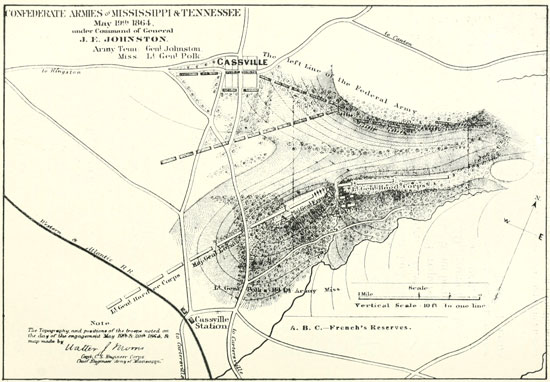
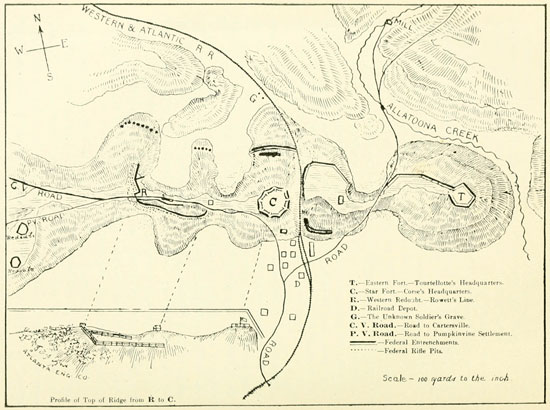
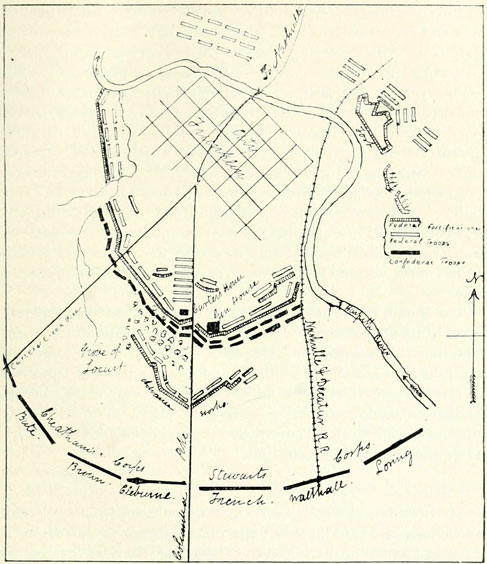
1. If an examination of this topographical map be made in
connection with the photographic views of the railroad cut, the
star fort, and the view from the sally port, it will give you an
idea of the rough mountain spurs over which we had to pass.
2. These forts and redoubts were built by a distinguished engineer
in the United States army, and, with their mutual defensive
relation the one to the other, form a remarkably strong line of
fortifications on every side. Sherman wrote to Gen. Blair, June
1, 1864, "Order the brigade left at Allatoona to be provided
with tools, and to intrench both ends of the pass very strong,"
and frequently he speaks of Allatoona as a "natural fortress,"
etc.
Beginning at the east, we have a fort about fifty feet in diameter
in the interior (marked "T" on the map), near three hundred
yards east of the railroad, with a deep ditch around it.
Walls twelve feet thick, and having embrasures for artillery, for
which it was mainly designed. This fort was connected with a
line of heavy intrenchments extending to the railroad cut, and
along the cut to defend the star fort "C" by a flank fire, and
also the redoubt "R." Again, there are intrenchments on the
east side of the railroad near the depot that sweep with a flank
fire the south front of the star fort "C," the Cartersville road,
depot, etc. There was also protection given by inundating the
country north by a dam across the creek.
Crossing the railroad to the west, on the summit of the ridge
and on the verge of the deep cut, you will find the star fort "C"
surrounded by a wide ditch six feet deep. The interior is seventy-five
feet in diameter, and has eight embrasures for large
guns. It dominates, from its elevation, all the surrounding
country, and commands the approach in every direction, completely
sweeping the ridge both east and west, protecting the redoubt
"R" from any force attacking it. The Cartersville road
passes under the muzzle of its guns, and then runs west on the
ridge, through redoubt "R."
The two forts, "T" and "C," are interior isolated works for
artillery, and the fire from each swept all the other works both
inside and externally. Both were surrounded by ditches six feet
deep, making their parapets about twelve feet high. Consequently
they could not be taken by assault without scaling ladders,
or otherwise, usual in sieges, unless by the sally port. In
fact these two inside forts could be used as citadels, or a place of
refuge when the long exterior lines of defense were captured.
And this was the case with fort "C" in the battle of Allatoona.
The whole formed a mountain fortress.
The Federals call the intrenchments at "R" "rifle pits," to
which they bear about as much relation, in regard to strength,
as a battleship does to a dispatch boat. Commencing about one
hundred and twenty-five yards west of the fort "C," and on the
south side of the Cartersville road, are two lines of intrenchments
running nearly parallel with that road. These two, or double,
lines of defense converge and meet below the crest of the ridge,
then, turning north, cross the road (with angles for flanking fire)
and continue north down the slope. From this north line an
intrenchment runs due east toward the main fort. The parapet
is revetted with timber, and the interior ditch is very wide. On
the parapet are large chestnut head logs to protect the persons
of the soldiers. In front were immense entanglements of abatis,
stockades, stakes, etc., to check any assault on the works. So
well was the work done that in 1890, when I was there, time had
not defaced them, and the revetments and "head logs" are today
as round as when placed there. I am the more particular
about this redoubt because here happened, perhaps, the bloodiest
tragedy in the history of the war.
3. The strength of the respective forces.
Col. Tourtellotte's command was composed of the Ninety-Third
Illinois, officers and men, 294; the Eighteenth Wisconsin,
guns, 150; Fourth Minnesota, guns, 450; the Fifth Ohio Cavalry,
men, 16; giving an apparent total of 910. To this must yet
be added the force for the six pieces of artillery, not less than
60. If we add the company officers not enumerated, it will be
found that Tourtellotte had about 1,000 officers and men. The
above numbers are official.
Corse's official statement is that he brought with him to Allatoona
the Thirty-Ninth Iowa, 280 men; Seventh Illinois, 267
men; Fiftieth Illinois, 267 men; Fifty-Seventh Illinois, 61 men;
Twelfth Illinois, 155 men; or 1,030 men. To this must be added
(say) 107 regimental and company officers, making the force
that he brought with him 1,137 officers and men. So with Tourtellotte's
troops the aggregate is 2,137 instead of 1,944 as reported
by him, which excluded himself and officers.
As regards the strength of my division at Allatoona, the War
Records show that on September 20, at inspection, I had present
for duty 331 officers and 2,945 men. Total, 3,276.
Cockrell's Brigade was composed of eight small regiments consolidated
into four, Ector's Brigade of six regiments, and Sears's
Brigade of six regiments, and two batteries, 8 guns.
To this force add one four-gun battery sent with me, and deduct
one gun and one regiment left at Allatoona creek bridge,
and my entire force present was 3,197.
And thus officially we have Federals, 2,132; Confederates, as
above.
4. Equalization of forces.
The ratio of inequality between a force within ordinary intrenchments
in line of battle and the attacking force without is
well known.
Gen. Cox in his "Atlanta Campaign," page 129, says: "One
man in the trench is equal to five in front." Gen. O. O. Howard,
in reference to the battle of Kennesaw Mountain, says:
"My experience is that a line of works thoroughly constructed,
with the front well covered with abatis and other entanglements,
well manned with infantry, whether with our own or that of the
enemy, cannot be carried by direct assault." Gen. R. S. Granger
informs Gen. G. H. Thomas that the fort at Athens, manned
by 700 men, can hold out an enemy 10,000 strong. (War Records,
V. 39, Part 3, page 519.) Vicksburg, Jackson, Cold Harbor,
Kennesaw, Petersburg, Atlanta, Knoxville, and other lines
repelled the assaults. Now Allatoona was, without doubt, thrice
as strong as these, and the attacking force was only one and a
half to one inside. Then, too, we should consider that the works
on the hills were almost inaccessible.
Battery Wagner, a sand fort on a level plain on Morris Island,
Charleston, S. C., was garrisoned by only 740 men, who successfully
defended it fifty-eight days and nights against the assaults
and continuous fire of 11,500 men, with forty-seven cannon, aided
by ships—the Ironsides, eight monitors, and five gunboats.
And Fort Sumter never was taken by assault. It was quietly
abandoned February 18, 1865.
On Sunday, April 16, 1865, seven days after the surrender at
Appomattox, a small redoubt or fort, of weak construction, garrisoned
by an unorganized force hastily collected, at West Point,
Ga., near Atlanta, consisting of 64 men under Gen. Tyler and
Col. J. H. Fannan, held the fort all day against 3,750 men of
Gen. J. M. Wilson's command, and surrendered only for want
of ammunition and loss of men. Col. O. H. LaGrange, of Wisconsin,
commanded the Federals. Ratio, 1 to 62.
5. The inspiring hopes given the garrison will be discovered
in the following dispatches informing them aid was at hand, begging
them to hold out until reënforcements arrived. In these
dispatches bear in mind that Gen. Stanley was in temporary
command of the Army of the Cumberland, and Gen. Elliott was
the commander in chief of Sherman's cavalry. I give only a
few of the many dispatches in the War Records.
No. 1. Volume 39, Part 3, Page 53.
SHERMAN TO COMMANDING OFFICER AT ALLATOONA.
October 3, 1864.
Hood might slip up to Acworth and Allatoona. I want the utmost
vigilance there. If he goes to Allatoona, I want him only delayed long
enough for me to reach his rear.... If he moves up to Allatoona, I
will surely come in force.
No. 2. Volume 39, Page 65.
SHERMAN TO STANLEY.
In the Field, October 4, 1864.
I heard from Gen. Elliott to-night. He was on the Sandtown and Allatoona
road.... I will be up to-day and move to Kennesaw.
No. 3. Volume 39, Page 66.
SHERMAN TO STANLEY.
October 4, 1864. Received 10 A.M.
Yes, move to Little Kennesaw and west of it. Tell Elliott in my name
to interpose with his whole force between Dallas and Allatoona, and strike
for any force in the direction of Acworth.
No. 4. Volume 39, Page 71.
SHERMAN TO ELLIOTT.
October 4, 1864, 11 P.M.
Don't risk the safety of your cavalry until I get up with my whole
force, but make bold reconnoissances in connection with Gen. Stanley.
My chief object is to prevent the enemy from making an attack on Allatoona
to-morrow.
No. 5. Volume 39, Page 71.
SHERMAN TO COMMANDING OFFICERS AT ALLATOONA, KINGSTON, AND ROME.
October 4, 1864.
The enemy is moving on Allatoona, thence to Rome.
No. 6. Volume 39, Page 52.
SHERMAN TO GEN. VANDEVER.
October 3, 1864.
Sherman wants the force at Big Shanty cleaned out, and wants it done
to-night if possible.
No. 7. Volume 39, Page 75.
CORSE TO GEN. J. E. SMITH.
Rome, October 4, 1864.
I will move my entire command to Cartersville and unite with Gen.
Raum in attacking the enemy from Allatoona direct.
No. 8. Volume 39, Page 75.
CORSE TO RAUM.
Rome, October 4, 1864.
I am expecting a train every moment; as soon as I can get ready I will
move 3,000 to 4,000 men.
No. 9. Volume 39, Page 77.
VANDEVER TO SHERMAN.
Near Kennesaw, October 4, 1864.
Elliott is between Big Shanty and Kennesaw on our left. I am skirmishing
with the enemy now.
No. 10. Volume 39, Page 77.
VANDEVER TO SHERMAN.
Near Kennesaw, October 4, 1864.
Gen. Elliott has all his force near the west base of the mountain. Gens.
Kilpatrick and Garrard are both with him, so couriers report.
No. 11. Volume 39, Page 78.
VANDEVER TO COMMANDING OFFICER AT ALLATOONA.
Kennesaw Mountain, October 4, 1864, 2 P.M.
Sherman is moving in force. Hold out.
No. 12. Volume 39, Page 78.
VANDEVER TO COMMANDING OFFICER AT ALLATOONA.
Near Kennesaw Mountain, October 4, 6:39 P.M.
Gen. Sherman says hold fast, we are coming.
No. 13. Volume 39, Page 88.
SIGNAL OFFICER AT ALLATOONA TO SIGNAL OFFICER AT KENNESAW.
Allatoona, October 5, 1864.
Gen. Corse is here with one brigade. Where is Sherman?
No. 14. Volume 39, Page 89.
SHERMAN TO STANLEY.
Kennesaw Mountain, October 5, 1864, 11:15 A.M.
No news by signal from Allatoona. Heavy firing, indicating an assault
and repulse. Occasional shots now, but too smoky to see signals. Can
see the field about Lost Mountain. No large force of Rebels there. Can
see Kilpatrick's cavalry massed in a big field this side, but no skirmishing.
No. 15. Volume 39, Page 89.
SHERMAN TO STANLEY.
Kennesaw Mountain, October 5, 1864. Received 2:30 P.M.
Throw forward pickets on the Sandtown road. Take strong position
and hold it.
No. 16. Volume 39, Page 90.
STANLEY TO SHERMAN.
Pine Top, October 5, 1864, 3:10 P.M.
I am on Pine Top.... I saw our cavalry about two miles in advance
of Kemp's Mills.
No. 17. Volume 39, Page 90.
SHERMAN TO STANLEY.
In the Field, October 5, 1864.
I want to control the Sandtown road back to Allatoona.[29]
No. 18. Volume 39, Page 91.
SHERMAN TO ELLIOTT.
In the Field, October 5, 1864.
Dispatch Garrard to-night to Allatoona, making a circuit to the right,
and to learn if possible the state of affairs there.... The day was so
hazy that we could get but few messages. Corse is there with his division.
No. 19. Volume 39, Page 92.
SHERMAN TO ELLIOTT.
In the Field, October 5, 1864.
I have heard from Allatoona. All right. Corse is there, but wounded.
You need not send Garrard's cavalry, but send a squadron.
No. 20. Volume 39, Page 92.
SHERMAN TO ELLIOTT.
In the Field, October 5, 1864.
I have been up on Kennesaw all day watching the attack. Since it
ceased I have a signal, O. K. Corse wounded.... I want to
establish communication with Allatoona.
No. 21. Volume 39, Page 96.
TOURTELLOTTE TO SHERMAN.
Allatoona, Ga., October 5, 1864.
Gen. Sherman: Corse is here.
No. 22. Volume 39. Page 96.
TO COMMANDING OFFICER, ALLATOONA.
Kennesaw Mountain, October 5, 1864.
Near you.
No. 23. Volume 39, Page 96.
SIGNAL DISPATCHES FROM AND TO KENNESAW MOUNTAIN.
At 8 A.M. I called Allatoona for two hours and a half. I asked for news,
and at 10:30 A.M. received the following message: "We hold out. Gen.
Corse here."
Adams, Signal Officer.
At 4 P.M. I again called Allatoona, and at 4:15 got the following: "We
still hold out. Gen. Corse is wounded."
No. 24. Volume 39, Page 97.
Kennesaw Mountain, October 5, 1864.
Tell Allatoona to hold on. Gen. Sherman says he is working hard for
you.
No. 25. Volume 39, Page 97.
GEN. G. B. RAUM TO GEN. J. E. SMITH.
Cartersville, Ga., October 5, 1864.
We have won a great victory at Allatoona to-day. I am just from there.
Gen. Corse is slightly wounded in the cheek; Col. Tourtellotte slightly in
the left thigh.
No. 26. Volume 39, Pages 111, 112.
LIEUT. W. H. SHERFY, CHIEF SIGNAL OFFICER, KENNESAW, REPORTS.
October 4, 1864.
I called Allatoona and sent the messages received last night. I saw the
enemy hard at work destroying the railroad on both sides of Big Shanty....
At 5 P.M. the enemy began to move off on the Acworth road, and
at 6 P.M. our army moved into camp at the foot of Little Kennesaw Mountain.
October 5.
To-day the battle of Allatoona was fought. I could see the smoke of
guns and shells. Gen. Sherman was with me all day sending and receiving
messages.
Having now given you some knowledge of the ground, the
strength of the fortifications, the numbers engaged on either
side, the ratio of inequality between troops inside and those outside
ordinary works, and the many inspiring hopes sent to the
garrison to hold out, you can better comprehend.
The Battle.
The day dawned beautiful and bright, and as the sun rose
higher and higher in the mellow autumnal sky, and lit up the
forest-clad heights, it turned into a quiet Indian summer day of
hazy, drowsy appearance inducive of rest. All nature seemed at
variance with the active preparations being made for the impending
conflict of arms.
Gen. Corse had placed in redoubt "R" the Seventh Illinois,
the Thirty-Ninth Iowa, and the Ninety-Third Illinois. He had
some companies in advance of "R," and the remainder in reserve
in the rear of "R." These three regiments for the defense of
this redoubt (called rifle pits) numbered nine hundred and four
officers and men.
Tourtellotte, in fort "T" and the intrenchments, had for the
defense east of the railroad the Fourth Minnesota, Eighteenth
Wisconsin, and the Fiftieth and Twelfth Illinois Regiments.
Soon, however, the Fiftieth and Twelfth Illinois were ordered
over by Corse to the west side of the railroad.
I made the following disposition of my division of infantry
present on the ridge. Sears's Brigade was ordered to the north
side of the ridge and east of the railroad. Cockrell's Brigade
and the four regiments of Ector's Brigade were on the ridge
west of the enemy's works.
About 9 A.M. the artillery ceased firing, and, under a flag of
truce, I sent a summons to the commander of the garrison to
surrender, supposing the forces were small or to be the same as
reported to me when I was in Acworth. The summons was
carried by Maj. D. W. Sanders, Adjutant General. He waited
about twenty minutes for a reply; receiving none, he returned.
I had no idea that the garrison had been reënforced by the arrival
of Gen. Corse with one of his brigades.
It was now near 10 A.M. when, impatient at the delay of Sears
not getting in position, I ordered Cockrell to make the attack on
the redoubt "R" with his brigade of nine hundred and fifty
strong, supported by four regiments of Ector's Texas Brigade
of about four hundred men. The ridge was so narrow that when
deployed the wings were in the woods on the steep sides of a
rocky ridge. As Cockrell neared the line he was subjected to
the fire of the artillery from the two forts "T" and "C," and
the musketry from "R," and the troops in the intrenchments on
the east side of the railroad, near the deep cut, that swept his
approach on every side. Arriving near the redoubt, the troops
were stopped by the formidable abatis and other entanglements.
There for an hour, under this searching fire, they worked to
make a way through the abatis. When passages had been made
they rushed to the assault, and, after a terrible hand-to-hand
conflict, the redoubt was carried, and the survivors fled to
fort "C," followed by our men, and in a few minutes every Union
soldier west of the railroad, including the Fiftieth and
Twelfth Illinois, sought refuge in fort "C" and the ditch surrounding
it, crowding them beyond measure.
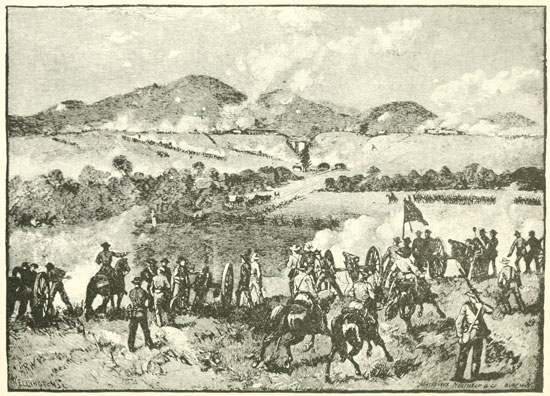
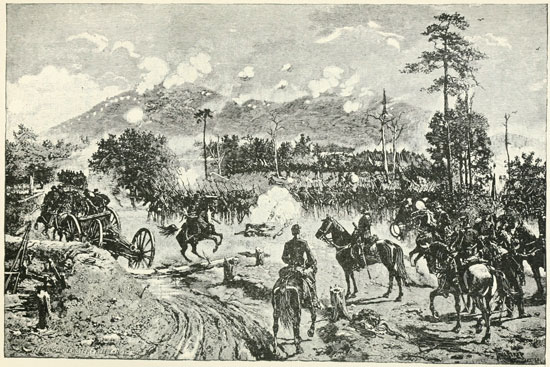
BATTLE OF ALLATOONA.
In this picture the timber is omitted in order to show the ridge on which the fortress was constructed. All the troops
visible are supposed to be Confederates.
Thus did 1,350 Confederates carry the redoubt defended by
904 brave Union veterans, although subjected all this time to the
fire of forts "T" and "C," and other flanking works. But
I will let Gen. Corse tell the story himself, as found on pages
761-766, Volume 39, War Records, only I will correct the errors
in names and figures in some instances:
I had hardly issued these incipient orders when the storm broke in all
its fury on the Thirty-Ninth Iowa and Seventh Illinois. Young's [Cockrell's]
Brigade of Texans, 1,900 strong, had gained the west end of the
ridge, and moved with great impetuosity along its crest till they struck
Rowett's command, where they received a severe check, but, undaunted,
they came again and again. Rowett, reënforced by the Ninety-Third Illinois,
and aided by the gallant Redfield, encouraged me to hope we were all safe
here, when I observed a brigade of the enemy under command of Gen.
Sears moving from the north, its left extending across the railroad. I
rushed to the two companies of the Ninety-Third Illinois, which were on
the brink of the cut running north from the redoubt [fort "C"] and parallel
with the railroad, they having been reënforced by the retreating
pickets, and urged them to hold on to the spur, but it was of no avail.
The enemy's line of battle swept us back like so much chaff, and struck
the Thirty-Ninth Iowa in flank, threatening to ingulf our little band without
further ado. Fortunately for us, Col. Tourtellotte's fire caught Sears
in the flank and broke him so badly as to enable me to get a staff officer
over the cut with orders to bring the Fiftieth Illinois over to reënforce
Rowett, who had lost very heavily. However, before the regiment sent
for could arrive, Sears and Young [Cockrell and Young] both rallied and
made their assaults in front and on the flank with so much vigor and in such
force as to break Rowett's line, and had not the Thirty-Ninth Iowa fought
with the desperation it did I never would have been able to have brought
a man back into the redoubt [fort "C"]. As it was, their hand-to-hand
struggle and stubborn stand broke the enemy to that extent that he must
stop to re-form before undertaking the assault on the fort. Under cover of
the blow they gave the enemy the Seventh and Ninety-Third Illinois and
what remained of the Thirty-Ninth Iowa fell back into the fort. The
fighting up to this time—about 11 A.M.—was of a most extraordinary character.
Attacked from the north, from the west, and from the south, these
three regiments, Thirty-Ninth Iowa, Seventh Illinois, and Ninety-Third
Illinois infantry, held Young's and a portion of Sears's and Cockrell's
[should be Cockrell's and Young's] Brigades at bay for nearly two hours
and a half. [We were delayed about an hour, and that by the entanglements
that prevented us from reaching the parapet; besides, we were under
fire from guns everywhere.] The gallant Col. Redfield, of the Thirty-Ninth
Iowa, fell, shot in four places, and the extraordinary valor of the
men and officers of this regiment and the Seventh Illinois saved to us Allatoona.
The capture of the redoubt by Cockrell and Young under the
fire of six pieces of artillery, two in fort "C" and one in a battery
in advance of the fort, three in fort "T," and musketry
fire from every place, besides the 904 men in the redoubt, ends
the first act of the tragedy.
It is proper here to give a description of this scene by quoting
from an address made by Col. William Ludlow, Corps of
Engineers, United States Army, who was with Gen. Corse during
the battle, to the Michigan Commandery, Loyal Legion, at
Detroit, April 2, 1891. In referring to the capture of redoubt
"R," he said:
But the appalling center of the tragedy was the pit in which lay the heroes
of the Thirty-Ninth Iowa and the Seventh Illinois. Such a sight probably
was never presented to the eye of heaven. There is no language to
describe it. With all the glad reaction of feeling after the prolonged strain
of that mortal day, and the exultant surge of victory that swelled our
hearts, it was difficult to stand on the verge of that open grave without a
rush of tears to the eye and a spasm of pity clutching at the throat. The
trench was crowded with the dead, blue and homespun. "Yank" and
"Johnny," inextricably mingled in the last ditch. Our heroes, ordered
to hold the place to the last, with supreme fidelity, had died at their posts.
As the Rebel line ran over them they struck up with their bayonets as the
foe struck down, and, rolling together in the embrace of death, we found
them, in some cases, mutually transfixed. The theme cannot be dwelt
upon.
I will now go on with Corse's report, and let him tell his story
of the battle in his own way.
So completely disorganized were the enemy that no regular assault
could be made on the fort until I had the trenches all filled and the parapets
lined with men. The Twelfth Illinois and the Fiftieth Illinois, arriving
from the east hill, enabled us to occupy every foot of trench, and keep
up a line of fire that as long as our ammunition lasted would render our
little fort impregnable. The broken forces of the enemy enabled them to
fill every hollow and take every advantage of the rough ground surrounding
the fort, filling every hole and trench, seeking shelter behind every
stump and log that lay within musket range of the fort. We received fire
from the north, south, and west face of the fort, completely enfilading our
ditches, and rendering it almost impracticable for a man to expose his person
above the parapet. An effort was made to carry our works by assault
[This is an error. We had no scaling ladders, besides the ditch was solid
full of Corse's men who found shelter there], but the battery, Twelfth
Wisconsin, was so ably managed and so gallantly fought as to render it
impossible for a column to live within one hundred yards of the works. Officers
labored constantly to stimulate the men to exertion, and almost all
that were killed or wounded in the fort met this fate while trying to get
the men to expose themselves above the parapet, and nobly setting them
the example.
The enemy kept up a constant and intense fire, gradually closing around
us, and rapidly filling our little fort with the dead and the dying. About
1 P.M. I was wounded by a rifle ball, which rendered me insensible for
some thirty or forty minutes, but managed to rally on hearing some persons
cry, "Cease firing," which conveyed to me the impression that they
were trying to surrender the fort. Again I urged my staff, the few officers
left unhurt, and the men around me to renewed exertions, assuring
them that Sherman would soon be here with reënforcements. The gallant
fellows struggled hard to keep their heads above the ditch and parapet in
the face of the murderous fire of the enemy now concentrated upon us.
Here we have the astonishing official statement that his men
would not expose themselves enough to fire over the parapet or
out of the ditch, and that most of the officers lost their lives in
"nobly setting them the example;" and this is also established
by Col. Ludlow in his address, where he says:
Rowett's order to "cease firing" had, of course, nothing to do with the
cry of "surrender." It is true that there were men in the fort ready to
surrender or to do anything else in order to get out of it alive. Happily
these were few, and most of them lay prone, close under the parapet,
playing dead, with the combatants and wounded standing and sitting upon
them. If I mistake not, Corse himself, at least for a time, was holding down
one of these living corpses, who preferred to endure all the pain and discomfort
of his position rather than get up and face the deadly music that
filled the air with leaden notes.... It was absolutely necessary to
keep room for the fighting force along the parapet, so the wounded were
drawn back, and in some cases shot over and over again. The dead were
disposed of in the same way, except that as the ground became covered
with them they were let lie as they fell, and were stood or sat upon by the
fighters.... The slaughter had been frightful.
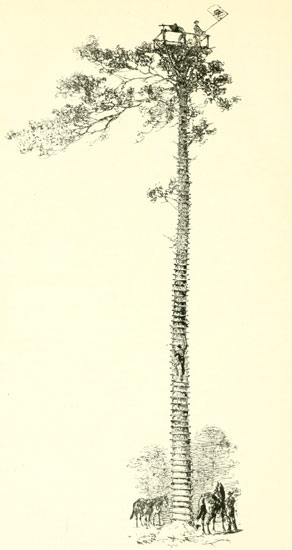
SIGNAL TREE, ALLATOONA, OCT. 5, 1864.
One of our guns was disabled from the jamming of a shot, and we were
out of ammunition for the other two.... I recall distinctly the fact
that a regimental flagstaff on the parapet, which had been several times
shot away, fell again at a critical moment toward the end of the action.
There was a mad yell from our friends outside, and a few cries of "surrender"
among our own people, but a brave fellow leaped to the summit
of the parapet, where it did not seem possible to live for a single second,
grasped the flagstaff, waved it, drove the stump into the parapet, and
dropped back again unhurt. His action restored confidence; a great Yankee
cheer drowned the tumult, and no cry of "surrender" was afterwards
heard.
Here now is presented the testimony of Corse himself, and of
Col. Ludlow, that the men would not expose themselves, and
that they cried "cease firing," and "surrender." I know, as do
hundreds of others now living, that the fire of the fort was silenced,
because our men were close up; and if any one inside the
fort or in the ditch exposed his head, instantly it became the target
for several Confederates. Confederates moved about with
impunity, and I called the attention of my staff to Johnson
(Cockrell's flag bearer) riding up to the north side of the fort,
sitting quietly on his horse, and listening to what was going on
in the fort. In a recent letter from him he writes to J. M.
Brown, of Atlanta: "I remember riding up very close to the
fort. The distance was short, as I was close enough to tell what
the Federals were doing in there." After 12 M. the Confederates
merely watched for any person exposing his head above the
parapet, and so I am sure that the fire described was not so severe
as related by Gen. Corse, but it was very fatal.
Gen. Corse goes on with his report, and writes that about 2:30
P.M. the enemy massed a force (behind a small house) which he
threw into great confusion, and that "from this time on until 4
P.M. we had the advantage of the enemy, and maintained it with
such success that they were driven from every position, and finally
fled in great confusion, leaving their dead and wounded,
and our little garrison in possession of the field."
It is hardly possible to crowd into a short paragraph more errors
than are found in the four lines above, and most of them he
well knew to be false. It is true, no doubt, that he was not
aware of the information sent me that induced me to withdraw
my troops. That dispatch was received at 12:15 P.M. The Cartersville
road, running north, passes within a few yards of fort
"C," and then continues some two hundred and fifty yards on
through the captured works. It was open to my infantry, but
was there not life enough in the two forts, "C" and "T," to
shoot down some of the horses and mules passing by within short
pistol shot if I attempted to move the artillery, baggage wagons,
and ambulances and block the road if I decided to move north
to avoid Sherman's troops marching from the south to the relief
of Allatoona?
So I resolved to obtain possession of the Acworth and Dallas
road before it was occupied in force by the Federals, trusting to
their slow and cautious movements. To this end, I first ordered
all the artillery except one battery to start at once to the Allatoona
Creek bridge to join the Mississippi regiment left there,
and hold that position. Next, Sears was directed to withdraw
immediately from the north side in front of fort "T," and Cockrell
to commence at 1:30 P.M.; and, owing to the rough hillsides,
to come out in squads, or individually. Although Sears began
the movement over an hour before Cockrell and Young did, the
latter were all collected on the ridge first, and sat there under
the shade of the trees, within sight and easy rifle range of fort
"C," until about 3 P.M., waiting for Sears, who had to go around
the pond made by the Yankees damming up Allatoona Creek.
During all this time but few shots were fired by the enemy.
One, however, was fired at us, and it killed a man who had appropriated
a fine pair of cavalry boots from the stores, and he
fell dead at my feet where we were sitting. In the meantime I
went among the wounded men who could not walk over the rocky
hills to our ambulances, and explained to them why they would
have to be left, and that surgeons had been detailed to remain
with them. They gave me thanks without complaint.
After I showed Gens. Cockrell and Young the dispatches I had
received, and informed them of my intention not to remain and
make an assault on fort "C," lest reënforcements for the garrison
should arrive before we could leave the place, they demurred,
and said their men were mad, and wanted to remain and capture
the place. Col. Gates, of the Missouri Brigade, declared that he
would capture fort "C" in twenty minutes after the arrival and
distribution of our ammunition, by way of the sally port. He
asserted that they were so crowded inside that but few men could
fire.
I adhered to my decision to withdraw, because the men had already
been three days and two nights without rest or sleep, and
that they could not pass a third night without sleep, and risk
having to fight reënforcements momentarily expected; and the
subsequent arrival of troops from Cartersville at 8 P.M. proved
the correctness of my judgment; also Martin's Brigade reached
Allatoona next morning.
About 3 P.M. the last of Sears's men arrived on the ridge near
the fort where we rested awaiting them, and we then left the
ridge and moved to the Cartersville road, where the wagons were
left. Cockrell was now ordered to proceed with the infantry
force to the Allatoona Creek bridge, and join the Mississippi
regiment and artillery already there on the Dallas road. I rode
down to the battery still in position on Moore's Hill to give instructions,
and remained there sometime, not a little astonished
at the scene presented to my view. The declining sun, seen
through the calm, hazy atmosphere, shone red, like the rising of
the full-orbed moon, on the fortifications before us. All was silent
now where the battle raged so long, and the mellow light
gleamed so gently down on the wounded and the dead that I remarked
to the officers and men around me: "Silence, like the
pall of death, rests over Allatoona; it is as lifeless as a graveyard
at midnight." I even went up an inclined tree and used
my glasses in vain to discover a human being. And so Corse's
statement that we "were driven from every position, and finally
fled in great confusion," leaps over the bombastic and loses its
force in ridiculous excess of inaccuracy.
Corse, in his report, says that he brought with him 165,000
rounds of ammunition, and Ludlow states that "it was all expended
except two hundred and fifty rounds." All the artillery
ammunition Corse had in fort "C" was expended, and he got a
man to go after some from fort "T," and he returned safely
with an armful. See his report.
I will pause here awhile, that you may make a survey of the
field of battle at 1:30 P.M.
For over two hours there had been pent up in fort "C," inside
and in the ditch outside, the Thirty-Ninth Iowa, the Seventh Illinois,
the Fiftieth Illinois, the Ninety-Third Illinois, the Twelfth
Illinois, two companies of the Fifty-Seventh Illinois, and their
artillery, 1,453 in number, less the killed, badly wounded, and
prisoners resulting from their defense of the redoubt "R."
The fort, built for artillery mainly, had but seventy-seven
yards of parapet, which made it so dangerous for any one to expose
his head above the parapet that their men would not fire
voluntarily, "and most of their officers were killed or wounded
in setting the men an example;" and they passed the word to
"cease firing." They cried "surrender." Some "played dead,"
and the combatants stood on the "living corpses." Others sat
down on them. Even Corse himself used one for a seat after he
was wounded (Ludlow). They were out of water. Their ammunition
was nearly all expended. Their firing had slackened
to a musket shot at intervals. They let us withdraw without
molestation, and we sat in the shade of the trees in full view of
the fort, within musket range, from 1:30 P.M. until 3 P.M. awaiting
Sears. They saw us all leave the ridge at the last named
hour. At 4 P.M. Corse sent dispatch No. 23: "We still hold
out." So they were in the fort then, and did not come out until
the Confederates were all out of sight. The officers tried to keep
up the spirits of their men by assuring them that "Sherman will
soon come" (Corse's report). The hope of speedy relief prevented
utter despondency, and they waited and waited, hoped
and hoped for the fulfillment of the encouraging promises implied
in the dispatches sent them by Sherman, as: "Hold fast,
we are coming;" "Sherman moving in force, hold out;" "Sherman
working hard for you;" "Near you." With his troops in
this condition, and in the face of all these facts, Corse officially
publishes to his commander and to the world, in a vainglorious
manner, that the Confederates "were driven from every position,
and finally fled in great confusion, leaving their dead
and wounded, and our little garrison in possession of the
field!!!" It is a beautiful description of an event that never
happened.
It must have been pretty soon after we left Allatoona that
Gen. Green B. Raum, commanding a division of cavalry that
was hovering around between the Etowah bridge and the Allatoona,
arrived and made a social call on Corse, and sympathized
with him in his afflictions; but he must have left at an early hour,
for he went to Cartersville that evening and sent a dispatch,
which will be found, No. 25, dated October 5.
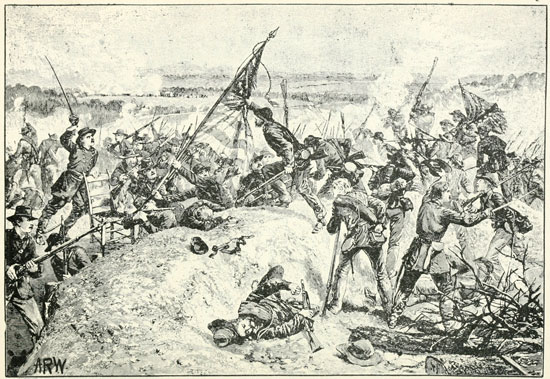
BATTLE OF ALLATOONA—CAPTURE OF REDOUBT "R."
Soon Sherman was informed that the Confederates had retreated,
and had taken the road to Dallas. So he checked his
troops that were marching on Allatoona. However, Corse's train,
expected every hour during the battle, returned to Allatoona at
8 P.M. with the remainder of Rowett's Brigade. Some cavalry
also arrived, and the next morning came Martin's Brigade.
With him the condition of affairs was very much changed now.
During this time the weary Confederates, after capturing the
blockhouse with a garrison of one hundred and ten men at Allatoona
Creek bridge, marched on till midnight of the 5th, and
the next morning were at New Hope Church, far away from
Allatoona. Corse was now resting in the bosom of his friends,
who no doubt congratulated him on his happy deliverance from
the distress of the day previous; and as there were no Confederates
near to distress him any more, he wrote Sherman, at 2
p.m. on the 6th, his (so-called) famous dispatch, which for
cheek is unequaled:
I am short a cheek bone and an ear, but can whip all h-ll yet!!
Now the adverb "yet" in this case implies conditions unchanged.
But, as they were then entirely changed, he was not
justified in sending such a dispatch. It is a vainglorious, self-laudatory
dispatch, no doubt sent to divert attention from the
real condition in which his command had been placed; or it may
be that the joy he felt the day after the battle, on being reënforced
and rescued from the "slaughter pen" (in which he was
pent up), by Sherman's movements to save him, caused him to
write it; if so, it is not excusable. If, however, intoxicated at
the mess table by the congratulations of friends and the usual
accompaniments required for his condition, he was inspired to
send that dispatch (as a postprandial speech is made), to mean
nothing, then he may be forgiven.
But the unbought grace of life, the trained veracity, the
chivalrous respect for foemen his equal in valor, whose daring
he had witnessed, whose prowess he had felt, and from whose
presence he so longed to be delivered, should have restrained
him, at a much later date, from writing in his official report the
fabricated story of how he "drove the Confederates from every
position until finally they fled in great confusion," because he
well knew this statement was not true.
In connection with Gen. Corse's visit with Joseph M. Brown
to the battle ground at Allatoona, I have a letter from Mr.
Brown giving me other information of what was said during
his visit to Atlanta. As a guest of Senator Brown this conversation
grew frank and friendly.
Atlanta, Ga., August 31, 1900.
Gen. S. G. French, Pensacola, Fla.
My Dear General: Answering your inquiry as to Mr. De Thulstrup's
picture of the battle of Allatoona, I will state that in 1886 Gen. John M.
Corse came to Georgia with the above well-known battle artist. I went
with them to Allatoona, where we spent almost a day going over the
various points of the ridge on both sides of the railroad, where there were
fortifications.
Returning to Atlanta, these two gentlemen were my guests at my father's
home. That night, after some social conversation, Gen. Corse and
Mr. De Thulstrup went upstairs to their sleeping apartments. Within
probably an hour afterwards I also went up to my sleeping room. The
hall door leading from my room to Gen. Corse's being open, I was unintentionally
made a hearer of conversation going on. Gen. Corse was
quite animated in giving instructions to the artist as to how to draw the
picture. I very distinctly heard him use the following expression: "Be
sure you have the Rebels running." He repeated this in very positive
tones.
Any one looking at the picture will see that the artist faithfully complied
with the General's instructions.
Very truly yours.
Joseph M. Brown.
When J. M. Brown told Corse that French never received his
reply to his summons to surrender, he answered: "This is the
first information I have to that effect, that my answer never
reached him." Then Corse told him he was in great haste in
examining the lines and disposing of his troops. "When one of
his staff officers hailed me with advice that he had a note from
the enemy's commander, which he supposed was a summons to
surrender, ... I took the note and read it; it made me
mad, because, from what I could see of his forces, and what I
knew of mine, I believed that I had about as big a force as he
had, hence considered the summons a superfluous piece of bravado.
I sat down on a log, and, pulling my notebook out of
my pocket, wrote the reply across the face of one of its pages,
which I tore out and handed to my staff officer with instructions
to take it to the bearer of the summons.... I never knew
whether my answer reached French or not."
There is something in this statement which must be regarded
as very remarkable, for in the ordinary affairs of life, if even a
servant be sent to deliver a letter, and does not find the person
to whom he was to deliver it, would he throw it away and never
mention it, or would he return with it and report that he did not
find the man to whom he was to hand it? And does not common
sense tell us that on such a momentous matter as this, involving
the lives of hundreds of men, his staff officer would have reported
that the flag of truce could not be found, and have returned the
dispatch given him? And, furthermore, can any person of intelligence
believe that Gen. Corse and the said staff officer did
not speak about this pretentious answer to the summons at any
time, which is published to the world in facsimile, of which Julius
E. Brown, of Atlanta, has one copy. If he published the "facsimile"
of the dispatch sent me, where did he get it? It seems
to me the General "doth protest too much." And further he
says: "Being in great pain from my wound, I took the train the
night of the 5th for Rome." If this be true, how could he
have issued his "famous" dispatch from Allatoona on the afternoon
of the 6th, for it gives the place, date, and the hour?
I am inclined to the belief that he did not leave Allatoona
until after the 6th, or on the second day after the fight.
I would not detract anything from the well-earned reputation
of Gen. Corse—and more especially so, as he is not living—yet
it is a duty incumbent on me, a duty I owe to my children, and
particularly to the noble Confederate soldiers who were with
me, to protect them against the statement of being "driven
away" by the garrison. The demands of impartial history require
of me—an actor therein, a living witness—to transcribe
from my diary the facts as there recorded at the time, so that
the world may know to what extent the many reported incidents
of the battle have truth for their foundation as we now
find them related in nursery tales to children, taught in
schools, narrated in story, and sung in the gospel hymn of
"Hold the Fort" wherever the cross is seen and Christianity
prevails.
But in the current literature of the North derived from the
exaggerated bulletins daily sent from the seat of war there is a
wonderful admixture of truth and error, and I am trying to
separate them so far as they are found in the ordinary versions
of this battle, and emphatically to declare that the Confederate
troops were not repulsed as stated in the light publications of
the day, or as written in Corse's report.
If any further testimony be desired, I would refer you to the
following letter from a publication made by Joseph M. Brown,
son of the late Senator Joseph E. Brown, of Georgia.
Allatoona, Ga., November 10, 1890.
Mr. Joseph M. Brown.
Dear Sir: In reply to the inquiries contained in your letter of October
31, I will state that, with my brother, I was in Allatoona on the night of
October 4, 1864, when the place was surrounded by Confederates under
Gen. French.
Early the next morning, for safety, we went into the fort on the west
side of the railroad, and were there during the battle that day. Gen.
Corse commanded on the west side of the railroad, and was in the fort all
the latter part of the fight. The Federals fought desperately, and after
they lost fort "R"[30] across the Cartersville road they were very much disheartened.
They could get no water without exposing themselves to a
deadly fire; and it was very much needed, especially for the wounded.
During the latter part of the engagement I frequently heard it said they
were nearly out of ammunition. They were on the point of giving up the
fight several times. The command "Cease firing" was given by somebody
and passed around the fort, but then some of the officers rallied the
men a little.
If the attack had been kept up a little while longer, the fort would have
certainly been taken; but to the surprise of the Federals, their enemy's
fire slackened and the Confederates retired from the front of the fort. The
Federals at this time were at a loss to understand this movement, when
they themselves were nearly ready to surrender. They seemed momentarily
to expect a renewal of the attack from some other quarter. They
remained quietly in the fort for nearly or quite three-quarters of an hour
after the Confederates retired. But when they found that the Confederates
would not renew the fighting there was a great rally in the fort. Then
there was some desultory firing at the Confederates on the south of the
fort near the depot and station. The Federals did not sally out of the
fort until the Confederates were gone entirely out of sight.
W. M. Denton.
As regards the arms captured by Corse, I will simple remark
they were inferior muskets exchanged on the field for Springfield
rifles, and Henry repeating rifles (16 shooters), one of
which I turned over, by my Aid Yerger, to the United States
Ordnance officer at the close of the war. Had Corse gone to
the blockhouse at Allatoona creek, he would have captured there
eighty-five muskets (thrown away) in the road, in exchange for
those we captured there, which would have augmented his list
of arms captured.
There were about one million rations of bread at Allatoona,
and two million seven hundred thousand in Atlanta, and not
two million seven hundred thousand in Allatoona as stated
by Col. Ludlow. (Sherman's letter to Corse, page 134, Vol. 39.)
The rations in Allatoona in no way affected the "march to the
sea." They were ordered to Rome on the 11th, for use above.
(See page 207.)
"I propose breaking up the railroad from Chattanooga and
striking out with wagons.... Until we can depopulate
Georgia it is useless to occupy it.... The utter destruction
of the roads, houses, and people cripple their resources....
I can make Georgia howl.... I have eight thousand
cattle and three million rations of bread." (Page 162, Vol. 39.)
The destruction of the stores at Allatoona, had it been done,
would not have interfered with the "march to the sea."
The stores in Allatoona were in our possession, and they were
not set on fire by our men because they wanted some themselves,
and much was appropriated. But I had no knowledge
of there being a large depot there until I withdrew Cockrell
and Young; and while waiting for Sears I heard the men speak
about them. On obtaining this information a party of men
were sent there to burn them. It is a singular fact that only
three matches could be found, and Gen. Cockrell had them, and
when the party reached the stores the matches failed to ignite.
Gen. Sherman left Atlanta November 15, 1864, and arrived at
Savannah on the 10th of December. He writes that he had sixty-five
thousand men. To supply these men the twenty-seven days
they were on the march would require one million seven hundred
and fifty-five thousand rations. They averaged eight miles
per day—for the distance is about two hundred and twenty miles.
I have related to you how I made a march (with a large wagon
train, through a desolate country, heavily laden) of ninety-six
miles in fifty-two hours; and this without water.
This much vaunted "march to the sea" was a pleasure excursion,
through a well-cultivated country, and is a mere bagatelle
compared with that made by the Mormons from Illinois to
Utah, or the many expeditions made overland to California during
the gold excitement. The distance to California is ten
times greater than the distance from Atlanta to Savannah.
Sherman boastfully writes that he "destroyed two hundred and
sixty-five miles of railroad, carried off ten thousand mules, and
countless slaves; that he did damage to the amount of $100,000,000.
Of this, his army got $20,000,000, and the $80,000,000 was
waste," as they went "looting" through Georgia.
But not content with this, when "this cruel war was over,"
he presented the delectable spectacle of "how we went thieving
through Georgia" at the grand review of his army in Washington,
by mounting his bummers on mules laden with chickens,
ducks, geese, lambs, pigs, and other farm productions, unblushingly
displayed, to cover up the concealed money, jewelry, and
plate taken from the helpless women—to delight the President,
to edify the loyal people, to gratify the hatred of the populace
to the South, to popularize the thirst for plundering made by
his troops, to be an object lesson to the present generation, to
instill a broader view of moral right, to heighten modest sensibilities,
to refine the delicate tastes of young ladies, to humiliate
a conquered people; or wherefore was this unwise "Punch and
Judy" show given?
During the revolutionary war, when the British fleet ascended
the Potomac river, one ship sailed up to Mount Vernon—the
residence of the arch rebel, Washington—and made a requisition
for provisions which his agent filled. The English commander
must have been a gentleman because he did not burn
the dwelling, insult the family, nor commit robbery!!!
Gen. Bradley T. Johnston, in his life of Gen. J. E. Johnston,
quotes that, "Abubekr in the year 634 gave his chiefs of the
army of Syria orders as follows: 'Remember that you are always
in the presence of God, on the verge of death, in the assurance
of judgment and the hope of paradise. Avoid injustice
and oppression.... When you fight the battles of the Lord
acquit yourselves like men, without turning your backs; but let
not your victory be stained with the blood of women or children.
Destroy no palm tree, nor burn any fields of corn. Cut
down no fruit trees, nor do any mischief to cattle, only such as
you kill to eat. When you make any covenant or article, stand
to it and be as good as your word. As you go on, you will find
some religious persons who live retired in monasteries, and purpose
themselves to serve God in that way. Let them alone, and
neither kill them nor destroy their monasteries.'
"Judged by the laws given Moses on Sinai, or the teachings of
Him who stilled the waves on Galilee, or the Koran, the principles
of morality, or feelings of humanity; were not the gates
of Paradise open to Abubekr?
"Owing to the barbarities that were practiced by the English
soldiers and sailors, and the refusal to exchange prisoners,
Capt. John Paul Jones, when in command of the Continental
ship, Ranger, on April 23, 1778, landed on the Isle of St. Mary,
Scotland, with a small force and surrounded the house of the
Earl of Shetland, to carry the earl away, and have him detained
until through his means a general and fair exchange of
prisoners, in Europe as well as in America, could be effected.
"The earl was not at home, and Jones permitted his men to
take silverware from the castle as fair plunder and a just revenge
for the acts of British sailors in America, who had not
only looted the homes of the rich, but had driven off one cow
and one pig of the laborer.
"The silver taken was of the real value of £500 pounds, but
when sold for the benefit of the crew, Jones bought it and returned
it (at his own expense) at a cost of £1,000 pounds, all
told, to the noble lord." (Spear's "History of Our Navy,"
pages 142-148, Vol. I.)
Was not England fighting the colonies then in rebellion?
It is not I who charge Sherman with destroying cornfields,
cutting down fruit trees, or "driving off one cow and one pig;"
he himself boasts of having done it. If he did take the "one
cow and the one pig," he kindly left the poor women their tears
and their memory.
The dispatches numbered 1, 2, 3, 5, 6, 9, 10, 11, 12, 15, 17, 18,
19, 20, 23, and 26, which I have given, will show Gen. Sherman's
untiring efforts to save Allatoona, and to prevent my division
from joining Hood. No. 26 shows that on the 4th his
force went into camp at the foot of Little Kennesaw. Nos. 15
and 16 show that Stanley, with a part of the army of the Cumberland,
was on Pine Mountain at 2:10 P.M. on the 5th. At that
hour we were sitting under the shade of the trees at Allatoona,
waiting for Sears's men, and on the ridge by the fortifications.
My diary, written on the spot, says we left with the wagons
at 4:30 P.M. Next, we were detained an hour in capturing the
blockhouse at the creek. If Stanley had moved promptly, he
could have occupied the Dallas road, moving northwest, at some
point many hours in advance of me. No. 17 informs Stanley:
"I want to control the Sandtown road back to Allatoona." That
is the road I marched over from the blockhouse to New Hope
Church on the 5th, and morning of the 6th.
Sherman's cavalry was ordered several times to hold that
road. They were two miles in advance of Kemp's Mill at 3:10
P.M. on the 5th (see No. 16), and not four miles from the road.
We were then at Allatoona.
In Sherman's "Memoirs," Vol. II., page 147, you will find these
words: "From Kennesaw I ordered the Twenty-Third Corps to
march due west on the Burnt Hickory road, and to burn houses
or piles of brush as it progressed to indicate the head of column,
hoping to interpose this corps between Hood's main army at
Dallas and the detachment then assailing Allatoona."
The rest of the army was directed straight to Allatoona,
eighteen miles distant.
By the map, Allatoona (in a direct line) is thirteen miles
from Kennesaw, ten miles from Pine Mountain, twelve miles
from New Hope Church, eight miles from Big Shanty, eleven
miles from Lost Mountain; and from Pine Mountain, where Gen.
Stanley was on the 5th with part of the army of the Cumberland,
to the road over which I passed on the 6th, it is only five
miles. Also the cavalry that was at Kemp's Mill at 3:10 P.M.
on the 5th was within five miles of the residence of Dr. Smith,
where I encamped on the night of the 5th.
For these facts, read again the Federal dispatches that I have
given. It is therefore manifest that only by tardy and cautious
movements, or no movements, as Sherman ordered, arising from
Hood's fighting qualities, they failed to place a powerful force
across our road before I left the bridge across Allatoona creek
or at any time on the 6th, the day following.
Sherman at first, or "for a time, attributed this result" (my
withdrawing my troops) "to the effect of Gen. Cox's march"
(see page 147, Vol. II., of his "Memoirs"), which, in truth, was
mainly the cause; but he generously gave—however erroneously—all
the credit to his lieutenant, with whom he was well
pleased for "holding on" and "holding out" through faith in
"his promises to come to his relief," and then complimented
him in a general order that Corse must have felt as being a little
ironical, save only as relates to "holding out" with a faith
in Sherman which can be found in St. Paul's Epistle to the Hebrews,
where he writes that "faith is the substance of things
hoped for, the evidence of things not seen."
Sherman's signal dispatches to Corse before and during the
battle to "hold the fort," intended only for their encouragement,
has now become a world-wide inspiration in the form of a
gospel song written by the evangelist P. P. Bliss.
Mr. Joseph M. Brown writes that "the circumstances of the
messages and the battle being narrated to the evangelist, he
caught from them the idea for the stirring words:
Ho! my comrades, see the signal
Waving in the sky!
Reënforcements now appearing,
Victory is nigh.
Chorus.—Hold the fort, for I am coming!
Jesus signals still;
Wave the answer back to heaven:
"By thy grace we will!"
"He wrote this song on the night that he first heard the story,
and sung it in the Tabernacle in Chicago next day. It was caught
up by the voices of thousands, and from that day to this has
been a standard gospel lyric."
On the afternoon of October 4, 1864, when I was at Big
Shanty, on the railroad near Kennesaw, Gen. A. P. Stewart, my
corps commander, handed to me two orders from Gen. Hood.
The first one is dated October 4, 7:30 A.M., and the second at
11:30 A.M. These two orders may be found in my official report
of the battle of Allatoona on a preceding page.
The purport of these two orders is: that I will take my division
to Allatoona and fill up the deep cut there (a photograph
of a part of this cut is here given), and then go on to the Etowah
river bridge and burn it, if possible; and thence march to
New Hope Church by taking roads running south to New Hope
Church, and join my corps there; the destruction of the bridge
being the more important duty; and I was expected to join the
army on the 6th.
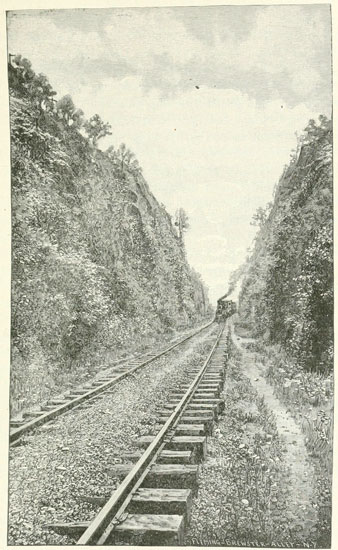
RAILROAD CUT, ALLATOONA. FORT "C" ON THE LEFT, FORT
"T" ON THE RIGHT.
If this cut be critically examined, it will be perceived that the
order to "fill it up" in an hour or so, and then go on to the
bridge, does not evince a profound knowledge of engineering.
A little boy builds sand forts and castles on the seashore with
wooden paddles, and believes he is a Vauban or an Inigo Jones.[31]
He knew we had but a few spades, and directed Gen. Stewart to
borrow for me tools from Gen. Armstrong; and he had none.
In 1880, sixteen years after he wrote those orders, Gen. Hood
published a work called "Advance and Retreat," in which the
following words are written (page 257):
"I had received information—and Gen. Shoupe records the
same in his diary—that the enemy had in store, at Allatoona,
large supplies which were guarded by two or three regiments.
As one of the main objects of the campaign was to deprive the
enemy of provisions, Maj. Gen. French was ordered to move
with his division, to capture the garrison, if practicable, and
gain possession of the supplies. Accordingly on the 5th, at 10
A.M., after a refusal to surrender, he attacked the Federal forces
at Allatoona, and succeeded in capturing a portion of the works;
at that juncture he received intelligence that large reënforcements
were advancing in support of the enemy, and, fearing he
would be cut off from the main body of the army, he retired and
abandoned the attempt. Maj. L. Perot, adjutant of Ector's Brigade,
had informed me by letter that our troops were in possession
of these stores during several hours, and could easily
have destroyed them. If this assertion be correct, I presume
Maj. Gen. French forbade their destruction, in the conviction
of his ability to successfully remove them for the use of the Confederate
army."
Now, if any intelligent person will carefully scrutinize the orders
given me, and then ponder over what Hood published, he
can arrive at no other conclusion than that the account published
is erroneous. They cannot both be true!
And further, when I made my official report I copied my orders
that he gave me, and I stated in my report: "It would appear,
however, from these orders, that the general in chief was
not aware that the pass was fortified and garrisoned that I was
sent to have filled up."
This report was, by Gen. Stewart, delivered to Gen. Hood,
and by him forwarded to the War Department in Richmond;
thence it went to the War Department in Washington. And
although I therein state that Hood had no knowledge of the
place being garrisoned, or fortified, he forwarded it without
comment. He could not do otherwise. There were the originals
copied in his own order book.
"Gain possession of the supplies!" under all the environments,
is only a vague expression of a glittering generality and signifies
nothing particular, and is a mere platitude and nothing
more. What was I to do with them? Bring them away? remove
them without a wagon, when about six hundred were required!
But let us suppose that Hood actually did know that Allatoona
was fortified, garrisoned, and a depot for army rations. If
so, then he should have imparted to either Gen. Stewart or me
that information.
Again: Gen. Hood having declared that the main object of
the campaign was "to deprive the enemy of provisions," here
was the desired opportunity; nay, more—to appropriate them
to his own use. He wrote the first order to me at 7:30 A.M. on
the 4th. At that time I was at Big Shanty, Walthall at Moon's,
and Loring at Acworth, only two hours' (daylight) march from
Allatoona!
Now I ask in the name of common sense, Can it be possible
that, with Gen. Stewart's army corps so near those much needed
army supplies, he should order Gen. Stewart's Corps to remain
there close by them "till late in the evening," and then march
him away and order me, the most distant, to go there and "take
possession of them?"
Had he known what he says he did, undoubtedly he would
have ordered, at daylight on the 4th, every available wagon to
Acworth, and (instead of the utterly impractical one of putting
a mountain in a deep cut) ordered Gen. Stewart with his
three divisions to Allatoona in all haste. Loring could have
reached Allatoona by 11 a.m. on the 4th, and the others soon
after. The battle would have been fought on the 4th, and before
the arrival of Corse at midnight. No! for the want of information,
this was not to be.
And so I went all alone into the land occupied by the enemy,
and Gen. Hood moved farther and farther away, leaving me isolated
beyond all support or assistance.
Gen. Hood could not have had a good knowledge of the topography
of the country, because when my dispatch to Stewart—that
I would withdraw from Allatoona to avoid being shut up in
a cul de sac—was received Hood tells Stewart that he does not
understand "how Gen. French could be cut off, as he should
have moved directly away from the railroad to the west." (Page
791, War Records, Vol. 39.) I am quite sure Gen. Armstrong,
when (at 9 A.M.) he sent me his dispatch, also sent a copy of it
to Gen. Stewart or Hood, because Hood at 1:15 P.M. tells Armstrong
he "must prevent my being surprised, and enable me to
get out safely."
I will state here again that it was about noon on the 4th, when
some citizens, living on the line of the railroad above, remarked
that we "could not tear up the track to Allatoona, because that
place was fortified and garrisoned, and that it was a depot for
supplies." Therefore it was that Gen. Stewart and myself, in
discussing the order, were convinced that Hood did not know the
condition of affairs at Allatoona, and at my request he gave me
some additional artillery; and so there is ample evidence that
Hood had no knowledge that the enemy occupied the Allatoona
Pass.
Gen. Hood was indeed a brave man, if not a courageous one,
and he couched his lance at the enemy wherever he met him,
whether in the guise of a windmill or the helmet of Mambrino;
but at last, in after days, he went over to the enemy, for on page
257 of his volume he writes: "Gen. Corse won my admiration
by his gallant resistance, and not without reason the Federal
commander complimented this officer, through a general order,
for his handsome conduct in the defense of Allatoona!"
It is a pertinent question to ask from what source Gen. Hood
derived his information. If he had read Gen. Corse's report,
he would have discovered that his men would not expose themselves
enough to fire over the parapet, and that they merely
"held out" for the hourly promised assistance, etc., as I have
narrated. Is it pleasing to learn from his pen his rapturous
love for the Federals and contempt for the Confederates and his
standard of admiration? Mine is different; and I am free to
state that it was the Confederates with whom I was present, who
by their death,
"by their painful service,
The extreme danger, and the drops of blood
Shed,"
by their gallantry and perseverance won my admiration. And
this is no reflection on the enemy they met. Hood's want of
admiration for the soldiers he commanded in 1864 and 1865 is
the highest meed to their intelligence.
Perhaps it was natural, in after years, that Gen. Hood should
select some Federal officer on whom to bestow his admiration,
and when they passed in review before him Gen. Corse was
awarded this honor. I trow he must have forgotten Col. Clark
R. Weaver, U. S. A.
Seven days after Allatoona, Gen. Hood with his entire army
was at Resaca. It was garrisoned by about five hundred men
commanded by Col. Weaver. Hood summoned Weaver to surrender
in unmistakable terms, ending as follows:
If the place is carried by assault, no prisoners will be taken.
Most respectfully, your obedient servant,
J. B. Hood, General.
To this Col. Weaver replied:
In my opinion I can hold this post. If you want it, come and take it.
Clark R. Weaver, Com'd'g Officer.
(See Sherman's "Memoirs," Vol. II., page 155.)
Nevertheless, on page 257, "Advance and Retreat," Hood
writes, "Gen. Corse won my admiration by his gallant resistance,"
etc., and further on—page 326 of his book—he writes,
"The information I received that the enemy was moving to cut
me off proved to be false," which is refuted by the arrival of reënforcements
as I have stated, and Sherman's dispatches that I
have given.
It is singular that so many laudatory statements should have
been made by Gen. J. M. Corse and admirers about the battle
of Allatoona, which were not necessary to sustain his character
as a soldier.
I have before me a book of nearly five hundred pages, written
by F. Y. Hedley, adjutant of the Thirty-Second Illinois Regiment,
which is entitled "Pen Pictures of Everyday Life in Gen.
Sherman's Army, from Atlanta to the Close of the War." This
includes the battle of Allatoona, and as he makes the story to
be palatable to the tastes of those who enjoy the marvelous, at
the expense of the Confederate soldiers and myself, I feel obliged
to expose more of the legerdemain used to deceive the public by
juggling tricks.
I will state that on page 219 there is a facsimile of my summons
to the commanding officer of the garrison to surrender. It
was sent, as I have stated, because it was then supposed that the
garrison was small in numbers. It reads:
Around Allatoona, October 5, 8:15 A.M., 1864.
Commanding Officer U. S. Forces, Allatoona:
Sir: I have placed the forces under my command in such positions that
you are surrounded; and to avoid a needless effusion of blood, I call on
you to surrender your forces at once, and unconditionally. Five minutes
will be allowed you to decide. Should you accede to this, you will be
treated in the most honorable manner as prisoners of war.
I have the honor to be very respectfully yours,
S. G. French,
Major General Commanding Forces C. S.
On the same leaf is a facsimile of Gen. Corse's reply to my
note, and it reads:
Headquarters Fourth Division, }
Fifteenth Army Corps, 8:30 A.M., October 5, 1864. }
Maj. Gen. G. S. French, C. S. A.:
Your communication demanding surrender of my command I acknowledge
receipt of, and respectfully reply that we are prepared for the "needless
effusion of blood" whenever it is agreeable to you.
I am very respectfully, your obedient servant,
John M. Corse,
Major General Commanding Forces U. S.
Let us investigate this matter.
The facsimile of my letter is true, no doubt about that; but we
have also the facsimile of the reply made by Corse which was
sent me, and by me never received; and in the face of that Corse
"declared he never knew that I did not receive it, or that it was
not delivered to Maj. Sanders, the bearer of the flag of truce,"
until so informed by Joseph M. Brown, whose guest he was when
he came to Atlanta with the artist De Thulstrup to have the battle
painted; and he further told him: "I took the note (French's)
and read it. It made me mad, because from what I could see of
his forces, and what I knew of mine, I believed that I had about
as big a force as he; hence considered the summons a superfluous
piece of bravado. I sat down on a log, and pulling my notebook
out of my pocket, wrote the reply across the face of one
of the pages, which I tore out and handed to my staff officer with
instructions to take it back to the bearer of the summons."
Not finding Maj. Sanders, of course he returned in a few
minutes and gave Corse the note.
Next William Ludlow (now a general in the United States
army), in his address to the Michigan Commandery, Loyal
Legion, at Detroit, on April 2, 1891 (page 20), says: "Corse
did reply; he wrote his answer on the top of a neighboring
stump."
Then Hedley (page 223) says of Corse: "His every pound of
flesh and blood was that of a hero: his eye flashed as if lighted
with a Promethean spark; and his chest swelled with angry defiance
to the hideous threat implied in the summons to surrender!
'Capt. Flint,' said he, 'answer this!' so Capt. Flint
seated himself upon a tree stump and wrote the reply."
I care not who wrote the reply to my note; I only desire to
know who kept it concealed for over twenty years, and then produced
it, and, together with mine, authoritatively gave them to
Hedley to photograph and publish side by side.
If Corse had it hid away, or knew where it was, then he must
have been mistaken when he declared to Joseph M. Brown that
he never knew that I had not received it. Besides, that I received
no reply was reported officially and well known.
As regards the "hideous threat implied" in my note, it has
been left to the hero of Allatoona to discover it for the first time,
although the like and similar expressions have been used by
many commanders in the years long past, and escaped the critical
acumen of those to whom they were sent to find an implied
threat therein.
No one except Ludlow, so far as I am aware, has ever published
that Maj. Sanders was fired on by Corse's soldiers when
approaching under a flag of truce. I made it known on an inclosure
in my official report.
Adjutant Hedley says "the heroic defense of Allatoona is almost
as famous as the 'charge of the Light Brigade,' and far
more momentous in its results."
There was nothing momentous pending on it. It was Hood's
ignorance of the enemy's position that caused the battle; it should
never have been made. We had nothing to gain; we would
not remain there, nor had I any means to carry stores away with
me. It is well known what Hood ordered us to do: "fill up the
Allatoona cut, and burn the bridge over the Etowah river," and
join him on the 6th.
I here repeat that the one million rations of bread in Allatoona
were not a factor in Sherman's march to Savannah. He
refused to repair the railroad we had destroyed, and sent the rations
north of the Etowah. Subsequently, however, he did put
the road in condition so as to send the sick and wounded, etc.,
north from Atlanta. The war records show he had in Atlanta
3,000,000 rations and eight thousand beeves. For 65,000 men
eighteen days were required 1,170,000 rations. On the march
the most difficult problem Sherman had to solve was what to do
with his superabundant rations.
Let us examine Hedley on this question. He writes, first:
The regular commissaries and quartermasters foraged for the
regular commands off the country; but "under the color of the
license given by Sherman's orders every regiment in the army
sent out an independent foraging party, whose duty it was to see
that its particular command was furnished with all the DELICACIES
the country afforded. These men were the most venturesome
in the army;" they "took great risks and experienced startling
adventures.... If the negroes told the bummers stories of
cruelty they had suffered, or hostility to the Union, etc., the injury
was avenged by the torch." So on the twaddle of negroes
these bummers, acting as judges, without appeal, executed their
own sentences.
The rehearsal of these scenes afforded amusement in Washington,
and "Marching through Georgia" is still a favorite
hymn to the sanctimonious people who delight in cruelty to innocent
women and little children.
"The bummer was a wily diplomat and learned all that was
to be known of the neighbor farther down the road whom he expected
to raid the next day.... The bummer drew a line between
the rich and the poor."
Speaking of one bummer, as an example of others, he writes:
"About midnight his voice was heard arousing the camp; he
had six animals, horses and mules, strung together with a motley
improvised harness made of odds and ends.... He bestrode
one of the wheelers, and swayed in the saddle from the effects
of apple-jack; his wagon was an immense box of the Tennessee
pattern, high at each end, low in the middle, similar to an
old Dutch galiot, loaded to the guards with the choicest of
wines and liquors; and by chance there was in the cargo a box of
glass goblets.... Samples of the wines were sent to corps
headquarters, pronounced excellent, with the intimation that a
further supply would be acceptable, etc.," and so on the chapter
reads to the end.
The bummers generally obliged the negroes to improvise
teams, and in wagons brought their stealings into camp. "They
ranged over a section between sixty to eighty miles in breadth."
(Page 272.) The writer pursues a middle line: he tells us nothing
about the distress of the thousands of women and children left
homeless by these cruel wretches, nor does he see any of watches,
plate, and jewelry stolen; and now here we are, in the last years
of the century, told by the "Grand Army of the Republic" that
we must not tell any of these matters to our children in our
school histories.
I am now about to close my account of this battle and the
false statements regarding it. I have written it because of Gen.
Corse's willfully making an erroneous statement toward the close
of his report about driving the division away, and because of his
(so-called) famous dispatch, the gospel hymn, and the shouts of
victory, congratulatory orders and admiration parties; because
of Hood's statement about orders given me—all of which have
thrown a glamour over the conflict, making things seem to be
what they were not.
I have endeavored to dispel the illusion, remove the glamour,
uncover the hidden truth to him who will seek it.
The "holding on" power of the Federal soldier in this battle
was remarkable, and his faith commendable. From 11 A.M. to
near the close of day they were pent up inside and around in the
ditch of a small fort in such numbers that they lay on one another,
sat on each other, stood on others dead or alive, praying
for relief. There they stayed till, in the silence of the gloaming,
they ventured out and "had the advantage of the enemy and
maintained it"—without opposition, for the enemy had long
been gone away!
In what I have written respecting this battle I have made no
charge against the Union soldier of the want of courage or the
desire to surrender.
It is they who furnish the evidence of their distress, refusal to
man the parapets, and desire to surrender under the long delay
and disappointments of the so-often-promised aid. Amidst all
their environments, let none condemn them without cause.
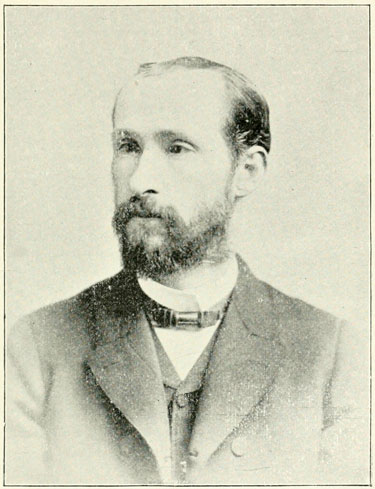
JOSEPH M. BROWN.
The Soldiers' Grave.
BY JOSEPH M. BROWN.
[In Allatoona Pass, by the Western and Atlantic railroad, is the grave of
an unknown soldier who fell in the battle there October 5, 1864.]
In the railroad cut there's a lonely grave
Which the trackmen hold sacred to care;
They have piled round it stones, and for it they save
Every flower, when their task calls them there.
Away from the home of his love,
Away from his sweetheart or wife,
Away from his mother, whose prayers went above,
He gave for his country his life.
We know not if, wearing the blue, he came
'Neath the "bright, starry banner" arrayed,
And, dying, that it o'er the mountains of fame
Might forever in triumph wave prayed;
Or we know not if, 'neath the "bonnie blue flag,"
He rushed forth, his country's defender,
Valiant, smote those who her cause down would drag.
And only to death did surrender.
That God only knows; and so in his hand
Let the secret unfathomed e'er rest;
But this we know, that he died for his land,
And the banner he thought was the best.
Heav'n pity the dear ones who prayed his return,
Heav'n bless them, and shield them from woes,
Heav'n grant o'er his grave to melt anger stern,
And make brothers of those who were foes!
The Lone Grave.
BY PAUL DRESSER.
["The Lone Grave" is situated on the Western and Atlantic railroad
between Chattanooga, Tenn., and Atlanta, Ga. A plain board marked
the resting place of a soldier. Name "unknown." None could tell
whether he had been a Federal or Confederate. The section hands, when
laying the track, discovered the grave, sodded it over beautifully, and
placed a headstone over it bearing the above inscription. The traveler's
attention is always called to this spot, and the trains "slow up" in order
to give all an opportunity to see it. Let this be an olive branch to the
North and South to be again a united people.—Author.]
A story I am going to tell of a grave
In the South where a brave soldier fell.
For his cause he now sleeps by the side of a track—
What his colors none able to tell.
A plain, simple board, rudely carved, that was all
That was left to remind one of that sacred spot.
The words, as we traced them, were simple enough;
"A soldier sleeps here; O! forget me not."
Chorus.—The lone grave is there by the side of the track;
It contains a wanderer who never came back;
And when he appears on the great judgment day,
Our Father'll not ask: "Was your suit blue or gray?"
There's a mother that sits by a fireside to-night.
She is thinking of days long gone by;
And she pictures "a loved one who went to the war,
But returned not," she says with a sigh.
If the mother could know that her boy calmly sleeps,
Undisturbed by the march or the progress of time,
What feelings would haunt her, what thoughts would she have,
Sobs, tears, and heartaches, what sadness sublime!
Joseph M. Brown, who was for many years engaged in collecting
facts relating to this battle, and which he privately published
some years ago, states that the remains of Col. W. H.
Clark, of Mississippi, rest in this grave. He fell, with the colors
of his regiment in his hands, leading his men in the attack.
That is an error.
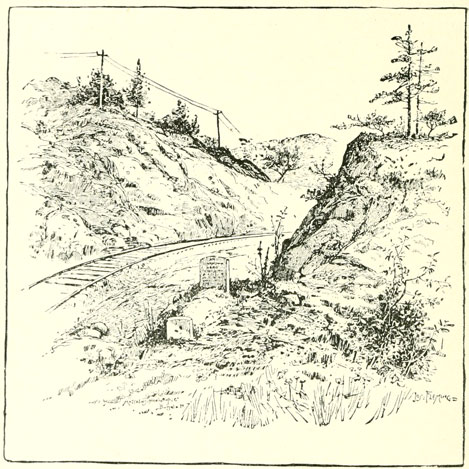
THE LONE GRAVE.
These now deserved tributes to a brave soldier were made "To
an Unknown Hero." For it is not known whether he was in
the United States or Confederate service. As the last resting
place of a man who gave his life for his country, it was regarded
a sacred spot, and it is hoped it will always be reverently
cared for out of respect to the dead. It is an honored grave.
Millions of travelers pass by and do it reverence.
And now, in conclusion, I have shown:
1. That the remarkable orders I received from Gen. Hood
were given before he had any knowledge of there being a garrison
at Allatoona; and that his later statements may be erroneous.
2. That I was not aware that the garrison in the fortress had
been reënforced (two hours before my arrival) by Gen. Corse
and troops, when I summoned the commander to surrender; and
that I never received any reply to my summons.
3. That when the outer line of the fortress was gained, and
Gen. Corse with all his troops west of the railroad were driven
into the "slaughter pen," the battle was lost to him; his troops
would not face their assailants; would have surrendered, only
their officers implored them to "hold out" longer, as relief was
momentarily expected to end "the prolonged strain of that mortal
day."
4. That when I received the dispatch from Gen. Armstrong
informing me that the advance infantry of Sherman's army from
Atlanta had passed Gen. Hood at Lost Mountain, and were at Big
Shanty, I deemed it best to forego the gratification of a complete
victory for myself and troops, which, if won, must still result
in further fight (by my exhausted troops) with the reënforcements
hourly expected. And so I would not yield to the importunity
of both officers and men, who were mad, and wanted, also,
to "hold on" until they captured the entire works. I weighed
their promises to capture the last work when ammunition was
obtained with the after probable consequences, and pointed them
out, and adhered to my decision; deeming it best for the "Confederate
cause" not to lose more men for the mere eclat of a victory
of doubtful compensating utility. We could not remain an
hour if the place were taken.
5. Considering the number of urgent dispatches that Sherman
sent to his general officers to take possession of the road over
which I passed (on the 5th and 6th) on my way to New Hope
Church, it is left for them to account for permitting the Confederates
to pass by them without any serious skirmishing, because
dispatch No. 15, received by Gen. Stanley at 2:30 P.M. on
the 5th (when I was at Allatoona), gave him seventeen hours to
occupy and hold the Sand Town road, as ordered, before I moved
over it to join Hood at New Hope Church.
Lastly. Gen Corse's "famous" dispatch, originally, "I can
lick all h—l yet," has not the merit of the excitement or inspiration
of the battlefield. It loses its significance entirely for the
want of applicability. He had "whipped" no one; his command
was now doubled in numbers; no enemy was within twenty
miles of him; an entire day (lacking an hour) had passed since
the last shot was fired, when he deliberately and thoughtfully
prepared that dispatch, perhaps to divert attention from the real,
actual occurrences of the battle the day previous and tickle the
public ear.
The testimony of hundreds of witnesses now living has been
recorded to substantiate what I have written. For the Union
soldier in this battle I have tried to
nothing extenuate.
Nor set down aught in malice,
and in after years, I trust, to the noble Confederates who fought
this battle the impartial historian will
Give them the honors they won in the strife,
Give them the laurels they lost with their life.
Chickamauga, Ga., April 12, 1897.
Gen. S. G. French, Pensacola, Fla.
My Dear General: The manuscript history of the battle of Allatoona
which you recently sent me has been read over twice, very carefully. It
was exceedingly interesting to me, and must be correct in every particular.
Those facts and circumstances which fell within my personal knowledge
are stated correctly, according to my recollections; and your unswerving
fidelity to the truth and careful attention to details are well remembered.
Moreover, the account given of the conduct of your troops is just what
every one who knew them, as I did, would expect of Cockrell's Missourians,
of Young's (Ector's) Texans, of Sears's Mississippians, and of Coleman's
North Carolinians. Do you not owe it to these men as well as to yourself
and the truth of history to publish this account of that battle? I hope
you will do so, and would suggest, in the event you do, that the route taken
by Sears to reach the north side and rear of the Federal position, and the
positions of your three brigades, be indicated on the topographical map
(page 339).
Very sincerely yours,
Alex P. Stewart.
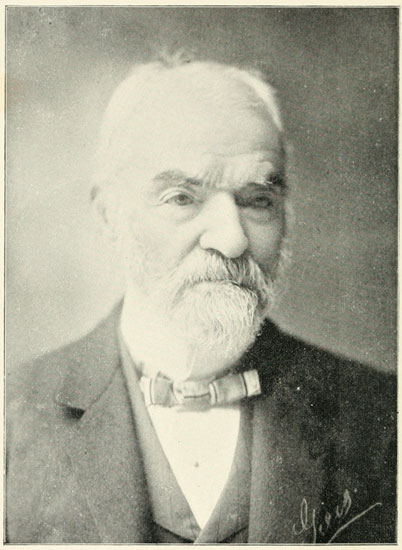
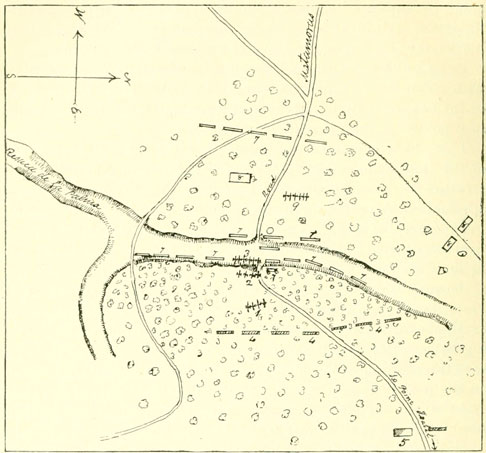
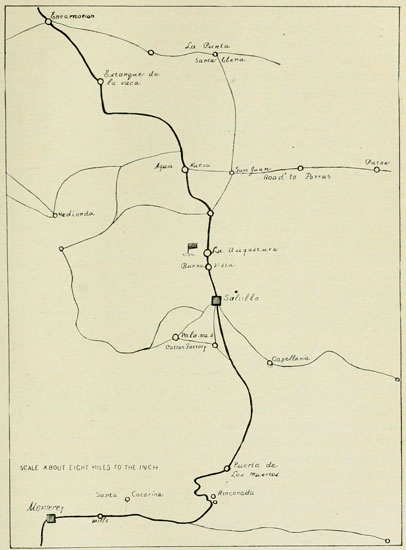
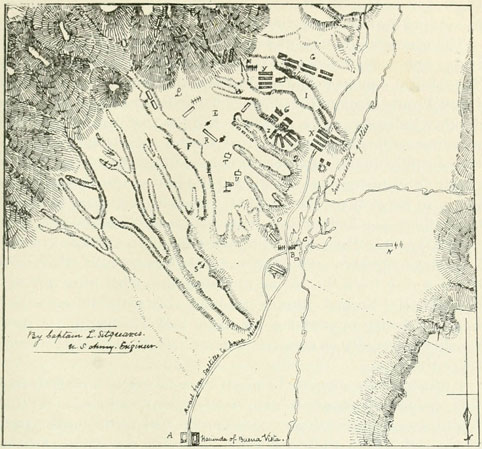
 Headquarters of Taylor.