"And the name of the going up
the side of the hill is called Difficulty."
"Is not the place dangerous?
Hath it not hindered many in their
pilgrimage?"
We left Siena the morning after the marionette
exhibition. The major, when he
heard at breakfast that we were going, asked
us point blank several questions about Boston
publishers, his book probably being still uppermost
in his thoughts. Later he sent his card
to our room to know at what hour we started;
he wished to see us off. The young lady of
architectural proclivities shook hands and bade
us good-by, saying she had often ridden a
sociable with her cousin in England.
After all, there was not much for the major
to see. We could not ride through the streets,
and so could not mount the machine for his
benefit. But he was interested in watching
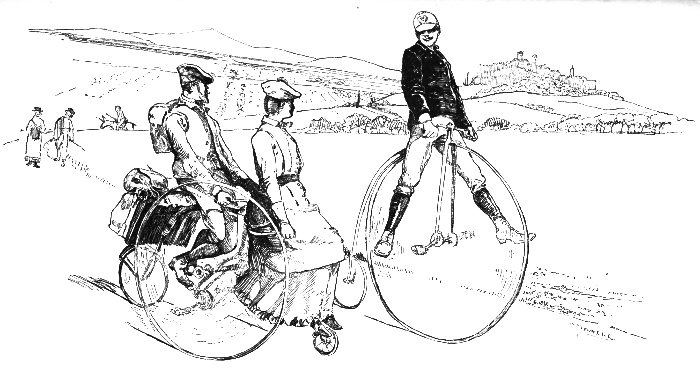
us strap the bags to the luggage-carrier, and
pleased because of this opportunity to entertain
us with more American reminiscences. I am
afraid his amusement in Siena was small. In
return for the little we gave him he asked us
to come and see him in Rome, where he would
spend the winter, and added that if we expected
to pass through Cortona he would like
to write a card of introduction for us to a
friend of his there, an Italian who had married
an English lady. Cortona was a rough place,
and we might be glad to have it. He had forgotten
his friend's name, but he would run upstairs
and his wife could tell him. In a minute
he returned with the written card. We have
had many letters of introduction, but never
one as singular as the major-general's. As
he knew our names even less well than that of
his Cortona friends, he introduced us as "an
American lady and gentleman riding a bicycle!"
Only fancy! as the English say. Our
parting with him was friendly. Then he stood
with Luigi and Zara until we disappeared
around the corner of the street.
What a ride we had from Siena to Buonconvento!
This time the road was all giù, giù,
giù. It was one long coast almost all the way,
and we made the most of it. We flew by milestone
after milestone. Once we timed ourselves:
we made a mile in four minutes. The
country through which we rode was sad and
desolate. On either side were low rolling hills,
bare as the English moors, and of every shade
of gray and brown and purple. Here rose a
hill steeper than the others, with a black cross
on its summit; and here, one crowned with a
group of four grim cypresses. Down the hillsides
were deep ruts and gullies, with only an
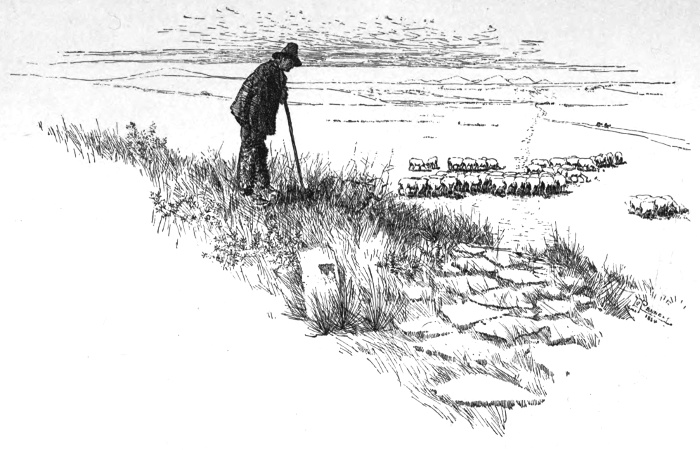
occasional patch of green, where women were
watching sheep and swine. Once we came
to where three or four houses were gathered
around a small church, but they were as desolate
as the land. We heard voices in the distance,
but there was no one in sight. When
on a short stretch of level road we stopped to
look at this strange gray land, the grayer because
dark clouds covered the sky, we saw that
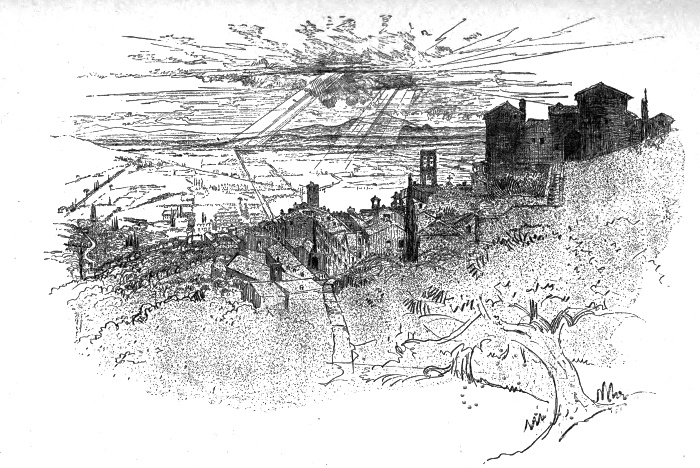
above the barrenness the sun shone on Siena,
and that all her houses, overtowered by the
graceful La Mangia and the tall Duomo Campanile,
glistened in the bright light.
About five miles from the city the desolation
was somewhat relieved, for there were hedges
by the roadside, and beyond sloping olive-gardens
and vineyards. Poplars grew by little
streams and sometimes we rode under oaks.
On the top of every gray hill, giving it color,
was a farm-house, rows of brilliant pumpkins
laid on its red walls, ears of yellow corn hung
in its loggia, and gigantic haystacks standing
close by. There were monasteries too, great
square brick buildings with tall towers, and
below spire-like cypresses. But between the
farms and fertile fields were deep ravines and
dry beds of streams. The road was lonely.
Now and then flocks of birds flew down in
front of the tricycle, or large white geese came
out from under the hedge and hissed at us.
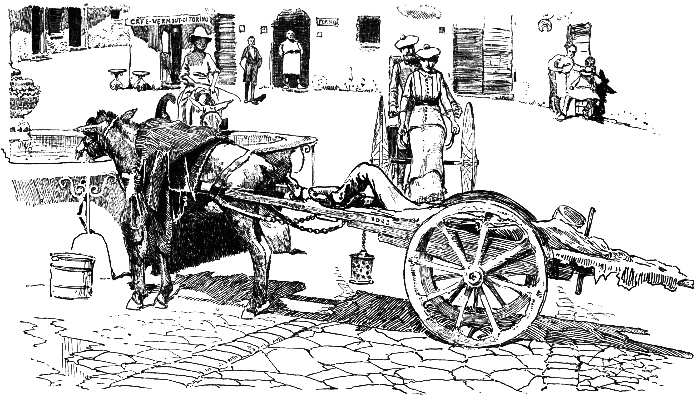
For a few minutes a man driving a donkey-cart
made the way not a little lively. He did
not see us until we wheeled by him. Then
he jumped as if he had been shot. "Dio!"
he exclaimed, "but you frightened me!" He
laughed, however, and whipping up his donkey
rattled after us as if eager for a race, talking
and shouting all the while until we were out of
hearing. One or two peasants passed in straw
chariot-shaped wagons, and once from a farm-house
a woman in red blouse and yellow apron,
with a basket on her head and a dog at her
heels, came towards us. It was in this same
farm-house we met a Didymus. We stopped,
as we had a way of doing when anything
pleased us, and he came out to have a better
look at the tramway. And how far did we
expect to go to-day? he asked. To Monte
Oliveto, we told him, for, like pious pilgrims,
we thought to make a day's retreat with the
monks there. "To Monte Oliveto! and in
a day, and on that machine!" and he laughed
us to scorn. "In a week, the Signore had better
say." Later a stone-breaker's belief in us
made some amends for the farmer's contempt.
We were riding then. "Addio!" he cried,
even before we reached him.
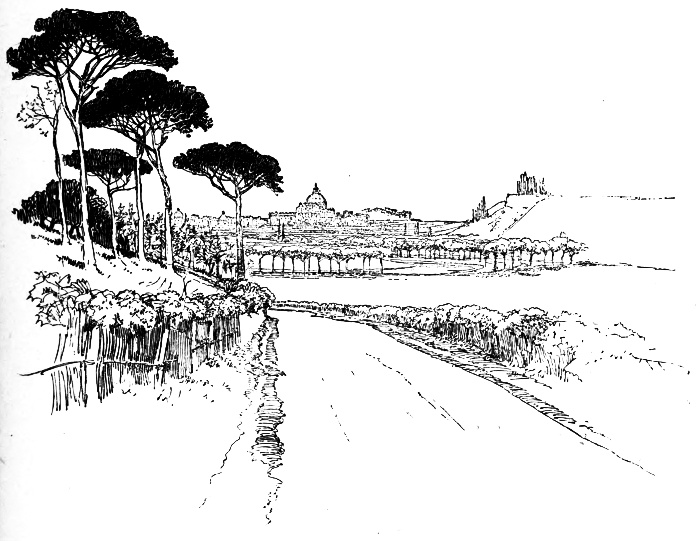
I shall always remember a little village
through which we rode that morning, because
it was there we saw the first large stone-pine
growing by the roadside, which showed we
were getting farther south, and because of the
friendliness of a peasant. It was a poor place.
The people were ragged and squalid and
sickly, as if the gloom of the hills had fallen
upon them. We asked at a shop for a lemon,
but there was not one to be had. "Wait,"
cried a woman standing close by, and she disappeared.
She returned almost immediately
with a lemon on whose stem there were still
fresh green leaves. "Ecco!" she said, "it is
from my garden." "How much?" asked J.,
as she handed it to him. "Oh, nothing, sir,"
and she put her hands behind her back. We
made her take a few coppers, for the children
we told her. As far as it lay in her power I
think she was as courteous as those men in a
certain Italian town who, in days long past,
fought together for the stranger who came
within their gates, so eager were they all, not
to cheat him, as is the way with modern landlords,
but to lodge him at their own expense, so
that there were no inns in that town.
Before we reached Buonconvento the sun
came out and the clouds rolled away. It had
rained here earlier in the morning. The roads
were sticky and the machine ran heavily, and
trees and hedges were wet with sparkling raindrops.
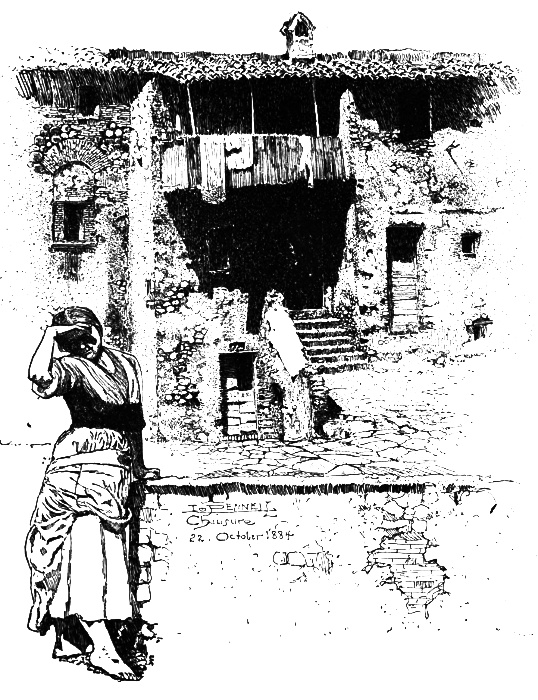
There is an imposing entrance to the
little town, a pointed bridge over a narrow
stream, with a Madonna and Child in marble
relief at the highest point, an avenue of tall
poplars with marble benches set between, and
then the heavy brick walls blackened with age,
and the gateway, its high Gothic arch decorated
with the old Sienese wolf and a more
recent crop of weeds.
We rode from one end to the other,—a
two minutes' ride,—without finding a trattoria.
At length we appealed to the crowd. Where
was the trattoria? No one understood; and
yet that very morning J. had been asked if
he were not a Florentine! Perhaps monsieur
speaks French? and a little Frenchman in
seedy clothes jauntily worn, and with an indescribable
swagger, came forward, hat in
hand. The effect of his coming was magical.
For unknown reasons, when it was found that
J. could speak French after a fashion, his
Italian was all-sufficient. The inn was here;
we were directly in front of it, and the padrone,
who had been at our elbows all the time, led
the way into it. The Frenchman gallantly
saw us through the crowd to the room where
we were to dine. It was the best trattoria in
the place, but poor enough, he said. Such
bread and cheese! horrible! and he shrugged
his shoulders and raised his hands to heaven
in testimony thereof. He did not live in
Buonconvento, not he. He came from Paris.
Then he complimented J. on his Italian, to
make up in some measure for the failure of
the people to appreciate it, and with a bow
that might have won him favor at court, and a
"I salute you, monsieur and madame," he
politely left us before our dinner was served.
He was a strolling actor, the padrone said;
he and his troupe would give a performance in
the evening.
The fact that we were going to Monte
Oliveto annoyed the padrone. The monastery
is a too successful rival to his inn. Few
travellers, except those who are on their way
to Monte Oliveto, pass through his town, and
few who can help it stay there over night.
His list of the evils we should have to endure
was the sauce with which he served our beefsteak
and potatoes. We must leave the post
road for one that was stony and steep. Our
velocipede could not be worked over it. It
would take hours to reach the monastery, and
we had better not be out after dark, for there
were dangers untold by the way. But when
he had said the worst he became cheerful, and
even seemed pleased when we admired his
kitchen, where brass and copper pots and pans
hung on the walls, and where in one corner
was a large fireplace with comfortable seats
above and a pigeon-house underneath. But
when we complimented him on the walls of
his town, Bah! he exclaimed, of what use were
they? They were half destroyed. They would
be no defence in war-times.
He was right. The walls, strong by the
gate, have in parts entirely disappeared, and
in others, houses and stables have been made
of them. It is on the open space by these
houses that the men have their playground.
They were all there when we arrived, and still
there when we left. Young men, others old
enough to be their fathers, and boys were, each
in turn, holding up balls to their noses, and
then, with a long slide and backward twist of
the arm, rolling them along the ground, which
is the way Italians play bowls.
Before the afternoon was over we cursed in
our hearts the Tuscan politeness we had heretofore
praised. About a mile from Buonconvento
the road to Monte Oliveto divided. We
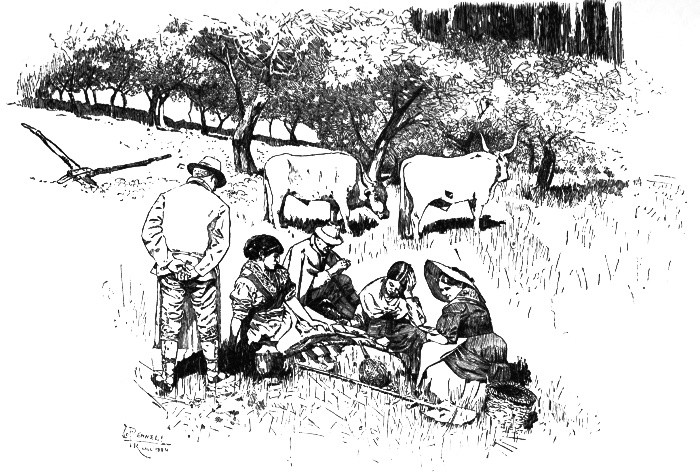
turned to the right. But two peasants with
ox-teams called out from below that we must
not go that way. It was all bad. But to
the left it was good, and piano, ascending
but gently, and we had much better take it.
In an evil moment we did. That it ill behooves
a wise man to seek counsel in every
word spoken to him, we found to our cost. In
the first place the ascent was not gentle,—we
had not then learned that an Italian calls every
hill that is not as straight up and down as the
side of a house, piano,—and in the second
place the road was not good, but vilely bad.
Unfortunately, for half a mile or perhaps more
it was fair enough. But when we had gone
just so far that we were unwilling to turn back
we discovered our mistake. The road we had
not taken was that built by the monks hundreds
of years ago; we had chosen the new
and not yet finished by-way. It was heavy
with dust and dirt, and full of ruts and loose
stones. Over it we could not ride or even
push the tricycle without difficulty. It was
in keeping, however, with the abomination of
desolation lying to each side. For we were
now in a veritable wilderness, a land of deserts
and of pits, where few men dwell. All around
us were naked, colorless chalk-hills, abrupt
precipices and ravines. A few chestnut-trees,
a rose-bush covered with red berries growing
from the gray earth, were the only green things
we passed for miles. It was weary and slow
work, and the sun was low on the hill-tops
before we came to the point where the two
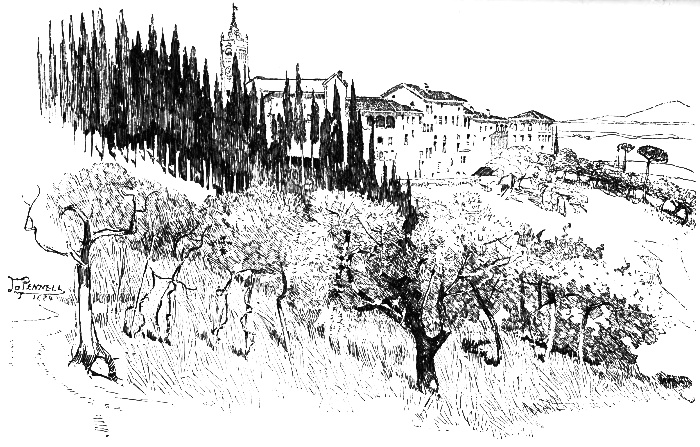
roads met. At some distance above us we saw
a large red building surrounded by cypresses,
and we knew this must be Monte Oliveto
Maggiore. So we took heart again.
But our trouble was not over. The road
was better only by comparison, and it was still
impossible to ride, and hard work to push or
pull the tricycle. It was built of bricks, which
lay as if they had been carelessly shot out of a
cart and left where and how they fell. A little
farther on it divided again. A woman was
walking towards us, and J. asked her which
was the road to the convent (il convento).
"You must go back," she said; "it lies miles
below,—Buonconvento." "These peasants are
fools," said J. in angry English to her very
face; but she, all unconscious, smiled upon us.
We went to the left, which fortunately was just
what we ought to have done. But it was provoking
that instead of getting nearer to the
monastery, we seemed to be going farther from
it. With one turn of the road it appeared to
be above, and with the next below us. Now it
was on one side and now on the other, until I
began to feel as if we were the answer to the
riddle I had so often been asked in my childhood,
the mysterious "What is it that goes
round and round the house and never gets in?"
Soon the sun set behind the hills, and the sky
grew soft and golden. We met several peasants
bearing large bundles of twigs on their
heads. There were one or two shrines, a
chapel, and a farm-house in front of which a
priest stood talking to a woman. But on we
went without resting, J. pushing the machine
and I walking behind, womanlike shirking
my share of the work. The road grew
worse until it became nothing but a mass of
ruts and gullies washed out by the rain, and
led to a hill from which even Christian would
have turned and fled. But we struggled up,
reaching the top to see the gate of the monastery
some sixty or seventy feet below. Finally
we came to the great brick gateway which in
the dull light—for by this time the color had
faded from the sky—rose before us a heavy
black pile, beyond whose archway we saw only
shadow and mystery. As we walked under it
our voices, when we spoke, sounded unnatural
and hollow. On the other side the road wound
through a gloomy grove of cypresses, growing
so close together that they hedged us about
with impenetrable darkness. Once several
silent figures, moving noiselessly, passed by.
Had we, by mischance, wandered into a Valley
of the Shadow of Death?
The cypress grove, after several windings,
brought us face to face with the building at
which we had already so often looked from the
distance. Even in the semi-darkness we could
see the outline distinctly enough to know we
were standing in front of the church, and that
the detached building a little to our left was
a barn or stable. But not a light shone in a
window, not a doorway was in sight. I recalled
my convent experience of bygone years, and
remembered that after eight o'clock in the
evening no one was admitted within its walls.
Was there a rule like this at Monte Oliveto,
and was six the hour when its bolts and bars
were fastened against the stranger? As we
hesitated where to go or what to do next,
three or four workmen came from the stable.
J. spoke to them, and one offered to show him
the entrance to the monastery while I waited
by the tricycle. It was strange to stand in the
late evening and in the wilderness alone, with
men whose speech I barely understood and
whose faces I could not see. For fully five
minutes I waited thus while they talked together
in low voices. But at last I heard
one cry, Ecco! here was the padrone; and they
all took off their hats. A dog ran up and
examined me, and then a man, who I could just
make out in the gloom, wore a cassock and the
broad-brimmed priestly hat, joined the group.
"Buona sera," he said to me.
Could I speak to him in French, I asked.
Yes, he assented, what was it I wanted?
When I told him we wished to stay in the
monastery, he said he had not expected us.
We had not written.
"But," I exclaimed, "we thought strangers
were allowed to stay here."
"Yes," he answered; "there is a pension in
the monastery, but it is for artists."
"And my husband is an artist," I interrupted
eagerly, for from his manner I feared he would
refuse us admission. After all, what did he
know about us except that, vagrant-like, we
were wandering in the mountains at a most
unseasonable hour? Indeed, when later I
reflected on the situation, I realized that we
must have seemed suspicious characters. At
this critical moment J. returned. His guide
had led him to a small side-door beyond the
church. There he rang and rang again. The
bell was loud and clear, and roused many
echoes within, but nothing else. The guide,
perplexed, then led him back. I told him
with whom I was speaking, and he continued
the conversation with the padrone. Had they
talked in Italian only, or in French, they might
have understood each other; but instead they
used a strange mixture of the two, to their
mutual bewilderment. If this kept on much
longer we should undoubtedly spend the night
in the open air. In despair I broke in in
French: "But, my father, cannot we stay this
one night?"
"Certainly," he said, fortunately dropping
all Italian. "That is what I was explaining
to monsieur. You can stay, but of course we
have nothing prepared. We will do our best."
If he had said he would do his worst, provided
we were rid of the tricycle for the night,
and were ourselves taken indoors where we
might sit down, we should have been thankful.
The bags were unstrapped and given into
the care of one of the men, a place was made
for the machine in the stable, and then we followed
the padrone or Abate—for this was his
real title—to the door where J. had rung
in vain, and which he opened with his key.
Within it was so dark that we groped our way
through a hall and a small cloister. Then we
came to a flight of steps, where at the bidding
of the Abate, as if to reassure us that we were
not being led to secret cells or torture-chambers,
the man carrying our bags struck a solitary
match. By this feeble light we walked
up the broad stone stairs and through many
passage-ways, not a sound breaking the stillness
but our foot-falls and their loud echoes, to a
door where the Abate left us, and at the same
time the match burnt out. But the next minute
he reappeared with a lighted taper, and at
the end of the hall opened another door, lit a
lamp on a table within, and showed us four
rooms, which he said were at our disposal.
The beds were not made, but they would be
attended to immediately. He had now to say
Office, but at nine supper would be served.
Here was a very comfortable solution to the
mystery into which the massive gateway
seemed to lead. The Valley of the Shadow
of Death had turned out to be a Delectable
Land!
It was still more comfortable later, when, his
Office said, the Abate came back and sat and
talked with us. Now he could examine us by
a better light I think he concluded we were
not dangerous characters, probably only harmless
lunatics. However that may be, after half
an hour, when the supper-bell rang and we
started off for the refectory, again by the light
of his taper, we were the best of friends. The
long corridor, thus dimly seen, seemed interminable.
We went down one stairway to find
the door locked against us, then up and down
another. Here the light went out, leaving us
in a darkness like unto that of Egypt. The
Abate laughed as if it were the best of jokes.
He took J.'s hand and J. took mine, and
thus like three children we went laughing
down the stairway and along more passages,
and at last into a long refectory, at the farther
end of which was a lamp, while a door to one
side of that by which we entered opened, and a
second monk in white robes, holding a lighted
taper, came in, and when he saw us made a low
bow. As there were no other visitors, we were
to eat with him and his brother monk, the
Abate said; and then he gave me the head of
the table, asking me if I were willing to be the
Lady Abbess.
If we had been two prodigals he could not
have been kinder than he was now he had
given us shelter. If we had been starving like
the hero of the parable, he could not have been
more anxious to set before us a feast of plenty.
Nor would any fatted calf have been more to
our taste than the substantial supper prepared
for us. We must eat, he said; we needed it.
He had seen us coming up the hill as he
talked with a peasant by the roadside; but
monsieur was push-pushing the velocipede and
looking at nothing else, and madame was panting
and swinging her arms, staring straight in
front of her, and before he had time, we had
passed. We must drink too; the wine was
good for us. We must not mix water with it;
it was Christian, why then should it be baptized?
The white-robed brother spoke little,
but he never allowed J.'s plate to remain empty.
When the meat was brought in we were joined
by Pirro, a good-sized dog with no tail to speak
of, and Lupo, an unusually large cat, and his
numerous family, who all had to be fed at intervals.
But even while Pirro jumped nimbly
into the air after pieces of bread thrown to him,
and Lupo scratched, and his progeny made
mournful appeals to be remembered, and we
talked, I looked every now and then down the
long narrow table to where it was lost in deep
shadow. The cloth was laid its entire length,
as if in readiness for the banished brothers
whenever they might return. I should not
have been surprised then to see the door open
to admit a procession of white-robed monks,
all with tapers in their hands.
The Abate must have realized that to a
stranger there was something uncanny in his
dark, silent, deserted monastery, and his last
word as he bade us good-night was, that we
were to fear nothing, and sleep in peace.
To
THE ABATE DI NEGRO,
Of Monte Oliveto Maggiore,
We would say a Word of Thanks for the Golden Days
passed in his House Beautiful,
and for
The Great Kindnesses shown us in our farther
Journeying.