Larger versions of most illustrations may be seen by right-clicking them
and selecting an option to view them separately, or by double-tapping and/or
stretching them.
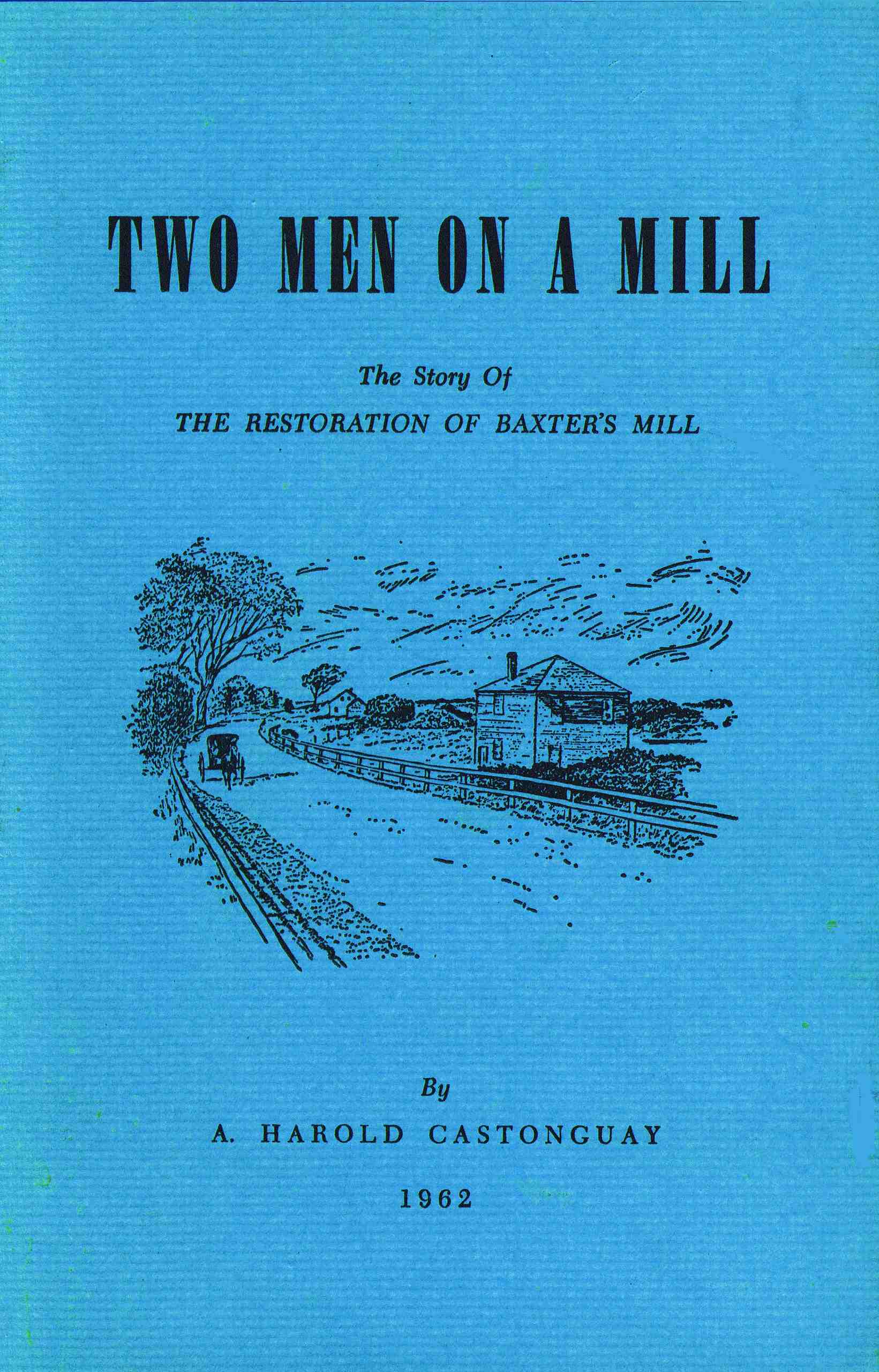
Printed on Cape Cod by The Wayside Studio
SOUTH YARMOUTH, MASSACHUSETTS
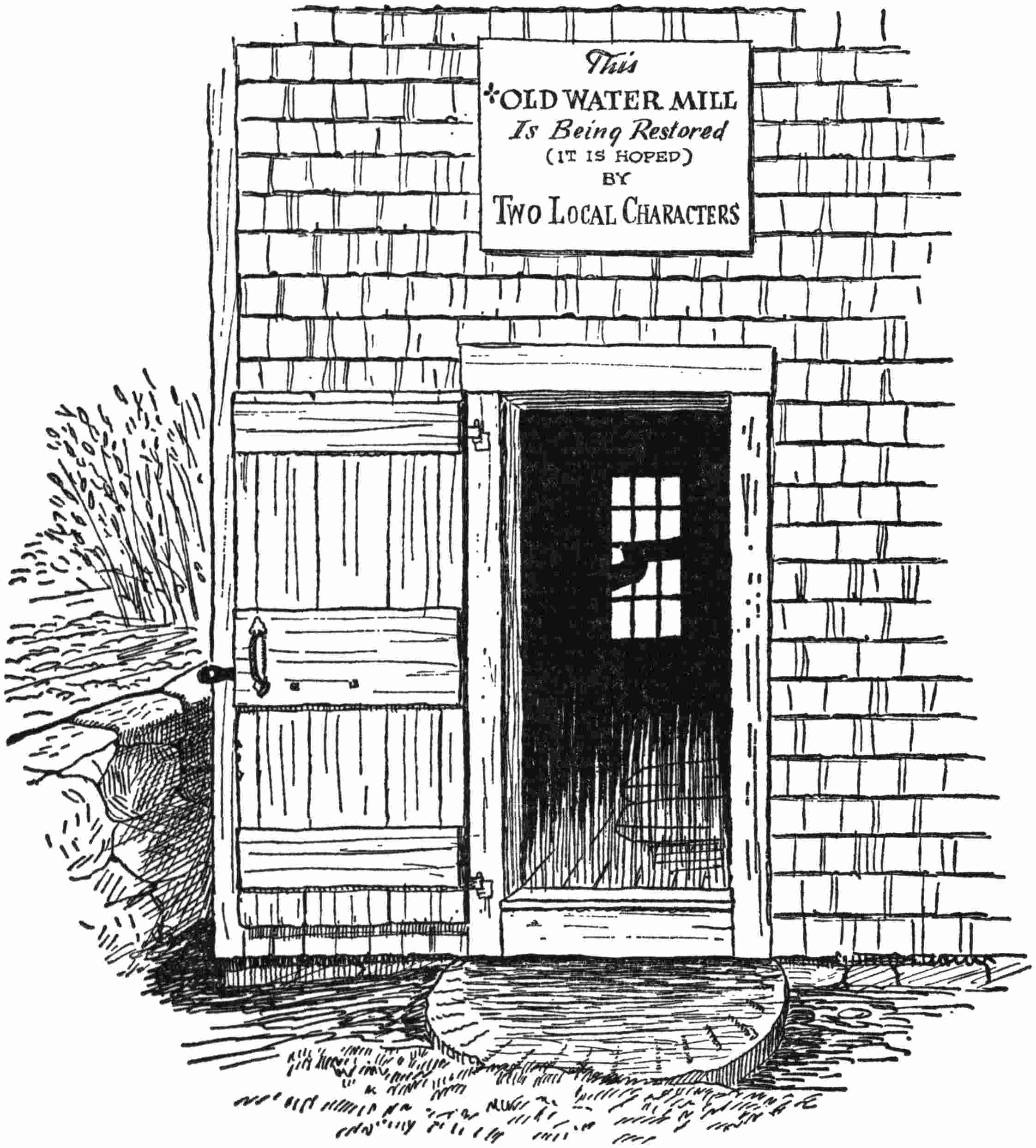
This
OLD WATER MILL Is Being Restored (IT IS HOPED)
BY Two Local Characters
I
Time goes, you say:
Ah, no!
Time stays—
We go!
—DOBSON
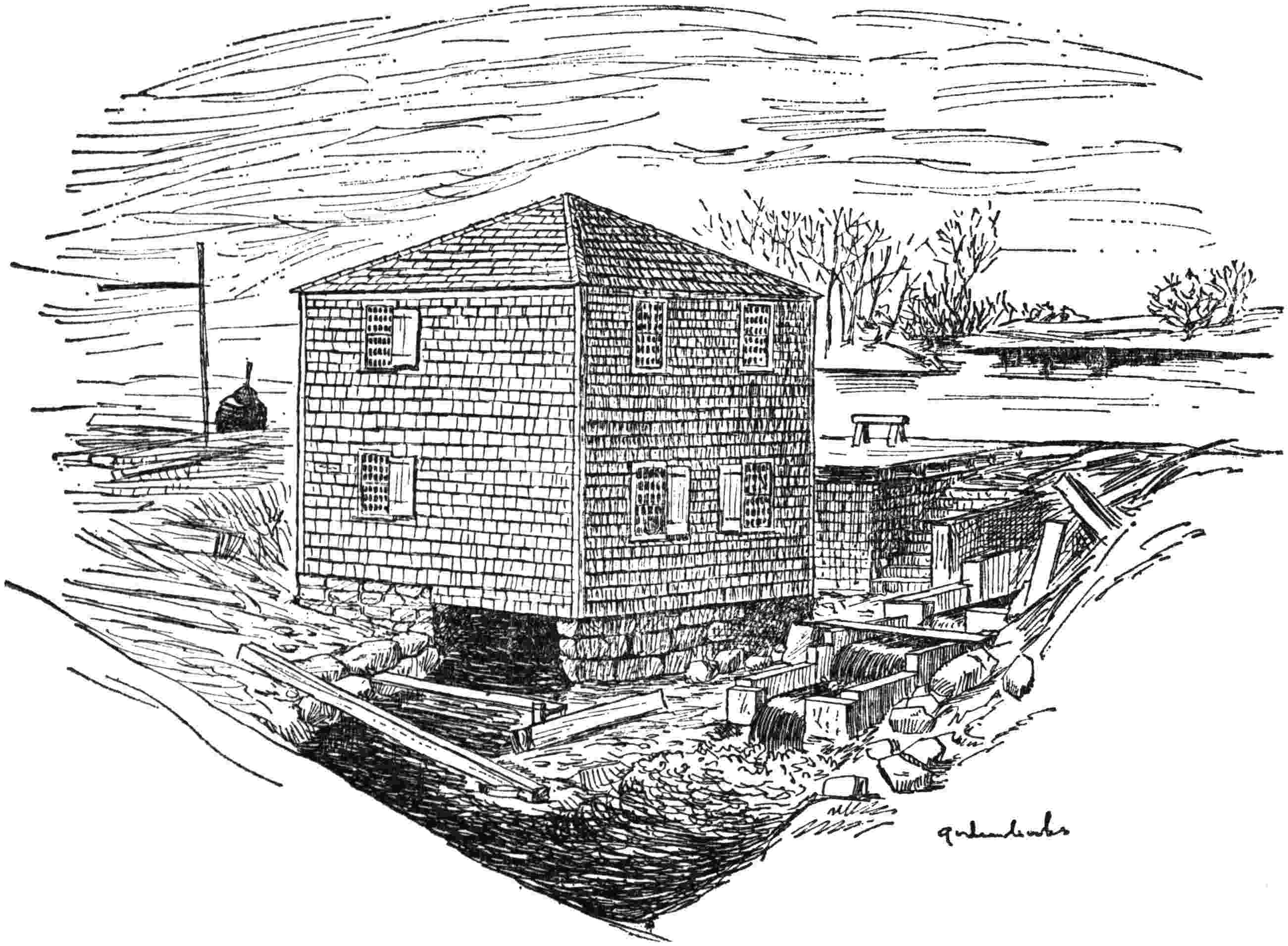
A few days before Christmas of 1961 we will raise a
pen gate in a flume adjoining the Mill Pond in West Yarmouth,
on Cape Cod, and a 250-year old water grist mill
will again grind corn into corn meal.
And so, a vanishing part of Americana, especially old
New England dating to our colonial days, has been restored.
Hundreds and perhaps thousands of people have been going
by this little old building, especially in the summer, without
giving it a thought but the mill’s visitors from now on, growing
up in our modern world of television, jet airplanes, and
high-powered automobiles, to say nothing of electric can
openers, will get a glimpse of early America, a view of the
simplicity of the mechanism, and the quiet dignity of the
building itself.
The mill is the only one of its kind on Cape Cod, the
few others being either windmills or outside water wheels.
The original mill was probably built about 1710 by
John and Shubael Baxter, sons of Thomas, who arrived in
Yarmouth from Rhode Island after the close of King Philip’s
War. Originally a mason, the loss of a hand in the war made
it impossible for Baxter to continue his trade, and he became
a millwright. His will, probated in 1714, disposes of fulling
mill equipment. This equipment was from the fulling mill
which he built on Swan Pond, now Parker’s River, in West
Yarmouth.
He probably offered no more than advice to his sons
when they built the grist mill near the South Sea neighborhood,
but it is undoubtedly these sons who are immortalized
in the little verse on the frontispiece of this saga. The poem
was already old when Amos Otis reproduced it in his 1880
Genealogy of Barnstable Families.
The Baxter mill passed from John and Shubael to their
children, Richard and Jennie, first cousins who were wed.
From them, it went to their son, Prince, and from him to his
son, Prince, Jr., whose guardian, David Scudder, sold one-half
of the mill to Timothy Baker and his son, Eleazer, and
the other half to Alexander Baxter, a remote cousin of Prince,
Jr., through their common great-grandfather, John.
Extensive repairs were made to the Baxter mill around
1850. It is likely that Prince, Sr., who inherited the mill on
the death of his father, Richard, in 1785, either made the
repairs or caused them to be made.
After about two hundred years of continuous operation,
the mill was finally abandoned around the turn of the century,
the last miller being a man aptly named Dustin Baker,
who earned the magnificent sum of 68¢ per day for his work.
The mill did lend itself as a gift shop and a lobster
stand in the past few years, but as it stands today, completely
restored in all authenticity it is doing exactly the work it did
originally, with the same machinery, except the turbine which
had to be replaced.
II
So many people have asked me,
“What are you doing this for?”
“Is there any money to be made grinding corn?”
“What are you ever going to do with this useless old
building?”
And most people, when they get an answer, sadly walk
away shaking their heads, wondering.
I suppose no one person or no one episode gave rise to
my thought in acquiring the mill and entering upon a program
of restoration, unless it could be what I have heard in
the various entertaining stories of people such as C. Milton
Chase, Dean of the Massachusetts Town Clerks, and retired
Town Clerk of Barnstable, who tells most engaging tales
of his trips as a young lad to the mill with a horse and team,
carrying corn to be ground.
Perhaps I was fired by my friend, George Kelley, a ponderous,
phlegmatic, Cape Codder, attempting to perpetuate
some of the characters of old Cape Cod, personified in Joe
Lincoln’s stories; and perhaps by the stories of Walter B.
Chase and Howard Hinckley of their nostalgic remembrances
of the old mill.
If you ever meet Milton Chase, see if you can get him
to tell you of the adventures, and strange doings of an old-time
travelling barber, one Frank Clifford, who went around
to all the business places, livery stables, and grain stores
with his little black bag, plying his barber trade, and who
employed a most ingenious method of warming the shaving
lather for his customers.
Or perhaps it was enthusiasm of Margaret Perkins. Maggie,
as we affectionally call her, spent long hours in tedious
searching of the records at the Deed Registry, Town Clerk’s
office, Proprietor’s Records of the Town of Yarmouth, and
interviewing everyone she could think of who might know
something of the history of the old mill. Maggie was the
motivating force in presenting an article at our Town Meeting
about a year ago, requesting the Town to purchase the
mill or take it by so-called eminent domain proceedings, so
that it might be preserved and restored, but the townspeople
were not eager to invest in the past.
Strange how so many people insist upon their rights
and forget their obligations. Strange again, how so many
people are looking for something without giving part of
themselves.
Whatever it was, or however it arose, I found myself
engulfed in the middle of hard but fascinating work.
Having lived for thirty-five years close by the old Baxter
Mill in West Yarmouth, it is not surprising that my curiosity
and interest were aroused. Somehow, I felt called upon to
restore this old mill, perhaps to keep a way of life now forgotten
in our present civilization, perhaps merely as a means
of self-expression.
A clipping from the Yarmouth Register, November of
1935, speaks for itself of the lethargy of present day thought,
when the old Farris Mill that stood for many years at the
corner of Berry Avenue and Main Street in West Yarmouth
was purchased by Henry Ford and moved to Dearborn,
Michigan, despite violent protest. The clipping reads as
follows:
TWENTY-FIVE YEARS AGO—From the files of the
Register—November, 1935.
It is reported that the oldest windmill on Cape Cod is
to be moved from West Yarmouth. The West Yarmouth
Association is attempting to obtain the sentiments of
Cape Cod residents, both permanent and seasonal, on the
rumored removal of one of the Cape’s most picturesque
objects of great historical value to the Cape—the old
windmill in West Yarmouth. Mrs. George Breed of Englewood
and Germantown has wired Mr Ford, the new
owner, direct, expressing her individual feelings in the
matter, and the West Yarmouth Improvement Society
has done the same.
We quote from a letter also dispatched, “If the windmill
is to be retained by you upon its present location, we are
delighted, but if it is to be removed it is a calamity.”
“It may be well to explain that there is no record in the
offices of the Town of Yarmouth whereby any offer was
ever made and presented to the voters that the windmill
was to be a gift or offered to be purchased; thus the
townspeople have never been allowed to express their
opinion on this matter, nor have they been allowed to visit
and inspect the mill. The door is always locked.”
I can distinctly remember at about this time the concern
and heated meetings held by civic groups, the letters
and telegrams of indignation sent to high public officials,
and the angry voice of the people protesting the removal of
this old landmark, but it struck me as being a bit strange
that not one person (including myself) came forward with
donations to purchase the Farris Mill and keep it where it
belonged. Needless to say, it was the usual story of “Let
George do it.”
In looking back, it was probably George Kelley and
Walter Chase who finally prodded me into action. George
Kelley is engaged in a flourishing insurance business in Hyannis
and is very handy and exceptionally good with tools.
As a matter of fact, he is better than the usual expert, and
has an extensive knowledge of craftsmanship. He is meticulous,
patient, and without his assistance I don’t think we
could ever have accomplished the project.
Walter B. Chase and his brother, Milton, are two of the
last old-school gentlemen left on the Cape, both of them
well-known and beloved by everyone and the living examples
of young boys graduating from high school and immediately
starting in business as a clerk or as an ordinary laborer.
One rose to be the Dean of Massachusetts Town Clerks and
the other rose to be the President of the Hyannis Trust Company,
the largest commercial bank on the Cape. They represent
a living contrast to the average youth of today, the
product of our so-called schools.
These gentlemen, through their own efforts and by virtue
of the simple, ordinary and basic fundamentals learned
in their school days, made a complete success of their lives
and are vigorously engaged today in directing the affairs
of two banks. Both are in their 80’s, alert, and enterprising,
as were their contemporaries, young men of 18, 20 and 22
who became masters and captains of deep-sea sailing vessels
going all over the world, purchasing cargo, handling all kinds
of men, and making money and profit for their employers.
I mention this because of the things uncovered in working
on the mill to show the sharp contrast of the average
youth of today who is taken to school on the bus so that he
can engage in physical exercise and who, when graduating
from the glamorous schools, hasn’t the slightest idea of fundamental
mathematics, of figuring simple interest, or of handling
ordinary division or multiplication.
III
Around 1870 the water wheel was disposed of and a so-called
“new and improved” metal turbine was installed for
a few very good reasons.
The old outside wooden water wheel in the winter became
lopsided with ice forming on the paddles and the uneven
motion was undoubtedly disconcerting to the miller to feel
the building and the machinery wobbling about. Whenever
solid ice blocked the wheel, it was useless. Further, the mill
pond was limited in its volume of water (“head,” to you
engineers), so that when the pond was low there wasn’t
very much water to turn a large outside wheel.
Ingenious engineers of that era came up with the so-called
“improved” iron turbine to rest under the water and
under the mill where ice could not get at it and where there
would always be some water in the pond to turn it.
The Original Turbine
About two or three months after we started reconstruction,
my friend, George Kelley, came up with an old pamphlet
put out by the J. Leffel Company of Springfield, Ohio, dated
1870, and sure enough the pamphlet referred to a “satisfied
customer” as “J. Baker and Company, Hyannis,” who were
successors in title at that time to the Baxter boys.
I wrote to the Company in Springfield, Ohio, and much
to my surprise received a most magnificent brochure showing
they were still in business after all these years, now supplying
turbines to great power dams, but ready to build a
small turbine. I thought it very interesting that at least there
was one company left that could turn out and furnish a small
turbine.
Everyone likes to play in the water, so we went to work
about August 1, 1960. You can well imagine the condition
of the mill. Windows were shattered, the sills were powder,
the roof practically gone, and the building had a definite cant
to the east’ard. It really looked hopeless.
Fortunately, most of the ancient machinery—the stones,
gears, brakes, and chutes—were still intact, even the miller’s
little desk where he kept his records, and the ancient bin for
storage.
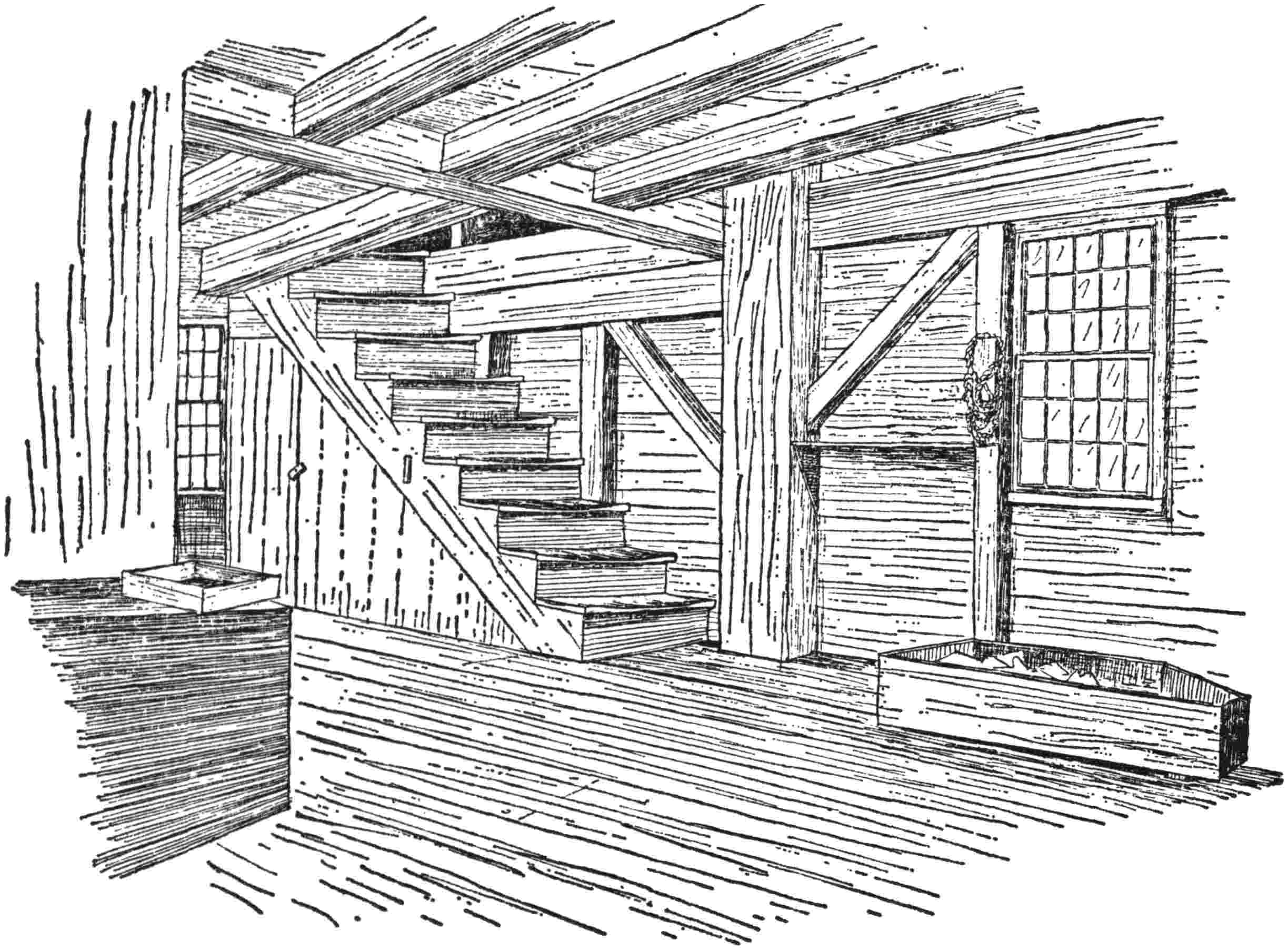
The beams, the corner post studs, etc. are of tremendous
size and all mortised, tenoned and dowelled, and hard as
rock. The stairs were worn paper thin; the floor was practically
gone. Dirt and dust, of course, were everywhere.
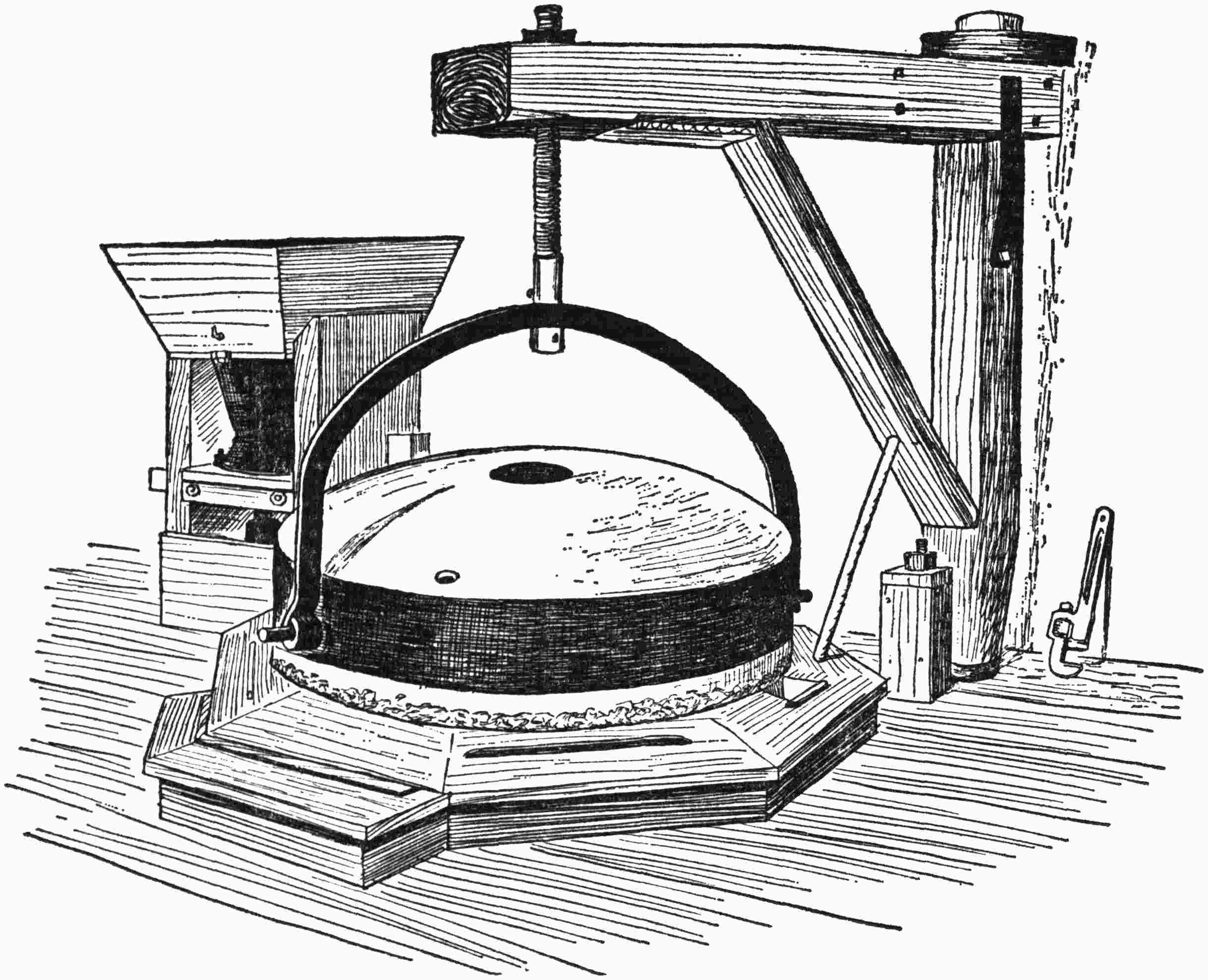
The stones are the French buhr type, which are practically
impossible to obtain today, to say nothing of the fact
that probably no stone could be obtained, except in upper
New England, so many of the old mills having been raided
and the equipment, especially the stones, taken away for
steps and other decorative purposes.
Eric Sloane, in his exceptionally fine and exhaustive research
entitled “The Vanishing Landscape,” refers to the
pattern of the stones, meaning the furrows or grooves cut in
the stone, against which the corn was ground.
Directly underneath the first floor of the mill were the
remains of a wooden pit, which was filled with sand, gravel,
and debris, accumulated over the years, particularly because
of the raising of the adjacent State Highway from time to
time, and more or less by the action of the elements.
Sticking out of the debris beneath the first floor was an
iron bar or shaft, about five inches in diameter, so George
and I and a couple of hired help went to work, and on hands
and knees we finally managed to dig enough away to stand
upright and eventually came to the top of the old turbine
which was so far rusted as to be beyond reconditioning. We
uncovered the complete wheel pit, the floor of which was
about twelve to fifteen feet below the level of the first floor
of the mill. This pit was made of hard pine, 2½ inch planks,
set against 12 × 12 hard pine uprights, and was about 10
foot square and probably 12 feet deep to the lower shelf,
called the “tail race.”
We had a rough time removing the old turbine with
some hydraulic jacks, muscle power, and the sage advice
and help of friend George.
Now, George is a married man, blessed with three children,
and I noticed in our local newspaper one evening shortly
after we had started work that his wife had experienced another
happy event. George had not mentioned this to anyone,
including me so when I suggested the next day that this
was a bit of a surprise, he said,
“You know, it was news to me, too. Last night about
three o’clock, my wife woke me up and said, ‘George, I
think you have to take me to the hospital.’
“I muttered, ‘What for?’, and she replied that she was
going to have a baby.
“You know”, said George, “I do declare that is just
what happened.”
I suppose everyone has a desire to investigate, to explore
into the past, and to relive some of our history and past
traditions. This mill and its restoration has provided us an
excellent opportunity to test our ability to do what the old
folks did. They were able, with their crude tools, to build
this mill and to actually make it grind corn in excellent fashion,
even to the extent of doing a thriving business. It is interesting
to reflect that they did not have the modern power tools
available today, nor did they really have the time we have
today, but these folks really built for permanence.
Eric Sloane aptly puts it by saying,
“What a shame that with all our timesavers and with
our abundance of wealth, we do not have the time today
and apparently cannot afford to build the way they did or
to use the excellent material they did.”
Why is it impossible for our builders and architects
to construct a house with a bow roof, for instance, a little
more overhang on the rake, a box return with gutters, a
decent-sized chimney, and many of those small things that
lend charm to a house and give it character and dignity?
Why are we satisfied with chicken houses, or is it that we
have not made the progress we thought we had?
All these things we thought about as we went about
the business of restoration.
IV
The peace and quiet of the mill pond every Saturday
morning was shattered by the rumblings of two water pumps.
These pumps had to suck out the water from the pit in the
flume to enable us to even see what we were trying to do.
Three or maybe four, very muddy characters, attired in the
necessary garments to withstand the cold, were always in
the depths of the mill, working in the mud, sand, gravel and
debris, and at times it seemed as though we were merely
moving these from one place to another, rather than disposing
of them.
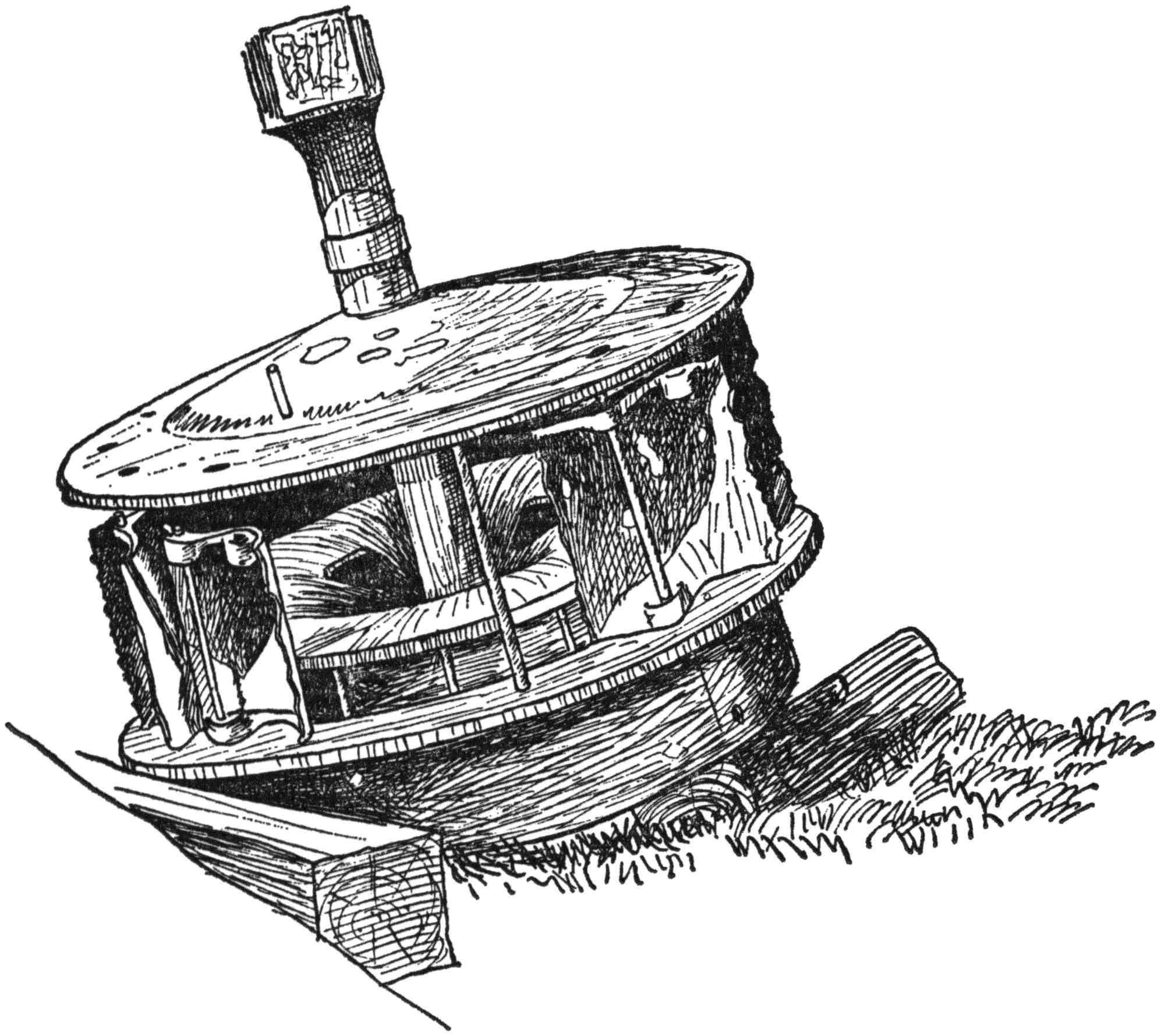
We finally managed to extricate the old turbine. The
simple mechanism and design of this ancient piece of machinery
to me is always marvelous. We had hoped to renovate
the old turbine and put it back in its place, but age and rust
made this impossible, and the turbine now rests on the shore
of the pond for all to see.
In the process of moving all the mud and sand, we
uncovered the remains of the original flume or sluiceway
leading from the mill pond to the wheel pit. We found
the flume to be about five and a half feet wide and originally
about ten feet high and, roughly, thirty feet long. The
sides were planked against 8 × 8 hard pine timbers which
were in turn cut or tenoned into 8 × 8 mortised supports,
twelve on each side of the flume, about two feet apart, and
each dowelled or pinned with one and a half inch hard pine
trunnells (wooden pins to you).
We were now down about twelve feet in the dike of
the flume, and we had to hand shovel and excavate all around
each stub of these timbers, knocking back the dowels and
prying out each stub. These uprights had been broken off
when the flume was filled in. Every one of the stubs and
the pins was bright and new as the day it was put in. Packed
around each section of each stub was about six inches of
semi-hard blue clay.
Apparently wood or any substance long immersed in
water will last forever and undoubtedly the clay we found
packed around each helped to preserve this wood. We threw
the stubs upon the top of the dike, and they were not in the
air and light two or three days before they turned gray,
discolored and aged looking.
George Woodbury, in his book, “John Goffe’s Mill”,
says:
“Wood can be almost indefinitely preserved if it is kept
either consistently dry or consistently wet all the time.
Let it get wet and dry out a few times and it quickly
decomposes. In Egypt where it never rains, wooden
objects are found well preserved after countless centuries
of burial. In Switzerland, the piles driven into the
Lac Neuchatel by the aboriginal lake dwellers are still
sound after two thousand years.”
We could not obtain any proper hard pine 8 × 8, but
we did find some creosote 6 × 8 hard pine timber creosoted,
about twenty feet long. Friend George very carefully made
the tenons, and we were able to replace them in the old
position from whence they came. This may sound easy, but
just try it!
After a few hours of this work, the writer became
exhausted. Hot baths and horse liniment helped somewhat,
but I think I can still feel the effects. The chances are, our
tenacious forefathers had no trouble whatsoever in this work.
We were able to re-use about fifty per cent of the old
pine pins, or trunnells, recovered from the joints. The new
ones we made by hand. I would suggest to anyone contemplating
such a venture as this that he would be wise to
anticipate endless frustration, hard work, and snide and
caustic comments from onlookers and discouraging prospects
of completion.
The embankment would cave in every few minutes,
notwithstanding our amateurish shoring attempts, but we
managed to keep ahead of the cave-ins by shoring up quickly
before the whole dam caved in on top of us.
During all this, the level of the water in the mill pond
had to be lowered so that we could work in this spot, which
is about two or three feet below the bottom of the mill pond.
The lowering of the water level resulted in great consternation
to the inhabitants thereabouts, whose only concern seemed
to be when were we going to raise the pond. No one seemed
to care about our sudden demise from the pond breaking
through the dam.
Of course, the pumps had to be working constantly
while we were employed in this operation. One of these
pumps was loaned to us by S. R. Nickerson of Hyannis, and
the other was given us by Colonel Ralph Thacher of the
Cape Cod Shipbuilding Corporation, some of the few persons
who were sympathetic with our cause.
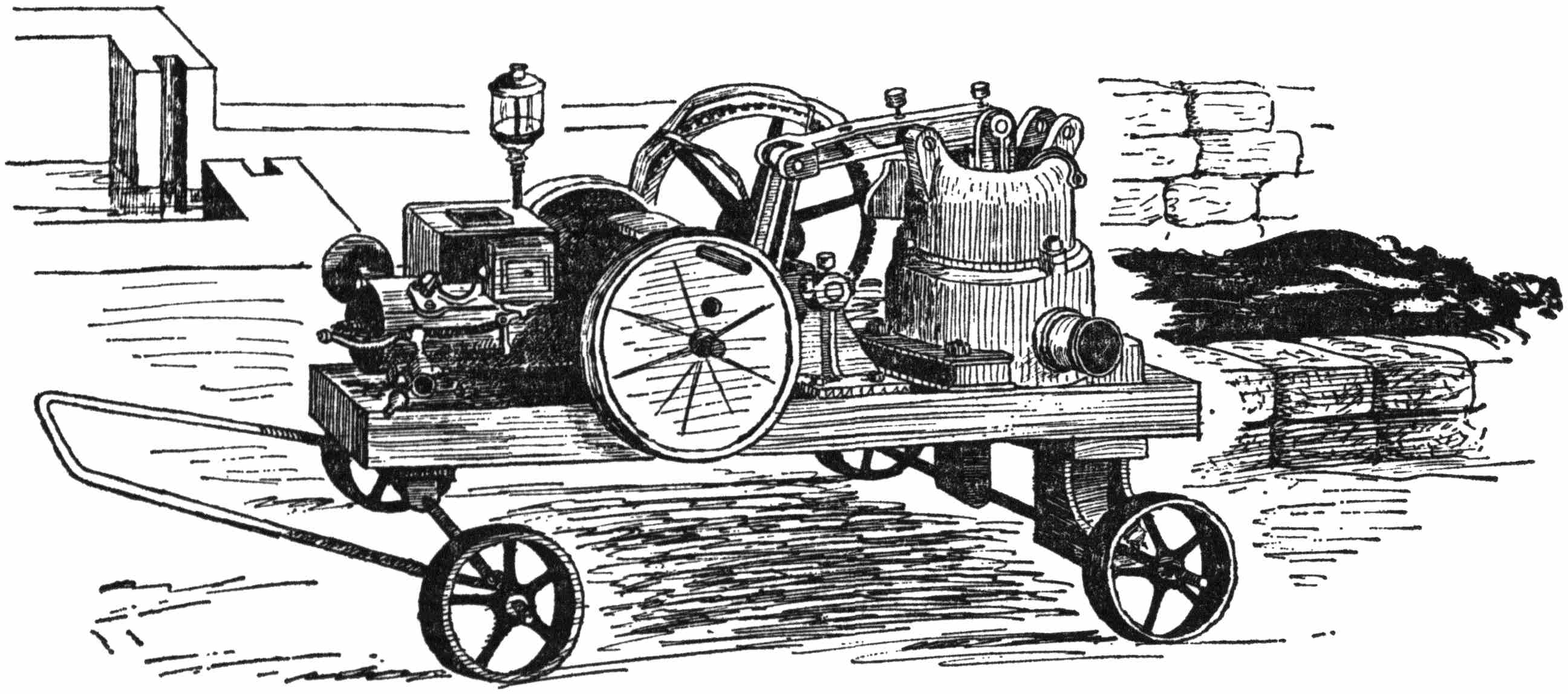
Although this pump from Colonel Thacher was probably
around fifty years old, it proved to be a most reliable
and excellent piece of apparatus, consisting of a large, horizontal,
single cylinder, “make and break” engine, driving a
heavy, eighteen-inch rubber diaphragm pump. It certainly
puts to shame some of the modern pump equipment of
today, chugging along hour after hour like a patient old
horse without much noise and clatter.
We all became very fond of this sturdy antique which,
to my mind, combines functional beauty with gratifying
simplicity and reliability. Cooling was a simple matter of
a pail of water in the cylinder jacket tank; lubrication was
by a few grease cups and an outside glass oil container about
the size of a large tea cup; and the starting was easy and
positive, all by hand.
All the visitors seemed to be drawn to this piece of
equipment when it was operating, and we signified our
tribute by mounting a small flag on the pump every Saturday
morning.
I should not forget to relate how Harvey Studley, a
young, local contractor, sent up three men and all the shingles
necessary to entirely re-do the roof of the mill itself. Harvey
also gave us a goodly supply of 10 × 10 hard pine timbers
which we put to good use in the sills and otherwise.
About six months before this project got underway,
Harvey, who is generally a quiet, peaceful soul, delivered
an impassioned speech at our annual Town Meeting, decrying
the lack of interest by the townspeople in the preservation
of some of our own landmarks.
The building itself had to be raised by Bob Hayden
and his crew, and a new foundation completely made on
the old. When this was done, new sills put in and the building
lowered, things looked a little better, for at least the
building sat upright.
Harvey gave concrete help, but although a good many
people expressed their admiration of the job we were doing
and the task which we had undertaken, we didn’t get too
much actual help. It is always more fun to watch work
being done.
We did, however, among other people, receive help
from a photogenic barrister, Harold Hayes, who spent an
afternoon in his boots with a shovel helping us to disturb
the mud of the centuries. One kind gentleman, whom I
do not know, was watching us one day as we were trying to
pry off some of the rusted bolts and nuts from the old turbine.
He showed up the next afternoon with a large, much-needed,
Stilson wrench which he donated to the cause.
Ben Baxter, one of the living heirs of the “Baxter boys”,
and a descendant of some of the best sea captains the Cape
has ever produced, gave much of his time and effort and
loaned us considerable equipment. Ben is an expert mariner,
engaged in ferrying cargo back and forth to Nantucket,
virtually bring “oil to the lamps of China”. I don’t think
anyone knows Nantucket Sound better than Ben Baxter.
Between his trips to the island, Ben found time to be with
us every Saturday. He is a stout fellow.
My friend, John Doherty, who is engaged in the building
of homes and selling of real estate, has delivered to us
many loads of loam, fill, and sand.
Charles Cunningham, a local contractor and builder
of large buildings, was most generous in offering the use
of his stock pile, where a treasure was found of different
sizes and shapes of all kinds of lumber and materials. He
told us to take anything we could use, and the offer was
music to our ears.
I do hope Mr. Cunningham didn’t feel too chagrined
when he saw how much we were taking, but nevertheless
he grinned and said to go ahead and take whatever we
wanted.
The Hinckley Lumber Company of Hyannis graciously
offered, and we quickly accepted, lumber and supplies from
their mill and warehouse.
Our busy surveyor of highways, Chris Marsh, loaned
to us from time to time a machine called a back hoe, which
does marvelous things, and some men to help with the hard
digging.
One generous soul, Tom Powers, has given us several
beautiful trees which we are planting and hope will live
to beautify the structure and the landscaping. Tom is a
director and officer of several banks, owns most of the real
estate on Cape Cod, and is a teller of tall tales in any dialect
you wish.
The two signs, and especially the final sign, which grace
the mill property were made by a sign painter and artist
extraordinary, one H. O. Thurston, of Centerville, a friend
of long-standing.
There were many times when it seemed to me we would
never finish this job; that it really was perhaps too much
for us to have ever started, what with our limited knowledge
and seemingly insurmountable obstacles. Somehow we all
kept going, hoping that we would finally have the mill
completed as we envisioned from the beginning. It reminded
me of the chap who had the tiger by the tail and didn’t
dare let go.
V
This land on which we live, called Cape Cod, is visited
by hundreds of tourists in the summer and dwelt upon by
the year-round residents, most of whom are totally unaware
of the richness of the tradition and of the way of life which
is found here. This way of life is quite different than any
one finds in any other part of our country. We do live close
to the sea, and we have many little villages nestled around
quiet, patient roads. We have innumerable ponds and lakes,
and the vast seas on either side of us. Express highways
bring crowds to the Cape, but there are many villages and
communities not encroached upon as yet to a great degree
by speed and hasty living.
Being close to Plymouth, the birthplace of liberty, and
the second landing place of the Pilgrims, we, of course, are
bound to history by close ties.
I think and I hope many people are becoming more
and more aware of the gradual loss and decay of our historical
landmarks, and my thought is to preserve the rich but
dwindling heritage of our traditional land, not by or through
the Federal Government or by the State Government, but
by all the people in local communities through our own
Town Government.
There are a few restoration projects now under way
and some have been completed in the past few years. I can
think quickly of the West Parish Meeting House in West
Barnstable, which can be seen from the Mid-Cape Highway;
the old Hoxie House in Sandwich; the Sandwich Water
Mill, now being restored by the Town of Sandwich, which,
by the way, has a most excellent setting at Shawme Pond,
in which are reflected the tall, white buildings surrounding
it; the Brewster Mill at Stony Brook, having been restored
about three years ago by the Town of Brewster, where one
can purchase corn meal every Saturday afternoon at twenty
cents per pound.
I recently purchased some of the corn meal from the
Brewster Stony Brook Mill, where it is slowly ground between
old millstones, and if you have never tasted corn meal muffins
made from this flour, you are in for a real treat. Ground in
this manner, the corn apparently keeps the goodness and
the natural nutrients of the grain. It is not processed and
bleached to a point where it tastes like a blotter. It actually
tastes like corn. We have also tried some of the wheat flour,
and the bread made from it is something to be experienced.
Other restoration projects that come to mind are two
or three windmills in Chatham and Eastham which have
been restored or reproduced, and a few herring runs, but
there are many other places and sites that are gradually
going unless we all make some effort to preserve them.
We cannot, of course, entirely recapture the way of
life in the 1800’s, nor probably would we want to, but it
would seem that we could preserve and keep that which
was good and those methods which were efficient, employed
so long ago. I don’t think anyone wants to give up our
electric lights for the old oil lamps, nor indoor bathrooms
for the outside “privy” (notwithstanding hearsay that the
outdoor “privy” was quite pleasant on a balmy summer
afternoon), but there are many things which we can learn
from the old people that certainly would make our mode
of living and our existence a bit more pleasant, tranquil and
serene.
Although it may cost a bit more to “post and beam” a
house, a bit more for a bow roof, or box returns, or dental
work on the trim, I do believe that many people would really
prefer this type of construction once they have seen it, and
I do know that most people could afford it. I will also go
farther out on a limb and say that this type of construction
is actually cheaper in the long run, and the long run means
the lifetime of a house.
Plymouth is now embarking on a very ambitious program
of rebuilding the old “Plimouth Plantation”.
I do not think that we on the Cape can do another
Williamsburg, nor do I think that we should try to restore
everything we find, but each town could do a little bit each
year toward setting aside some of its historical treasures.
We have all kinds of beaches, public landing places,
swimming pools, both public and private, for the two-week
visitor in the summer, all kinds of dance halls and bowling
alleys for their entertainment; but what a great wealth of
information, interest, and education could be aroused through
the restoration of some of the old buildings and landmarks.
The Yarmouth Historical Society, like many other similar
groups, has been doing an excellent job. The Captain Bangs
Hallett house has been authentically repaired, restored, and
reconstructed by and through the Historical Society. Captain
Bangs Hallett was one of the deep-water sailors who commanded
some of the well-known clipper ships, the giants of
the sea. This house is open to the public every afternoon
in the summer and reflects the way of living at that time
of the more well-to-do sea captains.
My idea is not to restore the Baxter Mill just as another
museum which would be filled with all kinds of ancient bric-a-brac,
furniture, glassware and curios for people to look
at and pass by. My thought is that we should restore and
reconstruct this mill, holding to exact authenticity, so that
the final result would be exactly the same mill with its fundamental
mechanisms and its simple dignity, and turn out the
same products.
VI
Snow and bitter weather came early to Cape Cod in
December, 1960. We have always bragged about the mild
winters enjoyed on the Cape, but we certainly had a real
old fashioned one this year. Every Saturday it seemed that
the very nastiest weather prevailed, but on Monday it was
beautiful.
It was really hard work in this flume and in the wheel
pit at ten and twelve above zero, notwithstanding our heavy
winter clothing, but nevertheless about ten o’clock a welcome
coffee break was taken. Time after time ice would
form and congeal around our boots while we were working,
and a penetrating, deadly chill arose from the wheel pit.
I don’t know how many hours were spent in breaking up
the ice before we could even start to work. Fortunately, no
one seemed the worse for wear.
We collected all kinds of lumber, materials, and supplies
of various descriptions, widths, and lengths, piling all of
this around the mill site. It was a great source of concern
to many passers-by where we possibly could be putting all
this vast amount of lumber and supplies. Those that took
the time to see could readily understand the large amount
of lumber necessary to go into the wheel pit and the flume.
Joe Carapezza, the stone mason, was then employed
and did a most excellent job in renewing the foundation and
rebuilding the retaining walls, mostly out of old dressed
granite blocks. These old fashioned dressed granite blocks
are about two and a half feet long and about ten to twelve
inches square and make a most attractive addition to the
landscape of the mill. Not being accustomed to this heavy
work, which was indeed difficult for a professional like Joe,
you can well imagine that I gradually gravitated to an assistant
hired hand, but in this weather one did not stand around
and become solidified. It was necessary, for self preservation,
to keep moving, and while you are moving you might as
well be doing some work.
We did indulge in a welcome respite at ten o’clock on
a Saturday morning of adjourning to my homestead where
we would have some hot coffee and doughnuts. I don’t
know how many gallons of coffee and how many doughnuts
we consumed over this year and a half, and I don’t know
how much mud my wife had to clean up in the kitchen
after we all tramped in and out. We were all very thankful
to her, however, for putting up with us.
Friend George is slow, meticulous, and very exacting.
As for myself, I know that I am impatient and I have to do
everything in a hurry. Naturally, both our natures at times
clashed, but I think one was good for the other.
I did object strenuously to George’s most annoying
habit of suddenly standing up and shouting,
“Harold, where is the rule?”
I found that ignoring him did not help, so I acquired
some earmuffs which worked admirably until George resorted
to making signs and perhaps lifting up one of the earmuffs
and gently requesting the rule. Incidentally, the rule most
of the time was sticking out of his own pocket.
Everyone slept fairly well after a day’s work at the mill,
but I asked George one morning how he slept. He replied,
“Not too well. I had to turn over once.”
I furnished no small amount of amusement to my co-workers
as I tried to fashion a fifteen-foot board to the floor
of the mill. The board had to be fitted in about five places,
and I would saw and cut and chisel and then saw and cut
some more, finally ending up with a board about three feet
long, much to the gratification and mirth of my so-called
assistants.
It seems that shingles are always in demand no matter
whether you are rebuilding an old building or building a
new one. I never realized how handy shingles were until
we began this project. Apparently, shingles were made not
only for roofs and side-walls, but to take up the error in
the professional’s work.
Somewhere in Maine George made a large speech to
an assembled populace about the necessity of everyone having
shingles at hand.
VII
New England is especially favored with many rivers,
streams, ponds and lakes, and it is with never-ending admiration
that one reflects on the ingenuity of the early settlers
putting to practical use all of the water power. Throughout
the whole region will be found hundreds of remains of water
mill sites, small and large, and the settlers soon found ways
of putting a harness on them for water power.
If the stream happened to be small, the early millwright
built a dam across it and in no time he acquired a small
pond. The higher the dam, the greater the head of water.
Where there were large rivers, you can now find tremendous
power plants, textile mills and other manufacturing
establishments all using this water power.
Most of us today, when we think of power, think of
electricity, gas, or steam, but it is very simple to consider
the water in an ordinary little stream and the amount of
power it can deliver.
Although the machinery built by the early millwrights
was a bit crude, nevertheless it was functional and worked
with efficient success.
On a recent scouting trip George and I took through
Massachusetts, New Hampshire and Connecticut, we visited
a few restored mills. One of them was in Rowley, Massachusetts,
just off the Main Road, called the “Jewel Mill”. Here
an enterprising and resourceful chap had rebuilt the outside
water wheel on a fairly small stream and he was driving a
small D C generator supplying electricity to his house and
to a small lathe shop. This, he told me, had been going on
for five or six years without interruption. The lights were
steady and there was no fuss, clamor, or noise. The only
thing one heard was the splashing of the water over the
wheel. His mill was so named because he was actually cutting
and polishing small, local, semi-precious stones.
I find that there is a small group of enthusiasts who are
gradually picking up and collecting all the old turbines
they can find of ancient vintage, so if one wishes to invest
in the future, he might consider picking up one of these old
turbines which in a few years will be extinct.
Another interesting site we visited was John Goffe’s
Mill near Manchester, New Hampshire. Having read with
fascination George Woodbury’s tale of restoring this mill,
we were very anxious to actually see it. Mr. Woodbury, a
very learned gentleman, former archaeologist and now author,
had performed a most remarkable job.
Another mill, farther along the trail, was in Alstead,
New Hampshire, where Heman Chase was conducting a
class in woodworking, the power being supplied by an old
refinished turbine. Mr. Chase, in addition, is a land surveyor,
a teacher of mathematics and the philosophy of Henry
George, as you can see from his letterhead.
At Weston, Vermont, at the Artists’ Guild, will be found
a real old mill where they are grinding corn and wheat and
other grains.
Late the first night of this expedition, George and I
holed up in a modern motel somewhere in New Hampshire.
I was not quite prepared for George’s night attire. It seems
he still wears an old fashioned nightshirt, split up on each
side, and I got a bit of a start to observe this character
climbing into bed with this on. George will deny this, but
he also had on an old night-cap.
Coming home we went to Monson, Massachusetts, and
there found all kinds of mill apparatus in various states of
repair, gradually rusting out and disappearing into the
ground. I was a little sad to observe how the owner was
tenaciously clinging to his old way of life: his machinery,
tools, and all the things he had collected all his life. But
how his eyes did light up with enthusiasm when he learned
we were attempting to restore our own mill.
A tall, gaunt man, weather-beaten, with hands that had
known many a piece of machinery, he was a living figure of
the old millwright and gave us a great amount of information
on the revolutions per minute and various other facets
of millwrighting.
Most of us think of antique things as so many curios
and objects to be placed in museums to be passed by, but
we do not realize how much better some of these things
did work than the ones we buy today. For instance, I have
a small hand garden trowel, forged perhaps fifty or sixty
years ago, and it is much more practical than the new trowels
on sale in the hardware stores. I have often wondered why
they couldn’t make one like this rather than the ones on display
but perhaps this kind would last too long and the factory
would go out of business.
We did not find on our pilgrimage a turbine suitable
for us, but we did find the brilliant foliage of the hills and
mountains, the quiet patience of the roads, and the beauty
of the small towns of New England.
A few weeks later our fast trip in upper New England
paid off, for we heard by mail of a turbine that seemed
might be just right for our purposes. Chuck Stanley gave
us the loan of his truck and George and I, fortified by a
packed lunch, hot coffee, and sandwiches, started out at
4:00 A. M. one Sunday morning for Livermore Falls, Maine.
There, we found on the side of a hill an old turbine
weighing about two ton, and after poking about this monster
we decided we could use it.
The task of loading this beast upon the truck seemed
formidable, so we finally located a mountaineer who possessed
an oversized auto wrecker, and backing our truck
against a strategic hump on the side of the hill we proceeded
to load the turbine on the truck. The wrecker hooked onto
the turbine, but the turbine proved too much for it, so much
so that it turned it over on its side.
A goodly crowd had by this time gathered to watch
the operation, and enlisting the aid of some husky boys, we
finally managed to push the wrecker back on its four wheels.
Friend George, in his unruffled manner, soon had the
turbine on the truck, and we fell to the task of shoring it
up with chunks of wood, plank and chalks. We could vividly
imagine what would happen if this baby got away from us
going down some mountain, so we took a long time in lashing
it securely to the truck.
Of course, George could not let the day go by without
shouting,
“Harold, where is the shingle?”
“Didn’t bring one,” I replied.
Then followed an impassioned speech by friend George
from the tailboard of the truck to the assembled populace,
extolling the virtues of shingles and decrying the negligence
of the author in not bringing at least one shingle to Maine.
VIII
A brief glimpse of the Cape Cod Village in the 1800’s
and its everyday life in those days would be interesting and
would also throw some light on the fascination of the mill.
This mill and many others like it played a most important
role in our small towns, as did the country store, the blacksmith
shop and, of course, the church.
On the Cape at about that time, there were between
thirty and forty mills, either powered by wind or water,
and these mills supplied flour and corn in its various stages
to the villages. Corn then was more important than gold.
The meal, of course, was used for corn meal muffins and
corn bread, and the cracked corn for the chickens and pigs.
Every family was practically self-sufficient, growing
their vegetables, and if they did not have a cow, trading
eggs or other produce for milk or cream with their neighbors.
Almost everyone would supplement their food supply with
shellfish from the shores and flats and fish from the various
boats that plied the sound and bays. There were many
orchards, most of which have now disappeared. One can
hardly find a grape arbor left, but in those days apples and
other tree-grown fruit were found in every other home or
homestead. Cranberries played no small part, but they were
just about developing in the 1880’s, and I can remember
distinctly, while growing up in Brewster, of earning small
amounts of money from time to time helping the farmers
harvest their cranberry crop, together with asparagus, turnips
and strawberries.
I cannot remember any people being on Old Age
Assistance, and I recall distinctly there was no Social Security
program. There was always something for everyone to do
whether they were young, middle-aged, or old. For us young
children there were ordinary chores in and about the house
to be done morning and evening, cutting the kindling, getting
wood ready for the fires, and generally being handy boys
around the house and barn. I can definitely say there were
no gangs of teenagers with switchblades. “Mac the Knife”
was wholly unknown. The only knives we had were pocket
jackknives used for whittling and playing mumbley-peg.
I can remember that there were many things to do the
night before the Fourth, but I can remember no destruction
of property. Perhaps a few privies might be displaced, and
on Halloween fences might disappear, but they were always
found somewhere, and the culprits made to replace them.
In the Fall almost everyone would gather seaweed
from the beaches and bank it around the house, because
only the very rich could afford full basements and what we
call central heating. The small, round Cape Cod cellars were
used to keep fruits and vegetables.
I can also distinctly remember working on the town
roads, helping to get in ice for the ice houses, and I can also
remember that almost every boy knew how to handle a
hammer, a saw, screw driver, or chisel, which did not seem
work to us at the time.
The mill was not exactly a gathering place for the
country folk; that was left to the country store. In Brewster,
the mail would come in about 6:00 P. M., and it was a great
thing for us younger boys to gather at the Knowles’ store
at about the time the mail was due and listen to some of
the older men around the stove discuss the events of the
day and the nation.
I do not recall many critical periods of wars and threats
of war, but I do recall the fusion of the wonderful odors of
the country store, the far off cry of the lonely whistle of the
mail train, the hard candy, and the attractive chocolate-colored
tobacco. I can also recall vividly the old time
“drummer” with his fancy, gay, colored straw hat, the horse
drawn carts that would bring groceries, meat and fish once
or twice a week.
All around the towns, almost everyone had a horse and
some more well-to-do people had two or three. It was not
necessary to turn in the horse every year, because the model
never changed. The horses sometimes died, but only after
twelve or fourteen years of good service. Almost everyone
owned a so-called Cape Cod truck wagon, painted a faded
blue color.
I can remember the May baskets, the sleigh rides, and
sliding down the hill in High Brewster in the winter-time.
All this is in sharp contrast to the children on the present
day and the problems of juvenile delinquency. Undoubtedly
lack of parental care and instruction, to say nothing of planned
obsolescence, time payments, and lack of individual
initiative, can be blamed for the conditions. Being fortunate
to have been born at about the turn of the century, when
the era of the horse was just about departing and the automobile
beginning, I think I am in a fairly good position to
compare conditions of that day with today.
I might say that I do recall when I was about ten years
of age, my mother and grandmother sadly declaring that
things at that time were different when they were children,
and that they did not know where we then were going. I
put this in to show that there may be an answer to all this
through the process of evolution. I do not know.
I do know that the flour and the meal coming from
these old and ancient mills produced much better food than
the present day processed flour and meal.
I can remember many of the older figures of that time.
Seth Rogers, a typical country gentleman, and many other
well-known men about that time, who were not looking for
something for nothing. They all did work of one form or
another, either on their farms or their cranberry bogs, or
in some business or trade. They did not have much time,
but the time they had was put to great use in production.
They did not have too much money because they did not
need it. A man that died leaving an estate of $5,000.00 or
$6,000.00 was considered reasonably wealthy. These men
would do something for their town without expecting great
pay in return; they were not constantly looking to the town,
state, or government for handouts. They produced and developed
a way of life totally different from the way we have
today.
IX
Now, after the machinist has repaired and fixed up the
old coupling, and other parts of the old turbine which could
not withstand our battering, it becomes necessary to drop
the turbine in place and hope everything will work.
First, we have to pull out the temporary retaining walls
next to the tailrace, dig down below the pool, and put in
a brand new wall, so that the rush of water will not tear
away the earth next to the State Highway which would stop
all the dear people from dashing about on the State Highway,
especially the tourists.
I have often wondered what I would do if this mill
doesn’t work when we get through. All sorts of suggestions
have come from skeptics, the practical ones being to install
a gas engine or electric motor to turn the stones. I doubt
very much that we will ever do this. We are still convinced
that if the early settlers and tenacious people could make this
work with their cumbersome and crude tools, we can do
the same thing with our so-called improved modern equipment
and tools.
So now the flume is finished, a good solid bridge is built
over it, and we must go and dig out and repair the tailrace
and get ready to place the new turbine in its position.
This tailrace runs from underneath the building, from
the bottom of the turbine out to the pool near the State Highway
and then under the State Road into Lewis Bay. All the
rocks which attempted to retain the embankment adjoining
the State Highway were merely dumped there by someone
hoping they would shore up the embankment. The result
was, over the years they were gradually disturbed and found
their way into the pool, and, of course, a lot of the dirt and
sand from the embankment slipped off into the pool and the
bottom of the tailrace.
So we again call in our stout and genial mason, Joe
Carapezza, and a machine to dig out the rocks, dirt and mud.
Putting the rocks back into a firm and complete wall turned
out to be a little more of a job than we planned on.
Every one of the rocks, some of which weighed from
five hundred to a thousand pounds, had to be handled manually,
as there was no room for cranes and the like to lift
them up and work them around. After about two weeks of
this, we finally managed to build a fairly solid retaining wall
next to the tailrace.
Just about this time the herring began their annual migration
to their spawning ground, so we had to raise the
level of the mill pond so that nature could take her course.
It would seem that every time a weekend came around
there was either rain, snow, drizzle, or some other sort of
foul weather, which didn’t help things along a bit.
In browsing through some old pamphlets by one Daniel
Wing, a school master who taught school in Yarmouth
about 1900, I ran across the following interesting paragraph:
“The old gristmill directly opposite the Captain Baxter
residence was known as Baxter’s mill. It was at one
time owned by Captain Timothy Baker, Senr., (born in
the first half of the eighteenth century) and later by
his son, Captain Joshua Baker, born in 1766. The mill
pond was fed by several streamlets which came down
from the north, but its work having been completed, the
dam has been allowed to wash away; and, there being
some question as to ownership, we learn that this once
beautiful and interesting spot is now grown up with
rushes. It seems as if the water power here might, in
this day of improved machinery, be made again to serve
a useful purpose.”
I wonder if Daniel can see the mill now.
The old turbine that we excavated from a side hill in
Maine was lowered into place after much straining, blocking,
and running around. George’s careful measurements
and minute calculations paid off, because it fitted perfectly
in the large hole cut in the bottom of the wheel pit. We
had to call upon the machinist to fashion a coupling in order
to fit the old coupling still left on the shaft coming down
through the first floor into the wheel pit from the gears
above.
While this was being done, George, Dick McElroy, and
I managed to make a decent pen gate with the necessary
worm gear attached to it so that we could block off the water
in the flume and raise the gate when necessary.
At this point I happened to mention to one of my friends
that I would like to find, somewhere, a metal wheel similar
to a freight car brake wheel that we could use on the shaft
to raise and lower the pen gate. A few days later, my friend
left at the mill a real old timer. It was a wheel which was
about two and one-half feet in diameter, and which was
nicely adapted to the top of the rod of the pen gate. This
wheel suspiciously looked similar to a wheel that would toll
a bell on a church steeple, and when I suggested the possibility
of this to my friend, he merely smiled and walked
away.
X
We have used to a great extent Oliver Evans’ “The Young
Mill-Wright and Miller’s Guide.” This book was printed
about 1800, and I think I have referred to it before, but it
has proved invaluable to us in the course of our work. The
words and references in the book may have meant something
to the millers one hundred years ago, but not us poor amateurs
of 1961, the words millseat, flutterwheels, cockheads,
cubocks, to say nothing of “tailflour,” confused us no end,
but on closer reading and more attention to the details of
the book, we did finally make some sense from it.
Under Article 108 in this ancient volume is found the
following:
“Of Regulating the Feed and Water in Grinding.”
“The stone being well hung, proceed to grind, and
when all things are ready, draw as much water as is
judged to be sufficient; then observe the motion of the
stone, by the noise of the damsel, and feel the meal; if it
be too coarse, and the motion too slow, give less feed
and it will grind finer, and the motion will be quicker;
if it yet grind too coarse, lower the stones; then, if the
motion be too slow, draw a little more water; but if the
meal feel to be ground, and the motion right, raise the
stones a little, and give the motion right, raise the stones
a little, and give a little more feed. If the motion and
feed be too great, and the meal be ground too low,
shut off part of the water. But if the motion be too slow,
and the feed too small, draw more water.”
I doubt very much that the venerable Mr. Evans would
have relished “the noise of the damsel” if he had observed
George one sunny afternoon pick up a luscious creature of
the female sex, heave her over his shoulder and transport
her into the depths of the mill, all in plain sight of the general
public. It seems that it was a little too muddy for this
fair lady to walk to the mill, but the following week, however,
the same damsel was there and took the same ride on
George’s shoulders into the mill.
We could not and did not observe either the motion or
the noise of the damsel, which probably is just as well.
The damsel referred to by Evans, however, is nothing
more or less than a square wooden shaft which turns against
a shoe suspended under the spout of the hopper to regulate
the flow of grain into the stones themselves.
There is, of course, a definite rhythm to the clatter created
by the damsel, and this is what Evans was speaking
about in “noise of damsel.”
Farther on in Evans’ book, it states that we must “pick
up the stones” and sharpen them, but as I said before, we
found that we were too ignorant of the art of sharpening
the stones, and that is why we obtained the services of Mr.
Mattson, who did an excellent job in “picking up” the stones.
It is interesting to read Evans’ book, and I have taken
the time to copy directly from the book the chapter on the
“Duties of the Miller.”
“CHAPTER XVIII
Directions for keeping the mill and the business of
it in good order.
Article 116
The Duty Of The Miller
The mill is supposed to be completely finished for
merchant work, on the new plan; supplied with a stock
of grain, flour casks, nails, brushes, picks, shovels, scales,
weights, etc., when the millers enter on their duty.
If there be two of them capable of standing watch,
or taking charge of the mill, the time is generally divided
as follows. In the day-time both attend to business, but
one of them has the chief direction. The night is divided
into two watches, the first of which ends at one o’clock
in the morning, when the master miller should enter on
his watch, and continue till day-light that he may be
ready to direct other hands to their business early. The
first thing he should do, when his watch begins, is to see
whether the stones are grinding, and the cloths bolting
well. And secondly, he should review all the moving
gudgeons of the mill, to see whether any of them want
grease, etc.; for want of this, the gudgeons often run dry,
and heat, which bring on heavy losses in time and repairs;
for when they heat, they get a little loose, and the
stones they run on crack, after which they cannot be
kept cool. He should also see what quantity of grain is
over the stones, and if there be not enough to supply
them till morning, set the cleaning machines in motion.
All things being set right, his duty is very easy—he
has only to see to the machinery, the grinding, and
the bolting once in every hour; he has, therefore, plenty
of time to amuse himself by reading, or otherwise.
Early in the morning all the floors should be swept,
and the flour dust collected; the casks nailed, weighed,
marked, and branded, and the packing begun, that it
may be completed in the forepart of the day; by this
means, should any unforseen thing occur, there will be
spare time. Besides, to leave the packing till the afternoon,
is a lazy practice, and keeps the business out of
order.
When the stones are to be sharpened, everything
necessary should be prepared before the mill is stopped,
(especially if there is but one pair of stones to a water-wheel)
that as little time as possible may be lost: the
picks should be made quite sharp, and not be less than
12 in number. Things being ready, the miller is then to
take up the stone; set one hand to each, and dress them
as soon as possible, that they may be set to work again;
not forgetting to grease the gears and spindle foot.
In the after part of the day, a sufficient quantity of
grain is to be cleaned down, to supply the stones the
whole night; because it is best to have nothing more to
do in the night, than to attend to the grinding, bolting,
gudgeons, etc.”
Shades of the coffee break and the forty-hour week!
Apparently Evans and his millers hardly found time to stop
and get a bite to eat.
Interesting, the old methods and way of life compared
with our present day methods and ways of existence.
XI — Transcriber’s Notes
The summer of 1961 is now hard upon us, as is the
horde of vacation seekers; so, at least for a while, we are
forced to give up our labors at the mill and go to other pursuits,
but just as soon as autumn comes around we start in
again Saturday mornings at the old mill site.
The mill stones had to be sharpened and we found out
that this was really beyond the scope of our knowledge and
skill.
Inquiries at Old Sturbridge Village in Sturbridge, Massachusetts
led us to finding one of the few men left who
could “pick up” the stones. This gentleman, Arthur Mattson,
of Plainville, Connecticut, consented to come, and finally did
come to the Cape, and in a matter of hours had sharpened
the stones to the nth degree.
While he was here, we gleaned as much information
from him as we could, in the course of which we found
that he owned five mill stones which were grinding out stone
ground flour, and that he had been supplying, for many years,
the stone ground flour to the Pepperidge Farm Mills in Connecticut,
famous for their Pepperidge Farm Bread.
Among other things, he showed us how to construct a
“damsel” (which is nothing but a small flutter board hung
below the mouth of the hopper) and wiggles just enough
to let the grain drop into the stones at the proper quantity.
About a year from the date we started to work on the
mill, to wit: August 3, 1960, we are able to open the pen
gate, let the rushing water fill up the flume and wheel pit,
raise the skirt in the turbine, and with a feeling of great
self-satisfaction, see and hear the stones turn, albeit, a little
slow at first, since the stones were not properly balanced,
but, nevertheless, lo and behold, all our work finally paid off.
Someone shouted, “Ho, ho, she starts, she moves, she
feels a spark of life.” You can well imagine who that was.
As near as we can figure, these stones had not been
turning for exactly seventy-one years, and frankness would
be lacking if we did not feel proud of our hard work and
efforts.
The mill actually ran smoothly, and with very little
noise, but to be sure that we were not subject to hallucinations
we spent the better part of the afternoon turning the
wheel off and on. The wheel and its heavy but simplified
gears responded with slow speed and gradual pick-up of
revolutions to a very deliberate cadence.
Again I was struck with the simplicity of the working
of the turbine and wheel, and perhaps the economy of the
whole affair was intriguing. One had only to look at the water
pouring into the wheel pit to see the power of the stream and
to reflect upon the fact that it cost absolutely nothing for this
power. Gear grease, oil or other lubrication was absolutely
unnecessary to maintain the operation.
The stones were originally enclosed and covered with
a wooden casing, half of which we found in the mill, but the
other half we had to build ourselves and make them, of
course, exactly as the first half. As usual the boards that
were available at any lumber yard were not the same thickness,
so again we had to have proper boards milled out to
match up with the old. Finally, George found an old blade
adequate to make the same beading on the edge of these
new boards as the original beading, and it was not too difficult
to do with the aid of this old fashioned plane.
About this time we received in the express from Mr.
Mattson, the genial gentleman from Connecticut, who had
sharpened the stones, a cradle and a shoe. The cradle is to
hold the hopper and the shoe is for support, as I said before,
underneath the spout of the hopper.
The cradle was practically a perfect fit on the top of
the wooden casing, and the hopper fitted the cradle perfectly.
This was one time something really did fit.
And so - - - - just before the Christmas Holidays
of 1961 everything seemed to be about finished. We procured
a bag of whole corn, part of which we dropped into
the hopper, opened up the pen gate, and lo and behold, yellow
gold came flowing out of the chute. To be sure, at first
the meal was a bit coarse, but after George maneuvered the
“tenterer,” we obtained about the correct texture of meal.
It has been said that the end of something is better than
the beginning, but I think I felt a little sad that we were
finished and somewhat surprised that the mill actually worked.
Sad, perhaps, because we had no more to do to complete the
mill project. We were constantly uncovering new sights in
the ancient mill. The actual work, the research, the conversations
with new people, the reading of stories of old mills,
seeing the old mills, some of which were restored and others
abandoned, and being able to finally rebuild this old mill
and to renew a small part of life now long forgotten, has
been most fascinating.
George just called me on the phone, saying,
“Harold ... you know what?”
“No, what?”
“I think I have found an old tide mill - - - -”
Punctuation, hyphenation, and spelling were made
consistent when a predominant preference was found
in the original book; otherwise they were not changed.
Simple typographical errors were corrected; unbalanced
quotation marks were remedied when the change was
obvious, and otherwise left unbalanced. Two
typographical errors in quoted text on page 37
were corrected after consulting a copy of the
book from which the quotation was taken.
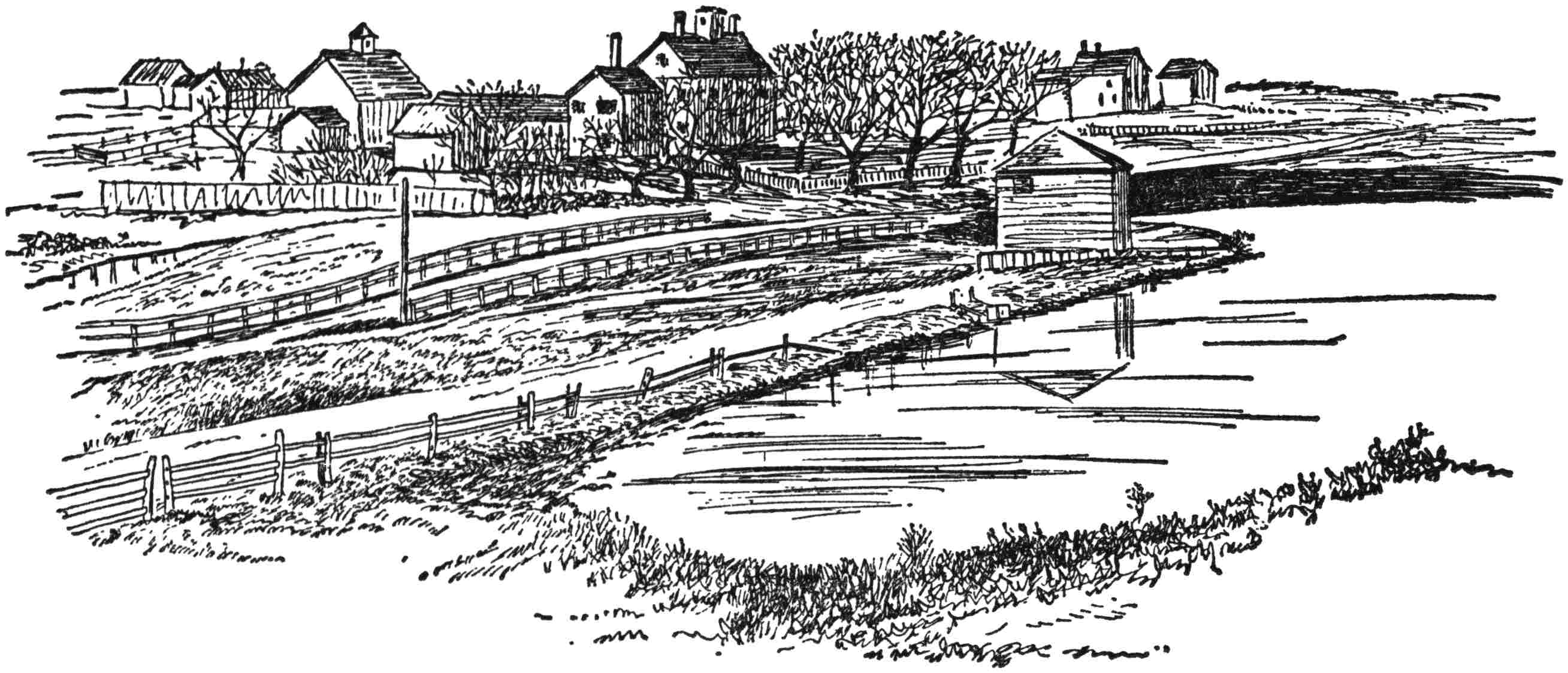
The illustrations at the ends of chapters I, II, VI, VIII, and X
are simple decorative tailpieces.