AN was much like other twelve-year-old boys in having a keen interest
in Indians and in wild life, but he differed from most in this, that he
never got over it. Indeed, as he grew older, he found a yet keener
pleasure in storing up the little bits of woodcraft and Indian lore
that pleased him as a boy.
His father was in poor circumstances. He was an
upright man of refined tastes, but indolent—a failure
in business, easy with the world and stern with his
family. He had never taken an interest in his son's
wildwood pursuits; and when he got the idea that
they might interfere with the boy's education, he
forbade them altogether.
There was certainly no reason to accuse Yan of
neglecting school. He was the head boy of his
class, although there were many in it older than
20
himself. He was fond of books in general, but those
that dealt with Natural Science and Indian craft
were very close to his heart. Not that he had many—there
were very few in those days, and the Public
Library had but a poor representation of these.
"Lloyd's Scandinavian Sports," "Gray's Botany"
and one or two Fenimore Cooper novels, these were
all, and Yan was devoted to them. He was a timid,
obedient boy in most things, but the unwise command
to give up what was his nature merely made him a
disobedient boy—turned a good boy into a bad one.
He was too much in terror of his father to disobey
openly, but he used to sneak away at all opportunities
to the fields and woods, and at each new bird or
plant he found he had an exquisite thrill of mingled
pleasure and pain—the pain because he had no name
for it or means of learning its nature.
The intense interest in animals was his master
passion, and thanks to this, his course to and from
school was a very crooked one, involving many
crossings of the street, because thereby he could pass
first a saloon in whose window was a champagne
advertising chromo that portrayed two Terriers
chasing a Rat; next, directly opposite this, was a
tobacconist's, in the window of which was a beautiful
effigy of an Elephant, laden with tobacco. By going
a little farther out of his way, there was a game store
where he might see some Ducks, and was sure, at
least, of a stuffed Deer's head; and beyond that was
a furrier shop, with an astonishing stuffed Bear.
At another point he could see a livery stable Dog
that was said to have killed a Coon, and at yet
another place on Jervie Street was a cottage with
a high veranda, under which, he was told, a chained
Bear had once been kept. He never saw the Bear.
It had been gone for years, but he found pleasure
in passing the place. At the corner of Pemberton
and Grand streets, according to a schoolboy tradition,
a Skunk had been killed years ago and could still
be smelled on damp nights. He always stopped, if
passing near on a wet night, and sniffed and enjoyed
that Skunk smell. The fact that it ultimately
turned out to be a leakage of sewer gas could never
rob him of the pleasure he originally found in it.
Yan had no good excuse for these weaknesses, and
he blushed for shame when his elder brother talked
"common sense" to him about his follies. He only
knew that such things fascinated him.
But the crowning glory was a taxidermist's shop
kept on Main Street by a man named Sander. Yan
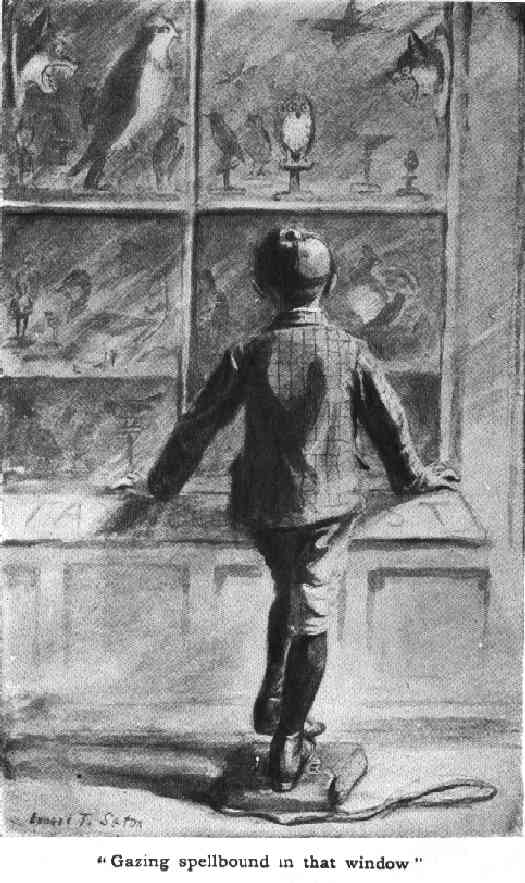
spent, all told, many weeks gazing spellbound, with
his nose flat white against that window. It contained
some Fox and Cat heads grinning ferociously,
and about fifty birds beautifully displayed. Nature
might have got some valuable hints in that window
on showing plumage to the very best advantage. Each
bird seemed more wonderful than the last.
There were perhaps fifty of them on view, and
of these, twelve had labels, as they had formed part
of an exhibit at the Annual County Fair. These
24
labels were precious truths to him, and the birds:
| |
Osprey
Kingfisher
Bluejay
Rosebreasted Grosbeak
Woodthrush
Scarlet Tanager
|
Partridge or Ruffed Grouse
Bittern
Highholder
Sawwhet Owl
Oriole
* * * * * * *
|
were, with their names, deeply impressed on his memory
and added to his woodlore, though not altogether
without a mixture of error. For the alleged Woodthrush
was not a Woodthrush at all, but turned out
to be a Hermit Thrush. The last bird of the list
was a long-tailed, brownish bird with white breast.
 The label was placed so that Yan could not read it
from outside, and one of his daily occupations
was to see if the label had been turned so that he
could read it. But it never was, so he never learned
the bird's name.
The label was placed so that Yan could not read it
from outside, and one of his daily occupations
was to see if the label had been turned so that he
could read it. But it never was, so he never learned
the bird's name.
After passing this for a year or more, he formed
a desperate plan. It was nothing less than to go
inside. It took him some months to screw up
courage, for he was shy and timid, but oh! he was
so hungry for it. Most likely if he had gone in openly
and asked leave, he would have been allowed to see
everything; but he dared not. His home training
was all of the crushing kind. He picked on the most
curious of the small birds in the window—a Sawwhet
Owl then grit his teeth and walked in. How
frightfully the cowbell on the door did clang! Then
there succeeded a still more appalling silence, then
25
a step and the great man himself came.
"How—how—how much is that Owl?"
"Two dollars."
Yan's courage broke down now. He fled. If
he had been told ten cents, it would have been
utterly beyond reach. He scarcely heard what the
man said. He hurried out with a vague feeling that
he had been in heaven but was not good enough to
stay there. He saw nothing of the wonderful things
around him.
Yan, though not strong, revelled in deeds of
brawn. He would rather have been Samson
than Moses—Hercules than Apollo. All his
tastes inclined him to wild life. Each year when the
spring came, he felt the inborn impulse to up and
away. He was stirred through and through when
the first Crow, in early March, came barking over-head.
But it fairly boiled in his blood when the
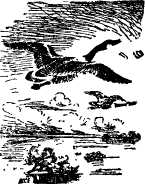
Wild Geese, in long, double, arrow-headed procession,
went clanging northward. He longed to go with
them. Whenever a new bird or beast appeared, he
had a singular prickling feeling up his spine and his
back as though he had a mane that was standing
up. This feeling strengthened with his strength.
All of his schoolmates used to say that they "liked"
the spring, some of the girls would even say that they
"dearly loved" the spring, but they could not
understand the madness that blazed in Yan's eyes
when springtime really came—the flush of cheek—the
shortening breath—the restless craving for
action—the chafing with flashes of rebellion at school
restraints—the overflow of nervous energy—the
bloodthirst in his blood—the hankering to run—to
run to the north, when the springtime tokens bugled
27
to his every sense.
Then the wind and sky and ground were full of
thrill. There was clamour everywhere, but never a
word. There was stirring within and without.
There was incentive in the yelping of the Wild Geese;
but it was only tumult, for he could not understand
why he was so stirred. There were voices that he could
not hear—messages that he could not read; all was
confusion of tongues. He longed only to get away.
"If only I could get away. If—if—Oh, God!" he
stammered in torment of inexpression, and then
would gasp and fling himself down on some bank,
and bite the twigs that chanced within reach and
tremble and wonder at himself.
Only one thing kept him from some mad and
suicidal move—from joining some roving Indian band
up north, or gypsies nearer—and that was the strong
hand at home.
Yan had many brothers, but only those next him
in age were important in his life. Rad was two
years older—a strong boy, who prided himself
on his "common sense." Though so much older, he
was Yan's inferior at school. He resented this, and
delighted in showing his muscular superiority at all
opportunities. He was inclined to be religious, and
was strictly proper in his life and speech. He never
was known to smoke a cigarette, tell a lie, or say
"gosh" or "darn." He was plucky and persevering,
but he was cold and hard, without a human fiber
or a drop of red blood in his make-up. Even as a
boy he bragged that he had no enthusiasms, that
he believed in common sense, that he called a spade
a spade, and would not use two words where one
would do. His intelligence was above the average,
but he was so anxious to be thought a person of
rare sagacity and smartness, unswayed by emotion,
that nothing was too heartless for him to do if it
seemed in line with his assumed character. He
was not especially selfish, and yet he pretended
to be so, simply that people should say of him significantly
and admiringly: "Isn't he keen? Doesn't he
29
know how to take care of himself?" What little
human warmth there was in him died early, and
he succeeded only in making himself increasingly
detested as he grew up.
His relations to Yan may be seen in one incident.
Yan had been crawling about under the house in
the low wide cobwebby space between the floor
beams and the ground. The delightful sensation of
being on an exploring expedition led him farther
(and ultimately to a paternal thrashing for soiling
his clothes), till he discovered a hollow place near one
side, where he could nearly stand upright. He at
once formed one of his schemes—to make a secret, or
at least a private, workroom here. He knew that
if he were to ask permission he would be refused,
but if he and Rad together were to go it might
receive favourable consideration on account of Rad's
self-asserted reputation for common sense. For a
wonder, Rad was impressed with the scheme, but
was quite sure that they had "better not go together
to ask Father." He "could manage that part better
alone," and he did.
Then they set to work. The first thing was to
deepen the hole from three feet to six feet everywhere,
and get rid of the earth by working it back under the
floor of the house. There were many days of labour
in this, and Yan stuck to it each day after returning
from school. There were always numerous reasons why
Rad could not share in the labour. When the ten by
fourteen-foot hole was made, boards to line and floor
30
it were needed. Lumber was very cheap—inferior,
second-hand stuff was to be had for the asking—and
Yan found and carried boards enough to make
the workroom. Rad was an able carpenter and now
took charge of the construction. They worked
together evening after evening, Yan discussing all
manner of plans with warmth and enthusiasm—what
they would do in their workshop when finished—how
they might get a jig-saw in time and saw picture
frames, so as to make some money. Rad assented
with grunts or an occasional Scripture text—that
was his way. Each day he told Yan what to go on
with while he was absent.
The walls were finished at length; a window placed
in one side; a door made and fitted with lock and key.
What joy! Yan glowed with pleasure and pride at
the triumphant completion of his scheme. He swept
up the floor for the finishing ceremony and sat down on
the bench for a grand gloat, when Rad said abruptly:
"Going to lock up now." That sounded gratifyingly
important. Yan stepped outside. Rad locked
the door, put the key in his pocket, then turning,
he said with cold, brutal emphasis:
"Now you keep out of my workshop from this on.
You have nothing to do with it. It's mine. I got
the permission to make it." All of which he could
prove, and did.
Alner, the youngest, was eighteen months younger
than Yan, and about the same size, but the resemblance
stopped there. His chief aim in life was to
31
be stylish. He once startled his mother by inserting
into his childish prayers the perfectly sincere request:
"Please, God, make me an awful swell, for Jesus
sake." Vanity was his foible, and laziness his sin.
He could be flattered into anything that did not
involve effort. He fairly ached to be famous. He
was consuming with desire to be pointed out for
admiration as the great this, that or the other thing—it
did not matter to him what, as long as he could be
pointed out. But he never had the least idea of
working for it. At school he was a sad dunce. He
was three grades below Yan and at the bottom of
his grade. They set out for school each day together,
because that was a paternal ruling; but they rarely
reached there together. They had nothing in common.
Yan was full of warmth, enthusiasm, earnestness
and energy, but had a most passionate and ungovernable
temper. Little put him in a rage, but it was soon
over, and then an equally violent reaction set in,
and he was always anxious to beg forgiveness and
make friends again. Alner was of lazy good temper
and had a large sense of humour. His interests
were wholly in the playground. He had no sympathy
with Yan's Indian tastes—"Indians in nasty, shabby
clothes. Bah! Horrid!" he would scornfully say.
These, then, were his adjoining brothers.
What wonder that Yan was daily further from
them.
But the greatest event of Yan's then early life
now took place. His school readers told him
about Wilson and Audubon, the first and last
American naturalists. Yan wondered why no other
great prophet had arisen. But one day the papers
announced that at length he had appeared. A
work on the Birds of Canada, by ..., had come
at last, price one dollar.
Money never before seemed so precious, necessary
and noble a thing. "Oh! if I only had a dollar."
He set to work to save and scrape. He won marbles
in game, swopped marbles for tops, tops for jack-knives
as the various games came around with
strange and rigid periodicity. The jack-knives in
turn were converted into rabbits, the rabbits into
cash of small denominations. He carried wood for
strange householders; he scraped and scraped and
saved the scrapings; and got, after some months, as
high as ninety cents. But there was a dread fatality
about that last dime. No one seemed to have any
 more odd jobs; his commercial luck deserted him.
He was burnt up with craving for that book. None
of his people took interest enough in him to advance
the cash even at the ruinous interest (two or three
33
times cent per cent) that he was willing to bind himself
for. Six weeks passed before he achieved that
last dime, and he never felt conscience-clear about
it afterward.
more odd jobs; his commercial luck deserted him.
He was burnt up with craving for that book. None
of his people took interest enough in him to advance
the cash even at the ruinous interest (two or three
33
times cent per cent) that he was willing to bind himself
for. Six weeks passed before he achieved that
last dime, and he never felt conscience-clear about
it afterward.
He and Alner had to cut the kitchen wood. Each
had his daily allotment, as well as other chores.
Yan's was always done faithfully, but the other
evaded his work in every way. He was a
notorious little fop. The paternal poverty did not
permit his toilet extravagance to soar above one
paper collar per week, but in his pocket he carried a
piece of ink eraser with which he was careful to keep
the paper collar up to standard. Yan cared nothing
about dress—indeed, was inclined to be slovenly.
So the eldest brother, meaning to turn Alner's weakness
to account, offered a prize of a twenty-five-cent
necktie of the winner's own choice to the one who did
his chores best for a month. For the first week
Alner and Yan kept even, then Alner wearied, in
spite of the dazzling prize. The pace was too hot.
Yan kept on his usual way and was duly awarded
the twenty-five cents to be spent on a necktie. But
in the store a bright thought came tempting him.
Fifteen cents was as much as any one should spend on
a necktie—that's sure; the other ten would get the
book. And thus the last dime was added to the pile.
Then, bursting with joy and with the pride of a
capitalist, he went to the book-shop and asked for
the coveted volume.
He was tense with long-pent feeling. He expected
to have the bookseller say that the price had gone
up to one thousand dollars, and that all were sold.
But he did not. He turned silently, drew the book
out of a pile of them, hesitated and said, "Green or
red cover?"
"Green," said Yan, not yet believing. The book-man
looked inside, then laid it down, saying in a cold,
business tone, "Ninety cents."
"Ninety cents," gasped Yan. Oh! if only he had
known the ways of booksellers or the workings of cash
discounts. For six weeks had he been barred this
happy land—had suffered starvation; he had misappropriated
funds, he had fractured his conscience
and all to raise that ten cents—that unnecessary dime.
He read that book reverentially all the way home.
It did not give him what he wanted, but that doubtless
was his own fault. He pored over it, studied
it, loved it, never doubting that now he had the key
to all the wonders and mysteries of Nature. It was
five years before he fully found out that the text
was the most worthless trash ever foisted on a torpid
public. Nevertheless, the book held some useful
things; first, a list of the bird names; second, some
thirty vile travesties of Audubon and Wilson's bird
portraits.
These were the birds thus maligned:
| |
Duck Hawk
Sparrow Hawk
White-headed Eagle
37
Great Horned Owl
Snowy Owl
Red-headed Woodpecker
Golden-winged Woodpecker
Barn-swallow
Whip-poor-will
Night Hawk
Belted Kingfisher
Kingbird
Woodthrush
Catbird
White-bellied Nuthatch
Brown Creeper
Bohemian Chatterer
Great Northern Shrike
Shore Lark
|
Rose-breasted Grosbeak
Bobolink
Meadow Lark
Bluejay
Ruffed Grouse
Great Blue Heron
Bittern
Wilson's Snipe
Long-biller Curlew
Purple Gallinule
Canada Goose
Wood Duck
Hooded Merganser
Double-crested Cormorant
Arctic Tern
Great Northern Diver
Stormy Petrel
Arctic Puffin
Black Guillemot
|
But badly as they were presented, the pictures
were yet information, and were entered in his
memory as lasting accessions to his store of truth
about the Wild Things.
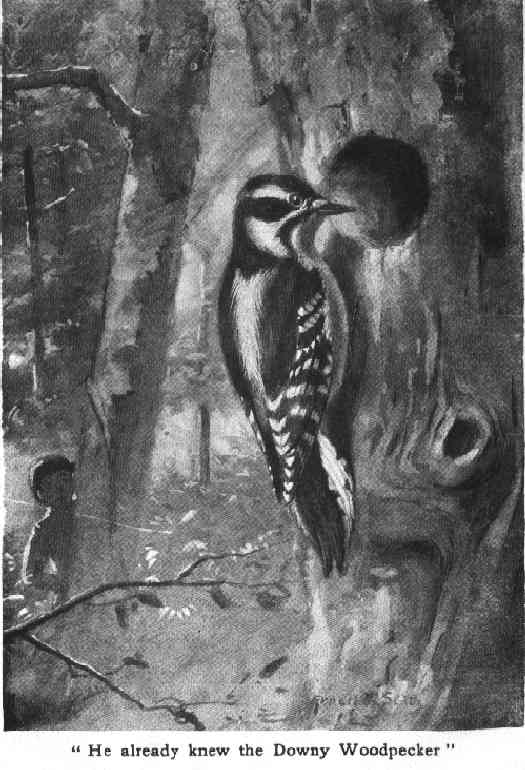
Of course, he already knew some few birds whose
names are familiar to every schoolboy: the Robin,
Bluebird, Kingbird, Wild Canary, Woodpecker,
Barn-swallow, Wren, Chickadee, Wild Pigeon, Humming-bird,
Pewee, so that his list was steadily
increased.
Oh, sympathy! the noblest gift of God to man. The greatest bond
there is twixt man and man.
The strongest link in any friendship chain.
The single lasting hold in kinship's claim.
The only incorrosive strand in marriage bonds.
The blazing torch where genius lights her lamp.
The ten times noble base of noblest love.
More deep than love—more strong than hate—the biggest thing
in all the universe—the law of laws.
Grant but this greatest gift of God to man—this single link
concatenating grant, and all the rest are worthless or comprised.
Each year the ancient springtime madness came
more strongly on Yan. Each year he was less
inclined to resist it, and one glorious day of
late April in its twelfth return he had wandered northward
along to a little wood a couple of miles from
the town. It was full of unnamed flowers and voices
and mysteries. Every tree and thicket had a voice—a
long ditch full of water had many that called to
him. "Peep-peep-peep," they seemed to say in
invitation for him to come and see. He crawled
again and again to the ditch and watched and waited.
The loud whistle would sound only a few rods away,
"Peep-peep-peep," but ceased at each spot when he
came near—sometimes before him, sometimes behind,
39
but never where he was. He searched through a
small pool with his hands, sifted out sticks and leaves,
but found nothing else. A farmer going by told
him it was only a "spring Peeper," whatever that was,
"some kind of a critter in the water."
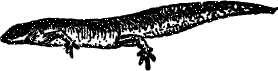
Under a log not far away Yan found a little Lizard
that tumbled out of sight into a hole. It was the only
living thing there, so he decided that the "Peeper"
must be a "Whistling Lizard." But he was determined
to see them when they were calling. How was
it that the ponds all around should be full of them
calling to him and playing hide and seek and yet defying
his most careful search? The voices ceased as
soon as he came near, to be gradually renewed in the
pools he had left. His presence was a husher. He
lay for a long time watching a pool, but none of the
voices began again in range of his eye. At length,
after realizing that they were avoiding him, he crawled
to a very noisy pond without showing himself, and
nearer and yet nearer until he was within three feet of
a loud peeper in the floating grass. He located the
spot within a few inches and yet could see nothing.
He was utterly baffled, and lay there puzzling over
it, when suddenly all the near Peepers stopped, and
Yan was startled by a footfall; and looking around,
he saw a man within a few feet, watching him.
Yan reddened—a stranger was always an enemy;
he had a natural aversion to all such, and stared
awkwardly as though caught in crime.
The man, a curious looking middle-aged person,
was in shabby clothes and wore no collar. He had a
tin box strapped on his bent shoulders, and in his
hands was a long-handled net. His features, smothered
in a grizzly beard, were very prominent and
rugged. They gave evidence of intellectual force,
with some severity, but his gray-blue eyes had a
kindly look.
He had on a common, unbecoming, hard felt hat,
and when he raised it to admit the pleasant breeze
Yan saw that the wearer had hair like his own—a
coarse, paleolithic mane, piled on his rugged brow,
like a mass of seaweed lodged on some storm-beaten
rock.
"F'what are ye fynding, my lad?" said he in tones
whose gentleness was in no way obscured by a strong
Scottish tang.
Still resenting somewhat the stranger's presence,
Yan said:
"I'm not finding anything; I am only trying to
see what that Whistling Lizard is like."
The stranger's eyes twinkled. "Forty years ago Ah
was laying by a pool just as Ah seen ye this morning,
looking and trying hard to read the riddle of the
spring Peeper. Ah lay there all day, aye, and mony
anither day, yes, it was nigh onto three years before
Ah found it oot. Ah'll be glad to save ye seeking
as long as Ah did, if that's yer mind. Ah'll show ye
the Peeper."
Then he raked carefully among the leaves near
41
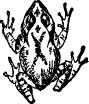
the ditch, and soon captured a tiny Frog, less than
an inch long.
"Ther's your Whistling Lizard: he no a Lizard at
all, but a Froggie. Book men call him Hyla pickeringii,
an' a gude Scotchman he'd make, for ye see the St.
Andrew's cross on his wee back. Ye see the whistling
ones in the water put on'y their beaks oot an' is hard
to see. Then they sinks to the bottom when ye
come near. But you tak this'n home and treat him
well and ye'll see him blow out his throat as big as
himsel' an' whistle like a steam engine."
Yan thawed out now. He told about the Lizard
he had seen.
"That wasna a Lizard; Ah niver see thim aboot
here. It must a been a two-striped Spelerpes. A
Spelerpes is nigh kin to a Frog—a kind of dry-land
tadpole, while a Lizard is only a Snake with legs."
This was light from heaven. All Yan's distrust
was gone. He warmed to the stranger. He plied
him with questions; he told of his getting the Bird
Book. Oh, how the stranger did snort at "that
driveling trash." Yan talked of his perplexities.
He got a full hearing and intelligent answers. His
mystery of the black ground-bird with a brown mate
was resolved into the Common Towhee. The
unknown wonderful voice in the spring morning,
sending out its "cluck, cluck, cluck, clucker," in the
distant woods, the large gray Woodpecker that bored
in some high stub and flew in a blaze of gold, and
the wonderful spotted bird with red head and yellow
wings and tail in the taxidermist's window, were all
42
resolved into one and the same—the Flicker or
Golden-winged Woodpecker. The Hang-nest and the
Oriole became one. The unknown poisonous-looking
blue Hornet, that sat on the mud with palpitating
body, and the strange, invisible thing that made the
mud-nests inside old outbuildings and crammed
them with crippled Spiders, were both identified as
the Mud-wasp or Pelopæus.

A black Butterfly flew over, and Yan learned that
it was a Camberwell Beauty, or, scientifically, a
Vanessa antiopa, and that this one must have
hibernated to be seen so early in the spring, and
yet more, that this beautiful creature was the glorified
spirit of the common brown and black spiney
Caterpillar.
The Wild Pigeons were flying high above them in
great flocks as they sat there, and Yan learned of
their great nesting places in the far South, and of
their wonderful but exact migrations without regard
to anything but food; their northward migration
to gather the winged nuts of the Slippery Elm in
Canada; their August flight to the rice-fields of
Carolina; their Mississippi Valley pilgrimage when
the acorns and beech-mast were falling ripe.
What a rich, full morning that was. Everything
seemed to turn up for them. As they walked over
a piney hill, two large birds sprang from the ground
and whirred through the trees.
"Ruffed Grouse or 'patridge', as the farmers call
43
them. There's a pair lives nigh aboots here. They
come on this bank for the Wintergreen berries."
And Yan was quick to pull and taste them. He
filled his pockets with the aromatic plant—berries
and all—and chewed it as he went. While they
walked, a faint, far drum-thump fell on their ears.
"What's that?" he exclaimed, ever on the alert.
The stranger listened and said:
"That's the bird ye ha' just seen; that's the Cock
Partridge drumming for his mate."
The Pewee of his early memories became the
Phoebe of books. That day his brookside singer
became the Song-sparrow; the brown triller, the
Veery Thrush. The Trilliums, white and red, the
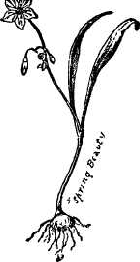
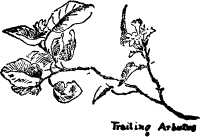
Dogtooth Violet, the Spring-beauty, the Trailing
Arbutus—all for the first time got names and became
real friends, instead of elusive and beautiful, but
depressing mysteries.
The stranger warmed, too, and his rugged features
glowed; he saw in Yan one minded like himself, tormented
with the knowledge-hunger, as in youth he
himself had been; and now it was a priceless privilege
to save the boy some of what he had suffered. His
gratitude to Yan grew fervid, and Yan—he took
in every word; nothing that he heard was forgotten.
He was in a dream, for he had found at last the
greatest thing on earth—sympathy—broad, intelligent,
comprehensive sympathy.
That spring morning was ever after like a new
epoch in Yan's mind—not his memory, that was a
thing of the past—but in his mind, his living
44
present.
And the strongest, realest thing in it all was, not
the rugged stranger with his kind ways, not the new
birds and plants, but the smell of the Wintergreen.
Smell's appeal to the memory is far better, stronger,
more real than that of any other sense. The Indians
know this; many of them, in time, find out the smell
that conjures up their happiest hours, and keep
it by them in the medicine bag. It is very real and
dear to them—that handful of Pine needles, that
lump of Rat-musk, or that piece of Spruce gum.
It adds the crown of happy memory to their reveries.
And yet this belief is one of the first attacked by
silly White-men, who profess to enlighten the Red-man's
darkness. They, in their ignorance, denounce
it as absurd, while men of science know its simple
truth.
Yan did not know that he had stumbled on a
secret of the Indian medicine bag. But ever afterward
that wonderful day was called back to him,
conjured up by his "medicine," this simple, natural
magic, the smell of the Wintergreen.
He appreciated that morning more than he could
tell, and yet he did a characteristic foolish thing,
that put him in a wrong light and left him so in the
stranger's mind.
It was past noon. They had long lingered; the
Stranger spoke of the many things he had at home;
then at length said he must be going. "Weel,
45
good-by, laddie; Ah hope Ah'll see you again." He
held out his hand. Yan shook it warmly; but he
was dazed with thinking and with reaction; his
diffidence and timidity were strong; he never rose
to the stranger's veiled offer. He let him go without
even learning his name or address.
When it was too late, Yan awoke to his blunder.
He haunted all those woods in hopes of chancing
on him there again, but he never did.
Oh! what a song the Wild Geese sang that year!
How their trumpet clang went thrilling in his
heart, to smite there new and hidden chords
that stirred and sang response. Was there ever a
nobler bird than that great black-necked Swan, that
sings not at his death, but in his flood of life, a song of
home and of peace—of stirring deeds and hunting in
far-off climes—of hungerings and food, and raging
thirsts to meet with cooling drink. A song of wind
and marching, a song of bursting green and grinding
ice—of Arctic secrets and of hidden ways. A song
of a long black marsh, a low red sky, and a sun that
never sets.
An Indian jailed for theft bore bravely through
the winter, but when the springtime brought the
Gander-clang in the black night sky, he started, fell,
and had gone to his last, long, hunting home.
 Who can tell why Jericho should fall at the trumpet
blast?
Who can tell why Jericho should fall at the trumpet
blast?
Who can read or measure the power of the Honker-song?
Oh, what a song the Wild Geese sang that year!
And yet, was it a new song? No, the old, old song,
but Yan heard it with new ears. He was learning
47
to read its message. He wandered on their
trailless track, as often as he could, northward,
ever northward, up the river from the town, and
up, seeking the loneliest ways and days. The river
turned to the east, but a small stream ran into
it from the north: up that Yan went through thickening
woods and walls that neared each other, on
and up until the walls closed to a crack, then
widened out into a little dale that was still full
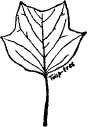 of original forest trees. Hemlock, Pine, Birch and
Elm of the largest size abounded and spread over the
clear brook a continuous shade. Fox vines trailed in
the open places, the rarest wild-flowers flourished,
Red-squirrels chattered from the trees. In the mud
along the brook-side were tracks of Coon and Mink and
other strange fourfoots. And in the trees overhead,
the Veery, the Hermit-thrush, or even a Woodthrush
sang his sweetly solemn strain, in that golden twilight
of the midday forest. Yan did not know them
all by name as yet, but he felt their vague charm and
mystery. It seemed such a far and lonely place, so
unspoiled by man, that Yan persuaded himself that
surely he was the first human being to stand there,
that it was his by right of discovery, and so he claimed
it and named it after its discoverer—Glenyan.
of original forest trees. Hemlock, Pine, Birch and
Elm of the largest size abounded and spread over the
clear brook a continuous shade. Fox vines trailed in
the open places, the rarest wild-flowers flourished,
Red-squirrels chattered from the trees. In the mud
along the brook-side were tracks of Coon and Mink and
other strange fourfoots. And in the trees overhead,
the Veery, the Hermit-thrush, or even a Woodthrush
sang his sweetly solemn strain, in that golden twilight
of the midday forest. Yan did not know them
all by name as yet, but he felt their vague charm and
mystery. It seemed such a far and lonely place, so
unspoiled by man, that Yan persuaded himself that
surely he was the first human being to stand there,
that it was his by right of discovery, and so he claimed
it and named it after its discoverer—Glenyan.
This place became the central thought in his life.
He went there at all opportunities, but never dared
to tell any one of his discovery. He longed for a
confidant sometimes, he hankered to meet the
48
stranger and take him there, and still he feared that
the secret would get out. This was his little kingdom;
the Wild Geese had brought him here, as the Seagulls
had brought Columbus to a new world—where he
could lead, for brief spells, the woodland life that
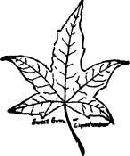 was his ideal. He was tender enough to weep over
the downfall of a lot of fine Elm trees in town, when
their field was sold for building purposes, and he
used to suffer a sort of hungry regret when old settlers
told how plentiful the Deer used to be. But now he
had a relief from these sorrows, for surely there was one
place where the great trees should stand and grow as
in the bright bygone; where the Coon, the Mink and
the Partridge should live and flourish forever. No,
indeed, no one else should know of it, for if the secret
got out, at least hosts of visitors would come and
Glenyan be defiled. No, better that the secret
was his ideal. He was tender enough to weep over
the downfall of a lot of fine Elm trees in town, when
their field was sold for building purposes, and he
used to suffer a sort of hungry regret when old settlers
told how plentiful the Deer used to be. But now he
had a relief from these sorrows, for surely there was one
place where the great trees should stand and grow as
in the bright bygone; where the Coon, the Mink and
the Partridge should live and flourish forever. No,
indeed, no one else should know of it, for if the secret
got out, at least hosts of visitors would come and
Glenyan be defiled. No, better that the secret
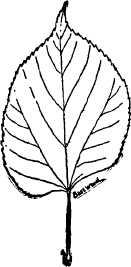 should "die with him," he said. What that meant
he did not really know, but he had read the phrase
somewhere and he liked the sound of it. Possibly
he would reveal it on his deathbed.
should "die with him," he said. What that meant
he did not really know, but he had read the phrase
somewhere and he liked the sound of it. Possibly
he would reveal it on his deathbed.
Yes, that was the proper thing, and he pictured a
harrowing scene of weeping relatives around, himself
as central figure, all ceasing their wailing and gasping
with wonder as he made known the mighty secret of
his life—delicious! it was almost worth dying for.
So he kept the place to himself and loved it more
and more. He would look out through the thick
Hemlock tops, the blots of Basswood green or the
criss-cross Butternut leafage and say: "My own, my
own." Or down by some pool in the limpid stream
49
he would sit and watch the arrowy Shiners and say:
"You are mine, all; you are mine. You shall never
be harmed or driven away."
A spring came from the hillside by a green lawn,
and here Yan would eat his sandwiches varied with
nuts and berries that he did not like, but ate only
because he was a wildman, and would look lovingly
up the shady brookland stretches and down to the
narrow entrance of the glen, and say and think and
feel. "This is mine, my own, my very own."
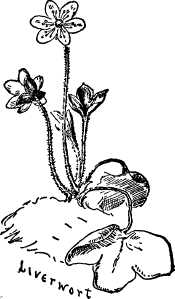
He had none but the poorest of tools, but he set
about building a shanty. He was not a resourceful
boy. His effort to win the book had
been an unusual one for him, as his instincts were not
at all commercial. When that matter came to the
knowledge of the Home Government, he was rebuked
for doing "work unworthy of a gentleman's son" and
forbidden under frightful penalties "ever again to
resort to such degrading ways of raising money."
They gave him no money, so he was penniless.
Most boys would have possessed themselves somehow
of a good axe and spade. He had neither. An
old plane blade, fastened to a stick with nails, was
all the axe and spade he had, yet with this he set to
work and offset its poorness as a tool by dogged
persistency. First, he selected the quietest spot near
the spring—a bank hidden by a mass of foliage. He
knew no special reason for hiding it, beyond the love
of secrecy. He had read in some of his books "how
the wily scouts led the way through a pathless jungle,
pulled aside a bough and there revealed a comfortable
dwelling that none without the secret could possibly
have discovered," so it seemed very proper to make it
a complete mystery—a sort of secret panel in the
51
enchanted castle—and so picture himself as the wily
scout leading his wondering companions to the shanty,
though, of course, he had not made up his mind to
reveal his secret to any one. He often wished he
could have the advantage of Rad's strong arms and
efficacious tools; but the workshop incident was only
one of many that taught him to leave his brother out
of all calculation.
Mother Earth is the best guardian of a secret, and
Yan with his crude spade began by digging a hole in
the bank. The hard blue clay made the work slow,
but two holidays spent in steady labour resulted in a
hole seven feet wide and about four feet into the bank.
In this he set about building the shanty. Logs
seven or eight feet long must be got to the place—at
least twenty-five or thirty would be needed, and
how to cut and handle them with his poor axe was
a question. Somehow, he never looked for a better
axe. The half-formed notion that the Indians had
no better was sufficient support, and he struggled
away bravely, using whatever ready sized material
he could find. Each piece as he brought it was put
into place. Some boys would have gathered the
logs first and built it all at once, but that was not
Yan's way; he was too eager to see the walls rise.
He had painfully and slowly gathered logs enough
to raise the walls three rounds, when the question of a
door occurred to him. This, of course, could not
be cut through the logs in the ordinary way; that
required the best of tools. So he lifted out all the
52
front logs except the lowest, replacing them at the
ends with stones and blocks to sustain the sides.
This gave him the sudden gain of two logs, and
helped the rest of the walls that much. The shanty
was now about three feet high, and no two logs in it
were alike: some were much too long, most were
crooked and some were half rotten, for the simple
reason that these were the only ones he could cut. He
had exhausted the logs in the neighbourhood and
was forced to go farther. Now he remembered seeing
one that might do, half a mile away on the home
trail (they were always "trails"; he never called
them "roads" or "paths"). He went after this, and
to his great surprise and delight found that it was one
of a dozen old cedar posts that had been cut long
before and thrown aside as culls, or worthless. He
could carry only one at a time, so that to bring each
one meant a journey of a mile, and the post got woefully
heavy each time before that mile was over.
To get those twelve logs he had twelve miles to
walk. It took several Saturdays, but he stuck
doggedly to it. Twelve good logs completed his
shanty, making it five feet high and leaving three logs
over for rafters. These he laid flat across, dividing
the spaces equally. Over them he laid plenty of small
sticks and branches till it was thickly covered. Then
he went down to a rank, grassy meadow and, with
his knife, cut hay for a couple of hours. This was
spread thickly on the roof, to be covered with strips
of Elm bark then on top of all he threw the clay dug
53
from the bank, piling it well back, stamping on it, and
working it down at the edges. Finally, he threw
rubbish and leaves over it, so that it was confused
with the general tangle.
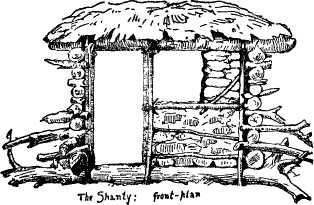
Thus the roof was finished, but the whole of the
front was open. He dreaded the search for more
logs, so tried a new plan. He found, first, some
sticks about six feet long and two or three inches
through. Not having an axe to sharpen and drive
them, he dug pairs of holes a foot deep, one at each
end and another pair near the middle of the front
ground log.
Into each of these he put a pair of upright sticks,
leading up to the eave log, one inside and one outside
of it, then packed the earth around them in the holes.
Next, he went to the brook-side and cut a number
of long green willow switches about half an inch
thick at the butt. These switches he twisted around
the top of each pair of stakes in a figure 8, placing
them to hold the stake tight against the bottom and
top logs at the front.
Down by the spring he now dug a hole and worked
water and clay together into mortar, then with a
trowel cut out of a shingle, and mortar carried in an
old bucket, he built a wall within the stakes, using
sticks laid along the outside and stones set in mud
till the front was closed up, except a small hole for
a window and a large hole for a door.
Now he set about finishing the inside. He gathered
moss in the woods and stuffed all the chinks in the
54
upper parts, and those next the ground he filled with
stones and earth. Thus the shanty was finished;
but it lacked a door.
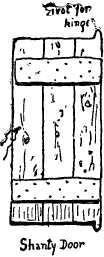
The opening was four feet high and two feet wide,
so in the woodshed at home he cut three boards,
each eight inches wide and four feet high, but he left
at each end of one a long point. Doing this at home
gave him the advantage of a saw. Then with these
and two shorter boards, each two feet long and six
inches wide, he sneaked out to Glenyan, and there,
with some nails and a stone for a hammer, he fastened
them together into a door. In the ground log he
pecked a hole big enough to receive one of the points
and made a corresponding hole in the under side of
the top log. Then, prying up the eave log, he put
the door in place, let the eave log down again, and
the door was hung. A string to it made an outside
fastening when it was twisted around a projecting
snag in the wall, and a peg thrust into a hole within
made an inside fastener. Some logs, with fir boughs
and dried grass, formed a bunk within. This left
only the window, and for lack of better cover he
fastened over it a piece of muslin brought from home.
But finding its dull white a jarring note, he gathered
a quart of butternuts, and watching his chance at
home, he boiled the cotton in water with the nuts
and so reduced it to a satisfactory yellowish brown.
His final task was to remove all appearance of
disturbance and to fully hide the shanty in brush
and trailing vines. Thus, after weeks of labour, his
55
woodland home was finished. It was only five feet
high inside, six feet long and six feet wide—dirty
and uncomfortable—but what a happiness it was to
have it.
Here for the first time in his life he began to realize
something of the pleasure of single-handed achievement
in the line of a great ambition.
During this time Yan had so concentrated all his
powers on the shanty that he had scarcely noticed
the birds and wild things. Such was his temperament—one
idea only, and that with all his strength.
His heart was more and more in his kingdom now
he longed to come and live here. But he only dared
to dream that some day he might be allowed to pass
a night in the shanty. This was where he would
lead his ideal life—the life of an Indian with all that
is bad and cruel left out. Here he would show men
how to live without cutting down all the trees,
spoiling all the streams, and killing every living
thing. He would learn how to get the fullest pleasure
out of the woods himself and then teach others how
to do the same. Though the birds and Fourfoots
fascinated him, he would not have hesitated to shoot
one had he been able, but to see a tree cut down
always caused him great distress. Possibly he
realized that the bird might be quickly replaced,
but the tree, never.
To carry out his plan he must work hard at
school, for books had much that he needed. Perhaps
some day he might get a chance to see Audubon's
drawings, and so have all his bird worries settled by
57
a single book.
That summer a new boy at school added to Yan's
savage equipment. This boy was neither good nor
bright; he was a dunce, and had been expelled from
a boarding school for misconduct, but he had a
number of schoolboy accomplishments that gave
him a tinge of passing glory. He could tie a lot of
curious knots in a string. He could make a wonderful
birdy warble, and he spoke a language that he called
Tutnee. Yan was interested in all, but especially
the last. He teased and bribed till he was admitted
to the secret. It consisted in spelling every word,
leaving the five vowels as they are, but doubling each
consonant and putting a "u" between. Thus "b"
became "bub," "d" "dud," "m" "mum," and so
forth, except that "c" was "suk," "h" "hash," "x"
"zux," and "w" "wak."
The sample given by the new boy, "sus-hash-u-tut
u-pup yak-o-u-rur mum-o-u-tut-hash," was said to be
a mode of enjoining silence.
This language was "awful useful," the new boy
said, to keep the other fellows from knowing what you
were saying, which it certainly did. Yan practised
hard at it and within a few weeks was an adept. He
could handle the uncouth sentences better than his
teacher, and he was singularly successful in throwing
in accents and guttural tones that imparted a delightfully
savage flavour, and he rejoiced in jabbering
away to the new boy in the presence of others so
that he might bask in the mystified look on the
58
faces of those who were not skilled in the tongue of
the Tutnees.
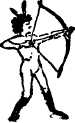
He made himself a bow and arrows. They were
badly made and he could hit nothing with them,
but he felt so like an Indian when he drew the arrow
to its head, that it was another pleasure.
He made a number of arrows with hoop-iron heads,
these he could file at home in the woodshed. The
heads were jagged and barbed and double-barbed.
These arrows were frightful-looking things. They
seemed positively devilish in their ferocity, and were
proportionately gratifying. These he called his
"war arrows," and would send one into a tree and
watch it shiver, then grunt "Ugh, heap good," and
rejoice in the squirming of the imaginary foe he had
pierced.

He found a piece of sheepskin and made of it
a pair of very poor moccasins. He ground an old
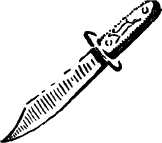
castaway putty knife into a scalping knife; the notch
in it for breaking glass was an annoying defect until
he remembered that some Indians decorate their
weapons with a notch for each enemy it has killed,
and this, therefore, might do duty as a kill-tally.
He made a sheath for the knife out of scraps of leather
left off the moccasins. Some water-colours, acquired
by a school swap, and a bit of broken mirror held in
a split stick, were necessary parts of his Indian toilet.
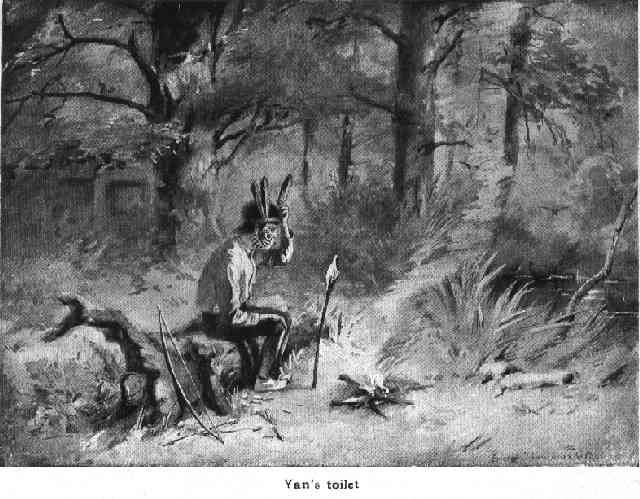
His face during the process of make-up was always
a battle-ground between the horriblest Indian scowl
and a grin of delight at his success in diabolizing his
61
visage with the paints. Then with painted face and
a feather in his hair he would proudly range the woods
in his little kingdom and store up every scrap of
woodlore he could find, invent or learn from his
schoolmates.
Odd things that he found in the woods he would
bring to his shanty: curled sticks, feathers, bones,
skulls, fungus, shells, an old cowhorn—things that
interested him, he did not know why. He made
Indian necklaces of the shells, strung together alternately
with the backbone of a fish. He let his hair
grow as long as possible, employing various stratagems,
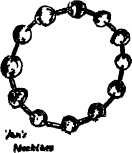 even the unpalatable one of combing it to avoid the
monthly trim of the maternal scissors. He lay for
hours with the sun beating on his face to correct his
colour to standard, and the only semblance of personal
vanity that he ever had was pleasure in hearing
disparaging remarks about the darkness of his complexion.
He tried to do everything as an Indian
would do it, striking Indian poses, walking carefully
with his toes turned in, breaking off twigs to mark a
place, guessing at the time by the sun, and grunting
"Ugh" or "Wagh" when anything surprised him.
Disparaging remarks about White-men, delivered in
supposed Indian dialect, were an important part of
his pastime. "Ugh, White-men heap no good" and
"Wagh, paleface—pale fool in woods," were among
his favourites.
even the unpalatable one of combing it to avoid the
monthly trim of the maternal scissors. He lay for
hours with the sun beating on his face to correct his
colour to standard, and the only semblance of personal
vanity that he ever had was pleasure in hearing
disparaging remarks about the darkness of his complexion.
He tried to do everything as an Indian
would do it, striking Indian poses, walking carefully
with his toes turned in, breaking off twigs to mark a
place, guessing at the time by the sun, and grunting
"Ugh" or "Wagh" when anything surprised him.
Disparaging remarks about White-men, delivered in
supposed Indian dialect, were an important part of
his pastime. "Ugh, White-men heap no good" and
"Wagh, paleface—pale fool in woods," were among
his favourites.
He was much influenced by phrases that caught
his ear. "The brown sinewy arm of the Indian,"
62
was one of them. It discovered to him that his
own arms were white as milk. There was, however,
a simple remedy. He rolled up his sleeves to the
shoulder and exposed them to the full glare of the
sun. Then later, under the spell of the familiar
phrase, "The warrior was naked to the waist," he
went a step further—he determined to be brown to
the waist—so discarded his shirt during the whole
of one holiday. He always went to extremes.
He remembered now that certain Indians put their
young warriors through an initiation called the
Sun-dance, so he danced naked round the fire
in the blazing sun and sat around naked all one
day.
He noticed a general warmness before evening,
but it was at night that he really felt the punishment
of his indiscretion. He was in a burning heat. He
scarcely slept all night. Next day he was worse,
and his arm and shoulder were blistered. He bore
it bravely, fearing only that the Home Government
might find it out, in which case he would have fared
worse. He had read that the Indians grease the
skin for sunburn, so he went to the bathroom and
there used goose grease for lack of Buffalo fat.
This did give some relief, and in a few days he was
better and had the satisfaction of peeling the dead
skin from his shoulders and arms.
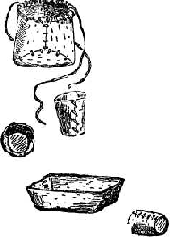
Yan made a number of vessels out of Birch
bark, stitching the edges with root fibers, filling the
bottom with a round wooden disc, and cementing
63
the joints with pine gum so that they would hold
water.
In the distant river he caught some Catfish and
brought them home—that, is, to his shanty. There
he made a fire and broiled them—very badly—but
he ate them as a great delicacy. The sharp bone in
each of their side fins he saved, bored a hole through
its thick end, smoothed it, and so had needles to stitch
his Birch bark. He kept them in a bark box with some
lumps of resin, along with some bark fiber, an Indian
flint arrow-head given him by a schoolmate, and the
claws of a large Owl, found in the garbage heap back
of the taxidermist's shop.
One day on the ash heap in their own yard in town
he saw a new, strange bird. He was always seeing
new birds, but this was of unusual interest. He drew
its picture as it tamely fed near him. A dull, ashy
gray, with bronzy yellow spots on crown and rump,
and white bars on its wings. His "Birds of Canada"
gave no light; he searched through all the books he
could find, but found no clew to its name. It was
years afterward before he learned that this was the
young male Pine Grosbeak.
Another day, under the bushes not far from his
shanty, he found a small Hawk lying dead. He
clutched it as a wonderful prize, spent an hour in
looking at its toes, its beak, its wings, its every
feather; then he set to work to make a drawing of it.
A very bad drawing it proved, although it was the
labour of days, and the bird was crawling with maggots
64
before he had finished. But every feather and
every spot was faithfully copied, was duly set down
on paper. One of his friends said it was a Chicken-hawk.
That name stuck in Yan's memory. Thenceforth
the Chicken-hawk and its every marking were
familiar to him. Even in after years, when he had
learned that this must have been a young "Sharp-shin,"
the name "Chicken-hawk" was always readier
on his lips.
But he met with another and a different Hawk soon
afterward. This one was alive and flitting about in
the branches of a tree over his head. It was very
small—less than a foot in length. Its beak was very
short, its legs, wings and tail long; its head was
bluish and its back coppery red; on the tail was a
broad, black crossbar. As the bird flew about and
balanced on the boughs, it pumped its tail. This
told him it was a Hawk, and the colours he remembered
were those of the male Sparrow-hawk, for here
his bird book helped with its rude travesty of "Wilson's"
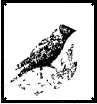 drawing of this bird. Yet two other birds he
saw close at hand and drew partly from memory.
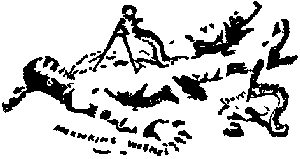
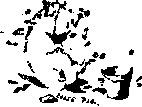
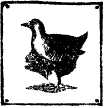
The drawings were like this, and from the picture
on a calendar he learned that one was a Rail;
from a drawing in the bird book that the other was
a Bobolink. And these names he never forgot. He
had his doubts about the sketching at first—it
seemed an un-Indian thing to do, until he remembered
that the Indians painted pictures on their shields and
on their teepees. It was really the best of all ways
for him to make reliable observation.
65
drawing of this bird. Yet two other birds he
saw close at hand and drew partly from memory.
The drawings were like this, and from the picture
on a calendar he learned that one was a Rail;
from a drawing in the bird book that the other was
a Bobolink. And these names he never forgot. He
had his doubts about the sketching at first—it
seemed an un-Indian thing to do, until he remembered
that the Indians painted pictures on their shields and
on their teepees. It was really the best of all ways
for him to make reliable observation.
65
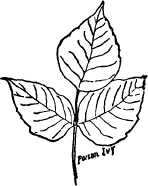
 The bookseller of the town had some new books
in his window about this time. One, a marvellous
work called "Poisonous Plants," Yan was eager to
see. It was exposed in the window for a time. Two
of the large plates were visible from the street; one
was Henbane, the other Stramonium. Yan gazed at
them as often as he could. In a week they were gone;
but the names and looks were forever engraved on
his memory. Had he made bold to go in and ask
permission to see the work, his memory would have
The bookseller of the town had some new books
in his window about this time. One, a marvellous
work called "Poisonous Plants," Yan was eager to
see. It was exposed in the window for a time. Two
of the large plates were visible from the street; one
was Henbane, the other Stramonium. Yan gazed at
them as often as he could. In a week they were gone;
but the names and looks were forever engraved on
his memory. Had he made bold to go in and ask
permission to see the work, his memory would have
 seized most of it in an hour.
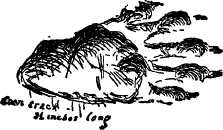
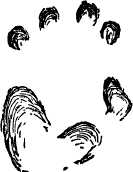
In the wet sand down by the edge of the brook he
one day found some curious markings—evidently
tracks. Yan pored over them, then made a life-size
drawing of one. He shrewdly suspected it to be the
track of a Coon—nothing was too good or wild or
rare for his valley. As soon as he could, he showed
the track to the stableman whose dog was said to
have killed a Coon once, and hence the man must be
an authority on the subject.
"Is that a Coon track?" asked Yan timidly.
"How do I know?" said the man roughly,
and went on with his work. But a stranger standing
near, a curious person with shabby clothes, and a
new silk hat on the back of his head, said, "Let me
see it." Yan showed it.
"Is it natural size?"
"Yes, sir."
"Yep, that's a Coon track, all right. You look at
all the big trees near about whar you saw that; then
when you find one with a hole in it, you look on the
bark and you will find some Coon hars. Then you
will know you've got a Coon tree."
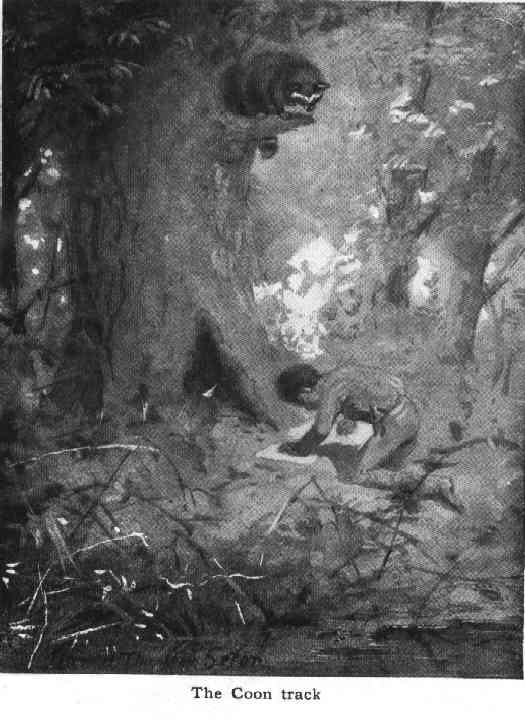
Yan took the earliest chance. He sought and found
a great Basswood with some gray hairs caught in the
69
bark. He took them home with him, not sure what
kind they were. He sought the stranger, but he was
gone, and no one knew him.
How to identify the hairs was a question; but he
remembered a friend who had a Coon-skin carriage
robe. A few hairs of these were compared with
those from the tree and left no doubt that the climber
was a Coon. Thus Yan got the beginning of the idea
that the very hairs of each, as well as its tracks, are
different. He learned, also, how wise it is to draw
everything that he wished to observe or describe.
 It was accident, or instinct on his part, but he had
fallen on a sound principle; there is nothing like a
sketch to collect and convey accurate information
of form—there is no better developer of true
observation.
It was accident, or instinct on his part, but he had
fallen on a sound principle; there is nothing like a
sketch to collect and convey accurate information
of form—there is no better developer of true
observation.
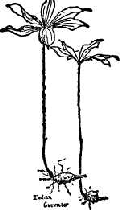
One day he noticed a common plant like an
umbrella. He dug it up by the root, and at the
lower end he found a long white bulb. He tasted
this. It was much like a cucumber. He looked up
"Gray's School Botany," and in the index saw the
name, Indian Cucumber. The description seemed
to tally, as far as he could follow its technical terms,
though like all such, without a drawing it was far
from satisfactory. So he added the Indian Cucumber
to his woodlore.
On another occasion he chewed the leaves of a
strange plant because he had heard that that was
the first test applied by the Indians. He soon began
to have awful pains in his stomach. He hurried
70
home in agony. His mother gave him mustard and
water till he vomited, then she boxed his ears. His
father came in during the process and ably supplemented
the punishment. He was then and there
ordered to abstain forever from the woods. Of
course, he did not. He merely became more cautious
about it all, and enjoyed his shanty with the added
zest of secret sin.
An Irish-Canadian servant girl from Sanger now
became a member of their household. Her
grandmother was an herb-doctor in great repute.
She had frequently been denounced as a witch,
although in good standing as a Catholic. This girl had
picked up some herb-lore, and one day when all the
family were visiting the cemetery she darted into
various copses and produced plants which she named,
together with the complaint that her grandmother
used them for.
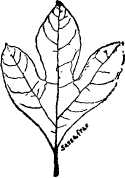
"Sassafras, that makes tea for skin disease;
Ginseng, that's good to sell; Bloodroot for the blood
in springtime; Goldthread, that cures sore mouths;
Pipsissewa for chills and fever; White-man's Foot,
that springs up wherever a White-man treads;
Indian cup, that grows where an Indian dies; Dandelion
roots for coffee; Catnip tea for a cold; Lavender
tea for drinking at meals; Injun Tobacco to mix with
boughten tobacco; Hemlock bark to dye pink;
Goldthread to dye yellow, and Butternut rinds for
greenish."
All of these were passing trifles to the others, but
to Yan they were the very breath of life, and he
72
treasured up all of these things in his memory.
Biddy's information was not unmixed with error
and superstition:
"Hold Daddy Longlegs by one leg and say, 'tell
me where the cows are,' and he will point just right
under another leg, and onct he told me where to
find my necklace when I lost it.
"Shoot the Swallows and the cows give bloody
milk. That's the way old Sam White ruined his
milk business—shooting Swallows.
"Lightning never strikes a barn where Swallows
nest. Paw never rested easy after the new barn
was built till the Swallows nested in it. He had it
insured for a hundred dollars till the Swallows got
round to look after it.
"When a Measuring-worm crawls on you, you are
going to get a new suit of clothes. My brother-in-law
says they walk over him every year in summer and
sure enough, he gets a new suit. But they never
does it in winter, cause he don't get new clothes
then.
"Split a Crow's tongue and he will talk like a girl.
Granny knowed a man that had a brother back of
Mara that got a young Crow and split his tongue an'
he told Granny it was just like a girl talking—an'
Granny told me!
"Soak a Horse-hair in rainwater and it will turn
into a Snake. Ain't there lots uv Snakes around
ponds where Horses drink? Well!
"Kill a Spider an' it will rain to-morrow. Now,
73
that's worth knowin'. I mind one year when the
Orangeman's picnic was comin', 12th of July, Maw
made us catch twenty Spiders and we killed them
all the day before, and law, how it did rain on the
picnic! Mebbe we didn't laugh. Most of them
hed to go home in boats, that's what our paper said.
But next year they done the same thing on us for
St. Patrick's Day, but Spiders is scarce on the 16th
of March, an' it didn't rain so much as snow, so it
was about a stand-off.
"Toads gives warts. You seen them McKenna
twins—their hands is a sight with warts. Well, I
seen them two boys playing with Toads like they
was marbles. So! An' they might a-knowed what
was comin'. Ain't every Toad just covered with
warts as thick as he can stick?
"That there's Injun tobacco. The Injuns always
use it, and Granny does, too, sometimes." (Yan
made special note of this—he must get some and
smoke it, if it was Indian.)
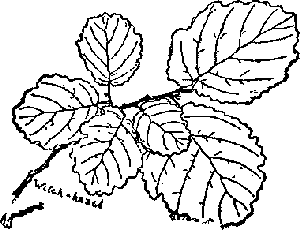 "A Witch-hazel wand will bob over a hidden
spring and show where to dig. Denny Scully is
awful good at it. He gets a dollar for showing where
to sink a well, an' if they don't strike water it's
because they didn't dig where he said, or spiled the
charm some way or nuther, and hez to try over.
"A Witch-hazel wand will bob over a hidden
spring and show where to dig. Denny Scully is
awful good at it. He gets a dollar for showing where
to sink a well, an' if they don't strike water it's
because they didn't dig where he said, or spiled the
charm some way or nuther, and hez to try over.
"Now, that's Dandelion. Its roots makes awful
good coffee. Granny allers uses it. She says that
it is healthier than store coffee, but Maw says she
likes boughten things best, and the more they cost
the better she likes them.
74
"Now, that's Ginseng. It has a terrible pretty
flower in spring. There's tons and tons of it sent
to China. Granny says the Chinese eats it, to
make them cheerful, but they don't seem to eat
enough.
"There's Slippery Elm. It's awfully good for
loosening up a cold, if you drink the juice the bark's
bin biled in. One spring Granny made a bucketful.
She set it outside to cool, an' the pig he drunk it all
up, an' he must a had a cold, for it loosened him up
so he dropped his back teeth. I seen them myself
lying out there in the yard. Yes, I did.
"That's Wintergreen. Lots of boys I know chew
that to make the girls like them. Lots of them gits
a beau that way, too. I done it myself many's a time.
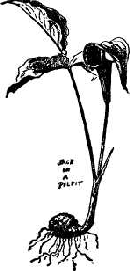
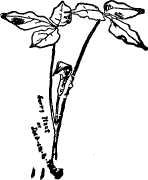
"Now, that is what some folks calls Injun
Turnip, an' the children calls it Jack-in-a-Pulpit,
but Granny calls it 'Sorry-plant,' cos she says when
any one eats it it makes them feel sorry for the last
fool thing they done. I'll put some in your Paw's
coffee next time he licks yer and mebbe that'll make
him quit. It just makes me sick to see ye gettin'
licked fur every little thing ye can't help.
"A Snake's tongue is its sting. You put your foot
on a Snake and see how he tries to sting you. An'
his tail don't die till sundown. I seen that myself,
onct, an' Granny says so, too, an' what Granny don't
know ain't knowledge—it's only book-larnin'."
These were her superstitions, most of them more
or less obviously absurd to Yan; but she had also
a smattering of backwoods lore and Yan gleaned all
75
he could.
She had so much of what he wanted to know that
he had almost made up his mind to tell her where
he went each Saturday when he had finished his
work.
A week or two longer and she would have shared
the great secret, but something took place to end
their comradeship.
One day as this girl went with him through a
little grove on the edge of the town, she
stopped at a certain tree and said:
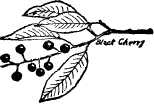
"If that ain't Black-cherry!"
"You mean Choke-cherry."
"No, Black-cherry. Choke-cherry ain't no good;
but Black-cherry bark's awful good for lung complaint.
Grandma always keeps it. I've been feeling
a bit queer meself" [she was really as strong as an
ox]. "Guess I'll git some." So she and Yan planned
an expedition together. The boldness of it scared
the boy. The girl helped herself to a hatchet in the
tool box—the sacred tool box of his father.
Yan's mother saw her with it and demanded why
she had it. With ready effrontery she said it was
to hammer in the hook that held the clothesline, and
proceeded to carry out the lie with a smiling face.
That gave Yan a new lesson and not a good one.
The hatchet was at once put back in the box, to be
stolen more carefully later on.
Biddy announced that she was going to the grocery
shop. She met Yan around the corner and they made
for the lot. Utterly regardless of property rights,
she showed Yan how to chip off the bark of the
77
Black-cherry. "Don't chip off all around; that's
bad luck—take it on'y from the sunny side." She
filled a basket with the pieces and they returned
home.
Here she filled a jar with bits of the inner layer,
then, pouring water over it, let it stand for a week.
The water was then changed to a dark brown stuff
with a bitter taste and a sweet, aromatic smell.
"It's terrible good," she said. "Granny always
keeps it handy. It cures lots of people. Now
there was Bud Ellis—the doctors just guv him up.
They said he didn't have a single lung left, and he
come around to Granny. He used to make fun of
Granny; but now he wuz plumb scairt. At first
Granny chased him away; then when she seen that
he was awful sick, she got sorry and told him how
to make Lung Balm. He was to make two gallons
each time and bring it to her. Then she took and
fixed it so it was one-half as much and give it
back to him. Well, in six months if he wasn't all
right."
Biddy now complained nightly of "feelin's" in her
chest. These feelings could be controlled only by
a glass or two of Lung Balm. Her condition must
have been critical, for one night after several necessary
doses of Balm her head seemed affected. She
became abusive to the lady of the house and at the
end of the month a less interesting help was in her
78
place.
There were many lessons good and bad that Yan
might have drawn from this; but the only one that
he took in was that the Black-cherry bark is a wonderful
remedy. The family doctor said that it really
was so, and Yan treasured up this as a new and
precious fragment of woodcraft.
Having once identified the tree, he was surprised
to see that it was rather common, and was delighted
to find it flourishing in his own Glenyan.
This made him set down on paper all the trees he
knew, and he was surprised to find how few they were
and how uncertain he was about them.
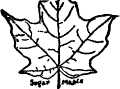
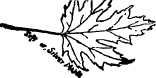
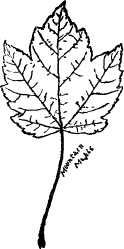
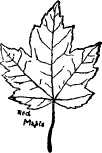
Maple—hard and soft.
Beach.
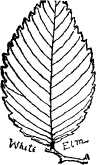
Elm—swamp and slippery.
Ironwood.
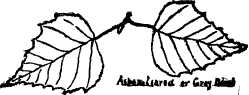
Birch—white and black.
Ash—white and black.
Pine.
Cedar.
Balsam.
Hemlock and Cherry.
He had heard that the Indians knew the name
and properties of every tree and plant in the woods,
and that was what he wished to be able to say of
himself.
One day by the bank of the river he noticed a pile
of empty shells of the fresh-water Mussel, or Clam.
The shells were common enough, but why all
79
together and marked in the same way? Around
the pile on the mud were curious tracks and
marks. There were so many that it was hard to
find a perfect one, but when he did, remembering
the Coon track, he drew a picture of it. It was
too small to be the mark of his old acquaintance.
He did not find any one to tell him what it was,
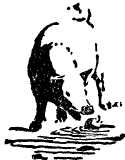
but one day he saw a round, brown animal hunched
up on the bank eating a clam. It dived into the
water at his approach, but it reappeared swimming
farther on. Then, when it dived again, Yan saw
by its long thin tail that it was a Muskrat, like
the stuffed one he had seen in the taxidermist's
window.
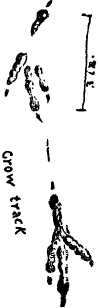
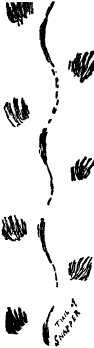
He soon learned that the more he studied those
tracks the more different kinds he found. Many
were rather mysterious, so he could only draw them
and put them aside, hoping some day for light. One
of the strangest and most puzzling turned out
to be the trail of a Snapper, and another proved
to be merely the track of a Common Crow that came
to the water's edge to drink.
The curios that he gathered and stored in his
shanty increased in number and in interest. The
place became more and more part of himself. Its
concealment bettered as the foliage grew around it
again, and he gloried in its wild seclusion and mystery,
and wandered through the woods with his bow and
arrows, aiming harmless, deadly blows at snickering
Red-squirrels—though doubtless he would have been
80
as sorry as they had he really hit one.
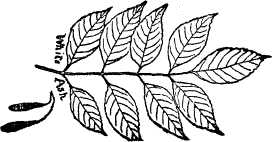
Yan soon found out that he was not the only
resident of the shanty. One day as he sat inside
wondering why he had not made a fireplace, so that
he could sit at an indoor fire, he saw a silent little
creature flit along between two logs in the back
wall. He remained still. A beautiful little Woodmouse,
for such it was, soon came out in plain view
and sat up to look at Yan and wash its face. Yan
reached out for his bow and arrow, but the Mouse
was gone in a flash. He fitted a blunt arrow to the
string, then waited, and when the Mouse returned
he shot the arrow. It missed the Mouse, struck the
log and bounded back into Yan's face, giving him a
stinging blow on the cheek. And as Yan rolled
around grunting and rubbing his cheek, he thought,
"This is what I tried to do to the Woodmouse."
Thenceforth, Yan made no attempt to harm the
Mouse; indeed, he was willing to share his meals with
it. In time they became well acquainted, and Yan
found that not one, but a whole family, were sharing
with him his shanty in the woods.
Biddy's remark about the Indian tobacco bore fruit.
Yan was not a smoker, but now he felt he must
learn. He gathered a lot of this tobacco, put it to
dry, and set about making a pipe—a real Indian peace
pipe. He had no red sandstone to make it of, but
a soft red brick did very well. He first roughed out
the general shape with his knife, and was trying to bore
the bowl out with the same tool, when he remembered
81
that in one of the school-readers was an account
of the Indian method of drilling into stone with a
bow-drill and wet sand. One of his schoolmates,
the son of a woodworker, had seen his father use a
bow-drill. This knowledge gave him new importance
in Yan's eyes. Under his guidance a bow-drill was
made, and used much and on many things till it was
understood, and now it did real Indian service by
drilling the bowl and stem holes of the pipe.
He made a stem of an Elderberry shoot, punching
out the pith at home with a long knitting-needle.
Some white pigeon wing feathers trimmed small,
and each tipped with a bit of pitch, were strung
on a stout thread and fastened to the stem for a
finishing touch; and he would sit by his camp fire
solemnly smoking—a few draws only, for he did not
like it—then say, "Ugh, heap hungry," knock the
ashes out, and proceed with whatever work he had
on hand.
Thus he spent the bright Saturdays, hiding his
accouterments each day in his shanty, washing the
paint from his face in the brook, and replacing the
hated paper collar that the pride and poverty of his
family made a daily necessity, before returning
home. He was a little dreamer, but oh! what happy
dreams. Whatever childish sorrow he found at
home he knew he could always come out here and
forget and be happy as a king—be a real King in a
Kingdom wholly after his heart, and all his very own.
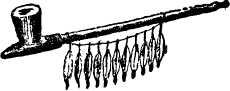
At school he was a model boy except in one
respect—he had strange, uncertain outbreaks
of disrespect for his teachers. One day he
amused himself by covering the blackboard with
ridiculous caricatures of the principal, whose favourite
he undoubtedly was. They were rather clever and
proportionately galling. The principal set about an
elaborate plan to discover who had done them. He
assembled the whole school and began cross-examining
one wretched dunce, thinking him the culprit. The
lad denied it in a confused and guilty way; the principal
was convinced of his guilt, and reached for his
rawhide, while the condemned set up a howl. To
the surprise of the assembly, Yan now spoke up,
and in a tone of weary impatience said:
"Oh, let him alone. I did it."
His manner and the circumstances were such that
every one laughed. The principal was nettled to
fury. He forgot his manhood; he seized Yan by the
collar. He was considered a timid boy; his face was
white; his lips set. The principal beat him with the
rawhide till the school cried "Shame," but he got no
cry from Yan.
That night, on undressing for bed, his brother Rad
83
saw the long black wales from head to foot, and an
explanation was necessary. He was incapable of
lying; his parents learned of his wickedness, and new
and harsh punishments were added. Next day was
Saturday. He cut his usual double or Saturday's
share of wood for the house, and, bruised and smarting,
set out for the one happy spot he knew. The
shadow lifted from his spirit as he drew near. He
was already forming a plan for adding a fireplace and
chimney to his house. He followed the secret path
he had made with aim to magnify its secrets. He
crossed the open glade, was, nearly at the shanty,
when he heard voices—loud, coarse voices—coming
from his shanty. He crawled up close. The door
was open. There in his dear cabin were three tramps
playing cards and drinking out of a bottle. On the
ground beside them were his shell necklaces broken
up to furnish poker chips. In a smouldering fire
outside were the remains of his bow and arrows.
Poor Yan! His determination to be like an
Indian under torture had sustained him in the
teacher's cruel beating and in his home punishments,
but this was too much. He fled to a far and quiet
corner and there flung himself down and sobbed in
grief and rage—he would have killed them if he
could. After an hour or two he came trembling
back to see the tramps finish their game and their
liquor; then they defiled the shanty and left it in
ruins.
84
The brightest thing in his life was gone—a King
discrowned, dethroned. Feeling now every wale on
his back and legs, he sullenly went home.
This was late in the summer. Autumn followed
last, with shortening days and chilly winds. Yan
had no chance to see his glen, even had he greatly
wished it. He became more studious; books were his
pleasure now. He worked harder than ever, winning
honour at school, but attracting no notice at the
home, where piety reigned.
The teachers and some of the boys remarked that
Yan was getting very thin and pale. Never very
robust, he now looked like an invalid; but at home
no note was taken of the change. His mother's
thoughts were all concentrated on his scapegrace
younger brother. For two years she had rarely spoken
to Yan peaceably. There was a hungry place in his
heart as he left the house unnoticed each morning
and saw his graceless brother kissed and darlinged.
At school their positions were reversed. Yan was
the principal's pride. He had drawn no more
caricatures, and the teacher flattered himself that
that beating was what had saved the pale-faced
head boy.
He grew thinner and heart-hungrier till near
Christmas, when the breakdown came.
"He is far gone in consumption," said the physician.
"He cannot live over a month or two"
[Illustration: "There in his dear cabin were three tramps"]
87
"He must live," sobbed the conscience-stricken
mother. "He must live—0 God, he must live."
All that suddenly awakened mother's love could
do was done. The skilful physician did his best,
but it was the mother that saved him. She watched
over him night and day; she studied his wishes and
comfort in every way. She prayed by his bedside,
and often asked God to forgive her for her long
neglect. It was Yan's first taste of mother-love.
Why she had ignored him so long was unknown.
She was simply erratic, but now she awoke to his
brilliant gifts, his steady, earnest life, already purposeful.
As winter waned, Yan's strength returned. He
was wise enough to use his new ascendency
to get books. The public librarian, a man
of broad culture who had fought his own fight,
became interested in him, and helped him to many
works that otherwise he would have missed.
"Wilson's Ornithology" and "Schoolcraft's
Indians" were the most important. And they were
sparkling streams in the thirst-parched land.
In March he was fast recovering. He could now
take long walks; and one bright day of snow he set
off with his brother's Dog. His steps bent hillward.
The air was bright and bracing, he stepped with
unexpected vigour, and he made for far Glenyan,
without at first meaning to go there. But, drawn
by the ancient attraction, he kept on. The secret
path looked not so secret, now the leaves were off;
but the Glen looked dearly familiar as he reached the
wider stretch.
His eye fell on a large, peculiar track quite fresh
in the snow. It was five inches across, big enough
for a Bear track, but there were no signs of claws
or toe pads. The steps were short and the tracks
had not sunken as they would for an animal as
89
heavy as a Bear.
As one end of each showed the indications of toes,
he could see what way it went, and followed up the
Glen. The dog sniffed at it uneasily, but showed
no disposition to go ahead. Yan tramped up past
the ruins of his shanty, now painfully visible since
the leaves had fallen, and his heart ached at the
sight. The trail led up the valley, and crossed the
brook on a log, and Yan became convinced that he
was on the track of a large Lynx. Though a splendid
barker, Grip, the dog, was known to be a coward,
and now he slunk behind the boy, sniffing at the
great track and absolutely refusing to go ahead.
Yan was fascinated by the long rows of footprints,
and when he came to a place where the creature
had leaped ten or twelve feet without visible cause,
he felt satisfied that he had found a Lynx, and the
love of adventure prompted him to go on, although
he had not even a stick in his hand or a knife in his
pocket. He picked up the best club he could find—a
dry branch two feet long and two inches through,
and followed. The dog was now unwilling to go
at all; he hung back, and had to be called at each
hundred yards.
They were at last in the dense Hemlock woods at
the upper end of the valley, when a peculiar sound like
the call of a deep-voiced cat was heard.
Yow! Yow! Yowl!
Yan stood still. The dog, although a large and
powerful retriever, whimpered, trembled and crawled
90
up close.
The sound increased in volume. The yowling
meouw came louder, louder and nearer, then suddenly
clear and close, as though the creature had rounded
a point and entered an opening. It was positively
blood-curdling now. The dog could stand it no more;
he turned and went as fast as he could for home,
leaving Yan to his fate. There was no longer any
question that it was a Lynx. Yan had felt nervous
before and the abject flight of the dog reacted on
him. He realized how defenseless he was, still weak
from his illness, and he turned and went after the
dog. At first he walked. But having given in to
his fears, they increased; and as the yowling continued
he finally ran his fastest. The sounds were left
behind, but Yan never stopped until he had left the
Glen and was once more in the open valley of the
river. Here he found the valiant retriever trembling
all over. Yan received him with a contemptuous
kick, and, boylike, as soon as he could find some
stones, he used them till Grip was driven home.
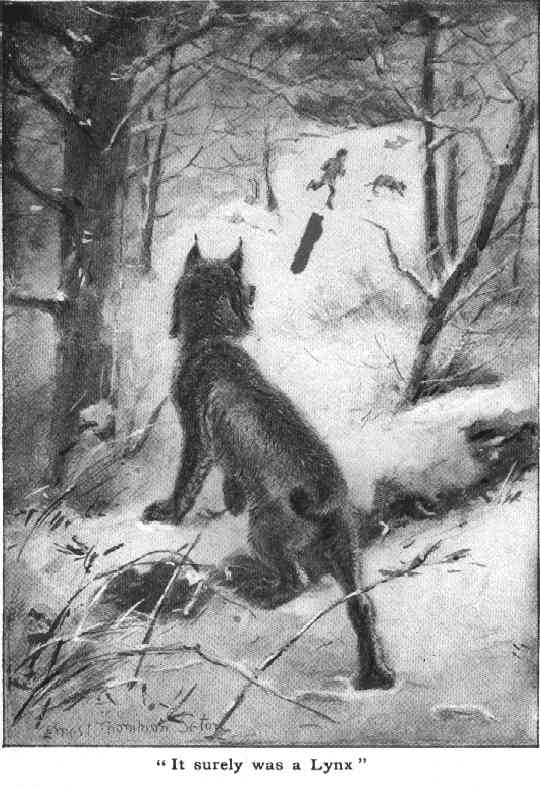
Most lads have some sporting instinct, and his
elder brother, though not of Yan's tastes, was not
averse to going gunning when there was a prospect
of sport.
Yan decided to reveal to Rad the secret of his
glen. He had never been allowed to use a gun,
but Rad had one, and Yan's vivid account of his
adventure had the desired effect. His method was
93
characteristic.
"Rad, would you go huntin' if there was lots to
hunt?"
"Course I would."
"Well, I know a place not ten miles away where
there are all kinds of wild animals—hundreds of
them."
"Yes, you do, I don't think. Humph!"
"Yes, I do; and I'll tell you, if you will promise
never to tell a soul."
"Ba-ah!"
"Well, I just had an adventure with a Lynx up
there now, and if you will come with your gun we
can get him."
Then Yan related all that had passed, and it lost
nothing in his telling. His brother was impressed
enough to set out under Yan's guidance on the
following Saturday.
Yan hated to reveal to his sneering, earthy-minded
brother all the joys and sorrows he had found in
the Glen, but now that it seemed compulsory he found
keen pleasure in playing the part of the crafty guide.
With unnecessary caution he first led in a wrong
direction, then trying, but failing, to extort another
promise of secrecy, he turned at an angle, pointed
to a distant tree, saying with all the meaning he could
put into it: "Ten paces beyond that tree is a trail
that shall lead us into the secret valley." After
sundry other ceremonies of the sort, they were near
the inway, when a man came walking through the
94
bushes. On his shoulders he carried something.
When he came close, Yan saw to his deep disgust
that that something was the Lynx—yes, it surely
was his Lynx.
They eagerly plied the man with questions. He
told them that he had killed it the day before, really.
It had been prowling for the last week or more about
Kernore's bush; probably it was a straggler from up
north.
This was all intensely fascinating to Yan, but in it
was a jarring note. Evidently this man considered
the Glen—his Glen—as an ordinary, well-known bit
of bush, possibly part of his farm—not by any means
the profound mystery that Yan would have had it.
The Lynx was a fine large one. The stripes on its
face and the wide open yellow eyes gave a peculiarly
wild, tiger-like expression that was deeply gratifying
to Yan's romantic soul.
It was not so much of an adventure as a might-have-been
adventure; but it left a deep impress on
the boy, and it also illustrated the accuracy of his
instincts in identifying creatures that he had never
before seen, but knew only through the slight descriptions
of very unsatisfactory books.
From now on to the spring Yan was daily gaining
in strength, and he and his mother came closer
together. She tried to take an interest in the
pursuits that were his whole nature. But she also
strove hard to make him take an interest in her
world. She was a morbidly religious woman. Her
conversation was bristling with Scripture texts.
She had a vast store of them—indeed, she had them
all; and she used them on every occasion possible and
impossible, with bewildering efficiency.
If ever she saw a group of young people dancing,
romping, playing any game, or even laughing heartily,
she would interrupt them to say, "Children, are you
sure you can ask God's blessing on all this? Do you
think that beings with immortal souls to save should
give rein to such frivolity! I fear you are sinning,
and be sure your sin will find you out. Remember,
that for every idle word and deed we must give an
account to the Great Judge of Heaven and earth."
She was perfectly sincere in all this, but she never
ceased, except during the time of her son's illness,
when, under orders from the doctor, she avoided the
painful topic of eternal happiness and tried to simulate
an interest in his pursuits. This was the blessed
96
truce that brought them together.
He found a confidante for the first time since he
met the collarless stranger, and used to tell all his
loves and fears among the woodfolk and things.
He would talk about this or that bird or flower, and
hoped to find out its name, till the mother would
suddenly feel shocked that any being with an immortal
soul to save could talk so seriously about anything
outside of the Bible; then gently reprove her son and
herself, too, with a number of texts.
He might reply with others, for he was well
equipped. But her unanswerable answer would be:
"There is but one thing needful. What profiteth it a
man if he gain the whole world and lose his own soul?"
These fencing bouts grew more frequent as Yan
grew stronger and the doctor's inhibition was removed.
After one of unusual warmth, Yan realized with a
chill that all her interest in his pursuits had been
an affected one. He was silent a long time, then
said: "Mother! you like to talk about your Bible.
It tells you the things that you long to know, that
you love to learn. You would be unhappy if you
went a day without reading a chapter or two. That
is your nature; God made you so.
"I have been obliged to read the Bible all my
life. Every day I read a chapter; but I do not
love it. I read it because I am forced to do it.
It tells me nothing I want to know. It does not
teach me to love God, which you say is the one thing
97
needful. But I go out into the woods, and every
bird and flower I see stirs me to the heart with something,
I do not know what it is; only I love them:
I love them with all my strength, and they make me
feel like praying when your Bible does not. They
are my Bible. This is my nature. God made me
so."
The mother was silent after this, but Yan could
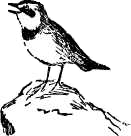 see that she was praying for him as for a lost soul.
A few days later they were out walking in the early
spring morning. A Shore-lark on a clod whistled
prettily as it felt the growing sunshine.
Yan strained his eyes and attention to take it in.
He crept up near it. It took wing, and as it went
he threw after it a short stick he was carrying. The
stick whirled over and struck the bird. It fell
fluttering. Yan rushed wildly after it and caught
it in spite of his mother's calling him back.
He came with the bird in his hand, but it did not
live many minutes. His mother was grieved and
disgusted. She said. "So this is the great love
you have for the wild things; the very first spring
bird to sing you must club to death. I do not
understand your affections. Are not two sparrows
sold for one farthing, and yet not one of them falls
to the ground without the knowledge of your
heavenly Father."
Yan was crushed. He held the dead bird in his
hand and said, contradictorily, as the tears stood
in his eyes, "I wish I hadn't; but oh, it was so
98
beautiful."
He could not explain, because he did not understand,
and yet was no hypocrite.
Weeks later a cheap trip gave him the chance for
the first time in his life to see Niagara. As he stood
with his mother watching the racing flood, in the
gorge below the cataract, he noticed straws, bubbles
and froth, that seemed to be actually moving upstream.
He said:
"Mother, you see the froth how it seems to go
up-stream."
"Well!"
"Yet we know it is a trifle and means nothing.
We know that just below the froth is the deep,
wide, terrible, irresistible, arrowy flood, surging all
the other way."
"Yes, my son."
"Well, Mother, when I killed the Shore-lark, that
was froth going the wrong way, I did love the
little bird. I know now why I killed it. Because
it was going away from me. If I could have seen it
near and could have touched it, or even have heard
it every day, I should never have wished to harm
it. I didn't mean to kill it, only to get it. You
gather flowers because you love to keep them near
you, not because you want to destroy them. They
die and you are sorry. I only tried to gather the
Shore-lark as you would a flower. It died, and I
was very, very sorry."
99
"Nevertheless," the mother replied, "the merciful
man is merciful unto his beast. He who hearkens
when the young Ravens cry, surely took note of it,
and in His great Book of Remembrance it is written
down against you."
And from that time they surely drifted apart.
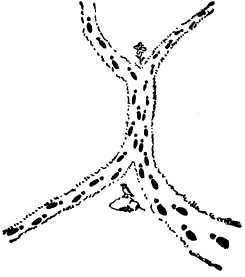
 AN was now fourteen years old
long-legged, thin, and growing fast
The doctor marked this combination
and said: "Send him on a
farm for a year."
AN was now fourteen years old
long-legged, thin, and growing fast
The doctor marked this combination
and said: "Send him on a
farm for a year."
Thus it was that an arrangement
was made for Yan to work
for his board at the farmhouse of
William Raften of Sanger.
Sanger was a settlement just emerging from the
early or backwoods period.
The recognized steps are, first, the frontier or
woods where all is unbroken forest and Deer abound;
next the backwoods where small clearings appear;
then a settlement where the forest and clearings
are about equal and the Deer gone; last, an agricultural
district, with mere shreds of forest remaining.
Thirty years before, Sanger had been "taken up"
by a population chiefly from Ireland, sturdy peasantry
for the most part, who brought with them the ancient
feud that has so long divided Ireland—the bitter
quarrel between the Catholics or "Dogans" (why
so called none knew) and Protestants, more usually
styled "Prattisons." The colours of the Catholics
were green and white; of the Protestants orange and
blue; and hence another distinctive name of the
104
latter was "Orangemen."
These two factions split the social structure in
two vertically. There were, in addition, several
horizontal lines of cleavage which, like geological
seams, ran across both segments.
In those days, the early part of the nineteenth
century, the British Government used to assist
desirable persons who wished to emigrate to Canada
from Ireland. This aid consisted of a free ocean
passage. Many who could not convince the Government
of their desirability and yet could raise the
money, came with them, paying their regular steerage
rate of $15. These were alike to the outside world,
but not to themselves. Those who paid their way
were "passengers," and were, in their own opinion,
many social worlds above the assisted ones, who
were called "Emmy Grants." This distinction was
never forgotten among the residents of Sanger.
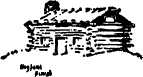
Yet two other social grades existed. Every
man and boy in Sanger was an expert with
the axe; was wonderfully adroit. The familiar
phrase, "He's a good man," had two accepted
meanings: If obviously applied to a settler during
the regular Saturday night Irish row in the little
town of Downey's Dump, it meant he was an able
man with his fists; but if to his home life on the farm,
it implied that he was unusually dexterous with the
axe. A man who fell below standard was despised.
Since the houses of hewn logs were made by their
owners, they reflected the axemen's skill. There
105
were two styles of log architecture; the shanty with
corners criss-cross, called hog-pen finish, and the
other, the house with the corners neatly finished, called
 dovetail finish. In Sanger it was a social black eye to
live in a house of the first kind. The residents were
considered "scrubs" or "riff-raff" by those whose
superior axemanship had provided the more neatly
finished dwelling. A later division crept in among
the "dovetailers" themselves when a brickyard
was opened. The more prosperous settlers put
up neat little brick houses. To the surprise of
all, one Phil O'Leary, a poor but prolific Dogan,
leaped at once from a hog-pen log to a fine brick,
and caused no end of perplexity to the ruling society
queens, simply paralyzing the social register, since
his nine fat daughters now had claims with the best.
Many, however, whose brick houses were but five
years old, denounced the O'Learys as upstarts and
for long witheld all social recognition. William
Raften, as the most prosperous man in the community,
was first to appear in red bricks. His implacable
enemy, Char-less (two syllables) Boyle, egged on by
his wife, now also took the red brick plunge, though
he dispensed with masons and laid the bricks himself,
with the help of his seventeen sons. These two men,
though Orangemen both, were deadly enemies, as
the wives were social rivals. Raften was the stronger
and richer man, but Boyle, whose father had paid
his own steerage rate, knew all about Raften's
father, and always wound up any discussion by
106
hurling in Raften's teeth: "Don't talk to me, ye
dovetail finish. In Sanger it was a social black eye to
live in a house of the first kind. The residents were
considered "scrubs" or "riff-raff" by those whose
superior axemanship had provided the more neatly
finished dwelling. A later division crept in among
the "dovetailers" themselves when a brickyard
was opened. The more prosperous settlers put
up neat little brick houses. To the surprise of
all, one Phil O'Leary, a poor but prolific Dogan,
leaped at once from a hog-pen log to a fine brick,
and caused no end of perplexity to the ruling society
queens, simply paralyzing the social register, since
his nine fat daughters now had claims with the best.
Many, however, whose brick houses were but five
years old, denounced the O'Learys as upstarts and
for long witheld all social recognition. William
Raften, as the most prosperous man in the community,
was first to appear in red bricks. His implacable
enemy, Char-less (two syllables) Boyle, egged on by
his wife, now also took the red brick plunge, though
he dispensed with masons and laid the bricks himself,
with the help of his seventeen sons. These two men,
though Orangemen both, were deadly enemies, as
the wives were social rivals. Raften was the stronger
and richer man, but Boyle, whose father had paid
his own steerage rate, knew all about Raften's
father, and always wound up any discussion by
106
hurling in Raften's teeth: "Don't talk to me, ye
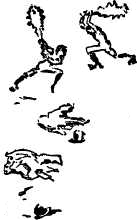 upstart. Everybody knows ye are nothing but a
Emmy Grant." This was the one fly in the Raften
ointment. No use denying it. His father had accepted
a free passage, true, and Boyle had received a
free homestead, but what of that—that counted
for nothing. Old Boyle had been a "PASSENGER,"
old Raften an "EMMY GRANT."
upstart. Everybody knows ye are nothing but a
Emmy Grant." This was the one fly in the Raften
ointment. No use denying it. His father had accepted
a free passage, true, and Boyle had received a
free homestead, but what of that—that counted
for nothing. Old Boyle had been a "PASSENGER,"
old Raften an "EMMY GRANT."
This was the new community that Yan had entered,
and the words Dogan and Prattison, "green" and
"orange and blue," began to loom large, along with
the ideas and animosities they stood for.
The accent of the Sangerite was mixed. First,
there was a rich Irish brogue with many Irish words;
this belonged chiefly to the old folks. The Irish of
such men as Raften was quite evident in their speech,
but not strong enough to warrant the accepted Irish
spelling of books, except when the speaker was
greatly excited. The young generation had almost
no Irish accent, but all had sifted down to the
peculiar burring nasal whine of the backwoods
Canadian.
Mr. and Mrs. Raften met Yan at the station. They
had supper together at the tavern and drove him
to their home, where they showed him into the big
dining-room—living-room—kitchen. Over behind
the stove was a tall, awkward boy with carroty hair
and small, dark eyes set much aslant in the saddest
of faces. Mrs. Raften said, "Come, Sam, and shake
hands with Yan." Sam came sheepishly forward,
107
shook hands in a flabby way, and said, in drawling
tones, "How-do," then retired behind the stove to
gaze with melancholy soberness at Yan, whenever he
could do so without being caught at it. Mr. and Mrs.
Raften were attending to various matters elsewhere,
and Yan was left alone and miserable. The idea
of giving up college to go on a farm had been a hard
one for him to accept, but he had sullenly bowed to
his father's command and then at length learned to
like the prospect of getting away from Bonnerton
into the country. After all, it was but for a year, and
it promised so much of joy. Sunday-school left
behind. Church reduced to a minimum. All his
life outdoors, among fields and woods—surely this
spelled happiness; but now that he was really there,
the abomination of desolation seemed sitting on all
things and the evening was one of unalloyed
misery. He had nothing to tell of, but a cloud of
black despair seemed to have settled for good on the
world. His mouth was pinching very hard and his
eyes blinking to keep back the tears when Mrs. Raften
came into the room. She saw at a glance what was
wrong. "He's homesick," she said to her husband.
"He'll be all right to-morrow," and she took Yan
by the hand and led him upstairs to bed.
Twenty minutes later she came to see if he was
comfortable. She tucked the clothes in around
him, then, stooping down for a good-night kiss, she
found his face wet with tears. She put her arms
about him for a moment, kissed him several times,
108
and said, "Never mind, you will feel all right
to-morrow," then wisely left him alone.
Whence came that load of misery and horror, or
whither it went, Yan never knew. He saw it no
more, and the next morning he began to interest
himself in his new world.
William Raften had a number of farms all in fine
order and clear of mortgages; and each year he added
to his estates. He was sober, shrewd, even cunning,
hated by most of his neighbours because he was too
clever for them and kept on getting richer. His
hard side was for the world and his soft side for his
family. Not that he was really soft in any respect.
He had had to fight his life-battle alone, beginning
with nothing, and the many hard knocks had hardened
him, but the few who knew him best could testify to
the warm Irish heart that continued unchanged
within him, albeit it was each year farther from
the surface. His manners, even in the house, were
abrupt and masterful. There was no mistaking
his orders, and no excuse for not complying with
them. To his children when infants, and to his
wife only, he was always tender, and those who saw
him cold and grasping, overreaching the sharpers
of the grain market, would scarcely have recognized
the big, warm-hearted happy-looking father at home
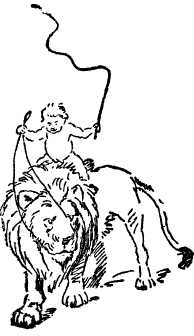 an hour later when he was playing horse with his
baby daughter or awkwardly paying post-graduate
court to his smiling wife.
an hour later when he was playing horse with his
baby daughter or awkwardly paying post-graduate
court to his smiling wife.
109
He had little "eddication," could hardly read, and
was therefore greatly impressed with the value of
"book larnin'," and determined that his own children
should have the "best that money could git in that
line," which probably meant that they should read
fluently. His own reading was done on Sunday
mornings, when he painfully spelled out the important
items in a weekly paper; "important" meant referring
to the produce market or the prize ring, for he had
been known and respected as a boxer, and dearly
loved the exquisite details of the latest bouts. He
used to go to church with his wife once a month
to please her, and thought it very unfair therefore
that she should take no interest in his favourite
hobby—the manly art.
Although hard and even brutal in his dealings
with men, he could not bear to see an animal ill used.
"The men can holler when they're hurt, but the poor
dumb baste has no protection." He was the only
farmer in the country that would not sell or shoot a
worn-out horse. "The poor brute has wurruked hard
an' hez airned his kape for the rest av his days." So
Duncan, Jerry and several others were "retired" and
lived their latter days in idleness, in one case for more
than ten years.
Raften had thrashed more than one neighbour for
beating a horse, and once, on interfering, was himself
thrashed, for he had the ill-luck to happen on a prizefighter.
But that had no lasting effect on him. He
continued to champion the dumb brute in his own
brutal way.
110
Among the neighbours the perquisites of the boys
were the calfskins. The cows' milk was needed and
the calves of little value, so usually they were killed
when too young for food. The boys did the killing,
making more or less sport of it, and the skins, worth
fifty cents apiece green and twenty-five cents dry,
at the tannery, were their proper pay. Raften never
allowed his son to kill the calves. "Oi can't kill a
poor innocent calf mesilf an' I won't hev me boy
doin' it," he said. Thus Sam was done out of a
perquisite, and did not forget the grievance.
Mrs. Raften was a fine woman, a splendid manager,
loving her home and her family, her husband's loyal
and ablest supporter, although she thought that
William was sometimes a "leetle hard" on the boys.
They had had a large family, but most of the
children had died. Those remaining were Sam, aged
fifteen, and Minnie, aged three.
Yan's duties were fixed at once. The poultry
and half the pigs and cows were to be his charge.
He must also help Sam with various other chores.
There was plenty to do and clear rules about doing
it. But there was also time nearly every day for
other things more in the line of his tastes; for even
if he were hard on the boys in work hours, Raften
saw to it that when they did play they should have
a good time. His roughness and force made Yan
afraid of him, and as it was Raften's way to say
nothing until his mind was fully made up, and then
say it "strong," Yan was left in doubt as to whether
or not he was giving satisfaction.
Sam Raften turned out to be more congenial
than he looked. His slow, drawling speech had
given a wrong impression of stupidity, and, after
a formal showing of the house under Mr. Raften, a
real investigation was headed by Sam. "This yer's
the paaar-le-r," said he, unlocking a sort of dark
cellar aboveground and groping to open what
afterward proved to be a dead, buried and almost
forgotten window. In Sanger settlement the farmhouse
parlour is not a room; it is an institution.
It is kept closed all the week except when the minister
calls, and the one at Raften's was the pure type.
Its furniture consisted of six painted chairs (fifty
cents each), two rockers ($1.49), one melodeon (thirty-two
bushels of wheat—the agent asked forty), a sideboard
made at home of the case the melodeon came
in, one rag carpet woofed at home and warped and
woven in exchange for wool, one center-table varnished
(!) ($9.00 cash, $11.00 catalogue). On the
center-table was one tintype album, a Bible, and
some large books for company use. Though dusted
once a week, they were never moved, and it was
years later before they were found to have settled
permanently into the varnish of the table. In
112
extremely uncostly frames on the wall were the
coffin-plates of the departed members of the family.
It was the custom at Sanger to honour the dead by
bringing back from the funeral the name-plate and
framing it on a black background with some supposed
appropriate scripture text.
The general atmosphere of the room was dusty and
religious as it was never opened except on Sundays
or when the parson called, which instituted a sort
of temporary Sunday, and the two small windows
were kept shut and plugged as well as muffled always,
with green paper blinds and cotton hangings. It
was a thing apart from the rest of the house—a sort
of family ghost-room: a chamber of horrors, seen but
once a week.
But it contained one thing at least of interest—something
that at once brought Sam and Yan
together. This was a collection of a score of birds'
eggs. They were all mixed together in an old
glass-topped cravat box, half full of bran. None
of them were labelled or properly blown. A collector
would not have given it a second glance, but it
proved an important matter. It was as though
two New Yorkers, one disguised as a Chinaman
and the other as a Negro, had accidently met in
Greenland and by chance one had made the
sign of the secret brotherhood to which they both
belonged.
"Do you like these things?" said Yan, with sudden
interest and warmth, in spite of the depressing
113
surroundings.
"You bet," said Sam. "And I'd a-had twice as
many only Da said it was doing no good and birds
was good for the farm."
"Well, do you know their names?"
"Wall, I should say so. I know every Bird that
flies and all about it, or putty near it," drawled Sam,
with an unusual stretch for him, as he was not given
to bragging.
"I wish I did. Can't I get some eggs to take
home?"
"No; Da said if I wouldn't take any more he'd
lend me his Injun Chief gun to shoot Rabbits with."
"What? Are there Rabbits here?"
"Wall, I should say so. I got three last winter."
"But I mean now," said Yan, with evident disappointment.
"They ain't so easy to get at now, but we can try.
Some day when all the work's done I'll ask Da for
his gun."
"When all the work's done," was a favourite
expression of the Raftens for indefinitely shelving a
project, it sounded so reasonable and was really
so final.
Sam opened up the lower door of the sideboard
and got out some flint arrow-heads picked up in the
ploughing, the teeth of a Beaver dating from the
early days of the settlement, and an Owl very badly
stuffed. The sight of these precious things set Yan
all ablaze. "Oh!" was all he could say. Sam was
114
gratified to see such effect produced by the family
possessions and explained, "Da shot that off'n the
barn an' the hired man stuffed it."
The boys were getting on well together now. They
exchanged confidences all day as they met in doing
chores. In spite of the long interruptions, they got
on so well that Sam said after supper, "Say, Yan,
I'm going to show you something, but you must
promise never to tell—Swelpye!" Of course Yan
promised and added the absolutely binding and
ununderstandable word—"Swelpme."
"Le's both go to the barn," said Sam.
When they were half way he said: "Now I'll
let on I went back for something. You go on an'
round an' I'll meet you under the 'rusty-coat' in
the orchard." When they met under the big russet
apple tree, Sam closed one of his melancholy eyes
and said in a voice of unnecessary hush, "Follow
me." He led to the other end of the orchard where
stood the old log house that had been the home
before the building of the brick one. It was now
used as a tool house. Sam led up a ladder to the
loft (this was all wholly delightful). There at the
far end, and next the little gable pane, he again
cautioned secrecy, then when on invitation Yan had
once more "swelped" himself, he rummaged in a
dirty old box and drew out a bow, some arrows, a
rusty steel trap, an old butcher knife, some fish-hooks,
a flint and steel, a box full of matches, and
some dirty, greasy-looking stuff that he said was
115
dried meat. "You see," he explained, "I always
wanted to be a hunter, and Da was bound I'd be a
dentist. Da said there was no money in hunting,
but one day he had to go to the dentist an' it cost
four dollars, an' the man wasn't half a day at the
job, so he wanted me to be a dentist, but I wanted
to be a hunter, an' one day he licked me and
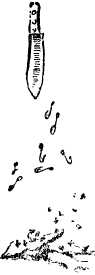 (Bud, that's my brother that died a year ago. If you
hear Ma talk you'll think he was an angel, but I
always reckoned he was a crazy galoot, an' he was
the worst boy in school by odds). Wall, Da licked
us awful for not feeding the hogs, so Bud got ready
to clear out, an' at first I felt just like he did an'
said I'd go too, an' we'd j'ine the Injuns. Anyhow,
I'd sure go if ever I was licked again, an' this was
the outfit we got together. Bud wanted to steal
Da's gun an' I wouldn't. I tell you I was hoppin'
mad that time, an' Bud was wuss—but I cooled off
an' talked to Bud. I says, 'Say now, Bud, it would
take about a month of travel to get out West, an'
if the Injuns didn't want nothin' but our scalps that
wouldn't be no fun, an' Da ain't really so bad, coz
we sho'ly did starve them pigs so one of 'em died.'
I reckon we deserved all we got—anyhow, it was all
dumb foolishness about skinnin' out, though I'd
like mighty well to be a hunter. Well, Bud died
that winter. You seen the biggest coffin plate on
the wall? Well, that's him. I see Ma lookin' at
it an' cryin' the other day. Da says he'll send me
to college if I'll be a dentist or a lawyer—lawyers
116
make lots of money: Da had a lawsuit once—an'
if I don't, he says I kin go to—you know."
(Bud, that's my brother that died a year ago. If you
hear Ma talk you'll think he was an angel, but I
always reckoned he was a crazy galoot, an' he was
the worst boy in school by odds). Wall, Da licked
us awful for not feeding the hogs, so Bud got ready
to clear out, an' at first I felt just like he did an'
said I'd go too, an' we'd j'ine the Injuns. Anyhow,
I'd sure go if ever I was licked again, an' this was
the outfit we got together. Bud wanted to steal
Da's gun an' I wouldn't. I tell you I was hoppin'
mad that time, an' Bud was wuss—but I cooled off
an' talked to Bud. I says, 'Say now, Bud, it would
take about a month of travel to get out West, an'
if the Injuns didn't want nothin' but our scalps that
wouldn't be no fun, an' Da ain't really so bad, coz
we sho'ly did starve them pigs so one of 'em died.'
I reckon we deserved all we got—anyhow, it was all
dumb foolishness about skinnin' out, though I'd
like mighty well to be a hunter. Well, Bud died
that winter. You seen the biggest coffin plate on
the wall? Well, that's him. I see Ma lookin' at
it an' cryin' the other day. Da says he'll send me
to college if I'll be a dentist or a lawyer—lawyers
116
make lots of money: Da had a lawsuit once—an'
if I don't, he says I kin go to—you know."
Here was Yan's own kind of mind, and he opened
his heart. He told all about his shanty in the woods
and how he had laboured at and loved it. He was
full of enthusiasm as of old, boiling over with purpose
and energy, and Sam, he realized, had at least two
things that he had not—ability with tools and cool
judgment. It was like having the best parts of his
brother Rad put into a real human being. And
remembering the joy of his Glen, Yan said:
"Let's build a shanty in the woods by the creek;
your father won't care, will he?"
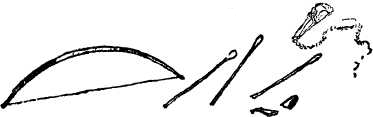 "Not he, so long as the work's done."
The very next day they must begin. As soon as
every chore was done they went to the woods
to select a spot.
The brook, or "creek," as they called it, ran
through a meadow, then through a fence into the
woods. This was at first open and grassy, but
farther down the creek it was joined by a dense
cedar swamp. Through this there was no path,
but Sam said that there was a nice high place beyond.
The high ground seemed a long way off in the woods,
though only a hundred yards through the swamp,
but it was the very place for a camp—high, dry and
open hard woods, with the creek in front and the
cedar swamp all around. Yan was delighted. Sam
caught no little of the enthusiasm, and having brought
an axe, was ready to begin the shanty. But Yan
had been thinking hard all morning, and now he
said: "Sam, we don't want to be White hunters.
They're no good; we want to be Indians."
"Now, that's just where you fool yourself," said
Sam. "Da says there ain't nothin' an Injun can
do that a White-man can't do better."
118
"Oh, what are you talking about?" said Yan
warmly. "A White hunter can't trail a moccasined
foot across a hard granite rock. A White hunter
can't go into the woods with nothing but a knife and
make everything he needs. A White hunter can't
hunt with bows and arrows, and catch game with
snares, can he? And there never yet was a White
man could make a Birch canoe." Then, changing his
tone, Yan went on: "Say, now, Sam, we want to
be the best kind of hunters, don't we, so as to be
ready for going out West. Let's be Injuns and
do everything like Injuns."
After all, this had the advantage of romance and
picturesqueness, and Sam consented to "try it for
awhile, anyhow." And now came the point of
Yan's argument. "Injuns don't live in shanties;
they live in teepees. Why not make a teepee
instead?"
"That would be just bully," said Sam, who had
seen pictures enough to need no description, "but
what are we to make it of?"
"Well," answered Yan, promptly assuming the
leadership and rejoicing in his ability to speak as an
authority, "the Plains Injuns make their teepees of
skins, but the wood Injuns generally use Birch
bark."
"Well, I bet you can't find skins or Birch bark
enough in this woods to make a teepee big enough
for a Chipmunk to chaw nuts in."
"We can use Elm bark."
119
"That's a heap easier," replied Sam, "if it'll
answer, coz we cut a lot o' Elm logs last winter
and the bark'll be about willin' to peel now. But
first let's plan it out."
This was a good move, one Yan would have overlooked.
He would probably have got a lot of material
together and made the plan afterward, but Sam had
been taught to go about his work with method.
So Yan sketched on a smooth log his remembrance
of an Indian teepee. "It seems to me it was about
this shape, with the poles sticking up like that, a
hole for the smoke here and another for the door
there."
"Sounds like you hain't never seen one," remarked
Sam, with more point than politeness, "but we kin
try it. Now 'bout how big?"
Eight feet high and eight feet across was decided
to be about right. Four poles, each ten feet long,
were cut in a few minutes, Yan carrying them to a
smooth place above the creek as fast as Sam cut them.
"Now, what shall we tie them with?" said Yan.
"You mean for rope?"
"Yes, only we must get everything in the woods;
real rope ain't allowed."
"I kin fix that," said Sam; "when Da double-staked
the orchard fence, he lashed every pair of stakes at
the top with Willow withes."
"That's so—I quite forgot," said Yan. In a few
minutes they were at work trying to tie the four poles
together with slippery stiff Willows, but it was no
easy matter. They had to be perfectly tight or they
120
would slip and fall in a heap each time they were
raised, and it seemed at length that the boys would
be forced to the impropriety of using hay wire, when
they heard a low grunt, and turning, saw William
Raften standing with his hands behind him as
though he had watched them for hours.
The boys were no little startled. Raften had a
knack of turning up at any point when something was
going on, taking in the situation fully, and then, if
he disapproved, of expressing himself in a few words
of blistering mockery delivered in a rich Irish brogue.
Just what view he would take of their pastime the
boys had no idea, but awaited with uneasiness.
If they had been wasting time when they should
have been working there is no question but that they
would have been sent with contumely to more
profitable pursuits, but this was within their rightful
play hours, and Raften, after regarding them with a
searching look, said slowly: "Bhoys!" (Sam felt
easier; his father would have said "Bhise" if really
angry.) "Fhat's the good o' wastin' yer time"
(Yan's heart sank) "wid Willow withes fur a job like
that? They can't be made to howld. Whoi don't
ye git some hay woire or coord at the barrun?"
The boys were greatly relieved, but still this
friendly overture might be merely a feint to open the
way for a home thrust. Sam was silent. So Yan
said, presently, "We ain't allowed to use anything
but what the Indians had or could get in the woods."
121
"An' who don't allow yez?"
"The rules."
"Oh," said William, with some amusement. "Oi
see! Hyar."
He went into the woods looking this way and that,
and presently stopped at a lot of low shrubs.
"Do ye know what this is, Yan?"
"No, sir."
"Le's see if yer man enough to break it aff."
Yan tried. The wood was brittle enough, but the
bark, thin, smooth and pliant, was as tough as
leather, and even a narrow strip defied his
strength.
"That's Litherwood," said Raften. "That's what
the Injuns used; that's what we used ourselves in
the airly days of this yer settlement."
The boys had looked for a rebuke, and here was a
helping hand. It all turned on the fact that this
was "play hours," Raften left with a parting word:
"In wan hour an' a half the pigs is fed."
"You see Da's all right when the work ain't forgot,"
said Sam, with a patronizing air. "I wonder why
I didn't think o' that there Leatherwood meself.
I've often heard that that's what was used fur tying
bags in the old days when cord was scarce, an' the
Injuns used it for tying their prisoners, too. Ain't
it the real stuff?"
Several strips were now used for tying four poles
together at the top, then these four were raised on
end and spread out at the bottom to serve as the
frame of the teepee, or more properly wigwam, since
122
it was to be made of bark.
After consulting, they now got a long, limber
Willow rod an inch thick, and bending it around like
a hoop, they tied it with Leatherwood to each pole
at a point four feet from the ground. Next they
cut four short poles to reach from the ground to this.
These were lashed at their upper ends to the Willow
rod, and now they were ready for the bark slabs.
The boys went to the Elm logs and again Sam's able
use of the axe came in. He cut the bark open along
the top of one log, and by using the edge of the axe
and some wooden wedges they pried off a great roll
eight feet long and four feet across. It was a
pleasant surprise to see what a wide piece of bark
the small log gave them.
Three logs yielded three fine large slabs and others
yielded pieces of various sizes. The large ones were
set up against the frame so as to make the most of
them. Of course they were much too big for the top,
and much too narrow for the bottom; but the little
pieces would do to patch if some way could be found
to make them stick.
Sam suggested nailing them to the posts, and
Yan was horrified at the idea of using nails. "No
Indian has any nails."
"Well, what would they use?" said Sam.
"They used thongs, an'—an'—maybe wooden
pegs. I don't know, but seems to me that would
be all right."
123
"But them poles is hard wood," objected the
practical Sam. "You can drive Oak pegs into Pine,
but you can't drive wooden pegs into hard wood
without you make some sort of a hole first. Maybe
I'd better bring a gimlet."
"Now, Sam, you might just as well hire a carpenter—that
wouldn't be Indian at all. Let's play it right.
We'll find some way. I believe we can tie them up
with Leatherwood."
So Sam made a sharp Oak pick with his axe, and
Yan used it to pick holes in each piece of bark and
then did a sort of rude sewing till the wigwam
seemed beautifully covered in. But when they
went inside to look they were unpleasantly surprised
to find how many holes there were. It was impossible
to close them all because the bark was cracking in
so many places, but the boys plugged the worst of
them and then prepared for the great sacred ceremony—the
lighting of the fire in the middle.
They gathered a lot of dry fuel, then Yan produced
a match.
"That don't look to me very Injun," drawled
Sam critically. "I don't think Injuns has matches."
"Well, they don't," admitted Yan, humbly.
"But I haven't a flint and steel, and don't know how
to work rubbing-sticks, so we just got to use matches,
if we want a fire."
"Why, of course we want a fire. I ain't kicking,"
said Sam. "Go ahead with your old leg-fire sulphur
stick. A camp without a fire would be 'bout like
last year's bird's nest or a house with the roof
124
off."
Yan struck a match and put it to the wood. It
went out. He struck another—same result. Yet
another went out.
Sam remarked:
"Pears to me you don't know much about lightin'
a fire. Lemme show you. Let the White hunter learn
the Injun somethin' about the woods," said he with
a leer.
Sam took the axe and cut some sticks of a dry
Pine root. Then with his knife he cut long curling
shavings, which he left sticking in a fuzz at the end
of each stick.
"Oh, I've seen a picture of an Indian making
them. They call them 'prayer-sticks,'" said Yan.
"Well, prayer-sticks is mighty good kindlin'"
replied the other. He struck a match, and in a
minute he had a blazing fire in the middle of the
wigwam.
"Old Granny de Neuville, she's a witch—she
knows all about the woods, and cracked Jimmy turns
everything into poetry what she says. He says she
says when you want to make a fire in the woods you
take—
"First a curl of Birch bark as dry as it kin be,
Then some twigs of soft-wood, dead, but on the tree,
Last o' all some Pine knots to make the kittle foam,
An' thar's a fire to make you think you're settin' right at home."
125
"Who's Granny de Neuville?"
"Oh, she's the old witch that lives down at the
bend o' the creek."
"What? Has she got a granddaughter named
Biddy?" said Yan, suddenly remembering that his
ancient ally came from this part of Sanger.
"Oh, my! Hain't she? Ain't Biddy a peach—drinks
like a fish, talks everybody to death about
the time she resided in Bonnerton. Gits a letter
every mail begging her to come back and 'reside'
with them some more."
"Ain't this fine," said Yan, as he sat on a pile of
Fir boughs in the wigwam.
"Looks like the real thing," replied Sam from his
seat on the other side. "But say, Yan, don't
make any more fire; it's kind o' warm here, an' there
seems to be something wrong with that flue—wants
sweepin', prob'ly—hain't been swep' since I kin
remember."
The fire blazed up and the smoke increased.
Just a little of it wandered out of the smoke-hole at
the top, then it decided that this was a mistake and
thereafter positively declined to use the vent. Some
of it went out by chinks, and a large stream issued
from the door, but by far the best part of it seemed
satisfied with the interior of the wigwam, so that in
a minute or less both boys scrambled out. Their
eyes were streaming with smoke-tears and their
discomfiture was complete.
"'Pears to me," observed Sam, "like we got them
holes mixed. The dooer should 'a 'been at the top,
126
sence the smoke has a fancy for usin' it, an' then we'd
had a chance."
"The Indians make it work," said Yan; "a White
hunter ought to know how."
"Now's the Injun's chance," said Sam. "Maybe
it wants a dooer to close, then the smoke would have
to go out."
They tried this, and of course some of the smoke
was crowded out, but not till long after the boys
were.
"Seems like what does get out by the chinks is
sucked back agin by that there double-action flue,"
said Sam.
It was very disappointing. The romance of
sitting by the fire in one's teepee appealed to both
of the boys, but the physical torture of the smoke
made it unbearable. Their dream was dispelled,
and Sam suggested, "Maybe we'd better try a shanty."
"No," said Yan, with his usual doggedness.
"I know it can be done, because the Indians do it.
We'll find out in time."
But all their efforts were in vain. The wigwam
was a failure, as far as fire was concerned. It was
very small and uncomfortable, too; the wind blew
through a hundred crevices, which grew larger as the
Elm bark dried and cracked. A heavy shower
caught them once, and they were rather glad to be
driven into their cheerless lodge, but the rain
came abundantly into the smoke-hole as well as
through the walls, and they found it but little
protection.
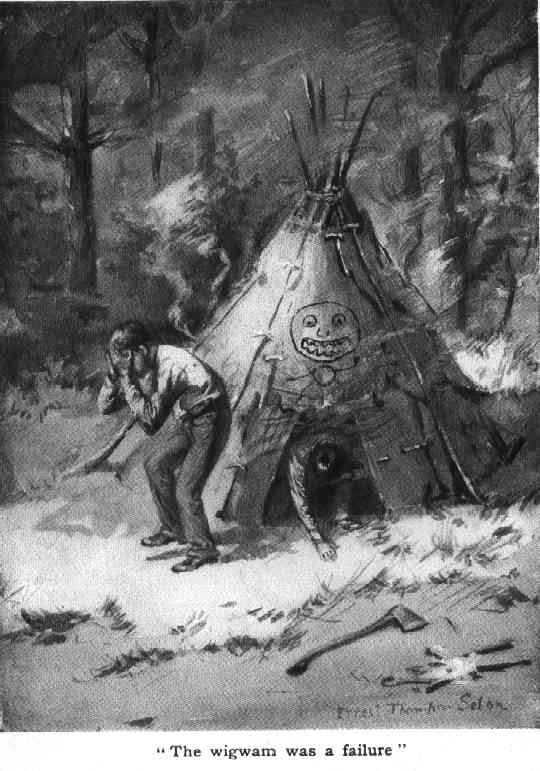
129
"Seems to me, if anything, a leetle wetter in here
than outside," said Sam, as he led in a dash for home.
That night a heavy storm set in, and next day
the boys found their flimsy wigwam blown down—nothing
but a heap of ruins.
Some time after, Raften asked at the table in
characteristic stern style, "Bhoys, what's doin'
down to yer camp? Is yer wigwam finished?"
"No good," said Sam. "All blowed down."
"How's that?"
"I dunno'. It smoked like everything. We
couldn't stay in it."
"Couldn't a-been right made," said Raften; then
with a sudden interest, which showed how eagerly
he would have joined in this forty years ago, he
said, "Why don't ye make a rale taypay?"
"Dunno' how, an' ain't got no stuff."
"Wall, now, yez have been pretty good an' ain't
slacked on the wurruk, yez kin have the ould wagon
kiver. Cousin Bert could tache ye how to make
it, if he wuz here. Maybe Caleb Clark knows,"
he added, with a significant twinkle of his eye.
"Better ask him." Then he turned to give orders
to the hired men, who, of course, ate at the family
table.
"Da, do you care if we go to Caleb?"
"I don't care fwhat ye do wid him," was the reply.
Raften was no idle talker and Sam knew that, so
as soon as "the law was off" he and Yan got out the
130
old wagon cover. It seemed like an acre of canvas
when they spread it out. Having thus taken possession,
they put it away again in the cow-house,
their own domain, and Sam said: "I've a great
notion to go right to Caleb; he sho'ly knows more
about a teepee than any one else here, which ain't
sayin' much."
"Who's Caleb?"
"Oh, he's the old Billy Goat that shot at Da
oncet, just after Da beat him at a horse trade. Let
on it was a mistake: 'twas, too, as he found out,
coz Da bought up some old notes of his, got 'em
cheap, and squeezed him hard to meet them. He's
had hard luck ever since.
"He's a mortal queer old duck, that Caleb. He
knows heaps about the woods, coz he was a hunter
an' trapper oncet. My! wouldn't he be down on me
if he knowed who was my Da, but he don't have to
know."
The Sanger Witch dwelt in the bend of the creek,
And neither could read nor write;
But she knew in a day what few knew in a week,
For hers was the second sight.
"Read?" said she, "I am double read;
You fools of the ink and pen
Count never the eggs, but the sticks of the nest,
See the clothes, not the souls of men."
—Cracked Jimmy's Ballad of Sanger.
The boys set out for Caleb's. It was up the
creek away from the camp ground. As they
neared the bend they saw a small log shanty,
with some poultry and a pig at the door.
"That's where the witch lives," said Sam.
"Who—old Granny de Neuville?"
"Yep, and she just loves me. Oh, yes; about the
same way an old hen loves a Chicken-hawk. 'Pears
to me she sets up nights to love me."
"Why?"
"Oh, I guess it started with the pigs. No, let's see:
first about the trees. Da chopped off a lot of Elm
trees that looked terrible nice from her windy. She's
awful queer about a tree. She hates to see 'em cut
down, an' that soured her same as if she owned 'em.
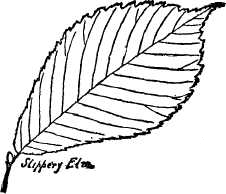
132
Then there wuz the pigs. You see, one winter she was
awful hard up, an' she had two pigs worth, maybe,
$5.00 each—anyway, she said they was, an' she ought
to know, for they lived right in the shanty with her—an'
she come to Da (I guess she had tried every one
else first) an' Da he squeezed her down an' got the two
pigs for $7.00. He al'ays does that. Then he comes
home an' says to Ma, 'Seems to me the old lady is
pretty hard put. 'Bout next Saturday you take two
sacks of flour and some pork an' potatoes around an'
see that she is fixed up right.' Da's al'ays doin' them
things, too, on the quiet. So Ma goes with about
$15.00 worth o' truck. The old witch was kinder
'stand off.' She didn't say much. Ma was goin'
slow, not knowin' just whether to give the stuff out
an' out, or say it could be worked for next year, or
some other year, when there was two moons, or some
time when the work was all done. Well, the old
witch said mighty little until the stuff was all put in
the cellar, then she grabs up a big stick an' breaks out
at Ma:
"'Now you git out o' my house, you dhirty, sthuck-up
thing. I ain't takin' no charity from the likes o'
you. That thing you call your husband robbed me
o' my pigs, an' we ain't any more'n square now, so
git out an' don't you dar set fut in my house agin'."
"Well, she was sore on us when Da bought her
pigs, but she was five times wuss after she clinched
the groceries. 'Pears like they soured on her stummick."
133
"What a shame, the old wretch," said Yan, with
ready sympathy for the Raftens.
"No," replied Sam; "she's only queer. There's
lots o' folk takes her side. But she's awful queer.
She won't have a tree cut if she can help it, an' when
the flowers come in the spring she goes out in the
woods and sets down beside 'em for hours an' calls
'em 'Me beauty—me little beauty,' an' she just loves
the birds. When the boys want to rile her they get a
sling-shot an' shoot the birds in her garden an' she
just goes crazy. She pretty near starves herself
every winter trying to feed all the birds that come
around. She has lots of 'em to feed right out o' her
hand. Da says they think its an old pine root, but
she has a way o' coaxin' 'em that's awful nice. There
she'll stand in freezin' weather calling them 'Me
beauties'.
"You see that little windy in the end?" he
continued, as they came close to the witch's hut.
"Well, that's the loft, an' it's full o' all sorts o'
plants an' roots."
"What for?"
"Oh, for medicine. She's great on hairbs."
"Oh, yes, I remember now Biddy did say that her
Granny was a herb doctor."
"Doctor? She ain't much of a doctor, but I bet
she knows every plant that grows in the woods, an'
they're sure strong after they've been up there for
a year, with the cat sleepin' on them."
"I wish I could go and see her."
134
"Guess we can," was the reply.
"Doesn't she know you?"
"Yes, but watch me fix her," drawled Sam. "There
ain't nothin' she likes better'n a sick pusson."
Sam stopped now, rolled up his sleeves and examined
both arms, apparently without success, for he
then loosed his suspenders, dropped his pants, and
proceeded to examine his legs. Of course, all boys
have more or less cuts and bruises in various stages of
healing. Sam selected his best, just below the knee,
a scratch from a nail in the fence. He had never
given it a thought before, but now he "reckoned it
would do." With a lead pencil borrowed from Yan
he spread a hue of mortification all around it, a green
butternut rind added the unpleasant yellowish-brown
of human decomposition, and the result was a frightful
looking plague spot. By chewing some grass he made
a yellowish-green dye and expectorated this on the
handkerchief which he bound on the sore. He then
got a stick and proceeded to limp painfully toward
the witch's abode. As they drew near, the partly
open door was slammed with ominous force. Sam,
quite unabashed, looked at Yan and winked, then
knocked. The bark of a small dog answered. He
knocked again. A sound now of some one moving
within, but no answer. A third time he knocked,
then a shrill voice: "Get out o' that. Get aff my
place, you dirthy young riff-raff."
Sam grinned at Yan. Then drawling a little more
than usual, he said:
135
"It's a poor boy, Granny. The doctors can't do
nothin' for him," which last, at least, was quite true.
There was no reply, so Sam made bold to open
the door. There sat the old woman glowering with
angry red eyes across the stove, a cat in her lap, a
pipe in her mouth, and a dog growling toward the
strangers.
"Ain't you Sam Raften?" she asked fiercely.
"Yes, marm. I get hurt on a nail in the fence.
They say you kin git blood-p'isinin' that way," said
Sam, groaning a little and trying to look interesting.
The order to "get out" died on the witch's lips. Her
good old Irish heart warmed to the sufferer. After
all, it was rather pleasant to have the enemy thus
humbly seek her aid, so she muttered:
"Le's see it."
Sam was trying amid many groans to expose the
disgusting mess he had made around his knee, when a
step was heard outside. The door opened and in
walked Biddy.
She and Yan recognized each other at once. The
one had grown much longer, the other much broader
since the last meeting, but the greeting was that
of two warm-hearted people glad to see each other
once more.
"An' how's yer father an' yer mother an' how is all
the fambily? Law, do ye mind the Cherry Lung-balm
we uster make? My, but we wuz greenies then!
Ye mind, I uster tell ye about Granny? Well, here
she is. Granny, this is Yan. Me an' him hed lots
o' fun together when I 'resided' with his mamma,
136
didn't we, Yan? Now, Granny's the one to tell ye
all about the plants."
A long groan from Sam now called all attention his
way.
"Well, if it ain't Sam Raften," said Biddy coldly.
"Yes, an' he's deathly sick," added Granny.
"Their own docther guv him up an said mortal man
couldn't save him nohow, so he jest hed to come to
me."
Another long groan was ample indorsement.
"Le's see. Gimme my scissors, Biddy; I'll hev to
cut the pant leg aff."
"No, no," Sam blurted out with sudden vigour,
dreading the consequences at home. "I kin roll
it up."
"Thayer, thot'll do. Now I say," said the witch.
"Yes, sure enough, thayer is proud flesh. I moight
cut it out," said she, fumbling in her pocket (Sam
supposed for a knife, and made ready to dash for the
door), "but le's see, no—that would be a fool docther
trick. I kin git on without."
"Yes, sure," said Sam, clutching at the idea, "that's
just what a fool doctor would do, but you kin give
me something to take that's far better."
"Well, sure an' I kin," and Yan and Sam breathed
more freely. "Shwaller this, now," and she offered
him a tin cup of water into which she spilled some
powder of dry leaves. Sam did so. "An' you take
this yer bundle and bile it in two gallons of wather
and drink a glassful ivery hour, an' hev a loive
137
chicken sphlit with an axe an' laid hot on the place
twicet ivery day, till the proud flesh goes, an' it'll be
all right wid ye—a fresh chicken ivery toime, moind ye."
"Wouldn't—turkeys—do—better?" groaned Sam,
feebly. "I'm me mother's pet, Granny, an' expense
ain't any objek"—a snort that may have meant
mortal agony escaped him.
"Niver moind, now. Sure we won't talk of yer father
an' mother; they're punished pretty bad already.
Hiven forbid they don't lose the rest o' ye fur their
sins. It ain't meself that 'ud bear ony ill-will."
A long groan cut short what looked like a young
sermon.
"What's the plant, Granny?" asked Yan, carefully
avoiding Sam's gaze.
"Shure, an' it grows in the woods."
"Yes, but I want to know what it's like and what
it's called."
"Shure, 'tain't like nothin' else. It's just like
itself, an' it's called Witch-hazel.
"'Witch-hazel blossoms in the faal,
To cure the chills and Fayvers aall,'
"as cracked Jimmy says."
"I'll show you some av it sometime," said Biddy.
"Can it be made into Lung-balm?" asked Yan,
mischievously.
"I guess we'll have to go now," Sam feebly put
in. "I'm feeling much better. Where's my stick?
138
Here, Yan, you kin carry my medicine, an' be very
keerful of it."
Yan took the bundle, not daring to look Sam in
the face.
Granny bade them both come back again, and
followed to the door with a hearty farewell. At the
same moment she said:
"Howld on!" Then she went to the one bed in the
room, which also was the house, turned down the
clothes, and in the middle exposed a lot of rosy
apples. She picked out two of the best and gave
one to each of the boys.
"Shure, Oi hev to hoide them thayer fram the
pig, for they're the foinest iver grew."
"I know they are," whispered Sam, as he limped
out of hearing, "for her son Larry stole them out
of our orchard last fall. They're the only kind
that keeps over. They're the best that grow, but
a trifle too warm just now."
"Good-by, and thank you much," said Yan.
"I-feel-better-already," drawled Sam. "That
tired feeling has left me, an' sense tryin' your remedy
I have took no other," but added aside, "I wish I
could throw up the stuff before it pisens me," and
then, with a keen eye to the picturesque effect, he
wanted to fling his stick away and bound into the
woods.
It was all Yan could do to make him observe some
of the decencies and limp a little till out of sight.
As it was, the change was quite marked and the
genial old witch called loudly on Biddy to see with
139
her own eyes how quickly she had helped young
Raften "afther all the dochters in the country hed
giv him up."
"Now for Caleb Clark, Esq., Q.C.," said Sam.
"Q.C.?" inquired his friend.
"Some consider it means Queen's Counsel, an'
some claims as it stands for Queer Cuss. One or
other maybe is right."
"You're stepping wonderfully for a crippled boy
the doctors have given up," remarked Yan.
"Yes; that's the proud flesh in me right leg that's
doin' the high steppin'. The left one is jest plain
laig."
"Let's hide this somewhere till we get back," and
Yan held up the bundle of Witch-hazel.
"I'll hide that," said Sam, and he hurled the
bundle afar into the creek.
"Oh, Sam, that's mean. Maybe she wants it
herself."
"Pooh, that's all the old brush is good for. I
done more'n me duty when I drank that swill. I
could fairly taste the cat in it."
"What'll you tell her next time?"
"Well, I'll tell her I put the sticks in the right
place an' where they done the most good. I soaked
'em in water an' took as much as I wanted of the
flooid.
"She'll see for herself I really did pull through,
and will be a blamed sight happier than if I drank her
old pisen brushwood an' had to send for a really
140
truly doctor."
Yan was silenced, but not satisfied. It seemed
discourteous to throw the sticks away—so soon,
anyway; besides, he had curiosity to know just what
they were and how they acted.
A mile farther was the shanty of Caleb Clark, a
mere squatter now on a farm once his own.
As the boys drew near, a tall, round-shouldered
man with a long white beard was seen
carrying in an armful of wood.
"Ye see the Billy Goat?" said Sam.
Yan sniffed as he gasped the "why" of the nickname.
"I guess you better do the talking; Caleb ain't so
easy handled as the witch, and he's just as sour on
Da."
So Yan went forward rather cautiously and knocked
at the open door of the shanty. A deep-voiced Dog
broke into a loud bay, the long beard appeared,
and its owner said, "Wall?"
"Are you Mr. Clark?"
"Yep." Then, "Lie down, Turk," to a black-and-tan
Hound that came growling out.
"I came—I—we wanted to ask some questions—if
you don't mind."
"What might yer name be?"
"Yan."
142
"An' who is this?"
"He's my chum, Sam."
"I'm Sam Horn," said Sam, with some truth, for
he was Samuel Horn Raften, but with sufficient
deception to make Yan feel very uncomfortable.
"And where are ye from?"
"Bonnerton," said Yan.
"To-day?" was the rejoinder, with a tone of
doubt.
"Well, no," Yan began; but Sam, who had tried
to keep out of notice for fear of recognition, saw that
his ingenuous companion was being quickly pumped
and placed, and now interposed: "You see, Mr. Clark,
we are camped in the woods and we want to make
a teepee to live in. We have the stuff an' was told
that you knew all about the making."
"Who told ye?"
"The old witch at the bend of the creek."
"Where are ye livin' now?"
"Well," said Sam, hastening again to forestall
Yan, whose simple directness he feared, "to tell
the truth, we made a wigwam of bark in the woods
below here, but it wasn't a success."
"Whose woods?"
"Oh, about a mile below on the creek."
"Hm! That must be Raften's or Burns's
woods."
"I guess it is," said Sam.
"An' you look uncommon like Sam Raften. You
consarned young whelp, to come here lyin' an' tryin'
to pull the wool over my eyes. Get out o' this now,
or I'll boot ye."
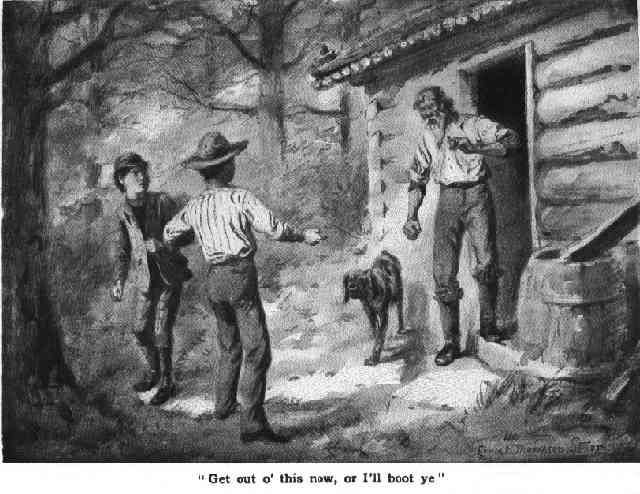
145
Yan turned very red. He thought of the scripture
text, "Be sure your sin will find you out," and he
stepped back. Sam stuck his tongue in his cheek
and followed. But he was his father's son. He
turned and said:
"Now see here, Mr. Clark, fair and square; we
come here to ask a simple question about the woods.
You are the only man that knows or we wouldn't
'a' bothered you. I knowed you had it in for Da,
so I tried to fool you, and it didn't go. I wish now
I had just come out square and said, 'I'm Sam
Raften; will you tell me somethin' I want to know,
or won't you?' I didn't know you hed anything
agin me or me friend that's camping with me."
There is a strong bond of sympathy between all
Woodcrafters. The mere fact that a man wants to
go his way is a claim on a Woodcrafter's notice. Old
Caleb, though soured by trouble and hot-tempered,
had a kind heart; he resisted for a moment the first
impulse to slam the door in their faces; then as he
listened he fell into the tempter's snare, for it was
baited with the subtlest of flatteries. He said to
Yan:
"Is your name Raften?"
"No, sir."
"Air ye owt o' kin?"
"No, sir."
146
"I don't want no truck with a Raften, but what
do ye want to know?"
"We built a wigwam of bark, but it's no good,
but now we have a big canvas cover an' want to
know how to make a teepee."
"A teepee. H-m—" said the old man reflectively.
"They say you've lived in them," ventured Yan.
"Hm—'bout forty year; but it's one thing to
wear a suit of clothes and another thing to make
one. Seems to me it was about like this," and he
took up a burnt stick and a piece of grocer's paper.
"No—now hold on. Yes, I remember now; I seen
a bunch of squaws make one oncet.
"First they sewed the skins together. No, first
thar was a lot o' prayin'; ye kin suit yerselves 'bout
that—then they sewed the skins together an" pegged it
down flat on the prairie (B D H I, Cut No. 1).
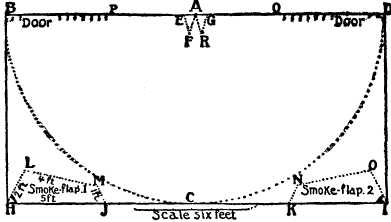
PATTERN FOR A SIMPLE 10-FOOT TEEPEE
"Then put in a peg at the middle of one side (A).
Then with a burnt stick an' a coord—yes, there
must 'a' been a coord—they drawed a half circle—so
(B C D). Then they cut that off, an' out o' the
pieces they make two flaps like that (H L M J and
K N O I), an' sews 'em on to P E and G Q. Them's
smoke-flaps to make the smoke draw. Thar's a upside
down pocket in the top side corner o' each smoke-flap—so—for
the top of each pole, and there is
rows o' holes down—so (M B and N D, Cut No. 2)—on
each side fur the lacin' pins. Then at the
top of that pint (A, Cut 1) ye fasten a short lash-rope.
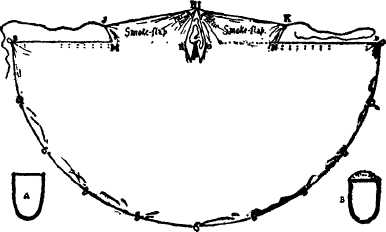
THE COMPLETE TEEPEE COVER—UNORNAMENTED
149
"Le's see, now. I reckon thar's about ten poles for
a ten-foot lodge, with two more for the smoke-flaps.
Now, when ye set her up ye tie three poles together—so—an'
set 'em up first, then lean the other poles around,
except one, an' lash them by carrying the rope around
a few times. Now tie the top o' the cover to the
top o' the last pole by the short lash-rope, hist the
pole into place—that hists the cover, too, ye see—an'
ye swing it round with the smoke-poles an' fasten
the two edges together with the wooden pins. The
two long poles put in the smoke-flap pockets works
the vent to suit the wind."
In his conversation Caleb had ignored Sam and
talked to Yan, but the son of his father was not so
easily abashed. He foresaw several practical difficulties
and did not hesitate to ask for light.
"What keeps it from blowin' down?" he asked.
"Wall," said Caleb, still addressing Yan, "the
long rope that binds the poles is carried down under,
and fastened tight to a stake that serves for anchor,
'sides the edge of the cover is pegged to the ground
all around."
"How do you make the smoke draw?" was his
next.
3rd set up tenth pole with teepee cover fastened to it by lash rope
"Ye swing the flaps by changing the poles till they
is quartering down the wind. That draws best."
"How do you close the door?"
"Wall, some jest lets the edges sag together, but
the best teepees has a door made of the same stuff as
the cover put tight on a saplin' frame an' swung from
150
a lacin' pin."
This seemed to cover the ground, so carefully folding
the dirty paper with the plan, Yan put it in his pocket,
said "Thank you" and went off. To the "Good-day"
of the boys Caleb made no reply, but turned as they
left and asked, "Whar ye camped?"
"On the knoll by the creek in Raften's swamp."
"H-m, maybe I'll come an' see ye."
"All right," Sam called out; "follow the blazed
trail from the brush fence."
"Why, Sam," said Yan, as soon as they were out
of hearing, "there isn't any blazed trail; why did you
say that?"
"Oh, I thought it sounded well," was the calm
answer, "an' it's easy to have the blazes there as soon
as we want to, an' a blame sight sooner than he's
likely to use them."
Raften sniffed in amusement when he heard
that the boys had really gone to Caleb and got
what they wanted. Nothing pleased him
more than to find his son a successful schemer.
"Old Caleb wasn't so dead sure about the teepee,
as near as I sized him up," observed Sam.
"I guess we've got enough to go ahead on," said
Yan, "an' tain't a hanging matter if we do make a
mistake."
The cover was spread out again flat and smooth on
the barn floor, and stones and a few nails put in the
sides to hold it.
The first thing that struck them was that it was a
rough and tattered old rag.
And Sam remarked: "I see now why Da said we
could have it. I reckon we'll have to patch it before
we cut out the teepee."
"No," said Yan, assuming control, as he was apt
to do in matters pertaining to the woods; "we better
draw our plans first so as not to patch any part that's
going to be cut off afterward."
"Great head! But I'm afraid them patches won't
be awful ornamental."
"They're all right," was the reply. "Indians'
teepees are often patched where bullets and arrows
have gone through."
"Well, I'm glad I wa'n't living inside during them
hostilities," and Sam exposed a dozen or more holes.
"Oh, get off there and give me that cord."
"Look out," said Sam; "that's my festered knee.
It's near as bad to-day as it was when we called on
the witch."
Yan was measuring. "Let's see. We can cut off
all those rags and still make a twelve-foot teepee.
Twelve foot high—that will be twenty-four feet
across the bottom of the stuff. Fine! That's just the
thing. Now I'll mark her off."
"Hold on, there," protested his friend; "you can't
do that with chalk. Caleb said the Injuns used a
burnt stick. You hain't got no right to use chalk.
'You might as well hire a carpenter.'"
"Oh, you go on. You hunt for a burnt stick, and
if you don't find one bring me the shears instead."
Thus, with many consultations of Caleb's draft, the
cutting-out was done—really a very simple matter.
Then the patching was to be considered.
Pack-thread, needles and very l-o-n-g stitches were
used, but the work went slowly on. All the spare
time of one day was given to patching. Sam, of
course, kept up a patter of characteristic remarks to
the piece he was sewing. Yan sewed in serious
silence. At first Sam's were put on better, but Yan
learned fast and at length did by far the better sewing.
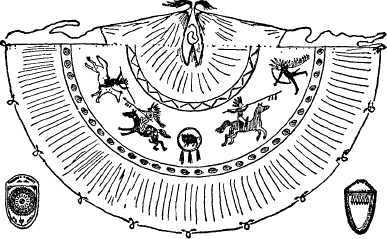
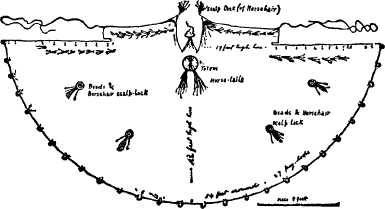
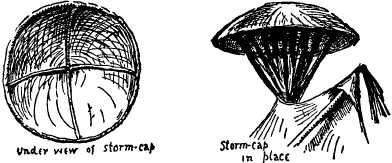
Notes on Making Teepee
The slimmer the poles are at the top where they cross the smaller the opening in the canvas and the less danger
of rain coming in.
In regions where there is much rain it is well to cut the projecting poles very short and put over them a
"storm cap," "bull boat" or "shield" made of canvas on a rod bent in a three-foot circle. This device was
used by the Mandans over the smoke-hole of their lodges during the heavy rains.
155
That night the boys were showing their handiwork
to the hired hands. Si Lee, a middle-aged man with
a vast waistband, after looking on with ill-concealed
but good-natured scorn, said:
"Why didn't ye put the patches inside?"
"Didn't think of it," was Yan's answer.
"Coz we're goin' to live inside, an' need the room,"
said Sam.
"Why did ye make ten stitches in going round that
hole; ye could just as easy have done it in four," and
Si sniffed as he pointed to great, ungainly stitches an
inch long. "I call that waste labour."
"Now see here," blurted Sam, "if you don't like
our work let's see you do it better. There's lots to do
yet."
"Where?"
"Oh, ask Yan. He's bossin' the job. Old Caleb
wouldn't let me in. It just broke my heart. I
sobbed all the way home, didn't I, Yan?
"There's the smoke-flaps to stitch on and hem, and
the pocket at the top of the flaps—and—I—suppose,"
Yan added, as a feeler, "it—would—be—better—if—hemmed—all—around."
"Now, I tell ye what I'll do. If you boys'll go to
the 'Corner' to-night and get my boots that the
cobbler's fixing, I'll sew on the smoke-flaps."
"I'll take that offer," said Yan; "and say, Si, it
doesn't really matter which is the outside. You can
turn the cover so the patches will be in."
The boys got the money to pay for the boots, and
after supper they set out on foot for the "Corner,"
156
two miles away.
"He's a queer duck," and Sam jerked his thumb
back to show that he meant Si Lee; "sounds like a
Chinese laundry. I guess that's the only thing
he isn't. He can do any mortal thing but get on in
life. He's been a soldier an' a undertaker an' a cook
He plays a fiddle he made himself; it's a rotten bad
one, but it's away ahead of his playing. He stuffs
birds—that Owl in the parlour is his doin'; he tempers
razors, kin doctor a horse or fix up a watch, an' he
does it in about the same way, too; bleeds a horse no
matter what ails it, an' takes another wheel out o'
the watch every times he cleans it. He took Larry
de Neuville's old clock apart to clean once—said he
knew all about it—an' when he put it together again
he had wheels enough left over for a new clock.
"He's too smart an' not smart enough. There ain't
anything on earth he can't do a little, an' there ain't
a blessed thing that he can do right up first-class,
but thank goodness sewing canvas is his long suit.
You see he was a sailor for three years—longest time
he ever kept a job, fur which he really ain't to blame,
since it was a whaler on a three-years' cruise."
It was a calm June evening, the time of the
second daily outburst of bird song, the day's
aftermath. The singers seemed to be in unusual
numbers as well. Nearly every good perch had
some little bird that seemed near bursting with joy
and yet trying to avert that dire catastrophe.
As the boys went down the road by the outer fence of
their own orchard a Hawk came sailing over, silencing
as he came the singing within a given radius. Many
of the singers hid, but a Meadow Lark that had been
whistling on a stake in the open was now vainly
seeking shelter in the broad field. The Hawk was
speeding his way. The Lark dodged and put on all
power to reach the orchard, but the Hawk was after
him now—was gaining—in another moment would
have clutched the terrified musician, but out of the
Apple trees there dashed a small black-and-white bird—the
Kingbird. With a loud harsh twitter—his war-cry—repeated
again and again, with his little gray
head-feathers raised to show the blood-and-flame-coloured
undercrest—his war colours—he darted
straight at the great robber.
158
"Clicker-a-clicker," he fairly screamed, and made
for the huge Hawk, ten times his size.
"Clicker-a-clicker!" he shrieked, like a cateran
shouting the "slogan," and down like a black-and-white
dart—to strike the Hawk fairly between the
shoulders just as the Meadow Lark dropped in despair
to the bare ground and hid its head from the approaching
stroke of death.
"Clicker-a-clicker"—and the Hawk wheeled in
sudden consternation. "Clicker-a-clicker"—and the
dauntless little warrior dropped between his wings,
stabbing and tearing.
The Hawk bucked like a mustang, the Kingbird
was thrown, but sprung on agile pinions above again.
"Clicker-a-clicker," and he struck as before.
Large brown feathers were floating away on the
breeze now. The Meadow Lark was forgotten. The
Hawk thought only of escape.
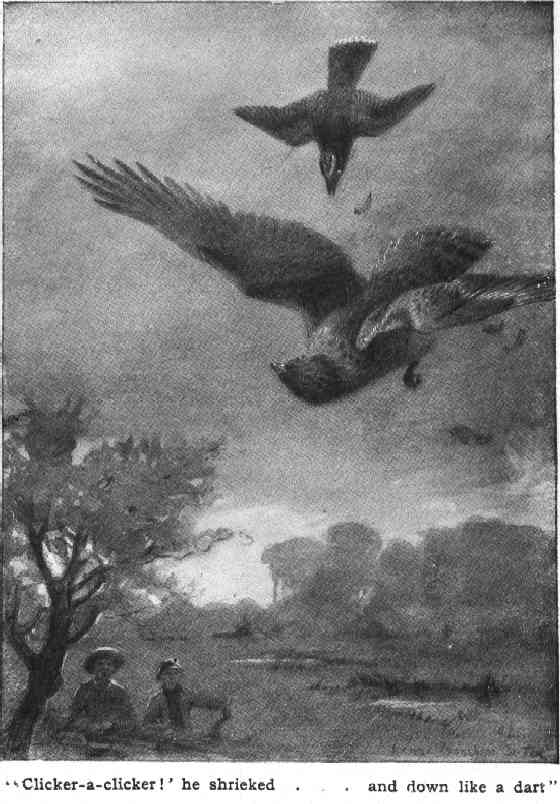
"Clicker-a-clicker," the slogan still was heard.
The Hawk was putting on all speed to get away, but
the Kingbird was riding him most of the time.
Several brown feathers floated down, the Hawk
dwindled in the distance to a Sparrow and the Kingbird
to a fly dancing on his back. The Hawk made a
final plunge into a thicket, and the king came home
again, uttering the shrill war-cry once or twice,
probably to let the queen know that he was coming
back, for she flew to a high branch of the Apple tree
where she could greet the returning hero. He came
with an occasional "clicker-a-clicker"—then, when
near her, he sprung fifty feet in the air and dashed
161
down, screaming his slogan without interruption,
darting zigzag with the most surprising evolutions
and turns—this way, that way, sideways and downward,
dealing the deadliest blows right and left at an
imaginary foe, then soared, and did it all over again
two or three times, just to show how far he was from
being tired, and how much better he could have done
it had it been necessary. Then with a final swoop
and a volley of "clickers" he dashed into the bush
to receive the congratulations of the one for whom it
all was meant and the only spectator for whose
opinion he cared in the least.
"Now, ain't that great," said Sam, with evident
sincerity and pleasure. His voice startled Yan
and brought him back. He had been wholly lost
in silent admiring wonder of the dauntless little
Kingbird.
A Vesper Sparrow ran along the road before them,
flitting a few feet ahead each time they overtook it
and showing the white outer tail-feathers as it flew.
"A little Graybird," remarked Sam.
"No, that isn't a Graybird; that's a Vesper
Sparrow," exclaimed Yan, in surprise, for he knew
he was right.
"Well, I dunno," said Sam, yielding the point.
"I thought you said you knew every bird that
flies and all about it" replied his companion, for the
memory of this first day was strong with him yet.
Sam snorted: "I didn't know you then. I was
just loadin' you up so you'd think I was a wonderful
162
feller, an' you did, too—for awhile."
A Red-headed Woodpecker, carrying a yellow
butterfly, flew on a fence stake ahead of them and
peeped around as they drew near. The setting sun
on his bright plumage, the lilac stake and the yellow
butterfly, completed a most gorgeous bit of colour
and gave Yan a thrill of joy. A Meadow Lark on a
farther stake, a Bluebird on another, and a Vesper
Bird on a stone, each added his appeal to eye and
ear, till Sam exclaimed:
"Oh, ain't that awful nice?" and Yan was dumb
with a sort of saddened joy.
Birds hate the wind, and this was one of those
birdy days that come only with a dead calm.
They passed a barn with two hundred pairs of
Swallows flying and twittering around, a cut bank
of the road had a colony of 1,000 Sand Martins, a
stream had its rattling Kingfishers, and a marsh
was the playground of a multitude of Red-winged
Blackbirds.
Yan was lifted up with the joy of the naturalist at
seeing so many beautiful living things. Sam felt it,
too; he grew very silent, and the last half-mile to the
"Corner" was passed without a word. The boots were
got. Sam swung them around his neck and the boys
set out for home. The sun was gone, but not the
birds, and the spell of the evening was on them still.
A Song Sparrow by the brook and a Robin high in the
Elm were yet pouring out their liquid notes in the
gloaming.
163
"I wish I could be always here," said Yan, but he
started a little when he remembered how unwilling he
had been to come.
There was a long silence as they lingered on the
darkening road. Each was thinking hard.
A loud, startling but soft "Ohoo—O-hoo—O-hoooooo,"
like the coo of a giant dove, now
sounded about their heads in a tree. They stopped
and Sam whispered, "Owl; big Hoot Owl." Yan's
heart leaped with pleasure. He had read all his life of
Owls, and even had seen them alive in cages, but this
was the first time he had ever heard the famous
hooting of the real live wild Owl, and it was a
delicious experience.
The night was quite dark now, but there were
plenty of sounds that told of life. A Whippoorwill
was chanting in the woods, a hundred Toads and
Frogs creaked and trilled, a strange rolling, laughing
cry on a marshy pond puzzled them both, then a
Song Sparrow in the black night of a dense thicket
poured forth its sweet little sunshine song with all the
vigour and joy of its best daytime doing.
They listened attentively for a repetition of the
serenade, when a high-pitched but not loud
"Wa—wa—wa—wa—wa—wa—wa—wa!"
reached their ears from a grove of heavy timbers.
"Hear that?" exclaimed Sam.
Again it came, a quavering squall, apparently
much nearer. It was a rather shrill sound, quite
unbirdy, and Sam whispered:
164
"Coon—that's the whicker of a Coon. We can
come down here some time when corn's 'in roastin''
an' have a Coon hunt."
"Oh, Sam, wouldn't that be glorious!" said Yan.
"How I wish it was now. I never saw a Coon hunt
or any kind of a hunt. Do we have to wait till
'roasting-ear' time?"
"Oh, yes; it's easier to find them then. You say
to your Coons, 'Me an' me dogs will meet you
to-night at the nearest roastin'-ear patch,' an' sure
nuff they'll keep the appointment."
"But they're around now, for we just heard one,
and there's another."
A long faint "Lil—lil—lil—lil—lil—li-looo!" now
sounded from the trees. It was like the other, but
much softer and sweeter.
"There's where you fool yerself," replied Sam, "an'
there's where many a hunter is fooled. That last
one's the call of a Screech Owl. You see it's softer
and whistlier than the Coon whicker."
They heard it again and again from the trees. It
was a sweet musical sound, and Yan remembered how
squally the Coon call was in comparison, and yet
many hunters never learn the difference.
As they came near the tree whence the Owl called at
intervals, a gray blot went over their heads, shutting
out a handful of stars for a moment as it passed over
them, but making no noise. "There he goes,"
whispered Sam. "That's the Screech Owl. Not
much of a screech, was it?" Not long afterward
Yan came across a line of Lowell's which says, "The
165
song of the Screech Owl is the sweetest sound in
nature," and appreciated the absurdity of the name.
"I want to go on a Coon hunt," continued Yan,
and the sentence was just tinged with the deep-laid
doggedness that was usually lost in his courteous
manner.
"That settles it," answered the other, for he was
learning what that tone meant. "We'll surely go
when you talk that way, for, of coorse, it kin be done.
You see, I know more about animals than birds," he
continued. "I'm just as likely to be a dentist as a
hunter so far as serious business is concerned, but I'd
sure love to be a hunter for awhile, an' I made Da
promise to go with me some time. Maybe we kin get
a Deer by going back ten miles to the Long Swamp.
I only wish Da and Old Caleb hadn't fought, 'cause
Caleb sure knows the woods, an' that old Hound of his
has treed more Coons than ye could shake a stick at
in a month o' Sundays."
"Well, if that's the only Coon dog around, I'm
going to get him. You'll see," was the reply.
"I believe you will," answered Sam, in a tone of
mixed admiration and amusement.
It was ten o'clock when they got home, and every
one was in bed but Mr. Raften. The boys turned in
at once, but next morning, on going to the barn, they
found that Si had not only sewed on and hemmed
the smoke-flaps, but had resewn the worst of the
patches and hemmed the whole bottom of the teepee
cover with a small rope in the hem, so that they were
166
ready now for the pins and poles.
The cover was taken at once to the camp ground.
Yan carried the axe. When they came to the brush
fence over the creek at the edge of the swamp, he
said:
"Sam, I want to blaze that trail for old Caleb.
How do you do it?"
"Spot the trees with the axe every few yards."
"This way?" and Yan cut a tree in three places,
so as to show three white spots or blazes.
"No; that's a trapper's blaze for a trap or a 'special
blaze,' but a 'road blaze' is one on the front of the
tree and one on the back—so—then ye can run the
trail both ways, an' you put them thicker if it's to
be followed at night."
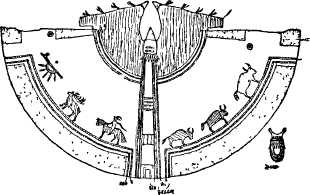
"Ten strong poles and two long thin ones," said
Yan, reading off. These were soon cut and
brought to the camp ground.
"Tie them together the same height as the teepee
cover——"
"Tie them? With what?"
"'Rawhide rope,' he said, but he also said 'Make
the cover of skins.' I'm afraid we shall have to use
common rope for the present," and Yan looked
a little ashamed of the admission.
"I reckoned so," drawled Sam, "and so I put a
coil of quarter-inch in the cover, but I didn't dare
to tell you that up at the barn."
The tripod was firmly lashed with the rope and set
up. Nine poles were duly leaned around in a twelve-foot
circle, for a teepee twelve feet high usually has
a twelve-foot base. A final lashing of the ropes
held these, and the last pole was then put up opposite
to the door, with the teepee cover tied to it at
the point between the flaps. The ends of the two
smoke-poles carried the cover round. Then the
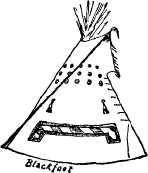 lacing-pins were needed. Yan tried to make them
of Hickory shoots, but the large, soft pith came just
where the point was needed. So Sam said, "You
168
can't beat White Oak for pins." He cut a block
of White Oak, split it down the middle, then split
half of it in the middle again, and so on till it was
small enough to trim and finish with his knife.
Meanwhile Yan took the axe to split another, but
found that it ran off to one side instead of going
straight down the grain.
lacing-pins were needed. Yan tried to make them
of Hickory shoots, but the large, soft pith came just
where the point was needed. So Sam said, "You
168
can't beat White Oak for pins." He cut a block
of White Oak, split it down the middle, then split
half of it in the middle again, and so on till it was
small enough to trim and finish with his knife.
Meanwhile Yan took the axe to split another, but
found that it ran off to one side instead of going
straight down the grain.
"No good," was Sam's comment. "You must keep
halving each time or it will run out toward the
thin pieces. You want to split shingles all winter
to larn that."
Ten pins were made eight inches long and a quarter
of an inch thick. They were used just like dressmakers'
stickpins, only the holes had to be made
first, and, of course, they looked better for being
regular. Thus the cover was laced on. The lack
of ground-pegs was then seen.
"You make ten Oak pins a foot long and an inch
square, Sam. I've a notion how to fix them." Then
Yan cut ten pieces of the rope, each two feet long,
and made a hole about every three feet around the
base of the cover above the rope in the outer seam.
He passed one end of each short rope through this
and knotted it to the other end. Thus he had ten
peg-loops, and the teepee was fastened down and
looked like a glorious success.
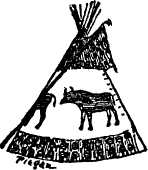 Now came the grand ceremony of all, the lighting
of the first fire. The boys felt it to be a supreme
and almost a religious moment. It is curious to note
169
that they felt very much as savages do under the
same circumstances—that the setting up of the new
teepee and lighting its first fire is an act of deep
significance, and to be done only with proper regard
for its future good luck.
Now came the grand ceremony of all, the lighting
of the first fire. The boys felt it to be a supreme
and almost a religious moment. It is curious to note
169
that they felt very much as savages do under the
same circumstances—that the setting up of the new
teepee and lighting its first fire is an act of deep
significance, and to be done only with proper regard
for its future good luck.
"Better go slow and sure about that fire. It'd
be awfully unlucky to have it fizzle for the first
time."
"That's so," replied Yan, with the same sort of
superstitious dread. "Say, Sam, if we could really
light it with rubbing-sticks, wouldn't it be great?"
"Hallo!"
The boys turned, and there was Caleb close to
them. He came over and nodded. "Got yer
teepee, I see? Not bad, but what did ye face her
to the west fur?"
"Fronting the creek," explained Yan.
"I forgot to tell ye," said Caleb, "an Injun teepee
always fronts the east; first, that gives the morning
sun inside; next, the most wind is from the west, so
the smoke is bound to draw."
"And what if the wind is right due east?" asked
Sam, "which it surely will be when it rains?"
"And when the wind's east," continued Caleb,
addressing no one in particular, and not as though
in answer to a question, "ye lap the flaps across
each other tight in front, so," and he crossed his
hands over his chest. "That leaves the east side
high and shuts out the rain; if it don't draw then,
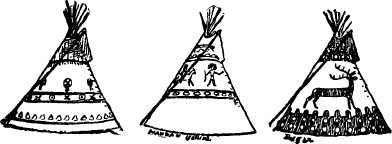
ye raise the bottom of the cover under the door just
a little—that always fetches her. An' when you
170
change her round don't put her in under them
trees. Trees is dangerous; in a storm they draw
lightning, an' branches fall from them, an' after rain
they keep on dripping for an hour. Ye need all the
sun ye kin get on a teepee.
"Did you ever see Indians bring fire out of two
sticks by rubbing, Mr. Clark?"
"Oh, yes. Most of the Injuns now carry matches,
but in the early days I seen it done often enough."
"Does it take long? Is it hard?"
"Not so long, and it's easy enough, when ye know
how."
"My! I'd rather bring fire out of two sticks than
have a ten dollar bill," said Yan, with enthusiasm
that meant much, for one dollar was his high-water
mark of affluence, and this he had reached but once
in his life.
"Oh, I dunno'; that depends," was Sam's more
guarded response.
"Can you do it?" asked Yan.
"Wall, yes, if I kin get the right stuff. Ye see, it
ain't every wood that will do it. It's got to be jest
right. The Plains Injuns use Cottonwood root, an'
the Mountain Injuns use Sage-brush root. I've seen
the Canadian Injuns use Basswood, Cedar and dry
White Pine, but the Chippewas mostly use Balsam
Fir. The easiest way is with a bow-drill. Have ye
any buckskin?"
"No."
171
"Or a strip o' soft leather?"
"I've got a leather shoe-lace," said Yan.
"Rather slim; but we'll double it an' make it do.
A cord will answer, but it frays out so soon."
Caleb took the lace and the axe, then said, "Find me
a stone 'bout the size of an egg, with a little hole into
it—like a socket hole—'bout a quarter inch deep."
The boys went to the creek to seek a stone and
Caleb went into the woods.
They heard him chopping, and presently he came
back with a flat piece of very dry Balsam Fir, a
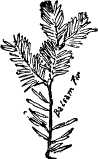 fifteen-inch pin of the same, a stick about three feet
long, slightly bent, some dry Pine punk and some
dry Cedar.
fifteen-inch pin of the same, a stick about three feet
long, slightly bent, some dry Pine punk and some
dry Cedar.
The pin was three-quarters of an inch thick and
was roughly eight-sided, "so the lace would grip."
It was pointed at both ends. He fastened the lace
to the bent stick like a bow-string, but loosely, so
that when it had one turn around the pin it was
quite tight. The flat piece of Balsam he trimmed
down to about half an inch thick. In the edge of
this he now cut a notch one-quarter inch wide and
half an inch deep, then on the top of this fire-board
or block, just beyond the notch, he made with the
point of his knife a little pit.
He next scraped and shredded a lot of dry Cedar
wood like lint. Then making a hole half an inch
deep in the ground, he laid in that a flat piece of
Pine punk, and across this he set the fire-board.
The point of the pin or drill was put in the pit of
the fire-board, which he held down with one foot;
172
the lace was given one turn on the pin, and its top
went into the hole of the stone the boys brought.
The stone was held firmly in Caleb's left hand.
"Sometimes," he remarked, "when ye can't
find a stone, a Pine knot will do—ye kin make the
socket-hole with a knife-point."
Now holding the bow in his right hand, he began
to draw it back and forth with long, steady strokes,
causing the pin to whirl round in the socket. Within
a few seconds a brown powder began to run out of
the notch of the fire-board onto the punk. The
pit increased in size and blackened, the powder
darkened, and a slight smoke arose from the pit.
Caleb increased the pressure of his left hand a little,
and sawed faster with the right. The smoke steadily
increased and the black powder began to fill the notch.
The smoke was rolling in little clouds from under
the pin, and it even seemed to come from the heap
of powder. As soon as he saw that, Caleb dropped
the bow and gently fanned the powder heap. It
still smoked. He removed the fire-board, and lifting
the punk, showed the interior of the powder to be
one glowing coal. On this he laid the Cedar tinder
and over that a second piece of punk. Then raising
it, he waved it in the air and blew gently for awhile.
It smouldered and then burst into a flame. The
other material was handy, and in a very short time
they had a blazing fire in the middle of the new
teepee.
174
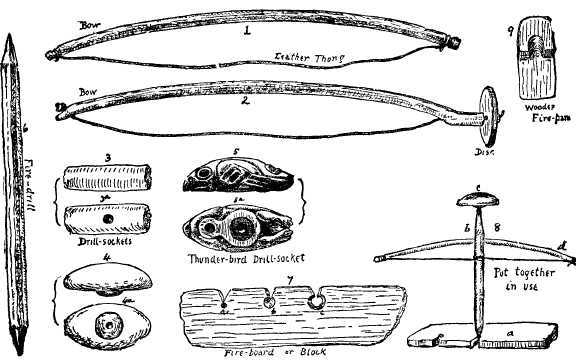
175
All three were pictures of childish delight. The
old man's face fairly beamed with triumph. Had
he failed in his experiment he would have gone off
hating those boys, but having made a brilliant
success he was ready to love every one concerned,
though they had been nothing more than interested
spectators of his exploit.
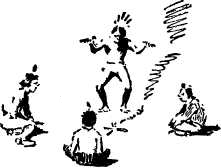
RUBBING-STICKS FOR FIRE-MAKING
Two tools and two sticks are needed. The tools are bow and drill-socket; the sticks are drill and fire-board.
1. The simplest kind of bow—a bent stick with a stout leather thong fastened at each end. The stick must not
spring. It is about 27 inches long and 5/8 inch thick.
2. A more elaborate bow with a hole at each end for the thong. At the handle end it goes through a disc of wood.
This is to tighten the thong by pressure of the hand against the disc while using.
3. Simplest kind of drill-socket—a pine or hemlock knot with a shallow hole or pit in it. 3a is under view of same.
It is about 4½ inches long.
4. A more elaborate drill-socket—a pebble cemented with gum in a wooden holder. 4a is under view of same.
5. A very elaborate drill-socket; it is made of tulip wood, carved to represent the Thunderbird. It has eyes of
green felspar cemented in with resin. On the under side (5a) is seen, in the middle, a soapstone socket let into
the wood and fastened with pine gum, and on the head a hole kept filled with grease, to grease the top of the
drill before use.
6. The drill, 12 to 18 inches long and about ¾ of an inch thick; it is roughly 8-sided so the thong will not slip,
pointed at each end. The best wood for the drill is old, dry, brash, but not punky balsam fir or cotton-wood
roots; but basswood, white cedar, red cedar, tamarack, and sometimes even white pine, will do.
7. Fire-board or block, about ¾ of an inch thick and any length handy; a is notch with pit just below
shows the pit after once using and in good trim for a second time; c shows the pit bored through and
useless; the notch is ½ inch wide and ¾ inch deep.
8. Shows the way of using the sticks. The block (a) is held down with one foot, the end of the drill
in the pit, the drill-socket (c) is held on top in left hand, one end of the bow (d ) is held in the right hand
the bow is drawn back and forth.
9. Is a little wooden fire-pan, not essential but convenient; its thin edge is put under the notch to catch the
powder that falls.
"I don't think much of your artillery," said Yan
one day as they were shooting in the orchard
with Sam's "Western outfit." "It's about like
the first one I made when I was young."
"Well, grandpa, let's see your up-to-date make?"
"It'd be about five times as strong, for one thing."
"You couldn't pull it."
"Not the way you hold the arrow! But last
winter I got a book about archery from the library
and learned something worth while. You pinch
the arrow that way and you can draw six or eight
pounds, maybe, but you hook your fingers in the
string—so—and you can draw five times as much,
and that's the right way to shoot."
"Feels mighty clumsy," said Sam, trying it.
"Of course it does at first, and you have to have
a deep notch in the arrow or you can't do it at all."
"You don't seem to manage any better than I
do."
"First time I ever had a chance to try since I
read about it. But I want to make a first-class
bow and a lot of arrows. It's not much good going
with one."
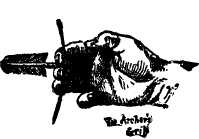
177
"Well, go ahead an' make an outfit if you know
how. What's the best wood? Did the book tell
you that?"
"The best wood is Spanish Yew."
"Don't know it."
"An' the next is Oregon Yew."
"Nope."
"Then Lancewood and Osage Orange."
'Try again."
"Well, Red Cedar, Apple tree, Hickory and Elm
seem to be the only ones that grow around here."
"Hain't seen any Red Cedar, but the rest is easy."
"It has to be thoroughly seasoned winter-cut wood,
and cut so as to have heart on one side and sap wood
on the other."
"How's that?" and Sam pointed to a lot of half-round
Hickory sticks on the rafters of the log house.
"Those have been there a couple of years."
A good one of five feet long was selected and split
and hewn with the axe till the boys had the two bow
staves, five and one-half feet long and two inches
square, with the line of the heart and sap wood down
the middle of each.
Guided by his memory of that precious book and
some English long bows that he had seen in a shop in
town, Yan superintended the manufacture. Sam
was apt with tools, and in time they finished two bows,
five feet long and drawing possibly twenty-five pounds
each. In the middle they were one and one-half
inches wide and an inch thick (see page 183). This
size they kept for nine inches each way, making an
178
eighteen-inch middle part that did not bend, but
their two limbs were shaved down and scraped with
glass till they bent evenly and were well within the
boys' strength.
The string was the next difficulty. All the ordinary
string they could get around the house proved too
weak, never lasting more than two or three shots, till
Si Lee, seeing their trouble, sent them to the cobbler's
for a hank of unbleached linen thread and some shoemaker's
wax. Of this thread he reeled enough for a
strong cord tight around two pegs seven feet apart,
then cutting it loose at one end he divided it equally
in three parts, and, after slight waxing, he loosely
plaited them together. At Yan's suggestion he then
spliced a loop at one end, and with a fine waxed
thread lashed six inches of the middle where the
arrow fitted, as well as the splice of the loop.
This last enabled them to unstring the bow when
not in use (see page 183). "There," said he, "you
won't break that." The finishing touch was thinly
coating the bows with some varnish found among the
paint supplies.
"Makes my old bow look purty sick," remarked
Sam, as he held up the really fine new weapon in
contrast with the wretched little hoop that had
embodied his early ideas. "Now what do you know
about arrers, mister?" as he tried his old arrow in the
new bow.
"I know that that's no good," was the reply; "an'
I can tell you that it's a deal harder to make an arrow
179
than a bow—that is, a good one."
"That's encouraging, considering the trouble we've
had already."
"'Tisn't meant to be, but we ought to have a dozen
arrows each."
"How do the Injuns make them?"
"Mostly they get straight sticks of the Arrow-wood;
but I haven't seen any Arrow-wood here,
and they're not so awfully straight. You see, an
arrow must be straight or it'll fly crooked. 'Straight
as an arrow' means the thing itself. We can do
better than the Indians 'cause we have better
tools. We can split them out of the solid wood."
"What wood? Some bloomin' foreign kind that no
White-man never saw nor heard of before?"
"No sir-ree. There ain't anything better 'n White
Pine for target and Ash or Hickory for hunting
arrows. Which are we making?"
"I'm a hunter. Give me huntin' arrows every
time. What's needed next?"
"Seasoned Ash twenty-five inches long, split to
three-eighths of an inch thick, hot glue, and turkey-wing
feathers."
"I'll get the feathers and let you do the rest," said
Sam, producing a bundle of turkey-wings, laid away
as stove-dusters, and then belied his own statement
by getting a block of Ash and splitting it up, halving
it each time till he had a pile of two dozen straight
sticks about three-quarters of an inch thick.
180
Yan took one and began with his knife to whittle it
down to proper size and shape, but Sam said, "I can
do better than that," then took the lot to the workbench
and set to work with a smoothing plane. Yan
looked worried and finally said:
"Injuns didn't have planes."
"Nor jack-knives neither," was the retort.
That was true, and yet somehow Yan's ideal that
he hankered after was the pre-Columbian Indian, the
one who had no White-man's help or tools.
"It seems to me it'd be more Injun to make these
with just what we get in the woods. The Injuns
didn't have jack-knives, but they had sharp flints in
the old days."
"Yan, you go ahead with a sharp stone. You'll
find lots on the road if you take off your shoes and
walk barefoot—awful sharp; an' I'll go ahead with
the smoothing plane an' see who wins."
Yan was not satisfied, but he contented himself
with promising that he would some day make some
arrows of Arrow-wood shoots and now he would finish
at least one with his knife. He did so, but Sam,
in the meantime, made six much better ones with
the smoothing plane.
"What about heads?" said he.
"I've been thinking," was the reply. "Of course
the Indians used stone heads fastened on with sinew,
but we haven't got the stuff to do that. Bought
heads of iron with a ferrule for the end of the arrow
are best, but we can't get them. Bone heads and
horn heads will do. I made some fine ones once filing
181
bones into the shape, but they were awfully brittle;
and I made some more of big nails cut off and set in
with a lashing of fine wire around the end to stop the
wood splitting. Some Indian arrows have no point
but the stick sharpened after it's scorched to
harden it."
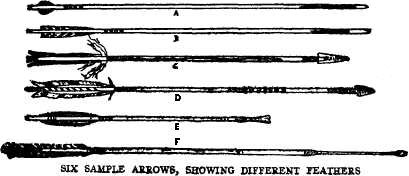
"That sounds easy enough for me," said Sam;
"let's make some of them that way."
So the arrows were made, six each with nail points
filed sharp and lashed with broom wire. These were
called "War arrows," and six each with fire-hardened
wood points for hunting arrows.
"Now for the feathering," and Yan showed Sam
how to split the midrib of a turkey feather and
separate the vane.
"Le's see, you want twice twenty-four—that's
forty-eight feathers."
"No," said Yan, "that's a poor feathering, two on
each. We want three on each arrow—seventy-two
strips in all, and mind you, we want all three
that are on one arrow from the same side of
the bird."
"I know. I'll bet it's bad luck to mix sides;
arrows doesn't know which way to turn."
At this moment Si Lee came in. "How are ye
gettin' on with the bows?"
"Waitin' for arrows now."
"How do ye put on the feathers?"
"White-men glue them on, and Injuns lash them
on," replied Yan, quoting from memory from "that
182
book."
DESCRIPTION OF SIX SAMPLE ARROWS SHOWING DIFFERENT FEATHERS
A is a far-flying steel-pointed bobtail, very good in wind.
B is another very good arrow, with a horn point.
This went even better than A if there were no wind.
C is an Omaha war and deer arrow. Both heads and feathers
are lashed on with sinew. The long tufts of down left on the feathers are to help in finding it again, as they are
snow-white and wave in the breeze. The grooves on the shaft are to make the victim bleed more freely and be
more easily tracked.
D is another Omaha arrow with a peculiar owner's mark of lines carved in the middle,
E is
a bone-headed bird shaft made by the Indians of the Mackenzie River.
F is a war arrow made by Geronimo, the
famous Apache chief. Its shaft is three joints of a straight cane. The tip is of hard wood, and on that is a fine
quartz point; all being lashed together with sinew.
"Which is best?"
"Glued on flies better, but lashed on stands the
weather better."
"Why not both?"
"Have no sinew."
"Let me show ye a trick. Where's yer glue an'
linen thread?"
These were brought, whereupon Si added: "'Pears
to me ye oughter put the feathers on last. Better
cut the notch first."
"That's so; we nearly forgot."
"You nearly forgot, you mean. Don't drag me in
the mud," said Sam, with owlish dignity. A small
saw cut, cleaned up and widened with a penknife,
proved the best; a notch one-fourth inch deep was
quickly made in each arrow, and Si set about both
glueing and lashing on the feathers, but using wax-end
instead of sinew.
Yan had marked the place for each feather so that
none would strike the bow in passing (see Cut page 183).
He first glued them on, then made a lashing for half an
inch on the projecting ends of the feather-rib, and
another behind, carrying this second lashing back to
the beginning of the notch to guard against the wood
splitting. When he had trimmed all loose ends and
rolled the waxed thread well on the bench with a flat
stick, the threads seemed to disappear and leave
simply a smooth black ring.
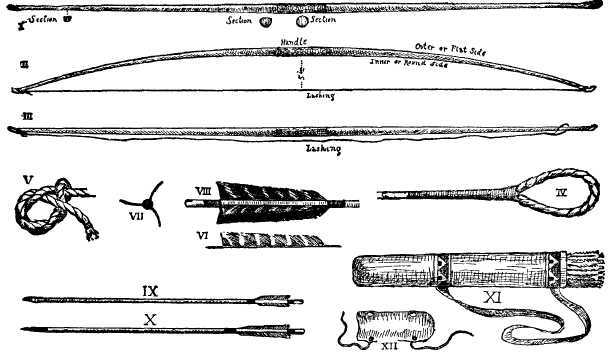
THE ARCHERY OUTFIT (Not all on scale)
I. The five-foot bow as finished, with sections at the points shown.
II. The bow "braced" or strung.
III. The bow unstrung, showing the loop slipped down.
IV. The loop that is used on the upper end of the bow.
V. The timber hitch always used on the lower end or notch of the bow.
VI. A turkey feather with split midrib, all ready to lash on.
VII. End view of arrow, showing notch and arrangement of three feathers.
VIII. Part of arrow, showing feathering and lashing.
IX. Sanger hunting arrow with wooden point; 25 inches long.
X. Sanger war arrow with nail point and extra long feathers; it also is
25 inches long.
XI. Quiver with Indian design; 20 inches long.
XII. The "bracer" or arm guard of heavy leather for left arm, with two
laces to tie it on. It is six inches long.]
185
Thus the arrows were made and set away for the
glue to dry.
Next day Yan painted Sam's red and blue, his own
red and white, to distinguish them as well as guard
them from the damp. There was now one more thing,
and that was a quiver.
"Do the Injuns have them?" asked Sam, with a
keen eye to orthodoxy when it promised to cut short
the hard work.
"Well, I should say so; couldn't live without them."
"All right; hurry up. I'm spoiling for a hunt.
What are they made of?"
"Oh, 'most anything."
"Haven't got it."
"You're too fast. But some use Birch bark, some
use the skin of an animal, and some use canvas now
when other stuff is scarce."
"That's us. You mind the stuff left off the
teepee?"
"Do till we get better." So each made a sort of
canvas bag shorter than the arrows. Yan painted
an Indian device on each, and they were ready.
"Now bring on your Bears," said the older boy, and
feeling a sense of complete armament, they went out.
"See who can hit that tree." Both fired together
and missed, but Sam's arrow struck another tree and
split open.
"Guess we'd better get a soft target," he remarked.
Then after discussion they got a large old corn sack
full of hay, painted on it some rings around a bull's
186
eye (a Buffalo's eye, Sam called it) and set it up at
twenty yards.
They were woefully disappointed at first in their
shooting. It did seem a very easy mark, and it was
disappointing to have the arrows fly some feet away
to the left.
"Le's get in the barn and shoot at that," suggested
Sam.
"We might hit it if we shut the door tight," was
the optimistic reply. As well as needing practice,
the boys had to learn several little rules about
Archery. But Yan had some pencil notes from
"that book" and some more in his brain that with
much practice gradually taught him: To stand
with his heel centres in line with the target; his
right elbow in line with the arrow; his left hand
fixed till the arrow struck; his right thumb always
on the same place on his cheek when he fired, and
the bow plumb.
They soon found that they needed guards for the
left arm where the bow strings struck, and these they
made out of the leg of an old boot (see Cut page 183),
and an old glove to protect the fingers of the right hand
when they practised very much. After they learned
to obey the rules without thinking about them, the
boys improved quickly and soon they were able to put
all the arrows into the hay sack at twenty yards,
increasing the distance later till they could make fair
shooting at forty yards.
They were not a little surprised to find how much
individuality the arrows had, although meant to be
187
exactly alike.
Sam had one that continued to warp until it was
much bent, and the result was some of the most
surprising curves in its flight. This he called the
"Boomerang." Another, with a very small feather,
travelled farther than any of the rest. This was
the "Far-killer." His best arrow, one that he called
"Sure-death," was a long-feathered Turkey shaft
with a light head. It was very reliable on a calm
day, but apt to swerve in the wind. Yet another,
with a small feather, was correspondingly reliable
on a windy day. This was "Wind-splitter."
The one Yan whittled with the knife was called
the "Whittler," and sometimes the "Joker." It
was a perpetual mystery, they never knew just what
it would do next. His particular pet was one with
a hollow around the point, which made a whistling
sound when it flew, and was sometimes called the
"Whistler" and sometimes the "Jabberwock," "which
whiffled through the tulgy wood and burbled as it
came."
CORRECT FORM IN SHOOTING
The diagram at bottom is to show the centres of heels in line with target.
One hot day early in July they were enjoying
themselves in the shallow bathing-hole of the
creek, when Sam observed: "It's getting low.
It goes dry every summer."
This was not pleasing to foresee, and Yan said,
"Why can't we make a dam?"
"A little too much like work."
"Oh, pshaw! That'd be fun and we'd have a
swimming-place for all summer, then. Come on;
let's start now."
"Never heard of Injuns doing so much work."
"Well, we'll play Beaver while we do it. Come
on, now; here's for a starter," and Yan carried a
big stone to what seemed to him the narrowest
place. Then he brought more, and worked with
enthusiasm till he had a line of stones right across
the creek bed.
Sam still sat naked on the bank, his knees to his
chin and his arms around them. The war-paint was
running down his chest in blue and red streaks.
"Come on, here, you lazy freak, and work," cried
Yan, and flung a handful of mud to emphasize the
invite.
189
"My festered knee's broke out again," was the
reply.
At length Yan said, "I'm not going to do it all
alone," and straightened up his back.
"Look a-here," was the answer. "I've been
thinking. The cattle water here. The creek runs
dry in summer, then the cattle has to go to the barnyard
and drink at the trough—has to be pumped
for, and hang round for hours after hoping some one
will give them some oats, instead of hustling back
to the woods to get fat. Now, two big logs across
there would be more'n half the work. I guess we'll
ask Da to lend us the team to put them logs across
to make a drinking-pond for the cattle. Them
cattle is awful on my mind. Didn't sleep all night
thinking o' them. I just hate like pizen to see them
walking all the way to the barn in hot weather for
a drink—'tain't right." So Sam waited for a proper
chance to "tackle" his father. It did not come that
day, but at breakfast next morning Raften looked
straight at Yan across the table, and evidently
thinking hard about something, said:
"Yahn, this yer room is twenty foot by fifteen,
how much ilecloth three foot wide will it call fur?"
"Thirty-three and one-third yards," Yan said at
once.
Raften was staggered. Yan's manner was convincing,
but to do all that in his head was the miracle.
Various rude tests were applied and the general
opinion prevailed that Yan was right.
190
The farmer's face beamed with admiration for
the first time. "Luk at that," he said to the table,
"luk at that fur eddication. When'll you be able
to do the like?" he said to Sam.
"Never," returned his son, with slow promptness.
"Dentists don't have to figger on ilecloth."
"Say, Yan," said Sam aside, "guess you better
tackle Da about the dam. Kind o' sot up about ye
this mornin'; your eddication has softened him some,
an' it'll last till about noon, I jedge. Strike while
the iron is hot."
So after breakfast Yan commenced:
"Mr. Raften, the creek's running dry. We want
to make a pond for the cattle to drink, but we can't
make a dam without two big logs across. Will you
let us have the team a few minutes to place the
logs?"
"It ain't fur a swimmin'-pond, is it, ye mean?"
said Raften, with a twinkle in his eye.
"It would do for that as well," and Yan blushed.
"Sounds to me like Sam talking through Yan's
face," added Raften, shrewdly taking in the situation.
"I'll see fur meself."
Arrived at the camp, he asked: "Now, whayer's
yer dam to be? Thar? That's no good. It's
narrer but it'd be runnin' round both ends afore ye
had any water to speak of. Thayer's a better
place, a bit wider, but givin' a good pond. Whayer's
yer logs? Thayer? What—my seasoning timber?
Ye can't hev that. That's the sill fur the new barrn;
nor that—it's seasonin' fur gate posts. Thayer's two
191
ye kin hev. I'll send the team, but don't let me
ketch ye stealin' any o' my seasonin' timber or the
fur'll fly."
With true Raften promptness the heavy team
came, the two great logs were duly dragged across
and left as Yan requested (four feet apart for the top
of the dam).
The boys now drove in a row of stakes against each
log on the inner side, to form a crib, and were beginning
to fill in the space with mud and stones. They were
digging and filling it up level as they went. Clay
was scarce and the work went slowly; the water,
of course, rising as the wall arose, added to the difficulty.
But presently Yan said:
"Hold on. New scheme. Let's open her and dig
a deep trench on one side so all the water will go by,
then leave a clay wall to it" [the trench] "and dig a
deep hole on the other side of it. That will give us
plenty of stuff for the dam and help to deepen the
pond."
Thus they worked. In a week the crib was full of
packed clay and stone. Then came the grand finish
—the closing of this sluiceway through the dam.
It was not easy with the full head of water running,
but they worked like beavers and finally got it
stopped.
That night there was a heavy shower. Next day
when they came near they heard a dull roar in the
woods. They stopped and listened in doubt, then
Yan exclaimed gleefully: "The dam! That's the
192
water running over the dam."
They both set off with a yell and ran their fastest.
As soon as they came near they saw a great sheet
of smooth water where the stony creek bottom had
been and a steady current over the low place left
as an overflow in the middle of the dam.
What a thrill of pleasure that was!
"Last in's a dirty sucker."
"Look out for my bad knee," was the response.
The rest of the race was a mixture of stripping and
sprinting and the boys splashed in together.
Five feet deep in the deep hole, a hundred yards
long, and all their own doing.
"Now, wasn't it worth it?" asked Yan, who had
had much difficulty in keeping Sam steadily at play
that looked so very much like work.
"Wonder how that got here? I thought I left
that in the teepee?" and Sam pointed to a log that
he used for a seat in the teepee, but now it was
lodged in the overflow.
Yan was a good swimmer, and as they played and
splashed, Sam said: "Now I know who you are.
You can't hide it from me no longer. I suspicioned
it when you were working on the dam. You're
that tarnal Redskin they call 'Little Beaver.'"
"I've been watching you," retorted Yan, "and it
seems to me I've run up against that copper-coloured
scallawag—'Young-Man-Afraid-of-a-Shovel.'"
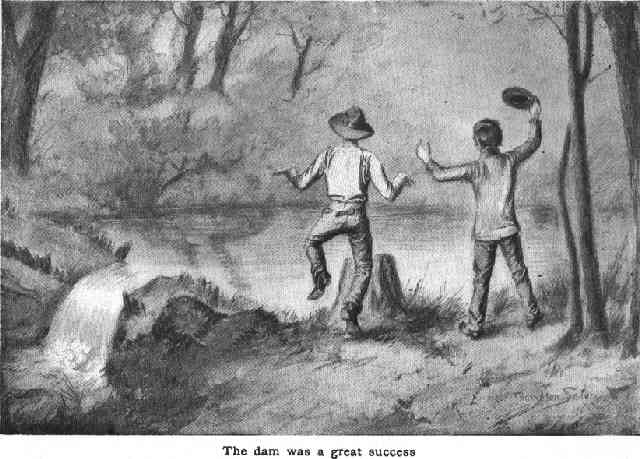
"No, you don't," said Sam. "Nor I ain't 'Bald-
Eagle-Settin'-on-a-Rock-with-his-Tail-Hangin'-over-the
195
-Edge,' nuther. In fact, I don't keer to be recognized
just now. Ain't it a relief to think the cattle
don't have to take that walk any more?"
Sam was evidently trying to turn the subject, but
Yan would not be balked. "I heard Si call you
'Woodpecker' the other day."
"Yep. I got that at school. When I was a kid
to hum I heerd Ma talk about me be-a-u-tiful golden
hair, but when I got big enough to go to school I
learned that it was only red, an' they called me the
'Red-headed Woodpecker.' I tried to lick them,
but lots of them could lick me an' rubbed it in wuss.
When I seen fightin' didn't work, I let on to like it,
but it was too late then. Mostly it's just 'Woodpecker'
for short. I don't know as it ever lost me
any sleep."
Half an hour later, as they sat by the fire that Yan
made with rubbing-sticks, he said, "Say, Woodpecker,
I want to tell you a story." Sam grimaced,
pulled his ears forward, and made ostentatious
preparations to listen.
"There was once an Indian squaw taken prisoner
by some other tribe way up north. They marched
her 500 miles away, but one night she escaped and
set out, not on the home trail, for she knew they
would follow that way and kill her, but to one side.
She didn't know the country and got lost. She had
no weapons but a knife, and no food but berries.
Well, she travelled fast for several days till a rainstorm
came, then she felt safe, for she knew her
enemies could not trail her now. But winter was
196
near and she could not get home before it came. So
she set to work right where she was.
"She made a wigwam of Birch bark and a fire
with rubbing-sticks, using the lace of her moccasin
for a bow-string. She made snares of the inner
bark of the Willow and of Spruce roots, and deadfalls,
too, for Rabbits. She was starving sometimes,
at first, but she ate the buds and inner
bark of Birch trees till she found a place where
there were lots of Rabbits. And when she
caught some she used every scrap of them. She
made a fishing-line of the sinews, and a hook of the
bones and teeth lashed together with sinew and
Spruce gum.
"She made a cloak of Rabbit skins, sewed with
needles of Rabbit bone and thread of Rabbit sinew,
and a lot of dishes of Birch bark sewed with Spruce
roots.
"She put in the whole winter there alone, and
when the spring came she was found by Samuel
Hearne, the great traveller. Her precious knife was
worn down, but she was fat and happy and ready to
set out for her own people."
"Well, I say that's mighty inter-est-in'," said
Sam—he had listened attentively—"an' I'd like
nothin' better than to try it myself if I had a gun an'
there was lots of game."
"Pooh, who wouldn't?"
"Mighty few—an' there's mighty few who could."
"I could."
197
"What, make everything with just a knife? I'd
like to see you make a teepee," then adding earnestly,
"Sam, we've been kind o' playing Injuns; now let's
do it properly. Let's make everything out of what
we find in the woods."
"Guess we'll have to visit the Sanger Witch again.
She knows all about plants."
"We'll be the Sanger Indians. We can both be
Chiefs," said Yan, not wishing to propose himself as
Chief or caring to accept Sam as his superior. "I'm
Little Beaver. Now what are you?"
"Bloody-Thundercloud-in-the-Afternoon."
"No, try again. Make it something you can draw,
so you can make your totem, and make it short."
"What's the smartest animal there is?"
"I—I—suppose the Wolverine."
"What! Smarter'n a Fox?"
"The books say so."
"Kin he lick a Beaver?"
"Well, I should say so."
"Well, that's me."
"No, you don't. I'm not going around with a
fellow that licks me. It don't fit you as well as
'Woodpecker,' anyhow. I always get you when I
want a nice tree spoiled or pecked into holes,"
retorted Yan, magnanimously ignoring the personal
reason for the name.
"Tain t as bad as beavering," answered Sam.
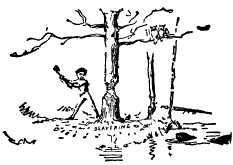
"Beavering" was a word with a history. Axes and
timber were the biggest things in the lives of the
Sangerites. Skill with the axe was the highest accomplishment.
198
The old settlers used to make everything
in the house out of wood, and with the axe for the only
tool. It was even said that some of them used to
"edge her up a bit" and shave with her on Sundays.
When a father was setting his son up in life he gave
him simply a good axe. The axe was the grand
essential of life and work, and was supposed to be a
whole outfit. Skill with the axe was general. Every
man and boy was more or less expert, and did not
know how expert he was till a real "greeny" came
among them. There is a right way to cut for each
kind of grain, and a certain proper way of felling a
tree to throw it in any given direction with the
minimum of labour. All these things are second
nature to the Sangerite. A Beaver is credited with a
haphazard way of gnawing round and round a tree till
somehow it tumbles, and when a chopper deviates
in the least from the correct form, the exact right cut
in the exact right place, he is said to be "beavering";
therefore, while "working like a Beaver" is high praise,
"beavering" a tree is a term of unmeasured reproach,
and Sam's final gibe had point and force that none
but a Sangerite could possibly have appreciated.
The Sanger Witch hated the Shanty-man's axe
And wildfire, too, they tell,
But the hate that she had for the Sporting man
Was wuss nor her hate of Hell!
—Cracked Jimmie's Ballad of Sanger.
Yan took his earliest opportunity to revisit the
Sanger Witch.
"Better leave me out," advised Sam, when
he heard of it. "She'd never look at you if I went.
You look too blame healthy."
So Yan went alone, and he was glad of it. Fond
as he was of Sam, his voluble tongue and ready wit
left Yan more or less in the shade, made him look
sober and dull, and what was worse, continually
turned the conversation just as it was approaching
some subject that was of deepest interest to him.
As he was leaving, Sam called out, "Say, Yan,
if you want to stay there to dinner it'll be all right—
we'll know why you hain't turned up." Then he
stuck his tongue in his cheek, closed one eye and went
to the barn with his usual expression of inscrutable
melancholy.
Yan carried his note-book—he used it more and
more, also his sketching materials. On the road he
200
gathered a handful of flowers and herbs. His reception
by the old woman was very different this time.
"Come in, come in, God bless ye, an' hoo air ye,
an' how is yer father an' mother—come in an' set
down, an' how is that spalpeen, Sam Raften?"
"Sam's all right now," said Yan with a blush.
"All right! Av coorse he's all right. I knowed I'd
fix him all right, an' he knowed it, an' his Ma knowed
it when she let him come. Did she say onything
about it?"
"No, Granny, not a word."
"The dhirty hussy! Saved the boy's life in sphite
of their robbin' me an' she ain't human enough to
say 'thank ye'—the dhirty hussy! May God forgive
her as I do," said the old woman with evident and
implacable enmity.
"Fwhat hev ye got thayer? Hivin be praised, they
can't kill them all off. They kin cut down the trees,
but the flowers comes ivery year, me little beauties—me
little beauties!" Yan spread them out. She
picked up an Arum and went on. "Now, that's
Sorry-plant, only some calls it Injun Turnip, an' I
hear the childer call it Jack-in-the-Pulpit. Don't ye
never put the root o' that near yer tongue. It'll sure
burn ye like fire. First thing whin they gits howld
av a greeny the bhise throis to make him boite that
same. Shure he niver does it twicet. The Injuns
b'ile the pizen out o' the root an' ates it; shure
it's better'n starvin'."
201
Golden Seal (Hydrastis canadensis), the plant she
had used for Sam's knee, was duly recognized and
praised, its wonderful golden root, "the best goold
iver came out av the ground," was described with its
impression of the seal of the Wise King.
"Thim's Mandrakes, an' they're moighty late, an'
ye shure got thim in the woods. Some calls it May
Apples, an' more calls it Kingroot. The Injuns use
it fur their bowels, an' it has cured many a horse of
pole evil that I seen meself.
"An' Blue Cohosh, only I call that Spazzum-root.
Thayer ain't nothin' like it fur spazzums—took like
tay; only fur that the Injun women wouldn't live in
all their thrubles, but that's something that don't
consarn ye. Luk now, how the laves is all spread out
like wan wid spazzums. Glory be to the Saints and the
Blessed Virgin, everything is done fur us on airth an'
plain marked, if we'd only take the thruble to luk.
"Now luk at thot," said she, clawing over the bundle
and picking out a yellow Cypripedium, "that's Moccasin-plant
wid the Injuns, but mercy on 'em
fur bloind, miserable haythens. They don't know
nothin' an' don't want to larn it. That's Umbil, or
Sterrick-root. It's powerful good fur sterricks. Luk
at it! See the face av a woman in sterricks wid her
hayer flyin' an' her jaw a-droppin'. I moind the
toime Larry's little gurrl didn't want to go to her
'place' an' hed sterricks. They jest sent fur me an'
I brung along a Sterrick-root. First, I sez, sez I,
'Get me some b'ilin' wather,' an' I made tay an' give
it to her b'ilin' hot. As share as Oi'm a livin' corpse,
202
the very first spoonful fetched her all right. Oh, but
it's God's own gift, an' it's be His blessin' we know
how to use it. An' it don't do to just go an' dig it
when ye want it. It has to be grubbed when the
flower ain't thayer. Ye see, the strength ain't in
both places to oncet. It's ayther in the flower or in
the root, so when the flower is thayer the root's no
more good than an ould straw. Ye hes to Hunt fur
it in spring or in fall, just when the divil himself
wouldn't know whayer to find it.
"An' fwhat hev ye thayer? Good land! if it ain't
Skunk's Cabbage! Ye sure come up by the Bend.
That's the on'y place whayer that grows."
"Yes," replied Yan; "that's just where I got it.
But hold on, Granny, I want to sketch all those and
note down their names and what you say about them."
"Shure, you'd hev a big book when I wuz through,"
said the old woman with pride, as she lit her pipe,
striking the match on what would have been the leg
of her pants had she been a man.
"An' shure ye don't need to write down what
they're good fur, fur the good Lord done that Himself
long ago. Luk here, now. That's Cohosh, fur spazzums,
an' luks like it; that's Moccasin, fur Highsterricks,
an' luks like it; wall, thar's Skunk-root fur both,
an' don't it luk like the two o' thim thigither?"
Yan feebly agreed, but had much difficulty in seeing
what the plant had in common with the others.
"An' luk here! Thayer ye got Lowbelier, that
some calls Injun tobaccer. Ye found this by the
203
crick, an' it's a little airly—ahead o' toime. That's
the shtuff to make ye throw up when ye want to.
Luk, ain't that lafe the livin' shape of a shtummick?
"Thayer's the Highbelier; it's a high hairb, an' it's
moighty foine fur the bowels when ye drink the dry
root.
"Spicewood" [Spicebush, Lindera benzoin], "or
Fayverbush, them twigs is great fur tay—that cures
shakes and fayver. Shure an' it shakes ivery toime
the wind blows.
"That's Clayvers," she said, picking up a Galium.
"Now fwhat wud ye think that wuz fur to cure?"
"I don't know. What is it?"
"Luk now, an' see how it's wrote in it plain as
prent—yes, an' a sight plainer, fur I can read
them an' I can't read a wurrud in a book. Now
fwhat is that loike?" said she, holding up the double
seed-pod.
"A brain and spinal column," said Yan.
"Och, choild, I hev better eyes than ye. Shure
them's two kidneys, an' that's fwhat Clayver tay will
cure better'n all the docthers in the wurruld, an' ye
hev to know just how. Ye see, kidney thruble is a
koind o' fayver; it's hatin', so ye make yer Clayver
tay in cold wather; if ye make it o' warrum wather it
just makes ye wuss an' acts loike didly pizen.
Thayer's Sweatplant, or Boneset" [Eupatorium perfoliatum],
"that's the thing to sweat ye. Wanst Oi
sane a feller jest dyin' o' dry hoide, wuz all hoidebound,
an' the docthers throid an' throid an' couldn't
204
help wan bit, till I guv his mother some Boneset leaves
to make tay, an' he sweat buckets before he'd more'n
smelt av it, an' the docthers thought they done it
theirsilves!" and she cackled gleefully.
"Thayer's Goldthread fur cankermouth, an' Pipsissewa
that cures fayver an' rheumatiz, too. It always
grows where folks gits them disayses. Luk at the
flower just blotched red an' white loike fayver
blotches—an' Spearmint, that saves ye if ya pizen
yerself with Spaszum-root, an' shure it grows right
next it in the woods!
"Thayer's Wormseed fur wurrums—see the 'ittle
wurrum on the leaves" [Chenopodium] "an' that thayer
is Pleurisy root, an' thayer! well, thayer's the foinest
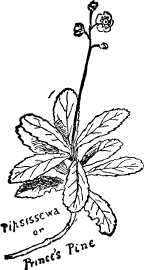 hairb that iver God made to grow—that's Cure all.
Some things cures wan thing and some cures another,
but when ye don't know just what to take, ye make
tay o' that root an' ye can't go wrong. It was an
Injun larned me that. The poor miserable baste of a
haythen hed some larnin', an' the minit he showed me
I knowed it was so, fur ivery lafe wuz three in wan
an' wan in three, an' had the sign o' the blessed crass
in the middle as plain as that biler settin' on the
stove."
hairb that iver God made to grow—that's Cure all.
Some things cures wan thing and some cures another,
but when ye don't know just what to take, ye make
tay o' that root an' ye can't go wrong. It was an
Injun larned me that. The poor miserable baste of a
haythen hed some larnin', an' the minit he showed me
I knowed it was so, fur ivery lafe wuz three in wan
an' wan in three, an' had the sign o' the blessed crass
in the middle as plain as that biler settin' on the
stove."
Thus she chattered away, smoking her short pipe,
expectorating on the top of the hot stove, but with
true feminine delicacy she was careful each time to
wipe her mouth on the back of her skinny arm.
"An' that's what's called Catnip; sure Oi moind well
the day Oi furst larned about that. It warn't a Injun
205
nor a docther nor a man at all, at all, that larned me
that. It was that ould black Cat, an' may the saints
stand bechuxt me an' his grane eyes! Bejabers,
sometimes he scares me wid his knowin' ways, but I
hev nothin' agin him except that he kills the wee
burruds. He koind o' measled all wan winter an' lay
around the stove. Whiniver the dooer was open he'd
go an' luk out an' then come back an' meow an' wheen
an' lay down—an' so he kep' on, gittin' waker an'
worser, till the snow wuz gone an' grass come up, an'
still he'd go a-lukin' toward the ayst, especially nights.
Then thayer come up a plant I had never sane, right
thayer, an' he'd luk at it an' luk at it loike he wanted
it but didn't dar to. Thar was some foine trays out
thayer in thim days afore the ould baste cut thim
down, an' wan av thim hed a big limb, so—an' another
so—an' when the moon come up full at jest the right
time the shaddy made the sign av the crass an' loighted
on me dooer, an' after it was past it didn't
make no crass. Well, bejabers, the full moon come
up at last an' she made the sign of the shaddy crass,
an' the ould Cat goes out an' watches an' watches loike
he wanted to an' didn't dar to, till that crass drapped
fayer onto the hairbs, an' Tom he jumped then an' ate
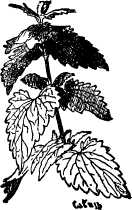 an' ate, an' from that day he was a well Cat; an' that's
how Oi larned Catnip, an' it set me moind aisy,
too, fur no Cat that's possesst 'll iver ate inunder the
shaddy av the crass."
an' ate, an' from that day he was a well Cat; an' that's
how Oi larned Catnip, an' it set me moind aisy,
too, fur no Cat that's possesst 'll iver ate inunder the
shaddy av the crass."
Yan was scribbling away, but had given up any
attempt to make sketches or even notes beyond the
206
names of the plants.
"Shure, choild, put them papers wid the names
on the hairbs an' save them; that wuz fwhat Docther
Carmartin done whin Oi was larnin' him. Thayer,
now, that's it," she added, as Yan took the hint and
began slipping on each stalk a paper label with its
name.
"That's a curious broom," said Yan, as his eye
fell on the symbol of order and cleanliness, making
strange reflections on itself.
"Yes; sure, that's a Baitche broom. Larry makes
'em."
"Larry?"
"Yes, me bhoy." [Larry was nearly sixty.] "He
makes thim of Blue Baitche."
"How?" asked Yan, picking it up and examining
it with intense interest.
"Whoi, shure, by whittlin'. Larry's a howly
terror to whittle, an' he gets a Blue Baitche sapling
'bout three inches thick an' starts a-whittlin" long
slivers, but laves them on the sthick at wan end till
thayer all round loike that."
"What, like a fire-lighter?"
"Yis, yis, that's it, only bigger, an Blue Baitche is
terrible tough. Then whin he has the sthick down
to 'bout an inch thick, he ties all the slivers the
wrong way wid a sthrand o' Litherwood, an' thrims
down the han'el to suit, an' evens up the ind av the
broom wid the axe an' lets it dhry out, an' thayer yer
207
is. Better broom was niver made, an' there niver
wus ony other in th' famb'ly till he married that
Kitty Connor, the lowest av the low, an' it's meself
was all agin her, wid her proide an' her dirthy sthuck-up
ways' nothin' but boughten things wuz good
enough fur her, her that niver had a dacint male till
she thrapped moi Larry. Yis, low be it sphoken,
but 'thrapped' 's the wurrud," said the old woman,
raising her voice to give emphasis that told a lurid
tale.
At this moment the door opened and in came
Biddy, and as she was the daughter of the unspeakable
Kitty the conversation turned.
"An' sure it's glad to see ye I am, an' when are ye
comin' down to reside at our place?" was her greeting
to Yan, and while they talked Granny took advantage
of the chance to take a long pull at a bottle that
looked and smelled like Lung-balm.
"Moi, Biddy, yer airly," said Granny.
"Shure, an' now it was late whin I left home, an' the
schulmaster says it's always so walking from
ayst to west."
"An' shure it's glad Oi am to say ye, fur Yan will
shtop an ate wid us. It ain't duck an' grane pase,
but, thank God, we hev enough an' a hearty welcome
wid ivery boite. Ye say, Biddy makes me dinner
ivery foine day an' Oi get a boite an' a sup for meself
other toimes, an' slapes be me lone furby me Dog an'
Cat an' the apples, which thayer ain't but a handful
left, but fwhat thar is is yourn. Help yerself,
choild, an' ate hearty," and she turned down the
208
gray-looking bedclothes to show the last half-dozen
of the same rosy apples.
"Aint you afraid to sleep here alone nights,
Granny?"
"Shure fwhat hev Oi to fayre? Thayer niver
wuz robbers come but wanst, an' shure I got
theyer last cint aff av them. They come one night
an' broke in, an' settin' up, Oi sez, 'Now fwhat are
yez lukin' fur?'
"'Money,' sez they, fur thayer was talk all round
thin that Oi had sold me cow fur $25.
"'Sure, thin, Oi'll get up an' help ye,' sez Oi, fur
divil a cint hev Oi been able to set me eyes on sense
apple harvest.'"
'"We want $25, or we'll kill ye.'
"'Faith, an' if it wuz twenty-five cints Oi couldn't
help it,' sez Oi, 'an' it's ready to die Oi am,' sez Oi,
'fur Oi was confessed last wake an' Oi'm a-sayin' me
prayers this minit.'
"Sez the littlest wan, an' he wa'n't so little, nigh
as br'ad as that dooer, 'Hevn't ye sold yer cow?'
"'Ye'll foind her in the barrun,' sez Oi, 'though Oi
hate to hev yez disturb her slapin'. It makes her
drame an' that's bad fur the milk.'
"An' next thing them two robbers wuz laffin' at
each other fur fools. Then the little wan sez:
"'Now, Granny, we'll lave ye in pace, if ye'll niver
say a wurrud o' this'—but the other wan seemed
kind o' sulky.
209
"'Sorra a wurrud,' sez Oi, 'an' good frinds we'll
be yit,' an' they wuz makin' fur the dooer to clayer
out whin I sez:
"'Howld on! Me friends can't lave me house an' naither
boite nor sup; turn yer backs an' ye plaze,
till Oi get on me skirt.' An' whin Oi wuz up an' dacint
an' tould them they could luk, Oi sez, 'It's
the foinest Lung balm in the land ye shall taste,' an' the
littlest feller he starts a-coughin', oh, a turrible
cough—it fair scairt me, like a hoopin' croup—an' the
other seemed just mad, and the littlest wan made
fun av him. Oi seen the mean wan wuz left-handed
or let on he wuz, but when he reached out fur the
bottle he had on'y three fingers on his right, an' they
both av them had the biggest, blackest, awfulest
lukin' bairds—I'd know them two bairds agin ony
place—an' the littlest had a rag round his head, said
he had a toothache, but shure yer teeth don't ache
in the roots o' yer haiyer. Then when they wuz goin' the
littlest wan put a dollar in me hand an' sez,
'It's all we got bechuxst us, Granny.' 'Godbless ye,' sez
Oi, 'an' Oi take it kindly. It's the first Oi seen
sense apple harvest, an' it's a friend ye hev in me
whin ye nade wan,'" and the old woman chuckled
over her victory.
"Granny, do you know what the Indians use for
dyeing colours?" asked Yan, harking back to his main
purpose.
"Shure, Yahn, they jest goes to the store an' gets
boughten dyes in packages like we do."
210
"But before there were boughten dyes, didn't
they use things in the woods?"
"That they did, for shure. Iverything man iver
naded the good Lord made grow fur him in the
woods."
"Yes, but what plants?"
"Faix, an' they differ fur different things."
"Yes, but what are they?" Then seeing how
general questions failed, he went at it in detail.
"What do they use for yellow dye on the Porcupine
quills—I mean before the boughten dyes came?"
"Well, shure an' that's a purty yellow flower that
grows in the fall out in the field an' along the fences.
The Yaller Weed, I call it, an' some calls it Goldenrod.
They bile the quills in wather with the flower. Luk!
Thar's some wool dyed that way."
"An' the red?" said Yan, scribbling away.
"Faix, an' they had no rale good red. They made
a koind o' red o' berry juice b'iled, an' wanst I seen
a turrible nice red an ol' squaw made b'ilin' the
quills fust in yaller awhile an' next awhile in red."
"What berries make the best red, Granny?"
"Well, 'tain't the red wans, as ye moight think.
Ye kin make it of Rosberries or Sumac or Huckleberries
an' lots more, but Black Currants is redder
than Red Currants, an' Squaw berries is best av
them all."
"What are they like?"
"Shure, an' Oi'll show ye that same hairb," and
they wandered around outside the shanty in vain
search. "It's too airly," said Granny, "but it's
211
round thayer in heaps in August an' is the purtiest
red iver grew. 'An Pokeweed, too, it ain't har'ly
flowerin' yit, but in the fall it hez berries that's so
red they're nigh black, an' dyes the purtiest kind o'
a purple."
"What makes blue?"
"Oi niver sane none in the quills. Thayer may be
some. The good Lord made iverything grow in the
woods, but I ain't found it an' niver seen none. Ye
kin make a grane av the young shoots av Elder, but
it ain't purty like that," and she pointed to a frightful
emerald ribbon that Biddy wore, "an' a brown of
Butternut bark, an' a black av White Oak chips an'
bark. Ye kin make a kind o' grane av two dips,
wan of yaller an wan av black. Ye kin dye black
wid Hickory bark, an' orange (bad scran to it) wid
the inner bark of Birch, an' yaller wid the roots av
Hoop Ash, an' a foine scarlet from the bark av the
little root av Dogwood, but there ain't no rale blue
in the woods, an' that's what I tell them orange-an'-blue
Prattisons on the 12th o' July, fur what the
Lord didn't make the divil did.
"Ye kin make a koind of blue out o' the Indigo
hairb, but 'tain't like this," pointing to some screaming
cobalt, "an' if it ain't in the woods the good Lord
niver meant us to have it. Yis! I tell ye it's the
divil's own colour, that blue-orange an' blue is the
divil's own colours, shure enough, fur brimstone's
yaller; an' its blue whin it's burnin', that I hed from
his riv'rince himself—bless him!"
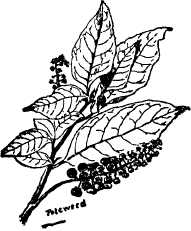
Biddy meanwhile had waddled around the room
slapping the boards with her broad bare feet
as she prepared their dinner. She was evidently
trying to put on style, for she turned out her toes
excessively. She spoke several times about "the
toime when she resoided with yer mamma," then at
length, "Whayer's the tablecloth, Granny?"
"Now, wud ye listen to thot, an' she knowin' that
divil a clath hev we in the wurruld, an' glad enough
to hev vittles on the table, let alone a clath," said
Granny, oblivious of the wreck she was making of
Biddy's pride.
"Will ye hay tay or coffee, Yahn?" said Biddy.
"Tea," was Yan's choice.
"Faix, an' Oi'm glad ye said tay, fur Oi ain' seen
a pick o' coffee sense Christmas, an' the tay Oi kin
git in the woods, but thayer is somethin' Oi kin set
afore ye that don't grow in the woods," and the old
woman hobbled to a corner shelf, lifted down an old
cigar box and from among matches, tobacco, feathers,
tacks, pins, thread and dust she picked six lumps of
cube sugar, formerly white.
"Thayer, shure, an' Oi wuz kapin' this fur whin
his riv'rence comes; wanst a year he's here, God bless
213
him! but that's fower wakes ahid, an' dear knows
fwhat may happen afore thin. Here, an' a hearty
welcome," said she, dropping three of the lumps in
Yan's tea. "We'll kape the rest fur yer second cup.
Hev some crame?" and she pushed over a sticky-handled
shaving-mug full of excellent cream. "Biddy,
give Yahn some bread."
The loaf, evidently the only one, was cut up and
two or three slices forced into Yan's plate.
"Mebbe the butther is a little hoigh," exclaimed
the hostess, noting that Yan was sparing of it.
"Howld on." She went again to the corner shelf
and got down an old glass jar with scalloped edge
and a flat tin cover. It evidently contained jam.
She lifted the cover and exclaimed:
"Well, Oi niver!" Then going to the door she
fished out with her fingers a dead mouse and threw
it out, remarking placidly, "Oi've wondered whayer
the little divil wuz. Oi ain't sane him this two
wakes, an' me a-thinkin' it wuz Tom ate him. May
Oi be furgiven the onjustice av it. Consarn them flies!
That cover niver did fit." And again her finger was
employed, this time to scrape off an incrustation of
unhappy flies that had died, like Clarence, in their
favourite beverage.
"Thayer, Yan, now ate hearty, all av it, an' welcome.
It does me good to see ye ate—thayer's
lots more whayer that come from," though it was
obvious that she had put her all upon the table.
214
Poor Yan was in trouble. He felt instinctively
that the good old soul was wrecking her week's
resources in this lavish hospitality, but he also felt
that she would be deeply hurt if he did not
appear to enjoy everything. The one possibly clean
thing was the bread. He devoted himself to that; it
was of poorest quality; one or two hairs looping in
his teeth had been discouraging, but when he bit at
a piece of linen rag with a button on it he was fairly
upset. He managed to hide the rag, but could not
conceal his sudden loss of appetite.
"Hev some more av this an' this," and in spite of
himself his plate was piled up with things for him
to eat, including a lot of beautifully boiled potatoes,
but unfortunately the hostess carried them from
the pot on the stove in a corner of her ancient and
somber apron, and served him with her skinny paw.
Yan's appetite was wholly gone now, to the grief
of his kind entertainer, "Shure an' she'd fix him up
something to stringthen him," and Yan had hard
work to beg off.
"Would ye like an aig," ventured Biddy.
"Why, yes! oh, yes, please," exclaimed Yan, with
almost too much enthusiasm. He thought, "Well,
hens are pure-minded creatures, anyway. An egg's
sure to be clean."
Biddy waddled away to the 'barrun' and soon
reappeared with three eggs.
"B'iled or fried?"
"Boiled," said Yan, aiming to keep to the safe side.
215
Biddy looked around for a pot.
"Shure, that's b'ilin' now," said Granny, pointing
to the great mass of her undergarments seething in
the boiler, and accordingly the eggs were dropped
in there.
Yan fervently prayed that they might not break.
As it was, two did crack open, but he got the other
one, and that was virtually his dinner.
A Purple Blackbird came hopping in the door now.
"Will, now, thayer's Jack. Whayer hev ye been?
I thought ye wuz gone fur good. Shure Oi saved him
from a murtherin' gunner," she explained. "(Bad
scran to the baste! I belave he was an Or'ngeman.)
But he's all right now an' comes an' goes like he
owned the place. Now, Jack, you git out av that
wather pail," as the beautiful bird leaped into the
half-filled drinking bucket and began to take a bath.
"Now luk at that," she shouted, "ye little rascal,
come out o' that oven," for now the Blackbird had
taken advantage of the open door to scramble into
the dark warm oven.
"Thayer he goes to warrum his futs. Oh, ye little
rascal! Next thing ye know some one'll slam the
dooer, not knowin' a thing, and fire up, an' it's
roastin' aloive ye'll be. Shure an' it's tempted
Oi am to wring yer purty neck to save yer loife,"
and she drove him out with the harshest of words
and the gentlest of hands.
Then Yan, with his arms full of labelled plants,
set out for home.
216
"Good-boi, choild, come back agin and say me
soon. Bring some more hairbs. Good-boi, an' bless
ye. Oi hope it's no sin to say so, fur Oi know yer a
Prattison an' ye are all on yez goin' to hell, but yer
a foine bhoy. Oi'm tumble sorry yer a Prattison."
When Yan got back to the Raftens' he found the
dinner table set for one, though it was now three in
the afternoon.
"Come and get your dinner," said Mrs. Raften in
her quiet motherly way. "I'll put on the steak. It
will be ready in five minutes."
"But I've had my dinner with Granny de Neuville."
"Yes, I know!"
"Did she stir yer tea with one front claw an' put
jam on yer bread with the other?" asked Raften,
rather coarsely.
"Did she b'ile her pet Blackbird fur yer soup?"
said Sam.
Yan turned very red. Evidently all had a good
idea of what he had experienced, but it jarred on him
to hear their mockery of the good old soul.
He replied warmly, "She was just as kind and nice
as she could be."
"You had better have a steak now," said Mrs.
Raften, in solicitous doubt.
How tempting was the thought of that juicy brown
steak! How his empty stomach did crave it! But
the continued mockery had stirred him. He would
stand up for the warm-hearted old woman who had
ungrudgingly given him the best she had—had given
her all—to make a hearty welcome for a stranger.
217
They should never know how gladly he would have
eaten now, and in loyalty to his recent hostess he
added the first lie of his life:
"No, thank you very much, but really I am not
in the least hungry. I had a fine dinner at Granny
de Neuville's."
Then, defying the inner pangs of emptiness, he
went about his evening chores.
"Wonder where Caleb got that big piece of Birch
bark," said Yan; "I'd like some for dishes."
"Guess I know. He was over to Burns's
bush. There's none in ours. We kin git some."
"Will you ask him?"
"Naw, who cares for an old Birch tree. We'll
go an' borrow it when he ain't lookin'."
Yan hesitated.
Sam took the axe. "We'll call this a war party
into the enemy's country. There's sure 'nuff war
that-a-way. He's one of Da's 'friends.'"
Yan followed, in doubt still as to the strict
honesty of the proceeding.
Over the line they soon found a good-sized canoe
Birch, and were busy whacking away to get off a
long roll, when a tall man and a small boy, apparently
attracted by the chopping, came in sight and made
toward them. Sam called under his breath: "It's
old Burns. Let's git."
There was no time to save anything but themselves
and the axe. They ran for the boundary fence, while
Burns contented himself with shouting out threats
and denunciations. Not that he cared a straw for the
Birch tree—timber had no value in that country—but
219
unfortunately Raften had quarrelled with all
his immediate neighbours, therefore Burns did his best
to make a fearful crime of the petty depredation.
His valiant son, a somewhat smaller boy than either
Yan or Sam, came near enough to the boundary to
hurl opprobrious epithets.
"Red-head—red-head! You red-headed thief!
Hol' on till my paw gits hol' o' you—Raften, the
Baften, the rick-strick Straften," and others equally
galling and even more exquisitely refined.
"War party escaped and saved their scalps," and
Sam placidly laid the axe in its usual place.
"Nothing lost but honour," added Yan. "Who's
the kid?"
"Oh, that's Guy Burns. I know him. He's a mean
little cuss, always sneaking and peeking. Lies like
sixty. Got the prize—a big scrubbing-brush—for
being the dirtiest boy in school. We all voted, and
the teacher gave it to him."
Next day the boys made another war party for
Birch bark, but had hardly begun operations when
there was an uproar not far away, and a voice, evidently
of a small boy, mouthing it largely, trying to
pass itself off as a man's voice: "Hi, yer the ——
——. Yer git off my —— —— place —— ——"
"Le's capture the little cuss, Yan."
"An' burn him at the stake with horrid torture,"
was the rejoinder.
They set out in his direction, but again the appearance
of Burns changed their war-party onslaught into
220
a rapid retreat.
(More opprobrium.)
During the days that followed the boys were often
close to the boundary, but it happened that Burns
was working near and Guy had the quickest of eyes
and ears. The little rat seemed ever on the alert.
He soon showed by his long-distance remarks that he
knew all about the boys' pursuits—had doubtless
visited the camp in their absence. Several times
they saw him watching them with intense interest
when they were practising with bow and arrow, but
he always retreated to a safe distance when discovered,
and then enjoyed himself breathing out
fire and slaughter.
One day the boys came to the camp at an unusual
hour. On going into a near thicket Yan saw a bare
foot under some foliage. "Hallo, what's this?" He
stooped down and found a leg to it and at the end of
that Guy Burns.
Up Guy jumped, yelling "Paw—Paw—PAW!" He
ran for his life, the Indians uttering blood-curdlers
on his track. But Yan was a runner, and Guy's
podgy legs, even winged by fear, had no chance. He
was seized and dragged howling back to the camp.
"You let me alone, you Sam Raften—now you let
me alone!" There was, however, a striking lack of
opprobrium in his remarks now. (Such delicacy is
highly commendable in the very young.)
"First thing is to secure the prisoner, Yan."
221
Sam produced a cord.
"Pooh," said Yan. "You've got no style about
you. Bring me some Leatherwood."
This was at hand, and in spite of howls and scuffles,
Guy was solemnly tied to a tree—a green one—because,
as Yan pointed out, that would resist the
fire better.
The two Warriors now squatted cross-legged by the
fire. The older one lighted a peace-pipe, and they
proceeded to discuss the fate of the unhappy
captive.
"Brother," said Yan, with stately gestures, "it is
very pleasant to hear the howls of this miserable paleface."
(It was really getting to be more than they
could endure.)
"Ugh—heap good," said the Woodpecker.
"Ye better let me alone. My Paw'll fix you for
this, you dirty cowards," wailed the prisoner, fast
losing control of his tongue.
"Ugh! Take um scalp first, burn him after," and
Little Beaver made some expressive signs.
"Wah—bully—me heap wicked," rejoined the
Woodpecker, expectorating on a stone and beginning
to whet his jack-knife.
The keen and suggestive "weet, weet, weet" of the
knife on the stone smote on Guy's ears and nerves
with appalling effect.
"Brother Woodpecker, the spirit of our tribe calls
out for the blood of the victim—all of it."
"Great Chief Woodpecker, you mean," said Sam,
aside. "If you don't call me Chief, I won't call you
222
Chief, that's all."
The Great Woodpecker and Little Beaver now
entered the teepee, repainted each other's faces,
adjusted their head-dresses and stepped out to the
execution.
The Woodpecker re-whetted his knife. It did not
need it, but he liked the sound.
Little Beaver now carried a lot of light firewood and
arranged it in front of the prisoner, but Guy's legs were
free and he gave it a kick which sent it all flying.
The two War-chiefs leaped aside. "Ugh! Heap
sassy," said the ferocious Woodpecker. "Tie him
legs, oh, Brother Great Chief Little Beaver!"
A new bark strip tied his legs securely to the tree.
Then Chief Woodpecker approached with his knife
and said:
"Great Brother Chief Little Beaver, if we scalp him
there is only one scalp, and you will have nothing to
show, except you're content with the wishbone."
Here was a difficulty, artificial yet real, but Yan
suggested:
"Great Brother Chief
Red-headed-Woodpecker-Settin'-on-a-Stump-with-his-Tail-Waggling-over-the Edge,
no scalp him; skin his hull head, then each take
half skin."
"Wah! Very good, oh Brother Big-Injun-Chief
Great-Little-Beaver-Chaw-a-Tree-Down."
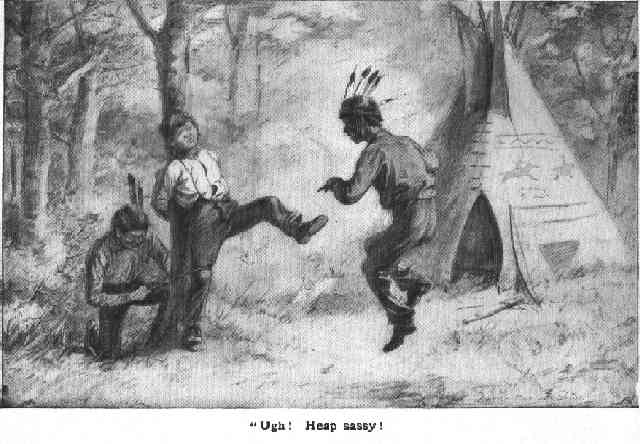
Then the Woodpecker got a piece of charcoal and
proceeded in horrid gravity to mark out on the tow
hair of the prisoner just what he considered a fair
225
division. Little Beaver objected that he was entitled
to an ear and half of the crown, which is the essential
part of the scalp. The Woodpecker pointed out that
fortunately the prisoner had a cow-lick that was
practically a second crown. This ought to do perfectly
well for the younger Chief's share. The charcoal lines
were dusted off for a try-over. Both Chiefs got charcoal
now and a new sketch plan was made on Guy's
tow top and corrected till it was accepted by both.
The victim had really never lost heart till now.
His flow of threats and epithets had been continuous
and somewhat tedious. He had threatened to tell his
"paw" and "the teacher," and all the world, but
finally he threatened to tell Mr. Raften. This was
the nearest to a home thrust of any yet, and in some
uneasiness the Woodpecker turned to Little Beaver
and said:
"Brother Chief, do you comprehend the language
of the blithering Paleface? What does he say?"
"Ugh, I know not," was the reply. "Maybe he
now singeth a death song in his own tongue."
Guy was not without pluck. He had kept up heart
so far believing that the boys were "foolin'," but when
he felt the awful charcoal line drawn to divide his
scalp satisfactorily between these two inhuman,
painted monsters, and when with a final "weet, weet,
weet" of the knife on the stone the implacable Woodpecker
approached and grabbed his tow locks in one
hand, then he broke down and wept bitterly.
226
"Oh, please don't——Oh, Paw! Oh, Maw! Let
me go this time an' I'll never do it again." What he
would not do was not specified, but the evidence of
surrender was complete.
"Hold on, Great Brother Chief," said Little
Beaver. "It is the custom of the tribes to release or
even to adopt such prisoners as have shown notable
fortitude."
"Showed fortitude enough for six if it's the same
thing as yellin'," said the Woodpecker, dropping
into his own vernacular.
"Let us cut his bonds so that he may escape to his
own people."
"Thar'd be more style to it if we left him thar
overnight an' found next mornin' he had escaped
somehow by himself," said the older Chief. The
victim noted the improvement in his situation and
now promised amid sobs to get them all the Birch
bark they wanted—to do anything, if they would
let him go. He would even steal for them the
choicest products of his father's orchard.
Little Beaver drew his knife and cut bond after bond.
Woodpecker got his bow and arrow, remarking
"Ugh, heap fun shoot him runnin'."
The last bark strip was cut. Guy needed no
urging. He ran for the boundary fence in silence
till he got over; then finding himself safe and unpursued,
he rilled the air with threats and execrations.
No part of his statement would do to print here.
After such a harrowing experience most boys would
have avoided that swamp, but Guy knew Sam at
227
school as a good-natured fellow. He began to think
he had been unduly scared. He was impelled by
several motives, a burning curiosity being, perhaps
the most important. The result was that one day
when the boys came to camp they saw Guy sneaking
off. It was fun to capture him and drag him back.
He was very sullen, and not so noisy as the other
time, evidently less scared. The Chiefs talked of fire
and torture and of ducking him in the pond without
getting much response. Then they began to cross-examine
 the prisoner. He gave no answer. Why
did he come to the camp? What was he doing—stealing?
etc. He only looked sullen.
the prisoner. He gave no answer. Why
did he come to the camp? What was he doing—stealing?
etc. He only looked sullen.
"Let's blindfold him and drive a Gyascutus down his
back," said Yan in a hollow voice.
"Good idee," agreed Sam, not knowing any more
than the prisoner what a Gyascutus was. Then he
added, "just as well be merciful. It'll put him out
o' pain."
It is the unknown that terrifies. The prisoner's
soul was touched again. His mouth was trembling
at the corners. He was breaking down when Yan
followed it up: "Then why don't you tell us what
you are doing here?"
He blubbered out, "I want to play Injun, too."
The boys broke down in another way. They had
not had time to paint their faces, so that their
expressions were very clear on this occasion.
Then Little Beaver arose and addressed the Council.
228
"Great Chiefs of the Sanger Nation: The last time
we tortured and burned to death this prisoner, he
created quite an impression. Never before has one
of our prisoners shown so many different kinds of
gifts. I vote to receive him into the Tribe."
The Woodpecker now arose and spoke:
"O wisest Chief but one in this Tribe, that's all right
enough, but you know that no warrior can join us
without first showing that he's good stuff and clear
grit, all wool, and a cut above the average somehow.
It hain't never been so. Now he's got to lick some
Warrior of the Tribe. Kin you do that?"
"Nope."
"Or outrun one or outshoot him or something—or
give us all a present. What kin you do?"
"I kin steal watermillyons, an' I kin see farder 'n
any boy in school, an' I kin sneak to beat all creation.
I watched you fellers lots of times from them bushes.
I watched you buildin' that thar dam. I swum
in it 'fore you did, an' I uster set an' smoke in your
teepee when you wasn't thar, an' I heerd you talk the
time you was fixin' up to steal our Birch bark."
"Don't seem to me like it all proves much fortitude.
Have you got any presents for the oldest head
Chief of the tribe?"
"I'll get you all the Birch bark you want. I can't git
what you cut, coz me an' Paw burned that so you
couldn't git it, but I'll git you lots more, an' maybe—I'll
steal you a chicken once in awhile."
"His intentions are evidently honourable Let's
take him in on sufferance," said Yan.
229
"All right," replied the head Chief, "he kin come in,
but that don't spile my claim to that left half of his
scalp down to that tuft of yellow moss on the scruff
of his neck where the collar has wore off the dirt. I'm
liable to call for it any time, an' the ear goes with it."
Guy wanted to treat this as a joke, but Sam's
glittering eyes and inscrutable face were centered
hungrily on that "yaller tuft" in a way that gave him
the "creeps" again.
"Say, Yan—I mean Great Little Beaver—you know
all about it, what kind o' stunts did they have to do to
get into an Injun tribe, anyhow?"
"Different tribes do different ways, but the Sun
Dance and the Fire Test are the most respectable
and both terribly hard."
"Well, what did you do?" queried the Great Woodpecker.
"Both," said Yan grinning, as he remembered his
sunburnt arms and shoulders.
"Quite sure?" said the older Chief in a tone of
doubt.
"Yes, sir; and I bore it so well that every one there
agreed that I was the best one in the Tribe," said
Little Beaver, omitting to mention the fact that he
was the only one in it. "I was unanimously named
'Howling Sunrise.'"
"Well, I want to be 'Howling Sunrise,'" piped
Guy in his shrill voice.
"You? You don't know whether you can pass at
all, you Yaller Mossback."
230
"Come, Mossy, which will you do?"
Guy's choice was to be sunburnt to the waist. He
was burnt and freckled already to the shoulders, on
arms as well as on neck, and his miserable cotton
shirt so barely turned the sun's rays that he was
elsewhere of a deep yellow tinge with an occasional
constellation of freckles. Accordingly he danced
about camp all one day with nothing on but his pants,
and, of course, being so seasoned, he did not burn.
As the sun swung low the Chiefs assembled in
Council.
The head Chief looked over the new Warrior, shook
his head gravely and said emphatically: "Too green
to burn. Your name is Sapwood."
Protest was in vain. "Sappy," he was and had
to be until he won a better name. The peace pipe
was smoked all round and he was proclaimed third
War Chief of the Sanger Indians (the word War
inserted by special request).
He was quite the most harmless member of the band
and therefore took unusual pleasure in posing as the
possessor of a perennial thirst for human heart-blood.
War-paint was his delight, and with its aid he was
singularly successful in correcting his round and
smiling face into a savage visage of revolting ferocity.
Paint was his hobby and his pride, but alas! how
often it happens one's deepest sorrow is in the midst
of one's greatest joy—the deepest lake is the old
crater on top of the highest mountain. Sappy's eyes
were not the sinister black beads of the wily Red-man,
but a washed-out blue. His ragged, tow-coloured
231
locks he could hide under wisps of horsehair, the
paint itself redeemed his freckled skin, but there was
no remedy for the white eyelashes and the pale, piggy,
blue eyes. He kept his sorrow to himself, however,
for he knew that if the others got an inkling of his
feelings on the subject his name would have been
promptly changed to "Dolly" or "Birdy," or some
other equally horrible and un-Indian appellation.
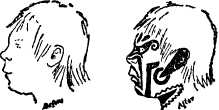
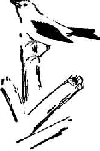
"Say, Yan, I saw a Blood-Robin this morning."
"That's a new one," said Yan, in a tone of doubt.
"Well, it's the purtiest bird in the country."
"What? A Humming-bird?"
"Na-aw-w-w. They ain't purty, only small."
"Well, that shows what you know," retorted Yan,
"'for these exquisite winged gems are at once the
most diminutive and brilliantly coloured of the whole
feathered race.'" This phrase Yan had read some
where and his overapt memory had seized on it.
"Pshaw!" said Sam. "Sounds like a book, but
I'll bet I seen hundreds of Hummin'-birds round the
Trumpet-vine and Bee-balm in the garden, an' they
weren't a millionth part as purty as this. Why, it's
just as red as blood, shines like fire and has black
wings. The old Witch says the Indians call it a War-bird
'cause when it flew along the trail there was sure
going to be war, which is like enough, fur they wuz at
it all the hull time."
"Oh, I know," said Yan. "A Scarlet Tanager.
Where did you see it?"
"Why, it came from the trees, then alighted on the
highest pole of the teepee."
233
"Hope there isn't going to be any war there, Sam.
I wish I had one to stuff."
"Tried to get him for you, sonny, spite of the Rules.
Could 'a' done it, too, with a gun. Had a shy at him
with an arrow an' I hain't been bird or arrow since.
'Twas my best arrow, too—old Sure-Death."
"Will ye give me the arrow if I kin find it?" said
Guy.
"Now you bet I won't. What good'd that be to
me?"
"Will you give me your chewin' gum?"
"No."
"Will you lend it to me?"
"Yep."
"Well, there's your old arrow," said Guy, pulling it
from between the logs where it had fallen. "I seen
it go there an' reckoned I'd lay low an' watch the
progress of events, as Yan says," and Guy whinnied.
Early in the morning the Indians in war-paint
went off on a prowl. They carried their bows and
arrows, of course, and were fully alert, studying the
trail at intervals and listening for "signs of the
enemy."
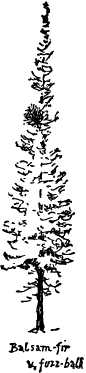 Their moccasined feet gave forth no sound, and
their keen eyes took in every leaf that stirred as
their sinewy forms glided among the huge trunks of
the primeval vegetation—at least, Yan's note-book
said they did. They certainly went with very little
noise, but they disturbed a small Hawk that flew from
a Balsam-fir—a "Fire tree" they now called it, since
they had discovered the wonderful properties of the
234
wood.
Their moccasined feet gave forth no sound, and
their keen eyes took in every leaf that stirred as
their sinewy forms glided among the huge trunks of
the primeval vegetation—at least, Yan's note-book
said they did. They certainly went with very little
noise, but they disturbed a small Hawk that flew from
a Balsam-fir—a "Fire tree" they now called it, since
they had discovered the wonderful properties of the
234
wood.
Three arrows were shot after it and no harm done.
Yan then looked into the tree and exclaimed:
"A nest."
"Looks to me like a fuzz-ball," said Guy.
"Guess not," replied Yan. "Didn't we scare the
Hawk off?"
He was a good climber, quite the best of the three,
and dropping his head-dress, coat, leggings and
weapon, she shinned up the Balsam trunk, utterly
regardless of the gum which hung in crystalline drops
or easily burst bark-bladders on every part.
He was no sooner out of sight in the lower branches
than Satan entered into Guy's small heart and
prompted him thus:
"Le's play a joke on him an' clear out."
Sam's sense of humour beguiled him. They stuffed
Yan's coat and pants with leaves and rubbish, put
them properly together with the head-dress, then
stuck one of his own arrows through the breast of the
coat into the ground and ran away.
Meanwhile Yan reached the top of the tree and
found that the nest was only one of the fuzz-balls so
common on Fir trees. He called out to his comrades
but got no reply, so came down. At first the ridiculous
dummy seemed funny, then he found that his
coat had been injured and the arrow broken. He
called for his companions, but got no answer; again
and again, without reply. He went to where they
all had intended going, but if they were there they
235
hid from him, and feeling himself scurvily deserted
he went back to camp in no very pleasant humour.
They were not there. He sat by the fire awhile,
then, yielding to his habit of industry, he took off his
coat and began to work at the dam.
He became engrossed in his work and did not
notice the return of the runaways till he heard a
voice saying "What's this?"
On turning he saw Sam poring over his private
note-book and then beginning to read aloud:
"Kingbird, fearless crested Kingbird
Thou art——"
But Yan snatched it out of his hands.
"I'll bet the rest was something about 'Singbird,'"
said Sam.
Yan's face was burning with shame and anger.
He had a poetic streak, and was morbidly sensitive
about any one seeing its product. The Kingbird
episode of their long evening walk was but one of
many similar. He had learned to delight in these
daring attacks of the intrepid little bird on the Hawks
and Crows, and so magnified them into high heroics
until he must try to record them in rhyme. It was
very serious to him, and to have his sentiments afford
sport to the others was more than he could bear. Of
course Guy came out and grinned, taking his cue from
Sam. Then he remarked in colourless tones, as though
announcing an item of general news, "They say there
was a fearless-crested Injun shot in the woods to-day."
236
The morning's desertion left Yan in no mood for
chaffing. He rightly attributed the discourtesy to
Guy. Turning savagely toward him he said,
meaningly:
"Now, no more of your sass, you dirty little
sneak."
 "I ain't talkin' to you," Guy snickered, and
followed Sam into the teepee. There were low voices
within for a time. Yan went over toward the dam
and began to plug mud into some possible holes.
Presently there was more snickering in the teepee,
then Guy came out alone, struck a theatrical attitude
and began to recite to a tree above Yan's
head:
"I ain't talkin' to you," Guy snickered, and
followed Sam into the teepee. There were low voices
within for a time. Yan went over toward the dam
and began to plug mud into some possible holes.
Presently there was more snickering in the teepee,
then Guy came out alone, struck a theatrical attitude
and began to recite to a tree above Yan's
head:
"Kingbird, fearless crested Kingbird,
Thou art but a blooming sing bird—"
But the mud was very handy and Yan hurled a
mass that spattered Guy thoroughly and sent him
giggling into the teepee.
"Them's the bow-kays," Sam was heard to say.
"Go out an' git some more; dead sure you deserve 'em.
Let me know when the calls for 'author' begin?"
Then there was more giggling. Yan was fast losing
all control of himself. He seized a big stick and
strode into the teepee, but Sam lifted the cover of
the far side and slipped out. Guy tried to do the
same, but Yan caught him.
"Here, I ain't doin' nothin'."
The answer was a sounding whack which made him
wriggle.
237
"You let me alone, you big coward. I ain't doin'
nothin' to you. You better let me alone. Sam!
S–A–M! S–A–A–A–M!!!" as the stick came down again
and again.
"Don't bother me," shouted Sam outside. "I'm
writin' poethry—terrible partic'lar job, poethry. He
only means it in kindness, anyhow."
Guy was screaming now and weeping copiously.
"You'll get some more if you give me any more of
your lip," said Yan, and stepped out to meet Sam with
the note-book again, apparently scribbling away.
As soon as he saw Yan he stood up, cleared his
throat and began:
"Kingbird, fearless crested—"
But he did not finish it. Yan struck him a savage
blow on the mouth. Sam sprang back a few steps.
Yan seized a large stone.
"Don't you throw that at me," said Sam seriously.
Yan sent it with his deadliest force and aim. Sam
dodged it and then in self-defense ran at Yan and
they grappled and fought, while Guy, eager for
revenge, rushed to help Sam, and got in a few trifling
blows.
Sam was heavier and stronger than Yan, but Yan
had gained wonderfully since coming to Sanger.
He was thin, but wiry, and at school he had learned
the familiar hip-throw that is as old as Cain and Abel.
It was all he did know of wrestling, but now it stood
him in good stead. He was strong with rage, too—
and almost as soon as they grappled he found his
238
chance. Sam's heels flew up and he went sprawling
in the dust. One straight blow on the nose sent Guy
off howling, and seeing Sam once more on his feet,
Yan rushed at him again like a wild beast. A
moment later the big boy went tumbling over the
bank into the pond.
"You see if I don't get you sent about your business
from here," spluttered Sam, now thoroughly
angry. "I'll tell Da you hender the wurruk." His
eyes were full of water and Guy's were full of stars
and of tears. Neither saw the fourth party near;
but Yan did. There, not twenty yards away, stood
William Raften, spectator of the whole affair—an
expression not of anger but of infinite sorrow and
disappointment on his face—not because they had
quarrelled—no—he knew boy nature well enough
not to give that a thought—but that his son, older
and stronger than the other and backed by another
boy, should be licked in fair fight by a thin, half-invalid.
It was as bitter a pill as he had ever had to swallow.
He turned in silence and disappeared, and never
afterward alluded to the matter.
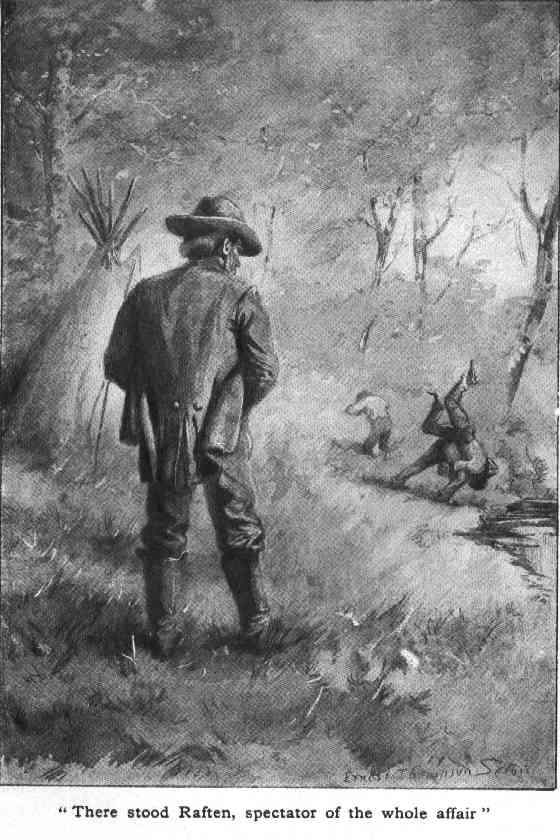
That night the two avoided each other. Yan ate
but little, and to Mrs. Raften's kindly solicitous
questions he said he was not feeling well.
After supper they were sitting around the table,
the men sleepily silent, Yan and Sam moodily so.
Yan had it all laid out in his mind now. Sam would
make a one-sided report of the affair; Guy would
sustain him. Raften himself was witness of Yan's
violence.
The merry days at Sanger were over. He was
doomed, and felt like a condemned felon awaiting
the carrying out of the sentence. There was only
one lively member of the group. That was little
Minnie. She was barely three, but a great chatterbox.
Like all children, she dearly loved a "secret,"
and one of her favourite tricks was to beckon to
some one, laying her pinky finger on her pinker lips,
and then when they stooped she would whisper in
their ear, "Don't tell." That was all. It was her
Idea of a "seek-it."
She was playing at her brother's knee. He
picked her up and they whispered to each other,
then she scrambled down and went to Yan. He
lifted her with a tenderness that was born of the
242
thought that she alone loved him now. She beckoned
his head down, put her chubby arms around his
neck and whispered, "Don't tell," then slid down,
holding her dear innocent little finger warningly
before her mouth.
What did it mean? Had Sam told her to do that,
or was it a mere repetition of her old trick? No
matter, it brought a rush of warm feeling into Yan's
heart. He coaxed the little cherub back and
whispered, "No, Minnie, I'll never tell." He began
to see how crazy he had been. Sam was such a good
fellow, he was very fond of him, and he wanted to
make up; but no—with Sam holding threats of
banishment over him, he could not ask for forgiveness.
No, he would do nothing but wait and see.
He met Mr. Raften again and again that evening
and nothing was said. He slept little that night
and was up early. He met Mr. Raften alone—rather
tried to meet him alone. He wanted to have it over
with. He was one of the kind not prayed for in the
Litany that crave "sudden death." But Raften
was unchanged. At breakfast Sam was as usual,
except to Yan, and not very different to him. He
had a swelling on his lip that he said he got "tusslin'
with the boys somehow or nuther."
After breakfast Raften said:
"Yahn, I want you to come with me to the
schoolhouse."
"It's come at last," thought Yan, for the schoolhouse
was on the road to the railroad station. But
243
why did not Raften say "the station"? He was not a
man to mince words. Nothing was said about his
handbag either, and there was no room for it in the
buggy anyway.
Raften drove in silence. There was nothing
unusual in that. At length he said:
"Yahn, what's yer father goin' to make of ye?"
"An artist," said Yan, wondering what this had to
do with his dismissal.
"Does an artist hev to be bang-up eddicated?"
"They're all the better for it."
"Av coorse, av coorse, that's what I tell Sam.
It's eddication that counts. Does artists make
much money?"
"Yes, some of them. The successful ones sometimes
make millions."
"Millions? I guess not. Ain't you stretchin'
it just a leetle?"
"No, sir. Turner made a million. Titian lived
in a palace, and so did Raphael."
"Hm. Don't know 'em, but maybe so—maybe
so. It's wonderful what eddication does—that's
what I tell Sam."
They now drew near the schoolhouse. It was
holiday time, but the door was open and on the steps
were two graybearded men. They nodded to Raften.
These men were the school trustees. One of them
was Char-less Boyle; the other was old Moore, poor as
a church mouse, but a genial soul, and really put on
the Board as a lubricant between Boyle and Raften.
244
Boyle was much the more popular. But Raften
was always made trustee, for the people knew that
he would take extremely good care of funds and
school as well as of scholars.
This was a special meeting called to arrange for
a new schoolhouse. Raften got out a lot of papers,
including letters from the Department of Education.
The School District had to find half the money; the
Department would supply the other half if all conditions
were complied with. Chief of these, the
schoolhouse had to have a given number of cubic feet
of air for each pupil. This was very important, but
how were they to know in advance if they had the
minimum and were not greatly over. It would not do
to ask the Department that. They could not consult
the teacher, for he was away now and probably would
cheat them with more air than was needed. It was
Raften who brilliantly solved this frightful mathematical
problem and discovered a doughty champion
in the thin, bright-eyed child.
"Yahn," he said, offering him a two-foot rule, "can
ye tell me how many foot of air is in this room for
every scholar when the seats is full?"
"You mean cubic feet?"
"Le's see," and Raften and Moore, after stabbing
at the plans with huge forefingers and fumbling
cumberously at the much-pawed documents,
said together: "Yes, it says cubic feet." Yan
quickly measured the length of the room and took
the height with the map-lifter. The three graybeards
245
gazed with awe and admiration as they saw how
sure he seemed. He then counted the seats and said,
"Do you count the teacher?" The men discussed this
point, then decided, "Maybe ye better; he uses
more wind than any of them. Ha, ha!"
Yan made a few figures on paper, then said, "Twenty
feet, rather better."
"Luk at thot," said Raften in a voice of bullying
and triumph; "jest agrees with the Gover'ment
Inspector. I towld ye he could. Now let's put the
new buildin' to test."
More papers were pawed over.
"Yahn, how's this—double as many children, one
teacher an' the buildin' so an' so."
Yan figured a minute and said, "Twenty-five feet
each."
"Thar, didn't I tell ye," thundered Raften; "didn't
I say that that dhirty swindler of an architect was
playing us into the conthractor's hands—thought we
wuz simple—a put-up job, the hull durn thing.
Luk at it! They're nothing but a gang of thieves."
Yan glanced at the plan that was being flourished
in the air.
"Hold on," he said, with an air of authority that
he certainly never before had used to Raften, "there's
the lobby and cloak-room to come off." He subtracted
their bulk and found the plan all right—the Government
minimum of air.
Boyle's eye had now just a little gleam of
triumphant malice. Raften seemed actually disappointed
246
not to have found some roguery.
"Well, they're a shcaly lot, anyhow. They'll
bear watchin'," he added, in tones of self-justification.
"Now, Yahn, last year the township was assessed
at $265,000 an' we raised $265 with a school-tax of
wan mill on the dollar. This year the new assessment
gives $291,400; how much will the same tax
raise if cost of collecting is same?"
"Two hundred and ninety-one dollars and forty
cents," said Yan, without hesitation—and the three
men sat back in their chairs and gasped.
It was the triumph of his life. Even old Boyle
beamed in admiration, and Raften glowed, feeling
that not a little of it belonged to him.
There was something positively pathetic in the
simplicity of the three shrewd men and their abject
reverence for the wonderful scholarship of this raw
boy, and not less touching was their absolute faith in
his infallibility as a mathematician.
Raften grinned at him in a peculiar, almost a
weak way. Yan had never seen that expression on
his face before, excepting once, and that was as he
shook hands with a noted pugilist just after he had
won a memorable fight. Yan did not know whether
he liked it or not.
On the road home Raften talked with unusual
freeness about his plans for his son. (Yan began to
realize that the storm had blown over.) He harped
on his favourite theme, "eddication." If Yan had
only known, that was the one word of comfort that
247
Raften found when he saw his big boy go down: "It's
eddication done it. Oh, but he's fine eddicated."
Yan never knew until years afterward, when a grown
man and he and Raften were talking of the old days,
that he had been for some time winning respect
from the rough-and-ready farmer, but what finally
raised him to glorious eminence was the hip-throw
that he served that day on Sam.
Raften was all right, Yan believed, but what of
Sam? They had not spoken yet. Yan wished to
make up, but it grew harder. Sam had got over his
wrath and wanted a chance, but did not know how.
He had just set down his two buckets after feeding
the pigs when Minnie came toddling out.
"Sam! Sam! Take Minnie to 'ide," then seeing
Yan she added, "Yan, you mate a tair, tate hold
Sam's hand."
The queen must be obeyed. Sam and Yan sheepishly
grasped hands to make a queen's chair for the
little lady. She clutched them both around the neck
and brought their heads close together. They both
loved the pink-and-white baby between them, and
both could talk to her though not to each other. But
there is something in touch that begets comprehension.
The situation was becoming ludicrous when
Sam suddenly burst out laughing, then:
"Say, Yan, let's be friends."
"I—I want—to—be," stammered Yan, with tears
standing in his eyes. "I'm awfully sorry. I'll never
248
do it again."
"Oh, shucks! I don't care," said Sam. "It was
all that dirty little sneak that made the trouble; but
never mind, it's all right. The only thing that
worries me is how you sent me flying. I'm bigger
an' stronger an' older, I can heft more an' work
harder, but you throwed me like a bag o' shavings,
I only wish I knowed how you done it."
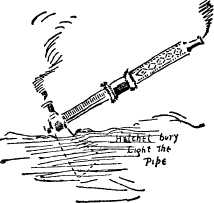
E seem to waste a powerful lot o'
time goin' up an' down to yer
camp; why don't ye stay thayer
altogether?" said Raften one day,
in the colourless style that always
worried every one, for they did not
know whether it was really meant
or was mere sarcasm.
"Suits me. 'Tain't our choice to come home,"
replied his son.
"We'd like nothing better than to sleep there,
too," said Yan.
"Well, why don't ye? That's what I'd do if I
was a boy playin' Injun; I'd go right in an' play."
"All right now," drawled Sam (he always drawled
in proportion to his emphasis), "that suits us; now
we're a-going sure."
"All right, bhoys," said Raften; "but mind ye
the pigs an' cattle's to be 'tended to every day."
 "Is that what ye call lettin' us camp out—come
home to work jest the same?"
"Is that what ye call lettin' us camp out—come
home to work jest the same?"
"No, no, William," interposed Mrs. Raften; "that's
not fair. That's no way to give them a holiday.
Either do it or don't. Surely one of the men can
252
do the chores for a month."
"Month—I didn't say nothin' about a month."
"Well, why don't you now?"
"Whoi, a month would land us into harvest,"
and William had the air of a man at bay, finding
them all against him.
"I'll do Yahn's chores for a fortnight if he'll give
me that thayer pictur he drawed of the place,"
now came in Michel's voice from the far end of the
table—"except Sunday," he added, remembering a
standing engagement, which promised to result in
something of vast importance to him.
"Wall, I'll take care o' them Sundays," said Si
Lee.
"Yer all agin me," grumbled William with comical
perplexity. "But bhoys ought to be bhoys. Ye
kin go."
"Whoop!" yelled Sam.
"Hooray!" joined in Yan, with even more interest
though with less unrestraint.
"But howld on, I ain't through—"
"I say, Da, we want your gun. We can't go
camping without a gun."
"Howld on, now. Give me a chance to finish.
Ye can go fur two weeks, but ye got to go; no snakin'
home nights to sleep. Ye can't hev no matches
an' no gun. I won't hev a lot o' children foolin'
wid a didn't-know-it-was-loaded, an' shootin' all
the birds and squirrels an' each other, too. Ye kin
hev yer bows an' arrows an' ye ain't likely to do no
253
harrum. Ye kin hev all the mate an' bread an' stuff
ye want, but ye must cook it yerselves, an' if I see
any signs of settin' the Woods afire I'll be down wid
the rawhoide an' cut the very livers out o' ye."
The rest of the morning was devoted to preparation,
Mrs. Raften taking the leading hand.
"Now, who's to be cook?" she asked.
"Sam"—"Yan"—said the boys in the same
breath.
"Hm! You seem in one mind about it. Suppose
you take it turn and turn about—Sam first
day."
Then followed instructions for making coffee in
the morning, boiling potatoes, frying bacon. Bread
and butter enough they were to take with them—eggs,
too.
"You better come home for milk every day or
every other day, at least," remarked the mother.
"We'd ruther steal it from the cows in the pasture,"
ventured Sam, "seems naturaler to me Injun blood."
"If I ketch ye foolin' round the cows or sp'ilin'
them the fur'll fly," growled Raften.
"Well, kin we hook apples and cherries?" and
Sam added in explanation; "they're no good to us
unless they're hooked."
"Take all the fruit ye want."
"An' potatoes?"
"Yes."
"An' aigs?"
254
"Well, if ye don't take more'n ye need."
"An' cakes out of the pantry? Indians do that."
"No; howld on now. That is a good place to draw
the line. How are ye goin' to get yer stuff down
thayer? It's purty heavy. Ye see thayer are yer
beds an' pots an' pans, as well as food."
"We'll have to take a wagon to the swamp and
then carry them on our backs on the blazed trail,"
said Sam, and explained "our backs" by pointing
to Michel and Si at work in the yard.
"The road goes as far as the creek," suggested
Yan; "let's make a raft there an' take the lot in it
down to the swimming-pond; that'd be real Injun."
"What'll ye make the raft of?" asked Raften.
"Cedar rails nailed together," answered Sam.
"No nails in mine," objected Yan; "that isn't
Injun."
"An' none o' my cedar rails fur that. 'Pears
to me it'd be less work an' more Injun to pack the
stuff on yer backs an' no risk o' wettin' the beds."
So the raft was given up, and the stuff was duly
carted to the creek's side. Raften himself went
with it. He was a good deal of a boy at heart and
he was much in sympathy with the plan. His
remarks showed a mixture of interest, and doubt as
to the wisdom of letting himself take so much interest.
"Hayre, load me up," he said, much to the surprise
of the boys, as they came to the creek's edge.
His broad shoulders carried half of the load. The
blazed trail was only two hundred yards long, and
in two trips the stuff was all dumped down in front
255
of the teepee.
Sam noted with amusement the unexpected
enthusiasm of his father. "Say, Da, you're just as
bad as we are. I believe you'd like to join us."
"'Moinds me o' airly days here," was the reply,
with a wistful note in his voice. "Many a night
me an' Caleb Clark slep' out this way on this very
crick when them fields was solid bush. Do ye
know how to make a bed?"
"Don't know a thing," and Sam winked at Yan.
"Show us."
"I'll show ye the rale thing. Where's the axe?"
"Haven't any," said Yan. "There's a big tomahawk
and a little tomahawk."
Raften grinned, took the big "tomahawk" and
pointed to a small Balsam Fir. "Now there's a
foine bed-tree."
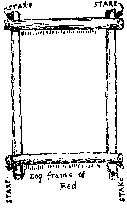
"Why, that's a fire-tree, too," said Yan, as with
two mighty strokes Raften sent it toppling down,
then rapidly trimmed it of its flat green boughs. A
few more strokes brought down a smooth young
Ash and cut it into four pieces, two of them seven feet
long and two of them five feet. Next he cut a
White Oak sapling and made four sharp pegs each
two feet long.
"Now, boys, whayer do you want yer bed?"
then stopping at a thought he added, "Maybe
ye didn't want me to help—want to do everything
yerselves?"
256
"Ugh, bully good squaw. Keep it up—wagh!"
said his son and heir, as he calmly sat on a log and
wore his most "Injun brave" expression of haughty
approval.

The father turned with an inquiring glance to Yan,
who replied:
"We're mighty glad of your help. You see, we
don't know how. It seems to me that I read once
the best place in the teepee is opposite the door
and a little to one side. Let's make it here." So
Raften placed the four logs for the sides and ends of
the bed and drove in the ground the four stakes
to hold them. Yan brought in several armfuls of
branches, and Raften proceeded to lay them like
shingles, beginning at the head-log of the bed and
lapping them very much. It took all the fir boughs,
but when all was done there was a solid mass of soft
green tips a foot thick, all the butts being at the
ground.
"Thayer," said Raften, "that's an Injun feather
bed an' safe an' warrum. Slapin' on the ground's
terrible dangerous, but that's all right. Now make
your bed on that." Sam and Yan did so, and when
it was finished Raften said: "Now, fetch that little
canvas I told yer ma to put in; that's to fasten to the
poles for an inner tent over the bed."
Yan stood still and looked uncomfortable.
"Say, Da, look at Yan. He's got that tired look
that he wears when the rules is broke."
"What's wrong," asked Raften.
257
"Indians don't have them that I ever heard of,"
said Little Beaver.
"Yan, did ye iver hear of a teepee linin' or a dew-cloth?"
"Yes," was the answer, in surprise at the unexpected
knowledge of the farmer.
"Do ye know what they're like?"
"No—at least—no—"
"Well, I do; that's what it's like. That's something
I do know, fur I seen old Caleb use wan."
"Oh, I remember reading about it now, and they
are like that, and it's on them that the Indians paint
their records. Isn't that bully," as he saw Raften
add two long inner stakes which held the dew-cloth
like a canopy.
"Say, Da, I never knew you and Caleb were hunting
together. Thought ye were jest natural born
enemies."
"Humph!" grunted Raften. "We wuz chums oncet.
Never had no fault to find till we swapped horses."
"Sorry you ain't now, 'cause he's sure sharp in the
woods."
"He shouldn't a-tried to make an orphan out o'
you."
"Are you sure he done it?"
"If 'twasn't him I dunno who 'twas. Yan, fetch
some of them pine knots thayer."
Yan went after the knots; it was some yards into
the woods, and out there he was surprised to see a
tall man behind a tree. A second's glance showed
it to be Caleb. The Trapper laid one finger on his
258
lips and shook his head. Yan nodded assent, gathered
the knots, and went back to the camp, where
Sam continued:
"You skinned him out of his last cent, old Boyle
says."
"An' whoi not, when he throid to shkin me?
Before that I was helpin' him, an' fwhat must he do
but be ahfter swappin' horses. He might as well ast me
to play poker and then squeal when I scooped the pile.
Naybours is wan thing an' swappin' horses is another.
All's fair in a horse trade, an' friends didn't orter
swap horses widout they kin stand the shkinnin'.
That's a game by itself. Oi would 'a' helped him
jest the same afther that swap an' moore, fur he
wuz good stuff, but he must nades shoot at me that
noight as I come home wit the wad, so av coorse——"
"I wish ye had a Dog now," said the farmer in
the new tone of a new subject; "tramps is a nuisance
at all toimes, an' a Dog is the best med'cine for them.
I don't believe old Cap'd stay here; but maybe
yer near enough to the house so they won't bother
ye. An' now I guess the Paleface will go back
to the settlement. I promised ma that I'd see
that yer bed wuz all right, an' if ye sleep warrum
an' dry an' hev plenty to ate ye'll take no harrum."
So he turned away, but as he was quitting the
clearing he stopped,—the curious boyish interest was
gone from his face, the geniality from his voice—then
in his usual stern tones of command:
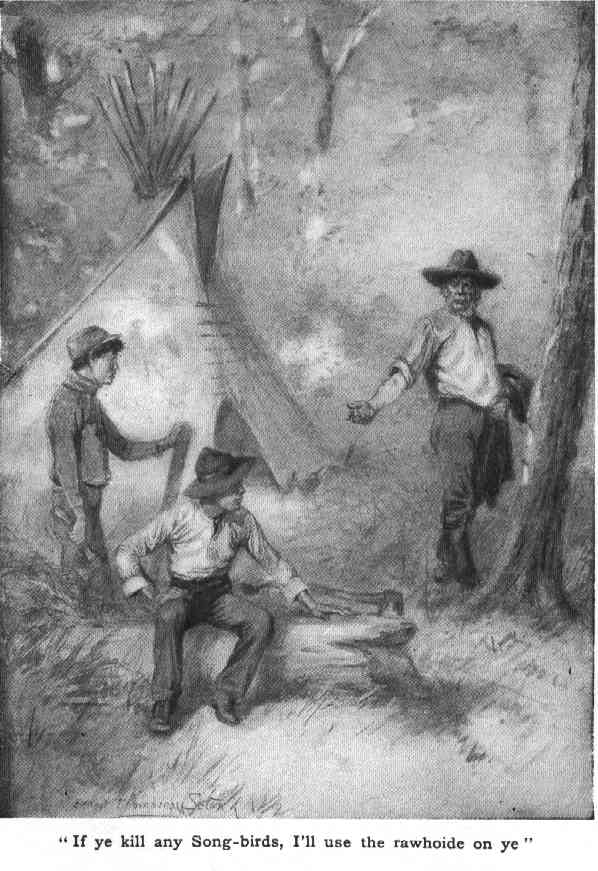
261
"Now, bhoys, ye kin shoot all the Woodchucks
yer a mind ter, fur they are a nuisance in the field.
Yer kin kill Hawks an' Crows an' Jays, fur they
kill other birds, an' Rabbits an' Coons, fur they
are fair game; but I don't want to hear of yer killin'
any Squirrels or Chipmunks or Song-birds, an' if
ye do I'll stop the hull thing an' bring ye back to
wurruk, an' use the rawhoide on tap o' that."
It was a strange new feeling that took possession
of the boys as they saw Mr. Raften go, and when
his step actually died away on the blazed trail
they felt that they were really and truly alone in the
woods and camping out. To Yan it was the realization
of many dreams, and the weirdness of it was
helped by the remembrance of the tall old man
he had seen watching them from behind the trees.
He made an excuse to wander out there, but of
course Caleb was gone.
"Fire up," Sam presently called out. Yan was
the chief expert with the rubbing-sticks, and within
a minute or two he had the fire going in the middle
of the teepee and Sam set about preparing the
evening meal. This was supposed to be Buffalo
meat and Prairie roots (beef and potatoes). It was
eaten rather quietly, and then the boys sat down
on the opposite sides of the fire. The conversation
dragged, then died a natural death; each was busy
with his thoughts, and there was, moreover, an impressive
and repressive something or other all around
them. Not a stillness, for there were many sounds,
but beyond those a sort of voiceless background
that showed up all the myriad voices. Some of
263
these were evidently Bird, some Insect, and a few
were recognized as Tree-frog notes. In the near
stream were sounds of splashing or a little plunge.
"Must be Mushrat," whispered Sam to the unspoken
query of his friend.
A loud, far "Oho-oho-oho" was familiar to both
as the cry of the Horned Owl, but a strange long
wail rang out from the trees overhead.
"What's that?"
"Don't know," was all they whispered, and both
felt very uncomfortable. The solemnity and mystery
of the night was on them and weighing more heavily
with the waning light. The feeling was oppressive.
Neither had courage enough to propose going to
the house or their camping would have ended. Sam
arose and stirred the fire, looked around for more
wood, and, seeing none, he grumbled (to himself) and
stepped outside in the darkness to find some. It
was not till long afterward that he admitted having
had to dare himself to step out into the darkness.
He brought in some sticks and fastened the door
as tightly as possible. The blazing fire in the teepee
was cheering again. The boys perhaps did not
realize that there was actually a tinge of homesickness
in their mood, yet both were thinking of
the comfortable circle at the house. The blazing
fire smoked a little, and Sam said:
"Kin you fix that to draw? You know more
about it 'an me."
264
Yan now forced himself to step outside. The
wind was rising and had changed. He swung
the smoke poles till the vent was quartering down,
then hoarsely whispered, "How's that?"
"That's better," was the reply in a similar tone,
though there was no obvious difference yet.
He went inside with nervous haste and fastened
up the entrance.
"Let's make a good fire and go to bed."
So they turned in after partly undressing, but
not to sleep for hours. Yan in particular was in
a state of nervous excitement. His heart had
beaten violently when he went out that time, and
even now that mysterious dread was on him. The
fire was the one comfortable thing. He dozed off,
but started up several times at some slight sound.
Once it was a peculiar "Tick, tick, scr-a-a-a-a-pe,
lick-scra-a-a-a-a-a-pe," down the teepee over his
head. "A Bear" was his first notion, but on second
thoughts he decided it was only a leaf sliding down
the canvas. Later he was roused by a "Scratch,
scratch, scratch" close to him. He listened silently
for some time. This was no leaf; it was an animal!
Yes, surely—it was a Mouse. He slapped the
canvas violently and "hissed" till it went away,
but as he listened he heard again that peculiar wail
in the tree-tops. It almost made his hair sit up.
He reached out and poked the fire together into a
blaze. All was still and in time he dozed off. Once
more he was wide awake in a flash and saw Sam
sitting up in bed listening.
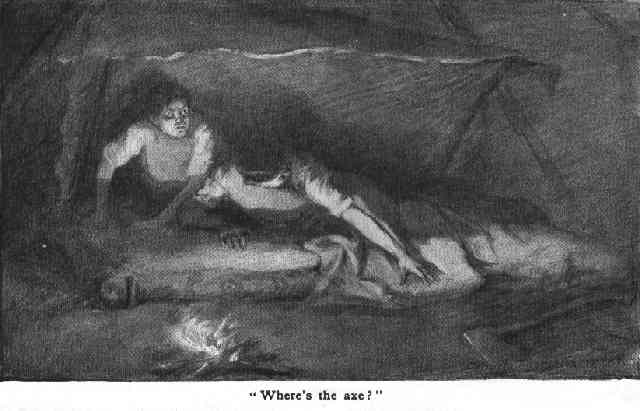
267
"What is it, Sam?" he whispered.
"I dunno. Where's the axe?"
"Right here."
"Let me have it on my side. You kin have the
hatchet."
But they dropped off at last and slept soundly
till the sun was strong on the canvas and filling the
teepee with a blaze of transmitted light.
"Woodpecker! Woodpecker! Get up! Get up!
Hi-e-yo! Hi-e-yo! Double-u-double-o-d-bang-fizz-
whackety-whack-y-r-chuck-brrrrrrrrrrrrrrr-Woodpecker,"
shouted Yan to his sleepy chum, quoting a
phrase that Sam when a child had been taught as
the true spelling of his nickname.
Sam woke slowly, but knowing perfectly where he
was, and drawled:
"Get up yourself. You're cook to-day, an' I'll
take my breakfast in bed. Seems like my knee is
broke out again."
"Oh, get up, and let's have a swim before breakfast."
"No, thank you, I'm too busy just now; 'sides, it's
both cold and wet in that pond, this time o' day."
The morning was fresh and bright; many birds
were singing, although it was July, a Red-eyed
Vireo and a Robin were in full song; and as Yan rose
to get the breakfast he wondered why he had been
haunted by such strange feelings the night before.
It was incomprehensible now. He wished that
appalling wail in the tree-tops would sound again,
so he might trace it home.
268
There still were some live coals in the ashes, and
in a few minutes he had a blazing fire, with the pot
boiling for coffee, and the bacon in the fryer singing
sweetest music for the hungry.
Sam lay on his back watching his companion and
making critical remarks.
"You may be an A1 cook—at least, I hope you
are, but you don't know much about fire-wood," said
he. "Now look at that," as one huge spark after
another exploded from the fire and dropped on the
bed and the teepee cover.
"How can I help it?"
"I'll bet Da's best cow against your jack-knife
you got some Ellum or Hemlock in that fire."
"Well, I have," Yan admitted, with an air of
surrender.
"My son," said the Great Chief Woodpecker, "no
sparking allowed in the teepee. Beech, Maple,
Hickory or Ash never spark. Pine knots an' roots
don't, but they make smoke like—like—oh—you
know. Hemlock, Ellum, Chestnut, Spruce and
Cedar is public sparkers, an' not fit for dacint teepee
sassiety. Big Injun heap hate noisy, crackling fire.
Enemy hear that, an'—an'—it burns his bedclothes."
"All right, Grandpa," and the cook made a mental
note, then added in tones of deadly menace, "You
get up now, do you understand!" and he picked up
a bucket of water.
"That might scare the Great Chief Woodpecker if
the Great Chief Cook had a separate bed, but now
he smiles kind o' scornful," was all the satisfaction
269
he got. Then seeing that breakfast really was
ready, Sam scrambled out a few minutes later. The
coffee acted like an elixir—their spirits rose, and
before the meal was ended it would have been hard
to find two more hilarious and enthusiastic campers.
Even the vague terrors of the night were now sources
of amusement.
"Say, Sam; what about Guy? Do we want him?"
"Well, it's just like this. If it was at school
or any other place I wouldn't be bothered with
the dirty little cuss, but out in the woods like this
one feels kind o' friendly, an' three's better than two.
Besides, he has been admitted to the Tribe already."
"Yes, that's what I say. Let's give him a yell."
So the boys uttered a long yell, produced by alternating
the voice between a high falsetto and a natural
tone. This was the "yell," and had never failed
to call Guy forth to join them unless he had some
chore on hand and his "Paw" was too near to
prevent his renegading to the Indians. He soon
appeared waving a branch, the established signal
that he came as a friend.
He came very slowly, however, and the boys saw
that he limped frightfully, helping himself along
with a stick. He was barefoot, as usual, but his
left foot was swaddled in a bundle of rags.
"Hello, Sappy; what happened? Out to Wounded
Knee River?"
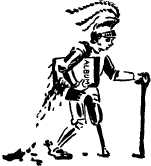
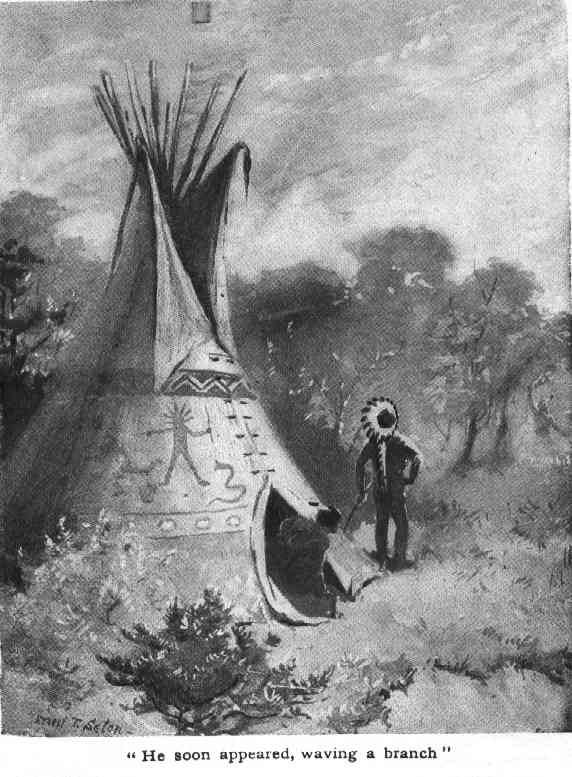
"Nope. Struck luck. Paw was bound I'd ride
the Horse with the scuffler all day, but he gee'd too
short an' I arranged to tumble off'n him, an' Paw
cuffled me foot some. Law! how I did holler!
You should 'a' heard me."
"Bet we did," said Sam. "When was it?"
"Yesterday about four."
"Exactly. We heard an awful screech and Yan
says, says he, 'There's the afternoon train at Kelly's
Crossing, but ain't she late?'
"'Train!' says I. 'Pooh. I'll bet that's Guy
Burns getting a new licking.'"
"Guess I'll well up now," said War Chief Sapwood,
so stripped his foot, revealing a scratch that would
not have cost a thought had he got it playing ball.
He laid the rags away carefully and with them
every trace of the limp, then entered heartily into
camp life.
The vast advantage of being astir early now was
seen. There were Squirrels in every other tree,
there were birds on every side, and when they ran
to the pond a wild Duck spattered over the surface
and whistled out of sight.
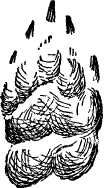 "What you got?" called Sam, as he saw Yan
bending eagerly over something down by the pond.
"What you got?" called Sam, as he saw Yan
bending eagerly over something down by the pond.
Yan did not answer, and so Sam went over and
saw him studying out a mark in the mud. He
was trying to draw it in his note-book.
"What is it?" repeated Sam.
"Don't know. Too stubby for a Muskrat, too
much claw for a Cat, too small for a Coon, too
many toes for a Mink."
274
"I'll bet it's a Whangerdoodle."
Yan merely chuckled in answer to this.
"Don't you laugh," said the Woodpecker, solemnly,
"You'd be more apt to cry if you seen one walk into
the teepee blowing the whistle at the end of his tail.
Then it'd be, 'Oh, Sam, where's the axe?'"
"Tell you what I do believe it is," said Yan, not
noticing this terrifying description; "it's a Skunk."
"Little Beaver, my son! I thought I would tell
you, then I sez to meself, 'No; it's better for him
to find out by his lone. Nothing like a struggle in
early life to develop the stuff in a man. It don't
do to help him too much,' sez I, an' so I didn't."
Here Sam condescendingly patted the Second War
Chief on the head and nodded approvingly. Of
course he did not know as much about the track as
Yan did, but he prattled on:
"Little Beaver! you're a heap struck on tracks—Ugh—good!
You kin tell by them everything that
passes in the night. Wagh! Bully! You're likely
to be the naturalist of our Tribe. But you ain't
got gumption. Now, in this yer hunting-ground
of our Tribe there is only one place where you can
see a track, an' that is that same mud-bank; all the
rest is hard or grassy. Now, what I'd do if I was
a Track-a-mist, I'd give the critters lots o' chance
to leave tracks. I'd fix it all round with places so
nothing could come or go 'thout givin' us his impressions
of the trip. I'd have one on each end of the
trail coming in, an' one on each side of the creek
where it comes in an' goes out."
275
"Well, Sam, you have a pretty level head. I
wonder I didn't think of that myself."
"My son, the Great Chief does the thinking. It's
the rabble—that's you and Sappy—that does the
work."
But all the same he set about it at once with
Yan, Sappy following with a slight limp now.
They removed the sticks and rubbish for twenty
feet of the trail at each end and sprinkled this with
three or four inches of fine black loam. They cleared
off the bank of the stream at four places, one at each
side where it entered the woods, and one at each
side where it went into the Burns's Bush.
"Now," said Sam, "there's what I call visitors'
albums like the one that Phil Leary's nine fatties
started when they got their brick house and their
swelled heads, so every one that came in could write
their names an' something about 'this happy, happy,
ne'er-to-be-forgotten visit'—them as could write.
Reckon that's where our visitors get the start, for
all of ours kin write that has feet."
"Wonder why I didn't think o' that," said Yan,
again and again. "But there's one thing you forget,"
he said. "We want one around the teepee."
This was easily made, as the ground was smooth
and bare there, and Sappy forgot his limp and helped
to carry ashes and sand from the fire-hole. Then
planting his broad feet down in the dust, with many
snickers, he left some very interesting tracks.

"I call that a bare track" said Sam.
276
"Go ahead and draw it," giggled Sappy.
"Why not?" and Yan got out his book.
"Bet you can't make it life-size," and Sam glanced
from the little note-book to the vast imprint.
After it was drawn, Sam said, "Guess I'll peel off
and show you a human track." He soon gave an
impression of his foot for the artist, and later Yan
added his own; the three were wholly different.
"Seems to me it would be about right, if you had
the ways the toes pointed and the distance apart
to show how long the legs wuz."
Again Sam had given Yan a good idea. From
that time he noted these two points and made his
records much better.
"Air you fellers roostin' here now?" said Sappy
in surprise, as he noted the bed as well as the pots
and pans.
"Yep."
"Well, I wanter, too. If I kin git hol' o' Maw
'thout Paw, it'll be O.K."
"You let on we don't want you and Paw'll let
you come. Tell him Ole Man Raften ordered
you off the place an' he'll fetch you here himself."
"I guess there's room enough in that bed fur
three," remarked the Third War Chief.
"Well, I guess there ain't," said Woodpecker.
"Not when the third one won first prize for being
the dirtiest boy in school. You can get stuff an'
make your own bed, across there on the other side
the fire."
277
"Don't know how."
"We'll show you, only you'll have to go home for
blankets an' grub."
The boys soon cut a Fir-bough bed, but Guy put
off going home for the blankets as long as he could.
He knew and they suspected that there was no
chance of his rejoining them again that day. So
after sundown he replaced his foot-rags and limped
down the trail homeward, saying, "I'll be back in
a few minutes," and the boys knew perfectly well
that he would not.
The evening meal was over; they had sat around
wondering if the night would repeat its terrors.
An Owl "Hoo-hoo-ed" in the trees. There was a
pleasing romance in the sound. The boys kept up
the fire till about ten, then retired, determined that
they would not be scared this time. They were
barely off to sleep when the most awful outcry arose
in the near woods, like "a Wolf with a sore throat,"
then the yells of a human being in distress. Again
the boys sat up in fright. There was a scuffling
outside—a loud and terrified "Hi—hi—hi—Sam!"
Then an attack was made on the door. It was torn
open, and in tumbled Guy. He was badly frightened;
but when the fire was lighted and he calmed
down a little he confessed that Paw had sent him
to bed, but when all was still he had slipped
out the window, carrying the bedclothes. He was
nearly back to the camp when he decided to
scare the boys by letting off a few wolfish howls,
but he made himself very scary by doing it, and
278
when a wild answer came from the tree-tops—a
hideous, blaring screech—he lost all courage, dropped
the bedding, and ran toward the teepee yelling
for help.
The boys took torches presently and went nervously
in search of the missing blankets. Guy's bed was
made and in an hour they were once more asleep.
In the morning Sam was up and out first. From
the home trail he suddenly called:
"Yan, come here."
"Do you mean me?" said Little Beaver, with
haughty dignity.
"Yep, Great Chief; git a move on you. Hustle out
here. Made a find. Do you see who was visiting
us last night while we slept?" and he pointed to the
"album" on the inway. "I hain't shined them
shoes every week with soot off the bottom of the pot
without knowin' that one pair of 'em was wore by
Ma an' one of 'em by Da. But let's see how far
they come. Why, I orter looked round the teepee
before tramplin' round." They went back, and
though the trails were much hidden by their own,
they found enough around the doorway to show
that during the night, or more likely late in the
evening, the father and mother had paid them a
visit in secret—had inspected the camp as they
slept, but finding no one stirring and the boys
breathing the deep breath of healthy sleep, they
had left them undisturbed.
279
"Say, boys—I mean Great Chiefs—what we want
in camp is a Dog, or one of these nights some one
will steal our teeth out o' our heads an' we won't
know a thing till they come back for the gums.
All Injun camps have Dogs, anyway."
The next morning the Third War Chief was ordered
out by the Council, first to wash himself clean, then
to act as cook for the day. He grumbled as he
washed, that "'Twan't no good—he'd be all dirty
again in two minutes," which was not far from the
truth. But he went at the cooking with enthusiasm,
which lasted nearly an hour. After this he did not
see any fun in it, and for once he, as well as the
others, began to realize how much was done for
them at home. At noon Sappy set out nothing but
dirty dishes, and explained that so long as each got
his own it was all right. His foot was very troublesome
at meal time also. He said it was the moving
round when he was hurrying that made it so hard
to bear, but in their expedition with bows and
arrows later on he found complete relief.
"Say, look at the Red-bird," he shouted, as a
Tanager flitted onto a low branch and blazed in the
sun. "Bet I hit him first shot!" and he drew an
arrow.
"Here you, Saphead," said Sam, "quit that shooting
at little birds. It's bad medicine. It's against the
rules; it brings bad luck—it brings awful bad luck.
I tell you there ain't no worse luck than Da's raw-hide—that
I know."
280
"Why, what's the good o' playin' Injun if we
can't shoot a blame thing?" protested Sappy.
"You kin shoot Crows an' Jays if you like, an'
Woodchucks, too."
"I know where there's a Woodchuck as big as a
Bear."
"Ah! What size Bear?"
"Well, it is. You kin laugh all you want to.
He has a den in our clover field, an' he made it so
big that the mower dropped in an' throwed Paw as
far as from here to the crick."
"An' the horses, how did they get out?"
"Well! It broke the machine, an' you should
have heard Paw swear. My! but he was a socker.
Paw offered me a quarter if I'd kill the old whaler.
I borrowed a steel trap an' set it in the hole, but
he'd dig out under it an' round it every time. I'll
bet there ain't anything smarter'n an old Woodchuck."
"Is he there yet?" asked War Chief No. 2.
"You just bet he is. Why, he has half an acre
of clover all eat up."
"Let's try to get him," said Yan. "Can we
find him?"
"Well, I should say so. I never come by but I
see the old feller. He's so big he looks like a calf,
an' so old an' wicked he's gray-headed."
"Let's have a shot at him," suggested the Woodpecker.
"He's fair game. Maybe your Paw'll
give us a quarter each if we kill him."
281
Guy snickered. "Guess you don't know my
Paw," then he giggled bubblously through his nose
again.
Arrived at the edge of the clover, Sam asked,
"Where's your Woodchuck?"
"Right in there."
"I don't see him."
"Well, he's always here."
"Not now, you bet."
"Well, this is the very first time I ever came here
and didn't see him. Oh, I tell you, he's a fright.
I'll bet he's a blame sight bigger'n that stump."
"Well, here's his track, anyway," said Woodpecker,
pointing to some tracks he had just made
unseen with his own broad palm.
"Now," said Sappy, in triumph. "Ain't he an
old socker?"
"Sure enough. You ain't missed any cows
lately, have you? Wonder you ain't scared to live
anyways near!"
"Say, fellers, I know where there's a stavin' Birch
tree—do you want any bark?"
"Yes, I want some," said Little Beaver.
"But hold on; I guess we better not, coz it's right
on the edge o' our bush, an' Paw's still at the turnips."
"Now if you want a real war party," said the Head
Chief, "let's massacree the Paleface settlement up
the crick and get some milk. We're just out, and I'd
like to see if the place has changed any."
So the boys hid their bows and arrows and headdresses,
and, forgetting to take a pail, they followed
in Indian file the blazed trail, carefully turning in
their toes as they went and pointing silently to the
track, making signs of great danger. First they
crawled up, under cover of one of the fences, to
the barn. The doors were open and men working
at something. A pig wandered in from the barnyard.
Then the boys heard a sudden scuffle, and a
squeal from the pig as it scrambled out again, and
Raften's voice: "Consarn them pigs! Them boys
ought to be here to herd them." This was sufficiently
alarming to scare the Warriors off in great
haste. They hid in the huge root-cellar and there
283
held a council of war.
"Here, Great Chiefs of Sanger," said Yan, "behold
I take three straws. That long one is for the Great
Woodpecker, the middle size is for Little Beaver,
and the short thick one with the bump on the end
and a crack on top is Sappy. Now I will stack
them up in a bunch and let them fall, then whichever
way they point we must go, for this is Big
Medicine."
So the straws fell. Sam's straw pointed nearly
to the house, Yan's a little to the south of the
house, and Guy's right back home.
"Aha, Sappy, you got to go home; the straw says
so."
"I ain't goin' to believe no such foolishness."
"It's awful unlucky to go against it."
"I don't care, I ain't goin' back," said Guy doggedly.
"Well, my straw says go to the house; that means
go scouting for milk, I reckon."
Yan's straw pointed toward the garden, and
Guy's to the residence and grounds of "J.G.
Burns, Esq."
"I don't care," said Sappy, "I ain't goin'. I am
goin' after some of them cherries in your orchard,
an' 'twon't be the first time, neither."
"We kin meet by the Basswood at the foot of the
lane with whatever we get," said the First War Chief,
as he sneaked into the bushes and crawled through
the snake fence and among the nettles and manure
284
heaps on the north side of the barnyard till he reached
the woodshed adjoining the house. He knew where
the men were, and he could guess where his mother
was, but he was worried about the Dog. Old Cap
might be on the front doorstep, or he might be
prowling at just the wrong place for the Injun plan.
The woodshed butted on the end of the kitchen.
The milk was kept in the cellar, and one window of
the cellar opened into a dark corner of the woodshed.
This was easily raised, and Sam scrambled down
into the cool damp cellar. Long rows of milk pans
were in sight on the shelves. He lifted the cover of
the one he knew to be the last put there and drank
a deep, long draught with his mouth down to it, then
licked the cream from his lips and remembered
that he had come without a pail. But he knew
where to get one. He went gently up the stairs,
avoiding steps Nos. 1 and 7 because they were
"creakers," as he found out long ago, when he used
to 'hook' maple sugar from the other side of the
house. The door at the top was closed and buttoned,
but he put his jack-knife blade through the crack
and turned the button. After listening awhile and
hearing no sound in the kitchen, he gently opened
the squeaky old door. There was no one to be seen
but the baby, sound asleep in her cradle. The outer
door was open, but no Dog lying on the step as
usual. Over the kitchen was a garret entered by a
trap-door and a ladder. The ladder was up and the
trap-door open, but all was still. Sam stood over
285
the baby, grunted, "Ugh, Paleface papoose," raised
his hand as if wielding a war club, aimed a deadly
blow at the sleeping cherub, then stooped and
kissed her rosy mouth so lightly that her pink fists
went up to rub it at once. He now went to the pantry,
took a large pie and a tin pail, then down into
the cellar again. He, at first, merely closed the door
behind him and was leaving it so, but remembered
that Minnie might awaken and toddle around till
she might toddle into the cellar, therefore he turned
the button so that just a corner showed over the
crack, closed the door and worked with his knife blade
on that corner till the cellar was made as safe as
before. He now escaped with his pie and pail.
Meanwhile his mother's smiling face beamed out of
the dark loft. Then she came down the ladder.
She had seen him come and enter the cellar, by
chance she was in the loft when he reached the
kitchen, but she had kept quiet to enjoy the joke.
Next time the Woodpecker went to the cellar he
found a paper with this on it: "Notice to hostile
Injuns—Next time you massacree this settlement,
bring back the pail, and don't leave the covers off
the milk pans."
Yan had followed the fence that ran south of the
house. There was plenty of cover, but he crawled
on hands and knees, going right down on his breast
when he came to places more open than the rest.
In this way he had nearly reached the garden when
he heard a noise behind and, turning, he saw
286
Sappy.
"Here, what are you following me for? Your
straw pointed the other way. You ain't playing
fair."
"Well, I don't care, I ain't going home. You
fixed it up so my straw would point that way. It
ain't fair, an' I won't do it."
"You got no right following me."
"I ain't following you, but you keep going just
the place I want to go. It's you following me, on'y
keepin' ahead. I told you I was after cherries."
"Well, the cherries are that way and I'm going
this way, and I don't want you along."
"You couldn't get me if you wanted me."
"Erh——"
"Erh——"
So Sappy went cherryward and Yan waited
awhile, then crawled toward the fruit garden. After
twenty or thirty yards more, he saw a gleam of red,
then under it a bright yellow eye glaring at him. He
had chanced on a hen sitting on her nest. He came
nearer, she took alarm and ran away, not clucking,
but cackling loudly. There were a dozen eggs of
two different styles, all bright and clean, and the
hen's comb was bright red. Yan knew hens. This
was easy to read: Two stray hens laying in one nest,
and neither of them sitting yet.
"So ho! Straws show which way the hens go."
He gathered up the eggs into his hat and
crawled back toward the tree where all had to meet.
287
But before he had gone far he heard a loud barking,
then yells for help, and turned in time to see Guy
scramble up a tree while Cap, the old Collie, barked
savagely at him from below. Now that he was in
no danger Sappy had the sense to keep quiet. Yan
came back as quickly as possible. The Dog at once
recognized and obeyed him, but doubtless was much
puzzled to make out why he should be pelted back
to the house when he had so nobly done his duty
by the orchard.
"Now, you see, maybe next time you'll do what
the medicine straw tells you. Only for me you'd
been caught and fed to the pigs, sure."
"Only for you I wouldn't have come. I wasn't
scared of your old Dog, anyway. Just in about
two minutes more I was comin' down to kick the
stuffin' out o' him myself."
"Perhaps you'd like to go back and do it now.
I'll soon call him."
"Oh, I hain't got time now, but some other
time— Let's find Sam."
So they foregathered at the tree, and laden with
their spoils, they returned gloriously to camp.
That evening they had a feast and turned in
to sleep at the usual hour. The night passed
without special alarm. Once about daylight
Sappy called them, saying he believed there was a
Bear outside, but he had a trick of grinding his teeth
in his sleep, and the other boys told him that was
the Bear he heard.
Yan went around to the mud albums and got
some things he could not make out and a new mark
that gave him a sensation. He drew it carefully.
It was evidently the print of a small sharp hoof.
This was what he had hungered for so long. He
shouted, "Sam—Sam—Sapwood, come here; here's
a Deer track."
The boys shouted back, "Ah, what you givin' us
now!" "Call off your Dog!" and so forth.
But Yan persisted. The boys were so sure it was
a trick that they would not go for some time, then
the sun had risen high, shining straight down on
the track instead of across, so it became very dim.
Soon the winds, the birds and the boys themselves
helped to wipe it out. But Yan had his drawing,
and persisted in spite of the teasing that it was true.
289
At length Guy said aside to Sam: "Seems to me a
feller that hunts tracks so terrible serious ought
to see the critter some time. 'Tain't right to let him
go on sufferin'. I think he ought to see that Deer.
We ought to help him." Here he winked a volley
or two and made signs for Sam to take Yan away.
This was easily done.
"Let's see if your Deer went out by the lower mud
album." So they walked down that way, while
Guy got an old piece of sacking, stuffed it with grass,
and, hastily tying it in the form of a Deer's head, stuck
it on a stick. He put in two flat pieces of wood for
ears, took charcoal and made two black spots for
eyes and one for a nose, then around each he drew a
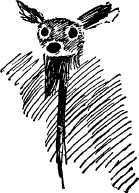 ring of blue clay from the bed of the brook. This
soon dried and became white. Guy now set up this
head in the bushes, and when all was ready he ran
swiftly and silently through the wood to find Sam
and Yan. He beckoned vigorously and called
under his voice: "Sam—Yan—a Deer! Here's that
there Deer that made them tracks, I believe."
ring of blue clay from the bed of the brook. This
soon dried and became white. Guy now set up this
head in the bushes, and when all was ready he ran
swiftly and silently through the wood to find Sam
and Yan. He beckoned vigorously and called
under his voice: "Sam—Yan—a Deer! Here's that
there Deer that made them tracks, I believe."
Guy would have failed to convince Yan if Sam
had not looked so much interested. They ran back
to the teepee, got their bows and arrows, then, guided
by Guy, who, however, kept back, they crawled
to where he had seen the Deer.
"There—there, now, ain't he a Deer? There—see
him move!"
Yan's first feeling was a most exquisite thrill of
pleasure. It was like the uplift of joy he had had
the time he got his book, but was stronger. The
290
savage impulse to kill came quickly, and his bow
was in his hand, but he hesitated.
"Shoot! Shoot!" said Sam and Guy.
Yan wondered why they did not shoot. He turned,
and in spite of his agitation he saw that they were
making fun of him. He glanced at the Deer again,
moved up a little closer and saw the trick.
Then they hooted aloud. Yan was a little crestfallen.
Oh, it had been such an exquisite feeling!
The drop was long and hard, but he rallied quickly.
"I'll shoot your Deer for you," he said, and sent
an arrow close under it.
"Well, I kin beat that," and Sam and Guy both
fired. Sam's arrow stuck in the Deer's nose. At
that he gave a yell; then all shot till the head
was stuck full of arrows, and they returned to the
teepee to get dinner. They were still chaffing Yan
about the Deer when he said slowly to Guy:
"Generally you are not so smart as you think you
are, but this time you're smarter. You've given
me a notion."
So after dinner he got a sack about three feet long
and stuffed it full of dry grass; then he made a small
sack about two and a half feet long and six inches
thick, but with an elbow in it and pointed at one
end. This he also stuffed with hay and sewed with
a bone needle to the big sack. Next he cut four
sticks of soft pine for legs and put them into the
four corners of the big sack, wrapping them with
291
bits of sacking to be like the rest. Then he cut
two ears out of flat sticks; painted black eyes and
nose with a ring of white around each, just as Sappy
had done, but finally added a black spot on each
side of the body, and around that a broad gray
hand. Now he had completed what every one could
see was meant for a Deer.
The other boys helped a little, but not did cease
to chaff him.
"Who's to be fooled this time?" asked Guy.
"You," was the answer.
"I'll bet you'll get buck fever the first time you
come across it," chuckled the Head Chief.
"Maybe I will, but you'll all have a chance.
Now you fellers stay here and I'll hide the Deer.
Wait till I come back."
So Yan ran off northward with the dummy, then
swung around to the east and hid it at a place
quite out of the line that he first took. He returned
nearly to where he came out, shouting
"Ready!"
Then the hunters sallied forth fully armed, and
Yan explained: "First to find it counts ten and has
first shot. If he misses, next one can walk up five
steps and shoot; if he misses, next walks five steps
more, and so on until the Deer is hit. Then all the
shooting must be done from the place where that
arrow was fired. A shot in the heart counts ten; in
the gray counts five; that's a body wound—and a hit
outside of that counts one—that's a scratch. If the
292
Deer gets away without a shot in the heart, then
I count twenty-five, and the first one to find it is
Deer for next hunt—twelve shots each is the limit."
The two hunters searched about for a long time.
Sam made disparaging remarks about the trail this
Deer did not leave, and Guy sneaked and peaked in
every thicket.
Sappy was not an athlete nor an intellectual giant,
but his little piggy eyes were wonderfully sharp
and clear.
"I see him," he yelled presently, and pointed out
the place seventy-five yards away where he saw one
ear and part of the head.
"Tally ten for Sappy," and Yan marked it down.
Guy was filled with pride at his success. He
made elaborate preparation to shoot, remarking, "I
could 'a' seen it twicet as far—if—if—if—it was—if
I had a fair chance."
He drew his bow and left fly. The arrow went
little more than half way. So Sam remarked, "Five
steps up I kin go. It don't say nothing about how
long the steps?"
"No."
"Well, here goes," and he began the most wonderful
Kangaroo hops that he could do. He covered about
thirty feet in those five steps, and by swerving a
little aside he got a good view of the Deer. He was
now less than sixty-five yards away. He fired and
missed. Now Guy had the right to walk up five steps.
He also missed. Finally at thirty yards Sam sent
an arrow close past a tree, deep in the Deer's gray
293
flank.
"Bully shot! Body wound! Count five for the
Great War Chief. All shooting from this spot
now," said Yan, "and I don't know why I shouldn't
shoot as well as the others."
"Coz you're the Deer and that'd be suicide," was
Sam's objection. "But it's all right. You won't
hit."
The objection was not sustained, and Yan tried
his luck also. Two or three shots in the brown of the
Deer's haunch, three or four into the tree that stood
half way between, but nearly in line, a shot or two
into the nose, then "Hooray!" a shot from Guy right
into the Deer's heart put an end to the chase. Now
they went up to draw and count the arrows.
Guy was ahead with a heart shot, ten, a body
wound, five, and a scratch, one, that's sixteen, with
ten more for finding it—twenty-six points. Sam
followed with two body wounds and two scratches—twelve
points, and Yan one body wound and five
scratches—ten points. The Deer looked like an
old Porcupine when they came up to it, and Guy,
bursting with triumph, looked like a young Emperor.
"I tell you it takes me to larn you fellers to Deer
hunt. I'll bet I'll hit him in the heart first thing
next time."
"I'll bet you won't, coz you'll be Deer and can't
shoot till we both have."
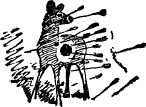
Guy thought this the finest game he had ever
294
played. He pranced away with the dummy on his
back, scheming as he went to make a puzzle for the
others. He hid the Deer in a dense thicket east of
the camp, then sneaked around to the west of the
camp and yelled "Ready!" They had a long, tedious
search and had to give it up.
"Now what to do? Who counts?" asked the Woodpecker.
"When Deer escapes it counts twenty-five," replied
the inventer of the game; and again Guy was ahead.
"This is the bulliest game I ever seen" was his
ecstatic remark.
"Seems to me there's something wrong; that Deer
ought to have a trail."
"That's so," assented Yan. "Wonder if he couldn't
drag an old root!"
"If there was snow it'd be easy."
"I'll tell you, Sam; we'll tear up paper and leave a
paper trail."
"Now you're talking." So all ran to camp.
Every available scrap of wrapping paper was torn
up small and put in a "scent bag."
Since no one found the Deer last time, Guy had
the right to hide it again.
He made a very crooked trail and a very careful
hide, so that the boys nearly walked onto the Deer
before they saw it about fifteen yards away. Sam
scored ten for the find. He fired and missed. Yan
now stepped up his five paces and fired so hastily
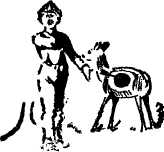 that he also missed. Guy now had a shot at it at
295
five yards, and, of course, hit the Deer in the heart.
that he also missed. Guy now had a shot at it at
295
five yards, and, of course, hit the Deer in the heart.
This succession of triumphs swelled his head nearly
to the bursting point, and his boasting passed
all bounds. But it now became clear that there
must be a limit to the stepping up. So the new
rule was made, "No stepping up nearer than
fifteen paces."
The game grew as they followed it. Its resemblance
to real hunting was very marked. The boys found
that they could follow the trail, or sweep the woods
 with their eyes as they pleased, and find the game, but
the wisest way was a combination. Yan was too
much for the trail, Sam too much for the general
lookout, but Guy seemed always in luck. His
little piglike eyes took in everything, and here at
length he found a department in which he could
lead. It looked as though little pig-eyed Guy was
really cut out for a hunter. He made a number
of very clever hidings of the Deer. Once he led the
trail to the pond, then, across, and right opposite he
put the Deer in full view, so that they saw it at once
in the open; they were obliged either to shoot across
the pond, or step farther away round the edge, or step
into the deep water, and again Guy scored. It was
found necessary to bar hiding the Deer on a ridge
and among stones, because in one case arrows which
missed were lost in the bushes and in the other they
were broken.
with their eyes as they pleased, and find the game, but
the wisest way was a combination. Yan was too
much for the trail, Sam too much for the general
lookout, but Guy seemed always in luck. His
little piglike eyes took in everything, and here at
length he found a department in which he could
lead. It looked as though little pig-eyed Guy was
really cut out for a hunter. He made a number
of very clever hidings of the Deer. Once he led the
trail to the pond, then, across, and right opposite he
put the Deer in full view, so that they saw it at once
in the open; they were obliged either to shoot across
the pond, or step farther away round the edge, or step
into the deep water, and again Guy scored. It was
found necessary to bar hiding the Deer on a ridge
and among stones, because in one case arrows which
missed were lost in the bushes and in the other they
were broken.
They played this game so much that they soon
found a new difficulty. The woods were full of paper
trails, and there was no means of deciding which was
296
the old and which the new. This threatened to
end the fun altogether. But Yan hit on the device
of a different colour of paper. This gave them a
fresh start, but their supply was limited. There
was paper everywhere in the woods now, and it
looked as though the game was going to kill itself,
when old Caleb came to pay them a visit. He
always happened round as though it was an accident,
but the boys were glad to see him, as he usually gave
some help.
"Ye got some game, I see," and the old man's
eye twinkled as he noted the dummy, now doing
target duty on the forty-yard range. "Looks like
the real thing. Purty good—purty good." He
chuckled as he learned about the Deer hunt, and a
sharp observer might have discerned a slight increase
of interest when he found that it was not Sam Raften
that was the "crack" hunter.
"Good fur you, Guy Burns. Me an' your Paw
hev hunted Deer together on this very crik many
a time."
When he learned the difficulty about the scent,
he said "Hm," and puffed at his pipe for awhile
in silence. Then at length:
"Say, Yan, why don't you and Guy get a bag o'
wheat or Injun corn for scent: that's better than
paper, an' what ye lay to-day is all clared up by
the birds and Squirrels by to-morrow."
"Bully!" shouted Sam. (He had not been addressed
at all, but he was not thin-skinned.) Within ten
297
minutes he had organized another "White massacree"—that
is, a raid on the home barn, and in half an
hour he returned with a peck of corn.
"Now, lemme be Deer," said Caleb. "Give me
five minutes' start, then follow as fast as ye like.
I'll show ye what a real Deer does."
He strode away bearing the dummy, and in five
minutes as they set out on the trail he came striding
back again. Oh, but that seemed a long run. The
boys followed the golden corn trail—a grain every
ten feet was about all they needed now, they were
so expert. It was a straight run for a time, then it
circled back till it nearly cut itself again (at X, page
298). The boys thought it did so, and claimed the
right to know, as on a real Deer trail you could tell.
So Caleb said, "No, it don't cut the old trail." Where,
then, did it go? After beating about, Sam said that
the trail looked powerful heavy, like it might be
double.
"Bet I know," said Guy. "He's doubled back,"
which was exactly what he did do, though Caleb
gave no sign. Yan looked back on the trail and
found where the new one had forked. Guy gave
no heed to the ground once he knew the general
directions. He ran ahead (toward Y), so did Sam,
but Guy glanced back to Yan on the trail to make
sure of the line.
They had not gone far beyond the nearest bushes
before Yan found another quirk in the trail. It
doubled back at Z. He unravelled the double,
298
glanced around, and at O he plainly saw the Deer
lying on its side in the grass. He let off a triumphant
yell, "Yi, yi, yi, Deer!" and the others came
running back just in time to see Yan send an arrow
straight into its heart.
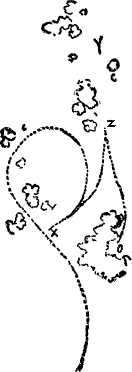
Forty yards and first shot. Well, that's what
the Injuns would call a 'grand coup,' and
Caleb's face wore the same pleasant look as
when he made the fire with rubbing-sticks.
"What's a grand coup?" asked Little Beaver.
"Oh, I suppose it's a big deed. The Injuns call
a great feat a 'coup,' an' an extra big one a 'grand
coup.' Sounds like French, an' maybe 'tis, but the
Injuns says it. They had a regular way of counting
their coup, and for each they had the right to an
Eagle feather in their bonnet, with a red tuft of
hair on the end for the extra good ones. At least,
they used to. I reckon now they're forgetting it
all, and any buck Injun wears just any feather
he can steal and stick in his head."
"What do you think of our head-dresses?" Yan
ventured.
'Hm! You ain't never seen a real one or you
wouldn't go at them that way at all. First place,
the feathers should all be white with black tips,
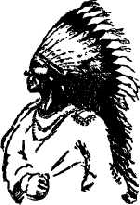 an' fastened not solid like that, but loose on a cap
of soft leather. Each feather, you see, has a leather
loop lashed on the quill end for a lace to run through
and hold it to the cap, an' then a string running
300
through the middle of each feather to hold it—just
so. Then there are ways of marking each feather
to show how it was got. I mind once I was out
on a war party with a lot of Santees—that's a brand
of Sioux—an' we done a lot o' sneaking an' stealing
an' scalped some of the enemy. Then we set out
for home, and when we was still about thirty miles
away we sent on an Injun telegram of good luck.
The leader of our crowd set fire to the grass after
he had sent two men half a mile away on each
side to do the same thing, an' up went three big
smokes. There is always some one watching round
an Injun village, an' you bet when they seen them
three smokes they knowed that we wuz a-coming
back with scalps.
an' fastened not solid like that, but loose on a cap
of soft leather. Each feather, you see, has a leather
loop lashed on the quill end for a lace to run through
and hold it to the cap, an' then a string running
300
through the middle of each feather to hold it—just
so. Then there are ways of marking each feather
to show how it was got. I mind once I was out
on a war party with a lot of Santees—that's a brand
of Sioux—an' we done a lot o' sneaking an' stealing
an' scalped some of the enemy. Then we set out
for home, and when we was still about thirty miles
away we sent on an Injun telegram of good luck.
The leader of our crowd set fire to the grass after
he had sent two men half a mile away on each
side to do the same thing, an' up went three big
smokes. There is always some one watching round
an Injun village, an' you bet when they seen them
three smokes they knowed that we wuz a-coming
back with scalps.
"The hull Council come out to meet us, but not
too reckless, coz this might have been the trick of
enemies to surprise them.
"Well, when we got there, maybe there wasn't a
racket. You see, we didn't lose a man, and we
brung in a hundred horses and seven scalps. Our
leader never said a word to the crowd, but went
right up to the Council teepee. He walked in—we
followed. There was the Head Chief an' all the
Council settin' smoking. Our leader give the 'How,
an' then we all 'Howed.' Then we sat an' smoked,
an' the Chief called on our leader for an account
of the little trip. He stood up an' made a speech.
"'Great Chief and Council of my Tribe,' says he.
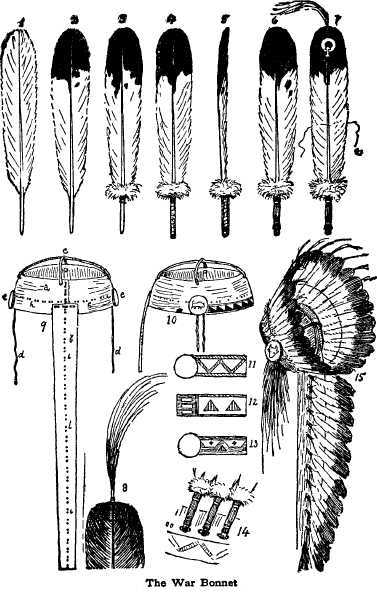
THE INDIAN WAR BONNET—HOW TO MAKE IT
1. The plain white Goose or Turkey feather.
2. The same, with tip dyed black or painted with indelible ink.
3. The same, showing ruff of white down lashed on with wax end.
4. The same, showing leather loop lashed on for the holding lace.
5. The same, viewed edge on.
6. The same, with a red flannel cover sewn and lashed on the quill. This is a 'coup feather.'
7. The same, with a tuft of red horsehair lashed on the top to mark a 'grand coup' and (a) a thread through the
middle of the rib to hold feather in proper place. This feather is marked with the symbol of a grand coup
in target shooting. This symbol may be drawn on an oval piece of paper gummed on the top of the feather.
8. The tip of a feather showing how the red horsehair tuft is lashed on with fine waxed thread.
9. The groundwork of the war bonnet made of any soft leather, (a) a broad band to go round the head, laced at
the joint or seam behind; (b) a broad tail behind as long as needed to hold all the wearer's feathers; (c) two
leather thongs or straps over the top; (d) leather string to tie under the chin; (e) the buttons, conchas or side
ornaments of shells, silver, horn or wooden discs, even small mirrors and circles of beadwork were used, and
sometimes the conchas were left out altogether; they may have the owner's totem on them, usually a bunch of
ermine tails hung from each side of the bonnet just below the concha. A bunch of horsehair will answer as
well; (hh) the holes in the leather for holding the lace of the feather; 24 feathers are needed for the full bonnet,
without the tail, so they are put less than an inch apart; (iii) the lacing holes on the tail: this is as long as the
wearer's feathers call for; some never have any tail.
10. Side view of the leather framework, showing a pattern sometimes used to decorate the front.
11, 12 and 13. Beadwork designs for front band of bonnet; all have white grounds. No. 11 (Arapaho) has green
band at top and bottom with red zigzag. No. 12 (Ogallala) has blue band at top and bottom, red triangles;
the concha is blue with three white bars and is cut off from the band by a red bar. No. 13 (Sioux) has narrow
band above and broad band below blue, the triangle red, and the two little stars blue with yellow centre.
14. The bases of three feathers, showing how the lace comes out of the cap leather, through the eye or loop on the
bottom of the quill, and in again.
15. The completed bonnet, showing how the feathers of the crown should spread out, also showing the thread that
passes through the middle of each feather on inner side to hold it in place; another thread passes from the
point where the two straps (c in 9) join, then down through each feather in the tail.
The Indians now often use the crown of a soft felt hat for the basis of a war bonnet.
N.B. A much easier way to mark the feather is to stick on it near the top an oval of white paper and on this
draw the symbol with waterproof ink.
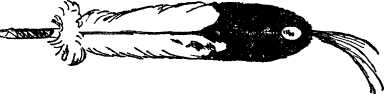
303
'After we left the village and the men had purified
themselves, we travelled seven days and came to the
Little Muddy River. There we found the track of
a travelling band of Arapaho. In two days we
found their camp, but they were too strong for us,
so we hid till night; then I went alone into their
camp and found that some of them were going off
on a hunt next day. As I left I met a lone warrior
coming in. I killed him with my knife. For that
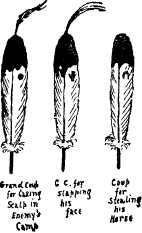 I claim a coup; and I scalped him—for that I
claim another coup; an' before I killed him I slapped
his face with my hand—for this I claim a grand coup;
and I brought his horse away with me—for
that I claim another coup. Is it not so,' sez he,
turning to us, and we all yelled 'How! How! How!'
For this fellow, 'Whooping Crane,' was awful good
stuff. Then the Council agreed that he should
wear three Eagle feathers, the first for killing and
scalping the enemy in his own camp—that was a
grand coup, and the feather had a tuft of red hair
on it an' a red spot on the web. The next feather
was for slapping the feller's face first, which, of
course, made it more risky. This Eagle feather had a
red tuft on top an' a red hand on the web; the one
for stealing the horse had a horseshoe, but no tuft,
coz it wasn't counted A1.
I claim a coup; and I scalped him—for that I
claim another coup; an' before I killed him I slapped
his face with my hand—for this I claim a grand coup;
and I brought his horse away with me—for
that I claim another coup. Is it not so,' sez he,
turning to us, and we all yelled 'How! How! How!'
For this fellow, 'Whooping Crane,' was awful good
stuff. Then the Council agreed that he should
wear three Eagle feathers, the first for killing and
scalping the enemy in his own camp—that was a
grand coup, and the feather had a tuft of red hair
on it an' a red spot on the web. The next feather
was for slapping the feller's face first, which, of
course, made it more risky. This Eagle feather had a
red tuft on top an' a red hand on the web; the one
for stealing the horse had a horseshoe, but no tuft,
coz it wasn't counted A1.
"Then the other Injuns made their claims, an'
we all got some kind of honours. I mind one feller
was allowed to drag a Fox tail at each heel when he
danced, an' another had ten horseshoe marks on
304
an Eagle feather for stealing ten horses, an' I tell
you them Injuns were prouder of them feathers
than a general would be of his medals."
"My, I wish I could go out there and be with
those fellows," and Yan sighed as he compared his
commonplace lot with all this romantic splendour.
"Guess you'd soon get sick of it. I know I did,"
was the answer; "forever shooting and killing,
never at peace, never more than three meals ahead
of starvation and just as often three meals behind.
No, siree, no more for me."
"I'd just like to see you start in horse-stealing for
honours round here," observed Sam, "though I
know who'd get the feathers if it was chicken stealing."
"Say, Caleb," said Guy, who, being friendly and
of the country, never thought of calling the old man
"Mr. Clark," "didn't they give feathers for good
Deer-hunting? I'll bet I could lick any of them at
it if I had a gun."
"Didn't you hear me say first thing that that
there shot o' Yan's should score a 'grand coup'?"
"Oh, shucks! I kin lick Yan any time; that was
just a chance shot. I'll bet if you give feathers for
Deer-hunting I'll get them all."
"We'll take you up on that," said the oldest
Chief, but the next interrupted:
"Say, boys, we want to play Injun properly.
Let's get Mr. Clark to show us how to make a real
war bonnet. Then we'll wear only what feathers
we win."
305"Ye mean by scalping the Whites an' horse-stealing?"
"Oh, no; there's lots of things we can do—best
runner, best Deer hunter, best swimmer, best shot
with bow and arrows."
"All right." So they set about questioning
Caleb. He soon showed them how to put a war
bonnet together, using, in spite of Yan's misgivings,
the crown of an old felt hat for the ground work and
white goose quills trimmed and dyed black at the
tips for Eagle feathers. But when it came to the
deeds that were to be rewarded, each one had his
own ideas.
"If Sappy will go to the orchard and pick a peck
of cherries without old Cap gettin' him, I'll give him
a feather with all sorts of fixin's on it," suggested
Sam.
"Well, I'll bet you can't get a chicken out of our
barn 'thout our Dog gettin' you, Mr. Smarty."
"Pooh! I ain't stealing chickens. Do you take
me for a nigger? I'm a noble Red-man and Head
Chief at that, I want you to know, an' I've a notion
to collect that scalp you're wearin' now. You
know it belongs to me and Yan," and he sidled
over, rolling his eye and working his fingers in a
way that upset Guy's composure. "And I tell you
a feller with one foot in the grave should have his
thoughts on seriouser things than chicken-stealing.
This yere morbid cravin' for excitement is rooinin'
all the young fellers nowadays."
306
Yan happened to glance at Caleb. He was gazing
off at nothing, but there was a twinkle in his eye
that Yan never before saw there.
"Let's go to the teepee. It's too hot out here.
Come in, won't you, Mr. Clark?"
"Hm. 'Tain't much cooler in here, even if it is
shady," remarked the old Trapper. "Ye ought to
lift one side of the canvas and get some air."
"Why, did the real Injuns do that?"
"I should say they did. There ain't any way they
didn't turn and twist the teepee for comfort. That's
what makes it so good. Ye kin live in it forty below
zero an' fifty 'bove suffocation an' still be happy.
It's the changeablest kind of a layout for livin' in.
Real hot weather the thing looks like a spider with
skirts on and held high, an' I tell you ye got to know
the weather for a teepee. Many a hot night on the
plains I've been woke up by hearing 'Tap-tap-tap'
all around me in the still black night and wondered
why all the squaws was working, but they was up
to drop the cover and drive all the pegs deeper, an'
within a half hour there never failed to come up a
big storm. How they knew it was a-comin' I never
could tell. One old woman said a Coyote told her,
an' maybe that's true, for they do change their
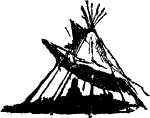 song for trouble ahead; another said it was the flowers
lookin' queer at sundown, an' another had a bad
dream. Maybe they're all true; it comes o' watchin'
little things."
song for trouble ahead; another said it was the flowers
lookin' queer at sundown, an' another had a bad
dream. Maybe they're all true; it comes o' watchin'
little things."
"Do they never get fooled?" asked Little Beaver
307
"Oncet in awhile, but not near as often as a
White-man would.
"I mind once seeing an artist chap, one of them
there portygraf takers. He come out to the village
with a machine an' took some of the little teepees.
Then I said, 'Why don't you get Bull-calf's squaw
to put up their big teepee? I tell you that's a
howler.' So off he goes, and after dickering awhile
he got the squaw to put it up for three dollars.
You bet it was a stunner, sure—all painted red, with
green an' yaller--animals an' birds an' scalps galore.
It made that feller's eyes bug out to see it. He
started in to make some portygrafs, then was taking
another by hand, so as to get the colours, an' I bet
it would have crowded him to do it, but jest when he
got a-going the old squaw yelled to the other—the
Chief hed two of them—an' lighted out to take
down that there teepee. That artist he hollered to
stop, said he had hired it to stay up an' a bargain
was a bargain. But the old squaw she jest kept on
a-jabberin' an' pintin' at the west. Pretty soon they
had the hull thing down and rolled up an' that
artist a-cussin' like a cow-puncher. Well, I mind it
was a fine day, but awful hot, an' before five minutes
there come a little dark cloud in the west, then in
ten minutes come a-whoopin' a regular small cyclone,
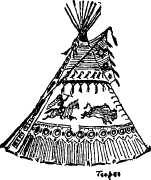 an' it went through that village and wrecked all the
teepees of any size. That red one would surely
have gone only for that smart old squaw."
an' it went through that village and wrecked all the
teepees of any size. That red one would surely
have gone only for that smart old squaw."
 Under Caleb's directions the breezy side of the
cover was now raised a little, and the shady side
308
much more. This changed the teepee from a stifling
hothouse into a cool, breezy shade.
Under Caleb's directions the breezy side of the
cover was now raised a little, and the shady side
308
much more. This changed the teepee from a stifling
hothouse into a cool, breezy shade.
"An' when ye want to know which way is the
wind, if it's light, ye wet your finger so, an' hold it
up. The windy side feels cool at once, and by that
ye can set your smoke-flaps."
"I want to know about war bonnets," Yan now
put in. "I mean about things to do to wear feathers—that
is, things we can do."
"Ye kin have races, an' swimmin' an bownarrer
shootin'. I should say if you kin send one o' them
arrers two hundred yards that would kill a Buffalo
at twenty feet. I'd think that was pretty good.
Yes, I'd call that way up."
"What—a grand coup?"
"Yes, I reckon; an' if you fell short on'y fifty
yards that'd still kill a Deer, an' we could call that a
coup. If," continued Caleb, "you kin hit that old
gunny-sack buck plunk in the heart at fifty yards
first shot I'd call that away up; an' if you hit it at
seventy-five yards in the heart no matter how many
tries, I'd call you a shot. If you kin hit a nine-inch
bull's-eye two out of three at forty yards every
time an' no fluke, you'd hold your own among Injuns
though I must say they don't go in much for shooting
at a target. They shoot at 'most anything they
see in the woods. I've seen the little copper-coloured
kids shooting away at butterflies. Then they have
matches—they try who can have most arrers in the
air at one time. To have five in the air at once is
considered good. It means powerful fast work and
309
far shooting. You got to hold a bunch handy in
the left hand fur that. The most I ever seen one
man have up at once was eight. That was reckoned
'big medicine,' an' any one that can keep up seven
is considered swell."
"Do you know any other things besides bows and
arrows that would do?"
"I think that a rubbing-stick fire ought to count,"
interrupted Sam. "I want that in coz Guy can't
do it. Any one who kin do it at all gets a feather,
an' any one who kin do it in one minute gets a
swagger feather, or whatever you call it; that takes
care of Yan and me an' leaves Guy out in the cold."
"I'll bet I kin hunt Deer all round you both, I kin."
"Oh, shut up, Sappy; we're tired a-hearing about
your Deer hunting. We're going to abolish that
game." Then Sam continued, apparently addressing
Caleb, "Do you know any Injun games?"
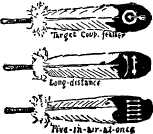
But Caleb took no notice.
Presently Yan said, "Don't the Injuns play
games, Mr. Clark?
"Well, yes, I kin show you two Injun games that
will test your eyesight."
"I bet I kin beat any one at it," Guy made haste to
tell. "Why, I seen that Deer before Yan could—"
"Oh, shut up, Guy," Yan now exclaimed. A
peculiar sound—"Wheet—wheet—wheet"—made Sappy
turn. He saw Sam with an immense knife, whetting
it most vigorously and casting a hungry, fishy
glance from time to time to the "yaller moss-tuft"
310
on Guy's neck.
"Time has came," he said to nobody in particular.
"You better let me alone," whined Guy, for that
horrible "wheet—wheet" jarred his nerves somehow.
He looked toward Yan, and seeing, as he thought,
the suggestion of a smile, he felt more comfortable,
but a glance at Sam dispelled his comfort; the Woodpecker's
face was absolutely inscrutable and perfectly
demoniac with paint.
"Why don't you whet up, Little Beaver? Don't
you want your share?" asked the Head Chief through
his teeth.
"I vote we let him wear it till he brags again
about his Deer-hunting. Then off she comes to the
bone," was the reply. "Tell us about the Injun
game, Mr. Clark."
"I pretty near forget it now, but le's see. They
make two squares on the ground or on two skins;
each one is cut up in twenty-five smaller squares
with lines like that. Then they have, say, ten rings
an' ten nuts or pebbles. One player takes five
rings an' five nuts an' sets them around on the
squares of one set, an' don't let the other see till all
is ready; then the other turns an' looks at it while
some one else sings a little song that one of the
boys turned into:
"'Ki yi ya—ki yi yee,
You think yer smart as ye kin be,
You think yer awful quick to see
But yer not too quick for me,
Ki yi ya—ki yi yee.'
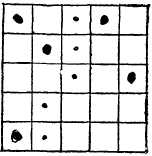
311
"Then the first square is covered with a basket
or anything and the second player must cover
the other skin with counters just the same from
memory. For every counter he gets on the right
square he counts one, and loses one for each on
the wrong square."
"I'll bet I kin——" Guy began, but Sam's hand
gripped his moss-tuft.
"Here, you let me alone. I ain't bragging. I'm
only telling the simple truth."
"Ugh! Better tell some simple lies, then—much
safer," said the Great Woodpecker, with horrid calm
and meaning. "If ever I lift that scalp you'll catch
cold and die, do ye know it?"
Again Yan could see that Caleb had to look far
away to avoid taking an apparent interest.
"There's another game. I don't know as it's
Injun, but it's the kind o' game where an Injun
could win. They first made two six-inch squares of
white wood or card, then on each they made rings like
a target or squares like the quicksight game, or else
two Rabbits the same on each. One feller takes six
spots of black, half an inch across, an' sticks them
on one, scattering anyhow, an' sets it up a hundred
yards off; another feller takes same number of
spots an' the other Rabbit an' walks up till he can
see to fix his Rabbit the same. If he kin do it at
seventy-five yards he's a swell; if he kin do it at
sixty yards he's away up, but less than fifty yards
312
is no good. I seen the boys have lots o' fun out o'
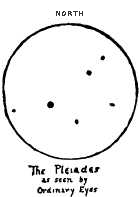 it. They try to fool each other every way, putting
one spot right on another or leaving some off. It's
a sure 'nough test of good eyes."
it. They try to fool each other every way, putting
one spot right on another or leaving some off. It's
a sure 'nough test of good eyes."
"I'll bet——" began Sappy again, but a loud
savage "Grrrr" from Sam, who knew perfectly
well what was coming, put a stop to the bet, whatever
it was.
"There was two other Injun tests of eyes that I
mind now. Some old Buck would show the youngsters
the Pleiades—them's the little stars that the
Injuns call the Bunch—an' ask 'How many kin
you see?' Some could sho'ly see five or six an'
some could make out seven. Them as sees seven
is mighty well off for eyes. Ye can't see the Pleiades
now—they belong to the winter nights; but you kin
see the Dipper the hull year round, turning about
the North Star. The Injuns call this the 'Broken
Back,' an' I've heard the old fellers ask the boys:
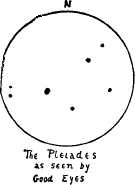 'You see the Old Squaw—that's the star, second
from the end, the one at the bend of the handle—well,
she has a papoose on her back. Kin you see the
papoose?' an' sure enough, when my eyes was real
good I could see the little baby star tucked in by
the big un. It's a mighty good test of eyes if you
kin see that."
'You see the Old Squaw—that's the star, second
from the end, the one at the bend of the handle—well,
she has a papoose on her back. Kin you see the
papoose?' an' sure enough, when my eyes was real
good I could see the little baby star tucked in by
the big un. It's a mighty good test of eyes if you
kin see that."
"Eh——" began Guy.
But "Grrrrrrrrr" from Sam stopped him in time.
Again Caleb's eyes wandered afar. Then he
stepped out of the teepee and Yan heard him mutter,
313
"Consarn that whelp, he makes me laugh spite o'
myself." He went off a little way into the woods
and presently called "Yan! Guy! Come here."
All three ran out. "Talking about eyes, what's
that?" An opening in the foliage gave a glimpse
of the distant Burns's clover field. "Looks like a
small Bear."
"Woodchuck! That's our Woodchuck! That's
the ole sinner that throwed Paw off'n the mower.
Where's my bone-arrer?" and Guy went for his
weapons.
The boys ran for the fence of the clover field,
going more cautiously as they came near. Still
the old Woodchuck heard something and sat up
erect on his haunches. He was a monster, and
out on the smooth clover field he did look like a
very small Bear. His chestnut breast was curiously
relieved by his unusually gray back and head.
"Paw says it's his sins as turned his head gray.
He's a hoary headed sinner, an' he ain't repented
o' none o' them so far, but I'm after him now."
"Hold on! Start even!" said Sam, seeing that
Guy was prepared to shoot.
So all drew together, standing in a row like an old
picture of the battle of Crecy. The arrows scattered
about the Woodchuck. Most went much too far,
none went near because he was closer than they had
supposed, but he scuttled away into his hole, there,
no doubt, to plan a new trap for the man with the
mower.
"How'd you sleep, Sam?"
"Didn't sleep a durn bit."
"Neither did I. I was shivering all night.
I got up an' put the spare blanket on, but it didn't
do any good."
"Wonder if there was a chills-and-fever fog or
something?"
"How'd you find it, Sappy?"
"All right."
"Didn't smell any fog?"
"Nope."
The next night it was even worse. Guy slept
placidly, if noisily, but Sam and Yan tumbled about
and shivered for hours. In the morning at dawn Sam
sat up.
"Well, I tell you this is no joke. Fun's fun, but
if I am going to have the shivers every night I'm
going home while I'm able."
Yan said nothing. He was very glum. He felt
much as Sam did, but was less ready to give up the
outing.
Their blues were nearly dispelled when the warm
sun came up, but still they dreaded the coming
315
night.
"Wonder what it is," said Little Beaver.
"'Pears to me powerful like chills and fever and
then again it don't. Maybe we drink too much
swamp water. I believe we're p'isoned with Guy's
cooking."
"More like getting scurvy from too much meat.
Let's ask Caleb."
Caleb came around that afternoon or they would
have gone after him. He heard Yan's story in
silence, then, "Have ye sunned your blankets sense
ye came?"
"No."
Caleb went into the teepee, felt the blankets, then
grunted: "H-m! Jest so. They're nigh soppin'.
You turn in night after night an' sweat an' sweat
in them blankets an' wonder why they're damp.
Hain't you seen your ma air the blankets every
day at home? Every Injun squaw knows that
much, an' every other day at least she gives the
blankets a sun roast for three hours in the middle
of the day, or, failing that, dries them at the fire.
Dry out your blankets and you won't have no more
chills."
The boys set about it at once, and that night they
experienced again the sweet, warm sleep of healthy
youth.
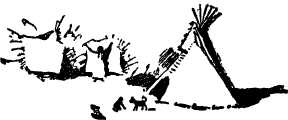
There was another lesson they had to learn in
campercraft. The Mosquitoes were always more
or less of a plague. At night they forced the boys
316
into the teepee, but they soon learned to smudge
the insects with a wad of green grass on the hot fire.
This they would throw on at sundown, then go
outside, closing the teepee tight and eat supper
around the cooking fire. After that was over they
would cautiously open the teepee to find the grass
all gone and the fire low, a dense cloud of smoke
still in the upper part, but below it clear air. They
would then brush off the Mosquitoes that had alighted
on their clothes, crawl into the lodge and close the
door tight. Not a Mosquito was left alive in it,
and the smoke hanging about the smoke-vent
was enough to keep them from coming in, and
so they slept in peace. Thus they could baffle
the worst pest of the woods. But there was yet
another destroyer of comfort by day, and this
was the Blue-bottle flies. There seemed more of
them as time went on, and they laid masses of yellowish
eggs on anything that smelled like meat or
corruption. They buzzed about the table and got
into the dishes; their dead, drowned and mangled
bodies were polluting all the food, till Caleb remarked
during one of his ever-increasing visits: "It's your
own fault. Look at all the filth ye leave scattered
about."
There was no blinking the fact; for fifty feet around
the teepee the ground was strewn with scraps of
paper, tins and food. To one side was a mass of
potato peelings, bones, fish-scales and filth, and
everywhere were the buzzing flies, to be plagues all
317
day, till at sundown the Mosquitoes relieved them
and took the night shift of the office of torment.
"I want to learn, especially if it's Injun," said
Little Beaver. "What had we best do?"
"Wall, first ye could move camp; second, ye could
clean this."
As there was no other available camp ground
they had no choice, and Yan said with energy:
"Boys, we got to clean this and keep it clean, too.
We'll dig a hole for everything that won't burn."
So Yan seized the spade and began to dig in the
bushes not far from the teepee. Sam and Guy
were gradually drawn in. They began gathering
all the rubbish and threw it into the hole. As
they tumbled in bones, tins and scraps of bread Yan
said: "I just hate to see that bread go in. It
doesn't seem right when there's so many living
things would be glad to get it."
At this, Caleb, who was sitting on a log placidly
smoking, said:
"Now, if ye want to be real Injun, ye gather all the
eatables ye don't want—meat, bread and anything,
an' every day put it on some high place. Most
generally the Injuns has a rock—they call it Wakan;
that means sacred medicine—an' there they leave
scraps of food to please the good spirits. Av coorse
it's the birds and Squirrels gets it all; but the Injun
is content as long as it's gone, an' if ye argy with
them that 'tain't the spirits gets it, but the birds,
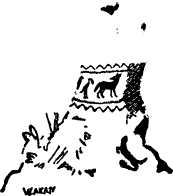 they say: 'That doesn't matter. The birds couldn't
318
get it if the spirits didn't want them to have it,' or
maybe the birds took it to carry to the spirits!"
they say: 'That doesn't matter. The birds couldn't
318
get it if the spirits didn't want them to have it,' or
maybe the birds took it to carry to the spirits!"
Then the Grand Council went out in a body to
seek the Wakan Rock. They found a good one in
the open part of the woods, and it became a daily
duty of one to carry the remnants of food to the
rock. They were probably less acceptable to the
wood creatures than they would have been half a
year later, but they soon found that there were
many birds glad to eat at the Wakan; and moreover,
that before long there was a trail from the brook,
only twenty-five yards away, that told of four-foots
also enjoying the bounty of the good spirits.
Within three days of this the plague of Bluebottles
was over, and the boys realized that, judging
by its effects, the keeping of a dirty camp is a crime.
One other thing old Caleb insisted on: "Yan,"
said he, "you didn't ought to drink that creek water
now; it ain't hardly runnin'. The sun hez it het
up, an' it's gettin' too crawly to be healthy."
"Well, what are we going to do?" said Sam,
though he might as well have addressed the brook
itself.
"What can we do, Mr. Clark?"
"Dig a well!"
"Phew! We're out here for fun!" was Sam's
reply.
"Dig an Injun well," Caleb said. "Half an hour
will do it. Here, I'll show you."
319
He took the spade and, seeking a dry spot,
about twenty feet from the upper end of the
pond he dug a hole some two feet square. By
the time he was down three feet the water was
oozing in fast. He got it down about four feet
and then had to stop, on account of inflow. He
took a bucket and bailed the muddy stuff out
right to the bottom, and let it fill up to be again
bailed out. After three bailings the water came
in cold, sweet, and pure as crystal.
"There," said he, "that water is from your pond,
but it is filtered through twenty feet of earth and
sand. That's the way to get cool, pure water out
of the dirtiest of swamps. That's an Injun well."
"Oh, that hair of horse and skin of sheep should
Have such power to move the souls of men."
"If you were real Injun you'd make a drum of that,"
said Caleb to Yan, as they came to a Basswood
blown over by a recent storm and now showing
its weakness, for it was quite hollow—a mere shell.
"How do they do it? I want to know how."
"Get me the axe."
Yan ran for the axe. Caleb cut out a straight
unbroken section about two feet long. This they
carried to camp.
"Coorse ye know," said Caleb, "ye can't have a
drum without skins for heads."
"What kind of skins?"
"Oh, Horse, Dog, Cow, Calf—'most any kind
that's strong enough."
"I got a Calfskin in our barn, an' I know where
there's another in the shed, but it's all chawed up
with Rats. Them's mine. I killed them Calves.
Paw give me the skins for killin' an' skinnin' them.
Oh, you jest ought to see me kill a Calf—"
Guy was going off into one of his autopanegyrics
when Sam who was now being rubbed on a sore
321
place, gave a "Whoop!" and grabbed the tow-tuft
with a jerk that sent the Third War Chief sprawling
and ended the panegyric in the usual volley of
"you-let-me-'lones."
"Oh, quit, Sam," objected Little Beaver. "You
can't stop a Dog barking. It's his nature." Then
to Guy: "Never mind, Guy; you are not hurt. I'll
bet you can beat him hunting Deer, and you can see
twice as far as he can."
"Yes, I kin; that's what makes him so mad. I'll
bet I kin see three times as far—maybe five times,"
was the answer in injured tones.
"Go on now, Guy, and get the skins—that is, if
you want a drum for the war dance. You're the
only one in the crowd that's man enough to make
the raise of a hide," and fired by this flattery, Guy
sped away.
Meanwhile Caleb worked on the hollow log. He
trimmed off the bark, then with the hatchet he
cleared out all the punk and splinters inside. He
made a fire on the ground in the middle of the drum-log
as it stood on end, and watching carefully, he
lifted it off from time to time and chopped away all
the charred parts, smoothing and trimming till he had
the log down thin and smooth within and without.
They heard Guy shouting soon after he left. They
thought him near at hand, but he did not come.
Trimming the drum-log took a couple of hours, and
still Guy did not return. The remark from Caleb,
"'Bout ready for the skins now!" called from Sam
322
the explanation, "Guess Old Man Burns snapped
him up and put him to weeding the garden. Probably
that was him we heard gettin' licked."
"Old Man Burns" was a poor and shiftless character,
a thin, stoop-shouldered man. He was only
thirty-five years of age, but, being married, that
was enough to secure for him the title "Old Man."
In Sanger, if Tom Nolan was a bachelor at eighty
years of age he would still be Tom Nolan, "wan
of the bhoys," but if he married at twenty he at
once became "Old Man Nolan."
Mrs. Burns had produced the usual string of tow-tops,
but several had died, the charitable neighbours
said of starvation, leaving Guy, the eldest, his
mother's darling, then a gap and four little girls,
four, three, two and one years of age. She was a
fat, fair, easy-going person, with a general sense
of antagonism to her husband, who was, of course,
the natural enemy of the children. Jim Burns
cherished the ideal of bringing "that boy" up right—that
is, getting all the work he could out of him—and
Guy clung to his own ideal of doing as little
work as possible. In this clash of ideals Guy's
mother was his firm, though more or less secret, ally.
He was without fault in her eyes: all that he did was
right. His freckled visage and pudgy face were
types of noble beauty, standards of comeliness and
human excellence; his ways were ways of pleasantness
and all his paths were peace; Margat Burns
was sure of it.
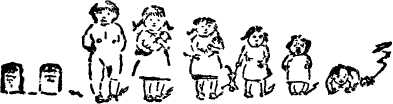
323
Burns had a good deal of natural affection, but
he was erratic; sometimes he would flog Guy mercilessly
for nothing, and again laugh at some serious
misdeed, so that the boy never knew just what to
expect, and kept on the safe side by avoiding his
"Paw" as much as possible. His visits to the
camp had been thoroughly disapproved, partly
because it was on Old Man Raften's land and partly
because it enabled Guy to dodge the chores. Burns
had been quite violent about it once or twice, but
Mrs. Burns had the great advantage of persistence,
and like the steady strain of the skilful angler on
the slender line, it wins in the end against the erratic
violence of the strongest trout. She had managed
then that Guy should join the Injun camp, and
gloried in his outrageously exaggerated accounts of
how he could lick them all at anything, "though
they wuz so much older'n bigger'n he wuz."
But on this day he was fallen in hard luck. His
father saw him coming, met him with a "gad" and
lashed him furiously. Knowing perfectly well that
the flogging would not stop till the proper effect was
produced, and that was to be gauged by the racket,
Guy yelled his loudest. This was the uproar the
boys had heard.
"Now, ye idle young scut! I'll larn ye to go
round leaving bars down. You go an' tend to
your work." So instead of hiking back gloriously
laden with Calfskins, Guy was sent to ignominious
and un-Injun toil in the garden.
324
Soon he heard his mother: "Guysie, Guysie."
He dropped his hoe and walked to the kitchen.
"Where you goin'?" roared his father from afar.
"Go back and mind your work."
"Maw wants me. She called me."
"You mind your work. Don't you dar' on your
life to go thayer."
But Guy took no notice and walked on to his
mother. He knew that at this post-thrashing stage
of wrath his father was mouthy and harmless, and
soon he was happy eating a huge piece of bread and
jam.
"Poor dear, you must be hungry, an' your Paw
was so mean to you. There, now, don't cry,"
for Guy began to weep again at the recollection of
his wrongs. Then she whispered confidentially:
"Paw's going to Downey's this afternoon, an' you
can slip away as soon as he's gone, an' if you work
well before that he won't be so awful mad after
you come back. But be sure you don't let down
the bars, coz if the pig was to get in Raften's woods
dear knows what."
This was the reason of Guy's delay. He did not
return to camp with the skins till late that day.
As soon as he was gone, his foolish, doting mother,
already crushed with the burden of the house, left
everything and hoed two or three extra rows of
cabbages, so "Paw" should find a great showing of
work when he came back.
The Calfskins were hard as tin and, of course, had
the hair on.
325
Caleb remarked, "It'll take two or three days to
get them right," and buried them in a marshy, muddy
pool in the full sunlight. "The warmer the better."
Three days later he took them out. Instead of
being thin, hard, yellow, semi-transparent, they
now were much thicker, densely white, and soft
as silk. The hair was easily scraped off and the
two pieces were pronounced all right for drumheads.
Caleb washed them thoroughly in warm water,
with soap to clear off the grease, scraping them on
both sides with a blunt knife; then he straightened
the outer edge of the largest, and cut a thin strip
round and round it till he had some sixty feet of rawhide
line, about three-quarters of an inch wide.
This he twisted, rolled and stretched until it was
nearly round, then he cut from the remainder a
circular piece thirty inches across, and a second from
the "unchawed" part of the other skin. He laid
these one on the other, and with the sharp point of
a knife he made a row of holes in both, one inch
from the edge and two inches apart. Then he set one
skin on the ground, the drum-log on that and the
other skin on the top, and bound them together with
the long lace, running it from hole No. 1 on the
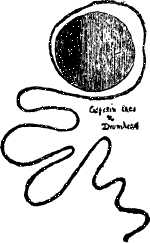 top to No. 2 on the bottom, then to No. 3 on the top,
and No. 4 on the bottom, and so on twice around,
till every hole had a lace through it and the crossing
laces made a diamond pattern all around. At
first this was done loosely, but tightened up when
once around, and finally both the drum-heads were
326
drawn tense. To the surprise of all, Guy promptly
took possession of the finished drum. "Them's
my Calfskins," which, of course, was true.
top to No. 2 on the bottom, then to No. 3 on the top,
and No. 4 on the bottom, and so on twice around,
till every hole had a lace through it and the crossing
laces made a diamond pattern all around. At
first this was done loosely, but tightened up when
once around, and finally both the drum-heads were
326
drawn tense. To the surprise of all, Guy promptly
took possession of the finished drum. "Them's
my Calfskins," which, of course, was true.
And Caleb said, with a twinkle in his eye, "The
wood seems to go with the skins."
A drumstick of wood, with a piece of sacking
lashed on to soften it, was made, and Guy was disgusted
to find how little sound the drum gave out.
"'Bout like pounding a fur cap with a lamb's
tail," Sam thought.
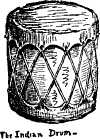 "You hang that up in the shade to dry and you'll
find a change," said the Trapper.
"You hang that up in the shade to dry and you'll
find a change," said the Trapper.
It was quite curious to note the effect of the drying
as the hours went by. The drum seemed to be
wracking and straining itself in the agony of effort,
and slight noises came from it at times. When
perfectly dry the semi-transparency of the rawhide
came back, and the sound now was one to
thrill the Red-man's heart.
Caleb taught them a little Indian war chant, and
they danced round to it as he drummed and sang,
till their savage instincts seemed to revive. But
above all it worked on Yan. As he pranced around
in step his whole nature seemed to respond; he felt
himself a part of that dance. It was in himself;
it thrilled him through and through and sent his
blood exulting. He would gladly have given up all
the White-man's "glorious gains" to live with the
feeling called up by that Indian drum.
Sam was away on a "massacree" to get some
bread. Guy had been trapped by his natural
enemy and was serving a term of hard labour in
the garden; so Yan was alone in camp. He went
 around the various mud albums, but discovered
nothing new, except the fact that tracks were getting
more numerous. There were small Skunk and
Mink tracks with the large ones now. As he came
by the brush fence at the end of the blazed trail he
saw a dainty little Yellow Warbler feeding a great
lubberly young Cow-bird that, evidently, it had
brought up. He had often heard that the Cow-bird
habitually "plays Cuckoo" and leaves its egg in
the nest of another bird, but this was the first time
he had actually seen anything of it with his own
eyes. As he watched the awkward mud-coloured
Cow-bird flutter its ungrown wings and beg help
from the brilliant little Warbler, less than half its
size, he wondered whether the fond mother really
was fooled into thinking it her own young, or whether
she did it simply out of compassion for the foundling.
He now turned down creek to the lower mud
album, and was puzzled by a new track like this.
around the various mud albums, but discovered
nothing new, except the fact that tracks were getting
more numerous. There were small Skunk and
Mink tracks with the large ones now. As he came
by the brush fence at the end of the blazed trail he
saw a dainty little Yellow Warbler feeding a great
lubberly young Cow-bird that, evidently, it had
brought up. He had often heard that the Cow-bird
habitually "plays Cuckoo" and leaves its egg in
the nest of another bird, but this was the first time
he had actually seen anything of it with his own
eyes. As he watched the awkward mud-coloured
Cow-bird flutter its ungrown wings and beg help
from the brilliant little Warbler, less than half its
size, he wondered whether the fond mother really
was fooled into thinking it her own young, or whether
she did it simply out of compassion for the foundling.
He now turned down creek to the lower mud
album, and was puzzled by a new track like this.
328
He sketched it, but before the drawing was done
it dawned on him that this must be the track of a
young Mud-turtle. He also saw a lot of very familiar
tracks, not a few being those of the common Cat,
and he wondered why they should be about so much
and yet so rarely seen. Of course the animals were
chiefly nocturnal, but the boys were partly so,
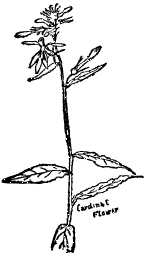 and always on the ground now, so that explanation
was not satisfactory. He lay down on his
breast at the edge of the brook, which had here cut
in a channel with steep clay walls six feet high and
twenty feet apart. The stream was very small now—a
mere thread of water zigzagging over the level
muddy floor of the "cañon," as Yan loved to call
it. A broad, muddy margin at each side of the
water made a fine place of record for the travelling
Four-foots, and tracks new and old were there in
abundance.
and always on the ground now, so that explanation
was not satisfactory. He lay down on his
breast at the edge of the brook, which had here cut
in a channel with steep clay walls six feet high and
twenty feet apart. The stream was very small now—a
mere thread of water zigzagging over the level
muddy floor of the "cañon," as Yan loved to call
it. A broad, muddy margin at each side of the
water made a fine place of record for the travelling
Four-foots, and tracks new and old were there in
abundance.
The herbage on the bank was very rank and full
of noisy Grasshoppers and Crickets. Great masses of
orange Jewelweed on one side were variegated with
some wonderful Cardinal flowers. Yan viewed all
this with placid content. He knew their names
now, and thus they were transferred from the list
of tantalizing mysteries to that of engaging and
wonderful friends. As he lay there on his breast
his thoughts wandered back to the days when he
did not know the names of any flowers or birds—when
all was strange and he alone in his hunger to know
them, and Bonnerton came back to him with new,
strange force of reminder. His father and mother,
329
his brother and schoolmates were there. It seemed like
a bygone existence, though only two months ago.
He had written his mother to tell of his arrival, and
once since to say that he was well. He had received
a kind letter from his mother, with a scripture text
or two, and a postscript from his father with some
sound advice and more scripture texts. Since
then he had not written. He could not comprehend
how he could so completely drift away, and yet
clearly it was because he had found here in Sanger
the well for which he had thirsted.
As he lay there thinking, a slight movement nearer
the creek caught his eye. A large Basswood had
been blown down. Like most of its kind, it was hollow.
Its trunk was buried in the tangle of rank summer
growth, but a branch had been broken off and left
a hole in the main stem. In the black cavern of the
hole there appeared a head with shining green eyes,
then out there glided onto the log a common gray
Cat. She sat there in the sunshine, licked her paws,
dressed her fur generally, stretched her claws and
legs after the manner of her kind, walked to the end
of the log, then down the easy slope to the bottom
of the cañon. Here she took a drink, daintily shook
the water from her paws, and set the hair just right
with a stroke. Then to Yan's amusement she examined
all the tracks much as he had done, though it
seemed clear that her nose, not her eyes, was judge.
She walked down stream, leaving some very fine
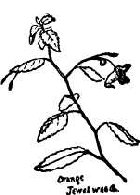 impressions that Yan mentally resolved to have
330
in his note-book, very soon suddenly stopped,
looked upward and around, a living picture of
elegance, sleekness and grace, with eyes of green
fire then deliberately leaped from the creek bed to
the tangle of the bank and disappeared.
impressions that Yan mentally resolved to have
330
in his note-book, very soon suddenly stopped,
looked upward and around, a living picture of
elegance, sleekness and grace, with eyes of green
fire then deliberately leaped from the creek bed to
the tangle of the bank and disappeared.
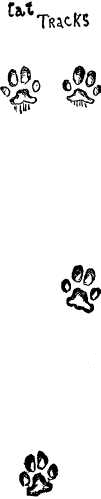 This seemed a very commonplace happening, but
the fact of a house Cat taking to the woods lent her
unusual interest, and Yan felt much of the thrill
that a truly wild animal would have given him, and
had gone far enough in art to find exquisite pleasure
in the series of pictures the Cat had presented to
his eyes.
This seemed a very commonplace happening, but
the fact of a house Cat taking to the woods lent her
unusual interest, and Yan felt much of the thrill
that a truly wild animal would have given him, and
had gone far enough in art to find exquisite pleasure
in the series of pictures the Cat had presented to
his eyes.
He lay there for some minutes expecting her to
reappear; then far up the creek he heard slight
rattling of the gravel. He turned and saw, not the
Cat, but a very different and somewhat larger animal.
Low, thick-set, jet black, with white marks and
an immense bushy tail—Yan recognized the Skunk
at once, although he had never before met a wild
one in daylight. It came at a deliberate waddle,
nosing this way and that. It rounded the bend and
was nearly opposite Yan, when three little Skunks
of this year's brood came toddling after the mother.
The old one examined the tracks much as the Cat
had done, and Yan got a singular sense of brotherhood
in seeing the wild things at his own study.
Then the old Skunk came to the fresh tracks of
the Cat and paused so long to smell them that the
three young ones came up and joined in. One of
the young ones went to the bank where the Cat
331
came down. As it blew its little nose over the fresh
scent, the old Skunk waddled to the place, became
quite interested, then climbed the bank. The little
ones followed in a disjointed procession, varied by
one of them tumbling backward from the steep trail.
The old Skunk reached the top of the bank, then
mounted the log and followed unerringly the Cat's
back trail to the hole in the trunk. Down this she
peered a minute, then, sniffing, walked in, till nothing
could be seen but her tail. Now Yan heard loud,
shrill mewing from the log, "Mew, mew, m-e-u-w,
m-e-e-u-w," and the old Skunk came backing out,
holding a small gray Kitten.
The little thing mewed and spit energetically,
holding on to the inside of the log. But the old
Skunk was too strong—she dragged it out. Then
holding it down with both paws, she got a good firm
grip of its neck and turned to carry it down to the
bed of the brook. The Kitten struggled vigorously,
and at last got its claws into the Skunk's eye and gave
such a wrench that the ill-smelling villain loosened
its hold a little and so gave the Kitten another chance
to squeal, which it did with a will, putting all its
strength into a succession of heartrending mee-ow—mee-ows.
Yan's heart was touched. He was about
to dash to the rescue when there was a scrambling
in the far grass, a rush of gray, and the Cat—the
 old mother Cat was on the scene, a picture of demon
rage, eyes ablaze, fur erect, ears back. With the
332
spring of a Deer and the courage of a Lion she made
for the black murderer. Eye could not follow the
flashings of her paws. The Skunk recoiled and
stared stupidly, but not long; nothing was "long"
about it. Her every superb muscle was tingling with
force and mad with hate as the mother Cat closed
like a swooping Falcon. The Skunk had no time
to aim that dreadful gun, and in the excitement
fired a volley of the deadly musky spray backward,
drenching her own young as they huddled in the
trail.
old mother Cat was on the scene, a picture of demon
rage, eyes ablaze, fur erect, ears back. With the
332
spring of a Deer and the courage of a Lion she made
for the black murderer. Eye could not follow the
flashings of her paws. The Skunk recoiled and
stared stupidly, but not long; nothing was "long"
about it. Her every superb muscle was tingling with
force and mad with hate as the mother Cat closed
like a swooping Falcon. The Skunk had no time
to aim that dreadful gun, and in the excitement
fired a volley of the deadly musky spray backward,
drenching her own young as they huddled in the
trail.
Tooth and claw and deadly grip—the old Cat
raged and tore, the black fur flew in every direction,
and the Skunk for once lost her head and fired
random shots of choking spray that drenched herself
as well as the Cat. The Skunk's head and neck
were terribly torn. The air was suffocating with
the poisonous musk. The Skunk was desperately
wounded and threw herself backward into the water.
Blinded and choking, though scarcely bleeding, the
old Cat would have followed even there, but the
Kitten, wedged under the log, mewed piteously and
stayed the mother's fury. She dragged it out unharmed
but drenched with musk and carried it
quickly to the den in the hollow log, then came out
again and stood erect, blinking her blazing eyes—for
they were burning with the spray—lashing her tail,
the image of a Tigress eager to fight either part or
all the world for the little ones she nursed. But the
old Skunk had had more than enough.
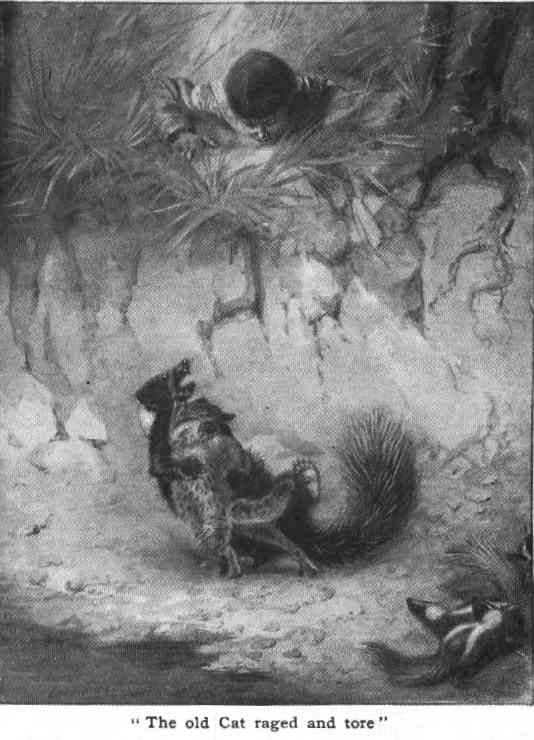
She scrambled
off down the cañon. Her three young ones had
tumbled over each other to get out of the way when
they got that first accidental charge of their mother's
battery. She waddled away, leaving a trail of blood
and smell, and they waddled after, leaving an odour
just as strong.
Yan was thrilled by the desperate fight of the
heroic old Cat. Her whole race went up higher in
his esteem that day; and the fact that the house
Cat really could take to the woods and there maintain
herself by hunting was all that was needed to give
her a place in his list of animal heroes.
Pussy walked uneasily up and down the log, from
the hole where the Kittens were to the end overlooking
the cañon. She blinked very hard and was
evidently suffering severely, but Yan knew quite
well that there was no animal on earth big enough
or strong enough to frighten that Cat from her post
at the door of her home. There is no courage more
indomitable than that of a mother Cat who is guarding
her young.
At length all danger of attack seemed over, and
Pussy, shaking her paws and wiping her eyes, glided
into her hole. Oh, what a shock it must have been
to the poor Kittens, though partly prepared by
their brother's unsavoury coming back. There was
the mother, whose return had always been heralded
by a delicious odour of fresh Mouse or bird, interwoven
with a loving and friendly odour of Cat, that was
in itself a promise of happiness. Scent is the main
thing in Cat life, and now the hole was darkened by
336
a creature that was rank with every nasal guarantee
of deadly enmity. Little wonder that they all fled
puffing and spitting to the dark corners. It was a
hard case; all the little stomachs were upset for a
long time. They could do nothing but make
the best of it and get used to it. The den never
smelt any better while they were there, and even
after they grew up and lived elsewhere many storms
passed overhead before the last of the Skunk smell
left them.
"I'll bet I kin make a Woodpecker come out of
that hole," said Sapwood, one day as the three
Red-men proceeded, bow in hand, through a far
 corner of Burns's Bush. He pointed to a hole in
the top of a tall dead stub, then going near he struck
the stub a couple of heavy blows with a pole. To
the surprise of all there flew out, not a Woodpecker,
but a Flying Squirrel. It scrambled to the top of
the stub, looked this way and that, then spread its
legs, wings and tail and sailed downward, to rise
slightly at the end of its flight against a tree some
twenty feet away. Yan bounded to catch it. His
fingers clutched on its furry back, but he got such
a cut from its sharp teeth that he was glad to let it
go. It scrambled up the far side of the trunk and
soon was lost in the branches.
corner of Burns's Bush. He pointed to a hole in
the top of a tall dead stub, then going near he struck
the stub a couple of heavy blows with a pole. To
the surprise of all there flew out, not a Woodpecker,
but a Flying Squirrel. It scrambled to the top of
the stub, looked this way and that, then spread its
legs, wings and tail and sailed downward, to rise
slightly at the end of its flight against a tree some
twenty feet away. Yan bounded to catch it. His
fingers clutched on its furry back, but he got such
a cut from its sharp teeth that he was glad to let it
go. It scrambled up the far side of the trunk and
soon was lost in the branches.
Guy was quite satisfied that he had carried out
his promise of bringing a Woodpecker out of the
hole, "For ain't a Flying Squirrel a kind of Woodpecker?"
he argued. He was, in consequence, very
"cocky" the rest of the day, proposing to produce
a Squirrel whenever they came to a stub with a hole
in it, and at length, after many failures, had the
satisfaction of driving a belated Woodpecker out
338
of its nest.
The plan was evidently a good one for discovering
living creatures. Yan promptly adopted it, and
picking up a big stick as they drew near another
stub with holes, he gave three or four heavy thumps.
A Red Squirrel scrambled out of a lower hole and
hid in an upper one; another sharp blow made it
pop out and jump to the top of the stub, but eventually
back into the lower hole.
The boys became much excited. They hammered
the stub now without making the Squirrel reappear.
 "Let's cut it down," said Little Beaver.
"Show you a better trick than that," replied the
Woodpecker. He looked about and got a pole
some twenty feet long. This he placed against a
rough place high up on the stub and gave it a violent
push, watching carefully the head of the stub. Yes!
It swayed just a little. Sam repeated the push,
careful to keep time with the stub and push always
just as it began to swing away from him. The
other boys took hold of the pole and all pushed
together, as Sam called, "Now—now—now—"
A single push of 300 or 400 pounds would scarcely
have moved the stub, but these little fifty-pound
pushes at just the right time made it give more and
more, and after three or four minutes the roots,
that had begun to crack, gave way with a craunching
sound, and down crashed the great stub. Its hollow
top struck across a fallen log and burst open in a
shower of dust, splinters and rotten wood. The
339
boys rushed to the spot to catch the Squirrel, if
possible. It did not scramble out as they expected
it would, even when they turned over the fragments.
They found the front of the stub with the old Woodpecker
hole in it, and under that was a mass of finely
shredded cedar bark, evidently a nest. Yan eagerly
turned it over, and there lay the Red Squirrel, quite
still and unharmed apparently, but at the end of her
nose was a single drop of blood. Close beside her
were five little Squirrels, evidently a very late brood,
for they were naked, blind and helpless. One of
them had at its nose a drop of blood and it lay as
still as the mother. At first the hunters thought the
old one was playing 'Possum, but the stiffness of
death soon set in.
Now the boys felt very guilty and sorry. By
thoughtlessly giving way to their hunting instincts
they had killed a harmless mother Squirrel in the
act of protecting her young, and the surviving little
ones had no prospect but starvation.
Yan had been the most active in the chase, and
now was far more conscience-stricken than either of
the others.
"What are we going to do with them?" asked the
Woodpecker. "They are too young to be raised
for pets."
"Better drown them and be done with them,"
suggested Sappy, recalling the last honours of several
broods of Kittens at home.
340
"I wish we could find another Squirrel's nest to
put them into," said Little Beaver remorsefully,
and then as he looked at the four squirming, helpless
things in his hand the tears of repentance filled his
eyes. "We might as well kill them and end their
misery. We can't find another Squirrel's nest so
late as this." But after a little silence he added,
"I know some one who will put them out of pain.
She may as well have them. She'd get them anyway,
and that's the old gray wild Cat. Let's put them
in her nest when she's away."
This seemed a reasonable, simple and merciful
way of getting rid of the orphans. So the boys
made for the "cañon" part of the brook. At one
time of the afternoon the sun shone so as to show
plainly all that was in the hole. The boys went very
quietly to Yan's lookout bank, and seeing that only
the Kittens were there, Yan crept across and dropped
the young Squirrels into the nest, then went back
to his friends to watch, like Miriam, the fate of the
foundlings.
They had a full hour to wait for the old Cat, and
as they were very still all that time they were rewarded
with a sight of many pretty wild things.
A Humming-bird "boomed" into view and hung
in a misty globe of wings before one Jewel-flower
after another.
"Say, Beaver, you said Humming-birds was
something or other awful beautiful," said Woodpecker,
pointing to the dull grayish-green bird
before them.
341
"And I say so yet. Look at that," as, with a
turn in the air, the hanging Hummer changed its
jet-black throat to flame and scarlet that silenced
the critic.
After the Humming-bird went away a Field-mouse
was seen for a moment dodging about in the grass,
and shortly afterward a Shrew-mole, not so big as
the Mouse, was seen in hot pursuit on its trail.
Later a short-legged brown animal, as big as a
Rabbit, came nosing up the dry but shady bed of the
brook, and as it went beneath them Yan recognized
by its little Beaver-like head and scaly oar-shaped
tail that it was a Muskrat, apparently seeking for
water.
There was plenty in the swimming-pond yet, and
the boys realized that this had become a gathering
place for those wild things that were "drowned out
by the drought," as Sam put it.
The Muskrat had not gone more than twenty
minutes before another deep-brown animal appeared.
"Another Muskrat; must be a meeting," whispered
the Woodpecker. But this one, coming close, proved
a very different creature. As long as a Cat, but
lower, with broad, flat head and white chin and
throat, short legs, in shape a huge Weasel, there
was no mistaking it; this was a Mink, the deadly
enemy of the Muskrat, and now on the track of its
prey. It rapidly turned the corner, nosing the trail
like a Hound. If it overtook the Muskrat before it
got to the pond there would be a tragedy. If the
Muskrat reached the deep water it might possibly
342
escape. But just as sure as the pond became a
gathering place for Muskrats it would also become
a gathering place for Mink.
Not five minutes had gone since the Mink went by
before a silent gray form flashed upon the log opposite.
Oh, how sleek and elegant it looked! What perfection
of grace she seemed after the waddling, hunchy
Muskrat and the quick but lumbering Mink. There
is nothing more supple and elegant than a fine Cat,
and men of science the world over have taken the Cat
as the standard of perfection in animal make-up.
Pussy glanced about for danger. She had brought
no bird or Mouse, for the Kittens were yet too young
for such training. The boys watched her with
intensest interest. She glided along the log to the
hole—the Skunk-smelling hole—uttered her low
"purrow, purrow," that always sets the hungry
Kittens agog, and was curling in around them, when
she discovered the pink Squirrel-babies among her
own. She stopped licking the nearest Kitten,
stared at a young Squirrel, and smelled it. Yan
wondered what help that could be when everything
smelled of Skunk. But it did seem to decide her, for
she licked it a moment, then lying down she gathered
them all in her four-legged embrace, turned her chin
up in the air and Sappy announced gleefully that
"The little Squirrels were feeding with the little
Cats."
The boys waited a while longer, then having made
sure that the little Squirrels had been lovingly
343
adopted by their natural enemy, they went quietly
back to camp. Now they found a daily pleasure
in watching the mixed family.
And here it may be as well to give the rest of
the story. The old gray Cat faithfully and lovingly
nursed those foundlings. They seemed to prosper,
and Yan, recalling that he had heard of a Cat actually
raising a brood of Rabbits, looked forward to the
day when Kittens and Squirrelets should romp
together in the sun. After a week Sappy maintained
that only one Squirrel appeared at the breakfast
table, and in ten days none. Yan stole over to the
log and learned the truth. All four were dead in the
bottom of the nest. There was nothing to tell why.
The old Cat had done her best—had been all love
and tenderness, but evidently had not been able
to carry out her motherly intentions.
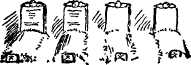
The days went merrily now, beginning each morning
with a hunting of the Woodchuck. The boys
were on terms of friendship with the woods
that contrasted strongly with the feelings of that
first night.
This was the thought in Sam's mind when he one
day remarked, "Say, Yan, do you remember the
night I slep' with the axe an' you with the hatchet?"
The Indians had learned to meet and conquer
all the petty annoyances of camp life, and so forgot
them. Their daily routine was simplified. Their
acquaintance with woodfolk and wood-ways had
grown so fast that now they were truly at home.
The ringing "Kow—Kow—Kow" in the tree-tops was
no longer a mere wandering voice, but the summer
song of the Black-billed Cuckoo. The loud, rattling,
birdy whistle in the low trees during dull weather
Yan had traced to the Tree-frog.
The long-drawn "Pee—re-e-e-e" of hot afternoons
was the call of the Wood-peewee, and a vast number
of mysterious squeaks and warbles had been traced
home to the ever-bright and mischievous Blue Jay.
The nesting season was now over, as well as the
song season; the birds, therefore, were less to be seen,
345
but the drying of the streams had concentrated
much life in the swimming-pond. The fence had
been arranged so that the cattle could reach one end
of it to drink, but the lower parts were safe from
their clumsy feet, and wild life of many kinds were
there in abundance.
The Muskrats were to be seen every evening in
the calm pool, and fish in great numbers were in the
deeper parts. Though they were small, the boys
found them so numerous and so ready to bite that
fishing was great sport, and more than one good
meal they had from that pond. There were things
of interest discovered daily. In a neighbour's field
Sam had found another Woodchuck with a "price
on his head." Rabbits began to come about the
camp at night, especially when the moon was
bright, and frequently of late they had heard a
querulous, yelping bark that Caleb said was made
by a Fox "probably that old rascal that lives in
Callahan's woods."
The gray Cat in the log was always interesting.
The boys went very regularly to watch from a distance,
but for good reasons did not go near. First,
they did not wish to scare her; second, they knew
that if they went too close she would not hesitate to
attack them.
One of the important lessons that Yan learned
was this. In the woods the silent watcher sees the
most. The great difficulty in watching was how to
pass the time, and the solution was to sit and sketch.
346
Reading would have done had books been at hand,
but not so well as sketching, because then the eyes
are fixed on the book instead of the woods, and the
turning of the white pages is apt to alarm the shy
woodfolk.
Thus Yan put in many hours making drawings of
things about the edge of the pond.
As he sat one day in stillness a Minnow leaped from
the water and caught a Fly. Almost immediately a
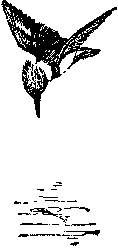 Kingfisher that had been shooting past stopped in
air, hovered, and darting downward, came up with a
Minnow in his beak, flew to a branch to swallow its
prey, but no sooner got there when a Chicken-hawk
flashed out of a thick tree, struck the Kingfisher
with both feet and bore him downward to the bank—in
a moment would have killed him, but a long,
brown creature rushed from a hole in the bank and
sprang on the struggling pair, to change the scene in
a twinkling. The three stragglers separated, the
Hawk to the left, the Kingfisher to the right, the
Minnow flopped back into the pool, and the Mink
was left on the shore with a mouthful of feathers
and looking very foolish. As it stood shaking the
down from its nose another animal came gliding
down through the shrubbery to the shore—the old
gray Cat. The Mink wrinkled up his nose, showed
two rows of sharp teeth and snarled in a furious
manner, but backed off under a lot of roots. The
Cat laid down her ears; the fur on her back and tail
stood up; she crouched a little, her eyes blazing
347
and the end of her tail twitching, and she answered
the snarling of the Mink with a low growl. The
Mink was evidently threatening "sudden death" to
the Cat, and Pussy evidently was not much impressed.
The Mink retreated farther under the roots till
nothing but the green glowing of his eyes was to be
seen, and the Cat, coming forward, walked calmly
by his hiding-place and went about her business.
The snarling under the root died away, and as soon
as his enemy was gone the Mink dived into the
water and was lost to view.
Kingfisher that had been shooting past stopped in
air, hovered, and darting downward, came up with a
Minnow in his beak, flew to a branch to swallow its
prey, but no sooner got there when a Chicken-hawk
flashed out of a thick tree, struck the Kingfisher
with both feet and bore him downward to the bank—in
a moment would have killed him, but a long,
brown creature rushed from a hole in the bank and
sprang on the struggling pair, to change the scene in
a twinkling. The three stragglers separated, the
Hawk to the left, the Kingfisher to the right, the
Minnow flopped back into the pool, and the Mink
was left on the shore with a mouthful of feathers
and looking very foolish. As it stood shaking the
down from its nose another animal came gliding
down through the shrubbery to the shore—the old
gray Cat. The Mink wrinkled up his nose, showed
two rows of sharp teeth and snarled in a furious
manner, but backed off under a lot of roots. The
Cat laid down her ears; the fur on her back and tail
stood up; she crouched a little, her eyes blazing
347
and the end of her tail twitching, and she answered
the snarling of the Mink with a low growl. The
Mink was evidently threatening "sudden death" to
the Cat, and Pussy evidently was not much impressed.
The Mink retreated farther under the roots till
nothing but the green glowing of his eyes was to be
seen, and the Cat, coming forward, walked calmly
by his hiding-place and went about her business.
The snarling under the root died away, and as soon
as his enemy was gone the Mink dived into the
water and was lost to view.
These two animals had a second meeting, as Yan
had the luck to witness from his watching-place.
He had heard the "plop" of a deft plunge, and looked
in time only to see the spreading rings near the shore.
Then the water was ruffled far up in the pond. A
brown spot showed and was gone. A second appeared,
to vanish as the first had done. Later, a
Muskrat crawled out on the shore, waddled along
for twenty feet, then, plunging in, swam below, came
up at the other bank, and crawled under a lot of
overhanging roots. A minute later the Mink appeared,
his hair all plastered close till he looked like
a four-legged Snake. He landed where the Muskrat
had come out, followed the trail so that it was lost, then
galloped up and down the shore, plunged in, swam
across, and beat about the other shore. At last he
struck the trail and followed. Under the root
there were sounds of a struggle, the snarling of the
mink, and in two or three minutes he appeared
348
dragging out the body of the Muskrat. He sucked
its blood and was eating the brains when again the
gray Cat came prowling up the edge of the pond and,
not ten feet off, stood face to face with the Mink,
as she had done before.
The Water Weasel saw his enemy but made no
attempt to escape from her. He stood with forepaws
on his victim and snarling a warning and defiance to
the Cat. Pussy, after glaring for a few seconds,
leaped lightly to the high bank, passed above the
Mink, then farther on leaped down, and resumed her
journey up the shore.
Why should the Mink fear the Cat the first time,
and the Cat the Mink the second? Yan believed
that ordinarily the Cat could "lick," but that now
the Mink had right on his side; he was defending his
property, and the Cat, knowing that, avoided a
quarrel; whereas the same Cat would have faced
a thousand Mink in defense of her Kittens.
These two scenes did not happen the same day,
but are told together because Yan always told them
together afterward to show that the animals understand
something of right and wrong.
But later Yan had another experience with the
Muskrats. He and Sam were smoothing out the
lower album for the night, when a long stream of
water came briskly down the middle of the creek
bed, which had been dry for more than a week.
"Hallo," said Woodpecker, "where's that from?"
349
"A leak in the dam," said Little Beaver, with fear
in his voice.
The boys ran up to the dam and learned that the
guess was right. The water had found an escape
round the end of the dam, and a close examination
showed that it had been made by a burrowing
Muskrat.
It was no little job to get it tightly closed up.
But the spade was handy, and a close-driven row
of stakes with plenty of stiff clay packed behind not
only stopped the leak but gave a guarantee that in
future that corner at least would be safe.
When Caleb heard of the Muskrat mischief he
said:
"Now ye know why the Beavers are always so dead
sore on the Muskrats. They know the Rats are
liable to spoil their dams any time, so they kill them
whenever they get the chance."
Little Beaver rarely watched an hour without
seeing something of interest in the swamp. The
other warriors had not the patience to wait so
long and they were not able to make a pastime of
sketching.
Yan made several hiding-places where he found
that living things were most likely to be seen. Just
below the dam was a little pool where various Crawfish
and thread-like Eels abounding proved very
attractive to Kingfisher and Crow, while little Tip-ups
or Teetering Snipe would wiggle their latter end
on the level dam, or late in the day the never-failing
Muskrat would crawl out on a flat stone and sit
350
like a fur cap. The cañon part of the creek was
another successful hiding-place, but the very best
was at the upper end of the pond, for the simple
reason that it gave a view of more different kinds
of land. First the water with Muskrats and occasionally
a Mink, next the little marsh, always there,
but greatly increased now by the back-up of the
water. Here one or two Field-mice and a pair of
Sora Rails were at home. Close at hand was the
thick woods, where Partridges and Black Squirrels
were sometimes seen.
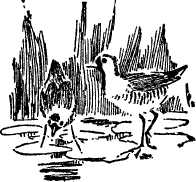
Yan was here one day sketching the trunk of a
Hemlock to pass the watching time, but also because
he had learned to love that old tree. He never
sketched because he loved sketching; he did not;
the motive always was love of the thing he was
drawing.
A Black-and-white Creeper had crawled like a
Lizard over all the trunks in sight. A Downy
Woodpecker had digged a worm out of a log by
labour that most birds would have thought ill-paid
by a dozen such worms. A Chipmunk had come
nearer and nearer till it had actually run over his
foot and then scurried away chattering in dismay
at its own rashness; finally, a preposterous little
Cock Chickadee sang "Spring soon—spring soon," as
though any one were interested in the gratuitous and
unconvincing fib, when a brown, furry form hopped
noiselessly from the green leaves by the pond,
351
skipped over a narrow bay without wetting its feet,
paused once or twice, then in the middle of the open
glade it sat up in plain view—a Rabbit. It sat so
long and so still that Yan first made a sketch that
took three of four minutes, then got out his watch
and timed it for three minutes longer before it
moved in the least. Then it fed for some time,
and Yan tried to make a list of the things it ate
and the things it shunned, but could not do so
with certainty.
A noisy Flicker came out and alighted close by on
a dried branch. The Rabbit, or really a Northern
Hare, "froze"—that is, became perfectly still for a
moment—but the Flicker marks were easy to read
and had long ago been learned as the uniform of a
friend, so the Rabbit resumed his meal, and when
the Flicker flew again he paid no heed. A Crow
passed over, and yet another. "No; no danger
from them." A Red-shouldered Hawk wailed in
the woods; the Rabbit heard that and every other
sound, but the Red-shoulder is not dangerous,
and he knew it. A large Hawk with red tail
circled silently over the glade, and the Rabbit
froze on the instant. That same red tail was the
mark of a dreaded foe. How well Bunny had
learned to know them all!
A bunch of clover tempted him to a full repast,
after which he hopped into a tussock in the midst
of the glade and there turned himself into a moss-bump,
his legs swallowed up in his fur, and his ears
laid over his back like a pair of empty gloves or
352
a couple of rounded shingles; his nose-wabblings
reduced in number, and he seemed to be sleeping in
the last warm rays of the sun. Yan was very
anxious to see whether his eyes were open or not;
he had been told that Rabbits sleep with open eyes,
but at this distance he could not be sure. He had
no field-glass and Guy was not at hand, so the point
remained in doubt.
The last sun-blots had gone from the trail and the
pond was all shadowed by the trees on the western
side. A Robin began its evening hymn on a tall
tree, where it could see the red sun going down, and
a Veery was trilling his weary, weary, weary in the
Elder thicket along the brook, when another, a
larger animal, loomed up in the distant trail and
glided silently toward Yan. Its head was low
and he could not make out what it was. As it stood
there for a few seconds Yan wet his finger in his
mouth and held it up. A slight coolness on the
side next the coming creature told Yan that the
breeze was from it to him and would not betray him.
It came on, seeming to grow larger, turned a little
to one side, and then Yan saw plainly by the sharp
nose and ears and the bushy tail that it was nothing
less than a Fox, probably the one that often barked
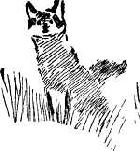 near camp at night.
It was trotting away at an angle, knowing nothing
of the watching boy nor of the crouching Rabbit,
when Yan, merely to get a better look at the cunning
one, put the back of his hand to his mouth and by
353
sucking made a slight Mouse-like squeak, sweetest
music, potent spellbinder, to a hungry Fox, and
he turned like a flash. For a moment he stood,
head erect, full of poise and force in curb; a
second squeak—he came slowly back toward the
sound and in so doing passed between Yan and the
Rabbit. He had crossed its old trail without feeling
much interest, but now the breeze brought its
body scent. Instantly the Fox gave up the Mouse
hunt—no hunter goes after Mice when big game
is at hand—and began an elaborate and beautiful
stalk of the Rabbit—the Rabbit that he had not seen.
But his nose was his best guide. He cautiously zigzagged
up the wind, picking his steps with the greatest
care, and pointing with his nose like a Pointer Dog.
Each step was bringing him nearer to Bunny
as it slept or seemed asleep in the tussock. Yan
wondered whether he ought not to shout out and
end the stalk before the Rabbit was caught, but
as a naturalist he was eager to see the whole thing
out and learn how the Fox would make the capture.
The red-furred gentleman was now within fifteen
feet of the tussock and still the gray one moved not.
Now he was within twelve feet—and no move;
ten feet—and Bunny seemed in tranquil sleep;
eight feet—and now the Fox for the first time seemed
to actually see his victim. Yan had hard work to
keep from shouting a warning; six feet—and now
the Fox was plainly preparing for a final spring.
354
"Is it right to let him?" and Yan's heart beat
with excitement.
The Fox brought his feet well under him, tried the
footing till it was perfect, gathered all his force,
then with silent, vicious energy sprung straight for
the sleeper. Sleeping? Oh, no! Not at all. Bunny
was playing his own game. The moment the Fox
leaped, he leaped with equal vigour the opposite
way and out under his enemy, so Reynard landed
on the empty bunch of grass. Again he sprang,
but the Rabbit had rebounded like a ball in the
other direction, and continued this bewildering
succession of marvellous erratic hops. The Fox in
vain tried to keep up, for these wonderful side jumps
are the Rabbit's strength and the Fox's weakness;
and Bunny went zigzag—hop—skip—into the thicket
and was gone before the Fox could get his heavier
body under speed at all.
Had the Rabbit bounded out as soon as he saw
the Fox coming he might have betrayed himself
unnecessarily; had he gone straight away when the
Fox leaped for him he might have been caught
in three or four leaps, for the enemy was under full
speed, but by biding his time he had courted no
danger, and when it did come he had played the
only possible offset, and "lives in the greenwood
still."
The Fox had to seek his supper somewhere else,
and Yan went to camp happy in having learned
another of the secrets of the woods.
"What do you mean when you say Indian signs,
Mr. Clark?"
"Pretty near anything that shows there's
Injuns round: a moccasin track, a smell of smoke, a
twig bent, a village, one stone a-top of another or a
white settlement scalped and burned—they all are
Injun signs. They all mean something, and the
Injuns read them an' make them, too, jest as you
would writing."
"You remember the other day you told us three
smokes meant you were coming back with scalps."
"Well, no; it don't har'ly mean that. It means
'Good news'—that is, with some tribes. Different
tribes uses 'em different."
"Well, what does one smoke mean?"
"As a rule just simply 'Camp is here'"
"And two smokes?"
"Two smokes means 'Trouble'—may mean, 'I am
lost.'"
"I'll remember that; double for trouble."
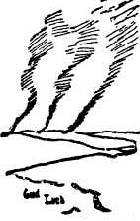 "Three means good news. There's luck in odd
numbers."
"Three means good news. There's luck in odd
numbers."
"And what is four?"
356
"Well, it ain't har'ly ever used. If I seen four
smokes in camp I'd know something big was on—maybe
a Grand Council."
"Well, if you saw five smokes what would you
think?"
"I'd think some blame fool was settin' the hull
place a-blaze," Caleb replied with the sniff end of a
laugh.
"Just now you said one stone on another was a
sign. What does it mean?"
"Course I can't speak for all Injuns. Some has
it for one thing an' some for another, but usually
in the West two stones or 'Buffalo chips' settin' one
on the other means 'This is the trail'; and a little
stone at the left of the two would mean 'Here we
turned off to the left'; and at the other side, 'Here
we turned to the right.' Three stones settin' one
on top of another means, 'This is sure enough the
trail,' 'Special' or 'Particular' or 'Look out'; an' a
pile of stones just throwed together means 'We
camped here 'cause some one was sick.' They'd be
the stones used for giving the sick one a steam bath."
"Well, what would they do if there were no stones?"
"Ye mean in the woods?"
"Yes, or smooth prairie."
"Well, I pretty near forget, it's so long ago, but
le's see now," and Yan worried Caleb and Caleb
threshed his memory till they got out a general
scheme, or Indian code, though Caleb was careful
to say that "some Injuns done it differently."
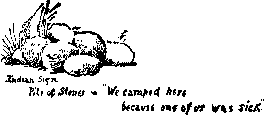
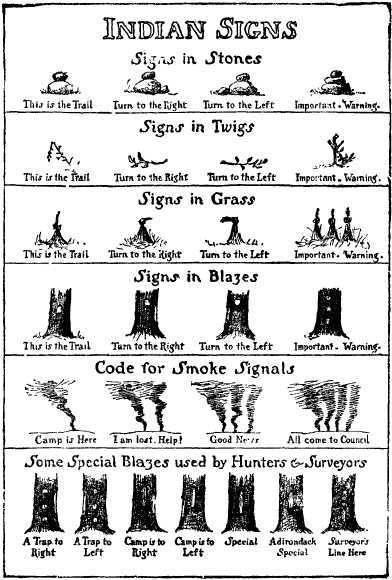
359
Yan must needs set about making a signal fire
at once, and was disappointed to find that a hundred
yards away the smoke could not be seen above
the tree-tops, till Caleb showed him the difference
between a clear fire and a smoke or smudge fire.
"Begin with a clear fire to get the heat, then
smother it with green grass and rotten wood. There,
now you see the difference," and a great crooked,
angling pillar of smoke rolled upward as soon as
the grass and punk began to sizzle in the glow of
embers.
"I bet ye kin see that ten miles away if ye'r on a
high place to look for it."
"I bet I could see it twenty miles," chirped in
Guy.
"Mr. Clark, were you ever lost?" continued the
tireless asker.
"Why, course I was, an' more than once. Every
one that goes in the woods is bound to get lost once
in awhile."
"What—do the Indians?"
"Of course! Why not? They're human, an' I
tell you when you hear a man brag that he never
was lost, I know he never was far from his mother's
apron string. Every one is bound to get lost, but
the real woodsman gets out all right; that's the
difference."
"Well, what would you do if you got lost?"
"Depends on where. If it was a country that I
didn't know, and I had friends in camp, after I'd
tried my best I'd jest set right down and make two
360
smoke fires. 'Course, if I was alone I'd try to make
a bee line in the likeliest direction, an' this is easy to
make if ye kin see the sun and stars, but stormy
weather 'tain't possible. No man kin do it, an' if
ye don't know the country ye have to follow some
stream; but I'm sorry for ye if ever ye have to do
that, for it's the worst walking on earth. It will
surely bring ye out some place—that is, it will
keep ye from walking in a circle—but ye can't make
more than four or five miles a day on it."
"Can't you get your direction from moss on the
tree trunks?"
"Naw! Jest try it an' see; moss on the north
side of a tree and rock; biggest branches on the
south of a trunk; top of a Hemlock pointing to east;
the biggest rings of growth on the south side of a
stump, an' so on. It fits a tree standin' out by
itself in the open—the biggest ring is in the south,
but it don't fit a tree on the south side of an opening;
then the biggest rings is on the north. If ye have
a compass in hand it's all kind o' half true—that
is, just a little bit true; but it ain't true; it's on'y
a big lie, when ye'r scared out o' your wits an'
needin' to know. I never seen but one good compass
plant, an' that was the prairie Golden Rod.
Get a bunch of them in the open and the most of
them point north, but under cover of taller truck
they jest point every which way for Sunday.
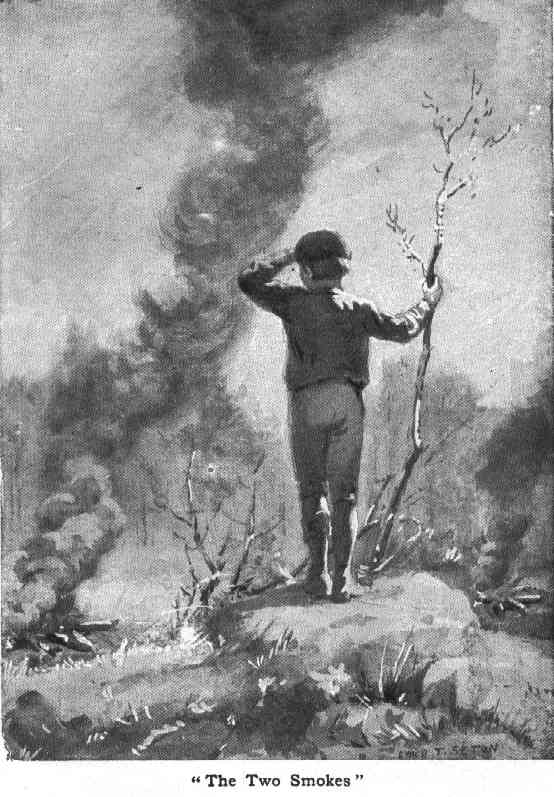
"If ye find a beaten game trail, ye follow that
an it'll bring ye to water—that is, if ye go the
right way, an' that ye know by its gettin' stronger.
If it's peterin' out, ye'r goin' in the wrong direction.
A flock of Ducks or a Loon going over is sure to be
pointing for water. Y're safe to follow.
"If ye have a Dog or a Horse with ye he kin
bring ye home all right. Never knew them to fail
but oncet, an' that was a fool Horse; there is sech
oncet in awhile, though there's more fool Dogs.
"But come right down to it, the compass is the
safest thing. The sun and stars is next, an' if ye
know your friends will come ye'r best plan is to
set right down and make two smoke fires, keep
them a-going, holler every little while, and keep
calm. Ye won't come to no harm unless ye'r a
blame fool, an' such ought to stay to hum, where
they'll be nursed."
Sam had made a find. A Calf had been killed
and its skin hung limp on a beam in the barn.
His father allowed him to carry this off, and
now he appeared with a "fresh Buffalo hide to
make a robe."
"I don't know how the Injuns dress their robes,"
he explained, "but Caleb does, and he'll tell you,
and, of course, I'll pay no attention."
The old Trapper had nothing to do, and the only
bright spots in his lonely life, since his own door
was shut in his face, were visits to the camp. These
had become daily, so it was taken as a matter of
course when, within an hour after Sam's return, he
"happened round."
"How do the Indians tan furs and robes?" Yan
asked at once.
"Wall, different ways—"
But before he could say more Hawkeye reappeared
and shouted:
"Say, boys, Paw's old Horse died!" and he grinned
joyfully, merely because he was the bearer of news.
"Sappy, you grin so much your back teeth is
gettin' sunburned," and the Head Chief eyed him
365
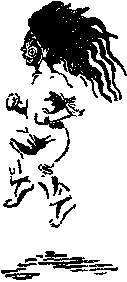 sadly.
"Well, it's so, an' I'm going to skin out his tail
for a scalp. I bet I'll be the Injunest one of the
crowd."
"Why don't you skin the hull thing, an' I'll show
you how to make lots of Injun things of the hide,"
Caleb added, as he lighted his pipe.
"Will you help me?
"It's same as skinnin a Calf. I'll show you
where to get the sewing sinew after the hide's off."
So the whole camp went to Burns's field. Guy
hung back and hid when he saw his father there
drawing the dead Horse away with the plough
team.
"Good-day, Jim," was Caleb's greeting, for they
were good friends. "Struck hard luck with the
Horse?"
"No! Not much. Didn't cost nothing; got him
for boot in a swap. Glad he's dead, for he was
foundered."
"We want his skin, if you don't."
"You're welcome to the hull thing."
"Well, just draw it over by the line fence
we'll bury what's left when we're through."
"All right. You hain't seen that durn boy o'
mine, have you?"
"Why, yes; I seen him not long ago," said Sam.
"He was p'inting right for home then."
"H-m. Maybe I'll find him at the house."
366
"Maybe you will." Then Sam added under his
breath, "I don't think."
So Burns left them, and a few minutes later Guy
sneaked out of the woods to take a secondary part
in the proceedings.
Caleb showed them how to split the skin along
the under side of each leg and up the belly. It
was slow work skinning, but not so unpleasant as
Yan feared, since the animal was fresh.
Caleb did the most of the work; Sam and Yan
helped. Guy assisted with reminiscences of his
own Calf-skinning and with suggestions drawn from
his vast experiences.
When the upper half of the skin was off, Caleb
remarked: "Don't believe we can turn him over,
and when the Injuns didn't have a Horse at hand
to turn over the Buffalo they used to cut the skin
in two down the line of the back. I guess we
better do that. We've got all the rawhide we need,
anyhow."
So they cut off the half they had skinned, took the
tail and the mane for "scalps," and then Caleb sent
Yan for the axe and a pail.
He cut out a lump of liver and the brains of the
Horse. "That," said he, "is for tanning, an' here
is where the Injun woman gits her sewing thread."
He made a deep cut alongside the back bone from
the middle of the back to the loin, then forcing his
fingers under a broad band of whitish fibrous tissue,
he raised it up, working and cutting till it ran down
to the hip bone and forward to the ribs. This
367
sewing sinew was about four inches wide, very thin,
and could easily be split again and again till it was
like fine thread.
"There," he said, "is a hank o' thread. Keep
that. It'll dry up, but can be split at any time, and
soaking in warm water for twenty minutes makes
it soft and ready for use. Usually, when she's
sewing, the squaw keeps a thread soaking in her
mouth to be ready. Now we've got a Horse skin
and a Calfskin I guess we better set up a tan-yard."
"Well, how do you tan furs, Mr. Clark?"
"Good many different ways. Sometimes just
scrape and scrape till I get all the grease and meat
off the inside, then coat it with alum and salt and
leave it rolled up for a couple of days till the alum
has struck through and made the skin white at the
roots of the hair, then when this is half dry pull
and work it till it is all soft.
"But the Injuns don't have alum and salt, and
they make a fine tan out of the liver and brains, like
I'm going to do with this."
"Well, I want to do it the Indian way."
"All right, you take the brains and liver of your
Calf."
"Why not some of the Horse brains and liver?"
"Oh, I dunno. They never do it that way that
I've seen. Seems like it went best with its own
brains."
"Now," remarked the philosophical Woodpecker,
"I call that a wonderful provision of nature, always
368
to put Calf brains and liver into a Calfskin, and just
enough to tan it."
"First thing always is to clean your pelt, and
while you do that I'll put the Horsehide in the mud
to soak off the hair." He put it in the warm mud
to soak there a couple of days, just as he had done
the Calfskin for the drum-heads, then came to superintend
the dressing of the Buffalo "robe."
Sam first went home for the Calf brains and liver,
then he and Yan scraped the skin till they got out
a vast quantity of grease, leaving the flesh side
bluish-white and clammy, but not greasy to the
touch. The liver of the Calf was boiled for an hour
and then mashed up with the raw brains into a
tanning "dope" or mash and spread on the flesh
side of the hide, which was doubled, rolled up and
put in a cool place for two days. It was then opened
out, washed clean in the brook and hung till nearly
dry. Then Caleb cut a hardwood stake to a sharp
edge and showed Yan how to pull and work the hide
over the edge till it was all soft and leathery.
 The treatment of the Horsehide was the same,
once the hair was removed, but the greater thickness
needed a longer soaking in the "tan dope."
The treatment of the Horsehide was the same,
once the hair was removed, but the greater thickness
needed a longer soaking in the "tan dope."
After two days the Trapper scraped it clean and
worked it on the sharp-edged stake. It soon began to
look like leather, except in one or two spots. On
examining these he said:
"H-m, Tanning didn't strike right through every
place. So he buttered it again with the mash and
369
gave it a day more; then worked it as before over
the angle of the pole till it was soft and fibrous.
"There," said he, "that's Injun tan leather. I
have seen it done by soaking the hide for a few
days in liquor made by boiling Hemlock or Balsam
bark in water till it's like brown ink, but it
ain't any better than that. Now it needs one thing
more to keep it from hardening after being wet.
It has to be smoked."
So he made a smoke fire by smothering a clear
fire with rotten wood; then fastening the Horsehide
into a cone with a few wooden pins, he hung
it in the dense smoke for a couple of hours, first
one side out, then the other till it was all of a rich
smoky-tan colour and had the smell so well known
to those who handle Indian leather.
"There it is; that's Injun tan, an' I hope you see
that elbow grease is the main thing in tannin'."
"Now, will you show us how to make moccasins
and war-shirts?" asked Little Beaver, with his usual
enthusiasm.
"Well, the moccasins is easy, but I won't promise
about the war-shirts. That's pretty much a case
of following the pattern of your own coat, with the
front in one piece, but cut down just far enough for
your head to go through, instead of all the way,
and fixed with tie-strings at the throat and fringes at
the seams and at the bottom; it hain't easy to do.
But any one kin larn to make moccasins. There is
two styles of them—that is, two main styles. Every
370
Tribe has its own make, and an Injun can tell what
language another speaks as soon as he sees his footgear.
The two best known are the Ojibwa, with soft
sole—sole and upper all in one, an' a puckered instep—that's
what Ojibwa means—'puckered moccasin.'
The other style is the one most used in the Plains.
You see, they have to wear a hard sole, 'cause the
country is full of cactus and thorns as well as sharp
stones."
"I want the Sioux style. We have copied their
teepee and war bonnet—and the Sioux are the best
Indians, anyway."
"Or the worst, according to what side you're on,"
was Caleb's reply. But he went on: "Sioux Injuns
are Plains Injuns and wear a hard sole. Let's see,
now. I'll cut you a pair."
"No, make them for me. It's my Horse," said
Guy.
"No, you don't. Your Paw give that to me."
Caleb's tone said plainly that Guy's laziness had
made a bad impression, so he had to stand aside
while Yan was measured. Caleb had saved a part
of the hide untanned though thoroughly cleaned.
This was soaked in warm water till soft. Yan's
foot was placed on it and a line drawn around the
foot for a guide; this when cut out made the sole of
one moccasin (A, cut below), and by turning it underside
up it served as pattern to cut the other.
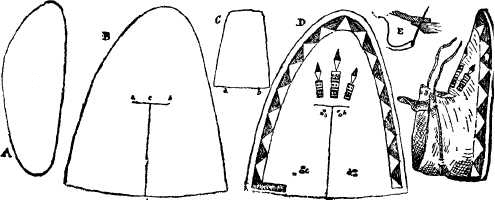
Now Caleb measured the length of the foot and
added one inch, and the width across the instep, adding
371
half an inch, and with these as greatest length and
breadth cut out a piece of soft leather (B). Then in
this he made the cut a b on the middle line one way
and c d on the middle line the other way. A second
piece the reverse of this was cut, and next a piece
of soft leather for inside tongue (C) was sewn to the
large piece (B), so that the edge a b of C was fast
to a b of B. A second piece was sewn to the other
leather (B reversed).
"Them's your vamps for uppers. Now's the time
to bead 'em if you want to."
"Don't know how."
"Well, I can't larn you that; that's a woman's
work. But I kin show you the pattern of the first
pair I ever wore; I ain't likely to forget 'em, for I
killed the Buffalo myself and seen the hull making."
He might have added that he subsequently married
the squaw, but he did not.
"There's about the style" [D]. "Them three-cornered
red and white things all round is the hills
where the moccasins was to carry me safely; on
the heel is a little blue pathway with nothing in it:
that is behind—it's past. On the instep is three
red, white and blue pathways where the moccasin
was to take me: they're ahead—in the future. Each
path has lots of things in it, mostly changes and
trails, an' all three ends in an Eagle feather—that
stands for an honour. Ye kin paint them that way
after they're made. Well, now, we'll sew on the
upper with a good thick strand of sinew in the
372
needle—or if you have an awl you kin do without
a needle on a pinch—and be sure to bring the stitches
out the edge of the sole instead of right through,
then they don't wear off. That's the way." [E.]
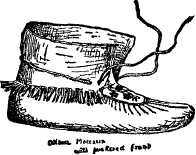
So they worked away, clumsily, while Guy snickered
and sizzled, and Sam suggested that Si Lee would
make a better squaw than both of them.
The sole as well as the upper being quite soft
allowed them to turn the moccasin inside out as
often as they liked—and they did like; it seemed
necessary to reverse it every few minutes. But at
length the two pieces were fastened together all
around, the seam gap at the heel was quickly sewn
up, four pairs of lace holes were made (a, b, c, d, in
D), and an eighteen-inch strip of soft leather run
through them for a lace.
Now Yan painted the uppers with his Indian
paints in the pattern that Caleb had suggested, and
the moccasins were done.
A squaw would have made half a dozen good
pairs while Yan and Caleb made the one poor pair,
but she would not have felt so happy about it.
The tracks of Mink appeared from time to time
on Yan's creekside mud albums, and at length
another of these tireless watchers, placed at
the Wakan Rock, reported to him that Mink as well
as Skunks came there now for a nightly feast.
The Mink was a large one, judging by the marks,
and Caleb was asked to help in trapping it.
 "How do you trap Mink, Mr. Clark?" was the
question.
"How do you trap Mink, Mr. Clark?" was the
question.
"Don't trap 'em at all this time o' year, for they're
no good till October," was the answer.
"Well, how do you trap them when they are in
season?"
"Oh, different ways."
It was slow work, but Yan kept on and at length
got the old man going.
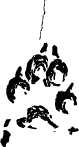 "Airly days we always used a deadfall for Mink.
That's made like this, with a bird or a Partridge
head for bait. That kills him sure, sudden and
merciful. Then if it's cold weather he freezes and
keeps O.K. till you come around to get him; but
in warm weather lots o' pelts are spoiled by being
kept too long, so ye have to go round pretty often
to save all you kill. Then some one brought in
374
them new-fangled steel traps that catches them by
the foot and holds them for days and days, some
times, till they jest starve to death or chaw their
foot off to get free. I mind once I ketched a Mink
with only two legs left. He had been in a steel trap
twice before and chawed off his leg to get away.
Them traps save the trapper going round so often,
but they're expensive, and heavy to carry, and you
have got to be awful hard-hearted before ye kin
use 'em. I tell ye, when I thought of all the sufferin'
that Mink went through it settled me for steel
traps. Since then, says I, if ye must trap, use a
deadfall or a ketchalive, one or other; no manglin'
an' tormentin' for days. I tell ye that thar new
Otter trap that grabs them in iron claws ought to
be forbid by law; it ain't human.
"Airly days we always used a deadfall for Mink.
That's made like this, with a bird or a Partridge
head for bait. That kills him sure, sudden and
merciful. Then if it's cold weather he freezes and
keeps O.K. till you come around to get him; but
in warm weather lots o' pelts are spoiled by being
kept too long, so ye have to go round pretty often
to save all you kill. Then some one brought in
374
them new-fangled steel traps that catches them by
the foot and holds them for days and days, some
times, till they jest starve to death or chaw their
foot off to get free. I mind once I ketched a Mink
with only two legs left. He had been in a steel trap
twice before and chawed off his leg to get away.
Them traps save the trapper going round so often,
but they're expensive, and heavy to carry, and you
have got to be awful hard-hearted before ye kin
use 'em. I tell ye, when I thought of all the sufferin'
that Mink went through it settled me for steel
traps. Since then, says I, if ye must trap, use a
deadfall or a ketchalive, one or other; no manglin'
an' tormentin' for days. I tell ye that thar new
Otter trap that grabs them in iron claws ought to
be forbid by law; it ain't human.
"Same way about huntin'. Huntin's great sport,
an' it can't be bad, 'cause I can't for the life of me
see that it makes men bad. 'Pears to me men as hunt
is humaner than them as is above it; as for the
cruelty—wall, we know that no wild animal dies
easy abed. They all get killed soon or late, an'
if it's any help to man to kill them I reckon he has
as good a right to do it as Wolves an' Wildcats.
It don't hurt any more—yes, a blame sight less—to
be killed by a rifle ball than to be chawed by Wolves.
The on'y thing I says is don't do it cruel—an' don't
wipe out the hull bunch. If ye never kill a thing
that's no harm to ye 'live an' no good to ye dead
nor more than the country kin stand, 'pears to me
375
ye won't do much harm, an' ye'll have a lot o' real
fun to think about afterward.
"But I mind a feller from Europe, some kind o'
swell, that I was guidin' out West. He had crippled
a Deer so it couldn't get away. Then he sat down
to eat lunch right by, and every few moments he'd
fire a shot into some part or another, experimentin'
an' aimin' not to kill it for awhile. I heard the
shootin' an' blattin', an when I come up I tell ye
it set my blood a-boilin'. I called him some names
men don't like, an' put that Deer out o' pain quick
as I could pull trigger. That bu'st up our party—I
didn't want no more o' him. He come pretty
near lyin' by the Deer that day. It makes me hot
yet when I think of it.
"If he'd shot that Deer down runnin' an' killed
it as quick as he could it wouldn't 'a' suffered more
than if it had been snagged a little, 'cause bullets
of right weight numb when they hit. The Deer
wouldn't have suffered more than he naturally would
at his finish, maybe less, an' he'd 'a' suffered it at a
time when he could be some good to them as hunted
him. An' these yer new repeatin' guns is a curse.
A feller knows he has lots of shot and so blazes
away into a band o' Deer as long as he can see, an
lots gets away crippled, to suffer an' die; but when
a feller has only one shot he's going to place it
mighty keerful. Ef it's sport ye want, get a single-shot
rifle, ef it's destruction, get a Gatling-gun.
376
"Sport's good, but I'm agin this yer wholesale killin'
an' cruelty. Steel traps, light-weight bullets an'
repeatin' guns ain't human. I tell ye it's them as
makes all the sufferin'."
This was a long speech for Caleb, but it was
really less connected than here given. Yan had to
keep him going with occasional questions. This
he followed up.
"What do you think about bows and arrows,
Mr. Clark?"
"I wouldn't like to use them on big game like
Bear and Deer, but I'd be glad if shotguns was done
away with and small game could be killed only
with arrows. They are either sure death or clear
miss. There's no cripples to get away and die.
You can't fire an arrow into a flock of birds and
wipe out one hundred, like you can with one of them
blame scatterguns. It's them things that is killing
off all the small game. Some day they'll invent a
scattergun that is a pump repeater like them new
rifles, and when every fool has one they'll wonder
where all the small game has gone to.
"No, sir, I'm agin them. Bows and arrows is
less destructful an' calls for more Woodcraft an'
give more sport—that is, for small game. Besides,
they don't make that awful racket, an' you know
who is the party that owns the shot, for every
arrow is marked."
Yan was sorry that Caleb did not indorse the arrow
for big game, too.
377
The Trapper was well started now; he seemed
ready enough with information to-day, and Yan
knew enough to "run the rapids on the freshet."
"How do you make a ketchalive?"
"What for?"
"Oh, Mink."
"They ain't fit to catch now, and the young ones
need the mothers."
"I wouldn't keep it. I only want to make a
drawing."
"Guess that won't harm it if you don't keep it
too long. Have ye any boards? We used to
chop the whole thing out of a piece of Balsam wood
or White Pine, but the more stuff ye find ready-made
the easier it is. Now I'll show you how to
make a ketchalive if ye'll promise me never to
miss a day going to it while it is set."
The boys did not understand how any one could
miss a day in visiting a place of so much interest,
and readily promised.
So they made a ketchalive, or box-trap, two feet
long, using hay wire to make a strong netting at
one end.
"Now," said the trapper, "that will catch Mink,
Muskrat, Skunk, Rabbit—'most anything, 'cording
to where you put it and how you bait it."
"Seems to me the Wakan Rock will be a good
place to try."
So the trap was baited with a fish head firmly
lashed on the wire trigger.
378
In the morning, as Yan approached, he saw that
it was sprung. A peculiar whining and scratching
came from it and he shouted in great excitement:
"Boys, boys, I've got him! I've got the Mink!"
They seized the trap and held it cautiously up
for the sunlight to shine through the bars, and there
saw to their disgust that they had captured only
the old gray Cat. As soon as the lid was raised she
bounded away, spitting and hissing, no doubt to
hurry home to tell the Kittens that it was all right,
although she had been away so long.
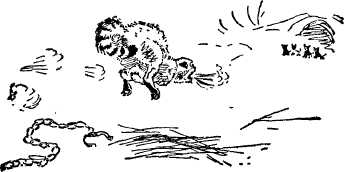
Sam, I must have another note-book. It's no
good getting up a new 'massacree' of Whites,
'cause there ain't any note-books there, but
maybe your father would get one the next time
he drove to Downey's Dump. I suppose I'll have
to go on a peace party to ask him."
Sam made no answer, but looked and listened out
toward the trail, then said: "Talk of the er—Angels,
here comes Da."
When the big man strode up Yan and Guy became
very shy and held back. Sam, in full war-paint,
prattled on in his usual style.
"Morning, Da; I'm yer kid. Bet ye'r in trouble
an' want advice or something."
Raften rolled up his pendulous lips and displayed
his huge front tusks in a vast purple-and-yellow
grin that set the boys' hearts at ease.
"Kind o' thought you'd be sick av it before now."
"Will you let us stay here till we are?" chimed in
Sam, then without awaiting the reply that he did
not want, "Say, Da, how long is it since there was
any Deer around here?"
"Pretty near twenty years, I should say."
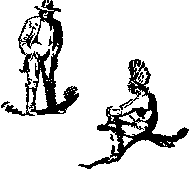
"Well, look at that now," whispered the Woodpecker.
Raften looked and got quite a thrill for the
dummy, half hidden in the thicket, looked much
like a real deer.
"Don't you want to try a shot?" ventured Yan.
Raften took the bow and arrow and made such a
poor showing that he returned them with the remark.
"Sure a gun's good enough for me," then, "Ole
Caleb been around since?"
"Old Caleb? I should say so; why, he's our stiddy
company."
"'Pears fonder o'you than he is of me."
"Say, Da, tell us about that. How do you know
it was Caleb shot at you?"
"Oh, I don't know it to prove it in a coort o' law,
but we quarr'led that day in town after the Horse
trade an' he swore he'd fix me an' left town. His
own stepson, Dick Pogue, stood right by and heard
him say it; then at night when I came along the road
by the green bush I was fired at, an' next day we
found Caleb's tobacco pouch and some letters not
far away. That's about all I know, an' all I want to
know. Pogue served him a mean trick about the
farm, but that's none o' my business. I 'spect the
old fellow will have to get out an' scratch for himself
pretty soon."
"He seems kind-hearted," said Yan.
"Ah, he's got an awful temper, an' when he gets
drunk he'd do anything. Other times he's all right."
"Well, how is it about the farm?" Sam asked.
"Doesn't he own it?"
"No, I guess not now. I don't r'aly know. I
only hear them say. Av coorse, Saryann ain't his
own daughter. She's nowt o' kin, but he has no
one else, and Dick was my hired man—a purty slick
feller with his tongue; he could talk a bird off a bush;
but he was a good worker. He married Sary and
persuaded the old man to deed them the place, him
to live in comfort with them to the end of his days.
But once they got the place, 'twas aisy to see that
Dick meant to get rid o' Caleb, an' the capsheaf
was put last year, about his Dog, old Turk. They
wouldn't have him 'round. They said he was
scaring the hens and chasing sheep, which is like
enough, for I believe he killed wan ov my lambs,
an' I'd give ten dollars to have him killed—making
sure 'twas him, av coorse. Rather than give up the
Dog, Caleb moved out into the shanty on the creek
at the other end of the place. Things was better
then, for Dick and Saryann let up for awhile an'
sent him lots o' flour an' stuff, but folks say they're
fixin' it to put the old man out o' that and get shet
of him for good. But I dunno; it's none o' my
business, though he does blame me for putting Dick
up to it."
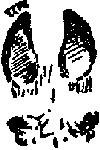
"How's the note-book?" as Raften's eye caught
sight of the open sketch-book still in Yan's hand.
"Oh, that reminds me," was the reply. "But
what is this?" He showed the hoof-mark be had
sketched. Raften examined it curiously.
382
"H-m, I dunno'; 'pears to me moighty loike a big
Buck. But I guess not; there ain't any left."
"Say, Da," Sam persisted, "wouldn't you be sore
if you was an old man robbed and turned out?"
"Av coorse; but I wouldn't lose in a game of swap-horse,
an' then go gunnin' after the feller. If I had
owt agin him I'd go an' lick him or be licked, an'
take it all good-natured. Now that's enough. We'll
talk about something else."
"Will you buy me another note-book next time
you go to Downey's Dump? I don't know how
much it will cost or I'd give you the money," said
Yan, praying mentally that it be not more than the
five or ten cents which was all his capital.
"Shure; I'll charge it up. But ye needn't wait
till next week. Thayer's one back at the White
settlement ye can have for nothin'."
"Say, Mr. Raften," Guy broke in, "I kin lick them
all at Deer-hunting."
Sam looked at Yan and Yan looked at Sam, then
glanced at Guy, made some perfectly diabolical
signs, seized each a long knife and sprung toward
the Third War Chief, but he dodged behind Raften
and commenced his usual "Now you let me
'lone—"
Raften's eye twinkled. "Shure, I thought ye was
all wan Tribe an' paceable."
"We've got to suppress crime," retorted his son.
"Make him let me 'lone," whimpered Sapwood.
"We'll let ye off this time if ye find that Woodchuck.
It's near two days since we've had a
383
skirmish."
"All right," and he went. Within five minutes
he came running back, beckoning. The boys got
their bows and arrows, but fearing a trick they held
back. Guy dashed for his own weapons with unmistakable
and reassuring zest; then all set out for the
field. Raften followed, after asking if it would be
safe for him to come along.
The grizzly old Woodchuck was there feeding in
a bunch of clover. The boys sneaked under the
fence, crawling through the grass in true Injun
fashion, till the Woodchuck stood up to look around,
then they lay still; when he went down they crawled
again, and all got within forty yards. Now the old
fellow seemed suspicious, so Sam said, "Next time
he feeds we all fire together." As soon, then, as the
Woodchuck's breast was replaced by the gray back,
the boys got partly up and fired. The arrows
whizzed around Old Grizzly, but all missed, and he
had scrambled to his hole before they could send a
second volley.
"Hallo, why didn't you hit him, Sappy?"
"I'll bet I do next time."
When they returned to Raften he received them
with ridicule.
"But ye'r a poor lot o' hunters. Ye'd all
starve if it wasn't for the White settlement nearby.
Faith, if ye was rale Injun ye'd sit up all night
at that hole till he come out in the morning:
then ye'd get him; an' when ye get through with
384
that one I've got another in the high pasture ye kin
work on."
So saying, he left them, and Sam called after
him:
"Say, Da; where's that note-book for Yan? He's
the Chief of the 'coup-tally,' and I reckon he'll soon
have a job an' need his book. I feel it in my bones."
"I'll lave it on yer bed." Which he did, and Yan
and Sam had the pleasure of lifting it out of the
window with a split stick.

One day as the great Woodpecker lay on his
back in the shade he said in a tone of lofty
command:
"Little Beaver, I want to be amused. Come hyar.
Tell me a story."
"How would you like a lesson in Tutnee?" was
the Second Chief's reply, but he had tried this before,
and he found neither Sam nor Guy inclined to take
any interest in the very dead language.
"Tell me a story, I said," was the savage answer
of the scowling and ferocious Woodpecker.
"All right," said Little Beaver. "I'll tell you
a story of such a fine boy—oh, he was the noblest
little hero that ever wore pantaloons or got spanked
in school. Well, this boy went to live in the woods,
and he wanted to get acquainted with all the living
wild things. He found lots of difficulties and no one
to help him, but he kept on and on—oh! he was so
noble and brave—and made notes, and when he
learned anything new he froze on to it like grim
death. By and by he got a book that was some help,
but not much. It told about some of the birds as
if you had them in your hand. But this heroic youth
only saw them at a distance and he was stuck. One
day he saw a wild Duck on a pond so far away he
could only see some spots of colour, but he made a
386
 sketch of it, and later he found out from that rough
sketch that it was a Whistler, and then this wonderful
boy had an idea. All the Ducks are different; all
have little blots and streaks that are their labels, or
like the uniforms of soldiers. 'Now, if I can put
their uniforms down on paper I'll know the Ducks
as soon as I see them on a pond a long way off.' So
he set to work and drew what he could find. One
of his friends had a stuffed Wood-duck, so the
'Boy-that-wanted-to-know'
drew that from a long way off.
He got another from an engraving and two more from
the window of a taxidermist shop. But he knew
perfectly well that there are twenty or thirty different
kinds of Ducks, for he often saw others at a distance
and made far-sketches, hoping some day he'd find
out what they were. Well, one day the 'Boy-that-wanted-to-know'
sketched a new Duck on a pond,
and he saw it again and again, but couldn't find out
what it was, and there was his b-e-a-u-t-i-f-u-l sketch,
but no one to tell him its name, so when he saw that
he just had to go into the teepee and steal the First
War Chief's last apple and eat it to hide his emotion."
sketch of it, and later he found out from that rough
sketch that it was a Whistler, and then this wonderful
boy had an idea. All the Ducks are different; all
have little blots and streaks that are their labels, or
like the uniforms of soldiers. 'Now, if I can put
their uniforms down on paper I'll know the Ducks
as soon as I see them on a pond a long way off.' So
he set to work and drew what he could find. One
of his friends had a stuffed Wood-duck, so the
'Boy-that-wanted-to-know'
drew that from a long way off.
He got another from an engraving and two more from
the window of a taxidermist shop. But he knew
perfectly well that there are twenty or thirty different
kinds of Ducks, for he often saw others at a distance
and made far-sketches, hoping some day he'd find
out what they were. Well, one day the 'Boy-that-wanted-to-know'
sketched a new Duck on a pond,
and he saw it again and again, but couldn't find out
what it was, and there was his b-e-a-u-t-i-f-u-l sketch,
but no one to tell him its name, so when he saw that
he just had to go into the teepee and steal the First
War Chief's last apple and eat it to hide his emotion."
Here Yan produced an apple and began to eat it
with an air of sadness.
Without changing a muscle, the Great Woodpecker
continued the tale:
"Then when the First War Chief heard the harrowing
tale of a blighted life, he said: 'Shucks, I didn't
want that old apple. It was fished out of the swill-barrel
anyway, but 'pears to me when a feller sets
389
out to do a thing an' don't he's a 'dumb failure,'
which ain't much difference from a 'durn fool.'
"Now, if this heroic youth had had gumption
enough to come out flat-footed, an' instead of stealing
rotten apples that the pigs has walked on, had told
his trouble to the Great Head War Chief, that native-born
noble Red-man would 'a' said: 'Sonny, quite
right. When in doubt come to Grandpa. You want
to get sharp on Duck. Ugh! Good'—then he'd 'a'
took that simple youth to Downey's Hotel at
Downey's Dump an' there showed him every kind o'
Duck that ever was born, an' all tagged an' labelled.
Wah! I have spoken."
And the Great Woodpecker scowled ferociously at
Guy, who was vainly searching his face for a clue, not
sure but what this whole thing was some subtle
mockery. But Yan had been on the lookout for
this. Sam's face throughout had shown nothing
but real and growing interest. The good sense of
this last suggestion was evident, and the result was
an expedition was formed at once for Downey's
Dump, a little town five miles away, where the
railroad crossed a long bog on the Skagbog River.
Here Downey, the contractor, had carried the railroad
dump across a supposed bottomless morass
and by good luck had soon made a bottom and in
consequence a small fortune, with which he built a
hotel, and was now the great man of the town for
which he had done so much.
390
"Guess we'll leave the Third War Chief in charge
of camp," said Sam, "an' I think we ought to go
disguised as Whites."
"You mean to go back to the Settlement and join
the Whites?"
"Yep, an' take a Horse an' buggy, too. It's five
miles."
That was a jarring note. Yan's imagination had
pictured a foot expedition through the woods, but
this was more sensible, so he yielded.
They went to the house to report and had a loving
reception from the mother and little Minnie. The
men were away. The boys quickly harnessed a
Horse and, charged also with some commissions from
the mother, they drove to Downey's Dump.
On arriving they went first to the livery-stable to
put up the horse, then to the store, where Sam
delivered his mother's orders, and having made sure
that Yan had pencil, paper and rubber, they went into
Downey's. Yan's feelings were much like those of
a country boy going for the first time to a circus—now
he is really to see the things he has dreamed of
so long; now all heaven is his.
And, curiously enough, he was not disappointed.
Downey was a rough, vigorous business man. He
took no notice of the boys beyond a brief "Morning,
Sam," till he saw that Yan was making very fair
sketches. All the world loves an artist, and now
there was danger of too much assistance.
The cases could not be opened, but were swung
around and shades raised to give the best light. Yan
393
went at once to the bird he had "far-sketched" on the
pond. To his surprise, it was a female Wood-duck.
He put in the whole afternoon drawing those Ducks,
male and female, and as Downey had more than
fifty specimens Yan felt like Aladdin in the Fairy
Garden—overpowered with abundance of treasure.
The birds were fairly well labelled with the popular
names, and Yan brought away a lot of sketches,
which made him very happy. These he afterward
carefully finished and put together in a Duck Chart
that solved many of his riddles about the Common
Duck.
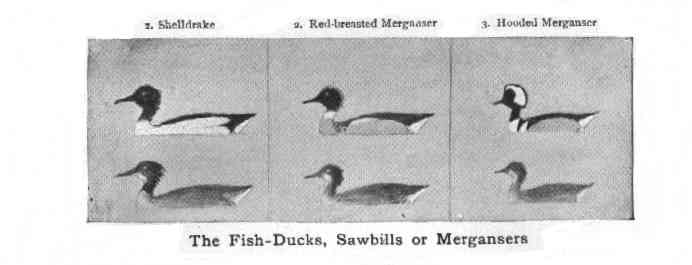
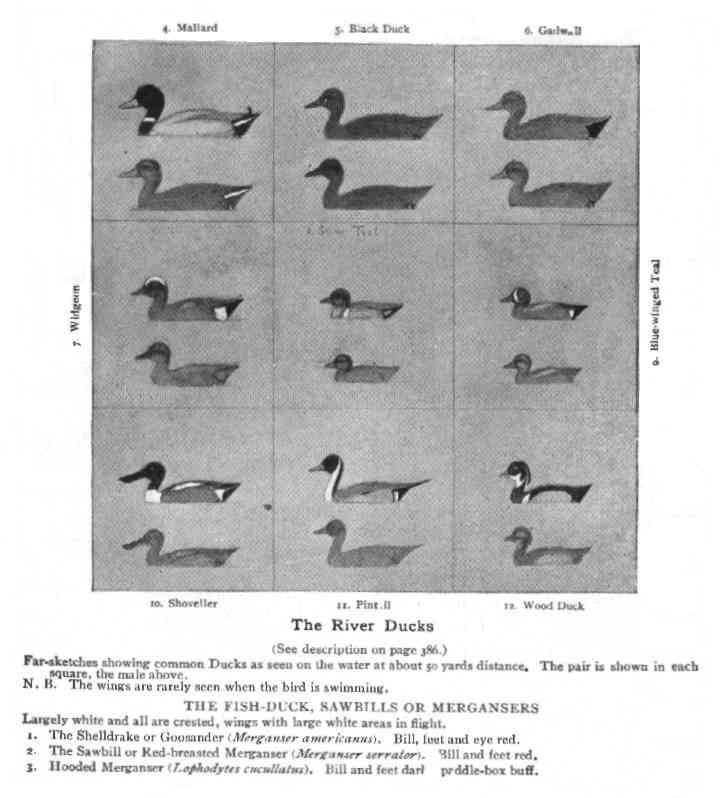
4. Mallard (Anas boschas). Red feet; male has pale, greenish bill. Known in flight by white tail feathers and
thin white bar on wing.
5. Black Duck or Dusky Duck (Anas obscura). Dark bill, red feet, no white except in flight, then shows white
lining of wings.
6. Gadwall or Gray Duck (Anas strepera). Beak flesh-coloured on edges, feet reddish, a white spot on wing
showing in flight.
7. Widgeon or Baldpate (A. americana). Bill and feet dull blue; a large white spot on wing in flight; female
has sides reddish.
8. Green-winged Teal (A. carolinensis). Bill and feet dark.
9. Blue-winged Teal (A. discors). Bill and feet dark.
10. Shoveller (Spatula clypeata). Bill dark, feet red, eye yellow-orange; a white patch on wings showing in flight.
11. Pintail or Sprigtail (Dafila acuta). Bill and feet dull blue.
12. Wood Duck or Summer Duck (Aix sponsa). Bill of male red, paddle-box buff, bill of female and feet of both
dark.
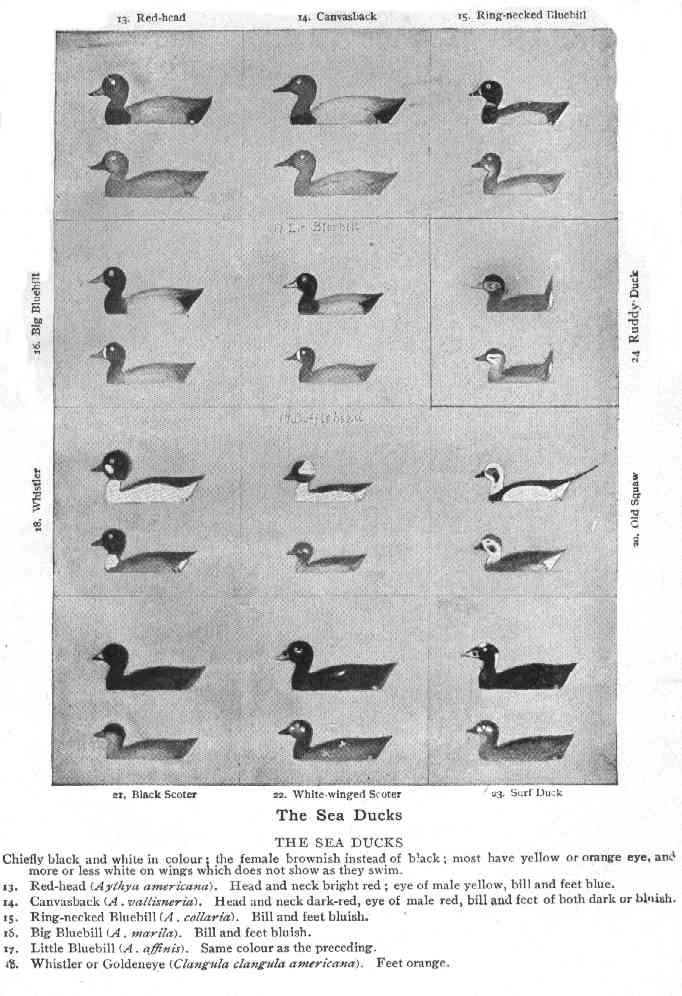
19. Bufflehead or Butterball (Charitonetta albeola).
20. Old-Squaw or Longtail (Harelda hyemalis). This is its winter plumage, in which it is mostly seen.
21. Black Scoter (Oidemia americana). A jet-black Duck with orange bill; no white on it anywhere.
22. White-winged Scoter (0. deglandi). A black Duck with white on cheek and wing; feet and bill orange;
much white on wing shows as they fly, sometimes none as they swim.
23. Surf Duck or Sea Coot (O. perspicillata). A black Duck with white on head, but none on wings: bill and
feet orange.
24. Ruddy Duck or Stiff-tailed Duck (Erismatura jamaicensis). Bill and feet bluish; male is in general a dull
red with white face.
(393)
When they got back to camp at dusk they found
a surprise. On the trail was a white thing, which on
investigation proved to be a ghost, evidently made
by Guy. The head was a large puff-ball carved like
a skull, and the body a newspaper.
But the teepee was empty. Guy probably felt too
much reaction after the setting up of the ghost to sit
there alone in the still night.
Sam's "long suit," as he put it, was axemanship.
He was remarkable even in this land of the axe,
and, of course, among the "Injuns" he was a
marvel. Yan might pound away for half an hour at
some block that he was trying to split and make no
headway, till Sam would say, "Yan, hit it right there,"
or perhaps take the axe and do it for him; then at
one tap the block would fly apart. There was no rule
for this happy hit. Sometimes it was above the
binding knot, sometimes beside it, sometimes right
in the middle of it, and sometimes in the end of the
wood away from the binder altogether—often at
the unlikeliest places. Sometimes it was done by a
simple stroke, sometimes a glancing stroke, sometimes
with the grain or again angling, and sometimes a
compound of one or more of each kind of blow; but
whatever was the right stroke, Sam seemed to know
it instinctively and applied it to exactly the right
spot, the only spot where the hard, tough log was
open to attack, and rarely failed to make it tumble
apart as though it were a trick got ready beforehand.
He did not brag about it. He simply took it for
granted that he was the master of the art, and as
such the others accepted him.
395
On one occasion Yan, who began to think he now
had some skill, was whacking away at a big, tough
stick till he had tried, as he thought, every possible
combination and still could make no sign of a crack.
Then Guy insisted on "showing him how," without
any better result.
"Here, Sam," cried Yan, "I'll bet this is a baffler
for you."
Sam turned the stick over, selected a hopeless-looking
spot, one as yet not touched by the axe,
set the stick on end, poured a cup of water on
the place, then, when that had soaked in, he
struck with all his force a single straight blow at
the line where the grain spread to embrace the
knot. The aim was true to a hair and the block
flew open.
"Hooray!" shouted Little Beaver in admiration.
"Pooh!" said Sapwood. "That was just chance.
He couldn't do that again."
"Not to the same stick!" retorted Yan. He
recognized the consummate skill and the cleverness
of knowing that the cup of water was just what was
needed to rob the wood of its spring and turn the
balance.
But Guy continued contemptuously, "I had it
started for him."
"I think that should count a coup," said Little
Beaver.
"Coup nothin'," snorted the Third War Chief,
in scorn. "I'll give you something to do that'll try
if you can chop. Kin you chop a six-inch tree down
396
in three minutes an' throw it up the wind?"
"What kind o' tree?" asked the Woodpecker.
"Oh, any kind."
"I'll bet you five dollars I kin cut down a six-inch
White Pine in two minutes an' throw it any way
I want to. You pick out the spot for me to lay it.
Mark it with a stake an' I'll drive the stake."
"I don't think any of the Tribe has five dollars to
bet. If you can do it we'll give you a grand coup
feather," answered Little Beaver.
"No spring pole," said Guy, eager to make it
impossible.
"All right," replied the Woodpecker; "I'll do it
without using a spring pole."
So he whetted up his axe, tried the lower margin
of the head, found it was a trifle out of the true—that
is, its under curve centred, not on the handle one
span down, but half an inch out from the handle.
A nail driven into the point of the axe-eye corrected
this and the chiefs went forth to select a tree. A
White Pine that measured roughly six inches through
was soon found, and Sam was allowed to clear away
the brush around it. Yan and Guy now took a
stout stake and, standing close to the tree, looked up
 the trunk. Of course, every tree in the woods leans
one way or another, and it was easy to see that
this leaned slightly southward. What wind there
was came from the north, so Yan decided to set
the stake due north.
the trunk. Of course, every tree in the woods leans
one way or another, and it was easy to see that
this leaned slightly southward. What wind there
was came from the north, so Yan decided to set
the stake due north.
Sam's little Japanese eyes twinkled. But Guy
who, of course, knew something of chopping, fairly
exploded with scorn. "Pooh! What do you know?
That's easy; any one can throw it straight up the
wind. Give him a cornering shot and let him try.
There, now," and Guy set the stake off to the north-west.
"Now, smarty. Let's see you do that."
"All right. You'll see me. Just let me look at it
a minute."
Sam walked round the tree, studied its lean
and the force of the wind on its top, rolled up his
sleeves, slipped his suspenders, spat on his palms,
and, standing to west of the tree, said "Ready."
Yan had his watch out and shouted "Go."
Two firm, unhasty strokes up on the south side
of the tree left a clean nick across and two inches
deep in the middle. The chopper then stepped
forward one pace and on the north-northwesterly
side, eighteen inches lower down than the first cut,
after reversing his hands—which is what few can do—he
rapidly chopped a butt-kerf. Not a stroke was
hasty; not a blow went wrong. The first chips
that flew were ten inches long, but they quickly
dwindled as the kerf sank in. The butt-kerf was
two-thirds through the tree when Yan called "One
minute up." Sam stopped work, apparently without
cause, leaned one hand against the south side of the
tree and gazed unconcernedly up at its top.
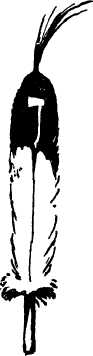 "Hurry up, Sam. You're losing time!" called
his friend. Sam made no reply. He was watching
398
the wind pushes and waiting for a strong one. It
came—it struck the tree-top. There was an ominous
crack, but Sam had left enough and pushed hard to
make sure; as soon as the recoil began he struck in
very rapid succession three heavy strokes, cutting
away all the remaining wood on the west side and
leaving only a three-inch triangle of uncut fibre.
All the weight was now northwest of this. The
tree toppled that way, but swung around on the
uncut part; another puff of wind gave help, the swing
was lost, the tree crashed down to the northwest and
drove the stake right out of sight in the ground.
"Hurry up, Sam. You're losing time!" called
his friend. Sam made no reply. He was watching
398
the wind pushes and waiting for a strong one. It
came—it struck the tree-top. There was an ominous
crack, but Sam had left enough and pushed hard to
make sure; as soon as the recoil began he struck in
very rapid succession three heavy strokes, cutting
away all the remaining wood on the west side and
leaving only a three-inch triangle of uncut fibre.
All the weight was now northwest of this. The
tree toppled that way, but swung around on the
uncut part; another puff of wind gave help, the swing
was lost, the tree crashed down to the northwest and
drove the stake right out of sight in the ground.
"Hooray! Hooray! Hooray! One minute and
forty-five seconds!" How Yan did cheer. Sam was
silent, but his eyes looked a little less dull and stupid
than usual, and Guy said "Pooh? That's nothin'."
Yan took out his pocket rule and went to the
stump. As soon as he laid it on, he exclaimed "Seven
and one-half inches through where you cut," and again
he had to swing his hat and cheer.
"Well, old man, you surely did it that time. That's
a grand coup if ever I saw one," and so, notwithstanding
Guy's proposal to "leave it to Caleb,"
Sam got his grand Eagle feather as Axeman A1 of
the Sanger Indians.
One night Sam was taking a last look at the
stars before turning in. A Horned Owl had
been hooting not far away.
"Hoo—hohoo-hoho—hoooooo."
And as he looked, what should silently sail to the
top of the medicine pole stuck in the ground twenty
yards away but the Owl.
"Yan! Yan! Give me my bow and arrow, quick.
Here's a Cat-Owl—a chicken stealer, he's fair game."
"He's only codding you, Yan," said Guy sleepily
from his blanket. "I wouldn't go."
But Yan rushed out with his own and Sam's
weapons.
Sam fired at the great feathery creature, but
evidently missed, for the Owl spread its wings and
sailed away.
"There goes my best arrow. That was my
'Sure-death.'"
 "Pshaw!" growled Yan, as he noted the miss.
"You can't shoot a little bit."
"Pshaw!" growled Yan, as he noted the miss.
"You can't shoot a little bit."
But as they stood, there was a fluttering of broad
wings, and there, alighting as before on the medicine
pole, was the Owl again.
"My turn now! "exclaimed Yan in a gaspy whisper.
400
He drew his bow, the arrow flew, and the Owl slipped
off unharmed as it had the first time.
"Yan, you're no good. An easy shot like that.
Why, any idiot could hit that. Why didn't you
fetch her?"
"'Cause I'm not an idiot, I suppose. I hit the
same place as you did, anyway, and drew just as
much blood."
"Ef he comes back again you call me," piped Guy
in his shrill voice. "I'll show you fellers how to shoot.
You're no good at all 'thout me. Why, I mind the
time I was Deer-shooting——" but a fierce dash of
the whole Tribe for Sappy's bed put a stop to the
reminiscent flow and replaced it with whines of
"Now you let me alone. I ain't doin' nothin' to
you."
During the night they were again awakened by
the screech in the tree-tops, and Yan, sitting up,
said, "Say, boys, that's nothing but that big Cat
Owl."
"So it is," was Sam's answer; "wonder I didn't
think of that before."
"I did," said Guy; "I knew it all the time."
In the morning they went out to find their arrows.
The medicine pole was a tall pole bearing a feathered
shield, with the tribal totem, a white Buffalo, which
Yan had set up to be in Indian fashion. Sighting in
line from the teepee over this, they walked on, looking
far beyond, for they had learned always to draw the
arrow to the head. They had not gone twenty-five
feet before Yan burst out in unutterable astonishment:
401
"Look! Look at that—and that———"
There on the ground not ten feet apart were two
enormous Horned Owls, both shot fairly through the
heart, one with Sam's "Sure-death" arrow, the other
with Yan's "Whistler"; both shots had been true,
and the boys could only say, "Well, if you saw that
in print you would say it was a big lie!" It was
indeed one of those amazing things which happen
only in real life, and the whole of the Tribe with one
exception voted a grand coup to each of the hunters.
Guy was utterly contemptuous. "They got so
close they hit by chance an' didn't know they done
it. If he had been shooting," etc., etc., etc.
"How about that screech in the tree-tops, Guy?"
"Errrrh."
What a fascination the naturalist always finds in
a fine Bird. Yan revelled in these two. He measured
their extent of wing and the length from beak
to tail of each. He studied the pattern on their
quills; he was thrilled by their great yellow eyes
and their long, powerful claws, and he loved their
every part. He hated to think that in a few days
these wonderful things would be disgusting and fit
only to be buried.
"I wish I knew hew to stuff them," he said.
"Why don't you get Si Lee to show you," was
Sam's suggestion. "Seems to me I often seen
pictures of Injun medicine men with stuffed birds,"
he added shrewdly and happily.
402
"Well, that's just what I will do."
Then arose a knotty question. Should he go to
Si Lee and thereby turn "White" and break the charm
of the Indian life, or should he attempt the task of
persuading Si to come down there to work without
proper conveniences. They voted to bring Si to
camp. "Da might think we was backing out."
After all, the things needed were easily carried, and
Si, having been ambushed by a scout, consented to
come and open a night-school in taxidermy.
The tools and things that he brought were a
bundle of tow made by unravelling a piece of rope,
some cotton wool, strong linen thread, two long
darning needles, arsenical soap worked up like
cream, corn-meal, some soft iron wire about
size sixteen and some of stovepipe size, a file, a
pair of pliers, wire cutters, a sharp knife, a pair of
stout scissors, a gimlet, two ready-made wooden
stands, and last of all a good lamp. The boys
hitherto had been content with the firelight.
Thus in the forest teepee Yan had his first lesson
in the art that was to give him so much joy and
some sorrow in the future.
Guy was interested, though scornful; Sam was
much interested; Yan was simply rapt, and Si Lee
was in his glory. His rosy red cheeks and his round
figure swelled with pride; even his semi-nude head
and fat, fumbling fingers seemed to partake of his
general elation and importance.
First he stuffed the Owls' throats and wounds
with cotton wool.
403
Then he took one, cut a slit from the back of the
breast-bone nearly to the tail (A to B, Fig. 1, page
405), while Yan took the other and tried faithfully
to follow his example.
He worked the skin from the body chiefly by the
use of his finger nails, till he could reach the knee of
each leg and cut this through at the joint with the
knife (Kn, Fig. 1, page 405). The flesh was removed
from each leg-bone down to the heel-joint (Hl, Hl,
Fig. 1), leaving the leg and skin as in Lg, Figure 2.
Then working back on each side of the tail, he cut
the "pope's nose" from the body and left it as part
of the skin, with the tail feathers in it, and this, Si
explained, was a hard place to get around. Sam
called it "rounding Cape Horn." As the flesh was
exposed Si kept it powdered thickly with corn-meal,
and this saved the feathers from soiling.
Once around Cape Horn it was easy sailing. The
skin was rapidly pushed off till the wings were reached.
These were cut off at the joint deep in the breast
(under J J, Fig. 1, or seen on the back, W J, Fig. 2),
the first bone of each wing was cleared of meat, and
the skin, now inside out and well mealed, was pushed
off the neck up to the head.
Here Si explained that in most birds it would slip
easily over the head, but in Owls, Woodpeckers,
Ducks and some others one had sometimes to help
it by a lengthwise slit on the nape (Sn, Fig. 2). "Owls
is hard, anyway," he went on, "though not so bad
as Water-fowl. If ye want a real easy bird for a
starter, take a Robin or a Blackbird, or any land
404
Bird about that size except Woodpeckers."
When the ears were reached they were skinned and
pulled out of the skull without cutting, then, after
the eyes were passed, the skin and body looked as
in Figure 2. Now the back of the head with the neck
and body was cut off (Ct, Fig. 2), and the first
operation of the skinning was done.
Yan got along fairly well, tearing and cutting the
skin once or twice, but learning very quickly to
manage it.
Now began the cleaning of the skin.
The eyes were cut clean out and the brains and
flesh carefully scraped away from the skull.
The wing bones were already cleaned of meat
down to the elbow joint, where the big quill feathers
began, and the rest of the wing had to be cleared of
flesh by cutting open the under side of the next joint
(H to El, Fig. 1). The "pope's nose" and the skin
generally was freed from meat and grease by scraping
with a knife and rubbing with the meal.
Then came the poisoning. Every part of the bones
and flesh had to be painted with the creamy arsenical
soap, then the head was worked back into its place
and the skin turned right side out.
When this was done it was quite late. Guy was
asleep, Sam was nearly so, and Yan was thoroughly
tired out.
"Guess I'll go now," said Si. "Them skins is in
good shape to keep, only don't let them dry," so they
were wrapped up in a damp sack and put away in a
tin till next night, when Si promised to return and
finish the course in one more lesson.
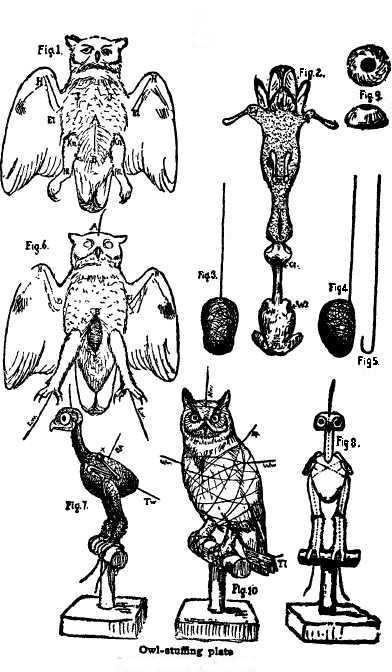
OWL-STUFFING PLATE
Fig. 1. The dead Owl, showing the cuts made in skinning it: A to B, for the body; El to H, on each wing, to
remove the meat of the second joint.
Fig. 2. After the skinning is done the skull remains attached to the skin, which is now inside out, the neck and
body are cut off at Ct. Sn to Sn shows the slit in the nape needed for Owls and several other kinds.
Fig. 3. Top view of the tow body, neck end up, and neck wire projecting.
Fig. 4. Side view of the tow body, with the neck wire put through it; the tail end is downward.
Fig. 5. The heavy iron wire for neck.
Fig. 6. The Owl after the body is put in; it is now ready to close up, by stitching up the slit on the nape, the
body slit B to C and the two wing slits El to H, on each wing.
Fig. 7. A dummy as it would look if all the feathers were off; this shows the proper position for legs and wings
on the body. At W is a glimpse of the leg wire entering the body at the middle of the side.
Fig. 8. Another view of the body without feathers; the dotted lines show the wires of the legs through the hard
body, and the neck wire.
Fig. 9. Two views of one of the wooden eyes; these are on a much larger scale than the rest of the figures in
this plate.
Fig. 10. The finished Owl, with the thread wrappings on and the wires still projecting; Nw is end of the neck
wire; Bp is back-pin—that is, the wire in the center of the back; Ww and Ww are the wing wires; Tl are
the cards pinned on the tail to hold it flat while it dries. The last operation is to remove the threads and
cut all the wires off close so that the feathers hide what remains.
407
While they were so working Sam had busied himself
opening the Owls' stomachs—"looking up their
records," as he called it. He now reported that one
had lynched a young Partridge and the other had
killed a Rabbit for its latest meal.
Next night Si Lee came as promised, but brought
bad news. He had failed to find the glass Owl eyes
he had hoped were in his trunk. His ingenuity, however,
was of the kind that is never balked in a small
matter. He produced some black and yellow oil
paints, explaining, "Guess we'll make wooden eyes
do for the present, an' when you get to town you can
put glass ones in their place." So Sam was set to
work whittling four wooden eyes the shape of well-raised
buns and about three-quarters of an inch
across. When whittled, scraped and smooth, Si
painted them brilliant yellow with a central black
spot and put them away to dry (shown on a large
scale on page 405, Fig. 9, a and b).
Meanwhile, he and Yan got out the two skins.
The bloody feathers on the breasts were washed
clean in a cup of warm water, then dried with cotton
and dusted all over with meal to soak up any moisture
left. The leg and wing bones were now wrapped
with as much tow as would take the place of the
removed meat. The eye sockets were partly filled
with cotton, then a long soft roll of tow about the
length and thickness of the original neck was worked
408
up into the neck skin and into the skull and left hanging.
The ends of the two wing bones were fastened
two inches apart with a shackle of strong string (X,
Fig. 2 and Fig. 7). Now the body was needed.
For this Si rolled and lashed a wad of tow with
strong thread until he made a dummy of the same
size and shape as the body taken out, squeezing and
sewing it into a hard solid mass. Next he cut about
two and a half feet of the large wire, filed both ends
sharp, doubled about four inches of one end back in
a hook (Fig. 5), then drove the long end through
the tow body from the tail end out where the neck
should join on (Figs. 3 and 4). This was driven well
in so that the short end of the hook was buried out
of sight. Now Si passed the projecting ends of the
long wire up the neck in the middle of the tow roll
or neck already there, worked it through the skull
and out at the top of the Owl's head, and got the
tow body properly placed in the skin with the
string that bound the wing bones across the back
(X, Fig. 7).
Two heavy wires each eighteen inches long and
sharp at one end were needed for the legs. These
were worked up one through the sole of each foot
under the skin of the leg behind (Lw, Fig. 6), then
through the tow body at the middle of the side (W,
Fig. 7), after which the sharp end was bent with
pliers into a hook and driven back into the hard body
(after the manner of the neck wire, Fig. 4).
409
Another wire was sharpened and driven through
the bones of the tail, fastening that also to the tow
body (Tw, Fig. 7).
Now a little soft tow was packed into places where
it seemed needed to fit the skin on, and it remained
to sew up the opening below (Bc in Fig. 6), the wing
slits (El, H, Fig. 6 and Fig. 1), and the slit in the
nape (Sn Sn, Fig. 2) with half a dozen stitches, always
putting the needle into the skin from the flesh side.
The projecting wires of the feet were put through
gimlet holes in the perch and made firm, and Si's
Owls were ready for their positions. They were now
the most ridiculous looking things imaginable, wings
floppy, heads hanging.
"Here is where the artist comes in," said Si proudly,
conscious that this was himself. He straightened
up the main line of the body by bending the leg wires
and set the head right by hunching the neck into the
shoulders. "An Owl always looks over its shoulder,"
he explained, but took no notice of Sam's query as
to "whose shoulder he expected it to look over." He
set two toes of each foot forward on the perch and two
back to please Yan, who insisted that that was Owly,
though Si had his doubts. He spread the tail a little
by pinning it between two pieces of card (Tl, Fig. 10),
gave it the proper slant, and now had the wings to
arrange.
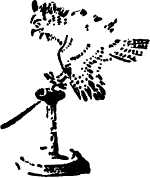
They were drooping like those of a clucking hen.
A sharp wire of the small size was driven into the
bend of each wing (0, Fig. 7), nailing it in effect to
the body (Ww and Ww, Fig. 10). A long pin was
410
set in the middle of the back (Bp, Fig. 10), then using
these with the wing wires and head wire as lashing
points, Si wrapped the whole bird with the thread
(Fig. 10), putting a wad of cotton here or a bit of
stick there under the wrapping till he had the position
and "feathering" perfect, as he put it.
"We can put in the eyes now," said he, "or later,
if we soften the skin around the eye-sockets by putting
wet cotton in them for twenty-four hours."
Yan had carefully copied Si's method with the
second Owl, and developed unusual quickness at it.
His teacher remarked, "Wall, I larned lots o'
fellows to stuff birds, but you ketch on the quickest
I ever seen."
Si's ideas of perfection might differ from those of a
trained taxidermist; indeed, these same Owls afforded
Yan no little amusement in later years, but for the
present they were an unmitigated joy.
They were just the same in position. Si knew only
one; all his birds had that. But when they had dried
fully, had their wrappings removed, the wires cut
off flush and received the finishing glory of their
wooden eyes, they were a source of joy and wonder
to the whole Tribe of Indians.
The boys had made war bonnets after the "really
truly" Indian style learned from Caleb. White
Turkey tail-feathers and white Goose wing-feathers
dyed black at the tips made good Eagle
feathers. Some wisps of red-dyed horsehair from
an old harness tassel; strips of red flannel from an
old shirt, and some scraps of sheepskin supplied
the remaining raw material. Caleb took an
increasing interest, and helped them not only to
make the bonnet, but also to decide on what things
should count coup and what grand coup. Sam had
a number of feathers for shooting, diving, "massacreeing
the Whites," and his grand tufted feathers for
felling the pine and shooting the Cat-Owl.
Among other things, Yan had counted coup for
trailing. The Deer hunt had been made still more
real by having the "Deer-boy" wear a pair of sandals
made from old boots; on the sole of each they put two
lines of hobnails in V shape, pointing forward. These
made hooflike marks wherever the Deer went. One
of the difficulties with the corn was that it gave no
clue to the direction or doubling of the trail, but the
sandals met the trouble, and with a very little corn to
help they had an ideal trail. All became very expert,
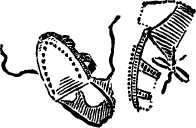 412
and could follow fast a very slight track, but Yan continued
the best, for what he lacked in eyesight he
more than made up in patience and observation.
He already had a grand coup for finding and shooting
the Deer in the heart, that time, at first shot before
the others came up even, and had won six other
grand coups—one for swimming 200 yards in five
minutes, one for walking four measured miles in one
hour, one for running 100 yards in twelve seconds,
one for knowing 100 wild plants, one for knowing 100
birds, and the one for shooting the Horned Owl.
412
and could follow fast a very slight track, but Yan continued
the best, for what he lacked in eyesight he
more than made up in patience and observation.
He already had a grand coup for finding and shooting
the Deer in the heart, that time, at first shot before
the others came up even, and had won six other
grand coups—one for swimming 200 yards in five
minutes, one for walking four measured miles in one
hour, one for running 100 yards in twelve seconds,
one for knowing 100 wild plants, one for knowing 100
birds, and the one for shooting the Horned Owl.
Guy had several good coups, chiefly for eyesight.
He could see "the papoose on the squaws back,"
and in the Deer hunt he had several times won coups
that came near being called grand coup, but so far
fate was against him, and even old Caleb, who was
partial to him, could not fairly vote him a grand
coup.
"What is it that the Injuns most likes in a man: I
mean, what would they druther have, Caleb?" asked
Sappy one day, confidently expecting to have his
keen eyesight praised.
"Bravery," was the reply. "They don't care
what a man is if he's brave. That's their greatest
thing—that is, if the feller has the stuff to back it up.
An' it ain't confined to Injuns; I tell you there ain't
anything that anybody goes on so much. Some men
pretends to think one thing the best of all, an' some
another, but come right down to it, what every man,
woman an' child in the country loves an' worships
is pluck, clear grit, well backed up."
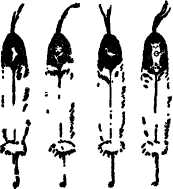
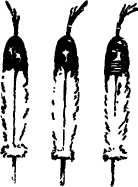
"Well, I tell you," said Guy, boiling up with
enthusiasm at this glorification of grit, "I ain't
scared o' nothin'."
"Wall, how'd you like to fight Yan there?"
"Oh, that ain't fair. He's older an' bigger'n
I am."
"Say, Sappy, I'll give you one. Suppose you go
to the orchard alone an' get a pail of cherries. All
the men'll be away at nine o'clock."
"Yes, and have old Cap chaw me up."
"Thought you weren't scared of anything, an' a
poor little Dog smaller than a yearling Heifer scares
you."
"Well, I don't like cherries, anyhow."
"Here, now, Guy, I'll give you a real test. You
see that stone?" and Caleb held up a small round
stone with a hole in it. "Now, you know where old
Garney is buried?"
Garney was a dissolute soldier who blew his
head off, accidentally, his friends claimed, and he
was buried on what was supposed to be his own land
just north of Raften's, but it afterward proved to be
part of the highway where a sidepath joined in, and
in spite of its diggers the grave was at the crossing
of two roads. Thus by the hand of fate Bill Garney
was stamped as a suicide.
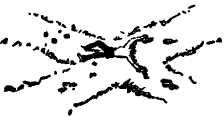
The legend was that every time a wagon went over
his head he must groan, but unwilling to waste those
414
outcries during the rumbling of the wheels, he waited
till midnight and rolled them out all together. Anyone
hearing should make a sympathetic reply or
they would surely suffer some dreadful fate. This
was the legend that Caleb called up to memory and
made very impressive by being properly impressed
himself.
"Now," said he, "I am going to hide this stone
just behind the rock that marks the head of Garney's
grave, an' I'll send you to git it some night. Air ye
game?"
"Y-e-s, I'll go," said the Third War Chief without
visible enthusiasm.
"If he's so keen for it now, there'll be no holding
him back when night comes," remarked the Woodpecker.
"Remember, now," said Caleb, as he left them to
return to his own miserable shanty, "this is the chance
to show what you're made of. I'll tie a cord to the
stone to make sure that you get it."
"We're just going to eat. Won't you stay and
jine with us," called Sam, but Caleb strode off without
taking notice of the invitation.
In the middle of the night the boys were aroused
by a man's voice outside and the scratching of a stick
on the canvas.
"Boys! Guy—Yan! Oh, Guy!"
"Hello! Who is it?"
"Caleb Clark! Say, Guy, it's about half-past eleven
now. You have just about time to go to Garney's
grave by midnight an' get that stone, and if you
415
can't find the exact spot you listen for the groaning
—that'll guide you."
This cheerful information was given in a hoarse
whisper that somehow conveyed the idea that the
old man was as scared as he could be.
"I—I—I—" stammered Guy, "I can't see the
way."
"This is the chance of your life, boy. You get
that stone and you'll get a grand coup feather, top
honours fur grit. I'll wait here till you come back."
"I—I—can't find the blamed old thing on such a
dark night. I—I—ain't goin'."
"Errr—you're scared," whispered Caleb.
"I ain't scared, on'y what's the use of goin'
when I couldn't find the place? I'll go when it's
moonlight."
"Err—anybody here brave enough to go after
that stone?"
"I'll go," said the other two at the same time,
though with a certain air of "But I hope I don't
have to, all the same."
"You kin have the honour, Yan," said the Woodpecker,
with evident relief.
"Of course, I'd like the chance—but—but—I don't
want to push ahead of you—you're the oldest; that
wouldn't be square," was the reply.
"Guess we'd better draw straws for it."
So Sam sought a long straw while Yan stirred up
the coals to a blaze. The long straw was broken
in two unequal pieces and hidden in Sam's hand.
416
Then after shuffling he held it toward Yan, showing
only the two tips, and said, "Longest straw takes
the job." Yan knew from old experience that a
common trick was to let the shortest straw stick out
farthest, so he took the other, drew it slowly out and
out—it seemed endless. Sam opened his hand and
showed that the short straw remained, then added
with evident relief: "You got it. You are the luckiest
feller I ever did see. Everything comes your way."
If there had been any loophole Yan would have
taken it, but it was now clearly his duty to go for
that stone. It was pride rather than courage that
carried him through. He dressed quietly and nervously;
his hands trembled a little as he laced his
shoes. Caleb waited outside when he heard that
it was Yan who was going. He braced him up by
telling him: "You're the stuff. I jest love to see grit.
I'll go with you to the edge of the woods—'twouldn't
be fair to go farther—and wait there till you come
back. It's easy to find. Go four panels of fence
past the little Elm, then right across on the other side
of the road is the big stone. Well, on the side next
the north fence you'll find the ring pebble. The
coord is lying kind o' cross the big white stone, so
you'll find it easy; and here, take this chalk; if your
grit gives out, you mark on the fence how far you
did get, but don't you worry about that groaning—it's
nothing but a yarn—don't be scairt."
"I am afraid I am scared, but still I'll go."
417
"That's right," said the Trapper with emphasis.
"Bravery ain't so much not being scairt as going
ahead when you are scairt, showing that you kin
boss your fears."
So they talked till they struck out of the gloom
of the trees to the comparative light of the open
field.
"It's just fifteen minutes to midnight," said
Caleb, looking at his watch with the light of a match,
"You'll make it easy. I'll wait here."
Then Yan went on alone.
It was a somber night, but he felt his way along
the field fence to the line fence and climbed that into
the road that was visible as a less intense darkness
on the black darkness of the grass. Yan walked
on up the middle cautiously. His heart beat violently
and his hands were cold. It was a still night, and
once or twice little mousey sounds in the fence corner
made him start, but he pushed on. Suddenly in the
blackness to the right of the road he heard a loud
"whisk," then he caught sight of a white thing that
chilled his blood. It was the shape of a man wrapped
in white, but lacked a head, just as the story had it.
Yan stood frozen to the ground. Then his intellect
came to the rescue of his trembling body. "What
nonsense! It must be a white stone." But no, it
moved. Yan had a big stick in his hand. He
shouted: "Sh, sh, sh!" Again the "corpse" moved.
Yan groped on the road for some stones and sent
one straight at the "white thing."

418
He heard a
"whooff" and a rush. The "white thing" sprang up
and ran past him with a clatter that told him he had
been scared by Granny de Neuville's white-faced cow.
At first the reaction made him weak at the knees,
but that gave way to a better feeling. If a harmless
old Cow could lie out there all night, why should he
fear? He went on more quietly till he neared the
rise in the road. He should soon see the little Elm.
He kept to the left of the highway and peered into
the gloom, going more slowly. He was not so near
as he had supposed, and the tension of the early part
of the expedition was coming back more than ever.
He wondered if he had not passed the Elm—should he
go back? But no, he could not bear the idea; that
would mean retreat. Anyhow, he would put his chalk
mark here to show how far he did get. He sneaked
cautiously toward the fence to make it, then to his
relief made out the Elm not twenty-five feet away.
Once at the tree, he counted off the four panels westward
and knew that he was opposite the grave of the
suicide. It must now be nearly midnight. He
thought he heard sounds not far away, and there
across the road he saw a whitish thing—the headstone.
He was greatly agitated as he crawled quietly
as possible toward it. Why quietly he did not know.
He stumbled through the mud of the shallow ditch
at each side, reached the white stone, and groped
with clammy, cold hands over the surface for the
string. If Caleb had put it there it was gone now.
So he took his chalk and wrote on the stone "Yan."
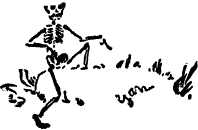
419
Oh, what a scraping that chalk made! He searched
about with his fingers around the big boulder. Yes,
there it was; the wind, no doubt, had blown it off.
He pulled it toward him. The pebble was drawn
across the boulder with another and louder rasping
that sounded fearfully in the night. Then at once
a gasp, a scuffle, a rush, a splash of something in mud,
or water—horrible sounds of a being choking, strangling
or trying to speak. For a moment Yan sank
down in terror. His lips refused to move. But the
remembrance of the cow came to help him. He
got up and ran down the road as fast as he could go,
a cold sweat on him. He ran so blindly he almost
ran into a man who shouted "Ho, Yan; is that you?"
It was Caleb coming to meet him. Yan could not
speak. He was trembling so violently that he had
to cling to the Trapper's arm.
"What was it, boy? I heard it, but what was it?"
"I—I—don't know," he gasped; "only it was at
the g-g-grave."
"Gosh! I heard it, all right," and Caleb showed
no little uneasiness, but added, "We'll be back in
camp in ten minutes."
He took Yan's trembling hand and led him for a
little while, but he was all right when he came to the
blazed trail. Caleb stepped ahead, groping in the
darkness.
Yan now found voice to say, "I got the stone all
right, and I wrote my name on the grave, too."
"Good boy! You're the stuff!" was the admiring
response.
420
They were very glad to see that there was a fire in
the teepee when they drew near. At the edge of
the clearing they gave a loud "O-hoo—O-hoo—
O-hoo-oo," the Owl cry that they had adopted because
it is commonly used by the Indians as a night
signal, and they got the same in reply from within.
"All right," shouted Caleb; "he done it, an' he's
bully good stuff and gets an uncommon grand
coup."
"Wish I had gone now," said Guy. "I could 'a'
done it just as well as Yan."
"Well, go on now."
"Oh, there ain't any stone to get now for proof."
"You can write your name on the grave, as I did."
"Ah, that wouldn't prove nothin'," and Guy
dropped the subject.
Yan did not mean to tell his adventure that night,
but his excitement was evident, and they soon got
it out of him in full. They were a weird-looking
crowd as they sat around the flickering fire, experiencing
as he told it no small measure of the scare
he had just been through.
When he had finished Yan said, "Now, Guy, don't
you want to go and try it?"
"Oh, quit," said Guy; "I never saw such a feller
as you for yammering away on the same subjek."
Caleb looked at his watch now, as though about to
leave, when Yan said:
"Say, Mr. Clark, won't you sleep here? There's
lots o' room in Guy's bed."
"Don't mind if I do, seem' it's late."
In the morning Caleb had the satisfaction of
eating a breakfast prepared by the son of his
enemy, for Sam was cook that day.
The Great Woodpecker expressed the thought of
the whole assembly when after breakfast he said:
"Now I want to go and see that grave. I believe
Yan wrote his name on some old cow that was
lying down and she didn't like it and said so out
loud!"
They arrived at the spot in a few minutes. Yes,
there it was plainly written on the rude gravestone,
rather shaky, but perfectly legible—"Yan."
"Pretty poor writing," was Guy's remark.
"Well, you sure done it! Good boy!" said Sam
warmly. "Don't believe I'd 'a' had the grit."
"Bet I would," said Guy.
"Here's where I crossed the ditch. See my trail
in the mud? Out there is where I heard the yelling.
Let's see if ghosts make tracks. Hallo, what the—"
There were the tracks in the mud of a big man.
He had sprawled, falling on his hands and knees.
Here was the print of his hands several times, and
in the mud, half hidden, something shining—Guy
saw it first and picked it up. It was a white-handled
Colt's revolver.
422
"Let's see that," said Caleb. He wiped off the
mud. His eye kindled. "That's my revolver that
was stole from me 'way back, time I lost my clothes
and money." He looked it over and, glancing about,
seemed lost in thought. "This beats me!" He shook
his head and muttered from time to time, "This
beats me!" There seemed nothing more of interest
to see, so the boys turned homeward.
On the way back Caleb was evidently thinking
hard. He walked in silence till they got opposite
Granny de Neuville's shanty, which was the nearest
one to the grave. At the gate he turned and said:
"Guess I'm going in here. Say, Yan, you didn't
do any of that hollering last night, did you?"
"No, sir; not a word. The only sound I made
was dragging the ring-stone over the boulder."
"Well, I'll see you at camp," he said, and turned
in to Granny's.
"The tap o' the marnin' to ye, an' may yer sowl
rest in pace," was the cheery old woman's greeting.
"Come in—come in, Caleb, an' set down. An' how
is Saryann an' Dick?"
"They seem happy an' prosperin'," said the old
man with bitterness. "Say, Granny, did you ever
hear the story about Garney's grave out there on
the road?"
"For the love av goodness, an' how is it yer after
askin' me that now? Sure an' I heard the story
many a time, an' I'm after hearin' the ghost last
night, an' it's a-shiverin' yit Oi am."
423
"What did you hear, Granny?"
"Och, an' it was the most divilish yells iver let
out av a soul in hell. Shure the Dog and the Cat
both av thim was scairt, and the owld white-faced
cow come a-runnin' an' jumped the bars to get aff
av the road."
Here was what Caleb wanted, and he kept her going
by his evident interest. After she tired of providing
more realistic details of the night's uproar, Caleb
deliberately tapped another vintage of tittle-tattle in
hope of further information leaking out.
"Granny, did you hear of a robbery last week
down this side of Downey's Dump?"
"Shure an' I did not," she exclaimed, her eyes
ablaze with interest—neither had Caleb, for that
matter; but he wanted to start the subject—"An"
who was it was robbed?"
"Don't know, unless it was John Evans's place."
"Shure an' I don't know him, but I warrant he
could sthand to lose. Shure an' it's when the raskils
come after me an' Cal Conner the moment it was
talked around that we had sold our Cow; then sez I,
it's gittin' onraisonable, an' them divils shorely
seems to know whin a wad o' money passes."
"That's the gospel truth. But when wuz you
robbed, Granny?"
"Robbed? I didn't say I wuz robbed," and
she cackled. "But the robbers had the best av
intintions when they came to me," and she related
at length her experience with the two who broke in
when her Cow was reported sold. She laughed over
424
their enjoyment of the Lung Balm, and briefly told
how the big man was sulky and the short, broad
one was funny. Their black beards, the "big wan"
with his wounded head, his left-handedness and his
accidental exposure of the three fingers of the right
hand, all were fully talked over.
"When was it, Granny?"
"Och, shure an' it wuz about three years apast."
Then after having had his lungs treated, old Caleb
left Granny and set out to do some very hard thinking.
There had been robberies all around for the last
four years; There was no clue but this: They
were all of the same character; nothing but cash
was taken, and the burglars seemed to have inside
knowledge of the neighbourhood, and timed all their
visits to happen just after the householder had come
into possession of a roll of bills.
As soon as Caleb turned in at the de Neuville
gate, Yan, acting on a belated thought, said:
"Boys, you go on to camp; I'll be after you in
five minutes." He wanted to draw those tracks in
the mud and try to trail that man, so went back to
the grave.
He studied the marks most carefully and by opening
out the book he was able to draw the boot tracks
life-size, noting that each had three rows of small
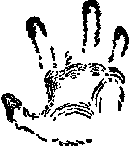 hobnails on the heel, apparently put in at home
because so irregular, while the sole of the left was
worn into a hole. Then he studied the hand tracks,
selected the clearest, and was drawing the right
425
hand when something odd caught his attention.
hobnails on the heel, apparently put in at home
because so irregular, while the sole of the left was
worn into a hole. Then he studied the hand tracks,
selected the clearest, and was drawing the right
425
hand when something odd caught his attention.
Yes! It appeared in all the impressions of that
hand—the middle finger was gone.
Yan followed the track on the road a little way,
but at the corner it turned southward and was lost
in the grass.
As he was going back to camp he overtook Caleb
also returning.
"Mr. Clark," he said. "I went back to sketch
those tracks, and do you know—that man had only
three fingers on his right hand?"
"Consarn me!" said Caleb. "Are you sure?"
"Come and see for yourself."
Yes! It surely was true, and Caleb on the road
back said, "Yan, don't say a word of this to the others
just now."
The old Trapper went to the Pogue house at once.
He found the tracks repeated in the dust near the
door, but they certainly were not made by Dick.
On a line was a pair of muddy trousers drying.
From this night Yan went up and Guy went down
in the old man's opinion, for he spoke his own mind
that day when he gave first place to grit. He
invited Yan to come to his shanty to see a pair of
snow-shoes he was making. The invitation was vague
and general, so the whole Tribe accepted. Yan had
not been there since his first visit. The first part
of their call was as before. In answer to their
knock there was a loud baying from the Hound,
then a voice ordering him back. Caleb opened the
426
door, but now said "Step in." If he was displeased
with the others coming he kept it to himself. While
Yan was looking at the snow-shoes Guy discovered
something much more interesting on the old man's
bunk; that was the white revolver, now cleaned up
and in perfect order. Caleb's delight at its recovery,
though not very apparent, was boundless. He had
not been able to buy himself another, and this was
as warmly welcomed back as though a long-lost
only child.
"Say, Caleb, let's try a shot. I bet I kin beat the
hull gang," exclaimed Sapwood.
Caleb got some cartridges and pointed to a white
blaze on a stump forty yards away. Guy had three
or four shots and Yan had the same without hitting
the stump. Then Caleb said, "Lemme show you."
His big rugged hand seemed to swallow up the
little gun-stock. His long knobbed finger fitted
around the lock in a strange but familiar way. Caleb
was a bent-arm shot, and the short barrel looked like
his own forefinger pointing at the target as he pumped
away six times in quick succession. All went into
the blaze and two into the charcoal spot that marked
the centre.
"By George! Look at that for shooting!" and the
boys were loud in their praise.
"Well, twenty year ago I used to be a pretty good
shot," Caleb proceeded to explain with an air of
unnecessary humility and a very genial expression
on his face. "But that's dead easy. I'll show you
427
some real tricks."
Twenty-five feet away he set up three cartridges in
a row, their caps toward him, and exploded them in
succession with three rapid shots. Then he put the
revolver in the side pocket of his coat, and recklessly
firing it without drawing, much less sighting or even
showing it, he peppered a white blaze at twenty
yards. Finally he looked around for an old fruit
tin. Then he cocked the revolver, laid it across his
right hand next the thumb and the tin across the
fingers. He then threw them both in the air with a
jerk that sent the revolver up ten feet and the tin
twenty. As the revolver came down he seized it and
shot a hole through the tin before it could reach the
ground.
The boys were simply dumbfounded. They had
used up all their exclamations on the first simple
target trial.
Caleb stepped into the shanty to get a cleaning-rag
for his darling, and Sam burst out:
"Well, now I know he never shot at Da, for if he
did he'd 'a' got him sure."
It was not meant for Caleb's ears, but it reached
him, and the old Trapper came to the door at once
with a long, expressive "H-m-m-mrr."
Thus was broken the dam of silent scorn, for it
was the first time Caleb had addressed himself to
Sam. The flood had forced the barrier, but it still
left plenty of stuff in the channel to be washed away
by time and wear, and it was long before he talked
428
to Sam as freely as to the others, but still in time
he learned.
There was an air of geniality on all now, and Yan
took advantage of this to ask for something he had
long kept in mind.
"Mr. Clark, will you take us out for a Coon hunt?
We know where there are lots of Coons that feed in
a corn patch up the creek."
If Yan had asked this a month ago he would have
got a contemptuous refusal. Before the visit to
Carney's grave it might have been, "Oh, I dunno—I
ain't got time," but he was on the right side of
Caleb now, and the answer was:
"Well, yes! Don't mind if I do, first night it's
coolish, so the Dog kin run."
The boys had hunted the Woodchuck quite
regularly since first meeting it. Their programme
 was much the same—each morning
about nine or ten they would sneak out to the clover
field. It was usually Guy who first discovered the
old Grizzly, then all would fire a harmless shot, the
Woodchuck would scramble into his den and the incident
be closed for the day. This became as much a
part of the day's routine as getting breakfast, and
much more so than the washing of the dishes. Once
or twice the old Grizzly had narrow escapes, but so far
he was none the worse, rather the better, being wiser.
The boys, on the other hand, gained nothing, with the
possible exception of Guy. Always quick-sighted,
his little washed-out optics developed a marvellous
keenness. At first it was as often Yan or Sam who
saw the old Grizzly, but later it was always Guy.
was much the same—each morning
about nine or ten they would sneak out to the clover
field. It was usually Guy who first discovered the
old Grizzly, then all would fire a harmless shot, the
Woodchuck would scramble into his den and the incident
be closed for the day. This became as much a
part of the day's routine as getting breakfast, and
much more so than the washing of the dishes. Once
or twice the old Grizzly had narrow escapes, but so far
he was none the worse, rather the better, being wiser.
The boys, on the other hand, gained nothing, with the
possible exception of Guy. Always quick-sighted,
his little washed-out optics developed a marvellous
keenness. At first it was as often Yan or Sam who
saw the old Grizzly, but later it was always Guy.
One morning Sam approached the game from one
point, Guy and Yan from another some yards away.
"No Woodchuck!" was the first opinion, but suddenly
Guy called "I see him." There in a little hollow
 fully sixty yards from his den, and nearly a hundred
from the boys, concealed in a bunch of clover, Guy
saw a patch of gray fur hardly two inches square.
"That's him, sure."
fully sixty yards from his den, and nearly a hundred
from the boys, concealed in a bunch of clover, Guy
saw a patch of gray fur hardly two inches square.
"That's him, sure."
430
Yan could not see it at all. Sam saw but doubted.
An instant later the Woodchuck (for it was he) stood
up on his hind legs, raised his chestnut breast above
the clover, and settled all doubt.
"By George!" exclaimed Yan in admiration.
"That is great. You have the most wonderful eyes
I ever did see. Your name ought to be 'Hawkeye'—that
should be your name."
"All right," shrilled out Guy enthusiastically.
"Will you—will you, Sam, will you call me Hawkeye?
I think you ought to," he added pleadingly.
"I think so, Sam," said the Second Chief. "He's
turned out great stuff, an' it's regular Injun."
"We'll have to call a Council and settle that. Now
let's to business."
"Say, Sapwood, you're so smart, couldn't you go
round through the woods to your side and crawl
through the clover so as get between the old Grizzly
and his den?" suggested the Head Chief.
"I bet I can, an' I'll bet a dollar—"
"Here, now," said Yan, "Injuns don't have dollars."
"Well, I'll bet my scalp—my black scalp, I
mean—against Sam's that I kill the old Grizzly first."
"Oh, let me do it first—you do it second," said
Sam imploringly.
"Errr—yer scared of yer scalp."
"I'll go you," said Sam.
Each of the boys had a piece of black horsehair
that he called his scalp. It was tied with a string to
the top of his head—and this was what Guy wished
431
to wager.
Yan now interfered: "Quit your squabbling, you
Great War Chiefs, an' 'tend to business. If Woodpecker
kills old Grizzly he takes Sapwood's scalp;
if Sappy kills him he takes the Woodpecker's scalp,
an' the winner gets a grand feather, too."
Sam and Yan waited impatiently in the woods while
Guy sneaked around. The Woodchuck seemed
unusually bold this day. He wandered far from his
den and got out of sight in hollows at times. The
boys saw Guy crawl through the fence, though the
Woodchuck did not. The fact was, that he had
always had the enemy approach him from the other
side, and was not watching eastward.
Guy, flat on his breast, worked his way through
the clover. He crawled about thirty yards and now
was between the Woodchuck and his den. Still
old Grizzly kept on stuffing himself with clover and
watching toward the Raften woods. The boys
became intensely excited. Guy could see them, but
not the Woodchuck. They pointed and gesticulated.
Guy thought that meant "Now shoot." He got
up cautiously. The Woodchuck saw him and
bounded straight for its den—that is, toward Guy.
Guy fired wildly. The arrow went ten feet over
the Grizzly's head, and, that "huge, shaking
mass of fur" bounding straight at him, struck
terror to his soul. He backed up hastily, not
knowing where to run. He was close to the den.
432
The Woodchuck chattered his teeth and plunged
to get by the boy, each as scared as could be. Guy
gave a leap of terror and fell heavily just as the Woodchuck
would have passed under him and home. But
the boy weighed nearly 100 pounds, and all that
weight came with crushing force on old Grizzly,
knocking the breath out of his body. Guy scrambled
to his feet to run for his life, but he saw the Woodchuck
lying squirming, and plucked up courage
enough to give him a couple of kicks on the nose that
settled him. A loud yell from the other two boys
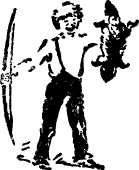 was the first thing that assured Guy of his victory.
They came running over and found him standing like
the hunter in an amateur photograph, holding his
bow in one hand and the big Woodchuck by the tail
in the other.
was the first thing that assured Guy of his victory.
They came running over and found him standing like
the hunter in an amateur photograph, holding his
bow in one hand and the big Woodchuck by the tail
in the other.
"Now, I guess you fellers will come to me to larn
you how to kill Woodchucks. Ain't he an old
socker? I bet he weighs fifty pounds—yes, near
sixty." (It weighed about ten pounds.)
"Good boy! Bully boy! Hooray for the Third
War Chief! Hooray for Chief Sapwood!" and Guy
had no cause to complain of lack of appreciation on the
part of the others.
He swelled out his chest and looked proud and
haughty. "Wished I knew where there was some
more Woodchucks," he said. "I know how to get
them, if the rest don't."
"Well, that should count for a grand coup,
Sappy."
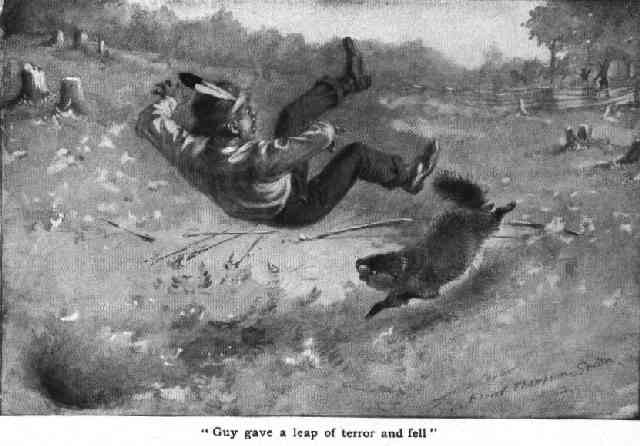
435
"You tole me you wuz goin' to call me 'Hawkeye'
after this morning."
"We'll have to have a Grand Council to fix that
up," replied the Head Chief.
"All right; let's have it this afternoon, will you?"
"All right."
"'Bout four o'clock?"
"Why, yes; any time."
"And you'll fix me up as 'Hawkeye,' and give me
a dandy Eagle feather for killing the Woodchuck,
at four o'clock?"
"Yes, sure, only, why do you want it at four
o'clock?"
But Guy seemed not to hear, and right away after
dinner he disappeared.
"He's dodging the dishwashing again," suggested
the Woodpecker.
"No, he isn't," said the Second Chief. "I believe
he's going to bring his folks to see him in his triumph."
"That's so. Let's chip right in and make it an
everlasting old blowout—kind of a new date in history.
You'll hear me lie like sixty to help him out."
"Good enough. I'm with you. You go and get
your folks. I'll go after old Caleb, and we'll fix it up
to call him 'Hawkeye' and give him his grand coup
feather all at once."
"'Feard my folks and Caleb wouldn't mix,"
replied Sam, "but I believe for a splurge like this
Guy'd ruther have my folks. You see, Da has the
mortgage on their place."
436
So it was agreed Sam was to go for his mother,
while Yan was to prepare the Eagle feather and
skin the Woodchuck.
It was not "as big as a bear," but it was a very
large Woodchuck, and Yan was as much elated
over the victory as any of them. He still had an
hour or more before four o'clock, and eager to make
Guy's triumph as Indian as possible, he cut off all
the Woodchuck's claws, then strung them on a string,
with a peeled and pithed Elder twig an inch long
between each two. Some of the claws were very,
very small, but the intention was there to make a
Grizzly-claw necklace.
Guy made for home as fast as he could go. His
father hailed him as he neared the garden and evidently
had plans of servitude, but Guy darted into
the dining-room-living-room-bedroom-kitchen-room,
which constituted nine-tenths of the house.
"Oh, Maw, you just ought to seen me; you just
want to come this afternoon—I'm the Jim Dandy
of the hull Tribe, an they're going to make me Head
Chief. I killed that whaling old Woodchuck that
pooty nigh killed Paw. They couldn't do a thing
without me—them fellers in camp. They tried an'
tried more'n a thousand times to get that old
Woodchuck—yes, I bet they tried a million times,
an' I just waited till they was tired and give up,
then I says, 'Now, I'll show you how.' First I
had to point him out. Them fellers is no good
to see things. Then I says, 'Now, Sam and Yan,
you fellers stay here, an' just to show how easy
437
it is when you know how, I'll leave all my bosenarrers
behind an' go with nothing.' Wall, there
they stood an' watched me, an' I s-n-e-a-k-e-d round
the fence an' c-r-a-w-l-e-d in the clover just like an
Injun till I got between him an' his hole, and then
I hollers and he come a-snortin' an' a-chatterin' his
teeth at me to chaw me up, for he seen I had no stick
nor nothin', an' I never turned a hair; I kep' cool an'
waited till jest as he was going to jump for my throat,
then I turned and gave him one kick on the snoot that
sent him fifty feet in the air, an' when he come down
he was deader'n Kilsey's hen when she was stuffed
with onions. Oh, Maw, I'm just the bully boy; they
can't do nothin' in camp 'thout me. I had to larn
'em to hunt Deer an' see things—an'—an'—an'—lots
o' things, so they are goin' to make me Head
Chief of the hull Tribe, an' call me 'Hawkeye,' too;
that's the way the Injuns does. It's to be at four
o'clock this afternoon, an' you got to come."
Burns scoffed at the whole thing and told Guy to
get to work at the potatoes, and if he left down the
bars so that the Pig got out he'd skin him alive; he
would have no such fooling round his place. But
Mrs. Burns calmly informed him that she was going.
It was to her much like going to see a university
degree conferred on her boy.
Since Burns would not assist, the difficulty of the
children now arose. This, however, was soon settled.
They should go along. It was two hours' toil for
the mother to turn the four brown-limbed, nearly
438
naked, dirty, happy towsle-tops into four little
martyrs, befrocked, beribboned, becombed and be-booted.
Then they all straggled across the field,
Mrs. Burns carrying the baby in one arm and a pot of
jam in the other. Guy ran ahead to show the way,
and four-year-old, three-year-old and two-year-old,
hand in hand, formed a diagonal line in the wake of
the mother.
They were just a little surprised on getting to camp
to find Mrs. Raften and Minnie there in holiday
clothes. Marget's first feeling was resentment, but
her second thought was a pleasant one. That "stuck-up"
woman, the enemy's wife, should see her boy's
triumph, and Mrs. Burns at once seized on the chance
to play society cat.
"How do ye do, Mrs. Raften; hope you're well,"
she said with a tinge of malicious pleasure and a
grand attempt at assuming the leadership.
"Quite well, thank you. We came down to see
how the boys were getting on in camp."
"They've got on very nicely sense my boy j'ined
them," retorted Mrs. Burns, still fencing.
"So I understand; the other two have become
very fond of him," returned Mrs. Raften, seeking
to disarm her enemy.
This speech had its effect. Mrs. Burns aimed only
to forestall the foe, but finding to her surprise that
the enemy's wife was quite gentle, a truce was made,
and by the time Mrs. Raften had petted and praised
the four tow-tops and lauded Guy to the utmost
439
the air of latent battle was replaced by one of
cordiality.
The boys now had everything ready for the grand
ceremony. On the Calfskin rug at one end was the
Council; Guy, seated on the skin of the Woodchuck
and nearly hiding it from view, Sam on his left hand and
Yan with the drum, on his right. In the middle the
Council fire blazed. To give air, the teepee cover
was raised on the shady side and the circle of visitors
was partly in the teepee and partly out.
The Great War Chief first lighted the peace pipe,
puffed for a minute, then blew off the four smokes
to the four winds and handed it to the Second and
Third War Chiefs, who did the same.
Little Beaver gave three thumps on the drum for
silence, and the Great Woodpecker rose up:
"Big Chiefs, Little Chiefs, Braves, Warriors, Councillors,
Squaws, and Papooses of the Sanger Indians:
When our Tribe was at war with them—them—them—other
Injuns—them Birchbarks, we took prisoner
one of their warriors and tortured him to death two
or three times, and he showed such unusual stuff that
we took him into our Tribe—"
Loud cries of "How—How—How," led by Yan.
"We gave a sun-dance for his benefit, but he didn't
brown—seemed too green—so we called him Sapwood.
From that time he has fought his way up from the
ranks and got to be Third War Chief—"
"How—How—How."
440
"The other day the hull Tribe j'ined to attack an'
capture a big Grizzly and was licked bad, when the
War Chief Sapwood came to the rescue an' settled
the owld baste with one kick on the snoot. Deeds
like this is touching. A feller that kin kick like that
didn't orter be called Sapwood nor Saphead nor
Sapanything. No, sirree! It ain't right. He's the
littlest Warrior among the War Chiefs, but he kin
see farder an' do it oftener an' better than his betters.
He kin see round a corner or through a tree. 'Cept
maybe at night, he's the swell seer of the outfit, an'
the Council has voted to call him 'Hawkeye.'"
"How—How—How—How—How—"
Here Little Beaver handed the Head War Chief
a flat white stick on which was written in large letters
"Sapwood."
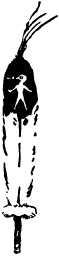 "Here's the name he went by before he was great
an' famous, an' this is the last of it." The Chief put
the stick in the fire, saying, "Now let us see if you're
too green to burn." Little Beaver then handed Woodpecker
a fine Eagle feather, red-tufted, and bearing
in outline a man with a Hawk's head and an arrow
from his eye. "This here's a swagger Eagle feather
for the brave deed he done, and tells about him being
Hawkeye, too" (the feather was stuck in Guy's hair
and the claw necklace put about his neck amid
loud cries of "How—How—" and thumps of the
drum), "and after this, any feller that calls him
Sapwood has to double up and give Hawkeye a
free kick."
"Here's the name he went by before he was great
an' famous, an' this is the last of it." The Chief put
the stick in the fire, saying, "Now let us see if you're
too green to burn." Little Beaver then handed Woodpecker
a fine Eagle feather, red-tufted, and bearing
in outline a man with a Hawk's head and an arrow
from his eye. "This here's a swagger Eagle feather
for the brave deed he done, and tells about him being
Hawkeye, too" (the feather was stuck in Guy's hair
and the claw necklace put about his neck amid
loud cries of "How—How—" and thumps of the
drum), "and after this, any feller that calls him
Sapwood has to double up and give Hawkeye a
free kick."
441
There was a great chorus of "How—How." Guy
tried hard to look dignified and not grin, but it got
beyond him. He was smiling right across and half
way round. His mother beamed with pride till her
eyes got moist and overflowed.
Every one thought the ceremony was over, but
Yan stood up and began: "There is something
that has been forgotten, Chiefs, Squaws and Pappooses
of the Sanger Nation: When we went out
after this Grizzly I was witness to a bargain between
two of the War Chiefs. According to a custom of
our Tribe, they bet their scalps, each that he would
be the one to kill the Grizzly. The Head Chief
Woodpecker was one and Hawkeye was the other.
Hawkeye, you can help yourself to Woodpecker's
scalp."
Sam had forgotten about this, but he bowed his
head. Guy cut the string, and holding up the scalp,
he uttered a loud, horrible war-whoop which every
one helped with some sort of noise. It was the
crowning event. Mrs. Burns actually wept for joy
to see her heroic boy properly recognized at last.
Then she went over to Sam and said, "Did you
bring your folks here to see my boy get praised?"
Sam nodded and twinkled an eye.
"Well, I don't care who ye are, Raften or no
Raften, you got a good heart, an' it's in the right
place. I never did hold with them as says 'There
ain't no good in a Raften.' I always hold there's
some good in every human. I know your Paw did
buy the mortgage on our place, but I never did
442
believe your Maw stole our Geese, an' I never will,
an' next time I hear them runnin' on the Raftens
I'll jest open out an' tell what I know."
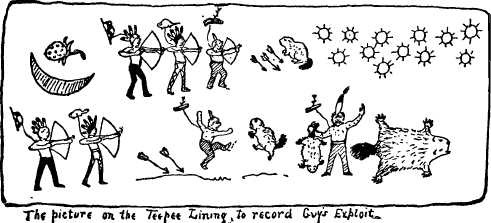
Yan did not forget the proposed Coon hunt—in
fact, he was most impatient for it, and within
two days the boys came to Caleb about sundown
and reminded him of his promise. It was a sultry
night, but Yan was sure it was just right for a Coon
hunt, and his enthusiasm carried all before it. Caleb
was quietly amused at the "cool night" selected, but
reckoned it would be "better later."
"Set down—set down, boys," he said, seeing them
standing ready for an immediate start. "There's
no hurry. Coons won't be running for three or four
hours after sundown."
So he sat and smoked, while Sam vainly tried
to get acquainted with old Turk; Yan made notes
on some bird wings nailed to the wall, and Guy
got out the latest improved edition of his exploits
in Deer-hunting and Woodchuck killing, as well as
enlarged on his plans for gloriously routing any Coon
they might encounter.
By insisting that it would take an hour to get
to the place, Yan got them started at nine o'clock,
Caleb, on a suggestion from Guy, carrying a small
axe. Keeping old Turk well in hand, they took the
highway, and for half an hour tramped on toward
the "Corners." Led by Sam, they climbed a fence
444
crossed a potato field, and reached the corn patch
by the stream.
"Go ahead, Turk. Sic him! Sic him! Sic him!"
and the company sat in a row on the fence to await
developments.
Turk was somewhat of a character. He hunted
what he pleased and when he pleased. His master
could bring him on the Coon grounds, but he couldn't
make him hunt Coon nor anything else unless it
suited his own fancy. Caleb had warned the boys to
be still, and they sat along the fence in dead silence,
awaiting the summons from the old Hound. He
had gone off beating and sniffing among the cornstalks.
His steps sounded very loud and his sniffs
like puffs of steam. It was a time of tense attention;
but the Hound wandered, farther away, and even his
noisy steps were lost.
They had sat for two long minutes, when a
low yelp from a distant part of the field, then a
loud "bow-wow" from the Hound, set Yan's heart
jumping.
"Game afoot," said Sam in a low voice.
"Bet I heered him first," piped Guy.
Yan's first thought was to rush pell-mell after
the Dog. He had often read of the hunt following
furiously the baying of the Hounds, but Caleb
restrained him.
"Hold on, boy; plenty of time. Don't know yet
what it is."
445
For Turk, like most frontier Hounds, would run
almost any trail—had even been accused of running
on his own—and it rested with those who knew him
best to discover from his peculiar style of tonguing
just what the game might be. But they waited
long and patiently without getting another bay
from the Hound. Presently a rustling was heard
and Turk came up to his master and lay down
at his feet.
"Go ahead, Turk, put him up," but the Dog
stirred not. "Go ahead," and Caleb gave him a rap
with a small stick. The Dog dodged away, but
lay down again, panting.
"What was it, Mr. Clark?" demanded Yan.
"Don't hardly know. Maybe he only spiked
himself on a snag. But this is sure; there's no Coons
here to-night. There won't be after this. We come
too early, and it's too hot for the Dog, anyway."
"We could cross the creek and go into Boyle's
bush," suggested the Woodpecker. "We're like
to strike anything there. Larry de Neuville swears
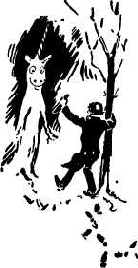 he saw a Unicorn there the night he came back
from Garney's wake."
he saw a Unicorn there the night he came back
from Garney's wake."
"How can you tell the kind of game by the Dog's
barking?" asked Yan.
"H-m!" answered Caleb, as he put a fresh quid
in his lantern jaw. "You surely can if you know
the country an' the game an' the Dog. Course, no
two Dogs is alike; you got to study your Dog, an'
if he's good he'll larn you lots about trailing."
446
The brook was nearly dry now, so they crossed
where they would. Then feeling their way through
the dark woods with eyes for the most part closed,
they groped toward Boyle's open field, then across
it to the heavy timber. Turk had left them at the
brook, and, following its course till he came to a pool,
had had a bath. As they entered the timber
tract he joined them, dripping wet and ready for
business.
"Go ahead, Turk," and again all sat down to
await the opinion of the expert.
It came quickly. The old Hound, after circling
about in a way that seemed to prove him independent
of daylight, began to sniff loudly, and gave
a low whine. He followed a little farther, and now
his tail was heard to 'tap, tap, tap' the brush as he
went through a dry thicket.
"Hear that? He's got something this time," said
Caleb in a low voice. "Wait a little."
The Hound was already working out a puzzle,
and when at last he got far enough to be sure, he
gave a short bark. There was another spell of
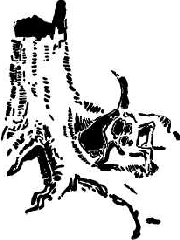 sniffing, then another bark, then several little barks
at intervals, and at last a short bay; then the baying
recommenced, but was irregular and not full-chested.
The sounds told that the Hound was running in a
circle about the forest, but at length ceased moving,
for all the barking was at one place. When the
hunters got there they found the Dog half-way in a
hole under a stump, barking and scratching.
sniffing, then another bark, then several little barks
at intervals, and at last a short bay; then the baying
recommenced, but was irregular and not full-chested.
The sounds told that the Hound was running in a
circle about the forest, but at length ceased moving,
for all the barking was at one place. When the
hunters got there they found the Dog half-way in a
hole under a stump, barking and scratching.
447
"Humph," said Caleb; "nothing but a Cottontail.
Might 'a' knowed that by the light scent an'
the circling without treeing."
So Turk was called off and the company groped
through the inky woods in quest of more adventures.
"There's a kind of swampy pond down the lower
end of the bush—a likely place for Coons on a Frog-hunt,"
suggested the Woodpecker.
So the Hound was again "turned on" near the
pond. The dry woods were poor for scent, but the
damp margin of the marsh proved good, and Turk
became keenly interested and very sniffy. A preliminary
"Woof!" was followed by one or two yelps
and then a full-chested "Boooow!" that left no doubt
he had struck a hot trail at last. Oh, what wonderfully
thrilling horn-blasts those were! Yan for the
first time realized the power of the "full cry," whose
praises are so often sung.
The hunters sat down to await the result, for, as
Caleb pointed out, there was "no saying where the
critter might run."
The Hound bayed his fullest, roundest notes at
quick intervals, but did not circle. The sound of
his voice told them that the chase was straight
away, out of the woods, easterly across an open field,
and at a hot pace, with regular, full bellowing, unbroken
by turn or doubt.
"I believe he's after the old Callaghan Fox," said
the Trapper. "They've tried it together before now,
an' there ain't anything but a Fox will run so
straight and fetch such a tune out of Turk."
448
The baying finally was lost in the distance, probably
a mile away, but there was nothing for it but
to wait. If Turk had been a full-bred and trained
Foxhound he would have stuck to that trail all night,
but in half an hour he returned, puffing and hot, to
throw himself into the shallow pond.
"Everything scared away now," remarked Caleb.
"We might try the other side of the pond." Once
or twice the dog became interested, but decided that
there was nothing in it, and returned to pant by his
master's feet.
They had now travelled so far toward home that
a very short cut across fields would bring them into
their own woods.
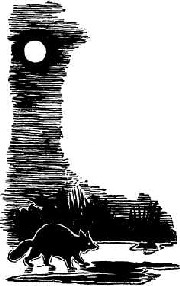
The moon arose as they got there, and after their
long groping in the murky darkness this made the
night seem very bright and clear.
They had crossed the brook below Granny de
Neuville's, and were following the old timber trail
that went near the stream, when Turk stopped to
sniff, ran back and forth two or three times, then
stirred the echoes with a full-toned bugle blast and
led toward the water.
"Bow—bow—bow—bow," he bawled for forty
yards and came to a stop. The baying was exactly
the same that he gave on the Fox trail, but the
course of the animal was crooked, and now there
was a break.
They could hear the dog beating about close at
hand and far away, but silent so far as tongue was
concerned.
449
"What is it, Caleb?" said Sam with calm assurance,
forgetting how recent was their acquaintance.
"Dunno," was the short reply.
"'Tisn't a Fox, is it?" asked Yan.
But a sudden renewal of "Bow—bow—bow—"
from the Hound one hundred yards away, at the
fence, ended all discussion. The dog had the hot
trail again. The break had been along the line of a
fence that showed, as Caleb said, "It was a Coon,
'cept it might be some old house Cat maybe; them
was the only things that would run along top of a
fence in the night time."
It was easy to follow now; the moonlight was good,
and the baying of the Hound was loud and regular.
It led right down the creek, crossing several pools
and swamps.
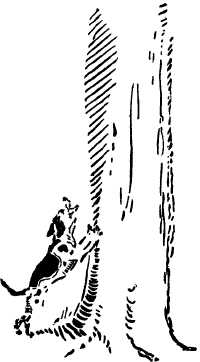 "That settles it," remarked the Trapper decisively.
"Cats don't take to the water. That's a Coon," and
as they hurried they heard a sudden change in the
dog's note, no longer a deep rich 'B-o-o-w-w.' It
became an outrageous clamour of mingled yelps,
growls and barks.
"That settles it," remarked the Trapper decisively.
"Cats don't take to the water. That's a Coon," and
as they hurried they heard a sudden change in the
dog's note, no longer a deep rich 'B-o-o-w-w.' It
became an outrageous clamour of mingled yelps,
growls and barks.
"Ha—heh. That means he's right on it. That is
what he does when he sees the critter."
But the "view halloo" was quickly dropped and
the tonguing of the dog was now in short, high-pitched
yelps at one place.
"Jest so! He's treed! That's a Coon, all right!"
and Caleb led straight for the place.
The Hound was barking and leaping against a
big Basswood, and Caleb's comment was: "Hm,
450
never knowed a Coon to do any other way—always
gets up the highest and tarnalest tree to climb in the
hull bush. Now who's the best climber here?"
"Yan is," volunteered Sam.
"Kin ye do it, Yan?"
"I'll try."
"Guess we'll make a fire first and see if we can't
see him," said the Woodpecker.
"If it was a Woodchuck I'd soon get him for you,"
chimed in Hawkeye, but no one heeded.
Sam and Yan gathered stuff and soon had a flood
of flickering red light on all the surrounding trees.
They scanned the big Basswood without getting
sight of their quarry. Caleb took a torch and
found on the bark some fresh mud. By going
back on the trail to where it had crossed the
brook they found the footprint—undoubtedly that
of a large Coon.
"Reckon he's in some hollow; he's surely up that
tree, and Basswood's are always hollow."
Yan now looked at the large trunk in doubt as to
whether he could manage it.
Caleb remarked his perplexity and said: "Yes;
that's so. You ain't fifteen foot spread across the
wings, are you? But hold on—"
He walked to a tall thin tree near at hand, cut
it through with the axe in a few minutes, and threw
it so as to rest against the lowest branch of the big
Basswood. Up this Yan easily swarmed, carrying
a stout Elm stick tied behind. When he got to the
451
great Basswood he felt lost in the green mass, but
the boys below carried torches so as to shed light on
each part in turn. At first Yan found neither hole
in the trunk nor Coon, but after long search in the
upper branches he saw a great ball of fur on a high
crotch and in it two glowing eyes that gave him a
thrill. He yelled: "Here he is! Look out below."
He climbed up nearer and tried to push the Coon off,
but it braced itself firmly and defied him until he
climbed above it, when it leaped and scrambled to a
lower branch.
Yan followed it, while his companions below got
greatly excited, as they could see nothing, and only
judged by the growling and snarling that Yan and
the Coon were fighting. After another passage at
 arms the Coon left the second crotch and scrambled
down the trunk till it reached the leaning sapling,
and there perched, glaring at the hunters below.
The old Hound raised a howl when he saw the
quarry, and Caleb, stepping to one side, drew his
revolver and fired. The Coon fell dead into their
midst. Turk sprang to do battle, but he was not
needed, and Caleb fondly and proudly wiped the old
white pistol as though it alone were to be thanked
for the clever shot.
arms the Coon left the second crotch and scrambled
down the trunk till it reached the leaning sapling,
and there perched, glaring at the hunters below.
The old Hound raised a howl when he saw the
quarry, and Caleb, stepping to one side, drew his
revolver and fired. The Coon fell dead into their
midst. Turk sprang to do battle, but he was not
needed, and Caleb fondly and proudly wiped the old
white pistol as though it alone were to be thanked
for the clever shot.
Yan came down quickly, though he found it harder
to get down than up. He hurried excitedly into the
ring and stroked the Coon with a mixture of feelings—admiring
its fur—sorry, after all, that it was
killed, and triumphant that he had led the way.
452
It was his Coon, and all admitted that. Sam
"hefted" it by one leg and said, "Weighs thirty
pounds, I bet."
Guy said: "Pooh! Tain't half as big as that
there big Woodchuck I killed, an' you never would
have got him if I hadn't thought of the axe."
Yan thought it would weigh thirty-five pounds.
Caleb guessed it at twenty-five (and afterward they
found out that it barely weighed eighteen). While
they were thus talking the Dog broke into an angry
barking such as he gave for strangers—his "human
voice," Caleb called it—and at once there stepped
into the circle William Raften. He had seen the
lights in the woods, and, dreading a fire at this dry
season, had dressed and come out.
"Hello, Da; why ain't you in bed, where you
ought to be?"
Raften took no notice of his son, but said sneeringly
to Caleb: "Ye ain't out trying to get another shot at
me, air ye?" 'Tain't worth your while; I hain't got
no cash on me to-night."
"Now see here, Da," said Sam, interrupting before
Caleb could answer, "you don't play fair. I know,
an' you ought to know, that's all rot about Caleb
shooting at you. If he had, he'd 'a' got you sure.
I've seen him shoot."
"Not when he was drunk."
"Last time I was drunk we was in it together,"
said Caleb fiercely, finding his voice.
453
"Purty good for a man as swore he had no revolver,"
and Raften pointed to Caleb's weapon. "I seen you
with that ten years ago. An' sure I'm not scairt
of you an' yer revolver," said Raften, seeing Caleb
fingering his white pet; "an' I tell ye this. I won't
have ye and yer Sheep-killing cur ramatacking
through my woods an' making fires this dry saison."
"D—— you, Raften, I've stood all I'm goin' to
stand from you." The revolver was out in a flash,
and doubtless Caleb would have lived up to his
reputation, but Sam, springing to push his father
back, came between, and Yan clung to Caleb's
revolver arm, while Guy got safely behind a tree.
"Get out o' the way, you kids!" snarled Caleb.
"By all manes," said Raften scoffingly; "now
that he's got me unarrumed again. You dhirty
coward! Get out av the way, bhoys, an Oi'll settle
him," for Raften was incapable of fear, and the
boys would have been thrust aside and trouble
follow, but that Raften as he left the house had
called his two hired men to follow and help fight the
fire, and now they came on the scene. One of them
was quite friendly with Caleb, the other neutral,
and they succeeded in stopping hostilities for a time,
while Sam exploded:
"Now see here, Da, 'twould just 'a' served you right
if you'd got a hole through you. You make me sick,
running on Caleb. He didn't make that fire; 'twas
me an' Yan, an' we'll put it out safe enough. You
skinned Caleb an' he never done you no harm.
You run on him just as Granny de Neuville done
454
on you after she grabbed your groceries. You
ought to be ashamed of yourself. Tain't square,
an' 'tain't being a man. When you can't prove
nothin' you ought to shut up."
Raften was somewhat taken aback by this outburst,
especially as he found all the company against
him. He had often laughed at Granny de Neuville's
active hatred against him when he had done her
nothing but good. It never occurred to him that he
was acting a similar part. Most men would have been
furious at the disrespectful manner of their son,
but Raften was as insensitive as he was uncowardly.
His first shock of astonishment over, his only thought
of Sam was, "Hain't he got a cheek! My! but he
talks like a lawyer, an' he sasses right back like a
fightin' man; belave I'll make him study law instid
of tooth-pullin'."
The storm was over, for Caleb's wrath was of the
short and fierce kind, and Raften, turning away in
moral defeat, growled: "See that ye put that fire out
safe. Ye ought all to be in yer beds an' aslape,
like dacint folks."
"Well, ain't you dacint?" retorted Sam.
Raften turned away, heeding neither that nor
Guy's shrill attempt to interpolate some details of
his own importance in this present hunt—"Ef it
hadn't been for me they wouldn't had no axe along,
Mr. Raften"—but William had disappeared.
The boys put out the fire carefully and made
somewhat silently for camp. Sam and Yan carried
455
the Coon between them on a stick, and before they
reached the teepee they agreed that the carcass
weighed at least eighty pounds.
Caleb left them, and they all turned in at once
and slept the sleep of the tired camper.
Next day while working on the Coon-skin Sam
and Yan discussed thoroughly the unpleasant
incident of the night before, but they decided
that it would be unwise to speak of it to Caleb
unless he should bring up the subject, and Guy was
duly cautioned.
That morning Yan went to the mud albums on
one of his regular rounds and again found, first that
curious hoof-mark that had puzzled him before, and
down by the pond album the track of a very large
bird—much like a Turkey track, indeed. He brought
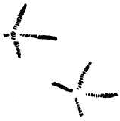 Caleb to see them. The Trapper said that one was
probably the track of a Blue Crane (Heron), and
the other, "Well, I don't hardly know; but it looks
to me mighty like the track of a big Buck—only
there ain't any short of the Long Swamp, and that's
ten miles at least. Of course, when there's only out
it ain't a track; it's an accident."
Caleb to see them. The Trapper said that one was
probably the track of a Blue Crane (Heron), and
the other, "Well, I don't hardly know; but it looks
to me mighty like the track of a big Buck—only
there ain't any short of the Long Swamp, and that's
ten miles at least. Of course, when there's only out
it ain't a track; it's an accident."
"Yes; but I've found lots of them—a trail every
time, but not quite enough to follow."
That night after dark, when he was coming to
camp with the product of a "massacree," Yan heard
a peculiar squawking, guttural sound that rose from
the edge of the pond and increased in strength,
457
drawing nearer, till it was a hideous and terrifying
uproar. It was exactly the sound that Guy had
provoked on that first night when he came and
tried to frighten the camp. It passed overhead,
and Yan saw for a moment the form of a large
slow-flying bird.
Next day it was Yan's turn to cook. At sunrise,
as he went for water, he saw a large Blue Heron rise
from the edge of the pond and fly on heavy pinions
away over the tree-tops. It was a thrilling sight.
The boy stood gazing after it, absolutely rapt with
delight, and when it was gone he went to the place
where it rose and found plenty of large tracks just
like the one he had sketched. Unquestionably it was
the same bird as on the night before, and the mystery
of the Wolf with the sore throat was solved. This
explanation seemed quite satisfactory to everybody
but Guy. He had always maintained stoutly that
the woods were full of Bears right after sundown.
Where they went at other times was a mystery, but
he "reckoned he hadn't yet run across the bird
that could scare him—no, nor the beast, nuther."
Caleb agreed that the grating cry must be that of
the Blue Crane, but the screech and wail in the tree-tops
at night he could shed no light on.
There were many other voices of the night that
became more or less familiar. Some of them were
evidently birds; one was the familiar Song-Sparrow,
and high over the tree-tops from the gloaming sky
they often heard a prolonged sweet song. It was
458
not till years afterward that Yan found out this to
be the night-song of the Oven-bird, but he was able
to tell them at once the cause of the startling outcry
that happened one evening an hour after sundown.
The Woodpecker was outside, the other two
inside the teepee. A peculiar sound fell on his ear.
It kept on—a succession of long whines, and getting
stronger. As it gave no sign of ending, Sam called
the other boys. They stood in a row there and heard
this peculiar "whine, whine, whine" develop into
a loud, harsh "whow, whow, whow."
"It must be some new Heron cry," Yan whispered.
But the sound kept on increasing till it most
resembled the yowling of a very strong-voiced Cat,
and still grew till each separate "meow" might have
been the yell of a Panther. Then at its highest
and loudest there was a prolonged "meow" and
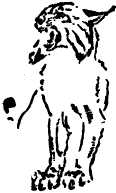 silence, followed finally by the sweet chant of the
Song-sparrow.
silence, followed finally by the sweet chant of the
Song-sparrow.
A great light dawned on Little Beaver. Now
he remembered that voice in Glenyan so long ago,
and told the others with an air of certainty:
"Boys, that's the yelling of a Lynx," and the next
day Caleb said that Yan was right.
Some days later they learned that another lamb
had been taken from the Raften flock that night.
In the morning Yan took down the tom-tom for a
little music and found it flat and soft.
"Hallo," said he; "going to rain."
459
Caleb looked up at him with an amused expression.
"You're a reg'lar Injun. It's surely an Injun trick
that. When the tom-tom won't sing without being
warmed at the fire they allus says 'rain before night.'"
The Trapper stayed late that evening. It had been
cloudy all the afternoon, and at sundown it began to
rain, so he was invited to supper. The shower grew
heavier instead of ending. Caleb went out and dug
a trench all round the teepee to catch the rain, then a
leader to take it away. After supper they sat around
the campfire in the teepee; the wind arose and the rain
beat down. Yan had to go out and swing the smoke
poles, and again his ear was greeted with the screech.
He brought in an armful of wood and made the
inside of the teepee a blaze of cheerful light. A
high wind now came in gusts, so that the canvas
flopped unpleasantly on the poles.
"Where's your anchor rope?" asked the Trapper.
Sam produced the loose end; the other was fastened
properly to the poles above. It had never been
used, for so far the weather had been fine; but now
Caleb sunk a heavy stake, lashed the anchor rope
to that, then went out and drove all the pegs a
little deeper, and the Tribe felt safe from any ordinary
storm.
There was nothing to attract the old Trapper to his
own shanty. His heirs had begun to forget that he
needed food, and what little they did send was of
vilest quality. The old man was as fond of human
society as any one, and was easily persuaded now to
stay all night, "if you can stand Guy for a bedfeller."
So Caleb and Turk settled down for a
460
comfortable evening within, while the storm raged
without.
"Say, don't you touch that canvas, Guy; you'll
make it leak."
"What, me? Oh, pshaw! How can it leak for a
little thing like that?" and Guy slapped it again in
bravado.
"All right, it's on your side of the bed," and sure
enough, within two minutes a little stream of water
was trickling from the place he had rubbed, while
elsewhere the canvas turned every drop.
This is well known to all who have camped
under canvas during a storm, and is more easily
remembered than explained.
The smoke hung heavy in the top of the teepee
and kept crowding down until it became unpleasant.
"Lift the teepee cover on the windward side, Yan.
There, that's it—but hold on," as a great gust came
in, driving the smoke and ashes around in whirlwinds.
"You had ought to have a lining. Give me that canvas:
that'll do." Taking great care not to touch the
teepee cover, Caleb fastened the lining across three
pole spaces so that the opening under the canvas
was behind it. This turned the draught from their
backs and, sending it over their heads, quickly cleared
the teepee of smoke as well as kept off what little rain
entered by the smoke hole.
"It's on them linings the Injuns paint their records
and adventures. They mostly puts their totems on
the outside an' their records on the lining."
461
"Bully," said Sam; "now there's a job for you.
Little Beaver; by the time you get our adventures
on the inside and our totems on the out I tell you
we'll be living in splendour."
"I think," answered Yan indirectly, "we ought
to take Mr. Clark into the Tribe. Will you be our
Medicine Man?" Caleb chuckled in a quiet way,
apparently consenting. "Now I have four totems
to paint on the outside," and this was the beginning
of the teepee painting that Yan carried out with yellow
clay, blue clay dried to a white, yellow clay burned
to red, and charcoal, all ground in Coon grease and
Pine gum, to be properly Indian. He could easily
have gotten bright colours in oil paint, but scorned
such White-man's truck, and doubtless the general
effect was all the better for it.
"Say, Caleb," piped Guy, "tell us about the
Injuns—about their bravery. Bravery is what I
like," he added with emphasis, conscious of being
now on his own special ground. "Why, I mind the
time that old Woodchuck was coming roaring at me—I
bet some fellers would just 'a' been so scared—"
"Hssh!" said Sam.
Caleb smoked in silence. The rain pattered on
the teepee without; the wind heaved the cover. They
all sat silently. Then sounded loud and clear a terrifying
"scrrrrrr—oouwurr." The boys were startled—would
have been terrified had they been outside
or alone.
"That's it—that's the Banshee," whispered Sam.
462
Caleb looked up sharply.
"What is it?" queried Yan. "We've heard it a
dozen times, at least."
Caleb shook his head, made no reply, but turned
to his Dog. Turk was lying on his side by the fire,
and at this piercing screech he had merely lifted his
head, looked backward over his shoulder, turned his
big sad eyes on his master, then laid down again.
"Turk don't take no stock in it."
"Dogs never hear a Banshee," objected Sam, "no
more than they can see a ghost; anyway, that's what
Granny de Neuville says." So the Dog's negative
testimony was the reverse of comforting.
"Hawkeye," said the Woodpecker, "you're the
bravest one of the crowd. Don't you want to go out
and try a shot at the Banshee? I'll lend you my
Witch-hazel arrow. We'll give you a grand coup
feather if you hit him. Go ahead, now—you know
bravery is what you like."
"Yer nothin' but a passel o' blame dumb fools,"
was the answer, "an' I wouldn't be bothered talking
to ye. Caleb, tell us something about the Indians."
"What the Injuns love is bravery," said the
Medicine Man with a twinkle in his eye, and everybody
but Guy laughed, not very loudly, for each was
restrained by the thought that he would rather not
be called upon to show his bravery to-night.
"I'm going to bed," said Hawkeye with unnecessary
energy.
"Don't forget to roost under the waterspout you
463
started when you got funny," remarked the Woodpecker.
Yan soon followed Guy's example, and Sam, who
had already learned to smoke, sat up with Caleb.
Not a word passed between them until after Guy's
snore and Yan's regular puffs told of sound sleep, when
Sam, taking advantage of a long-awaited chance,
opened out rather abruptly:
"Say, Caleb, I ain't going to side with no man
against Da, but I know him just about as well as he
knows me. Da's all right; he's plumb and square,
and way down deep he's got an awful kind heart;
it's pretty deep, I grant you, but it's there, O.K. The
things he does on the quiet to help folks is done on
the quiet and ain't noticed. The things he does to
beat folks—an' he does do plenty—is talked all over
creation. But I know he has a wrong notion of you,
just as you have of him, and it's got to be set right."
Sam's good sense was always evident, and now,
when he laid aside his buffoonery, his voice and
manner were very impressive—more like those of a
grown man than of a fifteen-year-old boy.
Caleb simply grunted and went on smoking, so
Sam continued, "I want to hear your story, then
Ma an' me'll soon fix Da."
The mention of "Ma" was a happy stroke. Caleb
had known her from youth as a kind-hearted girl.
She was all gentleness and obedience to her husband
except in matters of what she considered right and
wrong, and here she was immovable. She had
always believed in Caleb, even after the row, and
464
had not hesitated to make known her belief.
"There ain't much to tell," replied Caleb bitterly.
"He done me on that Horse-trade, an' crowded me
on my note so I had to pay it off with oats at sixty
cents, then he turned round and sold them within
half an hour for seventy-five cents. We had words
right there, an' I believe I did say I'd fix him for it.
I left Downey's Dump early that day. He had about
 $300 in his pocket—$300 of my money—the last I
had in the world. He was too late to bank it, so was
taking it home, when he was fired at in going through
the 'green bush'. My tobacco pouch and some letters
addressed to me was found there in the morning.
Course he blamed me, but I didn't have any shootin'-iron
then; my revolver, the white one, was stole from
me a week before—along with them same letters, I
expect. I consider they was put there to lay the
blame on me, an' it was a little overdone, most folks
would think. Well, then your Da set Dick Pogue on
me, an' I lost my farm—that's all."
$300 in his pocket—$300 of my money—the last I
had in the world. He was too late to bank it, so was
taking it home, when he was fired at in going through
the 'green bush'. My tobacco pouch and some letters
addressed to me was found there in the morning.
Course he blamed me, but I didn't have any shootin'-iron
then; my revolver, the white one, was stole from
me a week before—along with them same letters, I
expect. I consider they was put there to lay the
blame on me, an' it was a little overdone, most folks
would think. Well, then your Da set Dick Pogue on
me, an' I lost my farm—that's all."
Sam smoked gravely for awhile, then continued:
"That's true about the note an' the oats an' the
Horse-trade—just what Da would do; that's all in the
game: but you're all wrong about Dick Pogue—that's
too dirty for Da."
"You may think so, but I don't."
Sam made no answer, but after a minute laid his
hand on Turk, who responded with a low growl.
This made Caleb continue: "Down on me, down on
my Dog. Pogue says he kills Sheep 'an' every one is
465
ready to believe it. I never knowed a Hound turn
Sheep-killer, an' I never knowed a Sheep-killer kill
at home, an' I never knowed a Sheep-killer content
with one each night, an' I never knowed a Sheep-killer
leave no tracks, an' Sheep was killed again
and again when Turk was locked up in the shanty
with me."
"Well, whose Dog is it does it?"
"I don't know as it's any Dog, for part of the Sheep
was eat each time, they say, though I never seen one
o' them that was killed or I could tell. It's more
likely a Fox or a Lynx than a Dog."
There was a long silence, then outside again the
hair-lifting screech to which the Dog paid no heed,
although the Trapper and the boy were evidently
startled and scared.
They made up a blazing fire and turned in silently
for the night.
The rain came down steadily, and the wind swept
by in gusts. It was the Banshee's hour, and two or
three times, as they were dropping off, that fearful,
quavering human wail, "like a woman in distress,"
came from the woods to set their hearts a-jumping,
not Caleb and Sam only, but all four.
In the diary which Yan kept of those times each
day was named after its event; there was Deer day,
Skunk-and-Cat day, Blue Crane day, and this was
noted down as the night of the Banshee's wailing.
Caleb was up and had breakfast ready before the
others were fully awake. They had carefully kept
466
and cleaned the Coon meat, and Caleb made of it a
"prairie pie," in which bacon, potatoes, bread, one
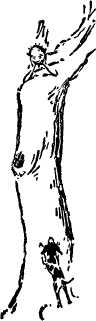 small onion and various scraps of food were made
important. This, warmed up for breakfast and
washed down with coffee, made a royal meal, and
feasting they forgot the fears of the night.
small onion and various scraps of food were made
important. This, warmed up for breakfast and
washed down with coffee, made a royal meal, and
feasting they forgot the fears of the night.
The rain was over, but the wind kept on. Great
blockish clouds were tumbling across the upper sky
Yan went out to look for tracks. He found none
but those of raindrops.
The day was spent chiefly about camp, making
arrows and painting the teepee.
Again Caleb was satisfied to sleep in the camp.
The Banshee called once that night, and again Turk
seemed not to hear, but half an hour later there was
a different and much lower sound outside, a light,
nasal "wow." The boys scarcely heard it, but Turk
sprang up with bristling hair, growling, and forcing
his way out under the door, he ran, loudly barking,
into the woods.
"He's after something now, all right," said his
master; "and now he's treed it," as the Dog began
his high-pitched yelps.
"Good old Dog; he's treed the Banshee," and Yan
rushed out into the darkness. The others followed,
and they found Turk barking and scratching at a big
leaning Beech, but could get no hint of what the
creature up it might be like.
"How does he usually bark for a Banshee?" asked
the Woodpecker, but got no satisfaction, and wondering
467
why Turk should bother himself so mightily over
a little squeal and never hear that awful scream,
they retired to camp.
Next morning in the mud not far from the teepee
Yan found the track of a common Cat, and shrewdly
guessed that this was the prowler that had been heard
and treed by the Dog; probably it was his old friend
of the Skunk fight. The wind was still high, and
as Yan pored over the tracks he heard for the first
time in broad daylight the appalling screech. It
certainly was loud, though less dreadful than at night,
and peering up Yan saw two large limbs that crossed
and rubbed each other, when the right puff of wind came.
This was the Banshee that did the wailing that had
scared them all—all but the Dog. His keener senses,
unspoiled by superstition, had rightly judged the
awful sound as the harmless scraping of two limbs
in the high wind, but the lower, softer noise made
by the prowling Cat he had just as truly placed and
keenly followed up.
Guy was the only one not convinced. He clung
to his theory of Bears.
Late in the night the two Chiefs were awakened
by Guy. "Say, Sam—Sam. Yan—Yan—Yan—Yan,
get up; that big Bear is 'round again. I told you
there was a Bear, an' you wouldn't believe me."
There was a loud champing sound outside, and
occasionally growls or grumbling.
468
"There's surely something there, Sam. I wish
Turk and Caleb were here now."
 The boys opened the door a little and peered out.
There, looming up in the dim starlight, was a huge
black animal, picking up scraps of meat and digging
up the tins that were buried in the garbage hole.
All doubts were dispelled. Guy had another triumph,
and he would have expressed his feelings to the full
but for fear of the monster outside.
The boys opened the door a little and peered out.
There, looming up in the dim starlight, was a huge
black animal, picking up scraps of meat and digging
up the tins that were buried in the garbage hole.
All doubts were dispelled. Guy had another triumph,
and he would have expressed his feelings to the full
but for fear of the monster outside.
"What had we better do?"
"Better not shoot him with arrows. That'll only
rile him. Guy, you blow up the coals and get a blaze."
All was intense excitement now, "Oh, why
haven't we got a gun!"
"Say, Sam, while Sap—I mean Hawkeye—makes
a blaze, let's you and me shoot with blunt arrows,
if the Bear comes toward the teepee." So they
arranged themselves, Guy puttering in terror at the
fire and begging them not to shoot.
"What's the good o' riling him? It—it—it's
croo-oo-el."
Sam and Yan stood with bows ready and arrows
nocked.
Guy was making a failure of the fire, and the Bear
began nosing nearer, champing his teeth and grunting.
Now the boys could see the great ears as the monster
threw up its head.
"Let's shoot before he gets any nearer." At
this Guy promptly abandoned further attempts to
make a fire and scrambled up on a cross stick that
469
was high in the teepee for hanging the pot. He broke
out into tears when he saw Sam and Yan actually
drawing their bows.
"He'll come in and eat us, he will."
But the Bear was coming anyway, and having the
two tomahawks ready, the boys let fly. At once the
Bear wheeled and ran off, uttering the loud, unmistakable
squeal of an old Pig—Burns's own Pig—for
young Burns had again forgotten to put up the bars
that crossed his trail from the homestead to the camp.
Guy came down quickly to join in the laugh. "I
tole you fellers not to shoot. I just believed it was
our old Hog, an' I couldn't help crying when I thought
how mad Paw'd be when he found out."
"I s'pose you got up on that cross pole to see if
Paw was coming, didn't you?"
"No; he got up there to show how brave he was."
This was the huge night prowler that Guy had seen,
and in the morning one more mystery was explained,
for careful examination of Yan's diary of the big
Buck's track showed that it was nothing more than
the track of Burns's old Hog. Why had Caleb and
Raften both been mistaken? First, because it was
a long time since they had seen a Buck track, and
second, because this Pig happened to have a very
unpiggy foot—one as much like that of a Buck as
of a Hog.
"Wa wa wa wa wa! Wa wa wa wa wa! Wa wa
wa wa wa!" Three times it echoed through
the woods—a loud, triumphant cry.
"That's Hawkeye with a big story of bravery; let's
hide."
So Sam and Yan scrambled quickly into the teepee,
hid behind the lining and watched through an "arrow
hole." Guy came proudly stepping, chin in air,
uttering his war-whoop at intervals as he drew near,
and carrying his coat bundled up under one arm.
"Coup! Grand coup! Wa wa wa wa!" he yelled
again and again, but looked simple and foolish when
he found the camp apparently deserted.
So he ceased his yells and, walking deliberately into
the teepee, pulled out the sugar box and was stuffing
a handful into his mouth when the other two Chiefs
let off their wildest howls and, leaping from their
concealment, chased him into the woods—not far, for
Yan laughed too much, and Sam had on but one boot.
 This was their re-gathering after a new search for
adventures. Early in the morning, as he wiped off
the breakfast knives by sticking them into the sod,
the Second War Chief had suggested: "Say, boys, in
old days Warriors would sometimes set out in different
directions in search of adventure, then agree to meet
471
at a given time. Let's do that to-day and see what
we run across."
This was their re-gathering after a new search for
adventures. Early in the morning, as he wiped off
the breakfast knives by sticking them into the sod,
the Second War Chief had suggested: "Say, boys, in
old days Warriors would sometimes set out in different
directions in search of adventure, then agree to meet
471
at a given time. Let's do that to-day and see what
we run across."
"Get your straws," was Woodpecker's reply, as he
returned from putting the scraps on the Wakan Rock.
"No you don't," put in Hawkeye hastily; "at least,
not unless you let me hold the straws. I know you'll
fix it so I'll have to go home."
"All right. You can hold the three straws; long
one is Woodpecker—that's his head with a bit of red
flannel to prevent mistakes; the middle-sized thin one
is me; and the short fat one is you. Now let them
drop. Sudden death and no try over."
The straws fell, and the two boys gave a yell as
Hawkeye's fate pointed straight to the Burns homestead.
"Oh, get out; that's no good. We'll take the other
end," he said angrily, and persisted in going the
opposite way.
"Now we all got to go straight till we find something,
and meet here again when that streak of sunlight
gets around in the teepee to that pole."
As the sunstreak, which was their Indian clock,
travelled just about one pole for two hours, this
gave about four hours for adventures.
Sam and Yan had been back some minutes, and
now Guy, having recovered his composure, bothered
not to wipe the stolen sugar from his lips, but broke
out eagerly:
"Say, fellers, I bet I'm the bully boy. I bet you I—"
472
"Silence!" roared Woodpecker. "You come last."
"All right; I don't care. I bet I win over all of
you. I bet a million dollars I do."
"Go ahead, Chief Woodpecker-settin'-on-the-edge."
So Sam began:
"I pulls on my boots" [he went barefooted half
the time]. "Oh, I tell you I know when to wear my
boots—an' I set out following my straw line straight
out. I don't take no back track. I'm not scared of
the front trail," and he turned his little slit eyes sadly
on Guy, "and I kep' right on, and when I came to
the dry bed of the creek it didn't turn me; no, not a
dozen rods; and I kept right till I came to a Wasp's
nest, and I turned and went round that coz it's cruel
to go blundering into a nest of a lot of poor innocent
little Wasps—and I kep' on, till I heard a low
growl, and I looked up and didn't see a thing. Then
the growling got louder, and I seen it was a hungry
Chipmunk roaring at me and jest getting ready to
spring. Then when I got out my bonearrer he says
to me, he says, as bold as brass 'Is your name
Woodpecker?' Now that scared me, and so I told a
lie—my very first. I says, says I. 'No,' says I. 'I'm
Hawkeye.' Well, you should 'a seen him. He just
turned pale; every stripe on his back faded when I said
that name, and he made for a hollow log and got in.
Now I was mad, and tried to get him out, but when
I'd run to one end he'd run to the other, so we ran
up and down till I had a deep-worn trail alongside
the log, an' he had a deep-worn trail inside the log,
an' I was figgerin' to have him wear it right through
473
at the bottom so the log'd open, but all of a sudden
I says, 'I know what to do for you.' I took off my
boot and stuffs the leg into one end of the log. Then
I rattles a stick at the other end and I heard him run
into the boot. Then I squeezes in the leg and ties
a string around it an' brings him home, me wearing
one boot and the Chipmunk the other, and there he
is in it now," and Sam curled up his free bunch of
toes in graphic comment and added: "Humph! I
s'pose you fellers thought I didn't know what I was
about when I drawed on my long boots this morning."
"Well, I just want to see that Chipmunk an' maybe
I'll believe you."
"In there hunting for a loose patch," and Sam
held up the boot.
"Let's turn him out," suggested the Second
Chief.
So the string was cut and the Chipmunk scrambled
out and away to a safer refuge.
"Now, sonny," said Sam, as it disappeared, "don't
tell your folks what happened you or they'll swat
you for a liar."
"Oh, shucks! That's no adventure. Why, I—"
"Hold on, Hawkeye; Little Beaver next."
"Well, I don't care. I bet I—"
Sam grabbed his knife and interrupted: "Do you
know what Callahan's spring lamb did when it saw
the old man gathering mint? Go ahead, Little
Beaver."
474
"I hadn't much of an adventure, but I went straight
through the woods where my straw pointed and ran
into a big dead stub. It was too old and rotten for
Birds to use now, as well as too late in the season, so
I got a pole and pushed it over, and I found the whole
history of a tenement in that stub. First of all, a
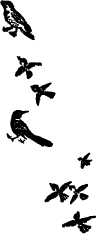 Flicker had come years ago and dug put a fine big
nesting-place, and used it maybe two or three times.
When he was through, or maybe between seasons,
the Chickadees made a winter den of it, for there
were some Chickadee tail-feathers in the bottom.
Next a Purple Blackbird came and used the hole,
piling up a lot of roots with mud on them. Next
year it seems it came again and made another nest
on top of the last; then that winter the Chickadees
again used it for a cubby-hole, for there were some
more Chickadee feathers. Next year a Blue Jay
found it out and nested there. I found some of her
egg-shells among the soft stuff of the nest. Then I
suppose a year after a pair of Sparrow-hawks happened
on the place, found it suited them, and made
their nest in it and hatched a brood of little Sparrow-hawks.
Well, one day this bold robber brought
home to his little ones a Shrew."
Flicker had come years ago and dug put a fine big
nesting-place, and used it maybe two or three times.
When he was through, or maybe between seasons,
the Chickadees made a winter den of it, for there
were some Chickadee tail-feathers in the bottom.
Next a Purple Blackbird came and used the hole,
piling up a lot of roots with mud on them. Next
year it seems it came again and made another nest
on top of the last; then that winter the Chickadees
again used it for a cubby-hole, for there were some
more Chickadee feathers. Next year a Blue Jay
found it out and nested there. I found some of her
egg-shells among the soft stuff of the nest. Then I
suppose a year after a pair of Sparrow-hawks happened
on the place, found it suited them, and made
their nest in it and hatched a brood of little Sparrow-hawks.
Well, one day this bold robber brought
home to his little ones a Shrew."
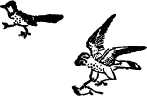
"What's that?"
"Oh, a little thing like a Mouse, only it isn't a
Mouse at all; it is second cousin to a Mole."
"I allus thought a Mole was a Mouse specie,"
remarked Hawkeye, not satisfied with Yan's distinction.
475
"Oh, you!" interrupted Sam. "You'll try to make
out the Burnses is some kin to the Raftens next."
"I bet I won't!" and for once Guy got even.
"Well," Yan continued, "it so happened—about
the first time in about a million years—the little
Hawks were not hungry just then. The Shrew
wasn't gobbled up at once, and though wounded, it
set to work to escape as soon as it was free of the old
one's claws. First it hid under the little ones, then
it began to burrow down through the feather-bed of
the Sparrow-hawk's nest, then through the Blue
Jay's nest, then through the soft stuff of the Blackbird's
nest and among the old truck left by the
Chickadees till it struck the hard mud floor of the
Blackbird's nest, and through that it could not dig.
Its strength gave out now, and it died there and lay
hidden in the lowest nest of the house, till years
after I came by and broke open the old stub and
made it tell me a sad and mournful story—that—maybe—never
happened at all. But there's the
drawing I made of it at the place, showing all the
nests just as I found them, and there's the dried up
body of the little Shrew."
Sam listened with intense interest, but Guy was at
no pains to conceal his contempt. "Oh, pshaw!
That's no adventure—just a whole lot of 's'posens'
without a blame thing doing. Now I'll tell you
what I done. I—"
"Now, Hawkeye," Sam put in, "please don't be
rough about it. Leave out the awful things: I ain't
well to-day. You keep back the scary parts till
476
to-morrow."
"I tell you I left here and went straight as a
die, an' I seen a Woodchuck, but he wasn't in line,
so I says: 'No, some other day. I kin get you easy
any time.' Then I seen a Hawk going off with a
Chicken, but that was off my beat, an' I found lots o'
old stumps an' hundreds o' Chipmunks an' wouldn't
be bothered with them. Then I come to a farmhouse
 an'—an' I went around that so's not to scare the
Dog, an' I went pretty near as far as Downey's
Dump—yes, a little a-past it—only to one side—when
up jumps a Partridge as big as a Turkey, an' a hull
gang of young ones—about thirty or forty. I bet I
seen them forty rod away, an' they all flew, but one
that lighted on a tree as far as—oh, 'cross that field,
anyway. I bet you fellers wouldn't 'a' seen it at all.
Well, I jest hauled off as ca'm as ca'm an' let him
have it. I aimed straight for his eye—an' that's
where I hit him. Now who gets a grand coup, for
there he is!" Hawkeye unrolled his coat and turned
out a bobtailed young Robin in the speckled plumage,
shot through the body.
an'—an' I went around that so's not to scare the
Dog, an' I went pretty near as far as Downey's
Dump—yes, a little a-past it—only to one side—when
up jumps a Partridge as big as a Turkey, an' a hull
gang of young ones—about thirty or forty. I bet I
seen them forty rod away, an' they all flew, but one
that lighted on a tree as far as—oh, 'cross that field,
anyway. I bet you fellers wouldn't 'a' seen it at all.
Well, I jest hauled off as ca'm as ca'm an' let him
have it. I aimed straight for his eye—an' that's
where I hit him. Now who gets a grand coup, for
there he is!" Hawkeye unrolled his coat and turned
out a bobtailed young Robin in the speckled plumage,
shot through the body.
"So that's your Partridge. I call that a young
Robin," said the First Chief with slow emphasis.
"Rules is broke. Killed a Song-bird. Little Beaver,
arrest the criminal."
But Hawkeye struggled with all the ferocity
born of his recent exploit, and had to be bound
hand and foot while a full Council was called to try
the case. The angry protests weakened when he
477
found how serious the Councillors were. Finally
he pleaded "guilty" and was condemned to wear
a black feather of disgrace and a white feather for
cowardice for three days, as well as wash the dishes
for a week. They would also have made him cook
for that term, but that they had had some unhappy
experiences with some dishes of Guy's make.
"Well, I won't do it, that's all," was the prisoner's
defiant retort. "I'll go home first."
"And hoe the garden? Oh, yes; I think I see you."
"Well, I won't do it. You better let me 'lone."
"Little Beaver, what do they do when an Injun
won't obey the Council?"
"Strip him of his honours. Do you remember
that stick we burned with 'Sapwood' on it?"
"Good idee. We'll burn Hawkeye for a name
and dig up the old one"
"No, you won't, you dirty mean Skunks! Ye
promised me you'd never call me that again. I am
Hawkeye. I kin see farder'n—n—" and he
began to weep.
"Well, will you obey the Council?"
"Yes; but I won't wear no white feather—I'm
brave, boohoo!"
 "All right. We'll leave that off; but you must
do the other punishments.
"All right. We'll leave that off; but you must
do the other punishments.
"Will I still be Hawkeye?"
"Yes."
"All right. I'll do it."
 Broad-shouldered, beetle-browed, brutal
and lazy was Bill Hennard, son of a prosperous
settler. He had inherited a fine farm, but he was
as lazy as he was strong, and had soon run through his
property and followed the usual course from laziness
to crime. Bill had seen the inside of more than one
jail. He was widely known in the adjoining township
of Emolan; many petty thefts were traced to
him, and it was openly stated that but for the help
of a rich and clever confederate he would certainly be
in the penitentiary. It was darkly hinted, further,
that this confederate was a well-to-do Sangerite who
had many farms and a wife and son and a little daughter,
and his first name was William, and his second
name Ra—— "But never mind; and don't for the
world say I told you." Oh, it's easy to get rich—if
you know how. Of course, these rumours never
reached the parties chiefly concerned.
Broad-shouldered, beetle-browed, brutal
and lazy was Bill Hennard, son of a prosperous
settler. He had inherited a fine farm, but he was
as lazy as he was strong, and had soon run through his
property and followed the usual course from laziness
to crime. Bill had seen the inside of more than one
jail. He was widely known in the adjoining township
of Emolan; many petty thefts were traced to
him, and it was openly stated that but for the help
of a rich and clever confederate he would certainly be
in the penitentiary. It was darkly hinted, further,
that this confederate was a well-to-do Sangerite who
had many farms and a wife and son and a little daughter,
and his first name was William, and his second
name Ra—— "But never mind; and don't for the
world say I told you." Oh, it's easy to get rich—if
you know how. Of course, these rumours never
reached the parties chiefly concerned.
Hennard had left Downey's Dump the evening
before, and avoiding the roads, had struck through the
woods, to visit his partner, with important matters
to arrange—very important for Hennard. He was
much fuddled when he left Downey's, the night
was cloudy, and consequently he had wandered round and round till he was completely lost.
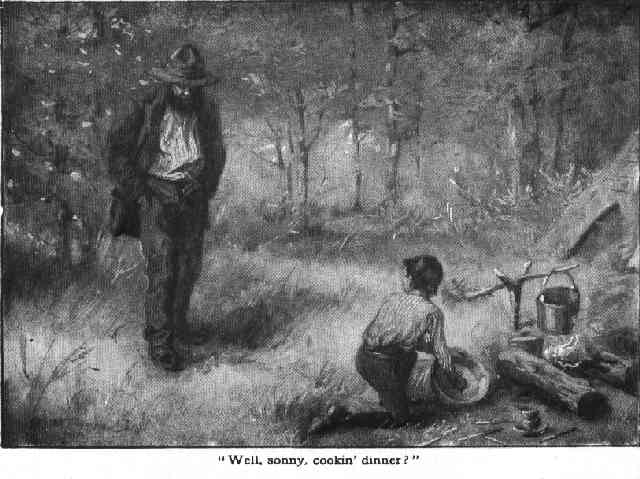
He slept under a tree (a cold, miserable sleep it was), and
in the sunless morning he set out with little certainty
to find his "pal." After some time he stumbled
on the trail that led him to the boys' camp. He was
now savage with hunger and annoyance, and reckless
with bottle assistance, for he carried a flask. No
longer avoiding being seen, he walked up to the teepee
just as Little Beaver was frying meat for the noonday
meal he expected to eat alone. At the sound of
footsteps Yan turned, supposing that one of his companions
had come back, but there instead was a big,
rough-looking tramp.
"Well, sonny, cookin' dinner? I'll be glad to j'ine
ye," he said with an unpleasant and fawning smile.
His manner was as repulsive as it could be, though
he kept the form of politeness.
"Where's your folks, sonny?"
"Haven't any—here," replied Yan, in some fear,
remembering now the tramps of Glenyan.
"H-m—all alone—camped all alone, are ye?"
"The other fellers are away till the afternoon."
"Wall, how nice. Glad to know it. I'll trouble
you to hand me that stick," and now the tramp's
manner changed from fawning to command, as he
pointed to Yan's bow hanging unstrung.
"That's my bow!" replied Yan, in fear and
indignation.
"I won't tell ye a second time—hand me that
stick, or I'll spifflicate ye."
482
Yan stood still. The desperado strode forward,
seized the bow, and gave him two or three blows on
the back and legs.
"Now, you young Pup, get me my dinner, and
be quick about it, or I'll break yer useless neck."
Yan now realized that he had fallen into the power
of the worst enemy of the harmless camper, and saw
too late the folly of neglecting Raften's advice to
have a big Dog in camp. He glanced around and
would have run, but the tramp was too quick for
him and grabbed him by the collar. "Oh, no you
don't; hold on, sonny. I'll fix you so you'll do as
you're told." He cut the bowstring from its place,
and violently throwing Yan down, he tied his feet
so that they had about eighteen inches' play.
"Now rush around and get my dinner; I'm hungry.
An' don't you spile it in the cooking or I'll use the gad
on you; an' if you holler or cut that cord I'll kill ye.
See that?" and he got out an ugly-looking knife.
Tears of fear and pain ran down Yan's face as he
limped about to obey the brute's orders.
"Here, you move a little faster!" and the tramp
turned from poking the fire with the bow to give
another sounding blow. If he had looked down the
trail he would have seen a small tow-topped figure
that turned and scurried away at the sound.
Yan was trained to bear punishment, but the
tyrant seemed careless of even his life.
"Are you going to kill me?" he burst out, after
another attack for stumbling in his shackles.
483
"Don't know but I will when I've got through
with ye," replied the desperado with brutal coolness.
"I'll take some more o' that meat—an' don't you let
it burn, neither. Where's the sugar for the coffee?
I'll get a bigger club if ye don't look spry," and so
the tramp was served with his meal. "Now bring
me some tobaccer."
Yan hobbled into the teepee and reached down
Sam's tobacco bag.
"Here, what's that box? Bring that out here,"
and the tramp pointed to the box in which they
kept some spare clothes. Yan obeyed in fear and
trembling. "Open it."
"I can't. It's locked, and Sam has the key."
"He has, has he? Well, I have a key that will
open it," and so he smashed the lid with the axe; then
he went through the pockets, got Yan's old silver
watch and chain, and in Sam's trousers pocket he
got two dollars.
"Ha! That's just what I want, sonny," and the
tramp put them in his own pockets. "'Pears to me the
fire needs a little wood," he remarked, as his eye fell
on Yan's quiverful of arrows, and he gave that a
kick that sent many of them into the blaze.
"Now, sonny, don't look at me quite so hard, like
you was taking notes, or I may have to cut your
throat and put you in the swamp hole to keep ye
from telling tales."
Yan was truly in terror of his life now.
"Bring me the whetstone," the tyrant growled, "an'
some more coffee." Yan did so. The tramp began
484
whetting his long knife, and Yan saw two things
that stuck in his memory: first, the knife, which was
of hunting pattern, had a brass Deer on the handle;
second, the hand that grasped it had only three
fingers.
"What's that other box in there?"
"That's—that's—only our food box."
"You lie to me, will ye?" and again the stick
descended. "Haul it out."
"I can't."
"Haul it out or I'll choke ye."
Yan tried, but it was too heavy.
"Get out, you useless Pup!" and the tramp walked
into the teepee and gave Yan a push that sent him
headlong out on the ground.
The boy was badly bruised, but saw his only
chance. The big knife was there. He seized it,
cut the cord on his legs, flung the knife afar in the
swamp and ran like a Deer. The tramp rushed
out of the teepee yelling and cursing. Yan might have
gotten away had he been in good shape, but the
tramp's cruelty really had crippled him, and
the brute was rapidly overtaking him. As he sped
down the handiest, the south trail, he sighted in
the trees ahead a familiar figure, and yelling with
all his remaining strength, "Caleb! Caleb!! Caleb
Clark!!!" he fell swooning in the grass.
There is no mistaking the voice of dire distress.
Caleb hurried up, and with one impulse he and the
tramp grappled in deadly struggle. Turk was not
485
with his master, and the tramp had lost his knife, so
it was a hand-to-hand conflict. A few clinches, a
few heavy blows, and it was easy to see who must
win. Caleb was old and slight. The tramp, strong,
heavy-built, and just drunk enough to be dangerous,
was too much for him, and after a couple of rounds
the Trapper fell writhing with a foul blow. The
tramp felt again for his knife, swore savagely,
looked around for a club, found only a big stone,
and would have done no one knows what, when there
was a yell from behind, another big man crashed
down the trail, and the tramp faced William Raften,
puffing and panting, with Guy close behind. The
stone meant for Caleb he hurled at William, who
dodged it, and now there was an even fight. Had
the tramp had his knife it might have gone hard
with Raften, but fist to fist the farmer had the odds.
His old-time science turned the day, and the desperado
went down with a crusher "straight from the
shoulder."
It seemed a veritable battle-field—three on the
ground and Raften, red-faced and puffing, but sturdy
and fearless, standing in utter perplexity.
"Phwhat the divil does it all mane?"
"I'll tell you, Mr. Raften," chirped in Guy, as he
stole from his safe shelter.
"Oh, ye're here, are ye, Guy? Go and git a rope
at camp—quick now," as the tramp began to move.
As soon as the rope came Raften tied the fellow's
arms safely.
486
"'Pears to me Oi've sane that hand befoore,"
remarked Raften, as the three fingers caught his
eye.
Yan was now sitting up, gazing about in a dazed
way. Raften went over to his old partner and said:
"Caleb, air ye hurrt? It's me—it's Bill Raften.
Air ye hurrt?"
Caleb rolled his eyes and looked around.
Yan came over now and knelt down. "Are you
hurt, Mr. Clark?"
He shook his head and pointed to his chest.
"He's got his wind knocked out," Raften explained;
"he'll be all right in a minute or two. Guy, bring
some wather."
Yan told his story and Guy supplied an important
chapter. He had returned earlier than expected,
and was near to camp, when he heard the tramp
beating Yan. His first impulse to run home to his
puny father was replaced with the wiser one to go
for brawny Mr. Raften.
The tramp was now sitting up and grumbling
savagely.
"Now, me foine feller," said William. "We'll
take ye back to camp for a little visit before we take
ye to the 'Pen.' A year in the cooler will do ye
moore good, Oi'm thinkin', than anny other tratement.
Here, Guy, you take the end av the rope
and fetch the feller to camp, while I help Caleb."
Guy was in his glory. The tramp was forced to go
ahead; Guy followed, jerking the rope and playing
Horse, shouting, "Ch'—ch'—ch'—get up, Horsey,"
487
while William helped old Caleb with a gentleness
that recalled a time long ago when Caleb had so
helped him after a falling tree had nearly killed him
in the woods.
At camp they found Sam. He was greatly
astonished at the procession, for he knew nothing
of the day's events, and fearfully disappointed he
was on learning what he had missed.
Caleb still looked white and sick when they got
him to the fire, and Raften said, "Sam, go home and
get your mother to give you a little brandy."
"You don't need to go so far," said Yan, "for that
fellow has a bottle in his pocket."
"I wouldn't touch a dhrap of annything he has, let
alone give it to a sick friend," was William's reply.
So Sam went for the brandy and was back with it
in half an hour.
"Here now, Caleb," said William, "drink that
now an' ye'll feel better," and as he offered the cup
he felt a little reviving glow of sympathy for his
former comrade.
When Sam went home that morning it was with a
very clear purpose. He had gone straight to his
mother and told all he knew about the revolver and
the misunderstanding with Caleb, and they two
had had a long, unsatisfactory interview with the
father. Raften was brutal and outspoken as usual.
Mrs. Raften was calm and clear-witted. Sam was
shrewd. The result was a complete defeat for
William—a defeat that he would not acknowledge;
488
and Sam came back to camp disappointed for the time
being, but now to witness the very thing he had been
striving for—his father and the Trapper reconciled;
deadly enemies two hours ago, but now made friends
through a fight. Though overpowered in argument,
Raften's rancour was not abated, but rather increased
toward the man he had evidently misused, until the
balance was turned by the chance of his helping
that man in a time of direst straits.
Oh, the magic of the campfire! No unkind feeling
long withstands its glow. For men to meet
at the same campfire is to come closer, to
have better understanding of each other, and to lay the
foundations of lasting friendship. "He and I camped
together once!" is enough to explain all cordiality
between the men most wide apart, and Woodcraft days
are days of memories happy, bright and lifelong.
To sit at the same camp fireside has always been
a sacred bond, and the scene of twenty years before
was now renewed in the Raften woods, thanks to
that campfire lit a month before—the sacred fire.
How well it had been named! William and Caleb
were camped together in good fellowship again,
marred though it was with awkwardness as yet, but
still good fellowship.
Raften was a magistrate. He sent Sam with an
order to the constable to come for the prisoner.
Yan went to the house for provisions and to bring
Mrs. Raften, and Guy went home with an astonishing
account of his latest glorious doings. The tramp
desperado was securely fastened to a tree; Caleb
was in the teepee lying down. Raften went in for
a few minutes, and when he came out the tramp
was gone. His bonds were cut, not slipped. How
490
could he nave gotten away without help?
"Never mind," said Raften. "That three-fingered
hand is aisy to follow. Caleb, ain't that Bill
Hennard?"
"I reckon."
The men had a long talk. Caleb told of the loss
of his revolver—he was still living in the house with
the Pogues then—and of its recovery. They both
remembered that Hennard was close by at the time
of the quarrel over the Horse-trade. There was
much that explained itself and much of mystery
that remained.
But one thing was clear. Caleb had been tricked
out of everything he had in the world, for it was
just a question of days now before Pogue would, in
spite of Saryann, throw off all pretense and order
Caleb from the place to shift for himself.
Raften sat a long time thinking, then said:
"Caleb, you do exactly as Oi tell ye and ye'll get
yer farrum back. First, Oi'll lend ye wan thousand
dollars for wan week."
A thousand dollars!!! Caleb's eyes opened, and
what was next he did not then learn, for the boys
came back and interrupted, but later the old Trapper
was fully instructed.
When Mrs. Raften heard of it she was thunderstruck.
A thousand dollars in Sanger was like one
hundred thousand dollars in a big city. It was
untold wealth, and Mrs. Raften fairly gasped.
491
"A thousand dollars, William! Why! isn't that a
heavy strain to put on the honesty of a man who
thinks still that he has some claim on you? Is it safe
to risk it?"
"Pooh!" said William. "Oi'm no money-lender,
nor spring gosling nayther. Thayer's the money
Oi'll lend him," and Raften produced a roll of counterfeit
bills that he as magistrate had happened to have
in temporary custody. "Thayer's maybe five hundred
or six hundred dollars, but it's near enough."
Caleb, however, was allowed to think it real
money, and fully prepared, he called at his own—the
Pogue house—the next day, knocked, and
walked in.
"Good morning, father," said Saryann, for she
had some decency and kindness.
"What do you want here?" said Dick savagely;
"bad enough to have you on the place, without
forcing yerself on us day and night."
"Hush now, Dick; you forget—"
"Forget—I don't forget nothin'," retorted Dick,
interrupting his wife. "He had to help with the
chores an' work, an' he don't do a thing and expects
to live on me."
"Oh, well, you won't have me long to bother you,"
said Caleb sadly, as he tottered to a chair. His face
was white and he looked sick and shaky.
"What's the matter, father?"
"Oh, I'm pretty bad. I won't last much longer
You'll be quit o' me before many days."
492
"Big loss!" grumbled Dick.
"I—I give you my farm an' everything I had—"
"Oh, shut up. I'm sick of hearing about it."
"At least—'most—everything. I—I—I—didn't
say nothing about a little wad o'—o'—bills I had
stored away. I—I—" and the old man trembled
violently—"I'm so cold."
"Dick, do make a fire," said his wife.
"I won't do no sich fool trick. It's roastin' hot
now."
"'Tain't much," went on the trembling old man,
"only fif—fif—teen hundred—dollars. I got it here
now," and he drew out the roll of greenbacks.
FIFTEEN HUNDRED DOLLARS! Twice as
much as the whole farm and stock were worth!
Dick's eyes fairly popped out, and Caleb was careful
to show also the handle of the white revolver.
"Why, father," exclaimed Saryann, "you are ill:
Let me go get you some brandy. Dick, make a fire.
Father is cold as ice."
"Yes—please—fire—I'm all of—a—tremble—with
—cold."
Dick rushed around now and soon the big fire
place was filled with blaze and the room unpleasantly
warm.
 "Here, father, have some brandy and water,"
said Dick, in a very different tone. "Would you like
a little quinine?"
"Here, father, have some brandy and water,"
said Dick, in a very different tone. "Would you like
a little quinine?"
"No, no—I'm better now; but I was saying—I
only got a few days to live, an' having no legal kin—
this here wad'd go to the gover'ment, but I spoke
493
to the lawyer, an' all I need do—is—add—a word
to the deed o' gift—for the farm—to include
this—an' it's very right you should have it, too." Old
Caleb shook from head to foot and coughed terribly.
"Oh, father, let me send for the doctor," pleaded
Saryann, and Dick added feebly, "Yes, father, let
me go for the doctor."
"No, no; never mind. It don't matter. I'll
be better off soon. Have you the deed o' gift here?"
"Oh, yes, Dick has it in his chest." Dick ran to
get the deed, for these were the days before registration
in Canada; possession of the deed was possession
of the farm, and to lose the deed was to lose
the land.
The old man tremblingly fumbled over the money,
seeming to count it—"Yes—just—fif-teen hun'erd,"
as Dick came clumping down the ladder with the
deed.
"Have you got a—pen—and ink—"
Dick went for the dried-up ink bottle while Saryann
hunted for the pen. Caleb's hand trembled violently
as he took the parchment, glanced carefully
over it—yes, this was it—the thing that had made
him a despised pauper. He glanced around quickly.
Dick and Saryann were at the other end of the room.
He rose, took one step forward and stuffed the deed
into the blazing fire. Holding his revolver in his right
hand and the poker in the left, he stood erect and firm,
all sign of weakness gone; his eyes were ablaze, and
with voice of stern command he hissed "Stand back!"
494
And pointed the pistol as he saw Dick rushing to
rescue the deed. In a few seconds it was wholly
consumed, and with that, as all knew, the last claim
of the Pogues on the property, for Caleb's own possessory
was safe in a vault at Downey's.
"Now," thundered Caleb, "you dirty paupers,
get out of my house! Get off my land, and don't
you dare touch a thing belonging to me."
He raised his voice in a long "halloo" and rapped
three times on the table. Steps were heard outside.
Then in came Raften with two men.
"Magistrate Raften, clear my house of them interlopers,
if ye please."
Caleb gave them a few minutes to gather up their
own clothes, then they set out on foot for Downey's,
wild with helpless rage, penniless wanderers in the
world, as they had meant to leave old Caleb.
Now he was in possession of his own again, once
more comfortably "fixed." After the men had had
their rough congratulations and uproarious laughter
over the success of the trick, Raften led up to the
question of money, then left a blank, wondering
what Caleb would do. The good old soul pulled
out the wad.
"There it is, Bill. I hain't even counted it, and
a thousand times obliged. If ever you need a
friend, call on me."
 Raften chuckled, counted the greenbacks and
said "All right!" and to this day Caleb doesn't know
that the fortune he held in his hand that day was
495
nothing but a lot of worthless paper.
Raften chuckled, counted the greenbacks and
said "All right!" and to this day Caleb doesn't know
that the fortune he held in his hand that day was
495
nothing but a lot of worthless paper.
A week later, as the old Trapper sat alone getting
his evening meal, there was a light rap at the door.
"Come in."
A woman entered. Turk had sprung up growling,
but now wagged his tail, and when she lifted a veil
Caleb recognized Saryann.
"What do you want?" he demanded savagely.
"'Twasn't my doing, father; you know it wasn't;
and now he's left me for good." She told him
her sorrowful story briefly. Dick had not
courted Saryann, but the farm, and now that that
was gone he had no further use for her. He had
been leading a bad life, "far worse than any one
knew," and now he had plainly told her he was done
with her.
Caleb's hot anger never lasted more than five
minutes. He must have felt that her story was true,
for the order of former days was reestablished, and
with Saryann for housekeeper the old man had a
comfortable home to the end of his days.
Pogue disappeared; folks say he went to the States.
The three-fingered tramp never turned up again, and
about this time the serious robberies in the region
ceased. Three years afterward they learned that
two burglars had been shot while escaping from an
American penitentiary. One of them was undoubtedly
Dick Pogue, and the other was described as a
big dark man with three fingers on the right hand.
The winning back of the farm, according to Sanger
custom must be celebrated in a "sociable" that
took the particular form of a grand house-warming,
in which the Raftens, Burnses and Boyles
were fully represented, as Char-less was Caleb's fast
friend. The Injun band was very prominent, for
Caleb saw that it was entirely owing to the meetings
at the camp that the glad event had come about.
Caleb acted as go-between for Char-less Boyle and
William Raften, and their feud was forgotten—for
the time at least—as they related stories of their
early hunting days, to the delight of Yan and the
Tribe. There were four other boys there whom
Little Beaver met for the first time. They were
Wesley Boyle, a dark-skinned, low-browed, active
boy of Sam's age; his brother Peter, about twelve,
fair, fat and freckled, and with a marvellous squint;
and their cousin Char-less Boyle, Jr., good-natured,
giggly, and of spongy character; also Cyrus Digby,
a smart city boy, who was visiting "the folks," and
who usually appeared in white cuffs and very
high stand-up collar. These boys were greatly
interested in the Sanger Indian camp, and one
outcome of the meeting at Caleb's was the formation
of another Tribe of Indians, composed of the three
497
Boyle boys and their town friend.
Since most of these were Boyles and the hunting-ground
was the Boyles woods about that marshy pond,
and especially because they had read of a band of
Indians named Boilers or Stoneboilers (Assineboines),
they called themselves the "Boilers." Wesley was
the natural leader. He was alert as well as strong,
and eager to do things, so made a fine Chief. His
hooked nose and black hair and eyes won for him
the appropriate name of "Blackhawk." The city
boy being a noisy "show-off," who did little work,
was called "Bluejay" Peter Boyle was "Peetweet,"
and Char-less, from his peculiar snickering
and showing two large front teeth, was called
"Red-squirrel."
They made their camp as much as possible like
that of the Sangers, and adopted their customs; but
a deadly rivalry sprang up between them from the
first. The Sangers felt that they were old and experienced
Woodcrafters. The Boilers thought they
knew as much and more, and they outnumbered
the Sangers. Active rivalry led to open hostilities.
There was a general battle with fists and mud; that
proved a draw. Then a duel between leaders was
arranged, and Blackhawk won the fight and the
Woodpecker's scalp. The Boilers were wild with
enthusiasm. They proposed to take the whole Sanger
camp, but in a hand-to-hand fight of both tribes it
was another draw. Guy, however, scored a glorious
triumph over Char-less and secured his scalp at the
498
moment of victory.
Now Little Beaver sent a challenge to Blackhawk.
It was scornfully accepted. Again the Boiler Chief
was victor and won another scalp, while Little Beaver
got a black eye and a bad licking, but the enemy
retired.
Yan had always been considered a timid boy at
Bonnerton, but that was largely the result of his
repressive home training. Sanger was working great
changes. To be treated with respect by the head of
the house was a new and delightful experience. It
developed his self-respect. His wood life was making
him wonderfully self-reliant, and improved health
helped his courage, so next day, when the enemy
appeared in full force, every one was surprised when
Yan again challenged Blackhawk. It really cost
him a desperate and mighty effort to do so, for it is
one thing to challenge a boy that you think you can
"lick" and another to challenge one the very day after
he has licked you. Indeed, if the truth were known,
Yan did it in fear and trembling, and therein lay the
courage—in going ahead when fear said "Go back."
It is quite certain that a year before he would not
have ventured in such a fight, and he only did it now
because he had realized that Blackhawk was left-handed,
and a plan to turn this to account had
suggested itself. Every one was much surprised at
the challenge, but much more so when, to the joy
of his tribe, Little Beaver won a brilliant victory.
499
Inspired by this, they drove the Boilers from the
field, scored a grand triumph, and Sam and Yan
each captured a scalp.
The Sangers held a Council and scalp-dance in
celebration that night around an outdoor fire. The
Medicine Man was sent for to be in it.
After the dance, Chief Beaver, his face painted
to hide his black eye, made a speech. He claimed
that the Boilers would surely look for reinforcements
and attempt a new attack, and that, therefore, the
Sangers should try to add to their number, too.
"I kin lick Char-less any time," piped in Guy
proudly, and swung the scalp he had won.
But the Medicine Man said: "If I were you boys
I'd fix up a peace. Now you've won you ought to
ask them to a big pow-wow."
These were the events that led to the friendly meeting
of the two Tribes in full war-paint.
Chief Woodpecker first addressed them: "Say,
fellers—Brother Chiefs, I mean—this yere quar'lin'
don't pay. We kin have more fun working together.
Let's be friends an' join in one Tribe. There's more
fun when there's a crowd."
"All right," said Blackhawk; "but we'll call the
tribe the 'Boilers,' coz we have the majority, and
leave me Head Chief."
"You are wrong about that. Our Medicine Men
makes us even number and more than even weight.
We've got the best camp—have the swimming-pond,
and we are the oldest Tribe, not to speak of the success
we had in a certain leetle business not long ago which
500
the youngest of us kin remember," and Guy grinned
in appreciation of this evident reference to his exploit.
As a matter of fact, it was the swimming-pond that
turned the day. The Boilers voted to join the
Sangers. Their holiday was only ten days, the
Sangers had got a week's extension, and all knew
that they could get most out of their time by going
to the pond camp. The question of a name was
decided by Little Beaver.
"Boiler Warriors," said he, "it is the custom of
the Indians to have the Tribes divided in clans. We
are the Sanger clan. You are the Boiler clan. But
as we all live in Sanger we are all Sanger Indians."
"Who's to be Head Chief?"
Blackhawk had no notion of submitting to
Woodpecker, whom he had licked, nor would Woodpecker
accept a Chief of the inferior tribe. One
suggested that Little Beaver be Chief, but out of
loyalty to his friend, the Woodpecker, Yan declined.
"Better leave that for a few days till you get
acquainted," was the Medicine Man's wise suggestion.
That day and the next were spent in camp. The
Boilers had their teepee to make and beds to prepare.
The Sangers merrily helped, making a "bee" of it.
Bow and arrow making were next to do. Little
Beaver had not fully replaced his own destroyed by
the robber. A hunt of the Burlap Deer was a pleasant
variation of the second day, though there were but
two bows for all, and the Boilers began to realize
that they were really far behind the Sangers in
501
knowledge of Woodcraft.
At swimming Blackhawk was easily first. Of
course, this greatly increased his general interest in
the swimming-pond, and he chiefly was responsible
for the making of a canoe later on.
The days went on right merrily—oh, so fast!
Little Beaver showed all the things of interest in
his kingdom. How happy he was in showing them—playing
experienced guide as he used to dream it!
Peetweet took a keen interest; so did the city boy.
Char-less took a little interest in it all, helped a little,
was generally a little in everything, and giggled
a good deal. Hawkeye was disposed to bully
Char-less, since he found him quite lickable. His
tone was high and haughty when he spoke to
him—not at all like his whining when addressing
the others. He volunteered to discipline Char-less
if he should ill-treat any of the others, and was
about to administer grievous personal punishment
for some trifling offense, when Blackhawk gave
him a warning that had good effect.
 Yan's note-book was fully discussed and his drawings
greatly admired. He set to work at once with
friendly enthusiasm to paint the Boilers' teepee.
Not having any adventures that seemed important,
except, perhaps, Blackhawk's defeat of Woodpecker
and Little Beaver, subjects that did not interest the
artist, the outside decorations were the totem of
the clan and its members.
Yan's note-book was fully discussed and his drawings
greatly admired. He set to work at once with
friendly enthusiasm to paint the Boilers' teepee.
Not having any adventures that seemed important,
except, perhaps, Blackhawk's defeat of Woodpecker
and Little Beaver, subjects that did not interest the
artist, the outside decorations were the totem of
the clan and its members.
Blackhawk was the introducer of a new
game which he called "judging."
"How far is it from here to that tree?" he
would ask, and when each had written down his guess
they would measure, and usually it was Woodpecker
or Blackhawk that came nearest to the truth. Guy
still held the leadership "for far sight," for which
reason he suggested that game whenever a change
of amusement was wanted.
Yan, following up Blackhawk's suggestion, brought
in the new game of "White-man's Woodcraft."
"Can you," asked he, "tell a Dog's height by its
track?"
"No; nor you nor any one else," was the somewhat
scornful reply.
"Oh, yes, I can. Take the length in inches of his
forefoot track, multiply it by 8, and that gives
his height at the shoulder. You try it and you'll
see. A little Dog has a 2¼ inch foot and stands
about 18 inches, a Sheep Dog with a 3-inch track
stands 24 inches, and a Mastiff or any big Dog
with a 4-inch track gives 30 to 32 inches."
"You mean every Dog is 8 feet high?" drawled
Sam, doubtfully, but Yan went on. "And you can
tell his weight, too, by the track. You multiply
503
the width of his forefoot in inches by the length,
and multiply that by 5, and that gives pretty near
his weight in pounds. I tried old Cap. His foot
is 3½ by 3; that equals 10½, multiplied by 5
equals 52½ pounds: just about right."
"I'll bet I seen a Dog at the show that that wouldn't
work on," drawled Sam. "He was as long as my
two arms, he had feet as big as a young Bear, an'
he wasn't any higher than a brick. He was jest
about the build of a Caterpiller, only he didn't have
but four legs at the far ends. They was so far
apart he couldn't keep step. He looked like he was
raised under a bureau. I think when they was cutting
down so on his legs they might have give him
more of them; a row in the middle would 'a' been
'bout right."
"Yes, I know him. That's a Dachshund. But you
can't reckon on freaks; nothing but straight Dog.
It works on wild animals, too—that is, on Wolves
and Foxes and maybe other things," then changing
the subject Beaver continued:
"Can you tell the height of a tree by its shadow?"
"Never thought of that. How do you do it?"
"Wait till your own shadow is the same length as
yourself—that is, about eight in the morning or four
in the afternoon—then measure the tree's shadow.
That gives its length."
"You'd have to wait all day to work that, and you
can't do it at all in the woods or on a dull day,"
objected Blackhawk. "I'd rather do it by guess."
504
"I'll bet my scalp against yours I can tell the
height of that tree right now without climbing it,
and get closer than you can by guessing," said
Little Beaver.
"No, I won't bet scalps on that—but I'll bet who's
to wash the dishes."
"All right. To the top of that tree, how much
is it?"
"Better not take the top, 'cause we can't get there
to measure it, but say that knot," was the rejoinder.
"Here, Woodpecker, you be judge."
"No, I want to be in this guessing. The loser
takes the next turn of dishwashing for each of the
others."
So Blackhawk studied the knot carefully and wrote
down his guess—Thirty-eight feet.
Sam said, "Blackhawk! Ground's kind of uneven.
I'd like to know the exact spot under the tree that
you'd measure to. Will you mark it with a peg?"
So Blackhawk went over and put in a white peg,
at the same time unwittingly giving Woodpecker
what he wanted—a gauge, for he knew Blackhawk
was something more than five feet high; judging then
as he stood there Sam wrote down Thirty-five feet.
Now it was Yan's turn to do it by "White-man's
Woodcraft," as he called it. He cut a pole exactly
ten feet long, and choosing the smoothest ground, he
walked about twenty yards from the tree, propped
the pole upright, then lay down so that his eye
was level with the tree base and in line with the
top of the pole and the knot on the tree.
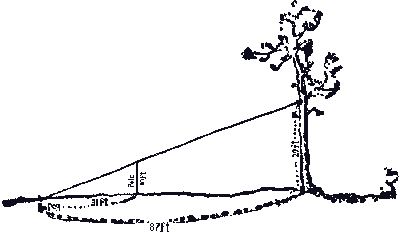
A peg
505
marked the spot.
Now he measured from this "eye peg" to the foot
of the pole; it was 31 feet. Then from the eye peg
to the peg under the tree; it was 87 feet. Since
the 10-foot pole met the line at 31 feet, then 31
is to 10 as 87 is to the tree—or 28 feet. Now one of
the boys climbed and measured the height of the
knot. It was 29 feet, and Yan had an easy victory.
"Here, you close guessers, do you want another
try, and I'll give you odds this time, if you come
within ten feet you'll win. I want only two feet to
come and go on."
"All right. Pick your trees."
"'Tisn't a tree this time, but the distance across
that pond, from this peg (H) to that little
Hemlock (D). You put down your guesses and I'll
show you another trick."
Sam studied it carefully and wrote Forty feet.
Wes put down Forty-five.
"Here, I want to be in this. I'll show you fellers
how," exclaimed Guy in his usual scornful manner,
and wrote down Fifty feet.
"Let's all try it for scalps," said Char-less, but this
was ruled too unimportant for scalps, and again the
penalty of failure was dishwashing, so the other boys
came and put down their guesses close to that of their
Chief—Forty-four, Forty-six and Forty-nine feet.
"Now we'll find out exactly," and Little Beaver,
with an air of calm superiority, took three straight
poles of exactly the same length and pegged them
506
together in a triangle, leaving the pegs sticking up.
He placed this triangle on the bank at A B C,
sighting the line A B for the little Hemlock D, and
put three pegs in the ground exactly under the three
pegs where the triangle was; moved the triangle to
E F G and placed it so that F G should line with
A C and E G with D. Now A G D also must be
an equilateral triangle; therefore, according to
arithmetic, the line D H must be seven-eighths of A G.
A G was easily measured—70 feet. Seven-eighths of
70 equals 61-1/4 feet. The width of the pond—they
measured it with tape line—was found to be 60
feet, so Yan was nearest, but Guy claimed that 50
feet was within 10 feet of it, which was allowed.
Thus there were two winners—two who escaped dishwashing;
and Hawkeye's bragging became insufferable.
He never again got so close in a guess, but no number
of failures could daunt him after such a success.
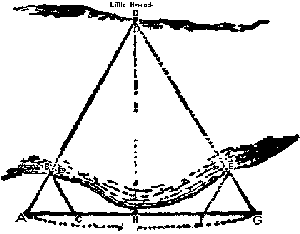
Sam was interested in the White-man's Woodcraft
chiefly on Yan's account, but Blackhawk was evidently
impressed with the study itself, and said:
"Little Beaver, I'll give you one more to do. Can
you measure how far apart those two trees are on
that bank, without crossing?"
"Yes," said Yan; "easily." So he cut three poles
6, 8 and 10 feet long and pegged them together in a
triangle. "Now," said he, "A B C
is a right angle; it must be, when the legs of the
triangle are 6, 8 and 10; that's a law."
507
He placed this on the shore, the side A B pointing to
the inner side of the first tree, and the side B C as nearly
as possible parallel with the line between the two
trees. Then he put in a stake at B, another at C,
and continued this line toward K. Now he slid his
triangle along this till the side G F pointed to E, and
the side H G in line with C B. The distance from
D to E, of course, is equal to B G, which can be
measured, and again the tape line showed Yan to
be nearly right.
This White-man's Woodcraft was easy for him,
and he volunteered to teach the other Indians, but
they thought it looked "too much like school." They
voted him a coup on finding how well he could
do it. But when Raften heard of it he exclaimed
in wonder and admiration, "My, but that's mightiful!"
and would not be satisfied till the coup was
made a grand coup.
"Say, Beaver," said Woodpecker sadly, harking
back, "if a Dog's front foot is 3-1/2 inches long and
3 inches wide, what colour is the end of his tail?"
"White," was the prompt reply; "'cause a Dog
with feet that size and shape is most likely to be a
yaller Dog, and a yaller Dog always has some white
hairs in the end of his tail."
"Well, this 'un hadn't, 'cause his tail was cut off
in the days of his youth!"
The union of the tribes, however, was far from
complete. Blackhawk was inclined to be turbulent.
He was heavier than Beaver. He could
not understand how that slighter, younger boy could
throw him, and he wished to try again. Now Yan
was growing stronger every day. He was quick
and of very wiry build. In the first battle, which
was entirely fisty, he was worsted; on the try-over,
which cost him such an effort, he had arranged "a
rough-and-tumble," as they called it, and had won
chiefly by working his only trick. But now Blackhawk
was not satisfied, and while he did not care to
offer another deadly challenge, by way of a feeler he
offered, some days after the peace, to try a friendly
throw for scalps.
"Fists left out!" Just what Beaver wanted,
and the biggest boy was sent flying. "If any other
Boiler would like to try I'd be pleased to oblige him,"
said Yan, just a little puffed up, as he held up the
second scalp he had won from Blackhawk.
Much to his surprise, Bluejay, the city boy,
accepted, and he was still more surprised when the
city boy sent him down in the dust.
"Best out of three!" shouted Woodpecker quickly,
in the interest of his friend, taking advantage of an
509
unwritten law that when it is not stated to be in
one try, usually called "sudden death," it is "best
two out of three" that counts.
Yan knew now that he had found a worthy foe.
He dodged, waiting for an opening—gripped—locked—and
 had him on the hip, he thought, but the
city boy squirmed in time, yielding instead of resisting,
and both went down tight-gripped. For a
minute it was doubtful.
had him on the hip, he thought, but the
city boy squirmed in time, yielding instead of resisting,
and both went down tight-gripped. For a
minute it was doubtful.
"Go it, Yan."
"Give it to him, Bluejay."
But Yan quickly threw out one leg, got a little
purchase, and turned the city boy on his back.
"Hooray for Little Beaver!"
"One try more! So far even!" cried Blackhawk.
They closed again, but Yan was more than ever
careful. The city boy was puffing hard. The real
trial was over and Cy went down quite easily.
"Three cheers for Little Beaver!" A fourth
scalp was added to his collection, and Sam patted
him on the back, while Bluejay got out a pocket
mirror and comb and put his hair straight.
But this did not help out in the matter of leadership,
and when the Medicine Man heard of the
continued deadlock he said:
"Boys, you know when there is a doubt about who
is to lead the only way is for all Chiefs to resign and
have a new election." The boys acted on this suggestion
but found another deadlock. Little Beaver
refused to be put up. Woodpecker got three votes,
510
Blackhawk four, and Guy one (his own), and the
Sangers refused to stand by the decision.
"Let's wait till after the 'hard trip'—that will
show who is the real Chief—then have a new election,"
suggested Little Beaver, with an eye to Woodpecker's
interest, for this hard trip was one that had
been promised them by Caleb—a three-days' expedition
in the Long Swamp.
This swamp was a wild tract, ten miles by thirty,
that lay a dozen miles north of Sanger. It was
swampy only in parts, but the dry places were mere
rocky ridges, like islands in the bogs. The land on
these was worthless and the timber had been ruined
by fire, so Long Swamp continued an uninhabited
wilderness.
There was said to be a few Deer on the hardwood
ridges. Bears and Lynx were occasionally seen,
and Wolves had been heard in recent winters. Of
course there were Foxes, Grouse and Northern
Hare. The streams were more or less choked with
logs, but were known to harbour a few Beavers and
an occasional Otter. There were no roads for summer
use, only long, dim openings across the bogs,
known as winter trails and timber roads. This
was the region that the boys proposed to visit
under Caleb's guidance.
Thus at last they were really going on an "Indian
trip"—-to explore the great unknown, with every
probability of adventure.
511
At dawn Yan tapped the tom-tom. It sang a
 high and vibrant note, in guarantee of a sunny day.
They left camp at seven in the morning, and after
three hours' tramp they got to the first part of the
wilderness, a great tract of rocky land, disfigured
with blackened trees and stumps, but green in places
with groves of young Poplars or quaking Aspen.
The Indians were very ready to camp now, but the
Medicine Man said, "No; better keep on till we
find water." In another mile they reached the first
stretch of level Tamarack bog and a welcome halt
for lunch was called. "Camp!" shouted the leader,
and the Indians ran each to do his part. Sam got
wood for the fire and Blackhawk went to seek water,
and with him was Blue jay, conspicuous in a high
linen collar and broad cuffs, for Caleb unfortunately
had admitted that he once saw an Indian Chief in
high hat and stand-up collar.
Beaver was just a little disappointed to see the
Medicine Man light the fire with a match. He
wanted it all in truly Indian style, but the Trapper
remarked, "Jest as well to have some tinder and a
thong along when you're in the woods, but matches
is handier than rubbing-sticks."
Blackhawk and Bluejay returned with two pails of
dirty, tepid, swampy water.
"Why, that's all there is!" was their defense.
"Yan, you go and show them how to get good
water," said Caleb, so the Second Sanger Chief,
remembering his training, took the axe and quickly
made a wooden digger, then went to the edge of the
512
swamp, and on the land twenty feet from the bog
he began to dig a hole in the sandy loam. He made
it two feet across and sunk it down three feet. The
roily water kept oozing in all around, and Bluejay
was scornful. "Well, I'd rather have what we got."
Beaver dug on till there was a foot of dirty water
in the hole. Then he took a pail and bailed it all
out as fast as possible, left it to fill, bailed it out
a second time, and ten minutes later cautiously
dipped out with a cup a full pail of crystal-clear cold
water, and thus the Boilers learned how to make an
Indian well and get clear water out of a dirty puddle.
After their simple meal of tea, bread and meat
Caleb told his plan. "You never get the same good
of a trip if you jest wander off; better have a plan—something
to do; and do it without a guide if ye want
adventures. Now eight is too many to travel together;
you'd scare everything with racket and never see a
livin' thing. Better divide in parties. I'll stay in
camp and get things ready for the night."
Thus the leaders, Sam and Yan, soon found themselves
paired with Guy and Peetweet. Wes felt
bound to take care of his little cousin Char-less.
Bluejay, finding himself the odd man, decided to
stay with Caleb, especially as the swamp evidently
was without proper footpaths.
"Now," said Caleb, "northwest of here there is
a river called the Beaver, that runs into Black
River. I want one of you to locate that. It's thirty
or forty feet wide and easy to know, for it's the
513
only big stream in the swamp. Right north there
is an open stretch of plain, with a little spring creek,
where there's a band of Injuns camped. Somewhere
northeast they say there's a tract of Pine bush
not burned off, and there is some Deer there. None
of the places is ten miles away except, maybe, the
Injuns' camp. I want ye to go scoutin' and report.
You kin draw straws to say who goes where."
So the straws were marked and drawn. Yan drew
the timber hunt. He would rather have had the one
after the Indians. Sam had to seek the river, and
Wesley the Indian camp. Caleb gave each of them
a few matches and this parting word:
"I'll stay here till you come back. I'll keep up
a fire, and toward sundown I'll make a smoke with
rotten wood and grass so you kin find your way back.
Remember, steer by the sun; keep your main lines of
travel; don't try to remember trees and mudholes;
and if you get lost, you make two smokes well apart
and stay right there and holler every once in awhile;
some one will be sure to come."
So about eleven o'clock the boys set out eagerly.
As they were going Blackhawk called to the others,
"First to carry out his job wins a grand coup!"
"Let the three leaders stake their scalps," said the
Woodpecker.
"All right. First winner home gets a scalp from
each of the others and saves his own."
"Say, boys, you better take along; your hull outfit,
some grub an' your blankets," was the Medicine
514
Man's last suggestion. "You may have to stay out
all night."
Yan would rather have had Sam along, but that
couldn't be, and Peetweet proved a good fellow,
though rather slow. They soon left the high ground
and came to the bog—flat and seemingly endless and
with a few tall Tamaracks. There were some Cedar-birds
catching Flies on the tall tree-tops, and a single
Flycatcher was calling out: "Whoit—whoit—whoit!"
Yan did not know until long after that it was the
Olive-side. A Sparrow-hawk sailed over, and later
a Bald Eagle with a Sparrow-hawk in hot and noisy
pursuit. But the most curious thing was the surface
of the bog. The spongy stretch of moss among the
scattering Tamaracks was dotted with great masses
of Pitcher Plant, and half concealed by the curious
leaves were thousands of Droseræ, or fly-eating
plants, with their traps set to secure their prey.
The bog was wonderful, but very bad walking.
The boys sank knee-deep in the soft moss, and as
they went farther, steering only by the sun, they
found the moss sank till their feet reached the water
below and they were speedily wet to the knees. Yan
cut for each a long pole to carry in the hand; in case
the bog gave way this would save them from sinking.
After two miles of this Peetweet wanted to go back,
but was scornfully suppressed by Little Beaver.
Shortly afterward they came to a sluggish little
stream in the bog with a peculiar red-and-yellow
scum along its banks. It was deep and soft-bottomed.
515
Yan tried it with the pole—did not dare to wade, so
they walked along its course till they found a small
tree lying from bank to bank, then crossed on this.
Half a mile farther on the bog got dryer, and a mass
of green ahead marked one of the islands of high
land. Over this they passed quickly, keeping the
northwest course. They now had a succession of
small bogs and large islands. The sun was hot here,
and Peetweet was getting tired. He was thirsty,
too, and persisted in drinking the swamp water whenever
he found a hole.
"Say, Peetweet, you'll suffer for that if you don't
quit; that water isn't fit to drink unless you boil it."
But Peetweet complained of burning thirst and
drank recklessly. After two hours' tramp he was
very tired and wanted to turn back. Yan sought a
dry island and then gathered sticks for a fire, but
found all the matches they had were soaking wet
with wading through the bog. Peetweet was much
upset by this, not on account of fire now, but in
case they should be out all night.
"You wait and see what an Indian does," said
Little Beaver. He sought for a dried Balsam Fir,
cut the rubbing-sticks, made a bow of a slightly bent
branch, and soon had a blazing fire, to Peter's utter
amazement, for he had never seen the trick of making
a fire by rubbing-sticks.
After drinking some tea and eating a little, Pete
felt more encouraged.
516
"We have travelled more than six miles now, I
reckon," said the Chief; "an hour longer and we
shall be in sight of the forest if there is one," and
Yan led off across swamps more or less open and
islands of burned timber.
Pete began to be appalled by the distance they
were putting between them and their friends.
"What if we should get lost? They never could
find us."
"We won't get lost," said Yan in some impatience;
"and if we did, what of it? We have only to keep
on straight north or south for four or five hours and
we reach some kind of a settlement."
After an hour's tramp northeast they came to an
island with a tall tree that had branches right to the
ground. Yan climbed up. A vast extent of country
lay all about him—open flat bogs and timber islands,
and on far ahead was a long, dark mass of solid ever-green—surely
the forest he sought. Between him
and it he saw water sparkling.
"Oh, Pete, you ought to be up here," he shouted
joyfully; "it's worth the climb to see this view."
"I'd rather see our own back-yard," grumbled
Pete.
Yan came down, his face aglow with pleasure, and
exclaimed: "It's close to, now! I saw the Pine
woods. Just off there."
"How far?"
"Oh, a couple of miles, at most."
"That's what you have been saying all along."
517
"Well, I saw it this time; and there is water out
there. I saw that, too."
He tramped on, and in half an hour they came to
the water, a deep, clear, slow stream, fringed with
scrub willows, covered with lily-pads, and following
the middle of a broad, boggy flat. Yan had looked
for a pond, and was puzzled by the stream. Then
it struck him. "Caleb said there was only one big
stream through this swamp. This must be it. This
is Beaver River."
The stream was barely forty feet across, but it was
clearly out of the question to find a pole for a bridge,
so Yan stripped off, put all his things in a bundle,
and throwing them over, swam after them. Pete
had to come now or be left.
As they were dressing on the northern side there
was a sudden loud "Bang—swish!" A torrent
of water was thrown in the air, with lily-pads broken
from their mooring, the water pattered down, the
wavelets settled, and the boys stood in astonishment
to see what strange animal had made this disturbance;
but nothing more of it was seen, and the mystery
remained unsolved.
Then Yan heard a familiar "Quack!" down the
stream. He took his bow and arrow, while Pete sat
gloomily on a hummock. As soon as he peered
through the rushes in a little bay he saw three Mallard
close at hand. He waited till two were in line, then
fired, killing one instantly, and the others flew away.
The breeze wafted it within reach of a stick, and he
seized it and returned in triumph to Pete, but found
518
him ready to cry. "I want to go home!" he said
miserably. The sight of the Mallard cheered him
a little, and Yan said: "Come now, Pete, don't
spoil everything, there's a good fellow. Brace up,
and if I don't show you the Pine woods in twenty
minutes I'll turn and take you home."
As soon as they got to the next island they saw
the Pine wood—a solid green bank not half a mile
away, and the boys gave a little cheer, and felt, no
doubt, as Mungo Park did when first he sighted the
Niger. In fifteen minutes they were walking in its
dry and delightful aisles.
"Now we've won," said Yan, "whatever the others
do, and all that remains is to get back."
"I'm awfully tired," said Pete; "let's rest awhile."
Yan looked at his watch. "It's four o'clock. I
think we'd better camp for the night."
"Oh, no; I want to go home. It looks like rain."
It certainly did, but Yan replied, "Well, let's eat
first." He delayed as much as possible so as to compel
the making of a camp, and the rain came unexpectedly,
before he even had a fire. Yet to his own delight
and Peter's astonishment he quickly made a rubbing-stick
fire, and they hung up their wet clothes
about it. Then he dug an Indian well and took lots
of time in the preparation, so it was six o'clock before
they began to eat, and seven when finished—evidently
too late to move out even though the rain seemed to
be over. So Yan collected firewood, made a bed of
Fir boughs and a windbreak of bushes and bark. The
519
weather was warm, and with the fire and two blankets
they passed a comfortable night. They heard their
old friend the Horned Owl, a Fox barked his querulous
"Yap-yurr!" close at hand, and once or twice they
were awakened by rustling footsteps in the leaves,
but slept fairly well.
At dawn Yan was up. He made a fire and heated
some water for tea. They had very little bread left,
but the Mallard was untouched.
Yan cleaned it, rolled it in wet clay, hid it in the
ashes and covered it with glowing coals. This is an
Indian method of cooking, but Yan had not fully
mastered it. In half an hour he opened his clay pie
and found the Duck burned on one side and very raw
on the other. Part of it was good, however, so he
called his companion to breakfast. Pete sat up white-faced
and miserable, evidently a sick boy. Not only
had he caught cold, but he was upset by the swamp
water he had taken. He was paying the penalty
of his indiscretion. He ate a little and drank some
tea, then felt better, but clearly was unable to travel
that day. Now for the first time Yan felt a qualm
of fear. Separated by a dozen miles of swamp from
all help, what could he do with a sick boy? He
barked a small dead tree with a knife, then on the
smooth surface wrote with a pencil, "Yan Yeoman
and Pete Boyle camped here August 10, 18—"
He made Pete comfortable by the fire, and, looking
for tracks, he found that during the night two Deer
had come nearly into the camp; then he climbed a
520
high tree and scanned the southern horizon for a
smoke sign. He saw none there, but to the northwest,
beyond some shining yellow hills, he discovered
a level plain dotted over with black Fir clumps; from
one of these smoke went up, and near it were two or
three white things like teepees.
Yan hurried down to tell Pete the good news, but
when he confessed that it was two miles farther from
home Pete had no notion of going to the Indian camp;
so Yan made a smoke fire, and knife-blazing the
saplings on two sides as he went, he set out alone for
the Indian camp. Getting there in half an hour, he
found two log shanties and three teepees. As he
came near he had to use a stick to keep off the numerous
Dogs. The Indians proved shy, as usual, to
White visitors. Yan made some signs that he had
learned from Caleb. Pointing to himself, he held up
two fingers—meaning that he was two. Then he
pointed to the Pine woods and made sign of the other
lying down, and added the hungry sign by pressing
in his stomach with the edges of the hands, meaning
"I am cut in two here." The Chief Indian offered
him a Deer-tongue, but did not take further interest.
Yan received it thankfully, made a hasty sketch of
the camp, and returned to find Pete much better,
but thoroughly alarmed at being so long alone. He
was able and anxious now to go back. Yan led off,
carrying all the things of the outfit, and his comrade
followed slowly and peevishly. When they came to
the river, Pete held back in fear, believing that the
521
loud noise they had heard was made by some monster
of the deep, who would seize them.
Yan was certain it could be only an explosion of
swamp gas, and forced Pete to swim across by setting
the example. What the cause really was they never
learned.
They travelled very fast now for a time. Pete
was helped by the knowledge that he was really going
home. A hasty lunch of Deer-tongue delayed them
but little. At three they sighted Caleb's smoke signal,
and at four they burst into camp with yells of triumph.
Caleb fired off his revolver, and Turk bayed his
basso profundo full-cry Fox salute. All the others
had come back the night before.
Sam said he had "gone ten mile and never got a
sight of that blamed river." Guy swore they had
gone forty miles, and didn't believe there was any
such river.
"What kind o' country did you see?"
"Nothin' but burned land and rocks."
"H-m, you went too far west—was runnin' parallel
with Beaver River."
"Now, Blackhawk, give an account of yourself to
Little Beaver," said Woodpecker. "Did you two
win out?"
"Well," replied the Boiler Chief, "if Hawkeye
travelled forty miles, we must have gone sixty. We
pointed straight north for three hours and never saw
a thing but bogs and islands of burned timber—never
a sign of a plain or of Indians. I don't believe there
522
are any."
"Did you see any sandhills?" asked Little Beaver.
"No."
"Then you didn't get within miles of it."
Now he told his own story, backed by Pete, and he
was kind enough to leave out all about Peetweet's
whimpering. His comrade responded to this by
giving a glowing account of Yan's Woodcraft, especially
dwelling on the feat of the rubbing-stick fire in
the rain, and when they finished Caleb said:
"Yan, you won, and you more than won, for you
found the green timber you went after, you found
the river Sam went after, an' the Injuns Wesley went
after. Sam and Wesley, hand over your scalps."
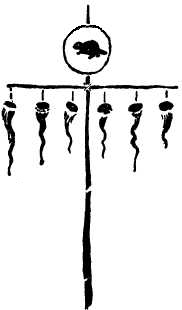
A merry meal now followed, chaffing and jokes
passed several hours away, but the boys were
rested and restless by nine o'clock and eager
for more adventures.
"Aren't there any Coons 'round here, Mr. Clark?"
"Oh, I reckon so. Y-e-s! Down a piece in the
hardwood bush near Widdy Biddy Baggs's place
there's lots o' likely Cooning ground."
That was enough to stir them all, for the place
was near at hand. Peetweet alone was for staying
in camp, but when told that he might stay and keep
house by himself he made up his mind to get all the
fun he could. The night was hot and moonless,
Mosquitoes abundant, and in trampling and scrambling
through the gloomy woods the hunters had
plenty of small troubles, but they did not mind that
so long as Turk was willing to do his part. Once or
twice he showed signs of interest in the trail, but soon
decided against it.
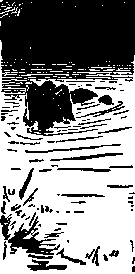 Thus they worked toward the Widdy Baggs's till
they came to a dry brook bed. Turk began at once
to travel up this, while Caleb tried to make him go
down. But the Dog recognized no superior officer
when hunting. After leading his impatient army a
quarter of a mile away from the really promising
524
heavy timber, Turk discovered what he was after, and
that was a little muddy puddle. In this he calmly
lay down, puffing, panting and lapping with energy,
and his humble human followers had nothing to
do but sit on a log and impatiently await his lordship's
pleasure. Fifteen minutes went by, and Turk
was still enjoying himself, when Sam ventured at
last:
Thus they worked toward the Widdy Baggs's till
they came to a dry brook bed. Turk began at once
to travel up this, while Caleb tried to make him go
down. But the Dog recognized no superior officer
when hunting. After leading his impatient army a
quarter of a mile away from the really promising
524
heavy timber, Turk discovered what he was after, and
that was a little muddy puddle. In this he calmly
lay down, puffing, panting and lapping with energy,
and his humble human followers had nothing to
do but sit on a log and impatiently await his lordship's
pleasure. Fifteen minutes went by, and Turk
was still enjoying himself, when Sam ventured at
last:
"'Pears to me if I owned a Dog I'd own him."
"There's no use crowdin' him," was the answer.
"He's runnin' this hunt, an' he knows it. A Dog
without a mind of his own is no 'count."
So when Turk had puffed like a Porpoise, grunted
and wallowed like a Hog, to his heart's content and
to the envy of the eight who sat sweltering and
impatient, he arose, all dribbling ooze, probably to
seek a new wallowing place, when his nose discovered
something on the bank that had far more effect than
all the coaxings and threats of the "waiting line,"
and he gave a short bark that was a note of joy for
the boys. They were all attention now, as the old
Hound sniffed it out, and in a few moments stirred the
echoes with an opening blast of his deepest strain.
"Turk's struck it rich!" opined Caleb.
The old Dog's bawling was strong now, but not
very regular, showing that the hunted animal's
course was crooked. Then there was a long break
in it, showing possibly that the creature had run a
fence or swung from one tree to another.
525
"That's a Coon," said Yan eagerly, for he had not
forgotten any detail of the other lesson.
Caleb made no reply.
The Hound tongued a long way off, but came back
to the pond and had one or two checks.
"It's a great running for a Coon," Yan remarked,
at length in doubt. Then to Caleb, "What do you
think?"
Caleb answered slowly: "I dunno what to think.
It runs too far for a Coon, an' 'tain't treed yet; an'
I kin tell by the Dog's voice he's mad. If you was
near him now you'd see all his back hair stannin' up."
Another circle was announced by the Dog's baying,
and then the long, continuous, high-pitched yelping
told that the game was treed at last.
"Well, that puts Fox and Skunk out of it," said
the Trapper, "but it certainly don't act like a Coon on
the ground."
"First there gets the Coon!" shouted Blackhawk,
and the boys skurried through the dark woods,
getting many a scratch and fall. As it was, Yan and
Wesley arrived together and touched the tree at the
same moment. The rest came straggling up, with
Char-less last and Guy a little ahead of him. Guy
wanted to relate the full particulars of his latest
glorious victory over Char-less, but all attention
was now on old Turk, who was barking savagely up
the tree.
"Don't unnerstan' it at all, at all," said Caleb.
"Coony kind o' tree, but Dog don't act Coony."
526
"Let's have a fire," said the Woodpecker, and the
two crowds of boys began each a fire and strove
hard to get theirs first ablaze.
The firelight reached far up into the night, and
once or twice the hunters thought they saw the
shining eyes of the Coon.
"Now who's to climb?" asked the Medicine Man.
"I will, I will," etc., seven times repeated; even
Guy and Char-less chimed in.
"You're mighty keen hunters, but I want you to
know I can't tell what it is that's up that tree. It
may be a powerful big Coon, but seems to me the Dog
acts a little like it was a Cat, and 'tain't so long since
there was Painter in this county. The fact of him
treeing for Turk don't prove that he's afraid of a
Dog; lots of animals does that 'cause they don't
want to be bothered with his noise. If it's a Cat,
him as climbs is liable to get his face scratched.
Judging by the actions of the Dog, I think it's
something dangerous. Now who wants the job?"
For awhile no one spoke. Then Yan, "I'll go if
you'll lend me the revolver."
"So would I," said Wesley quickly.
"Well, now, we'll draw straws"—and Yan won.
Caleb felled a thin tree against the big one and Yan
climbed as he had done once before.
There was an absence of the joking and chaffing
that all had kept up when on the other occasion
Yan went after the Coon. There was a tension that
held them still and reached the climber to thrill him
with a weird sense of venturing into black darkness
527
to face a fearful and mysterious danger. The
feeling increased as he climbed from the leaning
tree to the great trunk of the Basswood, to lose sight
of his comrades in the wilderness of broad leaves and
twisted tree-arms. The dancing firelight sent shadow-blots
and light-spots in a dozen directions with fantastic
effect. Some of the feelings of the night at
Garney's grave came back to him, but this time
with the knowledge of real danger. A little higher
and he was out of sight of his friends below. The
danger began to appal him; he wanted to go back, and
to justify the retreat he tried to call out, "No Coon
here!" but his voice failed him, and, as he clung to
the branch, he remembered Caleb's words, "There's
nothing ahead of grit, an' grit ain't so much not
bein' scairt as it is goin' straight ahead when you are
scairt." No; he would go on, come what would.
"Find anything?" drawled a cheery voice below,
just at the right time.
Yan did not pause to answer, but continued to
climb into the gloom. Then he thought he
heard a Coon snarl above him. He swung to
a higher branch and shouted, "Coon here, all
right!" but the moment he did so a rattling
growl sounded close to him, and looking down
he saw a huge grey beast spring to a large branch
between him and the ground, then come climbing
savagely toward him. As it leaped to a
still nearer place Yan got a dim view of a curious
four-cornered face, shaggy and striped, like the one
528
he saw so long ago in Glenyan—it was an enormous Lynx.
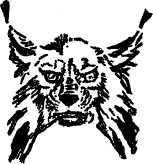
Yan got such a shock that he nearly lost his hold,
but quickly recovering, he braced himself in a crotch,
and got out the revolver just as the Lynx with a fierce
snarl leaped to a side branch that brought it nearly
on a level with him. He nervously cocked the
pistol, and scarcely attempting to sight in the darkness,
he fired and missed. The Lynx recoiled a little
and crouched at the report. The boys below raised a
shout and Turk outdid them all in racket.
"A Lynx!" shouted Yan, and his voice betrayed
his struggle with fear.
"Look out!" Caleb called. "You better not let
him get too close."
The Lynx was growling ferociously. Yan put
forth all his will-power to control his trembling hand,
took more deliberate aim, and fired. The fierce
beast was struck, but leaped wildly at the boy.
He threw up his arm and it buried its teeth in his
flesh, while Yan clung desperately to the tree with
the other arm. In a moment he knew he would be
dragged off and thrown to the ground, yet felt less
fear now than he had before. He clutched for the
revolver with the left hand, but it found only the
fur of the Lynx, and the revolver dropped from his
grasp. Now he was indeed without hope, and dark
fear fell on him.
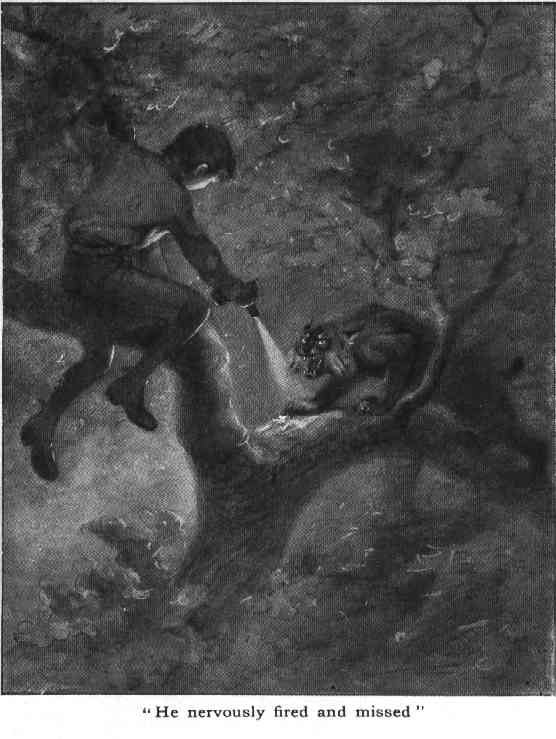
But the beast was severely wounded.
Its hind quarters were growing heavy. It loosed
its hold of Yan and struggled to get on the limb.
A kick from his right foot upset its balance; it slipped
from the tree and flopped to the ground below,
wounded, but full of fight. Turk rushed at it, but
got a blow from its armed paw that sent him off
howling.
A surge of reaction came over Yan. He might
have fainted, but again he remembered the Trapper's
words, "Bravery is keeping on even when you are
skairt." He pulled himself together and very
cautiously worked his way back to the leaning tree.
Hearing strange sounds, yells, growls, sounds of
conflict down below, expecting every moment to hear
the Lynx scramble up the trunk again, to finish
him, dimly hearing but not comprehending the
shouts, he rested once at the leaning tree and
breathed freely.
"Hurry up, Yan, with that revolver," shouted
Blackhawk.
"I dropped it long ago."
"Where is it?"
Yan slid down the sapling without making reply.
The Lynx had gone, but not far. It would have got
away, but Turk kept running around and bothering
it so it could not even climb a tree, and the noise
they made in the thicket was easy to follow.
"Where's the revolver?" shouted Caleb, with
unusual excitement.
"I dropped it in the fight."
"I know. I heard it fall in the bushes," and Sam
soon found it.
532
Caleb seized it, but Yan said feebly, "Let me!
Let me! It's my fight!"
Caleb surrendered the pistol, said "Look out for
the Dog!" and Yan crawled through the bushes till
that dark moving form was seen again. Another
shot and another. The sound of combat died away,
and the Indians raised a yell of triumph—all but
Little Beaver. A giddiness came over him; he
trembled and reeled, and sank down on a root. Caleb
and Sam came up quickly.
"What's the matter, Yan?"
"I'm sick—I——"
Caleb took his arm. It was wet. A match was
struck.
"Hallo, you're bleeding."
"Yes, he had me—he caught me up the tree. I—I—thought
I was a goner."
All interest was now turned from the dead Lynx
to the wounded boy.
"Let's get him to the water."
"Guess the camp well is the nearest."
Caleb and Sam took care of Yan, while the others
brought the Lynx. Yan grew better as they moved
slowly homeward. He told all about the attack
of the Lynx.
"Gosh! I'd 'a' been scared out o' my wits," said
Sam.
"Guess I would, too," added Caleb, to the surprise
of the Tribe; "up there, helpless, with a wounded
Lynx—I tell you!"
533
"Well, I was scared—just as scared as I could be,"
admitted Yan.
At camp a blazing fire gave its lurid light. Cold
water was handy and Yan's bleeding arm was laid
bare. He was shocked and yet secretly delighted to
see what a mauling he had got, for his shirt sleeve
was soaked with blood, and the wondering words
of his friends was sweetest music to his ears.
Caleb and the city boy dressed his wounds, and
when washed they did not look so very dreadful.
They were too much excited to sleep for an hour
at least, and as they sat about the fire—that they
did not need but would not dream of doing without—Yan
found no lack of enthusiasm in the circle, and
blushed with pleasure to be the hero of the camp.
Guy didn't see anything to make so much fuss about,
but Caleb said, "I knowed it; I always knowed you
was the stuff, after the night you went to Garney's
grave."
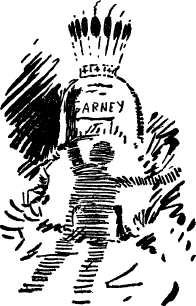
It was threatening to rain again in the morning and
the Indians expected to tramp home heavy laden
in the wet. But their Medicine Man had a
surprise in store. "I found an old friend not far
from here and fixed it up with him to take us all
home in his wagon." They walked out to the edge
of the rough land and found a farm wagon with
two horses and a driver. They got in, and in little
less than a hour were safely back to the dear old
camp by the pond.
The rain was over now, and as Caleb left for his
own home he said:
"Say, boys, how about that election for Head
Chief? I reckon it's due now. Suppose you wait
till to-morrow afternoon at four o'clock an' I'll show
you how to do it."
That night Yan and his friend were alone in their
teepee. His arm was bound up, and proud he was
of those bandages and delighted with the trifling
red spots that appeared yet on the last layer; but
he was not in pain, nor, indeed, the worse for the
adventure, for, thanks to his thick shirt, there was
no poisoning. He slept as usual till long after
midnight, then awoke in bed with a peculiar feeling
of well-being and clearness of mind. He had no
535
bodily sense; he seemed floating alone, not in the
teepee nor in the woods, but in the world—not
dreaming, but wide awake—more awake than ever
in his life before, for all his life came clearly into
view as never before: his stern, religious training;
his father, refined and well-meaning, but blind,
compelling him to embark in a profession to which
he was little inclined, and to give up the one thing
next his heart—his Woodcraft lore.
Then Raften stepped into view, loud-voiced,
externally coarse, but blessed with a good heart and a
sound head. The farmer suffered sadly in contrast
with the father, and yet Yan had to suppress the
wish that Raften were his father. What had they in
common? Nothing; and yet Raften had given him
two of the dearest things in life. He, the head of
the house, a man of force and success, had treated
Yan with respect. Yan was enough like his own
father to glory in the unwonted taste; and like that
other rugged stranger long ago in Glenyan, Raften
had also given him sympathy. Instead of considering
his Woodcraft pursuits mere trifling, the farmer
had furthered them, and even joined to follow for a
time. The thought of Bonnerton came back. Yan
knew he must return in a year at most; he knew that
his dearest ambition of a college course in zoology
was never to be realized, for his father had told him
he must go as errand boy at the first opening. Again
his rebellious spirit was stirred, to what purpose
he did not know. He would rather stay here on the
536
farm with the Raftens. But his early Scriptural
training was not without effect. "Honour thy father
and thy mother" was of lasting force. He felt it
to be a binding duty. He could not rebel if he
would. No, he would obey; and in that resolution
new light came. In taking him from college and
sending him to the farm his father had apparently
cut off his hope of studies next his heart.
Instead of suffering loss by this obedience, he had
come to the largest opportunity of his life.
Yes! He would go back—be errand boy or anything
to make a living, but in his hours of freedom
he would keep a little kingdom of his own. The road
to it might lie through the cellar of a grocer's shop,
but he would not flinch. He would strive and struggle
as a naturalist. When he had won the insight he
was seeking, the position he sought would follow, for
every event in the woodland life had shown him—had
shown them all, that his was the kingdom of the
Birds and Beasts and the power to comprehend them.
And he seemed to float, happy in the fading of all
doubt, glad in the sense of victory. There was a
noise outside. The teepee door was forced gently;
a large animal entered. At another time Yan might
have been alarmed, but the uplift of his vision was
on him still. He watched it with curious unalarm.
It gently came to his bed, licked his hand and laid
down beside him. It was old Turk, and this was
the first time he had heeded any of them but Caleb.
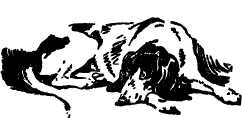
Caleb had been very busy all the day before
doing no one knew what, and Saryann was
busy, too. She had been very busy for long,
but now she was bustling. Then, it seems, Caleb had
gone to Mrs. Raften, and she was very busy, and Guy
made a flying visit to Mrs. Burns, and she had become
busy. Thus they turned the whole neighbourhood
into a "bee."
For this was Sanger, where small gatherings held
the same place as the club, theatre and newspaper
do in the lives of city folk. No matter what the
occasion, a christening, wedding or funeral, a logging,
a threshing, a home-coming or a parting, the finishing
of a new house or the buying of a new harness
or fanning-mill, any one of these was ample
grounds for one of their "talking bees"; so it was
easy to set the wheels a-running.
At three o'clock three processions might have
been seen wending through the woods. One was
from Burns's, including the whole family; one from
Raften's, comprising the family and the hired men;
one from Caleb's, made up of Saryann and many of
the Boyles. All brought baskets.
They were seated in a circle on the pleasant grassy
bank of the pond. Caleb and Sam took charge of the
538
ceremonies. First, there were foot-races, in which
Yan won in spite of his wounded arm, the city boy
making a good second; then target-shooting and
"Deer-hunting," that Yan could not take part in.
It was not in the programme, but Raften insisted
on seeing Yan measure the height of a knot in a tree
without going to it, and grinned with delight when
he found it was accurate.
"Luk at that for eddication, Sam!" he roared.
"When will ye be able to do the like? Arrah, but
ye're good stuff, Yan, an' I've got something here'll
plase ye."
Raften now pulled out his purse and as magistrate
paid over with evident joy the $5 bounty due for
killing the Lynx. Then he added: "An' if it turns
out as ye all claim" [and it did] "that this yer beast
is the Sheep-killer instid av old Turk, I'll add that
other tin."
Thus Yan came into the largest sum be had ever
owned in his life.
Then the Indians went into their teepees. Caleb
set up a stake in the ground and on that a new shield
of wood covered with rawhide; over the rawhide was
lightly fastened a piece of sacking.
The guests were in a circle around this; at one
side were some skins—Yan's Lynx and Coon—and
the two stuffed Owls.
Then the drum was heard, "Túm-tum—túm-tum—túm-tum—túm-tum——"
There was a volley of
war-whoops, and out of the teepees dashed the Sanger
539
Indians in full war paint.
"Ki ki—ki yi—ki yi yi yi
Ki yi—ki yi—ki yi yi yi!"
They danced in exact time to the two-measure of
the drum that was pounded by Blackhawk. Three
times round the central post with the shield they
danced, then the drum stopped, and they joined
in a grand final war-whoop and squatted in a circle
within that of the guests.
The Great Woodpecker now arose—his mother had
to be told who it was—and made a characteristic
speech:
"Big Chiefs, Little Chiefs, and Squapooses of the
Sanger Indians: A number of things has happened
to rob this yer nation of its noble Head Chief; they
kin never again expect to have his equal, but this
yer assembly is for to pick out a new one. We had
a kind of whack at it the other day, but couldn't
agree. Since then we had a hard trip, and things
has cleared up some, same as puttin' Kittens in a
pond will tell which one is the swimmer, an' we're
here to-day to settle it."
Loud cries of "How—how—how—how—" while
Blackhawk pounded the drum vigorously.
"O' course different ones has different gifts. Now
who in all this Tribe is the best runner? That's
Little Beaver."
("How—how—how—how—how—" and drum.)
540
"That's my drum, Ma!" said Guy aside, forgetting
to applaud.
"Who is the best trailer and climber? Little
Beaver, again, I reckon."
("How—how—how—how—" and drum.)
("He can't see worth a cent!" whispered Guy to
his mother.)
"Who was it won the trial of grit at Garney's
grave? Why, it was Little Beaver."
("An' got pretty badly scared doin' it!" was Guy's
aside.)
"But who was it shot the Cat-Owl plumb in the
heart, an' fit the Lynx hand to hand, not to speak
of the Coon? Little Beaver every time."
("He never killed a Woodchuck in his life, Ma!")
"Then, again, which of us can lay all the others on
his back? Little Beaver, I s'pose."
("Well, I can lick Char-less, any time," was Guy's
aside.)
"Which of us has most grand coups and scalps?"
"Ye're forgittin' his eddication," put in Raften
to be scornfully ignored; even Little Beaver resented
this as un-Indian.
"Which has most scalps?" Sam repeated with
sternness. "Here's a scalp won in battle with the
inimy," Woodpecker held it up, and the Medicine
Man fastened it on the edge of the shield that hung
from the post.
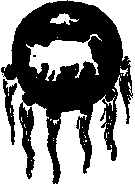
"Here is one tuk from the Head Chief of the hostiles,"
541
and Caleb fastened that to the shield. "Here
is another tuk from the Second Chief of the hostiles,"
and Caleb placed it. "Here is one tuk from the Great
Head War Chief of the Sangers, and here is one from
the Head Chief of the Boilers, and another tuk in
battle. Six scalps from six famous warriors. This
yere is the record for the whole Tribe, an' Little
Beaver done it; besides which, he draws pictures,
writes poethry and cooks purty good, an' I say Little
Beaver is the one for Chief! What says the rest?"
and with one voice they shouted, "Hoorah for Little
Beaver!"
"How—how—how—how—how—thump, thump,
thump, thump."
"Any feller anything to say agin it?"
"I eh—" Guy began.
—"has got to lick the Chief," Sam continued,
and Guy did not complete his objection, though he
whispered to his mother, "If it was Char-less I bet
I'd show him."
Caleb now pulled the cover off the shield that he
fastened the scalps to, and it showed the white Buffalo
of the Sangers with a Little Beaver above it. Then
he opened a bundle lying near and produced a gorgeous
war-shirt of buff leather, a pair of leggins and
moccasins, all fringed, beaded and painted, made by
Saryann under Caleb's guidance. They were quickly
put on the new Chief; his war bonnet, splendid with
the plumes of his recent exploits, was all ready; and
proud and happy in his new-found honours, not
least of which were his wounds, he stepped forward.
542
Caleb viewed him with paternal pride and said: "I
knowed ye was the stuff the night ye went to Garney's
grave, an' I knowed it again when ye crossed
the Big Swamp. Yan, ye could travel anywhere
that man could go," and in that sentence the boy's
happiness was complete. He surely was a Woodcrafter
now. He stammered in a vain attempt to
say something appropriate, till Sam relieved him by:
"Three cheers for the Head War Chief!" and when
the racket was over the women opened their baskets
and spread the picnic feast. Raften, who had been
much gratified by his son's flow of speech, recorded
a new vow to make him study law, but took
advantage of the first gap in the chatter to say:
"Bhise, ye'r two weeks' holiday with wan week
extension was up at noon to-day. In wan hour an' a
half the Pigs is fed."