The story of Frank's adventure and courage was
the talk of all the Oakland plantation. His
mother and Cousin Belle both kissed him, and
called him their little hero. Willy also received a full
share of praise for his courage.
About noon there was great commotion among the
troops. They were far more numerous than they had
been in the morning, and instead of riding about the woods
in small bodies, hunting for the concealed soldiers, they
were collecting together and preparing to move.
It was learned that a considerable body of cavalry
was passing down the road by Trinity Church, and that
the depot had been burnt again the night before. Somehow,
a rumor got about that the Confederates were following
up the raiders.
In an hour most of the soldiers went away, but a
number still stayed on. Their horses were picketed about
the yard feeding; and they themselves lounged around,
making themselves at home in the house, and pulling to
pieces the things that were left. They were not, however,
as wanton in their destruction as the first set, who
had passed by the year before.
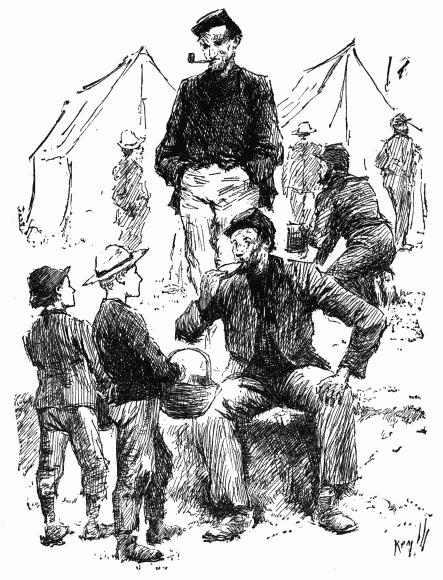
Among those who yet remained were the little corporal,
and the big young soldier who had been so kind
to Frank. They were in the rear-guard. At length the
last man rode off.
The boys had gone in and out among them, without
being molested. Now and then some rough fellow would
swear at them, but for the most part their intercourse
with the boys was friendly. When, therefore, they rode
off, the boys were allowed by their mother to go and see
the main body.
Peter and Cole were with them. They took the main
road and followed along, picking up straps, and cartridges,
and all those miscellaneous things dropped by a large body
of troops as they pass along.
Cartridges were very valuable, as they furnished the
only powder and shot the boys could get for hunting, and
their supply was out. These were found in unusual numbers.
The boys filled their pockets, and finally filled their
sleeves, tying them tightly at the wrist with strings, so
that the contents would not spill out. One of the boys
found even an old pistol, which was considered a great
treasure. He bore it proudly in his belt, and was envied
by all the others.
It was quite late in the afternoon when they thought
of turning toward home, their pockets and sleeves bagging
down with the heavy musket-cartridges. They left the
Federal rear-guard feeding their horses at a great white
pile of corn which had been thrown out of the corn-house
of a neighbor, and was scattered all over the ground.
They crossed a field, descended a hill, and took the
main road at its foot, just as a body of cavalry came
in sight. A small squad, riding some little distance in
advance of the main body, had already passed by. These
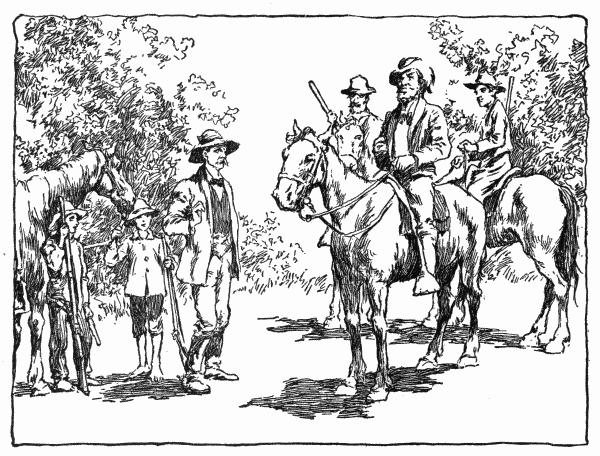
were Confederates. The first man they saw, at the head
of the column by the colonel, was the General, and a little
behind him was none other than Hugh on a gray roan;
while not far down the column rode their friend Tim
Mills, looking rusty and sleepy as usual.
"Goodness! Why, here are the General and Hugh!
How in the world did you get away?" exclaimed the boys.
They learned that it was a column of cavalry following
the line of the raid, and that the General and Hugh had
met them and volunteered. The soldiers greeted the boys
cordially.
"The Yankees are right up there," said the youngsters.
"Where? How many? What are they doing?"
asked the General.
"A whole pack of 'em—right up there at the stables,
and all about, feeding their horses and sitting all around,
and ever so many more have gone along down the road."
"Fling the fence down there!" The boys pitched
down the rails in two or three places. An order was
passed back, and in an instant a stir of preparation was
noticed all down the line of horsemen.
A courier galloped up the road to recall the advance-guard.
The head of the column passed through the gap,
and, without waiting for the others, dashed up the hill at
a gallop—the General and the colonel a score of yards
ahead of any of the others.
"Let's go and see the fight!" cried the boys; and the
whole set started back up the hill as fast as their legs could
carry them.
"S'pose they shoot! Won't they shoot us?" asked
one of the negro boys, in some apprehension. This,
though before unthought of, was a possibility, and for
a moment brought them down to a slower pace.
"We can lie flat and peep over the top of the hill."
This was Frank's happy thought, and the party started
ahead again. "Let's go around that way." They made
a little detour.
Just before they reached the crest they heard a shot,
"bang!" immediately followed by another, "bang!" and
in a second more a regular volley began, and was kept up.
They reached the crest of the hill in time to see the
Confederates gallop up the slope toward the stables, firing
their pistols at the blue-coats, who were forming in the
edge of a little wood, over beyond a fence, from the other
side of which the smoke of their carbines was rolling.
They had evidently started on just as the boys left, and
before the Confederates came in sight.
The boys saw their friends dash at this fence, and
could distinguish the General and Hugh, who were still in
the lead. Their horses took the fence, going over like
birds, and others followed,—Tim Mills among them,—while
yet more went through a gate a few yards to one
side.
"Look at Hugh! Look at Hugh!"
"Look! That horse has fallen down!" cried one of
the boys, as a horse went down just at the entrance of the
wood, rolling over his rider.
"He's shot!" exclaimed Frank, for neither horse nor
rider attempted to rise.
"See; they are running!"
The little squad of blue-coats were retiring into the
woods, with the grays closely pressing them.
"Let's cut across and see 'em run 'em over the bridge."
"Come on!"
All the little group of spectators, white and black,
started as hard as they could go for a path they knew,
which led by a short cut through the little piece of woods.
Beyond lay a field divided by a stream, a short distance
on the other side of which was a large body of woods.
The popping was still going on furiously in the woods,
and bullets were "zoo-ing" over the fields. But the boys
could not see anything, and they did not think about the
flying balls.
They were all excitement at the idea of "our men"
whipping the enemy, and they ran with all their might to
be in time to see them "chase 'em across the field."
The road on which the skirmish took place, and down
which the Federal rear-guard had retreated, made a sharp
curve beyond the woods, around the bend of a little stream
crossed by a small bridge; and the boys, in taking the
short cut, had placed the road between themselves and
home; but they did not care about that, for their men were
driving the others. They "just wanted to see it."
They reached the edge of the field in time to see that
the Yankees were on the other side of the stream. They
knew them to be where puffs of smoke came out of the
opposite wood. And the Confederates had stopped beyond
the bridge, and were halted, in some confusion, in
the field.
The firing was very sharp, and bullets were singing
in every direction. Then the Confederates got together,
and went as hard as they could right at them up to the
wood, all along the edge of which the smoke was pouring
in continuous puffs and with a rattle of shots. They saw
several horses fall as the Confederates galloped on, but
the smoke hid most of it. Next they saw a long line of
fire appear in the smoke on both sides of the road, where
it entered the wood; then the Confederates stopped, and
became all mixed up; a number of horses galloped away
without their riders, another line of white and red flame
came out of the woods, the Confederates began to come
back, leaving many horses on the ground, and a body
of cavalry in blue coats poured out of the wood in pursuit.
"Look! look! They are running—they are beating
our men!" exclaimed the boys. "They have driven 'em
back across the bridge!"
"How many of them there are!"
"What shall we do? Suppose they see us!"
"Come on, Mah'srs Frank 'n' Willy, let's go home,"
said the colored boys. "They'll shoot us."
The fight was now in the woods which lay between
the boys and their home. But just then the gray-coats
got together, again turned at the edge of the wood, and
dashed back on their pursuers, and—the smoke and bushes
on the stream hid everything. In a second more both
emerged on the other side of the smoke and went into the
woods on the further edge of the field, all in confusion,
and leaving on the ground more horses and men than
before.
"What's them things 'zip-zippin' 'round my ears?"
asked one of the negro boys.
"Bullets," said Frank, proud of his knowledge.
"Will they hurt me if they hit me?"
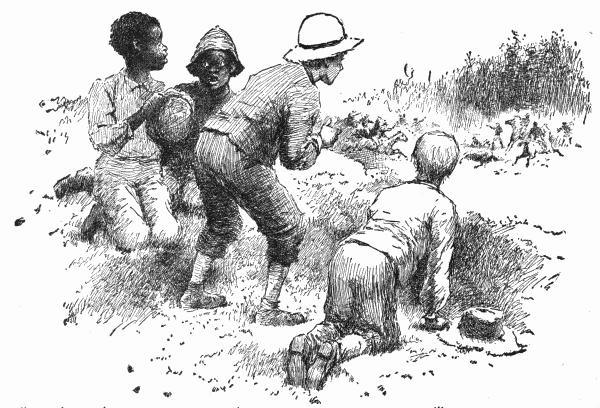 "LOOK! LOOK! THEY ARE RUNNING! THEY ARE BEATING OUR MEN!" EXCLAIMED THE BOYS.
"Of course they will. They'll kill you."
"I'm gwine home," said the boy, and off he started at
a trot.
"Hold on!—We're goin', too; but let's go down this
way; this is the best way."
They went along the edge of the field, toward the
point in the road where the skirmish had been and where
the Confederates had rallied. They stopped to listen to
the popping in the woods on the other side, and were just
saying how glad they were that "our men had whipped
them," when a soldier came along.
"What in the name of goodness are you boys doing
here?" he asked.
"We're just looking on an' lis'ning," answered the boys
meekly.
"Well, you'd better be getting home as fast as you
can. They are too strong for us, and they'll be driving
us back directly, and some of you may get killed or run
over."
This was dreadful! Such an idea had never occurred
to the boys. A panic took possession of them.
"Come on! Let's go home!" This was the universal
idea, and in a second the whole party were cutting straight
for home, utterly stampeded.
They could readily have found shelter and security
back over the hill, from the flying balls; but they preferred
to get home, and they made straight for it. The popping
of the guns, which still kept up in the woods across the
little river, now meant to them that the victorious Yankees
were driving back their friends. They believed that
the bullets which now and then yet whistled over the woods
with a long, singing "zoo-ee," were aimed at them. For
their lives, then, they ran, expecting to be killed every
minute.
The load of cartridges in their pockets, which they
had carried for hours, weighed them down. As they ran
they threw these out. Then followed those in their
sleeves. Frank and the other boys easily got rid of theirs,
but Willy had tied the strings around his wrists in such
hard knots that he could not possibly untie them. He
was falling behind.
Frank heard him call. Without slacking his speed he
looked back over his shoulder. Willy's face was red, and
his mouth was twitching. He was sobbing a little, and
was tearing at the strings with his teeth as he ran. Then
the strings came loose one after the other, the cartridges
were shaken out over the ground, and Willy's face at
once cleared up as he ran forward lightened of his load.
They had passed almost through the narrow skirt of
woods where the first attack was made, when they heard
some one not far from the side of the road call, "Water!"
The boys stopped. "What's that?" they asked each
other in a startled undertone. A groan came from the
same direction, and a voice said, "Oh, for some water!"
A short, whispered consultation was held.
"He's right up on that bank. There's a road up
there."
Frank advanced a little; a man was lying somewhat
propped up against a tree. His eyes were closed, and
there was a ghastly wound in his head.
"Willy, it's a Yankee, and he's shot."
"Is he dead?" asked the others, in awed voices.
"No. Let's ask him if he's hurt much."
They all approached him. His eyes were shut and his
face was ashy white.
"Willy, it's my Yankee!" exclaimed Frank.
The wounded man moved his hand at the sound of
the voices.
"Water," he murmured. "Bring me water, for pity's
sake!"
"I'll get you some,—don't you know me? Let me have
your canteen," said Frank, stooping and taking hold of
the canteen. It was held by its strap; but the boy whipped
out a knife and cut it loose.
The man tried to speak; but the boys could not understand
him.
"Where are you goin' get it, Frank?" asked the other
boys.
"At the branch down there that runs into the creek."
"The Yankees'll shoot you down there," objected
Peter and Willy.
"I ain' gwine that way," said Cole.
The soldier groaned.
"I'll go with you, Frank," said Willy, who could not
stand the sight of the man's suffering.
"We'll be back directly."
The two boys darted off, the others following them at
a little distance. They reached the open field. The shooting
was still going on in the woods on the other side, but
they no longer thought of it. They ran down the hill
and dashed across the little flat to the branch at the nearest
point, washed the blood from the canteen, and filled
it with the cool water.
"I wish we had something to wash his face with,"
sighed Willy, "but I haven't got a handkerchief."
"Neither have I." Willy looked thoughtful. A second
more and he had stripped off his light sailor's jacket
and dipped it in the water. The next minute the two boys
were running up the hill again.
When they reached the spot where the wounded man
lay, he had slipped down and was flat on the ground. His
feeble voice still called for water, but was much weaker
than before. Frank stooped and held the canteen to the
man's lips, and he drank. Then Willy and Frank, together,
bathed his face with the still dripping cotton jacket.
This revived him somewhat; but he did not recognize
them and talked incoherently. They propped up his head.
"Frank, it's getting mighty late, and we've got to go
home," said Willy.
The boys' voice or words reached the ears of the
wounded man.
"Take me home," he murmured; "I want some water
from the well by the dairy."
"Give him some more water."
Willy lifted the canteen. "Here it is."
The soldier swallowed with difficulty.
He could not raise his hand now. There was a pause.
The boys stood around, looking down on him. "I've come
back home," he said. His eyes were closed.
"He's dreaming," whispered Willy.
"Did you ever see anybody die?" asked Frank, in a
low tone.
Willy's face paled.
"No, Frank; let's go home and tell somebody."
Frank stooped and touched the soldier's face. He was
talking all the time now, though they could not understand
everything he said. The boy's touch seemed to rouse him.
"It's bedtime," he said, presently. "Kneel down and
say your prayers for Father."
"Willy, let's say our prayers for him," whispered
Frank.
"I can say, 'Now I lay me.'" But before he could
begin,
"'Now I lay me down to sleep,'" said the soldier
tenderly. The boys followed him, thinking he had heard
them. They did not know that he was saying—for one
whom but that morning he had called "his curly-head at
home"—the prayer that is common to Virginia and to
Delaware, to North and to South, and which no wars can
silence and no victories cause to be forgotten.
The soldier's voice now was growing almost inaudible.
He spoke between long-drawn breaths.
"'If I should die before I wake.'"
"'If I should die before I wake,'" they repeated, and
continued the prayer.
"'And this I ask for Jesus' sake,'" said the boys, ending.
There was a long pause. Frank stroked the pale
face softly with his hands.
"'And this I ask for Jesus' sake,'" whispered the lips.
Then, very softly, "Kiss me good-night."
"Kiss him, Frank."
The boy stooped over and kissed the lips that had kissed
him in the morning. Willy kissed him, also. The lips
moved in a faint smile.
"God bless——"
The boys waited,—but that was all. The dusk settled
down in the woods. The prayer was ended.
"He's dead," said Frank, in deep awe.
"Frank, aren't you mighty sorry?" asked Willy in a
trembling voice. Then he suddenly broke out crying.
"I don't want him to die! I don't want him to die!"
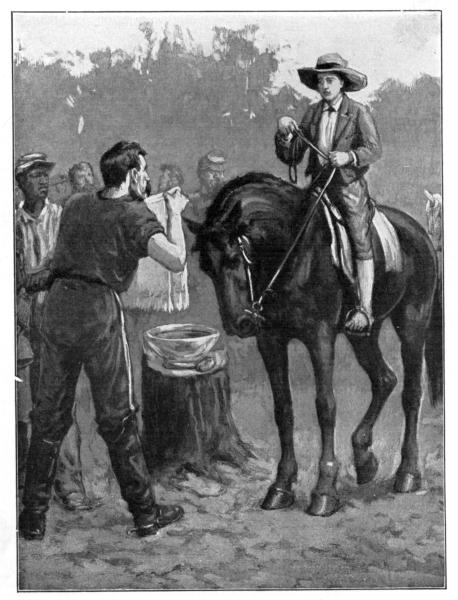 "I'M IN COMMAND," SAID THE GENTLEMAN, SMILING
AT HIM OVER THE TOWEL.
"I'M IN COMMAND," SAID THE GENTLEMAN, SMILING
AT HIM OVER THE TOWEL.