The Project Gutenberg eBook, Two-Legs, by Carl Ewald, Translated by
Alexander Teixeira De Mattos, Illustrated by Johan Briede and Helen Jacobs
Note:
Images of the original pages are available through
Internet Archive. See
https://archive.org/details/twolegs00ewal3
A HUGE NUMBER OF VISITORS
TWO-LEGS
BY CARL EWALD
TRANSLATED FROM
THE DANISH BY
ALEXANDER TEIXEIRA DE MATTOS
AND
ILLUSTRATED BY
JOHAN BRIEDE
AND
HELEN JACOBS
FREDERICK A. STOKES COMPANY
PUBLISHERS NEW YORK
Printed in the United States of America
For Lily Teixeira de Mattos.
Dear,
Of all Carl Ewald’s stories Two-Legs has always
been your favourite. Now that I am reissuing
it, amplified by four chapters which did not appear
in the original edition, it is only fit that I should
dedicate this translation, with my love, to you.
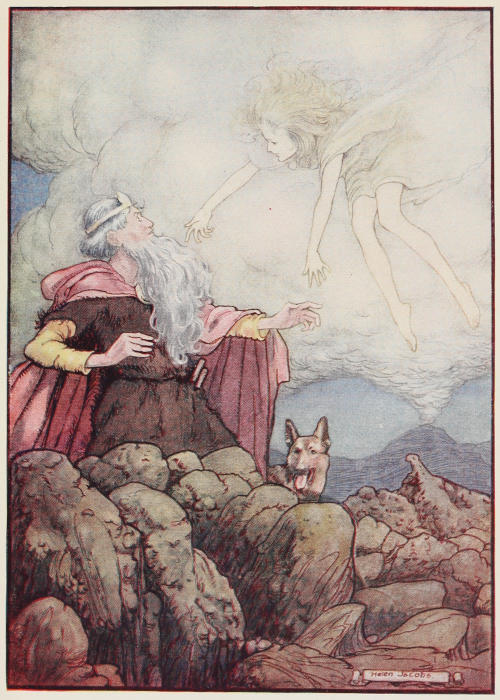
Once upon a time, ever so many years ago, Truth suddenly
vanished from out of the world.
When people perceived this, they were greatly alarmed and at
once sent five wise men in search of it. They set out, one in this
direction and one in that, all plentifully equipped with travelling-expenses
and good intentions. They sought for ten long years.
Then they returned, each separately. While still at a distance,
they waved their hats and shouted that they had found Truth.
The first stepped forward and declared that Truth was Science.
He was not able to finish his report, however, for, before he had
done, another thrust him aside and shouted that that was a lie,
that Truth was Theology and that he had found it. Now, while
these two were at loggerheads—for the Science man replied
vigorously to the attack—there came a third and said, in beautiful
words, that Truth was Love, without a doubt. Then came the
fourth and stated, quite curtly, that he had Truth in his pocket,
that it was Gold and that all the rest was childish nonsense. At
last came the fifth. He could not stand on his legs, gave a
hiccoughing laugh and said that Truth was Wine. He had found
Truth in Wine, after looking for it everywhere.
Then the five wise men began to fight and they pummelled
one another so lustily that it was horrible to see. Science had its
head broken and Love was so ill-treated that it had to change its
clothes before it could show itself again in respectable society.
Gold was so thoroughly stripped of every covering that people felt
awkward about knowing it; and the bottle broke and Wine
flowed away into the mud. But Theology came off worst of all;
everybody had a blow at it; and it received such a basting that
it became the laughing-stock of all beholders.
And people took sides, some with this one and some with that,
and they shouted so loud that they could neither see nor hear for
the din. But far away, at the extreme end of the earth, sat a
few and mourned because they thought that Truth had gone to
pieces and would never be made whole again.
Now, as they sat there, a little girl came running up and said
that she had found Truth. If they would just come with her
... it was not very far.... Truth was sitting in the
midst of the world, in a green meadow.
Then there came a pause in the fighting, for the little girl
looked so very sweet. First one went with her; then another;
and ever more and more.... At last they were all in the
meadow and there discovered a figure the like of which they had
never seen before. There was no distinguishing whether it was a
man or a woman, an adult or a child. Its forehead was pure as
that of one who knows no sin; its eyes deep and serious as those
of one who has read into the heart of the whole world. Its mouth
opened with the brightest smile and then quivered with a sadness
greater than any could describe. Its hand was soft as a mother’s
and strong as the hand of a king; its foot trod the earth firmly,
yet crushed not a flower. And then the figure had large, soft
wings, like the birds that fly at night.
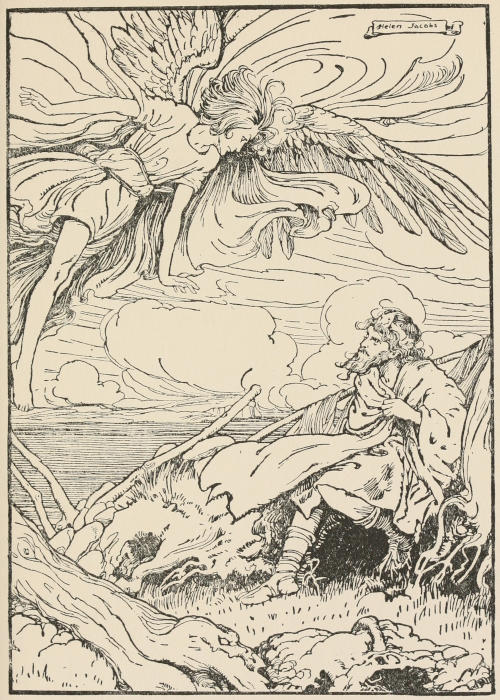
Now, as they stood there and stared, the figure drew itself
erect and cried, in a voice that sounded like ringing bells:
“I am Truth!”
“It’s a Fairy-tale!” said Science.
“It’s a Fairy-tale!” cried Theology and Love and Gold and
Wine.
Then the five wise men and their followers departed and they
went on fighting till the earth was shaken to its centre.
But a few old and tired men and a few young men with ardent
and eager souls and many women and thousands of children with
great wide eyes: these remained in the meadow where the
Fairy-tale was....
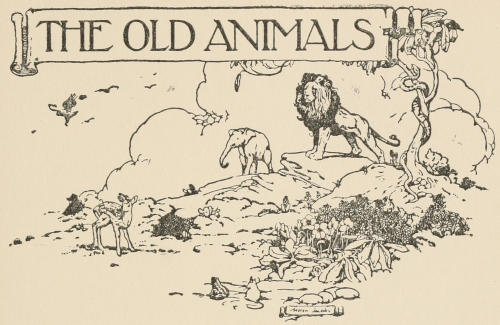
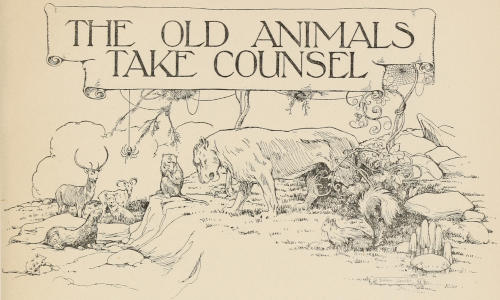
THE OLD ANIMALS — 1 — 2 — 3 — 4
It was once upon a time, many, many, many years ago.
And it was in the warm lands where the sun shines stronger
than here and the rain falls closer and all animals and plants
thrive better, because the winter does not stunt their growth.
The forest was full of life and noise.
The flies buzzed, the sparrow ate the flies and the hawk ate
the sparrow. The bees crept into the flowers in search of honey,
the lion roared and the birds sang, the brook rippled and the grass
grew. The trees stood and rustled, while their roots sucked sap
from the earth. The flowers were radiant and fragrant.
All at once, it became strangely still.
It was as though everything held its breath and listened and
stared. The rustling of the trees ceased. The violet woke from
her dreams and looked up in wonder. The lion raised his head
and stood with one paw uplifted. The stag stopped grazing, the
eagle rested high in the air on his wings, the little mouse ran out
of his hole and pricked up his ears.
There came two through the forest who were different from
the others and whom no one had ever seen before.
They walked erect. Their foreheads were high, their eyes
firm and steady. They went hand in hand and looked around
them as though they did not know where they were.
“Who, in the name of wonder, are these?” asked the lion.
“They’re animals,” said the stag. “They can walk. But
how oddly they do it! Why don’t they leap on all fours, seeing
that they have four legs? Then they would get along much
faster.”
“Oh,” said the snake, “I have no legs at all and it seems to
me I get along pretty fast!’
“I don’t believe they are animals,” said the nightingale.
“They have no feathers and no hair, except that bit on their
heads.”
“Scales would do quite as well,” said the pike, popping his
head out of the river.
“Some of us have to manage with our bare skin,” said the
earth-worm, quietly.
“They have no tails,” said the mouse. “Never in their lives
have they been animals!”
“I have no tail,” said the toad. “And nobody can deny that
I am an animal.”
“Look!” said the lion. “Just look! One of them is taking
up a stone in his fore-paws: I couldn’t do that.”
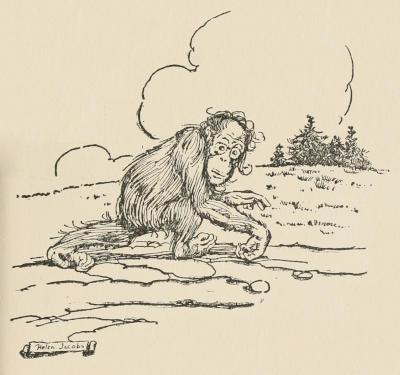
“But I could,” said the orang-outang. “There’s nothing
in that. For the rest, I can satisfy your curiosity. Those two,
in point of fact, are animals. They are husband and wife, their
name is Two-Legs and they are distant relations of my own.”
“Oh, really?” said the lion. “Then how is it they have no
fur?”
“I daresay they’ve lost it,” said the orang-outang.
“Why don’t you go and talk to them?” asked the lion.
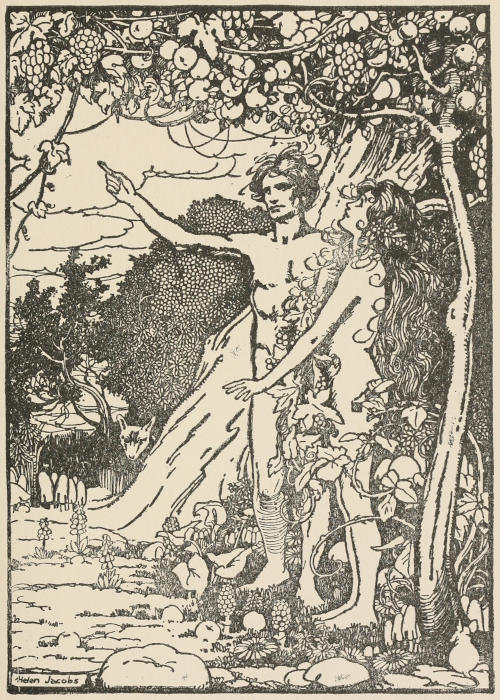
THERE CAME TWO THROUGH THE FOREST
“I don’t know them,” replied the orang-outang. “And I’m
not at all anxious to have anything to do with them. I have only
heard of them. You must know, they are a sort of very inferior,
second-rate ape. I shall be pleased to give them an apple or an
orange now and again, but I won’t undertake the smallest
responsibility for them.”
“They look very nice,” said the lion. “I shouldn’t mind
trying what they taste like.”
“Pray do, for all that I care,” said the orang-outang. “They
will never be a credit to the family and, sooner or later, they will
come to a bad end.”
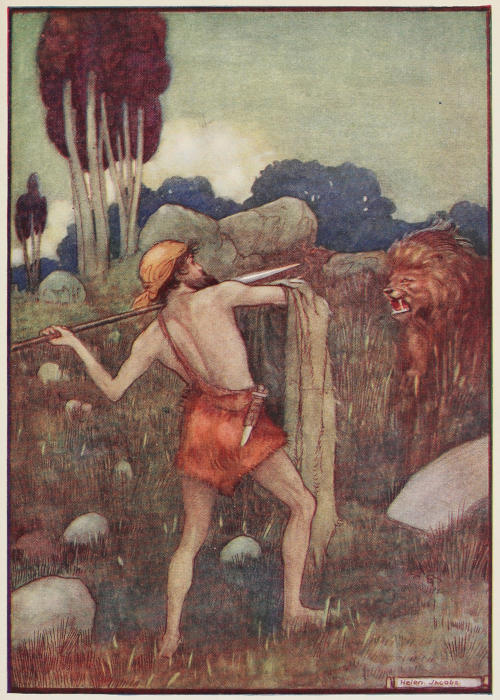
The lion went towards them, as they came, but, when he stood
before them, he suddenly lost courage. He could not understand
this himself, for there was not another thing in the forest that
he feared. But the two new animals had such strange eyes and
walked the earth so fearlessly that he thought they must possess
some mysterious power which he could not see. There was nothing
particular about their teeth; and their claws were not worth
speaking of. But something about them there must be.
So he hung his head and moved out of their way.
“Why didn’t you eat them?” asked the lioness.
“I wasn’t feeling hungry,” he answered.
He lay down to rest in the high grass and did as though he
were no longer thinking of them. The other animals did the
same, for he was their chief. But none of them meant it. They
were all taken up with the new animals.
Meanwhile, Two-Legs and his wife walked on; and, the farther
they walked, the more they wondered at the splendour of
the world. They had no suspicion of the attention which they attracted
and they did not see that all the animals were stealthily
following in their tracks. Wherever they came, the trees put
their tops together and whispered, the birds flew in the air above
their heads and astonished eyes started at them from every bush.
“We will live here,” said Two-Legs and pointed to a wonderful
little meadow, where the river flowed between flowers and
grass.
“No, here!” cried his wife and ran into the adjoining wood,
where the trees dispensed a deep shade and the moss was thick
and soft.
“How strange their voices sound!” said the nightingale.
“They have more notes than I.”
“If they were not so big, I should advise them to build a nest
beside me in the rushes,” said the reed-warbler.
The two new animals walked on and constantly found a place
which was prettier than the last which they had seen; and they
could not make up their minds to stay anywhere. Then they
met the dog, who was limping badly, having cut his foot on a sharp
stone. He tried to run away from them, but could not. Mrs.
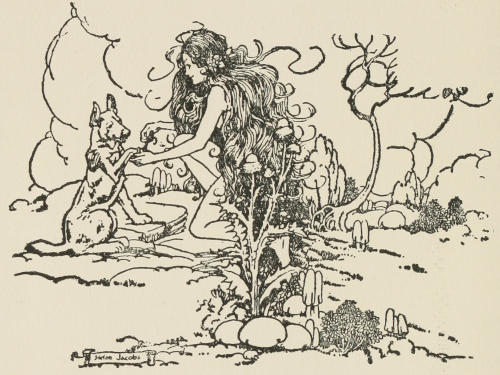
Two-Legs took hold of him and looked at the injured foot:
“I’ll help you, you poor fellow,” she said. “Wait a minute.
I hurt my own foot the other day and healed it with leaves.”
The dog saw that she meant well by him. He waited patiently
while she ran into the copsewood for leaves. Two-Legs patted
him on the back and talked kindly to him. Then she came back
with the leaves, put them on his foot and bound a tendril round
them:
“Run away now,” she said. “To-morrow you’ll be quite
well again.”
They went on, but the dog stood looking after them and
wagging his tail. The other animals came out of the bushes and
copses:
“You’ve been talking to the strangers. What did they say?
What are they like?” they all asked in chorus.
“They are better than the other animals in the forest,” replied
the dog. “They have healed my foot and stroked my skin. I
shall never forget it.”
“They have healed the dog’s foot.... They have stroked
the dog’s skin....”
It ran from mouth to mouth through the forest. The trees
whispered it to one another, the flowers sighed and nodded, the
lizards rushed round with the story and the nightingale set it to
music. The new animals went on and thought no more of the
dog.
At last, however, they were so tired that they sat down. They
stooped over the spring and drank and laughed at their own image
in the water. They plucked juicy fruits from the trees and ate
them. When the sun went down, they lay down to rest in the
grass and went to sleep with their arms about each other’s necks.
A little way off, the dog, who had followed in their footsteps, lay
with his head on his paws, watching them. The round full moon
shone straight down upon them. She also shone in the big face
of the ox, who stood looking at them.
“Boo!” said the ox.
“Bo!” said the moon. “What are you staring at?”
“I’m looking at those two who are lying there asleep,” said
the ox. “Do you know them?”
“I believe something of the kind used to crawl over my face
years and years ago,” replied the moon. “But I’m not sure.
My memory has become very bad in the last hundred thousand
years. It’s almost more than I can do to concentrate my thoughts
upon my celestial course.”
“Yes, thinking is not my strong point either,” said the ox.
“But I am frightened.”
“Of those two there?” asked the moon.
“I don’t know why,” said the ox, “but I can’t bear them.”
“Then trample them to death!” cried the moon.
“I dare not,” said the ox. “Not by myself. But perhaps I
can persuade some one to help me.”
“That’s your look-out,” said the moon. “It’s all one to me.”
And she sailed on. But the ox stood and chewed the cud and
thought and got no further.
“Are you asleep?” asked the sheep, sticking out her long
face beside the ox.
And suddenly the whole meadow came to life.
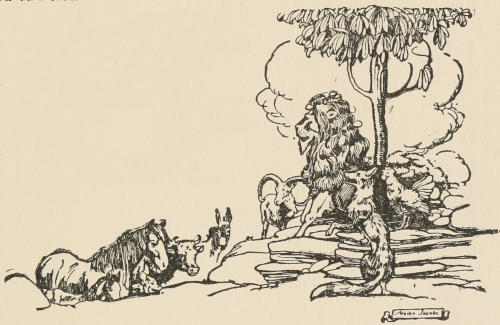
All the animals were there who had followed the two on their
walk. There were both those who sleep by day and hunt at night
and those who do their work while the sun shines. None of them
was now thinking of working or resting. None thought of hurting
the others. The lion and the stag, the wolf and the sheep, the
cat and the mouse and the horse and the ox and many others
stood side by side on the grass. The eagle sat in a tree-top,
surrounded by all the little birds of the forest. The orang-outang
sat on one of the lower branches eating an orange. The hen stood
on a mound beside the fox; the duck and the goose lay in the
brook and stuck out their necks.
“Now that we are all here together, let us discuss the matter,”
said the lion.
“Have you had enough to
eat?” asked the ox.
“Quite,” answered the lion.
“To-night we shall keep the
peace and be friends.”
“Then I move that we kill
those two strange animals forthwith
and without more ado,”
said the ox.
“What in the wide world is the matter with you?” asked
the lion. “Generally you’re such a peaceful fellow, grazing,
attending to your business and not hurting a living thing. What
makes you so bloodthirsty all of a sudden?”
“I can’t account for it,” said the ox. “But I have a decided
conviction that we ought to kill them as soon as possible. They
bring misfortune. They are evil. If you don’t follow my advice,
rely upon it, one day you will all regret it.”
“I agree with the ox,” cried the horse. “Bite them to death!
Kick them to pieces! And the sooner the better!”
“Kill them, kill them!” cried the sheep, the goat and the
stag, with one voice.
“Yes, do, do!” screamed the duck, the goose and the hen.
“I have never heard anything like this in my life,” said the
lion, looking round in surprise at the crowd. “It’s just the most
peaceable and timid animals in the forest that want to take
the strangers’ lives. What have they done to you? What are
you afraid of?”
“I can’t tell you any more than the ox can,” said the horse.
“But I feel that they are dangerous. I have such pains in my
loins and legs.”
“When I think of those two, I feel as if I were being skinned,”
said the ox. “I feel teeth biting into my flesh.”
“There’s a tugging at my udders,” said the cow.
“I’m shivering all over, as though all my wool had been shorn
off,” said the sheep.
“I have a feeling as if I were being roasted before the fire and
eaten,” said the goose.
“So have I! So have I!”
screamed the duck and the hen.
“This is most remarkable,”
said the lion. “I have never
heard anything like it and I
can’t understand your fears.
What can those strangers do to
you? They go about naked
among us, eat an apple or an
orange and don’t do the least
harm. They go on two poor
legs, whereas you have four, so
that you can run away from
them anyhow. You have horns
and claws and teeth: what are you afraid of?”
“You’ll be sorry one day,” said the ox. “The new
animals will be the ruin of us all. The danger threatens
you as well as the rest of us.”
“I see no danger and I know no fear,” said the lion, proudly.
“But is there really not one of you to take the strangers’ part?”
“If they did not belong to my family, I would do so gladly,”
said the orang-outang. “But it looks bad to recommend one’s
own relations. Let them go their way and starve. They are
quite harmless.”
“Then I at least will say a good word for them,” said the dog.
“My foot is almost well again and I believe that they are cleverer
than all the rest of you put together. I shall never forget what
they did for me.”
“That’s right, cousin,” said the lion. “You’re a fine fellow
and one can see that you come of a good stock. I don’t believe
that these Two-Legs are dangerous and I have no intention of
doing them any harm. To be sure, if I meet them one day when
I’m hungry, I shall eat them. That’s a different thing. Hunger
knows no law. But to-night I have had enough to eat and I am
going home to bed. Good night, all of you!”
Then none of the animals said another word. They went
away as noiselessly as they had come. The night came to an end
and the day broke in the east.
Then suddenly the ox and the horse and the sheep and the
goat came galloping over the meadow. Behind them, as fast as
they could, came the goose and the duck and the hen. The ox
was at their head and rushed with lowered horns to the place where
the strangers lay sleeping.
But then the dog sprang up and barked like mad. The two
new animals woke and leapt to their feet. And, when they stood
there, tall and slender, with their white limbs and their steady
eyes, and the sun shone down upon them, the old animals were
seized with terror and ran back the way they came.
“Thank you, friend,” said Two-Legs and patted the dog.
Mrs. Two-Legs looked to his bad foot and spoke to him in her
pretty voice. He licked their hands with delight.
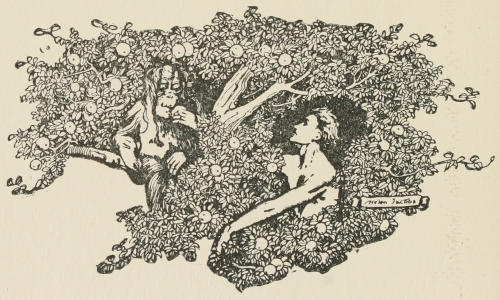
Then the new animals bathed in the river. And then Two-Legs
climbed up an apple-tree to get some breakfast for himself
and his wife.
In the tree sat the orang-outang eating an apple.
“Get out of that!” said Two-Legs, in a threatening tone.
“This is my tree and don’t you forget it. Don’t you dare touch
a single apple!”
“Goodness gracious me!” said the orang-outang. “What a
tone to take up! And I who defended you last night when all
the other animals wanted to kill you!”
“Get out, you disgusting ape!” said Two-Legs.
He broke a branch off the tree and caught the orang-outang
a couple of such lusty cracks that he ran off crying into the forest.
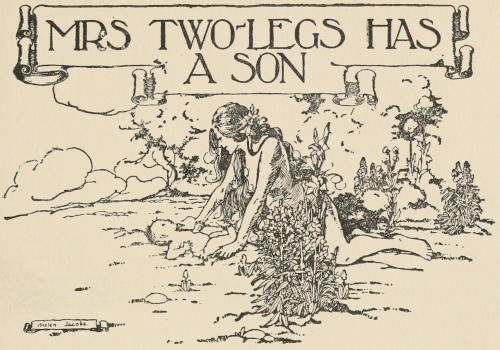
MRS TWO-LEGS HAS A SON — 1 — 2
The days passed.
Things were busy in the forest, both above and below. All
the wives had eggs or young and all the husbands had their work
cut out to provide food for their families. Every one attended
to his business and took no heed of his neighbour, except when he
wanted to eat him.
The new animals had taken up their abode on an island in the
river.
This was because the lion had met them one day on the borders
of the copsewood. He had got out of their way, as on the first
occasion; but he had given them such a look that Mrs. Two-Legs
trembled with fright:
“He’ll eat us one day,” she said. “I dare not sleep in the
meadow again.”
Then Two-Legs discovered the little island and built a hut
on it of branches and grass. Every day they waded through the
river and went to gather fruit in the forest. At night they slept
in their hut. The other animals had gradually all got used to
them and spoke of them but seldom. Only the dog never forgot
to run down to the river every morning to look across at the island
and bark “Good morning!” to them. And the orang-outang
slandered them wherever he went.
“Who minds what he says?” asked the stag. “They’re
relations; and we all know what that means.”
One night,
a child was
born to the
new animals.
“The Two-Legs
have had
a youngster,”
said the sparrow,
who went everywhere and always had
some news to tell.
“Really! I must run and have a look at the baby,” said Mrs.
Nightingale. “My eggs will keep warm for four or five minutes.”
“Mrs. Fox has gone there herself, so I can leave my goslings
alone for a moment,” said the goose.
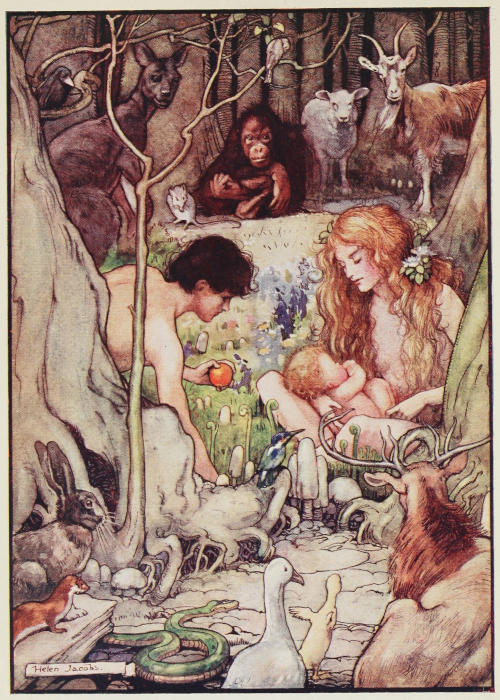
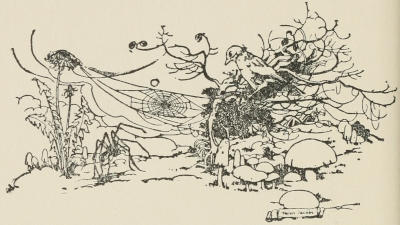
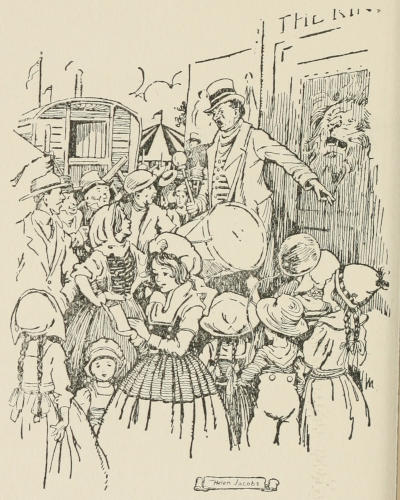
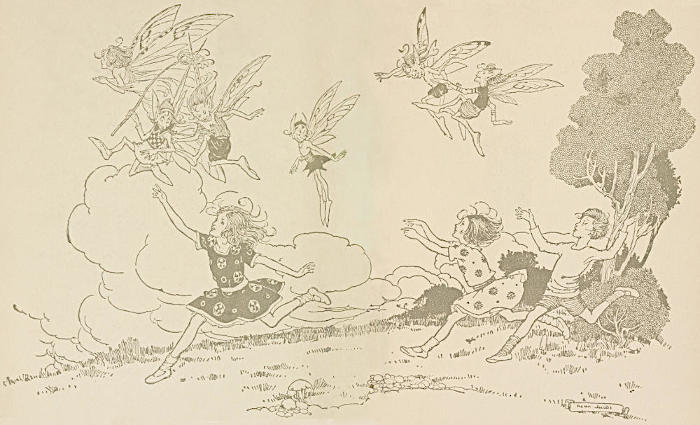
Down by the river was a huge number of visitors and enquirers.
All the wives had hurried from hearth and home to have a
look at the Two-Legs. Mrs. Two-Legs was sitting on the grass
in front of the hut with her child at her breast. Two-Legs sat
beside her, eating an orange.
“He’s just the same as other husbands,” observed Mrs. Stag.
“There are some who are worse,” said Mrs. Mole. “My
husband eats the children, if I don’t look after them.”
“Husbands are mere rubbish,” said Mrs. Spider. “I ate
mine as soon as I had laid my eggs.”
“Do spare us those gruesome stories,” said Mrs. Nightingale.
“But he might sing to her a little. That’s what my husband
does.”
“Oh, but look at the baby! Isn’t he sweet?” exclaimed Mrs.
Reed-Warbler.
“Poor little thing!” said Mrs. Stag. “He can’t even stand
on his legs and the sparrow was saying that he was born at eleven
o’clock last night. When my fawn was an hour old, he was
jumping merrily over the meadow.”
“There’s no sense in carrying a poor little mite like that in
one’s arms,” said Mrs. Kangaroo. “If he were mine, he should
stay snugly in my pouch until he knew how to behave himself.
But probably the poor woman hasn’t even got a pouch.”
“At least he can see!” said Mrs. Fox. “My children are
blind for quite nine days.”
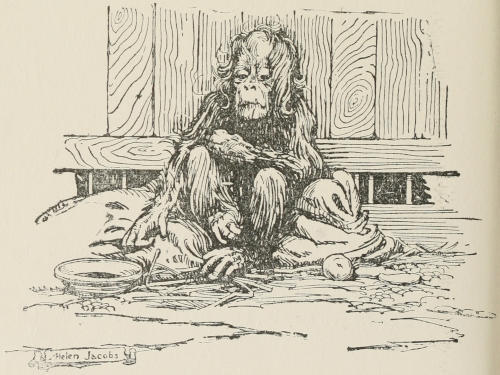
“Don’t forget that they are poor people,” said the orang-outang.
“Stuff!” said Mrs. Nightingale. “It’s a dear little baby,
as any mother can see. Hi! Mrs. Two-Legs! Be sure you feed
him on maggots. Then he’ll grow up nice and fat.”
“And, for goodness’ sake, sit on him at night!” cried Mrs.
Reed-Warbler. “Else he’ll catch cold.”
“Don’t mind what any of them say!” cried Mrs. Stag. “You
stick to the milk! That’s good enough. And put him down on
the grass and let him run about. You had much better make
him used to it from the start.”
Mrs. Two-Legs looked at her baby and did not listen to what
they said. He had now finished drinking and began to crow and
kick about his little legs and arms. Two-Legs took him and lifted
him high in the air and laughed at him.
“Isn’t he sweet?” said Mrs. Reed-Warbler.
“He’s all that,” said Mrs. Stag. “But his parents are very
self-sufficient. They won’t look at any one else.” And she
called across to the island, “It’s all right, Mrs. Two-Legs. You
go on with the milk. And, if you run short, come to me. My
only fawn died the other day, so I have plenty!”
Then they all hurried home again, lest their husbands should
come and find out that they had been gossiping.
“I’m going to fetch a couple of oranges, or something of the
sort,” said Two-Legs. “It may be some time before I’m back,
for we’ve eaten everything on the trees round about here.”
“Be as quick as you can,” replied his wife. “You know I
don’t care to be alone at this time.”
He waded through the river and went into the forest. After
a long while, he came back, having found only a couple of poor
little fruits. He was annoyed at this and so was his wife, for she
was hungry. Then they sat and discussed whether they could not
find something else that was fit to eat in the neighbourhood. For,
once the evening had come, they did not dare leave the island.
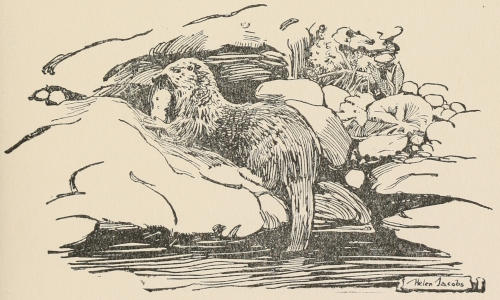
“Last evening,” said Two-Legs, “I saw the otter catch a big
fish in the river here and eat him. Perhaps we could do the same.”
“Do try,” said Mrs. Two-Legs. “One thing is certain, I must
have some food.”
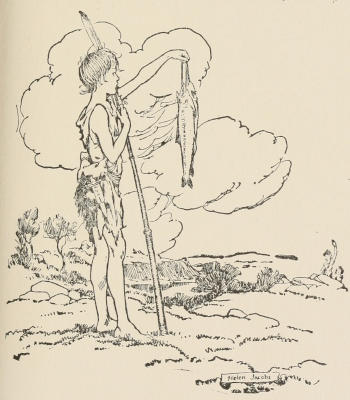
He went out into the river and with his hands caught a great
pike, who was swimming just past him, not dreaming of danger.
He had so often seen Two-Legs wading through the river and
Two-Legs had never looked at him. But now Two-Legs flung
him on the island and there lay the pike gaping and gasping for
breath and yelling with might and main:
“Hi!... Ho!... Murder!... Help!”
But he was soon dead. Two-Legs and his wife ate him and
found him excellent.
“Get me another fish like that to-morrow, will you?” said Mrs.
Two-Legs. “Frankly speaking, I was getting rather tired of
those apples.”
Next day, Two-Legs went into the river again. He was not
long before he saw another fine fish, but, just as he wanted to
catch it, the otter snapped it away in front of his nose.
“Get out of my river, you thief!” shouted Two-Legs and
struck at him.
“Whom are you calling thief?” said the otter, snarling and
showing his white teeth. “I rather thought the river was mine.
I was living here long before you came.”
Two-Legs leapt on shore and picked up some big stones and
flung them at the otter. One of them caught him on the snout
and made it bleed. Then he hid in his hole and Two-Legs caught
another fish and took it home to his wife. But, when the otter
came out again at night, the orang-outang was sitting there and
nodding to him:
“I have seen all,” said the orang-outang. “I was sitting in
the tree over there and saw him throw the stone at you. The
water turned quite red with your blood. He ill-treated me once
too. He said the apples were his and drove me out of the tree
with a stick. And to think that we are relations!”
“If I could only get at him!” said the otter. “But I am too
small.”
“All in good time,” answered the orang-outang. “We shall
be even with him yet.”
TWO-LEGS KILLS — 1 — 2 — 3 — 4 — 5
The sun was scorching and the ground was shockingly dry.
The trees and bushes hung their leaves and the grass was
parched and yellow, so that the ox could hardly find a green tuft
to eat. The water in the river was so low that the fish swam along
the bottom; and the brook had stopped running altogether.
The animals lay in the shade and gasped for breath. In many
places, both flowers and animals had died. Two-Legs and his
wife and child were not much better off.
The only one who was really happy was the snake. He
stretched himself in the sun and thought it delightful:
“Shine away, you dear sun,” he said. “The hotter the better.
I am only just beginning to feel alive.”
But one day the rain came.
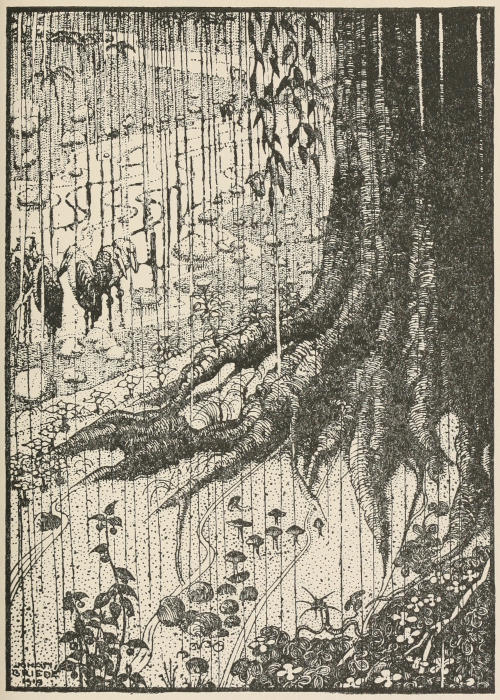
It was not the sort of rain against which you can just put up
an umbrella or take shelter in a doorway and wait until it stops.
It poured down from the clouds till you could not see your hand
before your face and it rained day after day as if it would never
end. It rattled and pattered and clattered on the dry leaves so
that you could not hear a sound. The river flowed again and the
brook woke from its trance and sang as it had never sung before.
The whole earth was like a thirsty mouth that drank and drank
and could never quench its thirst.
And a great gladness reigned on every hand.
The trees stretched themselves and spread out and sent forth
new shoots; and the grass sprang fresh and green from the ground.
The flowers blossomed anew; the frogs croaked till they were
heard all over the forest; and the fish flapped their tails merrily.
Two-Legs and his family sat in front of their leafy hut and rejoiced
with the rest.
But it went on raining.
The river overflowed its banks and Two-Legs feared lest his
island should go under in the waves. The water soaked through
the roof of the hut until there was not a dry spot inside.
“Baby’s cold,” said Mrs. Two-Legs.
They decided to leave the island and crossed the river with
great difficulty, for it was now very deep. They waded through
the damp meadow and carried the child by turns. Then they
found a tree which was so contrived that they could live in it.
They twisted the branches together and built a roof and stopped
up the holes as best they could with grass and moss; and this
was their new house.
“The water can’t reach us here,” said Two-Legs.
“But it’s raining through the roof,” said his wife. “Baby’s
cold and so am I.”
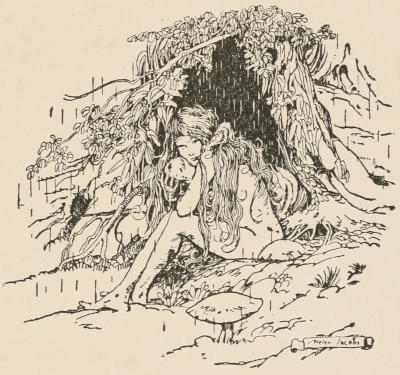
ONE DAY THE RAIN CAME
“It’s just as I always said,” observed the orang-outang.
“They have no hide or fur or anything and they’ll come to a
horrible end.”
“You ought to have fed your little one on maggots, Mrs.
Two-Legs,” said Mrs. Nightingale. “Then he would have thrived
better. My young ones are already almost as big as myself.”
“You ought to have put him
in the meadow and let him jump
about, as I advised you,” said
Mrs. Stag. “Then
he would have
been able to shift
for himself by
now.”
“You should sit
on him,” said Mrs.
Reed-Warbler.
“That’s how I keep
my young ones
warm.”
Mrs. Two-Legs
said nothing, but
looked at her boy, who was shivering
with cold.
“It’s really a terribly spoilt child,” said Mrs. Hedgehog. “Of
course, what must be must be; and, once you’ve brought children
into the world, you have to give them a decent bringing-up. But
a great big thumping lout like that, of six months old, still at his
mother’s breast: fie, for shame! What he wants is a good beating
and then turn him loose into the world!”
“There’s nothing to be done with people like that,” said Mrs.
Stag. “They won’t use their common sense; and, as they have
made their bed, so they must lie on it.”
Then they went away.
Mrs. Two-Legs sat in the tree and the rain poured and the baby
cried with cold.
“Look at that silly sheep in the meadow,” said Mrs. Two-Legs.
“She’s warm and comfortable in her thick fleece, while
my poor dear little boy lies shivering.”
Two-Legs heard what she said, but made no reply. He sat
silent for a while and thought over things. Then he climbed down
from the tree and sat on the ground a little and thought again.
The rain splashed and clattered. Up in the tree, the little baby
cried with cold. Down in the meadow, the sheep moved about
and grazed.
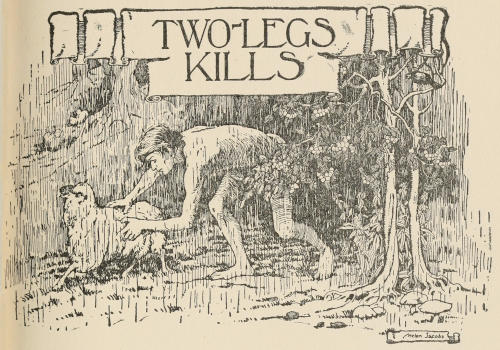
Then Two-Legs rose and went up to the sheep. On his way,
he took a sharp stone and hid it in his hand. He went very slowly
and looked to one side, so as not to frighten the sheep. Then
suddenly, with a bound, he caught hold of her.
“Baa! Baa! Murder! Help! I’m dying!” cried the sheep.
Two-Legs struck her on the forehead with the stone and she
fell to the ground. Then he strangled her with his hands, caught
her by the fleece and dragged her to the tree where he had made
his home.
He cut a hole in her hide with the sharp stone and began to
pull it off with his finger-nails. His wife came down and helped
him. They used their teeth also, to finish the work more quickly,
and, presently, they stopped and looked at each other with beaming
eyes:
“How delicious!” he said.
“Wonderful!” said she. “Let us hurry now and give the boy
the fleece. Then we will go on eating.”
Two-Legs drank the blood of the sheep and bit into the
meat:
“I feel stronger than I ever did before,” he said. “Let the
lion come now, then he’ll have me to deal with.”
They wrapped the fleece round the child, who at once went
comfortably to sleep. Then they dragged the rest of the sheep up
into the tree and sat down to eat. Every bite they took made
them feel braver and stronger. They gave no more thought to
cold or rain, but sat and talked of the future as they had never
talked before:
“I should like to have a sheepskin like that for myself,” said
she.
“So you shall,” said he, gnawing a bone, “unless we find
another animal that has a still softer and warmer skin. I want
a fur too.... I say, we might cover the roof with sheepskins:
that would keep out the rain. I will go out to-morrow
and find some more sheep and kill them and bring them home.”
“Then we’ll eat them,” said Mrs. Two-Legs.
“Rather!” said he. “We’ll eat meat every day. What a
good thing that I thought of it, for the fish in the river were
already growing afraid of me!”
“Mind you don’t meet with an accident,” said she.
“That’s all right,” he said. “I’ll go down to the river the
first thing in the morning and pick out some sharp stones, in case
I should lose the one I have. And, look here, I’ll tell you what:
I’ll fasten one of those sharp stones to the end of a stick, with a
shoot or tendril of some kind; a long stick, do you see? Then
I need not go up to the sheep to hit them. I can throw the stone.
For, of course, they’ll be afraid of me when they hear that I have
killed one of them....”
While they were talking like this, all the animals of the forest
had gathered in the meadow, just as on the first night when the
new animals arrived:
“Two-Legs has killed the sheep!” cried the sparrow and
hurried on with her news, drenched and rumpled though she was
with the rain.
“Two-Legs has murdered the sheep and the ox and the goat!”
screamed the crow and flapped her wet wings.
“Softly!” said the ox. “I’m alive still, thank goodness,
though I’m quite prepared for the worst.”
“Two-Legs has killed all the animals in the forest ... he’s
sitting in the meadow eating the lion,” whispered the reeds
to one another.
Then all the animals rushed down to the meadow to hear the
exact state of affairs. The lion stood in their midst, with his head
proudly raised:
“What’s all this noise about?” he asked.
“May I speak?” said the orang-outang, holding up one
finger. “I was sitting in the palm-tree over there and saw the
whole thing. It was terrible.”
“What a mean fellow you are!” said the lion. “You’re
giving evidence against your own relations.”
“Very distant,” replied the orang-outang. “Exceedingly
remote. I will remind you that I expressly refused to take
any responsibility for these Two-Legs, who only bring disgrace
upon the family. Well, I was sitting in the tree and saw
him come running up, fling himself on the sheep and strangle
her. Then he dragged the poor beast to the tree in which he
is living. I crept up behind him and saw him skin her. The
woman helped him and then they climbed up the tree and
feasted.”
“Is that all?” asked the lion. “I’ve eaten plenty of sheep
in my time, though I prefer deer on the whole. Why shouldn’t
Two-Legs help himself to a bit of meat if he likes?”
“If I may speak, I should like to remind you of what I said
when we last met,” said the ox. “It’s easy for you to talk like
that, for Two-Legs can’t do you any harm. It’s we others that
he eats. Still, you had better look out. He may become a
dangerous competitor. Suppose he gets a large family of children
and they all take to eating mutton?”
“Then there’s always beef left!” said the lion, laughing and
showing his terrible teeth.
“Just so,” said the ox and cautiously took a step backwards.
“The oxen will get their turn, now that he has tasted blood. He
looks awfully greedy. And I feel as if he had eaten me before.”
“Humph!” said the lion. “There may be something in
that. I don’t like beating about the bush as a rule. Let us go
and have a word with the fellow.”
He moved on; and the orang-outang skipped along eagerly
in front of him:
“This way, this way,” he said.
The lion stopped under the tree where Two-Legs had made
his home. All the other animals of the forest had followed him
and stood listening and staring.
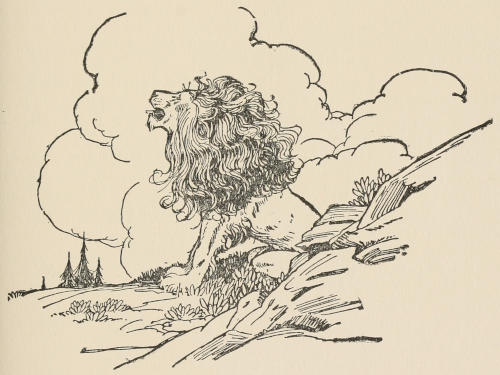
“Two-Legs!” roared the lion, with his mighty voice.
It sounded like thunder and they all started with fear. The
lion lashed his tail and looked up at the tree. Not a sound came
from it. He called out again, but there was no answer.
“The impudent beggars!” said the orang-outang.
“Perhaps they are dead,” said the nightingale. “Perhaps
they have overeaten themselves with the sheep.”
“You don’t die of eating too much, but of eating too little,”
said the pig, who kept rooting in the ground with his snout, in
search of something for himself to eat.
Then the lion roared for the third time; and the noise was
so loud that a little siskin tumbled off her twig right into the jaws
of the snake, who swallowed her before any one could utter a
sound, so that nobody ever got wind of the story.
And now Two-Legs appeared at the top of the tree.
He had been fast asleep after the hearty meal which he had
enjoyed; and he was furious at being roused. His hair hung
about his face in disorder and his eyes were bloodshot and his
mouth covered with foam:
“Who dares disturb my sleep?” he shouted.
“I do: the lion.”
“The lion, the king of beasts,” they all cried, respectfully,
with one voice.
“I am king in my own house,” said Two-Legs. “Be off, I
want to sleep.”
“He is defying the lion.... He is mad.... I won’t
give a penny for his life!” cried the animals.
But Two-Legs took the thigh-bone of the sheep, aimed it and
flung it with all his might at the lion. It hit the king of beasts
in the middle of the forehead. He uttered a frightful roar. All
the animals rushed terrified across the meadow. The lion ran
in their midst, roaring constantly, till it echoed all over the forest.
But Two-Legs lay down quietly to sleep and slept until broad
daylight.
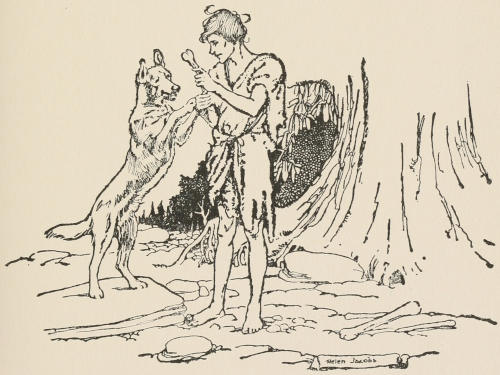
When he awoke and had climbed down the tree, the dog lay
gnawing the bone which Two-Legs had flung at the lion. He
wagged his tail; Two-Legs patted him and gave him another
bone:
“Will you be my servant and my friend?” asked Two-Legs.
“Gladly,” said the dog. “You have been kinder to me than
the others and you are stronger and cleverer than they.”
“Very well,” said Two-Legs. “Then you shall keep watch
over me and mine and help me when I go hunting and bear me
company.”
TIME PASSES — 1 — 2 — 3 — 4
The rainy season went by, the sun recovered his strength and
rain and sunshine came and went by turns. Time passed, as it
must and will pass.
The Two-Legs family were now living in a new house which
was better than either the leafy hut on the island or the dwelling
up in the apple-tree.
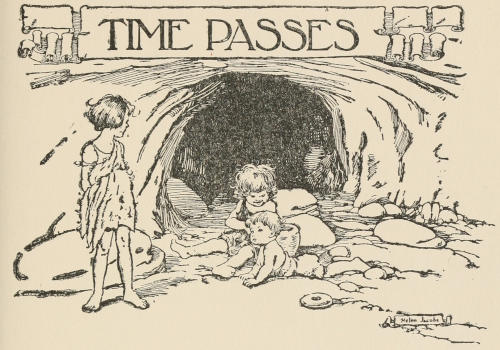
It was a cave in the rocks, which Two-Legs had discovered on
one of his rambles. It was cool in the warm weather and in the
cold it was sheltered against the rain and it could be closed with
a big stone at night or when danger threatened. Two-Legs had
hung the walls with skins and carpeted the floor with moss and
now felt comfortably at home with his family and the dog.
He had plenty to do, for the family had increased. He now
had three children, who were doing excellently and eating like
wolves. He had had to be careful since the night when he flung
the bone at the lion’s head, for not only had he made an enemy
of the king of beasts, but most of the other animals of the forest
looked upon him with suspicion.
And they were well-advised, for Two-Legs had become a mighty
hunter, in no way inferior to the lion himself.
In the back room of his cave, he kept two big spears and one
little one, which his eldest son was already able to use very
cleverly. They lay in wait craftily for their prey, just as the lion
and the other hunters of the forest did. The dog drove the game
towards them and they threw their spears and killed it.
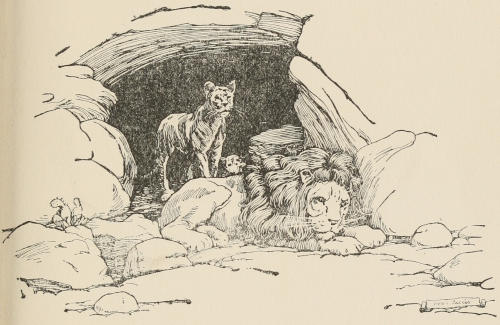
“He’s a better hunter than I,” said the lion, one evening, to
his wife. “With his spear to-day he got a young deer that I
had selected for myself.”
“Why didn’t you take her yourself?” asked the lioness.
“I was crawling up to her in the grass,” he replied. “But,
before I could make my spring, Two-Legs had killed her. He
sent his spear through her neck and she fell dead on the spot.”
“Then why didn’t you take her from him after he had killed
her?” asked the lioness again.
“He had another spear in his hand,” said the lion. “And
his youngster had one also. The spear is a thing I don’t understand.
They who are struck by it fall down and die.”
“You’re afraid of Two-Legs,” sneered the lioness. “He’s
the king of the forest, not you. If your son proves as big a coward
as yourself, we’re done for.”
The lion said nothing, but lay staring before him with his
yellow eyes.
But, a little before daybreak, he stole up to Two-Legs’ cave,
hid in the bushes and waited patiently until the stone was rolled
away. This happened immediately after sunrise. The lion made
ready to leap. He saw blood before his eyes and sprang, almost
without thinking, upon the first form that appeared, struck
it down with his powerful claws and carried it back with a bound
into the bushes.
A terrible scream brought Two-Legs to the entrance of the
cave. He stood holding a spear in either hand. The lion saw
that he had not killed his enemy, but only one of his children.
He let go the corpse and prepared to make a fresh spring. Two-Legs
now saw him among the leaves. He flung one spear and
missed him. Then he threw the other, but the lion was gone,
with great bounds.
With tears and lamentations, Two-Legs and his wife bore the
dead child into the cave. The lion, hurried by fear, fled through
the forest. Wherever he came, the terrified animals fell aside.
“The lion is flying from Two-Legs,” announced the sparrow.
And the rumour spread through the whole forest and grew.
“Two-Legs has wounded the lion with his spear,” screamed
the crow.
“Two-Legs has killed the lion and is hunting the lioness,”
squeaked the mouse.
And the lion fled on.
He rushed past his lair, as though he dare not look his wife in
the face. He did not come home until late at night.
“Are you still alive?” asked the lioness, scoffing. “The
whole forest believes you dead. And what about Two-Legs?”
“I have killed one of his young,” answered the lion, angrily.
“What’s the good of that?” asked she.
Then he caught her a box on the ear the like of which she had
never had before, lay down and stared before him with his yellow
eyes.
But the animals in the forest wondered and whispered to one
another:
“The lion is afraid.... The lion runs away from Two-Legs.”
“Didn’t I tell you so?” said the ox. “We ought to have
killed him then and there.”
“Ah, yes!” said the horse. “If the lion had only taken our
advice!”
“Ah, yes!” sighed the duck and the goose and the hen.
But the orang-outang went to one side in the forest and reflected:
“My cousin is not such a fool as I thought,” said he to himself.
“I really don’t know why I shouldn’t go and do the same.
I am like him, but have many advantages which he has not; and
I ought to do at least as well as he.”
He took a stick and tried if he could walk like Two-Legs. He
succeeded quite nicely and then he made for
the other animals. He lifted his stick, yelled
and made terrible eyes. But the animals crowded
round and laughed at him. The fox snatched
the stick from his hand, the stag butted him
in the back, the sparrow behaved uncivilly on
his head and they all
made such fun of him that
he ran away and hid in the
copsewood where it
was thickest.
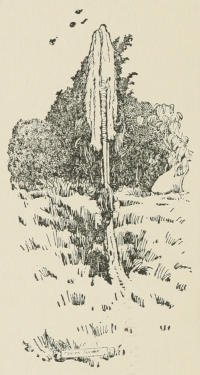
SHE PULLED OUT HIS FEATHERS
But the next morning the animals had fresh food for thought.
They saw Two-Legs carry the corpse into the forest and build
a great heap of stones over it. His wife picked the reddest flowers
and laid them on the stones.
“Well, I never!” said the nightingale. “When another
dies, he’s left, if you please, to lie where he falls. But as much
fuss is made about this child as if his memory were to last for all
eternity! I don’t even know what has become of my live
children of last year, not to speak of the poor little chap who fell
out of the nest and broke his neck.”
“You just wait. There’s worse to come,” said the ox.
And it came. For, a week later, something happened that
enraged the animals of the forest more than all that had gone before.
Mrs. Two-Legs saw a splendid bird of paradise sitting in a
tree:
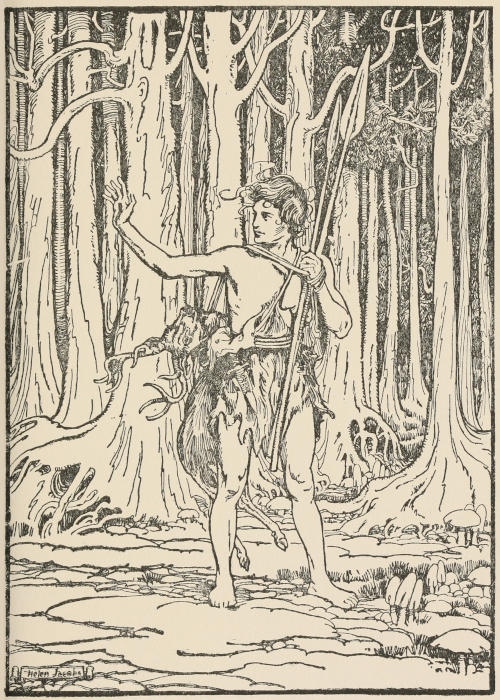
“What wonderful feathers!” she said. “If I could only
have a tuft like that to wear in my hair!”
Two-Legs, who wanted to do everything to console her for the
death of the child, at once went out with his spear and soon came
back with the dead bird of paradise. She pulled out his feathers
and tucked them in her hair and thought she looked charming;
and Two-Legs thought so too.
“Now this is really too bad,” said the nightingale. “To
kill a bird in order to adorn his wife with the feathers! Did
you ever in your born days! It’s well for me that I’m so grey
and ugly!”
The widow of the bird of paradise, followed by a great host,
went off to the lion:
“The new animals have killed my husband,” she said. “Here
am I left a widow, with four cold eggs. Now that my breadwinner
is killed, I can’t stay at home and sit on the eggs, unless
I want to die of hunger. So I left them, to look for some food.
When I returned, they were cold and dead. I have come to
demand vengeance upon the murderer.”
“What can I say?” said the lion. “There are so
many widows in the forest. I myself don’t ask if the animals
which I kill, when I am hungry, have wives and children at
home.”
“He didn’t do it because he was hungry,” said the widow of
the bird of paradise. “He did it only to present his wife with a
tuft of feathers for her hair.”
“What’s he to do when his wife asks for it?” said the lion.
“It’s no joke falling out with your wife.”
Some of the animals laughed. But most of them shook their
heads and thought it a stupid jest, unworthy of the king of
beasts.
The next day, the animals of the forest spoke of nothing
but Two-Legs. They one and all had something to complain
of:
“He took my whole nest, the other day, with seventeen new-laid
eggs in it,” said the hen.
“There are no fish left in the river,” said the otter. “And
one gets bludgeoned into the bargain.”
“One can no longer graze in peace in the meadows,” said the
stag.
But, if sorrow and terror reigned among the larger, important
animals, some of the smaller, insignificant animals did not mind
so much and, in fact, were rather amused at the misfortunes of
their betters:
“Why should we care?” asked the fly. “Let the big ones
eat one another up as they please: it doesn’t concern us in any
case. And I, for my part, would rather have Two-Legs than the
nightingale.”
“No one is safe,” said the bee. “He took my honey yesterday.”
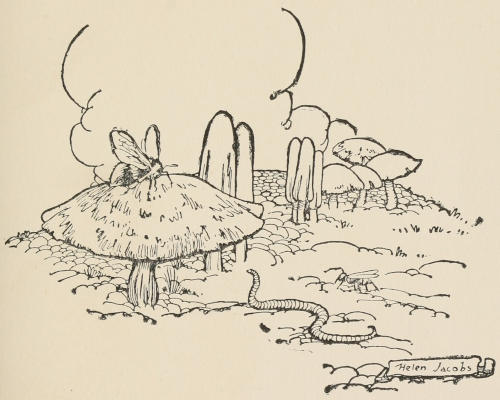
“Yes,” said the earth-worm. “And, the day before that,
he took my own brother, stuck him on a hook and caught a perch
with him.”
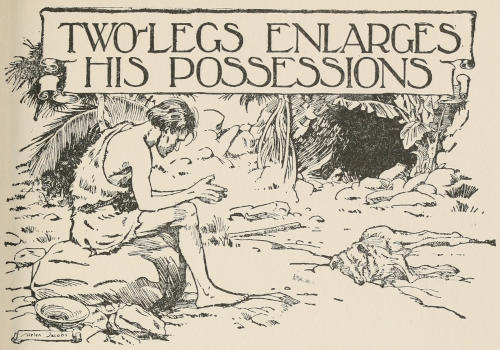
TWO-LEGS ENLARGES HIS POSSESSIONS — 1 — 2 — 3
Two-Legs sat thinking outside his cave. The dog lay at his
feet asleep. Indoors, Mrs. Two-Legs was busy preparing breakfast.
Two-Legs was in a bad temper, for he had had bad hunting.
The day before, he had scoured the forest without coming
upon any game whatever and he had done no better that
morning.
The animals had become afraid of him. His spear had reduced
their numbers so greatly that they fled the moment they saw him
come in the distance. They knew the hours he went hunting and
they hid from him. They posted sentries who warned them with
loud cries when he or the dog came in sight. There was not a
stag nor an ox nor a sheep nor a goat in the country that lay
nearest to the cave. Scarcely ever did an animal graze in the
meadow down below in front of it. They had all retired to where
the forest grew thickest and where he could only penetrate with
difficulty. Nor did it give him any pleasure to hunt up there,
where the lion might so easily be lying in ambush.
“Things are looking bad, Trust,” he said to the dog. “We
must invent something new.”
He sat and sharpened his knives and axes, which he had made
out of flint, and then Mrs. Two-Legs came out with the breakfast,
which consisted only of apples and nuts. There was not even a
fish to be had. The fish disappeared as soon as they saw Two-Legs’
reflection in the water.
“I say,” said Two-Legs, suddenly. “It would be much easier
if I caught a couple of sheep and we kept them here in the cave.
Then they would get lambs, which we could kill, and I need not
continually and perpetually go hunting.”
Mrs. Two-Legs thought this a good idea and, as they sat and
talked about it, he recovered his temper. He wove a long rope
of tendrils and then went off with his spear, the dog and two of
his sons.
He stole along the borders of the forest until at last he caught
sight of a sheep who was grazing in a distant meadow with two
lambs. He crept up to her on all fours, while Trust received
orders to be quite still. When he was near enough, he flung the
sling and was lucky enough to drop it just over the neck of the
sheep. She bleated pitifully, but the noose held fast and tightened.
Two-Legs, rejoicing, led the animal home and the two little lambs
came after, for they did not know what else to do.
When he came home, he fastened the sheep to a tree in front
of the cave. They ate one of the lambs and let the other live.
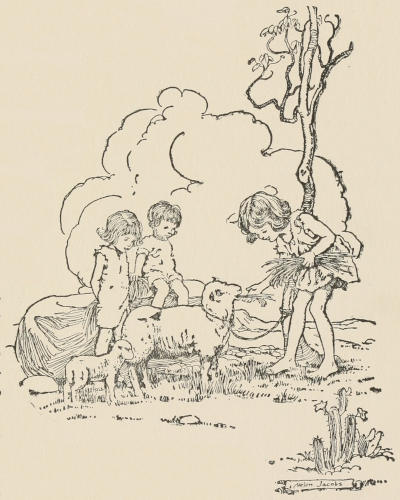
The children ran down to the meadow and fetched armfuls of
grass and the sheep ate and gave her lamb to drink.
“Do you mean to eat me too?” she asked Two-Legs, that
evening, as he sat outside the cave with his family, rejoicing over
his work.
“No,” he said, “I do not. I shall keep you with me and you
shall be my servant, like the dog. To-morrow
I shall go out and catch your husband. Then
you shall bear me plenty of lambs; and I
shall eat some and put some by, just as I
happen to want them.”
“You killed my sister
and pulled off her skin,”
said the sheep.
“I know better now,”
said Two-Legs. “You
shall see for yourself.”
Mrs. Two-Legs came
with a knife and cut off
the old sheep’s wool.
The sheep struggled and
yelled grievously,
but Two-Legs was
determined and
she was bound so
tight that resistance
was of no
avail.
“Now I shall
be cold myself when it rains,” cried the sheep.
“Nonsense!” said Two-Legs. “When it
turns cold, I’ll take you into my cave. I want
your wool to make clothes of. It’s no use your raising difficulties.
If you’re good and obedient, you shall have a better time with me
than you ever had in your life.”
At night, while Two-Legs slept, the sheep stood outside and
thought over things. The ox stuck his head over the bushes and,
a little afterwards, the stag stood there too and the horse and the
goat and many of the other animals.
“What has he hit upon now?” asked the ox. “The sparrow
says that he has tied you up and cut off your wool.”
“It’s only too true,” replied the sheep. “See for yourself
how naked I am. He has eaten one of my lambs and he is
going to catch my husband to-morrow. But I must say that he
has plucked grass for me, so that I have eaten my fill.”
“It’s awful,” said the ox. “But it’s only what we expected.
Can’t you get loose?”
“I’ve tried,” said the sheep. “But it’s no use. The more I
pull, the tighter the noose gets round my neck. I am a prisoner
and a prisoner I remain.”
“Rather die than live a slave!” said the wolf. “I will do
your lamb the service to eat her.”
So saying, he caught hold of the lamb and bit her in the throat.
The sheep screamed at the top of her voice; Two-Legs woke up
and ran out; and all the animals rushed away.
“You’ve been asleep, Trust,” said Two-Legs. “We must see
to-morrow how we can prevent these accidents. A nice thing, if
I am to catch sheep for the wolf and to fatten them for him to
eat!”
And the next morning he thought of a remedy.
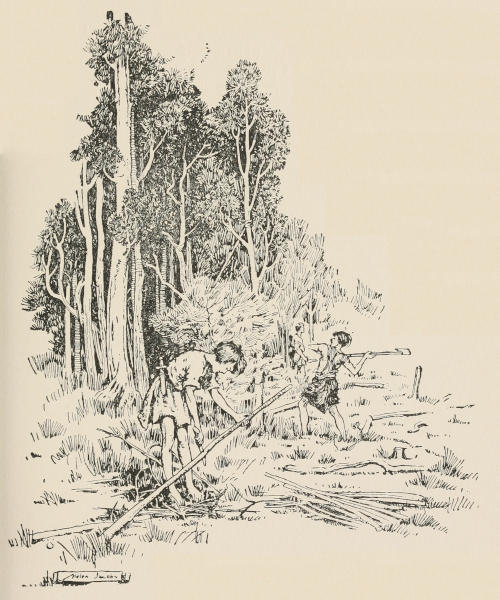
He and his sons went into the forest and felled some trees with
their axes. Then they cut them into sharp stakes and, after they
had prepared a quantity of these, they planted them in a circle,
outside the cave. Then they wove twigs between the stakes
and, by sunset, they had a safe and strong pen over which no
wolf could jump. Two-Legs put the sheep into it.
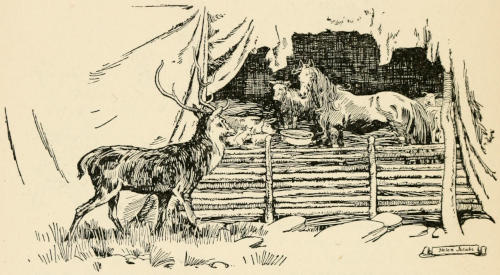
A few days later, he caught the ram with his
sling. He went on hunting and
soon the cow was there and the
bull and their calves. The pen
was too small and he had to build
a bigger one. The whole family
went out to fetch grass, but
could never bring enough. The
animals in the pen bleated
and lowed.
At night, they talked
together:
“Candidly
speaking,”
said
the sheep,
“this existence
has
its advantages. Down there, in the meadow,
one never felt sure of one’s life; first the lion was after one, then
the wolf and the snake and the eagle, to say nothing of Two-Legs
himself.”
“There’s something in that,” said the cow. “But I can’t
stand the way Mrs. Two-Legs pulls at my udders. And then I’m
not so sure that they don’t mean to kill me one fine day. There
will be too many of us here before long.”
TWO-LEGS WANDERS — 1 — 2
Two-Legs began to find it difficult to provide grass for the
many animals which he had in the pen.
He and his family had long plucked all that grew nearest the
cave. Now they had to go a long way to find any and it was hard
work getting it home.
“We shall have to move,” he said to his wife. “We can’t
go on dragging the grass up for all the animals. And, as the grass
won’t come to us, we must go to the grass. We must go down to
the meadow again. You will have to weave us a woollen tent.
Then we will get all the skins we can and dig stakes into the
ground and hang the skins over them. That’s the best way.
And then the animals can go and graze round about the tent.”
“But, when they have eaten the grass in the meadow, what
then?” asked Mrs. Two-Legs.
“Then we will pass on to the next one,” Two-Legs answered.
“We will pack up the tent, load it on the back of the cow and
move on.”
“If only the animals don’t run away!” said she.
“Trust must help me to look after them,” replied he. “And
the boys. Then all will be well. They know us now and they
let us stroke them. You shall see, they will soon be quite
tame.”
The next morning, they began to break up the pen.
“Is he going to set us free?” asked the cow.
“I don’t want to go down to the meadow again,” said the
sheep and began to cry. “My legs are stiffer than they were,
and I can’t walk as well as I used to. And my eyesight is worse
and I have hardly any scent left: it’s so long since I used
my senses. I want to stay with Two-Legs and feed out of his
hand.”
“You’ve become a slave already,” said the cow. “And you
don’t deserve to be free. If I see my chance, I shall be off.
He killed my calf yesterday: I shall never forgive him for
that.”
“Oh, well,” said the sheep, “suppose we do lose a youngling
or two and even risk losing our own lives, what other fate could
we expect in any case?”
“You have the soul of a serf!” said the cow contemptuously.
Two-Legs had finished breaking down the pen. Meanwhile,
his wife had packed up all their things. They loaded the cow
with as much as she could carry, took up the rest themselves and
started on their way to the meadow.
“My fears are now being realized,” said the cow, groaning
under the unwonted burden. “I am dead-tired in my loins and
legs.”
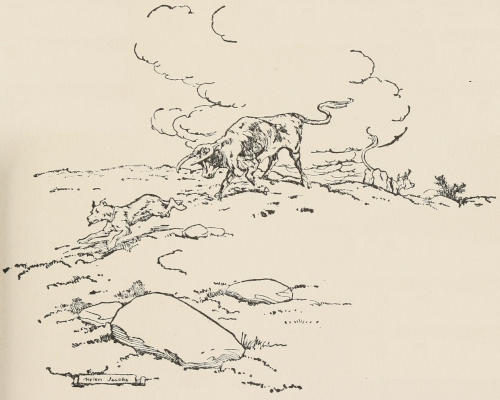
And, hardly had they come down to where the meadow began,
when she threw off her load and rushed away, followed by the
bull. Trust flew after them, but they turned round and showed
him their horns, which made him run back with his tail between
his legs.
Two-Legs threw his spear at them, but missed them.
“Time will bring counsel,” he said. “I shall go out and
catch them again to-morrow. Let us put up our tent now and
arrange our things.”
They set up the tent on a little hill from which they could look
over the meadow. At the foot bubbled a spring. Trust drove
the sheep into the meadow and home again. Two-Legs caught
the hen, the goose and the duck and clipped
their wings, so that they could not fly away.
Gradually, he got a number of sheep and goats
and a quantity of poultry.
When the animals
had eaten all the grass in
that place, he struck
his tent and moved
to another meadow;
and so it
went on. It was
as if he had quite
forgotten the cow.
But, one day, his
wife reminded him
of her:
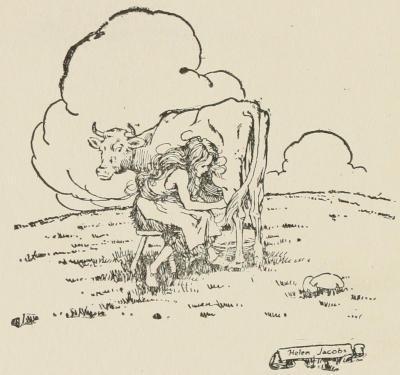
“You must get the cow back for me,” she said. “I need
her milk so badly. And both I and the children want new calfskin
sandals.”
Two-Legs took his spear, hung his sling round his neck and
went off to look for the cow. When he had gone some way, he
saw her in the distance; but she saw him too and trotted away
at once. The horse, who was standing a little way off, looked
at Two-Legs mockingly:
“You would like to have my four quick legs,” he said.
“I should, indeed!”
“It’s a good thing that there’s something you can’t manage,”
said the horse. “It’s dangerous otherwise, the way you play
at being master of the forest.”
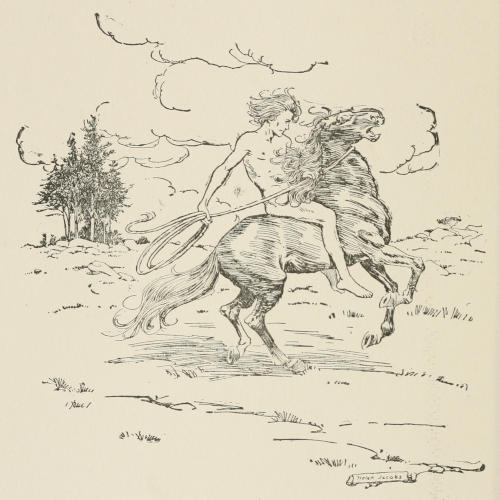
Two-Legs made no reply, but very quietly unwound his lasso.
Then, when he had got it right, he suddenly threw it over the
horse’s head. It fell round the animal’s neck and he reared on
his hind-legs and darted away wildly. But, at every leap he took,
the noose drew tighter; and Two-Legs did not let go the rope.
At one moment, he was dragged along the ground and, at the
next, recovered his feet again. He twisted the rope round his
hand and it cut into his flesh till the blood came, but he did not
let go.
At last the horse got tired. He stood still quivering in all
his limbs. The foam flew from his mouth.
“What do you want with me?” he said. “My flesh is not
nice to eat and my milk isn’t sweet and I have no wool for you
to cut off.”
“I want to borrow your four legs,” said Two-Legs. “You
were boasting of them yourself. Come up! Stand still now!
If you’re good, I won’t hurt you.”
He wound the rope round his arm and came closer and closer.
He patted the sweating horse, then suddenly caught hold of his
mane and swung himself upon his back. The horse reared and
plunged and kicked his hind-legs high in the air and tried, in
every way, to get rid of his rider. But Two-Legs held on to the
mane and the rope with his hands and gripped tight with his
legs and kept his seat for all the effort it cost him. Gradually,
the horse became quieter again and then Two-Legs patted him
on the neck:
“Now go after the cow!” he cried.
He pressed his heels into the horse’s flanks and gave him a
smack. Then they flew in a rousing gallop over the meadow.
The cow did not even attempt to run away, but stood staring in
amazement at that wonderful sight. Before she had collected
herself, the lasso was round her neck and Two-Legs proudly rode
home with his capture.
When they reached the tent, he sprang from the horse, patted
him and thanked him, but he made no pretence of taking the
noose from the horse’s neck.
“Won’t you let me go?” asked the horse.
“No,” said Two-Legs. “But I’ll do better for you. You
shall now drink from the spring and then you shall have the
juiciest grass to eat that you ever tasted. After that, you
shall lie down and reflect that you are now in my service and
that you can spend the remainder of your days free of all cares,
without the very least anxiety, if only you will be faithful and
willing and do the little bit of work that I shall require of you.”
He fed the horse and fastened him to the door of the tent.
The cow stood tethered close by.
“Shall we see if we can get loose?” whispered the horse,
when night came and Two-Legs was asleep.
“No,” said the cow, shaking her head. “I sha’n’t run away
again. I accept my lot. It was a terrible sight to see him on
your back. He is the master of us all. No one can resist
him.”
But the sparrow flew round the forest on her swift wings.
“Two-Legs has caught the horse.... He rides on his back....
He has fastened him to his tent.... The horse has
become Two-Legs’ servant.”
“Have you heard the latest?” the lioness asked her husband.
“Do you mean to let him ride on your back too, when he goes
hunting?”
The lion gave a threatening roar:
“He had better just try!” he said.
“He knows what he’s about,” answered the lioness, with a
sneer. “And you just keep out of his way, coward and degenerate
that you are!”
The lion laid his head on his paw and said nothing, but brooded
dark thoughts.
TWO-LEGS SOWS — 1 — 2 — 3 — 4
Two-Legs moved with his herd
from one meadow to the other.
The herd increased year by year, as did his family. Mrs. Two-Legs
had now borne her husband seven sons and seven daughters,
who were all doing well and helping in the house and with the
cattle.
And the animals were more and more pleased to be in his
service.
The horse carried him when he went hunting and walked
beside him when he struck the tent and moved to a new pasturage.
He came at Two-Legs’ call and neither he nor any other animals
thought seriously of running away, so that Trust had an easy job
in watching over them. Now and then they felt an inclination
for freedom, especially when they were talking to the wild animals.
But it went no further than the inclination.
For instance, one night in the rainy season, the stag came to
the tent which Two-Legs had put up to protect his animals:
“Well, you’re nice and dry here,” said the stag and looked
enviously into the tent.
“You’re right,” replied the sheep. “It is really much better
than in the old days, when we used to take shelter under a tree
and get drenched all the same.”
“Just so,” said the cow. “And in the dry season too it was
pleasant every day to get our food, which Two-Legs had stored
up for us, instead of having to go all over the country as before,
in search of a blade of grass.”
“But I thought you had to drudge for it,” said the stag. “I
have often seen you drudging and toiling for your master.”
“One good turn deserves another,” said the horse. “For
the rest, I can’t deny that my presentiments have been fulfilled.
All my limbs hurt me terribly after the day’s work.”
“And so do ours,” said the ox and the cow.
The duck, the goose and the hen agreed. But the sheep shook
her fat head, while she went on chewing the cud:
“I can’t remember what sort of presentiment I had,” she said.
“I am well off as I am.”
“Are you grumbling over there?” asked Trust, who was
keeping watch and never slept with more than one eye shut.
“Shall I call the master?”
The stag took fright and ran away. But the horse said:
“No, please do nothing of the sort. He has worked hard
himself to-day and is no doubt as tired as we are. It would be a
sin to wake him.”
Then it grew still in the tent.
But Two-Legs in his own tent was not asleep.
On the contrary, he was wide awake, thinking over things,
and his wife could not sleep either, for she was thinking too.
“I am sick of wandering about the country,” he said at last.
“We are no longer young, we have a very big family and sometimes
the work makes me tired.”
“Me too,” said Mrs. Two-Legs. “But that has nothing to do
with it. We are obliged to move about to get the grass we want.”
Two-Legs said nothing for the moment.
He rose and went out into the rain, had a look at his animals
and then came back again and sat down in his old place. The
lion was roaring outside in the meadow.
“Did you hear him?” asked Mrs. Two-Legs.
Two-Legs nodded.
“Tell me,” he said, after a while, “where does the grass
come from?”
“You know as well as I do,” she said. “We have often talked
of how it scatters its seed and how the seed shoots up between
the old withered blades when the rain comes.”
“Quite right,” said Two-Legs. “And why shouldn’t we
collect the seed and sow it ourselves? Now, if we pull up all the
old grass and take the seed of the kind which our animals like
best, we ought to be able to make it grow much thicker. And
then we could reap the seed again and sow it again and go on living
in the same place year after year.”
“Oh, if we could only do that!” cried Mrs. Two-Legs and
clapped her hands.
“Why not?” said Two-Legs. “And, if we succeed in this,
then we can build a proper, solid house for ourselves and our
animals. I am sure that we can fell the biggest trees with our
flint axes, if only we have the patience and persevere. As soon
as the rain stops, I shall go out and look for a place where we can
settle down for the rest of our days.”
A week later, the sky was clear again. Two-Legs mounted
his horse, took leave of his family and said that he would not
come home before he had found what he sought. He did not
return till the evening of the third day and ordered them to pack
up early next morning and go with him.
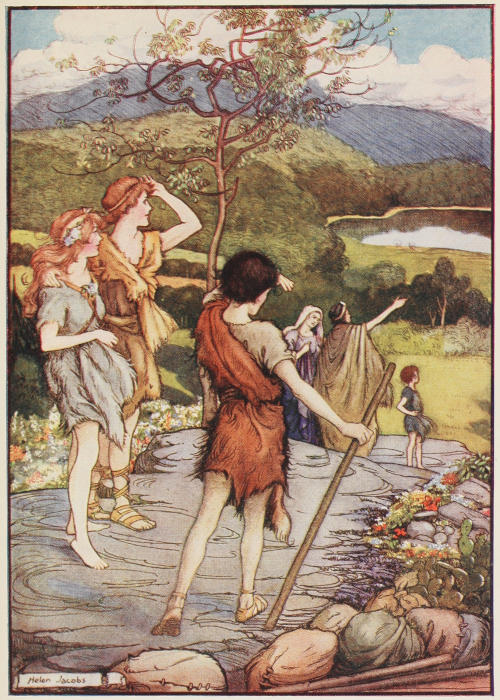
When they came to the place, they had to admit that he had
made a good choice.
It was easy to see that the ground was good and fertile, everything
around grew so fresh and luxuriant. There was a large,
open field and on one side of it was the forest, on the other a
meadow, which, in its turn, ran down to a great lake, where fish
leapt and played. Beyond the lake were the distant blue mountains,
which were beautiful to look at and to dream of. Just at
the edge of the forest lay a hill, at whose foot a brook flowed. The
brook ran into the river, which wound through the meadow, and
the river ran into the lake.
And the field and the meadow were full of all kinds of grass
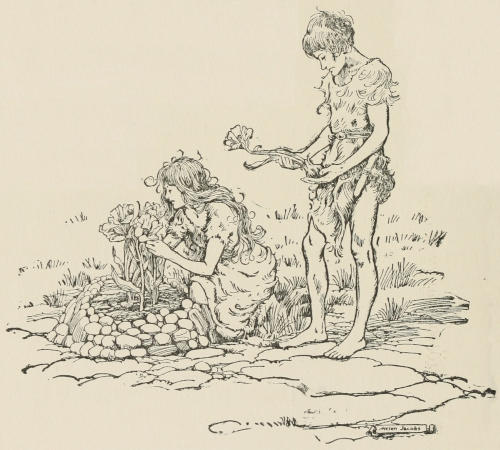
and flowers. There were poppies larger and redder than Two-Legs
had ever seen. And there were bluebells and carrots, convolvuluses
and corn-flowers. They grew and spread themselves
as they pleased, for they themselves were the lords of the land.
“This is where we shall settle,” said Two-Legs. “We shall
build a big, strong house on the hill, with stables for our animals
and a palisade outside to keep off those who wish us harm. Let
us start without delay. You’ll see something, once the house
is there!”
He and his sons set to work at once felling trees.
They laboured patiently day after day; but they had to chop
hard with their stone axes before the big trees gave way. A cry
of dismay went from tree to tree, far into the forest:
“What is happening?... What does he want with us?...
Why must we die?” whispered the trees to one another.
But Two-Legs and his sons heard nothing and saw nothing.
They worked and worked till they had what they wanted. And
then they built a strong wooden house on the hill, built two houses,
then three: one for themselves, a stable for the animals and a
big long house for which Two-Legs had a purpose of which he
did not speak for the present.
They closed up all the chinks with moss. And round the
whole farm they built a palisade of tall stakes and woven twigs,
which made a good wall to protect them against their enemies.
“That’s that,” said Two-Legs. “Now to work!”
He told his wife to sew a leather bag for himself and one for
each of the family. Then they went to the field and the meadow
and filled their bags with seed of every sort of grass that they
wanted to sow.
“Won’t you have a few of my seeds?” asked the poppy,
shedding her scarlet petals. “I have thousands of them in my
head and I am the prettiest in the land.”
“You may be pretty,” said Two-Legs, “but I have no use for
you.”
“You’ve passed me by,” said the violet, modestly.
“You’re forgetting me,” cried the thistle. “I am the proudest
and strongest in the whole meadow.”
“But I am the toughest,” cried the dock.
“Mind you take none of their seed,” said Two-Legs to his
family. “Our animals don’t eat them.”
So they went home with full bags and out and home again,
until they had heaped up a mighty store.
“Now we will prepare the ground,” said Two-Legs. “Come, my
dear horse, and lend me your strength, as you have done before.”
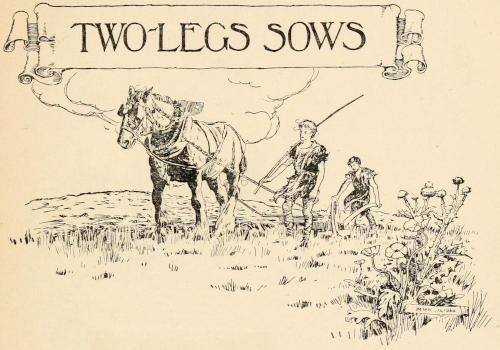
He made a plough, harnessed the horse to it and drove it across
the field, step by step and furrow after furrow. He rejoiced when
he saw the earth turn under the stone blades of the plough.
“What’s the meaning of this?” said the poppy and was
forthwith ploughed over.
“It’s no use,” cried the thistle. “Our seed will come up and
tease you.”
“We’ll see about that,” said Two-Legs.
Then he told his family to pull up all the thistles and throw
them away. And, when he had ploughed as much as he wanted,
he took the grass-seed which they had gathered and sowed it in
the good, fresh earth.
“Now we must wait for the rain,” he said, “and see how things
go.”
And the rainy season came and things went as Two-Legs had
hoped.
TWO-LEGS HAD MADE A GOOD CHOICE
Little green shoots sprouted all over the ploughed field, all
alike, all grass of the kind which the animals loved. Here and
there, it is true, a thistle appeared and a poppy; but most of it
was good grass.
“Look!” said Two-Legs, gladly. “Now we only want the
sunshine and then it will grow.”
The sun came and the whole field was a lovely green carpet
which grew so that one could see it grow from day to day.
One morning, the stag came to the edge of the forest and beheld
all this with amazement. Then he shouted into the forest to his
family:
“Come along! Here’s the finest field of grass you ever saw in
your lives! Hurry up and come. I’ve started grazing already.”
“You’ve started grazing, have you?” cried Two-Legs and
came rushing up with his spear. “Out of this, you thief! Do
you imagine that I have sown corn in the sweat of my brow for
you to eat? Get out of it! This field belongs to me!”
The stag fled as fast as he could into the forest. But the
sparrow flew round and told the news on every hand:
“Two-Legs has taken a great piece of land which no one is
allowed to touch. He called the stag a thief when he tried to graze
on it.”
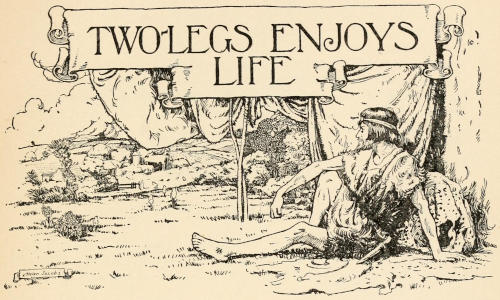
TWO-LEGS ENJOYS LIFE — 1 — 2 — 3
When the time came, Two-Legs filled the house which he had
built for a barn with the produce of his field. And the harvest
was hardly gathered before he began to think of next year.
He ploughed a new field and another and sowed them. The
year after, he cleared a part of the forest and tilled that.
And so he went on year by year, until he had cultivated the
land as far as he could see from his house on the hill.
Round the house he had planted a garden with the fruit-trees
and herbs which he had a use for. The fields lay in long, even
strips, each with its own sort of grass or corn. The whole was
fenced in; and Two-Legs was hard upon any who destroyed his
work or stole his property.
It looked as though he were the lord of the earth. No one
dared set himself up against him. His herd increased from day
to day and the wild animals fled far away as soon as they saw a
sign of him or his. In the depths of the forest, however, and under
the cover of the darkness and whenever they felt safe from him,
they talked of the old days when they themselves were the
masters, of the shame that it was that he should subjugate them
so and of their hopes of better times:
“He throws stones at a poor bird that picks a grain of corn
in his field,” said the sparrow.
“Yesterday, he drove me out of the hazel-hedge round his
garden,” said the squirrel.
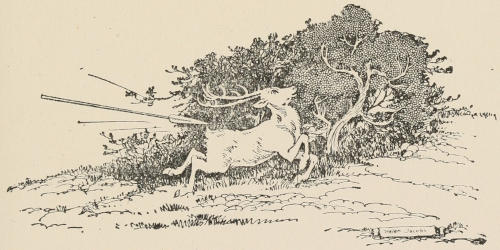
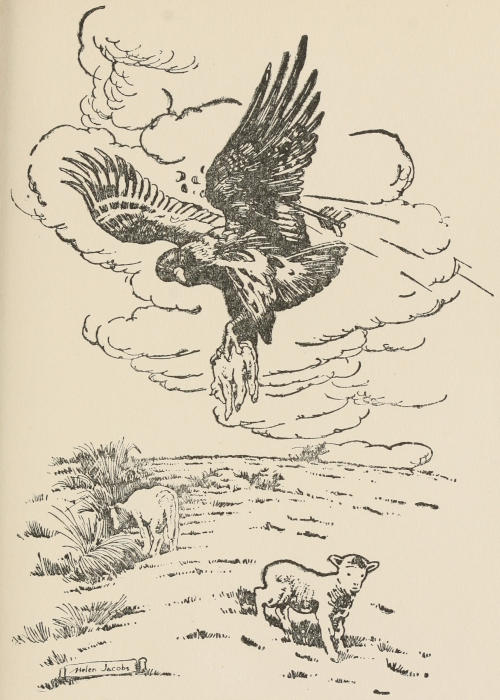
“He shot an arrow into my left wing because I took a lamb,”
said the eagle.
“He has driven me right out of the forest,” said the wolf.
“He told me that all the game belonged to him and that, if I dared
touch it, he would persecute me and my cubs to the end of the
world, if need be.”
“Perhaps he’ll take it into his head to-morrow to say that
all the meadows are his,” cried the stag. “And where are we to
graze then?”
The thistle, the poppy and the bluebell pressed close against
the hedge. The violet hid herself in the ditch and the stinging-nettle
stood gloomily and angrily outside Two-Legs’ garden fence.
“Are we any better off?” asked the thistle. “We’ve been
driven from home and have to stand against the hedge and look
on while the silly grass spreads all over the field. We are at his
mercy; he can take our lives any day he pleases.”
“He has planted some of my sisters in his garden,” said the
violet.
“And some of mine,” said the poppy. “But that’s not
liberty.”
‘HE SHOT AN ARROW INTO MY LEFT WING’
“Prick him, thistle!” said the tall oak.
“I did and he struck me with his stick,” replied the thistle.
“Sting him, nettle!” said the oak.
“I did,” said the nettle, “and I came off no better than the
thistle.”
In the corn, however, a glad whisper ran from one end of the
field to the other.
“It is we ... it is we ... it is we ... it is
we that reign in the land now.... We are good.... We
are useful.... You are nothing but weeds.”
“Hear them, the cowardly dogs!” said the thistle.
“We can do nothing,” said the bluebell. “Why don’t you
big trees fall down on him and crush him and his brood?”
“That’s a ticklish matter, falling down,” said the oak. “But
have we not a king of the forest to
protect us? Where is the lion?”
“Yes the lion ... Where is
the lion?” they all cried.
But the lion was not there and did
not come.
Two-Legs sat at home in
his garden, under a big apple-tree,
surrounded by all his
family.
He cast his eyes
over his fields, on
which the corn
waved, and up into
the apple-tree, which
hung full of delicious,
yellow fruit. One of
his sons had just come back from the lake with a couple of big
fish. Another was hunting in the forest; now they heard his call
and he stood at the edge of the wood with a fat roebuck over
his shoulders.
A third was busy making a plough: he wanted to improve upon
the old one. And all the rest were working at one thing or
another. The girls were busy in the kitchen or turning the mill-wheel.
“We have had luck on our side,” said Two-Legs to his wife.
“Everything thrives and grows under our hands. And our
children will do better than we and their children better still.
I hardly dare picture the power and glory which our race may yet
achieve.”
“Yes,” said Mrs. Two-Legs. “Things are going well with us.
Remind me to strew a little corn for the sparrows, when the bad
times come.”
“I sha’n’t forget,” said he. “We have such plenty now that
we can afford to give those little thieves a helping hand. And I
like to hear them twittering when I get up in the morning.”
HE STOOD AT THE EDGE OF THE WOOD
THE OLD ANIMALS TAKE COUNSEL — 1 — 2 — 3 — 4
The complaints of the wild animals increased daily.
“One no longer knows what one dare do and what not,” said
the mole. “Yesterday, my cousin was throwing up earth, as
our family have done ever since they existed. At that moment,
he was caught and killed by one of Two-Legs’ sons, because the
mole-hill appeared in the middle of one of his flower-beds.”
“His daughter killed my wife, because she thought her ugly,”
said a young spider. “Not that my wife was nice to me. She
wanted to eat me immediately after the wedding and I had a
narrow escape. But, apart from that, she was the most inoffensive
person under the sun and really never hurt a soul. Except the
flies, of course.”
“He took away my wife and planted her in his garden,” said
the hop-vine.
“And he throws me out if I show the least tiny green shoot,”
said the gout-weed.
“He shuts us up in hives,” said the bee.
“He hunts us by clapping his hands and hitting us with cloths,”
said the moth.
“He locks us up and fattens us and eats us,” grunted the pig.
“He sets traps for us if we try to get a morsel of food,” said the
mouse.
“He is the master of us all,” said the stag. “We have no
one to complain to. We have no king. The lion is no longer
the ruler of the forest. He kills us with his claws when he is
hungry, but he makes no attempt to defend us.”
While they were talking, the lioness came slowly up and stood
in their midst. They sprang up in alarm, but she lay down quietly
and said:
“Do not be afraid of me. I sha’n’t hurt you. I have hardly
eaten a mouthful this week for grief. The same cares oppress me
as yourselves. And it is worse for me, because my husband ought
to have protected us against these strangers and doesn’t. The
disgrace, for that matter, concerns me personally.”
“The lion must help us! The lion must set us free!” they
all cried together.
“The lion does nothing,” said the lioness, sadly. “He lies
at home in our lair, staring and staring before him. But, now,
listen to what I have to say.”
They all gathered round and listened.
“We are all concerned,” she said, “each one of us, without
exception. I have taken in all that I have heard and seen of
Two-Legs and I know his character and his plans as though he
had confided them to me. He wants to subdue the whole earth.
He and his children intend to reign over us all, whether we submit
or not.”
“That is true!” cried the animals.
“Yes, that is true,” continued the lioness. “Let none feel
safe! The most powerful animal and the tallest tree: if he has
not laid them low to-day, their turn will come to-morrow. The
lowest vermin and the sorriest weed, they know not on what day
he may need them nor when they are in his way; and then their
last hour has struck.”
“Yes, yes!” they cried.
The mighty oak waved his gnarled boughs in assent, the stag
sorrowfully drooped his antlers, the worm whispered his “Yes!”
in the earth and the bees buzzed with fear.
“Yes,” said the lioness. “To him we are either useful or
injurious. If he thinks a flower pretty, he fences it in; if its
scent offends his nostrils, he tramples her underfoot. If a tree
stands where he can sleep in its shade, he lets it grow. If it
is in his way or if he has a use for its wood, he chops it down.
If he is able to use an animal, he catches it and makes it his slave.
He dresses himself in its skin, eats its flesh, lets it do his work.
He does not stop when he has had his fill, as we do. Greedy as he
is, he catches animals and gathers fruit for many days, so that
he may never suffer want.”
“That’s so, that’s so!” cried the animals, in chorus.
“Wait a bit!” continued the lioness. “There is more to
come. He does not hunt fair, like ourselves. He does not go
after his prey on his own legs. He rides at it on the back of the
horse, whom he has compelled to carry him. He does not catch
it with his claws, does not kill it with his teeth: he has a curious
weapon, which flies through the air and brings death to whomsoever
it strikes.”
“We all know it!” cried the stag.
“It has whistled past my ear!” said the wolf.
“It hit my wing!” said the eagle.
“He does not drink the blood as we do, does not eat the meat
as we do,” continued the lioness. “He roasts it at the fire: he
always has a fire in his hut. He has done violence to nature:
we knew fire only when the lightning struck an old tree and set
it alight; he strikes two stones against each other till the sparks
come, or rubs two pieces of rotten wood till they catch flame.”
“True, true!” cried the animals. “He has subdued fire.”
“He does not wait to pluck the fruit in the forest when it is
ripe,” said the lioness. “He cultivates the plants for which he has
a use and roots out the others. Give him a free hand and he will
transform the whole earth. No herbs will he let grow but those
which he can employ. No animals will he let live but those which
serve his use or pleasure. If we want to remain alive, we must
become his servants.”
“Hear, hear!” cried the animals.
The lioness paused; all was still. They heard Trust bark a
long way off.
“Listen to the dog,” said the lioness. “His first servant.
Now he helps him watch over others.”
“The dog has betrayed us! Let us kill the dog!” they cried.
The lioness raised her paw and silence prevailed again. Then
she continued:
“Do you remember the night when we met here in this same
meadow, when the new animals had just arrived? There were
some who warned us: they were the horse and the ox and the
sheep; the goose and the duck agreed with them: now they
are all his subjects; their presentiments did not deceive them.
But do you not remember how the two animals looked when they
lay here asleep? A couple of poor, naked wretches: we could
have killed them without trouble, had we wished.”
“We could, we could!” cried the animals.
“But we didn’t!” said the lioness. “And now they are the
lords of the forest. Do you know whence their power comes?
It comes from the animals whom they have subdued. If we
could take those animals from them, then they would be just as
poor and helpless as before. Two-Legs’ power consists in this,
that he can make others work for him. If, therefore, you take
my advice, you will try to get his servants away from him. I
propose that we send some one who will endeavour to talk them
into their senses. Surely, we have only to appeal to their sense
of honour and to remind them of the days when they wandered
at liberty in the forest! Who will undertake the mission?”
“Do you go yourself!” they all cried.
“No,” said the lioness, “I had better not. It would not be
wise. There is blood between their race and mine. They might
remember this; and then my words would be in vain. It should
be one from whom they have never had anything to fear.”
They discussed the matter for some time; and then it was
resolved that the fox should be the emissary. He was at odds,
it was true, from the old days, with the goose and the duck and
the hen; but there was no one better at hand.
And so he sneaked off: none knew so well the shortest and
most secret paths in the forest. He promised to bring back an
answer as quickly as possible. The animals lay down to rest in
the meadow and whispered together. In the midst of the circle
lay the lioness, staring silently before her, with shame and wrath
in her eyes.
When the fox reached Two-Legs’ house, he met Trust, who was
going his night rounds to see if there were any foes about.
“Good evening, cousin,” said the fox, slyly. “Out so late?”
“I might say the same to you,” replied Trust. “I am keeping
watch for my master. You’re hardly out on so lawful an errand.”
“I have no master, certainly,” said the fox. “And it’s not
long ago since you were a free dog in the forest. You ought to
become so again. Come down with me to the meadow. The other
animals are gathered there. They will forgive you for entering
Two-Legs’ service and look upon you as the good dog that you
were, if you will open the door so that the captive animals may
escape.”
“There are no captive animals here,” said the dog. “We
are all well off and we wish for no change. If I am Two-Legs’
servant, I am also his friend. So run away back as fast as you
can to those who sent you.”
With that, the dog turned his back on the fox and went in
through the little hole that was left in the fence for his use. But
the fox stood waiting awhile, to see if none of the others appeared.
And it was not long before a fine gosling stuck her head through
the hole.
“Good-evening, little missie!” said the fox. “Please come a
little closer.”
“I dare not,” said the gosling. “I am not allowed out at
night. And I should so awfully like to get away. I am so
frightened of Two-Legs. He roasted my mother the other day
and ate her.”
“Shocking!” exclaimed the fox. “You mustn’t stay a
moment longer in this murderer’s den. Come out to me and I
will take you to a place where you will have nothing to fear.”
“If I only dared trust you!” said the gosling. “But I have
ten sisters. I can’t leave them in the lurch.”
“I don’t think you had better wake them to-night,” said the
fox. “Young ladies are so talkative and, if the dog or Two-Legs
discovered your flight, it would be all up with us. You would
be roasted forthwith and I should come in for a certain unpleasantness
too: that goes without saying.”
“That is true,” said the gosling. “But will you promise me
to fetch my sisters another time?”
“I give you my word that, from to-day, I will come every
night and fetch one of the young ladies, until they are all rescued,”
said the fox. “As far as lies in my power. There may be
obstacles.”
“How kind you are!” whispered the gosling. “And I who
thought that the wild animals were such terrible monsters! That’s
what I’ve always been told. They said I must be particularly careful
not to go into the forest, lest the worst of evils should befall me.”
“Sheer calumny!” said the fox. “All the animals in the
forest are angels. I never heard of any one being roasted there.
But come now, before we are perceived.”
“I’m coming,” said the gosling.
She waddled through the hole and, that very instant, felt
the fox’s teeth in her throat. She was just able to give a scream
and then she was done for. But, the next moment, Trust was
there. The fox let go the gosling and struck out with his teeth
as best he could. But he was the weaker and the dog gave no
quarter. Not until the fox lay dead on the ground did Trust
go back through his hole again.
Meanwhile, the animals were lying in the meadow and waiting.
“The fox has tricked us,” said the stag.
“Of course, he has been caught and is entering Two-Legs’
service like the rest,” said the nightingale.
But, at daybreak, the sparrow came flying up, breathlessly:
“The fox is dead!” she said. “He is lying on the hill outside
Two-Legs’ house. I saw him myself. There’s a dead goose lying
beside him.”
Then the lioness rose and all the other animals with her:
“The fox went on his own business,” she said. “He fell in
his own hunting. We can trust nobody now.”
Then, with bent head, she went sadly home.
THE LION — 1 — 2 — 3 — 4
It was one night, some days after the animals
had held their meeting in the meadow.
The lion lay in his lair, as was his custom, and stared with his
yellow eyes. His spouse was sleeping or pretending to sleep.
At every moment she heaved a deep sigh. All was still in the
forest.
The lion well knew what his consort’s sighing meant. He
knew what the animals had talked of that day and all the other
days in the forest. Not one of their complaints was unfamiliar
to him; not one of the taunts uttered against him had escaped
his ears. Not for a moment had he doubted the feeling in the
forest towards the king of beasts.
Nor had he forgotten which of the animals had spoken of him
most slightingly. He had imprinted the names of more than
one in his memory and he would know how to be even with them
when the time came and order was restored in the forest. Every
day he had to bear his consort’s gibes, but he no longer heeded
them. She would have to beg his pardon and yield him her love
and admiration once again. His children would honour him as they
had honoured him of old and even more. He would be remembered
in the history of the forest as the monarch in whose reign
the kingdom had incurred a great danger and misfortune, which
he had finally overcome.
The lion rose and went slowly through the forest.
“The king of beasts is out hunting,” said the hedgehog, creeping
under the bushes.
“See how thin he is,” said the bat. “His skin is hanging
loose on his bones.”
“It is many nights since he went hunting,” said the owl. “His
eyes are glaring with hunger.”
But the king of the forest was not thinking of hunting. He
went, as though in a dream, in the direction of Two-Legs’ house.
A deer darted across his path and he did not see her. Slowly he
went until he came to the open space on the hill where Two-Legs’
house stood.
He went straight up to it, leapt nimbly over the hedge and
crouched in some bushes that grew at the door. He there lay
concealed. No one could see him, only his yellow eyes gleamed
through the leaves. And one bound would bring him to the door.
Two-Legs slept restlessly that night.
He tossed about on his bed of skins and, when at last he fell
asleep, Trust began to bark so loudly that Two-Legs had to get
up and see what was happening. He had closed up the hole through
which Trust used to get out, because the goose had lately escaped
that way and fallen a prey to the fox.
“What is it, Trust?” he asked.
The dog kept on barking and leaping up against him. Two-Legs
opened a little shutter and looked out and listened. But
there was nothing to see. Then he told the dog to lie down and
went back to bed. But now he heard the horse kicking in the
stable and the ox began to low and the poultry to cackle. There
was no hearing a word for the noise. He had to go out again and
found all the animals shaking, as though greatly frightened. The
horse stood in a violent sweat and the hens and the ducks and geese
fluttered anxiously round and round their roost.
“What can it be?” he said.
He opened the door and stepped out into the night, unarmed
and naked, as he had risen from his bed. At that moment, there
was a rustling in the bushes. The lion leapt forward, but Two-Legs
just had time to spring back into the house and bolt the door
behind him.
He stood for a moment in great alarm and did not know what
to do.
Through a little hole in the door, he saw the lion lying outside
in the bushes, with his eyes fixed on the door, ready to leap again.
The yellow eyes glittered with rage. Two-Legs understood that
the fight was now to come that had been so long delayed.
He thought first of waking his sons, slipping out through the
other door and attacking the lion in the rear. But they slept
in different parts of the house; and the day was already breaking
in the east; and, while he was gone to fetch them, one of the
family might easily go out and fall a prey to the king of the forest.
While he stood and reflected, his fear left him.
He considered he was man enough to kill his foe unaided. He
silently took the best two of his spears, carefully felt the edges,
drew a deep breath and then opened the door.
The lion was not there.
Two-Legs looked from one side to the other and could not
discover him. But he was an old, experienced hunter and did not
doubt but that the lion was lurking in ambush. So he stood
quietly in the doorway, with every muscle taut, ready for the
fight that must come.
Then he heard a soft rustling in the bushes and, at that
moment, he saw the animal’s eyes there among the leaves. He
knew there was no time to lose: if the lion sprang first, it was too
late.
He flung one of his spears and struck the lion in the eye. The lion
uttered a roar of rage; and then the other spear pierced his heart.
All the inmates of the house were now out of bed and came
running up.
There lay the dead lion, a great and splendid sight. Trust
barked at him and wanted to bite him, but Two-Legs drove him
away:
“After all,” he said, “he was king
of the forest. But now let it be declared
all over the earth that the lion is dead
and that the realm is mine.”
Then they stripped the lion’s hide
and hung it on a tall pole, which they
set up in the middle of the field, so that
it could be seen from far and wide.
“The lion is slain!” cried the sparrow,
from door to door. “Two-Legs has
murdered the king of the forest. His
skin is hanging on a pole outside the
house: I saw it myself.”
Then all crowded up and saw it. From
the edge of the forest, full of fear they
peeped at Two-Legs’ house and the birds
stared down from the sky.
“And now all is over,” said the stag.
And so it was.
But, in the course of that day, the orang-outang came to Two-Legs,
who was sitting outside the house:
“Good-day, cousin,” said the orang-outang.
Two-Legs looked at him without answering.
“Ah, you may have heard,” said the orang-outang, “that
I have spoken ill of you. I will not deny that I have been a little
careless in my talk. But you yourself know, when one meets
with poor relations, one is afraid of hangers-on. One has children
of one’s own and it is not easy to make both ends meet in these
hard times. Besides, you once caught me a blow with your stick;
so we can cry quits.”
“What do you want?” asked Two-Legs. “I have neither
time nor inclination to listen to your drivel.”
“Now don’t be hasty, cousin,” said the orang-outang
and sat down beside him. “I acknowledge your
success. You have been lucky. It
does not enter my head to deny your
ability. You have managed things
splendidly. That little business
with the
horse was really
smartly done.
And, now that
you have outwitted
the lion....”
“What do you
want, you bothersome
brute?” said
Two-Legs.
“I want to join forces with you, cousin,”
said the orang-outang. “We two as partners
ought to conquer the world.”
“Are you mad?” said Two-Legs. “What should I do with
such a ridiculous, stupid beast as you? You’re no more use to
me than a pigeon. Away with you! Look sharp or I’ll give you
a thrashing which you won’t forget in a hurry.”
The orang-outang retreated a few paces, but did not give up
the game:
“You should think it over all the same, cousin,” he said.
“However clever you may be, I can be of use to you still. I should
be a good intermediary between you and the animals. I can
do things you can’t; and what I can’t do I can easily learn. Up
in the apple-tree where I sat, I have watched you and studied
the way you went about your field; and I have already picked
up many of your tricks. You must know that....”
Two-Legs stood up and caught the orang-outang by the arm:
“Come outside!” he shouted into the house. “I want to show
you something!”
They all came and stared at the ape.
“This fellow wants to go into partnership with me,” said Two-Legs.
“He’s not fair. He says he has already learnt my tricks.
Let’s put him in a cage; then we can amuse ourselves with his
tricks when it’s raining.”
The orang-outang protested, but to no purpose. Two-Legs
held him tight and soon they had built a cage and put him into it.
“There’s none like one’s own people for meanness!” said the
orang-outang, as he sat on the floor of his cage, catching his fleas.
THERE WAS NO TIME TO LOSE
MANY YEARS AFTER — 1 — 2 — 3
It was many, many years after.
And it was not in the forest in the warm lands where the sun
shines stronger than here and the rain falls closer and all animals
and plants thrive better, because the winter does not stunt their
growth.
It was in a large village in Jutland.
It was fair-time and the village was full of people and cattle.
On every side stood booths with wooden shoes and tin goods,
cakes and toys and all sorts of wares. There were refreshment-tents
and a dancing-hall. There was a peep-show, there were
two merry-go-rounds, there was a place where the fattest lady
in the world was exhibited. In another place, for twopence, you
could see a tiny dwarf. Then there were white mice and performing
fleas, numbers of barrel-organs, all playing at one time,
so that you could hardly hear for the din, and drunken peasants
and boys playing practical jokes.
But the most remarkable thing of all was hidden in a large
tent in the middle of the market-place. This, too, could be seen
for twopence; and, if you wished to know what it was, you had
but to listen to the man who stood outside and shouted in a hoarse
voice:
“Walk up, ladies
and gentlemen, walk
up! Only twopence
for grown-ups, children
half-price!
Here’s something
that’s never been exhibited
in this village
before, but that’s appeared
before all the
kings and royal families
in the world. It’s
a king himself that
I have the honour of
introducing to you:
the king of the beasts,
ladies and gentlemen,
the terrible lion! He
lives in darkest Africa
and is so powerful
that he can kill an
ox with one blow of
his paw. He has two lambs for his breakfast every morning.
If he were to escape from his cage, he would do away with you
all in no time. But you need have no fears, ladies and gentlemen!
The lion is in his cage behind thick iron bars. There he
stands and glares in his bloodthirsty way, at twopence for grown-ups,
children half-price. Walk up, ladies and gentlemen! Hurry
up, before it’s too late! Never again, in all your lives, will you
see so fine a sight at so cheap a price!”
He shouted like this all the time. A crowd of people stood
outside the tent staring. Many went in. When they came out,
they told the bystanders about the lion inside. Then more went
in and so it continued all day long.
The lion’s cage stood at the back of the tent.
It was a low and dirty cage. On the floor lay some filthy
straw and a few bones. The side which was turned to the spectators
consisted of thick, rusty iron bars. In the far corner lay
the lion, with his head resting on his paws. His yellow eyes
stared at the onlookers with a dull expression. There was straw
in his tangled mane; and he was terribly thin. Now and again,
he gave a nasty hollow cough.
The man stood with a long stick in his hand, talking and explaining.
The visitors to the fair stared round-eyed at the great
beast that lay there so quietly. Sick and feeble as he was, they
could see, nevertheless, that he was the lion, the king of beasts;
and they felt cold in their backs at the thought that he might
break loose. But, when he did not make a single movement, one
of the spectators said, at last:
“I believe he’s dead!”
Then the showman pushed his long stick through the bars and
poked the lion with it. The lion slowly turned his head and looked at
him, but gave no further sign of life. Then the man poked him again
and again; and, at last, the lion sprang up and gave such a roar
that the tent shook with it and the people fell back in affright.
“He ate his former owner,” said the man. “I bought him
of the widow. He is terrible and intractable. He’s dreaming of
his native land, you see, where he used to hunt in the wild forest
and all the animals honoured and feared him. But now you must
go please, so that others may come and see the most extraordinary
sight ever exhibited in this village. Walk up, ladies and gentlemen!
Only twopence each! The king of the forest, the terrible
lion!”
And so it went on until late that evening. Not until the
market-place was empty and there were no more visitors left to
listen to him did the man shut up his tent, after counting the day’s
takings:
“This has been a bad day,” he said, with an angry look at the
lion. “You haven’t really earned your supper!”
He flung a small piece of half-rotten meat into the cage. Then
he shut the door and locked it and went to the inn, where he sat
and drank and caroused till early morning.
The lion did not touch the putrid meat. With his head on his
paws, he lay staring at the little paraffin-lamp that hung in the
tent and flickered feebly. Suddenly, he heard a sound and raised
his head and looked about him:
“Can’t I have peace even at night?” he said.
“It’s only I,” replied a squeaky little voice. “I have been
locked in by accident. I want to get out! I want to get out!
My mistress will die of fright for me.”
It was a tiny little dog, with a collar and bells round his neck
and an embroidered rug on his back. He tripped to and fro,
whined and cried and scratched at the door, but no one heard him.
All was silent in the market-place outside.
“Well, I never!” said the lion. “You’re the dog: I can
see that. Gracious me, what a sight they’ve made of you!”
“I want to get out! I want to get out!” whined the dog.
The lion laid his head on his paws again and looked at the dog:
“What’s the use of whimpering like that?” he asked. “No
one’s hurting you. I couldn’t eat you if I wanted to.... The
iron bars are strong, believe me. I used to shake them at first.
I have to travel in my cage from place to place and let people look
at me for money, submit to their scorn and teasing and roar when
I am told to, so that they may shudder and yet feel quite safe from
my teeth.”
“Let me out!” cried the dog.
“I can’t,” replied the lion. “But I am not so contemptible
as you. I am here against my will, caught in a trap. You
voluntarily entered Two-Legs’ service, betrayed your fellows and
helped him against them.”
“I don’t know what you’re referring to,” said the dog. “I
know no one called Two-Legs. I am in service with human
beings. My mistress is a great baroness and she will die of fright
if I don’t come home to her soon.”
“Just so,” said the lion. “Human beings, that’s what Two-Legs’
confounded descendants call themselves. They have subdued
the whole earth. There is hardly a place left where an
honest lion can go hunting in royal style. I know the whole
story: it has been handed down in my house, from father to son.
I heard it all, the night before I was captured, in the desert to
which the men had driven us: how Two-Legs and his wife came
naked and unarmed to the forest; how my ancestor protected
them; how they gradually outwitted all the animals: you alone
entered their service of your own free will. The others they
caught and tamed and dulled their senses until they no longer
knew how to lead the lives of free animals and resigned themselves
to slavery. Finally, Two-Legs killed my ancestor with his spear:
yes, yes, I know the whole shameful story.”
“I don’t,” said the dog. “And I don’t mind if I never know
it. I only know that I have a cosy little basket at home with my
mistress and that she pets and kisses me and gives me the loveliest
food. I want to get out! I want to go home!”
The lion made no reply, but thought to himself:
“When I lie here in my cage, where I shall soon die of sorrow
and coughing, it is a comfort to me to see how wretched Two-Legs’
descendants have grown. For he was lithe and slender
and fair to look upon: he was an animal! But these people here!
One can hardly see a morsel of their bodies, they are so wrapped up.
Two-Legs could bound through the forest and climb trees: these
people here can hardly stir hand or foot. He was a fighter; and it’s
really amusing to watch the terror in these fellows’ eyes as I get
up and move to the bars when I roar. They shake like aspen leaves,
though they know that I am only a wretched prisoner.”
“I want to get out! I want to go home!” whined the dog.
The lion rose and went to the bars of his cage. He lashed his
lean flanks with his tail and opened his jaws till his terrible teeth
gleamed and glistened. The little dog trembled with fear before
his yellow eyes.
“And you!” said the lion. “Ha, ha, ha! It’s better to be
a captive lion in a cage than a miserable little lap-dog, with bells
and a rug.”
He gave such a roar that all the people in the village started
up in their beds. Then he lay down at the far end of the cage,
turned on one side and slept.
The little dog shivered and whined until some one came and let
him out.
Now you who have read this story will remember how Two-Legs,
many years ago, mastered all the animals on earth.
Those which he could use and which obeyed him as they should
he tamed and took into his service. Those which he could not
employ he let alone, provided only that they left him and his in
peace. If they did not, then he waged war upon them, nor ceased
until he had prevailed against them. He always ended by prevailing,
for he was the cleverest, you see, and therefore the strongest.
And, little by little, the tame animals grew so much accustomed
to being with him and so completely lost the qualities with
which they had been wont to shift for themselves that they could
no longer do without their bondage. When, once in a way, they
escaped and tried to live like the other, free, wild animals, they
could not manage at all, but perished miserably.
But the wild animals which Two-Legs had no use for lurked
round about in their hiding-places and cavilled and muttered and
made no progress and did themselves no good.
At the time when this particular story begins, Two-Legs had
put up a new summer tent in a green meadow, not far from the
beach.
He was sitting outside it one evening, while the twilight was
closing in. All the family had gone to bed and were sleeping
soundly after the exertions of the day. All the cattle lay in the
grass, munching and chewing the cud. The dog, his faithful
servant, lay on the ground before him, pricking up his ears at
every sound, sleeping with one eye and watching with the other.
Two-Legs did not sleep himself.
He was old now and no longer needed so much rest. And he
was not tired either as in former days, for he now had so many
children and grandchildren that they were able to do most of the
work. Himself, he loved best to sit quietly, to think of what had
happened to him in his life and to meditate on the things that
were yet to come.
When he sat like that, he often seemed to hear voices on either
side of him. They came from the spring that rippled past him,
from the tree whose leaves whispered over his head, from the
evening breeze that cooled his brow:
“Two-Legs ... the lord of the earth ... the cleverest
... the strongest,” rippled the spring.
“Two-Legs ... the vanquisher of the lion ... the
terror of the wild animals ... the protector of the tame,”
whispered the tree.
“Two-Legs ... whom no one can understand ... to
whom all things belong,” sang the evening breeze.
Two-Legs sat and listened. He liked to hear that sort of
thing, the more the better.
But, as the evening wore on, the wind grew stronger and shook
the tent. The gentle whispering in the leaves sounded less home-like
than before. The billows in the brook did not babble softly,
but made a mighty uproar and sent their foam splashing right
over his feet.
“What’s the matter?” asked Two-Legs, who was beginning
to feel cold, and wrapped his cloak round him.
“Yes, who knows what’s the matter?” whispered the leaves.
“Who can tell what’s at the bottom of it?” rippled the spring.
“There is more between heaven and earth than Two-Legs
knows of,” said the wind.
Two-Legs leant back against the tent and looked about him
proudly:
“Then let it come,” he said. “I have vanquished the lion
and subdued the horse and the wild ox; so I daresay I can conquer
what remains.”
Just as he said this, there came a terrible gust of wind.
It knocked Two-Legs over, till he rolled along the ground and
fell into the brook. It tore three great deer-skins from the tent
and woke all those who were lying asleep inside. They started
up and screamed and did not know what was happening. The
dog howled at the top of his voice, with his tail between his legs.
Two-Legs crawled out of the brook, dripping wet.
The moment he tried to rise to his feet, another gust came
... and another ... and another.
Two-Legs crept along the ground on all fours. The whole
tent was blown down and the people inside ran and fell over one
another and shouted and wailed so that it was horrible to
hear.
But no one heard it, for each had enough to do to think of
saving his own life. The cows and the goats and the sheep lowed
and bleated with fright and ran up against one another and
trampled on one another. Many of them fell down the slope and
broke their legs. The horses galloped off over the meadow and
ran till they dropped from exhaustion far away inland. The big
tree above Two-Legs’ tent snapped in two like a stalk of
grass.
When day broke, Two-Legs sat and wept at all the destruction
which he saw around him. He let the family drive the cattle
together and set up the tent again. He himself sat huddled
in his cloak and brooded and stared before him. Then he
said:
“You bad Wind!”
And he raised his clenched fist in the direction from which it
was still blowing violently.
“You destroyed my property last night,” he cried, “and
might easily have killed me and mine. Now, we are setting up
the tent and collecting the cattle; but you may come back, to-night
or to-morrow night, and ruin everything once more.”
“So I may,” said the wind.
“You bad Wind!”
“I am not bad,” said the wind.
“Would you have me call you good, after the way you’ve
treated me?” asked Two-Legs.
“I am not good,” said the wind.
“Very well, you are neither bad nor good,” said Two-Legs.
“Just so,” said the wind. “You’ve hit it.”
“I don’t know,” said Two-Legs. “But can you tell me what
use it is for me to vanquish the lion and tame the ox and the horse,
the camel and the elephant, when a puff of wind can destroy all
that I have done? Can you tell me how I can get you into my
service and what I am to use you for?”
“I can tell you nothing,” said the wind. “Catch me, conquer
me, use me!”
He darted across the fields and took with him a great piece
of skin that belonged to the old tent, blew it out, lifted it high
in the air and carried it far away over the water. Two-Legs sat
and watched it until it was out of sight.
‘VERY WELL, YOU ARE NEITHER BAD NOR GOOD’
Then the eldest son came:
“We can’t stay here any longer,” he said. “The storm has
destroyed both the corn and the grass; and our cattle have nothing
to eat. It was the same wherever I rode this morning, for miles
around. I don’t know what we shall do.”
Two-Legs sat and looked out over the water, where the wind
had carried the skin away. Far in the distance lay a great land
that was ever so green.
“There’s good grass over there,” he said.
“What use is that to us?” replied the son. “There’s deep
water and a rapid current in between. We could never get
across.”
“Which way is the wind blowing?” asked Two-Legs.
“Towards the island,” said his son. “Is it your intention
that he should blow us across?”
“Just so,” said Two-Legs, throwing off his cloak and standing
up. “I have decided to take the wind into my service.”
The son stared at him without understanding a word of what
his father said. But Two-Legs called all his family together and
bade them put aside any work that they were doing. He set them
to saw planks, to drag the planks down to the sea and to bind
them firmly together into a big raft. Next he told the men to
put up a tall mast made of a young oak-tree, while the women
sat and sewed hides together into a great sail. Then they hoisted
the sail to the top of the mast and fastened the ends below to the
raft. The wind filled the sail, but the raft was tied to the shore
with strong ropes, so that it could not get loose.
Two-Legs made all his family and all his cattle go on the raft.
When the last had come on board, he let go. The wind stretched
the big sail and bore them swiftly over the water. Towards
evening, they landed, rejoicing, on the good green land.
Henceforward, one of Two-Legs’ sons devoted himself entirely
to the raft. He rebuilt it and improved it, hit upon new methods
of setting sail and invented a rudder to steer with. He made the
raft taper in front, so that it cut more easily through the water.
He put ballast at the bottom of it, so that it could not be readily
upset by a sudden squall. He learnt to make use of the wind,
even if it did not blow exactly the way it should. By degrees,
he ventured to sail far out to sea and caught fish and came home
again safe and sound.
But Two-Legs sat outside his tent again and thought:
“So I got you into my service after all,” he said to the wind,
who was fanning his cheek. “But the end is not yet. You just
wait. You will have to toil for me like the ox and the horse.”
“I have no objection,” said the wind. “I am what I am and
what I do I must. Catch me, conquer me, use me!”
Two-Legs sat and watched them bruise corn in the mill, so
that it could be used for baking.
Once, many years ago, he had hollowed out a stone and taught
the women to bruise the corn in it with another stone. Since
then, he had thought of letting two stones grind one against the
other. He had fixed a pole and harnessed an ox to it, who went
round, turning the mill. At that time, he was awfully proud of
his invention.
The ox was now going round and round patiently. But, as it
happened, one of Two-Legs’ sons came and asked if the grinding
could not wait, for he had a use for all the cattle out in the fields.
The women said that this would not do, for they were short of
flour for the baking. Two-Legs let them fight it out among themselves
and sat and looked at the mill until evening.
“What are you thinking about?” asked the wind, who came
and blew over his forehead as usual.
“That’s it!” said Two-Legs, springing up. “I have it!
I put you to the raft and you carried me and all my belongings
across to this green land. Why should I not also put you to the
mill?”
“Catch me if you can!” said the wind.
Next morning early, Two-Legs set to work. He built a big
scaffold, which rose high in the air. At the top, he fixed four broad
sails, which were covered with hides and fastened to an axle, so
that they could whirl round and round easily. That was the cap
of the mill. The mill-stones were put down at the bottom and
were connected with the sails, by means of poles and ropes, in such
a way that, when the sails whirled round and round, the stones
turned. Two-Legs’ children stood wondering and looking at it.
“We are not ready yet,” said Two-Legs.
He arranged the cap so that it could turn and the sails catch
the wind, whichever side it came from:
“Now we’ll grind,” said Two-Legs.
And the wind came and turned the sails; and the mill ground
that it was a joy to see. They poured the grain into the top of
the mill and the fine, white flour dropped into sacks which they
fastened underneath.
“I caught you again, friend Wind,” said Two-Legs.
“I shall blow the other way to-morrow,” said the wind.
“Indeed, I thought of that,” said Two-Legs. “I don’t mind
if you do.”
When evening came, he turned the cap round. The next
morning the wind came from the other side and had to grind just
as briskly as the day before.
“I shall go down to-morrow,” said the wind.
“It’s only right that you should take a rest now and then,”
said Two-Legs, pleasantly. “The horse and the ox do as much
and so do the other beasts of burden in my service. I daresay
you will get up again when you must.”
“Who says I must?” said the wind.
“I don’t know,” said Two-Legs. “Not yet. But I am
meditating upon it and I shall find out sooner or later. You
see, one hits upon everything by degrees, when one sits and looks
at things. I know this much already, that it’s the sun that
gives you your orders.”
“How do you know that?” asked the wind.
“I’ve noticed it,” said Two-Legs. “Whenever it changes
from cold to warm or from warm to cold, you blow from a
fresh quarter.”
“What a clever man you are!” said the wind.
“It helps,” said Two-Legs.
“But there is still a hard nut for you to crack,” said the
wind. “For, even if you can’t put me to your ship and your
mill, I can come rushing up, for all that, as I did once before,
and knock down the mill and smash up the ship and scatter
your cattle all over the country.”
“You can,” said Two-Legs. “And I can’t be angry with
you for it either, for you are neither bad nor good, as you said.”
“Well, well, now I’m going down,” said, the wind. “And
I don’t think I shall get up again for ever so many days. Then
your mill will stand still.”
“So it will,” said Two-Legs. “But I have thought of that,
too. Come over here and see.”
He went down to the brook and showed, the wind another mill
which he had built. It had no sails, but a big wheel with wide
floats, which went down into the water. The wheel was connected
with the mill-stones in the same way as the sails and, as
the water ran, the wheel turned and the mill-stones ground.
“That’s my water-mill,” said Two-Legs, proudly.
Then he went into his tent and lay down to sleep, for it was
late and all the others had gone to bed.
The wind lay down too, as he had said, and so they all lay and
slept.
His race was constantly increasing. It lived dispersed over
a large and glorious plain, where the rich corn waved in
the fields and the cattle waded through the tall and luscious
grass. Some of the men followed the sea, others tilled the soil
and tended the cattle, others felled timber in the forests. The
women kept house and weaved and span.
Wherever the plain rose into a little hill, a wind-mill
strutted. Every brook that ran turned the wheel of a water-mill.
Two-Legs himself constantly sat and observed what went on
around him in nature and pondered upon it. All looked up to
him with respect, as the eldest of the race and the cleverest man
in the world. All came to him for advice and help and seldom
went away unaided.
In the middle of the plain rose a tall, cone-shaped mountain.
From its top, off and on, came a column of smoke. Two-Legs
often looked at this mountain. Once he rode up to the top and
stood and stared into the hole whence the smoke ascended, but
the heat that came out of it was so great that he could not endure
it or remain there.
Then he rode back to his house again and sat and gazed at
the mountain and thought and wondered what there could be
in its depths. He knew mountains that contained gold and iron
and other metals; and he taught his children to extract the ore
and smelt it and shape the metal into tools and ornaments. But
a mountain like this, which smoked at the top, he had never seen
before.
Now, one day, as he was sitting plunged in thought, he heard
voices round about him, as he was wont to do. They whispered
in the stately palm-tree that raised its crown high above his head:
“Two-Legs is mighty ... greater than any other in
the world ... he rules the earth and all that is upon it.”
They sang in the river that ran down to the sea:
“Two-Legs rules the waters ... they carry his ships
wherever he will ... they breed fish for his table.”
The warm wind blew over his face:
“Two-Legs is greater than any other ... he rules me
... I have to toil in his service, like the ox and the horse....
Blow east, blow west, he catches me and uses me.”
Two-Legs passed his hand down his long, white beard and
nodded with pride and contentment.
At that moment, a peculiar thundering noise was heard. It
was as though it came from the interior of the earth; and, indeed,
one could not imagine where else it should come from. For the
sky was cloudless and clear and the sun shone bright and warm,
just at noonday.
“What was that?” said Two-Legs.
“Who knows?” said the palm-tree, trembling right down
to its roots. “Who can fathom the forces that prevail in
nature?”
“Who can say?” said the river, tossing its waves in terror,
like a rearing horse. “What do any of us know, after all?”
“Who has so much as an idea?” said the wind, dropping
suddenly, like a tiger preparing to spring. “The earth is full of
mighty forces, which not one of us knows anything about.”
There came another booming sound. Two-Legs rose. He
looked at the mountain in the middle of the plain and saw that
the column of smoke had turned into a great black cloud, which
grew and spread faster than his eyes could follow it.
Now, it masked the sun; now, the waves in the river foamed
and met the waves of the sea, which came dashing over the land;
now, the wind rose, in a moment, into a furious gale.
And, before Two-Legs could look round, it was suddenly black
as midnight.
He saw, just as the light disappeared, that something dropped
from the sky, but could not see what it was. He groped his way
to the stable, where his horse stood tethered, jumped on its back
and darted away from the region where danger lay. The beast
was mortally frightened, like himself, and ran for its life.
He could not see his hand before his eyes, but thought he
heard a wailing and crying through the storm, all over the plain,
wherever he came. He was able to tell a voice here and there, but
he merely rushed on and on, until his horse dropped under him.
Then he ran as fast as his legs could carry him, stumbled and
fell and got up again and ran and ran, while the cries rang out
around him, when they were not drowned in the roar of the storm
and the thundering noise from the mountain.
He was struck by a stone on the back of the head and felt the
blood trickle down his neck. His foot trod in something that was
like boiling water. He drew it back with a cry and ran the other
way. At last, he lost consciousness and had not himself the least
idea how he had managed to escape. When he recovered, he was
lying on a knoll, right at the end of the plain. Round about him
lay half a score of people of his family, bewildered and exhausted
like himself. They did not speak, but gazed at one another in
dismay and wept, with trembling hands.
Two-Legs shaded his brows with his hand and looked out over
the plain.
It had become light again, suddenly, even as it had become
dark. The black clouds had drifted away and the sun was setting
in crimson and gold as on the most perfect summer’s evening.
Here and there, on the neighbouring hillocks, were some of
his family, who had saved themselves as he had. They also had a
few of the tame animals with them; and Two-Legs suddenly
noticed that his faithful dog was licking his hand.
But the whole country, except the few hillocks, was buried
under an ocean of boiling and bubbling mud that soon stiffened to
a hard crust. All the houses and mills were destroyed and drowned
in the sea of mud. All the people and animals lay dead and buried
under it. All the rich and glorious plain looked like a desert in
which nothing had ever lived; and in its midst stood the mountain,
tall and calm, with the column of smoke on its top.
Two-Legs’ kinsmen set to work to collect what had been saved.
With wailing and lamentation, they withdrew from the ruined
country where they had made their home, together with the poor
remnants of their wealth. The women carried in their arms the
babes which they had saved and cried over those which were
dead. The herdsmen counted the few head of cattle that had
been spared. The sailors scanned the sea in vain for a single
ship that had escaped unhurt.
“Come, Father Two-Legs,” they said. “Let us leave this
accursed land. There must be some place in the world where
we can find peace and begin afresh to build up all that these
terrible hours have destroyed.”
But Two-Legs shook his head:
“Do you go,” he said. “I will follow you.”
They went; and he did not so much as look after them, but
only sat and gazed at the strange mountain from which the disaster
had come. He sat far into the night, which was clear and
mild, and had none with him but the dog, who would not leave
him. The smoke from the mountain was carried past him, now
and then, by the wind; but now it was only like a light, thin
stream.
“Who caused that? Who caused it?” said Two-Legs and
gazed before him.
“I did,” said Steam.
“You?” said Two-Legs. “Who are you? You are flowing
past me like a mist. How did you have the strength to do it?
Who are you?... Where do you come from?”
“I am Steam,” he said. “I come from the mountain up
there. I was shut in until I grew mad and furious and had to get
air. Then I broke out and destroyed the whole country. Now
that’s over and I have found peace and am as you see me.”
“You bad Steam,” said Two-Legs.
“I am not bad,” said Steam.
“Would you have me call you good?” asked Two-Legs.
“You have destroyed my rich land and killed nearly all my
children and grandchildren and most of my cattle. All that I
invented so cleverly and successfully to make life easy and pleasant
for me and mine you have spoilt in a few hours, though I have
done nothing to offend you. Are you good?”
“I am not good,” said Steam.
“Very well, you are neither bad nor good,” said Two-Legs.
“I seem to have heard that nonsense once before. Wait a bit:
it was the wind who made the same remark, when he too had been
the cause of my misfortune.”
“Exactly,” said Steam. “I am neither bad nor good. It
is just as the wind said. Didn’t you see, at the time, that the
wind was right?”
“Yes,” said Two-Legs, quietly.
“Didn’t you take the wind into your service?” asked Steam.
“You caught him and put him to your boat and your mill. You
watched him and learnt to know his ways, so that you could use
him as he came. Am I not right?”
“Aye,” said Two-Legs. “I became the wind’s master. But
I do not understand how I am to conquer you, who are mightier
than the wind, or how to employ your formidable power in my
service.”
“Catch me, use me!” said Steam. “I serve the strongest.”
Two-Legs sat and gazed and thought. He looked at the ruined
land, at the sun, which shone as mildly as though nothing had
happened, at Steam, who floated quietly over the wilderness.
There was not a house left standing, not a tree; and not a bird
was singing.
Once, he turned round and looked after his kinsmen. He
saw them far away on the horizon, but still it did not occur to him
to follow them. Then he said to Steam:
“Who are you? Tell me something about yourself.”
“I am like this at present,” said Steam. “You see me now
and you saw me a little while ago. Look out across the sea and
you shall see me there, too.”
“I don’t see you there,” said Two-Legs.
‘CATCH ME! USE ME!’
“That’s because you don’t know,” said Steam. “As a
matter of fact I am water, to start with.”
“Tell me about it,” said Two-Legs.
“It’s easily told,” said Steam. “You see, I am the sea
water, which soaks through the ground into the mountain yonder.
I ooze in through a thousand underground passages. But
inside the mountain there is a tremendous fire, which smoulders
everlastingly and never goes out. Now, when the water rises
above the fire, it turns to steam; and the steam is collected in
great cavities down the mountain, so long as there is room for
it. At last, there is so much of it that it can’t exist there.
Then the mountain bursts. Rocks and stones ... the whole
mountain-lake up there, which is boiling because of the fire in
the ground ... mud and sludge, boiling water and scalding
steam come rushing out over the land, as you have just seen.
I burst everything, when I am tortured beyond endurance. There
is not a wall that can imprison me, not a door which I cannot
open ... do you understand?”
Two-Legs nodded.
“You have seen the column of smoke that rises from the
mountain every day,” said Steam. “There is always a little
opening, you know, an air-hole through which some of me can
escape. But at last it is no longer big enough and then I
burst the whole concern. Now learn from what has happened
to you to-day that you must never build your abode where you
see a smoking mountain, for you can never be safe there.”
“It’s not enough for me to be safe,” said Two-Legs. “I
don’t want to avoid you. I want to rule you. You are the
strongest force I know in the world. You must be my servant,
like the horse and the ox and the wind.”
“Catch me and use me, if you can!” said Steam.
“Well,” said Two-Legs, “I will try. But first tell me what
becomes of you when you float through the air, as you are doing
now.”
“Then I turn cold,” said Steam. “And, when I have turned
cold, I become water ... rain ... mist ... whatever you
please.”
“And then you fall into the sea,” said Two-Legs. “And
then you soak into the mountain, where the fire is, and become
steam again; and so on and so on, for ever and ever.”
“That’s it,” said Steam.
Then he floated on across the wilderness and disappeared out
at sea. Two-Legs gazed after him and then stared at the mountain
again, which was smoking peacefully, as it had done before.
He sat the whole night and pondered. Then he rose, called
the dog and went after the others.
Two-Legs and his family had discovered a new country.
They built their houses again and tilled the soil and reaped
corn and raised cattle. They cut timber in the forests and the
seamen built new ships. Many years passed before the disaster
was overcome, but at last the whole tribe was recovered to such
an extent that they forgot about it, all excepting Two-Legs.
He was always sitting and pondering and thinking about it.
That is to say, it was not the disaster itself he thought about:
he had forgotten that, like the others. He had forgotten the
dead, for he now had so many descendants that he no longer knew
their number or their names. It was Steam he thought about.
When he saw how the wind turned the sails of the mill or carried
the ships across the sea, he gave a scornful smile. It went
so terribly slowly, he considered. And then a storm might come,
when they could neither sail nor grind, or a head-wind so strong
that they had to divert their course for it, or a calm, when everything
had to stand still.
“You’re only a second-rate servant, friend Wind,” he said.
“Ah, Steam! Now there’s a fellow for you!”
He remembered how the captive steam broke out and, in a
moment, obscured the sun and turned day into night, how it
scattered far and wide over the land great stones and mud and
ashes and all that the fiery mountain or volcano contained. In
a few hours, the plain was transformed into a wilderness. It was
all done so quickly and with such force that no one could possibly
imagine it who had not seen it. Surely, Steam must be the
strongest power on earth.
He thought of what the steam had said, how it came into existence
when the water got above the fire.
“That’s right,” he said.
He sat and looked at the pot, which was boiling. As soon
as the water grew hot enough, the white steam floated above it.
He took a piece of glass and held it over the steam. The steam
settled on the glass in clear drops.
“That’s right, too,” he said. “The steam turns to water again.”
He saw them put a lid on the pot to keep in the heat. They made
up the fire and more steam came, so that the lid began to jump.
“Now it’s getting too close in there,” he said. “Just as
Steam told me about the volcano.”
They put a stone on the lid to hold it down. Two-Legs added
more and more fuel and more and more steam came. At last it
flung off the lid with the stone and darted out into the room.
“The mountain is splitting,” said Two-Legs, rubbing his hands.
He built himself a big boiler and a great furnace. Here
he kept up a constant fire and tried the strength of the steam
and pondered how to make use of it. He had only one person
with him, one of his grandsons, who was cleverer than the others,
and with whom he often talked of the thought that dwelt in him.
Many a time they two would sit long into the night and work
and talk, always of the same thing. It was the question of making
the steam work the way it should and no other and as strongly
as it should and no more. No one ventured to disturb them. All
the rest of the tribe looked upon Two-Legs’ house with awe and
reverence, for they knew how clever he was and that he was working
alone for the good of the whole race. Some of them, also,
believed that he would at last succeed in mastering Steam, but
many thought that it would never come to pass and that it would
end in terror, as though
he were fighting the
most secret and powerful
forces in nature.
But, whether they
held this view or that,
they all preferred to keep
away from Two-Legs’
house, because they understood
how great
the danger was to
which he exposed
himself. All those
who had survived
the calamity of the
volcano were long
since dead; but the
legend of that terrible day still lingered in the tribe and Two-Legs’
kinsmen could not help thinking what terrible things might happen
if Steam should suddenly, one day, turn bad again.
Two-Legs took no heed of what they thought or said.
Now and again, the elders came to him to report on what was
happening, good or bad, in the family: the number of children
born, the losses suffered or the gain in prosperity. He looked
up hastily from his work, nodded to them and then bade them
go and leave him alone.
Sometimes, a young man would come running up, radiantly
happy at some discovery he had made, to gather praise from the
old, wise man whom they all honoured above any other. Two-Legs
scarcely looked up from his work and did not hear him to the
end. He knew that the ideas with which he himself was busied
were far greater and more important and longed impatiently for
the day when they should be realized.
He built new boilers of strange shapes and bigger, so that they
could hold more steam, and stronger, so that the steam could not
burst them. He made his people dig coal from the mountains
and used it for fuel, because he had discovered that it gave greater
heat and therefore more quickly turned the water into steam.
As each year passed, he thought he was nearing the goal, but as
yet he had not reached it and sometimes he was despairing.
One day, the boiler burst. He himself was struck on the forehead
by a fragment of iron and received a deep wound; but his
grandson and assistant was killed before his eyes.
They all came running up with wailing and lamentations. But
Two-Legs wiped the blood from his face and stood long and gazed
at the burst boiler. Then he turned and looked at the dead man:
“Poor fellow!” he said. “He would so much have liked to
live and see the great work finished. Now he had to die; and
indeed he had a fine death, for he died for the greater prosperity
of his brethren. Bury him and set a monument over his grave.”
They took him and were about to carry him away, but Two-Legs
stopped them and said:
“Wait a minute ... I must have one in the place of him
who died: is there any of you that will help me? He knows
the lot that awaits him: death, perhaps, and disappointment for
many years, before we succeed, and scorn from the blockheads
who do not understand.”
Seven at once applied. For, though they were certainly afraid,
they felt attracted by the mystery and the danger; and there
was no greater honour in the tribe than to stand by Two-Legs.
So he chose one of them, took him into his house and initiated
him into his secrets, while the others carried the dead man away
and buried him.
The years passed. One day, the people saw Two-Legs stand
outside his house and wave his arms and shout aloud. They
ran from every side to hear what he wanted.
“I have found it, I have found it,” he shouted.
He took the elders indoors and showed them a great iron
cylinder which he had constructed. At the top of the cylinder
was a hole which joined another cylinder. In the first cylinder
was a piston, also of iron, which fitted so accurately that it could
just slide up and down; and it was smeared with oil so that it
might slide as easily as possible. At the bottom of the cylinder
was the boiler with the water and under the boiler the furnace.
Two-Legs lit a fire in the furnace, the water turned to steam
and the steam went up to the top cylinder and lifted the piston
right up to the top end of the cylinder. There it escaped through
the hole into the cylinder beside it, where it was cooled and became
water again and ran down into the boiler and was once more
heated by the fire and turned into steam.
But, when the steam had escaped through the hole, the piston
slid down again to the bottom of the cylinder, was lifted up by
fresh steam and rose and fell again; and this went on as long as
the fire burnt in the furnace.
“Look, look!” said Two-Legs; and his eyes beamed with
pride and delight. “See, I have caught Steam and imprisoned
him in this cylinder. When I make a fire in the furnace, he rises
out of the water and lifts the piston to the top of the cylinder.
Then he has done my bidding and turns to water in the other
cylinder until I once more bid him turn to steam and lift the piston.
See ... see ... I have caught Steam and made him my
servant, like the ox and the horse and the wind!”
“We see it right enough, Father Two-Legs,” said one of the
tribe. “But we don’t understand what you mean to use your
servant for. Tell us, was it worth while, on this account, for you
to live shut up in your house for so many years, while we have
had to dispense with your wise counsel?”
“You do not understand,” said Two-Legs. “Go away and
come back again this day twelvemonth: then you shall see what
I use my new servant for. When I have shown you, you can
continue the work yourselves. I tell you, so great is the new servant’s
strength and cleverness that, if you learn to use him
properly, the whole face of the earth will be changed.”
Thereupon he went into the house and shut his door.
He sat contentedly and looked at his new engine:
“Ho, ho, dear Steam!” he said. “I have you now. I can
call you forth and turn you off. I can make you strong and I
can make you weak. The more fire, the more water, the more
steam. And you must always remain inside the cylinder and do
my bidding. I can make the cylinder long and I can make it
short; I can make the piston heavy and I can make it light:
you must needs draw it up and down, my good Steam.”
“You call me good,” said the steam. “On the day when I
burst the mountain and destroyed all your land, you called me bad.
Now I told you that I was neither good nor bad. I am what I am.
You have caught me and, if you can use me, then use me!”
Two-Legs laughed merrily and rubbed his hands. He lit the
furnace and poured water into the boiler and sat and watched
how the piston slid up and down:
“Yes, what shall we use you for now?” he said. “Shall
we put you to the carriage instead of the horse? I think you
might get along the road at a very different pace. Shall I use
you to draw the ship? Then you can run close to the wind and
need not care a pin for him. Shall I let you turn the stones in
the mill?... Oh, there are a thousand things that you must
do for me!”
Two-Legs put out the fire. Then he fastened a rod to the
piston and to the rod he joined another, which was fastened to
the axle of a wheel. He lit the fire under the boiler and, behold,
the piston went up and down, the rod moved and the wheel
whirred!
He made a carriage, put the whole steam-engine on the carriage
and connected the rod with the wheel. He himself stood at the
back of the carriage, where the furnace was, lit the fire and heaped
on coal. The wheels turned and the carriage ran along the road.
The people of the tribe came hurrying from everywhere and
stared in amazement at the strange turn-out. Most of them ran
to one side and screamed in terror of the dangerous monster and
said that it must end badly. Only the cleverest understood the
value of it and looked at the new carriage and talked about it.
“Father Two-Legs,” said one of the elders, “you must not
drive that carriage. We fear that it will go badly and the
steam burst the engine and kill you, as it once killed your
assistant.”
“It was just his death that taught me to be careful,” said
Two-Legs. “Come and see.”
Then he explained to them how he had calculated the strength
of the steam and the quantity of the steam which he should use
to drive his carriage.
The more steam there was, the faster the piston slid up and
down, the faster the wheels turned, the faster the carriage moved.
The stronger the boiler was and the cylinder, the more steam it
could hold without bursting.
But in one part of the boiler there was a hole, which was
covered with a valve, fastened by a hinge. The valve was just
so heavy that the steam could not lift it when there was as much
as there should be and as the engine could bear. But, as soon
as more steam came, then the valve became too light and rose
and the superfluous steam rushed out of the hole.
“Father Two-Legs is the cleverest of us all,” they said.
But Two-Legs stepped down from the carriage:
“I give it to you,” he said. “Now you can settle for yourselves
how you mean to use it. Some of you can go on searching,
as I did, and invent new things. The smiths can bring their tools
and their ingenuity. The steam-engine is yours and you can do
with it what you please.”
Then he went into his house and sat down anew to look out
over the world and think.
But the cleverest of the tribe set to work on the steam-engine.
As the years passed, they invented first one improvement and
then another, so that it worked ever more safely and smoothly.
They laid rails over the ground, so that the steam-carriage
ran at a pace of which none had ever seen the like and drew a number
of heavily loaded coaches after it. A man could now make a
journey in a few days or weeks which formerly had taken him
months and years. The produce that grew at one end of the
earth was now sent quickly and cheaply to the other.
They put the steam-engine in ships, where it turned paddle-wheels,
so that the ships ran against wind and current. They
used it to thrash the corn in the barn, to grind it in the mill:
there was no end to the objects for which they were able to use it.
The steam-engine had changed the face of the earth, as Two-Legs
had foretold.
Two-Legs had grown so old that no one now knew his age.
His family was constantly increasing and dispersed over the
whole earth. When people thought that they were becoming too
many in one place, then some of them broke up and moved to
others, where the land was new. They reclaimed it, extracted
metals from the mountains and sailed on the rivers and the sea.
Railways and steamboats ran from one end of the earth to the
other.
People went so far apart that they spoke different languages
and no longer knew one another. In every country there were
clever men who made new and marvellous discoveries that
lightened the work of their brethren and made them richer and
happier.
Each time that a man made one of these discoveries, he went
off to Two-Legs, wherever he might happen to be, to show it to
him and receive his praise, for he was honoured by them all as
the father of the whole race and the wisest of all who lived on
earth.
Two-Legs himself no longer had any idea of the number of his
descendants; and it seemed as if he simply did not care. He
lived now with one tribe of his people and now with the other,
always alone in a house to himself, where he could quietly indulge
in thought. Often, young men came to him to learn from him.
Then he gave them of his wisdom and sent them out into the world
again; but what he thought of in his inmost self he talked about
to no one.
When he sat outside his house and gazed and pondered, the
voices spoke to him as before:
“Two-Legs ... the lord of the earth ... the vanquisher
of the animals....”
“Two-Legs ... who conquered the wind and made it
his servant, as he did with the ox and the horse....”
“Two-Legs ... who tamed the wild steam and imprisoned
it in the engine, which now has to obey his commands
and do his errands....”
Two-Legs listened to the voices.
He patted the dog, who lay at his feet:
“You were once a wild and fierce animal and now you are
gentle and serve me faithfully,” he said.
He listened to the wind, who was whispering in the trees:
“You can cool my forehead on a hot day and you can rush
over the earth like a wild monster,” he said. “I know you and I
use you.”
He looked across the meadow, where the mist was rising and
the fine white steam floated to and fro:
“You, too,” he said and nodded. “You are as light as a veil
and dainty and white and innocent. The poets sing of you and you
make little children cough. But you are the same that burst
the mountain and destroyed my land. I watched you and discovered
you and caught you and put you in my engine; and
now you must toil for my descendants the wide world over.”
The thunder rolled in the distance. There came long and
deep peals. Now and again, a flash of lightning gleamed and lit
up the darkness. And the voices spoke again:
“It is thunder, Two-Legs ... it is lightning....
You do not know what that is. No one knows what it is.”
“The world is full of mighty, secret forces ... mightier
than the wind ... harder to understand than steam.”
“The ox and the horse tremble before the thunder and the
lightning. Two-Legs and all his descendants tremble wherever
the thunder-storm reaches. There is more between heaven and
earth than Two-Legs knows of.”
The storm came nearer. The thunder pealed and the lightning-flashes
crackled. Those who lived close came running to Two-Legs’
house in great alarm:
“Father Two-Legs, what shall we do?” they cried. “God’s
wrath is upon us.... Look, look, His fire has struck the
house yonder. Now it’s burning; it is all in flames!”
Two-Legs did not look at the blazing house, but up at the
clouds, where the thunder pealed and the lightning-flashes darted:
“That is not God’s wrath,” he said. “It is a strange force
up there in the clouds ... stronger than the wind ...
stronger than Steam. Oh, if I could catch it and compel it to
serve me, as I compel the ox and the horse and the others!”
They heard what he said and looked at one another in affright.
Much as they honoured and loved him, they thought that this
was madman’s talk. For how could any one dream of taking
the terrible lightning into his service?
“Two-Legs has grown old,” said one to the other. “He is
in his dotage and does not know what he is saying.”
Two-Legs did not listen to them, but continued to gaze at
the storm overhead:
“Look! See how the lightning darts!” he said. “In a second,
it darts from one horizon to the other!... Oh, if I could
put it into my carriage!”
They recoiled from him, so frightened were they at his words.
“Look! See how the lightning shines!” he said. “In a
second, it is as light as bright noonday!... Oh, if I could
catch the lightning’s light and hold it fast and compel it to shine
peacefully for human beings!”
One of the elders went up to him and laid his hand on his
shoulder:
“Two-Legs,” he said, “the success you have had has driven
you mad. Your talk is foolish. You are tempting God.”
“God kindled the lightning and God kindled my understanding,”
said Two-Legs. “He gave me the one that I might
explore the other. Go away and mind your own business and
leave me alone.”
They went away. Two-Legs stood and gazed till the last
lightning had vanished from the sky.
One day, Two-Legs sat on his bench, looking at a boy who
was running about and playing with a piece of amber.
The boy rubbed it against his breeches to make it bright. Then
he held it up in the air and rejoiced to see it shine so prettily.
Just then, a fluff of seamews down came flying and fastened
on the amber. Another came ... and another ... and
more still. As soon as they came near the amber, they hurried
and settled on it.
“Look, look!” said the boy and laughed with amusement.
“There’s a spirit in the amber! When I rub it on my breeches,
the spirit comes out and catches the little fluffs.”
Two-Legs took the amber from the boy and looked at it. He
rubbed it and caught the fluffs. He held it close to husks and
little bits of paper.
“Look, the spirit catches them too!” said the boy and clapped
his hands.
More came and looked on. They told it to others, who left
their work and came and stood and stared at Two-Legs and the
amber.
“Is it a spirit, Father Two-Legs?” asked one of the elders.
“A mighty spirit,” said Two-Legs. “A new and rare spirit.
I do not know him. Go to your work and leave me alone, so that
I can explore him.”
“Give the spirit a name, Father Two-Legs,” said the man
who had spoken before.
Two-Legs reflected that the people in the part of the world
where he was then living called amber electron.
Then he told them that they might call the spirit of the amber
Electricity.
From that day, Two-Legs collected as much amber on the
beach as he could find.
He rubbed it and saw that then the spirit constantly came
forth and seized upon the little things near by. He put his ear
to it and listened, but could hear nothing. He tasted it and smelt
it; he broke it to pieces and gazed at it with his old eyes, but
could discover nothing:
“The spirit is hiding from me,” he said. “But I shall find
him, I shall find him!”
It occurred to him one day that the strange spirit might
dwell elsewhere than in the amber.
He began to rub a glass tube and shouted aloud for joy when
the spirit at once appeared and seized upon the down and husks
and shreds of paper. He took a piece of sulphur and rubbed it
and exulted when just the same thing happened. But, in a little
while, the spirit disappeared from the amber, the glass tube and
the sulphur alike and did not come back until he rubbed them
again.
He made himself a big sulphur ball, with an iron bar through
the middle. The iron bar was fixed between two stakes, so that
he could turn the ball with a handle which was at one end of the
bar.
Now, when he turned the handle and laid his hand on the
ball, he saw that the little fluffs which flew in the air at that moment
stuck to the ball and, immediately after, flew out into the air,
as though the spirit had pushed them away. He turned the handle
briskly and the fluffs danced about the ball. One of them flew
on his nose and stayed there for a little while and then flew back
to the ball again.
“The spirit dwells in me too,” said Two-Legs, gladly. “I
believe he is everywhere and in everything, if only one could
manage to call him forth from his hiding-place. Now I will
summon the whole tribe and show them something which they
have never seen.”
He sent word round and they came and stood in crowds about
his house. Then he asked for the little boy who had played with
the amber on the beach and been the first of all to call forth the
mysterious spirit:
“You deserve the honour of sharing in this day,” he said.
“You all remember the spirit to whom I gave the name of Electricity?”
“We remember him,” said the oldest of those present. “If you
have anything good to tell us about him, we shall be pleased to
hear it. If it is anything bad, then keep it to yourself and we will
flee to a new country where the spirit does not dwell.”
“The spirit is neither bad nor good,” said Two-Legs. “He
is a force ... a strange, mysterious force, which I have not
yet succeeded in discovering. I do not know if he is worth conquering
and giving into your service even as I gave you the ox
and the horse, the wind and Steam. I do not know how I am
to conquer him. But I do know that it is not possible for one
of us to flee from the electric spirit. For he dwells not only in
the amber as you saw. He can take up his abode everywhere
and in everything ... even in me ... even in every one
of you.”
They pressed close together and gazed at him in alarm.
“Watch me now,” said Two-Legs. “Dismiss all your fears
and look in wonder at what I shall show you.”
Two-Legs hung the little boy up between two ropes, so that
he swung in the air at some height above the ground. Before
him, from another cord, hung a glass tube. On the ground under
him stood a bowl with little pieces of paper.
“I shall now rub the glass until the spirit comes forth,” said
Two-Legs. “When that is done, the boy will touch the glass
with one hand. The other he will hold at a distance above the
bowl with the shreds of paper.”
He rubbed the glass tube and the boy did as he said.
“Look ... look!” said Two-Legs.
They stared and shouted with surprise. All the bits of paper
leapt up and hung in the hand which the boy held over the dish.
“Do you see that?” asked Two-Legs. “He is electric. The
spirit has taken up his abode in him.... Can you all see it?”
The oldest and cleverest bent over the boy and stared and
talked of the remarkable thing that had happened. They did
not understand it and shook their heads. But the others were
seized with frenzy and clamoured against Two-Legs:
“It is magic!” they shouted. “Father Two-Legs is a
magician! He is tempting God and killing the poor boy with
his tricks!”
“You are fools,” said Two-Legs. “You talk of what you
do not understand. Go away and leave me alone, while I enquire
into the mighty spirit of Electricity. You can come again in a
twelvemonth. Then I shall show you much stranger things than
you have seen to-day.”
They went on clamouring and crowded round Two-Legs,
threatened him with their clenched fists and abusing him:
“Father Two-Legs must die!” they cried. “He will bring
misfortune upon us all, with his magic! He calls forth spirits
whom he cannot lay! Let us kill him before he has brought down
God’s wrath upon us!”
The elders placed themselves
between Two-Legs and
the infuriated people.
They reminded them of
his venerable age and of
all the good
which he had
done to his
kinsfolk. They talked
until, at length, they
persuaded the others to go, though they still muttered and cast angry
glances at Two-Legs. The mother of the boy whom he had
made electric ran and seized him by his long white beard:
“If ever again you use my boy for your odious tricks, I’ll kill
you!” she screamed.
“You are only a silly woman,” said Two-Legs and pushed
her away. “If I taught your boy the secret of what you call
my magic, he would make a name for himself that would be spoken
with respect so long as the world lasts. However, go away and
take him with you too. No harm has happened to him; and
to-morrow he will have forgotten all about it.”
She went, hand in hand with the boy, who did not cry, but
kept his eyes on Two-Legs. When they were gone, the elders
told him he had better move into another country if he wanted
to continue searching for the electric spirit, otherwise it would
end in this, that the people would kill him one day, when the
elders were not there to defend him.
Two-Legs stood and rubbed the glass tube with a piece of
leather and paid no heed to them. They had to say it once more
before he heard. Then he merely nodded and said:
“I will go away this very night and seek another country
where the people are cleverer.”
By midnight he was ready to start. He had nothing with
him but his sulphur ball and some other things which he needed
for his labours. He hid these under his cloak, put out the light
of his house and prepared to leave.
Suddenly he heard a noise in the alley where the others lived.
He sat down and waited, not because he was afraid of them, but
because he did not choose to talk with fools any more. And,
while he sat and waited, he took his sulphur ball from under his
cloak and began to rub it with his hand, as he had done thousands
of times before. He gazed at it, though he could see nothing, for
the night was pitch-dark.
All at once, he started up with a cry.
He dropped the ball, found it again, with difficulty, on the
floor and began to rub and rub like mad.
Now he saw it quite plainly: light came against his hand
when he rubbed. Time after time, he rubbed and, each time, he
saw the light.
He was so greatly excited that he could hardly breathe. He
closed his eyes and opened them again. No, it was not imagination:
the light came as soon as he rubbed the sulphur ball.
He held the ball up to his ear, while he rubbed and rubbed like
mad.... Now he plainly heard a faint crackling....
Then he jumped up and sang and cried and laughed and
danced round the room like a young man crazy with delight:
“It’s the lightning!... It’s the thunder!” he shouted,
exultantly. “I have called them and they come at my bidding.”
The door opened and the little boy whom he had made electric
stood on the threshold:
“Father Two-Legs, will you take me with you where you are
going?” he asked.
“Do you want to come?” asked Two-Legs.
“Yes,” said the little boy. “I want to stay with you and go
where you go. I am not afraid of you. You shall teach me your
magic and, one day, I shall become a wise and great man, like
yourself.”
“You do not know what you are doing,” said Two-Legs. “I
am no magician, but I have seen what no other man has seen.
You do not know what has happened to me this night.... I
have rubbed my sulphur ball and have produced lightning from
it and thunder. They lie in my hand. I can call them forth
when I please. They are only quite tiny as yet and weak, but I
know that, one day, they will grow strong, like those up there
in the clouds. Do you dare?”
“I dare,” said the boy.
“Then come,” said Two-Legs.
He took him by the hand and went out with him into
the dark night, to find a
country where there were
fewer fools.
Two-Legs found a new country, where he and the boy settled.
The people honoured him for his age and wisdom and knew
nothing about his magic arts. But he occupied himself with them
as before, sought and listened and thought ... whether he
could sooner or later lay hold of the strange spirit who was so weak
in the amber and the glass tube and the sulphur and so powerful
in the thunder-storm.
Every evening, when the day’s work was done, he sat and talked
with the boy, who grew in age and understanding. They were
happiest when the thunder pealed. Then they felt that the mighty
spirit was nearer to them: not only up there, where lightning
crackled, but in the air and in everything round about.
“There is much electricity up there and only a little here
below with us,” he said. “That is why the flashes strike down
upon the ground.... Look, there is one darting from a cloud
that has too much to one that has too little.... Oh, I
understand, I understand! It is like the water that lies at a
different level in two ponds: if I dig a canal between them, it
will flow from that which has more into that which has less and,
a moment after, it will be at the same height in both. Boy, boy,
one day I will collect so much electricity that I can use it for the
greatest things!”
“That you will, since you say so, Father Two-Legs,” said
the boy. “But will you tell me how it is that the mighty spirit
dwells in a fragile glass tube like this and not in that thick iron
bar? If I were the spirit, I would rather dwell in the strong bar.
But he is not there. I have rubbed the iron till my arms ached,
but the spirit did not come.”
“You may depend upon it that he is there,” said Two-Legs.
“If only we could find the right means to call him forth,
I believe that there is more of him in iron and in copper and other
metals than in anything else. Just look how weak he is in the glass
tube and the amber: he comes when I rub, catches the little
fluffs and is gone again at once. No, if we can charm him from
the iron, then we shall see him in his might.”
One day, the boy went into the mountains and found a lodestone,
which he thought looked odd. He took it home to Two-Legs,
who examined it long and closely, as he examined everything.
Without thinking of it further, he began to rub the thick
iron bar with the lodestone and saw, to his surprise, that the
stone clung to the iron:
“Boy, what have you found?” he cried.
Henceforth, he thought of nothing but iron and copper and
other metals.
He forged himself bars of iron, large and small, rubbed them
with the lodestone and saw that they became electric. The
spirit was in them and the spirit came out of them, but differently
and not as in the glass tube and the amber and the sulphur ball.
It was no use for him to come with fluffs of down and little
shreds of paper. The spirit did not catch at them. But, when he
came with iron, the spirit caught hold of it and held it ever so
tight.
“That is the proper, powerful spirit,” said the boy joyfully.
Two-Legs saw also that the spirit was only at the two ends
of the bar which he rubbed with the lodestone. The spirit ran
into the ends and stayed there and caught hold of the pieces of
iron which he held out to him. In the middle of the bar there
was no spirit.
One day, as he was working with a very thick bar which he
had rubbed, it seemed to him that it moved without his touching
it. Then he took a vessel of water, put a cork in the water and
the iron bar on top of the cork.
“Look, look, it’s turning!” cried the boy.
And so it was. It turned one end to the north and the other to
the south. Two-Legs shifted it, but it turned back to the same
position as soon as he let go. He experimented with the other
bars, but they did exactly the same. One day, he laid two side
by side, each on its own cork, and saw that the north end of the
one and the south end of the other attracted each other. When
he brought the two north ends or the two south ends together,
they at once pushed each other away.
“Look, look!” cried the boy.
Two-Legs sat, plunged in thought, and looked. Then he made
a little bar, rubbed it with the lodestone and put it on a pivot,
so that it could turn easily as it pleased:
“Go and give this thing to the skipper,” he said. “When
he goes far out to sea and cannot sight land anywhere, he will
always be able to see by it which is north and which is south and
direct his course accordingly.”
Thus Two-Legs invented the compass.
But he forgot it as soon as the boy had gone with it. He
thought how much stronger the spirit was in the iron than in the
other things from which he had produced it and pondered how
he should make the spirit obey him with all his power.
“I found the stone that did it,” said the boy, when he returned.
“Give it a name, Father Two-Legs.”
As the country where he was then living was called Magnesia,
Two-Legs called the stone the magnet. And he showed the boy how
he could make any piece of iron into a magnet by rubbing it with
another iron in which the spirit was:
“Oh, if I could only draw the spirit from up there, in the
thunder-clouds, down hither with a magnet!” said Two-Legs.
He made a kite, such as boys play with, and gave it a huge
long string. At the top of it he put an iron tip. Then he and
the boy went and waited for the thunder to come one day; and,
at last, it came.
When the thunder-storm was exactly over head, he flew the
kite in the air. They stood and watched it till it disappeared
right up in the thunder-clouds.
“Now hold the string, boy, if you dare,” said Two-Legs.
“I dare,” said the boy.
The lightning crackled and the thunder crashed. In the midst
of it, Two-Legs, with his fingers, touched the string of the kite;
and a great spark leapt upon his finger. He touched it again and
again; and, each time, a new spark leapt out.
“Look, look!” he said. “I have drawn down the lightning
from up there!”
“Oh, Father Two-Legs!” said the boy, shaking with fear.
“Suppose the lightning had killed you!”
“It could have done,” said Two-Legs. “To play with the
mighty forces of nature is dangerous. That is why I so often
asked you if you were not afraid. I once had a helper who was
killed by the spirit of Steam before I had learnt to conquer him.
It may happen that you will fare as he did. I know myself that
I am never safe from death. But I would rather die fighting to
conquer the spirits than at home, in my bed, of disease.”
“So would I,” said the boy and drew himself up. “Only, I
meant ... only, I don’t understand.... The lightning
once struck and burnt my mother’s house. It killed my brother
and my little sister; and all that we possessed was burnt: that
was a calamity. Is there always a calamity when the lightning
strikes? If so, why do you want to bring it down? Do you think
you can imprison it and use it as you used Steam?”
“No,” said Two-Legs. “I don’t think that. I don’t know
how it is to be done, but I dream, day and night, that, sooner or
later, I shall succeed in preparing lightning as strong as that up
there, but different nevertheless.... I want to rule over it
and imprison it and compel it to labour in my service. It is only
a dream as yet. It was not the lightning either that I drew down
with my kite: only a little spark of the spirit that flames up there.”
“Yes, Father Two-Legs,” said the boy. “But, if you can
catch a little spark, you can also catch a bigger one ... and
a bigger one still ... and, at last, the whole lightning.”
Two-Legs gazed at the boy. Then he took him in his arms
and kissed him:
“You’re a glorious boy,” he said. “You found the magnet
and knew nothing about it. Now, in your ignorance, you have
spoken a great word: come and see what you can make of it.”
He forthwith set up a tall pole, close to his house. At the
top of it was a metal spike, from which a long iron wire ran far
down in the ground. People came and looked at his work and
wondered what it meant.
“See,” he said to them. “The pole will catch the lightning
when it comes.”
“Do you want to lure the lightning down to the earth ...
the bad lightning?” asked one of them. “And close to your
house besides?”
“The lightning is not bad,” said Two-Legs.
“Would you have me call it good?” said the man. “It set
my barn on fire and burnt it. And there’s a man standing yonder
whose wife was killed and all his cattle.”
Two-Legs gave a scornful smile. He quite forgot that he himself
had once thought just like that of the wind and of Steam:
“The lightning is neither good nor bad,” he said. “It is
a mighty force that comes and darts as it must. I don’t want
to lure it down to the earth either. But, if it comes here, over
my house, and thinks of striking ... then it will be caught
by the spike at the top of the pole and fly down the wire into
the earth; and my house will escape.”
“Two-Legs is mad,” said the man. “He is calling the lightning
down upon himself.”
The others said the same and then they went away. The
boy remained with him and looked at the lightning-conductor.
And, when the next thunder-storm came, the lightning struck two
farm-houses in the valley and burnt them to the ground. It also
struck the pole near Two-Legs’ house and rushed down into the
earth, as he had said. This was easy to see by the way in which
it had rooted up and flung stones and gravel around.
They came running from every side and saw it and wondered.
They bowed low before Two-Legs and honoured his wisdom;
and one and all of them set a lightning-conductor beside their
houses.
But Two-Legs thought no more of it:
“That’s nothing,” he said. “It is just as when I killed the
wild animals. It was a bigger thing when I tamed them and took
them into my service. I want to tame the lightning also and make
it my servant.”
“Two-Legs wants to tame the lightning,” said one to the
other and laughed and thought that he had certainly lost his
reason.
“I want to make lightning,” said Two-Legs.
“Two-Legs wants to make lightning,” they said and nudged
one another. “Take care it doesn’t strike you!”
They laughed and went away. Two-Legs sat and meditated
and thought and did not mind their scorn. The boy sat at his
feet.
The years passed and the boy grew to be a man. He was
always with Two-Legs, listening to his talk, helping him in his
work and rejoicing with him each time that he came a step nearer
to the goal.
They moved more than once from one country to another.
Either it was the folk of the country who drove them away with
their foolish fears, when they heard reports or saw sparks come
from Two-Legs’ workshop, or else it occurred to him that his
labours would meet with better success under another climate.
But, whether he was in one place or another, he constantly thought
of the same thing: how he was to catch the electric spirit and
make him strong, so that he might be useful in man’s service.
He thought no more of the thunder and the lightning up in
the sky. He knew well that it was the electric spirit that struck
sparks up there and he wanted him to do the same in his workshop.
Since he had begun the work with the magnetic iron, he
no longer troubled about the glass tube and the amber and the
sulphur ball. He did not even care to rub them any more, so
small was the spirit when he came from them and so soon did he
disappear again.
“The lightning also lasts only for a moment,” said his disciple.
“It is mighty, Father Two-Legs, a thousand times mightier than
any spark that you can rub out of the sulphur ball; but it only
flames for a moment and then it is all over.”
“That’s just why I can’t use it,” said Two-Legs. “I
want the lightning to last as long as I please ... for ever if
I please. I must be able to kindle it and extinguish it and kindle
it again, as easily as I can snap my fingers. Oh, if I only knew
where the spirit really dwelt!”
“We know that,” said the disciple. “He lives in the amber
and in the glass tube and in the sulphur ball, in iron and in the
thunder-cloud and in me and in you and in everything in the
world, you said.”
Two-Legs sat long and pondered with his head in his hands.
His disciple waited in silence; and, at last, Two-Legs looked up:
“You know ... you know ...” he said and then
was silent again for a while.
Then he said:
“You know ... sometimes I don’t believe at all that
the spirit lives in any of the places that you say.”
“Where does he live then, Father Two-Legs?” asked his
disciple.
“I believe he lives in the air,” said Two-Legs. “Not in the
clouds, which are mere water and vapour, but in the pure air ...
in the ether: the ether, do you understand? He lives there and
goes now into one and now into the other and rather into the
one than into the other. Do you remember how long we had to
rub the glass before the spirit came? He was there reluctantly.
Do you remember that, when the glass was wet, he did not come
at all? He would sooner be in the water. He likes to dwell in
iron and copper and zinc and silver and all the other metals. In
the string that held the kite which we sent up into the thunder-cloud,
he ran down as fast as the lightning and sent a spark into
my finger. You know how he runs down the wire of the lightning-conductor
into the ground. He remains there because the ground
is moist. That is why you and I see no more of him, because
we walk on the ground: he runs right through us into the ground
and disappears. Yes, that’s how it is, that’s how it is!”
His eyes beamed. He could not explain it, but he saw, as in
a vision, that this was how it must be. He went on talking
about it; and his disciple knew that it was true, even though he
could not understand it.
But then Two-Legs grew sad again:
“What is the use of it all, when I cannot even produce the
spirit,” he said, “nor build him a house in which he would rather
dwell than anywhere else in the world, so that I may always have
plenty of him to come and go at my pleasure?”
He began to gaze at his magnetic needle: how two north ends
or two south ends always repelled each other, while a north end
and a south end immediately flew together.
“Now, if there were two spirits,” he said, “if the spark came
and then the two rushed towards each other, if the powerful force
were just the attraction of one for the other ...”
“Is that it?” asked the disciple.
“I don’t know,” said Two-Legs. “I could see and feel the
wind; and the same with Steam. I discovered, at length,
where he came from and where he was going. But I don’t know
what the mighty spirit of electricity is, for all the years that I
have been watching him. Perhaps I shall never come to know.
But we will explore his ways nevertheless, diligently, by day and
by night.”
He hammered wires of iron and zinc, of copper and silver,
twisted them together, bent them against one another, rubbing
them with the magnet and with the leather and with anything
else that he could hit on. Gradually, he had no room for all of
this in his house; and then he threw it outside the door.
One evening, he and his disciple were sitting on the bench
before the wall, tired with their fruitless labours. They gazed
at the sun until it went down. Then twilight fell upon the land.
Two-Legs looked at a fat old toad who came crawling from
under the threshold.
He moved his legs heavily and looked with his frightened
eyes at Two-Legs and wondered if he meant him any harm. Then
he crawled on ... under some wire that lay there. And, as the
toad touched the wire, he jumped as if he had been struck a blow.
Two-Legs saw it, for he saw everything. He saw how the
toad again touched the wires and again jumped. He stooped
down and saw that it was copper-wire and zinc-wire. He saw
that the toad jumped highest when he touched both wires. He
caught the toad and held him in his hand and put both the wires
to him. The toad gave a start. And, every time he touched
him with the wire, he started afresh.
Then he let the toad go and remained sitting for a long time
with the copper-wire and the zinc-wire in his hand and gazed
before him, plunged in thought. Then he said:
“Come, let us go in.”
“Yes, it’s time for bed,” said the disciple. “It’s quite dark.”
“It’s time for work,” said Two-Legs. “To-night a light
has been kindled for me, brighter than any before.”
He told the disciple what he had noticed and explained his
thought to him:
“It was the electric spirit,” he said. “I think it was the
toad’s moist skin that made him show himself. Now we will
experiment with copper and zinc.”
He took a glass and filled if half with water and put into it a
small piece of zinc and a small piece of copper. Then he fastened
a slender wire to the zinc, let the wire stand up in a wide curve
and fastened the other end to the copper:
“What shall we put into the water?” he said. “There is
sulphur and there is lime and there are a thousand things, in the
toad’s skin.... The question is how to hit upon just the
right one.”
He experimented patiently. When he put a piece of sulphur
into the water, it began to bubble round the zinc.
“Look, look, now the water is jumping just as the toad did!”
he said.
He grasped the wire and felt that it was getting hot. Breathlessly,
he dropped it and stared at the whole apparatus:
“That’s it, that’s it,” he said and talked quite low, in his excitement.
“Wait a bit, now, and see.”
He filed the wire quite thin in one place:
“Feel it,” he said. “It’s glowing.”
The disciple did so and quickly drew back his fingers, for he
had burnt himself. Two-Legs stood and stared. Then he cut
the wire; and the bubbling in the water stopped at once and the
thin piece became cold again. He held the two cut ends together;
and, the moment they touched each other, the water bubbled and
the wire grew hot. He tried it time after time; and, each time,
the same thing happened.
“At last, at last, I have found it,” he said.
He sat for a long time silent, with his face buried in his hands,
overcome with emotion. The disciple did not quite understand
it, but dared not ask. And, in a little while, Two-Legs himself
explained it to him:
“Look here, look here!” he said; and his eyes beamed as they
had never beamed before. “Don’t you see that I am making electricity
in this little glass? I am making it and it’s here. The
wonderful force, the force of the lightning, flows along the wire.
I cut the wire and the current is interrupted. I connect it again
and the force flows once more. Praise be to the loathsome toad
who set my thoughts travelling in the right direction!”
“I don’t see the lightning,” said the disciple.
“You shall see it,” said Two-Legs.
He put a little piece of charcoal at each end of the wire where
he had cut it. Then he put out the light in the room and brought
the two charcoal tips together. Then they both saw that the
charcoal glowed and gave a faint light.
“Do you see that? Do you see that?” cried Two-Legs,
exultantly. “I have my thunder-cloud in this little glass: there’s
the lightning for you. It only shines faintly as yet, but it is
easily made stronger. I can put a thousand thunder-clouds
together and you shall see how bright the light becomes. I can
put two thousand together and you shall see how strong the
electric power is: stronger than the wind, stronger than the
steam; there is not a weight it cannot raise, not a wheel it
cannot turn. Look, look, I have caught the lightning and imprisoned
it in this little glass! I am lord of the mighty electric
spirit: he will have to serve me like the ox and the horse, like
the wind and Steam!”
He ran and flung open the door. The night was past and it
was morning. He shouted till his voice rang over the valley.
The people heard and woke and sprang from their beds:
“Father Two-Legs is calling,” they said to one another.
“Let us go to his house and hear what he has to tell us.”
They hurried from every side; and Two-Legs stood up, with
his great white beard, and told them the marvellous thing that
had happened:
“I have caught the electric spirit ... the mysterious,
mighty spirit,” he said. “I can produce as strong a current of
his immense force as I please and I can carry it whither I please,
even to the end of the earth, along a thin wire. I can kindle
the lightning, so that it shines calmly and gently, and put it out
and kindle it again as easily as I snap my fingers.”
They listened open-mouthed and stared, while he showed
them and explained it to them:
TWO-LEGS STOOD UP
“The electric spirit is my captive,” he said. “I have imprisoned
him in this little glass and compelled him to obey me.
I give him to you; and in him you have a servant whose like you
have never known. He will alter the face of the whole earth. If
those who died a hundred years ago were to rise again ten years
hence, they would not know the world in which they had lived.”
The fools laughed and mocked at him, as was their wont. But
the clever ones asked Two-Legs to explain it again and again
and never tired of listening to him. At last, they all went home
and began to enquire further into the matter, while Two-Legs
went into his house and shut his door and wondered what would
come next.
Out in the world it happened as he had said.
The electric spirit served mankind as none other had ever
done. Electric light glowed in every house. Electric cars ran
in every direction at lightning speed. The electric telegraph
carried men’s messages from one end of the world to the other.
Soon there was nothing left that Electricity could not do more
easily and better.
TWO-LEGS’ FUTURE — 1 — 2
Two-Legs still lives.
He will not die as long as the world exists.
He lives now in one country and now in another. No one
knows for certain where he is; and there are not many who think
of him in the ordinary course of things. Only very few have
seen him, but those who have will never forget him either, so old
is he and venerable, so clever and radiant his eyes.
He is the same that he always was.
In the beginning, he supplied himself with food and clothes,
shelter against the weather and defence against his foes. He
built himself huts and houses, killed some of the wild animals
and tamed others. He taught his children to sow and reap.
Misfortune overtook him and he conquered it. His descendants
multiplied and filled the earth.
Since then he conquered the wind and Steam and Electricity.
He bound them and gave them to man for his servants. And
man trained them, even as he had trained the horse and the ox
and the dog.
The steam-engine gives bread to many times more people
than all the beasts of the field. The electric spirit does a thousand
times more tricks in man’s service than the horse or the dog.
In the evening, when Two-Legs sits outside his house, the
voices speak to him as before:
“Two-Legs ... the vanquisher of the animals ... the
lord of the ox and the horse and the dog ... the strongest
of all creatures.”
“Two-Legs ... who conquered the wind and took him
into his service.... He made him turn the mill ...
made him carry the ship over the sea.”
“Two-Legs ... the lord of Steam.... He forced
him into his engine and told him to do the tasks which men put
him to.”
“Two-Legs, the wisest, the strongest.... He explored
the lightning and bound it.... He compelled it to draw the
greatest weights and to shine calmly and gently in men’s small
rooms and to carry their messages from one end of the world to
the other.”
Two-Legs listened to the voices, but only for a moment. He
was examining a piece of metal which he held in his hand and
into which he had been long and secretly enquiring:
“Look,” he said to the young man who was now his pupil.
“I wish I knew what the queer rays are that come out of this
substance. It shall be called Radium; that means the thing that
beams. I will search until I know its nature. Who knows what
secret forces it conceals and what benefits it can perform for
mankind?”
Two-Legs explored the new force.
The world round about him went its course. Each year
brought new incidents, new discoveries, new wealth and new
happiness. Two-Legs paid no heed. He sat with his radium
and would not let it go until he knew it through and through.
There were clever people who knew he must succeed some
time and who waited eagerly and gladly for him to make mankind
the master of a new power, mightier, perhaps, than any of
those which he had yet conquered.
There were fools who said that it was all very well with Steam
and Electricity and the rest. They could understand that. But
this new thing here was quite senseless and absurd. Besides,
one must not tempt God. There were mysteries in nature which
mankind should never seek to explore. There was a limit to
what was allowed to men; and the man who overstepped that
limit was either a fool or a presumptuous person who ought to be
locked up or punished.
Two-Legs listened just as little to them now as he had done
in the old days.
Their folly was the same now as then. What they saw before
their eyes and felt with their hands they believed in. The new
thing which was in its first stages, they mocked at and condemned.
But, sometimes, a man would come to Two-Legs with his
little son, so that the boy might see the wisest man in the world.
Then, if he had the luck to find words that could divert Two-Legs’
attention from his work, Two-Legs would look up and fix his steady
glance on the boy, lay his hand on the boy’s head and say:
“Do not grow up to be
a fool, my lad. The fool
is he who judges what he
does not understand.”