Footnotes have been collected at the end of each chapter, and are
linked for ease of reference.
Minor errors, attributable to the printer, have been corrected. Please
see the transcriber’s note at the end of this text
for details regarding the handling of any textual issues encountered
during its preparation.
Any corrections are indicated using an underline
highlight. Placing the cursor over the correction will produce the
original text in a small popup.
Any corrections are indicated as hyperlinks, which will navigate the
reader to the corresponding entry in the corrections table in the
note at the end of the text.
OPINIONS OF THE PRESS
ON
TWO HAPPY YEARS IN CEYLON.
‘Since Emerson-Tennent’s Monumental Volumes, no description of the country
so full, accurate, well-illustrated, or entertaining has been published.’
Daily Chronicle.
‘It will certainly become the classical work on Ceylon.’—Black and White.
‘Miss Gordon Cumming’s is by far the most valuable account of Ceylon that we have read
for many years. She has travelled over most of the “Isle of Flowers,” and knows every kind of
life, animal and vegetable, that flourishes in that wonderful garden of vivid greenery.... It is
thoroughly interesting.’—St. James’s Gazette.
‘It is always pleasant to meet with a new work by Miss Gordon Cumming. Her pages are
no less valuable for the information they embody than they are conspicuous for their literary
merit. To her keen powers of observation and description she brings the incomparable advantage
of a cultured mind and a widely extended knowledge, and she is, in addition, a clever
and painstaking artist. A fund of entertainment will be found in this volume. It is bright and
pleasant reading, and is pervaded by a sense of thorough enjoyment which fully justifies the title
of a clever and very welcome book.’—Spectator.
‘Such a name as the “Ceylonese Encylopædia” would befit it well. Nobody can read
a chapter without feeling that he has been learning something he is glad to know, and that
he would despair of finding in any other book. The minute peculiarities of the island life,
in costume, monuments, house-building and furnishing, festivals, pilgrimages, have never been
caught by a more far-seeing eye, or set forth in more apt words. On the whole, this tome will
long be a standard work on Ceylon. These points, and many more, to be appreciated must be
read as portrayed with feminine grace and masculine vigour by the wide-wandering authoress.’—Nation.
‘These volumes contain all that any traveller can wish to know of its history, the life of the
people, the temples, the worship, the animals, and the botany of that delightful island. Exhaustive
and authoritative, full and faithful, are the adjectives necessary to describe the methods in
which Miss Gordon Cumming has dealt with the interesting subject of her book. We have read
no better book on Ceylon.’—Academy.
‘Miss Gordon Cumming is at once an artist, a naturalist, a keen observer, and a writer of
rare skill and grace; and wherever she has wandered she has carried the habits and faculties of
a trained intelligence, full of knowledge and resource.... She visited Ceylon under the most
favourable auspices, and nothing has escaped her attention.’—Daily News.
‘Quite one of the most vivid and accurate books of travel which we have recently encountered....
In no case, so far as we are aware, has so exact and pleasing a picture been
drawn as that which is contained in these pages.’—Standard.
‘In every respect a charming book. Whosoever wishes to know all about that earthly
paradise, Ceylon, should hasten to peruse the delightful volume written and illustrated by Miss
Cumming.’—Daily Telegraph.
‘Miss Gordon Cumming has written nothing more delightful than this volume.... Many
books have been written to celebrate the beauties of Ceylon; but, so far as our knowledge goes,
no traveller has described them with the force and eloquence that we find in Miss Cumming’s
volume.’—Anti-Jacobin.
‘A series of pleasant and vivid pictures of the beautiful island, and of the occupations and
industries of the people, copiously interspersed with notices of their history, religion, folk-lore, and
the like.’—Athenæum.
‘Her book is one of the best on the subject, for giving both a good general idea of what
Ceylon is like and a great amount of detailed information.’—Scotsman.
‘She gives an admirable picture of life on the island, gained from her journeys throughout the
length and breadth of it.’—Graphic.
‘The narrative is as brilliant as any of Miss Cumming’s well-known volumes, and the
illustrations from the author’s pencil are excellent.’—Observer.
I‘Miss Gordon Cumming is an indefatigable and a delightful maker of books of travel....
This work is as faithful and complete as the writer’s books always are. It is admirably done,
and is extremely interesting.’—Glasgow Herald.
‘It is impossible to read the book without both pleasure and profit.’—Manchester
Guardian.
‘The volume forms a valuable handbook to those who desire to follow Miss Gordon
Cumming’s example, and spend a few months in so beautiful a climate.’—Queen.
‘The work is as delightful as any of the author’s previous works—and that is saying a good
deal.’—North British Daily Mail.
‘It would be difficult to name a more delightful work of travel than this. The subject is
sunny.’—Liverpool Mercury.
‘The present work has all that grace of style and extent of observation which characterise
every page that comes from Miss Gordon Cumming’s pen.’—Newcastle Chronicle.
‘The book is admirably written, and its value is greatly enhanced by numerous excellent
illustrations.’—Field.
‘We welcome Miss Gordon Cumming’s valuable contribution to the literature of Greater
Britain.... An interesting account, charmingly written.’—Colonies and India.
‘The handsome volume is a complete cyclopædia of the island in its every aspect; and her
word-pictures are to the full as correct in execution as her paintings.... It is at once instinct
with beauty of description and crammed full of information.’—European Mail.
‘A very pleasant record of travel, adventure, and experience.’—Times.
‘Some of the sunshine of the sunny land about which she writes seems to linger on the
pages of Miss Gordon Cumming’s goodly volume. There is a pervading sense of joy and brightness
which irresistibly communicates itself to the reader.’—Birmingham Mercury.
‘A charming book. Miss Gordon Cumming seems to have put forth all her powers to give
an adequate description of one of the most beautiful places on the face of the earth.... Reading
the book is like entering a tropical forest in all its splendour.’—Aberdeen Journal.
‘The book is full of interesting narrative.’—Manchester Guardian.
‘It may be doubted whether the present book is not even more interesting than its predecessors:
it is certainly not less interesting; and the rare faculty possessed by the writer of thoroughly enjoying
what she sees, and of admirably describing what she enjoys, has seldom, if ever, been exhibited
to greater advantage than in the goodly volume before us.’—John Bull.
‘We have no more fascinating writer than the lady who made so many friends by her former
books. Miss Gordon Cumming has made herself mistress of the art of descriptive writing. She
is an acute observer of men and things.’—Leeds Mercury.
‘Altogether, this is one of Miss Gordon Cumming’s best works, and may safely be recommended
to lovers of travel-literature.’—Globe.
‘A book to be read without delay.... Miss Gordon Cumming continues to keep the reader
charmed at every step.’—Methodist Recorder.
‘To all who contemplate the journey to Ceylon, we should recommend a previous study of this
work. It will teach them what to see, and how to see it, much better than any ordinary guidebook.’—Church
Times.
‘It is not every life that can put on record two consecutive years of unalloyed happiness like
those which appear to have fallen to the lot of the author of this pleasant volume.... Miss
Gordon Cumming has much that is exceedingly interesting to say, and her statements have unusual
weight from the fact that for a considerable portion of the two years she was residing with the
Bishop of Colombo, and was afterwards the guest of important Government officials.’—Guardian.
‘Miss Gordon Cumming’s book is full of the cheerful buoyancy of a pleasure excursion
without drawbacks or danger.... It is a book which ought to make the reader believe himself
transported to for a brilliant hour or two the lovely woods and sunny verdure of Ceylon.’
Blackwood’s Magazine.
CEYLON
‘And we came to the Isle of Flowers;
Their breath met us out on the seas,
For the Spring and the Middle Summer
Sat each on the lap of the breeze;
And the red passion-flower to the cliffs,
And the dark-blue clematis, clung;
And, starred with myriad blossoms,
The long convolvulus hung.’
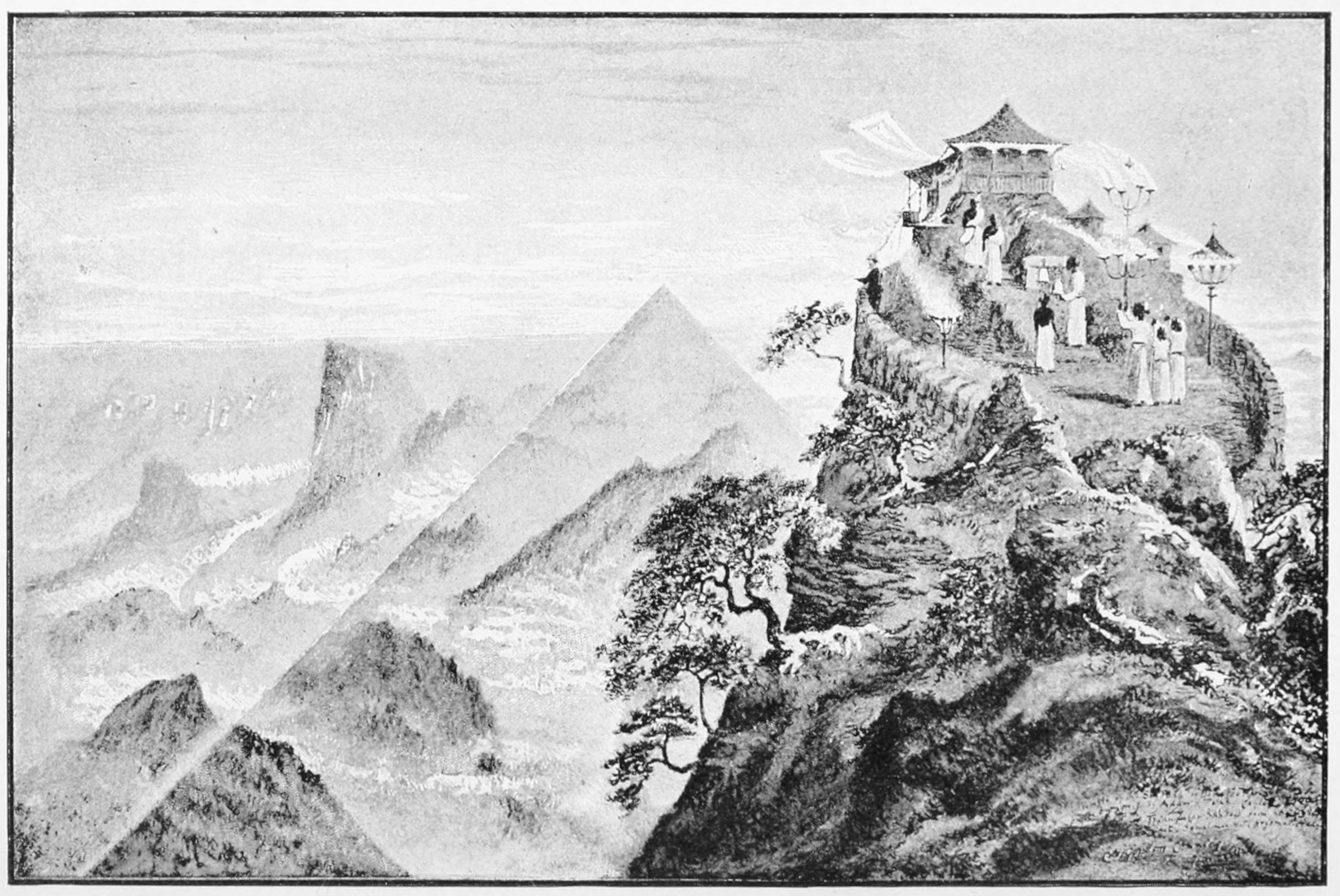
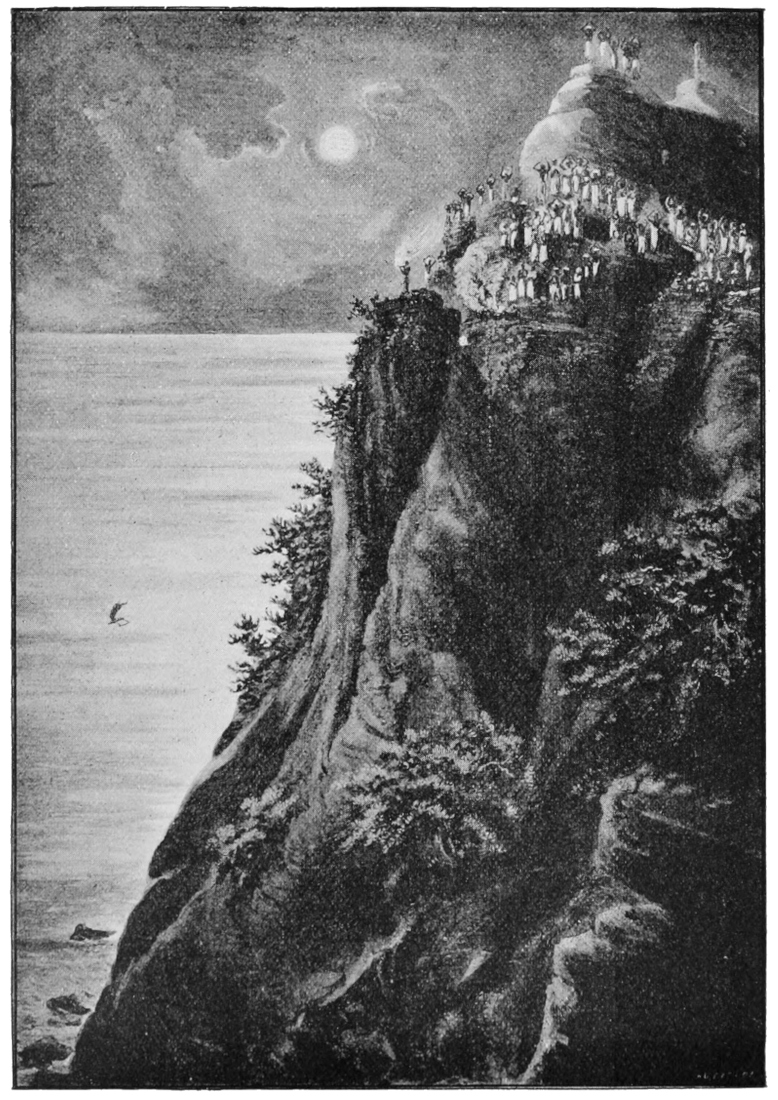
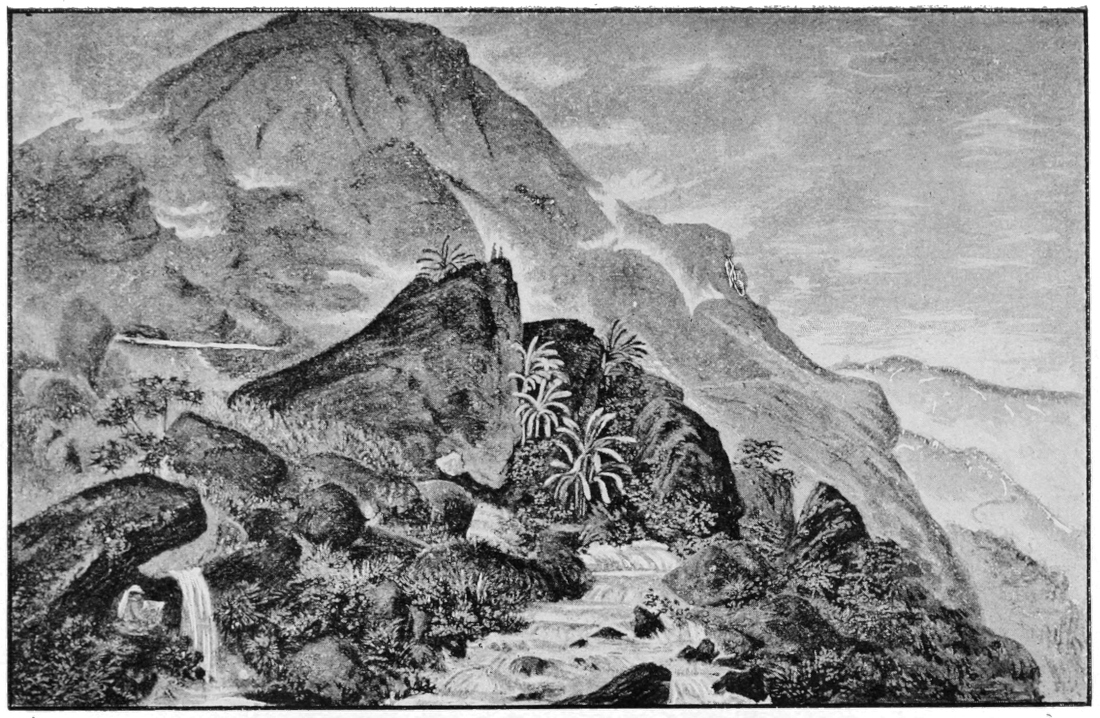
SHRINE ON THE SUMMIT OF ADAM’S PEAK, AND THE SHADOW OF THE PEAK.
TWO HAPPY YEARS
IN CEYLON
BY
C. F. GORDON CUMMING
AUTHOR OF
‘AT HOME IN FIJI’ ‘A LADY’S CRUISE IN A FRENCH MAN-OF-WAR’
‘IN THE HEBRIDES’ ‘IN THE HIMALAYAS AND ON THE INDIAN PLAINS’
‘VIA CORNWALL TO EGYPT’ ETC.
A NEW EDITION
WITH 28 ILLUSTRATIONS BY THE AUTHOR, AND A MAP
LONDON
CHATTO & WINDUS
1901
PRINTED BY
SPOTTISWOODE AND CO. LTD., NEW-STREET SQUARE
LONDON
PREFACE
v
What can be the reason that writers on Ceylon seem impelled
to describe their book as a term of years?—
‘Fifty Years in Ceylon.’ An Autobiography by Major
Thomas Skinner.
‘Eleven Years in Ceylon.’ By Major Forbes, 78th Highlanders.
‘Eight Years in Ceylon.’ By Sir Samuel Baker.
‘Seven Years in Ceylon.’ By Mary and Margaret
Leitch,—
and finally, ‘Two Happy Years in Ceylon,’ by C. F. Gordon
Cumming, who had so named her notes of pleasant days in
the fair Isle, before realising that any of her predecessors had
thus described their longer terms of residence therein?
I can only ascribe it to the fact, so evident in each of
these works, that the several writers have retained such
sweet memories of
‘Moonlit seas,
Of dreamy sunsets, and of balmy air,
Of glowing landscapes and of shadowy bowers
Where stately palms low murmur in the breeze,’—
that they have loved to enumerate the months and years that
glided by amid such pleasant influences.
viAlthough, by comparison with that of others, my own
term in the Earthly Paradise was short, I can safely say
that, as it was all play and no work, I had abundant leisure
to note many matters of interest seen under exceptionally
favourable circumstances.
I trust, therefore, that these pages may prove of some
value to the ever-increasing army of wanderers in search of
winter-quarters.
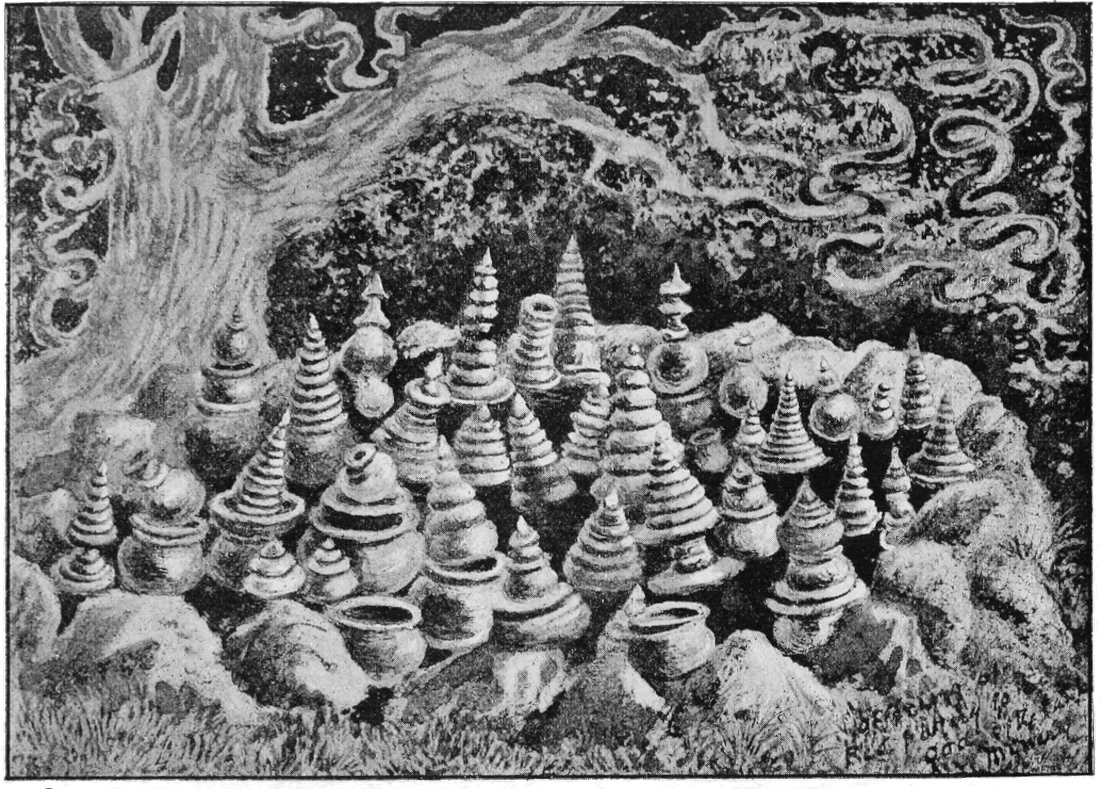
Offerings of red pottery to the God of the Tank at Minery
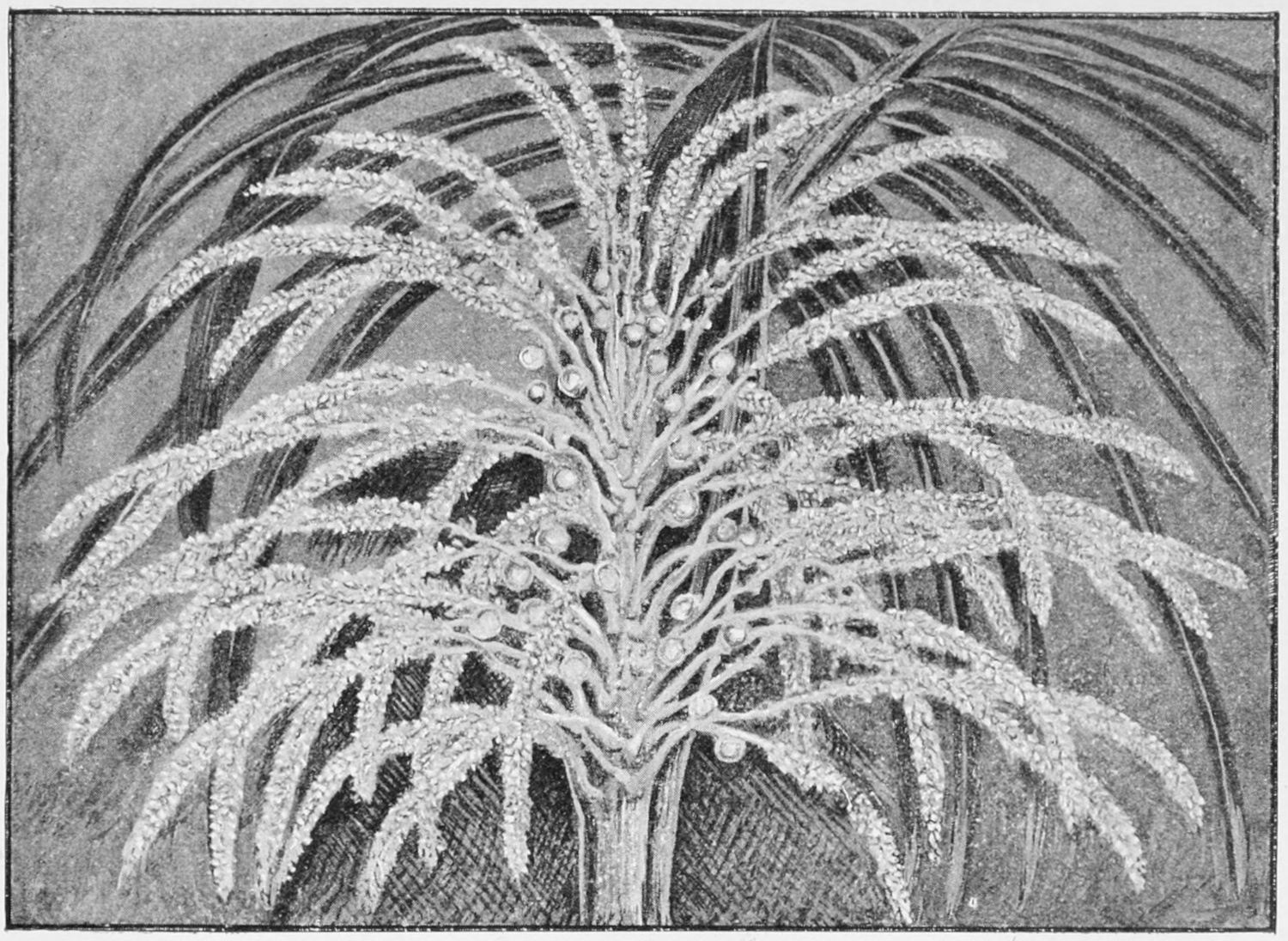
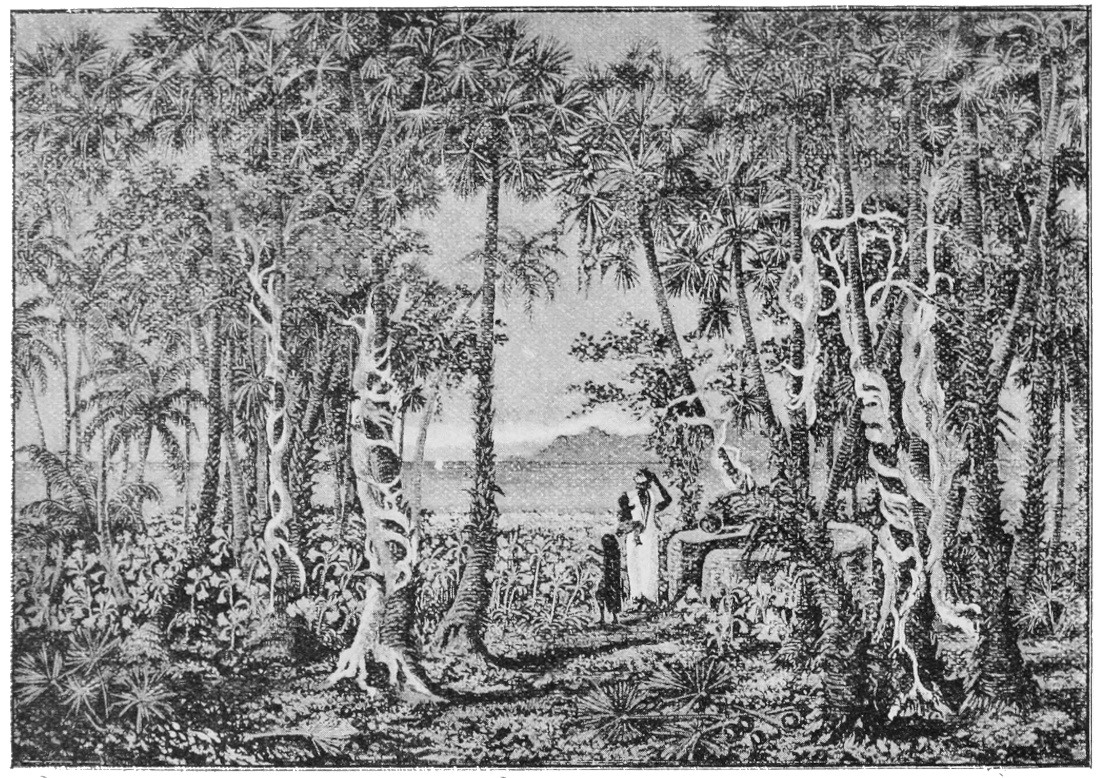
Talipot Palm in Blossom
On cover
xi
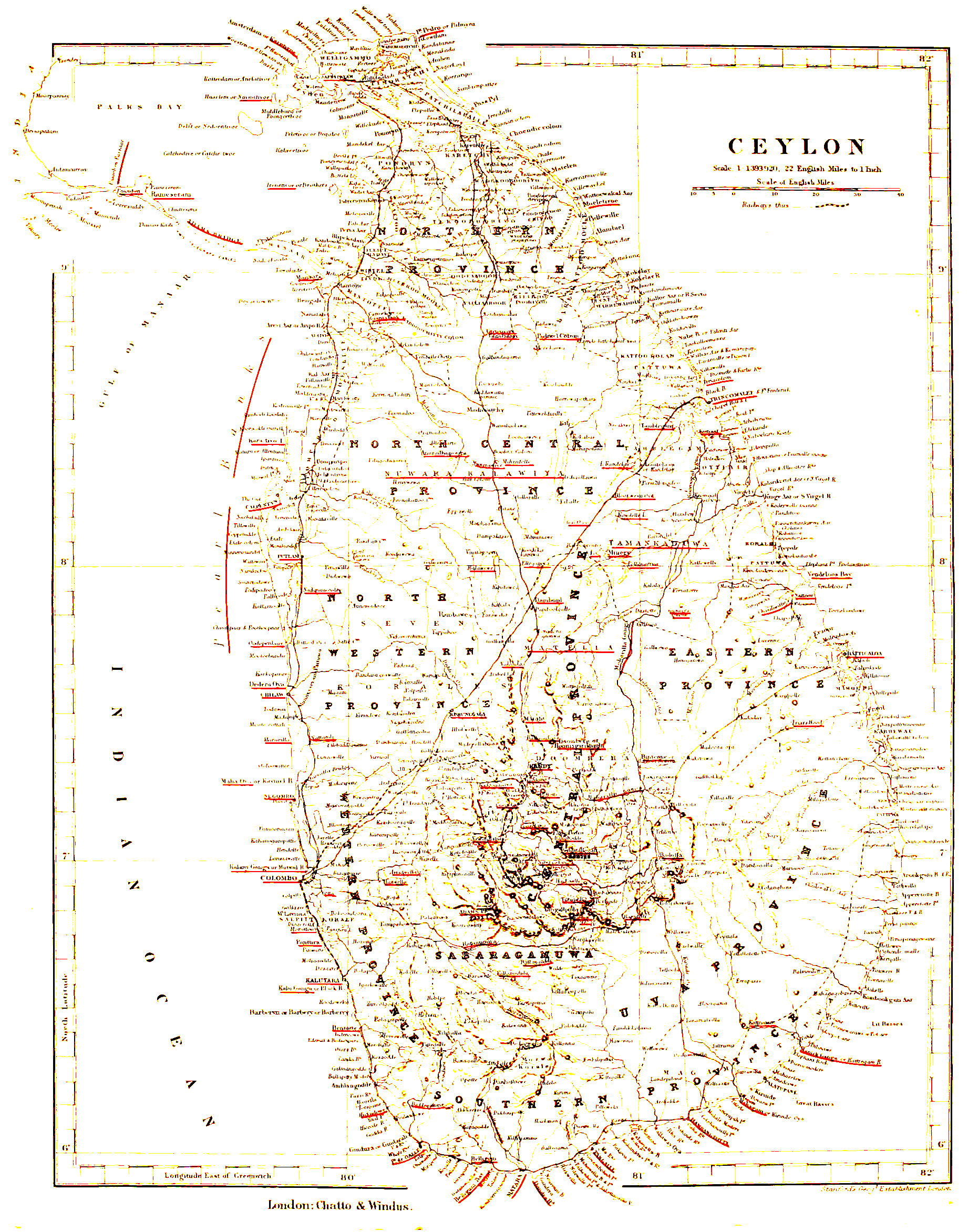
CEYLON
Scale 1:1393329, 22 English Miles to 1 Inch. London: Chatto & Windus.
1TWO HAPPY YEARS IN CEYLON
INTRODUCTORY
There are perhaps few families in the Mother Country to whom the
farther corners of Great Britain have (from the colonising or sporting
instincts of its various members) become more really familiar to the
imagination of the younger branches than that to which I was
welcomed, as its twelfth addition.
Thus about the time of my first introduction to the immortal
Robinson Crusoe, my eldest brother Penrose returned from Canada,
soon to be followed by my second brother Roualeyn, who had made
his mark as the pioneer of all the Lion-hunters who since then have
ravaged the hunting-grounds of Southern Africa.
Then two more of the home brood started to carve their fortunes
in far countries. Almost simultaneously my fourth and fifth brothers,
John and William, sailed for Ceylon and Bombay, where the latter
tamed wild men[1] and slew wild beasts, while the former settled
down to sober cocoa-nut planting in the neighbourhood of Batticaloa;
and then, through weary years of waiting for the growth of trees
which never in his lifetime repaid his outlay, he obtained work in the
forests on the east coast, and likewise distinguished himself as a cunning
and mighty hunter, beloved by the wild tribes.
During a term of twenty years, scarcely a month passed without
bringing us letters from these two faithful brothers; so that life in the
forests of Ceylon and of Bombay became as familiar to our thoughts
as grouse-shooting or salmon-fishing in Morayshire. Some of the
details in these sporting diaries might well excite the envy of many
2a less successful Nimrod. Thus one mail brought me a letter from
India, telling of thirty tigers as the chief item of a two months’ bag;
while my Ceylon letter of the same date told of the rejoicing of
the villagers over the slaughter, by their white friend, of twenty-five
leopards!—a highly satisfactory riddance of dangerous foes.
A journey to India or Ceylon in those days was a very different
thing from the simple pleasure-trip which, thanks to swift steamers
and large competition, it has now become. Though a great advance
had been made since the first quarter of the present century, when
the colonists in Colombo were only gladdened twice a year by the
arrival of a sailing-vessel from England, bringing supplies of European
clothing and stores, nevertheless, so late as 1840, three months
occasionally elapsed without a call from any European sailing-ship,
in what was then the open roadstead of Colombo; so we may well
understand that the approach of the smallest steamer would suffice
to throw the population into a fever of excitement.
In those days the mails from London came viâ Bombay, whence
runners carried them across India and Ceylon, and great was the
satisfaction when letters were delivered in Colombo only forty days
after their despatch from Britain! After a while Ceylon started a
steamer to carry the mails to and from Bombay, thus reducing the
transit to London to thirty days. A few years later, steamers bound
for Calcutta or Australia brought mails and passengers direct in
twenty days—a period which has been gradually lessened till now
some swift steamers deliver their mail-bags in Colombo in fifteen
days, and as it occasionally happens that a return steamer is ready
to start immediately, it is now possible to receive answers to letters
within five weeks.[2]
Nor is the reduction on time alone. The cost of travel has also
been minimised, and the colonists of the present day need no longer
3face the prospect of such prolonged exile as was deemed a matter
of course forty years ago, when the expense of a ‘run home’ was
prohibitive.
Thus, in the case of these two brothers, though often longing for
a sight of home and home faces, fifteen years elapsed ere they were
able to make arrangements for a meeting in the old country.
The younger happily arrived in safety; but alas! the vessel which
should have brought the elder from Ceylon, brought tidings of a
home-going far different from that which he had planned. He had
died very suddenly, almost on the eve of the date when he had purposed
embarking, and was laid to rest beside the blue sea-lake at
Batticaloa.
Barely two years later I made my first voyage to the East, touching
Ceylon at Point de Galle en route to Calcutta. That one
glimpse of the lovely isle impressed itself on my memory as such
a dream of delight, that when, a few years later, one of my earliest
friends was consecrated Bishop of Colombo,[3] I very gladly accepted
his invitation to return to Ceylon on a leisurely visit, finding headquarters
under his hospitable roof, and thence exploring such parts
of the isle as had special interest for me.
These interests gradually widened, owing to the unbounded
kindness of numerous friends, and friends’ friends; and so it came
to pass that so many delightful expeditions were organised, and so
many pleasant homes claimed visits, that wellnigh two years slipped
away ere I finally bade adieu to the green Isle of Palms, to which, I
think, notwithstanding the claims of many a lovely South Sea isle,
we must concede the right it claims—to have been, and still to continue,
the true Earthly Paradise.
On my return to Scotland, after widely extended travels, a selection
of upwards of three hundred of my water-colour paintings in
various parts of ‘Greater Britain’ were exhibited in their respective
courts in the Indian and Colonial Exhibition at South Kensington,
and at subsequent Colonial Exhibitions in Liverpool and Glasgow.
Of these, about sixty of scenery in Ceylon were selected from several
hundreds, which, on the principle of ‘never a day without at least
one careful-coloured sketch,’ had accumulated as I wandered in every
direction—north, south, east, and west—basking on the yellow sands
of most fascinating palm-fringed sea-coast, or gliding over calm
4rivers—gipsying among ruins of mighty pre-Christian cities in the
depths of lonely forests, or awaiting the sunrise on lofty mountain-summits—studies
of exquisite foliage or of strange Buddhist and
Tamil shrines, and all enlivened to memory by the recollection of
picturesque groups of brown men, women, and children of divers
race and very varied hue, some scantily draped, others gorgeously
apparelled, but all alike harmonious in colour.
Friendly critics, who say that these sketches have helped them
to realise something of the true character and beauty of Ceylonese
scenery, have asked me to supplement the brush with the pen, and tell
the readers who have so kindly received my notes of travel in other
lands something of my own impressions of Ceylon. So now I sit
surrounded with diaries and letters, travel-notes and sketch-books
innumerable, and portfolios in which each page recalls some day of
deep interest and many of delight; while the signatures in the
corner of each sketch vividly recall the many friends whose kindness
did so much to gladden all days, and to smooth all difficulties from
the path of a happy guest.
My chief difficulty lies in selecting from such a mass of material
only so much as can be compressed within reasonable limits.
Another difficulty lies in a far too personal knowledge of certain
changes which, to those intimately acquainted with Ceylon, mark a
complete revolution in its social economy, and which gave birth to a
very sad parody of certain well-known lines descriptive of an isle of
which for some years it was too true that—
‘every prospect pleases,
But no man makes a pile!’
To the general reader, however, and to the traveller likely to follow
in my footsteps, the only visible feature of a change which to
the initiated tells of the total ruin of very many industrious and
energetic European planters, and the commencement of an altogether
new era, bringing wealth to a new generation, lies in the fact that
the vast mountain districts, which ten years ago presented one unbroken
expanse of coffee-fields, are now chiefly covered with tea-plantations,
varied with cinchona, cacao, Indian-rubber trees, and
other products, more or less experimental, while only in certain districts
is coffee successfully proving its claim to renewed public confidence.
There is apparently, however, no doubt that Ceylon will
henceforth be emphatically distinguished in the manner so happily
5described by the present Governor, Sir Arthur Havelock, as ‘the
land for excellent tea.’ That its character in this respect is already
well established is evident from the fact, that whereas in 1873 only
23 lb. of tea were exported from Ceylon, the export in 1890 was
about 40,000,000 lb.; and there seems every reason to believe that
in the current year 1891 it will be fully 63,000,000; and assuredly,
long ere the end of the century, it will have risen to 100,000,000![4]
Nor is there any fear of a glut in the market, since America and
Russia have proved appreciative customers. The chief danger lies
in the probability that Brazil and Madras will each be stimulated to
enter into the competition. Patriotic planters are adjured to refrain
from selling tea-seed to Brazil; but as regards Madras, it not only
possesses a vast area of suitable land, but, moreover, commands all
the labour, Ceylon being entirely dependent on that Presidency for
her coolies. So that rivalry is to be feared from that quarter.
Simultaneously with the amazingly rapid development of this new
product, 1891 has to record the most successful Pearl-fishery of the
present century, the Government share of the total amount realised
being upwards of 96,370l., of which about 10,000l. covers all
expenses, so that the revenue profits to an extent far exceeding the
most golden expectations. In 1888 these fisheries realized 80,424l.
less 8,000l. of expenses. Such sums had only been realized four
6times in the present century: therefore, that two such fisheries
should follow in such rapid succession, is an unspeakable blessing to
Ceylon. From 1882 to 1886 the return from these fisheries had
been almost nil; but in the years 1887, 1889, and 1890, a total
was realised of 120,720l., less 1,489l. of expenses. Naturally the
colonists look for immediate railway extension in divers directions,
and for other boons which, ten years ago, seemed altogether
visionary.
A notable advance in the last decade has been that of the steadily
increasing prosperity of a multitude of native cultivators, owing
to the restoration of several of the cyclopean tanks and other
irrigation works, created by the autocratic rulers of olden days, but
which (partly since British rule rejected the ancient custom of
‘Rajah-kariya’—i.e. compulsory work for the king—by which the
rulers of the Isle exacted from every man so many days’ work
annually for the general weal) had fallen into total decay, so that a
scanty and unhealthy population could barely find subsistence in
the arid jungle or malarious swamps which replaced the verdant
rice-fields of olden days.
In the face of many difficulties and strenuous opposition on
account of the great outlay involved, Sir William Gregory and the
Honourable Sir Arthur Hamilton Gordon have accomplished a
work earnestly advocated by previous Governors, Sir Henry Ward
and Sir Hercules Robinson—namely, the restoration of a considerable
portion of the ancient system of irrigation; and already
the wisdom of the measure is abundantly proved by the transformation
of great areas of country, where luxuriant crops now once
more support a healthy and well-fed population.
Another great boon to the hitherto poverty-stricken and suffering
villagers has been the establishment in many districts of village hospitals,
where the sick are now wisely and judiciously cared for, to the
immense improvement of the general health.
Yet another marked change in the last few years has been the
construction of the mighty breakwater, upwards of 4,000 feet in
length, of huge blocks of concrete, on a foundation of masses of
gneiss, thanks to which Colombo now owns a harbour so excellent
and secure as to have drawn thither almost all the traffic of the Isle,
while beautiful but treacherous Point de Galle is now wellnigh forsaken—a
change that was not effected until many a noble vessel had
proved to her cost the lurking dangers of numerous patches of
7coral within the harbour, rising from the ocean-bed almost to the
surface.
But for this, the situation of Galle marks it as the natural port of
call for vessels, inasmuch as turning in to Colombo involves a considerable
deviation from their course; so it may be that as the commerce
of the Isle increases, it may yet prove worth while to clear the
seemingly noble harbour of Point de Galle of its submarine dangers,
and so woo back the vanished shipping.
Meanwhile, however, the fact remains that Galle harbour is now
comparatively forsaken. Few vessels enter her port save those
engaged in the coal or coir trade.[5]
The offices of the great shipping companies, and of the principal
mercantile houses, have been transferred to Colombo (which has
long been the Government headquarters), and pleasant luxurious
homes in which, but a few years ago, kindly hospitality reigned, are now
let at almost nominal prices to tenants who are content to dwell in
peace in quiet habitations apart from the busy tide of commerce.
The census, however, shows an increase in the population in the last
ten years from 31,743 to 33,505.
But in the same period the population of Colombo has increased
from 112,068 to 127,643, and its harbour is now crowded with ships
of all nations. Sometimes fifteen to twenty steamers are simultaneously
busy coaling and receiving or discharging cargo, Sunday and
week-day alike—a terribly busy scene, and, as regards the Sunday
work, very hard on all concerned,—and almost all, remember,
whether sailors or landsmen, are British subjects. Of course the
majority of these vessels are British merchantmen, but men-of-war of
all nations come and go. On May 20, 1890, there were no fewer
than six in harbour, three of which were Spanish, one French, and
two British, and by a curious coincidence one of each nation was an
admiral’s flagship. That of the Spanish admiral, the Crucero Castilla,
was a noble old wooden three-decker, such as Turner would
have loved to paint. Then came the German and Dutch vessels
and two Japanese men-of-war conveying the survivors of a wrecked
Turkish ship, the Ertugroul, back to their own country.
A considerable number of Russian vessels, men-of-war and
others, have also found their way here, some bringing Grand Dukes,
and the Tsarevitch himself, while one was conveying a new governor
8to Eastern Siberia, and another, alas! brought 644 luckless convicts
en route from Odessa to their dreary Siberian exile. Amongst others
was a Russian whaler on her way to the North Seas, and furnished
with the newest thing in harpoons—horrible weapons, each carrying
with it a glass ball containing an explosive, which on striking the
whale’s body blows it into pieces, a method one would suppose better
adapted for oiling the waves than for securing a cargo!
To provide additional space for anchorage, and also increased
security for this ever-increasing traffic, a second great breakwater is
about to be constructed to form a protecting northern arm, that the
harbour may be absolutely first-rate.
After recording such a giant stride in Colombo’s standing in the
shipping world, the fact that her import of coal has in the last ten
years risen from 8,336 tons to 250,338 tons follows almost as a matter
of course.
So month by month Colombo progresses and becomes more and
more a place of resort, and her streets are thronged with human
beings of every conceivable nationality and of every shade of colour—white,
yellow, olive, sienna, cinnamon, and dark brown—and clad
in divers uniforms, to say nothing of the wondrous variety of non-official
raiment.
To facilitate their locomotion a large number of ‘jinrikishas’
have been imported—i.e. the ‘man-power carriage’ of Japan, which
is a lightly built bath-chair on two modern very large light wheels,
very convenient for the person seated in it, whose weight ought to
regulate the number of his human ponies. What a fortune the
original inventor of these little machines might have made had he
secured a patent for even the primitive form devised by some ingenious
Japanese only about twenty years ago! Already in the city
of Tokio alone there are upwards of 30,000 in constant use, and in
Japan at large fully 200,000! And now the jinrikisha is as familiar
and indispensable in Hong Kong, Shanghai, Penang, and Colombo,
as in its native land. It may interest future generations to know that
the very first was imported into Ceylon in May 1883.
Meanwhile, during these same years, the grievous collapse in the
coffee trade left some scars on Colombo, where great coffee-stores,
with all their once busy machinery and crowds of workers, were
deserted—grass and weeds overspreading the drying-grounds, and
costly buildings being left to fall to decay—a sorry aspect of dead
trade which cannot be revived by the new products of tea and cacao,
9inasmuch as these are prepared for market on the estates where they
are grown.
But on the other hand the city has been improved and beautified
in many ways, notably by the generous Jubilee gift of the late
Governor, the Honourable Sir Arthur Hamilton Gordon, in the transformation
of the old Fort Green (a small grassy common surrounded,
by ‘tulip’ trees, and occasionally used as a cricket-ground) into
a fine terraced garden, with banks of greenest turf, crowned by an
octagonal fountain whence cool waters flow by divers channels to
supply other pools and fountains, in one of which the magnificent
Victoria Regia has already flowered freely. Here rosy oleanders,
crotons of all gorgeous hues, feathery palms, and all manner of
flowers lend fragrance and colour to what will henceforth be the
favourite afternoon lounge, more especially on those days when the
excellent band adds the further attraction of good music.
From a business point of view Colombo has advanced prodigiously
in general traffic, and many and various improvements
mark progress in divers directions, giving evidence of the happily
reviving energies of the Isle, and proving how well her adopted sons
have now applied the dearly bought lessons of past experience.
The Colombo iron-works turn out work that would do credit to
Newcastle, from the casting of iron pillars for the Grand Hotel, to
the building of steel barges, and the manufacturing of tea-machinery,
and of sundry engines for use on land and sea; also the repairing of
damaged vessels.
But foremost among the grand new industries is the steam cotton
spinning and weaving factory, established on the brink of the Wellewatta
Canal, on a site which, two or three years ago, was a dense
jungle of neglected cinnamon. Now a huge factory has been erected,
and 10,000 spindles and 150 looms are already busily at work, with
every probability that ere long there will be such a demand for these
home-made fabrics that 100,000 spindles, and looms to correspond,
will find ample work.
Of course this must prove an immense incentive to the growth of
cotton (the amount carried by the railway to Colombo advanced
from 32 tons in the first year to 289 tons the following year), and
doubtless thousands of acres of now waste jungle-land will shortly be
transformed into busy cotton-fields.
The growing and weaving of cotton is no new thing in the Isle,
for long before the Christian era both were extensively carried on, as
10were also the arts of bleaching and dyeing, and mention is made in
the Mahawansa of a canopy in the ancient city of Anuradhapura,
which was formed of eight thousand pieces of every hue. That was
B.C. 161.
Early in the present century a large quantity of cotton was grown
in the northern province, and was extensively manufactured by the
weavers of Jaffna and Manaar till the imposition of a five per cent.
tax to Government on island-made cloth, instead of on imported
cotton goods, in a great measure discouraged their industry. The
weavers of Batticaloa on the east coast and Chilaw on the west, have
long been famous for excellent bed and table linen, and the native
looms of Saffragam and Galle turn out well-made white cottons.
According to official returns for 1887, there were then 15 hand-looms
in the southern province, 21 in the north-western, 429 in the
eastern, and 575 in the northern province. The cultivation of the
cotton plant, however, has not been systematic, and its experimental
growth by European planters has not been altogether encouraging,
though a good deal has been grown by natives. Now, however, it
has been satisfactorily proved that in certain soils it will grow well
and bear abundantly, and cautious native capitalists deem its success
so certain that they are forming companies for cotton-growing on a
large scale, as well as investing largely in the Colombo mills.
Of course here, as in India, the giant steam-power will ruthlessly
swallow up all the interesting native arts of hand-spinning and
weaving, and already the weavers of Batticaloa have yielded to the
inevitable, and have come to Colombo to learn the new methods and
secure employment, and homes in the new village of comfortable
cottages which the company are erecting for their workers.
One excellent thing in connection with these cotton spinning and
weaving mills is, that the work thus provided has furnished the
Wesleyan missionaries with the opportunity for establishing industrial
homes and schools for destitute boys and girls. The Home has been
erected close to the mills, which provide ample work for the young folk,
whose board, lodging, and clothing, as well as moral and religious
training, are the care of their missionary friends. This work of
mercy is an all-round benefit, the manager of the mills being well
pleased to have so reliable a staff of young workers always at hand,
instead of having to look for an irregular supply from the villages.
I may add that simultaneously with the establishment of these
industrial schools in Colombo, admirable schools of the same class
11(though more of a reformatory character) have been established by
another Wesleyan missionary, Mr. Langdon, at Haputale, chiefly for
the hitherto grievously neglected children in the province of Uva.
In concluding these introductory words, let me briefly forewarn
travellers who purpose visiting India and Ceylon, that they will find
the latter poorer in startling scenic effects. Here there are no mighty
forts which seem to have been ‘built by giants and finished by
jewellers’—no fairy-like lace-work sculptured in marble—no solemn
grandeur of great Mohammedan mosques, nor bewildering intricacy
of detail in sculpture as in the Hindoo temples; while, as compared
with the marvellous rock-temples of India, those of Ceylon are
grievously disappointing. Neither are there such striking street-scenes
as one finds in many an Indian city, nor such bewildering
crowds of gorgeously apparelled rajahs with their camels and elephants.[6]
Therefore, for all such impressions, visit Ceylon first and
India afterwards.
But, for archæological interest, the pre-Christian and medieval
cities of Ceylon, so long buried in the silent depths of the great
forests, are altogether unique; and for luxuriant loveliness of tropical
foliage, Tahiti itself cannot surpass this Isle of Palms.
I would fain hope that those who have patience to peruse these
notes of two of the happiest years of my life, may discover something
of the many attractions of Ceylon. Nevertheless, I fear that no
words can adequately describe her fascination. So I can only advise
all who have the power to travel leisurely, to go themselves and enjoy
a winter there.there.
CHAPTER I MY FIRST GLIMPSE OF THE TROPICS
12
‘Where Champac odours float,
Like sweet thoughts in a dream.’
Aden versus Ceylon—Fragrant breezes—Canoes—Singhalese, Tamils, and Moormen—Singhalese
love of gambling—Point de Galle—‘Hothouse flowers’ at home—Discordant
voices—Fire-beetles—Phosphorescence—Corals—Cocoa-palms—View
of Galle—Sail for Calcutta.
To begin with, let me recall my very first impressions of this paradise,
when, en route to the Himalayas, we touched at Point de Galle, and
there obtained our first glimpse of the tropics—a delight never to be
excelled in any subsequent wanderings.
In those days there was no Suez Canal; so travellers were landed
at Alexandria, and crossed Egypt to Suez, whence another steamer
carried them down the Red Sea to Aden, and thence eastward.
It would be difficult to imagine contrast more complete, as opposite
types of Creation, than the scenes thus successively revealed, like
dissolving views in the panorama of travel—Aden and Ceylon—the
former like a vision of some ruined world, the latter the very ideal of
Eden: there a stifling atmosphere and scorching rocks, seemingly
without one blade of grass whereon to rest the wearied eye; here a
balmy sleepy air, laden with the fragrance of our rarest hothouse
flowers, clustering in densest luxuriance amid tangled mazes of infinitely
varied verdure. Creamy blossoms with large glossy leaves;
crimson and gold gleaming like gems, from their setting of delicate
green shadow; an endless variety of tropical flowers growing in wild
confusion over hill and plain; delicate creepers festooning the larger
shrubs, and linking together the tall graceful palms with a perfect
network of tendrils and blossoms, or finding their home in every
crevice of the rocks, and veiling them with fairy drapery.
Every shrub is covered with young fresh leaves of many tints;
for here we have perpetual spring as well as continual autumn, and
13though the ground is always strewn with withered leaves, new life is
for ever bursting forth, in hues which we are wont to call autumnal,
and which in Britain speak to us only of approaching winter and
death. Some trees there are whose sombre foliage is always tipped
with young leaves of vivid crimson; others which seem to change
their leaves periodically, and which one week burst forth in brilliant
scarlet, then gradually deepen to crimson, changing to olive; finally
the whole tree becomes green.
Long before we sighted the beautiful Isle, the breath of these
tropical forests ‘met us out on the seas’; and as so many people,
who do not happen when nearing the coast to have been favoured
with a land-wind, laugh at the idea of ‘spice-laden breezes,’ I may as
well state that again and again in southern seas, even when out of
sight of land (notably when passing Cape Comorin), I have for several
hours been rejoiced by a balmy breeze off shore, like the atmosphere
of a greenhouse, recalling the delicate scent of primulas. It has been
as unmistakable as is the fragrance of birch-woods in the Highlands
after summer rain, or that of resinous fir-needles in the noonday
sun.
As we neared the Isle, some of our party confessed themselves
disappointed, even though we were favoured with a clear view of
Adam’s Peak, rising in solitary beauty above the blue mountain-ranges,
right in the heart of the Isle. But in truth these lie so far
inland that the unaccustomed eye fails to recognise their height;
and the coast, with its endless expanse of cocoa-palm topes fringing
the coral strand, is certainly somewhat monotonous as seen from
the sea.
Not till we were gliding into the calm harbour did we realise the
fascination of the scene, when, from those white sands overshadowed
by palms, we espied curious objects coming towards us over the blue
rippling water. In the distance they looked like great sea-spiders
with very long legs; but as they approached and turned sideways,
we saw that they were long narrow canoes, most curiously constructed,
each being simply the hollow trunk of a tree, with raised bulwarks
stitched on with twisted cocoa-nut fibre. They ride high on the
water, and the long oars produce the spider-like effect aforesaid.
Some of the larger canoes are from forty to sixty feet in length,
and carry many human beings; but the width is so small that there
is never room for two persons to sit abreast. Of course such hollowed
trees would inevitably roll over were they not balanced by a long heavy
14log, which, like the canoe itself, is pointed at both ends, and floats
alongside at a distance of about ten feet, being attached to the boat
by two strong bamboos tied on at right angles, thus staying the craft
fore and aft.
This outrigger, as it is called, is applied on one side only, and
must always be kept to windward, hence tacking is impossible; so the
canoe is constructed to go either backward or forward. The quaint
brown sail forms a triangle between two bamboos, which meet in a
point at bow or stern alternately; and when this is hoisted, the canoe
literally flies before the breeze—the strength of which is described
as a ‘one-man breeze’ or a ‘two- or three-man breeze,’ according to
how many human beings must help to steady the boat by adding
their weight to that of the floating log, by either standing on it or on
the connecting bamboos. Very picturesque are these lithe, rich
brown figures, ever and anon half swamped by the waves, as they
stand with rope in hand, ready at a moment’s notice to haul down the
sail. Most of the fishermen wear wide-brimmed straw hats, and
scanty drapery consisting of a couple of gay pocket-handkerchiefs—one
of which, knotted round the shoulders, perhaps displays a portrait
of the Pope or of the Madonna, which, together with the small
crucifix hanging from the neck, shows them to be members of the
Church of Rome.
Even the tiniest canoes are balanced by the floating outrigger, so
that very small children paddle themselves about the harbour in perfect
safety; and a number of most fascinating little traders came
round us offering fruit and coral for sale. Ere our vessel reached
her moorings she was boarded by a crowd of merchants—we should
call them pedlars—offering us curious treasures; but to us the sellers
were far more interesting than their wares—especially the gentle,
comely Singhalese, who in every respect contrast with the last brown
race we had seen (namely, the hideous Somalis of Aden, with their
fuzzy lime-washed yellow hair), just as strikingly as do the lands
which gave them birth.
We very quickly learnt to distinguish three totally distinct elements
in the crowd of brown men, each representing totally different
branches of the human family. The clear, sienna-coloured Singhalese,
who number about sixty per cent. of the total population, are of
pure Aryan race, and are the descendants of the conquerors who
adopted ‘Singha,’ a lion, as their emblem, and who in far back ages
swept down from Northern India. The dark-brown Tamils hail from
15the Malabar coast in Southern India, and are of the Dravidian family.
Some are descended from early conquerors, others are recruited year
by year from the mainland to do the hard work of the Isle, and
together these number about thirty-three per cent. of the total population.
On the present occasion the leaders of the invasion were mostly
Moormen, who, though few in proportion to the races aforesaid
(numbering only six per cent. of the whole), hold a very strong position,
being the most energetic traders of the Isle. They claim to be
descended from Arabian merchants who settled in Ceylon two thousand
years ago, and so represent a third great branch of the human
tree—namely, the Semitic. In complexion they are pale copper-colour,
and the majority have black beards. Their shaven heads are
crowned with high straw hats made without a brim, and these are
often covered with a yellow turban. They are peculiarly well-built
men, taller than either the delicately formed Singhalese or the sturdy
Tamils.
Conspicuous among the latter are the Chetties or Hindoo merchants
from the coast of India, who are easily recognised by their
enormous ear-rings, and who are accompanied by coolies carrying
bales of really precious merchandise, which they are only too anxious
to unpack and display on the faintest chance of a sale.
Perhaps the readiest way of distinguishing between Tamils and
Singhalese is that the former bear on their forehead the symbol of the
heathen god at whose shrine they have last worshipped—a spot, a
circle, straight or curved lines in white, black, red, or yellow;[7] and
also almost invariably retain their national head-dress, namely, the
very becoming turban,—whereas (with the exception of the Anglicised
clerks, who adopt European dress in every detail save that they wrap
a long waist-cloth over their trousers) the low-country Singhalese of
every degree are always bareheaded—their long, glossy, black hair,
of very fine quality, being turned back from the face, held by a semi-circular
comb round the back of the head, and coiled at the back in
a knot, which men of the wealthier classes secure by means of a
handsome, very large tortoise-shell comb, which contributes another
touch to the feminine appearance of the ‘pretty,’ and, for the most
part, beardless men.
In truth, a new-comer is rather apt to think that all the Singhalese
16are women, and that the stalwart Moormen and Tamils are the sole
lords of the creation! And the mistake is very natural, for men and
women generally dress almost alike—with neat white jacket, and a
long white cloth wrapped round the waist, so as to form a very tight
skirt down to the ankles. This is called a comboy, and a more inconvenient
walking-dress could not be imagined. The men are
almost as slender and delicate in figure as the women, and have very
small hands—in fact, the most obvious distinction between the sexes
is that the tortoise-shell comb is a masculine monopoly, the women
generally fastening their hair with silver pins. I observed that the
firmly coiled back hair is used by both men and women as a convenient
receptacle for pins and needles!
Tortoise-shell forms one of the most attractive items in Ceylonese
manufactures. Beautiful combs of all shapes and sizes—bracelets,
chains, bunches of charms—some of the palest amber, some dark and
mounted in silver. The palest yellow is by far the most valuable,
being, I believe, formed of the tortoise claws only.
Jewellers are numerous, for the gems of Ceylon are far-famed;
but of course the fact that (with the exception of diamonds and
emeralds) every known gem is found on the Isle leads to an amazing
amount of cheatery, and vast numbers of sham jewels are pawned off
on unwary travellers. ‘Damned-fool steamboat gentlemen’ is, I
regret to say, the name by which this section of the white race is
commonly described by the astute natives.
Most of these sham gems are manufactured in the isle of Murano,
near Venice, and are thence sent to Britain, where they are set in
purest gold from the mines of Birmingham, and then forwarded to
Ceylon, amongst other christianising influences of civilisation. They
are known to the merchants as ‘steamboat jewels,’ and offered at
fabulous prices, which are liable to amazingly swift reduction. Each
trader describes his own store as a priceless collection of real stones,
whereas all his neighbours have only real glass!
Then there are vendors of cinnamon-sticks, of ebony and ivory
carving, of grass shoes, of beautifully carved boxes of sandal-wood,
of coral shells, and fruit. We were chiefly captivated by bird-sellers,
who coaxed us to buy whole families of darling little green love-birds,
and who proved how tame they were by perching the tiny creatures
on each wire of our sunshades, where they walked about happily and
contented. Vain were the friendly warnings which whispered of most
villanous love-potions, and told how the dainty birds had been
17drugged for the market. Of course we invested largely, and for the
rest of the voyage our time was divided between feeding our lovely
playthings with sugar-cane, and rescuing them from dangers and
perils of open ports, cold baths, and unwary footsteps. One or two
of them did manage to walk out of the window in our cabin,
and our aviary met with divers mischances before we reached
Calcutta.
We were soon instructed in the detestable Eastern custom of
offering a quarter of the price asked, and gradually rising till the
buyer meets the seller half-way, and while so doing we witnessed an
instance of the extraordinary love of gambling which is one of the
most striking peculiarities of the Singhalese—a weakness well known
to old travellers, and occasionally taken full advantage of. It seems
as if no bet could be proposed too ludicrous for some one in the
crowd to take it up, no terms too preposterous.
The case in point was that of a lady who was bargaining for a very
beautiful large tortoise-shell comb. The price asked was high, that
offered was so absurdly low that it was at once refused, and the
matter dropped. Just then a bystander said jokingly, ‘I’ll toss you
whether I give you the sum she offered, or nothing.’ ‘Done,’ was
the reply. The merchant won the toss, and pocketed the ludicrously
small sum without a murmur, the lady receiving the coveted comb
as a memorial of Singhalese gambling.
Of course we very soon found our way ashore, and explored the
old fortress and batteries which tell of the successive occupation of
Galle by the Portuguese and Dutch, each of whom left abiding traces
on the Isle, in the form of fortifications, churches, and houses; while
their descendants form distinct bodies in the heterogeneous populationpopulation
which has drifted hither from so many lands—Persia, China,
Malacca, Arabia, Coromandel, and Northern India, to say nothing
of the pale-faced races of Europe.
I cannot say that the handiwork of the Dutch is generally poetic,
but here all prosaic details are glorified by the wealth of vegetation,
and even the fortress and the streets are shaded by Suriya trees—i.e.
the yellow Thespesia populnea, whose delicate straw-coloured
blossoms contrast so beautifully with its dark glossy leaves. And
the pleasant bungalows, with their wide pillared verandahs, which
form the coolest and most delightful resting-place in the heat of
the day (being invariably furnished with comfortable chairs), are one
and all embowered in gardens where all lovely things grow in rank
18profusion, veiling the pillars and half covering the roof—exquisite
blue clitoria, orange venusta, purple passion-flowers, lilac and white
clematis, mingling their starry blossoms with those of the glorious
crimson tacsonia and splendid blue or white convolvulus; and
luxuriant fuchsias, while heliotrope, gardenias, and roses blend their
fragrance with that of the loquot and orange-blossom, and with the
breezy freshness of the sunny sea.
Of course we experimentalised on all manner of Eastern fruits,
doubly tempting because offered by such comely and gentle brown
people, and amongst other novelties we proved the excellence of
bright-green ripe oranges, followed by a more serious luncheon of
pine-apples and divers curries of superlative excellence, after which
we started for a drive, so as to make the best possible use of the
exquisite afternoon.
Our road lay through groves of graceful and luxuriant palms,
bread-fruit, and jak trees with their glossy foliage and huge fruit,
and thickets of flowering-shrubs, whose delicious fragrance scented
the air. Here and there we passed a group of Flamboyants—magnificent
trees, well named ‘the Flame of the Forest,’ so gorgeous are
the masses of scarlet and gold blossom, which in May and June rest
on delicate feathery foliage of dazzling green. Especially fascinating
to us was the Hibiscus mutabilis, a shrub whose masses of rose-like
blossoms daily change from white to crimson. Each morning sees
the bush covered with newly opened flowers gleaming like freshly
fallen snow, and ere the sun sets all have assumed a lovely rose
colour.
Exquisite living creatures, gossamer-winged, skimmed through
the blossoming forest in this sweet summer-world. Amid the flame-coloured
and golden blossoms flitted splendid butterflies, some pale
blue, some yellow, others velvety black with crimson spots, and
brilliant metallic-looking dragonflies.
Flowers familiar to us only in stoves and hothouses were there in
wild luxuriance—ipomeas, convolvuli, orchids, the quaint pitcher-plant,
and many another blossom; while ferns which we deem rare
and precious formed a rich undergrowth of golden-green, the loveliest
of all being the climbing-ferns, which, creeping on delicate hair-like
stem, form a tangle of exquisitely dainty foliage veiling trees and
shrubs. In some districts I have seen these growing to such a
height, and hanging from the trees in such masses, that the natives
cut them as we would cut bracken, and use them for thatch, the
19long black stems reaching down to the ground, and acting as rain-conductors.
Here and there clumps of graceful bamboo waved their feathery
branches; and broad shining leaves of the yam, resembling huge
caladiums, and the still larger and more glossy plantain, clustered
round the picturesque native huts, whence pleasant, cheery-looking
people or curious small brown children came to offer us flowers or
wonderful toys, made of strips of palm-leaf, twisted into stars, wheels,
birds of paradise, and all manner of strange forms, suspended on long
thin grasses, so as to tremble and quiver with a breath—most ingenious
creations.
What these people may really be, a casual traveller cannot of
course judge, but they look like embodiments of contentment: their
rich mellow bronze colouring is most attractive, while their soft brown
eyes suggest deep wells of quiet thought. It does seem so strange at
first to be in a land where all eyes are brown, and all hair black, and
straight, and silky!
Before these novelties had lost their first charm we had reached
Wakwella, a hill clothed with cocoa and other palms, overlooking a
fair valley, richly wooded, and through which the Gindura, a broad
river glittering like silver, and with a thousand silvery veins, was
winding westward through vividly green rice-fields to the sea.
We sat on a grassy headland and watched the soft grey and blue
and gleaming green blending in the silvery sea. Presently, as the
sun lowered, the light grew golden, and poured in misty rays of glory,
adding its dreamlike beauty to the forests of cocoa-palms and the
ranges of lovely hills. It was a scene of intense peace, only marred,
as is too often the case, by the human voice—doubtless the raw
material for perfect music hereafter, but, as a general rule, strangely
discordant with nature’s calm in its present crude form.
I have sometimes listened in amazement to discussions as to the
relative anguish of losing sight or hearing, and have marvelled almost
invariably to hear the crown of sorrow awarded to the latter! Just
think of the endless variety of joy which the soul drinks in through
the eye, compared with the very divided pleasures of hearing—the
countless harmonies of form and colour on which the eye rests
unwearied with ever new delight, compared with the few chords
of melody in all the jarring world of sound. How few notes that
are never discordant! How few voices that never become wearisome,
for no other reason than just because they are sounds! It
20seems as if perfect silence was the one joy of life most hopelessly
unattainable.
So, at all events, we thought on that calm evening, the repose of
which was utterly destroyed by the arrival of many fellow-creatures.
There was nothing for it but to make a mutual-protection party,
bound by a solemn vow of silence, and to retreat to the farthest spur
of the hill, where we might sit and drink in the loveliness of that
strange dreamy shore, while earth’s many voices sang soft lullabies,
and soothed us to rest.
Even here, however, all harmony was marred by one jarring
sound, namely, the everlasting hum of the cicala, whose myriad army
holds its noisy revel in every Eastern grove, utterly destroying what
should be the principal charm of the solemn forests—the vainly
longed-for silence. But as the sun sank below the horizon a sudden
stillness fell on all insect-life, like the sudden stopping of machinery.
The ear could scarcely realise relief so sudden. Then we were conscious
that the noisy bipeds had likewise all departed with the daylight,
and that we too must follow.
Beautiful night-moths appeared, hovering among the blossoms
with tremulous flutter and sudden dart like humming-birds. Then
through the darkening foliage flashed a thousand fire-flies in mazy
circling dance, suggesting the invisible presence of Titania and her
maidens, crowned with pale-green flames. These spirit-lights appear
and disappear suddenly, as each insect, at its own sweet will, shows
or veils its fairy beacon—a tiny intermittent spark. These dainty
torch-bearers are in reality minute beetles, not much bigger than a
house-fly, and their light would wane in presence of their West Indian
cousins, which the natives carry in dry gourds, riddled with holes,
and which are so brilliant that a dozen of them act instead of a
lantern.
’
Returning to Galle, we found about two hundred people at the
hotel—passengers from half-a-dozen different ships bound for all
corners of the earth. The prospect of a noisy table-d’hôte dinner
seemed too much out of keeping with our recent impressions, so we
preferred returning to our floating home.
Never can I forget the glory of the heavens that night and the
brilliancy of the stars, all of which were mirrored in the calm harbour,
which likewise glittered with gleaming reflections of many-coloured
lights on land and ships. The water seemed doubly still and dark
by contrast with the pallid white phosphorescence that played along
21the surface—sometimes in quivering tongues of fire, intensely bright,
dazzling like electric light, then fading away to reappear a moment
later in fitful ghostly gleams. It is a pulsating light, like that of the
pale lambent flame of the Aurora. So fascinating was this scene that
for hours we sat on deck watching it, sometimes shooting along the
water in coruscations of fire, sometimes just rippling into golden
sparkles like sea-stars; following in the wake of every tiny boat, and
touching her sides with living flame, while each stroke of the oars
flashed fire, and each leaping fish scattered a starry spray.
Is it not wonderful to think of the myriads of luminous animalcules
which must exist to produce these mysterious submarine illuminations!
I am told that they are of all colours, blue, white, and
green, and so tiny that it is calculated that fifty thousand would find
ample swimming space in a small wine-glass of water! The commonest
of these microscopic creatures is something like a tiny melon,
but their forms are very varied.
I had the good fortune once to travel in the same ship with a
naturalist possessed of an excellent microscope, and a very delightful
companion he proved, day by day conjuring up new marvels from the
exhaustless treasure-house of the deep. One small bucket did all the
work of his Lilliputian fisheries, and brought him a never-failing harvest
of strange wonderful creatures, of which he then made most
faithful paintings, of course magnified a thousand-fold. But the tiny
prisoners resented having to sit for their portraits, and wriggled restlessly
till they attained to a nirvana of their own, and evaporated
altogether!
At daybreak we again hailed one of those marvellous native outriggers,
and, pointing to a bay of pure white sand, overshadowed to
the water’s edge with cocoa-palms, made our brown brethren understand
that there we must go. As we neared the shore, and looked
down through the transparent depths of that lovely sea, we could
distinguish beautiful corals and strange water-plants. No ‘dim
water-world’ is here, but a sea of crystal, revealing its treasures with
tantalising clearness, while each rippling wavelet cast its shadow on
the rocks and sand far below.
At last we reached the little bay, whose white coral sand was
thickly strewn with larger fragments of the same, as though flakes of
sea-foam had suddenly been petrified by some fairy touch. Of course
the charm of collecting these was irresistible. Soon we had heaped
up a little mountain of treasures while our rowers looked on in much
22amusement and tried to explain to us that it was altogether poor stuff
we had found.
Then from a hut on the tope came a kindly pleasant-looking
family, men, women, and boys, clothed in white raiment (as beseems
dwellers in Paradise), and laden with all manner of beautiful corals
brought up from the reef. It was so early that their morning toilet
was incomplete, and the men’s long silky hair floated on their
shoulders.
Some merry little brown natives swarmed up the cocoa-palms,
and threw us down young creamy nuts. It was very curious to watch
them run up and down the tall smooth stems, simply knotting a strip
of cloth round themselves and the tree, so as to give them a ‘lean-to’
for their back. Then, by sheer pressure of feet and hands and knees,
they worked their way up to the leafy crown.
The nuts selected for us were scarcely half ripe, so that the rind,
instead of being hard wood, as in the old nuts which are exported
to England and other distant lands, is still green like the shell of
an unripe walnut, and the inside coated with transparent cocoa-nut
jelly. Besides this, each nut contains a good tumblerful of sweet cool
water, a very different fluid from what we find in the old nuts that
reach England. Nevertheless, all new-comers ought to be warned
that this is a delicacy which does not suit all constitutions; and
however refreshing a drink of young cocoa-nut milk may be, it is well
for the unacclimatised to partake sparingly. Happily, on the present
occasion none of the party suffered for their imprudence, although
we feasted freely, while sitting beneath the palms, which spread their
tender film of quivering foliage overhead, like the fairy web of some
great gossamer spider.
This, remember, was in December; and as we revelled in the
soft blessed atmosphere, which made each breath we drew a sensation
of joy, and the mere fact of existence a delight, a vision rose before
us of how differently it fared with all at home—some on the moors,
perhaps, battling with storm and blinding sleet; others in the murky
city. The very thought of mists and sleet, and of the many fireless
homes where wretched tattered beings shiver in squalid misery, jarred
too painfully; so there was nothing for it but to try and forget Old
England altogether, and think only of the loveliness around us—land,
sea, and sky, each perfect in its beauty, and human beings who
seemed to us as gentle and gracious as they are graceful.
Near us rose a group of stately Areca palms, faultlessly upright,
23like slender alabaster pillars, in this leafy sanctuary, each crowned
with such a capital of glossy green as human architect never devised.
But more beautiful in our eyes were the cocoa-palms bending in
every direction, each stem averaging from seventy to eighty feet in
height, and crowned with fronds far longer and more graceful than
those of the Areca, and with several large clusters of fruit in all
stages, the golden nuts hanging down, the younger, greener ones
above; and, to crown all, two or three lovely blossoms, like gigantic
bunches of cream-coloured wheat carved in purest ivory, each long
wheat-head having at its base a small white ball, which is the embryo
nut. Each bunch numbers thirty or more of these heads, and about
eight or ten of the nuts come to perfection. The blossoms in their
infancy are enclosed in a hard sheath, which bursts when the flower
expands, and is then useful for many household purposes. I think
this grain-like blossom is one of the loveliest things in creation; and
well do the chiefs know its value for all purposes of decoration,
resulting too often in lamentable waste of poor men’s property.
The contrast of the graceful growth of the cocoa-palm (which
generally bends towards the nearest water) with the straight heavenward
growth of the Areca, is noted in a native proverb, which says
that he who can find a straight cocoa-palm, a crooked Areca, or a
white crow, shall never die. The Areca palm bears large clusters of
hard nuts—perhaps 200 on a tree—about the size and consistency of
nutmegs, which, like the cocoa-nut, are encased in an outer husk of
fibre. These are to these natives what tobacco is to the Briton,
especially in the form dear to our sailors, the nuts being cut into thin
hard slices, several of which, with the addition of a pinch of lime, are
wrapped up in a glossy leaf of the betel-pepper, forming a mouthful,
the chewing of which furnishes occupation for a long time, resulting
in free expectoration—if possible, even more disgusting than that of
a tobacco-chewer, from the fact that the saliva is blood-red.
We were sorely tempted to linger in this beautiful shady grove,
but a glimpse of a wooded hill beyond carried us onward; so, taking
a couple of the young brownies to guide us along a slight native track,
we plunged into a jungle of exquisite tropical plants—the strange
screw-pine with its pillared roots, and scarlet pine-apples, dear only
to monkeys, glossy leaves and rough leaves in endless variety, old
forms and new, plants which we knew from pictures and from
description; creepers and climbers of exceeding beauty, and in endless
profusion.
24Then, as we scrambled up the rough narrow path, there burst
upon us a scene of inconceivable beauty. On the one side we looked
over masses of vegetation and reddish cliffs to the bluest of blue seas,
edged with white surf. Beyond lay Point de Galle with its white
lighthouse.
On the other side the same blue sea, washing the long shore of
white sand; then range beyond range of forest-clad hills, behind
which far-away blue peaks rose to a height of from six to seven
thousand feet. But, in truth, it is mere folly to attempt to describe
such a scene. No words or pictures can tell of the myriad beauties
which link all these divers parts into one perfect whole—the joyous
sunlit atmosphere and the restless repose of the calm azure sea,
enfolding a land beautiful beyond expression.
It was with many a lingering backward look, such as our first
parents are said to have cast on the same fair Isle ere they were
driven hence, that we at length tried to leave this Paradise; and,
retracing our steps through the beautiful jungle, found ourselves once
more beneath the cocoa-palms, where our little brown friends awaited
us with stores of creamy half-ripe nuts and lovely corals, with which
our curious canoe was quickly laden.
A few hours later with exceeding regret we bade farewell to the
beautiful Isle of Palms, and with our little cabin half full of corals
and green love-birds, and sugar-cane to feed them with, we once
more held on our course, with a sadly diminished party, and many
stale jokes (scarcely jokes to a good many) about the said Point of
Gall,[8] and all its sorrowful partings from those whose paths lay
farther and farther towards China and Japan and the uttermost
isles.
CHAPTER II COLOMBO
25
The native town—St. Thomas’s College—The Fort—The lake—Suburbs—White
ants—Cinnamon Gardens.
About three years slipped away—years into which were crowded all
the marvellous interests of sight-seeing in India and elsewhere, and
of a first return to a wide and very sympathetic home-circle in the
old country. (Probably none save those to whom years have brought
home life’s gravest lesson of many lifelong partings, can fully realise
how greatly the pleasure of wandering in far lands is enhanced by the
certainty of the interest and ever-ready sympathy with which letters
from the wanderer will be welcomed by loving kinsfolk beside their
own firesides, nor how much of the incentive to travel seems to pass
away when strangers fill the once familiar homes.)
So pleasant memories were the earnest of pleasant days to come,
when an invitation from the Bishop of Colombo tempted me to face
the wintry seas in bleak November, hoping possibly to reach Ceylon
by Christmas. But a week of wild storms in the English Channel,
and a very narrow escape of foundering off the Eddystone Rock,
resulted in our fine new steamer barely succeeding in making Plymouth
harbour, and her passengers explored the beauties of Cornwall
and Devon till another steamer was ready to take them on their
journey.[9]
This eventful double voyage proved a time of lifelong interest to
several young couples on board, and indeed welded all our ship’s
company into such general harmony and kindliness, that the
‘Hindoo-Othello’ passengers were thenceforward a recognised
brotherhood in Ceylon. Some, I fear, were heavy of heart when the
last evening came, and all lingered late in the starlight, enjoying the
delicious scent of jungle-flowers, which the balmy land-breeze brought
us as a greeting from the forests of Southern India.
I need scarcely say that as we neared the beautiful Isle, some of
26us were on deck with the earliest glimmer of dawn, and were rewarded
by a glorious crimson and golden sky, long before the sunrise—a red
horizon against which Adam’s Peak and the lower mountain-ranges
stood out sharp and clear in purple relief, just as plainly as I had
previously seen them from Galle, from which, indeed, the Peak is
about equidistant.
Soon after 7 A.M. we anchored in Colombo Roads (for the great
breakwater which has endowed Colombo with her present noble
harbour, is a creation of later date), and very quickly our steamer was
surrounded by wonderful native canoes of all sizes, and boats of
heavier build, bringing friends to meet the new-comers. Soon the
Bishop arrived himself, with the kindest of welcomes for me, and for
a pleasant new addition to his clerical staff, and a few minutes later
we were in a big boat, being rowed ashore by Tamil boatmen, who
cheered their toil by singing wild songs with wilder refrain to the
accompaniment of plashing oars, reminding me of the Gaelic songs
of the Skye boatmen.
The Bishop’s carriage awaited us at the landing-place. Here, as
in India, each horse is accompanied by its own horsekeeper, lightly
dressed, and barefooted, but with large scarlet turban and sash, for
in Ceylon these men are all Tamils. Whatever be the distance and
whatever the pace, they pride themselves on running abreast of the
horses, ready to help in any emergency, and shouting to secure a
clear way through the crowded streets.
We had good need of their services, for our way lay through the
Pettah, or native town, thronged by an ever-fascinating kaleidoscope
of infinitely varied human beings, all picturesque, forming a succession
of groups of living bronzes, each a study for an artist. Only,
alas! even the very first close glimpse of these revealed that suffering
has a footing in Paradise, for we saw a van full of semi-nude lunatics
from the asylum taking a morning drive, and several poor creatures
with limbs swollen and distorted with elephantiasis, and (more painful
still, because caused by human callousness, though the charge of
deliberate cruelty is repudiated) we were sickened by the sight of the
pretty little bullocks, drawing the native carts, all alike covered with
most elaborate patterns of curls and curves like intricate Runic
knotting, either branded or cut in narrow strips right into the hide.
When the scars have healed, they produce a result as beautiful in
native eyes as are in their own sight somewhat similar scars on the
bodies of various savage tribes.
27But to see the poor beasts who have recently undergone this
process, literally covered with these carefully manufactured raws,
in many cases festering and a prey to clouds of flies, is simply
revolting. In defence of so cruel a practice the owners of the
bullocks maintain that not only is this a preventive of cattle-stealing,
but also a safeguard against rheumatism. It has even been
asserted that in some cases animals have been ‘hide-bound’ and
never could be induced to fatten till their hides had been thus
destroyed.
Were it not for this detail, these pretty little zebus, with their
humped neck and deep dewlap, their silky skin and slender limbs,
are very attractive. The majority are black, but many are silvery
grey. In lieu of reins and a bit, a hole is bored through the nostril,
and the poor beasts are guided by a rope passed through the nose.
Some are very fast trotters, and native gentlemen drive them at a
rattling pace in small hackeries. Larger palm-thatched carts or
‘bullock-bandys,’ but similarly balanced on two wheels, are used for
general traffic. We passed some of these full of women and children,
all brown and black-haired and black-eyed, and all smiling and
chattering, and glittering with jewellery and gay with coloured
draperies. The driver of the bullocks stalks along between them and
the cart, tall, brown, and black-bearded, with little clothing, carrying
a cane for the encouragement of his good cattle. One marvels
how these active little creatures can draw such heavy weights simply
by the pressure of the wide projecting yoke against the hump on
their necks. For heavier traffic larger-humped cattle have been
imported from India, and Ceylon itself supplies a stronger variety of
bullocks of a dark-red colour.
Old residents, as a rule, rather dislike having to drive through
this or any other native town, but to me it was always a pleasure, as
each moment revealed some thoroughly Eastern scene; and though
the houses are for the most part dingy and very poor, chiefly built of
mud or bamboos, and roofed with wooden shingles or dry palm-leaves,
yet in this brilliant sunlight they give depths of rich-brown
shadow as a background to many a bit of sparkling colour; and then
the fact of their being all open and revealing all manner of domestic
incidents in the home-life of races so widely different as Moors and
Malays, Singhalese and Tamils, Dutch and Portuguese burghers, is
full of interest to a new-comer. Many of the simple toilets are performed
in the open street, especially the work of the Tamil barber,
28who squats on his feet facing his victim, who likewise squats with his
head resting on his own knees, while the barber shaves it till it shines
like a billiard-ball. It is so funny to see quite small boys being thus
shaven!
All the shops are likewise open, with their varied goods—piles of
brass lotas, and earthenware chatties, gay cheap cottons, fish of
strange form and vivid colour, beside the familiar whiting, mullet, and
soles. One which we soon learnt to appreciate is the seer-fish, which
is rather like salmon, but with white flesh. Of course the vegetable
stalls are attractive, but especially so the bewildering variety of
tempting fruits, looking only too inviting as laid out in piles on cool,
green banana leaves,—large luscious pine-apples, heaps of very
bright-green ripe oranges, golden mangoes, custard apples, melons,
fine gourds and splendid pumpkins, pumeloes (i.e. shaddocks),
limes, guavas, bananas, papaws, lovi-lovis, durians, rambutans,
bullocks’-hearts, sour-sops, sometimes even figs and grapes—why,
these alone were an earnest of Paradise to one who had so recently
escaped from a stormy winter in England! One fruit new
to me, and very insinuating, was the rambutan. When ripe its
rough skin changes from green to rich scarlet, and within lies a
ball of cool, pleasant jelly, very refreshing. A hard uneatable
kernel lies in the centre. Another very attractive little fruit, with
most fragrant blossom, was the loquat, which belongs to the medlar
family.
Some of the best shops in the Pettah are kept by Parsees and
Moormen, who retail all manner of European goods; but a really
Eastern stall is that of the money-changer, who sits on his mat amid
heaps of copper and silver coin. So is that of the grain-seller, the
chettie from Southern India, with his large turban and enormous
ear-rings. The carrier of drinking water is also characteristic. So is
the earthenware chattie, painted white and stuck on the roof to
attract the glance of the passer-by, and so lessen the danger of the
evil eye.
We passed Buddhist and Hindoo temples and Mohammedan
mosques, but the latter seemed poor and insignificant as compared
with those of India, which remained so vividly impressed on my
memory. But presently our route lay through a grove of beautiful
cocoa-palms, beside the blue sea, and no odious mental comparisons
marred the loveliness of that scene. Our destination was St. Thomas’s
College, in Mutwal, the north-eastern suburb of the city, distant
29about two miles from the Fort, which is the great business centre.
The College stands in the same compound,[10] or grounds, as Christ
Church Cathedral, which is primarily the chapel of the college and
collegiate school, founded in 1852 by Dr. Chapman, the first Bishop
of Colombo (Ceylon having previously been included in the see of
Madras). It is also, however, the parish church of a large English
and English-speaking community, as also of the Singhalese Christians
in Mutwal.
Between the Cathedral and the College stands the Bishop’s
house,[11] where two large airy rooms were assigned to me, opening on
to a wide pleasant verandah supported by columns, the whole coated
with cool white chunam, and embowered in a luxuriant growth of
flowering creepers of all gorgeous colours—scarlet and crimson,
purple, orange, and vivid blue. Moreover, there were comparatively
few days when we were not blessed with a delicious sea-breeze;
and, indeed, though the deep-blue ocean itself was well-nigh hidden
from us by waving palms and great India-rubber and other trees,
we had only to descend a few hundred yards to find ourselves on
its beautiful beach, where, no matter how calm the day, the great
green rollers break in glittering surf on the yellow sands or dark
rocks.
To a new-comer it is inconceivable that any one could ever weary
of such delicious balmy air and luxuriant vegetation. And yet one
home-sick Briton expressed the thought of many when he told me
that he would give all the lovely tropical scenery for the sight of a
good honest turnip-field, while another only craved for ‘a good
healthy shiver.’
St. Thomas’s College receives about 60 boarders, and the
collegiate school has an average daily attendance of about 250 lads
and young men, some of whom are pure Singhalese or Tamil, others
are members of burgher families—i.e. descendants of early Dutch or
Portuguese colonists—while a considerable number are half-castes.
Almost all the boarders and about four-fifths of the students are
Christians, the proportion in 1890 being 260 Christian and 43 non-Christian
pupils. Of the latter, some are Buddhists and some
Hindoos, who accept the inevitable Christian instruction for the sake
of the first-class secular education here given. A very well-supported
cricket club, a workshop with forge and lathe, and a Natural History
30Society, are among the details which suggest the varied interests of
boy-life.
A high-class school for girls occupies a pretty bungalow close to
the Cathedral.
Another very important centre of education is the Royal
College, which was founded in 1836 by Sir Robert Horton, for the
higher education of natives of the Isle. In August 1891 its students
numbered 331, while those at St. Thomas’s numbered 333—a state
of things highly creditable to the latter, inasmuch as the former is a
Government college, backed by public revenue. A generous rivalry
exists between these two colleges and those of India, those of Ceylon
securing a full share of honours in regard to English university
scholarships and Cambridge local examinations; so there is no lack
of healthy emulation to keep up the standard of learning.
St. Thomas’s College supplies choristers with very pleasant voices,
for the daily morning and evening choral services in the Cathedral,
where the week-day congregation consists chiefly of young men from
the College, who look delightfully cool in their white jackets and
comboys, the Singhalese lads being readily distinguished by their
tortoise-shell combs.
In connection with the Cathedral is a mission for the training of
native clergy—Tamil and Singhalese—to whom are apportioned
various districts of Colombo, in which they minister to their own
fellow-countrymen, and to the hitherto neglected Portuguese half-castes
and other classes.
Certainly no one here can plead lack of opportunity as an excuse
for non-attendance at church services. Besides several Episcopal
churches, there are Roman Catholic, Wesleyan, Presbyterian, Dutch
Presbyterian, Baptist, and sundry other churches and chapels
scattered over the town, and these (in addition to the services for the
English-speaking community) have others in Tamil, Singhalese, and
Portuguese, at such hours as may best suit domestic servants and
others.
Notwithstanding his own incessant work, the Bishop most kindly
arranged that I should accompany him on so many beautiful drives
in the freshness of early morning, or the cool of the evening, that I
very soon became tolerably familiar with the immediate neighbourhood
and its inhabitants, feeling daily more attracted towards these
gentle Singhalese, who seem always so quietly happy, always so polite,
crossing their arms, and bowing so courteously, apparently never excited
31even when marketing—the fruitful source of Oriental clatter!
Even the pretty graceful children play gently, noisy romping seeming
altogether foreign to their nature. The girls (poor little dears!) are
early taught to stay chiefly indoors, and by twelve years of age they
are generally married, and occasionally are grandmothers before they
are thirty! They certainly are a very comely race, with their slender
figure, shapely well-chiselled features, and splendid dark dreamy
eyes.
Their homes seem to be the perfection of village life; each picturesque
bamboo hut, with its thatch of cocoa-nut leaves, wholly
concealed from its neighbours by the richest vegetation, and buried
in cool shade of large-leaved plantains and bread-fruit trees; while
above each little homestead waves the beneficent tree which supplies
the family with meat and drink, and a thousand things besides.
Certainly, clean as these mud and wattle huts are, some
fastidious people might object to the fact that the raised platforms of
clay whereon the villagers lie basking in their happy dolce far niente
(enjoying a foretaste of Buddha’s Paradise) are all plastered with
cow-dung, which is said to keep away vermin, and to be less apt to
become muddy in the rains than is a simple clay floor.
Here, beneath the palm thatch, the men spread their palm-leaf
mats and sleep peacefully, wrapped in their white cloth, till sunrise
awakens the birds. Then they bathe in the nearest stream, and wash
their long glossy black hair, and for the next hour or two sit in the
sunlight combing and drying it, and (alas!) renewing its gloss with
unfragrant cocoa-nut oil. Then they carefully twist it into a smooth
coil, fasten it with a circular tortoise-shell comb, and then rest again,
perhaps weaving fanciful ornaments of split palm-leaf to decorate the
entrance to the home, but certainly chewing the inevitable betel-leaf.
Meanwhile their wives are busy with the daily task of preparing
curry—no fiery curry-powder, but a delicious compound of many
pleasant vegetables, seasoned with pepper, turmeric, green ginger,
chillies, &c., but above all, made fresh and wholly different every
morning, and served with cocoa-nut, prawns, cucumbers, and all
manner of other excellent dainties, served in different dishes, as we
serve vegetables, forming combinations to rejoice the heart of an
epicure. The principal glory of a Singhalese cook lies in the endless
variety of his curries; a very desirable characteristic in a dish which
forms a necessary conclusion to every meal, and on which you soon
learn to count as a necessity. Every man, woman, and child, down
32to the very smallest, lives on curry and rice, indeed we had a theory
that all domestic animals were fed on it. ‘To eat rice’ is the recognised
form of describing every meal, and wonderful is the amount
consumed by each individual.
The practice I have already alluded to, of chewing betel, which is
practised both by Tamils and Singhalese, is most obnoxious to the
spectator, as it is accompanied by continual spitting of dark-red
juice, which gives you the impression that the whole population are
in the last stage of consumption, and that the ground on every side
is stained with blood. It is truly disgusting! and is continually
forcing itself on one’s observation, which must plead my excuse for
referring to it again.
The betel-leaf is rather like ivy, but more fleshy and glossy. In
it the people wrap up a mixture of bits of hard areca-nut, and lime
of burnt shells to give pungency. It discolours the mouth for the
moment, and an habitual chewer is betrayed by the deep reddish-orange
stain which has become chronic. Men and women alike
seem to delight in this delicacy, though I never met a European who
could endure it. However, it seems to be a wise instinct which
teaches these vegetarians to consume so much lime, and it is said
that the perpetual chewing of betel compensates for the deficiency of
animal diet.
Of course to the passer-by these simple homes derive much of
their charm from their surroundings, for the poorest is always
embowered in sugar-cane, maize, or bananas; and I know no plant
which so fully brings home to one the sense of tropical luxuriance as
does each member of this widespread tribe of bananas and plantains,
which contribute so largely to the food of the human race in all
tropical countries. In one year it grows to a height of about 20 feet,
each leaf being from 6 to 8 feet in length by about 2 in breadth, and
each plant bearing perhaps a total of three hundred fruits in several
heavy drooping clusters—green, ripening to gold—a total of about
seventy pounds weight. Each fruit is enfolded in a thick leathery
skin, which comes off at a touch, yielding a sweet satisfying food of
most delicate flavour, of which the bananas sold in England give a
very faint idea. The effort of producing such a mass of fruit exhausts
the generous plant, which then falls, leaving its strong fibrous stem
and leaf-stalks to be turned to account in various ways. (One variety
yields the fibre known as Manilla hemp.) Then new stems very
quickly spring from the old root, and the splendid plant is renewed.
33To the same family belongs the huge fan-shaped ‘Traveller’s
Tree,’[12] often carelessly described as a palm. It bears the same long
broad leaves; but they are stiffly arranged, exactly like a great
feather fan, and instead of bearing nourishing fruit like the common
banana,[13] they collect water, which filters into the tightly plaited
sheaths at the base of the leaves, whence a drink of pure water can
always be drawn by stabbing the said base of a leaf.
The country all round Colombo is strangely level, and the soil is
of a warm red colour. The red roads contrast curiously with the
vividly green rice-fields and the luxuriant vegetation on every side.
Even the red streets are delightfully shaded by cool green Suriya,
or sun-trees, so named on account of their delicate primrose-coloured
blossoms, with claret-coloured heart, which, like the setting sun, turn
red as they fade. (One of the titles of the ancient royal race was
Suriya-wanzae, the race of the sun.) The flower curiously resembles
that of the cotton plant, and also in form that of the single scarlet
hibiscus, known to Europeans as the shoe-flower; but its grey-green
leaves are totally different, rather resembling those of a poplar.
Hence Linnæus named this tree Hibiscus populneus, but modern
botanists have reclassed it as Thespesia populnea. As an everyday
name, surely nothing could be more appropriate than Suriya; but
Europeans generally speak of them as tulip-trees, from a very
imaginary resemblance of the blossom to that familiar but less refined
flower. Certainly it is in every respect unlike the true tulip-tree of
North America.[14]
To me the Suriya recalls pleasant visions of the South Pacific
isles, where it grows abundantly. In Fiji it is called the Vau,[15] and is
greatly prized on account of the fibre of the inner bark, which is
used by the fisher-folk for making turtle-nets, and also, when dyed of
various colours, for making fringe-kilts. It is a most cheery little
tree, always covered with sunny blossoms. Here its light hard-grained
wood is prized for carriage-building and for gun-stocks.
Like many other flowering trees which are widely spread over Ceylon,
it is doubtful whether the Suriya is indigenous, though it has been
found near Batticaloa apparently wild.
Both Galle and Colombo are indebted to the Dutch for these
34pleasant avenues, which transform their busiest business streets into
cool boulevards. The new-comer on first landing derives from them
his very earliest impression of green shade as he passes from the
harbour to the Fort, which is the chief business centre—Queen’s
House (as the Governor’s residence is here called), the Government
offices, and the principal European shops being all within its haunts,
which comprise about two square miles.
The fortifications crown a rocky headland between the sea and
the large lake. On the land side there are four bastions, and gates
with drawbridges, and seven batteries guard the seaward approach.
The Fort was commenced by the Portuguese in A.D. 1518. The
Dutch did not appear on the scene till 1602, and when in 1655 they
besieged this Fort, it was accounted one of the largest and strongest
fortresses in the East, the circuit of its walls being nearly three
quarters of a mile, while it was protected on one side by the sea, and
on the other by the lake, which was then well stocked with man-devouring
crocodiles.
So much reliance seems to have been placed on these natural
advantages, that cocoa-palms had actually been planted on the
fortifications; and though these were mounted by 237 cannons,
their carriages were literally rotten from neglect, and in the hour of
need had to be renewed with wood taken from shattered houses, and
even from the churches. Moreover, so many buildings of all sorts
were crowded within the walls, that it was simply a small enclosed
town with a population of about 4,000 persons, of whom only
about 1,200 were capable of bearing arms, the majority of these being
half-castes.
On the approach of the Dutch, assisted by the troops of the King
of Kandy, ‘the priests of the seven parishes of Colombo, accompanied
by their terrified flocks, sought shelter from the advancing
heretics within the walls.’ Its population was trebled, and then it
was necessary to close the gates and refuse admission to any more
fugitives. Then followed a prolonged siege, full of thrilling deeds of
valour and hand-to-hand fighting. Probably the whole page of history
contains no record more full of the terrible ‘romance’ of war. Every
man within the Fort was fighting for dear life, for the King of Kandy
had stipulated that every native captured within the Fort should be
given over to him, that he might punish them as he had done those
captured at Batticaloa, on which occasion he had impaled fifty living
men, and had sold the rest with their wives and children to be slaves.
35This fate likewise befell such fishermen as were captured attempting
to run the blockade and carry provisions to the besieged. As the
siege advanced and provisions became scarcer, many natives attempted
to escape, but all were ruthlessly driven back with whips, to add to
the embarrassment of the besieged. And yet in the face of such
horrors the Portuguese were weakened by internal strife, when blue-blooded
hidalgos occasionally refused to obey the orders of their
half-breed superior officers.
For seven long months the siege continued, all on both sides
being on the alert day and night. It is recorded of the aged
Governor that during all that time he was never seen without his
armour. Even the Jesuit fathers and the Augustines donned armour
and defended the ramparts or fought in the trenches, leaving the
care of the sick and wounded to the Dominicans, Capuchins, and
Cordeliers. Their zeal was intensified by a sacrilegious act of the
Dutch, who, having taken an image of St. Thomas from its altar
in a church beside the sea, had cut off its nose, ears, and arms,
driven nails into it, and finally fired it from a mortar into the Fort.
It fell into the ditch, whence it was rescued by the Portuguese at the
peril of their lives, and carried in solemn procession to a place of
honour on the high altar of the Church of the Cordeliers.
At the beginning of the siege there were fifteen elephants and
many buffaloes within the Fort. One of the former was so very
valuable as a catcher of wild elephants (having annually captured
about thirty, valued at fifteen thousand crowns), that, although owing
to prolonged drought there was not a green herb within the Fort, it
was somehow kept alive to the end of the siege, when it became a
prize for the Dutch. But every other living creature, down to cats,
rats, and dogs, was devoured, and wretched living skeletons
subsisted on a daily handful of rice, till pestilence in the form of
fever, dysentery, and a disease called beri-beri, of the nature of dropsy,
broke out and thinned their ranks. Soldiers dropped dead on the
ramparts from sheer exhaustion, and in one day 130 bodies were
buried, search parties going through the houses to carry out the dead.
This during intense heat, aggravated by months without a drop of
rain. Happily, however, the wells never dried up, and the besieged
were spared the anguish of insufficient water. Nevertheless the
recorded details of anguish during those terrible months are altogether
sickening.
As the position became more and more intolerable many
36contrived to desert, though all who were caught were promptly
hanged; a considerable number succeeded in swimming across the
lake at night, preferring the risk of being devoured by crocodiles to
the certain torture of starvation.
In the last extremity of famine, the Portuguese drove out all the
surviving starving natives, and closed the Fort gates after them. The
Dutch refused to let them pass. Thus they were hemmed in
between the belligerents, and the whole party perished either from
starvation or bullet wounds.
In all history there is no more thrilling page than the story of
this siege, with its daily hand-to-hand fights between the gaunt
living skeletons who held the Fort, and their assailants. At last one
morning at daybreak the Dutch carried all the outworks, and only
the bastion of St. John remained between them and the Fort. Of all
its defenders there survived only one brave captain and two boys.
These were soon cut down, and the besiegers having captured the
bastion, poured down on the Fort, supported by a strong body of
Singhalese archers. Every man who was not utterly disabled,
including almost all the priests, rushed to the defence, fighting with
the desperation of men in their last extremity.
That handful of brave men, faint from starvation and exhaustion,
held their ground the livelong day against a vastly superior force of
well-fed Dutch and Kandyan troops; the fighting was almost all
hand-to-hand, with swords and pistols and hand-grenades, and
continued till the darkness compelled a truce.
The dead and wounded of both sides lay heaped together in
ghastly piles. Among the slain was the brave Father Antonio Nunes,
who early in the day was struck by a musket-ball, but, still fighting
on, presently received a severe sword-cut. Triumphant over pain,
the undaunted warrior-priest still held his ground, till he was killed
by the explosion of a hand-grenade. But in that force each warrior
was a hero.
It was evident that to prolong the struggle was hopeless, so,
though some still voted for no surrender, honourable terms of
capitulation were at last agreed on. The Dutch general undertook
to protect all the inhabitants of the Fort, especially the women, and
to care for all the sick and wounded; also to convey all soldiers and
officers to Europe, or other Portuguese settlements; and on May 12,
1656, the garrison, consisting of 190 Portuguese soldiers and armed
civilians, marched out with all the honours of war—a ghastly procession
37of living skeletons, many of whom were scarcely able to totter
on their poor legs, swollen by beri-beri, and almost every man disabled
by wounds or burning by gunpowder. Even the Dutch could not
restrain their pity and admiration of this band of heroes.
The priests, however, fearing with good reason that protection
would not be extended to their sacred relics, images, and consecrated
vessels, hastened to conceal these, and to unfurnish all altars in the
churches, lest they should be profaned by the heretics who had dealt
so cruelly with the image of St. Thomas.
When the Fort had thus been evacuated by its defenders, the
Dutch marched in, and the standard of the Prince of Orange was
planted on the Water Fort, a dearly bought prize, said to have cost
the Dutch the lives of upwards of three thousand soldiers, besides
many of their bravest officers, and an enormous outlay in money.
It proved, however, the key to mastery on the Isle, the Portuguese
being soon afterwards compelled to cede all their possessions.
They held the Fort of Colombo till February 1796, when in their
turn they were besieged by the British, and capitulated after a very
much feebler resistance, with few such thrilling incidents as those
which formed the everyday history of the seven months’ siege.
Finally, in 1869, the walls of the Fort were demolished by its
present masters.
As we have seen, during the Portuguese occupation no less than
five religious orders were established within the Fort—namely, the
Jesuits, Augustines, Dominicans, Cordeliers, and Capuchins, each
having its separate monastery and chapel. Of their hospitals,
colleges, and monasteries no trace remains, but an interesting
memorial of that period was discovered about fifty years ago, when,
in carrying out some repairs near the Battenburgh bastion, a large
stone was discovered, with an inscription stating that beneath it lay
the body of Juan Monteiro, the first primate of Ceylon, who died here
A.D. 1536.
The city of Colombo covers a very large area, its various suburbs
being separated by cocoa-palm groves, amongst which the houses of
the wealthier inhabitants stand apart, each in its own large garden;
many are scattered about all through the wide semi-jungle, still known
as the Cinnamon Gardens, and many more are dotted all along the
shores of the freshwater lake, which ramifies in so many directions
that one keeps coming to it again and again, but never too often, for
each fresh glimpse shows some new combination of luxuriant foliage,
38and most carefully cultivated flowering trees and shrubs. Some such
groups form memory-pictures of delight—as, for instance, in the
months of April and May, the Flamboyant (Poinciana regia), with its
indescribably gorgeous masses of scarlet and golden blossom and
delicate velvety green foliage. Or the splendid drooping clusters,
also scarlet and yellow, of the Amherstia nobilis, which blooms all
the year, though most glorious from Christmas to Easter. These
relieved by the lovely lemon-yellow of the ‘lettuce’ tree, which
gleams like embodied sunlight, contrasting with the blue-green
of the screw-pine and the dark casurina, or the feathery misty
foliage of clumps of tall graceful bamboo, all in perfect harmony
with the soft pearly grey of the sky, and all reflected in the still
lake.
Here and there are dark hibiscus all aglow with crimson blossom,
or long pendant boughs of poinsettia, with gorgeous scarlet rosettes
of young foliage in wondrous contrast with the rich green of the
older leaves, splendid yellow allamandas, cassias loaded with blossom
like our richest laburnum, ironwood (Mesua ferrea) with fragrant
large white blossoms and tufts of young bright crimson foliage,
jaggery, areca, talipot, and date palms, palmyra palms with their great
fan-like leaves ceaselessly rustling with every breath of air, the ever-quivering
fronds of the cocoa-palm glancing in the sunlight, like
gleaming swords, and, most restless of all, the huge leaves of the
banana ever waving—the young leaves like lovely ribbed silk of the
most exquisite green, the older leaves torn by their own ceaseless
motion into fluttering yellow ribbons.
One of these very attractive ‘lake districts’ still bears the unpleasant
name of Slave Island, recalling the days when, under
Dutch rule, the State slaves were there imprisoned every night, a
prey to the mosquitos, which, alas! abound in this warm moist
neighbourhood, and but for skilfully arranged mosquito-nets, effectually
murder sleep. Their hateful note ‘ping’ comes in as a shrill
treble to the ceaseless chorus of multitudinous frogs, some of which
are literally seven or eight inches in length, so it is no wonder that
they produce a good deal of croaking! In colour they are of a rich
olive, shading into brown on the back, and yellow on the under side.
Even the pretty little green or yellowish tree frogs add their sharp
shrill cries to the concert.
This labyrinthine lagoon has a special interest in this Isle, which,
strange to say, possesses no natural lakes. Those in the interior
39are all of artificial construction, and this is one of that very singular
chain of lagoons (so apparent by a glance at the map) which lie
parallel with the sea along so great a portion of Ceylon, both on
the east and west coast—lagoons formed at the mouth of many
rivers by their own deposit of sand, which thus chokes the original
exit, and forces the stream to meander about in search of a new
passage. Thus the beautiful Kelani river, which now enters the
sea at Mutwal, fully three miles to the north, is believed to have
formerly done so here, and to have given its name to the city, which
was originally known as Kalan-totta, ‘the Kalany Ferry.’ This name
was changed by the Moors to Kalambu; and the Moorish traveller
Ibn Batuta, who devoted twenty-eight years to visiting all sacred
Mohammedan shrines, and who in A.D. 1347 came to Ceylon to do
homage to Adam’s Footprint, describes this as ‘the finest and largest
city in Serendib.’ But when the Portuguese established themselves
here in A.D. 1517, they further altered the name in honour of
Columbus; hence its present form.
Happily the charming lake remains, with all its pleasant boating,
and a fine carriage-road winds round each curve of its very irregular
shore-line, forming a delightful drive. The ‘Galle Face’ (the most
delightful of esplanades) lies between its still waters on the one hand,
and on the other, the thundering surf of the Indian Ocean. This,
the ‘Routine Row’ of Colombo, derives its name from being
the first of the seventy miles of beautiful driving-road along the
sea-coast to Galle. It is the only mile not embowered in trees,
and is a strip of grass-land too much haunted by burrowing
crabs to be absolutely safe riding-ground, but which nevertheless
answers the purpose for the daily evening meeting (and even for the
annual races, as we are reminded by a circular race-stand in the
centre. For these, however, a better site is now proposed). Carriages
drive up and down a broad red road close to the great green
waves.
The fashionable hour for this daily routine is from five to seven,
and as Ceylon is so near the equator that the sun sets all the year
round at about six o’clock, every one gets the full benefit of thethe
ever-changing sunset glories, and magnificent they sometimes are
during the stormy monsoons. So brief is the twilight that often
before seven it is quite dark, and carriage-lamps must be lighted;
but on the other hand, sometimes after a brief interval, an afterglow
commences which lights up the sky with colours more beautiful than
40that of the sunset itself. The actual variation of sunrise and sunset
ranges from about 5.45 A.M. in August to about 6.23 A.M. in February,
and from 6.7 P.M. in August to 6.5 P.M. in February. Even at Galle,
in the far south of the Isle, the difference between the longest and
shortest days is only forty-one minutes.
Time is 5 hours, 19 minutes, 28 seconds ahead of Greenwich, so
it is about noon in Colombo when England is only half awake.
Another thing worthy of note is the singularly slight variation in
the tides, the rise and fall of which rarely exceed three feet.
An interesting peculiarity of the coasts of Ceylon is the frequency
of water-spouts as forerunners of the monsoons. They
rise from the shallow lagoons, or from the sea along the coast, taking
the form of a rotatory inverted cone, with a dark umbrella-shaped
top of fine spray. Several of these gently sportive water-whirlwinds
are sometimes seen from the shore in the course of a day, but they
never seem to do any damage.
Speaking of variable natural phenomena, I must just mention
the weather, concerning which it seems to me impossible in Ceylon
to speak of ‘dry’ or ‘rainy’ seasons as in India, for the rainfall
varies so greatly in different districts, that when one part of the Isle
is being parched, another is being saturated. Sometimes when we
were in dry low-country districts, gasping for cool air, and all the
farmers and villagers craving for rain, our friends in some of the
coffee districts were being nearly drowned by the incessant deluge
pitilessly pouring on them day after day and week after week, threatening
to wash all the soil from the rocky mountain sides, and to float
them and their crop right down to the sea.
Roughly, the south-west monsoon is supposed to commence at
Colombo—i.e. on the south-west coast—about the end of April;
and the north-east monsoon (which sweeps the east coast and the
north, right up to Jaffna) is due at the end of October. A small
burst, called the ‘little monsoon,’ precedes the full downpouring of
the clouds.
It is during the north-east monsoon, which generally includes
Christmas, that the pleasant but very treacherous land wind or
‘along-shore’ wind, as it is called, prevails, bringing colds and fever
and all manner of evils. Here most emphatically is ‘the wind from
the east,’ bad alike for man and beast. Happily it is limited to the
winter months; during the other nine, Colombo is greatly favoured
with westerly sea-breezes.
41Due consideration of these general laws will enable a traveller
to avoid the heaviest rainfall on either coast; but as regards the
mountain districts, one might as well calculate on weather in Scotland,
for sometimes while one side of a dividing range is revelling in sunshine,
the other is being deluged.
It is said that whereas the rainfall of Great Britain ranges from a
minimum of 22 inches to a maximum of 70 inches, the minimum in
Ceylon is 70, and the maximum exceeds 200 inches. But it all falls
in from 100 to 200 days per annum, in the intervals of blazing sunshine.
Just beyond Galle Face lies Colpetty (or, as it is now spelt, Kollupitiya),
one of the most delightful suburbs of Colombo, but all
around the grassy shores of the beautiful lake (and indeed in every
direction) are scattered the pleasant homes of the residents in this
favoured Isle.
The majority of these are all of the bungalow type—i.e. only one
storey high, built of stone or brick, and with the roof very high-pitched,
both on account of the heat retained by the tiles and to
throw off heavy rain. Thus much ventilation is secured, as inside,
instead of a ceiling, there is only a tightly stretched white cloth; so
the whole space within the roof is a reservoir for air—an attic wherein
rats and rat-snakes dwell in anything but love, and often a great
wobble and commotion overhead tells of a battle à outrance. But
that canvas is the playground for many creatures, whose tiny feet
you see running along. Thatch being prohibited in towns for
fear of fire, the majority of these houses are roofed with round
half-tiles, laid alternately so as to fit into one another and throw off
rain.
Every house is surrounded by a wide verandah, supported by a
row of white pillars which in the older bungalows resemble creamy-white
marble. This beautiful polished surface was produced by a
preparation of shell-lime called chunam, but I am told that the
secret of making it has been lost. These cool verandahs, which
generally extend right round the bungalow, are at once the main
feature and chief luxury of oriental houses. Furnished with comfortable
lounging chairs and light tables, they become pleasant
family sitting-rooms, with all the advantage of being out of doors,
combined with the comfort of being in shadow and looking out to
the bright sunlight through a veil of exquisite foliage and bright
blossoms.
42For the gardeners (or their masters) seem to vie one with another
who shall raise the most fairy-like profusion of beautiful flowers.
So roof and pillars are alike overgrown by luxuriant creepers, while
hanging baskets are filled with rare plants, and an endless variety
of bright-leaved caladiums adorn the edge of the verandah. The
flowering creepers are often trained to climb the neighbouring trees,
which are thus festooned with lovely blossoms—blue, crimson, or
gold.
The indigenous flame-coloured gloriosa, orange venusta, vanilla,
orchids, begonia, white and yellow jessamine, roses, fuchsias, the
vivid blue clitoria, and a tiny bright-blue convolvulus, strange pitcher-plants,
gorgeous passion-flowers of all colours, and the delicate
lavender blossoms of the Thunbergia, are among the most abundant
beauties of these flower-embowered homes. Here and there a richer
glow of rosy lilac reveals the gay foliage of the Bougainvillea, garlanding
some sober tree with its bright wreaths of delicate leaves.
In short, everything flourishes in this hot, moist atmosphere, and
the mingled perfume of a thousand tropical blossoms is wafted on
every breath of breezy sunshine.
Unfortunately we cannot quite forget that the warm moisture
favours other growths less attractive, of which the most annoying
is a delicate white fungus which rapidly covers all clothes, gloves,
boots and shoes, papers and books, involving ceaseless watchfulness
and exposure to the sun to save them from becoming hopelessly
mildewed. In cases where it is possible to apply it, citronella oil is
a useful remedy. Neglected scissors and knives turn to a mass of
rust; and sometimes the mould fungus even gets into the very
grain of the glass covering pictures, so that it is impossible to
remove the opaque stains. As to drawing-paper, it becomes
hopelessly mildewed as soon as it is landed; and the only possible
corrective is to coat the paper with white paint ere commencing to
colour—an unsatisfactory process, but better than revealing fungus-stars
in every direction.
Then, too, the rough coir-matting on the verandahs, and the
gravel which is generally laid close round bungalows, remind us that
their primary object is to keep off snakes, which dislike gliding over
rough substances. Some very prudent people even object to overhanging
trees, by which snakes may possibly climb so as to drop on
to the house; but, as we have seen, the majority ignore this risk
for the sake of a flower-embowered home. Still it does not do to
43forget that though Ceylon is Paradise, the serpent still asserts his
presence and his power in the fairest gardens.
Then in house-building another serious foe has to be taken
into account—namely, those stealthiest of aggressors, the white
ants, properly called termites—little soft white creatures about an
inch long, which look quite incapable of doing mischief; and yet
no Samson in the house of the Philistines could work more deadly
harm than they when once they discover some secret means of
access to the woodwork of a house. Carefully keeping out of sight,
they work so diligently that in an incredibly short space of time
what seems to be solid rafters will prove to be mere hollow shells
full of powdered wood and cunningly cemented clay (where they
obtain the clay and glue is as great a mystery as is the silk and web
supplying power of silkworms and spiders).
The wood of the palmyra palm and of the ebony-tree are the
only Ceylonese timbers capable of resisting their ravages, and of
course the demand for these is so much greater than the supply,
that other wood—chiefly that of the jak-tree—is largely used in
house-building, but necessitates constant watchfulness. For this
reason, wooden posts can never be sunk in the ground, but must
rest on a stone foundation well in sight; and even then these clever
engineers often frustrate this precaution by constructing very unobtrusive
tubular bridges of clay, through which they mount unseen,
and so attack the woodwork at their leisure.
Fortunately the workers are all wingless; and though the perfect
termites, both male and female, are each endowed with four wings,
they happily do not take an unfair advantage of poor human beings
by flying to new centres of destruction. Indeed the females, or
rather the queens, have enough to do in recruiting the ant-legions, as
each is supposed by the lowest computation to lay 3,000,000 eggseggs
every year!
They seem to set very small value on their wings, which they
shed on the smallest provocation. Sometimes in the evening swarms
of these winged ants, both white and black, fly in at the ever-open
doors and windows, attracted by the lights; and after hovering about
for a few moments, they vanish, leaving their wings behind them. I
have seen scores of wings thus dropped on a dinner-table; and
occasionally the bereft owners drop beside them, looking naked and
humble.
Not only the woodwork of a house, but furniture and goods of all
44sorts, must be jealously guarded from the attacks of white ants; and
any indication of clay in any crevice calls for immediate inspection.
Legions of black and red ants of various sizes, some quite tiny,
others half an inch in length, also involve constant watchfulness; for
while the former would quickly make such havoc of a whole bookcase,
or of a packing-case full of books, that little of them would be
left except the backs exposed to view, the active little ants are always
in search of something to devour, especially fruit, cakes, and sweetmeats
of all sorts.
As a defensive measure, the legs of beds, tables, pianos, &c., are
raised on glass stands, or set in jars full of water, while empty black
bottles laid in rows on the matting afford a tolerably secure foundation
for packing-cases and luggage of all sorts.
Provided they can be kept from poaching, the black and red ants
are invaluable scavengers, as they are for ever seeking what they may
devour; and as there are upwards of seventy different species of ants in
Ceylon, their collective efforts in this direction are not to be despised.
Not only do they bodily carry off the corpses of any cockroaches,
beetles, or tiny lizards which they happen to find about the house,
but in the case of larger creatures, whose skeletons it may be desirable
to preserve, such as snakes or small birds, it is enough to leave
them secure from crows and such awkward dissectors,—the ants
may safely be trusted to pick them faultlessly clean, and ready for
exhibition in any museum. It is, however, needless to add, that if
plumage is to be preserved, or butterflies, the ants, so far from being
benefactors, are transformed into an army of myriad foes, from whom
it will tax a collector’s utmost ingenuity to defend his treasures.
But the red ants must be forgiven many indiscretions in consideration
of the vigorous war which they wage against the altogether
destructive white ants. Any one who likes can see this for himself
by breaking open a corner of one of the innumerable white ants’
castles which abound in the Cinnamon Gardens and elsewhere—anthills
perhaps six feet high of most intricate internal construction,
divided into separate compartments, and these into cells, all connected
by passages, and all built of the finest clay, which the creatures
can only obtain by excavating it from beneath the layer of
white quartz sand which covers the ground to a depth of several
inches.
By removing a corner of the roof, you not only may watch these
busy masons hard at work, but the chances are that in a very few
45moments some wandering red ant will discover the breach in the
enemy’s fortress, and forthwith he will summon a whole regiment of
small but most energetic red warriors, who will commence a furious onslaught
on the hapless soft white masons, and then rapidly retire,
carrying with them the corpses of the slain. So you see the red ants
are man’s useful allies. (In seasons of scarcity the ant-legions in the
arid districts of Manaar are still more valuable as involuntary foragers.
The Tamil villagers dig into their nests and rob them of all
their store of divers seeds.)
The aforesaid Cinnamon Gardens form one of the most popular
suburbs of Colombo, a considerable part having been sold by Government
as building lots, and purchased by wealthy individuals,
who have here built luxurious homes nestling in beautiful gardens. It
has, however, the disadvantage of being somewhat remote from the
sea, and so losing the freshness of the breeze, and being left a prey
to armies of mosquitos. But it is a very favourite evening drive, the
grounds being intersected by miles of good carriage-roads.
Of course the prevalence of one shrub implies monotony, and the
multitudinous great ant-hills to which I have alluded are a fair indication
of the general neglect which has suffered these once jealously
guarded gardens to degenerate into a tangled jungle, rather suggestive
of a neglected shrubbery of Portugal laurels, glorified by the
natural growth of many flowering plants and a profusion of climbing
vines, especially a large white convolvulus, which blooms only at
night, and hence is commonly called ‘the moon-flower.’ The red
and yellow blossoms of the Lantana, the lilac Osbekia, a white
flower like scentless jessamine, rose-coloured periwinkles, and quaint
pitcher-plants, are among the many uncultivated plants; and there
are also a number of large trees, which were originally planted for the
sake of their shade.
The aromatic cinnamon laurel itself, when left to follow its
natural will, grows to a height of about forty feet, but when under
cultivation it is kept pruned to about fifteen feet. As is the case
with many Ceylonese trees, its young foliage is scarlet, and gradually
changes to a dark glossy green, so that in the distance you would
fancy these young scarlet tips were blossoms. The latter are insignificant,
of a dingy white, with pale yellow inside, and have rather an
unpleasant smell. They flower in January, and by May have
developed into small purplish-brown berries, each provided with a
cup like that of the acorn.
46These berries, when bruised and boiled with the young shoots,
yield a fragrant oil, with which the wealthier natives anoint their hair,
and, like all brown races, some follow their daily ablutions with a little
polish of oil, just to make them of a cheerful countenance. This
cinnamon oil is sometimes mixed with cocoa-nut oil, and burns with
a most brilliant light. From this oil a thick white wax can be
prepared, which used to be in great request for the manufacture of
the tapers burnt in Buddhist temples, and also, under Portuguese rule,
for making candles for the Roman Catholic altars. But so small is
the amount of wax obtained from a very large quantity of berries,
that the manufacture could never be a paying industry, and so it has
fallen into disuse, and the crop of purple berries serves to fatten
flocks of turtle and cinnamon doves, whose soft cooing is heard on
every side.
Oil of camphor can be distilled from the roots of the cinnamon
laurel. An oil is also extracted from the leaves, which is sold under
the name of clove oil. The leaves when crushed in the hand have a
certain aromatic fragrance like that of cloves, but as to ‘spicy breezes,’
there is no more smell of cinnamon here than in a hazel copse in
Britain. That is not perceptible till you break a twig, or till the poor
young shoots have been flayed and the inner bark is ready for export.
The cultivation is something like that of a willow copse, straight
young shoots springing up round the stump of the plant previously
cut. These in their turn are cut about every second year—that is to
say, when they are about five feet high and about two inches in circumference.
A good many of these are sold as walking-sticks, and
find a ready market on board the steamers among the passengers,
who think there must be a special charm in a cinnamon stick, though
in truth it is hard to distinguish it from our own common hazel.
But of course the real thing to be secured is the highly aromatic
inner bark. So first of all the leaves are stripped off, and then the
bark is slit from end to end with a sharp knife, which has a curved
point; with this, aided by fingers, the bark is carefully removed in
long pieces. These are heaped up and left to sodden, so as to
facilitate the next process—namely, that of scraping off the outer
rind. In order to do this, each piece is placed on a round piece of
wood and carefully scraped with the knife, the almost nude brown
workers sitting on the ground and using their toes as an extra hand
to steady the end of the stick. The bark is then left to dry in the
sun, when it rolls itself up into tight quills. These are then neatly
47sorted and packed, three or four inside of one another, and are made
up into bales covered with cloth, and are then ready for export.
Broken quills are either sold as chips or reserved for the distiller, who
thence extracts oil of cinnamon, having first crushed and pounded
the bark, and then soaked it in sea-water for a couple of days. The
oil thus obtained is of a rich yellow or red colour.
Cinnamon is so singularly sensitive that great care has to be taken
with regard to its surroundings on board ship, as a bale of very fine
cinnamon will lose much of its delicate aroma if packed among bales
of coarser bark. Various expedients have been tried to remedy this.
The Portuguese and Dutch isolated the bales by packing them in
cocoa-nut fibre, or in cattle-hides; but it is found that the only real
safeguard is to pack bags of pepper between the bales.
Alas! in Ceylon as in some other countries, intending purchasers
have need to guard against possible fraud in their investment, for it
is said that certain native dealers have attained amazing skill in the
substitution of other worthless barks, notably that of guava, which,
after being duly prepared, is left for some hours to soak in the
strongly scented water left after the distillation of cinnamon oil.
This imparts the requisite sweet taste, and then a touch from a cloth
dipped in cheap cinnamon oil completes the deception. Quills of
either this prepared guava bark, or of coarse jungle cinnamon, are
neatly packed inside good quills, and then only an adept can detect
the fraud.
Strange indeed it is, looking at this jungle of neglected plants,
with their glossy scarlet and green foliage, to think how enormous is
the influence they have exerted on the fortunes of this Isle—an
influence literally of life and death; for so resolute were the Dutch
in maintaining their monopoly of this precious spice, that in A.D. 1659
a law was enacted assigning death as the penalty of buying or selling
the wild jungle cinnamon, which was the only sort then known.
A few years later the same penalty was attached to stealing the
precious bark, to giving or receiving it, or to distilling camphor from
the roots of the tree. The least injury to a cinnamon plant, wherever
found, was punished by flogging, and when these Government Gardens
had been established, the destruction of a plant in these involved
certain death. But even supposing a cinnamon shrub to grow by
chance on a man’s private ground, Dutch law declared all such to be
the property of the State; no one save the authorised peelers dared
to touch it under severe penalties, and if the proprietor, anxious to
48keep his land to himself, and safe from State trespassers, dared to cut
it down, he was liable to capital punishment!
It is difficult to understand how such laws could have been possible,
seeing that wild cinnamon grew so abundantly throughout the south-western
provinces, and in the Kandyan forests, and even on the east
coast near Batticaloa, that there seems every reason to believe it to
have been indigenous. The same inference is drawn from finding it
described in an ancient Sanskrit catalogue of plants as Singhalem, or
‘belonging to Ceylon.’
On the other hand, it is certainly singular, if this was the case,
that in enumerating the precious products of Ceylon in medieval
ages, when cinnamon was so greatly prized, it is never once
mentioned by any writer prior to Nicola de Conti, who in A.D. 1444
speaks of it as growing here. This certainly seems to give reason to
the argument of those who maintain that it was imported from Africa—probably
from Cape Guardafui—to the south-western districts,
where (like the Lantana in our own days) it rapidly became acclimatised,
its seeds being carried by birds to more remote inland
districts. Hence perhaps the reason for the Dutch law against shooting
crows.
Certain it is that when the Portuguese arrived here in the middle
of the fifteenth century, cinnamon was the one object desired, and
the selection of Colombo with only an open roadstead, to be the
headquarters of trade, in preference to Trincomalee with its
magnificent natural harbour, could only have been due to the fact of
its being the natural centre of the cinnamon region, and near to
Cotta, the residence of the Singhalese king, by whose favour alone
could the precious bark be obtained.
Finding that cinnamon was the one item desired by those foreign
traders, the king required the low-caste Chaliyas, who were weavers,
to pay him a heavy tribute in prepared bark; so (at the proper
peeling season, in May, after the rains have softened the bark) they
had to leave their looms and enter the forests in search for cinnamon—no
sinecure in those days, when wild beasts abounded, and when
no less savage Kandyans were on the alert to harass their low-country
neighbours, sometimes cutting down the cinnamon trees in
order to annoy the foreigners.
The Kandyan king himself, however, was open to trade, and in
exchange for salt and Indian cloths, sent large consignments of
mountain cinnamon, much of which was too acrid for exportation.
49The Portuguese seem to have sent out military escorts from their
various forts to guard the Chaliyas in their arduous work of collecting
the Maha badda or great tax; and the Capitan de Canela’Canela’, or chief
of the cinnamon-peelers, was treated both by the Portuguese and
afterwards by the Dutch with much honour.
Nevertheless these Chaliyas cannot have had a very happy time
of it, judging from the law enacted forbidding them to make any
complaints to the governor, except through the superintendent of the
cinnamon plantations, on pain of being put in chains for three years.
We may infer that complaints were not frequent, and that the art of
‘grinning and bearing’ was brought to great perfection.
Under the Portuguese rule, the collecting thereof seems to have
gone on fairly enough. Though their barbarous cruelties in war
were almost beyond belief, it was reserved for the Dutch to make such
laws as I have just quoted, in order to secure a monopoly in trade.
Amongst these was the enactment of a fine of a thousand guilders
for each plant of cinnamon or any other spice exported from the Isle
to India or Europe. This was evaded by the Dutch themselves,
who surreptitiously exported seeds, and it is said plants also, to Java,
and there established flourishing plantations.
But from the end of the fifteenth century till the middle of the
nineteenth, the cinnamon of Ceylon stood unrivalled, and the Isle
supplied almost all the spice used in Europe. Its price was kept up
both by the Portuguese and Dutch, by occasional bonfires of surplus
stock, so that there might be no glut in the market, such as has in
modern days of free trade caused such fluctuations in its price. In
the days of the monopoly, when the export was restricted to 8,000
bales of 100 lb. each, the price in the European market for cinnamon
of the finest quality was twelve shillings per lb.; and between
A.D. 1753 and 1787 the price rose to seventeen shillings and eight-pence.
Now, when about 12,000 bales are annually shipped, one
shilling per pound is the highest price that can be obtained for the
best bark.
In the first place, the high price of cinnamon led to the extensive
use of cassia, which is largely exported from China and India, and
which, though coarser and more pungent, strongly resembles
cinnamon. Then when Java, Tillicherry, Madras, Guiana, Martinique,
and Mauritius all succeeded in growing cinnamon, the market was
flooded with such coarse bark, selling at such low prices, that cassia
was in its turn almost driven from the field. It still, however, holds
50its ground in the manufacture of chocolate for Russia and Turkey,
Mexico and Germany, where its pungent flavour is preferred to the
more delicate cinnamon. But in the manufacture of incense for
Greek and Roman Catholic churches and heathen temples, for
medicinal purposes and domestic use, and also in the preparation of
‘Thorley’s Food for Cattle,’ cinnamon is largely used.
To return to the ‘Cinnamon Gardens,’ whence I started on this
long digression: these and similar plantations were started by the
Dutch only in the last century, in order to be independent of the
supplies collected in the jungles in the interior of the Isle. They
were established all along the south-west coast, wherever there was a
fort to protect them, beginning at Matara and Galle in the south,
and extending as far north as Negombo and Chilaw. Some were on
a very large scale, this one at Colombo (Marandhan) covering 3,824
acres, while that at Negombo covered 5,137 acres.
They seem to have been simply tracts of the great jungle in
which wild cinnamon grew in dense profusion, more especially
between Negombo and Chilaw. Apparently the work of the Dutch
State gardeners was simply to clear the land of other jungle shrubs,
fill up the vacancies with cinnamon seedlings, and drain the ground.
Nature supplied the moist heat which is the first essential of cinnamon
culture, and the shrub grows well even on poor soil. Nevertheless,
it responds generously to more hospitable treatment, and it
is said that when portions of the Cinnamon Gardens were purchased
by private individuals, some who fed their land with rich manure
reaped a sevenfold harvest—in other words, they gathered 350 lb. of
bark to the acre, on land which had previously yielded 50 lb.
The natural soil of these gardens is very peculiar. The whole
surface is of the very finest snow-white quartz sand; this, however,
is only a layer a few inches deep, covering a grey sand, beneath
which lies a stratum almost entirely composed of sea-shells, so that
the roots of the trees do strike nourishing soil. Such is the longevity
of the cinnamon laurel that many of the trees, which must be fully a
hundred years old, are still in full vigour.
When the British obtained possession of Ceylon, Government of
course succeeded to the monopoly, which was retained till 1832,
when it was abandoned, and the trade in cinnamon thrown open to
all merchants on payment of an export duty of three shillings a
pound. The Government Cinnamon Department, however, retained
its staff of highly paid English officials and numerous native officials,
51together with hundreds of peelers, sorters, &c., till 1840, when, on
the representation of the merchants of the impossibility of their
trading against such competition, the Government connection with
the trade was altogether severed, and the export duty lowered to one
shilling per pound. Five years later this final tax was also removed,
but by this time the substitution of cassia and coarser cinnamon
from other places had so lowered the market that it has never since
recovered.
So the Government Gardens were sold at very low prices to
private individuals, and these at Colombo were reserved to be
disposed of in building lots, as purchasers could be found. A plot
has recently been assigned to the Parsees for the erection of a
‘Tower of Silence’ for the disposal of their dead.
Speaking of the cinnamon laurel and of the rigorous Dutch laws
concerning it, reminds me of another very attractive member of the
laurel family—namely, the spicy nutmeg-tree (Myristica fragrans).
As the Dutch resolved that Ceylon should monopolise the trade of
the whole world in cinnamon and pepper, so they assigned to the
Moluccas the exclusive right to grow nutmeg and cloves. Quite
pathetic stories are told of the manner in which certain tender young
trees which found their way into gardens in Ceylon were ruthlessly
cut, and their owners haled to prison.
Happily under English rule the nutmeg-tree has fared better,
having been formally introduced by Mr. Anstruther in 1838, so now
it flourishes without fear, and its fruit is perhaps the prettiest that
grows. At first sight it resembles a round golden-yellow pear,
hanging beneath its glossy green leaves, but when fully ripe this
golden fruit divides and reveals a ball of yellowish-scarlet mace
closely wrapped round a thin shining brown shell, within which lies
the familiar nutmeg. The yellow outer flesh makes an excellent
preserve. A favourite colonial story tells of an imperative order
from Britain to grow more mace and fewer nutmegs!
CHAPTER III COLOMBO
52
The oldest newspaper editor in the East—Turtles and tortoises—Ceylon timber for
cabinet-making—Bridge of boats—Kelani Temple—Buddhist priests of two sects—Sacred
fire—The Buddhist revival—Kotahena Temple—Riot—Cremation of a
priest.
Amongst the pleasant memories of many friends whose kindness
helped to brighten each day in the fair Isle, I cannot refrain from
naming one family, so numerous, and all so intimately associated
with Ceylon, that, under various names, they seemed to be ubiquitous.
I allude to that of Sir Charles Peter Layard, who (happily
still surviving) was the eldest of a family of twenty-three brothers
and sisters, most of whom married and settled in the Isle, as have
also many of their children.
Another name closely associated with Ceylon for the last fifty
years has been that of Mr. A. M. Ferguson, who for forty-four years
has ably edited the leading newspaper of the colony, the ‘Ceylon
Observer,’ and whose knowledge on all subjects connected with the
Isle causes him to be regarded as a sort of Ceylonese Encyclopedia.
Happily much of this knowledge is imparted to the public in a
copious Handbook and Directory, and in other publications of
special interest to the large planting community.
His brother, Mr. William Ferguson, a distinguished botanist, and
a keen lover of natural history in all its branches, was one of my
first friends at Colombo, and vividly do I remember my first reception
in his pretty bungalow. He had sent messengers in every
direction to search for specimens of the most beautiful and interesting
flowers, indigenous and exotic, scarlet, white, gold, and purple,
and with these his verandah was adorned, that he might give me a
delightfully illustrated botanical lecture, made quite realistic by the
presence of a great variety of live turtles and tortoises, at least a
score of these, some not much bigger than a penny, creeping all
over the place. I confess to some qualms at the activity of a lively
cobra with distended hood! Then Mr. Ferguson showed us samples
53of all the reptiles of the Isle preserved in spirits, so that I came
away very much enlightened as to what I was to look out for in my
further travels.[16] He also gave me the following summary of Ceylonese
reptiles:—
‘Thirty-eight frogs of all sorts, and one apicsiium.
‘Seventy-nine snakes of all sorts, including twenty-three sea-snakes,
supposed to be found on our coasts, all of which are said to
be deadly. Of the others only three are deadly, and four more are
poisonous.
‘Forty-five of the family of crocodiles, including lizards, geckoes,
blood-suckers, and one chameleon.
‘Eight tortoises, and fresh and salt water turtles.’
Some of the land tortoises are tiny little brown things, but others
are very pretty, perhaps from four to eight inches in length, with
convex shell beautifully marked. I have one, of which the scales
resemble limpets, each striped with bright yellow rays on a rich
brown or black ground. Another has flat pentagonal scales like
shields, each with bright yellow centre set in brown and black.
These retain all their beautiful natural polish. They are generally
found in or near ponds.
The Tamil fishers describe turtles as kaddal amai or ‘sea-turtles,’
while tortoises are called ‘milk-turtles’ and ‘pariah-turtles.’ The
latter are found in marshes and ditches, and, though not edible, are
highly valued by the natives on account of certain medicinal properties
supposed to belong to them, their flesh and blood being deemed
an antidote for infantile sickness! The ‘milk-turtle’ (pal amai) or
terrapin, live in tanks and wells, and are said to be useful as
scavengers, devouring insects and their larvæ.
Of ‘sea-turtle’ there are several varieties, of which the principal
are the edible turtle and the hawk’s-bill. The former are found on
all parts of the coast, and are specially abundant in the north of the
Isle. On the small twin isles of Iranativu near Jaffna they are so
numerous as to form the chief food of the people, to say nothing of
furniture, the shells being used as seats. At certain seasons, however,
54they are so unwholesome as to be accounted poisonous; in
fact, in various instances deaths have been attributed to feasting on
turtle out of season. Large quantities of their soft round white eggs
are also eaten, the mother turtle confidingly depositing from one
to two hundred in the warm sun, in the very presence of hungry
men! These creatures are sometimes captured of a very large size,
four or five feet in length, and their shells are utilised in various
ways.
But the turtle which yields the beautiful tortoise-shell of commerce
is the hawk’s-bill, which is not considered wholesome, and a
very barbarous method used to be practised by the natives in order
to secure several sets of scales from the same creature. It was
captured and suspended over a wood fire till the heat made the scales
drop off, after which it was allowed to crawl away scorched and
bereft of its coveted shell.
I speak of this in the past tense, because the police are now ever
on the alert to prevent all manner of cruelty to animals, so that such
barbarities as this, and also cutting up live turtles and selling them
bit by bit, are at least less common than of old. The reason assigned
in this case is that the shell loses its natural gloss and becomes
opaque if the poor turtle has been allowed to die. In some other
isles, however—e.g. the Celebes—the turtles are first knocked on
the head, and then dipped in boiling water, by which means the
outer shell is detached in better condition than by the barbarous
smoking process.
The names turtle and tortoise are used so promiscuously that I
was glad to learn a simple distinction between them—namely, that
turtles which live chiefly in the sea are furnished with fin-like
flappers, whereas land tortoises have neat little feet with claws. The
terrapin, or marsh tortoises, have webbed feet and claws, so that
they are provided for all contingencies.
It has been said that a placid temperament tends to longevity,
and certainly these creatures happily illustrate the theory. We
know that even in so cold a climate as that of Britain tortoises have
lived to a very great age. There is preserved at Peterborough
Cathedral the shell of one which was known to have been upwards
of one hundred and eighty years old, when it was killed by an
accident. And at Lambeth may still be seen the shell of one which
Archbishop Laud brought there from Fulham, and which is known
to have lived there for one hundred and thirty years, during which
55time no less than eight archbishops ruled over Canterbury. There
is no saying how many more it might have survived had it not been
for the carelessness of a gardener who dug it out of its hole one cold
winter day and neglected to provide it with another, and the poor
thing being too drowsy to find one for itself, died of cold.
That, at least, is a danger from which no tortoise is likely to
suffer in Ceylon (unless he takes to mountain climbing); consequently
I believe they do not hibernate here, but live in consciousness
all the year round. One of the regular sights at Colombo is a
noble old tortoise of unknown age, but which is believed to have
been a native of the Galapagos Isles, and supposed to have been
about fifty years of age when it was sent from Singapore as an offering
to one of the Dutch governors of Colombo Fort, upwards of a
hundred and fifty years ago.
From that time to the present it has been a pet of the foreign
residents, having been ‘taken over’ from the Dutch and left in possession
of the garden at Tangue Salgado (now known as Uplands).
Here early colonists used to amuse themselves by tortoise-riding,
seven or eight men standing at once on his strong back, while he
slowly but steadily walked off with his heavy burden. But now,
alas! he is quite blind, and moves very slowly, only seeming to
find some pleasure while grazing in the cool moist grass near the
well.
The Japanese have adopted a mythological variety of this family
as an emblem of longevity, and not without good reason. Even as
I write, the daily papers report the capture on the St. John river,
Florida, of a tortoise bearing the arms of Spain, and the date 1700
plainly discernible on its dorsal shell, as also the following inscription
(doubtless in Spanish): ‘Captured in the year 1700 by Fernando
Gomez in the St. Sebastian river: taken later on by the
Indians to Montanzas, and from there to the Great Wekima.’ The
latter was the ancient name of the river now known as the St. John.
After showing this elderly tortoise to several friends, the captor
added the date 1890 and released it, perhaps to enjoy another century
of placid existence.
A specially interesting visit in Colombo was to Alfred House, the
home of Mr. Charles de Soysa, said to be the wealthiest native of
Ceylon, and certainly the most eminently philanthropic, his influence
and his wealth having always been at the service of every wise
scheme for the help and improvement of the people.
56A maternity hospital, a model farm, and an admirably conducted
college at Moratuwa, are among the public benefactions by which he
will be best remembered, and widespread and real was the grief of
many thousands who attended his funeral, when in the autumn of
1890 this true friend of rich and poor died of hydrophobia. Sad to
say, he was bitten by a mad terrier on August 2, and died on September
29, happily without great pain. His European friends vainly
pleaded that he should at once start for Paris to place himself under
the care of M. Pasteur, but he resolved to retire to Moratuwa, and
there abide by the treatment of the Singhalese wedaralas, which
unhappily proved ineffectual.
Specially interesting to a new-comer in the Isle were the beautiful
specimens of furniture at Alfred House, much of it richly carved,
made from all the choicest woods of the Ceylonese forests—forests
which, alas! have hitherto been so ruthlessly destroyed by natives and
foreigners that many of the most valuable trees, once so abundant,
are now exceedingly rare.
Doubtless many persons still remember the very valuable furniture
which was lent by M. de Soysa to the Indian and Colonial
Exhibition in 1886. That was a fair sample of the home treasures
of which he was so justly proud.
Of all the Ceylonese woods, I think the handsomest is the Calamander,
with its rich brown and yellow markings. Unfortunately
its beauty has almost resulted in its extermination, the forests where
once it grew having now been entirely cleared of every tree worth
cutting.
The Pulu and the Kumbuk are both very pretty rich brown
woods; the Katu-puli has a mahogany-coloured centre, with a straw-coloured
edge; the Makulai has also a rich mahogany centre; the
Maruta is amber-tinted at the heart, with a pale outer circle; and
the tamarind is of a rich chocolate colour, with a yellow edge, its
root being specially prized. The tamarind is, however, so very hard
as to be extremely difficult to work.
These are but a few from among many of the choicest specimens,
as you can well understand, seeing that the Ceylonese forests yield
about ninety different useful timbers. One of the most beautiful is
the pale-yellow satin-wood, which fifty years ago was so abundant in
the north-eastern forests that it was commonly used for house-building,
and even for making bridges, notably that beautiful bridge which
spans the Maha-velli-ganga at Peradeniya, near Kandy. One rare
57and precious variety is known as flowered satin-wood, and is very
highly valued.
Perhaps the most singular of all ornamental woods is the ebony,
of which there are two kinds, distinguished by the natives as Kaluwara
and Karun-kali, both having the same peculiar characteristic
of a jet-black heart set in a pale outer edge: some one has aptly
described it as a white tree with black marrow. Akin to the true
ebony is the Kadumberia, with tiger-like markings of brown and
yellow merging in the black centre. Its roots yield most beautiful
fantastic waving patterns of black or fawn colour.
Several of the palm-trees—notably the palmyra and cocoa—are
also of exceedingly beautiful grain and colour, and when denuded of
their bark and polished, they form very handsome pillars.
A good deal of timber from the eastern forests is floated down
the rivers to the sea, and there formed into rafts, and so conveyed to
its destination. A very few days after I arrived at St. Thomas’s
College a large raft of ebony arrived from Trincomalee, and was
landed on the sands just below the College while I was sketching on
the shore. One tree at a time was detached; and ten or twelve
brown coolies, whose raiment consisted chiefly of a turban, waded or
swam to the raft with a bamboo and cords, by which they attached
the tree, and so floated it ashore and carried it up the bank.
One of our earliest expeditions was to visit an ancient Buddhist
temple on the farther bank of the Kelani river, which we crossed by
a bridge of boats. That in itself was interesting. It seemed so
strange to see such an array of boats anchored side by side right
across the wide stream, placed to act as piers in supporting the
roadway, across which a ceaseless traffic of heavily-laden creaking
bullock-carts was passing to and fro. It is a curious survival of
what is now ancient history—namely, Ceylon as it was in 1830,
without roads or bridges, and when this military bridge of boats,
constructed by Sir Edward Barnes, was an unspeakable boon to
brown men and white.
Now, however, in these days of rapid progress, when, first-class
iron girders span the most distant and out-of-the-way rivers with the
minimum of traffic, this cumbersome old-fashioned approach to the
capital is felt to be out of keeping with the times. While the stoppage
of all land traffic for one hour daily, to allow boats to pass up
and down the river, is felt to be a grievous inconvenience to carts,
carriages, and pedestrians, the luckless boat-owners murmur, with
58graver cause, at a detention of perhaps twenty-three hours ere they
can be allowed to pass.
Moreover, in the summer floods, which almost annually cause
serious damage to the low lands near the mouth of the river, this
bridge is frequently not only closed to traffic, but its very existence
is endangered by the sweeping down of floating trees and timber-rafts,
and accidents are imminent. So this interesting relic is doomed,
and is to be replaced by a fine iron bridge of eight spans, four of 100
feet and four of 30 feet.
The river derives its name from a very ancient city which once
stood on its banks, and of which this temple is a descendant, inasmuch
as it was built in the year A.D. 1240, and rebuilt about A.D.
1301, on the site of one which dated from about 500 B.C.
Within the temple a great image of Buddha sits beneath the
Naga canopy (i.e. overshadowed by the great hooded cobra), and in
most happy companionship with images of Ganesha, Vishnu, and
Siva, the latter grasping his trident. Those who are interested in
ritualistic eccentricities will note that Siva’s hand is uplifted in the
orthodox attitude of blessing, with the first and second fingers raised,
and the third and fourth closed.
To the student of theoretic Buddhism, which inculcates no
worship of any sort (least of all the worship of Buddha himself), and
which dispenses with all supernatural aid, this amalgamation of
creeds is startling, but in Ceylon, as in Siam, it is quite a matter of
course; indeed, even in China and Japan, the Hindoo gods find
room in many a Buddhist temple, practical Buddhism being simply
the addition of the founder’s own image, and those of his many
disciples and saints, to those of the multitudinous idols whom he
strove to extirpate.
That this very debased form of Buddhism is so prevalent in
Ceylon is due to the fact that the priesthood imported from Siam by
the ancient kings incorporated all manner of Hindoo superstitions
and caste prejudices, refusing to admit men of low caste to the
higher orders of the priesthood, while permitting all to combine with
their priestly duties such occupations as astrology, the practice of
medicine, &c.
A very much purer form of Buddhism is, however, held by the
priests of the Amarapoora sect, now largely on the increase. These
derive their ecclesiastical orders from Burmah, and disclaim all
connection with the polytheism of India, rigidly excluding from their
59temples every image or symbol of Hindoo worship. They are readily
distinguished from the Siamese priesthood by the fact of wearing
their long yellow robe folded round the body so as to cover both
shoulders, whereas the Siamese always have one end falling over the
left shoulder, while the right arm and neck are always bare. All
agree in the necessity of shaving the head, but the controversy as to
whether shaving the eyebrows is incumbent has been as hot as the
tonsure question in the Christian Church.
Curiously enough, of all the multitudinous images of Buddha
which I saw in Ceylon, I cannot recall one which has not the right
shoulder uncovered, so the inference is that all must have been
sculptured or built under the influence of men of the Siamese
sect.
These reserve certain portions of the sacred books for the exclusive
use of the priests of the highest grade. The Burmese priests,
on the contrary, expound the whole of the sacred books to all the
people; they totally ignore caste, but insist on the priests abstaining
from all secular work.
The origin of these sects forms a noteworthy feature in the history
of Ceylon. It seems that for several centuries Buddhism had been
degenerating, and departing farther and farther from its original
purity. At length, owing to the prolonged civil wars which desolated
the Isle towards the close of the seventeenth century, the Upasampada,
or highest order of priests, had almost ceased to exist; and as
they alone were competent to ordain the Samanaros, or priests of
lower grade, there seemed every probability that Buddhism would
simply evaporate from Ceylon.
At this juncture the Jesuit missionaries very naturally endeavoured
to secure a firmer footing, but the Dutch, therein scenting the political
influences of Portugal, determined to counteract their action.
They therefore gave every assistance to the Buddhists by lending
them ships to convey a special mission to Arracan, whence a number
of fully qualified priests were imported to reanimate their brethren,
and effectually oppose the efforts of the Roman Catholic missionaries.
About eighty years later, however, it again became necessary to
import priests of the highest order, and this time the King of Kandy
sent an embassy to Siam, there to claim this ecclesiastical aid. The
Siamese priests, however, so far from restoring Buddhism to its
purity, sanctioned all the corruptions which had crept in, and
60especially refused to admit men of low birth to the higher offices of
the priesthood.
This exclusiveness induced the low-caste priests to organise an
expedition to Burmah, the very centre of orthodox Buddhism, there
to claim the ordination which was denied them in Ceylon. They
were received with open arms, not only by the Burmese high priest
(who had been greatly troubled on account of the degeneracy of the
faith in Ceylon), but also by the king himself, who caused their ordination
to be celebrated with regal honours. They were seated on
golden howdahs, borne by stately elephants; two golden umbrellas
of state were held over each of the candidates, who were escorted
first to the royal palace, and thence to the hall of ordination, by a
procession of thousands of officials of every grade, together with a
vast crowd of people.
On their return to Ceylon in 1802 these priests became the
founders of the aforesaid Amarapoora sect, between which and their
brethren in Siamese orders there exists a great gulf, each assuming
the other to be swamped in fatal error.
Although the title of ‘priest’ is used for convenience, the position
of these men is curiously anomalous. Sir Monier Williams says they
should rightly all be called ‘monks.’ That this is so, is evident from
the ‘Buddhist Catechism,’ by Colonel Olcott, President of the
Theosophical Society, in which it is stated, ‘Buddhist priests do not
acknowledge or expect anything from a Divine Power, but they ought
to govern their lives according to the doctrine of Buddha. Buddhists
regard a personal God as only a gigantic shadow thrown upon the
void of space by the imagination of ignorant men.... We do not
believe in miracle, hence we deny creation, and cannot conceive of a
Creator.’
Where, then, is the necessity for priestly ministers?
As regards the worshippers, the chief mode of accumulating
merit in every Buddhist country is the ceaseless reiteration of
Buddha’s name. In China, O-mi-to-fu is the charm; in Thibet,
O-mani-padhi-hum,—it is all the same thing. The sovereign balm
for every woe is to repeat the name of Buddha, and when you have
done this ten thousand times ten thousand, begin again. Buddhism
has nothing better for any wounded spirit.
BLOSSOM OF THE COCOA PALM.
The walls of the Kelani temple are covered with painting, representing
divers legends. Before all the altars are heaped offerings of
fragrant, but, alas! fading flowers and delicate ferns, jessamine, roses,
61lovely lotus-blossoms, scarlet hibiscus, the large yellow bells of the
allamanda, sweet yellow champac, and, most delicious of all, the
curly cream-coloured blossoms of the temple flower[17] or awaria. The
latter is a curiously thick-set stumpy tree, bearing clusters of long
narrow leaves and blossoms on very stout branches, from which a
milky-white juice oozes when you gather a flower. It is really a
South American tree, and is supposed to have been brought thence
to the Philippine Isles in the beginning of the sixteenth century.
(Magellan made the first direct voyage in A.D. 1520, and many plants
from the New World were very soon brought thither, and thence
made their way to farther points.)
These trees are almost invariably grown near the temples, for the
sake of the enchantingly fragrant perfume of the blossoms, each of
which is like a cluster of five pure creamy shells with yellow heart.
Within the temples the scent before evening becomes oppressive,
especially as the floral offerings include many marigolds, whose
orthodox yellow colour outweighs their unpleasant smell.
The most attractive offerings are the plume-like blossoms of the
areca and cocoa palms, both of which seem as though they were
carved in purest ivory. Many of these are offered for sale in shops[18]62in the bazaar, that worshippers who have not brought their gift with
them may not enter the temple empty-handed. In the outer court
is a very sacred Bo-tree (Ficus religiosa), an offshoot from that at
Anaradhapura, as indeed every Bo-tree in the Isle is supposed to be.
This tree receives its full share of floral offerings, as do also various
hideous idols beneath its shadow.
Outside the temple there are great lamps wherein sacred fire
burns all the year round. This is extinguished on April 13, and is
renewed by striking fire from stones. The sacred fire thus obtained
is locked up in a great cage-like lamp, supported by a brass peacock,
and is fed by the drip of cocoa-nut oil led in from an external
reservoir.
I also noted with interest a lamp-stand or chandelier, like a tree,
with lotus-blossoms to act as lamps. This is rotatory, and very like
one in the Court of the ‘Beautiful Temple’ at Nikko in Japan.
One of the kindly yellow-robed priests could talk English, and as I
had so recently seen the rotatory prayer-wheels on the borders of
Thibet, I asked him whether any such existed in Ceylon. He
informed me that there either is or was one, in a temple in that
neighbourhood. I never, however, saw a trace of anything of the
sort in Ceylon.[19]
Near the temple is the preaching-house, where the faithful
assemble to hear sermons. As we wandered about we were escorted
by a number of gentle Singhalese; pretty small children offered us
flowers, and some of the smallest toddled beside us, grasping our
dresses in the most confiding manner.
Till quite recently this was the only Buddhist temple of any importance
near Colombo, the Dutch having brought the ‘persuasive
eloquence of the cannon’ to bear on all heathen temples within
range of their forts. During their reign, worship was prohibited here
also, and the priests were banished from the temple. Of course,
from the moment the Union-jack was hoisted, perfect liberty of
conscience was secured to all creeds. Within the last fifteen years,
however, under the fostering care of the British Government, the
Buddhist priests have been reinstated in greater power and honour
than for many past centuries, insomuch that many of the Singhalese
63believe, with some apparent reason, that England’s Queen must be
at heart a Buddhist.
To average Christians who believe it to be a matter earnestly to
be desired, that all false faiths should fade away before the One True
Light of the world, it is a cause of very deep regret that (whereas, till
quite recently, the condition of Buddhism in Ceylon was such, and
the contempt of the people for the majority of its priests was so
strong, that there seemed every probability of its soon becoming a
dead letter) it has within the last few years received so large a
measure of State patronage—unprecedented since the days of the
Buddhist kings—as has electrified it into a state of renewed and
aggressive vigour.
One very difficult question concerns the part to be taken by the
State in regard to what are described as Buddhist temporalities.
Whereas in 1881 the British Government marked its perfect neutrality
in matters of creed by disestablishing the Episcopal (previously
the State) Church of Ceylon, in 1889 it ordered the election of committees
of Buddhist laymen to take strict supervision of the enormous
revenues of the Buddhist temples, not in order to secure their expenditure
on philanthropic work and on Government schools, but
solely to check their appropriation by priests for their personal use,
and to ensure their application to the definitely religious service of
these temples, and to pansala schools directly in connection therewith.
It had been proved that in the well-endowed districts,
especially those around Kandy, where Buddhism is wealthiest, the
priests scarcely kept up any pretence of teaching the people, even by
the wretched education in pansala schools; and that the temple
revenues were in many cases appropriated for the vilest purposes.
(In the Fijian Isles, where it is little more than fifty years since
the first Christian missionary landed in a group peopled with ferocious
cannibals, it would now be hard to find one man, woman, or child
who cannot read and write. In Ceylon in 1890 it was found that
23 per cent. of the men and 79 per cent. of the women throughout the
Isle could not write their own name, and in Kandy only 4 per cent.
of the women can sign their own name in their marriage register. So
much for the pansala schools!)
When the passing of this Buddhist Temporalities Bill was under
discussion, the Buddhist priests sent a strong protest to show the
impossibility of their submitting the management of their temple
funds to laymen, ‘who by the laws of Buddhism were bound to worship
64the priests.’ Nevertheless, the ordinance was passed, and lay trustees
appointed, whereupon many of the priests hastened to ‘realise’ as
much temple property as possible for their own behoof. Amongst
other things, the police captured a man laden with a sackful of gold
and silver images of Buddha, and other temple treasures. The case
was tried, and the priest, who had sent these goods to be sold for his
private benefit, maintained that he was fully entitled to do so! Such
being the priests’ views of the temple property committed to their
trust, it follows that all efforts of the lay authorities to carry out their
instructions have been vigorously opposed by the priests, resulting in
a general chaos, from which, it is urged, nothing can rescue them
save the actual management by Government of temple funds; in
other words, the re-establishing of a distinctly official relation with
Buddhism. This is exactly what the Buddhists want, and it would
be recognition on no small scale; for although Ceylon no longer
boasts, as in days of old, of supporting 60,000 Buddhist priests, it is
a notable fact that between one-third and one-fourth of the cultivated
land of the island is the property of the Buddhist monasteries, and
as such is exempt from the taxation which applies to all rice-growing
lands.
The whole history of Buddhism in Ceylon is that of a system
upheld by the strong will of the rulers by whom in various ages
these enormous gifts of land were made (subject to certain conditions
regarding their occupation) to the Buddhist Vihares and Hindoo
Dewales, which, while theoretically antagonistic, are in fact inextricably
blended. These gifts included the serfdom in perpetuity of
all the many thousands of inhabitants, who in each succeeding age
were born to the most absolute slavery of compulsory work for the
service of the temples, and who were bought and sold with the land,
should the temple authorities see fit to sell portions of their estates.
Against this yoke of bondage the serfs have vainly striven, and
but for the continued support of the rulers, the priests would all
along have been totally unable to exact the oppressive and often
detested service. Unfortunately, under an entire misapprehension
of the true relation of priests and people, the earlier British governors
deemed it politic (as a supposed means of securing a strong influence
with the people) to extend official support to Buddhism as ‘the
national creed.’
This mistaken policy was sealed when, after the capture of the
last king of Kandy in 1815, a Convention was signed with the
65Kandyan chiefs, whereby Sir Robert Brownrigg, as Britain’s representative,
undertook that she should maintain and protect the rites
and places of worship of the Buddhist religion—an iniquitous compact
with idolatry, which surely ought to have been at once repudiated
by a Christian nation.
Sir Robert himself interpreted this clause as merely promising
the Buddhists security from molestation in the exercise of their
religion; but the terms of this treaty have proved a source of grave
perplexity to successive governors, who have found themselves politically
bound to do honour to a creed dishonouring to that which they
themselves hold to be the only truth.
Moreover, though it had been abundantly proved how small
the influence of the priests really was, apart from Government
support, nevertheless, by the action of the British Government in
recognising these temple rights, an immense multitude of British
subjects continued to be held in fetters which bound them
body and soul alike, liberty of conscience being for them a mere
fiction.
This state of virtual slavery continued in full force, till, on its
iniquity being fully recognised by Sir Hercules Robinson, a Service
Tenures Ordinance was passed in 1870, by which serfs were empowered
to free themselves from compulsory labour by commutation—i.e.
by paying an equivalent in coin, so that their position
might become that of voluntary tenants, paying rent in service or in
money.
This decision, theoretically so satisfactory, does not seem to have
remedied the evil, for in the Administration Report for the province
of Sabaragamuwa in 1885, the service tenures were referred to as ‘a
system which virtually keeps a large class in bondage;’ and in the
Report for 1887 it was stated that ‘existing services and rates are
outrageously high, and calculated on obsolete services’—that is to
say, that when temple serfs desire to pay in money, instead of rendering
service to their feudal lords, an equivalent was claimed far beyond
the actual value of their services, and if they declined to pay at this
rate, or were unable to do so, they found themselves involved in
ruinous expenses of litigation.
It is said that the latest legislation on the subject, the Buddhist
Temporalities Ordinance of 1889, has failed to afford them relief, and
that the only possible solution of such grave difficulties will be for
the British Government to resume possession of the lands, and make
66over to the temples such a portion of the legitimate taxes as her
Majesty’s Government shall deem proper.
Certainly that carelessly worded Convention of 1815 has led to
strange incongruities.
Imagine that so late as 1846, bills were rendered to, and discharged
by Government, for hire of devil-dancers, decorating temples,
and all other expenses of heathen worship, as ‘for Her Majesty’s
Service’!
Till 1852 Buddhist high priests and Basnaike Nillemés (i.e. lay
chiefs of Dewales—i.e. Hindoo temples) were appointed by a written
instrument, signed and sealed by the Governor or Government
agent. I believe the last appointments are still retained in the
gift of Government, as being lucrative posts, wherewith to reward
meritorious public servants; and so great is the temptation of such
appointments, that even nominal Christians have abjured their faith
and embraced Hindooism in order to qualify themselves for such
patronage from their Christian rulers. A case in point occurred so
lately as 1889.
About twenty years ago, when attention was first called to the
scandalous misappropriation by the priests of the great temple
revenues, an ecclesiastical reformation was inaugurated by Sumanagala,
the High Priest of Galle and of the Shrine of the Holy
Footprint, on the summit of Adam’s Peak. In 1873, under the
direct patronage and with the aid of the British Government, he
founded the Vidyodaya College in Colombo, for the purpose of
supplying the whole island with a priesthood thoroughly imbued
with all Buddhistic philosophy, discipline, and metaphysics; and
who would deem it their special duty to establish such schools in
connection with every temple, that Buddhist parents may no longer
seek education for their children at Christian schools.
This college is also designed to encourage in the laity a love for
the oriental literature which has been, as it were, excavated from
beneath accumulated mountains of rubbish by the European students
who revived the study of the ancient sacred books. Consequently
a very valuable and rapidly increasing oriental library has been here
collected, and an enthusiasm has been stirred up, which has drawn
student priests from Siam, Cambodia, China, and Japan, to study
the sacred Pali and Sanskrit books at this college, which thus gives
promise of becoming the centre of a great revival of Buddhism.
It has already established four branch institutions in other parts
67of Ceylon for the spread of Sanskrit literature, as also a preparatory
school in connection with the college itself. The King of Siam has
endowed a scholarship for ‘proficiency in the Buddhist scriptures,’
the Government of Ceylon aids the upkeep of the college, and the
prizes have been annually distributed to the students by the British
Governor himself, on the principle of showing absolute impartiality
to all faiths professed by the Queen’s subjects.
And yet it has this year been asserted by the editor of the
‘Lakminipahana,’ that although Government has appointed the
teaching of modern cosmology, the teachers in the Vidyodaya and
other Buddhist colleges, in common with the priests of Burmah, refuse
to teach it, as being positively opposed to the teaching of Buddha,
who, claiming perfect knowledge on all subjects, declared that this
world is flat, day and night being caused by the sun wandering round
Mount Meru, which stands in the centre of the great plain. He
says that if modern science is true, then a great part of Buddhism is
false, therefore the priests in the Buddhist college at Galle are
blamed for wishing to get a pundit to teach them this heretical
system.
Seeing the importance which from the earliest days has attached
to the possession of anything that could be reverenced as a
Buddhistic relic, there was unbounded joy in this college when, at
the earnest request of Sumanagala, the Government of Bombay made
over to his care certain relics recently excavated from some ancient
Indian shrines. These had been placed in the Bombay Museum,
and unfortunately, instead of being transmitted from the Museum
to the college, they were sent by the Bombay Government to the
care of the Ceylon Government, and their despatch and receipt intimated
in official documents—an apparently simple transaction, the
importance of which, however, was enormously exaggerated by the
recipients, being represented to the Buddhist population as an act of
official homage to Gautama, and we all know the oriental tendency
to revere whomsoever the king delighteth to honour. Of course the
utmost capital is made of every act of simple courtesy on the
part of the various distinguished foreigners who show interest in
Buddhism or the ancient literature of the East.
As regards the aforesaid relics, trifling as they are in themselves,
the news of their discovery created quite a stir in the Buddhist world,
and they are undoubtedly interesting to antiquaries and students of
strange objects of veneration, being apparently fragments of the
68identical begging-bowl or gourd in which Gautama Buddha, clad in
the yellow robe of a mendicant, collected his daily dole of rice.
After his death the bowl was broken, and the fragments were enshrined
in various parts of India.
The British mendicant, who chooses to depend on the gifts of
his more industrious neighbours for his daily bread, is liable to
have work provided for him by an unsympathetic police, but our
fellow-subjects in the East continue to find religious mendicancy a
recognised and honoured profession. As regards the Buddhist
priests, however, their vow of poverty is as much a dead letter as
are some other vows. Few indeed trouble themselves to collect
their daily bread as alms, while many are private land-owners having
property quite distinct from that of the temples, and they sue or
are sued in British courts of law, like ordinary citizens.
Mr. J. M. Campbell, of the Bombay Civil Service, in reading an
old manuscript on this subject, found so minute a description of
the sites of these relic-shrines that he resolved to identify them.
First he opened a mound near the village of Sopara on the island
of Salsette, twenty miles from Bombay, and therein found an
earthenware case containing a copper relic-shrine; within this lay
one of silver containing one of gold, and within that, enshrined in a
crystal casket, lay some broken fragments of a gourd. There were
also some little images of Buddha.[20]
Three years later, in the ruins of Bassein, he renewed the
quest, and found a stone coffer, within which lay a nest of caskets,
one inside the other—the innermost one of pure gold, containing
several fragments of the bowl, and flowers of gold-leaf. Again Mr.
Campbell proceeded to excavate a huge mound near Janagadh in
Kattywar, supposed to have been constructed about 150 B.C., and
therein discovered another stone coffer containing a series of precious
69caskets, the innermost one of gold, containing a fragment of bone
the size of a little finger-nail, supposed to have been saved from the
funeral pyre of Gautama Buddha. Beside this relic lay four precious
stones and two little bits of wood which are assumed to have been
amulets.
Naturally the new and highly educated priesthood who are now
being trained at the Vidyodaya College to replace their utterly
illiterate and degraded brethren, bless those to whose direct influence
and aid they justly ascribe the rekindling of so vigorous a fire from
such smouldering embers, and take good care to impress on the
minds of the people that the marked honours bestowed on
Buddhism are a clear indication of the religious tendencies of their
rulers.
And well may the Singhalese be perplexed when they note the
very prominent position assigned at many Government ceremonials
to a group of proud, unbending, yellow-robed priests, the Christian
clergy having no such definite place. Of these only the Anglican
bishop and the three Roman Catholic bishops have the privilege
of the private entrée to the levee at Government House on the
Queen’s birthday. That honour is, however, bestowed on a large
number of Buddhist priests, the reason of this being, that as these
own no superior (not even Buddha himself, since, having attained
Nirvana, he is practically non-existent), they refuse any external
indication of reverence to the Queen’s representative; therefore
they are exempted from mingling in the procession of ordinary
mortals, where this peculiarity would be too conspicuous. Strange
to say, they have also frequently been privileged on State occasions
to chant a solemn benediction in Pali, invoking the blessing of
Buddha on their friendly rulers, who remained standing during a
ceremony which most felt to be singularly out of place.
Still more incomprehensible to the Singhalese, as a mere act of
impartiality, has been the recent official recognition (an innovation
assuredly uncalled for) of Buddha’s birthday as a general holiday, on
the same footing as Christmas Day! a measure which has done
more than anything else to revive popular interest in Buddhism.[21]
Old inhabitants tell us that they have never known this day to be
70observed till, at the instance of certain Englishmen who have formed
themselves into a ‘Buddhist Defence Committee,’ the British
Government chose to make it a public holiday.
To the disgust of the inhabitants of the Fort at Galle, which has
been exclusively Christian for the last three hundred years, a house
within the Fort was three years ago transformed into a noisy temple,
and at the instigation of an English apostate from the Christian
priesthood, discordant midnight carols were (for the first time)
shrieked in honour of ‘our Lord Buddha’! The date of this festival
is determined by that of the first full moon in Wesak—i.e. April-May—and
I observe that this ranges from May 3 in one year to
May 25 in another. The festival is observed with an annually
increasing show of street decorations (the so-called Buddhist flag,
invented by Colonel Olcott, predominating), and processions with
banners, images, devil-dancers, beating of drums, tomtoms, and other
deafening ecclesiastical music, continuing without intermission from
dawn till sunset, and the police have their hands fully occupied in
preserving the peace between these now somewhat aggressive processionists
and the native Roman Catholics.
In fact, in 1883 a very serious riot occurred in Colombo, not in
connection with the ‘Wesak’—i.e. Buddha’s birthday—but (which
may edify theoretic Buddhists!) on the occasion of a seven weeks’
festival in honour of setting the eyes in a large new image of Buddha
reclining, in the Vihara or temple at Kotahena (in Colombo).[22]
During all this period a succession of priests were engaged in
ceaselessly preaching bana (the discourses of Buddha) and reciting
pirit (a formula supposed to avert evil), and on the last day of the
festival five hundred priests were to be present in order that the five
hundred sections of the ‘Tripitaka’ scriptures might be repeated by
them in one day, in return for which, each was to be presented with
71a set of the ‘Atapirikara’—i.e. the eight articles which constitute
the personal property of a Buddhist priest. These articles, together
with food for the assembled priests, were to be offered by the
inhabitants of many neighbouring villages, each of which was to bring
its gift on a special day, escorted by a noisy religious procession. A
bestowal of merit was promised to all who thus adorned themselves
with the ornaments of faith.
Unfortunately this temple (which, though modern, small, and
externally insignificant, has recently been highly decorated internally,
and has risen to a position of importance in the Buddhist
revival) stands within a few hundred yards of the Roman Catholic
cathedral,[23] so that the worshippers therein had full benefit of this
prolonged parade of noisy rejoicings, continuing all through Lent.
They endured it all peaceably till they realised that these processions
were to be continued through Holy Week, when they would
inevitably clash with the customary Roman Catholic processions.
Moreover, very offensive messages were sent to the Roman Catholics
expressing a determination to hold festivals of rejoicing on Good
Friday.
Application was accordingly made to the authorities to prohibit
Buddhist demonstrations during certain hours on Good Friday and
Easter Day; but unfortunately, in the anxiety to please all parties,
some confusion arose between the licences already granted and
afterwards cancelled, and though no collision occurred, the peace of
Good Friday was disturbed by very bitter feeling. On Easter Day,
however, the Buddhists were resolved not to forego their procession
in honour of some particular phase of the moon. The Roman
Catholic congregations had dispersed after morning service, when
suddenly the bells of the cathedral and of all the neighbouring
Roman Catholic churches were simultaneously set ringing violently.
This seems to be a recognised call to assemble for some urgent
purpose, and yet, strange to say, all the bells were left unguarded.
In a very few minutes an excited mob of the lowest of the Roman
Catholics, armed with clubs and marked on the forehead and back
with white crosses, quite à la St. Bartholomew, assembled, determined
to prevent the procession from passing their cathedral. A
72very serious riot ensued, which resulted in one person being killed;
and thirty, including twelve poor police constables, were so seriously
injured as to necessitate their being taken to the hospital.
Most of the ill feeling aroused on this occasion seems to have
been due to the irritating and violent language of a notable priest of
the Amarapoora sect, Migettuwatte Unnanse, a leading member of
Colonel Olcott’s Theosophical Society, and a man thoroughly versed
in all the anti-Christian literature of England, America, and India—an
eloquent man, and a most bitter opponent of the Christian
religion, which he strove by every means to bring into contempt and
ridicule. He denounced Christianity with such energy, while working
with all his might for the extension of Buddhism, that he came
to be distinguished as the fighting champion of the Buddhist faith.
So when he died, in the autumn of 1890, it was deemed fitting to
make his funeral the occasion of a great demonstration. His body
was embalmed and placed in a coffin with glass sides and lid, in
order that crowds might see his face once more, and also to give
time for organising a great ceremonial a week later, by which time
fully fifteen thousand people from various parts of the Isle had
assembled at Colombo to attend the funeral, and all united their
processions to form one enormous perehera round the city.
On Sunday, the 28th, this multitude formed a funeral procession
more than a mile in length. First came ‘the company of the
preachers’; then a strong body of tomtom-beaters, followed by a
multitude of Singhalese women; after them twelve of the chief
Buddhist priests in very modern jinrikishas, followed by a hundred
and thirty minor priests in their yellow robes, all walking beneath a
long canopy of white cloth, denoting the honour due to them. Then
(more modern innovations) came the Volunteer band playing the
Dead March in ‘Saul’; and after this a gaudy hearse, containing
the coffin and loads of white flowers, was carried on the shoulders of
fifty men.
In these days when the respective advantages of cremation versus
interment are so largely discussed, it is interesting to learn that in
Ceylon the cleanly aid of fire is, by the Buddhists, reserved as a
special honour for a few of the most eminent priests. On the
present occasion the funeral pyre had been erected on a rising
ground just beyond the General Cemetery—a high erection of palm-trunks,
with tall palms at the four corners, supporting a canopy of
white cloth. The coffin was deposited in an opening in the centre
73of the pyre, which was then mounted by a succession of priests and
laymen, who addressed the kneeling crowds around. These at each
telling sentence raised their clasped hands heavenward, exclaiming
‘Saadu, Saadu!’ the united voices of this great multitude producing
a deep-toned roar which died away in the distance like the
booming of the waves, or the murmur of distant thunder.
Then, after a solemn chanting and prayer, the pyre was ignited
to a loud accompaniment of tomtom-beating, and the crowds
reverently watched the work of the flames till at last they reached the
white canopy, when all burst into one shout of triumph, this being
the symbol of the spirit’s full emancipation—i.e. till its next birth in
some new state of being.
Of course a scene so solemn could not but have an incongruous
element, which was furnished by an English Buddhist, who could
not resist such an opportunity for attracting attention, and so took
his place on the pyre ‘as the representative of America, Europe,
and England,’ to deliver a funeral oration (through an interpreter),
assuring all present that very soon all America and Europe would
receive the faith of Buddha—after which he proved his self-sacrificing
devotion to his newly-found faith by tossing his sun-hat on to the
blazing pyre, an example which led to the cremation of many good
tortoise-shell combs and handkerchiefs!
CHAPTER IV THE CRUISE OF THE CASTLE JERMYN
Rivers—Lagoons—Noah’s Ark—Lake Negombo—Kabragoya—Objections to milk—Insect-pests—Reverential
customs—The Luna-Oya—Monkeys—‘Betty.’
Perhaps the most fascinating feature of Ceylonese scenery is the
number and the beauty of the rivers, ranging from picturesque
mountain torrents (which form cascades and waterfalls as they hurry
from their cradle among the rhododendrons) to stately streams,
flowing swiftly though silently to meet the thundering surf.
Their course is so short that their descent from the mountains
is necessarily rapid; consequently very few of these are navigable,
except within a few miles of the sea, where flat-bottomed boats and
canoes ply. By far the longest river is the Maha-welli-ganga, which,
rising near Adam’s Peak, wanders through the mountains till it
74reaches Kandy, the mountain capital, whence, descending to the
plains, it travels northward, a total distance of 134 miles, and finally
enters the sea by several branches near Trincomalee.
Next to this ranks the Kelany-ganga, also called the Mutwal
river, which is eighty-four miles long, and which, as we have
already seen, flows into the sea near Colombo. All the other rivers
of Ceylon are from ten to twenty miles shorter.
As a natural result of so short and swift a descent from the
mountains, these streams are laden with sand and soil, and a very
remarkable geographical feature (of which I have already spoken in
reference to the formation of the lake at Colombo) is due to the
meeting of these surcharged waters with the strong sea-currents,
which in the north-east and south-west monsoons sweep along the
coast, and are likewise saturated with sand. These prevent the
rivers from carrying their earth-freight farther, consequently it is all
deposited in sandy bars, which, likewise receiving the deposits of
these gulf-streams, rapidly increase, and form such effectual barriers
as compel the rivers to flow north or south behind this embankment
of their own creation.
Thus strangely indented lagoons, many miles in length, of still,
silent, fresh water, lie separated from the booming surf by only a
narrow belt of sand—perhaps only partially carpeted with marine
convolvuli, but generally clothed with quaint screw-pines, mangroves,
palms, and other trees. The effect of the roar of the unseen surf, as
heard while one’s boat glides silently on these still rivers embowered
in richest vegetation, is very impressive.
This peculiarity is most strikingly developed on the east side of
the Isle, as at Batticaloa, where the rivers have formed one labyrinthine
lagoon fully fifty miles in length, divided from the ocean by an
embankment of their own construction, nowhere exceeding a mile
and a half in width, and all clothed with cocoa-palms. The same
formation extends all the way from Trincomalee to the far north of
the Isle.
These very peculiar estuaries are known as Gobbs, and they were
turned to good account by the Dutch, who cut canals to connect
some of the most important, and thus formed a continuous calm
water-way on each side of the Isle, connecting sea-coast towns.
Thus, on the west coast you can travel by these canals and lagoons
all the way from KalaturaKalatura to Colombo, and thence right north up to
Kalpitiya. Such delightful house-boats as those in which foreign
75residents in China make their water-excursions, are here unknown
luxuries, but with a little contrivance an ordinary flat-bottomed rice-boat
may be made to do duty instead, and thus furnishes the means
for a very enjoyable cruise.
Most fortunately for me, soon after my arrival the Bishop had
occasion to visit various churches and schools along the coast to the
north of Colombo, and resolved to travel by water. He had decided
that his daughter should bear him company, and, greatly to my
delight, I too was invited to join the expedition.
I confess that when I think of all the difficulties in arranging
‘house-room’ for guests in luxurious British homes, I often remember
with amazement the unselfish kindness which contrives to make
the smallest colonial houses so wondrously elastic (exemplifying the
good old proverb that ‘where there’s heart-room there’s hearth-room’);
but never in all my wanderings have I met with so very
practical a proof of such hospitality, as that which assigned me an
extemporised berth on board ‘The Castle Jermyn,’ as we dubbed
our craft when commencing our voyage, though long ere our return
the little ‘Noah’s Ark’ better described the floating home in which
were congregated so great a variety of curious living creatures, to say
nothing of the skins of various birds of gay plumage, and animals
presented to us by many kind friends.
The live offerings included six or eight land-tortoises of various
sizes, and several large handsome turtles, which shared ‘the hinder
part of the ship’ with the picturesque Singhalese crew and the
Bishop’s Singhalese major-domo, and were turned out at night to
swim in the shallow water, while our own quarters became the playground
of a ubiquitous bull-dog puppy and a very young mongoose,
so small as to earn from my companions the nickname of ‘The Rat.’
A more affectionate little pet never existed. It at once recognised
me as its special mistress, never seeming so happy as when trotting
along beside me, creeping quietly into my lap or nestling on my
shoulder, and at night curling itself, uninvited, into one of my
slippers, whence the little soft hairy creature darted out to greet me
with a gentle little murmurous cry the instant I stirred in the
morning.
It very soon outgrew its slipper-cradle, and when we returned to
St. Thomas’s College, it selected more roomy sleeping quarters in a
dark corner of my room, where it lay rolled up like a furry ball. I
fed it principally on bread and milk, and sometimes I could not
76resist giving it an egg as a great treat, though well aware that I was
therein injudiciously awakening what might prove an inconvenient
taste. I do not, however, believe that Goosie ever sinned in this or
any other direction. No blame attached to its short happy life.
My gentle pet rapidly developed to the size of an average cat, its
hair, which was partly brown and partly silvery grey, becoming hard
and wiry, and although its devotion to me as its adopted mother
continued to be most touching, it was occasionally inconvenient. I
was therefore not altogether sorry, on my return to Colombo after an
absence of some months, to find that ‘Goosie’ had transferred its
allegiance to the friend in whose care I had left it, and in whose garden
it had done valiant combat with several cobras, the plucky little
creature having developed all the abhorrence towards these for which
its race is so remarkable.[24]
Sad to say, it soon fell a victim to its valour; for, though by its
marvellous agility it contrived in several instances to elude the darts
of the serpent, the first bite also proved the last—no wise old mongoose
having instructed this poor young one in the healing properties
of that herb which, it is said, the wild mongoose eats as an effectual
antidote to cobra poison. (This is said to be the Mimosa occandra,
which in Ceylon is called the Nakulishta—i.e. ‘the desire of the mongoose.’)
So my poor Goosie died. But what concerns us at present
was only her place in our boat-home, where her infantile sporting
instincts found scope in chasing the pretty little lizards which found
refuge in the thatched roof. As seen on our first visit, the said boat
was not attractive, being dingy, dark, and airless; but a little ingenious
carpentering soon worked wonders. In the first place, the
thatched roof was raised bodily, so as to leave four inches all round,
admitting light and air to our sleeping quarters. Then the deck was
matted, and the interior was lined with white calico, and divided
into compartments, so that we each had our special quarters, with
our beds, chairs, tables, hanging-trays and pockets, bags, books, sun-umbrellas,
butterfly-nets, writing and sketching materials of all sorts.
To these were soon added constantly renewed baskets of fruit—great
bunches of green or yellow bananas and plantains, pine-apples,
oranges, mangoes, and custard-apples, and ever-increasing stores of
quaint seeds, shells, and divers curiosities.
THE CASTLE JERMYN
The boatmen, who were all fishermen (which is almost equivalent
to saying that they were all Roman Catholics), had their quarters
astern, as had also the cook and his flock of ducks and hens; and
78how eight human beings could stow themselves away in so small a
space, and carry on their existence so silently, was a marvel. The
fact of their being Singhalese secured us against the interminable
songs by which the Tamils cheer their work, and which in such
close quarters would have been unendurable. When they had work
to do ‘forrard,’ they ran lightly over the thatch without disturbing
their unwonted passengers, for whom they were never weary of
collecting lovely flowers and exquisite climbing ferns, with which we
adorned our quarters, devoting one basin to the most gorgeous
jungle blossoms—scarlet, white, and gold—and another to dainty
water-lilies—white, pink, and blue—while all else found a niche on
the foundation of ferns with which we fringed the edge of the
movable roof, part of which was constructed to draw backwards
or forwards, so that in case of rain our ‘sitting-room’ would have
been well protected. Happily we were favoured with lovely weather,
and so enjoyed to the full the peaceful beauty of both days and
nights.
One flower, which our sympathetic collectors brought with special
appreciation, was a most exquisite orchid which they call the Wanna
Rajah,[25] or king of the Wanna or Forest (the comprehensive name
given to the great tract of hot and generally arid land in the extreme
north of the Isle). On the upper side, the leaves of this orchid are
like black velvet veined with gold, while the under side is of a delicate
pink. The fragrant white blossom hangs on a pink stalk. It
seems to flourish specially in marshy localities.
A tiny canoe (just the trunk of a tree scooped out, and balanced
by a log floating alongside of it, attached to it by a couple of
bamboos) floated astern, ready to land us at any point where the cool
loveliness of the river-banks proved irresistibly tempting; and
strangely fascinating indeed was the deep shadow of the beautiful
forest-trees overhanging the clear sunlit waters, the intense silence
broken only by the cry of some wild bird, or the deep hooting of the
large wanderoo monkeys, while at short regular intervals came the low
roar as of distant thunder, which told of mighty green waves breaking
on the sand-reef of their own creation.
It was in the middle of February that we embarked for the three
weeks of ‘water-gipysing,’ every hour of which proved so full of
novelty and interest. A beautiful drive from St. Thomas’s College,
79Colombo, brought us to the Mutwal river, or Kelany-ganga, where
our boat-home awaited us.
Crossing that broad majestic stream, we entered one of the canals
cut by the Dutch, parallel with the sea, and thereon glided smoothly
into the wide shallow lake of Negombo, at the north end of which we
anchored for the night, at a picturesque village of the same name
twenty-three miles from Colombo.
All along the canal we passed a succession of winding streams and
marshy places with special beauties of their own, and several small
lagoons—lovely glassy pools—covered with pure white water-lilies,
and one variety with petals just tipped with lilac and the under side of
the leaf purple. These lakelets are fringed with various species of
graceful palms, with an undergrowth of luxuriant ferns and handsome
shrubs; while the marshes are glorified by the rich glossy foliage of
the mangrove, with clusters of white blossom and large green fruit
resembling oranges, but very poisonous.
These eventually turn scarlet, as do also the pine-like fruit of the
Pandanus or screw-pine (so called from the corkscrew pattern in
which its leaves grow from the stem). The roots of this plant are
among the oddest vagaries of the vegetable kingdom. Here and
there a patch of the flame blossom, called by the Singhalese
eribuddu, glowed really like fire as the setting sun shone on its
scarlet pea-shaped flowers set in a crown of scarlet leaves. Then
there was a sort of prickly acanthus with large blue flowers, also
pea-shaped, and a sort of acacia with bright yellow star-shaped
blossom.
Negombo Lake is about four miles in width, and all around us
were picturesque canoes, whose owners were diligently fishing in its
quiet waters. They have a curious method of frightening fish into
the net, which is held by some of the men, while others wave long
fringes of torn plantain-leaves or cocoa-palm similar to those which
are hung up as decorations at any festival. The fish thus alarmed
are expected to jump net-wards. At night the fishers carry a blazing
torch downwards, so that the glare is all on the water. The torch
consists of a fagot of sticks, and from its centre projects a long sharp
knife with which to impale any large fish which is seen resting in the
shallows.
This was our first night on the water, and to our dismay we found
that we had neglected to bring our mosquito-nets, an omission which
left us all wholly at the mercy of those venomous little insects, who
80all night long hummed a chorus of delight as they took it by turns
to feast on us, their helpless victims. Of course their onslaughts
involved a sleepless night and a feverish morning; but ere the next
sunset we extemporised very efficient nets by hanging up muslin
petticoats, which effectually protected our heads, though an incautious
foot occasionally revealed itself and suffered accordingly.
Before sunrise we were once more under way, and, leaving the lake,
turned into a most picturesque canal running right through the native
town, of houses embowered in large-leaved tropical shrubs, overshadowed
by tall palms, and the water covered with very varied boats
and canoes.
Leaving the town, our quiet water-way still lay beneath overarching
palm-trees, and between banks matted with the dark glossy
foliage and large lilac blossoms of the goat’s-foot ipomœa, a handsome
marine convolvulus which forms a thick carpet, binding the arid
sandbanks along the seaboard.
Presently we crossed the mouth of the Maha-Oya, or great
stream, a broad majestic river, gliding silently to join the ocean. It
was a vision of wonderful peace to look along its calm waters to the
equally calm ocean, whose margin was only defined by the periodical
uprising of a great green rolling wave which broke in dazzling white
surf with a deep booming roar.
That strange solemn sound continued for hours to reach us from
the unseen ocean, as, turning into the Ging-Oya, another most lovely
stream, we followed its windings, almost parallel with the sea, which
yet was effectually hidden by a narrow bank of luxuriant jungle, and
tall palms which cast their cool deep shade on the glassy waters. But
for that ever-recurring reminder of
‘The league-long rollers thundering on the shore,’
there was not a sound to break the silence, save only the rustle of dry
reeds or the gentle ripple of our boat sailing with a light breeze.
Even the shy creatures which haunt these banks were undisturbed,
and amongst others we observed several large iguanas (or, as the
Singhalese call them, kabragoya), huge lizards from five to six feet in
length. Though very prettily marked, they are ungainly-looking
creatures, and I confess to having felt somewhat qualmish the first time
I came suddenly upon one in the forest; but they are quite harmless
if unmolested. They have, however, a good weapon of defence in
their strong tail, with which they can inflict a blow not quickly
81forgotten. They feed on ants and insects, and are amphibious—being
equally at home on marshy ground or in the water.
Another lizard very nearly as large, called Talla-goya, is so tame
that it scarcely moves away from human beings, and even comes
and lives in gardens, though it thereby courts its doom—its flesh
being considered as delicate as that of a rabbit, and its skin being
in request for shoemaking. Certainly its appearance is not prepossessing.
We caught glimpses of various smaller lizards, especially a lovely
bright green one about a foot in length. Strange to say, when angry,
these creatures turn pale yellow, and the head becomes bright red.
I believe they are akin to the ever-changing chameleon, which,
however, prefers the dry districts farther to the north of the Isle.
Glorious large butterflies skimmed lightly over the water—some
with wings like black velvet, and others of the most lustrous metallic
blue; and kingfishers, golden orioles, and other birds of radiant
plumage, flitted over the waters. One bird something like a plover is
known as the ‘Did he do it?’ because of its quaint inquisitive cry,
which seems ceaselessly to reiterate this question.
As the evening came on, we were treated to a concert of croaking
frogs, and jackals alternately barking and calling in eerie tones.
Finally we anchored for the night beneath an overhanging tree which
was evidently specially favoured by the fire-flies, for their tiny green
lamps glittered in every corner of the dark foliage, ceaselessly flashing
to and fro in such mazy dance, that when we looked beyond them to
the quiet stars, it seemed to our bewildered eyes as if these too were
in motion! I use the word fire-flies in deference to a common error.
In reality these fairy light-bearers are tiny beetles which carry their
dainty green lantern beneath the tail, and veil or unveil its light at
pleasure, as a policeman does his bull’s-eye lantern—hence the
intermittent light which vanishes and reappears several times in a
minute.
On the following morning a kind European heard of our arrival
and brought us most welcome gifts of fruit and milk. Strange to
say, the Singhalese have an invincible objection to milking their cows,
even when they possess large herds of cattle, and the calves might
very well spare a certain amount. This prejudice has been in a
measure conquered in the immediate neighbourhood of towns where
foreigners require a regular supply; but (like the Chinese) no Singhalese
man, woman, or child seems ever to drink cow’s milk, though a
82little is occasionally used in the form of curds and eaten with ghee,
which is a sort of rancid butter.
From the Ging-Oya we passed by a short canal into the Luna-Oya,
another even more lovely river; but first we crossed a fascinating
lagoon literally covered with water-lilies of various size and
colour—small white ones, larger ones like cups of creamy ivory, with
green calyx; exquisite pink lilies with brown calyx, and the under
side of the leaf of a rich purple. Besides these, there were myriads
of tiny white blossoms no bigger than a silver penny, which, together
with their flat floating leaves, were so like liliputian lilies, that we
could scarcely believe they were not, till we pulled up a cluster and
found that leaves and flowers all grew in a bunch from one little
rootlet near the surface, instead of each having its own stem, three
or four feet in length, and smooth as a piece of indiarubber tubing,
rising from the bed of the lake.
Necessity, they say, is the mother of invention; and great was
my satisfaction when, having lost my black hair-ribbon, I found that
one of these half-dried stems answered the purpose admirably, being
rather elastic and perfectly flexible. But the water-gipsies soon discovered
many such treasures in the jungle. The smooth tendrils
and filaments of various climbing plants supplied us with excellent
string several yards in length; indeed, we found lianas as thin as
thread, and quite as pliant, hanging without a twist or a knot from
the top of the tallest trees; and as to pins, we had only to select the
length we required from the too abundant supply of needle-like
thorns, which in truth are so marked a characteristic of the Ceylonese
forest, that one might almost accept it as a proof that here indeed
was the original Paradise—for notwithstanding all its wonderful
beauty, Ceylon assuredly bears a double share of the curse anent
thorns and briers!
We soon discovered that most of the jungle flowers we saw and
coveted were thus guarded—the jessamine-like stars of crimson
ixora, the fragrant blossoms of the wild lemon, and many another.
There is even one sort of palm whose whole stem bristles with long
sharp needles. And besides these dangers, we soon discovered that
almost every branch of every flowering shrub is the home of a colony
of large red ants, who glue the leaves together, entirely concealing
their nests; so that, however carefully you may have looked for them,
no sooner do you venture cautiously to gather the flower which
tempts you, than in a moment a legion of vicious red ants rush forth
83from their ambush, and covering your unwary arm, swarm into the
innermost recesses of your sleeve, all the time biting most painfully.
What with ants biting and mosquitoes and small sand-flies feasting
on us, we certainly suffered a good deal, the irritation produced being
such that we had simply to take our hairbrushes and brush our poor
arms and shoulders to try and counteract it.
Another fruitful source of irritation was ‘prickly heat,’ which is
the effect produced on many people by constant perspiration. The
sufferer receives no pity, as he is told it is the best safeguard against
fever; but nevertheless the discomfort is excessive, and various
remedies are recommended, of which the simplest, and, I think, the
most efficacious, is every morning to rub one’s self all over with
limes, cut in half, and presently sponge off the healing juice. A
thin solution of either alum or powdered borax applied with a feather
is also beneficial—a piece of alum the size of a walnut, dissolved in
a pint of water, being sufficient to last several days.[26]
We were very fortunate in escaping more serious dangers. One
evening, as we sat on deck in the bright starlight, I suddenly
observed a gruesome centipede, fully seven inches long, coiled up in
my lap! With sudden impulse the Bishop flicked it with his handkerchief,
when it fell to the deck and escaped, leaving us with a
horribly all-overish sensation of centipedes in every corner. Happily
neither it nor any of its family favoured us with another visit. It
is really wonderful, in a country where venomous creatures abound
as they do in Ceylon, how very rarely one sees any of them, and
how quickly one acquires the instinctive habit of beating the grass
or withered leaves before one’s steps, in order to warn possible
snakes to wriggle out of the way, which they seem always ready to
do if they have time. Indeed, the mere vibration of a booted footstep
generally suffices to give them the alarm—the sufferers from
snake-bite being almost invariably barefooted natives, whose silent
approach is unnoticed.
On the other hand, the land leeches, which swarm in damp
places and luxuriant grass, have no tendency to fly from man. On
the contrary, the footfall of man or beast is as a welcome dinner-bell,
at sound of which the hungry little creatures hurry from all sides;
and as each is furnished with five pair of eyes, they can keep a
sharp look-out for their prey, which they do by resting on the tip
84of the tail, and raising themselves perpendicularly to look around.
Then, arching their body head-foremost, and bringing up the tail,
they rapidly make for their victim. Being only about an inch long,
and no thicker than a stout pin, they contrive to wriggle through
stockings, and commence their attack so gently that several may be
feasting without attracting attention, till being gorged, and distended
to about a couple of inches in length, and the size of a quill-pen, they
cease sucking; but blood sometimes continues to flow till checked
by a squeeze of lemon-juice.
In this respect also we fortunately suffered little, thanks to constant
watchfulness and precautions, but our bare-legged coolies
were cruelly victimised; and we saw both cattle and dogs terribly
worried by a much larger leech, which infests the tanks and attacks
all animals coming to drink, attaching themselves to the muzzle, and
thence passing into the nostrils and throat. But on our river voyage
we were free from these pests.
Speaking of the ready-made treasures of the jungle in the way
of needles and thread, I must not forget the Rita gaha, or sack-tree,
the bark of which literally supplies all but ready-made sacks of a
thick texture, akin to felt. The tree having been felled, its branches
are cut up into logs, each about the size of sack required. The
logs are sometimes soaked in water for a while to soften the bark.
This, however, is not invariable. In any case, the bark is beaten
with a wooden mallet till it can be turned inside out, and drawn off
as a serpent casts his skin.
All that is needed to complete these nature-woven sacks is that
they should be sewn up at one end. They are so durable that they
last for years, and so elastic that they stretch considerably with use,
without, however, losing strength. So you see the jungle fairy-godmothers
really do provide most useful treasures!
Just before leaving the canal which connects the Ging-Oya with
the Lily Lake, we halted at a village where we saw a Singhalese
wedding procession, the attentive bridegroom (whose knot of glossy
back hair was, of course, fastened by a very large tortoise-shell comb,
besides a circular comb on the forehead) holding a large umbrella
over a very sedate-looking bride, who walked beside him dressed in
brocade, with a wreath on the back of the head, and the hair fastened
with golden pins and a golden comb. This bridal dress, however,
was not becoming, and we awarded the palm of beauty to a young
girl in white, shading herself with a large banana leaf.
85The people crowded to the banks to see the novel sight of European
ladies travelling in a padda-boat.[27] Most of the children were
dressed with the elegant simplicity of our ancestors in the original
Eden, except that some were adorned with one pearl tied round the
arm as an amulet, while others for the same purpose wear a tiny tin
cylinder containing some fetish, fastened to the waist. The little
Roman Catholics are generally distinguished by a small crucifix or
locket with dedication to some saint, but many wear tiny bits of
embroidered rag which are sold by the priests as charms!
Nowhere have I seen more fascinating little children with such
soft lovely brown eyes—coming so coaxingly to offer us gifts of
flowers; and their mellifluous speech is as attractive as their personal
appearance. One handsome man brought his beautiful little girl and
asked us to sketch her. She was quite naked, but a few minutes
later he brought her back in all the magnificence of her green jacket
and red skirt, with coral necklace and ear-rings. As the proud
father brought her on board, his own long silky black hair got unfastened,
and fell in rich masses over his shoulders. The effect was
most artistic, but unfortunately in Ceylon it is not considered respectful
to wear the hair hanging down in presence of a superior, so it is
always coiled up in a knot. (In China it is just the contrary—the
man who, for convenience while working, twists his long black
plait round his head, must always let it down in presence of any
superior.)
In this island where the two races, Tamil and Singhalese, meet one
at every turn, one is sometimes struck by a curious point of difference
in their symbols of respect. The Tamil must cover his head in presence
of a superior, and an extra large turban indicates extra reverence.
The Singhalese, on the contrary, should appear bareheaded:
so when a person of any recognised rank approaches, the Tamils,
who have been sitting with bare shaven heads, quickly twist on the
long strips of cloth which form their turbans; whereas the Singhalese,
who perhaps have let down their hair and thrown a bright-coloured
handkerchief over it, quickly pull off the handkerchief and twist up
their hair as if they were going to bathe.
In old days, under native rule, Singhalese of certain low castes
were prohibited from wearing any covering above the waist, and any
one presuming to do so was liable to have his or her raiment torn off
86by order of any person of higher station. Even those of the highest
caste threw off their upper garments on entering a temple, covered
shoulders being then deemed as irreverent as we should consider it
for a man to wear a hat in church.
But these old customs are happily traditions of the past, as are
also in a great measure the objectionable features of caste distinctions,
which here are far less obtrusive than in India, even among the
Tamils.
Long years of intercourse between these two races has in some
respects tended to assimilation, most obviously in that all Tamil
women go about bareheaded like the Singhalese, an innovation very
remarkable in contrast with their strictly veiled sisters on the mainland.
Happily they retain their graceful drapery in preference to
the little white jacket and tight loin-cloth invariably worn by the
Singhalese women.
Our sail up the Luna-Oya was lovely as a fairy dream, the banks
on either side being clothed with richest jungle—great forest-trees
overhanging the still waters, and matted with festoons of luxuriant
creepers, whose exquisite emerald green glorified the darker foliage
of the trees. Especially rich were the masses of a plant suggestive
of Virginia creeper, and brightened here and there with a touch of
scarlet, which, however, in Ceylon tells not of autumn and approaching
death, but of spring and fresh young foliage. There are some
trees which, on first bursting into young leaf, are a blaze of glorious
scarlet or crimson, and then gradually turn to gold or chocolate
colour, finally assuming varied shades of green.
Here and there we came on clumps of cocoa-nut palms, and then
we always looked out for picturesque huts well-nigh hidden by the
long waving leaves of the banana, tall sugar-canes, and the very long
fronds of young palms—for, according to Singhalese lore, this
friendly palm can only flourish within sound of the human voice,
and near the sea. This pretty theory is not strictly borne out by
facts, as there are flourishing cocoa-nut groves at various places (such
as at Badulla, Matale, and Gampola), at elevations of from 1,400 to
2,200 feet above the sea-level, and a hundred miles inland. Still
these are exceptions, and certainly all the finest plantations of cocoa-palm
lie along the shore in a belt of less than fifteen miles in width.
We noted a curious method of marking boundaries by planting
two cocoa-nuts in one hole, so that they grow up as twins. We also
saw curiously wedded palmyra-palms and banyan-trees; seeds of the
87latter contrive to niche themselves in the rough bark of the former,
and their enfolding roots soon form a network encompassing the
parent trees. Ere long these grow so powerful that the palm is
killed, and the strange pillar of white roots and branches stands
alone—a monument of ingratitude.
As we floated on through the deep jungly shade, we occasionally
met picturesque fishing-boats and canoes, which formed most attractive
foregrounds. Specially so was a large double canoe—namely,
two canoes floating side by side, supporting one wide deck with
heavy thatch, and laden with huge clusters of green plantains. The
fine bronze figures of the crew with blue-brown shadows, the dark
quilted sail, and darker reflections, made an ideal study in browns;
indeed an artist might make his fortune in painting the groups which
present themselves at every turn; no need for paid models here,
where every careless attitude seems naturally graceful, and where
tailors and broadcloth are of no account, for a fisherman’s full dress
consists of either a large straw hat or a bright-coloured handkerchief
thrown loosely over black flowing locks, a second handkerchief fastened
round the loins, and a crucifix or medallion of some saint worn
round the neck.
Such figures as these, whether seen against the clear blue sky or
the dark sail, are always harmonious. On gala days many wear a
large handkerchief over one shoulder with a picture of the Virgin
and Child or full-faced portrait of the Pope. Others display pictures
of the Derby Race, or some such exciting European scene!
This night we anchored beneath a Suriya tree, covered with
blossoms. Vivid sheet-lightning illumined the sky and the forest,
even wakening up the old Wanderoos,[28] who hooted their indignation.
These are rather small, very grave, bearded monkeys, the patriarchs
of the race, of the most venerable appearance, clothed in thick, dark
iron-grey hair, with a rough shaggy white beard, and a thick fringe of
white hair on their head. Some species, however, are grey, with
black beards. They go about in troops of twenty or thirty, swinging
from branch to branch, and carrying their neat little babies. They
are very easily tamed, and some have been taken to visit sacred
monkey-shrines in India, where they are held in special honour
because of their grave demeanour. Their deep-toned sobbing cry,
as we so often heard it resounding through the silent forest in the
88stillness of early dawn (albeit I can only describe it as something
like that of our common donkey!), was most eerie, blending with
the shrill cries of all manner of birds, whose voices for the most part
are as discordant as their plumage is radiant. To this sweeping
assertion, however, I must make one exception in favour of a very
pretty wood-pigeon,[29] whose low, melodious cooing is one of the most
soothing influences of the forest.
Of the five varieties of the great monkey clan, which are found in
Ceylon, four are classed as Wanderoos: the largest and most powerful
of this family are found only in the mountain forests. The fifth
Ceylonese monkey is the Rilawa: these are very small, of a warm
russet colour, with a pale very human little face, and a shock head,
with hair projecting like a thatch, or sometimes so long as to resemble
that of a miniature human being. When tamed they make
charming little pets. On one of his forest-rides the Bishop captured
a baby one, which he brought home, and which became a most
amusing and affectionate member of the family.
Its own relations, having been disturbed by the approach of the
riders, scampered off among the branches, in such hot haste that
this poor little one, who was clinging to its mother, dropped on the
ground in front of the Bishop’s horse. The ‘horse-keeper’ (i.e. a
running groom) picked it up and handed it to the Bishop, to whom
it immediately cuddled up for protection, nestling inside his coat,
where it lay comfortably till he reached a rest-house, where it was fed
and cared for.
Curiously enough, that very afternoon a native from a neighbouring
village brought the Bishop an offering of fruit and flowers, and
also of a small monkey of the same sort. The two little creatures
were overjoyed at meeting, and at once rolled themselves together
into a ball, as if determined that henceforth no one should separate
them; so the two were slung, with other goods and chattels, from a
stick over a man’s shoulder, and so were carried to St. Thomas’s
College, where they received the names of ‘Boots’ and ‘Betty,’ and
lived happily together, till one sad day when Boots unhappily choked
himself by too greedily devouring the hard seeds of a jak fruit.
After that poor little Betty had to console herself with her human
friends, and was always specially devoted to the Bishop.
A very strange thing concerning the monkey tribes is, that the
89bodies of those which must surely die are never found. Whether the
survivors give them decent burial, I cannot say, but both in India
and in Ceylon there is a saying to the effect that the man who sees a
dead monkey, a nest of the Padda-bird,[30] or a straight cocoa-palm,
will never die. To this list might be added a dead elephant; for,
strange to say, these huge creatures likewise contrive so to dispose of
their dead, that, with the exception of some which have died from
bullet-wounds, their remains are never found in the jungle.
Again passing through a short connecting-canal, we crossed the
mouth of the Dedroo-Oya, a fine wide stream, calm as the ocean into
which it flowed, and contrasting strangely with the majestic green
wave which ever and anon rose as if by magic to fall with a thunderous
roar in a cataract of dazzling surf.
We never missed any opportunity of landing to collect whatever
treasures we might chance to find, of marsh or jungle, river or sea;
so here we landed on the sands and picked up—not shells, but a
great variety of seeds, large and small, rough and smooth, dropped
into the river by forest-trees and creeping plants (chiefly gigantic
beans), and thus carried to the ocean, to be thence thrown back on
the land far from their birthplace.
But the most curious objects in our collection of seeds were the
large circular heads which contain those of the aptly-named hedgehog-grass,
or Spinifex squarrosus. These are light balls, often from
ten to twelve inches in diameter, composed of long spines radiating
from the seed-bearing centre. When these are mature they drop
from the plant, and the wind blows them like wheels for miles along
the shore, or maybe across rivers and lagoons, dropping many seeds
on their way, but retaining some to the last, and thus carry the first
90promise of future fertility to the newest and most arid sandbanks,
which they bind together much in the same way as does the abundant
lilac convolvulus.
A very marked feature of the vegetation along the coast is a
handsome tree[31] with luxuriant dark foliage and most inviting-looking
fruit like golden oranges. But woe be to the rash lips which would
approach those tempting fruits, for within them, embedded in pulp,
lie the seeds which yield strychnine, the deadliest of poisons!
Somewhat on homœopathic principles, some of the Tamil coolies are
said actually to accustom themselves to eat a small portion of a seed
every day, not as an intoxicant (though it is said that in India these
seeds are sometimes used for that purpose in the adulteration of
arrack), but as an antidote against a possible bite from a cobra.
Strange to say, the only other member of the strychnine family[32]
yields seeds which are invaluable in districts where the water is muddy,
for by rubbing the inside of the chatty with one of these all impurities
are very soon precipitated, and the water remains quite clear. Nevertheless,
the part of wisdom in jungle travelling is NEVER to drink water
which has not been both boiled and filtered.
Leaving the Dedroo-Oya, we passed into a smaller stream, and
then into a succession of lagoons with sandy banks clothed with a
plant resembling our own broom in the profusion of its yellow
blossoms. For a while our water-way lay through very desolate
country. No more luxuriant ferns or tall quivering reeds, but eerie-looking
screw-pines, with their scarlet fruit peeping from odd bunches
of sword-like leaves, and their labyrinth of strangely contorted roots.
These, and strange cacti from fifteen to twenty-five feet in height,
with yellow blossoms tipping their thorny arms, stood out black
against the red sunset sky, a most uncanny-looking scene. Here,
however, we anchored for the night, and found compensation for
the poverty of vegetation in a delightful absence of bloodthirsty
mosquitoes, from whose attacks we generally suffered considerably.
Emerging from the river Moondalani, we entered the long wide
lake or gobb, which eventually enters the sea above Kalpitiya, and
here saw great flocks of white cranes and Padda-birds. Unlike the
graceful white bird so called in India, the Ceylonese Padda-bird has
brown wings and back, only showing white when flying. Dark glossy
91lotus-leaves floated on the shining waters, with blossoms silvery, golden,
roseate, and azure, and in those dainty cups bright dewdrops glistened
like fairy gems.
For about five miles we sailed on this calm peaceful lake, then
passed into the usual chain of bits of rivers connected by short canals.
We landed in a lovely jungle, and brought back loads of flowers to
decorate our boat-home, and bright scarlet and black seeds of the
Olinda, a jungle creeper; but all these treasures were gathered at the
cost of many sharp bites from ants, and tears from cruel thorns
which pierced our thickest boots and tore our dresses, although mine
was of good strong serge.
The boatmen (ever on the alert to find wayside treasures for us)
brought us curious seeds of the Naga-darana or ‘snake’s fangs,’ so
called from having sharp curved points like teeth, which inflict a very
painful scratch. These, together with little bowls of milk, are offered
to snakes by persons who wish to propitiate them; for although
serpent-worship no longer holds so prominent a place in Ceylon as
it did of yore when the Isle was described as Naga-dwipa, ‘The
Snake’s Isle,’ quite as often as Lanka-dwipa, ‘The Happy Isle,’ the
old reverence for the Naga is by no means extinct.[33] Till quite recently
there was a very ancient snake-temple on the small isle of Nainativoe
near Jaffna, where live cobras were devoutly tended by reverent
priests and priestesses. Those slippery gods still reign in the cobra
temple on Iranative, the twin’s isle, a little farther south; but their
shrine is said to have been seriously damaged by the great cyclone
in November 1884, which swept the whole coast with such appalling
fury that on one small island alone 2,500 palm-trees were uprooted,
and about 800 head of cattle and sheep were killed.
I heard of another snake temple at Badulla, where, so recently as
1850, my informant had seen live serpents gliding about at large and
reverently worshipped. At another temple in the same town there is a
stone on which is sculptured a short thick serpent with a head at each
end, which stone is said to possess magic virtue in healing broken
bones.[34]
In Southern India persons suffering from leprosy or ophthalmia,
or who are childless, believe these woes to be the penalty for having
killed a cobra, either in this life or in some previous state of existence.
92So they take earth from a serpent’s hole, and therewith rub the leprous
spot, or if possible they make pilgrimage to a serpent-shrine, and lying
down prostrate on the ground, wriggle round the shrine several times,
imitating the gliding motion of a serpent. They then present as
their offering a small image of Siva, with a five-headed snake forming
his canopy.
Doubtless in Ceylon also, a lingering belief in the supernatural
power of the serpent is by no means extinct; but the special reverence
accorded to the cobra, even by Singhalese Buddhists, is accounted for
by the legend of its having, by expanding its uplifted hood, sheltered
Buddha from the scorching sun when he lay down to rest. Hence
the images of Buddha are frequently canopied by a five or seven-headed
hooded snake.
Among the various traces of this strange worship, one which
greatly impressed me was a remarkable rock-sculpture at Mehintale
(near Anuradhapura), representing a great five-headed cobra rising from
a dark pool near the summit of the mountain. There was something
strangely weird in this most reverend creature with his expanded
hood, guarding the pool on which floated such pure white water-lilies.
Happily the Kandyans hold the cobra only in honour, under the
belief that he is beneficent to man. All other venomous snakes are
not only killed, but hung up by the neck, partly as a mark of indignity,
but also to avert the danger of any passer-by walking on
them unawares, and possibly being scratched by their poison-fangs.
If a fire is available they cremate the corpse to ensure its not reviving.
But in the maritime provinces the traces of the ancient Naga-worship
are not confined to the cobra, for Singhalese and Tamils alike are
extremely averse to killing any serpent. If possible, they coax them
into covered wicker-baskets, and float them down some stream, trusting
that they may land in safety elsewhere. One of our friends, who
occupied a charming house near the mouth of the Kelani River, mentioned,
as a serious drawback to the situation, the number of these
frail arks containing cobras, tic-polongas, and other deadly snakes,
which the natives reverentially launched at various points up the river,
and which the eddying currents too frequently landed among the great
clumps of bamboo and overhanging shrubs, whence they invaded the
garden at pleasure.
The professional snake-charmers, who go about with a basket full
of these wriggling reptiles for exhibition, are all Tamils, but some of
the Singhalese are said to do a little domestic serpent-taming. A very
93curious instance of this was recorded by Major Skinner in 1858, at
which time a certain rich man living near Negombo, and who liked to
keep his money in his own house, protected it by keeping tame cobras
gliding about as other folk keep watch-dogs. These discriminating
creatures were warranted only to molest would-be thieves, and never
injured any of the family. This was said to be by no means a unique
case.
Though I cannot say that cobras seem to me attractive pets, I
confess to some sympathy with those natives who make friends with
the useful rat-snakes who take up their abode in the thatch, and do
their best to clear the house of vermin. These are occasionally so
tame as to come when summoned to share a family meal!
Saturday night found us on a swampy lake, bordered with thickets
of great tree-cacti of several sorts. Again the sun sank in fiery red,
and the weird arms of the cacti seemed black as ebony against that
scarlet glow, which rapidly gave place to the briefest twilight, during
which flocks of wild-fowl rose from their feeding-grounds on the quiet
lake.
In this strange spot we spent a peaceful Sunday, and on the morrow
a short sail brought us to the town of Puttalam, eighty-five miles
from Colombo. It is a large village on the flat shores of the shallow
gulf, and the country inland is likewise flat, with low thorny jungle
and swampy rice-fields, sluggish streams and crocodile-haunted tanks.
We wandered for some hours on the shore and in the native bazaar,
then again set sail and travelled northward all night up the long
sea-lake, till we reached Kalpitiya, formerly called Calpentyn,
where a dreary old fort tells of the days when the Dutch ruled in
the Isle.
Here as elsewhere in Ceylon, I was struck by the remarkable ugliness
of the mosque, so inferior to even the humblest of those in India.
These have no tall minarets, nor does the call of the muezzin summon
the faithful to pray; indeed, though the Moormen (i.e. the Mohammedans)
are a very important body in Ceylon, I have never seen them
pause in work at sunrise and sunset to observe the hours of prayer,
which is so marked a practice of their brethren in other lands. It is,
however, worthy of note, that during the period of wholesale nominal
conversions under the Portuguese and Dutch rule, there is no record
of a single Moorman having professed the creed of the conqueror.
Mohammedanism is, however, so unobtrusive here, that I noted
with special interest the lights which at nightfall gleamed on all the
94tombs near the mosque, and which we were told are kindled every
Tuesday and Thursday night in memory of the dead.
Nature supplemented this poetic illumination, for the water was
brilliantly phosphorescent, and every ripple that broke upon the shore,
or in the wake of boats or canoes, flashed in lovely light like gleaming
steel. Of the many infinitesimal creatures to whom we were
indebted for this soft radiance, one outshone all its fellows—namely,
a water-gnat, which skimmed lightly over the surface like a marine
meteor, leaving a trail of fairy-like green light. This fascinating
display was repeated night after night, the most vivid of all being on
the lake at Negombo, where the phosphorescence took the form of
little balls like white electric light, and when my bath was filled in the
dark cabin, I found I was sitting in luminous water. That night the
air was full of electricity, forked and sheet lightning by turns illumined
the dark heaven, and I wondered whether the sea could be affected
by the same cause.
Yet another detail in the varied illumination was supplied by the
blazing torches of many fishermen, torches of plaited palm-leaf, by the
light of which they spear fish with a seven-pronged fork, or sometimes
capture them by dropping a basket over them, as, bewildered by the
glare, they lie still on the bed of the shallow lake. Close to us,
secured by a huge wooden anchor, lay a very picturesque vessel laden
with rice and salt. Her crew of Moormen spent most of the night
monotonously chanting verses of the Koran, which did not soothe our
slumbers.
On the morrow the Bishop held service, first in English and afterwards
in Tamil, in a solid but exceedingly ugly old Dutch church;
the English-speaking congregation consisting chiefly of the “Burgher”
descendants of those same Dutch colonists.
In the evening we landed on a small island clothed with dense
jungle and masses of exquisite blue blossoms of the clitoria. We
watched with much interest the movements of a sea-snake putting up
its head to breathe; but we were careful to keep at a safe distance,
many sea-snakes being venomous, though we were assured that all
those living in fresh water are harmless.
On the beach natives were filling sacks with a gelatinous seaweed
which answers the purpose of isinglass, while others were collecting
off the rocks and trees a pale-grey lichen like tattered ribbons,
called orchilla,[35] from which a rich blue dye is obtained. This lichen
95has long been imported to England from the coast of Zanzibar and
South America, but it is only within the last quarter of a century that
its existence in Ceylon has been known: once recognised, however,
it has been so eagerly collected that, being a slow-growing plant, it has
been greatly reduced in quantity, and the annual export has fallen
from 1,200 cwt. to about 450 cwt.
Here and there on the shore were piles of bleached corals, such as
many a British collector would prize; but which here were only waiting
to be burnt, and so converted into lime for chewing with betel
and areca (that most obnoxious habit which makes the whole population
seem to be constantly spitting blood!)
Through the very clear shallow water we could see many ugly fat
slugs, about six inches in length, and were told that these are the far-famed
bêche de mer or trepang (holothurians), so greatly prized by the
Chinese that a colony of Chinamen have settled in the north of the
Isle, near Jaffna, on purpose to superintend the fishing for these slugs
and curing them. They are found all along the north-west coast, in
water from one foot to eight fathoms in depth, and are systematically
captured by native divers. They are partially cooked in iron pans
over a slow fire, and are then dried in the sun, and finally smoked
over a fire of greenwood.
In the hands of a Chinese cook they make excellent and most
nutritious gelatinous soup; but they require careful preparation and
very slow boiling, and they are not appreciated in Ceylon any more than
another delicately gelatinous dainty, dear to the gourmet of China—namely,
edible birds’ nests, which are found in considerable quantities
in the darkest recesses of large gloomy caves in the Central and
Southern Provinces of Ceylon, both on the sea-coast and far inland,
chiefly in the latter, in the Morowa Korle, whence they are collected
by Chinamen, who have purchased from Government the exclusive
right to this harvest.
The swift,[36] which builds these curious nests, is a small dark-grey
bird. The proportion of isinglass in its nest is considerably less than
that obtained in Java, Borneo, and elsewhere, so that although the
birds are numerous in Ceylon, the value of the nests as an article of
commerce is small, not exceeding 4,000 rupees a year.
Short as was our stay at Kalpitiya, many kind people—Tamil,
Singhalese, and Burgher—brought us miscellaneous gifts,—the dear
little baby mongoose aforesaid, both land and water turtles, shells,
96corals, fragrant limes strung together to form necklaces of honour,
and strangely fascinating blossoms of the cocoa-nut and the areca
palm, which I can only describe as somewhat resembling bunches of
the richest waxy wheat, vastly magnified and carved in ivory. These
are much used in Singhalese decoration, though involving a prodigal
sacrifice of the precious nuts. Less wasteful, but also less graceful,
were the plaited palm-leaves wherewith our boat-home was further
honourably adorned, while there seemed no end to the ingenious
oddities in the form of miniature lanterns, parrots, birds of paradise,
&c., all fashioned by plaiting strips of palm-leaf.
Amongst the gifts which to me had all the charm of novelty was
a basket of Cashew-nuts,[37] an excellent kidney-shaped nut, which
grows in the most eccentric fashion outside of a yellow pear-shaped
fruit, hanging on to one end of it. The fruit itself is of an acrid
astringent flavour; but in some countries a strong spirit is distilled
from the fermented juice. Here, however, only the nuts are eaten.
When raw, although nice, they are very unwholesome, and the shell
contains an acrid caustic oil, which is almost poisonous, and stains
one’s fingers, so they are always roasted ere they are brought to table,
and are excellent.
What with fruit, flowers, and living creatures, our limited space
was being rapidly filled up.
Next morning we started early on the return voyage to Puttalam,
but lost the morning breeze while halting at the Karative Salt-pans,
so the crew had a long day of hard work rowing in the sun. These
salt-works, with those at Puttalam, Chilaw, and other points, are the
special industry of this district; the salt being obtained from the
great calm lagoon, whose waters, owing to ceaseless evaporation in
the burning sun, are very much more briny than those of the ocean
by which it is fed. The lagoon is nearly thirty miles in length, with
a breadth of from four to eight miles.
As salt is deposited more rapidly by still water than by that
which is subject to tidal movement, a large part of the lake is enclosed
by a mud embankment, where the waters are held captive for a
given period, after which they are led by small ditches into shallow
enclosures or pans, where evaporation goes on still more rapidly, and
the brine is left till it becomes further condensed. This saturated
solution is then again transferred to another series of shallow
enclosures, where it is left till the salt is precipitated in snowy
97crystals, forming a glittering crust of from two to three inches in
thickness.
Upwards of 300,000 cwt. is sometimes thus obtained in this
neighbourhood in the course of a season, though at other times not
one-third of this amount may be collected. The quantity eventually
stored depends greatly on the sun, for the harvest is as precarious as
that of kelp or of hay, or whatever else depends on fickle weather;
and the most promising deposits vanish literally ‘like snow-drifts in
thaw,’ should unseasonable rains chance to fall.
This work (which in this district gives employment to upwards of
a thousand persons) is chiefly carried on by Moormen working under
Government supervision, for the salt trade, here as in Hindoostan, is
a Government monopoly, and one which forms a very important item
in the revenue, bringing in an annual average of upwards of 800,000
rupees (i.e. about £80,000). The cost of manufacture being only
about threepence per cwt., and the price paid to the salt contractors
only about four rupees per ton, while retail dealers pay about forty-seven
rupees for the same weight, it follows that Government profits
to the extent of about 900 per cent.
Curiously enough, it is proved that whereas the annual consumption
of salt in India is less than 6 lb. per head, that in Ceylon
is just double, averaging 12 lb. per head. Whether this implies a
peculiarly strong craving for salt in these islanders, I know not; but
its importance is so fully recognised that, on various occasions, both
the Dutch and the Portuguese contrived to bring the kings of Kandy
(i.e. of the mountain province in the heart of the Isle) to terms by
blockading every route by which salt could be carried from the sea-coast
to the mountains.
The price of the article of course varies enormously with the
distance to which it has to be carried. To fish-curers on the coast
it is now supplied almost gratis, with a view to the encouragement of
this as an island industry, instead of, as at present, importing large
quantities of salt fish from India. In the towns on the seaboard, to
which salt is conveyed by boat, the addition of freight is not very
serious; but in inland districts, which can only be supplied by toilsome
bullock-cart and coolie transport, the price is enormously increased;
and in the hill districts, the difficulty and cost of transport
is so great, that the salt which at the salt-pans sells for two cents per
pound, may fetch from one to two rupees in the mountains. It is
hoped that ere long a branch railway may greatly facilitate this traffic.
98Besides these salt-works on the west coast, there are others at
Hambantotte in the Southern Province, and smaller ones on the north
and east sea-coast.
Sunday proved anything but a day of rest for the Bishop, who had
come to Puttalam in order to consecrate the new church, and who in
the course of the day held all possible services in English and
in Tamil, beginning with a baptism in the early morning and
ending with a confirmation in the evening. Amongst the candidates
were several very smart Tamil ladies, who wore short-sleeved
jackets of bright coloured silk, and muslin skirts which by no
means veiled their bare brown feet and ankles. According to
oriental custom their large muslin veils duly concealed their faces
till the moment of confirmation, when the veils were thrown
back.
We were very glad to end the evening by a stroll on the sea-beach,
watching a lovely sunset; but we were assured that this
would not at all times be so pleasant, as in one monsoon shoals of
jelly-fish are washed ashore, and lie rotting in the sun, poisoning the
whole atmosphere. A pleasanter gift of the sea is the oyster crop,
which here is said to be excellent. We passed through the fish-market,
and saw a great variety of fishes—some odd, some beautiful;
but all these we saw in larger numbers a few days later at Chilaw, a
very pretty village lying between the sea and a river, only separated
from one another by a very narrow belt of sand. The coast there is
infested by sharks, and monstrous saw-fish, fully fifteen feet in length,
were sometimes captured.
In that market we saw young sharks of three distinct species,
saw-fish, dog-fish, cuttle-fish, and many more; some of the most
vivid scarlet with sky-blue spots, some scarlet shaded with crimson,
others mauve and silvery grey, like the doves of the sea. There was
every shade of colour, in every conceivable combination and variety
of marking, with odd scales and fins. In the fish world, as elsewhere,
the gaudiest are by no means the best. Those most in favour for
the table are the seir, soles, mullet, whiting, mackerel, dories, and
good little sardines.
But for gorgeous colouring we turn to the family of parrot-fishes,
of lustrous green, gold, purple, or crimson, varied by bands of the
richest scarlet, grey, and yellow, the whole being toned by cross
stripes of velvety black. Then there are great fire-fish, of vivid flame
colour, and Red Sea perch, of dazzling scarlet. One lovely fish,
99about eighteen inches long,[38] is specially sacred to Buddha, being
clothed in his colours of lovely gold barred with rich brown sienna.
The red pahaya is also brilliant red tinted with gold. It grows to
about two feet in length, and is excellent to eat. The basket parrot
has a green back, fading into yellow, with yellow fins; but the whole
is covered with straight lines and cross patches, giving the exact effect
of wicker-work.
A very handsome parrot-fish,[39] about two feet in length, has a
dove-grey body with black spots, fins brown, with rows of dainty
little black spots; the ventral fin is edged with delicate green, while
that on the back is edged with scarlet. The tail is scarlet with a
white edge; the eye is bright gold, set in a golden head with blue-green
stripes. Altogether one almost fancies that a ray of prismatic
light must rest upon it. Then there is the worm parrot,[40] so called
from a fancied resemblance to the worm which bores holes in palm-trees.
Its body is of a dark claret colour, crossed by five bars of
delicate yellow, while each separate scale is edged with green.
Bands of yellow, edged with pale blue, meander over the head.
When one hears of a ‘squirrel parrot,’[41] one naturally expects to
see something grey or brown; but this is by no means the case. It
is a gorgeous fish, about eighteen inches in length, of beautifully
shaded green, with longitudinal stripes and dots of crimson: its
head is likewise green and crimson, and its tail-fin striped scarlet
and gold on a green ground. The pumpkin parrot,[42] which averages
three feet in length, has a blue-green back and bright green tail, grey
under side, and yellow head, with sienna fins; but it is covered all
over with a honeycomb pattern of bright yellow.
A very lady-like-looking member of this family is the Balistes,
robed in delicate silver; its eyes are bright golden, with large black
pupil. The green tulip parrot[43] is also a dainty little fish, only about
six inches in length, apparelled in lovely shaded green; while the
cocoa-nut sparrow (Pol-Kitchyah) is a small creature, with head, tail,
fins, and crossbars of yellow on a claret-coloured ground.
Perhaps the most marvellously variegated of all these creatures is
the flower parrot,[44] which chiefly frequents the coral-reefs off the south
of the Isle. Its lustrous robe has horizontal bands of silver, blue,
crimson, bright green, and dark green, crossed by black bands and
100patches of yellow. The fins are straw-coloured, the head has crimson
and bright green stripes radiating from the eye.
Even the excellent herring of Ceylon[45] displays an oriental love of
colour, for its silvery body is striped with red, and some of its fins are
yellow, while the others are dark steel-grey. But the triumph of fish
millinery is reserved for a lovely, very rare perch, dressed in silvery
grey, with tail, fins, and crown of the head of vivid gold, just tipped
with velvety black.
Another radiant butterfly of the deep is the Malkotah, which is
apparelled in green satin striped with scarlet, its fins and tail being
also scarlet.
But for oddity nothing can excel the various members of the
Chetodon family or ‘Moon-fish,’ as they are called by the Singhalese,
because of their globular form. One is just a ball of bright golden
yellow, with glittering yellow eyes and enormous brown fins. Another
has a yellow body with curved lines of purple; black-and-gold tail
and fins, and a black band on the face. One little gem about four
inches in diameter is silvery grey, shaded with bands of darker grey,
and silvery eyes. Another equally tiny is of bright gold, with a blue
back and gold dorsal fin.
There are also crabs innumerable, including some which are
brilliantly tinted. They are of all shapes and sizes, from the largest
edible crabs down to little tiny hermits, which scamper about the
shore in thousands, hiding during the heat of the day under the cool
shade of the marine convolvulus, each tenanting some empty shell
which it has selected from the multitude which strew the beach.
But I must not linger too long over the wonders of the fish-market
and of the sea-shore, which so specially attracted us at Chilaw, from
being so close to and parallel with the banks of the river where our
boat lay anchored.
Here we were taken to see some fine wood-carving in the Roman
Catholic Church, where we were told the Sunday congregation
averaged 900 persons; for here, as elsewhere in Ceylon, a large proportion
of the fishers and many of the coast population are Roman
Catholics—descendants of the Portuguese converts. Chapels are
numerous, all built by the people themselves, and devout congregations
attend Mass daily at 4 A.M. The fishers give their priest
a tithe of their daily catch, and in stormy weather will never put to
sea till he has sprinkled the boats with holy water. Not one boat
101puts to sea on Sunday—a deference for the day in honourable
contrast with the enormous amount of Sunday labour exacted at the
ports where foreign vessels call, and where the toil of shipping and
unshipping cargo goes on without intermission.
Having been converted by the Portuguese, the Roman Catholics
in Ceylon have ever continued subject to the jurisdiction of the
Archbishop of Goa, whence also their priests have been chiefly
supplied. The French and Italian priests and vicars-apostolic sent
from Rome have found less favour with the people, who have shown
themselves nowise disposed to accept the dogma of Papal infallibility,
more especially since the Pope decreed that in September 1884 the
jurisdiction of the Archbishop of Goa should cease, and the Goanese
clergy should no longer be competent to dispense the holy sacraments,
unless they would subject themselves to the Pope’s representative—a
change of allegiance to which they very seriously objected.
The strife born of those disputes has been most unedifying.
Thus we were shown an island near Negombo (Dhuwa Isle) to which
some notion of special sanctity attaches, and there the different orders
have had serious conflicts as to which should say Mass first. The
year before our visit, thousands had assembled, quite prepared for a
free fight in support of their respective spiritual leaders; but the
British authorities having got wind of their intentions, a body of
police took possession of the chapel, and ordered which should take
precedence. Afterwards the others held their service, although greatly
incensed at the preference shown to their rivals.
I heard much of the miracle-plays performed on Good Friday in
a building adjoining the chapel. The room was chemically darkened,
leaving only sufficient light to distinguish three great crucifixes. All
other figures were real. The Blessed Virgin was personated by a
Singhalese woman. Afterwards an image representing the dead Christ
was carried on a bier through the streets of the city, which were lined
with thousands of kneeling women, all dressed in black, and wailing
aloud. At Chilaw, on Palm Sunday, processions of large images of
our Lord riding the ass, and of the twelve Apostles, are paraded on
wheels, just as the Hindoos parade their gods. At Jaffna the processions
might well be mistaken for that of Jaggernaut’s cars, and no
heathen idol could be more repulsive than are the images of many of
the Christian saints as here displayed.
About half-way between Puttalam and Kalpitiya lies a village
named Talavillu, which has attained to great notoriety through certain
102miraculous cures imputed to St. Anna, to whom a sick man vowed
to give all his goods in case he should recover from dire illness. He
did recover, and his little property proved a nest-egg for the accumulation
of a great sum of similar offerings. So a large church speedily
replaced the original humble shrine, and now crowds of pilgrims of
all faiths, to the number of 20,000, assemble there for a great annual
fair in the month of July. Not only Roman Catholics, but Hindoos
and Buddhists, pay their vows at the shrine of St. Anna, who receives
gifts of all sorts. We were told that a waiter in one of the hotels had
just presented her with a magnificent green satin dress and golden
crown. The pilgrims travel from afar in crowded boats and heavily
laden carts, and are a cause of considerable anxiety to the authorities,
from the fear of their causing or spreading disease.[46]
Ceylon has no lack of modern miracles, so called, nor of faithful
believers therein. Thus, had we been curious in such matters, we
might have visited a church five miles from Negombo, in which lay
a girl whose life was said to be one long trance, but who on every
Friday imagined that she endured all the agonies of the crucifixion,
and who certainly did seem to be enduring indescribable pain, though
heretics failed to believe that, as was alleged, drops of blood truly
trickled from her hands and feet. At first the good old village priest
declared himself unable to express any opinion on this strange case;
but, after a visit from his bishop, it was declared to be a true miracle,
whereupon thousands flocked to see her, and enriched the chapel by
their offerings.
OUR HOUSE-BOAT ON THE LUNA-OYA.
Leaving pleasant Chilaw, we rowed back, in glorious moonlight
(oh, so beautiful as seen from beneath the dark over-arching fronds
of tall cocoa-palms!) to the lovely Luna-Oya, and there anchored,
that we might get full enjoyment of the early morning light on its
beautiful foliage and tangled creepers, and on the wealth of reeds,
103acanthus, and innumerable water-plants on its sedgy shores. The
men camped on shore, rigging up the brown sail as their tent, and
kindling a bright fire beneath the trees.
Again, with the dawn, we rejoiced in all the voices of the wakening
jungle life—monkeys and jolly old wanderoos, parrots, kingfishers,
barbets, jungle-fowl,—notes of all sorts, harsh and liquid, the most
attractive being those of a cheery black and white bird, which
Europeans call a robin, because it has something of the friendly
demeanour to human beings which endears our own little redbreast.
All day long we sailed or rowed, and at sunset neared the village
of Maravilla; but catching sight of a crowd of natives preparing
decorations in honour of the Bishop’s visit, we pretended not to
have arrived, and, turning back, anchored for the night near a
grand old banyan tree, amid whose dark foliage flashed fire-flies
innumerable.
Immediately after early coffee, M. de Soyza, the fine old village
moodliar, came to fetch us, and showed us over his splendidly kept
cocoa-palm estate, watered by the aid of a steam-engine, an outlay
well repaid by the luxuriant growth of the trees, young ones about
eleven years of age having fronds of from twenty to twenty-five feet
in length. On an average, each full grown tree yields twenty nuts
six times a year.
These fine fronds, torn into shreds and plaited, figured largely in
the decorations at the landing-place, and at church, mingling with
the large fan-shaped leaves and rich glossy-brown fruit of the palmyra-palm,
the scarlet screw-pine, and curiously woven pendent birds’ nests,
the general effect being very light and pretty.
The congregation here being all Singhalese, the Bishop of course
conducted the service in that language (to me as incomprehensible
as Tamil). The interest centred in the baptism of two adults, converts
from Buddhism.
In the afternoon we resumed our voyage, sailing down stream
between beautifully wooded banks, where we saw several great
ungainly kabragoyas, and numerous small lovely lizards. We
attempted to capture a bright green tree-snake, about four feet long,
which was twined round a branch, with a crested bird dead in its
mouth; but at our approach it dropped into the water and swam to
shore. Though not venomous, it is dreaded by the islanders, because
of its habit of darting at the eyes of man or bird.
A sunset, in which every gorgeous colour blended, was succeeded
104by an after-glow still more exquisite; and ere its brilliancy had faded
the moon shone gloriously, its light blending with that of the sheet-lightning,
while the glaring torches of men fishing cast long fiery
reflections, and showers of sparks, as the fishers passed in and out
beneath the overhanging branches of the dark trees.
We anchored for the night where the placid waters of the Ging-Oya
mingle with those of the Maha-Oya, and together flow silently
into the ocean, the point of union being marked only by the upheaval
every other minute of the majestic green wave which curls and breaks
in dazzling surf and with thunderous roar—a vision of lovely peace,
blended with resistless force.
Sailing in the early dawn, we passed from the calm river to a still
calmer canal, and thence into the Lake Negombo, where we again
anchored beside the picturesque native town and fishing village, with
all its variety of boats, most fascinating to a sketcher. A hearty welcome
awaited us in a pleasant bungalow between the sea and the lake,
and close to an old fort—commenced by the Portuguese, and completed
by the Dutch—close also to a magnificent banyan tree with
innumerable stems, one of the finest I have ever seen. Beneath its
shadow sat groups of Singhalese men and women, waiting their
summons on business to the court-house, within the old fort.
Truth to tell, banyan trees, beautiful as they always must be, do
not very commonly attain to the gigantic size of our Indian visions.
We have all been from our cradles imbued with descriptions of the
sacred fig, which spreads her arms,
‘Branching so broad and long, that in the ground
The bended twigs take root, and daughters grow
About the mother-tree, a pillared shade
High over-arched, and echoing walks between’—
that mystic grove where Milton tells how the parents of our race found
refuge; and so many travellers have brought home measurements of
the amazing extent of ground covered by the multitudinous offspring
of one parent stem, that stay-at-home folk suppose such trees are to
be met with at every turn.
I am sorry to say that this is so far from being the case, that in
the course of very extensive travels I can only recollect one tree in
Nananu, a small island off Viti Levu (i.e. Great Fiji[47]), and two or
three in India, to compare with this one at Negombo. Sad to say,
105in the districts of Ceylon where the forest has been ruthlessly cleared
to make way for coffee, I was shown the sites whence trees, which,
must have been well nigh as grand as this, had been felled and burnt,
and in place of their stately beauty and delicious shade, I saw only
dull little bushes beneath a scorching sun.
Of existing trees, perhaps the most accessible specimen for the
easy-going tourist is that at Dumdum, near Calcutta; but for majestic
grandeur probably none can compare with the famous banyan on an
island in the Nerbudda river about ten miles from Baroda, which
numbers three hundred and fifty great stems and three thousand
lesser ones. Apparently a good many more have been washed away
by floods, but even now this vast colony covers an area two thousand
feet in circumference, while the overhanging branches extend over a
far wider space, and are continually putting forth fresh perpendicular
shoots and masses of brown fibre, ready still further to enlarge their
border. Of course the Hindoos (who reverence all large trees as the
dwelling-place of a god, and to whom every leaf of the sacred fig is
precious) assemble here in vast concourse, and at certain great
festivals as many as seven thousand human beings sometimes find
shelter under its broad shadow, besides troops of monkeys and flocks
of great bats, parrots, pigeons, and pea-fowl, which find a safe home
in its sacred branches.
Such trees as these are, however, quite exceptional. Even in
India an average family group rarely exceeds twenty or thirty main
trunks, and more slender pillars at intervals; with a beard-like network
of pendent offshoots stretching earthward to meet the great
masses of bare roots, all twisted and interlaced, which seem like some
mighty race of serpents writhing in endless contortions.
It is necessary to remember that there are three distinct families
of the great clan fig-tree. These huge banyans are the Ficus indica
(and it was beneath the shadow of one of these that the Hindoo god
Vishnu was born). The still more sacred Peepul (as it is called in
India), or Bo (which is the contraction for Bodinwahanse, as the tree
is called in Ceylon), is the Ficus religiosa, and it was beneath its
cool shade that Gautama sat absorbed in meditation till he attained
his Buddha-hood, or state of perfect wisdom; consequently, wherever
Buddhism has reigned, even where, as throughout India, it has been
superseded by Brahmanism, this tree is held in deepest reverence.[48]
The third great member of clan fig is the Ficus elastica, or
indiarubber tree, of which it would be difficult to find nobler
representatives than the magnificent avenue outside the Botanical
Gardens at Peradeniya, near Kandy. Its large leathery leaf is familiar
to most folk as a hothouse shrub, and it bears a small bright crimson
seed. The sacred Bo tree bears a small scarlet fruit like a tiny fig,
and its curiously thin heart-shaped leaf ends in a long point, which
serves as a conduit for trickling rain-drops, which, after a shower,
hang glittering in the sunlight. Like those of the aspen, the leaves of
this ‘tree of wisdom’ are for ever quivering with every breath of air.
Long before sunrise we found our way to the palm-fringed shore,
to enjoy the rare luxury of a delicious bath in the warm sea—rare,
because there are so few places on these shores where we could feel
safe from sharks; but here the water lies so clear above the firm
yellow sand, that sharks seem afraid to approach, so our enjoyment
of the perfect morning was unalloyed.
But the subsequent delight of lying idly at rest in the verandah
during the noonday heat was tempered by alarming stories of the
terrible results of such indulgence should the breeze happen to be
blowing from the north-west, in which case it is known as the ‘Alongshore’
or ‘Land’ wind, which, blowing over feverish Indian jungles,
arrives here hot and dry, and shrivels up whatever it touches. Half an
hour of this delicious but treacherous breeze blowing on a sleeper, or
even on a person lying at rest, often proves worse than a sunstroke,
and is quite as permanent in its effects. Animals suffer from it as
severely as human beings, horses and deer being often crippled with
rheumatism, or even blind from this cause. Its effect on vegetation
is also most hurtful, and even furniture shrinks and splits under
its baneful influence.
On Sunday the Bishop held morning and evening service in the
old Dutch fort, the congregation consisting chiefly of the Burgher
descendants of those early colonists, with a sprinkling of more
picturesque Singhalese with their combs and comboys. The services
were hearty, the singing good, and the great fronds of the tall palms
quivered in the cool light breeze as we looked down on the bright
blue sea—a peaceful, pleasant scene.
The old fort suggests strange visions of trading under difficulties,
inasmuch as the main purpose of its existence, and of its strong
garrison, was for the protection of the cinnamon trade, and to supply
military escorts for each of the large bodies of the native cinnamon
107peelers, who were sent into the jungles all around Negombo to collect
the spice so dear to our grandmothers, and so largely used in the
manufacture of chocolate and church incense. Little did those gentle
dames and peaceful worshippers dream of the risks run by the very
poor, almost naked, Singhalese cinnamon collectors—of attack not
only by divers wild beasts, but also by warlike Kandyan troops, and
of the toil and danger incurred in their service.
About the year 1770, a large extent of the jungle near Negombo
was taken into cultivation for the growth of cinnamon only, when, as I
have already mentioned, such stringent laws were enacted to secure
the Government monopoly of the precious spice, that flogging was the
penalty for any injury to a shrub, while death awaited the wretch who
destroyed a tree in the Government plantations, or even helped himself
to a little bark.
One of the objects of interest near Negombo is a cocoanut-palm
with several heads, a growth so rare that we were taken up the lake to
see it; but found it as hideous as are most other deformities. The
stem rises singly to the usual height; but where the crown of fruit and
fronds ought to be, it divides into nine white stems, each bearing a
misshapenmisshapen bunch of leaves only. I heard of another deformed palm
near Belligama in the neighbourhood of Galle. That one has a triple
crown. I have also seen a hydra-headed palm on one of the Fijian Isles,
where it was equally prized by the natives on account of its singularity.
I found a more attractive object for pencil and brush in the
majestic banyan tree, which claimed all my available time at charming
Negombo, to which we bade adieu with infinite regret, my
companions returning to Colombo by land, while I preferred returning
by water, and sailing down the lake in clear moonlight. It was
an evening much to be remembered, on account of the wonderful
phosphorescence of the water, the brilliancy of forked and sheet
lightning, and the utter stillness, broken only by the deep growling
of distant thunder. There was also something of novelty in finding
myself alone with a crew of Singhalese, of whose language I scarcely
knew six words!
We anchored at Tarracoolie, a very pretty spot with rich foliage
and deep reflections, of which I secured an early sketch, then once
more sailed by lovely river and canal; and ere the sun set, the Castle
Jermyn was safe back at her old mooring, and all her passengers
(bipeds and quadrupeds) were in comfortable quarters at St. Thomas’s
College, under the Bishop’s hospitable roof.
CHAPTER VI TO THE HILLS
108
To the hills—Rice-fields—The railway—Kitool and talipot palms—Olas—Bread-fruit—Jak—Papaw—Kapok—Road-making—Major
Skinner—Gampola—The
Delta—Rambodda Pass—Pallagolla.
Soon after our return we spent an interesting forenoon at Cotta, about
six miles from Colombo, a very pretty place, where the river broadens
so as to form a clear calm lake, embosomed in groves of cocoa-palms.
Cotta has the double interest of having been the residence of the
Singhalese kings at the time when the Portuguese first came to bring
misery, discord, and war, and the modern and most peaceful interest
of having been a very important station of the Church Missionary
Society, almost ever since it first commenced work in Ceylon in 1818.
A printing-press was then established here, which has been to the
Singhalese all that the American press at Jaffna has been to the
Tamils. (See concluding chapter.)
A very important branch of the work here is the Training Institution
for Native Students of Divinity and Schoolmasters. The fact
that (although selected from the most promising pupils in all parts of
the Isle) these at present only number respectively five and four,
speaks volumes for the difficulty of filling these important posts.
Another very important feature is the boarding-school, open to
any Singhalese girl of good character, irrespective of caste or religion.
It has been open about sixteen years, during which time about
250 girls have been trained, some remaining for ten years. A
considerable number become Christians and teachers in the schools.
The same may be said of the English school for boys, which has an
average attendance of ninety, of whom nearly half are Buddhists, all of
whom, however, voluntarily attend the Scripture classes.
Troops of pretty, happy-looking children, boys and girls, from
the various schools had assembled to greet the Bishop; and in the
crowded church were no less than fifty-three candidates for confirmation,
all Singhalese and Burghers.
Early on the following morning we started for the hills, travelling
by the beautiful railway, which is certainly one of the loveliest lines
of rail I know of. Part of it reminded me of that through the
Bombay Ghauts. But, ere reaching the mountain district, we
traversed a wide expanse of swampy paddy-fields, most refreshing to
109the eyes, the intensely vivid green of the young rice-crops far exceeding
that of our own wheat-fields.
It is a cultivation involving much toil, and singularly unpleasant
to those engaged in it, as from first to last it is all in mud. To begin
with that on level ground, each tiny field must be scooped out so as
to form a small lakelet several feet deep, the mud thus obtained forming
an embankment which retains the water, so that the rice may
never be dry till it is fully ripe. These embankments form the footpaths
by which the people travel from field to field.
On hillsides the toil is of a different sort. There it consists in
building up terraces, tier above tier, for many hundred feet, so as to
produce a succession of tiny lakes, curving with the formation of the
ground, each supported in front by a solid embankment, which in
some cases is five or six feet in depth. These are constructed with
least trouble in glens and valleys where the ground forms an angle,
and where a stream flows naturally; but I have seen steep hillsides
so terraced as to present a most singular effect of small lakes, fed by
rivulets carefully led to the summit from some distant source.
By this contrivance all available water is distributed and stored
during the dry season, and when the rains come, the superfluous
water flows from one tier of tank-like terraces to the next without
washing away the soil. Thus, thanks to the patient industry of the
husbandmen, almost precipitous hillsides are green with waving rice-crops.
At all times the contrivances for irrigation are suggestive of
infinite pains, small water-courses being led by aqueducts of mud
and stone or bamboo to carry tiny rivers of life through miles of
jungle, from the cool hills to the parched plains below. The
cultivation of the steep hillsides is exactly the same as in the
Himalayas, and the narrow fields are ploughed with the same antediluvian
hand-implements.
The cultivation of the plains is less toilsome. When the ground
has been thoroughly saturated, the water is turned off, and the soil
is stirred to a depth of about eighteen inches by a very primitive
plough drawn by two buffaloes. Then the water is turned on again,
and on the flat ground herds of buffaloes are allowed to wade at will and
wallow in the mud, till it becomes so fluid as to sink to a perfect level.
The buffaloes thus incrusted with mud are truly disgusting-looking
objects, and present a most curious contrast to the long-legged, pure
white paddy-birds which stalk after them as inseparable companions.
The rice (which has been previously well soaked) is now scattered
110on the level surface—most literally casting bread upon the waters, to
be found after many days. In about a fortnight the black mud is
carpeted to a depth of four inches with the loveliest green. The
water is run off and on alternately till just before the grain is ripe,
when the ground is allowed to dry, preparatory to harvest.
Where water does not fail, these fields yield two crops annually—the
maha, or great crop, sown in spring and reaped in early
autumn; the second, called yalla, sown about July and reaped in
December. Hence, about the month of September, there may be
harvesting of ripe grain and treading-out of corn by unmuzzled oxen
or buffaloes in some fields, while others are being ploughed by
buffaloes or just appearing in sheets of fresh young green. The exact
dates are regulated by the somewhat uncertain coming of the monsoons
(in Biblical language, ‘the former and latter rains’), due in the
southern provinces in May and November.
Simple and idyllic as this primitive farming seems to the casual
observer, these verdant fields are sometimes the occasion of wearisome
lawsuits; for, as according to Singhalese custom all property is
equally divided among a man’s heirs, and then again subdivided, it
follows that a score of owners may share in the cultivation of a small
paddy-field, and in the division of its crop.
Other fields are the common property of a whole village, and the
produce has to be divided in certain proportions among the villagers,
from the owner of the buffaloes employed to plough and trample the
land, down to the dhoby who does the village washing. I may add
that the word ‘paddy’ means unhusked rice, of which two bushels
yield one of cleaned rice.
Leaving the level plain, we gradually ascended—upward, still
upward, all the way, wending round sharp curves and by many
zigzags, so that we could sometimes see both the last carriage of the
train and the engines! The carriages are provided with broad white
roofs and Venetian shutters as some protection against the sun. The
engines are all of the most powerful construction, as well they may
be, seeing that for upwards of twelve miles, while rounding the flank
of Allagalla, a grand craggy mountain, the uniform gradient is 1 in 45.
By the time we reached the summit of Kadugannawa Pass, about
sixty miles from Colombo, we had ascended 1,700 feet. In front of
each engine is a ‘cow-catcher,’ intended to sweep off any inquisitive
animals which may rashly wander on to the line. Unfortunately even
this is not always effectual, and the carelessness of owners of cattle
111in allowing their animals to stray upon the railway is incredible.
The railway report for 1890 shows that 129 bullocks and cows were
run over by trains during the year, besides occasional buffaloes.
Last May a herd of these were run into near Polgahawela station,
and though some were swept aside, one was run over, causing the
wheels to run off the rails. Fortunately the train was stopped ere
grave damage was done.
It is a single broad-gauge line, and in truth, when we see what
frightful engineering difficulties had to be overcome in its construction,
the succession of tunnels (one of which, through Moragalla, is 365
feet in length), and the skirting of precipitous crags, we can understand
something of the causes which limited its width.
Worse even than the stubborn rocks of the mountains in the
central province was the awful malaria, which in those days was so
prevalent in some of the low-lying inland districts, that it was almost
certain death to sleep in them. The coolies who worked on the line
died by hundreds; and in the tract lying between Mirigama and
the Dekanda valley, so many perished that at last there literally
was not found room for their burial within easy distance of the line.
As the only possibility of keeping them alive, it was found necessary
to take them all back to Colombo every night, a distance of about
fifty miles. Of the Europeans in charge of the works, one after
another succumbed, and had to be shipped off from Ceylon with
health shattered by the deadly fever.[49]
Now, doubtless owing to improved drainings, and to the wholesale
cleaning of the jungle to make room for divers forms of
cultivation, the pestilential malaria is a story of the past; and of
the dense impenetrable forest which fifty years ago clothed the steep
Kadugannawa Pass only a few trees remain, and there is nothing
whatever to suggest to the luxurious traveller what pains and perils
were endured, and how many lives were sacrificed, ere this splendid
line was opened even thus far. Indeed, on one’s first journey, there
112is no time for any impressions save those of wonder and admiration
at the rapidly changing panorama of most beautiful scenery.
Even when gliding along the face of sheer crags, looking down
on the valley a thousand feet below, one scarcely realises the situation.
For myself, frequently passing and repassing up and down this line,
and living for happy weeks in its neighbourhood, always pencil in
hand, I learnt to realise something of what must have been the
dangers involved in constructing such portions as ‘The Bear’s
Mouth,’ ‘Sensation Rock,’ and the half-tunnel gallery along the face
of the Meeangalla precipice.
And yet all these are said to be plain sailing as compared with
the difficulties which are now being successfully overcome by the
engineers of the extension to Haputale, which is opening up much of
the grandest scenery in the isle; so that almost ere these pages are
published, the most easy-going tourist will be able, without the smallest
exertion, to see whole districts which hitherto have been inaccessible
even to old residents. And not in this direction only, but north,
south, east, and west, the necessity of railway extension is being
recognised; and in a very few years, so far as any difficulty is concerned,
travelling to any corner of Ceylon will be as matter-of-fact as
a journey from London to Edinburgh.
The railway system in Ceylon is entirely in the hands of Government,
and it is urged by those who plead for extension, that opening
up the country will certainly lead to great increase of traffic and
consequent revenue. With the exception of that between Kandy
and Matala, the lines hitherto constructed are said to be about the
best paying in the world. As to the stations, so much care is bestowed
on their gardens that each is a thing of beauty, embowered in
luxuriant climbing plants, and all manner of fragrant and brilliant
flowers. All names are written up in English, Tamil, and Singhalese,
in their respective characters, so that all travellers may read, every
man in his own tongue, unperplexed by the hateful advertisements
which disfigure our British stations.
At each, pretty Singhalese children offer for sale baskets of
tempting fruit, and cool refreshing young cocoa-nuts which they cut
open, and hand all ready to the thirsty traveller. Fortunately for
sight-seers, the rate of travel is not excessive, twenty-eight miles an
hour being the utmost speed on the very best bit of level, while on
the steep incline twelve miles an hour is the regulation limit, and at
one point rather less.
113There is so much to see on either side, that eyes and mind must
be constantly on duty, whether looking right up to the mountains
overhead, or down to the grand valley outspread far, far below, all
clothed with richest vegetation, every variety of palm mingling with
endless varieties of hardwood, while the little terraced rice-fields on
the slopes of the hills, and those on the flat expanse below, either
present sheets of the most dazzling green or seem like a mosaic of
innumerable tiny lakes. And on every side of this great valley rise
hills of every variety of form—a billowy sea of mountain-ranges, all
glorified by ever-changing effects of light and shadow, veiling mist
or sweeping storm, followed by that ‘clear shining after rain,’ which
daily reveals new beauties in mountain regions.
To me that scene recalls endless pleasant memories of happy days
and weeks spent in exploring many a lovely corner in that vast
panorama—memories of the cordial hospitality which gave me welcome
to nest-like homes on many a hill and valley, and of one in
particular, to which I was welcomed again and again, perched at the
base of the mighty crag which crowns Allagalla Peak—which is a
beautiful isolated mountain, 3,394 feet in height—from the summit of
which, it is said, the Kandyan monarchs were wont to precipitate
persons accused of high treason.
That home was in a sheltered nook embosomed in fruit-trees, and
overlooking such a magnificent view as we may sometimes obtain for
a few moments by climbing some mighty Alp, but which few homes
can claim as their perpetual outlook.
Thence far below us, and yet far above the valley, we could
discern two narrow lines, and we knew that the lower one was the
cart-road and the upper one the railroad, and suddenly a double puff of
steam would rise, and there, darting from a tunnel, was a long train
with an engine at either end, labouring on its tortuous up-hill course,
winding round the steep hillside. It was so far below us that
it seemed like a fairy’s toy, and yet it gave us a sense of touch
with our fellow-creatures which in so isolated an eyrie was rather
pleasant.
As we gradually ascended from the sea-level we observed a very
marked change in the character of the vegetation, one of the most
conspicuous trees being covered with bunches of white blossom,
which in the distance resemble our own white lilac; the young leaves
being pure white, and all silvery on the under side, so that, when
swaying in the breeze, the tree contrasts prettily with its neighbours.
114I believe it is a croton, though utterly unlike the very gorgeously
coloured members of that family. This is called by the Singhalese
kekuna, and from its nuts they used to extract an oil for lamps. In
Fiji, where we found the identical tree and much of the identical
vegetation, these are known as candle-nuts, and I have seen them
strung on the rib of a palm-leaf to act as candles, and very dull was
the light they gave!
A far more showy tree is the Moratuwa (Lagerstrœmia regina),
which flourishes near streams, growing to a height of from forty to
fifty feet, and bears splendid upright spikes, two or three feet in
length, of exquisite blossoms, varying from a delicate rose-colour to
rich purple. Think of the most beautiful horse-chestnut you ever
saw, and magnify and glorify its wealth of blossom, and you can
perhaps form some idea of this beautiful tree. It flowers on Allagalla
in the month of April. (I am told that these trees are in their glory
in the Bintenna district, near Mahaoya village, where the whole
western side of the Mahaoya river presents a blaze of rosy purple,
and stretching along the river-bed of yellow sand, relieved by a
background of dark green, a gorgeous scene in the bright morning
light.)
And trees here rarely stand naked and alone, as in England;
they are generally enriched by graceful parasites, ferns, or perhaps
orchids, clothe stem and boughs, and a great variety of lianas
climb to the very summit of the tallest trees, and droop thence in
long trails or festoons of delicate greenery, connecting a whole group
of trees with their verdant veiling, often starred with white or blue
convolvulus.
Near the sea, and indeed so far inland as the saturated sea breeze
carries the salt spray, the vegetation is often so encrusted with salt,
that the young leaves seem partially blighted; but only in gales of
unusual violence is the brine carried so far as this, and it would be
difficult to conceive foliage richer and more beautiful than that
through which we were now passing. It seemed as though Mother
Nature must have taxed all her inventive powers to devise an infinite
variety of graceful forms. I noticed this especially in the matter of
palms, which are at all times peculiarly fascinating, but on some
isles only one or two flourish, and from their multitude they
become monotonous. But here the eye can never weary, so amazing
is the diversity of form and colour presented to it in ever-changing
combination of strangely dissimilar palms, tree-ferns, and all manner
115of hardwood, bearing large leaves or small, leathery or woolly, in
endless variety.
Though we had left the seaboard (the special region of the brine-loving
cocoa-palm), there were still enough of those graceful bending
stems and long waving fronds to contrast with the picturesque clumps
of stiff fan-leaved palmyra-palms (with rough dark stems upright as
pillars, crowned by capitals of glossy green), and with the slender
silvery areca, so slender that a stem seventy or eighty feet high does
not exceed five or six in diameter.
The latter flourishes at any altitude from the sea-level up to about
3,000 feet, and is sometimes planted to mark estate boundaries, and
sometimes as an avenue.
Totally different from these or from any other member of the
beautiful clan palm, and to me most attractive of all, was the kitool
or jaggery palm (Caryota urens). Its leaves are just like gigantic
fronds of the lovely maiden-hair fern of our hothouses. It is the
richest and most beautiful foliage that can be imagined, and its mode
of flowering is very remarkable. Till the last year of its life, by which
time it has attained a height of fifty or sixty feet, it bears leaves only,
then from the axil of the topmost leaf it throws out a large cluster of
flowers, and as this fades, another and another cluster flowers all the
way down the tree, alternately male and female, until the lowest leaf-axil
is reached, and the mass of fruitage is such that the exhausted
tree then dies.
The fruit is as unique as the leaf, for instead of bearing about a
hundred large nuts in clusters like other palms, it produces an innumerable
multitude of juicy berries about the size of grapes, growing
in festoons several feet in length, like heavy drapery.
Under the impression that the natives eat these sweet berries,
I was one day tempted to taste them; but the rash experiment was
immediately followed by a burning pain in my lips, which continued
unabated for some hours, notwithstanding the application of oil,
water, lime-juice, everything we could think of. It was rather
alarming, although I knew it could not be poison, inasmuch as the
natives manufacture both sugar and palm-wine from the saccharine
sap, obtained by bruising the undeveloped blossom, and this coarse
brown jaggery-sugar is rather a pleasant sweetmeat.
A good tree sometimes yields a hundred pints of this sweet sap
or toddy in twenty-four hours. When the tree dies, good sago is
obtained from its pith: and its hard black timber is valuable for
116house-building, and also, from its being tough and pliable, is generally
used for making the pingoes or yokes, six or eight feet in length,
which are balanced on the shoulder and used for carrying loads slung
from either end, the elastic spring of the pingo greatly lessening the
dead weight thus carried. The leaf-stalks yield a black fibre, from
which are prepared fine lines for fishing and ropes stout enough to
bind elephants.
But the Palm of Palms, of which I now for the first time saw a
considerable number, each in solitary grandeur, is the talipot,[50] or
great fan-palm, the stately monarch of the palm kingdom, whose
grand green crown far overtops all its fellows. For the first thirty
years of its life it grows only magnificent fan-shaped leaves like those
of the palmyra, but much larger.
If there be any truth in the legend which affirms Ceylon to have
been the Paradise of our first parents, it must be confessed that Eve
showed a truly feminine love of sewing in her selection of foliage, as a
single leaf of the talipot palm would have been amply sufficient for
train and mantle—being on an average eighteen feet in length (sometimes
very much larger), and all ready folded into plaits like those of
a lady’s dress.
The natives turn these leaves to a thousand uses, domestic and
literary. When on a journey (and especially pilgrims bound for
sacred shrines in the wilds) each carries a portion of one of these
great leaves, tightly folded into a long narrow form, like a gigantic
closed fan. This serves as a sun-shade or rain-cloak by day, and at
night several friends contribute every man his palm-leaf—three or
four of these, with the pointed end upwards, forming a very fair bell-shaped
tent; and very picturesque a few groups of these look when
pitched in some forest glade round their camp-fires.
In old days the exact grade of every great Singhalese or Kandyan
noble was shown by the number of such sun-shades which he was
entitled to have carried before him; and on state occasions a richly
ornamented leaf, inlaid with pieces of glittering talc, and folded like
a huge fan, formed the ceremonial canopy which was held above his
head by one or more attendants.[51]
The leaves attain their largest size when the tree is about twenty
117years of age, at which time they sometimes measure twenty-five feet
from the base of the leaf-stalk to the outer edge of the fan. As the
tree grows older, the leaves are smaller—the strength of the tree being
absorbed in preparation for its gigantic final effort of blossom and
fruition.
After the first ten years a visible trunk begins to form, and for
perhaps thirty years more it grows steadily, till the grand white stem
towers, straight as a mast, to a height of upwards of a hundred feet,
sustaining the magnificent crown of gigantic leaves. Like most of the
palm family, the stem bears ring-marks where the annual leaves have
gripped it.
The tree attains maturity at about forty years of age, when it
slowly develops one huge bud fully four feet high. In course of
time the expanding blossom bursts its prison, and develops into an
enormous spike of hermaphrodite flowers taking about three months
to perfect a majestic pyramid of snowy plumes composed of multitudinous
small cream-coloured flowers, something like those of the
yucca, and of an almost overpowering scent. These form one
splendid mass of blossom, rising from the heart of the leafy crown to
a height of from twenty to twenty-five feet, towering far above the
surrounding foliage. This stupendous cluster throws out lateral
branches, of which the lower tier sometimes measures twenty feet—the
base of the pyramid thus having a diameter of forty feet! It is
a glorious object, and is visible from an immense distance, as this
palm so often grows among flat surroundings, such as rice-fields.
But the tree, which for well-nigh half a century has been accumulating
strength for this one supreme effort, never recovers the
exhaustion of such tremendous exertion. Its latest energies are
lavished on the ripening of its one crop of innumerable, but I
believe useless, nuts, each about the size of a small apple. Then,
having fulfilled its mission right nobly, and borne down by the weight
of its crop, the noble tree sickens, its leaves wither, the soft upper
end of the stem decays; then the roots likewise decay, and within a
year of the date when the great blossom-spike first began to appear,
the dead tree falls prostrate—leaving its crown of precious leaves as
a last legacy to its owner. (Though indigenous to Ceylon and the
adjacent coast of Malabar, this palm is nowhere found wild.)
Strange to say, the talipot is of a gregarious habit as regards
flowering. Some years many are in blossom, and a noble sight they
present. I believe I was peculiarly fortunate in the number which I
118saw simultaneously between Kandy and Colombo. Then for perhaps
eight or ten years there are very few. If cut while the tree is still
young, it yields a white pith, of which the natives make cakes; but
naturally so precious a tree is not sacrificed needlessly.
The leaves, when carefully prepared, are the equivalent of our
vellum. The most precious ancient manuscripts were all inscribed
with a sharp-pointed metal style on long narrow strips of talipot-leaf;
a number of these being strung together form a volume. These are
carefully tied up between two long narrow covers, which may be only
painted wooden boards, but, in the case of old temple books, are
sometimes highly ornamented and even enriched with precious gems.
In some cases these covers are of embossed gold or silver. There
are very fine specimens in the Temple Library at Kandy.
The preparation of the olas or ‘vellum’ strips is done by the
junior priests and students in Buddhist monasteries. Tender young
leaves are selected, and the ribs having been removed, the leaf is cut
into strips, which are boiled in spring-water and then slowly dried in
the shade, and finally in the sun, after which they are again damped,
and each is individually polished by being drawn backwards and
forwards for about twenty minutes over the smooth stem of an areca
palm, which for convenience’ sake is tied horizontally between two
trees. The olas, which are now of a delicate straw colour, are then
rolled up, and kept in store ready for use.
For ordinary books and letters, the olas are prepared from the
leaves of the far more abundant palmyra-palm. Even in these days,
when foreign manufactured paper is so cheap and abundant, the
palm-leaf happily still continues in favour—even the narrow fronds
of the cocoa-palm affording a never-failing supply of ready-made
writing materials, the hard mid-rib acting as a pen when no sharper
implement is at hand. I may add that Singhalese writing is very
neat and small, and it is wonderful to see what straight lines are
produced by writers who have no support for the strip except their
own left hand.
In marked contrast with these stately fan-palms, and with the
light waving plumes of the cocoas, are the bread-fruit trees, with their
masses of dark-green foliage and large pale-green fruit nestling beneath
separate crowns of splendid glossy leaves, deeply indented. I have
measured a good many of these leaves, and found some on young
trees which actually measured 3 feet 2 inches by 2 feet 4 inches, while
others on older trees averaged 21 to 25 inches in length. Each of
119these great leaves act as a mirror to reflect the light, so that the
bread-fruit tree casts no great depth of shadow (Artocarpus incisa).
Of course everyone who sees a bread-fruit tree for the first time
longs to taste the natural hot buttered rolls of his childhood’s fancy;
but I fear the result is generally disappointing. Personally I have
had abundant opportunities of tasting it in all its preparations, and I
cannot say I greatly appreciate any of them, whether boiled or baked,
as in Fiji and Tahiti, or made into glutinous poi in Hawaii. From
the fact that this grand tree is not even named by so accurate an
observer as Sir James Emerson Tennent, I assume that, common as
it now is, it must be one of the many importations of the last half-century;
for Ceylon, like New Zealand, has proved so good a stepmother
to all manner of trees and flowers, that it is only by reference
to the earliest botanists that we can trace what plants are really
indigenous.
Among these, I think, we may rank a first cousin of the bread-fruit
tree—namely, the jak (Artocarpus integrifolia)—a large tree with
less attractive foliage, which, however, casts a deeper shadow (a valuable
consideration beneath a tropical noonday sun). It produces
the largest of all edible fruits, one tree bearing perhaps a hundred,
some weighing as much as sixty pounds; and its extraordinary
peculiarity lies in the manner in which it carries them, hanging by
short thick stalks, not only from the actual trunk of the tree and the
thickest part of the boughs, but sometimes even from the roots!
They are enclosed in a rough green skin, and, when ripe, the
interior of the fruit is a thick yellow substance, which is eaten raw,
and in which are embedded a number of kernels, each the size of a
large filbert-nut. These, if the fruit is gathered unripe, are either
roasted or used as a vegetable curry, much appreciated by the natives,
though not in favour with Europeans. The wood of the jak-tree is
highly valued by carpenters for making furniture, and a strong bird-lime
is prepared from its milky juice—not sap, the two being totally
distinct, as in indiarubber trees.
This milk is used as a varnish for the very gaudily painted pottery-ware
peculiar to Kandy, on which temple processions or scenes in
Buddhist mythology are depicted in the crudest and most brilliant
colours. Some vases are simply covered with patterns. The effect
is peculiar, but by no means artistic.
Next perhaps comes a wide-spreading indiarubber tree, with
dark thick leathery leaves and strangely twisted snake-like roots, and
120then a glimpse of brown-thatched huts and blue smoke, half hidden
by orange and lemon, lime or shaddock trees, tall maize or sugar-cane,
or flowering hibiscus, with here and there the slender stem of
a papaw,[52] fifteen to twenty feet in height, supporting a crown of very
large beautifully cut-out leaves, beneath which hang bunches of fruit
like small green melons, with yellow flesh, which are either cooked
or eaten raw with pepper and salt. The seeds have a hot pungent
taste.
The fruit is considered useful as an aid to digestion, and an
excellent vegetable pepsine can be prepared from the green fruit by
mixing its milky, rather acid, juice with alcohol. The combination
precipitates papaïn, which is then dried in the sun or on a hot plate,
and powdered, and must be kept in well-stoppered bottles, ready for
use in cases of dyspepsia. It is said to be superior to the ordinary
animal pepsine, and has proved a valuable remedy in the treatment
of tapeworm.
The stem of the papaw is covered with a pretty diamond-shaped
pattern, and the general appearance of the plant is that of a very tall
umbrella. It has one very curious property—namely, that tough
fresh meat hung up under the shadow of its crown of leaves becomes
tender in a very few hours. Of course it must also be closely wrapped
in leaves to protect it from flies.
As we journey onward we pass clumps of graceful golden-stemmed
bamboos, elegant acacias, feathery tamarind-trees, which, strange to
say, notwithstanding the delicacy of their foliage, are found to cast
the coolest of all shade; thorny coral-trees,[53] which, ere the leaves
appear, are covered with scarlet pea-shaped blossoms; and tall
perfectly upright cotton-trees,[54] called by the Singhalese Katu-Imbul.
These throw out stiff lateral branches in groups of three, about
six feet apart, from a vividly green stem. The branches, like those
of the coral-tree, are loaded with cup-shaped crimson blossoms ere
any leaves develop, and afterwards bear large green pods, containing
black seeds embedded in silky white cotton, which floats away like
snowflakes in the sunny breeze. This silky down is called imbul-pulun
or simply pulun, a name curiously resembling that of pulu,
which is the Hawaiian name for the silky brown fluff collected from
certain tree-ferns, and used for stuffing the softest of mattresses and
pillows.[55]
Owing to the trouble of separating this cotton or pulun from the
seeds, it has hitherto been collected in a very desultory way, and is
only used for stuffing cushions, the fibre being so short and brittle
that no means of spinning it has yet been discovered. Latterly,
however, a considerable demand for it has arisen, chiefly in Australia,
for stuffing mattresses, and under the Malay name of kapok a considerable
amount has been exported, but so carelessly has it hitherto
been prepared (with the seeds and cores left to form hard lumps,
and the whole, moreover, compressed into a solid mass by hydraulic
pressure in order to economise freight, thereby breaking the spring
of the fibre and destroying its elasticity) that Ceylon kapok has acquired
a bad reputation as compared with the carefully cleaned and
lightly packed bales of the same fibre exported from Java.
However, as wise men profit by experience, there seems no reason
why one bad start should be allowed to injure this trade. Personally
I can speak of the charm of this flossy fibre, having always travelled
with a pillow stuffed with some collected and cleaned by myself, with
the aid of a pretty Singhalese girl, and certainly no eider-down could
excel its softness. But I am bound to confess that the separation of
the fibre from the seeds was very tedious work, even with the help
of the deft-fingered brown maiden, and it is satisfactory to learn that
a ‘cotton gin,’ which is said to answer well, has recently been adapted
to this purpose.
It is hoped that some method may also be devised for turning to
account the strong fibrous stem, for the plant is so very accommodating
that it flourishes almost without cultivation, and at any level,
from the sea-coast up to 4,000 or 5,000 feet. In Java its abundance
is partly accounted for by the fact that its perfectly straight stems, fifty
or sixty feet in height, led to their use in every direction as telegraph
posts. These kindly put out roots, and became flourishing trees; at
the same time waste lands near the villages had been planted with
cuttings or sown with kapok seed to keep up the supply of tall posts,
and so Java is now rich in the silky fibre which has become so remunerative.
I grieve that the attempt to describe what is so infinitely varied
to the eye must necessarily be somewhat monotonous to the reader,
so I must ask each to try in imagination to fill in the picturesque
groups of human beings, brightly dressed Tamil or Singhalese men,
women, and children, birds and animals, which gave life to every
scene.
122At the summit of the steep Kadugannawa Pass there is a monument
to Captain Dawson, R.E., who had charge of the construction
of the original road up the Pass, which, for forty years before the railway
was completed, was the only means of access to the mountain
districts from the north and west. Captain Dawson died in 1829.
To travellers and other folk to whom time is precious, the railway
seems so vast an improvement on ‘the old carriage-road,’ that it is
difficult to realise the amazing change which was effected by its
creation only about sixty years ago (A.D. 1822). Prior to that time
there were only two roads even in the Maritime Provinces, and those
so bad as scarcely to be worthy of the name. Along these, travellers
were carried in palanquins, with a retinue of heavily-laden baggage
coolies. As to the Central Province, it was altogether inaccessible to
any but hill-climbers.
Kandy itself, the mountain capital, to which the railway now
carries us from Colombo in four hours of luxurious travel (by a route
which is one of the great triumphs of railway engineering) could then
only be approached with infinite toil by steep, rugged, narrow jungle-paths,
in many places dangerous for riders, and quite impossible for
vehicles of any description.
By these all stores of every description, whether for peace or war,
were carried on the backs of weary men, and the transport of big
guns was a matter to tax the ingenuity of the artillery. It was hard
enough for the men to drag the guns through deep sand along the
coast, but the toil of getting them up mountain passes was indescribable.
When Colonel Skinner, R.A. (father of Major Skinner, ‘the
road-maker of Ceylon’), had to bring up his battery of heavy guns
for the taking of Kandy, the only way in which this could be effected
was by ‘parbuckling the guns up from tree to tree!’
The worthy son of this distinguished father commenced his road-making
service in this very pass, so I cannot refrain from some reference
thereto, especially as I travelled over many and many a mile
of his broad highways.
He is one of the noble Britons who have done magnificent work
for their country, but who would assuredly have been rejected at the
outset had competitive examinations been the passport to enter her
service. For in his delightful autobiography[56] Thomas Skinner tells
us that when, in A.D. 1818, at the ripe age of fourteen, he was sent
out from a quiet vicarage in Dorsetshire to join his father, who was
123then stationed at Trincomalee, he was as ignorant as a boy of his
age could well be, and his father could hardly be persuaded not to
send him back to England to school.
Fortunately what proved to be wiser counsels prevailed, and on
the recommendation of two naval officers, Sir Robert Brownrigg, the
Governor, appointed him to be second lieutenant in the Ceylon Rifles,
with orders at once to march detachments of the 19th, 83rd, and
Ceylon Rifles across the Isle from Trincomalee to Colombo viâ
Kandy, by the difficult jungle-paths, which were then the sole means
of crossing the Island.
In the farewell address of the native chiefs to Major Skinner, just
fifty years later, their spokesman, Mr. James Alwis, recalled how at
that time, when there were no roads in the interior of Ceylon, the
march from Colombo to Kandy occupied about six weeks, crossing
malarious swamps and feverish jungle, toiling up steep ravines, climbing
over rocks, or skirting precipices. (Thinking of that journey,
now so pleasantly accomplished in four hours, my first impression
was that the word weeks must surely be a misprint for days; but I
am told that this is not the case, the route then followed being so
circuitous, and the daily marches necessarily short. After the cart-road
was made, the journey was accomplished in five days, which
was the average prior to 1867, when the railway was opened.)
As the distance from Kandy to Trincomalee is much greater,
Tom Skinner’s first military duty must have been a very serious
undertaking, though he accepted it quite as a matter of course, and
does not deem it worthy of a comment, beyond remarking that the
appearance of such a very small boy, dressed in his schoolboy jacket,
at the head of his men, caused some amusement among the officers
at Kandy. No wonder that, on his reporting himself at Colombo,
his astonished commanding officer could scarcely believe his eyes
when he beheld the stripling who had performed this duty.
From that time nothing came amiss to the lad. His very first
experience of sport, at a time when he had never even seen a tame
elephant, was starting off alone to meet a huge solitary elephant, with
remarkably fine tusks. (Barely 4 per cent. of the Ceylon elephants
possess tusks at all, and not one in two hundred are of any size.)
His terrified sergeant hastened to the rescue, but by extraordinary
good fortune the boy shot the giant dead, with a single shot from a
flint-and-steel musket, as it was rushing headlong at him—a feat
which delighted his men all the more from the magnificent unconcern
124with which their tuan kilchel, ‘little officer,’ treated the whole
matter!
Before he had been a year in the island, the lad had passed
through more remarkable experiences than befall many men in the
course of a lifetime—such as finding himself left in sole charge of
troops cut off from all commissariat supplies, and also sole European
in a district where small-pox had appeared and was raging (the first
time it had visited Ceylon). He organised foraging parties, and
established a small-pox hospital under his own care—all with such
courtesy and wisdom as won the hearts of all the people.
Happily his superiors, both civil and military, were not slow to
note the young officer’s remarkable genius for work. When about
sixteen, he was appointed by the Governor, Sir Edward Barnes, to
make eleven miles of the great road up the Kadugannawa Pass, by
which the hitherto almost inaccessible Kandyan provinces were to
be opened up. This was work of which he was totally ignorant.
His sole direction was to maintain a gradient of one in twenty, and
what that meant he had no idea. So when he found himself among
enormous boulders and perpendicular precipices, in charge of two
hundred untutored Kandyan villagers, he was at first thoroughly
perplexed; but earnest resolution and untiring zeal inspired him
with a sort of instinct what to do then, as in many a subsequent
difficulty.
The making of that first road forms a very important era in the
history of Ceylon. With such energy was its construction carried
on, that within twelve months of the date of the order for surveying
and tracing it through a densely wooded mountainous country, the
first eighty-four miles between Colombo and Kandy was so far completed
that the supplies for the troops could be conveyed thither on
wheels. Rapidly as these and other roads were surveyed and constructed,
more recent engineers have had no fault to find. It was
splendid work, well and quickly done.
The men employed were—first, a noble force of Pioneers;
secondly, such of the native troops as could be spared, and who were
fit for such work; and thirdly, the gratuitous labour of the people,
who by their own laws were compelled to render service to the State
when required to do so.
This system of Rajah-Karia, as it was called, and which under
the British was soon abolished, proved invaluable in those early days,
when used in moderation by such a Governor as Sir Edward Barnes,
125whose wisdom and justice were revered by high and low. So greatly
was he esteemed that when, seventeen years after he left the Island,
a statue of him was erected in Colombo, so many of the natives came
from the interior to lay offerings of flowers, rice, and money at the
base of the pedestal (as is customary at their shrines), that it was
found necessary to surround the statue with a railing to prevent its
being treated as an idol!
The Pioneer Corps here referred to is a semi-military force of
about 4,000 men of the very best class of Malabar labourers. They
were raised by Major Skinner in order that he might always have
trained workmen on whom he could rely for steady continuous work
in the making of roads, bridges, and canals; and they continue to
be kept up as a valuable permanent corps, employed by the Department
of Public Works.
During the whole fifty years of Major Skinner’s public service,
the story of his life is more interesting than any romance, illustrating,
as it does, what could be accomplished by an unassuming man,
brimful of pluck, energy, self-reliance, self-help, and quiet determination
never to refuse any work that came in his way, and never to
fail in anything he undertook, from conquering veteran players at
chess to creating a network of first-class roads all over the Isle, discovering
and opening up the long-forgotten ruined cities, restoring
the ruined canal system of the Maritime Provinces, and finally securing
an enormous reduction on the estimates and actual cost of the
railway which was to supplant so much of his road work.
With him, to discover a difficulty was the sure preliminary to
conquering it; and to such a nature there was keen delight in the
knowledge that his work lay either in breaking perfectly new ground,
or else in restoring long-neglected works, and this in an island as
large as Ireland.
He tells us how invaluable to him in his road-making were the
tracks of the herds of wild elephants, so judiciously were they invariably
selected, and so well trodden. ‘The top of every ridge,’ he
says, ‘had its broad road along which one could drive a carriage,
while from range to range one was always sure to find a cross-road
which invariably led to the easiest crossing of the river in the valley.’
That preliminary survey and much of his subsequent work involved
an amount of exposure, hardship, and actual privation of which
the present generation can form no conception. Fever and dysentery
were the almost inevitable results of life under such conditions.
126For six or seven months in each year he was hard at work, often
in most unhealthy, malarious districts, and never under shelter from
4 A.M. till 7 or 8 P.M. And his only tent consisted of five sheets of
talipot-palm leaf, stitched together with its own fibre. Each leaf
being about six feet by four, three leaves formed two sides and one
end, and the other two the roof. Along the top was a small ridge-cap
of the same material, and the door always stood open. Within
this leaf-tent stood his camp-bed, table, and chair; and as one set
of leaves, value a trifle over a shilling, lasted him for a whole season,
he reckoned that his quarters were not expensive!
At one time, when he was surveying in the wilderness of the Peak
(which was then an unbroken expanse of about 500 square miles of
splendid forest), his only food during two months consisted—with the
exception of rice and of some wild forest roots—of five miserable
chickens, three of which had died from wet and cold on their ascent
of the Holy Mount, and so small a quantity of salt fish, that he could
only allow himself about one square inch for each meal. He was
always a model of temperance in all things, to which he attributed
much of his amazing gift of health under most adverse circumstances.
His own account of his life at this time is of such interest to many
who would fain emulate his powers as a mountaineer, that I am
tempted to quote it in full. He says: ‘On beginning my season’s
work I found it necessary to discipline myself as to the amount of
liquid I took; and for ten days I suffered terribly, as the exposure to
the sun, with the great amount of work I had to go through, caused
the most profuse perspirations, and an almost irresistible longing to
put my head into every mountain brook I crossed, to quench my
burning thirst. I sometimes assuaged it for a time by putting a bit
of areca-nut in my mouth, its stringency giving me temporary relief;
but by persevering in this course of abstinence for a few days, I found
life became more bearable.
‘My allowance of liquid during the day was a small cup of coffee
before I started in the morning; breakfast during these two months
consisted only of a bit of cake made of rice-flour and water, a biscuit
or two, and a cup of cold tea which I carried in a small bottle. In
the evening my dinner was boiled rice and a small bit of salt fish, or
sometimes some jungle roots made into a curry, a glass of sherry
mixed with an equal quantity of water; and after dinner, a cup of
coffee with my cigar.
127‘All the liquid I took during the day did not exceed one imperial
pint; this régime brought me into such splendid working condition,
that I could outrun anyone. One very active headman begged me
to give him an opportunity of racing me up the cone of Adam’s Peak.
We started, and he went off at a great pace, and was out of sight in
a few minutes, but three-quarters of a mile was sufficient to blow him.
I passed him, and was on the summit forty minutes before him. In
like manner I could leave all the athletes of a village behind me.’
His working staff at that time consisted of African soldiers, considered
the hardiest men in the British army. He says he often
longed for a taste of their savoury meals, but resisted the temptation,
fearing lest their provisions might run short. They were on full
rations of salt beef or pork, rice, curry stuffs, and arrack, and were
allowed two days in camp for each day on field-work with their leader
(who was out hard at work every day), yet by the time they reached
Nuwara Eliya every man except himself was laid up.
Before the close of the season, however, he suffered severely from
sore legs, resulting from poverty of blood, consequent on deficient
animal food. But the habit then acquired of limiting his allowance
of fluid continued a lasting advantage, as to the end of his life he
says he never knew what thirst meant.
This seems a long digression, but seeing how enormously I as a
mere traveller have benefited by Major Skinner’s labours, it would be
the height of ingratitude not to add my small chirp of thanks to the
chorus which is his due.
When he finally left the island in 1867, his fifty years of incessant
work was thus summarised in the Ceylon Observer : ‘He has
survived to see a magnificentmagnificent network of roads spread over the
country, from the sea-level to the passes of our highest mountain
ranges; and instead of dangerous fords and ferries, where property
often suffered and life was too frequently sacrificed, he has lived to
see every principal stream in Ceylon substantially bridged, or about
to be spanned by structures of stone or iron. Whereas before his
time there were, strictly speaking, “no roads in the island,” Ceylon,
with an area of 25,000 miles, can now count nearly 3,000 miles of
made roads, one-fifth of which consist of first-class metalled roads,
and another fifth of excellent gravelled highways.‘
Add to all this the restoration of inland navigation—that canal
system by which we travelled so pleasantly to Puttalam and Kalpitiya—and
the impetus given to many another public work, and we have the
128bare outline of such a life of unselfish usefulness to his fellow-men as
few have been privileged to show.
When we reached the high pass of Kadugannawa, we were on the
watershed which divides the tributaries of the Kelani-ganga and Maha-Oya
on the west coast from those of the Maha-velli-ganga, which, after
a north-easterly course of about 130 miles, enters the sea near Trincomalee.
Descending to Peradeniya Station, we found ourselves on the
brink of that broad still river—the Maha-velli-ganga or Great Sandy
river—all fringed with beautiful tufts of feathery bamboo. The old
road of which I have just spoken crosses the river by a noble bridge
entirely built of satin-wood, constructed in 1832 without the use of a
single nail or bolt, and still, to all appearance, as sound as ever. It
spans the river with a single arch 205 feet wide, which, when the
stream is in its normal condition, stands 70 feet above the water, but
in time of flood scarcely clears it by 10 feet.
The railway crosses the stream very near the road-bridge, and a
five miles’ run would have taken us to Kandy, the mountain capital,
1,600 feet above the sea; but that pleasure was reserved for later, after
I had visited Nuwara Eliya, ‘the City of the Open Plain,’ which is
the Island sanatorium, and the third Government station—i.e. the
third place where the Governor has an official residence. So, instead
of going north, we turned due south, following the course of the beautiful
river to Gampola, which was then the terminus. Now, the railway
carries passengers by a much more circuitous route, and easier
gradient, right up to Nanu-Oya, which is only five miles from Nuwara
Eliya, and 5,600 feet above the sea, a considerable rise in a run of 130
miles from Colombo. Nuwara Eliya itself is 6,222 feet above the sea.
So now the admirably engineered road by which we travelled is comparatively
forsaken.
VALLEY OF THE MAHAVELLI GANGA. (Showing the Railway and Satinwood Bridges at Peradeniya, Allegalla Peak, Terraced Rice Fields.—Foreground, Coffee and a Talipot Palm.)
The whole route was beautiful, and to me a delightful novelty
was the luxuriance of the fragrant datura with its large white trumpet-shaped
blossoms, each 10 or 12 inches in length, of which we think
so much if we see a dozen on a greenhouse shrub. Here there
were great masses of it growing as freely as our own yellow broom,
and 12 or 15 feet in height. Colonists call it the fever-plant, believing
that it produces fever, and so object to its growth near houses, or
keep it closely trimmed as a garden hedge. What it does produce is
a dangerous drug, which occasionally figures in cases of poisoning.
In various instances robbers have induced the family cook, or some
129other person having access to the kitchen, to drop a few pills made
of datura-juice into the soup or coffee, and sometimes, to ‘mak
sikker,’ into every course, so that no one can escape scot-free.
All along the river the vegetation is a dream of beauty. Tall
cocoa, areca, and beautiful kitool palms tower above a rich undergrowth
of broad-leaved plantains, ferns, and gay caladiums, or the
blue-green of the handsome castor-oil plant,[57] while in some reaches,
the gigantic plumes of the ever-graceful bamboo overhang the water.
Then perhaps we pass a stretch of vividly green paddy-fields, divided
by low terraces of red soil, following every natural curve of the land;
so that is never a stiff straight line such as bounds our British fields.
And all this, with the reflections in the still river, are only the foreground
to a panorama of beautiful hills.
At Gampola a carriage was waiting to take us up-country, but by
some mistake no coolies were forthcoming to carry our baggage, none
of which overtook us till the following day! We halted at Pussilawa,
and ere night reached ‘The Delta,’ a charming home with a lovely
garden, which in that month of March (bleak March in Britain) was
fragrant with the mingled perfume of roses and jasmines, gardenias,
honeysuckle, heliotropes, salvias, mignonette, violets, lilies and pinks,
myrtles, magnolias, oleanders, and loquat; and gay, moreover, with
luxuriant convolvuli, fuchsias, and bignonias, brilliantly variegated
caladium leaves, fantastic crotons, and beautiful climbing passion-flowers
and tacsonias, covered with large crimson stars. Add to these
many vividly green parrakeets and other birds of bright plumage, and
gay butterflies, and perhaps you can realise something of the charm
of that garden.
How enchanting was the peace of the following day, resting on
dry green turf beneath the cool shade of large orange-trees, laden
with green and golden fruit and fragrant blossom, the grass around
us strewn with delicious ripe fruit and snowy petals; while beyond
the foreground of luxuriant garden-flowers lay undulating hills all
clothed with the glossy green of flourishing coffee estates, right up to
Peacock Hill, whose broad blue shadows looked temptingly cool contrasted
with the hot haze which veiled the low country we had just left!
In this sweet home we halted for three days to enable the Bishop
to hold Sunday services at Pussilawa and meet a number of the
planters.
Then once more we took the road, gradually rising up the
130Kotmalee valley, till we reached the foot of the Rambodda Pass,
where we found shelter in a comfortable rest-house. Here the ascent
commences in real earnest, the rise in the remaining fourteen miles
being 3,000 feet. The road enters the gorge between two picturesque
waterfalls, about a hundred feet in height, one on either hand, their
cool white spray being a vision of delight in the scorching heat of
noon. Oddly enough, in rainy weather, one of these comes down in
turbulent red flood, laden with soil from the hills, while the other
remains clear and sparkling. One is the Puna-ella, and the other
the Garunda ella, and both flow down to join the Maha-velli-ganga.
Below the bridge the rocks are curiously water-worn into pot-holes of
all sizes, like those in the bed of the Findhorn, which we suppose to
be produced by the ceaseless whirling round of shingle.
The road winds up the pass by a succession of steep zigzags at
a gradient of about one in fourteen—very trying for the teams of
strong handsome white oxen, which drag up large covered bullock-carts,
heavily laden with all luxuries and necessaries of life for Nuwara
Eliya—or, rather, did so before the completion of the railway to
Nanuoya. Formerly this pass was beautifully wooded, and indeed
the whole road to Nuwara Eliya lay through dense forest, all of which
has long since been felled and burnt to make room for the very
monotonous little coffee-bushes, now almost replaced by the equally
monotonous tea-bushes. I say ‘almost,’ because, taught by dire
experience, wise planters no longer carry all their eggs in one basket,
so that the cultivation is varied by that of the very ornamental cacao
or chocolate trees and other products.
A little above the head of the pass, at a point where the road winds
so as to form a huge letter S, stands Pallagolla, a very small bungalow
which the Bishop had rented for a couple of months. Here we found
Valentine, his excellent Singhalese servant, hard at work making all
cosy—a task in which we all lent a hand with some success.
A tiny streamlet flowing through the big family bath assured an
ample supply of fresh water, and tempted me out to trace its course.
The clear crystal waters glanced so joyously in the bright sunshine as
they sped downward to the valley, strewn with snowy petals of fragrant
coffee-blossom, that they enticed me farther and farther, till I
came to a level patch of tempting green, where the babbling of the
stream was hushed; and here, to my delight, I recognised in the
luxuriant weed the familiar watercress, dear through association with
so many a sparkling stream and quiet pool in the old mother country.
131I confess that to me the charm of watercresses has been rudely
shaken ever since discovering that those I had gathered in one of the
sweetest districts of Perthshire were swarming with minute leeches
which could scarcely be dislodged even when soaked in salt and water.
But that source of danger had not then suggested itself, so I feasted
undismayed, and gathered as many as it was possible to carry back.
Then noting a prominent point from which to obtain a good view
of the valley, I made my way thither, and of course found it was much
farther and steeper than I had imagined; but once there, the glory of
sunset-colouring was such that I was in no hurry to descend, seeing
a path near me, and never doubting that it would lead me straight
home. This, you see, was my first evening alone in the coffee country,
and little did I dream of the labyrinth of zigzag foot-tracks which
checkered those steep hillsides.
I soon realised that the path I had struck was leading me quite
astray, and the next I tried was evidently no better. The rapid darkness
was fast closing in, when to my great joy I espied a light far
below me, and, nothing doubting, made that my guiding star. But a
few moments later another and another light appeared, and soon
glimmering lights surrounded me on every side, a good many seeming
stationary, and many more flashing to and fro in a most bewildering
manner. (I never now hear the words of ‘Lead, kindly Light,’
without a vivid recollection of that evening, when earth’s many lights
proved so perplexing.)
Of course I quickly realised that the flashing lights were fire-beetles,
and most of the stationary ones glow-worms, including, however,
sundry coolies’ houses, and my own particular beacon. At last
I succeeded in reaching a coolie’s house, and hopefully inquired for
‘Pallagolla?’ ‘Bishop’s bungalow?’ without eliciting the faintest
glimmer of understanding. I had still to learn that the Tamil coolies
have names of their own for every estate, and the names by which
they are known to Europeans convey no meaning whatever to them.
Happily I very soon afterwards struck the high-road at the head of the
big 𝗦, and that little anxiety was at an end.
Two days later I proceeded up the valley to Nuwara Eliya, first
on a visit to the Governor,[58] and afterwards to several other friends,
so that the pleasant weeks slipped rapidly by ere I returned to this
little nest in the coffee.
CHAPTER VII NUWARA ELIYA
Spring foliage—Ironwood—Potato-tree—Rhododendron—The patenas—Horton
Plains—Lemon-grass—Lake Gregory—Gardens—Church—An exhilarating climate—Various
expeditions—Migration of butterflies—Descriptive names— Nillo—Bees—Hak-galla
Gardens.
Starting in the cool of early morning (preceded by sundry coolies
burdened with my baggage) I walked up-hill to a point where the
Governor’s carriage awaited me, the drive thence to ‘The City of the
Open Plain’ being simply exquisite, the deep wooded gorge of a river
something like our own beautiful Findhorn,[59] with dark peat-coloured
water, and with foliage tints as vivid as ours in October, but having
this advantage, namely, that the brilliant tints—primrose, gold,
scarlet, deep crimson, claret, and tender green—are not, as in Britain
or America, precursors of death and of leafless winter and frozen
forests, but stages in progressive life, where the young scarlet, yellow,
and orange coloured foliage of the ironwood and of some other trees
turns crimson and purple, bronze and maroon, ere it settles down to
the sober greens of maturity.
Such is the inverted order of things in this land of ceaseless
summer, where autumn, winter, and spring are terms of no meaning,
because Nature carries on her ceaseless work all the year round, and
at the same moment that the forest trees cast their withered leaves,
the young fresh foliage is continually bursting into new beauty.
Near Pussilawa we had halted fairly dumb with surprise at the
gorgeousness of a whole ironwood-tree,[60] all vividly scarlet, save that
its stem and boughs were entirely clothed by a brilliant glossy-green
creeper. This pyramid of fire stood close to a large ‘potato-tree,’[61]
so called because its blossoms are exactly like those of our common
potato, only thrice their size; and when you see a tree the size of an
average oak literally covered with these splendid purple and white
blossoms it is something to remember, especially when you chance,
133as we did, to see beneath it a group of gaily dressed and bejewelled
Tamil women and children.
But on the present occasion the ‘new sensation’ lay in the fact
that I had attained the region of bright crimson rhododendron-trees,
growing side by side with splendid daturas and real tree-ferns, the
latter especially luxuriating in every damp ravine. This was quite
the end of March, and the rhododendrons were only just beginning
to show colour. They did not attain their full glory till the beginning
of May, by which time a group of such trees, or a solitary old tree,
perhaps forty feet in height, cutting clear against a blue sky, was truly
a thing of beauty. I am bound to say, however, that I have seen
many rowan-trees[62] in Scotland quite as richly laden with bunches of
pure scarlet, and gleaming in the sunlight against as cloudless and
blue a sky.
The latter is by no means a marked characteristic of these
mountain regions, where I was much struck by the prevalence of
cool grey skies, frequent rain, and such misty effects as we are wont
to associate with our Scotch Highlands. I am told that in October
and November the sun scarcely shines for half an hour at a time,
and that the cheerless fogs are really depressing. Nevertheless, the
clear intervening days are the loveliest of the year. ‘The season,’
however, is from January to the end of May, during which time
visitors abound.
As regards the date of the rhododendron flowering, I may
mention that when, in the following year, I ascended Adam’s Peak
at the end of January, I found the trees on the very summit in full
beauty. They continue in blossom till about July. There are two
distinct varieties. That which grows on the highest elevations, and
is said to be peculiar to Ceylon, is a tall tree with small narrow
leaves, silvery on the under side. It sometimes grows to a height of
about sixty feet, and the twisted gnarled stem is often about eighteen
inches in diameter. The commoner sort has broader leaves, which
are brown on the under side. Here and there among the general
scarlet, one sees a pink variety, and even a few rare trees whose pink
blossoms are mottled with white.
The black peaty soil of Nuwara Eliya suits the rhododendron to
perfection, and it grows freely along the banks of the main stream,
which meanders through the plain, as also beside the numerous
tributary rivulets.
134I can never forget my first views of this Elysium when, after
toiling steadily up-hill to the end of the eleventh mile from Rambodda,
we reached the dividing summit 6,600 feet above the sea,
which, in the exquisite morning light, lay clear on the horizon beyond
a wide expanse of lowland, with the lovely river-gorge for a foreground.
This was looking back. Then looking forward through a
framework of most luxuriant and fragrant daturas, graceful tree-ferns,
and many-coloured foliage, I beheld the charming valley still two
miles distant, and about 400 feet lower than the summit where the
carriage halted to let horses breathe and human beings admire.
Great must have been the surprise of the first Europeans who,
when in pursuit of big game through the dense mountain forest,
accidentally discovered this cool, delightful grassy plain, three miles
in length and about eight in circumference, lying in the very heart of
the mountains, about 6,200 feet above the sea. Singhalese and
Hindoo legends account for its existence by saying that the monkey-god
Hanuman set fire to this forest when he came to rescue the
beautiful queen Sita, wife of Rama, from captivity in the hands
of Ravana the demon-king. Hence the beautiful and romantic
stream flowing from the plain towards Hak-galla bears the name of
Sita Ella.
This, however, is but one of a series of high table-lands (growing
only coarse lemon-scented grass, rhododendrons, and a few small
shrubs) which lie at different elevations in the midst of this sea of
mountain-ranges, like level terraces with precipitous edges, so that
they have been likened to a succession of vast ledges. The highest
of these, about twenty miles from Nuwara Eliya, and about a thousand
feet higher, is known to Europeans as the Horton Plains (so called
in honour of Sir Robert Horton), but to the Singhalese as the Maha
Eliya or Great Plains, or, more literally, ‘The great cleared place.’
They form a level about five miles long by two broad, surrounded
by low wooded slopes rising to 7,800 feet above the sea-level. The
plains are clothed with rank bright green grass, buttercups, ground
orchids, and ferns innumerable. In place of palms we have tall tree-ferns
thirty feet in height, their slender black shining stems supporting
a crown of fronds twelve feet in length.
THE PLAINS OF NUWARA ELIYA.
Black peat soil favours the luxuriant growth of rhododendrons,
and tufts of dwarf bamboo which border clear streamlets, one of
which forms the Bilhool-Oya, which flows seaward through Saffragam.
Here also rises the Maha-velli-ganga, which hence descends to the
135low country by a succession of rapids through narrow rocky gorges,
each leading to another plain—in all, upwards of a dozen. At each
of these the river is transformed from a wild headlong torrent to a
broad calm stream, flowing peacefully through grassy levels—favourite
pastures for wild deer.
It is a beautiful day’s ride from Nuwara Eliya through the forest
and across the patenas, and then up Totapella to the pass, whence
you look back on Nuwara Eliya far below, and then ride on a couple
of miles through forests all bearded with golden moss, till you reach
the Horton Plains ready for a sound sleep in a pleasant rest-house.
Here there is ample space for a very much larger sanatorium
than Nuwara Eliya, upon far richer soil, and amid incomparably
grander scenery, for all along the southern side it ends in precipitous
cliffs, forming a perpendicular rock rampart of about 5,000 feet down
to the primeval and still beast-haunted forest below. The plains
comprise an extent of about twenty square miles of level or gently
undulating land, with rich soil capable of growing anything. There
is every reason to suppose that ere very long this must become the
true mountain capital, and be to Ceylon what Ootacamund is to
Madras—the Elysium to which wives and children of busy men may
be sent for as complete a change of climate as is generally necessary.
And by the creation of a new railway to Uva, they will be carried in
luxurious railway carriages direct from Colombo to a station within
three miles of these grand plains.
Even at Nuwara Eliya, which is a thousand feet lower, the pale
children who have lost all their roses in the heat of the low country,
quickly regain them and look the very picture of health; and thus
they may safely be kept in Ceylon till about twelve years of age, when
a return to British climate is generally recommended.
But, in truth, the doctors of the future will be able to select the
exact elevation they deem desirable, for between the Horton Plains
and Nuwara Eliya lie the Totapella Plains, about 700 feet lower than
the former, while nine miles to the north of Nuwara Eliya, at a somewhat
lower level, lie the grassy Elephant Plains; six miles to the
west, still somewhat lower, commences the grand district of Dimboola,
once forest-clad, but now all under cultivation.
Nine miles to the east of Nuwara Eliya, but about 1,500 feet
below it, stretches the vast, thickly peopled district of Uva, which
has been compared to the Sussex Downs on a gigantic scale,
comprising as it does an extent of about six hundred square miles of
136undulating open grass-land, varied only by the rice-crops raised by the
miserably poor and hitherto utterly neglected inhabitants of about
eight hundred villages scattered over innumerable small valleys.
Happily the grass which clothes this grand district is really rich
short grass, easy to walk over—a very different matter from the
enormously tall rank mana and lemon grasses which grow in the rich
soil below forest-ranges. These far overtop the toiling human being
who has to struggle through them, shutting out all breeze, while concentrating
the sun on his luckless head; moreover, his hands are
sure to be painfully cut by the sharp serrated edges of the grass.
These grand Uva downs are, as it were, a vast mountain terrace,
built up above the lowlands, from which they are divided by a mighty
boundary of precipitous crags.
Besides these there are several other grassy plateaux, such as the
Elk Plains, the Maturata, the Moonstone Plains, the Kondapallé
Plain, the Agra, and the Bopatalawa Plains, or Patenas as they are
commonly called. They are of all sizes, and lie like islands in the
midst of the surrounding sea of forest. The lemon and mana grass
with which they are clothed, though affording fair pasture when
young, rapidly grow up into coarse tufts seven or eight feet in height,
most unpalatable to cattle, so the natives periodically set fire to it,
when there ensues a glorious blaze. The sweeping flames rush on
with a subdued roar and crackling, and showers of sparks, but so
lightly as not to scorch the roots, which are fed by the charcoal thus
produced, and only need a few days’ rain in order, phœnix-like, to
renew their life, and then the blackened hills and plains are clothed
with tenderest green, affording fair pasture till the grass again grows
too coarse. While short it is gemmed with many a dainty flower.
In the month of May true blue-bells of Scotland (campanula—not
blue hyacinth) abound, as also, on swampy ground, true golden
buttercups. In some places the patenas are yellow with a ground
orchid, suggesting a field of daffodils with a faint fragrance like primroses.
In some places sweet violets grow freely.
In the late autumn, however, after the summer’s drought, the
patenas are no longer beautiful, but all clothed with parched yellow
grasses, with here and there broad blackened tracts marking where the
shepherds have fired the grass for next year’s growth.
The natives prepare from the leaves of the lemon-grass a medicinal
infusion with a bitter flavour and strong aromatic smell. From it
also is manufactured the citronella oil of commerce, which, amongst
137other useful properties, is effectual in checking the growth of the
fungus—a sort of luxuriant mildew—which works such ruin in
museums and collections of all sorts.
The grass from which the oil has been distilled is valuable as fuel
where firewood has become scarce owing to the wholesale destruction
of timber. Now, however, it has been discovered that this refuse
from the oil-factories can be turned to profitable account in the preparation
of strawboard, for which there is an enormous demand for
the manufacture of boxes in which to pack tea for the rapidly increasing
export. Another article hitherto deemed useless is the
mana-grass which grows so luxuriantly on the hills, from which it has
recently been discovered that, with the addition of one-fourth of
coarse waste-paper or old sacking, a strong flexible millboard can be
prepared, much tougher and less brittle than that which is made
from wheat-straw. So it appears that these long-despised grasses are
likely to take a prominent place among fibre-yielding plants, and to
start a new local industry.
These plains do not always exactly correspond to our interpretation
of the word. For instance, the Totapella Plains are a most
singular geological formation, the so-called plains being closely covered
by several hundred grassy conical hills, each about a hundred feet
high, like tumuli of the giants. A deep river winds circuitously amid
these, and they are surrounded by forest-covered hills, a group of
which occupy the centre of these very unlevel plains.
The soil of these patenas is generally dark and peaty, and the
early settlers hoped that it would prove easy of cultivation; but they
found that it was so unfertile that literally nothing would grow without
such heavy manure as was too costly to be profitable, and that
it really paid better to fell and clear forest land, even with the toil of
rooting out every stump, one of which sometimes cost the work of
two men for three days!
As we look now on the splendid crops of English vegetables—potatoes,
peas, cabbages, carrots, turnips, and beans, the good strawberries
and other fruits, and the luxuriant fields of sweet white clover,
dear to the busy bees, it is hard to realise all the difficulties and disappointments
which Sir Samuel Baker had to face and conquer, when
in 1848 he and his brother resolved to establish a real English farm
and village on the estate which still bears their name on the Moon
Plains at the eastern end of Nuwara Eliya.
They took out a good English bailiff, a blacksmith, and about
138a dozen emigrants, with all manner of farm implements, machinery,
grain, and animals, not forgetting a pack of fox-hounds. When with
infinite trouble the soil had been prepared, the first crop of oats was
devoured by elk and wild hogs, who here held grand midnight
festivals. In like manner, the first crop of potatoes was entirely consumed
by grubs. The animals almost died of starvation; twenty-six
fine bullocks did die of some disease, and five fine Australian horses
died the first year. However, patience and perseverance were rewarded
in due time, and the scheme, which was at first deemed so
foolish, ere long proved eminently successful, the naturally unfertile
land being found capable, in response to very generous manuring, of
yielding four crops of potatoes in the year!
Although the settlement is entirely a creation of the last sixty
years, and there is no trace of any ancient building, there is some
reason to believe that, like many other places in the Island, once
populous and then totally abandoned, this verdant plain must at one
time have been of some importance to the Kandyan kings. The
steep descent towards Badulla is still known as ‘The Path of a
Thousand Princes,’ and leads past ‘The Valley of Rubies,’ a name
which suggests another hidden source of fame and profit in the days
when gem-hunting was a royal monopoly. All these plains are
studded with deep pits, telling of ancient as well as modern gem-diggers.
But the chief importance of the high levels in ancient days was
their command of the water-supply for irrigation, which was led in
every direction by most carefully constructed watercourses, aqueducts,
and canals. Traces of these remain in many a spot now
visited only by some chance sportsman, and hillsides once carefully
terraced and cultivated have now relapsed to their original wild
state.
Here it was that Donna Catherina, the child-queen of Kandy (so
proclaimed by the Portuguese), found refuge when in later years she
was driven from her stormy throne; but the place does not seem to
have been visited by any European till Dr. Davy came here in 1819,
after which it was forgotten, till rediscovered in 1826, when the
Governor, General Barnes, at once resolved to establish a sanatorium
here, with barracks and officers’ quarters, and to build a residence
for himself, all of good solid stone-work. Barnes Hall is to this day
one of the best houses in the little colony of from thirty to forty neat
little villas and cottages—not bungalows as in the low country, but
139stone-built houses with chimneys, whose ‘reek’ is a very characteristic
feature in the landscape. Each stands in its own pleasant
garden, and these lie scattered on a succession of grassy knolls, all
along the base of the wooded mountains in which the plain lies
embosomed.
Right above it tower Kiklomanee and Pidaru-tala-galla; the
latter, though not remarkable for beauty of form, is the highest
mountain in Ceylon—height, 8,295 feet—and is happily still clothed
with forest to the very summit—forest, moreover, which is all hardwood,
for we are now quite beyond the region of palms, and there
was not a pine or fir tree in the island till they were recently acclimatised
in nursery gardens. Here rises the Nanu-Oya, which forms
one of the affluents of the Maha-velli-ganga,[63] but which here is only
a sparkling stream meandering through the valley. By means of an
artificial embankment at the farther end, designed and carried out
by Sir William Gregory, a marshy piece of ground, all reeds and
rushes, has been transformed into a beautiful little lake which bears
his name. (It is said that this whole valley must at some prehistoric
time have been the bed of a mountain lake.)
Thanks to the unwearied care of Mr. Le Mesurier, Lake Gregory,
and also the streams which water the Horton Plains, are now abundantly
stocked with carp and trout, some of the latter being over three
pounds weight. The breeding-pond was dug out of solid cabook
(laterite), paved with pebbles, and lined with watercresses, under
which the fry found refuge, and also insects to their liking, including
tiny shrimps which abound in the mountain streams, as do also
small crabs, which find favour with grown-up trout, but are dangerous
to the fry.[64]
Otters also prove such formidable foes to all freshwater fish that
a raid against them is now being made with a view to their extermination.
It always seems hard that any interesting wild creature should
have to be totally sacrificed for the preservation of game of any sort,
whether finny, furred, or feathered, but it is certain that the Nuwara
Eliya otters are doomed. On the other hand, there is good hope
140that if only they can be left undisturbed, the little grebe and other
aquatic birds which have already discovered this new high-level lake
may take to it as an habitual haunt, undisturbed by the stately swans
which already float on the still waters.
A curious and unexpected benefit resulting from the formation of
this lake, now swarming with fish, is a most marked diminution in
the legions of bloodthirsty mosquitoes, which formerly bred undisturbed
in the marsh. Now each individual carp and trout is on the
qui vive to secure for itself a share in that daintiest of morsels, mosquito
larvæ; and seeing how surprising is the fecundity of the mosquito,
it follows that each which is thus consumed represents the
annihilation of a multitude of foes.
In his interesting book on ‘Tank Angling in India,’ Mr. H. S.
Thomas says: ‘One female mosquito laying at the commencement
of the year 100 eggs would at the end of the month be found the
parent of 100 mosquitos, of which 50 would be females. In the
second month 50 females laying each 100 eggs, would yield 5,000
larvæ. In the third month 2,500 females × 100 eggs = 250,000
larvæ. In the fourth 12,500,000 larvæ, and so on, until at the end
of the twelve months there would be 488,281,250,000,000,000,000
larvæ.’
The lesson to be practically applied would seem to be that all
mosquito-breeding tanks and pools should be cleaned, cleared of all
predatory fish, and stocked with carp, which seem to multiply almost
as rapidly as the mosquitoes, and will therefore supply never-failing
armies to do battle with our foes.
The change of climate from Colombo to Nuwara Eliya is surprising.
Here, within 7° of the equator, I believe the thermometer
never exceeds 72° Fahr. at noon in summer, and at night it sometimes
falls below freezing-point, so that in the early morning I have
often seen the ground white with hoar-frost, and have been thankful
for a thick plaid and a warm tweed dress, and this not only in the
chill of frosty mornings and evenings, but even at noon on many a
cold rainy day. Snow is, of course, absolutely unknown in Ceylon.
For the first week after my arrival the rainfall was excessive, pouring
as if the very heavens were coming down—pitiless pouring rain—and
the ceaseless drip, drip, drip from the soaked thatch was most
depressing. Weak corners were revealed by unsightly leaks; the
ground was saturated, and the paths were all muddy rivulets. Sketching
was hopeless, and I fully appreciated the reasons why houses
141here are built of stone and have fireplaces, with fires morning and
evening, round which friends gather as naturally as if in Europe.
The heavy rainfall fills the numerous clear brown streams which
rush down every ravine of the dark hills, and very gloomy these often
seem when capped with gathering clouds and grey drift, clothing the
green forests in sombre purple and blue shadows; but when the sun
conquers, then you have a climate like that of our very loveliest
summer days in Scotland: the crisp clear air is so marvellously invigorating
and inspiriting that every breath is an elixir, and the mere
fact of existence is a delight, renewed with every breath, of an atmosphere
so exhilarating that even the feeblest folk find themselves
endued with exhaustless energies.
Mornings, evenings, and moonlight are each more enchanting
than words can tell, and all alike perfumed with the breath of English
clover from cultivated fields, mingling with that of mignonette,
musk, stocks, pansies, violets, lilies, carnations, phloxes, sweet-peas,
honeysuckle, azaleas, and all manner of fragrant garden flowers; and
you look up from gardens, where heavenly roses, geranium, fuchsia,
chrysanthemum, camellias, and heliotrope are luxuriant bushes, to
the beautiful mountains encircling the plain, where the sparkling
rivulet winds about through thickets of wild roses, yellow wattle imported
from Australia, golden gorse—real whins, exactly the same as
our own, fragrant and home-like—with foxgloves, and blue-bells,
brambles and bracken, growing side by side with the magnificent
tree-ferns and the scarlet rhododendron-trees, and masses of snowy
datura, the latter dipping in the stream their graceful boughs, heavy
with the weight of beautiful trumpet-shaped blossoms. And of minor
flowers, there are our own buttercup, foxglove, and common white
clover, and white violets (which, however, are scentless), and a most
fascinating wild passion-flower, pure white, and enfolded in a mossy
calyx just like a white moss-rose.
Conspicuous among these wild plants are the osbekia, laden with
lilac blossom, and the tall stiff spikes of a pink lobelia, and of a pale
yellow mullen (the Aaron’s rod of our gardens, only twice as tall).
You must not imagine, however, that gardening even at Nuwara
Eliya is all play. Were it only the ceaseless battle with divers insects,
the work would be no sinecure. A gentleman who was admiring the
glories of the gorgeous gladioli in the garden of the Grand Hotel in
November, observed several women busy collecting black grubs, and
was told that in the previous week they had collected on an average
142three thousand grubs daily in that one garden! And that is only
one detail of trouble.
A week of perfect weather before Easter produced such a wealth
of blossom as made church decoration a real pleasure, especially
where there were so many willing hands to help. This year (1891) I
hear the decorations were lovelier than ever, as you may judge by a
few details. There were texts on backgrounds of moss or of scarlet;
the font was decked with white arums, marguerites, daisies, and ferns;
the chancel trellised with creepers, maiden-hair ferns, arum lilies,
and scarlet geranium. In the chancel-window was a cross of Black
Douglas geraniums, and the altar-rails were entwined with ferns and
bunches of cream-coloured roses and crimson poppies. The pulpit
and lectern were adorned with arum lilies, ferns, and crimson cacti,
the reading-desk with cream-coloured carnations, arums, daisies, and
ferns.[65]
So the flower-angels had their full share as ministering spirits at
the great festival:
O the beautiful flowers, the sweet fragrant flowers,
These dear loving smiles from our Father above;
To earth they are given to teach us of Heaven:
They bloom round our pathway to whisper of love,
These beautiful smiles of God.
The pretty little cruciform church and the peaceful churchyard lie
in a pleasant sheltered corner, surrounded by rhododendrons, daturas,
and other flowering shrubs, and overshadowed by one grand old tree
with a gnarled, twisted stem, such as one sometimes sees in miniature
on very rank heather. At a little distance it is hard to believe that
this is not a veritable stone-pine. I was told, however, that it is a
eugenia, of the myrtle family. Happily, in the clearing of the forest
on the lower hills a considerable number of these have been spared,
and, together with groups of tall dark trees resembling cypresses,
have all the effect of the non-existent pines and firs.
Of course, wherever Government makes its headquarters for the
season, there white men and women congregate; and so during these
143spring months, until the end of May, each of the nest-like homes
encircling the plain is well-filled, and a most cheery social life is kept
up, picnics and races, games, balls, and dinner-parties enlivening
both day and night. This continues until the end of May, when,
the stormy south-west monsoon being almost due, the Cottage itself—i.e.
the Governor’s house—is deserted, and his Excellency adjourns
to Kandy, there to celebrate the Queen’s birthday. Then within a
very few days this sweet spot is forsaken of the gregarious multitude,
and those who do remain settle down to the peace and quietness of
their pleasant highland homes.
Now that Nuwara Eliya, in common with most of the principal
European stations in Ceylon, has started a golf-course, it has secured
an additional all-the-year-round attraction in the eyes of many. But
there certainly is no reason why it should ever be forsaken on the
mere score of climate, for although howling wind, drizzling rain, and
heavy white mists prevail in June and July, August has many warm,
bright, clear days, and then till the end of November the climate is
as variable as the same months would be in Britain; but with one
singular advantage for Nuwara Eliya—namely, that, no matter what
storms sweep over it and the hills towards Colombo, or how dark
the clouds which rest on Hak-galla, there is sure to be a bright blue
sky beyond it, telling of clear sunshine on the Uva hills and the
country towards Badulla, so that anyone who wearies of rain has
only to ride about four miles in that direction to find himself beneath
a cloudless sky with all the mists behind him. Of course these
green hills get their turn of rain in the other monsoon.
The great feature of ‘the season’ is the Jymkana, when as many
of the planters as can possibly snatch a brief holiday from their
estates flock to Nuwara Eliya, and of course try how much fun can
possibly be crammed into the time. Nowhere have I ever met a
whole community so thoroughly genial and hearty, or in which the
affectation of blasé-ness is so totally unknown. As for any women-folk
attempting to play the dowagers, the thing was impossible; for
so many of these exiled Britons had ridden thirty or forty miles on
purpose for a dance, that they would dance with one another rather
than sit out, so, under such circumstances, feminine indolence would
have been downright selfishness.
Nothing short of an atmosphere so amazingly invigorating as that
of these mountains could enable any average mortal to get through
so much exertion without fatigue. Perhaps I cannot prove this
144better than by quoting a few passages from my diary, first remarking
that at that time there was only one carriage in Nuwara Eliya, so that
almost everyone walked to and from all evening entertainments, and
also that eight dances and divers other entertainments were crowded
into three weeks. The presence of the band of the 73rd Highlanders
was the chief incentive to such an outburst of frolic.
Here, then, is one morning: ‘Out sketching before daybreak,
returning home at noon. Afternoon standing about at games.
Dinner and dance till 2 A.M. Out sketching by 6 A.M.’
Another day: ‘Staying at Headquarters House—i.e. of the
General in command. At 6 A.M. the Governor’s carriage came to
take me to breakfast at the Cottage. Rode with his Excellency, by
a somewhat steep jungle-path, to the top of “Pedro,” the highest
mountain in Ceylon. Its real name is Pidura-tala-galla, which means
“the mat-weaving rock.” It was so called on account of a sort of
rush which was abundant here and was used for making mats.
‘From the summit we literally overlooked the whole Isle, the sea
being clearly visible both to the east and west. Before us, as on a
map, lay outstretched the intricate mountain-ranges clothed with
dark-green forest,[66] brighter green marking the coffee plantations, and
a still lighter tint the mountain meadows called patenas with silvery
lines and glittering mirrors indicating streams and pools. In the
wonderful stillness we heard the voices of many mountain torrents
rushing tumultuously down the rocky ravines and gullies.
‘On the summit we found wild strawberry plants and forget-me-nots;
and as we walked leisurely down the mountain, I gathered
buttercups, yellow St. John’s wort, small geraniums, real “blue-bells
of Scotland” (NOT blue hyacinths!) and a sort of ranunculus.
Scented purple violets are sometimes found, but I sought for them
in vain.
‘After breakfast drove back to Headquarters House, whence in the
afternoon we all walked a mile to the races and back again, standing
about all the afternoon. Walked to a dinner party at one house,
whence the whole party walked to a ball at another. Thence at
4 A.M. all walked home across the plain in the most lovely moonlight.
I was out again by 9 A.M. sketching till noon.
‘Up at 5 A.M. Rode to the top of Pedro, and sent the horses
back. Sketched as much as was possible of that vast panorama, with
145Adam’s Peak conspicuous above the many mountain-ranges, and a
somewhat desolate foreground of ghostly dead trees, scorched by
some accidental fire, but still standing, bleached by many a wintry
storm and summer sun, and bearded with long trails of grey moss
and lichens. But the view from a mountain top is not very sketchable,
being rather suggestive of a petrified ocean, as if liquid waves
had been suddenly transformed to solid rock ridges, fixed and immovable.
‘Walked back, a distance of four miles, and found all the party
busy decorating the ball-room, in which I gave a helping hand.
Dancing till 4 A.M. Out sketching beside the river by 9 A.M.’
One lovely morning we started early—a very pleasant party—to
ride twelve miles through the loveliest jungle to Ragalla, where it had
been arranged that we should all sleep in a tiny bungalow built by a
planter who had just commenced clearing a coffee estate. Such a
scene of havoc! The lovely jungle ruthlessly burnt down, and the
charred and blackened trunks of huge old trees lying on the ground,
their grand boughs all turned to charcoal, slowly feeding the wretched
little coffee shrubs which were planted all over the ground.
After luncheon the Government Agent invited me to come and
see a grand view of the Maturata Plains; it was some way off, but
he didn’t know how far. Being quite fresh, I was of course ready to
see as much as possible, so we started, riding the first four miles, till
the road became impassable for horses, so we had to walk the rest of
the way, which proved to be four miles more! (In Britain in my
best days, a three-mile walk has always been my full day’s work, so
you see what credit belongs to this glorious climate of Nuwara
Eliya!)
Happily my kind friend had had the forethought to send up a
chair on poles, and coolies to carry me; so after thoroughly enjoying
the magnificent view, in all the grandeur of a most awesome thunder-storm,
I was carried down. Long before we got through the jungle
it was pitch-dark, and we had to halt while the coolies manufactured
chules—i.e. torches like small fagots of dried sticks, which they feed
with frequent applications of cocoa-nut oil.
In the morning we all started at 6 A.M., the rest of the party
having to return direct to Nuwara Eliya; but I halted by myself for
some hours en route to secure a sketch of a lovely jungle scene. Of
course I was not literally alone, for here, as in India, every horse-keeper
is always bound to be in attendance on his own horse, and is
146supposed to keep up with the rider, whatever may be the pace, and
very hard running that involves, even when humane new-comers
make excuses for dawdling, to give them a chance, especially after
an irresistible canter.
Whenever one leaves the beaten track one is of course liable to
find jungle paths in a very dubious condition. Of this we had good
experience one day, when a friend undertook to guide me to a very
fine sketching-point beyond the Elk Plains. So we started, as usual,
at 6 A.M., and rode round the back of beautiful Hak-galla and across
the patenas, which, having been recently burnt, were in all the loveliness
of the freshest young green, but fringed with scorched jungle.
We expected to reach our destination before 9 A.M., but to our
unmitigated disgust found that the jungle-path had never been over-hauled
for six years! and the distance proved to be upwards of
twelve miles. We could not go beyond a slow walk the whole way,
and I had literally to dismount upwards of twenty times to let the
horse be led over impracticable bits of broken bank.
At 1 P.M. we had not reached the point where my companion had
purposed leaving me for the day, so there was nothing for it but to
rest awhile and then retrace our ground. That was indeed an exhausting
day, nine and a half hours in the saddle, only varied by the
fatigue of incessantly mounting and dismounting. To add to the
situation, a tremendous thunderstorm came on, which certainly was
very grand, but followed by such downpouring rain as was supremely
disagreeable; for it was not nice returning to civilised life like
drowned rats to meet all the smart people taking their walk in the
beautifully clear evening.
(It really is extraordinary to see what trouble people do give
themselves, even in Paradise, to keep up with the changes of the
very latest fashions—all the newest Parisian millinery, dresses from
Worth, and kid gloves fresh by every mail! Common-sense and
comfort plead alike in favour of no gloves and the simplest attire, in
a climate whose warm moisture promotes such rapid vegetation that
a very few days suffice to mildew gloves and silk dresses, and to coat
boots and broadcloth with fungus half an inch in length! Clothes
of all sorts are ruined unless they are perpetually being aired
in the sun, and clothes left lying by are simply destroyed. Consequently,
for people living in remote parts of the country, a visit to
Kandy or Colombo involves grave considerations as to the adorning
of the outer man or woman!)
147Here, as in most hilly districts, there is a good deal of swampy
morass in the hollows, and one of the dangers to be avoided in
riding along vague tracks is that of getting bogged in soft peaty soil,
a most disagreeable experience which I narrowly escaped while
riding up Mount Kiklomani. We came to a bit of dubious-looking
ground, and I fortunately insisted on getting off, for it proved to be
a most treacherous bog, in which a moment later the poor beast
was floundering, and was only extricated with much difficulty. I
was truly thankful that the owner himself was there in charge, for,
indeed, the anxious responsibility of riding a borrowed horse is
serious, and some of the difficult jungle-paths, and those along the
face of steep hillsides, did try my nerves to an unwarrantable extent,
and a small stumble often made me hotter than I would have cared
to confess.
Of pleasant picnics, large and small, there was no end. One was
beside a lovely still pool, fed by a rippling stream working its way
among moss grown boulders; on the pool shone the snowy cups of
a multitude of floating lilies, deeply shaded by the overhanging
foliage—an ideal of sleepy loveliness. Blue and green dragon-flies,
and occasionally a scarlet one, hovered over the lilies or skimmed
across the pool, and butterflies of gorgeous hue assembled (holding
parliament, we said) in the cool damp of many a shady green nook.
The butterflies of Ceylon are so beautiful and so varied as to be
at all times a joy, whether seen singly, when one glorious creature
seems for a moment to have the garden to himself, or in companies
of radiant joyous little beings. One of the mysteries of the Isle is
the annual migration in November and December, and at intervals
right on to February, of countless myriads of butterflies in vast
flights; whence they come and whither going, no one can guess.
The migration commences with the setting in of the north-east
monsoon, with its cool mornings and bright days; and when the
stormy wind blows strongest, these delicate insects, impelled by some
inexplicable instinct, force their way against it, and during a couple
of months successive legions pass on like an ever-flowing stream. I
have collected a few notes of observations made on this subject in
different years.
Thus, in 1884, swarms of dark-coloured butterflies passed over
Kandy and Ratnapura on November 19. On the following day
these were succeeded by swarms of white and yellow ones.
In 1887, Mr. Le Mesurier, writing from Nuwara Eliya, noted the
148first flight of the season on November 18. The flight lasted the
whole day; direction from due south-west to north. Wind from
south-west. Colour of butterflies, speckled dark brown.
The next flight he noticed was on November 21, when two kinds
of butterflies, white and sulphur, continued all day passing right over
the summit of Pedro from north to due south. The direction of
the wind was from the north-east.
On December 10 another observer stated that brown and white
butterflies had been in flight for some days, flying south.
In 1888 the migration northward in the teeth of the wind was
observed at Colombo on November 18, the great flight of white and
yellow butterflies being mingled with some of a darker colour.
In 1889, flights were observed in the mountain district of
Dimbula, about the middle of October, and at Colombo on
November 5, when dark-brown butterflies and yellowish-white ones
flew in separate columns at a rate of about ten miles an hour.
All the accounts (which might be multiplied by observations from
all parts of the island, north, south, east, and west, from Manaar to
Galle, and from Trincomalee to Negombo) speak only of brown, white,
and yellow insects; hence I infer that the glorious butterflies which
most delighted us do not risk becoming food for fishes by any such
venturesome flights. There is one lovely creature with black velvety
wings spotted with crimson, and measuring about four inches from
tip to tip; while another, likewise robed in black velvet, has brilliant
yellow spots on the under-wing; and yet another of the sombre sort
has black velvet upper-wings with lovely blue under-wings. Others
are of a lustrous pale-blue, or a rich metallic purple or green, and
some are pure white. The most delicate of all has semi-transparent
wings, and is so exquisitely refined that it is generally known as the
sylph.
Then at sunset these radiant creatures disappear, and handsome
hawk-moths and humming-bird moths dart to and fro in the twilight,
to be succeeded an hour later by various night-moths, whose beauty
is lost to us in the darkness, their presence only revealed by a rushing
flight, too often in the direction of lamps and candles. Many of the
moth and butterfly caterpillars are exceedingly handsome and brightly
coloured. All these, however, are far more abundant in the low
country than in this cooler region.
Many fascinating birds also did their part in giving life and colour
to the beautiful scene, a specially lovely family being the jays with
149their brilliantly blue body and tail, and golden-sienna head and wings.
They go about in flocks of six or eight, and are very shy of human
beings, so they are warily silent while on the ground feeding on
beetles, but make up for this by harsh croaking cries when on the
tree-tops.
One of the favourite amusements at Nuwara Eliya was
‘gemming’—i.e. devoting a day to washing gravel in various places
where it was likely that moonstones and garnets might be found. It
was scarcely to be expected that this playing at work would prove
very successful, but amateur seekers are easily pleased, and they
invariably brought home a certain number of promising crystals, some
of which it was hoped might turn out treasures; in fact, several
unusually fine moonstones were found in the gravelly bed of some of
the streams. These when polished certainly are lovely stones, of a
lustrous pearly white, really suggestive of moonlight, and when set in
silver they make charming ornaments. But, in common with garnets
and amethysts, they are little valued, simply because they are
abundant.
We had a very pleasant picnic, enlivened by the 73rd band playing
Scotch music, on some grassy downs known to the British as the
Bully-hilly Patenas, which I need scarcely say is not their real name,
but one of those senseless approximations to sound in which the
Anglo-Saxon delights, and by which the really descriptive native
names are so ruthlessly superseded. For instance, what can be more
detestable than ‘Mutton Button’ as the name for a beautiful hillside
visible from Kandy? Yet this is the foreigner’s corruption of
Mattena Patena, ‘the shining meadow.’
And many of the native names afford a clue to ancient legends or
topographical changes: thus, Yakka-galla is ‘the demon’s rock’;
Dee-wuran-gaha, ‘the tree of the oath,’ marks the spot when once
stood a very sacred bo-tree; Nuga-talawa is ‘the banyan-tree plain’;
Bogaha-watte tells of another bo-tree felled by ruthless planters;
Kehel-watte suggests the wild plantains of olden days. At Malegawatenne,
‘the palace-flat,’ tradition affirms that Ravanna the demon
once had a palace; now it is a rice-field through which flows a river.
Nanda-nodiyana, ‘the pleasure-ground,’ is the name of a mountainous
district to the east of Nuwara Eliya, in which the aforesaid
demon (or deified hero) is supposed to have taken delight. The
Malwatte-oya is the river of the Garden of Flowers; the Kalu-ganga
is the Black River. The Maha-velli-ganga is the Great Sandy River;
150the Dik-oya is the Long River. Hak-galla is said to be a contraction
of Yakkada-galla, and to mean ‘the iron rock.’ Certainly the
amount of iron in the soil of the district is remarkable, and sensibly
affects vegetation, being excellent for tea but destructive to cinchona;
but I think Hak-galla is much more likely to be another ‘demon’s
rock.’
Mandara-nuwara, ‘the city of the shadow,’ is the very poetic
name of a village in a gloomy valley at the base of Pidura-tala-galla.
(I have already mentioned that the name of this mountain describes
the rushes there gathered for weaving mats.) Monara-galla describes
the Rock of the Peacock. Bintenne, so frequently referred to in
sporting annals, is difficult to locate till we realise that the name
simply describes sloping wooded foot-hills, answering to the Terai of
India. What a new interest attaches to the Laxapana estate in
Maskeliya when we learn that it derives its name from Laxapana-galla,
‘the mountain of the hundred thousand lamps,’ so called because at
its base bands of pilgrims to Adam’s Peak congregate and at midnight
light their lamps, preparatory to ascending the holy mount, so as to
reach its summit before the rising of the sun! But I need not multiply
examples to endorse my protest against the useless vulgarising
of descriptive names.
Of course half the charm of every expedition lay in hunting for
new wild-flowers, and great was the pleasure of discovering the ‘gold’
and ‘silver’ backed ferns of our greenhouses, growing wild in profusion.
Calceolarias and red and white balsams had also the interest
of being old friends, but one of my chief jungle treasures was altogether
new to me, a wax-like lilac-pink creeper, which clings like a
veil to the very top of many a tall forest-tree, but is so capricious in
its growth that, though several planters told me they had tried to
induce it to live when transplanted to their gardens, none had
succeeded in doing so. Each blossom is the size of a florin and has
four petals. I was told its name was Kandrikia Walkerii.
A less ambitious beauty is the water-balsam, which grows in many
of the streams; the Singhalese call it diya nilla, and say that its
crushed leaves are as efficacious as a mustard-poultice, and very beneficial
in cases of neuralgia and lumbago. Owners of white skin, however,
are warned that these easily prepared blisters leave a black stain
which is not ornamental, but may be lessened or prevented by placing
a piece of linen next the skin.
Much to my regret, I did not see these high jungles in their fullest
151glory, for that only occurs once in seven years, when a whole clan of
flowering shrubs (of the Strobilanthes family), called by the Singhalese
nillo, burst forth into most fragrant blossom. Some of these are
delicate dwarf plants, others have a stem as thick as a man’s arm, and
grow to a height of about twenty feet; all are jointed canes growing in
single stalks, and bear their honeyed blossoms in clusters round the
joints. The different varieties bear white, blue, red, and purple
flowers, while some are parti-coloured, crimson and white. To add
to the charm of the forests at this season, there is often an undergrowth
of gorgeous scarlet and yellow blossoms, gleaming like fire
among the jointed roots of the nillo.
These slim and perfectly upright stems form a dense underwood
in many of the mountain forests, and this, in the case of the species
which grows to about twenty feet in height, is so thick as to be almost
impenetrable. Elephants force their way through it, leaving long
lanes which often prove very convenient to puny human beings. Its
only foliage is on the extreme summit, where a few small branches
bear the leaves, and every seventh year, in the early spring, produce
rich clusters of white and purple blossom, so fragrant as to perfume
the whole atmosphere with a scent of honey, attracting large swarms
of bees, which appear as if by magic in jungles where, perhaps, scarcely
one has been in the previous six years.
To save themselves time and trouble, the bees, of which there are
four different sorts in Ceylon, construct their nests in hollow trees or
holes in the rock. One suspends a small nest no bigger than an
orange from the boughs of a tree, offering a tempting prize both to
bears and men. The latter prepare torches of green leaves, and with
their heavy smoke stupefy these poor workers, whose well-filled
honeycombs they can then abstract, carrying them to market in
hollow gourds slung on ropes. The combs differ in size and in
quality according to the manufacturer—for the four varieties of
honey-bees vary from one kind the size of a hornet, to another
smaller than our housefly.
One of these, Apis dorsata (which is also found in Java), is said
to be the largest and longest-tongued of all bees, and the only one
able to extract the honey from certain flowers in which it lies deeply
seated, just as in Britain only the bumble-bee can reach the honey
concealed in the long tubes of the red-clover blossom.
Speaking of hornets, those of Ceylon are very large, and have
reddish-brown wings, and a most ferocious sting. They make themselves
152useful by eating cockroaches, but are dreaded by the lightly
draped natives, whom they sometimes attack savagely. I am told
that when natives are attacked by wild bees, if there are any castor-oil
bushes in the neighbourhood, they run to take shelter in them, as
the discriminating bees avoid those handsome shrubs.
The marvel is that they are not attacked more frequently, as a
common way of taking honey is simply to blow into the nest, when
the astonished bees fly out, and the robber quietly appropriates the
honey. Of the abundance of honey thus obtained one may form
some idea from a fact mentioned by Sir Samuel Baker—namely, that
having given a native permission to hunt for honey in his forest on
condition of bringing him the wax, the hunter in a very few weeks
brought seventy-two pounds of pure white wax made up in large balls.
Sir Samuel assumed that the amount really taken was probably at
least double this.
When the bees have had their day among the nillo blossoms, then
comes the turn of flocks of pigeons, squirrels, rats, and other creatures,
who congregate to celebrate their septennial festival of nillo nuts,
which are as pleasant to the taste as was the delicious fragrance of
the blossom to the sense of smell.
The nut festival being over, the whole of the nillo dies, leaving
only a standing array of tall leafless poles. Ere long these decay and
fall to the ground, and the forest then presents the curious appearance
of having no underwood, save confused piles of dead sticks. Soon,
however, a fresh crop of young nillo springs up, in succulent verdure,
very attractive to elk and other deer, who do their best to thin the
too luxuriant growth. Enough, however, escapes them to secure a
renewed promise of perfumed forests, when six more years shall have
rolled away.
Several of the larger kinds of bamboo share this peculiarity of
only flowering periodically and gregariously; the smaller bamboos
flower annually, but the very graceful kind[67] which adorns the swamps
on the high patenas all seem to attain maturity simultaneously, and
then ‘the grace of the fashion of it perisheth,’ and for a while the
swamps are strewn only with prostrate withered stems, till a new
generation arise and start fair on their little span of life.
About five miles to the east of Nuwara Eliya rises the majestic
mountain of Hak-galla—a very conspicuous feature as seen from the
settlement, towering beyond Lake Gregory, and especially fine as seen
153from Baker’s farm looking down on the intervening grassy valley. It
is a grand massive pile about 7,000 feet in height, all forest-clad, with
deeply indented saddle, the seaward face descending to the vast plains
of Uva in almost precipitous crags.
Nestling at the base of one of these crags, which towers above it
in a sheer precipice of 1,600 feet, lie the Government Botanical
Gardens, 5,400 feet above the sea-level. They are not only beautiful
for situation, but very beautiful in themselves, and commanding a
magnificent view of the hills and valleys of Uva. The gardens lie
on a steep slope facing north-east, sheltered by the great crag from
tempestuous monsoon blasts, and always subject to ample rainfall.
Like the mists which watered Eden, so here mists roll up from the
low country dreamy and still, and float spirit-like, enfolding each
separate tree and shrub in a cool filmy veil.
Here experiments are made as to the possibility of acclimatising
plants from tropical mountains and from the plains of temperate
lands—America, Europe, and Australia—so you come on all manner of
surprises. There are flourishing young pine-trees from the Himalayas,
cypresses and cedars (cryptomerias) from Japan, araucarias and
plane-trees from Australia, and all manner of European fruit-trees,
peaches and plums, apple and pear trees. As to Australian gum-trees,
which were grown here in the first instance, they have fairly
taken possession of the land, and are now grown for fuel on estates
where all the natural forests have been wholly swept away.
Here I saw fine experimental plantations of cinchona (quinine),
which soon afterwards came so gallantly to the front, when King
Coffee had come to utter grief. But the reign of cinchona proved
all too brief, its very triumph proved its undoing, and the market was
so effectually glutted that its price would not pay for its cultivation.
Growing among it were masses of wild fuchsia—the sort with a long
scarlet tube. And in every direction there were flowers, flowers,
flowers—roses, irises, lilies, and a multitude of others, with here and
there open spaces of green turf and ferns.
Right above this towered the majestic crag, and in a cleft of the
rock something is pointed out which is said to be the skull of an
inquisitive elephant, who, not satisfied with climbing to the top of the
mountain forest, must needs look over the precipice, and lost his
balance. Certainly elephants seem to take an unaccountable pleasure
in climbing mountains which one would imagine to be inaccessible
to them. Both Major Skinner in 1840 and Hoffmeister in 1844
154record having found the unmistakable proofs of elephants having
climbed almost to the very summit of Adam’s Peak, up and down
those steep paths which human beings find so difficult; and Major
Forbes-Leslie says that he has known three instances, in the Matele
district alone, of elephants being killed by falling down precipices.
Sir Samuel Baker used frequently to come on the tracks of
elephants ‘on the precipitous sides of jungle-covered mountains near
Nuwara Eliya, where the ground is so steep that a man is forced to
cling to the underwood for support,’ and where the jungle was so dense
that neither man nor elephant could see a yard before them. He
observed that their immense weight resting on such large feet, with
their edging of sharp horny toes, fairly cuts steps on the almost
precipitous hillsides; and moreover, whether ascending or descending,
the wise beast invariably moved by zigzags, and thus lessened the
abruptness of the incline.
CHAPTER VIII ELEPHANTS
God’s Acre—Major Rogers’ grave—Elephants—Export of elephants—Leopards—Sambur
deer or elk—Red deer—Moose deer—Spotted deer.
There is one spot at Nuwara Eliya which to me has a very
pathetic interest—namely, the neglected old burial-ground where
sleep so many of the early pioneers. Brackens and other ferns, tall
spikes of lobelia, and trails of bramble, veil many a nameless grave
and long-neglected monument, overshadowed by kindly trees.
It is a sweet sunny spot, and I came on it by chance while seeking
for the best point from which to sketch the Governor’s cottage, with
the grand blue cone of Kiklomani as a background, and to the right
the dark wooded range at the base of Pidura-tala-galla.
The monuments are in the solid brick-and-mortar and stone style,
which certainly lack beauty till the softening touch of time has clothed
them with mosses and lichens. But one[68] has a very peculiar interest,
having been riven asunder by lightning, which, strange to say, was
155also the cause of the death of him whose body rests here—namely,
Major Rogers of the Ceylon Rifles, of whom the stone records that
he was ‘Stricken to death in the Happootalle Pass on the 7th of June,
1845, aged forty-one years.’ He was long commandant of the little
fort at Badulla, in the heart of the country, which in those days was
so overrun by all manner of destructive wild animals that the sportsman
who could best thin their ranks, and especially those of the
crop-devouring and all-destroying herds of wild elephants, was the
truest benefactor of mankind—a fact which it is essential to bear
in mind in view of the amazing number of about 1,600 elephants
which fell to Major Rogers’ own rifle. He kept count of each up to
1,300, and after that gave up reckoning, but the extra 300 is considered
well within the mark. Up to about 1840 it was by no means
uncommon for a man to have killed a hundred elephants to his own
gun.
In these days when sportsmen have to pay ten rupees—equal to
about 15s.—for a special licence for each separate elephant they
shoot, those who cannot realise the totally changed conditions of
these forest districts in the last fifty years are very apt to talk about
‘wholesale massacre’ and ‘useless cruelty.’ If those who blame the
pioneers so readily could have spent a few years with my brother at
Batticaloa, and seen something of the ever-recurring heart-breaking
devastation of his cocoa-nut plantations by the elephant legions, they
might understand why it was that in those days Government offered
a reward of 10s. for the destruction of each of the great hungry
creatures, whose carcasses helped to manure the crops they sought
to devour.
Of course it is pitiful to think of the many poor beasts which
merely serve as targets for unskilful shots, and are left to die in slow
torture in Eastern forests or British coverts, but certainly in that
respect Major Rogers was peculiarly happy, for his aim was so
unerring that comparatively few creatures which received his first
bullet survived to suffer long.
Elephant-shooting in Ceylon is, however, a very different matter
from what it is in Africa—the Asiatic elephant being so much smaller,
and so rarely possessed of tusks. Out of the legion slain by Major
Rogers only about sixty were tuskers, and of these, few had ivory
equal to average African tusks—the large majority being only
provided with small tushes like those of the females, rarely exceeding
six inches in length, and projecting with downward curve. These
156are frequently broken or worn down, but are still useful to the animal
in barking trees or otherwise amusing itself.
In India, as in Ceylon, the female elephant never has tusks, but
a much larger proportion of males in the forests of the mainland
are thus endowed. In Africa both male and female have good ivory,
a tuskless elephant being comparatively rare. My brother Roualeyn,
when in South Africa, secured one tusk 10 feet 8 inches in length,
and which weighed 173 lbs. In India a tusk five feet in length and
weighing 36 lb. is considered exceptionally fine, though there is a
tradition of a tusk weighing 90 lb., and eight feet in length.
The Asiatic elephant differs in many respects from its great
African kinsman. The latter has a projecting forehead and high
skull; its enormous ears actually meet over the shoulders: whereas
the forehead of the Indian elephant is actually sunken, and its skull
is so depressed on the summit that it forms two distinct humps.
The ears are very much smaller than those of the African, and less
useful as fly-flaps. But the animal is altogether smaller, and its legs
are shorter in proportion to its size.
A singular difference between the elephant of Ceylon and that of
the mainland is that the former (like that of Sumatra), though distinctly
smaller than the Indian elephant, is nevertheless provided with
an extra pair of ribs and dorsal vertebræ, the Indian having nineteen
of each and the Ceylon elephant having twenty.
With regard to height, it is somewhat disillusioning to ascertain
how much smaller elephants in general are than they are represented
in most picture-books. Colonel Forbes-Leslie says that during
eleven years, during which he had charge of an establishment in
Ceylon for the capture of elephants, he found that out of several
hundred, only three exceeded nine feet in height.
Even in India, Mr. Sanderson, a very great authority, states that
out of hundreds of elephants he has measured, the largest has never
exceeded 10 feet 7-1/2 inches. He says he has often heard of enormous
elephants, but has invariably found that, when subjected to the
measuring-tape, they (with the single exception above noticed) never
exceeded ten feet in height. He inserted a request for information on
the subject in Indian newspapers, and offered an order on any gunmaker
for the best double-barrelled rifle, to any one who could produce
evidence of an elephant even eleven feet high. Accounts of giants
poured in, but none stood the test of inquiry.
The African elephant slightly exceeds this average. A new-born
157baby elephant stands about three feet in height. They are dark-brown
hairy creatures, but they soon rub off their hair, and become
lighter in colour.
There are records of elephantine ‘Changs’—giants which are said
to have attained to a height of twenty feet. The inaccuracy of
over-estimation may, however, account for these figures as well as for
more recent errors. But in the museum at St. Petersburg there is a
skeleton, sixteen and a half feet high, of an elephant sent to the Czar
Peter by the King of Persia.
Fossil remains also have been found at Jubbulpore of elephants
which must have measured fully fifteen feet to the shoulder.
In our own Oxford Museum are the vertebræ and thigh-bone
of one which must have stood at least sixteen feet. It was found at
Abingdon, together with bones of the rhinoceros and various species
of deer. At Hoxton, too, a skull was dug up with tusks of enormous
length, and most of the large teeth perfect. Similar fossil remains of
elephantine skeletons and teeth have been dug up in the very streets
of London, Oxford, and various other parts of England.
Of the multitude of elephants which overran Ceylon even in the
middle of this century, some idea may be formed from the fact,
referred to by Sir Samuel Baker, of three first-rate shots having in
three days bagged 104 elephants.
The really distressing part of such slaughter is the waste of so
much good meat, as it never seems to occur to the hungriest
Singhalese to eat elephant steak or stew. Of course all good
Buddhists are by way of being vegetarians, but the rule on that
point is so elastic, that it is reduced to refraining from killing or
giving the order of death for any animal. If other people choose to
incur the sin of taking life, the best Buddhist may without sin eat of
the meat provided,[69] and any sort of venison (or any meat which, when
smoked and dried, can be passed off as venison) is most acceptable,
but not elephant. (Buddha himself is said to have eaten freely of
the flesh of wild pig.)
In Africa, on the other hand, the death of an elephant means a
feast for hungry tribes, and every morsel of the carcass is consumed.
158There, however, such is the havoc by ivory hunters, that the country
south of the Zambesi is already well-nigh cleared, and no wonder,
when we consider that the twenty-five tons of ivory annually required
by one English firm (Messrs. Rodgers & Sons, of Sheffield)
involves the death of eight hundred tusk elephants! How rarely
people investing in nice ivory-handled knives think of such antecedents!
Wonderful to relate, in all his prolonged warfare with the lords
of the forest, Major Rogers only came to grief once; that was on
December 29, 1841, when exploring a new forest track near Hambantota.
He had done a good deal of execution all the morning,
and was following a herd of elephants, and had fired twice at one
of them, when it turned, and in a moment caught him in its
trunk and flourished him about as if he had been an infant. It
carried him towards a stream, but dropped him on the sloping
ground, and again and again attempted to crush him with its great
head, while emitting the most awful roars.
Happily the sloping ground frustrated its efforts, and each time
Major Rogers slipped from under it, till both reached the bed of the
stream. Then the elephant tried to lift him by his clothes, which
happily were very old, and gave way in every direction, so that he
was nearly stripped. Then the great creature played ball with him,
kicking him from its fore to its hind legs, and back again. Just
then the elephant suddenly jerked up its head and got entangled in
some jungle ropes (vines), which evidently alarmed it, awakening
suspicions of a trap. Major Rogers lay perfectly still, feigning death,
and when the elephant got disengaged from the vines it moved off
as if satisfied, avoiding treading on its victim, but flourishing his torn
garments, and trumpeting hideously.
The result of this encounter was that the left shoulder was dislocated,
the left arm broken in two places and otherwise severely
contused, two serious hurts on the right side, and a general all-overish
consciousness of having been severely battered. He was
fifty miles from home, with an intervening mountain 4,000 feet high to
be crossed. However, his men rallied round him, and carried him
safely back to Badulla, where he continued his work as a most
efficient assistant Government Agent till the fatal day when, as he
was crossing the Haputale Pass, a most appalling thunderstorm came
on, and he took refuge in a rest-house which then stood on the edge
159of the forest. (The forest is now the Sherwood estate, and the rest-house
was accidentally burnt.)
There he found friends who were also detained by the heavy
downpour of rain, and Major Rogers stepped on to the verandah to
see if there were any symptom of the storm passing away. As he
turned to re-enter the house, a blinding flash of lightning was
followed by a deafening thunder-crash—the central pole of the
triumphal arch (pandal) before the house was riven, the horses and
coolies in the back verandah and out-houses were all struck down,
not seriously injured however, but poor Rogers fell forward with his
face to the door, dead. It was evident that the electric fluid had
been attracted by his brass military spurs, for one heel was discoloured.[70]
Instead of carrying him back to lay him at Badulla, where he
had so long ruled wisely and well, his body was carried to Nuwara
Eliya, there to be laid in the peaceful God’s Acre, just 4,000 feet
nearer heaven than at Badulla, but there by a most strange coincidence
his tomb was no sooner finished than it likewise was
stricken by ‘fire from heaven’; and we can scarcely wonder that a
people who (theoretically) hold all life sacred (though they had never
hesitated to petition Major Rogers to be their benefactor by slaying
as many as possible of the elephants which devastated their fields
and gardens) believed that these fiery flashes were in very deed
the ministers of heaven’s righteous retribution on one who had dealt
such destruction to the brute creation.
Yet so truly did they appreciate his justice and ability, and so
greatly was he personally loved that, at the suggestion of a Kandyan
Buddhist chief, these very people subscribed for and erected to his
memory a pretty little Christian church in the town of Badulla: for
they said, ‘We Buddhists build a Vihara to the memory of an
eminent Buddhist, therefore it is fitting that Major Rogers, a
160Christian, should have his memory perpetuated by a church of his
faith.’
So Badulla owes her church to this ‘the most active official, the
most prominent planting pioneer, and the most famous sportsman
Ceylon ever saw.’ Of him Major Skinner wrote that ‘At the time of
his death he was performing, to the entire satisfaction of the Government
and the public, the offices of Government Agent for the district
of Uva, District Judge, Commandant of the district, and Assistant in
charge of the roads of the province—duties which, after his death,
required four men to perform, with far less efficiency, promptitude,
and punctuality than when they were administered by him alone.’
Speaking of elephants, Major Skinner remarked that the largest
wild elephants captured were invariably the most docile, but also
most sensitive. He also noted that at kraals the Singhalese invariably
selected the smallest elephants to decoy the big ones, who
never showed any violence or ill-will to these little traitors. The finest
he ever saw fed from his hand the very evening he was captured,
and proved most docile to his training till the first day he was put in
harness to draw a waggon. This indignity was more than the great
lord of the forest could endure. He dropped in the shafts, and died
then and there of a broken heart. So said the natives, and so Major
Skinner firmly believed, having seen the selfsame thing occur in
several other cases.
But those which are captured young are truly valuable allies,
combining as they do such marked intelligence with mighty strength.
For dragging heavy machinery or clearing new ground they are
invaluable—vide Sir Samuel Baker’s account of his elephants at work
on his farm at Nuwara Eliya. He had brought out a ‘cultivator’ large
enough to anchor twenty of the small native bullocks; but a splendid
elephant worked it as though it had been a toy, cutting through the
coarse roots of rank turf as a knife peels an apple.
Then a long wooden plough drawn by eight bullocks did its
work, and finally, when the seed was sown, the original elephant reappeared
on the scene, simultaneously dragging a pair of heavy
harrows, attached to which and following behind were a pair of light
harrows, and after these came a roller. Thus were time and labour
economised.
When not required for farm work, this useful creature was employed
in building a dam across a stream. The newly felled forest
was distant only about fifty yards, and the rough stems of trees
161furnished suitable logs about fifteen feet long and eighteen inches
in diameter. Under the direction of her driver, she lifted these one
at a time in her mouth, after testing the point at which she secured
an exact balance, and then, steadying it with her trunk, she carried
each to the stream, and laid them in exactly parallel rows. The
larger logs she rolled gently over with her head and foot, guiding
each with her trunk till she had arranged it exactly to her own satisfaction
and that of her driver.
Of course, however sagacious the creature may be, such practical
usefulness as this is only attained by a long course of most patient
training; but it is well worth the trouble of teaching an animal which
lives about a hundred years. The average term of life is eighty
years, but there have been authentic cases of elephants known to
have worked in the Indian Commissariat stables for a hundred and
fifty years.[71]
Most of the tame elephants in Ceylon are employed in connection
with felling jungle, dragging timber, and making roads. They are
also valuable assistant masons, and I have often watched with the
greatest interest the tame elephants’ share in building stone bridges,
and the wonderful sagacity and skill with which they contrive to
place very heavy stones, and then with their heads shove them into
exact position. When one sees an elephant’s skull with its massive
frontal, about eight inches thick of bone and muscles, one can
understand something of the secret of the enormous force he can
exert. The well-protected brain of this sagacious beast is singularly
small, only occupying about one-eighth of the skull, and it needs an
expert marksman to hit it with fatal precision.
Gorgeous as is a procession of richly caparisoned elephants, it
must be allowed that the fine feathers go a long way, for nothing
can be more grotesquely ugly than the huge ungainly creature, with
his grey leathery skin hanging loose in wrinkled folds as he stands
ceaselessly fidgeting, swaying his great body from side to side,
shaking his head, flapping his great ears to keep off the flies,
162swinging his legs and tail, or twisting his snake-like proboscis
(sensitive as the antennæ of an insect). Therewith he lightly passes
over a fruit-tree, seeking for ripe fruit, and having found one he
gathers it with the tip of his trunk as neatly as a girl could lift a
cherry with her lips, and then the great trunk curls up and carefully deposits
the dainty in its hideous red mouth. It drinks in the same way.
You almost wonder that so large a creature can condescend to
toy with small fruit, but then you should see him at work in real
earnest at dinner-time. Indeed it can be no trifle to satisfy the
appetite of a stableful of these huge herbivorous creatures, each of
which daily consumes, if he can get it, about 80 lb. weight of green
fodder and 18 lb. of grain. The females are expected to be satisfied
with less, as are also the Government elephants, whose rations, I am
told, are limited to about 50 lb. weight, so that the poor beasts can
never know the satisfaction of repletion (like that hungry street-Arab
who was asked if he had ever known what it was to eat till he was
satisfied, and whose face lighted up at the pleasant memory as he
answered, ‘Yes, once!’)
Even on this reduced scale, an elephant’s ‘daily bread’ costs
about five shillings.[72] First, each gets a pile of enormous chupatties,
or, as we should call them in Scotland, bannocks—coarse cakes about
a foot in diameter; then a heap of green meat and grain of some
sort, and if sugar-cane is available, a great bundle of sugar-cane,
otherwise balls of native sugar and ghee (rancid butter), for they love
all sweatmeats, and will take the smallest bonbon or fruit from one’s
hand, as gently as a child.
The patient politeness and obedience of a group of educated
elephants is most remarkable—however hungry, never touching the
most tempting food till permission has been given, or till their turn
comes, when each uplifts its mighty trunk, while its attendant places
a huge ball of rice in its open mouth. Sometimes, at the bidding of
the mahout, an elephant will abstain from swallowing any specially
dainty morsel, hiding it in the corner of its mouth till afterwards,
when it will give up the treasure and go shares!
The restlessness of the trunk is a very remarkable characteristic.
I have often thought that some intelligent elephant must have
163instructed his fellows in the secret of perpetual motion, for it is
incessant, and the concentrated essence of unrest lies in the trunk,
which is never still for a moment.
If it is amusing to watch the great creatures feed, it is also
interesting to watch their daily toilet as they stand in the water, while
their keepers scrub them with natural scouring brushes—i.e. half of
the thick fibrous husk which enfolds the cocoa-nut. Occasionally
a rough stone is substituted, and acts as sandpaper. Every elephant
answers to its own name. ‘The Pearl,’ ‘The Rosebud,’ ‘The
Ethereal Fairy,’ are among the playful titles to which these ponderous
creatures obediently respond.
Strange as it may seem, like most other big creatures these
grandly powerful animals are really very delicate, and require good
care, their feet being very liable to sores and their skin to abrasion.
Their eyes, too, are subject to inflammation; and long journeys in
the sun are distasteful to a creature that loves to stand in the cool
shade waving branches in his trunk to keep off the flies, and fanning
himself as assiduously as any Spanish beauty. When in good health
an elephant can travel about forty miles in a day, at a slow, steady
pace. But if over-driven and hurried, as has sometimes been done
by too impetuous foreigners, the willing beast has been known to
drop down dead.
Speaking of the tenderness of the elephantine foot, I may mention
a curious detail concerning a tame elephant at Bristol. Quite unaccountably
it fell into bad health, and became lame. Mr. Bartlett,
Superintendent of the London Zoological Gardens, was requested to
inspect it; and after minute examination of its feet, he remarked,
‘You have rats here.’ ‘Oh yes,’ was the answer; ‘there are plenty
of rats here!’ the elephant-house being a very old building. ‘Well,’
said he, ‘they are eating the elephant; you can see the marks of
their teeth on the soft part of the soles of the feet. When the
elephant lies down to sleep the rats come and gnaw through the
thick leathery pad till they reach the quick; and next morning when
the poor beast goes out to walk on the gravelled paths little bits of
sharp flint lodge in the bitten places, and so it becomes lame.’
On Mr. Bartlett’s recommendation good rat-hunting terriers were
thenceforward kept with the elephant until a new house could be built,
and the big creature rapidly recovered.[73]
What becomes of elephants which die in the forest is an unsolved
mystery, as it is exceedingly rare to find one which has died a natural
death. The Singhalese say that in the deep forests to the east of
Adam’s Peak lies a mysterious valley, only to be reached by a narrow
pass between deep rock walls, and that therein is a quiet lake, beside
which all elephants desire to lie down and die in peace. So when
sorely wounded, or very old, they seek to reach this happy valley, and
there leave their bones. But no one now living has ever been able to
find this bourne whence no elephant returns.
Sir Samuel Baker says that in the course of many years’ hunting
in Asia and Africa he has occasionally, but very rarely, seen a dead
elephant. Most of those recorded bore the mark of a bullet. One
found on the Agra patenas in Ceylon was a fine tusk elephant, which
had evidently been killed in a furious duel with another tusker, his
body being literally bored in many places by the enemy’s tusks. The
ground all round was trodden down with the heavy trampling of the
great warriors. But Sir Samuel says he has never seen a wild
elephant sick. When wounded they salve the sore with wet mud, or
else by blowing dry dust over it, to protect the surface from flies,
which would lay eggs and breed maggots.
There is a horrible fly in Ceylon which lays live maggots; these
instantly commence burrowing into the flesh, and within twenty-four
hours grow large, and make loathsome sores. The treatment for
such is a teaspoonful of calomel rubbed in.
My brother’s letters used to tell of the great herds which ranged
through the eastern forests, and how he used to watch them at night
coming to bathe in the great neglected tanks (like swampy lakes), and
in the daytime browsing peacefully or sleeping, some fanning themselves
with green branches—the young ones, so innocently playful
miniatures of their parents, but having a good deal of shaggy hair,
which wears off by friction as they rub against one another, or force
their way through the jungle.
When a young one is captured, perhaps six months old, it at first
refuses food, but after a day or two it will drink a bucketful of buffalo’s
milk; presently it is promoted to rice and then to bananas and succulent
young grass.
165It is satisfactory to know that since the imposition in 1870 of the
ten-rupee tax on each elephant slain (in the form of a licence paid in
advance), the herds, which were previously in danger of being exterminated
as effectually as have been the buffaloes of the American
prairies, have now recovered to such an extent that in the North
Central Province, in the Batticaloa district of the Eastern Province,
and in the least cultivated districts lying between Hambantota on the
south-east coast, as far north as the Kumbukkan river, they are now
probably as numerous as ever. In the months from January to March,
which are the driest and healthiest for sportsmen, the elephants are
so worried by the large buffalo-flies which infest the dense forests
along the base of the mountains that they betake themselves to the
comparatively open country near the sea-coast of Uva.
It is pretty to see the way in which, on any alarm, the young ones
are protected by their parents, being placed in the centre of the herd,
while the mothers gather round so closely as effectually to hide them.
The wonder is, that the little ones are not crushed and trampled under
foot when the closely packed mass rush off in headlong fear, perhaps,
as sometimes happens, down steep slippery ground, where they
stumble and fall. Sometimes an old mother is seen hurrying along,
her baby following with its little trunk twisted round the end of its
mother’s tail to enable it to keep up.
The Singhalese have a method peculiar to themselves of capturing
full-grown elephants by erecting a strong stockade in the jungle, so
artfully contrived that wild elephants may enter it without perceiving
that they are being trapped. A great army of beaters, numbering
perhaps 4,000 or 5,000, are posted round a large tract of jungle where
herds are known to be; many of the beaters are armed with guns,
simply to frighten the animals; gradually they close in day after day
for perhaps a fortnight, till at length the ever-retreating herd find
themselves at the entrance of the kraal, and, once inside, their capture
is comparatively easy, and is effected by the treachery of tame
elephants, who play the part of Delilah to perfection, coaxing and
soothing the captives, and so covering the approach of men who contrive
to creep up and slip strong rope-nooses round their legs, and then
haul them to big trees, where they are held prisoner, while the tame
ones help the captors to secure them, after which a short spell of hunger
and unfailing gentleness commences the work of their education.
When the English first occupied Ceylon, the herds were so
numerous that on grand field-days as many as 150 were sometimes
166captured in one kraal, and of these a considerable number used to be
exported to India. For some years this trade almost perished in
consequence of the imposition in 1873 (one account says 1870) of
an export duty of £20 on each animal: it revived in a measure when
in 1882 the royalty was reduced to £10, and Ceylon elephants were
again in demand for European menageries and for the use of Rajahs
in Southern India.
Mr. Ferguson gives the following statistics of the number of
elephants shipped during twenty years, furnished partly by the south-eastern
forests, and partly by those of the extreme north of the
Isle:—
No.
No.
Exported
Exported
1863
173
1874
77
1864
194
1875
7
1865
271
1876
3
1866
203
1877
1
1867
148
1878
1
1868
167
1879
1
1869
199
1880
12
1870
38
1881
8
1871
74
1882
25
1872
53
1883
86
1873
83
1884
51
And so on down to 1890, when 42 were exported.
When captured young, an elephant can be trained, like an affectionate
dog, to follow its master everywhere. One known as
‘Kurunegalla Jack,’ belonging to a medical officer, used to go round
the hospital wards with his master, who taught him to be generally
useful, and even to administer pills! A Malay soldier one day dropped
his pill, whereupon ‘Jack’ picked it up and dropped it into the man’s
open mouth, with a puff which blew the pill safely down!
‘Jack’ learnt to go out shooting with his master, combining the
work of stalking-horse and retriever, for he would discern game afar,
and wander towards it in the most casual manner, acting as cover for
his master, and when the latter fired, he would scamper off quite
delighted, and return with the jungle fowl or peacock in his trunk.
Valuable as is the friendly elephant, there are certain individuals
very much to be avoided, namely, the ‘rogues,’ which are solitary
males, either mad with pain from some chronic suffering, too often the
result of an old bullet wound, or else subject to an attack of
167periodical madness known as must, which is a form of temporary insanity
to which the male elephant is occasionally subject, and which,
during a period varying from five weeks to five months, makes him a
very dangerous neighbour to man and beast.
A curious detail concerning Indian elephants is the fact that the
natives recognise three distinct castes, differing in appearance as
greatly as do our breeds of domestic cattle. The highest caste, or
thorough-bred, are called Koomeriah: they are finely modelled
animals, and march at a slow and stately pace. The clumsily built
low-caste elephants are called Meerga: they are untidy-looking, extra-wrinkled
animals, but comparatively light and swift. The intermediate
caste are called Dwasala.
A very remarkable characteristic of these great creatures is that
they are the best swimmers of any land animal. Of course this
talent is more valuable in a land of broad rivers, such as India, than
in Ceylon. Mr. Sanderson, of Mysore, mentions that he once had
occasion to send a troop of seventy-nine elephants from Dacca to
Barrackpore near Calcutta, which involved crossing not only the main
stream of the Ganges, but also several of its large tidal branches.
For six hours his elephants swam without once touching ground;
then, having rested awhile on a sand-bank, they again took to the
water and swam for three hours more! Not one was lost. He states
that this was by no means a unique swim.
It is said that elephants have an extraordinary aversion to dogs,
and always retreat from them. It would be well indeed if leopards
shared in this aversion! They unfortunately are only too partial to
a feast of poor bow-wow, and are ever on the prowl, where such are
kept, watching for an opportunity to devour them, snatching them
from verandahs when peacefully asleep, or even from the side of their
masters. They are unpleasantly stealthy foes, never rushing boldly to
meet their prey, but creeping up stealthily or climbing a tree, so as to
be able to drop suddenly upon it. They climb as well as our household
cat, and can even catch monkeys. They constantly sleep among
the branches of trees.
A good deal of confusion has been caused by the habit prevalent,
in Ceylon, of calling all these creatures chetahs, by which is generally
understood the hunting leopard of India,[74] which is here unknown,
and whose habits are altogether different. It captures its prey by
fleetness of foot like a dog, whereas the leopard works by stealth like a
168true cat. Ceylon has two distinct varieties of leopard, of which the so-called
chetah is much the smaller, rarely exceeding seven feet from
the tip of the tail to the nose: he is beautifully marked all over with
small round black spots.
The panther, which is the other member of the leopard family
found in the Isle, is marked with black rings having a tawny centre.
His average length is nine feet, and his weight nearly double that of
the chetah. But naturalists and sportsmen differ greatly in their
statements about these creatures, some maintaining that Ceylon has
really only leopards, and that all the varieties are due to age and
climate, those inhabiting the hot lowlands being generally short-haired,
and, when old, of a very pale-yellow colour, while the
mountain leopards have thick fur of a rich tawny colour, approaching
brown.
Leopards rarely attack human beings except in self-defence. A
remarkable exception to this rule occurred last year in the North
Central Province, when a male and female chetah entered a house
at dawn. The female ‘sat down in a corner,’ while the male attacked
a sleeping man, sole inmate of the house. His son, who was asleep
close by, ran to his father’s assistance and was severely mauled. On
the villagers coming to the rescue the chetahs made off, and the
victims were carried to the Vavuniya hospital, where both died of
blood-poisoning.
An almost identical case occurred fifteen years ago in the same
province, when two leopards entered a house, and the male killed
one of the inmates.
They are not dainty feeders, and have been known to dig up a
corpse and feast on it. Their habit of eating half-putrid dead
beasts makes a wound from a leopard’s claws very dangerous, as they
are so liable to have been stuck into flesh, poisonous because
decayed; therefore such wounds should be syringed with a very
weak solution of carbolic acid in cold water, in the proportion of 1
to 35.
Leopards are grievously destructive to cattle, which stampede in
terror at the smell of one, or even of ground on which one has
lain. Certainly it would be no loss to the Isle if these could be
exterminated!
Ceylon must, however, be congratulated on her immunity from
tigers, which is remarkable, as they abound in the jungles of the
nearest mainland in Southern India. But for the narrow Paumben
169Passage, which is only about half a mile in width, Ceylon would be
a peninsula instead of an island. As it is, the tiger is so good a
swimmer that half a mile would nowise trouble him. Happily,
however, for Ceylon, the barren sand-spit, which so nearly connects
the two lands, has no tempting shade nor any water to induce tigers
to forsake their accustomed haunts and explore new ground.
Leopards have of late years become scarce about Nuwara Eliya;
but abundant sport is to be obtained in the pursuit of the sambur
deer (which is invariably miscalled elk, though it really bears no
resemblance whatever to that somewhat ungainly creature, with the
large palmated antlers), and also of the small so-called ‘red-deer,’
which furnishes excellent venison.
The name of red-deer is as misleading as that of elk, as the
animal in nowise resembles the red-deer of our Highlands. In the
first place, though very numerous, they never go in herds; neither
do they rush straight away from a foe, but run to and fro like a hare.
They only measure about twenty-five inches to the shoulders, and
their little antlers, rarely exceeding eight inches in length, have only
two points, and no brow antler. But the most marked peculiarity is
that they have sharp tusks in the upper jaw, about an inch and a half
in length, like those of a wild boar, except that they curve downwards,
as weapons of defence instead of offence.
Another creature similarly furnished with sharp tusks is the tiny
mouse deer,[75] which only measures about twelve inches to the
shoulder—a pretty graceful little creature, grey, with dark spots. It
is commonly called the moose, also the musk-deer, probably because
it has no sort of likeness to a moose (elk), neither is it provided with
any musk-bag. It makes a very pretty pet, though apt to use its
tusks rather sharply.
But the sambur is the joy of sportsmen. He is very much like a
British red-deer, with the same character of antler, and rough, coarse,
dark-brown hair. He is really much larger than the Scotch red-deer,
but has inferior horns. He is a solitary animal, wonderfully sure-footed
on the most dangerous rock-ledges, and runs clean away from
his pursuer, if possible bolting straight up-hill, so he affords good
sport to his foes, who hunt him with a pack of hounds and kill him
with the hunting-knife. The hounds are large powerful animals, those
preferred being a cross between blood-hound and fox-hound, having
the heavy bay of the former, so as to make themselves heard when
170they have followed their quarry far into the jungle. Pure fox-hounds
are found to be too keen in pursuit, and so they get lost and devoured
in the beast-haunted forest, their chief danger being from the cat-like
spring of the leopard. It is only in these cool mountain districts that
hounds can live in any comfort, so, in the eyes of a sportsman, their
presence here is another feature of the mountain paradise.
All day long the great sambur lies close in the deep forest, and all
night he roams about feeding on the nicest young crops, and developing
new tastes, as new products are introduced. One would suppose
that quinine in any form was an acquired taste, but the foliage of
young cinchona plantations proved specially enticing, and I believe
that of cacao is still more so.
So the knowledge that the hunt is in the interest of the planters
gives it extra zest—not that that can ever be lacking in a country
so beautiful and so rugged, where there is no knowing into what
difficulties the chase may not lead ere the day is done, up and down
well-nigh inaccessible gorges, clothed with dense forest—such as also
crowns the summit of steep grass-covered mountains—or marshy
bits of the patenas—perhaps (to the bewilderment of the hounds)
suddenly to end on the brink of some frightful precipice over which
the monarch of the glen has leaped, in his despair, to the misty
ravine far below, possibly to fall into some rushing cataract, whence
his mangled remains may be rescued by a tribe of hungry villagers
to whom such chances are a true stroke of good luck. For the flesh
of the deer is the very ideal of luxury to these poor folk.
He who follows hart and hounds in these mountain districts has
need to be in good training, for nowhere will he find grander or
more difficult country than much of that between Nuwara Eliya and
the lowlands where the rugged grassy hills of Uva are seamed by
mountain torrents dashing over huge boulders and masses of fallen
rock, or overleaping perpendicular cliffs. One of these, the Fort
M’Donald river, is a succession of falls and foaming cataracts, ending
in a sheer fall of three hundred feet, over the mighty rock rampart
which bounds the middle zone of these mountain terraces.
In its impetuous course this river, so justly dreaded by huntsmen,
forms very dangerous pools enclosed in deep rock basins, whence
the water in some cases disappears into subterranean caverns, thence
reappearing in rushing rapids, till with a thunderous roar that echoes
far through the mountains, it takes its last headlong leap and is lost
to sight in a veil of dazzling spray, far, far below.
171Throughout its course the river is exceedingly difficult of access,
and as the hunted sambur (invariably called elk in Ceylon) generally
tries to make for the water, a day’s hunting in this neighbourhood is
liable to try the strongest nerves and all capacities. In the annals of
real sport I know no chapter more thrilling than Sir Samuel Baker’s
account of following a majestic stag up and down this frightful
ravine, till in his last despair the magnificent creature bounded right
over an awful precipice into the abyss far below, whence, with infinite
toil, his splendid antlers were rescued. When the villagers heard of
this, they toiled to the spot to secure the venison, but found that two
fine leopards had been beforehand with them. However, they
retrieved enough to reward them for their toil.[76]
Besides these large animals, the mountains shelter hares and
herds of wild pigs; while of creatures which cannot be classed as
game, there are wanderoo monkeys, black and grey squirrels,
porcupines, rats, jackals, otters, mongooses, and civet cats.
One very attractive deer abounds on the plains, but is such a
lover of heat that it never roams higher than 3,000 feet above the
sea-level. This is the axis or spotted deer, the only gregarious deer in
Ceylon. It is a very pretty creature, in size and colour like our own
fallow deer, but having slender horns, not palmated. The female
has none. They are of a rich fawn colour, very dark on the back,
and spotted with white, and they roam about in herds of from twenty
to a hundred in the open park country between the hills and the sea.
For the home-sick Briton, one special charm of these grassy
downs is the melodious song of many skylarks, soaring and singing
in the bright sunlight of this far land, as joyously as when rising
from the fields and downs of the old country.
CHAPTER IX KANDY
172
Tombs of the queens—Court dress—Titles—Kandyan ladies—A chief’s jungle feast—Pandals—Masks—Musical
instruments—Leeches—How to avoid them—Peradeniya
Botanical Gardens—India-rubber trees—Palms—Talipot palm—Bamboo—Other
gardens—Flying foxes—Various nests.
After a happy peaceful week at the Bishop’s little bungalow at
Pallagolla, during which we saw many friends, all on their way down
from Nuwara Eliya to lower levels, we also followed, halting at Rambodda
(between the red and white waterfalls), where there was quite
a gathering of the planting community to attend a christening in the
neat little church. Thence by coach to Gampola, whence the railway
carried us through lovely country and across the wide Maha-velli-ganga,
the ‘Great Sandy River,’ to Kandy, a beautifully situated little
town clustering round an artificial tank, and surrounded on every side
by beautiful hills. Here the vegetation of the hills meets that of the
plains, and all the lovely varieties of foliage peculiar to each mingle in
rank luxuriance.
It was the home of the latest Singhalese kings, and the last place
to fall into the hands of foreigners. Now it is one of the three seats
of the English Government. Being only 1,680 feet above the sea,
with a warm moist climate, it forms a half-way house between Colombo,
on the sea-level, and Nuwara Eliya, which has an elevation of 6,240
feet. Comfortable bungalows, each in a pleasant shady garden, surround
the lake, and are dotted all over the green hills overlooking
the valley.
KANDY, LOOKING TO THE MATELE HILLS. (Shows the Temple of the Tooth, Buddhist Library, Government House, &c.)
Of course people who live on the level of the lake are practically
at the bottom of a deep cup, and are apt to find the steamy heat oppressive;
but the homes on the upper roads not only enjoy fresher
air, but far more extensive views, for beyond the red-tiled monasteries,
temples, and churches, which are reflected in the blue mirror far
below, rise the steep slopes of the verdant valley, where luxuriant
foliage blends with vividly green expanses of lemon and guinea grass,
and far beyond the green goblet stretch beautiful mountain-ranges—the
lovely Matale Hills and Hunasgeriya Peak; the latter, which is
nearly 5,000 feet in height, often towering above clouds.
173Such a view as this, generally seen through a fairy-like frame of
feathery bamboos and palms, is a perpetual joy, whether in the clear
early morning, under the bright blue sky of noonday, or when bathed
in the soft golden light of evening. I thought the finest point of view
of any was that selected many years ago by a friend of my childhood,
Simon Keir, who was one of the earliest European settlers here.
Kandy is indebted for its lake to Sri Wikrema Raja Singha, the
last of the Kandyan kings, who, for the embellishment of his capital,
flooded the paddy-fields in this, as also in a lower valley. The latter
has been restored to its original use, but the lake at Kandy happily
remains as a thing of beauty round which the inhabitants take their
daily three-mile drive with most monotonous regularity. It is surrounded
by a very ornamental low stone wall, with niches to contain
small lamps for illumination on certain festivals, especially at a feast
of lanterns in November.
A small island in the lake was reserved for the special enjoyment
of the ladies of the royal zenana. When the British took possession,
this was utilised as a powder-magazine, but now is restored to more
than its primitive beauty, being a miniature paradise of flowering
shrubs.
Though this lakelet is the making of Kandy, its creation in the
beginning of the present century is said to have been an occasion of
grievous hardship to the people, having been entirely made by compulsory
labour—the Raja-karia, which was always enforced by the
native kings, and by means of which the gigantic tanks for irrigation
and other great works were produced. In this case, however, the
bloodthirsty cruelty of the king made work done for him peculiarly
oppressive, and rich and poor, priests and soldiers, are said to have
all rejoiced when in 1815 their hateful tyrant was deposed by British
arms.
He was captured in a mountain-cave, and was deported to the
Fort of Vellore, near Madras, where, solaced by the company of his
four queens, he was retained until his death, seventeen years later.
He was the last of a series of a hundred and sixty-five kings, whose
reigns extended over a period of 2,358 years.
Judging from an official report made by Major Johnston in 1804,
the condition of the people cannot have been luxurious. Even rice,
which, although the mainstay of Eastern races, we deem such very
simple fare, was then throughout Ceylon, but especially in the Kandyan
province, reserved for the higher classes, and, he says, ‘is a luxury of
174which the lowest order of the people seldom partake, their chief food
being a sort of grain that grows on the hills, with little cultivation, and
without watering. This, together with a root dug from the bottom of
the tanks, and a decoction of the bark of a tree found in abundance
in the forests, constitute their principal means of support.’
In those days, whatever was deemed a luxury was reserved for the
king and the priests. It is said that even windows, tiled roofs, and white
walls were prohibited for the use of subjects; so that, with the exception
of the king’s palace and the Buddhist temples and monasteries,
the old town of Kandy consisted chiefly of thatched mud hovels.
Even in 1844, Hoffmeister speaks of ‘the filthy streets of this
poverty-stricken city.’ It now numbers about 20,000 inhabitants, of
whom about 250 are British; and their comfortable homes and the
spires and towers of Christian churches of various denominations are
pleasant features in the scene.
But the really characteristic buildings are the Buddhist monasteries
and colleges; an octagonal building, in which are stored treasures
of Oriental literature; the palace of the old kings, now the residence
of the Government Agent; and the ancient Hall of Audience,
which is now used as the District Court of Kandy, and which is a
very striking hall supported by many richly carved wooden pillars.
Close to this hall is the Maligawa, the far-famed Temple of the Dalada
or Tooth, which, though a mere piece of ivory half the size of my first
finger, is supposed to have been a veritable tooth of Gautama Buddha,
and is reverenced accordingly by all the millions who profess to be his
followers.
Naturally, in this stronghold of Buddhism, the chief characteristic
of the human element is the large proportion of the brethren of the
yellow robe of all ages and sizes—from reverend old men down to
quite small boys—all alike with shaven head, and drapery in flowing
lines like a Roman toga. At Kandy almost all are members of the
Siamese sect which wears the robe with one end thrown over the left
shoulder, but the right shoulder and arm always bare—thus producing
a fine harmony in brown and yellow. A yellow palm-leaf fan completes
the picture, and is carried in order that the holy brother may
veil his eyes as he passes anything so distracting or so evil as a
woman. I cannot say that I have ever observed the fan used for this
purpose!
It is whispered that some of these priests have taken the yellow
robe as the simplest method of getting a divorce from an unloved wife.
175They are at liberty at any moment to throw off their robes and return
to the position of ordinary mortals—beginning life anew with a new
wife. But while they wear the robe they are bound to be very strict;
and I must plead guilty to having occasionally, for malicious fun,
cordially shaken hands with friendly brethren, wondering what terrible
penance they would feel bound to perform in consequence!
At Kandy I was most hospitably received and lionised by Mr. and
Mrs. Philip Templer, and with their kind aid and that of other friends
who sympathised in my wish to see everything of interest, I think
there were few, even of the most out-of-the-way corners, left unvisited
or unsketched.
Amongst those somewhat off the beaten track are the tombs of
the Kandyan queens—not beautiful in themselves, and somewhat
ruinous, but, as is invariably the case in Ceylon, glorified by the surrounding
foliage. The red-tiled double roof, shaded by luxuriant
palms loaded with nuts and blossom, each crown a study in green
and gold and brown; gnarled old temple-trees filling the air with
fragrance; and yellow-robed priests laying offerings of yellow flowers
before small dome-shaped relic-shrines, beneath huge bo-trees with
spiritual-looking white stems and light foliage, which, like that of our
own aspen, quivers ceaselessly even when there is scarcely a perceptible
breath of air.
As regards the Kandyan kings, their funeral rites were invested
with a strange veil of mystery and awe. As ‘children of the Sun’
the royal race were entitled to supreme reverence from a people who
worshipped the heavenly host. In order to deepen this veneration,
many ceremonies were observed. The funeral pyre was so great, and
was so constantly renewed, that it burnt for ten days, when it was
extinguished, and the ashes of the pyre were collected in an earthen
urn.
A masked figure in dark robes then appeared and, taking the urn,
mounted an elephant, and, heading a solemn funereal procession, led
the way to the Maha-velli-ganga. On reaching the brink of the river
he descended from his high seat, and, carrying in one hand the urn, in
the other a drawn sword, he silently took his place in a dark canoe,
which was covered with cocoa-nut blossoms and green leaves. The
canoe was then towed to the middle of the stream, when the dark
figure rose and, holding up the urn in presence of the multitude, cut
it in two by one blow of his sword, thus consigning to the sacred waters
the precious dust of the royal race of the Sun. Then, diving beneath
176the surface, the dark-robed mask disappeared; and the frail canoe
drifted down the stream, with its cargo of flowers.
The men who had collected the ashes were conveyed to the other
side of the river, and certain death was supposed to await them should
they ever return. The elephant that had borne the sacred urn was
thenceforth himself sacred. He, too, was sent to the opposite shore,
there to end his days in idleness. Thus was the royal dust disposed
of; and straightway a new child of the Sun was ready to shine on the
darkness of his people, for just so long as his next of kin were content
to await their little hour,—the rapidity of succession in these
Singhalese annals being strikingly suggestive of Oriental impatience in
that respect.
We made expeditions to various Buddhist temples, which are invariably
nestled into some very picturesque corner, and the drive or
ride to them was always through lovely scenery. In one of these—a
white temple beside a dark rock, and which has the peculiarity of
being three storeys high—we were interested by the wall frescoes,
all in the crudest primitive colours, depicting scenes in Buddhist
mythology, and the penalties of divers sins. Bright blue devils with
red-hot tongs are shown pulling out the teeth of one wretched victim,
while the reward of cruelty is exemplified by a hunter being torn into
fragments by blue dogs.
In a side chapel lay a reclining image of Buddha fifty-seven feet
long, and in the inner shrine worshippers were laying graceful offerings
of rosy lotus-blossoms and pale yellow roses. In the upper storey
treasures of gold and silver work, small figures of Buddha, and bo-trees
finely wrought in metal, are stored within a fine bronze dagoba,
and all were courteously exhibited by their yellow-robed guardians.
To me all the rock temples have a special attraction: they are
always picturesquely niched, and involve something of a scramble.
We drove from Kandy to see one at Hindo Galla—ascending by steep
rock steps to a red-tiled, white-pillared temple, nestling beneath a
huge boulder of chocolate-coloured rock with yellow and grey on the
under side, and a group of yellow-robed monks supplying a perfect
touch of colour, with surroundings of dark rocks, kitool palms, and a
temple-tree loaded with fragrant blossom. Also a fine large bo-tree,
surrounded by several terraces of masonry all lined with triangular
niches for lamps, and glowing with yellow marigolds—sacred on
account of their colour.
All through this month of May I find in my journal perpetually
177recurring entries of rain, rain, rain—including some magnificent
thunderstorms. However, no one seemed to mind the weather,
except the luckless natives who are not provided with waterproofs,
and who here, as in India, are exceedingly sensitive to the smallest
fall of temperature—especially dreading the delicious coolness of
early dawn.
On two days there were races at Peradeniya, which were attended
by every one, notwithstanding the rain. Happily the intervening day
was glorious. I might say, of course it was, as it was the day chosen
for the Queen’s birthday levee, and a very pretty and curious sight
it was. It was held in the audience-hall of the old palace of the
Kandyan kings, a low dark hall supported by a double row of
handsome wooden pillars. Their capitals are richly carved, and both
on these and on the walls are shown flights of the geese sacred to
Buddha.
The distinctive feature of the scene was, as it ever must be, the
very handsome and very extraordinary court-dress of the Kandyan
chiefs; and I may remark once for all, that, as compared with a
grand Indian durbar, this is the one only phase of gorgeousness quite
peculiar to Ceylon, and in which no invidious comparison is possible.
To give an idea of the dress by mere description is almost impossible.
In the first place, though the Kandyan chiefs are naturally a fine
handsome set of men, their object seems to be to make themselves
appear very much bigger; therefore, to begin with, instead of wearing
a single piece of cloth as a comboy or long kilt, they wear seven pieces
of very fine silk or muslin, probably embroidered in gold, and heavily
fringed, each nine yards in length. These sixty-three yards are
wound round and round the waist, caught up so as to form a divided
skirt over tight white trousers, which end in a neat frill above the bare
brown feet. I was assured that some of the very great swells literally
contrive to wind on 150 yards! The folding is so contrived that the
figure gradually tapers from the ankle up to the waist, round which
(of course, many inches wider than the real waist) is fastened a
broad gold-embroidered velvet belt. The shape of the man thus
adorned is that of a peg-top!
Over a shirt or vest fastened with splendid studs is worn a short
jacket with very large gigot sleeves to above the elbow. These
jackets are of the brightest coloured brocaded silks or velvet, all gold-embroidered,
as are also the very peculiar and gorgeous velvet hats,
178of which you never see two alike, though in shape all are like very
large rather flat pincushions, and surmounted with an eccentric ornament
like a miniature Christmas-tree of gold and jewels. The gold
embroidery makes these head-dresses exceedingly heavy. The long
black hair is parted on the forehead like a woman’s, and is fastened at
the back in the usual kondé or knot. An enormousenormous ring worn on the
third or fourth finger, completes a costume whose gaudiness is effectually
harmonised by the rich brown colour of the dark-eyed chief,
and a group of fifty or sixty of these very fine birds in their very fine
feathers is a sight well worth seeing. Some wear a full-plaited muslin
tippet over the jacket.
Only think how inconvenient this wonderful official dress must
have been in the reign of the Kandyan kings, in whose presence the
highest chiefs were bound to crouch in lowly humility, and if obliged
to pass in front of him, even at a considerable distance, they were
compelled to stoop so low as apparently to be creeping! Happily
under British rule all men may walk upright, and the common-wear
costume of these gorgeous Ratemahatmayas is the semi-European
dress adopted in the colleges,—the comboy or waist-cloth, the kondé
or knot of long back-hair, and the tortoiseshell comb being the only
distinctive features, all other articles of dress being British.
The court dress of the minor head-men is marked by a simplicity
by no means unbecoming. Their only distinctive feature is the
saucer-shaped hat, but theirs is of plain white material. Their only
other garment is the simple long loin-cloth, and a cloth or belt
wrapped round the waist. Thence upwards they are clad in nature’s
own suit of silky brown.
Besides these there was a great display of distinctive dresses, the
variety of turbans and other head-dresses alone forming quite a study.
Prominent in the crowd are the Mudaliyars, Singhalese officials in
their quaint, half native, half Dutch dress. Their jet-black hair is
rolled up at the back in the usual kondé, into which is stuck the very
high tortoiseshell comb, while the usual semicircular comb is worn
round the back of the head, with the ends above each ear. Instead
of trousers they retain the long comboy worn to the feet, but these are
encased in white stockings and patent-leather shoes; the upper man
is clothed in a long Dutch-looking official coat of dark-blue cloth with
large gold buttons, a white waistcoat displaying gorgeous buttons and
large gold chain, and high shirt-collar and silk neck-tie; and a gold
belt, with a small curved sword, complete this hybrid but eminently
179respectable costume. The little sword is often studded with gold and
gems.
The Mudaliyars are officials of the low country, and are of three
ranks; the lowest are chief revenue officers of large districts. About
twenty are called Mudaliyars of the Governor’s Gate, and are described
as equivalent in standing to our ‘captain and aide-de-camp.’ The
Maha (or Great) Mudaliyar is the Governor’s chief interpreter. Below
all these rank the Muhandirams and Arachchis.
Many of these gentlemen are burdened with such stupendous
names as may well make them envy simple Tom Brown or John Smith.
Here is one name, ‘Solomon Dia-Abayawikrama Jayatilaka Senawiratna
Raja Kumararesan Kadakorala Bandaranayaka.’ Another is,
‘Peter Abraham Dias Abayawikrama Jayatilaka Bandaranavaka.’
And yet another, ‘Mahawasala Kurana Liyana Mudianslage Don
Abraham Karunatilika Abavaratna.’ These are taken almost at
random from the official list.[77]
Other titles of the low country are: Ralahami, Mahatmaya, Nilame,
and Appuhami, which respectively describe a headman, a gentleman, a
high-officer, or a man of middle-class. A Disawa governs a province
subject, of course, to the British Government agent, while the gorgeous
Kandyan officials, whose court dress I have just described, are
Ratemahatmayas. The chief of a district is an Adigar. A village
chief is a Gamarala, the chief officer of a village is the Arachchila,
and his subordinate is a Vidana. These are but a few out of many.
The ladies are distinguished by titles as varied as those of their
lords. The wife of a chief is Kumarihami, other ladies of high birth
are Walawwe-mahatmayo, of which title, Mahatmayo simply means
madam, and is applicable to any lady. The wife of a minor chief is
180MenikêMenikê, and Etani and Lamahami mark the feminine of other
grades.
I was present one evening at a grand reception of Kandyan ladies
at the Pavilion (as the Government House at Kandy is called—a
pleasant house, two storeys high, with broad cool verandahs and
delicious gardens, with shrubberies extending far up the hill). The
ladies, who do not aim at increasing their apparent bulk, looked
strangely diminutive in proportion to their magnificent lords. Their
plain modest dress consisted of the simple comboy—i.e. skirt of fine
white muslin, with a gold stripe running through it, and neat little
gold-spangled jacket; their long black hair caught in a loose knot
behind, and fastened with gold pins—never any covering on the head;
and though their fine old family jewels will repay close inspection, the
mode of cutting and setting is such, that they have none of the
brilliancy which we prize in gems.
Whatever other title she may own, a Singhalese lady is generally
described as Menikê, i.e. ‘The Jewel’—a pleasant suggestion of
honour, well carried out by the fact that the enforced seclusion of
zenana life is unknown in Ceylon, where women enjoy freedom as
absolute as that of their Western sisters.
Most of the chiefs who attended the reception could talk more
or less English, but the ladies were as deficient therein as we were in
Kandyan, so the evening was decidedly stiff.
Speaking of official titles, I must not omit those connected with
the Buddhist temples. The principal lay officer in charge of the
Temple of the Tooth is the Diyawadana (or Dewa) Nilame, and the
lay incumbent of the temple is the Basnayaka Nilame. All these
official titles were formerly conferred annually, but I believe that now
each is bestowed for life. The chief high priest is styled Maha Nayaka
Annanse, and the second chief high priest is Anunayaka. Priests and
deacons are Terunnanse and Ganinnanse. A Kapuwa is the officiating
priest in what is called a Devil Temple, which is a form of Hindooism
even more debased than the original; a Yaka-dura is a devil-dancer,
and a Wedarale is a native doctor, whose science of healing is
generally much on a level with that of the aforesaid devil-dancers.
I fear this page will prove as dull reading as a chapter of genealogy,
but to any one travelling in the Isle it is interesting to understand the
titles which so often meet the ear.
The Queen’s birthday was also celebrated by a pretty ball at the
Pavilion, followed by a club ball, at both of which the planting community
181mustered strong, with that hearty enjoyment of a good dance,
and of life in general, which is so very characteristic of society in
Ceylon.
Of various pleasant dinner-parties, the most interesting was one
to the Government agents of the Central, Northern, North-Western,
Western, Southern, and Eastern Provinces. I believe that in the
days of native rule, seven kings reigned over seven little kingdoms,
but under English rule Ceylon was divided into six Provinces until
1873, when a seventh was created, namely, the North-Central, of
which Mr. Dickson[78] was appointed first Government agent. A few
years later the great neglected district of Uva, in the south-east of the
Isle, was created a separate province; and finally, in January 1889,
the district of Sabaragamua, lying between the Central and Southern
Provinces, was also created a province, thus making a total of nine.
Specially interesting to me was a grand breakfast in the real old
Kandyan style, given in honour of the Governor by the Dewa Nilame
and another gorgeously apparelled native official. The occasion was
that of inspecting the land near the river, in view of proposed measures
for irrigation. It was a beautiful drive through lovely scenery, and
as we approached the scene of action, the road was thronged with
gaily dressed natives, and fifteen elephants with grotesque housings.
There is a much larger muster of elephants at some of the Temple
festivities, but even fifteen suffice to stir up a good deal of dust on a
hot day.
If India excels in ‘barbaric pomp,’ there is one detail in which
Ceylon has the field quite to herself—namely, in the erection of
pandals, which are a peculiarly graceful style of triumphal arch. In
no other country have I seen anything like these structures, which
are generally very light, and always in good taste.
This was my first introduction to these arches of welcome, so they
had the additional fascination of novelty. Their construction is
generally very simple, but always effective and very varied, and the
rapidity with which they are run up, to do honour to any guest of
mark, is surprising, as is also the lavish destruction of fruit-bearing
palms and palm-blossoms, which are used for the perpetually recurring
decorations—often on a very extensive scale. Indeed it is
whispered that their creation is by no means an unmixed joy to those
most closely concerned—namely, the villagers, whose head-men
require them to find the bamboos, arecas, and other materials, to say
182nothing of days and days of unpaid work,[79] all for the honour and
glory of welcoming a stranger.
In the first instance the skeleton framework, though sometimes
composed of tall bamboos, is often made of the perfectly upright stems
of the areca palm. These are frequently thickly entwined with long
trails of the exquisitely graceful and delicate climbing ferns, or with
a very rich species of stag’s-horn moss, which grows luxuriantly in
many places. (Its native name is badal-wanassa, which I believe
means ‘The Goldsmith’s Curse,’ so called because a luckless jeweller
is said to have been driven mad in the effort to reproduce it in
gold at the bidding of the king.) To this groundwork are perhaps
affixed the white young leaves of the cocoa palm or leaves of the so-called
sago palm, or graceful fronds of the Kitool or jaggery palm, which
are so like gigantic leaves of maiden-hair fern. Several kinds of fern
are freely used, varying of course with the district. Sometimes a light
trellis-work is all covered with lovely mosses such as we cherish in
hothouses and stoves, relieved here and there with bright blossoms,
or with the white leaves and blossoms of the candle-nut.
On some of the most effective pandals, only three or four varieties
of foliage are employed, in others almost every type of fruit and
flower is represented; pine-apples and screw-pines, green and gold
oranges, clusters of the large rich golden-brown nuts of the palmyra
palm, clusters of the small areca-nut, or of cocoa-nuts of all ages from
ivory-like infants to full-grown green or yellow nuts, long trailing
bunches of the grape-like berries of the Kitool, large yellow shaddocks—in
short, whatever fruit is available, but always so put together as
to produce an effect of fairy-like lightness, with the almost invariable
finishing touch of several plumes of cocoa or areca palm blossom,
which is quite unique in its pure beauty.
Of course, in British lands, even these materials might be so
massed as to look heavy, but a Singhalese pandal is always elegant.
Latterly, however, the occasional use of bunting, numerous small
flags, and strips of scarlet and white calico marks a departure from
the primitive artistic simplicity. I must not omit to mention the
spires and pinnacles of deftly-woven palm-leaves, nor the singularly
light effect produced by a fringe of large yellow banana-leaves torn
into ribbons, which is sometimes suspended all along either side of
the road where the honoured guest is to pass.
183There was a full attendance of the Kandyan chiefs in court dress,
each carried in the old style in a hot stuffy palanquin. These were
preceded by a company of musicians and devil-dancers in most
fantastic attire, each wearing a large breastplate, and a sort of harness
of shells and beads. Also a very curious silver head-dress like a
crown, combined with a tall hat with a peak whence flows a long
streamer. Others wore extraordinary and most hideously grotesque
masks. One of the strangest, with horrid teeth and large tusks, had
a cobra with distended hood over the forehead, and one above each
glaring eye; while on either side, two dancing figures projected like
ears.
There is a considerable variety of these monstrosities, all of which
are strictly reproduced from very ancient patterns. They are made
of plaster gaudily coloured, and are manufactured at Bentota, half-way
between Colombo and Galle. These alarming ugly masks are
worn by the professional exorcists, who are called in, in cases of
grievous illness, to scare the malignant devils to whose influence all
suffering is attributed. They continue their noisy incantations the
live-long night beside the miserable patients: no wonder that these
so often die of the would-be remedy. Less repulsive masks are borne
by the actors in village comedies, which, of course, are intended to
be funny.
As to the musicians, I fear that Oriental music can never be other
than torture to Western ears, and the musical instruments of Ceylon
consist of shrill ivory horns, drums, and ‘tom-toms,’ which are a sort
of tambourine made of well-cured sheepskin tightly stretched over a
wooden frame. This is struck with the fingers, and men, women,
and children seem never to weary of it, as the accompaniment to
interminable songs. In all the temples huge chank shells are blown
as trumpets, and produce ear-splitting blasts, with which the priests
delight to murder the sleep of their neighbours all through the night.
Happily, when Europeans live near a temple, a hint from the local
authorities places some limit on the hours of these dreadful ‘services
of praise.’
Only think how terrible must have been the effect when, as
recorded in old Pali chronicles, the military band of the Singhalese
King Dutuagaimunu was composed of sixty-four kinds of drums,
which produced a roar as of thunder, while the shrieks of numberless
great chanks rent the heavens. Assuredly if, as we are credibly
informed, a whole English army ran away at the blast of a hundred
184Scotch pipers, the foes of the Singhalese army might well fly at the
blast of even a score of temple chanks. That was 300 B.C., and
happily most of those drums have ceased to exist. We voted the
survivors quite bad enough, as the dancers and musicians danced
and played for our benefit till all our heads ached. One of the
dances was very funny. A man on stilts represented a giant
towering above all his fellows. This was to illustrate the dignity of
royalty or its representative as compared with ordinary mortals.
On reaching our destination we found a most imposing group of
temporary bungalows of bamboo and palm-leaves run up for the day, a
large central bungalow in which was spread an excellent breakfast, and
a series of beautiful dressing-rooms for all the different sets of guests,
those for the most honoured guests being hung with white calico, with
delicate ferns pinned on in graceful tracery. White, being the royal
colour, denotes special respect—a royal gift is wrapped in white and
carried on the head; white cloths are spread over the seats prepared
for great folk, and in ancient days over their pathway also. The
rooms for lesser folk were hung with strips of bright calico or other
material. Among the hangings of the breakfast hall was a large
Cumming tartan shawl, which, of course, was said to be specially in
my honour! From the fact of its being so very bright (emerald
green and scarlet, with black and white stripes), this, my clan tartan,
finds special favour with Oriental races, so that I have frequently
seen it in most unexpected and remote places, occasionally worn as a
turban.
Happily this day the weather proved perfect, which was more
than we could always say, for England itself could scarcely have given
us a more uncertain climate than our experience of Kandy in May.
However, we walked or drove in every direction, sketching temples
and foliage, river, lake, and distant mountains, and returning with our
dresses so embroidered with the sharp spikes of Spanish grass that it
was a good half-hour’s work every evening to pick them out. Moreover,
there were few days when, if we ventured to leave the beaten
tracks, we did not bring home some land-leeches! They are little
brown creatures, about half or a quarter of an inch in length; but
they can stretch themselves till they are a couple of inches long and
thin as a thread. They literally swarm in the moist grass and foliage.
I suppose that in a general way they contrive to exist on water (on
the principle ‘Quand on n’a pas ce que l’on aime, il faut aimer ce que
l’on a!’); but certainly they lose no chance of securing a good drink
185at the expense of any animal, human or otherwise, which they can
possibly attack.
Strange to say, they totally disappear in dry weather, and what
becomes of them no one knows; but no sooner does rain fall, even a
single heavy shower, than they are again swarming, and you see them
sitting up on end (the thickest end), with the thread-like point, which
is the head, furnished with five pairs of eyes, waving in every direction
watching for their prey. (I have already referred to these pests,
but verbal repetition may help to suggest their too frequent presence
in real life!)
Should you incautiously venture to sit down on the cool inviting
grass in pleasant green shade, it is as though you issued a general invitation
to the thirsting legions, for straightway you see them approach
from every side, advancing by a succession of jerks. They fix their
head on the ground, the body forming an arch, then bring up the
tail, and again dart the head forward; and while you are flicking
them off in one direction others are stealthily approaching, and
making their way through the meshes of your stockings, whence
they travel all over you, and feast unnoticed till your attention is
attracted by little streams of blood. Probably you never discover
them till you get home again, and then woe betide you if you pull
them off: in that case the bite is very likely to fester, especially in
the case of any one who is out of health; whereas if you let them
drink their little fill they will fall off, and the application of a drop
of sweet oil secures a speedy and clean healing. But if you object
to being treated as the leeches’ wine-vat, and have a little salt, lime-juice,
or brandy at hand, a touch of either of these will cause them
to relax their hold. Indeed, a preliminary application of lime-juice
generally wards off their attack.
On some of our marches through the dense jungle, where the
narrow footpath only allowed us to travel single file, or when, after
rain, we crossed plains clothed with rank grass, it seemed as though
the advance of the riders sounded a call to the approaching feast, so
that the horsekeepers following on foot were severely attacked, their
bare legs sometimes streaming with blood at the end of a march.
The horses also suffered considerably.
But to horses, cattle, dogs, and other animals, a much more serious
foe is the cattle-leech, which abounds in the rank vegetation around
the neglected tanks and other stagnant pools, and which attaches
itself to the muzzle or nostrils of creatures coming to drink, often
186passing thence into the throat, and causing great suffering and sometimes
death.
The familiar leech formerly so largely used in medicine (well do
I remember the large glass jar in which our old nurse used to keep
about a dozen of these ugly creatures, and how on one occasion
they escaped, and kept us in a state of terror for several days, till the
housemaids retrieved the full tale of corpses in the course of carpet-sweeping!)—these
useful allies of the two-legged leech are found in
the swampy rice-fields, but are about twice the size of their European
cousins, and are thirsty in proportion.
I had gained some experience of leeches when camping in the
Himalayas, where the water-leeches proved peculiarly trying to dogs,
and where the small land-leeches infest the lower spurs of that great
mountain-range. Europeans try to defend themselves against these
vexatious little foes by wearing leech-gaiters; but as the wily creatures
generally contrive to wriggle their way inside, we concluded that
these really tended to their feasting in peace, so we generally
preferred to dispense with them.
The land-leeches in Ceylon are very local. Thus, while they
swarm all about Kandy and Matelé, at Nalande, which is only
distant about fifteen miles, we saw none, and were assured that the
place was free from them.
In case of alarming timid travellers, I ought to state that people
who are content to stick to beaten tracks may leave the Isle without
even seeing one of these pests; but I speak from an artist’s experience,
ever on the look-out for the best possible point of view, even
if to reach it involved climbing through stiff jungle or tall grass
(which is fairly safe if you always rattle a stick in front of your feet,
to give lurking serpents time to get out of your way, as they are
delighted to do when possible).
AVENUE OF INDIA-RUBBER TREES, PERADENIYA.]
In Ceylon, however, I found that many of the loveliest sketching-grounds
were absolutely untenable to a defenceless artist; so necessity,
as usual, proved the mother of invention. I always carried a large
waterproof rug, and had also a large waterproof sack, which secured
my bedding from rain or dust, as the case might be. So, whenever
the desirable sketching ground was likely to prove very leechy, I
commenced operations by spreading the waterproof rug on the
ground, with the sack in the very middle, and my paint-box and
sketching-block in position. Then, divesting myself of muddy boots,
I stepped into the sack, which I then tied securely under my arms,
187and thus prepared, set to work, at the same time keeping a watchful
eye on the rug, so as to flick off all adventurous assailants—and
many they always were.
By this means I was enabled to secure many sketches which
would otherwise have been quite impossible, especially one in the
beautiful botanical gardens at Peradeniya, four miles from Kandy, of
a glade where the exquisite Thunbergia, starred with myriads of blue-grey
blossoms, climbs from a carpet of the freshest, richest grass
to the very summit of a large group of trees, thence drooping in
graceful festoons, and linking them all together into one fairy-like
sanctuary, haunted by dainty birds and radiant butterflies. I always
remember the sunlight falling through that exquisite veil of delicate
green and lavender as an ideal of tropical perfection. Like many
other flowers which now grow so luxuriantly in Ceylon, the Thunbergia
is not indigenous, having been imported from Burmah.
My anti-leech panoply also enabled me to secure a large and
careful study of the magnificent avenue of old india-rubber trees just
outside of Peradeniya Gardens. Surely no other botanical gardens
in the world have so stately and unique an approach. One of these
grand trees might well be the pride of any garden, and here we have
a double row of giants, interlacing their great boughs so as to form a
complete canopy of glossy dark-green foliage, while the smooth
silvery grey stems are buttressed by a labyrinth of huge snake-like
roots, overspreading the whole ground for about a hundred feet round
each tree, and of course all coiled and intertwined like a nightmare
of writhing pythons! But when you look closer, you see that these
roots are all flattened, so that they really form a maze of low walls.
Of course this noble avenue of Ficus elastica is prized for its
beauty. But now that Ceylon so fully recognises the necessity of the
greatest possible variety in her products, attention has been turned to
the cultivation of various species of trees, which, when wounded,
weep the large solid tears which trickle down the stem, and harden
into the india-rubber of commerce. These tears are really the milk
of the tree, totally distinct from the sap, and flowing in separate
channels: being of the nature of an excretion, and the tree being
nowise dependent on it for nourishment, its removal does the plant
no injury.
It is obtained by bleeding the young trees with a pricker, which
can be done daily for a considerable part of the year (as many as 240
days are spoken of as possible), the instrument used being either a
188small double wheel like a spur with sharp points, or else one shaped
like a 𝗩, with sharp cutting edges, which stabs right through the
outer bark. Coolies engaged in stabbing the trees and scraping off
the tears shed on the previous day, can collect about half a pound in
the course of a day’s work.
This quantity, however, varies greatly, the yield of the Ficus
elastica being only about ten per cent. of pure milk, whereas the
Para rubber (Hevea brasiliensis) which is the most valued in commerce,
yields about thirty per cent. The Ceara rubber also yields
much milk of excellent quality, and would grow well at no cost of
cultivation beyond that of planting on thousands of acres now
abandoned to weeds or thickets of lantana and guava. But the trees
are slow-growing, and it is as yet a question whether the crop can be
made to pay the expense of collecting it.
This cultivation is therefore experimental, as is also that of the
various gutta-percha yielding trees of Malacca and the Malayan
Archipelago—trees whose thick white milk, lying between the bark
and the wood, is collected in the Malayan forests by cutting down
the whole tree, and even then only extracting a very small proportion
of the milk, not more than 1/38th it is said! though it is believed that,
by pounding and boiling the bark, the whole might be obtained.
No wonder that Sir Joseph Hooker has said that ‘the time cannot
be far distant when the natural sources of gutta-percha will be
definitely used up.’
Seeing how very large and ever-increasing is the demand for both
caoutchouc and gutta-percha, it would certainly be satisfactory if their
cultivation in a British colony can be made to pay.
I returned again and again to the stately India-rubber Avenue,
and became a familiar visitor in the cool shady gardens, for which it
would be impossible to imagine a more perfect situation than this
beautiful semi-tropical basin, secure alike from the parching heat of
Colombo, and from the sharp frosts of Nuwara Eliya. Here the
heat is tempered by the heavy rainfall attracted by the surrounding
mountains, producing a warm steaming atmosphere, in the highest
degree favourable to luxuriant growth.
The garden is so called by courtesy, for it rather resembles a
combination of park and shrubbery: the late Director, Dr. Thwaites,
who for so many years was the presiding genius here, deemed flowers
of very small account, his affections being all absorbed by trees and
foliage. But viewed as a park, it is beautiful. There is none of the
189stiffness of a botanical garden; nursery grounds are kept well out of
sight; and all manner of ornamental shrubs and clumps of noble
trees, with here and there some gigantic specimen of the sacred
banyan or other member of the great fig family, are picturesquely
sprinkled over well-kept verdant lawns.
Several magnificent groups of foreign palms are especially attractive.
The king-palm of Havannah, the oil-palm of Guinea, all the
most remarkable members of the great palm family to be found in
India, China, Africa, and South America; palms from Seychelles
and from Brazil, with huge fan-shaped leaves, or gigantic feathery
fronds—all meet here as on a neutral ground, where they unite to
form one beautiful combination, a most admirable family gathering!
Nor are the indigenous palms lacking: all are here assembled in one
noble group, including the strange Katu-kittul, ‘the thorny palm,’
the stem of which grows to a height of about eight feet from the
ground, and is thickly coated with long sharp thorns—a most unpleasant
tree to crush against in a thick jungle.[80] There is also a species
of dwarf date-palm, only four or five feet high, which is indigenous
in the hottest parts of Ceylon, but its fruit is almost worthless; and
there is a sago-palm which, however, the natives do not take the
trouble to cultivate for the sake of the pith, though they do prepare
a beautifully white flour from the nuts, which grow in clusters like
those of the areca. This also is a dwarf palm, rarely exceeding
fifteen feet in height, and peculiar to the hot dry districts. Its foliage
is very light and feathery. The flour prepared from the nuts makes
excellent cakes, which, with wild bees’ honey, have sometimes proved
precious to sportsmen in remote jungle villages.
The Seychelles contribute a fine specimen of their own particular
palm, the coco-de-mer, which was so long known only by the great
double-nuts (shaped like a kidney when cut open) which tidal
currents floated far out on the Indian Ocean and to the shores of the
Maldive Islands, where they were occasionally picked up by sailors
and brought home to puzzle botanists. It was not till last century
that the parent palm was discovered in the Seychelles, and it was
found that the palm, with a fruit like twin cocoa-nuts, bears a crown
of huge fan-shaped leaves, akin to those of the Palmyra palm,
crowning a stem a hundred feet high.
The garden covers about a hundred and fifty acres—a most fertile
190peninsula of rich alluvial soil, encircled on three sides by the Mahavelli-ganga.
Among the lovely things which grow wild in rank profusion on
the banks of that beautiful river, and which in all that part of the
country is so abundant as to be considered rather a troublesome
weed, is the delicate sensitive plant,[81] with its dainty blossoms like
balls of pink floss silk, and the fragile jointed leaves like fairy
branches, each edged with tiny leaflets, of which we treasure such
poor little specimens in our English greenhouses, and, as children,
watch with ever new pleasure to see how, at the gentlest breath, or
the accidental touch of a fly, all the little branches droop, and the
leaflets fold themselves closely together.
Here you watch a lizard or a squirrel run down a tree and brush
the nearest leaves, and as they instantly shrink and fall, all the others
take alarm, and you see them closing their leaflets as though an
electric thrill has passed from one to the other.
Do you remember how Longfellow refers to these sensitive leaves
when speaking of Evangeline’s strange forebodings of ill?—
‘As at the tramp of a horse’s hoof on the turf of the prairies,
Far in advance are closed the leaves of the shrinking mimosa,
So, at the hoof-beats of fate, with sad forebodings of evil,
Shrinks and closes the heart, ere the stroke of doom has attained it.’
The unconscious action of these leaves always seems to me a
perfect illustration of that sense of dull aching anxiety which is so
nearly akin to physical suffering, and which is so expressively described
as serrement du cœur—a phrase for which we have no English
equivalent.
Splendid clumps of bamboo, imported from Java and Malacca,
are mirrored in the broad glassy stream, and truly in the whole
vegetable world I know nothing more beautiful than these monarchs
of the grass kingdom, with their jointed stems, like polished green or
yellow marble, and exquisite plumes of feathery foliage, growing in
clumps upwards of a hundred feet in height, and curving gracefully
like branches of gigantic ostrich feathers.
GIGANTIC BAMBOOS, PERADENIYA.
It is scarcely possible to realise that such stately growth can all
be the work of one season, but so it is, for, though some species are
about thirty years before they flower at all, yet, in common with the
humblest grasses of the field, the bamboo flowers but once and then
191dies, to renew its glory in the following year. On an average, each
clump numbers about sixty stems, all springing from one hidden root,
which creeps beneath the ground, throwing up stems here and there.
These peep above ground during the rains, about July, and shoot up
at the rate of twelve inches in twenty-four hours.[82] The Malacca
bamboo, which is the largest known species, continues growing till it
attains a height sometimes considerably above a hundred feet, with an
average diameter of nine inches. The common bamboo indigenous
to Ceylon is a very much smaller plant with a yellow stem.
Strange to say, some species of bamboo flower gregariously, all
those in one district coming to maturity in the same year, after
which no flowers of that species will blossom till a new generation
has come to full age.
The male and female plants are distinct: the latter are by far the
most numerous, and yield the light hollow stems, jointed at regular
intervals by thick wood forming distinct partitions, so that each
bamboo is in so many water-tight compartments, ready to be divided
into so many buckets or boxes. In the gardens a section of the large
green stem is sometimes used as a secure packing-case wherein to
send cut-flowers to a distance. Joints of bamboo form the handy
flower-pots in which baby plants are reared, and tough palm-leaves
supply the tickets on which their names are inscribed.[83]
The stems of the male plant are all solid, and, though very light,
form a strong prop. They are used in administering corporal
punishment—that bamboo backsheish with the promise of which some
Europeans in Eastern lands are wont so pleasantly to encourage their
servants!
(In some countries forest fires have, apparently with good reason,
been attributed to the friction of dead clumps of bamboo, ceaselessly
rubbing against one another during a strong breeze. Of course the
tiniest spark thus kindled would find the most inflammable of fuel in
the mass of dry dead leaves, and a single clump would form such a
magnificent bonfire as might well start a fearful conflagration.)
Had these gardens done nothing but naturalise these and many
other ornamental trees and shrubs, they would have done good
192service to the colony. They render more practical benefit, however,
by supplying seeds, plants, and cuttings for gardens in all parts of
the Isle, and by the experimental culture of all products likely to
prove remunerative in the hands of planters in the various districts,
highland or maritime.
In order to carry out this mission more practically, Government
gardens have been established at various altitudes. One here; a
second, as we have seen, within the influence of frosts, on the flanks
of Hak-galla beyond Nuwara Eliya; a third at Henaratgoda; a
fourth in the north-west, in the very dry heat of Anuradhapura,
where its existence has only become possible since the restoration of
the ancient tanks; and a fifth at Badulla, in the south-east. These
embrace climates so varied that there are few desirable plants which
cannot be successfully cultivated in one or the other, and thereafter
multiplied for the use of all desirous of varying their investments.
One charm of these gardens is that all manner of beautiful
climbing-plants, trails of the glossy betel-vine, orchids, and pitcher-plants
have been encouraged to establish themselves, and so to
clothe and veil many of the trees as to do away with all the stiffness
one is wont to associate with a botanic garden. Moreover, all
harmless living creatures are here protected; so birds are numerous,
especially the flights of bright green parrakeets with scarlet bills, and,
alas! most unmelodious voices.
Some trees find special favour with the flying-foxes—woulla, as the
natives call them—and a whole colony, numbering perhaps from fifty
to a hundred, of these strange bird-beasts hang themselves up to the
boughs by their hind claws, and there sleep all day, swaying gently
in the breeze, and resembling some odd, large, dark-brown fruit. At
sunset they awaken, unfold themselves, spread their heavy wings,
flap them, raise their heads, finally unhook their hind claws, and fly
off on their nocturnal foraging expeditions in search of fruit, fluttering
about the fruit-bearing trees in the twilight, to make sure of finding
just what they like best for their nocturnal feast. They are endowed
with very sharp teeth. They really are hideous large bats, with
leathery skin and wings coated with reddish hair, and measuring
about four feet from tip to tip of wings. Though always interesting to
watch, they are certainly not agreeable to the sense of smell, and
the corners habitually haunted by these creatures are decidedly unpleasant.
Very different is the fascinating flying squirrel, which is found
193chiefly in this neighbourhood, from Rambodda to Matelé, a soft
furry pet. Though larger and softer, it considerably resembles our
own as it springs from tree to tree; but suddenly, when leaping
from some high bough, it expands its four legs, which are connected
by a fur-covered membrane, and it appears transformed into a flat
square of fur, silently floating at will, without any apparent exertion
beyond that of a slight depression of the long bushy tail, which acts
as a rudder—apparently a delightfully easy mode of travelling.
When the creature alights on grass or trees, it folds up the wing-like
membrane which lies along either side, and it resumes its appearance
as a squirrel.
As to other squirrels, they are allowed to scamper in peace all
over the place, so I suppose they are not so destructive to timber as
we find them in Scotland. Active little lizards of various sorts dart
in and out of their hiding-places, or bask in the sun; and sometimes
we saw strange creatures of the mantis family, leaf-insects and stick-insects,
which we could scarcely believe to be anything but brown
or bright-green leaves, or else leafless twigs. Some of these are
vegetarians; but I am sorry to say that the very devout-looking
‘praying mantis,’ which uplifts its arms so reverently, as if in prayer,
is a very ferocious cannibal, and those arms really act as swords with
which to help its strong jaws in cutting off the heads of its weaker
relations.
Sometimes you may find what look like little seeds, with five or
eight sides, adhering to a leaf. These are the eggs of certain of this
family, and I suppose they hatch some sort of caterpillar which spins
the rough white cocoon from which the mantis eventually comes
forth.
Another curious thing which you may have the luck to find hanging
from some branch is a little bundle of sticks, from four to six
inches long, all laid lengthways like a tiny bundle of firewood. On
examination you will find this to be lined with fine spun silk, and
you will learn that it is the nest of a moth,[84] which the Singhalese
believe to have once been a human being guilty of stealing wood,
and therefore, in the natural course of nature, reborn in this humiliating
form, and condemned thus to keep its sin ever in remembrance.
In like manner the pretty black bird, with the tuft of white at the
end of its long tail feathers, now known as the cotton-thief, is said to
have really so sinned in a previous existence.
Indeed, there is nothing animate or inanimate which may not at
some time have been a human being, doomed for divers sins to pass
through endless transmigrations, so that if you kill a scorpion or a
centipede you may possibly be murdering your own grandfather! The
comparative degrees thus represented are certainly not flattering to
woman,—for a man to be reborn as a woman is a far deeper humiliation
than to become a plant or a serpent!
But of all forms of transmigration, that most dreaded is to be
born again as a dog or a crow, both being addicted to carrion, and
therefore abhorred. This objection, however, applies to pigs, leopards,
buffaloes, and many other animals.
Among the creatures in whom one would rather not recognise an
ancestor are the millepedes, which we constantly saw crawling about
in dry places, or lying curled up like a watch-spring. At first sight
one is apt to mistake them for some sort of snake, as they are nearly
a foot long and as thick as a man’s thumb. Happily, however, they
are quite harmless, and only bite vegetables. They are of a glossy
jet black, one kind being distinguished by a scarlet stripe down the
back, but all alike have upwards of a hundred very short bright yellow
legs. After a while one learns to look on them without repulsion,
which is more than I can say of any of the myriapods, though that
family includes not only all manner of hateful centipedes, but also
some very useful long-legged creatures[85] which devour woodlice and
cockroaches.
Another most innocent creature, which to a new-comer is somewhat
startling, is a gigantic earth or rain-worm, thicker than a man’s
finger, and often upwards of five feet in length. It is of a bluish-grey
colour, and as you meet it wriggling along, it naturally inspires something
of the instinctive shrinking one feels towards a serpent. But
after a while you become interested in this useful fellow-creature,
which works so busily turning up the soil and throwing up large
mounds of fine mould. It only comes out after rain.
I fear these allusions may give you a somewhat creepy impression
of the beautiful gardens (and indeed in this Eden you must never
forget the possible presence of the serpent), so I must just refer to
one more attraction, namely, the security in which all manner of birds
here build their nests. The daintiest of all is that of the tiny honey-sucker,
which is built of moss and wool on the very tip of a branch,
where it is rocked by every breath of wind. The opening is covered
195by a neat diminutive porch, so that the little mother is well protected
from any sudden attack.
Another wise builder is the tailor-bird, which, having built a nest
neatly lined with moss and hair, proceeds to make a waterproof cover;
so, using its own slender bill as a needle, it selects a strip of strong
bark fibre (when near human homes it sometimes finds a piece of
thread or coloured wool!), and therewith stitches together the leaves
of the shrub, laying one over the other, as a slater overlaps his slates.
This bird lays very peculiar dark-reddish eggs, like polished mahogany.
It is, moreover, musical, and has a pleasant song.
But perhaps the most ingenious of all nest-builders is the weaver-bird
or grossbeak, which weaves a nest of fine grass about two feet
in length, and shaped like a chemist’s glass retort, with the funnel
end downwards. By this long passage the bird enters the pear-shaped
nest, wherein the young birds are reared safe from the attacks of
snakes and other foes. These delicate structures are suspended from
the extreme tip of a branch, so that no enemy can glide up to them,
and of course they sway with every breath of air.
These pretty little birds are as gregarious as rooks; so if one
selects a suitable tree as its home, so many will colonise beside it that
the nests might be mistaken for some strange fruit. Thirty or forty
nests together form quite a moderate colony, hundreds of nests
having sometimes been counted on one tree.
It is said that the weaver-bird loves to make her home attractive
by an illumination of fairy lanterns, which are living fireflies; and
lest they should wander, she fastens them with adhesive clay to the
light twigs from which her nest hangs suspended by deftly woven
cords. Her mate finds a perch near her, and is said likewise to provide
himself with a goodly supply of living candles, on which he
doubtless breakfasts when he awakes.
CHAPTER X THE WORSHIPFUL TOOTH
196
Blended faiths—Planet and spirit worship—Hindoo gods and Buddha—The Temple
of the Tooth—Oriental library—Tooth on show—Perahara—Originally a Hindoo
festival—3 and 9—Days of the week—Other teeth—Christian relics.
Few things appear to me more remarkable—and surely none would
more surprise the European admirers of Buddhism—than the very
strange manner in which, in most countries where it is practised, it
is so amalgamated with the Hindoo mythology which Buddha sought
to obliterate, that the practical result of his teaching has been to add
one more god—himself—and innumerable objects of worship to those
already so numerous.
In China,[86] in Siam, and in Ceylon this is specially conspicuous,
but in the latter the Hindoo images are sometimes excluded from
the interior of the vihara, as Buddha’s sanctuary is called. But in
any case, they almost invariably occupy a dewale or house of gods in
the outer enclosure, where there is also a hall for the kapuas or devil-dancers—a
very singular compromise between creeds which theoretically
are so antagonistic.
Thus these forms of worship are so curiously blended that the
religion of the majority of the Singhalese, though nominally Buddhist,
is largely coloured by Hindooism, and still more, whether avowed or
only practised in secret, by demon-worship, pure and simple. The
extent to which the latter prevails is extraordinary. There is not a
village in the most purely Buddhist districts which has not its kattadia
or devil-priest, whose office it is to propitiate the innumerable malignant
demons which are supposed to be accountable for all the evils
of every sort which afflict poor human beings. As a minor precaution
every small child wears a charm of some sort—very often it wears
nothing else!—and many grown-up folk are similarly guarded.
A people naturally superstitious find demons and spirits requiring
propitiation in every tree and well, in dark river and raging pestilence,
in malarious swamp or neglected burial-grounds. Planets also claim
worship. The Bali, or planet-worship, is curiously blended with
197demon-worship, and astrologers are consulted on every event of
life.
At the birth of every Singhalese baby its horoscope is cast by one
of those, and so highly is the document esteemed, that even in the
hour of death more reliance is placed upon it than on the symptoms
of the patient![87] Again, the astrologer is called in to preside at baby’s
‘rice-feast,’ when some grains of rice are first placed in its mouth.
He selects for the little one a name which is compounded from the
name of the ruling planet of that moment. This name he tells only
to the father, who whispers it low in baby’s ear—no one else must
know it, and, like the Chinese ‘infantile name,’ this ‘rice-name’ is
never used lest sorcerers should hear it and be able to work malignant
spells.
Thenceforth at every step in life the counsel of the astrologer is
sought. He must decide the auspicious moment for the first shaving
of baby’s head, or in advancing years for the first shaving of the
young man’s beard; for starting on a journey, for commencing to
build a house. At the Singhalese festival of the New Year, which is
in April, the astrologer is ready to give each individual who will pay
for them directions how to secure luck for the incoming year. In
case of illness he carries far more weight than the doctor. The
horoscope of the sufferer is submitted to one of these gentry, who
consults his astrolabe, calculates the probable influence of certain
planets, and then prescribes the ceremonies or bali to be observed,
which include incantations over a clay image representing the planet
under which the patient was born.
The astrologers are of all castes, from the lowest tom-tom beaters
to the highest agricultural aristocracy, and even include many
Buddhist priests, although this practice of divination was condemned
by Buddha, and is entirely borrowed from the Hindoos. The priests
are, however, wise in their generation, and like to reserve so important
a hold on the superstitions of their flock.
As to the Kattadias, they continue to make a very good profit on
other men’s labours, for the people do not venture to sow their fields
till the village priest has fixed a lucky day, when, having made their
offerings at the shrine of Buddha, they tie bunches of wild flowers
and cocoa-nut leaflets on sticks, placed at the corners of each field,
198to scare away evil spirits. At harvest, too, the priest must choose a
lucky day for beginning work, in return for which he receives offerings
of the first-fruits. Sometimes in a corner of the field you may see a
small bower decorated with fragrant flowers; within this is placed a
sheaf of grain, together with a palm-leaf, on which the Kattadia has
inscribed mystic characters dedicating the sheaf to the guardian spirit
of the field.
An exceedingly singular superstition is prevalent in districts so
far apart as Tangalla in the far south and Jaffna in the far north—the
former being Singhalese and the latter Tamil—namely, the use of a
very peculiar patois, adopted by the villagers only during the most
important periods of the paddy cultivation, while sowing, weeding,
reaping, and threshing, the object being to deceive the malignant
spirits, which are supposed only to understand the language in
ordinary use. At the same time, they must be treated with a show
of excessive politeness.
The same custom prevails amongst the numerous agricultural
moormen in the eastern province. I quote the following interesting
passage from an account of these villagers within twenty years ago,
by Mr. Somanader and Mr. A. de Zylva, two of the local Mudaliyars:—
‘For threshing, Thursdays are considered the best days to commence, and
certain charms and ceremonies are performed to keep off putams, or devils, from
carrying away the fruits of their labour. The charm is called arrakku, which
consisted of the following stuffs shut up in a box—viz., silver, copper, iron, coral,
pearl, chanks, valampuri (a fruit), chadaimudi (a vegetable), and some arrack in
a vial—and buried in the centre of the threshing-floor with margosa-leaves, &c.,
over which the sheaves are heaped, and the cattle turned on them for threshing.
‘In addition to these charms and ceremonies to keep off the devil from stealing
the paddy, they begin to use a peculiar slang to keep the devils ignorant of
what is spoken. For instance, the threshing cattle, instead of being termed madu, as
usual, go by the name varikkalan, the meaning of which is ‘productive-legged’;
the marakkal, or the measure, is termed ‘accountant’; the baskets are called
peruvayan, or broad-mouthed, and every implement has a different name in the
threshing-floor. All expressions that have meanings suggestive of decrease or
other ill-omened significations are avoided, and the word ‘multiply’ is always
substituted. For instance, the expression
Drive the bullocks
is rendered,
Multiply the varikkalan.
Sweep the corn
”
Multiply the poli.
Bring the marakkal
”
Multiply the ‘accountant.’
Fill the basket
”
Multiply the ‘broad-mouth.’
Bring some water
”
Multiply some flood.
199Go home for rice
is rendered,
Multiply home for white.
Call him to take this and deliver it at home
}
”
{
Multiply him to multiply this and to multiply at home.
&c.,
&c.,
&c.
‘In threshing, cattle are driven with a song, the purport of which is to invoke
the deities to give them a good produce.’
Just as it was in the early days of Christian teaching in Britain,
so in Ceylon missionaries may work with comparative success against
Buddhist or even Tamil worship, but it seems scarcely possible to
eradicate the superstitious dread of demons, and so in the weakness
of illness many so far yield to the persuasions of heathen relations
as to consult astrologers or admit devil-dancers. Of course in many
cases the luckless patient has no voice in the matter.
But whatever be the illness or calamity in a Singhalese or Tamil
home, the devil-priests are sure to be called in, and come escorted
by a company of devil-dancers with wild dishevelled hair which is
never cut or combed, and wearing hideous masks to represent the
devils who are supposed to have done the mischief. They dance till
they are in a state of frenzy, while the Kattadia feigns to be inspired
and talks oracularly. An altar is erected, on which are piled flowers
and rice, and in some cases of illness a living red cock[88] is brought
in, to be touched by the patient and then sacrificed, or perhaps
merely dedicated to the demon, and given to his priest.
Among the old customs which still find favour with the natives,
notwithstanding the teaching of grave Buddhist priests, are certain
‘devil-dances,’ much practised about the New Year. They answer
to our Yule mummers; but their masquerading is of the simplest
sort, as it consists in a total absence of raiment, for which paint is
the sole substitute. The naked brown dancers are grotesquely
painted from head to foot, generally in stripes. Sometimes they
adorn themselves with the horns and tail of some wild beast, and go
about in companies, dancing wildly in every village, with an accompaniment
of tom-toms and other instruments of torture to the ear.
Such severe exertion entails much drinking of palm toddy; and
when, at sunset, the devil-dancers and their followers retire to the
palm groves to spend the night leaping and dancing round their
blazing bonfires, the scene is as demoniacal as can well be
imagined.
200A very elaborate festival in honour of evil spirits is sometimes
held in a district which has been ravaged by cholera or other infectious
disease. A temporary building of boughs is erected and
draped with white cloth and flowers; an altar is erected, on which
offerings are laid, and priests, who have been duly purified and
are fasting, sprinkle the worshippers with water tinged with saffron.
Then follow incantations, dances and all manner of games, representing
the capture of elephants and buffaloes, mat-weaving, &c.
These continue through the night, with an accompaniment of tom-tom
beating and blazing of resin to symbolise thunder and lightning.
Finally, an earthenware vessel is carried to the nearest stream, where
it is broken to atoms, and its fragments are thrown into the water.
The Singhalese especially dread one Yakka (i.e., devil) which is
supposed to haunt running water, and to cause much sickness. All
those malarial fevers which are so common in the damp jungles,
more especially near rivers, are attributed to him. Therefore they
strive to propitiate this water-fiend, or river-king, as they call him,
by offerings of tiny double-canoes, laden with flowers, rice, and
betel, shaded by a canopy of cocoa-palm leaves. After sundry
ceremonies, these little barks are launched on the stream; and in
times of general sickness, such offerings are so common that sometimes
a small flotilla may be seen floating down from beneath the
cocoa shade, or stranded on some sandbank in midstream.
In cases of small-pox the goddess Patiné must be propitiated.
She is identified with the Hindoo goddess Doorga, by no means
a pleasant character. In her honour the Kandians play a game
commonly known to the British schoolboy as the tug of war. From
among the tough twisted lianas of the forest they cut two tough, strong,
crooked pieces, shaped like natural hooks. These they link together,
and, having attached to each a long stout cable of rattan cane, also
from the jungle, they form themselves into two companies, and, each
holding on by the cable, tug with might and main till one of the
hooks breaks, when the victors place the conquering hook in a
palanquin, and carry it round the village with shouts of triumph.
It is very necessary for anyone interested in the various ceremonies
he may chance to see in Ceylon, to bear in mind this curious blending of
faiths supposed to be so entirely antagonistic one to another. Especially
is this clue requisite to understand the greatest annual festival
of Kandy, known as the Perahara, or Procession, which is generally
assumed to be a great Buddhist ceremonial, whereas it is really all in
201honour of several Hindoo gods and goddesses, the Buddhist’s part
being simply the nominal loan of a relic—in truth, the loan of an
empty shrine!
But seeing that the relic in question claims to be no less a treasure
than a veritable tooth of Gautama Buddha, and is the object of
unbounded reverence to all the many millions (somewhere about
400,000,000) who worship him, and a relic for the possession of
which bloody wars have been fought, and incredible sums of money
offered, it is perhaps not to be wondered at that the priests take good
care to lock it up securely, before allowing its shrine to join in the
procession of relics of the Hindoo gods!
It is said that Kandy owes its very existence as the mountain
capital to the fact of this precious bit of bone having in the course
of its wanderings been brought here for safety in the sixteenth
century; for in those days Kandy was a well-nigh inaccessible
village, known as Sengada-gala Nuwara—so named from a great rock
which stands in the jungle just above the Old Palace. But when
such a treasure as the great dalada came to take up its abode here,
its royal guardian was bound to beautify the place so honoured; and
the Dalada Maligawa, the Temple of the Tooth, was year by year
enriched by the offerings of the countless throng of pilgrims who
braved all the toil and difficulties of the pilgrimage to this mountain
fastness in order to do homage to a relic of such inestimable sanctity,
and to offer their gifts of gold and silver ornaments, coins, jewels,
vestments for the priests, fruit and flowers.
The latter are at all times a graceful feature in this worship, for
as none care to appear empty-handed before the altar of Buddha, to
whom even such simple offerings as these are acceptable, there are few
in all the throng of worshippers who have not some flowers to offer—often
white, pink, blue or yellow lotus, or the graceful grain-like
sprays of cocoa or areca palm blossom, almost as large as the little
child who often carries it. Many women and children make a living
by providing baskets of flowers for sale to those who have come
unprovided.[89]
(Among the very legendary acts of devotion recorded of the
Ninety Kings of the Lion race—for such is the meaning of the word
Singhalese—we are told of one ‘who is said to have offered six
millions of blossoms in one day to this rapacious tooth. Another
daily offered one hundred thousand blossoms all of one sort, and a
202different flower each day! After all, it is not incredible that the
kings who built the stupendous relic-shrines at Anuradhapura, all by
compulsory labour, may by the same means have collected blossoms
even by the millions if they so willed.)
Externally this famous temple is not conspicuous, being within
the precincts of the Old Palace, and partly concealed by the
Audience Hall and the Pattipuwa, an octagonal building which is
now the Oriental Library, but the whole is enclosed by a moat, with
the same very ornamental stone wall which surrounds the lake; and
there are always picturesque groups of people passing to and fro,
whether of the laity or brethren of the yellow robe.
Though the latter are happily not so numerous as in the palmy days
of Buddhism, when Ceylon supported sixty thousand priests, Kandy is
very fully supplied, having two ecclesiastical colleges, the Malwatta
and Asgiriya Viharas, both of the Siamese sect—the sect which
incorporates so much Hindooism, but whose distinguishing characteristic
to the casual observer is that of always wearing the yellow
robe so as to leave one shoulder bare.[90] From an artistic point of
view, I am bound to say that these stately brown beings draped in
saffron colour, and sometimes escorted by an attendant bearing a
yellow silk umbrella, or a large palm-leaf fan, form very harmonious
bits of colour wherever one meets them.
(The symbolic honour implied by the umbrella used to be very
real in Ceylon, when the Buddhist priests shared with the monarch
alone the privilege of having an unfolded Talipot palm-leaf held
over them, with the broad end forward. Ordinary mortals must carry
the narrow stalk end foremost, and in presence of a superior must
even turn that aside, so as to expose their head to the sun! Priests
were further honoured by having their seats covered with white cloth.
Sometimes a white or yellow canopy is borne by four men, so as to
overshadow the priest. Amongst the gifts sent by the King of
Cambodia in 1884 to the Buddhist College of Maligakanda, in
Colombo, were a brush made of his own hair, to be used in sweeping
the place where the image of Buddha is kept, and also an umbrella
ornamented with precious stones. Silver umbrellas figure conspicuously
within the Temple of the Tooth.)
To return thither. The architecture is not easy to describe. The
chief characteristics are the low square-cut pillars, the lavish display
of grotesque carving and mythological frescoes painted on the walls.
203At the lower portal we stepped over a beautifully sculptured semi-circular
stone, and then passing between two wonderful stone beasts
and four really splendid elephants’ tusks (of a size very rare in
Ceylon), we entered the outer temple, where there are various objects
of interest,—gaudily painted images of Buddha, gigantic drums and
tom-toms, rich draperies, curious great honorific sunshades, &c.
Thanks to an influential friend, we were shown many strange jewels
and costly offerings sent to the Tooth by many Buddhist kings; but
as to the Tooth itself, we were told there was no possibility of our
being allowed to see it, as the dagoba containing it could only be
taken from its inner shrine once a year, at the time of the great Perahara,
and even then the Tooth was not visible, such a privilege as an
actual sight of it being reserved for very special occasions, such as might
not occur for years.
When Major Forbes-Leslie had the good fortune to witness an
exhibition of the Tooth in May 1828 (when it was exhibited by
order of Sir Edward Barnes), fifty-three years had elapsed since
it had been openly displayed by King Kirti Sri, and of course comparatively
few people had ever since beheld this object of deepest
veneration.
After it was captured by the British it was, as a matter of political
expediency, retained for many years in custody of the Government,
and the people firmly believed that its possession conferred the right
of sovereignty.
The exhibition of 1828, which was accompanied with all possible
ceremonial, was freely criticised, as it was obvious to all that the
Buddhist relic was being used as the political tool of a Christian
Government, and it was stated that many forced worshippers were
drawn to its shrine by worldly interest, rather than by any superstitious
reverence for the relic.
All writers on Ceylon in the first half of the century agree in saying,
that so low had Buddhism fallen in the estimation of the people, that
it was in a fair way to die out altogether. Of course, therefore, the
priests clung to this State protection, and were bitterly opposed to its
withdrawal, when, in 1853, the relic was finally made over to their
care, and all outward union of ‘Tooth and State’ ceased. Naturally
they do their best, with jealous care, to foster the mystery and reverence
with which it is guarded.
Now, to be at Kandy and not to see the famous Tooth was
inexpressibly trying; and though kind friends strove to comfort me
204by showing me many treasures, including exceedingly valuable ancient
books in the Oriental Library, I was inconsolable.
Those, however, were really of very great interest, some being
quite unique manuscripts of very great antiquity, and all written, or
rather scratched, with styles on long narrow strips of carefully prepared
palm-leaf, generally about two and a half inches wide, and sometimes
twenty inches long. Each leaf, when written, was smeared with dark
oil, coloured with charred gum, which blackened the indented letters
and has preserved the leaves (olas is the right word) from attacks of
insects. All the leaves, forming a book, are placed between two neat
wooden boards, some of which are elaborately painted, others embossed
with precious metal, and even gems: the whole are pierced
with two holes, and strung together by cords.
These ancient books are written in Pali and Sanskrit, classic sisters
alike descended from a long-forgotten Aryan mother-tongue, and
which respectively enshrine the most widespread Oriental faiths. The
study of these dead tongues, especially Pali, is in Ceylon confined
almost entirely to the priests, who are supposed to master them before
their ordination; but it is said that, as a matter of fact, few do so—and
no wonder! Pali, which is exceedingly difficult, is par excellence
the sacred tongue of Buddhism, being that in which Gautama Buddha
preached. Even Elu, or High Singhalese, which is the language of
literature, differs so greatly from the colloquial, that it is quite a study
in itself, just as, in China, mandarin Chinese differs from that of the
provinces.
The great historical record of Ceylon, the Maha-wanso, to which
one hears such frequent reference, is in Pali.
European students of Oriental learning are specially indebted to
two Wesleyan missionaries for first unlocking these stores of long
sealed-up knowledge, and their translations of Buddhist sacred books
have proved precious to a multitude of less erudite writers, including
some whose sole object is the exaltation of that system against which
these scholars toiled so earnestly. These honoured workers were
the Rev. J. Gogerly and the Rev. Richard Spence Hardy.
They were led to undertake this task owing to the fact that so
soon as the priests of Buddha realised that the new preachers of
Christianity were no longer satisfied with a merely nominal profession
of the foreign creed in order to obtain Government employment, but
insisted on a radical conversion, they roused themselves to resist their
progress by violently antagonistic preaching from village to village.
205To meet these opponents on their own ground, it was necessary
for the missionaries to acquire as intimate a knowledge as possible of
the very voluminous sacred books. During forty-four years of mission
life, Mr. Gogerly toiled at this labour of love, producing his first book
on the subject in 1848, and persevering till his death in 1862. His
friend Mr. Spence Hardy tells how year after year found him with
some learned priest by his side poring over these strips of ancient palm-leaf,
and puzzling his companion by the subtle questions he asked, and
the doubts he raised relative to points which had never before been
disputed.
When he first propounded his discoveries as to the real doctrines
of primitive Buddhism, he was assailed by nearly every Pali scholar
in the island, and his conclusions totally denied. But he calmly
defended his position, and by numerous quotations from their most
authoritative writings, this solitary Western student was able to lead
these, the most profound expositors of Buddhism, into its deepest
mysteries, and prove that they were utterly wrong in their estimate of
its most essential principles.
So wrote Mr. Spence Hardy, who carried on his share of the same
work till, in 1865, he returned to England, not only leaving behind him
a reputation for profound scholarly learning, but having awakened the
more thoughtful Buddhists to perceive their manifold departures from
the very law for which they profess such reverence. His works on
‘Eastern Monachism,’ and his ‘Manual of Buddhism,’ published in
1850 and 1853, were among the first to awaken the interest of English
readers in the faith of 470,000,000 of their fellow-men.
Some notion of the literary labour represented by those books
may be formed from his list of authorities, consisting of 467 works,
of which 237 are in Pali, 80 in Sanskrit, and 150 in Elu (i.e., written
Singhalese), all of which were collected by himself in Buddhist
monasteries; some of the latter are so voluminous, that one alone
fills two thousand palm-leaves, each twenty-nine inches long, and
inscribed with nine lines of verse. As to the sacred writings in Pali,
one of the most celebrated contains 592,000 stanzas, and another
(which is known to be thirteen hundred years old) contains 361,550
more, so that the study of these brittle palm-leaf pages—-dimly
inscribed with such intricate characters—must indeed have proved
a toilsome task, suggestive of strained and aching eyes.
Well it is for students that Buddhistic literature in Ceylon was so
effectually thinned by ruthless Malabar conquerors in their various
206raids,—by none so resolutely as by Rajah Singha, who about A.D. 1590
became a convert to Brahmanism, and in his zeal for that religion,
sought to destroy all Buddhist books, and delighted in collecting
heaps as high as a cocoa-palm and burning them.
Besides the sacred and historical writings, the monastic libraries
contain a multitude of works on astronomy, physics and mathematics;
a curious detail being the extraordinary number of grammars, almost
all of which are written in rhyme.
After all, fortune favoured me in my ecclesiastical sight-seeing, for
on my return to Kandy in the month of February, after a pilgrimage
to the Holy Footprint on the summit of Adam’s Peak, I found to my
unbounded satisfaction that the authorities of the great temple had
resolved to raise money for its repair by a real exhibition of the Holy
Tooth, instead of merely lending its dagoba to be carried in procession.
So it had been disentombed from its guarded shrine, and was actually
on show! The town was swarming with pilgrims in their gayest
holiday attire, assembling from every corner of the country to gaze on
the precious relic, and pay their offerings into its treasury.
Within the temple the scene was striking in the extreme, both as
regarded its human interest and as an artistic study of rich colouring.
For crowds of most reverent worshippers, men, women, and children,
almost all bringing flowers as well as more enduring gifts of jewels,
money, and pieces of silk, were all pressing towards the farther end of
the temple, which was now arranged as a sort of chancel, hung with
rich draperies and curtains which could be drawn at will, and there,
on a slightly raised platform, were grouped a phalanx of brown-shouldered
yellow-robed priests of all sizes and ages, from those who
might have been grey-headed had they not been so closely shaven,
down to quite small boys. With them stood the great laymen
associated with them in the charge of the temple and its property,
all in the rich dresses of Kandyan nobles, with the large-sleeved
jacket and jewelled hat. The greatest of them was dressed in the
same style, but his clothes were white and gold.
All these were grouped around a temporary altar—really a silver
table supposed to represent a lake on which the golden lotus floats.
Thereon stood an octagonal cupola of solid silver and gold, supported
by slender pillars. In front of this were three miniature crystal
dagobas or bell-shaped relic shrines, each resting on a square base,
and two golden candlesticks with lighted candles. In the small
208dagobas on either side were displayed priceless jewelled objects—royal
gifts.
But all eyes were riveted on the central shrine, of purest crystal,
within which lay a large golden lotus-blossom, from the heart of which,
upheld by a twist of gold wire, was upraised the worshipful piece of
yellow ivory which, to the unquestioning eye of faith, actually passes
for a human tooth!
I can only say that it is well in keeping with the gigantic footprint
on the summit of Adam’s Peak, being nearly two inches long and as
thick as my first finger. On previous page is an exact portrait of it,
which I secured by returning in the stream of pilgrims day after day, and
making a pencil sketch the next moment on a scrap of paper in the
palm of my hand, to be corrected again and again till it was perfectly
accurate. For to be caught attempting to make a picture of it would
be the direst offence in the eyes of the priests. Not many years
before, the Emperor of Siam had sent large offerings to this temple,
and his ambassadors were accompanied by a Chinese artist, whose
sole mission was to procure such a drawing as this that his Majesty,
though debarred from making pilgrimage in person to the shrine,
might at least be able to realise the exact appearance of the priceless
relic. This request was refused with the utmost scorn. Only think
what a valuable letter of introduction my sketch might have proved
had I chanced to visit Siam!
I always found the priests and people alike interested in the
progress of all my pictures, but their jealous terror lest I should draw
this was extreme; and when, a few days later, I expressed a wish to
sketch the general scene of the interior of the temple during the
adoration of the Tooth, their fear lest I should include the relic knew
no bounds. Being accompanied by several influential men, and
having obtained the consent of the Dewa Nilami, who stood beside
me, I was rash enough to begin work quite undisguisedly, sitting on a
raised daïs in the middle of the temple, and, worst of all, produced
my opera-glasses (the never-failing companions of all my wanderings,
and source of endless wonder and delight to many a simple soul in
remote regions of the earth).
This proved too much for the priestly mind. In a moment there
was a hubbub of alarm, the curtains were drawn in front of the relic,
and a procession of yellow-robed brethren headed by the high priest
swept down upon me. The latter deliberately put on his old spectacles,
and demanded a sight of my work. He rubbed his nose over
209it in vain. Luckily I had not there drawn the actual tooth; in fact,
from where I sat I could not possibly see it, as we all strove to
prove to him. But then he maintained that the magic glasses had
doubtless revealed it, and he must look through them, which he
accordingly did, holding them the wrong way, however, to the quiet
amusement of the more enlightened bystanders. Naturally he did
not see much.
Eventually he was in a measure pacified, and allowed himself to
be drawn into a conversation (of course through an interpreter) concerning
our mutual pilgrimages to many holy shrines, of which I had
happily visited a very great number, in all parts of the island—a fact
conferring on me a load of sanctity which, albeit involuntary, made
me an object of envy to many of the younger priests.
They, and even the old priest, were greatly mollified by my
promising to show them drawings of several of these, which I accordingly
brought with me on the following day. But from that time I
was conscious of a strong terror of my presence within the temple,
more especially on the last day of the festival, when, the exhibition
of the relic being over, I was happily included in a select party of
Europeans, who by special favour were permitted to be present in
the innermost shrine upstairs to witness the restoration of the Tooth
to its secure prison, which really is an ornamental ‘safe,’ only about
twelve feet square, an upper chamber protected by massive doors of
richly wrought brass and silver, which are always locked. Over each
door is suspended a large silver lotus-blossom, and the room is draped
with white and gold brocade and priceless Indian shawls.
The whole was artificially lighted, and very hot, as well it might
be, seeing how many eager spectators as well as guardian priests
crowded into that tiny sanctuary, the atmosphere being moreover
heavy with the scent of temple flowers. Many ceremonies had to
be observed ere the Tooth was safely housed. First it was laid in
a case resembling a richly jewelled thimble-case, but, as no human
hand might touch the sacred ivory, it received the honours of the
white cloth; in other words, it was tilted off its perch above the
golden lotus on to a fair linen cloth, from which it was dexterously
slipped into its case. (I have already mentioned that in Ceylon, as
throughout the East, all favoured guests receive ‘the honours of the
white cloth’; that is to say, a linen covering is thrown over the seat
prepared for them, and a strip of linen—probably the spare garments
210of some of the bystanders—is laid on the ground, that they may
walk over it on first entering a house.)
The tiny jewelled case was next enclosed in a golden dagoba,
encrusted with gems, which was formally locked by one of the chief
priests, who retained possession of the key. This was enclosed in a
similar relic shrine one size larger, and locked by another priest, who
retained that key. Then it was deposited within a third reliquary,
and was locked by the Dewa Nilame, the great lay authority of the
temple. I regret to say that he who held this office at that time was
an apostate from the Christian faith, which he had professed until
this honourable (some say lucrative) position devolved upon him,
and, Judas-like, he found the care of the bag too much for his
principles.
The several locks being, as we have seen, in the charge of three
distinct persons—two priests and a layman—it follows that each must
of necessity be present when the relic is displayed, for the greater
safety thereof. Thus secured, the triple shrine (together with various
priceless offerings, the gifts of divers kings, including many strings
of the finest garnets, a tree covered with gold and silver roses, a
jewelled bird and crocodile, an image of Buddha carved out of one
gigantic emerald about three inches long by two deep, and chains
and ornaments without number) was deposited in the Karandua,
which is a large dagoba of silver-gilt, five feet in height, and about
three feet six inches in diameter—beside which were placed the
crystal relic-shrine in which the Tooth appears when on show, and
one or two others. I have seen it stated that the inner casket is enclosed
in a nest of nine golden dagobas. These may have been
added, but I certainly saw only three, as described the following
morning in my journal, and also in a letter now beside me.
All these relic-shrines (like the gigantic dagobas which are
scattered all over the island, each containing some saintly fragment)
are made in the form of a bell (consequently circular), resting on a
square base. Tradition declares that the first ever built was designed
to resemble a bubble floating on water. That which contains the
Tooth is overshadowed by the sacred umbrella of gold or silver,
symbol of sovereignty, while above it hang gold and silver lotus-blossoms
and costly silk brocades.
Finally, the strong iron cage with open bars was locked and sealed
with much ceremony by the three great authorities, each with his own
signet. Then the metal doors of the inner sanctuary were locked by
211one of them, and the down-stairs door by some one else (I think
each has two locks!), so all was once more safe, and we adjourned to the
balcony of the Octagon Library, thence to witness the start of the great
annual Perahara, or procession of elephants, bearing relics from the
four principal Hindoo temples, and also from the Delada Maligawa,
which contributes its entire stud of elephants to grace a festival of
prehistoric origin, but supposed to have been instituted in very
ancient days in honour of the birth of Vishnu, in his character of
Krishna, the Sun-god.
Certain it is that this festival was celebrated annually for many
centuries before the Buddhists recognised it in any way; and it was
not till the year 1775 that it was deemed expedient to incorporate
it as a Buddhist festival, and King Kirti Sri assigned the place of
honour in the Hindoo procession to the Holy Tooth.
This innovation was quite a sudden thought. The king had
invited certain Siamese priests to Ceylon to restore the highest order
of the Buddhist priesthood—the Upasampadawa—and these hearing
the noisy preparations for the Perahara, and learning that it was a
festival solely in honour of Hindoo gods, took umbrage thereat,
whereupon the king commanded that that very evening the shrine
should be carried at the head of the procession in his own howdah,
and that thus the ceremony would be in honour of Buddha as well as
of the gods.
This amalgamation was no novelty—for so early as A.D. 413,
when Fa Hian, the Chinese traveller, visited the kingdom of Khotan,
he there saw a procession in which the image of Buddha was carried
in company with those of the Hindoo gods Indra[91] and Brahma, and
of the Toegri of the Moguls and the Lha of the Thibetans. These
images were set in a great four-wheeled car with silken curtains,
forming a pavilion eighteen feet in height. This was drawn round
the city, all the streets having been swept and watered, and the houses
decorated with tapestry and banners in token of rejoicing.
Again, in Central India, he witnessed a great night festival, when
212the city was illuminated, and there were theatrical representations
and wrestling-matches in honour of Buddha and the other worshipful
gods and heroes, whose images were placed on no less than twenty
highly decorated cars. That was a Perahara on a very grand scale.
So now the supposed relic of Buddha shares the homage which
previously was bestowed only on the (equally authentic) bows and
arrows of the gods, whom he did his best to discredit, and his priests
salve their consciences by taking no part in the procession, beyond
lending the temple elephants and the shrine purporting to contain the
Tooth, together with its octagonal canopy of silver-gilt.
These we saw placed with great ceremony on the back of the
largest and most richly caparisoned elephant, the whole being overshadowed
by a rich canopy raised on high poles, carried by six men
on foot. The great elephant was escorted by two lesser elephants,
one on each side of him. On these were mounted several headmen
clothed in white, and bearing baskets of flowers, which from time to
time they threw towards the empty shrine. Behind them sat
attendants holding gold and silver umbrellas of state.
Other headmen in gorgeous dresses followed on foot, and the
people bowed down in lowly reverence. Their attitude of worship is
to bend the body forward at right angles from the waist, the arms
being thrown forward and slightly raised and the tips of the fingers
touching. All shout Saadu! which is the equivalent of All hail! the
multitude of voices blending in a deep solemn wave of sound.
To us who had just witnessed the scene in the inner sanctuary,
this procession was of course a supreme farce; nevertheless it was
picturesque and barbaric, as we witnessed it in the moonlight, amid
glare of torches, beating of tom-toms, the clanging of brass cymbals, the
shriek of shrill pipes, blowing of chank-shells, and contortions of
masked devil-dancers, posturing and dancing frantically to the noise
of these ear-torturing instruments—truly devil music!—and escorted
by a crowd of people fantastically dressed up. Were it not for the
dreadful music, there is something very eerie in the silent march of
such a procession, owing to the singularly noiseless tread of the elephants
and the barefooted crowds.
As to the surprising get-up of the devil-dancers in their truly
hideous masks, words fail to convey any idea of it, and a group of
elephants in full-dress is always impressive. Like the very stout lady
whom Dickens describes as affording such a magnificent expanse for
the display of costly jewels, these majestic beasts do offer a large field
213for decoration, of which the Oriental mind fully avails itself in the use
of gorgeous trappings and howdahs, richly embroidered cloths quite
covering the huge body and head, and partly covering the trunk. On
the face-cloth of the three elephants specially devoted to the Tooth is
embroidered an image of Buddha enthroned. The whole is resplendent
with gold, and silver, and jewels, the tusks of the principal
elephants being also decorated.
After the elephants belonging to the Delada—i.e. the Tooth—followed
those of the Hindoo temples, also in trios, each elephant
bearing a sacred relic being escorted by two attendant elephants.
Other elephants, forming a double line from the temple gate, knelt
down, that the procession might pass between them, ere starting to
make the round of the city.
Of course every such scene includes a multitude of details to attract
the eye, which it would only be wearisome to describe,—suffice it to
say that, though the Perahara of the present day is said to be a far
less imposing show than it was a hundred years ago, it is still very
well worth seeing. Of course, however, its chief interest lies in its
antiquity.
It can be traced as far back as the second century of the Christian
era, when Gajabahu returned from a campaign in Southern India,
bringing with him a multitude of rescued Singhalese and Tamil captives
who had been carried off from Ceylon by the Malabars in a
previous invasion of the Isle. He also recovered the sacred vessels of
four dewales (temples), and the refection dish of Buddha, which had
been carried away about 90 B.C. To celebrate the return of these
treasures, on which the heathen used to swear in the Courts of Justice,Justice,
a great Perahara was held, and, except during certain times of war and
anarchy, it has been held annually ever since. But it is probable that it
really represents a midsummer festival of far more remote origin.
It is, however, a very movable feast, Forbes-Leslie having witnessed
it in 1828 in the month of May, and the Rev. R. S. Hardy in
1834 saw it in August, in which month it was celebrated in 1888 and
1891, while June or July is more frequent. It begins on the day of
the new moon in the month of æsala, but from the imperfection of
native astronomy this date may vary exceedingly.
Probably the earliest record by an eyewitness which we have of
thisthis festival is that given by Knox, who during his twenty years as a
captive at large in Kandy, from A.D. 1659 to 1680, had ample opportunities
of observing all native customs and ceremonies. He speaks
214of it as relating solely to ‘the gods that govern the earth,’ ‘the Buddou’
having no part in it. The streets were decorated with upright
poles from which floated flags and pennons, and between these poles
hung fringes of cocoa-palm leaves; and there were lighted lamps
all along both sides of the street both by day and night. These very
primitive lamps consisted of cocoa-nut shells filled with their own oil,
and a wick floating in it. These were stuck on low posts—frequently
banana stems—all along the road.
The procession was headed by forty or fifty elephants, with brass
bells hanging on each side of them, which tinkled as they marched.
Next followed men dressed up like giants, and after them a great
multitude of drummers, trumpeters, and pipers: each chief brought
his own company of awful musicians, and picturesque attendants
bearing great palm-leaf fans and flat-topped state umbrellas. Then
several companies of the women engaged in the service of the temple
as washerwomen, and potters, and other trades, walking three and three
in a row, holding one another by the hand. Between each company
went dancers and musicians. Then followed the men of the washer
caste carrying painted sticks, and those of the potter caste carrying
cocoa-nut blossoms in earthen vessels. Next came three elephants,
on each of which were mounted two priests, one to represent the god
of one of the three chief temples, and the second holding his honorific
sunshade. The central elephant marched slightly in advance of the
other two, and was covered with white cloth, his rider a priest representing
the Creator of Heaven and Earth, bearing a painted stick
partly wrapped in silk brocade, and from which hung strings of flowers,
supposed to be the wonder-working rod that was carried by the conqueror
Gajabahu. Before this stick the people bowed down and
worshipped, and so great was its sanctity, that a cloth was tied round
the mouth of the priest lest he should breathe upon it, and so
defile it.
After these gods and their attendants followed several thousands
of the highest ladies in the land, walking hand in hand, three in a row,
and dressed ‘in the bravest manner that their ability can afford.’
Finally came a military escort sent by the king, and in this manner
they daily marched round about the city once by day and once by
night, from the new moon until the full moon either in June or July,
every year.
‘Two or three days before the full moon, each of these gods hath
a palanquin carried after them, ... in the which there are several
215pieces of their superstitious relics, and a silver pot, which, just at the
hour of full moon, they ride out into a river and dip full of water,
which is carried back with them into the temple, where it is kept till
the year after, and then flung away, and so the ceremony is ended for
that year.
‘The greatest solemnity is performed in the city of Kandy, but, at
the same time, the like festival or perahar is observed in divers other
cities and towns of the land.’
An exceedingly interesting report was drawn up for Sir Robert
Brownrigg, who was the Governor of Ceylon in 1817, by the Dessawe
of Wellasse, in which he says that Perahara is a very ancient ceremony
in commemoration of the birth of the god Vishnu, or, as it is stated in
some sacred books, in remembrance of his victory over the Assureyas
or enemies of the gods.
The mystic ceremonies begin as soon as the new moon is visible,
either in the morning or evening, but on no account at mid-day.
The Kapuralas or priests of the four principal dewales in Kandy—namely,
the Maha or great temple of Vishnu, and those of Nata,
Kataragama, and Pattini—have previously secured four logs of sacred
wood from the stem of a young jak-tree not yet in fruit, and not more
than three spans in circumference. They first clear the ground round
the tree, and consecrate it by fumigating it with the smoke of burning
resin, smearing it with a preparation of sandal-wood made for the
purpose, and further by an offering of a lighted lamp with nine wicks
(which is put at the foot of the tree), and of nine betel-leaves, and nine
different kinds of flowers arranged on a chair.
This being done the wood-cutter of the Maha dewale, dressed in
a clean cloth, and purified by washing and rubbing himself with
lemon-juice, fells the tree at its root with an axe, and cuts the trunk
transversely into four pieces of equal length, to be divided among the
four dewales, the lowest piece being the property of the Nata dewale, the
next of Maha dewale, the next of the Kataragama dewale, and the top
piece that of the Pattini dewale. Each log is carried (under a white
canopy) to its respective dewale, accompanied with beating of
tom-toms.
On the day of the new moon each piece is fixed into the ground
in a particular spot in each of the dewales. A roof is erected over it,
and it is covered with cloth to keep it concealed, and decorated all
round with white olas, fruits and flowers. Thus prepared and fixed
the logs are called kap (which signifies pillars), and till the fourth day,
216from that on which these are fixed, the Kapuralas every morning and
evening carry round the kap the bow and arrows of the gods to whom
the temples are consecrated. Carrying the bow and arrows is called
carrying the god, and this procession is confined to the precincts of
the temple. On the fifth day of Perahara, the Kapurale of each temple
brings forth the bow and arrow which are the visible symbol of his god,
and places them in the Ranhiligay (? howdah) on the back of an
elephant. The four elephants thus honoured, each escorted by two
attendant elephants with umbrella-bearers, are led to the Adahana
Maluwa, a consecrated place near the tombs of the ancient kings.
(Forbes says the Maluwa was a kind of sanctuary: it was encircled
by stones, within which, it is said, the kings had no jurisdiction.)
Thence, after making the circuit of the Nata dewale, the procession
proceeded to the Delada Maligawa, the Temple of the Tooth, to
the gate of which the Buddhist priests bring forth the shrine purporting
to contain the Tooth, which is also placed in the Ranhiligay on the
back of an elephant, and takes its place in the evening procession.
But in the nocturnal procession at the seventh hour of the night
it is not permitted to appear, except on the night of the full
moon.
During these five days the five temples represented take precedence
by turns.
The report then goes on to tell how on the sixth day a new feature
was introduced. From each temple was brought forth a randoelie or
palanquin containing a golden pitcher and a sword, each dedicated to
a different goddess. For the next five evenings these were carried
after the bows and arrows, and in every nocturnal procession they
took the lead. All the women attended as of old, and the young wives
and daughters of the chiefs accompanied each randoelie by turns.
On the fifteenth night, which was that of the full moon, at the
close of the procession, the shrine of the Tooth was deposited for
the night in charge of the Buddhist priests at the Gedige—i.e., Asgiriya
Vihara. But the priests and all the properties of the four dewales
returned to their several temples, where curry and rice were offered
to the gods, and doubtless enjoyed by the hungry human beings,
who, thus refreshed, started again in procession with their bows and
arrows, swords and golden water-vessels, and journeyed to the banks
of the Maha-velli river near Peradeniya.
THE MAHA-VELLI-GANGA, FROM THE SATINWOOD BRIDGE. (Bamboo Foliage.)
There they found a richly decorated boat, in which embarked the
four priests bearing the four swords of the goddesses, attended by
217four assistants bearing the golden water-vessels containing the water
drawn just a year before. They rowed some distance up the river,
and taking up a position in mid-stream, they there awaited the first
streak of dawn, when suddenly the four Kapuralas struck the water
with their swords, describing a magic circle in honour of the sun,
and at the same instant their assistants emptied the water-vessels,
and refilled them from within the circle where the swords had cut
the waters.[92]
Returning to land, and having replaced the swords and water-vessels
in the palanquins, they marched back to the city (being met
on the road by any chiefs who had been unable to attend in the
night), and went straight to the Asgiriya Vihara, where the shrine of
the Tooth again joined the procession, which then returned to the
Adahana Maluwa, whence it had started. It then dispersed, each
party returning to its own temple. On that day four bundles of fine
cloth, four pieces of sandal-wood, together with gold and silver coins,
were given to the four dewales from the king’s treasury.
During the next seven days the Wali-yakon was danced in the
four dewales by people belonging to the caste of tom-tom beaters.
The dancers wore hideous masks, and they danced to the sound of
tom-toms. The dancers of each dewale have certain distinctive
characteristics; some jump and leap and turn somersaults, and twirl
round till the spectators are giddy. Some wear strings of little
jingling bells and bangles on neck, wrists, and arms; others beat
cymbals and hollow metal rings.
Then for seven days more, people of the Balibat caste danced
round heaps of boiled rice, curries, cakes, and fruits, which they subsequently
consumed; and when these fourteen days of religious
dancing were over, the four pillars of jak-wood which had been
fixed in the four dewales were removed, and, amid much beating of
tom-toms and waving of flags, were carried to the river and thrown
therein.
Then once more the shrine of the Tooth, and the bows and arrows
of the gods, were brought forth for a final procession; and thus,
on the morning of the thirty-first day, this prolonged and noisy festival
was brought to a close.
218(Surely to the people accustomed to such services there must be
peculiar force in the Singhalese translation of our Lord’s saying that
‘The kingdom of heaven cometh not with observation,’—‘not with
Perahara,’ says the Singhalese version.)
All the main features of this festival are still annually observed,
such as the kap hitawima—i.e., the division of the young jak-tree
into the four logs—and the cutting of the waters, but the various
companies of women have ceased to appear in the processions. Some
new features have, however, been introduced, such as the appearance
of young men in the attire of dancing-girls, their arms and legs
covered with little bells. Vast crowds from the surrounding country
flock to Kandy to witness the various processions, especially that returning
from the river after the cutting of the waters, and the scene
is very striking as seen in the bright morning sun, beneath a clear,
blue sky, with so many thousand picturesque people dressed either
in white or in gay colours, many carrying umbrellas of all hues, forming
a brilliant foreground to the richly wooded hills which embosom
the city.
To students of world-wide superstitions,[93] several of these details
are suggestive, such as the recurrence of the numbers 3 and 9—the
women three abreast, the temple elephants likewise, each elephant
bearing a relic being escorted by one on either side. Then
2193 times 3 comes in with the lamp having 9 wicks, and the offering
of 9 betel-leaves and 9 kinds of flowers.
Knowing what a hold Bali or planet-worship still has over the
Ceylonese, whether Buddhist or Tamils, who naturally worship the
Hindoo gods, it is interesting to know that the amulet most highly
valued by all is one composed of 9 precious stones,—one to represent
each of the seven planets, while the moon has two extra to
symbolise its changes.
The amulet as worn by the Buddhists of Ceylon and Burmah is
as follows; A sapphire represents Saturn; a topaz, Jupiter; coral,
Mars; a diamond, Venus; an emerald, Mercury; a moonstone, the
waxing Moon; a pearl, the full Moon; a cat’s eye, the waning Moon.
These are set round a central ruby, which symbolises the Sun.
In India the stones composing the amulet of the Nava Ratna, or
9 years, vary in different provinces.
A very remarkable instance of the reverence for the mystic 9 was
the magnificent Brazen Temple of Anuradhapura, which was nine
storeys high.
As regards planet-worship, it has been pointed out as a strange
coincidence that, in the division of the week, the Singhalese should
not only have retained the seven days, but should actually have
named each after the same planet as owned that same day, both
amongst the Chaldeans and Egyptians, and also in the Western
world.
In English, four of the days were filched from the planets in
honour of the Scandinavian gods Tyr, Wodan, Thor, and Freya, but
across the Channel our French neighbours retain the planetary names
Mardi, Mercredi, Jeudi, Vendredi.
220To return to the illustrious Tooth. Its history enters so largely
into that of Ceylon that it is worth a few moments’ consideration on
that score, to say nothing of its exceeding sanctity in the eyes of so
many millions of our fellow-creatures. Its adventures were early
recorded in the Deladawanso, a work still extant, written in Elu, and
translated into Pali, A.D. 1196. From this, it is said, the story was
quoted in the Maha-wanso.
The original article is supposed to have been one of Buddha’s
four eye-teeth, rescued from his funeral pyre when he was cremated,
B.C. 543, at Kusinaga, about a hundred miles to the north of Benares.
Of these four teeth, one is said to have been translated to the Heaven
of Indra; the other three were secured by the king of Kalinga, the
king of Gandhara, now Peshawur, and the Naga kings. The two
last may perhaps be the ancestors of various other holy teeth which
are treasured in various countries, but the second is supposed to be
that which is now at Kandy.
Immediately after Buddha’s cremation, it was carried off to the
kingdom of Kalinga, south-west of Calcutta, where its sanctity was
at once recognised, and it received devout worship. Thenceforward
the capital was called Danta-poora, the city of the Tooth, and a great
festival was annually celebrated in its honour, almost identical with
that which is still observed in the same district by the worshippers
of Juggernaut. (Kalinga is supposed to be the ancient name for
Orissa, and Danta-poora is the modern Puri.)
All went on peacefully, till at length one of these Buddhist kings
(determined to establish uniformity of faith throughout his dominions)
banished all the remaining Brahmins from the land. These fled to
the court of a greater king, who dwelt in the north, to whom the
kings of Kalinga owed homage. Straightway an army was despatched,
with orders to conquer the Buddhist king, and carry off the relic.
It seems, however, that the invading princes were at once converted
on beholding the sacred Tooth. They escorted it with all
reverence to the Imperial Court, where the wrathful Emperor commanded
its immediate destruction. But vain were all the efforts of
the Brahmins to annihilate that precious fragment of ivory. They
cast it into the fire, but it re-appeared from amid the flames safely
folded within the leaves of an exquisite lotus-flower; they tried to
grind it to powder on an anvil, but the most crushing blows left it
safely embedded in the hard iron. Then they made elephants
trample upon it, that it might sink into the earth, but once more it
221rose from its burial, enthroned in the heart of a lotus-blossom, the
petals of which were of fine gold, and its heart of silver.
Still the Brahmins would not acknowledge themselves defeated.
They took the wondrous tooth and cast it into the foul sewers of the
city. Straightway the sewers disappeared, and in their place there
appeared a clear and beautiful lake, whereon floated lilies of many
hues, whose fragrance attracted clouds of murmurous bees. This
time the Brahmins were silenced, and the Emperor and all his people
embraced the faith of Buddha, and paid their adoration to the wonder-working
and indestructible relic.
The Emperor appears to have restored the precious treasure to
the safe keeping of the kings of Kalinga, for long afterwards, when
the reigning king found himself sorely beset by his foes, he bade his
daughter, the Princess of Kalinga, conceal this treasure in the coils
of her thick long hair, and make her way to Ceylon.
This she did A.D. 311, where King Kirti Sri Megahawarna received
it with all possible honour, and built for it a splendid temple
at Anuradhapura. It remained in Ceylon till about A.D. 1303, being
carried from place to place, as successive kings changed their royal
residence; but wherever it was taken, a splendid temple was erected
to its honour. Amongst the places thus distinguished were Pollonarua,
Hastiselapura, Kataragama, Delgamoa, Kotmalie, Beligala, Dambadeniya,
Yapahame, Kurunegala, Kotte, Sitawaka, Delgamuwa,
Nilambe, Hanguranketa, Kondesahe, and lastly Kandy. At some of
these places ruins of the temples still exist, and I visited several in
different parts of the island.
At length the Malabar conquerors captured this bone of contention
and carried it off to Southern India. Thither in 1319 the King
of Ceylon, Prakrama Bahu III., went in person to negotiate its surrender,
and ransomed it for a price beyond telling. Then with much
pomp and ceremony he carried it back to the Isle, and all the people
rejoiced greatly, and exalted it to double honours.
Thus it continued to receive the adoration of multitudes until the
coming of the Portuguese, who in A.D. 1560 captured it among the
spoils of the principal temple at Jaffna, where it was said to have been
sent for security. They took it to Goa, and thither the King of Pegu
(who, being a devout man of exceeding wealth, had annually sent
embassies to do it homage) despatched an ambassador craving permission
to ransom it at whatever price might be named—offering a
very large sum of money in addition to great political advantages.
222Such an offer was exceedingly tempting, as it was justly urged
that the heathen would only manufacture a new tooth were this idol
destroyed; but the influence of the clergy was exerted so powerfully,
that even the temptation of gold was withstood, and the ugly little
Tooth in its golden setting was brought forth by the clergy in solemn
state and placed in a mortar, where, with his own hand, the Archbishop,
Don Caspar, bruised it to powder in presence of the Viceroy,
and of a great assemblage of clergy and laity. The powder was then
burnt in a brazier which stood ready, and the charcoal, with this
minute atom of ash, was cast into the river in presence of all the
multitude.
But true believers declare that the Holy Tooth was miraculously
re-formed in the heart of a lotus blossom, and I suppose they consider
its increase of bulk to be part of the miracle, for thousands of
pilgrims have continued year by year to flock to Ceylon to adore the
lump of ivory which the priests substituted for the lost treasure. (The(The
marvel is, that they should not have replaced it by a human tooth.
Surely such an offering would have been truly acceptable to Buddha!
and they might have cast lots to know which of them might have the
privilege of sacrificing one of his own!)
The Portuguese declare the tooth which they captured to have
undoubtedly been that of an ape (possibly shed by Hoonooman, the
Monkey-god, himself, and slyly substituted by some Brahmin!)
Certainly it does seem strange that so precious a treasure should
have been sent to a place so remote as Jaffna, in the extreme north
of the Isle, whose inhabitants are mostly Tamils and Brahmins. The
Singhalese themselves maintain that the real tooth had been sent for
safety to Saffragam. However, the tooth captured by the Portuguese
had all the credit of being genuine, and the piece of ivory now held
in such reverence was not heard of for many a day, and in the meantime
the idea suggested by the Viceroy of Goa, that the destruction
of the relic would only lead to the manufacture of another, proved
literally true, for in a very short time two spurious teeth appeared in
the market!
The story of their manufacture was minutely recorded by Diego
De Couto, who was intimately acquainted with several witnesses of
the various scenes. He tells how in A.D. 1564, Brama, King of
Pegu, sent ambassadors to Don Juan, King of Cotta, asking his
daughter in marriage (the astrologers having predicted at his birth
223that he was to marry a princess of Ceylon). It so happened that the
King of Cotta had no daughter, but the shipload of rich gifts was
irresistible, and as he had brought up in the palace a daughter of his
great chamberlain, who was of the blood royal, the king agreed with
his kinsman that he should pass her off as his own, and send her to
be the king’s bride.
They further agreed to have a facsimile of the ape’s tooth made
of a bit of stag’s horn: this was mounted in gold, enclosed in a costly
shrine, and conveyed to the house of the chamberlain, who then in
strictest confidence disclosed to the ambassadors and their Buddhist
priests that the tooth captured by the Portuguese was a fraud, and
that the true tooth was concealed in his house.
Of course they besought permission to see it, which he granted
with apparent reluctance, and finally led them disguised by night to
a room where the tooth lay on an altar amid incense and lights.
There they spent the night prostrate in devout adoration, and afterwards
offered an immense sum of money and other costly gifts (including
the annual gift of a ship laden with rice), if only this inestimable
tooth might be sent to the King of Pegu, together with his bride.
The wily chamberlain decided that two such treasures should go
separately; so the princess was despatched first, and was received
with the utmost magnificence, all the people being required to swear
allegiance to her as their queen. Ere long the fact that she was really
only the daughter of the chamberlain reached the ears of the king,
but the damsel had found so great favour in his sight that he ignored
the matter, especially as his ambassadors and the priests then took
occasion to tell him about the precious tooth, and of their negotiations
to obtain possession of it.
‘This,’ said De Couto, ‘excited the desire of King Brama, who
reverenced that tooth above everything in life, even as we esteem the
tooth of St. Apollonia (though I shall not say much of the tooth of
that sainted lady) more highly than the nail which fastened our
Saviour to the Cross.’Cross.’
Accordingly he at once despatched the priests and ambassadors
to Colombo in a vessel laden with costly gifts, to negotiate secretly
with the Singhalese king, who with the greatest solemnity and secrecy
made over to them this newest fraud in its costly shrine. On its
arrival on the shores of Pegu a multitude of priests and people
assembled to adore it, and the King Brama despatched all his nobles
224in magnificently decorated barges to receive it with due honour, and
bring it up the river in state to his royal capital of Rangoon, he himself
going two days’ journey in a boat richly decorated with gilding
and brocaded silks, to meet the splendid procession.
‘On coming in sight of it,’ says De Couto, ‘he bathed, sprinkled
himself with perfumes, assumed his most costly dress, and on touching
the raft which bore the tooth, he prostrated himself before it with
all the gestures of profound adoration, and on his knees approaching
the altar on which rested the shrine, he received the tooth from those
who had charge of it, and raising it aloft, placed it on his head many
times with adjurations of awe; then restoring it to its place, he accompanied
it on its way to the city.
‘As it passed along, the river was perfumed with the odours
which ascended from the barges, and when they reached the city,
the priests and nobles of the king, and all the chief men, advancing
into the water, took the shrine upon their shoulders and bore it to
the palace, accompanied by an innumerable multitude of spectators.
The grandees, taking off their costly robes, spread them on the way,
in order that those who carried that abominable relic might walk
upon them.
‘The tooth was at last deposited in the centre of the courtyard
of the palace, under a costly tabernacle, upon which the monarch
and all his grandees presented their offerings, declaring their lineage,
all which was recorded by scribes nominated for that duty. Here it
remained two months, till the Vihare which they set about erecting
could be constructed, and on which such expenditure was lavished
as to cause an insurrection in the kingdom.’
In the following year details of all these transactions reached the
ears of Wikrama Bahu, King of Kandy, who was filled with jealousy
that his kinsman, the King of Cotta, should have secured so much
treasure. He therefore despatched an envoy to the King of Pegu to
tell him the whole truth, of how the wife and the tooth he had
secured were alike frauds, the genuine tooth being in the safe keeping
of the Kandyan monarch himself, who now offered his own royal
daughter in marriage to the King of Pegu.
Apparently he also hinted at being open to a bid for the tooth,
for King Brama, after due reflection, resolved to hush up the story
of the frauds, and therefore merely replied that he was duly sensible
of the honour designed for him by the proffered alliance, and likewise
by the offer of the tooth, and that as a mark of consideration for
225the King of Kandy he would send back by his ambassadors a shipload
of presents.
Thereupon he prepared two vessels, each freighted with rice and
rich cloths, one for the King of Cotta, the other for the jealous King
of Kandy. On board of the former he sent all the Portuguese subjects
who had been held captive in Pegu, and from the lips of one of
these De Couto wrote his narrative.[95] The vessel for the King of
Kandy had her cables maliciously cut, and was wrecked in Colombo
harbour.
Sir James Tennant, commenting on this story, observes that ‘the
Singhalese never seem to have been scrupulous about multiplying
Buddha’s teeth, for Marco Polo says the great Khan Khubla sent to
demand one in the year 1281, and obtained from the King of Ceylon
two large back teeth, together with some of his hair.’
Long before the days of King Brama of Pegu, another Burmese
monarch, Anarapta, who reigned in the eleventh century, sent a
mission to Ceylon to treat for the purchase of the tooth, of which ‘a
miraculous emanation’ was delivered to his ambassadors. It must
have been a solid fact, for the temple in which it was lodged is still
shown, attached to the palace of Amarapura.
Sir Henry Yule tells how yet another Burmese monarch, King
Nauratha Men-zan, went with a large army into China to invite a
tooth of Buddha to come to Burmah. The tusk, as it is called,
declined to come, but a duplicate was miraculously produced, and
was enshrined in the Shwé-Zeegoong Pagoda, one of the most
celebrated temples in Burmah.[96]
The Burmese, however, do not seem to have been satisfied with
these duplicate teeth, for when in 1815 the present piece of ivory
was captured by the British, the King of Burmah, Minderagu Praio,
sent two embassies to Calcutta to treat for its purchase.
The British soon afterwards received a practical lesson in the
necessity of guarding this coveted object, for in the insurrection of
1818 the priests in charge of it carried it off to lend its influence to
the insurgents. By a happy accident the British recaptured it,
whereupon the Kandyans laid down their arms, saying, ‘As the
English possessed the tooth, they had the right to govern.’
It was then committed to the care of the Government agent, who
kept the key of its shrine, and the temple was guarded by sentries
226till 1847, when objections being raised to such official recognition of
idolatry, the relic was returned to the care of the Buddhist priests.
Shortly afterwards, however, another insurrection broke out, and
but for the timely action of the Government agent in securing the
Delada, it would again have been carried off to inspirit the rebels.
When all danger seemed past, it was restored to the priests, who
have had it in charge for the last forty years.
Of the other teeth supposed to have been rescued from Gautama
Buddha’s funeral pyre, I was shown one in the Monastery of Kushan,
on the sacred mount overlooking the city of Foochoow. It is kept
in a dull casket within a securely locked shrine. Before it lies an
elephant’s tooth—an appropriate offering.[97] It is supposed to have
been brought to China in A.D. 530 by an embassy from Persia to the
Chinese Emperor. The Buddhists in China are said to have several
similar relics.
Fa Hian, the Chinese traveller who in the fourth century visited
so very many shrines, tells of a tooth which was preserved by the
priests at Ladak, and in honour of which a tower had been erected.
He mentions another which was treasured by the King of Nakia in
Afghanistan.
Mr. William Simpson, of the ‘Illustrated London News,’ has just
sent me what he calls ‘a complete set of teeth!’ most of which are
mentioned by another Chinese traveller—namely, Hiouen Thsang,
who lived in the first half of the seventh century. He records that
teeth of the Tatagata were to be found all over India, and as far as
Balkh, where he saw a back tooth very much like the Delada at
Kandy—namely, about an inch in length, and of a yellowish-white
colour. He says it continually gave forth a lustre of happy augury.
He saw another (which is described as a milk-tooth), answering to
exactly the same description, in the north-west of Cabul, and one
rather larger in Cashmere.
He was told of another enclosed in a stupa or dagoba at
Nagarahara, the former capital of the Jellalabad valley.
At Bamian he found quite a collection of teeth. There was a
back tooth of Gautama Buddha, and also one of a T’o-Khio
Pratyeka Buddha, who lived at the beginning of the present kalpa.
The latter was five inches in length, and rather less than four in circumference!
A third tooth was that of a king who had turned the
227wheel of gold (Souvarna tchakra radja). This was three inches long
and two in circumference.
At Nalanda, the great monastery near Buddha-gaya, he saw a tooth
of Buddha an inch and a half long, and yellowish-white. He also
tells of a mountain in Gandhara which was called Danta-loka, or
Heaven of the Tooth.
Dr. Edkins says that in the monasteries of Northern China there
are various teeth and other relics of Sakya-muni—alias Buddha.
He describes a tooth which he saw at the temple called Teu-shwai-sï,
which was two inches and a half thick and ten by thirteen in
width![98]—a miraculous tooth indeed, and yet insignificant compared
with one, likewise attributed to Buddha, which weighs about twenty
pounds, and is enshrined in one of the numerous temples which
cluster round Mount O-mei, a mighty mountain 10,000 feet high in
Central Ssu-ch’un, the great place of pilgrimage for the Buddhists
of Western China. Only think how terribly poor Buddha must have
suffered before he cut such a wisdom-tooth as that!
Apparently some special virtue attaches to teeth, whatever be
their origin. In his ‘River of Golden Sand,’ Captain Gill describes
an object held in reverence by the people of Ch’êng-Tu, in Northern
China—namely, a stone called ‘The Tooth of Heaven.’ ‘It was
merely a bit of sandstone in the shape of a tooth. There was a
little house built over the entrance to it, but the roof did not cover
the stone itself, for they say that if the stone were covered, the God
of Thunder would commit some fearful devastation on the town.’
In India a few years ago a small tope was opened by Dr. Bird,
near the Kankeri caves in the Isle of Salsette, and therein was found
a copper-plate recording that a canine tooth of Sakya had once been
deposited there. But it had departed.
Another vanished tooth is that of St. Patrick—at least there is
an allusion in the ‘Archæological Journal’ (vol. xvi., 1859, p. 150)
to the Fiocail Phadraig, or Shrine of St. Patrick’s Tooth.
Apart from things held sacred, the prices obtained for kindred
treasures, even in modern England, are sometimes startling. Imagine
Sir Isaac Newton’s tooth having been sold in 1816 for £730! The
purchaser had it set as a ring, and wore it till the day of his death.
‘Wanted. A fool and his money.’ Would not that be the right
heading for an auctioneer’s advertisement of such goods?
To return to the veritable Delada at Kandy. About twenty years
228ago the Siamese sent an embassy to Ceylon, offering a sum of £50,000
for permission to remove the Tooth to their own capital. The offer
was rejected with scorn. They then begged that the Tooth should
be dipped in oil, which they might carry back to their king.
But the ambassadors were not even allowed to look at the
precious and greatly coveted object. They appealed to the British
authorities, and appointed an agent to plead their cause. At his
request the priests were commanded to produce the Tooth, that he
might the better explain their exact wishes. No sooner was the
jealously guarded treasure revealed than he produced a small piece
of rag, and observing, ‘This is all my clients want,’ he rapidly rubbed
it over the holy relic as if merely illustrating their wishes, and quickly
dropped the rag into a small phial of oil. Thus the oil was consecrated,
and endued with sufficient virtue to consecrate tons of oil
wherewith to sanctify the whole kingdom of Siam. Of course the
priests were furious, and vowed that the tooth had been desecrated;
but the mischief was irreparable, and the ambassadors returned to
their own land with their money in hand and a holy oil that was
nearly as efficacious as the possession of the Tooth itself.
The account of the Siamese ambassadors and their little phial of
consecrated oil reminds me of some very similar use of relics in our
own land. Thus Dr Rock[99] mentions that in olden days, ‘when any
widespreading disease befell this land and took off men or beasts
of the field, our bishops would send forth orders that the relics
in every church should be steeped in holy water, which was afterwards
to be sprinkled on the sick or given them to be drunk as a
medicine.’
Hence arose the fame of the Durham water, wherein had been
washed the dead body of St. Cuthbert, and the still more famous relic-water
of Canterbury, wherein was mixed some well-diluted portion of
the blood of the murdered Thomas à Becket (scraped up with the dust
off the pavement), a relic which, being carried round the neck of
‘ye pilgrime,’ was a sure safeguard against all ill.
We of the nineteenth century would fain believe that English
common-sense had driven out all such folly. Yet it is only a few years
since the daily papers were discussing the curious homage paid annually
by hundreds of our countrymen in ire’ire’ to the poor shrivelled
hand of a certain Father Arrowsmith, which is kept in a white silk
bag at Garswood, in charge of the Roman Catholic priests; and the
229sick and afflicted flock thither in hopes that they may be cured of
their diseases by a touch of the holy hand. We heard of one poor
woman who had travelled many miles to have this healing touch
applied to a paralysed side, a curious revelation indeed of superstition
in England in our own day.
As we ponder on the strange relic-worship of heathen lands, a
stranger vision yet rises before us of the relics still held priceless by
Christian people of the Roman and Greek Churches, and of many
more, once precious objects of adoration, now lost to the faithful, such
as a Tooth of Our Lord, whereby the monks of S. Medard de Soissons
pretended in olden days to work miracles. Or that arm of St. Augustine,
which our own Canute commissioned his ambassadors at Rome to
purchase for the sum of one hundred talents of silver and one of
gold!
We are inclined to smile at the superstition of the Kandyans who
carried the Tooth to battle to ensure victory, but we forget that King
Robert Bruce so greatly revered the arm of St. Fillan that he caused it
to be carried by the Abbot of Inchaffray to grace the battle of Bannockburn,
and doubtless gave the relic its full share of credit for his
glorious victory.
About fifty years earlier, King Henry III. had summoned all his
nobles and wise men to meet in London. Multitudes assembled,
marvelling for what purpose their presence was required. The king
then solemnly announced that the Grand Master of the Knights Templars
had sent him a phial containing a few drops of that Most
Precious Blood shed upon the Cross, and attested to be genuine by the
seals of the patriarch of Jerusalem, and others! He commanded
that on the following day a great procession should be formed, to conduct
this inestimable relic to Westminster Abbey; and it has been
recorded that though the roads between St. Paul’s and Westminster
were deep and miry, the king never took his eyes off the sacred phial
till he had safely deposited it in the Abbey, dedicating it to God and
St. Edward. ‘Thus,’ says the old historian, ‘was all England made
to shine with glory!’
Doubtless many remember the fresco in the Grand Master’s Palace
at Malta, showing the Earl of Cornwall receiving a Reliquary ‘full of
the Blood of Christ.’ And among the relics at Città Vecchia in Malta
are a piece of the True Cross, a fragment of St. Paul’s arm, and some
milk of the Blessed Virgin! Verily Christianity can ill afford to jeer
at Buddhist relic worship. If, as seems probable (indeed, wellnigh
230certain), this practice was borrowed by the Christians from the followers
of Buddha, the pupils have surely surpassed their teacher in
their multitude of strange objects of veneration.
As to the fragments of the True Cross, treasured by all the
Churches, it has been computed that, were they all collected, they might
suffice to build a ship of the line! This was openly acknowledged by
the priests, who rather glorified in the fact: St. Cyril, after declaring
that the whole earth was filled with this sacred wood, went so far as to
compare its amazingly diffusive powers to the miracle of the loaves
and fishes!
The tears of our Saviour, and those of the Virgin and of St. Peter,
were also bought freely by pilgrims to the Holy Land, and brought
home in jewelled caskets, while the hair and toe-nails of divers saints
have ever been treasured as priceless relics. Of St. Peter’s nails it was
estimated that enough existed to have filled a large sack, so prolific
were the sacred toes of that great apostle. Some of these are still
preserved at Aix-la-Chapelle, and the faithful make pilgrimages from
afar to gaze upon them!
To such an extent was the veneration for Christian relics carried,
that in the days of Constantine it was solemnly decreed in Council
that all altars beneath which none were found should be demolished,
as a church without relics could not be consecrated; and so, even in
the present day, the Church of Rome requires that some holy tooth,
hair, or nail shall, on the consecration of every new church, be carried
in solemn procession by the priests to the altar, and therein deposited
by the Bishop (who stands mitreless to receive that precious reliquary,
hoping perhaps that his own bones may some day receive similar
honour). Having duly offered incense, he anoints the covering-stone
with holy oil, and so seals the relic tomb, while solemn anthems
rise, and prayers are duly said.
We can only account for such strange excrescences of Christianity
(professedly the worship solely of One Living Lord) by the assumption
that even among ourselves the widespread instinct of ancestor-worship
survives to an extent we dare not admit.
How else can we account for the craving for saintly relics even in
this wise nineteenth century? In Italy, not many years ago, it led
to a scene that would disgrace savages—namely, a free fight over the
dead body of a saintly Bishop, which resulted in the populace
tearing off every fragment of his episcopal robes as most precious
relics; so that at length the military had to come in and rescue
231the poor naked corpse, which the civic authorities were unable to
defend.[100]
In France thousands annually wend their way to the Puy de
Dôme, there to do homage to the ‘Sainte Ceinture’—the Holy Girdle
supposed to have been worn by the Mother of our Lord—and which
was conveyed to the mountains of Auvergne by a crusading Count of
Poitou six or seven centuries ago.
Multitudes more make devout pilgrimage to a shrine near Samur,
232in the Alps of Dauphiny, to purchase holy water from a well said to
have sprung from the Madonna’s tears, and which, consequently, is an
infallible cure for sore eyes.
A leading article in the ‘Times,’ September 2, 1872, after
speaking of the so-called miraculous apparition of Nôtre Dâme de la
Salette in 1846, and reminding its readers how the case was tried in
a court of law and proved to be a glaring imposture—a poor half-crazed
lady having been convicted of acting the part, with the connivance
of sundry other people—added, ‘Yet in spite of this, our
Lady of La Salette is now greater than she ever was; a temple of
enormous dimensions has risen in her honour; the pilgrims, who, till
lately, did not exceed 40,000 to 60,000, are mustering this year more
than the average; and the sale of the water from the Holy Well,
said to have sprung from the Virgin’s tears, realised more than
£12,000.’
Twenty years have elapsed since that leader was penned, and still
the popularity of this Well of Tears shows no symptom of waning.
Thousands more betake them to the Holy Well at Lourdes in the
Pyrenees, which was also sanctified by the miraculous appearance of
the Virgin, and which also works wondrous cures on all threatened
with blindness, provided they thrice pray, and thrice bathe their eyes
with the healing waters. One devout pilgrim was so well satisfied
with the benefit he there received, that he published a detailed account
of his cure. The book rapidly passed through upwards of forty
editions, and while bringing a considerable annual income to the
author, has encouraged thousands of fresh pilgrims to press onwards
to the same goal.
But we need not go beyond Ireland for cases in point, as every
one knows who has visited Our Lady’s Well at Knock, in County
Mayo, in the middle of August, when deaf, dumb, blind, paralytic,
and insane persons may be cured by spending a whole night alone in
the adjoining churchyard! Should anyone, however, touch or speak
to them, the charm would be broken. A wall, near which the
blessed Virgin was said to have appeared, had to be taken down, but
the mortar was carried to the priest’s house, and has ever since been
sold in fragments to give virtue to the foundation of new houses. All
rain that falls on the chapel is so holy that it is carried home in bottles
by the pilgrims. The first fire in a new house must be kindled by a
blessed candle bought at this shrine; and if ever a turf fire goes out
(which is unlucky), it must be rekindled by the same means.
233To bring these strange subjects quite up to date, I must just refer
to the exhibition of the Holy Coat, which has drawn such crowds to
Trèves (or, as we must now call it, Trier) in the autumn of 1891. As
every one now knows, the garment which has been invested with such
sacred interest is supposed to be the very coat without seam worn by
our Lord on the day of His Crucifixion, and for which the soldiers
cast lots.
Where it lay for the next three hundred years, even ecclesiastical
legend does not state, but about A.D. 311 a seamless garment of
brownish material was brought from Palestine by the Empress Helena,
mother of the Emperor Constantine the Great, on that memorable
pilgrimage when she was supposed to have also discovered the True
Cross.
She deposited the Holy Coat in the Cathedral at Trèves, where,
in the ninth century, it was concealed from the ravaging Normans in
the crypt, and was not rediscovered till 1196, when it was solemnly
deposited by the Archbishop within the newly consecrated high altar
of the Cathedral, enclosed in a beautiful chest of wood and ivory.
Thence, three hundred years later, it was brought forth for exhibition
at Easter 1512, when absolution was promised to all who came to do
it homage. It continued on show for twenty-three days, during which
the Emperor Maximilian held a Reichstag in the town, which brought
thither representatives of the kings of England, France, and Navarre,
besides numerous princes, dukes, bishops, nobles, and 100,000 pilgrims
of lower degree.
Such was the enthusiasm awakened, that Pope Leo X. commanded
that it should thenceforth be exhibited once in seven years.
The progress of the Reformation, however, rendered this impossible
or undesirable. In 1640, during the Thirty Years’ War, it was carried
for safety to Cologne, thence to Ehrenbreitstein, Würzburg, Bamburg,
and Augsburg, where it remained till 1810, when it was restored to
Trèves, and welcomed with the wildest enthusiasm.
It was brought back in a waggon all garlanded with flowers, and
every town and village through which it passed held festival. As it
entered Trèves itself, all business was at a standstill, altars with
burning tapers lined the road, streets were decorated, paths strewn
with flowers, men and women wept for joy. At that time it was computed
that at least 227,000 persons came to gaze upon it. Again, in
1844, it was displayed to still larger crowds, the total number of
pilgrims exceeding a million of human beings, whose adoration
234evoked such response in the sacred vestment that it commenced
working miracles, upwards of a score of miraculous cures of diverse
diseases being circumstantially recorded.
And now in 1891, funds being required for the restoration of the
Cathedral, it was decided to exhibit the Holy Coat for fifty days, from
August 18 till October 6, so as to allow ample time for a multitude of
pilgrims to bring their offerings. Large barracks were erected for the
accommodation of pilgrims, tanneries and storehouses were fitted up
with bedding consisting of sacks of straw, almost every dwelling-house
arranged to let the largest possible number of beds at the
highest possible price.
The one thought of all the inhabitants seems to have been how to
reap the largest pecuniary harvest from the pilgrims. It is said that,
with a keen eye to business, no less than four hundred persons
applied for licences to open hotels and restaurants. But, besides the
provision of necessary board and lodging, there was much ingenuity
in devising a strangely varied assortment of objects for sale, such as
medallions, rosaries, images, cigarettes, pocket-handkerchiefs, boxes
of sweetmeats, even match-boxes, all bearing the picture of the sacred
tunic, which was also embossed on the bowls of clay pipes! Near
the railway stations there were whole villages of refreshment booths,
and for the sale of these catch-pennies. A single firm ordered 1,500
dozens of one picture of the garment.
The city was gay with countless flags; the Bishop’s flag, bearing a
great red cross on a white ground, floated from the Cathedral. Day
after day endless processions of picturesque pilgrims with sacred
banners poured into the city, wearing the distinctive costumes of their
several provinces, and marched about the livelong day chanting Ave
Marias and the Litany of the Sacred Coat. Dancing, concerts, and
all secular amusements, were prohibited during the fifty days. As
some consolation, however, there was granted a general dispensation
from all fasting during that period.
The account of the disentombment of the sacred tunic from
within the high altar is even more strange than are the details of the
enshrinement of Buddha’s Tooth in its various cases. The provost of
the Cathedral having read the protocol of the last locking up of the
relic in the previous year, three officials opened the high altar, thence
breaking out large masses of stone with heavy crowbars. A box about
two mètres long was then lifted out and opened, and a long document
and a smaller box covered with leather were taken out; within the
235latter lay another document and a third box of metal, fastened with
six seals.
The Bishop threw a red cloth over this metal box, and with the
aid of the provost carried it to the treasure chamber, where the seals
were carefully examined, and found to be intact, after which the box
was opened, and the Bishop took thence a parcel wrapped in blue silk,
within which was a wrapping of red silk, and within that of white silk,
enfolding the vestment, which he then spread out on the table. No
one else was privileged to touch it.
It was found to be in so tattered a condition that it could not be
exhibited. Various experts were consulted, and finally a venerable
nun was called in, who proposed that the fragments should be
gummed together, the material being too much worn to stand the strain
of needle and thread. It seems to have been previously mounted in
a similar manner, as a microscopic examination proved it to be a
triple garment, the brown linen lying between a coating of purple silk
and one of greenish silk, all of very ancient manufacture.
The garment thus renovated was placed full length in an oaken
shrine, open in front and lined with white silk, and this was suspended
above the altar, beneath a great golden cross, with a background of
rich crimson velvet drapery. The Cathedral was all decorated with
garlands of flowers and evergreens, and a thousand citizens of Trèves
declared their willingness to take it by turns to watch day and night
beside the precious relic.
On the day of the unveiling, a guard of honour of Knights of
Malta in scarlet uniform (all members of ancient Catholic nobility)
stood with drawn swords on either side of the shrine, and as the
light streamed through stained glass windows on these, and on the
very large white-robed choir, and a body of upwards of a hundred
clergy in richest vestments, and on a vast company of worshippers,
the scene was striking in the extreme.
Thenceforth every day, and all day long, a ceaseless throng passed
in a continuous stream up the great marble stairs on either side of
the altar, so as to pass in front of the relic. Thousands came by
special train, thousands more by steamboat, and large waggons from
the country—men and women of every degree, from highest nobles
and ecclesiastics to poorest peasants, but the admission of children
under ten years of age was discouraged, on account of danger in so
great a crowd. It was found impossible to arrange for the admission
of more than 45,000 persons daily, so multitudes had to wait their
236turn from day to day. In truth, they had need of patience, for not
only had the various bands to wait for many hours in the streets, but
from the moment of entering the Cathedral till he passed out again
each pilgrim took about three hours, progressing at a foot’s pace,
only a moment’s halt for adoration or veneration being possible when
he actually reached the Holy Coat. Almost all carried with them
some article—a handkerchief, a crucifix, rosary, image, or photograph,
which, at the moment of passing, they handed to an attendant
priest, that he might therewith touch the coat, and thus sanctify it
for ever.
Day by day, at half-past four in the morning, the Cathedral opened,
and crowds poured in from the darkness towards the blaze of light,
where the Bishop and clergy ministered at the high altar. The
pilgrims included many aged and infirm persons—cripples, blind,
deaf, dumb, and many suffering from divers diseases deemed incurable,
who had come from distant parts of Europe and America
hoping to be healed. Those provided with medical and good-conduct
certificates were permitted to touch the garment; and pitiful
was the intense earnestness with which they awaited the eagerly
desired miracle!
Nothing was more remarkable than the quiet and orderly conduct
of these vast crowds of poor devout peasants. There was no drunkenness,
and the publicans who had laid in incredible stores of beer and
wine in expectation of much conviviality, were grievously disappointed
at the small consumption thereof.
At the close of the fifty days’ exhibition, it was found that no less
than 1,925,130 persons had visited the Cathedral, and many tardy
pilgrims were subsequently admitted to the treasure-chamber in
which the Coat was then temporarily enshrined. The united offerings
realised an immense sum.
When so-called Christian relics are turned to such profitable use,
we can scarcely wonder that the revered bit of ivory at Kandy should
in like manner be exhibited as a secure method of raising funds for
temple repairs.
In the case of all objects of veneration, it appears inevitable that
many claimants for the honour should exist, and so it was found to
be in this case, for no sooner was this exhibition of the Trèves relic
announced, than various other cities were found to be in possession
of a garment supposed to be that which was worn on Calvary. The
most determined of these rivals was the Coat of Argenteuil, which
237was likewise subjected to microscopic investigation, and pronounced
by the Pope to have been a genuine garment worn by our Lord, but
in earlier years than that of Trèves; so Argenteuil had to bow to
this decree, and accept a lower place in the scale of relic-owners.
But perhaps the most singular relics thus brought from sacred
seclusion into sudden publicity are ‘the holy Trousers of Saint
Joseph,’ enshrined in the treasure-chamber of the great church of
Maria-Zell in Styria, the recovery of which is likewise ascribed to
the Empress Helena on her memorable visit to Palestine. (I was
not aware that such garments were worn in Judea in the first century,
but here is proof positive!) They are preserved in a glass case
behind a screen, in a corner of what is said to be probably the largest
collection in Europe of curious relics of this sort. They are said to
be much worn—in fact, to have been darned and patched. Women
are not allowed to gaze upon these garments, which, however, are said
to have wrought remarkable miracles for some lords of the creation,
as is testified in a certain document bearing large official seals, and
illustrated by a picture of a happy Croatian couple on their knees,
followed by a troop of kneeling children, whose existence is ascribed
to the miraculous influence of these remarkable nether garments! A
small vignette also shows the happy father with his money-bags,
kneeling at the feet of a group of bishops, one of whom is holding
up these venerable trousers.
First and last, relic-worship is a singular subject, and the habit
occasionally brings honour to most unexpected objects. Thus the
author of ‘Erewhon’ relates that he once passed an Italian woman
kneeling in devout worship before a dentist’s show-case in the Hampstead
Road, evidently believing the teeth to be worshipful and
saintly relics! Doubtless they answered her purpose quite as well
as any more highly authenticated fragments of humanity.
CHAPTER XI FROM KANDY TO ANURADHAPURA
238
The Alu-Vihara—Dambulla Rock Temple—Sigiri—Murder of Dhatu Sena—Rita-gala—Restoration
of Kala-wewa and other tanks—Ancient system of irrigation—Serfdom—Opening
ceremonial—Vigita-pura—Colossal Buddha at the Aukana
Vihara.
Of course one of the objects most to be desired in visiting
Ceylon is to accomplish an expedition to the ruins of the pre-Christian
city of Anuradhapura, in the heart of the North-Central Province,
and of the more recent, but almost equally ruined, city of
Pollanaruwa, which lies inland on the eastern coast—both buried
in the depths of the jungle.
Even now these are not easily accessible to ordinary mortals, and
involve somewhat troublesome and expensive travelling, as it is
necessary to arrange for hiring a carriage for the whole trip, unless
one is content to travel part of the way by a wretched two-horse
coach, and the rest by public bullock-cart, which proceeds at the
rate of two-and a-half miles per hour, the bullocks being adorned
with necklaces of jingling bells—a hateful addition to the creaking of
wooden wheels and the clouds of hot dust. I was, therefore, fully
conscious of singular good fortune when the Governor most kindly
arranged that I should form one of his party to Anuradhapura in the
month of June; while the Bishop, having occasion to visit many
places on the east coast in the autumn, promised that I should then
see Pollanaruwa.
Leaving Kandy at daybreak on June 6, we drove down the Ballacaduwa
Pass to Matale—i.e., the Maha-talawa, or great plain, which
lies 560 feet lower than Kandy. It is a lovely drive to a very pretty,
long, straggling town, with rich foliage on all hands, and glimpses of
a fine river, the Pinga-oya, and beautiful hills crowning all. (A
railway is now open thus far, so that this first stage is made easy for
travellers.)
I would advise any artist in search of characteristic scenery to
ride from here to the summit of Vicarton Gorge, which is about
3,500 feet above the sea. It is a very steep eight miles uphill, through
rocky coffee plantations—of course without a bit of shade—but on
reaching the summit the view is rewarding. You look down between
239two mighty crags of chocolate-coloured rock, crowned with green
forest, to a fertile valley far below, all laid out in thousands of small
rice-fields, with here and there hillocks of rock and timber. These
are not prosaic angular fields, like the familiar fields of Britain, but a
multitude of small crescents terracing every undulation of the land,
and at the season when I saw them each was a glittering lakelet.
And the great valley itself winds like the course of a wide stream,
vanishing in the distance amid interminable ranges of shapely blue
hills.
About 100 B.C. Matale was one of the royal residences of King
Walagam-bahu, who lived in stormy times, his country being invaded
by great armies from Malabar. The king was driven from his throne,
and, like our own Prince Charlie, he wandered about, finding concealment
in rocky caves known only to the natives. When, after
fifteen years, he was restored to the throne, he remembered the caves
which had given him sanctuary, and elaborated many of them into
rock temples, in one of which, by his command, a company of
Buddhist priests and scribes assembled, and committed to writing on
palm-leaves, and in the Pali language, the Scriptures, which till then
had been preserved by tradition only.
The cave of so great literary interest is the Alu-Vihara, rather
more than two miles from Matale. We visited it after breakfast, and
found it, like nearly all the so-called cave-temples in Ceylon, to be
by no means what we understand by a cave, but merely a series of
recesses among huge fragments of fallen crag and gigantic weather-worn
boulders of dark gneiss, some of which form overhanging
canopies, so leaving partial caves. These are artificially walled up
in front, and a thatched or tiled verandah is added in front, while
the inside is furnished with divers images, and the rock-walls are
frequently decorated with gaudy frescoes of mythological scenes.
Some of these are wiharas, or temples, others pansalas, or priests’
cells.
We ascended by steep stairs, hewn in the rock, to visit some little
relic-shrines; but the powerful smell of multitudes of small bats,
which cluster among these rocks, was sickening. Their presence,
however, is useful, as the dark-brown soil is greatly valued as manure,
and the natives even obtain nitre with which to make gunpowder by
boiling and filtering this dust.
Thence we drove on, up hill and down dale, passing various finely-shaped
hills, especially Aran-galla, which formed a noble background
240for an interesting ruined Hindoo temple (Gedigé) near Nalande,
where we spent the first night. There was the usual gathering of
village head-men and other picturesque natives to receive the
Governor; and the approach to the rest-house, which is very prettily
situated among dark trees, was beautifully decorated with a most
graceful pandal (the great honorific arch), and a long line of low
arches, fringed with foliage. The house was all decorated with calico
and flowers; while a group of cadjan—i.e., plaited palm-leaf huts—had
been erected for the gentlemen. The wind, however, was so
wild as effectually to murder sleep: so we were all rather tired for
next morning’s early start en route to Dambulla (hitherto called
Dambool), where we spent the day and night, to allow time for seeing
the most remarkable group of rock-caves in Ceylon.
The road was very beautiful, partly a steep descent between
rocky mountains, and overshadowed by great trees. On our way we
crossed the dry beds of several streams—the Mirisgoni-oya, the
Dambulu-oya, the Malwatta-oya, and the Nalanda-oya, which are
typical Ceylonese rivers. For nine months of the year they are at
best feeble rills, trickling through an expanse of dry sand, but in the
rain torrents of the N.E. monsoon in November and December the
rivers are in flood, pouring down from the hills in raging torrents,
and impassable for days together. Strange to say, the system adopted
in opening up this country was to make excellent roads first, and
leave the bridges to be constructed by the next generation; whereas
it certainly seems as if the bridges were the primary necessity. These
have now been supplied, and fine iron lattice bridges now allow of
secure travel at all seasons.
The banks of some of these streams are suggestive of coarse
basket-work, so close is the network of interlacing roots of great
trees. One which is conspicuous is the kabuk tree, which is very
large, and seems not to mind drought—in fact, the natives say it
attracts a reservoir for its own use, and they can always find water
near its roots. The red timber is prized as being very durable, so
the tree is valuable in all its stages.
Though the road from Matale seems to wind as much up hill as
down, we were steadily losing level, Dambulla being only 533 feet
above the sea. Here from a level plain rises a solitary huge mass of
bare dark-red gneiss rock, about 500 feet in height and 2,000 in length.
It is certainly more curious than beautiful, and the sketch with
which I beguiled the heat of the noontide was largely indebted to
241its foreground of luxuriant palmated cacti with yellow blossoms.
The great tree-cactus, with arms like a gigantic candelabra, also
flourishes in this hot district, a very weird-looking plant. I might
have included a white ant’s castle, as these are numerous and conspicuous
objects.
A few human beings, looking like moving mites on the summit,
gave me a good idea of the great size of this smooth rounded mountain
of rock, chief among many which tower like dark-reddish islands
from the green levels of rice or jungle, forming a very remarkable
geological feature of this part of Ceylon. One of just the same
character and apparent height as this towers above Kurunegalla, and,
in common with most of these, is crowned by a venerated temple
and great relic-shrines: some, as at Dambulla, have caves in ledges
near the summit, which have been fashioned into temples, and curious
weather-worn pot-holes are supposed to have been the baths of
sundry kings and saints.
In the afternoon we started by a jungle path to the base of the
rock, and then passing the pansala, or monk’s cell, began the steep
ascent by a path across the bare rock, which, however, gives a firm
foothold, and at last landed us on the platform of arid rock in front
of the temples, where, strange to say, a large bo-tree and a few cocoa-palms
contrive to subsist. Of course some of the yellow-robed
fraternity were waiting to do the honours, their colouring and gracefully
worn drapery being specially harmonious with the surroundings
of dark rock.
Though I had begun to realise that memories of India must
really not be allowed to force themselves into comparison with scenes
in Ceylon, the mention of famous rock temples insensibly suggested
thoughts of Elephanta and Ellora, with the inevitable result of a feeling
of disappointment at the roughness of detail, and general jar to
one’s sense of artistic beauty. But once comparisons are dismissed,
one realises how strange are the succession of pictures presented
by these five caves, each full of idols, dimly seen by the subdued
light.
The first cave is the Maha Dewa Dewale—i.e., ‘the Temple of
the Great God,’ a name familiar in Hindoo cities as that of Siva,
but which here is applied to Vishnu, whose wooden image is here
present, and so greatly venerated that ordeal by oath is still practised
in its presence. So was ordeal by boiling oil, which happily is now
illegal. It stands facing a gigantic recumbent figure of Buddha in
242the sleep of Nirvana, lying on one side, with the head resting on the
hand, and sacred lotus-blossoms engraven on the soles of the feet.
At the feet stands a wooden statue of a disciple watching his master’s
long sleep, and several small images of Buddha. The great one is
forty-seven feet in length, and is said by the priests to be sawn from
the solid rock, which in this case seems impossible, unless the whole
cave were artificial, of which there is no trace.
The adornment of this cave is attributed to King Walagam Bahu,
about 80 B.C., after he had conquered the Malabar invaders, so it
is singular that such a devout Buddhist should have dedicated his
work to Vishnu. The finely sculptured stone doorway is decorated
with many figures, and two guardians canopied by the seven-headed
cobra.
In the next cavern—the Maha-raja-Wihare, ‘the Temple of the
Great King’—there is a large statue of the king himself. This cave
is simply a gallery about 170 feet long by 70 feet wide, and 22
feet in height at the outer edge; but this curves backward, so that
the back is barely four feet high. In this dark cool chamber
are grouped about forty-eight images of Buddha, most of them larger
than life: there is something rather impressive about this great
company of idols dimly seen through the subdued light, and seated
around a relic-shrine. Some are canopied by the seven-headed
cobra. There are also images of the Hindoo gods Vishnu, Mata,
and Saman, and the goddess Patiné (who has to be propitiated in
times of smallpox).
Here, too, is a large wooden image of King Kirti Sri Nissanga,
who about A.D. 1193 restored the temple, which had been sacrilegiously
injured by Malabar invaders. He had all the statues re-guilded,
and the walls gaudily painted with such a predominance
of yellow, that the cave was then named Rangiri, the golden
rock.
On the roof and sides of the rock are painted curious frescoes in
the crudest colours, which are periodically renewed, in which all
manner of subjects are oddly blended—Hindoo divinities, Buddha
and his disciples represented as of divers nations and colours, and
crowned with aureoles, that of Buddha himself having semicircles of
sacred geese and other sacred emblems. A tiny image of Buddha is
shown kneeling at the feet of his predecessor, praying that he may
attain to Buddhahood.
There are also historical scenes, such as the famous duel, fought
243B.C. 164, between the Singhalese Prince Dutugemunu and the
Malabar usurper Elala, a prince of Mysore, each mounted on a great
elephant. They met in single contest in presence of their armies,
outside the walls of Anuradhapura. After a desperate combat Elala
was slain, and Dutugemunu was proclaimed king. As a pious
Buddhist, he devoted the rest of his days to all possible acts of atonement
for the blood he had shed in war. With chivalrous honour he
erected a monument to Elala, and enacted that thenceforth, as processions
passed the tomb, music must cease, and even kings must
alight from their palanquins. So firmly was this custom rooted, that
when, nineteen hundred years later, in 1816, the Kandyan leader of
an unsuccessful insurrection was making his escape viâ Anuradhapura,
weary and worn, he caused his palanquin-bearers to halt that he
might alight, and walk past the venerated monument. The story
was told to us as we stood beside the earthen mound which marks
the tomb of Elala.
There are also quaint representations (with figures ludicrously
out of proportion, and fish larger than the ships, popping up their
heads from blue waves) of the first landing (B.C. 543) of the Indian
Prince Wijeyo with his Singhalese followers, illustrating their conquest
of the aborigines. But when our kinsman, Campbell of Islay, visited
these caves, with a mind imbued with the quaint parallel myths he
had traced in so many lands, he descried many mystic meanings,
and found that the priest in charge knew some of them—as, for
instance, when the little daughter of the Yakkas, alias demons, alias
aborigines, stands pleading before the conquering king, who presently
is shown holding up two fingers of his left hand to bless her,
who has saved his seven hundred giants in the lotus swamp. Then
comes a strange white steed prancing about with the king among a
lot of headless black trunks, with heads rolling about all over the
place.
‘She became a mare,’ said the priest, ‘and helped the king to kill
the Yakshas, and he married her, and that was the first king of
Ceylon.’ To which Mr. Campbell replied: ‘I know a Gaelic story in
which a lady turns herself into a grey mare and helps a man to slay no
end of people, and escape, and conquer a kingdom. And is not the
story of the Master Maid, in Dasent’s translation of Norse tales, founded
on the same set of incidents in which a “grey mare is the better
horse”?... In Scotland it is the King of Norway and the Princess
of Ireland. Here it is the king who comes from the sea and the
244princess of the demons on shore.... But in Barra, Japan, and
Ceylon, at three ends of the world, the same myths are fathered on
the fathers of the conquering people and on their little demon
mothers.’[101]
Wijeyo married Kuweni, the princess who had helped him to
conquer her own relations, but afterwards he sought to strengthen his
position by marrying the daughter of an Indian king, and so dismissed
her and her children. Mr. Campbell might in this story have found
another connecting link between the myths of Scotland and of
Ceylon. For, as every good Highlander knows, a red thread bound
round any person or object is an effectual safeguard against witchcraft;[102]
and here in Ceylon, no sooner had Wijeyo landed with his
followers than he was met by a ‘devo,’ or god, who blessed them,
and tied a thread round the arm of each as a protection against
sorcery. Hence Wijeyo’s deliverance from the sorceries practised by
his princess.
Pure water for the service of the temple is provided by a dripping
well, whose cool crystal drops fall from a fissure in the roof with ceaseless
splash into a small tank on the rock pavement.
The third cave, though only about half the size of the last, contains
fifty-four images, including another wooden image of the
Rajah Kirti Sri Nissanga, and one of Buddha reclining, thirty feet
long.
The fourth and fifth are still smaller, but each contains a considerable
assortment of worshipful images, and the last, which is quite
modern, contains a Buddha thirty-five feet in length.
On various parts of the rock there are ancient inscriptions, one
of which, I was told, records, how ‘the Sovereign Lord of Lanka,
Prakrama-Bahu Chakkravarti [i.e., the Lord of the Umbrellas], of the
dynasty of Kaalinga, the Heroic and Invincible Royal Warrior [who
reigned from A.D. 1153 to 1186], enriched the inhabitants, who had
become impoverished by inordinate taxes. To this end he relinquished
his revenues for five years, bestowed on the people gifts of
land, cattle, and slaves, together with an annual donation of five times
his own weight in gold, silver, and precious stones. He restored roads
which had fallen into disuse, rebuilt the temples at Anuradhapura and
245many other places, and caused seventy-two statues of Buddha[103] in the
three postures [recumbent, sitting, and standing] to be placed within
these rock temples. These images were gilded, and seven lacs of
rupees [according to Maver’s edition of Johnson’s Dictionary, a lac is
one hundred thousand] were expended on a magnificent festival to
celebrate this event.’
In the same inscription the king ordains that ‘when permanent
grants of lands are made to requite meritorious service, such behests
shall not be recorded on palm-leaves, which are liable to be destroyed
by rats and white ants, but shall be engraven on plates of copper,
so as to endure for ages.’
Three great dagobas at one time crowned the summit of this huge
rock, but they have wholly disappeared. A point of interest, however,
is a pool of water very near the summit, which is said never to fail,
even when in seasons of drought every water-spring far and near is
dried up. A few trees are dotted about the hill-top, affording a grateful
shade, and there is a small slope of short sun-scorched grass.
The view from the summit is very fine, overlooking a vast expanse
of country—fertile lands pertaining to this temple, a sea of green
jungle dotted with bare dark rocks of the same character as Dambulla,
great tanks, the gigantic reservoirs constructed in olden days, fine
mountain-ranges, and sundry spots whose old historic interest appeals
to those versed in the semi-mythical early history of the Isle, in the
days of gods and heroes, and in its later wars.
Foremost amongst these is the wellnigh inaccessible rock fortress
of Sigiri, clearly seen, although distant about fifteen miles, as it rises
almost perpendicularly from the brink of a neglected tank encircled
with forest-trees. The lake is beautified by the red and white blossoms
of the lotus, but these are guarded by a legion of grim crocodiles.
The rock itself is a huge square crag towering 400 feet above the plain,
and is all bare except on the summit, which is crowned with stunted
vegetation. It bulges and overhangs so as to have made it exceedingly
difficult of access in the first instance.
It is supposed to have been originally fortified by the aborigines
(whom the Singhalese always describe as ‘Yakku,’ or demons), but the
fortifications and other traces of habitation date from about A.D. 478,
246and are a memorial of King Kaasyapa the parricide, who, having
dethroned his father Dhatu Sena, stripped him naked, loaded him
with chains, and caused him to be built up in a wall, which was plastered
over with clay to hide all trace of this tomb of the living.
Kaasyapa then tried to murder his younger half-brother Mogallana,
but failed in the attempt, the latter escaping to India, whence he eventually
returned to avenge his father. Meanwhile the parricide, haunted
by the remembrance of his crime, sought security by constructing
a dwelling or palace on this lonely crag, round the base of which he
erected a massive stone rampart, enclosing divers fortifications.
The ascent from the base to the summit is effected by a series of
artificially constructed galleries, dependent for their support on a
foundation of brickwork built into a groove which had previously
been cut spirally round the rock, to a depth of about four inches.
On this slender foundation, assisted by every available atom of natural
support, was built a platform about six feet wide, edged with a wall
about nine feet high, the whole coated with hard polished chunam,
once white, but now red from the action of water tinged with iron.
The galleries, which are haunted by innumerable bats and swallows,
are now in a very ruinous condition, and are connected here and there
by rickety bamboo ladders; and the further ascent to the summit by
scarcely perceptible fissures on the face of almost perpendicular rock
is a thing to try the nerves of the hardiest cragsman.
The summit is a level of about an acre in extent, and here
Kaasyapa’s palace must have stood, but of this, little if any trace
remains, a thick growth of jungle having taken possession of the
ground. Water was supplied by two tanks one 90 feet square by
about 15 feet deep, and the other 15 feet square by 6 feet deep. These
were apparently constructed to catch rain-water, but there is also a
natural spring near the summit, and the water-supply seems to have
been good. Kaasyapa, however, did not stand a siege here. For
eighteen years he lived as an ascetic lay devotee, striving to atone for
his crimes by showing favour to the priests. Then Mogallana returned
from India at the head of an army, and Kaasyapa came forth to give
him battle, and was slain by the hand of his own brother.[104]
The fortified palace, constructed with such incredible toil, was
thenceforth abandoned to bears and leopards, owls and bats, the
people deeming it accursed, and haunted by demons.
The origin of the name Sigiri is disputed, some maintaining that
it should be Sikhari, a hill-fort; the general impression, however,
being that it is a contraction of Singha-giri, ‘the Lion’s Rock’ (like
Singa-pore, ‘the Lion’s City’). Forty years ago an adventurous
traveller described the paintings of lions on the white chunam of the
great gallery, as white as if it were only a month old, though constructed
nearly 1,400 years ago. It seems probable, however, that
that traveller drew on his imagination, as the chunam is now iron-stained,
and the only frescoes to be seen are several large human
figures, supposed to be of Buddha, in a hollow rock chamber 60 feet
above the gallery, with a sheer drop of 160 feet to the base of the
crag.
How the artist got there, and how he was supported in his perilous
position, were insoluble mysteries till June 1889, when Mr. Alick
Murray determined to solve the problem. This proved no easy
matter. The local chiefs and people absolutely refused to help in
any way, having been warned by the Buddhist priests that inevitable
destruction awaited any one who should dare to intrude into the
demon-guarded chamber.
Nothing daunted, Mr. Murray secured the services of some Tamil
stone-cutters from Southern India, who bored holes in the rock-face,
one above the other, and therein inserted iron jumpers, which were
secured with cement, and to these wooden staging was lashed. The
man of lightest weight was selected to make the necessary holes, but
after a while even he declared that it was impossible for him to
ascend any higher, but he added that, if he were allowed to devote three
days to fasting and prayer to his gods, he thought he might succeed.
This he accordingly did, and effectually overcame that difficulty.
But even when the rock chamber was reached, the slope of the
floor was found to be so steep that no one could even sit on it, so
there was no rest for the explorers till more iron stanchions were
driven in, and a wooden staging prepared, on which was erected a
platform, on which (notwithstanding a fierce wind which shook the
woodwork in the most alarming manner) Mr. Murray spent the livelong
day, lying on his back from sunrise till sunset, for a whole week,
patiently tracing the frescoes, which are painted on the roof and round
the summit of the cave.
248He found that these really represent thirteen female figures (others
have been obliterated by time and weather). These are mostly in
couples, each showing a very high-caste lady loaded with jewels, but
naked to the waist, and attended by a Tamil girl of darker colour,
and wearing exactly the same jacket and jewels still worn by girls of
the same race. These damsels are offering to their mistresses sacred
lotus-blossoms on a tray. The fact of these ladies being nude above
the waist points to their being natives of the Malabar coast, where
one race (the Nairs, I think) have adopted this singular badge of
nobility, and their high-caste women will on no account cover their
shoulders. So it would appear that a Singhalese king married a few
Nair princesses.
It was strange to be thus suddenly brought face to face with the
work of an artist of fourteen hundred years ago, the colouring almost
as fresh as when first laid on, and with a singular predominance of
green, a colour now rarely used by native artists. Here and there
pieces of plaster had fallen off, showing how the rock had been
prepared by being chiselled to a smooth surface, and then coated
with two layers of fine clay, the under layer being mixed with rice
husk, the upper layer very smooth.
All the time Mr. Murray was at work, a number of most interested
spectators, including a few village head-men and Buddhist priests,
watched at the foot of the rock, expecting to witness some awful
catastrophe, when the vengeful demons asserted themselves. On the
third day curiosity overcame prudence, and a minor chief asked Mr.
Murray whether he would protect him if he ventured to ascend to the
demon-haunted chamber. He was so amazed and delighted with all
he saw, that on his safe return to earth a young Buddhist monk found
courage to follow, on Mr. Murray’s assuring him that it was really
quite safe; and so, gathering up his yellow robes, he cautiously
ascended the first bamboo ladder, when a shout of warning from
friends below made him hesitate, and again appeal to Mr. Murray to
know whether he might really venture to beard the demons in their
cave. On a renewed assurance of safety from supernatural foes, he
clambered up, his countenance betraying how sore had been his mental
struggle. Then came the physical anguish of the descent: however,
that likewise was accomplished in safety; and when the week was
ended, and all the tracings successfully secured, the many prophets
of evil were all compelled to admit that the demons must have taken
flight.
249A point of some interest connected with Dambulla is, that the last
insurrection against British rule broke out at this place in 1848. It
was a small affair, stirred up by a few Kandyan chiefs and Buddhist
priests, and was chiefly remarkable as showing how very little influence
the latter possessed over the people, when not supported by the ruling
power. Though the insurgents numbered about four thousand, they
were quickly quelled by the Ceylon Rifles and part of the 15th Regiment,
who attacked them first at Matale and afterwards at Kurunegalla,
in each case routing them effectually. A few necessary executions
followed, including that of a Buddhist priest, who was shot in
his robes, greatly to the disgust of some Europeans. His own
brethren, however, acknowledged the justice of his sentence, and
voluntarily declared that they did not consider the fact of his being
shot in his robes as any indignity to their order. We saw one of the
chiefs who had been concerned in this last struggle against foreign
rule—a very fine old man.
About sunset we returned to the rest-house, whence in the
evening we witnessed a pretty show of native fireworks, and the
burning of orange and blue lights in cocoa-nut shells, both on the top
of the rock and in the rest-house.
Early the next morning we drove ten miles to Ellagamuwa, where,
as usual, crowds of people had come some way to meet the Governor,
making the most appalling noise of tom-tom beating and other
evidences of rejoicing. There were the usual temporary huts hung
with calico, and very ornamental pandals (the arches of welcome).
The view from here of the blue Rita-gala hills is very beautiful, though
the foreground of dead-level paddy-fields laid out in small squares
like a chess-board is not attractive.
Though I speak of blue hills, Rita-gala is in fact an isolated
mountain-spur rising to a height of 2,506 feet, and specially interesting
as having been the last refuge of the ‘Yakkos,’ or aboriginal inhabitants
of the Isle, when invaded by the conquering Singhalese;
consequently many legends attach to certain very ancient ruins on the
mountain. It is further interesting as being the northernmost mountain
of any importance in the Isle. Beyond its base commences the
great level extending over the northern half of Ceylon. We were
told that the view from the summit is very fine, and it is spoken of as
a desirable situation as a sanitarium.
About five miles to the west of Ellagamuwa lies the Kala-balalu-wewa,
or Kala-wewa, alias Kala-wapi, which is the second largest of
250the great tanks, or rather artificial lakes, of Ceylon, being thirty-two
miles in circumference, and formed by means of an embankment of
earth and huge blocks of stone, the whole about 60 feet in height and
20 feet wide at the top. Tennant said this was twelve miles long,
but more recent measurement says six miles, natural high ground doing
the rest. The spill-water, all of hewn granite, measures 260 feet in
length, 200 feet in width, and is about 40 feet high.
It was originally two distinct tanks, the Kala-wewa and the
Balalu-wewa, fed by different streams, the Dambulla-oya, the
Hawanweli-oya, and the Mirisgoni-oya. But the waters of the great
twin lakes contrived to effect a meeting, and now the great united
lake is known as the Kala-wewa, and the united waters of the three
rivers flow on as the Kala-oya, which enters the sea near Puttalam.
These grand reservoirs, in which was stored water for the irrigation
of the whole Province, were constructed about the year A.D. 460
by King Dhatu-Sena, who was so horribly murdered by his own son.
On pretext of pointing out where his treasures were concealed, the
captive monarch was permitted to revisit it, and was sent thither in a
shabby cart with broken wheels, the driver of which, for very pity,
shared his meal of parched rice with the king.
On reaching the tank, he bathed in the beautiful lake he had made
for the good of his people, and having drunk of its waters, and having
conversed with his friend, the priest Mahanamo, he declared that this
friend and the great lake were the only treasures he possessed, and so was
carried back to Anuradhapura to meet his awful doom. In recording
this incident, Mahanamo, the priest, remarks that this living entombment
of the king was the just retribution for his own impiety, in that
while making the embankment of the great tank, he therein buried a
priest who was so deeply absorbed in meditation that he could not
be aroused; so the earth was heaped upon him, and he perished.
Of all the wonderful traces which remain in Ceylon of the work of
the mighty Singhalese kings, none are more impressive than those
of the great artificial lakes, and of the canals by which water was
carried thence to innumerable village tanks, and distributed according
to the need of each separate field. The perfection of the whole
system of irrigation, designed and carried out by the hydraulic
engineers of those ancient days, could scarcely be surpassed, and the
ingenuity and skill whereby the heavy rainfall of certain seasons was
secured, and the precious water treasured to save the thirsting land
in times of drought. And water is doubly precious under a burning
251tropical sun, having apparently the same fertilising influence that the
richest manures could have in colder lands.
In all parts of the Island, in wildest solitudes and most unhealthy
jungles (where stagnant swamps and dense forests now cover the
plains, once fertile and rich with waving rice-fields), these ruined
tanks are found, of all sizes, from the small village tank to the great
artificial lake. These last were formed by erecting a vast embankment
of huge blocks of stone, strongly cemented, and covered with
turf—a mighty barrier of solid masonry—perhaps 100 feet wide at
the base, narrowing to 40 feet at the top, and furnished with mighty
sluices to regulate the escape of the water.
And then, when one of these large-minded kings took to this
sort of work, it was done in such a wholesale fashion, several of
these great tanks being perhaps constructed simultaneously in remote
districts. Thus King Maha-Sen, who about A.D. 275 constructed
the beautiful artificial Lake of Minery, near Polonarua, which is
twenty miles in circumference, also constructed sixteen large tanks,
including Kanthalay, near Trincomalee.
The gigantic tank of Padivil in the Northern Province (which is
marked on some maps as Vavuniya-vilan-kulam) has also been
attributed to him; but an inscription on the sacred rock at Mehintale
records that this great lake was temple property at an earlier date.
It must have been by far the largest of all these ancient lakes, having
an area of fifteen miles: its dam is eleven miles long, 200 feet wide at
the bottom, 30 feet wide at the top, some parts being 70 feet high, and
the whole is faced by steps of large squared stones, many of them
12 feet in length. Many great stone blocks are finely sculptured.[105]
Due west from Padivil, on the coast of Manaar, are the stupendous
ruins of the Giant’s Tank, which (like Padivil) was designed
on a magnificent scale for the irrigation of that vast district known
252as ‘The Wanny,’ now chiefly arid jungle, but capable of being so
fertile were irrigation possible. At present such land as is cultivated
only returns about one crop in three years. With full irrigation it
would give two crops annually. The embankment of this ‘Giant’s
Tank’ is 300 feet wide at the base, and can be traced for fifteen
miles. A causeway of hewn granite, 15 feet high and 750 feet in
length, was to have connected the river with the feeding canal.
Enormous labour must have been expended on the whole, and the
result should have been the formation of a lake as large as Geneva.
But by some lamentable miscalculation of levels, the great canal by
which the waters of the Malwatte river were to have been led into
the lake carried them back to the channel of the river, and all the
toil and expenditure were proved to have been in vain.
So the people returned to live as best they could on the arid
land, and in A.D. 1791 the Dutch found no less than twenty-four
villages in the area of what should have been the lake. Strange to
say, the native records which so minutely detail all that was deemed
creditable in the acts of the kings, make no mention whatever of
this great abortive effort. Tradition ascribes it to a nameless king
of the fourteenth century, who, with the best possible intentions,
strove to emulate the good deeds of his predecessors. But in that
short lapse of time the hydraulic engineers had lost their cunning,
and so all alike reaped the meed of failure in mortification and
oblivion.
About the centre of the Isle, and due east from Kala-wewa, lies
Lake Minery, which was formed by diverting the waters of the Kara-ganga,
or, as it is now called, the Amban-ganga, by means of a dam
twenty-four miles in length, ranging in height from 40 to 90 feet,
and averaging 80 feet for many miles. This dam was repaired
about the year A.D. 1153 by King Prakrama Bahu I., who thus
formed a series of lagoons navigable by boats, which are supposed
to have been the celebrated ‘Seas of Prakrama,’ though that name
may have been applied to the multitude of tanks which he created, and
of canals by which rivers were diverted to these great reservoirs. He
is said to have constructed 1,407 tanks, besides 100 for the exclusive
use of the priests, and to have restored 1,395! That, of course,
involves connecting canals and much other work.
Some of these must have been exceedingly ancient, the earliest
of which we have any certain information being the Bassawa-kulam
at Anuradhapura, which is supposed to have been constructed
253about B.C. 500 by King Panduwasa, and was restored in 1867.
Probably next to this ranks the Tissawewa tank near Kattregam,
in the Southern Province, a great lake covering an area of about
3,000 acres, made about B.C. 307 by King Deveni-pia-tissa, and restored
in 1876.
The account of King Prakrama’s enormous energy in regard to
these irrigation works, as also in the matter of building temples and
palaces, would be quite bewildering but for the knowledge that these
autocratic kings had the right and power to claim from all their
subjects a very large amount of free labour, or, as it was called,
Rajah-karia, ‘King’s service’—a system which, of course, was often
very gravely abused, but which, when applied to work for the common
weal, such as this storing and distributing of precious water, had
certainly great advantages in a country where the cares of agriculture
do not claim more than half a man’s working days.
Its necessity was proven by the fact that so soon as the strong
controlling hand was removed, these great works, which were for the
good of all, were grievously neglected. Probably the mischief
began long ago, when, owing to wars and other political causes, the
seat of Government was so frequently moved from place to place;
and though the villagers must have remained to profit by the blessed
waters, attention to keeping the tanks in repair was doubtless relaxed,
and so ‘little leaks’ were established, and sluices got out of order,
and general efficiency was impaired.
But it is certain that the reign of ruin set in in earnest when the
disorganising presence of Europeans became permanent, and the
finishing stroke was given in 1832, when (too hastily and without
fully understanding the character of the people, and the need of
exercising a certain amount of control for their own good) the British
Government proclaimed absolute freedom, and the total abolition of
Rajah-karia.
In this proclamation of freedom exception was made for the very
large[106] lands belonging to Buddhist and Hindoo temples, where
254the people continued in absolute serfdom to the priests, holding their
lands on the condition of cultivating those of the temples, and of
rendering all manner of other service, which included taking part in
idolatrous ceremonies, in some cases against the bidding of an
awakening conscience. Better would it have been for the people
had this exemption been reversed, and the only compulsory work
retained in some modified form been that for the upkeep of roads
and irrigation.
I have already shown (p. 65) that in 1870 an Act was passed to
enable temple serfs (in other words, the tenants of temple lands) to
pay an equivalent in money in lieu of rendering these services—an
Act which, however, from various causes, has not yet wrought the
expected deliverance. For one thing, the exemption of these lands
from paying grain-tax renders them peculiarly desirable holdings, so
that most tenants fear to take any step which would risk the loss of
their tenure.
As regards the roads, it was after a while found necessary for
their maintenance to require every man between the ages of eighteen
and fifty-five to work thereon for six consecutive days annually, or, as
an equivalent, to pay a sum of about two rupees.
Then, when the salvation of the country was found to depend on
the restoration of the ancient irrigation works, it was found positively
necessary so far to revive the old system that the men of each village
have been obliged to help in the reconstruction of their own particular
tank, and are bound to take their annual share in its repair,
in proportion to the number of acres for which each requires
irrigation. Moreover, though paid labour was employed for the
restoration of the great Kala-wewa and its canal, the landowners who
profit thereby are now each required to give about fourteen days’
work annually to keeping the whole in repair. Of course, the
255re-imposition of even this shadow of the old law, which had been so
rashly abolished, has called forth a certain amount of grumbling
from the men whose very lives and those of their families have
thereby been saved.
The immediate result of the abolition of compulsory ‘service for
the king’ was the destruction at one blow of the whole machinery by
which great national works were kept up by the native rulers, for
when every man suddenly found himself absolutely free from all
necessity of taking any share in keeping up public works, although
a few individuals might do their part, the necessary combination
became impracticable, and tanks and watercourses very soon fell into
ruin, the perpetually recurring monsoon floods soon converting small
fissures into extensive breaches: thus the precious waters all ran to
waste. There was no reserve for seasons of drought, and the cultivation
of rice was impossible. The tanks themselves and the
adjacent lands became unhealthy swamps, breeding poisonous
miasma; and the ever-increasing unhealthiness of the districts under
these conditions compelled the villagers to disperse, and to make a
scanty living by the cultivation of such unwholesome grain as can be
grown on very dry soil—chiefly millet (Panicum miliacæum) and
Kurukkan (Eleusine indica). The latter bears a seed something like
clover, and the meal prepared from it makes tolerable porridge; but
the natives use it chiefly in the form of most indigestible cakes, as
tough as leather. Pulse and kollu are also grains which grow on dry
soil, as also does gingelly, an oil-giving grain—which, however,
flourishes only on newly cleared forest-land, and speedily exhausts
the soil.
As to water, which is the only drink in the interior of the Isle
where cocoa-palms do not grow, the people were (and are still in
some districts) occasionally reduced to drinking mud from little pools
in which the buffaloes have wallowed. Sir John Douglas mentions
that, having to halt at one of these villages in the hottest season, he
asked for a bath, and the people laughed at the very idea. They
told him he could get some water if he sent six miles to fetch it.
This he did, and longed for the return of his water-carriers; but
when at last they arrived the water they brought was so foul, and
smelt so bad, that, after filtering it six times through towels, he could
not bring himself to wash in it, and so sacrificed three bottles of soda-water,
and therein luxuriated, only wishing there were more of it!
Unfortunately, poor Singhalese villagers cannot indulge in soda-water
256baths, and their consequent state of unavoidable filth (in these
jungle villages in the dry season), combined with bad air to breathe,
bad water to drink, and unwholesome and insufficient food, produces
a condition of utter debility, resulting too often in the frightful
disease of parangi, resembling leprosy—loathsome to behold, and
most terrible to the sufferer. In some districts the population has
been literally decimated by the scourge.
In the almost abandoned tank districts, luxuriant jungle rapidly
overspread the rich rice-fields, while the shallow waters became the
favourite haunt of all manner of wild-fowl. Here troops of elephants
and great herds of wild buffaloes, deer, pigs, and other animals, came
to drink in the cool of the day. Grim crocodiles lay basking on the
shore; monkeys of all sizes chattered and screamed among the
branches, and the jackals lent their music to the chorus. Peacocks
and golden orioles flashed in the sunlight; great pelicans, tall white
cranes, and pink flamingoes stalked along among the sedgy shallows.
In short, these ruined tanks were each centres of attraction to sportsmen
and naturalists.
I rejoice to speak of all this in the past tense, because, although
very much remains to be done, so much has been effected, in the
way of restoration, in the last fifteen years. About thirty years ago
Sir Henry Ward strongly urged the British Government to take the
matter in hand, and a commencement was made by restoring some
tanks in the Batticaloa country, in the heart of a settled population,
by whom their inestimable value was at once recognised.
Sir Hercules Robinson carried on the good work, and secured
an enactment for the annual expenditure of £20,000 by Government
on irrigation work, to be repaid by the cultivators by payment of a
water-rate. Kanthalai, near Trincomalee, and Tissa-Maharama, in
the Southern Province—capable respectively of irrigating 10,000 and
15,000 acres—were next restored. These, till recently, were deemed
failures, because the disheartened villagers could not shake off their
apathy and return to the cultivation of abandoned lands. So those
who grumbled at what seemed unremunerative outlay deemed their
prophecies of ill omen all fulfilled. Happily these proved to be only
deferred successes, for each of these great tanks now irrigates a vast
tract of luxuriant rice-land.
In 1867 Government called for a return of all the tanks in Ceylon,
and obtained a list of 4,903, many of which, of course, were small
village tanks, and the majority quite out of repair. The report for
257the North Central Province in 1871 stated that out of 1,600 village
tanks not a single one had sluices, or was capable of containing
water to any extent. This was on the vast plain of Nuwara-Kalawiya,
around Anuradhapura, once so fertile as to have been known as the
granary of Ceylon, but where at that time rice (which to the Singhalese
is the equivalent of beef, mutton, and potatoes) was simply not to be
obtained.
When in the following year Sir William Gregory first visited this
once luxuriant district, and saw for himself the pitiful condition of
the people, few in number, dirty, diseased, and apathetic from semi-starvation,
having apparently lost all heart and hope, with characteristic
energy he resolved that their case must be taken up in real
earnest. At that time the North Central Province was little visited
by Europeans, the roads being mere tracks, and all the streams unbridged.
It was sixteen years since any Governor had made his way
thither.
To secure a larger share of attention and care, Sir William separated
this great district from the Northern Province, and formed it
into the new North Central Province. (In like manner, a few years
later, Sir Arthur Gordon divided the Southern Province, creating the
new provinces of Sabaragamua and Uva, that those neglected regions
might receive a due share of recognition.)
In commencing work on Nuwara-Kalawiya, it was evident to Sir
William that the first necessity was to reconstruct the village tanks,
and this could only be done by the work of the villagers themselves,
every man on the earthworks of his own village tank. By the agency
of the village councils this was effected, each man being required to
work without remuneration for thirty days per annum, until the particular
tank with which he is connected is completed, Government
undertaking to provide and construct free of cost to the village the
ironwork and masonry required for the sluice and waste-weir. By
the close of 1882 Mr. Fisher reported that, as the result of nine years
of the villagers’ earthwork, 199 tanks had been restored, and that
Government had supplied 206 sluices. In May 1884 Sir William
Gregory was able to state at the Royal Colonial Institute in London
that, out of the total of 1,600 tanks, 1,200 were either repaired or in
process of being so, a large number being already in such thorough
working order that when Sir William returned to revisit Ceylon, he
had the joy of beholding near every village a wide tract of well-cultivated
and luxuriant crops, and of knowing that the people had home-grown
258rice in such abundance as to be far beyond their own powers
of consumption; paddy—i.e., rice in the husk—actually selling at
5d. per bushel, whereas in Colombo, where the cost of freight has to
be added, its price ranges from 1s. 8d. to 2s. per bushel. But the
most surprising and delightful change was that of the people themselves.
All the hopelessness had vanished, the skinny half-starved
children were fat and healthy, the horrible parangi had almost disappeared,
and the population was increased by the return of many,
anxious to share the blessings of abundant cheap food and comparatively
good water.
But all these village tanks were dependent for their supply on the
rains, consequently in times of prolonged drought they must inevitably
fail. It was, therefore, a matter of the gravest importance to
secure a supply as nearly permanent as it is possible for any such to
be in the tropics; and when Sir Arthur Hamilton-Gordon succeeded
to the office of Governor, he was deeply impressed with the absolute
necessity of yet more extended and systematic action in restoring the
full irrigation system of the old rulers.
The primary necessity was the restoration of the great Kala-wewa,
and of the Yódi Ela, or Giant’s Canal, which is fifty-three miles in
length and forty feet wide, and by means of which water was carried
from the great reservoir of Kala-wewa to eighty village tanks along
its course, and ultimately to many more, and so flowed on to Anuradhapura,
the ancient capital, where it supplied the three great tanks of
Tissa-wewa, Bassawa-kulam, and Bulan-kulam. A second great
canal carried water from the Balalu-wewa to the north-west.
At that time the beds of the great lakes, and of the canals, were,
in common with all the surrounding country, overgrown with the
densest forest of large trees, with such thick undergrowth that in
many places a horse could not pass through it, and the only way in
which it was possible to get an idea of the country was by climbing to
a sort of ‘crow’s nest’ built in the top of a very tall tree. Of water
there was no trace.
The first thing to be done was to fell and burn all this dense
jungle, and then it became possible to see exactly what was necessary.
It was estimated that the cost of restoration would amount to
about 550,000 rupees. In point of fact the work was done for
510,000 rupees, and the sum originally named covered the cost of
making necessary roads and other items.
As a matter of course, the mere suggestion of such an expenditure
259on a sparsely peopled arid jungle, at a time when the colony
was in pecuniary difficulties, aroused strenuous opposition, to which
Sir Arthur turned a deaf ear, taking for his motto the old English
proverb, ‘It’s dogged as does it’; and so through all the storm of criticism
he carried the work steadily on, having good proof of how certainly
irrigation affected both agriculture and sanitation, and how
much it had already accomplished in raising the people from a state
of misery and degradation.
Mr. Ievers, the acting Government agent, and Mr. Wrightson,
the engineer, worked heart and soul, the latter never leaving his post
for four years, notwithstanding repeated attacks of malignant fever.
All that time there was an average of six hundred men employed on
the tank and canal works. The breaches were repaired; a new
spill-wall of solid granite and real English Portland cement, and various
regulating sluices, were constructed at the great lake and on the
canal.
Their work was not all plain sailing. In 1884 the drought was
so intense, that the officer in charge of the irrigation works was
obliged to suspend all operations except those of surveying and collecting
materials for future masonry work. No water could be obtained
for miles round, so it was impossible to assemble large bodies
of men. Even for small working parties, drinking-water had to be
carried several miles. The ground was so thoroughly baked that it
was like sun-dried bricks, and no ‘mamotie’ could make any impression
upon it.
In the following year the difficulties were all the other way.
Heavy floods seriously endangered the half-finished earthworks, and
one breach in the embankment was so quickly enlarged by the
sudden breaking of the coffer-dams, that one of the working elephants
and his caretaker were swept away by the mighty rush of
waters, and it was feared that both were lost. Happily, after a
breathless interval, the great creature’s legs appeared three or four
hundred yards lower down, and presently it contrived to get its head
above water, when, to the amazement of all, the driver was seen
clinging to the neck of the elephant, which eventually swam safely
ashore.
On February 22, 1888, Sir Arthur had the happiness of formally
opening the effectually restored works.
That was a scene much to be remembered by all who took part
in it. Close to the embankment of the clear blue lake was a camp
260of over fifty white tents and temporary huts, about twelve feet square,
as sleeping quarters, besides large dining and refreshment rooms, and
reception rooms. These were all built of green boughs, thatched
with straw, and lined with white calico hangings. This was the
European camp. There was also a grand durbar-hall, somewhat
apart, which, though only temporary, was a really handsome building,
with open sides, and pillars supporting a double roof, the
whole most gaily decorated with brightly coloured draperies, mats,
and graceful treasures of the forest, with a raised and carpeted daïs
for the Governor. At night this was transformed into a fine dining-hall,
lighted by many Japanese lanterns—a most fairy-like scene, to
have sprung up in the heart of the desert jungle.
There was also abundant accommodation for natives, of whom
about three thousand assembled from far and near for this great occasion
of rejoicing, not only on account of the restoration of the tank,
but as a special celebration of the Queen’s Jubilee. All provision
of ‘good entertainment for man and beast’ was made on the most
liberal scale, and perfect weather added all that was desired to this
gigantic picnic. (One luxurious detail in the caterer’s provision
list was ten hundredweight of ice, brought from Colombo in perfect
condition!)
Of course there was a profusion of native decoration, one conspicuous
inscription being, ‘Hail, Sir Arthur Gordon, G.C.M.G., the
Restorer of Dhatu-Sen’s Great Tank, the Kala-wewa.’ The same
recognition was gracefully expressed in the address of the Singhalese
head-men, who prophesied that ‘the great tank of Kala-wewa and its
magnificent canal will in the distant future carry the name of Arthur
Gordon down the river of Time, along with those of Sri Raja Dhatu-Sen
and Prakrama Bahu the Great.’
The members of the great picnic had assembled in the previous
week, the Governor’s party arriving on Monday. On the following
afternoon there was a most picturesque reception of all the native chiefs
and head-men in the fine durbar-hall, and at sunset the foundation-stone
of a commemorative monument was laid by the Governor in
the name of the Most Holy Trinity.
The Buddhist priests, however, had previously had their full
share in the ceremonial, in the manner most calculated to impress
the native mind, a group of about forty priests being assembled in
the durbar-hall to open proceedings by a special chant of welcome
to the Governor. Their yellow robes, and the gorgeous dresses of
261the Kandyan chiefs and the more statuesque village head-men, mingling
with other very varied costumes, combined to make an altogether
unique scene in that long-desolate region, as they stood on the banks
of the blue lake in the golden light of the setting sun, which glorified
the great sea of forest, and the beautiful distant Matale hills.
Then a great procession was formed of all Government officials,
gorgeous chiefs and richly caparisoned elephants, torch-bearers,
devil-dancers, men dressed as dancing-girls, noisy musicians, and
natives of every degree. The aforesaid elephants had earned a good
right to take part in the procession, having by their strength and
sagacity lent valuable aid to the workers. The great embankment was
illuminated by long lines of fairy lights; then followed much feasting
of tired and hungry people, with fires blazing in every direction, and
all the picturesque details of a jungle camp; and finally, the
memorable day ended with displays by wonderfully apparelled Singhalese
dancers and Tamil actors. Conspicuous among the latter
was a company who had come from Jaffna, in the far north of the Isle,
and who performed a pathetic Sanskrit drama called ‘Arichandra’
(the Martyr for Truth), showing how an ancient Indian king had sold
his wife, his only son, and finally himself, to a man of the lowest
caste, rather than tell a lie. That certainly must have occurred in
pre-historic times, judging by the prevalence of unblushing perjury in
the present day!
There was also a very successful display of fireworks, which were
let off from the end of the bund, blending with the silvery moonlight
which illumined the twin lakes and the surrounding forests, all
combining to form a lovely scene.
At the same time that this grand work was being accomplished,
smaller details in the great irrigation scheme were being vigorously
pushed on, and no less than two hundred village tanks in the North-Western
and North Central Provinces were restored and provided
with sluices in the course of 1887-88. Thus it is hoped that new
life will be restored to one district after another, till the whole land
‘shall stand so thick with corn that it shall laugh and sing.’ With
much practice the work of tank restoration has become very much
simpler and cheaper than it was when first tried, one very important
reduction being due to the invention by Mr. A. Murray, Provincial
Engineer, of how to make sluice pipes of concrete or baked clay, instead
of the expensive iron sluices which were used at first. Thus
in the year 1890 alone, 300 tanks were restored, and 500 sluices were
262provided at a very much lower figure than half that number would
have cost fifteen years ago.
In the report of the Central Irrigation Board, it is stated that
between the years 1850 and 1889 there have been restored 59 large
tanks and 2,250 small ones. Two hundred and forty-five anicuts
have been constructed, and 326 irrigation channels have been constructed
or repaired, making a total length of 699 miles.
Within the three years immediately following its completion,
Kala-wewa fully justified its restoration. For five successive seasons
were the fields so abundantly irrigated that heavy crops were reaped
twice a-year, in striking contrast with the fields belonging to villages
dependent on rainfall, where, in consequence of an insufficient water-supply,
even the ‘Maha’ or great crop was very poor, and cultivation
for the ‘Yala’ season was not even attempted.
But as the drought continued during two years, the rivers by which
alone Kala-wewa is fed ceased to flow, and in September 1890 the
great reservoir was almost dry—only a few shallow pools remained in
the bed of the grand lake, and all the lesser tanks were either hard-baked
soil, or at best contained a few puddles of black liquid mud
which the wretched inhabitants scooped up in gourds—perhaps
laboriously collecting about a cupful at a time, as it slowly trickled into
exhausted wells. Rice-growing was impossible—the villagers had to
return to the cultivation of kurukkau, and very soon the terrible old
story was repeated. Foul water to drink and scanty unwholesome
food, together with the unavoidable filth of having no water for bathing
or for washing clothes, and that in fierce tropical heat, produced a
renewed outbreak of the terrible disease parangi, which once again was
seen on every side.
Even in view of the good already done, there were not lacking
murmurers who could only see in all this a proof that, after all the expenditure,
the great tank had failed to keep up the water-supply. To
these came an answer from one[107] who, when the restoration was under
discussion, had strongly opposed it, but who confessed that he had
been mistaken, and was now convinced of the wisdom of what had
been already done, and the incalculable benefits certain to accrue ere
long.
He pointed out that when there are two consecutive years without
rain, many rivers cease to flow, and that the Matale rivers had actually
not run since Kala-wewa was completed. The Malwatu-oya, which is
263the chief river in the whole of this great district, had, for the second
time in the memory of the living, been quite dry, and had never
flowed in 1890. Moreover, springs which had never before been
known to fail had dried up. Nevertheless, so well had Kala-wewa
stored every drop of precious water which reached it (rising from 3 feet
to over 15, under the influence of a single rain-stormrain-storm in which 18 inches
of rain fell), that five consecutive harvests had been secured, and
that but for these (not to speak of the supply of good water for man
and beast) the North Central Province might as well have been at
once abandoned to the bears, for its population would have speedily
altogether vanished. Could the restoration work be deemed a
failure because, in a year of almost unprecedented drought, the feeding
rivers had failed to supply it? It had been shown to have a
storage capacity sufficient, in a year of good rainfall, for the irrigation
of 20,000 acres, or in a year when it was called upon to supplement a
deficient rainfall, for 10,000 acres. The object, therefore, to be aimed
at was to secure the water of a perennial stream which might keep it
full; and this, it is hoped, can be effected without excessive outlay.
Moreover, every foot added to the height of the embankment would
increase the storage capacity of the lake.
In Mr. Ievers’ report on the North Central Province in 1890, he
states that, but for the restoration of the elaborate system of irrigation
works, enabling the cultivators to utilise the scanty supplies of rain
which fell, a grievous famine must have swept away the already meagre
population.[108] He says: ‘In calculating the cost of the restoration
works, we must always regard them in the aspect of insurance against
famine, and the fatal fever which ever follows in the wake of famine.
The question is one of money expenditure, against the extinction of
human life, and the reversion of territory into desolation.’
Even as I write, news reaches me of the heavy rainfall at Anuradhapura
in May 1891—nine inches in a week. The rivers Malwatu-oya
and Mirisgoni-oya were overflowing, the waters rising fast in
Kala-wewa, Tisa-wewa, and Bassawakkulam, while several village
tanks had burst. The people were rejoicing in the certainty of a magnificent
Yala harvest.
Year by year improvements of all sorts are progressing, one item
being the planting of many thousands of palms and useful timber-trees
all along the course of the great canal. In short, there is every
reason to hope that the restoration of the great system of irrigation
264will do more for Ceylon than even its original construction. What
that first change was, we gather from the old chronicle, which tells
how, when Wijeho, the Indian conqueror, landed with his followers,
the friendly princess fed them with rice which had been obtained from
wrecked ships. But after the completion of the irrigation works, rice
became so abundant, that the large surplus appears to have been
exported to the mainland. It was, however, reserved for foreigners[109]
to insist on the multiplication of cocoa and palmyra palms, which now
form so important a part of the national diet.
The bed of the great lake and the Giant Canal were not the sole
traces of ancient days which lay so long hidden in the dense forest.
At one end of the embankment stands a dagoba of the usual bell
shape, about fifty feet high, said to contain the jawbone of Buddha.
(How carelessly he must have been cremated!) Round it are four
altars, and near it are the ruins of a preaching-hall and of a monastery,
with sculptured stones guarding the entrance. The dagoba is approached
by twelve stone steps, on each of which is an inscription
now illegible, but said to be in the Nagara character. It is supposed
that this great relic-shrine was built of bricks taken from the ancient
city wall, when, in the twelfth century, the great king, Prakrama
Bahu I., rebuilt the chief monuments in this deserted city.
This place is called Vigitapura, ‘the town of Vigita’ (so named
after a relation of King Wijeyo, the leader of the original Singhalese
invasion), and dates from about 500 B.C., having been a stronghold and
a place of note ere Prince Anuradha had founded the mighty city
which bears his name,[110] and which lies at a distance of about thirty-five
miles, as the crow flies. This, by the way, is a contested derivation,
as it has generally been assumed that the name was Anu-rajah-pura,
and meant ‘the City of the Ninety Kings,’ who reigned here from
the date of its foundation, about 500 B.C. to A.D. 726, and of whom
265Emerson Tennant gives a complete list. But as the city bore the
name of Anuradha through all these centuries, we need scarcely assume
that this was given in prophetic reference to ninety future kings. So
this derivation might well be deemed an exploded fallacy; but, as we
all know, such die hard.
The ancient annals record that Vigitapura was surrounded by a
triple battlement, and entered by a gate of iron. Its capture (about
B.C. 160) was a most picturesque incident. It had been seized by
Malabar invaders, and the Singhalese, led by King Dutugemunu,
besieged the usurpers. For months the rocky fortress held out;
then it was determined to carry it by assault, and the famous War-Elephant,
Kadol, was directed to charge the eastern gate.
On he rushed, through a pitiless hail of large stones, spears and
arrows, which were hurled at him from the walls. But on his attempting
to charge the gate, he met with a still warmer reception—one
very familiar in the medieval warfare of Britain in the defence of
Border-keeps, namely showers of molten lead poured down from the
battlements above the gateway.
This proved too much for even so docile and plucky an elephant
as Kadol, who, refusing to listen to the voice of his mahout, fled
precipitately, and sought refuge and alleviation for his cruel burns
by immersion in the cool waters of a neighbouring tank (not Kala-wewa,
of course—it was constructed six hundred years later).
After a while his pain lessened, and his wounds were dressed.
Then his whole body was protected by a thickly padded coat, and
over that a suit of armour made of plates of copper. Thus equipped,
he was once more induced to face the molten lead, and rushing to
the assault, he succeeded with the sheer strength of his mighty head
in bursting open the gate, whereupon the besieged were compelled to
submit.
I have already alluded[111] to that chivalrous duel between Dutugemunu
and Etāla, Prince of Mysore, when the latter was slain, and
the Malabars defeated before the walls of Anuradhapura.
All through the surrounding jungle are pillars and ruins, suggestive
of much that may yet reward patient excavation. Below the
lake, and crossing the bed of the Kala-oya, a path has been cut for
two and a half miles through dense forest to the summit of a low
hill crowned by a great square mass of rocks. In ancient days
temples and houses for priests were built up in the fissures between
266the rocks, and this Aukana Vihare must have been a place of great
fame.
Here in utter solitude stands a gigantic statue of Buddha, with
the right hand raised to bless the worshippers who have so long
forsaken this shrine, and (as is the case in all the images I have
specially noticed) wearing the robe so as to leave the right shoulder
bare, in the manner which distinguishes the priests of the Siamese
sect from the purer Buddhists of Burmah.
This huge statue, hewn from the solid granite crag by order of
King Prakrama Bahu, is 39 feet 9 inches in height, and the colossal
foot measures 7 feet 8 inches in length. The big toe is 1 foot 4
inches in length and 9 inches wide! It was accidentally discovered
by a sportsman while following the track of a herd of wild elephants.
A priest, whose solitude was shared only by one pupil, made his
home among the rocks, devoting his own existence and training his
young companion to striving after the attainment of that state of
perfection which consists in the total extinction of all care for and
interest in anything except one’s own progress in this laudable effort—and
all this in order to obtain the final great reward of Nirvana,
which is the highest ideal of every devout Buddhist, and of which
the most accurate description is said to be THE CONDITION OF A
FLAME WHICH HAS BEEN BLOWN OUT—a poor substitute indeed for
Christ’s gift of Eternal Life in the conscious gladness of
His Presence.
CHAPTER XII ANURADHAPURA
Factory of cement pipes—Tiripane—Galkulum—Ruanweli Dagoba—The Abayagiria—Thuparama
Dagoba—Jetawanarama Dagoba—Temple of the Tooth—Tomb
and relic dagobas—Square and circle building material—Peacock Palace—Brazen
Palace—Successive capitals—The Sacred Ark—Stone bulls—Pilgrims’ tents—The
sacred Bo-tree.
Continuing our drive through the jungle (occasionally passing
through fine forest, and sometimes crossing a bit of open plain with
rice-fields), we came to Maradankadawalla, where we spent the night,
and where, in addition to the usual deafening tom-toming and
shrieking of shrill pipes, we were favoured with an exhibition of most
267repulsive barbaric dancing. Here, and also at Ellagamua, we were
told that the tom-toming is considered equal to the best French
drumming—in which case I can only say, may I never be compelled
to hear either!
In 1890 a valuable industry was started at Maradankadawalla—namely,
the manufacture of cement concrete pipes for road culverts
and for sluices, similar to those now made in the modern city of
Anuradhapura, the cost of transport being saved by establishing
these factories as near as possible to new centres of work. It is
encouraging to those who have so energetically promoted the work
of restoration, to learn that in this district the villagers have of their
own accord commenced the restoration of sixty abandoned Government
tanks, each of which will become the centre of a new village
and careful cultivation.
On the following morning we drove early to the Tiripane Tank,
which is like a pretty natural lake, surrounded by grassy land and
forest, and then on to Galkulum, altogether eleven miles. There we
found graceful arches, and a most picturesque camp of temporary
huts in the jungle, the breakfast house being quite a fine room. All
the handsome white-humped oxen grazing near their respective
large thatched waggons, and the groups of servants and drivers
cooking under the shady trees, combined to make a most interesting
scene.
In the afternoon (leaving the main road, which runs due north and
south from one end of the isle to the other) we rode the remaining
ten miles by a bridle-path, through fine jungle till we reached
the far-famed pre-Christian city—the wonderful Anuradhapura.
The Government Agent’s pleasant house had been prepared for
the reception of the Governor’s party, and its approach embellished
by sundry fine pandals of jungle treasures, and a great display of
coloured calico. Here we found ourselves in the very heart of the
ruins of the once mighty capital—ruins totally unlike anything which
I have seen in other countries. For my own part, the feeling they
inspire is not so much admiration as wonder and bewilderment, as one
wanders in every direction, walking or riding, only to come to more,
and more, and more ruins,—ruins wrought by war and by ruthless
treasure-seekers, but far more extensively and effectually by the silent
growth of vegetation, which, fastening into every neglected crevice,
has overthrown massive masonry, which, but for these insidious
parasites, might have defied time.
268Two characteristics are specially striking: the incalculable
multitude of tall monoliths—not rude stone monuments, but accurately
hewn pillars of stone or granite, which in some cases must
evidently have supported roofs, or some form of building; while a
great number, capped with a beautifully sculptured crown, form the
ornamental surroundings of the cyclopean dagobas or relic-shrines,
which are the most prominent features of the whole place. These
are gigantic masses of solid brickwork, built in the form of a half-egg
or a bell, and crowned with a sort of spire called a tee, which
symbolises the honorific umbrella. These huge piles are estimated
to contain millions of cubic feet, and somewhere near the summit of
each a secret chamber was constructed, wherein was deposited some
worshipful fragment of Buddha himself, or of one of his saints, surrounded
by costly offerings.
The means of access to this chamber was known only to the
priests, but it is recorded in the book of the chronicles of Ceylon,
the Maha-wanso, that when, about B.C. 161, King Dutugemunu had
built the Ruanweli dagoba, he ascended to the summit by means of
a temporary winding staircase, and thence descended into the sacred
chamber, wherein he deposited the precious casket containing the
relic, whatever it was, and various other treasures.
This Ruanweli or ‘Golden Dust’ dagoba is close to the house in
which we lived, so it afforded the first and ever-present impression—a
huge conical mass of crumbling red brickwork, partly veiled by
quite large trees, which have grown up from seeds dropped into
crevices all over the building, and have somehow contrived to obtain
not only a footing but a living in that seemingly unnourishing soil. It
is believed to have been originally 270 feet high, but is now only
189, and is crowned by an ornamental sort of spire, which I suppose
must have been added at some time of restoration.
THE RUANWELI DAGOBA, ANURADHAPURA, B.C. 300. (To contain right collar-bone of Buddha. To the right is the Government Agent’s House.)
It stands in the centre of a granite pavement, forming a square
platform, which measures 500 feet in every direction. It is raised
on a second platform, likewise square, and round the upper square
you can still trace the broken fragments of what was once a whole
regiment of elephants, which, like the huge shrine itself, were all
coated with the smoothest cream-coloured chunam, like polished
marble. The old chronicles say that each of these elephants was
originally provided with real ivory tusks: if this were so, tusked elephants
must have been more abundant in Ceylon in those days than
in the present century! There are also several large stone statues
269of ancient kings and saints, and a small temple, surrounded by a
frieze of grotesque figures in high relief.
King Dutugemunu had previously built the Miris-wetiya dagoba,
to commemorate his victory over Prince Elāla, and as he pitied
his people, burdened as they had been by long wars, he refused
to avail himself of his right to employ their forced labour. So he
paid all his workers at a very liberal rate, and perhaps for that
reason his building did not progress quite so fast as it might otherwise
have done. Besides, he had many great works on hand, one
of which was the erection of the Great Brazen Palace for the
priests.
At all events, he did not live to complete his ‘Golden-Dust’
relic-shrine, so his devoted brother, Saidai-tissa, had a framework of
wood made on the summit, and covered it with white cloth, that his
dying eyes might behold it as it would appear when finished. The
king was carried round the great building, and then laid down upon
a carpet, that he might die gazing on this work which the priests told
him was so meritorious. But in the hour of death the great king
could find no comfort in any of the good deeds extolled by the priests,
but only in recalling some acts of unselfish kindness known only to
himself. A large slab of granite, surrounded by small pillars, marks
the spot where the king lay in those last hours. A ruinous mound
at a considerable distance is pointed out as his tomb.
It is said that in his last hours the king spoke somewhat bitterly
of the state of absolute slavery to the priests in which he had lived
all his life, an instance thereof commonly quoted being the erection
of the Miris-wetiya dagoba, of which it is averred that he built it as
a penance for having on one occasion so far forgotten his rule of
giving the priests a share of everything, that he had eaten his curry,
with the usual accompaniments of chillies and sambal (Miris-wetiya),
without setting aside a portion for the priests! However, as I have
just mentioned, a more plausible origin is assigned for the erection
of this monument.
A Siamese prince has recently provided funds for the restoration
of this dagoba (whether in memory of the king’s atonement anent
the curry-stuff, or of his victory over the Malabar invaders, I cannot
say). It is said that the sculptures and tracery on the three chapels
connected with this dagoba, now exposed to view for the first time
in the present century, are the most delicate and artistic that have as
yet been disinterred. But the addition of some handsome brick
270arches, far up the sides, are criticised as being an incongruous though
effectual method of arresting the process of disintegration.
The native chronicles give minute details of the building of the
Ruanweli dagoba, and of the enormous labour expended on preparing
a foundation capable of sustaining so ponderous a weight. It
was dug to the depth of a hundred cubits, and filled with round
stones, which were trampled by the largest elephants, their feet being
protected by leather boots. These stones were embedded in clay,
and over them was poured a layer of cement, then of sandstone, and
over all were laid great plates of iron and of brass.
After the king’s death, his brother, who succeeded to the throne,
surmounted the great edifice with a spire of glass as a protection
against lightning. The great damage was done about the year A.D.
1214 by Maagha, a ruthless treasure-seeker, who, in his determination
to reach the relic-chamber, tore down all the upper part of the structure,
which accounts for its present reduced height.
I found a capital point whence to sketch this huge red ruin, veiled
with green and grey foliage, with a wonderful foreground of a multitude
of handsome stone pillars with elaborately sculptured square
capitals—some upright, some leaning, others fallen and half overgrown
with trailing vines—and overshadowed by fine trees with
quaintly twisted stems.
In the distance, to the left of the Ruanweli dagoba, towered
another—the Abayagiria dagoba, or Fortress of Safety, originally the
greatest of all these monstrous piles, its full height having been about
405 feet (i.e., fifty feet higher than St. Paul’s) and its circumference
1,130 feet! Its height is now considerably reduced, but the square
platform on which it stands still covers an area of eight acres! And
around it are the ruins of various chapels and other buildings connected
with a great college of priests; and among the ruins are many
finely sculptured stones, a gigantic seven-headed cobra, and sundry
flowers and figures. All this was the work of King Walagambahu,
who thus (B.C. 89) commemorated the expulsion of the Malabar invaders
and his own recovery of the throne.
THE THUPARAMA DAGOBA, ANURADHAPURA, B.C. 300. (To the left lies the Delada Maligawa, where the Sacred Tooth rested on its arrival from India, A.D. 400.)
A few years ago the Government explorers tunnelled right into
the heart of this huge ‘Fortress of Safety,’ through 200 feet of solid
brickwork, because of a tradition that therein were buried very ancient
books inscribed on metal plates. But on reaching the jealously
guarded secret chamber, nothing whatever was found save a few
beads, of no value beyond that due to their antiquity. The prisoners
271who were employed on this work of excavation, and on the restoration
of the summit tower, have left rude steps along the side of the brickwork
by which it is now possible to ascend to a height of 231 feet
above the platform—i.e., 549 feet above sea-level—which, amid such
very level surroundings, secures a wide-spread view in every direction
over the wide expanse of park, land, and forest, dotted with the huge
monuments of olden days, glimpses of stone pillars, and of glistening
lakes and tanks, and bounded on the one side by the blue Ritigala
and Matele hills, and on the other by Mihintale, the sacred mountain,
so rich in ruins and in legends.
I found another fascinating spot for a very comprehensive sketch—seated
beneath an overhanging tree whose roots were all entwined
with a flight of beautifully sculptured steps, quaint animals, and other
carved stones, which, with a couple of dark miniature dagobas to the
left, formed an effective foreground for the really beautiful Thuparama
dagoba, which stands on a raised mound approached by a fine flight
of steps, and surrounded by 128 most elegant slim white columns
with beautifully sculptured capitals. They are in three circles, the
fifty-two nearest the dagobadagoba being twenty feet high: all of these are
monoliths. The great building itself was cleared of jungle, restored
and recoated with chunam about sixty years ago. It is crowned by
a gigantic tee or spire, apparently representing seven honorific umbrellas,
piled in the manner still realistically done in Burmah; and
the eye is carried still higher by a group of tall palmyra palms, while a
great temple-tree loaded with creamy fragrant blossom stands in relief
against a background of dark foliage.
Then to the left, on lower ground, another stairway, with more
quaint sculptured beasts and figures, leads up to a group of monoliths
(two of which still support a third like a capstone). Here stand a
group of pillars with most curiously sculptured capitals, quite unlike
any others in the neighbourhood. They are described as ‘cuneiform
mouldings,’ but some prosaic person has compared them to a gigantic
double tooth with fangs!—that image being suggested by the fact
that this is indeed the original Dalada Maligawa, or Palace of the
Tooth, having been the first of the many resting-places of the famous
Tooth of Buddha, of which, as also of the many palaces erected for it
in the course of its wanderings in Ceylon, I have already spoken, so
need only add that this building, where it was welcomed in the first
instance, was erected by King Kirti Sri Megaha-warna in A.D. 311.
Fa-Hian, the Chinese traveller who visited Ceylon about A.D. 413,
272gives a wonderful account of the gorgeous ceremonials in honour
of the Sacred Tooth—showing how, after great festivities, it was
carried in procession to its summer home in the mountains, along a
road so thickly strewn with flowers that the whole air was perfumed.
Then strange miracle-plays were enacted, representing the chief
events of Buddha’s life, with appropriate scenery and costumes, and
introducing figures of elephants and stags so delicately coloured as
to be scarcely discernible from life.
Strange, is it not, to find these curious religious plays in favour
wellnigh two thousand years ago!
As I have frequently referred to my selection of scenes for
‘Comprehensive Sketches,’ I may mention that in all my travels,
from the Himalayas to the remotest corners of the South Seas, I
have always carried, in addition to a considerable variety of smaller
sketching-blocks, one large sheet of galvanised zinc, turned over at
the edges to give additional strength, and measuring 31 by 23 inches.
On this (no matter how tired at night, in tent or in rest-house, where
very often my large sheet of American waterproof, laid on the floor,
formed my only sponging-table) I stretched a fresh sheet of drawing-paper
as soon as it was possible to remove the last sketch, which
was then laid with its predecessors in a flat tin box, proof against
rain, white ants, and other foes.
The large zinc block was pinned up in white cloth, and strapped
up in the aforesaid waterproof, which was the carpet on which I sat
while sketching. I found that, from not being cramped for space, I
could work much more rapidly, and produce a far more comprehensive
and realistic picture, than by smaller studies of separate portions.
In every case I always devoted several hours to most careful pencil-drawing,
in order to secure accuracy of detail, before indulging in
the joy of colour.
I think I have alluded elsewhere to the impossibility of preserving
drawing-paper for water-colour painting in the damp tropics. The
rapid development of mildew is so inevitable, that the artist has no
alternative but just to make the best of it, and by long experience I
found that the only thing to do was, just before beginning to colour,
to wash over the whole paper with pure water. Then when great
stars of mildew revealed themselves, I fed each hungry fungus with
a good brushful of white paint. In colouring it is necessary to avoid
these patches as much as possible, or work over them finely with a
very dry brush. By observing these precautions I have produced
273many effective pictures on paper, which at first sight seemed absolutely
hopeless, but on which now no one would suspect the
presence of the once rampant mildew. At the same time, my rash
attempt to ‘improve’ a sketch done in the tropics, by a wash of colour
or even of water, will inevitably reveal countless troublesome stars
and patches, previously invisible.
To return to the Thuparama dagoba, which is the oldest and most
venerated of all these great buildings. It was built by King Dewananpia-tissa,
‘the Delight of the Gods,’ who ascended the throne
B.C. 307, and having obtained possession of Buddha’s right collar-bone,
proceeded to build this wonderful shrine for its reception. (I cannot
refrain from reiterating how culpably careless were poor Prince
Gautama’s cremators! We have seen the dagoba at Kala-wewa
purporting to contain his jawbone, while another at Bintenne was
erected B.C. 164 to contain a bone from his thorax.) The height of
the Thuparama dagoba is about 63 feet.
The slim monolithic columns all round it are peculiarly elegant,
though unmeaning except as ornaments. A similar arrangement
of three rows of pillars of equally delicate workmanship, numbering
respectively 20, 28, and 40, surround the Lankarama, which is a
smaller but very fine dagoba, of unknown date. It is attributed to
King Maha-Sen, who succeeded to the throne A.D. 275, and who
having in the earlier years of his reign adopted a creed known to orthodox
Buddhists as ‘the Wytulian heresy’ (supposed to have been
Brahminical), had done all in his power to suppress Buddhism and
destroy its monuments; but finding that the inevitable result would
be to raise a general rebellion, he recanted, and became a zealous
Buddhist, not only rebuilding all the monuments and priests’ houses
which he had destroyed, but building new ones to outvie those of his
predecessors.
The chief of these is the Jetawanarama, which, though not originally
quite so large as the Abayagiria, was 316 feet high, and is still 249 feet
high, with a diameter of 360 feet. Sir James Emerson Tennant
calculated that even now it measures twenty millions of cubical feet,
giving sufficient material to raise eight thousand houses, each with
20 feet frontage, which would form thirty streets half a mile in length,
and would construct a town the size of Ipswich or Coventry, or form
a wall one foot in thickness and two feet in height, reaching from
London to Edinburgh!
Now this mountain of brickwork is covered to the very summit
274with large trees, of such frugal habit as apparently to live on air, for
they surely can find no sustenance in the crumbling bricks!
Those slim columns with the ornamental crown, which never
supported anything, are most puzzling, no one having any idea why
they were erected. The only rude parallel that occurs to me, as
possibly throwing light on the subject, is a custom which prevails in
certain tribes in the Kassia hills on the confines of Upper India,
where a cromlech is erected over the ashes of the dead, whose spirits
are invoked by the living. Should the prayers thus offered be
granted, a great monolith is erected close to the tomb, in acknowledgment
thereof, and in due course of time these multiply, so that
some favoured tombs are surrounded with a large group of such
tributes of gratitude. It is just possible that this rude phase of
ancestor worship may give us the clue to the more elaborate productions
of a highly civilised race, whose object was equally the
invocation of the dead. Whatever meaning may have once attached
to them is now utterly forgotten, even by the priests.
As regards the dagobas themselves, there are two classes. First,
those which were built as depositories for sacred relics (these include
all the cyclopean buildings); and secondly, a multitude of small
ones, which were merely hollow circular domes, built over a lower
square chamber which was the receptacle for the ashes of some
cremated monk or nun. Apparently the only means of access to this
chamber, beneath the square platform, was by a square opening
beneath the dome; but when once the dome has been erected, the
living might no more enter the chamber of the dead. Within the
chamber, at the four corners, forming a sort of octagon, were stone
slabs bearing the name of the dead, and a short catalogue of his or
her good deeds, together with a representation of Buddha’s feet, the
trident, the sun and moon, and other Buddhistic emblems.
Unfortunately, at Anuradhapura most of these tomb dagobas have
been destroyed by sacrilegious treasure-seekers.
Though the dagobas in this place are specially interesting as being
the largest and oldest in Ceylon, the same form is reproduced in
many more modern cities, and in connection with Buddhist temples
all over the Isle, all[112] built on the same pattern—namely, a circular
building on a square platform.
(At Chi-Chen, in Central America, there are ancient buildings,
which in size, form of dome, and the ornamental tower or tee on the
summit, are said to be apparently identical with those of Ceylon. It
would be interesting to know whether they also have the square
platform.)
It is worthy of note that the commonest type of grave all over North
China, from Shanghai to Peking, simply consists of a circular earthen
mound erected on a square platform of earth, the mound being
generally crowned by a spire or knob. These are made in miniature
for the very poor, very large for the wealthy, and cyclopean for emperors.
This combination is the mystic symbolism which, to the
Chinaman, represents the dual principle in nature. The square is
the feminine symbol, and represents the earth. The circle suggests
the male principle, and symbolises heaven. The same principle is
worked out in the construction of the great Temples of Heaven and
Earth at Peking.[113]
It is interesting and curious to find this ancient symbolism revered
and perpetuated by the professors of a creed to which such details
are certainly foreign.
The external square was repeated by an internal pillar which
marked the exact centre of the dagoba: in the case of the tomb-dagoba
the pillar was sometimes square, sometimes circular. It was
about a foot square, and rose about four feet above ground, and on it
rested the casket containing the ashes of the dead. Such caskets
were generally miniature dagobas of the same bell shape.
In the construction of the gigantic relic-shrines, it appears that,
in the first place, the exact centre was marked by an upright monolith
accurately squared, and placed so as to have the four sides true to the
points of the compass. The squares of the platform and outer wall
were then marked out,—also the true circle for the dagoba,—and the
whole was built up solidly; no chamber of any sort till the appointed
height was reached, perhaps 15 feet from the summit. But so soon
as the central square pillar was built up, another was placed on the
top of it, ‘truly perpendicular, and securely fixed in position by mortice
and tennon.’ Thus it was carried right up from the base to a
height of from 200 to 400 feet, to the relic chamber, which was
276formed as a perfect square facing the cardinal points; and here, as in
the tomb dagobas, this stone pillar projected about four feet through
the floor. It was overlaid with gold, and supported a circular
golden tray, on which was laid the casket containing the precious
relic, which may have been only a hair from a saint’s eyebrow, or a
revered toe-nail, but was probably accompanied by treasures of very
much greater interest, which fully accounts for the anxiety of ruthless
marauders to pillage these depositories.
Here, for example, is a list published by Mr. Wickremasinghe of
the various objects enshrined in a dagoba at Hanguranketa: ‘Two
gold chains and two medals, studded with valuable gems; 160 silver
images, 199 bronze images, 604 precious stones, 2,000 uncut stones,
and many other objects, including two boards for binding a book, of
silver and gold, studded with gems; five books of the Vinaya Pitaka
written on silver plates; seven books of the Abhidharma Litaka on
silver plates, as also a number of other books; one book written on 900
copper plates, each three spans long, and extracts from various
religious books written on 37 plates of gold, each plate weighing five
English sovereigns.’
Of the cyclopean relic-dagobas,[114] there are seven within the limits
of Anuradhapura itself, without reference to those at Mehintale and
elsewhere in the neighbourhood. These seven are—
Supposed
Present
Diameter
Date
original
height.
at base.
begun.
height.
Thuparama
—
62½
59
B.C. 307
Mirisawetiya
—
82½
164
B.C. 164
Ruanweli
270
189
379
B.C. 161
Abayagiria
405
231
325
B.C. 89
Jetawanarama
316
249
360
A.D. 302
Lankarama
—
32½
44
Unknown.
Seta Chaitiya
20
Too ruinous to ascertain.
B.C. 119
The latter, though generally known by this name, which means
‘the Stone Temple,’ is properly called the Lajjikavihara, having been
built by King Lajji-tissa. Though small, and in very ruinous condition,
it is deemed highly sacred, and its stone carving and stairways
are considered very fine.
Of the other dagobas which are scattered about in the jungle, I
277may mention the Kiri Wihara (Milk Temple), which is so entirely
buried beneath encroaching earth, that its existence is only known by
the tradition which declares it to lie buried beneath a huge grassy
mound.
All the dagobas at Anuradhapura are built of brick, and perhaps
their erection here was suggested by the fact of finding building
material in such abundance, in the form of beds of clay ready for the
manufacture of millions of bricks—though, strange to say, the ancient
chronicles relate how, to facilitate the building of the Ruanweli dagoba,
one of the gods created the requisite quantity of bricks at a place sixteen
miles distant; but there is no record of their having been
miraculously transported to the spot.
Of course, in viewing these ruinous red mounds, it requires an
effort of imagination to picture them as they appeared when so thickly
coated with chunam as to resemble huge domes of polished cream-coloured
marble. This chunam was still in use when the oldest
European bungalows were built, and gives their pillared verandahs a
delightfully cool appearance; but, as I have already mentioned, this
manufacture is a lost art, though it is known that chunam was a preparation
of lime made from burned oyster-shells, mixed with the
water of cocoa-nuts and the glutinous juice of the fruit called
paragaha.[115]
As regards the multitude of great columns, ‘moon-stones,’ and
other large monoliths, some were obtained from masses of rock very
near the city, which still bear the marks of the wedges by which the
pillars were split off from the rock. But many were quarried from
beds of mountain limestone and granitic gneiss in the neighbourhood
of Mihintale, a very sacred mountain about eight miles from Anuradhapura.
In these quarries you still discern the holes from which, two
thousand years ago, the huge blocks and slabs were chiselled,—a
stone so hard as to defy the ravages of time and-weather, for the most
delicate sculptures remain as perfect as though only completed yesterday—each
bead on the ornaments of the figures, each detail of flower
or foliage, retaining all its original sharpness.
Of course, in exploring any scene of ancient historic interest, it is
essential to have previously gathered as much information as possible
regarding it, for nowhere does the eye so truly see what it brings the
capacity for seeing as in visiting the ruined cities of bygone ages.
This is certainly true of this labyrinth of ruinous brickwork and sculptured
278stones, so bewildering till one begins to get something like a
clue to its main features.
In point of fact, most of what remains of the once mighty city of
Anuradhapura, the magnificent, lies buried beneath from six to fifteen
feet of soil, waiting for a whole army of excavators to come and supplement
the feeble force now working for Government. And yet,
although the forest now overgrows the whole plain, so that the only
break in your long ride is coming to an occasional open tract, where
fine old trees grow singly as in an English park, enough remains above
ground to enable you to recall vivid visions of the past.
For a space of sixteen square miles the somewhat scrubby jungle,
stunted by the prevalence of droughts, is but a veil for the masses of
masonry and brickwork; a wilderness of granite pillars with richly
carved capitals, and flights of steps, some covered with intricate carving,
as perfect to-day as when, two thousand years ago, they were
trodden by the unsandalled feet of reverent worshippers or busy merchants.
The designs of these stairs are beautiful—on either side
supported by rich scroll-patterns, and graceful figures overshadowed
by the seven-headed cobra, supposed to be the emblem of vigilance;
while the huge semicircular stone which forms the lowest step (commonly
called ‘moon-stone’) generally represents a sacred lotus-blossom,
round which circle rows of horses, elephants, bullocks, and
the invariable geese held sacred by all ancient nations. These stones
are peculiar to Ceylon. Strange to say, no two of these are exactly
alike in arrangement of detail.
Broad roads have been cleared through the dense jungle, embracing
the chief points of interest, and as you ride slowly along these or
any of the innumerable pilgrim-paths which here intersect the forest,
you see on every side the same wilderness of hewn stones, heaped up
in dire confusion, all overturned by the insidious growth of vegetation,
and at last you emerge at some huge bathing tank, all of carved stonework;
or it may be on the brink of a great artificial lake, formed by
an embankment of cyclopean masonry. Or else you find yourself in
presence of some huge figure of Buddha, perhaps reclining in the
dreamless repose of Nirvana, perhaps sitting in ceaseless contemplation
of the lonely forest—a mighty image of dark stone brought from
afar, at some remote time when worshippers were legion. Now,
perhaps, a handful of flowers, or some ashes of burnt camphor, tell of
some solitary villager who has here offered his simple prayer.
Or the object which suddenly presents itself to your amazed sight
279may be one of the gigantic dagobas of which I have already spoken—one
of many similar buildings which lie scattered in various parts of
Ceylon, in the silent depths of vast forests which now cover the sites
where once stood busy populous cities.
It is recorded in the ancient chronicles that on great festivals these
dagobas were festooned from base to summit with endless garlands of
the most fragrant and lovely flowers, till the whole building resembled
some huge shrub in blossom. Others were literally buried beneath
heaps of jessamine. One of the relic-shrines which was thus adorned,
the Jetawanarama, towered, as I have said, to a height of 316 feet.
Though no reverent hands now garland this desolate shrine, kind
nature still strews it with fairest blossoms, and has covered it, right up
to the summit, with trees of largest growth, all matted together with
beautiful flowering creepers. These have now been in a measure
cleared away so as to reveal the form of the gigantic dome, capped
with a ruinous red spire four storeys high, circular, on a square base.
Tall monoliths and sculptured figures at the base of this huge mass of
masonry afford the eye a standard by which to estimate its height.
My own feeling as I sat at work sketching it, as in duty bound, was of
amazement that any human beings could have constructed an object
so oppressively large, useless, and hideous.
Of vanished glories, one of the chief must have been the Monara-
or Mayura-paya—i.e., the Peacock Palace of the kings, so called not
only from the brilliancy of the colours with which it was painted
externally, but also from the abundance of precious stones, gold, and
silver employed in its decoration. It is described as having been a
building three storeys high, with ranges of cool rooms underground.
Whatever may still remain of it is all underground, buried beneath a
grassy mound; but round it, as if keeping sentry round the royal
palace, stand a circle of fine stone pillars with beautifully sculptured
capitals.
But the crowning marvel of Anuradhapura was the Lowa-maha-paya,
or Great Brazen Palace, a monastery built by King Dutugemunu
about B.C. 164, for the accommodation of one thousand priests. It
was nine storeys high, probably pyramidal, so that the top storey was
much smaller than the lowest. The latter was built up from a foundation
supported by sixteen hundred granite pillars, all of which, the
Rajavali implies, were covered with copper. Each priest (or rather
monk) had his own little dormitory, and (as no great man could possibly
allow his inferior to sit higher than himself) the poor old monks of
280highest rank had to occupy the uppermost rooms, just under the roof
with its glittering brazen tiles—rather warm quarters on a hot summer’s
day!
A most interesting account of this palace, and its various apartments,
has been preserved in the Maha-wanso, which is the book of
ancient national chronicles. In one great hall were golden pillars,
supported by golden statues of lions and elephants, while the walls
were inlaid with flower-patterns of costly gems, and festoons of
pearls. In the centre stood a magnificent ivory throne of wondrous
workmanship, for the high priest, while above it was the white chatta
or umbrella, the oriental type of sovereignty. On either side of this
throne were set a golden image of the Sun, and a silver one of the
Moon; and the whole palace was richly carpeted, and full of
luxurious couches and divans.
Amongst the curious statistics of the Great Brazen Palace, we
hear of a stone canoe, twenty-five cubits long, made to contain
some special drink for the thousand priests—a very capacious
punch-bowl! A huge hollowed stone, 63 feet long, 3-1/2 feet broad,
and 2 feet 10 inches in depth, was pointed out to us among
the ruins of this great monastery as having been used for this
purpose; while another hollowed block of granite, 10 feet long,
2 feet deep, and 6 feet wide, lying near the Jetawanarama, was
shown as that wherein the daily allowance of rice was measured
out. Certainly the proportion of sack was largely in excess of the
solids.
Minute details are given of the daily rations provided for all
these priests by the king’s bounty, as also of the vessels of sugar,
buffalo butter, and honey provided for the builders, whose work,
however, did not prove enduring, for in the following reign this
‘Tower‘Tower of Babel’ had to be taken down, and it was rebuilt only
seven storeys high. Two hundred years later these were reduced to
five storeys, and seventy years afterwards, in A.D. 240, it must have
been entirely rebuilt, as the reigning monarch changed the position
of the supporting pillars.
When (A.D. 275) King Maha-Sen succeeded to the throne, full of
iconoclastic zeal, he demolished this lofty ‘clergy-house,’ as well as
many more buildings connected with Buddhism, and used them as
quarries for the erection of new shrines for the images supposed to
have been sanctioned by ‘the Wytulian heresy.’ But when he threw
over his new love to return to the old, he rebuilt the Brazen Temple
281and all else that he had destroyed. Unfortunately some of the 1,600
granite monoliths had been broken; so, to make up the number,
several were split. This was done by boring holes in the stone, and
therein driving wooden wedges, into which water was poured to
make the wood swell,—a simple but effective device, which was first
adopted in England about two thousand years later.
How strange it is to think that when our ancestors sailed the
stormy seas in their little skin-covered wicker boats, or paddled
canoes more roughly hollowed from trees than those quaint outriggers
which here excite our wonder, Ceylon was the chief centre of
eastern traffic, having its own fleet of merchant ships, wherein to
export (some say) its superfluous grain—certainly other products—to
distant lands! Possibly its traffic may even have extended to
Rome, to whose historians it was known as Taprobane, and of whose
coins as many as eighteen hundred, of the reigns of Constantine and
other emperors, have been found at Batticaloa.
Think, too, that while Britons wore a full-dress of only woad, and
lived in wattle huts, these islanders had vast cities, with stately
palaces and other great buildings, and monuments whose ruins even
now vie in dimensions with the Egyptian pyramids.
Besides these massive ruins and this endless profusion of sculptured
granite columns, and noble stairs which once led up to stately
temples, how poor and mean all the modern temples do appear, with
their wooden pillars and walls of clay, the work of pigmy descendants
of giants!
Here, four hundred years before the birth of Christ, all that constituted
Eastern luxury reigned supreme: great tanks watered
beautiful gardens, and in the streets busy life fretted and toiled.
Even allowing largely for Oriental exaggeration we can form some
idea of the greatness of the city from the native annals, which tell
how, including these tanks and gardens, it covered two hundred and
fifty-six square miles, the whole of which was enclosed by a strong
outer wall, which was not completed till the first century after Christ.
From the north gate to the south gate measured sixteen miles, and
the old chronicles tell that it would take a man four hours to walk
from the north to the south gate, or across the city from the rising to
the setting sun.
The writer enumerates the principal streets, and it gives a
strangely familiar touch to hear of Great King Street, while Moon
Street reminds us of the planet-worship of the early Singhalese.
282Moon Street consisted of eleven thousand houses, many of which
were large beautiful mansions two storeys high. There were lesser
streets without number, bearing the name of the caste or profession
of its inhabitants.
All were level and straight; the broad carriage-way was sprinkled
with glittering white sand, while the footpath on either side was
covered with dark sand. Thus the foot passengers were protected
from the dangers of the swift riders, chariots, and carriages. Some
carriages were drawn by four horses. There were elephants innumerable,
rich merchants, archers, jugglers, women laden with
flowers for temple offerings, and crowds of all sorts.
Not only had they cunning craftsmen of all manner of trades, but
the most minute care was bestowed on such practical matters as the
sanitation of their cities. Thus in Anuradhapura there was a corps
of 200 men whose sole work was the daily removal of all impurity
from the city, besides a multitude of sweepers: 150 men were told
off to carry the dead to the cemeteries, which were well cared for by
numerous officials. ‘Naked mendicants and fakirs,’ ‘castes of the
heathen,’ and the aboriginal Yakkos and Nagas—i.e. the demon and
snake worshippers—each had distinct settlements allotted to them in
the suburbs.
Within the city there were halls for music and dancing, temples
of various religions (all of which received liberal support from the
earlier kings), almshouses and hospitals both for men and beasts, the
latter receiving a special share of attention. One of the kings was
noted for his surgical skill in treating the diseases of elephants,
horses, and snakes. Another set aside rice to feed the squirrels in
his garden, and a third devoted the produce of a thousand fields to
provide for the care of sick animals.
At every corner of the countless streets were houses for preaching,
that all the passers-by might learn the wisdom of Buddha, whose
temples, then as now, were daily strewn with the choicest flowers,
garlands of jessamine, and the fragrant champac-blossoms, and
beautiful white and pink water-lilies (the sacred symbolical lotus).
On all great festivals the streets were spanned by arches covered with
gold and silver flags, while in the niches were placed statues holding
lamps or golden vases full of flowers.
At a later date the records of Pollonarua are almost identical
with these. Yet ere long both these cities were doomed to be
forsaken. The huge tanks which watered the beautiful gardens and
283irrigated all the land were left to go to utter ruin; and for centuries
all has lain hushed and still. When foreigners invaded the Isle, it
was the policy of the Kandyans to keep the interior inaccessible, so
there were only difficult paths through dense jungle. Consequently,
although Knox had written of the wonderful ruins through which he
had passed when making his escape from his long captivity in
Kandy, they continued unknown till they were re-discovered by
Lieutenant Skinner about 1833, when surveying for his great work of
road-making.
At that time the site of the ancient city was the haunt of vast
herds of elephants, sambur and fallow deer, buffalo, monkeys, and
jackals. Porcupines and leopards sought shelter among the ruins,
the tanks were alive with pelicans, flamingoes, and other aquatic
birds, and large flocks of peafowl sought refuge in the cool shade, or
sunned themselves in the green glades where once were busy streets.
Of course, with the return of so many human beings, these shy
creatures have retreated to more secluded hiding places.
Here and there, on the outskirts of Anuradhapura, there are
great heaps of stones—huge cairns, to which, even to this day, each
passer-by must, without fail, add a stone, though the people have long
since utterly forgotten what event they commemorate.
Imagine such a fate as this creeping over the great capitals, where
a hundred and sixty-five successive kings reigned in all the pomp
and luxury of an OrientalOriental court.[116] Their history has been handed
down to us in the Mahawanso, or ‘Genealogy of the Great,’—that
precious manuscript to which frequent reference is so necessary to a
right understanding of events in Ceylon. Its first section—which
284was compiled about the year A.D. 470 from native annals—treats of
the Great Dynasty—i.e., the kings who reigned from 543 B.C. to
310 A.D., after which comes the history of those who are classed as the
Sulu-wanse, or ‘lower race,’ although that list includes the great king
Prakrama Bahu, by whose orders the work was completed up to his
time—i.e., 1266 A.D. Finally, it was carried on to the year 1758 A.D.
by command of the last King of Kandy, all compiled from authentic
native documents.
Being written in Pali verse, none but the most learned priests
could possibly read it, and, as a matter of fact, no one seems to have
been able to do so, until in 1826 Mr. Turnour, of the Ceylon Civil
Service, set himself to master this terribly difficult task, and, with
marvellous patience and ingenuity, succeeded in so doing. Therein
we obtain the clue to what at first seems such a mystery—how a race
which produced work so wonderful as these great cities, a people so
powerful, and in some respects so wise, as those old Singhalese
(themselves, we must remember, conquerors from Northern India),
should have been driven from province to province till all their old
power and energy seems to have died out.
The mischief seems to have begun when the King of Anuradhapura
first took into his pay mercenary troops from Malabar. These
were the Tamils, whose descendants remain to this day. They
rebelled, slew the king, and held the throne for twenty years.
Driven from the Island, they returned, and again held it for forty years.
Once more they were expelled, and once more fresh hordes poured
in from Malabar, and landing simultaneously on all parts of the
Island, again took possession of the capital, where some settled,
while others returned to the mainland laden with plunder.
During all these years an ever-recurring contest was maintained
between the Buddhists and their Brahmin invaders. There was the
usual pulling down and building up of temples, so that by A.D. 300
the native records declare that the glory of the city was utterly
destroyed, and that the royal race of children of the Sun had been
exterminated. Nevertheless, it still continued to be a great powerful
town, enclosed by strong walls.
The struggle with the Malabars continued till about A.D. 726,
when the kings forsook Anuradhapura and made Pollonarua, farther
to the south, their capital, and more beautiful than the old city.
Still the Malabars pushed on, and overran every corner of the
Island.
285At length, A.D. 1153, a mighty king arose, by name Prakrama
Bahu, who with a strong hand delivered his country, and, driving out
the invaders, established peace and security. He rebuilt the temples
of Buddha, and made or restored fifteen hundred tanks, and canals
without number, to irrigate and fertilise the thirsty land. Yet thirty
years after the death of this great, good man, his family had become
so utterly weak through their incessant quarrels, that the Malabars
once more returned and seized the tempting prize.
And so the story of strife continued, till in 1505 the Portuguese
came, and then followed the further complications of the struggles
between Portuguese and Dutch, and later the French and English
took their turn as disquieting elements.
But the consequence of all these fightings was the removal of
the seat of Government from one part of the Isle to another, so that
in many a now desolate jungle there still remain some ruins of
ancient cities which successively claimed the honour of being the
capital for the time being. The oldest of these was Tamana-nuwara,
which was the capital of Wijayo, the conqueror, B.C. 543. His
successor founded Oopatissa-nuwara, calling it after himself. Then
Maagama and Kellania had their turns before Anuradhapura asserted
its supremacy. With the exception of those eighteen years when
Kaasyapa (the parricide and suicide) lived on the fortified rock of
Sigiri,[117] and one year when King Kaloona removed the capital to
Dondra or Dewa-nuwara, the city of the gods, and likewise committed
suicide, Anuradhapura reigned supreme for 1,353 years, when
it was abandoned in favour of Pollonarua: three hundred years
later Anuradhapura became the capital during one stormy reign, and
Roohoona, Kalu-totta, and Kaacha-ragama were each the royal home
for a brief interval.
Then came the reign of the great King Prakrama, when the glory
of Pollonarua was at its height, and continued the capital during the
seventeen changes of sovereignty which followed in the twenty years
after his death. From 1235 to the end of the century, Dambadeniya
was the chief city. Then Pollonarua had another turn. After this,
Kurunegalla, Gampola, Sengada-galla-nuwara, Kandy, and Cotta
were successively the royal headquarters.
Now one after another of these great centres has fallen into
comparative neglect, and several into total oblivion. Giant trees
have overgrown both palaces and markets; beautiful parasitic plants
286have loosened the great blocks of stone, and the dark massive ruins
are veiled by lovely creepers, and all the wealth of tropical scenery,
through which (as they did so recently in Anuradhapura) bears and
leopards roam undisturbed, while birds of all glorious hues flit
through the foliage. Only at the time of certain great festivals do
devout pilgrims still wend their way through the silent depths of
these dark forests, to do homage at these shrines; and the stillness of
night is broken by their pious ejaculations as they circle round the
huge relic-shrines.
At the time of our visit to Anuradhapura, the pilgrims had
assembled in vast numbers to celebrate the festival of the Midsummer
New Moon, and their simple camps—yellow tents of great taliput
palm-leaves, of which each pilgrim carries one section, to act as
sunshade or umbrella—formed a very picturesque feature in the
scene. Half-a-dozen pieces of leaf, supported by sticks, form the
slight shelter which is all they need. (Many carry one of the tough
fibrous sheaths which has enveloped the young flower of the areca-palm,
and which serves as a simple rice-plate, while an ingeniously
folded palmyra-palm leaf forms an excellent water-bucket.)
With reverent steps they trod the green forest-glades, marking
the course of the main streets of the holy city, and guided by yellow-robed
Buddhist priests. Many of the pilgrims carried small flags
and banners, and one group carried a miniature ark containing a
golden lotus-blossom, to be offered to the sacred Bo-tree.
PILGRIMS’ CAMP AND THE THREE STONE BULLS. (Near the Ruins of the Brazen Temple.)
The ark, I may observe, holds the same place of honour in
Ceylon as it does in many other nations. To all travellers in the
Himalayas, the ark veiled with curtains, within which is concealed
the idol most deeply reverenced, is a familiar object—an ark which
is carried on staves through the forests, with music and dancing, and
which, both in its proportions and in all the ceremonies connected
with it, bears strange affinity to the sacred ark of the Israelites.[118] We
find it again in the Christian Churches of Abyssinia and in the
Buddhist temples of Japan; and here in Ceylon every important
dewali (that is, every Malabar temple) has an ark very similar to that
of the Himalayas, the sacred objects, which are so jealously concealed
from the gaze of even devout worshippers, being in this case the
mystic arrows of the god or deified hero there held in reverence.
Once a year, at a great full moon festival, this ark is borne forth on
287its staves, and carried in sunwise circuit round the temple amid great
rejoicing.
That tiny ark, containing the mystic lotus-blossom, was not the
only link we noticed to the customs of far-distant lands. At the
entrance to the Wata Daghè, at Pollonarua, lies a stone precisely
similar to the Clach Brach at St. Oran’s Chapel in Iona, with a row
of hollows, said to have been worn by the continual action of stone
or crystal balls, which the passers-by turned sunwise to bring them
luck. And here, in Anuradhapura, are three stone bulls, which
women who have not been blessed with offspring also drag round
sunwise, that they may ensure the speedy birth of an heir. One
of these seems to have formerly revolved on a pivot, but now main
force does all.
Certainly the most venerated objects of superstition are not often
impressive to the eye, and these are three insignificant little animals,
measuring respectively 3 feet 6, 2 feet 9, and 1 foot 7. They lie on
the turf beneath a great tree—a curious foreground to a most
picturesque pilgrim’s camp of yellow palm-leaves like gigantic fans,
banked up with withered boughs; women and children busy round
their camp fires, and beyond the curling blue smoke rise the pillars
of the Brazen Palace.
Thousands of these primitive tents were scattered about in groups
in the park-like grounds, and I had the good fortune to witness a
very striking scene on the night of our arrival, when all night long,
by the light of a glorious full moon, great companies, guided by
bare-armed and bare-footed yellow-robed priests, circled round the
Ruanweli dagoba, shouting ‘Saadhu!’ the Buddhist form of ‘All hail!’
But in making their circle they kept their left side towards the relic-shrine,
which in sun-lore all the world over is the recognised form
of invoking a curse instead of a blessing! But on the beautifully
sculptured ‘moon-stones’ at the base of the great temple and palace-stairs,
all the animals—elephants, oxen, horses, lions, sacred geese—have
their right side towards the central lotus-blossom; so they are
making the orthodox sunwise turn.
On returning to Britain I compared notes with my kinsman,
J. F. Campbell, of Islay, and found that he also had been impressed
by these various peculiarities of sunwise and anti-sunwise turns; and
he noticed, moreover, that all creeping plants in the jungle coil with
their left side towards the centre.
But the object of deepest reverence to the pilgrims, and of
288exceeding interest to us all, was the Peepul or sacred Bo-tree (as
irreverent Britons, in their love for abbreviation, call the Maha Jaya
Sri Bodingahawahanse, or great illustrious sacred Tree of Wisdom,
which is really believed to be the very identical tree which was
planted here in the year B.C. 288, and which consequently must now
be 2,180 years old). What was shown to us as the original tree was
such a wizened little old stump, that we agreed it might very well be
the genuine article, and the ancestor of the generations of old Bo-trees
which surround it within the sacred enclosure, to say nothing of all others
in every corner of Ceylon, all of which have been propagated from seed.
Assuredly no other tree has ever occupied so important a place
in history, or had its own story so minutely recorded from generation
to generation. Sir James Emerson Tennant[119] quotes twenty-five
extracts from various native chronicles, and other ancient sources
(and these, he says, are but a few out of a multitude), stating the
various honours paid to the sacred tree in different reigns, from its
first arrival, nearly three hundred years before the Christian era, till
that of the very last King of Kandy, who in 1739 caused it to be
inscribed on a rock that he had dedicated certain lands in the Wanni
to the sacred tree.
One of the passages quoted from the Mahawanso, written about
470 A.D., concludes: ‘Thus this monarch of the forest, endowed with
miraculous powers, has stood for ages in the delightful Maha-mego
gardens in Lanka, promoting the spiritual welfare of its inhabitants
and the propagation of true religion.’
It is somewhat remarkable that in one of these quotations Fa
Hian, the Chinese traveller, describes the tree as having sent forth a
branch which descended to earth and there took root. Now as this
is the habit of the banyan (Ficus indica), and not of the Peepul or
Bo (Ficus religiosa), certain heretics have suggested that the priests
may occasionally have renovated the old tree by placing a healthy
seedling in some crevice, and that by mistake a seedling of the wrong
sort had at that time been introduced.
THE SACRED BO-TREE. (Rising through the Upper Terrace.)
However, the leaves of these two cousins are so essentially
different that such a mistake could not really have been made, those
of the banyan being thick and leathery, while those of the Bo are
very thin and light. They are like very large birch-leaves, heart-shaped,
with a long ribbon-like point, and are attached to the stem
by such a long slender stalk that they tremble incessantly, like the
289leaves of the aspen. This, say the Buddhists, is because of their
sympathetic joy that beneath their shade Gautama attained to the
perfection of all knowledge—a legend which to Christian ears recalls
the tradition which attributes the quivering of the aspen leaf to the
memory of that dread day when the bitter Cross on Calvary was
fashioned from its unwilling wood.
The story of the tree is that it was a branch of the sacred Peepul
at Uruwelle (now known as Gaya or Buddha-Gaya, the capital of
Behar) beneath which Buddha sat absorbed in contemplation—some
say he lived beneath its shade for four years. Those who seek most
closely to assimilate the ‘Light of Asia’ with the True Light of the
World, say, forty days.[120] The mighty Indian King Dharm-Asoka—i.e.,
the righteous Asoka—having zealously embraced Buddhism, his
children followed in his footsteps, his son Mahindo becoming a priest,
and his daughter Sanghamitta the abbess of a Buddhist nunnery.
Mahindo, the royal missionary, came to Ceylon B.C. 307, and preached
so effectually that not only Dewenipiatissa, the King of Anuradhapura,
but also Queen Anula, and many women of the Isle, declared themselves
converts to the new creed, and desired to take the vows of
devotion thereto.
Mahindo recommended that his sister Sanghamitta should come
to instruct the women; so King Tissa sent an embassy to Behar
inviting the royal Abbess to come to Ceylon, and praying Asoka to
bestow upon him a branch or graft of the Tree of Wisdom. This
the king was willing to do, but dared not risk the sin of sacrilege by
cutting the tree with any instrument. He therefore approached it
reverently at the head of a thousand priests; they worshipped the
tree, and presented offerings of flowers to it; then having prepared
a golden vase filled with perfumed earth, he took vermilion paint in
290a golden pencil, and therewith drew a line round a branch, and
prayed it to sever itself from the tree, and transplant itself into the
vase, which it most obligingly did forthwith, while the assembled
multitudes shouted ‘Saadhu!’ to the holy tree.
Then Sanghamitta, with five hundred Buddhist nuns, started for
Ceylon, in charge of the precious branch, where it was received with
indescribable devotion. A whole chapter of the Mahawanso is devoted
to the account of its reception, and how the king, the lord of
chariots, commanded that it should be lifted by the four high-caste
tribes, and by eight persons of each of the other castes, and so it was
duly planted, and much worshipped.
The fact of the Peepul being held in veneration by Hindoos of
all sects, as being alike sacred to Brahma and Vishnu, accounts for
its having been not only spared, but honoured by the conquerors
who in different centuries overran the Isle with fire and sword.[121]
In the history of successive kings, their devotion to the Bo-tree
is duly recorded—how one built up the tiers of stone terraces around
it; another paved the enclosure with marble; another erected stone
stairs leading up to it from four sides; others made many images of
Buddha in stone and in metal, and built halls to receive these and
various relics. King Waahsabo, who reigned A.D. 62, kept up an
illumination of a thousand lamps here and at other shrines, and also
‘caused statues to be formed of the four Buddhas, of their exact
stature, and he built an edifice to contain them, near the delightful
Bo-tree.’ If the exact size of the other Buddhas was at all on the
scale of Gautama’s tooth and footprint, it must have been rather a
large edifice!
After the destruction of Sitawacca by the Portuguese, it was
prophesied that the town would be rebuilt when the Bo-tree lost one
of its branches.
In A.D. 1674 a branch of the tree was stricken by lightning, and
the Dutch verified the prophecy by restoring some of the old
buildings.
It would be interesting to know whether the present phoenix-like
birth of a modern Anuradhapura has any connection with the disaster
which befell the tree on October 4, 1887. After a prolonged drought,
291which continued for eight months, the tom-tom was beaten to invite
all good Buddhists to assemble on the 7th to take part in the
ceremony of Kiri Utura-wanawa—i.e., the outpouring of milk, at the
shrine of the sacred tree, while invoking rain. But on that very day
(without waiting for the milk-offering!) there arose a mighty tempest
of thunder, lightning, and rain, accompanied by a violent north wind
which snapped the main stem: it fell with a crash, carrying with it
part of the iron railing round the enclosure. Now a stump about
four feet high is all that remains of the original tree.
A smaller branch had been broken in 1870, and was cremated
with all honour, and said to have attained its Nirvana. But the fall
of the ‘Great Lord’ itself was a more serious matter, and was deemed
a very evil omen. Sadly and solemnly the fallen branch was sawn
into logs by men attired in mourning and having handkerchiefs tied
over their mouths. One log was preserved by the high priest, to be
sold to pilgrims in small chips, as precious worshipful relics; the
others were laid on a bullock-cart canopied with white cloth, and
borne in procession to a funeral pyre erected near the Thuparama
dagoba, where they were cremated with all the ceremonial observed
at the funeral of a Buddhist high priest, and to a terrific accompaniment
of tom-tom beating.
On the following day the ashes were collected, and a second great
procession conveyed them to the neighbouring lake, the Tissa-wewa
on whose waters they were to be scattered. Apparently, however,
some ashes were reserved, and a small dagoba was erected to
their honour, so doubtless these now receive their full share of
worship.
Except to the eye of faith, the disappearance of this preternaturally
old branch will make small difference, as there are so many
branches, all apparently about the same age, and none exceeding two
feet in diameter, growing up through the pyramidal stonework which
is built round the tree in four terraces. It is impossible to guess how
much trunk there may be, as it is so effectually built up out of sight.
Each of these terraces forms a platform round which the pilgrims
walk in procession, and feed the great company of monkeys of all
sizes and ages which play in the branches.
At one festival—the Wandanawa—these branches are plastered
over with gold paper, and the boughs are decorated with hundreds of
brightly coloured handkerchiefs fluttering gaily in the breeze—a pretty
elaboration of the decoration of sacred bushes with rag-offerings, as
292practised in so many lands, from Ireland and Scotland to the Himalayas.
At night pilgrims come bearing tiny lamps, and burn camphor to
the tree as they circle round within the railing. To the priests they
offer more practical gifts of rice and coin. Much good milk is also
poured out in offerings to the thirsty tree.
You can well understand that the withered leaves which fall from
so sacred a tree are priceless treasures, and jealously guarded. The
priests spread white cloths of honour beneath the tree to collect all
such, and distribute or sell them to eager pilgrims. If the supply
exceeds the demand, the superfluous leaves are cremated. Of course
to gather one would be accounted unpardonable sacrilege.
At night the tree is illuminated by very primitive lamps, half-cocoa-nut
shells filled with oil and with floating wicks, which give
a feeble flickering light. I wondered that the monkeys did not
upset them, but probably they have learnt by experience to respect
flame.
In the outer court, overshadowed by Bo-trees of a younger and
more vigorous generation, and by cocoa and palmyra palms, are
various images and finely sculptured stones, including sundry five- and
seven-headed cobras. So here we stand in the very presence of the
ancient tree and serpent worship—the former as real as ever, the
latter obsolete except in quiet corners.[122]
Yet even here you may sometimes see ashes of burnt camphor,
and bits of wax and a few flowers, on these snake sculptures, proving
that they have received their share of night worship, and images of
cobras made of painted clay are offered on the altar of the Bo-tree
which stands on the outer side of the inner wall. So Buddhism incorporates
and sanctions every conceivable variety of worship, provided
that of Buddha himself is paramount. Thus the serpent worship,
which could not be eradicated, was made subservient to Buddhism,
by the legend of how the gigantic king of all the cobras proved his
reverence for Gautama by rearing its great hood above his head, to
protect him from the sun as he sat lost in meditation. Hence
the hydra-headed serpent which forms the canopy of such innumerable
images of Buddha.
The Rev. Samuel Langdon mentions that he has known
various instances in which the priests or their attendants have kept
tame cobras within the enclosure which generally surrounds each
293sacred Bo-tree, notably at the gigantic tree which overshadows the
place where the kings of Kandy were cremated. These gentle pets
are fed at regular hours, and it is suspected that the protection
afforded them is not unmingled with some feeling of reverence.
In the same way in India, the Brahmin priests find it convenient
to sanction proceedings which they cannot prevent, and are present
at many ceremonies of the simplest serpent-worship.[123]
BUDDHA GUARDED BY THE COBRA, ROCK TEMPLE, ELLA PASS.
Both Tamils and Singhalese have a legend of how a cobra and the
even more deadly tic polonga came together to a well in a time of
great drought, and finding a little girl drawing water, each asked for a
drink. This she agreed to draw, provided
they would promise never to bite
her. Both promised and both drank,
and the cobra glided gratefully away, but
the treacherous tic bit the child, who
died in great agony.
So the cobra is called Nallu pambu,
‘the good snake,’ because he kept his
promise, and he and the tic hate one
another so cordially that the Singhalese
equivalent for the old English saying
about hating a thing ‘as the devil hates
holy water’ is, ‘They hate one another
as the tic hates the polonga.’
It has been suggested that the
various proverbs and folklore referring
to this enmity really owe their origin to
ancient feuds between clans of the Nágas or serpent worshipping
tribes who inhabited Ceylon ere its conquest by the Singhalese.
Pollonarua, the mighty medieval city which became the capital of
the Isle after the downfall of Anuradhapura, is said to have been
named in honour of the two serpents aforesaid—Polon and ná, the
polonga and naga—in order to propitiate both.
Some years ago Mr. Layard opened a dagoba near Colombo which
was supposed to have been built to commemorate the conversion of
the Nága king of Kelany to the faith of Buddha. The treasure-chamber
contained some fragments of bone wrapped in thin gold-leaf,
294a few pearls, gold rings and bits of brass, a brass lamp, a small
pyramid made of cement and A CLAY COBRA wrapped up in cotton
cloth.
I lingered long, alone with my sketching-block, amid these
strangely suggestive surroundings, the stillness broken only by the
ceaseless rustling of the trembling leaves, or an occasional stampede
of inquisitive monkeys.
The entrance to this sacred enclosure is by a double-roofed red-tiled
gateway (what a multitude of reverent pilgrims from far and near
have passed through that old portal in the course of these two
thousand years!). Just beyond are forty rows of roughly-hewn stone
pillars, which even now stand twelve feet above the soil and are
doubtless sunk to a depth of many more—a strange and unique sight.
In each row there are forty of these granite monoliths, making sixteen
hundred in all. Some have fallen, some are half buried among the
ruins, but there they are—and these are all that now remain above
ground to mark the spot where the stately Brazen Palace once stood,
with all its crowds of learned priests. Of course there is not a vestige
of the copper which once covered the pillars, nor of the resplendent
brazen tiles.
I was told a legend—whether authentic or not I cannot say—that
the final destruction of this grand building was due to fire kindled
by a queen, who when sore beset by the Malabar armies, and seeing
no hope of escape from beleaguering foes, resolved that at least they
should not enjoy the pillage of the palace, and so caused all her most
precious possessions to be brought here and heaped together, and
having with her own hands set fire to this costly funeral pyre, thereon
sought death.
Now the desolate ruins are forsaken alike by priests and worshippers.
I wandered alone through the labyrinth of grey pillars where
only a flock of shaggy, long-legged, reddish goats were nibbling the
parched grass, just as I have seen British sheep finding greener pasture
beneath the shadow of the mighty rock-temple of our own ancestors
at Stonehenge.
CHAPTER XIII ANURADHAPURA AND MIHINTALE
295
Isurumuniya—Yoga-stones—Proverbs—Water-lilies—Beautiful jungle shrubs—The
Kuttam Pokuna—The oldest tanks—Rainfall—The modern town—Mihintale—Mahindo—The
great mountain-stair—Dagobas—Naga Pokuna—Mahindo’s bed—Rock
cells—Inscriptions.
Amid such a labyrinth of ruins, all on such level ground, the network
of jungle paths would be bewildering were it not for two broad grassy
roads which have been cleared, forming an inner and outer circle, so
as greatly to facilitate finding all the chief objects of interest.
One of these is Isurumuniya, an ancient temple which, three hundred
years before the birth of Christ, was hewn out of a mass of solid
rock, by order of King Dewenipiatissa, the ‘Delight of the Gods.’
There are temple buildings and sculptures all about and around the
rock, and a number of very remarkable grotesque frescoes—so grotesque
and so unlike orthodox Buddhist art that they are attributed
to Hindoo sculptors (that is to say, Hindoo in religion: as regards
nationality, we know that Wijayo and his Singhalese followers also
came to Ceylon from the valley of the Ganges).
The name of this temple, however, seems to mark this spot as one
revered by the islanders ere either Buddhism or Brahminism was here
established—at least it seems probable that it was derived from ‘Eiswara’
and ‘Muniya,’ i.e., ascetic.
The worship of Eiswara,[124] the Almighty, as still observed on the
Saami Rock at Trincomalee, seems to have been the original worship
of Ceylon, and probably this rock also was specially sacred from the
earliest days. But the Hindoo worshippers of Siva artfully identified
Eiswara with Siva, and it is probable that, in some of their many invasions,
a community of Sivites may have settled in the neighbourhood
of King Tissa’s temple, which otherwise presents all the usual
features of Buddhist art—the fine semicircular moon-stone at the base
of sculptured stairs, at each flight of which stand the invariable janitors,
canopied by a seven-headed cobra.
Within the Rock Temple sits a small image of Buddha, hewn from
the solid rock, and flanked by two very ancient wooden figures,
296apparently preaching. Four boldly designed elephants’ heads stand
out from the rock in low relief, and there are other details of
interest.
Near the temple is a pansala, or dwelling house for the priests;
but the chief-priest has a galgé, or cell to himself—a most uninviting
little room, cut out of the solid rock. These occupy themselves in
doing homage to a Sri-patula, or sacred footprint, recently cut on
the summit of the rock to represent the footmark on the summit of
Adam’s Peak—as also in offering flowers on the altar of a young Bo
tree, which has been carefully planted in a crevice of the rock. Some
very incongruous foreign-looking modern building has in recent times
been erected on the rock, and looks thoroughly out of place in the
strange jungle temple.
Amongst the minor objects of interest pointed out to us were certain
‘Yoga’-stones, most puzzling to the uninitiated, as they are simply
square stones, each having a certain number of square holes cut into
them: these holes vary from nine to twenty-five in number. One
might suppose they were designed for playing some game; but those
who are learned in Buddhist mysteries tell us that they were an aid to
intensify meditation, used by such of the priests as desired to attain the
highest grade of sanctity. The method adopted was for the devotee
to fill these holes with sweet-oil, sandal-wood, and other ingredients,
and then sit hour after hour gazing intently on the stone, till at last
the weary dazed eyes began to see a dazzle of light, which gradually
increased till the watcher beheld through that medium all the hells
and purgatories of the under-world. Then, raising his eyes, he beheld
through the same dazzle all the graduated heavens of the demi-gods,
and the glory of Buddha in the highest heaven.
I remembered how at Benares I had watched the Brahmin priests
practising habsidum, or ‘the retention of breath,’ as a similar method
of attaining sanctity! Verily, ‘men have sought out many inventions’!
We were also shown some interesting old stone coffins, made of
solid blocks of stone, hollowed out so as just to fit the figure of the
dead. The cover, which is more or less sculptured, is a heavy slab
of stone cemented to the main block. One of these was said to have
been the coffin of King Dutugemunu (of whose death, about B.C. 150,
I have already spoken): if so, it speaks little of reverence for the
mighty dead that his tomb should have been thus rifled. But most
of these have been taken from graves of
297Chiefs who under their grey stone
So long have slept, that fickle Fame
Hath blotted from her rolls their name.
With regard to the king’s sarcophagus, however, there is a
tradition that this was not his coffin, but his medicine-bath, in which
he lay to counteract the poison of a serpent’s bite. It is to be hoped
the bath was ready beforehand!
Recent excavations have brought to light many things intensely
interesting to archæologists, such as a very remarkable stone railing,
peculiar to Buddhist architecture, various images of Buddha, and
portions of ancient buildings. But until quite recently the Goths
and Vandals made such free use of any building-stone that seemed
suitable for any modern work—bridge-building or repairs—and so
many stones, inconvenient to farmers, disappeared, when portions of
the jungle were chenaëd (i.e., cleared for temporary cultivation), that
the work of excavation and restoration is very much less satisfactory
now than it would have been twenty years ago.
Of course nowadays every stone is rigidly protected; but in too
many cases this is too late to avert the mischief. By the way,
the Singhalese version of ‘locking the door when the steed is stolen’stolen’
is ‘fencing the field while the oxen are within devouring the corn.’
Many of the time-honoured proverbs of Europe have their
equivalent among the common sayings of the Singhalese. Thus, for
‘Parmi les aveugles les borgnes sont rois,’ we find ‘In the tank where
there is no loolā, kanapaddi is the pundit’ (the latter being an insignificant
fish as compared with the loolā).
For ‘Let sleeping dogs lie’ we have ‘Why awaken sleeping
cheetas?’ i.e., leopards. For ‘Chat échaudé craint l’eau froide,’ the
Eastern equivalent shows that the man who was beaten with a firebrand
shrinks from the glimmer of the firefly.
In place of forbearing to ‘add fuel to the fire,’ these travellers
through thorny jungle bid us ‘not sharpen thorns.’
That ‘a bird in the hand is worth two in the bush’ is suggested
by the wisdom which prefers ‘a snipe to-day to an elephant on the
morrow,’ and esteems crow’s flesh which is near above peacock’s
flesh which is far off.
To ‘run with the hare and hunt with the hounds’ is described by
‘drinking of the river but praising the sea.’
Divers social grades are justified by asking ‘whether all five
fingers are of one size?’ while of a man overwhelmed with trouble, it
298is said, that when the waters have risen above his head it matters
little whether their height be a span or a cubit.
Notwithstanding all the new attractions opened up by the
extensive clearing of the forest, I almost doubt whether the ancient
city can be quite so charming or so romantic now that she has
become a centre of so much interest, as in the lonely days of her
utter desolation. But certainly there is no doubt as to the advantages
for the inhabitants, who from a mere handful of poor,
sickly, half-starved villagers, now number about three thousand
healthy well-fed people, chiefly owing to the clearing of great tracts
of jungle and the restoration of the tanks—the one dispelling
malaria, and the other securing a fair supply of good water, which, it
is hoped, may ere long be made quite permanent.
At the time of our visit there was sufficient drought to enable us
to realise what the lack of water might be. The beautiful river—the
Malwatte-oya (‘river of the Garden of Flowers’)—which in time
of monsoon rains flows in a rushing flood, was almost dried up, the
small artificial lakes had scarcely sufficient water to float the lovely
water-lilies, and the minor tanks were altogether dried up.
Oh, the beauty of those water-lilies!—white, blue, yellow, or
pink—nestling among their glossy leaves on the still waters. The
fragrant, large, pink manel (the true lotus)[125] is, I think, the handsomest
of all water-plants. Of course it is not so splendid as the Victoria regia
of South America (on the great leaves of which, six feet in diameter,
and with upturned rims four or five inches high, Indian mothers
deposit their babies while they do the household washing), nor is it
so dainty as some of the smaller lilies, with flat glossy leaves; but it
certainly is a beautiful object, as, with the first ray of the morning, it
rises high above the surface of the water, and unfolds its rosy petals
to drink in sunlight all the day, closing them again at sunset, when
the blossoms hide beneath the great blue-grey leaves, and I am told,
sink beneath the surface of the water.
When the flower fades the petals fall, leaving a seed-pod the
shape of a funnel, and internally divided like a honeycomb, each cell
containing one seed about the size of a filbert, and with much the
same flavour, only rather more oily, like an almond. The roots are
also very good food; but fortunately, the blossom is so much prized
for offering in the temple (the lotus being especially sacred to
Buddha), that it escapes being pulled up wholesale.
299Notwithstanding the drought, all through the jungle every now
and again there arose a general fragrance like the scent of a hothouse
wafted from blossoms often hidden from sight. But there were a
tree and a shrub whose wealth of flower and intensity of colour
formed a very marked and attractive feature in the forest. The
former, called Cassia fistula, is like a magnificent laburnum, but
grows to the size of an English ash-tree, and its bunches of large
golden blossom are each about two feet in length. Its foliage is
also something like that of the ash. The French name for
laburnum—‘golden rain’—would in this case describe a truly
tropical shower!
And instead of bearing neat little seeds like our familiar friend,
these gorgeous blossoms develop into very peculiar jet-black pods,
perfectly cylindrical, and from two to three feet long, divided into a
number of compartments, each containing one seed. It has been
suggested that the tree at this stage seems as though it had borne an
abundant crop of ebony rulers, each suspended to the bough by a
short string! There is another species of cassia which bears a
shorter thicker pod, only about a foot in length. Each seed of both
species is embedded in a sweet, sticky, black pulp, which has
valuable medicinal properties. Unfortunately, its bark is also very
highly valued for other medical purposes, consequently it is difficult
to preserve this beautiful tree near cities, because the natives almost
invariably contrive to find some opportunity to peel the poor thing,
and leave it to perish.
The other shrub which so fascinated me was one which I have
never seen elsewhere; but as its blossoms only last three or four days,
I may have passed it often at other times without observing it.
During that short period it is covered with such a luxuriant wealth
of small flowers of the very purest cobalt blue, that it seems as
though a bit of the blue heaven overhead had fallen on this favoured
bush. I am told that this lovely plant rejoices in the name of
Memecylon tinctorium, and that its glossy green leaves, strange to say,
yield a delicate yellow dye; also that it bears dark-blue berries
something like our blaeberry, which the natives eat, and which possess
astringent qualities.
Another very pretty common jungle shrub is the ipecacuanha,
which bears clusters of bright orange-coloured flowers.
And besides the flowers there were the butterflies—such beauties,
and so many of them, of such infinite variety!—floating in the hot
300quivering air. And hot it certainly was beneath the noonday sun,
when the atmosphere seemed to our tired eyes to be visibly vibrating
and dazzling. Still, by taking rational precautions—such as carrying
a large white umbrella, and wearing a damp sponge suspended inside
my solar hat, so as to keep a cool damp atmosphere above my head,
and a fairly thick jacket to protect the spine—I never found any evil
from sitting out sketching the livelong day; and I am inclined to
think that women in general live far too much in the dark in tropical
countries.[126]
I referred just now to the medicinal use of cassia-bark. The
native Singhalese doctors are fully aware of the value of many plants
and shrubs, such as the sarsaparilla, nux-vomica, and gamboge
tree. The latter yields its golden juice on the bark being stabbed,
and its intensely acid fruit is dried and used in curries. The
bark of the cashew-tree yields tannin.tannin. Charcoal obtained from
the burnt root of the jak-tree is a remedy for malignant sores and
ulcers.
In 1886 Dr. Trimen, the director of the Royal Botanic Gardens,
had collected samples of 362 of the vegetable drugs in use among
the native village doctors in the Central Province, and considered his
series to be by no means complete. They seem to include remedies
for every ill that flesh can possibly endure; but though really good
in themselves, most are villainously prepared, and so many are given
in combination to make up huge doses that they often neutralise one
another. Besides, as each phase of the moon is supposed to preside
over a different set of organs, remedies are not administered on the
day when the patient requires them, but according to astronomical
laws. Thus, however necessary may be a purgative medicine, it
must on no account be administered on the day when the moon influences
the bowels, nor may an emetic be given on the day when
the stomach is under lunar control!
In looking over this list, I see sixteen different plants which are
accounted remedies in cases of snake-bite: for instance, the resin of
301the Kekuna[127] is used with other drugs in preparing a vapour-bath in
cases of cobra-bite. It is also used as a fumigation to drive away
serpents from houses. In cases of bite by the polonga, the poison is
expelled by stroking the wound hundreds of times with a bundle of
the leaves of the Madatiya.[128] These leaves and the bark also reduce
sprains. The flour obtained from the seeds of the Madu[129] is useful
in rheumatic affections and polonga bites. The resin of the Bú-hora[130]
is applied in cobra-bites, and the oil which oozes from the bark is
applied to cattle afflicted with murrain. The leaves of the Kurinnan[131]
are used in cases of dysentery and snake-bite, and are eaten as a
vegetable by nursing mothers to increase their supply of milk.
The tuberous roots of the gorgeous Niyangala lily—the Gloriosa
superba—are used in snake-bite, and also in difficult cases of childbirth.
The Nidi-kumba[132] is distinguished as a REAL CURE for cobra-bite;
and it is added that should anything fall into the eye, the
sufferer must chew the whole plant, when the foreign body will be
driven out. The roots of the Attana (Datura fastuosa) are used as a
remedy against the bite of mad dogs, and also as a cure for insanity.
The whole plant dried and smoked as tobacco is a useful remedy in
cases of asthma.
However, I need not pursue this subject further. Suffice it to say
that those native prescriptions, many of which are of great antiquity,
and have been handed down from generation to generation, provide
for every conceivable ailment—from a wasp’s sting, a hiccough, or a
headache to all stages of indigestion, fever, cutaneous diseases, and
internal complications.
But while speaking of divers remedies, I may mention that though
the Singhalese pharmacopœia is apparently free from such horrible
decoctions of animals as figured so largely in the materia medica of
our own ancestors,[133] some curious recipes for the preparation of charms
are quite in the style of our best witch’s cauldrons. Here, for instance,
is one for the preparation of a deadly poison known as the
cobra-tel, which was obtained by Mr. Morris in 1840, on the occasion
of a trial for murder by means of this poison.
First of all, a cock must be sacrificed to the yakkos or demons.
Then live venomous snakes—the hooded cobra, the cara wella, and
302the tic polonga—must be taken, and a sharp cut made on the head
of each. They are then suspended alive over a chattie, that their
poison may drip into it. To this is added arsenic and other drugs, together
with the froth from the lips of three wretched kabragoyas
(gigantic lizards), which are tied up on three sides of the fire, with
their heads towards it, and are tormented with whips to make them
hiss that the fire may blaze. All these horrid ingredients are then
mixed and boiled in a human skull, and so soon as the oily scum
rises to the surface the cobra-tel is ready.
The fat of the kabragoya applied externally is good for various
skin diseases, but taken internally is accounted poisonous. (It is
said, however, that the Veddahs eat a kabragoyaa kabragoya with as much relish
as we would eat a hare.)
A horrid magic love-potion is said to be prepared by Singhalese
sorcerers from the large beautiful eyes of the little loris—nice little
furry beasts which creep slowly about on trees, and roll themselves
up like a ball, to sleep. It is said that the barbarous mode of preparing
the love-charm is by holding the poor little creature close to
the fire till its eyeballs burst.
Special virtue is believed to attach to a Narri-comboo or jackal’s
horn—a small horny cone, about half an inch long, which occasionally
grows on the head of a jackal, and is hidden by a tuft of hair.
Both Singhalese and Tamils believe that this horny knob is a talisman,
and that the happy man who owns one is certain to have every
wish fulfilled, and his jewels and other treasures are safe from
robbers.
As regards medicines obtained from animal substances, the
musk-gland of the civet cat is greatly prized in certain maladies;
peacock’s flesh is considered desirable food for persons suffering
from contraction of the joints; and bezoar stones, which are smooth
dark-green concretions, occasionally found inside of monkeys and
other animals, are greatly esteemed in Ceylon, as well as in India, as
an antidote to poison.
I may add that with the Ceylon Medical College annually turning
out its complement of medical students, highly trained in all the
learning of European schools, such details as these are happily fast
receding to their right place as antiquarian curiosities, soon, we may
hope, to be as wholly memories of the past as are the grey ruins of
this ancient city.
Among the various remarkable objects to which I have not
303alluded, I must mention a group of tall grey monoliths standing
upright, each 16 feet above ground, and 2 feet square, the mere
placing of which must have been a wondrous difficulty. They must
have supported some palace; but now large trees, matted with jungle-vines
like enormous ropes, have grown up amongst them.
Still more worthy of note are the Kuttam Pokuna, or twin bathing-places—two
beautifully constructed tanks, lined with great stones laid
in terraces, and flights of steps, with handsome balustrade descending
from every side to where water once was. The twins are only
separated by a narrow grassy path. The largest is 132 feet long by
51 feet wide, and the depth is about 30 feet. I thought this strange
ruin of ancient luxury, now encompassed by the great lonely forest,
was as remarkable a scene as any in the jungle city. One of these
tanks has now been restored as a bathing-place, and the other is left
as an interesting archæological study.
Not very far from here sits a great dark stone image of Buddha,
quite by itself in the heart of the forest.
Smaller pokunas are found in connection with almost all the old
buildings.
Of course the semi-marshy artificial lakes were very attractive
spots, none the less so for the numerous dark objects which, on
nearer inspection, invariably turned out to be crocodiles! These are
from 12 to 18 feet in length, and by no means pleasant bathing companions.
I think Anuradhapura owns eight large tanks, and a good
many small ones: about three of the former may be dignified with
the name of lake.
The oldest of all is that now known as the Basawa-kulam, but
originally as the Abaya-wewa, constructed B.C. 505 by King Panduwaasa.
(I may mention that kulam and wewa both mean tank.)
The second and third were the Jaya-wewa and the Gamini tank, both
constructed about B.C. 437 by Panduka-abaya. Then, about B.C. 300,
King Dewenipiatissa made the Tissa-wewa, which is more than three
miles in circumference. (This was restored in 1878.)
Within a short distance of the town lies the Nuwara-wewa, ‘the
city tank,’ which is supposed to be the aforesaid Jaya-wewa, a very
pretty tank-lake, covered with water-lilies, and with sedgy shores
haunted by many wild-fowl. It lies embosomed in forest, beyond
which rise Mihintale and other blue hills. We rode to see its
interesting old sluice, 2,000 years old, but were nearly sickened by
the horrid smell of bats.
304Now, thanks to the energy of the recent governors, all these tanks
have been restored, and are in good working order. The Giant’s
Canal, the Yoda Ela, brings the blessed water from the great reservoir
at Kala-wewa to supply Tissa-wewa, whence it is distributed to the
other tanks, great and small. Three of the latter are severally
reserved, one for cooking and drinking, a second for bathing, the
third for washing clothes, and for horses and cattle. Every Sunday
evening all these are emptied, the water finding its way back to the
river. Then the tanks are refilled with fresh water from Tissa-wewa.
To avoid the possibility of pollution, no one is allowed to take water
from the lake itself.
As regards the direct gifts of the clouds, the rainfall of Anuradhapura
averages 54 inches; 50 inches falling in the course of a hundred
days annually. Its longest period of drought in recent days was from
May to September, 1884, when the land endured 121 ‘fine sunny
days.’ (Manaar in the far north gets on an average 15 inches less
rain, and so recently as 1887 it numbered 159 consecutive days of
blazing scorching sun! Well may its inhabitants pray for the speedy
restoration and multiplication of their irrigation works.)
Responsive to the gift of water, the greatful land now yields her
increase in abundant crops of luxuriant rice; the Government
Hospital reports fewer and fewer patients from malarial fevers,
parangi, and other diseases due to dirt and hunger, bad air, bad
water, and bad food; and in a corner of the long desolate city there
has arisen a pleasant modern town, with post office, telegraph, courthouse,
rest-house, Church Mission school, and neat, well-ordered
bazaars.
I recently heard a little incident of that school, very suggestive
of the work it is doing, as one has said, in confronting the dreary
negations of Buddha with the glorious affirmations of the Lord Jesus
Christ. It was on the occasion of the first baptism in the school.
When it became known that two or three boys had resolved to accept
Christ as their Master, some of the leading boys called on all to
declare themselves. ‘Let Buddha’s boys come to Buddha’s side,
and let Christ’s boys go to Christ’s side,’ they said. All except two
went to Buddha’s side. Then said the others, ‘What! only you
two?’ And then one began to waver, and his courage failed him.
THE LOWER FLIGHT OF THE 1,840 ROCK STEPS AT MIHINTALE.]
When the time came for the candidates for baptism to present
themselves, both lads came forward, but one objected. ‘You
denied the Lord,’ he said. Humbly and contritely the penitent
305answered, ‘I was tempted, and I was overcome. I repent, and I
believe.’ So both were baptised in presence of many witnesses, and
these were the first-fruits of the Christian school in Anuradhapura.
When, on July 4, 1891, Sir Arthur Havelock, the present
Governor, paid his first visit to this historic city, he was received by
the children of this school singing ‘God save the Queen,’ and by a
great gathering of the people. All the tanks were full, everything
around was fresh and green. At every turn there were graceful
arches of welcome, decorated with the choicest spoils of the forest;
the broad grassy roads were in perfect order; and at night these and
the principal buildings and one of the great dagobas were all illuminated,
a grand display of fireworks completing the attractions of the
scene. Of course native music and dancing were inevitable, but
there was the consolation of knowing that if the guests did not fully
enjoy these details, the entertainers did so themselves.
Leaving Anuradhapura, we rode eight miles eastward to Mihintale,
a rocky mountain which from time immemorial has been held in the
highest veneration. It is about a thousand feet high, densely clothed
with forest, and crowned with huge granite rocks. It is alluded to
in pre-historic legends as the Cliff of Ambatthalo, and was the
sanctuary where, long ere the dawn of the present era of Buddhism,
the Buddhas of earlier ages appeared for the enlightenment of races
whose name and history are alike forgotten.
Consequently, when in B.C. 307 Mahindo, ‘the royal missionary,’
King Asoca’s son, was impelled to leave his father’s court at Patali-puri
(now Patna), to make known the doctrines of Buddha, he was
miraculously transported through the air and deposited on the summit
of this mountain which now bears his name. It so happened
that King Dewenipiatissa was hunting the great sambur deer, when
a devo, or good spirit, assuming the form of a deer, enticed him onward
almost to the summit of the mountain, when Mahindo appeared
to him and spoke so persuasively, that the king was converted then
and there, and forty thousand of his people immediately followed
suit.
Naturally the mountain where such a miracle had occurred became
the centre around which gathered all manner of saintly men
and supernatural legends. The ascent from the base to the summit,
once so toilsome, was made easy by the piety of royal pilgrims; and
now a rudely laid stair of 1,840 great slabs of dark gneiss rock enables
one to mount without the slightest difficulty: indeed, it is possible to
306ride to the summit, which doubtless accounts for many of the steps
being broken and somewhat displaced. Each of these great stones
averages 18 feet in length, some are over 20 feet. Near the
summit the steps are hewn in the solid rock. Ancient records
attribute this good work to King Maha Dailiya, whose reign ended
A.D. 20. But inasmuch as this mountain has been held sacred from
time immemorial, it is supposed that in the dim twilight of remote
antiquity many successive generations contributed their share to
facilitating the ascent, so probably it is partly of incalculable age.
That grand stairway is of itself a most striking picture, with
pilgrims and yellow-robed priests ascending and descending, and the
dark forest overshadowing it on either side, while great weird tree
cacti stretch out far-reaching arms, like uncanny spirits. Some of
these have stems from three to four feet in circumference.
In the days of old, the whole distance from Anuradhapura to
Mihintale was one continuous street, along which passed solemn
processions, pausing to worship at countless shrines and temples;
for traditions cluster thick along the way, and on the mountain itself
every crag is sacred: and so they toiled up the long stairs, as we
also did, but I fear less reverently, till they reached the Etwehera
dagoba on the top of the highest peak, and there adored one single
hair plucked from a mole which grew between Buddha’s eyebrows,
and which, in the year 1 A.D., was enshrined in this mass of solid
brickwork, about 100 feet high, by the devout Rajah Battiyatissa.
He was so pleased with his work, that when it was completed he
is said to have enveloped it in a jewelled covering ornamented with
pearls, and to have spread a carpet all the way from the sacred rock
to Anuradhapura, that pilgrims might walk thence with unsoiled
feet!
Happily there was no difficulty in obtaining water near the summit
wherewith to wash soiled feet, for the Naga Pokuna, or snake
bathing-place, lies near the path. It is a pool about 130 feet in
length hewn out of the rock, and guarded by a mighty five-headed
cobra, sculptured in high relief from the background of dark rock.
It is only about seven feet high and six feet across the hood, but
somehow it looks much larger as it rises from the dark still pool,
where small white lilies float so peacefully. It impressed itself on
my memory as a very suggestive picture.
FIVE-HEADED NAGA. (At the Bathing-place, Mihintale.)
I found a good point for a comprehensive picture from the Maha-Seya
dagoba, overlooking two great dagobas built on huge rounded
307shoulders of rock, and surrounded by tall fruit-bearing cocoa-palms,
whose presence at this height, and so far inland, is very unusual;
and far beyond all extended the vast panorama of the great plain.
From another point I overlooked the site of the distant city itself,
with its glittering lakes, and the great monuments towering above
the level expanse of forest. But here the chief interest centred round
one of those near dagobas—namely, the Ambustele—which is of
graceful form, and differs from most others in that it is built of stone
instead of the usual brick. It is surmounted with the customary pinnacle—circular
on a square base; and around it are grouped about
fifty very slender octagonal pillars, some of which retain their finely
sculptured capitals, on which the sacred goose figures alternately with
grotesque human beings. Some of these had fallen, and lay half
buried in creeping plants.
This dagoba is said to have been erected on the very spot where
Mahindo and the king first met, and is supposed to contain the ashes
of the royal Teacher, who died here B.C. 267.
It was decidedly hot on that hill-top, and never was drink more
acceptable than were the cool young cocoa-nuts provided for us by the
considerate priests. It is one of the ever-recurring miracles in the
Tropics, that all newly gathered fruit—especially cocoa-nuts, pineapples,
oranges, and mangoes—are so deliciously cool when first
gathered, even under a scorching sun; but within a very few minutes
after being separated from the parent stem all their freshness vanishes,
and they are subject to the laws of heat like all other things animate
and inanimate.
A singularly dangerous and uncomfortable ledge on a high rock-summit
was pointed out as having been the bed of the royal priest.
It is canopied by another rock-mass, forming a natural arch over it;
but the rocky bed is but 5 feet by 2, with a precipice on either side,
suggestive rather of penitential vigil than of repose. However, for any
one thoroughly awake and owning a good head, it is a fine resting-place,
commanding a grand view. It is said that on a very clear day
you can see the ocean on either side to east and west. On the one
hand you overlook the widespread forest with patches of level rice-fields,
and the road along which, two thousand years ago, King Tissa
sent his chariot to bring Mahindo from his mountain sanctuary to the
capital, and along which the Lady Abbess, Princess Sanghamitta,
travelled with her company of nuns and all their retinue to deposit on
Mihintale the sixteen precious relics which were to add sanctity to the
308holy hill. On the other side lies a deep ravine, where huge
masses of grey gneiss or granite lie partly veiled by luxuriant
creepers.
One high shoulder of the mountain is crossed with such enormous
angular boulders, that one marvels how they can possibly have got
there. They are suggestive of the blocs perchés left by old glaciers;
but I believe there is no trace in Ceylon of any glacial action. Campbell
of Islay, speaking of all this district, says: ‘The plains are studded
with hills which are rocks; many of these are rounded as rocks are in
glaciated countries. On top of some are large loose stones of the
same rock, gneiss—nothing but gneiss and angular débris of gneiss.
Some have caves which look like sea-caves.... These rocks, plains,
and hills might easily be mistaken for glacial work; ... but in
travelling over 600 miles in Ceylon, I could find no mark whatever of
glaciation.... I looked for ice marks, and found none.... After
careful study, I believe them to be the work of the Indian Ocean,
aided by a tropical sun and tropical rains.’
I may mention that this gneiss is capable of taking a beautiful
polish, and specimens from the Mahara quarries near Colombo
(which furnished material for the great breakwater) show a most harmonious
blending of grey, green, and black; while a short distance to
the north, near Heneretgodda, there is a fine granitic gneiss like our
own red granite.
Not far from ‘Mahindo’s bed’ we came to a curious galge, or rock-cut
chamber, where ascetics of old must have lived in much discomfort.
It looks as if there had originally been a small cave, and this
has been divided into cells, with portals of solid masonry, altogether
out of proportion to the humble interior. A number of tall stone
pillars seem to have supported a temple, and water was supplied by
the Kaludiya Pokuna close by. Now a group of banyan-trees have
taken possession of the rock; and their white twisted stems and roots
form a strange network overspreading the whole, while a large colony
of bats hold undisputed possession of the rocky cells.
Birds of bright plumage chatter in the trees, careless butterflies
float in the sunshine, squirrels and lizards of various sorts dart to and
fro, and give a touch of life to the deserted shrines; while sundry
wild-flowers and graceful silver and maidenhair ferns adorn many a
crevice in the rocks and in the crumbling ruins.
These are too numerous to name. One group, however, impressed
itself vividly on my mind—namely, the Gal Sannaso looking up a
309flight of steps through the jungle to two great upright oblong stone
slabs, whereon are sculptured inscriptions in the ancient Pali, granting
lands to the temple. All around are the usual lot of tall monolithic
pillars, which seem to have once supported a temple protecting
these ‘stone books,’ and high above all towers a red crumbling dome,
seen through a framework of dark foliage.
Such inscriptions are numerous, both on rocks and on old
buildings. Some are in the Nagara or square character, said to have
been introduced by Mahindo himself. On a huge rock slab near the
Naga Pokuna there is a very lengthy inscription, supposed to have
been cut about A.D. 262, in the reign of King Sri Sangabo, recording
curiously minute regulations for the daily lives of the priests, and the
ordering of all matters, temporal and spiritual, concerning the
Buddhist monasteries and temples in this place. So many cells are
assigned to each ecclesiastical rank—the readers, the expounders, the
preachers—each of whom took up a separate branch: some taught
metaphysics, and some Buddhist law. The hour of rising, subjects
for meditation, ceremonial ablution, the correct manner of assuming
the yellow robe, the morning service in the temple, the breakfast on
rice and congee (rice-water), and the care of sick priests, are all
minutely detailed. So also are the duties of the servants, the cooks,
the workmen, the overseers of the village, and all who had services
and offices allotted to them.
It is enacted that none who follow the chase, kill poultry or otherwise
destroy life, shall be permitted to dwell near the mountain. All
matters relating to temple lands and offerings are minutely regulated;
and it is required that all details of daily expenditure shall be entered
in account books, which shall be collected monthly, and that in like
manner the year’s accounts shall be duly examined and verified by
the assembled priests.
Another long inscription specifies the exact allowance of rice, and
of money for the purchase of flowers, to be made to every person
engaged in the service of the temple, from the bana (i.e., preaching)
priest down to the hewers of wood and drawers of water. In this list
we find mention of the persons who furnish lime, the plasterers, and
the whitewashers—those who spread the cloths on the floor, and those
who do likewise for the ceiling; there is the shoemaker who keeps the
monastery in sandals; the chief thatcher and the eleven inferior
thatchers; the five potters, who are to furnish five earthenware
chatties daily, and another who supplies ten water-pots each month;
310a new water-strainer is also supplied every month. To some of these
are allotted temple lands for cultivation.
Amongst the inmates of the monastery we find mention of the
warder of the granary, the warder of the preaching-house, the receivers
of the revenues, various clerks, a manager of the festivals, an upper
servant, ‘who communicates orders to the twenty-four menials,’
several watchmen, twelve cooks, the man who procures fuel, the man
who goes errands, and last, not least, a physician, who receives what
appears to be a good allowance, besides holding a farm, whereas the
surgeon receives less than a common watchman or a thatcher.
The laundry department is not forgotten—the washing of cloths,
vestments, and bed-linen is all ordered; but the most characteristic
details are those which provide for the regular supply of incense, oil,
and flowers for daily offering at each of the sacred shrines. The
cultivator of lotus flowers in the village Sapoogamiya undertakes to
furnish one hundred and twenty blossoms each month, while some
one else ekes out a living by daily sweeping away the withered
flowers.
How little those who graved these words on the enduring rock
foresaw that, after the lapse of sixteen centuries, when they themselves
were altogether forgotten, pale-faced men from far away isles would
come to decipher this record of their domestic regulations!
CHAPTER XIV RATNAPURA—GEMS
To Ratnapura—The City of Rubies—Adam’s Peak apparently triple—Rest-houses—Full
moon festival—Fireflies and glow-worms—Visit to the gem pits—Red sapphires
and blue rubies—Other gems.
The Bishop most kindly arranged that I should accompany him and
his daughter on one of his extensive rounds of visitation, riding and
driving circuitously right across Ceylon; the journey from Colombo
on the west coast, to Batticaloa on the east of the Isle, to occupy a
month; thence travelling inland through the district of Tamankadua
to visit the ruins of the ancient city of Pollanarua, and so viâ
Trincomalee to Jaffna, in the extreme north of the isle.
We accordingly started from Colombo in the beginning of
311August, following the course of the beautiful Kelani River right
inland, i.e., due east, halting the first night at Hanwella, and the
next at Avissawella, all the time rejoicing in lovely river scenery,
embowered in most luxuriant and infinitely varied foliage—all
manner of palms, feathery bamboos with bright yellow stems, and
fine trees, with the richest undergrowth of bananas, ferns, caladium,
and innumerable beautiful plants.
One fairy-like detail was the abundance of exquisitely delicate
climbing ferns, of several varieties, which in some places literally mat
the jungle and veil tall trees with their graceful drapery. One of
these is identical with that whose beauty is so fully recognised by the
Fijians that they call it the Wa Kalou, ‘the fern of God,’ and in
heathen days wreathed it around the ridge-pole of their temples.
In Ceylon it is cut wholesale, and laid as a covering over thatch,
its long, glossy, black stems, like coarse horse-hair, acting as rain
conductors. Near Avissawella I sketched a very peculiar covered
bridge, with wooden pillars supporting a high thatched roof, which
was thus protected.
Our route lay thence south-east to Ratnapura, skirting so near
the base of Adam’s Peak that we obtained a succession of grand
views of it towering above white clouds beyond the nearer wooded
ranges. As seen from this side, a group of three stately peaks tower
so conspicuously above all their blue brethren, that they seem to
form one majestic triple mountain, and one of these peaks, known
as the Bana Samanala, or ‘nephew’ of the Sacred Mount, appears
somewhat higher than the true Sri Pada (the mountain of the Holy
Foot).[134] A grand view of this group is obtained from below a
wooden bridge at Ratnapura, looking up the Kalu-Ganga or Black
River, the whole framed in dark trees, whose stems and boughs are
covered with parasitic ferns. Picturesque groups of natives of divers
nationality, in bright draperies and with gaily-coloured umbrellas or
palm-leaf sunshades, crossing the bridge, add life to the scene. All
around are abrupt rocks, high peaks, and hills clothed with forest.
A small fort on a rocky hillock protected the village at its base
during the Kandyan wars, and is now a pleasant spot from which to
watch a peaceful sunset.
(After leaving Ratnapura, still driving in a south-easterly
direction, these three peaks, now more distant, tower to a greater and
apparently uniform height, with fewer intervening ranges. For the
312benefit of future sketchers, I may mention that they are seen to
great advantage from the 57-1/4 mile-post, with a foreground of luxuriant
rice-fields surrounded with clumps of bamboo and all manner of
palms.)
Here, as in all mountainous countries, one’s enjoyment of these
glimpses of the upper regions is perhaps intensified by their uncertainty.
After watching a glorious sunrise or sunset, when these
lofty summits are glorified by the flood of golden light, or one of
those clear mornings when every crag and ravine can be plainly
discerned, you turn away for a little while, and when you look again,
there is nothing whatever to suggest the existence of a mountain—only
quiet banks of fleecy clouds. So he who would sketch such
scenes must have his materials ever at hand, and take for his motto,
‘Ready, aye ready.’
We found all the rest-houses along this route delightfully situated,
and commanding such views that there was comparatively little
temptation to leave their cool shade during the hottest hours of the
day. As I write, I have before me sketches of the Kalu-Ganga from
the rest-house at Ratnapura, of the Kelani-Ganga from Hanwella
Fort, and many another suggestion of cloud-reflecting rivers and
dreamy shores, where foliage of all loveliest forms blend in visions of
delight.
These rest-houses for the accommodation of travellers are kept
up all along the principal roads, under the occasional supervision of
a committee of the gentlemen in charge of the district roads. They
are each in charge of a native, with one or more coolies to assist
him. The furnishings consist of table, chairs, crockery, knives, forks,
spoons, and very rude bedsteads, every traveller being supposed to
carry his own bedding and mosquito-nets. Where there is bedding, it
is essential to turn over the cushions and anything of the nature of a
mattress, as being only too likely to conceal centipedes and scorpions—possibly
snakes. The rest-house keeper provides food, but of
course in unfrequented districts it is only fair to let him have notice
beforehand when guests may be expected. Each detail is charged
according to a fixed tariff.
On the principal roads some of these houses are quite luxurious,
but in out-of-the-way districts we halted at some which were very
much the reverse. Some of the road bungalows yield shelter and
nothing more; for instance, that at Aralupitya, on the Batticaloa
road, which consisted of two minute rooms of sun-dried mud
313(whitewashed), one on each side of the open space which acted as
dining-room. Happily the projecting thatch, supported on rude
wooden posts, afforded some shelter from the blazing sun. Of
course such houses are liable to be inhabited by many creatures,
more objectionable than even swarms of flies, and their natural
spider foes, while the high-pitched thatch is invariably the home of
a menagerie of divers reptiles, from graceful little lizards to large and
energetic rat-snakes, which are the true rat-catchers of Ceylon. The
verandahs of even the best rest-houses are invariably haunted by
pariah dogs and carrion crows, all too familiar, and all seeking what
they may devour. An ambulam is a rude rest-house for native
travellers, raised eight or ten feet on a foundation of masonry, so as
to be above the miasma which always clings to the ground.
However, I need not have digressed into the matter of rest-houses
while speaking of Ratnapura, where we were so speedily carried off
to the charming home of a most kind family (Mrs. Atherton). A
very pretty Singhalese princess, Kumarahami Eckmalagoda, came
with her father, Eckneligoda, to luncheon, and to invite us to their
house for the evening festivities, namely, the Perahara, or procession
in honour of the August full moon.
These continue every evening for a week. I have already described
the festival as observed at Kandy,[135] when the treasures from
all the temples are carried to the river, and at an auspicious moment
the priests cut the water with golden swords, and rapidly empty and
refill their temple water-vessel at the very spot thus struck.
At Ratnapura the ceremony was very weird. First there was a
rather pretty dance by a company of women. These were quickly
succeeded by a very horrible apparition of men dressed to represent
demons and wearing hideous masks suggestive of divers diseases. It
is odd to see the conventional expression by which every variety of
bodily ailment is depicted—fever by a red face, deafness by a vacant
look, lameness or paralysis by twisted faces, idiotcy by distorted
features, projecting eyes, and mouth drawn up.
The masquers who thus personated the powers of evil each
carried a three-pronged flaming torch, which they brandished while
dancing a wild whirling dance, occasionally refreshing the torches by
throwing on them a resinous gum, which produced a burst of flame
and smoke. The whole scene was truly demoniacal.
After the dance we adjourned to the temple, which is a Dewale
314or Saami house (i.e., a house of Hindoo gods), with a small Buddhist
Vihara alongside.
I think that no priest of either religion was present, only temple
headmen, of whom our host, Eckneligoda, was chief. First from the
Buddhist temple a silver relic-shrine was brought forth with great
pomp, carried by the temple headman, before whose footsteps white
carpets were spread and sprinkled with white jessamine blossom;
above the relic was borne a white canopy and an umbrella.
Then from the temple of Saman Dewiyo, alias Rama, a much-venerated
gilt bow and three arrows were solemnly brought forth.
They are said to have been placed here by Rama himself after he
had therewith slain Rawana, the demon king of Lanka, who had
carried off the beautiful Sita, wife of Rama. These precious relics
were sprinkled with the holy water preserved since the previous year,
and placed in the mysterious ark, very much like those used in Arkite
ceremonies in the Himalayas. It is really a palanquin with rich
hangings, about 4 feet 6 inches by 20 inches, and slung on a central
pole. The four bearers who carried it were each robed in white, and
had their mouth covered with a strip of white linen. The foremost
couple carried a large silver umbrella of honour. A strip of white
carpet was also spread for these to walk on.
Each temple possesses one of these sacred arks, which is only
used on this festival. We had seen a party of pilgrims start from
Colombo some time previously, in order to reach Kataragam, far in
the south-east, in time for this feast, and they carried their deo or
god in a similar ark.
The precious arrow having been satisfactorily started, the bow
was next carried downstairs with equal solemnity, and the mystic
wand of the Kapuwas followed. Then the small Juggernath car was
dragged out—rather a pretty object, only 12 feet high, with a crimson
body on very large gilt wheels, and forming a three-storeyed square
pagoda, each storey having a white roof with bells at the corners.
Amid much blowing of horns and shouting, the procession then
formed in the moonlight, elephants bearing headmen who carried
large honorific umbrellas above precious objects, devil-dancers with
astounding head-masks going before the ark, and men on foot
carrying more umbrellas, one of which overshadowed another precious
arrow. They made a sun-wise procession round the temple, and
then, as it was Saturday night and somewhat late, we had to come
away.
315The drive home by moonlight, through vegetation of marvellous
loveliness, was a dream of beauty, and the breeze was scented with a
general perfume of orange blossom, citron, and lime, blossoms of the
areka palm, temple flowers, and jessamine, each by turn sending us
a breath of delicious fragrance; and the dark foliage overhead and
around us was illuminated by the dainty green lanterns of myriads of
luminous beetles, flashing to and fro in mazy dance, like glittering
sparks, while from many a roadside bank came the far more brilliant,
but likewise intermittent, light which tells of the presence of a glow-worm,
a fat white grub about two inches in length. As in the case
of our own garden centipede, the light is more attractive than the
light-bearer.
When captured, the light of the Ceylonese firefly proves to be
a very tiny glimmer, but that of the glow-worm is so brilliant as to
enable one to read even small print by its light. Scientific men have
experimented as to whether this light was extinguished on the death
of the creature, and so have killed poor glow-worms, and extracted
from the tail a gelatinous fluid so highly phosphorescent that they
could read by its light.
I returned on Monday to the Dewali to sketch the car and the
ark, and found a great fair going on, at which I invested in sundry
oddities.
But previously the great Gem-Notary of Ratnapura (owner of
three-fourths of the native town) had sent his carriage in the early
morning to convey us to his gem-pits, where white awnings had been
erected, carpets spread, and all made ready that we might sit in the
utmost comfort to see the whole process of digging and washing the
gemmiferous gravel, and its various stages of examination. First the
‘illan,’ as it is called, is dug up, and placed in wicker baskets, which
are washed in a stream close by to get rid of the clay; then the
gravel is washed in long sloping wooden troughs, with divisions, at
intervals, of perforated zinc, with holes of various sizes. By these
first the largest and then the smaller stones are kept back, so that
only the fine gravel passes through the last grating, thence to be
transferred to the final trough for critical inspection.
It is a curious sight to see the keen, eager faces of the Moormen
(Mahommedans), to whom most of the gem-pits belong, and who sit
perched on raised seats overlooking the great troughs wherein a long
row of coolies (all but naked) are sifting and washing the gravel,
which, perchance, may yield some priceless gem, only to be recognised
316in its rough exterior by experienced eyes, but which a clever
coolie would detect as quickly as his master, so that the latter needs
to practise keen vigilance to prevent any attempt at concealment of
treasure-trove. Should his attention be distracted for a second, some
precious gem may be swallowed, as the only possible means of
securing it. So the man on duty sits with hawk-like eyes intently
fixed on the trough, and must not even wink till his successor relieves
guard. Another walks about keeping a general look-out, just to
‘mak’ sicker.’
These Moormen, who are fine, tall, well-built men, dressed in
white, with high white calico hats and large sun-umbrellas, look quite
the superior race among their squad of workers, with neither clothes
nor turbans. They keep the trade of polishing and cutting gems
chiefly in their own hands; the commoner stones are intrusted to
provincial lapidaries, but all really good gems are forwarded to the
masters of the art, most of whom live in Colombo. Unfortunately
they adhere with rigid conservatism to their primitive tools and
system of cutting, so as to retain the largest possible size and weight
at the sacrifice of brilliancy; consequently the size of Ceylon gems
is generally greatly reduced, and their value equally enhanced, when
they have been re-cut by European lapidaries.
No stone of any value was found on the occasion of our visit, but
the Gem-Notary invited us to breakfast at his house, and there
exhibited his own priceless collection of sapphires of every size and
shade of colour, and also showed us the whole process of cutting and
polishing. This great ‘gemmer’ is said to have amassed a fortune
of twenty lacks of rupees. He confesses to having cleared 800,000
rupees from one alluvial mine near Ratnapura; and one of his
relatives pointed out some huge gneiss rocks from beneath which he
had washed out 20,000 rupees’ worth of sapphires, the average price
in Ceylon of a good sapphire being £6 a carat; but of course a
specially fine or large stone commands a purely fancy price, according
to what some wealthy purchaser may be willing to pay for it. Ceylon
is, par excellence, ‘The Land of the Sapphire,’ these being so abundant
and rubies comparatively rare, therein proving the converse of
Burmah, where the ruby is pre-eminent and sapphires comparatively
scarce.
Ratnapura, as is implied by its name, ‘The City of Rubies,’ is
the centre of the district chiefly noted for the abundance and value
of the precious stones which have been found in its alluvial deposits,
317chiefly in the beds of clay or of fine gravel washed down from inaccessible
mountain crags—which of course suggests that if these only
could be reached, such wealth of gems could be obtained as would
outshine all fables of Eastern romance.
Though gem-bearing deposits exist in other provinces, and many
precious stones are annually collected from the beds of rivers and
from extemporised gem-pits in many parts of the Isle, this province
of Sabaragamuwa and some parts of the Morawa Korale have supplied
the largest number and the most perfect gems.
I believe that in no other country is there found so great a variety
of gems as in Ceylon; in fact, true diamonds, emeralds, and turquoise
are said to be the only absentees. Sapphires, rubies, topazes, amethysts,
garnet, alexandrite, chalcedony, chrysoberyl, pleonaste, jacinth,
carbuncle, diamond-spar, aquamarine, cat’s-eyes, moonstones, and
tourmalines are abundant, and every now and again some fortunate
‘gemmer’ picks up a treasure worth a fortune. The total absence of
diamonds is singular, as the famous Golconda diamond-mines lie so
near in Southern India.
But Nature keeps all these treasures enfolded in such ugly crusts
that only a practised eye can ever guess which of all the fragments of
coarse gravel is in truth the priceless gem. I think that the garnet
and its first cousin, the cinnamon-stone, are almost the only exceptions
to this jealous concealment. Here and there in the forests of
the eastern and southern provinces there lie masses of gneiss which
literally gleam in the sunlight by reason of myriads of tiny sparkling
garnets embedded in the rock. The cinnamon-stone presents itself
in the same unveiled style, certain great rock-masses being so thickly
encrusted therewith that gem collectors occasionally carry off large
pieces in order to extract the cinnamon-stones at their leisure.
Very beautiful masses of garnets were found while cutting the
tunnels on the new line of railway above Haputale, with individual
crystals about a quarter of an inch in length, and there too were
found lumps of quartz ranging in colour from a rich red to a milky
white, and some of a clear blue, said to prove the presence of true
cobalt.
If only Mother Earth would yield all her crystals ready polished
like the glittering garnet, then Ceylon would really be a fairy Isle of
Gems; for not only do her hidden treasures include almost every
recognised precious stone save the three I have named, but her list
acquires inconceivable variety owing to Nature’s freaks in the matter
318of colouring, whereby she assimilates different stones so closely as to
prove hopelessly confusing to the eye of any ordinary mortal.
For instance, when we talk of sapphires, we naturally think of
lovely rich blue crystals; and though it is easy to recognise as
legitimate members of the family innumerable shades ranging from
the deepest invisible blue, too dark to be of any ornamental use, to
the palest clear azure, it becomes extremely perplexing to be shown
pure white crystals, strangely resembling diamonds, and yellow
crystals, exactly like cairngorms or topazes, and to be assured that
they are all sapphires. Mr. E. W. Streeter, who is the great authority
on these matters, enumerates the colours of Ceylon sapphires as
‘azure-blue, indigo, dark-red, violet-blue, poppy-red, cochineal,
carmine, rose-red to rose-white, milk-white, yellow-white, French-white,
lemon-yellow, and green!’ I have also seen a clouded
sapphire of a greenish opalesque colour, said to be due to water in
the stone.
In like manner true rubies are found of every shade of colour. A
spinel naturally suggests a lovely rose-coloured gem, but here we may
see sparkling bright blue spinels. In point of commercial value the
rose-tinted rubies of Ceylon rank lower than the blood-red rubies of
Burmah, and I am told that the Singhalese have discovered a method
of enriching their colour by wrapping them in shell-lime and exposing
them to intense heat. The Ceylonese stone, however, is considered
to excel that of Burmah in brilliancy and fire, and very valuable
blood-red rubies are sometimes found. One weighing 26 carats, and
valued at £5,000, was found at Ratnapura in 1889.
There is one variety both of ruby and sapphire which is, I am
told, peculiar to Ceylon, namely, the asteria or star-ruby and star-sapphire,
both of which, when skilfully cut and polished, reveal a
luminous six-rayed star of light on a blue or red ground. It is a very
lovely gem.
I do not know whether the starry rays are due to the same cause
as the beautiful light in the luminous olive-green cat’s-eye; that, I
am told, is attributed to the presence of particles of asbestos, a theory
which seems confirmed by the successful imitation of this gem which
is manufactured from crocidolite, a mineral closely related to
asbestos.
On the other hand, the Chinese succeed in so cutting a pearly
shell as to produce a very pretty so-called cat’s-eye, with a luminous
internal ray.
319The true cat’s-eye is peculiar to Ceylon. Very fine stones are
often found at Ratnapura and in Rakwane, though the finest specimens
have generally been found in the gem-pits of Morowa Korale
district, considerably farther south. This is one of the gems the
value of which is specially affected by the caprice of European fashion,
according to which its price rises and falls in a manner exasperating
to gem speculators. In the Oriental market, however, it holds a
steady place, being especially prized by the Malays.
In 1889 a splendid cat’s-eye was found in the coffee district of
Dikoya, said to be the largest and most valuable yet discovered. It
was picked up by a man who was unloading a cart of earth, and at
once sold for thirty rupees. The purchaser resold it for 700 rupees,
and the next owner secured for it 3,000. In its uncut state it weighed
475 carats. When cut, it was reduced to 170 carats, and was purchased
for 9,000 rupees by a merchant who valued it for the London
market at 30,000 rupees. A small piece of the original stone weighing
6-1/2 carats was sold for 600 rupees. (The nominal value of the
rupee is 2s., but owing to the depreciation of silver its value when
transmitted to England is at present about 1s. 5d.)
Another lovely luminous stone, supposed to have been formerly
found in other countries, but now, I believe, only in Ceylon, is the
moonstone, which has a soft silvery lustre suggestive of moonlight.
It is found in some places so abundantly that the supply exceeds the
demand, so it commands a very low price, and exceeding pretty ornaments
in really good taste can be bought for a very small sum.
The Morowa Korale has also yielded almost all the fine specimens
of a very lovely gem, the alexandrite, so called in honour of the
Czar, in whose dominions it was first discovered in the far north.
The peculiarity is that by daylight it’s colour is a rich bronzed green,
whereas by gas or candle light it appears to be of a vivid crimson—a
phenomenon attributed to the presence of copper and oxide of
lead. Beautiful and interesting as is this stone, I am told that its
commercial value is barely one-twentieth that of a ruby of good
quality. Sometimes a stone is found, and distinguished as an alexandrite
cat’s-eye, which by daylight is dark green, with a cross line
of white light. This at night assumes the ruby colour aforesaid.
A very remarkable feature in the beautiful collection of gems exhibited
in the Ceylon Court at the Indian and Colonial Exhibition in
1886 was the extraordinary variety of sapphires of various colours, no
less than fifty different tints being there exhibited. Beautiful specimens
320of all the gems of the Isle were gathered together under the watchful
care of Mr. Hayward, who, with unwearying courtesy, endeavoured
to teach me and many another inquisitive pupil how to recognise
familiar stones, all disguised in unwonted colours, as if bent on a
masquerade.
Even the topaz, departing from its traditional golden hue, comes
out in fancy dress. Not satisfied with assuming every variety of
colour, from pale amber to the richest brown, it occasionally indulges
in various shades of red or blue, and there have been found harlequin
specimens combining blue and yellow in the same crystal! Occasionally
the topaz assumes a faint sea green, so exquisitely delicate that
even experts disagree as to whether such a stone is really a precious
blue topaz or ‘only an aquamarine,’ in which case, by a freak of the
gem-market, its value would be greatly deteriorated.
How truly absurd are these fantastic standards of value! I remember
one of my sisters taking a number of Welsh topazes to be
set by an eminent jeweller, who admired them greatly, and, assuming
them to be Oriental, gave her a large estimate of their value. But
on her mentioning where she had found them, and expressing regret
that she had not collected more, his countenance fell as he exclaimed,
‘Welsh topazes! Oh, in that case they are worth a mere
trifle!’
You can understand that here, where, in addition to the innumerable
skilful frauds of the trades in sham gems, Nature herself does
so much to puzzle the unwary, the purchase of precious stones is not
altogether a wise form of investment for non-professional travellers.
In fact, the Moormen take very good care that these shall never even
see their really valuable stones, which they keep securely concealed,
and like to retain as secure property.
As regards the topaz, not only are its own varieties of colour perplexing,
but there are other stones amongst which the untutored eye
finds it hard to distinguish. Such is the little-prized cinnamon-stone,
a crystal of a rich warm orange-brown tint—a description
which also applies to the zircon or jacinth, which, however, ranges in
colour from clear gold or delicate pink to fiery sparkling red. The
latter are very rare, and consequently highly valued. Some specimens
are tinged with olive-green. The zircon is sometimes worn as an
amulet to guard its owner from evil spirits and to assure the blessing
of sound sleep. Closely akin to it are the red jacinth and the white
or grey jargoon, which is commonly known as the Ceylon or Matara
diamond.
321Then comes the tourmaline, a lovely sparkling gem, which, however,
not being the fashion, is of small value. It is so like a yellow
zircon or a Scotch cairngorm, that I for one despair of ever being able
to distinguish one from the other, or indeed from the chrysoberyl,
though the latter sometimes assumes an æsthetic sage-green peculiar
to itself. These lead on to chrysolites, and to sundry other stones
more or less precious.
In some alluvial districts where the promise of gems seems abundant,
they are found to have undergone the same process of disintegration
as the rock in which they were once embedded, and crumble
to atoms at a touch; so that there are streams, such as the Manick-Ganga,
or River of Gems, in the south-east of the Isle, the sands of
which are literally composed of glittering particles of quartz, mica,
rubies, sapphires, and other crystals, which, gleaming in the sunlight
beneath the rippling waters, seem like the realisation of some
Eastern fable, till closer inspection proves them to be so thoroughly
pulverised as to be literally worthless to the gem-seeker, albeit so
fascinating to the eye which can recognise beauty apart from intrinsic
value. These crystal sands are the trainers of the great gem family,
for though not destined to be themselves exalted to high estate, they
supply a polishing material of great value in the hands of the gem-cutter.
Such rivers suggest that somewhere near their rock-cradles there
must be abundance of such lovely rose-coloured quartz as is occasionally
found in large blocks near Ratnapura, as if Nature had wished
to carry out her ruby colouring on a wider scale. She certainly must
have established her favoured laboratory somewhere among the great
hills of Sabaragamua, whose crumbling crags have scattered such
precious fragments in every rocky ravine and over all these alluvial
plains.
To a race so keenly addicted to gambling as the Singhalese, the
possibilities of such glorious prizes as may reward the gem-seeker
are irresistible, and so a very large number of the natives adopt this
profession, somewhat to the neglect of their fields and gardens.
During the dry season between Christmas and Easter, when the
streams are well-nigh dried up and their gravelly beds laid bare,
hundreds of the poorer classes devote themselves to searching for
such crystals as the sweeping torrents of the previous months may
have brought from many a remote mountain.
But the wealthier gem-seekers, who can afford preliminary outlay,
322find it more remunerative to work systematically by sinking pits in
the plains at such points as they judge to be hopeful. They dig
through layers of recently deposited gravel, soil, and cabook till they
reach the ‘illan’ or gemmiferous gravel, which lies from five to
twenty feet below the surface. Ratnapura stands in the centre of a
great gravel bed some thirty miles square, and all thus buried; but
pits have been sunk in every direction by gemmers, ancient or
modern. Of the latter, some are now being sunk to a depth of 80
to 100 feet. The cabook is a hard deposit of plum-pudding stone
formed of water-worn pebbles embedded in hard clay. In this are
many circular hollows or pockets—natural jewel-cases—washed out
by the eddying currents of ancient rivers, and in these many of the
finest gems have found a resting-place. The illan is generally found
beneath the cabook.
I spoke of ‘preliminary outlay,’ but indeed this is not excessive.
The necessary equipment of a gemming party consists of a few
mamotees or spades, a few crowbars, a long iron sounding-rod, called
‘illankoora,’ for gauging the illan, and a few baskets of split bamboo.
When they have dug to a depth of five or six feet, should the sides
seem likely to give way, four jungle-posts are inserted, one at each
corner, and cross-beams round the sides and centre-beams. As the
digging goes on, this frail support is likewise deepened till the gravel
is reached, where it is scooped up and washed in the bamboo baskets.
As with all other mining, gemming is exceedingly speculative. A pit
may prove workable in a few days, or it may involve months of toil,
and finally be abandoned as useless. It is said that of every ten
pits sunk, only one pays.
In that one, however, there is scarcely a basketful of gravel which
does not contain some inferior kind of gem, and these are called
‘dallam’ and sold by the pound, at about nine rupees, after having
been minutely searched for any precious stones, which are found in
the proportion of one per cent., and of course really valuable ones
are very much more rare. However, even the occasional find of a
real treasure suffices to keep up the excitement. For instance, about
two years ago, quite a poor man tried his luck in a gem-pit, and
straightway lighted on a sapphire of such value that a knowing hand
at once secured it for 600l., and a few days later doubled his money
by selling it in Colombo for 1,200l. It was expected to fetch 3,000l.
in London.
Unfortunately, although some very poor agricultural labourers
323certainly eke out their scanty living by working in gem-pits, most of
the money thus won by gemmers of the poorer class is said to be
squandered in gambling and drinking, so that perhaps (though some
injustice is apparently involved) it is not altogether to be regretted
that recent Government ordinances have imposed a certain check on
promiscuous digging.
Under the rule of the Kandyan kings, the right of digging for
gems was a royal monopoly, and the inhabitants of certain villages
were told off for this purpose. The office was hereditary, as was also
that of the headmen who superintended the work. Under British rule
this monopoly was dropped, and the gemming industry was thrown
open to all men, with the sole restriction that no one might dig on
Crown waste lands without a license. Portions of Government land
were sold at high prices expressly as gem-lands, and the right of
private individuals to seek for gems in any way they pleased on their
own land was never questioned.
In 1890, however, when European companies decided to bring
European capital to commence systematic mining for gems, a Gem
Ordinance was enacted, which is said to be equal to an initial tax of
10 per cent. on problematic gains, and is said to have practically
killed the native industry and stopped the work of some 20,000
diggers. It enacts that a license costing five rupees must be
obtained for every pit opened, in whatever locality—even in a man’s
own garden—and a further sum of 75 cents per head is levied for
every person taking part in the work in the next three months.
Should the number of persons thus licensed for employment in that
pit be exceeded, the whole license may be cancelled, and the extra
worker may be fined fifty rupees or suffer six months’ imprisonment.
One of the chief dangers of mining is that of a sudden influx of water
into the pit, necessitating an immediate accession of helping hands;
but of course no men would care to risk such penalties in helping
their neighbours, and as the formalities to be observed in altering a
license generally involve a delay of three or four days, the immediate
result of this legislation has been the abandonment of a very large
number of pits.
At present, reports concerning systematic work vary considerably,
one company being reported to have recovered £1,000 worth of gems
in a week, while another, which had expended about £5,000 on
sinking pits, only recovered gems worth about £400 and one gentleman
who had sunk £1,000 got nothing at all. These not being
324endowed with the lynx eyes of the Moormen, are naturally suspicious
that their gems have been pilfered, and regret that the regulations of
the African diamond-fields are not introduced into Ceylon. There,
they say, a man is locked up for having in his possession a gem for
which he cannot account satisfactorily, while in Ceylon the man who
holds a gem can prosecute the man who dares to suggest that it has
not been honestly obtained.
Doubtless a solution for all these difficulties will be found in
course of time, and there seems every prospect that the gem treasures
of Ceylon will from this time be developed on a more scientific
system. The great object is to try and discover those mountain
geese which lay these precious eggs; in other words, to find the
matrix whence the sun and rains and rivers have extracted those
specimens from which we gather such suggestions concerning that
hidden treasury. It has been proved that in Burmah limestone forms
the matrix of the ruby, so the first thing to be done in Ceylon is to
examine all the veins of limestone along the course of the Ratnapura
River from its source in the heart of the mountains. If once rubies
and sapphires can be detected in these, then the work of mining could
be begun in real earnest, with good prospects of remunerative results.
Those who are interested in mineralogy find abundant food for
study in the very varied minerals thrown out of the gem-pits, including
infinitesimal atoms of gold, which, however, is not found in
quantities that would pay to work. Mica is found pretty freely, and
iron is abundant in certain districts.
But the only mineral of much importance in Ceylon is plumbago,
in which there is a very large trade, hitherto almost entirely in the
hands of natives, who dig for it in the plains. It is thought probable
that the companies who go to the mountains in search of gems will
there also find the cradle of the plumbago, which they hope to work
by horizontal tunnels at far less expense, and without the danger from
water which attends the deep excavations in the low country. In
some of these, shafts have been sunk to a depth of upwards of 200
feet, necessitating the free use of pumping machinery. It is estimated
that, including carters, packers and carpenters, who manufacture
casks for the export of this mineral, about 24,000 persons are
employed in connection with this industry, which is chiefly carried
on in the north western and western provinces, though the southern
province likewise yields a fair share. But three-fourths of the whole
supply is dug from pits in the Kalutara and Kurunegala districts.
325It is often found at Ratnapura and elsewhere in large kidney-shaped
masses lying loose in the soil, and also forms so large an
ingredient in the gneiss rocks that these seem speckled with bright
silver. When this rock decomposes, it resembles yellow brick, and
is so soft that when newly dug out, it can be cut to any shape, but
quickly hardens when exposed to the air. It is a valuable material
for the manufacture of firebricks, as it resists the greatest heat.
The annual export of pure plumbago from Ceylon (chiefly to the
United States and Europe) amounts to about 240,000 cwts., valued
at about two and a half million of rupees. Many and varied are its
uses, in supplying the lead for our best Cumberland pencils, blacking
for our stoves, and an important requisite in polishing steel guns and
steel armour for warships; it is also largely used in colouring dark
glass in photographic studios, in piano and organ factories, and even
in hat factories, where it is used to give a peculiar softness and
smoothness to felt hats!
So what with plumbago and gems, the minerals of Ceylon travel
over a very wide range of the earth.
CHAPTER XV BADULLA AND HAPUTALE
Ratnapura to Batticaloa—Festival cars—Polite priests—Belihul-Oya—A pink rainbow—Badulla—Haldummulla—Haputale
Pass—The railway—The Happy Valley
Mission—The Ella Pass—Badulla—Ants and ant-eaters—In Madoolseme—Burning
the forest—A Roman Catholic procession—Strange compromises—Forest conservancy—Chena-farming—Lantana—The
Park Country—Rugam tank.
From Ratnapura we travelled by easy stages to Haldummulla, halting
for the nights at Pelmadulla, Belangoda, and Belihul-Oya,
passing through most beautiful scenery and meeting many exiles
from the old country, to whom the sight of other white faces was an
unmistakable pleasure.
At Pelmadulla we explored the Buddhist Vihara, and noted with
interest the prevalence of triple symbolism: saints sitting on clouds,
each holding three lotus blossoms; three gods looking down from
heaven on a murder scene; three fishes, &c. To this the priests
seemed to attach no significance; and yet in their ordination service
326each question is repeated thrice, which is surely suggestive of some
mystic meaning.
I sketched a great gilded festival car, three storeys high, and two
very odd great gilded candelabra on wheels, each five storeys high,
i.e., with five tiers of crystal lamps on gilded and painted branches.
These are wheeled in procession with the great idol car, which is only
taken out once a year, at the April-May festival, which is that of the
Singhalese New Year.
The priests gathered round to watch the sketch, and my attendants
enlarged on the many sacred shrines which I had visited and sketched
in many lands. They declared that I had thereby indeed acquired
much merit![136] They were guilty of making such very complimentary
speeches that I could not resist putting the courtesy of one friendly
priest to a cruel test by asking whether he would be very sorry if, in
his next transmigration, he should be born a woman; whereupon he
craftily answered that when that happened, then he would be glad,
which I thought a very neat answer. But he dared not shake hands
with anything so bad in this life!
In all this district the climate is peculiarly favourable to the
growth of tropical plants; for while the great rock-ramparts receive
and refract the full heat of the sun’s burning rays, numerous streams
rush down from the mountains, keeping up an abundant supply of
moisture. So in this warm damp atmosphere all lovely things of the
green world flourish—exquisite tree-ferns and wonderful creepers,
which interlace the larger trees in an intricate network. Strange
orchids find a niche on many a bough, as do also very brilliant fungi,
purple, yellow, or red. One remarkable feature of these jungles is
that one never sees a dead tree; the white ants dispose of them all,
except in the plantation districts, where whole forests have been felled
and burned, and the number of charred trees fairly beats even these
industrious workers, whose huge nests, or rather castles, form such
conspicuous features in the forest.
In swampy places and along the banks of streams hereabouts
there grows a peculiar sort of bamboo, very tall and slim, and devoid
of all lateral branches. It seems to exist in order to supply ready-made
fishing-rods.
327The view from the rest-house at Belihul-Oya is especially charming;
the house stands on the brink of a clear rocky stream, which rising in
the grand Maha-Eliya, alias Horton Plains, rushes down a deep-set
valley from a grand amphitheatre of intensely blue hills. A little
lower it assumes the name of Welawe-ganga, and so traverses the
green province of Uva.
Just before sunset the whole scene was transformed. Looking
eastward, the sky and hills were all flooded with the loveliest rose-colour,
the valley bathed in ethereal lilac, while the whole was spanned
by a strangely luminous yellow and pink rainbow, losing itself in a
mass of dark trees. I have never seen anything else in the least like
that fairy archway.
Brilliant dragonflies—some pure scarlet, others emerald-green—skimmed
over the surface of that bright stream, and many splendid
butterflies floated joyously in the sunshine. We also saw strange
leaf-insects, so like green leaves, that, till they flew away, it was impossible
to believe them to be alive; and grasshoppers with red
bodies and bright yellow crests hopped about us in most inquisitive
style.
On the following day we drove on, always through lovely country
and along the base of great hills, whose tumbled fragments lay in
huge boulders at the base of precipitous crags, till we came to
Haldummulla, 3,250 feet above the sea, where we were enfolded in
genial kindness, Miss Jermyn and I in one hospitable home, and the
Bishop at another. A number of the neighbours had assembled to
meet the Bishop and attend the Sunday services, which were held in
the courthouse, and bright hearty services they were.
It is a beautiful spot, lying as it does at the foot of a grand
mountain range, yet looking down over a vast expanse of cultivated
land, chiefly coffee, and a sea of forest through which flow hidden
rivers, and far away, seventy miles distant, lies the glittering sea, on
which we could sometimes distinguish ships, and before sunrise we
could discern the sea both to the east and south. From our next
halt, at Haputale, we could distinguish the exact position of far
distant Hambantota by the gleaming light on the saltpans.
We women-folk had two days of delightful rest amid these pleasant
surroundings, while the Bishop diverged to meet a party of planters
and hold service at Lamastotte. This was the first district in which
coffee estates struck me as really beautiful, these grand sweeping hillsides,
rising far above us on the one side, and on the other sloping
328down to the low district outstretched before us, all clothed with the
glossy verdure of the low bushes, something like small Portugal
laurels, and all covered with fragrant blossom, white as newly fallen
snow.
At that time King Coffee reigned supreme, and every available
foot of land was given up to this one culture, producing in most
districts an effect of great monotony. Since then it has passed
through very evil days, and in large districts has been wholly supplanted
by tea and other products; but it is pleasant to learn that in
this district, where it was so pre-eminently luxuriant, a large proportion
has recovered, so that coffee once more holds a foremost place in the
province of Uva.
We left Haldummulla and all the warm-hearted friends there with
much regret, and mounted the steep ascent (all by admirable roads,
both as regards engineering and upkeep) till we reached the famous
Haputale Pass, 4,550 feet above the sea, where a small roadside
village offered rest and shelter to weary wayfarers, and a halting-place
for the tired bullocks which had dragged up heavily laden waggons.
Never has any place undergone more rapid change than has been
wrought here within the last two years. For the long-desired railway
which is to open up the province of Uva and bring it into direct communication
with Colombo, is to cross the dividing range at Patipola,
which is just above Haputale, at a height of 6,223 feet above the sea,
thence descending to the south-western plains.
Hitherto the railway terminus has been at Nanuoya, five miles
from Nuwara Eliya, and the difficulties of making a railway over the
twenty-five miles of mountain and crag which separate Nanuoya from
Haputale seemed well-nigh insurmountable. Now, however, all
difficulties are being conquered by skilful engineers and the patient
toil of an army of five thousand workers, chiefly Tamil coolies, but
including many Singhalese and Moormen—all, of course, under
European direction. And for all this great body of men daily rice
and all other necessaries must be provided, and the once quiet village
of Haputale is now a centre of busy life, and also unfortunately of a
nest of too tempting arrack, beer, and gin shops, to say nothing of
an opium den, all of which are responsible for a grave amount of
crime and lawlessness.
The railway work is divided into two sections—one from Nanuoya
to Summit, passing below the Elk Plains, and crossing comparatively
329tame grassy hills and patenas, but involving a rise of about 1,000 feet,
the other from Haputale to Summit, rising 1,673 feet over a rocky
chaos of shattered cliffs and ravines. At the actual summit there is
a level of about three miles, and at a point not far from there, in the
direction of Nanuoya, will be the station for the Horton Plains, the
grand sanatorium of the future, which lies only about three miles off
the line of railway; so that the weakest women and children will be
able without any conscious effort to breakfast at Colombo and sleep
on these breezy plains, where already a comfortable rest-house and
most lovely garden await their coming.
Little will travellers over the completed line dream what tremendous
difficulties have been overcome in preparing the way for their
easy journey over a region which can only be described as a chaos of
huge crags, break-neck precipices, dangerous and impassable gorges,
necessitating a continuous series of heavy cuttings, viaducts, embankments,
and long tunnels through solid rock. In the course of a
single mile seven tunnels follow in such rapid succession that
travellers will be sorely tantalised by too rapid glimpses of the
magnificent scenery all around—mountains seamed with rocky
ravines, clear sparkling streams glancing among huge boulders or
dashing in foaming cataracts over sheer precipices to the cultivated
lands far below; tea and coffee estates all sprinkled over with
enormous rocks, each as large as a cottage, and then the vast panorama
of the sunny lowlands of Uva, its vast expanses of grass-land
and rice stretching far, far away to the ocean.
But whatever they see can convey no idea of the toil and danger
faced by those who traced this road and commenced its construction—of
their hair-breadth escapes as they crept along rock ledges of
crumbling quartz or gneiss, with a wall of mountain above, and a
sheer precipice below from 300 to 500 feet in depth, or zigzagged by
giddy tracks down the face of crags where goats could scarcely climb
for pleasure.
Still less will they realise how pitiless rains disheartened the
coolies and soddened the earth, occasioning terrible landslips, in one
of which seven poor fellows were buried alive, while another brought
down a thousand cubic yards of boulders, earth, and gravel. Awful
gales likewise, for days together, have positively endangered the lives
of the workers, and proved a powerful argument in favour of adhering
to the heavier carriages of a ‘broad gauge’ line, rather than yield
330to the temptation of constructing a cheaper ‘narrow gauge’ as was
urged by some economists, and most vigorously and ceaselessly
opposed by the veteran Editor of the ‘Ceylon Observer.’
It is said that ‘a turn begun is half ended,’ and great was the joy
of the isolated planters on this side of the island when the long-desired
railway was actually commenced; and energetically has it
been pushed on by all concerned.
So my recollection of Haputale as a lonely mountain village will
seem as a dream of a remote past to those who now anticipate the
time when it will rank as a busy town.
Thence, leaving all beautiful scenery behind us, we drove about a
couple of miles down the pass to Bandarawella, which is all grassy,
like an average tract of English downs.
In this immediate neighbourhood another amazing transformation
has occurred, namely, the formation of the Haputale Happy Valley
Mission, where the Rev. Samuel Langdon, of the Wesleyan Mission,
has originated a whole group of excellent institutions, as a beginning
of good work in this hitherto most grievously neglected region—neglected
because so remote and isolated that till very recently comparatively
few Europeans found their way here, and still fewer knew
anything of the wretchedly poor and utterly ignorant inhabitants.
Even old residents were startled when they realised the existence of
an agricultural population of about 180,000 Singhalese, besides many
Tamils, inhabiting upwards of 800 villages, which are scattered over
the numerous valleys among the grassy foothills and downs which lie
between the mountainous Central Province and the ocean, forming
part of a region about the size of Wales, which has quite recently
been created a distinct province, namely, that of Uva.
In the whole of that vast district there were till within the last
year or two only eight schools for boys—not one for girls; and
although in some villages there are pansala, i.e., Buddhist-temple
schools, in most cases the priest in charge can neither read nor write
himself; indeed, in some large villages not one man, woman, or
child can read.
Could Christian schools now be established in these villages, a
very great step would be gained, as otherwise the Government grant
will go to aid this wretched pansala system of indigenous education,
and it will then be far more difficult to secure a footing than in the
now vacant field. But except in the town of Badulla and its immediate
neighbourhood, very little Christian work was attempted till
331quite recently, the various missionary bodies being totally unable to
find men or money to carry it on.
Now small beginnings have been made by a very limited number
of Episcopal and Wesleyan missionaries, whose work consists chiefly
in walking from village to village, preaching to all who will listen to
them, and almost everywhere they are received with kindness, and
their message is often heard with apparent interest. Only in some
places the people are so sunk in misery and immorality that all their
faculties are dormant, and amendment seems to themselves impossible.
They say, ‘We must steal and sin if we would live. What you say
is good, but it cannot help us, surrounded as we are by poverty and
vice and disease.’ The almost invariable attitude towards religion of
any sort is one of total apathy, and even temporal discomfort is
accepted as the inevitable result of having failed to obtain merit in
a previous stage of existence.
Nowhere have these preachers met with any active opposition,
but they find a wide-spread dissatisfaction with Buddhism, and
especially with the priests, of whom these people frequently speak in
terms of contempt. Though some are nominally Roman Catholic,
the majority, while professedly Buddhist, are in truth devil-worshippers,
sunk in depths of gloomy superstition, and praying only to
malignant spirits in order to avert evil. As regards the beneficent
teaching of Buddha, not only the people, but even many of the
priests, are so ignorant of its first principles, that any argument
founded thereon is utterly wasted; but many listen gladly to preaching
which tells of hope both for this life and for the future. So the
report of these pioneers is that everywhere they find an open door,
and that nothing save lack of men and of means to support them
prevent them from carrying the Word of Life to all these 800
villages.
Some years ago the Wesleyans opened a successful school for
girls in Badulla, till quite recently the only one in the whole of Uva,
which, as I have just observed, is a district about the size of Wales.
Here about fifty bright, happy-looking girls are now being well brought
up in a good Christian home, where they are taught clean, tidy habits,
and are trained to definite work, so as to be able in after years to earn
their own living.
Mr. Langdon, however, could not rest satisfied till a definite footing
had been obtained in the heart of the most neglected district, and
gradually his grand scheme took definite form.
332Having obtained from Government a grant of 200 acres of fine
valley-patena at this spot, noted for good soil and a perfect climate,
with an annual rainfall of 90 inches, and within easy reach of
about 9,000 of these poor villagers, he has established a home for
orphans and destitute children, where all shall receive ‘such a training
as, under God’s blessing, shall make them good, honest, and
industrious men and women.’ The children under nine years of
age are taught in an elementary school, and older ones in the industrial
school.
Here also are a convalescent hospital and a hospital for children,
where bright wards gay with coloured prints and the loving care of
skilful attendants seem like a foretaste of heaven to the poor little
sufferers who are brought here from their miserable homes. But
owing to scarcity of funds, only a few wards are as yet furnished, and
from the same cause the devoted superintendent and his wife are
often compelled to refuse admission to the other departments, in
many cases, especially that of sorely tempted half-caste girls, where
they know that rejection means perdition.
In his very latest letter, Mr. Langdon tells of his grief at having
been compelled to refuse admission to poor little orphan children
who were without food or shelter, too young to work, but old in
suffering; but he had already received as many as he dared to undertake
till funds improve. This is the only home in Ceylon where
starving children are received without payment, but it is evident that
it stands in great need of further support.
At nine years of age girls are drafted off from the elementary
school at Haputale to a girls’ home and orphanage in Badulla, which
was opened in 1889 to receive orphans and destitute girls; but so
excellent is the training there given, that the managers are besieged
with requests to receive the daughters of respectable parents as
boarders, and it already numbers fifty pupils. The tuition is the
same as that given in the Wesleyan Industrial School for Girls at
Kandy, namely, all that can fit girls for domestic service as nurses
and under-ayahs, or for wise housekeeping. They are taught
cooking, biscuit-making, dress-making, sock and stocking knitting,
sewing, and mat-weaving.
No caste prejudices of any kind are allowed; the education is
religious throughout, without compulsion, no preference whatever
being shown to Christian children.
Boys are in like manner transferred when nine years of age to the
333industrial school, which can receive nearly a hundred, but they
remain in the Happy Valley, and in its workshops are duly instructed
in various branches of industry, such as carpentry, smith-work,
shoemaking, and agriculture, and instead of growing up to be
loafers and lying vagabonds, they are taught to earn their own
living, and to be truthful and useful, and a comfort to their friends
and neighbours.
Boys and girls are also educated according to the requirements
of the Public Instruction Code.
Many of the poor little creatures arrive at the Home in a most
filthy condition, apparently not having been washed for months, but
allowed to run wild in the villages, and even for weeks together in
the jungle, with no one to look after them in any way. Such is the
raw material from which Mr. Langdon hopes to produce valuable
agents for the regeneration of Uva, taking for his motto the verse,
‘A little child shall lead them.’[137]
A very important feature of the Mission is a reformatory home,
the first thing of the sort ever commenced in Ceylon. Its dormitories,
offices, teaching, and workrooms are all pronounced admirable,
as are also the flourishing farm and orchard, which are being
worked entirely by lads who, under the former system, would have
been serving their apprenticeship in crime in the various prisons of
the Isle. The farm is well stocked with cattle, sheep, goats, pigs,
and poultry, and it has a small tea and coffee estate, rice-fields,
garden, and dairy.
This reformatory, which is capable of accommodating a hundred
boys, is about three-quarters of a mile distant from the orphans’
home, so there need not be injudicious amalgamation of young
criminals with other lads, till the former have started on a new tack,
which is rarely long delayed amid such totally new influences. The
situation of the Mission is perfect, being a beautiful elevated
plateau in a very healthy isolated situation. There is, however, a
resident doctor to watch over the health of this rapidly increasing
community, and every account of it tells of bright, happy young
faces, already proving how truly they respond, physically and
morally, to the care bestowed on them.
Another good work now commenced for the benefit of various
districts of Uva and other hitherto neglected parts of the country has
been the establishment by Government of field-hospitals. A group
334of cottages with mud walls and thatched roofs is erected in some
isolated spot. These are the wards, beside which a larger bungalow
acts as dispensary and dwelling for the medical officer and dispenser.
Of course there is always a little preliminary prejudice against
foreign methods of treating the sick, but very soon this is overcome,
and the wards are sometimes crowded with poor sufferers, thankful
to have the opportunity of obtaining skilled relief.
Leaving Bandarawala, we drove to the head of the Ella Pass, and
suddenly found ourselves looking down a magnificent valley formed
by a whole series of mountains, some crowned with majestic crags,
some still partially clothed in forest, others all terraced with infinite
toil for the cultivation of mountain-rice, and all alike vanishing from
our view in the deep blue gloom of the ravine far below. I am told
that ‘Ella’ means a waterfall or rapid, which in this case must apply
to the great Magama River, which rushes down the gorge far out of
sight, suggesting during what countless ages the mountain torrent
must have toiled and fretted ere it carved for itself this mighty
channel.
Beyond these nearer mountains lay outspread the beautiful Park
Country, stretching right away to Batticaloa and the sea. The
district is well named, for in truth it is one broad expanse of fine
open park of good pasture-land and sweet short grass, well watered
by several large rivers and numerous clear streams, and interspersed
with clumps of fine old trees. Near the base of the great central
mountains are ranges of low rocky ridges, partly clothed with tall
lemon-grass, much higher than a man, sometimes growing to a
height of twelve feet. It is terribly punishing to those who have to
force a way through it. In some places it is dense and tangled, in
others it grows in tall tufts from the rock crevices. Some of the
plains are so covered with lemon-grass that, as the wind sweeps over
it, it is like an undulating sea of waving corn.
Right away from the mountains the Park itself is studded with
detached masses of granitic gneiss, like fortresses of giants, but
beautified by trees of large growth, which have contrived to find root
in the crevices.
There being no rest-house at this place, quite an ideal temporary
bungalow had been prepared for the Bishop—a framework of
bamboos and strong posts filled in and thatched with stout aloe
leaves and jaggary and talipot palm-leaves, all the inside being
draped with calico, and decorated with the graceful blossoms of the
335cocoa and areca palms (like bunches of splendid wheat). This
large bungalow was divided into central dining-room, with side bedrooms
and dressing-rooms all complete. A very handsome pandal
(arch of welcome) was erected in front of the house, and a comfortable
stable and house for the servants at the back. This really was
luxurious camping in the wilds!
Hearing of a small rock-temple in the Ella Pass, I started in
search of it. It proved rather a long expedition, ending in a scramble
across paddy-fields and along a hillside. It proved to be a very
small temple amid most picturesque surroundings, huge rock-boulders,
fine old Bo-trees, temple-trees loaded with fragrant
blossom, and tall palms. Within the temple are sundry odd paintings
and images of coloured clay; amongst others, one of a large
cobra coiled up, with its head forming the canopy above a small
image of Buddha sitting cross-legged upon the coils.
In looking over my sketches, I see that under a crag at the head
of the pass I have written Sri Pada Keta, which suggests its possession
of a holy foot-print, probably a modern imitation of that on
Adam’s Peak.
Descending the pass by a steep zigzag road, and following the
course of a river fringed with luxuriant clumps of bamboo, we came
to Oodawere, a pretty and hospitable home, further embellished by a
number of ‘potato-trees,’ which, as I have already mentioned, are
really gorgeous trees, robed in purple and gold,—that is to say, they
are loaded with blossoms like our brightest potato-flowers, only three
times as big. (This was in the month of August.)
Thence we drove on to Badulla, the capital of Uva, a very pretty
little town in the midst of a grassy and well-wooded and well-watered
plain, about 2,200 feet above the sea-level, and surrounded on every
side by fine hills of very varied form. There is a considerable
amount of rice culture round the town, which seems like an island
crested with cocoa-palms rising from a sea of velvety green. It was
here that the Buddhist people erected a neat Christian church to the
memory of Major Rogers, in token of their appreciation of his wise
and impartial rule in this district.[138]
That church, which has now been considerably enlarged and
beautified, was charmingly decorated in honour of the Bishop’s arrival,
and an exceedingly graceful pandal was erected at the entrance to
the churchyard, the road for a considerable distance being bordered
336with fringes of torn yellow banana-leaves, the effect of which, in connection
with the pandal, is very light and characteristic.
A number of Europeans had assembled to meet the Bishop, so
there were full congregations and pleasant social gatherings. Several
Kandyan chiefs appeared in their gorgeous full dress, with the large-sleeved
brocade jackets, ‘peg-top’ shaped swathing of fine muslin,
and wonderful jewelled hats.
I sketched the whole scene from the old fort, which is now used
as a courthouse, where many very varied groups of Moormen and
Malays, Tamils, Singhalese, and Burghers came and went the
livelong day. Fine hills, rich foliage, tall cocoa and areca palms,
and cosy-looking red-tiled buildings combined to make up a very
attractive scene, blue and white convolvulus matting the nearer
shrubs, and the balmy air fragrant with the scent of rosy oleanders.
I am told that among many recent improvements have been the
formation of a small lake, always a pleasant feature in a landscape,
and also of a park and racecourse. An excellent new feature is a
botanic and experimental garden for the acclimatising of all possible
novelties in the way of desirable fruit-trees and vegetables. Already
the apples and pears of Badulla are making their mark, and potatoes
weighing upwards of a pound each are a delightful reminder of
Britain, dearer to her exiled sons than the most ambrosial tropical
fruits.
I found another sketching ground at the Kataragam Devale, an
old Hindoo temple to Skanda, the god of war, which attracted our
unwilling attention by the deafening noise of its ‘services’ daily at
5 A.M. and all the evening—truly a very odious neighbour. The
Buddhist Vihara was happily less noisy. It and a dagoba of considerable
size date from about A.D. 200, so they are distinguished by
some of the calm of old age; otherwise Buddhist temples are wont
to rival those of the Hindoo gods in the terrific noise produced by
the roar of shell-trumpets, the beating of drums, and the shriek of
shrill brass pipes.
I was told of a curious carved stone at another temple, on which
is sculptured a short two-headed snake, a sight of which was ‘good
for broken bones;’ so of course we set out in search of this interesting
object, but failed to find the temple.
But there are stones of more pathetic interest in the old cemetery,
some of which date as far back as the ‘rebellion’ of 1817-18, a time
when the lives of British officers and their wives in these remote forts
337must have been sorely beset with anxieties. One crumbling stone
marks the grave of a young bride only sixteen years of age. Another
marks that of Mrs. Wilson, who came here from her home at
Stratford-on-Avon, and died in 1817, aged twenty-four. She was the
wife of the Government Agent, who shortly afterwards was shot by
an arrow, and whose head was cut off and exposed on a tall pole.
Her grave is protected by the roots of a fine old Bo-tree, which have
enfolded it, thus marking it as sacred in the eyes of the natives, to
whom otherwise a neglected cemetery is simply a valuable quarry
whence to abstract ready-hewn flat stones just suitable for grinding
curry-stuffs upon! Of course this sacrilege is punished when detected
but its perpetration is easy and the temptation ever-recurring, so that
many and many an old gravestone has vanished in all parts of the Isle.
In all this district we heard grievous complaints of the ravages
wrought by white ants, and of the ceaseless vigilance necessary to
guard against their advances. In native houses an extra plaster of
cow-dung is applied to the floors and walls, and is considered
efficacious; but somehow super-fastidious Europeans do not
appreciate this remedy sufficiently to introduce it into their homes!
But certainly the white ants do muster strong, their great earth
castles, five or six feet in height, and six or eight in circumference at
the base, being common roadside objects. Near some of the tanks
the ground is strewn with little green hillocks about three feet in
height; these also are ant-hills overgrown with grass.
The ants, of all sizes and colours, have two singular and very
different foes. One is the strange little ant-lion, which is the hideous
larva of an insect like a small dragonfly. It is an oblong hairy
creature, only about half an inch long, with a very large stomach and
a very small head. It has two large arms and six legs, with which it
contrives to move backward, but so slowly that it could never capture
a dinner without stratagem. So it makes a small funnel shaped pit
in the sand, and buries itself at the bottom with only its eyes and
arms visible. There it lies in wait for any rash ant which ventures
too near the edge; as soon as one does and begins to slip down-hill,
the ant-lion throws sand at it and so helps it down, when he sucks
its life-juices and then jerks out the corpse.
The other foe is on a much larger scale, and is known as the
great-scaled ant-eater[139]—a very different creature, however, from the
ugly hairy ant-eater[140] of South America, although, like it, it has no
338vestige of teeth, only a long glutinous tongue with which to lick up
the ants. The Ceylonese and Indian ant-eater is clothed in a coat
of mail, being covered with hard plates of clear horn, and when
frightened it hides its head between its legs and curls its tail beneath
it and right over its head, which it covers completely, presenting the
appearance of an armour-plated ball. The strength of several men
combined could not uncoil that little creature against its will. Hence
its common name, ‘pengolin,’ which is derived from a Malay word
meaning ‘to roll up.’
It breaks into the ants’ citadels with its sharp powerful claws, and
licks out the garrison with its long slender tongue. It is a pretty
creature, and grows to about three or four feet in length. Being
easily tamed and very gentle, it makes rather a nice pet, though its
habit of burrowing seven or eight feet into the ground makes it
somewhat troublesome, its claws being so powerful that it can dig
through anything. It climbs trees as nimbly as a cat, but is never
seen by day. It wanders about during the night, but steals back to
its hole at dawn.
The Bishop’s next work lay in the district of Madoolseme. The
first stage was right up-hill to Passara, where there was a school to
be examined; then on to Yapane, above which rises a hill naturally
fortified by most singular ridges of gneiss. Then ‘upward, still
upward,’ till we reached Mahadova, where the owner of many nice
dogs gave us cordial welcome and most luxurious quarters.
Here we witnessed one of the most characteristic sights of Ceylon,
and one which remains stamped on my memory as one of the most
awesomely grand scenes it is possible to conceive. A tract of 160
acres of dense forest, clothing both sides of a deep mountain gorge,
had been felled, and had lain for some weeks drying in the sun.
I may mention that the method of felling is ingenious as a means
of economising labour. Beginning at the lowest level, all the trees
are half cut through on the upper side; gradually the regiment of
woodcutters ascend, till at last they reach the summit, when the topmost
trees are entirely cut, and fall with a crash, carrying with them
those below, which in their turn fall on the next, and so on, like a
row of ninepins crashing all down the hillside, till the last ranks have
fallen, and the glory of the beautiful forest is a memory of the past,
only a few trees here and there remaining standing for a little
longer.
When the timber is fairly dry, then the planter waits for a day
339when the wind is moderate and in the right direction to blow the
flames away from his plantations or reserved forest, and then the
blaze begins.
On the present occasion we were posted well to windward, and
then fire was applied simultaneously in many places, and spread with
amazing velocity, till all the fires joined in one wild raging sheet of
flame in the depths of the valley, whence fiery tongues shot heavenward
mingled with dense volumes of smoke of every conceivable
colour, white, blue, yellow, orange, and red, changing every moment
and covering the whole heaven with a hot lurid glow, while the
thundering crash of falling timber and roar of the mad flames were
deafening.
We ran rather a narrow risk of contributing some particles of
charcoal to the coffee, having taken up a commanding position, so
as to look right down the gorge, in a corner of reserved forest,
beneath the cool green shade of a group of beautiful tree-ferns and
beside a clear streamlet, in which it was refreshing to bathe our
scorched faces. Happily we obeyed a shout from more experienced
friends, who bade us come down quickly, which we most unwillingly
did, and only just in time; for hardly had we done so, when the
flames swept upward in resistless fury like corkscrews, twining
upward and onward. We rushed away half-suffocated, and soon the
whole patch of reserved forest was one sea of fire, which even
extended its ravages to some neighbouring coffee. Next morning
we had occasion to ride along a narrow path overlooking the scene,
and only a veil of blue smoke curling from among the blackened
ruins of the forest told of the mad conflagration of the previous
day.
There is great luck in the matter of burns. Sometimes the fires
die out too soon, and the timber is insufficiently burnt. Sometimes
they rage too furiously, and the soil is scorched to such a depth as
to be grievously injured. No sooner is the land cooled than an army
of coolies overspread it, and cut square holes in every possible corner,
no matter how rocky the soil (indeed, the rockier the better), or how
dizzy the precipitous height; wherever a crevice can be found, there
a precious little bush must be inserted, and after a while, as its roots
expand, a small artificial terrace must probably be built, to afford
them space and prevent the rains from washing all the earth from
their roots. Nothing can be more hideous than the country at this
stage.
340After a while, however, matters improve, and by the time the
coffee shrubs attain their proper size, the whole country becomes
densely clothed with glossy green, and though the black stumps and
great charred trunks remain standing for many a year, they do
gradually decay, or else become so bleached by the sun that the
coffee fields resemble a gigantic cemetery, with headstones utterly
without number.
Twice a year the whole country appears for a few days as if
covered with a light shower of snow, each bush being veiled with
wreaths composed of tufts of fragrant white blossom. These in due
time give place to bunches of green berries, which eventually become
scarlet cherries, very tempting to the eye, but insipid to the taste.
Within these lie two precious coffee-beans; the red pulp is removed
by machinery, and is useless, except as manure for the bushes—a
sort of cannibalism is it not? The beans are then dried in the sun,
and the skin or ‘parchment’ with which each is coated must be
removed, after which they are ready for roasting.
When the coffee is dry, it is tied up in sacks of a given weight
(each so heavy that few Englishmen would care to carry it half a
mile), and these are carried by the coolies on their heads for many a
weary mile over hill and dale to the nearest cart-road.
The dress of the coolies is remarkable. Some indeed have little
clothing save an old grain sack covering the head and shoulders, and
affording a miserable shelter from the pitiless rain; but the majority
are provided with an old regimental coat, scarlet, blue, or green, no
matter what colour. So this is the final destination of our military
old clothes! I think their original wearers would scarcely recognise
their trig apparel when thus seen in combination with a turbaned
head and lean black legs swathed in dirty linen.
You cannot think what a new sensation in coffee it is to go and
rest in one of the great coffee stores, where the clean, dry beans are
piled up in huge heaps, like grain in a granary at home. The stores
come in useful for everything. All manner of public meetings, from
church services to balls, are held in them, and coffee-bags are the
most orthodox seat; rather hard, however; for comfort, commend
me to the good honest coffee heap, on which many a tired planter
has slept without a sigh for spring mattresses.
On that same day (August 30), at Mahadova, we chanced to
witness another strangely characteristic scene, namely, what the Tamil
coolies themselves described as a Catholic Saami (i.e., idol) festival.
341This was a Roman Catholic procession, in which, however, I believe
all the coolies, of whatever creed, took part. We heard their shouts
in the far distance, and presently they came in sight, winding down
a steep path through the coffee, or rather winding up hill and down
dale, in order to visit all the Saami houses (i.e., idol shrines) in the
neighbourhood, carrying with them four almost life-sized images, in
very tall, open shrines, which were simply canopies on poles, painted
crimson and yellow. Much the largest of these, shaped like a
gigantic crown, contained an image of the Blessed Virgin; two of the
others contained St. Sebastian, and a fourth St. Anthony. All were
borne on platforms on men’s shoulders.
With the exception of the cross on the top of each shrine, and
of innumerable gaudy banners, there was nothing whatever to
indicate that this was not a Hindoo festival, accompanied by all
the usual adjuncts—the firing of guns, the beating of tom-toms,
and wild dancing of half-naked brown men with white turbans,
dancing all the way, precisely as at the festivals in honour of their
gods, and led by the temple-dancers.
When they had visited all the idol shrines, and danced a while
at each, they were to halt beside a stream, where all would bathe,
preparatory to a great feast of curry and rice, after which dancing
was to be resumed by torchlight.
Often when I hear thoughtless persons, who certainly cannot have
looked below the surface, compare the results of Protestant and
Roman Catholic missions in heathen lands, greatly to the credit of
the latter, I wish they could have a few opportunities of really
observing the radical change required in the converts of the former
as compared with the mere change of denomination which is accepted
by the latter in every country where I have seen the working of both
missions. No wonder that their converts are numerically large.
In Ceylon we were told of one Roman Catholic chapel in which,
during the temporary absence of the priest, the congregation had
introduced three images of Buddha and several others; and we ourselves
saw a small Roman Catholic chapel with the image of Buddha
on one side and that of the Blessed Virgin on the other, apparently
receiving equal homage. I fancy, however, that that also must have
been without the leave of the priest.
The curious policy of seeking to beguile heathen nations into
accepting a spurious so-called Christianity by the closest possible
assimilation to their national pagan rites has unfortunately been very
342widely sanctioned by the Church of Rome in all ages, but nowhere
has it been carried to such excess as in Southern India, whence these
Tamil coolies have immigrated.
In A.D. 1606, with the full sanction of the Provincial of the
Jesuits, and of the Archbishop of Goa, a Jesuit priest, Robert de
Nobili, established himself at Madura, where he asserted that he was
a Brahman of the West, directly descended from Brahma, and of the
highest possible caste.
He forged a sacred Veda purporting to be of high antiquity, in
which some Christian doctrines were cunningly blended with much
Hindoo imagery. In presence of a large assembly of Brahmans
he swore to having received this Esur Veda from Brahma himself.
This Brahman of Rome assumed the yellow robe of the venerated
Saniassees, and daily marked on his forehead the circular spot of
powdered sandal-wood which denotes caste. His small crucifix,
hidden in his waist-cloth, was suspended from a twisted thread very
similar to that worn by Brahmans. He carefully performed all
ceremonial ablutions, and certainly shrank from no self-denial in
working out his strange compromise, for he abjured all animal food—meat,
fish, and even eggs, confining himself to the vegetables, milk,
and clarified butter which is the fare of true Brahmans.
Moreover, the better to assert his superior position, and assuredly
forgetting the teaching of his Master, he associated only with Brahmans,
feigning the utmost contempt for all pariahs and other low-caste
people.
He soon obtained credit for great wisdom and sanctity, and gained
so many adherents that he is said to have baptized 100,000 persons,
largely drawn from the higher castes—converts who naturally were
not to be distinguished from their heathen brethren in aught but
name.
On the authority of his forged Veda, he prohibited the worship
of the Hindoo idols, but freely incorporated all the processions most
dear to the people. Amongst others he adopted all the tumultuous
ceremonies of the Juggernath night-festival, when huge gaily-decorated
idol cars were borrowed from the Tamil temples. So-called
Christian images having been temporarily substituted for those
of the idols, and loaded with offerings of flowers, the ponderous cars
were dragged in procession by excited crowds, amid the blaze of
rockets and fireworks, the din of tom-toms, drums, and trumpets, and
the acclamations and shouts of the people. Half-naked dancers
343streaked with vermilion and sandal-wood powder, danced wildly
before the cars, and all the crowd wore on their foreheads the marks
symbolic of idol-worship. Yet these, with the exception of the
dancers and musicians, who were hired from the nearest heathen
temple, were the so-called Christians of Madura, and the images
borne on the cars were supposed to represent the Saviour, the
Blessed Virgin, and the Apostles.
Franciscans, Dominicans, and other religious orders having complained
of his methods of carrying out mission-work, the matter was
referred to Rome, but after an inquiry which lasted thirteen years,
the Pope pronounced a decision which practically left things as they
were, even approving the wearing of the Brahminical thread by converts,
provided it was sprinkled with holy water, and that the converts
were invested with it by a Romish priest. They might also continue
to mark their foreheads with ashes of sandal-wood, provided they
abstained from using ashes of cow-dung.
Thus sanctioned, this sham Christianity flourished, till after forty-two
years of vain toil, de Nobili retired, sick at heart, and his followers
for the most part returned to their primitive Hindooism.
But till the expulsion of the Jesuits from India in 1759, there was
no limit to the compromises by which they sought to gain nominal
converts.
Not content with attracting the heathen to their churches by
elaborate mystery-plays and theatrical representations of the great
events in the life of our Lord, these very adaptive teachers endeavoured
to appeal to popular prejudice by blending with their own
religious ceremonials all the most striking pageants of Hindooism,
and, notwithstanding all the edicts of Pope Gregory and his successors,
these were retained until, in 1704, Pope Benedict XIV.
issued a most rigorous Bull commanding their suppression.
The Jesuits frankly confessed that obedience to the Papal decree
would result in the loss of most of their adherents, and so it proved.
Multitudes to whom the adoption of Christianity had been solely a
change of name resumed that of ‘Hindoo,’ and ere long the stringent
regulation was relaxed and the pitiful compromise resumed.
From Mahadova we rode to various other estates, sometimes
through lovely bits of ferny jungle, sometimes across great tracts of
burnt forest, with their wreaths of blue smoke still curling upwards
from the blackened waste which had taken the place of all the fair
vegetation, the growth of centuries.
344To all lovers of beautiful nature it must be sad to think of the
hundreds of square miles of primeval forest which have thus been
totally destroyed in clearing ground for the growth of coffee, cinchona,
and tea, in all the mountain districts, the greater part of the belt of
the Isle between the altitudes of 3,000 to 5,000 feet being now totally
denuded.
But looking down from high mountains on the great plains seaward,
we still overlook vast expanses of forests—in fact, about three-fourths
of the eastern lowlands are said to be still forest or scrubby
jungle, from which the fine timber has all been cleared for commercial
purposes. Till quite recently there was no fully organised
Forest Department to regulate the ravages of the woodcutters, and
certainly no sentimental pity or reverence led these to spare either
the monarchs of the forest or the trees of tender years; consequently
many of those most valued for the beauty of their timber have now
become exceedingly rare.
The necessity for such supervision was recognised so far back as
1858, when Sir Henry Ward appointed my brother to act as timber
and chena inspector. But in those days travel was exceedingly difficult,
and no man could really attempt to do more than make himself
acquainted with the forests of his own province, which in my brother’s
case meant the neighbourhood of Batticaloa. Moreover, as his sole
assistants were two Government peons, it was evident that, keenly
interested as he was in this work, he could not do very much.
It was not till 1873 that Sir William Gregory laid the foundation
of a more systematic conservancy of forests by the appointment of
four foresters for the four northern provinces, and assistants for other
districts, whose duties include not merely checking improvident
destruction of existing timber, but also establishing in the neighbourhood
of the great tanks, nurseries for valuable forest trees.
My brother’s appointment as chena inspector refers to the singular
method of cultivation known as ‘chena-farming,’ which is a system
of nomadic farming involving perpetual locomotion, inasmuch as,
owing to the poverty of the soil, the same ground is never occupied
for more than two years at a time, and is then left to itself for fifteen
years! This strange custom has been adhered to for upwards of
two thousand years, so it follows that ‘primeval forests’ had been
cleared off the plains long before European planters felled those on
the mountains. The extent of ground which has been subject to
this treatment is enormous.
345The process of chena-farming is that the inhabitants of a district
proceed to fell and burn a tract of two or three hundred acres of
forest. This space is then fenced and apportioned to the number of
families concerned, each of whom erects a temporary hut. In these
they live in a cheery sort of gipsy fashion, some making and baking
earthenware vessels, and others spinning thread or rearing poultry,
while waiting for the growth of the crops they have sown.
In a few months the newly reclaimed land is rich with cotton
plants, sugar-cane, Indian-corn, pumpkins, sweet potatoes, millet,
yams, melons, and other vegetables. Some of these are ready for
the market within four months; so they are gathered, and fresh seed
is sown for a second crop, which is ready four months later, the cultivators
all the while keeping sentinels posted in little huts, ceaselessly
watching day and night to ward off incursions from thievish beasts
and birds.
In the second year the company divides, some remaining to guard
and gather the cotton, which does not come to maturity for two years,
the others proceeding to clear new ground by felling and burning
more forest. When the cotton crop is gathered, then the last farm is
abandoned, and luxuriant natural growths rapidly spring up.
A good deal of chena is devoted to the growth of plantains, which
are very fine the first year, but deteriorate so much in the second year,
that by the third they are generally abandoned.
A marked characteristic of all land which has been thus suffered
to relapse is the density of the thorny jungle, with few, if any, large
trees, but a thick matting of rope-like creepers, many of which, and
of the bushes, are armed with wicked hooked thorns of every variety,
making the scrub impassable to any creature but an elephant.
Masses of prickly cactus grow luxuriantly on such clearings, as
does also the much-reviled lantana, which was introduced only about
sixty years ago, solely as an ornamental shrub. It is uncertain
whether it was brought from Brazil by Sir Hudson Lowe or from the
West Indies by Lady Horton. Its original home is the Cape of Good
Hope, where, however, it is by no means so rampant as in these
lands of its adoption. It is a pretty plant, covered with little bunches
of orange and rose-coloured flowers or small dark berries; the latter
find great favour with birds, who carry the seed in every direction,
and it has acclimatised to such good purpose, that now it springs up
unbidden on every morsel of neglected land, so that from the sealevel
up to a height of 3,000 feet, thousands of acres are covered with
346impenetrable thickets of this too luxuriant colonist. Naturally all
cultivators consider it an intolerable nuisance, and rue the day of its
introduction to Ceylon; but nevertheless the lantana has its own
useful mission to perform, in securing for the land both shade and
moisture, while by the ceaseless decay of its rich foliage it gives new
life to the worn-out soil, preparing it afresh for the service of
ungrateful humanity.
Since Government has awakened to the necessity of guarding the
remaining forests, this chena-cultivation is under control of surveyors,
and the sanction of the Government Agent is required before a new
tract can be thus treated; so the villagers are gradually learning to
grow their vegetables on more economic principles.
Leaving the mountainous region, we travelled north-east across
that known as the Park Country, on which we had looked down from
the high grounds—a great tract partly of forest, partly of open grass
country and of swampy rice-lands, but all intersected by very
picturesque hill ranges.
Until very recently, all this district abounded with game of all
sorts, which, however, has been so ruthlessly slaughtered, that it is
now said to be, practically speaking, exterminated. There are still
large herds of spotted deer and a good many of the Sambur deer—here
called elk—but very few compared with even ten years ago. A
close season has been appointed for the preservation of all manner of
deer and other useful and beautiful animals, but this ordinance is
apparently respected only by Europeans, and not invariably by them.
As to the natives, they harry the poor wild tribes day and night, in
season and out of season, large parties with guns, dogs, and nets lying
in wait at the water-holes and tanks where they must come to drink,
so that the poor beasts have no chance.
A Ceylon paper for July 1891 quotes advertisements showing
that ‘27,453 Ceylon elk hides’ had been offered for sale in London
since January, and, while discrediting the figures, comments on the
ruthless wholesale slaughter which is undoubtedly carried on all the
year round. It seems probable that here, as in the United States, the
wild creatures are destined to be exterminated, and eventually replaced
by more prosaic herds of domesticated animals—cattle, sheep,
and horses—who would doubtless thrive in this grassy and well-timbered
region, all of which is apparently admirably adapted for pastoral
purposes.
A minor drawback to these grassy plains in dry weather are the
347innumerable ‘ticks’ which swarm in some places. These scarcely
visible black atoms get on to one’s clothes, and continue their travels
till they succeed in burying their heads in one’s skin, the sensation
of the victim being that of being pricked with a red-hot needle. Any
attempt to pluck them out only produces irritation, so it is best to
leave these unwelcome guests in peace till you can touch them with
a drop of oil, when they relax their hold. (The natives always have
cocoa-nut oil at hand to anoint their hair, and oh! the aroma
thereof.) There is a larger variety of this pest called the buffalo, but
its bite is not nearly so painful as that of its minute cousin. One
comfort of rainy weather is that these creatures then disappear.
One very annoying family are the innumerable minute ‘eye-flies,’
which take pleasure in dancing as close as possible to one’s eyes,
as if they really found pleasure in beholding themselves mirrored
therein.
It must be confessed that after a while the daily routine of marching
is apt to become somewhat tedious, almost every morning having
to be up soon after 5 A.M. packing, swallowing a hurried breakfast,
and then starting on a march which rarely exceeds twelve or fourteen
miles, but which is necessarily so slow that it is probably past ten
before you reach your destination, by which time the sun is pouring
down in scorching heat, and you are thankful indeed for the
shadow of the palm-leaf hut, or any other rough and ready rest-house.
Half the coolies always march at night, starting as soon as you
have dined, and the cook and table-servant can get the cooking pots
and dishes packed; so that you find your real breakfast ready on
arriving, and right welcome it is. By the time you have fed and
washed, you are so tired that you generally are thankful for an hour’s
sleep, that you may be fresh for the afternoon’s work or ramble, as
the case may be.
Day by day, riding or driving, we moved from point to point.
One pretty drive lay through most charming jungle, literally swarming
with butterflies. We had to cross the Maha-Oya just at its junction
with the Dambera-Oya. A fine wide river-bed overshadowed by
large trees suggested what this stream must be when swollen by heavy
rains in the mountains, but now all was drought, and there was not
even a trickle of water. We walked across the sandy channel, while
the horses dragged the empty carriage, and a well-trained elephant,
who was assisting in building a bridge for the use of future travellers,
348lent his great strength to shove the baggage-carts while the patient
bullocks pulled them across.
I was struck here, as in many another district in the hot plains,
with two peculiar characteristics of several of the principal trees.
One is the thinness of their bark, as though Mother Nature knew
they would only require summer coats; the other is the extraordinary
size and height of their massive roots, which are thrown out on every
side like buttresses, evidently to enable the tree to resist the rushing
of floods. These buttresses are so high that full-grown men could
stand in one compartment unseen by their neighbours in the next
division.
We had slept the two previous nights in miserable rest-houses, so
it was delightful to find this night’s quarters at Pulawella in a clean
new house, cosily placed in a patch of quiet jungle with peaceful
meadows on either side.
On the following day we found equally pleasant quarters at Rugam,
near the Rugam tank, to which we were escorted by a fine old village
headman, who remembered my brother vividly, as did also all the
villagers, by whom, said the old chief, he was immensely loved. They
said he often came here at night for sport in the days when the long-neglected
lake lay undisturbed in the silent forest and game of all
sorts abounded.
At the time of our visit the tank was being restored, so we saw
no large animals, only a goodly family of crocodiles, and many radiant
birds—oriole, barbet, kingfisher, &c. The officer in charge of the
works was rejoiced to see white faces, the first he had seen for two
months. He bade a fisher cast his net in the now clear waters, and
each cast enclosed a multitude of fishes, which we carried back for
the use of the whole party.
CHAPTER XVI SOME PAGES FROM A BROTHER’S DIARY
During his eighteen years’ residence in Ceylon, until his death,
October 6, 1865, John Randolph Gordon Cumming kept regular
diaries full of most interesting notes on natural history and sport, as
were also his numerous letters to the old home. By some lamentable
349accident, the whole of these have been lost or destroyed, with the
exception of a few pages of an early journal and half-a-dozen letters—by
no means the most interesting, being chiefly on business.
Nevertheless, as no word from his pen has ever been published, I
here quote a few passages from these, to show how worthily he filled
his place as one of the race of Nimrods—the brothers who were all
born sportsmen.
‘July 6th, 1848.—Batticaloa.—On the 4th inst. I slept at Terricoil,
where there is a large temple. On the following morning I met
five Moormen, one of whom told me that a leopard had entered their
village the night before, and had so alarmed his bullocks, which were
confined in a kraal close to his house, that they broke loose and ran
away in all directions. Next morning he found one of the finest
killed and partly devoured in the centre of a large plain across which
I would have to pass. I rode on, and found his words verified. On
examining the ground, I saw that there had evidently been a desperate
struggle, the chetah[141] having twice thrown the bullock ere he killed
him.
‘My first consideration was how best to conceal myself for a
shot at the spoiler, in case he should return to feast on his prey.
This was no easy matter, on account of the nature of the ground.
Fortunately there was one small bush within thirty yards of the spot;
this I enlarged with the help of some fresh branches from the neighbouring
jungle, forming a very natural-looking crescent, which would
effectually conceal several men when once fairly settled down in it.
‘I then sent for some villagers to drag the bullock within range of
my ambuscade. The moon being in her first quarter and very hazy,
I was obliged to take a very near shot, and, to the horror of the
Moormen, made them place it within nine yards of the bush, exactly
between me and the nearest point of the jungle.
‘A few minutes before sunset I took my seat, in company with
three other men who were anxious to see the sport. We expected
that, according to custom, the chetah would make his appearance
immediately after dark, and we were not disappointed. Half-an-hour
after we were fairly settled, the sudden retreat of a number of
wild hogs and jackals warned us of his approach, and a few minutes
after I could just discern him through the darkness, crawling up
stealthily with his belly to the earth, like an enormous cat.
350‘The light was so bad that I did not dare to fire. After licking
the flesh two or three times, he retreated out of sight in the darkness;
presently he returned, but unfortunately got the wind of us, and
after growling most savagely for ten minutes, vanished for the night—so
at least I was told by one of the men, an old hand, who added
that if he did return, he would examine our hiding-place carefully.
So there was nothing for it but to depart in disgust. Returning to
the spot the following morning, I found that the chetah had returned,
and polished off the best part of the carcase, not, however, before
making a careful survey of the bush, as the tracks proved.
‘As there was still a chance of his coming back the following
night, I determined to take it and fire on him at any risk, whether
the light were good or bad. I had, however, a long day before me,
and spent it examining different holes and dens of bears and chetahs
in the forest, without success, although several of them bore marks
of very recent visits from both parties. Came on a small herd of
elephants, and shot two, right and left.
‘At sunset I again retreated to my hiding-place in company with
my former attendants, my hunter and two Moormen. On our
arrival at the ground, we found it already occupied by upwards of
thirty pariah or village dogs, and as they set us completely at defiance,
we allowed them to feast at their leisure. They went on very quietly
for some time, till a herd of wild hog, including three large boars,
came forward, determined to dispute the field with them. A most
exciting scene followed, the dogs ranged on one side of the carcase
and the pigs on the other, neither party daring to put a nose on the
meat. Every now and then a boar made a rush forward, only to be
driven back in double-quick time by the dogs.
‘Suddenly the scene changed; the dogs beating a hasty retreat
and the pigs moving off to a respectful distance, again warned me of
the approach of my game. A few minutes afterwards I discovered
him crawling up in the darkness. The moon was cloudy, but I had
determined to fire upon him at any risk; so the moment his nose
touched the carcase, I did so. The report was followed by most
fearful roars and growling, but the smoke coming back in my face
prevented me from seeing the actual result. On turning round to
spring out of the bush to take a second shot, I found that my
attendants had fled, taking with them my spare gun and pistol!
‘The smoke having dispersed, I saw that the chetah was gone,
but my followers coming up a few minutes afterwards, consoled me
351by telling me that he was mortally wounded, otherwise he would have
sprung forward, and that we would find him the following morning
within a short distance of the place. This proved to be the case.
Returning at dawn, we found him stiff and cold within two hundred
yards of the spot. He turned out to be a full-grown male; the ball,
entering the neck a little behind the ear, had passed through the
whole length of the body.
‘Returning home, I found that a bullock had been killed by two
chetahs the night before. I tracked and shot one of them, a fine
male.’
‘October 10th, 1848.—Crossed the lake to Nathany. Proceeded
to Narvalgennie, and went out bear-shooting with hunting-buffaloes.
Shot one bear mortally, but did not bag him owing to the darkness.
I found him sitting at the side of a small tank in the middle of an
old chena farm; we immediately tacked up towards him with the
buffaloes, but owing to the nature of the ground we could not get
within thirty yards, so at that distance we lay down to watch his
actions.
‘The bear, apparently wondering what we were about, approached
to within twenty yards of us, and then sat down. The buffaloes
began to snort and toss up their heads. I took a hasty shot at his
head and missed, the light being bad. As he continued to advance
sideways, I fired my second barrel, aiming behind his shoulder.
The ball told well, as he rolled heels over head, roaring and groaning.
(Poor brute!)
‘Before a second gun could be put into my hands, he had disappeared
in the darkness, and I saw him no more. On the bear’s
giving vent to his feelings, the men lost all restraint over the
buffaloes; they tore up to the spot, apparently bent upon annihilating
the unfortunate brute, and were as much disgusted at his escape
as I was myself.’
‘October 14th, 1848.—Charvelacaddi, near Batticaloa.—Two
nights ago, just before sunset, a leopard knocked over a buffalo
beside the jungle, in an old chena close to the village above named.
The herd, on hearing the noise made by their unfortunate companion,
dashed up to the spot in a body, doubtless hoping to polish off
the cat by goring him with their horns. He finding himself hard
pressed, first sprang up into a tree, but as the buffaloes continued to
352butt it and plough up the ground around it, he made a bound over
their heads and dashed into the jungle.
‘The chetah had broken the neck of the buffalo, but apparently
had not tasted blood, for he did not return that night to his feast.
Next evening, however, passing that way on his rounds, he carried
the carcase into the thick jungle and devoured about one-half. I lay
in wait for him next day, but he did not return. The meat was
evidently too gamey for his taste, as, instead of eating it limb by limb,
according to custom, he had only selected the daintiest bits. This,
I find, is a sure sign that a leopard will not return to his quarry.’
‘November 29th, 1848.—A farmer in this neighbourhood sent a
herd of goats to feed on a small peninsula. A chetah getting wind
of them, swam over from the mainland, and laid himself up for the
day in a small patch of jungle. The herdsman having discovered
him, reported the matter to his master, who immediately collected a
party with guns and spears in order to dislodge the enemy. They
hastened to the spot, taking the herdsman as their guide.
‘The poor fellow, being more bold than prudent, went up to the
chetah’s place of ambush, and while he was in the act of pointing
out the direction of its head, the brute sprang upon his shoulder,
sending him heels over head into the shallow water. The man
regained his legs, and staggered forward a few paces, the chetah still
holding on, and then both rolled over into the deep water.
‘The cat not relishing the cold bath, let go his hold and bolted
back into the jungle. The other men, on going up to their companion,
found his back much cut and torn, and in their anxiety to convey
him home and have his wounds dressed, they forgot all about the
leopard, who took advantage of their absence to leave the peninsula.
‘That same evening a chetah having killed a bullock at Kalarr,
two men tied a seat in a tree and lay in wait to shoot him. On the
enemy making his appearance a little after nightfall, they fired at
him, whereupon he bolted into the jungle. The following morning,
on examining the place, they found drops of blood, and followed up
the trail, which led them into the middle of a thick rattan jungle.
While they were busily engaged in examining the ground, the chetah
sprang upon one man, and with one stroke of his paw knocked out
his left eye, at the same time taking off one half of his nose. He
then disappeared.
‘This morning the coolies killed a rock-snake fifteen feet long.
353His body was all scarred by the protrusion of the horns and bones of
different animals which the reptile had swallowed in the course of his
lifetime. These snakes are rarely seen by day, but come out at
night in search of prey, and seize any animal they can, even a deer.
Coiling round him, they crush him, lick him into a shape convenient
for swallowing whole, and eventually disgorge his bones.’
‘December 10th.—Rather a curious thing happened the other
day. A leopard struck down a young buffalo,[142] and while dragging it
off to thick jungle was attacked by the mother. The poor beast, in
her zeal to defend her calf, missed the cat and stuck her horns several
times through her own calf, the leopard meanwhile disappearing into
the jungle, doubtless with the intention of returning to feast at leisure
after dark.
‘Another chetah having struck down a buffalo, the herd, hearing
the noise, dashed up to the spot. The cat finding himself hard
pressed, bolted up a tree. Some labourers who were at work in a
neighbouring paddy-field saw the commotion among the cattle and
ran to the spot. As soon as the chetah found their eyes fixed upon
him, he bounded over their heads and bolted into the thicket.’
‘December 15th, 1848.—I went last week to Karativoe, and the
headman of Pantroup, a neighbouring village, sent me word that a
chetah had killed a buffalo there the previous night. I ordered my
horse and rode off post-haste, but did not reach the spot till an hour
before sunset. I found the carcase, which was that of an old bull,
half-way between the village and the sea.
‘The soil being light and sandy, and rain having fallen on the
previous night, I had a famous opportunity of observing the manner
in which the leopard had waylaid and secured his prey. So distinct
indeed were the tracks, that I could almost fancy I saw the monster
taking the spring. They had met on a jungle path; the buffalo, of
course unconscious of danger, had approached at a steady pace,
stopping occasionally to crop the herbage. The chetah, on the other
hand, having winded his game from a distance, had crawled along,
354ventre-à-terre, trying the stunted bushes on either side of the path,
till at length he got himself comfortably lodged in the middle of a
low thick bush commanding an angle of the path.
‘Thence he had sprung, and I could actually see the marks of
his tail lashing the sand preparatory to so doing. The buffalo on
receiving the shock had staggered forward a few paces and then
fallen heavily to the ground. He was unable to regain his feet, and
the struggle had evidently been a desperate one, the ground being
literally ploughed up and branches of a large size broken.
‘The chetah having only sucked the blood of his victim, I knew
from former experience that he would return early in the night to
make a meal, and as the day was so far advanced, I had little time
to form plans or take precautions in self-defence, and the jungle was
so low that I could only fire at him from the ground. Hastily
shaping out a seat in the middle of a bush within twelve yards of
the carcase, I made a screen all round with live branches, which
would effectually conceal me and at the same time look quite natural
to the eye. I then loaded my guns, and ensconced myself with my
attendant in the bush.
‘Just as the sun was setting, we heard a distant snorting like that
of a horse, only rougher. The sound approached nearer and nearer,
and a minute afterwards the head and shoulders of the magnificent
brute appeared through an opening in the jungle, within thirty yards
of us. Although I had judged from his track and the strength of the
buffalo he had laid low that he was one of unusual size, I was quite
unprepared for such a grand sight; in truth, he reminded me of a
diminutive prize-ox at a cattle-show—such a breadth of chest and
shoulder.
‘I took aim several times, but judging from the immense size of
his limbs and muscles how little effect a ball could have unless it
struck a vital part, I reserved my fire for a more convenient season.
He continued sitting in sight, snorting for more than five minutes,
and then turned round, and with a growl disappeared in the jungle.
‘The sun had by this time gone down, and we lay for fully two
hours without either hearing or seeing anything of the enemy. We
watched the rise of the lovely full moon and the proceedings of a
pack of jackals which had been prowling about when we first came
to the ground. These became emboldened by the long absence of
the chetah, and began to approach the carcase, keeping a good lookout,
however, in the direction from which they expected he would
355come. Every now and then one of them would summon up pluck
to give a tug at the buffalo, letting go his hold again as quickly as if
it were hot iron, and then running off to a distance, would sit down
nervously.
‘At length we heard distant growling, which, of course, put us on
the alert. As for the jackals, they disappeared in a twinkling. The
growling grew louder and louder, till at length the very air seemed
to shake, and presently the head and shoulders reappeared at the
same place as before. Then the beautiful beast sat in silence for
more than half an hour in all the dignity of leisure, as if wishing to
make sure that the coast was clear. Then, apparently suspecting
danger, though he could not possibly have winded us, he rose and
recommenced growling as if in defiance. After standing thus for
several minutes, he turned round and disappeared.
‘We listened to his growling till at length the sound was fairly lost
in the distance. The mosquitos had feasted upon me so long and
earnestly that I had grown callous to their attentions, and I was so
weary that I was just dropping off to sleep, when my attendant
silently touched my shoulder. Listening intently, I again heard the
sweet melody, although at a great distance and in an opposite direction
from that in which we had last heard it.
‘This time he appeared to have made up his mind, as immediately
on arriving at the opening he walked up to within a few paces of the
carcase and sat down. All on a sudden it apparently occurred to
him that it would be as well to reconnoitre the neighbourhood once
more before commencing supper, for he rose and walked forward a
few paces in the direction of our hiding-place.
‘I saw that there was no time to be lost, so, quickly screwing up
my nerves for a steady shot, I allowed him to advance within nine
yards or so. As good luck would have it, he swerved a little to the
right, thus affording me the opportunity of giving him a very favourite
ball. I fired. With one terrific roar he bounded into the jungle to
the right of us.
‘His voice had such an effect on my attendant that he made a
desperate attempt to bolt past me out of the bush. I, however, seized
him by the wrist and held him fast, apparently much to his horror
and disgust. I find that remaining quiet at such a moment is of the
utmost importance, as in the event of the cat discovering his enemy,
he will spring upon him to a certainty.
‘After remaining quiet for ten minutes listening, so as to be sure
356that he was either dead or had crawled away into the jungle, we got
out and walked home. At daybreak we returned in company with
a numerous retinue, and were at no loss to find the trail, as, independent
of the tracks upon the light soil, blood-stains were not
wanting. These continued for about thirty yards and then ceased.
That was easily accounted for, as he had then evidently sat down
and licked his wounds.
‘After following the trail a little further, we lost it in thick jungle.
There the natives drew back, and no offer could tempt them to
proceed. I made a long and vain search single-handed, but was
obliged to give it up for the moment as a bad job. Feeling certain,
however, from various circumstances, that he could not have crawled
far, I offered a reward of two rupees to any one who would bring me
his head. This step had the desired effect, as, on the third morning
after, a man came to my bungalow and demanded payment, as he
had found the cat.
‘I rode off with him to the spot, being anxious to see the noble
brute, and also how the ball had taken effect. To my surprise, he
had hardly gone 250 yards from the scene of action, and was lying in
an old chena by the side of a dense jungle. The poor animal had
evidently survived the shot some time, as he lay in a crouching
attitude, as if preparatory to making a spring. He was a full-grown
male, and measured upwards of eight feet seven inches from nose to
tail. The ball had entered the left shoulder and passed out below
the ribs on the left side.
‘The headman of the village told me that 200l. would not cover
the damage this leopard had done by the slaughter of cattle in that
and the neighbouring villages.’
Here ends the only fragment I possess of my brother’s diary.
From a small packet of letters I give the following extracts:—
‘July 27th, 1852.—Kandy.—I came up to the Kandyan country
ten days ago upon business. It is a great relief to have one’s nerves
braced up after the fearful heat of the low country. I have had a few
day’s elk-hunting with a friend, and enjoyed myself very much. It
is one of the noblest and at the same time the hardest sport I know.
We run down the deer with fox-hounds, which gives us a run on foot
of eight or ten miles over mountains and rocks, through rugged glens
and along precipices. Deer-stalking in Scotland is comparatively
tame work.’
357
‘1857.—Batticaloa.—Christmas alone in the backwoods is not a
cheerful season, so I was glad to seek a little excitement in the
jungle. Had I chosen to stick to elephants, I could easily have
made a large bag (of their tails), but I prefer variety, and to get that,
one has to go to work quietly. As it was, I killed four elephants,
eight buffaloes, two elk, six leopards, and a considerable number of
deer and pigs; of these I only kill what I require for feeding my
men.
‘While out, two of my friends from Kandy joined me. They stuck
to elephants, and killed four, one of which was a small tusker. Shipton
nearly came to grief; he was knocked over by an elephant, which
afterwards walked over his body, but got confused, and fortunately
left him. Two months ago, a native, under almost similar circumstances,
was taken up by the elephant in his trunk, and deliberately
pounded to death between the brute’s knees.
‘I was very sorry to hear of poor Bill being hugged by a bear and
getting his wrist chawed up;[143] but it is well it was not worse, as these
horrid creatures invariably try to get at your face. In my night excursions,
generally in the early morning, when they are on the prowl
in search of prey, I have had some extraordinary escapes, especially
on one occasion, when, just as the brute flew at me open-mouthed, I
sent a ball down its throat. The Ceylon bears are enormously strong
and very savage, often attacking men without provocation. Sometimes
they drop on natives from trees and lacerate them frightfully.
‘They are omnivorous, eating fruit, roots, and honey, supplemented
by ants, which give a formic acid relish, but they are always ready
for raw meat if they can get it.
‘They are very jealous of human poachers on their preserves of
wild honey, and often attack natives while honey-hunting in the
forests.
‘Several accidents happened while I was out last. One poor
fellow, whom I saw on my way out, was killed before my return by a
bear, which literally tore him to pieces, and yet the poor wretch lived
for ten days afterwards. He was in a fearful condition: his right eye
was gouged out, and the side-bone of the face torn away—features
could scarcely be distinguished; his arms and legs were also frightfully
mangled.
‘Another man had his stomach torn out by a buffalo, and died
358immediately. Another was killed by a crocodile, which caught him
while fishing in a tank. He was rescued, but died in the course of
the night. During the same time I heard of four deaths from snakebite.
So, you see, a sportsman in this country has to keep a good
look-out; but I find endless delight in watching beasts, birds,
reptiles, and nature in general.
‘It was the season for birds’ nests, and my men feasted freely on
the eggs of pea-fowl and many sorts of water-fowl. I myself robbed
a lot of pelicans’ nests, just for the fun of the thing, but the eggs
were rather strong for my taste. It is so absurd of these large birds
to build their nests in trees, and their nests are small in proportion
to the size of the bird.
‘While passing through a low, swampy jungle I came on a crocodile’s
mound, and the proprietrix, a very large one, was lying quietly
on guard. I gave her an elephant ball, which blew her brains away,
and she never moved a muscle. With a good deal of trouble, we
dug out the eggs from the centre of the mound, and then smashed
them. There were fifty-eight in all. A crocodile lays from fifty to
a hundred eggs, very much resembling those of a common goose.
Fancy all these horrors coming to years of discretion!
‘Another day I passed two very fine specimens of rock-snake,
from fifteen to eighteen feet long. I could easily have secured them,
but left them undisturbed.
‘I kill a considerable number of crocodiles by the aid of a hook
baited with raw meat and attached to a strong rope made of a great
number of small cords so loosely twisted as to get between the teeth
of the brute, who is thus unable to bite them. A wooden float
attached to the line indicates the whereabouts of the too-confiding
crocodile who has swallowed the bait. I draw the float gently ashore,
and with it the head of the poor reptile, when a well-directed shot
aimed at the back of the neck breaks the spine and secures an easy
victim.’
‘January 1863.—Batticaloa.—This is our monsoon or wet season.
Fancy that for nineteen days we have had no tappal—that is, post—from
Colombo on account of the low country being flooded, and at
the same time our port is closed, so we are effectually cut off from
communication with the world. Speaking of post, delightful as it is
to receive letters from home, you really must all remember to have
your letters weighed, as I have sometimes had to pay as much as
359six shillings for a single letter, and that’s no joke in these hard
times.’
‘April 1863.—The last two months have been, as usual, most
oppressive, owing to the reflection of the sun and drying up of the
waters after the monsoon. However, vegetation is at its fullest, and
all nature rejoices. Birds of all sorts are busy building and rearing
their young. It is commonly said that tropical songsters are inferior
to those of Europe. I find, on the contrary, that some of the birds
here are the most powerful and melodious I have ever heard. But
as regards human beings, the only time when a white man can have
any enjoyment of life, is the first hour of the morning and the last
at night, the glare and heat of the intervening hours being insufferable.’
‘July 1863.—I often wonder how you would relish a week of such
weather as we have at present. During May, June, and July our hot
winds prevail, the blasts of which are just such as you might imagine
coming from the lower regions. At this moment it is blowing in
full force, apparently, as one would think, carrying desolation and
destruction along with it. I can tell you that a man leading an
almost solitary life in such a sultry and exhausting climate has to
“make an effort” to keep body and soul together. I occasionally go
out shooting, but it is more for the sake of exercise and excitement
than real pleasure, such is the effect of an unnatural temperature upon
the constitution.
‘I went out about a fortnight ago and killed various troublesome
beasts, amongst others five very large elephants, all with single shots.
I also bagged a very large crocodile with baited hook and line.
‘Some people seem to imagine that the life of a cocoa-nut planter
must be a very easy one. That certainly is not the case if you happen
to be settled in a part of the country where wild animals abound,
and where, for want of sufficient timber to make fences, you are
obliged to be constantly on the alert to protect your property.
‘I generally rise at 4.30 A.M. and take a saunter in the jungle,
watching the habits of any animals or birds I may see. Returning to
coffee, I start my men at 6 A.M. to their various duties. Meanwhile
a watcher has gone all round the estates, and reports any damage
done by buffaloes, wild-hog, or porcupines. When he has anything
to report I go to inspect, and if buffaloes have broken in we summon
360a village headman, who values the damage done and fines the owners
accordingly. Sometimes these buffaloes are savage and knock the
men down right and left. When the same animals return too often
we shoot them.
‘Wild-hog are the worst enemies we have to contend with.
Those which enter the estates are generally the large single boars, and
as they are ferocious to a degree, especially when surrounded, we run
considerable risk in effecting their destruction. You can fancy what
their strength must be when one rip is sufficient to cut open a horse
or a bullock.
‘I have had so many dogs cut to pieces that I have given up
keeping them, and in general I now shoot as many boars as I can.
Some, however, are such cunning old hands that they only come
on dark nights, and go away again before morning. For these we
prepare pitfalls filled with sharp stakes. This causes a very horrible
death.
‘A curious thing happened lately. A large boar had been giving
much trouble. Two pitfalls were prepared at low parts of the fence
where he was in the habit of jumping over. A porcupine fell into
one and got staked, but he slipped in so quietly as not to disarrange
the branches and grass placed over the top. In the course of the
night the boar fell into the other trap, and although badly staked he
managed to get out; but while seeking for a hole in the fence by
which to get out he fell into the other pit on to the porcupine, and
must have attacked it furiously, for his mouth and nose were all
transfixed with quills. After all, he managed to get out of the pit,
and in the morning we found him at some distance lying in a bush,
too weak to charge. The poor creature’s tongue and throat were
literally riddled with quills.
‘It was very horrible, and I much prefer shooting them when it
is possible. I lately shot five large ones in one morning. The
natives are always glad to get pig’s flesh, though Europeans generally
object to it, as the wild pigs are filthy feeders, and feast on putrid
carrion quite as readily as on young cocoa-palms (so that their
trespassing on the latter is inexcusable). They even gobble up the
enormous earth-worms, which are as large as small snakes.
‘As a matter of sport, pig-hunting in this island is a very different
thing from Indian pig-sticking, which is all done on horseback by
men carrying spears. Here the sportsmen follow on foot, and the
only weapon in use is a long, sharp hunting-knife. Young boars
361and sows go about in large herds of perhaps a couple of hundred,
but the old patriarchs prefer wandering about independently.
‘Porcupines also do serious damage on a cocoa-palm plantation,
as they have a special weakness for the heart of young palms; and
there is no keeping them out, as they gnaw their way through fences
or burrow under walls in the most determined manner. They can
be tamed, but are troublesome and mischievous pets.
‘At 11 A.M. I return to breakfast, and the men do likewise,
resuming work at 1. If possible I remain indoors till 3 P.M., when I
go out again till sunset at about 6.30.
‘Then, unless there is any night shooting to be done, I am glad
to get to bed early, and so take refuge inside the nets to escape the
mosquitos and other playful insects. At the present moment I can
hardly see my paper for eye-flies.’
I think there are few sportsmen who will not share my regret that
these meagre notes are all that remain to record the experience and
observation of one who landed in the Isle while it was still a true
paradise for sportsmen—when the multitude of wild animals was as
described by Sir James Emerson Tennant—when there were no
game-laws, no need of licences, only a grateful people, not, like the
villagers of to-day, provided with rifles, powder, and shot, but ready
to bless the white man, who freed them from the incursions of
dangerous foes and provided them with abundant food, in the form
of wild pigs and sundry kinds of deer. For his own camp fare there
was a most appetising variety of birds, jungle and pea fowl, red-legged
partridges, plover, and pigeons, quails, parroquets, fine fat wild-ducks,
snipe, cranes—in short, ample materials for savoury stews and roasts;
and of these also we occasionally received amusing notices, as, for
instance, when one day he had shot a lovely rose-tinted marabout
stork that he might send me its feathers, and its body had furnished
an excellent stew. After dinner his servant remarked that fish must
surely be very scarce this season. On his asking ‘Why?’ the reply
came, ‘Because in cleaning that bird for master’s dinner I found a
large rat inside of it!’ Now, even in the jungle, that was not a very
pleasant suggestion!
Besides all the animals that can be classed as game, that quiet
observer of nature found a never-failing delight in studying the
habits of all manner of creatures which a mere hunter would pass
unnoticed, or probably destroy as vermin. My brother’s delight lay
362in taming many such, and his rough-and-ready bungalow was not
only adorned with all manner of trophies of the chase, but also was
the home of a most singular variety of pets of all sorts—his companions
in many a lonely hour.
CHAPTER XVII BATTICALOA
Musical shell-fish—Shooting fish by torchlight—Baptism of villagers at Navatkuda—Tamil
caste persecution—Honorific umbrellas—Life on a cocoa-palm estate—Visit
to the Veddahs—Dread of the evil eye—Singhalese castes—Dhobies prepare huts
for travellers—Bad water causes divers diseases—Pollanarua.
From Rugam we drove to Batticaloa; part of the distance was to
have been accomplished in a borrowed carriage, but as the horse
totally refused to move, and finally lay down in the middle of the
road, we had to wait several hours under the palm-trees till another
could be procured. These little difficulties are of such frequent
recurrence whenever it is necessary to hire horses, and the many
unpleasant methods to which the horse-keepers resort to persuade
obstinate, or perhaps half-starved, animals to proceed have been so
often described, that it is needless to refer to them, and, personally,
my own experience was generally confined to the well-cared-for and
well-trained horses of friends.
The country towards Batticaloa is a dead-level plain, which
(thanks to the restoration of the tanks, and of the ancient system of
irrigation) has been transformed from an unhealthy marsh, overgrown
with low jungle, to a vast expanse of luxuriant rice.
Sir Henry Ward (who first suggested the necessity of a forest
protection) was also the first to attempt any restoration of the old
irrigation works in the Eastern and Southern Provinces. In the
Batticaloa district the repair of the great tanks at Irakkamam and
Amparai restored prosperity to all the country round, converting a
district where malarious swamps alternated with arid wastes into a
smiling expanse of fertile land. Now the eye may rest on a plain of
about 20,000 acres of lovely green rice, in addition to all other
varieties of cultivation, and a well-fed, prosperous, healthy population
replaces the half-starved and diseased villagers of fifty years ago.
Parallel with the coast for about thirty miles lies one of those
363strange fresh-water lagoons or ‘gobbs’ similar to those on which we
sailed up the western shores of Ceylon,[144] formed by the confluence of
some of the many rivers, which, meandering through this vast verdant
plain, 200 miles in length by about twenty in width, have changed
their course in many a flood, and yet continue to supply their former
channels, thus forming a natural network of navigable canals—quiet
waterways fringed with dense thickets of evergreen mangroves whose
curiously arched and wide-spreading roots grow right into the water,
the home of innumerable crabs and shell-fish, and also swarming with
crocodiles. Lovely blue kingfishers and snowy or rose-coloured
cranes, pelicans, and other aquatic birds here find quiet covert
whence they can fish unmolested.
The united waters are prevented from entering the sea (except
when in flood) by a harbour-bar of their own creating, which effectually
forbids the entrance of any vessel—a grave inconvenience to those
whose business is occasionally interrupted by the raging breakers on
the bar, but a feature which secures a beautifully calm lake, in which
all the ranges of blue distant hills and wooded headlands lie faultlessly
mirrored.
The name of Batticaloa is said to be derived from the Tamil
words Matta Kalappa, meaning ‘Mud-Lake,’ and the little isle on
which the Portuguese built their town and fort is called Puliyantivu,
or ‘The Isle of the Tamarind-trees.’ This they did in 1627 without
permission of the King of Kandy, who thereupon invoked the aid of
the Dutch. These in 1638 arrived in force from Java with six ships-of-war,
captured and destroyed the fort, and then proceeded to build
one for themselves, which remains to this day, with the invariable
uncompromisingly plain chapel within its precincts.
Likewise within the fort, and scattered round three sides of a
grassy common, are white houses all roofed with red tiles, each
bungalow standing in its own pleasant garden. The peaceful cemetery
occupies a prominent position on this green common, one side
of which is washed by the lake, whose farther shores are densely
clothed with cocoa-palms.
One of those red-tiled houses and one little corner in that still
God’s acre possess a very special interest in our family history, as the
scenes of the close of this first chapter in the life of one very dear
to us.[145]
After watching a gorgeous sunset from the ramparts of the old
Dutch fort, when earth and lake and sky seemed transformed to
glowing gold and the rosy oleanders shone red as rubies, we rowed
in the quiet moonlight to listen to the faint notes of the far-famed
‘musical shell-fish,’ which are only to be heard in the dry season, so
we were fortunate in the time of our visit. When the lake is swollen
by the rains the depth of water deadens the faint submarine chorus.
That night there was not a breath of wind nor the least ripple to
disturb the dead calm, and we distinctly heard the tiny voices, each
apparently producing a succession of notes, as if you gently tapped
a tumbler with a steel knitting-pin, the combination of these producing
faint rippling thrills, just like the vibration when you rub the
rim of a finger-glass with a moist finger.
We rowed very gently, halting at different points where alone the
sounds were audible, whence we inferred that the musicians live in
colonies. The Tamil fishermen attribute the notes to the inmate of
a small pointed shell which they call ooria coolooroa cradoe, ‘the
crying-shell;’[146] but this shell is found in other lagoons where it shows
no talent for singing, and, in truth, no one seems able to identify this
little minstrel of the Batticaloa lake.
Less pleasant inhabitants of the lake are the crocodiles, which are
large and numerous, ranging from six inches to twenty feet in length.
The former, of course, are the newly hatched babies.
We were much interested in watching the fishers shooting fish by
firelight, which they did with almost unerring aim. They go out at
sunset, and having kindled a bright fire in a brazier in the centre of
their boat, they stand at the prow with a large bow and arrow—the
latter attached to a long string, whereby they draw in the silvery fish
which, moth-like, have been attracted to their doom by the glare on
the dark waters. The strangely shaped boats and dark figures, and
the reflections of these moving fires, with the bright moonlight just
silvering the tall dark palms, presented a succession of very striking
scenes.
A few days later we were privileged to witness a scene of far more
enduring interest. On Sunday the Bishop held service in English
for the general community of Britons and Burghers, and afterwards
in Tamil for the converts of that race, assisted by their own native
clergyman.
The latter had the happiness of telling him of the remarkable
365(and in Ceylon quite unique) conversion of all the inhabitants of a
neighbouring village—that is to say, that all had resolved en masse to
give up the worship of the Tamil (Hindoo) gods, and to become the
faithful servants of the One True God. They had already given
substantial proof of being thoroughly in earnest, for although very
poor people—only despised toddy-drawers—of the Nallavar caste,
they had quite of their own accord subscribed so liberally that they
had raised sufficient money to buy a piece of land as the site for
their village church, and had already built a temporary house in
which to meet for service.
These earnest converts now craved Christian baptism, and the
native clergyman requested the Bishop to go to their village and
admit thirty men to that holy Sacrament. About 130 women and
children were kept back for fuller instruction.
On a lovely afternoon[147] we proceeded by boat to the village of
Navatkuda (i.e., the Bay of the Jambu-tree or Rose-apple,[148] a waxy
pink fruit with a flavour like the perfume of rose-leaves), which lies
on the shores of the lake, about two miles from Batticaloa.
There, on the grassy palm-fringed shore of the clear blue lake, we
found the 160 men, women, and children who had resolved on this
great step, assembled to receive the servant of their newly-found
Master. Brown men with large turbans and waist-cloths of bright-coloured
calico, and brown women and children with glossy black
hair and brilliant drapery, and of course (however poor) adorned
with some sort of metal bracelets and anklets, always ornamental.
They were a very nice-looking lot, and all reverently escorted the
Bishop to their little temporary chapel, which was hung with white
calico (‘the honours of the white cloth’), and prettily decorated with
palm leaves in the native style.
Nothing could have been more impressive than the baptismal
service which followed, and all listened with the deepest and most
earnest attention to the Bishop’s address, charging one and all to
stand steadfast unto the end, in the face of whatever difficulties
might await them. Then, as the sun set, we bade them farewell, and
rowed back to Batticaloa in the stillness of rapidly-deepening twilight,
watching the gleaming reflections of many boat-fires as the fishers
started for their evening sport.
Very shortly after this the Bishop’s health became so seriously
affected that he was compelled to resign his charge in Ceylon and
366return to Britain; and though the remembrance of the scene on the
shores of the lake has often come back to me, it is only quite
recently that I have obtained details of the grievous and pitiless
persecution which (albeit under protection of the Union Jack) these
our fellow-subjects and fellow-Christians have endured during all
these long years, for no other reason than that, being of very low
caste—toddy-drawers[149]—they had presumed to support a resident
schoolmaster, and they and their children had obtained a little
rudimentary education. For religious teaching they were dependent
on the visits of a catechist, and occasionally of a Tamil clergyman,
the Rev. A. Vethacan.
From the time of their conversion they declined to carry wood to
the idol temples, and they abstain from Sunday-work, except the
necessary collection of the sap in the early morning. But, worst of all,
it is averred that some of these low-caste people have actually ventured
to carry umbrellas to shelter them from the blazing sun! These
are the sole offences of which they have been guilty, and for which
they have repeatedly been cruelly beaten and insulted by unneighbourly
neighbours of the Fisher caste, who (taking advantage of their
sometimes prolonged absence at different cocoa-nut plantations, where
they have been employed in the dangerous work of toddy drawing) have
again and again maliciously destroyed their poor palm-leaf and mud
huts, so that on their return they have found their houses all wrecked.
The persecution can scarcely be ascribed to envy of any advantages
conferred on these poor Christians by their profession of faith,
for they do not seem to have received any sympathy or support from
the large Christian community in Batticaloa, and they have never yet
been able to improve on their original rude school-chapel, though
years ago they collected a great heap of bricks, hoping soon to be
able to build a simple church.
To this effort they were encouraged by the present Bishop,[150] who
visited them in 1889, and being deeply touched by manifest proofs
of their genuine Christianity, earnestly commended their work to the
sympathy of the Church in Batticaloa. But beyond the collection of
a small sum of money by the Bishop himself, nothing seems to have
been done, and probably the very fact of the Bishop’s visit stirred up
the jealousy of the Fishers. Anyhow, on January 6, 1890, they commenced
a most unprovoked series of attacks on the poor Christians,
367two of whom were so seriously wounded that they had to be carried
to the hospital at Batticaloa, their assailants proceeding to burn the
school-chapel with its benches and simple furnishings, and totally
destroy the village.
Nevertheless, on the following Sunday the catechist assembled
his congregation as usual, and held service beneath the shadow of
the trees beside the calm lake.
Of course, as in duty bound, the Rev. A. Vethacan reported the
disgraceful business to the Magistrate and Government Agent,
and the ringleaders having been secured, several were deservedly
sentenced to long terms of imprisonment. None of the Christians
were found to be at all in fault, having acted solely in self-defence.
As they did not dare to return to rebuild their village on the
former site, the Government Agent determined at first to provide for
them a new settlement on Government land in another part of the
district; but believing that after the leader of the aggressions had
been committed to prison all would be peaceful, he resolved to erect
new huts on the old site, and having done so, invited the Christians
to return. This they were afraid to do, and the headman, whose
duty it was to bring them back, asked Mr. Vethacan to come over
and persuade them to do so.
Bound on this peaceful errand to his sorely-tried flock, the good
old clergyman started, as he had so often done, to cross the calm
lake to Navatkuda, and at 7.30 A.M.[151] he landed on the grassy shore,
expecting to find the headman waiting for him. That official was
late, but Mr. Vethacan perceived a man coming towards him armed
with a gun and brandishing a sword, and recognised one of the most
bitter aggressors, and one, moreover, who had been hurt by one of
the Christians in self-defence (as had been proved in the court).
On seeing this truculent-looking person approach, Mr. Vethacan
returned to his boat and shoved off from the land, whereupon the
assailant began pelting him with stones, and threatening to fire if the
boatman did not at once return, which the cowardly fellow, being in
mortal terror, did. The miscreant then fell on Mr. Vethacan with
his sword, wounding him very severely, and then went off, leaving
him on the ground half dead.
There he lay in the blazing sun for about two hours before any
one came to his assistance, his boatman having gone off to Batticaloa
to inform the Government Agent of the assault. The latter started
368at once, but met another boat in which the victim was being brought
to the hospital, his clothes all saturated with blood. He was found
to have received several severe wounds on the arms, the first finger
of the left hand had been cut off, and several others were severely
injured, and he had lost so much blood and received so grave a
shock that at first it was feared his life was in danger.
Happily, however, all went on well, and with good care and
nursing he has made a good recovery, and after five months was able
to resume his duties. Ten months elapsed ere the case was tried,
when it is satisfactory to learn that the cowardly assailant was then
sentenced to ten months’ imprisonment. It is equally satisfactory to
learn that this long delay was due to the fact that there was no spring
assize either at Trincomalee or Batticaloa, owing to the general
absence of crime in the Eastern Province, and the fact that there
was no other case for trial. In order to teach the people to keep
the peace, a police force has been quartered in the village, for which
they will have to pay about 1,600 rupees a year—a salutary lesson.
The Christians very naturally refuse to return to their old quarters,
so it has been decided to remove them to the other side of Batticaloa.
Their chief regret is that they will thus be removed from the neighbourhood
of a large Mahommedan village, where they have hitherto
got work from employers who happily ignore caste questions.
Surely it would be well that some proof of sympathy was extended
lo these long-suffering Christians, and the Bishop earnestly hopes
that funds may be placed at his disposal to enable him to build their
church, though not on the site which they secured so many years ago,
and also to secure the salary of a catechist who may endeavour to
turn the hearts of the persecutors, and win them also to the knowledge
and love of the Master, Whose love recognises no distinction
of caste.[152]
For the whole difficulty has really arisen from these wretched
petty caste privileges, and the determination of the Fishers that no
lower caste should rise in the social scale or presume to encroach on
their prerogatives. Of these, none is so jealously guarded as that of
carrying an umbrella in scorching sun or pitiless rain!
A few years ago some men of the Barber caste presumed thus to
offend on the grand occasion of a wedding. The Fishers took umbrage,
smashed the umbrellas, and a mêlée ensued in which several of the
369‘higher caste’ were stabbed. This led to a riot in which sundry
houses were burnt, and all Barbers punished for becoming proud.
Natives in good position declared it ‘served them right.’ A number
of Fishers were sent to prison, but to this day the Barbers dare not
carry umbrellas. It is alleged that the Nallavars of Navatkuda had
been guilty of this offence, and that consequently the Fishers resolved
to give them a lesson.[153]
As an example of how low caste acts as a social disability even in
the professional world, I may instance the case of a man whose father,
although a toddy-drawer by birth, has made money in plumbago,
and educated his son as a proctor. His Tamil brethren of the law,
however, would not allow him to sit at the table with them in his
native town, and he has been compelled to seek practice elsewhere.
Such a detail in an English court of law sounds strange in
Britain, where we are so effectually learning that ‘money maketh man,’
and where
‘Gold hath the sway
We all obey.’
Imagine the son of a rich ironmaster being professionally scouted
on account of his father being a self-made man!
Leaving Batticaloa at sunrise in a wretched palanquin, one execrable
horse dragged us four miles along the lake, and then was
replaced by one rather worse, till we came to a deep sand track, impassable
for wheels. There the Bishop’s horses met us, and we rode
to the shores of the Moondim Aar lake or river, where a boat was
waiting to take us to Chandivelle, a large cocoa-palm plantation
belonging to one of my brother’s old friends.
A hospitable welcome awaited us in a real rough-and-ready
bungalow beneath the palms, a smaller separate one being assigned
to Miss Jermyn and myself, which formed our comfortable headquarters
for several days. It was my first experience of living on a
cocoa plantation, and was quite ‘a new sensation’ in nuts! Every
morning the great elephant-cart went round the estate, collecting
such cocoa-nuts as had fallen during the night, and by midday a
huge pile had accumulated. These nuts being fully ripe, were then
broken up wholesale with hatchets by a band of almost nude coolies,
and very hard work they had, the outer husk being so thick. Then
another lot scoop out the kernel, either to be dried in the sun as
370copra for curry-stuff, or sent off to the oil-mill. On every side
picturesque brown Tamil men in big turbans, women in bright
draperies with ear-rings and nose-rings, bangles and anklets of silver
or base metal, and children with silver charms but little drapery,
gave life and colour and interest to the scene; and I for one was
never weary of watching these ever-varying groups in their daily
avocations, especially when they gathered round the primitive well to
fill their great red earthenware chatties or brass lotas, cooling themselves
by emptying these over their heads.
A baby elephant wandered about as a playful pet, and one day a
snake-charmer brought a whole family of deadly cobras to dance
before the verandah, whereon lay the ugly heads of several gigantic
crocodiles with large white teeth, and other hunting trophies. These
and many other characteristic details, such as prickly aloes and tall
cotton-trees, were our surroundings, all bathed in the mellow sunlight
streaming through the golden and brown lower leaves of the tall
palms, which being right above us, revealed all their wealth of nuts
and blossom.
Then at night the stars and the clear moonlight were so perfect
that we could scarcely go indoors. Specially attractive were the great
bonfires (made of palm-leaves and the outer husks of the nuts), round
which about a hundred of the estate black cattle were picketed as a
protection against leopards. It would be difficult to imagine a more
striking scene for an artist’s brush than these groups of dark animals
beneath the palms, which glowed so red in the firelight, while a silver
shimmer of moonlight played on ever-waving fronds.
One night we approached that living picture too quickly, and the
cattle mistook the strange white women for leopards, and some in
their terror broke loose and stampeded.
I should perhaps mention, as a practical though unromantic
detail, that these large herds of estate cattle are kept on various
plantations solely for the sake of manure. I visited one estate where
180 head were kept at a cost of about £500 per annum, their sole
other duty being to supply milk and butter for one couple, though
doubtless the coolies profited by the surplus. They are also allowed
a limited supply of cow-dung for coating the floors and the inner
walls of their houses, this being an effectual preventive of vermin; it
is far too precious to be used as fuel, as in India. When coffee
began to be sickly, this manure fell into disfavour, as being productive
of obnoxious white grubs, and many estates sold their herds.
371Now, however, it is proved that as a fertiliser for tea it is of inestimable
value.
I regret to learn that the grievous murrain which in 1890 decimated
so many herds has not spared this district, which reports a
decrease of 14,000 buffaloes and 6,200 black cattle. In the district
round Pollanarua and Minery 5,581 buffaloes and 5,223 black cattle
died, and many thousands more perished in the villages round Haputale
and throughout Uva. The mortality has been unnecessarily great
owing to the superstitious belief of the people that the murrain is the
work of demons, who would be incensed by direct interference with
their doings by any attempt to minister to sick beasts or observe
rational precautions, so that all efforts of the afflicted cattle-owners
are limited to making propitiatory offerings to the ‘ill, vile, evil
devils.’[154]
Our meat supply consisted largely of the flesh of wild pig, which
we did not consider equal to good English pork, so we were very
glad when the entertainment was varied by snipe, which are abundant
in the wet rice districts and all marshy places in the Eastern Province,
sometimes rising in flights of a dozen. I recently saw a letter from
this very estate in which the writer describes a sudden arrival of
unexpected guests, for whom, naturally, he had no provisions. He,
however, went off trustingly to his favourite preserve, and in half an
hour returned, having bagged 17-1/2 brace, which enabled him to feast
his friends on roast snipe, stewed snipe, grilled snipe, and snipe
curry!
When Colonel Meaden was stationed at Trincomalee in 1872,
within easy reach of the brackish lake Tamblegam, he went out snipe-shooting
on seventeen days between January and April, and bagged
482-1/2 couple, the highest record being fifty-two couple one day, the
lowest being two couple.
And in occasional days in March, April, and May 1891, our
kinsman, Hector Macneal, of the Gordon Highlanders (grandson of
‘The Old Forest Ranger’), bagged 375 couple in the low country
round Bentotta, in the south-west of the isle.
The bungalow stands close to a broad reach of the river, where in
372the early morning and in the delicious cool of the evening I practised
rowing, under the able tuition of my host, and very soon had an
opportunity of turning my powers to good account on the occasion
of our visit to the Veddahs.
The Park Country through which we had travelled on our way to
Batticaloa lies on the southern verge of the region haunted (I can
scarcely say inhabited) by that strangely primitive race, supposed to
be descendants of the aborigines, who, upwards of two thousand years
ago, retreated to these wilds when the Singhalese conquerors arrived
here from Bengal, and have ever since maintained their isolation from
all contact with civilisation, only desiring to be left unmolested in
their own deep solitudes. At least this is still the attitude of the pure-blooded
Rock Veddahs, who conceal themselves in the caves and
forests among the foot-hills at the base of the great mountain centre—a
region known as ‘Bintenne,’ which describes broken country at the
base of the highlands, answering to ‘The Terrai’ at the base of the
Himalayas. It used to be so pestilential that even camping there
generally resulted in jungle-fever, but now its character in that
respect has greatly improved, owing to considerable clearings of
forest.
This remote secluded region was, till very recently, untrodden
save by these wild shy tribes, themselves shunning the human
presence, and waging a noiseless warfare with wild beasts, silently
stalking till within ten paces of their quarry, then shooting with
noiseless bow and arrow—no disturbing firearms—and rarely letting
a wounded animal escape to be a living warning to his fellows.
They live in caves or in temporary grass huts (not in trees, as has
been sometimes stated), but they rove to and fro, following the
migration of game, which travels from one district to another in
search of water-pools. When the water on the low ground is all
dried up, and the streams and pools are transformed to beds of dry
sand, the game betakes itself to the moist mountain pastures, and
the Veddahs follow, some of them owning small dogs to help them
in the chase.
They have long bows and arrows for big game, and very small
ones for birds. As regards the former, the bows, which are of very
flexible wood, are over six feet in length; taller than the ugly little
archers, who are often under five feet in height. The bowstring is
of twisted bark fibre greased, and the arrow (which is a light shaft
two and a half feet in length, and winged with feathers from the
373peacock’s wing) carries a broad flat arrow-head fully six inches in
length, and sometimes twelve or even fifteen inches long. These
iron arrow-heads used to be the only manufactures of the civilised
world which they at all appreciated, and certainly in the hands of
keen marksmen they can do great execution. The archer holds his
bow in the right hand and pulls the string with the left hand.
Even the giant elephant does not escape, for the hunter glides
stealthily close up to him, and aiming at the heart, does his business
more swiftly than many a keen rifle-shot, who vainly seeks the little
brain in that thick skull.
Sometimes these archers fall in with elephants when they had
expected only small game, and when their quiver is stored only with
little short-headed arrows. Then they wait till the giant slowly lifts
his great foot, when, swift as thought, the winged shaft pierces his
sole. An angry stamp only drives the barb farther home, and the
hunter, well satisfied with his work, is content to wait, knowing that
very quickly the wound will fester, and that the poor brute, no longer
able to support his own ponderous weight, must lie down, an easy
victim to his foes.
Strange to say, this nice clean vegetarian, whose flesh is so greatly
appreciated in Africa, is despised by all races in Ceylon; even the
Veddahs never eat elephant, buffalo, or bear, though squirrels, mongooses,
and tortoises, kites and crows, owls, rats, and bats are highly
esteemed, while a roast monkey or a huge hideous iguana-lizard is an
ideal dainty.
They also catch fish in the rivers and neglected tanks, but their
chief store is deer’s flesh cut in long strips and dried on a scaffolding
of sticks over a fire. It is then securely packed in bark and stowed
away in hollow trees, with a top-dressing of wild honey to exclude
the air. Then the hole is filled up with clay—a safe repository till
the next time their wanderings lead them to the same district.
When the chase fails to supply them with meat, they seek wild
berries and roots, and failing these, they allay the pangs of hunger by
chewing bark, which also supplies their clothing. After being soaked
and beaten till it becomes pliable, it is stitched together with fibres
of the jungle-vines, which hang so ready for use in all the forests.
But even this simple raiment was formerly considered de luxe, for
when my brother used, in his solitary forest wanderings, unexpectedly
to come on Rock Veddahs, men and women alike were quite naked
and truly hideous; their mass of long, shaggy black hair, and the
374men’s long, uncombed beards, all filthy and matted, making their
head seem too large in proportion to their ill-shaped limbs. All are
insignificant in stature, and their wide nostrils, large jaws, and projecting
mouths and teeth, are certainly not according to our idea of
beauty!
Now, however, they so far condescend to contact with civilisation
that they are willing to accept a certain amount of calico and earthenware
chatties, as well as the much-prized iron arrow-heads, hatchets,
and salt, supplied by Moormen, as the Mahommedan traders are
called, and in exchange for which they place beeswax, elk’s horns,
deer’s flesh, and occasionally an elephant’s tusk in some conspicuous
place.
Lucifer-matches, however, have not yet superseded the ancient
way of obtaining fire by rapidly twirling a long pointed stick in a
hole made in a piece of dry old wood, held by the feet. Atoms of
dry wood are thrown in as tinder, and after a few minutes of hard
work a spark appears and fire is kindled.
The language of this strange race consists chiefly of a very limited
range of guttural sounds, quite incomprehensible to the Singhalese;
and as regards religion, they have literally none, having no knowledge
of any God, nor any instinct of worship beyond offering propitiatory
sacrifices to certain spirits of earth and water, as their forefathers, the
Yakkas, did in bygone ages, to avert thunder and lightning; and
they also perform some devil-dances on behalf of sick persons.
These really wild Rock Veddahs are now few in number, and are
very rarely seen. Hideous and filthy as they are, the Singhalese,
with their intense reverence for high position and ancient blood,
acknowledge these gentlest of savages as of very high caste, ranking
next to the Vellales, or cultivators, who rank highest of all.
The Village Veddahs, with whom we had several interviews, are
a stronger, more manly-looking race, but are not of pure blood,
having frequently intermarried with Kandyans and Singhalese, whose
language (in a very corrupt form) they have adopted. The Coast
Veddahs, who work to a certain extent with the Tamil Fishers, speak
a Tamil patois. These support themselves by fishing and by weaving
mats and baskets.
The total number of Veddahs is now estimated at about two
thousand, but I need scarcely say that Rock Veddahs do not furnish
census statistics! Even the Village Veddahs have a gipsy-like love
of migration, and think little of moving, their frail homes being
375simply constructed of mud, reeds, and palm leaves. Efforts have,
however, been made to induce them to settle by allotments of land
for cultivation. Wells were dug for them, cocoa-palms and breadfruit
trees planted, as were also fields of Indian-corn, kurukkan, rice,
and other grain, manioc and cassava roots, plantains, gourds, and
sundry vegetables: seed and agricultural implements were provided
for them—in short, everything done in the endeavour to tame them,
with the result that a considerable number of them are becoming
reconciled to a stationary life, with some simple comforts around
them.
In 1838 the Wesleyan missionaries at Batticaloa began to try
teaching them, and have continued the effort ever since, with moderate
success, a few having embraced Christianity.
Many ofMany of those who were formerly scattered along the sea-coast
were persuaded to congregate in villages prepared for them in forest
clearings near the shores of beautiful Vendeloos Bay, to the north of
Batticaloa. At one of these villages the Bishop had, in the previous
year, opened a school for the bright, intelligent Veddah children, and
to inspect this was one of the objects of the present journey.
So we started from Chandivelle at early dawn one lovely morning
and rowed about nine miles down the Nattoor River to Vallachena,
two miles from Vendeloos Bay, where the river enters the sea. (The
river is quite salt even at Chandivelle.) The shores and many little
isles are clothed with mangrove, acacia, and other trees, and the
scenery is pleasant.
Many Veddahs had assembled to welcome the Bishop on his
return, and presently some women arrived and very shyly came forward
to see their white sisters (probably the first who had visited
them).
First the Bishop examined the school-children, and some of the
most advanced wrote sentences for us in Tamil on the ‘ola’ or strips
of prepared palmyra leaf, which form the substitute for paper not only
for copy-books, but for precious manuscripts, though the talipot-palm
is preferred for the most valuable books.
Then we all squatted on the dry grass beneath a white awning
which was suspended from the trees, and the native clergyman read
service in Tamil, selecting Genesis i. and St. Mark i. as the Lessons.
Then the Bishop spoke on these, Mr. Samonader interpreting.
After service we begged for an illustration of the far-famed skill
of the Veddahs as archers in the use of their little bows, which they
376had brought with them. This, however, proved a lamentable failure,
which we charitably attributed to the awe of our presence, but which
seems to be generally the case in presence of Europeans, their success
in bringing down game being rather due to their extreme caution in
creeping close to their quarry ere hazarding an arrow.
In the afternoon, the Bishop, being ill and very tired, was obliged
to rest, so the native clergyman offered to row Miss Jermyn and me
some distance up the river in a small boat to a Veddah village of
palm-leaf and mud huts, overshadowed by tall palm and other trees.
Some of the men’s huts were like those erected in the fields for the
sentinels watching the crops, namely, two platforms, one above the
other, raised on a scaffolding of rough-hewn poles, the upper platform
shaded by a light thatch. The regular dwelling-houses are very low,
only about eight feet high, and almost all consisting of palm-leaf
thatch, the upright side-walls being so very low. The people were quite
friendly, but very shy.
When we had gone round one village (and of course sketched a
little), we rowed on a little farther to another, and saw the people
making mats, grinding grain, &c. (korrakan, the small grain on which
the poorer villagers chiefly subsist; it is made into hard uninviting
cakes, occasionally compounded with a good deal of dirt).
We thought to win a mother’s heart by admiring her baby, but
found we had done quite the wrong thing, as admiration is supposed
to imply covetousness and involves great danger of the ‘evil eye,’ a
baneful influence which is as sorely dreaded in Ceylon as in Italy, or
indeed in most other countries, including even Scotland.[155]
In almost all Eastern countries some device is resorted to to draw
aside this malign influence; children are loaded with jewels, or they
are purposely left with dirty faces; the trappings of camels and horses
are adorned with cowrie shells; Mahommedans suspend ostrich eggs
from the ceilings of their rooms, and here in Ceylon earthenware jars
daubed with white paint are conspicuously stuck on the roof to attract
the eye which might cast the dreaded glamour on the house.
As evening drew on, we started on our homeward row down the
river, the native clergyman, as before, taking the oars, till, as we
passed a village, the headman came out and remonstrated on his
doing so, he being a high-caste man. The argument was evidently
377effective, for the worthy man appeared quite perplexed, evidently
fearing to lose influence with his flock. So to solve the difficulty
(though I fear, perhaps, establishing a bad precedent), I took the
oars myself and rowed home—an easy task, being downstream.
Though ‘caste’ distinctions are by no means so obtrusive in
Ceylon as on the mainland of India, they are, nevertheless (as I have
already proved), sufficiently marked to be the occasion of many difficulties,
especially in the formation of missionary schools, where
almost naked little brown brats of high caste sometimes begin by
displaying the most amazing spirit of contempt and persecution towards
those of lower caste.
The Singhalese (as worshippers of Buddha, who entirely condemned
caste distinctions) ought to be free from these distinctions,
but practically they make as much of them as any Hindoo, which is
perhaps not to be wondered at, seeing that they are descended from
the Brahminical conquerors who, under the leadership of Wijayo,
came from Bengal about the year 543 B.C., and overran Ceylon.
Then it was that the aborigines fled for refuge to the forests and
caves of the interior, and to the outlying isles of the north. The
former (who are supposed to be the ancestors of the Veddahs) were
thenceforward known as Yakkas, or demons, because their sole
religion consisted in propitiating the powers of evil. To the Yakkas
(whether demons or aborigines) is ascribed everything of unknown
origin, whether ruins of constructions which are deemed too great to
have been created by unaided human power, or too rude to be the
handiwork of any existing race, such as certain huge dams, rock-fortresses,
&c.
Those who fled to the extreme north rendered special worship to
the cobra, and were accordingly named the Nagas, or cobras, and the
northern part of the isle was called Nagadipo, ‘The Isle of Serpents.’
(As I have previously mentioned, on one at least of the small isles
near Jaffna there is still a temple where live cobras are reverently
tended by priests and priestesses, and receive devout worship.)
To this day, as we have seen, the Singhalese recognise the hideous
and filthy Veddahs to be worthy of all honour, as being of very high
caste; so much so, that it would be no disgrace for a woman of good
social position to marry one of them, should her strange taste incline
her to do so. But, on the other hand, the most cruel and indelible
disgrace that could possibly be inflicted on a high-caste woman was to
give her to an outcast Rodiya (or Rodilla), a singularly beautiful race
378(at least both men and women are so in youth), who nevertheless
have ever been regarded as the lowest scum, their name even being
derived from rodda, ‘filth.’
Under the Kandyan kings every phase of ignominy that could be
devised was heaped on these poor people, who are said to have been
degraded for ever and ever because one of their ancestors having, on one
occasion, about two thousand years ago, failed in procuring venison
for the king’s table, substituted the flesh of a nice fat baby, of which
his Majesty partook with much relish. But the crime was discovered,
and the whole clan of the miscreant shared in his disgrace, and
thenceforward all their posterity were ceaselessly persecuted and
oppressed till English rule freed them.
They were forbidden to enter a Buddhist temple or any village;
they might not till the soil, or draw water from a well, or even cross
a ferry; even the stream on which their shadow fell was defiled for a
while; they must get off the path to avoid the possibility of any one
brushing against them, and so being polluted; they were compelled
to salute every one by raising their joined hands above their head
and then making lowly obeisance; men and women alike were
forbidden to wear any clothing below the knee or above the
waist; and they might not even build a decent cottage with a
wall on each side, but only hovels constructed of palm-leaf hurdles
leaning against a back-wall of mud. A curious detail of petty but
very real persecution was the prohibition to divide their burden into
two bundles, hanging from each end of the ‘pingo’ or shoulder-yoke,
as is done by all other natives, in Ceylon as in China; the Rodiyas
might only carry one bundle, and so lost all balance.
They were only allowed to earn their bread by guarding the crops
from the ravages of wild beasts, or by the polluting work of burying
the carcases of dead cattle, of whose raw hides they manufactured
strong ropes for binding elephants. Once these were made, any caste
might handle them freely. They were compelled to furnish all
Government leather-work, also they might kill monkeys and prepare
their skins for covering native drums. For a member of another
caste to touch a Rodiya was accounted such pollution, that when in
the early days of British domination it was necessary to arrest some
of them on a charge of murder, the native police refused to lay hands
on them, but offered to shoot them down from a distance. This was
strictly correct from a native point of view, any man being at liberty
to shoot a Rodiya as freely as though he were a noxious animal.
379Any Government orders or other communications to be made to
Rodiyas were generally sent by charcoal-burners, as being the lowest
of all recognised castes, and the messenger, if possible, delivered it
across a flowing stream, to save his own respectability. Yet, as they
were deemed to be fortune-tellers and dealers in witchcraft, doubtless
many consulted them on the sly.
Whatever may have been the true origin of these beautiful outcasts,
it is certain that their ranks have been recruited in later ages
by whole families of the highest castes, who have been degraded to
the rank of Rodiyas as a punishment for treason, sacrilege, or other
grievous crimes.
As they were forbidden to till the soil, it was enacted that in
time of harvest each cultivator should bestow on them a small gift of
rice, and very small it sometimes was. On one occasion, however, a
stingy man was paid out for having given a Rodiya an exceptionally
small dole. The angry man walked up to the threshold floor
and scattered it broadcast over the grain which was there heaped
up, thereby polluting the whole. Happily British rule was firmly
established, so the infuriated farmer dared not shoot the outcast, as
he wished to do. He was recommended to sue him before a law-court,
but this he deemed quite too derogatory to his own dignity, so
the Rodiya escaped.
Of course, under British rule caste distinctions are nominally
ignored, so the Rodiyas now have better houses and some home
comforts; some even own small farms and a few head of cattle, but
the old influence asserts itself, and their proud Kandyan neighbours
make them mark their cattle by hanging round their necks a cocoa-nut-shell
fastened with a strip of leather, and in many petty ways
contrive to remind them of their inferiority.
(When Ernst Haeckel, the naturalist, was living in the rest-house
at Belligama, pursuing the study of marine zoology, his devoted
assistant was a beautiful Rodiya lad, to whose unfailing zeal and
dexterity in everything he bears the highest testimony. The amazement
of the villagers was unbounded when this despised outcast was
promoted to such honour as that of being the right-hand of the man
of wondrous scientific knowledge, and the grief of the poor lad when
his employer departed may well be imagined.)
Strange to say, low in the social scale as these poor people rank,
two castes rank so much lower that the Rodiyas refuse to have anything
to say to them. These are the Hanomoreyos of Uva (manufacturers
380of betel-boxes) and the Ambetteyos or barbers. What they
can have done worse than inveigling a king to eat human flesh no
one can imagine. Just fancy entrusting your face and head to be
shaved by a man whose very touch at other times would be pollution!
The village dhobies or washermen, here as in India, are
another example of how the highest castes depend on the low castes
for their cleansing and beautifying. Strange to say, all castes, even
the lowest, employ the dhobie, and would consider it quite wrong to
do their own washing!
One singular duty of the chief dhobie in each district is that of
preparing temporary bungalows for the reception of such officials as
are entitled thereto in out-of-the-way places where rest-houses are
not available, and we were now entering on a series of marches right
into the interior of the isle, where we were entirely dependent on
these for our night quarters. While travelling with the Governor, I
had seen ‘mushroom villages’ of such forest bungalows provided for
all the suite, albeit to be occupied for one night only.
Of course, the preparations for the Bishop and his party were on
a much smaller scale, though answering their purpose equally well.
These huts are lightly constructed of bamboos, reeds, and plaited
palm-leaves or ‘cadjans’ on a framework of wood, and the interior is
all hung with white calico. This is called ‘the honour of the white
cloth,’ which is accorded to all persons to whom special honour is
due. At first I marvelled how so much white calico could be
obtained in the heart of the forest, but we soon discovered that each
strip was the spare garment of some villager. The village washerman
knows exactly who is possessed of such extra property, and he goes
round borrowing, and so the temporary guest-house looks delightfully
cool and clean to welcome the tired travellers.
Within an hour of their departure the huts are demolished;
perhaps the woodwork and palm-leaf cadjans, and certainly all the
white cloths, are restored to their proper owners, probably with an
infinitesimal share of the vale bestowed on the dhobie.
Sometimes, however, mischievous monkeys begin the work of
demolition without waiting for the departure of the travellers. I
specially remember one day when we returned to our grass-thatched
home on the embankment of the great tanks at Pollanarua, where we
halted for some days, and found a whole troop of monkeys on the
roof in wildest glee, tearing up all the thatch!
Of course, in such a hut the floor is simply dry earth (or in some
381cases very wet earth), but for such an expedition a traveller’s luggage
must include a roll of taliput palm-leaf mats, in addition to a coolie-load
of simple bedding, pillow, mosquito-net, &c.
Of course, travelling on these unbeaten tracks, where roads are
still unknown, was specially interesting; day by day we rode by
jungle-paths, perhaps following the slow footsteps of some dignified
headman who was proud to act as the Bishop’s guide. Sometimes
we followed the course of fine rivers overshadowed by magnificent
trees, but in the month of September the streams were well-nigh dry,
and we were able to ford them without difficulty. The one exception
was when we came to the broad, beautiful Mahavelli-Ganga, the
largest river in Ceylon, to which I had already done homage where it
flows round the mountain capital of Kandy.
We halted for a delicious rest beneath one of the great trees
overhanging the wide glassy stream, while the horses waded and swam
across. Then we followed by boat, and again halted on the farther
shore in a green glade where the cool moist grass had attracted a
swarm of gorgeous butterflies, which floated on their fairy-like wings
as though holding a festive assembly. One family of these lovely
fairies has large velvety black wings spotted with vivid crimson;
another, which measures six inches across the wings, has upper-wings
of black velvet, but under-wings of glossy yellow satin.
All insects were not equally attractive. We found minute eye-flies
and mosquitos especially irritating, nowhere more so than at the
huts where we had spent the previous night, close to two ancient
tanks, one quite and the other partially dried up. These huts were
literally swarming with long-legged spiders, thousands of them
clustered together, like bunches of black hair. Those were not
pleasant quarters, but the natives were very kind, and brought most
welcome gifts of milk, which, however, we felt sorry to be obliged to
accept, as of course the drought affected even their supply of drinking-water,
which is at all times a difficulty, and at many places where
we halted it was so foul that it had to be boiled and filtered twice
over ere we dared to use it. But under any circumstances we were
strictly forbidden ever to drink a drop of water which had not been
both boiled and filtered once. Where it was obviously impure,
obedience was comparatively easy; but where it looked clear and
sparkling, and we were parched with thirst, we were sometimes
sorely tempted, though well aware of the necessity of strict obedience,
bad water being the prolific cause of divers diseases, such as fever and
382dysentery, in the mere traveller, but too often, in the case of poor
villagers compelled to use it habitually, it is in a great measure
responsible for the far more terrible diseases known as Beri-beri and
‘parangi,’ resembling leprosy. Perhaps the most blessed result of
the recent restoration of so many of the great tanks is that, with the
abundant supply of good water, and consequently of wholesome
grain, this awful malady has almost disappeared from the districts
thus favoured.
The natives purify drinking-water for their own use by rubbing
the inside of the earthen water-vessel with certain seeds which have
the virtue of attracting to themselves all noxious properties, and in
five minutes all impurities sink to the bottom, leaving the water
clear. One of the seeds is a small nut called Ambu-prasa-dana, the
other is the fruit of a large forest tree, the Ingenni-gedia. It is a
gelatinous berry in a woody outer case.
A good many years ago an admirable village filter was invented
by G. W. R. Campbell,[156] consisting simply of three large wicker
baskets, each one foot smaller than the last, the space between the
two outermost being tightly packed (below and on every side) with
clean sand; the space between the next two being similarly packed
with charcoal. This was sunk in a foul village tank, leaving the
surface above water, and in a little while the innermost basket filled
with pure clear water, whence all comers might draw. Simple as is
this contrivance, the natives, however, generally prefer their own
ways, and the use of the purifying seeds which Nature provides all
ready for them.
I am told that in preparing such a filter, vegetable charcoal,
freshly burned and powdered, suffices (with sand and gravel) to
remove vegetable matter, but that only charcoal of animal substance
can remove animal impurity. Whether this is true, however, I cannot
say.
I may mention, as a hint for thirsty travellers, the advantage of
carrying bottles of cold tea for use on the march, each bottle being
wrapped in a wet towel, the evaporation from which in the burning
sun secures most welcome coolness.
Having crossed the ‘Great Sandy River,’ a short beautiful ride
brought us to our bourne, namely, the ruins of the ancient city of
Pollanarua, where we found that a group of most delightful huts had
been erected for us beneath the cool shade of large trees growing
383actually on the embankment of Topa-Wewa, the great artificial lake,
on whose still waters floated the loveliest waterlilies, and across which
we looked away to the lovely blue ranges of the far-distant Matale
hills, rising above the wide expanse of dark forest which encompasses
the lake on every side.
CHAPTER XVIII POLLANARUA
King Prakrama Bahu—Small-pox—Rain charms—Devil-bird—Legend—Inscription
on the stone book—Temple of the Tooth—Divers temples, relic-shrines, baths—Porcupine
trap—Rock-temple—Gigantic images—Intercourse with China—Minery
Lake—Oath-stone—Temple of the tank gods—Circles of pottery—Crocodiles—Kantalay
tank—Tamblegam oysters.
Although Pollanarua (or Toparé, as the modern village is now
commonly called by the islanders, from Topa-Wewa, the artificial
lake on which it stands) is less interesting to the antiquarian than
Anuradhapura, from the fact that its glory as a city only commenced
when that of the latter had waned, to less critical eyes it is equally
amazing, as being a mighty city now literally buried beneath many
feet of soil, and all covered with green turf and jungle; the busy
streets and their inhabitants have alike disappeared beneath the
sod, and the whole is, as it were, one vast cemetery for houses and
men.
Only here and there stately ruins remain to tell of the vanished
glories; and though these are on the whole less impressive than
those of Anuradhapura, in that the imperishable stone sculptures
have in many cases been replaced by brickwork and very fine stucco,
the general effect of the place is more attractive; there are more
picturesque ‘bits’ to tempt an artist’s brush, owing perhaps to its
utter desolation, and to the fact that it has as yet scarcely been touched
by the marks of restoration and excavation.
The beautiful lake Topa-Wewa, which was originally fifteen miles
in circumference, was formed by King Upatissa II., who reigned
A.D. 368; but not till A.D. 650 do we hear of a royal palace
having been built here by King Sri Sangabo II. Both these were
monarchs of the Sula-Wansae or ‘Lesser Dynasty,’ so called in
Singhalese records in uncomplimentary contrast to the grand
384monarchs of the Surya-Wansae or Solar Dynasty (also called the
Maha-Wansae or Powerful race), which had so long reigned at
Anuradhapura.
That ancient capital was not forsaken in favour of Pollanarua till
about A.D. 769, when, weary of battling with continual invasions of
the Malabars, the Singhalese monarchs moved south-eastward to this
more inaccessible district, and created a new city, more beautiful
than that which they had abandoned, with temples and palaces
which awakened the wonder of all comers, while the abundant water-supply
was secured by the formation of enormous tanks, one of which,
the great artificial Lake Minery, is twenty-two miles in circumference.
Even now, in its neglected and ruinous condition, that is its size in
wet seasons, although in years of great drought it now evaporates to a
lakelet barely four miles in circumference.
Of course the Malabar invaders soon made their way to the new
city, and the same weary struggle continued for many generations.
This mediæval capital attained its climax of wealth and power in
the period between A.D. 1153 and 1240, during the reigns of the
mighty King Prakrama Bahu and of his successor, Kirti Nissanga.
The former ranks above all others in the love and reverence of
the Singhalese, as having been pre-eminent in chivalry, in piety, in
wisdom, and in power. He had mastered the various sciences and
accomplishments of the age, including medicine, logic, poetry, and
music, and the training of the elephant and of the horse.
His reign, which continued for thirty-three years, began amid
civil war, from which his energy and popularity brought him forth
‘sole king of Lanka,’[157] and secured such peace in his own dominions
as enabled him to accomplish an incredible amount of work, while at
the same time his warlike nature found means to wage successful war
against the kings of Cambodia, Pandya, and Chola (the two latter in
Southern India). Each of these had given him cause of offence, for
which each was forced to make ample reparation, and all three became
tributary to Lanka.
Whatever this large-minded king undertook was carried out on a
scale so magnificent as to be only rendered possible by the employment
of the unpaid labour of the people. I have already referred to
those stupendous irrigation works, including 1,470 tanks, including
lakes so great as to be commonly called ‘the seas of Prakrama.’
Besides these, he restored about as many more which had fallen into
385disrepair during the prolonged wars, and made or repaired upwards
of 4,000 canals and watercourses.
While thus furnishing his people with an abundant water-supply
and securing the means of raising plentiful crops, he built or restored
innumerable temples, relic-shrines, and houses for Buddhist priests
in every part of the Isle, which was the more remarkable considering
the difficulties of communication in those days.
Amongst other meritorious works enumerated in the national
chronicles were the erection of 101 dagobas, 476 images of Buddha,
and the building of 300 rooms for the reception of images, besides
repairing 6,100 such rooms. Besides all the temples which he built,
he made 31 rock-temples, with tanks, baths, and gardens for the
priests, while for the accommodation of travelling priests he built
230 lodgings, with 50 halls for preaching, and 192 rooms in which to
offer flowers. He also built 230 halls for the use of strangers.
At Pollanarua itself everything was done that could enhance the
beauty of the city, and very lovely it must have been, rising from
the brink of the great lake, which reflected its stately palaces, temples,
and dagobas, coated with the cream-coloured cement so like polished
marble, and all the gilded spires and cupolas and golden umbrellas.
And to right and left of the city lay outstretched a broad expanse
of richly cultivated land and verdant pasturage, with groves of flowering
trees and palms and clumps of tamarinds, casting the coolest of
all shade.
Prakrama encompassed the city with a strong wall, enclosing an
area about thirty miles long by twelve in width, and at the four great
gates he erected almshouses for the poor and hospitals for the sick,
whom he visited in person, giving them the benefit of his own medical
skill.
Within the city were noble streets, with halls for music and dancing,
schools and libraries, public baths and pleasant gardens. Prakrama’s
own palace was seven storeys high, and, according to the
chronicles, contained four thousand rooms, supported by hundreds
of stone columns, besides outer halls and staircases.
Strange indeed it seems, to think of so fair a city, after reigning
as capital of the Isle for five hundred years, being in its turn
abandoned to utter desolation. The only probable solution of the
mystery is, that in the course of the incessant wars which ravaged
the Isle in the centuries succeeding that of the great king, enemies
must have devised means for cutting off the water-supplies by diverting
386the feeding rivers, and so the whole irrigation system would be
destroyed, and the millions whose very existence depended on the
rice-crops would thus be suddenly reduced to starvation, and either
died of famine or were compelled to abandon a district which could
no longer yield them food.
Once the inhabitants were gone, the downfall of the city would
be swift. Legions of white ants would quickly reduce the woodwork
to powder, insidious parasitic plants would take root in many a crevice,
and rapidly developing into great trees, would rend the walls, and
herds of wild elephants would do their part in hastening the downfall
of tottering buildings; then would follow the amazingly rapid growth
of thorny jungle, which even in two or three years so effectually overruns
all abandoned land, and here the elephants and too luxuriant
vegetation have reigned undisturbed for upwards of six centuries.
Even the sparse population which remained, contriving to subsist
in dependence on the precarious rainfall, were well-nigh swept away
by a terrible visitation of small-pox in the first year of the present
century. This infliction being deemed the special amusement of
one of the goddesses, it is supposed that any attempt to stay its
progress would be specially displeasing to her; so no precautions
whatever are taken (or rather would not be, were they not made
compulsory), and in that year its ravages were such that the great district
of Tamankaduwa, of which Pollanarua is the capital, was literally
depopulated, and now only averages five inhabitants to the square
mile—5,000 to 1,000 square miles; and in all that vast desolate district
of 640,000 acres, only about 2,800 acres are now under cultivation!
The people subsist by hunting and chena-farming; the former rapidly
leading to the extinction of game, and the latter cruelly destructive
of timber.
Happily for land and people, the days of tank restoration are
at hand, and the same good work which has brought new life to
Anuradhapura and the great district of Nuwarakalawiya, is about to
be wrought in this hungry and thirsty region around Toparé, not
merely in restoring the eight ancient lakes, sixty of the smaller tanks,
several hundred village tanks, and the general system of irrigation
canals, but in the still more necessary formation of head-works to
regulate the overflow from the rivers in times of flood.
For it is by these ungoverned outpourings from the great rivers,
Mahavelli-Ganga and Amban-Ganga, even more than by the lack of
a regular water-supply, that the rice-lands are rendered desolate, and
387it will tax the skill of the ablest engineers to avert these oft-recurring
dangers.
At the time of our visit to Pollanarua, the land was suffering from
a prolonged drought, the tanks being dryer than they had been for
thirty years; fields and jungle were alike parched and burnt up, even
the hardy shrubs all scorched and shrivelled by the fierce sun, and
all the tender green of ferns and mosses had utterly vanished, except
in favoured patches within reach of some leak in a tank, or near the
river banks. For days and days together we scarcely saw a blossom,
save the scentless scarlet ixora, whose very loveliness at last became
hateful, for it made us hot to look at it, especially as we well knew
what colonies of vicious red ants made their home among its
blossoms.
In these seasons of sore drought the people of this district have
recourse to sundry charms to obtain rain, one of which is that they
clear the jungle from a ridge whereon stands a dagoba, to which they
then repair and pour out offerings of milk, which they say invariably
produce the desired boon. Apparently they deem it unwise to try
this remedy too often!
We had suffered considerably in the last few days from the great
heat, but all was forgotten now in the delight of finding ourselves
in such cool and pleasant quarters, actually on the embankment of
the lake, and thus sufficiently raised to command a perfect view, and
also to catch every breath of air that rustled through the foliage. It
was a joy even to be at rest under the cool shade of wide-spreading
trees, looking down on beds of rosy lotus-blossoms, and on humbler
blue and white lilies, which floated on the blue waters.
Though disturbed by the preparations for our coming, many
aquatic birds soon returned to their homes in the waving reeds and
tall flowering water-grasses, and sometimes a flock of long-legged
white cranes or of rosy flamingoes, or even a familiar grey heron,
would alight and stalk solemnly along the shallows.
When the sun began to lower we went off to explore the wonders
of the silent city, returning to our quarters beside the lake in time to
watch the glories of sunset colouring and of the gorgeous afterglow,
till it faded away in the darkness.
What a standing mystery it is! What can there be about the
horizon to act the part of so wondrous a prism, that, for a few short
moments at the outgoing of morning and evening, earth, lake, and
sky should thus be bathed in rainbow colours?
388How beautiful those nights were, with the brilliancy of glittering
starlight and the various voices of the forest, which now and again
broke the utter stillness—the whirring of night-moths, the rustling
of grasses, the chirping of grasshoppers, the croaking of frogs, the
querulous yapping of jackals, the hooting of owls, of which there are
several varieties, from the beautifully-marked brown wood-owl, and
the rich orange-buff screech-owl, which cries like an infant wailing
in distress, to a delightful little creature peculiar to Ceylon (Scops
minutus), which is only six inches long, and has a little feeble cry.
It is brown and grey, and has yellow eyes and a horny feather-crest;
it feeds on bats and tiny birds. But the one voice which I did wish
to hear was silent, namely, that of the far-famed devil-bird, or Guamala,
as the natives call it, whose excruciating cry has been so often
described, but whose identity has ever been under dispute. Even Sir
Samuel Baker, who says he heard it continually, never succeeded in
catching sight of the bird. That cry is sometimes like the shout of
a man in distress—a shriek of torture, followed by a gurgling sound
as if a victim were being strangled; then follow piercing screams and
convulsive cries agonising to hear, so suggestive are they of murder;
then follows a silence as of death, perhaps broken once more by
dismal wails and pitiful cries.
It is a voice so very eerie that it is said no one can hear it without
a shudder, and all natives hold it in superstitious horror, believing it
to be a warning of death; and doubtless this awe has been intensified
by the mystery as to what creature utters these horrid sounds. At
last, however, Mr. Stephens of Gampola has succeeded in shooting
a bird in the very act of emitting these unearthly yells, and the victim
proved to be the forest eagle-owl (Bubo Nepalensis), which is known
to the Singhalese as Loku Bakamuna, and to the Tamils as Peria
Anda. It is a large strong bird of beautiful plumage—another proof
that fine feathers do not secure melodious voices!
The Singhalese account for a bird being endowed with so
agonising a cry by a legend of how a wicked man, being angry with
his wife and child, took the child to a wood and murdered it. Then
taking some of its flesh, he returned home, and sending his wife
out on an errand, he popped the flesh into a curry which she was
preparing. Unheeding the child’s absence, the woman presently ate
of the curry, when the inhuman father told her what he had done.
Crazed with horror, the unhappy mother fled to the jungle and there
destroyed herself. In her next transmigration her soul passed into a
389‘devil-bird,’ which thenceforward has made night hideous with its
cries of anguish.
If night in the forest is beautiful, how entrancing is the delicious
freshness of the tropical dawn, when the stars pale in the clear vault
of heaven! Then the hills stand in sombre purple against a
primrose-coloured sky, and suddenly the darkness is replaced by a
flood of pure dazzling light; all living things in the forest awaken,
and a thousand varying notes blend in one harmonious chorus. It
is so odd to hear the deep bass supplied by a booming note not to
be distinguished from that of the great monkey, but which is really
produced by a most gentle dove.
How ethereal were the lovely violet hues of the distant mountains
in that early dawn, changing so rapidly from purple to pink, and then
the mellow glow of the risen sun casting clear dark shadows where a
moment before all was even-toned, and bringing out the rich greens
of the great trees and of the rank succulent herbage all round the
muddy shores of the lake, the ‘moist and reedy grass’ fringing the
still waters, which form quiet little bays and inlets separated by
wooded peninsulas!
Our little regiment of coolies, composed of Moors, Hindoos,Hindoos,
Buddhists, and Veddahs, were camped on the brink of the lake
beneath the cool shade of overhanging trees, and the blue smoke of
their camp-fires added a picturesque touch to the scene.
The embankment on which our huts were built, and which is the
dam to which the lake owes its existence, is about sixty feet wide on
the summit, and about two miles in length. The whole was faced
with hewn stone, but the roots of large trees have dislodged the great
blocks, and overthrown this massive masonry.
We were close to the ruins of Prakrama’s audience-hall and lion-throne,
marked by a number of dwarf stone pillars and by a solitary
finely sculptured lion with curly mane and twisted claws and tail.
He is about 7 feet long by 6 feet 6 inches high. We were fortunate
in seeing him in the right place, as he was shortly afterwards
removed to Colombo, there to grace the museum. His date, in
common with that of most of the ruins, must be about A.D. 1153.
On the farther end of the embankment stands a cyclopean statue
of King Prakrama, sculptured in full relief from a mass of dark rock.
He is represented reading an ‘ola,’ i.e., a long scroll, and the sculptor
has not given him a pleasant expression. The height of the statue
is 11 feet 6 inches. By some accident the upper half of his head
390was broken and has been replaced rather on one side. The Government
Agent (Sir F. Dickson), who was with us, bade his men climb
on to the shoulders of the statue and put it straight. With undisguised
horror they refused to stand on the shoulders of a king, but
they climbed up the rock behind him, and with great difficulty contrived
to reach it and do what was needed.
I found a very attractive spot for a comprehensive sketch at the
Wata Dágé or round treasure-house, a circular building of red brick
on a raised and terraced mound. It is surrounded by a low wall of
huge stone slabs, all covered with a sort of diaper pattern of four-leafed
flowers, which is quite unique in my experience of Oriental
sculpture. Between each slab stands a tall monolithic column with
finely sculptured capital. The terrace wall round the mound is all
very richly sculptured with rows of grotesque fat men, lions, and
lotus blossoms all round it. It is approached by four very handsome
stairways, all most elaborately carved, and with very perfect guardian
figures, with the usual headdress or canopy of seven-headed serpents.
The moonstones at the base of these steps are also in most perfect
preservation, with semicircles of geese, elephants, and horses round a
central lotus flower. These stones are 7 feet 8 inches in diameter.
Within the circular building there remain only the mutilated
fragments of a sitting image of Buddha, whose head lies on the grass,
with stony face upturned to the sky, alike heedless of the gay butterflies
that hover around, and of the white woman from a far-away isle
who dares to invade his sanctuary.
THE WATA-DÁGÉ, OR ROUND TREASURE-HOUSE, POLLANARUA. (Looking to the Sat Mal Prasadé, or Seven-Storied Building.)
Beside the broken statue lies an oblong stone marked with
diamond-shaped holes. A similar stone lies in the outer quadrangle
of the ‘Temple of the Tooth.’ They were probably yoga stones, on
which devotees might gaze fixedly to intensify their meditations.[158]
The circular brick wall is only about twenty feet in height, but
on its summit a noble banyan has established itself, and throws out
such a network of great white roots, reaching to the base of the
mound, that its roots are in truth as conspicuous as the wide-reaching
arms, which were the chosen playground of a large troop of frolicsome
monkeys of all ages and sizes, jumping, swinging, chattering,
scolding, grimacing, as if they were trying to show off their accomplishments
to the strange invader of their sanctuary. Several had
the neatest little babies, which cuddled in the maternal arm, rode on
her back, or held on by her long tail, as the case might be.
391The clear blue of the sky forming a background to the warm rich
reds of the brickwork, the white banyan stems and stonework, and
the greens of foliage and grass, made a pleasant scene, and presently
a solitary priest ascended the steps, and his brown skin and saffron
drapery and palm-leaf fan added just the needful touch of yellow
light. To the right of the picture rises the Sat-mahal-prasada, or
‘Palace of Seven Storeys.’ It is a small building in very perfect
preservation, but it is only 28 feet 6 inches square at the base, and
there is nothing to indicate what it was used for; possibly a cell for
some fanciful priest.
Between it and the Wata Dágé lies a very remarkable huge block
of stone known as the ‘Galpota’ or stone book. It measures 28 feet
in length by 5 in width, and averages 2 feet 6 inches in depth; but
only the top and the four sides are hewn so as to represent a gigantic
book. For some reason unknown, King Kirti Nissanga caused his
‘strong men’ to carry this enormous stone all the way from the sacred
mountain of Mihintale, a distance of upwards of eighty miles. This
is recorded on the stone itself, which is entirely covered with writing,
except that the inscription is encircled with a procession of sacred
geese, and at either end a neat little image of Buddha sits cross-legged
between two tall elephants, which uplift their trunks and so form a
canopy for his protection.
The inscriptions, which date from about A.D. 1187, are chiefly
Oriental adulation of King Kirti Nissanga by his prime minister.
After enumerating proofs of his miraculous powers and wisdom, the
inscription tells how he reconstructed the embankments of great
lakes and watercourses, thus restoring prosperity to the people; how
he got rid of robbers by giving them whatever riches they desired (!);
how he expelled evil-doers from the monasteries, and provided the
priests with food, raiment, lodging, and physic.
Very curious are the details of some of his almsgiving, and also
of his care for the prosperity of his own race. We are told how,
considering that the continuance of religion and of the sciences depended
on the royal dynasty, the king sent to the country of Kaalinga
(i.e., Orissa in India), whence he himself had come, and caused many
princesses of the Soma Surya Wansae (i.e., the Luni-Solar race) to be
brought to his court, and he married these royal virgins to his son,
and so increased the royal family.
Then with regard to alms, every year his Majesty, wearing the
crown and all royal ornaments, caused himself, his two chief queens,
392and his son and daughter, to be weighed in a balance, and he
bestowed five times their united weight of goods on the Buddhist and
Brahmin priests, the blind, the lame, the deformed, and other destitute
and friendless people. ‘He quenched the fire of poverty with
showers of riches, gold coin, copper, bell-metal, gold, silver, pearls,
precious stones, vestments, and jewels.’ ‘Thus he made the poor
happy, and caused a constant supply of rain.’ The last allusion to
the favour of the gods is one which would eminently appeal to this
rice-growing community in a district so subject to drought.
On the same huge tablet another inscription tells of the numerous
temples and relic-shrines which he either built or repaired, of the
enormous sums he expended in regilding the seventy-two images of
Buddha placed by his predecessor in the rock-temples at Dambulla,
and restoring the shrines at Anuradhapura, in building almshouses,
which he furnished with vessels of gold and silver, and where the
poor were provided with abundance of victuals, and how he dedicated
his son and daughter to the Sacred Tooth, and subsequently redeemed
them by offering in their stead a dagoba of solid gold and other
precious objects.
This very literal reading of a man being worth his weight in gold
seems to have commended itself to the Singhalese sovereigns. The
same inscription on the rock at Dambulla which records how the
great King Prakrama Bahu made and gilded the aforesaid seventy-two
statues of Buddha, also tells of his annual donation of five times
his own weight in gold and jewels for the relief of the poor. And
here at Pollanarua another rock-tablet tells of another king of the
Kaalinga dynasty, who, like his predecessor, Kirti Nissanga, annually
distributed five times his own weight of gold, precious stones, jewels,
and rich vestments for the good of the needy; and, moreover, for
five years relinquished all his royal revenues in order to relieve the
people from the distress occasioned by the exactions of former
kings.
THE JETAWANARAMA AND THE KIRI VIHARA AT POLLANARUA.
Very special interest attaches to the Delada Maligawa, a temple
built for the reception of Buddha’s famous tooth. It is thought that
the Wata Dágé was built for it when it was first brought here from
Anuradhapura, for the Mahawanso records how the great Prakrama,
arrayed in royal apparel and mounted on an elephant, with a golden
umbrella over his head, came with much military pomp to return
thanks for his victories at the shrine of the Holy Tooth. This second
temple seems to have been erected in its honour a few years later by
393King Kirti Nissanga. After the lapse of seven centuries it remains
in wonderful preservation, the sculptures on the walls and the very
remarkable pillars round the inner shrine being almost perfect.
I found another very pictorial subject in the ruins of the great
Jetawanarama Temple, with a foreground of exceedingly ornamental
pillars and admirably sculptured stones overgrown with tangled
creepers, while beyond these in the near distance stands the Kiri or
Milk-white Dagoba, so called from the beautifully smooth white
chunam with which the whole huge building was once coated. And
very well it must have looked when crowned with its gilded tee or
symbolic umbrella. The chunam and the gilding have disappeared,
otherwise it is almost perfect, though large trees have contrived to
root themselves in many a fissure, and veil the now naked brick, or
rather tile-work (for the building material here is all tiles), with
delicate foliage and a network of roots and branches.
The great Jetawanarama Vihara is likewise almost shorn of its coating
of once dazzling chunam, but the rich warm colours of its crumbling
brickwork, standing in strong light and dark shade against a blue
sky, and all softened by the cool greens of many a tree and creeping
plant, are certainly more attractive to an artist than the temple could
have been in the days of its glory. A stairway of the usual type, but
of which each stone is twenty feet in length and very finely sculptured,
leads up to the eastern entrance between two polygonal turrets, which,
like the rest of the walls, are about eighty feet in height.
Against the western wall, facing the rising sun, stands a huge and
now hideous image of Buddha about 60 feet in height, which when
coated with chunam must have resembled polished marble, but is
now only broken brickwork. From the fact that some very low
windows seem to have been the only means of lighting this shrine,
Sir James Tennent infers that the roof was perhaps constructed on
the same principle as that of a pagoda on the Irawaddi River known
as the ‘Cave of Ananda,’ in which a similar statue of Buddha is
mysteriously illuminated by means of an opening in the roof, unseen
by the worshippers, but so contrived as to throw a full ray of light
only on the head and shoulders of the image, thus forming a very
effective halo, in striking contrast with the gloom of the temple.
I spoke of the Kiri Dagoba as ‘huge.’ It is really about 100 feet
high, with a diameter of about 70 feet, which is pretty well for a mass
of solid brickwork, but it is effectually dwarfed by the Rankot or
Golden-spire Dagoba (which is also called Ruan-welle-saye, ‘the
394place of golden dust’). This gigantic pile is 200 feet high, and about
186 feet in diameter. It is surrounded by eight small shrines with
conical roofs.
There are several other dagobas of the same type, and innumerable
sculptured pillars, which alone remain to suggest vanished
glories, for the buildings which they supported have wholly disappeared.
Near the so-called fort were the royal baths. In the centre
of the ‘kumara pokuna,’ the king’s own bathing pond—a stone-lined
tank—there is a circular stone on which the king sat and submitted
to the delicate attentions of bathers; for one of the penalties of
monarchy was that he had not even the privilege of washing himself.
Three stone lions which lie close by are supposed to have supported
this ‘bath-chair.’
But it is useless to attempt to describe the numerous ruins which
lie so thickly scattered all through the jungle, which now overspreads
the whole of what was once so great a city—mounds of brickwork,
broken columns, an inexhaustible supply of sculptured stones, geese,
elephants, lions, horses, lotus-blossoms, and grotesque figures, with
here and there fallen images lying prostrate on the earth.
Now temples and palaces are utterly deserted save by the beasts
of the forest, which find in these silent sanctuaries the stillness they
love, a secure retreat, and deep cool shade where they can make
their dens and rear their young undisturbed. Bears, leopards, and
porcupines share the inner shrines with owls and flocks of evil-smelling
bats. Radiant peacocks and emerald-green parroquets, orioles,
barbets, and many other birds of gay plumage, flash athwart the sunlight
from the shelter of dark foliage, and herds of wild deer couch
fearlessly beside the broken idols with the calm passionless faces
which so little heed their own downfall.
THE GAL-VIHARA: ROCK TEMPLE AT POLLANARUA. (Sitting Buddha is 15 ft. above pedestal; erect, 23 ft.; recumbent, 46 ft.)
In one ruined shrine I collected a handful of porcupine quills as
a memento of the spot. These creatures conceal themselves so
effectually in the daytime, that even in the districts where they
abound many people have never seen one. They are often captured
at night by the simple stratagem of digging a deep ditch with perpendicular
sides, and narrowing gradually towards one end. The
porcupine enters the ditch in search of food, and walks on till he
sticks fast, and can by no possibility turn round, as his quills stick
in the mud; then the poor ‘fretful porcupine’ falls an easy victim.
His flesh, which resembles that of a nice young pig, is prized as a
great delicacy.
395To me the shrine of greatest interest was the Gal Vihara, which
lies to the north of the city, a quite unique rock-temple, hollowed
in a mass of dark-brown gneiss rock; from the colour of which the
temple is also called Kulagalla, ‘the black rock.’ From this rock
three gigantic figures have been sculptured in almost full relief. One
represents Buddha sitting in contemplation in the usual attitude,
arms and legs alike folded in complete repose. This image is
15 feet high, and sits on a pedestal 5 feet deep by 18 feet wide.
The background is all most elaborately sculptured, and all as sharp
and clean-cut as though it were the work of yesterday—not a trace
of weathering after the lapse of seven centuries.
Then comes the rock-hewn temple, which is built up in front and
adorned with columns, but within it is an altar on which is another
sedent image of Buddha, all hewn from the rock. It is only about
half the size of the image outside, but the whole interior of the shrine
is elaborately decorated. Unfortunately, modern piety has renovated
ancient art with grievously crude colours.
The temple is approached by rock-hewn steps, and on either side
the rock has been smoothed so as to form two inclined planes, one
of which, 18 feet high by 13 feet 9 inches in width, is covered with
a long inscription in the ancient Pali character, which, however, is
not specially interesting.
Next to this, standing at the head of a huge recumbent image of
Buddha, is an upright statue, 23 feet high, representing Ananda,
Buddha’s favourite disciple, with his arms crossed on his breast.
He stands on a circular pedestal, edged with the conventional
lotus-leaf, which generally marks the throne of Buddha; hence
this image has generally been mistaken for Buddha himself, but
wise authorities have decided otherwise, chiefly because the Mahawanso
records the formation of this rock-temple by King Prakrama,
and describes only two images of Gautama, one sitting, the other reclining.
All three wear the robe so as to leave the right arm and
shoulder bare.
The recumbent statue is 46 feet in length, and represents Buddha
as in the dreamless sleep of Nirvana, his head resting on the right
hand, on the palm of which is engraved a lotus-blossom, and the
hand resting on a bolster. The attitude is that of perfect repose.
The difference of stature between Buddha in contemplation and
Buddha in his last rest is very striking. Eastern symbolism always
seems to suppose corporeal growth in the holy dead, hence the necessity
396for graves of preternatural length, as in the case of that of Eve
at Jeddah, which measures at least 60 feet.[159]
I fear that the mere description of all this may not sound very
impressive, but it certainly is so in reality, and so I felt it to be while
myself sitting on another great mass of dark chocolate-coloured rock,
separated from the temple by a belt of grass and shrubs, and looking
above and beyond it to a background of silent solemn forest. One
or two brethren of the yellow robe hovered about the door of the
inner temple, but the throng of worshippers who in bygone ages
bowed before these gigantic idols has passed away; yet there these
remain, heedless as ever of the coming and going of men, and of all
their joys and sorrows.
To this great capital came embassies from distant lands, even
from China, chiefly to do homage to the various objects of Buddhist
worship. There is, however, evidence of very early commercial
intercourse with China, chiefly gathered from Chinese books of extracts
from ancient records now lost, showing how Chinese fleets
came to Galle to trade. Swords and musical instruments were among
the things imported to Ceylon, and in later days, A.D. 1266, Chinese
soldiers served in the army of Prakrama III.
But in 1405 King Wijaya-Bahu VI., who seems to have adopted
the Hindoo faith, tyrannised over the Buddhists and maltreated
strangers, plundering their ships. Among those thus treated, a
Chinese embassy bringing gifts to the shrine of Buddha were
treacherously waylaid, and escaped with difficulty. Nevertheless,
when, in 1407, the Emperor of China sent his great general, Ching-Ho,
with sixty-two junks and a strong military force, on an embassy
to Sumatra, Java, Cambodia, Siam, and other places, Ceylon was included,
the embassy arriving there in 1408.
Wijaya-Bahu, however, endeavoured treacherously to capture his
397visitors and to plunder and burn their ships. The tables were
turned, and he and his queen, his children, his officers of state, and
the Tooth were carried back to China, where the Tooth was long kept
in a monastery at Nankin.
The Emperor of China, having compassion on his prisoners,
desired the officers of state to elect ‘the wisest of the family’ as their
king. This honour was conferred on Pula-ko-ma Bazac Lacha, which
is evidently Chinese for Prakrama Bahu Rajah. All the prisoners
were sent home, and a Chinese envoy was sent to invest him with
regal power as a vassal of China, and thenceforth annual tribute was
paid till A.D. 1459, when it suddenly ceased.
Now the intercourse between the nations seems to be limited to
the visits of traders, who explore certain caves on the coast in search
of the glutinous nests used in the manufacture of soup, and who
trade in the sea-slugs or bêche-de-mer which are turned to similar
account. The former, however, form a very small item. From a
recent table of exports from Ceylon to China, I see the total value
of edible birds’ nests for the year was only 40 rupees, that of bêche-de-mer
was 27,300 rupees. Sharks’ fins were valued at 13,667 rupees.
Fish, dried and salted, and fish fins and bones, were 18,327 rupees,
and birds’ feathers amounted to 1,240 rupees.
We made the very most of several long days at Pollanarua, and
then abandoned our peaceful, pleasant camp, with much regret. A
lovely morning ride of about nine miles brought us to beautiful Lake
Minery, halting on our way at Giritale, a charming little lake, with
massive stone embankment and some sculptured stones. It has
the usual surroundings of fine trees, and view of near wooded hills
and blue distant ranges. We had previously visited Sevamputti,
another of these minor tanks, beyond which lies Gunner’s Quoin,
one of the principal hills in the neighbourhood. There the scene
had a touch of human interest from the lonely watch-huts on the
brink of the swampy ground, mere rudely-thatched platforms of
boughs raised on high poles, wherein some lonely watcher kept
ceaseless guard to scare marauding animals from the crops. By day
he shouts and pulls long lines of clacking rattles, and by night he
kindles fires for the same purpose.
The great lake at Minery was made about A.D. 275, and owes its
existence to King Maha Sen, who, as we learnt at Anuradhapura,
atoned for his early apostasy from Buddhism by most energetic construction
of temples and of tanks for the irrigation of temple-lands.
It is said that Minery was designed to irrigate twenty thousand fields
398belonging to the Jetawanarama Vihara at Pollanarua. In order to
form it, he diverted the waters of the Kara-Ganga (now called
Amban-Ganga) near Matale, which is distant about forty miles, and
formed a great canal by which to convey them to Minery. Besides
this, he constructed sixteen other tanks, including that of Gantalawe
(now called Kanthalay) near Trincomalee.
So great and numerous were his works, that the people deemed
him godlike, and believed that he received supernatural aid; yet
strange to say, though all his works were beneficent, yet when, after
his death, a pestilence swept the land, they commenced to worship
him as an incarnation of the Indian war-god Kataragama—an angry
deity to be propitiated, chiefly with a view to the healing of malignantly
inflicted bodily suffering (see page 464).
In the very picturesque village of Minery a humble mud-hut is
the temple of the deified king, whose iron sword, with a square hilt,
peculiarly decorated with small brass chains, is treasured as a
precious relic. In presence of his image there is a holy stone, about
two feet square, let into a large one for greater security. To this
temple persons accused of any crime, or having any cause of dispute
with their neighbours, repair, and having kept solemn vigil for a night
in an open shed near the temple, deposit on the stone a fanam,
which is a very small coin, equal to the sixteenth part of a rupee, and
swear their most solemn oaths,[160] with the firm conviction that perjury
would involve death within six months. In the village we also
saw a curious circular thatched building all closed up, in which, we
were told, various sacred relics were stored, including an arrow once
used by King Maha Sen.
We had heard a rumour of the existence of a place of exceeding
sanctity, known as the Grove of the Tank Gods, and were exceedingly
anxious to see it, but the people were unwilling to lead us to it.
The headman declared he could not take us, as it would require
three months of purification ere he dared approach the spot with
necessary offerings! However, having gone off by myself in the
evening for a long walk, with only a villager for my guide, I discovered
this holy of holies, to his great disgust and my own unbounded
satisfaction.
A FOREST SANCTUARY.—OFFERINGS OF RED POTTERY TO THE GOD OF THE TANK AT MINERY.
And such a poor, contemptible little place as it is! simply a small
space cleared in the dense vegetation on the embankment of the
lake, and round this are ranged broken fragments of images and a
399variety of sculptured stones, the body of a headless lion, an odd
hunchback figure minus legs, a broken image with a seven-headed
snake-canopy, a rather graceful female figure, and a good many
others, all broken, and propped up with heaps of fragments. Two only,
namely, the hunchback and the lady, are unusual, and are supposed
400to represent Maha Sen and his wife. Is it not strange to think that
the descendants of the race who constructed these grand tanks and
built these splendid cities and temples can rise to no loftier conception
than collecting broken fragments of images in some shady
corner, which is thenceforth invested with sanctity and mystery, and
only approached in trembling dread?
In the same walk I came on several queer little holy places in the
forest—mere circles of small stones, within which were deposited a
multitude of offerings of rude red pottery, very varied in shape, some
being simply water-jars, but the majority resembling the tee on the
summit of a relic-shrine. I never saw anything of this sort anywhere
else; but a few days later, near the tank at Kanthalay, we came on a
sandy circle beneath great trees, where red earthenware votive-lamps
stood ready for lighting at night. Some of these were such neat
little curios that I felt sorely tempted to appropriate one, but,
happily, refrained from such sacrilegious theft. It is certainly
remarkable that the very monkeys respect those unprotected accumulations
of crockery. A sudden impulse on the part of one of the
numerous troops would make short work of the whole.
One of these circles was guarded by a familiar spirit in the form
of a splendid lizard, about eighteen inches long, a chameleon, I
suppose, as he rapidly changed colour with indignation at my
intrusion. To begin with, he was bright green with a crimson head;
then he turned brown and yellow, and afterwards appeared of a
rich olive colour. After a while he turned black, to frighten me, I
suppose, as he stood puffing like a little demon and raising his
dorsal spines. When he saw I was not bent on mischief, he once
more assumed his green robe and ruby cap, and seemed satisfied.
Another of these harmless lizards has a red-and-orange pouch under
his chin, and small horns which give him a most demoniacal appearance.
They love to lie basking in the noonday sun.
A family of screaming, flying foxes returning to roost in the trees
overhead were well in keeping with the scene, and as evening drew
on, the large green frogs in the lake commenced their night concert
of croaking.
The quaintness of the aforesaid circles was greatly enhanced by
their surroundings of huge vines—climbing plants of various sorts—originally
mere twisted tendrils, which have swung from branch to
branch, thence hanging in huge festoons, till the whole forest is thus
linked together by this intricate living cordage. Sometimes the
401beautiful treacherous creepers crush to death the trees and boughs
around which they have twined, and the stem decays and crumbles
away, leaving the great coils, now grown into hard wood, old and
self-supporting, twisting spirally in every direction, like legions of
writhing snakes, and forming a very distinctive feature in the undergrowth.
One of these creepers[161] bears a gigantic bean, always suggestive
of Jack-in-the-beanstalk. Its pods, which are from four to
six feet in length, and about four inches wide, are divided into sections,
each containing a handsome chocolate-coloured bean, which, when
hollowed out, makes a neat match-box.
Another of these climbing plants, which mounts to the top of
high trees, bears large clusters of yellow flowers, which are succeeded
by prickly pods containing pretty, smooth grey seeds, so round that
they might almost be used as marbles.
The temporary bungalows prepared for us at Minery were less
fascinating in point of situation than our last camp, being farther
from the lake and much nearer the village. They were, however,
near a very picturesque stream, in which groups of natives bathed
with infinite enjoyment within the shade of pleasant trees all matted
with large-leaved creepers, forming ideal ‘green-rooms.’ Graceful
tree-ferns grew beneath the tall palms and overhung the stream, and
the luxuriant elephant creeper, with its large heart-shaped leaves and
lilac blossoms, formed the loveliest screen, mingling with the beautiful
Granadilla, starred with passion-flowers and with the large green fruits
which, with sugar and milk, are very pleasant food. Handsome
basket-ferns had niched themselves on the boughs of many trees,
from which also hung divers orchids.
I have already mentioned that even now in a rainy season, Lake
Minery fills so as to have a circumference of fully twenty miles. At
the time of our visit the waters had contracted to about a third of
that size, so not only was the hewn stone-work of the great embankment
all uncovered, but promontories and islets, which then rise
charmingly from the waters, were all high and dry. The said
embankment is about a mile and a half in length, about 200
feet wide at the base, and about 60 feet high. The view thence,
looking to the mountain ranges of Matala and Kandy, greatly resembles
that of the Cuchullin Hills in Skye as seen from Ross-shire, though
the latter could not show such a foreground of fine timber.
402We had been told that what should really be the bed of the lake
was bordered with firm, springy turf, on which horses can canter
safely, but our experience was of a soft, muddy shore, very bad
riding ground, and in places all undermined and thrown up into soft
hillocks, as if an army of moles had been at work: this was due to
the boring of huge earthworms.
But this rich, juicy grass forms delightful pasture, and the swampy
ground about this lake used to be one of my brother’s favourite
hunting-grounds. Then herds of elephants and ungainly, often
savage, buffaloes (the latter perhaps numbering a hundred or more)
would come to enjoy the delight of wallowing in the thick, soft mud
and long grass. But since cheap guns and gunpowder have placed
weapons of destruction in the hands of natives as well as foreigners,
the harassed, over-hunted survivors have disappeared to forests yet
more remote, and now the extensive pasture-grounds here and at
Pollanarua, and around all the great tanks, are frequented by very
large herds of domestic buffaloes and black cattle brought over from
the mainland viâ Manaar.
In some places the swampy shores of the lake are edged with
cable-rattans, which one would naturally suppose to be bamboos, but
which are really members of the palm family—Calamus—long slim
canes which grow to a length of a hundred feet or more,[162] climbing to
the tops of the highest trees, and all armed with hooked thorns and
interwoven so as to form an impenetrable mass. This grows to the
very brink, where rank grass borders an expanse of soft dark mud,
forming a treacherous crust on which the unwary treads, and sinks
through into deep slime and decaying vegetable matter, a mud-bath
delightful to the wild elephants, who love to smear their whole bodies
with it, and so are protected against mosquitoes.
The apparent extent of the lake is much diminished by the luxuriant
growth of the lotus, with its tall, artistically untidy leaves and
great rosy blossoms; but here and there lies a reach of very still
water, a calm mirror reflecting the pure blue of heaven, and on which
403float the creamy cups of white lilies—an image of peace, marred,
however, by ugly suggestions of scaly monsters swimming languidly
to and fro among the lovely lilies.
These horrid crocodiles (the largest of lizards, and oh, how unlike
their dainty little cousins!) lie basking on the dry mud, looking so
like boughs of fallen trees that it is quite startling to see them glide
into the water as one draws near—indeed, I often felt rather nervous
as I made my way on foot through the low brush and tall grasses
which fringe these lagoons, lest I might inadvertently stumble over
one and awaken him from his noonday sleep. One snap from those
enormous jaws would be a remembrance not quickly forgotten, even
supposing one got away. I had a recollection of hearing of one,
measuring 17-1/2 feet in length, which swallowed a native whole, barring
his head and one hand, which it had previously bitten off. It was
killed on the following day, and the remains of the man’s body were
found inside of it.
These brutes seize their prey and drag it under water to drown it,
and then eat it when hungry. But they are not at all particular as
to what meat they devour, and being cannibals are always ready to
feast on the carcase of their nearest relation who has been shot and
left on the shore. They vary in size from new-born babies just
hatched by sun-heat from the sixty to eighty eggs which the mother
buried in the sand, to full-grown reptiles, perhaps eighteen feet in
length. Strange to say, those which inhabit tanks liable to dry up in
summer have the power of hibernating, and bury themselves in the
mud, which dries over them, and there they lie torpid till the next
rainy season reawakens them. These never grow larger than about
eight feet. With regard to longevity, in the case of one recently
captured, scientists decided, from certain developments of horny
growth, that it must be fully three hundred years old.
One peculiarity of these very unpleasant creatures is, that in the
course of their long lives they renew their sixty-eight long sharp teeth
several times, so that even in extreme old age those appallingly
strong jaws are always well furnished for offensive warfare. When
they have something to eat afloat, you see only their noses and
foreheads above water, but as soon as they see that they are observed
down they drop to the bottom.
Often they lie embedded in mud among tall reeds and water-grasses,
and often only the quivering of these betrays their presence.
404On land they waddle slowly, but once they take to the water they
prove swift swimmers.
To do them justice, they are most diligent scavengers, rejoicing
in every sort of decayed animal matter, whether fish, flesh, or fowl.
Nevertheless, their numbers are in excess of even this need; and
since it is so very desirable to find an incentive for thinning the ranks
of these terribly prolific and dangerous monsters (which in the
northern lakes, near Mullaitivu, literally swarm), it is satisfactory to
know that, although no use has as yet been discovered for their
horrid-looking scaly backs, the belly skin has a high commercial
value, being the finest, strongest, softest, and most durable of all
leathers, and is greatly prized for the manufacture of travelling-bags,
portmanteaus, boots and shoes, pocket-books, &c.
The skin must be removed in as large and clean a piece as
possible, without any tear or cut; then it must be steeped in strong
brine, and afterwards well rubbed with salt and alum, and then
forwarded to England in a secure packing-case. The tanning is
done in London. The value of a skin is chiefly determined by its
width. Sportsmen who have sent consignments to London say that
they have received 18s., 20s., and 26s. apiece for them, so that
crocodile-hunting is now practically useful in more ways than the
mere destruction of dangerous animals.
More agreeable denizens of the waters are sundry kinds of fish,
which are good and abundant. The natives catch them with nets
and in trap-baskets of bamboo wickerwork rather like lobster-pots,
much wider at the base than at the top. The fisherman dexterously
drops one of these over a fish as it lies in a muddy shallow, and then
inserting a hand through a hole at the top, captures the fish and
drops him into a creel slung by his side. The best of these is the
‘lola,’ which is rather like a very large ungainly trout, but is considered
excellent.
Once more we took the road, or rather what the fine old village
chief who led the way on foot was pleased to call the path, sometimes
along the dry bed of rocky streams, passing as best the horses could
under or over fallen trees, then through parched jungle, all burnt up
with the drought, except the scarlet ixora; even the great tree cacticacti
and bare knotted ropes of giant lianas looking more weird than
ever without their accustomed veiling of delicate foliage.
At last, after four hours of this slow, hot march, we suddenly
emerged on the high-road, with telegraph posts and all other proofs
405of a return to civilised life, and found ourselves at the village of Gal-Oya,
where a most wretched mud-hut was dignified with the name
of a Government rest-house. There we spent a broiling day, and
repeated the programme on the following day in the rest-house at
Alutoya. The third day brought us to the margin of the great
ancient tank of Kanthalay, which is apparently about as large as
Minery, but with a more deeply indented shore-line. I had to explore
alone, my companions being too thoroughly exhausted by the
great heat.
This also is a very pretty scene—a great ruined embankment of
huge cut stones all overgrown with fine old trees; an enormous
pile of hewn blocks marking the site of the ruined sluice, masses
of dark chocolate-coloured rock, dreamy ranges of far distant
hills, and the calm lake reflecting all the beauties of earth and sky.
Not a sound to break the stillness save the occasional shrill
cry of passing wild duck or other water-fowl. Now and again a flash
of lovely colour as a dainty kingfisher or some other fairy of the bird-world
flew by. Shortly after that date, however, this tank was
effectually restored, and though the people were very slow in profiting
by the boon, it is now a centre of extensive cultivation and of a
flourishing population.
The lake, as I have mentioned, was originally formed by King
Maha Sen about A.D. 275, but it, and the great feeding canal connecting
it with Minery, were practically remade by Prakrama Bahu
about 1153, forming part of that vast series of navigable waters
known as the Seas of Prakrama. (I think I have mentioned that he
is said to have constructed 1,407 tanks, and to have repaired 1,395.)
Prakrama’s great canal is believed to have carried its water-supply
twenty-four miles farther, to irrigate the once fertile plains of
Tamblegam, close to Trincomalee. But, in some time of overwhelming
flood, these plains were transformed to a great lake, whose
waters forced a passage to the sea, and then, in turn, received the
tribute of the great ocean in an influx of salt water.
Once admitted, it has never again been possible to exclude the
sea, so that Tamblegam is now a large, brackish lake swarming with
fish, but chiefly notable for its immense beds of small semi-transparent
oysters, about six inches in diameter, and very flat. They
are largely used in China as a substitute for glass in ornamental
windows, so many are exported thither, and many more are burnt as
yielding peculiarly fine lime for betel-chewers. So wonderfully are
406creatures adapted for their varying conditions of existence, that these
oysters flourish only in brackish water, and serious mortality results
when either fresh or salt water predominates, as happens in season of
flood or drought.
We passed this wide, glassy lake on the following day, on our
way from Kanthalay to Trincomalee (a distance of twenty-six miles),
the latter a very beautiful spot, which was destined to prove the
farthest point of this expedition, and where our stay was considerably
prolonged owing to the Bishop’s very serious illness.
I suppose that, with the exception of Rio in Brazil and Sydney in
Australia, few of the world’s harbours excel Trincomalee in beauty
and security.
So perfectly is it land-locked that, as we stood on the high
ramparts of Fort Austenberg, looking down on the inner harbour, on
whose clear, green waters floated several British men-of-war, it was
scarcely possible to believe that this was indeed an arm of that sea
which lay wrapped in purple gloom beyond a wide expanse of dark
palmyra-palms.
THE SAAMI ROCK AT TRINCOMALEE. (Worship at Sunset.)
One of the officers had kindly provided for me a shelter from sun
and rain by spreading a thick matting of palm-leaves over one of the
embrasures, and as I sat there hour after hour sketching that beautiful
panorama, I saw nothing of the passage by which these vessels had
entered this calm haven from the great outer ocean, and which is
protected by a reef stretching far out to sea, forming a perfect breakwater.
My attention was called to the fact that, so deep are these
placid waters, large vessels can lie so close inshore as to discharge
their cargo without the use of boats, their yard-arms actually projecting
over the wharf. I was told (but whether true or not I cannot
say) that the depth is really so great that it has never been fathomed,
which gives rise to a theory that this harbour is the crater of a submerged
volcano.
407More tempting swimming-baths could scarcely be imagined than
some of the sheltered inlets of this deep, calm sea-lake; but, alas!
even here danger sometimes lurks in the form of venturesome
ground-sharks, and there is a sad tradition of how once, when a
party of soldiers were bathing below the fort, their comrades on
shore perceived the dim form of a large shark rising in pursuit of a
lad who had just taken a header into the depths. All unconscious
of danger, he rose cheerily to the surface, but a moment later a cry
of agony rent the air as the lad disappeared, and the waters were
reddened with his life-blood. Quick as thought a soldier dived at
the very spot, and quickly reappeared, bringing the poor young
fellow’s head and shoulders—the body having been bitten in two by
the shark, who escaped safely with the lower half, and was never
seen again, though many days were devoted to the attempt to capture
him.
Right below me lay the Dockyard, the Naval Stores Depôt, and
the Admiralty. Not the shipping only, but also charmingly wooded
isles lay mirrored in that quiet inland lake; while beyond the white
sands of the farther shore, red-tiled houses, embowered in pleasant
gardens, indicated the direction of a town with some eleven thousand
inhabitants, stretching round a horse-shoe-shaped bay, the entrance
to which is guarded by two rocky headlands, on the nearest of which,
overshadowed by grand old trees, stands the Government Agent’s
house[163] (a spot endeared to us all by the recollection of the
sympathetic and considerate hospitality which there enfolded us in a
time of grave anxiety.)anxiety.)[164]
The farther point of the horse-shoe is a bold peninsula rising from
the ocean in a sheer precipice about four hundred feet in height, and
thence sloping gently towards the shore, with which it is connected
by a long flat neck of grassy sand. Fort Frederick by which name
this fortified crag is known to Europeans, guards the outer harbour,
and is the military headquarters. To the natives, however, this bold
headland is still, as it has been from time immemorial, the Saami (or,
as it would be pronounced in India, Swami) Rock, or Rock of God,
sacred to the worship of Eiswarama, The Almighty God.
(It is said the original name of this place was Tirukkonathamalai,
i.e., ‘the Mountain of Holy Konathar,’ whoever he may have
been.)been.)
408Nothing has struck me more forcibly in the course of my travels
than the fact of how often the people living in a place take no interest
whatever, and probably ignore the existence, of some local custom or
legend which to the traveller is the point of chief interest in the
district.
This I found to be emphatically the case at Trincomalee. Many
years ago I had been told by Mr. Forbes Leslie that he had here
witnessed a strikingly picturesque form of aboriginal worship, so one
of my first inquiries on arriving in the district was whether the
ancient worship on the rock was still carried on. I was assured on
all hands that it was entirely given up.
However, on the very evening of our arrival at Fort Frederick, a
natural instinct led me past the old Dutch burial-ground, with its
moss-grown graves overshadowed by flowering surya-trees, to the
brink of the highest precipice, which in itself is so very grand that I
determined to lose no time in securing a picture of it.
So thither I wended my way at daybreak on Monday, September
29th,[165] returning in the afternoon to colour my morning’s pencil
sketch. Just as I was finishing my work, or rather was compelled to
halt for the evening in order to watch the marvellous loveliness of
the sunset lights and colours which flooded the wide sea and rocks
with opal tints of dreamy beauty, through which one by one the stars
began to glimmer, I observed that first one, then another and another
native, both men and women, were taking up positions on the crags,
each carrying either a bunch of fruit or a chatty of milk or water.
Ere long about forty had assembled, including one who acted the
part of priest. He was clothed with scanty saffron-coloured cloth,
and had a string of large black beads round his head. He stood on
the utmost verge of the crag, and the worshippers, having laid at his
feet their offerings of cocoa-nuts, lovely cocoa-palm blossoms, betel
leaves, bunches of plantains, flowers, coins, small baskets of grain, or
whatever else they had to give, clustered around wherever they could
find a footing on the rock or the slippery grass while the priest
performed his ceremonial ablutions for purification in water poured
from a brass lota.
As the sunset glories faded and the stars shone out more
brilliantly the priest intoned a litany, to which all devoutly responded;
then one by one he took the chatties of good milk or water, and
409poured them out on the rock as a libation.[166] After this, while still
chanting the litany, he took each gift, and from his giddy height cast
it into the fathomless ocean, far, far below, a true offering to the
Almighty Giver.
Then kindling a fire on the rock pinnacle, he thrice raised a
blazing brand on high, and all the people threw their arms heavenward.
Afterwards he lighted a brazen censer and swung it high above his
head, till the still evening air was all perfumed by the fragrant incense.
Finally, descending from his post of danger and honour, he took
ashes from the sacred fire and therewith marked each worshipper on
the forehead, after which they silently dispersed, and in the quiet
starlight wended their way back to lower earth.
A more strikingly impressive scene I have never witnessed, and I
need scarcely say that to me it proved so irresistibly attractive that
again and again I found my way at sunset to the same spot, whence
I commanded so perfect a view of the Saami Rock. I found that
the worshippers assembled there every Monday and Friday evening,
and one night I had the good fortune to witness this ceremony just
at the moment when the great full moon was rising from the waters,
and nothing more solemn could be conceived. There was the
mellow light of the moon flooding the calm sea, and the red firelight
glowing on the dark crag and on the brown skin and white turbans
and drapery of the worshippers, while from across the harbour
flashed one vivid terrestrial star from the lighthouse on Foul Point.
It seems that at the time when the Tamil conquerors crossed from
the coast of Malabar and invaded Ceylon, they resolved to appropriate
a spot so venerated by the aborigines; so having (so they said)
proved from their sacred Puranas that Trincomalee was a fragment
of the holy Mount Meru, which had been hurled from heaven in a
celestial turmoil, they thereon built a stately shrine dedicated to Siva,
and which is still remembered as the shrine of a Thousand Columns.
In the year A.D. 1622, however, the Dutch deeming it necessary
to erect forts at various important points in order to secure themselves
against the Portuguese, took possession of Trincomalee, and ruthlessly
appropriated the great temple as the quarry to supply building materialmaterial410for their fortifications. Consequently sculptured and carved stones
are still to be discerned here and there in the walls of Fort Frederick
(a name said to have been bestowed in honour of Frederick William,
Elector of Brandenburg).
One solitary pillar on the highest point of the crag commemorates
the suicide in A.D. 1687 of Francina Van Reede, a Dutch maiden of
good family, whose betrothed had forsaken her, and had embarked
for Europe with his regiment. Ere the vessel could clear the coast,
she had to tack, and again ran close inshore beneath this precipice,
and at that moment the girl sprang from the dizzy summit, and, in
presence of her faithless lover, fell a mangled corpse on the dark rocks
which jut through the surging surf far below.
Although the aforesaid pillar bears a Dutch inscription recording
this sad event, it is so precisely like some of the most prominent
pillars in the ruined wave-washed temple at Dondra Head (the
southernmost point of the Isle)—pillars with the identical alternate
sections, square and octagonal—that I have little doubt that this was
one of the ‘Thousand Columns’ of Siva’s shrine.
I ascertained that the officiating priest of the rock, though not a
true Brahman, was one of the spurious low-caste Brahmans so
common in Southern India,[167] who habitually minister at the bloodstained
altars of Siva, with whom Eiswarama has been so artfully
identified; indeed, I learnt that the Saami Rock is often described
as Kon-Eiswara-Parvatia, thus also honouring Siva’s wife, the goddess
Parvati.
There is, however, no doubt that the worship of Eiswara is by far
the most ancient faith of the island, and there is every reason to
believe that this striking ceremonial has continued unchanged from
remote ages. Whole dynasties have arisen and become extinct—conquering
races from India, Portugal, Holland, and Britain have
successively held sway in the fair Isle, and the one thing which has
continued the same from generation to generation has been this
evening sacrifice.
Not ’neath the domes where crumbling arch and column
Attest the feebleness of mortal hand,
411But in that fane, most catholic and solemn,
Which God hath planned.
In that cathedral, boundless as our wonder,
Whose quenchless lamps the Sun and Moon supply,
Its choir the winds and waves, its organ, thunder,
Its dome the sky.
To me it seemed a very impressive and simple act of worship,
singularly free from idolatry, and in very marked contrast with the
many painful forms of devil-worship which met us at every turn in
the beautiful Isle of Palms.
I confess to a feeling of real regret when I learnt how, in
September 1889, this solemn natural shrine had become the scene of
contention between the priests of rival sects, a Pandaram priest
appealing against a Brahman for declaring that he alone was entitled
to officiate as priest at the Saami Rock, and there to perform Sivite
religious ceremonies. The dispute ended in a civil trial before the
District Judge, each party being defended by native counsel, and the
case was given in favour of the Pandaram priest, to whom were
awarded damages to the value of 120 rupees.
Moreover, in consequence of the increased military precautions
at Trincomalee, it has been decided that henceforth worshippers will
only be allowed access to the Saami Rock on the first and last Fridays
of each month, no one being now admitted to Fort Frederick without
a pass from the Commandant.
In truth, not for the sake of Ceylon only, but for the protection
of the world’s mercantile marine, there was much need to strengthen
the somewhat antiquated military defences of this magnificent
harbour; and as regards Fort Frederick, isolated as it is from the
mainland by the low grassy neck of the peninsula, one cannot but
fear that, in case of a siege, the beleaguered garrison would find
themselves in as difficult a position as were the Dutch when, in August
1795, they were here besieged by a British force consisting of the 71st,
72nd, 73rd, and 77th regiments, together with artillery, and two
battalions of Sepoys, under command of General Stewart. As they
entered the harbour one frigate struck on a sunken rock and was lost.
At the end of three weeks the garrison was forced to capitulate, since
which time the Union Jack has here floated in undisturbed possession.
Previous to that date this beautiful bay had witnessed many a
struggle between the covetous European Powers, who each craved a
412monopoly of Singhalese commerce. First of all, in 1612, the King
of Kandy, who hoped by the aid of the Dutch to get rid of the
Portuguese, permitted the former to erect a fort at Cottiar, on the
southern side of the Bay of Trincomalee. This, however, was no
sooner done than it was captured and destroyed by a Portuguese
force, which had rapidly marched across the Isle from Colombo or
Negombo.
In 1622 the Dutch seized and garrisoned Trincomalee itself, but
finding that holding forts on the east coast of the Isle was of no avail
in securing the cinnamon trade of the western provinces, they shortly
after abandoned both Trincomalee and Batticaloa.
Thus it was that when, in 1657, the Ann frigate of London, a
trading vessel commanded by Captain Robert Knox for ‘the
Honourable the East India Company,’ was driven to anchor in
Cottiar Bay for necessary repairs, they found there no Europeans, but
what seemed at first a very kind welcome from the natives. The
story of the treacherous seizure of the captain, his son, and the greater
part of the crew, and the graphic account of the then quite unknown
interior of the island, and the customs of the king and people of
Kandy, which was published by Robert Knox, junior (when, after
twenty years of captivity, he at length contrived to escape, and after
infinite difficulties reached the Dutch fort of Arrepa, near Manaar, on
the north-east coast), is one of the most remarkable and interesting
volumes of pioneer travel. The modern Cottiar is a populous village
of industrious Tamils.
The Dutch subsequently reoccupied the forts of Cottiar and
Batticaloa, both of which, strange to say, they abandoned without a
blow, in 1672, in their panic at the sudden arrival of the French
squadron under Admiral De la Haye. The French at once took
possession of Trincomalee, but being unable to maintain a firm hold in
the island, they disappeared as unexpectedly as they had arrived.
At that time the Dutch had about a hundred ships constantly
trading between Cottiar and Coromandel, whence they brought clothes
and other wares to exchange for timber, areca-nuts, palmyra-sugar,
and rice.
In 1782 Great Britain first appeared on the scene. War having
been declared against Holland, a British force, commanded by Sir
Hector Munro, took possession of Trincomalee, which, however, was
so inadequately garrisoned that it was almost immediately afterwards
surprised by the French fleet commanded by Admiral Suffrein, by
413whom the British force was removed to Madras, and in the following
year Trincomalee was restored to the Dutch.
But the time had now come for British rule in Ceylon, and in
1795 Lord Hobart, Governor of Madras, fitted out the expedition
commanded by General Stewart, which landed at Trincomalee, and,
as I have already stated, captured the fort after a three weeks’ siege.
Then, in rapid succession, Jaffna, Calpentyn, Negombo, Colombo,
Caltura, Point de Galle, Matura, and all other strongholds of the
Dutch, were ceded to the English, who thus became the undisputed
rulers of the maritime provinces, and no clamour of war has since then
disturbed the peace of this fair harbour.
In 1801, however, no less than 5,000 British troops assembled
here under command of Colonel Arthur Wellesley (the great Duke
of Wellington), with the intention of proceeding hence to Java; but
this force was ordered to Egypt under Sir David Baird, and Colonel
Wellesley returned to India.
Latterly the garrison has numbered about 400 men of the
Engineers, Highlanders, Artillery, and Pioneer force, besides those
employed at the Naval Depôt. Now, however, prudence requires
the adoption of necessary precautions, therefore modern science is
being brought to bear in all directions; and what with the enlarging
and strengthening of the old forts, and building of a new one, and of
extensive barracks for a greatly increased military force, while the
restoration of the great tank at Kanthalay is bestowing new life on all
the agricultural population of the district, Trincomalee is fast becoming
a place of very much greater importance than it was at the time
of our visit; but whether it will not thereby lose much of its charm
is another question.
It is not often that I am attracted by the picturesqueness of
Dutch buildings, but within Fort Frederick, beneath the cool shade
of large dark trees, there is a most fascinating old well. Two heavy
pillars coated with cream-coloured chunam, once polished like
marble, but now partially stained with orange-coloured lichen,
support a heavy overhanging roof of rounded red tiles, which are the
playground of many squirrels. To a stout rafter is attached a pulley
over which passes a long rope; to this is attached the bucket wherewith
brown men (clothed only in a white waist-cloth and scarlet
turban) fill their great red water-pots for domestic use. It is all very
pleasant to the artistic sense, though I suppose we must admit that for
practical purposes unromantic leaden pipes have their advantages!
414But for a never-failing supply of sketchable scenes, one has
only to turn to the nearest temple, whether Tamil or Buddhist, and
here at a small Hindoo temple I found a most primitive Juggernath
car, adorned with gaudy mythological pictures and thatched with
dry palmyra-leaves of a pale straw colour. It was drawn on a rude
wooden platform supported by four heavy unwieldy wheels, each
constructed of three solid wooden planks, fastened together by cross-pieces
of roughly-shaped wood. A very brown old Tamil priest,
with scanty yellow drapery, stood beside the rickety old car, shading
himself with part of a dry taliput palm-leaf—a fine study in colour.
In the background stood the domed temple with red pillars and
red wall, surrounded by cocoa and palmyra palms, each laden with
golden nuts.
Close by, a statuesque brown water-carrier was drawing his
supplies from a rude well by means of a red jar slung on a bamboo,
which creaked ceaselessly as it rose and fell, emulating the harsh cries
of sundry birds and insects.
One very attractive small bird, which walks tamely about the
gardens at Trincomalee, has a purple head and breast and sienna
back. It roosts in the palms, and we were often startled by its resounding
sonorous call—a single note, ‘Hoop! hoop!’—so deep and
far-carrying that on a still evening it is heard very far off. I was told
that this was a jungle-crow, but as this name was also applied to a
larger bird, somewhat suggestive of a magpie, except that instead of
being black and white its colouring is brown and black and its eyes
red, I cannot venture to say which bird is entitled to the name.
Still more fascinating are the dainty little sunbirds, which, with
long brush-like tongue, capture insects, and also feed on nectar of
flowers. Some have maroon bands on the breast, others primrose-colour;
they love the fragrant pink oleander and scarlet hibiscushibiscus
with glossy dark-green foliage. The Singhalese call these dainty
creatures ‘Flower-honey birds.’ One of very brilliant plumage is
distinguished as the tiny sunbird, being only three and a half inches
long. It is, however, very rare.
Happily the lovely little purple sunbird is more common. Its
head and throat are of a bright metallic green, shading into the
glossy purple of back and tail, while beneath each wing is a tuft of
gold, displayed when the dainty chirping creature is fluttering over
flowers to extract their honey. Not that it confines itself to nectar
only, for it thoroughly enjoys good substantial spiders. It builds a
415most artistic pear-shaped nest of grass, interwoven with hair and
spider’s-web, and lined with feathers and tufts of silky cotton. This
is deftly slung from the bough of some shrub, and herein in the
month of April it lays two or three greenish eggs with brown
specks. Of course in autumn we saw only empty nests.
Then there are the wren-babblers and scimitar-babbler (the latter
so called because of its long curved yellow beak), neat little brown
birds, common in the low-country jungle, which run up and down
trees, hopping and jerking like woodpeckers, hunting for insects.
They utter a loud melodious call, with very varied notes, and are
cheery companions when one is sitting quietly sketching. There are
also exquisite little flower-peckers, peculiar to Ceylon; some very
gaily coloured, with dark-blue back, yellow breast, and white throat;
others all olive-green except the stomach, which is grey.
Speaking of birds, a kind of swallow was pointed out to me,
which is also said to be peculiar to Ceylon, and which not only
builds on houses, just as our own do, but also in marshy places and
near rice-fields. Its throat and breast are brown, but its back and
wings are black, and its general appearance sufficiently suggestive of
our own familiar friends to be very pleasant in a far country.
I found so much attractive sketching-ground in the immediate
neighbourhood of Trincomalee that I did not care to go very far afield.
But one lovely morning we drove at dawn to the Periyakulam, one of
the ancient tanks, which is now, like so many others, simply a pretty
lake covered with water-lilies. On the embankment stands a gigantic
upright boulder, known as the Nine-Pin Rock, which looks as if it
must topple over with the first strong gale. It would be curious to
know for how many centuries it has held its ground.
One of our pleasantest early morning rides was to visit a group
of seven hot springs on a wooded hill-range about eight miles from
Trincomalee. Ceylon is so free from any trace of recent volcanic
agency that a very special interest attaches to these.[168] The place is
called Kannya, some say in ‘memory of’ seven celestial virgins;[169]
others say in honour of Kannya, the mother of the arch-demon
Ravana, and that she is here worshipped by the Tamils, who come to
observe certain rites on the thirtieth day after the death of their kinsfolk.
416A ruined temple, sacred to Ganesa, the elephant-headed god
of wisdom, proves that he received at least a share of homage.
Some distance to the north, at Mannakandal, in the Wanni, there
are sundry Buddhist ruins in the heart of the jungle; amongst others,
those of seven temples within one enclosure. These are called
Kannya-Kovil, and are said to have been erected by, or else dedicated
to, seven virgin princesses of the Wanni district.
The seven springs were taken in hand by the Dutch as being
healing waters, and were confined within seven tanks of carefully
regulated degrees of heat. All are now in ruins, but the springs are
found to vary in temperature at different seasons from 85° to 122°
Fahr. Marvellous to relate, even when the thermometer has indicated
the latter degree of heat, live fish of several species—carp, roach, and
others—have been taken from these springs, and in the streamlet
which flows from them.
We were not so fortunate as to see any of these eccentric fishes,
so contented ourselves with watching the play of some harmless
snakes while we sat under the beautiful kitool, areca, and cocoa palms
which overshadowed the dilapidated tanks, enjoying our breakfast
and tea made with clear pure water from one of the boiling springs.
These families of the great clan Palm are comparatively rare in
the neighbourhood of Trincomalee, where the vast cocoa-groves of
the southern provinces are replaced by an incalculable multitude of
palmyra-palms,[170] which form a belt of dark-green all along the coast,
flourishing even on the brink of the salt coral-sand, where at high
tide the blue waters bathe the roots of their sturdy black stems, which
stand like regiments of well-drilled soldiers, faultlessly upright and
unbendingly stiff.
In every respect they present a curious contrast to the graceful
cocoa-palm, whose white stems bend in every variety of symmetrical
curve, while their long slender fronds (each composed of a multitude
of sharp glittering sword-shaped leaves) are rarely for one moment at
rest, but gleam in the sunlight while ceaselessly turning and trembling
with every breath of air.
The palmyra-palm, on the contrary, rises straight to a height of
60 or 70 feet, and bears a thick crown of stiff fan-shaped leaves,
deeply indented. Beneath them hang clusters of beautifully glossy
golden brown nuts, each about half the size of a cocoa-nut, but quite
circular, and a full-grown tree bears perhaps eight or ten bunches of
417these, with a dozen or more in each cluster. Seen half in sunlight
and half shadowed by the dark crown of foliage against a vividly blue
sky, these brown and yellow nuts are beautiful, but as a fruit they
have none of the charm of the cocoa-nut, although they form the
staple food of the population on the north-east coast.
The glossy outer skin is so hard that only an expert hand can tear
it open. Within it, and mixed with fibre, is a farinaceous pulp, at
once oily and gelatinous, which even the natives rarely eat raw, but
when roasted or dried in the sun and then smoked, it is largely used
in making curries and cakes. It is said to be excellent when half
ripe, but is then very liable to produce dysentery. Embedded within
this pulp, each nut contains three very hard kernels or seeds, and of
the myriads of these which are annually sowed, only a very small
proportion are destined to become trees. The main crop is dug up
in infancy, when the root resembles a waxy parsnip, and is either
eaten as a vegetable, or dried and made into flour something like
tapioca. This root is known in the bazaars as kelingu, and the
dried fruit is punatu.
A cruelly wasteful delicacy is obtained from this, as from several
other palms, by sacrificing a well-grown young tree for the sake of its
tender leading shoot, which much resembles a gigantic stalk of very
white celery, with a pleasant nutty flavour.
The palmyra-palm does not begin bearing fruit till it is upwards
of ten years of age, and a comparatively small number of the trees are
allowed to develop their crop of beautiful nuts, the majority being
tortured into yielding only the luscious sap, which when allowed to
ferment becomes slightly intoxicating and is known as toddy (doubtless
so named by some early Scotch planter, in remembrance of the
whisky-toddy of the North!). By exposure to the sun the toddy
becomes vinegar, or, if sugar is required, a little lime is mixed with
the sap, which is then boiled down to a thick syrup, and poured into
baskets made from the palmyra leaf, and allowed to harden. In this
state it is sold as jaggery sugar, of which a very large amount is used
in the island.
In order to obtain this sap, the toddy-drawers, who are marvellouslymarvellously
expert climbers, ascend to the crown of leaves, beneath which, each
cradled in a long solid sheath or spathe, are the bunches of ivory-like
blossom bearing the embryo nuts. Each spathe having been tightly
bound to prevent its expansion, is ruthlessly beaten every morning
with a heavy wooden mallet, till the immature flower within, instead
418of developing into a thing of loveliness, is reduced to pulp, but without
injuring its outer cover.
After about a week of this maltreatment, the sap begins to flow,
much to the satisfaction of swarms of insects, who assemble to feast
thereon, and in their turn attract flocks of crows and various insectivorous
birds. These again afford many a dainty meal to the palm-cat
and sundry other foes, who climb the palms in pursuit of the
birds.
Meanwhile, the toddy-drawer having cut off the tip of the spathe
to allow the sap to drip, hangs a small clay chattie or a gourd beneath
each bleeding blossom, and thenceforth for about five months he
ascends day by day at early dawn to collect the sap, emptying each
little chattie into one suspended from his waist, and when that is full
he lowers it by a cord to an assistant below, who empties it into a
larger one. Every day he cuts a thin slice off the poor bruised
flower to make it bleed afresh, and each flower continues to yield sap
for about a month.
Each tree yields on an average about three quarts a day (the
produce of the female tree is, however, considerably more than
double that of the male tree).
Only once in three years are these tortured trees allowed to ripen
their fruit, in order to save their lives, as otherwise they would die
under this unnatural treatment. The sweet juice from about nine
hundred trees being collected from the earthen chatties, is poured
into a copper still, and distilled three times over to obtain the strong
and highly intoxicating spirit called arrack, most of which, however,
is obtained from the cocoa-palm, which contains less sugar.
Palmyra-toddy is considered by connoisseurs to be too luscious.
The work of the toddy-drawer is no sinecure, for although by the
aid of a loop of flexible vine passed round his ankles, so as to enable
him to grasp the trunk of the tree with his singularly prehensile feet,
he contrives to climb with monkey-like agility, one man can scarcely
manage to ascend more than twenty trees every morning. So, in
order to lessen the toil of climbing, and enable each man to work a
hundred trees daily, half-a-dozen palm-tops are connected by ropes,
along which the drawer passes from tree to tree. Sometimes a
second set of ropes, some feet higher, are added for security, but
even with these it is a work of danger, and many horrible accidents
result from this practice, besides the fatalities recorded.
In the annual report of deaths from accident, a considerable
419number are shown to be caused by falling from trees. I have this
list for 1879, 1883, 1887, and 1890, and I see the deaths under this
head are respectively 255, 250, 326, and 369, and the majority of
victims were toddy-drawers, who in some cases lose their hold of the
slender coir rope while collecting the sap, but more often perish from
its breaking as they pass from one high tree-top to another. Sometimes
the ropes are rotten, sometimes they are injured by rats, and in
some cases there has been reason to suspect an enemy of half-cutting
the rope.
The men engaged in this work are of very low caste, and in
too many cases their hardly-earned wages returned to the toddy-merchant.
There are, however, some brilliant exceptions, such as
that village of staunch Christians whom we visited near Batticaloa.
As a matter of course, the dress of these athletes is reduced to a
minimum, but in ascending the palmyra-palm they find it necessary
to wear a breastplate of stout leather as a protection against the very
rough stems. In ascending the smooth cocoa-palm this is not requisite.
That a tree so precious as the palmyra-palm should ever be
sacrificed for timber seems unnatural, but so valuable is its hard
black wood in house-building, that an immense trade is done therein,
especially for the supply of rafters, as it is found that even white ants
scarcely care to attack it. But as its value as timber increases with
its age (no tree being worth felling which has not attained at least a
hundred years), each tree has done a life-work of good service to
man ere it commences a second century of usefulness as an almost
imperishable timber. It has, however, one peculiarity, in that it
causes nails to rust rapidly.
It is somewhat singular that not only is the female palm so much
more generous than the male in her yield of sap, but also her timber
fetches a very much higher price, as being denser, harder, and darker in
colour. It is said that in order to increase these three qualities in
the male palm, the natives immerse the newly-felled timber in the
sea, and there leave it to season. Unlike the ebony tree, which conceals
its precious heart of black wood within an outer casing of white
wood, the palmyra carries its hard black wood externally, enfolding
a heart of soft white wood—a pretty subject for a tree-parable.
Great as is the demand for this timber, due care is, of course,
taken to keep up the supply of a tree so precious that the Tamils
recognise it as the Kalpa, or ‘Tree of Life,’ sacred to Ganesa, the
god of wisdom; and whereas the Singhalese talk of the hundred and
420fifty good uses to which the cocoa-palm lends itself, a Hindoo poet
sings of the eight hundred and one manners in which the palmyra
benefits mankind!
It is estimated that there are on the Isle about twelve million
palms of this species, and as to the innumerable ways in which they
are turned to account (besides those to which I have already alluded),
I can only advise you to use your imagination, for you will find it
difficult to think of any necessary of life which native ingenuity will
not contrive to extract from this priceless tree—anything from a
walking-stick or a thatching-needle, to a bedstead, a ladder, a plough,
or a water-spout!
As its stem yields timber for house-building, the leaves supply
the best possible thatch, and material for weaving mats both for
ceiling and for floor; baskets of all sorts, including some which can
be used as buckets for drawing water; fans, umbrellas, coolies’ hats,
ropes, fly-whisks, torches. Strips of these leaves, steeped either in
boiling water or in milk to render them pliable, and then smoothed
on a heavy wooden roller, form the equivalent of paper and parchment—olas—only
inferior to those obtained from the huge leaf of the
taliput-palm.
As the fruit, root, and sap of the tree supply food, palm-wine, sugar,
and oil for the use of man, the young leaves serve as fodder for his
cattle, and the hard spathe, wherein the blossom lay cradled, has
often been used to good purpose as a baby’s bath.
The general effect of a great expanse of palmyras is certainly dull
and monotonous, but when seen near, nothing can be more picturesque
than a group of these, especially when, as is so frequently the
case, overgrown by some parasitic tree. During its prolonged youth,
the palmyra retains its great fan-shaped leaves, set spirally round the
stem like a huge corkscrew. When, with advancing years, these die
off, the solid leaf-stalk and coarse net-like fibre remain, giving the
black trunk a rugged, untidy appearance, but also affording support
to a great variety of delicate climbing plants, and offering a cradle
wherein many seeds lodge and germinate, especially those of the
banyan, which take root so effectually that ere long the parent stem
is completely enfolded, often strangled, by the too close embraces of
the long white arms and roots which twine around it in every
direction.
THE LILY SHORE, NEAR TRINCOMALEE.
Such marriages of the sacred banyan and palm-tree, though by no
means uncommon, are regarded by the natives, whether Tamil or
421Singhalese, with extreme reverence, and great was the interest
evinced by some who found me sketching a very remarkable grove
on the shore about a couple of miles from Trincomalee, where scores
of black palmyras were each thus enfolded by white banyans twisting
around them like contorted snakes. Sooner or later the ungrateful
parasite strangles the protector of its infancy, and is left standing
alone, twisted into every conceivable fantastic form.
In this particular instance the scene was absolutely fairy-like by
reason of the exquisite undergrowth of tall white lilies, like our lovely
virgin lily, but streaked with most delicate pink—truly a vision of
delight. These were growing luxuriantly all along the shore, which,
moreover, was richly carpeted by the goat’s-foot, Ipomea, a large
lilac convolvulus, whose glossy green foliage, with profusion of delicate
blossoms, mats the sands to the very brink of the sea, affording
shelter to thousands of tiny crabs. This pretty plant flourishes
on the seaboard in all parts of the Isle, and constitutes one of the
many charms of the beach.
As to the crabs, they were a constant source of amusement,
especially one odd little creature, with one claw longer than all the
rest of its tiny body. It sidles along at a great pace, holding up this
great claw as if to attract attention; hence it is generally known as
the calling crab. (I saw myriads of these crabs in Fiji, but far more
brilliantly coloured.)[171]
I only wish it were possible for words to convey any impression
of the fascination of such a shore as that of the calm bay on which
we looked down from the Government Agent’s house—clear glittering
waters rippling on sands strewn with pearly Venus-car and many
another shell; brown children paddling tiny canoes made of rudely
hollowed logs; a lilac-and-green carpet of the marine convolvulus
losing itself beneath the shadow of a grove of tall, graceful cocoa-palms
bending in every direction; and then the rocky headlands,
so inviting for a scramble, with their broken crags, rock pinnacles,
and at least one great natural archway offering cool shade beneath
which to rest while revelling in the loveliness of all around.
Just above it stands the pleasant home, with its red-tiled roofs
and pillared verandah, overshadowed by beautiful trees and surrounded
by aloes and flowery shrubs. Add to all this the vivid
light and colour of sea and sky, and surely you can realise something
of the charm of many a home on this sweet Isle.
CHAPTER XX TRINCOMALEE TO GALLE
422
Trincomalee—A Tamil play—A luminous sea—Batticaloa—Flying-fish—Galle—Buona
Vista—A kabragoya—Green corals—Uses of the cocoa-palm.
I have seen some curious specimens of plays and theatres in many
lands, but none more singular than an evening open-air performance
at Trincomalee by a company of Tamil actors. The ground formed
a grassy amphitheatre gently sloping down to the centre, where a
large circular stage was erected, and protected from possible rain by
a canopy of matting. The spectators were closely seated in circles
all around, those at the back being sufficiently raised to command an
excellent view of the stage, which was divided into six imaginary
sections, the players actually performing each short scene six times
over, facing each section of the audience by turns. Wearisome as
such a performance would prove if seen too often, it was certainly
interesting for once, and the native spectators were evidently delighted,
and waited with exemplary patience while each scene went
the round of the other five sides.
A few of the actors were very handsomely dressed, to represent
ancient Tamil kings and queens, and loaded with gorgeous jewellery
of real old patterns. Some wore large richly jewelled animals placed
on each shoulder or on the head, the front of the stage being dimly
lighted by rude lamps fed with cocoa-nut oil, and stuck on plantain
stems about five feet high. These details would have been invisible
had not each of the principal actors been escorted by a coolie in the
ordinary undress, whose duty it was to carry a small earthenware
lamp fastened to the end of a stick, and this he thrust right in the
face of his master that all might be able to see him and his finery.
A number of other coolies in the lightest of raiment stood about
on the stage to help in various ways, and as the orchestra (which consisted
of a chorus of discordant voices and musicians beating tom-toms
and other drums, blowing shells and shrill pipes) was also on
the stage, and all moved round together, the effect was most confusing,
and the richly dressed actors were almost hidden by the
scantily draped subordinates.
It is difficult to realise that it is not so very long since our own
423drama was even more primitive than this, and yet our kings and their
courtiers could sit out a ‘morality’ or a ‘mystery’ continuing for nine
or ten hours.[172]
Happily for the success of this open-air entertainment, the
weather proved perfect, which was more than we could count upon,
for (it was now the end of September) heavy tropical thunderstorms
were pretty frequent and were certainly no joke. Sometimes they
came on very suddenly. Dark clouds gathered with surprising
rapidity, and then the blinding glare of vivid lightning and the
crashing thunder-peals were succeeded by such a pitiless deluge as
defied the stoutest water-proofs. Such storms, however, passed away
as quickly as they arose, and seemed only to add fresh charm to the
fragrant stillness of the night, illuminated by a thousand points of
glittering pale-green light as the light-giving beetles which we call
fire-flies flashed to and fro, and the whole air was perfumed with the
fragrance of orange, lime, and shaddock blossoms.
But the chance of such soakings and the amount of ‘roughing’
which is inevitable in jungle travel form a grave risk for anyone not
endowed with very robust health, and even before we reached
Trincomalee it was evident that the Bishop would be compelled to
abandon his northward journey to Jaffna, in the extreme north of the
Isle. When, therefore, at the end of an anxious month of severe
illness, the kindest and most careful of doctors (Dr. Goodwin) was
able to sanction his leaving Trincomalee, it was clear that he must
return to Colombo by the easiest route, namely, by the Government
steamship Serendib,[173] which had only to call at Batticaloa and Galle.
So, after a regretful parting with many friends whose kindness at
such a time can never be forgotten, we embarked one evening at
sunset, and some hours later sailed out of the beautiful harbour in
the clear starlight.
The sea there is intensely phosphorescent, and it seemed that
424night as though the sea-gods were holding high revel, and we poor
mortals strained our eyes in the effort to peer down through the
waves, which were all aglow with marine fireworks and illuminations.
I never saw anything more lovely. The sky was very dark, with
stormy clouds scudding before a pretty stiff breeze, but the sea was
all full of dancing, glittering points of pale white fire, with here and
there large dazzling stars, which gleamed suddenly, then faded away into
darkness, like the intermittent flash from some beacon-light. Wave
beyond wave, right away to the horizon, was plainly defined in pallid
light, here and there crested with brighter fire, where the breeze had
caught the curving billow and tossed it back in glittering spray.
As we looked down through the waters and watched the myriad
points of light rushing upwards, some one suggested a comparison to
champagne or some such effervescing drink alive with air bubbles.
But these luminous globules frequently start on independent careers,
and dash to right or left, according to some impulse of their own
devising.
Often as I have watched the phosphoric wonders of our dark
Northern seas (when, sailing through a shoal of herring, each
separate fish has seemed a thing of living light), I have never seen the
light so widespread as here. It seemed as if the sea-gods had issued
large supplies of phosphorus for the occasion, for creatures which on
other nights are quite invisible, to-night shone, probably with borrowed
lustre. Large families of flying-fish darted from the water as we
passed, suggesting flights of luminous birds, and here and there a
school of great, heavy porpoises rushed by, leaving a trail of living
fire; and thousands of delicate little jelly-fish floated peacefully along,
like inverted cups fringed with fire—most lovely, fairy-like creatures.
On a night like this I always, if possible, take up a position either
at the bow or stern of the ship. From the former you look sheer
down, as from the edge of a precipice, and watch the dividing of the
waters as the vessel cuts her way through the waves, and the startled
creatures of all sorts awaken, but in their hurried flight they quickly
light their lamps, and the white spray that is thrown off from the
bows, in a ceaseless fountain, glitters like a shower of radiant stars.
It always reminds me of the Ancient Mariner’s lonely watch, when
from his eerie ship
The elfish light fell off in hoary flakes!
Coleridge must assuredly have watched on such nights as these.
425Then, if you make a pilgrimage to the stern, and can endure to
stand just above the throbbing, thumping screw, you see the most
wonderful sight of all. For the great propeller literally churns the
waters far, far below the surface; and each stroke produces a body
of clear green and blue light, which rolls upwards in a soft brilliancy
quite indescribable—like dissolved opals. As each successive globe
of this fairy-like green fire rises to the surface, it breaks in bubbling,
hissing spray, and spreads itself over the surface, leaving a pathway
of fire, which remains visible for a long time after the vessel has
passed, fading away in the distance, like a reflection of the Milky
Way that spans the dark sky above it.
Some of my far-travelled companions, who had sailed in many
seas, were talking one evening of the various forms in which this
beautiful phenomenon appears. One of the officers had the good
luck to see what is known as ‘white water’ as he crossed the Arabian
Sea. It was a dark moonless night in summer, only the stars were
reflected on the calm waters, when suddenly a soft, silvery light overspread
the ocean—a tremulous, shimmering light; the waters lay
smooth as a mirror. He drew up a bucketful of this gleaming water,
and found it was clouded, as if tinged with milk, and luminous with
phosphorus. When he emptied the bucket it continued to glow for
some time.
Another officer said he too had seen a milk-white sea, in about
the same part of the ocean, but when some of the men on board
drew up water for examination it was perfectly clear, and they
concluded that the curious appearance of the sea was due to the fact
that they were passing through a soft hazy mist, and though the night
was so dark that they were scarcely conscious of its influence, they
supposed that it in some way refracted the starlight on to the surface
of the waters, and to this they attributed the quivering of the pallid
light—tremulous as a mirage.[174]
If this was really the cause of the light, it must have been due to
some very strange condition of the atmosphere, as even in the tropics
such a phenomenon is very rarely seen, and we cannot say as much
for mists!
I am told that a similar appearance has occasionally been
observed in the North Sea, and even on the Northumbrian coast;
426and the fishers have noted that its presence indicated a very poor
herring season, and that the temperature of the sea was unusually
high during its duration. It proved to be a very tangible form of
whiteness, for when they drew up their nets they found them coated
with a substance resembling lime.[175]
We reached Batticaloa about noon on the following day, and were
once more cordially welcomed to the same pleasant quarters which
had been assigned to us on our previous visit.
On the following morning, Captain Varian having most kindly
undertaken to show me some of my brother’s cocoa-nut estates, we
started before dawn in one of the Serendib boats, towed by the
steam-launch a long way ahead of us—a delightful mode of travel,
securing perfectly smooth, gliding motion. The morning was exquisite,
and all the ranges of blue, distant hills and wooded headlands
were faultlessly mirrored in the calm sea-lake.
About eighteen miles from Batticaloa we landed at the first estate,
then proceeded to another, and ploughed our way through an apparently
interminable grove of cocoa-palms all planted in straight
lines, at regular intervals, in deep, hot sand—endless rows of tall
palms, all of much the same height, extending for miles and miles as
far as the eye could see, and much farther, all growing out of the
arid sand—very different from lovely half-wild groves where trees of
all ages grow at their own will from a cool, deep carpet of the greenest
guinea-grass by the brink of some cool lake; the young ones like
huge clumps of great ferns growing cup-wise, others in every stage of
growth, the middle-aged ones strongly resembling tree ferns with
fronds fully twenty feet in length. It would be difficult to imagine
richer vegetation than that, but these orderly plantations are quite
another thing.
It was very fatiguing even to walk once along that sand-track, and
I realised as I had never done before what must have been the sinking
loneliness of the brave young heart, exiled from one of the cheeriest
and most beautiful homes in Scotland, to settle quite alone on these
desolate sand-banks, and commence the toil of planting them with
the nuts about which so little was then known that speedy remuneration
was expected, whereas the experience of the next fifteen years
was one of continual outlay, ceaseless watchfulness to defend the
427young plantations from the ravages of most mischievous boring
beetles,[176] rats, white ants, herds of wild hogs, porcupines, troops of
elephants, and other foes, and no remuneration whatever.
Then, when the day of his emancipation came, the estates passed
to other hands, and strangers now reap the abundant fruits of his long
years of weary toil.
Planters of the present day, profiting by the experience of their
predecessors, find that by a liberal application of oil-cake, ashes, seaweed,
salt mud, and various other manures, they can induce young
palms to commence flowering about the seventh year (some which
have been fed as carefully and liberally as prize oxen have actually
flowered in the fourth year), and, moreover, that the trees thus
nourished will bear at least twice as many nuts, but the work at the
time to which I refer was in a great measure experimental.
Even now cocoa-nut planting is a very uncertain venture, for not
only do many estates wait twenty years ere yielding a full return
(though probably about half the trees commence bearing in the fourteenth
year), but the crop is also very variable, some estates yielding
only one candy of copra to the acre, while others yield three.
The fact is, that there are in Ceylon a vast number of nameless
varieties of cocoa-palms, and unless almost impossible care is observed
in the selection of nuts for planting, the crops will always be variable.
An experienced planter says: ‘One tree begins to flower in its fifth
year on four feet of stem; its nearest neighbour, equally vigorous,
runs up to fifteen or even twenty feet, and only begins to flower in
the tenth year. One will have fertile germs on its first flower, and its
neighbour will only produce barren flowers for twelve months. One
will, within a year of opening its first flower, fall into a regular yield
of a hundred nuts per annum of medium size, while another close by
carries from thirty to forty very large ones, and the next in the same
line carries above two hundred very small ones.’
Besides these differences in the nuts themselves, varieties of soil
are responsible for many disappointments, some planters having
wasted much energy on swampy or clayey soils, only to find that after
ten or twelve years the palms gave no promise of fruit, while sandy
soil, moist but not too wet, is the most favourable.
In Ceylon the cocoa-nuts are gathered six times a year, and when
liberally manured and carefully tended should continue in bearing
for upwards of a century.
428We trudged through deep sand till we reached the small bungalow
of the present owner, who gave us refreshing cocoa-nuts to drink, and
lent us the cart, drawn by an elephant, which daily collects the fallen
nuts; but I cannot say we found it pleasant, as the elephant had a
faculty for bolting first on one side, then on the other, against the
palms, thereby keeping us constantly on the jerk; so we very shortly
agreed that even the fatigue of walking was preferable, and accordingly
descended from our uncomfortable quarters, and trudged through the
hot sand till we reached the site of my brother’s original house, now
marked only by the fruit trees which he planted round it.
We returned to Batticaloa at sunset, and in the peaceful moonlight
I stood by the grassy grave in the little ‘God’s acre,’ with an intensified
sympathy for many of ‘our boys’ leaving the happy home-nest to
carve their fortunes in distant lands.
Amongst minor details in a day of so great interest, I may mention
the multitude of fresh-water snail-shells which we found on the banks
of a small tank, and also the pleasure of finding a number of turtle’s
eggs, each containing a perfect miniature turtle quite ready to be
hatched—the neatest tiny creatures.
On the following evening we took leave of our many kind friends,
and returned on board the Serendib, which was lying outside the
harbour-bar, and fully did we realise the sudden change from the
dead calm of the sea-lake thus guarded to the tossing ocean beyond.
This bar is often the occasion of very grave inconvenience to the
inhabitants of Batticaloa, for when a strong sea-breeze is blowing the
waves dash upon it so tumultuously that no boat dare face those
raging breakers. In this comparatively tideless sea, high or low tide
afford very slight variation in the depth of water on the bar, which in
the spring months is sometimes barely three and a half feet. Moreover,
owing to the usual deposit of silt, the mouth of the river is
growing daily narrower, notwithstanding the strong current which
sweeps the shore.
Happily, the singular regularity in the variation of the direction
of the wind affords some security, as the boatmen well know that the
sea-breeze will attain its height shortly before noon, when the bar
will probably be impassable. But at night the land-breeze sets in
and quiets the tumult, so that by morning there is comparative calm,
and from dawn till about 9 A.M. the bar can generally be crossed in
safety. But, of course, it is not always that a steamer can lie in the
open roadstead to await these possibilities, and so it occasionally
429happens that passengers and cargo cannot get on board, while other
passengers and goods cannot be put ashore. At other times the transit
is effected at the cost of an hour’s hard rowing and a general soaking.
Happily for us, at the end of October, we had no such unpleasant
experience, wind and waves combining to speed us on our way.
All the next day was taken up in beating about in search of a
reported rock, which we failed to find; but to a sketcher ‘all is fish
that comes to the net,’ and I was thus enabled to secure sundry
reminiscences of the coast as seen from the sea or the inland mountain
ranges.
Speaking of fish, I never remember seeing so many flying-fish as
on that voyage. They rose from the waves, at our approach, like
flashes of silvery spray, and flew perhaps two hundred yards, just
skimming the surface of the water—then again, just touching the
wave to moisten their transparent wings. They looked so like flights
of darting birds that I can well understand the ancients describing
them as ‘sea-swallows.’
It seems barbarous to think of these graceful little creatures from
a gastronomic point of view, but certainly they are the very daintiest
fish-morsels that ever rejoiced an epicure. (In the West Indies they
are so highly prized that a special method of capturing them has been
devised. The fishers go out at nights in their canoes, carrying
blazing torches, to allure these inquisitive ‘sea-moths,’ who come
flying to the light, and are captured in small nets fastened on to poles,
like our landing-nets.)
I saved some of their wings (I suppose I ought correctly to say
‘pectoral fins’), which are formed of a tissue of curious gauze-like
membrane, stretched on a folding framework, and must, I think,
have inspired Chinamen and other early sailors with the original
design for folding sails of matting on movable bamboos.
We reached Galle on the following afternoon, and found it
beautiful as ever, but the masts of yet one more newly sunken
steamer rose from the waters of its lovely, treacherous harbour,
wherein so many fine ships have met their doom.
Archdeacon Schrader ‘the Good’ came to welcome the Bishop,
and to fetch us all to his hospitable roof, and to service at the beautiful
church, All Saints’, which owes its existence to his energy. It is by
far the finest in the island, and one whose constant and hearty services
have come as a breath of home to many a wanderer from far-distant
lands, pausing here on his voyage.
430On the following day the Archdeacon drove us to see the large
Orphanage at Buona Vista, which crowns the summit of the steep
headland which forms the southern arm of the harbour, and commands
a lovely view of Galle. We were most kindly received by Mr.
and Mrs. Marks,[177] who showed us their troop of very nice-looking
boys and girls. This is a mission-station of the S.P.G. Society,
and supplies Christian teachers, both male and female, for the surrounding
village schools. We were told that, of the children who
attend these village schools, about one-sixth are Christians, and it is
found that, even among those who at the time appear quite uninfluenced
by Christian teaching, a considerable number receive impressions,
which, at a later period, develop into active principles.
Strange to say, the heathen parents, though perfectly aware of
the heart’s desire of the teachers, make no objection whatever to
their children being carefully instructed in all Christian knowledge
until the day comes when the young student, being fully of age to
make his own decision, desires to be baptized. Then every possible
means is adopted to counteract his newly awakened faith. Buddhist
priests are called in to reason with him; expulsion from home and
disinheritance are all threatened, but rarely overcome the resolution
once formed, and eventually the relations, finding they cannot shake
the faith of the young convert, abstain from active persecution.
On another hill, bearing the very British name of Richmond, and
also commanding a lovely view, stands the Wesleyan Mission and
its schools. It is in connection with a large chapel in the town, at
which services are alternately held in English, Portuguese, and
Singhalese.
Greater interest in point of antiquity attaches to the fine old
cruciform Dutch church, which is paved with tombstones of bygone
generations, whose monuments also crowd the walls. Here services
according to the form of the Presbyterian Church of Holland are
held in English, recalling the autocratic manner in which the Dutch
conquerors strove to ‘convert’ the islanders by the aid of interpreters,
utterly refusing themselves to learn their language.
About ten miles inland from Galle lies Baddegama, a lovely spot
on the Gindura river, where, in 1818, the Church Missionary Society
commenced England’s first effort on behalf of her newly annexed
colony. A very satisfactory feature of this station is the boarding-school
for Singhalese girls, which has provided many well-taught
431Christian wives for the young men trained in Christian colleges.
Some years ago the fine old church tower was struck by lightning,
as was also the verandah of the mission-house, and the missionary
in charge, Mr. Balding, narrowly escaped being killed, an incident
of which he and his parishioners are perpetually reminded by
the sound of a cracked bell, said to have previously been well
toned.
Another point of interest near Baddegama is the oldest sugar-cane
estate in the Isle, a cultivation which has not been largely taken
up in Ceylon.
On our homeward way, as we drove through a cool shady glade,
the horses started as a gigantic lizard, or rather iguana, of a greenish-grey
colour, with yellow stripes and spots, called by the natives
kabragoya,[178] awoke from its midday sleep, and slowly, with the
greatest deliberation, walked right across the road just in front of us.
It is a notoriously slothful reptile, and on this occasion fully
sustained its reputation, for it did not hurry itself in the smallest
degree; so we had to wait its time, and had full leisure to observe
the lazy movements of this strange creature, which was fully seven
feet in length, with a general resemblance to a crocodile.
Like that very unattractive monster, the kabragoya is amphibious,
and when in danger tries to make for the water. It is quite harmless,
however, except in the matter of eating fowls, and is eminently peaceful
in its disposition, unless roused at close quarters, when, in self-defence,
it can turn on a foe and administer a tremendous blow with
its armour-plated tail, which, being provided with a sharp crest, can
inflict a very serious wound on the lightly draped natives. Occasionally
a rash aggressor receives a broken arm or leg, as a warning
against molesting harmless fellow-creatures; consequently the Singhalese
treat these huge lizards with considerable respect. The all-destroying
foreigner occasionally shoots one, and notes its strange
tenacity of life, the head being apparently the only vulnerable, or at
any rate the only vital, spot. I believe, however, that the Veddahs
are the only people who have sufficient strength of mind to eat the
ugly monster.
I had not been in Galle since the memorable occasion when I
first landed there on my way to India, and received my never-to-be-forgotten
very first impressions of palm-trees and the tropics—first
impressions of perfect novelty and fairy-like enchantment—so of
432course I longed to return to Wakwalla, to which we accordingly
drove in the evening. But, alas! as with all else in this world,
familiarity does wear off the keen sense of delight even in palm-trees,
and exquisite as such a drive through mazes of tropical foliage must
ever be, I felt on this second visit to Wakwalla that my own
appreciation of its loveliness was somewhat dulled by the many
visions of tropical beauty on which my eyes had feasted since I had
first beheld it.
Nevertheless, it was with great pleasure that I accepted invitations
from several kind friends in Galle and its neighbourhood, with the
prospect of returning to Colombo by the lovely road along the sea-coast—a
drive of seventy miles all shadowed by the graceful palms
which droop right over the sea.
So the Serendib sailed minus one passenger, and I made my way
to the farthest point of the ramparts to watch her safe out of the ill-fated
harbour with her precious freight of truest friends. Afterwards
I ascended the lighthouse, and thence looked down on the coral-reefs
clearly visible through the shallow, lustrous, emerald-green waterreefs
which come too near the surface for the safety of the harbour,
as many a good ship has proved to her cost.[179]
But beautiful as is such a bird’s-eye view of the reef (which, when
lighted by the rays of the noonday sun, gleams like a lost rainbow,
held captive by water-sprites), its treasures of delight are only to be
fully appreciated by floating over it at low tide, in a boat drawing
only a few inches of water, and regardless of paint (for the sharp
cutting points of the coral are fatal to a trig ornamental boat). Only
thus is it possible to realise the loveliness of these submarine gardens,
where coral-trees, coral-shrubs, and coral-flowers of every hue, violet
and rose, red and brown, gold and lemon colour, are the homes and
playgrounds of all manner of strange, beautiful fishes, crabs, sea-snakes,
star-fish, sea-urchins, and innumerable other creatures, of
every conceivable shape and size and colour.
Naturalists, however, note with interest the remarkable predominance
of green in the colouring of many of these creatures, as
though by assimilation to the prevailing verdure of the Isle. They
find green water-snakes and green fishes, crustacea and star-fish, sea-anemones
and sea-urchins, sea-slugs and several shells of various
433shades of olive or emerald greens, while a considerable number of
corals are verdant as the plants they so closely resemble.[180]
All too fleetly the pleasant days slipped by with drives and boating
expeditions to many a lovely scene, and temptations for an artist on
every hand. After one long morning in search of the best point for
a panoramic sketch of Galle, I came to the conclusion that the very
finest view of the town and harbour was that from the verandah of
Closenberg, a delightful bungalow, where we landed at some risk, as
the surf was running high and dashing in cataracts of spray against
the black rocks. However, skilful steering ran our boat in safety
between the biggest breakers, and I was soon most cosily ensconced
for my day’s work.
Looking along the lovely palm-fringed shore, I could not but
think that if man does ‘mark the earth with ruin’ in some places, as
in the central districts of this Isle, and wherever primeval forests are
cleared by planters beginning work, we often forget how deeply we
are indebted to those of past generations for much of what we accept
as natural beauty. As in New Zealand, Taheiti, and other isles,
where imported vegetation is even more luxuriant than that which
was indigenous, so here the improving hand of the foreigner has not
been confined to acclimatising the beautiful flowering shrubs which
adorn the gardens, but even the multiplication of the palms, which
now seem so natural a feature of Ceylon, was really greatly due to
the commercial instincts of the Dutch, who, finding that about nine-tenths
of the west coast, from Galle right up to Calpentyn (the whole
of which is now one succession of luxuriant cocoa-groves), was then
waste uncultivated land, offered Government grants thereof to all
persons who would undertake to plant cocoa-palms, and thereon pay
a certain tax.
It would appear that strong pressure must have been brought to
bear to awaken the easy-going natives to the necessity of carrying out
this extensive scheme of cultivation of a crop which brings such slow
returns (ten years to wait at the very least). However, the plantations
were made, and the waste lands transformed to their present
beauty. But even now the apathy of the villagers is such that,
although the shore may be strewn with masses of seaweed, which, if
collected and dug into the earth round the roots of the palms, would
434materially increase the crops, they will scarcely ever exert themselves
to utilise the manure thus laid ready to their hand.
At Jaffna and Batticaloa, where the cocoa-palms are now ubiquitous,
and might well be supposed to be indigenous, European planters
only commenced work in 1841, and, as I have already shown, many
of the early plantations ruined their first owners.
It is certainly remarkable how rarely the cocoa-palm is mentioned
in old Ceylonese history; it is never alluded to as food, whereas the
palmyra and taliput palms are frequently referred to. Not till the
twelfth century is it named as a tree worthy of cultivation. At all
events its merits are fully recognised in this nineteenth century!
At Galle the heavy rainfall, attracted by the neighbouring hill
ranges (and which is three inches in the year in excess of that at
Colombo, the respective measurements being ninety and eighty-seven
inches), must always have favoured the luxuriant vegetation, and no
tree is more gratefully responsive for an abundant supply of rain than
is the cocoa-palm, of which it has been calculated that those bearing
fruit in this district alone exceed 5,300,000. The total number of
fruit-bearing palms on the shores of Ceylon is estimated at 50,000,000,
besides 200,000,000 which are either unproductive or are forced to
yield their life-blood in the form of toddy, chiefly for the manufacture
of arrack. But it is estimated that, even at the low average of
twenty-four nuts to a tree (and very many bear from sixty to eighty),
one thousand millions of nuts are annually allowed to ripen for the
good of man. Unlike the date, the cocoa-palm bears male and
female flowers on the same tree—in fact, on the same cluster. The
number of actually barren or male palms in Ceylon is singularly
small, being said not to exceed one in three or four thousand.
I speak of this palm as belonging to the shore, for it is emphatically
a coast tree, flourishing in a belt about fifteen miles in width.
The places where it has been successfully planted inland are so few
as to be quite exceptional. Such are Mihintale, the sacred hill near
Anuradhapura, where groups of graceful palms wave around the
great dagobas which crown the summit. I also saw large flourishing
plantations in good bearing at Matele, which is about a hundred
miles inland, and about 1,274 feet above the sea-level; they also
bear well at Kandy, Gampola, Kurunegalla, and Badulla, all of which
are far inland, and the latter 2,241 feet above the sea. A few
scattered cocoa-palms have been grown as high as 3,500 feet, but
these bear no fruit.
435The Singhalese have a saying that this friendly palm cannot live
far from the sea, or from the sound of the human voice, and in proof
thereof point out that wherever you see a cluster of these tall crowns
you are sure to find a human house not far off. And what can be
more natural, seeing that each tree is somebody’s private and very
valuable property,[181] the precious provider of ‘golden eggs’ in the
form of material for all things needful to existence?
The half-ripe fruits (in their hard outer cover, green or golden, as
the case may be) supply food of the consistency of jelly, and cool,
refreshing drink in a natural cup. The older brown nuts (as we
know them in Britain) give the hard white kernel, which is scraped as
a flavouring for curry, or mixed with sugar (obtained from the sap) to
make cakes, or else scraped and squeezed through a cloth to obtain
delicious cream, which is excellent in tea when cow’s milk is not to
be obtained. I believe that the Singhalese anoint their glossy black
hair with a fine oil obtained by boiling this cream, but the regular oil
of commerce is extracted from the kernel after it has been left to dry
in the sun, when it is known as copperahcopperah
The small native oil-mills, or ‘chekku,’ as they are called, are of
the rudest construction, and turned by bullocks. Being entirely
made of wood, they creak in the most ear-splitting fashion, but they
do their work so efficiently and so cheaply that, happily for all who
appreciate primitive Oriental scenes, they hold their ground against
the costly steam oil-mills, steam crushers, and hydraulic presses set
up near Colombo by foreigners, so that about nine hundred of these
quaint mills are still creaking and grinding in the southern and
western provinces. (In 1876 it was stated that there were in the
whole Isle 1,930 chekkus worked by bullocks, beside about a dozen
steam mills with hydraulic machinery.)
Many of these chekkus are quite small, and worked by manpower,
and very picturesque they are, with a miniature thatch of
palm-leaves over the small vat containing the copperah, and perhaps
two or three brown children perched on the long handle by which
436their father turns the vat, and so crushes out the oil. The clothing
of such groups is reduced to a minimum, that of the children often
consisting only of some charm against the evil eye or to protect them
from devils. The refuse left after extraction of the oil is called poonac,
and is either used as food for cattle and poultry or for manuring
the soil.
No refining process is required beyond a week’s exposure to the
sun, by which time all impurities will have sunk to the bottom, and
the oil can at once be drawn off into casks. It is largely exported,
to be used in the manufacture of soaps and lubricants, also in the
preparation of stearine candles, and for these purposes is in increasing
demand. In Ceylon it is much used as a liniment wherewith to
rub the body in cases of rheumatism and other ailments, and the
Tamils, not the Singhalese, habitually oil their bodies after bathing;
but as regards light, the simple lamp formed of a cocoa-nut shell, and
fed with cocoa-nut oil, is now very generally replaced, even in native
huts, by a kerosine lamp, as the imported mineral oil, even after
all its long journey from America, is cheaper than the native product.
It is not only in rheumatism that cocoa-nut oil is esteemed as a
remedy; it is also applied to counteract insect stings, and when
mixed with the juice of the leaves is used in cases of ophthalmia.
Another sort of oil, extracted from the bark, is applied in skin diseases,
and even the root yields a medicine for the fever-stricken. An astringent
lotion, bitter as alum, is obtained from the flower, which also
(when bruised in the manner I described when speaking of the palmyra-palm)
yields toddy, vinegar, sugar, and, when distilled, the intoxicating
spirit called arrack.
Toddy, which when first drawn in the early morning forms rather
a pleasant drink, commences fermentation before noon, and is highly
efficacious as a leaven for bread. After standing a few hours it
becomes highly intoxicating, and is frequently made more so by
adulteration with nux-vomica, seeds of Indian hemp, datura, and
other poisons. A fine of fifty rupees is, however, incurred by any
person detected in thus drugging either toddy or arrack.
But the simple mixing of toddy and arrack (i.e. the unfermented
with the distilled juice of the beautiful cocoa-flower) produces a very
‘heady’ drink, on which a man can get exceedingly drunk for a very
small sum; and sad to say, here as in Lower Bengal, where Buddhism
and Christianity have successively done so much to break down the
restraints of caste, that gain is in a measure neutralised by the fact
437that the sobriety once characteristic of the people is rapidly disappearing,
and intemperance is grievously on the increase.
It is a sore subject that, whereas Hindoo, Mahommedan, and
Buddhist conquerors have ever abstained from deriving any revenue
from the intoxicating spirits which are forbidden by each of these
religions, a Christian Government should so ruthlessly place temptation
at every corner both in Ceylon and in India, where, as has been
publicly stated by an Archdeacon of Bombay, the British Government
has created a hundred drunkards for each convert won by Christian
missionaries.
The toddy is converted into arrack in small local distilleries with
copper stills capable of containing from 150 to 200 gallons, which is
about the daily produce from a thousand trees, to which a small
quantity of sugar and about one-third of rice is generally added.
When distilled, a liquor is produced which is called polwakara. A
second distillation produces talwakara, a spirit about twenty degrees
below proof. When the process has been repeated a third time,
arrack of the desired strength is obtained, at first very crude in flavour,
but after having been stored in wood for several years it mellows, and
even finds favour with Europeans. It is exported from Ceylon to
Madras and served to the native troops as a daily ration.
The arrack trade is entirely under control of the Ceylon Government,
which derives a considerable revenue from the sale of licenses
to distillers (each of whom pays a yearly fee of one hundred rupees),
and from the annual sale by auction of the right to farm arrack taverns
in all parts of the Isle, a privilege which, being annually sold to the
highest bidder, of course makes it to his interest to push the odious
trade and establish fresh centres of temptation wherever he can possibly
do so. Never was the old proverb that l’occasion fait le larron[182]
better exemplified, and many a planter has good cause to complain
of the temptation thus brought to the very door of his coolies, who
now too often barter the very food provided for them, in order to
obtain fiery liquor.[183]
Nor is this true only of the intoxicants natural to the country.
Government holds a monopoly of the whole liquor traffic of the Isle,
and has therefore a direct interest in pushing the sale of drink. Hence
railway refreshment-cars and refreshment-rooms at railway stations
are exempt from paying licence, and the stations themselves (which
are Government property) are placarded with advertisements of the
whisky which, as has been so truly said, has dug more British graves
in Ceylon than malaria, sunstroke, and cholera put together, and there
is no doubt that these widely scattered ‘suggestions’ are largely
responsible for the practice of dram-drinking, which is said to be so
much on the increase.
As regards the natives, who are always so largely influenced
by any indication of the will of the ruling power, the mere fact
that drinking-places are sanctioned by Government gives them a
measure of respectability altogether contrary to unbiassed native
opinion.
For plain speaking on so grave a subject, I may refer to the
official report on the Negombo district for 1890, in which Mr.
Lushington, Assistant Government Agent for the Western Province,
expresses his deliberate conviction that by scattering arrack taverns
broadcast over the land, Government is itself encouraging the real
source of crime, namely, the habits of drunkenness which lead to
gambling, cock-fighting, divers forms of theft, cattle-stealing, quarrels,
and murders.
He finds that men who would not go a mile to procure intoxicants
yield readily to the temptation when brought to their very doors, and
while pointing out that more than half of the total revenue of the
Western Province (apart from customs and railway receipts) is made
up of licenses chiefly for the sale of intoxicants and such narcotics as
bhang and opium, he proves that an increase in such revenue means
simply a corresponding increase in demoralisation and every form of
439crime, and increased expenditure on its repression by police and legal
machinery. ‘Rather than give up a few thousand rupees of revenue,
we encourage the people to sink deeper and deeper in crime by
increasing their facilities for drinking.’[184]
Mr. Lushington believes that nine-tenths of the serious crimes of
the Isle are committed within a mile of a tavern, and that quite one-half
arise from the desperation caused by losses at gambling. He
says that in the maritime districts every village has its cockpit, every
group of villages its gambling den, and near to each is either a tavern
or a place for the illicit sale of arrack.
And here comes in another grave difficulty, for in this strange Isle
the very men who have purchased a monopoly for the sale of intoxicants
are frequently in league with the smugglers and unlicensed
arrack-sellers, actually sharing in their profits. Vigilant and conscientious
indeed must be the police who could cope with such a
state of things.
440To return to the more legitimate uses of the good cocoa-palm.
Another form in which the nut is used as food (a form, however,
more appreciated in the South Seas than in Ceylon) is when, in the
early stage of germination, the kernel is transformed into a puffy ball,
quite filling up the shell.
The said shell furnishes the household drinking-cups, spoons,
lamps, and musical instruments, if I may so describe the clattering
castanets. The outermost husk serves as household scrubbing-brushes
and fuel, while the thick fibre in which the nut is so securely
embedded in the coir used for making ropes, cables, mattresses, nets,
brushes, and matting. This is prepared by soaking the husks for a
considerable time, if possible, in tanks or pits on the margin of the
sea, as salt or brackish water improves the fibre, whereas steeping it
in fresh water deteriorates it and creates an obnoxious smell. When
thoroughly steeped, the husks are beaten with heavy wooden mallets
and then dried in the sun The ropes are all made by hand-machinery,
chiefly in the neighbourhood of Galle and Colombo,
and are used for shipping, housebuilding, lashing bridges, tethering
cattle, &c.
So securely is the nut embedded in this outer packing-case, that
a hungry man, not provided with a hatchet and uninitiated in the
method of extracting it, might very well be sorely tantalised in the
midst of plenty. In fact, it requires considerable strength as well as
some skill to tear off the hard covering.
For this purpose near every cocoa-grove strong wooden stakes are
driven into the ground, leaving two or three feet above ground. Each
stake is cut to a sharp point, and the man who has to skin a cocoa-nut
takes it in both hands and violently dashes it on to the stake so as to
impale it. Then wrenching it from side to side, he succeeds in
tearing off the husk, and obtains the hard nut inside with the three
eyes familiar to every British boy. On a large estate this forms a
serious item of labour. It is said that the coir is less brittle and of
a better quality if the nuts are plucked before they are fully ripe, and
these also yield a larger proportion of oil.
Such are the principal uses of only the flower and fruit of this
generous tree. When we come to reckon the very varied purposes
to which every separate portion of the leaves, trunk, and root are
applied, we find that the Singhalese enumeration of the hundred
uses of their beloved palm is no figure of speech, but a practical
fact.
441As further varieties of food, the young buds, when boiled, are
eaten as a vegetable something like cabbage, and when a tree is blown
down or stricken with lightning, a sort of sago is obtained from the
pith at the upper end of the trunk. Such windfalls are only too
common, but deliberately to fell a fruit-bearing tree would seem too
foolish, seeing that from the time a palm commences bearing, at about
ten years of age, it yields its full crop annually for about eighty years.
In this region of terrific thunderstorms the value of these tall
palms as lightning-conductors is inestimable, and many a home has
been saved by their superior attraction.
The Singhalese say that you can build a house and furnish it, or
build a ship and freight it, solely from the products of this palm. It
would puzzle a European to build a seaworthy vessel without a single
nail, but here square-rigged vessels, called dhonies, and large canoes,
which resist the heaviest surf, are stitched together with coir yarn,
which in salt water is almost imperishable. Small canoes are made
from a single trunk hollowed out, and balanced by a smaller stem
floating alongside; the cordage, mat-sail, and fishing-net are made of
coir; the torch or chule which lights our night-march through the
forest, or which the fisherman burns to attract fish, is made of dried
palm-leaves.
As to the house, the palm trunk supplies all its woodwork, while
its thatch is supplied by the leaves plaited so as to form a sort of long
narrow mat called cadjan. Garden fences and even small huts are
made entirely of these cadjans. From the leaf-stalk is formed the
pingo or yoke which a man balances on his shoulder, with his fish or
vegetables hanging from either end, or else it can be used as the
handle for a cocoa-nut fibre broom. Its thick end answers as the
paddle of a canoe, or if soaked like coir it furnishes a strong black
fibre like horse-hair, from which ropes and fishing lines are manufactured.
I must not forget to mention that cocoa-nut water mixed
with lime produces a strong cement.
In short, as good George Herbert long ago pithily put it—
... The Indian nut alone
Is clothing, meat, and trencher, drink and can,
Boat, cable, sail, mast, needle, all in one.
Well may this grateful Isle adopt the cocoa-palm as the emblem on
her coinage!
A very elegant use of the young leaves is in the decoration of
442pandals and churches, one tall leaf on each side of a window forming
a very effective decoration. Of course, a cocoa-nut blossom is
always an exquisite object, but besides the cruel wastefulness of
sacrificing a whole cluster of embryo nuts, there is the disadvantage
that to the native mind it suggests a charm against evil spirits, for
which purpose it is placed over the cradle of the new-born babe, and
over the grave of the newly buried.
Before turning northward to Colombo I wished to see something of
the southern coast of the Isle, and gladly accepted an invitation from
the same kind friends who had made our stay in Negombo so
pleasant, to visit them in a new home at Mātara, a most lovely place
at the mouth of the Nilwalla Ganga (i.e. the river of blue sand),
and only four miles from Dondra Head, which is the southernmost
point of the island.[185]
Leaving Galle before daybreak by the royal mail coach, I had an
exquisite drive of about twenty-five miles, all close by the sea, with
its magnificent green waves booming as they broke in dazzling surf
on the white sands, only hidden now and again by the wealth of
luxuriant vegetation, the whole glorified by the golden light and
purple clouds and shadows of early morning, soon replaced by clear
sunlight and the vivid blue of sea and sky.
Certainly one great charm of the tropical habit of always being
443out before sunrise and again at sunset is that we do profit by all
Nature’s gorgeous but too fleeting displays of colour, which so many
people in Britain never see except in winter, simply because they are
asleep in the mornings, or tied and bound by the evening solemnities
of dinner. Happily the latter offers no hindrance in Ceylon, where
the sun sets all the year round at six o’clock.
Much as is written of tropical sunrises, I have seen just as many
in Britain, the gorgeousness of which has been quite indescribable.
This very morning, in September, looking due east from my window
in Scotland at 4.30 A.M., I looked out on a horizon of intense orange
verging into sea-green, while the whole upper sky was covered with
the loveliest rose-coloured clouds on a pearly-grey ground, and against
all this the trees and wooded hills stood out almost black. But when
the sun rose at 5 A.M., though the sky was lovely, it was not at all
exciting, and by the time the household awoke, all was quite dull and
commonplace. So that of these ever-new glories, as of many other
things, I can only say people do not see them because they do not
look for them.
Sixteen miles from Galle the coach halted at the pretty village of
Belligama, now called Welligama, i.e. the Sand Village, at the head
of a beautiful bay, wherein lay a crowd of picturesque fishing boats.
There too lies an island known as Crow Island, on account of the
multitude of crows[186] which come every night, to roost in the tall cocoa-palms,
returning to the mainland at early dawn to forage for themselves
wherever human homes suggest a prospect of obtaining food
by fair means or foul.
The small red-tiled, white-pillared rest-house is pleasantly situated
so as to command a good view of the sea, and stands in a shady
garden, where large bread-fruit and other trees are matted with
graceful climbing plants, hanging in festoons from the boughs. Unfortunately,
there are, it is said, rather a numerous supply of black
scorpions to be found about the place; but then in Ceylon one has
always to keep instinctive watch against noxious creatures of various
sorts, with the result that one very rarely comes in contact with any.
The chief interest of the place centres in a statue about twelve
feet in height, sculptured in a niche cut into a huge rock boulder, and
shaded by kitool and cocoa-palms and flowering shrubs. The statue
is that of the Kushta Rajah or Leper King, supposed from his dress to
have been a Singhalese king of the twelfth century—some say 589.
444Tradition is somewhat uncertain concerning his merits, for according
to one version, it was he who first imported the cocoa-palm to Ceylon,
and here planted a large tract of the coast; whereas another legend
tells how it was revealed to the afflicted king, that if he visited the
coast of Ceylon and worshipped the relic in the Buddhist shrine at
Belligama, and further ate of the fruit of a tree then unknown to him,
which proved to be the cocoa-palm, he would be healed of his sore
disease. And he was healed, and as his thank-offering he richly
endowed the temple at Welligama.
Sad to say, the ‘tree of blessing’ has lost its magic power, and
the poor lepers of Ceylon are deemed as incurable as those of other
lands. Happily they are not very numerous, only about 1,800 in a
population of 3,000,000, but it is sad to learn that their number is
steadily increasing.
In Ceylon there is no law of compulsory segregation, though all
sufferers are encouraged to seek an asylum in the leper hospital at
Hendala, about four miles from Colombo, where 208 are well cared
for, and are fed and clothed at the expense of the colony. Within
the last few years two small chapels have been erected for their
benefit, one for the Roman Catholic patients, the other (the gift of
Mrs. Copleston, wife of the present Bishop of Colombo) for the use
of all Christians, of whatever denomination, whose pastors may be
willing to hold services in that sad asylum. About 200 more are
at large in Colombo.
In this rock-hewn statue the attitude of the hands is peculiar.
Both are uplifted from the elbow; but whereas the left hand is closed,
the right is open except that the first finger meets the thumb, as if
his Majesty were about to indulge in a pinch of snuff. This is noteworthy,
because in Buddhist statues the first and second fingers alone
are generally upraised, in the conventional attitude of benediction.
THE NILWALLA RIVER AT MATARA
On my return journey, driving leisurely, I was able to secure a
picture of the Leper King, and also to note (for the thousandth time)
the efficacy of one simple palm-leaf, which you must remember is
about fourteen feet in length, knotted round the stem of the parent
tree for the protection of the tempting clusters of cocoa-nuts, which
but for that leaf would surely prove irresistible to thirsty wayfarers.
But the tree so marked is placed under special protection of some
guardian spirit, and superstition prevails where honesty might fail, as
it is firmly believed that anyone eating of the fruit would suffer
severely. Sometimes the knotted leaf denotes that the tree is
445dedicated to some shrine, Roman Catholic, Buddhist, or Hindoo, in
which case a selection of the finest nuts is sent as an offering, or
sometimes oil is made from the nuts to burn before the altar.
Cordial was the welcome that awaited me in a delightfully situated
two-storied bungalow on the very brink of the beautiful Nilwalla River.
From its cool upper verandah, where we daily met for very early
breakfast, we looked down on a wilderness of glossy large-leafed plants
to the reaches of the river, all embowered in grassy groves of most
luxuriant palms of all ages, leaning far over the water, with here and
there beds of flowering reeds and tall water-grasses and shrubs.
I found most fascinating sketching ground at every turn, both far
and near, and only wish it were in the power of words to convey any
idea of those charming scenes, in all their lovely changes of colours,
at the ‘outgoing of morning and evening,’ and also in the calm
beauty of full moonlight. I think the most attractive of all was the
meeting of the ‘broad, and deep, and still’ waters of the river with those
of the heaving ocean, the faithful palms enfolding the stream to the
very last, as if loth to let it glide away. Doubtless such rivers as
these carry many a floating nut far out to sea, perhaps to be washed
ashore and take root on some distant isle.
So great was the charm of quietly boating in such surroundings,
that it needed some effort to turn elsewhere, although we found beauty
on every side. At Mātara, as indeed in all the chief towns or villages
along this coast, the hand of the Dutch is still visible in houses and
fortifications, and the ramparts of a small fort built of coral-rock were
a pleasant point from which to watch the breaking waves bathing the
roots of the cocoa-palms overhanging one of the many lovely bays
which form so attractive a feature of these shores.[187]
Within the fort is the old Dutch church, originally built for the
garrison, but now used by civilians of different denominations,
Presbyterian and Episcopal, at different hours.
A very romantic tradition attaches to Mātara respecting a certain
King Kutara Daas, who, thirteen hundred years ago, delighted in
composing verses. This royal poet having written a very graceful
couplet, added beneath his lines a promise of great reward to whoever
should complete the stanza. The poet Kalidas saw the couplet, and
added another, which he committed to the care of a lady of evil
446reputation, who resolved to secure the reward for herself, and so she
murdered the poet and vowed that the lines were her own.
The king, however, recognised the master-hand, and having
detected the murder and discovered the body of the poet, he had it
unearthed and gave him a noble funeral pyre. When it was ablaze,
he himself rushed into the flames, that he might thus be reunited
to his friend. Thereupon his five queens likewise immolated themselves,
and thus followed their lord. This happened in the year A.D.
522, when seven sacred Bo-trees were planted over their seven tombs,
which continued to be held in honour till 1783, when a ruthless
Dutchman cut these venerable trees and used the tombs as building
material! But though now only a plantation of cocoa-palms, the
place still retains its old name of Hat-bodin, ‘the seven Bo-trees.’
One of our most interesting expeditions was an early morning
drive to Dondra Head, by a coast road all of the same character,
along a shore of wave-kissed palms. Two thousand years ago this
southernmost point of the Isle was a place of exceeding sanctity,
known as Devi-nuwara, ‘the city of the gods,’ also called Tanaveram.
A magnificent temple to Vishnu, as incarnate in Rama Chandra, is
known to have existed here in the seventh century—a temple so vast
that passing ships mistook it for a city. The great central pagoda
and towers were roofed with plates of gilded copper, and the temple,
wherein were stone and bronze images of a thousand idols, was surrounded
by cloisters and colonnades and terraced gardens, where
flowering shrubs were cultivated to supply fragrant blossoms for the
daily offerings.
Ibn Batuta, a celebrated Moorish traveller, who, starting from
Tangiers in 1344, devoted twenty-eight years to travel, came to
Dondra and saw this wonderful building. As a good Mahommedan,
he could not himself enter an idolatrous temple, but was told that one
of the idols, the size of a man, was made of pure gold, and had for eyes
two rubies so large and so lustrous that at night they shone like lanterns.
There were then a thousand Brahmans attached to the temple,
and five hundred dancing and singing girls. The town, which he calls
Dinewar, was then a large place inhabited by merchants, and was all
temple property.
Pilgrims crowded to worship at a shrine second in renown only to
that of the holy footprint on Adam’s Peak, and the consequent wealth
of the temple in gold and gems, ivory and sandal-wood, was such
as to awaken the covetousness of the Portuguese, who, in 1587, under
447De Souza d’Arronches, devastated this coast, committing indescribable
cruelties. Having plundered all treasures, destroyed the idols, and
burnt their gorgeous cars, and whatever else could be so consumed,
the soldiers proceeded to demolish the temple and level with the
ground its arches, gates, and towers; finally, as a crowning indignity,
they slaughtered cows in the sacred courts, thereby defiling the very
ground for ever, and thus the famous temple was reduced to a shapeless
mass of ruins.
There still remain about 200 granite columns which formed part
of the colonnades, and also a finely-sculptured gateway, the lintel of
which, when struck, gives a ringing sound like a bell. Other stone
carvings lie scattered about over a considerable space, but, sad to say,
regardless of all antiquarian interest, these ruins have been regarded
as a convenient quarry, and while some sculptured pillars have been
carried off to act as milestones, others have been taken by the native
fishermen to construct a pier.
Of course the Brahmans were not allowed to monopolise a place
so holy, consequently the Buddhists here erected one of their earliest
dagobas, the renovation of which by successive sovereigns was
recorded in historic annals. Now this ancient relic-shrine is likewise
a ruin, and the modern worshippers of Buddha, Vishnu, and Siva
make common cause, the shrines of the Hindoo deities flanking those
of Buddha and his disciples in the Buddhist temple.
Once a year, at the time of the midsummer full moon, this quiet
village is the scene of a great religious festival and fair, combined attractions
which draw thousands of pilgrims and other folk to Dondra
Head for a week’s holiday; and very picturesque these crowds must
be, all in their gayest attire, camped beneath the palms and along the
shore.
Rows of temporary sheds are erected and rapidly transformed into
hundreds of small shops for the sale of all manner of food, fruit, cakes,
curry-stuffs, confectionery, native books, Tangalia brass-ware, tortoise-shell
combs, tobacco-leaves, betel-leaves and areca-nuts, cloth, cheap
jewellery, and toys.
The religious ceremony is a Perahara, when the shrine containing
some precious relic is carried round the village in solemn procession,
followed by lay and ecclesiastical officials in their Kandyan state dress,
and escorted by a troop of trumpeters, shell-blowers, and tom-tom
beaters, making their usual deafening noise.
In 1889 the Queen’s birthday was celebrated by a very different
448event, namely, laying the last stone to complete the finest lighthouse
on the coast, one of a series extending from Colombo right round the
southern coast of Ceylon as far as the ‘Great’ and ‘Little Basses,’
within such moderate distances of one another as to afford all possible
security in navigation. The foundations of this latest addition to the
lights of Ceylon were hewn in the solid rock at the close of 1887, the
Jubilee year, and when this finishing touch was given, the summit of
the tower stood 176 feet above the sea-level—a lonely beacon-star for
the guiding and warning of many a vessel in years to come.
On the day of our visit, however, all was very quiet. We invested
in some curious very coarse red pottery, peculiar to this place, some
specimens representing hideous animals. Having inspected the fort
built by the Dutch when they had succeeded in driving out the Portuguese,
we next strolled to the shore, a succession of lovely bays clothed
to the water’s edge with luxuriant palms and strange screw-pines. I
selected as my sketching-ground a very striking pile of shapeless ruins,
literally rising from the waves. They are apparently those of a smaller
temple, but now are merely a heap of tumbled stones and pillars
sculptured in alternate square and octagonal sections.
The scene gained additional interest from the fact that this headland
is the southernmost land of which we know anything—not
even a little coral islet is known to lie between this and the South
Pole.
Presently my companions summoned me to breakfast in a cosy
bungalow which had been decorated in our honour with palm-leaves
and cocoa-nuts. We were glad to rest in its cool shade till the noonday
heat was over, and then returned to the lonely ruins on the shore,
where we lingered till they and the feathery palms alike showed ‘dark
against day’s golden death,’ when we started on our beautiful homeward
drive in the mellow moonlight.
Those now wave-washed ruins of the ancient temple are suggestive
of the ceaseless battles between land and water, in which Ocean has
won so many victories.
There seems little doubt that in early days this beautiful island
was of far larger extent than it now is, and that by a series of encroachments
of the sea it has been gradually reduced. Native traditions tell
how it was originally 5,120 miles in circumference, and how, by a terrible
judgment of Heaven, it was reduced to less than 3,000. According to
the legendary records of the Ramayana, this calamity occurred soon
after the death of Ravana, B.C. 2387, a date which curiously approximates
449to that generally received as the year of the Deluge. It is also
singular that this measurement should so nearly coincide with that
recorded by Pliny as having been taken B.C. 200. The sea, however,
not content with having swallowed up half the island, still crept
onward, and the native annals tell how, year by year, fresh lands were
submerged, till there remained only the comparatively small extent
we now see, measuring about 800 miles in circumference.
A multitude of lesser islands are also said to have disappeared.
Probably they lay between Ceylon and the Maldive and Lakadive
islands, and, forming one great kingdom, may have given to Ceylon the
name, by which it was anciently known, of Lanka or Laka-diva, ‘the
ten thousand islands.’ Certain it is that, at the longitude assigned by
old records to the great city of Sri-Lanka-poora, the capital of the
island, there is now only a wide expanse of blue waters.
It was in this city that Ravana, the mighty king of the Isle, was
besieged by Rama, a warrior prince of Oude, whose beautiful wife, Sita,
had been carried off by Ravana, in revenge for insults offered to his
sister. This city of palaces had seven fortified walls, and many towers
with battlements of brass. Moreover, it was surrounded by a great
ditch, wherein flowed the salt waters of the ocean. Hence we may
infer that the sea had not much ado to encroach on so confiding a
city. The native legends both of Ceylon and India tell how, ‘’twixt
the gloamin’ and the mirk,’ the glittering light from these brazen
battlements still gleams from the ocean depths, and being reflected
on the dark sky overhead, causes the afterglow.
The Brahmans declare that this terrible overflow of the mighty
waters was sent to punish the impious Ravana, who had dared to fight
against Rama, the peerless king and warrior.
Further calamities befel the Isle about the year B.C. 306, when
much of the west coast was submerged. This was in the reign of
King Devenipiatissa, who held his court at Kelany, a town which
stood seven leagues inland from the point where the River Kelany
then entered the sea. According to tradition, King Tissa had good
cause to suspect his beautiful queen of an intrigue with his own
brother,[188] who accordingly fled to Gampola, whence he endeavoured
450to send a message to the queen written on a neatly rolled-up palm
leaf.
This was conveyed by a messenger disguised as a priest, who was
to gain access to the palace on a day when a multitude of priests were
to receive the royal alms. Having attracted the queen’s notice, the
messenger dropped the letter, but ere she could raise it the king seized
and read it. In his fury he declared that the intrigue thus proven was
sanctioned by the high-priest himself, who accordingly was seized and
thrown into a cauldron of boiling oil, while the queen was pinioned
and thrown into the river.
Ere long the innocence of the priest was established, but it was too
late to avert the wrath of the gods, who caused the sea to encroach on
the west coast of the isle so rapidly, that the unhappy king strove to
avert the terrible punishment from his people by the sacrifice of his
own beautiful virgin daughter, Sudhá-Déwi, whom he secured in a
covered canoe overlaid with pure gold, and having inscribed this
ark with the title ‘A Royal Maiden,’ he launched it on the raging
waters.
The spirits of air and water protected the maiden thus committed
to their care, and landed her safely on a distant shore at Totalu Ferry,
where the ark was found by some fishermen. The prince of the land,
Ka-wan-tissa Rajah, was so fascinated by the beauty of the damsel,
that he married her, and changed her name to Wihari-Dewi. It was
her son, Dootoogaimoonoo, who afterwards expelled the Malabars and
restored the supremacy of the Singhalese.
But King Tissa’s sacrifice proved of no avail, for the encroaching
waters never stayed their advance till they had swallowed up 640
flourishing villages and permanently submerged a strip of country extending
twenty miles inland, and including some of the richest arable
land. According to the Rajavali, no less than 100,000 large towns
and 1,370 fishers’ villages were then destroyed.
That this calamity was due to volcanic agency seems evident, for
the tradition further records, that when the king himself went on his
451elephant to watch the progress of the raging waters, the earth opened
and vomited flames which swallowed him up, and he was no more
seen.
Of the encroachments of the sea on the Coast of Coromandel
and other parts of Southern India, we have visible proof in the fact of
its having stayed half-way in the act of washing away at least one old
city which now lies half beneath the waves.[189] These have encroached
to the very doors of the great temples, but sculptures and pillars still
jutting up from the waters suggest how much of the old city has
been altogether submerged. Some of the aged natives of the last
generation remembered how in their youth, while sailing far out at
sea, they could distinguish the forms of temples and other buildings
lying deep beneath the waves. Some of these had cupolas of
copper-gilt, which glittered in the early sunlight, but had gradually
ceased to do so, and now the fishes vainly peer into those clear
depths—the city is no longer visible. They suppose that the copper
has corroded or that the foundations have given way.
To return to our peaceful modern life at Mātara on the brink of
the broad beautiful river. In such surroundings, rendered yet more
attractive by the kindness of many friends, a fortnight slipped quickly
by, when we started in force, a whole family party, great and small,
to visit a hospitable Scotsman, the District Judge at Tangalle, a
pretty little seaside town about twenty miles farther east. Once
more we followed the ‘palm o’ershadowed way’ along the shore,
and facing the sun as it rose in glory from the clear calm ocean,
which shone like a dazzling mirror, so that we were glad to rest our
eyes by gazing into the shady groves to catch pretty glimpses of
home-life in the native huts.
We met many native vehicles, always driven by picturesque
people, and drawn by handsome oxen, white or brown, drawing their
heavy loads simply by the pressure of the yoke on their much-enduring
hump.
Presently (happily when we were near a rest-house) the tyre
came off one of our wheels, so we had to halt some hours for
necessary repairs, and amused ourselves by watching the fishermen
drawing their large seine-nets, several canoes uniting their forces to
draw one net on shore. They work all through the burning midday
hours to an accompaniment of melancholy song, sometimes indeed
pathetic, at others wild, but never very musical. As we rested
452beneath the cool shade of a great banyan-tree, kind natives brought
us a gift of ripe plantains and a great bowl of delicious creamy
buffalo-buffalo-, a dainty generally shunned by Europeans, on the ground
that buffaloes are not strict vegetarians.
When the glare and heat drove us to seek shelter in the rest-house,
we consoled ourselves by watching the antics of many small
squirrels who scampered fearlessly about the verandah—pretty little
creatures, dark-grey, with three white stripes down the back.
Indoors, the spiders and darling little lizards, ‘Geckoes,’[190] reigned
unmolested—the former splendid specimens of a large dark-coloured
hairy spider, with ten thick hairy legs. To the unaccustomed eye
they are hideous and alarming, but they really are very useful, as
they wage war on cockroaches and such-like unwelcome intruders.
They have the oddest way of periodically shedding their whole skin.
As the creature grows, its skin fails to expand, so it splits down
the back, and then the spider shakes off this outgrown overcoat
and steps out in all the glory of a new skin, leaving the old one
perfect (but for the one long split), and for the moment the spider
and the empty case look like twins.
One enormous spider, the Mygale fasciata, sometimes miscalled
a tarantula, is not content with such small game as cockroaches,
but occasionally devotes its energies to ensnaring lizards. It has
even been accused of capturing tiny birds, but this charge is not
proven. It is a very unpleasant-looking creature, its body and legs
being covered with long dark-brown hair, and it is so large, that when
its legs are extended a full-grown specimen will cover a circle of
about eight inches in diameter.
Instead of weaving a web after the manner of spiders in general,
this curious creature builds for itself a sort of tubular nest, generally
in the crevice of some old wall or gravelly bank, and for this it spins
a waterproof lining of the very finest silk, and furthermore constructs
a most ingenious door, which opens and shuts on hinges, and
which it can close from within and successfully exclude unwelcome
intruders.[191]
But of all the spiders (and they are very numerous and varied),
none struck me as more curious than a family with tiny bodies and
ridiculously long black legs, so slender as literally to resemble coarse
453hairs. I have seen these in some very neglected rest-houses, and
sometimes on gravelly banks in the hills, in such multitudes that
the wall or bank seemed to quiver with the tremulous movement of
these little bunches of black hair. One long-legged house-spider
always reminded me of the old woman who lived in a shoe, because
of its innumerable family of the tiniest perfect little spiders, which it
carries about with it in a cocoon supported under its legs. When
frightened, it drops this little silky cradle, and out scamper a
regiment of most active little creatures. I used always to wonder
whether the family was ever reassembled, especially as destructive
human beings so often with one rough touch rend the dainty nest
woven with such skill.
The lizards, of which there are several varieties, green, grey, or
chocolate-coloured, spotted or streaked, and ranging from four to
seven inches in length, are very abundant on the sea-coast, and
every house has its own colony of these pretty little harmless
creatures, which suddenly peep out from some unexpected corner,
chirping their little note like ‘Cheeka! cheeka!’ On their feet are
small suckers, which enable them to walk inverted like flies as they
scamper about on the canvas ceilings in pursuit of insects. Occasionally
they get on to a loose rag of canvas or a flake of whitewash,
and fall violently to the ground or on to the table, and, like Bo-peep’s
sheep, leave their tails behind them, wriggling independently,
while the proprietor takes himself off as fast as he can.
In the crevices of the walls they lay fascinating little white eggs
like sugar-plums, and from these, when hatched by the sun, come
forth most minute perfect lizards, who at once scamper off in search
of food.
Some of these seaside places are occasionally haunted by muskrats
(alias shrews), which utter shrill little cries while diligently
hunting for insects, especially for crickets, which are their special
weakness; but they are an intolerable nuisance, as they taint everything
they touch.
By the time a blacksmith had been found and our repairs
complete, a furious rain-storm had set in, which never abated all the
afternoon; so there was nothing for it but to face it; but right glad
we were when we reached our journey’s end, and were hospitably
received and dried. Then followed a wild wet night, and the
rickety venetians rattled and shook with every gust of rushing wind;
but loud above all minor voices of the storm resounded the roar of
454the mighty waves as they thundered on the shore; for at Tangalle,
unlike most of the harbours of Ceylon, there is no bar to check their
landward rush.
As if to atone for this night of passion, the days that followed
were each enchanting. I awoke to find myself in a comfortable old
bungalow, with wide-pillared verandah and red-tiled roof, delightfully
situated beneath the cool shade of large trees on the very brink of
the sea, from which the glorious sun was just rising
In one unclouded blaze of living light.
The charms of that shore, with the quaintly-built canoes, with
great outriggers and nets hung up to dry, and the picturesque groups
of brown figures (fisher-folk, and women carrying red water-jars on
their heads and children astride on one hip), to say nothing of the
always irresistible attraction of shell-strewn sands, held me captive
for some days. There was such a sense of peace in finding a cosy
resting-place at the foot of some dark tree, whose great boughs
extended right over the sands, and almost dipped into the now
gently rippling wavelets.
About fifteen miles inland from Tangalle lies the celebrated old
Buddhist monastery and rock-temple of Mulgirigalla, where, to my
great delight, I found that our kind host had made all arrangements
for our reception. A beautiful drive brought us to the Goagalla or
Iguana Rock, whence we obtained a splendid view of the sacred
crag, a huge square red rock, towering to a height of 350 feet from
the brink of a dark-blue lakelet, which gleamed like a sapphire in its
setting of luxuriant tropical foliage. The flat summit is crowned by
a great white dagoba of the usual dome-shape, containing a precious
relic of some early Buddhist saint or hero. Somewhat lower, conspicuously
placed on the face of the crag, are the red-tiled monastic
buildings, nestling among fragrant flowering shrubs.
The mighty crag is perpendicular on three sides, but on the
fourth the ascent is easy, flights of steps being hewn at the steepest
parts. Where the carriage-drive ended we found chairs with bearers
waiting to carry us up to the monastery, where we were most
courteously received by the high-priest and sundry monks, who
escorted us to the famous temples. These are simply a series of
overhanging rock-ledges, partially built up so as to form artificial
caves, decorated in colour in the same style as those at Dambulla,
but on a much smaller scale. Within these are colossal images of
455Buddha, one of which, a huge recumbent figure, resting beneath the
shadow of the dark maroon-coloured rock, and shaded by the light
foliage of a sacred peepul-tree, formed a very impressive foreground
to a blue distance of endless forests extending to the far-away ocean.
Mulgirigalla has been held in veneration from the earliest ages of
Buddhism. In Singhalese chronicles of B.C. 137 it was referred to
as being already a very sacred shrine, and throughout the twenty
centuries that have glided away since then, with all their manifold
changes, the praises of Buddha have been ceaselessly sung by the
yellow-robed brethren of this rock-monastery.
Comfortable quarters having been assigned to us for the night,
we were able to wander about at leisure, enjoying each picturesque
combination of dark rocks, red-tiled buildings, brown priests robed
in yellow, and wonderfully varied foliage, all in vivid light and
shadow. One quiet corner especially attracted me, where, among
the great rock-boulders and overshadowed by fragrant temple-trees,
daturas, plantains, kitool, areca, and other palms, are the fine old
tombs containing the ashes of cremated high-priests who have lived
and died in this peaceful spot—
The world forgetting,
By the world forgot.
Overhead a troop of merry monkeys were at play in a dark jak-tree,
laden with enormous fruit hanging from the branches and trunk.
In short, there was much to tempt the pencil at every turn. The
view from the summit is magnificent, either looking southward over
the Hambantota district to the blue ocean, or inland to the mountain
ranges of Kataragama and Uva, while in the far distance beyond the
high table-land of the Horton Plains towers Adam’s Peak, the holy
of holies. We rejoiced in all this beauty as seen in the changing
lights of sunset, followed by the quiet starlight, and then again in the
stillness of the dawn, and realised how calmly life might glide on in
such an eyrie. Nevertheless certain broken palm-trees snapped in two
suggested how fiercely the winds must often rave around this lofty crag.
Following the seaboard eastward from Tangalla to Hambantota, a
distance of about twenty-five miles, the whole character of the scenery
changes. Luxuriant vegetation is replaced by a mere sprinkling of
parched scrub and scanty grass on a dead flat expanse of white sand,
which seems to dance in the quivering mirage produced by the
intense heat of the glaring sun.
456Here and there, on rocky islands or on the shore, a few isolated
palms seem as if they had been banished from the company of their
fellows, to dwell among thorny wild date palms, fantastic screw pines,
with their strange stilt like roots, their forked cylindrical trunks, and
quaint whorls of drooping spiral leaves, for ever rustling and swaying
with every breath of air, and grotesque euphorbias like gigantic
candelabra, the ghostliest of all plants when seen in the moonlight, or
dark against a red sunset sky.
The most characteristic feature of the district is the chain of
shallow lagoons, which furnish about one-fifth of the salt supply of the
island. There are about half-a-dozen of these lakes, separated from
the sea by a high sandbank clothed with thorny impenetrable jungle.
Some are several miles in circumference. Their waters are a solution
of the saltest brine, which precipitates and crystallises at the bottom
and round the edges, so that when seen from any height, these blue
lakes seem to be edged with dazzling white surf.
Beneath the blazing summer sun evaporation is so rapid that the
lakes partially dry up, leaving a beach of the purest white salt six or
eight inches in depth, the bed of the lake being equally coated. Salt
being (as I mentioned when describing the artificial saltpans at
Puttalam) a Government monopoly and a considerable source of
revenue, the lakes are guarded by watchers, so that no man may help
himself to this necessary of life.
So for the greater part of the year these shallow lagoons are utterly
undisturbed, and afford sanctuary to innumerable birds and other shy
creatures. Great mobs of snowy pelicans and groups of delicately
rosy flamingoes stand reflected in the still waters, the latter changing
to crimson as they rise and display their brilliant under-wings. Many
crocodiles bask on the shores. These are of a peculiarly harmless
kind, and, strange to say, they are never known to have attacked any
of the salt-collectors who so audaciously invade their quiet retreat.
Whether the stagnation of life in such still waters has a soothing
effect on their inhabitants, I cannot say, but it is a well-authenticated
fact that the crocodiles which live in the lakes and tanks of Ceylon
are by no means so dangerous as those which haunt the rivers, the
latter being a source of constant dread to the natives, as are also the
sharks, which occasionally venture some way up the broad mouth of
the rivers in pursuit of fish, and render bathing exceedingly dangerous.
The Singhalese, however, assert that sharks only attack human beings
at certain times, so that when man is not in season, they bathe with
457confidence. When possible, however, they hire a charmer to recite
incantations, which are supposed to render the brutes harmless;
such services are specially sought by the divers, whose work leads
them right into Shark-land.
The salt harvest is generally gathered in the month of August,
but the exact time depends on the weather, for it is a precarious
crop; and whereas in a very dry season the amount collected and
safely stored may be very large, unseasonable rains may melt it all
away and leave a very poor return—in some cases even none. Thus
in the North Province, in 1876, the salt harvest yielded 151,718 cwts.
In the following year there was absolutely none, and in the year after
only 11,772 cwts. So in this Southern Province, in 1878, the salt
crop proved a total failure, whereas two years later 136,757 cwts.
were safely gathered.
The method of collecting is first to gather the deposit on the
shore, and then, by wading into the lakes, collect that which has formed
under water—a method grievous to those employed, as, after a few
days’ work, the intense salt of the water excoriates the feet and legs,
causing severe pain. Much of this work is done by the convicts
from the Hambantota gaol. The salt thus obtained is brought ashore
in baskets, and built up into great piles, which are protected from
rain by a thick thatch of cocoa-palm leaves till the salt can be carted
away to the Government storehouses, whence, after the lapse of three
or four months, it is sold to merchants, who supply the retail dealers,
the Government profit on the transaction being about 900 per cent.
on the outlay.
So rigidly has the price of salt been maintained, that for such
purposes as manuring the land, preserving hides, and fish-curing
it was for long altogether prohibitive, and it is only quite recently
that fish-curing grounds have been established at Hambantota,
where, under strict Government supervision, salt is supplied at a
nominal price to encourage a native trade in dried salted fish, which
hitherto has been imported from the Maldive Islands or the coast
of India to an annual value of about 900,000 rupees.
The scenery around Hambantota, though not without interest, is
certainly not attractive. The Government Agent’s house and court
stand on a hot bare hill, looking on the one hand to a long ridge of
red drifting sandhills and scrubby jungle, on the other to the heavy
breakers thundering on the white beach. On a rocky promontory
stands a fortified tower, which overlooks the anchorage where lie the
458small vessels which come to ship the salt from the salt-water lakes.
From this tower you can overlook the sandy world around, in strong
contrast with the vivid blues of sea, sky, distant mountains, and salt
lakes, the latter edged with a glittering crust of white, and all set in a
dark framework of sombre jungle. But except in the early morning,
or late afternoon, the heat is grilling.
About fifteen miles farther along the sea-coast is the site of the
ancient city of Mahagam, or, as it is now called, Magama, at the mouth
of a river of the same name. Twenty-two centuries ago it was a
flourishing and important centre of busy life, of which all trace has
disappeared, and the ruins which alone remain to mark its vanished
glory are in the same style as those of Anuradhapura and Pollanarua,
namely, cyclopean dagobas, masses of fallen and crumbling brickwork,
lines of erect monoliths, once the supports of temple and palaces,
sculptured pillars, blocks of granite, and great flights of steps, once
the thronged approach to stately portals, now all overgrown with
prickly cactus and thorny jungle.
For the great tanks (or rather artificial lakes) constructed by the
builders of Magama for the irrigation of the land have for centuries
been left to go to ruin, the whole district, once so densely peopled and
so carefully cultivated, has long lain desolate, and the arid jungle,
extending from the sea to the foot of the Madulsima and Haputale
ranges, is the sportsman’s and naturalist’s happiest hunting-ground—a
vast unbroken forest some sixty miles in width, where the wild
creatures, scared from their former haunts by the advance of ever-encroaching
planters, still find a comparatively undisturbed sanctuary.
This is especially true of elephants, against whom the necessary war
was for many years waged so vigorously, both by European sportsmen
and by Moormen, that at length there seemed a danger of their
extermination. But though bad masters, they are far too good as servants
to be given over to destruction. A close season was therefore
instituted, and it was declared illegal to shoot an elephant without a
Government licence, costing ten rupees for each animal slain—a
proviso which has proved sorely trying to sportsmen who have had
exceptional luck in falling in unexpectedly with elephants, and whose
licence perhaps allowed them to shoot one only.
Thus protected, these giants of the forest soon increased, and are
now said to be as numerous as ever, though they have retired to the
most unfrequented regions, seeking concealment in the dense and
frequently malarious jungles which clothe the eastern side of
459the Isle. They now abound in the South-Eastern Province from
Hambantota as far eastward as the Kombookgam River (now called
Kumukkan Aru), and range inland to the forests at the base of the
Uva hills near Badulla, whence they wander at will over all the low
country extending to Batticaloa.
The largest elephants, however, are said to haunt the forests of
Tamankaduwa around Lake Minery and the ruins of Pollanarua, and
also those to the north of Trincomalee. Great herds also find covert
in the desolate region to the north of Manaar, in the extreme north
of the Isle, and in the vast fever-haunted jungles of the Wannie—a
term which describes an area of about 14,000 square miles.
The Southern Province is, however, the most popular with sportsmen,
and the country about the Nipple Hills to the north of Tissamaharama
and between the Kumukkan Aru and the Kataragama-Ganga
is now considered to be the finest district in Ceylon for sport, so
numerous are all manner of large game, including buffalo, which, like
the elephant, are now protected, and may not be shot without a
licence. In many districts, however, they have been so decimated by
disease as to be now comparatively scarce. The wild buffalo of Ceylon
has small horns as compared with that of India, but he is a very dangerous
and resolute antagonist. Even the domestic buffalo of the Isle
is generally vicious; very different from the meek animal which in
China is generally ridden by the smallest child.
Deer of various sorts are here abundant—red deer, axis or spotted
deer, and sambur (commonly miscalled elk), hog-deer, barking-deer,
and the pretty little mouse-deer, which sometimes starts from the
grass almost under one’s feet. Chetahs and leopards, porcupines,
wild pigs, monkeys, and sloths find their paradise in that region, where
jungle, open plains, and lagoons supply all their need. Bears also are
numerous in the rocky jungle and in the dense forest, wherever white
ants, wild honey, or fruits are to be found, and very dangerous antagonists
they often prove, especially from their horrid habit of trying to
tear the face of their assailant.
Here, too, birds of radiant plumage still abound; large flocks of
gorgeous pea-fowl, jungle-fowl, and many varieties of pigeons, yellow-headed
hoopoes, crimson-breasted barbet, and many another shy
creature here dwell in peace, while cormorants, spoonbills, ibises,
herons, and toucans congregate around the lonely forest tanks, their
wild cries alone breaking the utter stillness.
Soon after my return to Britain, I received from Mr. G. W. R.
460Campbell, Inspector-General of Police, a description of a night journey
across this district, which gives some idea of the risks which may
be incurred by lonely travellers, and made me realise that there may
be cases when it is a matter of congratulation that so few Ceylon
elephants own tusks. He says:—
‘After inspecting the gaol, I left Hambantota for Koslanda, in
Haputale. I was to travel the first twenty-eight miles during the night
in a bullock-cart, and next morning drive my own horses to the foot of
the mountains. The road lay almost all the way through dense forest
scrub infested with elephants and other wild animals. I was informed
that the elephants, not content with pulling up the milestones, sometimes
attacked carts, so I deemed it prudent to desire that an armed
constable should escort my cart, which was a high heavy covered
spring-cart on two wheels. It was about 7 feet 3 inches in length,
and when my cushions were laid along it, made a fair bed. It was
drawn by a pair of bullocks, and three other pairs were stationed
along the road in advance.
‘About midnight I fell asleep, and being thoroughly tired, I
was quite unconscious when we halted to change the bullocks and
escort.
‘Between two and three in the morning the cart was running
merrily along the white road in the bright moonlight, the constable
following, when a large elephant rushed out from the jungle to
the right, and with his trunk struck the cart a heavy blow on the top,
trumpeting furiously.
‘On his approach the terrified constable took to his heels and fled
back along the road by which we had come, but the driver, uttering
loud cries, partly of fear and partly in the hope of driving the beast
off, ran by the pole, urging his bullocks to their best speed, the
elephant following.
‘Just then I awoke, and for a moment imagined that the darkness
and the screaming and swaying of the cart were caused by the bullocks
having gone off the road and down some embankment into the
jungle, but in another moment I saw that the darkness was caused by
the head of an elephant blocking up the back of the cart, and that he
was bumping the hood upwards with his forehead.
‘Fearing that the whole thing would go over, or that he would
seize me, I instantly twisted myself round, and got out beside the
driver, intending to run as he was doing by the side of the pole; but
I missed my footing, and came to the ground so awkwardly that the
461cart, which was going very fast, knocked me down, and the off-wheel
immediately passed over me.
‘Instantly, fearing lest the elephant should also pass over and
crush me, I scrambled into the grass, though with difficulty, owing to
pain in my legs. The cart had disappeared, and there, about fifteen
paces off, facing me, stood the elephant in the moonlight, in the
middle of the white road, with a halo of dust round him.
‘I stood quite still in the shade of the tall thorny scrub, which
formed a high and almost impenetrable wall on either side of the
road. I do not know whether he saw me or not, but in less than half
a minute he turned, and standing across the road, put up his trunk as
high as he could and repeated the horrible screaming which is called
trumpeting. Then turning round quickly, he marched back along the
road by which we had come.
‘I at once went off at a run in the other direction, feeling very stiff
and sore, and about 200 yards farther on overtook the cart, which the
driver, rather bravely, I think, had managed to pull up within that
distance. He hurried me into the cart, and we pushed along as
quickly as we could, he shouting every half minute at the top of his
voice to scare other wild animals.
‘Soon afterwards we came upon a herd of seven or eight huge wild
buffaloes, which would scarcely let us pass, and about a mile farther
passed another herd, which absolutely blocked the road. I tried to
frighten them by lighting matches and throwing them at them; one
lighted match actually fell on a buffalo’s back.
‘About the twenty-second mile-post we found our next bullocks,
and two men with guns, who told us they had been visited by a bear
while waiting for us.
‘When, just at daybreak, we reached my carriage, my knees were
so bruised and swollen that I could not walk, nor even stand for a
moment without great pain. Nevertheless I had to drive myself
twenty-three miles farther to Wellawaya before I could rest. Arrived
there, a touch of jungle-fever came on, so that night’s sleep was not
much better than the previous one; but at daybreak I started to
drive myself the remaining twenty-six miles to Haldummulla, halting
for some hours at Koslanda for an inspection, though in such pain
that I was unable to stand for more than a few seconds at a time.’[192]
462No wonder that the tappal-runners, the rural postmen of the Isle,
dread these lonely forest roads, their sole protection being a bunch of
small bells at the end of a long stick, which they jingle as they go.
A flaming torch is generally effectual in scaring elephants, but in the
North-Eastern Provinces, in the days of palanquin-travelling, the
bearers used to insist on being escorted by a professional elephant-charmer,
who, whenever they approached a herd, warned them off by
the mystic sentence, ‘Om am ari nari saringham saravaye,’ at the
sound of which the boldest elephants turned tail and fled!
This South-Eastern Maritime Province, though only separated from
the western coast by a mountain range not 5,000 feet in height, is in
every respect strangely different; for whereas from April till July the
west coast has a heavy rainfall, this too sheltered region can only hope
for rain in November and December; so, instead of rich luxuriant
groves and large timber, the prevailing feature is dry thorny scrub,
with here and there tracts of thirsty sand, only partially clothed with
stunted grass and huge cactus-like euphorbias, with their odd four-sided
stems and fleshy branches, growing to a height of over thirty
feet.
These scorched plains are subject to excessive drought, when
rivers are reduced to meagre streams meandering through an expanse
of burning sand, and their tributaries wholly disappear, leaving only
dry watercourses, tantalising to thirsty men and beasts. Then, when
the rains do set in, they are apt to fall in such good earnest that the
country is flooded, and when half dry, form deep unhealthy marshes,
sending up a steaming miasma productive of fever, dysentery, the
scourge of the country, and parangi, that dreadful and loathsome complaint
said to be peculiar to Ceylon, and greatly due to lack of good
food and good water.
An immediate improvement in the condition of the district was
looked for when, in 1876, the restoration of the great tank Tissamaharama,
six or eight miles to the north of Magama, was completed;
but from various causes, chiefly from the scantiness of the population,
who were to profit by its water-supply, it for a while proved so unremunerative
(in return for the enormous outlay on its restoration) as to
have been deemed well-nigh a failure. That, however, is an impression
463which is fading away before the steadily increasing area of well-watered
cultivated land which is now yielding abundant food in the
districts where famine so long reigned.
By the beginning of 1890 no less than 1,500 acres were yielding
two rice crops yearly in return for the precious water supplied by
Lake Tissa, and now Moormen as well as Singhalese are coming from
other districts to compete for these well-irrigated lands, and it is found
necessary to provide fresh storage for the ever-increasing demand for
water. In short, there seems reason to believe that in process of time
the whole country between Tissa and the sea will become one vast
cultivated expanse.
The tank, which is about six miles in circumference, and covers an
area of about 3,000 acres, was made by King Devenipiatissa, B.C.307.307.
It lies on a slightly raised table-land 73 feet above the sea-level, where
once stood a great city, of which there remain only ruins all overgrown
by dense forest. Now its rock-temples and ruined palaces afford
shelter only to wild beasts except at midsummer, when the pilgrims
halt here on their way to Kataragama to worship at these ruined
shrines, and for a few days Tissa is once again thronged, perhaps by
thousands, intent on trade or devotion, as the case may be.
A detail of some geological interest is that in the neighbourhood
both of Tissa and of Hambantota there are beds of great extent, and
many feet in thickness, composed entirely of shells. These are dug
out and used instead of gravel in repairing roads. In view of all the
traditions of the encroachments of the ocean, we can scarcely suppose
the sea to have receded from this particular coast, so the theory of
upheaval seems the more probable.
This theory is confirmed by the fact that at Miripenna, just south
of Galle, large blocks of coral rock are excavated from the soil fully a
quarter of a mile inland; also in the extreme north of the Isle, the
Jaffna peninsula is found to rest entirely on a foundation of coral,
which is supposed to have been upheaved in geologically recent
times.
Fain would I have extended my travels twenty miles inland to
those blue hill-ranges around the famous shrine of Kataragama (alias
Maha Sen), one of the demons worshipped by the aborigines, afterwards
identified with a mighty Singhalese king, and finally adopted by
the Brahmans, who identify him with Siva. Contrary, however, to
the custom of the Sivites, this temple contains no image, only a mysterious
curtain, before which kneel crowds of pilgrims from every part
464of India, sometimes even high-caste Brahmans from remote Hurdwar
(the holy city near the source of the Ganges, distant well-nigh 2,000
miles), who visit this shrine, seeking cures for divers diseases, and who
present silver models of their various limbs as votive offerings to Maha
Sen.[193]
The great annual festival occurs at the hottest season of the year,
between June and August, its precise date being regulated by some
combination of the full moon with other details. So vast are the
crowds which sometimes flock to this shrine, and so great the consequent
risk of outbreaks of cholera, that in 1874 it was found necessary
to enact a law that in seasons when sickness is prevalent only
400 pilgrims in all were to be permitted to attend, i.e. 100 each from
the Western, Central, Eastern, or Southern Provinces, each person
being provided with a ticket signed by the Government Agent of the
Province, and being further bound to travel by specified routes, and
to conform strictly to police regulations, arranging their journey so as
not to arrive at Kataragama earlier than August 3 or to remain there
for more than two clear days, to include the period of the full
moon. Any infringement of these rules renders the offender liable to
a year’s imprisonment or to a fine not exceeding 1,000 rupees.
Stringent as are these regulations, it has sometimes been found
necessary to render them still more so. Thus in June 1883 upwards
of 10,000 pilgrims assembled at Kataragama, but in the following
year, when there was fear of cholera, the number was officially restricted
to a total of 150 persons, namely, thirty to represent Colombo,
465thirty for Kandy, and as many for Galle, Kurunegalla, and Batticaloa.
Before this regulation of the pilgrimages commenced they were
simply seed-beds for the fostering and spread of disease. Thus in
the cholera outbreak in 1858, no less than seventy-six dead bodies
were counted on the highroad between Hambantota and Tangalla,
and it is certain that very many more must have perished in the
jungle-paths and roadside villages.
The following table, though not up to date, shows how the
number of pilgrims varies from year to year: —
1872
1873
1874
1875
1876
1877
1878
1883
4,000
7,000
1,200
60
107
44
15
10,000
For a lover of the picturesque this pilgrimage is specially attractive,
the favourite camping-ground being the dry bed of the broad
Kataragama River, which in the summer-time is totally dried up, but
is overshadowed by magnificent forest trees. In Oriental lands such
a scene, with all the groups of very varied nationality clustering round
their camp-fires, is always full of incident and colour.
That river is more commonly known as the Manick-Ganga, or
‘River of Gems,’ from the fact that its sandy bed is composed of glittering
atoms of quartz and mica, mingled with infinitesimal fragments
of rubies, sapphires, garnets, and jacinth. As the sunlight plays on
the clear shallow water flowing over this radiant bed of sparkling
gems, it seems like the enchanted river of some fairy tale, but so tiny
are the precious morsels that it is exceedingly rare to find one worth
keeping. The people use this sand to facilitate the labour of sawing
through elephants’ teeth. Near Hambantota there are tracts of sand
which literally are composed of ruby dust.
Certainly it is strange that a gem-loving people should for so many
centuries have recognised that these precious fragments were washed
down from some of the higher rocks, and yet should never have attempted
any systematic search for these hid treasures. Doubtless
now that gem-mining is being taken up in good earnest, those hitherto
inaccessible crags will be made to yield many a priceless jewel.
CHAPTER XXII RETURN TO COLOMBO
466
Bentota—Lilies—Mangroves—Kalutara—Fisher castes—Ordeal by boiling oil—Colombo.
On my return journey from Mātara to Colombo I proved how
comfortable it can be to travel ‘in charge of the police;’ always
provided such charge be that of a great Inspector-General who takes
special pride not only in every detail of his official work, but also in the
excellence of the grey horses which await him at every halting-place.
Not that we had to hurry over the beautiful drive. Happily for
my sketching mania, there was so much police inspection to be done
on the way, that we were detained a whole day at Galle and another
at Bentota, a very pretty fishing-village, with a really luxurious rest-house
charmingly situated beneath the cool shade of feathery tamarind-trees
and cocoa-palms, on a little rocky headland washed by the
waves, and at the mouth of the Alutgama River.
Thence, looking along the shore, there is a fine view of Cape
Barberyn, which is the westernmost point of Ceylon. Grand waves
breaking round rocky palm-covered islands, glimpses of calm freshwater
pools and green turf, coast villages, and many fishing boats,
successive headlands all clothed with cocoa-palms, pandanus, and
other tropical vegetation, and yellow sands carpeted with marine
convolvulus, make up as pleasant a picture as can be desired.
Equally fascinating is the view from the bridge looking up the
beautiful river flowing so calmly between continuous walls of lovely
foliage, to where, beyond many ranges of palm and forest in varied
tints of green and blue, rises the clear delicate range of far-away blue
mountains, of which the crowning peak is the ever-attractive ‘Sri
Pada’ (the Holy Footprint).
Most beautiful of all was a row up the silent river in the clear
moonlight, doubly attractive after the great heat of the day. Yet even
that heat was tempered by a delicious sea-breeze and an invigorating
scent of iodine, and the too dazzling light on sea and sky served to
intensify enjoyment of the blessed shade.
Truly exquisite and delightful to eyes wearied with the sun’s
glare is the endless variety of cool refreshing greens which surround
467them on every side in this verdant paradise; large golden-green silky
leaves, which seem to have embodied the sunlight that plays on their
upper surface; sombre dark-green foliage, so thick and heavy as
effectually to bar all light, casting a cool deep shadow on the grassy
carpet below. There are olive-greens and emerald-greens, indigo and
chrome, every tint that can be produced by blending every known
yellow with every known blue. Loveliest of all, perhaps, is the
exquisitely fresh green of the rice-fields, brighter even than our own
wheat-fields in early spring.
As if to harmonise with these all pervading hues, a large proportion
of living creatures—the fairies of the forest—are clad in green,
the better to escape the notice of their foes. Brilliant green birds,
butterflies, and dragonflies flit from tree to tree, tasting each honeyed
blossom, while green lizards and green beetles find secure homes in
crevices of the mossy stems, and green whipsnakes too often glide
about among the boughs, perhaps in pursuit of the pretty little green
tree-frogs, which try to hide themselves beneath the green leaves.
As to the small green parroquets (which are the only Singhalese
representatives of the parrot family), their name is legion, and they
are as gregarious as our own rooks, vast flocks assembling towards
evening in such trees as they fancy, uttering shrill screams, chattering
and fluttering, while apparently fighting for the best places, and
dispersing again in the early morning amid a babel of the same ear-splitting
screams.
Though all these parroquets are practically green, several varieties
have distinguishing marks; thus one peculiar to the mountains in the
Central Province has a purple head; another, which is also peculiar
to Ceylon, has a deep red plume on the crown of the head; a third
has a grey head, and a fourth has a rose-coloured ring round the neck.
Occasionally, but very rarely, a pure yellow parroquet is hatched, and
is valued on the same principle as the many-headed palm, on account
of its rarity.
Attractive to the eye as are these pretty birds, their unmusical voices
make them anything but desirable neighbours, whereas some of the
pigeons, whose plumage, though less brilliant, is quite as lovely, have
most soothing melodious notes. Such is the Kurulu-goya, whose
euphonious Singhalese name well expresses its note. These birds fly
in flocks, and their colouring is most delicate green flushed with rose-colour.
A small pretty pigeon with dark-green metallic plumage is
the Batta-goya, while the Mahavilla-goya is also a small green dove
468The Kobaiya is a small grey turtle-dove, and the Baila-goya is a grey
bird very like our own wood-pigeon.
A very common green and brown bird is the barbet, of which
there are at least three varieties in Ceylon, one of which, with red
head and green back, goes by the name of the ‘coppersmith,’ its
strange metallic note being unpleasantly suggestive of hammering
metal—a sound which, blending with the incessant creaking, sawing,
and buzzing noises produced by various insects, to say nothing of the
creaking of wooden cart-wheels and the working of the garden-well,
sometimes become almost unendurably irritating.
Among the delicacies provided for us by a most attentive rest-house
keeper were some of the oysters for which Bentota is famous,
but they are poor little mis-shapen things, somewhat bitter in flavour,
as well they may be, from a hereditary intuition of how successive
generations of white men persist in tearing them from their homes,
and yet never accord them one word of praise; for you never hear
a Singhalese oyster named except in disparaging comparison with
those of Europe or America. They are, however, allowed to be good
when roasted on the shore, in the manner so familiar at Australian
seaside picnics.
Alas! how poor words are to convey clear impressions of lovely
scenes, with the countless characteristic details to which they owe so
much of their charm! As I turn the pages of many sketch books
and portfolios, and feel how vividly the slightest jottings recall places,
and all their attractive Oriental inhabitants and interesting customs, I
feel how impossible it is to make mere words convey any true idea of
what is so fascinating to the eye.
To take one of the most insignificant examples, the ping-tallie or
ping-chattie, i.e., ‘meritorious water-jar,’ placed at intervals along the
roadside by some one anxious to acquire merit by keeping up a constant
supply of cold water for thirsty wayfarers. Here is one sketched
at Bentota on the brink of the sea. A large red chattie of porous
earthenware on a stand to raise it some feet from the ground, and
with a miniature roof of red tiles, the whole overshadowed by golden-green
banana leaves; a little child carrying a large green leaf as a sunshade
stands beside its mother while she refills the great jar, across
which lies the wooden scoop with which each traveller takes out water
and pours it into his hand, drinking thence, or else pouring it into his
mouth from some height, so that men of all castes may drink without
defilement.
469Here is a very primitive ping-chattie poised on a tripod formed by
three sticks, the upper end of which supports a thatch of palm-leaves.
This is in a cocoa-palm tope, and a thirsty brown man with long silky
black hair carries in his arms a kid, whose mother follows close, as
does also a little child guiltless of any raiment.
Here is one equally primitive, sketched in a village near Kandy,
where the red jar rests in the fork of a small dead tree, across the
broken branches of which is poised the yellow fan-shaped leaf of a
talipat-palm, to protect the water from the sun. Beside it grows a
large aloe, and a datura literally white with large and very fragrant
trumpet-shaped blossoms. Just beyond, overshadowed by a great
‘lettuce-tree,’ its beautiful lemon-yellow foliage gleaming in contrast
with a bright blue sky, is an ambulam or rest-house for Tamil coolies,
its solid white pillars supporting a red-tiled roof, on the summit of
which is a curious red earthenware ornament, representing three times
three cobras arranged in a pinnacle. Well for the merry squirrels who
play hide-and-seek among the broken tiles that these are only images
of the cobra, and not the genuine article! A troop of monkeys are
also careering over the roofs and in the trees, while groups of turbaned
men are cooking at small fires in the open air.
This rest-house is at the entrance of a village; all the roofs are
red-tiled, and all are shaded either by large-leaved plantains, fragrant
white daturas, potato-trees with lovely purple blossoms, or palm-trees
loaded with nuts in all stages. On either side of the road flows a
narrow stream, across which a separate arched bridge, with steps, leads
to each house. In the open shops hang huge clusters of ripe bananas,
and piles of huge jak fruit to be used in curries, fragrant pine-apples,
bright green ripe oranges, and other fruit to tempt wayfarers, also
large cages full of poultry. Among the innumerable, ever-changing
groups which make up the kaleidoscope of colour, all in vivid light
and shadow, comes a cart drawn by white bullocks, with the usual
high-arched cover of dried palm-leaves, which throws such rich dark
shadow on the figures crouching within. This one is literally covered,
inside and out, with red earthenware jars of all sizes, hung on with
cords.
I turn a page and find another village, which, described in words,
would seem only a repetition of the last. But in this case the ‘meritorious
water-chattie’ stands on a neat white pedestal, built upon one
of the little bridges aforesaid, and it is protected by a large native
umbrella supported by two sticks.
470Just one more page! Here is a ping-tallie sketched at Dickwella.
It is a most elaborately sculptured stone font, which (but that it represents
grim heraldic lions) might take a place in any church. It
certainly is out of keeping with the broken steps leading up to the
rude well from which it is being filled by a bronze lad, clothed chiefly
in his own long black hair, and who, by the help of a long rope, draws
up his red jar from the deep cool waters far below. A Singhalese
woman, barefooted of course, and showing a good deal of brown waist
between her white jacket and orange-coloured comboy, is giving her
brown little ones a drink from the wooden scoop, and oh! what
pretty creatures are some of these, with their large lustrous black eyes.
Similarly attractive scenes meet one at every turn, and give human
interest to scenes of ever-changing loveliness.
The whole drive from Galle to Colombo, a distance of about
seventy miles, is one long dream of beauty. The excellent carriage-road
runs so close to the shore that we are constantly catching sight
and sound of the vividly blue sea and grand surf, sometimes dashing
on headlands of dark rock, sometimes breaking more gently on the
yellow sands of peaceful bays, and revealing endless glimpses of
fishing life—brown boats with ruddy sails, brown men, chiefly clothed
in a yellow palm-leaf hat, drawing brown nets. The whole way is
overshadowed by luxuriant vegetation in such varied combinations
that the eye can never weary of such a succession of beauty.
Of course the tall slender palms, with their sunlit crowns, are the
predominating feature, towering above all to a height of ninety to
a hundred feet, bending in every direction, and often overgrown
by graceful creepers, which hang in festoons and garlands. The
most remarkable of these is the Gloriosa superba, there called
‘Neyangalla,’ a very peculiar climbing lily of a gorgeous scarlet and
orange.
Sad to say, on the many thousand palms which clothe the shore
from Bentota to Kalutara there is scarcely a nut to be seen, these
trees being grown solely for the manufacture of arrack from
the sap or toddy, which, as I have already described, is obtained
by cruelly beating the flower spathe to prevent the formation of
embryo nuts. One result of this unnatural culture is that the very
bats are demoralised; and when the toddy begins to ferment, the
great flying-foxes assemble in flocks and help themselves to the contents
of the chatties so freely that they literally become drunk and
riotous!
471While many beautiful types of foliage combine to produce an
endless variety overhead and on either side of the red road, the
undergrowth is no less varied and lovely. There are an infinite
variety of ferns, including several exquisite climbing species, which
bear the most delicate little fronds, sometimes fringed with seed on
stems like black horse-hair,[194] and which grow so rankly as to veil tall
shrubs and hang in fairy-like wreaths from tree to tree. In some
parts of the island I have seen these growing so abundantly that
they are cut wholesale and used for thatch as ruthlessly as we cut
common brackens, the large hair-like stems acting as excellent rain-conductors.
Then there are a great variety of aroids, with handsome arrow-headed
leaves, from the cultivated yam and the calla-lily to the
crimson veined and spotted caladium, familiar in our greenhouses,
but of so much larger growth that a single leaf is often plucked as
an effective and very pretty sunshade.
In the neighbourhood of Galle a beautiful white lily,[195] like our
virgin-lily, grows freely along the shore on stems fully six feet in
height, and generally with a luxuriant growth of goat’s-foot convolvulus,
with shining green leaves and pink or delicate lilac blossoms,
matting the shore to the brink of the sea, and invariably tenanted by
innumerable tiny crabs, chiefly hermits—the ‘wise men’ of the sea,
who live in houses built for themselves by other creatures.
A charming feature of this drive, or indeed of any drive along
the coast of Ceylon, is the great number of streams and rivers to be
crossed by wooden bridges. Some are all fringed with feathery
bamboos and palms; others, forming wide estuaries as they enter
the sea, lose themselves in tidal swamps densely clothed with
sombre mangroves, whose aerial roots form a labyrinth wherein
myriads of crabs and shell-fish, watersnakes, crocodiles, and other
unpleasant creatures, including swarms of mosquitoes, find a secure
haven. A large proportion of these roots are thrown out from
the stem at a considerable height above the mud, and bending downwards,
act the part of buttresses to support the parent stem in the
loose soil.
A very curious feature in the reproduction of the mangrove is
that the seed does not fall from the seed-vessel when ripe, but therein
remains and germinates, while the seed-vessel remains attached to
the parent stem. The infant root grows out at the top, and
472continues growing till it reaches the mud, or till the seed-vessel
drops off, in which case it equally lands in the mud, and there
becomes established as a young mangrove to take its part in clothing
the swamp, and by gradually extending the dense thicket of
vegetation, reclaim more land from the neutral ground.
The bark of the mangrove is commercially valuable on account
of the large amount of tannin it yields, and its timber is prized as
firewood; but as population increases in the vicinity of mangrove-clad
shores, it is a grave question whether the destruction of these
maritime forests may not so disturb Nature’s equilibrium as to prove
a source of danger, as the tannin, which ceaselessly drops from
leaves, bark, and seeds, is said to be a powerful antidote against
putrefaction, and in places where wholesale denudation has been
permitted, as in the case of the Brazilian mangrove swamp off Rio,
the enormous deposits of dead fish and shell-fish, which are left to
decompose in the burning heat on the now bare banks of black
mud, are so offensive as to be deemed in at least some measure
accountable for the terrible visitations of yellow fever and other
epidemics of comparatively recent introduction.
Another tree which flourishes on these shores is the Baringtonia,
a large handsome tree with dark glossy foliage and clusters of delicate
white blossom edged with crimson. It bears large fibrous fruits of
pyramidal form, within which lie seeds which are used in medicine,
and from which an oil is expressed for lamps, which is also occasionally
used by fishers, who mix it with bait, and so contrive to
stupefy the fish, which are then easily captured.
One of the loveliest of these many rivers is the Kalu-Ganga, or
Black River, at the mouth of which is Kalutara, a large and pleasant
village. We started from Bentota with the earliest glimmer of dawn,
while fires were still gleaming in the fishers’ boats, and so had full
benefit of the deliciously cool morning air, and of the lovely early
lights reflected in the calm waters of a long beautiful lagoon. We
halted close to Kalutara to secure a rapid sketch of a very fine
banyan-tree which formed a magnificent archway right across the
road, aerial roots having dropped from the main branches and taken
root on the farther side. The whole was bearded with a fringe of
long brown filaments and overgrown by luxuriant parasitic plants
and ferns, producing a most beautiful effect. Alas! it is reported
that this very remarkable tree has been blown over in a fierce gale.
Very fascinating is the view from the old fort at Kalutara, where
473we halted for breakfast, looking up the beautiful Kalu-Ganga to the
distant mountain range, crowned as usual by the Mount of the Holy
Foot, which is distant about sixty-five miles. The river is navigable
for boats as far as Ratnapura, whence many of the pilgrims to the
Peak avail themselves of this easy mode of returning to the sea-coast.
Much of the estate produce is also brought by this easy
waterway from the hills to Kalutara, and thence to Colombo either
by rail or by further water-carriage through lagoons and canals, such
as those by which we travelled to Kalpitya. The railway has the
double advantage of speed and of security against dishonest boatmen,
to whom the quiet of the lagoons offers almost irresistible temptations.
The river is here spanned by a wide bridge, below which lay
moored many thatched boats, while seaward, fishers were drawing
up their long seine nets and others were fishing from boats.
Strange to say, the laws of caste are as rigidly marked between
the subdivisions of the fisher caste as between separate castes.
There are five upper divisions, who are allowed to intermarry; each
of these has a distinctive name, meaning ‘those who fish from the
rocks,’ ‘those who fish from boats,’ ‘those who catch turtle,’ ‘those
who cast nets,’ and ‘those who fish with a rod.’
Besides these there are a number of divisions of fishers of
lower social position, who must on no account aspire to marry with
their betters, though some are engaged in lucrative trades, such as
boat and ship-building and cabinet-making. Some are carpenters
and some are farmers—a curious blending of professions according to
our British experience of the sharp line of demarcation which exists
between our own fisher folk and all others inhabiting even the other
end of the same village.
Kalutara is one of the few places in Ceylon where that most
delicious of fruits the mangosteen ripens well—a great point in its
favour. The industry by which the town is most widely known is
that of weaving baskets from the fibre of a palm-leaf, which is split
as narrow as fine grass, and dyed black, red, and yellow. The
baskets are oblong, and are sold in nests of twelve, fitting inside of
one another, very convenient to carry and very useful. They are
wonderfully light and yet durable, and are made by women and
children. Nearer to Colombo a good many Malays manufacture
baskets and flower-stands from the rattan-cane, and at various
villages in the interior we saw people weaving coarse rush-mats, but
474all finer ornamental mats used in Ceylon are imported from the
Suvadiva group of the Maldive Isles, which are a dependency of
Ceylon.
It is much to be feared that future travellers will miss much of
the enjoyment of this lovely drive to Colombo, for the railway is now
open as far as Bentota, with a station at the mouth of the Alutgama
River—a beautiful line of railway, skirting still lagoons and generally
running close along the shore, where the mighty waves break with a
crash louder than the roar of the rushing train. But railway travel
allows small leisure to realise all the beauties of the panorama so
rapidly revealed, and in an Oriental land, where each moment we
whirl past something of interest, it is the worst form of the
aggravation of tableaux vivants, for at best we catch an unsatisfying
glimpse of scenes which in the twinkling of an eye have vanished
from our gaze.
Nothing is more remarkable in the history of all Oriental railways
than the rapidity with which pilgrims of various faiths avail themselves
of this mode of lightening the toil of their pilgrimage. The
extension to Bentota proved no exception, for very soon after it was
opened crowds of Mahommedans poured down from Colombo and
elsewhere to worship at the Alutgama mosque.
Here, as elsewhere, the old life and the new flow side by side,
sometimes in strange contrast. Thus while the railway from Kalutara
to Bentota was in process of completion, three persons, including
a native headman, were tried before the District Court for having
subjected several persons to the torture known as the ‘ordeal by
boiling oil,’ in order to extract a confession of the theft of some
plumbago.
The accused, who did not attempt to deny the offence, were
very much aggrieved that British law should interfere, and even
punish them for an act sanctioned by ancient custom, and which,
it appears, is still commonly practised in out-of-the-way parts of the
Isle.
The ceremony is as follows. Oil from newly-gathered king cocoa-nuts
is manufactured by a friend of the complainant, and is heated
over the fire in a chattie. When boiling, each of the persons accused
is required to dip his fingers thrice into the chattie, and, I believe,
thrice also into a preparation of boiling cow-dung. If he can refrain
from any exclamation of pain, he is held to be innocent, but any cry
is equivalent to an admission of guilt. The only consolation of the
475victim is that he is at liberty to sprinkle over his adversary as much
boiling oil as sticks to his fingers.
In the present case, though the five persons accused were all
forcibly dragged up to the chattie and compelled to plunge their
hands in the boiling oil, all managed to refrain from crying out
except one young lad, though he was the least injured, consequently
he was declared to be the thief and required to surrender the stolen
property. All the five persons subjected to the ordeal were so
shockingly scalded as to be unable to return to their work for three
weeks.
Much to their indignation, the self-appointed torturers were each
condemned to pay a fine of a hundred rupees, or undergo ten
months’ imprisonment.
At Pantura (or, as it is now called, Panadura), about half-way
from Kalutara to Colombo, we crossed a backwater of the sea, which,
stretching inland, forms the beautiful lake Bolgoda, all dotted with
charming islands. These are the homes of innumerable waterfowl,
and also are the scene of a curious phase of bird life, quite à la Box
and Cox, affording a roosting-ground by day to flocks of large flying-foxes,
which, after a night of marauding among the fruit-trees, come
here at dawn to hang themselves up on secure boughs, just as
the crows, who have slept here peacefully all night, as beseems
respectable workers, are starting on their day of useful toil as
scavengers.
As we drove cheerily on our way from Kalutara to Colombo, the
excellence of ‘the Queen’s highway’ could not but call forth the
usual encomium, as we contrasted our pleasant drive from Galle with
the toilsome journey of the Governor’s party when travelling over
the same ground in the year 1800, when roads were non-existent.
Just think of the heat and of the dust stirred up by 160 palanquin-bearers
and 400 baggage-coolies trudging wearily through the hot
sand, to say nothing of the troop of fifty lascars, six horses, and two
elephants who were necessary for the transport and care of the tents!
Now the coast-road, 769 miles in length, extends right round the
island, the greater part of it being available for wheel traffic, though
here and there portions still leave room for improvement.
Since we parted at Galle, the Bishop had been ordered to Malta
on sick-leave, and the Campbells had most kindly offered me headquarters
at their pleasant temporary home in Captain’s Gardens,
which is a promontory jutting into the Lake of Colombo, and clothed
476with most luxuriant vegetation—flowering trees gorgeous with fragrant
blossom, kittool-palms seeming literally overladen with ropes of
fruit, all reflected in the calm water, on which floated a wealth of
lovely lilies.
At the entrance a fine banyan-tree formed an arch right across
the road, somewhat in the style of the tree at Kalutara, but lacking
its grace and its dainty tracery of ferns. Two fine india-rubber trees
spread their wide arms and cool shade over the lawn in front of the
comfortable bungalow, a one-storied house of the regular type, with
a wide verandah and red-tiled roof, white pillars supporting the home
of innumerable happy squirrels and little lizards.
A separate bungalow stood a little apart in the garden, and the
large house was so full of little daughters that this separate ‘guest-house’
was assigned to me, greatly to my pleasure, as it was charmingly
situated on the very brink of the lovely lake, and shaded with
cocoa-palms of all ages (which implies the loveliest variety of form),
growing amid cool green grass, and catching every breath of air,
whenever there was the faintest breeze from sea or lake. And it
certainly was hot; every one around was gasping and craving for the
‘Chota monsoon’[196] to bring cool rain, though personally I gloried in
what seemed to me divine weather; and certainly I was always up
to anything, from gunfire till starlight.
COCOA PALMS: SHORE OF COLOMBO LAKE.
It was fortunate that I was not troubled with nerves, for the
house of which I was sole occupant had five outer doors and seventeen
windows, not one of which could be securely closed, and so
they all stood wide open day and night, for if they could not keep out
thieves, there was no reason why they should keep out air! I confess
to having experienced an occasional nocturnal qualm at the proximity
of a large village of dhobies (laundry-men) not of the best repute,
and sometimes awoke in the moonlight to make sure that there were
no long poles coming in at the window to fish out my clothes in the
approved fashion. However, no such evil befell; and, indeed, by
reason of my host’s office, police orderlies were always somewhere
about to scare marauders.
CHAPTER XXIII NATIVE POLICE
477
Native police—Frequency of stabbing and of perjury—Intricate division of property—Too
many legal advisers—Regulations concerning cart and servant registration—Pearl-fishery—Cruelty
to animals—Volunteers.
The very fine body of native police, as at present constituted, is the
creation of Mr. G. W. R. Campbell,[197] under whose command it continued
till this year, 1891—a force of which he has good reason to
be proud.
In September 1866, at the request of Sir Hercules Robinson, he
resigned an excellent position in India to undertake the remodelling
of the very unsatisfactory police force of that day.
He found it to consist of a nominal force of 560 men, but in
reality there were only 470, quite untrained, and lacking in all esprit
de corps. These were expected to keep order in a population of over
two million people, by many of whom he found that crime was regarded
with complete indifference, even in such horrible cases as
that of a father lifting up his infant by the feet and dashing its brains
out on the floor before its mother’s eyes, merely to gratify his almost
causeless rage against her; or that of a man braining his own little
girl on purpose to get his father-in-law hanged for murder. He
found that even under the existing very imperfect system for detection
of crime, no less than 81 cases of murder and 22 of manslaughter
had been proven within the two previous years.
Where public opinion viewed such crimes with perfect apathy, it
was no easy task for any body of police to work effectively. Nevertheless,
in an amazingly short time Mr. Campbell had reorganised
the whole force, and brought it into such excellent working order as
to call forth the highest commendation from Sir Hercules, to whom
Mr. Campbell then reported that his aim was to raise the police
to such a point that the Ceylon Rifles (an expensive native regiment
with European officers) might be altogether dispensed with.
However desirable, such a project then seemed quite beyond the
range of possibilities. However, soon afterwards Mr. Campbell was
sent to Penang as Lieutenant-Governor for eighteen months, and
478thence came to England on sick-leave. On his return to Ceylon, he
found that during his absence the Ceylon Rifles had actually been
disbanded as unnecessary, thereby effecting a very large saving for
the colony.
A considerable number of the disbanded soldiers (mostly Malays)
were drafted into the police, which incorporates men of very varied
nationalities—British, Portuguese, Dutch, Singhalese, Tamils, and
Burghers of mixed race, welding the whole into a remarkably fine
and efficient force numbering about 1,470.
The men are smart and soldierly, and may be described as civil
police with a semi-military training. The thick tight-fitting jacket
and trousers and stiff leather stock were at once discarded in favour
of a suitable and becoming uniform, consisting of tunic and trousers
of dark blue serge, with waist-belt and boots of dark brown leather,
and scarlet forage-cap with a black top-knot. They are armed with
Snider rifles and swords, and are regularly drilled, but except when
on gaol guard or guarding convicts or treasure, they only carry
batons.
Their total cost to the general revenue is set down at 401,831
rupees per annum; that of the old force was about 150,000 rupees.
The present outlay includes many such items as the feeding and
transport of prisoners and of sick paupers, cost of working the
elaborate and very efficient systems of registration of servants and
carts, and many other matters; and well may Mr. Campbell say,
when pleading for a greatly strengthened detective branch, ‘No
country in the East has so small or nearly so cheap a force as
Ceylon.’ ‘Can it be expected that 1,500 poorly paid police, more
than half of whom are employed to guard convicts and treasuries
and to keep order in the streets—can it be expected that this handful
of men, scattered throughout a country nearly as large as Ireland,
and with a population numbering nearly three millions, and criminal
to an unusual extent, can bring a large majority of the worst criminals
to justice?
‘Whereas Ireland, with a population a little more than double
that of Ceylon, has about 13,000 police with 300 officers, Ceylon
(with only seven officers in receipt of upwards of 1,500 rupees per
annum, which, valuing the rupee at 1s. 6d., represents £112 16s. per
annum) has under 1,500 police. Even this small force is employed on
such duties as guarding convict gangs on public works, such as the
saltpans at Hambantota, the Mahara quarries, the breakwater, &c.
479They are, further, the only relieving officers of the vagrant portion
of the helpless poor; they must attend to vaccination, sanitation of
places of pilgrimage, the weights and measures of dealers, storage of
kerosine, gunpowder, &c., and they are now the gaolers of several of
the minor gaols.’
Till within the last few years there were no harbour-police, so
that all work of this sort likewise fell on the regular force. Now the
development of Colombo harbour has necessitated the appointment
of a harbour-inspector with a couple of whaleboats and about sixteen
men specially for this work. The police are now scattered over
the country in ninety-four different detachments, and considering
that there are on an average only four of the regular police at each
station in rural districts to look after about a hundred square miles
of cultivated land, all liable to crop-thieving, and that they have to
escort and guard prisoners, keep order in one or two large village
bazaars, and by their presence deter crop-thieves and purchasers of
such stolen goods, take care of sick wayfarers, and serve all the
countless summonses and warrants that may be issued, it is evident
that they cannot eat the bread of idleness. In the whole force there
is not a single mounted constable, so all the work must be done on
foot. In each province, however, the Government Agent has a body
of untrained and unpaid village police, who in some measure lighten
the toil of the regular police.
Some idea of the miscellaneous work which falls on the police
department might be gathered from a single detail of its office-work,
namely, that about 70,000 documents are annually received and
despatched from the two chief offices alone, i.e., Kandy and
Colombo.
At these two points the police barracks are a perfect triumph of
ingenuity, so admirable is the result produced for the money expended,
both as regards the construction of really handsome buildings
at a very low cost, and also in the excellent taste displayed in
the careful laying out of the grounds, with such profusion of flowering
trees and shrubs, that the whole effect is that of luxuriant
gardens.
This is especially striking at Kew, a peninsula on the Colombo
Lake, formerly occupied by the Ceylon Rifles, whose barracks, with
their dreary muddy surroundings, have been transformed by Mr.
Campbell and his men into a scene of beauty. Here and at Bentota
the gorgeous display of Gloriosa superba and other splendid climbing
480plants remains vividly impressed on my memory. The same care is
shown wherever a police-station has been established in various parts
of the Isle, and at elevations ranging up to 7,000 feet, so that these
are in a measure experimental gardens for new products.
It is greatly to be desired that these should quickly multiply, for
as yet very many police-stations are still without any Government
buildings, consequently ordinary dwelling-houses are hired to act as
offices and lock-ups, while the constables have to hire quarters for
themselves, often widely scattered, and sometimes in very undesirable
company. The married men, who constitute more than two-thirds
of the force, have to pay about one-eighth of their whole slender
salary for the use of very wretched huts.
This is doubly hard, as not only are the necessaries of life much
dearer in Ceylon than on the mainland of India, but the rate of pay
in all ranks is from a quarter to half that of the corresponding rank
in the Indian police. Even the Inspector-General, after serving ten
years in the Bombay police, and after twenty-four years of ceaseless
toil in Ceylon, has received only 1,000 rupees a month, which is
the average pay of a Superintendent of Police in India. But the
generally low scale of pay is more apparent by comparing the weekly
31s. 6d. of a first-class London constable with the salary of the
European constables in Ceylon, most of whom receive less than 10s.
a week, minus several deductions!
Now, as regards our primary notions of the raison d’être of a
police force, namely, the detection and suppression of crime, I confess
it was to me almost incredible when I was first told of the
deeply-rooted criminal tendencies of the Singhalese—these civil
people, seemingly so mild and gentle, so courteous and sympathetic
to strangers—to hear of many being savage and cruel to one another,
cherishing anger, wrath, malice, jealousy, railing, and revenge, resulting
in a terribly large proportion of robberies, violent quarrels,
and murders, was certainly a grievous revelation. Yet alas! it is all
too true, and the police reports present a dreadful catalogue of most
callous murders, generally on account of the merest trifle, the victim
being often some one to whom the murderer bears no ill-will, perhaps
even his own near relation, and the sole cause is that a false
charge of murder may be brought against some innocent person,
against whom he has a spite! Imagine murdering a friend in order
to throw blame on a foe!
But the larger number of murders are the result of momentary
481passion—it is a word and a stab, and these, alas! multiply only too
surely with the ever-spreading curses of drink and gambling, ‘the
prolific parents of Singhalese vice.’
No one can fail to be struck with the singularly small proportion
of women who find their way to the prisons of Ceylon. The daily
average of convicted persons in prison in the last twelve years ranges
from 1,612 (of whom only 17 were women) to 3,627 (of whom only
32 were women). Mr. Campbell questioned a number of the most
intelligent prisoners as to what cause they attributed this difference
to. ‘Our women do not drink nor gamble,’ was the reply.
All agreed that these two evils lay at the root of all their trouble.
Not only do illicit drinking-houses provide gambling facilities to
attract customers, but the men frequent secluded gardens, and
arrange lonely meeting-places in the forest, whither each carries his
own supply of liquor, and then they settle down to gamble, betting
(heads-and-tails fashion) on the throw of certain shells, flat on one
side, round on the other.
Some men, whose whole year’s earning would barely exceed a
hundred rupees, confessed to having lost or won two hundred at a
sitting. Then, after this excitement, some are sulky, some desperate,
and the majority more than half drunk. Then the beggared, reckless
men begin quarrelling, and most cruel murders ensue, in which the
victim is sometimes struck a score of times, the others probably
going off to recruit their fortunes by robbery or cattle-lifting.
A large number of deaths are caused by blows from clubs or
bludgeons, but a still larger proportion are due to stabbing with the
sharp-pointed sheath-knife which a Singhalese habitually carries in
his belt for pruning and other agricultural work, and which proves
only too handy in every moment of passion. It is urged that a law
forbidding the use of these implements, and enforcing that of clasp-knives,
would be beneficial, as the moment required for opening a
clasp-knife would give time for thought; especially if it happily
closed on the fingers of the passionate man, it might tend to cool his
ardour, the average Singhalese, like the brutal Briton, being very
averse to pain. Hence the excellent deterrent influence of flogging—a
tolerably liberal use of the lash or the rattan (cane) having been
found highly efficacious in diminishing cattle-stealing in some of the
worst districts.
That the ever-present, ever-open sheath-knife is largely responsible
for Singhalese crime is shown by the fact that nearly all
482the murderers are of this race; whereas the Tamils, who do not
habitually wear these knives, though continually being convicted of
aggravated assault, almost invariably stop short of murder.
It is worthy of note that in almost all murder cases the victim
and his assailant are of the same nationality—Tamil against Tamil,
Singhalese against Singhalese, Malay against Malay—provoking the
absence of any race animosity.
I think a few samples of cases quoted from the police reports will
be of interest, and in any case, the native names are characteristic.
First, then, I find that Ponambalam, a Tamil man, having been
locked up for drunkenness, made a desperate rush to escape.
Noordeen Bawa, a police-constable, stopped him, when Ponambalam
seized Noordeen’s thumb of the right hand in his teeth, and
held it for half an hour. It could not be released till Ponambalam’s
teeth were forced apart with a chisel. Poor Noordeen, whose thumb
was nearly bitten through, died of tetanus.
Puchirale, a Singhalese cultivator, was on a tree in the jungle
picking fruit, when Appuhamy, also a Singhalese cultivator, fired and
killed him. He said he had mistaken him for a monkey, but as
they had been on bad terms, Appuhamy was put on his trial, but was
acquitted.
Urugala, a wealthy Singhalese cultivator, aged sixty-five, having
signified his intention of distributing his property among his children
to the exclusion of his son Ukkurala, the latter beat his father with a
piece of sugar-cane, so that he died.
At Batticaloa a man quarrelled with his mother about a cow, and
killed her with a stick. For this he received four months’ imprisonment.
Appuwa, a Singhalese cultivator, while drunk, stabbed with a
knife and so killed his little daughter Kirihami, aged four years,
owing to a quarrel with his wife for not having his food ready. He
was acquitted.
Abaran, a Singhalese, was shot dead by Sirimalhami, whose
mistress Abaran had carried off some months previously. Two
young men helped Sirimalhami to remove the body to a jungle and
there burn it. The two assistants were each sentenced to five years’
rigorous imprisonment, but the murderer was acquitted.
Near Matara, eight Singhalese set upon one, and hacked him to
death with choppers and sticks. Three were sentenced to ten years
with hard labour, but the rest were acquitted.
483Muttu Menika, a Singhalese girl of fifteen, was stabbed seventeen
times by Dingirea, a Singhalese man twenty-four years of age, because
she refused to marry him. He was sentenced to death.
Till recently all the inmates of a house were sometimes brutally
murdered by robbers in order to get rid of inconvenient witnesses;
but this was a characteristic of a form of gang-robberies now happily
stamped out.
As examples of crime in 1889, Harmanis Soyza, a Singhalese
fisher aged twenty-five, having deserted his mistress, Siku, a
Singhalese girl aged twenty, and being taunted by her and her
mother, became infuriated, and entering their house, stabbed and
killed them both, also stabbing and grievously wounding Siku’s sister,
Punchi Nona.
Balina, a Singhalese washerwoman, having quarrelled with Sunda,
a neighbour, set fire to his house, and then stabbed him so that he
died, for which she was sentenced to death.
That the amount of jewellery worn by children does not oftener
lead them into peril is surprising. Here, however, is a case in point.
Sinnasamy, a Tamil coolie, cut the throat of Ramer, a Tamil schoolboy
aged eight, in order to steal his bangles, watch-chain, and two
pairs of earrings. Sinnasamy was hanged, as he deserved to be.
Mataraye Samel, a Singhalese servant, struck Babie, an ayah, on
the head with an areca-nut cutter, because she told her mistress of
his intimacy with a girl in the house. Lock-jaw supervened and
poor Babie died, whereupon Samel was sentenced to ten years’ hard
labour.
Velen Sinnatambu, a Tamil, aged twenty-five, in a fit of rage
hacked his wife, Sinnapillai, to pieces with a chopper. She was a
girl under sixteen years of age. The murderer was hanged.
Even peaceful green pastures can be made the occasion of battle
in Ceylon as well as in the Hebrides. Thus at Jaffna, Velan
Kanapathi was killed, and Arumugan Kanapathi seriously injured, by
being struck with stones in a quarrel about rights of pasturage. Ten
men, all Tamils, were apprehended on this charge.
In the same district three Tamil men entered the house of a
fourth, armed with clubs and a sharp-edged stone, and fractured his
skull. Each was sentenced to ten years’ rigorous imprisonment.
Another skull was fractured by a heavy stone at beautiful Matara, in
an altercation over the produce of a kitool-palm tree.
Most extraordinary cases of murder are those which are done
484solely in order to bring a false accusation against someone else. At
Galle, Nicholas de Silva Madanayeke took his own child, twelve
months old, and dashed it to the ground; then accused three young
men of good character of having killed it. Happily they were acquitted
and the inhuman father was hanged within the walls of Galle
gaolgaol.
Another case is that of a man who shot his own brother in order
to bring a charge of murder against three enemies, while another
knocked out the brains of his own little daughter in order to get his
father-in-law hanged for the murder.
Near Kurunegalla, a Singhalese boy, aged twelve, was strangled
by Hatuhami, a Singhalese man, in order that the murder might be
attributed to some Buddhist priests with whom he was at enmity. For
this, Hatuhami was sentenced to five years’ hard labour.
Here is a more elaborate story of a case which occurred in 1879.
A young Singhalese girl, possessed of some land, had just died. Two
men induced another Singhalese girl to personate her, and to appear
before a notary and make over the land to them. The fraud was
discovered, and in order to prevent the whole story from being revealed,
the men dragged the luckless girl night after night from one
jungle to another, till she told them that life was a burden to her;
whereupon they killed her, and cut off her head to prevent identification
in case the body should be found. Found it was, and identified
by the toes, which were partially webbed. The men were hanged.
One is struck by the pitifully small temptation which results in
such cruel murders. For instance, Babiela, a Singhalese villager, had
a trifling dispute with a neighbour, and knowing that he possessed
jewels worth about 200 rupees (less than £20), he stole quietly into
the house at midnight, and cut the throats of the man, his wife, and
four children. This miscreant was hanged.
I will only quote two more cases, each full of dramatic interest,
only premising that though all the names are Portuguese, all the
dramatis personæ are pure Singhalese. The first is that of Miguel
Perera, a wealthy and influential Singhalese, living within ten miles of
Colombo, and a man popular with Europeans because of his pleasant
manners, and on account of his great energy and influence among his
people. When anything had to be done quickly, such as the repair
of a road or the decoration of a town to welcome a distinguished
visitor, he was the man to be depended on. For these good services
he received from Government the title of Mudaliyar of Ragama.
485But there was a dark side to this attractive person. In his private
life he was unscrupulous and tyrannical, both to men and women, and
when one day he was found at high noon lying on a road on his own
estate with his throat cut, the investigation proved that the crime
had been committed by some of his own retainers, goaded to madness
by his ill-usage, one detail of which was that after cruelly beating
a man, he would lock him up for the night in stocks, which he kept
at his own house.
Four men were apprehended, and the evidence would almost undoubtedly
have proved them to be murderers. But it seems as if
the Singhalese could not leave justice to prove itself, so the two
eldest sons of the dead man set to work to torture witnesses in order
to fabricate further evidence, chiefly with a view to implicate an
enemy of their father’s, Louis Mendis. Tampering with witnesses
is an everyday occurrence, but torturing them is going a little too far;
so when this conspiracy came to light, the tables were turned—the
murderers were acquitted, and the two brothers were each sentenced
to three years’ imprisonment with hard labour.
The Louis Mendis just mentioned was a cart-contractor, living at
Nawalapitiya, in the Central Province, and the quarrel with Miguel
Perera was due to the latter sending carters all the way from the
coast to take away his custom. Mendis, not unnaturally, urged his own
men to beat the intruders, and on one occasion, when he had primed
his men with much arrack, a savage encounter occurred, in which a
young carter from the coast, by name Juan Fernando, was said to have
been killed. There was evidence of Fernando having been seen
wounded, especially on the shoulder, but no corpse could be found,
and Mendis and his party averred that the story of his death was a
fabrication in order to damage Mendis, and that Perera was keeping
Fernando out of sight.
Several months later the father came from his home on the coast
to inform the police that he could point out the spot where his son’s
body was buried. He accordingly led them to a spot in the jungle
some miles from Nawalapitiya, and there they found the headless and
decomposed corpse of a young man with a broken shoulder-blade,
and on the body was found the waist-belt of the missing Juan
Fernando, with his initials scratched on the plate. It was assumed
that the body had been carried to the jungle, and there buried by a
carter in the service of Mendis, who, however, was not available as a
witness, having, in the interval, been hanged for stabbing a police-constable.
486Consequently, Mendis and his men were punished only
for assault, being sentenced to terms of imprisonment with hard
labour.
They maintain, however, that Juan Fernando is still alive, and
concealed by Perera’s party, and that the body was one taken by
Perera’s order from some graveyard, adorned with Fernando’s belt,
and buried in the jungle in order to ruin Mendis, the head being removed
in order to prevent its being proved that the body was not
that of Fernando. (Of course Perera’s people say the head was
removed to prevent identification; but if that had been the case, it
would have been a strange oversight to leave the belt with the telltale
initials.)
These instances may suffice to give some idea of the chief difficulty
which attends all judicial inquiries in Ceylon, namely, that of dealing
with a race who, so far from attaching any disgrace to perjury, consider
it as a fine art, and that the courts of law are the field where it
may be most effectually and brilliantly practised. Mr. Campbell says,
‘Perjury is rampant and destructive, flooding our courts with false
cases, paralysing their action, and producing grave deterioration of
character.’
In his recent report on the administration of police in Ceylon,
Mr. Giles[198] observes: ‘The most dangerous form of crime in Ceylon,
and that which perhaps involves the greatest moral turpitude, is the
proneness of the people to prefer false accusations and to bear false
testimony. No man can feel safe while this state of things continues;
and the evils are by no means confined to the individuals falsely
accused. The prevalence of perjury causes the judiciary to reject
evidence which, in a purer atmosphere, would be unhesitatingly
accepted, and criminals benefit by this reluctance. The courts are
flooded with cases which should never come before them, their time
dissipated in vainly endeavouring to arrive at truth where all is falsehood,
and a virtual denial of justice often leads to the perpetration of
fresh crime.’
A somewhat striking illustration of this all-round falsehood was
revealed to an astonished European by a grateful client, who had
recently won a case to the utter amazement of his adversary. The
latter had brought an action against him for the recovery of a large
sum of money, for which he held defendant’s bond. There were
reliable witnesses to prove the debt, and the case was apparently
487quite clear, till the defendant produced the plaintiff’s receipt in full
for the sum advanced and duly repaid, and a tribe of witnesses to
prove the authenticity of the signature. Nothing could be clearer,
and the case, after patient hearing, was dismissed.
Now came the surprising revelation, which was that there had
been no money lent and none repaid; but from the moment the
defendant had learnt the charge that was to be brought against him,
he had been perfectly aware that a bond must have been forged, and
witnesses bribed to attest it; therefore (on the principle of
‘diamond cut diamond’), he had at once secured the services of a
skilful forger to prepare the receipt, and of witnesses to attest it, and
had thus by foul means secured the justice which he could not have
obtained by fair straightforward action.
This is a fair example of the manner in which the criminal law
is employed as ‘an engine of oppression rather than of redress;’ and
to such an incredible extent is this perversion of justice carried, that
in his report for 1881 Mr. Campbell says that from 95,000 to 110,000
persons are each year apprehended or summoned before the courts
and never brought to trial, showing either the utter frivolity of the
cases, or that the complainants or witnesses, or both, have been
bought over.
‘Even these figures,’ he says, ‘large as they are, give no idea of
the extent to which the machinery of justice is misused by the people
to oppress and harass each other, and actually to frustrate justice
itself, until we take into account the cloud of witnesses who are also
brought up by summons and warrants, and further take into account
the multiplied postponements which characterise our courts, and
unless we still further recollect the multitude of minor cases which
are annually tried by the Gansabhawa or village tribunals. These, in
the course of the year 1880, numbered no less than 26,748.
‘The results of this inordinate misuse of the courts are the impoverishment
of the people both by a waste of time and by actual
expenditure on worthless crowds of self-styled lawyers, the fostering
of their innate love of litigation, the encouraging of false witnesses
and perjury, the general demoralisation which follows the prostitution
of courts of justice, and the obstruction of the thorough investigation
and punishment of serious crime. Better that a man should at his
own proper peril strike a blow with a stick, or even with a knife,
than that, by making false and malicious charges, he should make
a court of justice an instrument for inflicting a cowardly blow. The
488blow by the court is quite as severe as the other, and the demoralisation
of every one concerned is infinitely greater.’ It has
been tersely said that ‘perjury is made so complete a business that
cases are as regularly rehearsed in all their various scenes by the
professional perjurer as a dramatic piece is at a theatre.’
Of course, when it is so impossible for a judge to know who or
what to believe, true evidence is constantly rejected, criminals
escape, and innocent people suffer unmerited punishment, or at least
retain a rankling sense of injustice which leads to retaliation, either
in the form of false charges in court or of criminal violence.
This subject impressed itself strongly on Mr. Campbell on his
first arrival in 1866, when, at the court at Panaduré, out of six
hundred cases instituted there were only six convictions. Of course,
such immunity from punishment tends to prevalence of crime, the
chances of conviction being so small that heinous offences are committed
with little risk; for nothing is easier than to bribe all the
witnesses, and probably the headman, whose duty it should be to
prosecute, and sometimes even the plaintiff himself is bribed!
As regards the headmen, it is only natural that they should be
amenable to bribes, for instead of receiving remuneration for helping
in the detection of crime and the capture of criminals, by doing so
they often have to incur serious expense out of their own slender
means; so naturally it conduces both to their ease and profit to
screen offenders.
The number of convictions fluctuates greatly, not from increase
or decrease of crime, but according to the varied interpretation of
law by successive Chief-Justices. In some years the interpretation
has been such that convictions have been almost impossible, and so
the most glaring criminals have been acquitted, and all their
fraternity, openly laughing at the police, become bold beyond
measure. Then comes a Chief-Justice who interprets laws
differently; criminals find their deserts, and a comparative lull
ensues.
Mr. Campbell has for years striven to effect the introduction of
various simple measures with a view to lessening some of the evils complained
of. Such are the preliminary investigation of cases ere granting
warrants and summonses wholesale. This was instituted in 1872,
as was also the payment of a trifling stamp duty, amounting only to
15 cents on each criminal charge and 5 cents on each subpœna of
an accused person, or of one summoned as a witness.
489Incredible as it may seem, these petty and vexatious cases, which
in 1871 had numbered 68,832, at once fell to 46,701 in 1872! That
stamp fees amounting to a few pence should in one year have kept
22,131 cases out of court is good proof of how frivolous and false
were the pretexts for litigation.
Unfortunately, in 1888 the process was in a measure reversed.
The 25-cent duty was taken off of all charges of voluntarily causing
hurt, consequently the list of one class of cases rose in one year
from 6,820 to 20,052, mainly owing to utterly frivolous, and certainly in
most cases false charges; the lesson to be learnt being that ‘the trifling
tax suffices to deter a large number of vindictive, idle, litigious people
from using the courts as engines to oppress their neighbours.’
In one very common class of accusation, against which no man
can be safe, namely, that of grave immorality, the whole question
turns on which man can bribe the largest number of false witnesses,
and the innocent accused is very often obliged to purchase safety by
paying his accuser to let the charge drop.
If the besetting sin of the Singhalese is their inordinate love of
litigation, this certainly is fostered by their very troublesome law of
inheritance, which results in such minute subdivisions of property
that the 199th share of a field, or a 50th of a small garden containing
perhaps a dozen palms and a few plantains, becomes a fruitful source
of legal contention, quarrels, and crime. Emerson Tennant alludes
to a case in which the claim was for the 2,520th share in the produce
of ten cocoa-palms!
As a sample of this sort of litigation, the Rev. R. Spence Hardy
quoted an instance of an intricate claim on disputed property, in
which the case of the plaintiff was as follows: ‘By inheritance
through my father I am entitled to one-fourth of one-third of one-eighth.
Through my mother I am further entitled to one-fourth of
one-third of one-eighth. By purchase from one set of co-heirs I am
entitled to one-ninety-sixth, from another set also one-ninety-sixth,
and from a third set one-ninety-sixth more. Finally, from a fourth
set of co-heirs I have purchased the 144th of the whole.’ There is a
nice question to solve ere a landowner can begin to till his field or
reap its produce.
But though these difficult questions must always have proved a
fruitful source of contention, it is only in recent years that the number
of gentlemen of the legal profession has increased so enormously.
Mr. Spence Hardy, writing in 1864, stated that sixty years previously
490there were in the Isle only two Dutchmen who did the whole work
of advocates. Even in that time the number had increased to 16
advocates, 135 proctors, and 144 notaries.
Now, as we enter on the last decade of the century, there are
about 300 advocates and proctors, and solicitors and notaries have
increased in proportion, besides an incalculable brood of self-styled
lawyers of the lowest species, who infest every village tribunal, ‘outdoor
proctors,’ as they are called, who gain their own living by
inciting the people to litigation, till the whole country is flooded
with warrants and summonses, resulting in a large proportion of the
population spending their time either in the courts or on the road
between them and their houses, greatly to their own impoverishment.
It is, perhaps, not to be wondered at that so many favour a profession
in which the highest honours are equally open to all without
distinction of race—Singhalese or Tamil, Portuguese or Dutch,
Eurasian or European, have equal chances in the race for distinction
as barristers, magistrates, or judges.
In looking over the list of these legal names, I am much struck
by observing how curiously certain names predominate in certain
districts. Thus among the notaries in the Southern Province I find
twenty-one De Silvas, distinguished by such high-sounding first
names as Goonewardene, Sameresingha, Wickremanaike, Rajakuruna,
&c. Turning to the Colombo district, I find in succession
fourteen of the family of Perera with such Christian names as Andris,
Juan, Paulus, Manual, &c. Of the multitude of De and Don there
is no end, by no means necessarily implying Portuguese descent,
but because so many of the families of purest Singhalese and
Kandyan blood took these names from the godfather of their
Christian baptism; thus we have Don Philip de Alvis, Don Charles
Appuhamy, Don Carolis Senevaratna, Don Francisco Weresakara,
Don Johanis Amarasakara, Domingo De Mendis.[199]
Some historical suggestion may perhaps be gathered from the
491geographical distribution of these names. Thus in the list of notaries
for the district of Colombo, I observe nine with the prefix De, and
upward of forty with that of Don. In Kalutara, out of fifty-one,
twenty-three own these honorific prefixes. Ratnapura has sixteen
notaries, not one prefix. In the Central Province a dozen in a
hundred are thus distinguished. In the Eastern and Northern Provinces,
including Batticaloa, Trincomalee, Jaffna, and Manaar, there
is not one. In the Southern Province, out of a total of about fifty,
twenty-four are De and only one Don. In the North-West Province,
Chilaw owns one in fifteen, and Kurunegalla, out of a list of twenty-seven,
furnishes one Don.
It would be interesting to know whether the names accepted in
the last century as a passport to State employment retain any special
traditionary interest for their present owners.
Where so many have elected to earn their own bread by
fostering the natural love of litigation among their countrymen, it
follows that the blessing of the peacemakers is the last thing to be
desired, and the longer a case can be spun out, and the oftener it
is postponed, the better for the lawyers. In this respect matters
have not mended since, in 1849, Major Thomas Skinner wrote:
‘The prevailing system of our district courts admits of the proctors
feeding upon their client for years.... I have seen instances
wherein the judicial stamps have far exceeded the value of the
case under adjudication, and which, by numberless vexatious postponements,
have been protracted over a period of many years, to the
ruin of both plaintiff and defendant—the proctors by their fees, and the
Government by the sale of judicial stamps, being the only gainers.’
For one thing, criminal cases are constantly brought to court so
ill-prepared as to necessitate being postponed again and again, thus
wasting the time of magistrates, prosecutors, and witnesses.
Another thing by which the business of the courts is very unnecessarily
delayed is by the invariable employment of magistrates’
interpreters. In India, where in each Presidency there are so many
different languages, each magistrate is bound to master whatever is
requisite for the conduct of his own court, interpreters being only
employed in the supreme courts. In Ceylon, although there are
only two native languages, in which every newcomer has to pass
examinations, every word spoken in court, every question and every
answer, must be repeated through an interpreter, just doubling the
work and the time expended.
492Among the cases which call for considerable detective skill are
those of forging bank-notes and coins, the former being generally the
joint work of professional engravers and surveyors, while the false
rupees, though generally manufactured by Singhalese goldsmiths, are
occasionally proved to be the handiwork of Buddhist priests, who
have acquired the requisite skill by casting images of Buddha! The
Buddhist priests are said to be the chief money-lenders and usurers,
and it is whispered that they contribute rather a large proportion to
the catalogue of felons, though, to avoid scandal, they are generally
unrobed before trial. Some years ago, however, one was hanged in
full canonicals, just to show that British law is no respecter of
persons.
As regards deaths from violence or accident, the statistics for
1889 show that during that year inquests were held in the Isle on
the bodies of 2,166 persons. But there must have been many more
whose deaths were never heard of—men and women who from sickness
or weakness perished by lonely roadsides, or were killed by wild
beasts in jungles, or murdered and secretly buried, to say nothing of
those drowned in the sea, the rivers, lakes, and tanks.
Among the details of these deaths are 125 suicides, of whom 21
drowned themselves and the rest hanged themselves, 121 died from
snake-bites, 87 by accidentally drowning in rivers and tanks, 134 by
falling into wells, 383 by falling from trees, and 33 from gunshot
wounds. (The increasing misuse of firearms forms a notable feature
in recent police reports.) Almost every year wild beasts are responsible
for a certain proportion of deaths; bears, elephants, chetahs,
boars, buffaloes, alligators, and even hornets and bees, each doing
their part in thus thinning the population.
To glance at the pleasanter aspects of police-work in Ceylon,
one of Mr. Campbell’s most successful schemes has been the Servants’
Registration Ordinance, by which every servant is bound to have a
pocket-register, in which his antecedents are recorded, as are also
the beginning and end of each new service, and the character he
has acquired in each. The registrars are assistant-superintendents
of police. The scheme has proved invaluable in the prevention of
one of the commonest forms of burglary, made easy by the connivance
of servants.
Alas! here as elsewhere familiarity with the white race does not
always tend to raise them in the veneration of their brown brothers.
Mr. Campbell says: ‘The days have gone by in which we could
493leave the house-door unbarred during the night. Much of the old
contentedness and of the old respect for the European has gone, and
new wants and excitements—amongst them drinking and gambling—must
be satisfied.’
In a country whose wealth consists so largely in its crops, these
of course, are a continual source of temptation to thieves, not only
in the wide extent of growing crops, which it is scarcely possible for
planters to guard, but still more when these are gathered and travelling
from the store to the market. Take, for instance, the transport
of coffee from a plantation in Uva to Colombo, a distance of perhaps
two hundred miles, by road, river, and either lake or rail. Each cart-load
is worth about 1,000 rupees, each boat-load about 10,000 rupees.
Under the old system each cart-load was intrusted to the sole
care of a carter, and each boat-load to that of a crew, of whom, in
either case, ‘the senders generally knew absolutely nothing, and in
whose honesty they had every cause to disbelieve!’ The consequence
was that whole cart-loads sometimes disappeared. In one
case the police had the satisfaction of convicting a carter and a native
agent who had thus appropriated 400 bushels of coffee, valued at
4,500 rupees! Less audacious thieves were content with freely
helping themselves from the coffee-bags. These carts were lost sight
of for weeks; and the coffee which travelled from Ratnapura to
Colombo by river, canal, and lake was at the mercy of the boatmen,
who could halt for as many days as they saw fit, and call the aid of
their families to manipulate it as they pleased.
So that throughout its long journey the coffee was subject to
pilfering at the hands of drivers, boatmen, and other depredators,
who sometimes stole half the good beans and filled up the sacks with
inferior ones, or else made up weight and bulk by swelling the remainder
with water, so that it reached the London market deteriorated
in colour and in value.
To counteract this mischief, Mr. Campbell devised a simple and
very effectual system of cart registration. He established police-stations
at regular intervals along the road and river from Ratnapura
to Kalutara (whence the sea-coast railway conveys the freight to
Colombo), and each loaded cart or boat is compelled to report itself
at each of these stations, whence the exact date of its arrival and
start is intimated day by day to the Chamber of Commerce at
Colombo. Thus the precious produce is under strict care throughout
its journey, and theft becomes well-nigh impossible.
494The regulation of pilgrimages and the strict sanitation of pilgrim
camps is another of the schemes devised and excellently enforced
by Mr. Campbell, thereby preventing a very large amount of suffering
and mortality, and the too probable development of cholera in
the Isle.
The system of police registration of all dogs is so rigidly enforced
in the principal towns, that Ceylon is in a great measure exempt
from hydrophobia. Each registered dog must wear a stamped
municipal collar, obtained by his owner on payment of a small fee,
and any luckless dogs not provided with this safeguard are captured
and carried in a large cage on wheels to a pond, where, unless
claimed within forty-eight hours, they are either shot or drowned (by
bodily immersing the cage in water).
A matter which has involved much care and thought has been
how to check cruelty to animals in this land, where (by the teaching
of Buddha being carried out in the letter and utterly neglected in
the spirit) life must not be taken—at least not the life of lower
animals, for that of human beings is by no means so secure! But
suffering is of no consequence. The cruelty so common in Ceylon
is not wanton, as in too many countries, but seems to arise from
sheer callousness to the tortures which are carelessly inflicted on
poor suffering creatures. Thus deer, hares, snipe, doves, &c., badly
wounded and with broken bones, are kept alive for days and hawked
about in hopes of obtaining a sale. Six or eight fowls are tightly
tied together by the feet, and are then strung, head downwards, from
the ends of a stick balanced on the shoulder, and are thus carried
for miles, cackling in anguish, till they are too weak and suffering to
do so any more. Even the lovely little green parroquets are not exempt
from cruel treatment. Large numbers are captured in the neighbourhood
of Chilaw, and crammed into mat bags, the mouth of
which is tied up, and these are carried, slung from the ends of a
stick, all the way to Colombo, where the survivors find a ready
market.
Fat pigs are thus fastened to a stick, carried between two men,
the cord by which their poor legs are tied cutting deep into the flesh,
and causing such pain that the wretched pig sometimes dies ere
reaching his destination. The system of branding cattle by burning
elaborate patterns all over them (to the destruction of the hide) is
justified by the plea that doing so prevents rheumatism. Whether it
does so or not, it assuredly causes the poor beast excruciating agony.
495Worst of all is the barbarity, formerly commonly practised in the
open market, and not yet wholly put down, of selling large live turtles
piecemeal, each purchaser pointing out the exact slice he desired,
while the wretched fellow-creature lay writhing and gasping in agony
for hours, till the last comer came to claim the heart and head, the
latter being the only vital part; for, wonderful to tell, turtles continue
to live and suffer after the heart has been cut out.
The commonest form in which cruelty is now apparent is in
over-driving wretched worn-out horses, which are too often brutally
beaten to make them drag weights far beyond their strength.
In 1862 a law was enacted for the protection of domestic
animals, elephants, and turtles, but it does not appear to have been
strictly enforced till about ten years ago. In 1881, however, the
police were exhorted to greater diligence in this matter, with such
excellent effect, that since that date there have been upwards of
3,000 convictions under this head. Moreover, a strong Society for
the Prevention of Cruelty to Animals has now been formed, which
it is hoped will prove a valuable auxiliary to the police. In the first
six months of 1891 it secured convictions of cruelty against 229
persons in Colombo alone.
In addition to the regular duties of the police, a severe strain of
work occasionally arises from external causes. Such was the famine
in Southern India in 1877, from which time till 1880 thousands of
poor starved creatures found their way to Ceylon, hoping to obtain
employment on the estates, but who from weakness and illness were
totally unable to work.
These helpless creatures, men, women, and children, reduced by
starvation to mere apathy, were collected from the roadsides.
Hundreds were found dead or dying, and received decent burial.
The survivors were carried to temporary hospitals, where they were
cared for and fed till they were able to work or travel, when they
were helped on their journey, the naked being furnished with needful
clothing, and free passages to India provided for such as longed to
return to their own homes. So cheaply was this managed, that the
average cost of the journey for each coolie was under two rupees.
Food for the voyage was also provided, and a small sum to keep
them from starvation on their journey from the coast to their own
village.
A very onerous ‘occasional duty’ is the care of the pearl-fishery,
as may well be imagined, were it only in guarding the sanitation of
496the huge camp of 10,000 persons on the arid sea-beach, to which
are daily brought millions of oysters to putrefy in the burning sun.
The presence of about sixty police is required for about eighty days,
during which they have charge of everything. They must strictly
guard the only available drinking-water; they are responsible for the
orderly and punctual start of all the boats, numbering about two
hundred, and for seeing that each is escorted by a member of the
civil boatguard, who must never sail twice with the same tindal and
crew. The boats start at midnight and return the following afternoon,
when the oysters are carried ashore in baskets, and the
European police have to keep close watch during the unloading, and
then, in all weather, to wade out and search the boats to see that no
oysters have been secreted. They must also ceaselessly guard the
enclosure within which the precious shells are stored, for when an
uncomfortable oyster gapes, and reveals a tempting pearl, there are
plenty of eager coolies ready to snatch it up and swallow it, or, if it
is small enough, they might conceal it under a long finger-nail.
But so well do the police guard the treasure, that there is no reason
to believe that either the pearls or the large sums of money brought
for their purchase are ever stolen.
Having discoursed at such length on the police and their manifold
duties, I may add that Ceylon has now also a very efficient
volunteer regiment—the Ceylon Light Infantry Corps, which in
1885 numbered 930, including officers. Like the police, this force
is composed of representatives of all the nationalities on the Isle,
namely, 200 British-born, 454 Eurasians, 86 Malays, 53 Tamils, 107
Singhalese, and 33 others. The headquarters of the force are at
Colombo, but companies are stationed at Kandy, Badulla, and
Kurunegalla.[200]
Long may it be ere they are called out to defend the beautiful
Isle against foreign foes!
CHAPTER XXIV IN THE PLANTING DISTRICTS
497
Kurunegalla—Monastery of Lanka Tileka—On Allegalla Peak—A footprint—Gangarowa—In
the planting districts—The Wilderness of the Peak in 1849 and
now—Lack of fuel—King Coffee versus King Tea—Insect foes—Cacao—A planter’s
cares—Sick coolies—Names of estates.
Among the various cities which in ancient and mediæval ages successively
ranked as the capital of the Isle are Kurunegalla, anciently
called Hastisailapura, and Gampola, formerly called Ganga-sri-pura,
‘the sacred city beside the river.’ The former, which is fifty-eight miles
from Colombo, was the royal residence and that of the precious
Tooth from A.D. 1319 to A.D. 1347, when Gampola had its turn.
Taking the train from Colombo to Polgahawella station a crowded
native coach carried me thence to Kurunegalla, ‘the beetle rock,’
which is so named from a huge almost bare mass of reddish gneiss
rock, shaped like a gigantic beetle. The country hereabouts is dotted
with these enormous red rounded rocks, one of which bears some
resemblance to a kneeling elephant, and is hence called Aetagalla,
‘the rock of the tusk elephant.’ It is a goodly mass, three miles in
length, and towers to a height of 600 feet above the plain and 1,096
above the sea. The pretty little town and lake lie at the base of the
great rock, which is of just the same character as that at Dambool
and others which we had seen on the way to Anuradhapura. Here
the zoological suggestions include an ‘Eel Rock’ and a ‘Tortoise
Rock.’
The country from which rise these cyclopean boulders of red
rock is a level expanse of fertile rice-land, interspersed with palms and
all the vegetation of the hottest districts; for hot it is in truth as is
evident from the great tree-cactuses which flourish in the crevices of
the rock.
An important industry of this district is plumbago-mining, or
rather pit-digging, as it has hitherto been carried on somewhat superficially
by native merchants. Hundreds of men are, however, employed,
and thousands of tons are annually brought hence to
Colombo.
The Government Agent’s house, in which I was hospitably entertained—a
pleasant, red-tiled bungalow, with wide, white-pillared
498verandah—occupies the site of the Maligawa, the ancient palace of
the kings of Kandy, as is attested by suggestive sculptured stones and
fragments of pillars, a favourite resting-place for peacocks of splendid
plumage.
But more striking than these are the majestic trees which cover
the ground as in a magnificent park, their huge stems supported by
wide-spreading roots, which cover the ground for a very wide radius,
forming buttresses like low walls. Some of these are so deep that a
man standing near the base of the tree can only just rest his arm on
one of the roots. The most remarkable of these are the Kon and
Labu trees; there are also great india-rubber trees, whose roots,
though not forming such high walls, are equally remarkable and
labyrinthine.
The town is little more than a village, with native bazaar and neat
bungalows, each in a pleasant garden, inhabited chiefly by Burghers
of Dutch and Portuguese extraction. Steep paths and rock-hewn
steps lead to the summit of the rock, near which is a level space between
two shoulders of rock—a green oasis of cocoa-palms and other
fruit-trees, among which stands a large dagoba containing a model of
the holy footprint on Adam’s Peak (the Peak itself, about forty miles
distant, being visible from this point). Pilgrims come here from all
parts of the island, partly to visit some ruins on the extreme summit,
which are those of a temple wherein Buddha’s venerated tooth was
stored during four reigns, after it had been brought here from
Pollanarua in A.D. 1319.
Of course, the view from this isolated height is very extensive
and very fine, but the heat, radiating from the sun-scorched rocks, was
well-nigh unbearable, and suggestive of sunstroke, which, however,
strange to say, is of very rare occurrence in Ceylon. I was glad to
descend to the cool shade of the great trees, and to drive at sunset
beside the still lake and its lilies. We went to call on the Moodliar,
to see a bright yellow parroquetparroquet, which is quite unique. It was
captured in a flock of the usual bright emerald-green ones, which
abound here, as elsewhere, throughout the low country.
A few days later found me at Gampola, which for a little season
succeeded Kurunegalla as capital of Ceylon. It is a very pretty
place, and I have happy memories of pleasant evenings of peaceful
boating on the lovely bamboo-fringed river; but on this occasion I
only halted here on my way with friends to visit the very interesting
ancient Buddhist temple of Lanka Tileka, which was erected by King
499Bhuwaneka-Bahu IV. in A.D. 1344. In Ceylon, a temple which has
only stood for five centuries is comparatively modern, but this one is
at least old enough to be exceedingly picturesque, with walls, partly
red, partly white, several stories high, and high-pitched roofs with
dull-red tiles.
It is most beautifully situated on the crown of a great mass of red
rock, which rises in the centre of a rock basin, like an inverted cup
standing in a bowl. I own the simile is not romantic, but it just
describes how the grand rock rises from the deep circular valley,
all devoted to rice-fields, which at the time of my visit were flooded,
like innumerable blue curving lakes, separated by their embankments.
With the exception of the bare summit, on which the monastery
stands so conspicuously, the whole basin is densely clothed with the
most luxuriant tropical vegetation that can be conceived. From a
dense undergrowth of huge plantain and banana-leaves tower clusters
of tall areca, kitool, cocoa, and various other palms, with here and
there a magnificent talipat-palm rearing its stately head far above its
fellows, or else a dark bread-fruit or jak tree. (The kitool is the
palm with fronds like gigantic maidenhair fern.) In short, all
manner of fruit- and flower-bearing trees flourish in perfection in this
sheltered valley.
We drove as far as wheels could travel, and there bearers, with a
wicker arm-chair securely attached to bamboos, were in readiness to
carry me the rest of the way. The Government Agent had kindly
sent instructions to the Ratamahatmeya, the great local authority,
who, with permission of the chief priest, had prepared for us the
Bana Madoowa, or preaching-hall, which stands a short distance below
the temple. Here we found two comfortable bedrooms and dining-room
hung with calico, and otherwise ready for us. Strange to say,
only one-fifth of this temple is in the hands of the Buddhists. The
other four parts are dewali or Hindoo, to which, we were told, there
was ‘no admittance,’ and that even the Buddhist priests might not or
would not enter.
I regretted this the less, as the exterior is so picturesque that I
gladly devoted all my time to secure a large sketch of the whole
scene from across the valley, in presence of a crowd of Singhalese
women and children, who, however, fled at every heavy rain-shower.
The leeches were not so easily routed, and were most persistent in
their attentions; but one cannot have such glorious vegetation without
500some drawbacks, and the loveliness of the clear moonlight fully
compensated for the tearful day.
One of the temple buildings is edged with extremely effective
hanging tiles edging the upper roof. Each forms a right angle, the
ornamental front being about fifteen inches in length, decorated with
a flower scroll and imaginary lion. Some of these had fallen (for the
place was much neglected), and, with the consent of the priest, I
carried one back to Britain, thinking that someone would be glad of
the design as a decorative touch for a school or fancy dairy; but it
only found a welcome in a museum, I think at Inverness.
Returning by rail from Gampola to Kaduganawa station, I was
there met by very kind friends, who had brought a chair fastened to
bamboos, and a party of luggage-coolies to carry me and my goods to
their delightful bungalow (Oolanakanda), perched far up the steep
face of Allegalla Peak. The many pleasant days which on several
occasions I spent in that sweet home, with its music and flowers and
sunny faces, are among my happiest memories of Ceylon. I only
wish it were possible for words to convey something of the charm of
such surroundings, of majestic crags, clear streams, and fruit-bearing
trees, with varied cultivation, chiefly coffee, on the most impossible-looking
ground—so steep and rocky; and all this at such a height
that, looking up from the railway far below, one could only imagine
an eagle’s eerie perched at such a height.
Of course the outlook thence was a dream of delight, whether on
clear days, when each field in the great cultivated plain well-nigh two
thousand feet below us, and each farthest mountain peak, were faultlessly
defined; or when, as occasionally in the early mornings, the whole
valley was hidden by fleecy clouds of rolling mist, like a vast sea,
dotted with dark wooded isles, which are the summits of hills. So
steep was the hill-face, that it seemed as though we could almost
have thrown pebbles from those cool heights to alight in the tropics
only a trifle above the sea-level.
COFFEE FIELDS ON THE SLOPES OF ALLEGALLA PEAK. (On the summit there is a partly natural indentation, which duplicates the Footprint.)
One day we climbed to the very summit of the Peak (3,394 feet
above the sea), there to inspect a large artificial hollow in the rock in
imitation of Buddha’s footprint on Adam’s Peak. This one is well
defined, and makes no pretension to being genuine. It is simply
representative, and worshippers who cannot make pilgrimage to the
true Sri Pada climb up here, to make their simple offerings, while
looking towards Adam’s Peak, which rises sharp and clear on the
horizon.
501At that high level even unsettled weather was a positive gain, for
the radiant sunshine alternating with down-pours of rain produced
endlessly varied cloud and storm effects, and certain sunsets remain
stamped on my memory, when the uplifting of heavy curtains of
purple cloud revealed dreamy glimpses of blue-green sky, and then
gleams of fiery gold and lurid red shed an unearthly light on clouds
and mountains.
Before each rain-storm there was a strange oppressive stillness,
followed by an awakening breeze, with stormy gusts sweeping up
chilling mists, which preceded the heavy rain. A few moments later
and down it poured in sheets, transforming dry paths into beds of
rushing torrents, and swelling tiny rivulets to impassable floods.
One day I was sitting alone under the shelter of some great
masses of rock fallen from the crag overhead, and being absorbed in
my sketching, took no heed of a terrific thunderstorm which broke
right overhead, followed by pitiless rain. The friendly rocks sheltered
me so effectually, that I purposed remaining in sanctuary till the
storm was over, when suddenly, down came a torrent from the hill
above, pouring right through my nest.
In the sudden scramble to save my various possessions, I laid my
paint-box on a high ledge and clambered back to rescue my picture
and its waterproof cover. By the time I got out of this trap, the
water was up to my knees, and all the way back the path was crossed
by countless extempore streams, all above my ankles. It was a
tiring walk, and I was glad to reach the friendly bungalow once more.
But imagine my dismay on finding that, in the hurry of flight,
I had left the precious paint-box on the rocky ledge, whence in all
probability it had been washed away by the flood! Such a loss
would have been utterly irreparable; so there was nothing for it but
to divest myself of all unnecessary raiment, and retrace my steps as
quickly as possible, in the hope of retrieving this dear companion of
my wanderings. To my inexpressible delight I found it high and
dry, the spate having passed just below it, so I returned in triumph.
By the time these mountain torrents have reached the railway
level far below, they have gathered such volume and such impetus,
that a sudden thunderstorm sometimes renders the line impassable,
owing to the rush of waters across it, or falling in muddy cascades
right on to it. Trains occasionally receive shower-baths by no means
in the programme, and the rice-fields in the valley are all suddenly
transformed to lakes.
502This was my first experience of a planter’s home, one of many in
all parts of the Isle, differing in many respects, according to situation,
and consequent cultivation, but all alike in the warm-hearted cordial
hospitality which made each successive visit so pleasant.
Another delightful home in which I found repeated welcome was
Gangarowa, a most lovely estate on the banks of the beautiful
Mahavelli River, opposite the Peradeniya Botanical Gardens.
This was the first plantation started by Sir Edward Barnes in
1825, when he had opened up the country by making the road to
Kandy. All planting being then experimental, a little of everything
was tried, so that instead of the monotony of a large estate all devoted
to one product, Gangarowa had the charm of infinite variety. Sad
experience has now taught most planters the wisdom of not carrying
all their eggs in one basket; but when I was in Ceylon, King Coffee
reigned supreme, and in many districts literally nothing else was
cultivated over an area of many miles. In every direction, as far as
the eye could reach, up hill and down dale, it was all coffee, coffee,
coffee.
Of course, such uniformity was singularly unattractive, and as I
passed from one great coffee district to another in various parts of
Dimbula, Dickoya, Maskeliya, Kalibooka, The Knuckles, Deltotte, &c.,
I confess to having often longed for some of the vanished glories
of the forests of which I had heard so much from earlier settlers
on the Isle, who had told me how between the clearings there
remained hundreds of exquisite little nooks with streams trickling
under tree-ferns, green dragonflies skimming over quiet pools and
glorious forest-trees overhead; instead of which I found every
ravine denuded, and the totally unshaded streams avenging themselves
by washing as much soil as possible from the roots of the
nearest coffee-trees.
But if those earlier settlers saw Ceylon in greater beauty than do
those of the present generation, they also had to face very much
harder conditions of life, living perhaps sixteen miles or more from
even a cart-road, and feeding on salt beef and biscuit—never by any
chance tasting milk, bread, or potatoes.
Now few need have such rough fare, and many of the married
men have the cosiest of houses, enlivened by music and singing,
new books and magazines, happy healthy children, excellent food,
pleasant intercourse with neighbours—in short, all that can tend to
make the wheels of life glide smoothly.
503In truth, it is difficult to realise that it is less than half a century
since the whole Central Province, right up to the very summit of the
highest mountains, was clothed with dense impenetrable forests, so
rapidly have they disappeared before the diligent and ruthless hands
of indefatigable planters. Indeed, so precious has every acre become,
that comparatively few men even allow themselves a garden
round their own bungalows, though with the smallest care such a
garden becomes a tiny paradise, where orange, lime, and other fruit-bearing
trees, gardenias and scarlet lilies, and all manner of fragrant
and gorgeous blossoms grow in endless profusion.
A few such gardens we did see, and therein lingered with delight,
beneath the cool shadow of large orange-trees, laden with blossom
and ripe fruit, on which we feasted with all the more enjoyment after
toiling for hours through dreary clearings. As a rule, however, such
an oasis is rarely to be met with; and I grieve to say that even
where some tasteful planters of the last generation had bordered
their roads with hedges of delicious roses, a joy to all passers-by,
new owners, in their thirst for gold, uprooted the blessed flowers in
order to gain room for one more row of nasty little bushes (as I
delighted in calling the young coffee-trees, to aggravate my friends of
the planting community).
Of course, in a wholesale clearing, no precious morsel of forest
could be reserved; so the man who craved for one shady tree to
overshadow his house must plant it himself and wait till it grew,
otherwise he could hope for nothing more imposing than his own
coffee shrubs, whose allotted height is 3 feet or 3 feet 6 inches,
according to their position; beyond this, the British planter does
not suffer his bushes to grow, though round the native houses they
attain to the size of Portugal laurels in this country, and notwithstanding
this liberty bear a luxuriant crop of scarlet berries.
So the general effect of a district which has recently been taken
into cultivation is singularly hideous. Far as the eye can reach,
range beyond range of hills all show the same desolate expanse of
blackened tree-trunks, for the most part felled, but a certain number
still upright; a weird and dreary scene, as you would think had you
to toil up and down these steep hills in the burning sun, thinking,
oh! how regretfully, of the cool green forest shade, which has been
so ruthlessly destroyed.
Sometimes this contrast was brought very vividly before us when
the path along which we were to travel formed a boundary line
504between the reclaimed and unreclaimed land—the one so dismal,
with scorching sun beating in all its fierceness on the black prostrate
trunks, tossed in wild confusion among the rocks, the other fresh and
pleasant to the eye, with an undergrowth of exquisite tree-ferns and
a thousand other forms of beauty growing in rank luxuriance, and
telling of cool hidden streamlets that trickle beneath the shade of
great trees, many of them matted with brilliant-flowering creepers,
or studded with tufts of orchids—flowers of the mist.
Very soon the glory of the primeval forests will be altogether a
tale of the past so far as the hill districts are concerned, for a few
years hence, the tree-ferns and scarlet rhododendrons, and all such
useless jungle loveliness, will have utterly vanished. Nature is very
forgiving, however; for wherever a planter is found so careless as to
suffer an encroaching weed (and I am bound to confess such
graceful slovenliness is rare), she clothes the steep banks and
cuttings along the road with a wilderness of dainty ferns of every
sort, and the richest tangle of a magnified edition of our stag’s-horn
moss, which grows in wildest luxuriance.
After all, even while bewailing the destruction of beautiful
forests, we were driven to confess that, but for the labours of the
planters, the glories of the interior must have remained to us sealed
books. As it was, we travelled hither and thither, and explored
scenes which but a few years ago would have been to us simply unattainable.
When in 1840 Lieutenant Skinner ascended Adam’s Peak, and
looking down from that high summit on range beyond range all
densely clothed with pathless forest, totally impenetrable save where
elephants had cleared roads for themselves, he foretold that this
region was destined ere long to become the garden of Ceylon—a
garden of European as well as tropical productions, peopled with
European as well as Asiatic faces—he was jeered at for his
prediction.
Yet he maintained his conviction; for ‘who,’ he said, ‘can enjoy
this perfect climate—thermometer at 68°—without feeling that it
would be conferring a blessing on humanity, by clearing this trackless
wilderness of from 200,000 to 300,000 acres of forest, to be the
means of removing some 20,000 of the panting, half-famished
creatures from the burning sandy plains of Southern India to such
comparative paradise, and also benefiting our own Singhalese people
inhabiting the margin of this wilderness, now compelled to hide in
505places scarcely accessible to man, in order to render their dwellings
inaccessible to elephants, and many of them unable to cultivate a
grain of paddy or to procure a morsel of salt?’
Major Skinner lived long enough to see the ancient inhabitants
of the Isle, the immigrant labourers from the coast of Coromandel,
and European planters all working peacefully side by side on
reclaimed lands. But, sad to say, the opening up of the country and
the influx of foreign gold did not prove unmixed advantages. In
1849 Major Skinner had to report that ‘the most profligate of the
low-country Singhalese had flocked from the maritime provinces
into the interior, and spread their contaminating influences far
and wide over a previously sober, orderly, honest race. Robberies
and bloodshed had become familiar to the Kandyan in districts
where, a few years before, any amount of property would have been
perfectly safe in the open air.’
Moreover, he had to report that the vice of intemperance had
become an enormous evil, and one which was rapidly gaining
ground. The system of the Government sale of arrack-farms was
already in full force, and yielding a revenue of about £60,000 a
year.
‘It is, of course,’ he says, ‘the object of the renter to sublet as
many of these taverns as possible; they are established in almost
every village of any size throughout the interior, often to the great
annoyance of the inhabitants, and in opposition to the headmen.
To give the people a taste for the use of spirits, it is often, at first,
necessary to distribute it gratuitously, the tavern-keepers well
knowing that, with the use, the abuse follows as a certainty. I have
known districts in which, some years ago, not one in a hundred could
be induced to taste spirits, where drunkenness now prevails to such
an extent that villagers have been known to pawn their crops upon
the ground to tavern-keepers for arrack.’
Forty years have elapsed since those lines were penned, and of
those great forests, then known as ‘The Wilderness of the Peak,’
scarcely a vestige remains, fully 300,000 acres being now under
cultivation, traversed by carriage-roads, and dotted over with
European homes and such important villages as Maskeliya, Dickoya,
St Clair, Craigie-Lea, &c.
So fully has the prediction being carried out, that Nanuoya, the
present railway terminus, which twenty years ago lay in the heart of
untouched jungle, is now a centre of such busy life that last year it
506received and despatched no less than 21,090 telegrams on railway
business, without counting private messages;[201] while a daily average
of seventy goods waggons, laden with very varied products, were
despatched thence, and as many more daily arrived from the low
country.
Now that the steed has been stolen, and vast tracts totally denuded
of forest, Government has wisely interfered to preserve some
fragments in the remaining districts, and also by reserving a narrow
belt of timber on the banks of streams and around their source; also
by prohibiting the clearing of mountain ridges. But so ruthless and
utterly improvident has been the wholesale destruction of the forests,
that now, whatever timber is necessary for estate purposes, such as
building or any form of carpentering, must be purchased, and planters
in many districts have to employ coolies on purpose to fetch firewood
from long distances.
Efforts are now being made to correct past errors by planting
foreign trees, especially the quick-growing Australian trees, which
adapt themselves most readily to the soil. Amongst these are the
yarrah, casuarina, wattle, and other acacias. The wattle, however,
from the extraordinary distance to which it spreads its roots, proved
such an encroaching colonist, that it became necessary to eradicate
it totally. But the various Eucalypti, i.e., the Australian gums, have
proved true friends in need, and develop in a manner worthy of their
great Fatherland. On some estates at an elevation of 5,000 feet,
blue gums have been found to grow a foot per month in the rainy
season, and about six inches per month for the other half of the
year! So these gigantic young Australians attain a height of
upwards of sixty feet within five years!
As I have said, at the time of my visit to Ceylon, King Coffee
held undisputed sway, and his name was on every lip. Coffee—coffee—coffee—its
rise and fall in the market—its snowy blossoms—its
promise of crop—the ravages of coffee-bug or leaf-disease, these
were the topics on which the changes were rung morning, noon, and
night—but especially at night over the pipes, which took (what
seemed to us, vainly courting sleep) such an interminable time to
smoke. For this is one disadvantage in the construction of all
Eastern houses that I have ever seen. They are so built that every
room has the benefit of all its neighbour’s conversation, to say
507nothing of that which goes on in the verandah outside the windows.
Moreover, to secure ventilation, the interior of most bungalows is
merely divided by partitions reaching to a certain height, and above
that is the tightly-stretched white canvas which checks the falling of
fragments from the high-peaked roof.
In the mountain districts the houses are of a somewhat British
type, having boarded floors, well raised above the ground as a precaution
against damp, and fireplaces in most rooms. Where the
carriage of brick from the low country, or even stone from the
mountain quarry, would be too costly, these houses are chiefly built
of wood trellised with bamboo, and the interstices filled with clay
and plastered over.
Alas! very soon after the days of which I speak, King Coffee
fell from his throne; the grievous leaf-disease appeared in all its
virulence, and tens of thousands of acres on the most flourishing
estates were left desolate, clothed with withered diseased shrubs
scarcely fit for firewood.
This cruel disease (Hemileia vastatrix) is a fungus which appears
in the form of orange-coloured spots on the leaf, which presently
drops off, and the shrub is sometimes left leafless and apparently
dead. Perhaps soon afterwards it is again covered with leaves, but
again the deadly fungus reappears. It was first observed in Ceylon
in May 1869, on a few plants in one of the eastern districts, whence
it attacked a few acres, then spread like wildfire over the whole coffee
region. It appeared simultaneously in other Eastern countries—came
and conquered—while grubs attacked the roots and brown bugs
sapped the life-blood of the once flourishing shrubs.
Everything that ingenuity and despair could suggest was tried in
vain—collecting and burning the diseased leaves, high manuring,
wholesale pruning. The destructive fungus held its ground, and the
sorely-tried planters in too many cases were literally driven to abandon
the lands which they could not afford to work, and to seek employment
under new-comers, who, after the lapse of a few sad years,
brought fresh supplies of gold wherewith to test new products. Tea,
cinchona, cacao, and various other crops were planted experimentally
with the result that Ceylon is now more flourishing than ever, with
splendidly varied products, including coffee, which in some districts
is now as fine and as healthy as ever; but the reigning monarch now
is Tea, whose supremacy is scarcely likely ever to be disputed.
But before speaking of this new king, I will briefly glance at the
508history of coffee in Ceylon. To begin with, it is a singular fact that
not only a very large proportion of all the coffee that once clothed
these thousand hills in Ceylon, but also the coffee plantations of
many other lands, are all lineally descended from one plant, which,
about A.D. 1690, was raised in a garden at Batavia by the Dutch
governor, General Van Hoorne, to whom a few seeds had been presented
by a trader from the Arabian Gulf.
These took so kindly to the soil of Java, that coffee plantations
were established, and a plant was sent to the Botanic Gardens at
Amsterdam. Thence young plants, reared from its seeds, were forwarded
to Surinam, which in its turn sent a supply to various of the
West Indian Isles. Wherever the young plants arrived, plantations
were started, and meanwhile Java had sent supplies to Sumatra,
Celebes, Bali, the Philippines, and Ceylon.
To the latter, however, the plant had already been brought, probably
by Arab traders, but the secret of its fragrant berries had remained
undiscovered. It was planted as an ornamental shrub about
the king’s palace, and near the temples of Buddha, on whose altars
its delicate starry blossoms were laid as offerings. A beverage was
prepared from its leaves, which also found favour in making curry,
but it was not till the Dutch revealed the hidden mystery, that the art
of roasting coffee-beans dawned upon them.
The Dutch, however, committed the blunder of making their
plantations in the low-lying, thoroughly tropical districts of Galle and
Negombo, both on the sea-coast. The result was highly unfavourable,
and in 1739 the attempt to cultivate coffee was abandoned by the
foreigners, but carried on by the Singhalese, who continued growing
it on a small scale.
This continued till about the year 1825, when the English
Governor, Sir Edward Barnes, having opened up the hill-country by
making a road to Kandy, bethought him of making an experimental
plantation at this height. He obtained splendid crops from the virgin
soil of those rich forest-lands, and so successful an example was
quickly followed. Free grants of Crown-land were so eagerly taken
up, that 5s. per acre was charged, at which price some men abstained
from buying.
Forty years later, choice land in full cultivation was sold at prices
ranging from £100 to £130 per acre.
But ere then, the fortunes of coffee-planters were subject to strange
vicissitudes. The golden harvest reaped by those first in the field
509attracted an eager throng of speculators of every rank, all hasting to
secure Ceylon estates, and it has been stated that something like
£5,000,000 was thus invested, when suddenly, in 1845, there came a
terrible financial crisis in Europe, the effects of which on prices and
credit shook the new industry of Ceylon to its very foundations.
Then, as a climax of evil, came the declaration of Free Trade,
admitting the coffee of Java and Brazil to British markets on equal
terms with that of Ceylon. These tidings of woe produced a panic
which resulted in wide-spread ruin. In the consternation of the
moment, estates were forced into the market and sold for a tithe or a
twentieth of the money that had been expended on them. One
estate, which three years previously had been purchased for £15,000,
was sold for £440; two purchased for £10,000 apiece respectively
realised £500 and £350; while for others no offer could be obtained,
so they were abandoned and allowed to relapse to jungle. It has
been estimated that probably one-tenth of the estates originally opened
were thus abandoned.
Yet so quickly does time bring its revenges, that twenty years
later the scale was reversed, and estates bought for a few hundreds
were sold for many thousands sterling. In the midst of this lamentable
crisis, the Bank of Ceylon stopped payment, losing heavily on
large loans advanced to planters. Its business was, however, taken
up by the Western Bank of India, which thereupon assumed the name
of the Oriental Bank Corporation. It must be noted as a singular
coincidence, that the career commenced under such adverse influences
should have ended during the late almost equally calamitous time of
commercial depression, in like manner rising phœnix-like from its
own ashes in the form of the New Oriental Bank Corporation.
By 1870 about 150,000 acres of mountain forest had been cleared
and replaced by coffee, of which the annual export rose to 974,333
cwts., representing a value not far short of £5,000,000. That proved
to be the highest point ever attained in the fulfilment of the coffee-planter’s
dream—a vision golden indeed, but, like the splendour of a
gorgeous sunset, it heralded the stormy change which too quickly
followed. A little cloud had been rising, at first scarcely deemed
worthy of notice, yet all too quickly it had overshadowed the whole
land, and the fair crops were all stricken by cruel blight. It was the
old story of the seven lean kine which devoured the fat fair kine of
previous years, for the years that followed were truly years of famine.
The destroying angel in the present instance came in the form of
510the humble fungus of which I have already spoken—the orange-coloured
spots on the leaves. At first it was hoped that it might
prove merely local and be stamped out. That hope, however, proved
delusive, for in an incredibly short period it overspread the whole
land, and was unhappily exported even to the young colony of Fiji,
where coffee, introduced with much care by Government, had previously
been flourishing. To make matters worse, a green bug, as
thirsty as the brown bug of past years, came to feast on the life-juices
of the poor sick shrubs.
For some years the story of Ceylon was one cry of lamentation
and mourning and woe. The fair Isle seemed sick unto death, and
many gave up all hope of her recovery. Night seemed settling down
to ever-deepening darkness, a night of chill mists, in which ‘poortith
cauld’ entered unbidden—the first guest that ever failed of a welcome
to the ever-hospitable homes of the Ceylon planters. Then many a
brave hard-working man, who had invested his whole capital, and
probably borrowed money besides on the estate that seemed so
secure, found it totally impossible to tide over the evil hour.
Where the calamity was so wide-spread as to cripple some of the
great mercantile firms and involve all in serious anxiety, it became a
hopeless matter for individuals to obtain credit, and when no money
was forthcoming even to pay coolies’ wages, there was, in many cases,
no alternative but simply to abandon the land, and thousands of acres
were thus left to relapse into jungle, and the estate buildings were left
to go to ruin.
True to the axiom that misfortunes never come singly, the
Oriental Bank, which in the terrible crisis of 1845 had so gallantly
come to the rescue, now (partly owing to heavy insular losses) found
itself compelled to stop payment, thereby adding so seriously to the
general commercial complication as to threaten general bankruptcy.
In this very grave complication, the Governor, the Hon. Sir Arthur
Hamilton Gordon, took upon himself the responsibility of giving
Government security for all the Bank’s notes circulating in the island,
to the value of 3,600,000 rupees—a prompt and energetic measure,
which restored public confidence and averted untold mischief.
Never was there a more splendid instance of the advantage of
acting for the best and asking leave afterwards. It was a tremendous
responsibility for a Colonial Governor to undertake, and there is
every reason to believe that had the question been referred first to
the Home Government it would have been vetoed. As it was, it
511proved a splendid success, and saved many a house from ruin.
Equally successful was the establishment of Government currency
notes, which not only relieved the island from temporary difficulty,
but already yield the colonial exchequer an annual profit approaching
200,000 rupees.
The darkest hour is ever next the dawning, and shortly before
the coffee crisis had become serious, experimental tea plantations had
been started at various altitudes, and all with complete success, the
snowy blossoms of the tea shrubs—Camellia theifera—forming a
pleasing variety on the monotony of the ever-present coffee, beautiful
as it was, with its sheets of fragrant blossoms or its clusters of green,
yellow, scarlet, and crimson cherries. Here then was a rainbow of
promise for the future, and such planters as were still able to raise
sufficient capital for another venture grasped the situation, and
grappled with the new industry with the semi-despairing energy of
men who knew it to be their last resource.
Happily, on many estates it was decided not at once to uproot
diseased coffee, but give it a chance of recovery, while tea shrubs
were planted all over the ground; and well it is that this was done,
as, in many cases, on estates which had been abandoned as past hope,
the leafless bushes, which were apparently dead, recovered as if from
a trance, and putting forth fresh leaves, yielded fair crops of berries,
albeit struggling for existence with the too luxuriant weeds and scrub,
which had been allowed to grow unheeded. On estates where it has
been again taken into cultivation, excellent returns have been obtained,
notably in Uva, where on a single branch, which in September 1890
was cut as ‘a specimen’ of the crop on the Albion estate, no less than
954 berries were counted.
So there is now, once more, good hope for the future of coffee,
and its advocates point out how scourges well-nigh as grievous as
leaf-disease have ravaged certain crops in divers lands, yet have
eventually worn themselves out. Thus in Ceylon about the year
1866 coffee was grievously afflicted by a black bug, which was first
observed in 1843 on a few bushes in the district of Madulsima, but
thence spread and multiplied till it had attacked every estate, and
was officially recognised as a permanent pest; yet so completely has
it passed away, that it now ranks as a comparatively rare visitor.
While searching for any natural cause which might account for
the origin of a plague so virulent and wide-spread as the leaf-disease,
it has been suggested that some such result very frequently follows the
512disturbance of Nature’s system of blending innumerable varieties of
vegetation.
Man clears great tracts of forest or plain, and plants the whole
with one product, and ere long his vines develop phylloxera, his
potatoes are attacked by blight or Colorado-beetle, his great wheat-plains
are spoiled by rust. In Mysore a slimy leaf-disease attacks his
coffee; in Brazil, and likewise in Dominica, great tracts of the same
are destroyed by burrowing grub; and so here in like manner vast
districts, hitherto clothed with all manner of trees, shrubs, ferns, and
grasses, are suddenly stripped to be henceforth devoted to the growth
of one shrub, and that a shrub which requires the aid of divers
manures to stimulate its growth.
It is self-evident that when once the special foe of such a product
has discovered such unlimited feeding-ground, it is not likely to
abandon the country very quickly. Nevertheless, as I have shown,
such scourges do wear themselves out in time, and though coffee
can never regain its former undisputed dominion in Ceylon, its
cultivation is now once more taking a fair place among profitable
industries.
A very remarkable feature in the successive cultivation of coffee
and tea has been the discovery that these two plants derive their
sustenance from totally different elements in the soil, so that an
abandoned coffee-field is practically virgin soil as regards tea. The
latter seems warranted to flourish in all soils and at all altitudes,
plantations within half a dozen miles of the sea, and not 150 feet
above sea-level, yielding as excellent returns as those at an altitude
of 6,000 feet. So extraordinary is the talent of this hardy shrub for
adapting itself to circumstances, that, although its habit is to send
out lateral roots, which in some cases are as thick as a man’s thumb,
and extend ten or twelve feet from the stem, yet if it fails thereby to
secure sufficient nourishment, it strikes a strong tap-root six or eight
feet down to the lower soil, even penetrating cabook, and securing
itself to the fissure of some subterranean rock, and drawing nourishment
from land never reached by the coffee, which is a surface-feeder.
I have already referred[202] to the amazingly rapid extension of the
tea industry in Ceylon, so need not now recur to that subject. Of
course tea may develop a special disease, but as yet there has been no
symptom of such a thing. Wherever it has been grown in other
513countries, it has proved remarkably hardy and free from disease.
Certainly blights of green-fly and red-spiders have given some trouble
on Indian estates, but so they do in English rose-gardens. A note
of warning was sounded in 1884 when an insect named Helopeltis
Antonii, which has proved a grave foe to tea in India and Java, and
is the worst enemy of the chocolate-tree, appeared in Ceylon.
Happily, however, it does not seem to have gained a footing in the
Isle.
A more dangerous enemy is the ever-present, ever-active white
ant, which was never known to attack living coffee-bushes, but shows
a great liking for flourishing young tea-trees, and has done grave
damage in the Ratnapura district, and in some other places even
2,500 feet above the sea-level.sea-level.
In Southern India its chief foe is the porcupine, which has at
least the merit of size (better than battling with myriads of scarcely
visible foes). It goes about the tea-fields at night, cutting right
through the roots, and grubbing up the bushes apparently out of
sheer venom, as it does not seem to eat even the roots. But its love
of potatoes gives the Neilgherry planter a chance; he prepares little
enclosed patches of potatoes guarded with spring-guns, and thus disposes
of a good many of these troublesome diggers, whose flesh is as
highly acceptable to his coolies as is that of coffee-rats fried in cocoa-nut
oil to the coolies of Ceylon, where swarms of the said rats sometimes
attack a plantation and nibble off branches to get at the
cherries.
Another foe which they turn to equally good account is the pig-rat
or bandicoot, which grows to nearly two feet in length. It is
a clean feeder, with flesh resembling pork, and makes a much-appreciated
curry. In some districts—e.g., Hantane—serious damage
to coffee is due to wild pigs, which grub up the bushes, and involve
constant watching. These also are foes worth the trouble of slaying.
The merry, frolicsome, little grey squirrel, with its handsome dark
stripes and large bushy tail, is not often molested, although rather a
serious poacher, as he delights in the ripe red cherries, or rather in
the beans which he finds within them.
Amongst other strong points in favour of tea versus coffee, one is
that, whereas the harvesting of the latter is entirely dependent on a few
days of fine weather at certain seasons, that of tea goes on, more or
less, all the year round, the warm steamy climate of Ceylon, produced
by floods of sunshine alternating with heavy rain, being eminently
514suited for the production of luxuriant foliage. The tree is no sooner
stripped of its leaves, than it puts forth young shoots in place of those
gathered, which are immediately dried artificially, by processes so
purely mechanical, that no handling is allowed; all is done automatically,
thus securing the most rigorous cleanliness—a very
marked feature in favour of Ceylon tea versus that of China.
An initial expense in the change from coffee to tea cultivation
has been owing to the fact that, whereas coffee is transported to
Colombo, there to undergo its various stages of preparation for the
market, tea must all be prepared on the estates, involving new
buildings and special machinery. Moreover, the grave error of the
wholesale clearing of forests is thereby brought vividly home to the
planters, who are now compelled to buy fuel at a high cost, not only
for culinary purposes, but for tea-drying.
To supply this need, Eucalypti, blue gum, and many Australian
trees have, as we have seen, been successfully planted on hills and
patenas. But though the eucalyptus rapidly shoots up to a very
great height, it has in many cases been killed by the ravages of a
minute insect, myriads of which attack the tree and bore right through
its stem.
Prominent among the industries which have only begun to develop
since the temporary failure of coffee is the culture of the beautiful
cacao or chocolate tree (Theobroma Cacao, ‘the food of the gods’),
which had long been grown in Ceylon as an ornamental shrub, without
a thought of its commercial value. And very ornamental it is,
forming a very much more attractive plantation than either closely
pruned tea or coffee shrubs. In four years it grows to a height of
about sixteen feet, with luxuriant masses of large, handsome leaves,
casting a dark cool shade.
It bears small pink and white blossoms, which develop into
magnificent rough oblong pods as large as a man’s two hands. These,
as they ripen, assume very varied and rich colours, the Caraccas
cacao-pods changing from green to white and golden-yellow; that
imported from Trinidad becoming crimson and maroon and purple.
When open, they reveal a bed of sticky pulp, much appreciated by
native children, wherein lie embedded from twenty to thirty of the
precious beans or ‘nibs,’ which, when roasted and mixed with sugar,
vanilla, and other things, form the various preparations in which this
‘food of the gods’ (as Linnæus so happily named it) is familiar to
us.
515To obtain these, however, the beans must first travel to Europe,
amateur efforts at producing home-made cacao in Ceylonese homes
having proved eminently unsatisfactory, whereas tea prepared on the
estates is so perfect, that tea-drinking has been largely developed.
Of course, there was much to learn regarding the conditions of
successful cacao cultivation—the exact amount of shade required[203]
and protection from wind, the necessity for good soil and sufficient
rainfall—all these had to be learnt by experience, and the young
industry received a severe shock in 1885 owing to the prolonged
drought, which favoured the ravages of an insect pest, causing the
death of many young trees and inducing some planters to abandon
this culture. This, however, proved but a temporary check, as Ceylon
cacao now commands a high price in European markets.
Of all the new products, none gave such rapid and valuable returns
at the time of the most grievous depression as cinchona, the bark of
which yields the quinine so precious as a tonic and preventive of
fever, as also in counteracting the craving for opium and other
stimulants. Some seeds imported from South America had been
sown in the Government garden at Hackgalla in 1861, and chemical
analysis had proved the island-grown produce to be of such excellent
quality—fully equal to that sold by English and French chemists at
a guinea and thirty francs per ounce—that its cultivation had been
encouraged by the offer of free gifts of young plants; but so entirely
were the whole community under the dominion of King Coffee, that
even when a planter of an experimental turn of mind converted a
corner of his estate into a cinchona plantation, the next proprietor
rooted it out, grudging every inch that was not devoted to coffee.
But when that failed, men bethought them of the hitherto
neglected cinchona, the value of which in their eyes was perhaps
further enhanced by the fact that the young plants were no longer
offered at the Government nurseries as a free gift, but at the rate of
five rupees per thousand. Within six years about four million young
plants were thus disposed of, and plantations were formed throughout
the hill-country on all manner of soil and at all possible altitudes,
both above and below the coffee zone.
516The methods of cultivation and of obtaining the largest quantity
of bark without killing the poor trees in the process of partial flaying,
were so very experimental, that in some cases this cinchona-planting
proved a failure.[204] It is a peculiarly uncertain crop to raise, as there
is no security that good plants will grow from even the best seed taken
from the best plants. But the plantations on suitable soil and
judiciously treated yielded very large returns, as may be inferred from
the rapid development of the export of cinchona bark which in 1872
amounted only to 11,547 lbs., but by 1887 had reached well-nigh
15,000,000 lbs.
These figures, however, do not represent unalloyed profit. For,
strange to say, whereas in past years cinchona-trees three years of age
have been known to yield upwards of ten per cent. of sulphate of
quinine, the average produce now shipped does not exceed two per
cent. This deterioration of quality, combined with the enormously
increased supply now thrown on the market, has tended very
seriously to reduce the commercial value of Ceylon bark, the price of
which has fallen so low, that except in certain specially favourable
localities it does not pay to collect the crop. And yet some country
chemists still sell quinine at a very small reduction on the old exorbitant
price. It is said that quinine manufacturers combined against
the producers and the consuming public in order to keep up the price,
but whatever is the reason, the planters find it impossible to obtain a
remunerative price for bark, though thousands of fever-stricken people
and of Chinamen struggling to shake off the bondage of opium crave
quinine as their one hope of salvation.[205]
When young trees have been recently stripped or shaved, a careful
planter supplies them with an artificial garment of dried grass or old
newspaper! That any plant should tolerate such a substitute for
lungs seems incredible; nevertheless these seem to flourish under
this treatment, even when repeated in successive years. Certainly
the cinchona is a most forgiving shrub.
Besides these, which are of course the leading industries, many
smaller cultivations are being tried experimentally, such as india-rubber,
cardamoms, croton-oil seed, aloes, on account of their fibre,
&c.
It is no life of idleness which awaits a young planter. Early and
late he must be at his post, in foul weather and in fine; sometimes
for weeks together living in a continual state of soak, with rain
pouring as it can only do in the tropics, finding out all the weak
places in the roof, and producing such general damp that nothing is
dry, and boots and clothes are all covered with fungus. Up and
down the steep mountain-side he must follow his coolies, often
battling with fierce wind, scrambling over and under great fallen
trees and rocks and charred branches, for wherever a little bush can
find a crevice, there he must go to see that it has been duly tended.
For it is not enough to plant a bush and leave it to take its chance;
what with manuring and handling, pruning and picking, there is
always something to be done. In the case of coffee, however, the
great mass of work comes on periodically in crop-time, when for
several consecutive weeks the press and hurry continue, and Sunday
and week-day alike know no rest.
Nor will the substitution of tea culture for that of coffee lighten
the planter’s work; on the contrary, the former involves more
constant care. Coffee crops were only gathered at definite seasons,
and work on the plantation, in the store, and in the pulping house
was all cut and dry, the rush of work being compressed into two or
three months. It was simple work, requiring less special training
and care than tea cultivation.
Tea picking goes on all the year round, and the curing requires
the greatest care and nicety of manipulation, and constant European
supervision. The work involves long hours nearly every day of the
whole year, and is a great and continuous strain on both physical
and mental powers.
518One of the sorest difficulties with which the planter has ceaselessly
to contend is the washing away of his precious surface-soil by
the annual heavy rains, which carry down hundreds of tons of the
best soil, possibly to enrich some one else in the low country, but
more probably to be lost in the ocean. This might, in a measure, be
obviated by more systematic drainage, but that of course means more
coolies and more outlay, and both of these are serious difficulties.
Amongst a planter’s varied anxieties is the care of his coolies
when they fall sick, as these natives of the hot dry plains of Southern
India are very apt to do, in the cold dreary rainy season of the
mountain districts. Occasionally a very serious outbreak of illness
occurs, when, perhaps, the nearest doctor is far away, and the young
planter is thrown on his own resources. Such was the outbreak of
cholera which occurred in July 1891 (a terribly rainy season) at
Lebanon in Madulkele.
An epidemic of dysentery ripened into cholera of so virulent a
type that in many cases death ensued within six hours. Some
coolies who had turned out at muster at 6 A.M. were dead at ten the
same morning. There were in all forty bonâ fide seizures, besides a
crowd of frightened men and women who were doctored on chance,
and twenty-five died in such horrible cramps that their bodies could
not be straightened, and the survivors were so terrified that it was
difficult to compel them to bury the dead.
Imagine how terrible a charge to be suddenly thrown on a young
planter.[206] He proved equal to the emergency, however; physicked,
blistered, and rubbed down all the patients with his own hands till
an experienced cholera doctor came to his aid from Kandy. Two poor
fellows died in his kitchen-verandah. It was somewhat remarkable
that of the twenty-five deaths only six were women.
Happily, such a terrible experience as this is rare, but there are
continual occasions for care and the exercise of much discrimination
to discern between illness and idleness—a quality which does sometimes
assert itself even in these energetic and industrious Tamil
coolies, who are the backbone of all island labour. In days of old
these immigrants from the mainland invaded Ceylon as ruthless
conquerors; now they come as valuable helpers in every enterprise.
How important a place they occupy may be gathered from the
fact that there are always from 200,000 to 300,000 at work on the
plantations (in the time of the Madras famine in 1878 about 400,000
519contrived to make a living in Ceylon). When at home in Southern
India, their average earnings are between 3l. and 4l. a year, on
which they maintain themselves and their families, always reserving
a margin for temple-offerings.
In Ceylon they have regular work and regular pay, earning about
four times as much as they do on the mainland, besides receiving
certain extras in kind—a roof, a bit of garden in which to grow vegetables,
a blanket, and medical attendance in sickness. Their staple
food is rice, of which an enormous supply is imported from the
mainland. A man’s wages range from 9d. to 1s. a day; a woman
can earn about 7d., and a child 3d.; so they are well off and generally
content, their relations with their employers being almost invariably
kind. On every estate there is a long row of mud huts, which are
‘the coolie lines,’ and very uninviting quarters they appear to
Europeans.
The Singhalese furnish a very small proportion of the estate
labourers, and are chiefly employed when extra hands are needed for
light work, such as plucking tea-leaf in the season; for, although no
one can get through hard toil better and quicker than the Singhalese,
they have a fixed belief that all work is derogatory save that which
produces food for their own families. So although they work well
on their own paddy-field (and send hardy deep-sea fishers to the
north of the Isle, while the Tamil fishers stick to the shore), they
contrive to earn a general character for indolence, and go about their
work in a style which often reminded me of a certain Ross-shire
boatman, who was supposed to provide fish for the laird’s table, but
therein frequently failed. One day his mistress ventured to compare
his ill-filled creel with that of a visitor on an adjoining estate,
mentioning how many fish he had brought home. ‘Oh! ’deed, I weel
believe it,’ was the reply; ‘puir man! he’ll just be making a toil of
it!’
The Singhalese are said to be somewhat more conscientious than the
Tamil coolies as regards doing well what they undertake. At the same
time, if it is work which can possibly be done by women and children,
these will certainly be deputed to do it. I think, however, that as
regards the employment of deputies, the palm must be awarded to a
Malay conductor, who was asked whether he was observing the fast
of Ramadan. He replied that he was not, as he was working hard
and required his food, but that he was making his wife keep it!
Of course, on estates, employers take care that their coolies do
520work energetically, but as a specimen of really indolent occupation,
you should watch a gang of Government coolies working on the
roads—those excellent roads which overspread the country in every
direction like a network. In spreading metal, one powerful man fills
a very small basket, which another strong man lifts on to the head of a
woman, who walks a few yards, empties it on to the road, and then
returns for another load.
Then when the roads are to be pounded, a gang of able-bodied
men stand in a group, while one of them sings a long monotonous
ditty rather like a Gaelic song, and at the end of each verse of four
lines all simultaneously raise their pounding blocks and let them
drop with a thump on the road. It has been calculated that if they
make thirty strokes in an hour, they are above the average!
As I have said, these poor coolies are utterly miserable in rainy
weather, although the planters do their best to clothe them. I never
guessed till I saw these gangs what becomes of old regimental great-coats.
But when the sun shines and their scanty drapery has been
recently washed, and large, bright turbans well put on, they look as
cheery as one could wish, and the women especially are most
picturesque, with their fine glossy black hair, large dreamy black
eyes, and numerous ornaments on ears, neck, arms, and ankles—some
indeed only of painted earthenware, and the majority of bell-metal,
but others of real silver, massive but of coarse workmanship.
Their gay drapery is worn in most artistic folds.
Many of their merry little brown children wear no clothes whatever,
even their heads being shaved and oiled, all save one little tuft
of black hair. Shaving, by the way, is generally done with bits of
broken bottles! Sometimes you see pretty little girls (Tamil) whose
sole decoration is a silver fig-leaf (Ficus Religiosa), very suggestive of
the legend that here was the Paradise of our first parents! Some
poor little girls are weighted with a short, heavy, leaden chain passed
through a slit in the ear where European women wear their small
earrings. By long weighting in this fashion, the poor ear can be
lengthened so as literally to touch the shoulder, and is then loaded
with rings—truly hideous in our eyes, and involving much suffering
in youth. But pride, they say, feels no pain, so we must hope that
this is a case in point. The top of the ear is adorned with a small
close fitting stud, like that often worn on one side of the nose.
One of the first things that struck me as strange on reaching the
planting districts, is the fact that the names by which estates are
521known to Europeans convey nothing to the minds of the men who
work on them. My first experience of this difficulty was when en
route to Mrs. Bosanquet’s pleasant home at Rosita in Dimbula, and
my Tamil driver, not having received his instructions before starting,
drove stolidly on for fully six miles beyond the turning, totally
ignoring my vain expostulating queries, ‘Rosita?’ ‘Bosanquet dorré’
(i.e., master). It was quite useless; so there was nothing for it but
to drive on till I espied a European bungalow, to which I sent a
written message, which happily brought a tall white man stalking
down through the coffee to say we must bait the horse and breakfast
at his house; where, accordingly, we were most hospitably entertained,
and then duly forwarded to our destination.
Considering that all the coolies are Tamils imported from Southern
India, one would naturally suppose that they would accept whatever
name the owner of an estate has been pleased to give to the piece of
forest he has cleared; but so far from this being the case, there is
scarcely an estate in the island which is not known to Europeans
and their labourers under totally distinct names, so that even in the
rare case of a Tamil coolie understanding English, he could not
direct you to an estate unless you spoke of it by its Tamil name, and
these are sometimes very confusing.
Thus, supposing I wish to visit the estate of Didoola, I must
direct my coolies to Palla Kaduganava; but supposing I am on my
way to Kaduganawa, I must bid them carry me to Mudaliyarthottam.
I scarcely wonder at finding that places called after homes in Britain
retain Singhalese names. Thus Abercairney in Dickoya, and Rosita
in Dimbula, are both known as Sinne Kottagalla; Feteresso continues
to be known as Anandawatte, Glen Cairn as Manickambantotte,
Gorthie as Hindagalla, Blair Athol as Sinne Darrawella, Braemore
as Kooda Malleapoo, Fassifern as Agra Patena, Waverley as Bopatelawa,
Craigellachie as Puthu Road, Malvern as Partambasi, Windsor
Forest as Rajah Totam, Duffus as Pusila Tottam, Forres as Nugawattie,
&c. But it is strange to find that even genuine Singhalese
names are not accepted; as, for instance, Gangaroowa, which to the
coolie is known as Raja Tottam, while Oolanakanda is Ulankanthai,
Wewelkellie is Vevagodde, Ouvahkellie is Kagagalla; while in some
cases the coolies know estates only by their name for certain firms or
companies, e.g., Diyagama is only recognised as Company Totum;
Edinburgh and Inverness estates are both Nilghery Totum. As this
system of double names applies to about fifteen hundred estates, the
522new arrival in any district must find the study of his ‘Estates
Directory’ an essential part of his education.
In looking over a list of these Highland homes, I am struck by
the predominance of Scotch names, as suggestive of the clinging to
dear old associations which is always supposed specially to characterise
men born in hilly countries. In the low country this inspiration
seems to be lacking, for, in a list of about 350 cocoa-nut estates, I
only find four Scotch names.
I will not attempt to give details of the pleasant months I spent
in the various planting districts, for I fear I must have already tried
the patience of my readers. I can only say that in each district I
found the same hospitable welcome, and was struck with the cordiality
and good-fellowship which forms so marked a characteristic of life
among the planters.
Of course a lover of beautiful nature cannot but mourn over the
bleak ugliness of range beyond range of mountains all totally denuded
of any vegetation whatever except the very monotonous carefully-pruned
bushes, growing amid the blackened or sun-bleached stumps
of what but a little while ago were noble forest trees, now standing
like headstones in some vast cemetery.
Day after day we witnessed marvellous effects of opal light and
strange blue mists, telling of great forest-burnings, and, on favourable
days, marked on every side the column of dense lurid smoke rising
from some glen or valley that was about to be ‘improved.’ At
several of these ‘burns’ we were actually present, when tracts of two
or three hundred acres were committed to the flames, and for hours
we watched the wild conflagration raging—a scene of indescribable
grandeur. Sometimes the great burnings so affected the atmosphere
as to bring on tremendous rain-storms, and on one occasion, when
we had to ford a river, we got across only just in time before the
stream came down in flood.
Out of so many thousand acres of beautiful timber ruthlessly
destroyed, one tree excited my special regret. It was a majestic
banyan-tree, which had occupied the only piece of quite level ground
at the Yoxford. That ground was the only suitable spot for the
erection of a bungalow, so the grand old tree had been felled, and
the ground was strewn with its huge trunk and arms—a sorry sight!
As regards social meetings, men gathered from far and near for
church services, especially at Christmas and New Year, as also for
occasional cricket-matches, never allowing their energies to be damped
523by any amount of rain. And sometimes, as a very great event, there
was a cheery ball, when the principal coffee-store in the district was
swept out and elaborately decorated as a ball-room, and the nearest
bungalow was given up to the ladies to dress and sleep in, as they had
probably ridden over hill, valley, and torrent for many miles to attend
the unwonted festivity.
At the time of my visit to Dimbula, there were actually thirty-five
ladies in the district—a true sign of prosperity—and a ball was not a
matter of indifference to either sex; indeed, the hearty honest enjoyment
of existence among the planters, and the zest with which they
enter into whatever business or pleasure is the order of the day, is
one of the pleasantest features of life in the mountain districts.
CHAPTER XXV ASCENT OF ADAM’S PEAK
Adam’s Peak—The Sri Pada, or Holy Foot—Footprints in Britain—In Sicily—Of
Vishnu—Of St. Thomas—Of Hercules—Of Montezuma—Of Buddha and Siva—Adam
and Moses—Ascent of Allegalla, Kurunegalla, and Adam’s Peak.
The first impressions of the traveller approaching Ceylon must in
a great measure depend on the state of the atmosphere. In some
seasons he will see only the monotonous levels of the low country;
at other times the mountain ranges of the interior are clearly visible,
the whole crowned by one sharp pinnacle, about fifty miles inland
from Colombo.
That pinnacle is pointed out to him as Adam’s Peak; but if he
knows aught of the story of the Isle, he will know that is only the
name given to it by foreigners, and founded on the legend as taught
them by some Mahommedan; but though called by many names, each
denoting sanctity, it is emphatically known to all inhabitants of
Ceylon, of whatever creed, as The Sri Pada—The Holy Foot, so
named on account of a natural mark on the extreme summit, which,
to the eye of faith, was in remote ages in some degree suggestive of
a huge footprint, and was accordingly revered as a miraculous token
of the place having once been visited by some supernatural being (it
must have been in the days when giants walked the earth).
As various creeds developed, the adherents of each claimed The524Footprint as that of their own ideal, and so this particular mark has
attained a celebrity far above those on any of the numerous rocks
similarly reverenced in other lands.
And very curious it is to note in how many parts of the world
certain rocks have from time immemorial been places of sacred
pilgrimage on account of some natural indentation bearing some resemblance
to a gigantic human footprint.
These have generally been somewhat elaborated by pious hands,
which define the toes and perfect the outline, and the footprint then
becomes an object of the most devout homage to thousands of human
beings, who believe it to be the true spot of earth, hallowed for evermore
by the fact that it was the first or the last touched either by the
founders of their religion (whatever that may happen to be) or by
some venerated hero.
We need not go far for one example, for in our own little isle our
favourite British hero is thus commemorated. At Tintagel, in Cornwall,
where the ruins of King Arthur’s castle stand, on the summit of
a projecting crag rising from the sea, and connected with the mainland
only by a narrow neck of land (a spot once well-nigh inaccessible,
and only to be reached by steep steps cut in the rock), a large unshapely
mark, deeply impressed on a big boulder, is said to be the
footprint of the great pure king.
Not far off a modern footprint is shown, which, as years roll on,
will doubtless be revered as that of the great good queen, for on the
pier at St. Michael’s Mount an inlaid brass marks the first footprint
of Queen Victoria on the occasion of her visit with the Prince Consort
in 1846. As the idea of this commemoration was not mooted till
after Her Most Gracious Majesty’s departure, it was unfortunately
impossible to secure the outline of her own foot, but a boot supposed
to have belonged to one of her attendants was honoured by becoming
its representative! So says the head boatman of the castle at
St. Michael’s Mount.
Students of Hindoo mythology, or travellers who have ventured
to invade the temples of Vishnu, will doubtless remember the reverence
accorded to many footprints ascribed to that god, whose votaries are
distinguished by curved lines daily painted on their forehead in white,
red, or yellow lines, as the symbol of his sacred foot or feet, as the
case may be, as different sects dispute as to the propriety of thus
indicating one foot or two. So the sect which is in favour of only
one foot indicates it by one curved line of white between the eyes,
525crossed by a red mark in honour of his wife. Another sect indicates
both feet resting on two lotus blossoms; and so bitter are the disputes
concerning these frontal emblems, that as the same images are
worshipped by both sects in the same temples, ruinous lawsuits sometimes
arise between the two factions as to which mark shall be impressed
on the images![207]
Thus painted or engraved representations of Vishnu’s feet enter
largely into his worship. At the great annual festival held in his
honour in the month of May at Conjeveram (forty miles to the south
of Madras)—a festival which is attended by an incalculable multitude
of worshippers—one of the priests in immediate attendance on the
image of Vishnu carries a golden cup within which is engraven the
likeness of Vishnu’s feet; and the chief craving of each individual
in that vast surging throng is to struggle for a place so close to the
procession that the priest who bears the cup may let it rest for one
moment on his head—a touch ensuring blessing in this and in all
future lives. ‘Wilt thou not come and place thy flowery feet upon
my head?’ is the fervent prayer of each longing soul.[208]
Knowing the policy which has led the Church of Rome in all
heathen countries as far as possible to adapt Christian legends to all
objects specially venerated by the people (thus sanctioning their
continuance of a homage which could not be at once uprooted), we
need not wonder to find Portuguese writers attributing these revered
rock-marks to Christian saints; and De Couta records how, in his
time, a stone at Colombo bore the deep impress of the knees of St.
Thomas, who had previously worn a similar hollow on a rock at
Meliapore, near Madras. How his poor knees must have ached![209]
Even at the present day, the Roman Catholic Christians of Ceylon
make pilgrimage to the footprint on Adam’s Peak, as to that of St.
Thomas, though some Portuguese writers attribute it to the eunuch
of Candace. In Valenteyn’s account he says the mountain was
esteemed most sacred by the Catholics of India, while Percival
related that ‘the Roman Catholics have taken advantage of the
526current superstition to forward the propagation of their own tenets,
and a chapel which they have erected on the mountain is yearly
frequented by vast numbers of black Christians of the Portuguese
and Malabar races.’
Of an early Christian saint of the Western Church it is recorded
by Willebad (an Anglo-Saxon, who in the year A.D. 761 journeyed
in Sicily) that he was shown ‘her shoe-prints’ in the prison at
Catania.[210]
In the Church of the Ascension on the Mount of Olives a rock is
shown within the chapel having a natural cavity, described as the
footprint of our Lord. The earliest record of this mark is that by
Arculf, who mentions the impression of two footprints. Now there
is only one, with no resemblance to any foot.
In days of old, Herodotus told of a gigantic footprint on a rock
near Syras in Scythia, and which was believed to be that of Hercules;
and in the New World we find the Mexicans revering a mark on a
huge block of porphyry which they suppose to have been imprinted
by the imperial foot of Montezuma.
Few who have entered the British Museum can have failed to
note the casts of sculptures from the ancient Tope of Amravati in
Southern India which adorn the walls of the grand stairs, and the
527attention of many has, doubtless, been arrested by two slabs on each
of which are sculptured only two footprints. To the devout Buddhists
these double footmarks are said to have symbolised the invisible
presence of Buddha—a tenet, however, wholly unwarranted by his
own teaching.
Passing up these stairs to that corner of the new gallery which is
devoted to Buddhist mythology, we note a great stone slab on which
is sculptured one huge footprint nearly five feet in length. The
whole is covered with elaborate symbolic carving, and each toe is
adorned with a curious object like a large spiral shell. The outline
of this foot is defined by a raised border, originally carved in a
pattern like scale-armour, but at a later period this has been coated
with plaster and encrusted with bits of looking-glass and coloured
glass representing gems. All that is known of the history of this
once-venerated object is that it was brought from Burmah by Captain
Marryat; but by what means he obtained it, or to what mountain or
temple it formerly attracted devout worshippers, there is unfortunately
no record.
Happily for the archæologist, the most celebrated of these great
footprints are on immovable rock-boulders.
It seems probable that there are, or have been, a considerable
number of rocks thus sanctified wherever the religion of Buddha has
held sway, for Hiouen-Thsiang, the celebrated Chinese pilgrim, who
devoted the years between A.D. 629 and 645 to visiting all the most
noted shrines of India, makes continual allusion to having seen
among their sacred objects the footprints left by Tathagata (by which
name he describes Buddha), where he walked to and fro preaching
the law.
Such preaching was described as ‘turning the wheel of the law;’
hence a simple wheel, sometimes overshadowed by the honorific
umbrella, is a frequent symbol in Buddhism;[211] and among the very
ancient sculptures at the Sanchi Tope and elsewhere we find representations
of Buddha’s feet, on which are depicted the symbolic wheel
and the swastica (the latter is a peculiar mark, something between a
cross and a Greek fret).
Hiouen-Thsiang also relates strange legends concerning the
actual feet, telling how, when the body of Buddha was about to be
burnt at Kusinagara, after it had been swathed in a thousand napkins
and enclosed in a heavy coffin, which rested on a funeral pyre of
528scented wood, lo! at that moment Tathagata revealed his feet,
causing them to project from the coffin, and his favourite disciple,
Kasyapa, saw that they bore the sign of the wheel and other marks
of various colours; and as he marvelled what these could be, the
dead spoke, and told him that these were the marks of tears, which
gods and men, moved by pity, had wept because of his death. (I
may observe that two lotus blossoms bearing the marks of Buddha’s
feet are among the subjects which are most frequently represented in
the sacred pictures of Japan.)
At the present day, in the province of Behar in India, and also
in Siam, at Prabat, near Bangkok, several temples glory in the
possession of rocks exhibiting these revered traces of Gautama
Buddha—doubtless the very rocks of which Hiouen-Thsiang wrote.
A still more ancient Chinese traveller, Fa Hian, who visited
Ceylon A.D. 413, tells of two sacred footprints of Fo (i.e., Buddha),
one of which lay quite in the north of the island. More recent
Chinese writers attribute the mark on Adam’s Peak to Pwan-koo,
the first man.
Fourteen hundred and sixty years later I, too, followed the pilgrim
path to visit several such footprints. The one mentioned by Fa
Hian in the far north is now forgotten, but I found one on the
summit of Allegalla Peak, another on a mountainous mass of red
rock at Kurunegalla, and a third (which is emphatically The Footprint)
on the summit of Adam’s Peak.
I was also shown marks—confessedly artificial—in the Buddhist
temples at Cotta and at the Alu Vihara, where they are simply
revered as models of the True Footprint on the summit of the Peak.
Another at the temple of Kelany, near Colombo, has the credit of
being genuine, and is declared by the sacred Buddhist books to be
so, having been imprinted by Gautama Buddha when he appeared
on his third visit to Ceylon to preach to the Nagas, or snake-worshippers.
But this mark is imprinted on a rock in the middle of the
river, and the cool rushing waters circling around it in ceaseless
homage overflow and conceal it from the eyes of men. This is the
legend told of a deep eddy in the Kelani-Ganga.
Yet another, confessedly of recent manufacture, is shown on the
summit of the great rock of Isuru-muniya, a very ancient rock-temple
at Anuradhapura. It is reached by a flight of rock-cut steps.
A peculiarity of all these footprints is their gigantic size, the
smallest which I have seen being that on the western summit of
529Allegalla, which is only 4 feet 6 inches by 2 feet! Those on Kurunegalla,
and on Adam’s Peak are each 6 feet in length, as I
proved by lying down full length on them in absence of the guardian
priests! But to the eye of faith this is no hindrance, for according
to Mahommedan tradition, Adam was the height of a tall palm-tree
(the tomb at Yeddah, near Mecca, which is reverenced as that of Eve,
is 70 feet in length). Buddha likewise is said to have been 27 feet
in height, and this is about the proportion which he bears to other
saints in Japanese pictures. But in every country where he is worshipped,
especially in China and Japan, there are cyclopean images
of him far taller than that.[212]
As regards Siva and Saman, who also receive credit for the big
footprint, they, being gods, could of course assume any size they
pleased.
Most of the world’s revered footprints have been appropriated by
the Buddhists, who have not scrupled to manufacture a considerable
number. I visited one of the latter class in China, on a rock within
the Temple of the Five Genii, in the heart of the city of Canton—a
temple where the homage bestowed on the footprint is quite secondary
to that accorded to five rough-hewn stones, which represent five
celestial rams, on which the five good genii descended to Canton.[213]
Even the grave Mahommedans, with all their theoretic abhorrence
of everything savouring of superstition or idolatry, reverence various
rock-marks which they affirm to have been the footprints of prophets
or great saints. Of course the most venerated relic of this class is
that at Mecca, where, within the sacred enclosure of the Kaaba (that
little temple which to all Mahommedans is the holy of holies), there
is a small building erected over a sacred stone, which they believe to
have been brought thither by Abraham, and on which he stood while
building the Kaaba. It bears the impress of his two feet, the big
toes being deeply indented. Into these, devout pilgrims pour water,
and drink thereof, and also wash their faces as a symbolic purification.
This stone is always kept covered with a veil of pure silk; it must on
no account be mixed with cotton. Three different veils are kept for
use in different years, one green, one black, and one red; all are
embroidered in gold.
Another greatly revered Mahommedan relic is the footprint of
Moses at Damascus. Over this sacred rock has been built a mosque,
530which more than five hundred years ago bore the name of ‘The
Mosque of the Foot.’ It was visited about the year A.D. 1324 by the
celebrated Moorish pilgrim, Ibn Batuta, who, fired with a desire to
visit every place deemed sacred by Mahommedans, started from his
native city of Tangiers, and for twenty-eight years (when travel was a
very different matter to our easy journeys now-a-days) wandered in
ceaseless pilgrimage from shrine to shrine.
At Shiraz he visited the tomb of the saintly Abu Abd Allah, who,
he says, first ‘made known the way from India to the Mountain of
Serendib,’ i.e., Adam’s Peak in Ceylon. As this saint died early in
the tenth century, it is evident that Mahommedans had ere then
accepted the footprint on the summit of the Peak as that of Adam—an
idea which, strangely enough, they seem to have adopted from the
corrupt semi-Christian Gnostics, who borrowed a little from every
creed, not even omitting snake-worship, and who gave special pre-eminence
to Adam, as the original man.
In a Coptic manuscript of the fourth century, which is attributed
to Valentinus the Gnostic, there occurs a most curious passage, in
which our Saviour is represented as telling the Blessed Virgin that
he has appointed an angel to be the special guardian of the footstep
impressed by the foot of Ieû (i.e., Adam). It is understood that this
passage has reference to Adam’s Peak, and it is the oldest record we
possess of its sanctity.
The legend thus attached to it by the Gnostics was adopted by
the Arabs, and so it came to be accepted by Mahommedans in
general, all of whom reverence Adam as the purest creation of Allah,
and so rank him above all patriarchs and prophets—the first of God’s
vicegerents upon earth.
As a matter of course, this Gnostic legend of the footprint was
rejected by the early Christians of purer creed, and so Moses of
Chorene, Patriarch of Alexandria, writing in the fourth or fifth century,
affirms it to be undoubtedly the mark of Satan, who alighted here when
he fell from heaven!
According to the orthodox teaching of the Koran, Paradise was
not on this earth, but in the seventh heaven; and when Adam was
ejected thence, it was he, and not Satan, who alighted on the Peak,
and here he remained standing on one foot for about two centuries,
striving by penance to expiate his crime; hence the mark worn on
the rock. Poor Eve tumbled into Arabia, and landed at Yeddah,
near Mecca, whither, when these centuries were ended, the Archangel
531guided Adam, who brought her back to live in Ceylon, as the best
substitute for Paradise that earth could give. Both, however, are said
to have been carried back to Mecca for burial.
Whatever the varieties of creed that exist in this fair Isle, all alike
agree in their reverence for this one high pinnacle, and, most marvellous
to relate, all meet to worship side by side on the sacred
summit in peace and amity.
While the Mahommedans crowd here to do homage to the memory
of Adam, the Tamils[214] believe that the footprint is that of one of their
gods, the worshippers of Siva claim it as his mark, while the votaries
of Vishnu ascribe it to Saman, who, in India, is worshipped under
the name of Lakshmana. He was the brother of Rama, one of the
incarnations of Vishnu, whose invasion of Ceylon to rescue his
beautiful wife, Sita, from the demon-king, Ravana, is celebrated in
the Ramayana, a nice little epic poem of 96,000 lines! Being a
descendant of the sun, Saman’s image is always painted yellow, and
to him are consecrated the scarlet rhododendron blossoms which
glorify the mountain summit.
It is in his honour that the butterflies—true children of the sun—bear
the name of Samanaliya. They are supposed to be especially
dear to him because of the vast flights which sometimes stream from
all parts of the Isle, all tending in the direction of the Peak; hence
it is supposed that they, too, are on pilgrimage to do homage to the
holy footprint. (If it seems strange that the Singhalese should call
their exquisite butterflies by the name of a Hindoo god, we must
remember that Buddhism is so very accommodating and all-absorbing
that many Hindoo idols are worshipped in Buddhist temples.)
Very various are the names bestowed by all these religious bodies
on the shapely cone, which has been so well described as the sacred
citadel of ancient religions. To the Hindoos of all sects it is the
Mount Swangarrhanam, ‘The ascent to heaven;’ but the Sivites
distinguish it as Siva-noli-padam, while to the Vishnuvites it is
Samanala or Saman-takuta. To the Mahommedan Moormen it is
Baba-Adamalei, which is the equivalent of the European name Adam’s
Peak, while to the Buddhist the term Sri Pada, ‘The Footprint,’
is all expressive.
Thus, as clouds ever float around the loftiest mountain summit,
532so have the legends of many races gathered round this high pinnacle,
which consequently possesses for Oriental minds a concentrated essence
of sanctity altogether indescribable.
To the most careless traveller its natural beauty offers an irresistible
attraction, and never shall I forget my first glimpse of it as seen
from the sea, when we were still some miles distant from the coast,
the mountain apparently (though not really) far overtopping all
others. There, in the early dawn, it stood revealed—a deep-blue
peak cutting clear against a golden sky. To reach this high point
became the desire of my heart, but many months elapsed ere I accomplished
it.
Meanwhile, I found welcome in a lovely home nestling high on
the face of a mountain scarcely less beautiful than Adam’s Peak,
though its name is comparatively unknown to the world in general.
This is Allegalla Peak, which towers majestically above the low wooded
hills and the rice-fields of the lowlands, its own slopes being clothed with
the richest vegetation and the lovely foliage of many varieties of palm.
On a glorious day, when not a cloud veiled the tranquil blue
heaven, we reached the summit of this Peak, which we found to be
really a double summit, connected by a rock-saddle. The eastern
peak is crowned with palms, as beseems so brave a mountain, but
our steps were attracted to the western peak, for there, on a rounded
slab of rough red rock, is imprinted the footmark to which the inhabitants
of this district do homage. I do not believe that it has any
pretension to be a genuine article, but it is a convenient representative
of the true footprint on the summit of Adam’s Peak, which, though
about forty miles distant, we saw clearly on the horizon, towering
above a sea of low-lying white mist.
ADAM’S PEAK, FROM MASKELYA.
This is a perfect footmark, four feet six inches in length by two
feet in width. Before it is a rude stone altar, on which some worshippers
had laid their offering of flowers and fruit, and the clear
water, which lay in a hollow of the scorching rock, suggested that it
had been carried thither and poured out on the footprint as an act of
worship. As we looked across the sea of white mist enfolding the
base of the distant Sri Pada, a long line of swiftly-advancing light
rounding the face of the precipice far below us marked the express
train rushing down from Kandy to Colombo, suggesting a strange
contrast between the pilgrims who through so many centuries have
toiled up that hill of difficulty, and the luxurious travellers of these
later days rushing on in their ceaseless race against time.
533About twenty miles to the north of Allegalla[215] is Kurunegalla,
which foreigners used to call Kornegalle, and which is said to derive
its name from a gigantic rounded mass of red rock shaped like a
beetle.
Here, in the court of an ancient temple, the object of special
veneration, is a ‘Holy Foot’ cut in the rock. It is the right foot;
it is six feet in length, and points north-east. It is avowedly only a
model of the true footprint, but it has the advantage of being several
hundred years old, having been cut to assist the devotions of the
ancient kings of Kandy and the ladies of that royal house, when, in
the first half of the fourteenth century, Kurunegalla was the capital
of the kingdom, and the royal residence was situated at the base of
the crag, where, beneath the shadow of noble old trees, carved stones
and broken columns still mark the spot.
From this rock Adam’s Peak is visible in a direct line to the
south, and one of my most delightful reminiscences of Ceylon is of a
moonlight night spent on its summit. I think part of its charm lay
in the knowledge that probably not half-a-dozen white women had
accomplished the ascent, for though it really is not very difficult to
a good scrambler, it is the fashion to consider it a very great feat,
and almost all the gentlemen, who had themselves been to the
summit, jeered at the idea of my accomplishing it. It occurred to
me, however, that I could probably climb quite as well as the Singhalese
and Tamil women of all ages, who, year after year, toil up here for
the good of their souls.
In China I heard how, among the crowds of pilgrims who annually
travel from most distant districts to worship on the summit of
the sacred Mount Tai-Shan, in the province of Shantung, and who
end their toilsome journey by five miles of steep climbing, a spectator
observed a company of old women, of whom the youngest was
seventy-eight and the oldest ninety years of age. With infinite pain
and toil these earnest pilgrims had accomplished a journey of 300
miles from south of Honan, their special object being to plead the
merit of their life-long fast from fish and flesh, and to crave a happy
transmigration for their souls.
Naturally, I thought that if poor old women of fourscore and ten
could accomplish such feats as these, I need not be discouraged; so
I kept this aim ever in view during the most pleasant of pilgrimages,
534travelling by easy stages from one coffee estate to another, halting at
bungalows which bear such names as Blair Athol, Glen Tilt, Moray,
and Forres, strangely homelike sounds to my ears, and suggestive
of the colony of genial Scotchmen whom I found settled in every
corner.
I prefer, however, to speak of ‘Britons,’ for my kind entertainers
included men and women from England, Scotland, and Ireland.
One of these I had last known in London as a smart ‘man-about-town,’
whose special vanity lay in his ‘gardenia button-holes.’ Here
the gardenias formed a fragrant and luxuriant hedge, but the busy
planter cared more for the snow-white flowers and scarlet cherries of
the bright-green coffee-bushes which he and his regiment of coolies
had planted with so much toil among the charred stumps of the
burnt forest—tiny green bushes in a blackened waste.
In every direction save one, we looked out on an endless expanse
of undulating mountain-ranges, all clothed with the same monotonous
little bushes, replacing the beautiful primeval forest, which, however,
happily still remained almost intact on the ranges close to the Peak,
which seemed to tower from these lower ranges right up to heaven,
while in the foreground beautiful groups of trees, spared as yet by
ruthless axe and flame, lay mirrored in the clear waters of the
Mahavelli Ganga.
One comfortable home in which I was hospitably entertained has
been aptly named ‘Bunyan,’ in irresistible allusion to the ‘Pilgrim’s
Progress,’ being right on the pilgrims’ path.
When my friends found I was really bent on making the ascent,
a little band of stalwart planters soon arranged all details for a
pilgrimage, and a very pleasant one it proved. It was in the month
of January, and we were favoured with ideal weather and a faultlessly
clear atmosphere.
Starting from Glen Tilt, in the Maskeliya district, we walked or
rode as far as ‘Forres,’[216] where we slept, in order to be fresh for a very
early start next morning. It lies at the very foot of the Peak, or
rather of a long shoulder, along which we toiled for four hours, till
we reached an ambulam, or pilgrims’ rest-house, at the foot of the
actual cone.
I had hoped that I could have been carried thus far in a dandy,
which is a strip of canvas hung on a bamboo—a mode of travelling
535the advantages of which I had often proved in my Himalayan
wanderings,—but as the track lay up and down frightfully steep
ravines, or else through forest so thick that the long bamboo pole
could not make its way, I had soon to give up this attempt, and join
the walkers, consoling myself for the extra fatigue by the beauty of
the undergrowth of ferns, and the wonderful variety of lovely tints,
rich madder, sienna, crimson, delicate pink, and pale green, all due
to the young foliage, which here is ever developing all the year
round.
Gay caladium leaves mingled with a profusion of delicate maidenhair
fern, while here and there wild bignonias or brilliant balsams
claimed admiration, as did also a luxuriant sort of stag’s-horn moss,
and an occasional tuft of violets or forget-me-nots.
Having started at daybreak, we were all very glad of a halt for
breakfast beneath the rough shelter of the said rest-house, which is
merely an open shed. Happily, we had brought mats of talipat-palm
leaf, which we spread on the floor and thereon rested. Only for our
eyes there was no rest, as we gazed upwards at the majestic cone
shaped like a gigantic bell, and towering right above us, cutting sharp
against the deep-blue sky. The other side of the ravine presented a
front of mighty precipices.
At this halting place there are a few tiny shops, chiefly for the
sale of curry stuffs for the pilgrims, and much we marvelled to see
the multitudes of bottles of eau-de-cologne—genuine Jean Marie
Farina—at one shilling a bottle. Of course I invested, thinking it
would at least do to burn in my Etna, but little did I guess what a
villainous compound it was, which the very irreligious merchant
pawned off on devout pilgrims as a meet offering wherewith to anoint
the holy footprint.
The pilgrims are a never-failing crop. All the year round they
come and go, but their special season is at the spring festival in April
and May, just when the rains are at their height, and mountain
torrents are liable to rise suddenly and detain them for days, subject
to all manner of hardships; but these, I suppose, only add to the
merits of the pilgrimage, for the sanctity of the season prevails, and
the pilgrims press on in a continuous stream, amounting to thousands
annually. The feebleness of old age is no drawback—grey-bearded
grandfathers and wrinkled, toothless old hags are escorted by all their
family, and sometimes a tottering old granny is borne on the back of
a stalwart son—a true deed of filial devotion—while mothers help
536their toddling little ones up the steep ascent which is to secure for
them such special blessing.
Some have travelled from the mainland of India, others from the
farthest districts of the Isle, long and toilsome journeys; and when
they reach the base of the holy mount, they are so near the accomplishment
of their heart’s desire, that all weariness is well-nigh
forgotten, and ever and anon the stillness of the dense forest is broken
by the echo of the shout of praise, ‘Saädu! Saädu!’ which is the
equivalent of ‘Hallelujah! Hallelujah!’
The great mass of pilgrims approach the mountain from the south
via Ratnapura, ‘the city of rubies,’ which, unless the accounts which
have been published are very highly-coloured, must involve far more
difficult climbing and scrambling than anything we had to do. When
they have ascended about 150 very ancient rock-hewn steps, attributed
to good King Prakrama Bahu I., himself a pilgrim, they come to a
most romantic bathing-place overshadowed by large trees. This is just
above a granite precipice, over which the Sita Ganga[217] hurls itself on
to the boulders far below.
In these chill waters the pilgrims must bathe, and so purify themselves
ere completing the ascent of the Holy Mount along precipitous
faces of rock, where their only safety lies in gripping the iron chains
which adventurous climbers have placed here for the benefit of weaker
heads.
As a matter of course, traditions, legends, and myths attach to
each rock and turn on the pilgrim path; each over-hanging cliff, each
gushing spring, each rippling rivulet that rushes down the water-worn
ravines has its own story, in many cases vague and dreamy as the
mists which float around the towering pinnacle. But as regards
practical details, it is well to consult a trustworthy pilgrim; and
as Laurence Oliphant ascended the Peak from the Ratnapura
side, I may as well quote what he says on the subject, for the benefit
of anyone who may be undecided as to which route to select.
He says:—
‘We passed the night at a native house in one of the higher
villages, and leaving our horses there, on the following morning
pursued our way on foot, amid scenery which at every step became
more grand and rugged, the path in places skirting the edge of dizzy
precipices, at the base of which foamed brawling torrents.
‘The way was often rendered dangerous by the roots of large
537trees, which, having become slippery by the morning mist, stretched
across the narrow path, and one of these nearly cost me my life.
The path at the spot was scarped on the precipitous hillside; at least
300 feet below roared a torrent of boiling water, when my foot
slipped on a root, and I pitched over the sheer cliff. I heard the cry
of my companion as I disappeared, and had quite time to realise that
all was over, when I was brought up suddenly by the spreading
branches of a bush which was growing upon a projecting rock.
There was no standing ground anywhere, except the rock the bush
grew upon.
‘Looking up, I saw my companion and the natives who were
with us peering over the edge above, and to their intense relief
shouted that so far I was all right, but dared not move for fear the
bush would give way. They, however, strongly urged my scrambling
on to the rock; and this, with a heart thumping so loudly that I
seemed to hear its palpitations, and a dizzy brain, I succeeded in
doing.
‘The natives, of whom there were five or six, then undid their
long waistcloths, and tying them to each other, and to a piece of
cord, consisting of the united contributions of all the string of the
party and the packages they were carrying, made a rope just long
enough to reach me. Fastening this under my armpits, and holding
on to it with the energy of despair, or perhaps I should rather say of
hope, I was safely hauled to the top.
‘This adventure was not a very good preparation for what was in
store for us, when not very far from the top we reached the mauvais
pas of the whole ascent. Here again, we had a precipice with a
torrent at the bottom of it on one side, and on the other an overhanging
cliff—not metaphorically overhanging, but literally its upper
edge projected some distance beyond the ledge on which we stood;
it was not above forty feet high, and was scaled by an iron
ladder.
‘The agonising moment came when we had mounted this ladder
to the projecting edge, and had nothing between our backs and the
torrent some hundred of feet below, and then had to turn over the
edge and take hold of a chain which lay over an expanse of bare
sloping rock, to the links of which it was necessary to cling firmly,
while one hauled one’s self on one’s knees for twenty or thirty yards
over the by no means smooth surface.
‘My companion was so utterly demoralised that he roundly
538declared that nothing would induce him to make the descent of the
same place.’
I am happy to say that no such difficulties attended our ascent
from the Maskeliya, Dickoya, and Dimbula side.
Our ascent of the actual cone commenced immediately after
leaving the aforesaid rest-house. We crossed a clear crystal stream
rushing downward from the summit (such as when swollen by sudden
storm might well prove a serious hindrance to returning pilgrims).
Then, entering a deep fern-clad ravine, we struggled steadily upward,
and a very stiff climb it proved, like that of the very steepest stair
up an old cathedral tower a thousand feet high. This continued for
two and a half miles, sometimes in dark cool forest, sometimes along
a face of bare precipitous rock exposed to the scorching sun. The
path is like the bed of a watercourse, coming straight down from the
summit, with thick jungle on either side. The ravine is so narrow
that it is necessary to go single file, and it really is a serious difficulty
to meet pilgrims on their downward way. At intervals on either side
of the road there are cairns of small stones, heaped up by pilgrims,
just like those on the summit of Fuji-yama, and in the Himalayas,
and in Scotland.
I got some help by passing a rope round my waist and sending
two coolies ahead with the ends of it, which gave some support and
a gentle upward impetus. Happily some royal pilgrims of old had
flights of steps cut on the almost vertical slabs of slippery rock.
Some of the steps certainly are very high, but the difficulty is greatly
overrated, and in fair weather there is no danger whatever, though
the iron chains which hang along the face of a precipice at the
summit, are said to be really necessary for the pilgrims to hold on by
on stormy days; indeed, the great iron chains by which the roof of
the little shrine is affixed to the rocks all round, tell the same story
of the wild sweeping of tempestuous winds and storms which often
rage around the summit and invest the peak with dread.
These chains are said to have been originally placed here by
Alexander the Great, whom the Mahommedans affirm to have
climbed the pinnacle about B.C. 330, to do homage to the footprint
of Adam. Ibn Batuta, describing his ascent of the Peak in the
fourteenth century, tells how a ridge at the base of the cone bears
the name of the Conqueror, as does also a water-spring, at which all
pilgrims slake their thirst; and Ashref, a Persian poet of the following
century, tells how, in order to facilitate the difficult and dangerous
539ascent, Alexander caused stanchions to be fixed in the face of the
cliff to sustain iron chains, by holding on to which they were able to
scale the precipitous rock without danger. Whoever has the merit
of first placing the chains, there they remain to the present day.
We accounted ourselves rarely fortunate in being favoured with a
day of calmest sunshine, for most evenings, both before and after our
expedition, closed with terrific thunderstorms, and for hours together
the Peak was veiled in dark clouds, so we had fully reckoned on the
possibility of such a night of awe. Instead of this, on reaching the
summit, our eyes were gladdened with a magnificent view of the
whole island, outstretched on every side. All around lay a vast
expanse of forest-clad mountain-ranges—the wholesale destruction
of the forests to prepare the way for cultivation being less conspicuous
from this point than from many others; and far away,
beyond wide sweeps of parklike country, traversed by silvery lines
which mark the course of rivers, and vanishing in a soft blue haze, a
line of glittering light revealed the presence of the encircling ocean.
All this we beheld at a glance, when, after a final steep climb up
the huge naked rock, about forty feet high, which forms the mountain
crown, we reached a morsel of level ground which lies about ten feet
below the summit, from which point a level pathway has been constructed,
forming an oval of about 65 by 45 feet, passing round the
Peak, so as to enable pilgrims to perform the three orthodox turns,
following the course of the sun, by keeping the right hand next to the
rock all the time. The outer edge of this path is, happily, protected
by a low stone wall. Sorely, indeed, must the sunwise turns have
tried dizzy heads ere this was built by some pious pilgrims.[218]
So steep are the precipitous sides of this mighty cone, that one
marvels how the gnarled old rhododendron trees have contrived to
gain, and continue to retain, their hold on the rock, or how they find
sustenance. There they are, however, with their glossy leaves and
crimson blossoms, as gay as though rooted in the richest peat soil,
instead of being fed chiefly by the dews of heaven.
A final ascent of about ten steps brings us to the extreme summit
of the Peak, 7,352 feet above the sea. It is crowned by a picturesque
little wooden temple, consisting merely of a light overhanging roof,
supported on slender columns, and open to every wind of heaven—such
540winds as would carry it to the sea were it not for the strong iron
chains passing over it. Beneath this canopy lies The Footprint,
revered not only by about four hundred million Buddhists, but also,
as I have just stated, by Hindoos and Mahommedans without
number, and even by Roman Catholic Christians.
Happily for us, ascending at the end of January, we arrived before
the annual stream of pilgrims, so we found only a handful—a very
varied selection, however, beginning with our own party, which
included divers European nationalities, while the Oriental creeds
were represented by an old Hindoo Yogi in saffron-coloured robes,
and wearing a large rosary of black beads; he had come from the
Punjab to worship Siva, while his neighbour, a Mahommedan priest,
had travelled all the way from Lahore, in Northern India, to do
homage to Adam on this sacred spot. He found the mountain air
exceedingly cold, and crouched over his fire, wrapped in a gorgeous
patchwork quilt, smoking his hubble-bubble. Several Christians
from the Malabar Coast were intent on the worship of St. Thomas.
Strange to say, the only representative of Buddhism present was
a small boy of the Amarapoora sect, who slept apart beneath an
overhanging rock near our hut, where we heard him singing his
midnight prayers most devoutly. He was a pretty little fellow, and
the yellow robes of Buddha harmonised well with his clear brown
skin and dark eyes. A wretched little hut, on the level just below
the summit, is reserved for the use of the senior priests, who, however,
have more comfortable quarters at the foot of the mountain when
not on duty here. We were told that the venerable high-priest of
the Peak lives up here a good deal during the pilgrim season.
While I made a careful drawing of the scene, my companions
were hard at work preparing our night quarters. Happily there still
remained the walls of a hut which was built on the occasion of Lady
Robinson’s ascent; so this was quickly cleaned out, thickly carpeted
with bamboo grass, and roofed with the large mats of talipat-palm
leaf which we had so fortunately brought with us; so in the course
of a couple of hours we had a capital two-roomed house ready. This
had the merit of standing a little apart from the pilgrims, and was
perched upon rocks fringed with ferns and sweet pink orchids, and
overshadowed by rhododendron trees.
Suddenly, about twenty minutes before sunset, to our intense
delight, the far-famed shadow of the Peak fell eastward athwart the
plain, like a blue spirit-pyramid resting, not on the ground, but on
541the atmosphere; for instead of assuming the forms of the mountains,
it lay in a faultless triangle (‘an isosceles triangle,’ observed one of
the party, last from Oxford), the lines as straight as if they had been
ruled, although the object casting the so-called shadow is a ragged
cone.
I suppose it is due to the fact of the sun being so much larger
than the earth that its level rays, divided by the base of the mountain,
seem to meet again on the opposite horizon. But such prosaic
speculation as to its cause, found no place in our thoughts while
gazing spell-bound on this wondrous apparition, which each moment
grew wider at the base, while lengthening till it touched the ocean
on the eastern horizon, and the sun sank beyond the western waves.
When the last glories of the afterglow had faded away, we had a
most cheery dinner by a moonlight so clear that we could distinguish
the whole island outspread far below us right away to the sea. Our
thinly-clad coolies suffered much from cold, and so tried to warm
themselves by dancing round their fires—a curious wild scene. The
gentlemen encouraged the dancers, and strove to warm them by
administering small drams of brandy, which they received in the
palm of the hand, crouching at the feet of the dorre—i.e., ‘master.’
While this was going on, I crept up to the now deserted shrine,
and stood there alone beside the rock-mark, which in all ages has
inspired such amazing reverence in millions of my fellow-creatures.
During the regular pilgrim season the shrine is all hung with white
cloths, and the sacred footprint is covered by a model of itself made
of brass, inlaid with pieces of coloured glass. This model is the
modern substitute for the original, which was of pure gold, inlaid with
precious gems, and was seen here by Dutch travellers who ascended
the Peak in 1654.
In Valentyn’s account of the Sri Pada in March 1654 he says:
‘The priests showed our people a gold plate representing the length
and breadth of the foot, on which were various figures, which they
said were formerly to be seen on the footprint itself; but that, after
the priests allowed them to be engraved on the gold, they disappeared
from the stone. These figures were sixty-eight in number, and may
be seen figured by Baldæus in his description of Coromandel, fol.
154, with other matters relating thereto.’
Perhaps the very elaborate symbols sculptured on the Burmese
footprint in the British Museum may afford some clue to these
vanished figures.
542Strange to say, among the offerings presented at the shrine fifty
years ago was an embossed silver covering for the great footmark,
the gift of Sir R. W. Horton, who held office as British Governor
from 1831 to 1837, and who thus emphasised the proclamation
made in the name of His Majesty King William IV., that protection
would be continued to all rites and usages of the Buddhist
religion.
When Hoffmeister made the ascent in 1844, he found the footprint
enclosed within a golden frame studded with gems of considerable
size, of which, however, he pronounced that only a few were
genuine.
I had the better fortune to see the rock unadorned, and, if the
truth must be confessed, being anxious to measure it accurately for
myself, I lay down full length on it, and found it to be 4-1/2 inches
longer than myself, whereby I proved it to be just 6 feet in length.
I was told that the breadth at the toes is 32 inches; that at the heel
is 26 inches. The natural mark is merely a slight indentation,
8 inches deeper at the toes than at the heel, but the imaginary outline
of the foot has been emphasised by a rim of plaster, coloured to
match the rock. The toes have also been defined. The footprint
points north-west.
According to a tradition quoted in Chinese records of the sixteenth
century, the hollow of the footprint should contain a never-failing
supply of fresh water, supplied from heaven, and which cures
all diseases. I am told that many sick folk make this toilsome
pilgrimage on purpose to drink of this water of life. I can only hope
that they do not often find the rock as dry as it was on this occasion!
There is, however, a well at the foot of the mountain, which, although
its waters are less sacred, is nevertheless credited with miraculous
cures, and this also has been duly recorded by observant Chinese
travellers of the fourteenth century. So you see, the farther you
travel, the more surely you will prove that there is nothing really new
under the sun!
After a while chilling mists began to arise from the deep valleys
and to creep up the mountain-side, and I was glad enough to join
the merry party beside the blazing fire, and then to seek rest in the
little hut, truly thankful for the kind forethought which had supplied
so goodly a store of warm blankets.
Ere the first glimmer of dawn I stole forth to look down upon
the wondrous sea of white mist, which seemed to cover the whole
543Isle with one fleecy shroud, a strangely eerie scene, all bathed in the
pale spiritual moonlight. Ever and anon the faint breeze stirred the
billowy surface, and a veil of transparent vapour floated upward to
play round the dark summits of the surrounding hills, which seemed
like innumerable islands on a glistening lake. One of these, bearing
the name of Uno Dhia Parawatia—a grand square-shaped rock-mass—towers
high above the surrounding ridges of densely-wooded
hills.
The stars were still shining brilliantly, while eastward the pale
primrose light was changing to a golden glow. Sometimes the up-rolling
clouds floated as if enfolding us, drifting beneath our feet as
though the solid earth were passing away from under us.
Wonderful and most impressive was the stillness. Just before
daybreak my ear caught the ascending murmur of voices, and peering
down the mountain-side, I discerned the glimmering torches which
told of the approach of a pilgrim band toiling up the steep ravine,
bent on reaching the summit ere sunrise.
Judging from my own experience, I should have thought they
could have little breath to spare. Nevertheless, they contrived to
cheer the way with sacred chants, and very wild and pathetic these
sounded as they floated up through the gloom of night.
At last the topmost stair was reached, and as each pilgrim set
foot on the level just below the shrine, he extinguished his torch of
blazing palm-leaves, and with bowed head and outstretched arms
stood wrapped in fervent adoration. Some knelt so lowlily that their
foreheads rested on the rock. Then facing the east—now streaked
with bars of orange betwixt purple clouds—they waited with earnest
faces, eagerly longing for the appearing of the sun, suggesting to my
mind a striking Oriental illustration of the words of the poet-king,
‘My soul waiteth for the Lord more than they that watch for the
morning.’[219]
Gradually the orange glow broadened, and the welling light grew
clearer and clearer, until, with a sudden bound, up rose the glorious
sun, and, as if with one voice, each watcher greeted its appearing with
the deep-toned ‘Saädu! Saädu!’ which embodies such indescribable
intensity of devotion.
Beautiful in truth was that radiant light which, while the world
below still lay shrouded in gloom, kissed this high summit and the
544glowing blossoms of the crimson rhododendron trees, and lent its
own brightness to the travel-stained white garments of the pilgrims.
But while these gazed spell-bound, absorbed in worship, we
quickly turned westward, and there, to our exceeding joy, once more
beheld the mighty shadow falling right across the island, and standing
out clear and distinct—a wondrous pyramid whose summit touched
the western horizon. The world below us still lay veiled in white
mist, now tinged with a delicate pink, as were also the mountain-tops
which rose so like islands from that vaporous sea. But right across
it all, the great spectral triangle, changing from delicate violet to
clear blue, lay outspread, its edge prismatic, like a faint rainbow.
We watched it for three hours, during which it gradually grew
shorter and more sombre, so that it was actually darker than the
forest-clad hills which lay in shadow before us, and across which it
fell. As the sun rose higher and higher, the blue pyramid gradually
grew narrower at the base, till finally it vanished, leaving us impressed
with the conviction that to this phenomenon must, in some measure,
be attributed the sanctity with which, in early ages, a people always
keenly addicted to nature-worship invested this mountain-top. Their
modern descendants seemed to have no room for it in their full
hearts.
I may mention that I have witnessed this identical phenomenon
at sunrise from the summit of Fuji-Yama, the holy mountain of
Japan, and I have heard it said that a similar effect is to be seen
from Pike’s Peak in Colorado, a mountain 14,157 feet in height, but
not remarkable in form. I have, however, seen a picture which
merely shows the sunset shadow of the mountain on the eastern sky—not
at all a triangle. From the summit of Mount Omei, the holy
mountain of the Chinese Buddhists, a very peculiar shadow is sometimes
seen, capped by a marvellous prismatic halo, which is known
as the ‘Glory of Buddha.’ Occasionally, when the shadow of Adam’s
Peak falls on mist, the spectral shadow seems to stand upright, taking
the conical form of the mountain, and a rainbow-girt halo rests on
its summit.
One traveller only, so far as I am aware, has had the good fortune
to see this wonderful shadow as a moonlight phenomenon, which, of
course, could only occur when an almost full moon was very near
the horizon, either rising or setting. This fortunate observer was
Laurence Oliphant, whose description of the scene is so striking that
again I cannot refrain from quoting his words.
545‘By the light of a moon a little past the full, in the early morning,
I looked down from this isolated summit upon a sea of mist, which
stretched to the horizon in all directions, completely concealing the
landscape beneath me. Its white, compact, smooth surface almost
gave it the appearance of a field of snow, across which, in a deep black
shadow, extended the conical form of the mountain I was on, its apex
just touching the horizon, and producing a scenic effect as unique as
it was imposing.
‘While I was watching it, the sharpness of its outline gradually
began to fade, the black shadow became by degrees less black, the
white mist more grey, and as the dawn slowly broke, the whole effect
was changed as by the wand of a magician. Another conical shadow
crept over the vast expanse on the opposite side of the mountain, which,
in its turn, reached to the horizon, as the sun rose over the tremulous
mist; but the sun-shadow seemed to lack the cold mystery of the
moon-shadow it had driven away, and scarcely gave one time to
appreciate its own marvellous effects before the mist itself began
slowly to rise and to envelop us as in a winding-sheet. For half-an-hour
or more we were in the clouds and could see nothing; then
suddenly they rolled away and revealed the magnificent panorama
which had been the object of our pilgrimage.’
Intently as we watched each change in this wondrous vision, we
did not fail to note the proceedings of our fellow-pilgrims, who, previous
to paying their vows at the holy shrine, walk thrice sunwise round it,
following the well-worn level footpath, and carrying their simple
offerings of flowers, chiefly the scarlet blossoms of the rhododendron
and the fragrant white champac and plumeria, raised on high in their
joined hands. Then a second time they performed the three sunwise
turns, this time bearing on one shoulder a brass lota filled with clear
icy water from a spring which lies about twelve feet below the summit,
and in which leaves wafted from Paradise are sometimes found
floating—so the pilgrims believe. A second spring lies about forty
feet lower down.[220] (Two silver bells were the gift of certain Moormen
to the honour of Adam, as were also two large brass lamps.) The
pilgrims then kneel in lowliest adoration whilst the priest pours out
546their offering of water upon the footprint, on which they also lay their
gift of flowers, and a few small coins for the use of the priests. Then,
dipping their hands in the water thus sanctified, they wash their faces
in symbolic purification.
Afterwards it is customary for each pilgrim to tear a fragment
from his scanty raiment and knot it to one of the iron chains, to
remind Heaven of the petitions offered on this sacred spot. These
rags, old and new, form a fringe of many colours, enlivening the
rusty chains which secure the temple to the crag. Some of the links
in these ancient and modern chains are inscribed with the name of
the donor, who has thus presented a more enduring memorial than
the rag of his poor brother. Strange, is it not, how this identical
custom of rag-offering prevails in all regions of the earth, from
Ireland’s holy wells to Himalayan mountains and sacred bushes!
Some of the pilgrims had brought with them long strips of white
calico, wherewith the little priestling covered the mystic rock, and on
each of which he traced with saffron (sacred yellow) an exceedingly
well-defined footprint. These were hung up to the eaves of the
temple, and thence fluttered flag-like till thoroughly dried, when the
devout pilgrims would carry them to distant lands, for the edification
of less fortunate believers. These are deemed a charm against the
evil-eye and sundry diseases.
Various travellers have noted a graceful detail of family life at the
conclusion of the appointed worship, namely, that husbands and
wives, children and parents, salute one another most reverently and
affectionately with lowly salaams; the grey-haired wife, moved to
tears, almost embracing the feet of her venerable husband, and he
raising her lovingly—younger men simply exchanging salutations and
betel-leaves.
Thus, year after year, from the earliest ages of human history, have
pilgrim bands climbed this lofty summit to worship on the pinnacle
which, though we believe it to be no nearer to heaven than the
murkiest street of our crowded cities, is certainly far uplifted above
the levels of earth.
To say that the aboriginal native worshippers of the Isle revered
this rock-pinnacle long before the days of Gautama Buddha, is nothing,
for though he is said to have appeared here more than five hundred
years before Christ, he was only the most recent of a series of Buddhas—holy
beings who are supposed to have honoured this earth with
their presence in divers ages. I believe the Singhalese legends tell
547of twenty-five Buddhas who have visited Ceylon, of whom four are
said to have revealed themselves on this spot.
The first of these was Kukusanda, who appeared about B.C. 3000,
and found the Peak already known as Deiwakuta, ‘Peak of the
God.’
The second Buddha who here revealed himself was Konagamma;
he appeared B.C. 2099, and even at that early date the mount (so they
say) was already known as Samantakuta, in honour of Saman, who,
three hundred years previously, had, as I have already observed,
accompanied Rama when he conquered Ceylon.
The third Buddha, known as Kasyapa, appeared about B.C. 1000,
and then, B.C. 577, came Gautama Buddha, the Prince of Lucknow.
Since then, successive kings and nobles have come here from far
distant lands on solemn pilgrimage, and many a picturesque company
(some robed in all the gorgeousness of Oriental splendour) has wended
its way from the coast through the dense beast-haunted forests which
clothed these wild mountain-ranges, to toil up these self-same rock-hewn
steps since, in the year A.D. 24, Meghavahana, king of Cashmere
came all the way hither to worship on this summit.
That the kings of Ceylon should be numbered amongst the
pilgrims is only natural, though doubtless it was a notable event that
they should make the journey on foot, as did the great Buddhist king,
Prakrama Bahu I., who, about A.D. 1153, ‘caused a temple to be
erected on the summit of Samanala’ (so it is stated in the Rajavali).
Thus, through each successive age, has the ceaseless offering of
prayer and praise ascended from this majestic mountain-altar to the
great All-Father, whose tender mercy enfolds all His children, albeit
so many can but feel after Him through the blinding mists of
heathenism. But we, who KNOW His all-enfolding love, and grieve
to see these weary ones pleading with ‘unknown gods,’ can but echo
the hope of him who wrote:
What if to Thee in Thine Infinity
These multiform and many-coloured creeds
Seem but the robe man wraps as masquer’s weeds
Round the one living truth Thou givest him—Thee?
What if these varied forms that worship prove
(Being heart-worship) reach Thy perfect ear
But as a monotone, complete and clear,
Of which the music is (through Christ’s Name) Love?
For ever rising in sublime increase
To ‘Glory in the Highest—on Earth peace.’
CHAPTER XXVI THE TUG OF WAR—THE BATTLE OF DIVERSE CREEDS IN CEYLON
548
Nestorian Christians—St. Francis Xavier—Portuguese—Dutch—Table of British
Missionaries—Roman Catholic—American Mission—Need of a Medical Mission
for Women—Jaffna College—High-caste students—Commencement of Wesleyan
Mission—Its Mission to Burmah.
I doubt whether in any other corner of the earth so small an area
has proved the battle-field for creeds so diverse as those which have
successively striven for the mastery in Ceylon. Certainly there is
none in which successive mercenary invaders, whether heathen or
Christian, have more unscrupulously used the cloak of religion as a
political engine for the furtherance of their own designs, or with more
lamentable results.
This fair Isle, somewhat smaller than Ireland, has for centuries
been distracted by religious and political conflicts, subject to the
caprice of successive rulers of diverse race and faith, each imposing
its own secular and spiritual government on the conquered islanders,
and all alike unstable. From the days when pure, cold, atheistic
Buddhism first sought (quite ineffectually) to drive out the devil-worship
which prevails to this day, and through Hindoo and Malay
invasions, bringing alternate waves of polytheism and monotheism,
till Portuguese and Dutch conquerors came, each in turn determined
to enforce their own creed, the people have been subject to such
conflicting teaching, that to a very great extentextent all these faiths have
partly blended and partly neutralised one another.
At the present day, although out of a population of somewhat
over 3,000,000, 1,800,000 are professedly Buddhists, 630,000 are
Hindoos, 220,000 are Mahommedans, and, according to the latest
census, 283,000 are Christians, the great mass of these people are
still in the thraldom of the aboriginal devil-worship, which is a system
of ceaseless propitiation of malignant spirits.
As regards the effect on the Christianity of the Isle, it is evident
that creeds enforced by conquerors could not fail to be odious in the
eyes of the people. As to winning their hearts, that was never
attempted until the present century, unless, perhaps, in very early
days when Christianity was introduced from Persia by Nestorian
missionaries. Of this mention is made by Cosmas, a Nestorian
549Christian, who, writing in the time of Justinian, tells that in Taprobane
(which was the ancient Greek name for Ceylon) there existed a community
of Persian Christians, tended by bishops, priests, and deacons,
and having a regular liturgy.
These are understood to have been merchants attracted by commerce
to this Isle of gems, ivory, and precious timber, which was
then the great emporium of Oriental trade. They are supposed to
have established their headquarters on the shores of the Gulf of
Manaar, but by the close of the sixth century Eastern trade seems to
have languished, the Persian merchants no longer frequented the Isle,
and no more is heard of these Persian colonists. Their influence,
however, remained, for when Sir John Mandeville visited the North-West
Province in the fourteenth century, he states that he there found
‘good men and reasonable, and many Christian men amongst them.’
Some lingering trace of their teaching doubtless predisposed the
Tamil natives of that district to the Christian faith, for when[221] St.
Francis Xavier (like his Master preaching to the fishers on the Lake
of Galilee) made his earliest proselytes among the fisher-folk of Cape
Comorin, those of Manaar sent him an invitation to come and teach
them also. Though unable to go in person, he sent one of his
clergy, through whom about seven hundred received baptism—a
baptism which was straightway crowned by martyrdom, as these
early converts were forthwith put to death by the Rajah of Jaffna,
who was a worshipper of Siva. This martyrdom was followed by the
usual results, for ere long the sons and other relations of the persecuting
ruler embraced the Christian faith and fled for protection to the
mainland, to the court of the Christian Viceroy of Goa.
Soon afterward the Rajah himself, terrified by the encroachments
of the Portuguese, declared himself a convert, and induced St.
Francis to secure for him a political alliance with these irresistible
invaders, who accordingly established a sort of protectorate in his
realm, which soon resulted in the assertion of absolute power and
the expulsion of the tyrant from his dominions.
To this day the majority of the Singhalese and Tamil fishers are
members of the Roman Catholic Church, and members, moreover,
who pay their tithes in so liberal a fashion, that, when in 1840 the
British Government abolished the tax on fish, which had previously
been an item of revenue equivalent to about £6,000 per annum, the
fishers simply transferred their payment to the priests, by whom it
550has thenceforth been collected. The Portuguese seem to have
discovered the island by accident, while pursuing trading vessels.
They found Moorish ships laden with cinnamon and elephants, and
straightway their covetousness was awakened. They found a people
weakened by dissensions, amongst whom they came in threefold
character, as merchants, missionaries, and pirates. They craved an
inch, they quickly took an ell, and in truth a knell they sounded
throughout the weary land.
So soon as they obtained possession of Colombo and the adjoining
districts (A.D. 1505), Don Juan de Monterio was consecrated first
Roman Catholic Bishop of Ceylon, and every effort was made to
induce the Singhalese to declare themselves converts. So great was
the official pressure, enforced by the indescribably brutal cruelty of
fanatical soldiers, that multitudes yielded and submitted to baptism.
Amongst these nominal converts were the kings of Kandy and of
Cotta, but this was not till the former had been driven from his
throne, and the latter compelled to seek the aid of the Portuguese to
retain his kingdom. The example of their kings was followed by
many of the nobles, who carried compliance so far as to adopt the
names of the Portuguese nobles who stood sponsors at the holy font—a
circumstance of which we find a curious survival at the present
day in the Portuguese Christian names combined with native
surnames borne by so many of the people of pure blood, such as
Gregory de Soyza Wijeyegooneratne Siriwardene, Don David de Silva
Welaratne Jayetilleke, Johan Louis Perera Abeysekere Goonewardene,
&c.
Although the influence of Portuguese gold, the hope of official
honours, and the dread of barbarous torture combined to produce a
general outward conformity, it stands to reason that the majority of
the people continued secretly attached to the Buddhist and Brahman
faiths; and so great were the concessions made by the Roman
Catholic teachers in the way of assimilation as to call forth serious
remonstrance from some of the stricter Orders.
Thus matters continued till, in the beginning of the seventeenth
century, the Dutch obtained the upper hand in the struggle for
supremacy, and in A.D. 1642 they proclaimed the Reformed Church
of Holland to be the established religion of the Isle. Then followed
a period of most cruel persecution. Many of the Portuguese priests
were deported to India, one was beheaded, all were insulted and oppressed,
as were also the native Roman Catholics, many of whom,
551however, had now become so thoroughly in earnest that no amount
of persecution could make them abjure their faith. These were
Singhalese, Tamils, and descendants of the Portuguese.
By way of exhibiting their superiority to childish reverence for
images, the Dutch indulged in such unworthy diversions as mutilating
the sacred figures in the churches, especially that of St. Thomas, the
patron saint of the Isle, into which they knocked great nails, and
then shot it from a mortar right into the Portuguese quarters. Thus
Christianity was presented to the islanders solely as the ground for
bitter contentions between these two bodies of those professing it.
The Portuguese persuasives having been the sword, the stake, and
the spear, the Dutch tried bribery, Government office, and emolument
of various kinds.
In curious contrast with their contemptible sacrifice of Christianity
to trade in Japan, the Dutch here set to work with a high hand to
establish the Reformed Faith. Issuing stringent penal proclamations
against the celebration of mass and every other office of the Roman
Catholic Church, they took possession of the churches, established
Reformed schools, and by the close of the seventeenth century they
reckoned their nominal adherents among the Tamil population in the
north of the Isle at about 190,000. Nevertheless, Baldæus, one of
the earliest Dutch missionaries, who in 1663 records this triumph,
has to confess that, though Christian in name, they retained many of
the superstitions of their Hindoo paganism.
But the Singhalese of the Southern District were by no means so
ready to adopt another new creed at the bidding of strangers; so to
quicken their intelligence, proclamations were issued to the effect that
no native who had not been admitted by baptism into the Protestant
Church could hold any office under Government, or even be allowed
to farm land. Of course, upon this there was no limit to the numbers
who pressed forward to submit to the test thus sacrilegiously
imposed, Brahmans claiming their right to do so without even laying
aside the outward symbols of their heathen worship.
And no wonder that they assumed the test to be merely an external
form, when in A.D. 1707 they saw the Dutch actually securing
peace with the Kandyan king by a loan of ships to convey messengers
to Arracan, thence to bring Buddhist priests of sufficiently high
ecclesiastical rank to restore the Upasampada order in Ceylon and
reinstate Buddhism, which had fallen into decay during the long-continued
wars.
552The Dutch, however, had every intention of really educating the
people to an understanding of Christian doctrine, so free schools were
established everywhere throughout the maritime provinces over which
they held sway, and attendance was made compulsory and enforced
by a system of fines. The natives made no objection to sending their
boys, but that girls should be compelled to attend in public was then
deemed scandalous.
Even under the pressure of the new edict, the southern Buddhist
districts never yielded half so many nominal converts as did the
Hindoo population in the north. There was nothing in the prosaic
forms of Dutch Presbyterianism which appealed to their imagination.
But the Church of Rome received a fresh impetus from the fervent
preaching of Father Joseph Vaz, of the Oratory of St. Philip Neri at
Goa, who (protected by the reinstated Christian king of Kandy, who
backed his advocacy by the persecution and imprisonment of non-compliant
subjects) gained 30,000 converts from the ranks of those
who had hitherto continued staunch Buddhists.
The Roman Catholics had now resumed worship in four hundred
churches throughout the Isle, and the Dutch deemed it necessary to
reassert themselves by issuing fresh penal laws, resulting in bitter
contentions between these two bodies of the Christian Church, while
all the time heathenism continued rampant, the Dutch themselves
declaring that multitudes of their nominal adherents were incorrigible
Buddhists, who regulated every act of life by the teaching of astrologers,
always calling in the aid of devil-dancers, rather than that of
the clergy, wearing heathen charms, and making offerings in the idol-temples.
But the penal laws which subjected Roman Catholics to all
possible civil disabilities, and even refused to recognise marriage by
a priest as valid, continued in force till 1806, when they were repealed
by the British Government, and religious liberty established.
At the present day scarcely a trace remains of the influence of Dutch
Presbyterianism, whereas the numerous descendants of the Portuguese
converts continue to be devout members of the Roman Catholic
Church (combined, however, with much of the grossest superstition
of their heathen neighbours). A very debased form of the Portuguese
language is also extensively spoken, and, in fact, was till recently
in common use amongst all the mixed races, whereas the Dutch
language has entirely died out.
That the Dutch Church, so forcibly established, should have failed
553to obtain any real footing in the hearts of the nominal converts is no
wonder, inasmuch as their clergy would not even take the trouble to
master the language of the people, but taught through interpreters.
In 1747 there remained in all the Isle only five ministers of the
Reformed Church, and only one of these could even understand the
language.
After this, however, they were ably assisted by Schwartz and
other members of the Danish Mission at Tranquebar, who undertook
to train young men for the ministry in Ceylon. But a Church which
was so entirely built up on a basis of political bribery and coercion
could not stand when these incentives were removed, and so
this outwardly imposing Dutch Church has faded away like a
dream.
For some time, however, after the British annexation of Ceylon,
Dutch Presbyterianism was recognised as the Established Church of
the colony, and Mr. North (the first British Governor, afterwards
Lord Guildford) not only took active measures for restoring 170 of
the Dutch village-schools all over the island, but also offered Government
assistance to the clergy if they would itinerate through the rural
districts, and so keep alive some knowledge of the Christian faith.
How little the Home Government cared about the matter was
proved by the refusal to sanction the sum expended by Mr. North on
the schools, which accordingly had to be considerably reduced—a
parsimony which was deemed grievously out of keeping with the high
salaries granted in other departments.
Meanwhile, however, seeing the interest thus taken in the matter
by their new rulers, and expecting that religious profession and
political reward would continue to go hand in hand, the number of
the nominal converts, both Roman Catholic and Presbyterian, increased
rapidly, but only to be followed by wholesale apostasy so soon
as they realised that their creed was a matter of absolute indifference
to their official superiors. Thus, whereas in A.D. 1801 no less than
342,000 Singhalese professed the Protestant faith, ten years later that
number was diminished by one half, the rest having returned to the
worship of Buddha!
Likewise in the northern districts, where in A.D. 1802 upwards of
136,000 of the Tamil population were nominal Presbyterians, the
cloak of ‘Government religion’ was thrown off so rapidly, that, four
years later, the fine old churches were described by Buchanan as
having been abandoned, and left to go to ruin, the Protestant religion
554being extinct, and the congregations having all returned either to the
Church of Rome or to the worship of the Hindoo gods. The clergy
of the Presbyterian Church had left a district where they were as
shepherds without sheep. Only one Tamil catechist remained in
charge of the whole province of Jaffna, while priests from the Roman
Catholic college at Goa divided the field with the reinstated Brahmans.
So feebly rooted was this Dutch Christianity, that there was reason
to fear that those who continued to profess the ‘Government religion’
were really those who cared least about any faith; and though they
and their descendants have ever been willing to bring their children
to holy baptism, the very term which describes that sacrament,
‘Kulawa denawa,’ ‘admission to rank,’ recalls the notion of secular
advantage which it conveys to their minds.
Of course, a country in which religion had been thus misused
presented the most disheartening of mission-fields. Nevertheless, in
the beginning of the present century, the London Mission, the
Wesleyans, and the Baptists each sent representatives to try what
could be done; but their early efforts seemed to themselves altogether
without fruit. The Church of England likewise sent chaplains to
minister to the British settlers.[222] About the same time the American
Board of Foreign Missions sent its emissaries to commence work at
Madras. On their way thither their vessel was wrecked off the north-west
of Ceylon. This they accepted as an indication of the Divine
will that they were to go no farther. They accordingly established
themselves at Jaffna, which was then a very different place from the
civilised town and province of the present day, with gardens and lawn-tennis
grounds, its network of first-class roads and travelling facilities.
At that time there were no roads, only footpaths over heavy sand,
which in the rainy season became impassable. The salt lagoon
555was not bridged, and the only means of travel was by canoe and
palanquin. Bullock-carts were unknown luxuries, and where vast
cocoa and palmyra-palm plantations now flourish, all was gloomy
jungle, haunted by innumerable leopards, black bears, and other
dangerous foes. Packs of jackals infested the suburbs, making night
hideous with their cries, troops of monkeys and large grey wanderoos
boldly stripped the gardens, while gangs of robbers kept all honest
folk in terror.
At this very uninviting spot the shipwrecked Americans took up
their quarters near the old Dutch fort, and devoted all their energies
to the evangelising of the Tamil population—an effort which has
been carried on without ceasing up to the present time with very
marked success.
These pioneers were closely followed by the English Church
Missionary Society, whose first messengers commenced work at
Nellore, in the immediate neighbourhood of Jaffna, and there studied,
taught, and preached for twelve weary years ere their patience was
rewarded by making a single convert. Ere that year closed, however,
a little band of ten had renounced idolatry, and formed the nucleus
of the future Church, which, from that small beginning, has very
slowly but steadily developed, and has now just attained that stage of
vitality when a Church begins to recognise its own responsibility towards
its heathen neighbours—a conviction which inevitably results in
self-extension.
Of course, mission work was now commenced on an entirely new
footing. So far from aiming at wholesale conversions, all inquirers
were henceforth individually subjected to most searching probation,
and a rigid standard of character has been maintained, with the result
that, though the recognised adherents of each Mission are comparatively
few, they are of true stuff, and many are of the kind which
seeks to win others.
Thus the position of Ceylon in regard to Christian missions is that
of a canvas on which successive artists have tried their skill, each
striving to obliterate the work of his predecessors, resulting in an
undertone of heavy neutral tint; whereon, at the present moment,
many draughtsmen are simultaneously endeavouring to work out a
Christian design, although sorely at variance concerning the detail
and colour of its several parts.
The various Protestant sects do indeed seek to work in harmony,
though, of course, their differences must sorely perplex the heathen who
556is half inclined to forsake his ancestral faith. But reckoning all together,
Episcopalians, Wesleyans, Presbyterians, Congregationalists,
and Baptists, these, even according to the census, only constitute a
total of about 70,000, and of these only about 35,000 are recognised
adherents of any Protestant mission. Here, as in India, many who
would be no credit to any creed can assume the name for their own
ends. The Roman Catholics, who are content to acknowledge very
nominal conversions, reckon their co-religionists at upwards of 212,000
but a very large number of these are Christians solely in name, descendants
of converts of bygone generations, and absolutely ignorant
of even the distinctive outlines of Christian faith.
Of these two great branches of the Church Catholic, it can
certainly not be said that they are working in union in their Master’s
cause, but never does their estrangement appear so grievous as when
thus displayed in presence of an overwhelming majority of the
heathen, whom each seek to lead to the same Saviour—at least we
would fain believe that such is the object of the whole Catholic
Church, though practically even the largest charity must admit that a
vast number of the Roman Catholic converts merely exchange one
idolatry for another. I have already mentioned having myself seen,
in one small chapel the image of Buddha on one side and that of the
Blessed Virgin on the other, receiving divided worship; and as to the
processions in the Tamil districts, it is scarcely possible to distinguish
those of so-called Christian images from those of the Hindoo gods
(which are worshipped alike by Buddhists and Tamils), to say
nothing of the fact that each are escorted by companies of riotous
devil-dancers and truly diabolical musicians, both hired from heathen
temples.
But even a most orthodox Roman Catholic festival is startling
when considered as a legitimate feature in the worship of One who
has revealed himself as ‘a jealous God,’ saying, ‘My glory will I
not give to another, neither My praise to graven images.’ Here,
for instance, is an account of the Midsummer pilgrimage of our
Lady of Maddu as described by the ‘Jaffna Catholic Guardian’ in
1884:—
The annual festival of this celebrated sanctuary was solemnised with the
customary pomp, fervour, and devotion. As the fame of this holy spot spreads,
so does the number of pilgrims increase from year to year. This year the number
assembled on the festival day was calculated to be between fifteen and twenty
thousand. Yet the order and quiet that reigned throughout the time the festival
557lasted was simply admirable. The cheerfulness and resignation of the people
amidst the discomforts and privations of a jungle life, far away from any human
habitation, and especially in a place where water is scarce, was a source of edification
to everyone. Nothing could be more touching than to see the pious fervour
with which the pilgrims, both Catholics and Hindoos, Buddhists and Moors, from
early dawn till late in the night, flocked around the altar of our Holy Mother to
thank her for favours received, and to supplicate her for the grace they stood in
need of. The temporary church could not contain the crowds that gathered at the
morning and evening services.
The mixed multitude of pilgrims here represented as worshippersworshippers
at the shrine of the Blessed Virgin is certainly remarkable.
Perhaps we need scarcely wonder that the Protestant catechists,
who insist on a radical change of creed, sometimes meet with more
serious opposition from the Roman Catholic priests than from the
heathen. For instance, a catechist was recently selling books and
tracts from village to village in the Negombo district. The purchasers
included sundry Roman Catholics, who in that neighbourhood are
numerous. One of these invited the catechist to bring his books to
the verandah of his house, and sent a private intimation to the priest,
who in the course of a few minutes arrived, angrily denouncing the
sale of such pernicious literature. The catechist vainly pointed out
that the books he was selling were all the simplest teaching about
Jesus addressed to Buddhists, but the irate priest refused to hear him,
and informing him that he had already collected and burnt more than
a hundred of the books sold in other villages, he confiscated the
whole remaining stock. Reckoning the prices marked on those for
sale, he paid down the money, but appropriated all that were for
gratuitous circulation, and, notwithstanding the protestations of their
owner, he carried off the whole lot to burn them. During this scene
a crowd of Romanists gathered round, and were worked up to such
excitement, that the catechist was thankful to escape from the village
without personal injury.
Of the three races whom both Catholics and Protestants seek to
influence, i.e., the Singhalese, Tamils, and Moormen, the most satisfactory
mission results have been obtained amongst the Tamils of the
Northern Province, Jaffna, as I have already stated, having long been
the headquarters of the American Congregational Mission, as also of
a Church of England and a Wesleyan branch, all, happily, proving
their love to one Master by working in sympathy, shoulder to shoulder,
as beseems loyal soldiers of the Grand Army, who are too deeply
558engrossed in a real war with dark idolatry to contend over small differences
of regimental uniform.
Each of these missions has its own schools and chapels, scattered
over the many villages of the surrounding districts. The most notable
feature in all three is the recent recognition of the tremendously
antagonistic power of the heathen wives and mothers, ‘the backbone
of the nation,’ whom it is always so difficult to reach on account of
Oriental customs of feminine seclusion; not that these are by any
means so stringent in Ceylon as on the mainland. So a great effort
is now being made by each of these missions to establish schools, and
especially boarding-schools for girls, and in every possible way to win
the women.
This effort was indeed commenced at the very beginning of the
American Mission, when it was found that Tamil parents were
willing to send their boys to school, but declared that it was absurd
to send girls, as they could no more learn than sheep! One day,
however, a heavy tropical rainstorm came on so suddenly that two
little girls sought shelter in the mission-house. As the storm continued
they could not leave till evening, and they were hungry and began to
cry. The missionary lady gave them bread and bananas, and the
younger sister ate, but the elder refused.
Presently their parents came to seek for them, and when they
learnt that the youngest had eaten bread prepared by anyone not of
their own caste (worst of all by a foreigner), they were very angry,
and declared that the child was polluted, and that they would be
unable to arrange a suitable marriage for her. They were in sore
perplexity, but decided that the lady had better keep the child and
bring it up.
To this she gladly agreed, and the little one was soon quite at
home. Her new friend sprinkled sand on the floor of the verandah,
and thereon wrote the 247 letters of the Tamil alphabet, a few every
day, till her young pupil could write them all herself. Some little
Tamil playmates came to see her, and were so delighted with this
new game that they came again and again, and very soon they were all
able to read, to their own great delight and the surprise of their parents.
Seeing how happy and well-cared for the first little girl was, other
parents consented to intrust their children to the foreign lady, and
thus in 1824 commenced the Oodooville (or, as now spelt, Uduvil)
Girls’ Boarding School, probably the earliest effort of the sort in a
heathen land.
559(I may remark in passing, that in 1887 several girls in the Oodooville
training school passed far ahead of any of the boys, a circumstance
which proved quite a shock to the Tamil believers in feminine incapacity
for intellectual studies!)
This school grew to very great importance under the care of Miss
Eliza Agnew, ‘the mother of a thousand daughters,’ as she was
lovingly called by the people. When herself a child only eight years
of age, at home in New York, her school-teacher, in giving a
geography lesson to her class, pointed out the large proportion of the
world which is still heathen. Then and there one little pupil resolved
that, if God would allow her, she would go and teach some of these
to love her Saviour.
Domestic duties tied her to her home till she was a woman of
thirty, when the death of her only near relations left her free to follow
her early impulse, and she was allowed to join the newly-established
American Mission at Jaffna. There she worked without intermission
for forty-three years, loved and loving, and teaching successive
generations, the children, and even some grandchildren, of her first
pupils. Upwards of a thousand girls studied under her care, and
of these more than six hundred left the school as really earnest
Christians.
These became the wives of catechists, teachers, native pastors,
lawyers, Government officials, and other leading men in the Jaffna
peninsula, so that the influence exerted by this one devoted Christian
woman has been beyond calculation. Hundreds of these families
attended her funeral, sorrowing as for no earthly mother.
The two sisters who told me these details, and who themselves
carried on her work and tended her last hours, added: ‘In hundreds
of villages in Ceylon and India there is just such a work waiting to
be done by Christian young women as that which, with God’s
blessing, Miss Agnew accomplished in the Jaffna peninsula. Heathen
lands are open to-day as they have never been open before; the
stronghold of heathenism is in the homes. It is the women who are
teaching the children to perform the heathen ceremonies, to sing the
songs in praise of the heathen gods, and thus they are moulding the
habits of thought of the coming generation. If we are to win the
world for Christ, we must lay our hands on the hands that rock the
cradles, and teach Christian songs to the lips that sing the lullabies;
and if we can win the mothers to Christ, the sons will soon be brought
to fall at the feet of their Redeemer.
560‘Zenanas, which forty years ago were locked and barred, are to-day
open. We have been told by Hindoo gentlemen that there are
many educated men in India to-day who are convinced of the truth
of Christianity, and would confess Christ, were it not that a wife or
mother, who has never been instructed about Him, would bitterly
oppose their doing so.’
They added that in India alone there are 120,000,000 women
and girls; that in Great Britain alone there are about 1,000,000 more
women than men, and yet the total number of women who have as
yet volunteered for this honourable work in India, counting all in
connection with every Protestant Missionary Society, is barely 500;
and knowing from full personal experience the gladness of life and
fortune consecrated to this grand cause, they ask; ‘Cannot many
more women be spared from their homes, and cannot more go who
are possessed of private means, and here realise how satisfying is this
life-work?’[223]
From their own personal knowledge of pitiful cases of the terrible
suffering of women, owing to the total lack of the very simplest
medical skill, and to the barbarous system of so-called ‘sick-nursing’
(which makes one marvel how sick persons ever survive), these ladies
specially plead for trained medical women to come to the aid of
their sisters in Ceylon and India. But on this subject I cannot do
better than quote part of a letter from Dr. Chapman, a native
Christian doctor at Jaffna, who, speaking of the need for a Medical
Mission for Women in Ceylon, says:—
A favourite prescription is a pill made of croton seed. One pill will act,
perhaps, forty times! The stronger the pill is the better, so they think. Sometimes
one pill is enough to kill a person. Two cases of such mistreatment, and
death from that cause alone, happened recently to two Christian women, both of
whom were teachers in mission-schools.
He also writes at some considerable length about the heathen
doctors not allowing their patients water or sufficient food, and
speaks of many cases of death simply from starvation.
Speaking of barbarous native customs in regard to child-birth, he
says:—
A few days ago I was asked to go to a house where a woman was being
confined. The woman was tied to the roof of the house by a rough rope and kept
561standing upon her knees. She was also supported by other native women. The
room was very small, and as no ventilation was allowed, was very hot. The poor
woman and her friends were in profuse perspiration. She was held up in this
position three days and two nights. She was not allowed to rest or lie down at
all. The friends of the woman, who were holding her up, took turns with each
other and rested themselves, but the poor woman had no one to change with.
When I reached the house, her limbs were cold, and she was not able to hold
up her head, and was fast sinking. I ordered that they should take her down
and let her lie on the ground, and that they should give her brandy and ammonia....
I did everything in my power to save her, but she died the following night.
In all such cases of confinement the women are held up in this standing
posture for days and nights until the child is born or the woman dies. The reason
of this great superstition, among the poor and the rich, among the educated and
uneducated, among the Christians and heathen, all alike, is that they think
gravitation will assist the mother in the birth of the child. By thus being held up
for days without rest or food, the mother loses her whole strength, and, in many
instances, becomes unable to bring forth her babe.
However, if a child is born, the mother is taken to another room and is
bathed, that is to say, she is laid on a cold mud floor and cold water is dashed all
over her till she is thoroughly chilled. This is immediately done with all possible
haste, without letting the mother rest a moment, of course causing a fearful shock
to the system.
If she escapes this crisis, she is laid on a mat, and a strongly-spiced paste is
given her to eat, which is made of pepper, garlic, and ginger. Nothing else is
given her for three days. No water is given. On the fourth day rice is given,
with hot spices and dried fish. She is daily bathed in hot water; spices and oil
are freely given her to eat; not a drop of water is she allowed to drink. The
mother is allowed to nurse the child only on the fifth day. Every woman must
get fever on the fifth day. Fever is good, they think. Before the fifth day the
child is fed with some decoction.
The population of the province is about 316,000, and taking the birth-rate
at 3 per cent., there must be some 9,480 births every year, and yet there are no
trained midwives to assist in such cases.
The fact that this doctor was only called after the woman had
been tied up to the roof of the house for three days and two nights,
and when it was too late for him to render any aid, shows the extreme
reluctance of the people to call for the help of a male doctor at such
times.
Miss Leitch tells me that in such cases she has gone into homes
where the poor exhausted woman was lying shivering on a cold mat,
and literally dying for want of a warm drink, while the house has
been crowded with relatives bewailing as for one already dead. By
turning them all out and applying needful warmth, she has had the
happiness of seeing the poor mother recover, but knew that, however
562exhausted she herself might be, she dared not leave the house, as all
the relatives would at once return, and pandemonium would again
surround the sick-bed. In many houses devil-dancers are called
in to exorcise the evil spirits supposed to be present, and the
wretched patient is distracted by the beating of tom toms for hours at
a time.
Here, then, is one grand field of work for Christian women, as
yet wholly unoccupied, and assuredly, of all phases of work, is that
which most closely assimilates to His, the merciful Master, Who
won men’s hearts by healing all manner of sickness and disease.
A very important step was taken this year when Dr. Kynsey, the
principal medical officer of Ceylon, sought the Governor’s sanction
for the admission of female students into the Medical College at
Colombo, there to be trained as doctors for their countrywomen.
The College will be open to them from May 1, 1892, when they
will attend the same lectures as male students, but have separate
class-rooms for anatomy, their studies being directed by Mrs. Van
Ingen, a fully qualified lady-doctor, herself trained in the Indian
Medical School for Women, founded by Lady Dufferin in 1885.
That great scheme has already resulted in the establishment of
thirty-eight hospitals specially for women, with forty lady-doctors,
while 204 female students are now being educated to aid the suffering
women of India.
Scholarships and other inducements will be offered to attract
students in Ceylon; and, as in India, the scheme will be worked on
entirely unsectarian lines, no attempt being made to influence the
religion of either students or patients.
It is certainly much to be regretted that Christian medical missions
should have been unable to occupy this field, and secure so important
a means of influence, instead of its becoming an altogether
secular agency.
As regards the quiet extension of purely spiritual work, many of
the native Christian women now recognise the duty of trying to influence
their heathen sisters by visiting them in their homes; and
though such work implies very great effort on the part of those in
whom the second nature of custom has exaggerated natural timidity,
a considerable number are now doing excellent service as Bible-women,
even making their way in the wholly heathen villages.
Some of the Tamil women who have undertaken this good work
are the wives of Government officials, doctors, or lawyers, so that
563their words are the more certain to carry weight with their countrywomen,
who invariably receive them with respect, and acknowledge
that only a strong conviction of religious duty, combined with a remarkable
love to their unknown neighbours, could possibly have induced
them to come forth from the privacy of their own homes.
This movement was commenced in Jaffna in 1868 by the Wesleyan
Mission, and was successfully adopted by the English Church and
American Missions there. The latter has upwards of forty of these
good pioneers now working in various parts of the peninsula.
From one district the superintendent writes: ‘The Bible-readers
teach in the forenoon, and every afternoon go from village to village,
collecting the women and holding meetings. Thus twenty villages
are visited. The great interest of our work consists in the willingness
of the women of all classes to learn to read for themselves. There
are now in this district 373 women under instruction. One hundred
can now read the Bible, and all the rest are learning. The majority
of the women are of the Vellala or farmer caste. Last year we had
nine Brahman women, now we have twenty-two. Of other classes
we have a few from the barber, carpenter, washer, and tree-climber
(i.e., toddy-drawer) villages. Many of these attend the weekly meetings
of the “Helping Hand Society” for study and recitation.’
Another superintendent of ten Bible-women tells of their weekly
visits to 375 women in their respective village-homes. Each of these
women undertakes to learn by heart[224] each week four verses of the
Bible and part of a hymn, the portions selected being those assigned
in the village day-schools, in order that the little girls, on their return
home in the evening, may thus become pupil-teachers, helping their
mothers and grown-up sisters to learn their lessons. In truth, the
story of the Mission records some very pathetic instances of how the
ewes follow the lambs—in other words, how the simple faith of little
children has resulted in the conversion of their parents. Of course,
the primary object of each visitor is to teach every woman to pray,
and they have reason to hope that a very large proportion of their
pupils do so, many having had the courage openly to confess their
conversion.
In addition to this house-to-house visitation, these ten Bible-women
teach sewing to upward of 250 girls at twelve day-schools;
they also teach in the Sunday-schools, and otherwise make themselves
useful in arranging women’s meetings.
564Similar reports, more or less encouraging, come from the other
districts, in one of which, at a meeting of heathen women, one told
how, fifty years ago, when quite a child, she had been for six months
at one of the Mission boarding-schools, when her parents removed
her in consequence of an outbreak of whooping-cough, and she had
not been allowed to return. But those six months seemed to remain
in her memory as the one bright spot of life.
To some of the high-caste women, the fact that the Bible-women
are mostly of low caste is in itself an objection to submitting to their
teaching, which is only overcome by the ambition of learning to
read; the fact, too, of having to sit on equal terms amongst pupils
who are also of low caste is at first a great barrier to women of the
higher castes attending any meeting. In many cases, however, this
difficulty has been overcome, and a kindliness hitherto undreamt of
seems to herald the dawn of the faith which teaches unselfish loving-kindness.
Remembering how the first girl was given to the care of the
missionaries, because, having eaten of their bread, she was polluted,
it is touching to hear now of an annual meeting at Batticotta of the
Native Missionary Society, at which upwards of a thousand communicants
assemble, the native Christians of the town providing an
abundant meal of curry and rice for all visitors—a putting aside of
caste prejudices which is indeed a triumph of grace.
Formerly some heathen families who sent their daughters to the
mission-schools used to insist on elaborate ceremonial ablutions before
allowing them to re-enter their home in the evening!
The regular work of the American Mission at Jaffna is carried on
by eleven native pastors and about sixty assistants, under the supervision
of five married missionaries. Here, as in the Hawaian isles,
the venerable American missionaries, several of whom have here
toiled ceaselessly for half-a-century, are affectionately designated
‘Father’ of their flock. Thus the late much-loved Principal of the
College, Father Hastings, is succeeded in office by Father Howland.
Father and Mrs. Spaulding, and I think Father Smith, also each
gave upwards of fifty years’ work to Jaffna, and have left sons and
daughters who follow in their steps. Each district has at least one
chapel, but great efforts are made to carry on systematic preaching in
as many villages as possible, and it is hoped that the numerous books,
Bibles, and portions of Scripture sold by colporteurs will prove
silent teachers in many homes. Not only all the schools, but also
565the police-courts are found to be suitable preaching centres, on
account of the large number of people who generally congregate in
the neighbourhood.
It is also hoped that much good may result from the multiplication
of what are called ‘moonlight meetings,’ which are informal
meetings in the homes of any of the people who care to call together
their friends and neighbours for religious discussion or instruction.
The workers of all denominations agree as to the advantage of
diligently prosecuting this system, which seems to find much favour
with the people, who in some districts assemble to the number
of several hundreds. In some of the Singhalese districts even
Buddhist priests sometimes attend these meetings in quite a friendly
spirit.
Naturally, however, this is not always the case, the zeal of the
Christian preachers sometimes awakening a corresponding energy in
the more rigid Buddhists. For instance, the marked success of the
moonlight meetings in the neighbourhood of Cotta, near Colombo,
induced the Buddhists to commence holding opposition services.
The majority of the people, however, refused to countenance these,
declaring that the Christians ‘were only doing their own work and
trying to do good, and that to commence such meetings simply out
of spite or envy showed a very bad spirit!’
As regards open-air preaching in the streets or other public
places, Buddhists and Christians being alike protected by the British
Government, have precisely the same liberty and security.
The total number of Church members in connection with the
American Congregational Mission is as yet only about 1,300, but the
attendants at public worship are about 7,000; and there is reason to
believe that a very much larger number are converts at heart,
although the fear of domestic persecution, and the difficulties of
strict Sabbatical observance and of disposing of extra wives, prevent
many from professing themselves Christians.
One of the most remarkable Christian institutions in Ceylon is
the College for Tamils at Batticotta, in the Jaffna peninsula, which
originated in a purely spontaneous effort made in 1867 by the
native Christians in that district to secure for themselves and their
descendants a superior education both in English and Tamil. They
succeeded in raising 1,700l.—a large sum in a land where the wage
of a labourer is but 6d. a day. This nest-egg was supplemented by
6,000l. from America, and in 1872 the college was started under the
566control of a board of directors. These are the Government Agent
of the Northern Province, eleven representatives of the native
Christian gentlemen of the community, and the senior missionaries
of the three Christian regiments which work in that province in such
admirable brotherly union, namely, the Church of England
Mission, and the American and Wesleyan Missions, all of whom
are in full sympathy with the work of this noble institution.
While the college is undenominational, it is essentially Christian,
and the form of worship adopted is Congregational. Not one
heathen teacher has ever been employed in it, and all students are
required to live on the premises, and are thus continuously under
strong Christian influence.
It might be supposed that Hindoo young men of high caste
would object to paying full price for board and lodging in a college
where a standing rule is that all inmates shall refrain from heathen
practices, and from wearing idolatrous marks on their foreheads; but
so highly is the education prized, that no objection to these conditions
is ever made,[225] and the Hindoo students not only eat, sleep, and live
with the Christians, but unite in the daily study of the Bible, and are
present at morning and evening prayers, the Sabbath-school, and
Church services of the American Mission.
This college takes no grant-in-aid from Government, and until
June 1891 it was not affiliated to any university,[226] as experience
567proves that students who are working for passes grudge the time
bestowed on Biblical study, which does not count in their examinations.
Naturally a college which recognises the training of Christian
catechists and schoolmasters as the primary object of its existence
prefers to be independent of a purely secular superior.
The result of this system has been that, out of about 350 students
who have been educated here, fully 150 have gone out into the
world as Christians and communicants, and are leading such
consistent lives as tend greatly to uphold the honour of their
faith.
In India, on the other hand, where in the Government schools
absolutely secular education is given, with entire disregard to religion—even
Bible-reading being set aside—the statistics of the four
universities show that only between four and five per cent. of the
graduates are Christians; the rest, for the most part, while learning
to despise heathenism, drift into agnosticism, and even atheism.
I cannot refrain from quoting a paragraph on this subject from a
non-Christian Bombay paper. The writer says: ‘Education provided
by the State simply destroys Hindooism; it gives nothing in
its place. It is founded on the benevolent principle of non-interference
with religion, but in practice it is the negation of God in life.
Education must destroy idolatry, and the State education of India,
benevolent in its idea, practically teaches atheism. It leaves its
victims without any faith.’
This lamentable result, which is flooding India with a multitude
of highly-educated utter sceptics, was vividly brought home to the
Christian workers in Jaffna when they found the existing college totally
inadequate for the number of promising young men in the schools,
who were consequently compelled to cross over to India, and there
seek the ‘higher education’ in Government schools.
Many of these were apparently on the verge of professing themselves
Christians, but after a course of two or three years in totally
heathen and grossly immoral surroundings, they invariably returned
either as bitter heathen or atheists; a state of matters all the more
distressing as they were in many cases betrothed to Christian girls in
the mission-schools.
It was evident that the Christian college at Jaffna must be placed
on such a footing as to enable it to meet this ever-increasing need.
A sum of 30,000l. was required for its immediate extension, and it is
delightful to know that this has been almost raised by the efforts of
568the two sisters of whom I have already spoken, and who came to
Britain and to America for this purpose.
There is every reason to believe that this college is destined to
fill a very important part in the evangelisation of India, for this reason,
namely, that a singularly large proportion of the Tamils resident on
the peninsula of Jaffna are of very high caste, and the 15,000 children
attending the Christian day-schools and the 2,500 communicants connected
with the three Missions are mostly of high caste. It is scarcely
possible for Europeans to realise how deeply ingrained in Hindoo
nature is the reverence for all members of the upper castes, however
poor they may be, and the natural tendency to look with contempt
on low-caste men. Now it so happens that in India the majority of
converts are of low caste, and these, as a general rule, are not only
intellectually inferior to the higher castes, but are generally too poor
to afford the highest course of education. Consequently, Brahman
teachers, whose caste secures unbounded reverence, are frequently
found even in the mission-colleges and high-schools, with the badge
of heathen gods on their foreheads, instructing the students in the
highest classes, while native Christian teachers take the lower subjects.
Possibly the native pastor who gives the Bible-lessons is by caste a
Pariah, and however excellent he may be, is, as such, despicable in
the eyes of the Hindoo student.
Thus the social barrier of caste enters even into the Mission
colleges, acting as a very serious drawback. Of course the various
Missions would gladly replace the Hindoo and Mahommedan teachers
by thoroughly educated and influential Christian men, could such be
procured. The Principal of the Lucknow High School alone states
that he would thankfully engage two hundred Christian teachers for
the schools of the American Mission in that district, were such available;
but as it is, heathen teachers are engaged of necessity.
Now in these respects Jaffna is very remarkably favoured, and is
apparently destined to become to Southern India what Iona once was
to Scotland—the school for her teachers. It must be borne in mind
that Tamil is one of the four great Dravidian tongues, and is the
language of 13,000,000 of the inhabitants of the Carnatic, extending
from Cape Comorin to Madras. Glorious indeed is the prospect
thus unfolded, that (as has been said) ‘after having received its two
false religions from India, Ceylon shall, by a Christ-like retribution,
send over her sons to preach the one true religion to India’s millions.’
Already a large proportion of the students trained in Jaffna College
569(men whose attainments fully qualify them for secular work on salaries
of from £5 to £10 a month, with prospects of promotion) have
voluntarily chosen to devote their lives to Christian work as teachers,
catechists, or pastors on a salary of £1 10s. to begin with, and no
prospect of ever rising above £4 a month.
Several of the most able have volunteered to leave their beloved
Isle in order to undertake posts in mission-schools at Rangoon,
Singapore, Madras, Madura, Bombay, Indore, and many other parts
of India, where they are working most successfully, thus profitably
trading with their birthright-talent of good caste. One of these young
men, who for some time has been working in Ahmednugger on a
salary of £4 a month, was offered £10 a month if he would accept
work elsewhere. He refused, saying that he believed he could do
more good where he was, and where he has won extraordinary influence
with a large class of high-caste young Hindoos.
It would be well if some of those who are ever ready to sneer at
the imaginary pecuniary advantages which are supposed to influence
native Christians, could realise the full meaning of a few such details
as these, and also the extraordinarily generous proportion of their
salary, or other worldly possessions, which is almost invariably set
aside by the converts in Ceylon (and in many other lands) as their
offering for some form of Church work—tithes, which we are so apt
to deem excessive, being accounted quite the minimum to be
offered.
It is quite a common thing in the gardens of Christians to see
every tenth palm or other fruit-bearing tree specially marked in token
that its whole crop is devoted to some sacred purpose. Poultry is
reared for the same object, and the eggs laid on Sunday are set apart
as an offering; and even the very poor families who possess no
garden find a method of contributing their mite; for when the mother
is measuring out so many handfuls of rice for each member of her
household, she ends by taking back one large handful from the
common store, and places it in ‘the Lord’s rice-box,’ the contents of
which are periodically emptied, and being added to those of many
neighbours, make up a considerable item in the teacher’s store.
I have already referred to the well-developed missionary spirit of
these Jaffna Christians. So early as 1848 this showed itself in providing
funds to work a purely native mission to the 28,000 heathen
inhabitants of the large group of islands lying to the west of the
peninsula. One of these isles, Ninathevu, is the special care of the
570Christian students in the College, who there built a school, and now
continue to raise the funds for the support of their own missionary
and his wife by devoting many of their recreation hours (while the
others are playing cricket and other games) to cultivating a garden
and selling its produce.
These young men also do their utmost for the conversion of the
Hindoo students in the college, and on Sunday afternoons they
disperse themselves over eight or nine of the neighbouring villages,
holding Sabbath-schools, which are attended by about 400 children.
One of the young men invested £5 in an American organ to enliven
the services in one village—an extravagance which called forth
remonstrances from his relations, till he proved that he had simply
abstained from spending it on tobacco.[227]
The Blue Ribbon Army are also doing good work, and have
successfully established brotherhoods at Jaffna, Galle, and Kandy.
There are at present seventy-six young men in the college, nine
students of divinity, and about 400 boys and girls attending the
schools. The total attendance at the village day-schools under the
management of the Principal of the College is about 2,500, and the
American Mission has about 8,000 children in other schools, of whom
it is certain that a large proportion will grow up as Christians, notwithstanding
the disadvantage that about one-third of the teachers
employed are unavoidably heathen.
The happy results of the hearty co-operation of the English and
American missionaries at Jaffna are especially observed in the union
of all Young Men’s Christian Associations throughout the peninsula,
and in their healthy tone. The special value of such associations
may well be imagined when each member composing it has had to
nerve himself to come out from the idolatrous worship of his kinsmen,
and to endure the cross of their ridicule and persecution; and to
many this has been meted in full measure, and bravely and patiently
borne.
571The three Missions also hold union Bible-meetings, at which the
people are addressed by representatives of all three Missions, and are
thus spared the confusion which is so often entailed by the antagonistic
attitude of Christian sects one towards another. Here, while each
retains its individuality, all unite in one common cause, which
surely is the true solution of that much-talked-of phantom, Church
union.
It seems to me that a very fit emblem of the Christian Church is
that of a mighty Wheel, of which Christ is both tyre and axle-tree,
and His true servants in all the Christian regiments are the spokes.
All are bound together in Him, and so, although they may not touch
one another, all unite to do His work in the progress of His kingdom.
So the Wheel, which for ages has been the symbol alike of Buddhism
and of Sun-worship, seems to me a most appropriate emblem of
the true Sun of Righteousness.
Though the Wesleyan Mission in this island cannot record such
startling success as has attended its work in the fallow fields of the
Fijian and some other Pacific groups, it has a special interest as being
the very first Oriental station of this denomination. Its commencement
was so strongly advocated by Dr. Coke, that the Wesleyan
Conference consented to sanction his collecting funds and selecting
companions willing to accompany him thither.
Accordingly, on December 30, 1813, he embarked with six missionaries,
two of whom were married. But the voyage, then in
slow sailing-vessels, was a very different business to the pleasure-trip
of the present day by swift steamers. To reach Ceylon they had to
travel viâ Bombay, a voyage of about six months, and ere they sighted
the Indian land two of that little company had been called home.
The first of these was Mrs. Ault, wife of one of the missionaries.
She died in February. But a yet sorer trial awaited the Mission in
the sudden death of their leader, the zealous and energetic Dr. Coke,
whose master-mind had originated the whole movement, and whose
death, ere even reaching their destination, proved sorely bewildering
to the survivors, the more so as they were unable even to cash his
bills, and so provide money for their maintenance. They found
good friends, however in Sir Evan Nepean, Governor of Bombay,
and Lord Molesworth, Commandant of Galle, where they finally
arrived on June 29, 1814, having left Bombay nine days previously.
The Dutch Church being virtually dead, there was at that time
572no other mission of the Reformed Church in Ceylon, or rather none
had secured any footing; therefore, after a fortnight’s consideration,
and much prayer and consultation, they resolved to divide the land,
three of the six being sent north to commence work in the Tamil
districts at Jaffna and Batticaloa, while the other three were to remain
in the southern districts among the Singhalese Buddhists, establishing
their headquarters at Galle and Matara. The former had, of
course, to begin by learning the Tamil tongue, while their brethren
in the south had to acquire that of the Singhalese.
In the three years that followed, the arrival of six other missionaries
enabled them to commence work at Trincomalee, Negombo,
Kalutara, and Point Pedro, and to spare one of their number to
commence a mission at Madras. One is reminded of ‘the grain of
mustard-seed’ on learning how small were the beginnings of the work
which, though it has not yet ‘overshadowed the land,’ has certainly
taken firm root in every province. At Port Pedro the first seed was
sown in 1818, when a piece of land on the seaside was rented for the
equivalent of 9d. a year, and thereon was commenced a school
attended by twelve boys.
In 1819 these scattered workers met at Galle to estimate their
progress. They found that in the past five years 249 persons had
become Church members, which of course implied a very much
larger number of attendants at Christian services, and included
several Buddhist priests. Seventy-five schools had been established,
at which 4,484 children were receiving instruction. Mission-houses
and chapels had been built, a considerable number of native
catechists had been trained to teach their countrymen, and a printing
establishment in Colombo was pouring forth thousands of portions
of the Scriptures and of tracts.
Wherever it was found possible so to renovate the old Dutch
churches as to make them safe, these were occupied, but the majority
had gone so far to ruin and decay that the walls had to be taken down
and rebuilt, so that it was in most cases found simpler to build afresh.
One of the most important of the new churches was that built in 1839
at Batticaloa, where progress was particularly satisfactory, and was
marked in the four following years by no less than 758 baptisms, of
which 447 were of adults.
The Batticaloa station embraces a large number of villages
scattered along the seaboard for a distance of eighty miles, and is
worked from two mission-centres—one at the capital, which is known
573to the natives as Puliantivu, and the other at Kalmunai. The latter,
however, seems as yet to have afforded comparatively small encouragement;
but recently an awakening seems to have commenced,
a symptom of which is the largely increased attendance of native
women at the village meetings, after one of which the native minister
was surprised and gladdened by the remark of a heathen man of good
position, ‘I verily believe that your religion will soon overspread this
place, and surely stamp out ours.’
The opening at Kalmunai of a girls’ boarding-school is in itself a
sure detail of success, as has been well proven by a similar school at
Batticaloa, in the immediate neighbourhood of which the Wesleyans
have also nine day-schools for girls and about twenty for boys, with
a total of about 2,500 pupils.
At Trincomalee, Port Pedro, and most of the other stations, the
same care is extended to the girls; indeed, at Jaffna the Wesleyan
Mission established a boarding-school for their benefit so early as
1837. Certainly it could only accommodate six girls, but it has gone
on steadily increasing, and now numbers upwards of 100 boarders.
Parents of the upper class, who will only allow very young girls to
attend day-schools, do not object to send their daughters to boarding-schools,
paying a moderate fee towards their expenses; and so well
pleased are they to see them turn out so neat, clean, and punctual in
their habits, so well instructed in the art of needlework, and especially
in making their own clothes, that they are content to accept the
probability of their becoming Christians, a result which very frequently
follows, so that such schools are likely to exercise an ever-enlarging
influence on the homes of the next generation.
In many parts of the country, however, mothers, and especially
grandmothers, who themselves have had no education, fail to see its
advantage for their descendants, and many girls who were converts
at heart have been removed from the schools and compelled again to
kneel before idol shrines. Of course here, as in all other heathen
lands, a very large number of hearers are convinced of the truth of
Christianity, and many are practically Christians at heart, but have
not yet found courage to face the inevitable domestic persecution
that awaits them when their inward conviction results in outward
profession.
One thing certain is that, sooner or later, every school yields some
converts, and the testimony of all the Missions is that more than half
the adults who eventually become Christians attribute their conversion
574to teaching received in the schools, which they had ignored at the
time, but which, like well-laid fuel, was ready to ignite in due season.
In many cases these early impressions smoulder on through half a
lifetime ere the convert finds courage openly to confess the faith
which must subject him to such severe domestic persecution. For
instance, amongst those who have recently sought baptism from the
Church Mission at Jaffna, one was the hereditary manager of a famous
Hindoo temple, who for thirty long years had vainly striven to silence
the inward voice which first spoke to his conscience at the Mission-school.
Another is an old man seventy-five years of age, who in his
boyhood attended the American school. He was a very hopeful
pupil, and was the subject of much special prayer. He was, however,
removed by his relations, all of whom were strict worshippers of the
Hindoo gods. From the time he left school he never entered a
heathen temple, but, like Nicodemus of old, he sought God secretly
by night, dreading the persecution which he knew would result from
confessing his Lord. Sometimes he spoke to his wife about Christianity,
but she called him a madman, and so he still shrank from
taking up such a cross as that of open avowal. At last, when
attacked by a severe illness, he vowed that if he recovered he would
confess himself to be a disciple of Christ. He did recover, and kept
his vow; whereupon his own daughters turned him out of the house,
and the old man would have been left to starve had not a still older
Christian catechist, who was a distant connection of his own, offered
him a home under his roof, thus securing a little interval of peace ere
this true friend, ‘Old Philips,’ was himself called to his rest—a good
and faithful servant, who since his own baptism in 1830 had never
ceased working diligently and successfully for the conversion of
others.
Remembering all the prayers that were offered, sixty years ago,
on behalf of that promising school-boy one cannot but think how apt
is the illustration of the husbandman who, ‘with long patience,’ waits
for the precious fruit.
The aim of the Society is to establish in every village a school
with an able teacher, who, while fulfilling all requirements of the
Government code of education, shall make the religious instruction
of the children his primary care. To provide such Christian teachers,
and also local preachers to keep up a constant series of services for
the heathen in all the villages, the Wesleyan Mission has established
575at Jaffna a Training Institute for male teachers, which shall supply
native agents for the building up of a healthy native Church in the
Tamil districts.
To those who have noted how sure a test of vitality in any branch
of the Church is its recognition of the duty of winning others, it is
especially interesting to note that the native Wesleyan congregations
at Jaffna and Batticaloa (having for many years entirely supported
their own pastors) have now established among themselves societies
which send out catechists to preach in certain jungle-villages. These
are maintained by funds locally subscribed by the native Christians
as thank-offerings for having themselves been called out of heathen
darkness.
The Wesleyan Church at Jaffna also sends Tamil ministers to
Colombo and its neighbourhood to minister to their countrymen who
have migrated thither.
For the southern districts, namely, Negombo, Colombo, Kandy,
Galle, and Matara, the native ministers are, of course, either
Singhalese or Burghers. They are said to be not only eminently
good men, but in many cases so well versed in Buddhistic learning
as to prove more than a match for such priests as have sought to
draw them into controversy. As an instance of the excellent work
done by some of these men, I may refer to that of one now gone to
his rest—the Rev. Peter De Zylva, a Singhalese bearing a Portuguese
name. He was appointed to begin work in the district of Moratuwa
Mulla (commonly called Morottoo, which lies between Colombo and
Kalutara), as being a part of the country notorious for its ignorance
and the prevalence of devil-worship. Here he commenced visiting
from house to house and conversing in the bazaars with all who would
speak with him, but many months elapsed ere he was rewarded by
any symptom of success. At length, however, his words, exemplified
by his own good life, began to take effect, and at the end of twenty
years he had the joy of knowing that, out of a population of about
4,700, 600 of the villagers had become faithful followers of his
Lord.
One of his earliest converts was the Kapurala or priest of a devil-temple,
close to which he had established a preaching-station.
Without leaving his temple, the old man could not choose but hear
the hymns and prayers and preaching which began so strangely to
influence those who had hitherto been his own followers. Ere long
he himself was convinced that He of whom De Zylva preached was
576a better Master than his cruel devil-spirits; so locking the temple,
which was his own property, he presented the key to the Christian
teacher, and bade him do as he saw fit with all the poor idols, for
that thenceforth he would worship only the Saviour, of whom he had
now heard. And the old priest proved a faithful and an earnest
helper.
The good work thus begun has continued to prosper, the converts
proving their faith by the self-denying liberality of their alms. They
now support two Singhalese pastors, and have built chapels and
mission-houses. One of the former, which was recently opened, is a
large substantial building, erected from a native design under native
superintendence. All labour for the roof and windows was contributed
gratuitously, a hundred carpenters (not all Wesleyan converts) each
freely giving a week’s work; they commenced on Monday morning,
and finished on Saturday night, the Christian women of the district
bringing gifts of food for all the workmen.
Although such purely voluntary work as this is probably exceptional,
the members of this Mission have found the people so wonderfully
ready to afford help in every village where a school or chapel has
been erected, that the Mission has rarely borne more than half the
cost of the building. For instance, in the Port Pedro district, near
Jaffna, several handsome school-chapels have been erected almost
entirely through the liberality of natives who still bore on their foreheads
the symbolic marks of the Hindoo gods, and who not only
granted the sites, but also presented all the palmyra-palm trees for
rafters, the plaited palm-leaves for the thatch, and handsome gifts in
money. Of course, in such cases it may be assumed that the educational
advantages thus secured outweigh their antagonism to the teacher’s
creed. Besides, in many cases the assistant teachers are heathens,
and, consequently, the majority of the pupils continue to worship the
Tamil gods.
With regard to Wesleyan educational work in the Southern Province,
there are two important training colleges, namely, the Richmond
College at Galle, and the Wesley College at Colombo, where there is
also a high-school for girls, as well as one for boys. An industrial
school for girls has recently been established at Kandy, where the
daughters of poor parents are instructed in sewing, knitting, and
biscuit-making. Badulla also has an excellent school for girls.
At Colombo an industrial home for destitute boys and girls supplies
willing workers for the cotton-spinning mills. In the same city the
577Mission owns a valuable printing establishment. It has also established
a mission to seamen, which provides for visiting the ships in
harbour and inviting the sailors to special Sunday services. Comparatively
few, however, are able to come ashore, as merchant vessels
in harbour recognise no day of rest, and the hot, noisy toil of discharging
and receiving cargo goes on night and day without intermission,
Sunday and week-day alike.[228]
The workers in this Mission have latterly been very sorely
hampered by pecuniary troubles, serious and repeated reductions in
the grants from headquarters in England having put them to great
straits in order to find the means of subsistence for the native agents;
for, apart from the grief of being compelled to abandon the half-cultivated
mission-fields, such retrenchment would necessarily imply
casting into destitution men who had served the Mission faithfully.
Of course this lack of funds has seriously hindered extension, the
Mission having been compelled to refuse the services of various
promising young men, who wished to enter the native ministry.
This is the more to be regretted as the Wesleyans have but recently
commenced a work which promises immense success if only the
labourers were forthcoming, namely, that in the hitherto uncared-for
province of Uva, where, as I have already mentioned,[229] the people of
about 800 villages are sunk in the most degrading ignorance and
superstition.
The Rev. Samuel Langdon, chairman of the Wesleyan Society in
Ceylon, writes from his ‘Happy Valley Mission’ that he has not a
tenth of the men or the funds necessary to do justice to the work in
that province. Could Christian schools be at once established in all
those villages, a very great step would be gained. Otherwise, under
the energetic leading of English Theosophists, Buddhist schools will
be opened by teachers trained in Government schools, and will
secure the Government grant. It will then be far more difficult to
secure a footing in this now vacant field.
The Wesleyan Mission in Ceylon to all nationalities at present
numbers seventeen European clergy, with about 200 native assistants
578of all sorts. The total number of Church members does not exceed
4,000, but the regular attendance at school and public worship is
about 20,000.
There is one detail of progress which I must not omit (believing
as we do that the truest evidence of life in any branch of the Christian
Church is its readiness to seek extension by undertaking mission-work),
and that is, that in the autumn of 1887 the Wesleyan Church
in Ceylon commenced a mission to Upper Burmah, which, by its
annexation to Britain in the previous year, was for the first time
practically open to such effort. Two European missionaries, accompanied
by two young Singhalese, went to begin work among the
Buddhists of Mandalay, with its 5,000 priests. Truly a tiny band to
attack so strong a foe!
They landed without one friend to welcome them, and totally
ignorant of the language; but they immediately secured three
advantageous sites for Mission-stations, with ample space for extension.
So earnestly did they commence the study of the language, that very
soon they were able to address the people in their own tongue, and
found that the totally new idea of God as our ever-present loving
Father soon attracted attentive hearers. They illustrate their indoor
teaching by good magic-lantern views, all of Scripture scenes, so that
the truth may reach the mind by eye and ear simultaneously.
The beginning made by the two young Singhalese has been so
satisfactory, that it is greatly hoped that others, both men and women,
themselves converts from Buddhism, will volunteer for the work, and
that England and Australia will furnish the requisite funds for their
support.
Note.—I have often been struck by the manner in which, on their return to
England, some men who have lived in various countries without taking any personal
interest in Christian work, authoritatively decry the practical results, and
even the very efforts, of those who are devoting their lives to Mission work.
Such an one had been for some time indulging in this strain about a district
where he had been stationed for a considerable period, and where he declared
‘the missionaries did nothing.’ Presently a Bishop who overheard him came
forward, and very gently asked him how long he had been resident in his present
quarters in one of our Midland cities. ‘About two years,’ was the reply. ‘Ah,
then,’ said the Bishop, ‘I shall be so very glad to have your unbiassed opinion of the
working of the Young Men’s Institute there. You never heard of it? Dear me,
I wonder at that; it is such a very wide-spreading organisation. I hope you like the
579system of our Schools, and especially of our Industrial and Night Schools, where
so many rough lads and wild hoydens are transformed into comparatively
respectable members of society?’
Once more the ‘accuser of the brethren’ had to confess his ignorance, and his
interrogator continued: ‘Well, what do you think of the system of our Working-Men’s
Provident Institution? of our Free Hospital? of our Orphanage and
Asylum? of our Night Refuge? of our Ragged Church, crowded with poor tattered
creatures who never show in our streets? of our Band of Hope and our Home for
Strangers? And what is your personal impression of the workers in our Home
Mission?’ Of course there was but one reply to all these questions. ‘Then,’ said
the Bishop, ‘do you not think that possibly it may have been the same at ——
Station in India?’
CHAPTER XXVII CHRISTIAN WORK IN CEYLON
Salvation Army—Work of the Society for the Propagation of the Gospel—Work of the
Church Missionary Society—Cyclone in 1884—Work in Pallai and the Wannie—Converts
from Hindooism—Tamil Coolie Mission—Christian lyrics—Kandyan itinerancy—Converts
from Buddhism—Mission at Cotta—Trinity College, Kandy—Summary.
However deeply we sympathise with the efforts of ‘all who love our
Lord in sincerity,’ we cannot but regret that, considering the number
of agencies[230] already at work in this Isle (where Christian growth has
been so cruelly impeded by the jealousies of successive gardeners),
the Salvation Army should have introduced a fresh element of confusion
by selecting for their campaign, not purely heathen villages,
but several in which much good work had already been done. Still
more unfortunately, a marked characteristic of some of their leaders
has been such violent antagonism to other Christian denominations,
that one who has hitherto been a subscriber to the funds of the Army
has recently declared their position in Ceylon to be that of persecutors
and hinderers of Christian workers.
Sad as such dissensions must ever be, they are tenfold more
distressing in presence of those whom we would fain win from the
worship of idols and sacred cattle and the reverent use of cow-dung,
and who very justly think that Christians should at least agree
amongst themselves before they try to teach others.
580For the same reason it is deeply to be regretted that even within
the fold of the Church of England the converts should have been
perplexed by ‘High Church’ and ‘Low Church’ questions, resulting
for a while in serious difficulties. These, happily, have in a great
measure subsided, and though it is certain that this division of the
house against itself expedited the disestablishment of the Anglican
Church from its position as the Established Church of the Isle, there
is good reason to hope that in this, as in other matters, apparent evil
has been overruled for good, the necessity for united action having
led to a more perfect fusion of the interests of all members of the
Episcopal Church, and to such resolute effort to meet the consequent
pecuniary difficulties, that there is now little doubt that when the last
props of State support are removed, the Episcopal Church of Ceylon
will be found stronger and healthier than in her previous condition.
Already she has her own Synod, her own constitution, and is generally
well afloat.
It is worthy of note that she has thus been compelled to take up
the self-same work which she has for many years been urging the
native Church to undertake, namely, not only the entire support of
its own institutions, but also the duty of contributing the needful
funds for sending teachers to its heathen countrymen.
So since June 30, 1886, all State-aid has been withdrawn,
with the exception of the stipends of such Government chaplains,
Episcopal and Presbyterian, as were appointed prior to July 1, 1881,
such aid, of course, ceasing with the individual lives.
The total number of clergy of the Episcopal Church in the
diocese of Colombo (in other words, in Ceylon) is now seventy-one.
Of these, thirty-four (i.e., eighteen European and sixteen native) are in
the service of the Church Missionary Society, and fifteen (including
nine natives) in that of the Society for the Propagation of the Gospel.
The native clergy are Singhalese, Tamil, and Burgher; some are half-Burgher,
half-Singhalese.
Let us briefly glance at the work of the two great Societies
whose representatives have striven so earnestly to build up this
Church.
The Church Missionary Society began work here in 1818.
The Society for the Propagation of the Gospel, generally
known as the S.P.G., followed suit in 1840.
The S.P.G. has from the beginning imported very few European
clergy. It has rather aimed at assisting the Government chaplains
581(whose recognised official duty was simply to minister to such as were
already Christians), and by enabling them to extend their sphere
among the surrounding heathen, give a missionary character to their
work also.
In 1845 the Isle, which had previously been included in the See
of Madras, was made a separate diocese, and Dr. Chapman was
consecrated first Bishop of Colombo. By his exertions and liberal
gifts, aided by the S.P.G., St. Thomas College at Colombo was
founded and endowed with a special view to training native clergy
and schoolmasters.
Here English, Singhalese, and Tamil lads receive most careful
religious teaching, combined with such high secular education as may
fit them for any profession; but the College maintains its original
missionary character, inasmuch as it furnishes almost all the native
clergy in the employment of the Society, and also supplies the ever-increasing
demand for schoolmasters.[231]
A high-class school for girls has for some years occupied a pleasant
bungalow close to the Cathedral, and the Society has also established
a female boarding-school at Matara, which is a very important centre
of Mission-work, the attendance at the various schools being upwards
of 1,100.
A very interesting S.P.G. work is the large orphanage of
Buonavista, near Galle, of which I have already spoken.[232] It supplies
Christian teachers, both male and female, for the surrounding village-schools.
About one sixth of the children attending these are Christians,
and a much larger proportion are removed by their relations so soon
as they evince a strong bias in favour of Christianity. Then Buddhist
priests are called in, and a period of home persecution ensues, which,
however, rarely succeeds in extinguishing the light thus early kindled.
Apart from these centres, a quiet work is progressing in many
places, such as Badulla, and several of the neighbouring villages,
where a special effort is now being made for the extension of Mission-work
in the hitherto neglected province of Uva. About 400 children
have been gathered into the Anglican schools in this district.
To return to the earliest efforts on behalf of Ceylon by the Church
Missionary Society. Between 1818 and 1821 work was commenced
at four points, which have ever since been important centres. These
were Jaffna, in the extreme north; Kandy, in the centre of the Isle;
Cotta, near Colombo, and Baddigama, in the extreme south.
582In the first instance, the Rev. Joseph Knight was sent to commence
work at Jaffna. Finding the Americans and Wesleyans already in
the field, he established himself at Nellore, in the immediate neighbourhood.
There, six years later, he was joined by the Rev. W. Adley,
and together they studied, and taught, and preached; but seven
more years of patient work elapsed ere their hearts were cheered by
making a single convert.
At length, in 1830, Mr. Adley’s Tamil horse-keeper renounced
idolatry and sought baptism, and ere that year closed a little band of
ten Christians formed the nucleus of the future Church. One of
these, named Matthew Philips, who had been working with Mr. Knight
as his pundit ever since his arrival in the Isle, became the first
catechist, and from that day till the hour of his death at Christmas
1884 (when he had completed his ninetieth year), he proved a zealous
and eloquent preacher and most devoted Christian.
Such was the story of this Mission for the first twelve years. Ten
more elapsed, and the Church members had increased to twenty-five,
but as yet did not include a single woman. Ten years later the congregation
at Nellore had increased to eighty, a new station was
opened at Kopay in the immediate neighbourhood, and an old
Portuguese Church at Chundicully, also in the neighbourhood, was
made over to the Mission, together with its congregation of Protestant
Burghers. By degrees other stations have been included, and a large
number of schools both for boys and girls have been established, and
in these all the teachers are Christians; and thus the tree whose early
growth was so slow has fairly taken root. A very important detail
was the commencement in 1842 of a girls’ boarding-school at Nellore.
Here about 270 girls have received careful training, and many have
become wives of the native clergy and schoolmasters.
The Jaffna peninsula is the extreme north-west corner of Ceylon,
a dead level, palm-clad plain, twenty miles wide by thirty-six in length.
A glance at the map will show better than pages of description
how strangely the sea has intersected the land between this plain and
the main Isle, forming truly labyrinthine lagoons.
In October and December 1884 this district was devastated by
terrible cyclones, which, following on a period of prolonged drought
and short crops, proved terribly trying to the people. The first of
these appalling tempests was heralded by a pale-green sunset sky,
flushing blood-red on the western horizon. It resulted in the total
destruction of 66,000 cocoa-nut, palmyra, and areca-palms, and about
5837,000 other valuable trees, chiefly fruit-trees. On the morning after
the cyclone the peninsula resembled a newly-felled jungle, and even
the streets were blocked by fallen trees, including about a hundred
of the beautiful yellow suriyas,[233] torn up by the roots. About 120,000
plantain and banana bushes were ruined. Even the trees that survived
were stripped of foliage and appeared as if scorched by fire.
Fourteen thousand head of cattle, sheep, goats, and buffaloes were
killed, as were also twenty-eight human beings. Thousands of crows
were found dead with their wings all twisted.
The great breakwater which protected the town, the embankment,
and sea-wall were alike destroyed; the road skirting the sea for many
miles was washed away, as were also bridges and culverts, and
thousands of houses of the poorest sort were damaged. Twenty-seven
vessels are known to have been wrecked; some brigs and small
schooners were carried miles inland, and the town was strewn with
wreckage. Small craft innumerable perished, and hundreds of fishing
and cargo boats were found in gardens and fields, while some were
left in the streets or on the half-ruinous verandahs of houses! Others,
which were recognised as belonging to neighbouring islands, were
found washed ashore.
Equally lamentable was the destruction of the rice-crops. In the
October storm hundreds of acres of paddy-land, which had been
carefully ploughed and manured, and were all ready for sowing, were
so flooded as to resemble only a vast lake. When the waters subsided,
the wretched farmers did their best to repair the damage, but the
December cyclone effectually blasted their hopes. Though in point
of fury it was but as an echo of the first, nevertheless the prevalence
of unseasonable rain destroyed the rice-crops and ruined the
gardens.
A curious incident of the cyclone was the fall of the steeple of
Kopay Church, which was blown over, and in its fall exactly filled up
an adjacent well, a very grave loss in that region of droughts.
For a considerable period after this the poverty of the people was
such that many of the children used to come to school half-famished,
and for some time attendance was seriously diminished.
In this extremity many of the school-teachers shared their pittance
with the hungriest of their flock, but the suffering of all was severe.
Of course, diminished school attendance involves a reduction in
584Government grants and in the salaries of the teachers, and this again,
in the American Mission, reacts on the modest income of the native
pastor, which is partly dependent on the offerings of the teachers,
who, it seems, are in the habit of devoting one-tenth of their salary
to the service of the Church.
About twenty years ago very decisive efforts were made by the
missionaries in order to root out any lingering idea that temporal
advantage attached to the profession of Christianity. In order still
more strongly to counteract such an impression, the native Christians
were urged, so far as lay in their power, not only to undertake the
support of their own institutions, but also to contribute the needful
funds for sending teachers to their heathen brethren. The result of this
movement has been, that whilst a limited number of mere professors
relapsed into heathenism, the majority have become very much more
decided and zealous, and the native Church has become in every
respect healthier and stronger.
This has notably been the case in the Northern Province (of which
Jaffna is the capital), where the effects of Mission-work on Hindooism
present a striking contrast to the results effected in the south of the
Isle, where only, as it were, the fringe of Buddhism has as yet been
touched. And yet those most practically acquainted with the work
say that even in North Ceylon ‘heathenism is still so gross and
rampant that Mission agencies can hardly count the battle there to be
much more than begun.’ But those who are Christians are in real
earnest; and so, notwithstanding the poverty of the people, a Native
Missionary Association was formed in the autumn of 1883, which
now supports several native teachers to assist in the work commenced
in 1862 by the Church Missionary Society in two of the dreariest and
hitherto most neglected districts of the Isle, namely, the Wannie and
Pallai.
The latter is only about twenty miles from Jaffna, a sandy tract of
cocoa-nut plantations and malarious fever-haunted jungle. So unhealthy
is the climate, that of all the Mission agents who have been
sent to work here, not one has escaped the jungle-fever. The
population numbers about 10,000 persons, and in all this district there
is but one medical man, whose primary duty is to look after the
planters. As for the people, finding small benefit from their own
medicine-men, and assuming all manner of sickness and trouble to be
the visitation of offended evil spirits, they at once call in diviners and
devil-dancers, who distract the poor sufferer with their truly ‘infernal’
585noise, or else they make a pilgrimage to some favourite devil-temple.
Anxious relations bring the patient a drink of foul water, which has
washed the feet of some filthy fakir, and which is deemed precious
medicine.[234]
Here, indeed, is a fallow field awaiting medical missionaries
endowed with such love for their suffering fellow-creatures as to induce
them to face existence in such uninviting surroundings. It is, however,
certain that men born in the Isle might face the climate with
less danger than Europeans, and it is to be hoped that the Medical
College at Colombo, which is training so large a number of students,
may yield the right men. Certainly no other form of mission is so
certain to go straight to the hearts of these poor villagers, and it is
satisfactory to learn that the Jaffna Medical Mission has now been
commenced in real earnest, and is to be under control of the directors
of the Jaffna College (i.e., missionaries and native Christians in connection
with the three Missions).
Dr. Marston, formerly of Mildmay (London), has gone out to
assume charge of this great work, but as yet is the only missionary-physician
among the 316,000 inhabitants of the Northern Province;
and what that means may be inferred from the fact that within two
months in 1888-1889 no less than 2,000 persons died in Jaffna
during an epidemic of malignant fever, and such visitations of fever,
small-pox, and cholera are by no means rare, and invariably carry off
thousands, who perish from ignorance of the simplest laws of
medicine.
Still more unattractive than Pallai is the dreary Wannie district,
a name chiefly associated with that of the virulent Wannie fever,
which not only incapacitates its victims at the time, but is very
difficult to shake off. This district comprises an area of about 14,000
square miles, and its population, which averages one to the square
mile, is scattered along the sea-coast, and in about 200 small villages
inland, each surrounded by swampy rice-fields, the irrigation of which
is a constant care, as any failure of the water-supply from the village
tank involves famine. Most of these villages take their name from
the tank; hence the frequent termination of ‘Colom,’ a tank, e.g.
Choendic-Colom, Sundi-Colom.
These wretched people suffer terribly from pleurisy and from a
swelling in the glands of the throat, but worst of all from the fearful
586parangi or karayo, that horrible disease, somewhat resembling leprosy
in its most loathsome form, which is aggravated by bad water and
scanty fare. Wherever the restoration of the ancient tanks has
blessed a district with a renewed water-supply and consequent
abundant crops, then this awful disease in a great measure disappears.
The people are described as being sunk mentally, morally, and
physically to the deepest degradation. Their faith is Hindooism of
the very lowest type, with a large admixture of devil-worship.
In this unpromising field, agents of the Church Mission were sent
to commence work at Mullaitivo, a town on the east coast about
seventy miles south of Jaffna, and at Vavania-Velan-Colom, a large
inland village, about fifty miles from Mullaitivo. From these centres,
evangelistic work of all sorts has been carried to the surrounding
districts. Here, as in the Pallai district, schools have been established,
and several of the most promising converts have been taken
to the Training Institution at Kopay, that they may eventually return
as teachers to their own countrymen. Thus an influence has gradually
been created, and prejudice so far overcome that now no opposition is
offered to the Christian teachers; on the contrary, their message is
heard with eager attention, and in several cases devil-dancers, and
even the priests of the devil-temples, have been among the earliest
converts, although their acceptance of Christ involved the sacrifice of
their sole means of living—a very strong test of faith.
Indeed, if the offertory by which this native Mission is supported
could tell the story of self-denial by which many of its small sums
have been obtained, no better proof could be given of how thoroughly
in earnest these poor Christians are; in fact, in the year when extreme
poverty was aggravated by cyclones, the subscriptions, so far
from diminishing, actually increased. Amongst its items are gifts
from several young men, who have been trained in the Institution, of
sums equal to one-half, one-third, or one-twelfth of their first year’s
salary as schoolmaster.
In the records of this work we occasionally obtain a touching
glimpse of some of the difficulties which beset the Hindoo, whose
reason and heart alike incline to the Christian faith. Foremost
among these are the claims of deceased relations, and the supposed
cruelty to these involved in omitting the ancestral offerings; for as
the dead of the last three generations are believed to be entirely
dependent on the living for their supplies and deliverance from
587purgatory, and as only a son can officiate at the funeral rites of his
father, it is evident that when, by becoming a Christian, a man
incapacitates himself from fulfilling these obligations, he is doing a
grievous wrong to the dead, whom he is most bound to reverence.
Hence we hear of the ‘great fortitude’ shown by a convert in refusing
to take his part in the heathen rites at his father’s funeral, and we
know what tears, entreaties, and persecutions he must have withstood
from all the women of the family.[235]
Moreover, when a Christian is taken ill, his sufferings are often
greatly aggravated by the persistent determination of his relatives to
perform noisy devil-ceremonies on his behalf, and also by the fear
lest, after his death, they should forcibly burn his body with heathen
rites. If some other members of the family are Christians, they can
generally succeed in preventing this dishonour to the dead, but very
painful scenes sometimes offend this solemn presence, as in the case
of a young schoolmistress, whose death-bed was a striking instance
of calm Christian peace, but no sooner had her spirit passed away,
than her heathen relatives commenced a terrible uproar in their
determination to enforce heathen rites. Her father and brothers,
however, being also Christians, stood firm; whereupon, all their
kinsfolk forsook them, refusing to have anything further to do with
them.
Very striking is the manner in which these poor caste-ridden
people occasionally apply some story of our Lord’s tenderness and
humility, as contrasted with the harsh arrogance of the Brahmans.
Thus a poor coolie chanced to hear the story of Christ’s visit to
Zacchæus. Next time he visited the temple and presented his accustomed
offering, he felt how different was the action of the proud
priest, who bade him lay his money on the ground, and who then
poured water over it and washed it with his foot before he would take
it up. So he went back to the house where he had heard those good
words, and stood outside listening during the morning prayers, and
one who saw him, bade him enter, and taught him, and soon that
man became a working Christian. Like St. Andrew, he ‘first found
his own brother, and brought him to Jesus;’ then he persuaded his
wife, and so the leaven of good has spread.
588But very often, when a man resolves to take this great step, he is
rejected by all his relations; his own wife and sons utterly despise
him. Yet again and again, such a one has persevered in prayer for
their conversion, and although years may elapse ere one will join him,
sooner or later the change is wrought, and the patient convert has
the gladness of bringing his family to crave Christian baptism.
Amongst those who have thus been added to the Church was one of
the most notorious devil-dancers of Pallai, whose delight it was to
ridicule the preaching of the Gospel. Nevertheless, that he might be
the better able to cavil, he bought a Bible and began reading it, with
the oft-told result. Light entered into his heart so fully, that not all
the prayers and tears of his kinsfolk could shake his new-born faith;
and so eager did he now become to confess Christ in presence of all
men, that those who witnessed his baptism begged that he might be
named Paul Vayrakiam (Paul the Zealous). With him was baptized
another young man, whose conversion was due to the efforts of
another recent convert from the devil-dancers.
For in these fever-stricken districts, and on those burning sandy
plains, the old, old story comes home to these poor neglected ones
with just the same love and power that it has done to myriads in all
corners of the earth wheresoever this Gospel has been preached. In
the life of many of the converts there is abundant proof of their
having fully realised their Saviour’s love, and of their living in the
blessed consciousness of His abiding presence; and there is just the
same earnest longing to lead others to a personal knowledge of the
only source of light and life, with apparently less of that shyness—perhaps
selfish shyness—which leads our more reserved Western
natures to shrink from speech on the subjects which we recognise as
most vital to ourselves, and yet often guard as jealously as though
our neighbour had no concern therein.
Grand enduring work has been done by many such loving disciples—work
known only to their Master—in the gradual upbuilding
of His Church.
I must, however, turn to a less pleasant topic, to show how not
only the good leaven spreads, but also the evil; for, sad to say, here,
as in Japan and other countries, the bitter leaven of infidel teaching
is working with pernicious effect, and the writings of the leading ‘free-thinkers’
and atheists poison the minds of many a would-be-wise
young student. So the preachers of the Gospel have not merely to
contend with the systems of a debased Buddhism or Brahmanism
589but with all the oft-repeated, oft-refuted difficulties and objections,
which are deemed so doubly wise because they are imported from
Europe.
For instance, one of the chief Hindoo festivals in this district is
annually held at an ancient temple near Nellore, in honour of Kandaswami,
the youngest son of the god Siva. The festival continues
for twenty-five days, and on the tenth day the idol is brought forth
and placed on a splendid car, and so drawn triumphantly in sunwise
circuit round the temple. The most fanatical observances of olden
days are now prohibited, and here, as at the great Juggernath Temple
of India, devotees may no longer throw themselves beneath the
wheels of the car, but have to satisfy their zeal by rolling in the dust
in its wake. This is done by hundreds of the vast multitude who
annually assemble from all parts of the country in very earnest
pilgrimage.
Such a gathering affords an opportunity of sowing good words
broadcast, which is not neglected by the Christian teachers who
mingle freely in the crowd, and do what they can by preaching and
the sale and distribution of books. Latterly they have been gladdened
by hearing comments on the good which Christianity was acknowledged
to have effected in Jaffna, and some were heard to say that
doubtless forty or fifty years hence all the population will have become
Christian. But though many listened with interest, an organised
system of molestation and interruption has now been set on foot by
a party of young men, who go about, not to defend the insulted dignity
of Kandaswami, but to distribute pamphlets and tracts compiled by
themselves from the works of atheistic Europeans.
In like manner, quite the most serious bar to the acceptance of
the Gospel by Buddhists is the energetic teaching of European exponents
of Theosophy and Esoteric Buddhism.
A very important branch of Church missionary work amongst the
Hindoo population of Ceylon is that known as the Tamil Coolie
Mission, which has for its object the instruction of all the legion of
immigrants from Malabar, who come generally for a term of five years
or more, chiefly to labour on the plantations, and do all the hard
work of the Isle. This Mission was commenced on a small scale
about thirty years ago, and has been mainly supported by the coffee-planters,
who raise more than 1,000l. a year to maintain catechists
and schools—a clear proof of their estimate of this good effort.
Upwards of forty native agents are now thus employed; but so
590numerous are the estates, that each catechist has to visit from forty
to sixty, and so can only go to each about once in three months,
which does not allow much chance of gaining individual influence
with the utterly ignorant heathen.
The Mission is superintended by three European and two Tamil
clergymen, whose lives are spent in one long round of difficult hill-travelling,
over an area so vast, that on an average they can only go
over the ground once in six months. Their district is about as large
as Wales, and much more mountainous; so this Mission may well be
described as under-manned, the more so seeing how many plantations
lie beyond the reach of any English service, save on these rare
occasions.
To supply even this scanty spiritual fare involves an exhausting
life of ceaseless locomotion. Some folk in England might think it
hard work to be up and out every morning by 5 A.M. to attend the
muster of coolies, and preach to them before starting on a four or
five hours’ walk, beneath a blazing sun, over steep hills without one
scrap of shade. Then the native Christians on the estate, and
perhaps some in the nearest village, must be visited, and candidates
for baptism or confirmation examined and taught, and the catechist,
if there be one, must be cheered by a talk about his work, and on
the morrow the same round must be repeated on the next estate.
And so each day of the week repeats itself till Sunday, when there is
a Tamil service for as many coolies as can be mustered, and English
service for the planters, many of whom come a very long way to be
present.
Small chapels are indeed scattered at wide intervals over the
mountain districts where the plantations chiefly lie, and in these two
of the Diocesan clergy minister regularly, and others occasionally,
but many estates are so remote that they are only visited at very rare
intervals. When we think of the multiplicity of church-going luxuries
offered for our selection in this country, we can perhaps realise how
very much neglected we should feel—in fact, how easily we might
lose the mere habit of Sunday observance—were our religious privileges
limited to two or three meetings in a coffee-store or a drawing-room
in the course of a year. Certainly it does seem a very unequal
division of the Church’s workers which leaves so wide a field with
such limited pastoral care.
Even Sunday does not necessarily bring rest from travel; for
instance, the native clergyman (Tamil) at Pelmadulla holds an
591English service at 8 A.M., and then one in Tamil, after which he either
travels twelve miles to hold an English service at Ratnapura, or to
some other district. But in truth, neither clergy nor people spare
themselves in this respect, the distance which some of these people
walk to be present at a service being almost incredible; as, for
instance, at Rackwane, in the south, to which some of the congregation
were in the habit of walking fifteen miles every Sunday, till a
Christian conductor undertook to hold service in one of the coffee-stores.
(The Principal of Trinity College, Kandy, mentions that one
of his late pupils travelled 130 miles in order to be present at the
early morning service on New Year’s Day.)
As a matter of course, the work of this Mission is greatly helped
or impeded by the attitude of the authorities on each estate. In
some cases the planters themselves, or their superintendents, take a
hearty interest in its progress, and I have recently heard of one who,
being present at the baptism of five of his own coolies, addressed
them in their own tongue, in such plain, manly words as they were
not likely to forget, especially exhorting them so to live that they
might be the means of bringing others also to Jesus. That speaker’s
words are so happily illustrated in his own life, that one of his
Singhalese neighbours expressed a devout hope that he may eventually
become a Buddha!
Happily, within the last few years, a considerable number of the
planters have awakened to the duty and privilege of thus exerting a
strong personal influence on the men in their employ, while on other
estates much is done by earnest Christian Kanganis, i.e., coolie overseers,
who supplement the work of the catechist by reading the
service on intermediate Sundays, or in some cases by holding prayer-meetings
(for many catechists have charge of a very much larger
district than any one man can work satisfactorily). In at least one
district the habit of family evening-prayer is now general amongst the
Christians, though to assemble in the morning is impossible, owing
to the early hour when work begins.
On the other hand, where the Kangani is a heathen and antagonistic
to the Christians, he can greatly impede the work of the catechist
and embitter the lives of the converts. Thus, in one district, where
till recently there were four Christian Kanganis, a change in the
management of the estates has led to their being all replaced by
heathens—a very grievous matter for the little band of converts whose
taskmasters they are.
592A considerable number of conversions have been entirely due to
the influence and persuasion of Christian fellow-coolies. This has
notably been the case in Uda Pussellawa, where, about twelve years
ago, a Canarese man and his wife were converted. They had for
many years been working on Ceylon estates, and probably had a large
acquaintance among their fellows. Every evening since their baptism,
when the long day’s work is done, they have assembled in their house
as many as they could collect for Bible-reading and prayer, and it is
mainly due to this effort that a congregation of upwards of a hundred
persons now meet for worship every Sunday in a pretty stone church,
towards the building of which ‘Isaac’ and his wife contributed the
first hundred rupees. The congregation prove their zeal by walking
from six to ten miles from other estates, no small effort on this their
only day of rest. These are only poor coolies, but somehow, I fancy
that in the Great Hereafter many of us who now daily say (I doubt
if we as often really pray that oft-said prayer) Thy Kingdom Come,
will vainly wish that in all our lives we had done as much to prepare
the way for our Lord’s coming as these humble folk have done.
Certainly it is enough to make us all think, to note how often a
few words of Scripture or of exhortation have so impressed poor
ignorant heathen Tongans, Fijians, or Chinamen, that they have
returned to their own villages and endured persecution for years
staunchly, never resting till they have persuaded others, and so each
has become the nucleus of a church; whereas we, on whom all
teaching and Christian privileges have been lavished from our cradles,
what have we individually ever done to induce one from without the
fold to enter?
I never hear the story of Ebed-melech, the Ethiopian eunuch
(whom so many white men would contemptuouslycontemptuously have described as
‘only a nigger,’ but to whom alone the prophet was bidden to convey
the Divine assurance of safety amid all the horrors of the capture of
Jerusalem and the slaughter of all the princes and nobles of Judah[236]),
without a thought of that day of surprises, when so many great lords,
temporal and spiritual, will have to take the lowest places, and others
who are now last and least will find themselves first and greatest in
The Kingdom.
In another case recently reported, eighteen persons came forward
to ask for baptism, all of whom had been very carefully instructed by
another Christian couple. Thirteen of these had walked thirty miles
593through a continuous downpour of rain to present themselves to the
clergyman on his visiting the district. Of course all candidates are
subject to most searching examination to prove their sincerity, and
the answer of one suggested how truly he had grasped the principle
of the new life. ‘Doubtless,’ he said, ‘some may be Christians in
name only, but such have only joined Christianity without being
united to Christ.’
Of course the difficulty of obtaining a permanent influence over
these coolies is greatly enhanced by their migratory habits, which often
take them from one district to another, or back to India, before much
appreciable good has been done. Nevertheless, some of the workers
are convinced that, even as the dawn advances to high noon—imperceptibly—so
the Light is radiating silently but surely; and though
as yet only about fifteen hundred of the Tamil coolies now on the
Isle have received baptism, a considerable number have returned as
Christians to their own country, and very many listen with earnest
attention, and some say they are convinced of the truth of the Gospel,
but dare not face the anger of their relations should they openly embrace
Christianity. It would be difficult to find a more remarkable
proof of their goodwill than is shown by the generosity with which
they sometimes contribute to purely Christian objects, as, for instance,
the building of a substantial church at Rackwane, where the congregation
is very small and very poor, and about three-fourths of the
requisite sum has been given by heathen overseers and coolies!
Among what I may call ‘insensible influences’ for good are some
exceedingly popular Christian lyrics, something in the style of ‘The
old, old story,’ composed by a Tamil poet. They are Christian
stories told in the native style of poetry, and set to native tunes,
which find great favour with the people. Many of the converts who
cannot read, know these by heart, and their companions, attracted by
the melody, learn them also; and so the story is sung, and often well
sung, by those who as yet know little of its meaning. Thus one
whose heart is in his Master’s work, chanced to be travelling by coach
to Kandy, when one of the passengers commenced singing Hindoo
songs so cheerily that his companions begged him to continue. One
at least of his hearers was considerably astonished when the next song
selected was one of the most beautiful of these lyrics, ‘Jesus carrying
His Cross,’ a text which furnished the subject for earnest words to an
attentive audience of Hindoos and Buddhists. The singer said he
594had learnt the lyric from hearing it sung by a Roman Catholic convert
in a distant part of the country.
When we remember that in the Jaffna peninsula alone the three
Missions have 15,000 children in training, all of whom are taught to
sing sacred stories, it is evident what a far-reaching agency for good
this must prove. The schools have periodical concerts, when all
the relatives come to hear and admire, and the children and Bible-women
teach the mothers, who like to sing them in their own homes,
so that they are gradually replacing the very objectionable mythological
songs even in homes which are not yet altogether Christian.
To those who have not noted elsewhere how often a mighty tree
grows from a tiny seed, the feeble first-fruits of work in some large
centres of heathenism may seem almost contemptible. Thus in the
town of Kurunegalla, the Tamil Christian congregation consists of
three very poor families; one is that of a fisherman, another of a man
who climbs palm-trees to draw ‘toddy,’ while the third householder
is a road-coolie, who at his baptism selected the name of Zachariah,
his wife naturally assuming that of Elizabeth. The latter tends a
flock of sheep—a few sheep we must assume, since at night she folds
them all in the largest room of her little hut, she and her husband
contriving to stow themselves away in the other room, which measures
5 feet by 6 feet! Truly a tiny flock, both pastoral and spiritual, but
as regards the latter, its shepherd is satisfied that it will erelong prove
the nucleus of an ever-widening congregation.
I must repeat that I am speaking only of the Tamil Christians of
Kurunegalla, the Singhalese and Burgher congregations being of
course quite distinct. Of the former, a recently-acquired member is
a native headman from an outlying village, converted through the
instrumentality of his brother. These two men, being the only
Christians in that neighbourhood, have had to face considerable
opposition; indeed, before his baptism this young man had given
very strong proof of his determination, in resolutely refusing to offer
incense in the great temple at Kandy, where he was obliged to be
present in his official capacity; his refusal gave great offence to his
superiors. To those who can realise the scene within that beautiful
temple—the crowd of devout worshippers bearing their offerings, the
gorgeously dressed headmen, the throng of yellow-robed priests
urging the recreant to compliance with this simple ceremony—only
the burning of a little incense—such an incident suggests a picture of
wondrous interest.
595Indeed, in all Oriental scenes the picturesque element presents
itself at every turn in a manner undreamt of by those who insensibly
illustrate these outlines from their own Western thoughts. Thus in
the case of the tiny Tamil congregation of which I spoke just now,
the reader whose mind sees only three very poor English families
would conjure up a very different picture from the little group of
turbaned brown men and of women whose brilliantly-coloured drapery
is worn so very effectively, and whose poverty must be dire indeed
if it forbids the display of rings and bangles, always in good taste,
however base the metal. Even the sheep lying in the shade on the
verandah of that humble hut are quaint lanky animals with long
drooping ears, very much more attractive to the artist than those
approved of by British farmers.
While the Tamil Coolie Mission seeks to reach the Hindoo
immigrants, a corresponding organisation known as the Kandyan
Itinerancy works over nearly the same area of hill-country in the
three central provinces. It appeals especially to the Singhalese
village population, supplying (to the best of its ability) Christian
schoolmasters and catechists, under the superintendence of two
European and two Singhalese clergymen of the Church of England.
But considering over what a vast expanse of mountainous and
forest country these four men must travel in order occasionally to
minister to their widely-scattered flock, we can well believe that
this Mission also suffers from being ‘under-manned.’ Nevertheless,
a wide-spread influence for good has been established; in many
districts a spirit of interest and inquiry now replaces the dull apathy
of sleepy Buddhism, and a multitude of tiny congregations form so
many little spots of leaven in the great mass of heathenism.
It is not to be supposed that the paths of the converts are always
paths of peace, for even the non-persecuting Buddhists contrive to
make life very unpleasant to relations who venture to differ from
them; young converts especially are occasionally removed from
school and beaten to induce them to kneel once more at Buddhist
altars, and the dread of being so treated prevents many from expressing
their convictions. For instance, two youths, who ventured to say
they wished to become Christians, were at once compelled by their
parents to assume the yellow robe and prepare for the Buddhist
priesthood.
The contemplative life, however, sometimes results in a more
absolute conversion, as in the case of a lad who had for four years
596attended the Mission-school at Baddigama, when he was inveigled
away by the priest of a neighbouring village, who painted in glowing
colours the easy life and abundant food of the priesthood, and the
honour and homage he would receive from the people would he but
take upon him the vows of Buddha. The influence of the parents
was secured by the promise of an annual gift of twelve bags of rice
from the temple. So the lad yielded, and was duly shaven and
invested with the sacred yellow robes, and for three years he continued
in the service of the temple with an ever-reproachful conscience.
At length his spiritual conflict was evident to all his companions,
and every means, fair and foul, was tried to hold him fast. Some
tried bribes, and one man threatened to stab him if he would not say
that Buddha and the priests were the most high refuge. But the
lad gained courage, and throwing off the yellow robes, he returned
to his first teachers, and after due probation was baptized and confirmed,
and is now a communicant. His parents were present at his
baptism, and there seemed every reason to hope that they would
follow his example.
In various parts of the Isle men who were once priests of Buddha
have likewise found the True Light, and are now working steadfastly
under Christ’s banner.
At the present moment, when a leaning to Buddhism and its twin-brother
Agnosticism has become a sort of fashion in England, it is
interesting to note the reasons for renouncing the former which are
given by men born and bred in that faith. One says he does so
‘because Buddha nowhere says a word about the Eternal God; all
things in heaven and earth declare His wisdom and power, but as
concerns loving, obeying, and believing in Him, Buddha is dumb.
Hence communion with God in prayer, which is the very life of the
soul, is absolutely ignored, since, according to this teaching, there is
no one to whom prayer can be offered—no one to hear and no one
to answer.’
An old man about seventy-five years of age said that all through
his long life he has been seeking rest. He wrote out sacred books,
he gave large alms, and performed long pilgrimages to Adam’s Peak
and Anuradhapura and other holy shrines, hoping thus to heap up
merit; but it was all to no purpose till at last Christ came to him (for
truly, he says, it was not that he had sought Christ), and in Him he
found the rest he craved. The old man was one of a congregation
597of upwards of seventy communicants in a village where a few years
ago there was not one Christian.
Now note the reply of a young convert, who, when urged by his
father to return to his ancestral faith, replied, ‘I cannot go back to
Buddhism. I must believe that there is a Creator of the world. I
need forgiveness of sin, and there is no Saviour, no forgiveness in
Buddhism. There is no one who has the power to forgive, therefore,
everyone must of necessity endure all the consequences of his sins.
I want to be happy after death, and there is no hope in Buddhism—but
in Christianity I find all these.’ The latter is the son of a rigidly
Buddhist family, and had been brought from another province by the
priest at Kurunegalla on purpose to teach a school which he had
opened in opposition to that of the Mission. This young man’s uncle
was sent for to reason with him, but instead of reclaiming the
wanderer, he confessed the validity of all his arguments, and presented
himself as a candidate for baptism.
It is also instructive to note that the aforesaid priest, in urging
his neighbours to withstand the teaching of ‘those lying fools the
Christians,’ instead of himself preaching pure Buddhism, recommends
the villagers to join the Society of Theosophists. There is, unfortunately,
no doubt that Buddhism has received a real impetus from
the example of certain foolish Europeans, who (most assuredly
lacking any personal knowledge of ‘the Master’ whom they so
dishonour) have thrown in their lot with the teachers of so-called
Theosophy and Esoteric Buddhism—systems which those who
understand them best, classify as ‘Bedlamite balderdash,’ ‘blatant
humbug,’ and ‘impudent imposture.’
I would shrink from quoting such expressions regarding any phase
of true Theosophy or ‘Divine knowledge,’ but the leaders of this
society in Ceylon (well aware that there could be no fellowship
between seekers after knowledge of God and the atheistic system of
Buddhism, which does not acknowledge any God) were wise in their
generation, and adopted as their title the Paramawignanartha, or
Supreme Knowledge Society. Consequently it embraces whatever
may be the individual ideal of highest good, whether it be how best
to enjoy this world, and how to get on in it and get wealth, or how
best to attain to Nirvana and the extinction of all desire.[237]
I think the European disciples of these schools would be rather
startled were they to realise the practical working of the systems for
which they are content to abjure Christianity. For instance, in the
neighbourhood of the Mission-station at Cotta, Colonel Olcott
succeeded in stirring up the Buddhist priests to such hostility, that
for a while the attendance at the Christian schools was sensibly
diminished. In the village of Udumulla the priests under this influence
opened a rival school, and pronounced a very singular form
of excommunication against all who should persist in sending their
children to the Mission-schools. Such offenders were to be fined a
rupee and a half, and were further admonished that ‘the dhobie shall
not wash their clothes, the native doctors shall not attend any of them
in sickness, the devil-dancers shall not perform demon ceremonies for
them (!), and the astrologers shall not consult the planets for them on
the birth of their children, or concerning marriages and other important
events!’
We need scarcely wonder that those who have escaped from this
debased system are proof against all arguments of the Theosophists.
Colonel Olcott did his utmost to persuade a Buddhist priest who had
become a Christian to resume the yellow robe. When he had exhausted
his arguments, the ex-priest replied, with more force than
polish, ‘I am not a dog that I should return to my vomit. Pray
spare your pity. If you can believe that there is no right, no wrong,
no soul, no conscience, no responsibility, no God, no judgment, you
need for yourself all the pity you possess and more.’
Yet it is to this system that so great an impetus has been given
even in Europe and America by the agency of so beautiful a writer as
Sir Edwin Arnold, who, in his passionate admiration for the good
and noble, depicts things not as they really are, but as he would have
them to be; for truly what he calls ‘The Light of Asia’ has most
practically proved to be only bewildering darkness.
Surely such an ovation as was accorded to him by the Buddhists
when he visited Ceylon in 1886 was doubtful honour for a Christian.
At one Buddhist college near Colombo well-nigh three thousand
Buddhists assembled to testify their gratitude to the poet who has
painted their leader in colours all borrowed from the life and teaching
of Him Who is the true Light of the World. The honoured
599guest was placed on a raised platform beneath an honorific canopy,
while Buddhist ecclesiastics robed in yellow satin chanted chorals,
litanies, and anthems in Pali and Singhalese, Sir Edwin replying in
Sanskrit.
One of those best acquainted with practical Buddhism in Ceylon
describes it as ‘the most cunningly-devised system of atheism and
negation, of idol-worship, tree and serpent worship, demon-worship,
and pessimism which has ever held the human mind in bondage’—a
system exactly answering to the awful Scriptural summary, ‘Having
no hope, and without God in the world.’
Archdeacon Farrar says, ‘Buddhism, as it appears, not in “The
Light of Asia,” but in the original “Life of Gautama,” is but a philosophy
of despair, which knows no immortality, no conscience, and
no God. Humanity has groped in blindness after its Creator; in
Christ alone has it learned the love of His Fatherhood and the riches
of His salvation.’
Here are the two creeds. The Buddhist Gospel of Misery teaches
that all is vanity and all is suffering, and that complete cessation of
craving for existence is the only cessation of suffering, and, therefore,
the one thing to strive after.
He ‘who is able to keep us from falling’ says, ‘Be ye perfect,
even as your Father which is in heaven is perfect.’ And His Apostle
says, ‘Work out your own salvation with fear and trembling, for it is
God which worketh in you both to will and to do of His good
pleasure.’ And, as the goal for which we strive, he says, ‘And so
shall ye ever be with the Lord.’
Christ bestows now on all who truly give themselves to Him the
gift of a spiritual life, one with His own, which shall exist in conscious,
perfect union with Him throughout eternity.[238]
Can anything more pitiful be conceived than that human beings
born within the pale of the Christian Church can deliberately sacrifice
the privilege of individual personal communion with the ever-present
Almighty Friend who cares for each one of us, in exchange for an
utterly irresponsive negation—a theory of perfection only to be
attained through self-conquest, at which poor weak human beings are
advised to aim through ages of lonely life-long struggles extending
over many transmigrations, without one prayerful look to the Divine
600Helper who alone can keep our wayward wills from wandering after
all manner of evil? And all this in order to gain the cessation of
their individual life.
Buddha made no offer of the Divine Gift of Life, for it was not
his to bestow.[239] Of Christ it is true now as of old, that ‘as many as
receive Him, to them gives He power to become the sons of God,
who shall dwell with Him for ever and be like Him. Buddha offers
no power nor help of any sort. He merely gives rules how so
absolutely to conquer every natural instinct, that, after untold ages of
weary agonising, men may attain to a cessation of their very undesirable
individual existence, in other words, to Nirvana, i.e., the condition
of a flame after it has been blown out. The highest ideal of bliss is
the attainment of perfection in the colourless, loveless condition of a
dewdrop falling into the ocean, thenceforth to exist only as merged in
the Infinite. It is not a very inviting goal for which to agonise, except
as a means of escape from the prolonged miseries of innumerable
transmigrations. Surely not worth even a passing thought from any
one who has received Christ’s gracious offer of immortality—His own
gift of Eternal Life in Himself.
I think if good Prince Gautama had been born 600 years later,
and within hearing of the truth as revealed in Jesus Christ, he would
assuredly have been the most earnest and devoted of His apostles,
and he would now be spared the grief of seeing dim-eyed men turn
from the fulness of the True Light to grope after the pale glimmer
which, when he kindled it in the black night of unmitigated idolatry,
was so eagerly blessed, even as the weary watcher prizes the feeble
rushlight if he has nothing better; but candle and lamp alike pale
before the glow of the Eastern dawn.
To us Christians the whole of life is glorified and gladdened by
the consciousness of living union with our ever-present loving Lord,
and the certainty (too often proved in our own experience to leave
any room for doubt) of His sympathy and care for all that concerns
601us. But for the Buddhist there is no such companionship, only
lonely striving after a perfection unattainable to the weakness of unhelped
humanity.
He seeks absolute perfection here. The Christian knows his life
here to be but the embryo of what it shall be; of the next stage he
knows no more than the dull grub, working out its little round of existence,
dreams in what perfection of life and radiancy of colour it will
emerge from its chrysalis coffin. Our life here is that of the chick
cradled within the egg-shell—a life hid (but hid with Christ in God),
and even now being formed and developed, soon to burst the shell
and pass through whatever stages may yet be needed to bring us to
perfection.
‘It doth not yet appear what we shall be,’ any more than a vast
collection of birds’ eggs of all nations can suggest the myriad forms
of beauty which they represent—the soaring eagles, swift sea-birds,
jewelled humming-birds flashing in the sunlight, too quick for sight
to follow, bright birds of paradise, all varied types of radiant plumage
and musical song, and all developed from a lot of empty egg-shells.
So from the soul-cases in which we now dwell shall go forth the living
US to be perfected, each after his kind, and dwell for ever in His
presence, which is fulness of joy.
Of course one radical difference between the striving after perfection
enjoined on the Christian and on Buddhists, Parsees, Brahmans
and Mahommedans lies in the motive for good works. The Christian
knows he is bound to do his very utmost as a thank-offering for the
free gift bestowed on him, whereas, in all other creeds, the one idea is
that of purchasing salvation by works. Multiply acts of self-denial,
external rites, pilgrimages, prayers (though Buddhism ignores God),
and by these means weave a robe of self-righteousness—the dearest
of all to human pride.
In the case of Buddhism, repeat the name of Buddha as a perpetual
charm. You can never say it often enough; so go on and on
all your life. If you could be sure that you had thus, or by any other
means, acquired sufficient merit, there would be no occasion to pay
the monks for reciting endless acts of devotion (which cannot be
prayers) on your behalf, to get your soul out of the many purgatories
in which devils will delight in tormenting it. Oh! the hopelessness
of such a creed, with its weary prospect of successive transmigrations,
each carrying forward the account of good or ill from the previous
state of existence.
602Kandy, as might be expected in the city of the sacred Tooth, has
as yet proved a rocky soil, unfavourable to the growth of Christian
seed; and though the Episcopal Church, the Wesleyans, and the
Baptists are all at work, it has been well said that the atmosphere is as
full of heathenism as it is of heat. Seeing the very important bearing
on this subject of female education, it is somewhat remarkable that,
with the exception of the Wesleyan industrial schools for poor girls,
no female boarding-school should have been established in the
mountain capital. Mission-agents send their daughters from here to
Cotta, but for those of influential Kandyan gentlemen no such
education is available, though it has been proved that wherever such
schools are opened, parents willingly send their daughters, though
well aware that a considerable number invariably embrace Christianity.
This subject is one of increasing importance, not merely on account
of the influence which might thus be acquired in many influential
homes, but as the surest hope of providing suitable wives for such
converts as may be won from among the high-caste Kandyan boys
who are now being trained at Trinity College, Kandy.
Such is the anxiety for a good English education, that the parents
of these lads and young men are eager to secure it, notwithstanding
a well-grounded impression that it will probably result in the renunciation
of Buddhism. The college is under the direction of two English
clergymen and a staff of ten masters. The two hundred day-scholars
and the forty boarders are of all denominations, but the majority are
professedly Christian, as are also all the masters; and when we hear
of these scholars holding prayer-meetings by themselves, and that in
one year eight of the senior students dedicated themselves to active
Christian work, it is evident that the tone of the college must be
encouraging to any Buddhist lad who is inclined to think seriously on
the subject.
I have already spoken[240] of the great school at Cotta, commenced
by the Church Missionary Society in A.D. 1822, with its boarding-school
for girls and training-institution for native clergy.
In addition to these varied duties, the Principal of Cotta, the Rev.
R. T. Dowbiggin, has also the general superintendence of upwards of
fifty village-schools, twenty-seven for girls and twenty-five for boys.
These are scattered over an area of five hundred square miles, and
have an average daily attendance of 1,100 girls and 1,600 boys, most
of whom are Buddhists. This extension of girls’ schools is deemed
603a most satisfactory feature, full of promise for the future, were it only
for the breaking down of caste prejudice. As in the schools for
Hindoo girls in the Northern Provinces, so here Singhalese girls of
four distinct castes now sit on the same benches and learn the same
lessons. This result has been achieved with far greater facility in the
boys’ schools than in the girls’. But the fact that girls should be
allowed to live in the houses of Christians, and eat food cooked by
them, proves that caste in Ceylon is a less grievous yoke than it is in
Northern India.
This caste question, however, does prove a very serious difficulty,
not only among the Tamil people, who, of course, keep up the regular
Hindoo caste distinctions, but also among the Singhalese. One of
their own pastors, the Rev. L. Liesching, writes, that although born
and bred in Ceylon, he could not have believed how strong its influence
really is. He says that even the Duriya (low-caste) Christians,
on whose behalf he has to combat the prejudice of their higher-caste
neighbours, show just as much unwillingness to associate with those
who are of inferior caste to themselves. And as regards the highest
castes, this is undoubtedly the greatest obstacle to their conversion.
This is the more remarkable as caste is not a sacred institution among
the Singhalese, for Buddhism does not recognise any such distinction
of rank, and the Buddhist priests, to whom all yield reverence, are
admitted from every caste. Here the distinction is simply social;
nevertheless the line of demarcation is so marked, that no amount of
wealth can overcome it, or induce the native aristocracy to admit a
man from a lower caste to social intercourse, far less to intermarriage.
Thus, of all the races who people Ceylon, the Moormen alone are
apparently free from caste trammels, at least I suppose they are as
free as average Christians, which, after all, is not saying much,
especially in free America, where the general interpretation of social
equality seems to lie in being the equal of all superiors and the immeasurable
superior of all of lower degree.
The Church Missionary Society did not commence work in
Colombo till 1850. Three years later a large church was erected on
the Galle Face Esplanade, in which English, Singhalese, and Tamil
services have been constantly held for the three races. Here the
Society also has district schools for boys and girls, and a boarding-school
for Tamil Christian girls. It also carries on all manner of
evangelistic work among Hindoos, Mahommedans, Buddhists, and
Portuguese.
604The work amongst the latter is most discouraging, the majority
being so steeped in hopeless poverty that their life seems to have lost
all spring; and as Ceylon has no poor laws, all such are dependent
for relief on a voluntary association called the Friend-in-Need Society,
which, at best, can merely mitigate the sufferings of the most needy.
Though of Portuguese descent, many of these poor Burghers, living
in the lanes and alleys of Slave Island, are absolutely heathen; so
the Wesleyans have latterly commenced holding services in Portuguese
for their benefit, while the Church of England endeavours to reach
some by means of a ragged-school and special services in Singhalese,
which the majority can understand better than English. Their own
language is a very debased Portuguese. Of course the well-to-do
Dutch Burghers form a large and very important class of the community.
As may be guessed by a glance round any of the churches
one may chance to enter, they fill all sorts of responsible positions,
but the Portuguese seem never to have got over the crushing oppression
to which their ancestors were subjected by the Dutch, and to this day
few rise high in the social scale.
In the Southern Province, where the population is principally
Singhalese, and consequently Buddhist, the Church of England
Mission is carried on chiefly by the S.P.G. and Diocesan clergy, the
only station of the Church Missionary Society being that at Baddigama,
which was commenced about A.D. 1820. Here one European
and two native clergymen superintend the work of fifty male and
female lay teachers. Baddigama is a large district, extending as far
north as Bentota, and including a population of 100,000 souls, of
whom only 526 are as yet professedly Christian. Twenty-six church-schools,
with an average attendance of about sixty-seven children, are,
however, so many centres of good influence, though there are villages
where the schoolmaster himself is as yet literally the only Christian.
Yet even in these the people seem quite willing to listen, and many
profess to have lost all belief in Buddhism.
These villages are generally in the poorest districts, which have
been almost abandoned by the Buddhist priests, and the temples left to
fall into decay. This points to the fact that in the low country there are
few rich temple endowments in land, such as were bestowed on the
priesthood by the Kandyan kings, and which make the priests of the
Central Province altogether independent of the people. That the
people themselves desire education is certain, and at one of these
low-country villages the Bana Maduwa (Buddhist preaching-place) was
605offered to the Mission by the village headmen, to be converted into
a Christian school; and when this was declined because it adjoined
the pansala, i.e., temple-school, they at once erected a new building
for the purpose.
It is, however, to be feared that the present ‘Buddhist revival,’ so
diligently fostered by Europeans, will awaken much priestly activity
in regard to long-neglected schools. Thus, in September 1890, a
Buddhist school was opened at Welligama, the temple south of Galle,
which was endowed by ‘the Leper King,’ apparently for no other
purpose than to draw away the children from the Wesleyan and
S.P.G. schools there. Sixty were allured from the former, and
twenty from the latter, and a few days later a dastardly attempt was
made to burn down the Wesleyan schools.
That a period of renewed struggle and difficulty may be at hand
seems only too probable. Yet, on the whole, there is good ground
for encouragement. In summarising the present position of Ceylon
in regard to Christianity, it must be borne in mind that, apart from
actual conversions, a very much wider work has been accomplished
in the softening of prejudices, the general loosening of the far-reaching
roots both of Buddhism and Brahmanism, and especially in
awakening a real interest in religious questions in place of the
former utter apathy. This last change is, doubtless, due to the amount
of careful Scriptural training which has for so many years been
imparted to many thousand children in the schools of all the
Protestant Missions. These at present number over forty thousand.
Consequently, in any district where Mission-schools have been at
work for any length of time, a Christian preacher may be sure that
many of his hearers have some previous understanding of the subject,
which in itself is an immense help. Moreover, Christian teachers are
more and more supplanting the heathen teachers in all the schools, so
that all influence is in the right direction.
It is quite evident that the way is now open for real progress, if
only the Mission-field were provided with a sufficient working staff.
Whether these can be supplied must depend in a great measure on
the pecuniary support placed at the disposal of the various working
societies. Of Ceylon, as of so many other lands, it must be said,
‘The harvest truly is plenteous, but the labourers are few.’
From the present position of Buddhism, it is evident that every
month of delay in occupying any fresh Mission-field in Ceylon will
increase the difficulties and diminish the prospect of success; therefore,
606it is surely the plain duty of English Christians to rouse themselves
to a resolute effort on behalf of the beautiful Isle where such
a multitude of England’s sons are striving to earn their living.
Now here, it seems to me, is one of the most practical bits of
direct work that could well be found. There lies the beautiful land,
with, IN ONE SINGLE DISTRICT, TENS OF THOUSANDS of neglected
villagers, weary of their own dark ignorance, and ready to be taught
by whoever will first enter the field. Earnest workers who have gladly
devoted their lives and consecrated every energy to ploughing and
sowing in neighbouring districts, look longingly on this great field
which now lies white to the harvest, and from their lonely stations
they send home to rich Christian England such a cry for help in this
great need as must surely arouse the most indifferent to a true understanding
of their privilege in being allowed to help such a work from
those funds which we know we each hold in trust, to be accounted
for hereafter, as we so often need to remind ourselves, as we say
‘Both riches and honour come from Thee, and of Thine own do we
give Thee.’
Our Master has deputed us to offer to all men throughout the
whole world His priceless gift of Spiritual Life; and yet there are
millions to whom His message of love has never been delivered,
because they to whom He has entrusted His talents of gold and silver
are either squandering them on themselves, or hoarding them for
other purposes than that of sending messengers to carry this great
Light to the nations who still dwell in the darkness of heathenism.
The funds at the disposal of the various societies being quite
insufficient to supply the means of livelihood for even the native
catechists, schoolmasters, and Bible-women so sorely needed for the
work, it is evident that Europeans possessed of sufficient private
means to support themselves would be especially welcome. Surely
there must be some—and many are needed—who will recognise in
this glorious work for eternity a better use for God-given talents than
that of shaping the pleasantest career in England.
Why should not two friends who realise the true purpose of their
lives agree that whereas their companions are starting in couples in
search of big game in far countries, they too will start together as
fishers of men, to cast the Gospel-net in waters teeming with life?
Assuredly in no other career will they find so true a spring of joy and
gladness for their own lives as in this ceaseless effort to draw all
around them to the knowledge and love of their Saviour.
607And of all Mission-fields, few offer greater attractions than this
beautiful Isle, with its mountains and forests, its bold crags and
picturesque rivers, its gorges and waterfalls, its lower hills and wide
verdant plains. Furthermore, as compared with such vast Mission-fields
as China or Africa, this has the charm of a simple language, a
people gracious and kindly to Europeans, the protection of the Union
Jack, and the possibility of at any time securing a day with some
fellow-countryman who will welcome the sound of his own mother-tongue.
Here then are the inducements:—A healthy open-air life in a
lovely country, ploughing and sowing fields which assuredly cannot
prove barren, inasmuch as the Lord of the harvest is Himself with
His servants to direct their work; and when the angel-reapers have
garnered their ripened grain, the patient sower will realise such
everlasting gladness as all the fleeting honours of earth fail to
secure.
1. ‘Wild Men and Wild Beasts.’ By Colonel Gordon Cumming. Published by
David Douglas, Edinburgh.
2. Still more rapid and wonderful has been the development of our Australian
cities with their crowded harbours. But for a strange illustration of the influence of
steam-power at our very doors, we may note Sir Walter Scott’s testimony, that in
his day (he was my father’s friend) one small mail-cart carried the posts between
London and Edinburgh, and he mentions having seen it arrive with only one letter
addressed to the manager of the British Linen Banking Company.
Moreover, is it not strange to mark the development as it affects two of what we
deem our daily necessaries, potatoes and tea, and remember that the former had never
even been heard of till Sir Walter Raleigh imported the first, and that in 1660 Mr.
Pepys described tea as ‘the new Chinese drink’! And now Britain’s annual consumption
of tea is about 180,000,000 lb., of which about half comes from China and
Java, and the other half from India and Ceylon.
3. The Right Rev. Hugh W. Jermyn, now Bishop of Brechin and Primus of
Scotland.
4. I cannot resist quoting the following paragraph from the ‘Pall Mall Budget’ for
March 13, 1891:—
‘An enormous Price for Ceylon Tea.
‘Unusual excitement prevailed on Tuesday in Mincing Lane, on the offering by
Messrs. Gow, Wilson, and Stanton, tea-brokers, in public auction, of a small lot of
Ceylon tea from the Gartmore estate in Maskeliya (Mr. T. C. Anderson). This tea
possesses extraordinary quality in liquor, and is composed almost entirely of small
“golden tips,” which are the extreme ends of the small succulent shoots of the plant,
and the preparation of such tea is, of course, most costly. Competition was of a
very keen description. The bidding, which was pretty general to start with, commenced
with an offer of 1l. 1s. per lb.; as the price advanced to 8l. many buyers
dropped out, and at this price about five wholesale dealers were willing to purchase.
Offers were then made up to about 9l. 9s. by three of the leading houses, the tea
being ultimately knocked down to the “Mazawattee Ceylon Tea Company” at the
most extraordinary and unprecedented price of 10l. 12s. 6d. per lb.’
Naturally, when this news reached Ceylon the excitement knew no bounds.
This, however, was intensified in the following month, when another sale of ‘golden
tips,’ prepared on the Haviland estate (Mr. W. A. M. Denison), sold in Mincing Lane
for 17l. per lb. Even this surprising price was, however, very soon surpassed, for
the next consignment of ‘golden tips’ from Gartmore fetched 25l. 10s. per lb. This
was quickly followed by the sale of a small box from the Kellie estate at 30l. per lb.;
while, on August 25, another parcel was actually sold at 35l. per lb.
5. Coir is the coarse fibre obtained from the outer husk of the cocoa-nut, which so
abounds on the southern coast.
6. For details of a never-to-be-forgotten year in Hindoostan, see ‘In the Himalayas,
and on Indian Plains.’ By C. F. Gordon Cumming. Published by Chatto & Windus.
7. For full details of these, see ‘In the Himalayas,’ by C. F. Gordon Cumming,
pp. 23, 24. Published by Chatto & Windus.
8. The name of Galle is derived from the Singhalese galla, a rock.
9. See ‘Via Cornwall to Egypt.’ By C. F. Gordon Cumming. Published by
Messrs. Chatto & Windus.
15. ‘At Home in Fiji,’ vol. i. p. 83. By C. F. Gordon Cumming. Published by W.
Blackwood & Sons.
16. Ceylon is truly a happy hunting-ground for collectors. Thus in March 1889 a
German naturalist, Herr Frühstorfer, landed here. He enlisted fourteen collectors to
work for him all over the Isle, and in July he departed taking with him a collection
of upwards of 25,000 beetles, 7,000 butterflies, 3,000 orthoptera (i.e. ‘straight-winged,’
which includes mantis, leaf-insects, spectre-insects, walking-sticks, grasshoppers,
crickets, locusts, &c.), 3,000 dragon-flies, 1,000 spiders and centipedes, and all
manner of land and sea snakes; also a fine collection of shells.
18. One is loth to think of dishonesty and violence as possible in connection with
such offerings. But the following paragraph from the ‘Ceylon Observer,’ April 12,
1891, exemplifies a curious phase of fraud:—
‘Scene at a Buddhist Temple.—Last evening there was a gathering of people at the
Buddhist temple at Kotahena; and the proceedings of the evening terminated by one
of the Buddhist priests being assaulted and robbed. As is the custom on such
occasions, a number of flower sellers assembled outside the temple premises and put
up stalls on the roadside for the sale of flowers, water-lilies included. These are
purchased by the motley crowd who assemble at the temple, and offered at the shrine
of their god.
‘It appears that some persons, after presenting their offerings, took the flowers back to
the stalls and resold them. The Buddhist priests, incensed at the deceit practised, and
the indignity offered to their leader, took immediate steps to denounce the practice by
beat of tomtom, and to warn the assembled multitude that a repetition of such conduct
would not be tolerated.
‘Shortly afterwards a bully of the Kotahena district, Swaris by name, who is also
one of those “ill-omened birds of prey” who infest the courts, with five others of his
kin, rushed into the temple premises and gave Janananda Unnanse a good beating,
finally stabbing the yellow-robed gentleman with a knife in his right arm. The
culprits walked away, but before doing so helped themselves to the poor priest’s
yellow robes, two in number, some other clothing, and a large sum of money.
‘The Unnanse charged the offenders this morning before the police court.’
A curious illustration of the spirit of meanness in regard to offerings is the common
saying with regard to any beautiful flowers growing hopelessly out of reach, ‘I offer it
to Buddha!’
19. I have described all the varieties of Buddhist so-called wheels, or rather revolving
cylinders, containing prayers, images, or books, in ‘In the Himalayas,’ pp. 424 to
441—published by Chatto & Windus; also in ‘Wanderings in China,’ vol. ii, pp.
195 and 331—published by W. Blackwood & Sons.
20. To a naturalist the most interesting of all these antiquities was a live frog which
was found comfortably enclosed in the outer shrine, where it must have lain embedded for
about 2,000 years. It was carefully removed with the other treasures, but sad to say,
after only two days’ enjoyment of its release, it fell a victim to scientific thirst for
experiment, a doctor having, for reasons best known to himself, administered a drop
of chloroform, whereof it straightway died. Some years ago, when Sir Alexander
Gordon Cumming wrote a statement respecting several frogs which were found on his
estate deeply embedded in a rocky bank, this letter gave rise to a tempestuous
correspondence, in the course of which many very extraordinary but perfectly proven
instances were brought forward of similar cases of frog-longevity. One standing
proof is the mantelpiece at Chillingham Castle, in which is shown the hollow wherein
a live frog was found when the marble was hewn from its quarry.
21. The Tamil’s great holiday is the feast of the New Year, according to Hindoo and
Singhalese reckoning. This year it fell on April 12.
The Mohammedan festival of the Hegira fell on July 17.
All these are now officially recognised as general holidays.
22. In Robert Knox’s fascinating account of his twenty years of honourable captivity
in the heart of Ceylon, from A.D. 1659 to 1680, he describes how religious mendicants
carry about a small image of the Buddou, covered with a piece of white cloth. ‘For
this god, above all others, they seem to have a high respect; ... ladies and gentlemen
of good quality will sometimes, in a fit of devotion to the Buddou, go a-begging
for him. Some will make the image of this god at their own charge. Before the eyes
are made, it is not accounted a god, but a lump of ordinary metal, and thrown about
the shop with no more regard than anything else; but when the eyes are to be made,
the artificer is to have a good gratification, besides the first agreed-upon reward.’
‘The eyes being formed, it is thenceforward a god, and then, being
brought with honour from the workman’s shop, it is dedicated by solemnities and
sacrifices, and carried with great state into its shrine or little house, which is before
built and prepared for it.’
23. The cathedral premises, about ten acres in extent, were granted to the Church
by the Dutch in 1779, but had been occupied by the Roman Catholics long before
that date. They comprise the residence of the bishop and priests, the schoolhouse,
and convent.
24. 77Soon after my visit to Galle, a villager at Happugalle (about three miles
distant) saw a mongoose attack a large cobra. He stated that the combat continued
for some time, after which the mongoose, apparently unable to cope with the serpent,
beat a hasty retreat to the jungle. Presently he reappeared, accompanied by a grey
mongoose. So soon as the cobra perceived the new-comer, he was paralysed with
terror and crouched before the mongoose, which rushed forward and snapped off the
serpent’s head. The Singhalese believe that the small grey mongoose is king of the
race. So fully is the skill of the mongoose as a snake-killer established, that I cannot
understand why it is not more commonly trained as a domestic pet in countries where
these deadly reptiles abound. As a rat-killer it has done splendid service in the West
Indies, where the devastation wrought on sugar, coffee, cocoa, and other plantations
by the great rat-army, ranged from £100,000 to £150,000 per annum, till in 1872 Mr.
Espeut happily imported some mongooses direct from India. Four males and five
females reached him in safety and were turned out on his estate. In a wonderfully
short time they increased and multiplied to such an extent as to overrun the whole
island. Thousands of young ones were captured by negroes, and sold to planters in
very remote districts, and as these creatures are excellent swimmers and make their
way across streams and lagoons, they quickly found their way to every corner.
Naturally such prolific colonists have become somewhat of a pest, and the planters are
now compelled to thin their ranks.
In 1884 Ceylon exported 105 mongooses to Australia, there to wage war against
the rabbit legions. Well may we wish them success!
In Egypt the mongoose (alias ichneumon) is kept as a domestic rat and mouse
catcher, and moreover is invaluable from its talent for raking up the sand wherein
crocodiles have laid their eggs, to the number of perhaps fifty in a brood, which it
devours with gusto. It also kills many of these little monsters when newly hatched,
and is altogether a true benefactor to humanity. The services of ‘Pharaoh’s Rat’
were so fully recognised by the ancient Egyptians that it was treated as a sacred
animal, pampered during life, and divinely honoured after death. Funds were set
apart for the support of representatives of the race, which, like the sacred cats, were
fed on bread soaked in milk, and fish specially caught for their use by the fishers of
the Nile. To kill a mongoose was a criminal act, and whenever one was found dead
its mummied remains were carefully laid in the catacombs with the other sacred
animals.
46. Letters from Puttalam, on July 19, 1889, tell of the town being invaded by the
usual groups of pilgrims, mendicants, devotees, soothsayers, musicians, &c.—men
and women of all classes, and of all the different races which people the Isle, crowding
to worship at the shrine of St. Anna, irrespective of their various creeds, greatly
to the advantage of the owners of ferry-boats plying between Puttalam and Ettalai.
But by July 26 cholera had broken out, and three deaths having occurred, the
festival was stopped by order of the Government officers, pilgrims being forbidden to
enter Puttalam, and recommended to return to their homes. A hospital was established
at St. Anna’s, and shelters for wayfarers stricken with illness were organised
along the route, in charge of properly qualified attendants. A medical officer was
also stationed at Kalpitiya, whose duty it was to see the various bands of pilgrims
safely started on their homeward way.
47. ‘At Home in Fiji.’ By C. F. Gordon Cumming. Published by William Blackwood
& Sons.
48. 106For singularly practical proof of this, in business matters, see ‘In the Himalayas
and on Indian Plains,’ p. 80. By C. F. Gordon Cumming. Published by Chatto &
Windus.
49. Possibly some of the many victims of jungle fever in other lands may be disposed
to try the simple remedy described in a letter to the editor of the Ceylon Observer .
The writer states that his stalwart brother had, from repeated attacks of Indian jungle
fever, dwindled to a mere skeleton, when a fakir came to his tent and offered to
permanently cure him.
His materia medica were of the simplest, consisting only of a flat piece of iron and
a bottle of sugar-cane vinegar. The former was made red-hot, and the vinegar was
poured over it, the patient inhaling the fumes. This operation was repeated only a
second time, and from that day forward, in the thirteen years up to date of the letter,
the sufferer never had a return of fever, and quite recovered his health.
51. I embodied many curious details regarding the honorific use of the sun-shade in
all ages and all countries in a paper on ‘Pagodas, Umbrellas, and Aurioles,’ which
appeared in the English Illustrated Magazine for June and July 1888.
59. In Morayshire; the loveliest river in Scotland, whose dark brown waters flow
through deep gorges clothed with birch and fir trees, bird-cherry, wild-cherry, and
alder, which in autumn turn scarlet and crimson, green and gold.
63. The true source of the Maha-velli-ganga is on Adam’s Peak.
64. Mr. Le Mesurier’s care for the fish-supply of the colony is not confined to freshwater
pools and streams. He has shown that an inexhaustible harvest of excellent
grey mullet, one of the best of sea-fish, might easily be secured by a simple system of
barriers to protect the spawn and young fry, which are hatched in inlets so far in-shore
that during their infancy they might easily be thus guarded from predatory fish and
native fishermen.
65. The thanksgiving services in June, at the Cathedral, Colombo, as the equivalent
of a ‘Harvest Home,’ were also pretty and characteristic, the church being adorned
with wreaths of the glossy green coffee and cinnamon, with a profusion of pine-apples,
shaddocks, brinjals, bunches of oranges, lemons, and limes, green and yellow cocoa
and areca nuts, graceful pepper, and lovely nutmegs, and, in short, all manner of
tropical ‘fruits of the earth.’
66. Almost the whole of which has now vanished before the advance of the planter’s
axe.
68. The monuments next to this bear the names of Ebenezer Gordon Munro, Sir
William Rough, Colonel Peddie, and Edward Septimus Hodges of Dorchester.
69. Buddhism is a nice school for casuists. The Buddhist, who would on no account
kill cockroaches, turns in his chickens to eat them. Fishers will not kill fishes, but
lay them on the shore to die; they say they are not to blame for the fishes’ peculiarities
of breathing. So with regard to serpents, they will not kill them, but cradle them
in baskets or spathes of palm-blossom and float them down the river, hoping that they
may be drowned.
70. In a country so subject to the awful majesty of tropical thunderstorms, these are
responsible for many casualties. In June 1884 a thunderbolt fell right upon a drinking
and gambling den, concealed in the heart of the jungle at Kanduboda. Of the ten
men present one was killed, three were on the following day reported to be dying, and
all the others more or less injured. A very ghastly case occurred in May 1891. Three
men had gone out fishing in a canoe, when a storm set in and the canoe was stricken
by lightning. All three lost consciousness; and when at length one man revived, he
found one of his companions dead, and the other unconscious and badly singed.
With great difficulty he contrived to bring the canoe back to Colombo with its sad
freight.freight.
71. The elephantine development is altogether leisurely. The female does not attain
maturity for fifteen years, so as the mother carries her calf twenty-two months, she is
probably about seventeen years old when the first calf is born. She has only one at
a birth, and suckles it for two years. (She has only two teats, which are situated
between the fore-legs. The baby sucks with its mouth, not with the trunk.)
The male does not attain maturity till it is about twenty years of age, and when in
captivity is not full grown till about twenty-five. In freedom it goes on growing till
it is about thirty years old, and continues in its prime till it is about sixty.
72. I am told that the daily rations of each elephant in the Zoological Gardens in
London consists of 10 lb. of sea-biscuit, 42 lb. of Swedish turnips, a truss and a half
of hay, and a mash composed of 1 bushel of chaff, 1 bushel of bran, and 3 lb. of
rice.
73. 164Concerning tame elephants as a profitable speculation, it is interesting to learn that
those at the London ‘Zoo’ earn about 800l. a-year, besides conferring indescribable
enjoyment to thousands, by giving rides at 2d. a head. Many as are the riders
packed on those long-suffering broad backs, it is startling to be told that on the Bank
Holiday in 1890 no less than 24,000 twopences were taken, a number slightly in excess
of the whole number of visitors, so that many extravagant visitors probably indulged
in several such rides.
76. ‘Eight Years in Ceylon,’ Chap. VII. Longmans, Green & Co.
77. I recently received an account of the funeral in January 1888 of Mr. Rajapakse,
a greatly respected Mudaliyar of the Governor’s Gate. The funeral procession, which
was upwards of a mile in length, was preceded by the pipers of the 1st Battalion of
Argyll and Sutherland Highlanders playing coronachs. Then followed eighty-three
Buddhist priests of both the Amarapura and the Siam sects, led by three high priests.
The hearse, which was drawn by four black horses, was followed by upwards of two
hundred carriages (native and European); then came nearly three hundred servants
and dependants from the principal estates of the deceased, and seven hundred mourners
from other districts, also a file of fifty of the Lascorien Guard, in full official dress,
and a band of piping musicians in strange ancient costume. To the music of the
latter were added the efforts of forty-five tom-tom-beaters, who played the Dead March
in real Oriental fashion.
At the grave the Buddhist priests chanted stanzas, a high priest delivered a funeral
oration, and jasmine flowers were thrown into the grave.
82. Hence one form of the diabolic Eastern methods of execution by impaling.
The victim was firmly secured in a sitting posture over a vigorous young bamboo, and
was there left to perish by its growth.
83. I have already described many of the innumerable uses of the bamboo as food
and drink, salve and physic, instruments of music and of war, domestic and agricultural,
in ‘In the Himalayas,’ pp. 505-507. Published by Chatto & Windus.
86. See ‘Wanderings in China,’ vol. ii. p. 38. By C. F. Gordon Cumming. William
Blackwood & Sons.
87. In the case of the recent deeply lamented death from hydrophobia of an eminent
citizen, it was assumed to the last that the illness could not prove fatal because his
horoscope indicated a different cause for death.
88. For various instances of the identical sacrifice in Scotland in the present half-century,
see ‘In the Hebrides,’ by C. F. Gordon Cumming, pp. 251, 252. Chatto &
Windus.
91. Buddha ought surely to be on the best of terms with Indra; for it is recorded in
the Jātaka, No. 316, that in one of his many transmigrations Buddha had been born
as a hare, which, beholding a starving Brahman, tried to roast itself, that the Brahman
might eat and live. But the Brahman really was the great god Indra, who, to reward
the wise hare, promised that its good deed should be made known through all ages.
He, therefore, squeezed the Himalayas, and with their essence he drew on the face of
the moon the figure of a hare, whence, in Hindoo works, the moon is often described
as being hare-marked.
92. Could there be any connection between the Goddess of the Nata Dewale, whose
sword cut the bright waters, and the Celtic Goddess of Waters, Nait or Annait,
whose worship can still be traced in our Northern Isles? See ‘In the Hebrides,’ by
C. F. Gordon Cumming, p. 205. Published by Chatto & Windus.
93. In Scotland, where the ancient worship of sun, moon, and planets was once as
prevalent as in Ceylon, it may still be traced in modern witchcraft, in the reverence
for tides, sunwise circles, and these mystic numbers. I have given various examples
of these in ‘In the Hebrides.’ On p. 257 will be found a modern charm to secure
abundant milk. A certain flower must be gathered during the flow of the tide, waved
thrice in a sunwise circle above the milk-pail, beneath which it is then placed, while
chanting an incantation to secure the nine blessings.
Amongst the trials for witchcraft in 1607, I find Bartie Paterson, teacher in Newbattle,
accused of having cured a man by visiting him on 3 nights, and each night
asking his health thrice 9 times of all living wichts, in the name of Jesus. He also
gave him a charm composed of 9 pickles of wheat and 9 pieces of rowan-tree, to be
worn continually.
He was also charged with having cured his ain bairn by washing it thrice at every
corner of the Dow Loch beside Drumlanrig, and further with administering water
from this loch to a sick man, causing him to lift the water-stoup thrice 9 times in the
name of the Most Holy Trinity.
For these offences he was sentenced to be strangled at the stake, his body to be
burnt, and his goods and gear escheat to the king.
In 1623, Isobel Haldane, suspect of witchcraft, being summoned before the
Presbytery of Perth, confessed to having made 3 large circular cakes, each composed
of 9 handfuls of meal gotten from 9 married maidens, and had healed sick children
by passing them 3 times through the circular cakes to women who were on the other
side of the cakes, who then put the children 3 times backward through the cakes, each
time invoking the name of the Holy Trinity.
94. I am indebted for the above to G. W. Mercer, Esq., of Glen Tulchan, long resident
in Ceylon.
95. Translated from the Portuguese by Sir James Emerson Tennant.
100. This scandalous scene, which occurred at Torre del Greco in August 1872, was
thus reported by the Daily News :—
‘Last Monday, Torre del Greco was in a state of indescribable tumult. The
Bishop of Ischia, Monsignor Romano, who was a native of the place, had died, and
on that day was to be buried in the public cemetery. Some time before his death
popular feeling had declared the dying Bishop to be a saint. When he died his body
was first laid out in the church, and thence, on Monday, the 5th, followed by an immense
crowd, was conveyed to the cemetery.
‘But it was not destined to reach on that day its earthly resting-place, for before
entering the gate messengers came hastening from the town to announce that the dead
Bishop was working miracles—that one lame man of Sorrento had suddenly been able
to walk; that another who for years could only crawl on crutches had thrown them
away and attained the use of his limbs; that a young waiter in a café, known for years
to be dumb, had received the use of his speech; with other marvels of the like kind.
“A miracle! a miracle! a miracle!” cry the excited crowd.
‘The bearers of the corpse were prevented from entering the cemetery. The
funeral procession turned back; and as the coffin was brought again to the church of
Torre del Greco, cries of “Bring out the sick!” “Bring out the fever patients!”
“Bring out the paralytic!” rang out all along the road, the crowd telling the inmates
of the houses before which they passed to carry into the street the sick, that they
might participate in the miraculous cures which the dead Bishop was effecting.
‘At length the corpse was brought to the church; the large crucifix on the altar
was torn down, and the dead body of the wonder-working Bishop put in its place.
The deceased had been arrayed in episcopal garments, but these soon disappeared.
The populace, in the belief that the powers of the dead saint would attach to every
shred of his clothes which they might secure, made a rush—each ignorant fanatic
energetically tearing and struggling to seize and carry off a precious relic. So effectually
was the corpse stripped that there remained at last only the naked form of the
poor Bishop.
‘The parish priest in whose church the scene took place, after having vainly
attempted to dissuade the populace, seems to have thought that his own safety would
be best secured by flight. Meanwhile the local magistrate and the mayor, with a party
of Carbineers, hastened to the spot for the purpose of restoring order. The mob
would not listen to their exhortations. “He is working miracles!” “He is working
miracles!” was again the universal cry.
At this stage of the proceedings the steward, or manager of the church funds,
mounted the pulpit and told the people that the age of miracles had passed away. He
might have paid dearly for this untimely announcement had not a sudden and violent
ringing of the church bells diverted the attention of the people, and brought them out
into the street to ascertain the cause. This diversion was dexterously taken advantage
of by the mayor and the other authorities. The doors of the church were shut and
barred, the naked corpse was left undisturbed, and before long the arrival of a sufficient
military force proved the best preventive against a renewal of such outrages.’
101. ‘My Circular Notes,’ vol. ii. p. 155. By J. F. Campbell. Macmillan.
102. ‘In the Hebrides,’ pp. 197, 297. By C. F. Gordon Cumming. Published by
Chatto & Windus.
103. The erection of seventy-two images and the gilding of the temple is generally
ascribed to Kirti Nissanga, who succeeded to the throne A.D. 1192, and whose image
is preserved in two of the caves, but on the Galpota or Stone Book at Pollonarua there
is a reference to his having simply re-gilded the images.
104. 247Probably no other history more fully illustrates how
‘Uneasy lies the head that wears a crown’
than does that of Ceylon; so very many of the kings reigned less than one year ere
they were murdered, or else were so weary of their own crimes that they committed
suicide. One was murdered on the very day of his accession. One died of strong
drink. Several, who were deposed by usurpers, had their eyes put out.
105. Sir James Emerson Tennant states (vol. ii. pp. 501-508) that although it was the
dry season when he visited the Padivil-kulam, the water still covered an area of ten
miles in diameter, and the stream issuing from it by the great breach in the embankment
was about 300 feet broad, and so impetuous that the horses had difficulty in
crossing it.
Sir James gives a most fascinating description of the many thousands of water-birds
which he, arriving long before dawn, saw nesting on trees or among the swampy
sedges of this utter solitude,—tall flamingoes, herons, egrets, storks, ibises, and many
more, as also a vast colony of pelicans, who had built their heavy nests, each containing
three eggs, in the tops of tall trees. When the sun rose, all the birds soared
slowly away to the sea-shore, distant about twenty miles, there to seek their breakfast.
The lake was swarming with crocodiles hungrily watching for the fall of young birds.
106. In Mr. Mitford’s report for Sir Hercules Robinson, on the existing state of serfdom
on temple lands in 1868, he says:—
‘The Order in Council by which in 1832 compulsory labour was abolished in Crown
villages, by excepting royal temple and private villages from its advantages, is now
the strongest ground on which the existing state of servitude is built. Here is a great
wrong legalised. We found the despotic principles in existence, and superadded
British forms, and THUS RIVETED THE CHAINS OF THIS GALLING TYRANNY ON
ONE-THIRD OF THE POPULATION.
‘Under this system men are bought and sold with the land, agriculture and
industry are checked, oppression is legalised, and Christianity prohibited. The
exaction of services is arbitrary. I have known instances of men working for three
months in the year, and others even for six months, during which time their own lands
were lying waste. Besides agricultural and menial tasks, each landholder’s family was
allotted a portion of the temple service, such as repairing the temples and idols, carrying
the images at festivals, furnishing musicians, devil-dancers, &c. If a temple serf
should become a Christian, he could not, of course, perform any of these services in a
heathen temple, consequently he would lose his land.
‘I maintain that we have no right to hold any British subject in a position compelling
him to perform idolatrous ceremonies, with the alternative of ruin.... I have
often felt a blush of shame when obliged to decide cases against temple serfs, in violation
of the rights of humanity and the first principles of justice.’
110. Wijeyo having repudiated his island-wife and her children in favour of an Indian
princess (see p. 244), found himself without an heir, the sovereignty devolving on his
nephew Panduwaasa, who likewise sought a bride from India. She arrived escorted
by six stalwart brothers, who settled in various parts of Ceylon, Vigita and Anuradha
founding the cities which bore their names.
It is stated in the Mahāwansa that Anuradhapura was so called on account of its
having been the settlement of Anurādho, and also because it was founded under the
constellation of Anurādho.
The still more ancient chronicles of the Dīpavamsa say that the city was founded
by the minister who was called after the asterism. Knowing the immense reverence
with which the Singhalese have ever regarded the stars and their interpreters, the
astrologers, this statement seems to leave no room for further discussion.
112. 275The Thuparama and Lankarama dagobas are apparently exceptions to this rule,
for though the tall circular spire rests on a square platform, on the summit of the
dagoba, the great massive buildings are raised on circular mounds.
113. These I have described fully in ‘Wanderings in China,’ vol. ii. pp. 172, 175, 180,
322. See also a ground-plan of the Temple of Heaven, and notes on tomb-temples
in ‘Meeting the Sun,’ by Will Simpson, F.R.G.S., pp. 176, 190-193. Longmans,
Green, & Co.
114. Various derivations are given: datu, ‘a relic,’ and gabbhan, ‘a shrine’; or,
deha, ‘the body,’ and gopa, ‘that which preserves.’
116. The reigns of most of these kings have been neatly summarised, as so many tales
in which ‘irrigation, subjugation, and assassination’ form the main incidents, to
which we may add the building of useless relic-shrines. Many of the kings were distinguished
only for their amazing superstition, and the first queen who held the throne
was so bad as to be remembered only as ‘the infamous Anula.’ Having poisoned
her husband, King Chora Naga—i.e., Naga the Marauder—and also her son Tisso,
she successively selected a porter of the palace, a carpenter, a carrier of firewood, a
Brahman, and various other lovers, to share her throne, till she was finally put to
death by her own grandson.
About A.D. 30 there reigned a king, by name Yatalaka Tissa, whose history affords
a curious true version of ‘The Prince and the Peasant.’ His gate-porter Subha
resembled him so strikingly, that sometimes the king amused himself by exchanging
dresses with him. Subha, however, found these tastes of royal honour so attractive,
that he contrived to effect the exchange in good earnest. The king was dethroned,
and the porter took his place, and reigned till he was slain by the next man. And so
the long tale goes on.
120. The original tree at Buddha-Gaya has long since disappeared, but as with kings,
so with sacred trees, ‘Le roi est mort, vive le roi!’ A descendant has ever flourished
to receive homage from the 100,000 pilgrims who annually flock to Gaya, no longer to
reverence the memory of Buddha, but of Vishnu, to whom the tree is now dedicated.
The modern tree was a very grand one, estimated at about two hundred years of age,
but about ten years ago it was blown down, and only a sapling remained, which, however,
has now developed into a fine tree. Close to it were the ruins of the ancient
dagoba, erected on the spot where Buddha is supposed to have sat. It had been so
entirely demolished by Hindoo successors that little more than the foundations remained.
With more consideration for Buddhist traditions than for England’s credit
as a Christian nation, this stately pyramidal dagoba was actually rebuilt at great
expense by the British Government, at the time when Sir Ashley Eden was Lieutenant-Governor
of Bengal.
121. Various trees hold a place in the legends of the twenty-five Buddhas whose
presence has already blessed this world. Gautama selected the Bo, as did also one of
his predecessors; another was connected with the Champac; and the next will, it is
said, confer similar honour on the ironwood tree with the scarlet tips of young
foliage.
126. May I be forgiven for referring to one small medical detail, attention to which
has, I know, proved my own safeguard in many years of travel. The commonest of
all forms of illness in tropical countries is diarrhœa; and the general impulse seems
to be at once to check it by the use of brandy or chlorodyne, whereas common-sense
might surely suggest that when Nature thus endeavours to throw off some irritant she
ought rather to be helped in so doing. I therefore strongly recommend a small bottle
of castor-oil in a wooden case as part of every traveller’s indispensable outfit and safeguard—quite
as essential as quinine.
133. I have quoted many examples of extraordinary ‘Anglo-Saxon Leechdoms’ in a
paper on ‘Strange Medicines’ in ‘The NineteenthNineteenth Century’ for June 1887.
136. Some are more discriminating. I was one day sketching in the temple of Tiendong,
a great Buddhist monastery in China, when a kindly old priest, who had
watched my work with great interest, asked quite sadly what was the good, and what
merit could there be in my doing all this, if I did not really reverence the Poossas, i.e.,
the saints and their images? See ‘Wanderings in China,’ vol. ii. p. 41.
137. ‘Story of the Happy Valley Mission.’ By the Rev. Samuel Langdon. London.
142. The Ceylon buffalo is a large, clumsily-built, very strong animal, with black,
shining, leathery skin, and scarcely any hair. It carries its head horizontally, nose
forward, so that its large, ribbed, heavy horns bend backwards, resting on the shoulders,
and it makes good use of them both for defence and to attack man or beast, so it is
by no means an enemy to be despised by man or leopard.
143. SeeSee ‘Wild Men and Wild Beasts.’ By Colonel William Gordon Cumming.
Published by David Douglas, Edinburgh.
144. See Chapter iv. A glance at the map will well repay the trouble.
152. Any donations for this object will be gladly received by Mrs. Coplestone,
16 Denmark Place, Brighton.
153. See Chapter xxii. Subdivisions of Fisher Caste.
154. For the benefit of any Southron who may not recognise the quotation, I may
explain that it refers to a Scotch minister’s exposition of the character of Satan, and
how appropriately he was named. ‘For, my brethren, if you take one letter from his
name, you find evil—he is the father of evil; and if you take away a second, you find
vile; and take yet another, and there remains ill; so that he is just an ill, vile, evil
devil.’
155. As I noted when ‘In the Hebrides,’ p. 261. Certainly, judging from such verses as
Mark vii. 22 and Proverbs xxviii. 22, the ‘evil eye’ must also have suggested some
very definite ill to the Jewish mind.
156. For many years Inspector-General of Police in Ceylon.
159. This great image is, however, a mere pigmy as compared with some in other
Buddhist countries, notably at Bamian in Afghanistan, where, on the road between
Cabul and Balkh, the early Buddhists excavated monasteries and rock-cells literally by
the thousand in the high cliffs of conglomerate, some of which have been fashioned
into the likeness of gigantic images of Buddha. One of these, which was measured
with the theodolite by the Hon. M. G. Talbot, R.E., was found to be 173 feet in
height. Another, also a standing figure, was proved to be 120 feet high. A sitting
figure is 30 feet, and of two others now in ruins, one must have been about 60 feet
high. All these statues were originally either gilt or covered with metal. Burmah
also glories in great images of Buddha, one near Moulmain being fully 120 feet long.
It is built of brick, and represents Buddha in Nirvana. In China and Japan also he
is represented on a colossal scale.
160. As our ancestors did on the Oath-stone of Iona. See ‘In the Hebrides,’ p. 70.
161. The Entada pursætha, called by the Singhalese the Maha-pus-wuel, or great
hollow climber.
162. Tennant mentions having seen a specimen 250 feet long and an inch in diameter
without a single irregularity, and no appearance of foliage other than the bunch of
feathery leaves at the extremity. In the southern forests, where it grows most
luxuriantly, these slender canes are used by the natives in the construction of light
suspension foot-bridges, consisting of a frail woven platform, with a rattan hand-rail,
swaying in such a manner as sorely tries the nerves of any European who finds himself
obliged to cross a stream on so frail a roadway (the stream perhaps roaring in a ravine
a hundred feet below).
163. The seat of the Government Agency was shortly afterwards removed to Batticaloa.
165. Sir James Emerson Tennant mentions this worship as occurring once a year, on
the 23rd January.
166. Precisely as was done by our own ancestors—a custom kept up in many a corner
of Great Britain long after Christianity was the only recognised religion in the land.
For instances of such libations being offered even in the last century in our northern
isles and Highlands see ‘In the Hebrides,’ pp. 71 and 192 to 194. By C. F. Gordon-Cumming.
Published by Chatto and Windus.
167. ‘In the Himalayas and on Indian Plains,’ pp. 578-580. Published by Chatto and
Windus. For a curious example of a very venerated and most foul Hindoo shrine
being enclosed within the great Mahommedan—now British—fort at Allahabad, see
p. 75 of the above.
168. There are also hot springs at Badulla, Patipal Aar, near Batticaloa Kitool, and
Medawewa, near Bintenne, and at Yavi Ooto, in the Veddah country. In all the
water is so pure as to be good for cooking purposes.
171. ‘At Home in Fiji,’ vol. i. p. 257, and vol. ii. p. 2.
172. On such occasions the stage was a rush-strewn scaffolding, with a light cloth
canopy, and that scenic effects were not costly may be inferred from such entries in the
accounts of the play-giving guilds as the following:—‘Paid for mending of Hell, 2d.
For keeping fire at ditto, 4d. For setting the world on fire, 5d. To Crowe for making
three worlds, 3s.’ The chief actors received 3s. 4d. each, but the prima donna only 2s.
It is curious to learn that, as in China at the present day, so in Britain prior to
A.D. 1661, no women might appear on the stage, so that for at least half a century all
Shakspeare’s daintiest dames were impersonated by youths!
173. One of the many names by which Ceylon was known to the ancients and to the
writers of ‘The Arabian Nights.’
174. I have myself witnessed just such an effect of dazzling light, illuminating the
whole surface of the water, during two midnight storms in New Zealand. Vide ‘At
Home in Fiji,’ vol. ii. p. 169.
175. The fisher-folk of Shields and Tynemouth, and the villages immediately to the
north, noticed this peculiar condition of the water in the summer of 1878, which proved
an exceptionally bad year for the herring-fishers.
179. I am told that no less than twelve steamers have been wrecked in Galle Harbour,
i.e., more than one-third of the total number of thirty-four which have been lost on the
shores of Ceylon.
180. Such are the Montipora, Madrepora, Millepora, Macandrina, Astræa, Alcyonia,
Anthophylla, Heteropora.
‘Murder arising out of a Claim for a Coco-nut Tree.—On September
11, 1890, Josappu, a tavern-keeper of Payyagala, was severely assaulted by
his cousin Bachappu and two others. The injured man was removed to the Kalutara
Hospital, where he died the following day. It would seem that Josappu claimed a
share of the profits of a coco-nut tree which Bachappu was exclusively enjoying. The
latter could not or would not see the validity of his cousin’s claim. A quarrel ensued,
with the result aforesaid.’
183. I see that, at the auction of arrack rents for 1890, the successful bidder for the
privilege of farming Kandy paid 43,000 rupees; Nuwara Eliya fetched 70,000; while
the whole of the Central Province was knocked down for 380,000 rupees. All the provinces
of the Isle collectively realised 1,803,625, being an increase of 242,171 rupees
since 1888.
But ‘the appetite doth grow with that it feeds upon,’ and when the rents for the
Central Province were put up for sale by auction from July 1891, to June 1892, with
the strong recommendation of the Government Agent to the renters to put in good
bids, and not trouble Government to call for higher tenders, his advice was so well
received that 470,000 rupees were offered for the lot, being 90,000 rupees in excess of
the previous year.
In further proof of the steady increase of this baneful traffic, I may also quote the
sales of arrack rents for the North-Western Province in April 1891. At Kurunegala
there was a large gathering of renters from all parts of the island, the Government
Agent presiding. There was brisk bidding, with an exciting finish. The result was
112,200 rupees for the district of Seven Korales (i.e. 14,700 more than last year);
Yagampattu and Chilaw districts, 102,000 rupees (i.e. 21,800 rupees more than last
year); and Puttalam rents were purchased for 35,900 rupees, being an advance of
4,000 on last year.
184. I have here spoken only of the pushing of the trade in arrack. A very much
graver danger lies in the recent licensing of several opium dens. Here we have indeed
‘a little cloud no bigger than a man’s hand,’ but in view of the appallingly rapid
extension of the use of opium in India and Burmah, the small beginning may well
alarm all who desire the prosperity of Ceylon.
On the mainland, England, for the sake of ill-gotten revenue, is actually creating
and diligently propagating the fatal habit of opium smoking. Even in Bombay
(though the cultivation of the poppy is prohibited in that Province as being an industry
resulting in widespread demoralisation) upwards of 800 persons hold Government
licenses for the retail sale of opium, and each licence represents several shops, the
licensee being further required, under penalty of a heavy fine, at once to open new
shops at the bidding of the chief magistrate of the district, should the latter see any
new openings in which the trade may be pushed.
On each licence is stated the lowest number of lbs. of duty-paid opium which the
licensee undertakes to sell per annum. Month by month he gives in his report, and if
the quantity sold is less than the amount specified, he is fined five rupees per lb. on the
deficiency. If in the following month he can succeed in so pushing his sales as to
dispose of an equal amount in excess of his contract, the fine is remitted. Should a
rival offer to sell a larger quantity per annum, his licence may be taken from him at
three months’ notice, and given to the more energetic salesman. Thus he is literally
goaded on by the paternal government to force the extension of this iniquitous traffic.
For instance, in the small district of Broach, with a total population of 326,930
men, women, and children, the licensee undertakes annually to sell by retail 12,492 lbs.
(five and a half tons!) of poison. Two years ago his sales were 2,000 lbs. less than
his quantity, and the consequent fine was 10,000 rupees.
In England a chemist may only sell an infinitesimal quantity of opium without a
doctor’s order. In India, any child may purchase ten tolas, which is equal to 1,639
grains—a quantity sufficient to kill 270 men!
Well may Ceylon pray to be left free from so great a curse!
Copies of the Indian Opium Licence, with explanatory notes, may be obtained
gratuitously from Messrs. Dyer Brothers, 31 Paternoster Square, London, E.C.
185. During my two years in the Isle this family was subjected to all the trouble and
expense of moving three times, that is to say, of selling off their furniture (of course at
considerable loss), renting and furnishing a new home, and finding new servants.
This system of continually, and on the shortest notice, moving Civil servants from
one corner of the Isle to another, either as a ‘permanent’ appointment or as locum
tenens for some one temporarily transferred to other work, is a very grave drawback.
No sooner has a man begun to understand his duties in one district, and to know
something of the people around him, than he is liable to be uprooted and ordered off
to take up an entirely different line of work, perhaps among people of another race and
language.
187. On May 29, 1891, a very singular phenomenon occurred at Mātara, namely, a
shower of red rain which fell on the town, extending over a radius of about two miles.
Some of this strange rain-water was preserved by the wondering natives.
188. In view of the custom of polyandry, formerly prevalent throughout the Isle,
Tissa’s jealousy was unjustifiable, as every woman was entitled to half-a-dozen husbands,
who, as a matter of preference, ought all to be of the same family—brothers if
possible. King Wijayo Bahu VII., who was the reigning monarch at Cotta, near the
Kelany River, at the time when the Portuguese built their first fort at Colombo, had
a wife in common with his brother.
Polyandry and the murder of superfluous female infants were the recognised means
of checking the increase of population among a race too indolent to cultivate more
land than was necessary for their own support. Thanks to Portuguese and Dutch
influence, these obnoxious customs were soon abandoned in the maritime provinces,
but in the mountainous Central Province the ancient Kandyan custom prevailed till
quite recently, when British marriage-laws were framed with a view to bringing it into
discredit.
On the similar custom of certain mountain tribes in Hindostan, see ‘In the Himalayas,’
p. 406, published by Chatto & Windus.
191. See nest of the Californian tarantula, in ‘Granite Crags of California,’ p. 320, by
C. F. Gordon-Cumming.
192. The Inspector-General of Police and of all the Prisons in Ceylon had little time
to let grass grow under his feet. I remember Mr. Campbell’s driving one morning,
quite as a matter of course, from Colombo to Negombo, thence starting on an extensive
round of inspection, returning the same evening, having driven upwards or
seventy-five miles, besides all his official work at each station. And next morning,
long before dawn, he was at work in his office, ready as usual for another long round.
Few men in Britain would even attempt to undertake such work as here falls on a few
willing shoulders; yet any breakdown in health is invariably attributed, not to overwork,
but to the climate!
193. It is curious to observe how widespread is this custom of hanging up models of
the limb restored or for which healing is craved. In the long-isolated temples of Japan
I have seen thousands of such models. We know that they were offered in ancient
Greece, for the British Museum possesses two votive hands made of bronze. They
were also common in Egypt, generally entwined with figures of serpents, emblematic
of recovered health. Hands, arms, ears, eyes, and other members, modelled in terracotta
or carved in ivory, have been found at Thebes and elsewhere, with a thanksgiving
dedication to whichever deity received credit for the cure effected.
Most remarkable of all is the fact that in many of these heathen offerings the hand
is modelled with the third and fourth fingers closed, while the first and second (the
fingers of benediction, as a Ritualist would call them) are upraised in the orthodox
attitude of ecclesiastical benediction. Hence we may infer that not only the presentation
of such ex votos at Roman Catholic shrines, but also this peculiar priestly attitude,
are directly borrowed from Paganism, probably introduced into the Alexandrian
Church by some Egyptian convert. Those who have travelled in Roman Catholic
countries can scarcely fail to recall various churches (such as those of San Publio in
Malta or of Notre Dame de la Garde at Marseilles, where votive offerings of every
sort, but chiefly of miniature arms, legs, eyes, and ears, modelled in wax or silver, as
the case may be, are hung up round the altars of divers saints, as thank-offerings for
cures attributed to their intercessions.)intercessions.)
199. I trust these gentlemen will pardon my quoting real names to illustrate an interesting
subject.
As a sample of pleasant names for daily use, I cannot resist quoting a paragraph
from a Ceylon paper which happens to be lying before me:—
‘A Murderer Wanted.—Induruwabadahelage Jema of Talawala, charged with
the murder, on July 20th last, of one Pepiliyanebadahelage Barlis Barbos, has fled
from justice. A large reward is offered for such information as shall lead to his apprehension
and conviction.’
200. Since the retirement of Sir G. W. R. Campbell from public service, the police
force in each province has been placed under the direction of the Government Agent,
who is held responsible for the suppression of crime and for the maintenance of order.
Under these circumstances, there is room for hope that there will henceforth be less
zeal in promoting a more extensive sale of arrack.]
201. At Colombo, in the same year, the railway telegrams received and despatched
numbered 20,955, and post-office telegrams 50,487.
203. These problems have to be puzzled out with regard to each separate product.
For instance, with regard to coffee, it is found that on elevations of from 2,000 to 6,000
feet above the sea no shade is required, as the clouds suffice. But at lower levels
moderate shade is found advantageous, especially if afforded by remunerative trees,
such as cacao-shrubs, which in their turn can be shaded by tall cocoa-palms.
204. Planters more than most men, can only learn in the hard school of experience.
Thus, in 1884 half a million of cinchona trees, some of which were sixteen years of age,
were killed by an unusually hard frost at Ootacamund, in the Madras Province. By
this unexpected visitation several well-established plantations were almost wholly
destroyed.
205. 517Mr. J. Ferguson, of the Ceylon Observer, writes to the Secretary of the Society
for the Suppression of the Opium Trade showing how much opium-eating (laudanum
and morphia, or pure opium) may be counteracted by a liberal use of quinine. It is
known to be practised to a very serious extent in the Fen districts of Cambridge and
Lincolnshire, about Gravesend on the Thames, and in other malarial districts, as well
as by underfed men and women in unhealthy houses in great cities.
He quotes Mr. Archibald Colquhoun, in his ‘Journey Across Chrysê,’ to show how
many Chinamen, victims to this curse, realise the efficacy of quinine in superseding the
need of opium and possibly curing the craving for it; and how both mandarins and
people craved for a pinch, as the best gift he could bestow on them. He shows how
beneficial this tonic would also be to horses and cattle in malarial regions, if only it
could reach the consumer at anything approaching the modest price which would pay
the cultivator.
207. See ‘In the Himalayas,’ pp. 23, 24. Chatto & Windus.
208. I scarcely like to compare words from Holy Scripture in this connection, but
there is a curious example of Oriental phraseology in Isaiah lx. 14, 15, where it is
written, ‘All they that despised thee shall bow themselves down at the soles of thy
feet.... I will make the place of My Feet glorious.’
209. At Anuradhapura two marks on the granite pavement of the Ruanwelli Dagoba
are pointed out as having been worn by the knees of the devout king Bátiya-tissa, who
reigned from 19 B.C. to A.D. 9.
210. In a very startling list of venerated objects which the Hon. J. W. Percy saw in
Rome about the year 1850, he mentions a drawing or tracing representing The Sole
of the Shoe of the Virgin Mary, edged at the margin with a glory, and with a
star at the upper end. Within the tracing the following notice of an indulgence is
printed:
‘Hail Mary,
Most Holy,
Virgin Mother
Of God.
‘The true measure of the foot of the Most Blessed Mother of God, taken from her
real shoe, which, with the highest devotion, is preserved in a monastery in Spain. The
Pontiff John XXII. conceded three hundred years of Indulgence unto whomsoever
shall three times kiss this measure and at the same time recite three Ave Marias; the
which also was confirmed by Pope Clement VIII., the year of our Redemption, 1603.
‘This Indulgence not being limited in respect to number, may be acquired as
many times as shall be desired by the devotees of the Most Holy Virgin Mary. It may
be applied to the souls in Purgatory. And it is to be permitted, to the greater glory
of the Queen of Heaven, to take from this measure other similar measures, the which
shall have the same Indulgence.
“Mary, Mother of Grace,
Pray for us.”’
—‘Romanism as it Exists at Rome,’ Hon. J. W. Percy, pp. 127, 128.
211. ‘In the Himalayas,’ ‘The Sacred Wheel,’ pp. 430-434. Chatto & Windus.
213. ‘Wanderings in China.’ C. F. Gordon Cumming. Vol. i. p. 49.
214. Some of these are the descendants of the old Malabar conquerors of Ceylon;
others are constantly being imported from the mainland by the planters as labourers.
Most of these are of the Hindoo religion.
215. Galla means rock. I had occasion to refer to these two crags in the last chapter,
but I trust my readers will excuse my recalling them in this connection.
216. To me a very familiar name, the town of Forres, in Morayshire, being only three
miles from Altyre, my birthplace.
218. I have noted numerous instances of ‘sunwise turns’ round all manner of sacred
objects, in ‘In the Himalayas,’ pp. 4, 250, 359, 430, 529, 551, 584, 590. Also ‘In
the Hebrides,’ pp. 241-245. Published by Chatto & Windus.
220. It always seems strange to find water springs in the hard rock at a great altitude.
I saw two similar springs on the extreme summit of Fuji-Yama in Japan, which is
simply a dormant crater, and others on the summit and in the crater of Haleakala in
the Sandwich Isles. See ‘Fire Fountains of Hawaii,’ vol. i. p. 264. Published by
Blackwood.
222. I may here quote Mr. Ferguson’s Chronological Table of Missions in Ceylon:—
A.D.
1505.
Portuguese visit Ceylon.
—
1544.
Roman Catholicism first preached at Manaar.
—
1642.
Dutch Presbyterian Ministry commenced.
—
1740.
Arrival of Moravian Missionaries.
—
1804.
Arrival of London Missionaries.
—
1812.
Baptist Mission commenced.
—
1814.
Wesleyan Mission commenced.
—
1816.
American Mission commenced.
—
1818.
Arrival of Church Missionaries (C.M.S.).
—
1840.
Arrival of Church Missionaries (S.P.G.).
—
1854.
Tamil Coolie Mission commenced.
223. For most interesting details of the work of these two sisters, see ‘Seven Years in
Ceylon,’ by Mary and Margaret Leitch. Published by S. W. Partridge and Co.
Price 2s. 6d., post free.
224. ‘To memorise’ is the expressive American abbreviation.
225. Perhaps I ought to say ‘no objection by those really concerned.’ In point of
fact, a party-cry of ‘religious intolerance’ was raised a few years ago by certain wealthy
Hindoos, who, although too indifferent to establish schools for themselves, made this
a ground of attack on missionaries, who rightly insist on all children who attend
Christian schools coming with clean faces, that is to say, without the temple marks of
cow-dung ash on their foreheads.
So many Europeans seem to think that they cannot yield sufficiently courteous
recognition to heathen customs, that the strong words of Bishop Copleston on this
question may well be remembered: ‘It matters everything what we teach by our
action to our heathen neighbours and to our Christian people. Let us teach that the
symbol of Siva—if it means anything but a dirty face—is an outrage on the majesty and
love of the One True God, that it is what Scripture calls “an abomination,” to be
abhorred by all loyal children of the One Father. And let us remind our own people
that there is such a thing as a sound and truly religious intolerance,
which is not tolerant of affronts to our God; which will not treat
as one among many forms of religion the worship of idols and the
denial of our Lord.... Our heathen neighbours will have reason to thank us
in the end, and in the meantime will respect us, if we are determined both to speak
and act the truth in love.’
226. The directors state that the decision of Government to give up Cambridge and
introduce London has compelled them to affiliate the Jaffna College to that of Calcutta.
227. In looking over missionary subscription lists, I see that several sensible men have
sent considerable sums under the very suggestive heading of ‘Saved from smoke.’
I could not but think how much pleasanter many of my acquaintances would be if only
they would follow this example, and leave the atmosphere untainted. Considering
that men in general do not work harder than the majority of women, and their diet
and drink are certainly not more stinted than that of their sisters, can there be any
valid reason why, in every household, the lords of creation should expend on this item
of self-indulgence a sum which, were it devoted to missionary purposes, would entitle
that family to rank high among contributors to the good cause?
228. In the busy harbour of Hong-Kong, Sunday labour is now reduced to the
minimum by the strictly-enforced requirement for a special license at very high rates
for all Sunday-work. Thus sailors and officers may enjoy the exceptional privilege of
a Sunday at rest. What a boon similar harbour-regulations would prove in other
ports!
230. I regret that lack of space compels me to omit all details of the Presbyterian and
Baptist Missions. The latter numbers about 6,000 adherents, of whom 550 are communicants.
The former has 2,500 adherents, of whom about 1,000 are communicants.
233. Thespesia populnea, formerly called Hybiscus.
234. For astounding details of sorcery and criminal preparation of charms by a native
doctor, see Emerson Tennant’s ‘Ceylon,’ vol. ii. pp. 544-548.
235. In ‘The Himalayas and Indian Plains’ I have given full details of the requirements
of Ancestral Worship among the Hindoos. See pp. 187-190, also 574, 575. And
in ‘Wanderings in China’ I have entered minutely into the still more extraordinary
ramifications of the same worship in that vast Empire.
236. Jer. xxxviii. 7, 8; and Jer. xxxix. 6, 7, and 16-18.
237. 598Taking Theosophy even at its best, as now preached in Europe, an unbiassed
student of its teaching writes: ‘There is no note which vibrates more constantly in
the soul of every true man than the prayer, “Lord, be merciful to me a sinner!”...
To that heartfelt cry I do not find any answer in Theosophy. I find, on the contrary,
an almost exultant assertion that God is not a Being with a Father’s heart, that for
sin there is no expiation, and for the sinner no forgiveness.’
238. Jesus says, ‘He that hath the Son hath Life. He that hath not the Son of
God hath not Life. I am come that they might have Life, and that they might
have it abundantly. Where I am there shall also My servant be.be.’
239. When Prince Gautama was born the world had still six centuries to wait ere man
might again have access to the Tree of Life (the tree of which, according to the old
allegory, Eve failed to eat, and the approach to which was thenceforth guarded, lest,
having sinned, she should nevertheless eat of its fruit and live for ever in estrangement
from God); and so the Redeemer reveals Himself not only as the Life, but as the
Life-Giver. ‘To them who by patient continuance in well-doing seek for ... immortality,
He giveth Eternal Life.’ ‘To him that overcometh will I give to eat of the
Tree of Life, which is in the midst of the Paradise of God.‘ ‘This is Life Eternal,
that they may know Thee, the Only True God, and Jesus Christ, whom Thou hast sent.’
‘The intensely interesting and pathetic history of an earnest and ingenious Scotsman.’
Published by GILBERT & RIVINGTON, St. John’s House, Clerkenwell,
London, E.C.
II.
IN THE HEBRIDES.
‘Miss Gordon Cumming manages to put together as agreeable and readable a volume as
has ever come even from her facile, graceful pen.’—Pall Mall Gazette.
‘Readers will find plenty of thought-provoking material, in addition to pleasant sketches
of character and vivid pictures of scenery. The volume, we may add, is admirably illustrated
and very tastefully bound.’—Derby Mercury.
‘Miss Cumming’s book, made up of a large collection of interesting facts personally
ascertained by herself in the course of a delightfuldelightful cruise, is no less fascinating than her
accounts of Hawaii or Fiji, or the many pleasant places she has been so fortunate as to visit
on her travels.’—Morning Post.
‘A more interesting volume it would be hard to find.’—Christian World.
‘Miss Cumming writes with a keenness of appreciation and a minuteness of detail which
sustains the interest of the reader from first to last. She is as good with her pencil as with
her pen. The volume will furnish a mass of interesting knowledge which not one in a
hundred travellers would of themselves pick up.’—Dundee Advertiser.
‘Miss Cumming is among the very best of our writers of travel.’—Contemporary
Review.
London: CHATTO & WINDUS, Piccadilly.
III.
IN THE HIMALAYAS.
‘Miss Cumming is never dull. She possesses in a high degree the three great desiderata
of the traveller—observation, sympathy, and humour. She is the cheeriest of wayfarers.’—Pall
Mall Gazette.
‘Miss Gordon Cumming’s books are always worth reading. Many illustrations, those
of the great Snowy Range being specially good, give an extra charm to the book.’—Manchester
Examiner.
London: CHATTO & WINDUS, Piccadilly.
IV.
VIA CORNWALL TO EGYPT.
‘Miss Cumming is an author whose books of travel are always sure of a welcome, and
her last one will be read with more than ordinary pleasure.... The whole volume is a happy
combination of instruction and interesting reading.’—Christian World.
‘Thanks to Miss Cumming’s very considerable powers of word-painting the reader
may while away a pleasant hour with her in the alternation of lively chat with glowing
reminiscences.’—Athenæum.
‘Pleasant and profitable reading. There is unexcelled originality and piquancy in Miss
Cumming’s eloquent yet simple style. Her present book cannot but gratify everyone.’—Whitehall
Review.
London: CHATTO & WINDUS, Piccadilly.
V.
Fifth Edition.
AT HOME IN FIJI
(INCLUDING THE VOLCANIC DISTRICT OF NEW ZEALAND).
Post 8vo. with Illustrations and a Map, 7s. 6d.
‘Beautiful and enchanting.’—Daily Telegraph.
‘This book has been much praised, but never enough.... The volume tempts one to
return to it again and again.’—Vanity Fair.
WILLIAM BLACKWOOD & SONS, London and Edinburgh.
VI.
New Edition.
A LADY’S CRUISE IN A FRENCH
MAN-OF-WAR.
Post 8vo. with Illustrations and a Map, 12s. 6d.
‘We are transported, by a series of vivid pictures of easy lives and glorious scenery, to
the clustering islands of the Southern Pacific.... The brightness that made Miss Gordon
Cumming a universally welcome guest is reflected in every one of her chapters; and her
style is as fresh and clear as it is simple and unaffected.’—Saturday Review.
‘Another delightful book.’—Athenæum.
‘It is impossible to give extracts which will convey an idea of the loveliness of the scenery
of these isles. The volume must be read to accomplish this.’—Academy.
‘Her readers owe her nothing but thanks for having given them yet another glimpse of
perhaps the most attractive region of the whole world.’—Pall Mall Gazette.
WILLIAM BLACKWOOD & SONS, London and Edinburgh.
VII.
FIRE FOUNTAINS.
THE KINGDOM OF HAWAII: ITS VOLCANOES, AND THE HISTORY
OF ITS MISSIONS.
With Map and numerous Illustrations. 2 vols. 8vo. 25s.
‘Miss Gordon Cumming, who has painted such a life-like picture of Fiji, has performed
an equally edifying task for this group of islands.... History, customs, laws, and scenery
of the islands all come into view in these delightful volumes.’—Daily Telegraph.
‘With pen and with pencil Miss Cumming describes what she sees well and graphically; and
we have read nothing heretofore about these great open volcanic displays that brought their
main features so vividly before the mind’s eye.’—Pall Mall Gazette.
WILLIAM BLACKWOOD & SONS, London and Edinburgh.
VIII.
New Edition.
GRANITE CRAGS.
Illustrated with 8 Full-page Illustrations. Post 8vo. 8s. 6d.
‘Miss Cumming possesses a rare facility for investing sketches of travels with interest,
and it is enough to say of her latest contribution to descriptive literature that it is worthy
of her reputation.’—Globe.
‘As fascinating as any of her former works.’—Whitehall Review.
‘In these pages we live a vivid, real life in California, piloted delightfully through the
mysteries that throng a new country—new, at any rate, to the civilisation of the present
century.’—Sunday Times.
‘There is very much to interest and amuse the reader in “Granite Crags,” and the glories
of the wondrous valley which the public spirit of the Californians has set apart for ever as
one of the grandest of “People’s Parks” have never found a more appreciative chronicler.’—John
Bull.
WILLIAM BLACKWOOD & SONS, London and Edinburgh.
IX.
Third Edition.
WANDERINGS IN CHINA.
With Portrait of the Author, other Illustrations, and a Map. 8vo. 10s.
‘We know of no book of travel which sketches so graphically the “heathen Chinee” and
his surroundings, whether in the sweltering cities of the south, or in dirt-begrimed Pekin.’—Athenæum.
‘It is one of the most informing books on China that has ever been written in English....
A work packed full of interesting facts about “actualities” in China, and most readable
and entertaining from beginning to end.’—Contemporary Review.
‘We can safely say that she saw more of China and the Chinese than any recent traveller
who has taken the public into his confidence. And not only so, but she has thoroughly
appreciated what she saw, and by the aid of a graphic pen has given us an excellent book on
the country and people.’—Academy.
About (Edmond).—The Fellah: An Egyptian Novel. Translated by Sir Randal Roberts. Post 8vo, illustrated boards, 2s.
Adams (W. Davenport), Works by.
A Dictionary of the Drama: being a comprehensive Guide to the Plays, Playwrights, Players, and Playhouses of the United Kingdom and America, from the Earliest Times to the Present Day. |[Preparing.| Crown 8vo, half-bound, 12s. 6d.
Quips and Quiddities. Selected by W. Davenport Adams. Post 8vo, cloth limp, 2s. 6d.
Agony Column (The) of ‘The Times,’ from 1800 to 1870. Edited with an Introduction, by Alice Clay. Post 8vo, cloth limp, 2s. 6d.
Alexander (Mrs.), Novels by. Post 8vo, illustrated boards, 2s. each.
Dr. Palliser’s Patient. Fcap. 8vo, cloth boards, 1s. 6d.
Anderson (Mary).—Othello’s Occupation. Crown 8vo, cloth, 3s. 6d.
Arnold (Edwin Lester), Stories by.
The Wonderful Adventures of Phra the Phœnician. Crown 8vo, cloth extra, with 12 Illustrations by H. M. Paget. 3s. 6d.; post 8vo, illustrated boards, 2s.
The Constable of St. Nicholas. With Frontispiece by S. L. Wood. Crown 8vo, cloth, 3s. 6d.
Artemus Ward’s Works. With Portrait and Facsimile. Crown 8vo, cloth extra, 3s. 6d.—Also a Popular Edition post 8vo, picture boards, 2s.
Ashton (John), Works by.Crown 8vo, cloth extra, 7s. 6d. each.
History of the Chap-Books of the 18th Century. With 334 Illustrations.
Humour, Wit, and Satire of the Seventeenth Century. With 82 Illustrations.
English Caricature and Satire on Napoleon the First. With 115 Illustrations.
Modern Street Ballads. With 57 Illustrations.
Social Life in the Reign of Queen Anne. With 85 Illustrations. Crown 8vo, cloth, 3s. 6d.
Crown 8vo, cloth, gilt top, 6s. each.
Social Life under the Regency. With 90 Illustrations.
Florizel’s Folly: The Story of George IV. With Photogravure Frontispiece and 12 Illustrations.
Bacteria, Yeast Fungi, and Allied Species, A Synopsis of.By W. B. Grove B.A. With 87 Illustrations. Crown 8vo, cloth extra, 3s. 6d.
2Bardsley (Rev. C. Wareing, M.A.), Works by.
English Surnames: Their Sources and Significations. Crown 8vo, cloth, 7s. 6d.
Curiosities of Puritan Nomenclature. Crown 8vo, cloth, 3s. 6d.
Baring Gould (Sabine, Author of ‘John Herring,’ &c.), Novels by .
⁂ There are also Library Editions of all the above, excepting Ready-Money Mortiboy and
The Golden Butterfly, handsomely set in new type on a large crown 8vo page, and bound in cloth
extra, 6s. each; and Popular Editions of The Golden Butterfly and of All Sorts and Conditions
of Men, medium 8vo, 6d. each.
All Sorts and Conditions of Men. With 12 Illustrations by Fred. Barnard.
The Captains’ Room, &c. With Frontispiece by E. J. Wheeler.
All In a Garden Fair. With 6 Illustrations by Harry Furniss.
Dorothy Forster. With Frontispiece by Charles Green.
Uncle Jack, and other Stories. | Children of Gibeon.
The World Went Very Well Then. With 12 illustrations by A. Forestier.
Herr Paulus: His Rise, his Greatness, and his Fall. | The Bell of St. Paul’s.
For Faith and Freedom. With Illustrations by A. Forestier and F. Waddy.
To Call Her Mine, &c. With 9 Illustrations by A. Forestier.
The Holy Rose, &c. With Frontispiece by F. Barnard.
Armorel of Lyonesse: A Romance of To-day. With 12 Illustrations by F. Barnard.
St. Katharine’s by the Tower. With 12 Illustrations by C. Green.
Verbena Camellia Stephanotis, &c. With a Frontispiece by Gordon Browne.
The Ivory Gate. | The Rebel Queen.
Beyond the Dreams of Avarice. With 12 Illustrations by W. H. Hyde.
In Deacon’s Orders, &c. With Frontispiece by A. Forestier. | The Revolt of Man.
The Master Craftsman. | The City of Refuge.
Crown 8vo, cloth, 3s. 6d. each.
A Fountain Sealed. With a Frontispiece. | The Changeling.
Crown 8vo, cloth, gilt top, 6s. each.
The Orange Girl. With 8 Illustrations by F. Pegram.| The Fourth Generation.
The Charm, and other Drawing-room Plays. By Sir Walter Besant and Walter H. Pollock. With 50 Illustrations by Chris Hammond and Jule Goodman. Crown 8vo, cloth, gilt edges, 6s. or blue cloth, to range with the Uniform Edition of Sir Walter Besant’s Novels, 3s. 6d.
Fifty Years Ago. With 144 Illustrations. Crown 8vo, cloth, 3s. 6d.
The Eulogy of Richard Jefferies. With Portrait. Crown 8vo, cloth, 6s.
London. With 125 Illustrations. Demy 8vo, cloth, 7s. 6d.
Westminster. With Etched Frontispiece by F. S. Walker, R.E., and 130 Illustrations by William Patten and others. Demy 8vo, cloth, 7s. 6d.
South London. With Etched Frontispiece by F. S. Walker, R.E., and 118 Illustrations. Demy 8vo, cloth, gilt top. 18s.
East London. With 55 Illustrations by Phil May, L. Raven Hill, and Joseph Pennell. |[Shortly.| Demy 8vo, cloth, 18s.
Jerusalem: The City of Herod and Saladin. By Walter Besant and E. H. Palmer. Fourth Edition. With a new Chapter, a Map, and 11 Illustrations. Small demy 8vo, cloth, 7s. 6d.
Sir Richard Whittington. With Frontispiece. Crown 8vo, art linen, 3s. 6d.
Gaspard de ColignyColigny. With a Portrait. Crown 8vo, art linen, 3s. 6d.
3Bechstein (Ludwig).—As Pretty as Seven,and other German Stories. With Additional Tales by the Brothers Grimm, and 98 Illustrations by Richter. Square 8vo, cloth extra, 6s. 6d.; gilt edges, 7s. 6d.
Bellew (Frank).—The Art of Amusing: A Collection of Graceful
Arts, Games, Tricks, Puzzles, and Charades. With 300 Illustrations. Crown 8vo, cloth extra, 4s. 6d.
Bennett (W. C., LL.D.).—Songs for Sailors.Post 8vo, cl. limp, 2s.
Bewick (Thomas) and his Pupils.By Austin Dobson. With 95 Illustrations. Square 8vo, cloth extra, 3s. 6d.
Bierce (Ambrose).—In the Midst of Life: Tales of Soldiers and Civilians.Crown 8vo, cloth extra, 3s. 6d.; post 8vo, illustrated boards, 2s.
Bill Nye’s Comic History of the United States.With 146 Illustrations by F. Opper. Crown 8vo, cloth extra, 3s. 6d.
Bindloss (Harold).—Ainslie’s Ju-Ju: A Romance of the Hinterland.
Crown 8vo, cloth, 3s. 6d.
Blackburn’s (Henry) Art Handbooks.
Academy Notes, 1900.
Grosvenor Notes, Vol. II., 1883-87. With 300 Illustrations. Demy 8vo, cloth, 6s.
Academy Notes, 1875-79. Complete in One Vol., with 600 Illustrations. Cloth, 6s.
Academy Notes, 1890-94. Complete in One Vol., with 800 Illustrations. Cloth, 7s. 6d.
The New Gallery, 1888-1892. With 250 Illustrations. Demy 8vo, cloth, 6s.
Academy Notes, 1890-94. Complete in One Vol., with 800 Illustrations. Cloth, 7s. 6d.
English Pictures at the National Gallery. With 114 Illustrations. 1s.
Academy Notes, 1895-99. Complete in One Vol., with 800 Illustrations. Cloth, 7s. 6d.
Old Masters at the National Gallery. With 128 Illustrations. 1s. 6d.
Grosvenor Notes, Vol. I., 1877-82. With 300 Illustrations. Demy 8vo, cloth, 6s.
Illustrated Catalogue to the National Gallery. With 242 Illusts. Demy 8vo, cloth, 3s.
Illustrated Catalogue of the Paris Salon, 1900.With 400 Illustrations. Demy 8vo, 3s.
Bodkin (M. McD., Q.C.).—Dora Myrl, the Lady Detective.Crown 8vo, cloth, 3s. 6d.
Bourget (Paul).—A Living Lie. Translated by John de Villiers.
With special Preface for the English Edition. Crown 8vo, cloth, 3s. 6d.
Bourne (H. R. Fox), Books by.
English Merchants: Memoirs in Illustration of the Progress of British Commerce. With 32 Illustrations.
Crown 8vo, cloth, 3s. 6d.
English Newspapers: Chapters in the History of Journalism. Two Vols., demy 8vo, cloth, 25s.
The Other Side of the Emin Pasha Relief Expedition. Crown 8vo, cloth, 6s.
Boyle (Frederick), Works by.Post 8vo, illustrated bds., 2s. each.
Chronicles of No-Man’s Land.
Camp Notes.
Savage Life.
Brand (John).—Observations on Popular Antiquities; chiefly illustrating the Origin of our Vulgar Customs, Ceremonies, and Superstitions. With the Additions of Sir Henry Ellis. Crown 8vo, cloth, 3s. 6d.
Brayshaw (J. Dodsworth).—Slum Silhouettes:Stories of London Life. Crown 8vo, cloth, 3s. 6d.
Brewer (Rev. Dr.), Works by.
The Reader’s Handbook of Famous Names in Fiction, Allusions, References, Proverbs, Plots, Stories, and Poems. Together with an English and American Bibliography, and a List of the Authors and Dates of Dramas and Operas. A New Edition, Revised and Enlarged. Crown 8vo, cloth, 7s. 6d.
A Dictionary of Miracles: Imitative, Realistic, and Dogmatic. Crown 8vo, cloth, 3s. 6d.
Brewster (Sir David), Works by.Post 8vo, cloth, 4s. 6d. each.
More Worlds than One: Creed of the Philosopher and Hope of the Christian. With Plates.
The Martyrs of Science:Galileo, Tycho Brahe, and Kepler. With Portraits.
Letters on Natural Magic. With numerous Illustrations.
Brillat-Savarin.—Gastronomy as a Fine Art. Translated by R. E. Anderson, M.A. Post 8vo, half-bound, 2s.
Bryden (H. A.).—An Exiled Scot: A Romance. With a Frontispiece, by J. S. Crompton, R.I. Crown 8vo, cloth, 6s.
Brydges (Harold).—Uncle Sam at Home.With 91 Illustrations. Post 8vo, illustrated boards, 2s.; cloth limp, 2s. 6d.
Also Library Editions of The Deemster and The Shadow of a Crime, set in new type,
crown 8vo, and bound uniform with The Christian, 6s. each; and Cheap Popular Editions of
The Deemster, The Shadow of a Crime, and A Son of Hagar, medium 8vo, portrait-cover,
6d. each.
Cameron (Commander V. Lovett).—The Cruise of the ‘Black Prince’ Privateer.Post 8vo, picture boards, 2s.
Canada (Greater):The Past, Present, and Future of the Canadian North-West. By E. B. Osborn, B.A. With a Map. Crown 8vo, cloth, 3s. 6d.
Captain Coignet, Soldier of the Empire: An Autobiography.
Edited by Loredan Larchey. Translated by Mrs. Carey. With 100 Illustrations. Crown 8vo,
cloth, 3s. 6d.
Carlyle (Thomas).—On the Choice of Books.Post 8vo, cl., 1s. 6d.
Correspondence of Thomas Carlyle and R. W. Emerson, 1834-1872. Edited by
C. E. Norton. With Portraits. Two Vols., crown 8vo, cloth, 24s.
The King in Yellow. Crown 8vo, cloth, 3s. 6d.; fcap. 8vo, cloth limp, 2s. 6d.
In the Quarter. Fcap. 8vo, cloth, 2s. 6d.
Chapman’s (George), Works.Vol. I., Plays Complete, including the Doubtful Ones.—Vol. II., Poems and Minor Translations, with Essay by A. C. Swinburne.—Vol. III., Translations of the Iliad and Odyssey. Three Vols., crown 8vo, cloth, 3s. 6d. each.
Chapple (J. Mitchell).—The Minor Chord:The Story of a Prima Donna. Crown 8vo, cloth, 3s. 6d.
Chaucer for Children:A Golden Key. By Mrs. H. R. Haweis. With 8 Coloured Plates and 30 Woodcuts. Crown 4to, cloth extra, 3s. 6d.
Chaucer for Schools. With the Story of his Times and his Work. By Mrs. H. R. Haweis.
A New Edition, revised. With a Frontispiece. Demy 8vo, cloth, 2s. 6d.
Chess, The Laws and Practice of.With an Analysis of the Openings. By Howard Staunton. Edited by R. B. Wormald. Crown 8vo, cloth, 5s.
The Minor Tactics of Chess: A Treatise on the Deployment of the Forces in obedience to Strategic Principle. By F. K. Young and E. C. Howell. Long fcap. 8vo, cloth, 2s. 6d.
The Hastings Chess Tournament. Containing the Authorised Account of the 230 Games played Aug.-Sept., 1895. With Annotations by Pillsbury, Lasker, Tarrasch, Steinitz, Schiffers, Teichmann, Bardeleben, Blackburne, Gunsberg, Tinsley, Mason, and Albin; Biographical Sketches of the Chess Masters, and 12 Portraits. Edited by H. F. Cheshire. Cheaper Edition. Crown 8vo, cloth, 5s.
Clare (Austin), Stories by.
For the Love of a Lass. Post 8vo, illustrated boards, 2s.; cloth, 2s. 6d.
By the Rise of the River: Tales and Sketches in South Tynedale. Crown 8vo, cloth, 3s. 6d.
Cooper (Edward H.).—GeoffreyGeoffrey Hamilton.Cr. 8vo, cloth, 3s. 6d.
Cornish (J. F.).—Sour Grapes: A Novel.Cr. 8vo, cloth, gilt top, 6s.
Cornwall.—Popular Romances of the West of England; or, The Drolls, Traditions, and Superstitions of Old Cornwall. Collected by Robert Hunt, F.R.S. With two Steel Plates by George Cruikshank. Crown 8vo, cloth, 7s. 6d.
Cotes (V. Cecil).—Two Girls on a Barge. With 44 Illustrations by
F. H. Townsend. Crown 8vo, cloth extra, 3s. 6d.; post 8vo, cloth, 2s. 6d.
Craddock (C. Egbert), Stories by.
The Prophet of the Great Smoky Mountains. Post 8vo, illustrated boards, 2s.
His Vanished Star. Crown 8vo, cloth extra, 3s. 6d.
Cram (Ralph Adams).—Black Spirits and White.Fcap. 8vo, cloth, 1s. 6d.
6Crellin (H. N.), Books by.
Romances of the Old Seraglio. With 28 Illustrations by S. L. Wood. Crown 8vo, cloth, 3s. 6d.
Tales of the Caliph. Crown 8vo, cloth, 2s.
The Nazarenes: A Drama. Crown 8vo, 1s.
Crim (Matt.).—Adventures of a Fair Rebel.Crown 8vo, cloth extra, with a Frontispiece by Dan. Beard, 3s. 6d.: post 8vo, illustrated boards, 2s.
Crockett (S. R.) and others.—Tales of Our Coast. By S. R.
Crockett, Gilbert Parker, Harold Frederic, ‘Q.,’ and W. Clark Russell. With 2 Illustrations by Frank Brangwyn. Crown 8vo, cloth, 3s. 6d.
Croker (Mrs. B. M.), Novels by.Crown 8vo, cloth extra, 3s. 6d. each; post 8vo, illustrated boards, 2s. each; cloth limp, 2s. 6d. each.
Pretty Miss Neville.
Interference.
Village Tales & Jungle Tragedies.
Proper Pride.
A Family Likeness.
A Bird of Passage.
‘To Let.’
The Real Lady Hilda.
Diana Barrington.
A Third Person.
Married or Single?
Two Masters.
Mr. Jervis.
Crown 8vo, cloth extra, 3s. 6d. each.
Some One Else.
Miss Balmaine’s Past.
Beyond the Pale.
In the Kingdom of Kerry.
Jason, &c.
Infatuation.
.Terence. With 6 Illustrations by Sidney Paget. Crown 8vo, cloth, gilt top, 6s.
Cruikshank’s Comic Almanack. Complete in Two Series:
The First, from 1835 to 1843; the Second, from 1844 to 1853. A Gathering of the Best Humour of
Thackeray, Hood, Mayhem, Albert Smith, A’Beckett, Robert Brough, &C. With
numerous Steel Engravings and Woodcuts by George Cruikshank, Hine, Landells, &C.
Two Vols., crown 8vo, cloth gilt, 7s. 6d. each.
The Life of George Cruikshank. By Blanchard Jerrold. With 84 Illustrations and a
Bibliography. Crown 8vo, cloth extra, 3s. 6d.
Cumming (C. F. Gordon), Works by.Demy 8vo, cl. ex., 8s. 6d. ea.
In the Hebrides. With an Autotype Frontispiece and 23 Illustrations.
In the Himalayas and on the Indian Plains. With 42 Illustrations.
Two Happy Years in Ceylon. With 28 Illustrations.
Via Cornwall to Egypt. With a Photogravure Frontispiece. Demy 8vo, cloth, 7s. 6d.
Cussans (John E.).—A Handbook of Heraldry; with Instructions
for Tracing Pedigrees and Deciphering Ancient MSS., &c. Fourth Edition, revised, with 408 Woodcuts and 2 Coloured Plates. Crown 8vo, cloth extra, 6s.
Cyples (William).—Hearts of Gold.Crown 8vo, cloth, 3s. 6d.
Daudet (Alphonse).—The Evangelist; or, Port Salvation.Crown 8vo, cloth extra, 3s. 6d.; post 8vo, illustrated boards, 2s.
Davenant (Francis, M.A.).—Hints for Parents on the Choice of a Profession for their Sons when Starting in Life.Crown 8vo, cloth, 1s. 6d.
Davidson (Hugh Coleman).—Mr. Sadler’s Daughters.With a frontispiece by Stanley Wood. Crown 8vo, cloth extra, 3s. 6d.
Davies (Dr. N. E. Yorke-), Works by.Cr. 8vo, 1s. ea.; cl., 1s. 6d. ea.
One Thousand Medical Maxims and Surgical Hints.
Nursery Hints: A Mother’s Guide in Health and Disease.
Foods for the Fat: The Dietetic Cure of Corpulency and of Gout.
Aids to Long Life.Crown 8vo, 2s.: cloth limp, 2s. 6d.
Davies’ (Sir John) Complete Poetical Works.Collected and Edited, with Introduction and Notes, by Rev. A. D. Grosart, D.D. Two Vols., crown 8vo, cloth, 3s. 6d. each.
Dawson (Erasmus, M.B.).—The Fountain of Youth.Crown 8vo, cloth extra, with Two Illustrations by Hume Nisbet, 3s. 6d.
De Guerin (Maurice), The Journal of.Edited by G. S. Trebutien. With a Memoir by Sainte-Beuve. Translated from the 20th French Edition by Jessie P. Frothingham. Fcap. 8vo, half-bound, 2s. 6d.
‘De
De Mille (James).—A Castle in Spain.Crown 8vo, cloth extra, with]’]’
7De Windt (Harry), Books by.
Through the Gold-Fields of Alaska to Bering Straits. With Map and 33 full-page Illustrations. Cheaper Issue. Demy 8vo, cloth, 6s.
True Tales of Travel and Adventure. Crown 8vo, cloth, 3s. 6d.
Dickens (Charles), About England with. By Alfred Rimmer.
With 57 Illustrations by C. A. Vanderhoof and the Author. Square 8vo, cloth, 3s. 6d.
Dictionaries.
The Reader’s Handbook of Famous Names in Fiction, Allusions, References, Proverbs, Plots, Stories, and Poems. Together with an English and American Bibliography, and a List of the Authors and Dates of Dramas and Operas. By Rev. E. C. Brewer, LL.D. A New Edition, Revised and Enlarged. Crown 8vo, cloth, 7s. 6d.
A Dictionary of Miracles: Imitative, Realistic, and Dogmatic. By Rev. E. C. Brewer, LL.D. Crown 8vo, cloth, 3s. 6d.
Familiar Short Sayings of Great Men. With Historical and Explanatory Notes by Samuel A. Bent, A.M. Crown 8vo, cloth extra, 7s. 6d.
The Slang Dictionary: Etymological, Historical, and Anecdotal. Crown 8vo, cloth, 6s. 6d.
Words, Facts and Phrases: A Dictionary of Curious, Quaint, and Out-of-the-way Matters. By Eliezer Edwards. Crown 8vo, cloth extra, 3s. 6d.
Dilke (Rt. Hon. Sir Charles, Bart., M.P.).—The British Empire.Crown 8vo, buckram, 3s. 6d.
Dobson (Austin), Works by.
Thomas Bewick and his Pupils. With 95 Illustrations. Square 8vo, cloth, 3s. 6d.
Four Frenchwomen. With Four Portraits. Crown 8vo, buckram, gilt top, 6s.
Eighteenth Century Vignettes.In Three Series. Crown 8vo, buckram, 6s. each.
A Paladin of Philanthropy, and other Papers. With 2 illustrations. Crown 8vo, buckram, 6s.
Doyle (A. Conan).—The Firm of Girdlestone.Cr. 8vo, cl., 3s. 6d.
Dramatists, The Old.Cr. 8vo, cl. ex., with Portraits, 3s. 6d. per Vol.
Ben Jonson’s Works. With Notes, Critical and Explanatory0 and a Biographical Memoir by William Gifford. Edited by Colonel Cunningham. Three Vols.
Chapman’s Works. Three Vols. Vol. I. contains the Plays complete; Vol. II., Poems and Minor Translations, with an Essay by A. C. Swinburne; Vol. III., Translations of the Iliad and Odyssey.
Marlowe’s Works. Edited, with Notes, by Colonel Cunningham. One Vol.
Massinger’s Plays. From Gifford’s Text. Edited by Colonel Cunningham. One Vol.
Dudgeon (R. E., M.D.).—The Prolongation of Life.Crown 8vo, buckram, 3s. 6d.
Duncan (Sara Jeannette: Mrs. Everard Cotes), Works by.
Crown 8vo, cloth extra, 7s. 6d. each.
A Social Departure. With 111 Illustrations by F. H. Townsend.
An American Girl in London. With 80 Illustrations by F. H. Townsend.
The Simple Adventures of a Memsahib. With 37 Illustrations by F. H. Townsend.
Crown 8vo, cloth extra, 3s. 6d. each.
A Daughter of To-Day.
Vernon’s Aunt. With 47 Illustrations by Hal Hurst.
Dutt (Romesh C.).—England and India: A Record of Progress during One Hundred Years. Crown 8vo, cloth, 2s.
Early English Poets.Edited, with Introductions and Annotations, by Rev. A. B. Grosart, D.D. Crown 8vo, cloth boards, 3s. 6d. per Volume.
Fletcher’s (Giles) Complete Poems. One Vol.
Davies’ (Sir John) Complete Poetical Works. Two Vols.
Herrick’s (Robert) Complete Collected Poems. Three Vols.
Sidney’s (Sir Philip) Complete Poetical Works. Three Vols.
Edgcumbe (Sir E. R. Pearce).—Zephyrus:A Holiday in Brazil and on the River Plate. With 41 Illustrations. Crown 8vo, cloth extra, 5s.
8Edwards (Eliezer).—Words, Facts, and Phrases:A Dictionary of Curious, Quaint, and Out-of-the-Way Matters. Cheaper Edition. Crown 8vo, cloth, 3s. 6d.
Egan (Pierce).—Life in London.With an Introduction by John Camden Hotten, and a Coloured Frontispiece. Small demy 8vo, cloth, 3s. 6d.
Egerton (Rev. J. C., M.A.).—Sussex Folk and Sussex Ways.With Introduction by Rev. Dr. H. Wace, and Four Illustrations. Crown 8vo, cloth extra, 5s.
Eggleston (Edward).—Roxy:A Novel. Post 8vo, illust. boards, 2s.
Englishman (An) in Paris.Notes and Recollections during the Reign of Louis Philippe and the Empire. Crown 8vo, cloth, 3s. 6d.
Englishman’s House, The: A Practical Guide for Selecting or Building a House. By C. J. Richardson. Coloured Frontispiece and 534 Illusts. Cr. 8vo, cloth, 3s. 6d.
Ewald (Alex. Charles, F.S.A.), Works by.
The Life and Times of Prince Charles Stuart, Count of Albany (The Young Pretender). With a Portrait. Crown 8vo, cloth extra, 7s. 6d.
Stories from the State Papers. With Autotype Frontispiece. Crown 8vo, cloth, 6s.
Eyes, Our: How to Preserve Them. By John Browning. Cr. 8vo, 1s.
Familiar Short Sayings of Great Men. By Samuel Arthur Bent,
A.M. Fifth Edition. Revised and Enlarged. Crown 8vo, cloth extra, 7s. 6d.
Faraday (Michael), Works by. Post 8vo, cloth extra, 4s. 6d. each.
The Chemical History of a Candle: Lectures delivered before a Juvenile Audience. Edited by William Crookes, F.C.S. With numerous Illustrations.
On the Various Forces of Nature, and their Relations to each other. Edited by William Crookes, F.C.S. With Illustrations.
Feuerheerd (H.).—The Gentleman’s Cellar;or, The Butler and Cellarman’s Guide. Fcap. 8vo, cloth, 1s.
Fiction, A Catalogue of, with Descriptive Notices and Reviews of over Nine Hundred Novels, will be sent free by Messrs. Chatto & Windus upon application.
Fin-Bec.—The Cupboard Papers: Observations on the Art of Living and Dining. Post 8vo, cloth limp, 2s. 6d.
Firework-Making, The Complete Art of; or, The Pyrotechnist’s Treasury.By Thomas Kentish. With 267 Illustrations. Crown 8vo, cloth, 3s. 6d.
First Book, My.By Walter Besant, James Payn, W. Clark Russell, Grant Allen, Hall Caine, George R. Sims, Rudyard Kipling, A. Conan Doyle, M. E. Braddon, F. W. Robinson, H. Rider Haggard, R. M. Ballantyne, I. Zangwill, Morley Roberts, D. Christie Murray, Marie Corelli, J. K. Jerome, John Strange Winter, Bret Harte, ‘Q.,’ Robert Buchanan, and R. L. Stevenson. With Prefatory Story by Jerome K. Jerome, and 185 Illustrations. A New Edition. Small demy 8vo, art linen, 3s. 6d.
Fitzgerald (Percy), Works by.
Little Essays: Passages from the Letters of Charles Lamb. Post 8vo, cloth, 2s. 6d.
Sir Henry Irving: Twenty Years at the Lyceum. With Portrait. Crown 8vo, cloth, 1s. 6d.
Flammarion (Camille), Works by.
Popular Astronomy: A General Description of the Heavens. Translated by J. Ellard Gore, F.R.A.S. With Three Plates and 288 Illustrations. Medium 8vo, cloth, 10s. 6d.
Urania: A Romance. With 87 Illustrations. Crown 8vo, cloth extra, 5s.
Fletcher’s (Giles, B.D.) Complete Poems: Christ’s Victorie in Heaven, Christ’s Victorie on Earth, Christ’s Triumph over Death, and Minor Poems. With Notes by Rev. A. B. Grosart, D.D. Crown 8vo, cloth boards, 3s. 6d.
9Forbes (Archibald).—The Life of Napoleon III.With Photogravure Frontispiece and Thirty-six full-page Illustrations. Cheaper Issue. Demy 8vo, cloth, 6s.
A Year’s Work in Garden and Greenhouse. By George Glenny.
Household Horticulture. By Tom and Jane Jerrold. Illustrated.
The Garden that Paid the Rent. By Tom Jerrold.
Gardner (Mrs. Alan).—Rifle and Spear with the Rajpoots: Being the Narrative of a Winter’s Travel and Sport in Northern India. With numerous Illustrations by the Author and F. H. Townsend. Demy 4to, half-bound, 21s.
Gaulot (Paul).—The Red Shirts: A Tale of “The Terror.” Translated by John de Villiers. With a Frontispiece by Stanley Wood. Crown 8vo, cloth, 3s. 6d.
Gentleman’s Magazine, The. 1s. Monthly. Contains Stories, Articles upon Literature, Science, Biography, and Art, and‘Table Talk’by Sylvanus Urban.
⁂ Bound Volumes for recent years kept in stock, 8s. 6d. each. Cases for binding, 2s. each.
Gentleman’s Annual, The. Published Annually in November. 1s.That for 1900 is entitledThe Strange Experiences of Mr. Verschoyle, told by Himself, and Edited by T. W. Speight.
German Popular Stories.Collected by the Brothers Grimm and Translated by Edgar Taylor. With Introduction by John Ruskin, and 22 Steel Plates after George Cruikshank. Square 8vo, cloth, 6s. 6d.; gilt edges, 7s. 6d.
Gilbert (W. S.), Original Plays by.In Three Series, 2s. 6d. each.
The First Series contains: The Wicked World—Pygmalion and Galatea—Charity—The Princess—The Palace of Truth—Trial by Jury.
The Second Series: Broken Hearts—Engaged—Sweethearts—Gretchen—Dan’l Druce—Tom Cobb—H.M.S. ‘Pinafore’—The Sorcerer—The Pirates of Penzance.
The Third Series: Comedy and Tragedy—Foggerty’s Fairy—Rosencrantz and Guildenstern—Patience—Princess Ida—The Mikado—Ruddigore—The Yeomen of the Guard—The Gondoliers—The Mountebanks—Utopia.
Eight Original Comic Operas written by W. S. Gilbert. In Two Series. Demy 8vo, cloth, 2s. 6d. each. The First containing: The Sorcerer—H.M.S. ‘Pinafore’—The Pirates of Penzance—Iolanthe—Patience—Princess Ida—The Mikado—Trial by Jury.
The Second Series containing: The Gondoliers—The Grand Duke—The Yeomen of the Guard—His Excellency—Utopia, Limited—Ruddigore—The Mountebanks—Haste to the Wedding.
The Gilbert and Sullivan Birthday Book: Quotations for Every Day in the Year, selected from Plays by W. S. Gilbert set to Music by Sir A. Sullivan. Compiled by Alex. Watson. Royal 16mo, Japanese leather, 2s. 6d.
The Lost Heiress: A Tale of Love, Battle, and Adventure. With Two Illustrations by H. Nisbet.
The Fossicker: A Romance of Mashonaland. With Two Illustrations by Hume Nisbet.
A Fair Colonist. With a Frontispiece by Stanley Wood.
The Golden Rock. With a Frontispiece by Stanley Wood. Crown 8vo, cloth extra, 3s. 6d.
Kloof Yarns. Crown 8vo, cloth, 1s. 6d.
Tales from the Veld. With Twelve Illustrations by M. Nisbet. Crown 8vo, cloth, 3s. 6d.
Max Thornton: A Boys’ Story of the War. |[Shortly.| With Six full-page Illustrations. Small demy 8vo, cloth, gilt edges, 5s.
Glenny (George).—A Year’s Work in Garden and Greenhouse:Practical Advice as to the Management of the Flower, Fruit, and Frame Garden. Post 8vo, 1s.; cloth, 1s. 6d.
Godwin (William).—Lives of the Necromancers. Post 8vo, cl., 2s.
Golden Treasury of Thought, The: A Dictionary of Quotations from the Best Authors. By Theodore Taylor. Crown 8vo, cloth, 3s. 6d.
Goodman (E. J.).—The Fate of Herbert Wayne. Cr. 8vo, 3s. 6d.
Greeks and Romans, The Life of the, described from Antique Monuments. By Ernst Guhl and W. Koner. Edited by Dr. F. Hueffer. With 545 Illustrations. Large crown 8vo, cloth extra, 7s. 6d.
Greville (Henry).—Nikanor.Translated by Eliza E. Chase. Post 8vo, illustrated boards, 2s.
Grey (Sir George).—The Romance of a Proconsul: Being the Personal Life and Memoirs of Sir George Grey, K.C.B. By James Milne. With Portrait. Second Edition. Crown 8vo, buckram, 6s.
Halifax (C.).—Dr. Rumsey’s Patient.By Mrs. L. T. Meade and Clifford Halifax, M.D. Crown 8vo, cloth, 3s. 6d.
Hall (Mrs. S. C.).—Sketches of Irish Character.With numerous Illustrations on Steel and Wood by Maclise, Gilbert, Harvey, and George Cruikshank. Small demy 8vo, cloth extra, 7s. 6d.
Hall (Owen), Novels by.Crown 8vo, cloth, 3s. 6d. each.
Hamilton (Cosmo).—Stories by.Crown 8vo, cloth gilt, 3s. 6d. each.
The Glamour of the Impossible.
Through a Keyhole.
Handwriting, The Philosophy of.With over 100 Facsimiles and Explanatory Text. By Don Felix de Salamanca. Post 8vo, half-cloth, 2s. 6d.
Hanky-Panky: Easy and Difficult Tricks, White Magic, Sleight of
Hand, &c. Edited by W. H. Cremer. With 200 Illustrations. Crown 8vo, cloth extra, 4s. 6d.
A Waif of the Plains. With 60 Illustrations by Stanley L. Wood.
A Ward of the Golden Gate. With 59 Illustrations by Stanley L. Wood.
Crown 8vo, cloth extra, 3s. 6d. each.
A Sappho of Green Springs, &c. With Two Illustrations by Hume Nisbet.
Colonel Starbottle’s Client, and Some Other People. With a Frontispiece.
Susy: A Novel. With Frontispiece and Vignette by J. A. Christie.
Sally Dows, &c. With 47 Illustrations by W. D. Almond and others.
A Protegee of Jack Hamlin’s, &c. With 26 Illustrations by W. Small and others.
The Bell-Ringer of Angel’s, &c. With 39 Illustrations by Dudley Hardy and others.
Clarence: A Story of the American War. With Eight Illustrations by A. Jule Goodman.
Barker’s Luck, &c. With 39 Illustrations by A. Forestier, Paul Hardy, &c.
Devil’s Ford, &c. With a Frontispiece by W. H. Overend.
The Crusade of the “Excelsior.” With a Frontispiece by J. Bernard Partridge.
Three Partners; or, The Big Strike on Heavy Tree Hill. With 8 Illustrations by J. Gulich.
Tales of Trail and Town. With Frontispiece by G. P. Jacomb-Hood.
Post 8vo, illustrated boards, 2s. each.
An Heiress of Red Dog, &c.
The Luck of Roaring Camp, &c.
Californian Stories.
Post 8vo, Illustrated boards, 2s. each; cloth, 2s. 6d. each.
Flip.
Maruja.
A Phyllis of the Sierras.
Haweis (Mrs. H. R.), Books by.
The Art of Beauty. With Coloured Frontispiece and 91 Illustrations. Square 8vo, cloth bds., 6s.
The Art of Decoration. With Coloured Frontispiece and 74 Illustrations. Sq. 8vo, cloth bds., 6s.
The Art of Dress. With 32 Illustrations. Post 8vo, 1s.; cloth, 1s. 6d.
Chaucer for Schools. With the Story of his Times and his Work. A New Edition, revised. With a Frontispiece. Demy 8vo, cloth, 2s. 6d.
Chaucer for Children. With 38 Illustrations (8 Coloured). Crown 4to, cloth extra, 3s. 6d.
Haweis (Rev. H. R., M.A.).—American Humorists: Washington Irving, Oliver Wendell Holmes, James Russell Lowell, Artemus Ward, Mark Twain, and Bret Harte. Crown 8vo, cloth, 6s.
Ivan de Biron: A Novel. Crown 8vo, cloth extra, 3s. 6d.; post 8vo, illustrated boards, 2s.
Henderson (Isaac).—Agatha Page: A Novel. Cr. 8vo, cl., 3s. 6d.
Henty (G. A.), Novels by.
Rujub, the Juggler. With Eight Illustrations by Stanley L. Wood. Small demy 8vo, cloth, gilt edges, 5s.; post 8vo, illustrated boards, 2s.
Colonel Thorndyke’s Secret. With a Frontispiece by StanleyStanley L. Wood. Small demy 8vo, cloth, gilt edges, 5s.
Crown 8vo, cloth, 3s. 6d. each.
The Queen’s Cup.
Dorothy’s Double.
Herman (Henry).—A Leading Lady.Post 8vo, cloth, 2s. 6d.
Herrick’s (Robert) Hesperides, Noble Numbers, and Complete Collected Poems.With Memorial-Introduction and Notes by the Rev. A. B. Grosart, D.D., Steel Portrait, &c. Three Vols., crown 8vo, cloth boards, 3s. 6d. each.
12Hertzka (Dr. Theodor).—Freeland: A Social Anticipation. Translated by Arthur Ransom. Crown 8vo, cloth extra, 6s.
Hesse-Wartegg (Chevalier Ernst von).—Tunis: The Land and
the People. With 22 Illustrations. Crown 8vo, cloth extra, 3s. 6d.
Hill (Headon).—Zambra the Detective.Crown 8vo, cloth, 3s. 6d.; post 8vo, picture boards, 2s.
Holiday, Where to go for a.By E. P. Sholl, Sir H. Maxwell, Bart., M.P., John Watson, Jane Barlow, Mary Lovett Cameron, Justin H. McCarthy, Paul Lange, J. W. Graham, J. H. Salter, Phœbe Allen, S. J. Beckett, L. Rivers Vine, and C. F. Gordon Cumming. Crown 8vo, cloth, 1s. 6d.
Hollingshead (John).—According to My Lights.With a Portrait. Crown 8vo, cloth, gilt top, 6s.
Holmes (Oliver Wendell), Works by.
The Autocrat of the Breakfast-Table. Illustrated by J. Gordon Thomson. Post 8vo, cloth limp, 2s. 6d. Another Edition, post 8vo, cloth, 2s.
The Autocrat of the Breakfast-Table and The Professor at the Breakfast-Table.
In One Vol. Post 8vo, half-bound, 2s.
Hood’s (Thomas) Choice Works in Prose and Verse. With Life of the Author, Portrait, and 200 Illustrations. Crown 8vo, cloth, 3s. 6d.
Hood’s Whims and Oddities. With 85 Illustrations. Post 8vo, half-bound, 2s.
Hook’s (Theodore) Choice Humorous Works;including his Ludicrous Adventures, Bons Mots, Puns, and Hoaxes. With Life of the Author, Portraits, Facsimiles and Illustrations. Crown 8vo, cloth extra, 7s. 6d.
Hooper (Mrs. Geo.).—The House of Raby.Post 8vo, boards, 2s.
Household Horticulture: A Gossip about Flowers. Illustrated.
Jesse (Edward).—Scenes and Occupations of a Country Life.Post 8vo, cloth limp, 2s.
Jones (William, F.S.A.), Works by. Cr. 8vo, cl. extra, 3s. 6d. each.
Finger-Ring Lore: Historical, Legendary, and Anecdotal. With Hundreds of Illustrations.
Credulities, Past and Present. Including the Sea and Seamen, Miners, Talismans, Word and Letter Divination, Exorcising and Blessing of Animals, Birds, Eggs, Luck, &c. With Frontispiece.
Crowns and Coronations: A History of Regalia. With 91 Illustrations.
Jonson’s (Ben) Works. With Notes Critical and Explanatory, and
a Biographical Memoir by William Gifford. Edited by Colonel Cunningham. Three Vols. crown 8vo, cloth extra, 3s. 6d. each.
Josephus, The Complete Works of. Translated by Whiston. Containing ‘The Antiquities of the Jews’ and ‘The Wars of the Jews.’ With 52 Illustrations and Maps. Two Vols., demy 8vo, half-cloth, 12s. 6d.
Kempt (Robert).—Pencil and Palette: Chapters on Art and Artists.
Post 8vo, cloth limp, 2s. 6d.
Kershaw (Mark).—Colonial Facts and Fictions: Humorous
Sketches. Post 8vo, illustrated boards, 2s.: cloth, 2s. 6d.
King (R. Ashe), Novels by.
Post 8vo, illustrated boards, 2s. each.
‘The Wearing of the Green.’
Passion’s Slave.
Bell Barry.
A Drawn Game. Crown 8vo, cloth, 3s. 6d.; post 8vo, illustrated boards, 2s.
Kipling Primer (A). Including Biographical and Critical Chapters,
an Index to Mr. Kipling’s principal Writings, and Bibliographies. By F. L. Knowles, Editor of ‘The Golden Treasury of American Lyrics.’ With Two Portraits. Crown 8vo, cloth, 3s. 6d.
Knight (William, M.R.C.S., and Edward, L.R.C.P.).—The
Patient’s Vade Mecum: How to Get Most Benefit from Medical Advice. Cr. 8vo, cloth, 1s. 6d.
14Knights (The) of the Lion: A Romance of the Thirteenth Century.
Edited, with an Introduction, by the Marquess of Lorne, K.T. Crown 8vo, cloth extra, 6s.
Lamb’s (Charles) Complete Works in Prose and Verse, including ‘Poetry for Children’ and ‘Prince Dorus.’ Edited, with Notes and Introduction, by R. H. Shepherd. With Two Portraits and Facsimile of the ‘Essay on Roast Pig.’ Crown 8vo, cloth, 3s. 6d.
The Essays of Ella. Post 8vo, printed on laid paper and half-bound, 2s.
Little Essays: Sketches and Characters by Charles Lamb, selected from his Letters by Percy Fitzgerald. Post 8vo, cloth limp, 2s. 6d.
The Dramatic Essays of Charles Lamb. With Introduction and Notes by Brander Matthews, and Steel-plate Portrait. Fcap. 8vo, half-bound, 2s. 6d.
Lambert (George).—The President of Boravia.Crown 8vo, cl., 3s. 6d.
Landor (Walter Savage).—Citation and Examination of William Shakspeare, &c. before Sir Thomas Lucy, touching Deer-stealing, 19th September, 1582. To which is added,A Conference of Master Edmund Spenserwith the Earl of Essex, touching the State of Ireland, 1595. Fcap. 8vo, half-Roxburghe, 2s. 6d.
Lane (Edward William).—The Thousand and One Nights, commonly called in England The Arabian Nights’ Entertainments. Translated from the Arabic, with Notes. Illustrated with many hundred Engravings from Designs by Harvey. Edited by Edward Stanley Poole. With Preface by Stanley Lane-Poole. Three Vols., demy 8vo, cloth, 7s. 6d. ea.
Larwood (Jacob), Works by.
Anecdotes of the Clergy.Post 8vo, laid paper, half-bound, 2s.
Post 8vo, cloth limp, 2s. 6d. each.
Forensic Anecdotes.
Theatrical Anecdotes.
Lehmann (R. C.), Works by.Post 8vo, cloth, 1s. 6d. each.
Harry Fludyer at Cambridge.
Conversational Hints for Young Shooters:A Guide to Polite Talk.
Leigh (Henry S.).—Carols of Cockayne.Printed on hand-made paper, bound in buckram, 5s.
Leland (C. Godfrey).—A Manual of Mending and Repairing.With Diagrams. Crown 8vo, cloth, 5s.
Lepelletier (Edmond).—Madame Sans-Gène.Translated from the French by John de Villiers. Post 8vo, cloth, 3s. 6d.; picture boards, 2s.
Leys (John).—The Lindsays: A Romance. Post 8vo, illust. bds., 2s.
Lilburn (Adam).—A Tragedy in Marble.Crown 8vo, cloth, 3s. 6d.
Lindsay (Harry, Author of ‘Methodist Idylls’), Novels by.
Crown 8vo, cloth, 3s. 6d. each.
Rhoda Roberts.
The Jacobite: A Romance of the Conspiracy of ‘The Forty.’
Linton (E. Lynn), Works by.
An Octave of Friends. Crown 8vo, cloth, 3s. 6d.|Under which Lord? With 12 Illustrations.
MacGregor (Robert).—Pastimes and Players: Notes on Popular Games. Post 8vo, cloth limp, 2s. 6d.
Mackay (Charles, LL.D.).—Interludes and Undertones; or, Music at Twilight. Crown 8vo, cloth extra, 6s.
15McCarthy (Justin), Works by.
A History of Our Own Times, from the Accession of Queen Victoria to the General Election of 1880. Library Edition. Four Vols., demy 8vo, cloth extra, 12s. each.—Also a Popular Edition, in Four Vols., crown 8vo, cloth extra, 6s. each.—And the Jubilee Edition, with an Appendix of Events to the end of 1886, in Two Vols., large crown 8vo, cloth extra, 7s. 6d. each.
A History of Our Own Times, from 1880 to the Diamond Jubilee. Demy 8vo, cloth extra, 12s.; or crown 8vo, cloth, 6s.
A Short History of Our Own Times. One Vol., crown 8vo, cloth extra, 6s.—Also a Cheap Popular Edition, post 8vo, cloth limp, 2s. 6d.
A History of the Four Georges and of William the Fourth. By Justin McCarthy and Justin Huntly McCarthy. Four Vols., demy 8vo, cloth extra, 12s. each.
|[Vols. III. & IV. shortly.|Reminiscences. With a Portrait. Two Vols., demy 8vo, cloth, 24s.
Works of Fancy and Imagination.Ten Vols., 16mo, cloth, gilt edges, in cloth case, 21s.; or the Volumes may be had separately, in Grolier cloth, at 2s. 6d. each.
Vol.
I.
Within and Without.—The Hidden Life.
”
II.
The Disciple.—The Gospel Women.—Book of Sonnets.—Organ Songs.
”
III.
Violin Songs—Songs of the Days and Nights.—A Book of Dreams.—Roadside Poems.—Poems for Children.
”
IV.
Parables—Ballads.—Scotch Songs.
”
V. & VI. Phantastes: A Faerie Romance.
VII. The Portent.
”
VIII.
The Light Princess.—The Giant’s Heart.—Shadows.
”
IX.
Cross Purposes.—The Golden Key.—The Carasoyn.—Little Daylight.
Poetical Works of George MacDonald. Collected and Arranged by the Author. Two Vols. crown 8vo, buckram, 12s.
A Threefold Cord. Edited by George MacDonald. Post 8vo, cloth, 5s.
Phantastes: A Faerie Romance. With 25 Illustrations by J. Bell. Crown 8vo, cloth extra, 3s. 6d.
Heather and Snow: A Novel. Crown 8vo, cloth extra, 3s. 6d.; post 8vo, illustrated boards, 2s.
Lilith: A Romance. Second Edition. Crown 8vo, cloth extra, 6s.
Mackenna (Stephen J.) and J. Augustus O’Shea.—Brave Men
in Action: Thrilling Stories of the British Flag. With 8 Illustrations by Stanley L. Wood. Small demy 8vo, gilt edges, 5s.
Maclise Portrait Gallery (The) of Illustrious Literary Characters: 85 Portraits by Daniel Maclise: with Memoirs—Biographical, Critical, Bibliographical, and Anecdotal—illustrative of the Literature of the former half of the Present Century, by William Bates, B.A. Crown 8vo, cloth extra, 3s. 6d.
Macquoid (Mrs.), Works by.Square 8vo, cloth extra, 6s. each.
In the Ardennes. With 50 Illustrations by Thomas R. Macquoid.
Pictures and Legends from Normandy and Brittany. 34 Illusts. by T. R. Macquoid.
Through Normandy. With 92 Illustrations by T. R. Macquoid, and a Map.
Through Brittany. With 35 Illustrations by T. R. Macquoid, and a Map.
About Yorkshire. With 67 Illustrations by T. R. Macquoid.
Magician’s Own Book, The:Performances with Eggs, Hats, &c. Edited by W. H. Cremer. With 200 Illustrations. Crown 8vo, cloth extra, 4s. 6d.
Magic Lantern, The,and its Management: Including full Practical Directions. By T. C. Hepworth. With 10 Illustrations. Crown 8vo, 1s.; cloth, 1s. 6d.
Magna Charta: An Exact Facsimile of the Original in the British
Museum, 3 feet by 2 feet, with Arms and Seals emblazoned in Gold and Colours, 5s.
Mallory (Sir Thomas).—Mort d’Arthur:The Stories of King Arthur and of the Knights of the Round Table. (A Selection.) Edited by B. Montgomerie Ranking. Post 8vo, cloth limp, 2s.
16Mallock (W. H.), Works by.
The New Republic. Post 8vo, cloth, 3s. 6d.; illustrated boards, 2s.
The New Paul and Virginia: Positivism on an Island. Post 8vo, cloth, 2s. 6d.
Poems. Small 4to, parchment, 8s.
Is Life Worth Living? Crown 8vo, cloth extra, 6s.
Margueritte (Paul and Victor).—The Disaster.Translated by Frederic Lees. Crown 8vo, cloth, 3s. 6d.
Marlowe’s Works.Including his Translations. Edited, with Notes and Introductions, by Colonel Cunningham. Crown 8vo, cloth extra, 3s. 6d.
Massinger’s Plays.From the Text of William Gifford. Edited by Col. Cunningham. Crown 8vo, cloth extra, 3s. 6d.
Moncrieff (W. D. Scott-).—The Abdication:An Historical Drama. With Seven Etchings by John Pettie, W. Q. Orchardson, J. MacWhirter, Colin Hunter, R. Macbeth and Tom Graham. Imperial 4to, buckram, 21s.
Montagu (Irving).—Things I Have Seen in War.With 16 full-page Illustrations. Crown 8vo, cloth, 6s.
Moore (Thomas), Works by.
The Epicurean; and Alciphron. Post 8vo, half-bound, 2s.
Prose and Verse; including Suppressed Passages from the Memoirs of Lord Byron. Edited by R. H. Shepherd. With Portrait. Crown 8vo, cloth extra, 7s. 6d.
Morrow (W. C.).—Bohemian Paris of To-Day.With 106 Illustrations by Edouard Cucuel. Small demy 8vo, cloth, gilt top, 6s.
Muddock (J. E.) Stories by.
Crown 8vo, cloth extra, 3s. 6d. each.
Maid Marian and Robin Hood. with 12 Illustrations by Stanley Wood.
Basile the Jester. With Frontispiece by Stanley Wood.
Young Lochinvar.
The Golden Idol.
Post 8vo, illustrated boards, 2s. each.
The Dead Man’s Secret.
From the Bosom of the Deep.
Stories Weird and Wonderful. Post 8vo, illustrated boards, 2s.; cloth, 2s. 6d.
Phipson (Dr. T. L.), Books by.Crown 8vo, art canvas, gilt top, 5s. ea.
Famous Violinists and Fine Violins.
Voice and Violin: Sketches, Anecdotes, and Reminiscences.
Planche (J. R.), Works by.
The Pursuivant of Arms. With Six Plates and 209 Illustrations. Crown 8vo, cloth, 7s. 6d.
Songs and Poems, 1819-1879. With Introduction by Mrs. MacKarness. Crown 8vo, cloth, 6s.
Plutarch’s Lives of Illustrious Men.With Notes and a Life of Plutarch by John and Wm. Langhorne, and Portraits. Two Vols., demy 8vo, half-cloth, 10s. 6d.
Poe’s (Edgar Allan) Choice Works: Poems, Stories, Essays.With an Introduction by Charles Baudelaire. Crown 8vo, cloth, 3s. 6d.
Pollock (W. H.).—The Charm,and other Drawing-room Plays. By Sir Walter Besant and Walter H. Pollock. With 50 Illustrations. Crown 8vo, cloth gilt, 6s.
Pond (Major J. B.).—Eccentricities of Genius:Memories of Famous Men and Women of the Platform and the Stage. With 91 Portraits. Demy 8vo, cloth, 12s.
Pope’s Poetical Works.Post 8vo, cloth limp, 2s.
Porter (John).—Kingsclere.Edited by Byron Webber. With 19 full-page and many smaller Illustrations. Cheaper Edition. Demy 8vo, cloth, 7s. 6d.
Read (General Meredith).—Historic Studies in Vaud, Berne, and Savoy.With 31 full-page Illustrations. Two Vols., demy 8vo, cloth, 28s.
Reade’s (Charles) Novels.
The New Collected Library Edition, complete in Seventeen Volumes, set in new long primer
type, printed on laid paper, and elegantly bound in cloth, price 3s. 6d. each.
1. Peg Woffington; and Christie Johnstone.
7. Love Me Little, Love Me Long.
8. The Double Marriage.
2. Hard Cash.
9. Griffith Gaunt.
3. The Cloister and the Hearth. With a Preface by Sir Walter Besant.
10. Foul Play.
11. Put Yourself in His Place.
4. ‘It is Never Too Late to Mend.’
12. A Terrible Temptation.
5. The Course of True Love Never Did Run Smooth; and Singleheart and Doubleface.
13. A Simpleton.
14. A Woman-Hater.
15. The Jilt, and other Stories; and Good Stories of Man and other Animals.
6. The Autobiography of a Thief; Jack of all Trades; A Hero and a Martyr; and The Wandering Heir.
16. A Perilous Secret.
17. Readiana; and Bible Characters.
In Twenty-one Volumes, post 8vo, illustrated boards, 2s. each.
Peg Woffington.
Christie Johnstone.
Hard Cash.
Griffith Gaunt.
‘It is Never Too Late to Mend.’
Foul Play.
Put Yourself in His Place.
The Course of True Love Never Did Run Smooth.
A Terrible Temptation.
A Simpleton.
The Wandering Heir
The Autobiography of a Thief; Jack of all Trades; and James Lambert.
A Woman-Hater.
Singleheart and Doubleface.
Love Me Little, Love Me Long.
Good Stories of Man and other Animals.
The Double Marriage.
The Jilt, and other Stories.
The Cloister and the Hearth.
A Perilous Secret.
Readiana.
Popular Editions, medium 8vo, 6d. each.
‘It is Never Too Late to Mend.’
The Cloister and the Hearth.
Peg Woffington; and Christie Johnstone.
Hard Cash.
Christie Johnstone. With Frontispiece. Choicely printed in Elzevir style. Fcap. 8vo, half-Roxb. 2s. 6d.
The Cloister and the Hearth. In Four Vols., post 8vo, with an Introduction by Sir Walter Besant, and a Frontispiece to each Vol., buckram, gilt top, 6s. the set.—Also the Large Type, Fine Paper Edition, postpost 8vo, cloth, 2s. net; leather, 3s. net.
Bible Characters. Fcap. 8vo, leatherette, 1s.
Selections from the Works of Charles Reade. With an Introduction by Mrs. Alex. Ireland. Crown 8vo, buckram, with Portrait, 6s.; Cheap Edition, post 8vo, cloth limp, 2s. 6d.
A Fellow of Trinity. With a Note by Oliver Wendell Holmes and a Frontispiece.
The Junior Dean.
The Master of St. Benedict’s.
To His Own Master.
Orchard Damerel.
In the Face of the World.
The Tremlett Diamonds.
Fcap. 8vo, cloth boards, 1s. 6d. each.
The Old Maid’s Sweetheart.
Modest Little Sara.
Crown 8vo, cloth, 3s. 6d. each.
The Wooing of May.
A Tragic Honeymoon.
A Proctor’s Wooing.
Fortune’s Gate.
Gallantry Bower.
Bonnie Maggie Lauder.
Mary Unwin. With 8 Illustrations by Percy Tarrant.
Mrs. Dunbar’s Secret. Crown 8vo, cloth, gilt top, 6s.
Saint John (Bayle).—A Levantine Family.A New Edition.
Crown 8vo, cloth, 3s. 6d.
Sala (George A.).—Gaslight and Daylight.Post 8vo, boards, 2s.
Scotland Yard, Past and Present: Experiences of Thirty-seven Years. By Ex-Chief-Inspector Cavanagh. Post 8vo, illustrated boards, 2s.; cloth, 2s. 6d.
Secret Out, The: One Thousand Tricks with Cards; with Entertaining Experiments in Drawing-room or ‘White’ Magic. By W. H. Cremer. With 300 Illustrations. Crown 8vo, cloth extra, 4s. 6d.
Seguin (L. G.), Works by.
The Country of the Passion Play (Oberammergau) and the Highlands of Bavaria. With
Map and 37 Illustrations. Crown 8vo, cloth extra, 3s. 6d.
Walks in Algiers. With Two Maps and 16 Illustrations. Crown 8vo, cloth extra, 6s.
Senior (Wm.).—By Stream and Sea.Post 8vo, cloth, 2s. 6d.
Shakespeare for Children: Lamb’s Tales from Shakespeare.With Illustrations, coloured and plain, by J. Moyr Smith. Crown 4to, cloth gilt, 3s. 6d.
Shakespeare the Boy.With Sketches of the Home and School Life, the Games and Sports, the Manners, Customs, and Folk-lore of the Time. By William J. Rolfe, Litt.D. A New Edition, with 42 Illustrations, and an Index of Plays and Passages Referred To. Crown 8vo, cloth gilt, 3s. 6d.
Sharp (William).—Children of To-morrow.Crown 8vo, cloth, 6s.
21Shelley’s (Percy Bysshe) Complete Works in Verse and Prose.Edited, Prefaced, and Annotated by R. Herne Shepherd. Five Vols., crown 8vo, cloth, 3s. 6d. each.
Poetical Works, in Three Vols.:
Vol. I. Introduction by the Editor; Posthumous Fragments of Margaret Nicholson; Shelley’s Correspondence with Stockdale; The Wandering Jew; Queen Mab, with the Notes; Alastor, and other Poems; Rosalind and Helen; Prometheus Unbound; Adonais, &c.
” II. Laon and Cythna; The Cenci; Julian and Maddalo; Swellfoot the Tyrant; The Witch of Atlas; Epipsychidion; Hellas.
” III. Posthumous Poems; The Masque of Anarchy; and other Pieces.
Prose Works, in Two Vols.:
Vol. I. The Two Romances of Zastrozzi and St. Irvyne; the Dublin and Marlow Pamphlets; A Refutation of Deism; Letters to Leigh Hunt, and some Minor Writings and Fragments.
” II. Essays; Letters from Abroad; Translations and Fragments, edited by Mrs. Shelley. With a Biography of Shelley, and an Index of the Prose Works.
Sherard (R. H.).—Rogues: A Novel. Crown 8vo, cloth, 1s. 6d.
Sheridan’s (Richard Brinsley) Complete Works,with Life and Anecdotes. Including his Dramatic Writings, his Works in Prose and Poetry, Translations, Speeches, and Jokes. Crown 8vo, cloth, 3s. 6d.
The Rivals, The School for Scandal, and other Plays. Post 8vo, half-bound, 2s.
Sheridan’s Comedies: The Rivals and The School for Scandal. Edited, with an Introduction and Notes to each Play, and a Biographical Sketch, by Brander Matthews. With Illustrations. Demy 8vo, half-parchment, 12s. 6d.
Shiel (M. P.).—The Purple Cloud.By the Author of “The Yellow Danger.”|[Preparing.| Crown 8vo, cloth, gilt top, 6s.
Sidney’s (Sir Philip) Complete Poetical Works, including all those in ‘Arcadia.’ With Portrait, Memorial-Introduction, Notes, &c., by the Rev. A. B. Grosart, D.D. Three Vols., crown 8vo, cloth boards, 3s. 6d. each.
Signboards:Their History, including Anecdotes of Famous Taverns and Remarkable Characters. By Jacob Larwood and John Camden Hotten. With Coloured Frontispiece and 94 Illustrations. Crown 8vo, cloth extra, 3s. 6d.
Stedman (E. C.).—Victorian Poets.Crown 8vo, cloth extra, 9s.
Stephens (Riccardo, M.B.).—The Cruciform Mark: The Strange Story of Richard Tregenna, Bachelor of Medicine (Univ. Edinb.) Crown 8vo, cloth, 3s. 6d.
Stephens (Robert Neilson).—Philip Winwood: A Sketch of the Domestic History of an American Captain in the War of Independence: embracing events that occurred between and during the years 1763 and 1786, in New York and London; written by His Enemy in War, Herbert Russell, Lieutenant in the Loyalist Forces. With Six Illustrations by E. W. D. Hamilton. Crown 8vo, cloth, gilt top, 6s.
Crown 8vo, buckram, gilt top, 6s. each; post 8vo, cloth limp, 2s. 6d. each.
Travels with a Donkey. With a Frontispiece by Walter Crane.
An Inland Voyage. With a Frontispiece by Walter Crane.
Crown 8vo, buckram, gilt top, 6s. each.
Familiar Studies of Men and Books.
The Silverado Squatters. With Frontispiece by J. D. Strong.
The Merry Men.
Underwoods: Poems.
Memories and Portraits.
Virginibus Puerisque, and other Papers.
Ballads.
Prince Otto.
Across the Plains, with other Memories and Essays.
Weir of Hermiston.
In the South Seas.
A Lowden Sabbath Morn. With 27 Illustrations by A. S. Boyd. Fcap. 8vo, cloth, 6s.
Songs of Travel. Crown 8vo, buckram, 5s.
New Arabian Nights. Crown 8vo, buckram, gilt top, 6s.; post 8vo, illustrated boards, 2s.—Popular Edition,|[Shortly.| medium 8vo, 6d.
The Suicide Club; and The Rajah’s Diamond. (From New Arabian Nights.) With Eight Illustrations by W. J. Hennessy. Crown 8vo, cloth, 3s. 6d.
The Stevenson Reader: Selections from the Writings of Robert Louis Stevenson. Edited by Lloyd Osbourne. Post 8vo, cloth, 2s. 6d.; buckram, gilt top, 3s. 6d.
Stockton (Frank R.).—The Young Master of Hyson Hall.With numerous Illustrations by Virginia H. Davisson and C. H. Stephens. Crown 8vo, cloth, 3s. 6d.
Storey (G. A., A.R.A.).—Sketches from Memory.With 93 Illustrations by the Author. Demy 8vo, cloth, gilt top, 12s. 6d.
Stories from Foreign Novelists.With Notices by Helen and Alice Zimmern. Crown 8vo, cloth extra, 3s. 6d.
Strange Manuscript (A) Found in a Copper Cylinder.Crown 8vo, cloth extra, with 19 Illustrations by Gilbert Gaul, 3s. 6d.; post 8vo, illustrated boards, 2s.
Strange Secrets.Told by Percy Fitzgerald, Conan Doyle, Florence Marryat, &c. Post 8vo, illustrated boards, 2s.
Strutt (Joseph).—The Sports and Pastimes of the People of
England; including the Rural and Domestic Recreations, May Games, Mummeries, Shows, &c., from the Earliest Period to the Present Time. Edited by William Hone. With 140 Illustrations. Crown 8vo, cloth extra, 3s. 6d.
23Surtees (Robert).—Handley Cross; or, Mr. Jorrocks’s Hunt.
With 79 Illustrations by John Leech. A New Edition. Post 8vo, cloth, 2s.
Swift’s (Dean) Choice Works, in Prose and Verse. With Memoir, Portrait, and Facsimiles of the Maps in ‘Gulliver’s Travels.’ Crown 8vo, cloth, 3s. 6d.
Gulliver’s Travels, and A Tale of a Tub . Post 8vo, half-bound, 2s.
Jonathan Swift: A Study. By J. Churton Collins. Crown 8vo, cloth extra, 8s.
Swinburne (Algernon C.), Works by.
Selections from the Poetical Works of A. C. Swinburne. Fcap. 8vo, 6s.
Studies in Song. Crown 8vo, 7s.
Mary Stuart: A Tragedy. Crown 8vo, 8s.
Atalanta in Calydon. Crown 8vo, 6s.
Tristram of Lyonesse. Crown 8vo, 9s.
Chastelard: A Tragedy. Crown 8vo, 7s.
A Century of Roundels. Small 4to, 8s.
Poems and Ballads.First Series. Crown 8vo, or fcap. 8vo, 9s.
A Midsummer Holiday. Crown 8vo, 7s.
Marino Fallero: A Tragedy. Crown 8vo, 6s.
Poems and Ballads.Second Ser. Cr. 8vo, 9s.
A Study of Victor Hugo. Crown 8vo, 6s.
Poems and Ballads.Third Series. Cr. 8vo, 7s.
Miscellanies. Crown 8vo, 12s.
Songs before Sunrise. Crown 8vo, 10s. 6d.
Locrine: A Tragedy. Crown 8vo, 6s.
Bothwell: A Tragedy. Crown 8vo, 12s. 6d.
A Study of Ben Jonson. Crown 8vo, 7s.
Songs of Two Nations. Crown 8vo, 6s.
The Sisters: A Tragedy. Crown 8vo, 6s.
George Chapman. (See Vol. II. of G. Chapman’s Works.) Crown 8vo, 3s. 6d.
Astrophel, &c. Crown 8vo, 7s.
Studies in Prose and Poetry. Cr. 8vo, 9s.
Essays and Studies. Crown 8vo, 12s.
The Tale of Balen. Crown 8vo, 7s.
Erechtheus: A Tragedy. Crown 8vo, 6s.
Rosamund, Queen of the Lombards: A Tragedy. Second Edition, with a Dedicatory Poem. Crown 8vo, 6s.
A Note on Charlotte Bronte. Cr. 8vo, 6s.
A Study of Shakespeare. Crown 8vo, 8s.
Songs of the Springtides. Crown 8vo, 6s.
Syntax’s (Dr.) Three Tours: In Search of the Picturesque, in Search of Consolation, and in Search of a Wife. With Rowlandson’s Coloured Illustrations, and Life of the Author by J. C. Hotten. Crown 8vo, cloth extra, 7s. 6d.
Taine’s History of English Literature.Translated by Henry Van Laun. Four Vols., small demy 8vo, cloth boards, 30s.—Popular Edition. Two Vols., large crown 8vo, cloth extra, 15s.
Taylor (Bayard).—Diversions of the Echo Club:Burlesques of Modern Writers. Post 8vo, cloth limp, 2s.
Taylor (Tom).—Historical Dramas: ‘Jeanne Darc,’ ‘’Twixt Axe and Crown,’ ‘The Fool’s Revenge,’ ‘Arkwright’s Wife,’ ‘Anne Boleyne,’ ‘Plot and Passion.’ Crown 8vo, 1s. each.
Temple (Sir Richard, G.C.S.I.).—A Bird’s-eye View of Picturesque
India.With 32 Illustrations by the Author. Crown 8vo, cloth, gilt top, 6s.
Tennyson (Lord): A Biographical Sketch. By H. J. Jennings. With Portrait. Post 8vo, cloth, 1s. 6d.
Thackerayana:Notes and Anecdotes. With Coloured Frontispiece and Hundreds of Sketches by William Makepeace Thackeray. Crown 8vo, cloth extra, 3s. 6d.
Thames, A New Pictorial History of the.By A. S. Krausse. With 340 Illustrations. Post 8vo, cloth, 1s. 6d.
Thomas (Annie), Novels by.
The Siren’s Web: A Romance of London Society. Crown 8vo, cloth, 3s. 6d.
Comrades True. Crown 8vo, cloth, gilt top, 6s.
Thomas (Bertha), Novels by.
Crown 8vo, cloth, 3s. 6d. each.
The Violin-Player.
The House on the Scar.
[Preparing.
Crown 8vo, cloth, gilt top, 6s. each.
In a Cathedral City.
The Son of the House.
Thomson’s Seasons, and The Castle of Indolence.With Introduction by Allan Cunningham, and 48 Illustrations. Post 8vo, half-bound, 2s.
Thornbury (Walter), Books by.
The Life and Correspondence of J. M. W. Turner. With Eight Illustrations in Colours and Two Woodcuts. New and Revised Edition. Crown 8vo, cloth, 3s. 6d.
Tales for the Marines. Post 8vo, illustrated boards, 2s.
Timbs (John), Works by.Crown 8vo, cloth, 3s. 6d. each.
Clubs and Club Life in London: Anecdotes of its Famous Coffee-houses, Hostelries, and Taverns. With 41 Illustrations.
English Eccentrics and Eccentricities: Stories of Delusions, Impostures, Sporting Scenes, Eccentric Artists, Theatrical Folk, &c. With 48 Illustrations.
Trollope (T. A.).—Diamond Cut Diamond.Post 8vo, illust. bds., 2s.
Twain’s (Mark) Books.
The Author’s Edition de Luxe of the Works of Mark Twain, in 22 Volumes (limited
to 600 Numbered Copies for sale in Great Britain and its Dependencies), price 12s. 6d. net per
Volume, is now complete, and a detailed Prospectus may be had. The First Volume of the
Set is Signed by the Author.
UNIFORM LIBRARY EDITION OF MARK TWAIN’S WORKS.
Crown 8vo, cloth extra, 3s. 6d. each.
Mark Twain’s Library of Humour. With 197 Illustrations by E. W. Kemble.
Roughing It; and The Innocents at Home . With 200 Illustrations by F. A. Fraser.
The American Claimant. With 81 Illustrations by Hal Hurst and others.
*The Adventures of Tom Sawyer. With 111 Illustrations.
Tom Sawyer Abroad. With 26 Illustrations by Dan Beard.
Tom Sawyer, Detective, &c. With Photogravure Portrait of the Author.
Pudd’nhead Wilson. With Portrait and Six IllustrationsIllustrations by Louis Loeb.
*A Tramp Abroad. With 314 Illustrations.
*The Innocents Abroad; or, The New Pilgrim’s Progress. With 234 Illustrations. (The Two Shilling Edition is entitled Mark Twain’s Pleasure Trip .)
*The Gilded Age. By Mark Twain and C. D. Warner. With 212 Illustrations.
*The Prince and the Pauper. With 190 Illustrations.
*Life on the Mississippi. With 300 Illustrations.
*The Adventures of Huckleberry Finn. With 174 Illustrations by E. W. Kemble.
*A Yankee at the Court of King Arthur. With 220 Illustrations by Dan Beard.
*The Stolen White Elephant.
*The £1,000,000 Bank-Note.
The Choice Works of Mark Twain. Revised and Corrected throughout by the Author. With Life, Portrait and numerous Illustrations.
⁂ The books marked * may be had also in post 8vo, picture boards, at 2s. each.
Crown 8vo, cloth, gilt top, 6s. each.
Personal Recollections of Joan of Arc. With Twelve Illustrations by F. V. Du Mond.
More Tramps Abroad.
The Man that Corrupted Hadleyburg, and other Stories and Sketches. With a Frontispiece.
Mark Twain’s Sketches. Post 8vo, illustrated boards, 2s.
Tytler (C. C. Fraser-).—Mistress Judith:A Novel. Crown 8vo, cloth extra, 3s. 6d.; post 8vo, illustrated boards, 2s.
‘God Save the Queen!’ a Tale of ’37. Crown 8vo, cloth, 2s.
Vandam (Albert D.).—A Court Tragedy.With 6 Illustrations by J. Barnard Davis. Crown 8vo, cloth, 3s. 6d.
Vashti and Esther.By ‘Belle’ of The World. Cr. 8vo, cloth, 3s. 6d.
Vizetelly (Ernest A.), Books by.Crown 8vo, cloth, 3s. 6d. each.
The Scorpion: A Romance of Spain. With a Frontispiece.
With Zola in England: A Story of Exile. With 4 Portraits.
A Path of Thorns. Crown 8vo, cloth, gilt top. 6s.|[Shortly.|
Wagner (Leopold).—How to Get on the Stage, and how to Succeed there.Crown 8vo, cloth, 2s. 6d.
Walford’s County Families of the United Kingdom (1900).Containing Notices of the Descent, Birth, Marriage, Education, &c., of more than 12,000 Distinguished Heads of Families, their Heirs Apparent or Presumptive, the Offices they hold or have held, their Town and Country Addresses, Clubs, &c. Royal 8vo, cloth gilt, 50s.
Waller (S. E.).—Sebastiani’s Secret.With 9 Illusts. Cr. 8vo, cl., 6s.
Walton and Cotton’s Complete Angler.With Memoirs and Notes by Sir Harris Nicolas, and 61 Illustrations. Crown 8vo, cloth antique, 7s. 6d.
Walt Whitman, Poems by.Edited, with Introduction, by William M. Rosetti. With Portrait. Crown 8vo, hand-made paper and buckram, 6s.
Warden (Florence).—Joan, the Curate.Crown 8vo, cloth, 3s. 6d.
25Warman (Cy).—The Express Messenger,and other Tales of the Rail. Crown 8vo, cloth, 3s. 6d.
Warner (Charles Dudley).—A Roundabout Journey.Crown 8vo, cloth extra, 6s.
Woolley (Celia Parker).—Rachel Armstrong;or, Love and Theology. Post 8vo, cloth, 2s. 6d.
Wright (Thomas, F.S.A.), Works by.
Caricature History of the Georges; or, Annals of the House of Hanover. Compiled from Squibs, Broadsides, Window Pictures, Lampoons, and Pictorial Caricatures of the Time. With over 300 Illustrations. Crown 8vo, cloth, 3s. 6d.
History of Caricature and of the Grotesque in Art, Literature, Sculpture, and Painting. Illustrated by F. W. Fairholt, F.S.A. Crown 8vo, cloth 7s. 6d.
Wynman (Margaret).—My Flirtations.With 13 Illustrations by J. Bernard Partridge. Post 8vo, cloth limp, 2s.
‘ZZ’ (L. Zangwill).—A Nineteenth Century Miracle.Cr. 8vo, 3s. 6d.
The plural of ‘mosquito’ appears as both ‘mosquitos’ and ‘mosquitoes’
with equal frequency.
A parenthetical remark may begin at 222.16.
The remark ends with the paragraph, but the opening parenthesis
is missing. The opening has been placed where it makes the most
sense: “(The marvel is ... one of his own!)”
An extensive publisher’s catalog at the end of the text is
included here. Since space was at a premium, abbreviation and punctuation
was variable. The lapses in punctuation have been addressed with no further
mention here.
Footnote 185, regarding the frequent removal of civil servants,
appears on p. 441. The index refers to the note on p. 420. The
page number was corrected.
Two small in-line images in the catalog, on p. 13 and p. 29, were not
reproduced here.
Other errors deemed most likely to be the printer’s have been corrected, and
are noted here. The references are to the page and line in the original.