[31]
The first class of objects possible to our representative
faculty, is that of intuitive, complete, empirical representations.
They are intuitive as opposed to mere thoughts,
i.e. abstract conceptions; they are complete, inasmuch as,
according to Kant's distinction, they not only contain the
formal, but also the material part of phenomena; and they
are empirical, partly as proceeding, not from a mere connection
of thoughts, but from an excitation of feeling in
our sensitive organism, as their origin, to which they constantly
refer for evidence as to their reality: partly also
because they are linked together, according to the united
laws of Space, Time and Causality, in that complex without
beginning or end which forms our Empirical Reality. As,
nevertheless, according to the result of Kant's teaching,
this Empirical Reality does not annul their Transcendental
Ideality, we shall consider them here, where we have only
to do with the formal elements of knowledge, merely as
representations.
The forms of these representations are those of the inner
and outer sense; namely, Time and Space. But these are
[32]
only perceptible when filled. Their perceptibility is Matter,
to which I shall return further on, and again in § 21. If
Time were the only form of these representations, there
could be no coexistence, therefore nothing permanent and
no duration. For Time is only perceived when filled, and
its course is only perceived by the changes which take place
in that which fills it. The permanence of an object is
therefore only recognized by contrast with the changes going
on in other objects coexistent with it. But the representation
of coexistence is impossible in Time alone; it depends,
for its completion, upon the representation of Space;
because, in mere Time, all things follow one another, and
in mere Space all things are side by side; it is accordingly
only by the combination of Time and Space that the representation
of coexistence arises.
On the other hand, were Space the sole form of this class
of representations, there would be no change; for change
or alteration is succession of states, and succession is only
possible in Time. We may therefore define Time as the
possibility of opposite states in one and the same thing.
Thus we see, that although infinite divisibility and infinite
extension are common to both Time and Space, these
two forms of empirical representations differ fundamentally,
inasmuch as what is essential to the one is without
any meaning at all for the other: juxtaposition having no
meaning in Time, succession no meaning in Space. The
empirical representations which belong to the orderly complex
of reality, appear notwithstanding in both forms together;
nay, the intimate union of both is the condition of
reality which, in a sense, grows out of them, as a product
grows out of its factors. Now it is the Understanding
which, by means of its own peculiar function, brings about
this union and connects these heterogeneous forms in such
a manner, that empirical reality—albeit only for that
Understanding—arises out of their mutual interpenetration,
[33]
and arises as a collective representation, forming a
complex, held together by the forms of the principle
of sufficient reason, but whose limits are problematical.
Each single representation belonging to this class is a part
of this complex, each one taking its place in it according
to laws known to us à priori; in it therefore countless
objects coexist, because Substance, i.e. Matter, remains
permanent in spite of the ceaseless flow of Time, and because
its states change in spite of the rigid immobility of
Space. In this complex, in short, the whole objective, real
world exists for us. The reader who may be interested in
this, will find the present rough sketch of the analysis of
empirical reality further worked out in § 4 of the first
volume of "Die Welt als Wille und Vorstellung,"[55] where
a closer explanation is given of the way in which the Understanding
effects this union and thus creates for itself
the empirical world. He will also find a very important
help in the table, "Prædicabilia à priori of Time, Space, and
Matter," which is added to the fourth chapter of the second
volume of the same work, and which I recommend to his
attention, as it especially shows how the contrasts of Time
and Space are equally balanced in Matter, as their product,
under the form of Causality.
We shall now proceed to give a detailed exposition of
that function of the Understanding which is the basis of
empirical reality; only we must first, by a few incidental
explanations, remove the more immediate objections which
the fundamental idealism of the view I have adopted might
encounter.
[34]
Now as, notwithstanding this union through the Understanding
of the forms of the inner and outer sense in representing
Matter and with it a permanent outer world, all
immediate knowledge is nevertheless acquired by the Subject
through the inner sense alone—the outer sense being again
Object for the inner, which in its turn perceives the perceptions
of the outer—and as therefore, with respect to the
immediate presence of representations in its consciousness,
the Subject remains under the rule of Time alone, as the
form of the inner sense:[56] it follows, that only one representation
can be present to it (the Subject) at the same time,
although that one may be very complicated. When we
speak of representations as immediately present, we mean,
that they are not only known in the union of Time and Space
effected by the Understanding—an intuitive faculty, as we
shall soon see—through which the collective representation
of empirical reality arises, but that they are known in
mere Time alone, as representations of the inner sense, and
just at the neutral point at which its two currents separate,
called the present. The necessary condition mentioned
in the preceding paragraph for the immediate presence
of a representation of this class, is its causal action
upon our senses and consequently upon our organism,
which itself belongs to this class of objects, and is therefore
subject to the causal law which predominates in it
and which we are now about to examine. Now as therefore,
on the one hand, according to the laws of the inner and outer
world, the Subject cannot stop short at that one representation;
but as, on the other hand, there is no coexistence
[35]
in Time alone: that single representation must always
vanish and be superseded by others, in virtue of a law
which we cannot determine à priori, but which depends
upon circumstances soon to be mentioned. It is moreover
a well-known fact, that the imagination and dreams reproduce
the immediate presence of representations; the investigation
of that fact, however, belongs to empirical Psychology.
Now as, notwithstanding the transitory, isolated
nature of our representations with respect to their immediate
presence in our consciousness, the Subject nevertheless
retains the representation of an all-comprehensive complex
of reality, as described above, by means of the function of
the Understanding; representations have, on the strength
of this antithesis, been viewed, as something quite different
when considered as belonging to that complex
than when considered with reference to their immediate
presence in our consciousness. From the former point
of view they were called real things; from the latter
only, representations κατ' ἐξοχήν. This view of the matter,
which is the ordinary one, is known under the name of
Realism. On the appearance of modern philosophy,
Idealism opposed itself to this Realism and has since been
steadily gaining ground. Malebranche and Berkeley were
its earliest representatives, and Kant enhanced it to the
power of Transcendental Idealism, by which the co-existence
of the Empirical Reality of things with their Transcendental
Ideality becomes conceivable, and according to
which Kant expresses himself as follows:[57] "Transcendental
Idealism teaches that all phenomena are representations
only, not things by themselves." And again:[58]
[36]
"Space itself is nothing but mere representation, and whatever
is in it must therefore be contained in that representation.
There is nothing whatever in Space, except so far
as it is really represented in it." Finally he says:[59] "If we
take away the thinking Subject, the whole material world
must vanish; because it is nothing but a phenomenon in the
sensibility of our own subject and a certain class of its representations."
In India, Idealism is even a doctrine of popular
religion, not only of Brahminism, but of Buddhism; in
Europe alone is it a paradox, in consequence of the essentially
and unavoidably realistic principle of Judaism. But
Realism quite overlooks the fact, that the so-called existence
of these real things is absolutely nothing but their
being represented (ein Vorgestellt-werden), or—if it be insisted,
that only the immediate presence in the consciousness
of the Subject can be called being represented κατ'
ἐντελέχειαν—it is even only a possibility of being represented
κατὰ δύναμιν. The realist forgets that the Object ceases to
be Object apart from its reference to the Subject, and that
if we take away that reference, or think it away, we at
once do away with all objective existence. Leibnitz, while
he clearly felt the Subject to be the necessary condition for
the Object, was nevertheless unable to get rid of the
thought that objects exist by themselves and independently
of all reference whatsoever to the Subject, i.e. independently
of being represented. He therefore assumed in the
first place a world of objects exactly like the world of
representations and running parallel with it, having no
direct, but only an outward connection with it by means
of a harmonia præstabilita;—obviously the most superfluous
thing possible, for it never comes within perception,
and the precisely similar world of representations which
does come within perception, goes its own way regardless
[37]
of it. When, however, he wanted to determine more closely
the essence of these things existing objectively in themselves,
he found himself obliged to declare the Objects in
themselves to be Subjects (monades), and by doing so he
furnished the most striking proof of the inability of our
consciousness, in as far as it is merely cognitive, to find
within the limits of the intellect—i.e. of the apparatus by
means of which we represent the world—anything beyond
Subject and Object; the representer and the represented.
Therefore, if we abstract from the objectivity of an Object,
or in other words, from its being represented (Vorgestellt-werden),
if we annul it in its quality as an Object, yet still
wish to retain something, we can meet with nothing but
the Subject. Conversely, if we desire to abstract from the
subjectivity of the Subject, yet to have something over,
the contrary takes place, and this leads to Materialism.
Spinoza, who never thoroughly sifted the matter, and
never therefore acquired a clear notion of it, nevertheless
quite understood the necessary correlation between Subject
and Object as so essential, that they are inconceivable
without it; consequently he defined it as an identity in the
Substance (which alone exists) of that which knows, with
that which has extension.
Observation.—With reference to the chief argument of this paragraph,
I take the opportunity to remark that if, in the course of this
treatise, for the sake of brevity and in order to be more easily understood,
I at any time use the term real objects, I mean by it nothing
but the intuitive representations that are united to form the complex of
empirical reality, which reality in itself always remains ideal.
In the Class of Objects for the Subject just described, the
principle of sufficient reason figures as the Law of Causality,
and, as such, I call it the Principle of Sufficient Reason
of Becoming, principium rationis sufficientis fiendi. By it,
[38]
all objects presenting themselves within the entire range
of our representation are linked together, as far as the
appearance and disappearance of their states is concerned,
i.e. in the movement of the current of Time, to form the
complex of empirical reality. The law of causality is as
follows. When one or several real objects pass into any
new state, some other state must have preceded this one,
upon which the new state regularly follows, i.e. as often as
that preceding one occurs. This sort of following we call
resulting; the first of the states being named a cause, the
second an effect. When a substance takes fire, for instance,
this state of ignition must have been preceded by a state,
1o, of affinity to oxygen; 2o, of contact with oxygen;
3o, of a given temperature. Now, as ignition must necessarily
follow immediately upon this state, and as it has
only just taken place, that state cannot always have been
there, but must, on the contrary, have only just supervened.
This supervening is called a change. It is on this account
that the law of causality stands in exclusive relation to
changes and has to do with them alone. Every effect, at the
time it takes place, is a change and, precisely by not having
occurred sooner, infallibly indicates some other change by
which it has been preceded. That other change takes the
name of cause, when referred to the following one—of
effect, when referred to a third necessarily preceding change.
This is the chain of causality. It is necessarily without a
beginning. By it, each supervening state must have resulted
from a preceding change: in the case just mentioned,
for instance, from the substance being brought into
contact with free heat, from which necessarily resulted the
heightened temperature; this contact again depended
upon a preceding change, for instance the sun's rays falling
upon a burning-glass; this again upon the removal of a
cloud from before the sun; this upon the wind; the wind
upon the unequal density of the atmosphere; this upon
[39]
other conditions, and so forth in infinitum. When a state
contains all the requisite conditions for bringing about a
new state excepting one, this one, when at last it arrives, is,
in a sense, rightly called the cause κατ' ἐξοχήν, inasmuch
as we here have the final—in this case the decisive—change
especially in view; but if we leave out this consideration,
no single condition of the causal state has any advantage
over the rest with reference to the determination of the
causal connection in general, merely because it happens to
be the last. Thus the removal of the cloud in the above
example, is in so far the cause of the igniting, as it took
place later than the direction of the burning-glass towards
the object; but this might have taken place after the
removal of the cloud and the addition of oxygen might
have occurred later still: in this respect therefore it is the
accidental order of things that determines which is the
cause. On closer inspection, however, we find that it is
the entire state which is the cause of the ensuing one,
so that the chronological order in which its single conditions
were brought about, is in all essential respects
indifferent. With reference to a given case therefore, the
last occurring condition of a state may be called the cause
κατ' ἐξοχήν, because it completes the measure of the necessary
conditions, and its appearance thus becomes the decisive
change. For purposes of general consideration, however,
it is only the entire state which, by bringing about its successor,
can be regarded as the cause. The single requisites
which, added together, complete and constitute the cause
may be called causal elements (ursächliche Momente) or even
conditions, and into these accordingly the cause may be
subdivided. On the other hand, it is quite wrong to call
the objects themselves causes, instead of the states: some
would, for instance, call the burning-glass in the above
example the cause of the ignition; while others, again,
would call the cloud the cause; others the sun or the
[40]
oxygen, and so on arbitrarily and without order. But it is
absurd to call an object the cause of another object; first of
all, because objects not only contain form and quality, but
Matter also, which has neither beginning or end; secondly,
because the law of causality refers exclusively to changes,
i.e. to the entrance and exit of states in Time, wherein it
regulates that special relation, in reference to which the
earlier state is called cause, the later effect, and the necessary
connection between both, the resulting of the one
from the other.
I here refer the thoughtful reader to the explanations I
have given in my chief work.[60] For it is of the highest importance
that our conception of the true and proper meaning
of the law of causality and the sphere of its validity
should be perfectly clear and definite: before all things,
that we should recognize, that this law refers solely and
exclusively to changes of material states and to nothing
else whatever; consequently, that it ought not to be
brought in when these are not in question. The law of
causality is the regulator of the changes undergone in
Time by objects of our outer experience; but these objects
are all material. Each change can only be brought about
by another having preceded it, which is determined by a
rule, and then the new change takes place as being necessarily
induced by the preceding one. This necessity is the
causal nexus.
However simple therefore the law of causality is, we
nevertheless find it expressed quite differently in all philosophical
manuals, from the earliest down to the latest
ages: namely, in a broader, more abstract, therefore less
definite way. We are, for instance, informed, now, that it
is that by which something else comes into being; now,
that it is what produces another thing or gives it reality,
[41]
&c. &c. Wolf says: Causa est principium, a quo existentia,
sive actualitas, entis alterius dependet; whereas it is
obvious that in causality we have only to do with changes
in the form of uncreated, indestructible Matter, and that
a springing into existence of what did not previously exist
is an impossibility. Want of clearness of thought may, no
doubt, in most cases have led to these views of the causal
relation; but surely sometimes an arrière-pensée lurks in
the background—a theological intention coqueting with
the Cosmological Proof, for whose sake it is ready to
falsify even transcendental, à priori truths, the mother's
milk of human understanding. We find the clearest
instance of this in Thomas Brown's book, "On the Relation
of Cause and Effect," a work of 460 pages, which, in
1835, had already reached its fourth edition, and has probably
since gone through several more, and which, in spite
of its wearisome, pedantic, rambling prolixity, does not
handle the subject badly. Now this Englishman rightly
recognises, that it is invariably with changes that the
causal law has to do, and that every effect is accordingly a
change. Yet, although it can hardly have escaped him, he
is unwilling to admit that every cause is likewise a change,
and that the whole process is therefore nothing but the
uninterrupted nexus of changes succeeding one another in
Time. On the contrary, he persists in clumsily calling the
cause an object or substance, which precedes the change,
and in tormenting himself throughout his tedious book
with this entirely false expression, which spoils all his
explanations, notwithstanding his own better knowledge
and against his conscience, simply in order that his definition
may on no account stand in the way of the Cosmological
Proof, which others might hereafter state elsewhere.—But
what can a truth be worth which needs devices such
as these to prepare its way?
And what have our own worthy, honest German professors
[42]
of philosophy been doing in behalf of their dearly
beloved Cosmological Proof, since Kant dealt it the death-blow
in his Critique of Pure Reason?—they, who prize
truth above everything. They were, indeed, at their wits'
ends, for—as these worthies well know, though they do not
say so—causa prima is, just as well as causa sui, a contradictio
in adjecto, albeit the former expression is more
generally used than the latter. It is besides usually
pronounced with a very serious, not to say solemn,
air; nay, many people, especially English Reverends, turn
up their eyes in a truly edifying way when they impressively
and emphatically mention that contradictio in
adjecto: 'the first cause.' They know that a first cause
is just as inconceivable as the point at which Space
ends or the moment when Time first began. For every
cause is a change, which necessarily obliges us to ask for
the preceding change that brought it about, and so on in
infinitum, in infinitum! Even a first state of Matter, from
which, as it has ceased to be, all following states could
have proceeded, is inconceivable. For if this state had in
itself been the cause of the following ones, they must likewise
have existed from all eternity, and the actual state
existing at the present moment could not have only just
now come into being. If, on the other hand, that first
state only began to be causal at some given period, something
or other must have changed it, for its inactivity to
have ceased; but then something must have occurred,
some change must have taken place; and this again
obliges us to ask for its cause—i.e. a change which preceded
it; and here we are once more on the causal ladder,
up which we are whipped step by step, higher and higher,
in infinitum, in infinitum! (These gentlemen will surely
not have the face to talk to me of Matter itself arising out
of nothing! If so, they will find corollaries at their service
further on.) The causal law therefore is not so accommodating
[43]
as to let itself be used like a hired cab,
which we dismiss when we have reached our destination;
rather does it resemble the broom brought to life by the
apprentice-wizard in Göthe's poem,[61] which, when once set
in motion, does not leave off running and fetching water
until the old master-wizard himself stops it, which he
alone has the power to do. These gentlemen, however,
have no master-wizards among them. So what did they
do, these noble, genuine lovers of truth, ever on the alert,
of course, to proclaim the advent of real merit to the
world as soon as it shows itself in their profession, who
far from wishing to divert attention from the works of
those who are really what they only seem to be, by craftily
ignoring and meanly keeping them dark, are naturally
foremost to acknowledge their worth—aye, surely, as surely
as folly loves wisdom above everything? What did they
do, I say, to help their old friend, the sorely distressed
Cosmological Proof, now at its last gasp? Oh, they hit
upon a shrewd device. "Friend," they said, "you are in
sorry plight since your fatal encounter with that stubborn
old man in Königsberg, and indeed your brethren, the Ontological
and Physico-theological Proofs are in no better
condition. Never mind, you shall not be abandoned by
us (that is what we are paid for, you know); only you
must alter your dress and your name—there is no help
for it—for if we call you by your right name, everyone
will take to his heels. Now incognito, on the contrary,
we can take you by the arm, and once more lead you into
society; only, as we have just said, it must be incognito!
That is sure to answer! First of all, your argument must
henceforth be called The Absolute. This has a foreign,
dignified, aristocratic ring; and no one knows better than
we do all that can be done with Germans by assuming airs
of importance. Of course all know what the real meaning
[44]
is, and pique themselves upon that knowledge. But you
yourself must come forward disguised, in the form of an
enthymeme. Be sure and leave behind you all those prosyllogisms
and premisses, by which you used to drag us
wearily up the long climax, for everyone knows how utterly
useless they are. Come forward with a bold face and a
self-sufficient, supercilious air, like a man of few words,
and at one bound you will reach the goal. Exclaim (and
we will chime in), 'The Absolute, confound it! that must
exist, or there would be nothing at all!' Here, strike
the table with your fist. Whence does the Absolute
come? 'What a silly question! Did not I tell you
it was the Absolute?'—That will do, forsooth! That
will do! Germans are accustomed to content themselves
with words instead of thoughts. Do we not train them
to it from their cradle? Only look at Hegelianism!
What is it but empty, hollow, nauseous twaddle! Yet
how brilliant a career was that of this philosophical
time-server! A few mercenary individuals had only to
strike up a laudation of this stuff, and they at once
found an echo to their voices in the empty hollow of a
thousand numskulls—an echo which still continues to resound,
and to extend—and behold! an ordinary intellect,
a common impostor soon became a sublime thinker. Take
heart, therefore! Besides, our friend and patron, we will
also second you in other ways, for how, indeed, are we to
get a living without you? So that carping old faultfinder,
Kant, has been criticizing Reason, and clipping her wings,
has he? Well, then, we will invent a new sort of Reason,
such as has never been heard of—a Reason that does not
think, but which has direct intuition—a Reason which sees
Ideas (a high-flown word, made to mystify), sees them
bodily; or which apprehends directly that which you and
others seek to prove; or, again, a Reason which has
forebodings of all this—this last for the benefit of those
[45]
who do not care to make large concessions, but also are
satisfied with very little. Let us thus pass off early inculcated,
popular conceptions for direct revelations of this
new kind of Reason, i.e. for inspirations from above. As
for that old-fashioned Reason, which criticism has criticized
away, let us degrade it, call it Understanding, and
send it about its business. Well, and what is to become
of real, true Understanding?—What in the world have
we to do with real, true Understanding?—You smile incredulously;
but we know our listeners, and the harum,
horum we see on the students' benches before us. Bacon
of Verulam already in his time said: 'Young men learn to
believe at Universities.' Of this they can learn as much as
they wish from us; we have a good stock of articles of
faith on hand. Should any misgivings assail you, remember
that we are in Germany, where what would have
been impossible in any other country, has been found
possible: where a dull-witted, ignorant, pseudo-philosopher,
whose ineffably hollow verbiage disorganizes peoples'
brains completely and permanently, a scribbler of nonsense—I
am speaking of our dearly beloved Hegel—has
not only been actually proclaimed a profound thinker with
impunity, and even without incurring ridicule, but is
readily accepted as such: yes, indeed, for this fiction has
found credence for the last thirty years, and is believed to
this day!—Once therefore we have this Absolute with
your help, we are quite safe, in spite of Kant and his
Critique.—We may then philosophise in a lofty tone,
making the Universe proceed from the Absolute by means
of the most heterogeneous deductions, one more tiresome
than the other—this, by the way, being their only point of
resemblance. We can call the world the Finite, and the
Absolute the Infinite—thus giving an agreeable variety to
our nonsense—and talk of nothing but God, explaining
how, why, wherefore, by what voluntary or involuntary
[46]
process he created or brought forth the world, showing
whether he be within or without it, and so forth, as if
Philosophy were Theology, and as if it sought for enlightenment
concerning God, not concerning the Universe!"
The Cosmological Proof, with which we here have to do,
and to which the above apostrophe is addressed, consists
thus, properly speaking, in the assertion, that the principle
of the sufficient reason of becoming, or the law of causality,
necessarily leads to a thought which destroys it and declares
it to be null and void. For the causa prima (absolutum)
can only be reached by proceeding upwards from consequence
to reason, through a series prolonged ad libitum;
but it is impossible to stop short at the causa prima without
at once annulling the principle of sufficient reason.
Having thus briefly and clearly shown the nullity of the
Cosmological Proof, as I had in my second chapter already
shown the nullity of the Ontological Proof, the sympathizing
reader may perhaps expect me to do the same with
respect to the Physico-theological Proof, which is a great
deal more plausible. As, however, this belongs by its
nature to a different department of philosophy, it would
be quite out of place here. I therefore refer him to Kant's
Critique of Pure Reason, as well as to his Critique of
the Faculty of Judgment, where he treats this subject ex
professo; I likewise refer him, as a complement to Kant's
purely negative procedure, to my own positive one in "The
Will in Nature,"[62] a work which, though small in bulk, is
rich and weighty in content. As for the indifferent reader,
he is free to let this and indeed all my writings pass down
unread to his descendants. It matters not to me; for I am
here, not for one generation only, but for many.
Now, as the law of causality is known to us à priori, and is
therefore a transcendental law, applicable to every possible
[47]
experience and consequently without exception, as will be
shown in § 21; as moreover it decides, that upon a given,
definite, relatively first state, a second equally definite one
inevitably ensues by rule, i.e., always; the relation between
cause and effect is a necessary one, so that the causal law
authorizes us to form hypothetical judgments, and thereby
shows itself to be a form of the principle of sufficient
reason, upon which principle all judgments must be founded
and, as will be shown further on, all necessity is based.
This form of our principle I call the principle of the
sufficient reason of becoming, because its application invariably
pre-supposes a change, the entering upon a new
state: consequently a becoming. One of its essential characteristics
is this: that the cause always precedes the effect in
Time (compare § 47), and this alone gives us the original
criterion by which to distinguish which is cause and which
effect, of two states linked together by the causal nexus.
Conversely, in some cases, the causal nexus is known to us
through former experience; but the rapidity with which
the different states follow upon each other is so great, that
the order in which this happens escapes our perception.
We then conclude with complete certitude from causality
to succession: thus, for instance, we infer that the igniting
of gunpowder precedes its explosion.[63]
From this essential connection between causality and
succession it follows, that the conception of reciprocity,
strictly speaking, has no meaning; for it presumes the
effect to be again the cause of its cause: that is, that
what follows is at the same time what precedes. In a
"Critique of Kantian Philosophy," which I have added to
my chief work, and to which I refer my readers,[64] I have
[48]
shown at length that this favourite conception is inadmissible.
It may be remarked, that authors usually have recourse
to it just when their insight is becoming less clear,
and this accounts for the frequency of its use. Nay, it is
precisely when a writer comes to the end of his conceptions,
that the word 'reciprocity' presents itself more readily
than any other; it may, in fact, be looked upon as a kind
of alarm-gun, denoting that the author has got out of his
depth. It is also worthy of remark, that the word Wechselwirkung,
literally reciprocal action—or, as we have preferred
translating it, reciprocity—is only found in the
German language, and that there is no precise equivalent
for it in daily use in any other tongue.
From the law of causality spring two corollaries which,
in virtue of this origin, are accredited as cognitions à priori,
therefore as unquestionable and without exception. They
are, the law of inertia and that of permanence of substance.
The first of these laws avers, that every state in which a
body can possibly be—consequently that of repose as well
as that of any kind of movement—must last for ever without
change, diminution, or augmentation, unless some cause
supervenes to alter or annul it. But the other law, by which
the eternity of Matter is affirmed, results from the fact, that
the law of causality is exclusively applicable to states of
bodies, such as repose, movement, form, and quality, since it
presides over their temporal passing in or out of being; but
that it is by no means applicable to the existence of that which
endures these states, and is called Substance, in order precisely
to express its exemption from all arising and perishing.
'Substance is permanent' means, that it can neither pass
into, nor out of being: so that its quantity existing in the
universe can neither be increased nor diminished. That
we know this à priori, is proved by the consciousness of
unassailable certainty with which, when we see a body disappear—whether
it be by conjuring, by minute subdivision,
[49]
by combustion, volatilisation, or indeed any process whatever—we
all nevertheless firmly assume that its substance,
i.e. its matter, must still exist somewhere or other
in undiminished quantity, whatever may have become
of its form; likewise, when we perceive a body suddenly in
a place, where it was not before, that it must have been
brought there or formed by some combination of invisible
particles—for instance, by precipitation—but that it, i.e.
its substance, cannot have then started into existence;
for this implies a total impossibility and is utterly inconceivable.
The certainty with which we assume this beforehand
(à priori), proceeds from the fact, that our Understanding
possesses absolutely no form under which to conceive
the beginning and end of Matter. For, as before said, the
law of causality—the only form in which we are able to
conceive changes at all—is solely applicable to states of
bodies, and never under any circumstances to the existence
of that which undergoes all changes: Matter. This is why I
place the principle of the permanence of Matter among the
corollaries of the causal law. Moreover, we cannot have
acquired à posteriori the conviction that substance is permanent,
partly because it cannot, in most instances, be
empirically established; partly also, because every empirical
knowledge obtained exclusively by means of induction,
has only approximate, consequently precarious, never
unconditioned, certainty. The firmness of our persuasion as
to this principle is therefore of a different kind and nature
from our security of conviction with regard to the accuracy
of any empirically discovered law of Nature, since it has an
entirely different, perfectly unshakable, never vacillating
firmness. The reason of this is, that the principle expresses
a transcendental knowledge, i.e. one which determines
and fixes, prior to all experience, what is in any way
possible within the whole range of experience; but, precisely
by this, it reduces the world of experience to a mere
[50]
cerebral phenomenon. Even the most universal among
the non-transcendental laws of Nature and the one least
liable to exception—the law of gravitation—is of empirical
origin, consequently without guarantee as to its absolute
universality; wherefore it is still from time to time called
in question, and doubts occasionally arise as to its validity
beyond our solar system; and astronomers carefully call
attention to any indications corroborative of its doubtfulness
with which they may happen to meet, thereby showing
that they regard it as merely empirical. The question
may of course be raised, whether gravitation takes effect
between bodies which are separated by an absolute vacuum,
or whether its action within a solar system may not be
mediated by some sort of ether, and may not cease altogether
between fixed stars; but these questions only admit
of an empirical solution, and this proves that here we have
not to do with a knowledge à priori. If, on the other hand,
we admit with Kant and Laplace the hypothesis, as the
most probable one, that each solar system has developed
out of an original nebula by a gradual process of condensation,
we still cannot for a moment conceive the possibility
of that original substance having sprung into being
out of nothing: we are forced to assume the anterior
existence of its particles somewhere or other, as well as
their having been brought together somehow or other,
precisely because of the transcendental nature of the principle
of the permanence of Substance. In my Critique
of Kantian Philosophy,[65] I have shown at length, that
Substance is but another word for Matter, the conception of
substance not being realisable excepting in Matter, and
therefore deriving its origin from Matter, and I have also
specially pointed out how that conception was formed
solely to serve a surreptitious purpose. Like many other
[51]
equally certain truths, this eternity of Matter (called the
permanence of substance) is forbidden fruit for professors
of philosophy; so they slip past it with a bashful, sidelong
glance.
By the endless chain of causes and effects which directs
all changes but never extends beyond them, two existing
things remain untouched, precisely because of the limited
range of its action: on the one hand, Matter, as we have
just shown; on the other hand, the primary forces of
Nature. The first (matter) remains uninfluenced by the
causal nexus, because it is that which undergoes all changes,
or on which they take place; the second (the primary
forces), because it is they alone by which changes or effects
become possible; for they alone give causality to causes.
i.e. the faculty of operating, which the causes therefore
hold as mere vassals a fief. Cause and effect are changes
connected together to necessary succession in Time;
whereas the forces of Nature by means of which all causes
operate, are exempt from all change; in this sense therefore
they are outside Time, but precisely on that account
they are always and everywhere in reserve, omnipresent
and inexhaustible, ever ready to manifest themselves, as
soon as an opportunity presents itself in the thread of
causality. A cause, like its effect, is invariably something
individual, a single change; whereas a force of Nature is
something universal, unchangeable, present at all times
and in all places. The attraction of a thread by amber,
for instance, at the present moment, is an effect; its cause
is the preceding friction and actual contact of the amber
with the thread; and the force of Nature which acts in,
and presides over, the process, is Electricity. The explanation
of this matter is to be found in my chief work,[66] and
there I have shown in a long chain of causes and effects
[52]
how the most heterogeneous natural forces successively
come into play in them. By this explanation the difference
between transitory phenomena and permanent forms of
operation, becomes exceedingly clear; and as, moreover, a
whole section (§ 26) is devoted to the question, it will be
sufficient here to give a brief sketch of it. The rule, by
which a force of Nature manifests itself in the chain of
causes and effects—consequently the link which connects it
with them—is the law of Nature. But the confusion
between forces of Nature and causes is as frequent as it
is detrimental to clearness of thought. It seems indeed
as though no one had accurately defined the difference
between these conceptions before me, however great may
have been the urgency for such a distinction. Not only
are forces of Nature turned into causes by such expressions
as, 'Electricity, Gravity, &c., are the cause of so-and-so,'
but they are even often turned into effects by those who
search for a cause for Electricity, Gravity, &c. &c., which
is absurd. Diminishing the number of the forces of Nature,
however, by reducing one to another, as for instance
Magnetism is in our days reduced to Electricity, is a
totally different thing. Every true, consequently really
primary force of Nature—and every fundamental chemical
property belongs to these forces—is essentially a qualitas
occulta, i.e. it does not admit of physical, but only of
metaphysical explanation: in other words, of an explanation
which transcends the world of phenomena. No one has
carried this confusion, or rather identification, of causes
with forces of Nature further than Maine de Biran in his
"Nouvelles considérations des rapports du physique au
moral," for it is essential to his philosophy. It is besides
remarkable, that when he speaks of causes, he rarely uses
the word cause alone, but almost always speaks of cause
ou force, just as we have seen Spinoza above (§ 8) write ratio
sive causa no less than eight times in the same page. Both
[53]
writers are evidently conscious that they are identifying
two disparates, in order to be able to make use of the one
or the other, according to circumstances; for this end they
are obliged to keep the identification constantly before their
readers' mind.—
Now Causality, as the director of each and every change,
presents itself in Nature under three distinct forms: as
causes in the strictest acceptation of the word, as stimuli,
and as motives. It is just upon this difference that the
real, essential distinction between inorganic bodies, plants,
and animals is based, and not upon external, anatomical,
let alone chemical, distinctions.
A cause, in its narrowest sense, is that upon which
changes in the inorganic kingdom alone ensue: those
changes, that is to say, which form the theme of Mechanics,
Physics, and Chemistry. Newton's third fundamental
law, "Action and reaction are equal to one another," applies
exclusively to this cause, and enunciates, that the state
which precedes (the cause) undergoes a change equivalent
to that produced by it (the effect). In this form of
causality alone, moreover, does the degree of the effect
always exactly correspond to the degree of the cause, so as
to enable us accurately to calculate the one by means of
the other.
The second form of causality is the stimulus; it reigns
over organic life, as such, i.e. over plant life and the vegetative,
that is, the unconscious, part of animal life. This
second form is characterized by the absence of the distinctive
signs of the first. In it accordingly action and reaction
are not equal, nor does the intensity of the effect by
any means correspond throughout all its degrees to the
intensity of the cause; in fact, the opposite effect may even
be produced by intensifying the cause.
The third form of causality is the motive. Under this
form causality rules animal life proper: that is, the exterior,
[54]
consciously performed actions of all animals. The
medium for motives is knowledge: an intellect is accordingly
needed for susceptibility to motives. The true
characteristic of the animal is therefore the faculty of
knowing, of representing (Das Vorstellen). Animals, as
such, always move towards some aim and end, which
therefore must have been recognised by them: that is to
say, it must have presented itself to them as something
different from themselves, yet of which they are
conscious. Therefore the proper definition of the animal
would be: 'That which knows;' for no other definition
quite hits the mark or can even perhaps stand the test of
investigation. Movement induced by motives is necessarily
wanting where there is no cognitive faculty, and movement
by stimuli alone remains, i.e. plant life. Irritability and
sensibility are therefore inseparable. Still motives evidently
act in a different way from stimuli; for the action
of the former may be very brief, nay, need only be
momentary; since their efficacy, unlike that of stimuli,
stands in no relation whatever to the duration of that
action, to the proximity of the object, &c. &c. A motive
needs but to be perceived therefore, to take effect; whereas
stimuli always require outward, often even inward, contact
and invariably a certain length of time.
This short sketch of the three forms of causality will
suffice here. They are more fully described in my Prize-essay
on Free Will.[67] One thing, however, still remains to
be urged. The difference between cause, stimulus, and
motive, is obviously only a consequence of the various
degrees of receptivity of beings; the greater their receptivity,
the feebler may be the nature of the influence: a stone
needs an impact, while man obeys a look. Nevertheless,
both are moved by a sufficient cause, therefore with the
[55]
same necessity. For 'motivation'[68] is only causality passing
through knowledge; the intellect is the medium of the
motives, because it is the highest degree of receptivity. By
this, however, the law of causality loses nothing whatever
of its rigour and certainty; for motives are causes and
operate with the same necessity which all causes bring
with them. This necessity is easy to perceive in animals
because of the greater simplicity of their intellect, which is
limited to the perception of what is present. Man's intellect
is double: for not only has he intuitive, but abstract,
knowledge, which last is not limited to what is present.
Man possesses Reason; he therefore has a power of elective
decision with clear consciousness: that is, he is able to weigh
against one another motives which exclude each other, as
such; in other terms, he can let them try their strength on
his will. The most powerful motive then decides him, and
his actions ensue with just the same necessity as the rolling
of a ball after it has been struck. Freedom of Will[69]
means (not professorial twaddle but) "that a given human
being, in a given situation, can act in two different ways."
But the utter absurdity of this assertion is a truth as
certain and as clearly proved, as any truth can be which
passes the limits of pure mathematics. In my Essay on
Free Will, to which the Norwegian Society awarded the
prize, this truth is demonstrated more clearly, methodically,
and thoroughly than has been done before by anyone
else, and this moreover with special reference to those
facts of our consciousness by which ignorant people
imagine that absurdity to be confirmed. In all that is
essential however, Hobbes, Spinoza, Priestley, Voltaire,
[56]
and even Kant[70] already taught the same doctrine. Our
professional philosophers, of course, do not let this interfere
with their holding forth on Free Will, as if it were an
understood thing which had never been questioned. But
what do these gentlemen imagine the above-named great
men to have come into the world for, by the grace of
Nature? To enable them (the professors) to earn their
livelihood by philosophy?—Since I had proved this
truth in my prize-essay more clearly than had ever been
done before, and since moreover a Royal Society had
sanctioned that proof by placing my essay among its
memoranda, it surely behoved these worthies, considering
the views they held, to make a vigorous attack upon so
pernicious a doctrine, so detestable a heresy, and thoroughly
to refute it. Nay, this duty was all the more imperative
[57]
as, in my other essay "On the Foundation of Morality,"[71]
I had proved the utter groundlessness of Kant's practical
Reason with its Categorical Imperative which, under the
name of the Moral Law, is still used by these gentlemen as
the corner-stone of their own shallow systems of morality.
I have shown it to be a futile assumption so clearly and
irrefutably, that no one with a spark of judgment can
possibly believe any longer in this fiction.—"Well, and so
they probably did."—Oh no! They take good care not to
venture on such slippery ground! Their ability consists in
holding their tongues; silence is all they have to oppose
to intelligence, earnestness, and truth. In not one of the
products of their useless scribblings that have appeared
since 1841, has the slightest notice been taken of my
Ethics—undoubtedly the most important work on Moral
Philosophy that has been published for the last sixty
years—nay, their terror of me and of my truth is so great,
that none of the literary journals issued by Academies or
Universities has so much as mentioned the book. Zitto,
zitto, lest the public should perceive anything: in this
consists the whole of their policy. The instinct of self-preservation
may, no doubt, be at the bottom of these
artful tactics. For would not a philosophy, whose sole aim
was truth, and which had no other consideration in view,
be likely to play the part of the iron pot among the
earthen ones, were it to come in contact with the petty
systems composed under the influence of a thousand personal
considerations by people whose chief qualification is
the propriety of their sentiments? Their wretched fear of
my writings is the fear of truth. Nor can it be denied,
that precisely this very doctrine of the complete necessity
of all acts of the will stands in flagrant contradiction with
all the hypotheses of their favourite old-woman's philosophy
[58]
cut after the pattern of Judaism. Still, that severely
tested truth, far from being disturbed by all this, as a
sure datum and criterion, as a true δός μοι ποῦ στῶ, proves
the futility of all that old-woman's philosophy and the
urgent need of a fundamentally different, incomparably
deeper view of the Universe and of Man;—no matter
whether that view be compatible with the official duties
of a professional philosopher or not.
In the professorial philosophy of our philosophy-professors
we are still taught to this day, that perception of the
outer world is a thing of the senses, and then there follows
a long dissertation upon each of the five senses:
whereas no mention whatever is made of the intellectual
character of perception: that is to say, of the fact, that it
is mainly the work of the Understanding, which, by means
of its own peculiar form of Causality, together with the
forms of pure sensibility, Time and Space, which are postulated
by Causality, primarily creates and produces the
objective, outer world out of the raw material of a few sensations.
And yet in its principal features, I had stated
this matter in the first edition of the present treatise[72]
and soon after developed it more fully in my treatise "On
Vision and Colours" (1816), of which Professor Rosas has
shown his appreciation by allowing it to lead him into
plagiarism.[73] But our professors of philosophy have not
[59]
thought fit to take the slightest notice either of this, or indeed
of any of the other great and important truths which
it has been the aim and labour of my whole life to set
forth, in order to secure them as a lasting possession to
mankind. It does not suit their tastes, or fit into their
notions; it leads to no Theology, nor is it even adapted to
drill students for higher State purposes. In short, professional
philosophers do not care to learn from me, nor do they
even see how much they might learn from me: that is, all
that their children and their children's children will learn
from me. They prefer to sit down and spin a long metaphysical
yarn, each out of his own thoughts, for the benefit
of the public; and no doubt, if fingers are a sufficient
qualification, they have it. How right was Macchiavelli
when he said, as Hesiod[74] before him: "There are three
sorts of heads: firstly, those which acquire knowledge of
things and comprehend them by themselves; secondly,
those which recognise the truth when it is shown them by
others; and thirdly, those which can do neither the one
nor the other."[75]—
One must indeed be forsaken by all the gods, to imagine
that the outer, perceptible world, filling Space in its three
dimensions and moving on in the inexorable flow of Time,
governed at every step by the laws of Causality, which is
without exception, and in all this merely obeying laws we
can indicate before all experience of them—that such a
world as this, we say, can have a real, objective existence
outside us, without any agency of our own, and that it can
then have found its way into our heads through bare sensation
and thus have a second existence within us like the
one outside. For what a miserably poor thing is mere
sensation, after all! Even in the noblest of our organs it
is nothing but a local, specific feeling, susceptible of some
[60]
slight variation, still in itself always subjective and, as
such therefore, incapable of containing anything objective,
anything like perception. For sensation is and remains a
process within the organism and is limited, as such, to the
region within the skin; it cannot therefore contain anything
which lies beyond that region, or, in other words,
anything that is outside us. A sensation may be pleasant
or unpleasant—which betokens a relation to the Will—but
nothing objective can ever lie in any sensation. In
the organs of the senses, sensation is heightened by the confluence
of the nerve-extremities, and can easily be excited
from without on account of their extensive distribution
and the delicacy of the envelope which encloses them; it is
besides specially susceptible to particular influences, such
as light, sound, smell; notwithstanding which it is and remains
mere sensation, like all others within our body,
consequently something essentially subjective, of whose
changes we only become immediately conscious in the form
of the inner sense, Time: that is, successively. It is only
when the Understanding begins to act—a function, not of
single, delicate nerve-extremities, but of that mysterious,
complicated structure weighing from five to ten pounds,
called the brain—only when it begins to apply its sole form,
the causal law, that a powerful transformation takes place,
by which subjective sensation becomes objective perception.
For, in virtue of its own peculiar form, therefore à priori,
i.e. before all experience (since there could have been none
till then), the Understanding conceives the given corporeal
sensation as an effect (a word which the Understanding
alone comprehends), which effect, as such, necessarily
implies a cause. Simultaneously it summons to its assistance
Space, the form of the outer sense, lying likewise
ready in the intellect (i.e. the brain), in order to remove
that cause beyond the organism; for it is by this that the
external world first arises, Space alone rendering it possible,
[61]
so that pure intuition à priori has to supply the
foundation for empirical perception. In this process, as
I shall soon show more clearly, the Understanding avails
itself of all the several data, even the minutest, which are
presented to it by the given sensation, in order to construct
the cause of it in Space in conformity with them. This intellectual
operation (which is moreover explicitly denied both
by Schelling[76] and by Fries[77]), does not however take place
discursively or reflectively, in abstracto, by means of conceptions
and words; it is, on the contrary, an intuitive and
quite direct process. For by it alone, therefore exclusively
in the Understanding and for the Understanding, does
the real, objective, corporeal world, filling Space in its
three dimensions, present itself and further proceed, according
to the same law of causality, to change in Time,
and to move in Space.—It is therefore the Understanding
itself which has to create the objective world; for this
world cannot walk into our brain from outside all ready
cut and dried through the senses and the openings of their
organs. In fact, the senses supply nothing but the raw
materials which the Understanding at once proceeds to
work up into the objective view of a corporeal world, subject
to regular laws, by means of the simple forms we have
indicated: Space, Time, and Causality. Accordingly our
every-day empirical perception is an intellectual one and has
a right to claim this predicate, which German pseudo-philosophers
have given to a pretended intuition of dream-worlds,
in which their beloved Absolute is supposed to perform its
evolutions. And now I will proceed to show how wide is
the gulf which separates sensation from perception, by
pointing out how raw is the material out of which the
beautiful edifice is constructed.
[62]
Objective perception makes use, properly speaking, of
only two senses; touch and sight. These alone supply the
data upon which, as its basis, the Understanding constructs
the objective world by the process just described. The
three other senses remain on the whole subjective; for
their sensations, while pointing to an external cause, still
contain no data by which its relations in Space can be determined.
Now Space is the form of all perception, i.e. of
that apprehension, in which alone objects can, properly
speaking, present themselves. Therefore those other three
senses can no doubt serve to announce the presence of
objects we already know in some other way; but no construction
in Space, consequently no objective perception, can
possibly be founded on their data. A rose cannot be constructed
from its perfume, and a blind man may hear
music all his life without having the slightest objective
representation either of the musicians, or of the instruments,
or of the vibrations of the air. On the other hand, the
sense of hearing is of great value as a medium for language,
and through this it is the sense of Reason. It is also valuable
as a medium for music, which is the only way in
which we comprehend numerical relations not only in
abstracto, but directly, in concreto. A musical sound or
tone, however, gives no clue to spacial relations, therefore
it never helps to bring the nature of its cause nearer to us;
we stop short at it, so that it is no datum for the Understanding
in its construction of the objective world. The
sensations of touch and sight alone are such data; therefore
a blind man without either hands or feet, while able
to construct Space for himself à priori in all its regularity,
would nevertheless acquire but a very vague representation
of the objective world. Yet what is supplied by touch and
sight is not by any means perception, but merely the raw
material for it. For perception is so far from being contained
in the sensations of touch and sight, that these sensations
[63]
have not even the faintest resemblance to the
qualities of the things which present themselves to us
through them, as I shall presently show. Only what
really belongs to sensation must first be clearly distinguished
from what is added to it by the intellect in perception.
In the beginning this is not easy, because we are
so accustomed to pass from the sensation at once to its
cause, that the cause presents itself to us without our
noticing the sensation apart from it, by which, as it were,
the premisses are supplied to this conclusion drawn by
the Understanding.
Thus touch and sight have each their own special advantages,
to begin with; therefore they assist each other
mutually. Sight needs no contact, nor even proximity; its
field is unbounded and extends to the stars. It is moreover
sensitive to the most delicate degrees of light, shade,
colour, and transparency; so that it supplies the Understanding
with a quantity of nicely defined data, out of
which, by dint of practice, it becomes able to construct the
shape, size, distance, and nature of bodies, and represents
them at once perceptibly. On the other hand, touch certainly
depends upon contact; still its data are so varied
and so trustworthy, that it is the most searching of all the
senses. Even perception by sight may, in the last resort,
be referred to touch; nay, sight may be looked upon as
an imperfect touch extending to a great distance, which
uses the rays of light as long feelers; and it is just because
it is limited to those qualities which have light for their
medium and is therefore one-sided, that it is so liable to
deception; whereas touch supplies the data for cognising
size, shape, hardness, softness, roughness, temperature,
&c. &c., quite immediately. In this it is assisted, partly
by the shape and mobility of our arms, hands, and fingers,
from whose position in feeling objects the Understanding
derives its data for constructing bodies in Space, partly by
[64]
muscular power, which enables it to know the weight,
solidity, toughness, or brittleness of bodies: all this with
the least possible liability to error.
These data nevertheless do not by any means yet give
perception, which is always the work of the Understanding.
The sensation I have in pressing against a table with my
hand, contains no representation of a firm cohesion of parts
in that object, nor indeed anything at all like it. It is
only when my Understanding passes from that sensation
to its cause, that the intellect constructs for itself a body
having the properties of solidity, impenetrability, and hardness.
If in the dark, I put my hand upon a flat surface,
or lay hold of a ball of about three inches in diameter,
the same parts of my hand feel the pressure in both cases;
it is only by the different position which my hand takes
that, in the one or in the other case, my Understanding
constructs the shape of the body whose contact is the cause
of the sensation, for which it receives confirmation from the
changes of position which I make. The sensations in the
hand of a man born blind, on feeling an object of cubic shape,
are quite uniform and the same on all sides and in every
direction: the edges, it is true, press upon a smaller portion
of his hand, still nothing at all like a cube is contained in
these sensations. His Understanding, however, draws the
immediate and intuitive conclusion from the resistance
felt, that this resistance must have a cause, which then
presents itself through that conclusion as a hard body;
and through the movements of his arms in feeling the
object, while the hand's sensation remains unaltered, he
constructs the cubic shape in Space, which is known to
him à priori. If the representation of a cause and of
Space, together with their laws, had not already existed
within him, the image of a cube could never have proceeded
from those successive sensations in his hand. If a rope be
drawn through his hand, he will construct, as the cause of
[65]
the friction he feels and of its duration, a long cylindrical
body, moving uniformly in the same direction in that
particular position of his hand. But the representation of
movement, i.e. of change of place in Space by means of
Time, never could arise for him out of the mere sensation
in his hand; for that sensation can neither contain, nor
can it ever by itself alone produce any such thing. It is his
intellect which must, on the contrary, contain within itself,
before all experience, the intuitions of Space, Time, and together
with them that of the possibility of movement; and it
must also contain the representation of Causality, in order to
pass from sensation—which alone is given by experience—to
a cause of that sensation, and to construct that cause as
a body having this or that shape, moving in this or that
direction. For how great is the difference between a mere
sensation in my hand and the representations of causality,
materiality, and mobility in Space by means of Time!
The sensation in my hand, even if its position and its
points of contact are altered, is a thing far too uniform
and far too poor in data, to enable me to construct out of
it the representation of Space, with its three dimensions,
and of the influences of bodies one upon another, together
with the properties of expansion, impenetrability, cohesion,
shape, hardness, softness, rest, and motion: the
basis, in short, of the objective world. This is, on the
contrary, only possible by the intellect containing within
itself, anterior to all experience, Space, as the form of perception;
Time, as the form of change; and the law of
Causality, as the regulator of the passing in and out of
changes. Now it is precisely the pre-existence before all
experience of all these forms, which constitutes the Intellect.
Physiologically, it is a function of the brain, which the
brain no more learns by experience than the stomach to
digest, or the liver to secrete bile. Besides, no other explanation
can be given of the fact, that many who were born
[66]
blind, acquire a sufficiently complete knowledge of the relations
of Space, to enable them to replace their want of eyesight
by it to a considerable degree, and to perform astonishing
feats. A hundred years ago Saunderson, for instance,
who was blind from his birth, lectured on Optics, Mathematics,
and Astronomy at Cambridge.[78] This, too, is the
only way to explain the exactly opposite case of Eva Lauk,
who was born without arms or legs, yet acquired an accurate
perception of the outer world by means of sight alone as
rapidly as other children.[79] All this therefore proves that
Time, Space, and Causality are not conveyed into us by
touch or by sight, or indeed at all from outside, but that
they have an internal, consequently not empirical, but
intellectual origin. From this again follows, that the perception
of the bodily world is an essentially intellectual
process, a work of the Understanding, to which sensation
merely gives the opportunity and the data for application
in individual cases.
I shall now prove the same with regard to the sense of
sight. Here the only immediate datum is the sensation
experienced by the retina, which, though admitting of great
variety, may still be reduced to the impression of light and
dark with their intermediate gradations and to that of
colours proper. This sensation is entirely subjective: that
is to say, it only exists within the organism and under the
skin. Without the Understanding, indeed, we should never
even become conscious of these gradations, excepting as of
peculiar, varied modifications of the feeling in our eye,
which would bear no resemblance to the shape, situation,
proximity, or distance of objects outside us. For sensation,
in seeing, supplies nothing more than a varied affection of
the retina, exactly like the spectacle of a painter's palette
[67]
with divers splashes of colour. Nor would anything more
remain over in our consciousness, were we suddenly deprived
of all our Understanding—let us say by paralysis of the
brain—at a moment when we were contemplating a rich
and extensive landscape, while the sensation was left unchanged:
for this was the raw material out of which our
Understanding had just before been constructing that
perception.
Now, that the Understanding should thus be able, from
such limited material as light, shade and colour, to produce
the visible world, inexhaustibly rich in all its different
shapes, by means of the simple function of referring effects
to causes assisted by the intuition of Space, depends before
all things upon the assistance given by the sensation itself,
which consists in this: first, that the retina, as a surface,
admits of a juxtaposition of impressions; secondly, that
light always acts in straight lines, and that its refraction
in the eye itself is rectilinear; finally, that the retina possesses
the faculty of immediately feeling from which
direction the light comes that impinges upon it, and this
can, perhaps, only be accounted for by the rays of light
penetrating below the surface of the retina. But by this we
gain, that the mere impression at once indicates the direction
of its cause; that is, it points directly to the position of
the object from which the light proceeds or is reflected.
The passage to this object as a cause no doubt presupposes
the knowledge of causal relations, as well as of the laws of
Space; but this knowledge constitutes precisely the furniture
of the Intellect, which, here also, has again to create
perception out of mere sensation. Let us now examine its
procedure in doing so more closely.
The first thing it does is to set right the impression of
the object, which is produced on the retina upside down.
That original inversion is, as we know, brought about in
the following manner. As each point of the visible object
[68]
sends forth its rays towards all sides in a rectilinear direction,
the rays from its upper extremity cross those from its
lower extremity in the narrow aperture of the pupil, by
which the former impinge upon the bottom, the latter
upon the top, those projected from the right side upon the
left, and vice versa. The refracting apparatus of the eye,
which consists of the humor aqueus, lens, et corpus vitreum,
only serves to concentrate the rays of light proceeding from
the object, so as to find room for them on the small space
of the retina. Now, if seeing consisted in mere sensation,
we should perceive the impression of the object turned
upside down, because we receive it thus; but in that case
we should perceive it as something within our eye, for we
should stop short at the sensation. In reality, however,
the Understanding steps in at once with its causal law, and
as it has received from sensation the datum of the direction
in which the ray impinged upon the retina, it pursues
that direction retrogressively up to the cause on both
lines; so that this time the crossing takes place in the opposite
direction, and the cause presents itself upright as an
external object in Space, i.e. in the position in which it
originally sent forth its rays, not that in which they reached
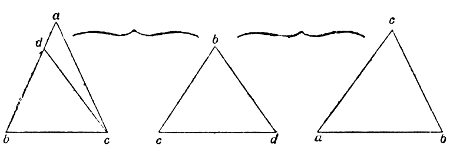
the retina (see fig. 1).—The purely intellectual nature of
this process, to the exclusion of all other, more especially of
physiological, explanations, may also be confirmed by the
[69]
fact, that if we put our heads between our legs, or lie down
on a hill head downwards, we nevertheless see objects in
their right position, and not upside down; although the
portion of the retina, which is usually met by the lower part
of the object is then met by the upper: in fact, everything
is topsy turvy excepting the Understanding.
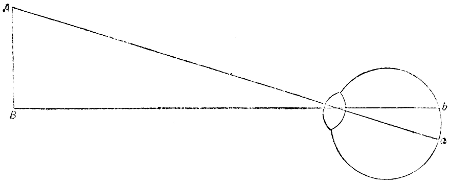
Fig. 1.
The second thing which the Understanding does in converting
sensation into perception, is to make a single perception
out of a double sensation; for each eye in fact
receives its own separate impression from the object we are
looking at; each even in a slightly different direction:
nevertheless that object presents itself as a single one.
This can only take place in the Understanding, and the
process by which it is brought about is the following: Our
eyes are never quite parallel, excepting when we look at a
distant object, i.e. one which is more than 200 feet from
us. At other times they are both directed towards the
object we are viewing, whereby they converge, so as to
make the lines proceeding from each eye to the exact point
of the object on which it is fixed, form an angle, called the
optic angle; the lines themselves are called optic axes.
Now, when the object lies straight before us, these lines
exactly impinge upon the centre of each retina, therefore
in two points which correspond exactly to each other in
each eye. The Understanding, whose only business it is
to look for the cause of all things, at once recognises
the impression as coming from a single outside point,
although here the sensation is double, and attributes it to
one cause, which therefore presents itself as a single
object. For all that is perceived by us, is perceived as a
cause—that is to say, as the cause of an effect we have
experienced, consequently in the Understanding. As, nevertheless,
we take in not only a single point, but a considerable
surface of the object with both eyes, and yet perceive
it as a single object, it will be necessary to pursue this
[70]
explanation still further. All those parts of the object
which lie to one side of the vertex of the optic angle no
longer send their rays straight into the centre, but to the
side, of the retina in each eye; in both sides, however, to the
same, let us say the left, side. The points therefore
upon which these rays impinge, correspond symmetrically to
each other, as well as the centres—in other words, they are
homonymous points. The Understanding soon learns to
know them, and accordingly extends the above-mentioned
rule of its causal perception to them also; consequently it
not only refers those rays which impinge upon the centre
of each retina, but those also which impinge upon all the
other symmetrically corresponding places in both retinas,
to a single radiant point in the object viewed: that is, it
sees all these points likewise as single, and the entire
[71]
object also. Now, it should be well observed, that in this
process it is not the outer side of one retina which corresponds
to the outer side of the other, and the inner to the
inner of each, but the right side of one retina which corresponds
to the right side of the other, and so forth; so that
this symmetrical correspondence must not be taken in a
physiological, but in a geometrical sense. Numerous and
very clear illustrations of this process, and of all the
phenomena which are connected with it, are to be found in
Robert Smith's "Optics," and partly also in Kästner's
German translation (1755). I only give one (fig. 2), which,
properly speaking, represents a special case, mentioned
further on, but which may also serve to illustrate the
whole, if we leave the point R out of question. According
to this illustration, we invariably direct both eyes
equally towards the object, in order that the symmetrically
corresponding places on both retinas may catch the rays
projected from the same points. Now, when we move our
eyes upwards and downwards, to the sides, and in all
directions, the point in the object which first impinged
upon the central point of each retina, strikes a different
place every time, but in all cases one which, in each eye,
corresponds to the place bearing the same name in the
other eye. In examining (perlustrare) an object, we let our
eyes glide backwards and forwards over it, in order to
bring each point of it successively into contact with the
centre of the retina, which sees most distinctly: we feel it
all over with our eyes. It is therefore obvious that seeing
singly with two eyes is in fact the same process as feeling
a body with ten fingers, each of which receives a different
impression, each moreover in a different direction: the
totality of these impressions being nevertheless recognised
by the Understanding as proceeding from one object, whose
shape and size it accordingly apprehends and constructs in
Space. This is why it is possible for a blind man to become
[72]
a sculptor, as was the case, for instance, with the famous
Joseph Kleinhaus, who died in Tyrol, 1853, having been a
sculptor from his fifth year.[80] For, no matter from what
cause it may have derived its data, perception is invariably
an operation of the Understanding.
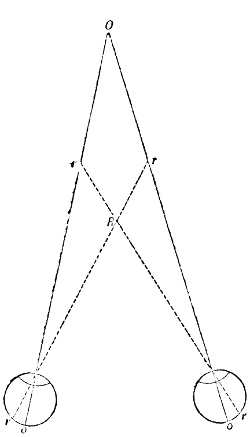
Fig. 2.
But just as a single ball seems to me double, if I touch
it with my fingers crossed—since my Understanding, at once
reverting to the cause and constructing it according to the
laws of Space, takes for granted that the fingers are in
their normal position and of course cannot do otherwise
than attribute two spherical surfaces, which come in contact
with the outer sides of the first and middle fingers, to two
different balls—just so also does an object seem double,
if my eyes, instead of converging symmetrically and enclosing
the optic angle at a single point of the object, each
view it at a different inclination—in other words, if I
squint. For the rays, which in this case emanate from one
point of the object, no longer impinge upon those symmetrically
corresponding points in both retinas with which my
mind has grown familiar by long experience, but upon
other, quite different ones which, in a symmetrical position
of the eyes, could only be affected in this way by different
[73]
bodies; I therefore now see two objects, precisely because
perception takes place by means of, and within, the Understanding.—The
same thing happens without squinting
when, for instance, I look fixedly at the furthest of two
objects placed at unequal distances before me, and complete
the optic angle at it; for then the rays emanating
from the nearer object do not impinge upon symmetrically
corresponding places in both retinas, wherefore my Understanding
attributes them to two objects, i.e. I see the
nearer object double (see fig. 2, page 70). If, on the contrary,
I complete the optic angle at the nearer object, by
looking steadily at it, the further object appears double. It
is easy to test this by holding a pencil two feet from the
eyes, and looking alternately at it and at some other more
distant object behind it.
But the finest thing of all is, that this experiment may
quite well be reversed: so that, with two real objects
straight before and close to us, and with our eyes wide
open, we nevertheless see but one. This is the most striking
proof that perception is a work of the Understanding and
by no means contained in sensation. Let two cardboard
tubes, about 8 inches long and 1-1/2 inches in diameter, be
fastened parallel to one another, like those of a binocular
telescope, and fix a shilling at the end of each tube. On
applying our eyes to the opposite extremity and looking
through the tubes, we shall see only one shilling surrounded
by one tube. For in this case the eyes being forced
into a completely parallel position, the rays emanating
from the coins impinge exactly upon the centres of the two
retinas and those points which immediately surround
them, therefore upon places which correspond symmetrically
to each other; consequently the Understanding,
taking for granted the usual convergent position of the
optic axes when objects are near, admits but one object as
the cause of the reflected rays. In other words, we see but
[74]
one object; so direct is the act of causal apprehension in
the Understanding.
We have not space enough here to refute one by one the
physiological explanations of single vision which have been
attempted; but their fallacy is shown by the following
considerations:—
1o. If seeing single were dependent upon an organic
connection, the corresponding points in both retinas, on
which this phenomenon is shown to depend, would correspond
organically, whereas they do so in a merely geometrical
sense, as has already been said. For, organically
speaking, the two inner and two outer corners of the eyes
are those which correspond, and so it is with the other
parts also; whereas for the purpose of single vision, it is
the right side of the right retina which corresponds to the
right side of the left retina, and so on, as the phenomena
just described irrefutably show. It is also precisely on
account of the intellectual character of the process, that
only the most intelligent animals, such as the higher
mammalia and birds of prey—more especially owls—have
their eyes placed so as to enable them to direct both optic
axes to the same point.
2o. The hypothesis of a confluence or partial intersection
of the optic nerves before entering the brain, originated by
Newton,[81] is false, simply because it would then be impossible
to see double by squinting. Vesalius and Cæsalpinus
besides have already brought forward anatomical
instances in which subjects saw single, although neither
fusion nor even contact of the optic nerves had taken
place. A final argument against the hypothesis of a mixed
impression is supplied by the fact, that on closing our right
eye firmly and looking at the sun with our left, the bright
image which persists for a time is always in the left, never
in the right, eye: and vice versa.
[75]
The third process by which the Understanding converts
sensation into perception, consists in constructing bodies
out of the simple surfaces hitherto obtained—that is, in
adding the third dimension. This it does by estimating
the expansion of bodies in this third dimension in Space—which
is known to the Understanding à priori—through
Causality, according to the degree in which the eye is
affected by the objects, and to the gradations of light and
shade. In fact, although objects fill Space in all three
dimensions, they can only produce an impression upon the
eye with two; for the nature of that organ is such, that
our sensation, in seeing, is merely planimetrical, not stereometrical.
All that is stereometrical in our perception is
added by the Understanding, which has for its sole data
the direction whence the eye receives its impression, the
limits of that impression, and the various gradations of light
and dark: these data directly indicate their causes, and
enable us to distinguish whether what we have before us
is a disk or a ball. This mental process, like the preceding
ones, takes place so immediately and with such rapidity,
that we are conscious of nothing but the result. It is this
which makes perspective drawing so difficult a problem,
that it can only be solved by mathematics and has to be
learnt; although all it has to do, is to represent the sensation
of seeing as it presents itself to our Understanding
as a datum for the third process: that is, visual sensation
in its merely planimetrical extension, to the two
dimensions of which extension, together with the said data
in them, the Understanding forthwith adds the third, in
contemplating a drawing as well as in contemplating reality.
Perspective drawing is, in fact, a sort of writing which can
be read as easily as printed type, but which few are able to
write; precisely because our intellect, in perceiving, only
apprehends effects with a view to constructing their causes,
immediately losing sight of the former as soon as it has
[76]
discovered the latter. For instance, we instantly recognise
a chair, whatever position it may be in; while drawing a
chair in any position belongs to the art which abstracts
from this third process of the Understanding, in order to present
the data alone for the spectator himself to complete.
In its narrowest acceptation, as we have already seen, this is
the art of drawing in perspective; in a more comprehensive
sense, it is the whole art of painting. A painting presents
us with outlines drawn according to the rules of perspective;
lighter and darker places proportioned to the effect
of light and shade; finally patches of colouring, which
are determined as to quality and intensity by the teaching
of experience. This the spectator reads and interprets by
referring similar effects to their accustomed causes. The
painter's art consists in consciously retaining the data of
visual sensation in the artist's memory, as they are before
this third intellectual process; while we, who are not artists,
cast them aside without retaining them in our memory,
as soon as we have made use of them for the purpose
described above. We shall become still better acquainted
with this third intellectual process by now passing on to a
fourth, which, from its intimate connection with the third,
serves to elucidate it.
This fourth operation of the Understanding consists in
acquiring knowledge of the distance of objects from us:
it is this precisely which constitutes that third dimension
of which we have been speaking. Visual sensation, as we
have said, gives us the direction in which objects lie, but
not their distance from us: that is, not their position. It
is for the Understanding therefore to find out this distance;
or, in other words, the distance must be inferred
from purely causal determinations. Now the most important
of these is the visual angle, which objects subtend;
yet even this is quite ambiguous and unable to decide
anything by itself. It is like a word of double meaning:
[77]
the sense, in which it is to be understood, can only be
gathered from its connection with the rest. An object
subtending the same visual angle may in fact be small
and near, or large and far off; and it is only when we have
previously ascertained its size, that the visual angle enables
us to recognise its distance: and conversely, its size, when
its distance is known to us. Linear perspective is based
upon the fact that the visual angle diminishes as the distance
increases, and its principles may here be easily deduced.
As our sight ranges equally in all directions, we
see everything in reality as from the interior of a hollow
sphere, of which our eye occupies the centre. Now in the
first place, an infinite number of intersecting circles pass
through the centre of this sphere in all directions, and
the angles measured by the divisions of these circles are
the possible angles of vision. In the second place, the
sphere itself modifies its size according to the length of
radius we give to it; therefore we may also imagine it as
consisting of an infinity of concentric, transparent spheres.
As all radii diverge, these concentric spheres augment in
size in proportion to their distance from us, and the degrees
of their sectional circles increase correspondingly:
therefore the true size of the objects which occupy them
likewise increases. Thus objects are larger or smaller according
to the size of the spheres of which they occupy
similar portions—say 10°—while their visual angle remains
unchanged in both cases, leaving it therefore undecided,
whether the 10° occupied by a given object belong
to a sphere of 2 miles, or of 10 feet diameter. Conversely,
if the size of the object has been ascertained, the number
of degrees occupied by it will diminish in proportion to
the distance and the size of the sphere to which we refer
it, and all its outlines will contract in similar proportion.
From this ensues the fundamental law of all perspective;
for, as objects and the intervals between them must necessarily
[78]
diminish in constant proportion to their distance
from us, all their outlines thereby contracting, the result
will be, that with increasing distance, what is above us
will descend, what is below us will ascend, and all that
lies at our sides will come nearer together. This progressive
convergence, this linear perspective, no doubt
enables us to estimate distances, so far as we have before
us an uninterrupted succession of visibly connected objects;
but we are not able to do this by means of the visual
angle alone, for here the help of another datum is required
by the Understanding, to act, in a sense, as commentary
to the visual angle, by indicating more precisely the share
we are to attribute to distance in that angle. Now there
are four principal data of this kind, which I am about to
specify. Thanks to these data, even where there is no
linear perspective to guide us, if a man standing at a distance
of 200 feet appears to me subtending a visual angle
twenty-four times smaller than if he were only 2 feet off,
I can nevertheless in most cases estimate his size correctly.
All this proves once more that perception is not only a thing
of the senses, but of the intellect also.—I will here add the
following special and interesting fact in corroboration of
what I have said about the basis of linear perspective as
well as about the intellectual nature of all perception.
When I have looked steadily at a coloured object with
sharply defined outlines—say a red cross—long enough
for the physiological image to form in my eye as a green
cross, the further the surface on to which I project it,
the larger it will appear to me: and vice versa. For the
image itself occupies an unvarying portion of my retina,
i.e. the portion originally affected by the red cross; therefore
when referred outwards, or, in other words, recognised
as the effect of an external object, it forms an unchanging
visual angle, say of 2°. Now if, in this case, where all
commentary to the visual angle is wanting, I remove it to
[79]
a distant surface, with which I necessarily identify it as
belonging to its effect, the cross will occupy 2° of a distant
and therefore larger sphere, and is consequently large.
If, on the other hand, I project the image on to a nearer
object, it will occupy 2° of a smaller sphere, and is
therefore small. The resulting perception is in both cases
completely objective, quite like that of an external object;
and as it proceeds from an entirely subjective reason
(from the image having been excited in quite a different
way), it thus confirms the intellectual character of all
objective perception.—This phenomenon (which I distinctly
remember to have been the first to notice, in
1815) forms the theme of an essay by Séguin, published in
the "Comptes rendus" of the 2nd August, 1858, where it
is served up as a new discovery, all sorts of absurd and
distorted explanations of it being given. Messieurs les
illustres confrères let pass no opportunity for heaping experiment
upon experiment, the more complicated the
better. Expérience! is their watchword; yet how rarely
do we meet with any sound, genuine reflection upon the
phenomena observed! Expérience! expérience! followed
by twaddle.
To return to the subsidiary data which act as commentaries
to a given visual angle, we find foremost among
them the mutationes oculi internæ, by means of which the
eye adapts its refractory apparatus to various distances by
increasing and diminishing the refraction. In what these
modifications consist, has not yet been clearly ascertained.
They have been sought in the increased convexity, now of
the cornea, now of the crystalline lens; but the latest
theory seems to me the most probable one, according to
which the lens is moved backwards for distant vision and
forwards for near vision, lateral pressure, in the latter
case, giving it increased protuberance; so that the process
would exactly resemble the mechanism of an opera-glass.
[80]
Kepler, however, had, in the main, already expressed this
theory, which may be found explained in A. Hueck's
pamphlet, "Die Bewegung der Krystallinse," 1841. If
we are not clearly conscious of these inner modifications
of the eye, we have at any rate a certain feeling of them,
and of this we immediately avail ourselves to estimate
distances. As however these modifications are not available
for the purposes of clear sight beyond the range of
from about 7 inches to 16 feet, the Understanding is only
able to apply this datum within those limits.
Beyond them, however, the second datum becomes available:
that is to say, the optic angle, formed by the two
optic axes, which we had occasion to explain when speaking
of single vision. It is obvious that this optic angle becomes
smaller, the further the object is removed: and vice
versa. This different direction of the eyes, with respect to
each other, does not take place without producing a slight
sensation, of which we are nevertheless only in so far
conscious as the Understanding makes use of it, as a
datum, in estimating distances intuitively. By this datum
we are not only enabled to cognize the distance, but the
precise position of the object viewed, by means of the
parallax of the eyes, which consists in each eye seeing the
object in a slightly different direction; so that if we close
one eye, the object seems to move. Thus it is not easy to snuff
a candle with one eye shut, because this datum is then
wanting. But as the direction of the eyes becomes parallel
as soon as the distance of the object reaches or exceeds
200 feet, and as the optic angle consequently then ceases
to exist, this datum only holds good within the said
distance.
Beyond it, the Understanding has recourse to atmospheric
perspective, which indicates a greater distance by
means of the increasing dimness of all colours, of the
appearance of physical blue in front of all dark objects
[81]
(according to Göthe's perfectly correct and true theory of
colours), and also of the growing indistinctness of all outlines.
In Italy, where the atmosphere is very transparent,
this datum loses its power and is apt to mislead: Tivoli,
for instance, seems to be very near when seen from Frascati.
On the other hand, all objects appear larger in a mist,
which is an abnormal exaggeration of the datum; because
our Understanding assumes them to be further
from us.
Finally, there remains the estimation of distance by
means of the size (known to us intuitively) of intervening
objects, such as fields, woods, rivers, &c. &c. This mode
of estimation is only applicable where there is uninterrupted
succession: in other words, it can only be applied
to terrestrial, not to celestial objects. Moreover, we have
in general more practice in using it horizontally than vertically:
a ball on the top of a tower 200 feet high appears
much smaller to us than when lying on the ground 200
feet from us; because, in the latter case, we estimate the
distance more accurately. When we see human beings in
such a way, that what lies between them and ourselves is
in a great measure hidden from our sight, they always
appear strikingly small.
The fact that our Understanding assumes everything it
perceives in a horizontal direction to be farther off, therefore
larger, than what is seen in a vertical direction, must partly
be attributed to this last mode of estimating distances, inasmuch
as it only holds good when applied horizontally and
to terrestrial objects; but partly also to our estimation of
distances by atmospheric perspective, which is subject to
similar conditions. This is why the moon seems so much
larger on the horizon than at its zenith, although its visual
angle accurately measured—that is, the image projected by
it on to the eye—is not at all larger in one case than in the
other; and this also accounts for the flattened appearance of
[82]
the vault of the sky: that is to say, for its appearing to have
greater horizontal than vertical extension. Both phenomena
therefore are purely intellectual or cerebral, not optical.
If it be objected, that even when at its zenith, the moon
occasionally has a hazy appearance without seeming to be
larger, we answer, that neither does it in that case appear
red; for its haziness proceeds from a greater density of
vapours, and is therefore of a different kind from that
which proceeds from atmospheric perspective. To this
may be added what I have already said: that we only
apply this mode of estimating distances in a horizontal,
not in a perpendicular, direction; besides, in this case,
other correctives come into play. It is related of Saussure
that, when on the Mont Blanc, he saw so enormous a
moon rise, that, not recognising what it was, he fainted
with terror.
The properties of the telescope and magnifying glass,
on the other hand, depend upon a separate estimate
according to the visual angle alone: i.e., that of size
by distance, and of distance by size; because here the
four other supplementary means of estimating distances
are excluded. The telescope in reality magnifies objects,
while it only seems to bring them nearer; because their
size being known to us empirically, we here account for
its apparent increase by a diminution of their distance
from us. A house seen through a telescope, for instance,
seems to be ten times nearer, not ten times larger, than
seen with the naked eye. The magnifying glass, on the
contrary, does not really magnify, but merely enables
us to bring the object nearer to our eyes than would
otherwise be possible; so that it only appears as large
as it would at that distance even without the magnifying
glass. In fact, we are prevented from seeing objects
distinctly at less than from eight to ten inches' distance
from our eyes, by the insufficient convexity of the ocular
[83]
lens and cornea; but if we increase the refraction by
substituting the convexity of the magnifying glass for
that of the lens and cornea, we then obtain a clear image
of objects even when they are as near as half an inch from
our eyes. Objects thus seen in close proximity to us and
in the size corresponding to that proximity, are transferred
by our Understanding to the distance at which we naturally
see distinctly, i.e. to about eight or ten inches from our
eyes, and we then estimate their magnitude according to
this distance and to the given visual angle.
I have entered thus fully into detail concerning all the
different processes by which seeing is accomplished, in
order to show clearly and irrefragably that the predominant
factor in them is the Understanding, which, by conceiving
each change as an effect and referring that effect to
its cause, produces the cerebral phenomenon of the objective
world on the basis of the à priori fundamental intuitions
of Space and Time, for which it receives merely a
few data from the senses. And moreover the Understanding
effects this exclusively by means of its own peculiar
form, the law of Causality; therefore quite directly and
intuitively, without any assistance whatever from reflection—that
is, from abstract knowledge by means of conceptions
and of language, which are the materials of secondary
knowledge, i.e. of thought, therefore of Reason.
That this knowledge through the Understanding is independent
of Reason's assistance, is shown even by the
fact, that when, at any time, the Understanding attributes
a given effect to a wrong cause, actually perceiving that
cause, whereby illusion arises, our Reason, however clearly
it may recognise in abstracto the true state of the matter,
is nevertheless unable to assist the Understanding, and
the illusion persists undisturbed in spite of that better
knowledge. The above-mentioned phenomena of seeing
and feeling double, which result from an abnormal position
[84]
of the organs of touch and sight, are instances of such
illusions; likewise the apparently increased size of the
rising moon; the image which forms in the focus of a
concave mirror and exactly resembles a solid body floating
in space; the painted relievo which we take for real; the
apparent motion of a shore or bridge on which we are
standing, if a ship happens to pass along or beneath it; the
seeming proximity of very lofty mountains, owing to the
absence of atmospheric perspective, which is the result of
the purity of the air round their summits. In these and
in a multitude of similar cases, our Understanding takes
for granted the existence of the usual cause with which it is
conversant and forthwith perceives it, though our Reason
has arrived at the truth by a different road; for, the
knowledge of the Understanding being anterior to that of
the Reason, the intellect remains inaccessible to the teaching
of the Reason, and thus the illusion—that is, the deception of
the Understanding—remains immovable; albeit error—that
is, the deception of the Reason—is obviated.—That which
is correctly known by the Understanding is reality: that
which is correctly known by the Reason is truth, or in other
terms, a judgment having a sufficient reason; illusion
(that which is wrongly perceived) we oppose to reality:
error (that which is wrongly thought) to truth.
The purely formal part of empirical perception—that is,
Space, Time, and the law of Causality—is contained à
priori in the intellect; but this is not the case with the
application of this formal part to empirical data, which has
to be acquired by the Understanding through practice and
experience. Therefore new-born infants, though they no
doubt receive impressions of light and of colour, still do
not apprehend or indeed, strictly speaking, see objects.
The first weeks of their existence are rather passed in a
kind of stupor, from which they awaken by degrees when
their Understanding begins to apply its function to the
[85]
data supplied by the senses, especially those of touch and
of sight, whereby they gradually gain consciousness of the
objective world. This newly-arising consciousness may be
clearly recognised by the look of growing intelligence in
their eyes and a degree of intention in their movements,
especially in the smile with which they show for the first
time recognition of those who take care of them. They
may even be observed to make experiments for a time
with their sight and touch, in order to complete their
apprehension of objects by different lights, in different
directions and at different distances: thus pursuing a
silent, but serious course of study, till they have succeeded
in mastering all the intellectual operations in seeing which
have been described. The fact of this schooling can be
ascertained still more clearly through those who, being
born blind, have been operated upon late in life, since they
are able to give an account of their impressions. Cheselden's
blind man[82] was not an isolated instance, and we
find in all similar cases the fact corroborated, that
those who obtain their sight late in life, no doubt, see
light, outlines, and colours, as soon as the operation is
over, but that they have no objective perception of objects
until their Understanding has learnt to apply its causal
law to data and to changes which are new to it. On first
beholding his room and the various objects in it, Cheselden's
blind man did not distinguish one thing from
another; he simply received the general impression of a
totality all in one piece, which he took for a smooth,
variegated surface. It never occurred to him to recognise
a number of detached objects, lying one behind the other
at different distances. With blind people of this sort, it
is by the sense of touch, to which objects are already
known, that they have to be introduced to the sense of
[86]
sight. In the beginning, the patient has no appreciation
whatever of distances and tries to lay hold of everything.
One, when he first saw his own house from outside, could
not conceive how so small a thing could contain so many
rooms. Another was highly delighted to find, some weeks
after the operation, that the engravings hanging on the
walls of his room represented a variety of objects. The
"Morgenblatt" of October 23rd, 1817, contains an account
of a youth who was born blind, and obtained his sight
at the age of seventeen. He had to learn intelligent
perception, for at first sight he did not even recognise
objects previously known to him through the sense of
touch. Every object had to be introduced to the sense of
sight by means of the sense of touch. As for the distances
of the objects he saw, he had no appreciation whatever of
them, and tried to lay hold indiscriminately of everything,
far or near.—Franz expresses himself as follows:[83]—
"A definite idea of distance, as well as of form and size, is only obtained
by sight and touch, and by reflecting on the impressions made
on both senses; but for this purpose we must take into account the
muscular motion and voluntary locomotion of the individual.—Caspar
Hauser, in a detailed account of his own experience in this respect, states,
that upon his first liberation from confinement, whenever he looked through
the window upon external objects, such as the street, garden, &c., it appeared
to him as if there were a shutter quite close to his eye, and covered
with confused colours of all kinds, in which he could recognise or distinguish
nothing singly. He says farther, that he did not convince himself till
after some time during his walks out of doors, that what had at first
appeared to him as a shutter of various colours, as well as many other
objects, were in reality very different things; and that at length the
shutter disappeared, and he saw and recognised all things in their just
proportions. Persons born blind who obtain their sight by an operation
in later years only, sometimes imagine that all objects touch their
eyes, and lie so near to them that they are afraid of stumbling against
them; sometimes they leap towards the moon, supposing that they can
[87]
lay hold of it; at other times they run after the clouds moving along
the sky, in order to catch them, or commit other such extravagancies.
Since ideas are gained by reflection upon sensation, it is further necessary
in all cases, in order that an accurate idea of objects may be
formed from the sense of sight, that the powers of the mind should be
unimpaired, and undisturbed in their exercise. A proof of this is
afforded in the instance related by Haslam,[84] of a boy who had no
defect of sight, but was weak in understanding, and who in his seventh
year was unable to estimate the distances of objects, especially as to
height; he would extend his hand frequently towards a nail on the
ceiling, or towards the moon, to catch it. It is therefore the judgment
which corrects and makes clear this idea, or perception of visible
objects."
The intellectual nature of perception as I have shown it,
is corroborated physiologically by Flourens[85] as follows:
"Il faut faire une grand distinction entre les sens et l'intelligence.
L'ablation d'un tubercule détermine la perte de la sensation, du sens de
la vue; la rétine devient insensible, l'iris devient immobile. L'ablation
d'un lobe cérébral laisse la sensation, le sens, la sensibilité de la rétine,
la mobilité de l'iris; elle ne détruit que la perception seule. Dans un
cas, c'est un fait sensorial; et, dans l'autre, un fait cérébral; dans un
cas, c'est la perte du sens; dans l'autre, c'est la perte de la perception.
La distinction des perceptions et des sensations est encore un grand
résultat; et it est démontré aux yeux. Il y a deux moyens de faire
perdre la vision par l'encéphale: 1° par les tubercules, c'est la perte du
sens, de la sensation; 2° par les lobes, c'est la perte de la perception, de
l'intelligence. La sensibilité n'est donc pas l'intelligence; penser n'est
donc pas sentir; et voilà toute une philosophie renversée. L'idée n'est
donc pas la sensation; et voilà encore une autre preuve du vice radical
de cette philosophie." And again, p. 77, under the heading: Séparation
de la Sensibilité et de la Perception:—"Il y a une de mes expériences
qui sépare nettement la sensibilité de la perception. Quand
on enlève le cerveau proprement dit (lobes ou hémisphères cérébraux) à un
animal, l'animal perd la vue. Mais, par rapport a l'œil, rien n'est
changé: les objets continuent à se peindre sur la rétine; l'iris reste
contractile, le nerf optique sensible, parfaitement sensible. Et cependant
[88]
l'animal ne voit plus; il n'y a plus vision, quoique tout ce qui est
sensation subsiste; il n'y a plus vision, parce qu'il n'y a plus perception.
Le percevoir, et non le sentir, est donc le premier élément de l'intelligence.
La perception est partie de l'intelligence, car elle se perd avec
l'intelligence, et par l'ablation du même organe, les lobes ou hémisphères
cérébraux; et la sensibilité n'en est point partie, puisqu'elle subsiste
après la perte de l'intelligence et l'ablation des lobes ou hémisphères."
The following famous verse of the ancient philosopher
Epicharmus, proves that the ancients in general recognized
the intellectual nature of perception: Νοῦς ὁρῇ καὶ
νοῦς ἀκούει· τἆλλα κωφὰ καὶ τυφλά. (Mens videt, mens audit;
cætera surda et cœca.)[86] Plutarch in quoting this verse,
adds:[87] ὡς τοῦ περὶ τὰ ὄμματα καὶ ὦτα πάθους, ἂν μὴ παρῇ τὸ
φρονοῦν, αἴσθησιν οὐ ποιοῦντος (quia affectio oculorum et
aurium nullum affert sensum, intelligentia absente). Shortly
before too he says: Στράτωνος τοῦ φυσικοῦ λόγος ἐστίν, ἀποδεικνύων
ὡς οὐδ' αἰσθάνεσθαι τοπαράπαν ἄνευ τοῦ νοεῖν ὑπάρχει.
(Stratonis physici exstat ratiocinatio, qua "sine intelligentia
sentiri omnino nihil posse" demonstrat.)[88] Again shortly
after he says: ὅθεν ἀνάγκη, πᾶσιν, οἷς τὸ αἰσθάνεσθαι, καὶ
τὸ νοεῖν ὑπάρχειν, εἰ τῷ νοεῖν αἰσθάνεσθαι πεφύκαμεν (quare
necesse est, omnia, quæ sentiunt, etiam intelligere, siquidem
intelligendo demum sentiamus).[89] A second verse of Epicharmus
might be connected with this, which is quoted
by Diogenes Laertes (iii. 16):
Εὔμαιε, τὸ σοφόν ἐστιν οὐ καθ' ἓν μόνον,
ἀλλ' ὅσα περ ζῇ, πάντα καὶ γνώμαν ἔχει.
[89]
(Eumaee, sapientia non uni tantum competit, sed quæcunque
vivunt etiam intellectum habent.) Porphyry likewise endeavours
to show at length that all animals have understanding.[90]
Now, that it should be so, follows necessarily from the
intellectual character of perception. All animals, even
down to the very lowest, must have Understanding—that
is, knowledge of the causal law, although they have it in
very different degrees of delicacy and of clearness; at any
rate they must have as much of it as is required for perception
by their senses; for sensation without Understanding
would be not only a useless, but a cruel gift of Nature.
No one, who has himself any intelligence, can doubt the
existence of it in the higher animals. But at times it even
becomes undeniably evident that their knowledge of
causality is actually à priori, and that it does not arise
from the habit of seeing one thing follow upon another. A
very young puppy will not, for instance, jump off a table,
because he foresees what would be the consequence. Not
long ago I had some large curtains put up at my bed-room
window, which reached down to the floor, and were
drawn aside from the centre by means of a string. The
first morning they were opened I was surprised to see my
dog, a very intelligent poodle, standing quite perplexed,
and looking upwards and sidewards for the cause of the
phenomenon: that is, he was seeking for the change which
he knew à priori must have taken place. Next day the
same thing happened again.—But even the lowest animals
have perception—consequently Understanding—down to
the aquatic polypus, which has no distinct organs of sensation,
yet wanders from leaf to leaf on its waterplant, while
clinging to it with its feelers, in search of more light.
Nor is there, indeed, any difference, beyond that of
[90]
degree, between this lowest Understanding and that of
man, which we however distinctly separate from his
Reason. The intermediate gradations are occupied by the
various series of animals, among which the highest, such
as the monkey, the elephant, the dog, astonish us often by
their intelligence. But in every case the business of the
Understanding is invariably to apprehend directly causal
relations: first, as we have seen, those between our own
body and other bodies, whence proceeds objective perception;
then those between these objectively perceived bodies
among themselves, and here, as has been shown in § 20,
the causal relation manifests itself in three forms—as
cause, as stimulus, and as motive. All movement in the
world takes place according to these three forms of the
causal relation, and through them alone does the intellect
comprehend it. Now, if, of these three, causes, in the narrowest
sense of the word, happen to be the object of investigation
for the Understanding, it will produce Astronomy,
Mechanics, Physics, Chemistry, and will invent machines
for good and for evil; but in all cases a direct, intuitive
apprehension of the causal connection will in the last resort
lie at the bottom of all its discoveries. For the sole form
and function of the Understanding is this apprehension, and
not by any means the complicated machinery of Kant's
twelve Categories, the nullity of which I have proved.—(All
comprehension is a direct, consequently intuitive,
apprehension of the causal connection; although this has
to be reduced at once to abstract conceptions in order to be
fixed. To calculate therefore, is not to understand, and,
in itself, calculation conveys no comprehension of things.
Calculation deals exclusively with abstract conceptions of
magnitudes, whose mutual relations it determines. By it
we never attain the slightest comprehension of a physical
process, for this requires intuitive comprehension of
space-relations, by means of which causes take effect.
[91]
Calculations have merely practical, not theoretical, value.
It may even be said that where calculation begins, comprehension
ceases; for a brain occupied with numbers is, as
long as it calculates, entirely estranged from the causal
connection in physical processes, being engrossed in purely
abstract, numerical conceptions. The result, however, only
shows us how much, never what. "L'expérience et le
calcul," those watchwords of French physicists, are not
therefore by any means adequate [for thorough insight].)—If,
again, stimuli are the guides of the Understanding, it
will produce Physiology of Plants and Animals, Therapeutics,
and Toxicology. Finally, if it devotes itself to
the study of motives, the Understanding will use them, on
the one hand, theoretically, to guide it in producing works
on Morality, Jurisprudence, History, Politics, and even
Dramatic and Epic Poetry; on the other hand, practically,
either merely to train animals, or for the higher purpose of
making human beings dance to its music, when once it has
succeeded in discovering which particular wire has to be
pulled in order to move each puppet at its pleasure. Now,
with reference to the function which effects this, it is quite
immaterial whether the intellect turns gravitation ingeniously
to account, and makes it serve its purpose by
stepping in just at the right time, or whether it brings the
collective or the individual propensities of men into play
for its own ends. In its practical application we call the
Understanding shrewdness or, when used to outwit others,
cunning; when its aims are very insignificant, it is called
slyness and, if combined with injury to others, craftiness.
In its purely theoretical application, we call it simply
Understanding, the higher degrees of which are named
acumen, sagacity, discernment, penetration, while its lower
degrees are termed dulness, stupidity, silliness, &c. &c.
These widely differing degrees of sharpness are innate, and
cannot be acquired; although, as I have already shown,
[92]
even in the earliest stages of the application of the Understanding,
i.e. in empirical perception, practice and knowledge
of the material to which it is applied, are needed.
Every simpleton has Reason—give him the premisses, and
he will draw the conclusion; whereas primary, consequently
intuitive, knowledge is supplied by the Understanding:
herein lies the difference. The pith of every
great discovery, of every plan having universal historical
importance, is accordingly the product of a happy moment
in which, by a favourable coincidence of outer and inner
circumstances, some complicated causal series, some hidden
causes of phenomena which had been seen thousands of
times before, or some obscure, untrodden paths, suddenly
reveal themselves to the intellect.—
By the preceding explanations of the processes in seeing
and feeling, I have incontestably shown that empirical perception
is essentially the work of the Understanding, for
which the material only is supplied by the senses in sensation—and
a poor material it is, on the whole; so that the
Understanding is, in fact, the artist, while the senses are
but the under-workmen who hand it the materials. But
the process consists throughout in referring from given
effects to their causes, which by this process are enabled to
present themselves as objects in Space. The very fact that
we presuppose Causality in this process, proves precisely
that this law must have been supplied by the Understanding
itself; for it could never have found its way into
the intellect from outside. It is indeed the first condition
of all empirical perception; but this again is the form in
which all external experience presents itself to us; how
then can this law of Causality be derived from experience,
when it is itself essentially presupposed by experience?—It
was just because of the utter impossibility of this, and
because Locke's philosophy had put an end to all à priority,
that Hume denied the whole reality of the conception of
[93]
Causality. He had besides already mentioned two false
hypotheses in the seventh section of his "Inquiry concerning
the Human Understanding," which recently have again been
advanced: the one, that the effect of the will upon the
members of our body; the other, that the resistance
opposed to our pressure by outward objects, is the origin
and prototype of the conception of Causality. Hume refutes
both in his own way and according to his own order of
ideas. I argue as follows. There is no causal connection
whatever between acts of the will and actions of the body;
on the contrary, both are immediately one and the same
thing, only perceived in a double aspect—that is, on the
one hand, in our self-consciousness, or inner sense, as acts
of the will; on the other, simultaneously in exterior,
spacial brain-perception, as actions of the body.[91] The
second hypothesis is false, first because, as I have already
shown at length, a mere sensation of touch does not yet
give any objective perception whatever, let alone the conception
of Causality, which never can arise from the feeling
of an impeded muscular effort: besides impediments of this
kind often occur without any external cause; secondly,
because our pressing against an external object necessarily
has a motive, and this already presupposes apprehension of
that object, which again presupposes knowledge of Causality.—But
the only means of radically proving the conception
of Causality to be independent of all experience was
by showing, as I have done, that the whole possibility of
experience is conditioned by the conception of Causality.
In § 23 I intend to show that Kant's proof, propounded
with a similar intent, is false.
This is also the proper place for drawing attention to the
[94]
fact, that Kant either did not clearly recognise in empirical
perception the mediation of the causal law—which law is
known to us before all experience—or that he intentionally
evaded mentioning it, because it did not suit his purpose. In
the "Critique of Pure Reason," for instance, the relation between
causality and perception is not treated in the "Doctrine
of Elements," but in the chapter on the "Paralogisms
of Pure Reason," where one would hardly expect to find it;
moreover it appears in his "Critique of the Fourth Paralogism
of Transcendental Psychology," and only in the
first edition.[92] The very fact that this place should have
been assigned to it, shows that in considering this relation,
he always had the transition from the phenomenon to the
thing in itself exclusively in view, but not the genesis of perception
itself. Here accordingly he says that the existence
of a real external object is not given directly in perception,
but can be added to it in thought and thus inferred.
In Kant's eyes, however, he who does this is a Transcendental
Realist, and consequently on a wrong road. For by
his "outward object" Kant here means the thing in itself.
The Transcendental Idealist, on the contrary, stops short
at the perception of something empirically real—that is, of
something existing outside us in Space—without needing
the inference of a cause to give it reality. For perception,
according to Kant, is quite directly accomplished without
any assistance from the causal nexus, and consequently
from the Understanding: he simply identifies perception
with sensation. This we find confirmed in the passage
which begins, "With reference to the reality of external
objects, I need as little trust to inference," &c. &c.[93] and
again in the sentence commencing with "Now we may well
[95]
admit," &c. &c.[94] It is quite clear from these passages that
perception of external things in Space, according to Kant,
precedes all application of the causal law, therefore that
the causal law does not belong to perception as an element
and condition of it: for him, mere sensation is identical
with perception. Only in as far as we ask what may, in a
transcendental sense, exist outside of us: that is, when we
ask for the thing in itself, is Causality mentioned as connected
with perception. Moreover Kant admits the existence,
nay, the mere possibility, of causality only in reflection:
that is, in abstract, distinct knowledge by means of
conceptions; therefore he has no suspicion that its application
is anterior to all reflection, which is nevertheless evidently
the case, especially in empirical, sensuous perception
which, as I have proved irrefragably in the preceding analysis,
could never take place otherwise. Kant is therefore
obliged to leave the genesis of empirical perception unexplained.
With him it is a mere matter of the senses, given
as it were in a miraculous way: that is, it coincides with
sensation. I should very much like my reflective readers
to refer to the passages I have indicated in Kant's work, in
order to convince themselves of the far greater accuracy of
my view of the whole process and connection. Kant's extremely
erroneous view has held its ground till now in
philosophical literature, simply because no one ventured to
attack it; therefore I have found it necessary to clear the
way in order to throw light upon the mechanism of our
knowledge.
Kant's fundamental idealistic position loses nothing
whatever, nay, it even gains by this rectification of mine,
in as far as, with me, the necessity of the causal law is
absorbed and extinguished in empirical perception as its
product and cannot therefore be invoked in behalf of an
[96]
entirely transcendent question as to the thing in itself.
On referring to my theory above concerning empirical perception,
we find that its first datum, sensation, is absolutely
subjective, being a process within the organism, because it
takes place beneath the skin. Locke has completely and
exhaustively proved, that the feelings of our senses, even
admitting them to be roused by external causes, cannot
have any resemblance whatever to the qualities of those
causes. Sugar, for instance, bears no resemblance at all to
sweetness, nor a rose to redness. But that they should
need an external cause at all, is based upon a law whose
origin lies demonstrably within us, in our brain; therefore
this necessity is not less subjective than the sensations
themselves. Nay, even Time—that primary condition
of every possible change, therefore also of the change
which first permits the application of the causal law—and
not less Space—which alone renders the externalisation
of causes possible, after which they present themselves
to us as objects—even Time and Space, we say, are subjective
forms of the intellect, as Kant has conclusively
proved. Accordingly we find all the elements of empirical
perception lying within us, and nothing contained
in them which can give us reliable indications as to anything
differing absolutely from ourselves, anything in
itself.—But this is not all. What we think under the conception
matter, is the residue which remains over after
bodies have been divested of their shape and of all their
specific qualities: a residue, which precisely on that account
must be identical in all bodies. Now these shapes and
qualities which have been abstracted by us, are nothing
but the peculiar, specially defined way in which these bodies
act, which constitutes precisely their difference. If therefore
we leave these shapes and qualities out of consideration,
there remains nothing but mere activity in general,
pure action as such, Causality itself, objectively thought—that
[97]
is, the reflection of our own Understanding, the externalised
image of its sole function; and Matter is throughout
pure Causality, its essence is Action in general.[95] This is
why pure Matter cannot be perceived, but can only be
thought: it is a something we add to every reality, as its
basis, in thinking it. For pure Causality, mere action, without
any defined mode of action, cannot become perceptible,
therefore it cannot come within any experience.—Thus
Matter is only the objective correlate to pure Understanding;
for it is Causality in general, and nothing else: just as
the Understanding itself is direct knowledge of cause and
effect, and nothing else. Now this again is precisely why
the law of causality is not applicable to Matter itself: that
is to say, Matter has neither beginning nor end, but is and
remains permanent. For as, on the one hand, Causality is
the indispensable condition of all alternation in the accidents
(forms and qualities) of Matter, i.e. of all passage in
and out of being; but as, on the other hand, Matter is
pure Causality itself, as such, objectively viewed: it is unable
to exercise its own power upon itself, just as the eye
can see everything but itself. "Substance" and Matter
being moreover identical, we may call Substance, action
viewed in abstracto: Accidents, particular modes of action,
action in concreto.—Now these are the results to which true,
i.e. transcendental, Idealism leads. In my chief work I have
shown that the thing in itself—i.e. whatever, on the whole,
exists independently of our representation—cannot be got
at by way of representation, but that, to reach it, we must
follow quite a different path, leading through the inside of
things, which lets us into the citadel, as it were, by
treachery.—
But it would be downright chicanery, nothing else, to
[98]
try and compare, let alone identify, such an honest, deep,
thorough analysis of empirical perception as the one I have
just given, which proves all the elements of perception to
be subjective, with Fichte's algebraic equations of the Ego
and the Non-Ego; with his sophistical pseudo-demonstrations,
which in order to be able to deceive his readers had
to be clothed in the obscure, not to say absurd, language
adopted by him; with his explanations of the way in which
the Ego spins the Non-Ego out of itself; in short, with all
the buffoonery of scientific emptiness.[96] Besides, I protest
altogether against any community with this Fichte, as Kant
publicly and emphatically did in a notice ad hoc in the
"Jenaer Litteratur Zeitung."[97] Hegelians and similar
ignoramuses may continue to hold forth to their heart's
content upon Kant-Fichteian philosophy: there exists a
Kantian philosophy and a Fichteian hocus-pocus,—this is
the true state of the case, and will remain so, in spite of those
who delight in extolling what is bad and in decrying what
is good, and of these Germany possesses a larger number
than any other country.
Thus it is from the sensations of our body that we
receive the data for the very first application of the causal
law, and it is precisely by that application that the perception
of this class of objects arises. They therefore have
their essence and existence solely in virtue of the intellectual
function thus coming into play, and of its
exercise.
[99]
Now, as far as it is the starting-point, i.e. the mediator,
for our perception of all other objects, I have called the
bodily organism, in the first edition of the present work,
the Immediate Object; this, however, must not be taken
in a strictly literal sense. For although our bodily sensations
are all apprehended directly, still this immediate
apprehension does not yet make our body itself perceptible
to us as an object; on the contrary, up to this point all
remains subjective, that is to say, sensation. From this
sensation certainly proceeds the perception of all other
objects as the causes of such sensations, and these causes
then present themselves to us as objects; but it is not so
with the body itself, which only supplies sensations to
consciousness. It is only indirectly that we know even
this body objectively, i.e. as an object, by its presenting
itself, like all other objects, as the recognised cause of a
subjectively given effect—and precisely on this account
objectively—in our Understanding, or brain (which is the
same). Now this can only take place when its own senses
are acted upon by its parts: for instance, when the body is
seen by the eye, or felt by the hand, &c., upon which data
the brain (or understanding) forthwith constructs it as to
shape and quality in space.—The immediate presence in
our consciousness of representations belonging to this
class, depends therefore upon the position assigned to them
in the causal chain—by which all things are connected—relatively
to the body (for the time being) of the Subject—by
which (the Subject) all things are known.
One of the chief objects of the "Critique of Pure
Reason" is to show the universal validity, for all experience,
of the causal law, its à priority, and, as a necessary
[100]
consequence of this, its restriction to possible experience.
Nevertheless, I cannot assent to the proof there given of
the à priority of the principle, which is substantially
this:—"The synthesis of the manifold by the imagination,
which is necessary for all empirical knowledge,
gives succession, but not yet determinate succession:
that is, it leaves undetermined which of two states perceived
was the first, not only in my imagination, but in the
object itself. But definite order in this succession—through
which alone what we perceive becomes experience,
or, in other words, authorizes us to form objectively valid
judgments—is first brought into it by the purely intellectual
conception of cause and effect. Thus the principle
of causal relation is the condition which renders experience
possible, and, as such, it is given us à priori."[98]
According to this, the order in which changes succeed
each other in real objects becomes known to us as objective
only by their causality. This assertion Kant repeats
and explains in the "Critique of Pure Reason," especially
in his "Second Analogy of Experience,"[99] and again at the
conclusion of his "Third Analogy," and I request every
one who desires to understand what I am now about to
say, to read these passages. In them he affirms everywhere
that the objectivity of the succession of representations—which
he defines as their correspondence with the
succession of real objects—is only known through the
rule by which they follow upon one another: that is,
through the law of causality; that my mere apprehension
consequently leaves the objective relation between phenomena
following one another quite undetermined: since
[101]
I merely apprehend the succession of my own representations,
but the succession in my apprehension does not
authorize me to form any judgment whatever as to the
succession in the object, unless that judgment be based
upon causality; and since, besides, I might invert the order
in which these perceptions follow each other in my apprehension,
there being nothing which determines them as
objective. To illustrate this assertion, Kant brings forward
the instance of a house, whose parts we may consider in any
order we like, from top to bottom, or from bottom to top;
the determination of succession being in this case purely
subjective and not founded upon an object, because it
depends upon our pleasure. In opposition to this instance,
he brings forward the perception of a ship sailing down a
river, which we see successively lower and lower down the
stream, which perception of the successively varying positions
of the ship cannot be changed by the looker-on. In
this latter case, therefore, he derives the subjective following
in his own apprehension from the objective following
in the phenomenon, and on this account he calls it an
event. Now I maintain, on the contrary, that there is no
difference at all between these two cases, that both are events,
and that our knowledge of both is objective: that is to say,
it is knowledge of changes in real objects recognized as
such by the Subject. Both are changes of relative position
in two bodies. In the first case, one of these bodies is a
part of the observer's own organism, the eye, and the other
is the house, with respect to the different parts of which
the eye successively alters its position. In the second, it
is the ship which alters its position towards the stream;
therefore the change occurs between two bodies. Both are
events, the only difference being that, in the first, the
change has its starting-point in the observer's own body,
from whose sensations undoubtedly all his perceptions
originally proceed, but which is nevertheless an object
[102]
among objects, and in consequence obeys the laws of the
objective, material world. For the observer, as a purely
cognising individual, any movement of his body is simply
an empirically perceived fact. It would be just as possible
in the second as in the first instance, to invert the
order of succession in the change, were it as easy for the
observer to move the ship up the stream as to alter the
direction of his own eyes. For Kant infers the successive
perception of different parts of the house to be neither
objective nor an event, because it depends upon his own
will. But the movement of his eyes in the direction from
roof to basement is one event, and in the direction from
basement to roof another event, just as much as the sailing
of the ship. There is no difference whatever here, nor is
there any difference either, as to their being or not being
events, between my passing a troop of soldiers and their
passing me. If we fix our eyes on a ship sailing close by
the shore on which we are standing, it soon seems as if it
were the ship that stood still and the shore that moved.
Now, in this instance we are mistaken, it is true, as to the
cause of the relative change of position, since we attribute
it to a wrong cause; the real succession in the relative
positions of our body towards the ship is nevertheless quite
rightly and objectively recognised by us. Even Kant himself
would not have believed that there was any difference,
had he borne in mind that his own body was an object
among objects, and that the succession in his empirical
perceptions depended upon the succession of the impressions
received from other objects by his body, and was
therefore an objective succession: that is to say, one which
takes place among objects directly (if not indirectly) and
independently of the will of the Subject, and which may
therefore be quite well recognised without any causal
connection between the objects acting successively on his
body.
[103]
Kant says, Time cannot be perceived; therefore no succession
of representations can be empirically perceived as
objective: i.e. can be distinguished as changes in phenomena
from the changes of mere subjective representations.
The causal law, being a rule according to which states
follow one another, is the only means by which the objectivity
of a change can be known. Now, the result of
his assertion would be, that no succession in Time could
be perceived by us as objective, excepting that of cause
and effect, and that every other succession of phenomena
we perceive, would only be determined so, and not otherwise,
by our own will. In contradiction to all this I must
adduce the fact, that it is quite possible for phenomena to
follow upon one another without following from one another.
Nor is the law of causality by any means prejudiced by
this; for it remains certain that each change is the effect
of another change, this being firmly established à priori;
only each change not only follows upon the single one
which is its cause, but upon all the other changes which
occur simultaneously with that cause, and with which that
cause stands in no causal connection whatever. It is not
perceived by me exactly in the regular order of causal
succession, but in quite a different order, which is, however,
no less objective on that account, and which differs
widely from any subjective succession depending on my
caprice, such as, for instance, the pictures of my imagination.
The succession, in Time, of events which stand in
no causal connection with each other is precisely what we
call contingency.[100] Just as I am leaving my house, a tile
happens to fall from the roof which strikes me; now, there
is no causal connection whatever between my going out and
[104]
the falling of the tile; yet the order of their succession—that
is, that my going out preceded the falling of the tile—is
objectively determined in my apprehension, not subjectively
by my will, by which that order would otherwise
have most likely been inverted. The order in which tones
follow each other in a musical composition is likewise
objectively determined, not subjectively by me, the listener;
yet who would think of asserting that musical
tones follow one another according to the law of cause and
effect? Even the succession of day and night is undoubtedly
known to us as an objective one, but we as
certainly do not look upon them as causes and effects of
one another; and as to their common cause, the whole
world was in error till Copernicus came; yet the correct
knowledge of their succession was not in the least disturbed
by that error. Hume's hypothesis, by the way,
also finds its refutation through this; since the following
of day and night upon each other—the most ancient of
all successions and the one least liable to exception—has
never yet misled anyone into taking them for cause and
effect of each other.
Elsewhere Kant asserts, that a representation only shows
reality (which, I conclude, means that it is distinguished
from a mere mental image) by our recognising its necessary
connection with other representations subject to rule (the
causal law) and its place in a determined order of the
time-relations of our representations. But of how few
representations are we able to know the place assigned to
them by the law of causality in the chain of causes and
effects! Yet we are never embarrassed to distinguish objective
from subjective representations: real, from imaginary
objects. When asleep, we are unable to make this
distinction, for our brain is then isolated from the peripherical
nervous system, and thereby from external influences.
In our dreams therefore, we take imaginary for
[105]
real things, and it is only when we awaken: that is, when
our nervous sensibility, and through this the outer world,
once more comes within our consciousness, that we become
aware of our mistake; still, even in our dreams, so long
as they last, the causal law holds good, only an impossible
material is often substituted for the usual one. We might
almost think that Kant was influenced by Leibnitz in
writing the passage we have quoted, however much he
differs from him in all the rest of his philosophy; especially
if we consider that Leibnitz expresses precisely
similar views, when, for instance, he says: "La vérité des
choses sensibles ne consiste que dans la liaison des phénomènes,
qui doit avoir sa raison, et c'est ce qui les distingue
des songes. —— Le vrai Critérion, en matière des
objets des sens, est la liaison des phénomènes, qui garantit
les vérités de fait, à l'egard des choses sensibles hors de
nous."[101]
It is clear that in proving the à priority and the necessity
of the causal law by the fact that the objective
succession of changes is known to us only by means of
that law, and that, in so far, causality is a condition for
all experience, Kant fell into a very singular error, and
one which is indeed so palpable, that the only way we can
account for it is, by supposing him to have become so
absorbed in the à priori part of our knowledge, that he
lost sight of what would have been evident to anyone else.
The only correct demonstration of the à priority of the
causal law is given by me in § 21 of the present work.
That à priority finds its confirmation every moment in the
infallible security with which we expect experience to tally
with the causal law: that is to say, in the apodeictic certainty
we ascribe to it, a certainty which differs from
every other founded on induction—the certainty, for instance,
[106]
of empirically known laws of Nature—in that we
can conceive no exception to the causal law anywhere
within the world of experience. We can, for instance,
conceive that in an exceptional case the law of gravitation
might cease to act, but not that this could happen without
a cause.
Kant and Hume have fallen into opposite errors in their
proofs. Hume asserts that all consequence is mere sequence;
whereas Kant affirms that all sequence must necessarily
be consequence. Pure Understanding, it is true,
can only conceive consequence (causal result), and is no
more able to conceive mere sequence than to conceive the
difference between right and left, which, like sequence, is
only to be grasped by means of pure Sensibility. Empirical
knowledge of the following of events in Time is, indeed,
just as possible as empirical knowledge of juxtaposition of
things in Space (this Kant denies elsewhere), but the way
in which things follow upon one another in general in Time
can no more be explained, than the way in which one thing
follows from another (as the effect of a cause): the former
knowledge is given and conditioned by pure Sensibility;
the latter, by pure Understanding. But in asserting that
knowledge of the objective succession of phenomena can
only be attained by means of the causal law, Kant commits
the same error with which he reproaches Leibnitz:[102] that
of "intellectualising the forms of Sensibility."—My view
of succession is the following one. We derive our knowledge
of the bare possibility of succession from the form
of Time, which belongs to pure Sensibility. The succession
of real objects, whose form is precisely Time,
we know empirically, consequently as actual. But it is
through the Understanding alone, by means of Causality,
that we gain knowledge of the necessity of a succession of
[107]
two states: that is, of a change; and even the fact that we
are able to conceive the necessity of a succession at all,
proves already that the causal law is not known to us
empirically, but given us à priori. The Principle of Sufficient
Reason is the general expression for the fundamental
form of the necessary connection between all our objects,
i.e. representations, which lies in the innermost depths of
our cognitive faculty: it is the form common to all representations,
and the only source of the conception of necessity,
which contains absolutely nothing else in it and no
other import, than that of the following of the consequence,
when its reason has been established. Now, the reason
why this principle determines the order of succession in
Time in the class of representations we are now investigating,
in which it figures as the law of causality, is, that
Time is the form of these representations, therefore the
necessary connection appears here as the rule of succession.
In other forms of the principle of sufficient reason, the
necessary connection it always demands will appear under
quite different forms from that of Time, therefore not as
succession; still it always retains the character of a necessary
connection, by which the identity of the principle
under all its forms, or rather the unity of the root of all
the laws of which that principle is the common expression,
reveals itself.
If Kant's assertion were correct, which I dispute, our
only way of knowing the reality of succession would be
through its necessity; but this would presuppose an
Understanding that embraced all the series of causes and
effects at once, consequently an omniscient Understanding.
Kant has burdened the Understanding with an
impossibility, merely in order to have less need of
Sensibility.
How can we reconcile Kant's assertion that our only
means of knowing the objective reality of succession is by
[108]
the necessity with which effect follows cause, with his
other assertion[103] that succession in Time is our only empirical
criterion for determining which of two states is
cause, and which effect. Who does not see the most
obvious circle here?
If we knew objectiveness of succession through Causality,
we should never be able to think it otherwise than as
Causality, and then it would be nothing else than Causality.
For, if it were anything else, it would have other distinctive
signs by which to be recognised; now this is just
what Kant denies. Accordingly, if Kant were right, we
could not say: "This state is the effect of that one, wherefore
it follows it;" for following and being an effect,
would be one and the same thing, and this proposition a
tautology. Besides, if we do away with all distinction
between following upon and following from, we once more
yield the point to Hume, who declared all consequence to
be mere sequence and therefore denied that distinction
likewise.
Kant's proof would, consequently, be reduced to this:
that, empirically, we only know actuality of succession;
but as besides we recognise necessity of succession in
certain series of occurrences, and even know before all
experience that every possible occurrence must have a
fixed place in some one of these series, the reality and the
à priority of the causal law follow as a matter of course,
the only correct proof of the latter being the one I have
given in § 21 of this work.
Parallel with the Kantian theory: that the causal nexus
alone renders objective succession and our knowledge of it
possible, there runs another: that coexistence and our
knowledge of it are only possible through reciprocity. In
the "Critique of Pure Reason" they are presented under
[109]
the title: "Third Analogy of Experience." Here Kant
goes so far as to say that "the co-existence of phenomena,
which exercise no reciprocal action on one another, but are
separated by a perfectly empty space, could never become
an object of possible perception"[104] (which, by the way,
would be a proof à priori that there is no empty space
between the fixed stars), and that "the light which plays
between our eyes and celestial bodies"—an expression
conveying surreptitiously the thought, that this starlight
not only acts upon our eyes, but is acted upon by them
also—"produces an intercommunity between us and them,
and proves the co-existence of the latter." Now, even
empirically, this last assertion is false; since the sight of a
fixed star by no means proves its coexistence simultaneously
with its spectator, but, at most, its existence
some years, nay even some centuries before. Besides, this
second Kantian theory stands and falls with the first,
only it is far more easily detected; and the nullity of
the whole conception of reciprocity has been shown in
§ 20.
The arguments I have brought forward against Kant's
proof may be compared with two previous attacks made on
it by Feder,[105] and by G. E. Schulze.[106]
Not without considerable hesitation did I thus venture
(in 1813) to attack a theory which had been universally
received as a demonstrated truth, is repeated even now in the
latest publications,[107] and forms a chief point in the doctrine
of one for whose profound wisdom I have the greatest
reverence and admiration; one to whom, indeed, I owe so
[110]
much, that his spirit might truly say to me, in the words
of Homer:
Ἀχλὺν δ' αὖ τοι ἀπ' ὀφθαλμῶν ἕλον, ἣ πρὶν ἐπῆεν.
[108]
From the foregoing exposition it follows, that the application
of the causal law to anything but changes in the
material, empirically given world, is an abuse of it. For
instance, it is a misapplication to make use of it with reference
to physical forces, without which no changes could
take place; or to Matter, on which they take place; or to
the world, to which we must in that case attribute an
absolutely objective existence independently of our intellect;
indeed in many other cases besides. I refer the
reader to what I have said on this subject in my chief
work.[109] Such misapplications always arise, partly, through
our taking the conception of cause, like many other metaphysical
and ethical conceptions, in far too wide a sense;
partly, through our forgetting that the causal law is certainly
a presupposition which we bring with us into the
world, by which the perception of things outside us becomes
possible; but that, just on that account, we are not
authorized in extending beyond the range and independently
of our cognitive faculty a principle, which has its
origin in the equipment of that faculty, nor in assuming it
to hold good as the everlasting order of the universe and
of all that exists.
[111]
As the Principle of Sufficient Reason of Becoming is
exclusively applicable to changes, we must not omit to
mention here, that the ancient philosophers had already
raised the question as to the time in which a change takes
place, there being no possibility of it taking place during
the existence of the preceding state nor after the new
one has supervened. Yet, if we assign a special time to it
between both states, a body would, during this time, be
neither in the first nor in the second state: a dying man,
for instance, would be neither alive nor dead; a body
neither at rest nor in movement: which would be absurd.
The scruples and sophistic subtleties which this question
has evoked, may be found collected together in Sextus
Empiricus "Adv. Mathem." lib. ix. 267-271, and "Hypat."
iii. c. 14; the subject is likewise dealt with by Gellius, l.
vi. c. 13—Plato[110] had disposed somewhat cavalierly of this
knotty point, by maintaining that changes take place
suddenly and occupy no time at all; they occur, he says,
in the ἐξαίφνης (in repentino), which he calls an ἄτοπος
φύσις, ἐν χρόνῳ οὐδὲν οὖσα; a strange, timeless existence
(which nevertheless comes within Time).
It was accordingly reserved for the perspicacity of Aristotle
to clear up this difficult point, which he has done
profoundly and exhaustively in the sixth Book of Physics,
chap. i.-viii. His proof that no change takes place suddenly
(in Plato's ἐξαίφνης), but that each occurs only
gradually and therefore occupies a certain time, is based
entirely upon the pure, à priori intuition of Time and of
Space; but it is also very subtle. The pith of this very
lengthy demonstration may, however, be reduced to the
following propositions. When we say of objects that they
[112]
limit each other, we mean, that both have their extreme
ends in common; therefore only two extended things can
be conterminous, never two indivisible ones, for then they
would be one—i.e. only lines, but not mere points, can be
conterminous. He then transfers this from Space to Time.
As there always remains a line between two points, so there
always remains a time between two nows; this is the time
in which a change takes place—i.e. when one state is in the
first, and another in the second, now. This time, like every
other, is divisible to infinity; consequently, whatever is
changing passes through an infinite number of degrees
within that time, through which the second state gradually
grows out of that first one.—The process may perhaps be
made more intelligible by the following explanation. Between
two consecutive states the difference of which is
perceptible to our senses, there are always several intermediate
states, the difference between which is not perceptible
to us; because, in order to be sensuously perceptible,
the newly arising state must have reached a
certain degree of intensity or of magnitude: it is therefore
preceded by degrees of lesser intensity or extension, in
passing through which it gradually arises. Taken collectively,
these are comprised under the name of change,
and the time occupied by them is called the time of change.
Now, if we apply this to a body being propelled, the first
effect is a certain vibration of its inner parts, which, after
communicating the impulse to other parts, breaks out into
external motion.—Aristotle infers quite rightly from the
infinite divisibility of Time, that everything which fills it,
therefore every change, i.e. every passage from one state to
another, must likewise be susceptible of endless subdivision,
so that all that arises, does so in fact by the concourse of
an infinite multitude of parts; accordingly its genesis is
always gradual, never sudden. From these principles and
the consequent gradual arising of each movement, he
[113]
draws the weighty inference in the last chapter of this
Book, that nothing indivisible, no mere point can move.
And with this conclusion Kant's definition of Matter, as
"that which moves in Space," completely harmonizes.
This law of the continuity and gradual taking place of all
changes which Aristotle was thus the first to lay down
and prove, we find stated three times by Kant: in his
"Dissertatio de mundi sensibilis et intelligibilis forma,"
§ 14, in the "Critique of Pure Reason,"[111] and finally in
his "Metaphysical First Principles of Natural Science."[112] In
all three places his exposition is brief, but also less thorough
than that of Aristotle; still, in the main, both entirely
agree. We can therefore hardly doubt that, directly or
indirectly, Kant must have derived these ideas from Aristotle,
though he does not mention him. Aristotle's proposition—οὐκ
ἔστι ἀλλήλων ἐχόμενα τὰ νῦν ("the moments
of the present are not continuous")—we here find expressed
as follows: "between two moments there is always a
time," to which may be objected that "even between two
centuries there is none; because in Time as in Space, there
must always be a pure limit."—Thus Kant, instead of mentioning
Aristotle, endeavours in the first and earliest of his
three statements to identify the theory he is advancing
with Leibnitz' lex continuitatis. If they really were the
same, Leibnitz must have derived his from Aristotle. Now
Leibnitz[113] first stated this Loi de la continuité in a letter to
Bayle.[114] There, however, he calls it Principe de l'ordre
général, and gives under this name a very general, vague,
chiefly geometrical argumentation, having no direct bearing
on the time of change, which he does not even mention.