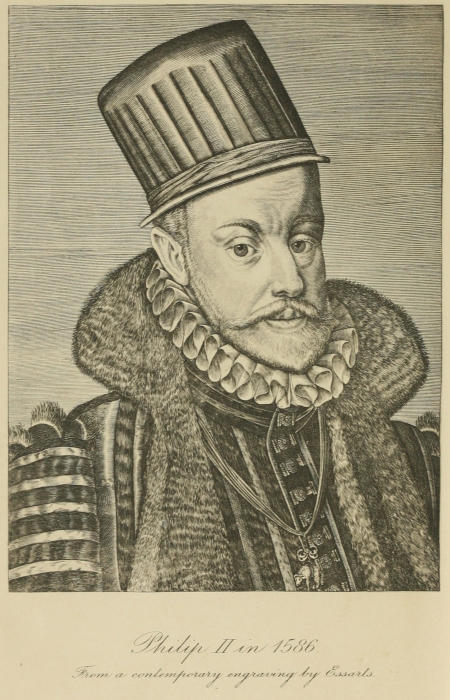
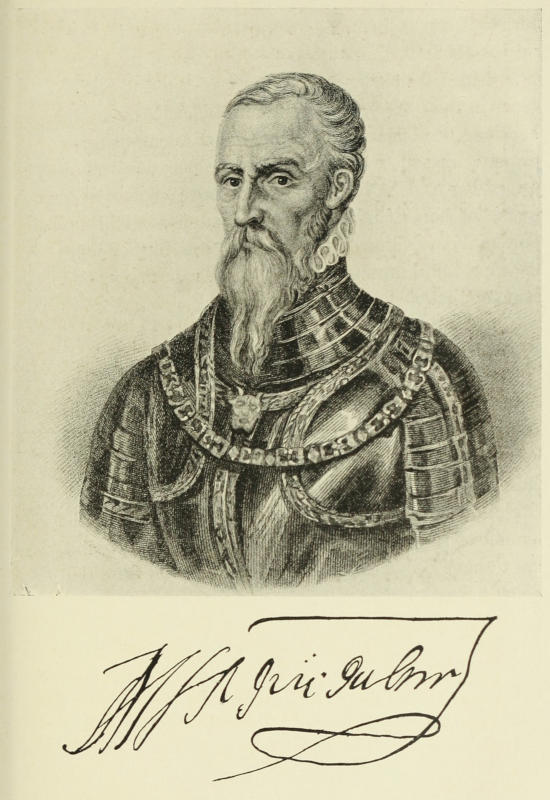
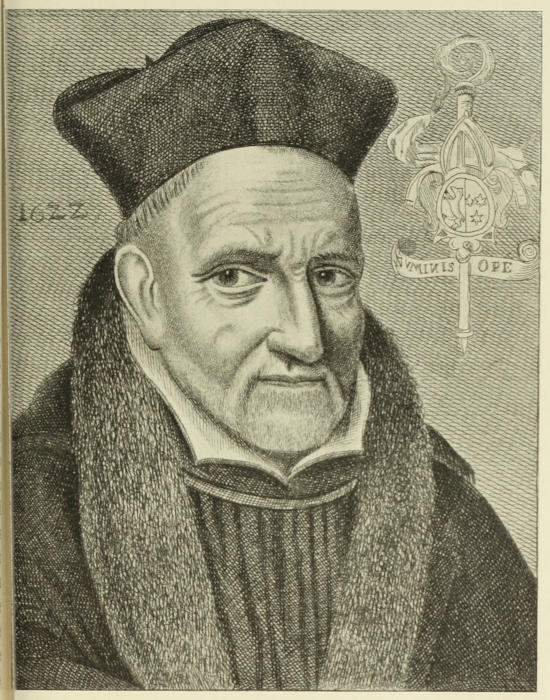
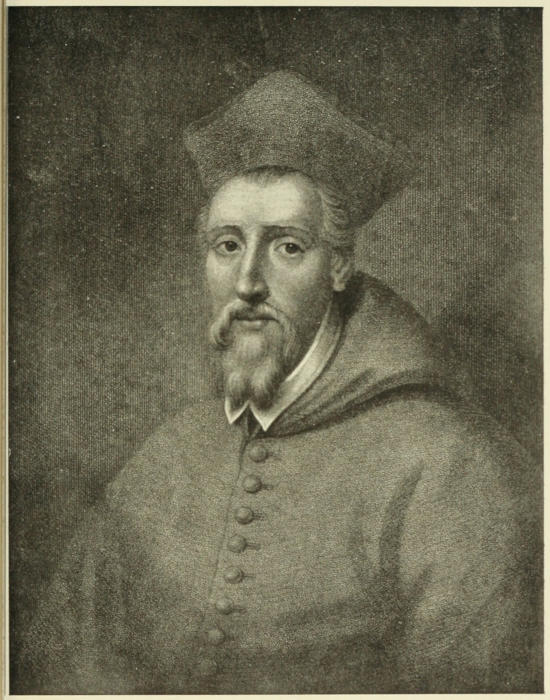
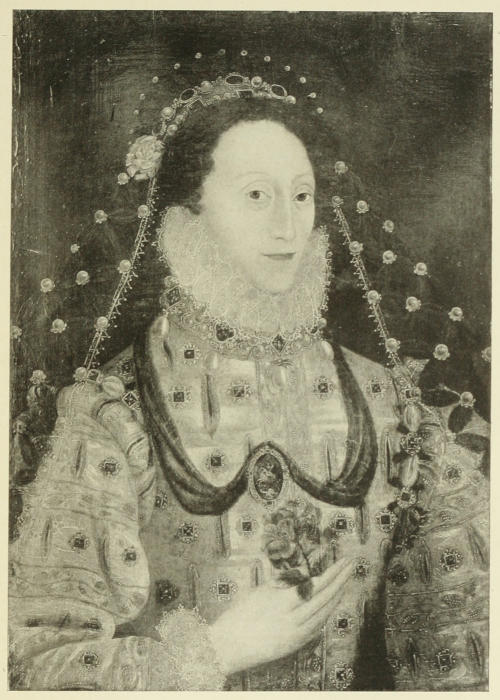
From the Painting by Marc Gheeraedts at the National
Portrait Gallery
TWO ENGLISH QUEENS AND PHILIP — CHAPTER I INTRODUCTORY 1552-1553
The Emperor and England—Death of Edward VI.—Mary and
Renard—To capture England by marriage—Philip II. accepts the
sacrifice—Spanish efforts to moderate the religious reaction in England
At an uncovered table, upon which rested a
clock, a pair of horn-rimmed spectacles and
some other trifles, there sat a prematurely
aged man of fifty-two with a long, fair, sallow face
and a white beard. His great, projecting nether-lip
was cracked and sore with fever, and between
it and the tongue there lay a fresh green leaf to
give coolness and moisture. His hands and feet
were distorted by gout; and his fur-lined, black
gown clung around a once-stalwart frame now
shrunken with sickness. On his right hand at the
other side of the table a stout, somewhat pursy,
middle-aged English gentleman, with his cap in his
hand and in an attitude of profound respect, was
delivering a speech in Italian, to which the old
man was listening with eager attention, now and
again painfully raising his hand to his flat black
velvet cap in salute when the name of King Edward
was mentioned. It was in the little city of Landau
in the Bavarian Palatinate, and Sir Richard Moryson,
the English Ambassador, had ridden from Spires,
nearly twenty miles away, that day, the 4th October,
1552, bringing his message to the greatest potentate
on earth, the Emperor Charles V.
Fate had dealt hardly with the Emperor of late,
and the impossible task he had assumed was breaking
him down mentally and physically. Once again
he had found himself faced, not only by his old
enemy France, but by his own German Princes;
and solely by flight and good luck had he escaped
capture at the hands of the Judas whom he had
made powerful at the expense of right and justice,
Maurice of Saxony. From sheer impotence to
struggle further, the Emperor had been forced to
accept the humiliating terms of the Peace of Passau
dictated to him by the Lutheran Princes. But free
now from danger from his own people, he had turned
again to cope with the foreign ally of his rebel
vassals, determined this time to make a supreme
effort to crush his French rival utterly before his
growing infirmities crushed him.
As he had always done throughout his reign at
such a juncture, he looked to England for aid.
The insults offered by Henry VIII. to his House
and to the Catholic faith, whose champion he was,
had not been able to alienate the Emperor, who
well knew that with England permanently on the
side of France against him, the vast ambitions
he cherished for himself, his son, and his country
were doomed to failure; and now, notwithstanding
the still more aggressive Protestantism of young
Edward VI. and his mentors, it was as necessary
to Charles as ever it had been to secure the goodwill
of England in his struggle against France in
defence of his own Netherlands. So long as Charles
had been fighting his German Lutheran subjects it
was hopeless for him to bid for Northumberland’s
help; and one of the considerations that led him
to accept the terms imposed upon him by Maurice
and the Germans was that thereby he might the
better enlist his old ally England against the monstrous
coalition of France, the Pope, and the Turk.
The suggestion for an alliance had reached Northumberland
from Charles’ sister, Mary Queen of Hungary,
his Regent of the Netherlands; and Moryson
had received his answer from England whilst he was
following a day’s march behind the Emperor and his
army, who were on their way from Austria to
Flanders when Charles had fallen ill at Landau.
Much dulcet verbiage there was in Moryson’s
address, and much vague desire expressed on the
part of the English King—or, rather, the Duke of
Northumberland—to join a coalition against the Turk;
but what Charles so eagerly listened for—a declaration
against the French—came not; though he knew that
the English had just then a bitter quarrel of their own
with France about the seizure of English ships and
cargoes by French privateers. Charles lisped and
mumbled much at the best of times, but now that he
had the green leaf on his lip, it was difficult for Moryson
to understand what he said in reply to the speech,
which, indeed, the Emperor interrupted more than once
in his anxiety to get at the important point of it. “He
could not forget,” he said, “the love of Henry VIII. for
him, shown at sundry times, nor betray the trust the
late King had put in him in asking him to protect his
young son. He would never forget the amity that for
many years had lasted between England and his
House, and he had perpetually tried to preserve this
ancient friendship.” Then, raising his voice and
speaking more emphatically, he said that friendships
that had long been tried and found good
should be made much of. Charles was not a man
to wear his heart upon his sleeve; and his stolid
face and leaden eyes as a rule gave no key to his
thoughts; but Moryson says that on this occasion
“he did so use his eyes, so move his head and order
his countenance, ... as I do surely think he meant
the most of what he said. Sure am I that he is
too wise not to wish the King’s Majesty surely
his.”
That Charles was sincere in his wish to gain
the help of England against France on this, as
on all other similar opportunities, did not require
much penetration to understand; but when Moryson
left the Imperial presence and came to close
quarters with Charles’s minister de Granvelle, the
wily ecclesiastic and future Cardinal tried what
cajolery could do the further to persuade the
Englishman of the goodwill of the Emperor, and
his wish for England’s friendship. “He [the
Emperor] only wished,” he said, “that he found
in the rest of the Princes the like godly mind as
in King Edward, his good brother, and did trust
he should be a king of as great honour as hath
been in England this hundred years. This and a
hundred times as much he spake with such affection
as, if words may be thought to mean what they say,
there can be no more wished for than is to be hoped
for.”[1] There was no thought yet of the young
King’s premature death; but Northumberland had
many bitter enemies at home, and to him it was
a matter of policy to secure for himself a powerful
supporter on the Continent. The Catholic and
Spanish interest being naturally against him for
his religious action and his treatment of the Princess
Mary, he had always hitherto looked towards France
as his friend; but the maritime aggression of the
French and ancient prejudice had aroused a bitter
feeling against them generally in England; and it
behoved Northumberland at this juncture to make
an appearance at least of conciliating the ancient
ally of England, the Emperor-king of Spain and
monarch of the Netherlands. To Northumberland
in the circumstances this was a passing expediency:
to Charles the alliance or benevolent neutrality of
England was a permanent necessity if his cause and
country were to prevail.
This necessity became more pressing still three
months after the interview just described. The
Emperor with a demoralised and discontented army
laid siege to Metz, which the French had captured
from him, and after months of effort and hardship
in the depth of winter he was obliged to retreat,
defeated and heartsick; already swearing that he
would turn monk: “for fortune, like a very strumpet,
doth reserve her favours for the young.” In his
palace at Brussels—sick, sorry, and dejected—he was
obliged to haggle with the German Princes as to
the price of their aid to fight the French. His
darling son Philip, they stipulated, must be separated
from the succession to the Empire, and the dream of
the Emperor’s life to leave Philip strong enough to
triumph where he himself had failed must be forfeited.
The French had stirred up trouble, too, in
the Emperor’s Italian dominions; the Turk was
dominating the Mediterranean with the blessing of
the Christian Pope; the Netherlands were sore and
angry at the war taxes and the presence of marauding
Spanish soldiery; the Imperial ministers were at
deadly feud with each other; and on all sides Charles
was surrounded by debts and difficulties. If only
England could be prevailed upon to divert the
French by attacking them in the Channel during
the coming spring campaign, the tide of victory for
the Emperor might yet be turned and France be
rendered powerless. That, however, was the last
thing that suited Northumberland’s book.
The continuance of the war, nevertheless, was a
standing danger to England itself, for it would
have been impossible for her very long to have
stood by idly whilst the French overran Flanders;
and Northumberland made desperate efforts to bring
about peace between the two antagonists. To all
approaches in this sense the Emperor and his sister,
the Queen-Regent of the Netherlands, could only
point to the aggressive action and impossible demands
of the King of France. “And,” writes Moryson in
April, 1553, “whyle all these sturres ar growing
great in Germanie, and whyle the French King is
plying both sides with secret aydes and unseen
practices, th’ Emperor keepyth his bed as unfyt
to hear of the myschiefs that grow rownd about
him, as unable to devise how to remedie them
if they were told him.”
All through the spring, however, the Emperor’s
officers worked hard to muster his armies in Germany
and Flanders to face the French and save
the Netherlands. Northumberland still pressed upon
both sides the mediation of the King of England in
their quarrel, but in the midst of these negotiations
in April, 1553, the new Imperial general, young Prince
Emmanuel Philibert of Savoy, suddenly dashed upon
the French frontier-fortress of Thérouenne and inflicted
a heavy defeat upon the Emperor’s enemies. Northumberland’s
new embassy to urge peace upon Charles
found less ready response even than before, whilst the
King of France in no wise abated his extravagant
claims now that the Emperor was looked upon as sick
unto death. When the English envoys at length
gained audience of Charles in Brussels early in June,
1553, they found him with his gouty limbs propped up,
“looking very pale, weak, lean, and feeble,” though
his eyes were still bright and his mind clear.
“Marry, to judge him by our sight, we must say
that he appeareth unto us rather a man of short
time rather than continuance.”[2]
How important the life or death of the Emperor
was at that juncture to England, few people outside
the immediate circle of Northumberland’s friends fully
understood. Already dark rumours were spreading
abroad that the slight indisposition of the boy King
of England was really a mortal malady. If Charles
died first, it might easily be foreseen that the break
up of his Empire and the confusion resulting from the
demise of his many Crowns would deprive his successor
of the power at the critical moment to interfere
with Northumberland’s plans to exclude the
Princess Mary from the throne and to perpetuate
the Protestant régime in England under his own
Dudley descendants. If, on the other hand, Edward
died whilst the Emperor’s power was intact, it was
certain that such support as he could give would go
to his cousin Mary Tudor. To Spain and Flanders
the goodwill of England was the crucial point upon
which their future power and prosperity turned. To
gain that, Charles had already condoned and suffered
much, and there was hardly any sacrifice too great for
him if he could win it now. With Mary on the throne
and at his bidding—for he had been her only friend in
all her tribulations—the sympathy of her country
would be secure to him, and he and his could face
France with confidence. So Charles and his Ministers
were alert for every whisper as to Edward’s sickness,
and the English envoys who were at his Court grew
daily more apprehensive at what would happen to
them and their master if the young King died before
the old Emperor.
On the 24th June Sir Philip Hoby, one of the
English envoys in Brussels, received a visit from
Evered, “the King’s jeweller dwelling at Westminster,”
who had just come from Antwerp. In
that city, he reported, it was current, and wagers
laid on it, that King Edward was already dead,
and that Mary had succeeded. To make matters
more threatening for Northumberland’s friends, it was
further stated that the Emperor was sending to England
with all speed three Catholic Flemish statesmen
to be councillors of the new Queen of England.
Well might Hoby in his private letter to Cecil,
written the next day, exclaim in dismay: “Pray
God that England’s wickedness may not be the
cause of His taking away the King”; for if the
country was to be guided by Charles’s councillors,
of whom Hoby held but a poor opinion, then goodbye
to Northumberland’s ambitions and to the
prosperity of all his friends. “England would go
to utter ruin,” he said, “if ruled by such men.”[3]
The three envoys sent by the Emperor to capture
England for Spanish ends when Edward should die
had indeed received their instructions two days before
Hoby wrote his letter to Cecil. They were all men of
mark—Jean de Montmorenci, Lord of Courrières,
Jacques de Marnix, Lord of Tholuze, both members of
the highest Flemish nobility, and one of the Emperor’s
Masters of Requests, a keen, sagacious lawyer named
Simon Renard. Charles had maintained a minister
resident in London, one Schefyne, who became
Chancellor of Brabant, but for so important a mission
as that now in hand he was considered inadequate;
and in right of his experience and ability Simon
Renard, though inferior in point of rank to his
colleagues, became the real leader of the embassy.
The envoys were to seek audience of Northumberland
and Edward, and to say that, as the King of France had
sent a secretary to visit him on account of his sickness,
the Emperor, whose affection for him was infinitely
greater, could do no less. All sorts of assurances of
friendship and goodwill towards England were to
be given, and care was to be taken in any case
to conciliate Northumberland. “But,” continue the
instructions, “if you arrive too late, you must take
counsel together and act for the best for the safety of
our cousin the Princess Mary, and secure, if possible
her accession to the Crown: whilst doing what you see
necessary to exclude the French and their intrigues.
You must endeavour also to maintain the confidence
and good neighbourship which it is so important that
our Flemish States and Spain should enjoy with
England for mutual trade and intercourse; and
especially to prevent the French from getting their
foot in, or gaining the ear of the men who now rule
England, the more so if it be for the purpose of
troubling us.”[4]
Already news had reached Flanders that Northumberland
would endeavour to exclude Mary from the
throne on the death of her brother; and although the
Emperor foresaw that in such case the life of his
cousin would be in grave peril, especially if French aid
were given to Northumberland, the principal efforts
of the envoys were to be directed to assuring the
English Government, in any case, that the Emperor
was their real friend and not France, the ancient foe of
England. If Northumberland and his friends feared
that Mary would contract a foreign marriage under
the Emperor’s influence, they were to be assured that
no such thing was thought of, and Northumberland
was to be given to understand that any husband
chosen by him for the Princess as future Queen would
be willingly accepted, though the actual fulfilment of
the promise was to be postponed as long as possible
in order that Mary might, if she was strong enough
later, avoid compliance with it altogether. The
envoys, indeed, were to promise anything and everything
to secure the throne for Mary. No change
should be made in the government or in religion, and
full indemnity should be given for all past acts against
her. It is clear throughout these instructions, however,
that, much as Charles desired the accession
of his cousin Mary, he was prepared to accept any
solution that would enable him to remain friendly
with England and exclude French influence from
the country.
Before Renard and his colleagues arrived in
England, Schefyne wrote to the Emperor the news of
the King’s expected death, and the patent intrigues of
Northumberland to exclude Mary from her inheritance;
and when, on the 6th July, 1553, the Imperial
ambassadors entered London, though Northumberland’s
officers greeted them as though all was well,
they promptly discovered that Edward was no
more for the world, and that everything was prepared
for the elevation of Jane Grey to the English
throne. On the day after their arrival, the 7th July,
the ambassadors learnt secretly that Edward had
died the previous night, and that Mary in fear for her
life had fled to Norfolk and had resolved to proclaim
herself Queen as soon as her brother’s death was
officially announced. In their perplexity at this
critical state of affairs, and their dread at driving the
ruling power of England into enmity with the
Emperor, the envoys took the unheroic course of
blaming Mary’s bold action instead of supporting
it. Certain it is that if the Princess had waited upon
her Imperial kinsman’s effective aid, her opportunity
would have been missed and she would never have
been Queen of England. She had, indeed, no one to
thank for her crown but herself; and the attitude of
the Imperial envoys towards her in her hour of trial
proves once more the impossibility of the Emperor
and his son allowing any considerations, either of
religion or kinship, to stand in the way of their
securing the co-operation of England to their ends.
Renard and his colleagues were weak reeds for
Mary to depend upon, and she did well to go her own
way, understanding the feeling of her countrymen
better than they did. The envoys found Mary’s
action in defying Northumberland: “Strange,
difficult, and dangerous.... All the forces of the
country are in the hands of the Duke, and the Lady
has no hope of obtaining forces nor aid to oppose him,
whilst her proclamation of herself as Queen will
justify the new King and Queen in attacking her
by force, and she will have no means of resisting
them unless your Majesty stands by her. Considering
your war with the French, it seems unadvisable for
your Majesty to arouse English feeling against you,
and the idea that the Lady will gain Englishmen
on the ground of religion is vain.”[5] Serious
remonstrances were sent to Mary herself by the
Imperial envoys, pointing out her danger and the
hopelessness of her position in the face of Northumberland’s
supposed strength; and at the same time
they laboured hard to dissuade the Duke from the
idea that they had been sent to England to sustain
Mary’s cause.
The Emperor himself was no bolder than his
envoys. “If you cannot draw the Duke of Northumberland
to our cousin’s cause, you may see if you
can gain over some of the nobles by promises about
religion or otherwise, in order to alarm the Duke into
showing some favour to the Princess.”[6] Renard and
his colleagues had been in London five days and had
already assumed the attitude towards Mary just
referred to, before Secretary Petre came officially
from Northumberland on the 10th July to inform
them of the King’s death. They merely begged the
Council to be kind to Lady Mary, although they well
knew that she was mustering her forces and issuing
her decrees in Norfolk, and that Jane was to be
crowned in the Tower of London on the following
day; after which they feared that Mary would be
captured and done to death as a rebel.
All through the critical time, whilst Mary was
sturdily asserting her rights and gathering her friends,
the envoys of her cousin were thus paltering, in
mortal fear of driving the new government into the
arms of France, limiting themselves to a repetition
of the mission originally intended for Edward, and:
“recommending Lady Mary to them with all softness
and modesty, without entering into any contention as
to the succession, which would be of no use.” In the
meanwhile Northumberland’s cause grew more and
more hopeless, though the Imperial envoys did not
even yet understand it. English Catholics and others
came to them begging for information as to the
Emperor’s attitude, and urging him to make at
least some declaration in his cousin’s favour; but
all the answer they got was a mild deprecation of
violence of any sort, and an appeal to the Emperor
for instructions. The over-cautious ambassadors
first began to pluck up courage when the heralds
proclaimed in London the accession of Jane and
her Dudley husband on the 11th July amidst the
silence of the frowning citizens; but when on the
following day, 12th July, a deputation of Jane’s
Council, Lord Cobham and Dr. Mason, came to
inform them of the accession of the new Queen,
and told them haughtily that their embassy had
come to an end, as they were known to be in
England only to help Mary, the ambassadors
replied with bated breath and whispering humbleness,
and with perfect truth, that they had done
nothing of the sort. Their only mission, they said,
which they had hitherto no opportunity of carrying
out, was to thank King Edward for his efforts to
bring about peace, and to assure the Government
of the Emperor’s desire to be friendly with England
in spite of French lies and intrigue.
On the 13th July the ambassadors had their
first audience with the Council. Northumberland,
of course, was absent: he had just started on his
disastrous expedition to Cambridge, already a beaten
man in the face of Mary’s growing popularity; but
Arundel, Shrewsbury, Pembroke, Mason, Petre, and
others received them. Renard was the spokesman
of the envoys, and he laboured hard, even now, to
persuade the Englishmen of the Emperor’s desire
to banish from their minds all suspicion of his
motives—a suspicion, he said, engendered solely
by French misrepresentations. He was naturally
anxious for the safety and good treatment of his
cousin, Lady Mary, but he had no desire whatever
to use her as a political instrument, or to promote
her marriage with a foreigner, or indeed to interfere
in any way with the established order of affairs in
England. The Emperor’s message was received
courteously, as well it might be, for the Councillors
were already trembling in their shoes, and
the envoys were requested to defer their departure
from England until further instructions came from
the Emperor—a notable change of tone since their
interview with Cobham and Mason the day before.
The ambassadors, however, were still as far as
ever from understanding the real state of affairs,
even at the date of their next letter (16th July).
“We consider it certain that before four days are over
the Lady will be in the Duke’s power if she has no
force to resist him.... He is raising troops everywhere
and is strong on land and sea, so that we do
not see how those who secretly hold with the Lady
will be able or dare to declare themselves. We
have no confirmation that the Lady is aided by so
many people as was reported.... On the contrary,
a messenger from the Lady brought us to-day the
copy of the Council’s reply to her letter to them,
and a verbal message from her telling us that she
saw the ruin into which she would fall unless your
Majesty helped her.”[7] If this had really been the
case, Mary would never have been Queen of England,
for the Emperor plainly told his envoys that, for
an infinity of extremely sage and prudent reasons
which he detailed at great length, he could not give
the help that Mary hoped for. New credentials,
indeed, were sent to them, and instructions that
they were again to ply the Council with assurances
that nothing was farther from the Emperor’s thoughts
than to interfere in any way in England. A mild
word or two was to be introduced on behalf of Mary;
but the whole object of the mission was to induce the
English Government, whatever it might be, to
renounce the French friendship and depend solely
upon their ancient ally the Monarch of Spain and
Flanders.[8]
Before these instructions reached London, Northumberland’s
house of cards had fallen. His son, Henry
Dudley, had in vain prayed for help from the King of
France; but the latter was now at grips with the
Emperor and dared not send troops to England,
where the dread and hatred of the French was one
of the principal reasons of Northumberland’s fall.
The Duke himself was hopeless and helpless at Cambridge,
ready to save his unworthy skin by throwing
up his bonnet and crying, “Long live Queen Mary!”
when in spite of him the Princess he had just declared
a bastard was acclaimed Queen; whilst the miserable
Councillors he had coerced into being his tools in
London were tumbling over each other in their
anxiety to disclaim him and betray the unhappy girl
whom his ambition was to lead to an untimely death.
On the 19th July the Earl of Shrewsbury and
Dr. Mason came to the Imperial ambassadors in a
very contrite mood. There was no talk of their
embassy being ended now, no haughty reproaches
for their supposed support to the bastard Lady Mary.
After much hemming and hawing, the deputation of
the Council announced to Renard and his colleagues
that they came with glad news, which they thought
would be welcome to the Emperor. All that the
Council had done previously had been under the
coercion of the wicked Duke of Northumberland,
whom they repudiated. They now all acknowledged
Mary as their true Sovereign, and they had decided
to proclaim her publicly that day in London. To the
delight of the Imperial envoys, but still apparently to
their bewildered surprise at the failure of all their
predictions, Mary was proclaimed both in the Tower
and the City amidst the frantic joy of the people.
Bonfires blazed, feasts were spread, wine ran freely in
London,[9] and coins galore were scattered; for the
rightful Queen had come into her own at last, whilst
the “nine-days’ Queen”—the poor fated girl in the
grim fortress that had been her only palace—found
herself a prisoner instead of a potentate; and the
cowardly craven whose tool she had been was basely
striving to win mercy, if not favour, from the proud
Princess whom he had injured beyond forgiveness.
Still intent, as ever, upon gaining the friendship of
England, no matter who reigned over it, the first
instructions of the Emperor to his envoys when he
heard the good news of Mary’s accession were to urge
upon the new Queen the acceptance, at all events at
first, of the status quo: not to be in a hurry to change
anything, to bow to the decisions of Parliament, to
practise her own religion only in private, if necessary.
“And above all things she should be a good Englishwoman,
and let people understand that she has no
intention of acting alone and without the advice and
co-operation of her nobles and the Parliament.” An
assurance might now be given to her of the Emperor’s
desire and intention of supporting her—as had always
indeed been his intention, he said—and upon her, as
formerly upon her brother, was to be urged the first
and principal points of all—distrust of the French and
the conviction that the real, trustworthy friend of
England was the Sovereign of Spain and Flanders.
Mary was perfectly well aware that she owed her
Crown to her own right and to the boldness of the
action she had taken, and she was not inclined to
accept to their full the moderating counsels of the
Emperor, who had done so little for her in her need.
But she also understood that her position was, as yet,
far from stable; and with French intrigue against her
and in favour of the régime she had supplanted, she
turned naturally to her powerful Spanish kinsman for
such support as she might need, as well as for counsel.
So anxious was Charles to consolidate her position as
Queen, that the advice he gave her might rather have
come from a Protestant constitutional monarch than
from the absolute champion of Catholicism. She was
urged to moderate her religious zeal, to abandon her
intention of celebrating the obsequies of Edward with
Catholic rites, and whilst using severity with the few
leaders of the revolt against her, to be clement to the
great majority, and not to begin her reign by any
vengeful action either of her own or of the friends
who had suffered under the rule of her brother.
Above all, she was recommended to summon Parliament
in the old form and banish most of the foreigners,
especially Frenchmen, of course, from her realm.
With these sage counsels the Emperor sent Mary a
promise that if the French attempted anything against
her, she might depend upon the aid of Imperial troops
under the Prince of Savoy.
The very first letter written by the Emperor after
he had news of Mary’s proclamation instructed Renard
to tell the new Queen that it would be advisable for
her to take a husband at once, and to say that the
Emperor would support her in any choice she might
make. There were really very few princes whom
Mary could have chosen. If she married an Englishman,
there was none of fitting rank and faith to be her
husband but Courtenay, whom she had just released
from his long durance in the Tower, and the elderly
Churchman, Cardinal Pole, both of these being of the
blood royal of England. Mary, in violet velvet, rode
in triumph from New Hall in Essex to the Tower of
London on the 3rd August. A thousand velvet-clad
courtiers followed in her train and ten thousand
armed men formed her bodyguard. As she passed
through the leafy lanes and into the smiling villages,
and so to the eastern gate of her capital, no discordant
voice reached her. Close behind her in a litter rode
her younger sister, Elizabeth, with her fair skin and
yellow hair, composed and self-possessed; but, as
Mary well knew, ready to make common cause with
her enemies if it would serve her own ends. Before
Mary had left New Hall the clever, courtly French
ambassador, Antoine de Noailles, had ridden out from
London to greet her. Noailles’s task was a difficult
one. He had done his best, almost openly, to aid
Northumberland and exclude half-Spanish Mary from
the throne; indeed, the Londoners, who hated him
and his country, were loudly proclaiming that six
thousand armed Frenchmen had been ready to invade
England in the interests of Queen Jane.[10] But
Noailles was supple and insinuating, and the first
speech he made to Mary when he greeted her was an
assurance of the devotion of his master to her and
an offer of armed assistance if she needed it. Mary
was polite but cool, for she knew, notwithstanding
Noailles’s charming, that she had nothing to hope for
from France. As she entered London there rode also
in her train the Imperial ambassadors, jealous and distrustful
of the Frenchman, who they knew was trying
to checkmate them. Beyond formal greetings in the
presence of many watchful eyes Renard had not been
able to obtain private conference of the Queen, who
remained in the Tower of London awaiting her
journey to Richmond. Mary herself, knowing who
her friends were, was naturally anxious to have speech
with the representatives of her Imperial cousin, to
whom she looked for guidance, and she suggested
that Renard should seek entrance to the Tower in
disguise to see her.[11] The ambassador, however,
appears to have thought it safer and more dignified
to have patience for a few days until, in the comparative
freedom of Richmond, he could see the Queen
without attracting so much attention as in the Tower.
In the meanwhile he had been able in private conversation
with Paget, of the Council, to broach the
subject of the Queen’s marriage. From him he had
learnt positively that the current rumour of the intention
of Mary to make Courtenay her Consort was
untrue. “She was against such a match, because
she distrusted the English nation, knowing it to be
treacherous and fickle, because Courtenay is too young
and lowly, her heart being high and magnanimous.
Besides which, if she married an Englishman,
the children—if she had any—would not be so
much thought of as if her husband were a foreign
prince.”
The Emperor’s son Philip, a young widower of
twenty-seven, after several years of widowhood, was
betrothed to his cousin, the Princess of Portugal,
whose rich dowry was sorely needed by the Emperor
for the war; but Renard well understood without
instructions that if Mary of England could be won
for the House of Spain, the gain would be infinitely
greater than any Portuguese money dowry could
bring. So he gently hinted to Paget in his talk that
the Prince was not married yet, though the Spanish
merchants in England had falsely reported that he
was. Paget was doubtful. Yes, he said, no doubt
the Queen’s marriage would be the richest one in the
world, but it was not yet time to discuss it. Nevertheless,
Renard decided when first he saw the Queen
in private to mention Philip’s name as if by chance,
“so as to put the idea of such a marriage into her
head; for if she takes to it, she will be better able to
convert her councillors to it than anybody else in the
world.”
The idea once started was eagerly taken up by the
Emperor—if, in fact, it did not originate with him—and
no time was lost by him in preparing the ground
on his side. He wrote to Philip as soon as Renard’s
information reached him that Mary would probably
favour a foreign marriage, recommending him to send
from Spain a formal embassy to congratulate Mary
upon her accession. But to this recommendation he
added the hint that if Philip would break off the
Portuguese match and consent to his marriage with
the new Queen of England it would be a masterstroke
of policy. Charles had not seen his son for
two years, and although he knew well that Philip was
dutiful, yet he did not venture to press him too
urgently. The Prince was, as Granvelle wrote to
Renard, a man of full age, with children,[12] and the
Emperor would do nothing decisive with regard to
the English marriage unless Philip’s own inclinations
led him to it. There was some fear on the part of
the Emperor that Mary might think of himself for a
husband. To this he had no inclination.[13] He was,
as we have seen, in declining health, and had in secret
already made up his mind to embrace a monastic life
as soon as he could cripple France and leave his son
at peace. Pending Philip’s reply, Renard was instructed
to keep the affair open with the Queen,
always mentioning Philip as being the preferable
parti, but without pledging him, “in case the Portuguese
affair has gone too far, ... or if the Prince’s
fancy alights elsewhere.” Even Courtenay, who was
known to be intriguing with the French ambassador,
was not to be banned entirely, though that idea was
to be gently discouraged; “for if her fancy tends that
way she will not fail, if she be like other women, to go
on with it, and would never forgive you if you had
said anything against it.”[14]
When, after all, Renard was received privately by
the Queen in the Tower on the 6th August, he slily
introduced the idea of marriage, after all the more
prosaic points of his instructions had been disposed of.
At the suggestion of a foreign match, but with no
mention of Philip, Renard says: “She laughed, not
once only but several times, whilst she regarded me in
a way that proved the idea to be very agreeable to
her. She clearly made me understand that she would
not attempt or accept an English marriage, but preferred
a foreign one, ... by which I recognised that
she had her usual pride and inclination to speak of
her rank and grandeur. From what I can understand,
her idea is that the Emperor should propose
some one to her, ... and I am in good hope that if
his Majesty inclines to our Prince [Philip], it would be
the most welcome piece of news that could be taken
to her.”[15] But whilst this was the case, the observant
ambassador also recognised that the English Council
would not be so easily pleased as the middle-aged
Princess, who for her thirty-nine years of life had
been starved of love—she, a Tudor, true daughter of
her father, whose passions and affections were strong;
she, a Queen, who had been outraged and insulted for
years and now hungered for the vengeance upon her
foes that was only possible with the possession of
power such as the Imperial connection could give her.
The French, said Renard with perfect truth, were
leaving no stone unturned, by intrigues, bribes, and
promises, to make the idea of a Spanish alliance
hateful to the English people; and if Mary’s councillors
were to be gained to the Spanish side, it could
only be done by lavish expenditure both in ready
money and in future pledges. Gardiner, the most
powerful of Mary’s Ministers, was strongly in favour
of his late pupil Courtenay as a Consort for the Queen,
and even Paget and Petre, both pro-Spaniards and
former pensioners of the Emperor, looked askance at
a match which it was seen would be hateful to the
great majority of the English people.
As week followed week—for the road between
Spain and Flanders was a long one—it is plain to see
that Mary became somewhat restive at the delay.
Renard saw her privately at Richmond early in
September, and, in order to start the conversation
on the subject, mentioned the common talk in London
of her intended marriage with Courtenay. Mary coldly
replied that she had never spoken to the man except
when she pardoned him. She knew nobody in
England whom she would care to marry. Had the
Emperor, she asked, made up his mind about recommending
any suitor to her? Renard had much to
say about the difficulty of selecting a fitting person,
though he was sure that the Emperor would do his
best. Renard dared not go too far, for no reply had
yet been received from Philip; and rumours were
current in London that his marriage with his Portuguese
cousin was now irrevocably settled. But Renard
began by mentioning the various unmarried Catholic
Princes—the Archduke of Austria, the Prince of
Savoy, the Princes of Ferrara and Florence, and
even the Dauphin; to all of which Mary listened
crossly, for she knew this was only fencing. “Of
course, your Majesty,” continued Renard, “if you think
twenty-seven or twenty-eight too young for a husband,
I do not know any other Princes who are not too old.”
Mary took the hint, for she knew that the age of
Philip was twenty-seven, and she replied: “But your
Prince is already married, I hear, to the Princess of
Portugal.” Renard said that he did not think that
the marriage was concluded yet, though he knew that
it had been mentioned before the war;[16] whereupon
Mary, apparently losing patience at so much beating
about the bush, determined to speak more plainly.
She was sorry, she said, that Philip should marry his
Portuguese cousin, as they were such near relatives.
All the Princes that Renard had mentioned to her
were very young—she might be the mother of any of
them. She was even twelve years older than Prince
Philip; besides which, the Prince would want to
remain in Spain and his other dominions, and she
knew how much English people objected to any
reigning foreign Prince marrying an English
Princess.[17] When her father was alive, she continued,
several proposed matches for her had fallen
through for this reason alone; and when the late Duke
of Orleans was proposed to her, the affair was prevented
by the antagonism which always existed
between England and France. She hoped the
Emperor would bear this point in mind, and not
recommend her to marry a man she had not seen
and spoken to in England. Renard then began
praising Philip’s good sense, judgment, and seriousness.
He had already a son six or seven years old,
he said, and was wise and experienced beyond his
years. Mary, apparently thinking she had gone far
enough, broke into Renard’s panegyrics and declared
most emphatically that she had never felt the smart
of what was called love, nor had she ever had a
voluptuous thought. She had never had an idea of
marriage until God called her to the throne, and now
the step would be taken against her own inclination
and on public grounds alone.
There need have been no misgivings as to Philip’s
attitude in the matter. Throughout his life he made
of himself a martyr to his duty. Overshadowed
always by the immensity of the task confided to
him and his House, awed by the greatness and majesty
of his father, he looked upon himself from youth to
age as an instrument in the hands of the Most High
to compass the victory of righteousness upon the
earth as he understood it, and incidentally to exalt
Spain to the highest place among the nations. That
human suffering had to be endured to arrive at the
end was only an incident: that he himself, in his
degree, should forego his own inclinations, his ease,
his comfort, and his pleasures in favour of the great
objects for which he lived, was to him quite natural
and inevitable, and he accepted the fate without
repining. The marriage with Mary—a woman whom
he had never seen, who was twelve years his senior
and no beauty at best—could not have been attractive
to him. His domestic life with Doña Isabel de Osorio
had apparently been harmonious; and the absence
from Spain which the English marriage would entail
was both inconvenient and unpleasant, whilst the
necessary concessions in manner and demeanour to
his wife’s English subjects would, perhaps, be more
distasteful to him than any other of the sacrifices
imposed upon him by the match. But, as his Spanish
contemporary biographer says, like another Isaac he
readily submitted himself to his father’s will and wrote
without a day’s delay that the Portuguese match
might still be avoided, and he had already taken steps
in that direction, “cheerfully and unreservedly placing
himself in the Emperor’s hands to do with him as he
thought best in the interests of their great cause.”[18]
Two days after the Emperor had received the
welcome letter from his son, a swift courier was
speeding to England with instructions to Renard
to propose Philip, Prince of Spain, as a husband for
Queen Mary.
The occasion was one of supreme international
importance. Ever since Ferdinand the Catholic
sixty years before had betrothed Mary’s mother to
the heir of Henry VII., the sovereign of Spain had
been trying to win for his country the control of
English policy, in order that France might be beaten
in the struggle for the hegemony of Europe. The
tremendous cataclysm of the Reformation, personal
ambitions, the weakness and sensuality of Henry VIII.,
and unexpected deaths, had again and again frustrated
the design. England had more than once fought by
the side of France in the great Continental duel, and
the English friendship upon which the House of
Spain was forced to depend as one of the main
elements of success, had been for all those sixty years
an unstable quantity, though generally on the side of
its traditional ally. But what was necessary for
Charles and his son was a friendship that could be
counted upon in all circumstances—an alliance that
no bribes nor blandishments of Frenchmen and
Lutherans could shake; and for the first time this
seemed possible of attainment if by the marriage of
Philip and Mary the crowns of England, Spain, and
Flanders could rest upon the same brows.
To Mary of England, too, the match with her
Spanish second cousin had more than a sentimental
interest, strong as that was with her. The English
people had rallied to her cause under the influence of
their recognition of her legal right to the throne, and
their detestation of Northumberland and his French
friends; but Protestantism was undoubtedly strong,
especially in London and the Eastern Counties, which
had first acclaimed the new Queen; and it was evident
to Mary that if she was to impose her faith upon the
country, as she was determined to do, even against the
advice of the Emperor, she must be able to depend
upon some force independent of her own people to
aid or support her at a pinch. France, of course,
being out of the question for her, she could only look
to a Spanish match to serve her turn. Mary shut her
eyes obstinately to the vast change that had come over
her country in the last thirty years. She believed, as
did the Churchmen throughout Europe, that she only
had to decree a return to the state of affairs prior to
her father’s apostasy for the country to accept the
change without demur. Pole was for extreme measures
at once, and so, of course, was the Pope, Julius II.; but
the Emperor, who in the supposed cause of religion
was always ready to postpone religious considerations
for politics, continued to advise Mary through
Renard to go slowly and to avoid incensing her people
until at least she was strong enough to coerce them.
The marriage of Philip with the Queen therefore
seemed to hold out to both contracting parties the
ideal opportunity of attaining their great desire—in the
one case the control of English policy to the detriment
of France, and in the other the increment of strength
necessary to force England once more into the fold of
the Church.
Thenceforward for forty-five years Philip of Spain
strove, often in almost impossible circumstances, to
attain this end. There was no instrumentality left
untried by him to secure it. Marriage, and proposals
of marriage, wars, and threats of wars, arrogance,
humility, diplomacy, bribery, subornation of treason
and murder, were some of the means to which Philip in
his long struggle appealed; for to him and his cause
and country it was a matter of life and death; and it is
my object to set forth in the following chapters from
contemporary sources the story of this long series of
efforts on the part of the Spanish King to win the
support of England by fair means or foul. To regard
Philip as a fiend, or even as a bad man, because in
the cause of this life-struggle of his he assailed England
with weapons that would now be rejected by any right-thinking
statesman, would be unjust. The ethics of
the time were widely different from those prevalent
to-day; the supposed interest of the State was infinitely
greater in proportion to the lives of individuals
that is at present the case, whilst the assumed interests
of religion—or, rather, of the orthodox Church—were
considered by Philip to be so overwhelming as to
condone any action necessary to serve them, no matter
how criminal it would be if employed for other ends.
No doubt, in the view of the present day, Philip
blinded himself to a sense of right and wrong in his
zeal to serve the cause for which he lived, namely, the
dominance of Catholicism for the temporal benefit of
Spain. But to him there was no wrong if it was done
by his orders in the cause which he believed to be that
of righteousness. Sacrifice and suffering seemed to
him, as to most Spaniards of his day, a natural and
necessary preparation for spiritual exaltation and
triumph; and whilst he never flinched from inflicting
suffering upon others, though naturally he was a tender-hearted
man, he never spared himself in the same
cause. Throughout his long life he made himself a
martyr to what he conceived to be his duty; a slow,
laborious, unimaginative, morbidly conscientious man,
a good son, a good husband, and, according to his
lights, a good father; kind and indulgent to his
servants, patient under adversity and humble in
success: indeed, a man endowed with most of the
elements of righteousness; and yet with a sense of
right so blunted by his zeal as to think that he might
do God’s work with the weapons of the devil, and turn
enemies into friends by fear. How these principles as
applied to England ended in failure, it is the purpose
of the present book to tell.
CHAPTER II 1553-1554
The Coronation of Mary—Noailles versus Renard—Mary accepts
Philip—The marriage treaty—Alarm in London—Egmont’s missions—Wyatt’s
rebellion—Attitude of Elizabeth—The coming of Philip—His
voyage and arrival—His popular manners in England—Arrival at
Winchester
All London was ringing with preparations
for the coming pageant of the Queen’s
coronation. Fenchurch, Gracechurch, and
Leadenhall, Cornhill, Chepe, and Saint Paul’s were
erecting the scaffoldings for their triumphs, repainting
and gilding gable ends and pinnacles, and trimming
forth their fine stuffs and liveries in honour of the
great day when the Queen was to ride in state from
the Tower to Westminster.[19] Away across the fields
in the little sylvan palace of Saint James’s, Mary sat
under her canopy in her audience chamber one day in
late September, surrounded by courtiers, all, like the
Queen herself, in a blaze of magnificence; for the
prim Puritanism of the late reign had been banished as
savouring of Reform, and the splendour of King Henry
was being copied by his daughter. To one man alone
had Mary somewhat sourly prescribed modesty in
attire, and that was to Courtenay. The dissoluteness
of this young man of twenty-six, who had never before
been free since his childhood, had already shocked the
austerely virtuous Mary, and had made his chances of
winning her hand more impossible than ever. But
neither she nor those around her could fail to see that
the cunning Frenchman Noailles was still ostentatiously
feasting and honouring him, and already the talk of
the French party at Court was coupling the names of
Courtenay and the Princess Elizabeth in a way that
boded ill to Mary’s peace of mind. Courtenay had
ordered a gorgeous suit of blue velvet covered with
gold for the coming ceremony; but blue was the colour
the Queen had chosen for her own outer garb, and she
had no intention of allowing so much bravery to the
man she knew was being made the tool of her enemies
to injure her, and Courtenay was ordered to put his
finery aside and wear more modest raiment. At the
public audience Renard brought forward to present
to the Queen two great Spanish nobles—Don Diego
Hurtado de Mendoza and Don Diego de Geneda—who
were on their way from Flanders to Spain, the
latter a member of Philip’s household. As the two
gentlemen in their distinctive Spanish garb and with
national gravity were led forward for presentation to
the Queen, many scowling brows were bent upon them;
for although the matter was supposed to be so secret,
the talk of the Spanish marriage was already common
at Court; and Noailles, in the deepest chagrin at the
way things were tending, noticed that Don Diego de
Geneda on this occasion had whispered conference
with the Queen, unheard even by his colleague or by
the Imperial ambassador.[20]
Whatever French gold or interest could effect to
alarm people at the idea of the coming of a Spanish
Consort was done. Stories of the terrible rule of the
Inquisition in Spain, and of the pride and cruelty of
Spaniards generally, were spread industriously by the
agents of Noailles, and by the day fixed for the
Queen’s state procession to Westminster, the 30th
of September, 1553, London was almost in a panic
of fear. The Queen had come in with promises of
toleration, and already the zeal of the Churchmen and
her own had belied her people’s hope for religious
peace. Parliament had been summoned for the 5th
October, specially for the purpose of restoring England
to the orthodox Church; Cardinal Pole was known to
be coming to the land of his fathers as the Legate of
the Pope to receive the submission of England to
the Power which King Henry had flouted so contemptuously;
and already the dungeons in the Tower
were being filled by the prelates of the newer ritual.
All the dazzling magnificence that accompanied
the passage of the Queen through London from the
Tower to Westminster, on the last day of September—all
the official greetings, the frequent pageants at the
street corners, and the wonder of the multitude at the
rare show of sumptuous garb—could not banish the
dread thought amidst the crowd that, perhaps, all this
bravery was only a prelude to a Spanish domination
over England. The nobles who rode in Mary’s train
and filled the great Court offices in her household had
most of them been enriched by the plunder of the
monastic lands, and had their own reasons for dreading
a return of the old order in its extreme form;
though they did not know as yet that the Spanish
Consort, whose advent they feared so much, would be
the great modifying influence in their favour. Frenchmen
and Venetians joined the alarmed Englishmen in
their apprehensions of the coming change, but the few
Spaniards in London were jubilant. One Spanish
resident,[21] who described the splendid show for the
benefit of a noble patron in Spain, thus writes with
reference to the match: “If the Lord vouchsafed us
to behold this glorious day, what great advantage
would befall our Spain in holding the Frenchmen
in check, by the union of these kingdoms with his
Majesty’s dominions. And were it only to preserve
the States of Flanders, surely the Emperor and son
must greatly desire it, for, as your Lordship knows
well, the day that the Emperor dies the Low
Countries will be in peril of attack from the French
or of a German invasion under French auspices, help
from Spain being so remote, and Flanders itself not
being free from suspicion of revolt on the ground of
religion or from the disaffection of the people towards
Spaniards. It would be most advantageous, too, to
Spain, for should aught happen to the Prince’s son
(Don Carlos), the son born here would be King of
both countries, which would be a good thing for the
English too.... All the Catholics here would lift
up their hands to God, for they love their country and
the Queen, and especially Spain, for the sake of the
good Queen Katharine; and the goodly here are so
many that there are a hundred Catholics for every
four heretics.”
With these mixed hopes and fears amidst the
multitude, there went a general trust in, and affection
for, the Queen personally. She had been ill-treated so
long, as the people knew; she had grown faded and
middle-aged under unjust oppression, and she was a
true Royal Princess descended on both sides from
kings of highest lineage. So when at the Abbey next
day, 1st October, during the interminable ceremony
of the coronation, Gardiner led the Queen, in her
crimson velvet and ermine, to the four corners of the
daïs and called in a loud voice, “Is this the true heir
to this realm?” there was no hesitation, and all the
lieges shouted as if with one voice, “Yea! yea! God
save the Queen!”[22]
Parliament met on the 5th October. The Catholics
in the country were unquestionably in a majority,
though not so great, probably, as in the ratio of twenty-five
to one, as the Spaniards asserted; and Mary had no
difficulty in obtaining the repeal of all the anti-Papal
laws which severed England from Rome. Gardiner
was willing enough to aid the Queen in this; but,
prompted by Noailles, he managed dexterously to
get the House of Commons to vote an Address to the
Queen, praying her not to marry a foreigner. This,
it is true, voiced a very general feeling in the country,
but the Queen had now (November) quite made up
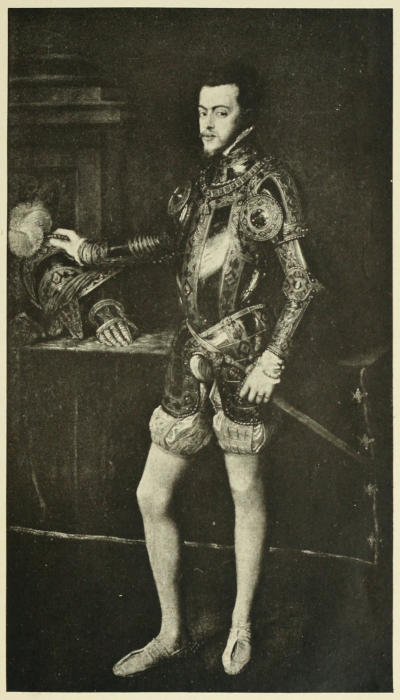
her mind; for she had seen a portrait of Philip by
Titian, and had fairly fallen in love with the young,
fresh-coloured man with the curly, yellow beard who
was asking for her hand. So in a rage, and after
much delay, Mary received the deputation of the
Commons led by the Speaker. “This is one of the
Chancellor’s tricks,” she muttered, “and I will be
equal with him for it.” Then haughtily addressing
the deputation, she rebuked their presumption in
attempting to dictate to her on such a matter, and
said that if private persons were allowed to choose
mates for themselves, surely sovereigns were not to
be less privileged. This was the true Tudor attitude
towards the representatives of the people; and the
Queen, having legalised her religious changes, promptly
dissolved Parliament.
Watchful eyes followed Renard everywhere. The
Queen’s Council, with the exception of Paget, Arundel,
and Petre, looked askance at him; French and
Venetian spies at Court reported his every movement;
and his own colleagues were bitterly jealous of him, as
the marriage negotiation had been kept exclusively in
his hands. For many days he could obtain no private
access to Mary for the purpose of giving her the
Emperor’s message; but at last, by Paget’s management,
on the 10th October, he was introduced secretly
into the Queen’s presence at Westminster. The
Emperor deplored, said Renard, that his age and
infirmities prevented him from offering his own hand
in marriage to his cousin, as he would have wished;
but that being impossible, he begged her to accept his
only and beloved son as her husband. To the chagrin
of Renard, Mary was now full of hesitation. What
would her people say, and how could her Council be
persuaded? She feared that when Philip succeeded
his father, his many other realms would occupy the
whole of his time, and that he would never be able to
stay in England. Was Renard, moreover, quite sure
of his character? He could not be so wise as the
Emperor, and he was very young for her. Of course
she would obey her husband, but he must not think
for a moment that she would allow him to rule her
State, nor could she give any offices to foreigners;
and she threw out a strong hint that perhaps Philip’s
Austrian cousin, Maximilian, would be a better husband
for her, as she was absolutely free, and she had
heard the Archduke was considered wise. Besides,
if Philip was voluptuous in his ideas, she had no desire
for anything of the sort at her age.
PHILIP II AT THE AGE OF 24
FROM THE PAINTING BY TITIAN IN THE PRADO MUSEUM
All these objections were, no doubt, only a display
of becoming maiden modesty, but they somewhat disturbed
Renard. He painted to her in lurid colours
the enmities by which she was surrounded, and the
dangers that threatened her—the intrigues of the
French with Courtenay and Elizabeth, the menacing
attitude of the Protestant party in the provinces—and
Mary answered as best she might, asking Renard
at last to put in writing the arguments he urged in
favour of her marriage with Philip. Four days later
he saw her again, and this time her hesitation took a
more personal form. With tears in her eyes she
seized the ambassador’s hands and conjured him to
tell her truly whether Philip was so moderate, settled,
and well-behaved as he said. On his life and honour
the ambassador protested that he was, but still the
perplexed Queen was unconvinced. If she could
only have seen the Prince first, she said, she would
be better able to judge. That, the ambassador gently
told her, was not possible; but a good portrait of him
could be sent to her, and with this she was obliged to
be content.[23]
It was only after long hesitation and prayerful
searching of heart that Mary finally decided to carry
through her marriage, in the face of the almost
universal opposition of her people. She undoubtedly
yearned for the support of a husband in her difficult
position, and naturally hoped for a son who should
carry on her tradition of a Catholic England. She
was of affectionate disposition, and for all her modest
assurance to Renard that she had never felt the
promptings of the flesh, there is nothing unbecoming
in believing that the sight of her cousin’s portrait had
lit up the feeling of love in her heart where natural
affection had been suppressed for so long. But,
withal, her principal desire for the match and her
determination to effect it were mainly prompted by
public considerations. The intrigues of the French
with the Protestant elements in the country, and the
almost open way in which Noailles was playing off
Courtenay and Elizabeth against her, had convinced
Mary that France was her enemy. The only force
in Europe strong enough to resist France was the
Emperor; and unless the Queen could depend
absolutely upon his support, it was evident that sooner
or later the Protestant element in England with
French aid would oust her from the throne—probably
in favour of the young Queen of Scots, her cousin,
already betrothed to the heir of France.
Motives personal, religious, and political, therefore
all dictated to Mary the absolute necessity of her
prompt marriage with Philip; and, as we have already
seen, the motives of the Emperor and his son for the
marriage were equally strong. Some of Mary’s
Council—especially Arundel, Paget, and Petre—were
first won over, for they were in the Emperor’s pay
before; and when Gardiner saw that the tide was too
strong for him to resist, he also accepted the inevitable
with the best grace he could. But when he had to be
consulted on the terms of the marriage treaty, he drove
as hard a bargain as possible; for he, and, it is just to
say, most of his colleagues also, were determined that
the marriage should not mean the political subjugation
of England by Spain. On the 31st October, Sunday
evening, Mary summoned Renard to her oratory,
where she received him, attended only by her devoted
nurse, Mrs. Clarencius. Her eyes were red with
weeping, and she told the ambassador that for days
she had been sleepless, praying for guidance as to the
choice of a husband. “My last resource in all my
difficulties,” she said, “is the Holy Sacrament, and as
it is even now displayed upon this altar, I will appeal
to it for counsel.” Then kneeling, as did Renard and
Mrs. Clarencius by her side, she recited with whispered
fervour the Veni Creator Spiritus. After a short
period of silent meditation she rose, calm and self-possessed,
and told the ambassador that her mind was
now made up: he, Renard, should be her father confessor.
She had consulted some of her Councillors,
and herself had pondered deeply upon the subject;
and now, bearing in mind what she had been told of
Philip’s good qualities, she prayed the Emperor to
accept her as a daughter, to be indulgent with her,
and to consent to the conditions which her Councillors
declared would be necessary for the welfare of her
realm. She hoped that henceforward the Emperor
would be doubly a father to her, and Philip a good
husband. Then with all solemnity she approached
the altar and, with her hand upon the gospel before
the Sacred Presence, swore to marry Philip of Spain
and make him a good wife. God had now sent her
light, she said, after she had wavered long. No man
but Philip should be her husband.[24]
Whilst Renard and the Council were fighting hard
over every point of the marriage treaty, Noailles
and the Venetian ambassadors were busy intriguing
against it, entertaining Courtenay constantly, and
doing their best to draw cautious Elizabeth into
their plots. The muttering of coming trouble sounded
on all sides—Mary, jealous and distrustful of Elizabeth,
whose illegitimacy she was determined to assert;
the Protestant elements in the Court and country
already in a ferment, thanks largely to French incitement,
and disaffection showing itself by partial disturbances
in various parts of the country. Religious
persecution, too, began to raise its head. Cranmer
and Ridley were condemned to death, as were Lady
Jane Grey and the three sons of Northumberland;
whilst the Emperor, determined for his part to avoid
exacerbating the evil, had, to the great indignation
of the Pope and the Churchmen, almost violently forbidden
Pole to go to England with his extreme Papal
mission, at least until the ultimate control of it had
passed into the Emperor’s own politic hands.
At length, by the end of the year, the hard terms
of the treaty were drafted. Renard had done his
best, and so had the Imperial ministers in Flanders;
but Gardiner had been firm, and the conditions were
a bitter dose for Spanish pride to swallow; for, as
they stood, they bade fair to deprive the bridegroom’s
country of the only benefit to be derived from the
marriage—namely, control of the policy and resources
of England. The Consort was to have no rule in the
country, and none of his countrymen were to hold
office of any sort; the Queen was to receive a jointure
of 30,000 ducats a year from Flanders; and the issue
of the marriage, if any, should, failing Philip’s only
son Carlos, succeed to all his Crowns, as well as to
England; whilst in the case of Mary’s death, the Consort
was to have no hold whatever upon her country,
nor was he to take the Queen or her children out of
England without the consent of the Council. These
and many similar provisions fenced round the authority
of the Consort so completely as to deprive him
of any direct political power in England; but Charles,
confident in Mary’s secret promises to Renard that,
notwithstanding the conditions, the will of the Emperor
should prevail in England after the marriage,[25]
determined to make the best of it, and to gain the
stubborn islanders by his son’s charming, if they were
not to be won by a diplomatic document.
Noailles grew daily more bitter, and almost came
to blows with Paget on the subject of the marriage,
but it became clear even to him now that he had
been beaten, and that in future England and the
Emperor would make common cause against France.
A pompous Flemish embassy, headed by the splendid
young Count of Egmont, was known to be on its way
across to ratify the marriage treaty in the name of
the Emperor; and Noailles took care that all London
should be in a fever of apprehension at their coming.
On the 1st January a great retinue of servants with
the baggage of the ambassadors rode through London
to Durham House in the Strand, where Egmont
and his suite were to be lodged. Thick snow lay
upon the ground, and as the foreigners, with their
long line of pack-horses, passed through the narrow
lanes of the old city, the very street-boys pelted them
with snowballs, “so hatfull was the sight of ther
coming in to theym.”[26]
The next day, at the Tower Stairs, a gallant company
of courtiers, headed by Sir Anthony Browne,
in the gorgeous garb he loved so well, awaited the
coming of the Emperor’s representatives, whilst the
guns on the Tower overhead boomed out their salutation.
Egmont, the first of the Flemish nobles, was
accompanied by Montmorenci, Sieur de Courrières,
who had formerly come with Renard to England,
as well as by several other high Imperial functionaries;
and they were escorted by Lord William
Howard, from Calais, and by Lord Cobham, from
Dover, as Lieutenant of Kent. As the gallant embassy
of eighty finely clad gentlemen pranced out of
the Tower Gate, they were affectionately greeted by
Courtenay, Hastings, and Strange on Tower Hill,
and led through the City in state, though “the
people,” we are told, “nothing rejoysing, helde
downe their heddes sorrowfully.”[27] Nothing was
left undone by Mary and her Court to show honour
to the guests; and banquet followed banquet, whilst
Egmont unsuccessfully strove to modify the terms of
the treaty. Renard tells in a letter to the Emperor
of a banquet given to the ambassadors by the Queen
on the 6th January,[28] after which a little scene took
place which well illustrates the free manners of the
time. “And towards the end of the dinner the Lord
Admiral [Howard], who had dined in an adjoining
chamber, came in and stood before her [the Queen],
who seemed pensive. He said something to her in
English, and then turning to us, asked us whether
we would like to know what he had said. Although
her Majesty did her best to prevent him from translating
it to us, he went on and said that he had
wished that his Highness [Philip] had been seated
there by her side, pointing to her right, in order to
banish her melancholy. She blushed at this and
asked why he said it, to which he replied that he was
sure she was not cross and liked to hear it; whereupon
the Queen and every one else laughed, and it all went
off in good part.”
The day after this entertainment (7th January,
1554), Egmont wrote an urgent letter to Prince
Philip, praying him to hasten his coming to claim
his bride. The treaty, he says, has now been agreed
to with only a word or two changed, and will be
signed in two days. It is clear from this letter that
Egmont foresaw the trouble that was looming. The
nobility, he said, had received them better than he
had expected. “But as for the people, they are
uncertain. We will advise the Queen to raise forces
to prevent any hostile movement, which would not
be extraordinary, for these people are very unstable....
It is of the utmost importance that your Highness
should come without delay. I hear that the
French are arming strongly in Normandy and Brittany....
I beseech you humbly to consider how
urgent it is that you come hither at once, for many
reasons which I hope to lay before you verbally soon.
Besides this, I should like your Highness to know
that the Emperor has not provided us with a sou to
spend on necessary presents. More can be done
here with money than anywhere else in the world.”[29]
The hollow affectation of keeping the Queen’s
marriage secret could not be continued after the
treaty was signed, and on the 13th January Gardiner,
with the best countenance he could command,
made an oration in the Presence Chamber of the
Palace of Westminster before the assembled lords
and courtiers, declaring the Queen’s intention to marry
the Prince of Spain “in most godly, lawful matrimonye:
and further that she should have for her
joynter xxxᵐⁱˡ duckets by the yere, with all the Lowe
Countries of Flanders; and that the issue betweene
them two lawfully begotten shoulde yf there be any,
be heir as well to the Kingdom of Spayne as also to
the sayde Lowe Country.” He declared, farther, that
“we were much bounden to thancke God that so noble,
worthye and famouse a prince would vouchsaff so to
humble himself in this maryadge to take upon him
rather as a subject than otherwise: and that the
Quene should rule all things as nowe: and that there
should be of the Council no Spanyard, nether should
have rule or office in the quenes house or elsewhere
in England nor have custody of any fortes or castells.”[30]
Gardiner made the best of it; but the bare
fact of the announcement being officially made set
light to the tinder which Noailles and his allies had
so carefully prepared. When, on the following day,
Gardiner made a similar announcement to the Lord
Mayor and Aldermen, Noailles had seen enough to
justify him in sending off a special courier post-haste
to his master in France. “The nobles and commonalty
declare,” he wrote, “that they will never tolerate
the Prince of Spain for their King. They would
rather die fighting against him than obey him, and
will defend their liberties by force before they will
submit to such servitude. They are making ready
to rise in arms any day and expel this Queen, who
they now see is unworthy of the Crown and as she
had twice broken her promise to them after they had
raised her to the position she occupies. First, in
changing the religion after she had promised them
toleration; and, secondly, in taking a foreign husband
although she had promised that she would not.”[31] In
a few days the result of all this excitement was seen.
Carew and his friends and kin in the west, depending
upon poor feeble Courtenay’s open co-operation, rose
in revolt. Rumours ran that French troops were on
the way across to aid him. But Courtenay was a
reed easily broken, and allowed Gardiner to frighten
him into alarmed submission, whilst Elizabeth, closely
watched at Ashridge, was too cunning to be drawn
into open complicity by Noailles’s intrigues; though
the Emperor and Renard were urging Mary to put
her sister well out of harm’s way in prison.
And then came the most perilous movement of
all—that of the men of Kent under Wyatt. From
the 26th January to the 3rd February Mary’s
crown was not worth a day’s purchase; for, though
the cry of the rebels was only against the Spanish
marriage, the Queen knew full well that she must now
stand or fall by that. And she stood manfully when
many of her courtiers were distraught by fear and
ready to desert her at a moment’s notice. Whilst
Wyatt and his growing host swept triumphantly
onward from Rochester Bridge to Blackheath, and
so to Southwark, the Council were wrangling.
Should the Queen retire to the Tower or should
she fly to the country; should she believe what
the friends of the French faction urged, that the
only safe place for her was Calais, where she could
claim the Emperor’s protection? Mary, almost alone,
was undismayed. She sent word privately to Renard
that for their own safety’s sake the other Imperial
ambassadors should return home, but that she had
no intention of backing out of the marriage or of
leaving London, although she might temporise with
Wyatt whilst she mustered her forces.[32] Riding to
Guildhall, stern and sorrowful but unafraid, she made
a stirring oration to the citizens; and although many
were in favour of Wyatt, London Bridge was held
firmly by the Queen’s friends, until the rebel force
began to melt away discouraged at the delay.
If Wyatt had struck promptly, he would probably
have won; but loath to shed blood and to use arms
openly against the Crown, he lingered in Bermondsey,
hoping for the declaration of the citizens of London
in his favour, until it was too late. Then came the
ignominious march through the mire to Kingston
Bridge, and the footsore, famished, and rain-soaked
crew tramping through the night into London, to be
beaten almost without effort by those who, if they
had shown a fine front, would have joined them.
Vengeance promptly fell upon the offenders. The
scaffolds at the street corners with their dangling
corpses taught the common people that treason was
a dangerous game to play; the block in the Tower
was soaked with the blood of Greys and Dudleys
and many of their noble friends, and Elizabeth was
no longer bidden courteously to join her sister at
Court, but was sternly, if ceremoniously, brought to
London, dangerously ill though she seemed to be
(22nd February). And, as the young Princess
passed through the silent, sorrowful crowd that
greeted her, making, as she did, an appeal to their
sympathies by her proud, pale face and her snow-white
garments, the Londoners in their hearts felt that
Elizabeth was their champion against the Spaniard,
whose coming they feared so much. On the same
day (Ash Wednesday, 7th February) that poor
Wyatt’s draggled host toiled up to Ludgate, there
to meet final failure and the gallows, Renard urged
the Queen to make an end of Elizabeth and
Courtenay; and the Count of Egmont was already
hurrying to England with advice from the Emperor
to the same effect; but Mary, who allowed herself to
be drawn into extreme severity against those who had
openly conspired against her crown, asserted her own
will in the matter of her sister, whose countenance of
the French ambassador’s intrigues was amply proved
by Wyatt’s avowals and the seizure of Noailles’s letters
at Gravesend. Thus whilst Courtenay once more
found himself in the Tower a prisoner, Elizabeth was
at first only secluded in her sister’s palace at Whitehall.
A perusal of the letters of Renard and Noailles, and
the evidence given by Wyatt himself, leaves no
shadow of doubt that Elizabeth and Courtenay were
accomplices in the series of risings that, with French
support, were intended to frustrate the Spanish match;
and, although Froude and other English historians
have done their best to exonerate them, Mary’s
clemency to her sister on this occasion is at least
entitled to a word of praise, considering the great
provocation she had suffered at her hands. When
at last Elizabeth was sent to the Tower, in March,
it was only because Mary was about to absent herself
from the capital for a time; and it was, of course,
impossible to leave the disaffected Princess, beloved
as she was by the Londoners, practically at liberty in
their midst. Thus the open enemies of the marriage
were silenced; Wyatt and his accomplices, as well as
the Greys and Dudleys, were dead or doomed,
Noailles was found out and raging impotently,
Courtenay and Elizabeth behind the bars, and the
Carews and their West-country friends refugees in
France.
When, therefore, on the 2nd March, 1554, Egmont
again arrived in London, with the Bulls, powers, and
other formal documents necessary for the solemn
betrothal, it seemed as if all would now run smoothly.
Renard, it is true, always anxious to augment the
importance of Philip, gravely raised the question
before the Queen and Council whether it would be
safe to bring the Prince to England in the circumstances;
because, he said, if there was to be any risk
to either the Queen or her betrothed, it might be
better to abandon the match. But whilst Mary
declared that for the world she would have no harm
happen to Philip, “neither she nor her Council saw
any means or danger that should cause the postponement
of a marriage so beneficial and honourable.
Thank God, the heretics and rebels were imprisoned,
their conspiracy discovered and proved, and in a
short time exemplary punishment would be inflicted
upon them! For the future the Queen would see
to it that the strong hand would be hers, and that
she retained full authority over her subjects; so that
they had no doubt whatever that his Highness might
safely pass over to England, provided that he guarded
himself against the French naval force which was
being prepared to intercept him.”[33]
A more private matter still had to be settled by
Renard with the Queen. Which of her ministers
and household should be pensioned and bribed by
the Emperor, and to what extent, “as in order to
gain them for his Highness [Philip] his Majesty had
ordered us to be liberal to those she thought best”?
and this question was gravely submitted to the Council
for consideration. Charles, as usual, was dreadfully
driven for money, but an extra turn of the screw
could always be applied to long-suffering Castile; and
when it was a question of gaining England, money
had to be procured in plenty at any cost. As may
be supposed, the list sent by the Council to Renard
for presents to themselves and others did not err on
the side of modesty; and four thousand crowns’ worth
of gold shoulder-chains and as much ready money was
promptly handed over to the itching palms of the
English courtiers; whereupon “the Councillors gave
us such a good response, that if the result corresponds
with their words, we have no doubt that
safety will attend the coming of his Highness to
this country.”[34]
The further to secure Philip from the attacks of the
French, a fleet of twenty English ships was commissioned
for his escort in the Channel; and when all
this was arranged, a deputation of the Council on the
7th March came to lead Renard and Egmont to
a chamber in Whitehall, where the Queen and her
household awaited them. Upon an altar in the room
the Blessed Host was exposed, and before it Mary
and Egmont respectively swore that the conditions of
the marriage treaty should be held binding. Mary
was fervid and excited. Before taking the oath she
spontaneously “fell upon her knees and cried to God
to witness that the marriage she had agreed to had
not been prompted by any carnal affection, by cupidity,
or any other reason than the honour, welfare, and
profit of her realm, the repose and tranquillity of her
subjects; and that she had no other intention than
to keep true to the marriage and oath that she had
already made to her Crown; saying all this with such
grace that the spectators were moved to tears.”[35]
The ceremony ended with more devout prayer by the
Queen on her knees; and then Egmont, handing to
her the magnificent ring that had been sent by Philip
as a token of his troth, bade her farewell and hurried
off to Spain.[36]
In the meanwhile Philip himself was busy with his
great preparations. All Spain was impressed with
the grandeur of the occasion. The marriage meant
for Philip’s faithful lieges the final conquest over
France and the bringing back into the Catholic fold
of the rich realm of England; it meant, they believed,
a cessation of the ruinous wars which had beggared
the realms of Castile and reduced whole provinces to
misery. But, though the Spaniards rejoiced at the
great stroke of policy that in their view was to
fasten another crown upon the brows of their beloved
Prince, they were doubly enthusiastic at the noble
self-sacrifice that he was making for their sake, and
filled with regret at his leaving them. Endless
preparations had to be made for the tremendous
transport that would be necessary for the crowds of
nobles, courtiers and servants who were to accompany
the Prince to England. The absence was
looked upon as being for an indefinite time, and
only such persons as were able-bodied and fairly
unencumbered were allowed to go. Indeed, a great
assembly of members of the household was held in
order that the Duke of Alba might announce that
any of those who had good reason for not accompanying
his Highness were free to stay behind.
Those who elected to go—the great majority—were
granted considerable sums of money for their outfit;
and the nobles, too, were given leave to go to their
own towns to prepare the gorgeous dresses and
appointments they and their households were expected
to take with them. It is curious to note that many
of the servitors who were to undertake the journey
sold all their property in Spain, in the belief that they
were at once to settle and take possession of the land
of England. We are told that the wife of one officer,
expecting to obtain the approval of Philip, asked for
his leave to sell all they had in order to follow him
unencumbered. Philip’s answer was significant and
characteristic. “I do not order you either to sell or
not to sell your property, for know ye that I am not
going to a marriage feast, but to a fight.”[37] This was
the spirit in which all regarded the sacrifice he was
making. He was going on a holy crusade, amidst
many heretics, whom he was to win for the Church;
the French were lying in wait to thwart or capture
him; and all Spaniards felt that the Prince went
to conquer and not to woo, though none doubted,
nor did he, that victory would finally be his. Old
servitors unable to make the journey were pensioned;
the girl children of those who went were, at Philip’s
expense, boarded and educated in their parents’
absence, the boys being similarly provided for at
Alcalá de Henares.
Whilst all Spain was thus busy providing the
splendid stuffs and adornments by which the savage
Englishmen were to be dazzled, news came to Philip
at Valladolid that the English special ambassadors,
the Earl of Bedford and Lord Fitzwalter, who were
coming with greetings from his betrothed, might be
expected any day at Laredo, on the Biscay coast,
and his Steward, Gutierre Lopez de Padilla, hurried
off to do them honour at the end of February, whilst
Valladolid was hastily decked from end to end with
bravery and lists erected for sports, bullfights, tourneys,
and the like. But the news was premature, for it was
the 13th March before Bedford and his colleagues
left London on their embassy; and before they
arrived in Spain the rejoicings prepared for their
reception were turned into mourning by the news
of the death of Philip’s brother-in-law and cousin,
the Prince of Portugal.
As soon as the tidings of Mary’s ratification of the
treaty reached Philip, he, like the gallant suitor he
intended to appear, despatched the Marquis de las
Navas to England with a present to his bride truly
magnificent in its richness. “A table diamond set as
a rose, beautifully wrought and worth 50,000 ducats;
a necklace of brilliant diamonds consisting of eighteen
stones worth 30,000 ducats. A great diamond with a
large pendant pearl, one of the most beautiful pieces
ever seen in the world, worth 25,000 ducats; besides
many jewels, necklaces, pearls, diamonds, emeralds,
and rubies of inestimable value.” This list is given by
one of Philip’s lackeys, attached to the service of Don
Carlos. The sartorial splendour of velvets, silks,
satins, and bullion, which the same authority sets forth
for our admiration, as being in preparation for Philip
and his Court, and the extravagant richness of the
appointments, dresses, armour, saddlery, plate, and
furniture, for the Prince’s service sent forward to
Corunna, where he was to embark, reads like a fairy
tale. Every noble’s dress and livery is described
with the minuteness of a tailor’s bill, and the appearance
of these proud hidalgos must have been sumptuous
in the extreme.[38] Philip himself always preferred
serious gravity in his dress; but he had been
told that the English loved splendour, and he was
determined on this occasion that they should have
it to their hearts’ content. Some of his beautiful
garments we shall have an opportunity of describing
later, but here is one suit which must have been
exceedingly gorgeous. A crimson velvet cape,
covered with little chains made of silk twist, enclosing
lozenges, and a sort of sprig with large leaves running
between them, made of silver lace and filled in with
silver fringe. The lining of this cape was smooth cloth
of silver embroidered with the same sort of work; the
trunks, doublet, and tunic were of smooth crimson
velvet embroidered in the same way.
All these elaborate preparations being completed,
Philip, with the Dukes of Alba and Medini Celi,
Egmont, Feria, Pescara, Ruy Gomez, and a score of
the highest grandees of Spain and nearly a thousand
horsemen glittering and flashing in the Castilian sun,
rode out of Valladolid on the 14th May, 1554. The
Prince’s Spanish and Teuton guards and his three
hundred servants were all dressed in the gaudy red-and-yellow
livery of Aragon, and each of the nobles
was followed by a retinue which vied with that of the
Prince in brilliance. The cavalcade had to make a
long detour down to the Portuguese frontier to receive
the grief-stricken young widow, Philip’s sister, who
was to govern Spain in his absence, and again to
Tordesillas for the Prince to take a last farewell of his
mad grandmother, Jane the Crazy. At each town, too,
especially at Benavente and Astorga, there were bullfights
and tourneys, banquets and religious ceremonials,
so that it was the 22nd June, the day
before the Vigil of St. John, when the kneeling
aldermen of Santiago de Compostela tendered to
Philip the golden keys at the gates of their sainted city.
As the Prince and his suite rode through the
decorated streets to worship at the shrine of the
Spanish patron Saint James, and thank him for his
protection so far, a party of gentlemen at the upper
window of a house looked on with faces shrouded in
their cloaks. These were the English ambassadors—the
Earl of Bedford, Lord Fitzwalter, and others—sent
by Mary to pledge her troth to her new husband; and
on the following morning they were brought by a
crowd of Spanish hidalgos into the presence of the
future King Consort of England. Philip received
them smilingly, cap in hand, for even thus early he had
taken to heart the injunctions of his father and of
Renard that he would conciliate the English by
changing his habitual grave aloofness for the gay
amiability which he afterwards assumed in England.
Bedford, Fitzwalter, Sidney, and the rest of them,
bowed low and half bent the knee before him one by
one;[39] and when the presentations were over, Bedford
took from a secretary a copy of the capitulations and
handed them to the Prince, who confirmed them by
word of mouth without opening the paper. Bedford
appears to have impressed the Spaniards favourably
as “a great gentleman and a good Christian,” and
both he and his colleagues did their errand in courtly
fashion. When Philip had confirmed the capitulations,
we are told, “they showed the greatest delight, from
the highest to the lowest, kissing his Highness’s hands
with great demonstration; and as they went out they
said to each other in their own tongue, ‘Blessed be to
God who has given us as good a king as this!’ This
was said so quietly amongst themselves that it would
not have been noticed, but that a Spanish gentleman
who understood their tongue heard and repeated it.”[40]
The next day the Englishmen attended pontifical Mass
at the Cathedral with Philip, greatly, we are told, to
their edification and devotion, “which God grant
may continue, for they need it badly enough.” Before
starting on his thirty-miles’ ride from Santiago to
Corunna, Philip distributed costly presents to the
English embassy, Bedford’s gift being “one of the
finest pieces of gold plate ever seen, more than three
feet in height, exquisitely and elaborately chased with
classical and grotesque figures, the intrinsic value
of the gold contained being six thousand ducats.”
A brave show of ships awaited the arrival of Philip
in Corunna, for many soldiers were to pass over with
the Prince to defend him from the French on the way
and reinforce the Emperor’s army in Flanders; and as
the glittering cavalcade came in sight of the harbour,
he was met “by six hundred seaman—lancers from
the province of Guipuzcoa, smart men and prettily
accoutred, who performed many evolutions, waving
their lances joyously, with much playing of drums and
fifes. Then the fleet and the fortress shot such a
salute that in very truth it seemed as if town and
fortress together were coming down, the people being
in great fear and wonder to see the houses tremble
thus as if by earthquake. All said that the human
race had never witnessed such a discharge as this. The
smoke was so great during the hour and a half that
the firing lasted that neither earth nor heaven could
be seen. After this there entered the harbour nine
ships of the fleet, well supplied with everything and
very smart, with a vast number of painted standards
and 3,500 soldiers on board. These ships then took
up the salute with their big guns, after which the
infantry shot with their muskets for half an hour.”[41]
On Philip’s return to his lodging, forty fishing
sloops cast at his feet their fresh-caught harvest
of the sea, and the next day he inspected the ship,
The Holy Ghost, of Martin de Bertondona, in which
it had just been arranged that he was to make
the voyage to England. From end to end the ship
was alive with scarlet silk streamers, and many-hued
heraldic pennons waved aloft: the bulwarks and
castles were hung with crimson damask, and the
cabin destined for the Prince was a marvel of chased
and chiselled gold and exotic woods. The great
standard of crimson damask, painted with the Imperial
arms and golden flames, was thirty yards long, and
dozens of other standards rivalling it in size fluttered
from every mast and spar. Three hundred sailors,
garbed in scarlet liveries, manned this gallant craft.
But all this splendour seems to have aroused some
jealousy amongst the English, and when Philip went
on board the ship that had brought the ambassadors
to Spain to be bounteously entertained at dinner,
Bedford urged him to trust himself to an English ship
and English sailors. The Prince hesitated a while,
but his councillors, and particularly the Duke of Alba,
would not hear of it, for none knew as yet how far
they might trust to the islanders so recently heretic.
To please the English sailors, however, Philip allowed
them to choose for him the Spanish ship they considered
the safest; and at their recommendation he
sailed in Bertondona’s vessel, instead of, as intended,
in the galleon of the great sailor Alvaro de Bazan.
To muster and ship six thousand soldiers as well
as the great train of courtiers and servants that
followed Philip took many days, whilst the Prince
was being feasted and entertained by neighbouring
nobles. During this time there entered Corunna the
Spanish ship that had carried the Marquis of Las
Navas to England with the presents for Mary, and
marvellous stories had the mariners to tell of the
eager preparations being made by the Queen and
her people to receive the new King. How she was
at Winchester with a thousand gentlemen, and how,
amongst other fine things to welcome her bridegroom,
she had collected two thousand fine horses for the
Spaniards, believing that they would bring none
by sea with them.[42] At length the fleet of nearly
a hundred sail was ready. The gilding upon the
towering stern and forecastles, with lines of shining
lanterns, flashed back the summer sun, and the
crowds of gaily clad soldiers and sailors played
strange pranks in the rigging and amongst the gaudy
flags to amuse grave Philip, whilst for two days the
ships lay idle in Corunna harbour awaiting the fair
wind that was to carry the Prince of Spain upon his
mission of conquest.
On Friday, 13th July, a soft breeze from the south
enabled the fleet to sail, whilst a dense crowd upon
the shore sent up fervent prayers for the safety of the
Prince, who in a pure spirit of martyrdom was thus
going to “our new realm of England for the
exaltation of our holy faith and the good of Christendom.”
Others there were on the shore who shouted
insults, taunts, and challenges to all the Frenchmen
alive; for with England at the bidding of the
Emperor, the poorest beggar in Spain knew that
France was powerless against him. The slight swell
that at first somewhat upset unaccustomed stomachs,
was succeeded on the morning of Saturday by a dead
calm and a motionless sea, which, whilst it comforted
the landsmen, made the seamen look blank; for,
as they said, it might delay the fleet for a month.
But the next day, Sunday, a delightful fair wind
sprang up, and the long trail of vessels stretched
across the tranquil Bay until Ushant, the land of
the enemy, loomed up to starboard on Monday afternoon.
On Wednesday morning in the Channel a
fleet of galleons was sighted, which it was feared
might be Frenchmen, but which turned out to be the
Flemish escort sent by the Emperor, with several
ships of the English navy. Thus accompanied, the
Spaniards sailed up to Southampton Water on Thursday,
19th July, and at four o’clock in the afternoon
anchored amidst the royal salute from the thirty
English and Flemish ships assembled to receive the
Queen’s new Consort.[43]
Things had not been going very smoothly in
England in the meanwhile. Mary’s Council was
profoundly disunited, Paget and the Chancellor,
Bishop Gardiner of Winchester, being at bitter feud
with each other; and Mary herself was angry and
distrustful with Gardiner and his adherents, who, she
feared, quite without reason, were secretly favouring
Elizabeth and the Wyatt prisoners. On one occasion,
late in March, a number of members of the
Council, even Paget being amongst them out of
enmity to Gardiner, took the bold course of entering
the Queen’s oratory after vespers, and told her
that it was now time for clemency, and that if any
more noble blood was shed it would no longer be
justice but cruelty. The bloody-minded advice,
they said, of others should not be followed—meaning
by this Gardiner, who was absent, and Renard, who
was never tired of urging severity upon Mary. The
Queen, taken by surprise, at once pardoned six of the
gentlemen of Kent implicated in Wyatt’s rising who
had been condemned to death. Poor Mary was
beset on every side by warring counsels, with
Renard telling her that for her own and her husband’s
safety she must strike hard, and her Council
in revolt at what they considered the cruelty inculcated
by Gardiner, and at one time she consented
to Renard’s plan for a coup d’état which should
practically make her supreme. The Lord Admiral
(Howard), Pembroke, Derby, Shrewsbury, and Sussex
were to be employed in distant parts of the realm; a
reconciliation was to be effected between Gardiner
and Paget, and the whole business of State was to
be managed by them, with the assistance of Petre,
the Earl of Arundel, and two others. Renard
thought that this solution was the only one which
offered any security for Philip’s safety, and when
the Queen was induced by some of her Councillors
to pardon on Good Friday the Marquis of Northampton
and eight more prisoners implicated in the
Wyatt rising, the Imperial ambassador roundly
scolded her for her ill-timed clemency. It was not
by any means certain, he said, that Philip would
consent to come to England at all. The dissensions
of her Councillors were very dangerous, and
it behoved her to consider very carefully, since the
security must be furnished by her, and the Prince
could not come armed, what a scandal and calamity
it would be if anything happened to him.[44] Mary
wept at this, and said that “she would rather never
have been born than that any outrage should be
committed on his Highness, but she trusted to God
that no such thing would occur. All her Councillors
would do their duty in receiving the Prince, and are in
great hopes of him. She would reform her Council
and reduce it to six members; she would do her best
to incline her subjects to his Highness’s favour; and
she would take good care that the cases of Courtenay
and Elizabeth were finished before the Prince arrived.”[45]
WILLIAM LORD PAGET
FROM A PAINTING IN THE NATIONAL PORTRAIT GALLERY
Noailles and the French sympathisers, too, were
still at work stirring up alarm at the coming of the
Spaniards. Here was a bridegroom, they sneered,
who was coming to win a wife, with a great army
intended to land on English soil and proclaim himself
King in his own right, with all his swarm of
priests, friars, and inquisitors to oppress the English
people. Even the English sailors on Howard’s ships
were so distrustful of the Spaniards that when the
Flemish crews of the Emperor’s fleet set foot on
shore during the time they awaited Philip’s arrival
the visitors were hustled and insulted everywhere,
whilst the Lord Admiral himself had openly mocked
at their ships as mussel-shells.[46] Whether it be true,
as was asserted, that Howard committed the grave
discourtesy of throwing a shot across the bows of the
Prince’s fleet to compel a salute to the English flag is
doubtful, but it is certain that the feeling in the country
amongst high and low as the time went on was as
strongly against the Spanish bridegroom as ever.
During the months that passed between the formal
betrothal in March and the coming of Philip, Mary
grew more and more impatient, railing at her quarrelling
Councillors, worried almost daily by Renard to
hasten the execution of Elizabeth and Courtenay,
and a prey to frequent hysterical attacks of wounded
pride at what she considered the ungallant lack of
eagerness on the part of her new husband to join
her. She grew more faded and older with her
anxiety, and this increased her distress,[47] for Elizabeth
was young and beautiful, and the Queen knew
that the love of the people for her was growing
with the dread of Spanish Catholic intolerance. And
yet the majority of the Council, not to mention the
Parliament that was sitting, would never sanction
the sacrifice of the Princess at the instance of the
Imperial ambassador; and even the Lord Admiral
and his fleet were suspected of a design to declare
against the Queen unless his cousin, Princess Elizabeth,
was well treated. Renard’s letters of the time
reflect the distracted condition of affairs from day to
day, no man knowing in which direction future safety
or ruin to him might be encountered. “The Queen
is reduced to such a state of perplexity that she is at
a loss whose advice to adopt, knowing well that all is
being done in favour of Lady Elizabeth.” Scurrilous
ballads were flung about in public places, even in
the Queen’s palace, bitterly lampooning the unhappy
Mary and her lagging Spanish bridegroom. To
make matters worse, when the French ambassador,
Noailles, who was known to be the principal fomenter
of all this trouble, went to take leave of Mary at
Whitehall the day before she set out on her gradual
approach to the coast to meet Philip at the end of
May, an open wrangle took place between them, and
the ambassador in a rage threatened to leave England
immediately—a threat not at all distasteful to the
Imperialists, because it brought nearer what they
aimed at before all things—the breaking out of
hostilities between England and France.
By slow stages Mary travelled through the latter
half of June and early July from Richmond by Oatlands
and Farnham to Winchester, where she arrived
two days after Philip had landed at Southampton.
As Philip had truly said, this was no romantic love
voyage that he was making, but a deliberate sacrifice
of all his personal tastes and wishes for the sake of
overwhelming political expediency. No effort was
to be spared to gain England to the side of Spain
against France, and Philip deliberately laid himself
out to please. On his famous voyage to stay with
his father in Flanders some years before, his cold
hauteur and lack of expansiveness had quite alienated
the Germans and Flemings from him. His grave
young face, his prim demeanour, his sober garments,
his rigid abstemiousness in eating and drinking,
and his distaste for the martial amusements of
the time, were all foreign to the rough vitality of
the Teutons; and Renard and the Emperor had
warned the Prince that he must not repeat his mistake,
but conform to English customs and learn at
least some English words. The Spaniards of his
train were enjoined also “to behave themselves
according to English fashion, and to be modest in
their bearing, trusting that your Highness, with your
accustomed kindness, will make much of them.”[48] And
the Emperor, desirous of avoiding all occasion for
dissension, writes to his son (1st April, 1554): “They
tell me that some married women are going with
their husbands in your company. I think they will
be more difficult to govern and keep friends with
the English women than even soldiers would be.
You had better see whether it would not be wiser
to send them here [to Flanders] until affairs in
England are more settled.”[49]
Even Philip’s enemies, the Venetians, testified to
the change of his demeanour during his stay in
England; and Soriano, the outgoing ambassador,
said that from that time forward, even in Spain,
his gentle courtesy and kindness were continued
habitually, whilst Michaeli, the new Venetian ambassador,
who was the staunch ally of Noailles, was
emphatic in his testimony of Philip’s affability in
England, and says that his conduct towards his
wife was such as to make any woman love him:
“for in truth no one in the world could have been
a better or more affectionate husband.” Yet another
Venetian envoy, Damula, accredited to the Emperor,
wrote that on disembarking in England the Prince
was “remarked by everybody for his graciousness,
without any stiffness or assumption of royal ceremony,
mixing with the courtiers rather as a comrade
than as a king.” Certain it is, with public opinion in
England strongly unfavourable and in a perfect panic
of apprehension, Philip’s tact and graciousness to a
great extent overcame the prejudice against him, and
he became in a few months personally quite popular,
whilst he contrived almost immediately to gain his
wife’s devoted affection. The over-coloured picture
of Philip as a trembling, seasick creature,[50] in daily
fear of poison, which Froude drew from the letters of
Noailles and the account of the Venetian, Baoardo,
needs much modification to be near the impartial
truth; for though, as we have seen, Philip looked
upon the marriage as a sacrifice to reasons of
State, as undoubtedly it was, he bore his cross
gaily and like a well-bred gentleman. If he had
done otherwise, indeed, as he was quite clever
enough to recognise, the sacrifice itself would have
been useless.
From the hour of his arrival in Southampton
Water, two o’clock in the afternoon of Thursday,
19th July, until after breakfast the next day, Philip
remained on board the Espiritu Santo at anchor,
whilst the salutes of the ships and forts thundered
out their welcome; state barges brought the English
and Flemish Lord Admirals to visit the Prince, and
the Marquis of las Navas, Figueroa, the Emperor’s
special ambassador, and several high English nobles,
came to pay their respects to the new king. After
breakfast on the 20th July, Howard’s state galley
came alongside the Espiritu Santo, and from it
climbed to the deck the Lord Admiral and a little
group of English nobles—Arundel, Derby, and
Shrewsbury—with Sir John Williams, to whom
Philip at once handed the white wand of Chamberlain.
The Prince stood upon the high deck, cap in
hand and with smiling face, to receive them, and after
they had been presented to the principal grandees
the English nobles led the Prince to the barge,
followed by the Duke of Alba, with his lean, dark
face and long, grizzled beard; Count de Feria, with
his raven hair and flashing eyes; Ruy Gomez,
Philip’s dearest friend, suave and imperturbable;
Pescara, Egmont, Horn, and a dozen other high
courtiers, Spaniards and Flemings. No permission
was given to the other courtiers to land until the
Prince’s barge touched the shore, whilst no soldier
or man-at-arms was allowed to land at all on pain of
death, for Philip dared not offend English feeling in
this matter, and he had learnt from his father that the
fortune of war had been against him, and he needed
every man-at-arms at once in Flanders.[51]
As the gaily dressed oarsmen rapidly forced the
great gilded galley through the smooth water to the
shore, a little ceremony was performed under the stern
canopy. The Earl of Arundel and Sir John Williams
as a commission from the Queen besought permission
to invest the Prince with the Order of the Garter;
and Williams fastened the gilt ligature around his
leg, whilst Arundel placed upon his breast a glittering
pendant rose and George. As Philip stepped
upon English soil for the first time, thirty nobles
and gentlemen of the Queen’s Court did him
reverence, and Sir Anthony Browne, leading a
beautiful white hackney caparisoned in crimson
velvet and gold, announced himself in a Latin
speech as the new Consort’s master of the horse.
The Prince thanked the new grand equerry, but
replied that, as the distance was short, he would
walk on foot to the house prepared for him. But
this he was told was not in accordance with English
etiquette, and without more ado Browne, lifting him
up in his arms, placed him in the saddle, and then,
humbly kissing the golden stirrups, walked bare-headed
by his master’s side. With crowds of gaily
clad English and Spanish courtiers preceding him,
Philip passed thus through the curious townsfolk to
the Church of Holy Rood. He must have looked
an impressive figure, with his dapper, erect bearing,
his yellow, curly beard and close-cropped fair head,
dressed, as he was, in black velvet and silver, hung
all about with massive gold chains and with glittering
precious stones in his velvet cap, upon breast, neck,
and wrists. Browne himself was no unworthy company
for his Prince, for he too was garbed in a rich
suit of black velvet entirely covered with fine gold
embroidery, with a surcoat of the same, of which the
long, hanging false sleeves were lined with cloth of
silver.
After a brief service of thanksgiving, Philip was
taken to the house destined for his reception. The
English guards and archers on duty and a crowd of
English household servitors had been dressed by
Mary’s directions in the red-and-yellow livery of
Spain; and when Philip entered the rooms prepared
for him, he found that here, too, his wife’s thoughtful
prevision had been exercised; for the appointments
and furniture were sumptuous, and upon the walls
there hung royal draperies of gold-embroidered
damask.[52] To the assembled English nobles Philip
then delivered a dignified speech in Latin, saying
that he had left his own land not to augment his
possessions or his power, of which he had sufficient,
but because God had called him to marry their
Queen, with whom he intended to live here in
harmony; and he promised his hearers that if they
were faithful to her and to him, “he would be to
them a right good and loving prince.” He was
from the first all smiles and graciousness to the
English, who were, indeed, agreeably surprised at
his amiability when after his private supper he
came out into the presence chamber and chatted
unaffectedly and gaily with the gentlemen there.
To bluff Lord Admiral Howard he said that he
had come to England for his wedding unprovided
with garb sufficiently sumptuous to do honour to
their Queen, but he hoped that the velvet horse-cloth
of the hackney the Queen had sent him might
serve him to make a splendid vestment withal.
The pledging of the company after supper in a
draught of English beer, which the partial view of
Froude presented as a repellant and unwilling concession,
was a perfectly natural part of the whole
of Philip’s behaviour. He had come to win the
English by affability, and he was determined as
much as possible to conform to English prejudices
and to impress upon his Spanish followers the need
for their doing likewise. Even the enemy, who
records the action, does not hint at any demonstration
of dislike or reluctance on the part of Philip
to the politic course he took. So thoroughly, indeed,
did he act up to his policy, that before he left Southampton
his Spanish attendants were all scowling and
grumbling in spite and jealousy that their Prince was
preferring Englishmen to them, and that his service
and safety were placed in the hands of foreigners to
the exclusion of his own people. Though Philip had
great ends to serve in drinking beer and sitting out
gargantuan English feasts, at which his proud frugal
countrymen scoffed, to the courtiers who accompanied
him from Spain, it was as gall and wormwood to see
the greatest Prince in Christendom thus curry favour
with these rough islanders, whom they regarded as
inferiors; and when, on Saturday, the Spaniards
were all ordered to leave the church at Southampton
before the service was over, in order that the Prince
might come out attended only by Englishmen, they
broke out into almost open protest, particularly when,
as the rain was coming down in torrents and the
Prince was without cape or hat, he borrowed the
garments from an Englishman near him rather than
from a Spaniard, to go the few yards from the church
to his lodging.
The three hundred houses of which Southampton
consisted were already crammed to overflowing with
Philip’s great train of courtiers and four hundred
servants, but every hour the crowd in the little port
grew as the neighbouring gentry, with their followers,
rode in to honour their new King in accordance with
Queen Mary’s orders. Nor was this all, for early on
Saturday morning the Earl of Pembroke came with an
escort for the Prince of two hundred English gentlemen
in black velvet and gold chains, and three
hundred more in scarlet, all splendidly mounted. In
return for this, Philip sent Egmont to the Queen with
thanks and loving messages. Half way to Winchester
Egmont met a great train coming towards him, escorting
the Lord Chancellor, Bishop Gardiner, bearing
from his Sovereign a valuable ring to her spouse.
Gardiner had done his best to prevent the match, and
when that had proved impossible, he had cleverly
minimised its disadvantages from an English point of
view, so that he was far from being persona grata to
Renard and the Spaniards. But for weeks past he
had been in hourly danger of ruin from the cabals
against him and the distrust of the Queen; and he
now sought safety in an apparent cordiality towards
the Spanish marriage, an attitude which Philip repaid
by treating him with almost excessive deference.
The next day (Sunday), in the torrential rain, the
favourite Ruy Gomez rode to Winchester with
another beautiful ring for Mary, and the Lords of
the Council and a host of other nobles came in to
salute Philip, who, after rising late, dined and supped
in public for the first time in England. To the rage
of the Spaniards, his English household served him;
though the proudest of his grandees, the Duke of
Alba, was allowed unofficially to hand him the
napkin.[53] “We are of no more use here, and are
simply vagabonds. We should be better employed
in serving in the war, for they make us pay here
twenty times what a thing is worth,” grumbled one
of Philip’s gentlemen-in-waiting, who fairly represented
the general feeling amongst them, even on
the first days of their arrival in England.
Before Philip started on Monday afternoon for
Winchester, better news came from the Emperor.
The French had not followed up their victory at
Marienburg, and the six hundred Spanish jennets
which had come in the fleet, with Philip’s own
horses, might now be landed.[54] The anxious Queen,
nevertheless, continued to send fresh supplies of
splendidly caparisoned horses for Philip’s use; and
when, in a perfect deluge of rain, at two o’clock in
the afternoon the Prince started out to join his bride
in the ancient city seven miles away, a train of three
thousand magnificently accoutred horsemen clattered
in his train. With the exception of some fifteen of
the highest Spanish nobles, who rode close around
the Prince—Alba, Medina-Celi, Feria, and their like—Philip’s
strong bodyguard was formed of English
men-at-arms dressed in Spanish colours, much to the
jealousy of the Spanish guard still cooped up in the
pestilential ships. On the road six hundred more
English gentlemen in black velvet and gold met the
cavalcade and joined it. Then, nearer Winchester,
six of the Queen’s pages, dressed in crimson brocade
and cloth of gold, were encountered with a herald
bringing for the Prince six more beautiful steeds as a
present from their mistress. The malicious Venetian
tells a story embellished by Froude of a breathless,
galloping messenger from the Queen, whose haste
threw Philip and his Spanish friends into a panic
of fear; but everything that Baoardo wrote on the
subject of the marriage is suspect and cannot be
accepted without confirmation, of which in this case
there is none.
When the Prince started from Southampton, he
wore a surcoat of black velvet adorned with diamonds,
and doublet and trunks of white satin embroidered
with gold. But this delicate finery, though covered
by a thick red felt cloak, was wet through before he
arrived at Winchester; and a halt was made at the
beautiful hospital of Saint Cross to enable a change
of garments to be donned, the fresh suit consisting
of a black velvet surcoat trimmed with gold bugles,
and under-garments of white velvet and gold. Thus
bedizened he entered the ancient gateway, past kneeling
mayor and aldermen, and through silent, gaping
crowds of townsfolk, direct to the splendid cathedral,
the shrine of England’s ancient Kings. A little group
of mitred bishops stood before the great west door,
crosses raised and censers swinging; and in solemn
procession to the high altar they led beneath a velvet
canopy this slim, erect, little man with fair face and
yellow hair, whom they and their like regarded as
God’s chosen instrument to undo the impious work
of Henry and of Somerset.
CHAPTER III 1554-1555
Philip’s first meeting with Mary—The marriage—Discontent and disappointment
of the Spaniards—Philip’s kindness to his wife—Spanish
descriptions of England—Philip in London—Arrival of Pole—Philip’s
religious policy in England—His attempts to marry Elizabeth to Savoy—The
Emperor’s war with France—Departure of Philip from England
Dusk was falling upon the gloomy day when
Philip, having duly performed his devotions
and admired the splendid fane of Winchester,
found himself at ease in the Dean’s house, which had
been prepared for his reception. The Queen’s maiden
scruples had been respected, for it was not in accordance
with etiquette that they should both sleep under
the same roof before they became man and wife; so
that whilst the Deanery sheltered the bridegroom, the
bride was lodged in Bishop Gardiner’s castle adjoining.
Philip supped, and when he was thinking of
going to bed, it being ten o’clock at night, some
English courtiers and the Mistress of the Robes
came and said that the Queen wished him to visit
her secretly in her closet, where she awaited him,
but that he was to bring only a very few followers.
Another beautiful dress had perforce to be assumed,
consisting of a French surcoat embroidered in silver
and gold, with doublet and trunks of white kid
covered with gold embroidery; and then, accompanied
by Alba, Medina-Celi, Feria, Aguilar, Egmont,
Horn, and a half-dozen more grandees, the Prince
was led by his English guides across the lane and
still-existing little green to a garden gate, through
which only the nobles chosen by Philip were allowed
to enter. They found themselves in a delicious
garden, and in the mysterious darkness threaded
the leafy alleys, until they arrived at the great
moated house, which they entered by a little back
door, from which a private stair led direct to the
Queen’s private apartment.
When the English guide threw open the door at
the head of the stair, Philip for the first time looked
upon the woman who was to be his second wife.
Mary was slowly pacing the long passage or gallery
lined with tapestry, which constituted the room.
Two gentlemen bore torches before her, and with
her were Gardiner and three or four other aged
men and some ladies-in-waiting. Philip hung back
a few seconds whilst Egmont entered the room. He,
being known to the Queen, was greeted by her
graciously; and then, as she caught sight of the
smart figure of her bridegroom, she walked rapidly
towards him, and kissed her hand before she grasped
his. Philip did the same, and, in the English fashion
of the time, gallantly kissed his elderly bride upon
her lips. Mary was, as usual, splendidly dressed,
and her trim little figure must have looked stately
enough in her black velvet gown, cut high at the
neck, her petticoat of frosted silver, her coif of black
velvet and gold, and wonderful girdle, collar, and
pendants of flashing gems. Her complexion was of
that peculiar transparency which usually accompanies
red hair; her eyes, which were also of ruddy
brown, were almost without eyebrows, as her father’s
had been; and her somewhat austere face was wreathed
now with smiles of welcome to the man for whose
coming she had yearned.
Leading him by the hand to a chair beside her
own beneath the canopy, she replied in French to
his Spanish compliments. Whilst they were thus
seated in happy converse, the irrepressible Lord
Admiral Howard broke in with some of his usual
suggestive jokes, not in the best taste according to
the ideas of to-day, but apparently accepted at that
time as quite permissible. Then, one by one, the
Spanish nobles were brought forward to kiss the
Queen’s hand; and Philip, apparently finding the interview
somewhat tedious, as his knowledge of French
was not extensive, proposed that he should go into
the adjoining apartment to greet the Queen’s ladies.
Mary insisted upon accompanying him. The ladies, in
pairs, were led forward to courtesy before the Prince,
who, cap in hand, “in order not to violate the custom
of the country, kissed each of them on the lips as they
passed him.” The ceremony, probably, was not over-pleasant
to Mary, for when, the kissing being at an
end, Philip suggested that it was getting late and he
had better retire, the Queen insisted upon leading
him to the canopy again for another chat.
Already the Spaniards began to nod and wink to
each other to signify that the Queen had fallen in
love with her husband thus soon at first sight, and
it is quite probable that such was the case. Mary’s
heart had been starved for love all her life. There
was none of her kin now with whom she could
unbend, and, with her crushing responsibility, it must
have been for her like a glimpse of heaven to
feel that this good-looking, wise, young man, fully
her equal in rank, and her superior in power, was
in future to be kinsman, husband, and upholder in
one. At last the time came for parting, and in
jesting mood grave Philip learnt of his bride how
to say “Good-night” in English. But alas! before
he could reach the ladies in the other room to say
the newly learnt words to them, the outlandish
sounds had slipped out of his mind, and with much
laughter and smiles he had to go back and learn
them again from the Queen.[55] In conversation with
Philip, the Queen’s governess (Mrs. Clarencius?)
expressed her joy at the coming union and thanks
to God for letting her live to see the day, though
she regretted that she had not reared a more beautiful
bride for him;[56] and according to another eyewitness’s
account the Queen herself modestly thanked
Philip for accepting so old and ugly a wife. Generally
speaking, however, Mary does not appear to have
produced an unfavourable impression upon the
Spaniards. They speak of her manner at this time
as being gay and gracious, and her clear complexion
was much admired. Certainly Philip played his part
to perfection, whatever his private feelings may have
been; and if Mary had been a budding beauty of
twenty instead of a faded old maid of nearly forty,
he could not have been a more gallant bridegroom
in appearance than he was: although to his bosom
friend, Ruy Gomez, he confided a few days after
the wedding that he was prepared with resignation
to drain the chalice to the end which his marriage
presented to him, since, as his friend knew, he had
not married for love, but to restore England to the
Church; and such an object made him lose sight of
the Queen’s lack of personal attractions.
Philip slept late the morning after his arrival at
Winchester, and as soon as he was out of bed the
Queen’s tailor brought him two superb sets of
garments—one made of very rich white brocade
profusely embroidered with gold bugles and seed
pearls, with diamonds for buttons, and the other a
similar suit in crimson. Philip went that day,
Tuesday, to Mass at the Cathedral, dressed in a
purple velvet surcoat with silver fringe and white
satin doublet and trunks; and then after his private
dinner, went in great state to visit the Queen
publicly. This time she received him in the great
hall of the Bishop’s palace, surrounded by the whole
of her Court and attended by fifty ladies—“none of
them pretty”—dressed in purple velvet. Mary
received the Prince at the foot of her daïs, amidst
the fanfare of trumpets, and after kissing him affectionately
led him to the seat at her side. She must
have looked as magnificent as fine clothes could make
her as she sat “in sweet converse” with him under
her canopy; for we are told that her purple velvet
robe and cloth-of-gold petticoat were all aglow with
precious stones, and that coif, neck, breast, and wrists,
were stiff with pearls and diamonds. There were
special ambassadors, too, to receive and welcome:
Figueroa, viceroy of Naples, from the Emperor,
others from the King of the Romans and his son,
from Venice, Florence, Poland, and Ferrara. But
one was missing; for Noailles, the Frenchman, for
whom this marriage was a dire defeat, had not been
bidden to the feast; and in the intervals of his
plotting to raise trouble was writing to his baffled
master ill-natured and distorted reports, at second
hand, of the proceedings.
The next day, Wednesday, 25th July, was the Feast
of St. James, the patron of Spain, and the noble
cathedral of Winchester was aflame with glowing
colour. The ancient nave can never have seen so
gorgeous a company as was there assembled in the
forenoon. All that pomp, skill, and lavish expenditure
could produce was there to do honour to an
event which all spectators felt was one of moving
interest for the future of the world; because it meant,
so far as men might see, the secure fastening upon the
neck of England again of the yoke of the Papacy,
which Henry VIII. had shaken off, the stifling of the
Reformation in Europe, and the reduction of France
to a secondary place amongst the nations. Philip, in
the white satin suit the Queen had sent him and with
a regal mantle of cloth of gold, led his dazzlingly clad
bride up the lofty nave to an elevated platform in the
centre; and there Gardiner, with three attendant
Bishops, made them man and wife. To equalise their
rank, it was announced that the Viceroy Figueroa had
brought formal instruments from the Emperor, resigning
to his son the Kingdoms of Naples and Jerusalem;
and this proclamation having been made, the King
and Queen, with swords of state borne before them by
the Earls of Derby and Pembroke, descended to the
high altar, followed by fifty ladies in cloth of gold,
to hear Mass, during which, we are told, the Queen
never removed her devout eyes from the crucifix.
QUEEN MARY AT THE PERIOD OF HER MARRIAGE
FROM THE PAINTING BY ANTONIO MOR IN THE PRADO MUSEUM
Rarely can a marriage have taken place prompted
on both sides by such elevation of spirit as this. The
objects in view may be condemned now, as they were
condemned by many at the time, but there is no
gainsaying that, so far as Philip and Mary were
concerned, they both believed they were making
private sacrifice for the public welfare. This feeling
was evident through the whole of the marriage negotiations
and afterwards, especially in Philip’s case, until it
was seen that the plan had failed. It is true that the
famished heart of Mary grew to love her husband for
his own sake as time went on; but she loved him
first and best because he personified the force that
was to make England Catholic, whilst she to him
meant the influence that was to enable him and his
House to wield the power of England against their
enemy.
After the ceremony, the King and Queen walked in
procession through an immense crowd to the Bishop’s
palace, where in the great hall was laid the wedding
banquet. All the courtly ceremony of saluting the
royal dishes as they were brought in, the genuflexions
to the throne, the trumpeting of minstrels, and the
symbolic functions of the great officers of State,
aroused the admiration of the form-loving Spaniards;
but their hearts were raging with jealousy during the
progress of the feast, for their wounded pride did
not fail to notice that Mary took precedence of her
husband everywhere, that she had a more stately seat,
and that while she ate off gold plate he was served on
silver. They comforted themselves with the idea that
all this would be changed when the King had been
crowned; but that their Prince, the Emperor’s son and
heir, should take a second place to any one on earth
filled them with anger, for they had already begun to
realise that they were not to enter into possession of
England as they had hoped. The richness and
abundance they saw around them made their disappointment
the more bitter. Such a show of plate
on tables and sideboards as this they had never seen
before.[57] All the platters and dishes were of silver,
and great buffets loaded with plate stood at both ends
of the great hall. The sideboard behind the high
table, at which Philip and Mary sat, with Gardiner far
off at the end, had upon it a hundred great pieces,
“with a great gilt clock half as high as a man, and a
marble fountain with a rim of gold.” Before the
King and Queen stood Lords Pembroke and Strange
with sword and mace; the four services of thirty
dishes each, far too much for the 158 noble guests,
were borne in to the sound of minstrelsy; and after the
feast the Earl of Arundel presented the ewer of water
for the King’s hands, whilst the Marquis of Winchester
bore the napkin. The only Spaniard allowed
to serve the King was the Duke of Infantado’s son,
Don Iñigo de Mendoza, as cupbearer: “as for any of
the Prince’s own stewards doing anything, such a
thing was never thought of, and not one of us took a
wand in our own hands, nor does it seem likely we
ever shall, not even the controller. They had far
better turn us all out as vagabonds.”[58]
After the Queen had pledged her guests in a cup of
wine, and a herald had proclaimed Philip’s new style
as King of England, France, Naples, and Jerusalem,
Prince of Spain, and Count of Flanders, the royal pair
retired to another chamber, accompanied by the
English and Spanish nobles, where the afternoon
was passed in gallant conversation, though apparently
with some difficulty to the Spaniards, who were
desirous of showing their gallantry to the English
ladies. “We had great trouble in making out their
meaning, except those who spoke Latin; so we have
all resolved not to give them any presents of gloves
until we can understand them. The gentlemen who
speak the language are mostly very glad to find that
we Spaniards cannot do so.”
At the ball that wound up the entertainments, the
same difficulty arising from diverse customs stood in
the way of intercourse, for the Spanish and English
dances were different, and the courtiers of the two
nations could not hit upon a common formula until
Philip led his wife out to tread a measure in the
German fashion, which was known to both.
With every day that passed the discontent and
jealousy grew. Philip himself was charming, treating
his wife in lover-like fashion, and full of tactful
affability to the English people. But the more conciliatory
Philip showed himself, the more his Spanish
courtiers chafed. They had found their position in
England entirely different from what they had
expected; and their hopes of easily dominating the
country were fading rapidly. The men-at-arms and
the bodyguard were still confined to their ships at
Portsmouth and Southampton, forbidden to land
under pain of death, and were becoming restive; the
courtiers themselves and their servants were ridiculed
in the streets of Winchester, and even waylaid and
robbed if they ventured into the country; and yet
they dared not complain. “After this weary voyage
these people wish to subject us to some extent to
their laws; for it is a new thing for them to have
Spaniards in the country, and they wish to feel
secure.”[59] “We Spaniards are miserable here, much
worse than in Castile; and some say that they would
rather be in the barest stubble field of Toledo than
here in the groves of Amadis.” Another courtier
writing from Winchester says, “Great rogues infest
the roads, and have robbed some of us, amongst
others, the chamberlain of Don Juan Pacheco, from
whom they took 400 crowns and all his jewelry and
plate. No trace can be found of the property, nor of
the four or five boxes missing from the King’s
lodging; though the Council is scouring the country
for it. As for the friars, they have had to be lodged
in the college for their safety, and they bitterly repent
having come.”
It was difficult to please proud, disappointed people
who were ready to disapprove of everything; and
when the Duchess of Alba came, three days after the
marriage, to join her husband, though Mary treated
her with almost royal honours, the haughty dame and
her kin were in a chronic state of indignation at the
position she was obliged to occupy. An amusing
account of her first visit to Mary on the third day
after the wedding[60] does not suggest any lack of
ceremony, though the lodgings assigned to her may
not have been so sumptuous as she thought fit. The
Duchess was conducted to the Bishop’s palace by the
Countesses of Pembroke and Kildare and the Earl of
Bedford, and the Queen advanced almost to the door
of the presence chamber to meet her. The Duchess
knelt, and the Queen, failing in her efforts to raise
her, courtesied almost as low, and kissed her upon the
mouth, which she usually did only to those of the
blood royal. She then led the Duchess to the daïs,
and seated herself upon the floor, inviting her guest to
do likewise. But the latter refused to sit on the floor
until the Queen sat upon a chair. This the Queen
would not do, but sent for two stools as a compromise,
upon one of which she sat and invited the Duchess to
take the other, instead of which the Duchess then sat
upon the floor, whereupon the Queen left her stool
and also sat upon the floor; and after an almost
interminable friendly wrangle, both ladies settled
down on the stools, their conversation being interpreted
by the Marquis de las Navas, as Mary,
although she understood Spanish, did not speak it.
When the Earl of Derby was presented to the
Duchess, she was horrified at his offering to salute
her in the usual English fashion by kissing her lips,
and she drew back from him in hot indignation,
though hardly in time to avoid contact. But as the
lady haughtily expatiated to her own people afterwards
upon the uncouth fashion, she declared that the
Earl had only just managed to reach her cheek.
By the last day of July most of the English gentry
had gone home for the present, the Spaniards being
distributed about Winchester and Southampton,
whilst the troops were only awaiting a fair wind to
carry them to Flanders. With a comparatively small
suite the Queen and King set forth on the 31st July
for Basing House, fifteen miles away, the seat of Lord
Winchester, the Lord Treasurer, and so by short stages
to Reading, Windsor, and Richmond, where they
remained until the 17th August. In the meanwhile
the impatience of the Spaniards at their position in
England grew intolerable, and the Duke of Medina-Celi,
the premier noble, and of royal descent, was the
first to insist upon immediate release with permission
to join the Emperor in Flanders. Within a few days
eighty other hidalgos had demanded similar licence,
and by the time Richmond was reached the only
Spanish nobles in attendance upon Philip were Alba,
Feria, Olivares, Pedro de Cordova, and three gentlemen,
amongst whom was the indefatigable letter-writer,
Pedro Enriquez, whose narrative of the events
is so expressive of the lack of community between the
two peoples. Not only were the manners of the
English ladies and their dresses unbecoming in Spanish
eyes, and the English food coarsely excessive, but the
political institutions of the country appeared to them,
used as they were to the absolute monarchy of
Castile, to be almost Republican in their hard
limitation of the power of the Sovereign.
“Their Majesties” (writes Pedro Enriquez from
Richmond) “are the happiest married couple in the
world, and are more in love with each other than
I can write here. The King never leaves her, and
on the road he rides by her side, helping her to
mount and dismount. They sometimes dine together
in public, and on Feast days he accompanies her to
Mass. Although the Queen is not at all beautiful,
for she is little, and thin rather than stout, she is
very red and white. She has no eyebrows, she is a
perfect saint, but she dresses very badly. The ladies
here all wear farthingales of coloured cloth, without
silk, their outer garments being of coloured damask,
satin, or velvet, but very badly made. Some of them
wear velvet shoes, but most of them kid. They wear
black stockings, and even show their legs, some
of them up to the knees, at least whilst they are
riding, for their skirts are not long enough. They
look quite indelicate when they are travelling thus,
and even when they are seated. They are not at
all beautiful, nor are they graceful in dancing,
which with them consists simply of prancing and
trotting.[61] None of the Spanish gentlemen are in
love with them or think anything of them, nor they
of the Spaniards. They are not worth troubling
about, or feasting much, or spending money upon,
which is a good thing for the Spaniards. All the
rejoicing here consists of eating and drinking. The
Queen spends in food 300,000 ducats a year. The
whole of the Lords of the Council—thirteen of them—feed
in the palace, as do the Officers of State, the
Lord Steward, the Lord Chamberlain, the Master
of the Horse, and the King’s English household
with all their wives. The ladies and their servants
and the households of all the courtiers and two
hundred guards all live in the palace as well.
Each officer has a cook to look after his food in
the Queen’s kitchens. There are eighteen kitchens,
and there is such a hurly-burly in them that each
one is a veritable hell. So that, notwithstanding the
greatness of these palaces, ... and the smallest of
the four we have seen has more rooms and better
ones than the Alcazar of Madrid, the crowds in them
are so great as to be hardly contained.... The
ordinary consumption in the palace every day is
from eighty to a hundred sheep, with a dozen fat
oxen and dozen and a half of calves, besides vast
quantities of game, poultry, venison, wild boar, and
rabbits; whilst, as for the beer, they drink more in
the summer than the river would hold in Valladolid.
The ladies and some of the gentlemen put sugar
into their wine. The noise and bustle in the palace
are dreadful. And notwithstanding the vast number
of rooms, they have never given to the Duchess of
Alba a chamber in the palace. They are the most
ungrateful people ever seen. Not even in the
villages where we stay—and each one has a village—do
they give to the Duke and Duchess a house to
themselves, or the best one. They have fine trouble
over their lodgings, as if it were not enough to
prevent them from serving in their offices without
housing them badly.”
Already the courtiers saw that the chance of
Philip being allowed to dominate England in consequence
of his marriage was a slender one, but the
King himself, in his patient, prudent way, persevered.
His personal influence over his wife grew stronger
every day, and when later she gave him hopes of
the birth of an heir, a new prospect for the future
seemed to open to him. The Londoners were as
yet still almost in a panic at the coming of the
Spanish King, and the most exaggerated ideas with
regard to the number of armed men he would bring
with him prevailed, artfully fostered by Noailles
and the Protestant party. On the eve of the state
entry of the royal pair into London the appearance
of affairs was unpromising enough, as may be seen
by Pedro Enriquez’s letter dated on the 17th August.
“The English cannot bear the sight of the
Spaniards: they would rather see the devil. They
rob us, even in the towns, and on the road none of
us dare to stray for a couple of miles for fear of
being robbed. A body of Englishmen on one
occasion plundered and beat no less than fifty
Spaniards. The Councillors know all about it, but
they shut their eyes. The number of thieves in the
country is quite incredible. They go about sometimes
twenty together. There is neither justice nor fear
of God.... For us there is no justice at all. The
King commands us to raise no questions, but whilst
we are here to put up with everything and suffer
all their spite without a word. So, of course, they
treat us badly and despise us. When we have
complained to Bribiesca (the magistrate) and to the
ambassadors, they tell us that it is to his Majesty’s
interest that we should overlook everything. This
marriage will have been of small use if this Queen
does not have a child, of which I am not at all sure.
When we were in Castile they said that as soon as his
Highness was King of England we should be masters
of France. The opposite is the case, for the French
are now stronger and more aggressive than ever in
Flanders.... Kings in this country do not command
more than if they were subjects. The real rulers
are the Councillors, who are not only masters of
the country but masters of the King as well. They
are all lords, some enriched by the plunder of the
monasteries, some by inheritance, but they are much
more feared and reverenced than the Sovereign.
They say now that they will not let his Highness
go unless the Queen and they please, as this realm
is quite big enough for a King without any others.
Seeing what they are, I should not wonder if they
do it, ... for they know how hard pressed we are in
Flanders and are glad of it; ... they would not care
a farthing if Flanders were lost, and his Majesty with
it. The King and Queen enter London to-morrow,
and I am sure we ought not to do so, seeing the way
they are treating the Spaniards already there. Not
only do they not provide lodgings for them, insulting
them as if they were savages, but they rob them
in the inns. As for the friars who came with his
Majesty, they had better have stayed at home, for
these English are so wicked and godless that they
even maltreat friars, and these dare not leave their
lodgings. Don Pedro de Cordova and his nephew,
Don Antonio, are knights, and the people wanted
to strip them of their habits the other day, making
fun of them and asking them why they wore those
crosses on their coats.”
On the day that this was written Philip and
Mary and their Court in state barges rowed from
Richmond to Southwark, where they landed at the
Bishop of Winchester’s house, and after killing a fat
buck in Southwark Park, slept at the palace which
stood upon the site of the present London Bridge
Station, in order to start betimes in the morning of
the next day across London Bridge, and so through
the capital to Whitehall. All the fifty gibbets in the
streets upon which Wyatt’s men had hanged were
cleared away; the heads of the noble malefactors on
the spikes at the Bridge-foot were no longer to be
seen. All that paint and gilt and pageantry and
pleasant looks could do to make the dour Londoners
think well of the Queen’s Consort was done. Gog
and Magog in new suits stood at the drawbridge that
spanned the space from London Bridge end to the
Southwark shore. Triumphs stood at the street
corners, one of the first, that in Gracechurch Street,
containing the maladroit statue of Henry VIII. with
the Bible labelled Verbum Dei in his hand, that
so much moved Bishop Gardiner’s wrath.[62] Past
kneeling aldermen and velvet-clad guildsmen, and with
a great train of splendid courtiers, Philip and his
English wife rode through the silent crowds, whilst
the guns of the White Tower thundered what was
at the same time a salute to the King and a warning
to the people. The official greetings were, as usual,
extravagantly fulsome. That borne by Gog and
Magog is thus translated—
“O Noble Prince, sole hope of Cæsar’s side,
By God appointed all the world to guide,
Right harteley welcome art thou to our land.
The archer Britayne yieldeth thee her hand;
And noble England openeth her bosom
Of hartie affection for to bid thee welcome:
But chiefly London doth her love vouchsafe,
Rejoicing that her Philip has come safe.
She seeith her citizens love thee on each side
And trusts they shall be happy of such a guide,
And al do thinke that thou art sent to their citie
By th’ only means of God’s paternal pitie,
So that their minde, voice, study, power and will,
and from Gracechurch to Whitehall tributes in Latin
verse even more eulogistic than this greeted the man
whose very presence the great mass of the people had
been taught to dread. All the Philips that ever lived
were dwarfed, he was told, by such a paragon of
excellence as himself; Orpheus had not such power
to move as by his eloquence could this reticent,
mumbling Philip, who spoke but little of any language
but his own.
“In like case now, thy grace of speech so franke,
Doth comfort us whose minds afore were bleak
And therefore England giveth thee harty thanke
Whose chiefest joy is to hear thee Philip speke.”[64]
Mary herself could see no evil in her husband,
and we are told that she was highly gratified
at all this dithyrambic praise of him. As they
dismounted at Whitehall Gate, and she led him,
all smiles, into the great presence chamber, Mary
and Philip seemed to onlookers an ideally happy
couple, notwithstanding the difference in their ages.
Ruy Gomez, writing on the 24th August to Eraso
in Spain, says: “The King entertains the Queen
excellently, and well knows how to pass over
what is not attractive in her for the sensibility of the
flesh. He keeps her so pleased that verily when
they were together the other day alone she almost
made love to him and he answered in the same
fashion. As for these gentlemen (i.e., the English
nobles), his behaviour towards them is such that
they themselves confess that they never yet had a
King in England who so soon won the hearts of
all men.”[65]
Philip, indeed, had by his tact and amiability already
begun to break down the hatred and distrust that had
heralded his approach. At the period of the state
entry into London, a diarist writing in the Tower
of London no doubt only reflected the general feeling
of apprehension when he wrote: “At this time there
were so many Spaniards in London; that a man should
have met in the street for one Englishman about
four Spaniards, to the great discomfort of the English
nation. The Halls (i.e., of the City companies) taken
up for the Spaniards.”[66] In actual fact the number
of Spanish servants and followers left to Philip at the
time was very few—less than a dozen noblemen with
their respective households, probably not more than
two or three hundred people at most; and as time
wore on, and it was seen that no attempt was made
by Philip and his countrymen to interfere with the
English, the influence of the King personally being
recognised as invariably on the side of conciliation,
a more equable frame of mind became general. News
had come that the Emperor and his son had detained
Cardinal Pole on the way to England, and had vetoed
the extreme Papal policy with which he had at first
been entrusted; and it was seen also that Mary herself,
as well as her husband, assumed a desire to avoid
drawing England into hostility with France, which
was the great fear of the English people.
Noailles had not been bidden to the marriage, and
had only been coldly and tardily invited to the state
entry, which invitation he refused. But on the 21st
August, whilst the Queen was at Whitehall, the French
ambassador could hardly avoid offering some form
of congratulation, for it was of the highest importance
that England should not be driven to espouse the
Emperor’s war. Noailles was as grudging as possible
in his felicitations, dryly commenting upon the fact
that he had not been asked to the wedding, but
hoped that it would not interfere with the friendship
between England and France. Mary was most
emphatic in her assurance that the peace would never
be broken on her side, and as the ambassador left the
Queen’s presence, somewhat reassured, he turned to
Bishop Gardiner, who was conducting him, and said
that if there was no objection he would like to salute
Philip also. The Bishop was delighted, and conducted
Noailles at once to the King, to whom the ambassador
expressed a hope that the peace which had existed
so long between England and France would not be
imperilled by the coming of a Spanish Consort to
England. He, for his part, would do his best to
prevent any rupture. Philip called Gardiner to him
and, speaking in Latin, told him to reply to Noailles,
that although he understood French he did not speak
it. “He had sworn,” he said, “both before and after
his arrival in England, to maintain all the friendships
and alliances existing between this and other countries,
and he would keep his word faithfully. For his part
the peace should not be broken so long it served the
interests of England.”[67]
Noailles partly suspected what to us now is clear,
namely, that all this suavity and tolerance on the part
of the Prince of the proudest nation on earth was
only a part of the deep-laid plan of the Emperor
to obtain for his son the full control of English policy
that the marriage treaty had withheld from him.
Mary probably suspected this as little as any one.
Her position was extremely difficult. She was by
this time really in love with her husband, and was
deeply desirous of pleasing him; she was anxious
for the aggrandisement of Spain, which would mean,
she thought, the triumph of the Church over heresy
in Europe, and the consolidation of her own throne.
But she knew that her people dreaded above all
things being dragged into a war with their nearest
neighbour in a quarrel which did not concern them:
she was an English Queen determined, so far as in
her lay, to govern for the benefit of her country,
and to her the only road to safety seemed to strive
her hardest to bring about a peace between the two
antagonists before England was involved in the war.
Pole had also been entrusted by the Pope with the
mission of pacifying the Emperor and Henry II., and
was as earnest in his efforts to do so as was Mary
herself. From Brussels, where he had been kept chafing
impotently, he had gone to Paris on his mission of
peace, but the French arms were on the whole in
the ascendant at the time, and he returned to Flanders
unsuccessful.[68]
These efforts of Mary, Pole, and Gardiner, to reconcile
France and Spain, received no active help from
Philip and his father. The object of the Emperor was
to cripple France by the aid of England, not to patch
up another temporary peace with her, and the whole
tendency of the Imperial policy was to obtain complete
control over England as the first step to this principal
object. The Emperor had always used religion when
necessary as an instrument for political ends, and it
is not surprising that the English Catholic Churchmen
should regard his present attitude towards the Catholic
party as inconsistent. Gardiner, Pole, Bonner, and
the rest of them, who had never yearned for the
Spanish connection, thought, perhaps correctly, that
they could have restored England to the Church more
speedily and safely if they had been unencumbered
by the unpopular marriage. Mary, for whom the
question was complicated by considerations of her
personal maintenance upon the throne, thought otherwise,
and wisely the Churchmen had made the best
of the position. But they had no intention, if they
could help it, of slackening in their own purpose, or
of allowing the restoration of their faith in England
to be retarded or imperilled for the political interests
of the Emperor; and the harsh action of Bonner
particularly, supported as it was by Gardiner, caused
bitter complaints amongst the English people, and
something approaching dismay in the Spanish party
of Mary’s Council.
Throughout the home and eastern countries, where
Protestantism was strong, the action of the priests
gave rise to constant brawls, the actors of which
were unfortunately not proceeded against by the
civil authorities but by ecclesiastics on the charge
of heresy. Philip, by means of his friends on the
Council, did his best to discourage these tactics,
for which he saw he would unjustly have to suffer
the unpopularity. Whilst Philip and his wife were
living at Hampton Court, in September, there was
a wild rumour in London that twelve thousand
Spanish troops were on their way to land in England
and seize the Crown,[69] and almost simultaneously
people indignantly whispered that the Archbishopric
of Canterbury was to be given to a Spanish friar.
The most extravagant false news, too, was current
that many leading noblemen and Councillors had
been proclaimed traitors, amongst them Pembroke,
Shrewsbury, Westmorland; that Dr. Petre had
been dismissed from the Council; that the Marquis
of Winchester had been forced to give Basing
House to the Queen; that the King and Queen,
in violation of the ordinary English traditions, had
become inaccessible to the lieges;[70] and much else of
the same sort, evidently designed to keep up the
irritation against the Spanish Consort, who, for his
part, was using every means to ingratiate himself with
his poor faded wife[71] and her suspicious subjects.
It is obvious that, so far as religion alone was
concerned, the great majority of English people
would have been ready without demur to accept
Catholicism again if it had come without the foreign
mark upon it, and the moderative policy of the
Emperor was dictated solely by the political aim
of conciliating the minority, who it was thought
would be most strongly opposed to Spanish influence.
For this the Churchmen cared nothing, whilst the
Protestants and French party, instead of being conciliated
by the King’s attitude, naturally seized upon
the ecclesiastical prosecutions, which he deprecated,
still further to discredit him. Pole in the meanwhile
was growing restive. He was a man of high and
unselfish aims, a true Catholic as well as a true
Englishman, and he resented his exclusion from his
own country at the bidding of a foreign potentate
after his long exile for the cause of his faith. His
letters of exhortation to Mary and to Philip are
throughout inspired by the Churchman’s zeal, and not
infrequently by scorn of the opportunist policy which
was, in his view, hampering the prompt and complete
return of his country to the Church.[72]
Almost from Mary’s accession Cardinal Pole had
been held back from his mission by the action of
the Emperor, thanks mainly to the complaisancy of
the new Pope Julius III. The great difficulty was
the question of the restitution of the Church property
which had been confiscated in the previous reigns.
There were few noble courtly families in England
which had not indeed been enriched from this source;
and the Emperor expressed his opinion to Pole that
the English people cared neither for one form of
faith or the other, so long as they could keep their
property.[73] “Pole,” said the Venetian ambassador at
Brussels, “might beg for permission to go to England
for ten thousand years without avail, unless he went
with the briefs confirming the alienation of the
Church properties: for if the Church insists upon
reclaiming them disorder will prevail throughout the
country.”
At last the Cardinal had to accept the inevitable,
not without some bitterness of heart,[74] and steps
were taken in the Parliament, which met at Westminster
early in November, to reverse the act of
attainder against him. His coming was regarded
in some sense by the country as that of a restraining
force upon the dreaded Spanish influence in the
English Councils. He was known to be single-minded
in his attachment both to the Church and
to England. He was not ambitious, and had nothing
to gain by serving as a tool for anti-English forces,
whilst his rank, his ability, and his good repute
promised that his authority would be great, even if
necessary, against the foreign King-Consort. On
the 5th November, 1554, a deputation was despatched
by Mary, consisting of Lords Paget and Hastings
and Sir William Cecil, to invite Pole to England,
not ostensibly as Legate, but as Cardinal and
ambassador, on condition that the Pope would
consent to the present owners of the ecclesiastical
lands being left unmolested. Renard had already
been sent over to Flanders to persuade Pole of the
need for this proviso, and had returned successful.
The Cardinal was ready, and rejoiced greatly when
Sir John Mason, the English ambassador, told him
the news; though, “Marry, quoth he, you know
I am at this present, as it were, in another’s
ward [keeping].—I must depart when it please the
Emperor, who is not at all times to be spoken
withal. I have already one sent to M. d’Arras
(i.e., Granvelle) to be my mean to have access
to his Majesty to take my leave.... Marry, the
truth is that they have had as yet no news out of
England of the Queen’s determination.”[75] Mason
assured the Cardinal that it was all settled and that
the embassy named had been despatched to fetch
him.
This news Mason also carried to the Emperor,
who was better and brighter than he had been for
years, for he knew that Pole would now go only
to carry out his policy, so far as regarded restitution,
and he was already full of hope that a child was
to be born to Philip and Mary. That, indeed,
would be to fix the hand of Spain upon England
for at least long enough for his great purpose to be
effected. In answer to an inquiry as to the Queen’s
state, somewhat too coarsely worded to be quoted
verbatim here, Mason was able on this occasion to
inform the Emperor that: “I understand to my
great joy and comfort that her garments wax very
strait.” “I never doubted, quoth the Emperor, of
the matter; but that God, who had for her wrought
so many miracles, could make the same perfect by
assisting nature to His good and most desired work.
And I warrant it shall be, quoth he, a man child. Be
it man or woman, quoth I, welcome shall it be: for
by that shall we come to some certainty, to whom
God shall appoint by succession the government of
our State.... Doubt not, quoth he, God will
provide both with fruit and otherwise: so as I trust
to see yet that realm to return to a great piece of
that surety and estimation that I have seen it in
my time.”[76] Here, indeed, the wish was father to
the thought. For some weeks past it had been
whispered at Hampton Court that the Queen was
with child, though Mary herself refused to confirm
it or otherwise; but to the Spanish party such a
fact was all-important, and the Emperor’s jubilation
was heart-felt. Noailles, on the other hand, scoffed
incredulously at what he asserted was only a conspiracy
to cheat the English people into giving Philip
greater power and importance in the country, and
he quotes as an instance of the way in which the
hope was regarded by English people, a scurrilous
placard on the subject which, he says, was nailed to
the door of Whitehall Palace.
Cardinal Pole, already ailing and elderly, was
carried in his litter with great ecclesiastical state from
Brussels to Calais, and crossed the Channel as soon as
news reached him that the Parliament at Westminster
had reversed his attainder. Travelling by road, as
usual, from Dover to Gravesend, he found awaiting
him at the latter port King Philip’s own state barge
to convey him to Westminster. On his way to
London, on Saturday, 24th November, he was met by
all the English Catholic Bishops and the Lords of
the Council in their barges, and then, leading the
imposing procession with uplifted crosier before him,
the English Cardinal, in his rochet, tippet, and scarlet
hat, passed up the London river to the palace of his
royal ancestors.
King Philip was at dinner at Whitehall when
news came to him that the Cardinal’s barge had
shot the dangerous rapids formed by the narrow
arches of London Bridge. Rising from the table
at once the King descended to the landing-stage
of the Palace as the state barge was approaching
it. With uncovered head and respectful mien Philip
greeted the great English Churchman with more
honour than he might have shown to any sovereign
prince, leading him on his right hand through the
alleys and galleries to the entrance to the hall, where
at the head of the stairs stood Queen Mary. Making
a profound obeisance to the huge uplifted cross which
preceded her husband and Pole, she advanced to meet
them, Pole kneeling at her approach. Curtseying
low and kissing her kinsman the Queen assisted him
to rise, and then between him and her husband she
led the way to the canopy, where for half an hour in
polyglot converse, for Pole had lost some of his
English, and Philip knew little Italian, Mary must
have been for once in her life happy.[77]
Nothing could exceed the honour shown by the
Sovereigns to Pole, for it was Philip’s policy to win
him over entirely to his side, and Mary was overjoyed
at the prospect of the full reconciliation of
her country with the Papacy on conditions that
seemed to promise general harmony. The people,
too, who knew Pole’s history, welcomed him warmly.
He, like Mary herself, had been unjustly used, and
his family judicially murdered; he was virtuous,
upright, and honest,[78] and above all, in the eyes
of the populace, he represented an English force
strong enough to champion the cause of his countrymen,
if needs be, against the Spanish faction. Pole
was lodged at Lambeth Palace, from which the
unhappy Cranmer had been sent to the Tower, and
on the day of the Cardinal’s arrival in London, Mary
offered him the primacy, an offer which Pole for the
moment put aside until, as he said, he had done his
errand as papal ambassador. For the next three
days Pole and the Sovereigns were closeted for
hours together settling the preliminaries for the
formal return of England to the papal fold, and
Philip himself on one occasion, breaking through
all the traditions of his house, crossed alone to
Lambeth and remained with Pole for the entire
afternoon.
CARDINAL REGINALD POLE, PAPAL LEGATE AND ARCHBISHOP OF
CANTERBURY
AFTER A PAINTING BY SEBASTIANO DEL PIOMBO
At length, on Wednesday, 28th November, all was
ready, and in the great hall of the Palace the
assembled Lords and Commons were gathered in the
presence of the Queen and King to receive the
Pope’s representative. Outside the people were still
saying—to the horror of the Spanish listeners—that the
Pope was only a man, after all, and could do no more
than other men[79]; but here, in Mary’s Parliament,
no inharmonious note was sounded, as the Lord
Chancellor, Bishop Gardiner, rose and introduced the
Cardinal as the messenger from the Apostolic Pontiff.
Pole, speaking from the second stage of the daïs just
beyond the canopy, begged in Latin permission of the
Queen to address the assembly in English; which
granted, he spoke first feelingly of his long unjust exile
and the persecution of his House, his attachment to the
land of his birth through all his trouble, and then he
launched into an eloquent appeal for the reunion of
England to the Church. He praised the Emperor
for his sturdy defence of orthodoxy; but said that
for some inscrutable reason God had not allowed him
to achieve his end. “But,” continued Pole, “I can
well compare him [i.e., the Emperor] to David,
whiche thoughe he were a manne elected of God, yet
for that he was contaminate with bloode and war
could not builde the temple of Jerusalem, but left the
finishing thereof to his son Solomon, which was Rex
pacificus. So may it be thoughte that the appeasing
of controversies of religion in Christendom is not
appointed to this Emperor but rather to his son who
shal perfourme the building that his father hath
begun.”[80]
When the long and moving extempore speech was
finished, the Queen desired Gardiner to express her
thanks and congratulations to the Cardinal, and to
desire Parliament to consider deeply his weighty
words. On that very day, as Noailles insisted for the
purpose of forwarding Pole’s mission, official letters
were despatched in the Queen’s name ordering that
thanksgiving and rogations should be offered in all
the churches for her pregnancy, now openly acknowledged.
Whatever the malicious Frenchman may
have said, it is quite incredible that Mary herself did
not believe the assertion of her condition, nor is it
likely that Philip thought otherwise, seeing the assurances
which, even in private letters, he gave to his
father on the subject.[81] The Queen’s subjects, too,
rejoiced exceedingly at the news, for a disputed
succession seemed to portend if Mary died childless.
But, in any case, the announcement was most opportune
both for the success of Pole’s mission, and for
another mission to be mentioned presently, which was
nearer the Emperor’s heart, and he had entrusted
secretly to Paget when he had gone to Flanders to
escort Pole to England.
On Thursday, 29th November, 1554, during the discussion
of the ecclesiastical question in the House of
Lords, the lay peers roundly blamed the Bishops for
all the schism and trouble that had occurred. If they
had not been poltroons, and had refused to humour
King Henry in his repudiation of his wife[82] and his
defiance of the Holy See all would have been well,
said the laymen; but recriminations apart, both Lords
and Commons promptly adopted, almost unanimously,
a resolution repealing the acts that separated England
from the Papacy, and authorising a commission of
twenty-four members of both Houses to beg the
Queen’s approval of the resolution, and to present to
the papal ambassador the submission of the nation to
the head of the universal Church, begging for absolution
and readmittance to the fold. The next day, St.
Andrew’s Day, 30th November, the formal ceremony
was held in the Palace of Whitehall. That morning
Philip had gone to Mass at Westminster Abbey in
state with 100 German, 100 Spanish, and English
guards, all in new uniforms, 50 Flemish archers, and
150 smartly-clad pages, as if to mark the occasion as
one of special significance, and at five o’clock in the
afternoon the Cardinal in his pontifical vestments
rowed across from Lambeth, the King receiving him
at the foot of the Palace stairs. In the presence
chamber the Commissioners of Parliament presented
their petition to the Sovereigns through Lord Chancellor
Gardiner. Then the King and Queen rose,
and crossing to the Cardinal’s chair, in attitude of
supplication asked him as the Pope’s ambassador to
receive the submission of England; after which the
Sovereigns, having returned to their thrones, Pole’s
powers from the Pope were read, and the Cardinal in
an English discourse heartily welcomed the strayed
sheep into the fold again.[83] Kneeling, the whole
assembly received absolution and the apostolic blessing,
and England was recognised as a Catholic country
again.
To spectators of the scene, and especially to
Spaniards, this seemed to be an occurrence which for
importance surpassed all others of the time. Spain
burst out into uncontrollable rejoicing, and Philip, the
man who his countrymen thought had performed this
miracle by God’s mercy, was more revered than ever.
Now indeed, with the almost certainty of a son to be
born and to succeed as King of a Catholic England in
close union with Spain, the Frenchmen must rest
content with a secondary place and the House of
Burgundy-Habsburg must lead. This view, to some
extent, was one that it suited Philip himself to promote
in England, and he left no stone unturned to impress
upon his wife’s subjects the profound significance of
the formal reconciliation of the country to the Papacy;
a power which, when it had suited his father and
himself, they had flouted again and again, and which,
within a year under the new Pope, Paul IV., was to
denounce them both with invective more bitter than
was applied to the worst of heretics.
On the 2nd December, in great state, Philip rode
along Fleet Street and up Ludgate Hill to St. Paul’s,
accompanied by the whole Court. From Lambeth
Pole had gone by water to Paul’s Wharf, and thence in
procession with crosses, banners, and censers to the
Cathedral, where he awaited the King’s coming with
the Lord Mayor and Corporation of London. Side by
side the King and Cardinal, with a glittering train,
passed up the nave and out at the east end to St.
Paul’s Cross, where, we are told, “with all the Lords
of the Council and with such an audience of people
as was never seen in that place before,”[84] fiery
Gardiner preached a sermon upon the words of St.
Paul, “Brethren, know ye, that it is time we arose
from slumber”; in which he exhorted his hearers to
shake off the evil dream of the past and salute the
new dawn. But not exhortation alone occupied
Gardiner’s oration, for he hinted that all the ruin and
misery that England had suffered, “all the abominable
heresies, synistrate and erroneous opinions, tumults
and insurrections,” were owing to the “lack of
restraint” that had permitted such evils without due
punishment. For, once more into the hands of the
priests, the rod had been delivered, and Gardiner had
no mind that it should lie idle. The famous sermon
was a threat to England, and the people who had
spoken lightly of the Pope for the last twenty years
looked askance not only at the Churchman who
threatened, but at King Philip, whose furthest thought
it was for the moment to light the fires of religious
persecution in the country, the enmity and suspicion
of which he was striving to lull to rest.
We are told by Philip’s watchful gentleman-in-waiting
that he enjoyed his dinner well after Gardiner’s
sermon, but the gentleman-in-waiting saw the surface
only. Philip was glad to have England back again
within the fold, though that was not the end, but
the means for him. Two days afterwards the long-delayed
Spanish cane tourney, perhaps the only one
ever held in England, was celebrated with great pomp
in the tiltyard at Whitehall. For many weeks the
bands of Spanish horsemen had been rehearsing the
mimic battle, in which opposing forces dressed in
splendid uniforms prance and caracol to within a few
yards of each other at full speed, and then, launching
cane javelins at their antagonists, wheel suddenly
away. The Queen and her ladies were dressed in
cloth of gold with solid sheet-gold coifs, all at the
King’s expense, and the Queen must have been a
blaze of magnificence in her rich brocade, her overgarment
of crimson velvet lined with fur, and her
dress covered entirely with precious stones and sheet
gold spangles. Twelve thousand people, we are told,
looked on, as band after band of Spaniards pranced
into the arena, some in white velvet and gold, some
in blue and silver, some in black and gold; and a
great ball and supper wound up the entertainment.
Three weeks later, the visit of Philip’s heroic young
cousin, Emmanuel Philibert of Savoy, was an occasion
for further festivities of the same sort, although the
occasion of his coming was in itself far from a festive
one. The Prince was in command of the Emperor’s
army, but in the clash of great empires he feared that
his own smaller interests were going to the wall, as
indeed they were. The war had prevented him from
accepting the invitation to Philip’s wedding; but in
September, 1554, he had sent an embassy headed by
Count Langosco to London to pray Philip to intercede
with the Emperor for him. Much of his paternal
territory was occupied by the French; he had no
money even to pay the garrisons of Nice and the
other fortresses that remained to him, and he foresaw
the possibility that when France and the Emperor
made peace Savoy might be left in the hands of the
former. Philip was amiable but indefinite in his
reception of Savoy’s embassy in London. A commission
was sent to invest the Duke with the Order of
the Garter, and kind assurances of regard were exchanged,
but Savoy wanted more than that, and when
his troops were in winter quarters he managed with
difficulty to raise enough money to run over personally,
in the last days of the year 1554, to see his cousin
Philip and his English wife for the purpose of urging
his own suit. It is usually assumed that the primary
object of his visit was to offer his hand to Princess
Elizabeth, but such was not the case.[85] His handsome
presence and the fame of his military exploits made
him an attractive guest at Mary’s Court, and both the
King and Queen were very favourably impressed by
him, Philip, indeed, to a great extent acceding to the
demands that brought him to London.
The idea of his marriage with Elizabeth appears
first to have come from some of his Piedmontese
subjects, naturally anxious that the succession to his
ancient throne should be secured. Writing from
London in September, 1554, one of his ambassadors
says that if he were authorised to do so, he would
propose the match to King Philip. In any case,
some communication seemed to have passed between
Philip and the Savoy ambassadors on the subject, and
when Emmanuel Philibert arrived in London early in
January, the question was further discussed. It was
a match that would have suited Philip admirably, and
he was prompt to adopt the idea. Emmanuel Philibert
himself was in no mood for wooing, for the
French had just captured another of his fortresses,
Ivrea, and it seemed to him politic to keep himself
free to marry a French princess, if necessary, as the
price of his restoration to his domains. Nor were the
obstacles in England to his marriage with Elizabeth
slight. To begin with, the Queen was opposed to
her sister’s marriage at all without the consent of
Parliament, which would certainly refuse to authorise
a foreign match for the Princess, and especially
to a dispossessed Prince under the influence of the
Emperor. Nor did the Queen wish to give to
Elizabeth the additional importance and power which
would accrue to her from her marriage with a
sovereign. Philip, if we are to believe Michaeli,
was somewhat afraid of his wife, and did not dare
to press her too far in the matter “as she had a
terrible and obstinate temper.” To the King’s
Confessor, therefore, was entrusted the task of winning
over Mary. After much trouble he persuaded her so
far as to get her to promise to speak to the King
about it the next evening. This she did not do, and
it was believed that Pole had in the interval dissuaded
her. The opposition from Elizabeth was even more
decided. She was quite resolved, she said, neither to
marry nor to leave England. On the part of Savoy
also the terms proposed by Philip were held to be
quite out of the question, including as they did the
cession to Spain of the fortresses of Nice and Villafranca,
in case any children were born to Emmanuel
Philibert and Elizabeth. It will be seen, therefore,
that at this time the match was never probable, and
though Savoy was lodged in Elizabeth’s palace,
Somerset House in the Strand, the Princess herself
was not even brought from her seclusion at Woodstock
to see him.[86] Emmanuel Philibert, impatient to
be gone, left England, though not empty-handed, to
resume his turbulent career after a three weeks’ stay.
Philip had to a great extent overcome the personal
unpopularity which at his first coming he had to face;
but the fear of the people that, sooner or later,
England would be dragged by the Imperialists into
war with France was stronger than ever, and the
Spanish followers of the King got on no better than
before with the English. One of the gentlemen-in-waiting
writes at this time, “We are in a pleasant
land, but amongst the worst people in the world, at
least of Christian nations, for these English people are
terrible enemies of Spain. It is easy to see that by
the many serious quarrels that take place between us
and them. Hardly a day passes without a slashing
match in the Palace between Englishmen and
Spaniards, and many have been killed on both sides.
Only last week, in consequence of a fight, they hanged
three Englishmen and a Spaniard, and every day
something of the sort happens.... We Spaniards go
about amongst these English people like fools, for
they are such barbarians that they do not understand
what we say, nor we them. They will not crown our
Prince, although he is a King now, nor will they
acknowledge him as their superior. They say that
he only came to help to rule the country and to
beget a child, and that as soon as the Queen has
children he can go back to Spain. God send that it
may be soon, for he would be glad enough, and we
infinitely more so, to get away from such barbarous
folk.”[87] To add to the tribulation of these disappointed
courtiers, they found prices in England ten
times higher than those they were used to, and they
were almost ruined by their necessary expenses,
besides being robbed, even of their cloaks, if they
ventured out after dark in London.
To their chagrin, too, they saw great sums of
Spanish money, sorely needed, they knew, for the
Emperor’s wars, being squandered upon English purposes.
Gresham had been allowed by the Emperor
to borrow for Mary and export from Spain £100,000,
an enormous sum in those days, and one which,
Gresham wrote, was terribly wanted in the country
itself. “I am not abell,” he wrote, “with my pen to set
forthe unto you the greate scarsity that is now through
all Spayne....” And he adds later, “I fere that I
shall be the occasione they shuld all play bankrupt,”
since one great bank had already suspended payment
in consequence of his operations.[88] Apart from this,
Philip’s own guard carried through London to the
Tower 97 chests of silver, estimated to contain
£50,000 for his own expenditure,[89] whilst Eraso
brought 250,000 crowns to England in January, 1555,
and the gentleman-in-waiting says that not only had
the King guaranteed a debt of the Queen’s of
250,000 ducats, but he had distributed in bribes and
pensions to the Councillors and courtiers 30,000
ducats a year.
At length, with all these blandishments and preparations,
the Emperor and Philip thought after the
submission of Parliament to the Pope, that the time
had come when they might endeavour to reap the
harvest. Paget, in his interview with the Emperor in
Brussels, had been urged to represent to his colleagues
on the English Council that the co-operation
of their country in his war against the French would
be of immense benefit to Christendom, and in a long
memorandum sent by Renard to Philip during the
session of Parliament, he discussed the various pretexts
upon which a war between England and France
might be precipitated. But Bonner’s harsh and
violent persecution disturbed men’s minds. A great
conspiracy was discovered in the Eastern Counties in
which some of the Councillors were suspected of being
implicated, the main object being the marriage and
elevation to the throne of Courtenay and Elizabeth;
and although Parliament passed an Act recognising
Philip as guardian of his expected heir in case of the
Queen’s death, his own wish to be appointed Regent
in the event of her death without children, and his
present recognition and coronation as King, were
seen to be unrealisable in the state of public feeling,
and Parliament was dissolved on the 16th January
Still less was it possible to urge seriously that
England should declare war against France, and,
thanks to the efforts of Mary and Pole, another
attempt was made to bring about peace by means of
a Congress meeting at Calais.
So far from going to war for the Spaniards, the
people, indeed, were increasingly inclined to war
against them. King Philip’s countrymen, moreover,
were far from sharing or even understanding his
tolerant affability in the face of the unjust suspicion
and insults to which they were daily subjected.
Affrays between them and the Londoners were more
frequent than ever, and although the hanging and
mutilation of offenders against the peace, English and
Spanish, was frequent, and Philip himself threatened
dire punishment to any of his suite who drew a knife
or shared in a brawl, the national hatred was so
strong that no penalties could stop the disorders.
In February, 1555, Renard wrote to the Emperor in
an alarming strain. He prayed most earnestly to be
allowed to return home when King Philip went to
Flanders, which he then intended to do in a few
weeks. He was certain, he said, that he (Renard)
would be murdered the moment the King’s back was
turned. The heretics were cursing him for having
been the cause of bringing the Papists back to
England, the French party were vowing vengeance
against him for introducing the hated Spaniards to
domineer over free Englishmen, the Earl of Arundel
had sworn to be avenged upon him for frustrating his
plan to marry his son to Princess Elizabeth, and the
Duke of Northumberland’s sons had already hired
four assassins to kill him.[90]
In vain Philip urged moderation in the prosecution
of heresy, and one of his chaplains, Alfonso de Castro,
publicly in an outspoken sermon denounced the
burning of heretics as opposed to the true spirit of
Christ. But Bonner and Gardiner pursued their stern
way, and most of the odium of their proceedings fell
upon the King and his countrymen. The Queen,
herself in a fool’s paradise of hope and joy, thought
of nothing but the coming glory of maternity. The
country itself was awaiting the event as one that was
to decide, so far as could be seen, its future fate.
Ominous mutterings of the fell bonfires that had
already begun in Smithfield were common enough,
and the factions in the Eastern Counties were as active
as ever beneath the surface, notwithstanding their
ruthless suppression. The English exiles in France
were being made much of in the Court of Henry II.,
and loaded with favours, whilst Noailles in London
kept in close touch with the elements of discontent at
home. In the circumstances Philip’s intention to
obey his father’s summons to Flanders soon after the
dissolution of Parliament had to be postponed, at least
until the expected confinement of the Queen in April
had cleared the air and settled men’s minds.
In the meanwhile Philip continued to do his best
to maintain his popularity, counselling prudence to the
zealous bishops, lavishing money on courtiers, interceding
gently for Elizabeth and Courtenay, and taking
active part in the showy military exercises which the
English loved, but which for him had no attraction.[91]
In March, Courtenay from his prison at Fotheringham
wrote to Philip, saying that, as by the King’s intercession
with the Queen so many persons had been
released, he prayed for his mediation in his favour,
very submissively beseeching his protection and that
he would deign to accept his service. This happened
at the very time that the new conspiracy was discovered,
but Courtenay was almost as dangerous in
an English prison as free, and, thanks to Pole’s
support of Philip’s efforts, and on the understanding
that he would accompany the English embassy to
Flanders and Rome, Courtenay was summoned to
Court and graciously received by the Queen and her
husband.
Much more important, and doubtless intended to be
so by Philip, was his successful intercession for
Elizabeth. The Princess, as we have seen, was not
brought to London to receive the visit of her would-be
suitor, the Duke of Savoy, in January; for her own
resistance to the match, and Mary’s reluctance to
restore her fully in blood, which would have been
necessary if her marriage with Savoy was to serve
Spanish ends, had nipped that plan in the bud.
But now, in April, to the great delight and surprise
of the people, the Queen’s sister was summoned with
graciousness from her seclusion at Woodstock to the
Palace of Whitehall. Michaeli, who was a keen
observer, attributes her release and presence at Court
before the expected confinement of the Queen to
the fear of the Spanish party that in case of Mary’s
death “the King’s safety would depend more upon
her than upon any other person; not only from his
hope of being able, with the help of the nobles here
whom he has gained by rewards, to succeed to the
Kingdom by marrying her, it being not improbable
that she herself will incline that way, as she knows
his behaviour and character; but even should she
and the country refuse this, yet by her presence, she
being in his power, he would be able to secure himself
against any rising against him and his followers, and
they might by her means get away safely.”[92]
Elizabeth came very quietly to Hampton Court late
in April, and was lodged in the apartment which the
Duke of Alba had recently vacated. It is evident
that her presence was desired by Philip more for his
own security than for the sake of the Princess, as she
only saw her sister and Philip in strict privacy on two
or three occasions. Whilst in this close seclusion
Elizabeth had at least one long private interview with
Philip alone at the Queen’s request, his object
evidently being to induce the Princess to confess her
fault and throw herself upon her sister’s clemency.
But Elizabeth was wary and would not commit
herself. When a few weeks afterwards Gardiner on
his knees urged the same advice upon her, she replied
that she had not offended and asked no mercy of any
one. A week later the Queen herself tried her hand
upon her recalcitrant sister. She had not seen her
since she sent her to the Tower two years before,
and when the unexpected summons to the presence
came to Elizabeth late at night the young Princess
gave herself up for lost. “Pray for me,” she said to
her attendants as she left the apartment, “for I know
not whether you will ever see me more.” Across the
dark garden Elizabeth was led between Sir Henry
Bedingfield and Mistress Clarencius to the foot of a
small back staircase to the Queen’s rooms. Leaving
her attendant outside, the Princess was conducted by
Clarencius alone to the Queen’s presence in the
bedchamber. Kneeling, Elizabeth besought her
sister to believe in her loyalty in spite of calumnies.
“You will not confess your offence, but stand stoutly
in your truth?” asked Mary sternly. “I pray God
it may so fall out.” “If it doth not,” replied the
Princess, “I request neither favour nor pardon at your
Majesty’s hand.” The Queen drily suggested that
her sister would probably say that she had been
unjustly punished, but Elizabeth deftly turned the
point by a fervent reiteration of her dutifulness and
loyalty, and Mary, apparently somewhat mollified, dismissed
her sister not unamiably.
Foxe, who describes the scene,[93] says that it was
believed that Philip listened behind the arras to what
passed at the interview, and “that he showed himself
a very friend in that matter.” Certain it is that on
several occasions after Elizabeth had succeeded to the
throne he claimed her gratitude or consideration for
having on one occasion rescued her from grave peril,
and it is probable that this may have been the occasion
referred to. There were many reasons beyond the
temporary one already mentioned that explain
Philip’s solicitude for Elizabeth’s life. Failing Elizabeth,
and any possible issue of the Queen, the next
heir to the English throne by natural law was the
young Queen of Scots, practically a French princess
married to the heir of France. Better a thousand
times for Philip and his House that England should
be ruled even by a heretic friendly to him than by
the staunchest Catholic under the control of the
hereditary enemy of the House of Habsburg. It must
have been clear to him, moreover, by this time that the
Reformation in England had not been crushed by
Mary’s advent, and that a large proportion of the
people regarded France as a more desirable friend
than Spain. Nor could he shut his eyes to Elizabeth’s
popularity, and to the fact that the enemies of his
faith and his House looked to the young Princess as
their head. So sagacious a politician would naturally
endeavour to gain the goodwill, even the disposal
in marriage, of a person so potentially powerful as
his young sister-in-law, who, in any case, was likely to
outlive his wife, and might if well handled perpetuate
the hold of Spain upon England, now depending upon
so tenuous a thread.
On the 30th April there came flying to London
from Hampton Court the news that the nation’s
prayers had been heard, and that at midnight of the
29th a male child had been born to the Queen, happily
and well. Proclamation was made, joy bells rang, all
business was suspended, and processions from every
church perambulated the parishes with psalms of
thanksgiving for so signal a mercy. Public tables
were spread that all might freely eat and drink their
fill, whilst bonfires blazed in broad daylight, and the
people forgot for a moment the grim spectre of
persecution that might be perpetuated if the news
was true. But it was not true, and the sad disillusionment
came whilst yet the rejoicings were in full swing.
It was, said the Catholics, an invention of the enemy
in order to cause trouble; but though this was possible,
for Noailles had never ceased to sneer at the assurance
of the Queen’s condition, the open and ostentatious
preparations for the event that had been made at
Court were of themselves sufficient reason for the
rumour of the birth. The occurrence naturally distressed
Mary, who kept her room thereafter for a time,
and at once a flood of scurrilous literature was
surreptitiously circulated in London, calumniating the
Queen, her husband, and all their friends.[94]
All through May the country stood on tiptoe of
expectation for the birth of the prince whose
coming meant so much apparently for the future
of Christendom. Mary, still deceiving herself, was
comforted by the sight of new-born babies brought
to her whose mothers were, it was said, as old
and as thin as she. Philip’s solicitude, too, knew
no bounds. Every demonstration of affection was
lavished upon his wife, and nothing was allowed
to stand in the way of his anticipated joy. Although
in deep mourning for his grandmother, Jane the
Crazy, he ordered that the moment his expected
son was born all signs of mourning were to be
abandoned. His father was summoning him incessantly,
and he was yearning furiously to get
away, but he could not leave his wife whilst this
event was still pending. At last, at the end of
May, he gave permission for most of his Spanish
suite and his guards to cross the Channel in advance
of him. It was indeed time; for only a week before
a regular pitched battle between five hundred armed
Englishmen and a body of Spaniards took place at
Hampton Court, many being killed and wounded
on both sides;[95] and the fires of Smithfield were
blazing freely now, to the almost open anger of
the people, who unjustly cast all the blame upon
the Spanish influence at Court.
There were other things, too, which made it
expedient for Philip to hurry to his father’s side.
The Venetian ambassador went to see him at
Richmond at the beginning of June, and on their
way to chapel together Philip told Michaeli that
he had that moment received news from Brussels
that Cardinal Caraffa had been elected Pope. The
ambassador noticed that the King was disturbed
and unquiet at the news, as well he might be,
for the Neapolitan, Caraffa, was the bitterest foe
of Spain alive; and this meant that the peace
which was being so painfully negotiated at Calais
would be frustrated, or in any case be of short
duration; for in future the Spanish champion of
orthodoxy would have not only to contend against
the “eldest son of the Church,” but against the
head of the Church himself,[96] making common cause,
“not only with France, but with the Turk, and
if need be with the devil himself,” to dwarf the
Spanish power in Italy and the Mediterranean. But,
urgent though Philip’s presence elsewhere might
be, it was more urgent still in England until
safety came with the birth of his hoped for child.
Writing in June to the Emperor, Renard says
that everything hangs upon the happy issue of
that event. He continues: “The doctors and ladies
were two months out of their reckoning, and there is
now no appearance of the affair happening for another
ten days. If, by God’s mercy, she does well,
matters here will take a better turn; but if not,
I foresee trouble, and a great disturbance, so great,
indeed, that the pen cannot express it. For it is
certain that they have managed so ill with regard
to the succession, that if anything untoward happens
Lady Elizabeth will have the preference, heresy
will take a new life and religion be overturned.
She being French in her leanings, the nation will
decline, the ecclesiastics will be persecuted, and
revenge will be more rife than ever. I am not
at all sure that the King and Court will be safe
from the people, and the final tragedy will be calamitous.
It is incredible to what extent this delay
in the birth affords to the partisans of Elizabeth
ground for the spread of false rumours. Some say
the Queen is not pregnant at all, and that if a
fitting child had been found there would not have
been so much delay.”[97]
In this critical condition affairs remained for
many weeks longer, the Queen obstinately refusing
to give up her hope, which her women and physicians
had already pronounced delusive. Hampton
Court was overcrowded by gossiping courtiers;
but none were allowed to see the Queen except a
few of her favourite ladies, and the whole of the
routine work of the Sovereign was done by Philip.
All this was, of course, known by the expectant
people in London, who saw daily church processions
for the Queen’s safe delivery month after month,
until anxiety began to give place to ridicule.
Sometimes rumours ran that the Queen was dead,
and that the fact was being kept secret by Philip
in order that he might work his will in England.
Religious feeling grew more bitter than ever, with
Bonner’s ruthless persecution on the one hand and
fanatic sacrilege on the other. To make matters
worse, the summer was the most inclement and
the harvest the scantiest that had been seen in
England for years, and discontent was everywhere.
At length, after another disappointment in July,
even poor, forlorn Mary herself was convinced that
she had been mistaken, and early in August she
dismissed the crowds of hangers-on from their
attendance at Court and moved with a smaller
following to Oatlands, where she gradually resumed
her ordinary routine again.[98]
Orders were given for the processions and rogations
of the Church to be discontinued, and Philip
was now faced with the fact that the splendid plot
of his father to capture the control of England by
marriage had practically failed, for Mary’s health
was evidently bad, and her life promised to be a
short one. With it would end the hold of Philip
over England unless the Queen’s successor could be
lured into the Spanish net. Little knew the Spaniards
yet what a wily bird it was that they hoped to snare.
But in the meanwhile it behoved Philip to make
the most of his opportunities whilst his wife lived.
He could delay his departure no longer, for his
father was peremptory now, and the urgent need
for his presence in England had passed. He was
as imperturbable as ever, still an attentive and
apparently an affectionate husband to the Queen,
though his gallantries to other ladies began to be
talked about somewhat openly. If the Queen were
of a jealous disposition, wrote the Venetian ambassador,
she would indeed be unhappy; to which
the reply may be made that she was jealous and
she was unhappy. Even now, on the very eve of
Philip’s departure, she strove ardently to keep him
by her side, or at least to extract a pledge from
him that he would return to her within a month,
a promise which at last he gave, though to his own
Spanish confidants he said that if once he set foot
in Spain again, he would never leave it on so poor
an occasion.[99]
By the 20th August it became impossible to hide
any longer Philip’s approximate departure. Every
day fresh parties of Spanish courtiers and attendants
were starting on the road from Gravesend to
Dover, and the rumour spread in London that, in
order to get away quietly, and so escape the notice
of the French, the King intended to go down the
river in Lord Arundel’s barge and embark at Dover
secretly. The news was untrue, for Philip and
Mary went openly through London to Greenwich
to make preparations for the voyage; though it
was jealously noted by the people that, although
Elizabeth was now at Court and on good terms
with the Queen, she was sent to Greenwich by
water, it was said in order that the people might
not see and cheer her.[100] Mary was full of grief
and inconsolable at losing her husband even for
a month, and Philip, ostensibly full of solicitude,
specially confided the care of her to Pole. Orders
were given that the minutes of all the Privy Council
meetings, translated into Latin, were to be sent to
the King during his absence, and that no important
resolution was to be adopted without his
approval. Gardiner was already dying of jaundice
and dropsy, and in no case would have been trusted
by Philip; but Pole was wise and amiable, and it
was hoped would prove a pliable instrument for
Spanish ends, advocated as they would be by the
Councillors already bribed in the Emperor’s interest.
On the 26th August Philip and his wife left
Hampton Court by water for Westminster, where
they dined; and in the afternoon, with great and
unaccustomed state, rode through London to Greenwich
Palace. It had been generally believed at
one time, and the fear still lingered, that Mary
was really dead, and it was thought necessary on
this occasion that all London should have an
opportunity of seeing her. At the head of the
cavalcade rode Philip with the Cardinal on his left
hand, followed closely by the Queen in an open
litter. But the French ambassador, who saw the
procession, sneered at the distrust shown by Philip
of the Londoners, for around him there were a
hundred of his archers of the guard, armed to the
teeth, with their morrions on their heads and their
lances raised.[101] The joy of the people at seeing
the Queen again was great, for she was still popular
personally, though murmurs there were for the
absence of Elizabeth. Three days afterwards, on
the 29th August, 1555, Philip tore himself away
from his reluctant spouse. Mastering her grief in
public by a great effort, but with tear-reddened
eyes and drawn, pallid face, the Queen led her
husband composedly through the long suites of
rooms of the Palace of Greenwich; though when
the members of Philip’s Spanish household who
remained behind came one by one, and, kneeling,
kissed his hand, Mary for a time failed to control
her agitation: and she sobbed convulsively when
the English ladies of the Court, copiously weeping,
were kissed farewell in English fashion by the
gallant young king. With a last embrace Mary’s
husband left her to enter the barge, whilst she
retired to her own apartment, where, leaning upon
the sill of an open window, and thinking herself
unobserved, she gave way to her sorrow unconstrained,
whilst she watched the boat speed down
the river, bearing away all she loved on earth.
Philip played his part admirably to the last. Standing
on the most conspicuous spot of the barge, he
continued to raise his hat and waft affectionate salutations
to the royal watcher at the window, until a bend
in the river shut from his sight the Palace of Greenwich
and its mistress. The bitterest disappointment must
have been his. France was as far from being subdued
as ever, the Emperor was weary of the struggle, old
and sick at heart, and yearning to cast his burden upon
his son. Peace was absolutely necessary at almost
any terms that the French would grant, for it was
now clear that England would not, even if she were able,
throw her resources into another’s war at the bidding
of the King Consort. But Philip showed no sign
of defeat. Like a courteous high-bred gentleman,
smiling and debonair, he bade a fond farewell for a
month to his faded wife, whom, if he could have his
way, he wished never more to see.[102]
CHAPTER IV 1555-1558
Religious persecution in England—Philip’s attempts to restrain
it—His efforts to keep control of English policy—Elizabeth comes to
Court—Return of Philip to England—French intrigues—The English
drawn into the war—St. Quentin—Loss of Calais—Penury of the
English treasury—Illness and death of Mary—Feria’s approaches to
Elizabeth
Renard had been right in his prediction.
The moment that the restraining presence of
Philip was removed from England the ecclesiastics
carried things with a higher hand than ever.[103]
Not only did the fires to burn heretics increase in
number, but proposals were made in the Council to
resume possession for the Church of the alienated first-fruits
and tithes, as well as the benefices in lay hands.
The minutes of the discussion were sent to Philip
in Flanders with the report of the publication of the
Bull confirming the possession by private people of
the confiscated monastery and Church lands. To the
latter Philip gives his readiest acquiescence; but for
the proposal to restore the dues to the possession of
the Church he has nothing but doubt and evasion.
The question, he says, should be maturely discussed
by eight selected Councillors, who should report to
him before anything decisive is done, and he warns
them that in the forthcoming Parliament nothing must
be proposed without his prior consent. So, also, in
the matter of the English Navy. The Council reported
to him that the ships were mostly unseaworthy and
should be brought into the Thames for repair, whilst
the few good vessels should be reinforced and stationed
between Dover and Calais. There was nothing that
Philip needed more than that the French should be
held in check in the Channel, and he is emphatic in
his endorsement of the Council’s suggestion. “England’s
chief defence depends upon its Navy being
always ready to defend the realm against invasion,
so that it is right that the ships should not only be
fit for sea but instantly available.... The vessels
ought to be stationed at Portsmouth, where they can
much more easily be brought into service.” That
Philip had his own interests in mind quite as
much as those of England in the matter is seen by
what follows. “The King is the more inclined to this
course, as the Emperor has decided to sail for Spain
about the end of October ... and has expressed
a wish that twelve or fourteen English ships should
escort him beyond Ushant. This makes the King
more anxious that these ships should be ready and in
excellent order; so that, besides other necessary uses,
they may go upon this service, which will be especially
grateful to his Highness.”[104]
Mary, it will be seen, counted for nothing. The
sole object in view was Philip’s interests, and, although
decently cloaked with his usual bland professions of
his desire to serve England, everything he did at this
time was directed to using the country for his ends
whilst his wife lived. After that he would have to deal
with a new state of affairs. Another instance of the
postponement of English interests for his benefit is
seen in the delay in summoning Parliament until after
he had left England. The sole object of the session
was to raise money. Mary’s Government was in the
deepest penury. Extravagance, corruption, and demoralisation
existed everywhere in the administration;
but pressing as was the need for funds, Philip could
not face the certain unpopularity that would have
fallen upon him if the demand for large taxation before
his departure had given a pretext to the suspicious
English for the belief that the money was being raised
for him.
In great state Mary, with Pole by her side, proceeded
from St. James’s Palace in a sort of throne-litter
on the 21st October, 1555, to open Parliament
at Westminster, and Gardiner as Lord Chancellor,
now a dying man, appealed in the Queen’s name for
liberal supplies to conduct the business of the nation.
It was his last effort, and though Parliament voted a
million crowns, to be paid in two years, the Chancellor
took no further share in public business, dying three
weeks after at Whitehall, whither he was carried from
the Parliament Chamber. The death of Gardiner
was an irreparable loss to Mary. The man had many
faults; he was arrogant, unscrupulous, and violent,
but he was a bold and experienced statesman, who
kept his shifty, greedy colleagues in something
approaching subjection; and he was determined to
prevent, if he could, either of the great Continental
rivals from obtaining control of English policy for
their ends. He had opposed the Spanish match as
long as opposition might have prevented it; but when
it was effected he minimised its disadvantages and
never allowed either the Queen or Philip to subordinate
English interests to those of others. He was as
unpopular with the French faction as he was with the
Spanish, and his death left the greedy cliques of
Councillors, of whom Paget was the most active and
corrupt, most of them bribed by one or both rivals, to
wrangle uncontrolled in the interests of their paymasters
or their own, with little thought for England.
Pole had lost touch of English politics, for he was, to
all intents and purposes, an Italian ecclesiastic, with a
first thought for his papal mission. He lived in the
Palace during Philip’s absence, and every day solemnly
prayed with Mary for the King’s safe return; but he
had refused to act as leading political Councillor, and
was only consulted, as the Queen was, on subjects of
high importance or upon which the Councillors differed.
He, like the Queen, undoubtedly meant well by England;
but, like her also, his views were exalted and
unpractical, and thenceforward there was little restraining
power upon the Council, except such as could be
exerted by Philip, far away in Flanders and overwhelmed
with his own affairs.
Philip had found his father in the last stage of
mental and physical depression, and soon after the
son arrived from England, on the 25th October, 1555,
Charles V., in one of the most dramatic scenes in
history, surrendered to him the sovereignty of the
land of his birth, his beloved Flanders. This was soon
followed by the abandonment of the rest of his crowns;
and Philip, in January, 1556, found himself monarch
of all the vast inheritance of Burgundy and Spain,
whilst his uncle Ferdinand took the exalted but powerless
crown of the Empire. Almost simultaneously
with Philip’s accession to the Spanish Crown the
Emperor, desirous above all things of leaving his
son at peace, brought the long-drawn peace negotiations
to an end by signing a five years’ truce at
Vaucelles with his rival, France. England was thus
for a short time relieved from the dread of being
drawn into the war to please the King Consort.
In the meanwhile, Mary had been fretting and
pining for her absent husband. He had promised
her faithfully to return in a month, but that, of course,
was out of the question. Stories came to her,
also, that he was enjoying himself there with ladies
younger than herself, not wisely but too well for the
faithful spouse of so saintly a wife. “This has so
much upset her that in conversation with one of her
most intimate friends she said that if it should so
happen that the King never came back, notwithstanding
all her efforts to recall him, she must put
up with living the rest of her life without the company
of a man, as she had done before her marriage,
and with such patience as she could. This gives
food for the reflection that in order to persuade him
to return the sooner she will make incredible efforts
in this Parliament in his favour.”[105] Philip’s revenge
for his enforced good behaviour in England, indeed,
almost alarmed the Emperor. For the only time in
his life the King Consort now became dissipated,
carrying on vulgar intrigues and scouring the streets
of Brussels in disguise in search of adventure. News
came to Mary that he had fallen ill, though there was
nothing the matter with him but the effects of too
much gaiety, and a special English courier sent by
the anxious Queen to learn the truth with regard to
his health was received by Philip in Brussels in
December, 1555. The King sent reassuring news
to his wife with affectionate greetings, and a faithful
promise to go over to England at once, and the
English messenger, overjoyed at the good tidings
he bore, promised the Spanish courtiers that he
would not damp the Queen’s delight by telling her
of her husband’s high jinks, “as she was so easily
upset, and was so anxious about him that it would
afflict her too much.” For a few days after she got
Philip’s message Mary lived in a heaven of anticipation,
but, alas! orders came anon that the King’s
Spanish household in England was to make ready
to depart, and this cast her into despair, for she
believed it portended Philip’s own return to Spain.
The English people, unlike their Queen, were rejoiced
at the departure of the Spaniards, and as they went
on their way to Dover followed them with reviling
and insults, for Philip’s new dignity had in no way
increased the popularity of himself and his countrymen
in Spain, because it was feared that when the
war broke out again with France, as it evidently
soon would, his position as King Consort of England
and Sovereign of Flanders would make it impossible
for the English to keep out of the conflict.
One of Mary’s baits to draw Philip back to her was
to persuade her Council to consent to his coronation in
England. From the first both Philip and his father
had laid great stress upon this, but the successive
English Parliaments, and even the English Council,
had vetoed it. Now that the strongest man who
opposed it was dead, Philip urged his wife to press
the proposal again, certain that she would do so, if
possible, in order to bring him to London, if for no
other reason; but Mary had to face for the first
time a Parliament of some spirit and independence,
consisting largely of gentry, and she wrote to her
husband saying that she did not dare to propose
his coronation yet, as so many disaffected members
had been returned. Noailles was busy inciting
opposition in Parliament, and he noted with glee
that now that the King had gone people spoke
more freely about him than ever. Another demand
was repeated by Philip to his wife, namely, that
she should join him in the war with France.[106] Mary,
through an envoy of Cardinal Pole, was obliged to
tell her husband that she was surrounded by people
whom she could not trust, that the nation was already
unquiet, if not disaffected, and that any attempt to
draw England into the war at present might cost
her her crown. But she ended with another
earnest prayer that he would return to her, and all
might then be well. Once more Philip promised to
come immediately, and the English fleet was made
ready to receive him at Calais; but the truce of Vaucelles,
already mentioned, for the next few months
made Philip’s need less pressing, and he came not.
Gradually the centre of interest in English politics
was changing from Mary to her sister Elizabeth.
Notwithstanding the Queen’s continued assertion of
hope that she yet might become a mother if Philip
would return to England again, every one but the
deluded lady herself had now abandoned such a hope.
By the will of Henry VIII., which Mary did not
dare to alter, Elizabeth was the next heir. The
Princess was idolised by the people, and although
she was to all appearance a devout Catholic, the
Reform party and the friends of France looked
towards her as their leader. Paget was more than
suspected of intriguing in her favour, for he was now
receiving French pay; her kinsman, Lord William
Howard, treated her, to Mary’s anger, almost as a
queen already; and other Councillors, uncertain of the
future, were unblushingly hedging in her favour.
When Philip left England he specially commended
the Princess to the kindness of the Queen; and according
to Noailles, his chamberlain in England, Don
Diego de Geneda, with the other Spanish courtiers,
paid marked attention to her, visiting her in her
apartments at Greenwich during her stay there every
day. Geneda appears, indeed, to have secretly offered
to Elizabeth Philip’s ten-year-old son as a husband,
but the Princess again took refuge behind her impenetrable
reserve. She was determined, she said,
neither to marry nor to leave the country.[107]
The Spanish attempts to win Elizabeth were
watched closely by Noailles, as were the suspected
intentions of the Queen in her disfavour whilst
Parliament was sitting. Mary, as we have seen,
however, found the newly elected Commons so stout
and outspoken that she was afraid to advance any of
her dearly cherished designs to them, and hastened
to dissolve them in December, clapping some of the
bolder members into prison for speaking too freely.
The group of English exiles still in France were
continuing to demand fresh help to aid their disaffected
brothers in England, and in the circumstances
it is not surprising that Noailles and his
master should consider the juncture a favourable
one for making a clean sweep of Mary and the
Spanish interest in England. Courtenay, in Italy,
was secretly warned to hold himself in readiness,
but this was only a matter of precaution, for poor
Courtenay was in the hands of the enemy and already
a dead force. The principal card by which Noailles
hoped to win the game for France was Elizabeth,
now living quietly and devoutly at Hatfield, surrounded
by servants upon whom she could depend.
Through a French agent named Bertheville Noailles
approached a number of disaffected gentlemen, several
of them members of the late Parliament, from Devonshire;
and Sir Henry Dudley, Sir Anthony Kingston,
Sir William Peckham, Ashton, Daniel, the two Tremaynes,
and others, agreed to proclaim Elizabeth,
expel or otherwise dispose of Mary, marry the new
Queen to Courtenay, and free the country finally from
the Spanish nightmare. The aid of France was, of
course, a necessary condition of success; but when
the moment for action came Henry II. had just
signed the truce of Vaucelles, and he counselled
prudence and a waiting policy, knowing that the
blow might be more effectually dealt when the inevitable
war recommenced. That Elizabeth was at
least cognisant that something was afoot is evident
from Montmorenci’s letter to Noailles of 7th February,
1556 (Ambassades, vol. v.), in which he says: “And,
above all, prevent Madam Elizabeth from moving
in the slightest degree to undertake what you say;
for if she do it will spoil everything and prevent the
fruition of their designs, which must be deferred until
a good opportunity offers.”
The French Embassy in London became the
rallying-point for treason against Mary; crowds of
disaffected Englishmen begged for means of joining
Dudley, who had gone to France, and there with
French aid to organise a descent upon England
simultaneous with a rising at Court. Noailles himself
was an eager conspirator, but the French
Government advised delay, and the ambassador was
obliged to temporise. The conspirators were in no
mood now for half-measures, for the country was
growing indignant at the religious persecutions and
the unfounded belief that Mary was impoverishing
her country by sending out money to her Spanish
husband, and it was determined by the conspirators
to act at once. Sir Anthony Kingston, with the
Devonshire men, was to march to London, raising
the country on the way; the Captain of the Isle of
Wight, Uvedale, was to place the island at the disposal
of the English refugees from France, whilst
Heneage and other courtiers undertook to raise
London, pillage the treasury, and proclaim Elizabeth
Queen. Pole always distrusted Elizabeth, even in
her most submissive and Catholic moods; and, thanks
to a spy, he had already been informed of the whole
plan of the conspirators; whilst Wotton, the English
ambassador in France, had kept the English Council
well informed of the movements and gossip of the
English refugees. Just before the time fixed for the
rising, therefore, the hand of the Council came down
heavily upon the conspirators, and by the end of
March all the principals found themselves behind
the bars, most of them on the way to the scaffold.
There was no direct evidence of Elizabeth’s guilt—she
had taken good care of that; but Mary and Philip
were well aware that she was the person to supplant
them, and they determined, if possible, to remove
her from future temptation. The idea at first was to
send her to Flanders or Spain, with or without her
consent; and this probably would have been done
but for the efforts of Pole’s secretary, the Abbé of St.
Salut, a Piedmontese, who had been gained over to
the French side, and convinced the Cardinal of the
danger to England of thus handing the heiress to the
Crown to the keeping of Spaniards. As an alternative
Mary determined to search Hatfield House,
arrest her sister’s confidential servants, and place
the Princess herself under arrest. Protestant books
and seditious publications against the King and
Queen were discovered in a hiding-place, and some
of her household, when pressed in the Tower, gave
evidence seriously implicating Elizabeth herself.
Again her fate trembled in the balance. To carry
her to the Tower or to deal with her as a rebel
might precipitate a rising in London, where she
was greatly beloved; to send her to Spain might
be to perpetuate the hold of Philip upon the country,
and not even Pole wished for that. So in her
perplexity, whilst guarding Elizabeth straitly, Mary
begged her absent husband’s direction.
Philip’s need for England’s co-operation was
greater than ever, for he was faced with a new
formidable coalition of France, the Pope, and the
Turk against him, sworn to crush him finally;
and he knew that his wife was failing. To drive
Elizabeth into the hands of the French now would
be impolitic, and for him policy was everything. So
Mary was enjoined to treat her sister gently, to
release her from arrest, and to assure her of future
favour. Two members of the Council went to
Hatfield with the Queen’s message. Her Majesty did
not believe the allegations against her sister, they
said, and so long as the latter was obedient and
loyal she would find that, very far from being distrusted,
she would be beloved and esteemed; and
this kind message was sealed by the gift of a
costly ring. But blandishments had no more
influence over Elizabeth than threats. She had
begun to realise her power and importance, and
declined to play the game of Spain by going to
Court and allowing herself to be cajoled into a
marriage to suit her brother-in-law.
In the meanwhile the English refugees in France,
led by Sir Henry Dudley, were more active than
ever, and the reports of the spies with regard to
the intention of Henry II. kept Mary in a state
of constant alarm,[108] for invasion was threatened at
a dozen distinct points on the English coast, and
her navy was in a deplorable condition. Some
check was afforded to the intrigues by the premature
death of Courtenay in September, but this
rendered more necessary than ever assurance of
Elizabeth to the Spanish party. In response to a
peremptory command Elizabeth was fain at last,
in November, 1556, to travel from Hatfield to
London. Attended by two hundred horsemen in
her livery, her ride through the capital to her
Palace of Somerset House was like a triumphal
progress. Cheers and blessings resounded on all
sides, for she knew well how to draw the affectionate
greeting of the common people: but what
was more surprising was that the courtiers and
Councillors, even Cardinal Pole, who had previously
refused even to see her, hastened to salute her, and on
her appearance at her sister’s Court no honour was
considered sufficient for her.[109] What could it mean,
asked her French friends, this sudden favour? and
perhaps the Princess herself was puzzled at first. She
had not, however, many days to wait. Philip had
written to Mary and the Council directing them to
press urgently the suit of Emmanuel Philibert of
Savoy for Elizabeth’s hand, and Mary left no effort
untried to carry out her husband’s wishes.[110] Letter
after letter came from the King in Flanders expressing
his profound interest in the result, for the new
Pope had united the enemies of Spain, Henry II.
had broken the truce of Vaucelles, and, beset on all
hands, Philip saw that unless he could depend upon
England even after his wife’s death, his cause could
never prevail. But Elizabeth was as adamant. To
all the arguments and desires of her sister she
would only give one reply: she was determined
not to marry.
In vain Mary, losing all patience, stormed and
threatened. She would deprive her of the succession
in favour of Mary of Scotland, she would have her
proclaimed a bastard, she would send her to the
Tower as a traitor, and much else of the same sort,
said the angry Queen; and Elizabeth, alarmed at
the violence, fell ill. She thought, too, of seeking
safety by flight to France, though from this she was
dissuaded by Noailles. But, ill and frightened though
she was, she never wavered for a moment in her
refusal to marry Emmanuel Philibert at the bidding
of her brother-in-law; and after only five days’ stay in
London she stolidly went in disgrace again under
guard to Hatfield.[111]
The intemperate violence of the Neapolitan Pope
Paul IV. (Caraffa) against Philip and the Spaniards,
and the war which the Pontiff had precipitated, made
it more difficult than ever for Philip to persuade
the English to join him in the fight: for to war
against the Papacy seemed to Mary impious, and
Pole, now in the place of the martyred Cranmer,
Archbishop of Canterbury as well as Papal Legate,
strongly discountenanced any such an attitude on
the part of a country only just reconciled to the
Holy See. The Lord Chancellor, Heath, Archbishop
of York, and a devout Catholic, was shocked at the
idea of entering into a war, and above all a war
without any provocation, against the apostolic power;
and Philip found now that not only were the common
people in England against his adventure, but the
principal advisers of his wife, and, for the first time,
even his wife herself. She was willing, even eager,
to make war upon France; for she had her own
grudge against a Power which harboured her rebels
and subsidised all the plots against her; but to go
to war with Henry was now also to oppose Rome,
and the main bone of contention was the Spanish
dominion over Italy, which concerned England not
at all. She was, moreover, in the deepest poverty,
for, against Philip’s wish, she had insisted upon
restoring to the Church all the ecclesiastical property
in the hands of the Government; and the country
itself was seething with discontent; so that, whatever
her own wishes were, she was perfectly powerless
to help Philip as he wished with men, arms, and ships
for his purpose.
Alba, whom Philip had sent from England to
represent him in Italy, was no weakling, and, like
his master, though a devout Catholic he looked upon
the Papacy as a mere instrument for Spain’s exaltation,
and he promptly answered Paul’s denunciations by
marching in September, 1556, boldly upon Rome,
submitting town after town in the Pope’s dominions.
In vain Paul shrieked anathemas and flung defiance
at the hated Spaniards, and threatened with instant
death any one who dared to speak of peace with
them. Guise with the French army hastened to
relieve Rome from imminent capture; and in the
hope of delaying matters until he could arrive, the
Pope entered into negotiations with Alba for a forty
days’ truce, leaving the Spaniards in possession of
most of the papal fortresses. Guise and his army
soon altered the aspect of affairs, and through the
summer of 1557 Alba and Guise fought out the
quarrel of Spain and France upon Italian papal soil,
whilst on the frontiers of Flanders Emmanuel Philibert
was at close grips with Henry II. himself.
Now, if ever, was the time when the English
connection might help Philip, but it was obvious
that unless he could exert his personal influence
upon Mary and her Councillors he could not hope
to obtain it. So, at length, in February, 1557, Philip,
sorely pressed though he was, announced to Mary
his intention of visiting her again. The Queen’s
joy at the news was pathetic in its intensity, though
Pole warned her not to build too much upon a promise
that had been broken so often before. She had
been ill and disconsolate with hope deferred, but
the news of Philip’s coming gave her new life, and
she hurried to London from Hampton Court, visiting
Pole at Lambeth on the way, exerting all her influence
to win him to her side. Thenceforward for some
weeks, whilst the King’s voyage was pending, the
English Council sat nearly night and day, and
couriers hastened backwards and forwards between
London, Brussels, and Paris. The English refugees
in France had treacherously given to Henry II.
much information about the weakness and disaffection
in the English fortresses of Calais and Guisnes;
and at the first news of Philip’s fresh visit to England
the French forces around Calais were increased, for it
was evident now that Mary would be dragged into
the war, and her most vulnerable point of attack
was Calais.
Philip landed at Dover on the 18th March, 1557,
and took horse with all speed to Gravesend. At
Canterbury he alighted to attend service at the
cathedral; but so hurriedly that he did not wait
to take off his spurs. This being against the rule,
a young student was bold enough to claim the forfeit,
or fine: and the King smilingly emptied his purse
of gold in the youth’s cap before he rode on his
way. Again his habitual haughty frigidity was
changed for the genial bonhomie that he found
suited his purpose best in England. At every
stage messengers from the Queen met him, one of
whom galloped back to her immediately with news
of his progress, and on his arrival at Greenwich
poor forlorn Mary hailed him with love unutterable.
For two days he remained with her alone, draining,
as he formerly said, the chalice of his sacrifice to
the dregs; and then they passed through London
together once more, she borne in a litter, he riding by
her side. His reception was not unfriendly by the
people, whom he tried to gain by his affability and
moderation, though the fear that war might be the
result of his visit made them uneasy. So far as the
Councillors were concerned, they were now but feeble
folk to stand against him and the Queen; though
Pole, the Pope’s legate, did not even officially greet
one who was in arms against the Papacy, and the
Cardinal departed as quickly as might be to his
diocese, so as to be out of the way whilst Philip
was at Court.
But still, bribed though the Council was and however
submissive the Queen, the state of feeling in
England was such as to make a declaration of war
against France a dangerous matter. A series of
bad harvests, the depreciation of the coinage, and
the enclosure of the commons and parks had reduced
the country to a condition of the utmost misery.
Money was extremely scarce, and the idea of squandering
large sums upon a foreign war drove the
distracted Council to despair, though Philip in the
course of many conferences with them urged it
incessantly. The Councillors admitted that, in accordance
with the old treaty of 1543 between the
Emperor and Henry VIII.,[112] England might be called
upon to provide an armed contingent if Flanders
were attacked by France: but Philip wanted more
than that, and to some extent he was successful,
notwithstanding that Archbishop Heath tearfully
protested that the country was quite unable to meet
the necessary expenditure. It was at last arranged
that eight thousand English infantry should be raised
for service and one thousand cavalry, three thousand
of the former to reinforce the English fortresses in
France, and the rest to be at Philip’s service for
four months, under the command of Lord Pembroke,
Sir Thomas Cheyne, Lord Bedford, and Lord Grey
de Wilton, one-half the cost only to be borne by
England. But there was also a promise on the
part of the Council to fit out and man with six
thousand soldiers the English fleet to hold the
Channel against the French. Upon one point the
Council was firm: these forces were simple auxiliaries
contributed in accordance with the old treaty, and
must not entail a national war between England
and France.
But this arrangement did not suit France better
than it did her enemy. If England was to join Philip
in the war, she must be open to counter attack and
reprisals. But if England could strike indirectly so
could France, and by such means a national rupture
might be precipitated which would allow of a French
invasion over the Scottish border and the siege of the
English fortresses in France. So again the English
Protestant exiles in France were feasted and made much
of by Henry II. They were a turbulent lot of young
gallants whose brawls and adventures had scandalised
the French Court: but now they suddenly assumed
a new importance. Thomas Stafford, the nephew
of Cardinal Pole, a cadet of his family with no valid
claims whatever, was the most hairbrained of the
crew, and took it into his head to pose as the rightful
pretender to the English Crown. Henry could not
openly countenance such a pretension, but Stafford
was allowed to recruit men for his attempt. Frenchmen,
Scots, and discontented English, a motley
rabble of lawless adventurers, flocked to his standard
at Rouen, in ignorance of their exact destination.
Sailing in two well-armed ships from Dieppe, he
suddenly descended upon Scarborough. Affairs were
in so critical a condition in England that anything
might have happened, and Wotton, the English
ambassador in France, believed that if Thomas
Stafford once secured a footing in England he might
draw to him all the discontented element, to Mary’s
undoing. Stafford, however, was not of the stuff
from which successful pretenders are made. He
seized Scarborough Castle in April, whilst Philip
was still in England, and at once announced that
he came to claim the Crown and deliver the country
from the yoke of the Spaniards, who intended to
rule it by force. But in a day or two the Catholic
Earl of Westmorland with his militia took him by surprise
and Thomas Stafford’s bubble burst before it was
well inflated, greatly to Noailles’ scorn and annoyance.
The retribution for treason came swiftly, and before a
month was out the heads of the principal rebels
had fallen on the block on Tower Hill. But a gust
of indignation passed over England at the attempt,
prompted as it had been by the French, and suddenly
the idea of war with France, the enemy of the Queen,
became popular. Henry II. did his best to explain
away his complicity;[113] but Mary, transported with
rage, dismissed Noailles, and Philip was delighted
to find that England was now ready to join him
nationally in a war against France.
On the 6th June heralds in London proclaimed
hostilities, and Philip for the first time, even at this
eleventh hour, saw some return for the sacrifice he
had made in marrying the Queen of England. He
hated war, and his methods were essentially peaceful
and diplomatic; but he knew that his best chance of
securing a durable peace was to exert his utmost power
whilst his control of English resources lasted, which
it was evident could not be very long, for the Queen’s
declining health was plain now to every one but herself,
though she clung still tenaciously to her pathetic
dream of happy maternity. Satisfied with the results
of his mission, Philip rode on the 1st July, 1557,
from Gravesend through Canterbury to Dover.
Mary would not leave him whilst he remained on
English soil, and, weak and ailing but happy with her
new fallacious hope, she was carried in a litter by
her husband’s side to the coast. On the 3rd July she
bade him a last farewell, as he stepped upon the
barge that was to carry him to the waiting galleon,
and then, with sorrow and satisfaction mingled, she
turned her back upon the sea and was carried to
her desolate palace at Greenwich.
The gentry of England, at all events, were ready to
welcome the war with France that gave them the
taste of warlike adventure which they loved, and the
contingent to fight in Flanders was soon made ready,
whilst the Lord Admiral with his fleet of twenty-three
ships held the Channel. Philip’s General-in-Chief
was his young cousin Emmanuel Philibert of Savoy,
who had an army of fifty thousand men under him
ready for the autumn campaign; whilst the French
on the Flemish frontier, under Constable Montmorenci,
numbered less than half that strength, for the flower
of the French troops were under Guise in Italy, with
difficulty defending the Pope from the great Duke of
Alba, and Emmanuel Philibert opened his campaign
as soon as the English arrived. By a series of rapid
and unexpected movements, which entirely misled the
French, he suddenly concentrated his attack upon the
rich and important city of St. Quintin, weakly
garrisoned and in poor condition of defence. Montmorenci
hurried with his main army to relieve the
fortress, and on the 10th August was cleverly outflanked
by Emmanuel Philibert; caught in a trap
between a stronger enemy and a morass, the French
were utterly routed with a loss of half their numbers,
Montmorenci himself being captured, and the whole
force dispersed. Coligny with his tiny garrison in St.
Quintin heroically held out for a fortnight longer; but
from the day of Montmorenci’s defeat there was no
force to prevent Philip from marching upon Paris and
crushing his enemy for good.[114] This was his chance,
and he missed it, as he did every great opportunity in
his long life by that “prudent” leaden foot of his
which always lagged when it should have hastened.
In vain Savoy begged his permission to march on, and
was refused, to the indignant surprise of the old
Emperor when he heard of it in his cloister at Yuste.
Philip had been at Cambrai on the day of the battle,
but when he saw the awful sack and sacrilege after
the surrender of St. Quintin he was horrified at the
sight. Te Deums were chanted, votive offerings of
unheard of richness were promised,[115] joy bells were rung
in Flanders, Spain, and England for the great victory;
but Philip’s host moved no further onward towards
Paris. The German Schwartzreiters, mercenary troops
in Philip’s service, unpaid ruffians, held high revel in
the ruined town, burning and ravaging unchecked.
The Earl of Bedford, writing to Sir William Cecil
from St. Quintin a few days after the surrender, says
that these rascals, “being masters of the King’s whole
army, used such force as well to the Spaniards,
Italians, and other nations as unto us, that there were
none could enjoy nothing but themselves. They have
now shown such cruelty as the like hath not been seen
for greediness. The town by them was set afire,
and a great piece of it burnt. Divers were burnt in
cellars, and were killed immediately; women and
children gave such pitiful cries that it would grieve
any Christian heart.” The Germans, discontented
with their loot, quarrelled and deserted in thousands,
for Philip’s fatal deliberation had left them idle; the
English, sulky and unpaid, grumbled incessantly.
Bedford reports that “they are pinched with scarcity
and divers have fallen sick”; and, again, a month
later: “Our General is sick of ague, our pay very
slack, and people grudge for want. I trust we shall
speedily be discharged.” The Spaniards asserted
that the English had shown no stomach for the fight
before St. Quintin, and certainly they did not shine
in it. Their discontent at last became so pronounced
that Philip, realising their uselessness, and being, as
usual, short of money, acceded to their clamour to be
allowed to return home at the end of the stipulated
four months of their service. Much was made of the
King’s victory in London. Mary and Pole congratulated
him upon the signal mark of God’s favour.
Bonfires, free feasts, and official rejoicings were provided;
but London wanted to gain no victories for
Spaniards, and refused to be glad.
Whilst Philip’s army was melting away in idleness
Guise, realising where the danger lay, quietly abandoned
the Pope to the mercy of Alba, and by forced
marches hurried to the Flemish frontier. The intemperate
Pontiff was then obliged to make terms with Alba,
who entered Rome, as a pretended penitent instead of
a conqueror, and once more the two great antagonists
were left to fight out their quarrel without papal interference.
Henry II. had long had his eye upon England’s
important foothold on France, the citadel and
town of Calais. The English refugees had exposed
to him the weak points in its defence, it had been
starved and neglected both by Edward VI. and Mary;
and the younger Noailles on his way home when Mary
had dismissed him, carefully scrutinised the fortress
and reported to the King that it might easily be
captured. Guise, on his hurried return from Italy,
directed himself straight towards the place and beleaguered
it, capturing the Rysbank, the island fort
defending the harbour, on the first days of January,
1558. Philip had long known that Calais was weakly
held, and in many of his letters to the Queen and
Council he had urged that it should be effectively
reinforced. On Guise’s approach the King sent his
favourite, the Count de Feria, hurriedly to England
to say how desperate the condition now was with the
Rysbank in the hands of Guise; but the preparations
for the voyage of so important a person as Feria took
much time, and the Queen in London learnt of the
disaster immediately by a letter from Lord Wentworth,
the Governor of Calais.
Mary, still full of her renewed hope of maternity,
which all but herself knew was piteously fallacious,
received the news courageously and set to work to
reinforce the town. Pembroke was ordered to raise
five thousand men and cross at once to Philip’s harbour
of Dunkirk, whence Calais might be reached by land.
Unfortunately, the English town of Guisnes, near
Calais, was in as perilous a condition as Calais itself, and
Lord Grey de Wilton, the Commander, found himself,
as he says, “clean cut off from all aid and relief. I have
looked for both out of England and Calais, and know
not how to have help by any means, either of men or
victuals. There resteth now none other way for the
succour of Calais, but a power of men out of England
or from the King’s Majesty or both.”[116] Alas! the
King’s Majesty himself had now few fit troops to
meet Guise’s veterans. His demoralised army,
scattered wide in winter quarters through Flanders,
were difficult to collect rapidly, and Lords Wentworth
and Grey de Wilton in vain sent daily beseeching
letters to Philip to come to their aid, as Guise pressed
Calais and Guisnes more closely. Calais particularly
was crowded with traitors and enemies of the Spaniard,
anxious to deliver the place to the French; and,
although the English troops repulsed one attempt to
storm the town on the 6th January, it cheerfully surrendered
to the besiegers two days later; and Guisnes
fell with but little more resistance directly afterwards.[117]
The news fell like an aerolite upon the English
Queen and nation. The possession of Calais had been
regarded for centuries as the keystone to England’s
commercial prosperity and political importance in
Europe, and the surrender of the last foothold in
France seemed a loss irreparable. That it should
have been lost in a war undertaken on behalf of the
Queen’s Spanish Consort, whilst he with a great
though scattered force was in the immediate neighbourhood,
added bitterness to the humiliation; and
the Count de Feria, foreseeing the storm of anger
that in England would greet the news, tarried a day
or two in Dunkirk rather than cross the Channel with
the sinister tidings. His first mission had been to
induce the English Council to send forces to defend
Calais and Guisnes, but he knew full well that behind
this demand there was the need for English forces
again to aid his master in the coming campaign; so,
interpreting his instructions freely, he determined to
proceed on his journey and turn his request into one
for troops to recover the fortresses with the King’s
help.
Feria arrived in London on the 26th January, 1558,
and to his surprise he found the people and the Queen
quite changed in temper since he had left them with
the King six months before. There was no despondency
anywhere now; for though the blow had been a
shrewd one it had aroused the spirit of the nation.
The Queen was like a lioness; for she was fighting
now, as she thought, poor soul, for the inheritance of
her unborn offspring; and she threatened to have the
head of any Councillor of hers who dared to talk of
peace with France until she had recovered the towns
her ancestors had held for centuries. She would win
them again, she said; her son would be born, and she
and Philip, triumphant and at peace, would live
happily. It was a dream, but it was shared, so far as
concerned the recovery of the English territory in
France, by the nation at large, which was now on its
mettle; and clergy, gentry, and merchants opened
their coffers, melted their gold chains, and mortgaged
their belongings to provide funds for avenging English
honour and protecting the English soil against the
foreigner.
The moment the news of the peril of Calais had
reached Mary she despatched the Earl of Sussex and
her Controller, Sir R. Rochester, to assure Philip that
she would send the forces to defend or recover Calais
without loss of time. When both Calais and Guisnes
had been surrendered, however, it seemed better to
Philip to curb somewhat the Queen’s ardour in the
matter. It was too early in the year for him to
begin his regular campaign, and it was obvious that
without his powerful co-operation the English troops
alone would be unable to recapture the lost fortresses.
So the first letter written by the King to Feria after
the arrival of the latter in England was couched in
the cool, prudent tone so characteristic of him. The
ambassador was to thank the Queen heartily for her
goodwill to send him the troops, even after Calais
had been lost, but as his own territories were not
in present danger, “I do not wish the Queen to
begin yet to incur expense, especially as we shall
have to spend a great deal later in attempting to
recover the ancient English territory. You will
therefore tell the Queen how highly I appreciate
her affectionate regard for my interests; but as I have
now sufficient forces to hold my own I hope she will
countermand the sending of troops, and apply the
money to defending the English coast, which is of the
greatest importance.”[118]
Before receiving this letter Feria saw Mary in
the Palace of Greenwich on the day he arrived,
26th January, 1558, and found her, as usual, eager
to serve Philip’s interests. Feria said he only wished
that her Councillors were as willing as she. She
would, she said, summon the Council at once that
Feria might discuss matters with them; but as
Parliament was sitting it was Friday, 28th, before
Feria and the resident ambassador, Figueroa, met
the Councillors in Cardinal Pole’s room. Feria had
agreed with the Queen as to the tone he should adopt
with the Council. It was being murmured in London,
and even in the Council itself, that this misfortune had
fallen upon the nation because Philip had dragged it
into the war; and Mary urged upon Feria that he
should anticipate any such talk as that by saying at
once that as Calais had been lost during a war which
the English had undertaken on Philip’s behalf, he
considered it his duty to help them to recover the
fortress. The first need, however, he said, was to
ensure the coasts of England from attack. What
did the Council propose to do in the matter? Heath,
who was the spokesman, was apologetic and
despondent. The nation was in dire danger and
its resources were very low: they agreed that defence
of England must precede recovery of the fortresses
on the other side of the Channel, and thought it best
not to send across the hasty levies already collected
at Dover. Feria, who had seen the mob of recruits
as he passed through Dover, quite agreed with them.
They had only been sent, said the Councillors
apologetically, because the Queen had insisted. As
for the broad question of national defence, they asked
for time to consider what they proposed; and although
Feria and Mary urged expedition, three days passed
before the Council, headed by Heath, came in a body
to Feria’s lodging and laid before him their plan of
campaign.
In a harangue full of honied words for Philip
the Chancellor set forth the poverty of the country,
the need for a strong force on the Scottish border
to defend the north from a French incursion, the
undefended condition of Ireland, and, above all, the
danger of the Isle of Wight and Portsmouth, now that
eighty French ships were collected at Dieppe with, it
was feared, hostile intent. What they proposed was to
fit out a hundred English vessels with fifty victualling
smacks for service in the Channel, carrying an army
of some fifteen thousand soldiers, ready, if Philip
needed it, to land upon any spot on the northern
French coast as a diversion. They were in fear, too, of
a league of Denmark and the Free Cities to attack the
northern coast of England in the interests of France;
and they knew of no other means of raising a force to
defend that part of the country than to beg the King
to choose for them some good German mercenary
leader who would engage to come over in their
service with some three thousand Germans, to embark
in Amsterdam for Newcastle. When they had found
the money for all this, they said, they did not see how
they could do more even to recover Calais.
These proposals, which had indeed been suggested
first by the Queen and Philip, were exactly those which
suited the latter. Under the guise of defending the
English south coast a large English fleet and army
would be practically at his orders, to alarm and divert
the French wherever he needed. Lord William
Howard,[119] the Lord Admiral, a great-uncle of Elizabeth’s,
and little in Philip’s favour, was by Feria’s
intrigues superseded by Clinton, who was his obedient
servant. The great difficulty, of course, was money.
Everyday Feria urged the need for raising large sums
at once. Parliament was sitting, and it was believed
would vote liberal supplies in view of the national
danger; and Mary herself once complaisantly told
Feria that she believed Parliament would vote her
a larger amount than had ever been granted to
her father. “That is not to the purpose,” replied
Feria, “but to get all the money you want in the
circumstances.” The Earl of Sussex when in Flanders
had given the King an idea that the nobles in
England might still be induced, as Spanish nobles
were, to supply feudal contingents of mounted men on
the Sovereign’s demand; but when Feria suggested
this to the Queen she told him flatly that all the
nobles of England together would not contribute
a hundred horse.
The loss of Calais was unquestionably a serious
blow to the prestige of Mary. Already people were
grumbling that this was what she and her Spanish
husband had brought the nation to. Here was this
haughty Count of Feria, too: what had he come over
for but to carry some more English money out of the
country to feed Philip’s armies? This, of course, had no
foundation whatever in truth, but the mere whispering
of it made people stay away from the Catholic
churches, and frown more sourly at the persecutions
than they had done before. So far from carrying
English money out, except to pay for the recruiting of
the German mercenaries, whom Philip all along, however,
meant to use for his own purposes, the Councillors
to a man began dunning Feria for their unpaid
Spanish pensions;[120] for although the Spaniard scornfully
complains of their unwillingness to serve Philip’s
interests first, they were all anxious for his money.
The fear of invasion, which was, in fact, very remote,
was industriously promoted by Feria and the
Spaniards in order to keep the English Council up
to their determination in raising forces which might
be, and were, subsequently used by Philip for his own
purposes when his summer campaign opened. These
forces, however, did not satisfy Philip, who was somewhat
chagrined to find that the English Council was
so ready to limit its efforts to the defence of the
coasts, without insisting upon the recovery of Calais.
He had counted upon using the national anger at the
loss to bring when he most needed them a good
English contingent across the Channel to join his
army, though the hasty levies in January would
have been worse than useless to him.
Both the King and Feria were impatient at the
cumbrous English constitutional way of raising
money, and pestered poor Mary daily by word and
letter to obtain resources by other means. This she
knew, and said, was impossible in England, and might
cost her her crown. One day Paget came to Feria
with a great plan to raise the vast sum of 800,000
crowns, in addition to the parliamentary vote, and the
Spaniards were all eager to put it into practice; but
when the time to discuss it seriously came, Paget’s
proposal, to Feria’s anger, reduced itself to a loan
of £100,000 to be raised by Gresham in Antwerp
and £80,000 to be borrowed from the London
bankers. All would have been well managed,
grumbled Paget, if he had the direction of affairs;
and the other Councillors thereupon fell to wrangling
with him as to their responsibility. This was early
in March, 1558, and Feria had quite lost patience with
what he considered the ineptitude of Mary’s advisers,
which really meant their disinclination to subordinate
English interests entirely to the wishes of Philip and
his minister. From the sitting of the Council just
referred to, Feria and his colleague Figueroa went off
in a rage to the Queen to: “complain of the reply
[about the money], and to warn her again of the
danger in which the country and she herself are, her
Councillors being so inept that, although they say
that the country is not rich, they cannot devise means
even to raise sufficient money to defend themselves
and recover the prestige that has been lost. We
dwelt much upon this, as much indeed as we could;
for the Queen was not fully aware of the poor service
rendered by the English contingent which you had
with your army last year. She was not even yet undeceived
as to their not having been the first to enter
St. Quintin until yesterday, we told her amongst other
things. She was much grieved and promised that
she would press them again about the money at
Greenwich, where she will go to-day. Her one
thought is that your Majesty should come to her
again. She seems still to believe that she is pregnant,
though she does not say so openly. She promises me
to send Gresham to Antwerp at once to borrow the
£100,000 they say have arranged. I think if that be
the case, it would be easy to get them to borrow
another £100,000, though I have not pressed it until
he is there.”[121]
Gresham’s instructions are dated two days after
this letter was written, 12th March. He had previously
been dismissed from his former post as royal
financial agent at Antwerp, and his reappointment
was probably owing to the fact that in the narrow
condition of the national finances he alone had
sufficient authority on the Continental money market
to raise the funds required. He was to bargain for
the loan of £100,000 that had been offered through
one Germayn Scholl for one year, and to ascertain
what powder and other munitions of war could be
obtained in Flanders for English use.[122] Scholl was
Gresham’s kinsman by marriage, but the bargain does
not seem to have been fully concluded, only £10,000
being obtained from that source,[123] Gresham remaining
in Flanders until the summer, spending much of the
money he could raise in munitions of war. He had
been instructed to present letters of recommendation to
King Philip, and to acquaint him with all he did. But
Gresham, who was no admirer of the Spanish faction,
appears to have been somewhat remiss in paying
court to the King, for he failed to mention anything
about him in his letters. Mary, who was always
hankering for news of her husband, began to get
restive at the omission, and her Secretary, Boxall,
writes a private letter to Gresham in April hinting
to him that he will make things easier all round if
he will pay more court to the King, as the Queen
asked about him. Gresham promptly took the hint
and wrote a long letter to Mary, saying that he had
just seen King Philip at a monastery outside Brussels,
where he had passed Easter, “who is in right good
health as your Majestie’s own harte can desyre.”[124]
Whilst Gresham in Flanders was thus borrowing
and spending money, Feria was chafing at the lack
of sympathetic activity in the Councillors in the
direction he desired. Writing to Philip in March,
he says: “Before God, I can do no more, Sire! I
do not know what to make of these people. For,
believe me, your Majesty, from morning to night and
from night to morning they are changing their minds
about everything, and do what I can it is impossible
for me to make them understand what a state they are
in—the worst, surely, that ever people were in before.
If it were only for their own sakes, I should like to
leave them to the mercy of those who would treat
them as they deserve; but I am afraid that they
will drag us after them, as your Majesty knows.
The Queen does, and says, all she can, and she
really has spirit and goodwill; but in all else there
is nothing but trouble. As for the Cardinal, he is
a dead man; and although he has plucked up a
little with what they write to him every day from
Italy since the loss of Calais, he is not so warm as
I should have liked to see him. Of all the rest of
them, I really do not know which is the worst
disposed to your interest. But I know that those
whom you have favoured most serve you the
least.”[125]
Feria noticed that Mary grew ever thinner and
more despondent. She slept badly and was devoured
with anxiety and yearning for her husband, whose
letters came to her so rarely. Both she and Pole,
indeed, were now almost negligible forces; and Feria
began to plot with a few of the Councillors upon
whom he could depend to take into his own hands
practically the direction of affairs. How it was
managed is well set forth in a letter of his to the
King of 1st May, 1558. He has, he says, been
able to hold a private conference with Privy Seal
(Bedford) and the Admiral (Clinton) “about that
enterprise they had proposed to me, and also to
press them about the land armaments.” They were
of opinion that they could raise a land army, and
that the recovery of Calais would not be so difficult
as people imagined. “They say that they could
get together 12,000 English and German infantry,
3,000 horse (2,000 Germans and 1,000 English),
2,000 English pioneers, and if your Majesty did
not think well of the enterprise they might be used
for other purposes. I did not dwell so much upon
this point as upon getting the force together. They
think, and quite rightly, that it is useless to deal with
this matter with more than four or five persons who
will be in favour of it; and they propose besides
themselves Jerningham, the Master of the Rolls, who
was the Solicitor-General (Cordell), and the Controller
(Rochester), although the latter is a man who always
raises difficulties to everything. I think that these
three will suit best for the purpose, as they are
favoured by the Queen.
“I know of no other way to remedy matters but
this: that your Majesty should write to the Queen
saying that on mature deliberation you have decided
that the best course will be for her Majesty to raise
these troops, beginning with the money voted by
Parliament: for as soon as the people see your
Majesties determined to avenge the loss of Calais
you believe that they will favour the enterprise,
since no prince ever begins a war with all the money
in hand necessary to finish it. You might add that
nothing should be said about spending the Parliament
money, but that it should be entrusted to some person
for the object in view. Paget thinks that Bacon
would be a fit person for this, and the Queen would
agree to him. Your Majesty should also write to her
that the business should be discussed with nobody but
the five persons mentioned. Paget, Clinton, myself,
and Figueroa think that this is the last thing we can
do. Paget thought lately that Rutland would be the
best man to command this force, and we think that
Clinton and the Vice-Admiral should conduct the fleet.
The fleet is now ready and is costing money with no
profit. Even if your Majesty does not think well to
press the Queen about the foregoing business you
might send her instructions at once as to what she
is to do with this fleet.”[126]
It will be seen by this that the plan was to use
every atom of the force raised in England and with
English money, not for the defence of the country
itself, which had been the first pretext for raising it,
but to send across the sea, either to aid in the
recovery of Calais or, at Philip’s option, for any
other purpose he might choose, and that similarly
the fleet was to be placed at his disposal.[127] It is quite
plain from the way in which Feria writes of her that
Mary was simply to be told what to do by Philip,
and that she was expected to do it without demur.
How completely she hung upon Philip’s words, and
subordinated everything to his wish, is seen in a
paragraph in the same letter as that quoted above
from Feria to the King. A Swedish envoy had arrived
in England with an offer of marriage to Elizabeth
from Prince Eric, the heir to the crown. He had
been already several days in London and had not
even asked audience of the Queen, though he had
committed the gross breach of propriety of going
down to Hatfield and delivering the Prince’s letter
to Elizabeth before he saw Mary. The poor Queen
was terribly upset at this; and hearing that Feria was
despatching a courier to Antwerp, she feared that he
was going to write to Philip about it. Sending for
Feria she with tears and reproaches upbraided him for
his supposed intention, and said that she herself was
going to write to her husband telling him all about
it. “When the ambassador from Sweden first came,”
writes Feria, “she was in great trouble, fearing that
your Majesty would blame her for not having carried
through that affair last year [i.e., the marriage of
Elizabeth with Savoy]. Since then, however, Madam
Elizabeth has replied that she will not marry; and
the Queen is more tranquil, but she is intensely
impassioned in the matter; and one of the reasons
for her grief at the pregnancy having turned out
fallacious is the fear that it will cause you to press
her in this other business [i.e., the marriage of Elizabeth].
Both Figueroa and I think that your Majesty
ought to do so apropos of the coming of this Swedish
ambassador and the failure of the pregnancy. But
it is necessary that such pressure should not come
at the same time as the matter of the land armament,
or it will upset the business altogether. In short,
Sire, I believe that the Queen will not stand in
the way of her [i.e., Elizabeth] being Queen if God
does not send you children.”[128]
Already Elizabeth’s sun was seen to be in the
ascendant, and, regardless of the feelings of her sister
the Queen, it suited Spanish policy to ensure her
marriage, if possible, with a nominee dependent upon
Philip. How anxious Philip personally was not to
lose touch of Elizabeth at this juncture is seen in his
reply at the end of May to a suggestion of Feria
that the latter should go to Hatfield and pay his
respects to her before he left England: “What you
say about visiting Madam Elizabeth before you
depart appears to me to be very wise, for the
reasons you point out, and I am writing to the
Queen, saying that I have ordered you to go. You
will act accordingly; and I have no doubt that when
the Queen sees the firmness with which I write on
the subject she will consent.”[129] Philip’s fiery and
impetuous ambassador Feria went considerably
beyond his master in his high-handed dealing with
the English Government; for Philip’s methods were
diplomatic and far-seeing, and his object was not to
ride roughshod over his wife’s country, as Feria
would have done, but to use its resources for his
ends, as if without design, and to perpetrate his
hold upon it after his wife’s death.
Mary, still suffering from her usual indispositions,
persuaded herself in May that Philip was coming over
to see her again. It was, as Feria said, unreasonable;
for Philip was overweighted with business, arranging
the summer campaigns and a thousand other things:
but Mary, full of hope again, caused herself to be carried
to St. James’s to be ready to receive her husband, and
had horses and lodgings prepared for him from Dover
to Gravesend and an escort of ships at Dover to
convey him across. Feria told her blankly that the
King was too busy to come, and again pressed her
about raising the land army to reinforce Philip in
Flanders. He found her less ready in the matter
than he had hoped—“for the Cardinal and Council
persuade her as they like”—and she wearily suggested
that Clinton should go to Brussels to discuss the
matter with the King. “This,” said Feria, “was
only because they think that I push them too hard;
and they believe they can deal more easily with your
Majesty, their real object being to upset the scheme
altogether;” and the ambassador continues by recommending
the King when Clinton arrived in Brussels
to deal with him high-handedly, blaming the Council
angrily for their slackness in the past. Clinton was
evidently the most pliant tool of all; and yet, even of
him, Feria writes: “Nothing that he says will be
true, unless he thinks it will be investigated. I have
had no end of trouble about this, for they do nothing
but lie and prevaricate.”
All this haughty pressure on the part of Feria, and
the servile compliance of Paget and the rest of the
Spanish clique, in order to bully the English into
raising a large force to join Philip’s army on the pretext
of recovering Calais, was seen by the politic King
to be unwise. The English fleet, with its seven thousand
soldiers on board, might be useful for him in many
ways, and he made much of Clinton when he saw him
in Brussels, urging him to have the fleet provisioned
and ready for service whenever ordered from June to
September; but the raising of a land army of Englishmen
did not suit him: in the first place because it
would pledge him to a regular campaign against the
French in Calais for the ultimate benefit of England
alone, to the neglect of the Flemish frontier that
concerned him most, and secondly, as he says,
because “the English, as they would arm unwillingly,
however much they were pressed and encouraged,
would not be of much use. I can even see that they
might cause more inconvenience than otherwise.
Either they might come so badly organised and weak
as to be easily defeated, which would be most injurious,
or they might force me to go to their rescue, and upset
my own plans.” The King was of opinion that the
English had much better concentrate their land
strength on the Scottish frontier and in Ireland, so
long as he was allowed to do as he liked with the
English fleet.
The meaning of this is made abundantly clear, and
Philip’s own foresight vindicated by the sequel. If the
English Council were encouraged to employ all their
own forces on the Scottish Border it was foreseen that
they would not need the three thousand or more
German auxiliaries which were now mustering on the
Rhine under the leader Wallerdun, much of the money
for them having been already disbursed by the English
special agents in Flanders, Sir William Pickering and
others. Feria, in his letter of 18th May to the King,
says: “I understand that these people already repent of
having asked for the three thousand Germans, for their
view now is only to defend their own shores, and the
Scots will not trouble them. They have said nothing to
me about it yet, but I know that what I say is true....
If they do not want to bring these 3,000 Germans
over, your Majesty might consider whether you will
ask for them for yourself.” This, although it was
exactly what Philip himself desired and intended, was
only effected after much wrangling about the money
spent and the responsibility incurred by the English
Council. Philip, writing on the 10th June, instructs
Feria cunningly to manage so that the Council may
be got to propose that the German mercenaries might
be taken off their hands as a favour; but if they could
not be got to see it in this light that the Queen should
be told in confidence that the King needed the
Germans very much. The Council proved recalcitrant;
for, as they said, they had spent already a large sum
upon the mercenaries, and might need them; but they
had to give way before the pressure of the Queen and
Feria, insisting ultimately, however, that Philip should
pay the sum of £2,000 for which Gresham had made
himself responsible but had not paid for the arms
supplied. The recruiting money of the Germans
and first month’s pay was lost.
Relations between the imperious Feria and the
English Council became daily more strained, every
unimportant point was made a question of dignity by
the ambassador,[130] and the sick, disconsolate Queen
between the jarring elements, wishing to conciliate
both sides, was rendered doubly unhappy. From
Feria’s contemptuous and insulting references to Pole
it is evident that the Cardinal declined to become an
instrument for purely Spanish ends; whilst all the rest
of the Councillors are dismissed by the ambassador in
his letters to the King as lying rascals intent only
upon plunder. Looking beyond Feria’s intemperate,
angry words, the principal sin of the Councillors in
his eyes seems to have been a disinclination to
squander money of which the nation was so sorely in
need upon raising forces without some assurance that
they would be used for English ends. Already people
were grumbling that the powerful fleet under Clinton
was to be merely an auxiliary of Philip in the war, at
his entire disposal, and the continued bad fortune that
followed the Spanish arms increased the anger in
England at being thus tied to the tail of Philip in the
war, without any attempt being made by him to
recover the lost English fortresses.
So far from doing this, indeed, news came early in
July that Dunkirk, one of the most useful of his ports,
within a few miles of Calais, had been captured by the
French, as well as Thionville, an important fortress.
Mary was panic-stricken at the news, and summoned
Feria from Durham House to say that she must at
once send off a courier to Philip to know the truth.
Feria made light of the news, and said it was not
worth while to send in such haste, and the overburdened
Queen broke out in angry reproaches at
his indifference. How could her merchants send their
wool to Flanders, she asked, if Dunkirk was in
French hands? and yet Feria treated the matter
as of no importance. But when the ambassador
suggested that the English fleets in Plymouth and
Dover should at once sail to Dunkirk to help the
King, Mary eagerly assented, though the Council at
once vetoed it; for, said they, the French have also
captured Alderney, and it behoved the admiral to go
there first. “And really, to tell your Majesty the
truth,” wrote Feria, “I did not dare to contradict
them, for I saw that if but four French ships were to
land their companies in England they would overturn
everything.” This was written in July, and shortly
afterwards Feria, having hectored the English Queen
and Council thus into placing the English fleet almost
entirely at Philip’s disposal, and having raised and
paid three thousand German mercenaries which he had
appropriated, took his leave and returned to Flanders,
first visiting Elizabeth at Hatfield, much, he says, to
her and his pleasure: “for reasons which I will tell
your Majesty when I see you.”
Mary now was a mere shadow. The cruel persecutions
and the loss of Calais together had completely
destroyed the belief of the people in her power to rule
England for its own benefit. Her father and grandfather,
and even the greatly inferior Northumberland,
had managed to maintain the balance of power
between the two great Continental rivals upon which
the importance of England depended. Mary from
the first day of her accession, as we have seen, had
neglected this essential point in English policy, and
had ended by becoming a mere satellite of the
Spanish King, involving her country thus in a ruinous
war, in which it had lost much and had nothing to
gain. The Council, against which Feria raged so
savagely, was, it is true, after the death of Gardiner,
composed of men of no commanding ability; but it
had done its best to prevent the utter subjection of
England to Philip’s aims. The success of its efforts
was not great; for as Feria’s correspondence shows
the most active members of the Council were bought
body and soul by Spain, and Mary was in most cases
ready to back up Feria’s arrogant hectoring with her
royal authority. For her, in her forlorn condition, the
first consideration was to please her husband and prevent
the Catholic power, upon which she increasingly
depended, from collapse.
Her great hope was that Philip might be lured back
again to her side to live in prosperity and peace.
Again and again her fond hopes were disappointed,
and, a prey to a constitutional disorder, she sank
deeper and deeper in despondency. After Feria left
her in July she continued ailing, whilst those around
her, seeing the approach of the inevitable change,
busied themselves in plans which might, if they were
fortunate, save them from disaster in the future. For
men of all opinions recognised that it was not alone a
woman who was dying, but a political and religious
system that had failed; and vengeance was sharpening
its knife, whilst those who had thus made England the
servant of a foreigner and a prey to the bigots were
trembling for the wrath to come.
Early in September a fever came to add to the
Queen’s ailments, and this, being an unusual symptom
with her, caused grave anxiety; but Philip’s Flemish
councillor Dassonleville, who was in London to inquire
whether any league was being negotiated between
England, Sweden, and Denmark, wrote early in
October that both the Queen and Cardinal Pole were
better than they had been since the beginning of their
maladies. Parliament met at Westminster on the 5th
November, and in it resounded loud complaints, bold
and unsuppressed now, of the cost and damage to
England caused by the war undertaken to please King
Philip, and suggestions were made that the peace
negotiations already in progress should be actively
pushed. The great question, moreover, that was
occupying all minds was that of the succession to the
Crown when the Queen should die. “If your Majesty
could have been present it would have been of the
greatest importance in moving the Parliament to your
desires,” wrote Dassonleville. “But if that be impossible,
and important affairs should detain you in
Flanders, the coming of the Count de Feria, who is
much liked here,[131] would serve, nevertheless, to direct
affairs so far as the time will allow. Many of the
Council are beginning to understand how necessary
the alliance of Flanders is to this realm, the salvation
of which depends upon it, as England cannot alone
withstand for long the efforts of its old enemies, the
French and Scots, without the aid of your Majesty.
The common people do not understand it yet, and
talk of allying the Lady Elizabeth with the Earls of
Westmorland or Arundel, and sometimes with a Prince
of Sweden or Denmark, so inconstant are they.”[132]
It is quite evident that when Dassonleville speaks
of the impossibility of England holding its own without
Philip’s aid he meant under the existing system.
In this, of course, he was right; but he overlooked
the fact that if the country freed itself from the
Spanish connection, which had dragged it down, and
once more dexterously held the balance between the
two Powers, neither would attack it, because neither
would be benefited by weakening a possible useful
ally. But the English people were quite awake to
the alternative if Dassonleville was not, and were
looking anxiously away from the sad sufferer who had
failed as a Queen and was awaiting extinction in St.
James’s, to the demure, self-controlled young woman
who bided her time so patiently and so confidently at
Hatfield. She knew now she would not have to wait
long. “Sire,” continued Dassonleville, “the Queen
has had some good intervals since her grave malady;
and for some days past has been quieter from her
paroxysms. The issue of her illness is as yet
uncertain. The people make her out to be worse
than the doctors say, and rumour says that a change
is so imminent that it will cause the enemy to be
the more obstinate about the restoration of Calais.
Nevertheless, if your Majesty insists upon not making
peace without it, they will have to put up with it.”[133]
This was written on the 6th November; but
before the letter was despatched Dassonleville heard
from Paget that the Queen’s malady being recognised
as grave, the Council had requested her to make
some pronouncement with regard to the succession.
Mary, feeling the hand of death upon her, consented
to a deputation of the Council waiting upon the
Princess at Hatfield on the morrow, to tell her that
the Queen was willing that she should succeed when
she (Mary) should die, only begging two things of
her—one to maintain the old religion, and the other to
pay the debts she (Mary) had incurred. It was
known by this that the gravest anticipations of the
people were justified. Ten days before this Philip
had learnt that his wife was not likely to live, and he
had at once instructed Feria to start for England, for
the special purpose of pushing forward urgently the
question of Elizabeth’s marriage, which was now seen
to be the only means by which he might still hold
England. As has been already explained in previous
pages, Mary had on each former occasion when the
matter had been urged firmly stood out against it, as
well as Elizabeth herself. Once the Queen had been
won over for a day to the Savoy project, but Cardinal
Pole had changed her mind, and nothing had been
done. The bold offer of the Swedish prince had
shown to Mary as well as to Philip the danger of
Elizabeth’s accepting a Protestant marriage; and even
at this late hour Philip determined to make a desperate
effort through Feria to win Elizabeth for a nominee
who would suit him. Suriano, the Venetian ambassador
with Philip, writes[134] with regard to Feria’s mission:
“The Count’s instructions are that he is to try
and dispose the Queen to consent to Lady Elizabeth’s
marriage as her sister, and with the prospect of
succeeding to the Crown. This negotiation is being
conducted with the utmost secrecy, as they suspect
that were the French to learn of it they would easily
find means to thwart the project, as the greater part
of England is opposed to the Queen and most hostile
to King Philip and his party, whilst strongly inclined
to Lady Elizabeth, who was always attached to the
French faction rather than the other.” Feria tarried
a few days in Flanders when the news came that
Mary was somewhat better; but Dassonleville’s and
Cordova’s letters, foreshadowing, as they did, Mary’s
rapid passing, sent him hurrying across to England
in order to perform his mission before she should die.
The great obstacle to the marriage with Savoy—apart,
of course, from Elizabeth’s own reluctance—had
now disappeared, for Mary had recognised her sister
as her successor, without which her marriage would
have been useless to Philip.
Feria arrived in London on the 9th November, and
he found England in a turmoil. Whispers spread
every few days that the Queen was indeed dead, and
that her Council only kept back the news until King
Philip should come with the strong hand. “Every
man’s mynde was then travayled with a strange
confusione,” says Hayward, who lived through the
crisis, “all things being immoderately eyther dreaded
or desired. Every report was greedily both inquired
and received, all truthes suspected, diverse tales
believed, many improbable conjectures hatched and
nourished. Invasion of strangers, civil dissentions,
the doubtfull dispositione of the succeeding prince,
were cast in every man’s conceite as present perills;
but noe man did buysy his witts in contriving
remedyes.” Whilst her people were anxiously looking
to the future, some with dread and some with
hope, the Queen lay in anguish waiting for the end.
It was only five years since, full of faith and belief
in her system, she had passed over ruined ambitions
amidst the acclamations of the people to the throne of
her fathers. In that short time, with the best of
intentions, she had sapped the basis of England’s
international importance, she had opened wide the
doors of religious persecution, and, so far as she
could, had laid the resources of her country at the
feet of her foreign husband. She was leaving
England poorer in possessions, in power and in spirit,
than it had been at any time since her grandfather
brought to an end the civil strife of a century. She
had sacrificed her people’s welfare and happiness,
as well as her own popularity, by obstinately ignoring
accomplished facts and leaning upon a foreign Power
to enable her to restore a state of things that was
dead.
The Queen was only partially conscious and unable
to read Philip’s letter when Feria came to bring her a
message from her husband, and he lost no time in
travelling to Hatfield on his principal mission. Elizabeth
had been so wary and diplomatic in her difficult
circumstances that she was as yet an unknown
quantity; and doubtless the crafty men of the world
who proposed to win her for Spain anticipated no
great difficulty from this reticent young woman of five-and-twenty,
who had accepted Catholicism so readily.
The country was profoundly divided, and it was
thought that the new Queen—as Dassonleville wrote,
in good faith—would be unable to establish her
authority without help from abroad. It was therefore,
on the face of it, not an extravagant presumption
that she might prefer to follow her sister’s lead
and adhere to the traditional policy of England in
allying herself with the sovereign of Spain and
Flanders.
When Feria arrived at Hatfield he received his
first surprise. Before starting from London he had
summoned the Council, and in Philip’s name had
approved of Elizabeth as the heir to the Crown.
Believing that this would enable him to claim
Elizabeth’s thanks, he began at Hatfield to enlarge
upon the service Philip had done her in thus securing
to her the succession. So long as high-flown compliment
had been the staple of conversation Elizabeth
had given Feria as good as he had brought; but the
moment he bespoke her gratitude she stopped him,
and said that she would owe her Crown to no one
but her people; and when he broadly hinted at the
advantage to her of a marriage with her Spanish
brother-in-law or a nominee of his she evaded the
suggestion dexterously.[135] All through the interview
she showed a determination to resist any attempts
to place her in the tutelage of Philip. She answered
Feria, indeed, somewhat tartly at one point, that
her sister had lost her people’s love by marrying
a foreigner; and the ambassador left her already
convinced that she would be no docile instrument
in his master’s hands, as her sister had been.
Mary and Pole lay dying at the same time, fortified
by the rites of their Church, whose services were
celebrated ceaselessly before their weary eyes. With
the Queen there were few now to do her reverence,
for most of her courtiers and Councillors were flocking
to Hatfield to worship the rising sun; but Mrs.
Clarencius, the Countess of Feria (Jane Dormer,
Mary’s favourite maid of honour), and a few other
faithful friends stood by her to the last. On
the morning of the 16th November the Council
assembled in her room, and Cordell, the Master of
the Rolls, read aloud the Queen’s will, although
Mary was unconscious at the time. Feria asserts
that when the reader reached the bequests to her
personal attendants the Council desired him to omit
that portion. In any case, little attention was afterwards
paid to the Queen’s testament, for there were
none who loved or mourned the forlorn woman.
Before dawn on the 17th November Mass was celebrated
in the dying chamber in the Palace of St.
James. Like her mother on her death-bed in similar
circumstances, Mary followed the sacred office
devoutly, in the full possession now of her faculties,
making the responses audibly and fervently. When
the celebrant appealed to “the Lamb of God who
took upon Himself the sins of the world,” Mary
answered clearly “Miserere nobis, Miserere nobis, Dona
nobis pacem.”[136] These cries for mercy, for mercy and
peace, were the last words of unhappy Mary
Tudor. A few moments afterwards, as the priest
held up before her the Sacramental Host, her eyes
flushed with tears, and then closed for ever. Philip
had no longer any footing in England. He must win
one again by force or favour, unless Spain was to
surrender her proud supremacy and Catholicism cease
to rule the world.
CHAPTER V 1558-1565
Accession of Elizabeth—The beginning of the long duel—Feria
urges Philip to use force—Philip’s many difficulties—He offers his
hand to Elizabeth—The Peace of Cateau Cambresis—The Franco-Spanish
Alliance—Fears of a Catholic League—Philip marries a French
Princess—English Catholics appeal to Philip—Mary Stuart claims the
Crown of England—War with Scotland—Philip’s efforts to effect a
reconciliation—Bishop Quadra—His relations with Leicester—Intrigue
for a Catholic reaction in England—Mary Stuart approaches Philip—Disgrace
and death of Quadra—A war of tariffs—Guzman de Silva,
ambassador—The interviews of Bayonne—Failure of the Catholic
League
Though Mary’s death had long been foreseen,
Feria was distracted when it came, for change
was on all sides, and each change unfavourable
to Spanish interests. “It is very early,” he wrote,
“to talk about marriage yet; but the confusion and
instability of these people in all their affairs make it
necessary for us to be the more alert, so as not to lose
the opportunities that may offer, and especially in the
matter of marriage.... The new Queen and the
people hold themselves free from your Majesty, and
will listen to any ambassadors who may come to treat
of marriage. Your Majesty understands better than I
how important it is that this affair should go through
your hands, which will be difficult except with great
negotiations and expenditure.” He continues by
urging Philip not to allow the Emperor Ferdinand
to offer the hand of either of his sons to Elizabeth,
and opines that the English would not favour Savoy,
whilst, he says, the nobles recognise that it would be
impossible for the Queen to marry an Englishman.
This was, of course, preliminary to the suggestion of
Feria that Philip should marry Elizabeth himself.
“The more I think of this business the more certain
I am that everything depends upon the husband this
woman may take. If he be a suitable one, religious
matters will go on well, and the realm will remain
friendly with your Majesty; but if not, all will be
spoilt. If she decides to marry out of the country
she will at once fix her eyes upon your Majesty,
although some of them here will be sure to pitch
upon the Archduke Ferdinand.”[137]
Feria, who had lorded over Mary’s Council, found
the members now sorely changed. They had mostly
been bribed heavily by him, and the ambassador
roundly abuses them for their ingratitude. They
were indeed, such of them as were included in
Elizabeth’s Council, too anxious to clear themselves
from the odium of the past to smile upon the
unpopular Spanish connection; though secretly Lord
William Howard, Clinton, and Paget promised their
services to Feria. As for the people at large, the
death of Mary was to them as if a crushing weight
had been lifted from their hearts. Even as she lay
dying, the sacred things—the images, relics, and the
like—of which she had enforced the veneration, were
openly slighted; and Feria wrote a few days after her
death: “The people are wagging their tongues a
good deal about the Queen’s having sent great sums
of money to your Majesty, and that I have sent you
200,000 ducats since I came. They say that it is
through your Majesty that the country is in such
want, and that Calais was lost; and also that through
your not coming to see the Queen she died of grief.”
Under Cecil’s guidance Elizabeth’s first steps were
prudent and wise in the extreme. The religious
burnings were at once stopped, and those persons
who were imprisoned on the charge of heresy were
enlarged on their own recognisances; but most of the
members of Mary’s Catholic Council were retained,
though reinforced by seven new Protestant Councillors,
Cecil and Parry being given the most influential
duties. But, moderate though the new rulers were,
the Catholics, and especially the Spanish party, were
in dismay. Only a week after the Queen’s accession
Feria wrote to Philip: “The kingdom is entirely in
the hands of young folks, heretics, and traitors, and
the Queen favours no man who served her sister. The
old people and the Catholics are dissatisfied, but dare
not open their lips. The Queen seems to me incomparably
more feared than her sister was, and gives her
orders as absolutely as her father did.”
In the meanwhile the new Queen heard Mass, and
made no change in religious observance, but she
turned her back upon Bonner when he went to greet
her with the other Bishops, and took care to show
that, Catholic or Protestant, she was not going to be
the submissive tool of either Spain or France, though
she professed a desire to be friendly with both.
“These people,” wrote Feria, “try to make it known
everywhere that your Majesty will have no more influence
here than if you had not married the late Queen,
and they persuade the present Queen not to be intimate
with me. As she is much taken up with the people,
she does as they wish her to do, and treats foreigners
slightingly. I have therefore decided to go slowly
until things settle down and I see who takes the lead.
Up to the present nothing is certain, and every one
talks as his wishes lead him. I wonder they have
not sent me crazy. The whole point is the husband
she chooses, and we must try by money arrangements
that he shall be one agreeable to your Majesty.”
Elizabeth declined to receive personally either Feria
or Dassonleville until she approached London, though
Feria sent her an amiable message by Lady Clinton
when she arrived at the Charter House, and a splendid
ring from Philip by Controller Parry. At the
Charter House on the following day the ambassador
first saluted the Queen. He was a gallant, handsome
gentleman, one of the first nobles in Spain; and
Elizabeth was most gracious to him, taking off her
glove as soon as he entered the room, in order that
he might kiss her hand. The chamber was crowded
with people, and it was, of course, no time for political
business. He was only in England, he assured her,
in order to serve her and let her royal brother-in-law
know how best he might gratify her wishes, so as to
help forward the good understanding already existing.
Feria ventured to touch lightly upon religion, hoping
that she would be careful on that point; but to this
she gave a broad reply, which Feria thought equivocal.
When he left her she had almost allayed his fears, so
fine was her diplomacy, and he sent her that day by
Lady Clinton two more rings that had belonged to
Mary—“as I saw she was so fond of her jewels, and
I thought best to give her even the poorest of them.”
He saw her again three days afterwards at Somerset
House, where she was staying, and told her that
a truce had been settled between France and Spain
during the peace negotiations. She showed her
suspicions in a moment, thinking that the intention
was to isolate her and leave her at hostilities with
France. By means of Cecil, however, Feria persuaded
her that her fears were unfounded; and in
another conversation she exerted all her blandishments
upon him to convince him that her leanings
were not towards the French, whilst he further
delighted her by telling her that he had at Whitehall
and at her disposal a casket of jewels that had
belonged to her sister. In this sort of intercourse
Elizabeth was a match for any one living. It was
not until Feria tried to pledge her to anything that
he found out his powerlessness. He had occupied
the royal residence called Durham Place, in the
Strand, as a dwelling house, but he had also apartments
at Whitehall, and he tried hard to obtain a
renewal of these, “although I am much afraid they
will not give it to me. I have little chance of talking
to people unless I am inside the Palace, and they
are so suspicious of me that, as the late Chancellor
(Heath) plainly told me, nobody dares to speak to
me.... They are very glad to be free of your
Majesty, as though you had done them harm instead
of good. Although in several of my letters to your
Majesty I have said how small a party you have
here, I am never satisfied that I have said enough to
describe things as they really are. I am so isolated
from them that I am much embarrassed and puzzled
to get the means of discovering what is going on; for
truly they run away from me as if I were the devil.
The best way will be for me to get my foot into the
Palace, so as to speak oftener with the Queen, as she
is a woman very fond of argument.”
The great question for the Spaniards was Elizabeth’s
marriage. If she married a Protestant or a
man open to French influence, the effect upon
Spanish interests might be disastrous. The gossip
on the subject at Court shifted from day to day—sometimes
an English suitor, sometimes Prince Eric,
sometimes one of the Archdukes, Philip’s cousins,
being the favourite. Savoy was always rejected by
public voice, because of the fear that he might
drag England into war with France to recover his
dominions. None of the suitors mentioned except
Savoy would have suited Spanish ends. The Archdukes,
if they would accept the absolute dictation of
their cousin Philip, would have been the least objectionable
of the foreign Princes: but Philip was not
on very good terms with the Austrian branch of his
family at this time; for he was still sore about the
succession to the Empire, and the Archdukes were
too much dependent upon the Lutherans to please
him. So the conviction grew in Feria’s mind that
the only satisfactory solution would be for Philip to
marry Elizabeth himself. He proposed to appeal to
her pride, and to suggest that it would be beneath
her to match less splendidly than her sister. Little
did either he or his master understand the subtle
mind with which they had to deal. Elizabeth was,
of course, anxious to keep on good terms with them,
and indeed to restore England to its former position
as the balancing power, but, smile and coquette as
she might, she would never allow herself to be drawn
into a position from which she could not retreat.
Feria—impatient, scornful, and proud—began to tire
of this inconclusive dallying, especially as he saw,
both at Court and outside, that the Protestants were
growing bolder, and the Queen herself was relaxing
her orthodox observance. He complained bitterly
to Philip that everything was hidden from him, and
that he could learn nothing, though the Queen said
that he knew too much about English affairs; that
he was proud, and that she would be glad if he were
recalled. “I am afraid,” he wrote, “that one fine
day we shall find this woman married, and I shall be
the last man to learn anything about it.... I overlook
many things and try not to take offence or to
appear inquisitive; but their enmity and evil consciences
make them so suspicious of me that they
think I know everything, and in return for all my
efforts to please, I believe that they would like to see
me thrown into the river—that is to say, the Queen
and her friends would—for the Catholics and goodly
people are glad that your Majesty should gain ground
here.”
The fear that Elizabeth would slip through their
fingers was accentuated for the Spaniards by the idea
that her proceedings in religion might induce the Pope
to listen to French prompting and excommunicate her,
declaring her throne forfeit to the next Catholic heir,
Mary of Scotland, Dauphiness of France. Anything
would have suited Philip better than that, and
it appears to have been this consideration which
finally moved him to dazzle the new Queen, and
cut out all the other suitors by proposing formally
to become her husband himself. Elizabeth had, of
course, in her two previous conversations with Feria,
understood his veiled allusions to the subject; and
when he had pressed his demand for rooms in the
Palace of Whitehall, Elizabeth, with prudish modesty,
sent word by Cecil that, as she was unmarried and
Feria might be her suitor, it would be improper for
him to sleep under the same roof. Feria, recognising
the absurdity of the alleged reason, believed that the
refusal was owing to French intrigue, and urged his
master to act promptly. “Your Majesty must get
the affair into your own grasp. We must look to it
at once that the King of France does not get in and
spoil the crop that your Majesty has sown here.”
Thus abjured, Philip took the plunge, once more in a
pure spirit of martyrdom—not this time on account
of disparity of age or lack of attraction on the part
of his bride-elect, but rather because of her doubtful
orthodoxy.
It is difficult to understand how so sagacious a man
as Philip can have been so blind to the character of his
sister-in-law as to have believed that an offer made
in the spirit displayed in his letter to his ambassador
could have been accepted by her. On 10th January,
1559, the King wrote thus to Feria: “I highly
approve of the course you have adopted in persuading
her and the Council that it is not to her
interest to marry a subject. As regards myself, if
she should broach the subject to you, you should
treat it in such a way as neither to accept nor reject
the suggestion entirely. In a matter of such grave
importance it was necessary for me to take counsel
and consider it maturely in all its bearings, before
I sent you my decision. Many great obstacles
present themselves, and it is difficult for me to
reconcile my conscience to it, as I am obliged to
reside in my other dominions, and consequently
could not be much in England, which, apparently,
is what they fear; and also because the Queen has
not been sound in religion, and it would not look
well for me to marry her unless she were a Catholic.
Besides this, such a marriage would appear like
entering upon a perpetual war with France, seeing
the claims that the Queen of Scots has to the English
Crown. The urgent need for my presence in Spain,
which is greater than I can say here, and the heavy
expense I should be put to in England by reason of
the costly entertainment necessary to the people there,
together with the fact that my Treasury is so utterly
exhausted as to be unable to meet the most pressing
ordinary expenditure, much less new and onerous
burdens: bearing in mind these and many other
difficulties no less grave, ... I nevertheless cannot
lose sight of the enormous importance of such a match
to Christianity and the preservation of religion, which
has been restored in England by the help of God.
Seeing the importance that the country should not
relapse into its former errors, which would cause to
our neighbouring dominions serious dangers and
difficulties, I have decided to put aside all other
considerations which might be urged against it, and
am resolved to render this service to God, and offer
to marry the Queen of England; and I will use
every possible effort to effect this, if it can be done
on the conditions that will be explained to you. The
first and most important is that you should satisfy
yourself that the Queen will profess the same religion
that I do, the same that I ever shall hold, and that
she will persevere in the same and uphold it in the
country, doing with that end all that may appear
necessary to me. She will have to obtain secret
absolution from the Pope and the necessary dispensation,
so that when I marry her she will be a
Catholic, which she has not hitherto been. In this
way it is evident and manifest that I am serving the
Lord in marrying her, and that she has been converted
by my act. You will not propose any
conditions until you see how the Queen is disposed
towards the matter itself; and mark well that you
must first broach the subject alone, as she has
already opened the door to such an approach.”[138]
Later Philip mentions that the clause in his marriage
treaty with Mary granting Flanders to the issue of
the marriage could not be conceded in the case of
Elizabeth.
There are few letters extant that reveal so clearly
as this does the character of Philip. As he points
out in his long preamble, the objections to the match
are numerous and grave. Elizabeth was of doubtful
orthodoxy, excommunicate and officially declared a
bastard, the daughter of a woman whom Catholic
Spaniards looked upon as the personification of evil,
and yet to marry her the proudest monarch on earth
and the champion of the Church omnipotent was
ready to salve his conscience, sacrifice personal desires
and lavish upon a people he loathed the money wrung
painfully from the Castilian subjects that he loved.
The talk of his sacrifice to God no doubt was sincerely
uttered and believed by himself, because he ever
identified his political aims with the cause of the
Almighty; but the real reason for his willingness to
marry Elizabeth in spite of everything was primarily
to prevent England from slipping away from his grasp
to the irreparable injury of his cause. If England
became a Protestant power under Elizabeth, he
foresaw that it would reinforce the elements in his own
dominions with which his great struggle was even now
visible on the horizon; if it became Catholic under
Mary Stuart, matters would be still worse for him,
because his great rival France would then hold the
whip hand over him for ever from across the Channel.
It was a dire predicament for a proud, devout monarch
to find himself in, and of the two great evils that
threatened, Philip proposed to choose the lesser in
marrying Elizabeth “for the greater glory of God.”
But it takes two persons to make a marriage, and
Elizabeth, unlike her sister, had no notion of allowing
herself and England to be made the tools of another’s
ambitions, for she had ambitions of her own, and in
most cases they were not identical with those of her
brother-in-law. In one particular alone they coincided,
namely, in the need for excluding the French from
gaining control of England by means of Mary Stuart
or otherwise, and this was the point that restrained
Philip from proceeding to extremities with Elizabeth
for thirty years of provocation. Feria, who was in
closer touch with the progress of affairs in England
than his master, must have seen the impracticability
of proposing for Elizabeth’s hand in the spirit of his
instructions, and, although he saw her in the little
chamber at Whitehall on the eve of the opening of
Parliament on the 25th January, where she chatted
very affably with him, he did not venture to mention
the question of marriage, as he had been told that
Parliament would press her to choose a husband, and
thought that he had better wait until then. But Philip
was impatient, the English Peace Commissioners at
Cateau Cambresis, who had now been joined by Lord
William Howard, were standing out firmly for the
restoration of Calais as a condition of the general
peace.[139] If Elizabeth showed herself ready to become
Philip’s wife and the obedient tool of his policy, he
was willing to make a stand too on the subject of
Calais; but he was determined not to be kept at war
for the sake of the English if Elizabeth persevered
in her proposed Parliamentary action with regard to
religious reform, and he peremptorily instructed Feria
to remonstrate earnestly with her on the subject, and
to tell her from him, “as a good and true brother,
who really wishes her well, both on account of our
relationship and because I wish to see her firmly
established on the throne, that I warn her to ponder
deeply the evils which may result to England, particularly
so early in her reign, from any change in
religion.... You will enforce this by all the good
arguments and persuasions that you can employ, ...
but if you can obtain no success in that way you will
consider whether it will be well to press the Queen by
saying that if this change is made, all idea of my
marriage with her must be broken off. If she has any
thoughts that way this may be effective.”[140]
QUEEN ELIZABETH
FROM A PAINTING BY ZUCCHERO IN THE NATIONAL PORTRAIT GALLERY
Feria was in a quandary, for he knew how impossible
it was, seeing Elizabeth’s temper, to deal with her in
this way. After two or three inconclusive interviews
with the Queen, in which the question of the religious
changes was pressed and the marriage broadly hinted
at, Feria came to close quarters with her. She began
with her usual professions of disinclination to marry
at all, and was proceeding, as he feared, to decline
her brother-in-law’s proposal, when the ambassador
stopped her and said he did not want an answer then.
After some coquettish verbal fencing she promised him
that she would give him a good answer if she gave
him one at all. And then came the serious part of the
business. Howard had written to her that Alba had
said that they (the Spaniards) could not stand out for
Calais any longer, but must make peace in any case.[141]
Elizabeth worked herself up into a rage about this,
and began to storm about Mary of Scotland’s claims
upon England. She was not so poor that she could
not get what money and soldiers she needed to hold
her own, she said. Her people were all grumbling,
she declared, at the waste of money upon the fleet for
Philip’s service and other heavy expenditure the late
Queen had incurred for him; and Feria had much ado
to enforce his view that England owed a deep debt
of gratitude to Philip, and the unreasonableness of
expecting that he would keep at war with France for
the sake of a single town like Calais. He was afraid
even to speak about the religious point for fear of
exacerbating their relations: “Yet, although I plainly
see her going to perdition, it seems to me that if the
marriage can be carried through, the rest will soon be
arranged in accordance with the glory of God and the
wishes of your Majesty. If the marriage do not take
place, all I could say to the Queen about religion would
be of little avail, as she is so badly advised by the
heretics who surround her, and it might even prejudice
the principal matter” (i.e., the marriage).
Events thereafter moved apace. To the Queen’s
indignation she was forced to consent to a peace with
France, postponing the restitution of Calais for eight
years, to be followed by a peace with Scotland. The
Act of Supremacy and the Act of Uniformity were
passed; and every day, notwithstanding Elizabeth’s
diplomatic professions of attachment to Spain and its
King, the hold of the latter over England became
less powerful. Philip had to make up his mind rapidly
after the religious changes in the English Parliament
had been made. It was clear to him then that Elizabeth
would be no fit instrument to his ends. Feria
was telling him hotly that “the only way to deal with
these heretics is sword in hand,” and Alba, in
Flanders, was for coercing Elizabeth before she grew
strong enough to resist Spain and the English Catholics
combined.
But Philip hated war, and had a supreme belief in
his own diplomatic methods. He was face to face,
moreover, with a new development. Always before
France had been the insatiable rival of his house, and
France had been a solid instrument in the hands of its
King. But the Reformation was already confusing
the traditional boundaries. Henry II. was growing
apprehensive of the increasing spread of Calvinism in
his own dominions, and a solution after Philip’s own
heart was devised by the Churchmen that drew the
Catholic rivals together to face the new danger of
Protestantism throughout Europe. England was no
longer to be the balancing power between them, but
the enemy of both, so long as she remained Protestant.
To cement this hopeful attempt to combine Europe
politically on new lines Philip was to marry the eldest
daughter of France, the Princess Elizabeth of Valois,
who, so long as he had hopes of marrying Elizabeth,
had been destined for his only son Don Carlos.
The close union of France and Spain caused, as
usual, a wave of alarm to pass over England. Paget
and the Spanish party in Elizabeth’s Court were for
continuing the war against France at any cost and
clinging to Philip as the sole chance of safety[142]; and,
although the Queen and Cecil would not go so far as
that, they did their best to mollify Feria and his
master. When the ambassador saw the Queen on
the 7th April, 1559 (the day that the news of the signing
of the peace of Cateau Cambresis came to London)
she was pouting and coquettishly aggrieved that Philip
should have engaged himself to be married to any one
but her, as she had given him no answer yet. Feria
retorted crossly that the King could not wait four
months for her answer, and when Cecil told him that
they were quite willing to continue the war against
France if Philip liked, the ambassador answered him
rudely, and “I left them that day as bitter as gall.”
Again and again the angry ambassador complained
and remonstrated with the Queen about the religious
changes and the licence now taken by the people.
But she outwitted him at every point, kept up an
elaborate pretence of negotiations to marry one of the
Austrian Archdukes, who would depend entirely on
Philip, and personally assured Feria that she was as
good a Catholic as her father, the only point upon
which she differed from the Spaniards being the
supremacy of the Pope.
Thus England freed herself from Spanish tutelage
within six months of Elizabeth’s accession. Feria
said she “was a daughter of the devil and her chief
ministers the greatest scoundrels and heretics in the
land,” and when he went back to join his master in
Flanders he breathed fire and slaughter against
England and the Queen, whose diplomacy had stultified
all his efforts. He had done his best to persuade
Philip to pluck a quarrel with England that should
give him an excuse for armed intervention, the deposition
of Elizabeth by the Pope, and the patronage of
Catharine Grey as a pretender for Elizabeth’s throne
with the aid of the English Catholics, who, he assured
Philip, were all in his favour.[143] But Philip thought that
he had found a better way than by war and rejected
the advice of his fiery councillors. To represent him
in England there remained at Elizabeth’s Court the
best possible instrument that could have been selected
in the circumstances, the Bishop of Aquila, Alvaro de
la Quadra, a supple, patient, unscrupulous old ecclesiastic,
who had lived long in Italy and was an adept at
sly, stealthy diplomacy, which so cleverly used religion
as the stalking-horse of politics. Bishop Jewel calls
him “a clever, crafty, old fox”; and he needed all his
cunning, for his task for the next five years until it
broke his heart was to keep Elizabeth, heretic though
she might be, from joining either the Protestants or
the French against Philip.
For even before the ink was dry that ratified the
peace of Cateau Cambresis, before the pompous
ceremonies in England, France, and Spain that celebrated
it were finished, a stroke of Fate had rendered
the union between the two great Catholic Powers
unstable, and old political traditions were reasserting
themselves. I have told elsewhere[144] of the ill-fated
feast in Paris, when stern Alba wedded in June, 1559,
as proxy for his master, the beautiful Valois Princess
of fourteen. How her father, the gallant Henry, was
stricken down mortally at the joust that followed, and
how the rise of his long-neglected wife, Catharine de
Medici, able and ambitious, soon made the Catholic
League a hollow pretence. She needed not the dominance
of the Guises and their Catholic friends, but so
nicely to balance them against the Huguenots that she
herself might hold the scale. She did not send her
sweet daughter to Spain as a pledge for the extirpation
of Protestantism root and branch, as had been
intended, but to cajole Philip into helping her personally
to hold her own as ruler of France, whichever
faction was paramount, and to win, if possible, the heir
of Spain for her younger daughter, so that her hold
over the country might be perpetuated.
The accession also of young Francis II. and Mary
Stuart to the throne of France, under the dominion of
their ambitious Guise uncles, had driven a great wedge
into the unity of the Catholic League. The Guises,
who led the Catholic party in France, were now for a
short time masters, on behalf of the young King and
his wife, of the national resources, and were prepared
to use them in furthering their Scottish niece’s claims
to the English throne. This naturally drew Philip
more to the side of Elizabeth, however perverse she
might be, and, from the very first, rendered abortive
the Catholic League secretly cemented by the treaty of
Cateau Cambresis. When the death of Francis II.,
after his short reign, threw the Guises into the background
and made Catharine de Medici Regent of
France, matters were hardly improved. Philip was
always a bad hand at playing another’s game, and
though his young French wife lived happily with him,
for he was a good husband, the purpose of her going
to Spain was never achieved, and Philip was as
anxious after his French marriage as before it to
prevent his mother-in-law and his English sister-in-law
from making common cause against him. They,
knowing this as well as he, could, and did, always
checkmate or paralyse him when they pleased by
simulating friendship with each other, either by
marriage talk or by a pretence of common interest.
Whilst Catharine de Medici lived this was the
problem of Europe, and to Philip it proved an insoluble
one.
Feria and Alba were for ever advocating the high
hand with Elizabeth, but Philip knew that his hollow
union with France had drawn all Protestants together,
so that if he aided the English Catholics to depose
Elizabeth and crush Protestantism in her country, not
only would Catholic France be against him, but the
Lutheran Germans would be disturbed, and perhaps
he might let loose the storm, of which the mutterings
were already audible, over his own Netherlands. So,
in spite of the Bishop of Aquila’s soft hints and
Feria’s warlike advice, Philip decided, notwithstanding
Elizabeth’s religious recalcitrancy, upon a policy of
palliation and suavity in England. “You must,” he
instructed his ambassador, “keep mainly in view by
all means to avoid a rupture. I have already pointed
out the importance of this, but it is so great that I
cannot be satisfied without repeating it many times.”
But yet he was ready even thus early if Elizabeth’s
subjects attacked her for her religious measures to
take full advantage of the opportunity for his own
advantage, and so to prevent the French from establishing
themselves in England. With these pacific
instructions, therefore, he sent the great sum of
60,000 crowns “to gain friends,” and says, “I have
also ordered, in case of need, that money shall be
raised to fit out a fleet at short notice, so that it
may be ready to carry men over to England if
required.”
The difference between Feria’s arrogant methods
and the Bishop’s blandness was soon seen in his intercourse
with the Queen. Of her and her advisers in his
letters to Philip he has nothing but violent abuse; but
he was all tolerant kindness when he was with her,
and got quite friendly with the “heretic” Cecil. He
was lodged in Durham Place, as Feria had been, and
was in close touch with Lady Mary Sidney and her
brother, Lord Robert Dudley, who was soon to be
created Earl of Leicester. During all the comedy of
pretended marriage negotiations with the Archduke
Charles the Bishop dexterously aided or hindered the
progress as the interests of Philip seemed to dictate.
If the Archduke was to come as a thoroughgoing
Catholic and obedient servant of Spain well and good,
but the moment there was any talk of his making
religious concessions or appearing under Lutheran
auspices, then the wily Bishop smiled upon the
perennial second string of Lord Robert Dudley. In
the meanwhile he was hand in glove with the discontented
and dismayed English Catholics, gaining
friends amongst them by money promises and blandishments,
whilst his spies were busy discovering the
weak points on the East Coast towards Flanders,
making lists of the Catholic and disaffected English
gentry, and whispering to them of the armed aid that
in case of need would be sent by the Catholic King.
To Philip the Bishop wrote often with affected
humility, but with studied significance, saying how
surprised the English Catholics were that he made no
move to help them. “Your Majesty,” he wrote, “is
the only hope of the godly and the dread of the wicked,
if the latter are not to be allowed time to combat and
weaken the Catholic party.”[145]
But Philip was powerless to stir a finger to help
them, much as they might cry to him. The death of
Henry II. and the accession of Mary Stuart’s husband,
as has been pointed out, had suddenly changed the
situation. The claims of the Queen of Scots to the
English throne, and the despatch of a strong French
force to Leith to succour the Regent Mary of Lorraine,
hardly pressed as she was by the rebels subsidised by
Elizabeth, precipitated the eventuality that Philip
dreaded most—a war in Scotland between France and
the Queen of England. If in such a war the latter
were beaten by the Guises, then farewell to Spanish
influence in England, however Catholic the country
might become. Yet Philip dared not fight on the
behalf of heresy against the Catholic French element
and the Guises, or the Huguenots would become all-powerful;
whilst if he interfered in England at all to
Elizabeth’s detriment his action would draw together
in close unity the powerful Protestant party in
England, the majority of the Scots who were
Reformers, the Huguenots of France, who were
panting for revenge on the Guises, and the Lutherans
of Germany and Holland. With such a combination
as this behind her Elizabeth might adopt a stronger
anti-Catholic attitude than ever.
But what Philip dreaded even more than this was
the encouragement that such a strong combination of
Protestants would give to the Flemings, who were
already straining in the leash to escape from the
Spanish religious system. Philip sent envoys to
England and France to urge, both by persuasion and
threats, that the peace should be kept (March, 1560),
but, as usual, his step was too late to prevent hostilities.
The Bishop of Aquila, in his private letters to
Feria, was scornful of his master’s methods. “If
these envoys from his Majesty are only coming to talk,
they will do more harm than good, as the Catholics
here expect much more than that.... The Queen is
greatly alarmed, and this is the time to do what ought
to have been done before; but if we are always to be
on the defensive and to palliate everything, I can only
pray for patience, though I well know we shall never
have such an opportunity again. All here are with us,
and the very heretics are sick of it.”[146] The Bishop
dared not write in this strain to Philip, though he said
as much as he could; but the King saw, if his advisers
did not, that he could not take up arms against
Elizabeth without playing the French game, and it
was equally impossible for him to fight his Catholic
French allies on behalf of the heretic Queen. All he
could do, therefore, was talk.
The result of the short war in Scotland was favourable
to Elizabeth, and the pressing danger passed;
but Philip’s threat to aid the French if she insisted
upon continuing the hostilities brought home to
Elizabeth and her minister that the Catholic League
was still a danger to them. An attempt was made to
persuade the Spaniards that the Queen would really
marry the Archduke at once and follow Philip’s
advice, the object being to weaken the friendship
between Spain and France; but Lord Robert
Dudley’s philandering was now so open, and Elizabeth
so obviously fond of him, that the new pretence about
the Archduke and her sudden Catholic professions
deceived nobody.[147] Even Cecil lost heart at the
difficulties created by this infatuation of the Queen for
Dudley, and the Spanish ambassador chuckled with
delight that the “heretics” were falling out amongst
themselves and the Catholic cause was looking
brighter.
As soon as the death of Dudley’s wife set him free
he made an attempt, which for a time hoodwinked
Bishop Quadra, to gain the support of Spain for his
suit, and even wily Philip believed that England was
going to fall under his sway again by means of the
Queen’s lover, a belief that proved that he still failed
to gauge Elizabeth’s true character. The intermediary
in this case was Sir Henry Sidney, who, being a
kinsman of the English Countess of Feria and the
husband of Robert Dudley’s sister, was persona grata
at Durham House. He came to Bishop Quadra late
in January, 1561, and after much circumlocution
remarked that he was surprised that it had not been
suggested to Philip that the opportunity offered “for
gaining over Lord Robert by extending a hand to
him now in the matter of his marriage with the
Queen, and he would thereafter serve and obey your
Majesty like one of your own vassals.” The Bishop
was cool about it, for Dudley’s character was bad, and
many evil tales were afloat about his wife’s recent
death. The King of Spain, said the Bishop, had no
need to win the Queen of England’s goodwill. She
had not, moreover, shown herself very ready hitherto
to take his advice upon anything, and it was not sure
that she would do so in the matter of her marriage
with Lord Robert. Sidney admitted that the rumours
about the foul play upon Amy Robsart were generally
believed, but he said they were untrue. The Queen,
however, was really in love with Robert, and was
most anxious to settle the religious question by the
help of him as her husband. Yes, said the Bishop,
that no doubt is very praiseworthy and necessary;
but he did not see why the religious matter should be
mixed up with so mundane a business as marrying
Dudley. It ought to be undertaken whether the
Queen was married or single. Sidney quite agreed.
Matters in the country were in a bad way, he admitted,
but the Queen and Robert were anxious to put things
right, and he swore most solemnly that they intended
to restore the Catholic religion in England by means
of a General Council of the Church, in which England
would join if King Philip would patronise the bridegroom
and urge Elizabeth to marry him. The Bishop
reminded Sidney that he had been led astray several
times before by such talk when the Queen wanted for
her own ends to appear friendly to Spain. It was,
moreover, very improper to make religion the excuse.
If Lord Robert repented of his heresy and wanted to
recant there was nothing to prevent him from doing so
without bargaining about it, and the interview ended
by Sidney’s promising to bring Lord Robert himself
to Durham House to satisfy the Bishop of his bonâ
fides.
In his letter to the King the Churchman expresses
himself as being much shocked at the barefacedness
of the proposal; but he goes on to say that he believes
that it is only by this means that the Queen can be
brought round to the Spanish side. The gossip
about her and Dudley, he says, is so scandalous that
she will not dare to marry him without some strong
support; and there was no price she would not pay to
obtain it. Such a tendency as that shown in Sidney’s
proposal would, of course, be strenuously opposed by
most of Elizabeth’s advisers; and Paget, with Cecil
and his friends, attempted a diversion by strongly advocating
a close alliance with France, where the young
King Francis II. had recently died, and Catharine de
Medici had become supreme. The Dudley intrigue
with Spain, however, went on, though probably, as we
see now, without the full knowledge of the Queen.
Lord Robert at length came with Sidney to see the
Bishop on the 13th February, and professed his readiness
to be the humble servant of King Philip if he
would recommend the Queen to marry him. Quadra
was cautious. He had no special instructions, he
said, and the King was now in Spain, a long way off;
but he would promise Dudley that he would, the next
time he saw the Queen, urge her to marry; and if she
mentioned any particular person he (the Bishop) would
enlarge upon Lord Robert’s good qualities and King
Philip’s affection for him.
Two days later the smooth-tongued old Bishop
found himself alone with the Queen, and ventured to
say how glad he was to hear that her marriage was
seriously under discussion at last. If she wished to
consult the King of Spain on the matter the Bishop
was very much at her service, though no instructions
from Spain had been sent to him. The Queen talked
wide of the subject for some time; but she said at
last that she knew she was no angel, and would make
the Bishop her confessor. She would not deny that
she had some affection for Lord Robert for his good
qualities, but had not decided to marry him or any one
else. But she saw every day the necessity for her
marriage, and that to satisfy the English humour it was
desirable that she should marry an Englishman. What
would the King of Spain think, she asked, if she
married one of her servants? The Bishop said he did
not know, but would ask if she directed him to do so;
and then he launched out into warm praise of Dudley.
Elizabeth promised to do nothing without Philip’s
advice, and told the Bishop that when the time came
she would speak to him on the subject. The Bishop,
in relating the interview, says that he humoured her
thus “because he saw the heretics so busy forming
combinations with England, France, Scotland, and
Germany, and, above all, because your Majesty’s
neighbouring States are so pressed that a perverse
decision of this woman might prejudice them, though
she herself were ruined by it.”[148]
The Bishop, for all his sanctimonious horror that
religion should be used in political bargaining, was
really quite willing to carry through the deal and
to patronise the marriage of Elizabeth and Dudley
if he were assured of the payment. That Dudley
was ready to promise anything and everything is also
certain, but it is more than doubtful whether Elizabeth
was aware of what he was promising. It suited her
at the moment to meet the Catholic league between
France and Spain, hollow as it was, by threatening
combinations of Protestants; whilst at the same time,
as a second string to her bow, cajoling the Spaniards
into the idea that she was willing to be reconciled to
them, and had Catholic leanings. When Bishop
Quadra saw Dudley the next day Lord Robert was
profuse in his thanks, for he knew from the Queen
word for word what had passed. It had only been
timidity that had prevented the Queen from deciding
on the spot, he said, and he begged the Bishop to
revert to the subject when he saw her again. His
promises knew no bounds. Everything in England,
even religion, he said, should be put into the hands of
King Philip; and if the sending of a representative to
the Council of the Church were not enough he would
go himself. To this the Bishop replied that he would
do his best to forward matters, but again, in shocked
tones, he begged Lord Robert not to mention religion
in the matter on any account. What the Queen and
Dudley did about that concerned their own consciences.
Of course the Catholic King would be delighted to see
all these religious dissensions settled, but it should not
be a matter of bargain. “I am thus cautious with
these people, because if they are playing false, which
is quite possible, I do not wish to give them the opportunity
of saying that we offered them your Majesty’s
favour in return for their changing their religion.”
At the same time the Bishop urged upon his master
that the moment had now come for action: either this
bargain must be struck with Dudley, or help must be
given to the enemies of the existing régime to revolutionise
England. “To let these affairs drift at the
mercy of chance neither secures England to us nor
punishes evil, and must end in disadvantage to your
Majesty.” Philip was just as sanctimonious in profession
and as pliable in practice as his ambassador.
“Our principal aim,” he wrote in reply, “is directed
to the service of our Lord, the maintenance of religion,
and the settlement and pacification of England, and,
as we see that Sidney’s proposals tend to this, and
further bearing in mind that God if He wills can
extract good from evil, we have decided that the
negotiation suggested by Sidney should be listened
to.” Dudley was to be helped to marry the Queen,
but “the bargain and its payment must be clearly set
forth in writing signed by Elizabeth herself, and she
must give some earnest of her sincerity by liberating
the Catholics she has in prison, she must undertake
to send Catholic bishops and ambassadors to the
Council of the Church, and submit herself unconditionally
to its decisions. And, besides all this, she
must begin by giving full toleration to Catholic
worship.”
This, again, shows that Philip was utterly at sea as
regards the real condition of England at the time, and
was still ignorant of Elizabeth’s character and position.
Such demands as those he formulated as a preliminary
were utterly out of the question, even as a final concession.
Before this letter was received in London
the insincerity of Elizabeth in the matter began to
appear. The Earl of Bedford was sent to France,
ostensibly to condole with Catharine for the death of
Francis II.; but also to suggest that the French
bishops—and especially those of Huguenot leaning—should
join her in sending representatives to the
Council, but not at Trent, as had been agreed, but
somewhere else on this side of the Alps. The cleverness
of this move is apparent. Catharine and Elizabeth
would in such case seem to be making common cause,
which would paralyse Philip; and at the same time
the Catholics in England would be tranquillised with
the idea that a Council of the Church would settle
matters to their liking. Catharine, however, did not
jump at the bait, as just then in the first days of her
Regency she did not wish to quarrel with her Spanish
son-in-law, or to drive the Catholic Guises to desperation
by seeming to join with Elizabeth against them.
As soon as this became evident the English Queen
grew cool about the Council, much to Dudley’s annoyance,
who still tried to keep her up to the mark. She
sent Cecil to the Spanish Bishop, asking him to move
Philip to write to her recommending her to marry
an Englishman, hinting at the same time that this
was in Philip’s interest, as she might otherwise marry
a foreign enemy of his. Cecil said that her idea was
to bring Philip’s letter before a committee of peers,
prelates, and commoners, all friends of Dudley, and
they would recommend the marriage. This was all very
well, said the Bishop, but how about Lord Robert’s
religious pledges? But Cecil had no intention, nor
probably had the Queen, of carrying out any such
promises; and this new proposal was really intended
to upset Dudley’s plan. So, gradually, a barrier of
limitations and conditions was introduced by Cecil,
which made the affair impossible. The Anglican and
Lutheran bishops were to sit in the Council; certain
points of doctrine must be settled beforehand; the
Pope or his legate might be President but not ruler of
the Council; and the place of meeting must be mutually
agreed upon by all the princes. Dudley alternately
fumed and sulked at this diversion by his opponents,
and tried desperately to keep the Spanish Bishop in
hand. It had, of course, been evident to the latter at
once that Philip’s attitude as shown in his instructions
was impossible. “Elizabeth,” he said, “had not
entered into the business so humbly and submissively
that he could lay down the law to her and insist upon
her pledging herself in writing”; besides, it would be
most unwise to give the “heretics” the opportunity, if
they were playing false, of proving that they had got
Philip to bargain for his political help in return for
religious concessions.
ROBERT DUDLEY, EARL OF LEICESTER
FROM A PAINTING AT THE NATIONAL PORTRAIT GALLERY
In the meanwhile, encouraged by this philandering,
a Papal Nuncio was hurrying across Europe to be
ready at a moment’s notice to sail from Flanders to
England and invite the representatives of Elizabeth
to the Council of Trent. This Nuncio, the Abbé
Martinengo, was to be received at Greenwich
privately, and not to go through the streets of London,
which it was thought would not be safe. Dudley was
again in the seventh heaven of blissful anticipation,
and ready, if he was the Queen’s husband, to lay England
and the faith he had professed at Philip’s feet.
He would restore the Catholic Church, he promised,
the Queen should give a good answer to the Nuncio
about the Council of the Church, and some of the Protestant
bishops even, he said, were beginning to waver.
But Cecil saw which way matters were tending, and
promptly stepped in with another diversion. Protestant
feeling in England was already becoming excited at
the rumour that a Papal Nuncio was on his way to see
the Queen, and Bishop Quadra found himself a prey
to intense unpopularity for having, it was said, plotted to
bring about a Catholic revolution. The Nuncio was
informed that he would not be allowed to land in
England (April, 1561), Sidney was hurried off to his
post in Wales, Dudley retired before the storm, and
Cecil, triumphant, had the satisfaction of knowing that
he had prevented England from being dragged into
Philip’s clutches again by the ambition of a worthless
courtier, aided by the Queen’s momentary weakness.
Bishop Quadra was deeply mortified by the way in
which he had been misled, and became more desirous
than ever that strong measures should be taken to aid
the Catholics to rebel against Elizabeth. After unsuccessfully
approaching the French Huguenots to
obtain help from them for his marriage with the
Queen, Dudley had the impudence, in January, 1562, to
approach Quadra again and offer his servile obedience
to Spain in return for the aid of King Philip towards
his marriage; but the bait was stale, for, as the Bishop
wrote, the Catholics thoroughly distrusted Dudley
now, and he was of no use any longer as a Spanish
instrument.
Though Philip had failed again to secure England
as a satellite, the need for his doing so was as urgent as
ever, for the Netherlands were seething in discontent,
the Huguenots in France were being supported for
the time by the Regent Catharine, and it looked as if
the stronger coming combination in Europe would not
be Catholic but Protestant. To counteract this threatening
state of affairs it was necessary for Philip to try
a new tack. The massacre of Vassy had precipitated
the opening of the first war of religion in France
(March, 1562), and this made it expedient for him to
strengthen the Guises. So a proposal, upon which,
when Cardinal Lorraine had made it a year before,
he had looked upon coldly, was now regarded with
favour. This was no less than the marriage of the
widowed Mary Stuart, now in Scotland, and on ill
terms with Catharine, with Philip’s heir, Don Carlos.
It was not such a match as the Spanish King in
ordinary circumstances would have considered adequate
for his son; but as Mary was the Catholic heiress of
England, and might by a turn of the wheel become
Queen of Britain she was a useful countercheck to
Protestant combinations.
As soon as the project got wind Elizabeth, Catharine
de Medici, and the Scottish Protestants, led by the
Earl of Murray, sought an antidote to the threatened
evil. The Darnley match was positively patronised
both by Elizabeth and Catharine, and Lethington
posted off to London eager to negotiate a friendly
understanding between England and Scotland before
his Catholic mistress should fall into the marriage
net of Spain. But the war between Catholics and
Protestants in France was now blazing fiercely, and
the Guises were fighting for their lives, unable to help
their niece or interfere in any way with Elizabeth’s
game in Scotland. This made her for the time the
mistress of the situation, and she could afford to deal
high-handedly with the Queen of Scots, especially after
the Duke of Guise himself had been assassinated before
Orleans (February, 1563). She threw all her power
on the Huguenot side in the struggle, allowing English
contingents to join in the fight and subsiding Condé
with money. Mary Stuart’s Protestant advisers had
tried hard to negotiate an alliance between England
and Scotland on Protestant lines in conjunction with
the recognition of Mary as Elizabeth’s heiress under
the same auspices; and once more Lethington went
to London, in February, 1563, to urge his point. He
found the Queen coolly evasive, for she had nothing
to fear from Mary or her French kinsmen now, and
she knew that Philip would not dare to attack her or
interfere forcibly in Scotland whilst the Protestants in
France were in the ascendant.
Lethington, of course with Mary’s acquiescence,
then shifted his ground. He and Murray had always
been strong partisans of England, with the idea of
securing the succession to Mary of a Protestant
Britain; but, out of patience at last with this new
rebuff from Elizabeth, they determined to throw over
England and Protestantism, and marry Mary to a
nominee of Philip and defy Elizabeth to do her worst.
So, at dead of night, again and again, Lethington, the
Scottish minister, landed from his boat at the dark
stairs of Durham House, and remained for hours
closeted with Bishop Quadra. The Bishop himself
was daily growing more bitter against Elizabeth.
She had now openly aided the French Protestants
against the Catholics. She had treated him personally
with marked contumely, raiding his house on
the pretext that people other than his own servants
attended Mass there, for she knew she could do all
this now with impunity, because Philip could not afford
to quarrel with her whilst the Catholics in France
were in a bad way. So the Bishop listened eagerly
as the Scot told him how the Queen of England
had deceived his mistress, and now again had evaded
the question of her succession; how she had artfully
stepped in by intrigue, and had rendered abortive
all the negotiations for the marriage of Mary with
a fitting foreign prince, and had tried to drive her into
some unworthy marriage. “Had she not better accept
any marriage that the Queen of England proposes
for her?” asked Quadra, as a feeler, “if in return
she obtains her recognition as the heiress of the
English Crown?” No, replied Lethington, emphatically.
They had made up their mind that the only
way was to force Elizabeth, by marrying Mary to a
powerful Catholic prince, with sufficient force behind
him to maintain the rights of the Queen of Scots.
And then, after a little fencing on both sides, he
proposed that Don Carlos should become King
Consort of Scotland, and afterwards of Great Britain,
with Mary for his wife. Mary was, he said, quite
resolved never to marry a Protestant or to accept
any husband on the bidding of the Queen of England,
and if her approaches to Spain were not well
received she would offer to marry her young brother-in-law,
Charles IX.
This latter declaration, we may well suppose,
was only for the purpose of forcing the hand of
Philip, for the match would certainly not have been
allowed by Catharine de Medici. The old Bishop,
aware of this, passed it over with a smile, and
said that there was nothing the Queen of England
dreaded more than a marriage between Mary Stuart
and a friend of Spain. She had been at infinite pains
lately to make them believe that she was a Catholic,
but now that her friends the Huguenots were in the
ascendant she had become less anxious to conciliate
them. But were not the Scots Protestants too? he
asked. Lethington, Protestant and friend of Knox
though he was, minimised the difference between the
creed of Scotland and Spain. Religion, he assured the
Spaniard, was not really at the bottom of their trouble
in Scotland. Both Elizabeth and Catharine, he said,
were in mortal fear of the marriage of Don Carlos and
Mary of Scotland, as well they might be; for not only
would the Prince thus win the most chaste and beautiful
bride in the world, “but he would also succeed to
almost universal monarchy by adding to the dominions
already possessed by your Majesty two entire islands,
this and Ireland, the possession of which would give
no trouble whatever, having regard to the attachment
which the Catholics bear to this marriage and the
union of England and Scotland.”
Bishop Quadra, well aware of the vast importance
of such a declaration from one of the leaders of the
Scottish Protestants, tried to extract precise religious
pledges from him. But Lethington had said all he
wished to say in the four hours’ conference, and the
Bishop, full of encouragement, promised to obtain
promptly the King’s answer to the proposal. Lethington’s
next move was to approach the discontented
English Catholic nobles, already in a ferment at
Dudley’s insolence and Cecil’s religious policy.
Almost to a man they assured the Scot of their
enthusiastic support of a Spanish marriage for Mary
and the acceptance of the revolutionary changes that
such a marriage would produce in England. “Only
let her marry the heir of Spain and we will salute
her as our leader,” they said. This could only mean
that with Spanish aid Mary and Carlos were to be
placed upon the throne of a united Britain, and that
Philip would regain the paramountcy he had lost.
Elizabeth’s spies soon got wind of all this, and her
counter move was a most extraordinary one—no
other, indeed, than to offer Dudley as Mary’s husband,
with the assurance of her succession to the English
Crown after Elizabeth’s death without issue. It was
a mere feint and never meant seriously by Elizabeth,
but it divided Scottish opinion and unsettled poor
Mary herself, and shows how much more than a
match Elizabeth was for Philip in diplomacy.
Whilst she, with consummate skill and daring, was
ready with such a diversion as this, the Spanish
King was pondering, considering, discussing, and
receiving reports upon every phase of the Scottish
offer. The opportunity was a supreme one for him,
and if he had been prompt and bold to seize the chance
he might have won England and Scotland by this
means. It is true that Don Carlos was a weak, half-witted
boy of degenerate type, though this was not
generally known at the time, but it would have been
sufficient to betroth him to Mary for his father to have
gained a right to interfere in Scotland. The Catholics
of England were on the alert for any such opportunity,
and the Scots, as we have seen by Lethington’s action,
were ready to welcome any power strong enough
to defend their country from the intrigues by which
Elizabeth sought to sap the independence of their
ancient realm.
But promptitude was impossible where Philip was
concerned. It took him three months to answer the
important letter of Bishop Quadra telling him of
Lethington’s offer, and when the reply came to London,
in June, 1563, it was thoroughly characteristic of the
writer. As usual, he wanted to pledge everybody else
up to the hilt, whilst himself remaining free behind
bland generalities. His greatest praise was for the
Bishop’s prudence in hearing what Lethington had said
without giving him any plain answer. “And seeing
that the bringing about of this marriage may perhaps
be the beginning of a reformation in religious matters
in England, I have decided to entertain the negotiation
You will have it conducted in the same way that it
has been commenced if you consider that safe and
secret, telling them [the Scots] to inform you of all
the engagements and understandings they have in
England; and you, who know how valuable such
knowledge will be to me, will keep me fully informed
of everything. You will advise me step by step of
all that happens, but without settling anything except
to discover the particulars referred to above, until I
send you instructions. You may tell them of my
intentions, but urge them above all to use the utmost
secrecy in the business and all connected with it, as
all the benefit to be derived depends absolutely upon
nothing being heard of it until it is an accomplished
fact. If it becomes known that I am concerned in
any such negotiations, the French will be greatly
alarmed and will spare no efforts to frustrate them—or
at least to counteract any profitable result that may
arise. As for that Queen of England and her heretics,
they are so deeply concerned that it is easy to judge
what they would do if they heard of it; so, as I say,
it is absolutely necessary that you should keep secret
and urge secrecy upon all persons with whom you
treat.” Philip knew that Cardinal Lorraine was now
pressing his niece to marry the Archduke Charles,
Elizabeth’s former suitor; but Lethington had scouted
him as being useless for their purpose, as being poor
and powerless, and Philip was willing to cut out his
own close kinsman if he could thus gain England and
Scotland for his son, or rather for himself,[149] and above
all avoid another French domination of Scotland,
which was threatened by Mary’s pretended willingness
to marry the King of France.
When Philip’s letter arrived in London the old
Bishop was under a cloud. He was accused of holding
communication with Arthur Pole in the Tower.
It was known that he had been receiving in Durham
House emissaries of the Irish Catholics; and Cecil’s
spies reported that suspicious boats came often at
night to the water gate. To make matters worse,
one day in May a hanger-on of the Bishop’s household,
an Italian serving lad, had shot at from the back
gate of Durham House a Huguenot captain who was
swaggering down the Strand towards Whitehall.
The would-be assassin had taken refuge in the house,
and had sought sanctuary in the Bishop’s own chamber,
whence he was smuggled away by boat by the servants
and escaped. Search and violation of diplomatic
domicile by the officers of the law followed. The
Bishop’s servants were interrogated, the house itself
placed in the custody of an officer of the Queen, and
the old Bishop, with bitterness in his heart, found
himself shunned by all and powerless.[150]
So when Philip’s impossible instructions reached the
Bishop, affairs had changed. Lethington had been
plainly told by Elizabeth that she was well aware
that he was plotting to marry his mistress to Don
Carlos or the Archduke, but that if she married
either she must face her enmity, whereas if she
married a friend of England she would make her
the heir to her throne. Lethington and the Scots
were therefore already wavering, for the fear was
that if Mary wedded a Spanish nominee, Elizabeth
would make Darnley her heir. The Catholics, too,
not unnaturally, seeing the Countess of Lennox,
Darnley’s mother, suddenly taken into high favour
with Elizabeth, were thinking what an ideal arrangement
it would be to marry Mary and her cousin
Darnley with Elizabeth’s blessing, and the assured
joint succession to her crown. The Bishop knew all
this, and had well nigh lost heart when Philip’s letter
arrived. He saw how impossible his master’s methods
were in the face of Elizabeth’s rapid changes of policy
and fertility of resource; for how could he keep the
English Catholics in hand and learn all their combinations,
or even get them to make any, on vague secret
encouragement which might mean nothing? To the
Duke of Alba he wrote: “The remedy is a weak one
for so dangerous a malady. When they see that
instead of giving them a firm reply we come only
with halting proposals and inquiries, I know not
what they will think. It is useless to ask them to
give me information as to the amount of support the
Queen of Scots can rely upon in England for the
information of his Majesty. Lethington knows well
that all this has been done long ago, for, of course,
I could not hide my communications from him. We
have been approached by the same people about the
marriage ... and they have given to Lethington
lists of the Catholics and others who would raise
troops for the Queen of Scots.”
Almost hopeless of success, therefore, the Bishop
sent one of his most confidential servants to Scotland
to tell Mary verbally that the ambassador had a very
important communication for her if she would send a
trustworthy agent to London to receive it. This
messenger, Luis de Paz, left London in the middle of
July, 1563, and eventually reached Mary whilst she was
travelling in the Western Highlands. She had been
ardently expecting Philip’s answer, and had with
difficulty held off the other suitors, the Archduke
Charles and Eric of Sweden, until it arrived. She
gave to Quadra’s messenger a favourable verbal reply,
but before he reached Langley, in Buckinghamshire,
where the Bishop was staying, the old Spanish Churchman
was dying. He had plaintively written to Alba
shortly before that it was impossible to conduct affairs
in England on Philip’s lines. He had done his best
but had been beaten. The English scorned and contemned
him. He had been expelled from the Queen’s
house; he saw his master’s cause daily waning in
England, and he knew that only bold, prompt action
would regain the lost ground. The hopelessness of
moving Philip to such action broke the old man’s
heart. Luis de Paz had just time to whisper Mary’s
message to him, and the dying man grieved sorely,
he said, that he should thus drop just when he might
hope to have succeeded. “I can do no more,” he
sighed, just before he passed away, and Spanish
influence in England was cast further into the background
by his death; for Durham Place during his
residence there had been the secret trysting-place of
all those who hated Elizabeth’s rule. In the absence
of any diplomatic channel through which Mary might
work the great combination that she dreamed was to
give her the crown of Britain under Philip’s protection,
the clever, strong diplomacy of Elizabeth carried
all before it. Dudley and Darnley were alternately
dangled before Mary’s eyes and then withdrawn,
until at length came the Lennox coup d’état and the
marriage of the Queen of Scots with her cousin
Darnley, which for a time took her out of the market.
In the meanwhile every day that passed made it
more difficult, and yet more necessary, for the King
of Spain to gain the friendship or control of England.
Affairs were going worse and worse with him in the
Netherlands, where the struggle was assuming the
character of a duel to the death between the old traditions
of Flemish self-government and the newer
absolutism which had already been fixed upon Castile
and now threatened the ancient patrimony of Burgundy
under Philip. The Reformed religion, or, indeed,
any assertion of the lay right of judgment in matters
of faith, was to Philip the embodiment of a rebellious
spirit against the absolute centralised authority which
was the essence of his system of government, and as
such had to be crushed at any cost or sacrifice.
Almost openly the English Protestants were sympathising
with their Flemish brethren, and many
Protestant refugees were flocking into England to
establish their industries and seek security under a
Protestant Queen. Boldness and good fortune had
enabled Elizabeth, on the other hand, to take advantage
of the jealousy of her neighbours and to gather
around her the growing Protestant party which welcomed
the national independence she had attained in
so few years, whilst Philip’s hesitancy had succeeded
entirely in disheartening the English Catholics, who
had at first looked upon him as their champion.
The attitude of Elizabeth throughout her intercourse
with the Spanish ambassadors had been such,
that she had been able to beguile them when it suited
her, and to checkmate them at pleasure; for whilst
they had to wait for tardy instructions, which when
they came always enjoined impracticable conditions,
Elizabeth was opportunist and able to change her
tack at an hour’s notice, to the utter confusion of her
slow antagonist. The hard treatment of Catholics in
England and the welcome accorded to the Flemish
Protestant refugees had been met by Philip by the
cruel persecution in Spain of Englishmen, upon the
barest suspicion of heterodoxy; and this had been
resented by the recrudescence of the pillage of Spanish
and Flemish ships at sea by English rovers. Not
content with this, Elizabeth attempted to foster the
new Flemish industries in England by imposing restrictions
upon the entrance into her ports of certain
manufactured goods coming from Flanders. In
retaliation the Spanish rulers began a regular war of
tariffs against England; and this, by the middle of
1564, had resulted in a general prohibition being
issued on both sides, which practically forbade commercial
intercourse altogether. Envoys went backwards
and forwards for months, trying unsuccessfully
to arrange matters; and in these efforts the Flemings
were much more anxious than the English; for the
latter had secured a good inlet for their cloths to the
Continent through Embden, and Elizabeth had given
permission for unrestricted export to all other countries
but Flanders and Spain.
The Flemish merchants, on the other hand, were
almost bankrupt by the loss of the English trade,
and were clamorous to Philip to remedy the matter.[151]
Elizabeth could afford to stand firm and resist all
attempts to force her into an inferior position in the
negotiations. She had taken Philip’s measure by this
time, and knew that whilst his own Netherlands were
seething in revolt, and the Catholic party in France
were held in check by the Huguenots, he dared not
seriously injure her. So at last it was not the Queen
of England, but Philip, who had to speak humbly; and
in June, 1564, there arrived in London a Spanish
ambassador of rank, a canon of Toledo, Diego
Guzman de Silva, on a new errand. His instructions
were precise, and his position was quite distinct from
that formerly held by haughty Feria and of Bishop
Quadra. They had both had for their mission the
forcing of a policy upon a new unstable Queen, whilst
Guzman was sent to seek a redress of grievances, and
by diplomacy and moderation to compass what threats
and retaliation had failed to accomplish. Philip’s
hands, indeed, were then too full of his own troubles,
both in the Mediterranean and Flanders, for him to
hope to rule other countries, and bitter as it must
have been for him, and still more bitter for the statesmen
of the Alba school, he was forced to speak mildly
through his new ambassador to the heretic Queen to
prevent the ruin of his Catholic Flemish subjects.
To this pass had he been brought in six years from
the time when in the days of Mary he had worked his
will in England almost unchecked.
Guzman was instructed to make vigorous remonstrance
to the English Government with regard to the
grievances inflicted on Spanish and Flemish trade in
many ways; but he was warned that when he saw
Queen Elizabeth he was “to compliment her with the
fairest words you can use.” “You will tell her, as I
write to her, that I send you to reside near her as my
ordinary ambassador, with orders to try to please her
in all things, as, in effect, we wish you to do, using
every possible effort to that end, and to strive to
preserve her friendship towards us, and our mutual
alliance. You will assure her that nothing will be
wanting on my part to this end, as she well knows by
the acts we have hitherto done, and the offers we have
made to her.” The ambassador was instructed to
win over Lord Robert Dudley, “who is so great a
favourite of the Queen, and can influence her to the
extent you have been informed. With kindness you
will try to gain him, and will also strive to make the
friendship of the Queen’s Councillors and officers
through whose hands affairs pass, so that you may
the more readily guide them in the way desired.”
His mission was primarily concerned with securing
the restoration of Flemish trade and the reopening
of the ports on both sides, though he was also to
watch closely the coming and going of “heretics”
between England and the Netherlands, to persuade
Elizabeth, if possible, to extend toleration to the
Catholic worship in England,[152] and he was to spy out
the Spanish Protestants who had sought refuge there.
But, although he said nothing to his new ambassador,
it is evident that Philip was not inclined
to accept as permanent his present state of powerlessness
in England, and was patiently biding his
time until circumstances allowed him to obtain control
once more. This is seen by the stress laid upon the
importance of gaining Leicester to the Spanish cause,
and still more by the instruction that Guzman was
stealthily to encourage the hopes of the English
Catholics, “with such dissimulation and dexterity as
to give no cause for suspicion to the Queen or her
advisers, as it is evident that much evil might follow
if the contrary were the case.” Guzman was an
amiable, easy-going Churchman in favour of peace,
and very soon managed to get affairs upon a more
friendly footing. The marriage juggle, by which Elizabeth
balanced her own supposed marriage against
that of Mary Stuart; the prospective bridegrooms,
the Archduke Charles, Don Carlos, Don Juan of
Austria, the boy King of France, with Leicester
always in reserve, being often changed or transferred
from one Queen to the other, were looked
upon by Guzman with somewhat scornful amusement.
He quite understood that these ever-varying
phases of advance and recession obeyed the passing
political need of Elizabeth and Catharine de Medici,
and he was never greatly perturbed by them.
Elizabeth was all graciousness when she received
Guzman’s first visit at Richmond on the 22nd June,
1564. He had had no need to seek Dudley, who
had begun to cultivate his friendship as soon as he
arrived, for what purpose we shall see presently; and
the more to do him honour, on the arrival of the ambassador
at the palace landing-stage, young Darnley,
of the blood royal, was awaiting him, to lead him to
the Queen. She was standing, listening to a keyed
instrument, when he entered the presence chamber,
led by Lord Chamberlain Howard; and as soon as
she saw him she came forward and embraced him
warmly. Speaking at first in Italian and later in
Latin, she expressed her delight at his coming: “As
there were some friendly countries trying to make
her believe that your Majesty would never again
have a representative here, and she was glad that
they had turned out false prophets. She said I
should be treated and considered commensurately
with the deep interest which for many reasons she
took in your Majesty’s affairs.” Then, as a diversion,
she displayed much curiosity about the mental and
physical qualities of young Don Carlos, and talked
some prurient nonsense about Philip’s widowed sister,
Juana, whom she said she might marry, she (Elizabeth)
being the husband and Juana the wife. To
impress the ambassador the more with her desire
to be friendly, and to attract attention, as usual, to
her own charms, she said that the King, her good
brother, “had seen her when she was sorrowful,
distressed, ill-treated, imprisoned, and afflicted, and
that she had grown greatly since then, and even
gave me to understand that she had greatly changed
in appearance.” She promised the ambassador a
prompt settlement of all grievances, and affectionately
embracing him again, handed the somewhat dazzled
cleric over to the hospitable care of her courtiers.
Dudley, Pembroke, Northampton, Clinton, Howard,
and Cecil “came separately and embraced me, congratulating
me on my arrival, and expressing their
pleasure at my coming;” and so, with much suave
compliment, Guzman, surprised at the warmth of
his reception, was conducted by Darnley to his
barge again.
All this new-born delight in Spaniards on the part
of Elizabeth and her courtiers was, of course, not
without its reason. The fact is that, after all her
aid to Condé and his Huguenots, peace had been
made in France upon terms which gave predominance
to the Catholics; and she considered that Condé had
betrayed her in this, as, indeed, he had. Cardinal
Lorraine, the bitter enemy of Elizabeth, was now
Catharine de Medici’s henchman, and was busy negotiating
a renewal of the Catholic League, which boded
ill for England and Protestantism if it succeeded.
A meeting was to take place between Catharine and
her daughter, Elizabeth, Philip’s wife, with Alba and
Lorraine in the background, to settle an accord between
France and Spain for the utter extermination of Protestantism
throughout the world; and even the Bourbon
Huguenot princes of France had been temporarily
silenced. In the circumstances Elizabeth naturally
wooed Spain violently, and before Guzman had been
in England a week he found himself in the centre
of a real or feigned conspiracy of the unprincipled
Dudley, to introduce Catholicism into England under
Spanish protection, and depose Elizabeth’s Protestant
minister, Cecil. On the pretext that Cecil had helped
in the production of a book by John Hales in favour
of Catharine Grey’s claim to the succession, Dudley’s
friends secretly urged Guzman to recommend Elizabeth
to dismiss and punish Cecil, “as if he were out
of the way, the affairs of your Majesty would be more
favourably dealt with, and religious questions as well,
because Cecil and his friends are those who persecute
the Catholics and dislike your Majesty, whereas the
other man is regarded as faithful, and the rest of the
Catholics so consider him, and have adopted him as
their instrument.”
Dudley again was willing to become the humble
servant of Philip if Cecil could be got out of the way
by Guzman’s aid. He hoped still, he told Guzman,
to marry the Queen; “he had an understanding
already with the Pope, and a person was in Rome
to represent him.” When, however, Guzman asked
for details of exactly what Lord Robert promised to
do with regard to religion, the answers were vague,
and the example of Bishop Quadra, moreover, was
not lost on his successor. The ambassador knew
that Philip was not ready to attack the English Protestants
yet, or on the shifty word of Dudley, but he
prepared the ground cleverly for future action. The
first thing, he told the conspirators, was to bring the
Queen into close friendship with the King of Spain,
and with the Catholics through him, as otherwise she
would not dare to dismiss her Protestant ministers.
“All people think,” he wrote to the King, “that the
only remedy for the religious trouble is to get these
people turned out of power, as they are the mainstay
of the heretics, Lord Robert having the Catholics all
on his side; and I tell them that they must take these
things [i.e., the need for fortifying Elizabeth by the
friendship of Spain] into consideration when they are
seeking a remedy, and that plenty of opportunities
will offer themselves, if needed later, to raise war or
stop trade.[153] The Catholics are much disturbed, and
as they have no other idea than this they will not
abandon it until they see some way of gaining their
point. Certainly, from what I hear, they are very
numerous if they dared to show, or had a leader.”
But desirous as the Queen was to curry favour
with the Catholic-Spanish party, and infatuated as
she might be with Dudley, she could not dispense
with Cecil’s services, and Dudley’s hopes again
decreased, notwithstanding Philip’s sympathy expressed
through Guzman, who was instructed to offer
him all the aid he sought; but only on a distinct
promise fully to restore the Catholic religion in
England in the event of his marriage.[154] This Dudley
could not do, though by innuendo he promised much,
and thus Cecil remained unmolested. Elizabeth on
this occasion was probably a party to Dudley’s action,
for she carried matters almost as far with Guzman
herself. She went out of her way several times to
hint broadly at her desire to enter into negotiations
for her marriage with Don Carlos, without the slightest
intention, of course, of ever doing so, even if the health
of the Prince had made such a match possible. She
assured Guzman that she was really a Catholic at
heart, “although she had concealed her real feelings
in order to prevail with her subjects.”[155] Some weeks
later she ordered a crucifix and ornaments to be placed
upon the altar in her chapel, and Guzman told her
that the preachers were slandering her for it, whereupon
she said that she would order crosses to be
placed in all the churches in the realm.[156]
WILLIAM CECIL, LORD BURGHLEY
FROM THE PAINTING BY MARC GHEERAEDTS IN THE NATIONAL PORTRAIT GALLERY
Elizabeth, indeed, was seriously alarmed at the
impending Catholic League, and in addition to redressing
the Spanish trade grievances and lavishing endless
blandishments upon Guzman, she made a desperate
bid to draw Catharine de Medici to her side by opening
negotiations for her own marriage with the boy
King of France—negotiations as insincere, doubtless,
as the rest, but directed to the same end, namely, the
diversion of France and Spain from their threatening
friendship, as were also the attempts to revive the
now almost outworn subject of the Queens match
with the Austrian Archduke. The constant changes
perfectly bewildered Guzman, who found Dudley
(now created Earl of Leicester) blowing hot and
cold. The Catholics, on the one hand, were smiled
upon by the Queen, and on the other strong measures
were being proposed by Cecil and his friends to stay
the growth of “papistry.” But though Philip wrote
on behalf of the Catholic English bishops in prison,
and Guzman urged for the toleration of Catholic
worship, no practical concessions could be obtained
from Elizabeth, much as she might smile and suggest
to Guzman, with whom she had grown personally
very intimate.
In the meanwhile the elaborate preparations for the
settlement of the Catholic League by the meeting of
the Queens of France and Spain at Bayonne went on,
and rumours came to England which caused Elizabeth
additional alarm late in 1564, that Philip himself
was coming to Flanders in the following year to bring
his Flemish subjects into due subjection. Elizabeth’s
amiability then grew more intense than ever. “How
much she wished her dear brother could stay in one
of her ports, that she might regale him!” and Guzman
was the object of her constant affectionate solicitude
at the numerous balls, feasts, and tourneys to which
she invited him, often deploring that his master was
not there, too, to enjoy the fun. It must be confessed
that, to judge by the relations between Guzman and
the French ambassador in England (de Foix), the
coming national alliance between their respective
countries did not look promising. De Foix had
Huguenot leanings, and Guzman always resented
his presence at Court at the same time as himself,
Elizabeth on several occasions having the greatest
difficulty in keeping the peace between them, when
by some inadvertence they met in her presence.
Indeed, as was soon afterwards proved, the national
jealousy of France and Spain and the personal
interests of Catharine overrode the Catholic religious
object of the League so perseveringly promoted by
Cardinal Lorraine and Alba.
On Ash Wednesday, 1565, Elizabeth listened to
an open-air sermon preached by Dr. Nowell, Dean
of Saint Paul’s, an ardent Reformer, who probably was
not a politician. In the course of his sermon he
condemned the veneration of images, and Elizabeth
angrily told him not to talk upon that subject.
Nowell either did not hear her or did not choose
to regard the rebuke, and continued, when the
Queen again raised her voice and peremptorily
commanded him to pass to another subject, as that
one was worn out. Soon afterwards de Foix, in
conversation with Guzman, remarked that the
Queen might have avoided so public and marked
an interruption of the preacher. The Spaniard was
of another opinion. “I think quite differently,” he
said. “Those who sin publicly must be publicly
rebuked; and as this Queen does, so might your
most Christian King do it: when he gets older he
will, I fear, be likely to make more account of the
heretics.”
The much feared interview of Bayonne, which
the warlike party in Spain hoped would result in
the crushing of Protestantism and the eventual submission
of England to Spanish dictation, took place
in these not very encouraging circumstances in
May, 1565. Elizabeth, as a diversion, had been
for months negotiating with Catharine for a French
marriage, and the Queen Regent of France was
taken aback when she saw at Bayonne the articles
which she was expected to sign. The total extermination
of Protestantism in France and the world
over would have meant her personal political extinction,
and probably that of her son’s realm; for
Philip in that case would have been paramount.
What she wanted was not this, but to be able to
play the Guises off against the Bourbons, and keep
Elizabeth always as a potential ally when the
Catholics grew too strong to suit her. At Bayonne,
therefore, whilst she ostensibly acceded to everything
dictated by Alba and Lorraine, and led her devoutly
Catholic and hispanolised daughter to believe that
France with all its national power would support
her husband’s objects, Catharine no sooner turned
her face towards Paris than she began to introduce
all sorts of conditions and limitations which stultified
the whole plan of the Catholic League, whilst she
became more warmly interested than ever in the
talk of Elizabeth’s marriage with one of her sons.
The result of the much discussed conferences of
Bayonne, in which Philip personally had never been
very sanguine, finally disillusioned him as to the practicability
of a league with his artful mother-in-law
which should make him master of Europe. He had
thenceforward no other policy open to him than to
revert to the traditional national affinities that had
obtained before the religious changes in Europe. He
must win England to his side by fair means or foul.
For seven years he had tried to isolate her by means
of a Catholic league and he had failed: he had spoken
arrogantly through Feria, he had tried subtlety
through Bishop Quadra, and he had essayed friendly
cordiality by means of Guzman. Elizabeth, when it
suited her, had been amiability itself, she had languished
for a Spanish husband, she had pretended
more than once to be a Catholic, she had smiled,
pouted, or frowned, as her aims for the moment
required; but, notwithstanding all this, the English
Catholic bishops were still in durance, Catholic
worship was still proscribed, and Philip was further
off than ever he had been from controlling English
statecraft for his own ends.
CHAPTER VI 1565-1569
Mary Stuart marries Darnley—Their intrigues with Philip through
Guzman—Plan to promote revolution in England in favour of Mary—Expulsion
of the English ambassador from Spain—Recall of Guzman—Don
Gerau de Spes ambassador—His character—Commences conspiring
at once—His turbulent behaviour—Seizure of Philip’s treasure
in England—Indignation of de Spes—His imprudent and disastrous
action—Alba stops trade—Strained relations—Proposed declaration of
war against England—The views of Philip and Alba—The Norfolk plot—The
Northern rebellion
In July, 1565, Mary Stuart had been swept by
her passion along the rapids that led to her
marriage with Darnley and her ruin. Up to
this period her policy had been consistent and
sagacious, directed mainly to the recognition of her
present or prospective right to succeed to the throne
of England. She had tried to attain the end alternately
by the only two means open to her, by
seeking marriage with a Catholic prince strong
enough to enforce her claims, and by winning
Elizabeth’s acknowledgment of them by submission
to her will. So long as she was under the influence
of Cardinal Lorraine, and the Guises were powerful,
her main efforts had been in the first direction, but
after her arrival in Scotland the influence of Murray
and Lethington had led her into the second course.
In a former chapter it has been related how, despairing
of obtaining recognition from Elizabeth, Mary
and her Protestant Anglophil advisers had on one
occasion, in 1563, reverted to her earlier plans, and
had attempted to secure Philip’s aid through her
marriage with Don Carlos. She had never since
quite abandoned this hope—her only one in this
direction, since Guise was dead and Catharine de
Medici was her deadly enemy. It is true that she had
satisfied herself before Darnley arrived in Scotland
that Don Carlos was unlikely or unfit to be a
husband for her,[157] but prudence would have dictated
delay in her marriage in order that Philip might
have provided her with another Consort who would
take with him the support of Spain. But Mary lost
her head, if not her heart, when she saw “the long
lad” Darnley, and took the step which made it, at
first sight, appear the more difficult for Philip to help
her, and which yet alienated from her Murray and the
Protestants and brought her into open enmity with
the Queen of England. On the other hand, the
wedding of both the Catholic claimants to the Crown
of England consolidated the Catholic elements in the
north, making Elizabeth’s position more dangerous
than at any time since her accession, and Mary had
undoubtedly not lost sight of this feature, which she
saw might yet enable her to obtain Spanish support
when the time for action came.
On the 24th March, 1565, four months before the
Darnley marriage, though the prospective bridegroom
was already in Scotland, a servant of the Lennoxes,
named Fowler, came to Guzman in London with a
letter from Mary Queen of Scots. He had been
sent from Scotland, he said, by the Queen, ostensibly
to obtain from Elizabeth a passport for Secretary
Lethington to visit England, but really to ask the
Spanish ambassador whether he had instructions to
discuss with her a certain business that had formerly
been broached to King Philip through his predecessor,
Bishop Quadra, as if so she would send Lethington
to see him. Guzman did not know Mary’s handwriting
and was suspicious, especially as he was
aware that Don Carlos could on no account marry
Mary; so that Fowler, who said he could not return
to Scotland without an answer, proposed to prove his
bonâ fides by showing his mistress’s letter to Luis de
Paz, a Spanish merchant, who knew her handwriting.
On the morrow Guzman was satisfied of Fowler’s
honesty, and as he heard alarming news of a plan to
marry Mary to her French brother-in-law, he hesitated
no longer but sent the messenger Fowler back to
Scotland with a letter for Mary, asking her to send
Lethington to confer with him.
A few days afterwards Guzman got a further hint
from Darnley’s mother, the Countess of Lennox, of
what was really in the wind. She sent to tell him how
kind Mary was to her son in Scotland, and that the
French ambassador had come to her promising all
French help and support to Darnley if the Queen of
Scots married him. The Countess in her message
to Guzman affected to distrust this French offer,
which probably she herself had invented, “as she
knows the French way of dealing,” and said “that
she and her children had no other refuge but the
King of Spain, to whom she and they will ever
remain faithful. She begs me to address your
Majesty in their favour, so that in case the Queen
of Scots should open negotiations about Lord
Darnley, or in the event of this Queen’s death,
they may look to your Majesty for support.” A
week or two later the Countess of Lennox returned
to the charge. She prayed Guzman to assure
Lethington, when he arrived in London, “that
your Majesty desired to favour her, as she believes
that it would help her son’s business very much.
She thinks he may marry the Queen of Scots, who
rests her claim to this country more on the support
of your Majesty than on anything else, especially
as the Queen-mother of France is very much against
her.” This seemed to Guzman important, and he
did his best to assure Lady Lennox by hints of
the sympathy that Mary and Darnley might expect
from Spain. “As I have said on many occasions,”
he continued in his letter to Philip, “it should be
borne in mind that, in addition to the Queen of
Scotland’s great claims to this realm, she has
certainly here a very strong party, and it is highly
desirable in many respects that she should be
reckoned with in the interest of affairs that so
deeply concern us. The English ports are necessary
for the passage of trade between Spain and
Flanders, &c.; and, besides this, these English
are beginning to navigate largely, and may interfere
with us in the Indies, upon which they look
greedily, unless they are prevented from sailing.”
Even mild, conciliatory Guzman was thus already
joining those who looked eagerly for the ejection of
Elizabeth and the substitution of Mary Stuart as
Queen of a Catholic Britain under Spanish control.
When Lethington arrived in London, therefore, on
the 24th April, 1565, Guzman was quite prepared
for the approaches he knew would be made. The
two first met at some formal occasion at the French
Embassy, and as they went along the road together
on their way home, Lethington tried to arouse the
fears of the Spaniard by hinting that Elizabeth was
fishing for a French husband; but Guzman parried
that by saying that in such case it would go hard
with the Queen of Scots, who would then be on
bad terms with both England and France. The
next day, 25th April, the Scottish Secretary of State
unmasked his batteries. Closeted secretly with Guzman
at Paget House in the Strand, he explained
how Mary had always desired to lean upon Spanish
support alone, how she had bidden for the hand of
Don Carlos, and had waited two years for Philip’s
answer. Now there were thoughts of the Countess
of Lennox’s son, since the King of Spain, it was
feared, might have other views for Don Carlos.
Lord Darnley had many advantages, but if the
King of Spain gave her any hopes of Don Carlos
the Queen would not conclude the proposed marriage
with Darnley. Guzman replied that the King had
not pursued the negotiations for Don Carlos because
he had heard that Cardinal Lorraine had practically
arranged with the Emperor for Mary to wed the
Archduke Charles. After much conversation and
explanation on this point, in which Cardinal Lorraine’s
betrayal of his niece was made clear, Guzman
cautiously expressed approval of Darnley, as he
says, “trying to keep them in a good humour in
view of eventualities.”
But this was not enough for Lethington. Setting
forth the enmity that the Darnley match might draw
upon Mary from the Queen of England, he continued,
“All this would cause grave evil, but could be
remedied by the King of Spain taking my Queen
and her affairs under his protection, in the assurance
that at all times and in every matter they shall be
considered as his own.... Such an arrangement
would have to be treated with the utmost secrecy
until the opportune moment arrived. There is no
doubt whatever that the majority of the [English]
gentry and common people are attached to my
Queen, and I can promise positively that she will
follow the wishes of your master in everything.”
Lethington then suggested that, as the despatch of
an ambassador from Scotland to Spain might alarm
Elizabeth, the King of Spain might authorise Guzman
to conclude a secret agreement by which Mary and
her future husband should be bound absolutely to
Spain in return for Philip’s support, or otherwise that
the affair might be carried through by Mary’s ambassador
in Paris (Beton, Archbishop of Glasgow) and
the Spanish representative there.
Once again we see here that the exigencies of
the position had driven the Protestant Lethington to
place Scotland and, if possible, England, under the
tutelage of the King of Spain, if no other way could
be found to enforce the claim of Mary to the English
Crown. The course he took was dictated by the
highest diplomacy, whatever might be said for its
religious consistency. Failing Don Carlos and the
King of France, who are now out of the question,
Darnley was, in fact, the only man who could unite
the English Catholics in Mary’s cause and attract
foreign support to her claims. Lethington and Mary
knew that Philip’s vital political need was a submissive
England, and that Scotland was only interesting to
him as contributing to that end. If Philip, by means
of Mary and the Lennoxes, could obtain command of
the powerful Catholic elements in England united in
favour of the two legitimate heirs to the Crown, with
the added advantage of a permanent base of operations
in Scotland, he might find himself by the death
or deposition of Elizabeth, which might be brought
about at any time, the virtual master of Great Britain.
No wonder, therefore, that Guzman smiled upon
Lethington’s important mission, and promised to send
post haste to Spain for the King’s decision.
Whilst Elizabeth was making frantic efforts to
prevent Mary’s marriage, and to keep up an appearance
of negotiating for her own union with Don Carlos
or the Archduke, and Leicester was again trying to
win Spanish support for his suit by Catholic professions,
Philip recognised that the offer made by Lethington
to Guzman at last gave him a real opportunity
of carrying through his plans for subjugating England
by means of a subsidised Catholic rising in favour of
Mary and Darnley. The suggestion was one after
his own heart, and he accepted it with alacrity.
Although cautiously, he was gradually coming round
to the view that had been urged by Feria in the first
days of Elizabeth’s reign, that England would have
to be dealt with by force, only now, and for years
afterwards, he wanted it to be the force of others
wielded for his benefit. The King’s answer to Guzman
was unusually decided and emphatic for him:
“Your news has been very pleasing to me, and on
the assumption that the marriage of the Queen and
Darnley has really gone so far as they say, the
bridegroom and his parents being such good Catholics
and our affectionate servitors, and having in view the
Queen’s good claims to the Crown of England, to
which Darnley also pretends, we have decided that,
the marriage is one favourable to our interests, and
should be promoted and supported to the full extent
of our power. We have thought well to assure the
Queen of Scotland and Lord Darnley’s party, which
we believe is a large one in the country, that this is
our will and determination, and that if they will be
ruled by our advice, and will not be precipitate, but
will patiently await a favourable juncture, when any
attempt to frustrate their plans would be useless, I
will then assist and aid them in the object they have
in view. I have instructed the Duke of Alba to
write to this effect to the Scottish ambassador in
Paris; but I think well to advise you also that
you may know my views and keep them quite
secret from the Queen of England and her friends,
seeing the great danger that would result to this
business and all our affairs if it were known. You
may assure Lady Margaret of the sympathy and
goodwill I bear to her son and towards the successful
accomplishment of the project, in order that they may
be satisfied, and know that they may depend upon
me, and so be able to entertain and encourage the
Catholics and their party in England.”[158]
Philip foresaw the danger of Elizabeth’s being
driven by the fear of a Catholic coalition against
her to adopt Catharine Grey, or some other Protestant,
as her successor, and he enforced upon Guzman, the
Lennoxes, and the Scottish and English Catholics,
the closest secrecy, and especially that every means
should be employed to prevent a rival successor being
brought forward. At the same time there is in the
King’s letter to his ambassador no concealment of
the intention to use this union of Mary Stuart and
Darnley to foment a Catholic revolt in England which
shall sweep Elizabeth aside. “You will,” he writes,
“keep in good intelligence with their party in
England and with the Catholics, which is the same
thing, and try by all means in your power to animate
and encourage them to carry the business into effect,
promising them what I have said. But it must all be
done so dexterously and adroitly that it shall not
become public or reach the Queen’s ears, or evil
results will ensue.”
Anxious as Philip might be for secrecy, it was
difficult to attain where so many people were concerned.
Already Murray and the Scottish Protestant
nobles had fallen away from Mary on the mere
rumour of a Catholic Darnley match, and were looking
askance at the Queen’s new Catholic friends. The
Lennoxes, even the Earl himself, retorted foolishly
by boasting of the support of the King of Spain,[159]
which made matters infinitely worse and gave rise
to alarming whispers in Scotland that religious persecution
at the point, mayhap, of Spanish pikes might
be the outcome of this godless wooing. Darnley,
who was still ill in bed, was as imprudent as his
father; threatened to break the Duke of Chatelherault’s
head as soon as he could get up, and
vapoured about his coming greatness under foreign
auspices that would enable him to snap his fingers
even at the Queen of England. Nor was Mary
herself much more cautious in her utterances, and
the English agent, Randolph, attributed her new-born
pride and indifference to the effects of some devilish
enchantment.
But though she was deeply infatuated with “the
young fool,” Mary would not marry him until she
had received a reply to her advances to Philip. The
match with Darnley was to give her, she hoped,
the English Crown, but it could only be done with
the aid of Spain. So, tired almost of waiting, she
seized upon a hollow pretext to send James Hay,
of Balmerino, to London to see Guzman, and learn
if he had any news for her. On the very day that
Hay first saw the Spanish ambassador Philip’s important
letter had arrived in London. The Scot had just
been violently snubbed by Elizabeth, and all his
requests refused contumeliously, as no doubt he had
foreseen they would be; his real reason for coming
south at all, indeed, being to obtain the sanction not of
the Queen of England but the King of Spain to
Mary’s marriage with Darnley. The reply from
Philip that Guzman gave to Balmerino was indeed
a welcome one. “He appeared delighted with it,
and said that his Queen desired nothing so much as
that she should follow your Majesty’s orders in all
things, without swerving a hair’s breadth, and that you
should take her under your protection. I urged him
to try to get his Queen to manage her affairs prudently,
and not to strike until a good opportunity presented
itself.”
Hay only stayed in London one day longer, for he
knew that the great wish of Mary’s heart was now
to be granted; and though to the English partisans
and the Protestants in Scotland he deplored “the
evil success of his long journey,” it must have been
with a merry heart beneath his doublet that he carried
his welcome message to Holyrood on the 7th July,
1565. Two days afterwards Mary was secretly
married to Darnley, though the public wedding was
deferred until the 29th; and the great conspiracy
against Elizabeth and Protestantism was then complete.
Mary was so infatuated with Darnley at the
time that she would probably have married him in
any case, but her caprice for him and her determination
to supplant Elizabeth had thus led her to
promise the submission of herself and her realms to
the dictation of a foreign monarch, the traditional foe
of France that she pretended to love so well; a
monarch whose first object was to gain command of
the policy and resources of Scotland and England by
exterminating the religion of a large proportion of the
people. It was a triumph for her that her marriage
with the man for whom she was temporarily crazy
should be instrumental in gaining what she had striven
so hard for since she left France, namely, the
support of Spain; but indoctrinated though she was
by the cynical teaching of her uncle, Cardinal Lorraine,
she can hardly have realised the turpitude
of the act of treachery she was committing. She had
been cherished and beloved even by her Protestant
subjects, and yet the step she was taking would lead,
if she were successful in her object, to the employment
of the hideous methods of Spanish religious coercion
to crush their religious liberty, to the subordination of
the land of her birth, and of England over which she
aspired to rule, to the interests of a foreign nation, and
would involve the ruin or death of another Queen
closely related to her.
On the other hand, it must be allowed on Mary’s
behalf that her circumstances were exceptionally
difficult. The political system of Catharine de Medici
had deprived Scotland of the strong ally that for
centuries had been its main protection against the
aggression of England, whilst the spread of Protestantism
in Scotland had created a new bond of union
between the country and Elizabeth’s government. In
order to be able to rule Scotland peacefully in these
circumstances it was necessary either that the sovereign
should accept frankly the Reformed doctrines and
become more or less a vassal of England, or else
make common cause with the great enemy of the
Reformation, submit to the dictation of Spain with all
it involved, and restore the lost balance of power
in Europe to Philip’s advantage by uniting England
and Scotland under Catholic rule. The effect would
have been to reduce France to a secondary position,
to secure supremacy for the papal Church, and to
place Europe at the bidding of Philip II. Between
these two alternatives Mary chose that to which her
Guisan and Catholic traditions led her, and, reprehensible
as her choice may seem to the political ethics
of to-day, it was in the circumstances the most natural
course for her to take.
There was no hesitation or weakness in Mary’s
attitude as soon as she had taken the step and married
Darnley with the blessing of Philip. Knox thundered
his denunciations from the pulpit, but whimpered and
“longed to depart” when the guns of Edinburgh
Castle began to speak; Murray, with his 1,200 men-at-arms,
meaning mischief, waxed lachrymose when he
found that the burgesses shrank from open disloyalty
to the Queen, and that Elizabeth dared not help him
now to rebel against the friend and ally of Spain.
Mary, on the other hand, was confident and energetic.
Keeping the saddle through the foulest weather, and
over execrable paths, she rode almost alone, armed,
and eager to meet her rebellious brother and his
supporters. This was the eventuality which she had
foreseen when she had ensured Catholic support from
abroad on her marriage with Darnley, and she lost no
time in claiming it.
All the North of England was on the alert and
ready for action in her favour if success were assured
by the aid they looked for from Philip; and to the
Pope Mary appealed even before her marriage was
publicly celebrated. The Protestants, she wrote,
were in arms against her, the Queen of England
was in desperation: if his Holiness would send a
force of 12,000 men to Scotland for six months the
religion of Rome might be restored permanently. It
was too much for the Pope to do without Philip’s
connivance, so he put off Mary’s envoy with
fair words until the reply could come from
Spain.[160] To Philip himself she also wrote shortly
before her public marriage (24th July, 1565): “I
have given notice to your ambassador of all that has
taken place, on the assurance that in the event of my
urgently needing your succour and assistance, which I
do, your Majesty will grant them to me in order to
maintain the faith, with which object you raise such
great forces against the Turk. I can truly say that
no war is more dangerous to Christianity nor more
pernicious to the obedience due to princes than that
moved by these new evangelists (God grant that you
may never be troubled with them in your dominions),
and I therefore beg your Majesty, for this reason, and
in consideration of the desire I have and always have
had to bind myself to you against all the world, to
instruct your ambassador to uphold the rights of the
Earl of Lennox’s son and my own in England, and to
order him to declare to the Queen of England that
you will not allow anything to be done to our
disadvantage.”[161]
There is no doubt that a vast Catholic conspiracy,
especially in the North of England, was in existence
at this time, full of hope, encouraged by the agents of
the Countess of Lennox, that the aid of Philip sent to
Mary would enable them to shake off the yoke of
Elizabeth and her Protestant ministers. The constant
injunctions of the King of Spain that everything must
be kept inviolably secret, and no move made until
success was ensured, had been powerless, as usual,
to close the mouths of elated people who thought
that their days of tribulation were soon to end.
Before Mary’s public marriage the eager English
Catholics also sent their own emissary to the Spanish
Regent of Flanders, Philip’s sister, the Duchess of
Parma, to confer with her, and thence to proceed to
Scotland. The man they chose was one Francis
Yaxley, who had filled several bureaucratic posts in
the English Court, especially that of Clerk of the
Signet during Philip’s stay in England. He had
been a friend of Bishop Quadra and a follower
of Cecil, but at this time was a professed Catholic
attached to the Lennox party. He knew foreign
countries, and had even been in Spain; so that he
was considered to be a good instrument for bringing
into accord the English Catholics, the Scottish Queen,
and King Philip. Guzman, giving notice to the King
of his going to Flanders, says that “he is a person
well acquainted with affairs here and will be able to
give the Queen of Scotland a great deal of information.
They (i.e., the English Catholics) say that he
is a devoted servant of your Majesty.”[162]
Exactly what this man arranged in Flanders before
proceeding to Scotland is not known, but when he
arrived, in August, at Leith, Randolph, the English
agent in Edinburgh, knew enough to suspect him.
“His errand I yet know not,” he wrote to Cecil,
“and would I knew what might be said to such
‘gestes’ who come for little good.”[163] Whatever
message Yaxley brought it was a welcome one to
Mary and her husband, Darnley particularly “rejoicing
and imparting all his affairs to him.” Yaxley
is represented by the English agent as imposing upon
Darnley and his “yong company,” by his boastful
talk, “as a fit man to send abroad, as he knew so
well the Courts of Spain and England, besides his
acquaintance in Flanders and at Brussels, that he
doubted not to accomplish any commission. So he
is to pass secretly to the Duchess of Aerschot
[Mary’s aunt], who shall procure him audience of
the Regent, to whom he shall declare that this
Queen ... will commit herself, her husband, and
her country to his [King Philip’s] protection, and,
seeing the Queen of England disposed to marry
the French King, the rather to maintain her [Mary’s]
estate she and her husband will remit all her titles to
England to the King of Spain’s judgment; and if
the Duchess of Parma thought meet he is to pass
with these offers to Spain.... He [Yaxley] told his
secret friends the names of many noblemen and
gentlemen of good power in England ready to follow
the King of Spain’s directions for the alteration of
religion.”[164]
Before Yaxley left again—not, as this letter says,
to Flanders, but direct to Spain from Dumbarton—he
renounced his English citizenship to become a
Scotsman. “The Queen and her husband,” wrote
Randolph, “have sent him ambassador to Spain;
he embarked three days past [i.e., 17th September].
It passes my power to know his commission, but it
is for little good.”[165] What Randolph could not
fathom is to some extent divulged to us by the
letter Mary wrote to Philip by Yaxley; although, of
course, his verbal message was more precise as to
what was required and intended. “Monsieur mon
bon frère,” she writes from Glasgow on the 10th September,
“the earnestness you have always displayed
in the maintenance of our Catholic faith has caused
me previously to crave your favours and aid, foreseeing
that which has now happened in this realm of mine,
tending to the entire ruin of the Catholics and the
establishment of these unhappy errors. In resisting
them my husband and myself will be in peril of losing
our Crown, and by the same means our claims elsewhere,
unless we have the help of one of the great
Christian princes. Bearing this in mind, and seeing
the energy with which you have proceeded in your
own States, and especially the firmness with which
you have upheld those who have depended upon your
favour, we have thought well to address you, in
preference to any others, to ask for your counsel,
and for your help and support. With this end we
have sent this gentleman, an Englishman and a
faithful servant of my husband and myself, with
ample charge to render to you an account of the
condition of our affairs, of which he has full knowledge;
praying you to give credit to his words as
if they were our own, and to send him back with all
speed, as the case is so pressing as to touch both
our Crown and the liberty of the Church for ever.
To maintain this we will spare neither life nor
estate, with your support and counsel.”[166]
Elizabeth’s Government were fully informed through
their spies of the grave purport of Yaxley’s mission;
and Catharine, who was almost as apprehensive of a
Spanish domination of Scotland and England as
Elizabeth herself, made an attempt by means of a
special ambassador (Castelnau de la Mauvissière) to
win Mary away from dependence upon Philip by new
professions of friendship towards her. Mary, however,
was in no humble frame of mind now, and
would brook no interference either from her mother-in-law
in France or her cousin in England, with both
of whom she had long scores to settle. She would
listen to no suggestions of a reconciliation with
Murray, and she plainly threatened the French
ambassador that if his King did not at once help
her to punish the rebels she would invoke the aid
of the King of Spain. The position was a triumphant
one for Mary so long as she depended upon Spanish
help; and if Philip had been prompt and such armed
aid had been sent to Scotland before Murray
succumbed, Elizabeth might have been deposed and
Philip have obtained the control of Britain.
Elizabeth for once was really alarmed. There was
the confident talk now of Philip’s coming with a great
fleet and army to Flanders, which pessimists in
England thought might be used against this country.
So whilst Mary of Scotland, in full hope of Philip’s
support, was defying England, Elizabeth was afraid
of stirring a finger to help Murray and the Protestants
ostensibly, for fear of bringing Spaniards or French
Catholics, or both, into North Britain; in which case
her own crown would have been in dire danger.
Guzman saw Elizabeth on the 16th September, and
found her full of complaints of the ingratitude of the
Queen of Scots and the Lennoxes, to whom she had
been so kind and meant so well. The present
rebellion in Scotland was not really about religion at
all, she said, and Mary only pretended that it was, in
order to enlist the help of foreign princes. “Well,
that may be,” replied Guzman drily, “but in any case
it is very inexpedient, and sets a bad example to help
rebellious subjects in their disobedience.” “Oh,” cried
Elizabeth, quite shocked at the idea, “God forbid that
I should ever help disobedient subjects, unless I saw
very good reason why they should not be made to
suffer without a hearing!” Elizabeth, indeed, who
was sending money secretly to Murray, and throwing
the blame for everything upon the Lennoxes and
Darnley, was now quite apologetic at the attitude into
which she was forced by events and by Mary’s appeal
to Spain. So powerless was she at this juncture that
she had to sit idly by whilst Murray and his adherents
fled across the Border (13th October, 1565) before
Mary’s threatened vengeance, and she was even forced
to feign anger and indignation at his rebellion when
he sought audience in England of the Queen whose
stalking-horse he had been.
Ignorant, of course, of Murray’s collapse, Yaxley
duly arrived at Segovia, where Philip was, on the
23rd October, 1565, and gave his letter and verbal
message to the King. Fortunately Philip repeated
this message to Guzman in his letter to him, written
on the following day, and we are thus able to understand
exactly how far Mary was willing to go in her
ambitious plans. “The first thing,” writes Philip,
“was to assure us in fair words of the great hope
and confidence they reposed in me, desiring to govern
themselves by my direction alone, and to do nothing
without my consent and pleasure: for this reason they
wish to inform me of the need in which they are, and
assure us of their zealous desire to establish their
realm anew under the Christian religion, and to join
other Christian princes with that object. Not having
sufficient forces of their own they begged me to aid
them as a Christian monarch; and, in order to induce
me to do so, the envoy set forth the danger in which
the Queen and King of Scotland were, by reason of
the heretics, stimulated and favoured by the English
with men and money; so that the said sovereigns
might easily fall into the hands of the rebels, and
be conveyed abroad, leaving the State unprotected,
unless I, in whom after God they put their trust,
aided them with money and troops. If I would
consent to do this it would not only be the means
of destroying the rebels, but would confirm the King
and Queen in their hope of succeeding to the English
throne, and would banish their fear that the heretics
would oust them, the real heirs, and elect some heretic
instead. They promised that if they obtained the
succession of the Crown by my means they would
renew more closely the alliance and league between
England and our house against the world, and leave
all other friends for us. They also begged us to
write urgent letters to the Queen of England, first
asking her to release Lady Margaret (Lennox),
and secondly to desist from aiding the Scottish
rebels.”[167] Yaxley also asked that an accredited
Spanish ambassador might be sent to Scotland to
arrange a binding treaty and to advise Mary and
her husband as to their proceedings.
Philip was not ready yet for heroic measures in
Great Britain, for he was busy planning the deadly
blow he hoped to deal upon his disaffected Flemings.
But he sent back by Yaxley cordial letters to Mary
and Darnley, and told them to consult either Guzman
or the Spanish ambassador in Paris when they were
in doubt how to proceed. What advice was to be
given to them in such case is seen in the King’s
instructions to Guzman. “They should confine themselves
for the present to punishing the rebels and
pacifying the kingdom. When they have done this,
and affairs have settled down, they could look
further ahead than at present.” Philip was equally
cautious in other directions. He did not want to tie
himself openly or formally to Mary until he was quite
sure that she would be a fit and obedient instrument
for him to obtain command of England. She must,
with her husband, for this purpose be able to command
the united support of the English Catholic party, and
Philip must be quite sure that her French relatives
were not to influence her in any way. So he declined
to negotiate a formal treaty or to write to Elizabeth
about Lady Lennox, and even confined his present
assistance to a sum of money, no less than 20,000
crowns, which was to be secretly handed to Yaxley by
a Spanish banker, who himself did not know its
destination, outside Antwerp.
With this answer Yaxley travelled post-haste to
Flanders, and duly took ship in Antwerp bound for
the port of Leith with this large sum of money on his
person. This was about the 20th November, 1565.
The season was a terribly tempestuous one, and at
some time in December, from the wreck of a Flemish
ship, there was cast up by the sea upon the coast of
Northumberland the drowned body of Yaxley with his
treasure upon him. Guzman was alarmed when he
heard of it, more for the letters and papers from
Philip that the man bore than for the money, as they
would divulge the whole plot; but if the letters were
found, which it is probable they were, they were not
delivered to Elizabeth. The Earl of Northumberland
was a Catholic noble and secretly an adherent of
Mary’s, as will be seen later; but, although his
attachment to her might prompt him to keep or
destroy letters compromising her, it was not proof
against his claiming the money upon the dead man,
which he seized in virtue of his territorial rights;
although he had angry disputes and lawsuits with the
Lord Admiral on the subject, who also claimed the
salvage. Mary herself sent Melville to ask Northumberland
for the delivery of the money intended for
her. “But all my entreaties were ineffectual; he
altogether refused to give any part thereof to the
Queen (of Scots), albeit he was himself a Catholic and
professed secretly to be her friend.”[168]
At about the same time the Pope sent to Mary, by
Philip’s permission, a similar sum of 20,000 crowns,
and promised a subsidy of 4,000 crowns a month to
pay troops to suppress the rebellion. But Murray
was in England and the revolt practically at an end
by this time. Elizabeth was protesting with injured
innocence that nothing was further from her thoughts
than subsidising trouble in her dear sister’s realm;
whilst Mary, taking Philip’s advice to heart, was
diplomatically biding her time for the great blow to be
struck that would give her the Crown of England.
She once more turned a smiling face upon Randolph,
and readily agreed now to receive special ambassadors
from Elizabeth to settle all disputes between them.
The rebels, all but Murray and Kirkaldy of Grange,
were received into favour again, and to please and
lull Elizabeth into false security, Darnley was ostentatiously
neglected by his wife. Kirkaldy, dour and
unbending, warned the English that Mary was fooling
them. “Send as many ambassadors as ye please to
our Queen, they shall receive proud answers, for she
thinks to have a force ready as soon as ye do, besides
her hope of friendship [of the Catholics] in England, of
which she brags not a little, so driving time is to her
advantage.”[169] Kirkaldy was right, as events proved.
Mary was temporising as Philip advised her to do,
counting upon the aid of Spain, the Pope, and the
English Catholics when the hour should strike. But
for her the hour never did strike. Her evil star led
her along the path which ended in England and
martyrdom.
The tragedy of Rizzio, the vicious foolishness of
Darnley, the levity of Mary, and the falsity of Murray
and Morton, destroyed for a time the great dream, once
so promising in appearance, that the Queen of Scots
would mount the Catholic throne of Britain by the aid
of Spain. When Mary was in Lochleven and her
infant son had been adopted as their King by the
nobles, Elizabeth and Catharine vied with each other
in their loud expressions of sympathy with a Queen
thus contemned by her subjects, the object in both cases
being to obtain, if possible, either through Mary or her
persecutors, a pretext to interfere in Scotland, and thus
to frustrate the Spanish combination. Murray, who was
not in Scotland when Darnley was murdered, found
himself assiduously courted, by the French especially,
on his way home, and had a long friendly interview
even with Guzman in London. After the first shock
of dismay caused to the Catholics by the marriage of
Mary to Bothwell—a divorced man and a Protestant—public
opinion on their part agreed to regard her as
innocent of the crimes laid to her charge; and when,
on the unhappy 16th May, 1568, Mary, weeping with
grief and bitter disappointment, bade a last farewell to
the land of her fathers to claim the hospitality of her
bitterest enemy, her party in the north still founded
their hopes upon her, notwithstanding the black suspicion
that hung over her, whilst she was unsubdued
and full of plans for future triumph over her enemies.
In her first letter to Elizabeth she struck a high but
unwise note, claiming admission to the Queen’s
presence and English aid to subdue her rebel subjects,
failing which she demanded leave to go to France or
Spain and obtain assistance there. Elizabeth refused
both requests, for whilst she was kept in England the
unhappy Mary had nothing to offer in return; but
Knollys, who took the message, warned the Queen of
England that the Catholic gentry were flocking to
salute the fugitive, whose presence in the north was
a danger, and Mary sent indignant and imprudent
messages by Lord Herries to Elizabeth threatening
to appeal to her great Catholic friends on the Continent.
This attitude sealed Mary’s fate and determined
her imprisonment. Lord Herries talked
openly, even in Elizabeth’s palace, of his plans for
claiming Catholic aid for his mistress; and although
Guzman used all his deft persuasions to soften the
English Queen, Elizabeth explained to him quite
cogently again and again that she dared not allow
Mary to bring foreign Catholic forces into Britain,
nor from a safe refuge on the Continent to organise
disaffection in England.
Elizabeth, with ample reason, was at the time in a
panic at Philip’s action in Flanders. For many
months the pretence had been kept up that the King
himself was coming to the Netherlands to pacify discontent.
Great forces had been raised in Italy, Spain,
and Germany, and a strong fleet fitted out, to the
great alarm of the English, who feared that at last the
time for Philip’s vengeance had arrived, although
Elizabeth had tremblingly tried to keep up the pretence
to Guzman that she was delighted at “her good
brother’s” coming. At last when all was ready, in
the autumn of 1567, vast sums of money collected, and
the troops under arms, no longer a royal escort but a
strong avenging army, Philip announced that he would
not go to Flanders himself but would send the terrible
Duke of Alba. Then all the world knew what was
meant—war to the knife until Protestantism and
political liberty were crushed in the Netherlands. It
was clear to Huguenots, Lutherans, and Anglicans
that the time of trial and struggle was at hand, and
mutual messages and promises of support crossed
from one to the other, for they all knew that if the
King of Spain were victorious over dissent in his own
land the turn of the others would come. Elizabeth’s
retort to Alba’s proceedings was, as usual, both bold
and diplomatic. She once more made strenuous efforts
to reopen the negotiations for her marriage with the
Archduke, she cajoled Guzman again into the belief
that she was not in accord with the proceedings of
her Reformed bishops; and whilst all England was
thrilling with sympathy for the oppressed Flemings
she made the most elaborate protestations to the
Spanish ambassador that she had not helped and
would not help them in their resistance.[170] But at the
same time Elizabeth, by a policy of alternate severity
and leniency towards them, convinced the English
Catholic party that their future treatment depended
alone upon their gaining her goodwill.
The first suppression of revolt in Flanders effected
by Alba on his arrival coincided with a change in
Philip’s policy towards England, probably under the
influence of the warlike party now dominant in his
counsels. Guzman, as we have seen, had always
spoken fair to Elizabeth and Cecil, though he often
complained to his master of having to deal with
“heretics” thus. But from Madrid now a harsher
note was struck. The English spies in Spain reported
that all the talk now was of the coming conquest of
England, and of Catholic combinations to overthrow
the Queen; and in February Elizabeth learnt from a
messenger sent by her ambassador in Spain, Dr. Man,
Dean of Gloucester, to inform her of the imprisonment
of Don Carlos, that the household of her ambassador
had not been allowed to celebrate Protestant worship
in the embassy building. Dr. Man was a notoriously
foolish, babbling person, and, as Philip averred, had
openly scoffed at a religious procession, and had
spoken at dinner before Spaniards disrespectfully of
the Catholic faith. The Duke of Feria had been sent
to warn him, which we may be sure he did haughtily
enough,[171] and Philip, on Man’s first arrival in Madrid,
appears to have told him harshly “that he must
conduct himself as his predecessors had done.” The
Inquisition had, so Philip declared, complained of him,
and he was said to have acted “simply as a perverse
dogmatiser.”
However this may have been, the prohibition of his
own national worship within the embassy walls was a
violation of diplomatic privilege, though Philip said
that other English ambassadors (meaning Challoner)
had put up with it; and when Elizabeth heard of it
she was violently angry. Cecil went to Guzman and
told him heatedly that unless the English ambassador
in Madrid had the same privileges conceded to him as
those that Guzman enjoyed in London, he would
immediately be withdrawn. Philip, said Elizabeth,
might do as he liked with his own subjects, but he
should not persecute hers. The complaint, of course,
went to Madrid, and at the same time a letter to Dr.
Man from the irate Elizabeth ordering him to demand
immediate satisfaction from the King. Philip was
ready for it and gave him no opportunity. In a
violent letter to Guzman, entirely unlike his previous
tone towards England, he tells his ambassador that
he has banished Man from Madrid, and refused to
have any more intercourse with him. He had, says
the King, even tried to proselytise in Spain; and if
he had not been an ambassador the Inquisition would
have made short work of him. If Elizabeth did not
recall him at once, he would be expelled from Spain.
When Guzman waited upon Elizabeth early in May,
1568, with this message and handed her his new letter
of credence, he watched her face closely. “When she
came to the latter part about the ambassador she
changed colour and seemed annoyed, asking me what
it meant.” Guzman, as gently as he could, gave her
the rough message, and said that a gentleman was on
the way from Spain to explain matters. In the meanwhile,
amongst other things, he might tell her that this
precious ambassador of hers had publicly called the
Pope a “canting little monk!” “Oh! there is nothing
in that,” said the Queen, but Guzman thought otherwise.
She had not dealt with Bishop Quadra so harshly, she
said, although she found he was positively plotting
against her. “She therefore grieved that her ambassador
should be treated as he had been, especially as at this
time suspicions and comments would arise therefrom.
This way of treating ambassadors was a forerunner of
greater unpleasantness, particularly coming as it did
on the top of the news of the Catholic league against
her, and I should hear next day what would be said
in London about it.”
A week or so after this came the news that Man
had been expelled from Madrid with every circumstance
of insult, and Guzman, anxious to hear what
the English would think of it, called upon Cecil. He
found the minister in a furious passion at the outrage
upon international courtesy. Such a thing, he said,
had never been heard of before unless a pretext for
war was sought, and it was a great piece of disrespect
and an insult to the Queen, showing a desire
to pick a quarrel with her, as had already been stated
in certain quarters, and it now behoved the Queen to
be prepared. It is certain that this incident, almost
coinciding as it did with Mary Stuart’s arrival in England
and her open threats to appeal to the Catholic
Powers for aid, greatly perturbed and alarmed Elizabeth.
The war of religion in France was again in
full swing, and her friends the Huguenots had their
hands full and could not help her, the Flemings
were temporarily crushed under the iron heel of
Alba, and the Catholics of the North of England
were in a ferment at the coming of the Queen of
Scots.
In spite, therefore, of Guzman’s remonstrances, the
flail fell upon the backs of the English Catholics, and
for the first time Guzman himself was treated with
harshness. Cecil told him “that the Council regarded
him with suspicion, and the Queen did the
same.” The ambassador was gentler and more conciliatory
than ever; but in the new situation created
he was not the man for the place. In February,
1568, he had earnestly begged the King to recall
him on the pretext of ill-health and lack of means.
At that time, before Mary Stuart’s arrival in England,
the relations between England and Spain were not
abnormally strained, for Mary, being deposed and
imprisoned, was powerless. Philip sent no answer
to the ambassador’s request for several months; but
in May, when the prospect was no longer “quiet
and friendly,” he sent to Guzman his letter of dismissal.
The King at this time needed a rough,
overbearing man to support his strong action with
regard to the English ambassador. The communications
that had passed between Philip and Mary
Stuart, and the reports he had received as to the
attitude of the English Catholics of the north from
the Lennoxes and others, had convinced him that an
opportunity offered for dealing his blow. Guzman
had continued gently to encourage the Queen of
Scotland’s agent, Fleming, but neither his instructions
nor his disposition allowed him to go beyond bare
expressions of sympathy. “I have shown him great
goodwill, and have in general terms assured him of
your Majesty’s sincere affection for his Queen, as I
am letting the Catholics, her friends, understand.”[172]
But Guzman went no further than this.
Philip always chose his instruments carefully, with a
view for the precise task he confided to them. He
had sent Guzman to London to tranquillise Elizabeth
by cordiality and a show of simple frankness, at a
time when trade was suspended and she was deeply
irritated at the intrigues of Bishop Quadra. The
ambassador had done his work admirably, but now
another phase had to be dealt with, and a different
man was required. To some extent, perhaps, Guzman’s
recall may have been influenced by his own
remark that Catholics are exposed to much danger to
the purity of their faith by living so long amongst
heretics, in answer to which the King told him that
he was not to join in religious discussions with
enemies of the Church; but the choice of his successor
was certainly made with a view to an alteration
in the attitude in future to be adopted towards Elizabeth
by her brother-in-law. All hope of bringing her
round to a Catholic policy was now quite abandoned.
To invade and conquer her country, as Feria had
proposed, when it might have been done, in the first
days of her reign, was not at present in Philip’s
power. But he had a famous general and a powerful
army a few hours only from her shores, and she
might be frightened into a humble and tolerant mood,
perhaps, by a rough-tongued bully with such a force
to threaten with. Besides, reports had told the King
that the Catholics of the North of England were
yearning for his coming to liberate their country
from the yoke of heresy, and a bold zealot was
needed to organise them into a fit instrument for
Philip’s future purpose.
Such a man, though without the subtlety and
secrecy required, was found in Don Gerau de Spes,
a haughty Catalan knight of the Alba school, as
intolerant as Feria himself. It was no part of Philip’s
intention yet to quarrel openly with Elizabeth, and the
instructions he gave to his new ambassador were, as
will be seen presently, entirely pacific; but the King
was really in great trepidation as to the way in which
the Queen would take the expulsion of her ambassador,
and de Spes’s first task was to frighten her into
humility, and into desisting from countenancing the
open aid that was flowing over from England to the
Flemish rebels. When Guzman went to Hatfield
to announce to the Queen his recall he found her
troubled and suspicious at the rumours that had
reached her as to the reasons for the change. “She
showed more sorrow than I expected, and, changing
colour, told me that she was grieved to the bottom of
her heart that there should be any change, as she was
so greatly pleased with my procedure. She said she
had always shown me how pleased she was with me,
and hoped to God there was no mystery behind this
change.”
The supple ambassador tranquillised her. She
knew, he said, what poor health he had, and how
badly the English climate suited him. There was
no other mystery behind his going than that. She
was coquettishly aggrieved, too, at his wanting to
leave her, as they had been such friends; and besides,
there was all this talk about a Catholic league against
her! Guzman again reassured her; but when he got
back to London he found Cecil less easy to calm.
He had been told alarming stories by his spies,
most of which we now know were untrue, and after
assuring Guzman of the grief that his recall would
cause to the Queen, he continued that “it confirmed
what he had heard from various quarters, that
Cardinal Lorraine had arranged a treaty with the
Duke of Alba respecting this country and the Queen
of Scots, which had been negotiated through me
[i.e., Guzman] as they could not trust the French
ambassador. It was said, also, that the Queen of
Scots herself was in communication with me and
sent me letters for your Majesty. It was asserted
that, now that I had arranged it all, I wished to
leave in order that my successor, and not myself,
should witness the carrying out of the plan.”[173]
Guzman knew that a letter to him enclosing one
from Mary to Philip had fallen into Cecil’s hands, so
he had to be dexterous in his management of the
situation. He affected to laugh at such assertions
as absurd;[174] and the interview ended by the highest
praise being bestowed upon Guzman, who, said Cecil,
had absolutely gained the Queen’s confidence; and
many dubious questions were put by Cecil as to what
sort of a person Don Gerau de Spes was.
Don Gerau soon showed this for himself. He was
instructed by Philip to explain to Elizabeth the misdeeds
of Dr. Man that had led to his expulsion, and
to exonerate the Duke and Duchess of Feria, and
especially the English relatives of the latter, from
any blame in the matter. He was also to watch
the introduction of warlike stores into England and
keep in touch with the Duke of Alba in Flanders;
but he is emphatically enjoined “to serve and
gratify the Queen on every possible occasion, trying
to keep her on good terms, and assuring her
from me that I will always return her friendship as
her good neighbour and brother.” De Spes, however,
must have carried secret instructions in addition
to this, because when he was passing through Paris,
Mary Stuarts ambassador, the Archbishop of Glasgow,
recommended to him the care of the imprisoned
Queen’s affairs, “as she founded all her hopes on your
Majesty’s favour,” and, in reply, de Spes said that he
had orders to do everything he could for her. There
is no such clause in his public instructions, and it is
most unlikely that any ambassador of Philip would
have dared to plunge without instructions into conspiracies
against the Government to which he was
accredited, as de Spes did immediately after his
arrival in England.
Before crossing the Channel, de Spes had a conference
with the Duke of Alba at Utrecht, where a
long list of Philip’s grievances against Elizabeth were
discussed. The indictment was a grave one, the
injuries said to be inflicted by the English upon
Spaniards and Flemings amounting in value, it was
computed, to 300,000 ducats a year; and it is certain
that at this interview between the two fiery
Spaniards plans for revenging and amending this
state of things were canvassed and agreed upon.
In England at the time there resided a Spanish
merchant, ambitious to fill a diplomatic rôle, and,
although he had lived in London for thirty years
at least, he was as zealous and intolerant in religious
affairs as de Spes, or even Philip himself.
This man, of whom we shall hear much presently,
Antonio de Guaras, anxious to ingratiate himself,
had sent to de Spes in Flanders two broadsheets
that had just been published in England attacking
Philip’s system and the communications that it was
known passed between the English Catholics and
the King of Spain. Such papers, of course, had
been published in Guzman’s time, but he had wisely
passed them by or minimised their importance. To
de Spes they served as a spark to the tinder of his
passion, and he arrived in England fuming with rage
at the insolence of the heretics.
As de Spes rode from Dover towards London, with
a long train of Spanish residents in England at his
heels, early in September, 1568, he was overtaken by
a Scottish gentleman (probably James Beton) on his
way from Paris in the service of the imprisoned Mary,
with whom he was going to seek an interview. De
Spes listened eagerly to his story of the ill-treatment
of Mary by the “heretics,” and told him that he had
letters in London from King Philip to her. He had
enough prudence to tell the Scot when, after their
arrival in the capital, he came for the King’s letter
to take to Mary that it would be wise that he, as
Spanish ambassador, should not be seen too prominently
in her interests; but he associated himself at
once in all the Scottish Queen’s plans to escape from
her bondage, and sent her warm messages of encouragement.
Almost at the same time (15th September)
Philip himself was writing from the Escorial an
important letter to the Duke of Alba. The Queen
of Scots, he said, had written praying for his help
to extricate her from Elizabeth’s hands, and professing
her readiness to die in defence of the faith.[175] “I have
refrained from arriving at any decision or answering
her autograph letter ... until you tell me what you
think of the business, and in what way and to what
extent I should assist her. I beg you to write to
me by the first opportunity on the matter, and in
the meanwhile to encourage the Queen the best you
can to persevere firmly in her saintly purpose; for
whilst she does so God will not abandon her.”[176] It
is obvious from this that Philip had not decided yet
to help Mary, but only to encourage her until affairs
appeared to him propitious, and we shall be able to
judge, therefore, to what extent the zeal of de Spes
precipitated matters.
Elizabeth was making a progress through Hampshire,
and Guzman presented his successor to her at
Newbury on the 12th September, 1568. To the scornful
anger of de Spes, Cardinal Chatillon, the Huguenot
brother of Coligny, was also seeking audience of the
Queen, and being feasted and made much of in the
interval by Sir Thomas Gresham at his house in
London. That a Cardinal, a prince of the Catholic
Church, followed by a wife and family and with
several bishops at his side as unorthodox as he,
should be ruffling about the streets of London in
cape and sword and jewelled cap, shocked de Spes
gravely; but that he should be asking, and obtaining,
arms from the Tower of London and money and
English volunteers to fight against the Catholics and
the King in France made the Spaniard more bitter
than anything else. The new ambassador had not
been installed in Paget House[177] a fortnight before
Mary Stuart’s emissaries were in close conference
with him. One of them came to him early in
October disguised as a merchant, saying that he was
bearing letters from her to the Duke of Alba in
Flanders. The Conference of York, which had been
summoned to decide Mary’s guilt or innocence of the
murder of her husband, was already gathering, and
the Scottish Queen herself was at Bolton. How
eager de Spes was even thus early to engage in plots
in her favour is seen in the letter he wrote to the
King on the 9th October giving him this news.
“Where she is the Catholics are more numerous than
in any part of the country. She knows how to
ingratiate herself with her keepers, and has many
sympathisers on her side. It will not be difficult to
release her, and even to raise a great revolt against
this Queen; but it will be more prudent that your
Majesty should not appear in this, and I will do
nothing until I receive orders from your Majesty or
the Duke.”[178]
All this foregathering with Scottish agents on the
part of de Spes was not lost upon the English
Government, whose spies reported everything. De
Spes says that Cecil sneeringly asked Beton (the
nephew of the Archbishop of Glasgow, who was in
London on his way from Paris to see Mary)
“whether he had been with his complaints to the
new Spanish ambassador yet, and how often he went
to Paget House.” In these circumstances it is not
surprising that relations grew rapidly acrimonious
between Philip’s ambassador and Elizabeth’s
ministers. He pressed with boldness and persistence
the claims of the Spanish shipmasters for the
depredations committed by English rovers, and by
the Huguenots and Dutch rebels who took shelter in
English ports; and to these claims Cecil retorted by
bringing up the old grievance of Dr. Man’s expulsion,
and certain insulting references to the Queen of
England contained in a recently published Spanish
book by Dr. Illescas on Pontifical History. To make
matters worse, de Spes did not confine himself to the
redress of Spanish grievances, but made himself the
champion of Catholics generally. A Portuguese
envoy, Dr. Alvarez, was in London to ask Elizabeth
to forbid English ships to go to the coast of Guinea,
where Hawkins had been slave-trading, and suddenly
one morning the Bishop of London’s men appeared
before the house in which Alvarez lived and demanded
that certain Englishmen then attending Mass
there should be delivered to them for punishment.
The Portuguese refused to surrender them, and the
house was soon surrounded by a threatening crowd.
Word was carried to de Spes, who immediately sent
off one of his household to demand of the Lord
Mayor (Sir Roger Martin) the dispersal of the mob.
“What is the cause of the gathering?” asked the
chief magistrate, and when the Spaniard told him
that it was a question of Catholic worship, Sir Roger
burst out in a rage that he would rather send his men
to reinforce the mob than to disperse it in such a case.
The presence of such a firebrand ambassador as
this in London, in constant communication, as
Elizabeth’s ministers knew, with all the elements of
disaffection in England, and in close correspondence
with the terrible Duke of Alba in Flanders, convinced
the English Government that evil plans were brewing.
It was known that Philip’s principal difficulty was
money. The expense of the campaigns in Flanders
and the constant wars in the Mediterranean had
exhausted the resources of Castile, and Philip’s credit
was as bad as could be. Alba’s troops were unpaid
and growing mutinous, committing outrage and depredations
upon Catholics as much as upon Protestants.
The Duke had pressed, again and again, for money
from Spain, and the English spies in Flanders had
continued to send alarmist reports, all premature as
we see now, but then believed to be true, of the
hostile intentions of Alba against England as soon as
he had crushed the Dutchmen and obtained the
needed resources from Spain.
Chance threw into Elizabeth’s way a means of
paralysing Alba for a time and rendering impossible
the plans to injure her that she knew were hatching.
Philip had, with infinite difficulty, managed to contract,
at usurious rates, a loan of money from Genoese
bankers, and, with his characteristic caution, he had
stipulated that the money should be delivered by
the lenders to the agents of the Duke of Alba in
Antwerp. The Channel was infested with Huguenot
privateers and pirates of all sorts on the look out for
ships flying the Spanish flag, and the Dutch
“Beggars” blockaded the Belgian coast. The ships,
six or seven of them, which were bringing Philip’s
borrowed treasure were known to have sailed late in
November, and the rovers were all on the alert for
them when they came. Finding themselves chased,
the treasure ships ran into English ports, some into
Plymouth, some to Falmouth, and the largest of them
into Southampton, in order to escape their pursuers
and claim official English protection. Even in port
the privateers threatened the fugitives, and two of the
treasure ships, swift Biscay cutters, fearing that the
heretics on shore were as dangerous as their colleagues
afloat, boldly ran the blockade of pirates and
escaped, eventually arriving safely in Antwerp.
But the others, and especially the big ship in
Southampton with £31,000 in money on board,
could only cling desperately to the English port
authorities, whilst they sent swift messengers to
Benedict Spinola, the famous Genoese banker in
London, the agent and partner of the lenders, praying
him to obtain safety for them.
Spinola, being, of course, interested in the treasure,
went at once to de Spes, and asked him to request
officially of the Queen’s Council that the money
should be protected effectively in the English ports,
and, if necessary, landed and conveyed overland to
Dover for transmission to Antwerp under English
convoy. De Spes lost no time, and on the 29th
November saw the Queen, who readily promised
him a passport to carry the money overland, or, if
the Genoese preferred it, she would have the ships
convoyed to their destination. Satisfied with this,
de Spes wrote to Alba for instructions as to which
course to follow. In the meanwhile Admiral Wynter
was leaving the Thames with an English squadron to
relieve the Huguenots besieged by the King of France
in Rochelle, and on the way he looked into the Channel
ports to ensure the safety of the treasure ships. Before
Wynter sailed finally from England Spinola, who
was interested, as great financiers are to-day, in many
enterprises, wrote to him that he had just received
word that rumours were current in Spain of a great
disaster having happened on the coast of Mexico
to Captain John Hawkins, the bold English sailor
who had on more than one occasion braved the
Spanish prohibition and had conducted successful trading
expeditions to the Spanish colonies. De Spes
had been bitterly complaining of this, and it was
feared, said Spinola, that the Hawkins expedition, in
which he had an interest, had been attacked and
annihilated by the Spanish authorities.
When Wynter received Spinola’s news on the 2nd
December he was in Plymouth, assuring himself of
the safety of the Spanish treasure ships there.
Wynter naturally told the evil news he had learned
from Spinola to William Hawkins, the brother of
John, who lived in Plymouth, and William at once
wrote to Cecil, who was also interested in the venture,
suggesting that Spinola should be questioned, and if
it turned out that the Spaniards had attacked the
English trading expedition, the money in the ships
now being protected by English guns should be
seized in reprisal. This letter was written on the 3rd
December, the day after the safe conduct had been
signed by Elizabeth for bringing the treasure overland
to Dover, and before Cecil can have received it this
safe conduct was on its way in the hands of de Spes’s
agents to Southampton, and so to Plymouth and
Falmouth. Cecil’s messengers, however, were not far
behind, and, in spite of the protest of the Spanish
captain, Horsey, the Governor of the Isle of Wight,
by Cecil’s secret orders, landed the treasure from the
ship at Southampton and placed it in the keeping of
the mayor of the town. Similar action was taken
with the treasure at Plymouth and Falmouth, and
when the news reached de Spes in London he at
once jumped at the conclusion that the rumours were
true that he had heard at Court to the effect that
some of the Queen’s Council and her Huguenot friends
had been urging her to keep the treasure for her own
purposes.
Spinola, a resident in London, dependent largely
upon Elizabeth’s goodwill and Cecil’s friendship, had,
indeed, let out in conversation not only what he had
heard about the Spanish attack upon John Hawkins’s
expedition in Mexico, but also that the Genoese
financiers were responsible for the money advanced to
Philip until it was handed to the Spanish authorities
in Flanders. “In that case,” said Elizabeth, “I can
borrow it myself; for my credit is quite as good as
that of the King of Spain.” Rash de Spes, however,
did not wait for any such public avowal. To his
intemperate and insolent protests Cecil and the other
Councillors would only say that the money was quite
safe, and for the present no other answer with regard
to it could be given to him. This was on the 21st
December and the ambassador at once sent a special
courier to Alba with a letter praying, in burning indignation,
that all English property and that of Spinola
on Spanish soil should be seized.[179] Nothing more
unwise than this can be conceived; for no sooner
had Alba made the confiscatory proclamation than
Elizabeth not only justified thereby her seizure of the
money, now openly avowed, but at once confiscated
all Spanish and Flemish property in England, including
the ships that had brought the money.
De Spes had been saying for weeks past that the
best way to bring the Queen to her knees, and to
force her into the arms of Spain, would be to stop
all English trade; and when he had sent to Alba the
unwise advice to make the seizure of English
property he still believed that such a measure would
dismay the “heretic” Government. So far from
doing that it placed Elizabeth technically in the
right; for up to that point she had not openly avowed
her intention of keeping the loan money;
and the value of Spanish-Flemish property in
England was immensely greater than that of English
property in Philip’s dominions. The news of the
seizure of the loan money fell upon Alba and his
master like a death sentence. Without this money to
pay his troops Alba was almost in despair, and Philip
had exhausted his last rag of credit in raising the
loan. In vain de Spes raged and fumed. Cecil and
his mistress were perfectly cool about it; for they saw
that the impetuousness of their opponents had put
them in the right, and the large sum of ready money
they had seized strengthened them as it proportionately
weakened Philip. De Spes’s house was placed
under guard; and a threatening mob in the City of
London breathed vengeance upon the foreigners, and
especially Spaniards, most of whom had fled into
hiding. To make matters worse, a cipher letter from
de Spes to Alba was intercepted and deciphered, full
of violent and insulting references to Cecil, and other
letters to Spanish friends in Flanders containing
foolish abuse of the Queen herself.[180] Called upon
peremptorily for explanation of these references, the
ambassador could only palliate, disavow, and explain
that he did not mean what he said; and he himself
was placed under arrest and forbidden access to the
Court.
Even then, when the dire consequences of his
imprudence must have been patent to him, he was in
close cipher correspondence with Mary Stuart, who
sent him news, which he took care to exaggerate,
of Protestant plots being formed to murder King
Philip. Writing to the King on the 8th January,
1569, he says, after pressing him to foment dissatisfaction
in England by stopping all trade: “In the
meanwhile means will be found to bring this country
to its senses and subdue it to the Catholic faith.
Those who have spoken to me about a rising for the
Queen of Scots will not fail to return to the subject,[181]
and I will inform the Duke [Alba], as your Majesty
orders. Pray do not consider me or my safety, but
take the best course for your Majesty’s interests....
These heretic knaves of the Council are going headlong
to perdition, incited by Cecil, who is indescribably
crazy in his zeal for heresy.” Later in the same letter
de Spes tells how his own prediction came true
and the conspirators did seek him. “The Earl of
Northumberland came to see me disguised at four
o’clock this morning, and is ready to serve your
Majesty. I sent a post yesterday to the Duke by
an Englishman who has secret communication with
Flanders.... At midnight last night the Bishop of
Ross came to offer the goodwill of his mistress
[i.e., Mary Stuart] and of many gentlemen of this
country, and I have reported this to the Duke [of
Alba]. The Queen of Scotland told my servant
to convey to me the following words: ‘Tell the
ambassador that if his master will help me I shall be
Queen of England in three months, and Mass shall be
said throughout the land.’”[182]
It will be seen that before de Spes had been in
England four months he had forced King Philip into
a position of hardly veiled hostility towards England,
at the very period when his lack of resources and the
recrudescence of the war in the Netherlands made
it impossible for him to attempt coercion upon
Elizabeth. Alba himself was dismayed at the unexpectedly
bold action of the English Government
in seizing the treasure and embargoing all Spanish-Flemish
property in England. The Flemish burghers,
already sorely distressed by the civil war, were almost
in open revolt at this stoppage of the rich English
trade and the embargo of their property in England,
and Alba, hard as he might be, was forced to make an
attempt to reason with Elizabeth by means of some
more pliable instrument than de Spes. The person
chosen was the garrulous Flemish lawyer, Dassonleville,
who had come to England just before Queen Mary
Tudor’s death, but he found himself more contemptuously
treated even than de Spes. Who was he,
the Council asked, that he should seek audience of a
Queen with a letter of credence from a person who, so
far as she knew, was not a sovereign? Nothing
wounded proud Alba so much as this slight, and poor
Dassonleville was denied audience, and was placed
under arrest in the house of the Sheriff of London.
By this time no less than 700,000 ducats worth of
Flemish ships and property had been seized in
England, besides Philip’s treasure of a million; and
the Spaniards, especially Alba, were bitterly regretting
the deplorable diplomacy of de Spes. Philip, who
hated to come to prompt decisions, was now face
to face with a crisis. In obedience to the clamours of
his ambassador he had stopped all trade between his
dominions and England; by which, instead of its bringing
Elizabeth to her knees, his subjects suffered much
more than the English. It was evident, however,
that this state of things could not continue indefinitely,
and he was driven by these circumstances,
at the very time when he was more hardly pressed
than ever, to consider whether he could now conquer
England by means of the English Catholics and Mary
Stuart. For such a conquest to be of use to him
it was necessary to be quite sure that Mary should be
free from French influence, and that the new Catholic
Government should look to him alone for orders.
When, therefore, he received news from Alba and
de Spes of the seizures he wrote to the former:
“Don Gerau urges the opportunity which now
presents itself to remedy religious affairs in that
country by deposing the present Queen and giving
the crown to the Queen of Scots, who will immediately
be joined by all the Catholics. Please
inquire what foundation there is for this, and what
success would probably attend such a plan; as if there
is anything in it, I should be glad to carry it out. It
appears to me that, after my special obligation to
maintain my own dominions in our holy faith, I
am bound to make every effort to restore and preserve
it in England, as in former times. If there is any good
grounds for the suggestion, no time more opportune than
the present could be found ... and in order not to miss
the chance, I have thought well to refer the decision to
you. If you think the opportunity will be lost by waiting
to consult me you may at once take the steps you may
see fitting.” It was not often that Philip went so far as
this in a prompt decision, and to de Spes he was
equally decided. “If what you suggest about taking
the crown away from the Queen were successful, it
would certainly be of great moment, and I would help
it most willingly, in order to redress religion, and
shelter and console the Catholics, who, I am convinced,
are very numerous. You will learn all you
can about this thoroughly and advise me and the
Duke of Alba fully.”[183]
In the meanwhile the conspiracy, by far the most
dangerous that Elizabeth ever had to face, was
developing in London. Cecil, who, in fact, was the
most pacific of ministers, is represented by the Spanish
party as the firebrand, determined to precipitate a war
with Spain. This was certainly not the case. He,
with his cool head, understood how far he might
go now that Philip was powerless to attack England.
The seizure of the money destined to pay Alba’s
troops had made all the difference, and Cecil and
his mistress knew that they might for the present defy
Spain with impunity. The news of the attack upon
Hawkins’s expedition at San Juan de Lua was now
confirmed and added to the determination of the
English Protestant party to get even with a Power
which, for the time at all events, was disabled for
harm. But the conservative elements, the old English
nobility, with their strong Catholic leanings, their
traditions of awed regard for the alliance of the House
of Burgundy and Spain, and with their long-standing
jealousy of Cecil, saw in his present action a dangerous
provocation to a Power they dreaded, and a possible
opportunity of supplanting him and his party in the
counsels of the Queen.
On several occasions the nobles of this party had
expressed to de Spes their annoyance at the seizure of
the treasure; and we have seen that the Earl of
Northumberland, the powerful Catholic head of the
House of Percy, had sought him out secretly in the
dead of night to make disloyal offers to him. The
Duke of Norfolk, unhappily for himself, had also
been drawn into these questionable intrigues by his
father-in-law, the Earl of Arundel. Late in February,
1569, Norfolk and Arundel sent a Florentine banker
in London, one Ridolfi, a great friend of de Spes
and the Pope’s agent in England, to tell the Spanish
ambassador that they had put up with Cecil’s impertinences
and violence in seizing the treasure so far
because they were not strong enough to resist him.
“But they are gathering their friends, and letting the
public know what is going on, in the hope and belief
that they will be able to turn out the present accursed
Government and raise a Catholic one, bringing the
Queen to consent thereto. They think you [i.e., the
Duke of Alba] will support them in this, and that the
country will not lose the friendship of our King.” The
object of this conspiracy was to capture (and probably
kill) Cecil; and, although the nobles euphemistically
professed to believe that Elizabeth would consent to
a entire revolution in her religion and policy, it is
evident that the intention of the majority was to
depose her in favour of Mary Stuart. On the
2nd April de Spes writes: “The Duke of Norfolk
and the Earl of Arundel wish to serve your Majesty.
They have many friends and adherents in the country,
and when they hear that your Majesty will accept their
goodwill, they will declare themselves more openly at
a convenient opportunity. The Duke of Alba ...
orders me to entertain and caress them on your
Majesty’s behalf, and says that he expects shortly
your Majesty’s decision as to what is to be done....
If your Majesty orders measures to be taken for
the conversion of the kingdom and the punishment of
these insolent heretics and barefaced thieves, I do not
think it will be difficult to bring them to subjection, or
at least to change the Government and religion....
Many Catholics write to me secretly, saying that the
moment they see your Majesty’s standard raised in
this country they will all rise to serve you.”
But Cecil was too wary to be caught by such weaklings
as Norfolk and Arundel, and by pretending to
fall into their views for a time about the reconciliation
and concessions to the Spaniards, he managed a few
weeks after the above letter was written to throw the
plans of the conspirators into confusion by dividing
their counsels. In the meanwhile Alba (on the 10th
March) had to tell Philip some unpleasant truths in
answer to his suggestion that English affairs should
be taken in hand and settled on the impracticable
lines suggested by feather-headed de Spes. “I know
not,” Alba wrote to the King, “whether an open
rupture with England at the present time will be
advantageous, considering the condition of your
treasury, and these States being so exhausted with
the war and late disturbances, and so lacking of ships
and many other things necessary for a fresh war; and
it would certainly be a grave loss of dignity, with your
Majesty’s power, to return to the old negotiations.
All things considered, I think it would be best to
adopt a gentle course, writing to the Queen that,
seeing the close friendship and alliance that have so
long existed between the two countries, particularly
between her father and the Emperor, and your
brotherly affection for her, even though she should
desire to quarrel, you will not consent to do so, and
that it shall never be said that the tie that binds you
together has been loosened.”
To this lame and impotent conclusion had even
warlike Alba been brought by the inevitable logic of
events. Elizabeth had seized the treasure, imprisoned
two ambassadors, embargoed all Spanish property in
her realms; she had at the time hundreds of Spanish
sailors and others in gaol, and she rejected with
contumely all attempts of the Spaniards to reconcile
her on the basis of mutual concessions. The Dutch
and the Huguenots depended now largely upon her
support, and the English Catholics were made to feel
more painfully than ever that appeals to their powerful
friends upon the Continent could not protect them
from the hard rule of their own Sovereign. And yet,
withal, Alba had to confess that the only course now
open to him was to speak fair, until at some future
time a safe opportunity for injuring Elizabeth might
arrive.
Up to this time since Philip had faced the necessity
for winning England by other means than moral
suasion, the projects for doing so had always run upon
the lines of subsidising and supporting the revolt of
the Catholic party in the interests of the Queen of
Scots; and in this direction, but later with an ominous
addition to the programme, the next attempts
developed. During the sitting of the Conference of
York in October, 1568, to investigate the charges
against Mary relative to the murder of Darnley, the
Duke of Norfolk had suggested to Lethington the
desirability of hushing up the ugly business as against
the Queen of Scots; and on the following day he had
a long, private conversation with Murray to the same
effect. Thomas Howard, fourth Duke of Norfolk,
son of the martyred Surrey, was the greatest noble in
England, a kinsman of the Queen, and up to this time
ostensibly a Protestant. Personally, he was popular,
for his manners were kindly and his possessions great,
but, as events proved, he was as weak and unstable as
he was ambitious. At this time he was about thirty-three
years of age, and his wife, the daughter of the
Earl of Arundel, and widow of Lord Dacre, had died.
Such a man, with his personal prestige and his powerful
name, was a fit instrument for stronger spirits than
himself. In conversation with Murray at York,
Norfolk said that Queen Elizabeth herself would not
consider the subject of the succession, but it was
necessary for the nobles of England to look ahead.
“What could be Murray’s motive,” he asked, “in
coming to England to blacken Queen Mary’s
character and thus injuring her chances of the English
succession?”
As a consequence of these efforts of Norfolk, it was
agreed with Murray and Lethington to make the
Conference of York abortive, and Mary was informed
of this by a letter from Norfolk.[184] In the course of
the subsequent negotiations a few days afterwards,
Lethington remarked that as Norfolk showed himself
so much in favour of Mary, the whisper he had heard
about the possibility of his marriage to her was probably
true, and, according to Norfolk, earnestly
advocated the match.[185] Norfolk listened, for the
prospect of the matrimonial Crown of England was a
tempting one, and his sister, Lady Scrope, who was
with Mary at Bolton, had no difficulty in obtaining
the Scottish Queen’s acceptance of a suggestion which
seemed to secure for her cause the higher nobility of
England, who were anxious to overthrow the Cecils,
and Bacons, and Hunsdons, and other new men, who
now ruled England. De Spes was very soon
approached, and, of course, warmly approved of the
plan to marry Norfolk to the Queen of Scots, whilst
a close and affectionate correspondence was carried on
between Mary and her new suitor. For a time the
plan was frustrated by the alarm of Leicester, when
he suspected the real object of it, and by the dexterity
of Cecil, as has already been described.
Norfolk and Arundel had, however, never lost touch
of de Spes, both of them constantly importuning him
for money in return for their efforts in favour of the
Spaniards in the seizure dispute. The Bishop of Ross,
Mary’s busy agent, also kept the matter alive with
de Spes. Norfolk, Arundel, Lumley, Northumberland,
Cumberland, Montagu, Dacre, Morley, and many
other Catholic nobles, de Spes wrote to Alba, were
ready to join in the conspiracy to release Mary and
place England under the control of King Philip, if
some armed demonstration were made on their behalf
from Flanders. But Alba, as he plaintively assured
King Philip, was powerless to assail, or even to offend,
Elizabeth further, until she could be persuaded to
surrender the vast quantity of Spanish-Flemish property
she now held. Until then, he said, they must
speak fair and softly to her, though the English and
other Protestant privateers were capturing and
plundering every Spanish ship they came across.
In the meanwhile de Spes, still in disgrace and
forbidden from Court, could only plot impotently
through the Bishop of Ross and Italian intermediaries,
many of them spies. The coming and
going of such folk and the constant news sent by
de Spes of the progress of the conspiracy, fairly
alarmed Alba, who was now chiefly concerned in
getting some of the confiscated property restored and
trade reopened. In July he sent to de Spes, though
he could ill spare it, the six thousand crowns bribe
demanded by Norfolk, Arundel, and Lumley for their
efforts in favour of the Spanish claims, and for the
first time he spoke firmly to de Spes about his constant
plotting. “I must again repeat,” he said, “to
you, most emphatically, that you are not, on any
account, to entertain approaches to you against the
Queen or her Councillors, or anything touching them.
On the contrary, if people come to you with such talk,
you must be so reticent that they may never be able
to say that any minister of the King has given ear to
it.” At this very time the imprudent ambassador was
almost daily or nightly closeted with some agent of
the conspirators, and was warmly seconding their plans.
But as pacific, almost humble, representations by other
agents came from Alba to the English Government,
in hope of some arrangement for the restitution,
Elizabeth assumed a gentler attitude; though she
gave up not an atom of her plunder, and she partially
released de Spes from his imprisonment.
In the comparative remoteness of Winchester
House, in Southwark, which he now rented, the
Spanish ambassador, as imprudent as ever, found it
easier than before to carry on his plots for the subjection
of England; and, regardless of Alba’s stern
injunction quoted above, he became more active and
mischievous than ever. On the 25th July, 1569, he
wrote to the King that the Bishop of Ross had been
to see him at three o’clock that morning “to assure
me of the wish of the Duke of Norfolk to serve your
Majesty. He said he was a Catholic, and has the
support, even in London, of many merchants and
aldermen. I will report everything to the Duke of
Alba and follow his instructions.” Shortly before this,
Mary herself, in one of her many affectionate letters
to Norfolk, had intimated that she was in communication
with the Duke of Alba; and de Spes followed
up the letter by an assurance that everything was
almost ready for the great coup. Whilst Norfolk was
thus playing the game of Spain and pretending to be
a Catholic, he was full of Protestant professions to
Murray, and to the French ambassador, La Mothe
Fénélon, and he avowed himself at the same time the
devoted servant of Catharine de Medici. A majority
of the English Council had met in caucus and had
decided in favour of Norfolk’s marriage with Mary;
and although it is probable that most of the members
were not aware of the plot behind the match, it is
certain that neither Mary nor her intended husband
deceived themselves with regard to the ultimate aim.
Nor was there any concealment on the part of the
Spaniards. Alba sent Mary a subsidy of 10,000
ducats in August (she had asked for 30,000 or 40,000),
and at the same date de Spes wrote to the King: “I
believe some great event will happen here soon, as
the people are much dissatisfied and distressed for
want of trade, and these gentlemen of Nonsuch have
some new imaginations in their heads.”[186]
The “new imaginations,” whatever they were, hardly
suited Philip. He had through life a distinct repugnance
to associating himself with the French in any of
his plans with regard to England. Norfolk and his
friends, doubtless in good faith, desired by means of
Mary Stuart to change the government and religion
of England, with or without the deposition of Elizabeth,
and in order to do so they were glad to obtain
support from any quarter they could. They had
primarily no desire to hand England, bound hard and
fast, to Spain, which was alone what Philip wanted.
It is certain that Mary herself was willing to do so,
because she knew that no effective armed aid could
come to her from France, divided as that country was
religiously and with her enemy Catharine dominant.
Whilst Norfolk and his friends, therefore, were bidding
for support on all sides and obtaining it, Mary
was endeavouring with her might to keep the
Spaniards, upon whom alone she depended, from slipping
away from her. By the Bishop of Ross she
begged de Spes to obtain Philip’s consent to her
marriage with Norfolk, and the ambassador, in relating
this to the King, wrote: “The business is so far forward
that it will be difficult now to prevent it, and if
it is to be done I think it had better be with your
Majesty’s consent, which cannot fail to be of great
advantage to them, and will bind them more closely
to your Majesty’s service. The Queen of Scots says
that if she were at liberty, or could get such help as
would enable her to bring her country into submission,
she would deliver herself and her son entirely into your
Majesty’s hands; but that now she is obliged to sail
with the wind, though she will never depart from your
Majesty’s wishes.”
Philip, indeed, was growing doubtful of the way
the affair was progressing, and of de Spes’s management
of it. “If the marriage of the Duke of Norfolk
and the Queen of Scots,” he wrote, “is effected in the
way, and with the objects you are informed, there is no
doubt that it would be of great importance for the
restoration of our true Faith in England, and would
console the good Catholics now so oppressed. I
desire these objects warmly, as you know; but they
[the conspirators] must be very careful how they
undertake the business, for if they make a mistake
they will all be ruined. You did well in referring
them to the Duke of Alba. You will limit yourself to
this, in accordance with your orders, which you will
not exceed.” Philip distrusted Norfolk, who up to
that time had been a Protestant, and the Duke’s
approaches to the French completed the King’s
coolness towards him. But before this letter of
Philip’s reached London the miserable Norfolk had
collapsed. Leicester, who had been a party to the
plan, again took fright when he began to understand
the object behind it, and this time made a clean
breast of it to the Queen herself.
Suddenly the blow fell. Mary Stuart’s prison was
made closer, and Norfolk and the conservative lords
were peremptorily summoned before the Queen at
Windsor. The Duke, protesting his unalterable
loyalty to Elizabeth, travelled in deadly fear as far as
London, and on the day of his arrival at Howard
House a messenger from the Earl of Northumberland
came secretly to de Spes. Making a private sign,
which had been agreed upon as a proof of genuineness,
he said “that the Earl of Northumberland and
his friends in the North had agreed to liberate the
Queen of Scotland and establish the Catholic religion,
returning to the amity and alliance with your Majesty
which they so much desire. The Earl wished to
know if your Majesty would approve of this, as he
would undertake nothing that was not in your
interest.” To this de Spes dared not say more than
that he would write to the Duke of Alba about it.
“The Duke of Norfolk,” he adds, “is here preparing
all his friends.” So far from doing this, Norfolk was
malingering in a panic, and two days later fled to
Kenninghall, whimpering in a pitiable letter to Elizabeth
that he never meant any harm. On his honour,
he never dealt with the Queen of Scots further than
he declared to the Queen and some of her Council.
Such lying and prevarication was scorned by the irate
Elizabeth. Ill or well, she wrote in a rage, Norfolk
must come to her instantly, and, trembling with fear,
the poor wretch went as slow as he dared to Windsor,
there with lachrymose repentance to be ordered into
arrest with Arundel, Lumley, Pembroke, and all the
rest of his accomplices who were within Elizabeth’s
reach.
It is clear that notwithstanding de Spes’s constant
predictions of immediate coming success, and his
repeated assurances that Elizabeth and her friends
would be swept aside as a consequence of this plan,
Philip was never greatly deceived by it. Alba had
told him that he was powerless for the present, and he
knew England sufficiently well to see that unless a
large and well-organised force was used at the critical
moment by him, an attempt to revolutionise England
in his interests would fail. The trail of deadly
deliberation, moreover, palsied every act of his life.
At some time in August, 1569, when Mary Stuart’s
appeals were reaching him, he instructed Alba to
obtain full particulars of the military possibilities of
the situation in England, in order that any action he
might decide to take later should be effectual. A half-dozen
or more envoys of various sorts, official and unofficial,
had been sent over one after the other to try
by some means to effect a mutual restitution of the
seizures—Genoese financiers, Flemish diplomatists,
and even Protestant merchants—but all without effect.
On receiving the King’s orders, however, Alba
instructed another embassy, surely the strangest for
such a purpose ever seen, to go to England and
endeavour to make terms with Elizabeth or bribe her
advisers. The leader was one of Alba’s most trusted
Italian generals, Ciappino Vitelli, and he was to be
accompanied by fifty experienced military officers,
with a couple of official secretaries for appearance’
sake. That their mission was not that which
ostensibly appeared is clear from the fact that at
the same time Alba sent another unofficial envoy—the
Genoese merchant mariner Fiesco—to attempt to gain
a restitution by the private bribery of Leicester and
Cecil. Cecil and the Queen laughed at the idea of
such an embassy as that of this fire-eating Ciappino
coming to settle a commercial dispute, and when the
party arrived at Calais for embarkation for England,
Cobham, the Governor of Dover Castle, sent word
that only Ciappino Vitelli himself and a small suite
would be received. A still smaller number was
allowed to proceed beyond Dover, and another
detachment was stayed at Canterbury; so that by the
time the gouty, obese, old Italian general was received
by the Queen at Kingston-on-Thames, not even
de Spes being allowed to accompany him to the
presence, the military object of the mission was
cleverly frustrated. The plague was raging in London,
and Ciappino never entered the capital; and his interview
with the Queen was mainly taken up by her
angry complaint of the insolence of the Duke of Alba.
After many days of quibbling, he was told that his
powers were insufficient, and was politely invited to
get out of the country as quickly as possible, his
despatches to Alba being intercepted and read at
Dover.
It was indeed time that so dangerous a guest should
be promptly asked to depart; for this was the most
critical juncture of Elizabeth’s reign and her Crown
trembled in the balance. All the lords were not so
pusillanimous as Norfolk. Both Dacre and Northumberland
had formally notified to de Spes that they
were ready to take up arms in Philip’s service. For
many months the imprudent ambassador had been
going beyond his instructions and encouraging these
nobles to expect effective aid from Philip. If only
a small number of arquebusiers were sent to them
from Flanders, said Northumberland and Westmorland,
they would undertake to release Mary, subdue the
North of England, restore Catholic worship, and make
friends with Spain. “I feel sure,” wrote de Spes, “that
they will attempt the task; and it will be better effected
by them than by the Duke of Norfolk, as they are
better fitted for it, and the Queen of Scots will have
greater freedom in the choice of a husband.”
The questionable attitude of Westmorland and
Northumberland caused Elizabeth to summon them
to her presence. They disobeyed and, raising their
standard, marched into Durham in force on the 14th
November. Destroying the communion table in the
cathedral, they caused Mass to be solemnly celebrated;
and then pushing rapidly onward towards Ripon,
Wetherby and Tadcaster, they finally assembled on
Clifford Moor. The Earl of Sussex, the Queen’s Lieutenant
in York, was for a time reduced to act on the
defensive; and now, if Alba had been prompt and Philip
ready, it is possible that the die might have been cast a
winning number; and Mary Stuart, rescued from Tutbury,
whither she had been rapidly carried, might have
been made Queen of a Catholic Britain, under Spanish
protection. When news came to de Spes of the southward
march of the lords and their renewed prayers for
aid from Flanders, he wrote to the King: “I have on
several occasions written to your Majesty of the goodwill
of these nobles, and I have given a letter in cipher
to the gentleman they are sending to the Duke of
Alba to ask for aid. They beg for prompt reply,
as communications will soon be stopped.... It is
certain that there has never been so good an opportunity
either of punishing those who have so grievously
opposed your Majesty’s interests, or of restoring the
Catholic religion, in which consists the maintenance
of our old alliance and friendship with this country.”
To Alba de Spes wrote in jubilant strain on the
1st December. “The rebels,” he said, “were twelve
thousand strong and were marching to release
Mary and give battle to the Queen’s forces;” but
he ominously adds that none of their confederates
have yet risen. Ciappino Vitelli was still lingering
at Colebrook, near Windsor, on the pretext of gout,
though messages were being sent to him from the
Queen that she considered his continued stay in
England highly suspicious, as indeed it was, considering
that he told de Spes, who doubtless conveyed
it to the rebels, that they ought to march straight
to London, where nothing could withstand them,
seeing the confusion at Court, whilst their other
friends would have a greater chance of moving.
And de Spes, the man who, before all others,
had led these unfortunate lords to believe that Spanish
aid would not fail them, was obliged, now that the
crisis had come, to assure the Duke of Alba that
he would “do nothing without orders from your
Excellency.” The northern lords could not wait
for Philip’s leaden pondering, nor upon Alba’s need,
and, disheartened at the lack of response, they
fell into disunion and wasted the precious time
besieging Barnard Castle until the approach of Sussex
with a newly organised army struck them with panic
and they fled to Scotland—Northumberland to be
sold basely to the English and to the scaffold;
Westmorland, more unfortunate still, to seek lifelong
exile in Spanish lands—a pathetic, poverty-stricken
pensioner upon Philip’s irregular bounty,
striving to earn his poor living by joining in plots to
hand his native country over to the King of Spain.
The rebellion in the North, for a time so threatening,
was begun, as we have seen, without due preparation
and conducted without ability to an inglorious termination.[187]
But not a little of the blame for the
miserable fiasco must be laid at the door of de Spes,
who for months had been holding out hopes—as we see
now, without authority—that an armed Spanish force
from Flanders would be ready to support the rising.
Alas! English Catholics, even after this first hard
lesson, had yet to learn that Philip’s aid was not so
lightly given, or given at all, without ample assurance
that he alone should reap the harvest of success
without incurring the penalties of failure.
CHAPTER VII 1570-1578
Desperation of Alba—Fresh Catholic conspiracies—De Spes’s complicity—Alba
and the Ridolfi plot—Discovery—The revenge of John
Hawkins—De Spes outwitted—His expulsion from England—Guaras
appointed Spanish Agent—Reopening of trade—Guaras’ intrigues with
Mary Stuart and Don Juan of Austria—The plot discovered—Imprisonment
of Guaras—Fall of Don Juan—Bernardino de Mendoza
appointed ambassador in England
Alba was driven well nigh to desperation by the
contemptuous treatment extended to Ciappino
in England and the evident determination of
Elizabeth to hold her ground with regard to the
property she had seized. Something must be done,
and that quickly, he wrote to the King. If they
exclude our ships from English ports, even for shelter,
intercourse by sea between Spain and Flanders must
cease, and we shall be absolutely obliged to commence
hostilities. “Your Majesty’s present urgent
needs are better known to you than to any one, and
here the pressure is very great. The past wars,
the emigration of the people, the stoppage of trade,
and the general want of confidence here, all convince
me that a rupture with England at present would
be most inopportune; but if the English force it upon
us, we cannot avoid it;” and the grim Duke, who had
drowned Flanders in blood, had tamely to propose
to his master, as the only way now open to them,
that Elizabeth should be more mildly treated than
ever, in the hope that at least she would allow Spanish
ships to shelter in her ports, whilst the plundered
Flemish merchants were allowed to go over to
England unofficially and make the best terms they
individually could to rescue their property.
Nor was Philip much more stout-hearted than
his general. Whilst the northern nobles were yet
in arms in Yorkshire, he wrote to Alba thus: “English
affairs are going on in a way that may make
it necessary, after all, to bring that Queen to do by
force what she refuses to reason. Her duty is so
plain that doubtless God causes her to ignore it,
in order that by these means His holy religion may
be restored in England and the Catholics and good
Christians rescued from the thraldom in which they
live. In case her obstinacy and hardness of heart
should continue, therefore, you will consider the
best direction to be given to our action. We here
think that the best course will be to encourage
with money and secret favour the Catholics of
the North, and to help those in Ireland to take up
arms against the heretics, to deliver the crown to
the Queen of Scots to whom it belongs by succession.... This
is only mentioned at present that
you may know what is passing in our minds here
[i.e., in Spain], and that with your great prudence
and a full consideration of affairs in general, you
may ponder what is best to be done. What you
say is very true; we are beginning to lose prestige
by delaying so long to provide a remedy for the
great grievance done by this woman to us.”[188]
Mary Stuart, closely watched and in prison, alone
never lost heart or courage. Norfolk’s weak poltroonery,
the disastrous collapse of the northern lords,
the slow hesitancy of Philip, were all met by her
with confident predictions of coming success, if only
the King of Spain would take her cause in hand.
Letter after letter went from her and from the restless
Bishop of Ross in her name to Philip and Alba.
“The Queen is in good heart,” the Bishop of Ross
assured de Spes, “and the principal Catholics of
this country have sent me word not to desist from
the first intention, for that, as soon as they learn
that they will have foreign help, and arrangements
are made for it to reach them, they will rise and stand
out until this country is Catholic and the succession
assured to Queen Mary.” This was soon after the
flight of the northern lords (18th January, 1570), and
at the same time a warm love correspondence was
passing between Mary and Norfolk, she with honeyed
words, and at serious risk to herself, urging him
not to abandon the great plan that was to make them
both free and great,[189] though he was still a prisoner
in the Tower.
Meanwhile the dangerous attempt at a Catholic
rebellion in England and the known confidence of
the Queen of Scots had drawn the Protestants of
Europe together: a close union existed between
Elizabeth and the Lutheran Princes of Germany,
whilst Hans Casimir and other mercenary leaders
were raising troops subsidised by England and the
Huguenots to renew the religious war in France.
The privateers in the Channel were more aggressive
than ever, and Cardinal Chatillon still flaunted his
unecclesiastical equipment at the English Court.
Hardly a letter was written by de Spes at the time
(1570) that does not contain some suggestion for
striking at Elizabeth’s power. The Queen of Scots
might be captured by a coup de main and carried
off to Spain, as she herself suggested; the Bishop
of Ross assures him that a few Spanish troops landed
in Scotland might easily overturn the new Regent
Lennox;[190] a small force sent to aid the Irish rebels
would enable them to expel the English; “and it
looks as if the enterprise might be effected in both
islands at the same time, for in Ireland most of the
nation will rise as soon as they see your Majesty’s
flag on the coast, and no resistance would be made
except in Dublin and the fortresses.”
To all these suggestions of his intemperate ambassador
Philip had still no answer but to enjoin
prudence and secrecy. Information, pledges, assurances
without end were requested, whilst Philip
pondered and considered. Everything was referred
to the Duke of Alba for decision, and Alba would not
move without specific orders; whilst in this deadlock
the Spanish commerce was swept from the seas and
the legendary power of the Catholic King was made
a mock and derision of the heretics. Once Philip’s
hands were nearly forced by the impatience of Mary’s
friends. The more extreme school of English and
Scottish Catholics had been urging for some time
that a Papal Bull of Deprivation against Elizabeth
should be obtained, in order that Mary’s immediate
claim to the Crown of England might be regularised.
Philip had gently put aside all such requests or left
them unanswered. He was not yet ready for
Elizabeth’s forcible deposition; for, as we have seen,
his cumbrous methods forbade prompt action, and
he had no intention of ousting Elizabeth until he
had made himself quite certain that he, and he alone,
would be master of England under her successor.
But the action of the Scottish and Guisan Catholics
in Rome, greatly to Philip’s annoyance, procured
the Bull from the Pope over Philip’s head; and de
Spes’s chaplain, Father Berga, doubtless with the full
connivance of the ambassador, who was apparently
incapable of understanding high politics, persuaded
John Felton to court martyrdom by fixing the Pope’s
Bull on the Bishop of London’s door on Corpus Christi
Day late in May, 1570. De Spes, in the innocence
of his heart, wrote off in jubilant strain to Philip,
recording the event and foretelling all sorts of great
consequences from it. But the King had nothing
but condemnation and annoyance that his plans
should thus be interfered with by the meddling of
priests, and de Spes had to read some very plain
talk from his master, whilst the share of his fugitive
chaplain in the outrage still further brought the
ambassador and his master into the black books
of Elizabeth.
The bold action of Felton, however, frightened
the Government into a milder attitude towards the
moderate English Catholics, and the mustering of
a strong fleet in Spanish Flanders, for the purpose
of conveying to Spain Philip’s fourth wife, Anna of
Austria, heightened the alarm. Elizabeth was so
much perturbed that she kept her room for days
together, bewailing the vengeance that she thought
at last was about to fall upon her for all her
provocations of her brother-in-law. Cecil (now Lord
Burghley) appears to have been the great object of
his mistress’s wrath. To him, she cried, alone was
due the trouble in which she found herself. Here,
thanks to Cecil’s policy, she said, was a great army
and fleet ready to attack her in the Channel, and
Philip was causing another force to be mustered in
Spain under the traitor Stukeley to invade Ireland.
But this was only a momentary weakness, which
even steadfast Burghley himself shared to the
extremity of preparing for timely flight with such
portable property as he could gather.[191] The unwonted
fit of despair did not last long. English
forces were got together rapidly, the English conservative
and moderate Catholics were conciliated,
and the Duke of Norfolk was released from the
Tower to only nominal arrest in his own house;
for if the conservative nobles of his party considered
themselves absolved by the Pope’s Bull from their
oath of allegiance to the Queen, then, indeed, might
Elizabeth tremble. This was on the 4th August,
and, on the 23rd June previous, the Duke of Norfolk
had made in writing the most abject submission to
the Queen, pledging himself “freely, voluntarily,
and absolutely, by my allegiance to your Majesty,
my Sovereign Lady, never to offend your Highness,
but do utterly renounce and revoke all that which
on my part any wise hath passed, with a full intention
never to deal in that cause of marriage
with the Queen of Scots, nor in any other cause
belonging to her.”[192] Even Mary herself was now
smiled upon by Elizabeth, and negotiations for a
reconciliation were opened with her; for the Spanish
fleet was still in English waters, and a peace between
the warring parties had been patched up in France.
With these numerous signs of yielding on the part
of the Protestants, it is not surprising that the Spanish
partisans should pluck up courage. De Spes, raging
with wounded pride at the indignities continually
heaped upon him,[193] all of which, Philip told him, he
must bear patiently, never ceased to plot with the
Bishop of Ross and Mary Stuart. On the 2nd
September he wrote to Philip details of another
dangerous conspiracy that had been broached to
him by Mary through the Bishop of Ross. The
Catholics, he said, feeling themselves now absolved
from their allegiance to Elizabeth by the Pope’s
Bull, were willing to rise. The sons of the Earl
of Derby and the gentry of Lancashire were ready
to release Mary—one of the Earl of Shrewsbury’s
sons having also been brought into the plan, which
would make it easy, as Mary was in Shrewsbury’s
keeping. This combination looked askance at Norfolk
as a doubtful Catholic and a backslider, though it was
joined by his kinsmen Arundel and Lumley, as well
as by the thoroughgoing Catholics, Southampton,
Worcester, and Montagu (Sir Anthony Browne).
The plan now advanced was for a Spanish fleet to
go to the Stanley country, the Isle of Man, or the
Lancashire coast, and carry Mary Stuart thence to
safety. The scheme, however, was thrown away by
the kidnapping and forcible abduction to England
of Dr. Story, the English Catholic Agent in Antwerp,
who upon the rack had torn from him all he knew,
which was not much, of the communications on the
subject that had passed between Mary Stuart’s friends
and the Duke of Alba. The ostentatious but insincere
negotiations going on between Elizabeth and the
Queen of Scots, and the redoubled vigilance of Cecil’s
Government, completed the impracticability of this
scheme, and then once more Norfolk took the lead.
On the 15th October de Spes wrote to the King
that approaches were being made by the French to
marry the young Duke of Anjou to Mary, this, of
course, being one of Catharine’s tricks to frustrate the
Spanish attempts to dominate Britain through the
Queen of Scots. “It may be,” says de Spes, “that
the Queen [Mary] will consent, but it will not please
the majority of the English people, and it certainly
does not please me. The Catholics are not very much
in favour of the marriage with the Duke of Norfolk,
as they are uncertain about his orthodoxy, although
Arundel and Lumley assert that he will be obedient to
the Church. His desire to reign may well lead him
from bad paths to good ones. The Duke [of Norfolk]
himself has been very cool about this marriage, but he
now seems to wish to renew the project, particularly
as he expects shortly to be quite at liberty, in accordance
with the Queen’s promise to him. If your
Majesty’s wishes are to be represented ... the
Bishop of Ross will be a good negotiator, and I could
conduct the matter with him or with Ridolfi, who has
been in communication with them; and if it should be
necessary for the Duke of Norfolk to bind himself
separately to other conditions, steps may be taken at
once in the matter. Pray your Majesty send me
orders, for it is certain that the release and marriage
of the Queen of Scots carries with it the tranquillisation
of Flanders and the restoration of religion
in this country.”
Philip, in answer to this and many similar hints, had
nothing but vague expressions of sympathy to send in
reply, with fresh orders to his ambassador to follow
strictly the instructions of the Duke of Alba. For
months, until the Spanish fleet had passed harmlessly
down Channel, the hollow negotiations between
Elizabeth and Mary went on, and a similar pretence
of conferences with regard to the reopening of trade
with the Duke of Alba, whilst Elizabeth checkmated
the French advances to Mary Stuart by herself
suddenly displaying a desire to marry the boy Duke
of Anjou. “They think,” wrote de Spes early in
February, 1571, “that with this talk about the
marriage of the Queen [Elizabeth] with the Duke of
Anjou we shall be afraid to offend them, and the
pirates are more welcomed than ever, whilst the Queen
of Scot’s business is being delayed. It is true that so
far as the Catholics are concerned matters were never
more favourable than now. I did not dare to accept
their offers, in the face of the Duke of Alba’s instructions;
but whenever his Majesty wishes, a great
service can be done to God, and at the same time the
safety of the Netherlands secured and the throne of
Spain aggrandised. The position of the King’s
ambassador here does not add much to his dignity.... I
have suffered more than can be imagined.”[194]
De Spes had his personal grudge as well as his
Catholic zeal now to spur him on to vengeance. The
irresponsiveness of his master and of Alba to the
repeated suggestions that armed aid should be sent to
the English Catholics suggested for the first time a
viler method by which Elizabeth, the main obstacle to
the Anglo-Spanish alliance, might be removed. The
above letter is different from any that had preceded it,
and was written privately, not to the King, as usual,
but to his Secretary, Zayas. A “great service might
be done to God whenever his Majesty wished.” It
was no longer dependent, apparently, upon the ability
of Philip to send large armed forces, though they
might be needed later to hold the conquest.
We will see from other sources what this new feature
in the plan was. Two days after de Spes wrote the
above letter, on the 8th February, 1571, Mary, who
had learnt that the ambassador could do nothing, as
he says, but refer the conspirators to the Duke of
Alba, wrote as follows to the Bishop of Ross.[195] After
saying that she would, as soon as she was released, go
to Spain and throw herself entirely upon the protection
of Philip, she proceeds: “I would advise to send some
faithful man towards the King of Spain whom he
might trust, to make him understand the state of my
realm, and also of the friends I have here, their deliberations
and the means they may have to set themselves
to the fields and saist [i.e., obtain possession]
them of me, if the said King of Spain will embrace
and sustain my cause and theirs. I think Ridolfi may
best acquit himself of this charge securely ... under
colour of his own traffic.” She continues by saying
that Philip’s fears of Norfolk’s orthodoxy must be
banished. “I see no other means but to assure them
of the Duke, for that is the knot of the matter. My
whole hope is in the Catholics of this realm.” When
the Bishop of Ross transmitted this proposal to
Norfolk the latter at once acquiesced in the despatch
of Ridolfi to Flanders, Spain, and Rome,[196] for the
purpose of demanding aid to seize and depose
Elizabeth; and on the 10th March de Spes wrote to the
King, “The Queen of Scotland, the Duke of Norfolk,
and the Catholic leaders have wisely resolved to send
a gentleman to your Majesty, who will see the Duke
of Alba first, but without the knowledge of the French.
I have, after much difficulty, obtained a copy of his
instructions, and send them herewith.”
On the 25th March Ridolfi was ready to start, and
de Spes wrote to Philip: “The Queen of Scots and
the Duke of Norfolk, in the names of many other
lords and gentlemen attached to your Majesty’s
interests, and the promotion of the Catholic faith, are
sending Rodolfo Ridolfi, a Florentine gentleman, to
offer their services to your Majesty, and to represent
to you that the time is now ripe to take a step of
great benefit to Christendom, as Ridolfi will set forth
to your Majesty. The letter of credence from the
Duke [of Norfolk] is written in the cipher that I sent
Zayas, in case the letter is intercepted ...;” whilst to
Secretary Zayas, de Spes wrote at the same time: “The
bearer is Rodolfo Ridolfi, whom the Queen of Scots and
the Duke of Norfolk are sending to his Majesty....
It is necessary that he should have audience of his
Majesty with the utmost secrecy, as you will be able
to arrange, on so important a matter as this.”[197] Almost
simultaneously Henry Cobham was sent to Spain by
Elizabeth in order ostensibly to negotiate direct about
the seizures, but really to ascertain how far Philip was
helping the Irish rebels, and de Spes does not conceal
his glee that “these thieves and pirates” will find,
“though they send ambassadors and play their old
tricks,” and he (de Spes) “is still mixing his words
with honey,” “all this will not hinder what his
Majesty will decide to do.”[198]
Ridolfi arrived in Brussels at the beginning of April,
and his mission was discussed exhaustively by Alba
and his Council. The long report which Alba thereupon
sent to Philip is a State paper of the highest
interest, because it not only sets forth fully the
whole position, but for the first time formulates clearly
the plan of murdering Elizabeth as a political measure.
We have traced in previous pages how the provocation
had grown, how the powerlessness of the Spaniards
to vindicate their prestige and their interests had embittered
them. In all the previous suggestions for the
substitution of Mary Stuart for Elizabeth on the
English throne, it is true that there could have been
little doubt as to what would have been the fate of
the deposed Queen at the hands of the victors; but
in Alba’s minute to Philip the killing of Elizabeth as
a preliminary measure is recommended as a condition
of Spanish support. Alba sets forth with great prolixity
the pros and cons of the position, the saintly
character of the objects, the liberation of the captive
Mary, and the restoration of the faith in England.
Norfolk, he says, will undertake to rise and hold his
own country for forty days after liberating the Queen
of Scots if Philip will promise before the expiration
of that time to send him 6,000 arquebusiers. He
has means, he says, to seize the Tower of London
and secure the person of Elizabeth, and he and Mary
will look alone to the King of Spain for guidance.
Alba, as usual, is full of doubts, limitations, and misgivings.
Suppose after the Spanish aid had been
sent the enterprise were to fail! Not only would the
Queen of Scots and Norfolk lose their heads, but the
Catholic religion would be utterly crushed thenceforward
in England, and Elizabeth would throw
herself entirely into the hands of France. Ridolfi, too,
seemed to Alba rather a talkative person for such a
mission. He had to pass through France: what if
he opened his mouth too wide there, or in Rome?
Besides, the Pope himself was rather too fond of
consulting French Cardinals....
FERNANDO ALVAREZ DE TOLEDO, THIRD DUKE OF ALBA
And so on, and so forth, until at last Alba gives to
Philip his final recommendation. Ridolfi was to be
warned that the French must have nothing whatever
to do with the affair, and he was to be sent on his way
to Rome and Madrid. The King is recommended to
embark the 6,000 men required for England in the
fleet being prepared in Spain to bring out the new
Governor of Flanders, Medina Celi; but that on no
account should the aid be sent to England on the
conditions proposed by Norfolk and Mary, for fear of
failure. “But in case that the Queen of England
should first have died, either of natural death or
otherwise, or the confederates had seized and secured
her person without your Majesty having had anything
to do with it, then I should find no objection whatever
to it, for the affair would be quite on another footing.”
“Everything,” added Alba, “should be prepared
secretly in Flanders, but no move should be made
until Elizabeth was dead, naturally or otherwise. As
soon as that happened your Majesty ought not to miss
such a fine opportunity to attain the end desired—the
restoration of our holy Catholic faith and the future
tranquillity of your dominions.”[199]
Whilst Ridolfi, duly warned to be secret, went on
his way to Rome, where the Pope heartily blessed his
mission, and thence to Madrid, where he arrived in
the last days of June, evil fell upon the project in England.
The Flemish Secretary of the Bishop of Ross,
Charles Bailly, had accompanied Ridolfi to Flanders,
in order to bring back news of the reception of
Norfolk’s proposals by Alba. The latter had, of
course, not gone beyond general approval in his
intercourse with Ridolfi, the murder condition being
reserved for Philip’s own consideration; but he had
said enough to prove conclusively that he regarded
with sympathy, and hoped to aid, a project intended
to depose Elizabeth in favour of Mary and Norfolk.
Bailly wrote letters in cipher at Ridolfi’s dictation,
giving Alba’s provisional answers to the Bishop of
Ross and two other correspondents identified by
numbers only. Bailly, who had been closely watched
by Cecil’s spies in Flanders, carried the letters to
England himself, and on the 15th April de Spes
reports to the King that this man had been stopped at
Dover and his packets taken from him. The letters
he bore were in cipher, which of itself was suspicious;
but in addition to this, every movement of Ridolfi in
Brussels was known to Elizabeth’s Government, and
the Secretary’s coming had been looked for. The
packet of letters was given into the custody of Lord
Cobham, the Governor of Dover Castle, until the
Council in London should send instructions, whilst the
unhappy youth, Bailly, was sent to the Marshalsea in
Southwark pending inquiries.
The Cobhams belonged to the party of conservative
nobles, ready to turn against Elizabeth the moment
she was in danger, and by a trick of one of the
younger brothers, Thomas—they were notoriously a
turbulent lot—the precious packet of letters was
spirited away to the Spanish ambassador in London
and a dummy packet substituted for it. When this
was opened with great anticipation before the Queen’s
Council in London, to their dismay they found nothing
but a confused jumble written in the same cipher.
But they were not to be baulked. At least they had
Charles Bailly safe under lock and bars, and the rack
might induce him to talk. He began by making a
grave mistake, writing letters—of course intercepted—to
the Bishop of Ross that, now that the real letters had
reached their destination without being deciphered,
they had nothing to fear; that though they tore him
to pieces on the rack he would confess nothing; and
he begged the Bishop to tell him what answers he
should give to his examiners. The Bishop, claiming
ecclesiastical and diplomatic immunity, was just as
imprudent as his secretary, urging him to stand firm
and defy the English and gain the lasting gratitude of
Mary. The poor wretch knew little of the details of
Ridolfi’s mission, but he had written the cipher
letters he bore; and gradually the agony of torture
wrung from him all he knew.[200] Every day he sent
fresh appealing letters to the Bishop of Ross, with the
only result at length of lodging the Bishop himself in
the Tower, threatened with the rack, notwithstanding
his mitre and diplomatic position. Bailly deposed
that Alba had received Ridolfi favourably, and had sent
him on to Rome and Madrid to demand armed help
in England for the two persons whose identity had
been concealed by numbers.
For some time the authorities could get no further
than this. Of course they knew that the two persons
unnamed were Mary and Norfolk, but they needed
legal proof, and gradually Cecil’s net was widened and
swept into gaol one after the other of the confidants
and tools of the plotters. In August a false follower
of Norfolk brought to the Council a bag of £600
with a cipher letter that had been entrusted to him
by Norfolk’s secretary to forward to Lord Herries,
the leader of Mary’s Catholic friends in Scotland.
Curiously enough this sum of money had been
received from the French ambassador, so it is clear
that Mary and Norfolk were playing false and doing
what Alba dreaded most, namely, bringing the French
into the business. But this fact made matters no
better from the point of view of the English Council,
and suddenly the Duke of Norfolk, the first noble
in England, found himself in prison with all his confidential
servants. The torture did its fell work promptly,
and the secrets of the underlings were drawn from
them, implicating the Duke beyond redemption. The
Bishop of Ross, seeing his most secret papers deciphered,
became almost loquacious in his fright, and
went out of his way to vituperate his unhappy
mistress.
Norfolk collapsed as abjectly as before. He had
hoped at first, he said, to wed Mary by Elizabeth’s
permission. He was sorry and repentant for having
acted so falsely after he had promised not to do so, and
would never do it again. He had not really been a
Catholic, he said, and now submitted himself entirely
to her Majesty’s mercy. He had never, he solemnly
avowed, intended to bring foreign troops into England,
or to touch the sacred person of his revered sovereign.
It was all the fault of the Bishop of Ross, of Mary,
of anybody but himself, ... and so, with such sorry
lies as this, the most beloved and highest noble in
England whined for mercy and his bare life. Elizabeth
was loath to sacrifice him, for he was her cousin and
the head of a powerful group of Englishmen, but at
length the Protestant influences around her were too
strong for her to resist, and Norfolk’s head fell on
Tower Hill on the 2nd June, 1572.
Before this happened, Philip’s Council in Madrid
had exhaustively discussed Alba’s recommendation
that the murder of Elizabeth should precede the
sending of Spanish forces to England. They not
only approved fully of it, but laid down that the act
should be committed, not in London, but whilst the
Queen was on a progress. Much sanctimonious talk
there was in the Council about the sacredness of the
cause excusing the means, and even the Pope’s Nuncio
smiled upon the nefarious plan and called it righteous.
As for Philip himself, he was perfectly willing, and
said that the whole thing now turned upon the ability
to get the money together for the purpose, “and it
would be a great pity to miss so important a matter
or so small an amount, as later it would cost so much
more.”[201] It is probably true, as was urged for them,
that neither Mary nor Norfolk consented in so
many words to this openly avowed condition of the
Spaniards to make the prior murder of Elizabeth
a condition of armed aid being sent from Flanders.
The proposal was certainly not contained in the
instructions carried by Ridolfi from Norfolk, though it
is, in my opinion, indicated in the letter from de Spes
to Zayas of 25th March quoted on an earlier page.
It is first put clearly in black and white by Alba
himself, and warmly adopted by Philip and his
Council. But though Mary and Norfolk were not
therefore necessarily parties to the proposed crime,
there can be no doubt in the mind of any reasonable
person what would have befallen Elizabeth if success
had attended the attempt, and Norfolk had carried out
the pledge he gave to Alba to seize the Tower of
London and secure the person of the Queen.
We have here, however, not to deal with the culpability
of the English actors so much as with that of
the Catholic King, so full of saintly professions and so
devoutly pious himself, who in his helplessness and
desperation was willing at last, in order to extricate
himself from a political impasse, to consent to treason
and murder as a means to righteousness. In the
letter Philip wrote to de Spes (4th August, 1571)—in
ignorance, of course, of the collapse of the plot—he
conveys his intention to patronise the murder of
Elizabeth in the following characteristic words:
“After carrying the whole question before Almighty
God, whose cause it is, and in whom we trust for the
guidance and direction of the affair better than human
prudence can effect or understand, since the object is
entirely, purely, and simply directed to His glory and
service and the exaltation of His holy faith, I have
resolved to adopt the course which you will learn from
the Duke of Alba, to whom I write about it at great
length. In conformity therewith and the orders he
will give to you, you will act in the business with the
discretion, dexterity, suavity and prudence which we
expect of you, keeping in close communication with the
Duke (of Alba) and carrying out his orders explicitly.”[202]
As the damning facts were gradually wrung out of
the miserable accomplices in the plot, during the
summer and autumn of 1571 the position of de Spes
became daily more impossible in England. His name
was constantly cropping up in the depositions, and
every deponent had some evidence to give of his
activity in forwarding this conspiracy to overturn the
Government to which he was accredited. Even then,
semi-prisoner as he was, and himself in danger of
punishment or ignominious expulsion, he never ceased
to plot; and his eagerness made him and his master
an easy prey to an amusing piece of successful mystification
that any person less blinded by hate than he
would have seen through at once. It will be recollected
that John Hawkins’s trading expedition to Central
America had been treacherously attacked by a superior
Spanish force at St. Juan de Lua, Mexico, in October,
1568, Hawkins with difficulty escaping with only two
tiny ships. Property of great value and over a
hundred men had been captured by the Spaniards and
sent to Seville, the unfortunate sailors being delivered
to the Inquisition and condemned to slavery. John
Hawkins was the last man in the world to reconcile
himself tamely to such a loss; and through a Catholic
friend of his, George Fitzwilliam, a kinsman of the
Duchess of Feria, he opened negotiations in Spain for
the release of his sailors and the return of his property,
on condition that he deserted the English service with
the Queen’s fleet of fourteen armed ships, and joined
that of the King of Spain for the invasion of England
in favour of Mary Stuart.
Poor Mary, as usual, was easily hoodwinked, as
indeed was Fitzwilliam himself at first, and the Ferias
eagerly listened to the suggestion of apostasy of such
a man as John Hawkins. Fitzwilliam returned to
London from Spain with an encouraging answer and
tokens for the Queen of Scots, in order that she might
be asked to assure the Ferias and Philip of the
genuineness of Hawkins’s offer. Cecil, who was behind
Hawkins in the whole negotiation and enjoyed the
position almost as much as the great sailor, smoothed
over the difficulties of access to Mary, who, only too
ready to believe in the honesty of others, sent him
back to Spain with all sorts of assurances, letters for
Philip and the Ferias, and a beautiful missal bound in
gold for the Duchess of Feria, wherein she had
written “Absit nobis gloriari nisi in cruce Domini nostri
Jesu Christi.—Marie R.” When Fitzwilliam came to
him, de Spes was easily drawn into the plan, and
became enthusiastically certain of the bonâ fides of
Hawkins. The more he sees of him, he says, the
more convinced he is of his honesty. He is a
Catholic, and very ambitious; and only once, and then
but for a moment, did the gullible ambassador somewhat
distrust Cecil’s complaisancy in allowing Fitzwilliam
easy access to Mary Stuart, and to run
backwards and forwards unimpeded between England
and the coast of Spain.
Fitzwilliam again returned early in September to
England entirely successful in his mission, and
Hawkins wrote full of glee to Lord Burghley. The
King and the Duke of Feria had jumped at
Hawkins’s offer, his sailors had all been released
and embarked for England, and the agreement
between Hawkins and the Spaniards with orders
for a great sum of money to be paid to Hawkins
had been sent to de Spes, who was to forward the
enterprise with all diligence. “The design is,” wrote
Hawkins, “that my power should join with the Duke
of Alba’s power, which he doth secretly provide in
Flanders, as well as with the power which cometh
with the Duke of Medina from Spain, and so all
together to invade this realm and set up the Queen
of Scots. They have practised with us for the burning
of Her Majesty’s ships; therefore there should be
some good care had of them; but not so as to appear
that anything is discovered.... The King hath
sent a ruby of good price to the Queen of Scots, with
letters also, which in my judgment were good to
be delivered. The letters be of no importance, but
his message by word is to comfort her and say that he
hath now none other care than to place her in her
own. It were good, also, that the ambassador (de
Spes) did make request unto your Lordship that Fitzwilliam
may have access to the Queen of Scots to
render thanks to her for the delivery of our prisoners
[i.e., in Spain] now at liberty. It will be a good
colour for your Lordship to confer with him more
largely. I have sent your Lordship a copy of my
pardon from the King of Spain, in the very order and
manner I have it. The Duke of Medina and the
Duke of Alba hath, each, one of the same pardons
more amplified to present to me; although this be
large enough! with very great titles and honours from
the King: from which God deliver me!... Their
practices be very mischievous, and they be never idle.
But God I hope will confound them and turn their
devices upon their own necks.”[203]
There was no limit to the credulity of de Spes.
The great sum of money passed from him to
Hawkins, but though the fourteen ships that the latter
had promised to the King of Spain came not, for the
discovery of the Ridolfi treason upset for the time the
whole plan of murder and invasion, the ambassador
never lost faith in Hawkins and Fitzwilliam. Norfolk
was condemned to death, Mary Stuart, herself in
closer confinement than ever, was in dire danger of
the block, de Spes threatened and insulted hourly, and
his henchman, Luis de Paz, haled to prison, and
Antonio de Guaras, his close friend, not daring to
leave his house for many months together, and yet
de Spes firmly believed that John Hawkins, an
Englishman if ever there was one, was only waiting
the signal from the King of Spain to desert with the
English fleet and join his country’s enemies. At
length, on the 14th December, Elizabeth determined
she would have no more of de Spes. His complicity
in the Ridolfi plot had been made absolutely clear;
his pernicious activity had been watched for three
years, and every effort had been made to drive him
out of England without avail. So, on the 14th December,
1571, the Lords of the Council summoned him
to Westminster. Lord Burghley spoke and told him
that repeated requests had been made to the King of
Spain to withdraw him, and now the Queen wished to
know when he was going, as she did not want him in
England. De Spes replied defiantly that he knew
nothing about her wants. When he received proper
instructions from his own Sovereign to go he would
go, and not before.
A long statement of all his misdeeds in England
was then read to him in Spanish, to which he replied
that much of it was false, and he desired to send
an answer to it. “Oh no!” quoth Cecil, “your King
would have no reply from Dr. Man, and our Queen
will have none from you.” Then, after a few more
heated words, the ambassador was told roughly that
he would have to leave England in three days, and in
the meanwhile he would be in charge of Henry
Knollys. Could he send a courier to his King? he
asked. No; that would take too long, he was told.
To the Duke of Alba, then? Certainly not; they
cared nothing for the Duke of Alba, replied Burghley.
“It was impossible to leave,” objected de Spes, “until
I send and get money from Antwerp to pay my debts.”
“We will lend you the money you need,” replied Cecil;
and at last de Spes had to make the best of it.
Lagging on the road as long as he could upon all
sorts of pretexts, his servants imprisoned and he himself
threatened and insulted at every step, the
ambassador of Spain was at last hustled out of England,
fuming with rage and full of hare-brained projects
by which, with the help of Hawkins, the King of
Spain might be avenged on the heretic Queen and
become the master of England.
The Huguenots were now in unrestrained power in
France, and Elizabeth, as usual when she was in fear
of Spain, was carrying on a desperate flirtation with
the Duke of Anjou, and surpassing herself in her
blandishment to Catharine de Medici. Simultaneously
with the expulsion of de Spes from England, the
Spanish ambassador in Paris, Don Francés de Alava,
found France similarly uncongenial to him; for he
had been plotting against the Huguenots as de Spes
had plotted against the Protestants, and had fled in
disguise to Flanders, so that Philip found himself
alienated both from England and France at the same
time, a position that always made him uneasy, especially
now that not only a marriage but a national
alliance was in full negotiation between Elizabeth and
Catharine.[204] For the next six months the farcical
political courtship of the young Duke of Alençon, the
boy brother of Anjou and the King of France, was
carried on furiously by the middle-aged Queen of
England as an antidote for the unappeasable anger of
Spain. But with her usual diplomacy, now that she
had worked her will in everything, Elizabeth thought
best not to drive Philip into violent courses against
her. She had seized his million ducats and all the
property of his subjects in England, she had
unmasked all his plots, had expelled his ambassador,
flouted his great viceroy Alba, her subjects
had harried Spanish ships on every sea, and helped
unchecked the Dutch rebels who defied him; but she
did not wish to go to war with him if she could help
it, especially if she could gain all she wanted without
doing so.
When the Spanish ambassador in Paris was about
to escape, Walsingham, the English ambassador,
had gone and congratulated him upon the great
naval victory over the Turks in the Mediterranean
that King Philip’s brother, Don Juan, had just
gained at Lepanto; and then, after asking many
curious questions about Don Juan, Walsingham had
said to Don Francés, as if in joke, “This sounds like
a marriage, does it not?” The Spaniard retorted in
the same tone, “Yes; let you and I manage it
together.” With this opening Walsingham became
serious, and enlarged upon Elizabeth’s personal
obligations and liking for her Spanish brother-in-law,
and the turpitude of certain ministers in sowing discord
between them. If it were not for the obstacle of
religion, he continued, the marriage hinted at might
take place. It was, of course, mere talk, and was
intended to be no more; but Walsingham spoke with
a purpose, and knew that his mistress thought it time
to repair some of the broken ties that held her country
to Spain.
More marked and authoritative approaches were
made simultaneously in England itself. The man
who had been instructed by Alba to keep an eye
on Spanish affairs unofficially when de Spes left
England was Antonio de Guaras, an Aragonese
merchant living on Dowgate Hill, Thames Street.
He had been established in London for many years
as a prosperous importer of Spanish produce, and had
a perfect craze for writing descriptions of public events
and taking part in public affairs; a zealous busybody,
whose flamboyant patriotism and Catholicism had
made him the friend and companion of successive
Spanish ambassadors, especially of de Spes. In the
anti-Catholic excitement in May, 1569, his house had
been raided by the officers of the law deputed to
destroy superstitious images, and a considerable stock
of church ornaments of this description seized. One
half of the stock was piled into a heap before Guaras’
door and burnt, the other half being similarly treated
by the Standard in Cheapside; whilst the people, who
only a dozen years before, under Mary, had been so
devoutly Catholic, cried in derision that they were
burning the Spanish gods.[205] Since that time, as
Guaras had been the principal importer of such wares
from Spain, he had shown himself as little as possible
in the streets to avoid unpleasantness, though of
course he, like so many other Spaniards interested,
had tried his hand again and again to make some
private arrangement for the ransom of the Spanish
commercial property seized by the English.
The Flemish noble Zweveghem, and the Genoese
merchant Fiesco, who had both been negotiating in
London about the seizures, were packed off at the
same time as de Spes, for Elizabeth and Cecil were
bent upon making the demonstration as political and
public as possible; but though it did not suit the economical
Queen to disgorge what she had taken, she
had no wish to drive Philip to extremities, and the
stoppage of the great English cloth trade with Flanders
and of the importation of Spanish produce into
England was causing serious distress in the country.
So, having thoroughly humbled the Spaniards, whose
hands were fuller than ever now with the capture of
Brille by the Beggars and the rising of all Zeeland,
supported by ample English aid, Elizabeth thought
that the time had come for her to unbend a little to
her sorely pressed brother-in-law. Walsingham’s half
joking colloquy with Alava in Paris, in January, 1572,
had been a straw cast into the air; the warning of the
Dutch privateer fleet out of Dover, though ostensibly
to satisfy the remonstrances of the Hamburg
merchants, was another; and in March Guaras, a
mere merchant, hitherto so unpopular, suddenly found
himself made much of by emissaries from the Court.
Friends of Cecil told him that the Queen was only
too willing to come to an amicable arrangement about
trade, and any person who brought it about would be
doing a great service to God and to both countries.
What a pity it was that there was no person
accredited in London who could undertake it! Would
Guaras convey these expressions to Alba? If so, the
interlocutor would approach Lord Burghley.
After many hints of this sort Burghley himself sent
for Guaras, and told him that they were anxious to
settle matters. “He spoke of your Majesty’s person
with due reverence, confessing to me that they had
always hitherto feared and suspected greatly that the
Duke of Alba, being a declared enemy, might oppose
a settlement, but they had lately been informed that
the evil did not arise with him entirely, but from
certain persons in your Majesty’s Court, mentioning
the late Duke of Feria, who, he said, though ostensibly
a good friend of the Queen, was in matters of State
her enemy.” Guaras, who loved to play the statesman,
boasted somewhat of his master’s greatness and
of the benefit his friendship would bring to England,
but, of course, in diplomacy he was no match for Cecil,
who firmly put him into his place. Thenceforward for
weeks the game of advance and retire on the part of
Cecil went on. Sometimes Guaras would go home to
Thames Street in the seventh heaven of delight, with
the idea that he was settling great national affairs
where professional diplomatists had failed; at other
times he would stand for hours in Cecil’s anterooms of
Whitehall, only to be passed by silently with a cold
nod when the Minister came out.
When at last it was agreed (8th April) that Zweveghem,
the Flemish Councillor, should come again to
England and settle matters, Guaras, much pleased at his
success, entered his barge from Whitehall stairs to
return home with the friend who served as his intermediary
with Lord Burghley. As the boat pushed off into
the stream, he says, “I saw the Queen approaching the
landing-place of the Palace in her barge, in which, the
day being fine, she had been taking the air in company
with my Lord of Leicester and many other gentlemen,
and followed by a large number of boats filled with
people who wished to see her Majesty. We, being
amongst the press of people, stayed our boat to look
upon her, and when I made my bow like the rest, the
Queen, as usual, saluted the people, and noticing me,
either because she recognised me or because I was
a foreigner or some one told her my name, to the
surprise of every one, I being such a humble person,
she, calling out to me in Italian, my boat being somewhat
distant from hers out of respect to her, asked me
very gaily and graciously if I was coming from the
Court and had seen Lord Burghley I knelt, as was
my duty, and replied, ‘Yes, Madam, at your Majesty’s
service.’ As the boats approached the landing-place
her Majesty’s barge was delayed a moment, when she
smilingly seemed to desire to say something more
to me, whereupon I endeavoured to bring my boat
alongside the Queen’s barge, and she turned towards
me and asked, ‘When were you with Lord Burghley?’
to which I replied, ‘Madam, I have just left him,’
whereupon she waved her hand several times, apparently
with great pleasure, and said, ‘That is all
right,’ and her barge then proceeded, she bidding
me farewell with so many signs of pleasure and
favour that people noticed it much, and I was more
surprised than any one to receive these favours from
the Queen, to whom I have never rendered any
service.”[206]
Elizabeth had no intention, however, of allowing
the Spaniards, and particularly Alba, to assume any
airs of superiority on the strength of her willingness to
negotiate about trade. When Zweveghem saw her a
few days afterwards, sent by Alba to discuss terms,
she thought that his tone was too haughty, and that
he seemed to assume that she was pleading for an
arrangement. Guaras, of course, had to bear the
blame. It was at once said that he had misrepresented
matters to Alba, and there was nothing but
black looks for him. “Tell Guaras,” said Burghley,
“that if he wants to come and see me let him come, or
stay away, as he likes.... If the Duke of Alba, through
Guaras, pretends to be willing for peace and concord,
whilst on the other hand through Zweveghem he
treats the matter in a different spirit, it is clear that,
however good our intentions may be, theirs are not
equally so.” Alba was in no melting mood now,
for English men and arms were being poured into
Zeeland, and the Huguenots also were helping the
Netherlanders against him. The Dutch privateers
were still sheltered in English ports, whilst Constable
Montmorenci, and one of the most splendid embassies
that ever represented France, was in England for the
ratification of the offensive and defensive alliance of
the two countries that had been signed at Blois on the
12th April. By it the Spanish Netherlands were to
be partitioned, the ancient rivals were never to quarrel
again, the Huguenot Navarre was to marry the King
of France’s sister. Elizabeth might, perhaps, marry
young Alençon, but in any case she and Catharine,
with the Huguenots, were bound together for ever to
resist the arrogance of Spain. All this was gall and
wormwood to Alba, and, busy as he was with his
bloody work, it is no wonder that he was now in
no hurry to respond to the English approaches for
a settlement, and Guaras for a time found himself
cold-shouldered.
The affection between the French and English,
however, was too pronounced to last very long. The
offensive and defensive alliance against Spain had
given to the Huguenots more power than quite suited
Catharine, and the Colignys and their friends of the
“religion” were speaking too boldly to please her.
The Emperor (whose daughter the young King
Charles IX. had married), the Pope, and the Doge
of Venice sent to remonstrate with the Most Christian
King for thus joining rebels and heretics against good
Catholics, whilst the Gondis, Biragos, and Guises were
whispering to Catharine that she was provoking Philip
too far. So, as the summer of 1572 wore on, the
messages sent from France to England grew cooler,
and Charles IX. began to cry off the bargain for the
joint action with Elizabeth in the Spanish Netherlands.
But still Catharine pushed industriously
the love-making of her favourite boy Alençon
with Elizabeth, in order that England and the
Huguenots might not be driven into open opposition
to her. A pretty lad named La Mole, one of
the mignons, was sent to England in July, ostensibly
to do the vicarious love-making for Alençon, but really
to discourage the idea of any act of overt hostility on
the part of France in the Spanish States,[207] and thus
practically to withdraw from the much-lauded treaty
of alliance, of which the ink was hardly dry.
La Mole performed the philandering part of his
mission entirely to Elizabeth’s satisfaction. She was
on her progress to Kenilworth, and carried the young
French gallant along with her from place to place,
exerting all her mature witcheries upon him, but
keenly alive and not a little apprehensive at the
way in which she had been thrown over with regard
to the alliance. The danger to her was great,
for she had been drawn into a position of open
hostility to the Spaniards in Flanders on the
strength of the alliance with France, and now found
herself alone. So she told everybody, and most
people believed her this time, that she meant to
marry the French prince without fail, and when she
bade goodbye to La Mole at Kenilworth, he went
on his homeward way loaded with sweet messages
for the Prince and rich presents for himself.
He arrived in London on the 27th August on his
way to France; and on the same day there landed
at Rye two couriers from Paris, one with letters from
Walsingham to the Queen, the other with official
despatches to the French ambassador. The latter
were seized by the port authorities and sent in
haste to the Queen at Kenilworth; but secret
though they were kept, ill tidings fly fast, and soon
there sped through England, none knew how or
whence, the dread news that the Papists had banded
together to slaughter Protestants throughout the
world. On the fated day of Navarre’s wedding in
Paris—the day of Saint Bartholomew—the storm
had burst. Hounded on by the King himself and
by his mother, slaughter unchecked had swept
across the capital. The noble Coligny had fallen
first, and then every citizen but those who wore the
badge of Guise was hounded to his death. Through
France the tale of horror ran, across the Channel to
Protestant England fled thousands of Huguenots,
dreading the general massacre that portended; and
when Elizabeth suspended her pastime at Kenilworth
to read the despatch that brought the news, her brow
clouded and her heart sank; for it seemed now that, at
last, all her clever tricks had failed and catastrophe
loomed over her and England. For the league
of Bayonne had produced its baleful fruit at last.[208]
The alliance and friendship just so ostentatiously
concluded with France was but a fraud and a blind,
the marriage talk with Alençon was all a lie: Catharine
and her son, after all, had made common cause with
Philip and the Guises, and England stood alone
opposed to united Catholicism pledged to wholesale
massacre.
In a day the orgy of St. Bartholomew had changed
the political aspect. The French, lately so caressed
in England, were now regarded as monsters of falsity.
Elizabeth, in deep mourning, after long delay received
the French ambassador coldly, and contemptuously
listened to his palliations and explanations; for she
knew that the Guises were now paramount in France,
and from them she had nothing but enmity to expect.
But dismay was not allowed to dominate the counsels
of Elizabeth for very long. When such a combination
as this existed between the ancient enemies Spain and
France, England’s safety depended upon sowing discord
between them. This was never very difficult, for
their interests nationally were always antagonistic, and
their antipathies were stronger than their affinities.[209]
At the first flush of the news Philip and the Spaniards
were overjoyed that so many heretics should be
butchered, and Guaras from London, writing to the
Duke of Alba on the 30th August says: “God grant
that it may be true, and that these rebel heretics may
have met with this bad end”; and the national consequences
were not lost upon him, even thus early,
for though he was but a meddling merchant, he
had far clearer ideas of policy than had de Spes.
“Since the news came we hear no more of English
soldiers going over to Flanders. This last affair,
indeed, will give them something else to think about.
If the news from Paris be true, the league between
these people [i.e., the English] and the French will
probably come to nothing, as the people are already
murmuring that they cannot trust Frenchmen.”
Elizabeth, indeed, had been badly betrayed by
the French. She had been drawn into hostility to
Philip in Flanders, and had been left in the lurch.
To her alone now could the Prince of Orange look
for help, since the French had deserted him; and
though she had no intention of allowing the Dutch
Protestants to be crushed by Alba, Elizabeth saw that
in future all she did to help them must be done without
an open national rupture between England and
Spain. Immediately, therefore, her tone changed.
Not only were the Dutch rebels ostentatiously disavowed
by her, but the somewhat bewildered Guaras
found himself once more a persona grata at Court.[210]
Early in October the Duke of Alba sent him his cool
and tardy reply with regard to the proposed negotiations
for reopening trade. When Guaras appeared
at Windsor with the despatch he found Burghley all
smiles. “On that very day, he said, and on many
other previous occasions the Queen had said to him
she wondered why Guaras did not come to Court with
the reply. They were much surprised to have received
no answer to the offer made by the Queen to withdraw
the Englishmen from Flanders, who, he said,
only went there to resist the Frenchmen, who
might try to gain a footing.... When I told him I
had a letter for the Queen he seemed greatly delighted
and asked me to show it to him. When he read the
superscripture he said, ‘Although it comes tardily
and the Queen is unwell, I will take it to her at once,
because I know how pleased she will be to know that
you have come with the message.’”[211]
Thenceforward for a time no one was more welcome
at Court than Guaras. A fortnight after the above
letter was written the French ambassador, La Mothe,
remarked: “Guaras ... the Spaniard, is much
better attended to and more favourably received at
this Court than he used to be. He has great hopes
of getting them to withdraw all the English from
Flushing and Flanders, as well as of arranging the
disputes about commercial intercourse.”[212] All was not
plain sailing yet, for Alba was hard and Elizabeth
stood out firmly for religious toleration for Englishmen
in Spain, which claim from the first was scouted as
preposterous by the Spaniards, and in the end was
almost the only point upon which the English had to
give way. But the constant more or less covert
aid in men and money sent from England to support
Orange, and the fear that if driven too far
Elizabeth might at last yield to the arguments and
persuasions of the Dutch that she would assume the
protection of Holland and Zeeland, brought down even
Alba’s pride; and early in the spring of 1573 trade was
reopened, on terms greatly in favour of Elizabeth,
since her subjects again obtained an open market for
their cloths, whilst she kept practically the greater part
of the property she had seized.
Gradually Guaras, though in somewhat more
humble fashion than de Spes, immersed himself in
intrigues on behalf of Spain, many of them doubtless
proposed to him in good faith, but others, as we know
now, mere traps set for him by Lord Burghley’s contrivance,
into which he easily fell to his own ultimate
undoing. Several English captains were in close
negotiation with him for months for the betrayal to
the Spaniards of Flushing, Caunfer, and other strong
places, for the murder of the Prince of Orange, and
other schemes. But it is evident that these advances
through him were received with doubt and caution by
Philip and Alba, who probably doubted his discretion,
for when a group of English captains had to be finally
negotiated with for the capture of Flushing a special
envoy, a merchant seaman named Zubiaur, was sent to
England for the purpose with strict orders that Guaras
should know nothing whatever of it; and even whilst
Guaras was acting as chargé d’affaires of Spain a
Portuguese spy (Fogaza) in Spanish pay reported all
his movements to the authorities at Madrid.
By the end of 1573 it was patent to all the world
that Alba’s reign of blood had failed. The stern old
chief had been beaten indeed by Elizabeth’s seizure of
the treasure, and he never recovered from the blow.
Forced to raise money somehow, for Philip was
bankrupt both in credit and in means, Alba imposed
upon rich Flanders and Brabant the “tenth penny”
that had ruined Castile. Then all the Netherlanders
rose. It was no longer a question of local government
or even of faith, but of moneybags; and
Catholic and Protestant alike rebelled against spoliation
and the destruction of Flemish prosperity. Indignant
remonstrances went to Philip, and the Spanish
Council even angrily condemned Alba’s measure.
“Neither the heads smitten off nor the privileges
abolished have aroused so much resistance as this,”
wrote Alba: but he needed money for the King’s
service, and money he must have. Thus he found
himself face to face, not with a faction in revolt, but
with an outraged and united nation, and through 1572
the grim old Duke stuck to his guns. First he
crushed the south, sweeping the Huguenot auxiliaries
aside and submitting all those who raised the
slightest protest to ruthless slaughter.
Brabant and Flanders, bloodless, could fight against
him no more, but Holland and Zeeland were made of
sterner stuff. Money and men in abundance came to
them from England, and all the silver ducats scattered
by Guaras and all Elizabeth’s protestations of friendship
for her dear brother in Spain could not stop
them; until at last Philip grew angry and impatient
at the useless slaughter, and Alba, heartbroken, went
into disgrace, whilst a viceroy of widely different type
came with the olive-branch in hand to win back at
least Catholic Brabant and Flanders to Philip’s rule
again by almost any concessions. There was, indeed,
no other way for Philip now, for he had come to the
end of his resources, and his troubles were not
confined to the Protestant Netherlands.
His brilliant young brother, Don Juan of Austria,
in command of the combined Christian fleet, had
sailed from Messina in September, 1571, and had
broken the Moslem power in the Mediterranean that
had for so long been a thorn in the side of Spain.
All Catholic Christendom lost its head over Don
Juan: his enthusiasm, his gallantry, his personal
beauty made him in the eyes of his contemporaries
a very paladin of the Cross. Philip, religious though
he might be, was cold and reticent, appealing little to
the imagination of men. But this young Prince, his
brother, splendid beyond words and with some of the
military ability of his father the Emperor, might be
the man destined by God for the final victory of the
Cross over all its enemies. Don Juan not only carried
away others, but was carried away himself. To
follow up his victory by the conquest of Constantinople
and the Holy Land, and to become a new
Constantine, seemed to him and to the Catholics, who
idolised him, an easily realisable vision. If not that,
then why not Christianise Africa, re-establish the
empire of Carthage with Don Juan as its sovereign?
But all this meant vast sums of money, and to
such suggestions Philip turned an irresponsive ear.
Clamour as Don Juan and his friends might, no
assistance could be got from Spain for his wild
schemes; for King Philip had other things to do
than conquer vast new empires for his base brother,
whilst his own Netherlands were slipping from his
grasp and Elizabeth of England openly defied him.
Then Don Juan, disobeying orders, seized and fortified
Tunis on his own account. All appeals for
support to Philip were sternly refused, and within a
year the city was recaptured by the Turk and the eight
thousand Spaniards in it slaughtered. Don Juan in
despair remained in Italy, full still of high dreams
if heroic conquest for the faith. He was surrounded,
as before, by advisers as flighty and hot-headed as
himself; and it occurred to some of them if he was
not to be allowed to become a Christian Emperor
of the East, there was in the West another empire
in the hands of heretics, still awaiting its champion
who should restore it to the Church.
Guaras wrote to Philip’s Secretary, Zayas, as early
as November, 1574, saying, “The Queen of Scotland
founds all her hopes upon his Majesty after God, and
by a letter she has written to an influential friend, who
read it to me, it is certain that there is nothing she
desires more than to accept the proposition about Don
Juan of Austria,[213] she having been persuaded by this
person and others that it would benefit Christendom
greatly. If it be his Majesty’s wish that this matter
should be considered, and communications have to be
carried on with the Queen about it, this cipher can be
utilised for the purpose, it being so obscure and without
an alphabet that no one can decipher it.... If
this happy event could be brought about, she would
be a saintly, chaste, and Catholic Princess, the greatest
lady on earth, for England, Scotland, and Ireland
are indeed a vast empire.... If his Majesty will
graciously allow a letter for her contentment in this
business to be written, an opportunity might occur for
her rescue. If consent is given on our part this
project would undoubtedly be executed. She writes
herself about it to the person I have mentioned, and
desires above all things that her son should marry
the elder Infanta, for which purpose she will consent
that the man who holds him should carry him to
Spain.”
Philip had heard stories similar to this before, and
was not ready yet for another plot depending upon the
English Catholics. Requesens, the new Viceroy of
Flanders, did his best, but he was surrounded by
unconquerable difficulties from the first, legacies, most
of them, from the régime of Alba. Many of the
Flemish seamen were disloyal and the Catholic clergy
disaffected, whilst the mercantile classes were nearly
beggared and in deep discontent. But, withal, the
Walloons and Southern States were pacified, though
Holland and Zeeland were as stubborn as ever.
Requesens’ principal difficulty, as usual, was want
of money; and the Catholic Flemings insisted that
if they were to remain loyal to Spain the unpaid,
murderous rabble of foreign soldiers who were
terrorising friends and enemies alike must be withdrawn
from Flanders. But Philip could not pay
them, and they would not budge without their wage,
for the rich houses of the burghers were always
there for plunder. In the midst of this impasse, when
things were at their worst, Requesens died, in March,
1576, and Philip, glad to get his brother away from
Italy, ordered him to hurry direct to Flanders and
carry out the policy of pacification at any cost or
sacrifice. The troops were to be sent away, the
burghers conciliated, and, if possible, the Dutch won
over by promises of large concessions.
To Don Juan, with his heart aflame with high
ambitions, concessions and conciliation of heretics were
utterly repugnant; but the mission seemed to open
a sure road to the great plan we have seen hinted
at in Guaras’ letter of November, 1574. Pope
Gregory XIII. was as ready as Don Juan for such
an enterprise, and sent his Nuncio to Philip to pray
him to allow his brother to swoop down upon England
with the troops from Flanders, release and marry
Mary Stuart, and with her become sovereign of a
Britain Catholic and a faithful ally of Spain. Philip,
as was his wont when he disapproved of a plan, was
vaguely benevolent, but he hated priestly interference
in his plans, and distrusted the Vatican where the
French priests had so much to say. Worst of all,
Don Juan disobeyed orders and came to Spain to
press his plans for capturing England, and the delay
thus caused was fatal. Before he could reach the
Flemish frontier the Italian and Spanish troops had
thrown off all restraint and had sacked Antwerp.
The Catholic Flemings and Walloons were forced to
make common cause with Orange, who assumed the
lead in the Government, and all Netherlanders stood
shoulder to shoulder against the ravishers and spoilers
of their homes. When Don Juan came, therefore, he
was told that he would only be admitted on conditions
to be dictated by the States. Among these conditions
was that the mutinous troops should not be sent away
by sea, for the plan to invade England with them was
well known by Orange, but should march out overland.
Don Juan protested and raved in vain. Philip
coldly ordered him to accede to any terms consistent
with Spanish sovereignty over Flanders; and at last,
in the early spring of 1577, he made his “joyous
entry” into Brussels with a heart steeped in hate
of the Flemings, whose firmness had destroyed his
great dream of capturing England for the Cross and
marrying the imprisoned Catholic Queen, like the
hero of a fairy tale.
In these fine plans Guaras was a zealous and a
willing agent, and Mary Stuart, as usual, an eager
participant, all their intrigues being perfectly well
known to Cecil through his spies. Cecil, indeed,
had become quite friendly with Guaras,[214] and thus,
without being suspected, kept his eye on all his
proceedings. The letters the merchant wrote to
Spain were frequently intercepted, and although the
pride of Guaras in his cipher was justified and most of
the contents are still undeciphered, sufficient was read
to prove that he was plotting ceaselessly with England’s
enemies. Letters, too, were known to be passing by
means of Guaras between Mary Stuart and Don
Juan; and even the Flemish Catholic nobles, who had
now for a time deserted the Spanish cause and were
appealing to Elizabeth for aid, were constantly warning
the English of the plans that were being so
industriously forwarded by Guaras.
That Mary Stuart and Don Juan at this time
understood each other perfectly, though Philip, for
reasons already pointed out, was irresponsive to their
appeals, is seen in an important letter written by
Mary to the conspirator Charles Paget long afterwards
(May, 1586) at the time when she was implicated
in the plot that ended in her death. Paget was
instructed to discover through Mendoza, the Spanish
ambassador in Paris, whether Philip was then (1586)
ready to attack England, which, she says, “to me
seemeth the surest and readiest way for him whereby
to rid himself altogether of the Queen’s malice against
him. So as now he doth find himself constrained to
come to the same remedies which in Don John of
Austria’s time were propounded unto him, which I
doubt he shall not find presently in these parts of such
strength and virtue as if he had applied them in time
and place.... I remember that Don John was
always stiff in this opinion that there was no other
means in the world whereby to set up again the King’s
affairs in the Low Countries, and to assure his States
in all other parts, than in re-establishing this realm
under God and a Prince his friend; for, so much as
Don John foresaw right well that this Queen would
not fail to break with him, and give him, as she
hath done, the first blow.”[215]
Guaras had many hints and warnings which he
failed to regard, both from Cecil and the Queen
herself. In his letter of 29th March, 1575, he gives
an account of one such hint. “The Queen was
walking,” he says, “a long way from the Palace of
Richmond, where she is staying, surrounded by her
courtiers and nobles, when, catching sight of me from
afar, she called me by name and welcomed me.”
He had to ask her permission to buy some cannon in
England for the Flemish Government, to which
she gave him an amiable reply, and he continued to
walk through the park a few steps behind her chatting
with her alone. She was full of her witcheries and
compliments to Spaniards, with whom for the moment
it suited to be friends, but told Guaras that she was
annoyed at the way her subjects in Spain were
treated by the Inquisition. She grew somewhat
vehement about it and said, “I promise ye my
father would not have put up with it, and if the
matter is not amended I shall be obliged to arrest
some of the King of Spain’s subjects and treat them in
the same way.” Having given this hint, she grew
gracious again and said: “You know full well, old
wine, old bread, and old friends should be valued,
and if only to let these Frenchmen see, who are
wrangling as to whether our friendship is firm or not,
there is good reason to show undisguisedly the
kindly feeling which inwardly exists.” This, of
course, referred to the attempts of the French to
interfere in Flanders, which always made Elizabeth
smile upon Spaniards;[216] and when Guaras handsomely
returned the compliment the Queen suddenly
turned upon him, and shot the bolt she had been
preparing all along: “You say you wish to serve me,
Guaras; will you tell me the truth? They say that a
certain Scottish prisoner of mine has sent you a token
of friendship in the form of a painted lion; is it
true?” Poor Guaras could only protest that he had
never received any such token, as he had not; but the
hint, and the more pointed one about the arrest,
certainly did not abate his activity as a go-between for
Mary and Don Juan.
So long as the danger of French interference in
Flanders lasted Elizabeth dared not do anything very
unpleasant to Spain; but as soon as that difficulty was
banished by new negotiations for the marriage of
Elizabeth and Alençon, Guaras began to find his
position less comfortable. In November, 1575,
Egremont Ratcliff, the brother of the Earl of Sussex,
who had been a fugitive in Flanders and Italy since
the northern rebellion, came to England, with a
story of Don Juan’s plans in conjunction with
Mary Stuart, and in this, of course, Guaras was
involved. His fresh negotiations, too, early in
1576 for the betrayal by the English Catholics of
certain of the Zeeland fortresses to the Spaniards
was discovered. The Flemish Catholic nobles were
now in England praying for support against Philip’s
soldiery, and Elizabeth was in mortal fear of
French aid being given to them on the one hand
and of Don Juan’s reported plans against England
on the other, whilst Guaras in his correspondence
grew more and more bitter and violent as he saw
the fruition of his hopes gradually disappear before
Elizabeth’s amiability to the Catholic Flemish
nobles and the united opposition now offered to
Don Juan’s ambitions.
But in the circumstances Elizabeth did not dare
yet to proceed to extremities with Spaniards; and
one case amusingly shows that these high political
considerations somewhat bewildered administrative
officers, who could not follow such frequent changes
of attitude. A Portuguese ambassador, Giraldi,
had been for some time in England endeavouring
to arrange some open questions relative to the
depredations of the Protestant privateers; and late
in 1576 the Recorder of London, Sir William
Fleetwood, a zealous Catholic-baiter, with the
Sheriffs, considered it his duty to surround with his
posse the house of the Portuguese envoy for the
purpose of catching and arresting unauthorised
persons there hearing Mass. They forced an entry
after a stiff fight with the Portuguese porter, Mr.
Recorder Fleetwood being rather seriously mauled
in the affray, and loudly broke in upon the sacred
service by summoning all English people to come
out in custody. Immediately the foreigners present,
indignant at the interruption, drew their daggers
and swords, and made as if to attack the officers,
but were appeased by the sheriffs until the ladies
had withdrawn. Having allowed the members of
the embassy to depart, the officers then examined
the other foreigners: “and trulie they most despitefully
against all civilitie used such lewd words in
their language against us, that if our company had
understande them there might have chanced great
harm. ‘Sirs,’ I saide to them, ‘I see no remedie
but you must goe to prison, for most of you be free
denizens.’ And then I willed the officers to lay
hand on them, and immediately every man suddenly
most humbly put off his cap, and began to be sutors
and sought favour; and so on their submission
we suffered them to depart, all save Antonio de
Guaras, who was not willing to go from us, but
kept us company.” After sending the English
subjects off to prison and scolding some of their own
constables for accepting “singing cakes” from the
priest at the altar, Fleetwood and Sheriff Barnes
stood in the gallery looking down upon the altar.
“And then Antonio Guaras tooke me by the hand
to see the altar how trim it was. And I said to
Guaras, ‘Sir, if I had done my duty here to you
and to the Queen upon All Hallowes Day last I
had taken two hundred, and as many more on
All Souls.’ ‘Ho! Sir,’ said Guaras unto me: ‘become
of this religion, and surely you will like it well,
and I will be readie means to make you a good
Christian.’ And so we went near the altar, where
neither he nor I touched any manner of thing; and
so we bade the priest farewell, who gently saluted
us, and I suddenlie looked back and saw the priest
shake his head mumbling out words that sounded
like Diable and male croix, or to that effect. Then
said I to Mr. Sheriff, ‘Let us depart, for the priest
doth curse us.’ And so we departed, and Antonio
Guaras brought us to the utter gate, where the
Sheriff and I invited him to dynner with us; but
he departed back to hear the profaned Mass. The
aforesaid Guaras at this business said that he himself
was an ambassador of a greater person than —— and
so did shake his head. ‘What!’ quoth I, ‘do you
mean a greater personage than our mistress?’ ‘Na,
na,’ said he, ‘I mean not so.’ ‘No,’ quoth I, ‘it were
not best for you to make comparisons with the
Queen our mistress. Whose ambassador are ye,
then?’ quoth I, ‘the Pope’s?’ And then he departed
further off in anger. This Guaras was a very busy
fellow in this action.”[217]
Neither Giraldi nor Guaras was disposed to allow
their diplomatic privileges to be violated in this
fashion, however; and in consequence of their
vehement complaints Fleetwood had to submit to
a severe scolding from the Council and was sent
to the Fleet. But Guaras’ immunity was not
to last much longer. Elizabeth, before many months
were over, found herself assiduously courted by the
French, and assured by Catharine that Alençon
would do nothing in Flanders but with the co-operation
of England—it was hoped as Elizabeth’s
husband. Don Juan also, during the time that he
remained in negotiation with the States, was only
too anxious to win Elizabeth’s help, or at least
neutrality; so that when suspicion against Guaras
became certainty she had no hesitation in closing
the toils around him. In January, 1577, Sir
Amyas Paulet, the English ambassador in Paris,
reported that a dependent of Guaras, a Spanish
tailor, named Damian Dela, a resident in London,
had passed through Paris with some highly suspicious
letters for King Philip. We know now
that the King was firmly against Don Juan’s plans
to invade England; but this, of course, was not
known at the time, and Paulet advised Burghley
to put Guaras to the torture to discover what was
going on. This only made the English Government
more vigilant; but in the spring of 1577
Secretary Wilson was sent to Flanders to endeavour
to bring about an agreement between the States
and Don Juan. The latter, when jocosely twitted
by Wilson on his wish to marry the Queen of
Scots, somewhat ungallantly ridiculed the idea as
preposterous; but whilst Wilson was in the Low
Countries he managed to obtain through St.
Aldegonde possession of some intercepted letters
from Guaras on the matter. The cipher was
difficult, and only some words could be read; but
they were enough to prove that Guaras was in
constant communication with Mary Stuart and Don
Juan, and Wilson wrote to Cecil expressing his
surprise that an unofficial person like Guaras should
be allowed to act more scandalously than any
accredited ambassador would be allowed to do.
From that time, May, 1577, Guaras was watched
almost night and day, and most of his letters
intercepted, though not many could be read. On
the 28th September, 1577, he proposed to Zayas,
King Philip’s secretary, that he should be allowed
to arrange for the kidnapping and conveyance to
Spain of some of the important Catholic Flemish
nobles then in England, or to promote a revolt
in Ireland; and he continues by saying, “I have
received the enclosed letters from the Queen of
Scotland. I have perfectly safe means of sending
and receiving letters for her, and the world is
praying that God may be preserving her for some
great service to the fear of this Queen and her
friends. I am encouraging her with letters of
comfort until she can be served by acts.”[218] On the
4th October Guaras wrote another inflammatory
letter to Zayas, detailing the plans which he said
had been agreed upon by England and the Flemish
nobles to throw off the Spanish yoke for good by
the aid of Elizabeth. He passionately cries for
prompt reprisals upon the English, but he complains
that his letters are read, and he fears his
ciphers may be discovered.
At midnight on the 19th October, 1577, the
Sheriff of London with an armed force appeared
before the house of Guaras in Thames Street. In
the Queen’s name entrance was forced and Guaras
placed under arrest, all his papers being seized, and he
himself a few days later placed in solitary confinement
in Newgate. His clerk, in conveying the news to
Zayas, understood the gravity of the affair, for
from the first the authorities refused to acknowledge
the prisoner’s diplomatic status. “God deliver us
from these troubles,” he wrote, “for I promise your
worship that unless some remedy be sent from Spain
my master Antonio de Guaras will find himself in dire
trouble, as will all of us in his house, for we are sore
distressed. With all earnestness I supplicate you
to let his Majesty know, in the hope that delivery
may be sent to us.” Guaras himself writes from
prison in hot indignation. He had, he says, placed
the letters from the Queen of Scots and King Philip
in a safe place, and they had not been captured, but
he knows that much of his correspondence has been
sent to England by the Flemish nobles, and, reading
between the lines, one sees that the poor wretch
is in mortal fear, though he passionately protests his
innocence whilst vituperating his captors.
No consideration or mercy was shown to him,
and now that he was under lock and key all sorts
of claims and accusations were made against him.[219]
To add to his trouble he, who for thirty years at
least had been looked upon as a wealthy merchant,
was found to be well-nigh penniless. Philip was
always a bad paymaster, and the 500 ducats a year he
allowed to Guaras had been embargoed or stopped in
Spain for some time previously. The great sum
of 20,000 crowns, promised to him for his services
in negotiating the reopening of trade, was never
paid to him, though for the rest of his life he was
petitioning piteously for it. Damian Dela, his tailor-steward,
was arrested at the same time as his master
and lodged in Newgate, whereupon Recorder Fleetwood,
examining him in November, he revealed the
sad condition of Guaras’ finances: “I finde that he
hath not a groat to bless him withal. His household
stuff is not worth forty shillings. He is in my
opinion Iro Pauperior, and were it not that libertie
is sweet I know not where in his own country he
should have like entertainment.” By Fleetwood
Guaras sent beseeching messages for mercy to
Burghley, “his only hope and trust”; but it was not
the Cecil way to befriend fallen men, and Guaras
appealed to his former crony in vain.
Slowly the act of accusation against Guaras was
elaborated. Such portions of his letters as could be
read were brought up against him,[220] his servants, one
and all, were interrogated, whilst he himself was almost
driven crazy by threats of the rack and the scaffold.
The questions administered to him in prison are
amongst Lord Burghley’s papers and at Simancas,
and show the charges brought against him: “What
letters had passed between you and the Scots Queen?”
“What do you know of their contents and of the
negotiations between her and Don Juan?” “How
far did Don Juan proceed in the marriage treaty with
the Queen of Scots?” “In the cipher between you
and Don Juan, who were intended by the numbers 82,
29, and 38?” “What practices have been intended
for disquieting the realm, and who were the principal
authors?”[221] and many other questions of the same
sort. In June, 1578, the case against him for conspiring
against the State in favour of Mary Stuart
was held to be proven, and the unfortunate man was
lodged in the Tower, threatened now with death.
To all interrogatories Guaras had answered haughtily
that he was the diplomatic representative of the
Catholic King, who would heavily avenge any injury
done to him; but Philip had other cares to occupy
him than to avenge a meddling merchant’s plots, of
which he (Philip) had never approved.
It was more important now than ever that Elizabeth
should be conciliated. Don Juan, in despair at
his hateful position and at the cold irresponsiveness of
his brother, had in February, 1578, cast all considerations
to the winds, had fortified himself in Namur, and
had defied the States to do their worst. Philip, by the
rash impetuosity of his brother, thus found it necessary
to fight not only for the maintenance of orthodoxy in
his Netherlands dominions, but for his sovereignty.
The Archduke Mathias, one of his own kin, had been
invited by the Flemings to accept the Catholic Crown
of Flanders, and on his failure to unite the country,
Alençon, the French Prince, had bidden for the prize.
If Elizabeth could be won over by Orange to help or
co-operate with the French in Flanders, then nothing
could save Philip’s sovereignty; and so, until the
great Alexander Farnese, Don Juan’s successor, with
warcraft and diplomacy combined, was able gradually
to separate the Catholic Flemings from the Protestant
Dutchmen, it behoved Philip at any sacrifice to win
again the good graces of Elizabeth, to arouse her
jealousy of French interference in Flanders, and hold
her, notwithstanding all that had passed, to the traditional
alliance with his House with the ancient
object. Nor was Elizabeth loath to meet her brother-in-law
half-way this time, for a French domination in
Flanders she could never allow, and whilst on the one
hand she conjured the danger by befooling Alençon
into the firm belief that she would marry him if he
would obey her, on the other she held out her hand
to Philip. Wilkes, the Clerk of the Privy Council,
was sent off to Spain to vindicate the Queen’s action
in Flanders: to say how hard she had tried to bring
about peace, notwithstanding Don Juan’s impracticability,
to beg for Don Juan’s recall,[222] and to urge that
some sort of peace should be brought about with the
States on the basis that Don Juan had violated, failing
which she will be obliged, as before, to aid those who
are battling for freedom of conscience.
It was a bitter pill for Philip that he should have
to brook Elizabeth’s interference between his rebel
subjects and himself, and he treated Wilkes in very
high and mighty fashion, on the pretext that his rank
was inadequate for such a mission. But he made
amends by sending to England, hard upon Wilkes’
heels, a scion of one of the noblest houses in Spain
as his ambassador. Soldier, author, diplomatist, and
courtier, Don Bernardino de Mendoza, a man with the
pride of Lucifer and the intolerance of St. Dominic,
was entrusted with a mission of humility to the Queen
of all the “heretics.” No apology had ever been sent
by Elizabeth for the expulsion of de Spes, or for the
seizure of the treasure; Guaras was a close prisoner,
daily threatened with torture, and his claim to diplomatic
privilege laughed at; yet the King of Spain
was obliged to swallow his pride, and send an
ambassador who was almost a suppliant to beg
Elizabeth not to help his revolted subjects.
The change of position between the two sovereigns
since the beginning of the Queen’s reign is nowhere
so clearly seen as by a comparison of the instructions
of Mendoza with the attitude of Feria and his master,
described in the earlier pages of the present volume.
Mendoza’s mission was piteously apologetic. Don
Juan and the Spanish troops should be withdrawn. It
was all a mistake about the abrogation of the edict of
toleration. The States should have all they demanded
if they would only be loyal and Catholic, and Elizabeth
was appealed to earnestly not to aid rebellion in
her good brother’s States. Mendoza was directed to
“endeavour to keep her in a good humour, and convinced
of our friendship, banishing the distrust of us
which she now appears to entertain, and for which
we have given her no good cause.” The English
ministers were all to be heavily bribed, and at any
cost, the new ambassador was instructed, English
neutrality was to be secured.
Mendoza passed through Paris on his way to
England in February, and found the French Court
in dismay. Young Alençon had escaped his brother’s
vigilance, and, with a force of Huguenots and German
mercenaries, was on the Flemish frontier in full
negotiation with the Prince of Orange and the Protestants
to assume the sovereignty as a rival to
Mathias, the nominee of the Catholics. Don Juan
had just won the battle of Gembloux against the
united rebel States, and was known to be intriguing
with the Guises against Elizabeth, though not, as was
thought in England, with Philip’s connivance; and
the Queen of England found herself in perplexity
between two fires. The Marquis d’Havrey, the
Flemish Catholic noble representing the States, was
assuring her that unless she sent an army over at
once, under Leicester or his brother, to help them,
they must hand themselves over to Alençon and the
Frenchmen, which she was determined to prevent,
cost what it might;[223] whilst, on the other hand, she
was told from all quarters that the Kings of Spain
and France, with the Pope, Don Juan, and the Guises,
were all united and determined to crush her for once
and for all. Her problem was how to save Orange
and the Protestants in Holland from being overwhelmed,
without dragging England into a war with
Philip; to prevent the French, even Huguenots, from
gaining a footing in the Low Countries, and to avert
a Catholic coalition against her. By what consummate
diplomacy she contrived to attain her ends will
be seen in the next chapter, which recounts her
intercourse with Bernardino de Mendoza as Philip’s
ambassador.
CHAPTER VIII 1578-1584
Mendoza and Elizabeth—His haughty behaviour—The French in
Flanders—Elizabeth’s approaches to Philip—The Spanish designs on
Portugal—Renewed plots of Mary Stuart—Appeals to Philip to aid her
in England—Philip’s attitude towards Guisan co-operation with him
in Britain—The Jesuit mission—Mendoza and the Catholic plot in Scotland—Elizabeth
aids the Portuguese pretender—Anger of Mendoza—His
altercation with Elizabeth—Progress of the plots—Collapse of
Lennox—The interference of Guise in the plans—The jealousy between
English Catholic exiles and the Scots—Development of the Anglo-Spanish
plans and intended exclusion of Guise—Arrest of Francis
Throckmorton—Discovery of the plot—Expulsion of Mendoza—Philip
faces the inevitable and slowly prepares for a war of invasion
On the 16th March, 1578, Mendoza sat on a
low stool by Elizabeth’s side, under the
canopy in the Palace of Greenwich. He
was a man already of mature age, of stately port,
strong and masterful as became a dashing cavalry
leader, but he spoke on this occasion, his first formal
audience of Elizabeth, in silken tones, as he tried
his best to excuse Don Juan’s breach of faith with
the States. The Queen, on her side, had nothing
but complaints and protests. Her aim was to be
made a party to the new pacification, either as
arbitrator or mediator, because, she said, that she
would have to provide the financial guarantee offered
by the States. But it was not Philip’s intention to
allow her thus to come between him and his subjects,
and this point was always evaded, cleverly as she
urged it. But upon the main point she and Mendoza
soon agreed. If Philip would make the concessions
to the States that he now promised, and they refused
to submit, she herself would help to punish them; and
as for the French, she would take care they were
never masters of Flanders, with or without Don Juan.
It was noticed that as soon as the Queen said that she
would help to punish the States if they did not accept
the terms promised by Philip, Leicester hurriedly left
the chamber, it was whispered to write by special
courier to Flanders that Havrey should at once
return to England and represent the rebel view of
the situation.
“I am glad to see you again,”[224] said the Queen,
after the business talk was finished, “although I
have been told that the real object of your coming
is to plan many things to my injury; but even if
you were not a minister of my good brother, I do
not think that you would do me much harm.” Needless
to say, Mendoza loudly proclaimed his devotion
to her, and for a time all went harmoniously between
them. Alençon from the frontier sent to Elizabeth
lovelorn epistles of devotion, which she looked at
for a time with some distrust, believing that this
might be a trap whereby the French, as a nation,
were endeavouring to gain a footing in Flanders to
her prejudice. Of one thing she was quite determined,
namely, that for every Frenchman who entered
Flanders an Englishman should enter too; and to
all Mendoza’s remonstrances at the aid in men and
money that constantly flowed over to the Netherlands,
Elizabeth had the answer ready that they
went as much in Philip’s interest as her own, to
prevent the country from falling into the hands of
the French. To Orange, whom she constantly upbraided
for welcoming French aid, her scolding
reproaches meant little, for, as he said, he cared
not whence came the help by means of which he
could fight the Spaniards, and if he obtained, as he
did, forces from Alençon and from Elizabeth too,
he was willing to put up with the Englishwoman’s
hard words.
She did not mince matters with Mendoza, either.
“By God!” she shouted, “if the edict of toleration is
not re-granted to the States I will help them against
you whilst I have a man left in England.” Mendoza
drily remarked that she was helping them pretty effectually
already, “and that, grateful as I was for her
kindness to me, I could not help telling her that
your Majesty had very long arms, and that if need
arose their strength would be felt in any country
upon which they were placed. She swallowed
this,” says Mendoza, “with rather a wry face, and
said she did not consider these people to be rebels,
as they were satisfied with what your Majesty had
granted to them before, and she would not allow
either the French to set foot in the States nor the
Spaniards to oppress them.” Thus surely but slowly
Elizabeth worked her way; but with the inevitable
consequence of convincing Mendoza, as all other
Spanish ambassadors in turn had been convinced,
that force against Elizabeth was their only remedy,
since in diplomacy she was more than a match for
the cast-iron methods of their master.
To Mendoza’s intercession for the unhappy Guaras,
with whom the new ambassador had little sympathy
as a plebeian and bungler in State affairs, Elizabeth
replied angrily that if he had been a subject of any
other King but Philip she would have hanged him
long ago, as he had been plotting against her with
the Queen of Scots and English rebels. She would
get rid of him, she said, by and by, when she had
squeezed some more information from him. Once,
in June, 1578, Guaras was brought out of prison
and told by the Council that he would have to leave
the country in ten days; but, instead of accepting
the decision humbly, he raised an altercation, again
claiming diplomatic privilege, with the result that
he was promptly sent to solitary confinement in the
Tower again, though both Mendoza and Don Juan
had received money from Spain to be spent in bribes
for his help and defence.[225]
Generally speaking, the parties in Elizabeth’s Court
were now sharply divided in policy, and Mendoza
promptly found who were his friends and who his
foes. Cecil and Sussex, particularly, with Controller
Crofts in a humbler way, were opposed to the open
provocation of Spain by the support of the Flemish
rebels; Leicester and Walsingham, whom Mendoza
rarely mentions without the epithet “devilish heretic,”
being determined, if possible, to bring matters to a
crisis between Elizabeth and Philip whilst the war
in the Netherlands paralysed the latter. Elizabeth
herself leant now to one side, now to another, always
balancing counsel against counsel. How suddenly
and convincingly she could change is seen in her
attitude towards Mendoza directly she heard that
Alençon and his French force, mainly Huguenots,
had crossed the frontier into Flanders early in July,
1578, at the request of the States, and had thrown
themselves into Mons. Alençon had long been trying
to convince the Queen that upon her alone, and not
upon his brother the King of France, would he
depend in everything, and his professions of love
for her were unabated, but this alarmed her.
To some extent her distrust of Alençon had been
overcome of late, particularly as a large number of
English troops and Germans in her pay were in
Flanders as an antidote to him; but only a few
days after the startling news of Alençon’s invasion
reached England, Mendoza writes (19th July, 1578):
“The Queen has been very suspicious of me hitherto,
as she has been assured that I had come to
perform I know not what, nor what bad office; but
she is beginning to be undeceived, and is turning
her eyes now more towards his Majesty. Some of
the ministers, too, have begun to get friendly with
me, and I can assure you [Zayas] that if his Majesty
wishes to retain their goodwill, I see a way of doing
it.... God knows the trouble I have had in getting
her and her ministers so far, as they always want to
see something substantial beforehand,[226] this being the
natural character of the people. I am told by a
person in the Palace that, even in the matter of
giving me audience readily, the Queen has been
considerably influenced by the presents of gloves
and perfumes I gave her when I arrived.”
It is true that Elizabeth was a glutton for presents,
and her Councillors had itching palms for Spanish gold,
but there were other reasons just then besides self-interest
that made them smile upon Philip’s ambassador.
Not only was there a French army on Flemish
soil, but from all sides there came to England
alarming news of some great Catholic combination
against Elizabeth; the Spaniards were known to be
supporting the Desmond rebellion in Ireland;[227] and
at a day’s notice, until she had got Alençon completely
under her thumb by the farcical marriage
negotiations with him personally, she thought fit to
smile upon Mendoza, and treat the moderate English
Catholics with unwonted mildness. “I never see the
Queen now,” writes Mendoza in September, 1578,
“without her telling me how glad she is for me to
be here. She gives me audience freely, and, thank
God! I have her now in an excellent humour, whilst
the Englishmen in general are not bad friends with
me, as they think I shall not do anything against
them in case of a disturbance.”
On another occasion in September, 1578, when
Elizabeth was sounding Mendoza about sending an
English ambassador to Spain, she said to him: “If
you were a knave, you should not have stayed here
so long; ... if you had been here years ago, things
would not have reached such a condition as they did,
by reason of Don Gerau de Spes”; and when he
went to see her at Richmond on her return from an
autumn progress, she became quite coquettish with
him. She thought, she said, he must have run away
and left her it was so long since she had seen him;
and, though she was somewhat aggrieved that she
was to have no part in the pending peace negotiations
between Philip and the Flemings, she told him
that “she liked his manner of procedure.” “I did not
inspire her with suspicion; and if a favourable peace
was made in the Netherlands by any means, she was
quite content not to have been a mediator, being quite
satisfied with my explanations.” Then, turning to
him, she broached the subject really uppermost in her
mind, namely, her much-talked-of marriage with the
young French Prince. Did Mendoza think she ought
to marry him? The courtly ambassador was sure she
would act wisely in any case; but he knew, as she
did, that all the French wished was to prevent her
prosperity and quietude. “I hope when you see the
end you will approve of it,” said Elizabeth, doubtless
smiling in her sleeve; for she alone knew what she
intended the end to be, though Philip himself shrewdly
guessed that “it was all pastime, and she would never
marry any man.”
But through all this amiability to the Spaniard,
English aid still found its way abundantly across the
North Sea to the Protestants in arms; and Hans
Casinir, with 20,000 soldiers, was in Elizabeth’s pay
in the States. Philip, much as his ambassador might
humour Elizabeth and bribe her ministers, was no
nearer than before to the complete control of English
policy, which alone would serve his purpose. Don
Juan had died brokenhearted at his miserable failure
on 1st October, and this made matters somewhat easier
for his brother Philip, as it removed the principal
obstacle to the reconciliation of the Catholic Flemings
to the Spanish rule. The absolute dissociation of the
King of France from his brother Alençon’s eccentric
vagaries in Flanders, and Elizabeth’s clever beguilement
of the young man, also satisfied the King of
Spain that once more affairs were reverting to the
old groove, in which he would have against him not
Catholics, but only the Protestant elements of which
Elizabeth was the main supporter.
Again, therefore, he was able to face the problem
of his “good sister’s” overthrow. All his attempts
previously in this direction had been disastrous for
his instruments and discomfiting for himself. He
had subsidised Mary Stuart, before and since her
incarceration; he had ineffectively supported the
English Catholics to rebel; he had consented to
Elizabeth’s murder preparatory to his armed intervention
in England; he had countenanced Stukeley’s wild
plans to capture Ireland, and supported the Desmond
disaffection in Munster; he had tried to bring Elizabeth
to her knees by stopping trade, with the result
of nearly ruining his own subjects—but all these
means had failed. Philip’s advisers for twenty years
had never ceased to assure him that he must boldly
carry the war into his enemy’s camp if he would
succeed—that to win all he must risk something;
but he had gone on still believing in the infallibility
of his own methods, which always aimed at binding
others whilst himself remaining vaguely pledged or
not pledged at all. Philip would only play when he
held all the winning cards, and, much as his ambassadors
urged upon him a policy of force towards his
sister-in-law, he was determined to wait until Fate had
dealt them to him.
In August, 1578, only a few weeks before the
death of Don Juan relieved him from his worst
dilemma in Catholic Flanders, his rash young nephew,
King Sebastian of Portugal, was killed in battle in
Morocco. His heir was the old childless Cardinal
Don Henrique, and amongst the many subsequent
claimants Philip was the strongest. With the added
power and great wealth of Portugal, the King of
Spain might conquer heresy yet by force, and defy
both England and France if needs be, for, with the
harbours of Spain, Portugal, and the Islands closed
to them, French and English ships would be unable
to sail far from their own shores. The danger at
once drew Catharine and Elizabeth together, but
they could do nothing effectual yet, and all Philip’s
plans were laid carefully to seize the throne of
Portugal when the aged king should die. It was
necessary, amongst other things, for him to provide
that both Elizabeth and Catharine, when that event
happened, should have their hands full at home, and
the effect of his manœuvres is noticeable almost
immediately.
Mendoza had been instructed to use the greatest
caution in all approaches to him on behalf of the
imprisoned Mary Stuart; but in January, 1579,
Zayas wrote to him, saying that negotiations had
been opened by Beton, Archbishop of Glasgow,
Mary’s ambassador in Paris, and the Spanish ambassador
there. “If,” he said, “Philip would provide
enough money to raise four thousand troops, great
things might be done for her and for the Catholic religion.
His Majesty is very well disposed towards it;
but nothing, as yet, has been decided, because, in good
truth, the matter could only be undertaken on very
safe grounds, and with the assurance that the effect
would be produced, as otherwise it would be oleum
et operam perdere. Send us your opinion on it.”[228]
The French intrigues in Scotland at this period (1579)
had somewhat aroused the apprehensions both of
Philip and Elizabeth, for Guise had sent young
Lennox d’Aubigny, the Franco-Scot Stuart, to woo
his cousin James, and he had succeeded beyond the
wildest expectations. Philip was willing enough to
foster Guise’s ambitions to the extent of setting
him against Catharine and the Huguenots; but any
attempt at Guisan interference in Great Britain
without his direction always alarmed him, so Mendoza
lost no opportunity of whispering to Elizabeth
distrust of French aims in Scotland.
At the same time, still further to divert Elizabeth
from interfering with his Portuguese plans, Philip
allowed himself to be persuaded to help James Fitzmaurice
and the Pope’s Nuncio, Dr. Sanders, to
land a small Spanish and Italian force in Ireland in
the summer of 1579. The expedition was routed and
pursued, Dr. Sanders dying miserably of want and
exposure; but when heartrending appeals from the
Irish were sent to Philip for further aid, he dared
not make open war upon England for their sake—that
was no part of his plan yet. All he could consent
to do was to join with the Pope in defraying
the expenses of a formidable expedition, not under
the Spanish but the Papal flag, sailing from a Spanish
port, with eight thousand soldiers to invade Ireland,
and hold the Catholic West for the Desmonds. The
affair was mismanaged, and all the invaders were
slaughtered at Smerwick, Dingle Bay (November,
1580); but Mendoza never heard the last of it
from Elizabeth, who in future excused all her interference
in Flanders by pointing to this kind act of
her “good brother.” It was a hint to Elizabeth
that she was vulnerable, not only in Scotland
by French intrigue, but in Ireland also, and that
it behoved her to look to her own safety before
attacking others.
Mendoza had much cold water to throw upon the
suggestion of Beton and the Spanish ambassador in
Paris (with whom he was at feud) as to the subsidising
of a rising of Catholics in favour of Mary Stuart. He,
true Spaniard as he was, looked askance at any plan
of the sort in which a Frenchman had a part. But
early in 1580 the matter entered a new phase. Elizabeth,
for the first time in her reign, found herself
unpopular, in consequence of the general belief that
she really intended to marry the young French Prince;
the great Jesuit propaganda was busily making ready
to spread through England the young missionaries,
who in the true spirit of martyrdom had pledged their
lives to bring back England and Scotland to the Faith;
the power of Morton in Scotland was waning fast,
and Lennox was in the ascendant. Everywhere the
Catholic cause had taken new hope, thanks in great
measure to the encouragement of Philip, in order that
when the time came he might have a free hand in
Portugal.
But whilst the King of Spain was quite ready to
utilise these priestly and other auxiliaries for his ends,
though most of them had no idea that politics had any
part in their propaganda, he himself would make no
move to capture England until he knew that he, and
no one else, would enjoy the benefit of success if
success were attained. So long as the Pope and Guise
were the leaders of the movement, Philip gave it his
blessing but no more, and on the 11th February, 1580,
the old Archbishop of Glasgow, in Paris, seeing this,
visited Vargas Mexia, the Spanish ambassador, and
made a distinct step in advance. The Duke of Guise and
he, he said, had persuaded Mary Stuart to place herself
without reserve in the hands of his Catholic Majesty;
and the Archbishop produced a letter from Mary to
that effect, saying that she had arranged for her son
to be captured and sent to Spain, that Philip might
marry him to his liking. Guise himself came secretly
to Vargas Mexia soon afterwards, and told him that
he had everything arranged now by the aid of the
Scottish Catholics to overthrow Elizabeth, and if
Philip would subsidise the affair, he (Guise) would
undertake to prevent any French national interference.[229]
As for Mary herself, said the Archbishop, “she was
determined not to leave her prison until she left it to
be Queen of England.” Philips attitude changed at
once on hearing this; and when a Catholic Scot,
Fernihurst, was sent to Madrid by the party, he gave
him a cordial reply, leaving in Mary’s hands the
arrangement for the capture and deportation of James.
But before anything could be done, the overthrow of
Morton in Scotland and the rise of Catholic Lennox
d’Aubigny to supreme power gave a far wider scope
to the plan.
The great conspiracy of 1569-70 against Elizabeth
had failed, owing to lack of complete co-operation of
the various Catholic elements: the present attempt
seemed to promise an organisation of greater ramifications
and more intimate combination. This was owing
in great part to a new feature now first introduced.
Those who watched the debarkation at Dover of the
passengers from a skiff that had arrived from Calais
on the 12th June, 1580, saw leap upon the shore a
swashbuckling young captain, such as many who
came from the Flemish war. He was a man of five-and-thirty,
clad in a buff military coat covered with
gold lace, and had a great, clanking rapier hung upon
his hip, whilst a fine feather flaunted in his wide-brimmed
hat. With him came a soldier-servant of
humbler mien, and, after being duly searched and
coming through the ordeal successfully, the two
travellers swaggered upon their way.[230] The captain
told the searcher who kindly procured him a horse
that a friend of his, an English jeweller living at St.
Omer, would follow him to England in a day or two.
The jeweller, Mr. Edmunds, duly came, and also went
on his road to Gravesend, and so by tilt-boat to
London, there to be lost like his military forerunner in
the crowds of the capital. The captain came not to
rest from the wars against the Spaniards in Flanders,
but to conquer England again for the Faith, for he was
Father Robert Parsons the Jesuit, and the jeweller
Edmunds, who followed, sold, not jewels alone, but his
own life for the task to which he had been dedicated
by the Church, for he was Edmund Campion.
These three young men were but the advance guard
of an army of Jesuit missionaries who soon flocked
over from the seminaries of Rheims and Rome to
strengthen the resistance of the sorely tried Catholics
of England and Scotland. Wherever these zealous
clerics reached, the power of Elizabeth over her subjects
was weakened. There were many Catholics who had
grown tired of persecution, and were willing to
purchase peace by open compliance with the Queen’s
laws. More there were who would have been fully
content with even limited toleration for their observance.
But to these fiery young spirits toleration was
a more deadly blow than persecution, and although up
to this time the secular priests had been willing to
concede to Catholics some appearance of outward
conformity, the attendance at Protestant service was
now forbidden to those of the old Faith. The result
was almost at once a recrudescence of the persecutions
against Catholics in a crueller form than ever, with the
inevitable result of raising a stronger and more
fanatical religious spirit than had existed amongst the
Catholics in England since the early days of Elizabeth’s
reign.
ROBERT PARSONS, S.J.
1546-1610
Needless to say, Mendoza soon got into touch with
the new fighting element in the struggle against
Elizabeth. The ambassador’s feigned politeness
towards Elizabeth had been strained almost to breaking
point by the news of Drake’s terrible depredations
in the Pacific; and he had already fallen in his correspondence
with his master into the same heated tone
of indignation as his predecessors had done, urging
the King to prompt reprisals upon these “insolent
heretics.” When Drake himself arrived with his vast
booty, and was effusively received by the Queen,
Mendoza’s angry violence of word, and his open
threats, earned for him exclusion from the Queen’s
presence. He was offered, indeed, a bribe of 50,000
crowns to moderate his tone, but he replied in a rage,
“that he would pay more than that sum himself to
punish so great a thief as Drake.”[231]
Almost daily Mendoza’s indignation with Elizabeth
became more heated. Amongst other causes of complaint
was one that for the first time brought him into
an acrimonious squabble with Elizabeth herself, though
the occasion was a small one. The ambassador had
been trapped into one of the usual bogus plots,
ostensibly to betray Flushing, but really to cheat and
betray him, and he had paid a large sum of money
and given much information to certain Dutchmen for
the purpose. One of the conspirators had left his son,
a child, in Mendoza’s hands as a hostage, and when
the fraud was complete, on the 4th June, 1581, during
the ambassador’s absence, his house in the Strand was
forcibly entered by London constables accompanied
by the Secretary of the Prince of Orange, and the
young hostage was taken from the custody of the
Spaniards. The household drew their swords and
attacked the authorities, but before the affray had
proceeded far the ambassador himself appeared.
Learning that the officers were acting under the
authority of the Council, he ordered his servants to
put up their weapons and angrily protested against
this violation of his domicile.
Mendoza had avoided appearing at Court during
the warm philandering with Alençon and the French
that was going on, fearing that Elizabeth might, with
her usual artfulness, get better terms from the French
by pretending that the Spaniards were seeking her.
But this new insult overcame all other considerations.
In a violent temper Mendoza demanded immediate
reparation from the Queen. She must receive him
at once, he said, and apologise, or he would leave the
country and lay the matter before his master for
redress. Elizabeth was anxious not to have an altercation
with him whilst the special French embassy as
well as Alençon’s mignons filled her Court, and by
flattery and cajolery she managed to defer the unpleasant
interview until the French embassy had gone.
On the 17th June, Elizabeth stood in the gallery of
Whitehall overlooking the river, when Mendoza, who
had landed at the private stairs, was led to her by
Hatton, the captain of the guard. Fearing that the
Spaniard might use angry words, she took him into a
window embrasure out of earshot of the only two
persons in the gallery, Sussex and Hatton, and at
once anticipated him by complaining bitterly that
King Philip had helped these knaves of Irish rebels
by sending a large body of soldiers to them. Mendoza
said he must leave that subject for another time, and
launched into angry invective of the treatment to
which he had been subjected. He had, he said, been
denied rights recognised even amongst savages to the
ambassadors of kings. He had expected to hear that
she had hanged the constables the next morning; but
as she had not done so, he supposed they had told
the truth when they said they acted in her name.
Calling Sussex and Leicester to her, she ordered
that inquiry should be made in the matter, and then
once more started her Irish grievance, again forcing
Mendoza to take the defensive. He made the best
of matters, and retorted with Drake’s plunder and her
constant aid to the Netherlanders, ending by a scarcely
veiled threat that unless she mended her behaviour
towards his master, especially in her attitude towards
Portugal, his vengeance would fall upon her. Elizabeth
was rather cowed at this, and said she did not want to
quarrel with her good brother; the King of France
had done more harm in the matter of Portugal than
she had. To this Mendoza retorted curtly that if the
King of France did evil that was no reason why she
should. Mendoza afterwards snubbed and hectored
Cecil and the Council, and left the Palace in no very
pacific frame of mind. “If I had not shown spirit,”
he wrote to the King, in giving him an account of the
interview, “which is the thing that moves the Queen
and her ministers most, such is their insolence that
probably I should never have been able to get conference
with them. This attitude alone has enabled me
to hold my own with them until now, thus gaining
time for matters to develop themselves.”[232] Notwithstanding
his self-satisfaction, it is clear that Mendoza
got the worst of the interview with the Queen, for
although she was compliant on the unimportant point
of the violation of domicile, the boy was never
restored, and she assumed the position of the injured
party about Ireland, as well as preventing Mendoza
from making a formal reclamation about Drake’s
plunder.
But soon there came a new grievance to exacerbate
the irritation of the Spaniards. Alba had
been summoned from his retirement to conquer
Portugal for Philip on the death of the old Cardinal
King. The many claimants to the Crown were
mostly timid and unready, whilst Philip’s power was irresistible,
and Alba marched through Portugal, with the
King in his wake, brushing aside such slight attempts
as were made to stay him in the interests of the only
Portuguese claimant who showed fight at all—the
doubtfully legitimate Don Antonio, Prior of Ocrato,
who had at first been accepted by his countrymen as
their Sovereign. He had fled before Alba’s advance,
and had been a fugitive for months past—some said
in Brazil, some in Azores, and some in France.
Wherever he was, he carried with him jewels of
inestimable value, and such a man in the hands of
Philip’s enemies might be made a powerful weapon
against the King of Spain. Rumour was busy as to
Don Antonio’s movements, and Mendoza’s spies had
much to tell, most of which was untrue. But it was
noticed at the end of June, 1581, that Elizabeth’s
Portuguese-Jew physician, Lopez, was very busy and
important, posting backwards and forwards between
London and Dover, and soon Mendoza learnt that a
party of Portuguese had landed there, amongst whom
one was treated with marked respect and consideration.
He was described as being “under the middle
height, very dark and thin, with a spare face, a
grizzled beard, and greenish-grey eyes.”
This man Mendoza, from the description, at once
recognised as Don Antonio, the so-called King of
Portugal, proclaimed by Philip a rebel with a heavy
price upon his head. Before even he had had
time to verify his suspicions, Mendoza peremptorily
demanded audience of Elizabeth to complain of her
thus sheltering the Pretender. The Queen’s ministers,
through the Earl of Sussex, flatly refused him access
to their mistress for any such purpose unless he
brought fresh special letters from Philip; and as, he
says, he was determined to have no more pros and cons
with intermediaries who simply talk nonsense and then
repudiate what they say, blaming the messengers, he
wrote a haughty letter to Elizabeth herself, threatening
to leave England instantly unless audience was
accorded to him. Elizabeth was hunting at Eltham
when the letter was handed to her, and as she read
it she changed countenance. Through Hatton, who
was by her side, she replied to the bearer, “that if
the ambassador, for reasons of health or other private
causes, wished for his passports he could have them;
but that the Queen had not the slightest desire that
he should leave her Court, or that she should break
with the King of Spain.”
Two or three days afterwards, however, thanks
to Cecil, Mendoza was led up a secret stair into
the Queen’s private chamber, where she was with
Leicester, Sussex, Hatton, and Walsingham. “I
suppose,” began Elizabeth as soon as she saw
him, “you have come to give me some satisfaction
about Ireland.” “That, your Majesty,” he replied,
“as I told you before, is a matter concerning
the Pope, not my master.” She had, he continued,
refused to receive him for nearly a year,
pending her investigation of the case. Elizabeth
angrily swore that she had never sent him such a
message. Until he could bring her a fresh letter
from Philip excusing this Irish business, she would
have no more to say to him; and she thought that
he had done his master a poor service in giving her
the answer he had done. “If I have done ill to my
master, madam,” he replied, “I have a head to pay
for it; and although as the King’s minister I am
bound to render an account to him of my acts, I
thank God that He has granted me such a noble
ancestry as alone would prevent me from failing in
my duty to my Sovereign, if for no other reason but
to leave unsullied the scutcheon of Mendoza.”[233] “She
screamed out louder than before at this, saying that I
was to blame for everything that had happened, to
which I replied smilingly that she was speaking as a
lady, those of her sex usually displaying most annoyance
at the things that were done in their interest.
It was no small service I had done her, I said, in
patiently awaiting her pleasure so long.”
In the heated altercation that ensued, Mendoza
seized an opportunity of mentioning the real object
of his visit, namely, the arrival of Don Antonio. She
prevaricated for a long time, and finally retorted that
if Don Antonio was in England, the rebel Earl of
Westmorland was not only in King Philip’s dominions
but enjoyed a pension from him. She had not made
up her mind yet, she said, whether she should help
the Portuguese or not, but she was determined not to
surrender any one to be killed; and if she did not
choose to give him up it would not be she, but Philip,
who had first violated the old treaties. Upon this
Mendoza made a formal demand for the surrender
of Don Antonio in accordance with the international
agreement, and was curtly refused.
Thus every day the breach between Elizabeth and
her brother-in-law grew wider, and Mendoza followed
in the footsteps of de Spes and Guaras. Don Antonio
was welcomed at Court with royal honours, and was very
soon borrowing money on his jewels to fit out expeditions
to the Azores, which still held out in his favour.
The Queen herself blew hot and cold. If Antonio
succeeded in capturing the throne of Portugal again,
she wished him to be beholden to her for it and not
to the French, whilst she was determined not to be
drawn into open war with Philip for him unless she
could manœuvre the King of France into the same
position. Philip wrote to Elizabeth himself, begging
her to expel or surrender the rebel Pretender, and
Mendoza continued to press her, often intemperately,
on the subject; but she always countered with
Ireland, the refugee Desmonds, Ridolfi, and the
Earl of Westmorland; and usually succeeded in
getting up a wrangle with the heated ambassador,
which placed him at a disadvantage. To prevent
Philip from proceeding to extremities against her,
and to keep the King of France from breaking
away, the marriage dealings with Alençon were
carried by her to a point from which all observers
believed she could never extricate herself. But her
tactics, risky as they really were at this time, were
successful in their main object, namely, in weakening
Philip’s power on every hand, and making it impracticable
for him to avenge himself by force.
The English Catholic party had already felt the
cruel consequences of the renewed Jesuit activity.
Campion, the most fearless of the young missionaries,
with two brethren, suffered cruel martyrdom with unshaken
constancy in December, 1581, and scores of
other priests and laymen were under sentence of
death,[234] whilst throughout the country recusants were
hunted with merciless vigour, not, of course, for
religion, said Elizabeth’s officers, but as disobedient
and disloyal subjects. Most of the active Catholic
nobles were now in exile, and it was clear that no
armed rising in England against the Queen’s Government
was now possible, except with very powerful help
from abroad. But in Scotland matters were entirely
different. Morton had fallen, and the half-French
Lennox d’Aubigny, a Catholic, was the most powerful
force in the country. His French ancestry had
caused the Spaniards to look askance at him for a
time; but the declaration of Guise to the Spanish
ambassador in Paris, that Mary Stuart in future would
look alone to Philip for direction, somewhat disarmed
Mendoza, and, despairing of striking at Elizabeth by
other means, the ambassador turned to this quarter to
aid him in his vengeance.
Philip had commanded him to continue to console
and encourage the imprisoned Mary, and in September,
1581, referring to his correspondence with
her, the ambassador opens a new chapter in his
activities in England. He has, he says, been trying
in every way—of course, through the Jesuit missionaries
mainly—to convince the Scots how advantageous
it would be for King James if Scotland were formally
to return to the Catholic Church; but for fear of
driving Elizabeth into the arms of the French, if
she knew it, he has had, he says, to work very
cautiously and secretly. He then goes on to say
that he had just held a private meeting with some
leading English Catholics, especially the brothers
Tresham, and had urged upon them that the best
way to cause trouble to Elizabeth would be for
Scotland to submit to the Holy See. Even if Philip’s
other cares allowed of his sending a large force to
England, such a course would be impossible owing
to French jealousy. Yes, admitted the Treshams
sorrowfully, the English Catholics were now so
downhearted and crushed that a rising in England
was impossible unless King Philip sent a great fleet
and army fit to conquer the country, which they saw
he could not do. The Irish, too, were not to be
depended upon, and they agreed that the only way
to gain England now was by winning Scotland first
for the Church.
The idea took root, and a meeting of six English
Catholic peers and several gentlemen thereupon took
a joint oath of fidelity to devote all their means
and energies to this end. The confederates, with
Mendoza’s approval, despatched one of the senior
Jesuit missioners, Father Creighton, to Scotland to
broach the matter to Lennox d’Aubigny, saying
that if James would embrace the Church the English
Catholics would rise, have him proclaimed heir of
England, and release his mother, but if he refused
they promised to adopt another candidate as Elizabeth’s
successor. D’Aubigny was to be entertained
with the notion that help would be forthcoming from
France and the Pope, as well as from Philip; but
this was only intended to be a blind, for Mendoza
specially warned the plotters that nothing should be
said to Frenchmen about it, “in order to prevent
it from being hindered by the fear that it is a plan
of your Majesty alone.” “They agree with me in
this, as they are all Spanish and Catholic at heart,
and do not wish to have anything to do with
France.”
Creighton went on his way to Scotland in disguise,
and in the meanwhile the relations between Elizabeth
and Mendoza became more strained than ever.
Philip had instructed him in October to address the
Queen strongly about the unconcealed encouragement
she was giving to Don Antonio. For some
time Mendoza asked for audience in vain. Elizabeth
was at Nonsuch, and all sorts of excuses were
given for her declining to receive him. Mendoza,
chafing under what he calls “her insolent and outrageous”
treatment of him, at last sent a servant of
his to Burghley, positively to demand audience of the
Queen when she arrived at Richmond. The reply
brought back in Burghley’s words was ominous.
“Sir, I must tell you the truth; the Queen is at
present alone, unattended by Councillors, and as
Don Bernardino is to bring letters to the Queen
from so great an enemy of hers as his master, it
is meet that he should be received accordingly.”
They kept Mendoza fuming for several days
longer before he was received; and when he entered
the presence chamber at Richmond, boiling over
with wounded pride, he found the Queen no longer
the smiling coquette she had formerly been with
him. Seated upon a tabouret under the canopy,
with Sussex and Lord Admiral Clinton standing
by her, she refrained from rising and advancing to
receive him, as was her wont, and welcoming him with
a greeting in Italian. Instead of that she sat frowning
as he bowed low before her, the first words she
said being to complain that she was suffering from a
pain in her hip. Mendoza expressed his sorrow that
he should have to trouble her with business in such
circumstances, but she made no reply, and left him
standing uncovered. “How about the letter you say
you have from the King?” she snapped at last, and
he handed her the King’s demand for Don Antonio’s
surrender, which she read with a clouded brow.
“You know very well,” she said, “that Don Antonio
has left England; but I can tell you that if I had
chosen to help him your King’s fleets from the Indies
would not be where they are now, and Portugal,
perchance, would not be so tranquil”—all this, as
Mendoza says, with much browbeating and vociferation.
“What else have you to say?” asked the Queen tartly;
and in answer Mendoza, in high and mighty strain,
began to talk about the power of his master’s fleets,
and how those who dared to attack them would get
well trounced. She had helped the rebel Antonio, he
said, she had called him “King,” she had let him sail
from the Thames with English ships and arms from
the Tower to attack his sovereign, the London merchants
had lent him money on his jewels, and much
more to the same effect. His King, already offended
by the way she had helped the Flemish rebels, was
doubly resentful now. What more could she do, asked
Mendoza, even if she were at open war? To all of
which Elizabeth replied boldly. As for Don Antonio,
she had helped him and still would do so; but she
knew not what the ambassador meant by his other
complaints. “This was said,” continues Mendoza,
“with the most terrible insolence; and as I saw her
evil intent, I replied that I had been here for over
three and a half years; but as it appears she had heard
nothing in all this time of the complaints I had constantly
been making, and would find no remedy for
them, it would be necessary to see whether cannon
would not make her hear better.” In answer to this
Elizabeth, for a wonder, replied calmly and in a low
voice that he need not think to threaten or frighten
her, or she would put him into a place where he could
not say a word. In future he might negotiate with
her Council, but as she had no ambassador in Spain
she would not receive him herself.
Mendoza thought probably that he had gone too far,
as he certainly had; for Philip, as we shall see later,
had no intention, or indeed ability, at this time
(October, 1581) to attempt the conquest of England.
He did not desire to threaten, Mendoza said; he was
in her power and of course she could do as she liked
with him, but whatever she did, thank God! King
Philip would avenge him. Elizabeth then ordered
every one out of the room but the two Councillors, to
whom in angry tones she repeated Mendoza’s threat
about cannon, and her reply. “I smiled to hear her
relate this with so much fury and agitation, and
remarked that I would not waste time on that point.
Monarchs, I knew, were never afraid of private
individuals, and above all she, who was a lady so
beautiful that even lions would crouch before her.
She is so vain and flighty that her anger was at
once soothed on hearing this, and she began to relate
how thankful your Majesty ought to be to her for
having refused help to the Flemish rebels. All she
had done was to prevent the French from taking
possession of your territory.” Thenceforward to the
end of the long interview Elizabeth played off the
Spanish support of the Irish rebels, the subsidising of
the northern rebellion, and the intrigues of de Spes,
against Mendoza’s complaints of her help to Orange,
the depredations of Drake, and the reception of Don
Antonio; and the exchange of grievances ended by
Elizabeth coldly saying that she would receive the
ambassador no more until the King sent her some
satisfaction, to which he retorted by saying that he
would prefer to do business with the Council. As he
turned to go and was already some paces from the
Queen he heard her heave a deep sigh, and say in
Italian, evidently intended to reach his ear, “I
would to God that each one had his own and was at
peace.”[235] Mendoza, humiliated and embittered at the
course of events, which he ascribed entirely to
Leicester and Hatton, thenceforward became a more
virulent enemy of Elizabeth than ever de Spes had
been. In the next letter after the interview just described
he prayed Philip to avenge himself by seizing
all English property in his dominions; but the King
had tried that game before to his cost, and dared
not run the risk again, nor would he listen to
Mendoza’s earnest prayers to anticipate the intrigues
of Leicester to have him expelled from England by
recalling him himself.
When, therefore, Father Creighton returned, in
October, 1581, from his mission to Scotland, Mendoza
was ripe for any plan which promised injury to
Elizabeth. The Jesuit told him how he had been
secretly conveyed across the Scottish border, and had
conferred with Lennox, Eglinton, Huntly, Caithness,
and Seton, who had warmly consented to Catholic missioners
being sent—“on condition that they brought
money for their own maintenance.” They would have
King James approached, too, and told that his one
hope of obtaining the English succession would be for
him to embrace Catholicism and make friends with
Spain. Neither Lennox nor the King was to be
frightened with the suggestion that the French
were to be thrown over: but Seton, who appears
to have known James’s character well, proposed
that his greed and ambition might be worked upon
by his being shown how much more effectual a
friend Spain would be to him than France. Father
Parsons was in London when Creighton arrived, and
he and his colleague Heywood were long closeted with
Mendoza to discuss who should be the pioneer missioners
to Scotland. Creighton thought that Father
Parsons, himself, and Heywood should go, “as they
would need to be very learned and virtuous men.”
Parsons, still in his captain’s garb, ran over to Rheims
to consult the Principal of the English Seminary,
Dr. Allen; and at Mendoza’s instance it was
agreed that Parsons could not well be spared from
England, and that Dr. Allen should appoint fresh men
for the Scottish mission.
The six English Catholic lords who had first
arranged the matter with Mendoza were now in
prison: Catholics were being savagely persecuted
everywhere, and it was evident that the scheme for
upsetting Elizabeth by means of a Catholic movement
in Scotland must be managed by Spanish agents
in France and Dr. Allen, “as the Queen and her
heretics are served here by such a multitude of spies
that the Queen of Scots herself is in great alarm.”
But above all, says Mendoza, though the affair must
be managed in France, “the French must have no
suspicion that your Majesty has anything to do with
it.” As may be supposed, Mary Stuart was a keen
participant in the scheme. In April, 1581, six months
previously, she had sent a message through Archbishop
Beton to the new Spanish ambassador in
Paris, Tassis. “Things,” she said, “were never in
better form in Scotland than now for a return to
ancient conditions, so that English affairs could be
dealt with afterwards from there. Her son was
determined to be a Catholic, and inclined to break
with Elizabeth as soon as he could be sure of substantial
help.” This help Mary earnestly begged of
Philip through Tassis, and asked that it should be
landed first in Ireland, ready to cross to Scotland
as soon as the treaty was signed.
For some reason or another Mary conceived some
distrust of Tassis, the Spanish ambassador in Paris,
and of Beton; and as soon as she heard of the result
of Father Creighton’s mission to Scotland, she wrote
direct to Mendoza to tell him that she had partly consented
to join her son with herself in the sovereignty of
Scotland, which course had been urged upon her by
the French, but that she was still determined in all
things to follow the direction of the King of Spain in
her affairs. She had understood from the first that
from France, divided as it was, she had nothing
effective to hope for. Her son and the Catholic
Scots might desire to keep alive the ancient alliance
with France, but Mary wanted more than that: she
needed rescue from England, and this could only be
effected by a Power that was willing to go to war with
England if necessary for her sake, which she knew
France, with its powerful Huguenot element and
Catharine de Medici at the helm, would never do.
Mary was suspicious, and grew even more so, of
Guise’s interference in her affairs, which she saw was
not occasioned by the desire to benefit her personally,
but to increase his power by keeping hold of
Scotland. Mendoza, of course, threw cold water
upon the suggestion that Mary should recognise
James as King on the recommendation of France,
and by gaining Mary’s entire confidence, gradually
worked her affairs into his own hands.
The priests sent to Scotland were meeting with
great success; and James himself told Creighton that,
though out of policy he was obliged to appear in
favour of the French, in his heart he would rather be
Spanish. Parsons, whilst, fortunately for himself, he
was abroad, though just about to embark for England,
had been proclaimed a traitor and a price set upon his
head; so that in future his sphere of activity was in
Scotland and on the Continent, where he continued to
direct English affairs with ever-increasing violence
against the Queen and her faith. It is characteristic
of Spanish methods that, though even Mary protested
against it, all the priests sent by Dr. Allen to Scotland
were to be Englishmen, because it was feared that
Scotsmen might have other ends and incline to France.
Above all, it was provided that the French should
have no idea that Spain was behind this purely
religious propaganda. Elizabeth’s Government, suspicious
already of the Catholic régime in Scotland,
was well aware that something was going on in which
Mendoza was concerned,[236] and keen vigilance was
kept upon the Border. “So far as can be seen,
this business is proceeding most hopefully,” writes
Mendoza in December, 1581, “and is under God’s
protection; for, whilst these two priests were on the
English Border one night, a great search was made
in every house in the neighbourhood, as the Queen
had been informed that some English priests would
endeavour to go to Scotland, but God ordained that
they should escape almost by a miracle.”[237] Tresham
was in prison, but priests carried messages backwards
and forwards between him and Mendoza, so that the
plot was kept going; and the fortitude of the Catholic
prisoners under torture in refusing to divulge the
names of their associates had drawn into the new
combination a large number of sympathisers, whilst
Mary herself, gaining ever more confidence in
Mendoza personally, was urging him to assure King
Philip that the time was propitious for him to take
some bold and decided action in her favour in
Scotland.
This was the hopeful condition of affairs when
Father Holt, a young Jesuit sent by Parsons
and Creighton from Scotland, arrived in London.
Tresham and the other English leaders being in
prison, he had been directed to a disguised English
priest in London, who would take him to the person
who was to receive his message. Holt, like the rest
of the rank and file of the Jesuit missioners, had no
suspicion that a political object was behind their
Scottish propaganda, and was astounded when he was
led to the house of the Spanish ambassador to give
his report. What he had to say was important.
Everything, he reported, was going excellently in
Scotland. The lords were trying by every means
to convert the King; but they wished to obtain
Queen Mary’s permission, if he remained obstinate,
“to force the King to open his eyes and to see the
truth.” Failing this, they would, if the Queen authorised
them, depose or transport James until Mary’s
arrival in her realm. But, continued Holt, they
considered it necessary, if they were to succeed in
their aim, to be able to count positively upon foreign
armed assistance to subdue the heretics and provide
against any interference from England. If they had
two thousand soldiers from abroad they would be sufficient
for the purpose. Where could they look, he asked,
for such assistance? Not to France or to the Guises,
for several reasons, and they hoped that Queen Mary
would prevail upon the Pope and the King of Spain
to send Spaniards or Italians. He begged that
Mendoza would convey this to Mary and to Philip,
and to have more English priests sent into Scotland
for the propaganda, “only they must bring money
for their own maintenance.”
To Mary Mendoza sent the message of the Scottish
Catholics in a somewhat softened form, in order not to
arouse her maternal solicitude for James; but to his
own Sovereign, Philip, he wrote almost vehemently,
praying him to seize the opportunity for striking a
fatal blow at Elizabeth. “With the two thousand
soldiers they ask for, he says, the Scots might defy
this Queen ... and the whole North of England
would be disturbed, the Catholics there being in a
majority, and the opportunity would be taken by the
Catholics in other parts of the country to rise when
they knew that they had on their side the forces of a
more powerful Prince than the King of Scotland.”[238]
There was no more concealment of Mendoza’s opinion
beneath a veil of assumed humility: he not only urged
Philip to ensure the victory of Scottish orthodoxy by
force, but to aid a rising of English Catholics over the
Scottish Border. The opportunity looked a tempting
one, for it provided for the removal of the doubtful
James, and the plan might be carried out (if the
Scottish lords were to be depended upon) without
giving to Elizabeth the legal right to interfere.
The experienced Cardinal de Granvelle, who was
governing Spain in Philips absence in Portugal, was
almost as enthusiastic in its advocacy as Mendoza
himself. “The affair is so important,” he wrote to
Philip, “both for the sake of religion and to restrain
England, that no other can equal it. By keeping the
Queen of England busy we shall be ensured against
her helping Alençon (in Flanders) or daring to
obstruct us elsewhere.”[239] Mary Stuart was just as
eager, but had wider views than Granvelle, seeing
clearly with her great penetration, if she was to be
Queen of Britain, the absolute need for organising the
English Catholics, whilst keeping the French out of
the affair and not arousing unduly the suspicions
of Elizabeth. “In the event,” she wrote, “of the
Scots having the support requested, and the Queen
of England attempting to interfere, which might give
an occasion for the English Catholics to rise, it would
be necessary to have this latter part of the business
arranged beforehand, but in such a way that they
should not understand what is intended, or have any
idea until everything was ready to burst forth.”
Holt went back to Scotland with a promise from
Mendoza, which he certainly was not authorised by
Philip to give, that the two thousand men asked for
should be sent to their aid, and the English Catholics,
or such of them as were still at liberty, were conciliated
by means of Lord Henry Howard, who was
very heavily bribed by Philip, and thenceforward
became the principal Spanish agent at Elizabeth’s
Court. The plot looked, indeed, a promising one
under the sole guidance of Mendoza; and all were in
high hopes that Mary Stuart’s fortune was at last to
take a turn, when Father Creighton arrived in Paris
directed to Tassis, the Spanish ambassador, with a
letter from the Duke of Lennox. “Understanding,”
he says, “from the missioners that the Pope and the
King of Spain desire to make use of him for the
design they have in hand to restore the Catholic
faith in Scotland and release the Queen ... he is
prepared to employ his life and estate in carrying out
the same, on condition that he is supplied with all
things set forth in the statement taken by Father
Creighton.” This letter was dated early in March,
1582, and reached Tassis in May, having been
brought to him by Creighton and Parsons.[240] The
plan was a perfectly new one to Tassis, as Mendoza
in London had been the sole intermediary purposely
chosen by Mary and the originators of the plot, in
order to exclude any probability of French participation;
and Philip, to his surprise, was now informed
of the affair by his ambassador in Paris, as if for the
first time. Why Lennox should have chosen to send
his adhesion to Paris instead of to Mendoza is not
quite clear; but, being naturally attached to Guisan
interests, it is probable that he wished to ensure that
his French patrons should not be excluded.
In any case, it does not need much knowledge of
Philip’s character to foresee that such inept management
as this would upset the whole business as far
as he was concerned. The demands of Lennox, as
stated by Creighton, were ridiculous. The Scottish
Lords had promised Mendoza through Holt that if
two thousand foreign troops landed they would be
able to effect the revolution, and this was a number
that Philip could have provided; but here was
Lennox demanding twenty thousand men paid for
eighteen months and a large quantity of munitions
of war of all sorts. He must have, he says, twenty
thousand crowns in money sent to Scotland immediately
for fortifications, &c., and a further subsidy to
raise Scottish troops; he asks that the troops should
be of various nationalities and placed under his
command, and if the attempt failed and he lost
his Scottish estate in consequence, he wanted a
guarantee from the Pope and Philip that an estate
of equal value should be given to him elsewhere.
He proposes himself to leave Scotland at the most
critical juncture, and to go to Paris to make final
arrangements, as soon as he hears that the Pope and
the King of Spain are pledged to the enterprise.
Tassis, not unnaturally, remarked to the priests that
Lennox was asking for a good deal, and he learned
from them that the Duke of Guise had been consulted,
and thought that fewer men would do. Parsons then
took up the story, and was quite sure that the
Catholics of England would rise immediately the
Scottish affair began; and it was soon evident, even
to Tassis, who had been previously quite in the dark
about it, that not only Guise but many other people,
clerical and lay, had been drawn into the business,
since one of the Jesuits was to go to Madrid, others
to Rouen and to Rome; and the Nuncio, Archbishop
Beton, and Dr. Allen were also parties to the proposals.
The idea that Lennox should be in supreme
command, and that French troops were to be
included, alone would have sufficed to render the
plan abortive, apart from the other quite extravagant
conditions he imposed. Lennox wrote a somewhat
similarly foolish letter to Mary Stuart, saying that
the Jesuit Creighton had promised him fifteen
thousand men; and that he, Lennox, was to go to
France to raise a large force of Frenchmen. Mary
was furious at such impracticable nonsense, and wrote
to Mendoza begging him to restrain the bungling
priests, as she was trying to do, and once more to get
the matter into his own hands. “I am advising
Lennox,” she writes, “to stay in Scotland, and I disapprove
entirely of his plan to raise men in France.
You may inform these Jesuits, too, that I will not
on any account allow anything concerning this matter
to be done in my name ... and I do not approve of
sending any one on my behalf to negotiate direct with
the Pope and King Philip.”
Mendoza also was full of scorn for such muddling,
and the whole scheme was thrown into confusion.
Guise, as soon as he was informed by Lennox’s
letter brought by Creighton, travelled from Eu to
Paris and met Tassis secretly at Beton’s house.
He, too, was full of far-reaching, ill-digested plans,
his main object evidently being to prevent Spanish
troops from being sent to Scotland, in order to avoid,
as he says, French jealousy, but really because he
feared Philip’s power. His plan was to raise a large
mixed force to be sent by the Pope to Scotland,
whilst he, Guise, was to make a descent upon the
coast of Sussex with a French force. Philip met the
new situation in his characteristic way. So far as he
was concerned, the plan became impossible the moment
that Guise and the French interest were included in it,
and he wrote to Tassis, with vague sanctimonious
sympathy, deprecating overzeal and ordering that
nothing more should be done in the matter until
further orders.[241]
Father Parsons, by far the cleverest of the Jesuits,
went to Madrid and submitted Lennox’s foolish conditions
to Cardinal de Granvelle and Sir Francis
Englefield, Philip’s English secretary. They both
agreed that the bases laid down by Mendoza and
Mary were the only practical ones, and Granvelle
incidentally in his report on the matter throws rather
a curious light upon the diversity of views that we see
now existed, although he probably did not know it,
between Philip’s views with regard to England and
his own. We shall see presently what was in Philip’s
mind; but that of Granvelle is sufficiently revealed
when, speaking of the fear of the Scots that the
landing of foreign troops might endanger their
liberties, he says: “This is not what his Majesty
wants, nor do I approve of it; but that we should
loyally help the King of Scots and his mother to
maintain their rights, and, by promoting armed disturbance,
keep the Queen of England and the French
busy at small cost to ourselves in comparison with
what she will have to spend, and so enable us to
settle our own affairs better. If it had no other
result this should suffice, but much more when we
consider that it may lead to the re-establishment of
the Catholic religion in those parts. When we strike
there the Irish will pluck up courage; and it is advantageous
that the matter should be taken in hand
by the Duke of Guise, as it will ensure us from French
obstruction. Since we cannot hope to hold the island
for ourselves, Guise will not hand it over to the King
of France to the detriment of his own kinswoman.”
He also hints at the possibility of Elizabeth’s coming
to terms with Spain and renewing the old alliance.
This was certainly not Philip’s view at this time
(1582). He had now lost hope of conciliating England
whilst Elizabeth was on the throne, and he was
gradually being convinced that nothing but a great
national conquest with purely Spanish arms would
serve his turn. The policy of “loyally helping the
King of Scots,” and, above all, with the co-operation
of the French, would have been useless to him except
as a means of gaining for him uncontrolled command
of English foreign policy, which, with James an unknown
factor and Guise as a confederate, was uncertain.
The idea of attacking England through Scotland, which
some of his advisers favoured, was one that never appealed
very strongly to him after this first fiasco of
Lennox, and it introduced an element in the situation
which subsequently influenced him greatly, finally,
indeed, deciding his policy. This was the jealousy
felt by Englishmen of Scots, and a determination
that nothing like a domination of England by a
people whom they considered inferior should be
allowed. Scotland and France, it must be recollected,
had for centuries been looked upon by
Englishmen as their joint enemies, whilst Spain
and Flanders had been their friends, and it soon
became a common saying amongst the English
Catholics, of whom Parsons was the mouthpiece,
that England would welcome a thousand times
more a Spanish sovereign than a Scottish one.
The first note of the feeling is struck in Granvelle’s
memorandum quoted above, where he says that
Englefield is very distrustful of the Archbishop of
Glasgow, with whom he has ceased to correspond,
and he wishes that he (Beton) should not be made
cognisant with this business, “which he would immediately
divulge to the French.”
Whilst these events were passing in France, the
causes for irritation between Elizabeth and Philip
were becoming daily more grave. The Queen,
almost at her wits’ end, had managed to get rid of
her importunate suitor Alençon, in February, 1582,
by means of a solemn promise to marry which she
never intended for a moment to keep. She had insisted
upon Leicester accompanying him to Antwerp,
where the Prince was to join Orange as the obedient
servant of Elizabeth. To the Queen’s dismay, a few
days afterwards she learnt that Leicester had sanctioned
by his presence the investiture of the French Prince
with Philip’s Crown of Duke of Brabant, and it seemed
now, even to her, that the cup was full and that
nothing could save her from the vengeance of the
outraged Spaniard, especially as she found that the
King of France ostentatiously disavowed her and his
brother’s action. Elizabeth railed at Walsingham and
Leicester like a very fury, summoned Burghley from a
sick bed to counsel her, and ended by leaving her
French lover in the lurch.
Far from seeking immediate vengeance, however,
Philip’s own perplexity was such, in the face of this
new dilemma, that he contemplated a step which up
to that time he had always repudiated with scorn.
Writing to Mendoza in May, 1582, he orders him
to endeavour to exacerbate Elizabeth’s jealousy of the
French in Flanders for the purpose of enlisting her
aid as a mediator between his rebellious subjects and
himself. Orange had just been dangerously wounded
by a Spanish agent,[242] and it may have appeared to
Philip that the moment was a favourable one to bring
about some settlement which, at all events, might save
his sovereignty. “It will be well,” he writes, “for
you to discover whether it is possible for the Queen
herself to intervene for the purpose of reconciling me
with my subjects.” He is not very sanguine, he says,
of such an intermediary; “and she is much more likely
to continue her usual arts to incense my subjects
against me, but it is worth trying”; and to show
how urgent was Philip’s need of a peaceful settlement,
he sent the large sum of 40,000 crowns to
Mendoza to bribe Elizabeth’s ministers to propose her
mediation.[243]
The presence of Alençon in Flanders as sovereign,
even under her own auspices, made Elizabeth anxious
to learn at first hand what the Spaniards thought of
this new provocation, and a hint was sent to Mendoza
that she would receive him again with Philip’s Portuguese
envoy, who had come to announce his accession
to the Crown. She was, during the interview, very
emphatic as to her perfect neutrality with regard to
Portugal, “just,” says Mendoza, “as if it were true,
instead of an evident lie.” Mendoza interposed by
saying that no doubt that was her intention, but there
were, at that moment, perhaps unknown to her, several
ships being fitted and armed in the Thames for Don
Antonio. What did he mean? Elizabeth asked, and
the ambassador gave her full particulars. Up to
this point Elizabeth had been polite, but when she
found that no complaint was made about Alençon,
she plucked up courage, and Hatton, a special enemy
of Mendoza’s, who was behind him, seems to have
made some sign to the Queen, for her tone suddenly
changed. “This is no time to deal with that matter,”
she cried angrily, and Mendoza retired more wrathful
than ever, and more determined to work his revenge.
He had been praying for his recall for some time,
for he was nearly blind with cataract, and his soul
rebelled against the humiliations he had to suffer; but
Philip had pressed him to stay on, for nobody could
manage the great conspiracy against Elizabeth so
wisely and stealthily as he. He would not abandon
his post, moreover, until Mary Stuart had consented
to deal with a fresh ambassador, and he urged Philip
to send a special envoy, on the pretext of claiming the
restoration of Drake’s plunder, but really to succeed
him if Mary would show confidence in the new man.
“If it be profitable that I should remain here I will
willingly sacrifice myself for a matter so closely touching
the service of God and the increase of His Church,
as well as serving your Majesty, since two hundred
priests are risking their lives in the same cause, in
face of great hardships, hunger and poverty.” His
stay in England, indeed, was a true martyrdom, only
endured because of his hope that in union with Mary
of Scotland he might be instrumental in overthrowing
Elizabeth and her Protestant ministers. They, for
their part, repaid his hatred with enmity as bitter.
Leicester, Hatton, and Walsingham left no stone
unturned to make his post in England untenable.
There was no English ambassador in Spain, they
said, and should be no Spanish ambassador in England:
the man was only a spy and a conspirator.
It was he, said his detractors, who had planned the
assassination of the Prince of Orange, and was the
abettor and provider of the flock of black Jesuit crows
who were infesting England with their presence. Even
the street boys in London pelted and hooted him as he
passed,[244] and he was practically excluded from Elizabeth’s
Court. But for every fresh slight offered to
him he became more ardent in his determination to
make Mary Stuart Queen of Catholic Britain. The
correspondence between them was close, for Mary
refused to trust any other intermediary, and until the
raid of Ruthven and the flight and death of Lennox
finally upset the Catholic régime in Scotland, the hope
of bringing back again into workable shape the plot
that the priests and Lennox had embroiled was never
abandoned by them.[245]
The fact of their correspondence was, of course, well
known to Elizabeth’s Government, and this made the
ambassador’s treatment the harder. Once, in May,
1582, he was driven, by orders from the anxious King,
to demand audience of the Queen, who replied that
she would receive him as a private person if he liked,
but would see him no more as ambassador until he
brought an apology from Philip for aiding the Irish
rebels. To this he replied haughtily in a letter,
threatening to leave England at once and let muskets
speak for him. When Elizabeth read the letter she
was perturbed, and softened somewhat. “God forbid,”
she said, “that she should ever break with the King
of Spain, to whom she bore nothing but goodwill, ... She
hoped that Don Bernardino would not leave;
he could communicate with her in writing until the
King’s explanation of the Irish affair came.” Writing
to Philip in November, 1582, Mendoza says: “I have
tried every means, overt and covert, to get into relations
with the Queen’s ministers, but they fly from me as if
I were a rebel subject of hers, and things have reached
such a point that no one will speak to me or even to
my servants.” Even his heavily paid Court spies, Lord
Henry Howard and Sir James Crofts, avoided communication
with him, except when they needed money.
The efforts of Guise and Beton to keep the Scottish
Catholic intrigue in their own hands also tended to
isolate Mendoza. Both he and Philip, when the news
of the raid of Ruthven and the flight of Lennox
reached them, recognised that the enterprise through
Scotland was hopeless for a time, and endeavoured to
confine Guise’s energies in future to France. He was
told how dangerous it would be for him to leave
France with his enemies the Huguenots in possession,
and was flattered and encouraged by Philip with the
suggestion that the Crown of France might be his by
Spanish aid, if Henry and his brother Alençon died
childless, as seemed probable: “for it would be a
public infamy if the most Christian Crown should fall,
as may be feared, into the hands of a man who was
not a Catholic [i.e., Henry of Navarre], besides the
danger of this, it will be a standing disgrace to a true
Catholic like Guise himself.” Guise was proud and
delighted that so much deference was being paid him,
but he could hardly be expected to look at Scottish
affairs entirely from Philip’s point of view; and, whilst
not losing sight of his vast ambitions in France, he
still endeavoured through Beton, Tassis, and Parsons,
to keep his hand on the realm of his cousin.
When Lennox passed through London in January,
1583, on his way to exile in France he sent his secretary
to Mendoza—not daring to come himself—to give him
an explanatory account of Lennox’s ignominious collapse,
and to inform him of his plans to return to Scotland,
with James’s full connivance, and for an invasion
by foreign troops in the Catholic interest. In such
plans both Mendoza and his master had now lost hope,
and though Lennox soon afterwards died, Guise
himself, undeterred by Philip’s flattering attempts at
diversion, became the central pivot of the intrigue,
abetted by Beton, Tassis, and the Jesuits, who were
still curiously blind to the real trend of affairs. A
new French ambassador, La Mothe, was sent to remonstrate
with Ruthven and the Scottish Protestants
for keeping their King in durance, and to warn
Elizabeth not to interfere in Scotland; and with him
went young de Maineville on a separate mission from
Guise to the Scottish Catholics, for the purpose of
reviving the plot for landing a foreign force in Scotland.
Beton and Tassis were, of course, parties to
the arrangement, much to the annoyance of Mary and
Mendoza, who thus saw all their carefully planned
schemes thrown into confusion. James in Scotland,
as usual, lied to everybody, and the Scottish Catholic
party was disunited, so that Guise’s agent, de Maineville,
promptly saw that any present attempt to invade
Scotland in Mary’s interest would end in failure, and
Guise changed all his plans.
HENRI, DUC DE GUISE
FROM AN ENGRAVING
On the 4th May, 1583, Tassis wrote to Philip that
Guise, in view of the changed position in Scotland,
had decided to negotiate with the English Catholics
for a rising in England. “He has already carried the
matter so far that he expects to have it put into execution
very shortly, and intends to be present in person.”
He asked for 100,000 crowns from the Pope and
Philip, to be ready in Paris when he wanted it, though
Tassis says that he does not expect that his Holiness
will send much. He needed this large sum, it appears,
principally “for one object which I dare not venture
to mention here, but which, if it be effected, will make
a noise in the world.” This object was no other than
the murder of Elizabeth, which was to be the prelude
of the revolution to place Mary on the throne. Two
days before this letter to Philip was written by Tassis
the Nuncio in Paris wrote to the Papal Secretary of
State, the Cardinal of Como, much more plainly.
Guise and his brother Mayenne, he says, had arranged
for the murder of the Queen by one of her courtiers,
secretly a Catholic, who owed her a grudge for
executing certain of his relations. This man had made
the proposal to Mary, and she had refused to entertain
it, but the Duke of Guise was less scrupulous and had
promised the assassin 100,000 francs for the work.
He did not ask the Pope’s aid for this, but for the
invasion of the South of England, which he, Guise,
intended to effect immediately after the Queen had
been killed. Neither the Nuncio nor the Cardinal,
nor even his Holiness, had anything but praise for
this saintly plan, and readily promised one-quarter of
the sum needed if Philip would find the other three-quarters.
Guise’s ideas, as usual, were vague and scattered.
Simultaneously with this plan for murdering Elizabeth
and invading Sussex, with the connivance of the
English Catholics, an utterly impracticable scheme, he
tried to keep the Scottish Catholics in hand by heavy
bribes and to convert James. All this sinister activity
could not be quite hidden from Elizabeth, who made
a counter move by proposing terms for Mary’s release,
which in future would render her harmless. Mary at
once asked the advice of Mendoza, who was quite
shocked at the idea, and wrote to her, as he says,
“with all possible artifice,” by all means to refuse her
liberty; but he tells Philip his real reason: “Nothing
could be more injurious to your Majesty’s interest and
hopes of converting this island than that the French
should get their fingers into the matter through the
Queen of Scotland and turn it to their own ends.”[246]
Philip agreed that it would be best to keep Mary
where they could lay hands upon her at any moment;
but, perhaps influenced by the opinion of Granvelle,
quoted in an earlier page, he asks for Mendoza’s
further opinion on the association of Guise in the contemplated
revolution. Since he was a near relation of
Mary’s, and had the confidence of the Scottish
Catholics and the Pope, would his co-operation, in the
opinion of Mendoza, be open to the same objections as
that of Frenchmen generally? To this Mendoza gave
a cautious, sagacious reply. There was no objection
to Guise pulling the chestnuts out of the fire, if he
depended entirely upon Spain, but above all Mary
Stuart must be kept in England.
Philip professed himself willing to provide a part of
the money required for Guise’s murderous attempt,
but bargained for a larger contribution from the Pope.[247]
Before anything could be decided, however, the ill-knit
plan fell to pieces. Father Allen and most of the
English Catholic exiles were in deadly earnest, and
thought that “all this talk and intricacy was mere
fencing.” The feeling, also, of national jealousy of
the Scots began to manifest itself strongly amongst
them. “They suspected a tendency on the part of
the Scots to claim a controlling influence in the new
Empire, and, as the Scots are naturally inclined to the
French, they would rather see the affair carried through
with but a few Spaniards, whilst the English hate this
idea, as their country is the principal one, and they say
that it should not lose its predominance.”[248] This
tendency of the English exiles gradually worked upon
Philip and his ministers, until French co-operation in
the plans to subjugate Britain, even under the auspices
of the Guises, was eliminated from the schemes, so
far as Spain and the English exiles could influence
them.
Not many weeks elapsed before this vague plot of
Guise to murder Elizabeth simultaneously with an
invasion of Sussex had fallen through. On the 30th
May, 1583, the Nuncio in Paris wrote to the Cardinal
of Como, “I believe that the design upon the person
of the Queen of England will come to nothing”; and
three weeks later Tassis wrote to Philip that the
murder plot “is, I see, for the present, quite at an
end, and nothing more is being said about it, so the
funds referred to will therefore not be required.”[249] The
English Catholic exiles, led by Dr. Allen and Father
Parsons, soon tired of such an unbusinesslike conspirator
as Guise, and they came to Tassis, in Paris,
with a scheme of their own. They were already
jealous of French and Scottish intervention in English
affairs. “They have received so much favour from
your Majesty, that they would rather have the help of
Spaniards.” Dr. Allen and his followers therefore
stood aloof somewhat now from the Guise proposals,
and “convinced that they must look for a remedy only
to the feeling of England, they have made up their
minds that they are simply wasting time in depending
upon what is arranged here in France, and they have
decided to lay the real condition of England before
your Majesty, and beg you to extend your pity to the
poor, afflicted, distressed Catholics there.”
Tassis was much impressed by Dr. Allen’s
earnestness. Scotland was in no condition, he said,
to co-operate at present, even if it were advisable for
her to do so, which the English thought it was not.
The King was a mere boy, notably unstable and in the
hands of heretics, though he pretended to be secretly
favourable to Guise’s plans; and the Catholics of the
North of England were ready to rise on their own
account if Philip would aid them with money and a few
troops to be landed in Yorkshire or Lancashire.
“They are so confident of success, with the blessing
of God, in whose service the attempt will be made,
that it is impossible for any one to hear them without
being convinced.” In this scheme the exiled Earl of
Westmorland and Lord Dacre were to join, and
Dr. Allen was to accompany the expedition as Bishop
of Durham. The time fixed by Allen and his friends
for the attempt was in September or October of that
year, 1583, in the hope that Philip’s fleet would by
that time have defeated Don Antonio’s expedition
off the Azores, and be free to co-operate with an
English Catholic rising. Even an extreme Catholic
party in Scotland were desirous of working independently
of France and the Guises, and sent Lord
Seton’s brother to Spain to appeal to Philip, avoiding
all communication with Guise and Beton.
The Duke of Guise, determined not to lose hold
of the business if he could help it, tried to graft a
plan of his own upon that of the English Catholics,
who were in such dead earnest and had no object
in view but the conversion of England. He was
willing to abate his demands considerably, and Tassis
thought that if he were flattered enough he would
agree to whatever Philip ordered. Guise eventually
managed to upset the businesslike plans of Dr. Allen
and his friends by forcing upon them his undesired
and impractical co-operation. Father Parsons, who
had recently returned from Spain, was to go to
Madrid (July, 1583) to represent to Philip the English
view of the case and to crave Spanish support; but
before he left Paris in August, Guise managed
to enlist him as an advocate of his new combined
plan, which he was to submit, not to Philip, but to
the Pope. Parsons travelled under the name of
Melino—one of his many aliases—and was instructed
by Guise to say that if Philip would send 4,000 good
soldiers and contribute money to raise and pay
10,000 more, with arms for 5,000 Englishmen, the
affair could be carried through successfully. Parsons
was to go to Rome first and earnestly beg the Pope
in Guise’s name to provide money liberally, and to
leave the whole management of the affair to the
King of Spain. Ports, he was to assure the Pope,
had already been secured, especially that of Fouldrey,
on the Lancashire coast, and troops could be sent
from Flanders to join Guise’s force of 6,000 men to land
in the South of England. The whole of the North
of England and Catholic Scotland was ready to rise,
the nobles prepared, and even James of Scotland
had now freed himself from the custody of the
Ruthvens and smiled upon the enterprise. The Pope
was to be asked to issue a Bull approving of the
expedition, giving indulgences to all who aided it,
and to appoint Dr. Allen Nuncio and Bishop of
Durham.
This was the message that Parsons, under the name
of Melino, took to Rome; and to any one who knows
Philip’s methods it spells failure on the face of it.
When the King heard that Parsons had in Guise’s
name settled with the Pope what Rome’s contribution
was to be, without reference to him, he expressed
his annoyance with unwonted energy, for he had no
intention of allowing his hands to be forced by priestly
meddling or French interference. He had, indeed,
by this time, as we shall see presently, gradually
allowed himself to entertain the vast project for the
conquest and domination of England on his own
account, towards which he intended the Pope to contribute,
not the comparative trifle demanded by Guise,
but the lion’s share of the expense.
At the same time as Parsons went on his way to
Rome, Guise despatched to England Charles Paget,
who, with Thomas Morgan, had been sent by Mary
Stuart to serve as assistants or secretaries to Beton,
his mission being to ascertain from the English
Catholics what force they could join to Guise’s invading
army. Paget, although an Englishman, was
ostensibly a devout Guisan, but in strong opposition
to the interference of Parsons and the Jesuits in
political affairs.[250] From the first he had been a spy
in Walsingham’s pay, and to him was owing the
perfect knowledge possessed by Elizabeth’s Government
of the whole of the present intrigue. The
instructions given to him by Guise display more
clearly than any other document the utter incompatibility
of the views respectively of Philip and Guise
with regard to England, and of themselves are
sufficient to account for the subsequent exclusion of
Guise from all the Spanish plans relating to it.
Paget is instructed to discover which port will be
most convenient for Guise’s landing, and what
strength will join him there. Guise would come with
4,000 or 6,000 men, and desired a port within fifty
leagues of Dover. He wished to know what provisions
and arms would be ready for him, and much
other information was sought. To all of this Philip
scattered on the margin when he read the dispatch
satirical exclamations at the unreadiness and uncertainty
that these inquiries demonstrated; but what
finally convinced Philip that Guise was no fit confederate
for him was the concluding portion of Paget’s
instructions. “Assure the English Catholics, on the
faith and honour of Hercules [i.e., Guise], that the
enterprise is being undertaken with no other object
or intention than to re-establish the Catholic religion
in England, and to place the Queen of Scotland
peacefully on the English throne, which of right
belongs to her. When this is effected the foreigners
will immediately retire from the country, and if anyone
attempts to frustrate this intention, Hercules
[Guise] promises that he and his forces will join
the people of the country to compel the foreigners
to withdraw.”[251] No wonder that Philip underscored
these lines, and that he thenceforward found the whole
plan insufficiently matured. Once more he primly
deprecated undue haste, and gently put the plan
aside with vague professions of sympathy.
Mendoza in England was less cautious than his
master. His position, as we have seen, was a
humiliating one, as Elizabeth persisted in her refusal
to receive him as ambassador, and he was
exposed to daily slights from those who took their
tone from the Queen. When Charles Paget went
to England on Guise’s errand in August-September,
1583, he was directed to Francis Throckmorton for
the purpose of obtaining the information he sought;
this man being probably the person referred to in
the correspondence already quoted, as having been
willing to kill Elizabeth a few months previously at
Guise’s bidding. However that may be, Throckmorton
was an intimate of Mendoza, who had been
informed of all that had been discussed in Paris, and
both he and Charles Paget, whilst he was in England,
were closely watched. Through his numerous
spies Walsingham was perfectly aware of all that
had been so incautiously handled by Guise; the
whole of the invasion project had been known to
Elizabeth’s Government for months, and though
Charles Paget, who was a spy, was allowed to get
clear away to France, no sooner was he gone than
the blow fell upon those in England with whom
he had conferred.
Francis Throckmorton was arrested, as was the
new Earl of Northumberland and his son, whilst the
Earl of Arundel was summoned before the Privy
Council, and Lord Paget and Charles Arundell (of
Wardour) fled to France. Mendoza was deeply concerned
at the arrest of his friend Throckmorton, and
wrote to Philip an account of it, cautiously worded,
but sufficiently inculpatory: “The Catholics are quite
cowed.... Only one paper was found upon Throckmorton,
containing a list of the principal ports in
England, and particulars with regard to them, and
the chief gentlemen and Catholics resident in them.
For this they carried him at once to the Tower, and
it is feared that his life is in danger, although he
informed me by a cipher note, written on a playing-card
and thrown out of the window, that he denies
that the document is in his handwriting, the hand
being a disguised one. He told them that some
person had thrown it into his house for the purpose
of injuring him, and he assures me that he will
endure a thousand deaths rather than accuse any one,
which message he begs me to convey to his Catholic
friends.... I have written to the lady in prison [i.e.,
Mary Stuart], encouraging her, and begging her not
to grieve over the matter to the detriment of her
health, but the business, it may be feared, may imperil
her life if the negotiations in France are
entirely discovered.”[252]
Tassis in Paris was even more despondent, and
he feared, what proved to be true, that the rack would
soon draw from the prisoner all he knew. Time
after time Throckmorton was tormented, as were
his brother-in-law and two other relatives, and
sufficient was torn from them, together with the known
correspondence, to furnish a good pretext at last
for expelling Mendoza from England with ignominy.
On the 19th January, 1584, a formal summons for
him to appear before the Council was handed to
him. “If these gentlemen wish to see me in
my private capacity,” he replied to Beal, the Secretary,
“let them come to my house as I went to
theirs when I wanted to see them. But if they are
sitting in Council, I would wait upon them, as an
ambassador should; but I warn them that if I open
my ears to what they have to say, I shall not shut
my mouth to answer them, as the service of my
master may demand.” He says he gave this answer
because he knew the intention was to expel him,
and on the Councillors answering that they wished
to see him officially, he went to the Lord Chancellor’s
house to meet them.
Walsingham spoke Italian better than the rest,
and formulated the Queen’s complaint. Mendoza,
he said, had conspired with Guise to liberate the
Queen of Scots; he was known to be in communication
with Mary, with the French plotters, and
with Throckmorton, and he must leave the country
within fifteen days. “It is strange,” sneered
Mendoza, “that the Queen should have summoned
them and himself for such a trifle as this. What
you tell me are mere dreams, hardly worthy of an
answer. These general accusations are absurd,
mainly extorted by the rack, and unsupported by
details.” Very different were the charges he brought
against the Queen of trying to injure his master,
King Philip: and he launched out his usual string
of complaints, from the seizure of the Spanish treasure
fifteen years before to the present helping of Don
Antonio against his rightful sovereign. As for his
leaving England, that, as his hearers well knew,
would delight him, and he would go the moment
his master instructed him to do so in answer to a
despatch sent by the Queen requesting his recall.
The Councillors rose angrily at this and said that
nothing of the sort would be done: he must leave
England at once: “and they explained their past
acts with impertinences that I dare not repeat to your
Majesty, the least of them being that I ought to
be very thankful that the Queen had not ordered
me to be punished for what I had done.”
The blood of the proud Mendozas, the noblest
family in Spain, flared out at this: “To my King
alone in the world belongs the right of correcting
me, and to him alone under heaven am I responsible:
so, say no more on that point, unless ye are prepared
to fight.” As for the Queen of England
punishing him, he laughed at the idea. He would
be overjoyed to be gone as soon as a passport was
sent to him. She was a lady, and, as such, the
least grateful to those who served her best; but,
as he had failed to satisfy her as a minister of peace
she would in future force him to try whether he
would succeed better as a minister of war. Thus
Mendoza flung down the gage to England and the
Reformation. He had been unpopular in London
before, but now the rumour spread through England
that he had plotted to kill the Queen, and his
life was in the greatest danger from the popular
indignation against him. He himself, seeing that
the Government refused him the aid of English ships
to get away, and the Dutch privateers still swarmed
in the narrow seas, was convinced that mischief was
meant to him. But he held his head high and
boasted more than ever, as slight followed slight
from Elizabeth’s ministers, of the overwhelming
greatness and power of his master, King Philip, who
would avenge with interest all the injuries inflicted
upon him and Spain. “Don Bernardino de Mendoza
was not born to disturb countries, but to conquer
them,” he said in one of his messages to
Elizabeth; whilst to Philip himself he passionately
wrote with a back-handed reproach: “All their
behaviour is on a par with this; and if God had
not made you so clement and God-fearing a prince,
surely no vassal of yours would consent to serve
you in England, seeing the way in which the English
treat us: for so powerful an empire as that which
God has granted to your Majesty cannot endure such
ill-treatment as this for any earthly reward.”[253]
To add to his trouble, he was almost without money,
for Philip was the worst paymaster in the world, and
he had to bring away with him from England, not only
his own great household but the English spies and
intermediaries who had served him. “The insolence
of these people [i.e., Elizabeth’s Government] has
brought me to a state, in which my only desire to
live is for the purpose of revenging myself upon
them; and I pray that God may let it be soon, and
will give me grace to be His instrument of wrath,
even though I have to walk barefoot across the world
to beg for it. I am sure his Majesty will give such
an answer as their insolence merits.”[254]
And so, cursing and reviled, the proud ambassador,
with rage in his heart, was hustled out of England,
and once more King Philip was face to face with the
apparently unsolvable problem of how to gain control
of English policy. Five ministers of his had begun
hopefully with methods of suave diplomacy, and one
after the other had become dangerous conspirators
and promoters of treason. Elizabeth and her Government,
timidly at first and with many gyrations, had
through a long series of years injured with impunity
the dearest interests of Spain. The seizure of the
treasure had caused the failure of Alba; the constant
aid of the Netherlands revolt had prevented the
pacification of Flanders; the sheltering of the pirates
and privateers in English ports had almost cut off communication
between Spain and the Flemish dominions
by sea; the depredations of Drake, afloat and ashore,
had well-nigh ruined Spain and demonstrated her
impotence to the world; whilst the assistance and
asylum given to the Portuguese Pretender had rendered
incomplete Philip’s hold over the new conquest upon
which he based such great hopes.
For five-and-twenty years Philip, against the
impatient advice of many of his ministers, had
persisted in the belief that his own slow, cautious,
diplomatic methods would succeed in conciliating
Elizabeth or in substituting for her an instrument
more amenable to his hand. The expulsion of
Mendoza, in January, 1584, marks the conclusion of
the era of peaceful effort. The ambassador left
England breathing threats of war and vengeance,
and when Philip received the reports of his doings
he had no words but those of praise and approbation
for them. “You have acted with the same good
sense and courage in the manner of your departure
as in all else that has happened during your stay
in the country. I am entirely satisfied with you, and
with your good services, and will take care that they
are duly remembered.”
Philip at last had made up his mind: henceforward
it must be war to the knife between himself and
Elizabeth, and no keener instrument to work the
destruction of his enemy could be found than
Mendoza, with a bitter personal injury of his own
to avenge. From his new post in Paris the
ambassador worked incessantly to compass the ruin
of the régime in England that had wounded his
pride; and for the rest of his active life, until, blind
and heartbroken with failure, the brilliant soldier,
diplomatist, and historian was shrouded in a monk’s
gabardine, Elizabeth had no enemy so indefatigable
and rancorous as Don Bernardino de Mendoza. Plans
and plots for revolution in England, for the murder
of Elizabeth, and for the overthrow by treachery of
the Protestant power in favour of Mary Stuart, were
the means upon which Mendoza mainly depended.
Philip was willing, in his cool, cautious way, to
smile upon such attempts, when he could do so
without committing himself prematurely or too far.
They might turn out well by chance, and he might
reap the harvest where others had sown the grain
and nourished it with their blood. But through it all
thenceforward there was slowly maturing in Philip’s
mind, and preparing in his chancelleries, the great
enterprise to which he had been forced by the logic
of events—the conquest and domination of England
by his own arms and for his own benefit. Such a
scheme necessitated patient plotting in every capital
in Europe before the material preparations could be
even commenced. Of the secret preliminaries, the
laborious concentration, and the final disaster of the
great Armada in which Philip’s ambitions were
wrecked the next chapter will tell.
CHAPTER IX 1584-1588
English Catholics versus Scottish—Santa Cruz’s proposal to conquer
England—Enlisting the Pope—Intrigues in Rome—Mary Stuart and
Philip—Drake’s raid on Galicia—Elizabeth assumes the protectorate
of the Netherlands—War at last inevitable—The preliminaries of the
Armada—The Babington plot—Philip’s consent—His distrust—Discovery—Elizabeth’s
fears of war—Her approaches to Spain—Santa
Cruz’s fresh proposals to invade England—His great plan—The Scottish
Catholics try again to share the attack upon England—Failure of
Huntly’s scheme—Guise not allowed by Philip to interfere—Mendoza
in favour of the Scottish plan—Philip’s claims to the English crown—The
peace negotiations—Drake’s dash upon Cadiz—Parma and the
Armada—Death of Santa Cruz—Medina Sidonia—The Armada—The
failure and its causes—The end of the struggle to win England
When the news came of the arrest of
Francis Throckmorton and his friends,
and the expulsion of Mendoza, in January,
1584, Allen and Parsons were at Tournay busily
discussing and arranging with Alexander Farnese,
Philip’s viceroy in Flanders, the details of the
proposed invasion of England in conjunction with
Guise and a rising of English Catholics. At first the
English priests affected to believe that the arrests
would have no serious effects upon their plans. “If,”
they wrote to Philip, “these men had been cast into
prison in consequence of our great business, they
would, as usual, have been put into the Tower of
London; and we feel sure, therefore, that up to the
present our adversaries have not discovered any particulars
of our plans.”[255] On the contrary, they continue,
what has happened should only have the effect
of encouraging his Majesty to carry the matter
through with greater celerity. “It is nothing short
of a miracle that a business known to so many friends
for two years past should have remained undiscovered
so long; but it cannot remain hidden much longer, so
that unless aid comes from abroad at once the Catholics
in the island will be utterly ruined. We therefore
cast ourselves at the feet of his Majesty, and cry
unto him for the love of Jesus Christ that he will not
abandon so many suffering souls, who with their
hands raised to heaven are looking eagerly for his
help. The time is favourable, and every day’s delay
is filled with danger.”
Alas! the zealous Churchmen, who were still at
this time acting in concert with the Duke of Guise,
did not even yet understand the character and aims
of Philip. The King, keener sighted than the priests,
knew full well that the arrest of the English Catholics
and the expulsion of Mendoza meant not only
the failure of the loosely-knit plan of invasion with
Scottish-Guisan co-operation, but a remodelling of the
whole scheme for subduing England to his will. He
faced the new problem cautiously and speciously, as
was his wont, for he could not afford to alienate the
Papacy by avowing political ends, nor dared he at
first openly to fly in the face of Guise. Mendoza was
summoned to Spain to confer with his master, for Mendoza
was always haughtily oblivious to any but purely
Spanish means and ends, and to him was confided
the entire direction of the English enterprise from the
Spanish embassy in Paris, to which he was appointed.
But ere he arrived at his post the English Jesuits,
recognising, at last, that the Scottish-Guisan plan
was really frustrated, had trimmed their sails in the
direction most likely to attain the ends they aimed
at—namely, that which would best please their
Spanish paymaster.
The Vatican, always jealous of Spanish overreaching,
still clung to the inclusion of Guise and
the attack upon England across the Scottish border;[256]
and Beton and other Scottish Catholics naturally
followed a lead which offered such prospects for the
aggrandisement of their country. But Allen and
Parsons were already undeceived, for they had been
in close touch with Spanish feeling in Flanders; and
when the former was summoned to Paris by Beton
and Guise in April, 1584, in order that they might
convince him that the Scottish plan was the best,
they came to high words, and Allen penned a vigorous
defence of his own and the Spanish view. The English
Catholics, he said, would never rise and join a
force coming from Scotland, owing to the hatred and
jealousy between the peoples; the King of Scots’
religion being more than doubtful, moreover, will
make people believe that he is trying to conquer
England for himself rather than for the Church, and
the very Catholics will fight against him and his
foreign Catholic allies. A landing in Scotland also,
said Allen, would give Elizabeth and her Government
time to prepare and mass their forces on the Border,
whilst a descent on the Welsh or northern English
coasts would find the people ready to welcome their
deliverers and secure their footing before the Queen
could organise resistance.[257]
Before he surrendered his post to his successor,
Mendoza, Tassis, the outgoing Spanish ambassador
in Paris, also wrote a weighty memorandum to Philip
enforcing the same view, whilst recommending him
to send money to the King of Scots to keep him in
hand;[258] and thus not many weeks passed from the
failure of the combined Guisan and Jesuit plan before
the English Jesuit and Spanish elements perfectly
understood each other, and agreed that Spain must
act alone in England. In May, 1584, Tassis wrote
to Philip that Allen and Parsons were both in Paris:
“Still of opinion that the enterprise should be
directed against England itself, and on no account
should it be attempted elsewhere.... Scotsmen
here, impatient at the delay, are discussing the possibility
of carrying through the business by other aid
than that of your Majesty; and, although Allen and
Parsons are trying to keep in with them as much
as possible, they [i.e., Allen and Parsons] say that
the English need no other patron than your Majesty,
and they not only look to you for a remedy, but they
say that even if you make the Queen of Scotland
their Sovereign they hope you will not leave them
hastily, or until everything is settled permanently.
They also say they would be glad for your Majesty to
keep some [English] ports in your hands, the better
to assure matters.”[259] This was the thin end of the
wedge; and, knowingly or not, the ideas of Allen
and Parsons must even thus early have agreed with
Philip’s humour at the time.
James Stuart, by his tergiversation, had made
himself quite impossible, from Philip’s point of view,
as a successor to his mother on the throne of Catholic
England. Philip’s own descent from John of Gaunt
was undoubted, and already had been quietly mentioned
as giving him a claim to succeed to the Crown
in default of other Catholic heirs. If England had
to be conquered by sheer force and by Spanish arms,
Philip was determined to make a complete job of it,
and to suffer no more backsliding such as had happened
after the death of his wife Mary; so that the suggestion
of the Jesuits that the attack should be a frontal
one on England itself, and that the Spaniards should
retain their hold upon the country even after Mary
Stuart had been substituted for Elizabeth, met a
ready but cautious echo from the King himself.
Some months before this, when, in August, 1583,
the Marquis of Santa Cruz, the great Alvaro de
Bazan, had scattered off the Azores the mercenary
French and English fleet in the service of the unfortunate
Portuguese Pretender, Don Antonio, and the
Spanish squadrons, flushed with victory, were ready
for more fighting, the famous admiral wrote in exalted
strains to the King, praying for his permission to
make him King of England. “Your Majesty,” he
wrote, “is now so well prepared, and with an army
so victorious, that I supplicate you not to miss this
chance; for believe me, sire, I have the will to make
you King of England and of other realms as well,
whence you might with confidence hope to subdue
Flanders.” Philip was hardly ready for the step yet;
for he had the hard task before him of hoodwinking
the Vatican as well as parrying French opposition
and Guisan interference, but he wrote to his great
admiral: “These are things of which we can hardly
speak just yet, for they must depend upon time and
circumstances; but in any case I will order the preparations
you propose to be made, biscuits to be
provided, the building of galleons hastened, and men
sent to Flanders to be ready.”[260]
The first necessary step was to secure the financial
support of the Pope without letting him know the
real object of the proposed invasion. Gregory XIII.
was cautious and unambitious, though not unwilling
to signalise his pontificate by some great effort against
heresy, but, like most Italians, with no desire to
aggrandise Spain politically. He was surrounded by
Cardinals representing different interests: Medici,
D’Este, Gonzaga, Rusticucci, Santorio, and others
favouring the French view, which looked with hope
towards the conversion of James Stuart and an
arrangement with Elizabeth to recognise him as her
heir, the real object being, of course, the exclusion
of Spanish influence from England. Cardinal Sanzio
watched the interests of the House of Guise, while the
Secretary of State, Caraffa, Sirleto, Como, Dr. Allen
(somewhat later), and the Spanish ambassador, the
Count of Olivares, worked craftily and incessantly to
forward Philip’s wishes. It will be recollected that
when Father Parsons, under the name of Melino,
went to Rome at the instance of Guise in the autumn
of 1583, to beg the Pope’s assistance in money for the
combined Anglo-Scottish project, Gregory XIII. had
readily promised what was asked of him, much to
Philip’s annoyance. When, therefore, Olivares, in
Philip’s name in the spring of the following year,
1584, sounded the Pope upon the much vaster project
of invading England with a great force direct,
the Pontiff blandly replied that he would contribute
what he had promised to Guise through Parsons, and
at the same time recommended to Philip the Guisan
plan of an invasion of Scotland as a preliminary of
the conquest of England for the faith.
It was not so easy, replied Philip, to liberate the
King of Scotland, nor was it safe for the Duke of
Guise to stir from his house in France unless in great
force. If he were to try the Scottish plan he would
probably be lost, which would be an irreparable blow
to the Catholic cause in France. Then Philip gently
pushed James Stuart into the background. He shall
be helped with money, of course, and the English
Catholics shall be kept in good heart, but the affair
is a great one, and will take time and much money
if it is to be done with a certainty of success; above
all, the Pope must “contribute very largely, and must
find ways and means, through his holy zeal, to do
much more than any one has yet imagined.”[261]
The stars seemed to favour the Spanish plan.
Young Alençon died in June, 1584, and the next heir
to the Crown of France was the Huguenot Henry of
Navarre. Guise, with his high hopes and the people
of Paris at his bidding, was thenceforward more easily
brought into obedience to Philip; for upon Spanish
forces alone could he depend to aid the French
Catholics to resist the accession of a Protestant
sovereign. Civil war, indeed, loomed up in France,
and from it the Duke of Guise might hope to emerge
a king; and in December, 1584, the Catholic league
of Philip and Guise was signed at Joinville, by which
the King of Spain was left a free hand in English
affairs in return for his support of Guise in the rapidly
approaching struggle in France. Philip was thus
assured, first, that the Huguenots would be too busy
to help Elizabeth in her hour of need, and, secondly,
that Guise would be too full of his own ambitions in
France to interfere with his in England.
The death of Gregory XIII. and the accession of
Felice Peretti as Pope Sixtus V. also seemed to favour
the Spanish objects. Sixtus was full of vast projects
for the spread of orthodox Christianity; he was
a man of great ability and boundless ambition, who
had waited long for his chance and was determined
to make the most of it now it had come, so that
Olivares had in future a more ready listener than
before to his exhortations on behalf of the Catholic
King. But though Sixtus yearned to do great things
for the Church, he was determined, as his predecessor
had been, not to work for purely Spanish aims to the
prejudice of France; and for the next two years a
keen war of wits was waged between Olivares and
the Pope, the Spaniard seeking to obtain the million
ducats subsidy to the English enterprise without
pledging his master to any definite course in England
after the conquest.
In the meanwhile the long delay was driving
Mary Stuart and the English Catholics to desperation.
The Queen had been taken from the mild
custody of Lord Shrewsbury, and was now kept a
close prisoner in the hands of very different gaolers.
Her one hope was in Philip and Mendoza; but as
month followed month whilst her treatment became
harsher and no succour came—for the vast plans
of Philip could only be carried out, if at all, with
infinite preliminaries—the unhappy woman became
almost vehement in her prayers that the movement
should be made before it was too late. In
November, 1584, she wrote to Mendoza: “Let the
end be what it may, and whatever becomes of me, no
matter what change may be made in my condition,
pray use all diligence in forwarding the execution
of the great enterprise without any regard for the
personal danger I may incur. I shall look upon
my life as well spent if by its sacrifice I can help
to relieve the multitude of oppressed children of
the Holy Catholic Church.” Both she and Mendoza
believed at this time that her life was in danger
unless the Spanish attack was delivered in time to
avert the supposed evil intention, and the ambassador,
writing to Philip, added his own supplications
to those of the Queen that no more time should be
lost.
What Mendoza dreaded even more than Mary’s
murder by the English, was the possibility of her
escape by their means, as she would then owe her
life to heretics, and would thereafter presumably be
an untrustworthy instrument against them. “If, on
the contrary, she perish, as may be feared, it cannot
fail to bring scandal and reproach upon your Majesty,
because as you are, after her, the nearest Catholic
heir of the blood royal of England, some false
suspicion might be aroused at your having abandoned
the good Queen to be ruined by the heretics, in
order to open the door to your Majesty’s own
advantage.”[262] This idea of Philip’s claim to the
English succession was industriously kept alive by
Allen, Parsons, and Hugh Owen, who had been
appointed a committee to advise the Duke of Parma
in Flanders with regard to the English enterprise,
until the breaking out of the civil war in France,
and the open support given to the Dutch rebels
and Huguenots by Elizabeth, changed the centre
of intrigue from Flanders to Rome; and Allen and
Parsons were sent thither to work in favour of the
Spanish plans.
For the scheme was surely growing now into a
vast expedition, ostensibly to place Mary Stuart
upon the throne of England, but really to make
Philip master of the country, with or without the
nominal sovereignty. Deeply though France was
plunged in civil war, with Guise in arms tyrannising
over the King, the French interest was still strong,
and, both at Rome and elsewhere, would struggle
its hardest against anything like a Spanish domination
of England. Nor were the Italians in love
with the idea of a conquest that would make Philip
supreme in Europe, and consequently all the skill,
boldness, and cunning of Spanish diplomacy was
concentrated in Rome to obtain by false pretences
from the Church the vast sums required for the
conquest of England. With the weak attempts of
the French Government itself to avert the danger
Philip could easily deal. The French ministers
proposed to Mendoza in June, 1585, that Spain and
France jointly should invade England in favour of
Mary Stuart. Philip understood the object at once,
and in his usual way, with much sanctimonious
verbiage, asked for a multitude of pledges and
particulars, as if he entertained the proposal, whilst
he continued his own stealthy preliminaries in Rome
for the purely Spanish enterprise, for which others
might pay but he alone must direct.[263] When the
leader of the French party in the Vatican, Cardinal
D’Este, soon after this tried to persuade the Pope
that the best and safest course for the Church
would be to aid Guise to direct the English enterprise
and make James Stuart King of Britain after
his mother’s death, another line had to be taken
by Philip. Then Olivares boldly told the Pope that
D’Este, like so many of his house, was a bad
Catholic, who sought to bring about the victory of
heresy in France and the consequent downfall of the
Guises. Let the Pope secure the triumph of Guise
and the faith in France first, urged Olivares, and
the English enterprise could be undertaken afterwards.
Sixtus V. was willing, nay anxious, to allow the
conquest to be undertaken by Spain alone, recognising
that the French Catholics could not now safely be
allowed to exhaust their strength in a foreign war;
but he always hoped that James’s constant assurances
of Catholic sympathies might be sincere, and that
Mary Stuart might be duly succeeded by her son
under Catholic auspices. Guise also was constantly
plied with arguments by Mendoza on Philip’s orders,
directed to divert him from all ideas of England.
“Warn him [Guise] against making any agreement
with his enemies,” wrote Philip, on the 17th August,
1585, “and open his eyes with regard to the English
enterprise. Point out to him the danger he runs
if he allows himself to be cajoled into leaving his
home and country before he has humbled his rivals
and converted or expelled the heretics, and how
much deceived he might find himself when he wished
to return to France from such an attempt.... Tell
the French first to put an end to the heretics in
their own country, and afterwards we can deal with
them elsewhere.”[264]
The sinister activity of Philip’s agents in Rome
and the vapouring of the English Catholic refugees
in Spanish Flanders, had in the meanwhile aroused
the distrust of Elizabeth and her Government. Ever
since Philip had captured Portugal and obtained
thus the command of the Atlantic, the Puritan
element in the English Court, led by Leicester and
Walsingham, had promoted attempts, through Don
Antonio and otherwise, to strike a crushing blow
at the Spanish naval power in Europe. Drake’s
depredations in the Pacific had been a terrible
loss to Spain, both in a moral and material sense,
and the English seamen were eager to return to
the charge, in order to anticipate and frustrate the
evil which most of them believed was being plotted
against their country by the quiet, stealthy little
elderly man far away in the mountains of Castile.
Elizabeth and Cecil detested to face responsibility;
and although the Queen was willing to accept the
benefit of accomplished facts, she usually set her face
against assuming an attitude of open hostility to
Spain when she could avoid it. Leicester had at
last, in the autumn of 1585, induced her to accept,
with much misgiving, the practical protection of the
rebel Dutch States, and this was naturally assumed
by Philip as an act of open war. Thenceforward
any means for injuring the English were considered
legitimate by the King of Spain.
In the spring of 1585 a large number of English
ships had been induced, on a promise of immunity
from molestation, to carry cargoes of grain to the
northern ports of Spain, where famine was impending.
One of these ships, the Primrose, was discharging
her cargo off Portugalete, near Bilbao, when, as
the English sailors averred, the Lieutenant-Governor
of Biscay and a force of men disguised as merchants
boarded the ship and suddenly called upon
the Englishmen to surrender. Though taken by
surprise, the crew turned upon the intruders and
threw them all overboard, though some were subsequently
rescued by the English, amongst them the
Lieutenant-Governor himself; whereupon the Primrose,
carrying her prisoners with her, immediately
set sail to England, with the news of the treachery,
the official orders found upon the person of the
half-drowned Lieutenant-Governor being to the effect
that the ships were all to be captured to help the
expedition contemplated for the invasion of England.
At all events, the rest of the English ships were
captured, Philip’s own pretext for the act being
that it was in reprisal for the daring abduction by
the Primrose of the Lieutenant-Governor.[265]
No sooner did the news reach England than the
country burst into a chorus of indignation, and the
sailors and Puritans, who had so long urged an
active policy against Spain on the sea, found that
all Englishmen were now with them.[266] It was no
longer to be a timid support of the Portuguese
Pretender, or a surreptitious sheltering of Dutch and
Huguenot privateers, but an avowed public movement,
and London and the western ports of England came
openly with subscriptions, to which the Queen contributed
largely, for a joint-stock fleet under Drake,
to avenge the capture of English ships, and to injure
Spanish shipping wherever it could be found. This
was open war; and through the summer and autumn
of 1585 Philip’s spies in England continued to send
him alarming news of the great preparations for a
naval expedition against him under the dreaded
Drake. Sometimes it was said to be another attempt
to place Don Antonio on the Portuguese throne,
sometimes it was the Spanish silver fleet that was
to be met and plundered on its way home, and so
forth; but whatever it was it boded ill to Philip’s
ships, with Drake in command of his foes. Retaliatory
embargoes were placed once more on Spanish
property in England, and the two countries thenceforward
were practically at war.
The enthusiasm in England knew no bounds;
and when Drake and his sea-dogs Fenner, Wynter,
and Frobisher sailed out of Plymouth with twenty-one
stout craft and many pinnaces well armed, on
the 14th September, 1585, every one in England
knew that Philip’s secret plotting was to be met
by open action. Capturing the Spanish ships, they
met, Drake and his company in a few days, came
to anchor off the Bayona Isles in Galicia, and landed
a force of men. “What want ye here,” asked the
terrified townsmen, far from succour. “We come,”
said Drake, “for the Englishmen ye have in your
prisons, and for the English merchandise ye have
stolen.” The people could only give them fair words
and presents of country produce, for the English
ships had not been captured there. Burning a chapel
and its contents, the English force then sailed to
the great harbour of Vigo, where they looted all
they could lay their hands upon. Here again the
people came to parley, and Frobisher, who spoke
good Spanish, was the spokesman of the English.
“We want our countrymen and our stolen goods
restored to us,” he said; and the Spaniards were
ready to promise this or anything if the valuables
just seized by the English were returned. Banquets
and palavers followed, but they were full of distrust,
and nothing came of them; for Drake saw that his
enemies were but delaying until help should arrive.
So, capturing all he could catch in Vigo Bay, he sailed
away on his West India voyage, intending to assail the
Spanish colonial power in its three principal western
centres. Philip was astounded at the boldness of
the attack, the first upon Spanish soil itself, not,
as he was careful to explain, because of the material
damage suffered, which was small, but for the
“insolence” of the thing; but withal, it took six
months of frenzied effort before Alvaro de Bazan
could muster a Spanish fleet fit to pursue the bold
Devonshire sailor, who was devastating the West
Indies.
The departure of Leicester and a strong English
army to Holland, at the end of 1585, finally brought
England and Spain nationally face to face in the
field. We have witnessed the slow process by
which Philip and Elizabeth, both haters of war,
had been drawn into this position. For the former
it was vital that England should be amenable to
his direction in foreign policy, or the cause for
which he lived was doomed, and the decadence of
Spain as a dominant power in Europe was certain;
and, with his patient, inflexible belief in the fated
triumph of his methods, he had striven through
twenty-eight years to secure his object by peaceful
means. He had failed, and it was to be war after
all. Not now against a Queen whose throne was
unstable, but against a popular sovereign and a
nation which, since he had seen it, had been born
to a new sense of power, a consciousness of potential
grandeur, and a determination to live its own
life without interference from its neighbours. But
though Philip’s plans were thus changed late in the
struggle and he saw himself faced by new forces,
he, at least, never doubted of the result. For him
the idea of failure, in a cause that in his eyes was
that of God Himself, was impossible. With a limited
mental scope, which shut out all views but one, he
was incapable of understanding that there were two
sides to every question, or that Elizabeth was
actuated in her resistance to his advances by anything
else than an impious desire to do evil for
evil’s sake. A small spice of imagination would
have enabled him to see that she was fighting for
her own and her country’s life and greatness, as
surely as he was fighting for his; and perchance
the knowledge might have made harmony, or at
least neutrality, possible. But, given Philip’s character
and Elizabeth’s circumstances, it was inevitable,
after the autumn of 1585, that the antagonists should
come to close grip, and that one or the other should
be reduced to impotence for harm.
Philip was convinced of this at last, and with his
leaden-footed deliberation he set about making success
as certain as he knew how to make it. He was
laborious, unsparing of himself and others, a man
of great personal ability, sagacious and wise within
his limitations; but his ingrained distrust of other men—part
of his father’s teaching—led him to take upon
himself the care of every detail in all his enterprises
and deprived his officers of initiative and independence.
From his cell in the Escorial, far away and
difficult of access from the coast, he insisted upon
pulling the wires which controlled the smallest actions
of his subordinates, and we shall see how in the
crowning effort of his life these fatal characteristics
cast a blight over the vast enterprise, upon which
depended the fate of Christendom for centuries.
CARDINAL ALLEN
There were many difficulties to overcome before
the material preparations could even be commenced.
First there was Sixtus to persuade, which was not
an easy task. Olivares and Allen worked hard in
Rome to convince him that Philip was moved
solely by religious zeal, and not by a desire for
revenge or aggrandisement, in projecting the expedition.
“I have plied him,” wrote Olivares, “with
every argument ... but in addition to his natural
tenacity and his buckler of precedents, I have been
much hampered with the news of your Majesty’s
preparations which pour in from all quarters.” The
Guisan and Italian Cardinals, too, were for ever undoing
one day what Olivares and Allen with Caraffa
had effected the day before. The Scottish and
Welsh Catholic clergy in Rome, too, especially Dr.
Owen Lewis, Bishop of Cassano, and even many of
the English secular clergy, were strongly opposed to
what they feared would mean a Spanish domination
of the island; and between the opposing factions and
his disinclination to part with the vast sum of money
demanded of him, Sixtus was not easy to bend to
Philip’s will. At length, after much friction and
many quarrels, Olivares was obliged to be content
with the Pope’s promise of a million ducats towards
the subjection of England; but no persuasion or
pressure could move Sixtus to provide any part of
this sum until after the Spanish army had secured
a footing on the island. A more delicate matter even
than this was the question of the sovereignty of
England after the death of Mary Stuart. Sixtus
now usually agreed—though he often wavered on the
point—that James Stuart was not to be trusted;
and in compliance with Philip’s argument that a
successor to Mary should be chosen before she was
placed upon the English throne, in order to prevent
her from forcing her son as her heir afterwards, the
Pope was at length brought to agree to leave the
choice of the future Sovereign of England to the King
of Spain, though he pleaded hard that the person
chosen should be an Englishman.[267]
Whilst Olivares in Rome, with imperious boldness,
was managing the Pope, Mendoza in Paris, with equal
skill, was keeping Guise in hand, pointing out the
great destiny that awaited him in France, and the
shame of allowing a heretic King to succeed to
the “most Christian” Crown. At the same time
he maintained a close correspondence with Mary
Stuart and the disaffected section of English Catholics
who were represented as yearning for the coming
of King Philip’s liberating fleet. Mary was sore
and angry at what she thought an unjustifiable
delay on the part of Philip, and was incessant in
her prayers, through Mendoza, that she should be
liberated before it was too late. Most of her intermediaries
were false, and her secret correspondence
was known to Walsingham and Elizabeth, but with
Mary’s unhappy trustfulness she never failed to seize
upon any chance, however dangerous, by which her
great ambition might, perhaps, be served.
In the middle of May, 1586, Charles Paget, who
was still one of Mary’s agents in Paris, came to
Mendoza, bringing with him an English priest named
Ballard, who had been sent by a number of Catholics,
especially in Lancashire and the North, to represent
to him that: “God had infused more courage than
ever into them, and had convinced them that no
time was so opportune as the present to shake off
the oppression of the Queen and the yoke of heresy
that weighs upon them, as most of the strongest
heretics are now absent in Zeeland. They say that
I have never deceived them, and they beg me to
tell them whether your Majesty had determined
to help them to take up arms when they decided
to do so.”[268] Mendoza had but a general expression
of sympathy to reply to this; for though the great
fleet of conquest projected in Spain was already
the talk of Europe, to Philip’s officers it was still
supposed to be an inviolate secret. This inquiry
of the English Catholics, however, was not John
Ballard’s real reason for coming to see Mendoza.
He handed him a letter from four English Catholics
who had access to Elizabeth’s Court, in which they
promised to kill the Queen either by poison or by
steel if they were assured of Philip’s help after the
deed was done. Mendoza ciphered the letter himself
and sent it to Philip’s secretary, but as John Ballard
did not broach the subject verbally Mendoza’s disinclination
to give any pledges kept Ballard in
Paris beating about the bush in doubt for many
weeks. Parsons, who was a good hater, asserted
ten years afterwards[269] that the whole scheme of
Ballard and Gifford was promoted by Paget and
Morgan, Mary Stuart’s correspondents in Paris, for
the purpose of frustrating the purely Spanish attack
upon England, to which they are represented as
being bitterly hostile, and that Walsingham was
informed of the plot with the same object. Paget
was, and continued to be, a pensioner of Spain,
and Morgan, who was entirely trusted by Mary,
was also richly rewarded by Philip, at her request;
but there is no reason to doubt the positive assertions
of Parsons that both of them belonged to the
anti-Jesuit party, to which, indeed, most English as
well as the Scottish and Welsh Catholics adhered;
and that by every means they endeavoured to
frustrate what Allen and the Jesuits tried so hard
to promote—a Spanish domination of England.
Whilst Ballard waited in Paris the reply of
Mendoza, the latter received important letters from
Mary Stuart, who at last had been able, by Morgan’s
contrivance, to reopen correspondence with the outer
world, little dreaming, poor soul, that the facilities
provided were only a trap of her enemies. This
was the first time she had communicated with
Mendoza since his arrival in Paris a year before,
and William Paget, the brother of Charles, was
her messenger. He was to make certain proposals
to him for Philip’s aid to “our designs”; but by
far the most important part of the message came
afterwards. The continued heresy of her son James
had, she said, well-nigh broken her heart, and in
order to secure the triumph of the Church “I
will cede and make over by will to the King
your master my right to the succession of the
English Crown, and ask him to take me in future
entirely under his protection, and also the affairs
of this country. For the discharge of my own
conscience I could not hope to place them in the
hands of a Prince more zealous in our Catholic
faith or more capable in all respects of re-establishing
it in this country.... I am obliged in this
matter to prefer the public welfare of the Church
to the aggrandisement of my posterity.”
Thus Mary finally embraced the Jesuit view which
looked forward to a Spanish sovereignty over England
to the detriment of her son and Scotland, and
in opposition to many of her friends and adherents
in England and France.[270] To the King of Spain
this renunciation of her son by Mary was of profound
significance. His own English descent had
never been lost sight of, but here his claim was
rendered legitimate apart from his ancestry; and
Mendoza, though when he received Mary’s letter he
had just been couched for cataract and was temporarily
blind, caused a reply to be written to the Queen
warmly commending her saintly resolution. She saw,
he said, how evil her son was disposed, and the
French had done little enough for her, whereas
Philip had always befriended her. “Moreover,” he
wrote to Philip, “failing the Queen of Scots and her
son, your Majesty is the direct legitimate heir to the
Crown of England. Cecil, the Lord Treasurer, was
in the habit of saying that the Duchy of Lancaster
had been unlawfully usurped from your Majesty.”[271]
No wonder that Philip replied to this in what
was for him an unusually effusive strain: “She
[Mary Stuart] has greatly risen in my estimation
in consequence of what she says, and has much
increased the devotion I have always felt for her
interests, not so much because of what she says
in my favour, though I am very grateful for that
also, as because she postpones her love for her son,
which might be expected to lead her astray, for
the service of our Lord, the good of Christendom,
and the salvation of England. Tell her all this
from me, and assure her that if she perseveres
in the good path she has chosen I hope that
God will bless her by placing her in possession
of her own. You will add that I shall be happy
to undertake the protection of her person and
interests as she requests.”[272]
This move of Mary’s made it necessary for
Philip to handle the question of the succession
with more caution than ever in Rome, for if once
the French and Italian Churchmen thought that
he meant to seize the Crown of England for himself,
half Europe would have been ready to oppose
him. So Olivares was ordered to “keep constantly
before the eyes of his Holiness the advisability of
choosing some firm Catholic, who on the exclusion
of the King of Scots should take his place, and it
is equally important to keep his Holiness to the
point, binding him to agree to my nomination of a
fit successor to the Queen of Scots in England.”
The reply from Philip gave Mary new hope. She
had been deeply discouraged at the repeated failures
of attempts to rescue her and overthrow Elizabeth,
and the long delay of any effective aid from Philip
had well-nigh driven her to despair. But now,
surely, a new era of success was opening to her.
Rumours reached even her in her prison of the
great preparations being made in the Spanish and
Portuguese ports for some vast naval enterprise;
whilst the open war between Elizabeth’s troops and
the Spaniards in Zeeland seemed to Mary to make
certain and near the hour when Philip’s arms
should avenge the injuries done to him by finally
crushing the heretic Queen and substituting Mary
for her. Many times in the last six months, she
wrote to Mendoza, she had turned a deaf ear to
proposals of English Catholics for her deliverance:
“But now that I hear of the good intentions of
the Catholic King towards us I have written to
the principal leaders of the Catholics here a full
statement of my views on all points of the execution
of the enterprise. To save time I have ordered
them to send to you with all speed one of their
number, fully instructed to treat with you, in
accordance with the promises given to you in
general terms, and to lay before you all the
requests they wish to make to the King. I assure
you, on their faithful promise given to me, that
they will carry out their undertakings, even at the
risk of their lives. I therefore beg you to give full
credit to their messenger as if I had sent him
myself. He will tell you the means they have
for getting me away from here, which I will attempt
to effect on my own account if I am assured of
armed aid.”[273]
Almost simultaneously with this the group of
English Catholics who had sent Ballard to Mendoza
in May were able to supply the ambassador
with the details and assurances he had requested
to prove the seriousness of their intention. Their
envoy on this occasion was Gilbert Gifford, brother
of the Dean of Lille, and, according to Parsons, a
strong opponent of the Spanish-Jesuit party. He
unfolded to Mendoza the existence of a vast conspiracy
in England, in which most of the Catholic
nobles were implicated. The Earl of Arundel, son of
the late Duke of Norfolk, and most of his kinsmen,
with a score or so of other noblemen and gentry
whose names Mendoza sent to Philip, were ready
to rise in force whenever they were advised that
the Spanish fleet was approaching. Sir William
Stanley, in command of a large body of Irishmen
intended for Flanders, would delay his departure
if possible, revolt against the Queen, and join
the invaders; the English force in Ireland under
Bele would do likewise, whilst Claude Hamilton
and a force of Scots would join the Catholics of
the North on the signal being given. The very
heretics themselves, they said, were ripe for revolution,
tired of the burden of taxation; but, above
all, a young man named Babington and some six
confederates[274] had determined to kill Queen Elizabeth,
in accordance with the suggestion previously
made by them through Ballard. They only asked
that Spain should support them when the deed was
done. No Frenchmen should be concerned in the
business, but promptitude was now vital, for every
hour increased the risk of discovery; and they prayed
Philip to let them know at once what he would do to
rescue England.
Mendoza jumped at all these proposals, for, according
to Gifford, the greatest men in England were
pledged to the rising—as apart from Babington’s
murder plot; even the moderate Catholics being
pledged to it. Two letters went off at once from
the Spaniard to the heads of the enterprise, “praising
the proposal as it deserved, as it was so Christian,
just, and advantageous to our holy faith and to your
Majesty’s service, worthy of spirits so Catholic as
theirs and of the ancient valour of Englishmen.”
If they succeeded in killing the Queen, promised
Mendoza without authority, they should have the
assistance they required from the Netherlands, and
the assurance that King Philip would succour them.
“I promised them this on my faith and word, urging
them to hasten the execution.” Directly they had
despatched the Queen, wrote Mendoza to them, let
them seize Don Antonio and the Portuguese with him
and lodge him in the Tower; get Sir William Stanley
to seize the Queen’s fleet, unless Lord Admiral
Howard was a trustworthy party to the plot, and let
them be sure to kill Cecil, Walsingham, Hunsdon,
Knollys, and Beal at the same time as the Queen.
Mendoza’s hatred of Elizabeth outran his discretion,
and in conveying all this to Philip he wrote: “Of all
the plots they have hatched these many years past
none have been apparently so serious as this. They
have never before proposed to make away with the
Queen, which is now the first step they intend to take.
As she so richly deserves her punishment, it may be
believed that God has heard the groans of the afflicted
Catholics and desires to bring it upon her thus swiftly.
Let Him dispose as He will; but if, for our sins, He
shall ordain that it do not succeed there will be much
Catholic blood shed in England. Up to the present
your Majesty is pledged no further than the risk of
100,000 crowns, which have been given to the priests
sent thither, and if secrecy be kept we need only
watch what comes of it. If the Queen falls the
country will submit without bloodshed, and the
Netherlands war will be at an end.”
Philip was horrified when he received this letter,
and scribbled upon its margin, in that appalling scrawl
of his, scornful comments which showed that his cold,
secretive nature rebelled against the rash enthusiasm
of his usually discreet Mendoza. How could such a
secret be kept, he asked, if all these people were
chattering about it? How could the schismatics, or
outwardly conforming Catholics, be trusted? They
were mere heretics and no better; and how imprudent
of Mendoza, his ambassador, to send to the conspirators
two such compromising letters as those
mentioned! Philip had heard too often in the past
of such plots as this, and he had thrown away already
too much money in subsidising such adventures.
Nothing but conquest, he was convinced, would serve
his turn now; and to that end he was bending all his
energies night and day, penning the Pope closer into
the corner, inflaming more than ever the French
ambitions of Guise, and fomenting trouble in France;
and, above all, collecting stores, arms, and ships from
all his vast dominions to crush Elizabeth for good and
for all in the interests of the Church and Spain.
But, withal, Philip was not a man to throw away a
chance if he could gain it with a minimum of responsibility,
and he blended his somewhat caustic remarks
upon the lack of secrecy and caution displayed with
saintly approval of the plan to murder his sister-in-law.
“As the affair is so much in God’s service,” he wrote
to Mendoza on the 5th September, “it certainly
deserves to be supported, and we hope that our Lord
will prosper it, unless our sins are an impediment
thereto. It appears to be based upon a solid foundation
and to have the support of many Catholics, but
it is difficult to keep a secret entrusted to so many
people, and it causes me anxiety that it should be so
widespread, and even schismatics let into the secret....
But the importance of the matter is great, and
perhaps the time has arrived when God will strike for
His own cause.” Philip left in no doubt his own
attitude with regard to the matter. The Spanish aid
should be ready, but should not be sent until the
murder of Elizabeth had been effected. Let the
“principal executions” be done, he urged, without a
moment’s delay. “Everything depends upon the
one act which is to be the commencement. When
this is done they may with one voice acclaim it, and
the way will be clear, whilst if the intention is discovered
before its execution each one will be destroyed
separately and union will be impossible. As all hangs
upon this, and the cause is God’s own, we must hope
that He will prosper it.”
Gifford was sent on his way to England with the
King’s message, and soon the heavy hand of Walsingham
fell upon the conspirators, who had all through
been living in a fool’s paradise, betrayed, as was
Mary herself, by the instruments they thought so
trusty and faithful. Philip had been right in his
distrust; once more conspiracy subsidised by Spanish
intrigue and money had failed, more disastrously this
time than ever before; and the King of Spain, whilst
deploring in conventional terms the dire fate of most
of those upon whom he had depended for an auxiliary
movement in England on the approach of his fleet,
accepted the reverse with stolid philosophy. In one
respect, indeed, it was to some extent a relief to him.
There is no doubt that he greatly esteemed Mary
Stuart for her steadfast Catholicism, and would have
placed her upon the throne of England if his attempt
at conquest had been successful during her life; but
there was always lurking in the background the fear
that after her accession she might be drawn by French
intrigue or maternal solicitude to adopt her son as her
heir, in which case Philip’s vast efforts and expenditure
might have been in vain. But with Mary a
condemned prisoner, whose head might fall at any
moment, it was the present rather than the future
sovereignty of England that was now to be decided,
and slowly, with the aid of Parsons and Allen, the
claims of Philip to the English succession were
advanced tentatively even in England itself, though
not, as we shall presently see, with any intention of
his personally assuming the sovereignty after Elizabeth
was disposed of.
The question of Mary Stuart’s complicity in
Babington’s murder-project is one that does not
directly concern us here, but there can be but little
doubt that, even though it was not conveyed to her
in so many words, she was well aware of the whole
plan.[275] At least Mendoza, who should have known,
believed that she was; for on the collapse of the
conspiracy he wrote to Philip: “I am of opinion that
the Queen of Scotland must be well acquainted with
the whole affair, to judge by the contents of a letter
she has written to me.... Doubtless it is God’s will
to give England to your Majesty by the strong arm
only, since He has allowed so much Catholic blood to
be lost, as will be shed by the discovery of this
business. Nothing has been said yet about my letters,
but even if they were discovered and printed they are
so worded that another construction could be placed
upon them.” Mendoza was too sanguine in this
respect. His letters were read and his conversations
with the messengers repeated. There was no need
on the part of Elizabeth and Walsingham to go out
of their way to put harmless constructions upon his
words, which, indeed, were plain enough, and a shout
of execration went up all over England at an ambassador
who thus connived at the murder of a sovereign
and a lady.
Already the alarming reports of spies had aroused
the worst fears of Elizabeth and her people. The
Queen, particularly, dreaded the vengeance which
seemed hanging over her. For years she had defied
Philip and had beaten him in the game of diplomacy,
depending for her immunity upon the continued war
in the Netherlands and upon Philip’s distrust of
France. But she saw that France could not help her
now, whatever her extremity, for the Guises were in
arms and the wretched fribble upon the throne was
but a straw borne hither and thither upon the tempest,
whilst the Huguenots were grimly awaiting the hour
when they themselves would have to fight for freedom
and for life. The war in Zeeland, moreover, was
now only maintained by English help, and when the
dreaded Spanish descent upon England was made
Elizabeth would have to abandon the Dutch Protestants
to their fate, and the last bulwark of Reform
would be submerged by the flood of Spanish popery.
Once more Elizabeth played the outworn game
that had served her turn so often before. Andrea de
Loo and many other intermediaries hurried backwards
and forwards at the instance of Burghley between
London and Flanders, impressing upon the Duke of
Parma the English Queen’s earnest desire to come to
terms with her “good brother.” Let the Pacification
of Ghent, which had been accepted in the time of
Don Juan, be re-enacted and all might be settled; let
a conference meet, in which mutual grievances might
be arranged, and England and Spain should live
happy together ever after. But Parma for a time
gave stiff answers to all this, much as he knew that
Flanders needed peace, for Philip kept him in the
dark as to his real intentions, and he dared not act
without precise instructions from the King. Other
attempts were made to reopen the trade negotiations
through Portuguese agents with a view to a general
agreement, but Philip was irresponsive now; for after
half a lifetime of hesitation he had finally made up his
mind. England must be conquered by the sword
wielded by his hand alone; and although he might
feign to talk of peace to suit his purpose, there was in
his slow-moving, inflexible mind thenceforward no
peace possible with England until Elizabeth and her
Government had been crushed.
Another spirited attempt was made by Elizabeth
to reach Philip direct. Pedro Sarmiento de Gamboa,
the famous explorer and Governor of Patagonia, had
been captured at sea by one of Raleigh’s ships.
Usually such men were held for heavy ransom, but
Sarmiento was received by the Queen at Windsor
with every witchery she knew how to exert, and was
impressed with her sorrow that such unhappy relations
existed—God knew from no fault of hers—between
her people and the Spaniards. Would Sarmiento convey
a letter to his King, accepting his liberation as a
reward for his doing so? Naturally nothing would
suit Sarmiento better, and Raleigh carried him with
all distinction to Durham House as his honoured
guest, plying him with assurances of Sir Walter’s
desire to serve the King of Spain by putting a stop
to all this piracy, of which the Queen herself and
Lord Treasurer Burghley disapproved. Besides this,
he (Raleigh) would sell a fine ship of his to Philip for
5,000 crowns, would prevent any more aid being
given to Don Antonio, and would, indeed, become
Philip’s humble servant in England. This was, doubtless,
nothing but one of the usual mystifications to
divert Philip; but the Queen herself gave a cordial
verbal message to Sarmiento for the King, saying
that she was really anxious to let bygones be bygones
and make a durable peace. Sarmiento left London in
November, 1586, and gave his message to Mendoza
in Paris, but on his way to Spain was unlucky enough
to be captured again, by Huguenots this time, near
the Pyrenean frontier, and all Elizabeth’s and Raleigh’s
influence was exerted to secure his prompt release.
By all means accept Raleigh’s offer to prevent further
aid being given to Don Antonio and to stop piracy,
wrote Philip; but to the suggestions for direct peace
negotiations he made no reply.
In the meanwhile the arsenals and harbours of
Philip’s realms were ringing with preparations for the
great enterprise. The peace conference so much
desired by Elizabeth might meet in Flanders and
talk, but no pause was made in the feverish activity
in the Spanish preliminaries for war. Old Santa
Cruz had waited patiently after the King’s gentle
rebuff to him in 1583,[276] until the circumstances detailed
in the foregoing pages had rendered war with England
inevitable early in 1586, when he wrote to the
King from Lisbon a letter full of fiery zeal, recalling
his former offer to conquer England when his
victorious fleet was ready, and deploring the shame
that had fallen upon Spain since by reason of the
continued insults and injuries inflicted upon it by the
heretics, much to the material gain and moral prestige
of the Queen of England. They had, he said,
plundered a million and a half of ducats in the last
five months, and had defied the King of Spain
successfully at all points. Everything was now propitious,
urged the admiral, for dealing a final blow at
these daring heretics, and he prayed the King to arise
in his wrath and smite his enemy before the occasion
passed. “I am not moved to this,” he proudly added,
“by a desire for fresh battles or the ambition for new
victories, but by no other motive than the service of
God and your Majesty.”
This time the hero’s appeal found the King ready,
for all his peaceful diplomacy had failed to bring
England to his side; and Santa Cruz was requested
to submit to the King a plan for carrying out the
enterprise he proposed. It took Santa Cruz two
months, as he says, to draw up from his papers and
the experience of forty years at sea a complete
scheme for the irresistible descent upon England;
and the estimate with which he furnished Philip
stands to-day, after three centuries and a quarter, an
unexampled monument of foresight, skill, and boldness.
Nothing was forgotten in this prodigious
estimate: naval and military requisites, arms, stores,
clothing and material, down to the minutest detail,
are set forth, with estimates of price and with surprising
clearness; the salaries to be paid to men of every
rank are given; the weight and bulk of every article, the
best place where it may be obtained, the rations to be
provided, and the discipline to be observed on land
and sea, are all written in due order, and to such a
lover of formal papers as Philip the estimate of
Santa Cruz must have been a pure delight from the
bureaucratic point of view.
Not so, however, with regard to the concentrated
magnitude of the demands, greater than had ever
been made for such an enterprise before. Santa Cruz
wanted for the invasion of England 150 great ships,
40 store hulks, 320 small craft of 50 to 80 tons burden,
40 galleys and 6 galleasses, or 556 sail in all, besides 40
skiffs and 200 landing rafts. There were needed 30,000
sailors and nearly 64,000 soldiers, with 1,600 cavalry
horses, all to be shipped from Spain, and this enormous
multitude was to be provisioned beforehand for eight
months with food and water. Deducting the ordinary
cost of armaments in Spain, the extra estimated
expense to be incurred by the enterprise was placed
by Santa Cruz at 3,800,000 ducats.[277] The sum in
money was much greater than Philip had ever had
to provide in Spain for any one enterprise before,
and it took him aback now. The Pope, it is true, had
promised a million ducats, but not a soldo would he
pay beforehand, and the Italian States might be
coerced into contributing; but the bulk of this vast
sum in ready money had to be wrung somehow out of
already exhausted Castile, and, anxious as Philip was
to make assurance doubly sure, he knew that this
was impossible; so Santa Cruz’s estimates had to be
modified.
The opportunity for the invasion, nevertheless, was
one that could hardly be expected to recur. The cup
of Elizabeth’s provocations was full to the brim, and
her anxiety to open peace negotiations proved her
own apprehensions. France, for almost the first time,
was paralysed and could not interfere. Leicester’s
ineptitude in Holland had even turned the feeling of
the Dutch against their protectors, whilst many of the
English troops and their leaders, such as Roland York,
Sir W. Stanley, and Colonel Semple had deserted to the
Spanish side and had delivered to Parma the fortresses
occupied by them. The Turk, moreover, was for the
time harmless, and Don Antonio was already a discredited
and waning force. So, although Philip did
not approve of Santa Cruz’s plan that the whole army
should be embarked in Spain, he gave orders that the
arsenals and dockyards should work night and day,
and through Spain and Portugal, Sicily, Naples, and
Lombardy there rang the echoes of warlike preparations
such as they had never known before; whilst
the recluse of the Escorial, shutting himself away
from all other tasks, took counsel how he might effect
his purpose with the means at his disposal.
It is not to be supposed that the French and Scottish
faction would sit tamely by and see without an effort
the whole enterprise of England fall into the hands of
Spain. The conversion of James Stuart was still a
fervent hope with many who dreaded to see a Spanish
king supreme in Britain; and the English Jesuit
faction had to fight hard against the Welsh, Scottish,
French, and many English Catholics at home and
abroad. James Stuart himself and the Scottish
Catholic nobles were fully alive to the danger that
threatened. The Scottish nobles, with the secret connivance
of James, made a bold attempt to associate
themselves with Philip’s invasion, and to bring Guise
again into the combination. Huntly, Morton, Claude
Hamilton, Crawford, and Montrose, in the summer of
1586, sent one Robert Bruce with three blank signed
papers to the Duke of Guise in Paris, where the
letters over the signatures were written at Guise’s
dictation and addressed to Philip,[278] begging him to
listen to the verbal proposals of their envoy, Bruce.
Guise and Beton introduced Bruce to Mendoza, and
the gist of the proposals was that Philip should send
to the Scottish Catholics 150,000 crowns to raise and
arm soldiers, whom they would maintain for a year,
and they also asked that a foreign force of 6,000 men
should be sent to Scotland to secure the triumph of
the Catholics, in consideration of which they promised
to place at his disposal one or more ports in the south
of Scotland to serve as a shelter and a base of operations
against England. Mendoza understood, as
indeed did all experienced fighting-men, the immense
importance of the latter suggestion; for Santa Cruz
from the first had insisted upon the need of seizing
harbours in the Channel in case of contrary weather;
and Bruce was sped on his way to see Philip with all
the support that the ambassador could give him.
But Philip had had enough of Guisan meddling, and
he had no intention of allowing the supreme effort he
was making to be used for the benefit of any one but
himself, and least of all for that of shuffling James
Stuart. As usual, he did not say no plainly, for he
had no wish to alienate the Scottish Catholics, or to
arouse suspicions of his motives anywhere. So,
gently suggesting doubts and difficulties, he referred
the question to Mendoza and Parma for report,
sending Bruce back to Paris with “fair words” and a
letter to Guise “praising the zeal which moves you to
strive so sincerely for the promotion of our holy
Catholic faith.” Mendoza was directed to keep the
Scots in hand, to suggest that they should ask the Pope
for the money they needed, and to flatter Guise as
much as he thought necessary; all of which meant
that Philip would not bind himself to Scot or Frenchman
in the execution of his project, though, if on their
own account and at their own risk they cared to divert
his enemy, he had, of course, no objection to their
doing so. But the offer of one or two safe ports in
Scotland near the English border was one not lightly
to be refused—its acceptance, indeed, might have
changed the whole course of history—and Mendoza,
an experienced soldier, wrote in October, 1586, to
Parma strongly urging that the offer of the Scottish
Catholics should be sympathetically entertained, in
order that a diversion might thus be effected in the
North simultaneously with the Spanish invasion of the
South of England; though here commended that full
inquiries should be first made to ascertain to what
extent Huntly and his friends could carry out their
pledges.
Parma, however, was almost as cautious as his
uncle. He was, in fact, resentful that Philip was
keeping him in the dark as to his ultimate plans, and
was determined not to move a step in any direction
beyond his written orders until he knew what the
King was really aiming at; whether to frighten
Elizabeth into peace, which Parma more than suspected,
or to crush her finally by war. So to Mendoza’s
almost vehement advocacy of the Scottish diversion
Parma replied coolly, saying that the proposal would
fail unless it formed part of the combined plan and
was executed in co-operation simultaneously with the
invasion. Mendoza grew more and more in love with
Bruce’s proposal, which would, he said, give harbours
of refuge for the Spaniards in the North Sea and
divide the Queen of England’s forces; and here
began the first whispers of Parma’s half-hearted
loyalty,[279] which amongst the vanquished officers of
the Armada afterwards swelled into a tempest of
indignant recrimination.
Mendoza’s inquiries of Bruce had satisfied all his
doubts, and to Philip he wrote beseechingly on the
24th December, 1586, in favour of the scheme.
Some of the passages in his extremely able letter,[280]
read by the knowledge of the subsequent disaster
of the Armada, sound almost prophetic. “It is of
advantage to the English,” he wrote, “that they
should be attacked by a force which needs great
sea fleets for its transport and maintenance, both on
account of the immense sums of money which must
be spent upon such an expedition, and the vast
quantities of material and the length of time necessary
for preparation, as well as the many opportunities
which occur during this delay for impeding the progress
of such armaments. Such expeditions, moreover,
are liable to much greater disasters than land
armies, for in most cases the mere death of the
leader suffices to frustrate them ... and in the
event of the loss of a great fleet the owner is
deprived at one blow of forces, ships, and guns—things
difficult to replace readily.” It is clear now,
with our later knowledge, that the old warrior-diplomatist—the
last of the disciples of Alba, as he
calls himself—was right in his appreciations, and
that Philip made a fatal mistake in not following
the advice of such men, instead of indulging in his
fatal itch for retaining in his own hands all executive
monopoly and all ultimate profit in his plans.
But the advances of Huntly were not entirely
rejected, for not only Mendoza, but Parma too,
as time went on, saw their importance, and although
the idea of invading England over the Scottish
border was again vetoed, Bruce was sent back to
Scotland after many months of impatient waiting in
France and Flanders, carrying with him ten thousand
crowns to freight ships in Scotland ostensibly for
Dantzig, but really for Flanders, to embark there
an auxiliary force to aid the Scottish Catholics in
their intended rising.[281] Bruce went on his way late
in the summer of 1586, with his doublet padded
with gold, but when he arrived in Scotland the
whole scheme was embroiled and frustrated with
the usual ineptitude. It was too late in the season
for the ships to be obtained. James Stuart was
also consulted by the Scottish lords as to his joining
the Spanish attack upon England to avenge his
mother, with the result that was to be expected.
Bruce and his companion, Foster, turned traitors
when the plan was seen to be impracticable, and
once more, and for the last time, Philip settled
down to the inevitability of conquering England by
himself alone, and for himself alone.
It was more important now than ever it had been
that he should succeed in doing it, for Henry III.
of France was without a son, and was in bad health.
If Henry of Navarre, a Huguenot, became King,
and France ceased to be a Catholic country and in
alliance with Protestant England, the Catholic
domination of Europe would be at an end, and the
sun of Spain must sink rapidly. The conquest of
England, indeed, must be effected, and the country
made Catholic before Henry III. died, or all, it
seemed, would be lost; and Philip, after thirty years
of paltering, was now in a desperate hurry. There
was still another reason why Philip’s zeal for the
conquest of England should be further inflamed at
this time. Mary Stuart was condemned to death,
and in the bitterness of her heart she wrote the
beautiful letter[282] to Mendoza (23rd November, 1586),
in which she entrusted to Philip alone the task of
avenging her and the cause for which she died, of
providing for her servants, and, above all, of inheriting
her rights to the succession of the Crown of
England, which bequest she afterwards confirmed
by a formal will. There was no longer any legal
bar between Philip and the sovereignty, and no
further fear of a doubtfully Catholic successor being
adopted by Mary after her accession. With the
fall of the head of the Queen of Scots the spirits
of the English Jesuit party rose, for they knew now
that James and his countrymen would not be allowed
to lord over Englishmen if once Philip held the
country in his grasp.
The subtle web of intrigue that had been spun
for so many years past, the threads of which we
have to some small extent endeavoured to unravel,
had so far been favourable to Philip. He had
patiently suffered numberless indignities and injuries
at the hands of Elizabeth and her people; he had
seen England and his own Dutch provinces drift
ever further away from him; but he had never
ceased to plot patiently in order to dispose affairs
aptly for his vengeance when the propitious hour
should strike. The Guises had been alternately
flattered and frowned at, until their great ambitions
in France seemed to hang upon Philip’s will, and
they dared not stir without his countenance.
Henry III. had been by the same means rendered
equally powerless to help England or to hinder
Spain. The Scottish Catholics had been subsidised
and cajoled, as had James Stuart himself, into a
benevolent neutrality towards Philip with blended
hopes and fears of the English succession. Mary
Stuart had been so handled as to lead her to make
Philip by will the heir to the English Crown; and
gradually all the strings which were intended to
pull down the edifice of the Reformation were
gathered into the hands of the gouty old monastic
monarch in his granite cloister-palace on the bleak
Castilian sierra. Each interest, as we have seen,
had been silently and separately dealt with, and
tricked into the position that best suited Philip’s
ends; for he would take no risks that he could
avoid, and aspired to imitate natural forces in the
slow, insensible accumulation of power, which at the
supreme moment might be launched by the master
with irresistible effect.
When, at length, the stealthy plotting had reached
fruition, and Elizabeth saw herself isolated, with
Henry III. and James VI. paralysed; when the
Pope and the Cardinals understood that the Church
and its cherished hoards were to be instruments of
Spanish political ends; when the Guises found that
they and their kin were to be excluded from all
share in the great prize of England; and even the
English Catholics of the more patriotic and moderate
sort awoke to the knowledge that their religion and
their scorn of the Scots were being used to forward
a conspiracy against the independence of their country;
then each separate interest struggled as best it might
to free itself from the toils in which the diplomacy of
Philip had involved it. Allen, with his seminary, and
the English Jesuits under Parsons, had gone over
to the Spanish side bag and baggage, but the English
Carthusians and seculars under Dr. Owen Lewis,
and the large Scottish Catholic element in Rome
under the Bishop of Dunblane, aided the Guisan
Cardinals in combating the idea of a purely Spanish
domination of England, and the contest went on
bitterly and without cessation, especially after the
death of Mary Stuart had made the fears more
imminent.
Before that had happened, Philip had instructed
Olivares to sound the Pope cautiously, and, if
possible, to obtain a brief from him, declaring
Philip entitled to the throne of England after the
Queen of Scots, “as I cannot make war upon
England for the purpose merely of placing upon the
throne a young heretic like the King of Scots.”
The Pope’s fears were to be lulled by the declaration
that Philip had no intention of annexing
England to the Crown of Spain, but of passing the
sovereignty to some suitable Catholic candidate,
perhaps to his daughter, the Infanta Isabel. Olivares,
Allen, and Parsons knew at this time (January, 1587)
that the Vatican was uneasy about the whole business,
and they prayed the King to say nothing
about his own claim openly until the Armada had
been successful. But when, a month or two later,
the news of Mary’s death came, Philip was obliged
to some extent to show his hand to the Pope, and
the brief was ordered to be secretly asked for as
a measure of precaution. Above all, Philip urged,
not a word must be said about his claims to Guise
or the Frenchmen.
Unfortunately, much had already been said about
them, even by Mendoza; and Guise and Catharine
de Medici, and James of Scotland himself, were all
trying their utmost to prove how very Catholic the
latter was, and what an excellent King of England
he would make. Philip ordered that his claims upon
England were only to be broached with the utmost
caution to the English Catholics. In May, 1587,
the King wrote to Mendoza: “You must only speak
of my rights to well-disposed native Englishmen in
order that they may be informed of the truth, and
convey it to others of their nationality, that it may
thus spread and gain ground amongst them. But
do not mention the matter to Frenchmen and others,
who will only take it up for the purpose of frustrating
it.”[283] To add to his authority in the
matter, Philip urged successfully that Allen should be
made a Cardinal, and he was well primed by
instructions from Spain how to push the succession
question with the Pope. Religion, of course, was to
be the pretext. The King of Scots was a heretic,
and unfit to succeed. For the good of the Church
a Catholic of unquestionable orthodoxy should be
chosen, and he must be powerful enough to keep
England in the straight path. All this, of course,
could only tend to the conclusion that Philip or his
daughter alone would serve; and very gradually and
cautiously this view was made familiar to Catholics,
to be struggled against fiercely by all those who
were not absolutely under the Jesuit and Spanish
influence. Parsons was indefatigable in writing
letters, addresses, and memoranda in favour of this
view, and the absolute quiescence of the moderate
English Catholics when at last the Armada appeared
in the Channel, and their loyalty through the crisis,
was largely due to the unwise forcing of the idea
of a Spanish Sovereign over England by the Jesuit
propaganda.
Elizabeth was no less active than the other
threatened interests in her efforts to escape from
the position in which she found herself. Still
hoping against hope that the old policy of advance
and retire might again be successful, she and
Burghley strove heroically to arrange some form of
peace congress with Parma through Andrea de Loo.
It was not easy, for neither side was in a yielding
mood in matters of procedure; but Philip said that
he saw no harm in entertaining the advances, which
he knew from the first he did not intend to have
any result other than to lull Elizabeth into a false
security, whilst his preparations advanced. The
Burghley party in Elizabeth’s Court had all the
Puritans against them, and, more strongly still, the
blue water school of sailors, who for years past
had shown by their deeds that the Spaniards were
no match for them at sea. “Why wait to be attacked
on our own coasts,” was their constant argument,
“when we can go and crush our enemies before even
they can leave port?”
The English ships had finer lines and lower bows
than the Spaniards. They could sail several points
nearer the wind; and the need for ocean attack
and defence had developed an entirely new school
of seamanship, depending upon celerity of movement,
broadside armament low down, by which the
hulls of the enemy might be riddled between wind
and water, whereas the Spanish ships depended
still largely upon bulk, needful for the carriage of
cargoes from the Indies, and the old tradition
descended from the Mediterranean galleys of heavy
armaments fore and aft. The attack in the Spanish
system consisted only in grappling with the foe and
pouring soldiers on board of him, the vessel being
less of a fighting entity than a conveyance to bring
the fighting-men on each side into contact, as galleys
had been. Under Drake the English sailors had
developed an ideal entirely distinct from this, namely,
to avoid grappling, and by superior handiness of the
craft to cripple the hulls of the enemy, and make them
unseaworthy and incapable of manœuvring. Again
and again the English sailors had proved that the
new methods were effective; and whenever there was
a chance of meeting the Spaniards at sea, they eagerly
sought it.
It was this combination of sailors and the Puritans
or Liberals, led by Leicester, that sought once more
to force Elizabeth’s hand in the midst of the negotiations
for the peace conference with Parma early in the
spring of 1587. The Portuguese spies in England
continued to report to Mendoza the great preparations
being made for a naval expedition, by Drake, in Plymouth
and the Thames. Elizabeth and Burghley
deeply distrusted a policy of daring aggression, and
hesitated much to allow an attack upon Spain, though
Leicester’s influence and Drake’s confidence ultimately
carried the day. The secret of the destination of
Drake’s fleet was well kept. The pretence was
cleverly maintained to the last that it was one more
attempt to aid Don Antonio—this time, it was said, to
go to the Indies; and Mendoza, who reported almost
daily to Philip what he heard, was hoodwinked all
through. Drake arrived in Plymouth from the
Thames on the 23rd March, in a hurry to get away,
for fear the Queen would alter her mind and order
him back. He had obtained her commission—“to
prevent or withstand any enterprise against her Highness’s
dominions, and especially to prevent the concentration
of the King of Spain’s squadrons”—and he
was authorised to “distress the ships as much as
possible, both in the havens and on the high seas.”
Drake knew that as soon as he left Court attempts
by the moderate party would be made to spoil and
hamper his plans, for his Vice-Admiral, Borough, a
Queen’s officer, had been sent with him only to serve
as a clog upon his actions, and Elizabeth was still full
of faith in the insincere peace negotiations. Sure
enough, only a few hours after he hurriedly sailed
from Plymouth, a royal order came thither from
London, happily too late, “to forbear to enter forcibly
any of the said King’s ports or havens, or to offer any
violence to his towns or ships in harbour, or to do any
act of hostility on land.” Drake took very good care
that these timid orders never reached him until too
late to stay his hand, and went on his way as usual, in
defiance of Borough’s warning.
Slowly, and with infinite difficulty, stores, arms, and
material were being collected in Spain. The roads
were bad, communications laborious, and Philip’s
centralising methods clogged the wheels of progress.
Old Santa Cruz was labouring early and late, in
Lisbon, making ready such great ships as could be
collected in the Tagus; whilst in the ports of
Andalusia the Duke of Medina Sidonia, the great
magnate of the Province, had seized for the King all
the merchant ships and stores; and was actively
getting ready to sail from Cadiz and join Santa Cruz
in Lisbon in the early summer, and, together with
other vessels expected from Italy and the Biscay ports,
attempt the conquest of England. Thus matters stood
in April, 1587. Santa Cruz was almost in despair,
for he profoundly disliked the modification of his
plans adopted by Philip, by which the bulk of the
army under Parma was to cross in small boats to
England when the Armada should arrive off the
North Foreland to protect its passage from Dunkirk
to the Thames, and the command was to be divided,
Santa Cruz to be supreme at sea and Parma on land.
The ships in Lisbon were still unready, and the crews
and soldiers were joining in mere driblets from distant
parts of Spain. The provisions, too, for all his host
came in slowly, and much of the stores rotted before
they could be used. The ships from the eastern ports
of Spain and from Naples and Messina were lagging;
for delay was inevitable when every detail had to be
directed by one overworked old man far away.
Then suddenly, on the 18th April, 1587, the people
of Cadiz saw in the offing a fleet of thirty white sail.
“Some contingent of the Armada,” thought the Duke
of Medina Sidonia, busy with his stores inside the
harbour. It was nothing so welcome as that; for it
was the terrible Drake himself, with his stout ships,
bent upon mischief, notwithstanding Elizabeth’s timid
wavering and her Admiral Borough’s warning.
Looking up the harbour of Cadiz, Drake could see
a forest of masts, many a tall ship, he knew, that was
intended for the subjugation of his country. They
were, for the most part, store ships, nearly a hundred
of them altogether; and though they were crammed
with provisions and material, neither their guns nor
their crews were on board. Into the harbour dashed
Drake, sinking the big galleon at the entrance that
served as a guardship, and disdaining the fire of the
protecting forts, and soon he had all the harbour at
his mercy. The very name of Drake appalled the
Spaniards, and without impeachment he turned adrift
and set on fire some twenty-five of the principal ships.
Soon the great crowd of galleons was a blazing ruin,
and in the three weeks that followed Drake deliberately
annihilated in the harbour of Cadiz the results of a
year’s work and vast expenditure. Then, on the 1st
May, 1587, he leisurely sailed away, secure in the
knowledge that, come what might, no invasion of
England by Spanish ships was possible for that
summer.
In the Tagus, at Lisbon, there still lay the fifty
great galleons, under Santa Cruz, which were to form
the principal fighting force of the Armada, and as
Drake stood off the mouth of the river, they looked
tempting. He was more than half inclined to sail in
and serve them as he had served the Cadiz ships; but
he did not know whether they had their great guns on
board or not. Whilst he was ascertaining this by his
spies the peremptory orders came to him from the
Queen that he was to provoke the King of Spain no
more: the great fighting ships of Spain, with no
crews or guns on board, were left unattacked, to
Drake’s abiding regret, and the chance of making the
invasion of England by Spain impossible altogether
was missed through Elizabeth’s belief that by her
usual methods she might avoid war, even at this
eleventh hour. The damage done by Drake was in
great part irreparable. Not only were many stores
and ships destroyed in Cadiz, but for weeks afterwards
the English fleet lay off the coast of Portugal,
capturing great numbers of vessels loaded with pipe
staves,[284] for the water and wine casks of the Armada.
These could not be quickly replaced, and their loss led
to the short and bad water supply in the fleet, which
was one of its worst calamities. When Drake sailed
away, Spain was crippled for a time; and the capture
of the rich Indies galleon, San Felipe, completed the
discomfiture of King Philip, who had no alternative
now but to order Santa Cruz to make ready his ships
in Lisbon, in a hurry, not now to invade England, but
to prevent Drake from intercepting and plundering
the silver fleet, whose safe arrival in Spain would
alone enable Philip to proceed with his plan of invasion
in the following year. The injury inflicted by
Drake’s raid was a terrible one to Philip, but he
plodded on, still convinced of the goodness of his
methods and the ultimate certain victory of his
cause.
QUEEN ELIZABETH
FROM THE PAINTING BY MARC GHEERAEDTS AT THE NATIONAL PORTRAIT GALLERY
To Parma, in Flanders, the news of Drake’s attack
brought anguish and discouragement beyond words,
for he was less blinded by fervour than his uncle was,
and was brought nearer to his practical difficulties.
He was a great commander and saw plainly the weak
points of Philip’s scheme for the Armada, so far as it
was communicated to him. A divided command and
strictly limited authority were repugnant to him, a
sovereign Prince and practically supreme in Spanish
Flanders; and from the first he was determined that
no blame for the failure which he feared would attend
the attempt should be laid at his doors in consequence
of his exceeding the strict letter of the
King’s written instructions. He had strained every
nerve to muster and equip his troops to be ready for
the expected arrival of Santa Cruz with his fleet in
the summer of 1587, and now he found himself with a
large force of men, and short of money, provisions,
and stores for their maintenance. But he was a
general of resource, and utilised his army to capture
the Sluys and invest Ostend and so improve his position
before the English Peace Commissioners, the
Earls of Derby and Hertford, Lord Cobham, Sir
James Crofts, and Drs. Dale and Herbert, went over
in the autumn of 1587, in the chimerical hope of
making peace with Philip. Leicester, Walsingham,
and the sailors wondered aloud how her Majesty
could be so blind as to believe that peace with Philip
was possible now. Exhortations and prayers reached
Elizabeth, from those who knew Philip’s intentions
well, that she would allow another bold stroke to be
dealt upon the enemy’s heart; but her parsimony and
belief in her methods made her turn a deaf ear to
all such urging, and England still stood unready in
the face of danger so imminent and dire.
Whilst Parma was still spinning matters out with
the English Peace Commissioners on fine-drawn
points of etiquette and procedure, in order to give
time for really illuminating instructions to reach him
from Philip, and Elizabeth was living still in her
fool’s paradise, the plan of the Armada was finally
settled; for Philip, dead against the advice of his
seamen, had determined to send out the expedition at
all risks, in the autumn of 1587, as soon as Santa
Cruz returned from convoying the silver fleet. The
letter in which he conveyed his plan to Parma on the
4th September, 1587, is worth quoting at some
length.[285] The Armada, under Santa Cruz, was to sail
up the Channel, avoiding, if possible, any decisive
engagement, until it had reached the Straits of Dover
and had joined hands with Parma. “We calculate that
by the time you have invested Ostend you will have
30,000 men ready for the main business, whilst 16,000
Spanish infantry, a part of them veterans, will go in
the Armada from here, the whole force of soldiers and
sailors in the fleet reaching 22,000 men. I have
decided that as soon as the Marquis of Santa Cruz
returns with the flotillas to Cape St. Vincent ... he
shall leave them in charge of the galleys, and himself
go straight to Lisbon, where he will take command of
the fleet which will there await him, and, with God’s
blessing, sail direct for the English Channel. On his
arrival he will anchor off Margate, having given notice
to you at Dunkirk of his approach. You in the meanwhile
will be quite ready, and when you see the
passage assured by the arrival of the fleet off Margate
or at the mouth of the Thames, you will, if the
weather permits, immediately cross over in the boats
you will have ready. You and the Marquis will then
co-operate, you being in command on land, and he at
sea; and, with the help of God, will carry through
the main business successfully. Until you have
crossed, the Marquis is not to be diverted by anything
from assuring your passage. His taking
possession of Margate will cut the communications of
the enemy, and prevent him to some extent from concentrating
his forces. When you have landed (the
Marquis giving you six thousand selected Spanish
infantry as ordered),[286] I am inclined to leave to the
Marquis’s discretion what he should do with the fleet,
whether to stay and ensure the passage of our people
from Flanders to England and intercept any foreign
aid that might be sent to the English, or to go and
capture some port and divert the enemy’s strength; or
else he might go and seize English ships lying in
various ports, to deprive them of maritime forces,
upon which their strength mainly depends. You will
settle this point between you, the Marquis carrying
out your joint decision, whilst you will hasten to the
front to conduct the enterprise on the lines laid down.
I trust to God, in whose service it is done, that success
may attend the enterprise, and that yours may be the
hand to execute it.”
The advice of all his best soldiers and sailors had
failed to move Philip on one point because he knew
that it meant delay, and he was ready now to risk
everything rather than wait any longer. “We are
quite aware of the risk incurred by sending a heavy
fleet in the winter through the Channel without a sure
harbour; but the various reasons which render this
course necessary are sufficient to counterbalance the
objections. As it is all for His good cause, God send
good weather. The most important of all things is
that you should be so completely ready when the
Marquis arrives at Margate that you may be able to
do your part at once without delay. You will see the
danger of any tardiness, the Armada having to wait
there with you unready; as until your passage is
effected they will have no harbour for shelter, whereas
when you have crossed he will have the safe, spacious
river Thames. Otherwise he will be at the mercy of
the weather, and if, which God forbid, any misfortune
should happen to him you will understand what a
state it would put us into. All will be assured, please
God, by your good understanding; but do not forget
that the forces collected and the vast monetary
responsibility incurred make it extremely difficult for
any such expedition to be organised again, if they
[the English] escape us this time; whilst the obstacles
and divisions which may, and certainly will, arise next
summer, force us to carry through the enterprise this
year or fail altogether. I hope this will not occur,
but that great success may attend us by God’s grace,
since you are to be the instrument, and I have bountifully
supplied you with money. I have told you how
all our prestige is now at stake, and how entirely my
tranquillity depends upon success being achieved, and
I now once more earnestly enjoin you to justify the
trust I place in you. Pray send me word that there
shall be no shortcomings in this respect, as I shall be
full of anxiety till I hear from you.”
Thus, like a desperate gambler, Philip at last,
after all these years of waiting and planning, was
ready to stake everything—fleet, army, resources,
prestige, and the cause for which he had lived—with
the chances of success and the warnings of experience
dead against him. For years past his expert advisers
had been telling him how much superior in staunchness
and seaworthiness the English ships were to
his, that the new naval construction and armament, by
which the artillery fire was delivered low and from
the broadside, gave an enormous advantage to the
handy English craft, which, by reason of their finer
lines and weatherly qualities, could avoid fighting at
close quarters. Santa Cruz, Parma, and Mendoza
had pointed out to him the rashness of taking a vast,
unwieldy fleet in the late autumn, the worst period of
the year, up the Channel without a harbour of refuge
in case of contrary winds or tempest; again and again
he had been told that his ships were still unready, his
stores and arms unconcentrated, and his army but
partially mustered in various provinces of Spain and
Italy. All this he knew, and yet in the face of
disorganisation, incapacity, and corruption in his
administration, of almost insuperable material difficulties
in collecting and supplying such an enormous
fleet as that contemplated, the growing alarm and
the opposition of all Christendom to his designs,
he trusted, in the absence of all the mundane elements
of success, to the special intervention of
Providence in his favour. Patience and diplomacy
had brought the possibility of success within his
reach, but patience and diplomacy can be worked
by the methods of a chess-player in a monastic
cell, whilst armies and fleets must be raised,
organised, and led by practical men on the spot,
and this was where Philip failed. All power and
initiative must be his, whilst he sat upon his office
chair, annotating, checking, and dictating from
morn till night, but never coming within hundreds
of miles of executive action.
In obedience to Philip’s fervent exhortations
Parma did his best, keeping his army of German,
Italian, and Walloon mercenaries in good heart and
readiness whilst the sham peace preliminaries went
on. Most of the English Commissioners themselves
were soon satisfied that nothing would come
of their mission, for months were wasted in discussing
and wrangling over such questions as the place
of meeting, the sufficiency of powers, and the
points to be discussed, though Croft, representing
the moderate Catholic party in England, strained
his loyalty to the utmost to conciliate Parma.[287]
But still the Armada came not, though the winter
of 1587 wore on and Parma’s painfully gathered thirty
thousand men-at-arms were rapidly melting away,
demoralised by short commons and dying by
thousands of the plague. Not even Parma’s
extremity could move Santa Cruz to take a course
that he knew would end in disaster. When he
returned to Lisbon from convoying the silver fleet,
he told Philip flatly that it would be certain disaster
to take the Armada out at such a season of the year,
the ships and men, moreover, being unready. Scorn
and derision were poured upon the old admiral by the
nobles and soldiers, as well as by the bureaucrats who
were at the King’s elbow, though the sailors who had
met the English on many seas knew that Santa Cruz
was right. “Once let us grapple with the heretics,”
cried the vapouring men-at-arms, “and all will be
well; the sailorman’s task is but to bring us face
to face with the foe and we shall know how to deal
with him.” Philip rarely reproached those who served
him, but even his almost inexhaustible patience gave
way, and his curt, cold words of reproach to Santa
Cruz for his tardiness in serving him broke the old
hero’s heart, and in February, 1588, there passed
to his grave the one man in Spain who perchance
might have rescued from otherwise inevitable catastrophe
the Armada and the mighty freight of hopes
it bore.
Philip was, indeed, nearly at his wits’ end, though
personally he never lost faith in ultimate success.
Sixtus was growing more and more sarcastic, and
unwilling to pledge himself further to a policy which
he now understood was making religion the stalking-horse
of politics. Olivares might rail insolently at
the Pontiff as a garrulous old curmudgeon, Cardinal
Allen and Father Parsons, by word and pen, might,
and did, urge with bland eloquence the saintliness
of the enterprise and the holy aims of the Catholic
King; but all Europe now was aware and apprehensive
of Philip’s overwhelming schemes—not against
England alone, it was feared, but against all those who
questioned the political supremacy of Spain. By
every courier went frantic appeals and remonstrances
from Parma to Philip, as week after week passed
and no Armada appeared in the Straits of Dover.
The army was getting out of hand, he said, and,
what with plague and discontent, would soon disappear
altogether, whilst of money he had none, and
even his credit was exhausted.
In December, 1587, Philip, apparently in desperation,
thought that Parma, failing the coming of
the Armada, might have made a dash across the
Straits on his own account, and have captured
England by a coup-de-main, whilst the peace preliminaries
were being discussed. Parma, who was
a practical soldier, was furious at such a suggestion,
as well he might be. Writing to the King on the
31st January, 1588, he asks how could he be expected
to do what he had the King’s strict orders to avoid
doing. He had laid down clearly, he said, the
necessary conditions of success; namely, that the flat
boats and skiffs, too small for fighting and unfit to
weather a freshet, much less a storm, should be
ensured an absolutely unimpeded passage across,
whilst the French should be kept busy at home, and
the Dutch rebels rendered powerless for harm.
“Your Majesty ordered me to undertake this business,
and be fully prepared, though the time given to
me was short and my resources were limited. I have
done my best to perform the impossible in order
to please you and carry out my duty.... Affairs
have been unduly drawn out, both men and money
have been delayed beyond the time indicated, and
particularly the Spanish troops, who are the sinew of
the whole business, and who have, after all, come
in less number than agreed upon, and so dilapidated
and maltreated as to look unfit for service for some time
to come. The Italians and Germans have dwindled
in consequence of having to march quickly in very
bad weather, and they are so badly housed to keep
them near the ports that many are missing; and our
men are dying and falling away rapidly. I have
strained every nerve to keep them near the coast
to be ready for the arrival of Santa Cruz with the
Armada ... and now I see that everything has
turned out wrong and contrary to my hopes.
Secrecy, which was of the utmost importance, has
not been maintained. From Spain, Italy, and elsewhere
come full details of the expedition. The King
of France, as well as the League, has raised
enormous forces, and they, being Frenchmen, are
certainly not likely to be in our favour. Holland
and Zeeland have armed as promptly as usual, and
have prevented the few ships of our fleet in Antwerp
from getting out, whilst the English themselves
are preparing for their defence with great energy....
If the Marquis had come in good time the
crossing might then have been easily effected, by
God’s help, as neither the English nor the Hollanders
and Zeelanders were then ready.”
Then Parma passionately protests against Philip’s
attitude. Let the King, he says, tell him plainly what
he wishes him to do. He will do it at all risks and at
any cost; but to give him orders to do one thing and
expect him to do another in quite impossible circumstances
is unfair. The position has changed, he
continues, and the force brought by the Armada must
be an overwhelming one to clear the seas or the
troops from Flanders cannot cross. “The delay
in the coming of the Armada is causing the total
ruin of Flanders, and is hardly less disastrous to the
rest of the States. The country can bear the
burden but a short time longer. The greatest
trouble of all is my lack of money. The cost of
maintaining the boats, the keep of the soldiers, the
subsidy to Guise and Lorraine, and the contract with
the German mercenaries, is all so great that your
Majesty must provide me with a great sum of money.
If I run short, as indeed I am doing, your Majesty
may be certain that evil will befall and all the past
expenditure and effort will be wasted.”[288]
Two months after this, when the death of Santa
Cruz had cast a still deeper gloom over the prospects
of the Armada, Parma, now quite disillusioned,
and convinced that the great enterprise would fail,
urged Philip earnestly to allow him to turn the
feigned negotiations for peace into real ones. “I
should fail in my duty,” he wrote, “if I did not tell
your Majesty that the general opinion is that if
the English are proceeding straightforwardly, as
they profess, and their alarm at your Majesty’s
preparations and great power really inclines them
towards you, it would be better to conclude peace
with them. We should thus end the misery and
calamity of these afflicted States, the Catholic
religion would be established in them, and your
ancient dominion restored. Besides this, we should
not jeopardise the great fleet which your Majesty
has raised, and we should escape the danger of some
disaster causing you to fail in the conquest of England
whilst losing your hold of the Netherlands. It is
thought that it would be much best to try to settle and
pacify everything during your own happy reign, so that
all might prosper by the grace of God and your
Majesty’s goodness. Nothing more honourable and
beneficent could happen to us, no step would be more
heartily welcomed by your vassals, or more effectually
check your rivals, especially the heretics, than a good
and honourable peace. We should thus avoid the
danger of disaster. If the enterprise were in the
condition we expected it to be, and secrecy had been
kept, we might, with God’s blessing, have looked
more confidently for a successful issue. But things
are not as we intended. The English have had time
to arm by land and sea, and form alliances with the
Danes and the German Protestants.... They are
well aware of our plans, and we shall have plenty
of work to do in effecting a landing and advancing
afterwards, especially if our force is inadequate.”[289]
And thus, point by point, the greatest soldier of his
time lays bare in letter after letter the weakness of
Philip’s position and the hopelessness of success in the
circumstances. But to all Parma’s remonstrances and
advice the King had but one cold, precise reply.
The expedition was to go in God’s own service, and
it would be duly carried through by His help. That
being the case, Parma could only stand more stiffly
than ever upon the absolute fulfilment of his conditions,
without which he knew that failure and disgrace
would befall him. The sea must be kept clear of
enemies before he would embark a man for England,
and he must have six thousand Spanish veterans from
the Armada or he would not undertake the conquest.
To Philip’s embarrassments there seemed no end.
His greatest military officer thus predicted disaster,
and would take no responsibility beyond the letter
of his instructions, and Santa Cruz, his greatest
seaman, had assumed the same attitude for similar
reasons.
But the death of Santa Cruz in February plunged
the King into deeper difficulty than ever; for
although it allowed him to control the details of
the command more completely than Santa Cruz
would have allowed him to do, he had no officer
of sufficient rank, authority, and experience to replace
the dead admiral. Seamen he had, many of
them fine mariners from the Biscay coast, who had
commanded the great flotillas from the Indies, and
had faced with varied fortune the English plundering
craft any time these twenty years; but the
tradition lingered that the seaman was a mere
drudge to carry the nobler soldier into the fight,
and the quarrelsome, haughty soldier nobles scorned
to serve under a man who was a seaman only.
The men in nominal command of the great ships
were nearly always military officers whose orders
the shipmasters obeyed. So although Oquendo,
Bertondona, and Recalde, with a half score of others,
were as splendid sailors as ever ploughed the seas, the
supreme command of the Armada could not be given
to such as they. The Spanish nobles were jealous of
each other, each standing upon his dignity in a way
that to modern men looks ridiculous, but which to
them was a matter of the first concern in life.
The man to be appointed to command, since the
King himself could not go, must be of rank so
exalted as to overtop the rest, and yet so amenable
to Philip’s control as to allow the fleet to be commanded
practically by the King from his writing-table.
The only man in Spain who seemed to unite
in himself these two qualities was appointed by Philip
to lead the fleet upon which depended the fate of
Spain and Catholic Christendom, and he was of all
men the least fit to carry to success such a forlorn
hope as the Armada—the Duke of Medina Sidonia,
the magnate and admiral of Andalusia, who had been
so busy collecting ships and stores in Cadiz and his
other ports. He was a dignified noble of early middle
age, well meaning and not without administrative
ability in normal circumstances, though utterly unequal
to deal with critical conditions. His high rank
was sufficient to ensure the obedient respect of the
other nobles and to hold the sailor commanders in
awe. But, as he plaintively protested to the King, in
dismay, when he was first informed of his appointment,
he was utterly inexperienced in practical warfare both
on land and sea. He knew nothing of navigation, he
was always wretchedly seasick as soon as he lost sight
of land, and he was quite unable to bear the expense
which such a command entailed. His wife and friends
were more emphatic still, and ridiculed the idea that
such a poor creature as this should assume a responsibility
so tremendous. Perhaps Philip was not sorry to
have a weak and timid commander who would not
dare to depart a hair’s breadth from his orders. At
all events, his mind was made up; and Medina
Sidonia, with a shrinking heart and unwilling spirit,
was forced to go to Lisbon to replace the great
Santa Cruz as the Captain-General of the Invincible
Armada.[290]
The Tagus was crowded with ships when, in
March, 1588, Medina Sidonia took command.
Eleven huge galleons, contributed by Portugal,
headed by the flagship San Martin, was to be the
squadron of the high admiral. The Andalusian
squadron of fifteen vessels was to be led by Don
Pedro de Valdés; and the famous Biscay seamen
Oquendo and Martinez de Recalde were to lead
other squadrons, and Diego Flores yet another.
There were thirty-one armed store-ships, all carrying
their quota of fighting-men as well as sailors, seven-and-twenty
pinnaces and sloops, and four armed galleys,
such as in the Mediterranean formed the Spanish
fighting force. In all 114 ships lay there before
the white city of Lisbon on its amphitheatre of
hills. Gallant and strong they looked with their
carved and gilded prows, their fluttering silken
banners, and the soaring crucifix upon the highest
pinnacle of their bows. But, alas! the dry-rot of
Philip’s system was at the very heart of the
enterprise. The soldiers came still in driblets and
unwillingly. Arms were accumulating in one part
of Spain, whilst the men to bear them were
mustered in another. Stores went astray or remained
bogged and derelict many miles from their
destination; wine ran short and water went bad
upon the ships. The long delay had caused the
bottoms to foul and the seams to gape; and the
overburdened Duke of Medina Sidonia could but
clamour more piteously than Santa Cruz had done
for more supplies, more men, more arms, more
money, more everything, unless disaster were to fall
upon the expedition. The Irish and English Catholics
on the quays of Lisbon, and the priests and friars
who flocked everywhere, made light of difficulties.
Was it not God’s own fleet, going upon His errand,
and could He be beaten? Was not England tired to
death of their heretic Queen and her ministers? and
was not a whole nation waiting with open arms to
welcome those who came as friends and deliverers?
And the haughty, confident Spanish nobles, courtiers,
and soldiers, fretting in idleness, scoffed and reviled
the timid councils of the Duke of Medina Sidonia.
But the sailormen shook their heads sadly. They
knew that Biscay storms and Channel gales could
not be controlled by swords and pikes, and that at
sea Drake and the West-country ships could sail
several points closer to the wind than could their
lumbering round-bowed galleons that looked so
mighty.
No day passed without some fresh demand from
Medina Sidonia; and at last Philip himself, long-suffering
as he was, began to lose patience, for the
spring was wearing on, and Parma, in despair, was,
as we have seen, praying him either to abandon
the enterprise or send him means for keeping together
his dwindling army. At length, in April, it was
impossible to hide any longer the open complaints
of the soldier nobles. Medina Sidonia’s insatiable
demands, they said, were prompted by sheer cowardice,
with a view to preventing the sailing of the expedition
altogether. Already he had under his command the
strongest force that ever sailed the seas—130 vessels
of an aggregate tonnage of 58,000 tons, 2,431 cannon,
and 30,000 men, between soldiers and sailors. All
was ready. The orders to the fleet had been given
long since—orders that prescribed a code of conduct
for the rough seamen and men-at-arms such as would
have befitted a convent school. There was to be no
bad language or loose talk, no dicing or card-playing,
no evil living. Prayers and Masses were to be sung
daily, and every man, high and low, was to be confessed
and absolved; for all were going on a sacred
crusade against the foes of God and the faith. The
friars and priests, both on the ships and ashore, exhorted
ceaselessly all these reckless soldiers and half-savage
sailors, until, with hearts aflame, they too
began to scowl at the tardy Duke, who alone seemed
to hold them back from their heaven-sent mission.
At length, at the end of April, peremptory command
came from Philip that the Armada must sail at once.
The old orders to Santa Cruz were repeated. The
fleet must go straight up the Channel to the North
Foreland, avoiding an engagement if possible, until
the main body of the English fleet should be met, as
he thought it would, off Margate, where it was to be
defeated or held in check, and then Parma and his
army were to be protected on their way across to the
Thames. All difficulties and dangers in such a plan
were ignored or smoothed over by Philip. The
warnings of years had been lost upon him. He still
counted upon his big ships outmanœuvring and gaining
the wind of the English craft; he still believed
that the old grappling tactics were possible, in the face
of Drake’s new strategy and the superior build of the
English ships. And he broke faith with Parma too.
Parma had never wavered in his condition. He
would not cross the sea until he was reinforced by six
thousand Spanish veterans from the Armada; and yet
in these last instructions to Medina Sidonia it was left
to his discretion whether these veterans should be sent.
Thus all the elements of discord existed before the
great fleet sailed. An almost monkish discipline was
enjoined on the fleet by the King, and it is clear that
Philip himself had worked his spirit into a state of
fervour which made him believe that sanctimoniousness
would compensate for the absence of practical
provisions for success. Saints’ names alone formed the
watchwords, Jesus for Sunday, the Holy Ghost for
Monday, the Holy Trinity for Tuesday, and so on;
whilst the ships’ boys were to chant the Salve and
good-morrow at daybreak and the Ave Maria at
sunset on every vessel.
On the 25th April, 1588, the sacred banner was
delivered to the Duke by Philip’s Viceroy, the Archduke
Albert, in Lisbon Cathedral; and thence with
raised crosses, swinging censers, flaming candles, and
chanting priests it was borne before the whole kneeling
hosts of the Armada in the great square of the
city. And then, sped by prayers and psalms of rogation,
the Armada, with its cargo of hopes and fears,
tried for a month in vain to get out of the Tagus, with
a boisterous westerly gale blowing full into the mouth
of the river. But at length, at the end of May, 1588,
the fleet got clear out to sea; the Duke complaining
to the last of his subordinates and of his ships to the
King, and praying that God would avert disaster.
Contrary winds still held the fleet back for a fortnight
more on the coast, and then, on the 19th June, a
great storm came and scattered the ships like chaff.
Some, with the Duke, fled in dire danger to shelter in
Corunna, some even were blown within sight of the
Scilly Isles, and many ran into the Biscay and
Galician ports. Confusion, utter and complete, overcame
the host. Many of the ships were crippled,
spars broken, sails split, and planks started. Provisions
were spoilt; the long delay had consumed
stores and water; and again Medina Sidonia appealed
to the King to abandon an enterprise which seemed
so ill-starred, and again he clamoured for more stores,
more men, more money, more arms.
On the 24th June, in despair, he wrote to the King
as follows: “When your Majesty ordered me to take
command of this fleet I gave many reasons why I
ought not to undertake it.... I saw that it was
going against a powerful nation, which had the help
of its neighbours, and that the task would require a
much larger force than that collected at Lisbon; I
therefore declined the command.... Since then the
ships have suffered much, and the fleet is now greatly
inferior to that of the English; the crews are weakened
by sickness, and numbers fall ill daily in consequence
of bad food.... The provisions are rotten, the
water is stinking, and our stores will not last two
months under the most favourable conditions.”[291] Then
he goes on to say that all the power of Spain, all the
King’s hopes, credit, and prestige, are entrusted to this
Armada, and its loss would mean irretrievable ruin.
“It would be unwise,” he says, “to run such a risk
even with equal forces, but much more so with such
an inferior force as we have now, the men inexperienced,
and the officers, on my conscience I assure
your Majesty, hardly any of them knowing or capable
of doing their duty.... Believe me, your Majesty,
we are very weak; pray do not allow any one to
persuade you otherwise.” The timid Duke was full
of forebodings, but Don Pedro de Valdés and other
officers were writing at the same time to the King,
impatiently scoffing at the delay, and Philip sternly,
almost angrily, ordered Medina Sidonia to carry out
his instructions without further parley—to patch up
and collect his vessels again and sail up the Channel,
with God’s blessing, to conquer the heretics who were
holding the fair land of England.
And thus Philip the Prudent cast to the winds all
the dictates of prudence. Parma, at all events, could
not be accused either of ineptitude or of cowardice, and
yet he had twice solemnly warned his uncle to abandon
his plan, now that all Europe knew of it and was prepared
to frustrate it. If Philip had determined (as indeed
he had) to run all risks and depend upon the special
interposition of Providence in his favour, it was surely
the height of folly to entrust the task, upon the success
of which the whole future of his cause depended, to
two unwilling commanders, both of whom deliberately
foretold failure. It was, perhaps, impossible for him
to dismiss Parma at short notice; but the letter from
Medina Sidonia quoted above would amply have justified
either his recall or the abandonment of the enterprise
for which he, the commander, foretold defeat.
Like Villeneuve at Trafalgar, Medina Sidonia was a
beaten man before he met his enemy; but Philip,
blind to all worldly considerations and steadfast in
his faith in himself and his cause, elected to strike
his supreme blow against Elizabeth with an obsolete
and faulty weapon wielded by a feeble hand.
With plentiful prayers and the blessings of Churchmen,
with abundant copies of Father Parsons’s
allocutions to his countrymen on the blessings of
Spanish rule, and Cardinal Allen’s exhortations in
favour of the old faith, the Armada sailed. The
victuals were scanty and bad, the water was putrid,
the craft overcrowded and fever-haunted; the admiral
was faint-hearted and prophesied disaster; but the
crank ships, with strained spars and gaping seams,
though they looked so brave and loomed so high,
sailed out of Corunna on the 12th July, 1588, doomed
beforehand to disaster, which only a miracle from on
high could avert from them. How the disaster fell
there is no space here to relate; but a week’s running
fight up the Channel, and one hopeless battle at bay,
struck the first irreparable blow at the fable of Philip’s
irresistible power, and the prestige that clung still
around the name of the Emperor and his son.
We have followed the process by which circumstances
and the personal character of the chief actors
in the great drama had driven Philip, after thirty years
of diplomacy in trying to win England to his side
without any concessions on his part, into a violent
course at last. The result of his over-caution for so
many years had been that he was forced to be reckless
after all or fail entirely; the outcome of his fatal
desire to win all for himself without risking anything
was that when the crisis came he had to risk everything
on a losing hazard. Elizabeth was more
fortunate in the issue than her brother-in-law, but
hardly more wise. Almost to the day when the
Armada sighted her coasts she was beguiled into
a belief that her negotiations with Parma might
avert war, though Walsingham and the sailors were
almost in despair at what they saw was the terrible
risk she ran. She was far more hard-fisted and
parsimonious than Philip, too, when once it was
brought home to her that she and her people would
have to fight for the independence of England. Her
men, unlike those at the bidding of Philip, were full
of initiative and boldness, though they had to cope
with material obstacles almost as great as his. All
was unready in England when the peril loomed near,
and even if the Queen had been as liberal as she was
stingy, sufficient stores could not in the circumstances
have been improvised and concentrated.
But every one in England, high and low, did his
best. There was but little of the vapouring self-confidence
that led the Spanish soldiers into the
disillusionment which destroyed their nation’s potency;
but the predictions and assurances with regard to
England of Parsons and the English Jesuits and
Spanish pensioners, were all signally falsified. The
moderate English Catholics, who quite conceivably
might have welcomed the adoption of an English
Catholic successor to Elizabeth under Spanish
patronage, were indignant at the Jesuit-Spanish plan
to foist Philip’s daughter upon the throne after
deposing Elizabeth and submitting the country to
conquest. The treatment meted out to Englishmen
in Spain by the Inquisition had given even to
Catholics no desire to live under a rule which made
such an institution a branch of Government. So,
when the time of trial came, the Howards, Catholics
though they were, and often as they had been parties
to Philip’s plans, fought against him as stoutly as the
veriest Puritan of them all. A generation had passed
away since Philip had personally felt the pulse of
England. Allen, Englefield, and Parsons had not,
for many years before the Armada sailed, seen with
their own eyes the growing spirit of patriotism which
under Elizabeth was binding Englishmen as such
together, independent of their creeds; and the Jesuit
Churchmen and pensioned laymen who advised Philip
that the English people would welcome the men on
the Armada with open arms as liberators were as the
blind leading the blind, for they were not in touch
with nor understood the England that had arisen since
their time.
For the rest of Philip’s life, ten years, a more
pressing task even than that of winning England by
finesse or force claimed his every effort. The murder
of Henry III. made a Protestant King of France; and
to prevent the country from joining the Reformation
Philip and Spain would have to fight until the
last dollar was spent and the last Spanish soldier was
dead. Again, the Infanta was his candidate for the
Crown of all or a portion of her mother’s land; and,
as in the case of England, the forces of patriotism in
the end overrode the differences of creed, and all
Frenchmen coalesced to oppose foreign aggression.
Henry IV. “went to Mass,” it is true, and that France
remained a Catholic country through his efforts was
the only great triumph of Philip’s strenuous life.
From the time when the Armada, or such of the
ships as escaped the wild Atlantic gales, crept home,
plague-stricken, battered wrecks, and the cry of mortal
anguish went up from all Spanish hearts at the
cruel disappointment of their hopes, Philip, it is true,
continued to strive against the woman who had beaten
him. These efforts I have described elsewhere: but
with no hope of conquering England by frontal
attack was one little expedition after another with
infinite difficulty and friction fitted out thenceforward
in Corunna. For that Philip knew well the time had
passed, notwithstanding the continued exhortations
of the Churchmen and pensioned refugees. Thenceforward
it was his plan to incite Irish Catholics to
revolt, to render Elizabeth unsafe and uneasy, in
order to prevent her from aiding Henry of Navarre
in France; to look forward to the time when her
death, by natural or unnatural means, should give
him a chance of manœuvring a sovereign apt for his
purpose upon the throne of England. With the
failure of Philip’s thirty-five years’ struggle to gain
the control of England for his ends under two sister
Queens, the downfall of his own system and the decay
of Spain were absolutely inevitable, though the
tradition of its potency died hard and was maintained
long after its reality had fled.
It is bootless to consider what would have been the
result if Philip’s methods had been less rigid, and if
he could have fought his enemies with their own
weapons; for if such had been the case he would not
have been Philip, and the situation that made the
long struggle incumbent upon him would never have
been created. But, though on his agonising death-bed
in his poor cell at the Escorial, in the autumn of
1598, he knew that Elizabeth still defied him, and the
Dutch Protestants repudiated his rule, that wherever
the yoke of Rome was shaken off it could be imposed
no more, he still held firmly to his faith beyond all
earthly evidence, that God in His good way and
time would send triumphant victory to the cause for
which He and Philip had fought in partnership—the
supremacy of Catholicism and the preponderance of
Spain amongst the nations.
FOOTNOTES
[1] Moryson to the Council, 7th October 1552. Record Office.
[2] Thirlby, Hoby, and Moryson to the Council. State Papers,
Germany.
[3] Sir Philip Hoby to Cecil. Hatfield Papers and Haynes.
[4] Papiers d’État du Cardinal de Granvelle, vol. iv.
[5] The envoys to the Emperor. Papiers d’État de Granvelle,
vol. iv.
[6] The Emperor to the envoys. Papiers d’État de Granvelle,
vol. iv.
[7] The Imperial envoys to the Emperor. Papiers d’État,
vol. iv.
[11] Renard to the Emperor. Papiers d’État de Granvelle,
vol. iv.
[12] He had, in fact, several children by the Lady Doña Isabel
de Osorio, with whom he had lived since his young wife’s death.
The fact that Granvelle puts the word in the plural proves that
this was quite recognised.
[13] In the private letter which the Emperor wrote to his son on
the subject he says: “if the choice falls upon a foreigner, I
think the English would rather have me than any one else, as
they have always been well disposed towards me. But I can
assure you that even greater dominions” (i.e., than England)
“would not seduce me nor divert me from the very different
intention which I hold. If, therefore, they should send and
propose this marriage to me, I have thought that it would be
better to suggest you, and the matter could then be carried
through successfully. The benefits and advantages which would
accrue are so great and notorious that they need not be
particularised. I only place it before you for your consideration.
Let me know at once what you think of it, so that we may act
accordingly; but keep it strictly secret.”—MS. Simancas.
Printed in the Retiro, estancia y muerte del Emperador Carlos V.
[14] Granvelle to Renard. Papiers d’État, vol. iv.
[15] Although Renard at this interview of 6th August did not,
according to his own statement, bring forward Philip’s name to
the Queen, public rumour was already busy with it. Noailles
three days afterwards wrote to the King of France saying that
the Imperial ambassadors had proposed Philip to the Queen:
“and it was not now so sure that she would marry Courtenay.
It is thought that the effect of his presence has greatly damaged
his reputation, although he is quite handsome and well bred.”—“Mais
la nourriture que vous, Sire, pouvez penser qu’il á pris ayant
été toujours fermé dés son enfance dans des murailles lui a laissé
si peu de gravité et d’experience qui je crains beaucoup qu’il soit
pour se conduire á telle fortune, Combien que la commune de toute
cette province la lui desire.”—Ambassades de Noailles.
[16] The Princess in question was the daughter of Eleanor,
sister of the Emperor, and now the widow of Francis I. of
France.
[17] Renard had seen Bishop Gardiner, the Queen’s principal
minister, the day before, and had tried to draw some declaration
from him, although he was known to be in favour of the
Courtenay match. The Bishop said that he would not suggest
any name to the Queen; but if she asked his advice as to
marrying a foreigner, he would tell her that, for the good of her
country and her own safety, it would be better to marry an
Englishman, as the very name of foreigner was hated by the
English. “As for the Prince of Spain,” continued Gardiner,
“if she married him, the people would never tolerate the
Spanish character; which even the Flemish subjects of the
Emperor detest; besides which, the marriage would mean for
England a perpetual war with France.”—Papiers d’État de
Granvelle, vol. iv.
[18] Philip wrote to his father, “If the marriage should be
proposed for your Majesty, that would be the best course. But
if your Majesty persists in the view you state to me in your
letter and you think better to treat of the marriage for me, you
know already that as an entirely obedient son I have no other
will than yours, and above all on an affair of this importance.
I therefore leave it to your Majesty to act as you deem best.”—MS.
Simancas. Retiro estancia y muerte del Emperador, etc.
[19] A curious account of these preparations will be found in
Machyn’s Diary.
[20] Ambassades de Noailles, vol. ii. Noailles, in describing the
scene to the King of France, says that when de Geneda entered
the boat that was to convey him down the Thames on his way
to Spain, he announced that Prince Philip would visit Queen
Mary in the following March on his way to Flanders; and
Noailles advises the King of France to muster his ships in
the Channel to prevent the Prince’s passage.
[22] Antonio de Guaras, who was present in the Abbey. It was
noticed by the Imperial ambassadors that Princess Elizabeth,
who at the ceremony took the place due to a Royal Princess,
with Anne of Cleves, exchanged significant glances with Noailles
whenever she met him. In the course of the day she complained
to the French ambassador of the weight of the coronet
she was wearing. “Patience!” was his reply, “it will soon
produce a better one.”—Record Office, Brussels Transcripts, i.
p. 436.
[23] The details of these interesting interviews are in Renard’s
Letters, Record Office, Brussels Transcripts, vol. i.
[24] Renard to the Emperor, 31st October. Record Office,
Brussels Transcripts. Mary had apparently waited until the
Acts had passed declaring her mother’s marriage legal. This
was effected on the 28th October.
[25] The Emperor to his son, 21st January, 1554, asking him to
ratify the treaty, notwithstanding the hardness of the conditions.
MSS. Simancas, Estado 808.
[36] As showing the excited condition of the public mind even
yet with regard to the marriage, it may be mentioned that the day
before this scene was passing, on the 6th March, two bands of
about 300 London urchins collected in a field—probably Moorfields—and
engaged in strenuous combat against each other;
one band representing the Queen’s and Philip’s forces, and the
other those of the King of France and Wyatt’s. Noailles, in
his account of the affair—though Renard does not mention the
detail—says that the unfortunate boy who was made to represent
the Prince of Spain was captured and hanged, very nearly
fatally. The leaders of the fight on both sides were well
whipped and imprisoned by the Queen’s orders.—Ambassades
de Noailles, iii. 130. Renard’s Letter, 9th March. Record
Office, Brussels Transcripts, and Queen Jane and Queen Mary.
[39] On this and on all occasions that English fashions of the
time are described by Spaniards, mention was made of the
enormous number of ornamental buttons that English gentlemen
wore on their garments.
[50] The only warrant for the seasick story is that contained in a
letter from Bedford and Fitzwalter in Spain to the Council,
saying that the Prince “was wont to be very sick upon the sea,”
and proposing that some preparations should be made at
Plymouth for his landing there in case of need. But, in fact,
Philip had a smooth voyage, and remained at anchor on the
Espiritu Santo in Southampton harbour for nearly twenty-four
hours before he landed, and was in perfect health.
[51] The bulk of the Spanish fleet was not allowed even to enter
the harbour of Southampton for provisions and water, which
only after much unpleasantness and discourtesy they were able
to obtain at Portsmouth.
[52] Whilst they all praise the sumptuous fittings of the rooms,
not a single Spanish narrator says a word of the story told by
the malicious Venetian, that Philip was shocked by the words
“Fidei Defensor” being embroidered on the hangings.
[53] Enriquez’s narrative. Sociedad de Bibliofilos.
[54] Philip’s courtiers sneered that Browne took the King’s
horses to his own stables to recover from the voyage, in order
that he might have a chance of keeping them altogether.
[55] Muñoz’s and Enriquez’s narratives. Sociedad de Bibliofilos.
[56] Narrative by Car, who was a servant to Pescara. Printed in
Milan, 1554. See the author’s “Year After the Armada.”
[57] All foreign visitors to England in the sixteenth century
remarked upon the great profusion of plate used for household
purposes at the time.
[59] Philip had sent a Spanish magistrate, Alcalde Bribiesca, to
England before him, to dispose of cases in his own following.
The English were bitterly jealous of this, and refused to acknowledge
any jurisdiction for him.
[60] Enriquez’s narrative. The narrator was a kinsman of the
Duchess.
[61] This reminds one of Queen Elizabeth’s dancing, which was
praised as “high and disposedly.”
[62] Queen Jane and Queen Mary (Camden Society), Foxe’s
Acts and Monuments, and other contemporary chronicles.
[71] We get at this time (October, 1554), whilst the royal couple
were at Hampton Court, a glimpse of their life together. “As
for newes you shall understand that the King’s and Queen’s
Majesties be in helth and merry, whom I did see daunce
togethers uppon Sunday night at the Court, where was a brave
maskery of cloth of gold and silver apparailed in mariners
garments, the chief doer whereof I think was my lord Admiral.”—Francis
Yaxley to Sir W. Cecil, Landsdown MSS. (Cotton),
vol. iii. 44.
[74] In the Venetian Calendar, 21st September, 1554, there is
a dignified letter from Pole to Philip reproaching him for
allowing him, a Prince of the Church, an Englishman exiled
for Mary’s sake half a lifetime, and a Legate of the head of the
Church, thus to knock at the door of his country unheeded by
a Catholic King.
[75] Mason to the Queen and King, 9th November, Foreign
Calendar.
[77] Enriquez’s narrative (Sociedad de Bibliofilos) and John
Elder’s letter, Camden Society. Queen Jane and Queen
Mary.
[78] John Elder says that, as an instance of Pole’s good repute,
that when he (Elder) was in Rome it was a common saying there,
not only amongst Englishmen, but amongst Italians as well,
“Polus Cardinalis natione Anglus pietatis et literarum testimonio
dignus, non qui Polus Anglus, sed qui Polus angelus vocetur.”
[84] Michaeli says that ten thousand people listened to the
sermon.
[85] Signor Claretta has published (Pinerolo, 1892) an interesting
series of documents from the Turin Archives giving full
particulars of the visit.
[86] The assertion of so many historians that she came to Whitehall
at Christmas, 1554, is erroneous. She did not come till the
end of April, long after Savoy’s departure.
[87] At this time (late in 1554) a large number of Spanish
shopkeepers and artisans had established themselves in London
under the erroneous belief referred to in an earlier page, that
the marriage of Philip meant their entering into possession of
the kingdom. This had been so much resented by the Londoners
that not only were attacks upon these people constant, as
recorded by Enriquez and others, but on the 12th October Mary
had been obliged to issue a decree commanding all Spanish
tradesmen to shut up their shops. This, of course, was a new
source of complaint with them.
[91] On occasion of a grand tilting at Whitehall on the 25th
March twenty gentlemen made a brilliant show, and Philip
distinguished himself so much that the Queen became anxious
and apprehensive, sending to beseech him, as he had run
so many courses and done enough, not to encounter any
further risk for her sake. He also attended another grand
tilt at the weddings of Lords Maltravers and Fitzwalter in the
following month.
[96] Michaeli on this visit mentions that he saw Queen Mary,
“who was looking very well; for, placing herself every morning
at a small window, she likes to see the procession pass, which
at her desire, goes round the palace court, she most courteously
bowing her head in acknowledgment to all persons who salute
her ... as she did twice with extraordinary cheerfulness and
graciousness to the Portuguese ambassador and myself, we
having gone into the court to accompany the King to Mass,
and joined the procession on the invitation of the Lords of the
Council. Her Majesty expects and hopes during this week to
comfort the realm by an auspicious delivery, but the greater
part of her women think that she will go beyond.”
[97] Renard to the Emperor, 27th June, 1555.—Papiers d’État
de Granvelle.
[102] Michaeli to the Doge, 3rd September, 1555.—Venetian
Calendar.
[103] It must be recollected that Philip’s tolerance and moderation
with regard to the extreme persecution of heresy in
England was purely a matter of policy, as his after life clearly
proved. At a later period, moreover, he actually claimed for
himself the credit of the religious persecution. Cabrera de
Cordoba quotes a letter from him to his sister Juana, in which
he says, “I, having diverted the realm [England] from the
sects and brought it into obedience to the Church, and having
always been in favour of the punishment of the heretics, which
is now being carried out so smoothly in England” (Cabrera,
“Vida de Felipe II.”).
[106] This, of course, was late in 1555, before the truce of
Vaucelles in February, 1556.
[107] Michaeli to the Doge, Venetian Calendar, 28th April, 1556.
She had been asked many times to go to Flanders to stay with
Philip’s aunt, Mary of Hungary.
[108] The process of these conspiracies may be followed step by
step in the Letters of Noailles (Ambassades), Michaeli (Venetian
Calendar), and Wotton (Foreign Calendar).
[110] In a pathetic and submissive letter (Cotton, Titus B. 2,
57, British Museum) Mary beseeches Philip to allow her to
defer the matter until he comes to England. Her doubts on the
matter seem to have been partly inspired by jealousy of her
sister, who if she married Emmanuel Philibert in Flanders
would be near Philip, for she adds: “If you will not defer it I
shall be jealous of your Highness, which would be worse for
me than death—I have already begun to feel uneasy.”
[112] The particulars of this treaty will be found in the author’s
Calendar of Spanish State Papers, Henry VIII., vols, vi., vii.,
and viii.
[113] Sorzano to the Doge, May, 1557, Venetian Calendar, detailing
a conversation with Henry on the subject.
[114] The Earl of Bedford, writing to Cecil on the 21st August,
says that “the Count of Egmont with two thousand Spaniards
and Schwartzreiters and as many of us made a ride into France
of twenty-two miles, and found no great resistance, nor should
have done though we had gone much further.”—Haynes’ State
Papers.
[115] The vast monastery palace of the Escorial owed its origin
to such a promise on the part of Philip II. when he saw to his
sorrow that his troops had destroyed and sacked a church and
cloister dedicated to St. Laurence at St. Quintin. To appease
the saint, he promised on the spot to build the grandest
monastery to St. Laurence in the world, and he kept his
word. For the greater part of his life the building of this
stupendous pile upon the sterile Guadarrama steppes was an
obsession of the King.
[116] Lord Grey de Wilton to the Queen.—Domestic Calendar.
[117] An interesting account of the defence and loss of Guisnes is
given by Lord Grey himself (Camden Society).
[118] MSS. Simancas, Philip to Feria, January, 1558.—Estado, 811.
[119] Howard suspected the influence that had been exerted
against him, and charged Feria with it. The Spaniard assured
him that he had been misinformed; and in order to mollify
him Philip wrote to the Queen asking her to give Howard
some Court appointment instead of the Admiralty. Clinton was
by Philip’s influence also placed in the Council, of which Howard
was not a member, but became so, as well as Lord Chamberlain,
shortly afterwards.
[120] Feria to the King, 12th February, 1558 (MSS. Simancas,
Estado 811). Philip replied that he could not send the 10,000
crowns required at once, as he was very short of money,
but would send it as soon as he could get it in Spain.
[121] MSS. Simancas, Estado 811, Feria to the King, 10th March.
[122] Philip had written to Feria a day or two before saying that
the English orders for powder, &c., in Flanders were so excessive
that if they were made public the dealers would at once put
up the price to his detriment, and he begged that the amount
might be reduced. In Rymer’s “Federa” there is a list of the
munitions which Gresham was to obtain in conjunction with
the Italian banker Bonvisi, who had advanced a loan to Mary:
“3,500 hackequebutts, 1,000 pistolets, 500 pondera (lbs.) de
Mauches, 100,000 pondera (lbs.) petre salse (saltpetre), 3,000
corselets, 2,000 mourreyens, 3,000 iron cappes, 8,000 lances and
pikes.”
[123] Feria, writing to the King on the 6th April, says in reference
to this: “Gresham writes that he has found much difficulty
and has only taken up £10,000. I do not know how this comes
to pass, for Paget and the rest of them told me at first that the
loan for £100,000 was already arranged with the merchants
I wrote about, and I naturally thought that as it had been
settled between them and me that Gresham should go straight
to your Majesty that the affair would be carried through at
once.... He took letters from the Council to your Majesty,
and the Queen instructed him to go straight to you. Now it
seems from what he writes that he has not been to Brussels,
and he deserves punishment at your Majesty’s hands, as I have
told the Queen.”—MSS. Simancas, Estado 811.
[127] In the letter written by Philip to Feria in reply to that
quoted above he says that he has written to Clinton ordering
him to go to Flanders at once to receive Philip’s orders as
to what he is to do with the English fleet, “in order that
the money it is costing should not be spent fruitlessly.”—MSS.
Simancas, Estado 811.
[129] Feria’s suggestion, to which this is a reply, runs thus: “I
wrote to your Majesty that I did not see Madam Elizabeth
when I came here because my principal means of carrying
through what I wanted was the goodwill of the Queen, and I
was anxious not to run counter to her in anything, especially as
your Majesty had given me no instructions to the contrary. I
afterwards sent a message of apology to Madam Elizabeth by
the Admiral’s wife [i.e., Lady Clinton], who was brought up
with her and is much in her favour. I said that after she left
[London] I had received orders from your Majesty to pay my
respects to her in your name. I told Paget to excuse me to her
also, but I do not think he did so. On the contrary, the
Admiral’s wife told me that he asked Madam Elizabeth whether
I had visited her, and when she said no he expressed much
surprise. Figueroa and myself think the matter should not be
left thus, and that it would be best for me to go and see
her before I leave. She lives 20 miles away. I shall be glad
of your Majesty’s instructions” (MSS. Simancas, Estado 811,
Feria to the King, 18th May).
[130] A good instance of this is given in the appointment of the
commander of 1,000 English pioneers who had been raised for
Philip’s service. Feria wished to send Major Randolph in
charge of them. The Councillors appointed another man and
said that Randolph was to be appointed to a post on shore in
connection with the navy. Feria insisted, and a long quarrel
resulted, Feria insisting that Philip should write peremptorily to
the Queen about it.
[131] This was certainly not the case. Suriano, the Venetian
ambassador, writing from Brussels on the 12th November, on
Feria’s hasty voyage to England, when Mary was known to be
dying, says drily: “He is in great favour with the Queen and
he likewise fancies himself popular there [in England], but may
God grant, in case of her Majesty’s death, that he do not experience
to his detriment the perverse nature of those people, and
their most inveterate hatred of foreigners and above all of
Spaniards” (Venetian Calendar, 12th November). The fable of
Feria’s great power in England persisted for years, probably
owing to his marriage with Sir William Dormer’s daughter Jane,
which brought him into relationship with the Sidneys and a
powerful group of English noble families. Dr. Man, the
English ambassador in Spain in 1567, writes to Cecil (Cotton
MSS., Galba ciii.) that he had heard a Spanish gentleman say at
table that the “Count de Feria was so beloved in England that
in case he would he might have made himself King of England.
Which although it be an untruth yet it argueth a confidence the
Spaniards have of some great part the Count is yet able to make
in England.” In fact, Feria, whose hatred of Elizabeth was
intense, was extremely unpopular for his arrogance and presumption
in England.
[133] Philip was already in peace negotiations with the French;
and the English Commissioners were holding out strongly for
the restitution of Calais as a condition.
[135] The letter from Feria, dated 14th November, detailing this
interview with Elizabeth was abstracted by Gonzalez many
years ago with other papers of the period and translated into
English. Unfortunately since then the letter appears to have
been lost. At least I could not find it when I transcribed the
other letters of the period relating to England in the Spanish
Royal Archives at Simancas. The letter, however, was printed
in Kervyn de Lettenhove’s “Relations Politiques,” &c.
[136] From Father Clifford’s contemporary “Life of the Duchess
of Feria” (published), for the inspection of the original manuscript
of which I am indebted to its present possessor, Lord
Dormer.
[138] Spanish Calendars of Elizabeth, vol. i. (Hume).
[139] The English correspondence on this matter is of much
interest. It is in Forbes’s State Papers.
[140] Philip to Feria, 14th February, 1559.—Spanish Calendars of
Elizabeth (Hume).
[141] Elizabeth was all the time in negotiation with the Reform
party in France through Guido Cavalcanti for a separate peace,
if possible, on better terms than could be got in conjunction
with Spain. She was quite willing to leave Philip in the lurch,
if necessary, though the Catholic advisers of Henry II. had
entirely different views. The correspondence is in Forbes’
State Papers of Elizabeth.
[146] The Bishop of Aquila to Feria, 7th March, 1560.—Spanish
Calendar, vol. i.
[147] This pretended rapprochement may be followed in detail in
Quadra’s letters in the Spanish Calendar. The intrigue was
mainly engineered by Lady Mary Sidney.
[149] Quadra wrote a letter to the Emperor on the 26th June, before
he received Philip’s instructions, worded in a way that was purposely
intended to deceive. Whilst saying that the Scots were
not favourable to the Archduke’s suit unless he brought enough
money to keep himself and also that he was strong enough to
assert Mary’s claim to the English Crown, he hinted that it was
to France and not to Spain that she was looking for a husband.
No word is mentioned about Don Carlos.—Spanish Calendar,
vol. i. 340.
[150] Serious allegations of intrigues against the Queen had been
made against the Bishop by a former secretary of his to Cecil.
Shan O’Neil was known to have frequented his house; English
Catholics were known to be attendants at Mass in the embassy
chapel, and many other complaints were made besides the
harbouring and connivance in the escape of the fugitive Italian.
The Bishop himself was placed under arrest and subsequently
deprived of the use of Durham House as a result of the investigation
of these charges.—Spanish Calendar, vol. i., and Domestic
Calendar of the same date, 1563.
[151] And not alone to Philip. The merchants of Antwerp wrote
beseeching letters to Cecil, and also to Gresham, asking for their
influence to procure the re-establishment of commercial intercourse.
The correspondence on the subject, extending over
many months, is in the Spanish Calendar, vol. i., and in the
Flanders Papers of the date (1564) at the Record Office, for
the most part abstracted in the Foreign Calendar.
[152] Some of the arguments he is directed to use sound strangely
incongruous as coming from Philip. “You may say that they
cannot fairly refuse the request about the [Catholic] churches,
for even the Turk allows Christians who live in his country to
worship God in their own way.”—Spanish Calendar, vol. i. 353.
[153] The meaning of this is that Dudley and his Catholic friends
were saying that the suspension of commercial intercourse was
favourable to them, as it was driving Englishmen to desperation,
and would lead to a revolt against Cecil.
[154] Guzman was warned by his master that he must be very
wary how he listened to treasonable suggestions, either from
the English and Irish Catholics or from Dudley’s friends, as in
either case they might be traps. If Dudley would get Cecil
disgraced, Philip would be delighted, but the hand of Spain
must on no account be seen in it.—Spanish Calendar, vol. i. 371.
[156] When Elizabeth visited the University of Cambridge on her
autumn progress, she declined, in consequence of want of time,
to attend a theatrical performance offered to her by the students.
Before she reached her next stopping-place she was persuaded
to alter her mind, and she returned to witness the play. To her
annoyance the imprisoned Catholic bishops were lampooned
upon the stage with much sacrilegious buffoonery, whereupon
“the Queen was so angry that she at once rose and entered her
own chamber, using very strong language, and the torchbearers,
it being night, left them in the dark, and so ended this scandalous
representation.”—Spanish Calendar, vol. i. 375, Guzman to the
Duchess of Parma.
[157] The Duchess of Aerschot had written to her from Flanders
to this effect at the end of 1564.
[158] The King to Guzman, 6th June, 1565.—Spanish Calendar,
vol. i. 433.
[159] Randolph to Cecil, 29th April, 1565.—Scottish Calendar (Bain).
[160] Cardinal Pacheco to Philip.—Spanish Calendar, vol. i.
[169] How serious the situation was for Elizabeth, and how wide
the ramifications of the Catholic intrigue at the time, may be
seen by a letter written shortly after this by the English spy
Rogers to Cecil. Arthur Pole, who was a prisoner in the Tower,
had surrendered in Mary’s favour his claim to the Crown of
England, and if he could escape from his prison was to come to
Scotland to support her with others of his kin. Darnley himself,
trying to outbid Mary, had boasted that forty gentlemen and
more in England were ready to serve him. Letters passed
fortnightly between the Countess of Lennox in the Tower and
her son, whilst every month an emissary of the northern
Catholic gentry came in disguise to Darnley from Carlisle. A
regular plan, moreover, was prepared for the capture and
fortification of Scilly in the Catholic interest, and the representative
of the Irish rebel Shan O’Neil was made much of by
Darnley, who, amongst other presents, sent to Shan two
hundred crowns with which to buy whiskey. The hopes that
Mary and Darnley built upon the English Catholics and Spain
were therefore well founded, if they had been well handled.—Scottish
Calendar, vol. ii. 293.
[170] Guzman to the King, Spanish Calendar, vol. ii., 16th
February, 1568.
[171] One of the English spies in Madrid, Hogan, said that it was
really Feria who had got Man into the trouble.
[173] Spanish Calendar, vol. ii., 9th August, 1568.
[174] “I told him that, as for arranging anything of the sort
between the Cardinal and the Duke, I regarded such a statement
as a silly joke, the vain babble of the idle. I could assure
him that to say that such a treaty had gone through my hands
was absolutely false. If I had done such a thing against the
Queen I should deserve heavy punishment from your Majesty,
and even from the Queen herself, such action being entirely
opposed to my instructions. I had never in my life had any
communication with the Cardinal, and I was quite sure the
Queen would not believe such nonsense.”—Spanish Calendar,
vol. ii., 65. The English did not seem to understand fully at
this time Philip’s distrust of all French interference, even that
of the Guises.
[175] This letter is not in Labanoff, but it is probably similar to
that sent to Charles IX. from Carlisle on the 26th June.
[177] Paget House had been the palace of the Bishops of Exeter,
and was the first of the great houses on the river side of the
Strand outside Temple Bar, on the site of what is now called the
Outer Temple. It had been granted by Henry VIII. to Lord
Paget.
[178] Very shortly after this, 30th October, when he had got into
touch with Mary’s imprudent agent, the Bishop of Ross, de
Spes wrote to the King: “I am of opinion that this would be a
good opportunity for taking Scottish affairs in hand successfully,
and restoring the Catholic religion in this country; and if the
Duke [of Alba] were out of his present anxiety and your
Majesty wished, it could be discussed.”—Spanish Calendar,
vol. ii. 81. A week later de Spes wrote: “It appears as if the
time was approaching when this country may be made to return
to the Catholic Church, the Queen being in such straits and
short of money. I have already informed your Majesty of the
offers made by the brother-in-law of Viscount Montagu, on
condition that they may look for the protection of your
Majesty.”
[179] Almost simultaneously de Spes went to the French ambassador
in London (La Mothe) and proposed joint action between
them first to oust Cecil from his office, and secondly to stop
trade with England entirely both from France and the Spanish
dominions, the ostensible object being that, if this were done,
Elizabeth and her subjects would be obliged to become Catholic
to avoid ruin. De Spes even proposed that the French should
pull the chestnuts out of the fire for him by stopping trade first.
La Mothe, in writing his account of the suggestion to Catharine,
calmly points out the evident absurdity of both proposals. De
Spes apparently had no notion of the incompatibility with
Philip’s objects of joint action of France and Spain in England.—Correspondance
de la Mothe Fénélon, vol. i.
[180] These letters are in the Spanish Calendar, vol. ii.
[181] How dangerous the position was at the time is seen by
a letter (3rd December, 1568) from Sir Francis Knollys, who
had charge of Mary at Bolton, to Cecil, in which he says that he
has less fear that the attempt to release Mary by subterfuge as
Cecil thought, than by force, and begs for more troops to resist
attack from without. “We all agree herein, that this is an inconvenient
and dangerous place for this Queen to tarry in.”
[182] Whilst this letter was being written, Cecil and the Lord
Admiral (Clinton) with a great train of followers and the
alderman of the City came to Paget House and demanded
to see de Spes. Cecil angrily told him that he had advised
the Duke of Alba to seize English property, for which disloyal
act the Queen placed him (de Spes) under arrest, dismissing his
Spanish servants, and handing the charge of the house to Henry
Knollys, Arthur Carew, and Lord Knyvett. De Spes answered
defiantly, and the breach became wider than ever. Proclamations
and counter proclamations, or printed broadsheets, were issued
by the English Council and by de Spes respectively, each claiming
that justice was on their side with regard to the seizures.—De
Spes to the King, 8th January, 1569, Spanish Calendar,
vol. ii.
[183] The King to de Spes, 18th February, 1569.—Spanish
Calendar, vol. ii.
[184] “Memoirs of Sir James Melville of Hall Hill.”
[185] Norfolk, on his trial, said that Leicester had also suggested
the marriage.
[186] De Spes to the King, 5th August, 1569.—Spanish Calendar.
Nonsuch House was in the occupation of the Earl of Arundel.
De Spes, who had not been admitted to the Queen’s presence
for many months, had hopes at this time of being received again
to discuss the eternal question of the seizures. But another hitch
had occurred, as the Queen refused to receive him without new
credentials from Philip himself. It had been intended to take
him from Oatlands, where the Queen was, to Nonsuch, after the
audience, and there a meeting of the conspirators was to confer
with him. This plan, however, was upset by the delay in granting
him the audience with Elizabeth.
[187] The details of the Northern Rebellion may be followed
closely in the Calendars of State Papers of the period (Spanish,
Domestic, Border, and Scottish); in the Sadler Papers; in the
Bowes Papers (Memorials of the Rebellion of 1569, by Sir
Cuthbert Sharpe). Wright’s Elizabeth Papers, &c.
[188] Philip to Alba, 16th December, 1569.—Spanish Calendar,
vol. ii.
[189] These letters are in Labanoff and in the Hardwick State
Papers.
[193] He was made to vacate Winchester House “because it had
too many doors”; and on the 10th August two of the City
aldermen came to him with an order to proceed to Saint
Albans to meet a Committee of the Council, who wished to
discuss his proceedings with him. He went as requested, but
refused to discuss anything until the Queen would receive him,
which she had refused to do since his disgrace. He was
confident even now that they would soon expel him with
ignominy. He was no longer an ambassador, said Leicester,
but a spy, and the sooner he was gone the better.—Spanish
Calendar, vol. ii.
[194] De Spes to Secretary Zayas, 6th February, 1571.—Spanish
Calendar, vol. ii.
[195] The letter is in the Cotton MSS., Caligula, c. 11, p. 469.
[196] Depositions of Ross and Barker.—State Trials.
[198] Cobham arrived in Madrid in May, when Alba’s memorandum
on Ridolfi’s mission was in Philip’s hands. As was
usual in English affairs, Feria was one of those asked to report
on Cobham’s mission. He and his colleagues recommend that
Cobham should be curtly dismissed, and the English again
referred to Alba for the discussion of the trade dispute, and
this course was taken. An extremely interesting letter was
written by Feria to the King’s Secretary, Zayas, which is full of
bitterness that his former advice as to England had not been
taken. Amongst other things, Feria writes: “I understand that
our object is to keep friendly with England because it is not at
present possible to undertake the subjection of that country and
Ireland. We were lords of it once and left it. The friendship
will be difficult to maintain if the Sovereign be not a Catholic
and our hold upon the Netherlands less firm. The Queen sees
our weakness and assails us with inventions and fears that she
will marry in France. She will no more marry Anjou than she
will marry me.... If Cobham is not dealt with in dignified
fashion I fear that our efforts to avoid war will only bring it
upon us, and we shall find suddenly some day that we have lost
the Catholics, and even they will take up arms against us. When
the Queen once understands that the Catholics depend upon our
King she will not dare to break with us. There is no other way
out of it. For the last two years we have trodden the path of
feebleness; let us now try the other road.”—Feria to Zayas,
10th May, 1571, Spanish Calendar, vol. ii.
[199] MSS. Simancas, Estado 823. Portions of the document are
reproduced by Mignet.
[200] The whole of the depositions will be found in the Hatfield
Papers Historical MSS. Commission, and the circumstances
are related in the Spanish Calendar.
[201] Simancas MSS., Minuta de Consejo, Estado 823. It will
be seen on a subsequent page that the money, 200,000 crowns,
was found.
[202] Spanish Calendar, vol. ii. Even after Philip knew that the
plot had failed and that Norfolk was in the Tower, he did not
abandon his hopes—for he was tenacious when once he had
laboriously made up his mind. In the instructions given to the
Duke of Medina Celi in November, 1571, when he was going to
succeed Alba in the Netherlands, the King writes as follows:
“As regards England you will proceed in conformity with what
was communicated to you here and the Duke of Alba’s information,
although I do not think there will be much to do at present,
as the Queen has got scent of the business and has arrested the
Duke of Norfolk and the principal people concerned. She has
also made the Queen of Scotland’s prison straiter, and de Spes
writes to me on the 21st October that they are all in great peril,
for which I am very sorry, though I still have confidence that
God, whose cause it is, will help us to forward the matter as we
wish. You will therefore hold yourself ready, in case the Duke
of Alba write to you at sea, to take any step with this end: in
accordance with Clause iv. of your instructions. I have thought
well to repeat it in this letter, which for greater security you will
burn before you embark” (the words in italics have been added
in the King’s own hand). Medina Celi is told that 200,000
crowns, half in gold, will be handed to him for the English
business, and must not on any account be used for any other
purpose, “but for this English affair, which I sincerely hope that
God will guide in some unexpected way for the good of His
cause.”—Spanish Calendar, vol. ii. 349.
[204] That Elizabeth intended the expulsion of de Spes, and her
refusal to continue negotiations about the seizures, to be a
political demonstration to show her power and impress her new
friends the French, is seen by her conversation at this time
(December, 1571) with Cavalcanti, Catharine de Medici’s
confidential envoy. The King of Spain, she said, thought that
he could separate her from the alliance with France at any
time; but however accommodating he might show himself in
the negotiations about the seizures, and however ready to
agree to terms favourable to the English, she would never trust
Spaniards again, seeing the trouble they had prepared for her
in Ridolfi’s plots with the Pope. The King of France might see
how little she cared for the King of Spain by the way she had
ordered his ambassador to be gone without delay. She wished
Cavalcanti could have seen him actually on the road, but with
some pretext about wanting money he was here for a day or
two longer. She could assure him, however, that he should not
stay in her country, and she cared not whether another came or
not.—Spanish Calendar, vol. ii.
[205] “Recueil des Depeches,” &c., de la Mothe Fénélon,
vol i. 375, and Spanish Calendar.
[207] The French Huguenot force that had entered Flanders to
aid the rebels had just been utterly routed by Alba’s son, Don
Fadrique, and Charles IX. saw that unless he could dissociate
himself from the unsuccessful attempt he might be dragged
down by the fall of the Huguenot party.
[208] The story of the reception of the news of St. Bartholomew
in England may best be followed in the Correspondance Diplomatique
de La Mothe Fénélon.
[209] How soon division was introduced is seen by the action
of Catharine, who saw only a few weeks after St. Bartholomew
the mistake she had made in allowing the Catholic party to go
too far, and once more began to court the Huguenots and
Elizabeth, and also by the suspicion evinced by La Mothe,
the French ambassador in London, of Guaras’ renewed favour
at Elizabeth’s Court. Writing on the 9th November, he says
that Alba is making all sorts of tempting offers to Elizabeth
through Guaras to draw her away from French friendship and send
an ambassador to Philip. “Guaras is intriguing for this with
such good presents that I am told that he has given more than
10,000 crowns to one personage alone, who has some authority
here. He has done so much that the Lords of the Council have
been busy for several days trying to come to some arrangement
with the King of Spain, and Guaras is often at Court.”—Correspondance
Diplomatique, vol. v.
[210] Guaras went to Kenilworth before the reception of the news
of St. Bartholomew to carry letters to Elizabeth from King
Philip notifying the appointment of Medina Celi to Flanders.
Only a few days after the tidings of St. Bartholomew the French
ambassador wrote to Charles IX: “It seems to me that these
people are bent in any case in hatching some new plan with
Antonio de Guaras on the pretext of the letters from the King
of Spain and Medina Celi he carried to the Queen at Kenilworth.
The purport of the letters was simply to notify the coming
of Medina Celi to Flanders; but these people, in consequence
of what has happened at Paris, wish to make them serve for a
further purpose.”—Correspondance Diplomatique de la Mothe
Fénélon.
[212] Correspondance Diplomatique de la Mothe Fénélon.
[213] This was not the first time that the suggestion of a marriage
between Mary and Don Juan had been made. A letter written
by Lord Burghley to the Earl of Shrewsbury, Keeper of the
Queen of Scots, written soon after the discovery of the Ridolfi
plot, says that Elizabeth does not complain of Mary’s attempts
to escape to Spain or elsewhere, nor is she offended by the proposal
to marry young James to the Infanta. “Nether that she
sought to make the King of Spayne beleve that she wold geve
ear to the offer of Don Jon of Austria.” The real cause of
Elizabeth’s anger, says Lord Burghley, is Mary’s conspiracy to
raise a revolution in England.—Talbot Papers (Lodge).
[214] One of Burghley’s spies, Lane, a Catholic, ventured even to
reproach the minister for talking so much to Guaras on foreign
policy. It appears that Burghley’s hare-brained son-in-law, Lord
Oxford, and another English noble were in secret negotiation
with Guaras to do some service to the Spaniards in Flanders,
Guaras to find the necessary money on Oxford’s pledge. Lane
advises Burghley to put a spoke into the wheel. Lane says that
unless Guaras is employed in some way—preferably in Ireland
on Government affairs—he may develop pernicious activity
elsewhere.—Hatfield Papers, vol. ii., June, 1573.
[216] At this time (March, 1575) Orange, despairing of efficient
aid from Elizabeth, was wooing the French. His daughter was
to marry Alençon, who was to join Condé and a French army to
assist the Flemings against Philip. This at once made
Elizabeth turn to Spain. Not only was she, as we see, polite to
Guaras, but she sent Henry Cobham to Spain as an ambassador
in August to assure Philip that on no account would she allow
any French domination of Flanders. A fleet of Spanish
transports, too, on the way to Flanders were received with
effusion now in the English ports by the Government though
not by the English sailors.—Spanish Calendar, vol. ii.
[217] Fleetwood to Lord Burghley.—Wright’s State Papers.
[219] Fleetwood, in one of his letters to Cecil (Wright’s State
Papers), gives particulars of one such. A son of Alderman Lee
came and said that his brother, although a Catholic, was in
perpetual prison in Spain, the reason being that Guaras having
bought a ship called the Clock, had given to Lee £160 to man
the ship and attack Flushing. Lee having failed to carry out
the plan to his satisfaction, Guaras had had him kidnapped and
imprisoned in Spain. Guaras, he said, had thirty or forty spies in
his service, who used to sit or walk in his hall downstairs at
night without a candle, until, one by one, they were led up to
Guaras’ room by Dela to report what they had discovered.
Guaras’ house at Dowgate, Thames Street, was on a portion of
the site covered by Cannon Street Station, and was bought by
the Drapers’ Company on his conviction.—Domestic Calendar.
[220] Hatfield Papers, vol. ii., and Spanish Calendar.
[221] Guaras had the incredible imprudence to write a violent,
treasonable letter to Don Juan from Newgate itself, dated
14th November. Though he is a prisoner, he will continue
to perform his work by the aid of friends. All has been
seized, but he now sends his son, who is as zealous as himself,
to Spain through France. The draft in Spanish was, of
course, taken from the prisoner when he was transferred to
the Tower, and is now in the Record Office.—Flanders Correspondence,
iii. 101.
[222] Her great complaint against Don Juan is founded on his
plots with Mary Stuart, as disclosed by the intercepted letters
of his secretary, Escobedo. “Not that she is afraid of him,
but she does not wish knowingly to foster a serpent in her
bosom. If the King asks for proof, let him read Escobedo’s
letters set down in the book above mentioned, and consider
his practices through his agents with her enemy the Queen of
Scots.”—Mr. Wilkes’ instructions, Foreign Calendar, 1577-78.
[223] In May, 1578, she sent Walsingham and Cobham to Orange to
warn him against the French connection, and to Don Juan, to
say that if the French entered Flanders she would send 20,000
men to help the Spaniards, and if they were not enough, every
man in her country should go.—Spanish Calendar, vol. iii.
[224] Mendoza had come to England some years previously, on
one of the many abortive attempts to settle the question of the
seizures.
[225] The unhappy Guaras remained in prison, treated with the
greatest severity, until May, 1579. Mendoza appears to have
pressed his case rather languidly, unwilling to embitter national
relations further for the sake of so plebeian and insignificant a
person as Guaras. A wealthy brother of the latter, named
Gombal de Guaras, came to London early in 1579 to try
whether bribery could release the prisoner. Mendoza was
furiously angry at this interference, and had nothing but
scorn for Gombal’s boastful tactics on ’Change. Gombal spent
large sums of money to forward the release, and notwithstanding
Mendoza’s assertion that Guaras would have been released
earlier but for his brother’s boasts and turbulence it is doubtful
whether the poor man would ever have got out at all without
his expenditure. All sorts of hard conditions were imposed
upon Guaras on his release. All his debts had to be paid and
his maintenance in prison; he had to leave England at once
without communicating with anybody, and was never again to
return. He left England a ruined man, and died in 1584 at his
birthplace, Tarrazona, and later his heirs prayed unsuccessfully
for repayment of the money he had disbursed in England.—Spanish
Calendar, vol. ii., and Españoles é Ingleses en el Siglo
XVI., por Martin Hume (Madrid, 1903).
[226] Philip, in reply to the suggestion to bribe the English
ministers, orders Mendoza to send a schedule of the sums to
be paid to each. When he has quite satisfied himself that
they will have value for the money the latter shall be sent.
“It is necessary, however, that before doing anything, we should
have this information, so as not to cast our seed on stony ground,
nor give money to people who will cheat us and laugh at us.”
[227] The reason given by Elizabeth for sending Guaras back to
prison was that she had heard anew that he had been serving as
the agent of the Irish rebels.
[229] Vargas Mexia at once saw the immense importance of this
declaration and wrote to Philip (13th February): “Such is the
present condition of England, with signs of revolt everywhere,
the Queen in alarm, the Catholic party numerous, the serious
events in Ireland, and the distrust aroused by your Majesty’s
fleet, that I really believe that if so much as a cat moved, the
whole edifice would crumble down in three days beyond repair.
If your Majesty had England and Scotland attached to you,
directly or indirectly, you might consider the States of Flanders
conquered, in which case you could lay down the law for the
whole world.” The adhesion of Guise as Philip’s servant made
all the difference.—Spanish Calendar, vol. iii. It was certainly
not the case that Guise and Beton had persuaded Mary to take
this course. It is far more likely that she persuaded them, as
she had seen for many years, as has been proved in the
chapters of this book, that her only hope of effectively establishing
her claim was to obtain Spanish support. Up to this
time the Guises had rather obstructed this than otherwise, as
they looked to Mary’s elevation to serve their own ambitions,
which were not identical with those of Philip. The Duke of
Guise in question was Mary’s first cousin, Henry of Lorraine,
aged at this time thirty years.
[230] If we are to believe Camden, who was a fellow-student of
Parsons’ at Balliol, this guise was not altogether strange to him.
“He was,” he says, “a violent, fierce-natured man of rough behaviour.... When
he was young the fellow was much noted
for his singular impudency and disorder in apparel, going in great
barrel hose, as was the fashion of hacksters in those days, and drawing
also deep in a barrel of ale.” Another contemporary of his,
Archbishop Abbot, who was a Fellow of Balliol, describes him
as being “a man wonderfully given to scoffing, and with that
bitterness which was the cause that none of the company loved
him.” He was Bursar of Balliol—and of course a Protestant—until
1573, when he got into trouble over his accounts, and
for this and other reasons he resigned his Fellowship. He
lived abroad thenceforward until he returned, as here described,
as Provincial of the Jesuits for England, having entered the
Society in 1575.
[232] A few months later, when Mendoza sought audience of the
Queen, to remonstrate by Philip’s orders with her about her aid
to Don Antonio, Leicester and Hatton strongly opposed an
audience being granted, whilst Cecil, who always advocated a
conciliatory course with Spain, insisted upon Mendoza being
received. “Leicester, whilst he was at supper lately, said that
he would either turn me out of here or lose his life and property
in the attempt; whilst Hatton, in the presence chamber in the
hearing of the household, cried that he would do his best to get
me expelled, for the Queen trembled every time I asked for
audience. When he was asked by a friend whether this was
because I spoke rudely to her, he replied: No, it was not that,
for no ambassador was more courteous and respectful, but I
communicated things in such a way that she trembled when she
heard me.”—Mendoza to the King, 1st October, 1581, Spanish
Calendar, vol. iii.
[234] Mendoza, writing to Philip on the 1st October, 1581, dwells
upon the terrible sufferings of the Catholics, and incidentally
reveals how entirely now he had identified himself with those
whom the Queen’s Government held to be disaffected. Not
even the gifts of friends to the imprisoned Catholics, he says,
may be given to the individuals, but are divided amongst all the
prisoners. “They are incarcerated with crowds of thieves, and
are left to die of hunger amongst them, in order that their
torment may be the greater. If any one goes to visit them
he is at once arrested, and consequently most of the gifts
are sent through me and are distributed by my servants, the
Catholics alone receiving them. In like manner I take charge
of the money sent by the Catholics who have fled abroad,
and of the sums given by others for the Seminaries of Rheims
and Rome.”—Spanish Calendar, vol. iii.
[240] Creighton had been directed to go to Rouen on the way to
Paris, in order that he might consult Parsons, who was then
there to be in touch with England. The Duke of Guise was
near by, at his Castle of Eu, and Lennox’s letters to him by
Creighton were also delivered at the same time. Even Father
Parsons at this period had not penetrated the antagonism of the
views of Philip II. and Guise, though he subsequently became
the leader of the purely Anglo-Spanish party opposed altogether
to the interference of the French influence and the inclusion of
James VI. in the plans for the subjugation of England. At this
time and for a short time afterwards Parsons was in close touch
with Guise.
[241] “The two Jesuit fathers who spoke to you about the Scotch
affair must have been very zealous, but their having carried the
matter so far as they did and communicating it to so many
people may make it difficult to keep secret. In order that it
may be kept as quiet as possible, you will detain the priest if he
has not already started to come hither. You can tell him, as if
on your own account, that in order to keep the affair quiet
nothing more should be done till you hear from me. You may
reply to the Duke of Lennox to the same effect, dealing with
the matter in a way which will not lead them to think that you
are throwing difficulties in the way for the purpose of refusing
the aid they ask for, but only in order that it may all be managed
on such solid foundations as to ensure success, for which we
should all strive, as it is so greatly in the interests of God and
the public welfare.”—Philip to Tassis, 11th June, 1582, Spanish
Calendar, vol. iii. Philip’s message to Guise through Tassis, in
September, is in the same tone: “You will tell him I would
gladly have helped in the submission of Scotland, and still would
do so if I saw really good grounds for anticipating success and a
willingness on the part of the Pope to contribute such money
as the case demands, as he has promised me several times.
You may dexterously hint at coolness in that quarter, so that he
may see that the affair is not falling through by any fault of
mine.”—Ibid. To those who know Philip’s style this represents
a determination to desist from participation.
[242] Mendoza had entertained several proposals for killing
Orange, and it was asserted that he had been an accomplice
in the present attempt. He was very indignant at the odium
that this accusation brought upon him, but it is extremely likely
to be true. He and Mary Stuart had nothing but praise for the
crime in their letters.—Spanish Calendar, vol. iii.
[244] Dr. Hector Nuñez writes to Burghley in August, 1582, that
Mendoza, passing through Fenchurch Street in his carriage, was
stoned and hooted by a group of boys playing at soldiers, and
had to take refuge in Lime Street, where the Lord Mayor, Sir
James Harvey, lived.—Hatfield Papers, part ii.
[245] Mary wrote to him when she was deploring the confusion in
their plans caused by the muddling of the Jesuits and Lennox:
“There are, as you have pointed out, many objections to carrying
out this enterprise from France, and I wish it to be conducted
entirely by you, sure, as I am, of your faith and prudence....
I must therefore beg of you most earnestly to continue here,
and thus gain for yourself the honour of God and man if the
enterprise be successful, as you yet give me hopes that it will be.
The principal thing is for you to remain in England, but if that
be impossible, then in France.”—Spanish Calendar, vol. iii.
[246] Roman Transcripts, Record Office, vols. xvi. and xvii.
[247] This was an ordinary course with Philip when he disapproved
of a plan proposed to him: to pretend acquiescence, but to
propose that the Pope should find the money, which he knew
he would not do.
[250] Parsons, although always an enemy of Paget, was, up to
the period in question, as we have seen, an adherent of Guise
and the Scottish plans; but he appears to have changed
immediately after his return from Rome. Allen, who was older
and more experienced, probably indoctrinated him with the
Anglo-Spanish view. Tassis, writing on the 15th November,
1583, says that Parsons “persists that upon no account should
the enterprise he commenced in Scotland. He is strongly of
opinion that the design upon England should be persevered in
and the heart struck at first: and he says that Allen is told this,
by persons on the Border itself, who prove it by irrefutable
arguments.” Amongst these arguments is one that was constantly
used afterwards, viz., that no matter what the nationality
of the foreign troops, if they came to England viâ Scotland,
they would be looked upon as French and opposed accordingly.—Spanish
Calendar, vol. iii.
[251] Spanish Calendar, vol. iii. (Paris Archives Nationales).
[263] Philip to Mendoza, 5th July, 1585.—Spanish Calendar,
vol. iii.
[264] Philip to Mendoza, 17th August.—Spanish Calendar, vol. iii.
[265] Philip to Mendoza, 23rd July, 1585.—Spanish Calendar,
vol. iii.
[266] It appears, from a letter written by the Marquis of Santa
Cruz in 1586, that all the English ships were released in a
week or so without any damage being done to them, whereas
the embargo upon Spanish property in England was not raised
at all. Santa Cruz represents that the English were the aggressors;
probably some religious point was made the pretext
for the attempt to take possession of the Primrose by the
Lieutenant-Governor of Biscay. The Spaniards insist that none
of the ships were embargoed until the Primrose had sailed
away with her “captors.”
[267] The correspondence of Olivares detailing his negotiations
with Sixtus is in the Spanish Calendar, vol. iii.
[268] Mendoza to Philip, Spanish Calendar, vol. iii.
[269] Parsons to Idiaquez, 30th June, 1597. Transcript printed
in “Letters and Memorials of Cardinal Allen.” The original
cannot now be found in the Simancas Archives.
[270] That she knew this is seen in the letter where she implores
Mendoza to keep the matter secret, or she will lose her French
dowry. It is curious, however, that in the same letter she prays
for rewards for Morgan and the Pagets, whom Parsons represents
as being strongly anti-Spanish.
[271] Mendoza to Philip, 26th June, 1586.—Spanish Calendar,
vol. iii.
[272] Philip to Mendoza, 18th July, 1586.—Spanish Calendar,
vol. iii.
[273] Mary to Mendoza, 27th July, 1586.—Spanish Calendar,
vol. iii.
[274] It was asserted by Mendoza that Raleigh was one of these,
which is incredible.
[275] If the postscript to her letter to Babington of 17th July, 1586
(Record Office, “Mary Queen of Scots,” vol. xviii.), be genuine,
as I believe, there can be no doubt of this, but her letter to the
French ambassador, Chateauneuf (17th July), is also compromising
(Labanoff).
[277] These were Castilian ducats worth 11 reals (2s. 5½d.), or
£467,444, which would represent in present value nearly
£3,000,000.
[278] These letters (copied by me in the Paris Archives) are in the
Spanish Calendar, vol. iii.
[279] Alexander Farnese, Duke of Parma, had married a Portuguese
princess, and his children had a better right to the Crowns
of Portugal and England than Philip had. The English Catholic
refugees in Flanders were already suggesting that the young
Prince of Parma should marry Arabella Stuart and reign over
England when it had been conquered. Farnese himself was
approached by different English parties, even by the moderate
conforming Catholics in Elizabeth’s Court during the negotiations,
with a view to divide him from the Spaniards on this question of
the succession. The Spanish officers, after the defeat of the
Armada, failing to understand the tactical reasons that kept
Farnese inactive, openly accused him of treachery. There is
no doubt that Farnese was hurt, and justifiably so, at the contemptuous
disregard for his children’s rights, but he was certainly
loyal to Philip.
[281] Philip afterwards ordered that the aid should be confined to
a money subvention, but Parma determined, if possible, to send
the armed contingent, though the whole scheme fell through.
[284] To prove the importance of this point, one of Mendoza’s
arguments in favour of the proposal of Huntly and the Scottish
Catholics to attack England across the Border by land instead
of by an invading fleet, was the great cost of the pipe staves,
which he said had already been 150,000 ducats.
[286] This had been, and continued to be, an absolute condition
of Parma’s, without which he would not move at all. We shall
see how the promise was treated.
[287] There is, unfortunately, no space here to give details of
the endless pourparlers that went on. Much of the correspondence
from the English Commissioners is in the Flanders
Papers in the Record Office, and in British Museum Cotton
MSS. Vespasian CVII., whilst Parma’s letters on the subject
to Philip are abstracted in the Calendars of Spanish State
Papers, vol. iv., under the editorship of the present writer.