On another boat there were nineteen colored
welfare workers; all the women were placed on a
floor below the white women, and the entire colored
party was placed in an obscure, poorly ventilated
section of the dining-room, entirely separated from
the other workers by a long table of Dutch civilians.
The writer immediately protested; the reply
was made that southern white workers on board
the ship would be insulted if the colored workers
ate in the same section of the dining-room with
them, and, at any rate, the colored people need
not expect any such treatment as had been given
them by the French.
But Y. M. C. A. secretaries were not always
responsible for discriminations that occurred in the
Y. M. C. A. huts. In some places, commanding
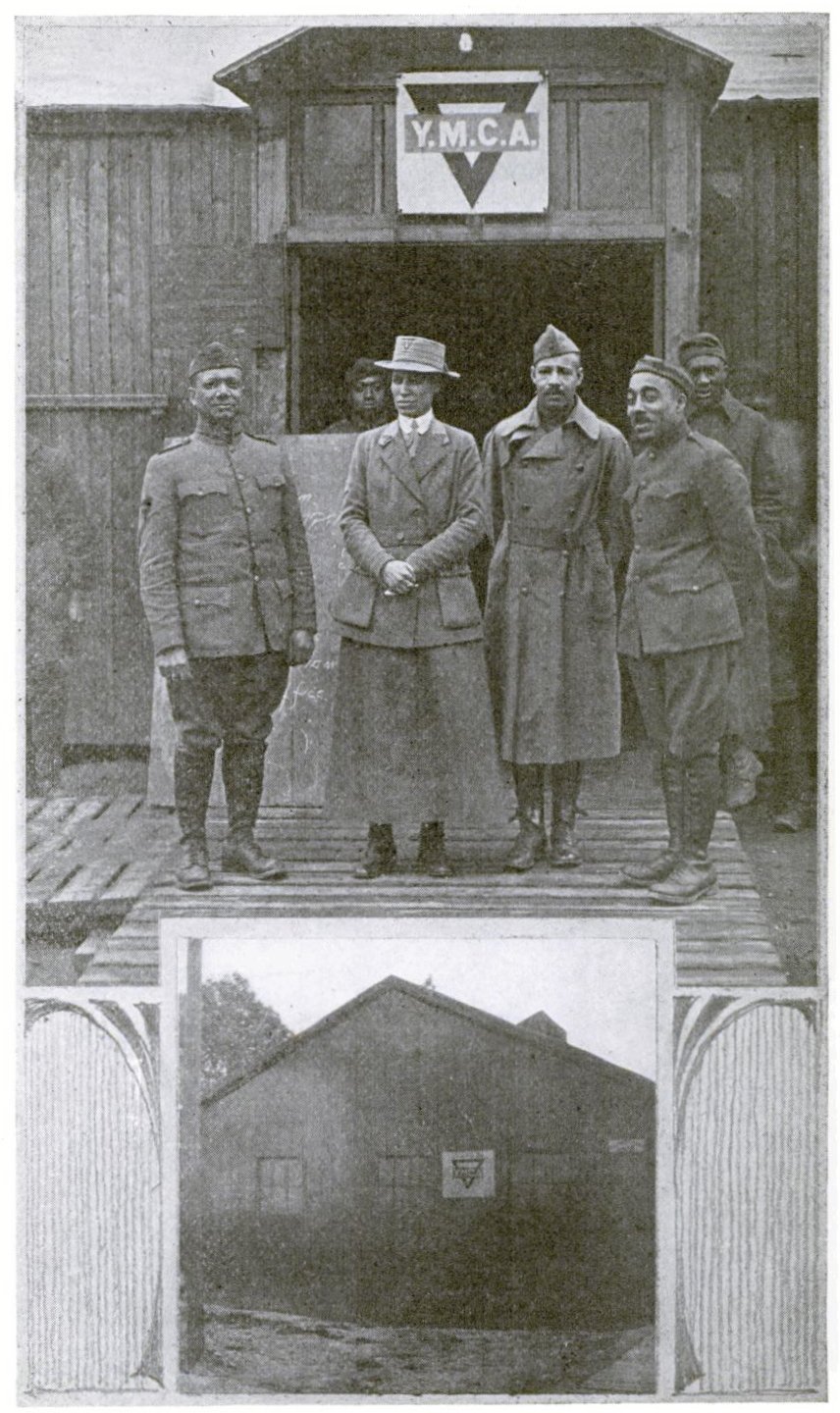
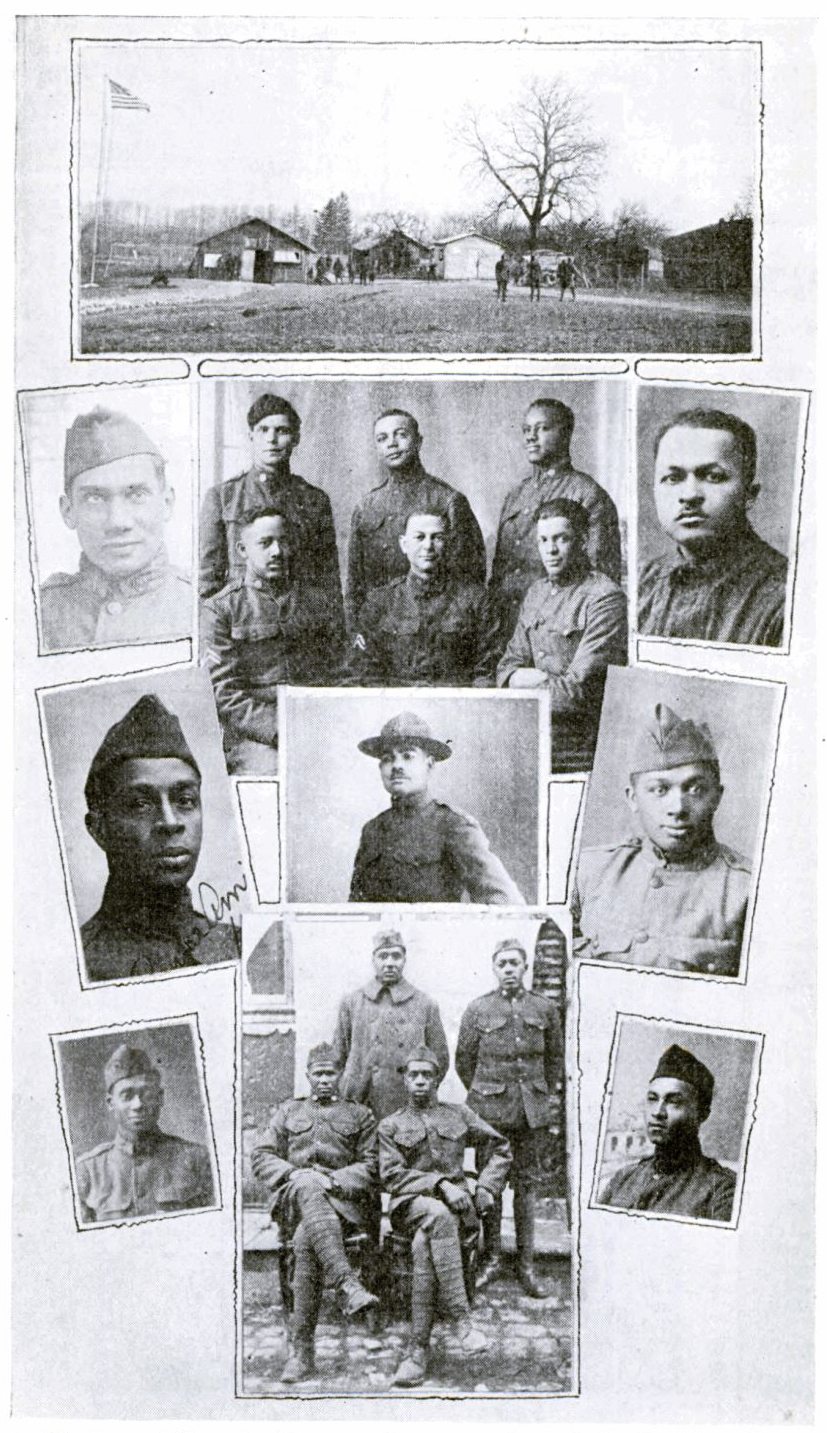
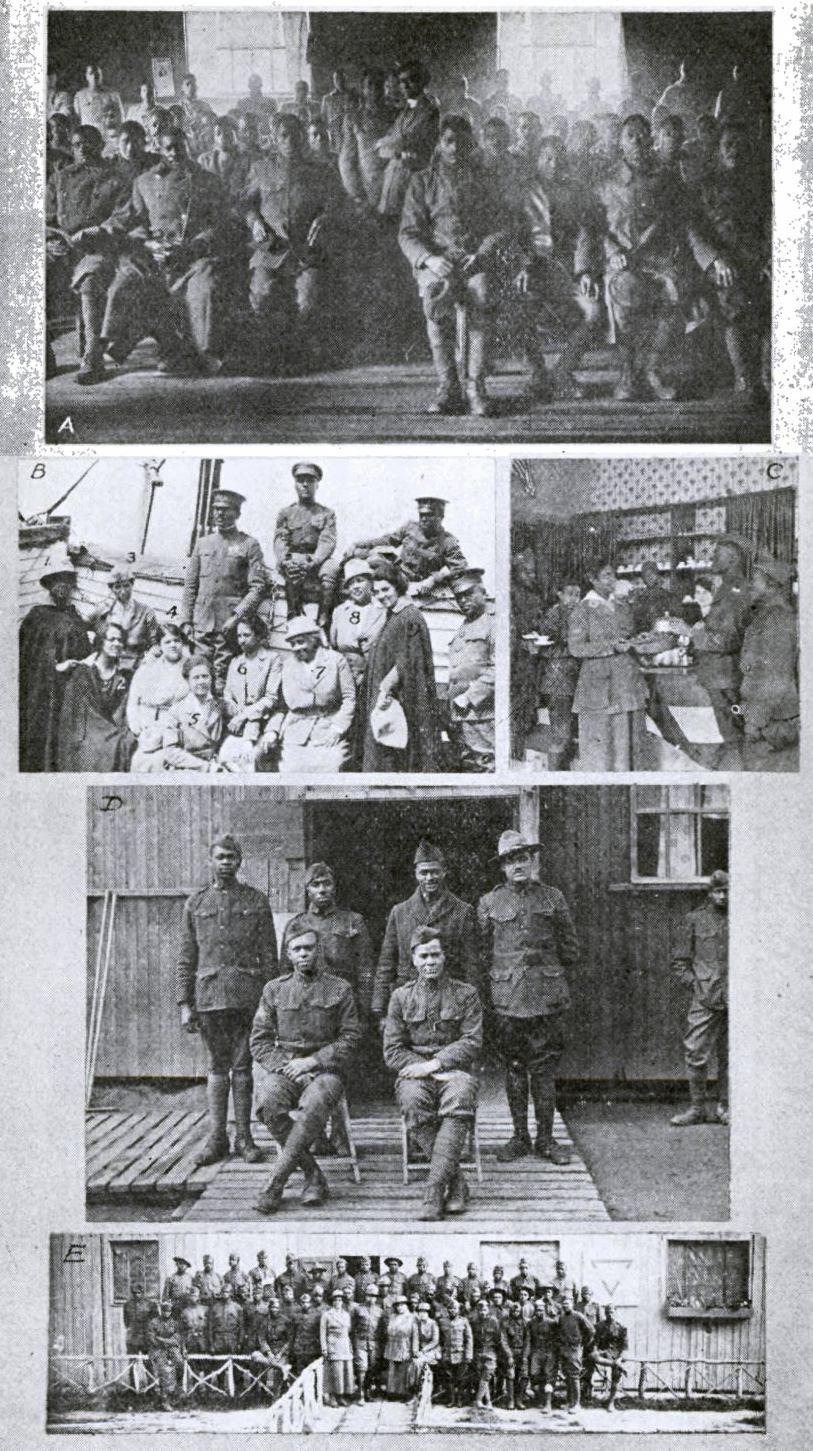
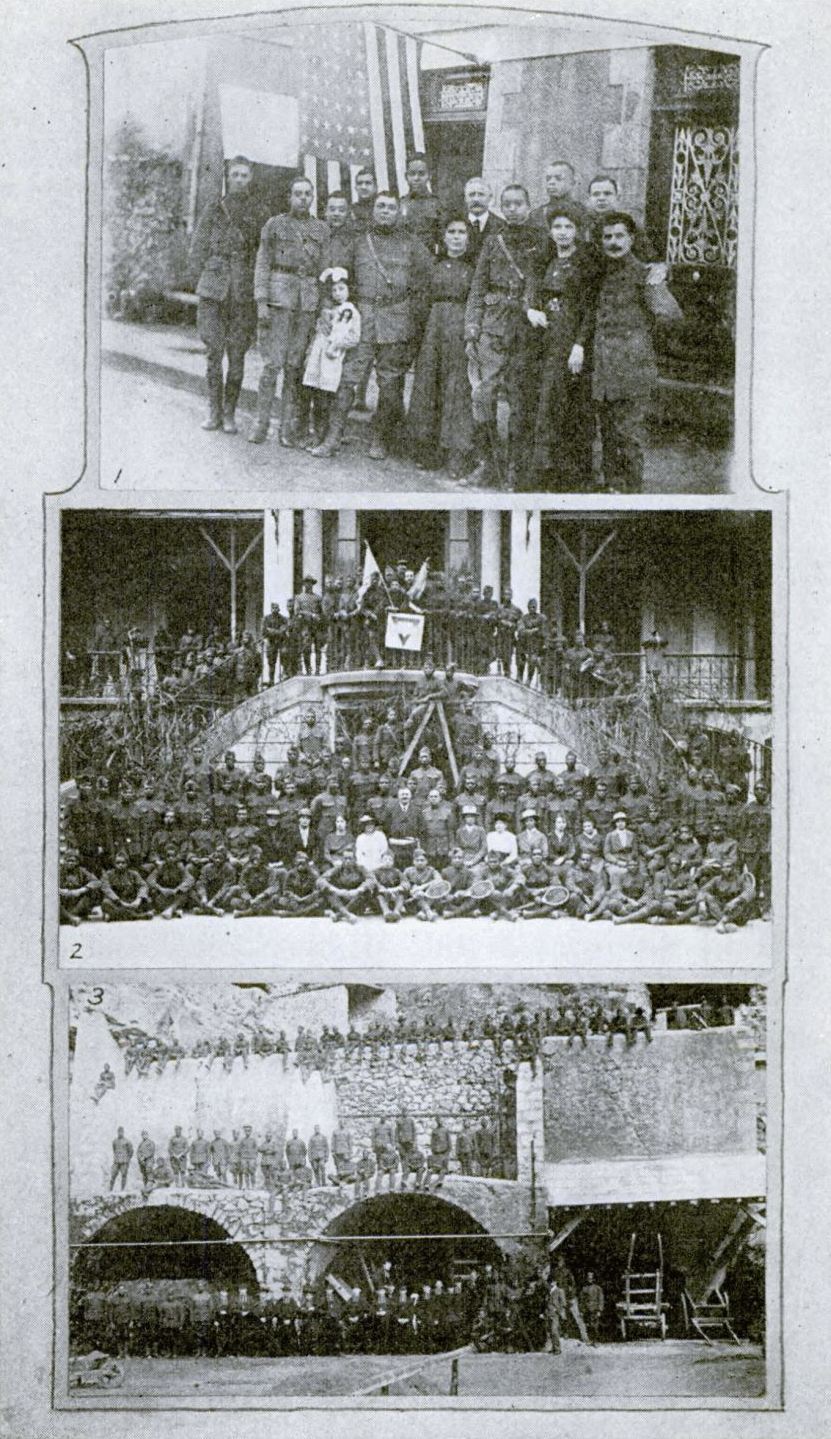
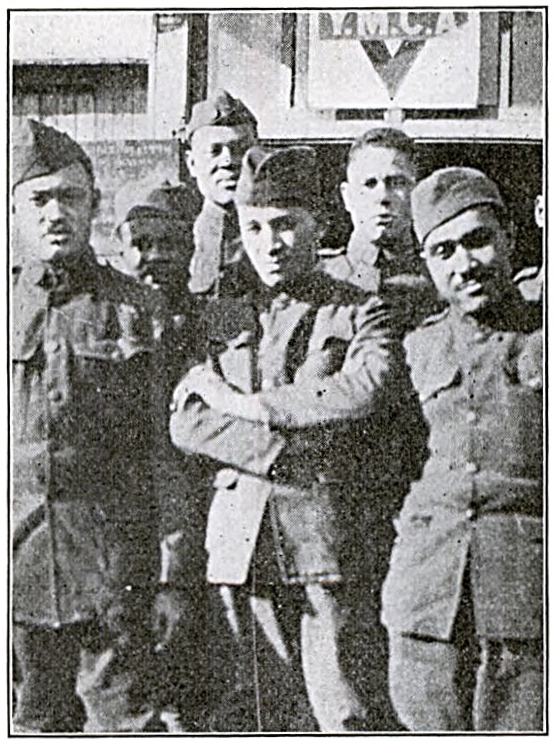
officers would order signs put up. On another page
is a picture of a hut located at Camp Guthrie, near
St. Nazaire. The small sign just on the right of the
picture says, “Colored Soldiers Only.” The hut
secretary here was a colored man, the Rev. T. A.
Griffith, formerly of Des Moines, Iowa, and Topeka,
Kan. To this hut came many white soldiers to
listen to his sermons, and to get into the ice cream
line at the canteen. At the same time many of
the colored soldiers went to the other hut, where
there was a white secretary, to be served in the ice
cream line. In time these boys were told that they
must get out of the line and be served at their own
hut. Simultaneously Rev. Griffith was told to keep
the white men out of his line, and let them be
served where there were white secretaries. Rev.
Griffith did not do this, but left the order to be
enforced by the colonel who had made it. When
the colonel saw that his order was not being recognized
at the colored hut, he had the sign put up as
shown in the picture. Rev. Griffith made a number
of efforts to get the sign removed, but to no
avail.
The following is a copy of an order issued in
another section:
HEADQUARTERS CONCENTRATION CAMP
S. O. S. Troops—Remacourt
Memorandum
Y. M. C. A.
There are two Y. M. C. A.’s, one
near the camp, for white troops, and one in town, for the colored troops.
All men will be instructed to patronize their own Y.
By order
of Col. Doane.
John A. Schweitzer, 1st Lt. Inf.,
Adjutant.
May, 1919.
But there were splendid men among both secretaries
and army officials, who honestly and actively
opposed discrimination. Mention already has been
made of our personal knowledge of Mr. W. S.
Wallace at St. Nazaire, who was always on the
alert to see that the colored soldiers had a square
deal; while at Brest we found an equally fine
spirit in the person of Major Roberts, the army welfare
officer.
While welfare organizations other than the
Y. M. C. A. did not employ colored workers, still,
we had the opportunity of observing the attitude
they assumed toward the colored troops. It was a
part of the multiplicity of the duties of colored
Y women to visit the hospitals; here they found
colored soldiers placed indiscriminately in wards
with white soldiers, while officers were accorded the
same treatment as were their white comrades.
However, we learned that in some places, colored
officers would be placed in wards with private soldiers,
instead of being given private rooms, as was
their military right; and one soldier tells how,
after being twice wounded in the Argonne drive,
he was taken to Base Hospital No. 56; here he, and
others, waited three days before they could secure
the attention of either a doctor or a nurse; but
when these attendants finally came, the colored
soldiers were taken from the hospital beds and
placed on cots which were shoved into one end of
the room where there was no heat; they then received
medical attention, always after the others
had been well attended, and were given the food
that remained after the others had been served.
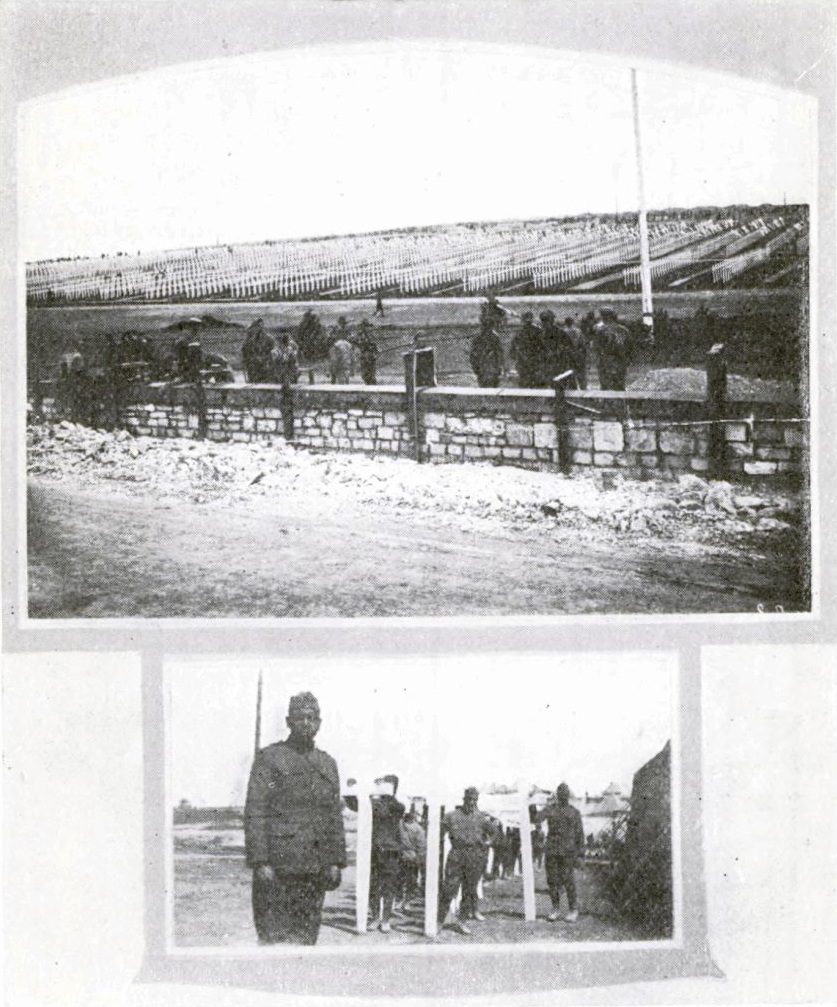
There was one notable incident of discrimination
on the part of the Knights of Columbus. It
occurred at Camp Romagne, where there were
about 9,000 colored soldiers engaged in the heartbreaking
task of re-burying the dead. The white
soldiers here were acting as clerks, and doing the
less arduous tasks. The Knights of Columbus
erected a tent here and placed thereon a sign to
keep colored soldiers away. The colored soldiers,
heartsore because they, of all the soldiers, German
prisoners, etc., that there were in France,
should alone be forced to do this terrible task of
moving the dead from where they had been temporarily
buried to a permanent resting place, immediately
resented the outrage and razed the tent
to the ground. The officers became frightened lest
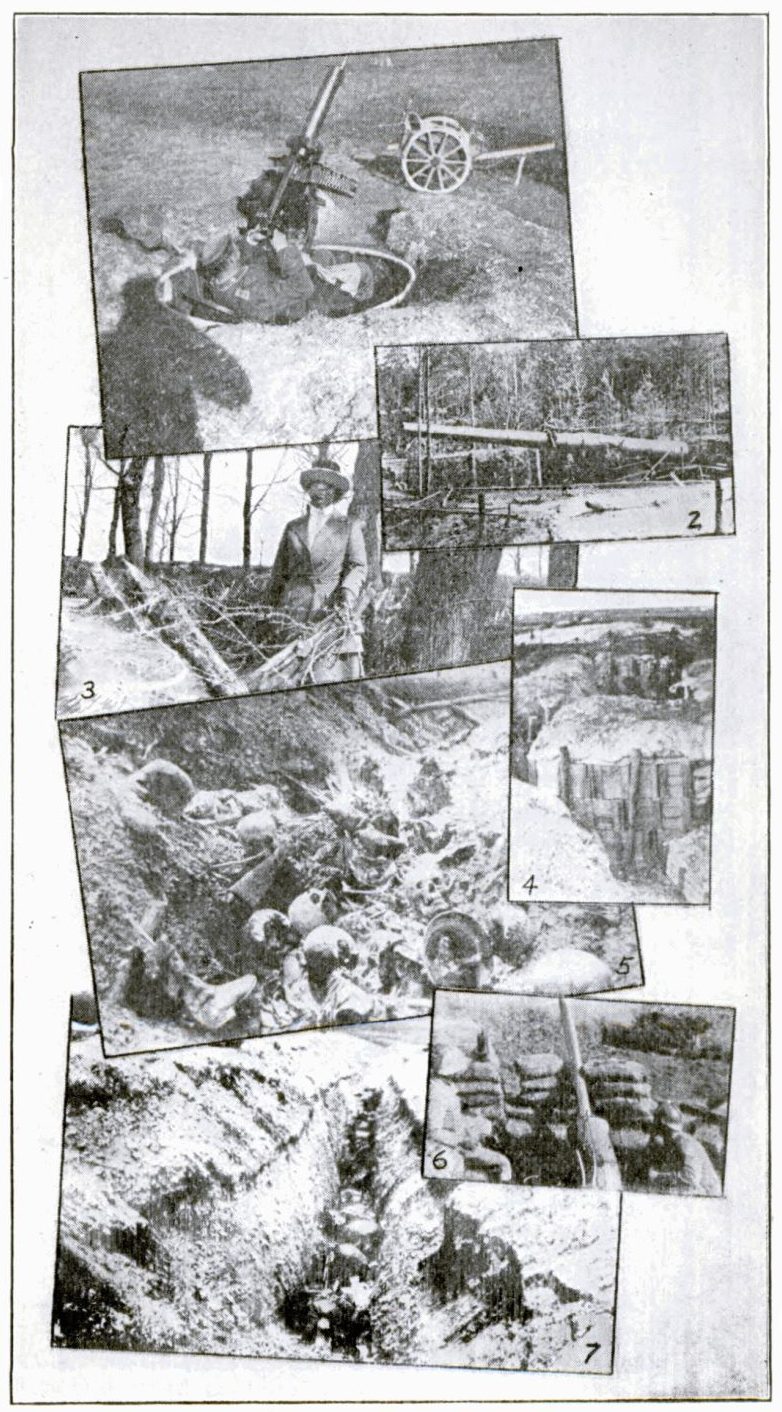
there should be mutiny, mounted a machine gun
to keep order, and commanded the four colored
women who were doing service there to proceed at
once to Paris.
As a rule, only words of praise were heard for
the Salvation Army, whose field of service was
very small but very excellent.
The Y. W. C. A. was another welfare organization
with overseas workers; their field of service
was among the women welfare workers of other
organizations, and the French war brides who
were waiting to come to America with their
American soldier husbands. No colored representative
of this organization was sent over, as the
number of colored women was so small that she
would have had no field in which to operate. Few,
if any, of the white Y. W. C. A. workers gave any
attention to this little colored group, notwithstanding
the fact that they were women, and Americans,
just like the others. One, however, remembers a
greeting of much insulting superiority and snobbishness,
by one of its representatives whom she met
on the street. After that she always felt it necessary
to keep in places where they were not to be
seen. Of course, all of them were not of this type,
but there was no way of being sure of those who
were not. As an organization there is no doubt
that much good was accomplished by them, especially
in furnishing reasonable and comfortable
hotel accommodations for women welfare workers
in Paris, and also in caring for the wives of soldiers
who were waiting to come home, in the
crowded seaport cities.
The largest Y. M. C. A. hut in France was one
built at Camp Lusitania, St. Nazaire, for the use
of colored soldiers. It was the first hut built for
our boys, and for its longest period of service was
under the supervision of Rev. D. Leroy Ferguson,
of Louisville, Ky. It reached its highest state of
efficiency and cleanliness under Mr. J. C. Croom, of
Goldsboro, N. C. It did service for 9,000 men, and
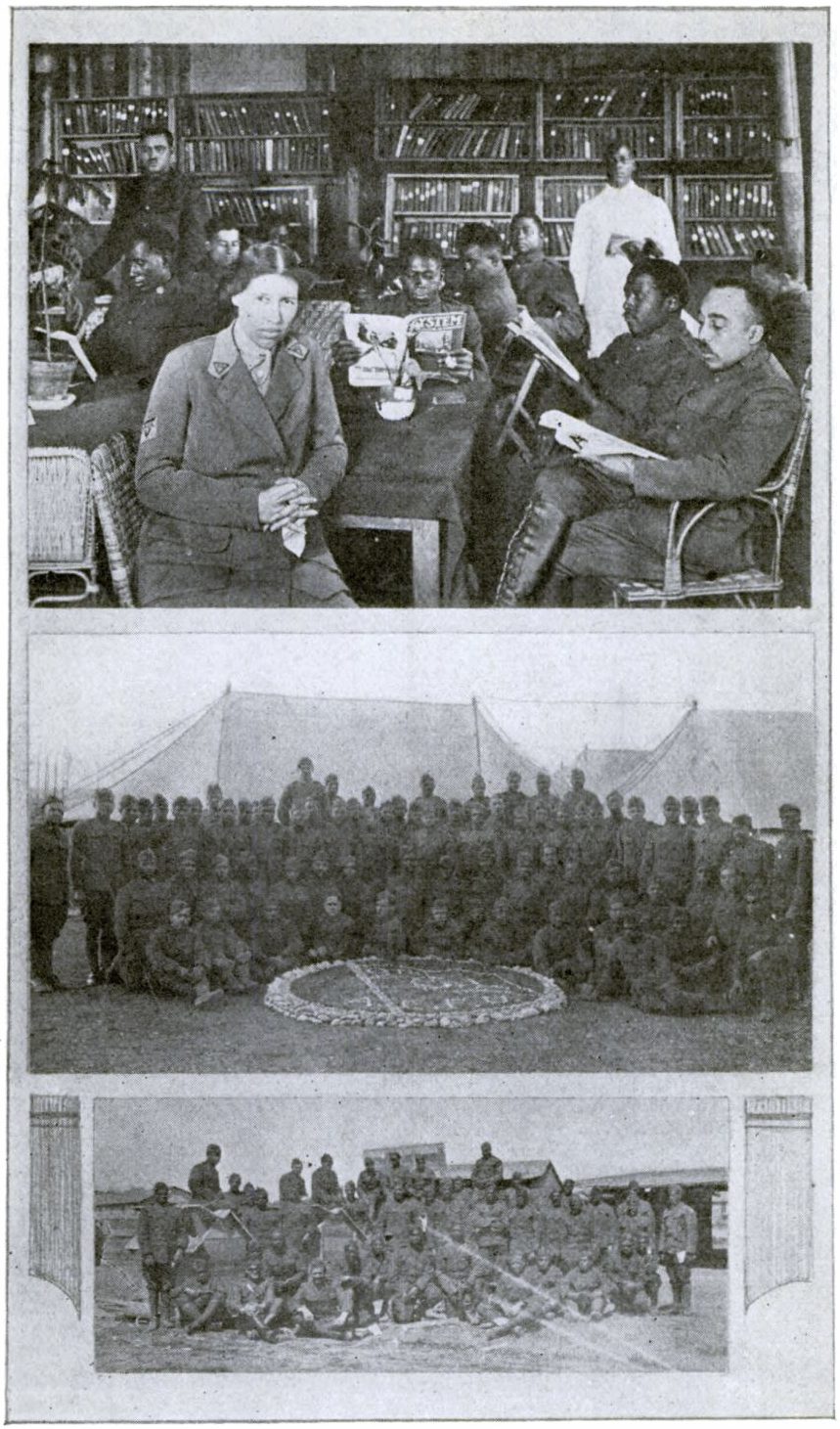
had, in addition to the dry canteen, a library of
1,500 volumes, a money-order department which
sometimes sent out as much as $2,000 a day to
the home folks; a school room where 1,100 illiterates
were taught to read and write; a large lobby
for writing letters and playing games; and towards
the close of the work, a wet canteen, which served
hot chocolate, lemonade and cakes to the soldiers.
To this hut one of us was assigned, and served
there for nearly nine months. The work was
pleasant and profitable to all concerned, and no
woman could have received better treatment anywhere
than was received at the hands of these 9,000
who helped to fight the battle of St. Nazaire by
unloading the great ships that came into the harbor.
Among the duties found there were to assist
in religious work; to equip a library with books,
chairs, tables, decorations, etc., and establish a
system of lending books; to write letters for the
soldiers; to report allotments that had not been
paid; to establish a money order system; to search
for lost relatives at home; to do shopping for the
boys whose time was too limited to do it themselves;
to teach illiterates to read and write; to
spend a social hour with those who wanted to tell
her their stories of joy or sorrow.
All of this kept one woman so busy that she
found no time to think of anything else, not even
to take the ten days’ vacation which was allowed her
every four months. In a hut of similar size among
white soldiers, there would have been at least six
women, and perhaps eight men. Here the only
woman had from two to five male associates.
Colored workers everywhere were so limited that
one person found it necessary to do the work of
three or four.
Just on the suburbs of St. Nazaire, about two
miles from Camp Lusitania, was another hut, the
second oldest for colored men in France. Here
the other one of the writers spent six months of
thrilling, all-absorbing service; while about six
miles out, in the little town of Montoir, where
thousands of labor troops and engineers had permanent
headquarters, the third of the colored
women to come to this section ran a large canteen,
supplying chocolate, doughnuts, pie and sometimes
ice cream to the grateful soldiers. This hut
was far too small for the number of soldiers it
had to entertain, but it was made large in its hospitality
by the genial, good-natured, energetic Mr.
William Stevenson, its first hut secretary, now
Y. M. C. A. secretary, Washington, D. C. He
started the work in a tent, and built it up to a veritable
thriving beehive of activity.
There were several other localities in the neighborhood
of St. Nazaire, where one colored secretary
would be utilized to reach an isolated set.
They usually worked in tents. Other places where
Y. M. C. A. buildings, huts or tents for colored
soldiers were located, were Bordeaux, Brest, Le
Mans, Challes-les-Eaux, Chambery, Marseilles,
Joinville, Belleau Wood, Fere-en-Tardenois, Orly,
Is-sur-Tille, Remacourt, Chaumont, and Camp
Romagne near Verdun.
Rolling canteens ran out from some places,
reaching points where the soldiers had no Y. M.
C. A. conveniences. This was a small automobile
truck, equipped with material for serving chocolate
and doughnuts, and operated by a chauffeur, and
a Y woman who dispensed smiles and sunshine to
the ofttimes homesick boys, along with whatever
she had to tempt their appetites.
The last, and perhaps the most difficult piece of
constructive work done by the colored workers, was
at Camp Pontanezen, Brest. It has been told in
another chapter how one of the writers received
Brest as her first appointment, and how she was
immediately informed upon her arrival that because
of the roughness of the colored men, she
would not be allowed to serve them. That woman
went away with the determination to return to
Brest, and serve the colored men there, if there
was any way to make an opening; so after finishing
her work in the Leave Area, she and her co-worker,
who had been relieved from duty at Camp
Romagne, were finally permitted to go there, as
has been previously explained.
Upon their arrival, they were told that they would
be assigned to Camp President Lincoln, where there
were about 12,000 S. O. S. troops. Here there
were several secretaries and chaplains, and the
need was greater at Camp Pontanezen, where there
were 40,000 men, and only one colored secretary.
The writers requested that they be located there.
The appointment was held up for one day, and
finally they became located at Soldiers’ Rest Hut,
in the desired camp.
They were told that they must retain a room in
the city, as the woman’s dormitory at Camp Pontanezen
was filled to its capacity. But they contended
that to do so would take them away from
the soldiers at a time in the evening when they
could be of the greatest service. Finally, it was
arranged for them to stay in the hut, much to the
dissatisfaction of the white secretary in charge.
The next morning before they left their room,
a message was received, telling them that transportation
would be at the door at any moment they
desired, to take them back to Brest; that Major
Roberts, the Camp Welfare Officer, had said that
they must not stay in the hut. Upon investigation
by Mr. B. F. Lee, Jr., the lone colored secretary
at this tremendous camp, it was learned that Major
Roberts had been told that the women were uncomfortable,
and did not wish to stay.
Mr. Lee explained that such was not true. The
Welfare Officer then visited the hut, talked with the
women, recognized the situation, gave his consent
to their staying, and assured them that he was
willing and ready to do anything in his power to
make them comfortable, and assist in equipping
the hut. The white secretary, seeing that the
women were going to stay, acquiesced in the situation,
instead of moving out, and did everything he
could to assist.
After this there was no difficulty experienced at
Camp Pontanezen. The camp secretary and his
staff put every means at our disposal to assist us
in the work, while the head of the women’s work
was at all times helpful and sympathetic. From
the time she received us at Brest, until our departure,
she showed us every consideration and courtesy
due Y. M. C. A. secretaries.
During the nearly seven weeks there, the chief
of the women’s work for France paid the city a
visit, in order that she might, among other things,
visit the colored work.
The two women remained in the same hut about
two weeks, when Major Roberts gave one of the
most beautiful huts in the camp to the colored
soldiers. It had been occupied by the 106th
Engineers, and had been built for their own private
use. It contained a beautiful stage; a large auditorium,
seating 1,100 people, with a balcony and
boxes for officers. It also had a beautiful library
and reading room, as well as a wet canteen. To
this hut came Mr. B. F. Lee, Jr., and one of the
women, while the other remained at Soldiers’ Rest
Hut, and became its hut secretary. To join them
came two other women from Paris, one of whom
was placed in each hut, making the total number
of women secretaries, four.
The new hut was quickly gotten in order, sleeping
quarters being arranged, a new library built, and
a game room made by removing partitions from
under the balcony.
There were several other large huts at Camp
Pontanezen, that were used for long periods exclusively
by colored soldiers; but in the absence
of colored women, white women, sometimes as
many as five in a hut, gave a service that was
necessarily perfunctory, because their prejudices
would not permit them to spend a social hour with
a homesick colored boy, or even to sew on a service
stripe, were they asked to do so. But the
very fact that they were there showed a change in
the policy from a year previous, when a colored
woman even was not permitted to serve them.
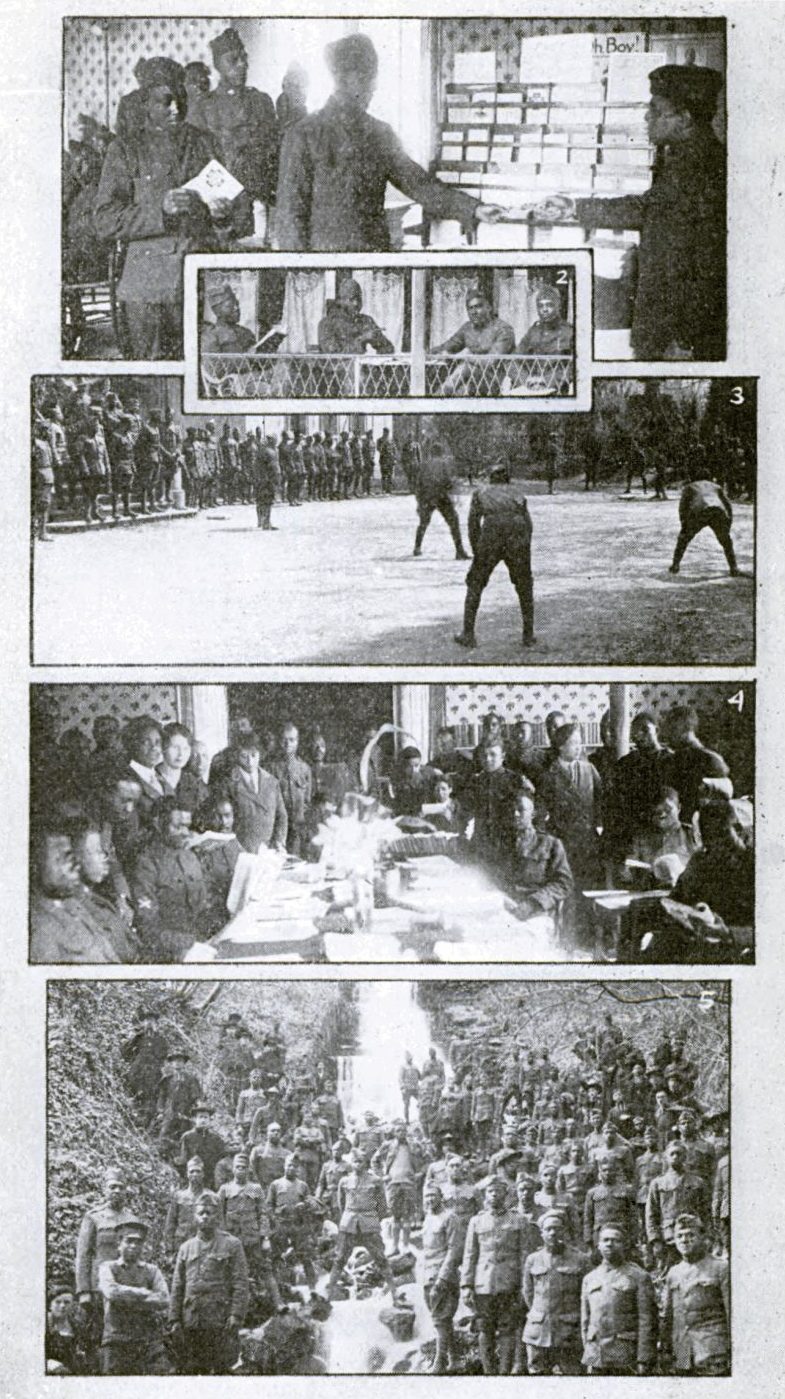
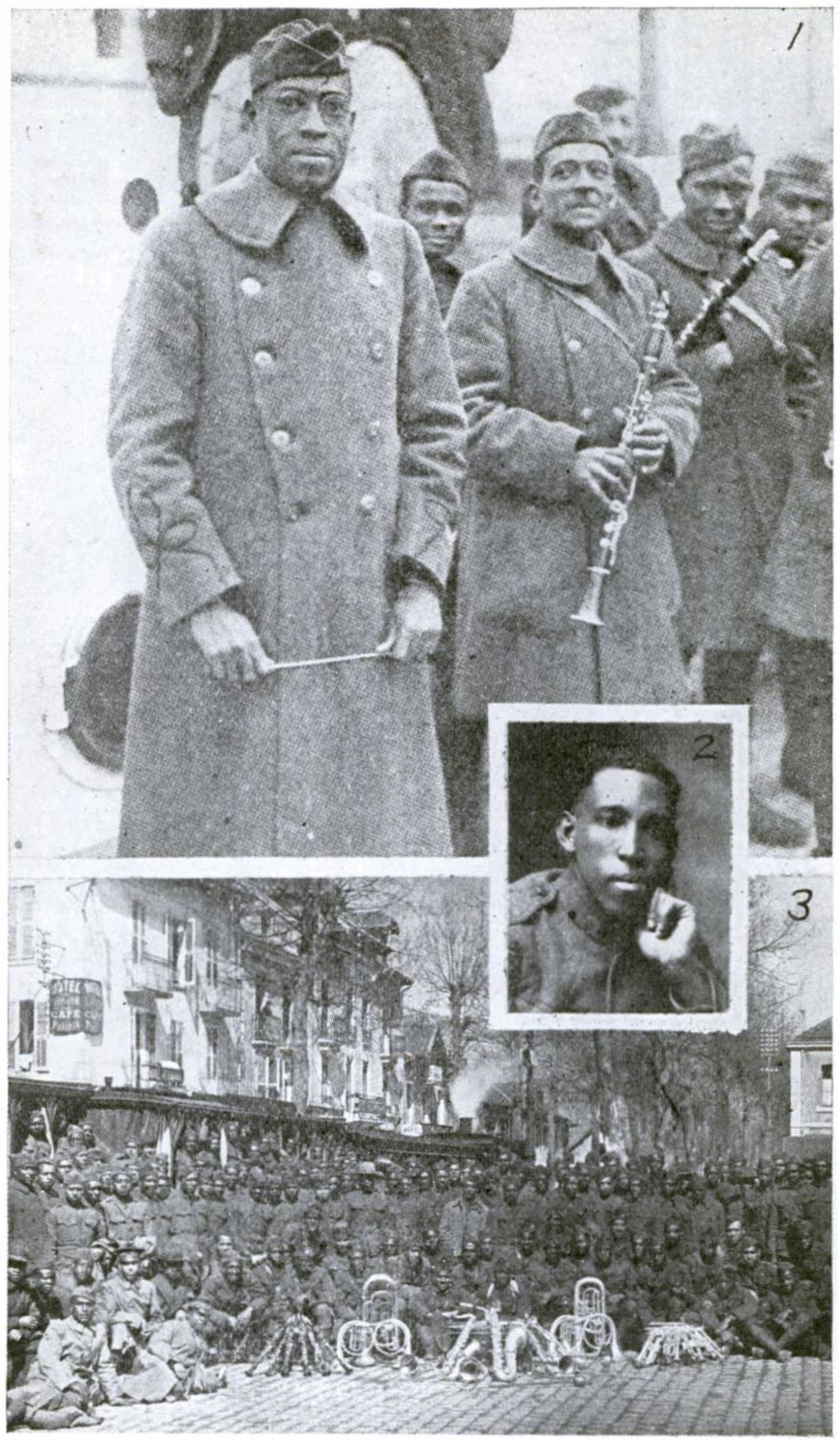
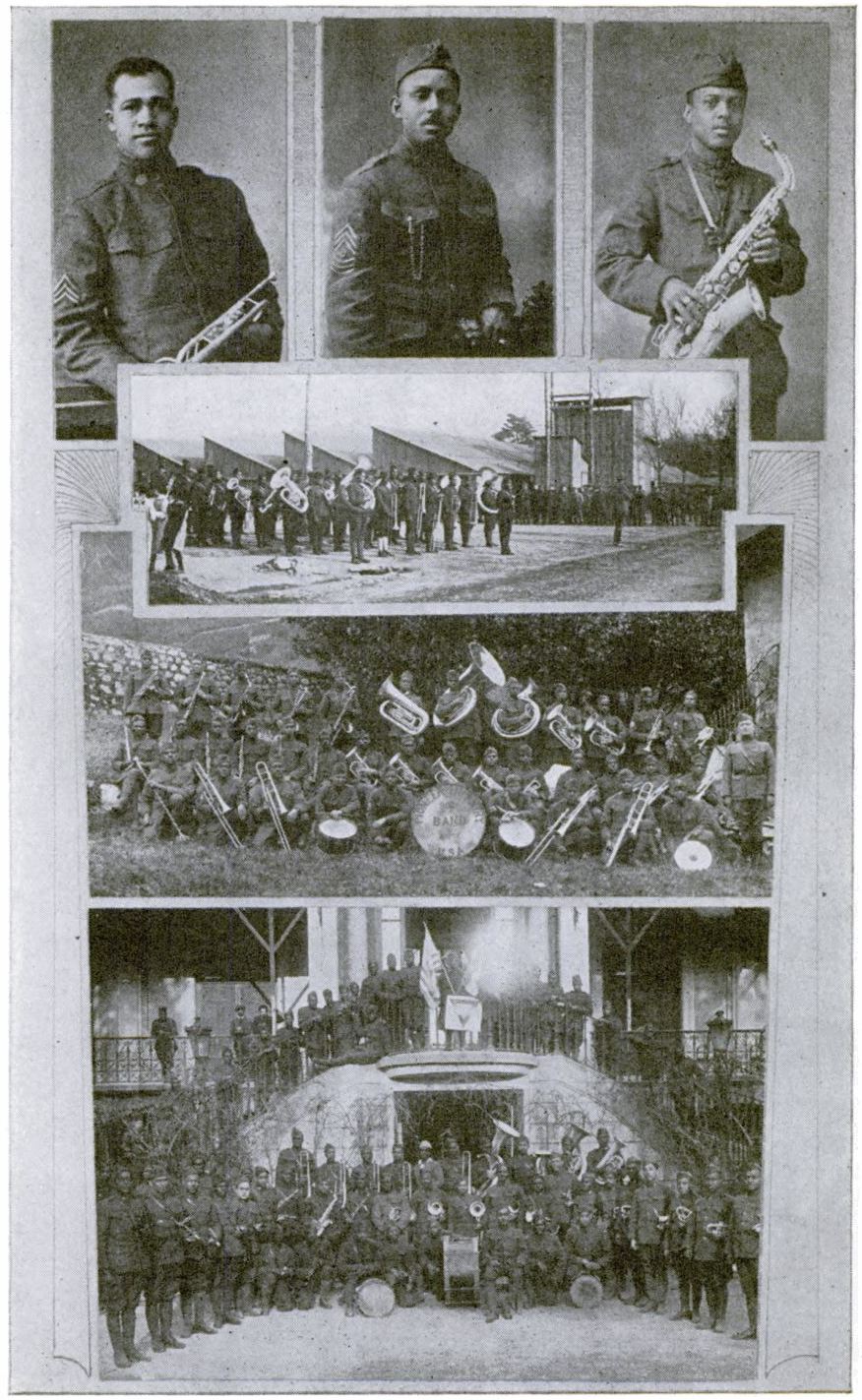
In nearly all the Y. M. C. A. huts, in every section
of France, moving pictures would be operated
every afternoon and evening. Many times before
the movies, some kind of an entertainment would
be furnished by the entertainment department of
the Y. M. C. A. There were shows furnished by
French or American dramatists; concert parties by
singers and musicians of all nationalities, and frequently
a lecture on health and morals. The
movies and shows were the most popular forms of
entertainment, and on these occasions the huts
would always be crowded, as all entertainments
given by the Y. M. C. A. were free.
The organization also did much to promote clean
morals among the men, by the free distribution of
booklets, tracts, and wholesome pictures. This
literature would be placed in literature cases, and
the men would select their own material, while the
pictures would be placed in parts of the hut where
they would be easily visible. Some of the booklets
which were unusually popular among the men were
“Nurse and Knight,” “Out of the Fog,” “When a
Man’s Alone,” “The Spirit of a Soldier,” and
“A Square Deal”; while quantities of other stories
with sharply drawn morals were distributed by the
thousands and thousands of copies.
All told, the Y. M. C. A., with a tremendous
army of workers, many of whom were untrained,
did a colossal piece of welfare work overseas. The
last hut for the colored Americans in France was
closed at Camp Pontanezen, Brest, on August 3,
1919, by one of the writers; the two of them having
given the longest period of active service of
any of the colored women who went overseas.