
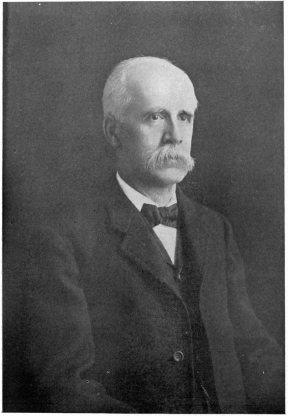
 HENRY S. MYGATT
President of the Bi-Centennial Celebration
Contributed by Charles N. Hall
In April, 1906, a call was issued in the columns of the New Milford
Gazette, asking all citizens to meet at Mygatt’s Hall, Bank Street, on
Monday evening, April 30, to consider the project of celebrating the
town’s two hundredth anniversary.
About forty citizens responded to the appeal and met at the appointed
time and place.
The meeting was called to order by Mr. William G. Green, and Mr. Henry
S. Mygatt was appointed chairman of the meeting.
After full discussion as to the possibility and advisability of such a
celebration as that implied in the call, the following preamble and
resolution were adopted:
“Whereas, New Milford was first settled in the year of our Lord, 1707,
and has from a humble beginning gone steadily forward in growth and
prosperity, through the industry and patriotism of its sons and
daughters, and the blessings of a Divine Providence:
“And Whereas, It seems fitting that the two hundredth anniversary of
this town, now near at hand, should be recognized and celebrated by all
its citizens in such manner as to confer proper dignity upon the
occasion; to call together for a day all its children; to honor the
memories of those who contributed to its past and present welfare; to
show the industrial, agricultural, commercial, educational, and
religious progress of the community throughout the past years; and to
give due thanks to the Providence that has watched over it.
“Therefore it is Resolved: That during the year 1907, upon a date to be
named at a future meeting, there shall be held a celebration to be known
as the New Milford Bi-Centennial.”
After further discussion as to forms of organization, it was voted:
“That in accordance with the spirit of the foregoing resolution, this
meeting shall appoint a General Committee of Arrangements, said
committee to have entire charge of all arrangements pertaining to the
New Milford Bi-Centennial Celebration; to have power to make changes in
and additions to its own numbers; to have authority to appoint and
organize all necessary sub-committees, and the power to direct the work
of such sub-committees, and to make removals and substitutions in such
sub-committees; and to take any and all measures necessary to carry the
foregoing resolution into effect.”
The meeting then appointed a Nominating Committee consisting of C. M.
Beach, W. G. Green, H. L. Randall, S. S. Green, G. M. Breinig, and Rev.
Marmaduke Hare, to present to the meeting the names of those who should
constitute the General Committee of Arrangements.
After consultation, the Nominating Committee presented a list of those
persons who should constitute the General Committee, and those so named
were by vote declared appointed as the General Committee of
Arrangements, with the powers and duties above set forth.
It was then voted:
“That when this meeting adjourns, the chairman of this meeting shall
have authority to call, at his pleasure, a meeting of the General
Committee of Arrangements.”
The meeting then adjourned.
The General Committee of Arrangements met on July 6, 1906, about one
hundred members being present. At this meeting a permanent organization
was effected, officers elected, sub-committees appointed, and a date set
for the celebration.
The officers elected were:
Permanent Chairman and President, Henry S. Mygatt; Vice-Presidents,
Andrew G. Barnes, Francis E. Baldwin, Stephen C. Beach; General
Secretary, Charles N. Hall.
It was voted:
“That the Celebration be held on Saturday, Sunday, Monday, and Tuesday,
June 15, 16, 17, 18, 1907.”
It was voted:
“That Sub-Committees be created as follows:
An Executive Committee,
A Finance Committee,
A Committee on Exercises,
A Committee on Refreshments,
A Committee on Decoration,
A Committee on Publicity,
A Committee of Invitation, Reception, and Entertainment;
A Committee on Religious Observances,
A Committee of Public Safety,
A Committee on Historical Research and Permanent Publication.”
It was further voted:
“That each member of the General Committee pay the sum of one dollar,
and each member of a sub-committee the additional sum of two dollars to
the Bi-Centennial fund.”
Subsequently the Executive Committee, acting for the General Committee,
appointed from time to time other sub-committees found necessary in the
progress of the work. These were:
A Loan Exhibit Committee,
A Committee on Vocal Music,
A Colonial Reception Committee.
The officers and members of the General Committee of Arrangements were
as follows:
President, Henry S. Mygatt;
Vice Presidents, Andrew G. Barnes, Frances E. Baldwin, Stephen C.
Beach;
Secretary, Charles N. Hall;
Members
John F. Addis.
Mrs. John F. Addis.
Geo. E. Ackley.
Mrs. Geo. E. Ackley.
W. H. Adams.
Victor L. Anderson.
Emil Anderson.
|
Geo. B. Ackley.
Mrs. Geo. B. Ackley.
Fred Anderson.
Mrs. Geo. W. Anthony.
Mrs. Phoebe L. Anderson.
Horace A. Allen.
Rev. J. J. Burke. |
Dr. J. C. Barker.
Dr. B. E. Bostwick.
Chas M. Beach.
Alexander H. Barlow.
W. G. Brown.
Charles P. Bentley.
Reuben Booth.
G. M. Breinig.[11]
David E. Breinig.
Henry M. Baldwin.
Willis F. Bennett.
Willis G. Barton.
Dr. Charles P. Blinn.
Mrs. Wm. D. Black.
William H. Booth.
H. B. Bostwick.
Burton B. Booth.
Mrs. J. L. Buck.
Mrs. J. A. Bolles.
Mrs. Wm. Bostwick.
Miss Ruth T. Booth.
Frederick L. Bennett.
Andrew Buckingham.
Mrs. Chas. M. Beach.
Mrs. G. M. Breinig.
Mrs. A. M. Booth.
Mrs. H. E. Bostwick.
Miss C. B. Bennett.
Miss A. E. Bostwick.
Miss Helen M. Boardman.
Miss Kate T. Boardman.
Miss Grace Buckingham.
Miss May Brown.
Miss Adaline L. Buck.
Mrs. J. C. Barker.
Mrs. B. E. Bostwick.
Amos H. Bowers. |
A. C. Bowers.
Andrew M. Booth.
Mrs. David A. Baldwin.
Mrs. Willis F. Bennett.
Lyman W. Brown.
Andrew J. Baldwin.
Noble Bennett.
E. Noble Bennett.
Mrs. Merritt Beach.
Mrs. I. B. Bristol.
Mrs. Edwin N. Bostwick.
Daniel B. Brewer.
Henry Booth.
Wiliam E. Bostwick.
Rev. T. J. Cronin.
Andrew C. Clark.
Mrs. Andrew C. Clark.
Daniel H. Canfield.
Lawrence C. Camp.
Robert B. Clark.
L. F. Curtis.
Mrs. L. F. Curtis.
P. M. Cassedy.
John D. Clark.
Alanson N. Canfield.
Mrs. Geo. N. Canfield.
Mrs. Lemira J. Carter.
Howard C. Clark.
Phineas E. Clark.
Warren S. Crossman.
John B. Cox.
Chas. B. Camp.
Salmon Couch.
A. L. Conkey.
Rev. Frank B. Draper.
Dr. J. A. Dolan.
Henry Donnelly. |
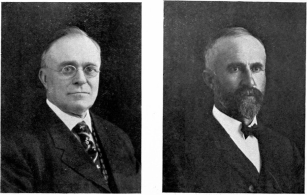
SEYMOUR S. GREEN
Chairman Executive Committee |
HONORABLE ANDREW G. BARNES
Vice-President |
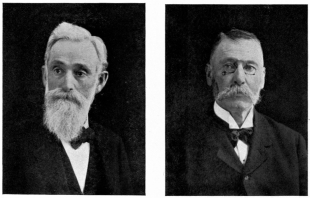
STEPHEN C. BEACH
Vice-President |
FRANCIS E. BALDWIN
Vice-President |
| SOME OFFICERS OF THE BI-CENTENNIAL CELEBRATION |
Robert L. Duncan.
Eben B. Dorwin.
Myron B. Disbrowe.
Edwin J. Emmons.
Mrs. Edwin J. Emmons.
Albert Evitts.
Rollin C. Emmons.
Chas. H. Evans.
Miss S. C. Erwin.
Thomas Fuller.
Munson Fairchild.
Alban G. Ferriss.
Samuel J. Ferriss.
Mrs. Albert Ferriss.
Henry Ferriss.
Miss Minnie A. Ferriss.
Miss Jane Fenn.
Dr. H. B. Griswold.
Minot S. Giddings.
Levi P. Giddings.
Wm. G. Green.
Seymour S. Green.
Henry Garvey.
Miss Jeanette L. Gaylord.
William F. Gaylord.
Fred R. Green.
Ethiel S. Green.[12]
William B. Green.
George W. Green.
William Green.
George H. Gaylord.
Mrs. James Giddings.
Rev. Marmaduke Hare.
Rev. Stephen Heacock.
J. E. Hungerford.
Mrs. J. E. Hungerford.
Walter C. Hine. |
Mrs. Walter C. Hine.
Mrs. Charles N. Hall.
J. Stuart Halpine.
Wm. H. Hartwell.
Frederick C. Hoyt.
Henry D. Hine.
Oliver W. Hoyt.
Mrs. H. D. Hine.
Mrs. W. B. Hatch.
Virgil B. Hatch.
Merritt W. Hill.
Mrs. Mary H. Hunt.
Edson P. Hill.
Harvey B. Hoyt.
Martin L. Hungerford.
Arthur B. Hungerford.
Sheldon B. Hendricks.
Mrs. Sheldon B. Hendricks.
John H. Hall.
Edward Hendricks.
Merwin Hine.
G. W. Hatch.
G. L. Hamlin.
Oliver S. Hartwell.
Roger T. Hartwell.
Robert J. Hungerford.
E. D. Howland.
Minot L. Hartwell.
John T. Hepburn.
John M. Hine.
Frederick W. Hartwell.
Clark M. Hunt.
Samuel R. Hill.
Henry H. Hartwell.
Albert S. Hill.[12a]
Allen S. Hill.
Edgar F. Hawley. |
E. F. Hartwell.
H. C. Ives.
Rev. Frank A. Johnson.
George H. Jackson.
L. N. Jennings.
Lucius Jackson.
Michael A. Kelly.
Dr. F. E. King.
Mrs. F. E. King.
W. F. Kinney.
Mrs. W. F. Kinney.
Nelson W. Kinney.
Arthur W. Knowles.
Henry Kinney.
Frederick W. Knowles.
Frederick Knapp.
Henry Kinney, 2d.
Joseph La Hait.
Geo. H. Lines.
Walter B. Leavenworth.
Carr S. Lyon.
Wm. P. Landon.
Frank W. Marsh.
A. H. McMahon.
Mrs. A. H. McMahon.
Daniel Marsh.
Chauncey B. Marsh.
J. B. Merwin.
Roland F. Mygatt.
Frederick Merwin.
Mrs. H. S. Mygatt.
Miss. Grace H. Merwin.
John H. Morehouse.
James E. Mullins.
Miss Carrie H. Marsh.
Mrs. Margaret Moore.
Mrs. Carlos Merwin. |
M. H. Mallett.
Amos H. Marsh.
James Marsh.
Miss Lottie Mallett.
Henry W. Murray.
Mrs. Henry W. Murray.
E. B. Marsh.
E. O. Marsh.
Mrs. E. O. Marsh.
Andrew J. McMahon.
Robert C. Mallory.
Wm. J. M. Miller.
James H. McMahon.[13]
George Newton.
Charles H. Noble.
Russell B. Noble.
Miss Ella F. Noble.
Wm. N. Noble.
Ithamer F. Northrop.
Jasper A. Northrop.
Alfred H. Noble.
Mrs. George Northrop.
Lawrence Northrop.
Charles Northrop.
J. H. Nettleton.
Charles H. Osborne.
Wilbur H. Osborne.
Abram Osborne.
Wallace W. Osborne.
Farley Osgood.
Robert A. Osborne.
Rev. John F. Plumb.
John Pettibone.
Henry H. Pomeroy.
Wm. B. Pell.
Mrs. Wm. B. Pell.
Mrs. Ivory Phillips. |
Mrs. Clayson S. Perry.
Charles Planz.
D. W. Pepper.
Wm. A. Parcells.
A. W. Peelstrom.
John Payne.
Edgar A. Peet.
Lewis A. Payne.
Lehman T. Peet.
Clinton H. Pomeroy.
H. Leroy Randall.
Mrs. H. Leroy Randall.
William J. Roberts.
Miss Sarah J. Roberts.
Mrs. C. E. Riddiford.
Charles Riley, Jr.
F. T. Richmond.
Seeley B. Richmond.
Mrs. Chas. Randall.
Mrs. Isaac Reynolds.
Wm. L. Richmond.
Levi S. Richmond.
Nathan H. Root.
C. E. Riddiford.
Orrin Roberts.
Rev. H. K. Smith.
Dr. Geo. E. Staub.
Verton P. Staub.
Nicholas Staub.[14]
Turney Soule.
Chas. H. Soule.
David E. Soule.
George T. Soule.
Frank E. Soule.
Henry S. Sanford.
Everett J. Sturges.
Frederick E. Starr. |
Mrs. Verton P. Staub.
Vincent B. Sterling.
Geo. W. Squires.
Miss Caro S. Sanford.
Mrs. V. B. Sterling.
Carl F. Schoverling.
Henry A. Soule.
Walter D. Soule.
Mrs. Catherine Smith.
Mrs. C. R. M. B. Smith.
Albert Sterling.
Wm. W. Stillson.
Frederick M. Straight.
James S. Sullivan.
Israel B. Smith.
Mrs. Wm. Schoverling.
Lee Stone.
Mrs. C. C. Smith.
Miss Harriet V. Sherman.
Mrs. Ellen F. Shepard.
Mrs. Charles Taylor.
Frederick J. Turrill.
Arthur G. Todd.
Cyrus A. Todd.
Mrs. R. S. Todd.
Mrs. Henry R. Treadwell.
Mrs. Lucy Turrill.
Chas. A. Tappen.
Miss Martha Treadwell.
John T. Underhill.
Rev. S. D. Woods.
Dr. Geo. H. Wright.
F. M. Williams.
Mrs. F. M. Williams.
Philip Wells.
Stanley L. Warner.
Henry O. Warner. |
Wm. D. Wanzer.
A. C. Worley.
John E. Wells.
Charles A. Way.
Miss Edith Warner.
Mrs. C. E. Wright.
Miss Charlotte A. Wells. |
Smith M. Waller.
E. M. Waller.
Frederick L. Wanzer.
Edward A. Wildman.
John F. Williams.
Newton B. Weaver.
Reuben M. Wilbur. |
| Miss Mary C. Wells. |
The members of the special committees—appointed by the General
Committee[15] to arrange for and carry out the plans for the
Celebration—were:
Executive Committee: Seymour S. Green, chairman; J. B. Merwin, Everett
Sturges, Verton P. Staub, Mrs. H. S. Mygatt, Mrs. C. M. Beach.
Finance Committee: H. Leroy Randall, chairman; Charles H. Noble,
treasurer; Willis G. Barton, William G. Green, Turney Soule, Edwin J.
Emmons.
Committee on Exercises: Charles M. Beach, chairman; John H. Morehouse,
clerk; Willis F. Bennett, Frank E. Soule, D. W. Pepper, John Pettibone,
Mrs. Verton P. Staub, Frederic M. Williams, Joseph La Hait, Samuel R.
Hill, Chauncey B. Marsh, Miss Helen M. Boardman, Miss Ella F. Noble, and
the selectmen of the town, ex officio.
The Committee on Exercises appointed the following marshals for the
Civic and Military Parade, and the following sub-committees to arrange
for Colonial features in the Parade and for an Automobile Carnival on
Monday, June 17:
Marshals: Samuel R. Hill, chief marshal; David E. Soule, George E.
Ackley, Henry O. Warner.
Committee on Colonial Features: Willis F. Bennett, chairman; Alfred H.
Noble, clerk; William G. Green, Dr. Charles P. Blinn, Chauncey B. Marsh,
Mrs. J. C. Barker, Miss Helen M. Boardman.
Committee on Automobile Parade: Roland F. Mygatt, chairman;
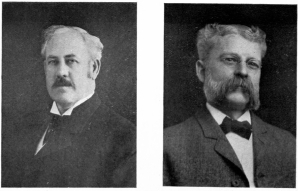
H. LEROY RANDALL
Finance Committee |
W. F. KINNEY
Invitation, Reception and
Entertainment
Committee |
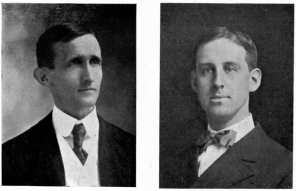
FREDERICK E. STARR
Music Committee
|
CHARLES P. BENTLEY
Decoration Committee |
| CHAIRMEN OF SOME BI-CENTENNIAL COMMITTEES |
Henry D. Hine, Dr. B. E. Bostwick, Robert Dunlap, S. Woolsey Pepper,
George T. Soule.
Committee on Refreshments: Miss Adaline L. Buck, chairman; J. Edwin
Hungerford, clerk; H. C. Ives, Vincent B. Sterling, Mrs. Charles N.
Hall, Mrs. Margaret Moore, Mrs. A. C. Clark, James E. Mullins, Wm. L.
Richmond, Mrs. Walter C. Hine, George E. Ackley, P. M. Cassedy, Dr. B.
E. Bostwick, Emil Anderson.
Committee on Decorations: Charles P. Bentley, chairman; Wm. B. Pell, Dr.
Charles P. Blinn, John F. Addis, Geo. T. Soule, Frederick L. Bennett,
Henry D. Hine, Mrs. F. E. King, W. H. Adams, A. W. Peelstrom, Levi P.
Giddings.
Committee on Publicity: Charles N. Hall, chairman; W. G. Brown, Dr. Geo.
H. Wright, A. C. Worley, David E. Breinig.
Committee on Invitation, Reception and Entertainment: W. F. Kinney,
chairman; Miss Sarah J. Roberts, secretary; Russell B. Noble, Mrs.
Frederic M. Williams, Mrs. H. S. Mygatt, Mrs. Albert H. McMahon, Henry
S. Sanford, Andrew C. Clark, Stanley L. Warner, Mrs. Isaac Reynolds,
Alexander H. Barlow, Andrew J. Baldwin, Charles Northrop, Mrs. George B.
Ackley, Mrs. C. E. Wright, Miss Caro S. Sanford, Mrs. Chas. Taylor, Mrs.
Wm. Bostwick, Mrs. Catherine Smith, Mrs. H. E. Bostwick, Orrin Roberts,
Mrs. Merritt Beach, Alanson N. Canfield, Albert Evitts, George H.
Jackson, Mrs. Wm. B. Pell, Miss A. E. Bostwick, Francis E. Baldwin,
Oliver S. Hartwell, Mrs. E. O. Marsh, Henry Ferriss, Miss Jeannette L.
Gaylord, Seeley B. Richmond, Mrs. Carlos Merwin, J. B. Merwin, Mrs. W.
D. Black, Mrs. J. L. Buck, Mrs. Phœbe L. Anderson, Mrs. Henry R.
Treadwell, Mrs. Wm. G. Green, Mrs. G. H. Jackson, Chas. B. Camp, Cyrus
A. Todd, and the selectmen of the town, ex-officio.
The chairman of this committee appointed Albert Evitts, chairman of
reception; Henry S. Sanford, chairman of entertainment.
Committee on Religious Observances: Rev. Frank A. Johnson, chairman;
Rev. John F. Plumb, Rev. Frank B. Draper, Rev. T. J. Cronin, Rev. J. J.
Burke, Rev. Marmaduke Hare, Rev. Stephen Heacock, Rev. H. K. Smith,
Rev. S. D. Woods, Rev. T. J. Lee.
Committee of Public Safety: Henry Donnelly, chairman; Charles Planz,
Albert H. McMahon, L. N. Jennings, Charles Reilly, Chas. H. Osborne.
Committee on Historical Research and Permanent Publication: Minot S.
Giddings, chairman; Russell B. Noble, Mrs. Henry E. Bostwick, Miss
Charlotte B. Bennett, Miss Kate T. Boardman.
Committee on Loan Exhibit: Dr. George H. Wright, chairman: Wm. B. Pell,
C. Andrew Humeston, Miss Flora G. Stillson, Herman C. Buckingham, Mrs.
Clarissa R. M. Staples, Miss Jeanette L. Gaylord, Miss Mabelle Sanford.
Committee on Vocal Music: F. E. Starr, chairman; Prof. Edwin G.
Clemence, director; Henry C. Harris, Mrs. H. S. Mygatt, Rev. H. K.
Smith, Mrs. M. W. Hill.
Committee on Colonial Reception: Stephen C. Beach, chairman; W. F.
Kinney, Wm. G. Green, J. Stuart Halpine, Charles M. Beach, Henry S.
Sanford, Roland F. Mygatt, Frank W. Marsh.
All the committees worked nobly and in perfect harmony.
Upon the Finance Committee devolved the responsibility of raising the
necessary funds, and the duty was splendidly performed. Solicitors were
appointed in each district of the town, and furnished with books in
which subscriptions were pledged to be paid on or before April 1, 1907.
The solicitors, besides the members of the Committee, were: Henry W.
Murray, Oliver W. Hoyt, Henry M. Baldwin, Nicholas Glennon, Nelson W.
Kinney, Edgar A. Peet, John W. Pulver, John T. Underhill, Daniel Marsh,
Walter C. Hine, Millard B. Dorwin, Charles H. Evans, Chauncey B. Marsh,
Henry S. Mygatt, Charles N. Hall.
So successful was this canvass that the needed funds were all subscribed
before May 15. The result speaks volumes for the enterprise and
systematic work of the Finance Committee, as well as for the generosity
and public spirit of New Milford’s citizens.
The Executive Committee met frequently to authorize appropriations and
receive reports, and, in May, opened an office in the Knapp Building on
Bank Street, the second floor of that building having been very
generously placed at their disposal by Mr. Frederic Knapp of Hartford.
Meetings of all the Chairmen of Committees were occasionally held, and
were found very useful in promoting the work.
The Committee on Exercises had the greatest task to perform in arranging
a suitable and comprehensive programme of exercises for the entire
Celebration, co-operating as to Sunday’s exercises with the Committee on
Religious Observances. In order to secure full participation in the
Parade, District Committees were appointed throughout the town, to look
after Parade features in their respective localities.
These Committees were:
Lower Merryall: F. C. Merwin, H. W. Murray, S. B. Hendrix, W. D. Stone,
John Pepper.
Waller: John T. Underhill, Smith Waller, Thomas Austin, Alexander H.
Barlow.
Hunt: Nelson W. Kinney, M. W. Beers, Earle Morehouse, Chester Lyon.
Long Mountain: Henry M. Baldwin, H. H. Pomeroy, Wm. Pomeroy.
Gaylordsville: Chas. H. Evans, Wm. Gaylord, Chas, H. Soule, George
Newton, Wm. J. Roberts.
Northville: Francis E. Baldwin, A. C. Bowers, E. B. Buckingham, Walter
C. Hine.
Still River: Percy Collins, Fred P. Chase, Stanley L. Warner, Chas. H.
Stevens.
Park Lane: N. H. Root, James S. Sullivan, W. B. Leavenworth.
Hill and Plain: Wm. D. Wanzer, Arthur E. Knowles, Merwin P. Hine, Geo.
W. Hatch.
Second Hill: Robert Duncan, Robert J. Hungerford, Mrs. A. C. Clark, Mrs.
J. A. Cowan, Mrs. T. Walsh, Wm. Hartwell, Millard B. Dorwin, Joshep
Cowan, Miss Alice Beers, Mrs. Wm. Johnson, Mrs. Hans Ahlstrom.
Upper Merryall: V. B. Hatch, Israel B. Smith, A. H. Squires, Geo. W.
Squires, Fred M. Straight.
Pickett: Nicholas Glennon, Mervin Andrews, Leslie Marsh. Chestnut Land:
Ivory Phillips, P. E. Clark, Howard C. Clark, Frank Erwin, Fred
Anderson, E. F. Hartwell, Samuel Thompson.
Aspetuck: Daniel Marsh, Joseph Hill, E. Noble Bennett, Levi S. Richmond.
Boardman: Oliver W. Hoyt, Andrew G. Barnes, Sheldon Northrop.
The District Committee on refreshments were:
Upper Merryall: Mrs. Geo. B. Ackley, Geo. W. Squires; assisted by Mrs.
Wm. Birkins, Mrs. Frederick Squires.
Lower Merryall: Mrs. Carlos P. Merwin, Mrs. Geo. N. Abbott, Mrs. H. W.
Murray.
Hunt: Mrs. Myron W. Toohey.
Northville: Mrs. Walter C. Hine, Miss Elizabeth Baldwin.
Chestnut Land: Miss May Galvin, Edgar Phillips.
Second Hill: Mrs. Robert J. Hungerford, Mrs. Joseph A. Cowan.
Park Lane: Mrs. Mary D. Bostwick, Mrs. Wesley Northrop, Mrs. Edward C.
Howland.
Boardman: Mrs. Oliver W. Hoyt, Mrs. Henry W. Kimlin; assisted by the
Christian Endeavor Social Union.
Waller: Mrs. Thomas Austin, Mrs. Smith M. Waller.
Gaylordsville: Mrs. Arthur Hungerford, Mrs. J. A. Dolan.
Long Mountain: Mrs. Henry M. Baldwin, Miss Minnie Pomeroy.
Aspetuck: Mrs. Levi Richmond, J. Fred McEwan.
Hill and Plain: Mrs. Robert Osborne, Arthur E. Knowles.
Lanesville: Mrs. Laura Campbell, Mrs. Nora Dickey, Mrs. Horace A. Allen.
Pickett: Mrs. Edward O. Marsh, Mrs. Daniel B. Brewer, Miss Bessie Adams.
Center: Mrs. W. C. Beeman, Miss Kathleen Duncan, Mrs. Robert S. Todd,
Mrs. Timothy Heacock, Miss Bessie I. Brown, Mrs. V. B. Sterling, Mrs. A.
M. Booth, Mrs. P. M. Cassedy,
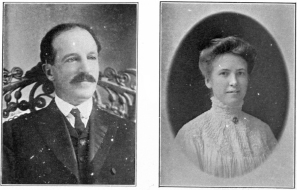
EDWIN G. CLEMENCE
Conductor of the Chorus |
MISS ADALINE L. BUCK
Chairman Refreshment Committee |
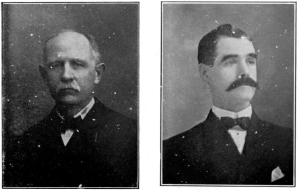
CHARLES J. RYDER, D. D.
One of the Speakers |
HENRY DONNELLY
Chairman Public Safety Committee |
Mrs. W. M. Keeler, Mrs. Albert Sterling, Mrs. Emil Anderson, Donald E.
Hungerford, Francis Mulcahy, Clifford Castle, Mrs. James E. Mullens.
The Committee on Decorations furnished the town with a fine public flag
pole and flag, to be used first at the opening exercises of the
Celebration. The committee also carried out the beautiful plan of
decoration and illumination on Main Street.
The Committee on Publicity kept the Celebration before the public in
many ways. Printed envelopes of the Bi-Centennial were furnished to the
citizens to the extent of several thousand. One thousand very attractive
cards were sent throughout the State, and frequent items were published
in all the newspapers of the State. This committee also published the
official Programme of the Celebration.
The Committee of Invitation, Reception, and Entertainment devised,
addressed, and sent out the official invitations; arranged for the
official reception of all guests; and, in many ways, made all guests
feel truly welcome. This committee arranged for Reception Headquarters
and a Bureau of Information in Roger Sherman Hall during the
Celebration.
The Committee on Religious Observances had charge of the exercises on
Sunday, June 16, and arranged so well that this proved to be one of the
most delightful days of the Celebration.
The Committee of Public Safety, co-operating with the selectmen of the
town, provided most complete arrangements for the preservation of order
and the safety of property throughout the days and nights of the
Celebration.
The work of the Historical Committee was difficult and important in a
high degree, and the task of collecting all the historical facts needed,
and presenting the whole in attractive and interesting form, kept all
the members extremely busy up to the opening of the Celebration. The
committee received most practical and valuable assistance from The
Grafton Press of New York City, which not only contracted to publish the
book of the Bi-Centennial, but in many ways facilitated the preliminary
work. This firm agreed to report, for the book, the entire proceedings
of the four days, and, to this end, established a representative on the
spot some days in advance, to remain throughout the Celebration. The
reportorial work was under his direction.
The Loan Exhibit Committee were tendered the use of Grand Army Hall,
through the kindness of Upton Post, and began early to look up all
articles of historic value and interest. The amount of work involved was
very great, but was most successfully accomplished.
The Committee on Colonial Features made preparations which contributed
very greatly to the interest and success of the parade, spending a great
deal of time and thought in representing the scenes of old Colonial
days.
The Committee on Colonial Reception prepared the hall and made all
arrangements for one of the most pleasurably anticipated events of the
Celebration.
The Committee on Vocal Music, under the direction of Professor Edwin G.
Clemence, prepared an elaborate musical programme and gave abundantly in
time and efforts to perfect this most important portion of the
exercises.
Rest Houses for women and children were established at various
convenient places, in readiness for the crowds anticipated.
James C. Barker, M. D., and T. B. Merrin were appointed a Committee of
Public Health and Comfort.
Owing to ill health, Mr. Henry O. Warner was unable to serve as Marshal,
and Walter C. Hine was appointed in his stead.
The Marshal’s aides appointed for the Parade were:
| FIRST DIVISION |
|---|
Perry Green.
Noble Booth.
Charles Pomeroy. |
Miss Madeline Todd.
Miss Louise Beeman.
Miss Parthenia Todd. |
| SECOND DIVISION |
|---|
| Dr. C. B. Blackman. |
George S. Dean. |
| Spencer Welton. |
| THIRD DIVISION |
|---|
| Granville Breinig. |
W. M. Keeler. |
| Clifford A. Trowbridge. |
| FOURTH DIVISION |
|---|
| James Marsh. |
W. C. Beeman. |
| Clifford Marsh. |
From January, 1907, up to the opening day on June 15, all the committees
worked arduously and unceasingly to make the Bi-Centennial a success.
Less opposition and discouragement were met than are usual in such
enterprises, and to the public-spirited and loyal citizens of the town
belongs the credit of all this work, so triumphantly accomplished.
There never was a time and place, perhaps, in which a keener interest
was taken in the weather than at New Milford during the days immediately
preceding the Bi-Centennial Celebration. One of the most backward and
inclement springs known to New England history seemed to have bequeathed
all its inclemency to the summer month of June, and, on the afternoon of
Friday, June 14, not only were the signs few and feeble that summer had
come, but the sky was extremely threatening. The boldest prophet did not
venture to predict fair weather for the following day with any approach
to positiveness; and, under the besetting dread of a down-pour which
would ruin the beautiful Bi-Centennial decorations already in place on
“The Green,” and interfere sadly with the Bi-Centennial exercises (most
of which were to be in the open air) New Milford faces wore an
expression of anxiety that was piteous to see. Saturday came without
rain and without clouds, however, and, better still, brought with it
that light, luminous haze, which, in this part of the world, presages a
spell of dry weather—an augury that, happily, was to be fulfilled. The
rows of white pillars with gilded capitals (typifying the Colonial
architecture) and the clusters and festoons of national colors and navy
signal flags (typifying our present national greatness), which
constituted the official decoration of “The Green,” assumed new splendor
in this highly favorable light, while the private decorations, which had
been delayed somewhat by the fear of rain, were brought to completion so
rapidly that, by noon, the town was literally enveloped in flags and
patriotic and Colonial bunting.
Promptly at four in the afternoon the Doxology pealed forth from the
chimes of All Saints’ (played by Prof. Clemence) and was quickly taken
up by the voices of the large concourse gathered on “The Green” about
the band-stand, on
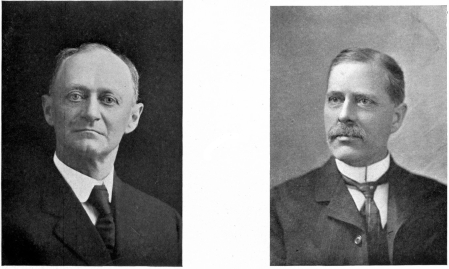
CHARLES N. HALL
Secretary of the Bi-Centennial Celebration |
|
CHARLES M. BEACH
Chairman Committee on Exercises |
which the chairmen of the Bi-Centennial committees were seated. Rev.
Frank A. Johnson invoked the blessing of God upon the coming
Bi-Centennial ceremonies in an impressive prayer, after which “America”
was played by the band (Gartland’s of Albany) and sung by the audience.
Charles N. Hall, Secretary of the General Bi-Centennial Committee, then
stepped forward and delivered the following address of welcome:
“Citizens and Friends:
“For this seems the most comprehensive and fitting title by which to
address such an assemblage as this; since many of you are citizens, and
all of you are friends of New Milford. Citizens and friends then; to one
and all; to those of you who are citizens; to those of you who were New
Milford born, but have found other homes; to those of you whose
forefathers were once New Milford’s children; to each and every one of
you, and to all guests yet to come, the General Committee of the
Bi-Centennial, speaking for this entire community, extends a most
heartfelt welcome.
“But our welcome is tinged with regret; regret that these words cannot
be spoken to-day by the one man that is best fitted for, most entitled
to, that honor. Those of you who have worked during these months of
preparation, and all who know him, will bear witness that no man living
has done more for this Celebration; no man living could have greeted you
more gracefully or with greater sincerity than would our honored
President, Henry S. Mygatt, were he present. But though not with us in
person, we know that he is so in thought; that his hopes and best wishes
are with us to-day.
“It is difficult to find words fitting for an occasion like this, for no
occasion like this has ever before confronted us.
“For the first time in her history, New Milford fittingly celebrates a
birthday anniversary. For the first time in her history, New Milford has
planned a great general home-coming of all her scattered children. For
the first time, we shall see, during these four days, all our own people
gathered together in a common cause: and it is not likely that any now
living will ever see them so gathered again.
“This then is The Event, not merely of the years, but of the centuries;
an event which must occupy a place unique and unapproached in the
history of our town; and words may well fail to express the sentiments
which such an occasion must inspire.
“Since that day in the year 1707, when the pioneer, John Noble, first
traversed the wilderness to this place, up to this day of June, 1907,
every event and circumstance, toil and danger, hardship and prosperity,
peace and war, all have been but successive steps leading to this
Celebration, and making it possible. And, in this Celebration, we mark
not this anniversary alone, but celebrate as well all that has gone
before.
“We celebrate the founders of our town; the heroic men and women who, by
their toil, their courage and their faith, not only made New Milford,
but helped to lay the corner-stone of this nation. Every event in this,
our Celebration; this flag-raising; the splendidly impressive service of
Sunday; the historic addresses, and the reception of Monday; the
imposing parade of Tuesday; all were planned, not only to afford
pleasure and entertainment for our guests, and to glorify the New
Milford of to-day, but also to commemorate and glorify the past.
“But while we celebrate New Milford, past and present, what shall we say
of the New Milford to come? Shall not the civic pride, and energy, the
patriotism, that have inspired this Celebration, continue to be moving
forces toward a better New Milford? Shall not some of the thousands who
visit us, impressed with the attractions of our town, remain and help us
to make a greater New Milford?
“New Milford has done wisely and well to inaugurate this home coming,
for such home comings are vitally essential to the right life and growth
and prosperity of any community.
“New Milford is proud of her history; proud of her position among the
hills and towns of old Litchfield County, in this blessed commonwealth
of Connecticut; proud of her business enterprise, of her schools and
churches; and proud of her children, whom she welcomes home to-day.
“You are here, not as chance visitors, or strangers, but as members of
one great family. We ask you to be not only with us, but of us at this
time; to become, for the time being, citizens of our town, and would be
glad to have you become so in fact.
“New Milford and its Celebration are yours; be at home with us; survey
the attractions of our town; visit and greet old friends; enjoy the
Celebration to the utmost, and then if you must leave us, take with you
the kindest thoughts, and happy memories of the Bi-Centennial.”
At the close of this address, the band, playing “Auld Lang Syne,”
marched to the south end of “The Green” (the chairmen of the committees,
the New Milford Cadets under command of Capt. Gifford Noble, and the
audience falling in behind) to the new, white, eighty-foot flag pole,
which had been erected there under the supervision of Grand Marshal,
Samuel R. Hill. To the strains of the “Star Spangled Banner,” Mr. Hill,
assisted by Lewis W. Mosher, ran a new flag[16] up the pole, while the
Cadets stood statue-like near its base. As the flag touched the peak, a
cannon salute was fired by a firing squad under the direction of Samuel
R. Hill, Jr. This was a signal for the playing of “We’ll Rally Round the
Flag, Boys,” by the band, for the blowing of factory whistles, and the
ringing of church bells; and, with this acclaim, the formal opening of
the New Milford Bi-Centennial Celebration was ended.
The Loan Exhibition in Memorial Hall was opened to the public at ten
o’clock Saturday morning, several hours in advance of the formal
ceremonies of welcome described above, and was kept open during the
entire four days of the Celebration. It proved an agreeable surprise,
not only to the guests of the town, but to the townspeople themselves,
who had no idea how rich their homes were in relics of the past until
they were thus brought together for this Bi-Centennial occasion. Indeed,
it was pronounced by competent judges one of the most interesting
collections of antiquities ever seen in the State of Connecticut. By its
aid, any person possessed of the slightest imagination could easily
reconstruct the every-day existence (in-doors and out-of-doors) of the
ancestors, and could even divine the intellectual, moral and religious
ideas and ideals which governed them. Besides the local relics
associated directly with the New Milford life of yore, were a number of
curiosities from remote corners of the globe, which testified to the
important rôle played by natives of New Milford in earlier times as
merchants, ship-owners, travellers, and missionaries.
These various richly-stored heirlooms were a source of great joy to the
aged, whose observations and reminiscences, as they moved about among
the show-cases, were well-nigh as fascinating as the exhibits
themselves; and a means of instruction for the young, to whom most of
the objects displayed appeared as strange as if they had been brought
from another planet.
The finest thing about this exhibition, however, was the public spirit
it exemplified. The committee in charge met scarcely a refusal from the
persons to whom they applied for loans, and, once the character of the
undertaking was understood, volunteers came forward in such numbers that
twice the space afforded by the G. A. R. rooms might have been filled,
had it been available.
Many of the visitors expressed regret that so remarkable a collection
must be scattered so soon and a hope that New Milford would one day see
its way clear to maintaining a permanent exhibition of the sort. And it
would not be surprising if the ultimate outcome of this loan exhibition
should be a museum of antiquities, since a large proportion of the
exhibitors would gladly contribute their treasures to the common-weal,
if a specially-constructed, fire-proof building should be provided for
the conservation of them.
A complete list of the exhibits is given herewith:
Henry Kimlin:
1. Razor dated 1688.
2. Pair of spectacles.
Minot S. Giddings:
3. A deed to Jonathan Giddings of a tract of land on the Connecticut
Reserve of Ohio, given by Elijah Boardman, Homer Boardman, David S.
Boardman, Stanley Griswold, of New Milford, Ct., Elijah Wadsworth,
Frederick Wolcott, Litchfield, Ct., and Zepheniah Briggs of New
Fairfield, Ct. Dated 1800.
4. Razor. Portrait of Washington engraved on blade.
5. Sampler, Ruth Buck, date 1786.
6. Bible, Ruth Buck, date 1771.
7. Copy of “Washington’s Political Legacy,” 1800.
8. Copy of “Gertrude of Wyoming,” date 1809.
9. Copy of “Life of Dr. Benjamin Franklin,” by himself, date 1795.
10. “The Federal Calculator,” 1802. Samuel Giddings.
11. The Prayer Book, 1795. Ebenezer Sanford.
Fred’k E. Starr;
12. Section of Pulpit of Meeting-house, 1754.
Mrs. Arthur Caldwell:
13. Grandmother’s jewelry.
14. Pin, 1816.
15. Floral comb.
16. Candle tray and snuffer.
17. Fluid lamp.
18. Vase.
19. Bowl.
Dr. L. J. Pons:
20. Canteen, Civil War.
Lyman Caldwell:
21. Collection of arrow heads.
Wm. H. Marsh:
22. Pie platters, that the extra good pies of our grandmothers were
baked in.
23. Churn. This churn is probably over a hundred years old.
24. A bottle of the Eighteenth Century.
25. A bottle of the Eighteenth Century.
26. A doll’s cradle used fifty years ago.
Fred’k Berry:
27. Dress sword and sash. Presented to Capt. F. M. Berry, by Company H,
2d Conn. Artillery.
F. A. Johnson:
28. Tea pot, buried in the War of 1812, with other valuables, to prevent
its falling into the hands of the British.
29. Rifle shot, picked out of the side of a Confederate fortification at
Atlanta, Ga., where they had been fired in by General Sherman’s troops.
30. French lancer’s spear head, picked up on the battlefield of
Waterloo, soon after the battle.
31. Arrow given by “Dave,” one of the party of Modoc Indians who killed
Gen. Canby. Secured in the Indian Territory.
32. Strip of Confederate flag, which was lowered from the Capitol at
Richmond at the surrender, when the city was captured. Confederate money
from Gen. Lee’s treasure chest. Captured at Appomattox.
L. T. Peet:
33. Trencher and knife, used before the Revolution.
34. Candle-stick, used by Alba Peet 150 years ago, he being a shoemaker
and working evenings.
35. Rock-salt pounder, used by my grandfather, Samuel W. Peet.
Henry E. Squires:
36. Green and white coverlet. Wool raised, spun, and woven in Merryall.
37. Plaid blanket. Wool raised, spun, and woven in Merryall.
Mrs. F. A. Mallory:
38. Flowered coverlet.
Mrs. G. B. Ackley:
39. Pair of silver candle-sticks, candle snuffers and tray.
G. B. Ackley:
40. Book, 1809, specimen of penmanship.
Mrs. G. B. Ackley:
41. Bible, 1806. Almanacs, 1803 to 1814.
L. E. Peet:
42. Water Yoke. Over 100 years old.
James H. Cole:
43. Collection of papers. Deed and other papers.
Mrs. E. J. Sturges:
44. Discharge paper.
45. Old paper, 1754.
Lottie A. Waldron:
46. Sugar-bowl.
47. Pair of glass candle-sticks.
May G. Brown:
48. Portraits of Dr. and Mrs. Thomas Holman, painted in Boston in 1819
by Prof. Morse, (inventor of the telegraph) just before they sailed as
members of the first band of missionaries to the Sandwich Islands.
They were great grandparents of May G. Brown.
49. Journal of Mrs. Thomas Holman, one of the first missionaries to the
Sandwich Islands in 1819. Written on board the brig Thaddeus. Mrs.
Holman’s daughter was the first white child born in the Sandwich
Islands, and Mrs. Holman was the first woman to go around the world.
(See Nos. 50 & 114.)
50. Feather cape and wreath, red, yellow and black, worn by the native
chiefs of the Sandwich Islands. Made from thousands of feathers of a
rare bird, but one feather suitable being found on each. These articles
were given by Kamehameha I. to the Holmans (missionaries). They are no
longer made and there are few, if any, like them now in existence. They
are, therefore, of great value. (See Nos. 49 & 114.)
Ruth T. Booth:
51. Casters, over 100 years old.
52. Coffee pot, over 100 years old.
53. Platter, over 100 years old.
54. Plate, over 100 years old.
55. Cup and saucer, over 100 years old.
56. Tea set, 11 pieces, 125 years old, formerly owned by my
great-grandmother, Ruth T. Downes.
Harriet V. Sherman:
57. Sampler.
Mrs. Mary E. Stone:
58. Spectacles and goggles. Arrow head and bayonet.
D. C. Kilborne:
59. Lottery tickets. Sold by the first Cong’l Church Society of
Bridgewater to raise money to build the church edifice.
Mrs. S. D. Woods:
60. Daily paper with the account of the funeral of George Washington.
1799.
Dr. L. J. Pons:
61. Rapier, used by Capt. Eli Booth, (1800) Milford, Ct.
62. Revolutionary sword.
63. Lantern from two-wheeled physician’s chaise, used by Dr. Myron
Downs, 1830-1860.
64. Bayonet and sheath, 1812.
65. Old English dagger. About 1790.
66. Lantern.
67. First glass lantern. About 1840.
68. Dragoon’s helmet, 1775. Bearskin bush.
69. Dragoon’s flint lock pistol. 1775.
70. Old English pistol.
Mrs. George Trieschmann:
71. Lutheran Bible, 1784.
Mrs. Chas. M. Beach:
72. Tea caddy. This was made at Read’s Pottery in Lower Merryall, about
the year 1780. It was part of a tea set which Mercy Sperry (who married
Sylvester Wheaton) had when she went to housekeeping.
73. Invitations to assembly balls, one hundred years ago.
74. Grape shot, picked up on the battlefield of Waterloo, about the year
1820, by Rev. Nathaniel S. Wheaton, D. D.
75. Half-cent, American coin, 100 years old.
76. Brazilian dump, coin worth about 2½ cents.
77. Powder horn taken from the dead body of an Indian by Capt.
Theophilus Baldwin, a volunteer in the French and Indian Wars, while
Baldwin was on a scouting party. The Indian shot at him from ambush, and
missed. Theophilus did not miss.
Mrs. H. H. Hartwell:
78. Flint lock gun. Carried through Revolution.
79. Gun. Carried by a French officer in the Revolutionary War.
Afterwards changed from a flint lock to a percussion lock.
80. Cartridge belt and cartridges, used in Revolutionary War.
81. Autograph bond of Roger Sherman.
82. Brigade orders, Gen. Sedgwick.
83. Two commissions, Joseph Hartwell. As ensign. As lieutenant.
Geo. N. Canfield:
84. Cane, made from the hull of Old Ironsides. Inscription on head:
“From the hull of the Constitution, first built in 1798, and dear to
Americans for having successfully fought the Java, Guerrierre, Cyane,
and Levant, the bombardment of Tripoli in 1812, and also for her
miraculous escape from the British Squadron. Presented to R. E. Canfield
by S. Oaks, Esq., U. S. N.”
Dr. G. Bragaw:
85. Flint lock gun with bayonet.
Edward H. Beach:
86. Indian battle axe.
Mrs. E. H. Austin:
87. War club, Sandwich Islands. Made from root of a tree.
88. Quilt, hand spun and woven.
Mrs. Hannah Fuller Austin:
89. Commission of Abraham Fuller. He was afterward Captain of
Connecticut troops, most of his men being from Kent.
E. H. Austin:
90. Pewter flagon. Supposed to be 150 years old. Belonged to Mills
family of Kent. Authentic record of age for more than 100 years. It was
an old flagon when this record began.
91. English army belt clasps. Picked up on the field of Waterloo a few
days after the battle. Forty-second Somerset.
Mrs. Thomas Austin:
92. Britannia tea pot. More than 100 years old.
A. H. Barlow:
93. An old deed, given to William Barnes of Haddam, by Samuel Barnes in
1734. Also some of the Continental money.
94. Daguerreotype, Gaylord’s Bridge.
Mrs. A. H. Barlow:
95. Embroidered apron, 65 years old.
96. Collection of handkerchiefs and chemisette, over 65 years old.
97. Lace bonnet, worn in 1868.
98. Stockings knit by Mrs. Joseph Marsh for her eldest daughter, Mrs.
Laura Bailey, and worn by each of her six children.
A. H. Barlow:
99. One spoon of a set given to the grandmother of A. H. Barlow as part
of her “setting out.” Made of silver dollars in 1799.
Mrs. A. H. Barlow:
100. Spoon, 1830.
101. Old jewelry, 2 lockets and 3 pins. Tortoise shell combs.
102. Three old lace veils.
Mrs. Edward Dakin:
103. Tea canister. Belonged to my great-grandmother, and used by her
during her lifetime. Purchased in the year 1770.
Marion D. Underhill:
104. Netted lace, made from flax, raised by my great-great-grandfather
on Kent Mountain; spun by my great-great-grandmother; and netted by my
great-great-aunt, over eighty years ago.
Miss E. A. Bailey:
105. Cane, brought from England. Has been in the Bailey family for 209
years.
Mrs. A. B. Giddings:
106. Tea pot, brought to New Milford in 1707 by Zachariah Ferriss. Was
the only tea pot in town.
107. Toddy tumbler and vinegar cruet, one hundred and fifty years old.
Harriet A. Taylor Lee:
108. Coat worn by Wm. Taylor as Colonel of Militia, 1789.
109. Colonel Wm. Taylor’s duelling pistols, 1789.
Mrs. Chas. Taylor:
110. Pewter porringer, 200 years old.
111. Dr. George Taylor’s wedding hat, 1825. (See No. 255.)
112. Pewter candle-stick, very old.
Bessie I. Brown:
113. Chinese chest, very old.
114. Calabash, very old. Used for carrying water. (Wicker work encloses
a gourd.) This calabash and the Chinese chest were presents received in
1852 from China by the Holmans, missionaries to the Sandwich Islands.
(See Nos. 49 & 50.)
Chas. N. Hall:
115. New England Courant, 1723. Published by Benjamin Franklin.
Elsie Cummings:
116. Basket, used in Miss Cummings’ family 125 years ago.
Mrs. Eli Clark:
117. Ink stand and sand well. Has been in my family for 125 years.
Mrs. P. E. Clark:
118. Hair brush, made by my grandmother, Lucinda Young, when a girl 12
years old, 96 years ago.
119. A history, 108 years old, previously owned by Dr. Silas Castle of
Roxbury, Conn., my great-grandfather.
120. Iron mortar and pestle.
121. Wooden water bottle.
Elsie Cummings:
122. Foot stove.
Mrs. P. E. Clark:
123. Barrel.
Mrs. Eli Clark:
124. Warming pan.
Mrs. Carlos Merwin:
125. Plate, Spanish bull fight, 1795.
126. Brittania tea pot, 75 years old, “Muskmelon” pattern.
Fred C. Merwin:
127. Constitution of Union Library, New Milford, 1796, the first in
town. Sec. Elisha Bostwick, ancestor of owner.
Mrs. Carlos Merwin:
128. Bead bag, 72 years old, hand made.
129. Sampler, 76 years old.
130. Knapsack.
131. Bell that rang the “Minute Men” in, used by David Merwin in
Merryall.
132. Musket.
133. Plate, 75 years old.
Mrs. A. G. Barnes:
134. Sugar-bowl, 200 years old.
135. Cup and saucer, 150 years old.
136. Cup and saucer, 75 years old.
Mrs. C. T. Staples:
137. Seal of Wm. Penn, founder of Pennsylvania, public and private seal.
138. London Post, (1738).
139. Play bills.
140. Doll, 50 years old.
F. E. Baldwin:
141. Punch tumbler, from Isaac Stone Tavern, Park Lane.
142. Ancient lantern.
143. Powder horn, taken by Hezekiah Baldwin from body of Indian shot by
him near Lake George in French and Indian War, about 1756.
144. Pitch pipe, used by Jeremiah Baldwin in giving the key to choir of
Congregational Church, New Milford.
F. E. Baldwin:
145. Grain fan, fanning-mill of “Ye Olden Time.”
146. Foot stove.
147. Warming pan.
148. Candle mould.
Frank H. Beach:
149. Crêpe cloth flowers (framed).
Mrs. Wm. E. Stone:
150. Masonic apron.
Flora G. Stillson:
151. “New England Primer,” 150 years old.
Henry Harmon Noble:
152. Two discourses delivered at New Milford, December 14, 1800, by Rev.
Stanley Griswold, it being the Sabbath next after the decease of Rev.
Nathaniel Taylor.
Homer Wanzer:
153. Receipts (from 1796 to 1800).
Mary Bostwick Kelly:
154. Silver sugar tongs and six tablespoons. Sixteen teaspoons which
belonged to Elisha and Betty Bostwick; over 100 years old.
Mrs. W. D. Black:
155. Portrait, Sally Northrop. Born June, 1776; died December, 1876.
Miss J. L. Gaylord:
156. Hand-made counterpane.
Mary Bostwick Kelly:
157. Portrait, Col. Elisha Bostwick, born Dec. 17, 1748.
158. Portrait, Betty Ferris Bostwick, born in 1768.
159. Portrait, Jared Bostwick, born May 24, 1787.
160. Portrait, Betsy Ann Bostwick, born July 11, 1792.
161. Picture, “The Old Bostwick Homestead.” Has been in the family for
200 years.
162. Framed contract for house (1780). Cap and mitts worn by Elisha
Bostwick, when he was baptized, in the year 1749.
163. Watch. Bull’s-eye watch, carried by Colonel Elisha Bostwick through
the Revolution.
164. Watch carried by Jared Bostwick. Over 100 years old.
Fred C. Merwin:
165. Indian hatchet and arrow-head, found on the farm of the late David
Merwin, a “Minute Man.”
Mary Bostwick Kelly:
166. Shawl, Betty Ferris Bostwick; 125 years.
167. Jackknife.
Mabel Marsh:
168. Ancient tea pot. Was brought over from Ireland about 100 years ago.
At one time owned by Mrs. Mabel Baldwin.
Mrs. George Marsh:
169. Old-fashioned shade glasses. Worn by Col. Adolphus Hallock nearly
100 years ago, when driving cattle, travelling on foot and horseback
from Ohio to New Milford.
Dr. B. E. Bostwick:
170. Old will and inventory, 1739.
171. Deed, 1720.
172. Certificate, survey by Roger Sherman, 1748.
J. B. Merwin:
173. Pine-tree shillings, 1652.
174. Hour-glass, used in the Revolution.
175. Six books, 1753, 1771, 1784, 1800, and 1805. New England Primer.
Mrs. Elizabeth Wells:
176. Bandanna handkerchief, owned by John Turrill, a soldier of the
Revolution.
177. Parchment and bobbins, used by Roger Sherman’s mother in
lace-making.
Miss Catherine Wells:
178. Continental money.
Mrs. Elizabeth Wells:
179. Linen apron, 100 years old.
Miss Catherine Wells:
180. Paper dolls, 40 years old.
181. Linen skirt, 46 years old, hand-made.
Mrs. John D. Clark:
182. Candle stand, 100 years old.
183. Two sets silver spoons, one set 125 years old, the other set 100
years old.
184. After-dinner coffee cup, 125 years old.
185. Sugar-bowl with lid, 125 years old. Sugar-bowl without lid, 100
years old.
186. Work basket, over 100 years old.
187. Deed of land in New Milford, 117 years old. Deed of land on Long
Mountain, 172 years old. Equation table, showing how much a clock should
be faster or slower than a sun-dial, or the sun on the meridian.
George Thatcher:
188. Two knives and a fork. George Thatcher’s grandfather, Michel Gould,
used these 140 years ago.
189. Pocketbook, 1790.
Mrs. Chas. Taylor:
190. Fireplace griddle; fireplace waffle iron; skillet for baking hoe
cake (coals put underneath and on top); fireplace gridiron; fireplace
chop broiler; fireplace toaster; fireplace baking-kitchen; fireplace
iron fork; fireplace frying-pan; fireplace roasting-kitchen, 100 years
old. These and the other fireplace fittings were so grouped as to form a
most realistic picture of the fireplace of ye olden time.
191. Old foot stove.
E. J. Sturges:
192. Rapier, carried by Ebenezer Perry, of Col. Andrew Burr’s regiment,
of Fairfield, at the fall of Louisburg, June 17, 1745.
193. Portrait, Mrs. Mary Sturges, who witnessed the burning of her home
in Fairfield, by the British, July 9, 1779.
Minot S. Giddings:
194. Silver spoon. A spoon or a set of spoons, made from silver dollars,
was presented by Mary (Baldwin) Giddings to each of her children, with
her initials engraved on them. Jonathan Giddings and Mary Baldwin were
married Jan. 2, 1766.
W. O. Corning:
195. Bassoon, over 100 years old.
196. Serpent, over 100 years old.
Mrs. Salmon Couch:
197. Flannel dress goods, 1844, colored and woven by Mrs. Sarah Peet and
Mrs. Goodsell.
198. Tin-baker, over 100 years old.
Mrs. F. M. Williams:
199. Pewter tankard, 100 years old.
200. Child’s linen skirt, over 100 years old.
201. Connecticut Courant, 1799, containing account of death of George
Washington.
Mrs. Dan. Clark:
202. Hand-made wedding veil (100 years).
Mrs. T. T. Marsh:
203. Portrait, Dr. Jehiel Williams, one of the first doctors of New
Milford (1815), and grandfather of the late T. T. Marsh and of Edward W.
Marsh of Bridgeport, Ct.
Mrs. Chas. Taylor:
204. Early Colonial pewter basin.
205. Early Colonial pewter tea set.
206. Pewter platters.
207. Pewter platters.
208. Fluid lamp, one of the first sperm-oil lanterns, carried by Dr.
Geo. Taylor.
Flora Geer Stillson:
209. White satin wedding slippers and sash. Rachel Ann Bostwick and John
Stillson, married in June, 1774. These articles loaned by their
great-granddaughter.
210. Crêpe shawl, figured with nasturtiums, worn by Mrs. John Stillson
on trip of the first train run on the Housatonic Railroad, 1840. Loaned
by her granddaughter.
211. Bead bag on linen, worked by Loretta Geer in 1823, when she was ten
years old. Loaned by her granddaughter.
212. Bead bag, worn by Mrs. John Stillson. About 75 years old.
213. Sampler worked by Almira Turrill in 1824. Loaned by her grandniece.
L. T. Peet:
214. Sickle, used for cutting grain, 125 years old.
215. Toby jug, made in Jersey City pottery, 60 years ago.
Miss Helen M. Boardman:
216. Miniature of Major Lawrence, of the British Army, a nephew of Mrs.
Wm. Taylor of this town.
Miss Kate T. Boardman:
217. Locket, owned by Mrs. Wm. Taylor. She was the daughter of the
second minister of this town.
The Misses Boardman:
218. Candle-sticks, brought from Warwick, England, and used in the days
of Queen Anne.
219. Japanese tray and cups, brought from Japan in 1854 by Frederic A.
Boardman, who was in Commodore Perry’s expedition to that country.
220. Bas-relief of George Washington, owned by Judge David Sherman
Boardman in 1820.
Miss Rose Murdoch:
221. Decanter and glasses, presented by the Marquis de Lafayette to
David C. Porter, in Paris, in the year 1825.
Mrs. C. A. Smith:
222. Chair, 150 years old.
Peter Peterson:
223. Pitcher.
224. Bottle.
225. Two pictures and silver spoons made in 1600.
226. Brass scenes, brought from Denmark.
Harriet A. Taylor Lee:
227. Stamp, Greek word, meaning “Quit yourself like a man.” Belonged to
Rev. Nathaniel Taylor, 1748.
228. Baby stocking of Harriet D. Allen (1806), afterwards Mrs. George
Taylor.
Mrs. C. N. Hall:
229. Picture, old Canfield Homestead, 150 years.
Mrs. Mary D. Bostwick:
230. Bible, Thomas Wells, 100 years.
Mrs. H. R. Treadwell:
231. Box made of a fragment of the old ship “Constitution.”
232. Sampler worked by Ruth Taylor, afterwards Mrs. Elijah Downes.
Loaned by her granddaughter.
233. Autograph of John Hancock.
234. Cut from a bill of fare of a banquet given to Henry Clay, printed
on satin. His autograph added.
235. Seal of completion of Erie Canal, 1825.
Mrs. H. R. Treadwell:
236. Portrait of Roger Sherman.
Charles B. Camp:
237. Silver pipe, smoked during Revolutionary War. Over 100 years old.
238. Bible, published in 1639.
Mrs. Chas. B. Camp:
239. Patch box, from estate of Alex. Rosseguie, a Huguenot of France.
Loaned by his great-great-granddaughter. (See No. 287.)
240. Towel, 200 years old. From estate of Alex. Rosseguie.
241. Candle-stick, from estate of Alex. Rosseguie.
Charles B. Camp:
242. Fife, used in Revolutionary War by John Camp. Loaned by his
grandson.
Jay Cogshall:
243. Silver spoon, 1787.
244. Spoon mould and spoon, 200 years old.
The Misses Wells:
245. Samplers worked by Mary G. Sherman, afterwards Mrs. Stephen Wells.
L. N. Jennings:
246. Piece of gun picked up on battlefield of Antietam a few days after
the battle.
Mrs. Eli S. Roberts:
247. Cup and saucer formerly owned by Mrs. Eunice Clark Morris. Over 100
years old.
248. Mrs. Cornelia Morris Young’s baby shoes, 86 years old.
Mr. E. P. Hill:
249. Basin, platter, and plate, used by Capt. James Buck, who was
married to Roger Sherman’s sister.
250. Documents: Raising recruits for Continental Army. fax List, 1781.
Elizabeth H. Noble:
251. “Old London Penny Postman.” Accurate portrait brought from England
by Mrs. Henrietta Burritt about 1800. Loaned by her great-granddaughter.
252. “Wife of Old London Penny Postman.” Portrait.
Mrs. Helen B. Carr:
253. Portrait. Mrs. Susan Masters Blackman, granddaughter of Rev.
Nathaniel Taylor.
254. Picture, “Old Masters House.”
Mrs. T. E. Stewart:
255. Trousers. Dr. Geo. Taylor’s, worn when he was two years of age, and
first calico brought to New Milford (1804). The man who wore the hat
(No. 111) wore the trousers twenty-one years earlier.
256. Baby’s dress. Embroidered by Mrs. Nathaniel Taylor for her son, Dr.
Geo. Taylor, in 1802.
257. Slippers, worn by Dr. Geo. Taylor.
258. Collar, made by Harriet Allen (afterward Mrs. Geo. Taylor) while
attending the Moravian School.
Mrs. H. S. Mygatt:
259. Portrait, Colonel Samuel Canfield, of the Revolutionary Army.
260. Wood from Roger Sherman’s house.
261. Old English pewter cup.
262. Whale oil lamps, from Stonington, Conn. Over 100 years old.
263. Fluid lamp.
264. Silver tea set, belonged to Tamar Boardman Taylor, daughter of Rev.
Daniel Boardman, and wife of Rev. Nathaniel Taylor.
265. Silver spoons, used by Noadiah and Clarissa Mygatt.
266. Silver spoon, marked T. M. (T. Mygatt).
267. Pewter dish, French pewter, dated 1777.
268. Old pewter lamp.
D. K. Crofut:
269. Quilt, warming pan, and ancient hoe.
270. Flint lock musket.
May G. Brown:
271. “Tapa” cloth, made from bark by natives of the Sandwich Islands.
Mrs. H. S. Mygatt:
272. Cane. Belonged to Philo Canfield, son of Col. Samuel Canfield.
Roger Sherman Chapter, D. A. R.:
273. Warming pan.
274. Foot stove, used in the Congregational Church, New Milford, 1812.
Mrs. G. W. Wright:
275. Picture of New Milford.
A. E. Taylor:
276. Piano, age unknown.
Lehman T. Peet:
277. Indian work basket, made by Rachel Mauwehu, a squaw of the
Schaghticoke tribe, about 1847.
278. Thread stand, about 125 years old.
Congregational Church:
279. Chair, belonging to Rev. Nathaniel Taylor, second pastor of the
Congregational Church, from 1748 to 1800.
Mrs. B. F. Humeston:
280. Fireplace cooker. Used in 1775.
281. Cuff buttons, made in 1797 from ore found in Roxbury.
Mrs. S. E. Bristol:
282. Pitcher, Staffordshire, 175 years old.
Mrs. S. E. Bristol:
283. Silhouette, 90 years old. William Bristol, father of Isaac B.
Bristol.
284. Miniature, 80 years old, Heman Crane.
285. Cake basket, 100 years old.
Mrs. H. R. Treadwell:
286. Massachusetts Gazette and Boston News Letter of 1775.
287. Patch box, as used by fashionable ladies of the 17th and 18th
centuries, to contain black patches, cut in various shapes and sizes, to
stick on the face, supposedly to heighten the brilliancy of the
complexion by contrast.
Bessie Kennedy:
288. Shears, hand wrought, date unknown.
Annie Kennedy:
289. Ink well, hollowed out of a solid piece of soapstone.
E. Kennedy:
290. Skillet.
Jeannette L. Gaylord:
291. Old Honiton and point lace.
292. Old embroideries.
293. Portraits, Mr. and Mrs. Ebenezer Gaylord, about 1798.
294. Shell cameo. Portrait of owner’s uncle, W. L. Jewitt, 1840.
295. Old rum bottles and liquor jug, the latter being used in olden
times to carry to the hayfields.
296. Indian needle-case and horn spoons.
W. F. Gaylord:
297. Three Indian implements.
Mrs. Theodore Carlson:
298. Swedish bracelet. Wood and iron watch chain, Swedish.
Jeannette L. Gaylord:
299. Lace evening cloak. 1850.
Mrs. Henry Hine:
300. Articles from Martinique: Lava; tile from old cathedral; goblets
which went through fire; pictures of Martinique after the eruption.
301. Pottery vase from Equador, between 400 and 500 years old.
302. Asphalt, from Asphalt Lake, La Brea, Trinidad.
303. Pottery from Fort de France, Martinique.
304. Tea pot from Cuba.
305. Chocolate bean and picture, Trinidad.
306. Two photos, Kingston, Jamaica.
Mrs. Charles Taylor:
307. Miniature of Mrs. Margaret Craft. Painted just before her marriage
in 1832. She is now 97 years old.
308. Miniature of Mr. James Craft in 1832.
Harriet A. Taylor Lee:
309. Badge of Israel Putnam in a Greek Society at Yale College, 1776.
Given by him to Wm. Taylor.
310. Prayer Book, English, published during the reign of King George and
Queen Caroline. Belonging to Colonel Wm. Taylor.
Mrs. E. A. Wildman:
311. Pewter platter, 130 years old.
Mrs. Henry Hine:
312. Anklet, or Hindoo bracelet.
313. Alligator.
314. Candle-stick, Trinidad.
315. Poinsettia bean, Martinique. Nutmeg, Puerto Cabello. Betel nut
(natives chew to blacken teeth).
Miss A. E. Bostwick:
316. Sampler, 1831, made by Lucy M. Sanford (afterwards Mrs. William
Bostwick), when nine years old.
Mrs. C. A. Smith:
317. Brass candle-stick, made by hand in 1767.
318. Legal document bearing signature of Roger Sherman.
319. Pocketbook made by Kent Wright, the first white child born in Kent,
Conn.
Mrs. Lily Traver:
320. China, 18 pieces, very old.
321. Cuff buttons, hand-made, Chinese.
322. Indian implements and bead bag.
323. Silver spoons, very old.
324. Candle-stick.
325. Coins and bill (Confederate).
326. Breastpin and ribbon, 100 years.
327. Book and old documents. Account of third and last voyage of Capt.
Cook, in 1776.
328. Salt-cellar.
329. Map, drawn by Sarah Northrop (afterwards married to Col. Starr) in
1822.
Mrs. J. Leroy Buck:
330. Tea caddy. Owned by Mrs. Ithamar Canfield, born Jan. 2, 1770.
Loaned by her great-granddaughter.
331. Dressing case, owned by Ithamar Canfield, born Feb. 19, 1764; died
Apr. 11, 1848.
332. Document. Share in Toll Bridge Co.
Lawrence Northrop:
333. Sword, carried in War of 1812.
Willis F. Bennett:
334. Powder horn, used in Revolutionary War by Sam Bennett.
335. Snuff box, used by Isaac Baldwin, soldier in the Revolutionary War.
Flora G. Stillson:
336. Invitation to opening ball at the New England House, Dec. 11, 1856.
J. H. Nettleton:
337. Indian relics, found in New Milford.
Helen M. Boardman:
338. Chinese idols, brought from China in 1854 by Frederic A. Boardman.
The Misses Boardman:
339. Gondola hook, used in Venice by the nobility in the early part of
the 17th century.
Miss Rose Murdoch:
340. English miniature, mother of Mrs. David Murdoch.
341. Mexican ivory, very old.
Albert Evitts:
342. Vegetable dish, used by Dr. Williams. Old willow ware.
Mrs. H. S. Mygatt:
343. Bull’s-eye watch, over 100 years of age.
344. Bouquet holder, 75 years old.
Helen M. Boardman:
345. Compass, made from tree sent by Thomas Jefferson to Mount Vernon,
and planted by General Lafayette.
Martha D. Treadwell:
346. Watch, 75 years old.
347. Jewelry, very old.
J. H. Nettleton:
348. Flint lock pistol.
Mrs. Nettleton:
349. Hand-made collar, 60 years old.
Congregational Church:
350. Picture of Rev. Noah Porter, D. D., LL. D., pastor of the
Congregational Church 1836-1843. Afterwards President of Yale College.
Russell B. Noble:
351. Picture of house (now standing) on the plains about two miles south
of the village of New Milford, with the deed, dated 30th day of May, in
the 12th year of his Majesty’s reign, A. D. 1772, conveying it to his
son, Ezra Dibble Noble, by Zadok Noble, grandson of John Noble, the
first settler.
352. Silhouette picture of Charles Clement Noble, son of Ichabod, son of
Ezra Dibble, son of Zadok, son of David, son of John Noble, who
settled in New Milford, A. D. 1707.
353. Three commissions signed by Governors: Jonathan Trumbull, John
Treadwell, John Cotton Smith.
354. Dr. William Gordon’s “History of the Rise, Progress, and
Establishment of the Independence of the United States of America,” in 4
volumes. Published in London, 1788.
355. Map of New Milford, published by Richard Clark, 1853.
Mrs. Henry Brinsmade:
356. Picture, Mrs. George N. Mallory, born in New Milford, Sept. 17,
1808. Now living in New Haven. This picture was taken at the age of 97.
Geo. B. Ackley:
357. Bellows, over 100 years.
Mrs. Charles E. Marsh:
358. Bible, leather-covered, printed 1696. From my grandfather, Allen
Marsh.
Chas. E. Marsh:
359. A reel.
360. Double linen wheel.
361. Foot stove.
362. Single linen wheel.
363. A spinning wheel, for wool.
Mr. E. P. Hill:
364. Iron fire dogs.
Miss Sarah J. Roberts:
365. A Pilgrim staff, brought to New Milford in 1750 by Mr. Eli Roberts.
Mrs. Arza Morris:
366. Ancient gridiron.
367. Reel.
368. Swift.
369. Linen wheel.
370. Wheel for spinning wool.
371. Blue and white blanket (Phebe Velie).
372. Blue and white blanket.
373. Hatchel for flax.
Mrs. Eli Welton:
374. Old mirror.
375. Sunrise quilt, home spun and woven.
376. Tulip quilt.
Mrs. Carson B. Mead:
377. Map of original thirteen States. About 1785.
378. Gun used in Revolutionary War.
379. Indian hatchet and pistol.
Mrs. Grace C. Wellwood:
380. Hanging iron lamp.
David Barnum:
381. Button-hole cutter.
Mrs. Hannah More Jessup:
382. Candle-stick, used in Platt’s Tavern in Bridgewater, in 1820.
383. Whale-oil lamp.
384. Geography, 1807.
385. Tent lantern of Gen. Burgoyne, taken by a Bridgewater soldier at
the time of his surrender, at Saratoga, 1777. Gen. Burgoyne’s own
lantern.
386. Lantern belonging to one of the first settlers of New Milford
(Bostwick) and used in the War of 1812.
387. Tripod wooden candle-stick.
Mrs. Dora K. Sanford:
388. Glass lamp, 1850 or earlier.
389. Pewter lamps, about 1800.
390. Lard lamp, about 1770.
Mrs. Horace Allen:
391. Masonic pitcher.
Boardman Wright:
392. Autograph letter of Daniel Webster.
393. New England Weekly Journal, April 8, 1728, an early number of one
of the first newspapers published in this country, the first number of
the Boston News Letter (the first newspaper) having appeared Apr. 24,
1704.
394. Country Journal and Poughkeepsie Advertiser, 1787 to 1789.
Contemporary account of Washington’s first inauguration.
George W. Murphy:
395. Iron tea-kettle, over 100 years old.
Mrs. Henry Ives:
396. Silver spoon, made from silver coin earned by spinning (1799), by
the grandmother of Deacon Henry Ives.
H. C. Ives:
397. Silver tea-pot, about 100 years old. Owned by the grandfather of H.
C. Ives.
Mrs. H. C. Ives:
398. Sugar-tongs, made from silver dollars in 1825, at the silversmith
establishment of Stanley Sanford Baldwin, for his bride, Harriet
Stevens. Grandparents of Mrs. H. C. Ives.
399. Brass candle-sticks, over 100 years old.
F. J. Turrill:
400. Deed, from Daniel Boardman, 1729.
401. Plow, used by John Turrill, a Revolutionary soldier.
William B. Pell:
402. Collection of Continental currency.
403. Pewter mug, part of the camp outfit of the 24th regiment of
Napoleon’s cuirassiers. From the room which the Duke of Wellington
occupied after the battle, and known to have been used by him.
404. Club, made from a part of the ram “Merrimac” of the Confederate
Navy. Sunk at the engagement at Hampton Roads, Va., by U. S. S.
“Monitor.”
W. F. Gaylord:
405. Gun, used in three old wars. Carried by Zephaniah Briggs, when 24
years old, in French and Indian War; in the Revolutionary War by the
same man at 46 years of age; and in the War of 1812 by the same man at
78. He lived to be 103.
Mrs. S. E. Bristol:
406. Old China, 100 and 150 years old.
Mrs. H. C. Ives:
407. Collection of old china, 97 pieces, all very old.
Mrs. P. L. Anderson:
408. Roman mosaic jewelry, 60 or 70 years old.
Mrs. Henry R. Treadwell:
409. Autograph letter of Gen. Washington.
Mrs. W. H. Percy:
410. Silhouettes, Stanley Sanford Baldwin and wife, 1825. Mexican medal,
presented by State of Louisiana to Zachary Taylor, Major General.
Miss M. E. Hine:
411. Sampler, worked by Alta Eliza Gaylord, 1829.
Mrs. G. W. Wright:
412. The idol of the royal family of the Sandwich Islands. Presented to
a missionary by Kamehameha I.
413. Taper for reading, age unknown.
414. Spoon, formerly the property of Daniel Boardman, who was ordained
the first pastor of the Congregational Church, then called the “Church
of Christ,” Nov. 21, 1716. The spoon is marked:
B
D I
B is for Boardman, D is for Daniel, I is for Jerusha, his wife.
415. Latin Psalter, 1509.
416. Prayer Book. Changed from the English ritual to American P. E.
ritual in handwriting of Bishop Provost. It lay on the altar of Trinity
Church, New York, for many years previous to the Revolution. When the
church burned down during the occupancy of New York by the British, the
cinders from the burning roof left their marks on the cover.
Boardman Wright and Rev. F. A. Wright:
417. Pictorial German Bible, 1692. Formerly property of Rev. J.
Friedrich Schröder, minister in the German Lutheran Church, in
Mecklenburg.
Mrs. Boardman Wright:
418. Silver chatelaine.
419. Scarf.
420. Scarf.
421. Sandalwood fan.
422. Hand-painted fan, sticks, mother-of-pearl, gold inlaid.
423. Fan, sticks, mother-of-pearl, silver inlaid.
424. Lace, Rose Point and Duchesse.
425. Old lady’s cap.
Boardman Wright:
426. Invitation, Dance Programme and Menu. Ball given in honor of Prince
of Wales (now King Edward VII.), in 1860.
427. Silver tankard, property of Daniel Boardman, the first minister of
New Milford. Probably brought from England by Samuel Boardman in 1633.
Mrs. Florence Buck Loonan:
428. Clock, more than 150 years old. Wooden works, made with a knife.
Raymond Goodsell:
429. Indian arrow-heads in case.
Mrs. C. H. Allen:
430. Lustre pitcher, about 150 years old.
431. Sugar-bowl, over 100 years of age.
432. Lafayette Cup.
Mrs. G. W. Wright:
433. Chair, property of Madame Boardman (Mrs. Daniel Boardman), wife of
the first minister of New Milford.
Boardman Wright:
434. Hat badge (U. S. Engineers). Worn by Gen. Robert E. Lee through the
Mexican War.
Dr. G. H. Wright:
435. Old wooden fireplace, frame and mantel. Old fireplace crane.
Mrs. Henry E. Bostwick:
436. Commission, William Gaylord, 1723.
437. Two commissions, Benjamin Gaylord, 1760 and 1762.
438. Sword captured during the Revolutionary War from the Tory leader,
Wade Vaughn, by the Gaylord Band.
439. Silver, over 100 years old, showing style of engraving at that
time. Initial of both husband and wife, D. T. M.—David and Tamasin
Merwin.
440. Pitch-pipe used in the old Congregational “Meeting House.”
441. Powder horn, carried through the Revolutionary War.
442. Piece of the wedding dress of Mrs. Abel Seeley, married before the
Revolutionary War. It is home-spun linen and hand-woven, in imitation of
French muslin.
Mrs. Henry E. Bostwick:
443. Pewter porringer.
444. China.
Mrs. G. W. Wright:
445. Tea pot, cup and saucer, imported from China by Hon. Elijah
Boardman, about 1790.
446. Holster and flint lock pistols.
Mrs. S. E. Bristol:
447. Gold watch and chain, 150 years old.
E. J. Emmons:
448. Newspaper, Ulster County Gazette, 1800. Account of funeral of
George Washington.
Mrs. C. H. Allen:
449. Medicine chest, over 100 years old.
Sadie Strong:
450. Knitted counterpane, about 40 years old.
A. H. McMahon:
451. Millennium plate, over 160 years old.
Mrs. Henry E. Bostwick:
452. Engraving of Roger Sherman.
Mrs. Willis F. Bennett:
453. Iron peel, nearly 100 years old. Used for placing and withdrawing
food from the brick oven.
Dr. G. H. Wright:
454. White satin suit, worn by Senator Elijah Boardman.
Dr. H. H. Hartwell:
455. Trooper’s coat.
Mrs. Helen B. Carr:
456. Dress, made in style shown in London Fashion Book of 1799.
Mrs. Salmon and Fred Buck:
467. Silver spoon, 150 years old. Cup and saucer used by Roger Sherman’s
sister.
Mrs. Helen B. Carr:
458. Sermons of Rev. Daniel Boardman.
459. Sampler, 1804.
460. Locket and ring, worn by the grandmother of Mrs. Helen B. Carr.
Will Cogswell:
461. Dagger found during Revolutionary War. Indian Hammer Head.
Mrs. F. W. Knowles:
462. China, over 100 years old; 11 pieces.
463. Flax grown in New Milford by John Caldwell, in 1800.
464. Tailor’s shears, over 150 years old. With these shears the lady
represented in the daguerreotype of No. 465 earned by tailoring the gold
beads of No. 465.
465. Gold beads and daguerreotype, very old.
466. Dress worn by Harriet Beard when married to Charles Knowles.
The Misses Boardman:
467. Two brooches; one, tomb of Washington, the other, made from the
Charter Oak.
Clarissa T. Staples:
468. Queen Anne knife and fork, Sheffield plate, made in 1690.
Mrs. Ellen Lamson:
469. Tea pot, 200 years old, brought over from England.
G. G. Bray:
470. Tray, 150 years old.
C. Andrew Humeston:
471. Wedgewood pitcher; lustre pitcher, very old; cup and saucer, 80
years old.
Mrs. F. E. Starr:
472. Apron, home-spun linen, worked with crewels. Very old.
Clarissa T. Staples:
473. Candle-stick, formerly used by Samuel Treadwell.
Ormida Northrop Pratt:
474. Brewster Cup, 150 years old, belonging to Mrs. Mary Brewster Beach,
whose father was William Brewster, second son of Elder Brewster, of the
Mayflower.
475. Sampler, 90 years old, embroidered by Mary Brewster Beach,
great-great-granddaughter of Elder Brewster, of the Mayflower.
476. Fan of Mrs. Jane (Mills) Bordwell, wife of Rev. Joel Bordwell,
pastor of Kent Congregational Church, 1758-1811.
477. Purse, 75 years old.
Mrs. Seymour C. Loomis:
478. Ring dropped by Lafayette in the house of my
great-great-great-grandmother, Abigail Starr Taylor, in Danbury, during
the Revolutionary War.
479. Brooch. Belonged to Mrs. Ithamar Canfield, worn during 1700.
480. Book, used by Abigail Starr, wife of Major Daniel Starr, 1750.
481. Letter of Abigail Starr, 1756.
482. Slipper worn by Abigail Starr, 1765.
Helen M. Boardman:
483. Brooch (Italian), about 75 years old.
Miss M. D. Porter:
484. Door-handle from back door of Rev. Nathaniel Taylor’s house in New
Milford, probably made for the front door by the old blacksmith, Daniel
Burritt, whose initials are on it, 1759. When repairs were made in the
house, in the summer of 1880 or 1881, this old latch was taken off and
given to Mrs. Mary Taylor Porter.
485. Powder horn (Abel Hine, 1758).
486. Pulpit Bible, used by Rev. Nathaniel Taylor, who was settled in New
Milford in 1748, and died after a pastorate of 52 years. This Bible was
given to him by his father, Daniel Taylor, of Danbury.
487. Silhouette, Rev. Nathaniel William Taylor, D. D. (grandson of Rev.
Nathaniel Taylor), made by Samuel Metford, New Haven, in 1842.
Mrs. Chas. Taylor:
488. Hand-made counterpane. Made for large four-post bedstead, of linen,
with pattern done in candle wicking, drawn through.
The “Old Home Gathering” in Roger Sherman Hall, at 8:30 o’clock Saturday
evening, was presided over by W. Frank Kinney, Chairman of the Committee
on Invitation, Reception, and Entertainment. Mr. Kinney, by way of
welcome, spoke as follows:
“You do not know how hard it is for me to come to-night into a place
like this. I was asked by the committee to take charge of these
exercises for reasons that you well know. I am asked to give you a
welcome to our town. ‘Surely, the love of home is interwoven with all
that is pure, deep, and lasting in earthly affection. Let us wander
where we may, the heart turns back with secret longing to the paternal
roof. There all the scattered rays of affection concentrate. Time may
enfeeble them, distance overshadow them, and the storms of life obscure
them for a season, but they will at length break through the clouds and
gloom, and glow, and burn, and brighten, around the peaceful threshold
of home.’ Thus wrote the poet Longfellow, and I repeat those lines
because they express in so much better language than it is possible for
me to do, the thoughts that are uppermost in your hearts to-night.
“We welcome you to-night to these grand old hills, among which your
ancestors were born and bred, and where they drew the inspiration that
made them the men of mark and note of their day; over whose wooded
heights you tramped with the old gun on your shoulder, looking for the
gray squirrel, watching for the rise of the partridge, or listening to
the distant baying of the hound, as he chased the fox along the trail.
“We welcome you back to these beautiful valleys, where, in your earlier
days, you bent your back, and, by the sweat of your brow, earned your
daily bread. We welcome you back to the
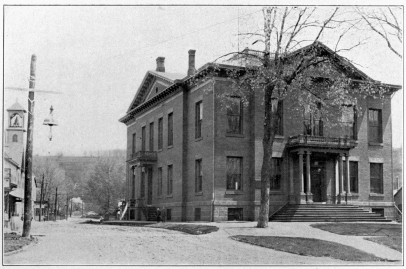 ROGER SHERMAN HALL AND CHURCH STREET
noble old river, where you swam and bathed in its clear, bright waters,
or sailed so smoothly upon its bosom, or skated over it, in its winter
coat, or, perhaps, studied astronomy by counting the stars as you lay
prone upon your back.
“We welcome you back to these beautiful mountain streams that come
tumbling down the hills, and through the valleys to the river, which
many a day you followed with hook and line, trying to entice the
speckled beauty from some favorite haunt. Welcome back to the little red
school house at the corner, where you learned your A, B, C’s, and to the
historic old birch tree that stands near by, and of whose branches you
still have tender memories. Welcome back to the dear old church, within
whose sacred walls you spent so many hallowed hours, and from which you
took many of the sweetest, as well as the saddest, memories of the old
town.
“Welcome back to the old homesteads, ‘Sacred to all that can gladden, or
sadden, the heart of man, over whose thresholds of oak and stone, life
and death has come and gone.’ We leave you there, we cannot cross those
thresholds; but when you come forth again, we welcome you to our
beautiful village, to the festivities of this Bi-Centennial occasion.
And to those who have come back after a few years of absence, and to
those who have come to the homes of their ancestors for the first time,
you will find we have hearts warm enough, and homes large enough, to
welcome you all. Again I say, welcome, thrice welcome to our grand old
town.”
Brief speeches, replete with sentiment and reminiscence, were made by
Rev. George S. Bennitt, D. D., of Jersey City; Hon. Henry C. Sanford, of
Bridgewater (formerly a part of New Milford); Boardman Wright and
Timothy Dwight Merwin, New York lawyers; Rev. John T. Huntington, of
Hartford, and Edwin W. Marsh, a Bridgeport banker—all members of
families which have been closely identified with New Milford interests
for several generations.
The Chairman read the following poem, written for the occasion by Mary
Murdoch Mason, daughter of a former pastor of the Congregational
Church:
“HOME
“Born on these hills, or in this happy vale,
Our feet turn swiftly toward the well-known trail:
At all great moments, when the heart is stirred,
The exile’s soul spreads wings like homing bird.
“ ’Tis in this village church our knees are bent,
When, ’neath cathedral dome or tropic tent,
We hear the burial service for the dead,
’Tis in the old home pew our prayers are said.
“No brilliant light in bold, bright city street
Can dazzle, eyes accustom-ed to greet
That golden splash and sparkle where the sun
Kisses our River’s curve ere day is done.
You know the spot. We see it from Town-Hill;
It stirs our hearts and makes old memories thrill.
“In Switzerland, the snow-capped heights grow dim,
Mt. Tom appears, and Guardian Mount with him.
Rigi’s a dream, and even Jungfrau pales,
While Alpine glow lights up New England dales.
“Old Ocean’s storms and winds for us grow calm,
The while we dream of Housatonic’s charm:
And we forget the harbor at Trieste
To float upon Lake Waramaug’s dear breast.
“No bells that ring from far-famed distant towers
Are half so sweet as those ‘First Bells’ of ours.
And songs that thrill the world were never sung
As noble as those hymns we loved when young.
“On London ’bus, or in Pall-Mall’s vast crowd,
Sudden we’re walking through a field fresh plowed:
Upon the steamer’s deck far out at sea,
We hear a robin sing in Main Street tree.
“In wind-swept wastes, we’re filled with joy, not gloom,
Because at home th’ arbutus is in bloom.
And when June comes, and roses blow, we say:
‘Oh, for those roses round our porch to-day!’
“But ’tis at night beneath the heavens we cry:
‘These same kind stars with ever-friendly eye
Upon our well-beloved graves look down,
Far, far away, in dear New Milford town.’ ”
Charles N. Hall, Secretary of the General Bi-Centennial Committee, read
the following cablegram:
“London, England, June 15, 1907.
“Success to the Bi-Centennial and best wishes for the dear old town!
Deeply regret my absence.
Frank Hine.”
He also read the following letter, explaining that, although addressed
to the Committee, it belonged to all New Milford, since it came straight
from the heart of one whom all New Milford loves:
“New York, June 11, 1907.
“Charles N. Hall, Esq., Secretary of the Bi-Centennial Association of
New Milford,
“Dear Sir:—
“Owing to a severe and unexpected attack of illness I am reluctantly
compelled, acting under the imperative orders of my physician, Dr. Allan
McLane Hamilton, of New York, to relinquish any participation in the
Bi-Centennial ceremonies, and I, therefore, request that arrangements be
made to have my duties assumed by the officers upon whom they will
devolve.
“It is impossible for me to express my deep regret at the necessity of
giving up any part in these exercises, to which I have looked forward
with so much pleasure and pride, and my profound appreciation of the
high honor conferred on me by the people of New Milford in electing me
President of this Association.
“I desire to extend to them all, through you, my sincere and heartfelt
thanks; and to all guests and friends who honor us with their presence
on this glad and memorable occasion, and whom I hoped to meet
personally, I extend a warm welcome and a hearty greeting.
“Very truly yours,
“Henry S. Mygatt.”
Before and after the exercises of the evening, much informal sociability
was indulged in, in the course of which many stories of old times were
exchanged and many old friendships renewed. The occasion was a highly
enjoyable one, especially to those who had come from a distance after an
absence of many years. It was an “old home gathering” in the best and
fullest acceptation of the term.
Written for Bi-Centennial Sunday by Charles N. Hall
Lord of the Pilgrims; they who came
Far over-seas to praise Thy name;
Braving the wave, the wilderness,
Firm in their faith that Thou wouldst bless;
Planting upon a new world’s shore
Thy name, their faith, forevermore—
Grant us, their children, thus to be
Persistent in our faith in Thee.
Dark seemed the way; grim forests frowned,
Hunger and cold crouched close around
That Pilgrim band; while wintry seas
Rolled wide, ’twixt English homes and these,
Who, faithful still, to doubt unknown,
Laid here the Nation’s cornerstone.
Grant us, their children, thus to be
Unfaltering in our faith in Thee.
Bitter their sufferings and tears;
Hardship and toil marked all the years;
But through it all Thy saving hand
Guided and held the chosen band;
Leading them safely home at last,
All hardship done, all trials passed.
Grant us, their children, thus to be
Guided, sustained, brought home, by Thee.
Sermons appropriate to the occasion were preached to large
congregations in all the churches Sunday morning. These sermons, in
so far as they were historical, are reproduced herewith:
BY REV. FRANK A. JOHNSON
In the First Congregational Church
“...In the summer of 1707, an eagle, poised on extended pinions over
the Housatonic Valley, would have looked down upon a scene of singular
beauty. He would have beheld a wilderness; but has not a wilderness a
beauty unsurpassed by the artificial works of man? Mountain, hill and
valley were clothed with magnificent forests of oak, chestnut and ash.
The river, then a clear mountain stream, weaving its way among the
hills, added to the sylvan beauty of the scene. There was no sign of the
presence, or even existence of man, save possibly the thin smoke from
the camp-fire of some peaceful Indian, who loved these hills, the home
of his fathers.
“Into this trackless wilderness, from the then far-away north-land of
Massachusetts, came John Noble and his little eight-year-old daughter.
Do we, who know this lovely valley so well, wonder that he built his
simple home here, and that his descendants have remained here ever
since? His house was for some time the last house this side of Albany.
“After a short time, a company from Milford, on Long Island Sound, took
up much of the land here, and naturally gave the name New Milford to the
new settlement. These men were of a sturdy race, strong in body,
courageous, believers in God and His righteousness. Just think of the
task that confronted them! The great forests, which would be a better
possession than a gold mine now, were an encumbrance then. The
traditions of these fathers tell us nothing of enervating club life, or
midday siestas; the daily rule of life for man
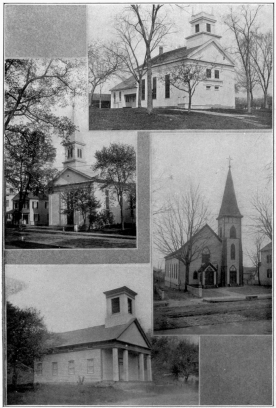
| SOME NEW MILFORD CHURCHES |
Methodist Episcopal
Baptist, Northville |
|
Methodist, Gaylordsville
Saint Francis Xavier |
and woman then was work, work, work, that we might enter into the goodly
heritage we now enjoy. Among the early settlers was Mr. John Read, who
built a primitive house at the upper end of “The Green,” near Mr.
Frederic Knapp’s house. Mr. Read, at one time, intended to enter the
ministry. He preached the first sermon here in his own house. The
founders of our State and town believed in God, and delighted in his
worship. They were assured that God could manifest himself in the wild
woods, or in some log cabin as well as in a stately cathedral. And so,
before their families were fairly settled, they provided some place for
the stated worship of Almighty God.
“So, here, after Mr. Read left the town, the people continued to use his
simple home as their place of worship. I quote from our church manual:
‘These people held their religious services in what was called Mr.
Read’s house, which has been described as probably built of logs, one
story high, and had but one window, and was not very commodious nor an
ornamental place of worship. The first vote to build a regular
meeting-house was passed in 1716, and, then, so many difficulties were
encountered, and so limited were the resources of the people, that the
building does not seem to have been completely finished and furnished
till 1731—though it was probably occupied for worship in its unfinished
condition as early as 1720. This building stood on Town Hill, on the
upper side of the present “Green.” In 1754 a new and more commodious
meeting-house was erected upon the village “Green,” nearly opposite the
present residence of Mrs. Henry E. Bostwick. This building was used as a
house of worship for seventy-nine years, during the pastorates of Revs.
Taylor, Griswold and Elliot. During the pastorate of the Rev. Mr. Rood
in 1833, the present edifice was erected. In 1860, it was completely
renovated.’
“In 1892 it was again renovated and a considerable addition made to this
audience room, and the chapel, parlor and class rooms were added to the
main building. In 1902 the present parsonage was built, and the ample
grounds about it were laid out. In 1904 the organ was presented by one
of our members....
“They were a godly people who settled in this valley; a people who
believed in the Sabbath as a day of rest and worship, and we may be sure
that some kind of religious service was held here from the beginning of
the settlement, but a regular church was not organized until 1716. Eight
female and five male members were formally recognized as a church by
council on November 21 of that year. It was a Congregational Church of
the ‘Standing Order,’ and all the early inhabitants seem to have been in
sympathy with it. It has continued an unbroken organization to this day.
It has always been influential in the moral and religious movements of
the community; and we are proud of its history, and are glad that we are
members of it in this later day.
“We are so firmly convinced of the wisdom of the separation of Church
and State, that it is hard for us to appreciate that our own church,
through much of its history, was rigidly united with the State. For
thirty-four years after the organization of the church, the
Ecclesiastical Society and the town were practically the same thing. The
larger part of the business of town meetings was the consideration of
religious affairs. The town called the minister, provided for the
expenses of the church, cared for the building; in fact did about
everything that the church and society would do now. It was a town
meeting that voted the size of the shingles and clapboards to be placed
on the church building. Some of you, not very old, can remember when the
town voted in the basement of this building. If there is any virtue in a
union of Church and State, this church must have received the full
measure. Until 1819 this Society had the legal right to tax all the
inhabitants for its own support; but naturally, other denominations,
which had arisen within the town, would object to this, and, as a matter
of fact, this right was not insisted upon. The only relic of this
incongruous relation of Church and State, according to American
standards, is the Ecclesiastical Society; and, in the formation of new
churches, this is generally done away with, the church feeling
abundantly able to take care of its own affairs.
“During the one hundred and ninety-one years of its history this church
has been served by ten settled pastors, and by several ministers who
acted as pastors for limited periods. All of these ministers were men of
power and influence, and have left their mark upon both church and town.
From the organization of the church in 1716 to the end of the eighteenth
century the church was served by only two pastors—the Rev. Daniel
Boardman, and the Rev. Nathaniel Taylor. They were strong men and did
much for the religious development of western Connecticut. Their
descendants are still influential residents of our town. The third
pastor was the Rev. Stanley Griswold, a man of strong personality and
pronounced ability. After leaving New Milford he retired from the
ministry, and, entering upon political life, became Secretary of
Michigan Territory, and afterwards one of the first United States
Senators from the State of Michigan. Later, he was Chief Justice of the
Northwest Territory. The Revs. Andrew Elliot and Herman Rood were strong
men, leaving the impress of their labors upon the life of the church.
The sixth pastor was the Rev. Noah Porter. He was a faithful worker
here, and his work was greatly blessed. He afterwards became known to
all the world of scholars as the distinguished President, for many
years, of Yale College. The Rev. John Greenwood was a pastor greatly
beloved. After a period of absence from the town, he returned to spend
his latter days with the church he loved. The eighth pastor was the Rev.
David Murdock, Jr. He was a forcible preacher, and many of the present
membership were received into the church during his fruitful ministry.
He was pastor during the exciting days of the Civil War, and his
stirring, patriotic addresses never left any doubt of the position of
this church in the days which tried men’s souls. The last three
ministers, the Revs. James B. Bonar, George S. Thrall, and Timothy J.
Lee, were the friends and pastors of a large part of the present
congregation. Many of the older members were welcomed into the
fellowship of the church during their ministries. Not only here, but in
other fields of labor, they gave good proof of their ministry. Of all
this list of former ministers, only one is living to-day, the Rev.
Timothy J. Lee, the immediate predecessor of the present pastor.
“These ministers were advised and assisted by a consecrated band of
deacons; men chosen for their piety and interest in the affairs of the
church. The New England Congregational deacon has always filled a large
place in the moral development of a community; and so these men have
done their part in promoting the better life of this town. It would be
impossible to write a true history of the town without giving their
names a prominent place. The name of one of their number, also sometime
clerk of our Society, is written high in the annals of his country, the
distinguished patriot and statesman, Roger Sherman, associate of Thomas
Jefferson, John Adams, Benjamin Franklin, and Robert R. Livingston, on
the committee of five which prepared the immortal Declaration of
Independence. His colleague, Thomas Jefferson, said of him, he was ‘a
man who never said a foolish thing’; and the noted Senator Macon
declared, ‘He had more common sense than any man I have ever known.’ At
this anniversary time, we are happy to recall the name of such a man as
a citizen of our town, and a member and officer in our church....
The following hymn, written for the occasion by Charlotte B. Bennett,
was sung in the Congregational Church in the course of the service at
which the above sermon was preached.
BI-CENTENNIAL HYMN
“God of our fathers, in whose sight
The centuries are but as days,
We ask, as those of old, Thy light;
We bring, like them, our gift of praise.
“We bless Thee for the fathers’ love;
They made the rough way smooth, that we
Might safer walk. O, may it prove
The path of peace that leads to Thee.
“We reach across the vanished years
And touch their holy lives to-day,
They kept the faith through toils and fears;
Grant healing in the touch, we pray.
“If mists of time have dimmed our sight,
And faith has faltered on the way,
May clearer vision in the light
Of holy memories, crown this day.
“Alike to Thee are new and old;
Thy care through ages is the same;
Thy love links with a chain of gold
The centuries, in one dear Name.
“Keep in the hollow of Thy hand
This hallowed place, while years shall last;
For righteousness still may it stand,
Till days and ages are all past.”
BY REV. SAMUEL HART, D. D.
OF MIDDLETOWN, CONNECTICUT, IN SAINT JOHN’S CHURCH, ALL SAINTS’
CONGREGATION UNITING
“It happened, as men say, that the beginning of the settlement of this
town fell in the year which saw the organization of the first parish of
the Church of England in Connecticut; the bi-centenary of New Milford is
also the bi-centenary of the Diocese of Connecticut. It is but natural,
therefore, that one who is called to speak to-day as to that part which
this parish has borne in the history of the town, should recur to the
origin of the Church in this Colony, and should have in his mind the
inspiration of last week’s commemoration in Stratford; we cannot but
look back from the time when the Church’s ministrations were first held
here, to the earlier ministrations on the shores of the Sound. But we
have a stronger reason to-day for turning to the beginnings; for the two
clergymen who first officiated here, at the request of a few adherents
of the Church of England, were Dr. Johnson, missionary and rector at
Stratford, ‘the father of the Church in Connecticut,’ and Mr. John
Beach, of Stratford birth, Dr. Johnson’s pupil in theology, in charge of
congregations in Redding and Newtown. But, as it appears, we can go
still further back; for one of the first settlers here, of whom indeed
it is said that he claimed the land by title from the Indians, was John
Read, who, at the time when the church services were first held by a
clergyman in Stratford, was ministering to the Congregational society
there, and presently connected himself with the newly formed
congregation of Churchmen; indeed, we are told that at one time he had
it in mind to go to England and ask for ordination at the hands of a
bishop. Whatever his plans in this matter, they were not carried out;
for he removed to this place, granted the use of a house which he built
as a place of meeting for public worship, and occasionally preached to
those who assembled there. He became a lawyer and Queen’s attorney, and
removed to Boston, where he was a communicant in King’s Chapel. His son
John was one of the first settlers of Reading (Redding) and named the
town for his father. Thus there was here, from the very first, a little
Church of England leaven.
“But we are told of no formal church services here for twenty-two years,
and of no separate congregation until 1743. At this time, Dr. Johnson,
that man of great learning and prudence and missionary zeal, had been
ministering for twenty years in Stratford, extending his journeys to
places adjacent and remote in the Colony, and exercising a strong and
healthful influence on behalf of the Church. Among the young men whom he
trained in the Church’s ways and in her theology, his pupils and members
of his family, was John Beach, for eight years Congregational minister
at Newtown, ‘a popular and insinuating young man,’ as was testified of
him, who after ordination in England came back to his former field of
labor and began a wonderful work there and in Redding, with a small
congregation of five families. These two men came hither at
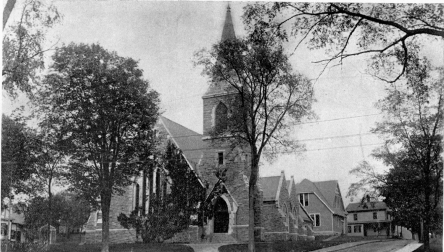 ST. JOHN’S CHURCH
the request of a few Church people, of whom Mr. Beach wrote in 1743
there were about twenty families in New Milford and New Fairfield, who
frequently attended church at Newtown, and to whom he ministered at
their homes as he was able, but rarely on the Lord’s Day. The town,
presently, on the petition of twelve men, granted them a piece of land
in the street at its south end, ‘near where the old pound used to
stand,’ forty feet by sixty, ‘in order to build a Church of England
upon;’ and the building seems to have been erected in 1744....
“Under Mr. Beach’s care many in this part of the colony—for he had a
wide circuit for visitations and services—accepted the Church’s ways;
and thus was the Church established in the faith and increasing in
number, as in the primitive times. When at last he asked to be relieved
from the care of the congregations and scattered communicants in
Litchfield County, the Rev. Solomon Palmer took charge of the Churchmen
in this neighborhood, and became the first clergyman resident here.
After five years he removed to Litchfield; and to him succeeded, in
1762, as by a kind of exchange, the Rev. Thomas Davies, whose
grandfather and father, faithful laymen, had founded the parishes in
Litchfield and Washington. His whole span of life was but thirty years,
and he ministered here but four years; but he left a record for untiring
labor, constant pastoral labor, persuasive eloquence, and godly living,
which has not been effaced by time, and the results of which, we cannot
but believe, still remain in this community. Even when there was talk of
a division of his work, he proposed to retain the towns of New Milford,
Woodbury, Kent, and New Fairfield as his mission, leaving Litchfield,
Cornwall and Sharon, with a few Churchmen in nine other towns, to the
care of another clergyman. During his ministry, a second house of
worship was built, the old church being too small for the congregation;
it stood in part on the street, some twenty or thirty rods north of the
former site. After Mr. Davies, followed the Rev. Richard (or Richard
Samuel) Clarke, the twenty years of whose ministry included the cloudy
days that preceded the Revolution and the stormy times of the Revolution
itself. He was a Tory in political convictions and, after the war,
removed to Nova Scotia, where he died in 1824 at the age of 87, the
oldest missionary in the Colonies.
“It would be ungracious to dwell now on the opposition, for the most
part conscientious, and nearly always quite in accordance with law,
which the early Churchmen experienced. It is pleasanter to note that
their neighbors and the Colonial authorities extended to them what was
for the times, a generous toleration as to ‘sober dissenters,’ and
allowed them, if they actually attended church, to turn their ‘church
rates’ to the support of their own clergymen. And this parish had the
special favor, shared with but two others, of a special act of the
General Assembly, which practically put it before the law in the full
status of a society of the standing Congregational order. Even the hard
feelings of Revolutionary days, almost excusable at the time, soon
passed away. The Church of England in Connecticut, under the nominal
care of the Bishop of London, became the Church of the Diocese of
Connecticut, under the care of her own Bishop, and presently a
constituent part of the Church in the United States, loyally maintaining
the Commonwealth and the Republic, actually guiding the organization of
the State, and moulding a large part of the people in the ways of
soberness, righteousness, and godliness.
“In all this time, the parish of St. John’s, New Milford, was a true
center of missionary work. We wonder when we read of Dr. Johnson from
Stratford extending his journeys to Newtown and Middletown and New
London; of Mr. Beach from Newtown visiting New Milford and other places,
really caring for a whole county with ‘parts adjacent’; of Mr. Davies
from New Milford going about in circuit, preaching and baptizing in
Roxbury, and New Preston, and Salisbury, and Litchfield, and Sharon, and
divers other places in the Colony, and crossing the line into Great
Barrington, where he found difficulties incident to another government,
but where a church was built under his care; and how he, in his turn,
directed to that place the steps of Gideon Bostwick, who ministered for
more than twenty years in Berkshire, in the southern part of Vermont,
and in the eastern part of New York. Moreover, there came in 1769, to
the clergy of Connecticut, assembled in Convocation in New Milford, a
memorial from the few Churchmen in the new settlement of Claremont, in
New Hampshire, asking that their case might be presented to the
Venerable Society in England, with the hope that they would be allowed
at least a catechist and schoolteacher, until (as they said) they should
have passed ‘the first difficulties and hardships of a wild,
uncultivated country.’ Such a man was commissioned, and did good work as
an unordained missionary; while a clergyman was presently sent to make a
personal exploration of the northern provinces. It is apart from our
immediate topic; but we can never think of the religious history of New
Milford without being reminded of that remarkable man, Count Zinzendorf,
who held the episcopate among the Moravians, and for a while ministered
to the aborigines in this very place—one of the few places in which the
Indians remained, and in which they were affected by the preaching of
Christianity. There were others also here whose very presence was a
challenge to the teaching of the Church at one time or
another—Separatists, and Quakers, and Jemimaites, and Glassites. Among
them all, the Church held her place, and guided the life of no small
part of the whole community.
“For the last ten years of the eighteenth century the Rev. Truman Marsh
was rector of New Milford, with New Preston and Roxbury. In 1793 the
Church, already occupied for eight and twenty years, was formally
consecrated by Bishop Seabury, eight of the clergy being present for a
Convocation. It had been long in an unfinished state, as we gather from
the frequent entries in the parish records, which refer to the work yet
to be done. Only two years before the consecration it was voted, ‘To go
on and finish the Pulpit, Reading Desk, Clark’s pew, and Gallery’; and
in the next year a vote was passed as to the assignment of seats; and,
the front seat in the gallery being reserved for singers, and the back
seat there for blacks, it was commendably voted, ‘That People of any
Denomination that Wish a Seat Shall have one.’ This edifice, repaired
from time to time, served the purposes of the congregation until 1837;
and the third Church was in turn replaced by the present beautiful and
enduring building, on a new but adjacent site, twenty-four years ago, in
1883. There must have been of old a glebe lot here, though we do not
find early notice of it; it lay on the west side of the Main Street,
and, in Mr. Marsh’s day, it had a house and barn upon it; there is a
tradition that it was secured in part from the sale of a piece of land
which the parish owned at a still earlier day and in part from the
parish’s share of the avails from undivided land in the highway; at any
rate, it was sold long ago.
“The history of post-Revolutionary times must be rapidly passed over.
Mr. Benjamin Benham began here as a lay-reader, and, having been
ordained in 1808, was rector for nearly twenty years, having duties also
at New Preston, Roxbury, Bridgewater, and Brookfield; then, for another
score of years the Rev. Enoch Huntington ministered to the congregation,
and, after an interval, another twenty years of your records is covered
by the rectorship of the Rev. Charles G. Acly, in whose time a rectory
was secured.
“This brings us down to a date but little more than thirty years ago,
well within the memory of many in this congregation; and the last twelve
of these years belong to the present rectorship, as to which we may well
hope, both for the rector’s sake and for the people’s, that it is much
nearer its beginning than its end.
“A few figures will show the remarkable growth of the parish, noticeable
even among the thriving country parishes of Connecticut. A hundred years
ago, already a century after the first settlement, there were
seventy-four communicants in the cure of New Milford, New Preston, and
Roxbury; fifty years ago, St. John’s Church, New Milford, reported one
hundred and twenty-five communicants and one hundred Sunday scholars; in
1885, not quite thirty years later, the number of communicants had
increased to two hundred and eighty-nine, and the number of Sunday
scholars was one hundred sixty-four. In the last named year, the new
congregation of All Saints’ Memorial Church was canonically organized,
its beautiful place of worship being consecrated in a subsequent year,
and a rectory being added some twelve years ago. The result of this
increase of the provision for the worship of the Church and for its
varied ministrations in this town has been a growth, under all the
circumstances, more remarkable than that of former times; in twenty-one
years the number of communicants has increased from two hundred
eighty-nine to five hundred forty-nine—four hundred five in the older
parish and one hundred forty-four in the younger; and where there were
one hundred sixty-four scholars in one Sunday school, there are now two
hundred fifty-eight in two schools, of which the mother parish has two
hundred nine....”
BY REV. S. D. WOODS
IN THE BAPTIST CHURCH AT NORTHVILLE
“Our best authority tells us that while Baptists were not very numerous
in the early days of the town’s history, yet a decade or more before the
close of its first century there was a sufficient number to warrant the
carrying on of services at varying places—Bridgewater, Warren, and
Gaylord’s Bridge. These were kept up for twenty-five years, when, on
Jan. 7, 1814, a meeting was held at the residence of Asahel Baldwin, at
which time it was voted: ‘1st, To organize ourselves into a society to
be known as the “New Milford Baptist Church.” 2d, To invite a council
from sister churches to meet with us on Feb. 9, to consider the
propriety of recognizing us as a regular Baptist Church.’ This council
met as planned, and after a proper examination of ‘their Articles of
Faith and their Covenant,’ voted, unanimously, ‘to recognize them as a
sister church in the Lord.’
“By this act twenty-two believers became a recognized body of
worshipers, who, ten days later, voted to license Eleazer Beecher as
pastor. He was ordained Sept. 15, 1814, at the residence of Abel
Canfield on Long Mountain. The services were conducted in the open air.
“This first pastorate continued for seven years, when Rev. Seth Higby
assumed charge for one momentous year, as it witnessed the beginning of
this present house of worship; and the following year, 1822, saw its
completion, when Elder Higby resigned, and Elder Beecher was again
installed, serving the church for ten years more. He was succeeded by
Rev. Nathan Benedict in a two years’ pastorate, and he, in turn, by Rev.
Elijah Baldwin, who remained until 1840. For ten years the church was
without a settled pastor, though the pulpit was supplied by various
non-resident clergymen.
“From 1850 to 1866 but little growth is recorded; they were years of
struggles and trials. There was a succession of pastors, Revs. H. M.
Barlow, J. F. Jones, and J. Hepburn, serving as under shepherds.
“In 1868 the Rev. C. W. Potter was called, and his three years of
service witnessed a gracious revival and added ten to the church roll.
With the resignation of Elder Potter, the church experienced five years
of pastorless existence, though being supplied occasionally by Rev.
Arthur Day. With the settlement of Rev. Edwin Beardsley, in 1875, the
church entered upon a new era of growth and activity. The records show
that two are still members who came in during that time. The succeeding
pastor was Rev. J. P. Cotney, who remained about three years, adding two
by baptism. He was succeeded by Rev. F. P. Braman, in 1887, who remained
two years, baptizing six into fellowship. In 1889 the Rev. Frederick
Kratz was installed, to be succeeded within two years by Rev. John
Scott, during whose ministry of two years the parsonage was well-nigh
completed and three members added to the church roll. This pastorate
also saw the church made a corporate body. In 1893 Rev. F. D. Luddington
was called, and remained three years, baptizing twenty-eight into church
fellowship. In July, 1896, Rev. Charles I. Ramsey assumed the pastorate,
and for nearly five years continued the good work already begun, by
adding ten by baptism. The Rev. A. H. Manee began his pastoral labors in
August, 1901, closing his labors in October, 1904, baptizing one into
fellowship.
“From November, 1904, until April, 1905, the pulpit was supplied by
various clergymen, when Rev. S. D. Woods became pastor, and continues in
that office at the present time. Thus far there have been nineteen
baptisms, and the church shows the largest membership in its history.
“All told, there have been two hundred and sixty-nine baptisms. The
present membership is seventy....
BY REV. HARRIS K. SMITH
IN THE METHODIST EPISCOPAL CHURCH
“Text—Proverbs 22:28. ‘Remove not the ancient landmark, which thy
fathers have set.’
“A burning desire to deliver a living message is one landmark in the
evangelism of the fathers of our church. The age of our town is nearly
four times as great as the years of Methodism’s church edifice in our
village; more than twice the years of Methodism in the present confines
of our town; one hundred twenty-seven years greater than Methodism in
the State; thirty-seven years greater than Methodism’s first Conference.
Indeed, John Wesley, its founder, was but four years old, in June of the
year, when John Noble, New Milford’s first settler, penetrated these
forests primeval. Our fathers came not as a colony, but as evangelists,
impelled by a vital experience. They believed that sin separated from
God, that only by salvation, through the atonement of the Redeemer,
could sinners be in harmony with the Father, that personal righteousness
and the witness of God’s indwelling Spirit were results of redemption,
and that the redeemed were to go on unto the likeness of Jesus. Without
ignoring other elements in their belief, the stress laid upon personal
experience and its intensity led them far and wide. That they did not
thrust an alien graft upon New England religious stock is seen in one
instance, at least, by the demands of Jonathan Edwards for personal
righteousness, and for conversion as a requirement for all seeking the
communion of the Lord’s Supper; and the sad rejection from his pulpit.
Infidelity, imported with the teaching of the French revolutionists, was
alarmingly on the increase. The custom of discussing metaphysical
subjects and of weaving fine-spun doctrines was spreading more or less
throughout Christendom; to so large an extent had London been infected,
that Blackstone, the famous law commentator, in visiting every church of
note in that city, said he did not hear one sermon that had more of
Christianity than had the writings of Cicero, and that they could not
have been called Christian sermons. The revival-stirring sermons of
Wesley and Whitefield were permeating through and upward from the masses
of the people. And the reception given to this message, so ardently
delivered, assures conclusively the need that had been unsatisfied. So,
then, the fathers of our Church entered this field with the ringing word
of God in their hearts as their warrant.
“Faithful sowing and careful husbanding of the harvest constituted
another landmark. When, in 1789, Jesse Lee was appointed to Stamford, he
had neither preaching place nor congregation as a rallying point; not
even a member in all New England to greet him. He entered with a ‘roving
commission.’ True enough, Methodism had been presented by some of the
most prominent evangelical preachers since the visit of Charles Wesley,
nearly sixty years prior to Lee, and including Whitefield, Boardman, and
Garretson, within a short time of the more concentrated mission in 1789.
Lee’s fine appearance, his massive frame, his weight being about three
hundred pounds, his wit and good humor, his wisdom and judgment of human
nature, his knowledge of the Bible, and his depth of consecration gave
him an entry. The labors of Lee extended, during his first year, from
Norwalk along the Sound coast, and upward to Ridgefield and Danbury.
These pioneers approached our town from the south, reaching the part now
separated into the town of Bridgewater, about 1800; they came from the
Hudson River in the north to Gaylordsville in 1813, and to Northville in
1816; from the southwest to Lanesville, then called Pleasant Valley, in
1815. These activities from all directions soon resulted in the
erection of church buildings at all of these points. The care of the
preachers was constant to train the converts enlisted. They visited and
revisited, at heavy privations and difficulties, to make sure of the
standing of even one or two new members.
“The essential coworking of the laymen is another landmark. Methodism,
from its inception, would have been incomplete without the largest
degree of co-operation on the part of the laity. It has been a layman’s
movement, under the direction of ordained leaders. As soon as two or
more were converted at a place, one of the number was delegated as
leader for the others, thus forming classes for religious culture.
Awaiting the visits of the preacher in charge, these classes were hives
of industry, and seminaries of learning, and communions for worship in
charge of one of their own number, the class leader. Those more
qualified by nature and grace were called for special activity as local
preachers, and they went from place to place, preaching to other
congregations, alternating with the ordained preachers and under their
direction. These meetings were in homes, at times the choicest in the
center of the town, or at others, far in the fastness of the forest
within the rude log cabin, or at others, in God’s open temple with the
swaying branches of the trees as their rafters. The time of worship
might be at any hour from sunrise until midnight, and on any day during
the week. The congregation was called from the home, the shop, the
store, and the field, not by the chime of the church bell, but by the
volume of hearty singing; the numbers might be confined to one beside
the preacher, or mount upwards to more than twenty thousand. The
immediate results of these preaching visits were to be cultivated by the
resident laymen. And nobly did they keep the faith. Exhortation, rebuke,
counsel, encouragement, forbearance, and brotherly love must come by
means of fellow laymen, in many cases but little older in the faith than
the new recruits.
“Zeal in building up the local church was another landmark. Within a few
years after the introduction of Methodism, church buildings were
erected at Gaylordsville, at a cost of eight hundred dollars; at
Northville, on ground of Harvey Benson, at a cost of six hundred
dollars, beside labor and material contributed; and at Lanesville, at a
cost of three thousand dollars. This indicates considerable sacrifice on
the part of the members, and interest in the community. In 1849, after
considerable discussion, the members of the different churches, so close
in location, agreed upon the village as a central point, and our present
edifice was built. Since 1833, when its name had first appeared in the
conference minutes, it has been known as the New Milford charge. Before
that it had been part of the Stratford circuit, which, in 1822, when our
town first had a permanent preaching place on the circuit, had only
three church edifices; while to-day this range contains church property,
including parsonages, worth nearly a million dollars, has several
thousand members, and gives for benevolent purposes, outside its own
borders, more money every year by far than the total amount contributed
for all causes at that time.
“Within a few years of the building of the present edifice a parsonage
was erected. Every year additional money was laid out on the property;
principally in 1869 in the pastorate of the Rev. W. R. Webster, and in
1891, when the church was remodeled and enlarged, at a cost of several
thousand dollars, in the pastorate of the Rev. R. T. Cooper.... In the
long line of preachers, whose counsel and administration have cheered
and molded many lives, was the Rev. William T. Gilbert, one of a great
class graduated from Yale University, who, with earnest manner and
finely wrought sermon, built deeply and broad; and, after laying aside
his pastoral duties, he re-entered the ranks, working faithfully along
different ways in the activities of the laymen. The Rev. George Lansing
Taylor, D. D., L. H. D., ended a life of great intellectual power and
moral grandeur, while your pastor. For breadth in learning, strength of
thought, independence for truth, tenacity to purpose, and conscientious
following after his Master, he was notable. His pastorate will long be
memorable in the history of this church, and be felt in the lives of
its members, among the younger especially, as they were marked by his
striking personality.”
BY REV. ORVILLE VAN KEUREN
IN THE GAYLORDSVILLE METHODIST EPISCOPAL CHURCH
“Methodism was established in Gaylordsville in 1825, under the following
circumstances:
“Rev. Cyrus Silliman, of the New York Conference, came to visit a
cousin, Mrs. David Sterling, who lived one and a half miles below the
village, in the town of Sherman. While there, he made an appointment for
a week-evening service at the Strait district schoolhouse. The
attendance was so large and the interest so marked that he continued the
meetings four evenings, and then returned to his charge in the State of
New York.
“The people, however, continued the meetings for several weeks, holding
them in private houses. Rev. Andrew Elliot, the pastor of the
Congregational Church at New Milford, learning of the revival, came up
several times and visited the families.
“The following year, as a result of these meetings, twenty-six persons
joined the Congregational Church, nineteen formed a Methodist class at
Gaylordsville, and others joined the Baptist Church. A subscription was
started to build a union church at Gaylordsville, which was built in
1826. Rev. Aaron Hunt, a Methodist preacher from the State of New York,
preached the first sermon in the new church, which was used jointly by
the Methodists, Congregationalists, and Baptists up to about 1854. This
church stood on the east side of the river, just back of the store now
occupied by A. H. Barlow. It was afterward sold to Peter Gaylord, who
removed it to his premises and converted it into a barn. At a quarterly
meeting, held in that church, Rev. Edmund Storer Janes, D. D., LL. D.,
afterward a bishop of the Methodist Episcopal Church, received his
license as a local preacher.
“In 1854, under the pastorate of Rev. David Nash, the present church
edifice was erected, upon a site given by the Rev. John Henry Gaylord,
who also raised by subscription about $2800 toward the cost of the new
church. The parsonage, which adjoins the church, was purchased in 1884,
during the pastorate of Rev. M. M. Curtis.
“In 1827 Rev. Josiah L. Dickerson settled here, built a house, and
engaged in making brick. As a local preacher, he filled some of the
appointments on the circuit up to about 1834, when he joined the New
York Conference, and continued in the regular work of the ministry until
retired by reason of age. He died in 1862, and is buried in the
Gaylordsville cemetery.
“Methodism was introduced into Sherman Center, under the pastorate of
Rev. Alonzo Selleck, in 1838, under the following circumstances:
“A few years before the Congregational Church of Sherman became divided
over the building of a new house of worship, or, rather, the location of
the building. A majority of the society decided it should be built about
a mile north of the Center, where the present church stands. A minority,
living at the Center and in the southern part of the town, built a
church at the Center, and called it a union church. Rev. Selleck was
preacher in charge of New Milford circuit, which, at that time, included
the following appointments: Pleasant Plains, Iron Works, Newtown,
Merryall, Hawleyville, Northville, Kent Mountain, Gaylordsville, Bull’s
Bridge, and Long Mountain. There were but three churches on the circuit.
The other preaching places were schoolhouses or private dwellings.
“Following a revival service held at the Leach Hollow schoolhouse in the
fall of 1837, the Center people invited Rev. Selleck to come up and
preach in the new church, which was not entirely furnished at that time.
The first service was held on New Year’s Eve, as a watch night service.
The church was filled to overflowing, and, at that service, seventy-five
persons came forward as seekers of religion. The meetings were
continued several weeks, Rev. H. Ames, a retired preacher residing in
the town, assisting much in the work. About two hundred fifty persons
professed religion during this revival. Of that number, seventy joined
the Methodist Church, while many joined the Congregational Church, of
which Rev. Mr. Gilson was then pastor.
“A few years later Sherman was made the center of a circuit, separate
from New Milford, taking in the appointments in the northern part of the
town. From 1826 to 1848 this circuit was connected with the New York
Conference. At the session of the General Conference in 1872 it was
again transferred to the New York Conference, where it still remains.
When the transfer was made in 1872, the records for the charge showed a
membership of seventy-three, the Sherman Society having at that time but
thirteen members.
“The church has had a long list of pastors, who served in the following
order: Revs. John Reynolds, William Jewett, Fitch Reed, Samuel Cochran,
Seth W. Scofield, A. S. Hill, Francis Donelly, the exact dates of whose
pastorates we cannot give; 1837, Alonzo Selleck and Asahel Brownson;
1838, Alonzo Selleck and Samuel Weeks; 1844-5, Gad S. Gilbert; 1846-7,
Elias Gilbert; 1848-9, Justus O. Worth; 1850, Thomas B. Treadwell; 1851,
William Wake; 1852, Alexander McAllester; 1853, Gilbert Hubbell; 1854-5,
David Nash; 1856-7, William H. Stebbins; 1858-9, Thomas D. Littlewood;
1860-2, John H. Gaylord; 1863, William Ross; 1864, John Henry Gaylord
(during his pastorate the church sheds were built); 1865-6, Benjamin A.
Gilman; 1867-8, F. W. Lockwood; 1869-70, Sherman D. Barnes; 1871, Frank
F. Jordan; 1872-3, B. M. Genung; 1874-5, Uriah Symonds; 1876, W. A.
Dalton; 1877-9, R. F. Elsden; 1880-1, Robert Kay; 1882-4, M. M. Curtis
(during his pastorate twenty-six joined the church, two of whom entered
the ministry—Rev. Henry Hoag, a member of the Conference, and Mark B.
Howland, a local preacher); 1885, Gustave Lass; 1886-7, E. H. Powell;
1888-92, W. H. Peters (under whose pastorate the church was thoroughly
repaired and refurnished); 1893-4, I. H. Keep; 1895-7, John Henry Lane;
1899, C. B. Conro; 1900-1, E. H. Roys; 1902, Robert F. Elsden; 1903-6,
Edmund T. Byles; 1907, O. Van Keuren, the present pastor.
“In 1898 the charge was left to be supplied. The Rev. M. M. Curtis, then
superannuated, filled the pulpit for a few weeks. When, by reason of
failing health, he was obliged to discontinue the work, the Rev. James
A. Hurn, who has since united with the Conference, supplied for the rest
of the year.
“During the pastorate of E. T. Byles the church property was greatly
improved by the addition of well-appointed church parlors, equipped with
all modern conveniences, the entire expense being provided for before
the work was begun.
“The membership, though small, is thoroughly united and intensely loyal.
“Others have labored, and we have entered into their labors, while they,
in continuous procession, have passed on to receive the reward of the
faithful.
“The present membership of the church is eighty-eight.”
BY REV. ELISHA J. ELLIS, OF DANBURY
IN THE ADVENT CHRISTIAN CHURCH
“Early in the history of the movement which resulted in the formation of
the Advent Christian denomination, the seed of the doctrines which
distinguished this people were sown here by pioneer hands. So far as
ascertained, the first preachers to arrive on the field were Elders Ira
Morgan and Samuel G. Mathewson, about 1844. Quite a number of
conversions followed, and Elder Mathewson baptized quite a number in the
stream which flows near the present church site. Rufus Way, Horace
Gregory, and Richard Heacock were converts about this time—also A. S.
Calkins, who afterwards became a talented preacher in the West.
“Joshua V. Hines preached here in 1846 or 1847. Afterwards, in the
sixties and seventies, representative men like
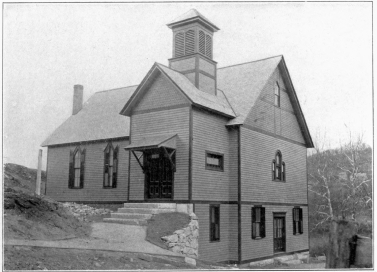 ADVENT CHRISTIAN CHURCH
Miles Grant, Horace L. Hastings, I. B. Potter, Peter and Samuel Patro
labored here; also H. K. and A. D. Flagg.
“Under the labors of Rev. A. D. Flagg, in 1870, the pastor of this
church, at the age of eighteen, found Christ in personal salvation, and,
with his grandfather, was immersed in Still River near Lanesville. Over
thirty-five years ago, Stephen Heacock first commenced to publicly work
for the Master, and for years conducted a mission in the Town Hall
building.
“Between eleven and twelve years ago the speaker had the pleasure of
introducing him to the Advent Christian Connecticut Conference, and on
November 11th, 1897, in the Town Hall, Stephen Heacock was publicly
ordained to the gospel ministry, by the speaker and his associates of
the Ministerial Board of the Conference. While others have labored hard
toward the spread of the Adventual faith in this section, I think, all
present—yea, the entire community—will agree that largely to the
self-sacrificing, heroic efforts of this man, and his wife, the success
of our cause is due in this section....
“Not fulsome eulogy, but well-deserved words of praise, have I spoken
here, because, from personal observation and connection, I have closely
followed, and have been somewhat conversant with its history. On
February 20, 1900, while President of the State Conference, I was
summoned here to set this church apart in gospel order. On March 6, 1900
(in the hall on Bank Street), the church organization was duly
incorporated, and, on August 6, 1901, we were present, with other
clergymen, at the laying of the cornerstone. On November 14, 1901, the
church was formally dedicated to the worship of God and the work of
soul-winning, Rev. Henry Stone, of Wallingford, preaching the dedication
sermon....
“It will, doubtless, be interesting to present a few statistics
furnished us by the pastor in charge: The Advent Christian Church of New
Milford was organized February 20, 1900, with thirty-two charter
members. Forty members have been received since organization to date.
Four deaths and two withdrawals leave the present membership sixty-six
persons. The pastor, since his ordination, has celebrated nine
marriages, officiated at thirty-six funerals, and baptized forty-eight
persons. The total number of baptisms in this faith by various clergymen
in this vicinity would aggregate one hundred fifty. Elder Heacock has
preached in seventy-five different places during his ministry here, and
has spoken, by invitation, in Baptist, Methodist, Congregational, and in
union churches, in this vicinity. As a result of this outside work,
fifty or more conversions have resulted; and, during the years in which
he labored in the Gospel temperance work, prior to the establishment of
the Advent Christian Mission, many people were induced to abandon the
drink habit, and stand for God and the right. Only eternity will
rightfully exhibit the definite results of this work in and about this
village.
“Before we close the historical part of this discourse, let me call your
attention to a highly interesting feature of this edifice—the church
bell.
“Not only the church people, who worship here, but all the citizens of
New Milford must be specially interested in the bell, which swings in
this church tower, and whose presentation to this church is designed to
perpetuate some facts of general interest.... Partridge Thatcher, of New
Milford, was moderator of an assembly of landed proprietors, who, with
himself, had been granted lands in the wilderness of Vermont. These
proprietors held their first meeting in this town on May 10, 1770, at
the home of Colonel Samuel Canfield, and Thatcher, acting for these men,
made the first survey of Waterbury, Vt., in 1782. A lineal descendant of
Samuel Canfield—in the person of Lawrence Northrop—belongs to the
present membership of this church. Waterbury, Vt., stands on the banks
of the Winooski River, and, on a branch of that river, named (after the
original surveyor) ‘Thatcher’s Branch,’ stands the Advent Christian
Church of Waterbury. In this town of Waterbury, lives an Indian
gentleman, Agamenticus, or Joshua Merimam by name.... The blood of the
aboriginal inhabitants—the North American Indians—flows in the veins
of this beloved pastor and his wife (the former descended from the
tribe of the Narragansetts, and the wife, from the warlike clan of the
Pequots), and also in the veins of many of the church members who
worship here. These facts came in some way to the knowledge of this Mr.
Merimam, and he, in connection and with the aid of the town clerks of
Waterbury, Duxbury, Middlesex, and Moretown, Vt. (adjacent communities
on the banks of the Winooski River), and a Mr. Shonio, conceived the
idea of presenting this church in New Milford a bell, which should not
only keep green in memory the fact I have already stated, but also the
memory of a historic and tragic incident of the old French and Indian
War ... times, which I will now narrate.
“Over two hundred years ago, the French Catholics of Montreal erected a
church for their Indian converts, and imported a bell from France, which
they hung in this church tower. Soon after this, the English Colonists
raided Montreal, plundered the church, seized the bell, and carried it,
with many French and Indian prisoners, down the St. Lawrence River,
thence via the ocean to the mouth of the Connecticut River to
Deerfield, Mass., where the Indians were sold into slavery, and the bell
hung in Rev. John Williams’ local church. At a point of the Winooski
Valley, where are now located the four towns I have just mentioned,
there was a neutral council-ground, called the Moheagans, where the
Indians of the New Milford section, the Indians of Massachusetts, and
the Northern tribes met annually to discuss matters of mutual interest.
At one of these gatherings, the Northern Indians learned the fate of
their comrades, and laid plans for a rescue. Early in 1704 three hundred
Indians and a few Frenchmen, under the noted French priest, Hextel de
Rouville, as leader, made a raid on Deerfield—going and coming through
Waterbury, Vt. Those familiar with early Colonial history will recall
what followed: the burning of Deerfield, Mass., the massacre of many of
the whites, the rescue of the old bell and of the Indian captives, and
the capture of more than a hundred prisoners of war. On the return
march, at the junction of the Winooski River with Lake Champlain, they
hid the bell till a more favorable moment. Returning in May, with one
black ox, driven by a negro, one white ox, driven by a white man, and
one red ox, driven by an Indian, the drivers and oxen garlanded with
festoons of wild flowers, they carried the bell home to Montreal with
great rejoicing, where yet it swings, so far as we know, in the same old
tower as of yore. In memory of this incident, and of the friendship of
the New Milford Indians, to their Northern brethren in the old Colonial
days, Agamenticus of Waterbury, Vt., with his friends, the white town
fathers of the old Vermont towns surveyed by the New Milford Thatcher,
gave this bell to the Advent Christian church of New Milford, Conn., and
christened it ‘Sansaman’ in honor of the first Indian Christian
Missionary of New England, killed by King Philip of the Wampanoags in
1675....”
BY REV. JOSEPH RYAN
IN ST. FRANCIS XAVIER’S CHURCH
“To-day, my dear friends, the celebration of an important and certainly
noteworthy event is taking place in this town of New Milford. With
pageantry and music and speech, in gayety and festivity, with reunions
of old friends and neighbors, the historic happening is receiving ample
recognition and celebration. And they do well, the people of New
Milford, proud of their town and its history, to recognize on such a
splendid scale its two hundredth birthday. With all their ceremonies of
civic and social celebration, the religious side of their town’s history
has been given equal attention. Almighty God has not been forgotten—He
who is the Creator and Supreme Ruler of the Universe, from whom comes
all that we are and all that we have, who holds in the palm of His hand
the destiny of the world and the fate of its people.
“To-day, in her different houses of worship, special religious exercises
appropriate to the occasion are being held. This morning, in particular,
sermons are preached of the history of her different churches.
“I need not tell you the history of your church; you all know it. It is
the common history of the Roman Catholic Church the world over. It
cannot well or easily be separated from that magnificent general history
stretching back through the ages nineteen hundred seven years to that
ever memorable first Christmas morn when Jesus Christ, the Son of God,
taking flesh of the Virgin Mary, was born in Bethlehem’s stable. And, in
that wonderful stretch of history, two hundred years are as a drop in
the bucket, as a sand on the seashore. From the days when the Holy
Sacrifice of the mass was first offered up in the home of Matthew Dunn
near the railroad station, or in Wright’s Hall on Main Street, or in the
residence of Edmond Finn, to this very day, Roman Catholic history in
New Milford has been the same as it has been the world over—a history
of early trials and sufferings and labor, all of which have gradually
and surely melted away before the grand old faith of the ages. The loyal
Catholics first in New Milford, though their future looked dark and
stormy, clung to the faith richly planted in their noble hearts, and put
their trust in the words of Him who first established their Church upon
this earth, ‘Thou art Peter and on this rock I will build my church and
the gates of Hell shall not prevail against it.’ And they did well to
put their trust in Him who had also promised, ‘Behold I am with you all
days even to the consummation of the world.’ In the language of St.
Paul, those pioneers of the Roman Catholic Church in New Milford have
fought the good fight, they have saved the faith, and they have gone to
receive from their Divine Master the crown of eternal glory....
“They knew well the truth of their Holy Religion, yes, and its value. No
mess of pottage, however alluring, be it greater position in society, or
greater financial considerations, could tempt them to part with their
Divinely given birthright of Catholic faith. They were in Peter’s boat
and well they knew it, and, better still, they showed it by their lives
of rugged righteousness.
“The fair name and fame of the Divinely built ship that has ridden over
the waves and through the storms of nineteen centuries was safe in
their keeping, for not only did they love their religion, but they also
lived it. You, their descendants and successors, to-day, I would say to
you, in the words of your Divine Master, ‘Go you and do likewise.’ ”
THE UNION MEETING
At three o’clock in the afternoon, a union open-air service of all the
churches in the town was held upon “The Green.” Three thousand people,
it is estimated, were present. A chorus of one hundred voices, conducted
by Prof. Clemence and accompanied by the band, rendered the “Gloria in
Excelsis” and “The Heavens Are Telling” in a highly effective manner,
and led the audience in a number of familiar hymns. Rev. F. A. Johnson
of the First Congregational Church presided. Rev. J. F. Plumb of St.
John’s Church, Rev. S. D. Woods of the Baptist Church, and Rev. H. K.
Smith of the Methodist Church offered prayer, and Rev. Stephen Heacock
of the Advent Christian Church read the Scripture. The addresses were by
Rev. Frederick A. Wright, D. D., of New York City, a former New Milford
boy, and by Rev. Charles J. Ryder, D. D., of New York City,
Corresponding Secretary of the American Missionary Association, who,
although not himself a native of New Milford, is connected with a family
formerly prominent in the affairs of the town.
Dr. Wright said:
“It is a pleasure to me to address you, both because I count it an honor
to speak to this audience, and because I feel it a privilege to speak on
this occasion, and in this place. My ancestors, both on my mother’s side
and on my father’s, have been identified with this town for six
generations, so that I feel a sort of intimate kinship with the very
fields and mountains; and this soil is in a double sense my ‘mother
earth.’ And, just as Antæus, the child of earth, gained tenfold strength
every time he stretched his length upon the grass, so, wearied with the
rush and crowding of the city, and the sorrows of its poor,
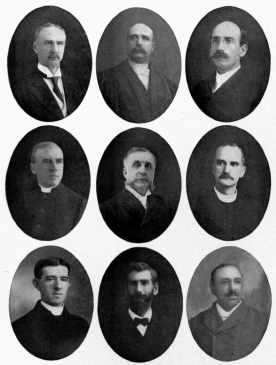
| NEW MILFORD PASTORS |
Rev. Frank B. Draper
Professor of Mathematics
and Chaplain, Ingleside
School
Rev. Marmaduke Hare
Rector All Saints Memorial
Church
Rev. Father John J. Burke
Curate of Roman Catholic
Church |
Rev. Timothy J. Lee
Former Pastor of First
Congregational Church
Rev. Frank A. Johnson
Pastor of First Congregational
Church and the
Chairman of Religious
Committee of the
Bi-Centennial
Rev. Solomon D. Woods
Pastor Baptist Church
Northville Society |
Rev. Harris K. Smith
Pastor of the Methodist
Episcopal Church
Rev. John F. Plumb
Arch Deacon and Rector
of St. John’s Episcopal
Church
Rev. Stephen Heacock
Pastor of Advent Christian
Church |
and the ‘weighing of fate and the sad discussion of sin,’ I come here
and find refreshment and repose. The large city has certain great
attractions, and, in some respects, life in it is far broader and
greater than it can be elsewhere. That is the reason I went to New York.
But the town, and the small city, have other advantages, and it is by
those that my love of this place is kindled. And so, on this birthday of
New Milford, I want to speak of those qualities which I prize so highly
in this place.
“And, first on the list, comes personal freedom. Thackeray said that
England had fifty million people in it, mostly fools. Well, when you
have an enormously big city, there are so many fools gathered together
there, that it is not feasible and practicable for the sensible people
to be free. You must not carry a pistol, because there are so many
‘gumps’ that cannot be trusted with firearms. You cannot let people walk
on the grass, or they will destroy the foliage. It is all paternalism.
The law is taking care of you. You cannot let people take their children
into the park on a sled. They might get hurt. A cordon of police guard
the ice on the part of the lake that is not safe. If they did not, some
idiot would skate into the water. Now, I resent being protected from
myself. I feel like Ben. Franklin, ‘Where freedom is, there is my
country.’
“Another good treasure you have is simplicity. Life here is less
complex. There are so many things in city life that demand attention
that our energies get scattered, and our attention diverted, and our
ways conventional and artificial. It is hard to express just what I
mean; but life up here is less confused and more elemental and natural
and real. That is a good thing. Then, you have the sunshine and the air
and the open fields. You have what people who come up here from the
Bowery call ‘loneliness.’ It is aloofness. One can withdraw here, can
get away, can get out of sight, can hear that still small voice which
speaks only through the peace of nature—can ‘flee as a bird to the
mountains.’ One idea of holiness is that which is set apart. Your
landscape has a holiness which is not shared by shaven lawns punctuated
by statuary. Our national emblem is the eagle, and there is an eagle
spirit in the American people which likes the cliffs and the forests
better than the boulevards and the parks.
“Then, there are not so many of you but that you can know each other and
be interested in each other and help each other. The so-called
philanthropy, which is more interested in institutions than it is in
individuals, is a bad thing. What this world, with its suffering and sin
and error, needs, is not more brown-stone laboratories and patent
book-shelves and institutes for the uplift of the masses and the
glorification of the millionaire rascals that endowed them; what the
world needs is men that are interested in the individuals that surround
them. I have not twenty-five thousand dollars to give away; but, if I
had, I would pick out a worthy family that needed it and give it to
them. I would endow a tradesman and not a trade school. Now,
conditions here are good, because of the human interest you take in each
other. If there were five hundred thousand of you, such personal
interest would be impossible. Try to take a personal interest in one
hundred thousand people. You cannot do it. The personal relations of
employer and employed, of neighbors and friends, in a village are a
priceless blessing.
“All these things are characteristics of this place.
“Besides this, it has its own history, its beautiful street, its scenery
so exceptionally sweet and lovely—it is for these things that we
celebrate its birthday.”
Dr. Ryder’s address was entitled “The Village and The Nation.” He spoke
as follows:
“In this picturesque, beautiful and impressive Celebration, the
Bi-Centennial of the settlement of this region, thought is naturally
turned to the village of New Milford and the community life gradually
developed here. There were certain fundamental characteristics of this
village life which you, who were a part of it in later days, appreciate
much better than your speaker. And yet even a superficial knowledge of
what was here begun and has been gradually developed impresses these
fundamental characteristics.
“This was a simple and natural life. The speaker preceding me has
developed eloquently this fact. Artificiality had not yet crept into the
social conditions of this life. The value of a man was not estimated by
his heredity nor his wealth. It was a pure, clean democracy where every
man was a man in privilege and opportunity ‘for a’ that, and a’ that.’
“But another element of this village life was also evident from the
first. This was the articulation of the community. Everyone knew every
other one within the confines of the settlement, although stretching
along the edges of the beautiful rivers, down the valleys and plains,
and up the slope of the stately old mountains. When Mary Jones’ husband
died and left her with a brood of little children, every man and woman
in the community knew it, and most of them called upon Mary Jones with
their burden of food or clothing or wood-shed supplies. It was the
articulation of one life into another life, and of each life into the
whole, that made the village of New Milford and every village in New
England so strong and safe and efficient.
“But, little by little, these villagers in New Milford and other
communities round about felt the need of the articulation of community
interest into a larger whole. And so the community of associated
responsibility and help took in Waterbury, Norwalk, Bridgeport,
Hartford, and New Haven and other villages and towns scattered over this
general region. This articulated the separate communities into a larger
whole and the commonwealth was created. It was not a formal government
so much as a community of interest and sympathy and love and organized
efficiency. These several communities became a commonwealth for
protection and development. Self-control was the basis of governmental
control. The village was strong and vigorous in so far as the individual
man and woman were strong and vigorous. The commonwealth developed these
qualities of influence and strength only as the village developed them.
And so this simple, this articulate life of the village became the life
of the commonwealth.
“Then a new condition arose. King George came across the water,
established his forts, anchored his fleet in the harbor of another
community that began as a village in the neighboring colony of
Massachusetts. There was need of protection and safeguard in a larger
way than the group of communities or villages furnished. So there came
the articulation of the commonwealth with that of other commonwealths,
and the united colonial power came into being. This afterwards became,
as we all know so well, the United States.
“So, in constructive analysis, beginning with the unit of governmental
power and influence, we find the village. No fairer or better or cleaner
or more dignified than this village of New Milford existed in all the
group of villages amid all the clustered commonwealths. A son of some
Pilgrims from New Milford, who drifted into northern Ohio, who is your
speaker at this moment, rejoices with you who have dwelt here in the
East, in this magnificent and imposing Celebration of the founding of
New Milford.
“But a larger view than this must be taken if we would estimate the
importance and meaning of this village Celebration. The articulation of
interests in the life of our nation as it exists to-day is much more
difficult than it was when these villages grew by natural processes into
the early national life. Multitudinous and heterogeneous masses are
mingled in our body politic to-day, coming from nations that know
nothing about the traditions of Puritan, or Pilgrim, or Dutch, or
Cavalier. In many of these nations from which these peoples come and
mingle in our life, the only thought of government is that of power, of
police force, or suppression. Danger threatens us as we attempt to
assimilate into our own national life these heterogeneous masses. It is
not that they are bad, but that they come to us with no such conceptions
of the simplicity and articulation of life and government as our fathers
possessed who established the villages of New England. Our
responsibility is to spread everywhere the great principles that lay at
the foundations of village life in early New England. It is not from
northern Europe that immigrants come who are a menace to these
institutions that have made the United States what they are to-day. The
real problem is the assimilation of unassociated races who are making a
large portion of our body politic. Twenty million of the eighty million
who are citizens of the United States are of the brown-skinned,
undeveloped races. They represent fundamentally different ideals from
those that made New England and the southern colonial States the power
they were. It is for us in this generation to stimulate in these
brown-skinned people the higher conceptions and loftier ideals
represented in these villages that furnished the unit of development in
the early years of the nation. There are two United States to-day, and
we cannot neglect either of them with safety. There is Continental
United States, the familiar old stretch of territory from ocean to ocean
and from gulf to northern Alaska. This furnishes problems enough for the
children of the Pilgrims to meet and solve. But another United States
has been added in these later years, and that is Insular United States.
They were brought to us through the arbitrament of war. We did not seek
them; we perhaps are the poorer for their possession. But the great
problem that God in His providence has put upon us to-day is the
elevation and redemption of the masses of these island peoples. They
have no village traditions or life to look back to. They have no
intelligent conception of freedom. Morality is almost an unknown quality
as we use the term. One great problem before Americans to-day,
therefore, is the Americanizing and Christianizing of these masses that
have become a part of our body politic, and whose future will largely
determine the future of our entire nation.
“The village ideal, the simple, natural life that the smaller
communities illustrated, the articulation of interests into one common
and homogeneous whole, is what is demanded to-day, and what we must
struggle for and achieve if the nation remains in its integrity and
strength and dignity.
“When we analyze back to the village, we only go a part of the way. The
unit after all was the home. One home articulated with other homes was
the final analysis of strength and safety. It is the home, and not the
church or the school, that holds men and women to that which is best and
noblest. It was the home in the villages of New England, it was the
home in New Milford, that determined its value and contributed to its
beauty of community life. We have got to create in these masses that are
coming among us the desire for the best, purest, noblest Christian home,
or our entire civilization is in danger. If this Bi-Centennial of New
Milford shall stir the hearts of the descendants of the brave men and
women who established this village with a great passionate desire and an
overmastering determination to perpetuate these great ideals and visions
which the fathers held and nourished in their homes and united in their
community life, then this Bi-Centennial were indeed an occasion of
deepest rejoicing and abiding value.”
SUNDAY EVENING
At five o’clock a service was held in All Saints’ Memorial Church (St.
John’s Congregation uniting), which was attended by pastors of the
churches of several denominations—another illustration of that fine
Christian fellowship prevailing in New Milford which the Union Meeting
on “The Green” had signally exemplified. The rector, Rev. Marmaduke
Hare, preached an eloquent and profound sermon, in which he claimed that
the master-force in the growth of mankind in all the higher qualities
has been the truth and hope of the Gospel, and protested against
imputing to nature, reason, science, philosophy, commerce, and politics
what belongs to Christianity. “Ethical societies,” he said, “may preach
ideals, parliaments prescribe methods, literature describe the movements
and processes of civilization, but the Church of the living God supplies
the moral dynamic which makes possible all the rest.”
At seven o’clock historical addresses were delivered at the
Congregational Church and Saint John’s Church, by Rev. Charles J. Ryder,
D. D., of New York, and Rev. George S. Bennitt, D. D., of Jersey City,
respectively. Dr. Ryder’s subject was “Pilgrims from New Milford.” He
said:
“Western Connecticut and Massachusetts contributed more
 MEMORIAL BUILDING AND PUBLIC LIBRARY
 ALL SAINTS’ MEMORIAL CHURCH
to the early settlement of northern Ohio probably than any other section
of the country. Pilgrims from this portion of New England began early to
find their way westward. Along the fertile valley of the Mohawk, on the
edge of the great inland seas, these settlers planted their homes. You
can easily trace the line of their march in the intelligence and dignity
of character that their descendants possess to-day in these regions. New
Milford contributed to this body of Pilgrims that followed the sun
toward its setting. As they went out, they left that which has been so
eloquently set forth in various public addresses during the progress of
this Bi-Centennial of New Milford. The beautiful valleys and imposing
mountains, the clear rivers and foaming brooks, the marvelous,
picturesque beauty of New Milford and its environment, they left behind
them. They did not find these, as they planted their tents in the great
forests of northern Ohio. How often have I heard one of these Pilgrims
from New Milford describe her homesickness as she looked out upon the
almost flat country, which the local clearing had revealed, into the
dense forests that shut down upon the edge of this clearing on every
side! Turbid streams, muddy roads, wooden sidewalks, the plain and
unattractive natural scenery, and the rough conditions of pioneer life
were vastly different from the beautiful landscape and refined
conditions of this home town from which they went out.
“But they did not leave all, nor the best, of that which they had
gathered in the life in New Milford, as they left its borders and went
overland by their own conveyance into Ohio. They took with them three
fundamental conceptions of life. First, that of the Christian home;
second, that of the public school; third, that of the Christian church.
To these ideals, planted in the hearts of these early Pilgrims, may be
traced the fruitage of the strong intellectual and moral life which has
developed in the citizenship of northern Ohio.
“These Pilgrims from New England found chiefly an opportunity. The
physical conditions were depressing and hard. The problem of life was
serious and difficult, the hardships encountered were rigorous and
persistent; but wherever these Pilgrims planted a colony in the Western
Reserve, or New Connecticut, as it was called, they established the
Christian home, the public school, and the Christian church.
“Philo Penfield Stewart, a Pilgrim from the neighboring town of Sherman,
illustrates the character and purposes of these early settlers. He went
into Ohio in 1832, and, even before his weary body could have rested
from the long and tedious journey, he began at once, in connection with
Rev. J. R. Shipherd of Elyria, plans for the establishment of a college
and colony at Oberlin. It is possible, as history hints, that the first
white pioneer into Ohio was Ferdinand De Soto, who possibly pushed his
way into the region of this great central State as early as 1539. It is
most fortunate, however, that not the descendants of De Soto, but the
Pilgrims from New England and their descendants, gave the ideals and
formative influences to this new commonwealth. That there should be the
least percentage of illiteracy in the northern counties of Ohio, known
still as the Western Reserve, of any part of the tabulated world, is not
an accident. The schoolhouse was as much a part of their essential
requirements as the barn or the shop. When in the height of his
wide-reaching influence, Dr. Joseph Cook went once to Cleveland; he
carefully studied the conditions of the public schools of the Forest
City. He afterwards bore testimony that ‘in coming from Boston,
Massachusetts, to Cleveland, Ohio, he came up in the character of the
appointments and work in the public schools, and not down’; that ‘the
educational system of Cleveland was better than the educational system
of Boston.’ Your speaker having had somewhat intimate acquaintance with
both systems, would speak an humble word of endorsement to this
testimony of Dr. Cook. These Pilgrims from New Milford found mud,
homeliness, forest, hardships, toil and privation. But they found
opportunity. This opportunity they improved to the best of their ability
or of any ability that human beings could command. They planted churches
and worshiped within their sacred precincts with loving reverence; they
built their schoolhouses and had no lack of teachers, for many of their
wives and daughters had been teachers in Old Connecticut. They sent
their children to school, sparing them from needed work on the farm or
in the shop or store. They did this, because they were building life,
character; were establishing a Christian civilization to outlast them
and their immediate descendants. They did it, because they believed in
God and man and in making the most of life. Better than all, they
gathered in their homes around the clear-swept hearth of their open
fireplaces, in love, peace, and confidence. Often the crackling fire on
the open hearth was the only light that the home possessed for the
evening. Sometimes, as we learn from their records, they put melted
tallow in a tin basin and hung a bit of cotton wicking over the side to
light their humble homes. ‘Two such lanterns,’ they tell us, ‘were
sufficient to light up the church for evening service.’ It was almost
reverting to the type of the lamp used in early Jewish history, and
quite to the profound Hebrew reverence. But whatever artificial light
these Pilgrims had, they saw clearly the great purposes of existence,
and read with undimmed vision ‘their title clear’ to the best that
devotion and energy and faith and courage could achieve.
“When the great agitation came in favor of freedom, as against chattel
slavery, the descendants of the New Milford Pilgrims in northern Ohio
did not flinch nor hesitate. Professor Hart, in his recent volume on
‘Slavery and Abolition,’ says:[17] ‘One reason for the force which
abolition early acquired in Ohio was the fallow field waiting for it in
the Western Reserve. This region, settled by Connecticut people between
1790 and 1820, was still a little New England, its churches, schools,
and local government closely modeled on those of Connecticut.’ Nor did
this ‘fallow field’ among the Pilgrims from New Milford prove
unproductive. Rustic lads, whom Dr. James Harris Fairchild, President of
Oberlin College for many potential years, represented, bearing his
testimony to these hard, early conditions, waded through the snow
barefooted in order to attend school. Such lads could not be kept away
from the privileges of higher training. Colleges were immediately
necessary. Such institutions were established, buildings erected,
faculties gathered, lecture and class rooms crowded with eager pupils,
as by the magic wand of some scholastic magician. Within a few months
of its establishment, Oberlin College had hundreds of pupils. They had
brought together a faculty perhaps unequaled, man for man, in the
faculty of any institution ever founded. They were giants,
intellectually and morally. Their names to-day are wrought not alone in
the intellectual and educational history, but into the very warp and
woof of our national life. Ohio, the great West, the South, and the
nation could hardly have been the great, united nation that it is, had
it not been for these Pilgrims from New Milford and their descendants,
who stood with heroic courage for the highest ideals, and strove to
attain them at tremendous sacrifice and suffering.
“Professor Hart is responsible for the following bit of history: ‘When
Harriet Martineau attended an anti-slavery meeting, she found that she
had given offense to the best society in Boston. Theodore Parker found
his clerical brethren refusing to exchange pulpits with him; “My life
seems to me a complete failure socially; here I am as much an outcast
from society as though I were a convicted pirate.” The eastern colleges,
almost without exception, were strongholds of pro-slavery feeling.... In
1848, Charles Sumner, a graduate of Harvard, spoke to the students of
the college. Longfellow said: “The shouts and the hisses and the vulgar
interruptions grated on our ears. I was glad to get away!”’
“But such a spirit of cowardice and weak surrender to the financial and
social influence of the South as was manifested by many eastern
colleges, was not that of the western colleges planted in the clearing
of the great forests of the New Connecticut largely by the Pilgrims of
New Milford. They spoke out steady and strong against the ‘twin relic of
barbarism.’ Professor Seabert, in his history of the ‘underground
railway,’ bears testimony that through the Western Reserve almost every
line of secret escape for the slave running toward the north star
passed. At Oberlin, where the Pilgrims in whom your speaker is most
profoundly interested had their home, eleven underground railroads
passed. They radiated as many as the ten fingers of the two hands, and
one hand had an extra finger. It was the boast of these brave men and
women, and the boast was proven by the fact, that no negro was ever
taken back to slavery who reached the Western Reserve. How well I
remember those early incidents in my boyhood home! The
Oberlin-Wellington rescue case is written in the history of the nation.
How the excitement and agitation of that New England village in Ohio
come to me as I think of it! It was but a few months after the death of
my father, Oliver Roberts Ryder, a Pilgrim from Danbury to this same
Western Reserve. A negro boy, John Price by name, had escaped from
slavery. He had been a resident for some time in Oberlin. Through the
intrigue of a pro-slavery countryman near the village, he was waylaid,
captured by a band of slave-holders, bound and gagged, thrown into a
wagon, and hurried off to a railroad station on the railroad leading
into the South. The descendants of our Connecticut Pilgrims of the town
heard of it. Prayer was offered first, for faith in God was the very
threshold over which they passed to the accomplishment of any brave
purpose. Wagons were hastily gathered, firearms piled into them, and
away the Oberlin rescuers went to win this black boy, rather worthless
fellow in himself, to personal freedom. This was his constitutional
right under the Declaration of Independence, for he surely was born to
be ‘free and equal’ in privilege. He was rescued from the slave-holders,
although they were armed to the teeth and displayed their guns, but did
not dare to use them. The faculty, the Sunday school superintendent, the
leading business men were in this band of rescuers, and were afterwards
thrown into prison for the technical crime of their acts. Here again the
splendid traditions which these Pilgrims brought from their eastern home
came in play. Obey the law they must. They could do it by not breaking
it, or by submitting to the penalty. They chose the latter, and no one
made the slightest effort to escape, but submitted without a moment’s
hesitation to the processes of the law, and stood before the jury. They
were not subpæna jumpers, and in this showed that they were not criminal
in intent, as those who seek to escape the processes of the law always
are.
“No, be it said to the glorious memory of the Pilgrims of New Milford
and Western New England, they did not follow in the wake of many of the
larger institutions in the East, and cringe and whimper and grovel under
the crack of the whip of the slave-holding aristocracy. Open and free
and manly, they stood out for the defense of freedom, whether applied to
the person of black man or white man. It was the highest type of
educational training which any institution can furnish. It was not
tamely to learn axioms or to demonstrate mathematical problems, but to
know, to believe, to defend that which was best and truest. These worthy
Pilgrims who went out in the early part of the nineteenth century into
this western forest, stood for this with all the sturdy strength of
these mighty trees that shadowed their homes. It is because they went,
and others like them, that the Buckeye State has risen to and maintained
her dominant influence in the nation’s life. It is due to these
Pilgrims, more than to any other one force, that the whole Northwest was
from the first saved the disgrace of slavery. Institutions of learning
in which women as well as men had the right to the best education were
planted. They maintained the school, the church, the home in every
hamlet and city and village; and, to-day, this region they settled
presents the finest, largest, and most comprehensive type of Christian
civilization that the earth affords. All glory, then, to these Pilgrims
from New Milford! They, like one of old, ‘went out not knowing whither
they went.’ They dared and suffered and died, but always achieved. Well
may this village, a beautiful gem set in the midst of these rolling
hills, rejoice in its own noble development and progress and prosperity.
Your life here is almost ideal. The conditions are as fine as the world
affords. But, as you rejoice in this Bi-Centennial of your own founding,
forget not, O brave and true men and women of this generation; forget
not, O Christians of these churches; forget not, O patrons of this
redeemed nation, that the Pilgrims that went out from your firesides and
homes into the great West inaugurated the tremendous forces that have
moved on in increasing power and breadth until the whole nation has been
made the richer by their mighty power.”
Dr. Bennitt’s address at Saint John’s Church was as follows:
“...Religious matters, during our beginnings, did not run very
smoothly. The desire for greater religious freedom caused a considerable
falling away of sundry church members to Quakerism in 1731 and 1732.
There were also families who had come into the town, and brought with
them an affection for their old Church in England; and, as the English
Church had been established in Stratford in 1707, and in Newtown in
1732, only fifteen miles away, the influence of this Church began to
exert itself here. When the Rev. John Beach ... established the services
of the Church of England in Newtown, the Churchmen of New Milford
journeyed on Saturdays to Newtown, carrying their own provisions, and
the Churchmen there gave them their lodgings. He baptized their
children, and came here to officiate at a marriage in 1739. He began
services here about 1742. He sent Mr. Barzilla Dean here as a lay
reader, services being rendered in one of the houses of a Church family.
“It is stated that certain Churchmen in New Milford were fined for
refusing to attend the meetings of the Established Church. These fines
were, by recommendation of the Rev. Mr. Beach, paid, and copies of the
proceedings taken to be forwarded to the King and Council. The fact
becoming known, the authorities refunded the money, and granted
permission to build a church which before had been refused.... In 1745-6
materials were gathered, and the English Church in New Milford erected.
“Let us glance for a few moments at the village street at this time. The
early settlers had laid out their town plot, because of a beautiful
spring of water, at the head of the street, nearly in front of Ingleside
School, and about under the present sidewalk. The water from this spring
meandered its way down through the village street, bowing from the
spring to the south end of the street, where it formed a small pond,
which was called ‘The Goose Pond.’ This accounts for the east side of
Main Street bowing, while the west side is straight, and the street
opening out considerably wider at the south end, on account of ‘The
Goose Pond.’ This spring was there in my boyhood days, although an open
ditch had been constructed through the middle of ‘The Green,’ in which
the stream flowed. Since the construction of the water works, however,
and the laying of pipes through the street, both the spring and the
stream have disappeared.
“The First Established Church stood near the head of Main Street, near
the spring, and the land granted for the Church of England was in the
street, east of Mr. Samuel Prindle’s house, near where the old pound
used to stand, at the south end of Main Street, therefore, and in the
middle of the street. Here they built the first Church of England in New
Milford.... It was a frame building, forty feet by thirty. It had two
rows of windows, one above the other, and presented the appearance of a
two-story house, and the door was in the side. It was surmounted by a
turret in the center of the building, and stood ends to the east and
west. The door was on the south side, and within, on the north side,
stood the pulpit. It was not until 1756 that the building was finished,
when, upon the building of the second meeting-house, it was voted to
give three-quarters of the body seats and two pews in the old
meeting-house to the Church of England. Then, the church was furnished
with the square box seats, and the pulpit stood aloft, beneath which was
the reading desk for the prayers, and, beneath that, the pew for the
clerk, to lead in the responses, and to tune the Psalms. A curtain
across the corner, served as a robing-room for the vesting of the
clergymen, and, around little tables which were placed in the middle of
the square box seats, gathered the families of the Churchmen of that
early time. And on account of the love and affection they bore to the
Rev. John Beach, of Newtown, who first planted the church in their
midst, they named it ‘Saint John’s Church’; and it has borne that name
ever since.
“The Rev. Solomon Palmer, a Congregational minister of Cornwall,
dissatisfied with his orders, conformed to the Church, and went to
England for ordination. After that, he returned here, and became the
first Church of England minister who resided here, from 1754 to
1760.... He was succeeded by the Rev. Thomas Davies in 1761. He was a
missionary sent by the ‘Venerable Society for the Propagation of the
Gospel in Foreign Parts.’ ... a graduate of Yale College, a man who had
become a minister of the church, from conviction, a gentleman and a
scholar, a reader of the service, and preacher of the highest order....
Under this man of God the Church outgrew its small building, and entered
upon the construction of a new, more commodious, and churchly edifice.
“I have a copy of the diary of the Rev. Thomas Davies, containing most
of his ministerial acts, and some of these shed considerable light on
the old times. He records, on November 15, 1764: ‘On St. Pumpion’s
(Pumpkin’s) Day, I baptized at Ethel Stone’s, Martha, Ester and Edmond,
children of Ethel Stone, Hannah of Gad Sperry, Joseph and Hulda of
Samuel Peet, and David Smith of David Smith.’
“He alludes to St. Pumpion’s Day in other records, which leads us to
suppose that this was a colloquial term in those days for designating
the annual New England Thanksgiving, which was celebrated by an
abundance of pumpkin pies.
“I have a manuscript sermon of the Rev. Thomas Davies, preached at New
Milford, written in the finest hand, showing clearness of thought, a
fine choice of language, and rising to eloquence, in pressing home to
the hearts of his hearers the word of God.
“The Rev. Mr. Davies was succeeded by the Rev. Richard Clark from
Milford, who remained here until 1787. He was here during the
Revolution. The church begun by Mr. Davies was completed sufficiently to
begin services therein, and the old church was sold to the town for a
town house. This was removed to the head of Main Street and used for
several years.
“The second Church of England, begun under Rev. Mr. Davies, had
Partridge Thatcher for its architect, but was modeled after the church
at Stratford, but somewhat plainer in its ornamentation.
“It stood, facing the road towards Butter Brook, a few rods north of the
first church, had a steeple which projected out in front of the
building, and long windows round at the top. Within, it had the high
pulpit with circular stairs; its reading desk and clerk’s pew beneath,
making what was called a three-decker. A communion table was in front of
all, and the whole was surrounded by a communion rail. A gallery was
across the south end; and a curtain across the corner, served again as a
robing-room. The service of that day had its peculiar features. The
clergyman was robed in a long surplice and black scarf. He wore a white
wig, to give age and dignity to his ministrations. The surplice was
exchanged for a black silk gown and bands before the sermon, the
congregation all knelt for the prayers, and, in doing so, turned around
and knelt to the seats. The clerk (or clark, as the people called him)
doled out a line of the old Metrical Psalms, and the congregation sang
it, and waited for another line. There was no fire in the church, and,
in winter, the women carried their foot stoves to keep their feet warm.
“The Revolution, however, gave great discouragement to the Church of
England people, for everything English was hated by the inhabitants, and
the Rev. Mr. Clark, after ten years of struggle, gave up and fled to
Nova Scotia in 1787, and the church was closed.
“The kind of Church people that were made in the Colonial days of the
Church in Connecticut may be illustrated by the name of Samuel Peet, a
devout Churchman from Stratford, who came to settle in the New Milford
North Purchase, in the vicinity of Rock Cobble, west of Peet Hill. He
selected a site for his future home near a great rock, which, by some
convulsion of nature, had been rent asunder, leaving a portion like an
altar between, with two natural steps to ascend it. Here, Samuel Peet,
the Hermit, knelt day by day to worship his God, and the holes he
chiseled out for his knees on the top of that altar are to be seen to
this day. He erected his house just west of the altar, and here reared
his family, desiring to be buried between the rocks, but, as it was
found they came together just below the surface of the ground, he was
buried on the east side of the altar rocks, in one of the most romantic
burying-places of this town. Now, in 1789, when the Rev. Mr. Clark had
fled to Nova Scotia, and the church in New Preston was boarded up to
save its windows from being destroyed, Samuel Peet was on his death-bed,
desiring to receive the Holy Communion. He sent a messenger away down to
one of the churches nearer the Sound, for a priest. It was in March, and
the roads were very heavy, and a prolonged time was required.
“Meanwhile, Samuel Peet was nearing his end. He asked that bread and
wine be prepared and placed on a table beside his bed, that no time be
lost when the priest of the Church arrived. Again and again, he sent out
to see if the messenger and the priest might be seen coming in the
distance; and, as the end grew nearer, and the priest had not arrived,
Samuel Peet said, ‘Let us pray,’ and, when all had knelt around his bed,
he prayed: ‘O Blessed Jesus, Our great High Priest, come down and
consecrate this Bread and this Wine to be Thy Body and Blood.’ And,
after silence had been kept for a space, he reached out his trembling
hand and communicated himself, after which he soon fell asleep in Jesus.
Who shall say that was not a valid consecration!
“The priest of the Church arrived that night, and remained to commit his
body to the earth, looking for the general resurrection in the Last
Day....
“It is a tradition that some of the rectors of the Church of England had
a habit of talking to themselves, and, behind the curtain while they
were robing, would often repeat over the notices to be given out, the
most interesting being the publishing of the banns of matrimony, which
was the custom in those days. On one occasion the banns were published
between Orin Marsh and Maria Hill, who lived upon the plains. Now, there
were in the Church, Orman Marsh of Boardman’s Bridge, and Maria Hill, of
Aspetuck, whom the congregation thought were the parties published,
greatly to their confusion. That day, the second-named began their
acquaintance, suggested by the banns, and, in due time, their banns
were likewise published.
“The Rev. Enoch Huntington, who entered upon the rectorship in 1827,
began parish records, and, upon the first page, states that there was a
congregation of about thirty. No Sunday school, and no music. Also the
church was in need of repair, but he concluded not to spend much upon
it, but later to build a new church, the third one of the society. The
new rector soon gained the love and esteem of the people in general, and
the attendance of young people became a prominent feature in his
ministry. So devoted were his people, that they are spoken of, when the
church roof was old and leaky, as sitting in their pews during a shower,
with their umbrellas up, listening to the preaching of the word of God.
A bell was placed in this old church steeple, the first one the church
possessed. In 1837 a new church was erected on the east side of Main
Street at the corner of what is now called Church Street. This church
was a frame building, with long windows, square at the top. It had a
square tower upon it, and, within, a gallery around three sides, a
massive mahogany pulpit, reading desk below, and a small mahogany
communion table in front, with two mahogany chairs on either side, a
communion rail enclosing them. A vestry-room was built in the rear, and
the rector entered the pulpit from stairs in the vestry-room, and
appeared through a door cut in the wall behind the pulpit.
“The pulpit and reading desk were covered with cushions of black silk
velvet, with heavy silk-corded fringe across the front, and large silk
tassels suspended at the corners. There was a sofa seat behind the
reading desk attached to the pulpit.
“The pews had doors with large black tin plates attached with numbers
on. This church was considered very handsome in its furnishings, and was
the pride of both rector and people. It was furnished with a new bell,
and into this came the first organ owned by Saint John’s Church. Rev.
Mr. Huntington resigned in 1848, and, after his decease several years
later, was brought here and buried in the village cemetery, having this
honorable record—of being the rector of Saint John’s Parish longer than
any other clergyman from its beginning to the present day....
“During the incumbency of Rev. William H. Reese, I was baptized in that
old church, out of the silver bowl placed on the communion table. When I
was a little child, I well remember how Bishop Brownell catechised the
children, standing about the chancel rail, but, perhaps, as I grew
older, the most vivid impression made upon me was the preparation for,
and attendance upon, the old-time Christmas Eve service. Evergreens were
gathered upon the Plains, and the people assembled at Mr. George
McMahon’s to tie them. They were gathered in Aspetuck, and the people
assembled at Mr. Marshall Hill’s or Mr. Stephen Morehouse’s. They were
gathered at the village, and the people assembled at the house of my
father, Noble S. Bennitt, on Bennitt Street. The refreshments consisted
of a pan of doughnuts, round and sugared. The cracking fire on the
hearth consumed the broken branches, and the young people remained for a
social time after their elders had departed. Such large ropes of
evergreens were tied, and afterwards suspended from corner to corner of
the church, and all around the walls, and in front of the gallery!
“White covers of bleached muslin covered the pulpit and reading desk, to
which were attached fringes made of the needles of the pine, by Miss
Bostwick, afterwards Mrs. Leroy Buck. Mottoes of evergreen on white
cloth were put up on the walls, and candelabra, of five candles each,
across the ends of the pulpit and desk cushions. Miss Cornelia Boardman
brought a large fluid lamp with a glass globe and put it on the
communion table. The people reserved their whitest and purest tallow to
make dipped candles to hang up in tin back candlesticks under the
gallery, while Edgar and Henry Wells made a great star of five points,
covered it with evergreens, and suspended it from the ceiling in the
middle of the church, containing as many candles as it was the year of
the century. This was the only time in the year that the church was
lighted up, and the people of the town turned out and filled the church
and its galleries to overflowing. The good old Christmas Eve service of
the old times, who that was then alive shall ever forget it!
“But the solemnity of the old-time Sunday comes up with all its hallowed
associations. The Sunday church bells, with the orderly ringing and
tolling of their first bells and last bells; with their solemn tolling
for a death—nine for a man, seven for a woman, five for a boy, three
for a girl!
“The sleigh bells, too, bass ones and tenor ones, jingling all the week
in the winter time, but no sleigh bells on Sunday! I well remember when
two young men, in their want of respect for the traditions of Sunday,
drove through the village street with sleigh bells on their horse on the
Lord’s Day, thereby shocking the sober-minded people of the churches and
the town.
“The social gatherings of the people come back to one, as he recalls the
old times, also. The annual donation parties given by the parishioners
to their parsons, when, it used to be said, ‘The people would bring all
kinds of good things to the parsonage, and then remain for a good social
time, spread all the good things brought for a feast, and then largely
consume them before they departed.’
“Other social gatherings had their attractions for the people, but I
recall one which was to occur, but never took place.
“It was on the coldest day of February, 1860, when, in large sleighs, a
company of people set out for a dinner party to be given upon the
Plains. As they passed down the Main Street, the bell of Saint John’s
Church was tolling for a funeral about to be held within it. It was
thereupon agreed to stop and attend the services, warm themselves by the
fire, and then proceed on their journey.... The clergyman took for the
text of his funeral sermon, which in those days was a very dignified
discourse, ‘It is better to go to the house of mourning, than to go to
the house of feasting: for this is the end of all men, and the living
will lay it to heart.’ Consternation filled the hearts of all. The women
and the children remained in the church by the fire, and the men went to
the village cemetery to assist in the burial; after which all returned
to their homes. The effect of the sermon had been marvelous, and the
living had laid it to heart. The funeral was that of the widow of Dr.
Amaziah Wright.
“Rev. Charles G. Acly, who became the rector in 1856, wrought a good
work here, and, under him, the church was enlarged in the summer of
1860, by the nave being extended nearly twice its length. A recess
chancel was added, and a stained-glass chancel window given, as a
memorial of the Hon. Elijah and Mary Anna Boardman—the first
stained-glass window in the town. The old mahogany pulpit was made into
an altar. There was an altar cloth of red which served for the whole
year, a beautiful reading desk and pulpit combined, which stood outside
the chancel rail, and, in the center, before the altar, given by Mr.
Solomon E. Bostwick, a pedestal with a marble bowl for a font....
“In this church I began my first work in the Church of God by blowing
the first organ the church ever owned, and Miss Schroder, now Mrs.
George W. Wright, was the organist at that time. We sang the Metrical
Psalms and the few hymns then bound up with the Prayer Book. The Te
Deum was generally read, but on high occasions we rendered Jackson’s
Te Deum. The old Gloria in Excelsis was always sung at the end of
the Psalm for the Day in the afternoon, and sometimes Greatore’s Bonum
est and Benedicite after the Lesson. On Communion Day, once a month,
after sermon, the choir came down in the body of the church, and there
was no music. But Easter was distinguished by the choir remaining in the
gallery and singing the Sanctus. In that church, I was confirmed and
ordained to the holy ministry by Bishop John Williams, and, to that
church, I came afterwards to preach my first sermon in my native town.
One can hardly imagine my feelings, as I came to stand for the first
time before my elders, teachers, kindred, and those to whom I had looked
up from childhood. It was a trying moment. I preached a written sermon,
for fear I might be embarrassed. When it was all over, and some one in
the churchyard, during the noon hour, ventured to call it a good sermon,
one of the men spoke up and said, ‘Yes, if he wrote it!’ Surely, ‘A
prophet is not without honor, save in his own country, and among his own
kin.’ Stirred by this remark, which came to my knowledge, I preached
without notes that afternoon, and did the same upon every visit to New
Milford for many years following....
“The Rev. Mr. Acly was a good man, and a conscientious priest of the
Church of God; painstaking in his sermon preparation, a good reader and
preacher, while as a pastor he went in and out among his people for
twenty years beloved by them. He resigned in 1876, but continued to
reside here until his death in 1880, and he was buried in the village
cemetery, awaiting the resurrection of the just.
“He was succeeded by the Rev. Alfred S. Clark, who was rector from 1876
to 1879. While his stay was only four years, yet he is remembered with
much affection. The Rev. Edward L. Wells, D. D., became the next rector,
whose eloquence can never be forgotten, and by him was started the
project of building a new stone church for Saint John’s Parish. Plans
were drawn and accepted, but, in less than a year, he was removed by
death, in 1880.
“Rev. Edwin R. Browne succeeded him, and, as the contract for the new
church had already been made, he carefully attended to its erection.
This was carried forward for two years, and entirely paid for by the
congregation, so that on Thursday, the fifteenth day of March, 1883, we
all assembled to take part in its consecration.
“The Rt. Rev. John Williams, D. D., Bishop of Connecticut, the Rt. Rev.
Charles Quintard, D. D., Bishop of Tennessee, and thirty of the clergy
of this and other dioceses, met to put on their vestments in the old
church, before proceeding to the new. The emotions which filled my soul
on that day were many and varied. It was the last act to be performed in
the old Saint John’s Church. I went into our old family pew, where I had
grown up to manhood, and, there, I put on my vestments. I went up to
the chancel rail and, kneeling down, offered the last prayer in that old
church—where I had first heard the service of the Book of Common
Prayer, first listened to the preaching of the word of God,—whose
walls had witnessed my baptism, my confirmation, and my ordination to
the holy ministry—and I said, ‘Oh, to have enduring churches of stone,
where the holy associations of a lifetime may never be disturbed!’ It
was this thought which led me forth to assist in the services of the
consecration of the new Saint John’s Church of stone, where the
services might hereafter continue, undisturbed, from generation to
generation. The vested procession of bishops and clergy walked from the
old church to the new. The day was full of sunlight, and even the March
winds seemed to cease, so as to give us Heaven’s own benediction. We
entered this beautiful stone church, filled with a congregation which
occupied its whole capacity. Bishop Williams then consecrated this new
Saint John’s Church, and called upon me to read the sentence of
consecration.
“That day was the greatest red letter day this parish ever
saw—twenty-five years ago, on the fifteenth day of March next!
“The Rev. Mr. Browne continued his ministry here until 1890. He was a
most indefatigable parish visitor, and the sympathy of his people and
their prayers followed him, in the affliction which afterward came upon
him.
“He was followed by the Rev. E. T. Sanford, who was the rector from 1891
to 1895, a man of exceedingly lovable character, who endeared himself to
all.
“He was succeeded by the Rev. John F. Plumb in 1896, who after eleven
years still continues in the rectorship. His character and ability are
so well known among his people, that it would not become me to enter
into them here. Suffice it, then, to say, that he is held in such honor
and respect by his brethren of the clergy of his Diocese, that they
elected him Archdeacon of Litchfield County some years ago, which
position he now holds with honor to himself, and with appreciation by
his parish and friends. May he long continue to go in and out among you
as your rector, pastor, friend, and long continue to occupy his high and
honorable position, as the venerable Archdeacon of Litchfield County.”
No feature of the whole Bi-Centennial Celebration partook so much of the
nature of an experiment, perhaps, as the Automobile Parade of Monday,
which took place a little before noon. It was the first event of the
kind that had ever occurred in New Milford, and there were consequently
no precedents to go by. It was, however, an unqualified success. Fifteen
decorated autos, followed by nearly a score without decorations, were in
line. The owners of the decorated autos were:
- Henry D. Hine, New Milford, Conn.
- Geo. T. Soule, New Milford, Conn.
- A. N. Trott, Waterbury, Conn.
- H. L. Randall, New Milford, Conn.
- Edward S. Hine, New Rochelle, N. Y.
- Mrs. Isaac B. Bristol, New Milford, Conn.
- Jas. S. Robertson, Pittsfield, Mass.
- John Bauman, New Haven, Conn.
- E. M. Watson, Sr., Jersey City.
- C. F. Long, Jersey City.
- Peter Peterson, New Milford, Conn.
- C. W. Lines, New Britain, Conn.
- J. E. Murphy, Southbury, Conn.
- H. Lake, Brookfield, Conn.
- Robert Dunlap, New Milford, Conn.
The judges were George B. Noble of Northampton, Mass., Mrs. Dr. Wallace
of Glen Ridge, N. J., and Miss Beatrice Fisher of Montreal, Canada.
The three prizes (silver cups) were awarded as follows: Henry D. Hine,
New Milford, first; A. N. Trott, Waterbury, Conn., second; Mrs. Isaac B.
Bristol, New Milford, third. Robert Dunlap was given a special honorable
mention.
The decoration of Mr. Henry Hine’s car was very dainty and elaborate. It
was done in white, pink, and purple. In front of the chauffeur was a
Cupid, driving three white doves with white and purple ribbons. Before
the machine were banners inscribed with the figures 1707-1907. The
tonneau was banked with evergreens and wild flowers. The rear tire on
the tonneau was covered with a wreath of evergreens, in the center of
which was suspended a Cupid with bow and arrow. The chauffeur and the
lady passengers wore white and pink.
Mr. Trott’s car bore a canopy of salmon pink, olive green, and white
crêpe paper flowers, and carried as passengers Dr. and Mrs. Bragaw in
Colonial attire. The wheels and the back of the tonneau were similarly
decorated with crêpe paper.
Mrs. Bristol’s car was decorated with laurel, ferns, and white daisies,
supplemented by yellow and white bunting, and carried several passengers
in white, with daisies in their hair.
Mr. Dunlap’s car was literally covered with grass-green and white
draperies and bore an arch of these colors. Its lady passengers wore
white gowns and white picture hats trimmed with green.
Mr. Peterson’s car, with a colossal figure of Uncle Sam, and Mr.
Randall’s with festoons of lemons, gave rise to much merriment. The
other cars were decorated with flags and bunting; Colonial blue and
yellow bunting; white and pale-green bunting; daisies and flags; peonies
and daisies. The party-colored cars presented a brilliant and beautiful
picture, as they coursed rapidly round and round “The Green,” and evoked
many outbursts of hearty applause.
The Historical Meeting of Monday afternoon, the next important event in
the Bi-Centennial Celebration, was presided over by Frederic M.
Williams. Mr. Williams, after a few genial words of greeting,
introduced, as the first speaker, Dr. Samuel Hart, President of the
Connecticut Historical Society, explaining, as he did so, that New
Milford welcomes her guests, not only with the best that she has, but
with the best that there is.
Dr. Hart spoke as follows:
“The recurring anniversaries of the towns of our ancient State are
bringing before us, as in a series of living pictures, the history
of the whole commonwealth and of all its parts. Beginning, within
the easy memory of many now living, with the quarter-millennials of
the first settled towns, Hartford and its sister towns on the Great
River, Saybrook at its mouth, New Haven on its fair harbor at the
mouth of the Quinnipiac, and then its allied towns, Guilford to the
east and Milford, your mother-city, to the west, we are passing now
to the bi-centennials of those, the history of which begins in the
opening years of the eighteenth century. Our origins have been
brought before us, and we have studied again the men and the times,
the founders of our first colonies and the foundations which they
laid, the early history of two differently ordered federations or
groups of organized communities, and their union into one
government under a charter from the English king which made them
almost independent of his authority. We are passing on now to
another period, when, under varied influences and in changed
circumstances, many of our most beautiful and prosperous towns were
founded. Two years ago Newtown, which once had part of its
boundary-line in common with you, observed its bi-centennial; and
the two-hundredth anniversaries of Derby and Woodbury and Waterbury
and Danbury—to mention only those in this neighborhood—were
earlier than that.
“There was a movement of life into this part of Connecticut, the
meaning and result of which will be brought before you by those who
have studied it in its details, and can describe it with local
color. Without repeating or anticipating their words, I may venture
to ask you to think of the difference which a little more than
seventy years had made in the motives that swayed men’s minds, and
the impressions that were made on them by the new lands which they
occupied. One thinks of the stern resolve, both political and
ecclesiastical, which sent Hooker and his company on their long
walk through the wilderness till they came to the river and crossed
it into a strange land, with a determination like that of the
father of the faithful when he crossed the great river of the
eastern world; and then one questions whether they admired the
beauty of the meadows, and one feels sure that when they climbed
the hills and looked down into the more beautiful valley of the
Tunxis, they were drawn by it to travel still further west. One
follows in mind the military instinct which saw the importance of
the control of the Connecticut River, and built a fort at its
mouth, and levied dues on traffic and transportation, and laid out
streets for the houses of people of quality who were expected to
come to dwell there. And one thinks of the surprises which befell
those who sailed slowly along the shore of the Sound, looking into
inlet and bay, and finding at the Fair Haven a place where they
might build a city after the pattern of the heavenly Jerusalem, and
in it dwell and get gain.
“In each of these early instances there was an element of romance,
of strong conviction of duty, mingled with an appreciation alike of
the beautiful and the practical, that combination which, as Horace
told us long ago, ‘carries every vote.’ To some extent this had
passed away two hundred years ago, when possession was taken of the
farming lands, and the fair, though rugged, hillsides enclosing the
river valley in which we now stand. The settlers, who came up into
the high grounds from the shores of the Sound, did not leave, for
the most part, on account of disagreement with their neighbors in
matters civil or ecclesiastical, nor with a special sense of divine
calling or mission. They were rather led by the Anglo-Saxon spirit
of colonization to settle on new soil, to extend former industries
or to undertake new ones, and to organize new units of life in the
body politic. Still, we cannot doubt that when they, too, looked
over the fields they saw more than the possibility of gathering
harvests and crops from them, and that when they followed the
water-courses they did more than estimate the use which they might
make of the force of the falling stream. They had something of the
enthusiasm of discovery, and something of the joy of those who
first turn nature’s forces to man’s account. It is worth our while,
as we go back in mind to these beginnings, to try to think as they
thought, who first looked upon the natural features of the
landscape, which it takes much more than two centuries materially
to change, and to see why they chose as they did, who fixed on this
spot as their home.
“In this regard, there is in all our settlements, early and late,
something that they have in common, which appeals more, I am
inclined to think, to the philosopher than to the historian.
Perhaps the student of history delights rather in noting the
differences in the plans and purposes of those who settled our
early towns, and in finding in each, as he readily may, some detail
of character or event which marks it with a special interest, and
almost always brings in the suggestion of a special romance. As
your early history is read before you to-day in detail, you are
reminded how it differs from the history of every other town in
Connecticut. At its beginning you hear of names which give it a
stamp peculiarly its own: that of the first minister, continued by
an honorable succession through all the generations to this day;
that of the early settler who lived here in a log hut on land which
he had bought of the Indians and lived to be Attorney General of
Massachusetts; somewhat later, that of the man who came here as a
shoemaker and removed hence as a judge, to become one of the few
leaders in the constitutional history of the land; and with them
the names of others which shed a special luster on your annals.
Again, the importance of the Indians in this neighborhood, both in
numbers and (as it would seem) in influence and character, suggests
an almost unique chapter of history, especially when we note that
it led to the sojourn of the remarkable man who led hither his band
of Moravian missionaries and labored not in vain among the
aborigines before he withdrew to make a permanent settlement in
another province, and later to return to his home in Europe. And,
if you care to boast of it, you share with but one or two other
towns the honor of having had congregations of the Glassites—who
under their name of Sandemanians will always be remembered for
having had in their eldership one of the greatest men of science of
a generation ago—and you have the exclusive honor of having been
the home of the Jemimaites. Certainly, no two communities are
exactly alike, and it is in the study of their differences that
much of our pleasure in the reading of their history consists.
“While I bring to you to-day, Mr. President, a greeting on behalf
of the Historical Society of the State, I venture to ask you and
all the citizens of this venerable town, and all who are interested
in her annals already written, and in the record which she is to
make in years to come, not to allow the interest of these memorial
days to pass away with the days themselves. This week is bringing
to the memory of some of you that which you have already heard with
your ears and your fathers have declared unto you, while it is
teaching many others, and in particular the youths and maidens,
their first lessons in the history of the community in which their
lot is cast. The story of the founders and those who carried on
their work, who they were and what they did, what New Milford was
in itself and what part it played in the State and the Republic,
told again now in greater detail than it has ever been told
before—do not let it be soon or readily forgotten. See to it that
the whole town becomes a sort of historical society, for the
appreciation and preservation of that which is old, for the
lending of a proper perspective to that which belongs to our own
day, for preparation rightly to understand and rightly to value and
use that which is coming. They best do the duties of the present,
they best provide for the future, who read and value the lessons of
the past.”
The second speaker, Chief Justice Baldwin, was presented to the audience
by Mr. Williams with these words: “New Milford has had many notable and
useful citizens during her two centuries of existence, but she has had
none as illustrious as Roger Sherman. We have with us to-day one of his
descendants, Simeon E. Baldwin, LL. D., Ex-President of the American Bar
Association, Ex-President of the American Historical Society,
Ex-President of the International Law Association, and Chief Justice of
Connecticut, who will now address you.
Chief Justice Baldwin then delivered the following address on “Roger
Sherman”:
“The rarest and most ill-defined class of human beings is that of
great men. Only those belong to it who have done a great work in a
great way. The ‘mute, inglorious Milton’ is not to be reckoned
among them. They number none, however great their natural gifts or
acquired attainments, who have not made for themselves, by their
own merits, a place in the history of their times. It is from their
lives, indeed, that history gains its color and its inspiration.
“It was the good fortune of New Milford to be the home of such a
man in the middle of her first century of existence.
“It was a hundred and sixty-four years ago, this very month that a
tall and well-set young fellow of two and twenty ended in this town
a toilsome journey, taken on foot from the neighborhood of Boston.
He had come to make New Milford his home, bringing on his back the
tools of his trade—that of a shoemaker—and with their aid he here
gained for a year or two an honest livelihood.
“A shoemaker and the son of a shoemaker, he had, and felt he had,
capabilities for a larger work. His mind was already
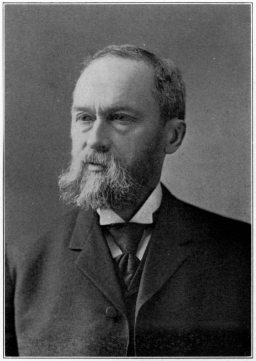 HONORABLE SIMEON E. BALDWIN
Chief Justice of the Supreme Court of Connecticut
set on that of a surveyor. For this, too, he fitted himself well;
but there was that before him of which he did not think. He was to
fill a long succession of official trusts, affecting all the
Colonies and the States which succeeded them, to be bestowed upon
him at a time of great events, and to be so well discharged as to
make him one of the great figures of American history.
“When Connecticut, a few years ago, was called upon by the nation
to choose the two of her sons whose statues should be set in the
Capitol at Washington, there could be no question as to one. The
land of steady habits must, at all events, be represented in that
place by Jonathan Trumbull, the War Governor of the
Revolution,—the Brother Jonathan who typified to the nation the
rugged virtues and hard good sense of the New England character.
“The other statue also must belong to the same great era, the era
which began with the struggle for independence, and closed with the
attainment of settled constitutional government. Our heroes must be
taken from that which above all others was our heroic age. Should
we thus commemorate the impetuous gallantry of Putnam, the noble
death of Hale, the courtly eloquence of Johnson, the judicial power
of Ellsworth? All these were sons of Connecticut, born upon her
soil. No. She chose one born and bred to manhood in another State;
not trained at her college, nor at her schools; not at any schools.
She sought to put the form and features of Roger Sherman into
marble, to show to all time what qualities and achievements the
people of Connecticut hold in most honor. This man, without
eloquence, with no advantages of education, with no grace of
manner, was her choice—taken from many, for solid qualities, not
shining ones; for a life-long love of liberty, but only as it was
regulated by law; for steadfast devotion to duty; for practical
sagacity; for calm, and sound judgment in things both small and
great. Such a character wears well. It is men of this stamp that
have made Connecticut what she is.
“Roger Sherman was born to a great opportunity. So was every child
born in the American colonies during the years between 1720 and
1760. Those colonies were then assuming proportions inconsistent
with the long maintenance of British dominion over a territory so
distant and a people so enterprising and intelligent. The day was
soon to come when they would strike for liberty. Who were to be the
leaders, then?
“Massachusetts was to furnish her full share, and two of them grew
up, in neighboring towns, to begin life as apprentices and end it
as statesmen.
“Franklin was already at work in a Boston printing office, when
Sherman, in 1721, was born in Newton. Neither had any advantages of
education. Franklin’s schooling ended when he was about ten, and
Sherman was apprenticed to a shoemaker and began to learn his trade
at an age not much greater. He had hardly acquired it when his
father, then living at Stoughton, Massachusetts, died, and he
found, at the age of nineteen, that the main charge of a numerous
family of younger brothers and sisters, as well as of his mother,
must thenceforward rest upon his shoulders. Three years of struggle
upon the small farm, which his father left, satisfied him that to
support this load he must seek some more remunerative employment.
“An elder brother had previously removed to this town, then a
frontier settlement. Connecticut was the West of that day to the
towns of eastern Massachusetts. It was the place for more than a
century where many of the most active and enterprising sons of the
older colony had gone to found new homes and breathe a freer air.
Connecticut, it will be recollected, had preserved her charter and
elected her own governors. Massachusetts, for half a century, had
received hers from the crown.
“Sherman resolved to join his brother, and the whole family were
united in New Milford in 1743. From the early years of his
apprenticeship he had been in the habit, as he bent over his last,
of keeping a book open on his bench, to the study of which he gave
what moments he could occasionally snatch from his work. In this
way, and in his hours of leisure, he had been able to pick up the
elements of a good English education, and to make considerable
attainments in mathematics and plane geometry. One object of his
removal to Connecticut had been to put this knowledge to practical
use by engaging in the business of a surveyor.
“Those were days when the quick division of land, from the great
blocks included in colonial patents granted for the formation of a
new township, into numerous small farms, called far more frequently
than now for the services of men who could run a line with
precision and describe it in the proper terms of art. Within two
years from his arrival at New Milford, he had fitted himself to
engage in this business, and received from the General Assembly the
appointment of a Surveyor of Lands for the County of New Haven; for
New Milford was then a part of that county, Litchfield County not
having been created until 1751.
“This office of County Surveyor was a responsible one. Whoever held
it took an oath, prescribed by statute, to discharge its duties
‘without Favour or Respect to Persons,’ and, if he had occasion to
employ chainmen for his assistance, was to administer to each of
them an oath, adjuring them ‘by the ever living God’ to keep and
render a true account of whatever lines and measures they might
take.[18]
“That there is an ever living God, who is the supreme authority on
earth as in heaven, has always been the faith of Connecticut, and
shines through all her statute books. From 1640 down to the present
hour it has been part of the solemn ceremonial—solemn to those who
stop to think of what it is and what it means—of admission to the
privileges of a freeman or elector, that every man shall with
uplifted hand swear that with God’s help, whenever he shall be
called to give his vote, he will give it as he shall judge will
conduce to the best good of the commonwealth, without respect of
persons or favor of any man. How many of us, on each election day,
bethink ourselves of the high obligation to which we have thus
pledged ourselves, and ask the help we have invoked to act our part
as voters ‘without respect of persons or favor of any man’?
“I doubt if Roger Sherman, as a County Surveyor, needed the weight
of an official oath to bind him to his duty, but I doubt not that
his sense of duty was bottomed on a sense of God, and that honesty
and Christianity were to him, from boyhood on, one and inseparable.
“He had joined the Stoughton church a few weeks before he came of
age. It was a time, in the year 1742, in which were gathered in the
fruits of religious awakening in New England. Our churches had
lapsed into formalism; and dogmatic belief had been accorded a
prominence which threw Christian conduct into the background.
Seventeen hundred forty-two was a marked year in the course of the
returning tide towards better things.
“In 1749 Sherman used his mathematical attainments for a new
purpose. He prepared an almanac for 1750, which was published in
New York, and was the first of a series which he put out during a
considerable period of years.
“By this time he had saved some money, and, in 1750, we find him
putting part of his capital, in partnership with his elder brother,
into a country store. This was a business in which he was
interested first at New Milford, and then at New Haven, with a
branch at Wallingford, for more than twenty years.
“The country store then, as now in the more thinly settled
communities, was in miniature the department store of our modern
cities. There were few of them, and their customers came from a
wide circuit of country. The trade was largely one of barter. The
farmer’s wife drove in with her cheese and butter, and might go
back with stuff for a dress, a box of needles, a new coffee-pot, a
bottle of salts, a loaf of sugar, a quintal of codfish, and perhaps
a volume of sermons. The store was not daily visited by drummers.
The proprietor went himself every few months to Boston or Newport,
New York or Philadelphia, to replenish his stock, and with every
such journey found his mental horizon broadened, and felt better
acquainted with the great world of men and things that lay beyond
the limits of his own neighborhood.
“Sherman, from the first, made the most of these glimpses of a
larger life. If he rode down to New Haven to buy West India
molasses, he would visit the college to ask President Clap’s
opinion about the probable course of an expected comet.[19] If he
went to New York to correct the proofs of his almanac, he would
take the opportunity to find a publisher for some pamphlet he had
written on the financial errors in the legislation of the day.
“Sherman, by this time, had acquired the faculty, rarer, perhaps,
then than now, of expressing his thoughts in writing, in a fashion
that was simple, clear, and straightforward. An artificial,
overwrought, and overladen style of composition, if not the
prevailing one, was certainly not uncommon among Americans during
the middle of the eighteenth century. He wrote, as Franklin did, in
the plain language of familiar conversation, with no straining
after effect. I do not mean that he wrote as well as Franklin.
There was a long, long interval between them; but they were of the
same school. Both were men who thought more of what they had to say
than of how they said it; of communicating facts or ideas, rather
than of seeking to make them attractive by ornament.
“Sherman’s reading was of a kind that both strengthened and
disciplined the mind. The first President Dwight, in summing up his
character, emphasized ‘his attachment to books of real use,’ adding
that he ‘was, what very few men unacquainted with the learned
languages are, accurately skilled in the grammar of his own
language.’[20]
“It is probable, however, that in paying this tribute to an old
friend who had passed away, President Dwight had in mind Sherman’s
style of written composition, rather than his ordinary manner of
speech. It is seldom that one born to poverty and denied the common
advantages of education, escapes a certain rusticity, to say the
least, not only in his choice of words in conversation, but in
their arrangement and pronunciation.
“A franker, and I dare say juster, portrait of the man as he
appeared in public discussions and debate is given in a series of
rough notes of the doings of the Convention of 1787 which framed
our national Constitution, made by one of the Southern delegates,
William Pierce of Georgia.
“ ‘Mr. Sherman,’ he writes, ‘exhibits the oddest shaped character I
ever remember to have met with. He is awkward, un-meaning, and
unaccountably strange in his manner. But in his train of thinking
there is something regular, deep, and comprehensive; yet the oddity
of his address, the vulgarisms that accompany his public speaking,
and that strange New England cant which runs through his public as
well as his private speaking make everything that is connected with
him grotesque and laughable;—and yet he deserves infinite
praise,—no Man has a better Heart or a clearer Head. If he cannot
embellish he can furnish thoughts that are wise and useful. He is
an able politician, and extremely artful in accomplishing any
particular object; it is remarked that he seldom fails. I am told
he sits on the Bench in Connecticut, and is very correct in the
discharge of his Judicial functions. In the early part of his life
he was a Shoe-maker; but, despising the lowness of his condition,
he turned Almanack maker, and so progressed upwards to a Judge. He
has been several years a Member of Congress, and discharged the
duties of his Office with honor and credit to himself, and
advantage to the State he represented. He is about 60.’
“Silas Deane, his colleague in the Continental Congress, in a frank
letter to his wife, thus paints Sherman, as he appeared at a New
York dinner party:
“ ‘Mr. Sherman is clever in private, but I will only say he is as
badly calculated to appear in such a Company as a chestnut-burr is
for an eye-stone. He occasioned some shrewd countenances among the
company, and not a few oaths, by the odd questions he asked, and
the very odd and countrified cadence with which he speaks; but he
was, and did, as well as I expected.’[21]
“In the same letter Deane shows his vexation at Sherman’s views
regarding traveling on Sunday:
“ ‘Mr. Sherman (would to Heaven he were well at New Haven,) is
against our sending our carriages over the ferry this evening,
because it is Sunday; so we shall have a scorching sun to drive
forty miles in, to-morrow. I wish I could send you his picture, and
make it speak, and in the background paint the observations made on
him here. But enough of this at present. I will have him drawn in
Philadelphia, if it can be done at any reasonable rate.’[22]
“To judge these criticisms fairly we must remember that Deane was a
man of fashion and of the world, while Sherman was neither. A plain
country lad, a hardworking journeyman at his trade, a busy
surveyor, a sagacious selectman, a shrewd store-keeper, a
hard-headed lawyer, an industrious judge, he had qualities not of a
kind that shine in polite society, but of a kind nevertheless that
count in life, in every position which a man may be called to fill.
He would have made a better figure with better manners. But a
rusticity that would have ruined the advance of most men was
everywhere tolerated in Sherman, because there was felt everywhere
an admiration for his mind and heart,—his solid sense, wise
forecast, and practical wisdom.
“While living in this town, Sherman was asked one day by a
neighbor, the next time he went to the county seat, to retain
counsel for him to bring a petition to court in a matter connected
with the settlement of an estate. He noted down the facts which he
thought it would be necessary to state in the papers prepared for
such a proceeding, and the lawyer whom he consulted was so much
impressed with the clearness and precision of the memorandum that
he strongly advised him to adopt the legal profession.
“There were then no American, and, indeed, no English law schools.
An education for the bar was commonly gained by studying the works
of some of the English judges of former generations, under the
advice of a local practitioner, but with little other assistance
from him. The system of justice administered in Connecticut was
rough and unhewn, and not a few of the judges of the highest courts
had never followed the profession of the law.
“Sherman began to read law, in consequence of the incident to
which I have alluded, when he was about thirty years of age, and
was admitted to the bar in Litchfield County in 1754. There were
then few lawyers in the colony who gained the whole of their
livelihood from their profession. Many were also farmers. Sherman
retained his interest in the New Milford store.
“Meanwhile he had been sent to the General Assembly, and made first
a justice of the peace, and then a side judge of the County Court.
“The record of one of the early justice suits tried before him well
illustrates the difference in political ideas between those times
and ours. It shows the conviction and fine of one of his
fellow-townsmen for a violation of the Colony statute in not
attending public worship in any congregation allowed by law on
January 29, 1758, nor on any Sunday in the month next preceding.
“ ‘Squire’ Sherman, as he was now called, brought to his new
profession the strong common sense and good business judgment which
had served to advance him in his previous employments, and which,
if added to sound learning, will always assure success at the bar.
“The late President Porter, who, in early life, was settled as a
minister at New Milford, once told me of a story which he heard
here of some wise words uttered by Sherman at this period in his
history. ‘Squire Sherman,’ said one of his neighbors to him, one
day, ‘tell me, are most controversies that come before Judges in
lawsuits decided justly or unjustly?’ ‘Sir,’ was the reply, ‘it’s
not the point whether they are decided justly or unjustly: they are
decided, and made an end of.’ And in truth it is perhaps the best
office of courts of justice that, however often they may err in
their processes, they certainly bring every human controversy that
is within their reach to a final stop. The conclusion may be right
or wrong; but a conclusion it is.
“Sherman was a deacon of the New Milford Church, the clerk and
treasurer of the society, and one of the school committee. At the
age of forty, he removed to New Haven, and connected himself with
the White Haven Church, one of the two original bodies out of which
grew the United Society and the United Church. Here again the
records show his faithful work on committees and as collector of
the rates imposed by the society.
“Five years later he was appointed a Judge of the Superior Court, a
position which he continued to hold for nearly a quarter of a
century.
“The British legislation culminating in the Stamp Act had now begun
to arouse the spirit of independence in the American colonies.
Sherman was one of those who took the most advanced ground. He
maintained that Parliament had no jurisdiction over them whatever.
“Connecticut sent him as one of her delegates to the first
Continental Congress, in 1774, and there he maintained this
doctrine with all his power. John Adams reports him as declaring
upon the floor that there was no legislative power superior to the
Colonial Assemblies, and that Americans had adopted the common law
of England, not as the common law, but as the highest reason.
“It was his thorough-going republicanism, indeed, which had carried
him into public life, and put him in a leading place among the
legislators of his State. He had been first elected to the
Governor’s Council or upper house of the General Assembly in 1766.
The Stamp Act had brought the ‘Sons of Liberty’ into existence.
They had forced, under threat of death, Jared Ingersoll, who, under
the advice of Franklin had accepted the position of stampmaster for
Connecticut, to resign the office. Governor Fitch, though with
reluctance, had taken the official oath which the obnoxious Act
required. It cost him his place, William Pitkin being elected his
successor a year later. With him went out of office four of his
Council who sympathized with his deference to parliamentary
authority; dropped by the people to make room for others who were
regarded as more fully Americans in spirit and doctrine.
“No one was then eligible for a seat on the Council-board who had
not been officially nominated in the previous year. Twenty
nominations were annually made for the twelve places, and the
election was so managed that the twelve in office always headed the
list and were voted on first. A majority was not required for an
election. To be once nominated for the upper house was in this way
a substantial assurance of an ultimate election, and to be once
elected was a substantial assurance of an annual re-election for
life.
“Sherman, in 1766, had been on the waiting list for five years. A
political whirlwind, unexampled in our Colonial annals, then made
five vacancies, and death a sixth. He went in with five other new
men, and remained a member until after the close of the Revolution.
“Religion in those days, so far as form at least was concerned, was
a part of politics. There was a religious establishment in
Connecticut. It put the church beside the schoolhouse on the
village green. It made Church and State largely one.
“Sherman was not wiser than his generation in regard to matters of
religion. His reading had been mainly in English history and law;
but the subject next most interesting to him was theology. He
accepted Calvinism. He believed in the Puritans. He distrusted and
feared the Church of England. It was the day when so tolerant and
fair-minded a man as President Stiles could record as among the
fourteen trials and difficulties of this life: ‘Concern for the
Congregational churches, & prevalence of Episcopacy &
Wickedness.’[23]
“When, therefore, about the middle of the eighteenth century, the
Episcopalians, who were especially strong in Connecticut, began to
push for the appointment of one or more American bishops, it is not
surprising that Sherman’s voice was raised in opposition.
“A long letter on this subject, written in 1768, which, it is
believed, came from his pen, is among the files of the New Haven
East Association, to which his church belonged. In this it is urged
that if Parliament provides for American bishops, they might bring
here all the functions and authority of those of England, and hold
ecclesiastical courts like those of Laud, from which our fathers
fled into the wilderness.
“There was this piece of solid ground under Sherman’s argument.
Grant the power of Parliament to establish an American episcopate,
and a new point was made in favor of the general right of
Parliament to legislate as to all American affairs. This
consideration, no doubt, greatly influenced his course; and it was
sufficient to defeat the consecration of any bishop for America
until that of Dr. Seabury, which followed closely after the
Revolution.
“The Wyoming controversy between Connecticut and Pennsylvania was
one in which Sherman took an active part.
“Our charter bounded us ‘on the North by the line of the
Massachusetts Plantation; and on the South by the Sea; and in
Longitude as the Line of the Massachusetts Colony, running from
East to West, That is to say, From the said Narragansett Bay on
the East to the South Sea on the West part, with the Islands
thereto Adjoining.’ This gave us a paper title to a swath of North
America sixty miles wide, at least, running from Rhode Island to
the Pacific, and taking in what are now the sites of Wilkesbarre,
Cleveland, Chicago, and Omaha. Our people, as early as 1762, began
to make settlements in that part of it in western Pennsylvania
known as the Wyoming Valley. The General Assembly made it a county
in 1776, styling it Westmoreland County, and it furnished the
Twenty-fourth Connecticut Regiment in the Continental Army.
“Sherman was one of a committee appointed by the legislature in
1774 to report upon measures to support the title of the Wyoming
settlers, which Pennsylvania now disputed, under a later and
conflicting grant from the Crown. Energetic measures were
recommended and adopted, and, knowing the power of the newspapers,
Sherman shortly afterwards followed up the report by a clear and
full statement of the position of Connecticut, in a letter to the
Connecticut Journal of New Haven. Public sentiment, here, was
much divided. There were many who thought that such an ‘expansion’
threatened the safety of our liberties. Sherman proposed that the
colony should secure a determination of its bounds from the King in
Council. Such a law suit, said those who were for letting Wyoming
go, would be slow and costly; and, even if we should win it, what
then? A defeat, Mr. Ingersoll had declared in another newspaper
article, ‘would be very detrimental, but a victory must be absolute
ruin.’ ‘But,’ replied Sherman, ‘he gives no reason for his opinion.
And can his bare assertion make the people of this colony, who are
a company of farmers, believe that to be quieted in their claim to
a large tract of valuable land would ruin them?’
“The Revolution transferred the judicial decision of this
controversy from the King in Council to the Congress of the United
States. A Court of Commissioners was organized to try the issue,
and, in 1782, judgment was rendered against us.
“The Commissioners had prudently determined, before hearing the
case, to give no reasons for their decision, whatever it might be.
That they were not of the strongest may be inferred from the fact
that four years later Congress accepted from Connecticut a
relinquishment of the rest of her Western title, with an express
reservation of a large strip of northern Ohio. This is still known
as the Western Reserve. We soon sold it, and the proceeds
constituted our State School fund of $2,000,000.
“The services rendered by Sherman to the United States outshine
those which he rendered to Connecticut; but it is only because the
field was larger, and the circumstances more striking.
“Three are commemorated upon a mural tablet erected to his memory
in the church of which he was a member in New Haven. This states
that he was ‘one of the committee which drew the Declaration of
Independence, of that which reported the Articles of Confederation,
of the Convention that framed the national Constitution, and a
Signer of these three Charters of American liberty.’
“To no other man came the good fortune to set his hand to these
three great State papers. One marked the birth of the nation. The
next was its first attempt to agree on a constitution of
government—a necessary compromise, and temporary as compromises
always are. The last was what has made the United States the
greatest, richest, freest country that the sun shines upon to-day;
and it was in that, that the work of Sherman told most.
“He was among the leading members of the Convention from whose
hands it came. Connecticut was wise enough to send to it her
strongest men. Our delegates were William Samuel Johnson, Oliver
Ellsworth, and Roger Sherman.
“Johnson was the representative in his generation of the family in
the State most distinguished for public services and personal
attainments. He had ably represented our interests abroad, in
important matters, and twenty years before had received the degree
of Doctor of Civil Law from Oxford University. The Convention made
him head of the committee to put the measures which it adopted in
proper form and style. Oliver Ellsworth, who had been the foremost
lawyer at our bar, was then an associate of Sherman on the bench of
the Supreme Court, and was soon to be Chief Justice of the United
States. But Sherman had a truer sense than either of his colleagues
of what must be the nature and soul of the new government. He felt
that it must stand upon a double foundation, that of the States,
acting each for itself, and that of the people of all the States,
acting for all together.[24]
“He felt, too, that it must stand for human liberty.
“Our State was then a slave-holding State, but he was one of those
who were determined that the word slave should not stain the pages
of the Constitution of the United States. Later, when he was a
member of the first Congress, one of the representatives from
Virginia (for Virginia statesmen were then looking to the gradual
abolition of slavery) proposed to put into the tariff not a duty of
ten dollars on each slave imported. Sherman opposed it. He could
not, he said, reconcile himself to the insertion of human beings as
an article of duty, among goods, wares, and merchandise; and, when
it was replied that the doctrine of the Declaration of Independence
required the endeavor to wipe off the stigma of slavery from the
American government, his reply was that the principles of the
motion and the principles of the bill were inconsistent: the
principle of the bill was to raise revenue, and the principle of
the motion was to correct a moral evil. These few and well put
words illustrate that strong sense of proportion and relation which
gave Sherman such weight in every deliberative assembly.
“In the Convention which framed the Constitution, he was the author
of the compromise by which, in Congress, the Senate represents the
States and the House, the people.
“Afterwards, when Congress was engaged in formulating the first ten
amendments of the Constitution, which serve as a bill of rights for
the people and for the States, it was he who gave the final shape
to the last and most important.
“This (originally the Twelfth, for Congress proposed twelve of
which ten only were ratified by the States), as reported by the
committee, read thus: ‘The powers not delegated to the United
States by the Constitution, nor prohibited by it to the States, are
reserved to the States respectively.’ Sherman moved, and the House
voted to add the words, ‘or to the people.’
“He knew, as a lawyer, that when anything is reserved in a grant it
is reserved by and for the maker of the grant. Who made this grant?
From what authority did the Constitution proceed? Was it from the
States, and were the powers reserved to be reserved to them and
each of them? This was said, or implied, in the original draft of
the amendment. Sherman’s addition recognized the principle,
afterwards affirmed by Chief Justice Marshall, that the people also
had a share in ordaining this Constitution for themselves and their
posterity.
“It is also worthy of remark, that he was careful to follow the
phrase used in the preceding amendment (the Ninth) in which it is
declared that the enumeration in the Constitution of certain rights
shall not be construed to deny or disparage others retained by the
people. What people is thus meant? Is it the people of each State,
regarded state-wise, or the whole people of the United States
regarded nation-wise? That was a question on which public opinion
had been divided, and which it remained for the Civil War to settle
by force of arms.
“Sherman did not seek to precipitate this issue. The framers of the
Constitution of the Southern Confederacy met the same question and
decided it. By the article of that document (the Sixth) which
corresponds to the Tenth Amendment to the Constitution of the
United States, the powers not delegated to the Confederate States
were ‘reserved to the States respectively, or to the people
thereof.’[25] Here is the doctrine of States Rights, clear and
unmistakable. It is not improbable that Sherman would have
preferred the use of similar language by the First Congress, in
drafting the Tenth Amendment. The interest of his State lay or
seemed to lie in that direction. But he had been willing, as a
political necessity, to build the Constitution on pillars of
compromise, and this was one of them. He was content to use words
of comprehension, which the adherents of each school of American
politics could read in their own sense, and to leave it to another
generation to determine which should prevail.
“Another service of importance rendered by Sherman in the First
Congress was to bring the cent into actual use in the financial
system of the United States.
“The revenue measure for the collection by the United States of
customs duties on imported goods, which Congress had urged upon the
States in 1783 as an amendment to the Articles of Confederation,
had stated the proposed duties in dollars and ninetieths of a
dollar. Thus, on rum of Jamaica proof, the rate fixed was four
ninetieths of a dollar, and upon all other spirituous liquors three
ninetieths.[26] This mode of reckoning fractions of a dollar
continued to be that pursued in government accounts down to the
close of the Confederation.[27] In 1786, Congress had, indeed,
provided for the coinage of both cents and half-cents.[28] The next
year a contract was made with James Jarvis of New Haven to strike
off three hundred tons of these coins.[29] This contract was
fulfilled at least in part, and many of the cents struck under it
are to be found in the cabinets of collectors. They bear the legend
Fugio, and the date 1787. The work was done at New Haven;
Connecticut being then the great copper-producing State.
“It is probable, however, that these New Haven cents had a very
limited circulation. Hildreth says that but a few tons were issued,
and it is certain that in New York the old plan of reckoning by
ninetieths of dollars remained in use for several years more.
“In 1789 Madison reported a tariff bill to the First Congress under
our present Constitution. The rates of duty were left blank.
Sherman, who had been chairman of a committee appointed by the
General Assembly of Connecticut to supervise the coinage of copper
coins under State authority,[30] took an early opportunity to
propose that in filling the blanks that Madison had left, they
should begin with rum, and tax it fifteen cents a gallon. He
preferred, he said, to use the term cent, for its convenience, as
ten made a dime, and ten dimes, a dollar.[31] This explanation was
evidently necessary to make the House understand what a cent was.
They approved his suggestion, and the bill when passed stated all
duties in dollars and cents. It was thus that the inconvenient and
senseless division of the dollar into ninetieths never afterwards
obtained recognition on the statute books of the United States.
“At the close of the Revolution Connecticut found herself a
tributary State to her neighbors on each side. Her citizens were
buying heavily from New York, Newport, and Boston importers, and
thus paying duties for the benefit of New York, Rhode Island, and
Massachusetts. Connecticut consumed, according to an estimate by
Chief Justice Ellsworth, as late as 1787, about a third of all the
goods entered at the New York custom house, and paid in that way
for New York customs something like twenty thousand pounds a
year[32]—a vast sum for those early days.
“It was thought that if New Haven were made a free port, and
special encouragement offered to merchants to settle there in
business, we might be able to import what we wanted for ourselves.
“Our first city charter was thereupon issued, and New Haven became
a city in 1784, with all the privileges of a free port for seven
years. Her city seal devised by President Stiles still bears the
legend, Mare liberum.
“Roger Sherman was elected its first mayor. The charter made the
term of office during good behavior, and he remained the mayor
until his death.
“Sherman was fond of studying problems of controversial theology.
The first President Dwight, in summing up his character, described
him as a ‘profound logician, statesman, lawyer, and
theologian.’[33]
“Religion is the philosophy of life, and theology is, or ought to
be, the philosophy of religion. No thoughtful man can avoid
occasional reflection on these high themes. It is our good fortune
to study them in the light of sciences unknown to him. Put any
doctrinal discussion of the eighteenth century by the side of those
of our day, directed and controlled as ours must be by the truths
of biology, the discoveries of archæologists, and the principles of
evolution, and the older statements seem unreal and unsubstantial.
“Sherman’s thought, however, in theology, as in everything else,
was clear and plain. In 1789, he published, in New Haven, a sermon
of his own composition. A year later he exchanged several long
letters with Rev. Dr. Samuel Hopkins of Newport, in which he
attacked that divine’s peculiar doctrine that a man ought to be
willing to suffer eternal damnation, if need be, for the glory of
God. Calvin was quoted as an authority for this, by the advocates
of “Hopkinsianism.’ ‘Calvinists,’ replied Sherman, ‘do not found
their faith on the authority of his opinions: that would be to
entertain an opinion contrary to his, viz., that the word of God is
the only rule of faith in matters of religion.’
“In 1765 Sherman accepted the position of Treasurer of Yale
College, filling it until 1776, when the cause of American
independence demanded all his energies. He came to this office
during the last years of President Clap’s administration, and held
it through most of the long interregnum during which Professor
Daggett was acting President. It was, as I have said, a dark time
for the College; a day of small things. Daggett and Sherman were
for some years the only permanent officers. The means of the
institution were slender, and the utmost economy was necessary to
secure its maintenance. Sherman’s prudence and business judgment
were here of substantial service, though the struggle of the
College then was more to live than to grow.
“He was also in a position to befriend it, where it then much
needed support, before the Legislature. There was a long and strong
effort during the last half of the eighteenth century to bring it
under State control. Here, writes President Stiles in his Literary
Diary, he was ‘ever a friend to its interests, and to its being and
continuing in the hands of the clergy, whom he judged the most
proper to have the superintendency of a religious, as well as a
scientific, college.’[34]
“In 1792, while he was a Senator in Congress (to which position he
had been elected the year before), that controversy came to a
peaceful close. The General Assembly offered the College a grant of
what was estimated to be worth about thirty thousand dollars,
provided it would admit the Governor and Lieutenant Governor and
the six senior assistants as, for all time, Fellows of the
Corporation. This left the clergy still in full control, for they
held twelve seats, and could dictate the election of the President
to occupy another. Nevertheless, the clerical Fellows were divided
in opinion, as to the policy of agreeing to this friendly overture.
One of them, Rev. Nathaniel Taylor of this town, was especially
reluctant to take this step. He consulted Sherman, whose pastor he
had formerly been, and by his advice yielded to the rest, and so
made the vote of acceptance an unanimous one.[35]
“This was almost Sherman’s last service to Yale. In the next year,
under date of July 23, in Stiles’ Diary, we find this entry:
“ ‘About VII^h, or about sunsetting, a bright Luminary set in New
Haven: the Hon. Roger Sherman, Esqr. died æt. 72¼, mayor of the
city & Senator in Congress.’[36]
“He died at his residence on Chapel Street, which is still standing
opposite Vanderbilt Hall, and, on July 25, his funeral was attended
from the North (now the United) Church. President Stiles was one of
the officiating clergyman, and the students and tutors of the
college headed the procession to the grave.[37] His pastor, the
Rev. Dr. Jonathan Edwards, preached the funeral sermon. Edwards was
a metaphysical theologian. One of the audience wrote of this
sermon, a few days later, to a friend in a neighboring town: ‘To do
the Doctor justice he preached better than I expected to hear him,
and seemed to keep almost free from moral obligation, cause and
effect, etc.’[38]
“The discourse is in print, and a few of the personal touches in it
may give a clearer idea of how Sherman appeared to his friends and
fellow-townsmen at home.
“ ‘I need not inform you,’ said Dr. Edwards, ‘that his person was
tall, unusually erect and well proportioned, and his countenance
agreeable and manly.... As he was a professor of religion, so he
was not ashamed to befriend it, to appear openly on the Lord’s
side, or to avow and defend the peculiar doctrines of grace.... In
private life, though he was naturally reserved and of few words,
yet in conversation on matters of importance, he was free and
communicative.’
“The theology of the day appeared in the concluding observations,
in which the preacher referred to the loss they had sustained by
this bereavement as a token of ‘divine displeasure.’
“President Stiles, during the same week, records his estimate of
Sherman in these terms:
“ ‘He was formed for Thinkg & Acting, but Law & Politics were
peculiarly adapted to his Genius. He was an admirer of Vattells
Laws of Nature & Nations.... He was exemplary for Piety & serious
Religion, was a good Divine; once printed a well & judiciously
written Sermon of his own Composition, tho’ never preached. He was
far from all Enthusiasm. He was calm sedate & ever discerning &
judicious. He went thro’ all the Grades of public Life, & grew in
them all & filled every Office with Propriety, Ability, & tho’ not
with showy Brilliancy, yet with that Dignity which arises from
doing every Thing perfectly right. In no part of his Employments
has he displayed his intrinsic Merit and acquired that Glory, so
much as in Congress. He there became almost oracular for the deep
Sagacity, Wisdom & Weight of his Counsels. Tho’ of no Elocution, he
was respected & listened to with great Attention; and was
successful in carrying the Points he laboured. He was an
extraordy Man—a venerable uncorrupted Patriot!’[39]
“Many years later Sherman’s character was thus sketched by the
discriminating hand of Professor James L. Kingsley:
“ ‘No man in Connecticut ever enjoyed the confidence of the people
of the State more entirely, or for a longer period, than Roger
Sherman. Where he doubted, who ventured to be positive? Where he
saw his way clear, who hesitated to follow? In the whole course of
his public life Roger Sherman never failed to leave in those with
whom he had intercourse an impression of deep sagacity, and stern
integrity; and he bequeathed, as a public man, to those who should
come after him, the character of a great, and what is much more
rare, of an honest, politician.’[40]
“Sherman’s English ancestors were of the yeoman class. He was born
in the ranks of what, for want of a better name, is called the
‘common people.’ He knew their virtues, but he knew their failings,
too. It may fairly be said that, when he came to be entrusted with
high public station, the people had more confidence in Sherman than
Sherman had in them.
“This, no doubt, was an esoteric doctrine to be wisely kept for
those who had ears to hear. He stated it without reserve in the
Convention which framed the Constitution of the United States.
Governor Randolph of Virginia had proposed—what is now urged by
many as a needed constitutional change—that the senators from each
State should be elected by popular vote. Sherman opposed it,
‘insisting,’ as Mr. Madison reports him, ‘that it ought to be by
the State legislatures. The people, he said, immediately, should
have as little to do as may be about the government. They want
information, and are constantly liable to be misled.’[41]
“His views prevailed, and, if we may judge from the experience thus
far of his own State, he was probably right in believing that it
was safer to confide in the wisdom of the General Assembly than in
a popular vote. He was speaking as the representative of one of the
smaller States, of territorial limits such as to make it reasonably
certain that every leading man among her citizens would be known to
most of the leading members of her Legislature. The inhabitants of
our towns, again, are quite generally personally acquainted with
those whom they send to represent them at Hartford; and if these
men betray their trust, they are called to a prompt account at
home, before the bar of public opinion.
“It is to be remembered, of course, that Sherman’s unwillingness to
trust the people with the election of a Senator by a direct vote
was not inconsistent with his confidence in their judgment on
general questions of public policy or moral right. That confidence
he always maintained.
“Sherman was an effective speaker, but it was not because he had in
him anything of an orator.[42] His power in debate lay in his habit
of never taking the floor unless he had something new and important
to suggest,[43] and in stopping as soon as he had said it. It lay
also in what Cicero said was the first qualification of the
successful orator—being a good man. People believed him, because
they believed in him.
“Justice was his polar star. He believed that it was the true
mainspring of all political action on the part of the mass of the
people. ‘Popular opinion,’ he said on the floor of the First
Congress, ‘is founded in justice, and the only way to know if the
popular opinion is in favor of a measure is to examine whether it
is just and right in itself.’
“ ‘The popularity that follows, not that which is run after,’ was
what he thought should be the wish of the legislator.
“So lived, and so, in a green old age, still in high public station
and still useful in it, passed away the man to whose commemoration
this hour has been devoted.
“The Church no longer thinks a peaceful end of a well-spent life is
to be taken as a token of the divine displeasure. It no longer
discusses the theological opinions that were of such absorbing
interest in Sherman’s age. He belonged to the eighteenth and we are
drinking in the inspiration of the twentieth century.
“But Sherman’s religion is still our religion. He stood for
justice, and truth: he stood for duty, quietly, daily, untiringly
done, in whatever station, high or low, God may see fit to place
us. He was a good shoemaker, and he was a good Senator.
“His example will never die out of American memory, because it
appeals to every man in every walk of life, and shows how
character, perseverance, industry, joined to common sense, under
our system of government, put within the reach of their possessor
whatever the times may have to give of opportunity for doing public
service and winning public esteem.
“There are five names in the history of the United States that seem
to me to stand alone. In the view of most Americans, I think,
Washington, Franklin, Jefferson, John Adams, and Hamilton were
above all others the founders of the Republic.
“In his ‘Studies in History and Jurisprudence,’[44] James Bryce
marshals in order the leaders in American affairs at the time of
the adoption of our Constitution. Five, he says, belong to the
history of the world: Washington, Franklin, Hamilton, Jefferson,
and Marshall; ‘and in the second rank are to be named John Adams,
Madison, Jay, Patrick Henry,
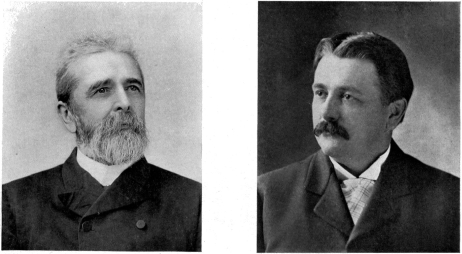
EGBERT MARSH
Founder of the Memorial Library |
|
HONORABLE DANIEL DAVENPORT
of Bridgeport, Conn. |
Gouverneur Morris, Roger Sherman, James Wilson, and Albert
Gallatin.’
“John Marshall seems to me not so much a founder as a re-founder of
the Constitution, and I should be unwilling to agree with Mr. Bryce
in giving him a place which appears with greater right to belong to
the successor of Washington in the presidential chair. So, in
arranging the statesmen of the second order, it may be doubted if
Gallatin does not more properly belong to a later generation. But
that in that class is Roger Sherman, rather than Trumbull, rather
than Ellsworth, rather than Johnson, rather than any other son of
Connecticut, or, after John Adams, of New England, few will
question who have closely studied the Journals of the Continental
Congress, and the debates in the Convention of 1787, out of which
our Constitution sprang.”
The last speaker, Hon. Daniel Davenport of Bridgeport, was introduced as
a descendant of John Davenport, the leader of the first group of
colonists to settle the New Haven Colony, and the first pastor of the
first church in New Haven. Mr. Davenport spoke as follows:
“The settlement of New Milford began in 1707, exactly a century after
that of Jamestown, Va. At that time, although Milford and Stratford at
the mouth of the Housatonic had been settled almost seventy years, and
the river afforded a convenient highway into the interior, for much of
the distance, this place, only thirty miles from the north shore of Long
Island Sound, was still beyond the extreme northwestern frontier of New
England, and indeed of English North America.
“The inhabitants of Connecticut then numbered about fifteen thousand,
settled in thirty towns, mostly along the shore of Long Island Sound,
and upon the banks of the Connecticut and Thames rivers. During the
thirty years next before, a few families from Norwalk had settled at
Danbury, from Stratford at Woodbury, from Milford at Derby, and from
Farmington at Waterbury. With these exceptions, hardly more than pin
points upon the map, and a few settlements about Albany, N. Y., the
whole of western and northwestern Connecticut and of western
Massachusetts and northern New York was a savage wilderness, covered
with dense forests, and affording almost perfect concealment for the
operations of savage warfare.
“Though the northwestern portion of Connecticut was then a most
formidable and inhospitable wilderness, strenuous efforts were already
being put forth by the Colony to encourage its settlement. For, strange
as it seems to us now, at that time, owing to imperfect modes of
cultivation and the difficulty of subduing the wilderness, the settled
portions of the Commonwealth had begun to feel overpopulated.
Twenty-five years before, the Secretary of the Colony had reported to
the Home Government, that ‘in this mountainous, rocky, and swampy
province’ most of the arable land was taken up, and the remainder was
hardly worth tillage.
“This need of more land, and the protection from invasion which the
settlement of this section would afford the communities near the coast,
and the innate love of adventure and desire to subdue the wilderness,
which have characterized the American people from the beginning, were
the impelling causes which led to the planting of New Milford.
“So pressing did this movement become that, though what is now
Litchfield County was then as remote and inaccessible to the rest of the
Colony as were Indiana and Illinois to our fathers in the middle of the
last century, within forty-five years after the first settler had built
his log cabin and lighted his fire here twelve towns had been settled
and the county organized with a population of more than ten thousand.
“In order that we may appreciate, somewhat, the broader political
conditions under which the first settlers took up their abode here,
which largely engrossed their thoughts and vitally affected them and
their children for two generations, it is necessary, before taking up
the narrative of their actual settlement here, to advert briefly to the
state of affairs at that time in England, and on the continent of
Europe, and in the English, French, and Spanish Colonies of North
America.
“By 1707 it had become apparent to the people of Connecticut that, soon
or late, they must fight for the very existence of their chartered
privileges and natural rights, not alone the British Crown, but the
English people. The disposition of the people of England to reap where
they had not sown had become very clear. In April, 1701, Connecticut was
named in the bill then introduced in Parliament to abrogate all American
charters. She resisted with all her might through her agent, but it
passed the second reading, and would have become a law but for the
breaking out of the French War. Its principle was supported by the
mercantile interests and the great men of England. Then for the first
time the people of Connecticut fully realized that their foes were to
be, not the exiled house of Stuart, but the English people themselves,
and that, though they changed their dynasties, they did not change their
own nature.
“In 1707 the principal kingdoms of Europe and their colonies were ablaze
with war. Anne was Queen of England. In that very year she attached her
signature to that long projected and most important constitutional
arrangement, the Act of Union between England and Scotland, which made
them one kingdom, the crown of which, by the Act of Settlement passed a
few years before, had been forever vested in the person and heirs of
Sophia, the electress of Hanover, the present reigning dynasty. Anne’s
accession to the throne in 1702 had been followed by the acknowledgment,
by Louis XIV., of the son of James II., the deposed and fugitive king of
England and the determined foe of the rights of the Colonists, as the
rightful king, although in the Treaty of Ryswick, in 1697, he had
solemnly stipulated to the contrary. This act of perfidy roused the
English to fury. The primary cause of the war, then raging, was the
acceptance by Louis of the crown of Spain for his grandson Philip
despite a previous formal renunciation. But the immediate occasion was
his espousal of the cause of the son of James II. as pretender to the
British throne, which enabled the English Government to form a great
European alliance to wrest Spain from Philip and prevent Louis from
becoming the absolute master of Europe.
The year before, 1706, had witnessed the humbling of the pride and
ambition of Louis by the defeat of his armies at Ramillies by the Duke
of Marlborough, in Piedmont by Prince Eugene, and in Spain by Lord
Galway. Charles XII. of Sweden had advanced to Dresden in Saxony, an
English and Portuguese army had occupied Madrid, and an attack of the
combined fleets of Spain and France upon Charleston, S. C., then claimed
by Spain as a part of Florida, had been repulsed by the vigor and
martial skill of the Colonial authorities.
“At that time the valley of the St. Lawrence was occupied by about fifty
thousand French settlers, imbued with bitter hostility towards the
settlers in New England and New York. Already the vast design of La
Salle to acquire for the King of France the whole interior of the
continent seemed to have been accomplished. While as yet the English
were struggling to secure a foothold upon the Atlantic seaboard, the
French had explored the Mississippi and its tributaries to its mouth;
and the whole vast region drained by them, between the Alleghanies and
the Rockies, had been taken possession of by the French under the name
of Louisiana; and a chain of military and trading posts from New Orleans
to the St. Lawrence, admirably chosen for the purpose, had been
established to hold it; and another chain was already planned to extend
southward along the west side of the Alleghanies, to forever keep out
the English. The French had been for fifty years hounding on the
numerous tribes of Canada and northern New England to attack and
exterminate the settlers of New England. The conquest of Canada by the
English was, therefore, an object of the greatest political importance,
and necessary for the peace and safety of the Colonists, and their
future growth, and it continued to engross the efforts and exhaust the
means of the Colonists, until their purpose was finally accomplished in
1763.
“The people who settled here were entirely familiar with the hardships,
dangers, and horrors of Indian warfare to which they were liable in
taking up their abode on this frontier. The horrible incidents which
attended the massacre of the inhabitants of Schenectady, in 1690,
seventeen years before, during the previous war, and of the inhabitants
of Deerfield, Mass., and other places in 1704, during the war still
raging, were household words throughout Connecticut, and had left an
abiding imprint in the minds of the people on the border. Though the
Indians, right about them here, seem to have been few in number and
comparatively harmless, they knew from their own and their fathers’
experiences that their position was one of extreme danger, and that at
all times their scanty and hard won possessions and their lives were
liable to instant destruction from unheralded irruptions by the more
distant Indian tribes of the North and Northwest, urged on by their
French instigators and allies. For the experiences of the last seventy
years, from the time of the Pequot War, and during the subsequent
troubles with the tribes in southwestern Connecticut, and on Long
Island, and during King Philip’s War, had fully taught them the craft,
treachery, and pitiless cruelty of the savages, as well as their
capacity for extensive combination among the widely separated tribes.
“When Major de Rouville, in 1704, with his band of civilized and
uncivilized savages, committed the atrocities at Deerfield, Mass., the
suspicions of the Colonists that the French had instigated the former
Indian outrages became a certainty, for in this instance they openly
shared in them.
“Their object was, as I have said, to drive the English colonists from
North America, and substitute in their place their own colonial system.
For this purpose they fitted out hundreds of parties of savages to
proceed to other portions of the English settlements, shoot down the
settlers when at work at their crops, seize their wives and children,
load them with packs of plunder from their own homes, and drive them
before them into the wilderness. When no longer able to stagger under
their burdens, they were murdered, and their scalps torn off and
exhibited to their masters, and for such trophies bounties were paid.
The French Government in Paris paid bounties for the scalps of women and
children, as Connecticut did for those of wolves, and it not only fitted
out other savage expeditions, but sent its own soldiers to assist in the
murderous work. Detailed reports of each case were regularly made to the
Government at Paris by its agents in Canada, which can now be read.
This is true of every French and Indian war until 1763, and the fact was
as well known to the settlers here in 1707 as it is to the historical
investigator of to-day.
“In the beginning of 1707 reports of an expedition by the French and
Indians against some part of New England gave alarm to the Colony, and
on the sixth of February of that year a council of war was convened at
Hartford, consisting of the Governor, most of the Council, and many of
the chief military officers of the Colony. Suspicions were entertained
that the attack would fall upon Western Connecticut, and that the
Indians in this vicinity intended to join the French and Indians. The
Council of War determined that the then western frontier towns of
Danbury, Woodbury, Waterbury, and Simsbury, should be fortified with the
utmost expedition. They were directed to keep scouts of faithful men to
range the forests to discover the designs of the enemy, and give
intelligence should they make their appearance near the frontier. At the
October session in 1708 it was enacted that garrisons should be kept at
those towns, and so it continued until after the close of the war in
1713.
“It was in the midst of alarms and dangers such as these that the
settlement of this town was begun. One of the first houses constructed
here had palisades about it to serve as a fort, which lasted many years,
and, in 1717, soldiers were stationed here for the protection of the
inhabitants; and this was repeated several times afterwards. Every man
here was a soldier. He was a soldier when he sat at his meals, a soldier
when he stood at his door, a soldier when he went to the cornfield, a
soldier by day and by night.
“At the time the first settlers arrived here there was a tract of
cleared land on the west side of the river called the Indian Field. It
extended from where the river runs in an easterly direction south to the
mouth of the little brook which runs along Fort Hill. It was not
included in the original purchase from the Indians, having been reserved
by them in their deed. It was, however, purchased from them in 1705 by
John Mitchell, and was conveyed by him to the inhabitants of the town
in 1714. This was of the greatest advantage to the first settlers. It
furnished them a space of cleared ground, where each planter could at
once plant his corn and other crops without the delay of felling the
trees.
“It is thought also that the ground where we now stand and Aspetuck Hill
had been in a large measure cleared of trees by the Indians by burning,
as was also Grassy Hill, two miles east of here. There appears also to
have been some meadow land partially cleared at the mouth of the
Aspetuck River.
“At that time the country about here presented no such appearance as it
does now. The river then flowed with a fuller tide. With the exceptions
I have noted, a continuous forest overspread the whole landscape. No
thickets, however, choked up the ways through it, for the underbrush was
swept away every year by fires built by the Indians for that purpose.
Winding footpaths led here and there, which the Indians and wild beasts
followed. The roots of the smaller grasses were destroyed by this annual
burning over. A coarse, long grass grew along the low banks of the river
and wherever the ground was not thickly shaded by trees. After the
occupation of the country by the white settlers this annual burning was
prohibited. In lieu thereof, the General Court early in its history
enacted that every inhabitant, with a few exceptions, should devote a
certain time yearly, in the several plantations, to the cutting of brush
and small trees in the more open forests for the purpose of allowing
grass to grow in such places, as during the summer the cattle ranged
through the forests near the plantations subsisting on what grew there.
It is said that in the early settlement of this town all meadow land was
secured by clearing marshy or swampy ground and allowing it to grow up
with grass from the roots and seeds already in the soil. It was one of
the early difficulties in the colony to secure grass from want of seed.
“The forests about here abounded with bears, wolves, foxes, and
catamounts, deer and moose, wild turkeys, pigeons, quail and partridges,
and the waters with wild geese, ducks, herons, and cranes. The river
itself was alive with fish, and every spring great quantities of shad
and lamprey eels ascended it. Strawberries, blackberries, and
huckleberries were extremely abundant in their season.
“The winters were usually of great severity. In 1637 the snow lay on the
ground three feet deep all over New England from the third of November
until the twenty-third of March, and on the twenty-third of April it
snowed for several hours in Boston, the flakes being as large as
shillings. The springs were very backward, the summers extremely hot and
often dry.
“Upon the petition of the people of Milford, in May, 1702, the General
Assembly granted them liberty to purchase from the Indians a township at
Wyantonock, the Indian name of this place, and directed them to report
their doings to the Assembly. The next March they made an extensive
purchase of the natives, and a patent for the same was granted by the
Assembly. In October, 1704, the Legislature enacted that the tract so
purchased should be a township by the name of New Milford, and that it
must be settled in five years,—the town plat to be fixed by a committee
appointed by the General Assembly. In October, 1706, the Legislature
annexed the tract to New Haven County. In April, 1706, the first meeting
of the proprietors was held at Milford, and it was voted that the town
plat and home lots should be speedily pitched and laid out by the
committee appointed by the Legislature, according to its own best
judgment, following certain rules laid down by the proprietors. During
that year and according to those rules, the town plat was laid out.
“It was originally intended to lay out the settlement on the hill
immediately east of the present village, from this circumstance called
Town Hill to this day. In point of fact, it was laid out on Aspetuck
Hill, and consisted of the town street and sixteen home lots. The street
was twenty rods wide. It began at the south end of the brow of the hill,
or at the lower end of what was then called the ‘Plain on the Hill,’ and
extended northward. Eight lots were laid out on each side of this
street, each lot being twenty-one rods wide and sixty deep.
“By the rules adopted by the proprietors, these lots were to be taken up
successively in regular order by the settlers as they should arrive.
John Noble took the first lot on the east side of the street at the
lower end, he being the first settler to arrive. John Bostwick took the
lot on the opposite side of the street, he being the next settler on the
ground. This method was followed by the others until there were twelve
settlers, with their families, numbering seventy souls, located on this
street in 1712. Of these twelve families, four were from Northampton and
Westfield, Mass., four were from Stratford, two from Farmington, and
only two from Milford. In 1714 the town street was extended southward to
the south end of the present public green.
“The first houses constructed here by the settlers were of the rudest
description. They were built of logs fastened by notching at the
corners. They were usually from fifteen to eighteen feet square, and
about seven feet in height, or high enough for a tall man to enter. At
first they had no floors. The fireplace was erected at one end by making
a back of stones laid in mud, and not in mortar, and a hole was left in
the bark or slab roof for the escape of the smoke. A chimney of sticks
plastered with mud was afterwards erected in this opening. A space, of
width suitable for a door, was cut in one side, and this was closed, at
first, by hanging in it a blanket, and afterwards by a door made from
split planks and hung on wooden hinges. This door was fastened by a
wooden latch on the inside, which could be raised from the outside by a
string. When the string was pulled in the door was effectually fastened.
A hole was cut in each side of the house to let in light, and, as glass
was difficult to obtain, greased paper was used to keep out the storms
and cold of autumn and winter. Holes were bored at the proper height in
the logs at one corner of the room, and into these the ends of poles
were fitted, the opposite ends, where they crossed, being supported by a
crotch or a block of the proper height. Across these poles others were
laid, and these were covered by a thick mattress of hemlock boughs, over
which blankets were spread. On such beds as these the first inhabitants
of this town slept and their first children were born. For want of
chairs, rude seats were made with ax and auger by boring holes and
inserting legs in planks split from basswood logs, hewn smooth on one
side. Tables were made in the same way, and, after a time, the floor, a
bare space being left about the fireplace instead of a hearthstone.
“No sooner had the first settlers taken up their abode here than they
were called upon to defend the title to their lands in the courts of the
Colony. About thirty-seven years before, the General Court had granted
permission to certain Stratford parties to buy land from the Indians and
settle a plantation at this place, and they had bought over twenty-six
thousand acres hereabouts. Apparently, however, no attempt was made
towards a settlement of the same until after the purchase of the same
tract from the Indians by the Milford parties in 1702, and the grant for
a patent for the same to them by the General Court in 1703. Soon after
the settlers first broke ground here, in 1707, a suit was begun against
them by the Stratford people in the County Court at New Haven in May,
1708, and it was carried thence to the General Court. It was tried
sixteen times. The first fifteen times the plaintiffs won on the
strength of their Indian title. The sixteenth, the defendants won on the
strength of their Indian title, the patent from the General Court, and
occupation. This incident is particularly interesting, because one of
the plaintiffs and the lawyer in this great case was the famous John
Read, one of the ablest men and most remarkable characters which New
England has produced. Some notice of him will not be inappropriate here,
as he was one of the earliest inhabitants of this place.
“He was born at Fairfield, June 29, 1679, and was a brother-in-law of
Governor Talcott. He graduated at Harvard in 1697, and became a
minister, preached in Woodbury as a candidate, and in various towns in
Hartford and Fairfield counties, and preached the first sermon ever
delivered in this place. He studied law, and when, in 1708, the General
Assembly first provided for the appointment of attorneys as officers of
the court, he was one of the first admitted. He held the offices of
Colony Queen’s Attorney, 1712-16; Deputy for Norwalk, 1715-17;
Commissioner to settle the boundary with New York, 1719; and he was
Connecticut’s representative in the Inter-Colonial Commission in regard
to Bills of Credit, in 1720. He removed to Boston in 1722 and became the
Attorney General and a member of the Council of Massachusetts. He was by
far the most eminent lawyer of New England, and was called ‘The Pride of
the Bar, Light of the Law, and Chief among the Wise, Witty, and
Eloquent.’ It was he who prepared the instructions to Lord Mansfield,
the counsel for Connecticut in the great case of Clark vs. Tousey, in
which was discussed the question whether the Common Law of England had
any force in Connecticut other than as it was adopted by the people of
Connecticut. His exposition of the principles involved was most
masterly, and it was the great authority upon which in a later
generation the people of Connecticut relied to sustain them in their
opposition to the measures of the crown in 1775.
“In a centenary sermon delivered at Danbury in January, 1801, the Rev.
Thomas Robbins had this to say of him:
“ ‘One of the early inhabitants of Danbury was John Read, a man of great
talents and thoroughly skilled in the knowledge and practice of the law.
He possessed naturally many peculiarities and affected still more. He is
known to this day through the country by many singular anecdotes and
characteristics under the appellation of “John Read, the lawyer.”’
“In 1712 the town was incorporated, which gave it the power to tax the
inhabitants to support a minister, and the place became thereby an
ecclesiastical society. In March, 1712, the Rev. Daniel Boardman was
called to preach to the settlers. In May, 1715, the settlers petitioned
the General Assembly that they might obtain liberty for the settlement
of the worship and ordinances of God among them, and the Legislature
granted them liberty to embody in church estate as soon as God in his
providence should make way therefor. On November 21, 1716, Mr. Boardman
was duly ordained as the pastor of the Church of Christ in New Milford,
the total number of the inhabitants of the town then being one hundred
and twenty-five. The first vote of the town to build a meeting-house was
passed in 1716, but work was not commenced upon it until 1719, and it
was not completed until 1731, after infinite struggling. It was forty
feet long, thirty wide, and twenty feet in height between joints, and
was provided with galleries, pews, and a pulpit. Long before completion,
when it was first used for religious purposes, the congregation was
accustomed to sit upon its outer sills, which were able to accommodate
every man, woman, and child in the town with a little squeezing. In
1713, the town voted to build for the minister a dwelling house forty
feet between joints. In 1726, thirteen years later, the house was still
unfinished. The first Sabbath Day house was not built until 1745.
“In 1721, when there were but thirty-five families residing here, a
public school was ordered by the town to be kept for four months the
winter following, one-half of the expense to be borne by the town. The
children were taught reading, spelling after a phonetic fashion,
writing, and the first four rules of arithmetic. In 1725 it was voted to
build a schoolhouse twenty feet long, sixteen feet wide, and seven feet
in height between the joints.
“The first settlers crossed the Housatonic to their lands on the west
side by fording it at a point near the mouth of Rocky River, about a
mile above the settlement, or at Waunupee Island in times of very low
water. In 1720 the town built a boat for the purpose, which was used
until 1737, when the first bridge ever built across the Housatonic from
its source to its mouth was constructed at what is now the foot of
Bennett Street.
“The settlers for many years crushed their grain by hand in mortars or
carried it to mill at Danbury, Woodbury, or Derby, and brought back the
flour and meal. In 1717 John Griswold, under an arrangement with the
town, built a grist and saw mill on Still River, at what is now
Lanesville.
“It is said that in 1713 there was but one clothier in the colony. The
most that he could do was to full the cloth which was made in the
homes. A great proportion of it was worn without shearing or pressing.
He lived at Woodbury, and thither the early inhabitants of this town
resorted to have their cloth fulled. People, to a very large extent,
wore clothing made from the skins of animals. They also wore wooden
shoes and moccasins, or went barefoot, although leather boots and shoes
were sometimes used.
“The implements which they used in subduing the wilderness, their axes,
saws, plows, hoes, and scythes, were of the rudest description. Their
horses, cattle, sheep, and swine, we should now regard as of very
inferior quality. The same was true of the few vegetables they
cultivated and of their fruits, especially their apples. Turnips,
squashes, and beans were the principal vegetables. Potatoes were not as
yet cultivated in New England, onions were not generally, and tomatoes
were looked upon as poisonous. Some of them owned negro slaves, but
worked the harder themselves to make them work.
“They had little or no currency, taxes and debts being paid in produce.
What they ate, what they wore, what they coaxed from the reluctant soil
of these hillsides, cost them infinite labor. As was to be expected, a
stingy avarice was their besetting sin, which manifested itself in all
the relations of life. They were without newspapers, none being
published in the Colony until 1755. They had few books, the first
printing press in the Colony not having been set up at New London until
1709. They suffered greatly from malaria and other forms of sickness, as
did all the early settlers in the State. Medical treatment was poor and
difficult to obtain. The women went to the limit in childbearing, and
the burden of rearing their large families was awful. The art of cooking
was little understood. They had no stoves nor table forks. The food was
served in a very unsavory fashion, and was very indigestible. The people
therefore had frightful dreams, and dyspepsia was very prevalent. No
carpet was seen here for a hundred years after the settlement.
Communication with the outer world was slow, difficult, and rare. On
several occasions, owing to the failure of their crops and the
difficulty in getting relief from distant places little better off,
they nearly starved to death.
“Truly the task which they had undertaken to subdue this wilderness, to
plant here the civil, religious, and educational institutions of
Connecticut, and to prepare this beautiful heritage for their children
and children’s children, was no holiday pastime, no gainful speculation,
no romantic adventure. It was grim, persistent, weary toil and danger,
continued through many years, with the wolf at the door and the savage
in the neighboring thicket.
“Besides the physical evils with which they were beset, they had
spiritual troubles also. They fully believed in witchcraft, as did all
their contemporaries, in a personal Devil who was busily plotting the
ruin of their souls, in an everlasting hell of literal fire and
brimstone, and in a divine election, by which most of them had been
irrevocably doomed from before the creation of the world to eternal
perdition, from which nothing which they could do, or were willing to
do, could help to rescue them. The great object of life to them,
therefore, was to try to find out what their future state would be. Said
one of their preachers: ‘It is tough work and a wonderful hard matter to
be saved. ’Tis a thousand to one, if ever thou be one of that small
number whom God hath picked out to escape this wrath to come.’ That we
may get a touch of reality from those far-off days, let me quote to you
a few lines from the saintly Thomas Hooker, the founder of Connecticut
and long the model for her preachers:
“ ‘Suppose any soul here present were to behold the damned in hell, and
if the Lord should give thee a peephole into hell, that thou didst see
the horror of those damned souls, and thy heart begins to shake in
consideration thereof; then propound this to thy own heart, what pains
the damned in hell do endure for sin, and thy heart will shake and quake
at it. The least sin that thou ever didst commit, though thou makest a
light matter of it, is a greater evil than the pains of the damned in
hell, setting aside their sins. All the torments in hell are not so
great an evil as the least sin is; men begin to shrink at this, and
loathe to go down to hell and be in endless torment.’
“The only test which they were taught to apply to ascertain whether they
were predestined to suffer or escape this fearful doom was in their
ability and willingness to conform their wills to the will of God as
revealed in the Bible. According as they succeeded in this, they had a
reasonable assurance as to their fate, though no wile of the Devil was
more frequent than to falsely persuade men that their prospects were
favorable. To study the Scriptures day and night to ascertain the will
of God, and to struggle without ceasing to conform their wills to his as
therein revealed, was therefore the great object of existence for them,
not that they could thereby alter in the least their future state, but
that they might, if possible, find out what it was likely to be.
“Should this recital of their beliefs provoke a smile, our amusement
will soon be checked by the thought of the little progress which has
been made in the last two hundred years towards solving the same
problems. The origin of evil, the ineradicable tendency of the human
heart to sin and do evil, the mournful spectacle of ruin and desolation
in the moral world, and the future life are the same inscrutable
mysteries to us as to them. If we have constructed or adopted a more
comfortable theology, it is probably because we are less logical than
they. It is perhaps because we have forgotten or refused to look at some
things at which they did not blink.
“Then, too, the Lord was abroad in those days. Their thoughts were
deeply tinged by the semi-pagan views with which the authors of both the
Old and New Testaments were imbued. When the thunder crashed, it was the
voice of an angry God that spoke. When the lightning flashed, it was the
gleam of His angry eye. Benjamin Franklin was then but a year old, and
electricity had not become the packhorse of the world. The smiles and
frowns of nature in all her varying moods through all the days and
seasons, which we ascribe to the operations of law, were to them the
visible tokens of the wrath or favor of the Almighty. On December 11,
1719, for the first time in the history of the Colony, the northern
lights were seen here. They shone with the greatest brilliancy. The
consternation they caused was fearful. The people had never heard of
such a phenomenon. They considered it the opening scene of the Day of
Judgment. All amusement was given up, all business was forsaken, and
sleep itself was interrupted for days. Again, on the twenty-ninth of
October, 1727, a mighty earthquake occurred, which shook with tremendous
violence the whole Atlantic seaboard. The people here believed that the
Lord was about to swallow them up in His fierce anger. The women
throughout New England immediately discontinued the wearing of hoop
skirts, then recently come into fashion, believing that the earthquake
was the sign of the Lord’s displeasure at the sinful innovation.
“Hardly had the first settlers here begun to build permanent homes for
the living when they were called upon to provide resting places for the
dead. The first person to be buried in yonder burying ground was a
child, a girl, Mary, the daughter of Benjamin Bostwick. The next was
John Noble, the first settler and the first Town Clerk. He died August
17, 1714. The town formally laid out the burying ground in 1716. Within
fifty years three hundred had gone to rest there.
“There were no religious exercises at the funerals, neither singing,
praying, preaching, nor reading of the Scriptures. This was by way of
revolt from former superstitious practices. The friends gathered,
condoled with the afflicted ones, sat around a while, and then the
corpse was taken to the burying ground. After that the party returned to
the house of the deceased, where much eating and drinking was indulged
in, and, if the weather permitted, outdoor games and horse races were in
order. The next Sabbath an appropriate funeral sermon was preached. A
bereaved husband or wife usually soon married again.
“The meeting-house was never heated, but the people, summoned by drum
beat, attended it every Sabbath, morning and afternoon, even in the
severest weather, although no Sabbath Day house was erected here until
1745.
“The sacramental bread often froze upon the communion plate, as did the
ink in the minister’s study. The people worked their minister very hard,
as was the case in all early New England communities. They went to
church not so much because they had to as because they wanted to.
Church-going was their principal recreation. They demanded long prayers
and two long sermons each Sabbath from their minister, usually on
doctrinal points, which they acutely criticised. Services began at nine
o’clock in the forenoon and continued until five in the afternoon, with
an hour’s intermission. Soldiers, fully armed, were always in attendance
throughout the services ready to repel any attack upon the settlement.
It should be added, however, that with all their strictness in
Sabbath-keeping and catechising, in family and church discipline, there
was great license in those days in speech and manner, much hard
drinking, and rude merry-making, due to their rough form of living. They
were not what they wanted to be, nor what a loyal posterity perhaps
longs to believe them. They had red blood in their veins. They were
among the most enterprising men of their generation. They were
backwoodsmen, the vanguard of that wonderful race which in two hundred
years pushed westward the frontier from this place to the Pacific,
fighting with man and beast the whole way, and sowed the land with
vigorous sons and daughters.
“The congregational singing in those days must have been an interesting
performance. When the first settlers came to New England from the old
country, they brought with them a few tunes, to which they sang all the
psalms and hymns.
“The proper mode of rendering these was through the nose. With the lapse
of time and the advent of a new generation, these tunes became jangled
together in inextricable confusion. The practice was for a deacon as
leader to read a line of the psalm or hymn, and the congregation then
sang at it as best they could, each one using such tune as he chose, and
often sliding from one tune to another in the same line or improvising
as he went on. Finally, in 1721, the Rev. Thomas Walter of Roxbury,
Mass., published a treatise upon the grounds or rules of music, or an
introduction to the art of singing by rote, containing twenty-four tunes
harmonized into three parts. The attempt to supersede the old Puritan
tunes and restrict the liberty of the individual singers met with the
greatest opposition and was long successfully resisted in all the
churches in New England, so tenacious were they of the rights of the
individual singer. It caused great dissension in the church at this
place. Finally, in February, 1740, the church voted to halve the time
for the next year, singing the old way one Sabbath and the new way the
next, and in 1741, at a meeting specially called to settle the matter,
it was voted thirty to sixteen to sing thereafter after the new way.
“No musical instruments were allowed in the meeting-house. They had
never seen or heard a church organ. But they knew that their fathers
likened its sound to the bellowing of a bull, the grunting of a pig, and
the barking of a dog, and had resisted its use in religious services
even to the shedding of blood. Nor were flowers allowed in the church.
“In those days in New England women were not thought to have minds worth
educating, and they were brought up in extreme illiteracy. Nevertheless,
their natural wit, brightness, and good sense made them very agreeable
companions of the superior sex. And their influence over their husbands,
sons, and brothers was quite as great as that of their more cultivated
daughters of the present day. The refining, educating, stimulating
influence of the women had much to do in withstanding that tendency back
to barbarism which life in an isolated and new community led to. The
debt which is owed to them is incalculable.
“As the descendants of these people assemble here to-day, after the
lapse of two hundred years, to commemorate their work and rejoice in all
the strength, beauty, and order, now smiling around us in peace and
plenty, which have grown out of what they began, and as we look back
upon their condition, trials, and experiences, we are apt to imagine
that their lot, contrasted with our own, was an unhappy one. Nothing
could be further from the truth. They were a brave, hardy, thrifty,
frugal, industrious, and most capable people. Man for man, and woman for
woman, they were probably superior to those here to-day in faculty, and
in the capacity for healthy enjoyment. Their whole previous lives had
inured them to their experiences. They were the sons and grandsons of
the original pioneers of New England, and they had been born and reared
in rude settlements. They never indulged the delusion that this region
was a land flowing with milk and honey. Before they came they knew that
they were to wrest their living from an uncongenial soil, to struggle
with penury, and to conquer only by constant toil and by self-denying
thrift. The forest would supply them with the materials for shelter and
fuel and to some extent with food and clothing. All the rest must depend
upon their own exertions. There was a pleasure in facing and overcoming
the perils and difficulties which they encountered which those, more
delicately reared, who live here now can never know. Their individual
helplessness in the face of appalling obstacles to be met but bound them
closer together in mutual helpfulness. Accordingly we find that their
social faculties were highly developed. It may well be doubted whether
the sum total of human pleasure among the whole five thousand
inhabitants of the town to-day is any greater than it was among the few
hundred who settled it. Probably our own superabundance of good things
has actually lessened our capacity to enjoy, in comparison with theirs.
Their simple tastes and homely joys amid their rude surroundings were
probably more productive of positive pleasure and real happiness than
all the refinement and culture of our twentieth century civilization.
“It would be a pleasing and instructive task to trace the progress of
this old town from those rude beginnings to its present strength and
wealth. But the limits of the time and subject allotted to me on this
occasion forbid. It is the product of the labors of eight generations,
who now sleep beneath its soil. They never could have foreseen the
present. They never knew or thought of us. Each generation was busy with
its own problems, tasks, and experiences.
“As we look back upon them our hearts are filled with gratitude for the
results of their work. A clean-blooded, land-loving, thrifty race,
through their activities they escaped from the poverty of their
beginnings and attained unto an almost ideal abundance of the primal
needs of civilization. Their physical condition became probably as good
as that of any other village community in the world. Their experiences
stimulated their intellectual life into full activity, and they bore
their full share in the wonderful work which Connecticut has done in the
world. In all critical times in both State and nation, the sons of New
Milford, both native and adopted, have been very active and influential,
and one of them, Roger Sherman, performed a work which will last as long
as this nation shall continue to be free and independent, or as long as
the Constitution of the United States shall endure.
“We know that the past two hundred years are but the beginning of a long
history of this town. We believe that as the years roll by, at the close
of each century of its life, the events of this day will be repeated
here. What will be the lot of those who shall stand here, one two,
three, and four hundred years hence, to recall the origin and history of
this town, we cannot conceive. Our hope is that it will be as peaceful,
as prosperous, and as contented as our own.
“Whatever it shall be, we expect that their desire to know what can be
known of that long-vanished world, in which both present and future have
their roots, will lead them to examine the memorial of what is said and
done here to-day. We are not more sure that the Housatonic will then be
flowing than that they will share with us in affectionate interest in
what has gone before.”
The rendering of the “Star Spangled Banner” and several other selections
by Prof. Clemence’s Bi-Centennial Chorus was an inspiring feature of the
Historical Meeting.
Soon after the close of the Historical Meeting, the booming of cannon
announced the arrival in New Milford of Governor Woodruff, his staff and
a detail of the Governor’s Foot Guard. They were met at the railroad
station by a train of automobiles, in which they were taken, after a
short ride about the village, to Ingleside School, where they dined in
the company of a number of prominent citizens.
Promptly at 8:30 o’clock, the gubernatorial party arrived at Roger
Sherman Hall, where it was arranged that they should meet the people of
the town, and entered it by a side door. Before the main door was opened
for the admission of the general public, seats were given upon the stage
and on the floor of the hall in front of the wings on either side to the
members of the Colonial Reception Committee and of the Invitation,
Reception, and Entertainment Committee; also to the following persons,
who had been requested by these committees to assist them in receiving:
Mr. and Mrs. John F. Addis, Mrs. F. E. Baldwin, Dr. and Mrs. J. C.
Barker, Mr. and Mrs. A. G. Barnes, Miss Mary Barton, Miss Hattie
Bassett, Mr. and Mrs. C. M. Beach, Mr. and Mrs. S. C. Beach, Miss
Charlotte B. Bennett, Mr. and Mrs. W. F. Bennett, Mr. and Mrs. C. P.
Bentley, Miss Helen M. Boardman, Miss Kate T. Boardman, Miss Ruth Booth,
Miss Lena Botsford, Miss Bessie Brown, Miss Adaline Buck, Miss Alice
Buck, Mr. and Mrs. H. S. Donnelly, Miss Susie C. Erwin, Miss Minnie A.
Ferriss, Miss Jeannette Gaylord, Mr. and Mrs. Minot S. Giddings, W. G.
Green, Mr. and Mrs. S. S. Green, Mr. and Mrs. C. N. Hall, Miss Elsie
Hall, Mr. and Mrs. H. D. Hine, Mrs. J. S. Halpine, Mr. and Mrs. G. H.
Jackson, Rev. and Mrs. F. A. Johnson, Dr. and Mrs. F. E. King, Mrs. W.
F. Kinney, Mr. and Mrs. David Kyle, Miss Carrie Marsh, Mr. and Mrs.
Chauncey Marsh, A. H. McMahon, Miss Grace Merwin, Mr. Perry Green, Mr.
C. H. Noble and sister, Miss Lizzie Noble, W. B. Pell, Mrs. Pettibone,
Mrs. J. F. Plumb, Mr. and Mrs. H. L. Randall, Miss Juliette Rogers, Mrs.
Wm. Schoverling, Miss Harriet V. Sherman, Mr. and Mrs. F. E. Starr, Miss
Minnie Toussaint, F. M. Williams, Dr. and Mrs. G. H. Wright.
The New Milford Cadets (Captain Gifford Noble) were drawn up as guard of
honor about the hall, forming an aisle around an open square, through
which the people walked as they advanced to greet the Governor and
passed out again after shaking his hand. The members of the staff, in
full uniform, were in front of the stage and back of the Governor,
while, to the right and left of them, the detail from the Foot Guard
were stationed as a special guard. By the side of his Excellency stood
W. Frank Kinney, the chairman of the Bi-Centennial Invitation, Reception
and Entertainment Committee, who presented every one by name. There were
many Colonial costumes, many gay uniforms, and many elaborate evening
toilettes. In the exquisite setting provided by the pale blue, white and
yellow colonial draperies and festoons with which the hall was most
artistically decorated, the reception offered an exceptionally brilliant
spectacle. In fact, it was probably the most striking affair of its kind
New Milford has ever witnessed.
Dancing was begun, to the music of Gartland’s Band, when the handshaking
was over, and was kept up for two or three hours after the Governor and
his party had retired.
Governor Woodruff was also entertained in the rooms of the Commercial
Club; in Odd Fellows’ and Masonic Hall, where he was formally welcomed
by Henry O. Warner, Past Master of the New Milford Masonic lodge; and by
the New Milford Fire Department, in their quarters, where he was
welcomed by Chief John F. Addis, who presented him with an engrossed
certificate of honorary membership in Water Witch Hose Company, No. 2.
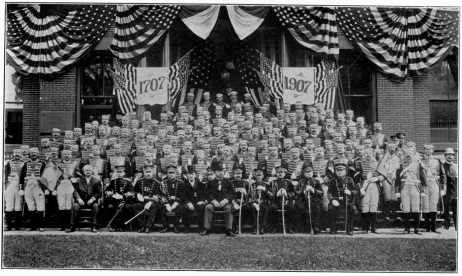 GOVERNOR WOODRUFF, STAFF AND GUARD, IN FRONT OF ROGER
SHERMAN HALL
GOVERNOR WOODRUFF, STAFF AND GUARD, IN FRONT OF ROGER
SHERMAN HALL
On Tuesday, the culminating day of the Bi-Centennial Celebration, New
Milford possessed a population variously estimated at from ten to
fifteen thousand—the largest, probably, of any moment in its history.
The heat was intense, and some were so tactless as to prophesy showers.
Others—and these were right—scoffed at such a possibility, basing
their optimism on the fact that the new uniforms of the Governor’s staff
had never yet been wet and that New Milford was not going to be
ungracious enough to be instrumental in wetting them.
The forenoon was devoted to the preparation of the Civic and Military
Parade, which was scheduled to begin at noon. Only a few minutes after
the time appointed, the column began to move in the following order:
FORMATION OF PARADE
CHIEF MARSHAL SAMUEL R. HILL IN CHARGE.
First Division
Platoon of Police, Capt. David Bradley of Danbury
Chief Marshal and Staff (Perry Green, Noble Booth, Charles
Pomeroy, Madeline Dodd, Louise Beeman.)
Gartland’s Tenth Regiment Band
Second Company, Governor’s Foot Guards, Major Weed
Governor Rollin S. Woodruff and Staff Bugle Corps
Company G, Third Infantry, C. N. G., Captain Ryder
Upton Post, G. A. R., John F. Williams
New Milford Cadets, Captain Gifford Noble
Official Guests in Carriages
Second Division
Marshal David E. Soule and Staff (Dr. C. B. Blackman, George Dean, Louis Wilton)
Second Regiment Band
Water Witch Hose Company, No. 2, of New Milford
Danbury Military Band
Litchfield Fire Department
American Brass Band of Waterbury
Fountain Hose Company, No. 1, of Ansonia
Holt’s American Band of New Haven
Echo Hose, Hook and Ladder Company of Shelton
Ansonia Brass Band
Eagle Hose, Hook and Ladder Company, No. 6, of Ansonia
Bethel Drum Corps
Danbury Volunteer Fire Department
Third Division
Marshal George E. Ackley and Staff (Granville Breinig, W. M. Keeler, Clifford A. Trowbridge)
Boys of Center High School, Marching in Costume
School Children in Floats in District Order
Fourth Division
Marshal Henry O. Warner and Staff (James Marsh, W. C. Beeman, Clifford Marsh)
Wheeler & Wilson Band of Bridgeport (by courtesy of Roger Sherman Chapter, D. A. R.)
Colonial Features
Industrial Floats
There were more military organizations, fire companies, drum corps, and
brass bands in line, probably, than had ever been seen at one time in
New Milford, and they elicited by their brilliant uniforms, stirring
music, and fine marching the admiration and the hearty applause of the
crowds massed along the line of march; but the features which
differentiated this parade from all previous ones, which lent it special
distinction, and
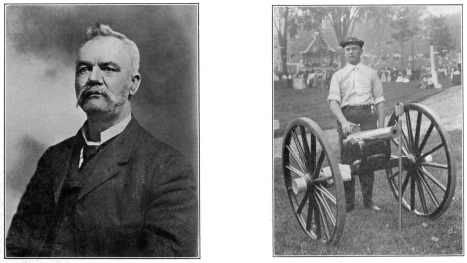
SAMUEL R. HILL.
Chief Marshal |
| |
SAMUEL RANDOLPH HILL, JR.
And Gun Used in Firing |
which will make it memorable as long as the youngest persons who
witnessed it shall survive, were the school floats, the Colonial floats,
and industrial floats of the Third and Fourth divisions.
The school features were as follows:
Boys of the Center School costumed as Indians and farmers—the Indians
emitting blood-curdling war-whoops from time to time.
Pony cart trimmed with pink and white containing members of “Miss
Treat’s class” representing butterflies.
Float of “Room 1” (Center School), trimmed with white and yellow,
carrying under a canopy twenty girls dressed in white. It was drawn by
two sorrel horses also trimmed with white and yellow.
Another float of “Room 1” trimmed with flags and bunting. It contained
twenty-three girls and was drawn by four horses.
Flower girls dressed in pink and green—to represent the petals and
sepals of flowers—on a “Cinderella” float provided with a pink canopy.
It was drawn by a pair of black horses.
Float of “Rooms 5 and 6” (Center School), trimmed mostly with green and
white and carrying twenty-four girls. It was drawn by black horses which
were decorated with flags.
Float of “Rooms 7 and 8” (Center School), green and white—stars of
green laurel against white bunting—carrying twenty children in white
wearing white wreaths.
Float of “Rooms 3 and 4” (Center School), yellow and white, carrying
forty children under a canopy.
Park Lane Float, pink and white, carrying thirty-one children—the girls
wearing white gowns with pink sashes. It was drawn by iron-gray horses
wearing pink and white harnesses. David Rothe’s dog, trimmed with white,
blue, and pink, rode proudly on the driver’s seat beside the driver.
Hill and Plain Float, decorated with evergreens, bunting, and flags.
Second Hill Float, representing an open trolley car, bearing the
legends—“Second Hill Traction Co.,” “Cross Town,” and “Fireworks
To-night”—and, in the advertising spaces, cards provided by the
village merchants. The conductor amused the spectators greatly by the
tireless energy he displaying in collecting and ringing up the fares.
This float, which was trimmed with patriotic bunting, was drawn by three
horses and carried thirty-five children, each holding a flag. It was
designed by Mrs. Andrew Clark.
Upper Merryall Float, decorated with red, white and blue bunting. It was
drawn by black horses and carried twenty-two children.
Chestnut Land Float, white and green—ground pine and laurel against
white bunting—carrying forty children. It was drawn by four horses
decorated with greenery.
Aspetuck Float, representing a sixteen-foot flower-bordered birch-bark
canoe. It was trimmed with garnet and gold and was provided with a
garnet banner. It carried sixteen children (gaily adorned “braves” and
maidens) and the teacher.
Boardman Float, decorated with flags and patriotic bunting, bearing the
device, “1707-1907” in green letters on a white ground. It carried
twenty-eight children.
Lower Merryall Float, trimmed with Colonial yellow, white, and blue
bunting and flying a big flag. The children, who were seated under a
canopy, wore rosettes of the same colors. Four footmen in yellow walked
beside it.
Gaylordsville and Waller Float, decorated with bunting and flags. The
children, fifteen in number, sat on raised seats, one row above another,
and held flags and baskets of flowers. It was drawn by four horses,
whose driver was disguised as Uncle Sam.
Northville and Hunt Float, a “little red schoolhouse,” trimmed with
evergreens. It was drawn by two yoke of Nelson Kenney’s steers. Children
leaning out of the front windows held red, white, and blue ribbons,
which were attached to the horns of the steers.
Long Mountain Float, decorated with white bunting, flags, and ground
pine. It carried twenty-two children.
Still River Float, trimmed with flags, plumes, and bunting, and provided
with a white canopy and a bell. It was drawn
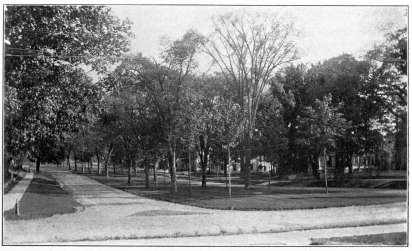 MAIN STREET FROM THE NORTH
by four horses and carried thirty-five children (the girls in white
dresses, the boys in shirt waists) wearing flag sashes. The teacher sat
upon a throne.
The Colonial features of the parade were preceded by a man carrying a
beautiful blue and gold banner of Roger Sherman Chapter, D. A. R.,
Charles G. Peck of Newtown in Colonial costume on his famous
high-stepping horse, and the Wheeler & Wilson Band of Bridgeport—the
first and last named, by courtesy of and at the expense of Roger Sherman
Chapter, D. A. R.
Next came Mr. Williams and Mr. Lee of the Brookfield Drum Corps in
Colonial costumes with drum and fife; and Joseph Cowan, Fred Kinbloe,
and William Cogswell in Indian costume on horseback, the last named
being a descendant of the Schaghticoke tribe of Indians.
Next, a float with a log cabin representing the one built by John Noble,
the first white settler in New Milford. Chauncey B. Marsh and his little
daughter, Esther Noble Marsh, seven years old, rode on this float, in
the doorway of the cabin, impersonating John Noble and his little
daughter. A watch-dog was chained beside the door, a musket hung over
the door, and, during the early part of the parade, smoke issued from
the cabin chimney. The float was drawn by oxen.
Back of this was started Jim Harris, better known as “Jim Pan,” the last
of the Pequots, and the only full-blooded Indian left in the
Schaghticoke Reservation. Having filled up with firewater before the
parade started, he soon left the Colonial section, marched most of the
route with the fire companies, and ended up among the Governor’s Foot
Guards. He lost only his wig in the shuffle, the rest of his Indian suit
being securely strapped upon him.
Next came Mrs. R. S. Todd and her daughter, Parthenia, in an
old-fashioned chaise, with a dignified colored footman on the
rumble—all attired in Colonial costume, the ladies wearing sun-bonnets
and dimity gowns.
Next, Andrew Humeston, on horseback, with his sister, Athalia, on a
pillion, attired as a Quaker and Quakeress. Mr. Humeston’s real white
fur Quaker hat, which he went far afield to get for this occasion, was a
relic well worth seeing.
Next, Samuel Porter and Charles Donnelly, also on horseback, as a bride
and groom of Colonial times. The saddle and pillion used by this happy
pair were very interesting.
Next, a float with six young ladies in old-time costume operating
different spinning and flax wheels. This float was decorated with dark
green and bore the inscription, “Homespun Days.” The young ladies were
Miss Florence Merwin, Miss Elsie Hall, Miss Julie Barker, Virginia
Stevens (Miss Barker’s little niece, three years old), Miss Flora
Stilson, and Miss Minnie Toussaint. The float was drawn by oxen.
Dr. Griswold Bragaw, in Colonial costume, rode a horse following this
float.
Next came a carriage, said to be one hundred years old, brought from
Merryall and driven by two boys in Indian costume.
The last float represented the different styles of dress of periods
fifty years apart in New Milford history. Mr. Frederick N. Fowler and
Mrs. William Percy wore the costume of 1707; Willis Barton and Miss
Hattie Bassett, that of 1757; Merrit Merwin and Miss Grace Merwin, that
of 1807; Mr. and Mrs. Frederick E. Starr, that of 1857, and Arthur Brown
and Miss Bessie Brown, that of 1907. This float was canopied with yellow
and bore the inscription, “Times and Costumes Change.”
Wm. W. Stilson impersonated the “Town Crier” and, ringing a huge bell,
was typical in every way of that old-time character.
The yellow and dark green draperies which concealed the base of all
these Colonial floats gave them a highly finished appearance.
The industrial features of the Parade were:
Float of the Bridgeport Wood Finishing Company, decorated with the
national colors and displaying the signs, “Wheeler’s Patent Wood
Filler,” “Paint That Lasts,” etc. It carried boxes and cans of the
company’s products and pieces of silex in its natural state.
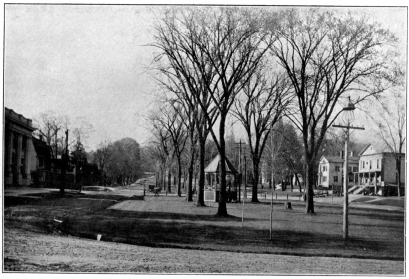 MAIN STREET FROM THE SOUTH
Float of G. B. Shiappacassee, the Bank Street fruit dealer,—a brand new
wagon decorated with the national colors and carrying oranges, bananas
and pineapples, arranged with a fine consideration for color and form.
Float of the New Milford Hat Company, decorated with the national colors
and carrying a group of hat-makers, who gave a practical illustration,
along the line of march, of the different processes of hat-making.
A tobacco float displaying the firm names—S. Rossin & Son, J.
Lichtenstein, C. F. Schoverling & Co., Staubb & Mallett, J.
Marquesee—and the legend, “New Milford Supplies the World with
Tobacco,” and carrying a large number of tobacco boxes.
Float of W. H. Coleman, a new milk wagon decorated with the national
colors and bearing the inscription, “Conetia Farm Dairy.”
Float of Chauncey B. Marsh, proprietor of a New Milford saw-mill,
decorated with white and green and carrying wedge, ax, saw and chain,
and an enormous artificial log, which two dummies sawed persistently
with a cross-cut saw.
Float of the Aspetuck Valley Grange, decorated with green and white,
roofed over with grain, and displaying the principal implements of
husbandry and the principal products thereof.
Float of the ice dealer, Samuel J. Ferriss—a capital, white cotton
imitation of a snow-bank between snow-laden “Christmas trees.” Upon this
float rode two small boys (S. Boynton and Charles J., sons of Mr.
Ferriss), offering dippers of ice.
After passing through the principal streets of the village, the parading
column was reviewed from the reviewing stand on the village “Green” by
Governor Woodruff and his staff and other distinguished visitors. The
paraders were then disbanded and provided by the Committee on
Refreshments with abundant good cheer in a colossal dining tent back of
the Knapp building.
After dinner, at two o’clock, the last formal exercises of the
Bi-Centennial were held on “The Green,” Charles M. Beach presiding. In
introducing the first speaker, Rev. Timothy J. Lee, Mr. Beach said:
“There is much cause for regret that, on account of ill health, our
President, Mr. Henry S. Mygatt, has been unable to be present or to take
any part in the exercises of this Celebration. It was at his suggestion
that the movement was inaugurated bringing about this event, and we all
know that he worked most heartily and earnestly for its success. I am
sure that there is a universal feeling of sympathy for him in the keen
disappointment which is his. Because of his absence, the duty devolves
on me to take charge of the exercises of the day.
“The first address will be words of greeting by the Rev. T. J. Lee, a
former pastor of the Congregational Church. Mr. Lee comes to us as a
representative of two of the oldest families in New Milford, Mrs. Lee
being a lineal descendant of the Rev. Daniel Boardman, who was the first
pastor of the old Congregational Church, and also of the Rev. Nathaniel
Taylor, who was inaugurated its second pastor in the year 1748, and
continued the pastorate for a period of fifty years.
Among other things, Mr. Lee said:
“The other day I met one of our recently adopted sons whose home is in
the great West. In the course of our conversation I referred to this
Bi-Centenary; but he pushed the subject aside as trivial, and began to
boast of his own great State. ‘Why,’ said he, ‘you can put twenty-two
Connecticuts into our Nebraska.’ Then he added that the time has come in
the history of our country when we can cut out New England and not feel
it. Cut New England out from the great life of this nation! Yes, you
may, when you can cut out a thread of gold woven in and out in a
beautiful fabric without ruining the entire piece. Cut New England out!
Yes, you may, when you can cut out from the loaf the leaven that has
made it sweet and light. Cut New England out! Yes, you may, when,
without disfigurement, you can cut out the features of a mother from the
face of her child. There may come a time in some far-off age when this
great American people may become so afflicted with some strange, new
form of insanity as to desire to cut out from its vast domain that sharp
northeastern angle which was alike its birthplace and its cradle and
the seminary of the best elements of its greatness. If that time ever
comes, New England, true to her ancestral pride (I speak as one who
knows and loves his mother), New England will say to you: ‘I am ready to
go; I desire to stay no longer where I am no longer wanted. But
first—first, in all justice and fairness, give me back some of the
contributions I have made to your greatness. Give me back the free,
forceful words which from my pulpit, my press, and my platform have
kindled the fires of religion and of patriotism, and quickened the
intellectual life of generations. Give me back my millions of capital
that have stretched across the broad land the iron bands of travel and
of trade, changed the Western wilderness into a smiling garden, the
desert into a fruitful field. Give me back some of the descendants of
those loyal sons and daughters of mine, who, under the canvas covers of
those old emigrant wagons, carried with them not merely their humble
household goods, but the very principles of their nurture—give me back
these, I say, and then, if you do not feel so utterly impoverished, so
stripped of everything that can make a nation great and strong and
enduring as to repent of your rashness and folly, I will go.’
“It is true that henceforth New England’s influence in the nation will
not be that of numbers, nor of territorial greatness, but she will still
rule by the force of ideas and convictions, by the sovereignty of
principles that can never be discrowned.”
Mr. Beach next presented Governor Woodruff in these words:
“During my business experience, it has been my privilege to make many
congenial acquaintances, one of which stands out most prominently
to-day. A number of years ago, a young man called upon us representing a
firm with which we had established relations. He has risen step by step
in his business career, until he now occupies a position at the head of
the firm which he then represented. A few years ago his name became
mentioned in political circles, and he has risen so rapidly in this
sphere that he comes to us to-day as the Chief Executive of the State.
“For integrity of character, for honesty of purpose, for having the
courage of his convictions, he is a Governor whom the people of the
State of Connecticut will do well to honor. Roosevelt at Washington,
Hughes at Albany, Woodruff at Hartford, are the type of public officials
which the people want.
“It is my very great pleasure, as well as honor, to present not only to
the people of New Milford, but also to the guests whom we are
entertaining to-day, his Excellency, Rollin S. Woodruff, of New Haven,
Governor of Connecticut.
Governor Woodruff said:
“My friends, I am very glad to join with you in celebrating the two
hundredth birthday of the settlement of New Milford. This commemoration
will become an interesting experience in your lives, and your children
will never forget the history that is taught them by this event. They
will learn of the early struggles of those who laid the solid foundation
of Connecticut, in the establishment of her towns, in the making of her
laws, and building of a great commonwealth out of the materials of
industry, education, and patriotism.
“It was no easy task your forefathers set out to perform, when they
determined to have a government as nearly democratic in its intention as
it was possible to conceive. The scheme of the founders of our State was
to insure happiness for all by making all the people independent and
free to govern themselves, and to advance themselves in a way that had
never before been dreamed of by any race of men. The wisdom of those
early settlers in organizing society upon a liberal plane seems to us
almost marvelous. What they hoped for has been realized.
“The people who founded New Milford and the other Connecticut towns were
unselfish. They planned not only for themselves and their time, but they
planned for those that were to come after them. They saw through the
years what might be
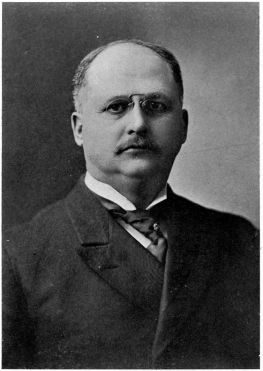 HONORABLE ROLLIN S. WOODRUFF
Governor of Connecticut
ours, if their plans prevailed. They saw the human race rising to its
highest perfection in an atmosphere of liberty and of opportunity. Yet
their most daring fancy could not have pictured this surprising scene of
to-day. They were rough and rude men two hundred years ago. And they
were determined men, and their lives were the serious lives of hardship
and peril. What they wanted was freedom and a government that would keep
them free. They wanted to do what was right—justice to all men was the
motive that inspired them. They had faith in themselves and believed
that the real government was that which came from the people; and they
made their laws to last for all time, trusting to the people the
responsibility of taking care of themselves. They were the fathers of
freedom in its truest sense, and intended to leave their children a
house that was built upon a rock.
“In all this, they gave evidence of the very noblest patriotism, and
they have set for us an example which we have followed for two hundred
years—an example which must continue to guide us in our government, if
this grand development of Connecticut is to go forward to its highest
possibilities. We must keep our foundations solid and build for the
future. We must grow better as we grow older. Our lawmakers must be
sincere and serious men. They must be representative in the deepest
meaning of the word, for the whole happiness of our people depends upon
the making and the administration of laws that are enacted in the
interest of all the people of our State, and our representatives should
be held responsible for their acts at the polls. The rights of the
people are sacred and must be kept inviolate, and no law should be
placed upon the statute book that will be a burden to the people, or
that takes from the people any right that belongs to them all. Let there
be no hasty, inconsiderate, or careless legislation that robs them of
their own. Great privileges should never be given away to private
interests, and every man’s property should be protected throughout the
State. We frequently learn what we have lost, when it is too late. I do
not mean to alarm you, but I do mean to warn you that you may keep
guard over your right against oppression, which is sure to come when
the people lose interest in their own affairs.
“What an advancement you have made in two hundred years! The country
towns of to-day share with the large cities all modern advantages. Your
children have matchless chances for education, and your commercial
conditions offer every opportunity for success in life. The farmer of
to-day is a prince among farmers and lives in the surroundings of
comfort and luxury: with vast systems of water supply; a high sanitary
arrangement protecting health; gas and electricity for light, heat, and
power; the telegraph in every village, and the telephone in every home
where it is required; the best facilities for travel at your doors—a
prosperity in business never known in the history of mankind. All men
are educated by the affairs of the hour, and all men think. You are
better equipped to govern yourselves than any people in the world.
Contrast all these comforts with the inconveniences of your ancestors,
and tell me have we not reason to rejoice at this Bi-Centennial of New
Milford?
“In my position as Governor of this State I have kept steadily in view
the general prosperity of all the people, and I have always believed in
an educated public sentiment as the safeguard of law and order in our
Commonwealth. I believe in the people of Connecticut and in the future
of the State; and I believe that the more interest you take in public
matters the better your government will become. I want to congratulate
you upon the growth of New Milford, and thank you sincerely for the
privilege of joining in this triumphant Celebration.”
Mr. Beach next presented Rev. Watson L. Phillips, D. D., saying:
“At this time it is in my power to speak a word of welcome to my
comrades of the Foot Guard. They have been connected with the history of
Connecticut since 1775, when the Company marched out to Lexington and
Concord. It has not been my privilege to be as close to the armory as I
should have liked, but I am proud to belong to that old organization
which has done so much for the honor of Connecticut, and I will simply
ask the Chaplain of the Company to speak to you more fluently than I
can.”
Chaplain Phillips delivered an eloquent eulogy of the Foot Guard. Among
other things, he said:
“The Second Company of Governor’s Foot Guards was born in that strenuous
time when ideas were crystallizing, opinions taking shape, men beginning
to realize something of the struggle that was before them; something of
the real significance of the Mayflower, of the Colonial forms of
government, and of those acts of protest by which the colonies had
lifted their voices against the usurpations of the mother country. In
1775, when the clouds were beginning to gather, when men’s hearts were
beginning to tremble within them for fear, this company was born. On the
first roster, you will find the names of the leading citizens of old New
Haven town. The first men of the town were its sponsors. Back of them
was a patriotic and humane purpose, and, having that purpose in view, I
am able to declare that we are the oldest military organization of the
sort in the State.
“The First Company in Hartford antedates us by a few months, but the
First Company was what its name implies, the Governor’s Guard. The
Second Company came at the call of the danger to liberty and its first
act was to make response to the call of Lexington and Concord. Under the
man, then a magnificent patriot, Benedict Arnold, the company marched to
the defense of their endangered brethren in Massachusetts.
“And these men, before they left, listened to a sermon by Jonathan
Edwards, the benediction of which went with them throughout their march.
They marched to the powder house—they asked for ammunition; the
selectmen of the town denied their request. Arnold drew up his men
before the door, and said: ‘We will give you five minutes to comply with
our request; if the ammunition is not then forthcoming we will break
down the doors and help ourselves.’
“That was the spirit with which they started on their march to
Cambridge, and that spirit has animated the command through all these
years. It has been our privilege to have been represented in every war
the country has waged from 1775 to the present day, beginning with the
attack upon West Haven, to repel which the company marched as a body
under the command of Captain Hezekiah Sabin. Down through all the wars
and in the most conspicuous battles, representatives of this Governor’s
Guard have been found, shoulder to shoulder with the patriots of other
States and other towns, contending for our liberties.”
The next speaker, Hon. Ebenezer J. Hill, was presented as one who needs
no introduction to New Milford. Congressman Hill said:
“One year ago I united with some of your citizens in celebrating the
fiftieth birthday of New Milford’s offspring, the town of Bridgewater.
“To-day I congratulate you that the parent has reached the hale and
hearty age of two hundred years.
“While New Milford has had many trials and sore experiences, the old
town shows no wrinkles, or scars, but is fresh and blooming and ready to
enter upon the third century of its career with a courageous heart and
unfaltering purpose to maintain in the future, as in the past, the
splendid character of our New England civilization.
“There is no higher standard in the world than that, for it was
established in the beginning of our history by men who feared none but
God. Our fathers built upon the granite hills of New England communities
and States, which, though small in area, have been mighty in influence,
molding and shaping the destiny of the nation, and through it giving to
the whole world an example of self-government, based on the sanctity of
the home, the common school, freedom of religion, and the New England
town meeting. With these maintained, the prosperity of the future is
assured, for, while old age with all its weaknesses comes to men with
the passing years, the lapse of time, if rightly used, should make a
community or a nation stronger and more enduring.
“Temporary success may come from many causes, but, in the long run, it
is character which counts, not only in the individual, but in the nation
as well.
“A few weeks ago I visited the site of old Panama, a city on the Isthmus
to which it gave its name. It was founded in conquest and plunder, a
century before the Pilgrims landed at Plymouth Rock. A hundred and fifty
years later, in conquest and plunder, Morgan and his pirate crews swept
it from the earth; and now, nothing but an old church and tower, almost
hidden in the tropical jungle, mark the spot where this once flourishing
and populous city stood.
“A few years ago I walked from the ruined palaces of the Cæsars down the
slope of the Palatine Hill into the Roman Forum. The way was paved with
stones which were put there twenty-six hundred years ago by the
shepherds and farmers from the Alban Hills. Their virtues were as strong
and rugged as the stones with which their streets were paved, and their
descendants, imitating those virtues, ruled the world for a thousand
years. But at last, licentiousness, extravagance, and lust for wealth
came in and rotted the moral fiber of the Empire, until the very men who
had sworn to guard the nation sold the positions of honor and trust, and
even the Empire itself, at public auction at the city gates, as cattle
and sheep were sold in the open market; and Rome fell from its high
estate never to rise again. It was a literal exemplification of the
proverb which was old even then, that ‘righteousness exalteth a nation,
but sin is a reproach to any people.’
“But why multiply illustrations? The history of the world is full of
them, and, on the other side, none more marked than is shown in our own
land in the marvelous progress which the New South has made since the
curse of human slavery was lifted from her in the desolation and horror
of the Civil War.
“This town, this State, this nation is just exactly what you and I, as
individuals, are making it to-day. The past is unchangeable, the future
is in the hands of God. Only the present is ours. We have come in our
own experience to times of great unrest and discontent with existing
conditions. I am glad of it. It shows that the world is growing better
and that we are not satisfied to-day with the solution of the problems
of yesterday, but it does not follow that the new problems of to-day are
unsolvable. It simply proves that there is still room in the world for a
large amount of civic righteousness and that it is for the individual
citizen to prove that the supply has not been exhausted.
“There is an old hymn which we sing in our churches,
“ ‘We are building, building every day,
A temple which the world may not see,
We are building, building every day,
Building for eternity.’
So far as the immortal and divine in us is concerned, the hymn is all
right, but so far as this work-a-day world is affected by our actions I
would paraphrase it thus,
“ ‘We are building, building every day,
A temple which the world can see,
We are building, building every day,
Building for humanity.’
“A few days ago I read a story in a newspaper of a man who advertised
that he wanted to buy a horse. In a day or two men came with all sorts
and kinds, young and old, blind and lame and halt. They told him of the
splendid records of the old hacks, and the great possibilities of the
young colts, till he finally sent them all away, saying, ‘I don’t care
anything about your “has beens” or your “to be’s,” what I want now, is
an “is-er.”’
“The men of New England are the heirs to-day of more than two centuries
of growth, and progress, and education, and we owe it to ourselves and
to our children to add something in our lives to the sum total of human
happiness and the public welfare; for there is a mighty difference
between always trying to get the better of the community in which we
live, and giving to the community the best that there is in us.
“From the very beginning of our State, till now, there have never been
lacking men, who, by their strength of character and devotion to the
public welfare, have made an impress on their day and generation, until
at length Connecticut is known among her sister States as “The Land of
Steady Habits.” I can only refer now to two of them, Colonel Abraham
Davenport of Stamford, and Hon. Roger Sherman of New Milford. Of the
first, Timothy Dwight, in his book entitled ‘Travels in New England and
New York,’ tells us that he was a judge in Danbury and a member of the
Governor’s Council in Hartford, and cites this incident concerning him:
“ ‘The 19th of May, 1780, was a remarkably dark day. Candles were lighted
in many houses, the birds were silent and disappeared, and the fowls
retired to roost. The Legislature of Connecticut was then in session at
Hartford. A very general opinion prevailed that the Day of Judgment was
at hand. The House of Representatives, being unable to transact their
business, adjourned. A proposal to adjourn the Council was under
consideration. When the opinion of Colonel Davenport was asked, he
answered, “I am against an adjournment. The day of judgment is either
approaching, or it is not. If it is not, there is no cause for an
adjournment; if it is, I choose to be found doing my duty. I wish,
therefore, that candles may be brought.”nbsp;’ ”
“Such a man would be a success at any period of the nation’s history.
“Of Roger Sherman, for many years a citizen of New Milford, time would
fail me to properly speak of the long and distinguished public services
which he rendered, not only to the community in which he lived, but to
the nation at large.
“Some years ago, in studying his life and character, I collected from
the Colonial Records of Connecticut every mention of his name, and will
present the record[45] to the New Milford Gazette for publication;
for, of such a citizen, New Milford may well be proud.
“The lives which these men lived, and countless others in the early
days, should be an inspiration to us all.
“Opportunity does not come alike to all, but these men simply did their
duty honestly, faithfully, and well; and all of us can do the same
to-day, in full confidence that the motto of our dear old State—‘Qui
transtulit, sustinet’—has not yet lost its meaning or its power.”
After a witty speech by Rev. Marmaduke Hare, who spoke as an Englishman
who is an American in the making, Mr. Beach terminated the exercises
with these words:
“One brief thought in closing. As the sun sinks behind the hills of our
western horizon to-night, we close the second century of the history of
New Milford; but let us not linger too long in contemplation of the
setting sun. Rather, let us turn our faces eastward and greet the rising
sun, which will usher in the third century. Yes, it will be our
privilege to enter the portals of another century, but certain it is
that not one present will reach its exit. Let us press forward, doing
faithfully each duty as it presents itself, placing our confidence ‘in
the God of our fathers, from out whose hand the centuries fall like
grains of sand.’ ”
Tuesday evening was devoted to a magnificent display of fireworks in
Riverside Park on the west bank of the Housatonic, and thus, in a blaze
of glory, Governor’s Day, the last of the New Milford Bi-Centennial,
came to an end.
The great event is over, and New Milford has excelled all records and
exceeded all anticipations. This might sound egotistical, were it not a
fact that it is only the plain truth, and corroborated by the speech of
everyone who witnessed the Celebration. Our town stands higher to-day in
public estimation than it ever stood before. As we look back, it is not
possible to name an event which should have been omitted or a feature
which should have been added. A four-days’ celebration has been held,
covering every point which such a celebration should cover; dignified
and formal, where dignity and formality were appropriate, informal,
happy and homelike at all other times.
A celebration very carefully planned, ably financed, and splendidly
conducted; with every contingency provided for and the most minute
details planned in advance. Our townspeople have shown that they can
accomplish great enterprises, for it is the universal verdict of our
guests, especially of those who have traveled much and participated in
such events, that this was a great enterprise, never equaled in some
respects, and never excelled in the matter of perfect appointment. Our
townspeople have found, too, that in oratory, music, and literature they
have men and women of whom any community may well be proud.
Some special points should be noted regarding the celebration. Perfect
order was maintained throughout; during the four days, some sixteen
thousand different people have occupied our streets, but, during all
that time, there has been no disturbance, no violence or theft, no
accident of any kind, and a very noticeable absence of drunkenness. That
such admirable order prevailed is a great credit to our town and its
visitors, and this community owes a debt of gratitude to the Committee
of Public Safety and the selectmen of the town.
Perfect system prevailed, so that every event occurred on time and
exactly as planned, with no break or delay at any point. This fact
appealed very strongly to our official guests, who had attended other
similar events, and knew that delays and unforeseen contingencies almost
always arise at such times.
The decorations, public and private, were beautiful and appropriate, and
brought the warmest commendation from visitors.
The literary, religious, and historical exercises were of a very high
class. Every address and sermon being most appropriate to the occasion
and excellent of its kind.
The musical programme was splendidly conceived and carried out, and high
praise is due the committee, the chorus, and, especially, Professor
Edwin G. Clemence.
The pleasure and success of the Celebration were very largely added to
by the presence of Gartland’s Tenth Regiment Band of Albany during the
entire four days. Such splendid band and orchestral music was never
heard here before.
The Loan Exhibit was a great success; admirably managed and very greatly
admired.
The spectacular features were beyond any criticism. Both parades were
perfect in appearance and in management, and the fireworks received the
highest praise. The Civic and Military Parade was a surprise to
everyone; newspaper men and guests, who had seen the world’s greatest
parades, declared that the School Division had never been equaled in
originality and attractiveness. Our prominent visitors stated that,
while a great city undoubtedly could do as well, no great city ever had
done as well.
New Milford has won a high place in the estimation of thousands, and has
gained vastly in civic pride and public spirit; may these, and the good
feeling engendered by the Celebration, last for the next two hundred
years.—New Milford Gazette.
The day after the close of the Bi-Centennial Celebration, the President
of the Bi-Centennial Committee received the following letter:
“Executive Department, State of Connecticut,
“Hartford, June 19.
“Hon. H. S. Mygatt, New Milford, Conn.
“My Dear Mr. Mygatt: Upon my return to Hartford, I want to say just
a few words to you in appreciation of the scope of the celebration
prepared by you and your fellow committeemen on the occasion of the
Bi-Centennial of the town of New Milford. It was a success in every
particular, and reflects great credit upon your community, and upon
the men who planned and carried it out.
“For myself, personally, and the members of my staff, let me say we
enjoyed every minute of our visit, and appreciate to the fullest
extent the hearty welcome and the unfailing courtesy of your
people.
“It was a source of regret to me, and I learned from others that it
grieved them, too, that you were ill and unable to see the fruit of
your thought and labor. I hope it will be a gratification to you to
know that what you wrought was so well carried out by those who
took up the work and followed your plans. You have reason to feel
very proud of the whole affair, and I trust that you will soon be
restored to health and strength, and be able to return to your
delightful home town.
“With best wishes, I am sincerely yours,
“Rollin S. Woodruff.”
The same day, the following letter came to Charles M. Beach:
“Executive Department, State of Connecticut,
“Hartford, June 19.
“Mr. Charles M. Beach, New Milford, Ct.
“My Dear Mr. Beach: Upon my return to Hartford I want to
congratulate you and your fellow committeemen, and, in fact, the
entire town, upon the magnificent celebration of New Milford’s
Bi-Centennial. I wish also to thank you for your unfailing courtesy
and your thoughtfulness for the comfort of myself and staff during
our delightful stay there.
“I enjoyed it myself very much, and I am proud that Connecticut
holds New Milford as one of her communities. The enterprise of your
citizens, and the scope of their celebration, is equal to what much
larger places might have attempted, but few of New Milford’s size.
We shall remember our visit there with much satisfaction.
“Sincerely yours,
“Rollin S. Woodruff.”
Another letter of similar purport came to H. LeRoy Randall (Chairman of
the Bi-Centennial Finance Committee) a few days later:
“Danbury, June 22, 1907.
“H. Leroy Randall, Esq., New Milford, Conn.
“My Dear Sir: New Milford has reason to feel proud over the success
of the Bi-Centennial. The Governor said he had the time of his
life, and so say we all of us.
“Yours very truly,
“J. Moss Ives,
“Of the Governor’s Staff.”
The work of the Finance Committee and Treasurer was not only of the most
vital importa“o the success of the Bi-Centennial, but was so
remarkable in many ways as to deserve a chapter to itself.
When the first estimates of cost were made, about $4000 was, in round
figures, the amount asked for. To many this seemed a large sum to raise
by subscription, but the Finance Committee stated without hesitation
that the amount would be raised, and more if needed; and the promise was
made good by a total subscription of about $5000, secured in an almost
incredibly short time. This was accomplished without any noise or public
display, and was the result of careful planning and perfect system. The
funds were paid out by the Treasurer to the several committees, on
approval of the Executive Committee, and a most accurate and detailed
account of all expenditures was kept by the Treasurer, and may be
inspected by subscribers at any time. There remained a substantial
balance on hand after all bills were paid, and while this will probably
be devoted to publishing the Book of the Bi-Centennial, the sales of the
volume—when published—should return to the treasury the amount
expended, and more. No appropriation was asked for from the town
treasury, and the only items of expense met by the town were the
necessary ones of decorating its own buildings and furnishing the police
force during the Celebration. It is safe to state that no enterprise of
this nature was ever more ably and successfully financed than was the
New Milford Bi-Centennial of 1907.


