Twice-Born Men in America OR The Psychology of Conversion as Seen by a Christian Psychologist in Rescue Mission Work
Transcriber's Note:
The cover image was created by the transcriber and is placed in the public domain.
BY
HARRIET EARHART MONROE
Also Author of “Conversation as a Science and an Art,” “Heroine of the Mining Camp,” “Historical Lutheranism,” “The Life of Gustavus Adolphus,” and “Washington—Its Sights and Insights”
PHILADELPHIA, PA.:
THE LUTHERAN PUBLICATION SOCIETY
Copyright, 1914, by
HARRIET EARHART MONROE
PREFACE
iii
I taught psychology for fifteen years at the Atchison
Institute, the predecessor of Midland College, located at
Atchison, Kan. I was there greatly impressed by the
fact that the books gave no adequate analysis of the
psychology of the greatest mental and moral change
which can come to the human mind, namely, conversion
and regeneration; yet these changes make the great difference
which we see between men and nations.
A Rescue Mission gives a great opportunity to study
mental and moral changes, and my observations and conclusions,
made from years of study, are herein embodied.
This book is sent forth with the earnest hope and
prayer that it will lead many souls to Christ; also that it
will show earnest laymen just how to bring about that
psychological change which we call conversion. A Sunday
school teacher who brings only ninety per cent of
her students through the process of conversion and regeneration
is ninety per cent a success and ten per cent
failure. The same is true of a pastor with a class of catechumens.
“Ye must be born again,” is just as true to-day as it
ever was, and if we believed it as Paul believed it,
what live wires we would be.
This book is to remind us that Jesus saves to the uttermost
in our day, just as He did when He visibly walked
this earth.
Harriet E. Monroe,
204 A Street, S. E., Washington, D. C.
July 29, 1914.
CONTENTS
v
CHAPTER I
PAGE
How I Happened to Become Interested in Rescue Mission Work
CHAPTER I How I Happened to Become Interested in Rescue Mission Work — TREASURER, MR. H. D. GORDON — PRESIDENT, GEORGE W. WHEELER — MRS. M. P. SPINDLE — THE FUMIGATOR — ENLARGEMENT — THE NEED OF RESCUE WORK — “OUR GOSPEL MISSION TIDINGS” — THE INDUSTRIAL PLANT
7
In January, 1908, a great calamity came to me in the
form of destruction by fire of most of my earthly property
and the death in the fire of a loved sister. The event
had in it some other elements of great pain not necessary
to mention here. If my soul had not been anchored in
Jesus, the combination of sorrows would have broken
down my mentality and sent me to the asylum. As it
was, I stood steadily trusting God, knowing that all
things worked together for good to those who love God.
I was sure I was a lover of God, and so, while every fiber
of my body and soul ached with unspeakable pain, I never
doubted God's love, care and sympathy.
In the midst of this grief I received a letter from Mr.
George W. Wheeler, the President of the Executive
Board of the Gospel Mission, saying about this, “Come
down to the Gospel Mission, look it over and see if you
care to come in with us in the work of saving souls. Unless
we secure a woman of large executive ability, our
work can scarcely go forward.”
I answered that I would be glad to join them, and the
next week, the first week of September, 1908, I received
8a letter from the Secretary, S. M. Croft, saying I had
been elected to the Executive Board of the Gospel Mission,
which met once every week.
The following Monday I met with the Board, where I
heard a letter from Mr. Tyson, saying that he withdrew
from the Board because the dormitories were badly kept.
Then followed a letter of the same kind from a Mr.
Fritz, and another from Mr. Sidell. As soon as the session,
which was largely a prayer service, was closed, Mr.
Wheeler accompanied me to look over the dormitories.
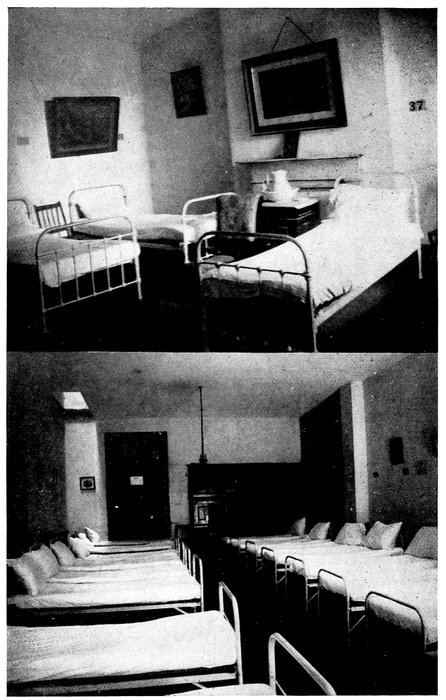
I never saw or dreamed of such conditions. The
very walls were alive with vermin. In the story above
the chapel were fifteen vile beds, and on the third story
above us we saw a floor covered with dirty, wrinkled
newspapers. I said, “Where do the men sleep?” “On
the beds you saw in the third floor and on these newspapers.”
In my heart I said, “Dear Lord, surely not here, amid
this vileness?” The answer was as sharp and distinct
as though spoken through a trumpet, “Prepare ye the
way of the Lord.”
“Mr. Wheeler,” I said, “I see conditions, and I take
charge.” He left for his work in the United States
Treasury, and I went to the street and hired a force of
cleaners, whitewash men, scrubbers, sweepers, etc., and
called up Mrs. Claude Myers, the wife of a Presbyterian
minister, and two other fully consecrated women who
were not afraid of work. I asked them to come at once
and bring with them buckets, scrub brushes, rags, soap,
etc., while I put in a supply of chemicals for the vermin.
Those women helped to burn the bedding and to send
away some as trash. They helped me clean the beds; the
whitewashers even entered into the spirit of it, and every
9crack was filled with plaster of paris; they went over
the walls three times with lime and carbolic acid. The
Health Bureau in the Municipal Building gave me a
preparation used on floors in jails and in hospitals for
contagious diseases. Some redeemed men came to our
help, and by Saturday night we turned over a clean
house.
Every one of us cleaners was obliged to go to the Turkish
bath and have our clothing brushed and fumigated
before we could go to our own homes.
On Saturday evening I told Mr. Wheeler and Mr.
Gordon that besides the good men and women who had
helped us for the cause for five days, we had spent
twenty-five dollars. Never will I forget the dismay of
those two good men. “What! Twenty-five dollars!
Where do you think we will get that?” I answered,
“Fortunately I belong to a church that lives and works
by faith, and to-morrow, being Sunday, I shall tell the
Sunday school of the Luther Memorial Church, and
we'll see about that twenty-five dollars.”
The next morning I went to the pastor, Rev. J. G.
Butler, D.D., and he secured permission from the superintendent
of the Sunday school for me to speak three
minutes. The superintendent hated innovations, but I
can say a lot in three minutes, especially when I state
the needs of the lost men of the community. After the
school was dismissed nearly every teacher and grown
student gave me something, and in less than five minutes
I had twenty-seven dollars.
Sunday night I told what the Lord had done for us,
and I began to ask all persons present to contribute
sheets and pillow-cases. I did this so much and so often
that season that a little four-year-old girl of Mrs. Claude
10Myers upset the gravity of an entire meeting by saying
out loud one Sunday evening, “There comes Mrs. Sheets
and Pillow-cases again.” Well, before winter was over
we had about fifty clean, well-equipped beds for which,
when they had it, men gladly paid ten cents per night. If
they did not have it, the beds were given as long as they
lasted; but, after the beds were filled, often fifty men
slept on the floor with only the boards under them and
no covers.
We had no heat in the dormitories, but one day Mrs.
Richard Butler, a wealthy woman of the city, was ordered
by the Spirit to visit the Mission. She came by
Mr. Gordon's office in her carriage and he took her
through our building. She saw our first need was heat.
She sent immediately to a hardware store and ordered a
large stove for the third floor with a drum for the fourth
story, and through her kindness the men were given heat,
but not until after two deaths, caused by cold, hunger
and wet clothing, had about broken our hearts.
I remember a young, fair-haired man from Virginia,
evidently well born and bred, coming in one night,
slightly under the influence of liquor. It was a rainy,
snowy night; his clothing was wet and he was suffering
from a severe cold. When the meeting was over he
started to go up stairs, which had nearly a zero temperature.
I begged him to stay by the fire and sleep on a
bench, if needed, but he petulantly refused. He was
dead by nine o'clock next morning. I had wept all the
way home, for I feared just what happened.
Mrs. Butler's stove put an end to that. She furnished
coal for the entire winter.
Now that we had beds and heat, I saw we could not
keep the beds clean without bathing facilities. So at our
11next Board meeting I said, “Brethren, we need a good
shower-bath with warm and cold water so that men
soiled and weary can have the comfort of a warm bath.”
All the members of the Board demurred on account of
the expense. Then I said, “Brethren, if I make myself responsible
for the eighty-five dollars needed and you are in
no way held for it, may I have the bath put in at once?”
Of course, they wanted the bath, as they saw how much
it was needed, and gave cordial consent. I purchased a
rubber stamp, and on the outside of our first circulars
which we issued I stamped the words, “I have made myself
personally responsible for the cost of a shower-bath.
Help a little.” And with my own contributions the bath
was paid for as per contract.
That fall we put out a circular folder, of which the
following is the open letter, and is introduced only to
give the continuity of this work so that my friends may
know the aim, object and history of the Mission from the
beginning:
Gospel Mission,
1230 Pennsylvania Avenue, N. W.
Washington, D. C.
Dear Friend:
Under the blessing of God and the guidance of the Holy
Spirit, a Rescue Mission has been opened at No. 1230 Pennsylvania
Avenue, N. W., where nightly gospel services will be conducted
and the Lord Christ held up to view as a Saviour “mighty
to save and strong to deliver.”
Our corps of workers is composed of consecrated and Spirit-filled
men and women, many of whom have had long experience
in efforts of this character. On the occasion of the opening
service (Saturday evening, May 12) God set His seal to the
work by drawing seven earnest seekers to our altar for prayer.
Street meetings will be held nightly, and an earnest and aggressive
work carried forward for the betterment of society and
the salvation of lost men and women.
12Our hall is well located on the south side of Pennsylvania
Avenue, N. W., in the midst of saloons and pool-rooms and in
close proximity to that section of the city almost wholly given
up to evil, and it will be the constant effort of the Mission and
its workers to seek out and rescue the erring girls and reckless
men who are found in large numbers in this immediate neighborhood.
The management is determined that the expenses of this work
shall be kept at the minimum figures—not exceeding $100 per
month—and they confidently appeal to their Christian brethren
and friends and to the public for such funds as shall be found
necessary to carry forward this work. Can you, will you, aid us?
With great respect,
G. W. Wheeler, Chairman,
J. S. Mewshaw, Secretary,
H. D. Gordon, Treasurer,
Executive Committee.
These good men are at this writing (1913) yet connected
with the work. Mr. Mewshaw is an employee of
the Pennsylvania Railroad, and has charge of a station
some distance from Washington, but contributes and
comes with us occasionally. But no organization was
ever more fortunate than the Gospel Mission in its
officers.
is a prominent lawyer of the city. He really gives more
time to the Mission than his business can afford. When
we are under strain to make a payment on the building,
he and Mr. Wheeler can go to their friends and raise
$1000 more readily than the remainder of the Board
can raise $100. They ask largely of their friends. The
others of us ask for one dollar monthly contributions,
and we each receive as we ask. Mr. Gordon's devotion
13cannot better be illustrated than by the following: Mr.
Gordon is a most effective singer. I have heard many
singing evangelists, but none with a finer pathos of voice
than Mr. Gordon's. One evening in the fall of 1909,
when each evening we were privileged to hold our outdoor
meetings in front of the city post-office, I was passing
on the street car when I saw Mr. Gordon with his
guitar standing all alone, trying to sing salvation to some
passing sinners. I found the tears coursing down my
cheeks, so I got off at the next corner and went back
to help him, but by that time other workers were on hand
and it was less sacrifice for me to speak for him. I
acknowledge here a mean pride (which the Lord has
had to thrash out of me with many hard knocks) against
speaking on the street. I have had to remember many
times that Jesus was an outdoor preacher all His days,
and all the Apostles, and who am I that I am ashamed
to follow where He has led! But Brother Gordon can
stand alone anywhere for Christ. He is greatly in demand
in other cities as a successful evangelist.
I want to here bear testimony to the great good done
by outdoor meetings. If all evangelical churches who believe
in conversion and regeneration would hold their
meetings outdoors in the summer, they would bring many
souls, for which they will be held responsible, to Christ.
If young people would hold alley meetings in the alley
nearest their church they would bring sinners to Christ,
there would be no slums and the young Christians would
grow in grace.
President, George W. Wheeler, of the Executive
Board, is one of God's best gifts to the city of Washington.
14He is the very best City Rescue Mission worker
I have ever seen, and I have seen most of the city missions
of the United States and Europe. In the summer
of 1910, in company with Mrs. M. P. Spindle, I visited
all the great cities of Europe, especially Glasgow,
Edinburgh, London, Paris, Berlin and Rome, to obtain
suggestions for improving our work, as we thought, at
that time, to plan for erecting a great mission building
unequaled in all the world. Most mission buildings are
mere adaptations of old buildings. We hoped to do
better, but God ordered otherwise. Among all these
great mission workers I have seen none superior to
George W. Wheeler in Rescue Mission work and in conducting
an interdenominational organized work for God.
First, his consecration is marvelous. He had been thirty
or more years in government service, to lose time means
not only loss of money, but even endangers a man's
tenure of office.
But when Mr. Wheeler is called to see a soldier, a
sailor, a sick man in the hospital, who must be seen in
business hours, he never, as all other government members
of the Board do, pleads loss of any kind, but goes at
once on the errand of love and mercy. Then he gets on
well with his Board of Directors; if debate runs high and
a measure is carried without his favor, he holds no
grudge, he is universally kind. That means much. Then
his acquaintance is so large he can secure good talent for
helpers in every line; he has the absolute confidence of
the community (which he richly deserves), and by the
blessing of God secures funds for our great work; and,
best of all, he leads many souls to Christ. He has probably
seen more souls born into the kingdom of God than
any other living rescue worker.
15(Mr. Wheeler died January 19, 1914. “He buries the
workers, but the work goes on.”)
is a Christian woman whom I found connected with the
Mission when I went there. My attention was first attracted
toward her by her liberality when I made the calls
for bedding, so now I borrowed $85 from her and put in
the bath. She was kind enough to let me pay it back in
driblets, and from that day to this she has given more
money than any other worker. She has loaned or given
the money to go forward in each venture of mine, and,
above all, I have had the benefit of her counsel and her
favor in every form, and together we have prayed
through many an obstruction which seemed an impassable
barrier.
No sooner did we get the bath in place than I saw the
necessity for a fumigator, not only that men should have
their clothing purified from disease and from vermin, but
for the sake of the beds. I found that they could not be
kept clean without the men bathed and had their clothing
fumigated.
The Board again did not feel able to put in the fumigator,
which cost $125. In this work I found a friend in
Mr. Ernest Gichner, who invented a sheet-iron room
with suitable fire-box and chimneys, which he anchored
on the roof of the building.
It did good service and added to the comfort of the
men and the cleanliness of the house, not only while
there, but later he moved it over to our new building.
Mr. Gichner permitted me to make payments in installments
16of $25, which I was able to collect mostly from my
friends in the Luther Memorial Church and the Mission
workers themselves, who are always liberal even beyond
their means.
I became Chairman of the House Committee in September,
1908, and the following December Mr. H. W.
Kline was made Superintendent. As soon as we had
nice beds to offer for ten cents a night, we had a steadily
increased patronage, so that by the fall of 1909 we were
obliged to rent a large room back of us. That winter we
had eighty-four beds filled nearly every night.
A friend in California sent me $25 as a Christmas
present, and I put white spreads on the twenty-five best
beds. Some members of the Board laughed at me so
much that I was obliged to remind them that the money
of the Mission was not used. Long ago they have come
to see that a white bed is a necessity if we are to keep
a clean house.
By October, 1909, our expenses for rent, fuel and
necessities had increased from $100 to $150 each month.
Our statistics for 1908, as shown by our circular, were
as follows:
Statistics of the year and of the last quarter—From January, 1908, to January, 1909
Statistics of three months of 1908, as follows:
Attendance
Req. for Prayer
Seekers
Conversions
Services
Dec. 1908
1961
165
86
14
41
Jan. 1909
2487
217
73
37
46
Feb. 1909
1245
51
34
13
28
Total
5693
433
193
64
115
17(Now we care for over 50,000 persons a year.)
During the year employment was found for probably
300 men.
We accept it as a great privilege to have presented the
gospel of Jesus Christ to this number of people.
Our little circular of that period thus sets forth:
“Washington is a dreadful place for a man out of work.
The city having no manufactories, and all rough work,
such as excavating, is let by contract to men who prefer
Italians or Negroes as diggers, while stores and offices
have room for only the efficient young person, so that,
when from age, inefficiency or lack of political influence,
people are dropped from the government service, we are
often at our wit's end to provide means of subsistence
for these worthy persons most anxious to labor. We
have some old men whose working days are over. These
are for the most part good men, for the wicked do not
live out half their days. A few immigrants from northern
Europe, sick men who are able to walk about, but could
not work if they had it; the shoestring man, the umbrella
man, the sandwich man, the men who are half insane for
lack of food and enforced lack of sleep, for they have
no place to sleep oftener than once a week. Then we
have the criminal classes, which must be touched with the
Spirit of God, or they will become the dynamite which
will destroy our cities, also the men just out of prison.
These are the special thought of the Mission, for unless
they are made to feel that they are but temporarily sidetracked
from the great highway of success, they will become
an ever-increasing menace to society.
“Above all, we have the drunkard, who has lost his grip,
18lost family, lost place in society, lost business and has
become a mass of putrid flesh, utterly abhorrent to his
fellow-men. When we look at these people, whose weary
eyes have looked long into unspeakable sorrow, our very
souls rejoice that we have proven beyond possibility of
doubt that 'the blood of Jesus Christ, His son, cleanses
from all sin; that if we confess our sins, He is faithful
and just to forgive us our sins and to cleanse us from all
unrighteousness,' for we have seen some of every class
mentioned redeemed, placed back in society, among the
producing power of the nation.”
(a monthly paper) was issued first in October, 1909. All
members of the Executive Committee have helped in
some measure on it, but the responsibility has fallen
heaviest on Mr. G. W. Wheeler and myself. Our entire
income is the result of our paper, it is our means of communicating
with the public.
was really brought about by two tragedies. One cold day
I went to the Mission, and on the outside I saw a man,
whom I shall call Kelly, shivering at the door. He looked
like death, pale, trembling, the lips and nostrils drawn as
if in extreme pain. “What is the matter, Kelly?” I said.
“I am starving to death; amid all these happy people I
am left out. I have walked the streets hunting work till
I can walk no more.”
At that time we did not provide food of any kind, but
I said, “Let us go up stairs to the Mission,” where Mr.
Proctor, then acting as Superintendent, provided bread
19and coffee. I set the man to re-whitewashing the dormitories,
and we kept him till he secured work.
The other was the case of a young man just released
from Moundsville Penitentiary. After I had given the
lesson one Tuesday night, I was led to tell in detail the
story of Valentine Burke, a man converted in the St.
Louis jail, from reading one of Mr. Moody's sermons
in a city newspaper. Mr. Burke afterward became a valuable
citizen, held the position of assistant warden, and
led hundreds of lost men into the clear light of the gospel.
When I had finished, a well-dressed man on the front
seat said, “I am just out of Moundsville; no one has
spoken a kind word to me, I have had nothing to eat
to-day, I see no way but to steal again.” He was only
about twenty-two years of age. I put my arm over his
shoulder and said, “Son, we will take care of you and get
you work.” The Superintendent took him up stairs, gave
him bread and coffee, then a warm bath, but he was so
weary the men had to help him to get to bed. We all
tried to get that boy work, but as soon as the word penitentiary
was mentioned every door was closed. I remember
walking up Capitol Hill, crying aloud to God,
“Give us an industrial plant or the sorrows of homeless,
workless men will take my life.”
I paid for the food for a week. He tried also to obtain
work, but I think the sight of my anxious face worried
him—I have learned not to carry sorrow in my face since
then. That boy slipped through our fingers and went
back to crime. Now, at whose hands will that soul, anxious
for better things, be required?
Before I went for my summer vacation I urged before
the Board an industrial plant. Mr. Kline strenuously objected.
During that vacation I laid the matter very fully
20before God in prayer and felt constrained to urge the
starting of an industrial work.
At our first meeting in September Mr. Kline said,
“Brethren, I have come to see the need of an industrial
plant, not only so that men can earn lodging, but where,
after conversion, we can keep a man a few days to
teach him the way of life.” A Mission worker often
prays himself into light.
Again I was forced to borrow money with which to
purchase a horse and wagon. Mrs. Spindle loaned me
the $150 needed. That fall my little book, called “The
Life of Gustavus Adolphus,” published by The Lutheran
Publication Society, Philadelphia, came out. The house
gave me $25 in cash, if I remember correctly, and 100
copies of the book, which I sold at 40 cents a copy. So I
gave the $65 of my own on the horse and wagon in paying
back Mrs. Spindle for the loan.
In some way we also secured a paper baler, thus we
gave two men work in collecting books, newspapers, etc.,
and two men at the baler. In the November Gospel Tidings
we announced that the wagon from the Gospel Mission
would call on the first and fifteenth of the month, and
would accept papers, rags, clothes, bottles, etc., saying,
“We have old men who separate these things and label
and bale this material.” The money was used to feed
and care for these unfortunates.
The city people responded most generously, and in this
way our industrial branch was started, and greatly benefited
the Mission for two and a half years.
Later we obtained a wood-saw run by a gasoline engine,
and we started the penny bundling industry, where
we could use eight or ten men and make the double purpose
21of work for unfortunate men and yet make the industry
self-supporting.
When the United States granted wood pulp to be
brought into the country free of duty, our paper industry
was destroyed, as we could not sell the paper, and the
government took our woodyard and killed our wood industry,
but they both did much good in their day.
The Gospel Mission in the fall of 1914 will again open
a laundry, wood cutting, rope-making, printing, and chair
caning in the line of industries for men who will gladly
work rather than eat the bread of charity.
CHAPTER II Rescue Mission Work — HOW GOD CALLED ME
22
When I was called to assist in the Gospel Mission, I
was not a novice in rescue work, having been among the
workers of the Sunday Breakfast Association in Philadelphia,
Pa., for twelve years under the direction of Mr.
Lewis Bean, probably one of the ablest mission workers
of this or any other country. The Sunday Breakfast is,
so far as I know, the largest Rescue Mission of this country.
When I moved from Washington to Philadelphia, I
found myself very lonely. I had been President of a
Collegiate Institute at Atchison, Kan., from 1870 to 1885,
when, because of failure of health, I came East, and took
up literary work. At Washington, where I lived from
1885 to 1888, I soon came in contact with literary people,
and belonged to both literary and scientific clubs, some
of whose members are to this day strong personal friends.
But in the twelve years in Philadelphia I never became
much acquainted with university people, authors' clubs,
Browning or Shakespeare clubs, although I knew they
were all there. God had to break me loose from too
great devotion to that side of life in order to use me for
more spiritual work.
One evening, in the summer of 1888, I came along
Arch Street where, in a basement room at Broad and
Arch, some women were holding a prayer service. I
23entered and joined with them. Three poor, ragged,
soiled men were converted. I saw the women were even
more inexperienced with the phenomena of sudden conversions
than I was. So I stepped forward and pledged
the converts to a Christian life. Then I appealed to the
good men present to see that the converts had a good
meal that night, and asked for work for them. Good
men at once promised both.
When the meeting was dismissed a gentleman came to
me and said, “We need you at the Sunday Breakfast
Association to speak next Sunday night. We shall have
over 1000 men present, all needing to find God. You
are one of the women who can speak without any of
the Little Johnny death-bed scenes, and we need you.”
I replied, “If you asked me to talk on Dickens, Shakespeare,
or any literary character, I could easily do it, but
to win souls to Christ, I am not at all sure I could do it.”
He did not argue, he simply said, “I give you your opportunity.”
That startled me, and I said, “I will try.”
So the next Sunday evening at the Breakfast Association
I made my first talk before an audience largely of
the submerged tenth. The galleries and the platform
were filled with well-dressed people, and, instead of trying
to save some soul, I tried to make a fine speech. My
rhetoric was perfect, my periods nicely rounded, my
illustrations pertinent, and I sat down pretty well satisfied
with my fine self. Mr. Bean saw what I had done,
so he shook a few grains out of all the chaff I had given
them, made the application, and let me down as easily as
he could.
But while I sat there God's Spirit dealt with me.
“What if a mother of one of these lost men had had
your opportunity,” said God's Spirit, “would she have
24talked platitudes to the galleries and the platform?
Would she? Would she?” I saw my sin. As I fled
from the house I nearly cried aloud in my shamefaced
grief. When I got to my room I went to my knees and I
cried to God my deep shame, “Dear Father, I have sinned.
I know now that is not my work. My business is to instruct
the intellect. I will leave the winning of souls to
preachers and mothers. Help me to bear the testimony
of a well-ordered Christian life, speaking for you in my
own social set, but I am not equal to facing those who
have looked long into the eyes of sin and suffering and
sorrow, and are uncomforted with a knowledge of Thy
grace.”
So I felt I had disposed of that, and determined to
keep to literature forevermore. The next day the card
of a woman whom I had met in the highest social circles
of Washington was sent to my room. As I came down
through the hall I saw in front of the house her carriage
with footman and driver and team of Kentucky-bred
horses. When I entered she broke out in a sort of
wail, “I hear you spoke at the Breakfast Association last
night.” “Yes, and made a great guy of myself. I do not
expect to ever go there again, except as a spectator. I
fear I am more literary than religious.”
I wish I could describe the next few minutes. Her
face blazed. “You, you!” she said; “why you had a
father a minister, your mother a praying woman, and
you not to go there to speak to lost men, if you have the
opportunity! You have had everything which training
can give, and you refuse to reach a hand to lost men.”
“Well, what does that concern you?”
She sat down. The agony in her face became anguish.
She turned white, then red, then back to white, till I
25feared for her heart. “What does it concern me! What!
What! Well, I must tell you. I have a son who sits
down in that awful crowd!”
It was my turn now to be moved. “You?” I said,
“why, you live in a white marble palace, and can it be
that your son is a homeless, friendless man?”
“Yes,” she said, “I live in a white marble palace and I
hate it from turret to foundation stone, because my oldest
son is not allowed under its roof. He is a drunkard,
and will steal everything he can lay his hands on and
sell it for drink, so that his father forbids me to see him
or to give him money. The last time I saw him he was
shoveling coal into a manhole; he looked the part.”
Here she tried to give me a large roll of money, as
she said, “Take this, and please go to the Breakfast Association
and find my darling boy.” “Madam, I am not
authorized to take money for the Association. Dr. Henderson
is the Treasurer, do see him!” “I will not. Will
know who you are. I told him much of meeting you
in Washington. I want you to take this money and find
and clothe my sorrowful son; and oh, say what I would
like to say if I could talk like you! Tell him when he
sees a light at the top of the house that his mother is in
the attic praying for him, and will you pray for me that
I shall not die under this? Will you pray for my son?”
Then we two kneeled and poured into the heart of a
loving Saviour that story of woe. How she wailed over her
own frivolous life, and promised her God a life for Him.
Nearly all the persons referred to have died, so, though
the parties may be recognized in Philadelphia, it cannot
now harm anyone.
I took the money offered. The next Sunday evening
I went to the Association, and my face must have told
26the story, for when I said to Mr. Bean, “I have a message,”
he let me speak. I selected the words, “Son, behold
thy mother!” I told many incidents of heart-broken
mothers because of the sins of their sons, and then I told
of Mrs. W., nearly in the above language. Probably
two hundred men requested prayer that night, and I saw
God could use me for other than literary work.
Mr. Bean said, “That man will not show up till the
others have gone,” so I sat down and waited.
When nearly everyone had left the room a poor, blear-eyed
youth came to the platform. He said, “Mrs. Monroe,
I am Will W. Do give me some money.” I said,
“Will, do you intend to break your mother's heart? Do
you intend to keep on drinking?” “Now, see here, Mrs.
Monroe, I have honestly tried to quit.” Then, pushing
up his sleeve, he showed me scars. “There I have signed
the pledge with my own blood, and I cannot quit.”
Howard McMasters, one of the Breakfast Association
workers, pointed the way to Christ far better than I
could. Then he gave him tickets where he could get
lodging. I met him the next day at a Turkish bath
house. At first they refused to take him, and only by
paying a high price could I secure him a bath and proper
barbering. I gave him a complete outfit of clothes, and
he looked very respectable. Mr. McMasters put a good
man on the case to talk with him, to read the New Testament
with him, to explain salvation and to help him find
God, and to keep at his side whenever possible.
My business took me out of town for several weeks;
when I came back to the city, I went, of course, the first
Sunday evening to the Breakfast Association. After
the meeting was over Will W. came slouching up to the
platform as vile as when I first saw him. He had sold
27every article I had given him for drink. This sorrowful
experience was repeated about five times, but as good is
stronger than evil, the prayers of God's people prevailed,
and Mr. McMasters brought him forward to the altar
and God met him.
His mother's prayers, the word of God as shown by
Howard McMasters and that wonderful Divine Spirit
made a clean work, and a soul was born to God. We
kept him as well guarded as we could. The smells of the
street troubled him, for that reason I went to his father's
wholesale house on Market Street. I had met Mr. W.
with his wife in Washington, and he met me cordially, till
I said, “Mr. W., I have come to talk to you about your
oldest son.” He blazed at me, “Don't you dare to speak
to me of my oldest son. He has broken my heart, his
mother's heart, and disgraced my name. I will not permit
even my wife to speak of him, much less a friend.”
“But he is converted, Mr. W. It will be different now.”
“Oh! he has a new dodge, has he?” “Mr. W., you must
talk to me fairly about this wrecked young life or refer
me to someone who can act in your behalf.” “Well, see
his brother,” and a clerk showed me to the brother's
counting-room. He heard my story with sympathy.
After stating the case, I said, “I want you to put him on
a truck farm down near Media, and get him away from
the smells of Philadelphia.” This was done, though it
took several weeks to bring it about.
The next Sunday night Will sat on the platform, and
testified to the power of God to save. When the meeting
had closed, a handsome young woman, wearing a costly
tailor-made gown and with the stamp of the patrician in
every line of her dainty person, said to me, “Mrs. Monroe,
I am going to marry Will W. this week.” “Oh, my
28dear girl, do not risk it till he has proved himself for two
years! Do not risk it!” “You believe he is converted,
do you not?” “Why, yes; but we should see the transforming
power of the gospel before you risk your happiness.”
“Will needs me now to help him keep straight.
You have not as much faith as you ought to have yourself,
or you would believe he will hold out.”
What more could I say? They were married. His
mother was present at the ceremony, and they went to
the farm to live. Will was held by the power of God,
and, after much blundering, they made a fair success
with a truck farm.
CHAPTER III Incidents Showing the Power of God to Save — THE GOSPEL MISSION — CONVERSIONS AND REGENERATION — I HAVE KEPT THE FAITH
29
Among the many other impressive cases of the power
of God to suddenly change a human life from evil to
good occurred at the Breakfast Association in Philadelphia
about the year 1898, and although fifteen years
have passed, every incident, every word is indelibly
written on my memory.
I was coming off the platform one evening when I met
a large, fierce-looking, scowling man, who looked as if he
wanted to strike me. I stopped at once. “Friend,” I
said, “you are in trouble.” “What is that to you and such
as you?” “It is much to me. You look like an employer
of men, yet here you have been taking the bread and
coffee of charity.” “Well, I have been an employer of
men, but now I cannot even get employment. I have
been behind bars; now what hope in life is there for
me?” “Many men who have been behind bars have afterward
made good citizens and even made fortunes. Let us
go down to the Board room and talk this out.”
As he went along growling that there was no hope
for him, I motioned to Mr. McMasters and another
worker to come with us. When we were seated, he said,
“Now, all I want of you people is to help me get work
so that I do not wander like a stray dog through the
streets of the city where I was born. My wife and family
have deserted me and I am a desperate man.”
“Yes,” I said, “brother, no woman could live with you
as you are now, one would as soon live with a wolf; your
30hand is against every man and every man's hand is
against you. But God can again make you an employer
of men. He can make you a good husband and father,
but you must find God first. Where is your mother?”
I saw him shrink, and I knew then I had the key. “My
going to prison killed my mother. I had a mill in a
suburb of Philadelphia, and sometimes, after the day's
work was done, I would step into a saloon and take a
glass of beer with my foreman. I was not what you
would call a drinking man. One evening we got into a
dispute about something concerning the mill, and I picked
up a monkey wrench and struck my foreman just one
blow, but I killed him. All our property went for lawyer
fees, all to no purpose, for I was sent to prison for
ten years. I have just been pardoned,” and he drew the
governor's pardon from his pocket. “When I went to
my home I found strangers in it, but at last I found my
wife and my children now nearly grown, but they would
not let me live with them.” I knew perfectly well from
other experiences that he had gone in violence and had
been met with violence.
Mr. McMasters now took the case. He said, “If your
mother were now living, do you believe she would have
received you?” “I am sure she would. The warden
often told us that our mothers would stay by us, that
children grew ashamed of a father in prison, wives persuaded
themselves that it only kept up their grief, but a
mother's love is like that of the God above, it remains.
But mother died.”
“Well, you want to meet her again, do you not?” “Yes,
but my mother was a Christian.” “That is it; let us kneel
and talk to your mother's God.” Reluctantly, growling
that God cared nothing for a poor devil like him, he
31kneeled, and with the three of us kneeling about him,
we each one presented the case to God, calling on the
“God whom this man's mother loved and served, asking
mercy for a broken life, a broken home and a broken
heart.” By the time the last one prayed his head was
on the chair and he was sobbing. Then he prayed for
himself, and God came down and the old alchemy of
God turned the heart of stone to a heart of flesh, and
George Gneiss was born into the kingdom of God. It
was not difficult to get him a place as a skilled miller, and
from that day to this he has made good.
The transforming power of the gospel was plainly seen
within a week in his face, in his clothing, in his bearing
at every meeting. After a few Sundays I was called out
of town for six weeks. When I came home, I went to
the Breakfast Association and there, from the gallery,
Mr. Gneiss looked down on me. At his side was a
Quaker woman in the plain dress of her Church, and
with them was a manly boy of seventeen. After the
services, they all came to me (I motioned to others to
come), and they told us the story of their reunion. Tears
stood in her eyes as she said, “We have family prayers
now, and we pray for you every day. God is blessing
us in every way. Pray for us.”
After that they came to see me, either at the Breakfast
Association or at my home, as often as three or four
times a year as long as I remained in Philadelphia.
After telling about those two incidents connected with
my small share of rescue work in Philadelphia, it is time
now to resume the story of our Gospel Mission. It is
only because we see souls converted almost every night
32that makes it possible for us to bear the sight and the foul
smell of unclean bodies, of dead whisky and tobacco,
and the revolting drunkenness, then the remonstrances
of one's own kindred and church people are trying, unless
God gave great recompense, first in one's own enlarged
spiritual life, in order to fit us for the work, and
almost daily gave us the joy of seeing souls converted,
it would be an impossible work.
Conversion seems to me to be largely man's share in
the greater fact of regeneration, which is entirely God's
work in a human soul.
At a Rescue Mission the theologian could get a new
and practical knowledge of the gospel he preaches; the
professor of psychology sees how spiritual powers, unseen
to mortal eye, can grip the entire machinery of the
mind, and by a supernatural application of God's Spirit
and the word of God make a man over again.
Hundreds of times have I seen the alchemy of God
make men who steal to do God's service; feet that have
been in the way of the transgressor to walk in the paths
of righteousness, and tongues accustomed to blaspheme
to sing God's praises.
Professor James defines conversion thus: “To be converted,
to be regenerated, to receive grace, to experience
religion, to gain assurance, are so many phrases which
denote the process, gradual or sudden, by which a self
hitherto divided and consciously wrong, inferior and unhappy,
becomes unified and consciously right, superior
and happy, in consequence of its firmer hold on religious
realities.”
“REMEMBER ME”: HANDS UP FOR PRAYER
33The first element in conversion is first an influence from
the Holy Spirit brought about by prayer. Now, that
prayer may have been sent up years ago by a mother now
dead, but is usually the result of a prayer atmosphere in
the meeting.
The Holy Spirit acts like a searchlight on the human
soul, and the sinner for an instant sees himself as God
sees him. I have seen men rush through the door, and,
without taking a seat, come straight to the altar, because
God's Spirit had met them. That is not the usual way,
and it is usually some immediate message of His word,
rendered in song or spoken word to the sinner's heart, by
which he catches a glimpse of his lost condition.
Let no parent be discouraged concerning a wandering
child. Delayed answer to prayer is not a denial. I know
a minister whom God greatly uses who was a wild youth
when his mother died, but God answered her prayer. He
will answer yours.
It is important who presents the sinner to God. A
perfunctory church member who plays cards, dances,
tipples or smells of tobacco, cannot acceptably bring a
soul to God. God often accepts a soul without an intermediary,
but the wrong person keeps a soul from God.
It makes a difference. You remember Ezekiel 14:20,
“Though Noah, Daniel and Job were in it, they shall
but deliver their own souls by their righteousness,” showing
that as we abide in Him, God answers prayers accordingly.
Then the word of God comes in. The helper
tries to make the seeker lay hold of the promises. I have
seen many conversions on Romans 10:13, “For whosoever
shall call upon the name of the Lord shall be saved.”
It comes like a wireless message from on high. It becomes
personal as the praying sinner cries to God, he
believes he is heard, he believes he is forgiven, he accepts
34the pardon and rises to his feet a redeemed man. A
supernatural power has come into his soul. Another
verse which brings men through is 1 John 1:9, “If we
confess our sins, He is faithful and just to forgive us our
sins and to cleanse us from all unrighteousness.”
The religion of Christ has two elements in it—a destructive
element and a constructive element. The destructive
element is what we figuratively call “the blood
of Christ.” It not only pardons or washes away the past
sins, but it takes out of the soul lying, drinking, lust, laziness,
deceit, fraud of any kind, and with the constructive
element it puts into the soul honor, truth, industry, integrity
or wholeness. It creates in the soul the desire to
walk in companionship with Christ.
The recognition of sins forgiven and the conscious
presence of God is what in emotional natures makes
some shout, some weep, some tremble as with an ague,
but regeneration in all souls brings unspeakable joy. It
not only energizes for action, but it puts into the soul the
power of endurance before unknown.
One cold night in November, 1908, the writer had
charge of the Gospel Mission service. In the testimony
meeting a fine looking young man arose and said about
this: “I am a graduate of a college in Maine, also of a
medical department of a college of this city. I have had
a good practice and a good home. I have lost all of
these from hard drink. Last spring I was converted in
a street meeting held by this Mission at the post-office
corner. Soon after that I obtained a situation in a large
department store in this city, where I did good work, but
I lost my temper at the inefficiency of a driver. I learned
35then and there that only proprietors have the right to
lose their tempers, and I lost my place. I have had a
hard time since. God only knows the suffering of a man
without money, friends, or even acquaintances in a great
city.” And with a wail, like a cry of anguish, he said,
“But I've kept the faith! I've kept the faith!”
After the close of the meeting, a worker said, “I fear
that man has had no food to-day.” I went to him and
said, “Son, when did you eat last?” He answered, “Yesterday
morning.” I slipped into his hand a dollar bill
and my card, and said, “Come and see me to-morrow
morning.”
We had no difficulty in getting him back into the department
store where his quick and clear penmanship, his
great executive ability, have been most highly appreciated
for nearly five years.
CHAPTER IV An Element of Humor in Rescue Work — AUNT MARY — MR. E. C. CONNAUGHT — PSYCHOLOGY
36
Unless one can see the humor in rescue work, the tragedy
of it all would break the heart, ruin one's health, and
keep one's mind all the time on the sorrowful stories
that we hear daily.
A part of successful rescue work is the ability to bring
each sorrowful case to God, lay it on His altar, and leave
it behind us when we leave the Mission.
One very cold night, a few years ago, we had present
among our visitors a wealthy lady and gentleman from
Pittsburgh. We were most anxious that the Mission
should make a good impression on them, hoping a donation
of at least $25. It was a very cold night. Soon
after the services opened a person, whom I shall call
Charles Winters, son of an old Virginia family, came in.
He was much under the influence of liquor, and began
at once to make a disturbance.
I remembered his dear old gray-haired mother and his
accomplished sister, and knew in a moment that if he
were put out he would freeze to death or be placed in
prison. Two of the helpers started to put him out; that
was the easy way, and there were my guests and that
prospective donation.
The men already had hold of him, when I said, “Stop,
men; please let me speak to him.” Laying my hand
kindly on his shoulder, I said, “Charles, sit down and behave
37yourself.” With a drunken laugh, he said, “I'll sit
down for you, Aunt Mary, but not for these toughs.”
All evening I had to go back every few minutes to quiet
him, much to the amusement of my friends, who frequently
to this day call me Aunt Mary. But I saved a
family from shame and my donation came all right.
In most businesses old age is a handicap, but every gray
hair of my white head is an asset. Nearly every evening
some poor, vanquished soldier of fortune, ragged, unshaven
and unshorn, comes to me and says with quivering
lips, “You look just like my mother, to-night, will
you care a little for me?” And I lay my arm across the
soiled coat and say, “Son, the trail of every sin is on your
poor soiled body; you have tried some by yourself to be
good, now let us ask Jesus to help. But I shall send you
up stairs under guard and to the bath-room, where you
must take a very warm bath while I go to the workroom
and get you clean clothes from the skin out; your
clothing will go into the fumigator over night; you shall
have enough to eat and be physically comforted, then we
will try again with Jesus as yoke-fellow. You and
I will talk to Him about it and we will try again, shall
we?”
There is no use talking salvation to a hungry man or a
man physically uncomfortable. We usually help a poor
fellow several days before anything more than the above
is said, then we show him the tendencies of his life; he
sees them in the wrecks all around him. He hears the
testimony of redeemed drunkards, thieves and gamblers,
and sees them clothed and in their right minds; then the
teachings of some Christian mother, Sunday school
teacher, or preacher comes back, and lo! he prays. God's
Holy Spirit acts as a searchlight, and he sees his abhorrent
38self as God sees him, and he cries for mercy.
God comes down when the sinner calls for redeeming
power, and a great psychological change takes place. If
a soul really agrees to give up every sin, to take Jesus
Christ as pattern and friend, Christ Himself enters into
covenant relations with that soul and the man is born
again. He usually lays hold mentally of some one verse
of Scripture, which becomes to him a personal message
from on high. I have seen many take the verse, “Seek ye
first the kingdom of God and His righteousness, and all
these things shall be added unto you,” and use it as the
stepping stone into the higher life. They seek God and
live His righteousness. Take the case of
as an example. One very cold morning in January, 1912,
Mr. Kline received a telephone message like this, “There
is a drunken man with a wife and four children set out
on the street at so and so. Bring coffee and food at
once.” Just as quickly as they could get the food, Mr.
and Mrs. Kline hastened to the relief of that family.
The wind was blowing snow and sleet, though it seemed
too cold for either. The family, including the drunken
father, were brought immediately to the Mission, though
their household stuff was left standing on the street,
where it remained four days. It was such a miserable
collection that even the colored people did not steal any
of it. Then it was brought to the Mission and stored in
the cellar.
One child was in the hospital from a blow from the
father. They were physically comforted and put in the
“Shelter,” a place reserved for stranded women and children.
By night the father was fairly sober and they were
39all taken to the religious services in the chapel, where
Mr. Connaught heard man after man rise and testify
that God had saved him and taken away the appetite for
drink. At first there was a sneer on his face, but gradually,
as one well dressed man after another bore the same
testimony, he cried out, “I have been an infidel, not believing
in God or immortality, but if the God you worship
can cure me of this awful appetite, I want Him.” He
kneeled at one of the front benches, and an awful spectacle
of rags and dirt and bloated flesh he was.
I remember thinking, “Surely this case is beyond help,”
but God is better than we even dare hope. Several
prayers were offered in his behalf, then he prayed for
himself, and lo! he prayed with the tongue of the learned.
He said, “O God, if there be a God, hear the prayer of
the very lowest of Thy children. I need Thee, I am
totally undone, I put myself in Thy hands for forgiveness
and for discipline. O Lord, save me!”
He kneeled a moment longer, then rose to his feet with
a clear brain, and, looking about like one dazed, said,
“What has happened, you all look different?” Mr. Kline
laid his arm lovingly over the man's shoulders as he
said, “Brother Connaught, you have received your sight.
The Lord Jesus has come into your soul.”
The next morning the Associated Charities had him
arrested for non-support of his family. Judge DeLacy,
a good man, was on the bench. One of our workers said
to the judge, “This man was converted last night, and if
you will give him a chance he will now support his family.”
“Oh, yes, most anyone would be converted rather
than go to Occoquan” (name of the workhouse). “But,
judge, this is no fake case; try him.”
The bloated face, the soiled clothing were against him,
40and the judge sent him up for eleven weeks. The little
woman and her children were sent to her relatives in
North Carolina by the Board of Charities and Children's
Guardians. Some of our workers kept at his side, reminding
him that he had put himself in God's hands for
discipline, and assuring him that if he could stand true,
God had a useful life in store for him. A marked New
Testament was given him when he left for down the
river. There his head was shaved in the very cold
weather, his clothing changed, so that he took a severe
cold which came near carrying him off with pneumonia.
It took about two weeks to bring political and social influence
to bear to have him paroled and sent back to the
Mission.
January and February of 1912 were very cold months,
it was hard to get any kind of work for men to do, and
the only thing we could secure for Connaught was passing
circulars at sixty cents a day. That amounts to $3.60
per week; of this he was obliged to pay to the judge $3,
to be sent to his wife. In two or three days Mrs. Kline
phoned me, “Connaught is trying to live on the rolls and
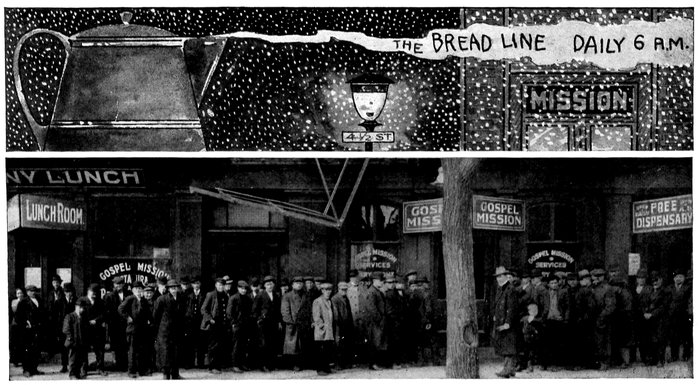
coffee given in the bread line at six o'clock in the morning.”
I replied, “Connaught must have oatmeal with
cream—real cream, for his diseased stomach; he must
have eggs and meat and strong coffee, or he will lose his
religion.” “Well, who is going to provide all that?”
“The Lord has money enough for that.” “Well, suppose
you bring some of it right along,” which of course I
did.
About the tenth day after he began circulating papers,
the work gave out. We really prayed night and day, for
we feared he would be rearrested and we had no money
to support him. In a few days he secured work at digging
41on the streets at $1.25 per day. He had never been
accustomed to manual labor, so when I sympathized with
him on his poor blistered hands, he said, “I am so glad
to get the work that the hurt is nothing.” Think of that
for a man who had not done a lick of work, physically or
mentally, for months and months.
Long before this we had found that he was a graduate
of an English university, had lived in good style, keeping
servants, he had possessed a nice home when he was
first married, but when he found the habit of drink had
fastened itself upon him, he came to this country hoping
to break away from old companions and surroundings,
and thus get away from the sin which bound him.
He tried all the cures; in fact, all his property not
spent in drink went to the cures, but nothing cured him.
We found he had been a first-class bookkeeper for one
of the great railroads centering at Washington, so we
applied to them. I am glad to say they took an immediate
interest in the case.
A man was sent to see him, then Mr. Connaught was
put in charge of an office building at $40 per month, and
at once he wanted his family back. They came first to
the Mission, for we desired to keep him attending services
every night till he would understand better the word of
God and grow strong in faith. The railroad now pays
him $80 a month, for he is a good executive, and he has
bought a little home in the suburbs on which he is paying
monthly; a home where he can have a garden, an
orchard and chickens. About once a week the father,
the mother, and children come to the Mission. No better
looking or happier looking people enter that building.
He comes, as he says, to bear testimony to the saving
and keeping power of the dear Lord Jesus.
42
Now, science could not cure this case; all that science
could do had been done for him. He had become so
low that if he saw his children starving and he had ten
cents, the money went to the saloon and not for bread.
It is, as Professor James says, that “Conversion is the
only means by which a radically bad man can be changed
into a radically good person.” The agencies in any conversion
are first prayer, then the Holy Spirit and the
word of God. This man was so far gone that he did not
believe in the existence of God. But the sympathy of the
workers made them pray most earnestly for God's Spirit,
which came with convicting power. The verse of
Scripture which came like a wireless message to his soul
was, “If we confess our sins, He is faithful and just to
forgive us our sins, and to cleanse us from all unrighteousness.”
He claimed and still claims the last clause
as a message to him personally.
The reason that hundreds of sermons fail to comfort a
saint or convert a sinner is because they fall on prayerless
pews. You remember how what is known as the Great
New England Revival came about. Dr. Jonathan Edwards
was accustomed to go to his church every Saturday
afternoon to think and to pray for his people.
On one occasion a beggar, known in the town as Old
Betty, sat unseen in a back pew. The great preacher
put his head down on the Bible and sobbed. As he came
out Old Betty said, “What is it, Dr. Edwards, that so
troubles you?” “Betty, I have not seen a soul converted
in this church for a year. Why is it?” “It is because
these pews are prayerless.” “Will you pray till you
get the answer that God will come in power to this
church?” “I will.” Betty hid when the janitor came
43to close the church, and the answer to her soul did not
come till the dawning of the morning.
The following day Dr. Edwards started as usual to
read his sermon, but he soon put it away and began a
straight evangelistic talk, professed Christians stood in
their places and asked for prayers, elders and deacons
prostrated themselves before God, the whole town became
a prayer circle, and the New England Revival had
begun.
CHAPTER V Big Feet — JAMES MANN.
44
One day a very large man, well over sixty years, and
with three fingers off each hand, in a very modest way
said to me, “I am so ashamed to tell a lady my needs,”
and he turned up his foot and showed me where the sole
was worn out, so that at every step he made he left a
track in blood. “You poor fellow, you need not be
ashamed to tell me of need like that. I shall arrange for
you to stay at the Mission till I get shoes for you.”
He was of the class who sell shoestrings and pencils,
but in very cold weather people do not stop to buy from
street merchants. That night, after the midweek service
of my church, I rose in my place and asked for a pair of
shoes number 9½ or 10. The men hooted, no one of
them ever wore that size, declaring, of course, that I
wanted them to wear myself.
“Well,” I said, “whether you wear them or not, you
get them for me,” and I told the story of the bleeding
feet. I did the same at my boarding house. By the next
day one of the elders of the church came with two pairs
of shoes which looked nearly big enough for boats, also
one of the men of the boarding house sent to Annapolis
to his father, a very large man, for a pair of shoes,
which came to me by express. I put the three pairs into
a basket and rushed to the Mission, when lo! the poor
man could barely get his toes into the shoes. With trembling
lip, he said, “It is simply disgraceful to be old and
poor and so awful big that even one's friends cannot help
45a fellow.” “Indeed, it is no disgrace to be old, poor and
big, but it is a disgrace to be a bad man of any size or
age. Don't you worry, I shall find the shoes.”
That afternoon I met a Board composed mostly of
men eminent in city affairs, among them was a distinguished
lawyer, a very large man. He sat with his
foot across one knee, when I leaned over and said,
“Brother, would you mind walking home in your hose,
and giving me those shoes for a poor chap as large as
you are?” “Do you really mean it?” “Yes, I do; only
I will let you wear them home, then send them to me
with hose, under clothes, and any other clothing you
can spare.”
By the next morning I had clothing for the poor fellow,
and Mr. G.'s number 11 shoes fit as if made to order.
If the poor man had successfully sold pencils and shoestrings
all winter he could not have been so well clothed
as he was that day. But, best of all, while he was obliged
to wait he read the four Gospels through several times,
and he sought and found salvation in Jesus Christ. That
was November, 1911. Since that he has gotten a place
as night watchman in a large building, and he is a good
and faithful man.
In Missions we have a large number of deserted wives
with children, whom we clothe. By that help they can
by their own labor keep their little families together, and
then on every holiday, such as Christmas, Thanksgiving,
etc., we bring them all to the Mission for reunion and
a big dinner. The joyous seasons for the rich are the
saddest times for the poor and the bereaved. It is such a
privilege to be the administrators of the church people
who send money and clothing for these purposes. In
return, the Missions are the real protection of the city.
46A hungry man is dangerous, and a man with a hungry
family is a menace.
My maid told me, one extreme cold day, that a man
was at the door to see me. I found there one of the most
dangerous housebreakers in the country. “Murphy,” I
said, “I do not want to see any of you men at my home.
What do you want?” “I am starving.” “Well, go to the
Mission, we never turn a man away there.” “I wouldn't
be caught dead there.” “Why not?” “Well, I hate Kline
(the Superintendent) and the whole outfit, but I am
starving, I tell you.”
I knew by that he had been stealing at the Mission.
Thieves fold up the sheets and pillow-cases, even when
they have been entertaining free, put the bedding under
their coats and get away with it. In time we get to know
them and will not put them in the dormitories, but only in
the barracks fitted with shelving but with no pillows or
covers, but fire is kept all night. The bath and toilet-room
adjoins or is part of the barracks, so that men are
made comfortable. I took Murphy to an eating house
near by and filled him up, but at the same time warning
him to get out of town as soon as possible or change his
course and become a good man. Now, if that man had
not been given food he would surely have gotten it, if it
cost a human life. Bad as he was, he would have been
fed had he gone to the Mission. I feared he would not
go, but would commit some depredation. Speaking of
thieves, reminds me of the case of a man whom I shall
call
One evening a tall, fine-looking man came into the
Mission chapel. One gets to know thieves somewhat as
you know an Englishman, a German, an Italian, by the
47marks environment have left on the person. I knew on
sight that he was a thief. We had a Salvation Army
man at the Mission that night from West Virginia, who
gave the message. His subject was, “Be sure thy sin will
find thee out.”
He had been a thief, had served time, but now he told
how happy and safe he felt serving God and in being a
good citizen. Several men knelt at the altar that night,
so when 9.30 P.M., the time for dismissal, came, the men
were permitted to go to the dormitories while one or two
workers prayed with the penitents.
Mr. Mann retired, but he could distinctly hear the
praying. He declared that a voice said, “Mann, now or
never.” He tried to go to sleep, the inward voice persisted,
“Now or never.” He put on his clothes, went
back to the chapel, threw himself down at the altar and
cried to God for mercy for himself.
The workers gathered about him, he told God his story
of sin and shame, and God heard his cry for mercy, and
he rose a forgiven sinner. His kit of burglar tools were
thrown into the Potomac River. He had come to Washington
to burglarize in the northwest section of the city
during the time when Mr. Taft was being inaugurated.
His portrait could have been seen in the rogues' gallery
in every large city of the country, but in a few weeks God
so changed his face that the man could not have been
recognized by the old portrait.
We told Major Sylvester, Chief of Police, of the case,
and Mann was put on the special police force at the
Union Station at inauguration time, and never before nor
since was there ever such a quick nabbing of the noted
thieves as at the Taft inaugural occasion.
Mr. Mann's mother came on from her western home.
48She is a sincere Christian woman. It was doubtless the
answering of her prayers which brought conviction, then
salvation to that dangerous man. Once she said, “James,
I never heard of you for two whole years; where were
you then?” He made an evasive answer, but we knew
that he had spent them behind bars.
After the inauguration the special police were discharged,
and Mr. Mann went to work as a carpenter.
He made a good assistant carpenter. About six months
after that one of the Northern States was making a
search for large men for their mounted police. Major
Sylvester recommended Mann, as he was six feet four
inches tall, and from that day to this he has been on the
mounted constabulary of a great State, engaged in enforcing
the law, rather than breaking the laws of his
country.
Now, is not that real service to the State? This man
was restored to his family, to society, to God. He became
a factor for righteousness, instead of an element
of danger to the commonwealth.
We are not always fortunate enough to see men of
that class seek God. On one occasion three young thieves
came into the Mission, they were of the traveling men of
their base business. After I returned to my home I
called up the police and told them my suspicion, and
asked them to watch the Mission very closely from
eleven o'clock until morning. They were all captured
between twelve and one o'clock midnight as they were
leaving the building and escorted to the station and told
to leave town, which, of course, they did immediately.
FREE SUPPER SERVICE
CHAPTER VI How We Got a New Mission Building — (A CHAPTER ON FAITH) — A MEETING OF THE BOARD OF DIRECTORS — SPEAKER CHAMP CLARK — HOW THE LORD PAID THE DEBT — NEXT STEP OF FAITH — MR. WHEELER'S STORY
49
Although by January 1, 1911, we had eighty-four beds
filled nearly every night with homeless men, we felt ourselves
very much hampered for room. We turned many
away. Many a poor fellow that winter walked the
streets all night to keep from freezing.
When we pray for a thing which we think the work of
the Lord requires, we begin at once to arrange for it,
as if the money to do the work were already at hand.
Our paper, The Gospel Tidings, of January, 1911, said,
“Our Mission now does business in three different localities,
and will soon be obliged to rent two more places
for the wood cutting department and for opening a penny
lunch-room.”
We were so sure that the Lord's work needed enlarging
that we went to the very best architects we knew,
Gregg & Leisenring, and told them our plans and needs,
and they prepared with the greatest care, drawings for
a building costing at the very least $50,000, besides the
cost of the land. Then the writer visited the seats of the
mighty in New York City with the best introductions that
the District Commissioners and leading statesmen could
give. While I was received with great kindness and
courtesy, I was distinctly told by one magnate that he
helped only the young and those starting in life; by
another that his charity could never take a local form,
that he gave along the line of research for causes and
50remedies of diseases. The women, whose secretaries I
met, themselves not being visible to plain people, I was
assured had planned all their surplus income for five to
eight years ahead, so that I came back convinced that
God's way for the Gospel Mission was not by way of
New York City.
About that time a great fire occurred in an eastern city,
and many men and women lost their lives, and the order
went out in Washington that every building where a
large number of people worked or slept must have plenty
of fire-escapes.
We found to put fire-escapes on the Gospel Mission
would cost $125, an immense sum to us, but we were
preparing to put up the fire-escapes when the owner refused
his permission. We told the police, and asked time
to relocate, but were peremptorily ordered out of 1230
Pennsylvania Avenue, N. W. We could find no suitable
building obtainable within our means.
was called at my house for prayer. There were thirteen
members present. The object of the meeting was stated
by President Wheeler, a few of God's promises read
from His word, and we went on our knees for prayer.
Each one asked for a suitable home to do the Master's
work as seen and done by the Gospel Mission. It was
noticeable that after the eighth person had prayed, each
prayer took more and more the form of thanksgiving, as
if we already had received the building, or money to
build it.
There had been offered to us a very large double building
which had once been used as the District Building,
and upon which it was claimed that the government of
51the United States had once put $60,000 to make it fireproof.
It is situated at 214-216 John Marshall Place,
N. W., not far from the foot of Capitol Hill. After having
the distinct answer to prayer that God was working
with us, a letter was written to Mrs. John Hay, wife of
the deceased great Secretary of State, asking her to purchase
that building for $25,000 for us and to permit us to
pay her a fair interest and pay the principal in annual
payments. The letter was written about the first of
March. Almost by return mail Mrs. Hay replied that
she did not care to make so large an investment, but if
we cared to go forward and purchase the building ourselves,
that on April 1 she would give us $5000 on the
first payment. Never will I forget the scene when that
letter was read.
Mr. H. D. Gordon had received the letter just as he
was starting for the Board meeting, his face was radiant.
When Mr. Wheeler came in the letter was put in his
hands without comment. As soon as he read the words,
“I will give you $5000 on the first payment,” without
waiting to finish the letter, he said, “Let us pray.” We,
on our knees, each one thanked God for the gift dictated
by His Spirit, and asked God's blessing on the magnanimous
woman who had obeyed the Spirit's order.
The Building Committee eventually secured the property
for $22,000, of which $5000 was to be a cash payment,
and by agreeing to pay $1750 annually, and to pay
semi-annually a 5½ per cent interest.
Think of the growth in spiritual power of a little organization
which in September, 1908, shuddered at a bill
of $25, in the early spring of 1911 joyously making itself
responsible for $17,000 bearing a semi-annual interest
amounting in the year to $850!
52Since that time we have made three annual payments
of $1750 each, and we have met all interest to date.
Probably in no civilized country was there ever a
dirtier house. The building had been occupied by some
foreigners until it had become so vile that the police condemned
it and obliged them to move out. They took with
them all gas fixtures, all sewerage, heating and water
pipes; in fact, wrecked the building, but a mission band is
brave, and went valiantly to work.
More than one hundred wagon loads of dirt were taken
from the cellars. We know, for we paid ten cents a load to
the dump. When we had put in $100 in glass, it scarcely
made a mark, so large is the building. It has sixty-six
rooms, some of them as large as the chapel of an ordinary
church.
The walls have been scraped and calcimined and whitewashed;
the entire woodwork inside and all the outside
has been painted; new gas pipes and gas fixtures have
been placed; new sewerage and bath-rooms have been
prepared. Four new fire-escapes and an electric fire-alarm
system installed; a splendid French steel range has
been set in the kitchen; hot and cold water supplied to
various parts of the building, etc.
The first meeting was held in our new building, 216
John Marshall Place, N. W., on the evening of April 15,
1911, Mr. Wheeler presiding.
We found the roof leaked so badly that in case of
storm some rooms became uninhabitable. Again I was
obliged to personally guarantee the payment of $500 for
a new roof. Again, Mr. Ernest Gichner came to my
help. He put on a good roof, built up and pointed the
thirteen chimneys, put ventilators in many chimneys, saw
to resetting, reglazed all skylights, and permitted us to
53pay him $25 per month till the debt was paid off.
When the possibility of completing the first cleaning
seemed most hopeless, when heat, water and gas pipes
had to be replaced, several members of the Board pledged
$100 each. To some of us that meant great self-denial.
Mrs. Richard Butler gave $500 and Mrs. Spindle $200;
in all we spent $5000 in repairing and cleaning that building.
Every step was made in faith.
It was wonderful how our people sacrificed to get all
this done; women who do not do such work at home
came and scrubbed and cleaned; many a poor man gave
a day's work. Three men who readily command $3 per
day, worked three months each at $1 a day with room
and board. The people of Washington sent us piles of
old furniture, for which we were deeply grateful. Then
Superintendent Kline got a great quantity of furniture
and many feet of piping for conducting heat, and secondhand
radiators at the sale of the old Riggs Hotel. We
secured a good mechanic, and with our mechanics at the
Mission, installed the heating plant. The expenses during
that time were at least $200 per week. At our Board
meeting one Tuesday, Treasurer Gordon reported $4.84
on hand. All business was stopped immediately and we
went to prayer telling our Father that we had but $4.84
and the bills of the week would be due on Saturday.
We had each of us done all we could afford. The following
Tuesday the Treasurer reported all bills paid and
$284 in the treasury. Thus God not only supplied all our
wants, but graciously relieved our anxiety.
Rather an amusing incident occurred when our cleaning
was most strenuous. We have a large number of
54good women who will do good work if I lead, so on one
occasion I took a tin bucket with rags, soap, scrub-brush,
etc., and went to help on work rather out of my line.
I started to return with the bucket in hand. When I came
to the car I saw the Hon. Champ Clark, who had then
very recently been elected Speaker, at the front of the
car. I was careful to take the back seat, hoping he would
not see me. I had barely got seated when he came back
and took a seat beside me. I tried to apologize for my
appearance and impedimenta. He said, “Oh, bother!
Never mind. What fault are you Republicans finding
with me now?” and we went at the Reciprocity Bill, then
before the House, with hammer and tongs. When I got
off at Second Street, S. E., the Speaker carried the
bucket and handed it to me in his gallant way, still talking
of the measure before Congress. I doubt if he recognized
whether it was an old tin bucket or a jewel case
which he transferred to me.
As long as this is a faith chapter, I shall here insert a
statement of how God sent the last $300 on our annual
payment and semi-annual interest due and paid May 7,
1913.
This is from the June, 1913, number of Gospel Tidings:
Mrs. Monroe's Letter in Lutheran Observer of May 16:
“On May 1 (1913), we were owing at the Gospel Mission
on the building $15,500 with $406 semi-annual interest.
We have agreed to pay $1750 each year, so we
were responsible for $2156 on May 1; by special agreement
it was not paid until the 7th. I want to tell my
friends who have prayed with me in this struggle how
the Lord led us.
55“At the Board meeting, Tuesday, April 29, we had
$1140 in the treasury. By Wednesday morning we had
$1200. Thursday we had $1300, and on Friday, at Dr.
Stearns's class, I reported $1400 in the treasury and requested
God's children to ask for the $756 yet due. By
Sunday, May 4, we had $1659, when Hon. B. H. Warner
subscribed $200, bringing our fund to $1859. A small
bill reduced it to $1856.
“The gentleman who held the note telephoned from
Baltimore that he would not come for his money until
Wednesday, May 7. At the Tuesday evening meeting
five of us prayed definitely for $300. On Wednesday
morning, just after breakfast, a friend telephoned,
'Please come up at once.' Now, that is my writing day,
and I felt I could hardly go, but my times are in His
hands, and if He said 'Go,' then that was my orders. I
went at once, and my friend said, 'I feel you are needing
$300 on your debt, and the Lord woke me up to tell
me to hand you $300, and I am prepared to pay it.'
“To say how grateful we all are cannot be put into
words. But at this time, when the city was being scoured
for $300,000 for the Emergency Hospital, when the Ohio
sufferers had claimed all we thought we could spare, for
the Board of a little mission, dependent mostly on the
poor, as the poor man's church, to pray down from
heaven $2156 of a special fund, besides the running expenses,
which are always very heavy, means more than
money to us. It seems to be the divine seal of God's
approval on our work. I had subscribed $500 for myself
and friends. He graciously paid through me $656,
and now, with the $300, He has made my share $956.
“Some of the readers of the Observer sent me money,
but more prayed for our work. Now, join with us in
56praising God for a message straight from the throne of
our dear, loving heavenly Father.
“To everyone who helped, even to the amount of five
cents; to those who denied themselves usual comforts
to help the Mission; to those who gave to help provide
shelter for the poor—to each of us He sends, I am sure,
this dear message, 'I glorify you in order that your faith
may be strengthened and that you may glorify me.' If
any of us has ever had any doubt of God's special providence
to His children, let this concrete example be a permanent
love-message of assurance to every such
doubter.”
By June, 1913, we found that nearly every Sunday
night more than one hundred persons had to be denied
entrance on account of lack of room. We saw by taking
down a partition on the north side of the chapel between
chapel and hall, we could seat at least one hundred more.
We were just over the strain of the last payment, and we
were loath to ask our friends for more help, but as God
continues to each of His children the blessings which
they daily enjoy, so each child of God must continue to
help in His work, and relying on Him “who worketh with
us,” we ordered the wall taken out at a cost of about
$900, which afterward proved to be $1300. Again I had
to make myself responsible for the payment of that
amount. It was all paid on time.
In this faith chapter I desire to insert the following
from the Gospel Tidings of June, 1913:
“At the Sunday evening service, December 18, 1912,
Mr. Wheeler said: 'When I was in charge of religious
57work at the United States jail some years ago, one Sunday,
after service, I went round, as was my custom, to
shake hands with the men behind the bars. I came to a
fine-looking man, to whom I said, “Why are you here?
I have often seen you on the street, and I have thought
of you as a good citizen.” “O Mr. Wheeler, I have been
a good citizen. My wife and I have a little store in
Georgetown, where we sell oysters in the winter and
ice cream in the summer. My wife gave me $65 to settle
our bill with the wholesale oyster man, and I took a
number of drinks, and finally went into the marble
saloon and took a drink with some strangers, and as
surely as I tell you I do not remember another thing
until I found myself in a cell at the station house.”'
“On further inquiry Mr. Wheeler found that the prisoner
was charged with passing counterfeit money. It
appeared that after he came out of the saloon a Jew was
crying clothing on D Street. This man went into the
Jew's clothing store, bought a suit of clothes, for which
he offered a $50 bill in payment. The Jew could not
make change, so took it to a neighbor, who assured him
the bill was bad, and the man's arrest immediately followed.
“Mr. Wheeler went often to the cell to pray with and
for the poor prisoner, who devoted his time to the study
of the Gospels. He was soundly converted. Mr. Wheeler
said, 'Do not trust alone to your lawyer. Appeal to Jesus
Christ now to clear you, for, as far as I can see, man
cannot.'
“His lawyer told Mr. Wheeler that the court would
surely send the prisoner to the penitentiary. On the
morning of the trial several Christian men met together
and prayed over the case. The court convened at 10
58A.M., and the case was immediately called. A stranger
asked to be sworn as a witness. He said about this:
'I was in Washington on the day this affair occurred. I
do not often take a drink, but I happened to be in the
saloon when this man came in. He took a drink with two
young fellows who happened to be there, and the liquor
made him drunk at once, when one of the young fellows
said, “It is my turn to treat, and I will, if any of you
can change a $50 bill.” This man brought out lots of
money, and got the $50 bill in exchange. I left Washington
the next day, that is how I was fortunate enough to
remember the date. I got back yesterday, and happened
to see a statement of this case in the evening's paper, and
I felt simply compelled to come and give my testimony.'”
The prisoner was reprimanded (which was unnecessary,
as he was a new creature in Christ Jesus), but the
case against him was dismissed, as it was apparent there
was no intent to defraud the Jew. His family nearly
smothered him with kisses and embraces, and he walked
out a free man.
Skeptics may say this was mere chance. But how did
it happen that the man came back on that day, saw that
account in the paper, felt compelled to testify? No, God
directed the case after it was committed to Him.
CHAPTER VII Varieties of Work in a Gospel Mission — A REMARKABLE TESTIMONY
59
We are apt to think that all persons who accept the
hospitality of the Mission are low-born people; we have
not found it so. There have knelt at the altar of the Gospel
Mission, priests and preachers, lawyers, doctors, merchants,
engineers, college men and poor chaps who have
had no education but that of the street.
I remember one night when we were located at 1230
Pennsylvania Avenue, there knelt at the altar three men,
one an ex-preacher, one a graduate of the University of
Virginia, and one the nephew of an ex-President of the
United States. We believed they were all converted.
The preacher was in bad physical condition, and we felt
it necessary to put him into a Christian institution for
such as he for medical treatment. The taste for liquor
had gone, but the ulcerated stomach and bowels remained,
also his nerves were in a dangerous condition.
How we ever obtained money enough to pay that man's
bills for six weeks is yet a marvel, but we did it. He
came out a redeemed, humble man. He went to the
pastor of a large church in Brooklyn, whom he had
known at college, and before that large church he acknowledged
his sin with shame and deep contrition. The
church had grace enough to accept him. The congregation
opened a rescue mission, supported entirely by that
church, where for five years he has preached the gospel
and has saved a hundredfold more souls than the big
church which supports the mission.
The Virginian never again crossed our path, but Mr.
60Buchanan died after three years of a good life, an honored
member of an Episcopal church in Washington.
Men who have been dissipated, even when redeemed
and reformed do not, as a usual thing, live to old age.
The wages of sin is death to the body, though the soul
may enter upon eternal life.
Among the sorrowful who nightly are to be found at
the missions of this city either pensioned by their family
or the government, but not permitted to return to their
homes, is one man who was once one of the best mail
agents between Washington and New York City.
Another, the son of an ex-cabinet officer. Another has
been Chief Mathematician in a government bureau, besides
about twenty wrecks of various government departments.
I remember the case of a well-known man in Philadelphia.
He was converted one extremely cold night at the
Breakfast Association. No provision is made there for
beds, so that poor fellow started “to carry the banner”—that
is to walk the streets all night. About three o'clock
in the morning he was taken with a congestive chill. A
kind policeman, seeing the man was ill and not drunk,
sent him at once to that blessed little Presbyterian hospital
in West Philadelphia.
It happened that one of the Board of Directors of the
Breakfast Association, Mr. Tibbals, had given the poor
fellow his card. The authorities, finding the card, sent
for Mr. Tibbals. The sick man had revived enough when
Mr. Tibbals arrived, to give his true name and the address
of his parents, which was a number on Fifth Avenue,
New York City. That street was then a residence
street for very wealthy people. Just as soon as it could
be done, a telegram for $100 was received in reply and
61we were directed to do all we could for him. But the
man died before night, and Mr. Tibbals was asked to
take the body to New York. The coffin was carried into
one of the handsomest brown-stone residences on that
handsome avenue.
The mother and father met Mr. Tibbals, and in the
parlor the coffin was opened for identification. It was
the body of the only son of that proud family. The
father gave one look, one great sob, then seized his hat
and fled. The mother said, “O Mr. Tibbals, you think I
am grief-stricken over his death! But I am not even
sorry. This son has been a drunkard from childhood.
We could not keep him at home, for he would steal
everything he could carry away and sell it for whisky.
Since we lost sight of him, I have never opened a paper
without fearing I should read his name in connection
with some awful crime. No, I am relieved. I shall know
where he is. I have often gotten into my carriage and
have had the driver go up and down this street (which
was then covered with cobblestones) as fast as the law
permitted him to drive, and I have screamed and
screamed my heart out. I have gone to the seashore
to scream to let off my nervous strain. Had I given just
one such scream in my own house, I would this day be
in a mad house. Oh, no, for this death, after what you
hope was a conversion, I am deeply grateful to God!”
And yet people wonder at Carrie Nation. It is a wonder
that grief like that does not make iconoclasts of all
mothers whose sons go down the Jericho road.
The following testimony, given in the winter of 1911,
by one who had stood on many rounds of the social ladder,
a man who accepted redemption, and is now kept by
the power of God:
62
“When Brother Wheeler requested me to address this
meeting, I felt somewhat nervous, for the simple reason
that I had never in my life addressed a religious meeting
before, and I so stated to Mr. Wheeler. However, I
could not refuse him, and here I am.
“True, in years gone by, while down South, I have
spoken to political gatherings. Since I got religion, I
stopped that. If I should ever make a political address
again, it will be in the interest of the Prohibition party.
I regret that I have no experience in addressing a religious
meeting, and I, therefore, ask you to be patient
with me, especially as, due to previous engagements, I
was unable to prepare myself, except in so far that I have
decided to make a few remarks on personal salvation,
and by the term personal I have my own in mind.
“I want to tell you something about my own experience,
how I had lost my God and found Him again. A man
born and reared on the Bowery or any of its side streets
in New York City, a man who from his childhood on
has been influenced by evil-minded and sinful people, has
never heard of Christ, and in the course of time becomes
a hardened criminal, such a man may be condemned by
mankind, but never by God.
“A man born and raised in a comfortable, refined
home, who has been taught the doctrines of Christ, has
confessed his belief that Christ is His Saviour, has a full
knowledge of right and wrong and of the duties he owes
his fellow-man—if such a man becomes a willing victim
to sensual pleasures, he may not be condemned by mankind,
but God will condemn him, unless he repents and
starts to lead a new, clean life.
“Only too often men are so completely wrapped up in
63their personal matters, as, for instance, in their business
affairs, that they absolutely lose sight of the obligations
they owe God, and also their fellow-men, and, as a
natural result, neglect their souls.
“I honestly believe that such a man is more to be
pitied than the ones who, either through their own fault
or being victims of circumstances, have lost their hold
in life and finally found themselves 'down and out.' A
man may temporarily be without food and shelter, but this
is nothing compared to trying to live without God. However,
a man who is a wanderer on the face of the earth
and who has lost his God, is indeed a wretched being. I
am speaking from experience.
“For years I had violated the divine laws. I had been
what is generally termed a society man, 'way down South.
I enjoyed a large income, but I spent everything for
worldly pleasures. Finally, I became disgusted with my
surroundings; but, better still, I became disgusted with
myself. I drifted to New York City, determined to live
a new life. This occurred about fourteen years ago. Up
to that time I had not been within or even near a church
for seven years. The New York atmosphere apparently
did not agree with me. Instead of leading a clean, moral
life—by that I understood at that time a life simply conforming
to the requirements of the social laws (the
divine laws did not exist for me)—I became worse than I
had ever been.
“Although I made good money, as the saying is, I was,
nevertheless, broke all the time. I voluntarily gave up
several splendid positions because objections had been
made to my reporting late in the morning for duty, and,
having become rather nervous, I practically found it impossible
to get along with anyone. I had become a slave
64to my habits, and finally associated with the 'has beens,'
as they are sometimes called.
“There is not a man in this room who knows more
about the life on the east side of New York than I do.
I know full well what it means to be hungry and homeless.
I have worked as a longshoreman, newspaperman, cook,
bookkeeper and correspondent. I have been running hot
frankfurter stands, etc., sometimes I had two jobs in one
day. I was given a wonderful taste of the ups and downs
in New York City, especially the downs. I certainly am
grateful to Providence for subjecting me to that awful
experience in New York City, for in that way I learned
to know human nature. I learned to know that the so-called
submerged masses were composed of human beings,
not brainless individuals; that, as a matter of fact,
there are better people, especially morally, among the
poor than among the so-called society people.
“I might be asked why it was that I did not find God
again, when I was down and out in New York City.
Christ was knocking, knocking all the time to enter my
heart, but I had become a cynic and would not let Him in.
I used to think in those times that if there was a just
God I would not be in such a sorrowful plight. The
trouble with me was, I did not have enough sense to admit
that my condition was simply due to my own faults
and to nothing else.
“During my stay in New York I have met many
saintly people, men and women who devoted their time,
energy and money to the uplift of the homeless and the
friendless. Those good people tried their best to have
me converted. They did not succeed because I was not
willing and because I actually believed most of my
friends who were in charge of the several missions that
I was in the habit of attending were suffering from hallucinations,
although perfectly honest in their self-imposed
task.
PENNY LUNCH ROOM
65“The greatest evil in New York City is, as everywhere,
the saloon. The majority of you men present here this
evening must admit if it were not for the saloon you
would not be here as applicants for bodily assistance.
There are evil spirits in us and around us to lead us
astray; the devil's worst temptation is whisky or any
other intoxicating drink. Man was made in the image of
God; when a man gets drunk he is worse than a beast.
A man will get drunk again and again, a beast will not,
having seemingly more sense than a man. The saloon
is the greatest foe to the spread of the gospel. In most
cases the saloon-keeper knows quite well that he is a
highway robber, that his business is ruining untold
thousands of men, women and children, but as his so-called
business is a legalized one, he may continue indirectly
committing murder.
“Really I have more respect for the highwayman and
robber than for a saloon-keeper. During my voluntary
and involuntary observations in New York and elsewhere,
I have come to the conclusion that Christ would
conquer the world in much less time if only the awful
saloon and dive could be eliminated.
“In my travels in this country and in the foreign
countries, I have met many people who by word and
deed were spreading the gospel. Some of them naturally
inquired of me whether I had been converted. My
answer was 'No,' because, as a matter of fact, I did not
know the meaning of the word converted. I was told
to seek Christ and the meaning would be made plain to
me. Evidently I was not sufficiently willing to meet
66Christ half way, and thus I wasted years of my life
before I finally submitted to the pleadings of the Saviour.
“While I was in the Philippine Islands, twelve years
ago, I was deeply impressed with the different attitudes
of the officers and enlisted men when on the firing line.
It was plain, even to the casual observer, that the men
who were thoroughly devout Christians—and there are
many thousands of Christians in our army—were not
afraid to face the bullets, but the men who were agnostics
and unbelievers, whatever that may mean, were so
nervous and excited that they hardly knew what they
were doing, or they were downright cowards.
“In my own case I was not afraid of death, as I had
given very little thought to such a possibility; besides I
had become more or less indifferent to life and possible
death. One hot summer day, while fighting the Filipinos,
I was shot through the head. An army surgeon bandaged
me up as best he could and then assured me I was
very likely not to live through the day.
“If I ever got scared, it was then, and if ever I prayed,
it was then, in spite of the excruciating pains I suffered.
The words of a comrade, who was a fine soldier, though
not a thorough Christian, uttered by him shortly before
I was wounded, were constantly ringing in my ears,
namely, 'A man may possibly live without Christ, but
he cannot die without Christ.'
“For a month or so the doctors and nurses did not
think I would live, but God spared my life, and no doubt
for a purpose. For six months I was unable to utter a
word, as the bullet had passed through my tongue. It
was well for me I could not talk to any human being,
but I could talk to God. During those months I lived
my entire life over again. I promised God to become a
67better man. True, I became more earnest in my views
of life, I realized the value of the golden rule, but I was
not converted. I could not yet understand the meaning
of the word.
“The Red Cross nurses, who at the beginning of the
trouble in the Philippines were in charge of the hospital,
were not only experts in their profession, but were
splendid types of self-sacrificing Christians, and their
presence alone made the patients think of their mothers
or sisters or other dear ones at home, thousands of miles
away, and thus unconsciously these nurses, noble representatives
of womanhood, frequently wrought a change
for the better in the hearts of the wounded soldiers.
“While I was a patient at Manilla I saw many a man
pass out of this life. The man with Christ in his heart
died with a smile on his lips, knowing he had done his
duty and that Christ would meet him. The unbeliever
suffered agonies.
“I was wounded almost twelve years ago, not a day
has passed without my communicating with God, and
God was always willing to talk with me, when I addressed
Him. As a result of my experience in the Philippines
I spent almost three years in the hospital. I
thank God He made me suffer, it was the only possible
way for me to find Him again. My conversion did not
take place all at once, it took place gradually. God used
different means and ways in recalling me. I cannot mention
them here without baring my life to you, which may
be of no interest to you. Let me assure you no man can
succeed without Christ. A man may amass a fortune,
but if he neglects his soul his life is of little value.
“Among the applicants at different missions, I have
met men who claimed the good people in charge were
68nothing but hypocrites. It is certainly strange that those
fellows apply to hypocrites for help. Why don't they go
to the agnostic or to the unbeliever?
“Follow my advice, first seek Christ; He is always
ready and willing to accept you; the rest is easy. A
drunkard cannot become sober by taking the Keeley
cure or anything like that. The desire for drink is often
inherited, medicine will not cure the sufferer, only God's
grace can cure him.
“Why is it that the man who lives with Christ is always
happy, even under adverse circumstances, and the man
without Him is, as a rule, nothing but an egotist? You
can easily find the answer yourself. Come to Christ, and,
if you are willing to come, why not now?”
CHAPTER VIII The Need of Rescue Work — CENTRAL BUREAU OF LABOR — FOR THE UNEMPLOYED — AN INCIDENT OF THE WINTER OF 1910 — THE HOLIDAYS — THANKSGIVING DAY AT THE MISSION OF 1910 — CHRISTMAS AT THE GOSPEL MISSION — NEW YEAR'S EVE — THE FORGER FROM NEW HAVEN
69
As early as the fall of 1909 we put out this call:
“The District of Columbia needs a Labor Bureau to
which our Mission and the Associated Charities can send
men and women out of employment. The Bureau, being
a government affair, should know where labor is needed
and should furnish transportation to such places, whether
it be to the cotton fields of the South, the harvest fields of
the West, or the manufactories of New England.
“Such a Bureau should secure from the railroads concessions,
such as they give to immigrants, in sending our
unemployed to the fields of labor.
“Unless Society, with a big 'S,' reaches a hand to the
unemployed these people will surely become a menace
to our great cities, and on some sad day they will dynamite
our public buildings.
“We, who work among them, know their sorrow, their
anguish, their despair, which will end in desperation, unless
relief is furnished.
“Use your influence to secure a Central National
Bureau of Labor for the unemployed. The strong and
wealthy can care for themselves, but a good government
should concern itself with its weaker members.”
The Survey (published in New York) is now (1913)
steadily advocating something of this kind, and now Congress
(October, 1913,) is considering the matter.
70
An organization or industrial army of the United
States was provided for in a bill presented to the Senate
by Senator Poindexter, upon the request of R. A. Dague,
of Creston, Iowa. Eligible to membership in the army
would be any unemployed man more than sixteen years
old. The Secretary of Labor would be the recruiting
officer, but an “industrial general,” at a salary of $250
a month, would command the forces. The army, according
to the bill, would not bear side arms or fight bloody
battles, but would be employed in labor at harbors, forts,
government buildings, irrigation ditches, canals and other
public works of the nation, state and municipality. Residents
in the United States who become members would
receive $2 a day, “together with board and lodging,”
while those who have been in America less than five
years would receive only $1.50. Foreigners who hereafter
come to America would receive only 25 cents a day,
which would be wrong. We expect from the United
States government that ideal justice, even to a foreign
workman, which we shall each receive when we stand in
the presence of Eternal Justice.
All this shows that the idea of a Bureau of Labor
which will help the laborer is steadily growing.
One day Mrs. Kline, the wife of the Superintendent
of the Gospel Mission, phoned me, “We have a man here
so covered with vermin that I cannot let him into the
house, yet he seems to be an educated man. [This was at
the Industrial Department on Fourteenth Street, before
we had our new building.] What shall I do now?” “Call
Donavan, Hall and Happy, and take him to the woodshed
71and have a tub of warm water; let the men give
him a thorough bath, barber him and wrap him in blankets,
till we can get clothes for him.” That was done. We found
Taylor an educated man, a graduate of the University
of Pennsylvania, the editor of a paper in a suburb of
Philadelphia. He claimed that he had been “shanghaied,”
that is, drugged and carried on board an oyster
boat as a common laborer. He had gone to Baltimore
to go on a drunk, hoping his friends would not find him
out, but his Nemesis was there waiting for him.
He had been kept six weeks on the oyster boat, had
been forced to bunk with negroes and common roustabouts.
After he became sober, I fancy the owners of
the boat saw that they had captured the wrong man, and
would gladly have gotten rid of him. They did not dare approach
land lest their entire crew escape; at last he was
put aboard a passing boat and sent to Washington. He
was over six feet high, of fine physique, about thirty-two
years of age. We did not find it easy to get clothing
suitable for such a person. The day came when he was
able to attend the services at the Mission. He kneeled
at the altar, and we hoped he was converted. We greatly
wanted him to bring suit against the oyster men, but that
would have made his case public, and he did not desire
that. He readily secured a place on one of our city
papers as the purveyor of automobile news, but when
pay day came he got drunk and fell down the stairs and
broke his arm. His system was in bad condition and he
was obliged to go to the free ward of Providence Hospital.
We now wrote to his family, and his mother came
for him in a big touring car from Philadelphia and took
him home, but the exposure and dissipation had done
their perfect work, and he only lived a few months. He
72seemed, from all accounts, a truly penitent man, but only
at the judgment day shall we know whether he entered
into the rest prepared for the children of God only.
Another experience in the winter of 1911 gave us a
still lower opinion of the oyster men of the lower Chesapeake
Bay. Mr. Hall telephoned me, one cold slippery
day, “Do come down at once, the oyster men are in.
Mr. Kline is away, and the men are in bad condition.”
I went at once. The halls were full of them; many had
only overalls, shirt and shoes without stockings; they
looked frozen. I ordered coffee and rolls at my expense
till I could call help. I feared if I opened the clothing
room they would raid it, so great were their needs.
It was too slippery for women to venture out, so I
began phoning to members of the Lutheran Church
whom I believed would come. One man in a bank said,
“I am not a clerk. I can't go out this kind of weather
for that class of men.” I replied, “I saw you at communion
last Sunday, and I venture you promised your
God to serve wherever you were needed; here is your
first call.” “I shall come at once and bring three other
members of the church with me.”
That winter the Luther Memorial Church, of Erie,
Pa., had sent us a large box of men's clothing, every
article mended, clean and in good condition, and just the
week before a charitable organization, at Chevy Chase,
Md., had sent us two large barrels of men's clothing, and
a full half bushel of socks nicely darned and every article
clean.
So we put trousers on one pile, coats on another, vests
on another, underclothes on another, a churchman at each
pile. I had charge of the socks, then Mr. Ifft, of the
Luther Memorial Church, in the next room superintended
73the trying on, fitting and exchanging garments.
As we handed each garment we said about this, “The
ladies of the different churches send you these garments
with their love and sympathy.” Many a poor fellow,
all unused to blessing, said, “God bless the churches for
remembering such as us.” In an hour's time we clothed
over seventy-five men. A few did not need complete
outfits. We never supposed we had that many garments
on hand, but that day cleared out all we had in reserve.
Among these men were two Welsh boys, both Christians,
not long in this country. They had not known the
strength of American liquors (which were doubtless
drugged); they were very contrite and were at once put
to work, one as a furnaceman, the other in the wood
yard. We hear the United States revenue cutters have
been after the oyster men and shanghaiing is no longer a
common crime.
When a friend looked in on that crowd of superior
business men helping distribute clothing and saying
words of consolation to the broken men, he said, “I believe
in my soul you would order in the President of the
United States to help at the Gospel Mission.” “Oh, no!”
I replied, “President Taft, good man as he is, would not
be permitted to drive so much as a tack at the Gospel
Mission. He does not recognize Jesus as His Saviour;
only orthodox Christians who can tell the sinner of the
redeeming power of Jesus the Christ can successfully
work in a rescue mission like this.”
are a sore trial to the homeless or to the recently bereaved.
Often women of the highest social rank come
to the Gospel Mission on Thanksgiving, Christmas and
74New Year's, when we give a good dinner to everyone
who applies. (These women forget their own woes as
they serve others.) The subjoined newspaper letter will
give you a good picture of one such occasion:
“It is a very curious thing to say, that while I saw no
relative of mine, being far separated from all of my kindred,
while I had no time to accept the hospitality of
friends, but ate my dinner at my boarding house, so as to
be at the Mission for service, yet it was one of the happiest
days of my life. It is wonderful the kindness God
puts into the hearts of His people at this season. Not a
member of the Mission has wealth, yet God gave us
means through His children to feed between three and
four hundred people. A little Ohio Joint Synod Lutheran
church at Fulton, Md., sent us a dozen chickens, two
bushels of potatoes, some fine apples, turnips, beets, cabbage,
etc. We bought fifteen turkeys, a lot of hams, then
the New Willard Hotel prepared our fowls and other
meats, and the Raleigh Hotel prepared and cooked all
our vegetables, adding enormous pans of baked beans,
and all this they did free of charge.
“Bakers sent us bread and pies, florists sent us great
quantities of flowers, so that we were able to feed all
comers and send out a number of baskets to poor families.
This was the bodily side; the spiritual side was even
better.
“The services began at twelve o'clock noon, and lasted
until ten at night, with a change of leaders, musicians and
varying audiences each hour.
“Two boys, about sixteen and eighteen years old, had
walked all the way from Richmond, Va. As they fed
75their famished bodies, one said, 'O Jim, did you ever before
hear of such a place where one can really get all he
wants to eat, can get a hot bath, can get one night's lodging
all for nothing? I am so tired I just couldn't walk
any more!'
“One man, about thirty years of age, simply prostrated
himself at the altar, and cried aloud to God for pardon.
After he rose he said about this, 'I came from the workhouse
this morning an angry, outraged man, after thirty
days' sentence. I felt my punishment was a great injustice.
My hand was against every man, for I felt every
man's hand was against me. I was ready for any crime.
Someone met me and said, “Go to the Gospel Mission.”
I answered, 'I prefer to go to the saloon and get drunk
and forget for a few hours my sorrows and loneliness.'
But the friend brought me here. You have given me a
good dinner, but that is the least, you have reached the
friendly hand. Brother Wheeler says I can make this my
headquarters till I get work. I am a skilled mechanic,
and I can soon get my place back again, and now I want
to say God has forgiven me my sins, and they are so black
and so many. I was a Christian in my early life, so I
know what I am talking about when I promise my God
and all you, my friends, that, God helping me, I, this day,
take Christ for my Saviour and I will love and serve Him
all the days of my life.' That of itself paid me for all I
could do.
“From three to five people came to the altar for
prayer each hour, and the last hour saw nine young men
pleading for forgiveness, and promising a new life. In
all, I should say, that about fifty people asked for prayers
and twenty-five people sought pardon.
“We had a great singer, Mrs. Fitch, whose singing was
76greatly used of God to call men to repentance. Thanksgiving
Day was a great day on earth, at the Gospel Mission,
and a great day among the angels of heaven who
saw sinners redeemed.”
of 1909 was described by the writer in the following
sketch of the January, 1910, Gospel Tidings:
“Christmas at a mission takes on a great element of
thanksgiving; first for the great gift of God—and no
anthems sound so sweet, so deep, reaching into the deep
places of the soul as, 'Now, when Jesus was born in
Bethlehem.'
“The first thing on Christmas Day was to remember
our brothers in bonds. Down at the barracks in the
guard-house, we have two converted men. One a soldier
whom we believe is receiving four times the punishment
for neglect of target practice which he ought to receive;
we can only counsel patience, comfort by our visits and
send him a good dinner.
“Then a dear Jewish brother is there. He had been
in the army two years ago, but he was baited, tormented
and outraged in his poetic soul until he deserted. After
that he was converted, and felt with us that he must go
back and take whatever the United States had for him.
One of our workers went with him to the Secretary of
War, who said, 'Why, man, don't come to me; take a carriage
for fear you be arrested on the street.' Mr. Ellison,
our helper, took a carriage and went directly to the
Commandant at the barracks. The Commandant said,
'We are sorry for Mr. L., but he will get two years in the
penitentiary at hard labor.'
“Mr. Ellison said, 'Commander, this man is the servant
77of the living God; you will give to this Jew that mercy
you yourself will at the last expect from the Judge of all
the earth, who came to this world as a Jew.' Well, it
would be a long story to tell of the court-martial, but, in
answer to prayer, the Jew got only six months in the
guard house, and that time will expire this month.
“Then two poor workmen are in the hospital, and four
sinners who promised reformation in the workhouse,
must have a remembrance. Kindness in shame often
leads men to Christ.
“But the great event of the day was the service from
twelve to one o'clock, followed by a dinner at which from
two hundred to three hundred lonely men were fed. In
the evening a service, at which the old, old story of love is
told, heart-broken men are redeemed, and we all go home
wondering at the never-ending miracle of the gospel,
which takes tongues which blaspheme and makes them
sing God's praises, feet that walk in the ways of sin and
makes them run in the ways of righteousness, hands that
steal and makes them do God's service. Oh, it is a wonderful
gospel, and a wonderful Saviour!
“'O ye priests of the Lord, bless ye the Lord, praise
and exalt Him above all forever. O ye servants of the
Lord, bless ye the Lord, praise and exalt Him above all
forever. O ye spirits and souls of the righteous, bless ye
the Lord, praise and exalt Him above all forever. O ye
that are holy and humble of heart, bless ye the Lord, and
praise and exalt Him above all forever.'”
And New Year's at a Rescue Mission is an interesting
time. Men have wandered the streets for a week, when
it seemed to them every other human being on earth was
78happy but themselves; they see happiness in every passing
face, they have caught glimpses of Christmas trees
through open doors, they have sensed the appetizing
smells of good dinners, they have witnessed at the railroad
stations and even on the streets the reunion of
families, they have heard the deep-toned organs from
churches, they have heard the ragtime music of happy
people about the home piano, and they only unloved, unloving,
uncomforted, lonely men walk the lonely streets
of our great cities.
Is it any wonder that memory calls up the time when
they too were in happy homes, when mothers' arms encircled
them, when a father's benediction was on their
young heads, and, like the prodigal son, they say, “I will
arise and go to my Father”?
Every one of them knows that sin is the cause of his
downfall, and they also know that they must get right
with God before they can forsake evil habits. Scarcely
one of them but what has tried again and again to leave
off their grosser sins but have failed, but when at the
watch-night service they are told of a Saviour mighty to
save, hope comes again to the broken-hearted.
I remember one occasion at the Breakfast Association,
Philadelphia, at the twilight service, New Year's Eve, I
saw five hundred men stand for prayer at one time. Our
Mission is much smaller, but on New Year's Eve and
during New Year's Day, when we have a continuous
service from 12 o'clock midday to 9.30 P.M., with an
entire change of leaders and musicians each hour, I have
seen your nominal Christian, the toper, the criminal, all
so overcome by the convicting power of the Holy Spirit
that social differences melted away and they knelt side
by side at the mercy seat; we have seen fifty people enter
79into covenant relations with God in that pivotal period
of the year, and we have seen most of them keep the
faith.
Think of a church holding a meeting nine and a half
hours long; in most churches the pastor and the elders
would have the last three hours or more all alone. But
at the Mission the interest deepens so that it is hard to
dismiss even at a late hour.
It was at one of those long services I saw a New
England man brought under deep conviction, and at last
yield to the Spirit, make confession and receive Christ.
It was about 4 P.M. when he arose to tell his story of
sin. He said, “I have committed a crime against the
State, and I want to know if I can be forgiven before
that is made good. I want to see three members of the
Board alone.” Three of the men went into consultation
with him. It proved that he had forged a check at New
Haven for $300, had collected the money and had escaped.
He was told, “God will forgive you now and undertake
for you in case you promise full restitution.” He
kneeled at the altar, began to pray out loud, promised
restitution and promised to bear patiently any punishment
the State demanded.
A worker was sent with him to New Haven. He went
first to his own father, who said, “John, I never want
to see your face here; you had no business to come back,
for you will be sent to prison and disgrace us all.” “But,
father, I am converted, I mean to take my punishment,
then live a true man ever after.” “Oh! that is different;
in that case, I will help you all I can.”
80They went at once to the man whose name had been
forged. They found him very bitter at first, but when
John told his story of how ashamed and sorry he was,
and added, “I have come back to take my punishment,
then I want to be a good man and a good citizen all the
rest of my life.” At this point the father said, “Mr.
Percy, I will gladly pay back the $300 and interest if you
think you can forgive John.” That was done and the
prosecution withdrawn.
The episode had a little after-clap. John came back to
Washington, and came at once to the writer. He said,
“Mrs. Monroe, I want you to ask Miss Stanislaus if she
will marry me.” “Why, ask her yourself, man; I am not
in practice in handling love matters.” “No, you see my
red head and freckled face and freckled hands make me
so homely I am afraid to ask. Do see her for me.” This
I did. She accepted him, and he obtained a situation in
the mountains of North Carolina as a school teacher.
He preaches on Sunday and they both teach all week and
seem to be doing good work.
The Gospel Tidings, of December, 1910, had this
notice:
WHAT WILL YOU DO, FELLOW-CHRISTIANS?
“Eleven men, cold, hungry and friendless, the night of
December 5, said, 'Mr. Kline, for God's sake, give us
work!' He replied, 'We do not have the work to give
until we get wood-cutting machines.' Mrs. Monroe said,
'I shall trust God's people to help me on that, even though
the horse and wagon are not yet paid for.' So she personally
took the risk of the
50 needed to put in the machinery.
Her friends will remember that a great fire three
years ago not only destroyed her property, but also her
means of making money.
10 AND 15 CENT DORMITORIES
81“'Blessed is he that considereth the poor, the Lord will
deliver him in the time of trouble.'
“The Gospel Mission Board feel that when the necessities
of men are so great as in this call that it is God's
call to help by giving them means to help themselves.
Maybe in these suffering men your Saviour passes by.”
The Christian people of Washington made a generous
response to that call, and by the next issue of the Tidings
we announced that we could give fifty cents a day for
six hours' work, leaving time to hunt a better place, and
yet pay lodgings and food.
The October Tidings of 1910 said:
A MENACE
“What is the most important question now in Washington?
From our standpoint it is the care of the unfortunate
and the sinful. Why? In order to protect
your home. When a man walks the streets hungry, cold
and friendless, and looks through the window of your
happy home and he sees you surrounded with the comforts
he lacks, do you know you are in danger? Unless
the unfortunate are comforted, they will surely dynamite
our great cities.
“The Gospel Mission stands between you and this danger.
We make these sons of sorrow realize that they
need be only temporarily sidetracked from the great highway
of success, that the grace of God, their renewed will
power and our friendly hand may yet restore them to
home, friends and society, and make them useful men.”
CHAPTER IX The Penny Lunch and Free Dispensary — PENNY LUNCH — WHAT DR. HALLIMOND, OF THE NEW YORK BOWERY MISSION, SAYS ABOUT THE BREAD LINE — THE DISPENSARY — GOSPEL MISSION DISPENSARY
82
The following is a letter written by Mr. George W.
Wheeler, which was published in our Gospel Tidings, of
February, 1911:
“In an experience of twenty-six years in active, earnest,
aggressive Rescue Mission work in this city, the writer
cannot recall that any line of secular work taken up for
the amelioration of the poor has ever called forth such
universal expressions of interest, sympathy and co-operation
as the 'Penny Lunch and Newsboys' Waiting
Room,' opened by the Gospel Mission, at 304 Fourteenth
Street, on Saturday, February 4. The city papers published
pictures of the interior and exterior, and a portrait
of our Superintendent, Mr. Kline, and were most generous
in their endorsement of the enterprise, while the
New York Times and other papers spread the news far
and wide that the cost of living had been solved in Washington
by the Gospel Mission 'Penny Lunch.'
“The opening of this lunch-room was made possible
by a noble Christian woman of wealth, who was born,
reared and now resides in this city. Her interest was
aroused by reading a statement of the work and needs
of the Gospel Mission, prepared by our Superintendent,
and she came to see about the matter, learned its approximate
cost, and sent a check to pay the expenses.
“For two weeks or more Mr. Kline and his assistants
were busy papering, painting, etc., and finally the steam
83table and coffee urns, with many other essentials of a
twentieth century up-to-date lunch-room were installed
and the doors were opened to a waiting crowd. Mrs.
Kline oversees the cooking, and everything is as clean
and neat as in one's home.
“The menu consists of the following articles: Coffee,
1 penny; bread or rolls, 1 penny; beans, 1 penny; doughnuts,
1 penny; sour, 1 penny; beef stew, 3 pennies; one-half
pie, 3 pennies. A lunch, consisting of soup, meat,
vegetables, bread and coffee, 5 cents. This brings a well-cooked,
clean, nourishing meal within the reach of all
who have any income whatever.
“It was amusing to see the class of men and boys who
came to have their appetites satisfied at the lowest cost.
Newsboys, messenger boys, laboring men, teamsters, and
all kinds of indescribables came, and they appeared
greatly surprised to find such an attractive room with
all the 'latest improvements' found in a lunch-room. And
how they did eat! A big soup plate filled to the brim
with bean soup, a big china cup filled with steaming hot
coffee, a big brown roll or three slices of Corby's 'Mother's
Bread.' These were good, and 'mighty filling at the
price.'
“Well, the 'Penny Lunch' is launched, and whether the
prices charged will pay the cost of the material, cooking
and serving, or not, we feel certain that any little deficiency
that may occur will be cheerfully met by the well-to-do
of our community.
“A coffee-roasting firm has pledged five pounds of
good coffee each week for use at the 'Penny Lunch' room,
and we are sure dealers in other lines will be glad to
assist. Corby Brothers have been furnishing from fifty
to seventy-five loaves of bread for our 'bread line' for
84many months, and Browning & Baines, coffee dealers,
have supplied six pounds of coffee a week for a long time
past.
“We greatly appreciate the generous co-operation of
all these dear friends, who help us to help others to help
themselves.”
The benefits of the Penny Lunch can never be told till
the books of eternity are opened, but some idea may be
gathered when we state that the report of the bread line
from May 12, 1911, to May 12, 1912, was 41,750, but the
report from May 12, 1912, to May 12, 1913, was 18,950.
The Bread Line is the name of a service at 6 A.M., the
year round, when bread and black coffee is served to all
who come for it. If people will come before daylight in
the winter, or at that early hour in the summer for coffee,
without cream or sugar, and a quarter of a loaf of bread,
we believe they need it, and we gladly give it, not as a
charity, but as a visible token of our sympathy. Now,
the fact that 22,800 fewer people took bread and coffee
free in the year 1912 to 1913, compared with the preceding
year, can only be accounted for that when a man has
a few pennies in his pocket he could buy a satisfactory
breakfast, and gladly did so rather than to line up for an
unrequited kindness.
How shamed many men were to take food in the bread
line, but the loving word sweetened many a bitter cup.
Once a hand so unusually white and well-kept reached
for the cup of coffee. Mrs. Kline looked up and saw the
face of a man who had been a minister of the gospel.
She said, “Brother, take only the coffee, we want you to
take breakfast at our family table this morning.” He sat
down to drink the coffee with bitter tears coursing down
85his shamed face. Of course, every kindness was shown
him, “for need has its right, and necessity its claim,” then
the blessed Spirit came in and lo, he prayed, and God
received back to a useful life a man who had found sorrow
and sin bitter and the tears of remorse salt.
“There are in the Bowery men who never sleep in a
lodging house because they have not the price, and they
get their bed either by stealing or begging, and eat out of
the garbage boxes. You who have never been to the
Bowery know nothing of the agony or remorse that these
men feel. Now, what are we to do with them? There is
not anybody to look after them but us. Oh, the horrors
of the homeless man! It is the many little comforts that
go to make our comfortable life. They cannot keep clean.
They cannot brush their clothes or comb their hair, they
cannot take their shoes off their poor tired feet. These
men gather there in the great meetings, and among them
are many that are in the last stages of physical weakness.
Many of them ought to be in the hospital instead of walking
the street day and night. Many of them are dying of
hunger. Sometimes we cannot get men to understand
that we have people in our meetings that are dying of
hunger. I am not using any figure of speech. It is not
an unheard-of thing for men to drop dead in our meetings.
That is why we have the 'bread line.' We dare not
fail to help these people. People sometimes come to us
with the very best of intentions, talking to us of the sin
of indiscriminate charity; but, bless your life! is not God
indiscriminate, for does not He cause the rain to fall on
the just and unjust? Did Jesus Christ ever go through
86the hungry crowds and find out who was worthy and who
was unworthy? Did He not spend His life to help just
such men? These dear people some of them are spending
seventy-five cents to find out where the other twenty-five
cents is to go. I have made up my mind that if I ever
find a man dying on my doorstep of hunger, and I can
do anything to save him, I am going to do it, whether he
deserves it or whether he does not.
“That is the origin of our bread line about which you
have heard so much. We cannot help but have a bread
line. In fact, I refuse to allow our work to be called a
charity. It is not a charity, it is brotherly kindness. It
is not a charity, but a kind hospitality, just a little evidence,
just a little token, that there is somebody who
cares for their poor weary hearts which these destitute
brothers of ours possess. As long as the bread line exists,
and God helping, it shall exist as long as there is
need for it, people must know that there is something
wrong with our social system, a problem that we cannot
solve but that is up to the politician. As long as we are
in this great, rich country with all the extravagances of
wealth, then the bread line shall tell that there is something
wrong, and that our Declaration of Independence,
declaring, as it does, for 'life, liberty and the pursuit of
happiness,' is but a delusion and a snare.”
This seems a long interlude to the Penny Lunch chapter,
but you can see the lunch counter where five cents
can buy beans, bread and coffee, saves many a man from
feeling that he takes charity. The bread line was instituted
to fortify a man's stomach against needing to go
to the saloon in the morning for the free lunch, also to
give strength to a poor fellow so he could search for
work.
87The bread line food given each morning will not of
itself sustain life, as we found out to our sorrow. One
Tuesday night, as the writer entered the Mission for the
purpose of conducting the service, I found the men at
the door excited. On inquiry, I found a man lying on the
front seat dying. The Emergency Hospital ambulance
had already been called. I found a man who twenty
years ago had been a leading patent attorney of this city.
I saw the soul was about to depart. I said, “Mr. West,
say, 'Lord Jesus, receive my spirit.'” “No, I have lived
wicked, I shall die wicked.” “O son, say, 'Lord Jesus,
forgive me.'” “Too late, too late; I have heard you all,
night after night, and I have rejected Christ. I must
die as I have lived.”
I motioned the choir to sing softly, “Jesus receiveth
sinful men.” I bent over him, urging repentance; the
ambulance men were at my side, they picked him up and
laid him carefully on the stretcher. I said, “Dear Mr.
West, we are praying for you, pray for yourself.” I kept
my hand tenderly on his head as the stretcher was slowly
carried out, but he continued to say, “Too late, too late
for me.”
He died within an hour, and the post-mortem showed
he had died of inanition caused by slow starvation. We
found he had tried to live on the bread and coffee of the
bread line alone; he was too poor to buy food, too proud
to tell his needs, and we were too stupid and too busy
to realize his awful need. We thereby learned a good
lesson, and the Superintendent and helpers now all look
more carefully after the man who sits down claiming
either exhaustion or sickness.
No man, woman or child is ever refused food because
without money, but if a man can buy whisky, we think
88he ought to be able to buy food, though even then we look
after him.
We cannot leave the granting of food to employees,
so when the Superintendent and his wife are absent we
have some pathetic cases. Mr. Gordon found a little fellow
crying at the door. “What is the matter, little man?”
said the big man. “Mother gave me ten cents to buy
food for our family, and I have lost the money.” You
may be sure Mr. Gordon obtained much more than ten
cents' worth of food for the child. Very many families
live in one furnished room and get all their food at the
penny lunch counter. Seamstresses, all the dollar a day
men for many squares, girls from the Agricultural Seed
Bureau, come in and buy at cost the luncheon at the middle
of the day. Many well-to-do people come in and
take luncheon to watch the various grades of humanity
who solve the cost of high living by taking meals at the
Mission. All the street peddlers, the umbrella man, the
shoestring and pencil man, the rag gatherers, eat at the
counter, the better class sit at the tables.
Mr. Gordon saw a little altercation between a waiter
and a customer, the waiter demanding four cents while
the man had but three cents. “But you should not have
ordered food unless you could pay for it.” The poor
man looked dreadfully embarrassed, at last he looked up
and said, “Will you lend me a cent, sir?” which was
gladly done.
Many who come only for the cheap meal are induced
by the kindness shown and by the good music and bright
lights in the chapel, to go in to the services. There some
song, some word from the speaker, some devout prayer,
touches the chord of memory of what a mother, a faithful
teacher or almost forgotten preacher has taught years
89ago, and, backed by the Holy Spirit, a prodigal son or a
prodigal daughter returns to the Father's house.
Mr. Kline reports the meals furnished in the Penny
Lunch Room from May 12, 1912, to May, 1913, to be
87,856, at an average cost of four and one-third cents per
meal.
was opened February 1, 1912, after the need was very
apparent, and further neglect of this branch of work
seemed impossible.
Never will I forget the day when I first called up Dr.
C. H. Bowker, one of the leading physicians of the city,
living on Massachusetts Avenue, near Thomas Circle, the
very heart of the city, and told him of a man who had
pneumonia, and of a woman in the shelter with a severe
cold, and asked him to go to the Mission free of charge.
I waited with bated breath for the reply. It was, “I am
an exceedingly busy man, but I shall try to go within an
hour.” Very much emboldened, I said, “Could you stop
in once a day to see if anyone there has a contagious
disease, or if anyone should be sent immediately to the
hospital?”
The answer seemed very slow, and I fairly trembled,
for our need was so great. At last he said, “Well, I
have noticed if I put a duty on my daily program, I
manage in some way to get it in.” From that day to this
that blessed doctor has been at the beck and call of the
Mission day and night; only God knows what a help
and a comfort he has been to broken men and sorrowful
women in that part of the city.
The February Gospel Tidings, of 1912, had the following:
90
“For several months we have had a house physician,
and the use and need for him has steadily increased. The
establishment of regular hours at which patients could
see the doctor, and a proper place for consultation, naturally
suggested the establishment of a dispensary. This
appeared feasible to the Executive Committee, and Mrs.
Monroe, Superintendent Kline and Dr. Bowker were appointed
a committee to study the advisability of such an
addition to our work. The report from this committee
was favorable to the project, and active steps were at
once taken to the establishment of a free general dispensary
for the treatment of all classes of cases, or their
reference, where necessary, to special institutions.
“The location of the Mission for dispensary work
could not be better from any point of view. It is accessible
to the hundreds needing its help. There is no conflict
in its field by any other institution doing this class
of work. Four rooms on the first floor of the Mission,
with the chapel for a waiting-room, will serve admirably
for dispensary needs at present. And these rooms are
rapidly being put in shape by carpenters and painters.
Shelves are being made for the pharmacy, a door cut
through the partition, and running water is to be installed.
“Our printing plant will again demonstrate its usefulness
by furnishing the necessary record blanks, labels,
treatment cards, etc.
“The Executive Committee has placed Dr. Charles
Harvey Bowker, 1204 Massachusetts Avenue, in full
charge of the Gospel Mission Dispensary, and he will
have associated with him at first Dr. O. C. Cox, 1320
Eleventh Street, N. W. A number of leading physicians
91and surgeons have evinced an interest and willingness to
give their services, and Dr. Bowker will add them to the
dispensary staff and assign them work as the clinic grows
and they are needed.
“Dr. Bowker's experience in managing a hospital in his
home city, and his hospital and dispensary work in Washington,
assure us a businesslike management of this new
branch of our work.
“Our need at present is for drugs and surgical dressing,
and it is hoped that the druggists of the city may
contribute.
“The dispensary opened Thursday, February 1, 1912,
at 10 A.M., which will be the regular daily hour, and all
those who are interested are invited to inspect the new
rooms.”
You notice that we opened February 1, 1912, and our
annual report in May Tidings, 1913, shows the following:
THE MISSION FREE DISPENSARY
Staff
Physician in charge, Dr. Charles H. Bowker, 1204 Massachusetts Avenue, N. W.
Associates
Dr. Oliver C. Cox, 1320 Eleventh Street, N. W.
Dr. W. O. Owen, Southern Building.
Dr. William F. Hemler, 706 Eighth Street, N. W.
Dr. C. A. Simpson, 1217 Connecticut Avenue, N. W.
Dr. C. F. Dufour, 1347 L Street, N. W.
Dr. Adam Kemble, Cecil Apartments, Fifteenth and L Streets, N. W.
Dr. Jesse Ramsburgh, The Portner.
Hours for Treatment
Medical and surgical cases treated daily, 11 to 12 A.M.
Diseases of Women—Monday, Wednesday and Friday.
92Diseases of Men—Tuesday, Thursday and Saturday.
Diseases of Children—Monday, Wednesday and Friday.
Diseases of Ear, Eye, Nose and Throat—Monday and Thursday.
Report for the Year Ending April 30, 1913
Cases treated
2500
Referred to Hospital
80
Treated at homes
80
The dispensary is in need of a sterilizer and a special
fund for medical supplies for those too poor to pay.
The sterilizer later was the gift of Dr. Jesse Ramsburgh,
and we have a complete set of lenses for testing
the eyes of school children.
It would break your heart to see the women with
babies, the aged on crutches, the hosts of children, the
aged victims of every vice, now broken and often repentant,
seek the aid of these good men. Often we run
short of remedies. “What do they do then?” you ask.
Well, they simply go down in their own pockets and buy
the necessities, and no one is turned empty away.
Think of a procession of sick and needy persons, 2500
human beings in line, and you will see in your mind
what that blessed dispensary has done for the sorrowful
of this city in one year.
I wish I dare to tell you the particulars of one of these
great physicians who had not been living close to God,
seeing our work of faith, seeing how the Mission people
lay their many needs before a patient God, who meets
every demand in answer to their prayer, and possibly
feeling that in a mission he could not minister to a mind
diseased without himself being in touch with the living
God, was led to revise his views, make public confession
of his faith and enlist in God's organized method of
93evangelizing the world by joining the church. We all
need God, but the hand that reaches down to help sinful
men must have the other hand clasped close in God's
strong hand if he would do effective work.
CHAPTER X The Power of the Gospel — THE CASE OF MR. ABBOTT — THE PSYCHOLOGY — RELIGION WITH THE DEFECTIVE DELINQUENT
94
St. Paul says, “I am not ashamed of the gospel of
Christ, for it is the power of God unto salvation.”
Yes, the gospel is the power. The soul is as dead as a
street car with the power gone, till it is touched by that
special power. I could kneel at the side of a sinner and
quote the very best things of Shakespeare or Milton,
and the soul would step to no higher ground; but when
the right verse of God's word is shown with the New
Testament in hand, and the Holy Spirit makes that soul
see that the passage before him is God's recorded wireless
message for his soul alone, the power comes on and
that verse again proves true, “But as many as received
Him, to them gave He power to become the sons of God,
even to them that believe on His name,” and a soul is
born into the kingdom of God. Dan Crawford, the great
missionary to Africa, says not Livingstone, not Taylor,
not Dan Crawford, are the real pioneer missionaries, but
the Spirit of God Himself, and when the word is brought
to a prepared soul it is a spark of powder. He tells of
one besotted Negro who read John's Gospel. The Negro
said, “I was startled that Christ could speak Chulba; I
heard Him speak out of the printed page, and what He
said to me was, 'Follow me.'” Mr. Crawford says,
“When the guncotton of John's Gospel came in contact
with the tinder of his rebellion, he was literally exploded
into the kingdom,” and by continuing to study St. John's
95Gospel the transforming power of the gospel made him
a good earnest Christian man, fit for the companionship
of good people.
At a rescue mission we have such scenes almost every
night of the year. In our case it is usually the word first
implanted in the human heart either at a mother's knee
or by some Sunday school teacher, or by a faithful
preacher in early life, then the very room of the Mission
is filled with the Holy Spirit in answer to the prayers of
God's people. Now, when a heart-broken, world-buffeted
sinner comes into the room, the words or music of some
song, or the presentation of God's word, is used by God's
Spirit to bring to memory all the sinner has known of
these things; he hears redeemed men tell how God cured
them of lust, of alcoholism, of gambling, of profane language,
of all sin; he sees these men well clothed, radiantly
happy, and sees and feels his own degradation; is
it any wonder he drops on his knees and cries out, “Men
and brethren, what shall I do to be saved”? When he
wants God more than he wants deliverance from his besetting
sin, when he wants God more than he wants his
deserted wife and children, when he wants God for what
God can do for his poor soul, the God of his soul comes
down, and at that second the soul passes from death unto
life eternal, for that soul the decisions of the judgment
day have been settled, for Jesus said, “Verily, verily, I
say unto you, he that heareth my words and believeth on
Him that sent me, hath everlasting life, and shall not
come into condemnation, but is passed from death unto
life.”
That verse comprehended and lived has power enough
to carry a soul through all besetments into the very presence
of God.
96
During the winter of 1910, there came into the Gospel
Mission a man, ragged, soiled, blear-eyed, doped and
utterly down and out; he came only for the coffee and
rolls given Sunday night. Before coming up the steps
he had said to a friend, “I don't want to hear any of their
blank sermons, but I am starving.” He heard no sermon,
instead he received a warm hand-shake, he heard bright
singing, but, best of all, he heard redeemed men tell how
God had saved them from the alcohol habit, till he cried
out, “If God has power to save me from the sin of drink,
I want God!” He kneeled and poured out his soul in
prayer. As soon as he began to pray aloud, we saw he
was an educated man. The Spirit came upon him in
great power, he really had the searchlight of God on his
soul, and he saw himself for a short time as God saw
him. Then God forgave him, he rose justified, strong,
happy, a new man in Christ Jesus. The Mission gave
him a bed for the night, and the next morning this man,
who had not worked or desired work for two years,
begged that we should find a place for him to earn his
way. He obtained a situation to solicit business for a
laundry, about as hard work as one can imagine, but he
made good, and in six months he was made foreman of
the laundry in which he was employed. He modernized
its methods and doubled its business by the end of the
year, and the company made him a present of five
hundred shares of stock and elected him president of the
company. Then he received $3000 a year salary, besides
his percentage of all gains made by the house. His
friends claim his income is now about $5000 a year. In
the meantime, after he had been redeemed, probably four
months, his wife, a most beautiful and accomplished
Philadelphia woman, brought their lovely son, aged about
eight, and they began housekeeping again. The home
has given needed physical comfort, the companionship
has given the mental and the spiritual help needed to
make this former tramp into a first-class citizen. At
night, during the last winter, he has been studying law
in one of the university law schools, and on Sunday he
acts as usher and vestryman in one of the largest Protestant
Episcopal churches. As a child he had been a
choir boy in a church in Philadelphia. Doubtless the
knowledge gained there as a child made him able to understand
his duty to God and man after his conversion
better far than an ignorant, uninstructed person could
have done after months of instruction.
CHILDREN OF ALL NATIONS
SETTLEMENT HOUSE
97
of just this case is worth considering. This man was
spiritually dead, so far as we could see. He did not desire
to live. The people of the Mission had been more
or less in prayer from three o'clock to eight when this
man came in. He saw religion in action in the person
and speech of redeemed men. But even if these testimonies
were factors it was the Holy Spirit that did the
work. It was the divine spark to human tinder, or, as
Henry Drummond better puts it, “The spiritual world
reached down and carried this worldly soul into the
world above it.” “He that hath the Son hath life, he
that hath not the Son of God hath not life.” Life depends
upon contact with life, it cannot develop out of
anything that is not life.
Even as the physiologist cannot explain how the human
seed generates in a human body eventually becoming a
new-born man child, neither can theology fully explain
98how the Holy Spirit can touch a human soul out of which
will be born another soul in the same body with marks
of its divine parentage in every line, or, as St. Paul says,
a new creature in Christ Jesus.
I heard a distinguished man who had long been in official
connection with prisons and reformatories, say, “A
reformed man is always in danger; he may stand twenty
years and then fall back into sin, but a regenerated man
is as safe from his sinful besetments as if they had not
been the weakness of his life.”
I fancy I can hear some preacher say, “If it is the word
and the Holy Spirit do the work, why does not the
church have as many conversions as a mission?” The
very first element of spiritual power is lacking in most
churches. If the preacher, the official members, then
every member of the church first sought God's special
blessing in private, then came together offering first
praise, then united prayer to God from the very depths
of their hearts, there would be conversions every Sunday
in every church.
Spurgeon and Moody expected conversions every Sunday,
and they had them.
In presenting a soul to Christ no perfunctory Christian
can do it and have that soul received. To present a person
to the King of England, let us say, the presenter
needs to be acquainted with the king; so a person unacquainted
with God has no power at the throne; he even
impedes the soul coming into the light. I have seen many
a dancing, card-playing Christian at the side of the penitent,
praying earnestly, then rise baffled, troubled, helpless;
not able to reach the throne, they had no access to
God.
Often people from the States write me to present such
99and such a paper in person to the President of the United
States. I am obliged to reply, “I have no access to the
President of the United States,” but I daily thank God
that I have access to the throne, for I am acquainted with
God.
I venture to take the two following short articles from
the November numbers of 1913 of the Survey, the most
valuable weekly magazine which comes to my desk on
all social questions:
“WHAT ABOUT JEFF?”
“Jeff is a white boy sixteen years old. I am estimating
this, as Jeff says he doesn't know how old he is and
doesn't know his surname. He has every appearance of
being a little less than half witted.
“I found Jeff this morning working, with two other
white boys and ten or twelve Negro boys, as an inmate
of the County Workhouse. He was carrying stone on
a public hitch-lot. One of the white boys and two of the
Negro boys were in chains.
“Jeff has been in the workhouse for sixty days. He
was placed there for beating a ride on a railroad train.
Next Monday Jeff will be released. He will have not a
cent to his name, not very good clothes, not a relative in
the country, no place to sleep and nothing to eat.
“I have put this predicament before our city inter-church
organization, and we have seen no solution. About
the best thing we can see for this half-witted boy is that
he will do something that will again bring him within the
clutches of the law in order that he may be immediately
sent back to the workhouse. At the age of sixteen he is
100a human derelict, yet he has capacity to work, to love, to
respect, to enjoy, and to feel sorrow.
“There is another mentally weak boy in this same
gang. If we knew what to do with Jeff we might be
able to do more for the other one. What do you suggest?”—W.
H. Swift, Greensboro, N. C.
“SUE AND JEFF”
“'What about Jeff?' was shown to a New York settlement
worker. 'Print it,' he said, 'in the hope that
someone may stir up the inter-church organizations of
Greensboro to find another solution. The question is:
What about that organization? rather than poor Jeff.
He is a victim of wrong social conditions, plus his weak
head; but if there is no one in his neighborhood who can
see any other solution than the workhouse for a lad who
has the “capacity to work, to love, to respect, to enjoy
and to feel sorrow,” then I suggest that the community
is worse off, a good deal, than poor Jeff. To begin with,
why don't the inter-church organization take him under
its own wing?'
“Now, it would be very easy for the inter-church organization
of Greensboro to take care of Jeff if there
were only one of him. Unfortunately, there are many
hundreds of him. How many of the boys of sixteen sent
to the island from the New York City courts are of
Jeff's class? Nobody knows for certain, because nobody
tries to find out. Those of us who have lived for years
among defectives and have visited reform schools know
that the number is large. Yet the inter-church organizations
of New York City do not take them under their
wings.
“The proportion of the feeble-minded Jeffs in various
101reformatories has been to range from twenty to fifty per
cent of all the inmates. Every intelligent worker with
prisoners knows there are many weak-minded among
them; yet the usual method of treating the defective-delinquent
(and every defective is a potential delinquent)
throughout the United States is to do with them just
what our Greensboro friend hopes to do with Jeff—send
him to the workhouse as soon as he commits his next
petty crime. And we keep on doing it over and over and
over again.
“Meanwhile the proper method with the Jeffs and the
Sues is so simple and plain, so patently economical in
this generation, and so tremendously profitable for the
next, that its very simplicity makes it neglected. The
colony at Templeton, Mass.; the one just organized at
Menantico, N. J.; the farm colonies at Fort Wayne,
Ind.; Lincoln, Ill.; Faribault, Minn.; Columbus, Ohio;
and Letchworth Village, N. Y., all point the way with
greater or less success.
“Yet Letchworth Village was enacted by the legislature
of New York nearly five years ago. Its first commission
reported 29,000 suitable inmates pressing for
care. To-day it has only 100 inmates; and the Inter-church
Federation says nothing.
“It is not worth while to get all stirred up and excited
about Jeffs in North Carolina. What have we to say
about the defectives in jails, workhouses, penitentiaries,
reformatories, and prisons under our noses in New
York? Is our beam so big that we cannot see it?”—Alexander
Johnson, Director Department of Extension, Vineland,
N. J.
Now, that was the churches' opportunity. Federation
102work should see that a religious school should be started
in each community for its Jeffs and Sues. A city rescue
mission could easily find work for Jeff.
I saw a Jeff come into the Sunday school of my own
church. He was a great lumbering chap of eighteen years
of age, he was not quite clean, there was the odor of the
unwashed about him. He immediately went to the class
of about thirty young men of his own age. I was gratified
to see that youth seek the society of the church people
rather than the saloon, but he was not welcome with
the young men. The teacher visited his home, there
was no help to be expected from the home, so the teacher,
or the class, whether by actual request or by treatment,
caused Jeff to stay away. Now, in the great day of accounts,
of whom will that soul be required? If the defective
intellect, what there is of it, can be turned to believe
God, the defective is prevented from becoming a
criminal. We have them at the Gospel Mission. The
very first thing is to have the physician talk to Jeff of the
sacredness of his own body to absolutely prevent all
secret habits which injure the body and brain, and the
motive of self-restraint both for physical habits and for
drink must be that these things offend a loving Saviour
who walks with each one of us.
Each year I meet Dr. H. M. Freas, of Philadelphia, at
Northfield. His work as a physician frequently takes
him to the asylum for the insane. He feels most keenly
that these institutions should be in the hands of Christian
people only. Many a brilliant intellect could be restored
to perfect sanity if the loving care of some saintly Protestant
sisterhood or brotherhood were in charge to bring
the human love, which even the sanest of us need, to
bear on the tottering brain. These human deficients are
103found in the public schools; as soon as discovered they
should be transferred to a religious school where they
can be scientifically studied, what intellect they have developed,
and the religious side of each one fostered. If
then they are found permanently deficient, especially in
the moral sense, or in physical self-control, then they
should be segregated on farms for the sake of the race.
People of deficient brains become fanatics; now, if these
unbalanced people become filled with an enthusiasm of
righteousness they absolutely do much good. They constitute
three-fourths of the street preachers, and they
reach many a soul who never enters a church. Religion
prevents insanity. There is no doubt that fanaticism run
riot leads to the asylum. We had one man who was insufficiently
fed, badly clothed, who spent the entire night
in prayer, two or three nights of the week. Of course,
he was brought up in the insane asylum, but when he had
food enough at the asylum where he was not permitted
to pray aloud, he soon became normal, and was set free.
It taught him a needed lesson.
But religion sustains us through the breaking ties of
life, through the loss of fortune, through the defection
of friends, through blasted hopes, through the anguish
of children going wrong, and their punishment by
the State which follows.
Religion holds many a woman whose son is a wanderer,
either criminal or otherwise, from insanity. I
know a woman who has not looked into the face of her
wandering son for six years. She stands up and sings
with radiant face, “I am going through whatever others
do, I am going through with Jesus,” and in spite of what
looks an unbearable sorrow, leads a useful and apparently
happy life. A mission is a blessed thing for enthusiasts.
104It sends them with flowers and literature to hospitals
and jails, it sends food to private families in need,
it gives the enthusiasts tracts to distribute, it puts musical
instruments into their hands and says, “Praise the
Lord with pleasant sounds,” it sets women to repairing
clothing for the poor, to caring for little children, while
mothers earn money for food. As we do these things
we talk religion, we tell of Jesus, the friend of sinners,
we make a steady effort in very many directions to have
each soul brought into harmony with God. In almost
every instance where sorrow in a family has been the
result of sin; and Jesus is allowed to become to each of
them a personal Saviour; the home is electrified by a new
enthusiasm; the parents become efficient, self-supporting,
happy; the children become self-respecting; are taken
from the class needing help; and become helpers. Religion
eases the burden of life and heals the welts of adversity.
We have in Washington a club known as “The Monday
Evening Club,” a clearing house for all forms of philanthropy.
At the different banquets and at their
monthly meetings all forms of reforms, from purely a
humanitarian standpoint, are discussed, but we, who go
at the open sores of the world with the only sure cure
earth has yet received, the religion of Jesus Christ, we
receive no recognition, we are given no hearing at banquets,
and are never spoken of as part of the city's force
for betterment, yet we comfort the prisoner, we bring
hope to the hopeless, and we are the real protection of
the city. No hungry man is turned from our door unsatisfied.
A hungry man is a danger, a man with a hungry
family is a menace. He will get food even if it costs
a life to obtain it. Like Him whom we serve we are rejected
105of men. We work amid the social dynamite of a
great city. Unless the religious part of this nation assumes
its rightful place as arbiter in all labor troubles,
saying to the rich man, “Thou shalt not defraud,” and
to the poor man, “Thou shalt do no violence”; unless
Christian people see to it that remunerative labor can be
had by every person willing to work; unless Christian
people close the saloons (the author of seventy-five per
cent of the sufferings of the poor), on some sad day our
great cities will be systematically dynamited. As Christians
we must go down among them and make the broken
man feel that he is only temporarily sidetracked from
the great highway of success. That the grace of God
and his own will can and will bring him back to the great
highway of prosperity.
The Church is waking up to its full duty in social service.
Bishop Simpson, even in his day, eloquently described
the mission of the Church in the world: “The
Church must grope her way into the alleys and courts
and purlieus of the city, and up the broken staircase, and
into the bare room and beside the loathsome sufferer;
she must go down into the pit with the miner, into the
forecastle with the sailor, into the tent with the soldier,
into the shop with the mechanic, into the factory with the
operative, into the field with the farmer, into the counting-room
with the merchant. Like the air, the Church
must press equally on all the surfaces of society; like the
sea, flow into every nook of the shoreline of humanity,
and, like the sun, shine on things foul and low, as well as
fair and high, for she was organized, commissioned and
equipped for the moral renovation of the world.”
In closing this chapter we cannot do better than to
quote from the fourth volume of the Jewish Encyclopedia,
106which pays this remarkable tribute to Christianity:
“Christianity, following the matchless ideals of its
Christ, redeemed the despised and outcast, and ennobled
suffering. It checked infanticide, and founded asylums
for the young. It removed the curse of slavery by making
the humblest bondsmen proud of being a child of
God. It fought against the cruelties of the arena, it invested
the home with purity and proclaimed the value of
each human soul as a treasure in the eyes of God, and it
so leavens the great masses of the empire as to render the
cross of Christ the sign of victory for its legions in place
of the Roman eagle.
“The Galilean entered the world as a conqueror. The
Church became the educator of pagan nations; and one
race after another was brought under her tutorship. The
Latin races were followed by the Celt, the Teuton and the
Slav. The same burning enthusiasm which sent forth
the first Apostles, also set the missionaries aglow, and
brought all Europe and Africa, and finally the American
continent, under the scepter of an omnipotent Church.
Christianity is not an end, but the means to an end, the
establishment of the brotherhood of man and the fatherhood
of God.”
CHAPTER XI Hereditary Sin — HEREDITY — MR. KLINE'S TESTIMONY — EMOTION IN RELIGION
107
It was an exceedingly cold night when Jake Grossman
burst into the mission, having on the apparel of a hotel
cook. He did not take a seat, but marched to the front
and prostrated himself at the altar, crying, “God be merciful
to me, a sinner.” In such cases, no difference what
we are doing, all formal program is suspended and we go
at once to prayer. Jake was in deep earnest, men and
women acquainted with God kneeled all about him, presenting
his case to the Saviour of men. We did not then
know his special need, but a soul in the depth of conviction
wanted God, not for one sin, but he needed
cleansing from all the sins of his past life. It must have
been an hour before that soul received light. The choir
had sung softly, “I'm coming home to-night,” and like
melodies; others had come to the altar, been forgiven
and gone to their seats, when Jake Grossman rose to his
feet and rejoiced that he had found peace and pardon
through the blood of Christ.
We found afterwards that Grossman was the son of
the great Swiss engineer, who had planned the great tunnel
through the Alps, whose genius had built bridges over
roaring, impassable canyons, who had planned the electric
roads in all parts of Switzerland, until he was wined
and dined by scientists not only in his own country but in
many countries, so that he had acquired the alcoholic
habit, after which his brain became sluggish and at last
he fell from his high estate, became a common drunkard
108and died poor. The memory of the wicked shall perish.
While he was yet prosperous, using expensive wines,
his only legitimate son was born. The mother noticed
that, as a child of six or seven, Jake wanted a sip every
time wine was used on the table; by twelve he could drink
a large glass of wine and not show drunkenness. By his
twentieth year Jake was a drunkard, the father dead, the
mother poor and heart-broken. Friends and relatives all
advised sending Jake to America, where wine is not used
on the table, and also to get Jake away from old companions.
He came with letters to good people, but alcoholism is
not baffled by change of location. His money gave out,
the people to whom he had been introduced refused to
receive him. Fortunately his mother had taught him to
cook, so he obtained a place as an assistant cook in a
Washington hotel; later he developed into a first-class
chef. When he came to the Mission he had been discharged
for drunkenness, and now, being a redeemed
man, he went back to the hotel, gave up his white clothing,
gathered up his belongings, and sought other work.
That was five years ago. Jake has often been asked
by the hotels of this city to cook for them at a salary of
$100 or more a month, but Jake daily prays, “Lead us
not into temptation,” and he does not knowingly walk
into it. He shovels coal at a wage of $10 per week. He
says, “You see, it keeps me in the open air; I do not have
to taste wine or smell it; I get black on the outside, but
I keep white within, which was more than I did as a
cook.”
All the heroes are not in high places. “He that ruleth
his spirit is better than he that taketh a city.” We believe
God cleansed Jake Grossman from inherited sin.
109
I see that scientists are now claiming that a tendency
to use alcohol is not hereditary. We who work among
alcoholics know that it is. God says that the sins of the
fathers shall be visited on the children unto the third
and fourth generation, and they are. God gives a high
premium for virtue to all who would take the responsibility
of bringing another life into the world.
I remember a man converted at the Breakfast Association,
Philadelphia. I had spoken on the power of God
to take away even inherited tendencies of sin from our
souls. A young chap in the audience sent an usher to ask
me to see him in the after meeting. I went down the aisle
till I stood by his side. He said, “Can God save me from
drink? My father was a saloon-keeper and died drunk.
My mother died a drunkard; she fed me beer as an infant.
I am now twenty-two years old; I do not remember
a day in my life that I have not used beer.” Looking
over that blear-eyed crowd, he said, “I do not want
an old age like these wretches. Do you know that I
recognize among these bloats at least twenty men who
are the sons of saloon-keepers? You Christians have not
yet discovered that no man puts liquor to his neighbor's
lips without destroying his own family. Now, can God
save me from the sin and shame of the old age of an
alcoholic paralytic?”
“Well, let us go to the altar and ask Him.” We knelt
long at the altar. At last he claimed that he had been
accepted of God. As he started to leave the hall he came
back and said, “Do pray for me; I am afraid of the smells
of the street; I am afraid of my old companions. Pray
for me.”
“Well,” I said, “you come home with me, you are
110young enough to be my son. If you were, I would want
some good woman to mother you.” The next day I took
him to Lancaster, Pa., where at that time I had a number
of acquaintances among business men. I took him
to quite a number before I came to a man who
would take him at all, and to a number who would
take him but not agree to help save a soul. At
last I came to a Christian man in the leather business,
who agreed to take him into his family, instruct him in
the very rudiments of religion, take him to church and
Sunday school with him; in fact, to nourish this new-born
soul in Christ. We prayed together, then I left him.
For a very short time I received a postal-card each week,
which I failed to answer; then, amid the cares of a very
busy life, I forgot him. About three years after that I
was walking along a street in Lancaster when a fine-looking
chap came rushing from behind me, and, placing
his arm over my shoulder, said, “Oh, God bless you!
God bless you!”
I turned and found a fine-looking man with tear-dimmed
eyes blessing me. “Son,” I said, “what is your
name?”
“Oh! do you not know me? I have prayed for you
every day for three years, and you have forgotten me.”
“Well,” I said, “I fancy you are so much better looking
to-day than you were then so that your own mother
might not know you now.”
I walked back to the leather store with him and found
my friend behind the counter. “Mr. S.” I said, “is John
Schmidt a good man?”
He did not wait to go around the counter, but, coming
right over it, he placed a hand on each of John's
shoulders as he said, “I am glad to bear witness that
111John is a true, good man. At first he was sorely tried
to associate only with our kind of people, but he has
worked all day, gone to school at night, gone to church
and Sunday school every Sunday, and he is about to
marry one of the best young women of our church.”
God had done a perfect work of grace, and the hereditary
drunkard became a good man and a useful citizen. It
must be so, for the word says the blood of Christ Jesus
cleanses from all sin.
On the evening of September 16, 1913, Mr. Kline, our
Superintendent of the Gospel Mission, gave, in substance,
the following:
“It is ten years ago to-night since God, for Christ's sake,
forgave my sins. It was a day like this has been, a perfect
day in September. I had become a confirmed drunkard,
so that every waking moment I kept myself under
the influence of whisky. I was a good workman, but I
was conscious that my strength had gone. Three days
before I had been attacked with a trembling which
seemed like palsy. As I looked in the glass I saw the
face of a dying man. The barkeeper saw it. He said,
'Kline, take a drink; you will shake to pieces.' It took
four or five drinks to make my hand steady enough to
work. Then the barkeeper said, 'Now you need work
to bring you to strength. You may paper and fix up
this bar-room.' I went to a paper house, selected my
paper, and had the man make a bill four times what it
should have been. The bill was paid and I went back to
the paper store and got my rake-off. You see, I had become
dishonest as well as a drunkard. I had been
brought up in a Lutheran household in Harrisburg by a
112Christian aunt, who was a member of old Zion Lutheran
Church.
“My mother had died in my infancy. I never saw her
to remember her appearance; I never saw a likeness of
her, a lock of hair or a garment which she had worn; but
when dying she left a message with my aunt, a message
which never left me, even when I was farthest from
God. It was these words, 'Bring up my boy to meet me
in heaven.' It was those words which really brought me
back to my mother's God.
“When I quit work in that saloon that 16th day of
September, 1903, I was all in. I saw my face in the
mirror over the bar, and when I am dead I shall not be
more colorless. The barkeeper filled my bottle, and instead
of going, as usual, to my home in the southwest,
I made my way up Four-and-a-half Street. I was simply
impelled by an unseen force. Behind every tree I took
a nip from the bottle, till I came to Pennsylvania Avenue.
Then I knew I dared not drink where a policeman
would see me; so, hardly knowing where I was or what
I was doing, I staggered to the old bank corner at
Seventh Street and Pennsylvania Avenue. They tell me
I disturbed the meeting, but when they adjourned to
the Mission Hall I followed weeping and crying, 'I shall
not go out of this hall till I am dead or saved.'
“I have been told by Brothers Gordon and Wheeler
that no drunkard we have ever seen disgrace himself in
this mission ever behaved worse than I did. God gave
them that night the grace of patience.
BOY SCOUTS
CAMP FIRE GIRLS
113“I cried to God, 'This poor man cried, and God heard
him.' I rose to my feet, sobered and in my right mind.
I gave the bottle to Brother Bratz, and when I got out on
the street I threw away my cigarettes and tobacco, and
from that day to this I have not touched or tasted either
liquor or tobacco. The next morning my hand was as
steady as it is this minute. While I was wondering what to
do, a rap came to the door. It was the saloon man's messenger,
telling me to come and finish my job. I was
weak, but I was praying. In the meantime Satan was
giving me the battle of my life. The devil is a hard loser.
He said, 'Well, if God could keep Daniel in the lions'
den, and the Hebrews in the fiery furnace, He could
surely keep you in the saloon.'
“But God has done better than that for me. He has
kept me out of the saloon. In my distress of mind as to
whether I should finish that job or go for my tools, I
picked up my wife's Bible and I opened at these words,
'Fear not, for I have redeemed thee, I have called thee
by thy name, thou art mine. When thou passest through
the waters I will be with thee, and through the rivers,
they shall not overflow thee; when thou walkest through
the fire thou shalt not be burned, neither shall the flame
kindle upon thee.' It was a message straight from
heaven to my soul. I so accepted it.
“I never finished the job. I never went after my tools,
and from that day to this I have not entered a saloon.
Satan has camped on my trail many times. I have had
trials and temptations, but God has delivered me from
the sins of the flesh, whisky, tobacco and their accompanying
sins. No man who has been a drunkard can ever
again safely use tobacco. An experience of ten years in
mission work, where I have seen thousands of souls born
into the kingdom, convinces me that the convert who
retains tobacco will surely slip back. Christ's redeeming
blood cleanses from all sin.
“I was a good workman and I soon had permanent
114work. I never failed to make the arrangement before I
entered into a contract that I was not to be expected to
enter a saloon or any other disreputable place.”
That was Mr. Kline's testimony, and I would like to
say for him that God greatly uses him and his testimony
to bring fallen men back to God. He is an acceptable
preacher of righteousness in almost any pulpit in this
city, and he has done acceptable evangelistic work in
many large eastern cities. His presence in the Gospel
Mission, we believe, is helpful to all the men who come
under its roof. He is an honored member of the Luther
Memorial Church.
I reaffirm, as long as one man dead in sin can be transformed
into a living, active, aggressive Christian, the
words of the Scripture are as true to-day as when the
angel said, “Thou shalt call His name Jesus, for He shall
save His people from their sins.” Nothing now known
to science can accomplish what happened to Mr. H. W.
Kline that night; that is, as Prof. James so pertinently
says, “Conversion is the only means by which a radically
bad person can be changed into a radically good person.”
Harold Begbie, as a psychologist, says: “Whatever
we may think of the phenomenon itself, the fact stands
clear and unassailable that by this thing called conversion,
men consciously wrong, inferior and unhappy, become
consciously right, superior and happy. It produces
not a change but a revolution. It creates a new personality.”
We would say a new creature in Christ Jesus.
The religion of Christ differs from all other religions.
They take the rich, the happy, the successful, as their
expositors, but Christ takes the broken, the sorrowful,
the beaten in the race, and makes them the rich, the successful
and the happy expositors of His religion.
115
Prof. H. W. Wynn, D.D., one of the great writers of
the Lutheran Observer, has these wise words concerning
the elements of emotion in religion:
“We have discovered that religion as a purely emotional
experience may have no religion in it at all, though
kindled by the emotional stimuli that religion commands.
There is an emotional element in religion, of course, deep,
powerful, pervasive; and when you give way to it, enveloping
your whole being as in an atmosphere of flame.
Those tender feelings which enter so largely into the
deeper currents of our domestic and social life—love,
pity, joy, hope, the striking of the glad hand, comradeship
locking arms under the same great banner to do
deeds of heroism in the same great cause—religion calls
them all up, and fires them all with a conquering zeal.
“But, manifestly, the zeal may burn out before the
deeds of heroism have been begun. We have learned
to know that the same emotional fires may be kindled
when religion is not the theme. A great crowd, an
orator of fluent and persuasive speech, music filling the
air with the imaginary shouts of an “Io triumphe” come
to stay—it matters very little what may be the occasion
that has called these people together, the emotional part
of their campaign has been achieved. But, whether in
religion or in politics, it would be stupidly unwise to conclude
that the excitement itself was the end to be attained—emotion
being set down as the deed itself; or, in
some way, an assured equivalent of the deed.
“In all such cases fanaticism is the result, and fanaticism
has never been an aid, but always, in the long run,
an embarrassment to any great cause. Fanaticism stops
116with the excitement—absurdly confounds excitement
with the cause to be maintained.
“In religion, especially, this unhappy 'transvaluation of
value' is likely to be made. For long ages it has been
systematically taught that the emotional element in religion
either summed it all up or was an unmistakable
token that, then and there, it had been all summed up for
us in the exchequer of the skies. The great transaction
had passed, the thing was done when your religious
ecstasy swelled to the highest, and you found yourself,
as you confidently believed, borne on its billows to the
bosom of God.”
Now, we all recognize this emotional element only as a
helpful factor in religion, but not a permanent element.
I have seen a few men accept Christ without any emotion
whatever. I remember a blue-eyed, fair complexioned
man saying, “I have no especial emotion. I am
truly sorry for my sins. I confess them now and here,
and I claim 1 John 1:9, 'If we confess our sins He is
faithful and just to forgive us our sins and to cleanse
us from all unrighteousness.' I ask God to cleanse me.
I need it and accept it, because He has said so.” Tracy
lived all right as long as we knew of him. If converts
made in evangelistic meetings were taken into careful
Bible school, they would develop into useful Christians,
and there would be no backsliding.
Now, religion, in the sense in which we use it, is a
“building” process, not “inflation,” as the aeronaut would
inflate his balloon. We all know the class of religionists
who hop, jump and shout in religious meetings; they are
so busy they do not see the basket as it passes; they give
no money, they do nothing that the world would call
religious except these physical manifestations. They are
117intolerant to all who do not believe as they do, they are
simply to be tolerated and petted along as deficients who
mean well but cannot be counted as part of the great
organized force of believers which God is using to bring
about the kingdom of God until by training and experience
they can be used among their own class. But,
among these, every now and then there comes a man of
good mentality but without education, whom God can
use. His church has no room for him, yet he has the
same orders that Jesus gave to the eleven, “Go ye and
preach the gospel to every nation,” and we find him
preaching on the side streets, later a hall or church is
hired, and we have a new sect.
You remember Jane Addams tells of the young college
graduate who had taken a course in a Bible training
school and in a school of philanthropy, who, on her return
home, asked the rector for religious work, and he
replied, “You might arrange the flowers on the pulpit
each Sunday.” Think of that to a soul aflame with
God!
Macaulay touches off this kind of blindness in his
essay on “Ranke's History of the Popes,” in this way:
“Far different is the policy of Rome. The ignorant enthusiasts
whom the Anglican Church makes an enemy,
and, whatever the learned and polite may think, a most
dangerous enemy, the Catholic Church makes a champion;
she bids him nurse his beard, covers him with a
gown and hood of coarse dark stuff, ties a rope around
his waist, and sends him forth to teach in her name. He
costs her nothing. He takes not a ducat away from the
revenues of her beneficed clergy. He lives by the alms
of those who respect his spiritual character and are grateful
for his instructions. He preaches not exactly in the
118style of Massillon, but in a way which moves the passions
of the uneducated hearers, and all his influence is
employed to strengthen the church of which he is a
minister. To that Church he becomes as strongly attached
as any of the cardinals, whose scarlet carriages
and liveries crowd the entrance of the palace on the
Quirinal. In this way the Church of Rome unites in herself
all the strength of establishment, and all the strength
of dissent. Even for female agencies there is a place in
her system for devout women; she assigns them spiritual
functions, dignities and magistracies.”
How different from these enthusiasts who have not
entered a church for years; their stock in trade is largely
vituperation of the churches until they are trained into
a better understanding of relative social service. The
Church is doing the real Christian work of the world in
keeping people from going wrong. Missions and their
branches only hope to catch the driftwood of humanity
before it floats out into the great ocean of eternity.
But every church in the land should have an investment
in money or personal representatives in the nearest
city rescue mission. The young people of the churches
should be the choirs of the missions. They will get inspiration
as to how to do work for God in securing
the conversion of every soul committed to their care in
the church and community work.
TRANSCRIBER'S NOTES
On p. 51, interest on $17,000 at 5.5% would be $935 instead of $850.