Visit to Pisco....Town of Pisco....Bay of Pisco....Curious
Production of Salt....Huano....Huanaes....Vineyards,
Brandy....Vineyards de las Hoyas....Fruits....Chilca, Village of
Indians....Leave Lima, Road to Chancay....Pasamayo House....Nina
de la Huaca....Maize, Cultivation Use of Huano....Hogs....On the
produce of Maize....Different kinds of....Time of
Harvesting....Uses of....Chicha of....Sugar of....Town of
Chancay....Colcas....Town of Huacho....Chacras of the
Indians....On the Character of the Native Indians....Refutation of
what some Authors have said of....Manners and Customs
of....Tradition of Manco Capac....Ditto Camaruru....Ditto
Bochica....Ditto Quitzalcoatl....These Traditions favourable to the
Spaniards....Government of Manco Capac....Representation of the
Death of the Inca....Feast of Corpus Christi at Huacho....Indian
Dances....Salinas.
During my residence in Lima, I availed myself of an invitation to visit
the city of Pisco, about fifty leagues to the southward. This place,
although it bears the name of a city, is only a miserable village. The
present town is situated about two leagues to the northward of the old
one. It was sacked in 1624 by the Dutch pirate, James Hermit Clark—in
1686 by Edward David—and in 1687 it was entirely demolished by an
earthquake; after which, the new town was begun to be built, about a
league from the shore.
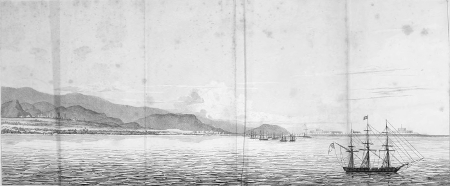
The bay is very large, and the anchorage good, but the landing is
difficult near the small battery, erected for the purpose of protecting
the landing place; it is better however at las Palmas, about two
leagues higher up the bay, called la Paraca, and fresh water, which is
very difficult to procure near the fort, may be had here. At the
southern extremity of the bay, beneath a bed of broken indurated clay
and sand stones, a stratum of salt is found, extending from fifty to one
hundred yards from the sea, and sometimes more. On removing the upper
covering of sand, the broken stones and the clay, the salt is
discovered, forming a kind of small white columns, about three or four
inches long, the upper part curling, as it were, and hanging downwards
again, the whole appearing somewhat like a cauliflower. It is extremely
white, and composed of transparent filaments not so large as a human
hair. I examined these slender bodies with a good lens; they all
appeared perfectly cylindrical and hollow, closely placed together, but
not attached to each other, for by a slight pressure they separated,
assuming the appearance of asbestos. The salt is as palatable as the
common culinary salt, dissolves slowly in a large quantity of cold
water, and is not at all deliquescent from absorption. It is seldom used
by the inhabitants, except when there is a scarcity of salt from Huacho.
Some small islands at the entrance to the bay of Pisco are famous for
the manure which they produce, and which is embarked and carried to
different parts of the coast, and often into the interior on the backs
of mules and llamas. The quantity of this manure is enormous, and its
qualities are truly astonishing; of this I shall have occasion to speak
when treating of the cultivation of maize at Chancay. Several small
vessels are constantly employed to carry it off; some of the cuts, where
embarkation is convenient, are from forty to fifty feet deep, and their
bottom is yet considerably above the level of the sea.
This valuable production appears to be the excrement of sea birds,
immense numbers of which frequent and breed on the islands; and the
accumulation is doubtless owing to the total absence of rain. It is of a
pale brown colour when dry, and easily reducible to powder; when fresh
it has rather a reddish appearance; the surface stratum for a foot deep
is whitish, and contains feathers, bones of birds, and shells of eggs.
It is asserted, that the huano, the name by which this production is
known, is certainly fossil earth; but the quality of the upper stratum,
which although at first white, gradually inclines to yellow, being
incontestibly the excrement of birds, and equal to the other, the
subject seems to demand a stricter scrutiny.
A species of birds frequenting these islands in great abundance is
called huanay: hence the original name of the matter now used as
manure. The bird is of black plumage, is as large as the seagull, and
breeds during the whole year, with this peculiarity, that each nest,
being only a hole in the huano, contains a fledged bird, an unfledged
one, and one egg; whence it appears, that there is a constant
succession, without the old birds undergoing the confinement of brooding
their eggs. The indians take many of the young birds, salt them, and
consider them a great delicacy; however they have a strong fishy taste.
The principal produce of the neighbourhood of Pisco, including the
valleys of Chincha and Cañete, is vines, from which about one hundred
and fifty thousand gallons of brandy are annually made. The brandy is
kept in earthen jars, each holding about eighteen gallons. The vessels
are made in the neighbourhood; their shape is that of an inverted cone,
and the inside is coated with a species of naptha. The brandy,
generally called pisco, from the name of the place where it is made, is
of a good flavour, and is not coloured, like the French brandy. One
kind, made from the muscadine grape, and called aguardiente de Italia,
is very delicate, possessing the flavour of Frontignac wine, and is much
esteemed. Little wine is made, and that little is of a very inferior
quality; it is generally thick and sweet, owing perhaps to the juice of
the grape being boiled for a considerable time before it is fermented.
Near to Pisco is a vineyard called de las hoyas, of the pits, or
holes; these are excavations made originally by the indians, or
aborigines, who being well versed in agriculture, cleared away the sand,
and opened a species of pits, in search of humidity. This immense labour
was occasioned by the difficulty or impossibility of procuring water
from the river Cañete for irrigation. The original use of the hoyas was
perhaps the growth of maize or camotes; but vines are now planted in
them, which produce most abundantly, requiring no other cultivation or
care than merely pruning, for the branches are allowed to stretch along
the sands.
The vine planters monopolized the making of spirituous liquors in Peru.
They procured from the King of Spain, Carlos III., a royal order,
prohibiting the manufacture of any ardent spirit in Peru, except from
the grape; and the importation of spirits subjected the importers to
very severe penalties; for having also represented to the pope, Clement
XIV., the destructive qualities of any other spirituous liquors in Peru,
the royal order was backed by a papal excommunication, fulminated
against all contrafactors and contraventors.
Dates abound, and when properly dried are superior to those of the
coasts of Barbary. Here are many prolific plantations of olives; the
figs are also very good, and pine-apples prosper well.
In the valley of Chincha are several large sugar plantations; two belong
to the Count de Montemar y Monteblanco, and one near the coast, called
Caucato, to Don Fernando Maso, where there is an extensive manufactory
of soap. The number of slaves on the plantations of Chincha, Pisco, and
Cañete is estimated at about eight thousand.
Between Pisco and Lima there is an indian village, called Chilca; it is
on a sandy plain, devoid of water as well as vegetation; the natives
often procure water by digging pits in the sand, but these sometimes
fail them, and they are then obliged to fetch this indispensably
necessary article from the Cañete river, a distance of five leagues.
The principal occupation of the inhabitants is fishing; they are very
averse to the society of the whites, so much so that they allow none to
reside in their village; even their parish priest is an indian cacique,
a native of the village, whose education, and the expences of his
ordination were paid by a subscription raised by them for the purpose.
Five leagues to the northward of Lima is the small port of Ancon, the
residence of a few indian fishermen; the anchorage is good, and the
landing is excellent. A few large fig trees grow on the sand, near the
beach, the fruit of which is extremely delicate.
The road leading from Ancon to Chancay is over very deep sand; some
parts of the road are level, while others lead over hills of sand, quite
bare in summer or during the dry season: but scarcely do the garuas,
fogs, make their appearance, when the whole is covered with the most
luxuriant vegetation; at which time the cattle is driven on them from
the neighbouring farms.
Near to Chancay, before crossing the small river, stands the old family
residence of the Marquis of Villafuerte, almost in ruins; this is the
case with many of the country seats belonging to the nobility of Lima,
who have no idea of country pleasures, nor of rural beauties. Many of
the principal country houses are built on the ruins of some ancient
building of the indians: these people never encroached on cultivated
lands, but fixed their residence either on the declivities where they
could not procure water for irrigation, or on the tops of the hills;
which is a convincing proof of their great economy, and leads us to
surmise that the population of this country was very extensive before
the conquest. This estate, called Pasamayo, is principally destined to
the breeding of hogs for the Lima market.
Pasamayo house, standing on the top of a hill, commands a noble prospect
of the sea, as well as of the valley of Chancay, in which there is a
small parish of indians, called Aucayama, most delightfully situated: in
1690 the tribute roll contained three thousand seven hundred indians,
but it is at present (1805) composed of only one hundred and seventy. Of
this decrease in the indian population I shall have occasion to speak
afterwards, when at Huacho. The valley of Chancay contains some fine
plantations of cane, and sugar manufactories; as also extensive pastures
of lucern for cattle; and very large quantities of maize and beans are
grown in the neighbourhood.
This valley is the birth place of the celebrated Niña de la huaca,
young lady of the huaca, taking her name from the huaca, the farm where
she was born. She stood six feet high, which was a very extraordinary
stature, as the Peruvian females are generally low. Extremely fond of
masculine exercises, nothing was more agreeable to her than to assist in
apprehending runaway slaves, or in taking the robbers who sometimes
haunt the road between this place and Lima. She would mount a spirited
horse, al uso del pais, astride, arm herself with a brace of pistols,
and a hasta de rejon, a lance, and with three or four men she would
scour the environs of the valley and the road to Lima, where she became
more dreaded than a company of encapados, or mounted police officers.
I visited her at her residence, and found her better instructed in
literature than the generality of the native females; she was frank,
obliging, and courteous, managing her own estate, a sugar plantation, to
the best advantage, superintending the whole of the business herself.
The quantity of maize cultivated in the ravine, quebrada, and on the
plains of Chancay, is very great; but the cultivators are indebted to
the huano from the islands of Pisco and Chincha for their abundant
harvest. I have seen the fields quite yellow, from the parched state of
the plants, when they were about a foot high, having four or five
leaves each, at which time they are manured, by opening a hole at the
root of every three or four plants, for they grow in clusters of this
number, and putting into it, with the fingers, about half an ounce of
huano, which is covered with a little earth, thrown on by the foot. The
field is then irrigated as soon as possible; and in the course of ten or
twelve days the plants will be more than a yard high, of a most
luxuriant green colour, and the stalks pregnant with the cobs of corn. A
second quantity of huano is now applied in the same manner, and the
ground again irrigated; and thus the most abundant crops are produced,
yielding from one thousand to twelve hundred fold. The cobs are
frequently fourteen and even sixteen inches long, well set with grain,
and the grain very large. Beans are often planted with the maize, by
which means a double crop is produced; but in this case the maize is not
so prolific, nor are the beans so good, because the best quality of the
bean is grown without irrigation, being sown long before the garuas
disappear, and being ripe earlier than the maize.
Chancay is famous for the breeding and feeding of hogs for the Lima
Market: the hogs are all black, with little or almost no hair, short
snouts, small pointed ears, and of a low stature; but they become so
amazingly fat, that they can scarcely walk; and as their value depends
on the quantity of fat which they yield, it is the principal object of
the feeder to bring them to this state as soon as possible. When killed,
the whole of the body is fried, and the fat is sold as lard for culinary
purposes. The consumption of lard in every part of Peru is enormous, and
it is principally owing to the abundance of maize that the hacendados,
farmers, enjoy this lucrative trade.
Maize grows on the ridges of the Cordilleras where the mean temperature
is about 48° of Fahrenheit, and on the plains or in the valleys where it
is 80°,—where the climate is adverse to rye and barley, and where wheat
cannot be produced, either owing to the heat or the cold, this grain,
whose farinaceous property has the greatest volume, produces its seed
from 150 to 1200 fold. Thus it may be said to be the most useful grain
to man; and it is peculiarly adapted to the country in which it was
planted by the provident hand of nature. On this account, the maize
occupies in the scale of the various kinds of cultivation a much greater
extent on the new continent than that of wheat does on the old.
It has been erroneously stated, that maize was the only species of
grain known to the Americans before the conquest. In Chile, according to
Molina, the mager, a species of rye, and the tuca, a species of
barley, were both common before the fifteenth century; and as there was
neither rye nor barley, it is evident that if they were common even
after the conquest, and not European grain, that they were indigenous.
In Peru the bean and quinua were common before the conquest, for I have
frequently found them in the huacas, preserved in vases of red
earthenware. Some writers have pretended that the maize, which is also a
native of Asia, was brought over by the Spaniards to their colonies in
the new world. This is so evidently false, that it does not deserve
contradiction: indeed, if the aborigines were destitute of maize, beans,
plantains, and all those articles of food which have been said to be
introduced by the Europeans, a new query would arise—on what did the
numerous population of indians feed? For what purpose did they cultivate
such large tracts of land, and why procure water for irrigation on the
coasts of Peru with such immense labour, and such extraordinary
ingenuity? Why did the Peruvians always build their houses in such
sterile situations as labour could never have made fertile?
I have enumerated five varieties of maize in Peru; one is known by the
name of chancayano, which has a large semi-transparent yellow grain;
another is called morocho, and has a small yellow grain of a horny
appearance; amarillo, or the yellow, has a large yellow opaque grain,
and is more farinaceous than the two former varieties: blanco, white;
this is the colour of the grain, which is large, and contains more
farina than the former; and cancha, or sweet maize. The last is only
cultivated in the colder climates of the sierra, mountains; it grows
about two feet high, the cob is short, and the grains large and white:
when green it is very bitter; but when ripe and roasted it is
particularly sweet, and so tender, that it may be reduced to flour
between the fingers. In this roasted state it constitutes the principal
food of the serranos, mountaineers, of several provinces. It is
considered a delicacy at Lima and all along the coast, and without a bag
full of this roasted maize a serrano never undertakes a journey. It is
sometimes roasted, and reduced to coarse flour, like the ulpa in Chile,
and is then called machica.
According to the climate, and the kind of maize, its state of
perfection or ripeness varies very much—from fifty days to five months.
The morocho is ripe within sixty days in climates that are very hot and
humid, as for instance at Guayaquil, and on the coast of Choco: the
blanco within three months, in the vicinity of Lima and on the Peruvian
coast, valles: and the chancayano in about five months. The last is
the most productive, and the best food for cattle, poultry, &c.
Although wheat and barley are cultivated in different parts of Peru,
maize is generally considered the principal harvest; and where barley is
even commoner than maize, (as in some of the more elevated provinces of
the interior, and where it constitutes the principal article of food for
the indians) they all greatly prefer the maize, if attainable, and will
always exert themselves to cultivate a small patch of ground for this
grain. Thus, where it is not used for daily food, or calculated upon as
an article of trade, it is considered as a species of luxury. Among the
indians and poor people on the coast it supplies the place of bread; for
which purpose it is merely boiled in water, and is then called mote.
Puddings are also made of it, by first taking off the husk. This
operation is performed by putting a quantity of wood ashes into water
with the maize, exposing it to a boiling heat, and washing the grain in
running water, when the husks immediately separate themselves from the
grain, which is afterwards boiled in water, and reduced to a paste by
bruising it on a large stone, somewhat hollowed in the middle, called a
batan. The bruiser, or mano, handle, is curved on one side, and is
moved by pressing the ends alternately. I have been the more particular
in describing this rude mill, because it was undoubtedly used by the
ancient Peruvians, having been found buried with them in their huacas;
and because it may serve some curious investigator in comparing the
manners of these people with those of other nations. By the same
implements they pulverized their ores for the extraction of gold and
silver; and to this day many of their batanes of obsidian and porphyry
remain near to the mountain in the neighbourhood of Cochas; but the
bruisers have never been discovered. That these stones were used for the
purpose just mentioned is obvious, from the relics of a gold mine being
here visible; besides, I have several times found fragments of gold ore
in this place.
After the paste is made from the boiled maize it is seasoned with salt
and an abundance of capsicum, and a portion of lard is added: a
quantity of this paste is then laid on a piece of plantain leaf, and
some meat is put among it, after which it is rolled up in the leaf, and
boiled for several hours. This kind of pudding is called tamal, a
Quichua word, which inclines me to believe, that it is a dish known to
the ancient inhabitants of the country.
Sweet puddings are made from the green corn, by cutting the grains from
the cob, bruising them, and adding sugar and spices, after which they
are boiled or baked. Choclo, being the Quichua name for the green
cobs, these puddings, if boiled in the leaves that envelop the cob, are
called choclo tandas, bread of green maize, and also umitas.
This useful grain is prepared for the table in many different ways, and
excellent cakes and rusks are made from the flour, procured from the
grain by various means. A thick kind of porridge, called sango, is
made by boiling the flour in water, which constitutes the principal food
of the slaves on the farms and plantations. Another sort, similar to
hasty-pudding, is common in many places, but particularly in Lima; it is
called masamorra, and the people of Lima are often ironically
denominated masamorerros, eaters of masamorra. The grain is bruised
and mixed with water; it is thus allowed to ferment until it become
acid, when it is boiled, and sweetened with sugar. It resembles Scotch
sowins.
A great quantity of maize is also made into a fermented beverage, called
chicha. The grain is allowed to germinate, and is completely malted;
it is then boiled with water, and the liquor ferments like ale or
porter; but no other ingredients are added to it.
Chicha is the favourite drink of all the indians, and when well made it
is very intoxicating. In some parts of Peru the natives believe that
fermentation will not take place if the malted grain be not previously
subjected to mastication; from this circumstance many old men and women
assemble at the house where chicha is to be made, and are employed in
chewing the jora, or malt. Having masticated a sufficient quantity
they lay the chewed substance in small balls, mouthfuls, on a calabash;
these are suffered to dry a little, after which they are mixed with some
newly made chicha while it is warm. When travelling I always inquired if
the chicha was mascada, chewed, and if it were I declined taking
any;—however, as the question seemed to express a dislike, I was often
assured it was not mascada when it probably was. No spirituous liquor is
extracted from it, on account of the prohibition. Two kinds of chicha
are usually made from the same grain—the first, called claro, is the
water in which the malt has been infused; this is drawn off, and
afterwards boiled. In taste it has some resemblance to cider. The second
kind is made by boiling the grain with the water for several hours, it
is then strained and fermented, and is called neto; the residue or
sediment found in the bottom of the jars is used in fermenting the dough
for bread, which when made of maize is called arepa; and that of
wheat, in the Quichua language, tanda.
This beverage was well known to the ancient inhabitants before the
conquest; for I have drunk, at Patavilca and Cajamarca, chicha that had
been found interred in jars in the huacas, or burying places, where it
must have remained upwards of three centuries. Garcilaso de la Vega
relates, that the manufacture of intoxicating liquors, particularly the
vinapu and sora, was prohibited by the Incas; and this part of Peru
was annexed to their government in the time of Pachacutec, the tenth
Inca of Peru.
The Peruvians, as well as the Mexicans, made sugar from the green stalks
of the maize plant, and sold it in their markets—Cortes, in one of his
letters to the Emperor Charles V., speaks of it. At Quito, I have seen
the green canes brought to market, and have frequently observed the
indians sucking them as the negroes do the sugar cane.
The town Villa de Chancay stands about a league and a half from the
Pasamayo river, and fifteen leagues from Lima. It was founded in 1563 by
the Viceroy Conde de Nieva, who intended to form a college and a
university here, but this intention was never fulfilled. It has a large
parish church, a convent of Franciscans, dedicated to San Diego, and a
hospital, managed by friars of San Juan de Dios. The town contains about
three hundred families, some of which are descendants of noblemen,
although perhaps by African favourites.
Chancay is pleasantly situated, about a league from the sea; its port is
small, the anchorage bad, and the landing difficult. Its market is
abundant in fish, flesh-meat, vegetables, and fruit: of the latter
considerable quantities are carried to Lima; it is also famous for
delicate sweet cakes, called biscochos. This is the capital of a
district, which contains thirty-seven settlements, of different
climates, because part of it is mountainous. The subdelegado, or
political governor of the district, generally resides at Chancay,
besides whom there are two alcaldes or mayors annually elected in the town.
At a short distance is Torre blanca, the seat of the Conde de Torre
blanca, Marquis of Lara; and an excellent farm-house at Chancaillo; not
far from which, and near the sea, are the colcas, deep pits dug in the
sand. These pits have been surrounded with adobes, sun-dried bricks; and
they are reported to have been granaries belonging to the army of
Pachacutec, when this Inca was engaged in the conquest of the Chimu of Mansichi.
Fourteen leagues from Chancay stands the indian village Huacho; it is
situated in a delightful valley, watered by the Huaura, which rises in
the province of Cajatambo, and in its course to the sea irrigates more
than thirty thousand acres of land. The village contains about four
thousand inhabitants, all indians; it has a large parish church and
three small chapels, besides a chapel of ease at Lauriama, where mass is
celebrated on Sundays and festivals. The principal employment of the
natives is the cultivation of their chacras, small farms, cutting salt
at the salinas, fishing, and making straw hats, at which they are very
dexterous. The hats are not made of plat: they begin at the centre of
the crown, and continue the work by alternately raising one straw and
depressing another, inserting or taking out straws, as the shape
requires it, till the hat is finished. These hats are generally made
either of fine rushes which grow on swampy ground, or of mocora, the
produce of a palm tree, in the province of Lambayeque.
The chacras, plots of ground distributed to the indians by the
government, and held during life, are supposed to be an equivalent for
the tribute; and indeed they are an excellent compensation, for the
produce is usually worth six times more than the sum paid, leaving at
least five-sixths for the expences or trouble of cultivation. To the
great credit of the indians no land is any where kept in better
condition, nor more attention paid to the crops, which generally consist
of wheat, maize, beans, camotes, yucas, pumpkins, potatoes, and many
kinds of vegetables. There is an abundance of fruit trees, the produce
of which is often carried to Lima. The hedges are almost entirely
composed of those trees, such as the orange, lime, guava, pacay, palta,
&c. In some places the vine and the granadilla are seen creeping about,
craving support for their slender branches, as if unable to sustain the
burthen of fruit they are destined to bear. The maguey is much
cultivated in the hedges; besides this destination it produces cordage
for general uses, and the flower stems growing twenty feet high serve
as beams for the houses, and other similar purposes; being, if kept dry,
of almost everlasting duration.
I had an excellent opportunity here of observing the character, manners,
and customs of the indians, with whom I was very much pleased. They are
kind and hospitable, but timidity and diffidence make them appear
reserved and somewhat sullen. Their maxims are founded on their own
adage—convince me that you are really my friend, and rest secure: has
ver que eres mi amigo, y hechate a dormir. Whether this distrust be a
natural characteristic trait, or whether it be the result of the
privations they have suffered since the Spaniards became their masters,
it is difficult to decide; but at all events it surely cannot be called a crime.
The indians on the coast of Peru are of a copper colour, with a small
forehead, the hair growing on each side from the extremities of the
eyebrows; they have small black eyes; small nose, the nostrils not
protruding like those of the African; a moderately sized mouth, with
beautiful teeth; beardless chin (except in old age) and a round face.
Their hair is black, coarse, and sleek, without any inclination to curl;
the body is well proportioned, and the limbs well turned, and they have
small feet. Their stature is rather diminutive, but they are inclined to
corpulency, when they become inactive, and it is a common saying, that a
jolly person is tan gordo como un cacique, as fat as a cacique. The
perspiration from their bodies is acetous, which some have supposed to
be caused by a vegetable diet. In the colder climates, although in the
same latitude, the complexion of the indians is lighter, owing perhaps
to the cold; however, the Araucanians, who enjoy a much colder climate,
are of a dark copper colour.
I shall here endeavour to refute some of the aspersions thrown by
several writers upon the character of the Peruvian indians, whom I hope
to place, in the estimation of unbiassed men, in a situation more
honourable to human nature than they have yet enjoyed; and thus one of
my principal objects for publishing this narrative will be obtained.
M. Bouguer says, that "they are all extremely indolent, they are stupid,
they pass whole days sitting in the same place, without moving, or
speaking a single word." I believe I may state, that in all hot climates
an inclination to indolence is common, nay even natural; a hot climate
precludes bodily exertion, unless the cravings of nature are satisfied
with difficulty, and as this is not the case in Peru, half the vice, if
it be a vice, disappears at once; add to this, that they have no motive
to exertion above supplying the wants of nature—no stimulus—no market
for an excess of produce, or the supplying of artificial wants—and the
cause for indolence exists as necessarily as a cause for industry is
found where the contrary happens. If a climate demand only a shade from
the sun or a shelter from the rain, why should men build themselves
stately or close habitations? Where nature spontaneously produces the
requisite articles of food, competent to the consumption of the
inhabitants, why should they exert themselves to procure a superfluous
stock? and particularly where an introduction of new articles in
succession is entirely unknown. What to M. Bouguer and others has
appeared stupidity, perhaps deserves the name of indifference, the
natural result of possessing all the means for satisfying real wants,
and an ignorance of artificial ones. But if real stupidity be meant, I
must aver that I never observed it either among the wild tribes of
Arauco on the river Napo, or in those of the coasts of Choco. I
recollect very well an indian, called Bravo, who was accused at
Pomasqui of having stolen the mule which he had brought from the
valleys to the eastward of Quito, laden with fruit. At the moment the
accusation was laid before the alcalde, the indian threw his poncho or
mantle over the head of the mule, and then desired the challenger to say
of which eye his mule was blind? He answered, of the left. Then, said
the indian, taking off the poncho, this mule cannot be yours, because it
is blind of neither. That any beings endowed with speech should "sit
whole days without speaking a word," is indeed the acme of taciturnity;
but as M. Bouguer was perhaps ignorant of the language of the people he
describes, he may probably deserve the same compliment from them. I
found the Araucanians prone to talk; indeed eloquence is considered an
accomplishment among them, and extremely necessary among the mapus, or
chiefs. The Peruvians are neither silent in their meetings nor when
travelling; however, they have little inquisitiveness, nor do they break
out into soliloquys on the beauties of the surrounding scenery; but they
converse freely on common place topics, particularly with a white man,
if they find that he deigns to enter into conversation with them.
Several of the tribes in Archidona and Napo, who are in their free
state, certainly did not merit the accusation of dumb stupidity; for
although unacquainted with their languages, I tried to converse with
them in Quichua, aided by signs, and I really discovered more
intelligence among them than I had a right to expect. What is often
considered a step towards civilization or to social life, is a pastoral
one; but if we search for it in a country where animals capable of
domestication do not exist, we have no right to consider the inhabitants
as barbarous, because they are not possessed of flocks and herds; nor do
human beings deserve that epithet, who will share what they are
possessed of with a stranger; and such hospitality I have frequently
experienced. The kindness which these men show to the dog is no small
proof of their sensibility; they will take long journeys to procure one,
and value it as much as a lady esteems her lap dog. The utility of the
animal may perhaps be said to be the chief motive of the indian's
attachment; and what other motive has the shepherd or the herdsman?
M. Bouguer continues, "they are totally indifferent to wealth and all
its advantages. One does not know what to offer them to procure their
services; it is in vain to offer money, they answer, that they are not
hungry." Wealth, in the general acceptation of the word, can procure no
advantages to men who have no means of disposing of it. Where there is
no market, money can purchase nothing; and where the natural wants are
abundantly supplied, and men's desires have not created artificial ones,
a market is superfluous and useless; but wherever the indians can
exchange the produce of the country they inhabit for whatever pleases
them, they are always anxious to do it. The Logroño indians trade with
the city of Cuenca; the Yumbos, Colorados, and Malabas with Quito; the
Chunchos, Pehuenches, Huilliches, and other tribes with Conception; the
Orejones with Huanuco; and numerous other tribes frequent the
settlements nearest to them, for the purpose of bartering their
commodities for others which are either useful or ornamental. Had M.
Bouguer offered them beads, hawks' bells, machetes, large knives,
bows, arrows, or poison for their darts, he would have obtained their services.
Dr. Robertson considers the indians to have been, at the time of the
conquest by the Spaniards, less improved and more savage than the
inhabitants of any part of the globe; but he afterwards limits this
charge to the rudest tribes; a limitation which was very necessary, for
the purpose of palliating what I cannot help believing to be a false
accusation. He could not mean the tribe of the Muysca indians, who have
left the fewest remains of their ingenuity, much less the Peruvians; and
in Mexico, some of their cities were equal to the finest in Spain,
according to the accounts given by Cortes, in his reports to the Emperor
Charles V. These reports, and the yet existing monuments of labour and
ingenuity, speak strongly in opposition to Robertson's statement.
Ulloa says, "one can hardly form an idea of them different from what one
has of the brutes." Paul III. thought differently, when, by his
celebrated bull, he declared them worthy of being considered as human
beings. Ulloa might have said, with more truth, one can hardly form an
idea of treatment more brutal than that which many of them receive. In
the interior of Peru, as Ulloa speaks of the Peruvians, they were
degraded by the mita, a scion of the law of repartirnientos,
distribution of indians at the time of the conquest. By this law, the
men were forced from their homes and their families to serve for a
limited time an imperious master, who, if he approved of their labour,
took care to advance them a little money or some equivalent above what
their wages amounted to, and then obliged them to serve him until the
debt was liquidated. By this time another debt was contracted; and thus
it was that they became worse than slaves, except in the name. I have
been on several estates in different parts of Peru and Quito where the
annual stipend of an indian was no more than eighteen or twenty dollars;
with which pittance he had probably to maintain a wife and family,
besides paying his annual tribute of five or seven dollars and a half to
the King. The result was generally this:—the father died indebted to
his master, and his children were attached to the estate for the
payment. I would now ask Don Antonio Ulloa, who are the brutes? The hut
of one of these miserable indians consists of a few stones laid one upon
another, without any cement or mortar, thatched over with some long
grass or straw, which neither defends the unhappy inmates from the wind
nor the rain; and such is the case on the paramos, or bleak mountains.
One small room contains the whole family; their bed, a sheep skin or
two, their covering, the few clothes which they wear during the day, for
they have no others; their furniture, one or two earthen pots; and their
food, a scanty provision of barley. Who that is possessed of Christian
charity could witness this, and, instead of pitying their miserable
condition, call them brutes? If of these Ulloa says, "nothing disturbs
the tranquillity of their souls—equally insensible to disasters and to
prosperity," his observation is just. Born under the lash of an
imperious master, subject to the cruelty of an unfeeling mayordomo, they
had no disasters to fear, because their condition could not possibly be
rendered worse: with prosperity they had been totally unacquainted, it
was a blessing which had fled the land they were born to tread, or
rather it had been transferred to usurpers.
Ulloa continues, "though half naked, they are as contented as a monarch
in his most splendid array." And does the Spaniard imagine, that these
miserable men are destitute of corporal feeling as well as of
intellectual sensibility? Does neither the bleak wind nor the cold rain
make any impression on them? Can content be the companion of the
half-naked, half-starved slave? It may be the gloom of despair that
hangs on their countenances; but it is certainly not the smile of
content. "Fear makes no impression on them, and respect as little." This
rhapsody is taken from the mouth of some Spanish master, as a palliative
of his own cruel conduct. "Their disposition is so singular, that there
are no means of influencing them, nor of rousing them from that
indifference, which is proof against all the endeavours of the wisest
persons. No expedient which can induce them to abandon that gross
ignorance, or lay aside that careless negligence which disconcert the
prudent, and disappoint the care of such as are attentive to their
welfare." If a man be so oppressed by a tyrannical and proud master,
that he finds himself lower in his estimation than the cattle which he
tends—so worn down with hunger, cold, and fatigue that he is only
anxious for the approach of night or of the grave,—what can rouse him
from that indifference or despondency which Señor Ulloa describes? Now
this has been the state of the South American indian on the large farms,
and in the obrages, manufactories. He dreads to finish his task early,
fearful of an increase of labour; he dares not appear cheerful, because
it might be called impudence by his overseer; he dares not be cleanly or
well clothed, because the first condition would be considered a
negligence of his duty to his master, or an attention to his own
comforts, and the second the result of theft. Then, what, let me ask, is
left, but misery in appearance, and wretchedness in reality? I well
remember what the pious Dr. Rodrigues said to me at Quito:—"Not half
the saints of the Romish Church, whose penitent lives placed them in the
calendar and on our altars, suffered greater privations, in the hopes
of enjoying everlasting glory, than one of these indians does through
fear of offending a cruel master, or for the purpose of increasing his
wealth." "How dear," added he, "has the religion of Christ cost these
once happy innocent creatures, and at what an usurious price it has been
sold to them by the proud pedlars who imported it. Oh! heaven,"
exclaimed he, "till when! till when! hasta quando! hasta quando!" Well
too do I remember, when passing, with the Conde Ruis de Castilla, by the
cloth manufactory of San Juan, near Riobamba, an old indian woman, who
was tending a flock of sheep, and spinning with her distaff and spindle,
her head uncovered, her grey locks waving wildly in the wind, and her
nakedness not half concealed by an old coarse anaco, running to his
excellency, and on her knees exclaiming, with sobs and tears, "bless
your worship, I have seen seven viracochas who came to govern us, but my
poor children are still as naked and as hungry as I was when I saw the
first; but you will tell the King of this, and he will make me happy
before I die; he will let us leave San Juan; oh! taita ya, taita ya—oh!
my father, my father."
"No expedient can induce them to lay aside their gross ignorance," says
el Señor Ulloa. What expedients have been tried? No schools have been
established for them; no persons employed to teach them, except an old
man or a friar, who once a week teaches them their prayers; and I can
safely aver, that thousands of indians employed by white people live and
die in their service without ever seeing any other book than the missal
on the altar, or their master's account book on his table.
But let us turn from this loathing sight, and look to indians where they
are blessed with a greater portion of rational liberty, where they are
considered more on a level with their white neighbours, and have more
opportunities of evincing that they are not a disgrace to human nature,
nor beneath the merited name of men.
The towns of Huacho and Eten, inhabited almost exclusively by indians,
may serve to pourtray the character of these people when in society. I
have already mentioned their employment at Huacho; to which may be added
the manufacture of many articles of cotton at Eten, such as napkins,
tablecloths, and counterpanes, some of which are remarkably fine, and
ornamented with curious figures interwoven, somewhat like damask. I have
seen their felt or frieze counterpanes sell for twenty or twenty five
dollars each. They also make large floor mats of junco, a species of
fine rush, and they manufacture hats. These are sufficient proofs, that
when an indian reaps the benefit of his labour he is not averse from
work.
Ulloa has also mistated the character of the American indian, in
asserting, "that he will receive with the same indifference the office
of an alcalde or judge, as that of a hangman." An indian alcalde is as
proud of his vara, insignia of office, as any mayor of England is of
his gown, and always takes care to carry it along with him, and to exact
that respect which he considers due to him in his official capacity.
When the Oidor Abendaño passed through the indian town of Sechura, in
1807, he had neglected to take the necessary passport from the
Governador of Paita; the indian alcalde requested to see it; the Oidor
informed him that he had not one; adding, that he was one of the
ministers of the royal audience of Lima; and I, said the indian, am the
minister of justice of Sechura, and here my vara is of more importance
than your lordship's. I shall therefore insist on your returning to
Paita for your passport, or else of sending some one for it: two of my
bailiffs will wait on you, my lord, till it is procured, as well as for
the purpose of preventing you from pursuing your journey without it.
The number of indians who receive holy orders, natives of the coast as
well as the interior, is a convincing proof that they are not destitute
of understanding, nor incapable of at least becoming literary
characters, if not learned men. Some have also shone at the bar, in the
audiences of Lima, Cusco, Chuquisaca, and Quito; among these was Manco
Yupanqui, of Lima, protector-general of indians, whom I knew. He was a
good Latin scholar, was well versed in the English and French languages,
and considered the only good Greek scholar in the city. I knew also Don
Jose Huapayo, Vice-rector of the college del Principe, a pasante of San
Carlos, a young man of natural talents, which were well cultivated.
Extreme cowardice has also been attributed to the indians; but this
imputation very indifferently accords with the tribes of Araucania,
Darien, &c. During the present contest in South America the indians have
sustained more than their share of fighting; and had the unfortunate
Pumacagua of Cusco, or Pucatoro of Huamanga, been supplied with arms and
ammunition, they would not have been subdued by Ramires and Maroto.
The indians who reside among the creoles and Spaniards on the coasts of
Peru and in the province of Guayaquil are docile, obliging, and rather
timid. Their timidity has been the cause of their being supposed totally
indifferent to what passes; indeed, as I have before said, there does
not appear to be any eager curiosity about them, they have little to
satisfy; but at its lowest ebb, this disposition surely can only be
termed apathy. They are industrious in the cultivation of their farms
and gardens; attentive to their other occupations, and faithful in their
engagements; they know the value of riches, strive to obtain them, and
are fond of being considered rich, although they never boast of being
so. Infidelity between man and wife is very rare; they are kind parents,
which generally makes their children grateful as well as dutiful.
Robertson says, that "chastity is an idea too refined for a savage." I
must beg leave to state, that his compilation, founded on Spanish
writings, is not always deserving of credit. Had Dr. Robertson travelled
over half the countries he describes, or observed the native character
of the people which he has depicted, he would have expressed himself in
very different terms. Chastity is more common, and infidelity more
uncommon, among the Peruvians than in most countries of the old world.
The same author remarks, "in America, even among the rudest tribes, a
regular union between husband and wife was universal, and the rights of
marriage were understood and recognized." This surely is a proof that
chastity was known among these savages; and I cannot conceive that
polygamy, when sanctioned by law or custom, is any objection to
chastity.
They are cleanly in their persons, and particularly so in their food;
abstemious in general, but at their feasts inclined to gluttony and
drunkenness; although disposed to the latter vice in a considerable
degree, they are not habitual drunkards, and the females are so averse
from it, that I never saw one of them intoxicated. I often observed,
when living among the indians, that they slept very little; they will
converse till late at night, and always rise early in the morning,
especially if they have any work that requires their attention; such as
irrigating their fields, when water can only be obtained at night, or
tending their mules on a journey. In such cases they will abstain from
sleep for three or four nights successively, without any apparent
inconvenience, and they seldom or never sleep during the day. Both males
and females adhere to one kind of dress, which varies little either in
towns or villages. The men of Huacho wear long blue woollen trowsers,
waistcoat, and sometimes a jacket; a light poncho, and a straw hat, but
they are without either shoes or stockings, except some of the old men
who have been alcaldes, and who afterwards wear shoes adorned with large
square silver buckles when they go to church or to Lima. The alcaldes
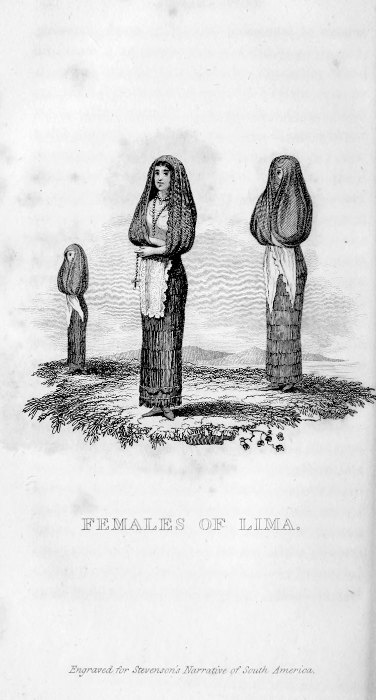
also usually wear a long blue Spanish cloak. The dress of the females is
a blue flannel petticoat, plaited in folds about half an inch broad, a
white shirt, and a piece of flannel, red, green, or yellow, about two
yards long and three quarters of a yard broad; this they put over their
shoulders like a shawl, and then throw the right end over the left
shoulder, crossing the breast. They wear ear-rings formed like a rose or
a button, the shank being passed through the aperture made in the ear,
and secured by a small peg passed through the eye of the shank; they
have also one or more rosaries, which like the ear-rings are of gold,
and hang round their necks with large crosses, medals, &c. They seldom
wear shoes, except when they go to church, and then often only put them
on at the door; stockings they never wear. The hair both of the men and
women is generally long; the former have one plat formed with the hair
of the forehead, at the top of the head, and another with the rest
behind, and both are fastened together at the ends; the women plat
their hair in a number of very small tresses, but comb the whole from
the forehead backwards. There is a considerable portion of superstition
among them; old women are always afraid of being considered witches, and
when a person dies his death is generally attributed to witchcraft. A
widow will often, while lamenting the death of her husband, throw out a
volume of abuse against some female who, as she imagines, had cast an
evil eye on him. When a person praises a child or even a young animal, a
by-stander will exclaim, God protect it! Dios lo guarda! to avert its
being withered by an evil eye. They are considered as neophytes, and the
inquisition has no power over them, nor are they included among the bull
buyers. As to their religion, they are particularly attentive to all the
outward forms, and strict in their attendance at church; but an instance
of cunning in evading a reprimand from the rector happened at this town.
An indian being questioned by the cura, rector, why he did not attend
mass on a day of precept, to hear mass and work, replied, "that he
had fulfilled the commandment of the church, for as he did not intend to
work, mass was undoubtedly excused by the precept."
I observed at Huacho one of the ancient rites of the Peruvians; it was
the ñaca feast. A child never has its hair cut till it is a year old, or
thereabouts; the friends then assemble, and one by one take a small lock
and cut it off, at the same time presenting something to the child. This
ceremony among the ancient Peruvians was practised at the naming of the
child, and the name was generally appropriate to some particular
circumstance which occurred to the child on that day. The seventh Inca
was called Yahuar Huacar, weeper of blood, because on that day drops of
blood were observed falling from his eyes; and Huascar, the fourteenth
Inca, was so named because the nobles on this day presented him with a
golden chain called a huasca, after the ceremony of cutting the ñacas.
At this village I heard for the first time the oral tradition of the
first Inca, Manco Capac; it was afterwards repeated to me by indians in
various parts of the country, and they assured me that it was true, and
that they believed it. A white man, they say, was found on the coast, by
a certain Cacique, or head of a tribe, whose name was Cocapac; by signs
he asked the white man who he was, and received for answer, an
Englishman. He took him to his home, where he had a daughter; the
stranger lived with him till the daughter of the Cacique bore him a son
and a daughter, and then died. The old man called the boy Ingasman
Cocapac, and the girl Mama Oclle; they were of a fair complexion and had
light hair, and were dressed in a different manner from the indians.
From accounts given by this stranger of the manner in which other people
lived, and how they were governed, Cocapac determined on exalting his
family; and having instructed the boy and girl in what he proposed to
do, he took them first to the plain of Cusco, where one of the largest
tribes of indians then resided, and informed them that their God, the
sun, had sent them two of his children to make them happy, and to govern
them; he requested them to go to a certain mountain on the following
morning at sunrise, and search for them; he moreover told them that the
viracochas, children of the sun, had hair like the rays of the sun,
and that their faces were of the colour of the sun. In the morning the
indians went to the mountain, condor urco, and found the young man and
woman, but surprised at their colour and features, they declared that
the couple were a wizard and a witch. They now sent them to Rimac Malca,
the plain on which Lima stands, but the old man followed them, and next
took them to the neighbourhood of the lake of Titicaca, where another
powerful tribe resided; Cocapac told these indians the same tale, but
requested them to search for the viracochas on the edge of the lake at
sunrise; they did so, and found them there, and immediately declared
them to be the children of their God, and their supreme governors.
Elated with his success, Cocapac was determined to be revenged on the
indians of Cusco; for this purpose he privately instructed his
grandchildren in what he intended to do, and then informed the tribe
that the viracocha, Ingasman Cocapac, had determined to search for the
place where he was to reside; he requested they would take their arms
and follow him, saying, that wherever he struck his golden rod or
sceptre into the ground, that was the spot where he chose to remain. The
young man and woman directed their course to the plain of Cusco, where
having arrived, the signal was given, and the indians here, surprised by
the re-appearance of the viracochas, and overawed by the number of
indians that accompanied them, acknowledged them as their lord, and the
children of their God. Thus, say the indians, was the power of the Incas
established, and many of them have said, that as I was an Englishman, I
was of their family. When H. B. M. ship Breton was at Callao, some of
the officers accompanied me one Sunday afternoon to the Alameda at
Lima; on our way we were saluted by several indians from the mountains,
calling us their countrymen, and their relations, begging at the same
time that we would drink some chicha with them.
There is a curious analogy between this tradition and one that I had
from the mouth of Don Santos Pires, at Rio de Janeiro, in 1823. He told
me, that before the discovery of the Brazils, an Englishman had been
shipwrecked, and fell into the hands of the Coboculo indians; he had
preserved or obtained from the wreck a musket and some ammunition, with
which he both terrified and pleased the indians, who called him
Camaruru, the man of fire, and elected him their king. He taught them
several things of which they were before ignorant (as did Manco Capac
and Mama Oclle the Peruvians); he was alive at the conquest of the
country, and was carried to Portugal, when Emanuel granted him a valley
near to Bahia, independent of the crown. Don Santos is the brother of
the Baron da Torre, both lineal descendants of Camaruru, of which he
boasted not a little, adding, that to the present time none of the
lineal descendants had ever married a Portuguese.
The Muysca indians of the plains of Cundinamarca have a white man with a
beard, called Bochica, Nemquetheba, or Suhé, for under these different
names he is spoken of, as their legislator. This old man, like Manco
Capac, taught them to build huts and live in communities, to till the
ground, and to harvest the produce; as also to clothe themselves, with
other comforts; but his wife, Chia, Yubecayguaya, or Huythaca, for she
is also known by three different names, was not like Mama Oclle, who
taught the females to spin, to weave, and to dye the cloths. Chia, on
the contrary, opposed and thwarted every enterprize for the public good
adopted by Bochica, who, like Manco Capac, was the child of the sun,
dried the soil, promoted agriculture, and established wise laws. The
Inca did not separate the ecclesiastical authority from the political,
as Bochica did, but established a theocracia. The first opened an outlet
to the lake Titicaca, for the benefit of his subjects, at a place now
called Desaguadero, the outlet; while the latter, for the same
purpose, opened the lake of Bogotá, at Tequendama. The Inca bequeathed
his sovereign authority to his son, while Bochica named two chiefs for
the government, and retired to Tunja, holy valley, where he lived two
thousand years, or, as other traditions state, where his descendants
governed the Muysca tribe for two thousand years. The first of these
successors was called Huncahua, and the rest Huncas, which was the name
of the holy city; but the Spaniards have changed the name to Tunja.
The Mexicans have likewise a bearded white man as a legislator, called
Quatzalcoatl; he was the high priest of Cholula, chief of a religious
sect, and a legislator; he preached peace to men, and prohibited all
sacrifices to the Deity, excepting the first fruits.
We have here the tradition of four white men distinguished by the people
of the new world, as having beards, a circumstance as remarkable to
them, as it was visible, for they being beardless, would consequently be
surprised at seeing men whose faces bore what they would be led to
consider a feature so distinguishing. Two of these are said to have been
Englishmen. Of the laws established by Camaruru I have no information,
but those established by Manco Capac I know have no analogy, nor do they
bear any resemblance to those of any of the northern governments,
except, setting aside lineal descent, the papal, where the spiritual
authority is exercised by the King of Rome. This coincidence of four
men, bearing the same mark of a beard, three of whom were priests and
legislators, occurred at places the most distant from each other, the
one at Rio de Janeiro, in latitude 22° 54´ 10´´ S., longitude 42° 43´
45´´ W.; one at Cusco in lat. 13° S., long. 81° W.; one at Cundinamarca
in latitude 4° 35´ N., long. 74° 8´; and the other at Cholula in
latitude 19° 4´ N., longitude 98° 14´ W.
The traditions of Manco Capac, Bochica, and Quatzalcoatl agree in
predicting the arrival of bearded men at some future period, and the
conquest of the different countries by them; which predictions operated
strongly in favour of Pizarro, Benalcazar, and Cortes, and produced that
submission of the Peruvians, Muyscas, and Mexicans, which finally laid
the foundation of the degraded state of their descendants.
From some accounts of the government of the Incas of Peru, it is easy to
observe how well acquainted they were with the natural character of the
people whom they had to govern. The whole empire was modelled like a
large monastic establishment, in which each individual had his place and
his duty assigned to him, without being permitted to inquire into the
conduct of his superiors, much less to question the authority of the
high priest, or to doubt the justness of his mandates. Passive obedience
to the decrees of their master could not but crush the germ of
enterprize and ambition. Thus it is that the Peruvian indians are
destitute of an active love for their country, and incapable of any
exertion, unless roused by the orders of a Superior. Patient in
adversity, and not elated with prosperity, their most indifferent
actions are regulated by almost superstitious precision. Their
veneration for the memory of their Incas is beyond description,
particularly in some of the interior districts, where his decollation by
Pizarro is annually represented. In this performance their grief is so
natural, though excessive, their songs so plaintive, and the whole is
such a scene of distress, that I never witnessed it without mingling my
tears with theirs. The Spanish authorities have endeavoured to prevent
this exhibition, but without effect, although several royal orders have
been issued for the purpose. The indians in the territory of Quito wear
black clothes, and affirm that it is mourning for their Incas, of whom
they never speak but in a doleful tone. I cannot quit this subject
without again saying, that from the unconquered tribes to the east and
the west of Quito, both from those who were subject to the laws of the
conquerors, as well as the warlike tribes of Arauco, I received the
kindest treatment, and a degree of respect to which I was in no way
entitled; and I hope I shall never permit ingratitude to guide either my
pen or my tongue when their character is discussed.
Among the feasts which the indians of Huacho celebrate, that of Corpus
Christi deserves to be spoken of. Besides the splendid decorations of
the church, at the gratuitous expence of the indians, there are at the
houses of the Mayordomos, Alfereces, and Mayorales sumptuous dinners,
from the feast to the octave, provided for all persons who choose to
partake of them. They consume an enormous quantity of their favourite
beverage, chicha, of which I have been assured, that a thousand jars,
each containing eighteen gallons, have been drunk at one feast; and I do
not doubt it, for besides the natives, numbers of people flock to the
feast from the surrounding villages, and many come from Lima. At these
dinners there are always several dishes of guinea pigs, stewed, and
seasoned with an abundance of capsicum. Indeed, an indian of the coast
of Peru never dispenses with this picante at a feast; and I must
acknowledge that I became almost as partial to it as any indian.
During the week the village is enlivened with different companies of
dancers: one called huancos is composed of eight or ten men; they have
large crowns of ostrich feathers (from the plains of Buenos Ayres) on
their heads; the quills are fastened in a roll of red cloth, which
contains not less than five hundred long feathers dyed of various
colours, but particularly red. They have small ponchos of brocade,
tissue, or satin; on their legs they wear leather buskins, loaded with
hawks' bells; their faces are partly covered by a handkerchief tied high
above their mouths; and they carry as arms a cudgel, and bear on the
left arm a small wooden buckler. They dance along the streets to the
sound of a pipe and tabor, keeping pace to the tune, that the bells on
their legs may beat time to the pipe and tabor.
When two companies of these dancers meet, neither will give way for the
other to pass, and the result is, the cudgels are applied to open it.
Some of their skirmishes produce broken heads and arms, although they
are very dexterous in guarding off the blows with their small bucklers;
but no intreaties nor threats from magistrates, who have sometimes
interfered, can appease or separate them, until the criollaos appear,
when, as if by magic, each party dances along quite unconcerned.
The criollaos go by pairs, accompanied by a pipe and tabor. They have
small helmets on their heads, a poncho like the huancos, and a short
petticoat; they carry in their right hands a small wooden sword, in
their left a bunch of flowers, and they dance to a melancholy tune,
while that of the huancos is very lively. They are the peace makers, and
such respect is paid to their interference, that not a blow is struck
after their arrival; but neither threats nor intreaties will hurry them
on to the place of action.
The chimbos are very gaily dressed: they have crowns ornamented with all
the jewellery which they can borrow; necklaces, ear-rings, bracelets,
and rosaries are fastened on them in abundance, and when these cannot be
procured, they have holes drilled in doubloons and new dollars, with
which they load them. I have seen fifty of each on one crown. Their
dress is a gay poncho, with wide Moorish trowsers; and their music
consists of one or more harps or guitars. For the purpose of dancing
along the streets, two boys support the bottom of the harp, whilst the
top is fastened with a handkerchief tied round the neck of the player.
All these dance before the procession, which, considering the smallness
of the town, is very splendid. A double row of indians, the men on one
side and the women on the other, with large lighted wax tapers, often
as many as two thousand, go before; in the centre are indian boys and
girls, burning perfumes in small incense burners, and strewing flowers.
A rich pall with six silver cased poles is carried over the priest
bearing the host, by the Mayordomos, Alfereces, and Mayorales; and the
procession is closed with all the music they can muster. In the course
of the procession, as well as every night during the octave, great
quantities of fireworks are burnt.
Longevity is common among the Peruvian indians. I witnessed the burial
of two, in a small village, one of whom had attained the age of 127, and
the other of 109; yet both enjoyed unimpaired health to a few days
within their decease. On examining the parish books of Barranca, I
found, that in seven years, eleven indians had been buried, whose joint
ages amounted to 1207.
The diseases most incidental to the indians, both along the coast of
Peru and in the interior, are of an inflammatory nature—consumptions in
puberty, and pleuritic affections in old age. With what certainty the
origin of syphilis has been traced to America, I know not; but the wild
tribes of Arauco, Archidona, Napo, in the vicinity of Darien, and
several others, as well as those that live in small settlements among
the Spaniards, are totally unacquainted with it; and although I have
been particularly inquisitive on this head, I never could hear of one
solitary instance of the disease, except in large towns and cities, and
then it was limited to a certain class, where it was likely to be most prevalent.
The great decrease of indian population in Peru may almost be called
alarming; many theories have been published respecting it, but in my
opinion none have given the true cause. Some have attributed it to the
introduction of the small pox; but the virulence of this disease was
mitigated, as in Europe, by inoculation, and latterly by the
introduction of vaccination, which at a great expence was carried from
Spain in 1805, by the order of Charles IV. Not less than eighty boys
were sent over in a vessel of war, for the purpose of preserving the
fluid by transferring it from one to the other; and a tribunal was
formed in Lima, of which the Viceroy was the president, having
professors with competent salaries, for the preservation of this magnum
Dei donum, as it was justly called in the royal order. On examining
some church books, I found that the number of deaths was not uncommonly
augmented when the small pox was prevalent, although undoubtedly for
several years after the conquest many people died of it through
ignorance of the method of treatment. Perhaps, too, superstition and
fear made the healthy abandon the sick, to avoid the contagious effects
of what appeared to them to be a disease brought by the Spaniards for
their destruction. Of this idea they were doubtlessly possessed, for
while Valdivia was at Talcahuano, several indians took up their
residence in the town with the Spaniards, until on the arrival of a
vessel from Peru with provisions, a barrel of lentils fell on the ground
and burst; the grains appeared to the terrified indians to be a new
importation of the small pox, on which account they all immediately
fled, and carried the appalling news to their countrymen.
Others have attributed this decrease to the number of indians who died
in the mines, being driven there by the laws of repartimiento,
distribution, and mita, temporal labour: these also belong to the
first years after the conquest. Some have fancied that a social life
does not agree with their nature; but this is equally trifling, because
the comforts, conveniency, and regularity of such a life cannot be
detrimental to human nature; besides, those who were latterly subject to
the Spanish domination in Peru, were formerly subject to that of the
Incas, and the decrease was as visible on the coast, where the indians
may be said to be their own masters, as in the interior, where many are
not. Perhaps the introduction of spirituous liquors may have tended to
diminish the population; if so, this is almost an incurable evil; and
certainly the division of the country, or the cultivated lands into
large estates, as they were granted to many of the conquerors and first
settlers, was a pernicious error, the fatal effects of which are often
felt, and are inimical to the increase of population.
About three leagues to the south of Huacho are the salinas, or plains of
salt. This natural production is covered with sand, in some places
thicker than in others; under this is a stratum of solid salt, from
eight to twelve inches thick. For the purpose of taking it up, it is
marked out into square pieces, by chopping it gently with an axe; a bar
of iron is then introduced underneath the salt, and the squares are
turned over to dry; beneath the solid salt the ground is quite soft and
rather watery, which allows the salt to separate from the bed with much
facility. After three years have expired, the salt is again in a state
to be cut; and from this small plain, which is not more than five miles
square, salt enough is extracted for the consumption of the greater
part of Peru and Chile. It is carried into the interior on the backs of
mules, and to different places on the coast by shipping, for which there
is an excellent port called de las Salinas, though some go to that of
Huacho, which is not so commodious.