All my ghostly experiences in the United States were of
indoor hauntings, consisting mostly of the visitation of
phantasms of the dead, who in earthly form had either
suffered or committed some deed of violence. I never
met with a psychic experience out-of-doors, though I
only too well realised the possibilities of such when I was
sleeping by myself on the ranche in Oregon, or riding
alone through the giant forests of the Cascades mountains.
I believe all the loneliest parts of America, the great,
bold Rockies, the vast Californian and Oregon forests are
periodically visited by ghosts—ghosts of murdered
soldiers, of scalp-raising Indians, of tramp suicides—of
all manner of evilly-disposed white and red people, and of
neutrarians, spirits that have never inhabited earthly
bodies, and which are as grotesque and awe-inspiring as
the fantastically carved boulders and queerly shaped tree
trunks with which those parts are so lavishly bestrewn.
America, indeed, affords one of the wildest fields in the
world for the genuine ghost hunter. I use the word
genuine advisedly, for I would differentiate between the
ghost hunter who is genuine, and the professor of physics,
who expects the Unknown to be subservient to his beck
and call. I say, then, for the ghost hunter with a kindly,
sympathetic nature, the ghost hunter whose thoughts are
more often on the spiritual than the material plane, and
who would earnestly seek the chance to succour and
comfort a lost soul, the United States of America gives
the greatest scope.
From what I have heard, for I have never been there,
Canada also is a much haunted country. An account of a
haunting there was given me by a French Canadian,
Bertram Armand, whom I met with his wife one day at
an hotel in New York. Though born and educated in
Canada, he had served in the French Army, and had
spent a considerable portion of his life in France and
Algiers. He had now retired, and it was on the occasion
of his quittal of the Army and return to Canada that the
event I am about to narrate, and which I give as nearly
as possible in his own words, occurred:—
“My home,” he began, “was in a small town called
Garvois,[2] to the South-West of Winnipeg, which, at the
time of my adventure, some ten or twelve years ago, was
nothing like the size it is now.
“I had got out of the train at Winnipeg, and dined at
an hotel, and the evening was well set in before I rose
from my comfortable seat before the fire and prepared
for my long tramp.
“‘If you take my advice, sir,’ the landlord said, ‘you
will avoid the wood of Garvois after dark.’ ‘And why,
pray?’ I asked. ‘Because, sir,’ he responded, ‘because
it bears an evil reputation.’
“‘An evil reputation!’ I laughed. ‘Ma foi! it must
bear a very evil reputation, a positively devilish reputation,
to frighten an old soldier like me. Why, man alive,
I have served in the French Army in the wildest regions
of Algiers for years. A wood with an evil reputation,
mille tonnerres,—that’s a joke I shan’t forget in a hurry.’
Then seeing him look glum, I remarked, for I had no wish
to hurt his feelings, ‘I can appreciate your intended kindness,
but you see I have been away from home for ten
years—ten whole years, and I am dying to see my father.
He is the only relative I have—therefore you can gather
that I want to go by the quickest route, and the road
through the wood, if I remember rightly, is twice as
short as that by the plain. Is it not so?’
“The landlord shrugged his shoulders. ‘Yes,’ he said,
‘the road over the plain is longer—certainly it is longer—and
if you go by it you won’t arrive at your father’s
house till morning, but, monsieur, if you go by the wood
you may never reach home at all.’
“‘I will risk it,’ I laughed; ‘there can only be robbers
or wolves, and I am prepared for either. I have these!’
And I tapped the ends of two six-shooters. ‘At all
events, if anything happens, I will haunt the wood, and
you may come and see me. Au revoir!’ I waved my
hand as I spoke, and putting my pack in the proper
place on my back, I stepped airily on to the broad, brown
track leading to Garvois.
“Within an hour of my departure, the weather, which
had been abominably cloudy for the time of the year,
took a sudden turn for the worse, and the rain descended
in torrents. I chuckled grimly, Mr. O’Donnell, for what
after all are the discomforts of sodden clothes and
squishy boots compared with what a soldier has to
undergo in Africa—in the Sahara, where the sun is hell
and the insects—devils. Rain, Mon Dieu! What’s rain!
On and on I tramped, whistling gaily and running my
hand over my pack now and again to see that everything
was safe. I had a present there for my father, whom I
loved more than anyone else in the world. ‘You see,’ he
added with a smile, ‘I hadn’t met Jacqueline then.’
“Well, so long as I kept to the main track there was
not much to complain about—it had recently been
attended to, but the moment I turned off it, and on to the
side one leading to the wood, my troubles began. Deep
ruts, big holes, huge earth mounds, and sharp-edged
stones made it bad enough in dry weather; it was now a
quagmire—a quagmire that afforded every possibility of
soon becoming dangerous.
“I had seen nothing like it since I was in Algiers, but,
bah! a soldier can get used to anything. ‘It is a mere
nothing,’ I said to myself. ‘I can dive, I can swim; it
will take more than cold water to kill me; and if it were
twenty times as bad I would face it.’ Ten years is a long
time to be away from one’s home, Mr. O’Donnell. I
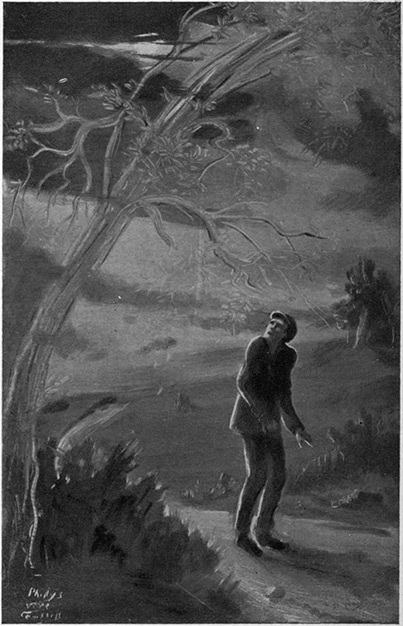
trudged on, and was soon ankle-deep in black mud. At
eight o’clock I was confronted by a long line of huge,
black trees, that bent their dripping tops as if they had
orders to salute me. Coming to a halt, and leaning
against a slender, isolated pine, that creaked and
groaned in the rough night air, I ruefully surveyed the
prospect in front of me. The track through the wood
was twelve miles—nothing of a walk if I had been fresh
and the weather dry, but in my present condition a
seemingly impossible one. For the last hour or so I had
experienced nothing but a recurrence of slips and falls,
I had done nothing but plunge in and out of abysses, and
I had been completely battered to pieces by the wind.
And the rain! I can stand any amount of heat, Mr.
O’Donnell, but wet, no, it gets into every pore of my skin
and completely demoralises me. I was exhausted,
almost at the end of my tether, and I felt a very little
more would see me on the ground, absolutely done.
Now, of course, I am used to sleeping out of doors all
night; but, then, Canada is not France, neither is it
Africa, and the warmth and dryness of the Sahara had
made me terribly susceptible to chills. A night in this
wood would mean for certain either pneumonia or
rheumatic fever—and I might never get home to see my
father. So what alternative was there? Only to tramp
back again over that dreadful track, and take the long
route over the plains. I couldn’t do it; I hadn’t the
strength. I would struggle on. I did so—I took the
plunge. The desert, with the lights twinkling far away on
its extremities, was speedily hidden from view; trees shut
me in on all sides; I was at last in the forest. I had never
known what it was to be nervous, but the silence I now
experienced disquieted me. I had never felt anything
like it. It struck me as an assumed silence—assumed
purposely to cloak a deep-rooted and universal resentment.
Moreover, I had an uncomfortable suspicion that
it was the prelude to something hostile—to some
peculiar antagonistic demonstration, the very nature of
which was at present enigmatical. It was a silence
savouring of a world other than ours—of a world I knew
nothing about—indeed, at that period of my life I was an
atheist, and neither believed in a God or a future existence.
The rain pattered heavily on the foliage overhead,
and the wind groaned, but the voices—the voices of the
beings in this Unknown World—were still, absolutely
still. In the gloom the trees assumed strange shapes;
their motions, too, were strange—so strange that I did
not think they could possibly have been caused by the
wind. You may think I am hyper-imaginative, Mr.
O’Donnell, but I do not think I am; my wife would tell
me if I were, for she has never been slow in pointing out
my faults, have you, Jacqueline?”
Mrs. Armand smiled. “No, Mr. O’Donnell,” she said,
“he has many faults, but exaggeration is not one of
them; indeed, he is so precise as to be sometimes dull.”
Mr. Armand continued: “I saw lights, too, Mr.
O’Donnell,” he said; “all kinds of coloured lights, which
I did not then attribute to possible spirit agency. I
simply did not know what they were. I was not afraid,
but I became wary, and moved furtively forward, as if I
had been scouting in some enemy’s country. Every now
and then I fancied I heard soft steps that I could associate
with nothing human, stealing surreptitiously behind me.
I paused and looked carefully over my shoulder, but there
was nothing visible—only the gloom. At length the
darkness became so intense that I could no longer see the
track. I continued to advance, however, and after
plunging through a succession of bogs and briars was
finally brought to a peremptory halt by a stone wall.
This wall was four feet or so in height, but what lay on
the other side of it, or where indeed it began or ended, it
was impossible to decide, and I was wondering what on
earth I had better do next—for my energy was nearly
spent—when a voice suddenly called out, ‘Keep along by
the wall and I will meet you at the wicket gate!’ Overjoyed,
I obeyed. The wall swerved sharply round, and a
few yards beyond, with one hand on the gate and in the
other a dark lantern, stood the slight, muffled-up figure of
a woman. In a few words I explained the situation—how
in the blinding rain and darkness of the forest I had
lost my way, and was too exhausted to go any further.
‘I don’t mind sleeping anywhere,’ I pleaded, ‘so long as
I can lie where it is dry and rest till morning. An attic,
barn, anything will do.’
“‘I think I can offer you something better than that,’
the woman responded, as she led me through the gate and
along a narrow winding path to a large, low, rakish-looking
house, whose black walls, rising suddenly out of
the ground before me, seemed startlingly familiar. My
guide halted—a key turned, a door flew open—there was
a rush of strange, musty air, and almost before I had
time to realise it, I was inside the building. ‘I must
apologise for the absence of light,’ the woman said, ‘but
under the circumstances the omission is unavoidable. If
we had been expecting you, it would, of course, have been
different. If you will follow me, I will take you to your
room.’ I tried to see her face, to make out what she was
like, but I was frustrated in my desire by the way in
which she held the lantern. Nor was I any more fortunate
in the discernment of my surroundings; I could
see the ground at my feet, but no more; all—everything—was
shrouded in an impenetrable, sable mantle. The
curious feeling that I had been there before, that I knew
the house well, again came over me, although prior to
now I had never seen any habitation in the wood, nor
even known that one existed. I argued it was probably a
scent—some peculiar odour in the atmosphere that had
conjured back memories of some other and quite distinct
place; but I had not much time for speculation, as the
woman’s movements were very quick, and I had barely
scraped the thickest of the mud from off my feet before
she had begun to ascend a luxuriously-carpetted staircase.
We crossed what I took to be a landing, and
stepped some score or so paces down a corridor, finally
halting before a half-open doorway.
“‘There is your room,’ she said. ‘You need have no
fear—the linen is well aired, and of course,’ she added,
slightly sniffing, ‘you may, if you like, open the windows.
We have been obliged to keep them closed, owing to the
damp. Good-night!’
“She turned to go, and just for the fraction of a
second I saw her face. It was exquisite. My wife will
pardon me for saying my wildest dreams of woman’s
beauty were not merely rivalled, they were surpassed. I
doubt even if so great a painter of feminine charms as
Richter could have done her credit. Who was she? I
kept asking myself that question long after she had left
me, and the echoes of her high-heeled shoes along the
passage and down the stairs had ceased. Who was she?
Ma foi! The vision of such loveliness would never leave
me. I would enjoy them over and over again in my
sleep. Indeed, I was so obsessed with her face that I paid
little or no heed to the novelty of the situation. At other
times I might have queried the desirability of being in a
strange bedroom in a strange house—in the dark. But
the knowledge she was near at hand was quite enough for
me. I was already in love with her—and the queerest, the
most perplexing of predicaments were as nothing to me.
I soared above—God alone knew how high above—dilemmas.
Still, when I came to argue it out with myself,
it was a bit of a nuisance my matches were sodden and I
could not use them. I would have preferred seeing the
bed upon which I was to lie, and a spot where I could lay
my clothes. I was so afraid of soiling the upholstery that
I undressed where I stood, and then, making a guess at
the direction of the bed, walked cautiously forward. By
a piece of luck, which struck me as somewhat extraordinary,
I collided with the bedstead—a large brass one—almost
immediately.
“It was the work of a second to throw back the sheets
and scramble in between them, and then, with my mind
full to overflowing with visions of my newly-found
goddess, I entrusted both her and my father to the safe
keeping of the Virgin and the Saints—this though I had
no faith in a future for myself—and sank into a deep
refreshing sleep.
“How long I remained in that condition I never knew.
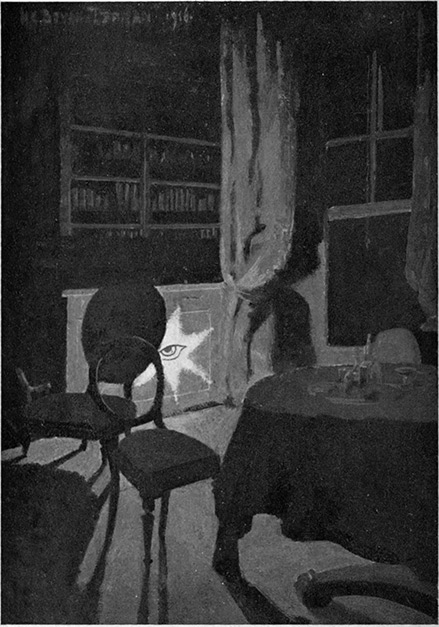
I woke with a start to find the room no longer dark, but
partially illuminated with a fitful red glow which proceeded
from the stove, now full of lurid logs. Thinking I
must be dreaming, I rubbed my eyes. But no; the fire
was still there, and even as I gazed at it I caught the
sound of approaching footsteps—the sharp rat-tat of
high-heeled shoes. Nearer and nearer they came, right
up to the entrance of my room, when, to my astonishment
and no little embarrassment, the door gently
opened, and in tip-toed the object of my admiration. In
one hand she carried a long-handled iron spoon, and in
the other a candle. I was entranced. Now that she had
taken off her hood and cloak, beauties hitherto concealed
stood out in dazzling fulness and bewitched me.
Never had I seen such a wealth of rich golden hair, such a
perfect nose and chin, such tiny ears, carmine lips, white
teeth, black-lashed, china-blue eyes, white tapering
fingers, rosy, almond-shaped nails, and such a heavenly
figure. My wife, Mr. O’Donnell, bears me no animosity.
You don’t, do you, Jacqueline?”
“No, no,” Mrs. Armand laughed. “I understand you.
All men are the same. Go on and tell Mr. O’Donnell
more about your goddess.”
“You are right,” Bertram Armand exclaimed. “She
was a goddess—at least my idea of one, then. What did
she want? I sat up in bed, and was about to speak to
her, when she laid a finger on her lips and smilingly bade
me be silent. She then glided to the grate, and taking
from her pocket a small lump of lead, carefully put it into
the spoon, which she balanced with the utmost care on
the brightest of the faggots. That done, she again
smiled meaningly at me, and walking to the dainty
dressing-table, strewn profusely with rings and bracelets,
looked long and critically at herself in the mirror. It
was while she was thus occupied that I suddenly became
conscious of something or someone close to me. In a
moment my heart ceased to beat; in deadly fear I
glanced round, and perceived, lying by my side, an old
man with long, grizzled hair and beard, whose features
were somehow vaguely familiar to me. He was sound
asleep—a fact betrayed by his breathing, which was loud
and stertorious. A slight movement from the other part
of the room attracting my attention, I looked up, just in
time to see the girl flash me a look of subtle warning.
“‘Don’t wake him, whatever you do,’ her eyes said;
‘he must sleep on.’
“‘Don’t wake him,’ I repeated to myself; ‘why, of
course I won’t. I wouldn’t do anything—no matter what—if
you told me not to; I would obey you even at the
risk of life and soul!’ Dieu en ciel! How lovely!
“Cautiously—first one daintily clad foot and then the
other—the girl approached the stove. She lifted the
spoon carefully from the fire, bore it steadily before her
to the bed, and gaily motioning to me to keep quiet, she
gently turned the sleeper’s head over on the pillow, and
with a dexterous movement of her clever, supple fingers,
poured the seething, hissing lead into his ear. There was
an agonising scream—the eyes of the old man opened
convulsively, and in the brief glimpse I caught of them, I
recognised my father.
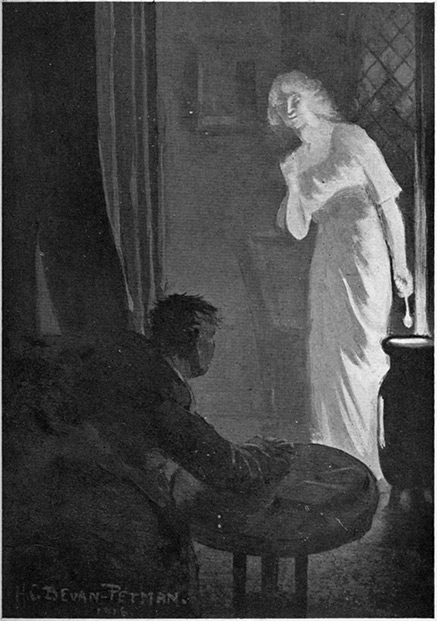
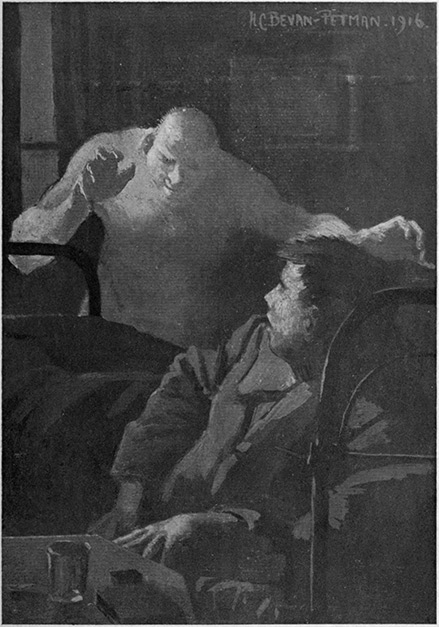
“I looked up, just in time to see the girl flash me a look
of subtle warning”
“Almost simultaneously came a loud crash, blinding
darkness, and I was once again in the forest—God knows
how—pursuing my way laboriously along the mud-laden
track.
“At early dawn I arrived within sight of Garvois—Garvois
bathed in a cold grey mist, and a little later I
dragged myself with difficulty towards the wicket gate
leading to my father’s house. To my intense surprise it
was padlocked, but the mystery explained itself at once—standing
upright in the garden was a notice-board, bearing
the inscription, ‘To be Let or Sold.’ I swayed on my
feet as I looked at it, and with a bursting heart reeled
away to the nearest house—the house of my old friend,
Henry Crozier.
“Henry had just awakened—he invariably got up at
five—and shuffling downstairs, he opened the door.
“‘Le diable!’ he exclaimed, ‘if it isn’t Bertram!
Ma foi! I was dreaming of you last night. So you’ve
come back!’
“‘Come back to find the place empty!’ I murmured.
‘But, tell me, my friend, where’s my father?’
“Henry’s eyes grew round with astonishment.
‘What!’ he said. ‘What! you don’t know?’ Then,
seeing my look of utter stupefaction, he added: ‘My
poor Bertram! Your father is dead! He died a fortnight
ago, the very day after his marriage with Mademoiselle
Marie Dernille, the niece of his last housekeeper.
What killed him? Apoplexy. It does not do to dispute
the doctor.’
“‘But the woman—the woman? What was she
like?’ I stuttered.
“‘Why,’ Harry enunciated slowly, ‘she was what
some people would call beautiful, though, as God is my
judge, I did not admire her. Fair, very fair, a mass of
washed-out yellow hair, painted lips—oh, yes, anyone
could see they were painted—and big, very big eyes—china-blue
and smiling—name of a name—eternally
smiling.’”
......
This was Bertram Armand’s account of his experience.
In answer to my questions he told me that he had
searched the wood thoroughly, but there was no house of
any sort in it, and afterwards, having had his father’s
body secretly exhumed, and finding lead in the ear, he
had obtained an order for the arrest of his step-mother.
She was, however, nowhere to be found, and he supposed
that, having got wind of the affair, she had escaped out
of the country.
Armand told his story with every appearance of
sincerity, and as I could see that his wife believed it, I
have no doubt at all that it was true.
......
The case of another haunting in Canada was told me on
my way out to the States, on board one of the White Star
Liners.
My place at table was next to a Doctor and Mrs.
Fanshawe, both Canadians, who, hearing that I was
interested in everything connected with the superphysical,
told me that they had had several rather
curious experiences. The doctor took from his breast-pocket
a small leather purse, and, opening it, showed me
a dull, blue stone.
“Are you a geologist?” he asked.
“No,” I replied. “I know nothing whatever about
stones. What is it?”
“No one has ever been able to tell me,” he said. “I
have shown it to several Professors at the English
Universities and they have each classified it differently.
Not one of them, I believe, had ever seen or even heard of
a stone like it. And for a very simple reason. In Canada
there is much soil that has never been disturbed, and
many tracts of land no white man has ever trod.
“But let me explain how the stone came into my
possession. Five years ago we took a house situated
about four or five miles from Montreal. It was a long,
low, two storey house, standing a little back from the
road, and connected with it by a semi-circular sweep of
gravel road. Opposite the house was a large pit, where
quarrying had recently been begun, but had been discontinued,
owing to the calcinous nature of the rock,
which rendered it of little use for building purposes.
Incessant rains had formed a deep pool in the bottom of
the pit, and the water possessed this idiosyncrasy—the
weather made no difference to its temperature—it was
icy cold in summer and winter alike.
“Viewed in the day-time, the quarry struck one as
ordinary enough. It was at dusk, when the shadows
from the trees and bushes swept across the road and
dimmed the mouth of the great pit, that it impressed one
as unsavoury. I remember marvelling at this metamorphosis
the first day of our arrival. It was July, and the
landscape was vividly aglow with brilliant, scintillating
sunbeams. A more radiant scene you could not imagine.
‘One might make a capital swimming bath of this,’ I
remarked to my wife, as we wandered to the edge of the
pit and peered down into the silent, sparkling water.
“‘Yes,’ she laughed. ‘Supposing we start right
away. I never appreciate a bath more than after a
journey.’
“That was in the morning. In the evening the place
produced a very different impression. We had dinner—the
sort of scratch meal one must expect when one is
‘moving in,’ and I had strolled out alone. I first of all
explored the premises. There was a big garden with an
orchard alongside, and a small field beyond; and I
pictured to myself how nice it would all look when
the grass was properly cut and the flower-beds
planted by my wife, who, by the way, thoroughly
understands landscape gardening. You do, don’t you,
Mabel?”
Mrs. Fanshawe nodded, and her husband resumed his
story.
“I lit another cigar and walked out into the road to
have a look at the quarry. I hardly recognised it. It
seemed, since the morning, to have undergone a complete
change. The banks appeared higher and more
precipitous, the water blacker and infinitely deeper, and
there was a cold dreariness about the place that made me
shiver. I thought I had never viewed anything so
utterly forlorn and murderous. On the opposite bank
were a few rank sedges and several white trunks of
decayed trees. I had not noticed them before, but now,
as I gazed down at the pool, I saw their re-modelled and
inverted images outlined with a clearness that more than
rivalled that of their material counterparts.
“I was pondering over this phenomenon, when I
suddenly felt I was being watched, and, raising my eyes,
I perceived on the bank facing me, just out of reach of
the water, a boulder of ebony-black and grotesquely-wrought
rock. I could not see anything behind it, but I
was convinced that something was there, something that
was crouching on its haunches and glaring savagely at
me. I also felt convinced that this thing, which I could
not actually see—though I knew for certain it was there—was
some strange hybrid of a man and animal; a
thing with limbs like ours, but the face of some fantastic,
mocking, malevolent beast.
“Filled with a great uneasiness and all manner of
vague fears, I hurried back to the house, where all was
bright and cheerful, but I could not rid my mind of the
impression it had taken from the pool, and that night
my dreams were troubled and alarming.
“I said nothing about it to my wife, but two days
later, when I was mending my fishing-rod in the study,
she came to me in a great state of agitation. ‘Why,
what’s the matter, Mabel?’ I asked anxiously; ‘you
look very white! Are you ill?’ ‘No,’ she said. ‘I’ve
only had a shock.’”
At the doctor’s request, Mrs. Fanshawe then took up
the thread.
“I was walking down one of the side-paths of the
garden,” she said, “looking for Ephraim (Ephraim was
our gardener), when I heard a great rustling of leaves. I
turned round and saw a violent agitation going on in the
branches of an apple-tree. Much mystified, as I could
see no cause for it, I approached nearer, and as I did so
I distinctly heard some heavy body drop to the earth
with a thud; I then felt something brush past me. I
can’t exactly describe the sensation it caused, because it
is beyond words. I can only say I felt I was being
touched by something immeasurably foul and antagonistic.
I reeled right back, and that moment someone
spoke. It was the gardener who came running towards
me to ask if he could go home, as his wife had suddenly
been taken ill.”
“That was all that happened, then?”
“No,” Mrs. Fanshawe replied. “That night, after we
had been in bed some time, we were awakened by hearing
our Newfoundland dog, Pat, bark. I went downstairs to
see what was the matter with him—he slept in the house—and
found him standing in the hall with his hair all
erect, looking at the window by the front door.
“I called to my husband, and he came down with his
revolver. We then both went to the window and looked
out, but could see no one. ‘I’m sure Pat sees something,’
I observed; ‘he is beside himself with terror.’ ‘What is
it, Pat?’ Dick said, and was about to stroke him, when
there came a violent hammering at the door. We looked
at one another in dismay. ‘Who’s there?’ Dick cried,
and, there being no reply, he fired—the bullet going
right through the door. We threw it open—there was no
one there. We then searched the garden (nothing would
persuade Pat to accompany us), but we found no one.
“For a week after this incident we were undisturbed;
then all sorts of noises were heard in the house—soft
footsteps, heavy breathing, the rattling of door handles,
and—most alarming of all—loud crashes on the door
panels. The servants were terrified. One of them
roused us one night by loud shrieks, and going to her
room, we found her in hysterics. All the clothes had been
stripped off her bed and thrown in a promiscuous heap on
the floor. When she recovered sufficiently to speak, she
told us something had come into her room and tried to
suffocate her—she felt just as if all the breath in her body
was being forcibly sucked out of her. She had seen
nothing. We told her it was a nightmare, and tried to
soothe her, but our endeavours met with little success,
and in the morning she was seriously ill. She died within
a fortnight, and on the same day as the gardener’s wife.”
“Did the gardener’s wife live on the premises, too?”
I asked.
“Practically,” Mrs. Fanshawe replied. “She and her
husband occupied a cottage close to.”
“Did both women usually have good health?”
“Rather,” Dr. Fanshawe laughed; “they were as
tough as horses—rosy-cheeked, strong-limbed, typical
young Canadians. Heart and lungs absolutely sound. I
diagnosed their cases and was much puzzled. On the
top of violent shocks, which had apparently upset their
whole constitution, they had developed acute anæmia.
Why do you ask?”
“Merely because of an idea,” I replied; “but pray let
Mrs. Fanshawe finish her story, and then, if you like, I
will tell you what my idea is.”
“Well,” Mrs. Fanshawe continued, “I haven’t much
more to relate. On the night after our maid’s funeral,
we were again disturbed by Pat barking. I got up and
went to the bedroom window. The weather was very
unsettled. Clouds scurried across the moon, that hung
like a great silver ball over the St. Lawrence River,
which I could see winding its mighty course in the
distance; spots of heavy rain were falling, and the wind
whistled dolefully through the leaves of the maples.
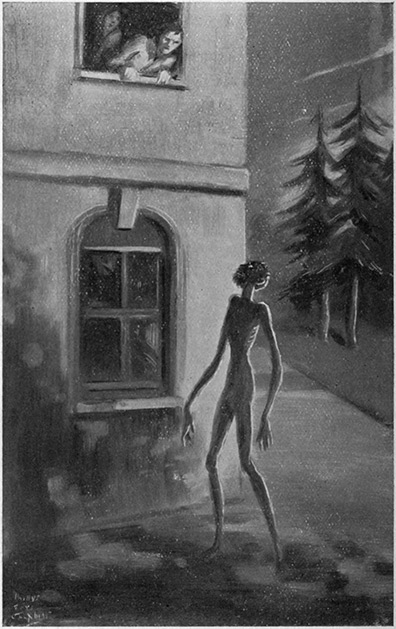
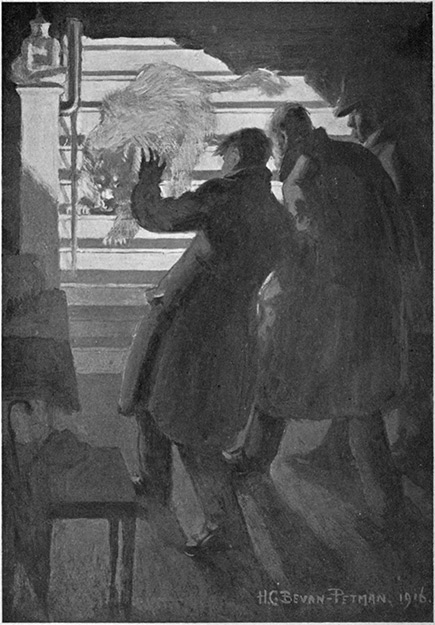
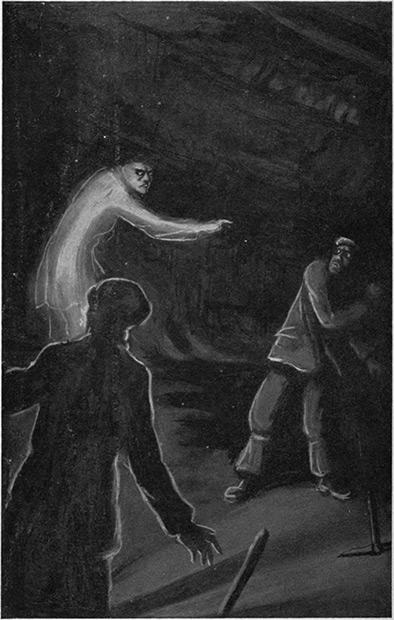
“The Thing came right up to the window, and then raised
its face”
“Suddenly I heard the sound of heavy footsteps
crunching their way along the gravel drive. ‘It will be
nothing visible,’ I said to myself, and then I got a pretty
acute shock. Coming towards the house with short,
quick steps was a tall figure, with its head bowed low.
Its arms and legs were very long and bony, the feet and
hands enormous. It was quite nude, and from all over
its body, which was of an exaggerated whiteness, there
emanated a strange, phosphorescent glow. I called to
Dick, and he at once joined me. The Thing came right up
to the window, and then raised its face. If I live to be a
thousand years old I shall never forget what I saw. The
proportion of the face was not human, and it was partially
covered with hair, but the eyes were the same
shape as ours, only very much bigger. They were pale,
almost white, I thought, and their expression——”
“Don’t talk of it,” Dr. Fanshawe interrupted. “One
can only say it was too damnable, too utterly vicious and
loathsome for words.”
“We were so overcome,” his wife went on, “that for
some seconds neither of us could articulate a syllable.
We both stared at it in hideous fascination. At last it
made some slight movement, and Dick, released from the
spell that held him, fired at it. The bullet must have
gone right through it, for we saw the gravel on the path
immediately behind it spurt up and scatter. However,
the figure was unharmed, and it moved on towards the
front door. Dick fired again, but with no better result.
A fearful horror now seized us, lest it should get into the
house. I am not a religious woman, but I prayed, and as
I did so I saw Dick throw something. What he threw
seemed to strike the thing full in the face, and it vanished.
As we got back into bed, I said to Dick, ‘That
was very odd! What did you throw?’”
“‘A stone I picked up near the quarry this morning,’
he replied. ‘I don’t know why I threw it, but directly
you started praying, a feeling came over me that I must.’
“We were not disturbed again that night, but slept
better than we had done for some time, and in the
morning Dick found and showed me the stone—the stone
you are looking at now. We had it fixed to the front
door, and after that we were not troubled again.”
“There was no history attached to the place,” Dr.
Fanshawe added, “and no one we spoke to had ever
heard of its being haunted. Now, what do you make
of it?”
“A fairly satisfactory case,” I replied, “because I
think this stone affords a clue to part of the mystery at
least. When I was out in the West, I was told by some
Indians of the Rogue River tribe, whom I was delighted
to fall in with, that when a place of theirs was haunted,
they kept the ghost quiet by burying a piece of blue rock,
which is to be found in the lava beds of that district, but
is very rare. Now in all probability this custom is not
confined to the Indians of one tribe, but is more or less
universal; therefore we need not be surprised to find a
piece of this blue rock buried elsewhere.”
“But there are no Indians in this neighbourhood,”
Mrs. Fanshawe remarked.
“Not now,” I said, “but undoubtedly there were
once. My supposition is that this place has a history. It
was once badly haunted by spirits of the most dangerous
type, which, for want of a better name, I will style
neutrarians.
“These neutrarians are spirits that have never inhabited
material bodies, and are only to be found in very
remote and isolated districts, where the soil has rarely if
ever been disturbed. They are invariably antagonistic
to all forms of animal life, probably, because, if they were
created first, which is quite feasible, they regard man as
an interloper, and, probably, also because they covet
man’s body and are jealous of him. Many of the Indians
believe that man is descended from the gods, and neutrarians
from devils, and that the latter feel the distinction
and hate man accordingly. Neutrarians vary
considerably both in appearance, habits and constitution.
Whilst some can apparently reveal themselves at will,
others can only do so by stealing vitality from human
beings or animals. Let us now see how all of this applies
to the present case. When you came to your house you
did not get the impression it was haunted; it was only
when you looked at the quarry—it was there you received
your first impressions—and they were, in all probability,
correct. I believe a great deal in first impressions, particularly
with regard to the superphysical. This theory,
too, namely, that the hauntings originated in the quarry,
finds support in the fact that you found the blue stone
close to the quarry, and that the figure you both saw
coming along the carriage drive was coming from that
direction. The blue stone, I believe, had been buried
there and was dug up when the quarry was made; thus
the stopper, so to speak, which kept the ghost in check
being removed, the hauntings of course recommenced.
Belonging to the species that cannot manifest itself without
drawing vitality from some form or other of animal
life, this neutrarian first attacked the gardener’s wife, and
then the maid, selecting these two on account of their
unusual robustness. Had you not thrown the blue stone
at it, and afterwards fixed the stone to your door, it is
more than likely that you would both have succumbed.”
“Then many diseases that have defied diagnosis, and
there are countless such,” Dr. Fanshawe exclaimed,
“may very probably be due to neutrarians.”
“I think it is very likely,” I said. “I have noticed,
for example, houses, where several people have been
medically stated to have died of cancer, have been
haunted by disturbances of a parallel nature to those you
experienced.”
“But are such hauntings to go on for ever?” Mrs.
Fanshawe asked. “Is there no means of putting an end
to them, saving by blue stones? How about exorcism?”
“I am not sure on that point,” I said. “I certainly do
not think that neutrarians or the spirits of imbeciles can
be exorcised satisfactorily, as I have known several cases
of hauntings by these spirits in which exorcism has been
practised, and in no instance has it had any effect whatsoever.
I should say hauntings by neutrarians might
last indefinitely; I see no reason why they should not.
Have you made any enquiries lately about the house?”
“No,” Mrs. Fanshawe replied, “not for some time.
When we get back to Montreal, we will do so, and let you
know.” The conversation ended here.
A year later I received a letter from her husband.
“I have been to the house,” he wrote, “and the present
occupants are leaving almost immediately. There have
been three deaths there during their tenancy, and they
complain of exactly the same disturbances that alarmed
us. I have lent them the blue stone.”