$1,000,000 Secured by These Get-Rich-Quick Schemers
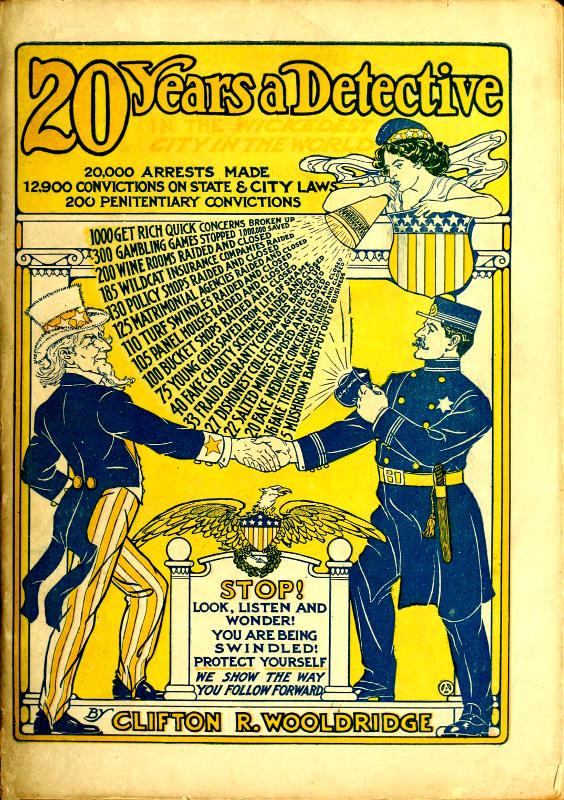
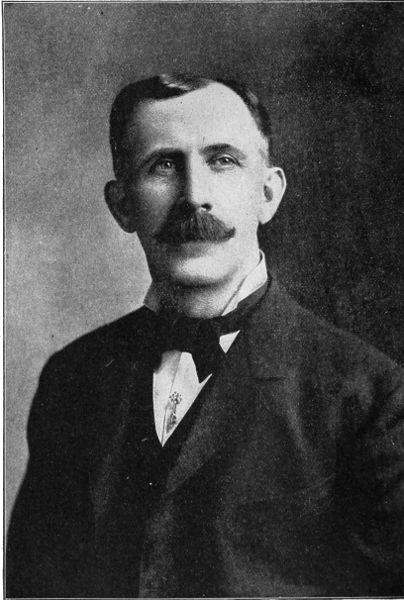
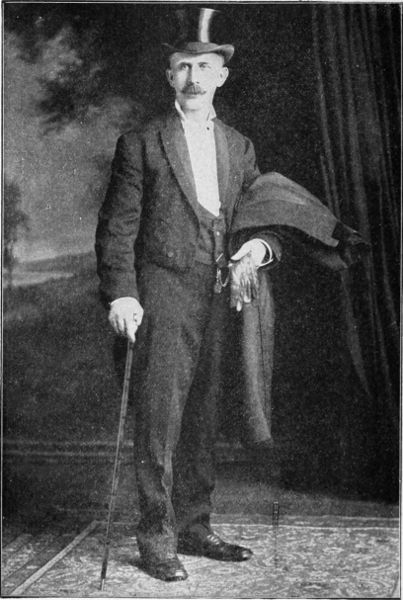
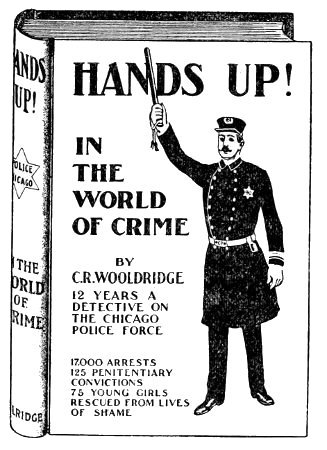
Discovered by Detective Clifton R. Wooldridge,
Chicago's Famous Police Detective.
- 125 matrimonial agencies in Chicago raided and closed
in the last five years.
- 4,500,000 matrimonial letters seized and destroyed.
- 1,500,000 matrimonial agencies' stock letters seized and
destroyed.
- 1,400,000 matrimonial stock photographs seized and destroyed.
- 500,000 photographs sent to the matrimonial agencies by men and
women who were seeking their affinities seized and destroyed.
- 40 wagon loads of matrimonial literature seized and destroyed.
One of the most insidious forms of crime is the Matrimonial
Agency. Seemingly harmless, or at most merely foolish, is
the Matrimonial Agency at its inception.
But step by step within the past few years we have seen
the Matrimonial Agency turned into a volcano belching forth
fraud, swindling, bigamy, desertion, and finally ghastly wholesale
murder.
We have seen the Matrimonial Agency sweep the whole range
of the world of crime from the petty thieving of a Carson to
the almost unbelievable horrors of the Gunness Farm.
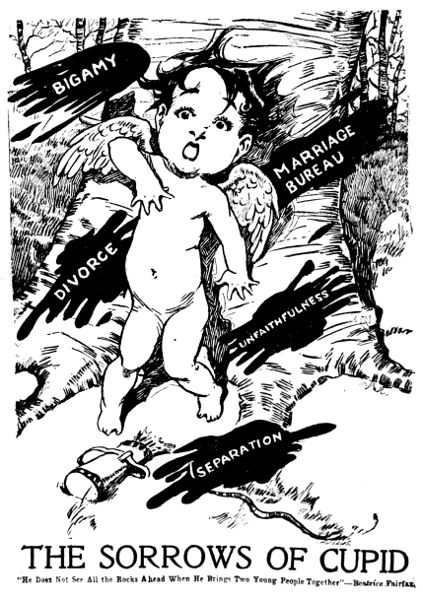
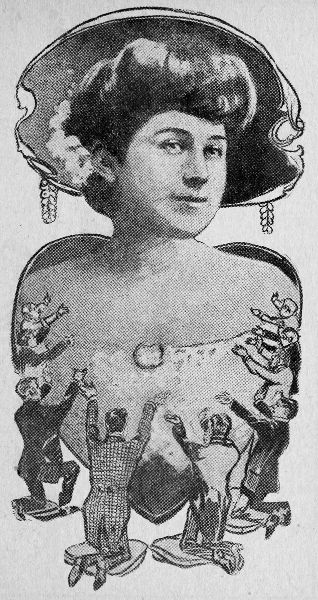
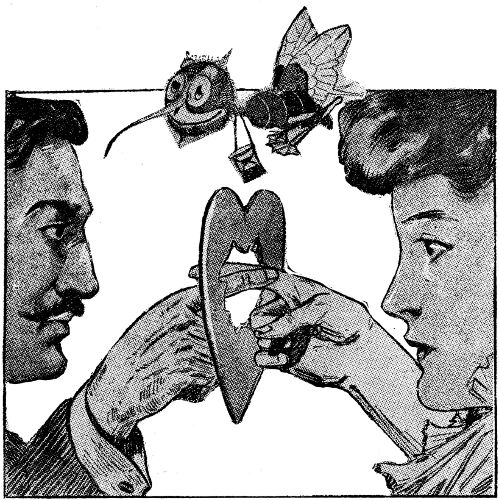
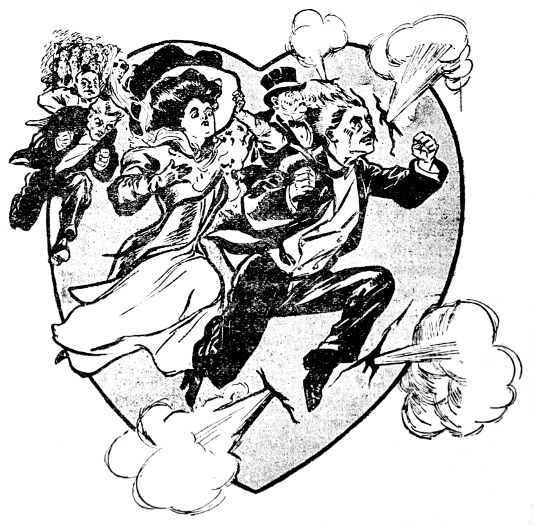
THE SORROWS OF CUPID
"He Does Not See All the Rocks Ahead When He Brings Two Young People Together"—Beatrice Fairfax.
And this monster is hydra-headed. Stamp it out in one
place and it immediately reappears in another. Send a "manager"
to prison once, twice, ten times, and the minute the
prison doors are open he is back at the old stand doing business.
Something of the tremendous efforts being put forth to
stamp out this evil may be gained from the headlines of this
story, where the strenuous work of Detective Wooldridge of
Chicago is summarized.
Chicago has been and is today infested by a formidable community
of matrimonial agencies who invade all ranks of life.
They promote many specious schemes to lure the elusive dollar
from the pockets of unwary victims. These operatives are
sharp, smooth and unscrupulous—the most dangerous of
criminal perverts.
Were the census enumerators of the United States to compile
a list of the "sucker" public the gullible ones would aggregate
tens of millions. There is not a township in this great nation
that does not contain its portion of confiding persons who are
ready to believe anything, from the rankest catch-penny advertisement
to a fallacy in theological dogma.
They are willing to open up their hearts to unknown matrimonially
inclined correspondents; to accept as gospel the incredible
statements of impostors and to pay out money gained
by hard toil for something which the reason of a child should
tell them it is beyond the power of man to provide.
They are easy prey alike to religious and political impostors
and unscrupulous adventurers. Investigations for years past
into the innermost secrets of swindlers, and the observations
incidental to official experience disclosing how victims are
drawn into the net of the grafter, impel the belief that the
faith of many persons passes beyond the bounds of credulity
into the domain of imbecility.
Men and women who are engaged in promoting matrimonial
agencies are guilty of crime. It is opposed to the fundamental
principles of society. Such a practice should under no circumstances
be tolerated. It is inconsistent with the highest ideals
of what should constitute the proper marriage relations.
Human derelicts of a low mental caliber are the dupes of
these matrimonial agencies. Few people know that such
schemes as these are carried out. Few know that advertisements
by men of wealth, women of culture and pretty widows
who seek matrimonial alliances are merely means by which
scoundrels get a revenue.
To describe adequately the technicalities of the marriage
agencies and bureau swindlers' methods would be impossible
without presenting actual copies of documents necessary to the
system. Early in the investigations the discovery was made
that the scores of matrimonial agencies, "introduction bureaux"
and "marriage clubs" were using practically the same
literature. Few departed from the stereotyped plan for "pulling
the suckers on." For the most part the prospectuses and
"follow-up" letters were identical.
As often happened, however, when a victim was "landed
right" and ventured to Chicago from his distant rural retreat
prepared to carry out in earnest the game that had been worked
upon him in a spirit of mercenary recklessness, the methods of
handling him were varied in respect to both finesse and effectiveness.
Any person familiar with the uses of the typewriter easily
could have discovered that the "personal" letters received from
time to time were nothing more than circulars printed by the
thousands. So vast was the number of the gullible that seldom,
if ever, was an actual, bona fide letter sent in reply to those
from the victims.
Space was left at the top of the stock letters for the insertion
of the name of the person to whom it was sent. In their haste
the swindlers often begrudged the time necessary to change the
"Dear Sir" to "Dear Miss" or "Dear Madam" when a woman
was addressed on stationery intended for male clients.
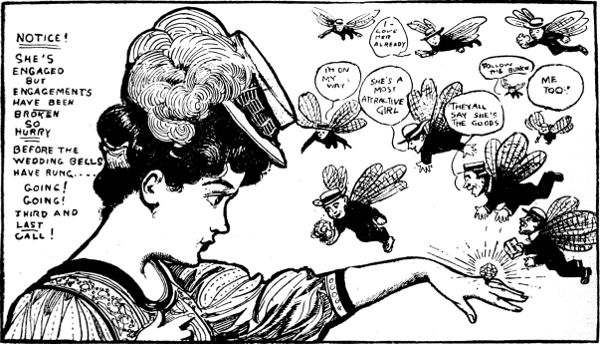
Notice! She's engaged but
engagements have been broken so hurry before the wedding bells have
rung.... Going! Going! Third and Last Call!
The general uniformity of the literature was at first thought
by me to indicate that the matrimonial agencies were banded
together in a gigantic trust. But later I learned that as they
increased in number the newcomers exhibited conscienceless
audacity in copying the forms used by their predecessors. It
was also found in some cases several matrimonial agencies
were operated from one address and one or two men, or a man
and his wife would represent half a dozen concerns by changing
names and locations every thirty or sixty days. Because
of these facts and the added fact that whoever compiled the
original forms from which the others copied, realized, he was in
an illegitimate business, the plagiarists were never prosecuted.
Thus the buncombe administered to the suckers became uniform
in phraseology.
If a person desired to make assurance doubly sure for gaining
wealth and marital bliss and he applied to several agencies
at the same time, the same mail would bring him letters from
each matrimonial agency with which he communicated, worded
identically. They would be mimeograph copies, and the only
difference in their appearance would be in the printed heading
indicating the name of the agency. The name of the recipient
would often be written at the top in ink different in color from
the body of the letter.
The usual beginning is a small subscription fee paid for a
"matrimonial" paper. This paper contains alleged descriptions
of men and women, principally the latter, who are claimed
by the publisher to be seeking wives or husbands through the
matrimonial agency. The subscriber who becomes interested
in any of the descriptions is made to pay a fee for more detailed
information and alleged record of the financial circumstances
of the person. There is sometimes an additional fee
for a photograph. This picture may or may not be one of
the person described, but that matters little. Almost any old
photograph will serve the purpose. In all the raids made on
matrimonial agencies collections of photographs have been
found.
That tens of thousands of otherwise intelligent men and
women should either entrust pictures of themselves to an
agency by which it is to be sent out to unknown persons, or
should even begin such negotiations as those carried on through
the matrimonial agency, is incomprehensible.
The money derived in the aggregate from subscriptions to
the matrimonial paper, the fees for particulars and those for
photographs and miscellaneous "services" amount to large
sums. With many of the agencies the services stop at this point,
but many others undertake personal introductions of lonesome
maids and widows to the invariably "honest and affectionate"
bachelors and widowers, and when this is done there are other
fees, depending altogether on how much the victims appear
to be willing to stand.
A large number have been found and suppressed in which
there was but one lonesome maid or widow and one honest
and affectionate bachelor or widower, the former being the
woman accomplice of the manager of the agency and the latter
the manager himself. They answer love-lorn correspondents
of both sexes and select for victims those believed to have the
most money. If the assistant to the manager is posing as the
possible bride in the case the wife hunter must make satisfactory
settlements with the manager for conducting the negotiations,
and this amount, with that which the accomplice is
able to secure from the victim, amounts often to a considerable
sum. After the victim is separated from his money something
happens to prevent the happy conclusion of the marriage
negotiations.
There are two well-defined forms of the "matrimonial agent."
The one is the man who openly runs an agency, who advertises
"golden-haired young ladies, worth half a million dollars,"
"blue-eyed widows of languishing temperaments" and "wealthy
farmers." It is through this class of "bureau" that the great
crimes of the matrimonial business have been engineered. Hoch,
Mrs. Gunness, Holmes and other arch-criminals made good
use of this type.
The other type is just the plain swindler. The man who
works along the secondary lines, as they may be called, would
scorn to be a matrimonial agent. He is either a reverend gentleman
of the cloth, a minister to whom some languishing
widow is looking for spiritual direction, and he thinks that she
"needs she should get married," to quote the East Side phraseology;
or he is a lawyer who has a wealthy client, who, not
being a business woman, is incapable of running her own affairs,
and he again thinks of marriage as a solution; or, again,
he is "an employment agency." This secondary type is generally
a cheap sort, grafting on the gullible for five or ten dollars,
or even as high as $100.
September 8, 1905, John H. Harris, 168 Hamlin avenue,
editor and publisher of The Pilot, a marriage agency paper,
and manager of a cheap mail order house, was raided and arrested
by Detective Wooldridge.
Among the letters seized were complaints from his patrons.
They received no returns for money paid him, and averred his
paper was being used to blackmail men and women. Complaints
were also made that many of the names which appeared
in the paper were not authorized, and other names
attached to the order were forgeries.
The following is the copy of a letter dated September 1,
1906, and is only one among hundreds of others sent out by
the thousands by Harris. Many more thousands were sent
through the mail to his sub-agents, who worked on a commission.
This agent employed other agents, who started an endless
chain by copying the letter and having the friends do
likewise.
Chicago. Ill., Sept. 1, 1905.
Dear Sir:
We have a very recent application from a brown-eyed widow
of 41, medium size, musical, has no children. She informs us
that she has recently come into possession of a fortune of
over FIVE HUNDRED THOUSAND DOLLARS, and that
she wishes to marry an honest, affectionate gentleman. We
also have a recent application from a pretty, blue-eyed lady of
20, who estimates her present means at FORTY THOUSAND
DOLLARS, and her inheritance at twenty thousand dollars.
Her form is graceful, her education good, her disposition gentle
and she desires a steady, honest husband. We believe she
would start her husband in business. And to accommodate
those ladies and quickly find a husband for them we make the
following SPECIAL OFFER:
Fill out the coupon at the bottom, and send it to us with
one dollar (and six postage stamps) and enclose a sealed and
stamped letter to either or both of the ladies referred to above.
We will immediately mail your letter to the lady or ladies,
and place your name on our books, and send you a certificate
of membership for six months, and send you the full names
and addresses of the handsome widow of means, and the handsome
blue-eyed maiden of means, and also send you a list
of names and addresses of other ladies of means and otherwise.
And until you are married, or until the end of six
months, we will, on or about the first of each month, mail you
a list of descriptions, names and addresses of ladies of means
and otherwise, without application from you or any expense
to you. We have good reason to believe that either of the
ladies mentioned above would make you a good wife, but if
they do not meet your approval you can select one who will
from the stream of ladies of means and otherwise who are constantly
requesting us to secure husbands for them, which enables
us to introduce you to those whom you would be pleased
to meet with a view to marriage.
Faithfully yours,
John H. Harris.
Pub. of The Pilot.
John H. Harris,
Chicago, Ill.
Dear Sir:
I herewith enclose $1.12 as full payment on the above offer.
Name ———— Postoffice ————
Street, or Box No ———— State ————
United States Inspector of Mails at Chicago Postoffice R.
W. McAfee compelled John H. Harris to furnish him with
the names and addresses of the two women heiresses who were
worth $40,000 and $500,000, respectively, who were just dying
for the want of a good, kind husband to spend their money
for them, and were seeking marriage through his paper and
matrimonial agency.
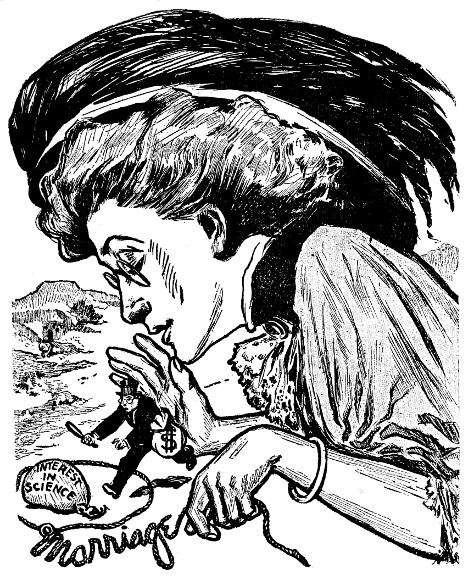
(Interest in Science; Marriage)
Harris gave the name of Mrs. H. R. Adams, at Huntington,
Md., as the $40,000 woman and Jennie Ziehler, Lawrence,
Mass., as the $500,000 woman. Upon investigation
it was found that neither of the women was worth a dollar.
The $500,000 woman was in the insane asylum.
This letter, together with The Pilot, marriage paper and its
printed advertisements, was plainly intended to draw the unwary
and deprive the ignorant of their savings.
John H. Harris then appealed to ex-Mayor Edward F.
Dunne of Chicago, under the alias of A. Ingird, taxpayer,
citizen and reputable business man, to have Detective Wooldridge
stopped from further interfering with him or his business.
Men who operate these frauds pretend to be honest and
high-minded; by constant practice of their wiles upon others
they develop self-deception and come to believe in their own
honesty to such an extent that when questioned they assume a
good counterfeit of honest indignation.
Mayor Dunne upon investigation learned the large mass of
evidence gathered, and ordered the investigation to go forward,
which, resulted in the arrest and holding over of John H.
Harris to the Grand Jury.
These complaints and evidence were turned over to Colonel
James Stuart, Chief Inspector of the Mails at the Chicago
Postoffice, for further investigation. A fraud order was requested.
On August 18, 1907, Mr. Harris committed suicide
by blowing out his brains at 168 N. Hamlin avenue, Chicago,
Illinois, after the mask had been pulled off and his methods
exposed.
One is unable to state whether John H. Harris is opening
a mail order house, paper and marriage agency in the other
world. When he left he did not leave word where he would
make his next stop, but if he went to the other world, we are
not informed that wireless telegraph or balloon companies have
as yet perfected the lines of transportation or communication.
Harris is a fairly representative and concrete expression of
the regulation matrimonial agent. It was through such
agencies as his that the great crimes eventually were pulled off.
But in the following letters we have an excellent example of
the second type, the little grafter who wants anything you can
give, from $5 to $100. From the text of the letters it will
be observed that this man was operating as a minister, a lawyer
and an employment agency at one and the same time, as the
letters are all from one source.
In the case of the lawyer this scoundrel was trading upon
the name of Edward H. Morris, one of the foremost colored
attorneys of the United States, a man universally respected
and admired by men in all walks of life. When the fact of
this trading on his name was brought to the real attorney's
attention he was furious, and he cheerfully gave all the assistance
in his power to Detective Wooldridge.
This smooth one was afterward arrested in New Orleans,
convicted and sent to prison for a term.
Here follows the text of the letters:
Rev. Joseph Spencer,
80 Madison Street.
Manager of American Book Concern.
Dealer in Religious Books.
Chicago, Ill., July 26, 1905.
Mr. O. W. Zink,
Marshall, Mo.
Dear Sir:
For many years I have been a MINISTER of the GOSPEL
and during that time I have not only performed hundreds of
marriages, but have arranged many, and there are at the
present time among my acquaintances some half dozen wealthy
ladies, ranging in age from twenty to forty or fifty years, one
of whom is the handsome widow whose photo I enclose herewith.
She is worth, in actual cash and negotiable securities, fully
$50,000, inherited from her worthy husband, who departed
this life a year ago and, as she is without friends, relatives
or children, her physician, a friend of mine, has on account
of her utter loneliness advised her to marry, believing that
marriage and change of scene will prove for her a blessing in
disguise, and naturally she has turned to me, her spiritual
adviser, in whom she has the utmost confidence. I have several
times talked the matter over with her, and, knowing that
she is very much averse to advertising, I have undertaken to
introduce to her some gentleman who would make her a good
husband, and to arrange a marriage for her.
As her physician thinks it advisable for her to reside elsewhere
than Chicago, I have been somewhat perplexed as to
how to secure for her a suitable introduction and in my
dilemma consulted a matrimonial agency and, after several
conferences with them, I have decided to submit for your kind
consideration my proposition and manner of procedure. I
have studied the matter carefully, have gone thoroughly into
your description and instructions as filed with the agency of
which you are a member, and in my mind there is not the
slightest doubt as to you two proving mutually suitable to
each other. Of course, you cannot form the proper idea of her
from the small photo enclosed, but in age, appearance, circumstances,
etc., she is just what you have been seeking in a wife.
She is in every respect a thoroughly good woman, unusually
bright and intelligent, but knows nothing of business, and
is in absolute need of a husband to look after her affairs,
but, TO BE CANDID WITH YOU, I am getting along in
years, and have a large family to support and as I only arrange
a few marriages at intervals, I must necessarily have
compensation adequate to the service I render.
Now, I can, by recommending you personally, cause her to
enter into a correspondence with you that will undoubtedly
lead to your marriage, if you are still desirous of such a
marriage, as I presume you are, from the fact that you are
registered with a matrimonial agency. I will, for the consideration
of $100, introduce you to her by letter and after
you have exchanged three or four letters, will have you visit
her at her expense, as you may mutually agree, if you will
follow my simple instructions.
I am not making you this proposition on the spur of the
moment, for I have spent much time and thought before deciding
to write you, and all I ask is that, AS AN EVIDENCE
OF YOUR GOOD FAITH and to cover the immediate expense
necessary thereto on my part (such as asking her to
dinner with me a few times in order that I may during the
good cheer that abounds at such times dwell at length upon
the matter without any unnecessary delay), that you enclose
me immediately upon receipt of this letter BANK DRAFT,
REGISTERED LETTER, or EXPRESS MONEY ORDER,
for $10; the balance, $90, you need not pay me until after
you have married her and assumed the management of her
affairs. Upon receipt of this small amount, $10, I will absolutely
guarantee your marriage to her within sixty days and,
if before that time you should feel that you do not care to
pursue the matter to a conclusion, I will positively refund
your money upon my honor as a MINISTER OF THE
GOSPEL.
My standing in my profession is such that I could not do
otherwise and, as I have stated before, there are several ladies
to whom I could introduce you, now that I have really taken
the matter up with you, but I consider you two really suited
to each other, so will not go into further particulars. Trusting
to hear from you AT THE VERY EARLIEST POSSIBLE
MOMENT, I am, with assurance of my regards,
Very respectfully,
Cedar Rapids, Iowa,
July 15, 1905.
Rev. Joseph Spencer,
80 Madison Street,
Chicago, Ill.
Dear Sir:
You asked me in your letter to give you a description of
the man that I would like to become acquainted with. I wish
him to be as tall as I am, to have dark hair and a very good
disposition. I would like him to be rich. His age to be
about 45 years, also have a good education. I want him to
be a temperate man, and to have a nice appearance, one who
is lovely at home, and does not care for society and likes music.
I do not care what his occupation is if he is honest.
Hoping to hear from you soon, I remain
Yours truly,
Miss Vernie Adams.
Oshkosh, Wis., July 20, 1905.
Rev. Joseph Spencer,
Chicago, Illinois.
Dear Sir:
You asked me in your letter to give you a description of
myself, which I take pleasure in doing: I am a young man
26 years of age, 5 feet 6 inches tall, weigh 140 pounds; blue
eyes, red hair; I am strictly temperate, do not gamble; kind
disposition, a farm hand; have no means; income $15 per
month.
I would be delighted to make the acquaintance of several
of your prospective rich women who are seeking a husband.
Send me a list of those who are worth from $50,000 to $75,000,
also their photographs, whereby I can make a selection, and I
will send you your fee of $5. I remain,
Sincerely yours,
Thomas Flinn.
Edward Morris,
Attorney-at-Law.
82 Madison Street.
Trusts and Estates a Specialty.
Chicago, Ill., Jan. 4, 1905.
Mr. Geo. Ferlin,
Los Angeles, Cal.
Dear Sir:
I have during my professional career arranged many marriages
for ladies of means, and at the present time have
among my clients some ten or twelve wealthy ladies, ranging
in age from twenty-five to fifty years, desirous of marriage,
one of whom is the charming widow whose likeness I herewith
enclose.
She is worth $60,000 ($25,000 in ready cash, the balance in
high-class tangible property inherited from her mother, recently
deceased). She is alone and childless and her physician, on
account of her bereavement, has recommended a marriage and
change of scene, and in her dilemma she has consulted me, her
legal adviser, and I, in turn, without her knowledge, appealed
to a matrimonial agency with which I have for several years
had business relations in a professional way.
Out of the several names submitted to me I have, after
much thought and deliberation, selected yours, and I beg that
you will consider carefully my proposition and the fact that
I am not in business for my health, but for revenue, together
with a desire to please my clients and to give them
value received.
This lady, while unusually bright and intelligent, knows
little of the ways of the world, and nothing of business, and,
to be candid with you, needs a husband to manage her estates,
and I can, by recommending you personally, cause her, through
me as her attorney, to open negotiations with you for a marriage;
so if you desire a wealthy wife, as I presume you do
from the fact that you are registered with a matrimonial
agency, I will, for the consideration of $100 introduce you
to her, have you visit her at her expense, as you may mutually
agree, and will absolutely guarantee your marriage to her
within sixty days, if you will follow my instructions to the
letter.
All that I ask is, as an evidence of your good faith and to
cover the immediate clerical expenses necessary thereto, you
enclose me immediately upon receipt of this letter, BANK
DRAFT OR MONEY ORDER for $10, the balance ($90)
to be paid after marriage, and when I have caused her to
place in your hands, or under your control, a goodly portion
of her worldly possessions.
Now, if you wish to accept my proposition, enclose me immediately
the small retaining fee ($10) and promise me that
you will follow carefully my instructions; otherwise do not
write me, as I positively will not enter into further correspondence
until you have engaged me as your attorney upon
the lines I have laid down.
If before the end of sixty days you feel that you do not
care to pursue the matter to a conclusion I will refund your
money. My standing as an attorney is ample evidence that
I will faithfully carry out my contract. Remember that I
have among my clients, as I have stated before, ten or twelve
wealthy ladies to my certain knowledge desirous of marriage.
Awaiting your immediate reply, I am
Sincerely and professionally yours,
Edward Morris.
Edward Morris, Attorney-at-Law.
Chicago. Ill., Jan. 11, 1905.
Mr. Geo. Ferlin.
Los Angeles, Cal.
Dear Sir:
Your letter in reply to mine received, and I will say, that
as a leading attorney, and a prominent member of the bar,
I could not act for you until you have first retained me as
your attorney in this matter, and sent me the small retaining
fee of $10, as requested.
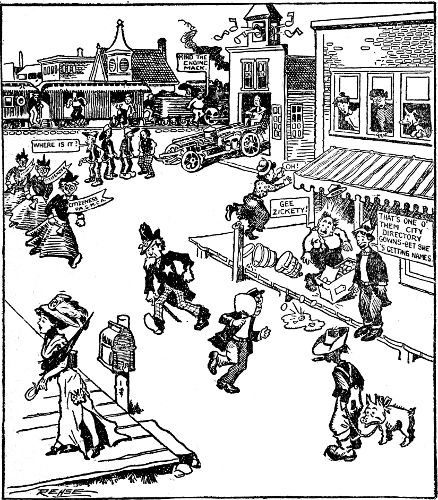
OH! OH!! OH!!!
AWFUL CONSTERNATION AT PIKES CROSSING! DIRECTORY GOWN IN TOWN. BY JIMMINEDDY!!
Now, my dear sir, if you really mean business and really
want to marry the charming and wealthy young widow in question,
I see no earthly reason why you should hesitate for a
single instant to retain my services in connection with this matter.
You may give me good references, and I can give you the
same, but that has no bearing on the case whatever. I cannot,
as stated, do any business with you until you first enclose me
this small retaining fee, as I must be in a position to truthfully
state that you are my friend and client.
You may have had unfortunate dealings with matrimonial
agencies, but as an attorney in high standing, I am not to be
compared with such concerns, and on receipt of your small
retaining fee, I will guarantee to do my part and arrange a
speedy marriage if you adhere strictly to my instructions.
Trusting to hear favorably from you at once, I am,
Yours very truly,
Edward Morris.
P. S. I do not ask for the balance of the $100 until after
your marriage, and I have caused the lady to place in your
hands or under your control a goodly portion of her worldly
possessions.
Edward Morris, Attorney-at-Law.
Chicago, Ill., Jan. 23, 1905.
Mr. Geo. Ferlin,
Los Angeles, Cal.
Dear Sir:
Your favor at hand with enclosure accepting my proposition.
Now, I wish to assure you that everything you write to
me will be treated in the strictest confidence, and I will say
that it will be necessary for you to follow to the letter the instructions
which I will from time to time give you.
In order to break the ice, I would suggest that you address
a letter to Mrs. Lucy Kline, in my care, briefly setting forth
the fact that you are a friend and client of mine, and that as
you are matrimonially inclined. I have advised you to open a
correspondence with her. You can say to her that I have favored
you with her photograph, and that same meets your approval,
and that you would very much desire her acquaintance
and what it may lead to. I have already taken up the matter
with her, and she is expecting a letter from you, and in reply
will send you her private address.
I would advise you, after receiving her reply, not to write
too often or too long letters. In other words, do not appear to
be too anxious, for it must devolve upon me to bring you two
together. The correspondence you may have with her is simply
a preliminary introduction leading to the establishment of congenial
relations and eventually, marriage.
Important business prevents my writing a longer letter to
you today, and in order that I may be prepared to take the
matter up, I suggest that you write your letter so that it will
reach my office in about one week from today.
Yours truly,
Edward Morris.
Positions for Men and Women. Commercial, Technical,
Educational, Professional. Those Hardest to Find and
Hardest to Fill.
G. H. Cannon, Manager,
Ohio Block.
Chicago, Ill., Sept. 21, 1905.
Mrs. A. A. Burrows,
San Fran. Cal.
Dear Madam:
I am directed by a client for whom we transact much business,
to submit you a proposition, which both he and I sincerely
hope you will accept. He is a bachelor of middle age, of
fine appearance, and is the owner of a large manufacturing
plant, as well as of a magnificent residence, in which he lived
until recently with his aged mother, who, greatly to his regret,
departed this life some six months ago. Since her death
he has felt the need of a woman's guiding hand in the management
of his household affairs, and it is to offer you a position
as his housekeeper that I am addressing you personally.
I beg to state that attached to the position is a salary of $75
per month, your board, and an allowance of $25 per month for
your clothing, and you will have full charge of his household
expenses, including the employment and discharge of servants,
consisting of a butler, two housemaids, driver, cook, etc.
If you accept the position his carriage will be at your disposal
at all times, and you will be the actual head of his household,
with no restrains of any kind upon you. As I have
stated, this client is a bachelor, and on account of his mother's
determined opposition to his marriage during her lifetime, he
has gone little in society, but since her death he has never
ceased to feel the need of a woman's hand and presence in his
home.
His first thought was marriage, but after a lengthy talk
with me he very cheerfully acquiesced in the suggestion that
has led to the writing of this letter, and now to the point.
I suggested that he allow me to secure for him a housekeeper
who might possess the qualities he most desires in a
wife, and then I consulted a matrimonial agency with that end
in view. Your description seemed to fit so exactly his idea of
true womanhood and appealed to him so strongly that his first
impulse was to address you directly, but being of a sensitive
and retiring disposition, he came to the conclusion that he
should become thoroughly acquainted with you, and could not
do better than allow me to carry out my original plan to make
your acquaintance.
To be candid with you, this position is a very lucrative one,
and will undoubtedly lead to your marriage with this gentleman,
if you see fit to accept the proposition, and for that reason
I trust you will give it the consideration it deserves.
As he secures the help necessary to the running of his large
factory through this firm, of which I happen to be the manager,
you cannot but understand that I am thoroughly acquainted
with him, and am in a position to arrange this matter to your
mutual satisfaction.
It is a custom to charge a fee of $5, but in this instance we
would make no charge at all, only our client, insists that we require
our usual fee simply as an evidence of good faith, and
that there may be no misunderstanding. If you accept the
proposition I have submitted kindly fill out the enclosed form
and return to us with EXPRESS MONEY ORDER or BANK
DRAFT for $5, which amount will be returned to you as soon
as you have taken charge of his household affairs, as your good
faith will have then been proved.
As soon as you can start for Chicago I will send you expense,
free railroad transportation, and if, after your arrival here,
you do not care to accept the position, a return ticket, etc.,
will be furnished you so that you will not be out one dollar of
expense.
This offer is made to you in the strictest confidence, and I
sincerely trust you will so regard it, and not discuss it with
any one, at least not until all the details have been arranged.
No matrimonial agency in the world can do this for you, nor
do I think such an opportunity will ever occur to you again,
so kindly sign the enclosed form and return it to me immediately
with the small fee necessary, or do not write me at all.
No harm will have been done by having submitted the proposition
to you, but if you cannot take immediate advantage of
it, I simply will not correspond further in the matter. Trusting
that you will see your way clear, and wishing you well, I am,
Very sincerely,
G. H. Cannon.
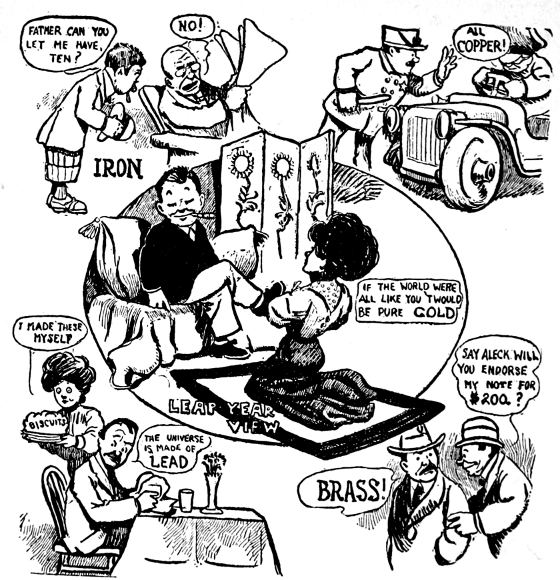
OPINIONS DIFFER
The above are illustrations of the method. Cannon, Rev.
Spencer and Attorney Edwards are all one and the same man.
We now turn to a few special examples of differences of procedure
among the various bureaux.
One of the most successful operators who ever invaded Chicago
with matrimonial schemes was one John Carson, who, on
April 8, 1908, was fined $1,000 and costs for misuse of the
United States mails after he had plead guilty to the charge,
which was preferred by Inspector Ketcham.
Carson, at one time or another, operated no less than eighteen
concerns of this nature. He was first discovered in 1902
in Chicago by Detective Wooldridge, operating no less than
five matrimonial and fake concerns simultaneously. These
concerns were:
- The Loretta Matrimonial Publishing Co., 98 Ogden Ave.
- The Unida Matrimonial Publishing Co., 408 Ogden Ave.
- Mr. John's Matrimonial Publishing Co., 565 West Madison
St.
- Mr. J. C. Hills Matrimonial Agency, 565 West Madison St.
- The Chicago Mutual Securities Co., a Chicago Medicine
concern, 567 W. Madison St.
Carson evaded arrest and fled to St. Louis, where he was
shortly afterward arrested by the postal authorities and sentenced
to eighteen months in the State Penitentiary at Jefferson
City, in addition to a fine of $500.
In 1904 Carson bobbed up again in Chicago. Since that time
his record is best given from a report made to Chief of Police
John M. Collins by Detective Wooldridge, who repeatedly
broke up Carson's games. The report, in part, is as follows:
Feb. 9, J. H. Carson Woods' Advertising Agency, 62 Ada
St. Goods confiscated; fined $25.
March 9, 1904, J. H. Carson, Mill's Advertising Agency, 71
W. Lake St. Fined $15.
May 4, 1904, J. H. Carson, alias J. H. Hayes, 408 Ogden
Ave., raided. Literature seized and destroyed by order of court.
May 4, 1904, J. H. Carson, alias J. H. Hayes, 255 Madison
St., raided. Literature seized and destroyed by order of court.
Nov. 15, 1904, J. H. Carson, alias J. W. Bessie, 480 Ogden
Ave., raided. Arrested; released; writ of habeas corpus.
Nov. 15, 1904, J. H. Carson, alias J. W. Bessie, 67 Flournoy
St., raided. Arrested; released; writ of habeas corpus.
Jan. 4, 1905, J. H. Carson and Oscar Wells, promoted and
run the J. H. Hunter Matrimonial Agency, 164 East Randolph
St. Oscar Wells was arrested and fined $50 by Justice John K.
Prindiville.
April 19, 1905, J. H. Carson and J. R. Ferguson, conducted
the Jesse H. Lee Matrimonial Agency, 84 Washington St. Ferguson
was arrested and fined $15 by Caverley. The literature
seized and destroyed.
May 27, 1905, J. H. Carson conducted the Clay's American
Bureau of Correspondence, 62 Ada St. He was arrested and
fined $25 by Justice John K. Prindiville. The literature
seized and destroyed.
Aug. 21, 1905, J. H. Carson and J. R. Ferguson conduced
the Ferguson Directory, a Matrimonial agency at 171 Washington
St. This place was raided and Jesse R. Ferguson was
arrested and fined $25 by Justice John K. Prindiville.
May 27, 1905, J. H. Carson conducted the Jesse Lee Matrimonial
Agency, 84 Washington St. He was arrested and fined
$25 by Justice John K. Prindiville.
Aug. 19, 1905, J. H. Carson was arrested for conducting a
Chicago Matrimonial Agency at 171 Washington St. and 95
Fifth Ave., under the name of Prof. John C. Hall, Astrologist,
Occult, Scientist, Clairvoyant, Medium, and Lifereader.
With this record behind him this rascal actually had the nerve
to bring suit for false arrest against Detective Wooldridge, but
quite naturally, he failed to appear when the suit came up for
trial.
He has not been heard from since the fine imposed on April
8, 1908, by the Federal authorities.
But crime is not the only long suit of the Matrimonial
Agency. Some of these miserable frauds have descended into
the depths and wallowed in the slime of the ultimate shame.
With unbelievable effrontery they have attempted to trade
upon the basest instincts in human nature; they have attempted
to coin the most abominable of the brute passions of men.
Nothing can exceed the turpitude, the brazen shamelessness
of the Matrimonial Agency, when it decides to go the limit.
Attest the following from the literature of the New Era Advertising
Agency and Introduction Bureau, Curtis, Clark &
Co., Props., formerly located at 112 Clark street, Chicago.
This abomination was raided by Detective Wooldridge and the
following sample from one of the circulars seized shows the
nature of the concern:
"If you are willing to give your name and protection to one
who has fallen and wishes again to enter the ranks of respectability,
we have some young women who have led fast lives
and accumulated considerable money, and want to marry some
respectable man, settle down in a new place and be respected
and respectable. THEY ARE HANDSOME, STYLISH,
LIVELY AND FULL OF FUN: HAVE MONEY ENOUGH
FOR BOTH. They will no doubt make good, loving and true
wives for some good-natured fellow who is not particular about
their past. Through our efforts several wealthy ladies of the
demi-monde have married very poor men in return for their
name and protection, given them a life of ease and luxury, and
the opportunities are greater today than in the past, considering
the fact that the world in general is anxious to lend a
helping hand to those who have erred and wish to become respectable
again."
This pole-cat literature was being sent broadcast through
the United States mails. In some way it evaded the inspectors
until the 23rd of September, 1902, when Detective Clifton R.
Wooldridge descended upon the nest of pole-cats, seized the literature,
chased "Curtis, Clark & Co." out of Chicago, and
made further evil-smelling operations impossible.
These abominations are now practically impossible, thanks
to the activity of the great police detective. But the above
illustrations shows to what depths the marriage bureaus can
descend, once they have become started on their infamous
careers.
November 26, 1902, Detective Wooldridge raided the Climax
Matrimonial Agency, located at 418 LaSalle avenue, which is
situated on the North Side, in one of the most fashionable
places in Chicago.
It was run not only as a matrimonial agency, but a matrimonial
paper and mail order house. Among the literature
seized was a circular containing a picture of the manager's wife,
and of which he sent out over 300,000. which gave the description
of her, which read as follows:
"I am 23 years of age, 5 feet 2 inches in height, weigh 120
pounds, have a turn-up nose, plain-looking and worth about
$147,000. I desire to marry a good, honest, affectionate man.
On our wedding day I will give my husband $5,500 in cash,
and one year later, if we are still living together, I will make
over to him $25,000 more. No milk-and-water man need answer."
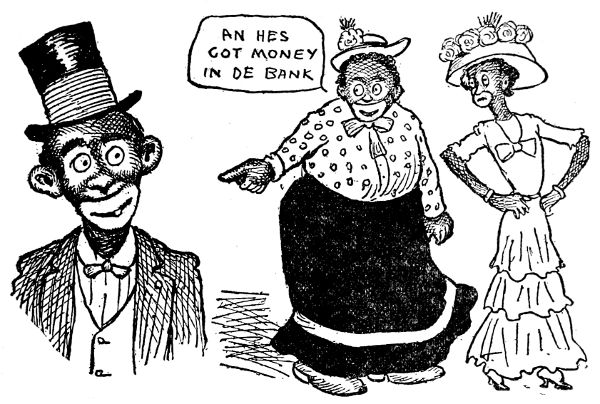
"GOT A GOOD HOME ALREADY PAID FOR, AN' MONEY
IN DE BANK."
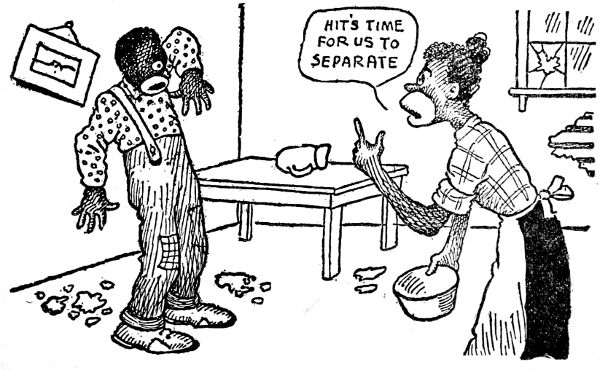
"DES A PLAIN LITTLE ONINTERESTIN' FAMBLY ROW."
One letter from a Mississippi sheriff shows that the officer of
the law is willing to forsake bachelorhood for a woman who,
though plain, advertises that on her wedding day she will give
her husband $5,500. This is the gay Lothario's letter:
Miss Ot—I take pleasure in answering your "ad" in the
"Hour at Home." You stated in your "ad" you were worth
$147,000, and would give the man that married you $5,500 on
his wedding day. You say you are plain.
I am good looking, so the people tell me, and if you correspond
with me we may come to an understanding. I am willing
to marry you if you give me proof you have the money, and
will do all that you say in the "ad."
I will do my best to make your life happy. Awaiting your
reply, I remain.
Yours truly,
W. M. M., Sheriff.
The matrimonial agencies that have been investigated and
suppressed by Detective Wooldridge and the postoffice authorities
have disclosed an almost incredible phase of woman's
nature.
There are today in the United States no less than 50,000
women who have been married, robbed and deserted by "professional
bigamists." This fact represent the most serious
phase of the matrimonial agency swindle, for it is the history
of nearly all noted bigamists that they secured their victims
through the matrimonial agencies. Of the thousands who become
subscribers to these agencies, however, comparatively
few ever proceed far enough to encounter the tragic features
of the swindle. It might be inferred from this that women
are much easier to entice into matrimony than men. Probably,
however, this is an untenable conclusion. When a
woman does start on marrying bent, mere men fall before her
like grain before the sickle. Miss Marion Rapp, arrested at
Philadelphia, is known to have secured eight husbands in three
years, and is suspected of having captured six or eight more.
Miss Rapp is still young, and if her career had not been untimely
cut off she might have made a record that would have
done credit (or discredit) to her sex.
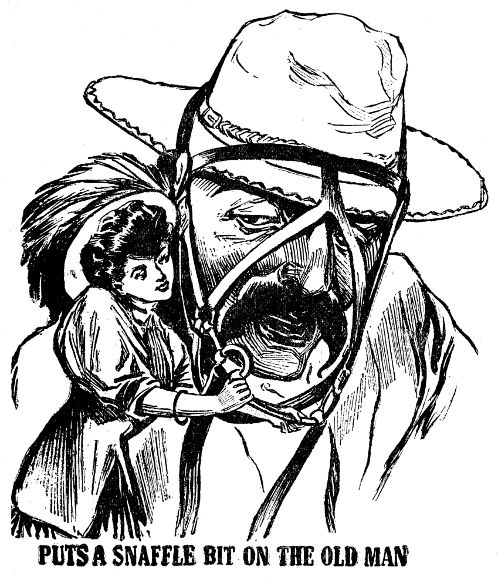
PUTS A SNAFFLE BIT ON THE OLD MAN
The sad experiences of people who have been victimized by
gay deceivers, male or female, perhaps contain a lesson to persons
who carelessly contemplate matrimony. When a stranger
proposes marriage at first sight it may possibly be well to take
a look into his or her antecedents. This is not the most romantic
way to proceed, but it is a way that may have a great
practical advantage. It probably would be endorsed by every
one of the 50,000 women in this country who are now looking
for professional bigamists who married them and ran away
with their cash.
That the matrimonial agency business is not confined to
Chicago and dupes of the system are found elsewhere than in
rural communities and among the poor and humble is demonstrated
by recent revelations in Europe. During one raid I
seized a large quantity of literature in the offices of a swindling
concern doing business under the name of Mason, Brown & Co.
The "firm" advertised itself as the largest of its kind in the
world and the only one "indorsed by press and public and
patronized by royalty," adding that its "clients and representatives
were to be found in every land."
In extra large type the information was conveyed to the
victim that he or she need not be ashamed to resort to the
agency method in order to secure a life partner, as the royalty
of Europe used this means exclusively in contracting marriages,
especially in cases where American heiresses were sought as
wives for titled but impecunious foreigners.
When it was casually remarked during an examination of a
wagon load of Mason, Brown & Company's advertising matter
the reference to the titles and heiresses was the only true statement
it contained, there were smiles of incredulity. American
millionaires were said to be too shrewd and level-headed to
enter into deals with marriage brokers when the life happiness
of their fair and independent daughters is concerned.
(Divorce Decrees; Spring)
It was but a short time after this conversation, however, that
the following cablegram was published:
"Aug. 25th, 1905: The alleged attempt to blackmail Count
Franz Joseph Maria Von Larisch Monnich out of 200,000 marks
on a pre-nuptial note alleged to have been signed by the count,
and the implication of army officers and members of the aristocracy
in the marriage brokerage business, has caused more talk in
high circles than anything which has happened since the elopement
of Crown Princess Louise of Saxony."
It is said the Kaiser had to take a hand in the matter, and
insists that this business shall be stopped finally and effectively
on the ground it is bringing the army and nobility into disrepute
and ridicule.
The harm done by these agencies is almost incalculable.
Foolish women having money at their disposal fall easy victims
to the many scheming scoundrels who make a practice
of subscribing to the matrimonial agencies for the purpose of
securing the addresses of prospective victims.
As instances of the harm done by these matrimonial agencies
the case of Johann Hoch, who married fifty women, and
after securing all their money, either poisoned or deserted
them. He was captured in New York City, January 30, 1905,
after he had married a woman in Chicago, Mary Schultz, alias
Brees, alias Bauman, poisoned her, then made love to her sister,
married her, secured what money she had and deserted her.
Hoch was brought back to Chicago, tried for murder, convicted
and hung February 23 1906. This is a glaring example.
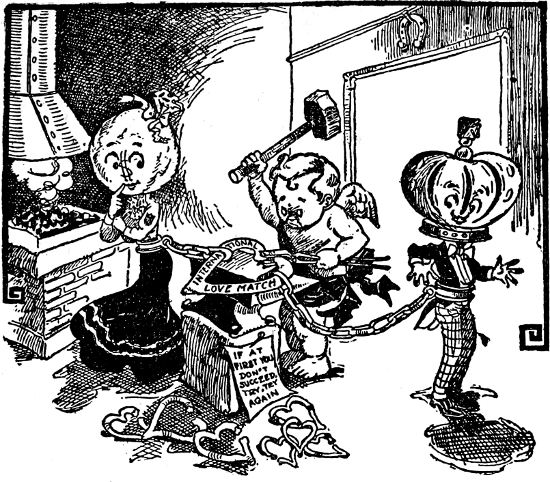
IN CUPID'S WORKSHOP.
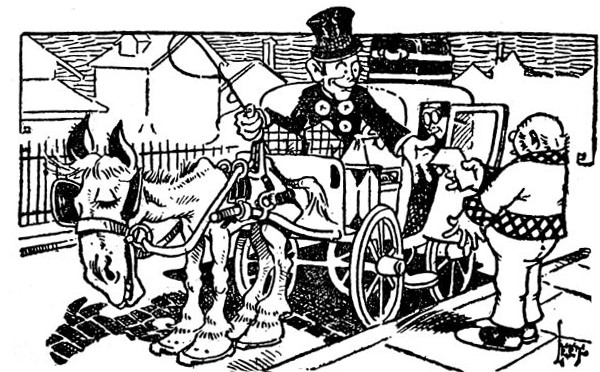
ROUTING HER THROUGH
"Ten dollars extra, cabby. If you catch the train with her. She's my
mother-in-law."
The case of Fredrick Carlton, indicted on two charges of
grand larceny in Brooklyn, New York, July, 1905, is another.
It is stated on what seems to be reliable authority this man
made the acquaintance of women in various parts of the country
through the medium of matrimonial advertisements, married
them and decamped with their money at the first favorable
opportunity. Still another:
Dr. George A. Witzhoff, champion bigamist, arrested in
Bristol, England, October, 1905, for bigamy and given a long
term in prison. He was wanted in many cities in the United
States.
Witzhoff confessed to marrying and robbing thirty-two
women. Most all of the women he married lived in the United
States, and were secured through the matrimonial agencies.
"Then, one night, after indulging in plenty of wine, she
confessed she had a child in Pittsburg. I left her there, telling
her I was going to bring her child, which was nine years
old. Instead, I went to New York with her money ($4,000),
and paid my friend part of his money, and started a practice
as a dentist in Fourteenth street as Dr. A. R. Houser. I went
to see a matchmaker. He introduced me to a widow of means.
We got married in two weeks at the City Hall, New York.
"She had all her money loaned away, so I was compelled to
seek another one, as Sig. Badillo was hard after his balance of
$1,000."
"I went, to Philadelphia and got a Jewish matchmaker again
on Fifteenth street and Fairmount avenue, and he introduced
me to a Miss Jocker as Dr. A. Houser."
"I got $800 from her. I paid Badillo $500 and left for
Springfield, Mass., where a woman answered one of my ads.
I inserted an 'ad.' as follows:"
"'A professional gentleman of nice appearance, aged thirty-two,
desires the acquaintance of a sincere, affectionate lady,
with some means; object, matrimony; triflers ignored. Give
particulars in first letter. Address Busy Bee, the Journal.'
"I had about twelve answers to this advertisement, and I
picked out a boarding house mistress, and ten days after she
was Mrs. Westfield, and as she was a vulgar woman, I left her
two days after. She had given me $500 before marriage.
"I returned to New York to wife No. 2, and a week after I
went to St. Louis and inserted an 'ad.' as previously, and got
fifteen answers. There I selected a farmer's daughter and married
her as Dr. Doesser. I married and left her all within a
week.
"I came to Detroit, and with her money, $350, I started a
dental practice as A. Houser. In answer to my advertisements
in a German paper, Mrs. Piser came.
"We went to Toledo, O., five days after our first interview,
and we got married. I left her six days after.
"I came now to Pittsburg, as Dr. Wolfe, got a furnished room
in Allegheny. In answer to an 'ad.' in a German paper a
sexton's daughter answered, the ugliest I ever had. Three
days after we went to the justice of the peace and got married."
"There I slept the first night, and the next morning I was
on my way to Cleveland, and started a nice practice with the
$150 I had left. I paid the balance to my friend, Badillo,
and inserted an 'ad.' in the Plain-Dealer.
"I had two answers to my 'ad.,' and selected a Mrs. Moore,
a nurse, and a Mrs. Kreidman. I got from the nurse $100, and
was making love to Mrs. Kreidman and Mrs. Moore, when I got
a letter from wife No. 3, with whom I corresponded all the
time, telling her I traveled for a firm.
"So I left, and forgot that I left in Cleveland a paper under
the tablecloth which had my address in Brooklyn. One morning
(ten days after I left Cleveland) two detectives came to
the house in Brooklyn and arrested me. As there was no bail
for my offense (obtaining money under false pretenses), I returned
to Cleveland a week later, and there I married a bad
woman in jail, Mrs. Kreidman.
"She gave $200 bond, but I left her four days after, as she
was a bad woman. I slept one night at her house, and three
days after I went to Chicago and went to see a matrimonial
agent at 55 Washington street.
"He introduced me to a nice Jewess, and her father gave me
$400. I started an office on Fourteenth street, when a man
from Philadelphia recognized me, and told her father, a rag
dealer, that I was a married man, named Hausen, just in time
to prevent the marriage.
"I left Chicago as Dr. Weston and went to St. Louis, where
I started an office in Olive street as Dr. A. Dresser, and there
I advertised and selected from a number of letters that of a
farmer's daughter that had $1,000, and married her (Katie).
Six days after I left her and left America and went to Roumania,
and married a girl, a Jewess, in Pitest, and lived in
Roumania as Dr. F. A. Shotz.
"Happy six months; I got 3,000 francs, and we left for Germany.
There we had a quarrel, and she returned to her parents."
Dr. Witzhoff further states that the number of all the girls
and women he merely promised to marry and secured money
from would reach over one hundred.
One of the women Witzhoff married lived in Chicago, Ill.
May 13, 1903, John J. Marietta (alias Homer C. Reid, Harold
C. Mills, A. S. Anderson, C. H. Huston, C. B. McCoy, H.
C. Jones, Harold C. Reed) was arrested through exposure by
Laura E. Strickler, a beautiful young girl from Cincinnati,
Ohio, who boarded at the Young Women's Association, Chicago.
She had been lured to the Newport Hotel, 73 Monroe
street, where he proposed marriage and attempted liberties.
Miss Strickler became frightened, jumped from the second story
window and was badly injured.
Marietta married no less than six women, three of whom,
Sophia Headley, Marie Butler and Flora Beals, appeared in
court to prosecute him September 28. He was convicted.
Judge Brentano's court of bigamy, and given five years in the
Joliet penitentiary.
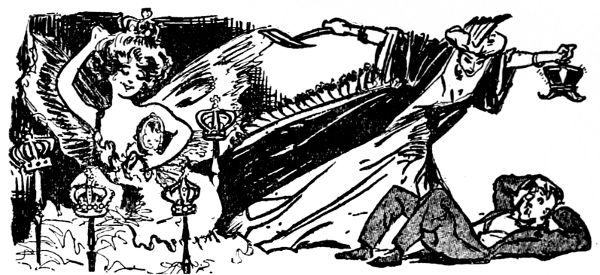
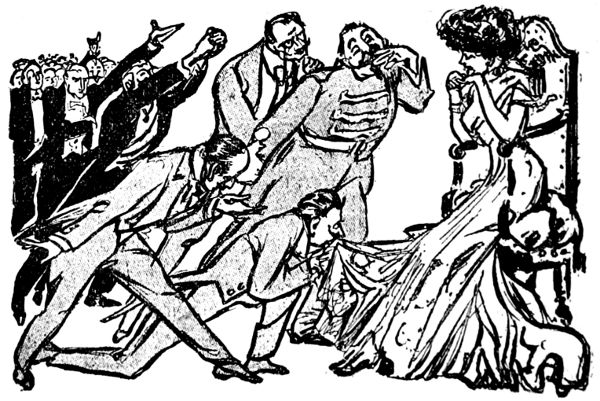
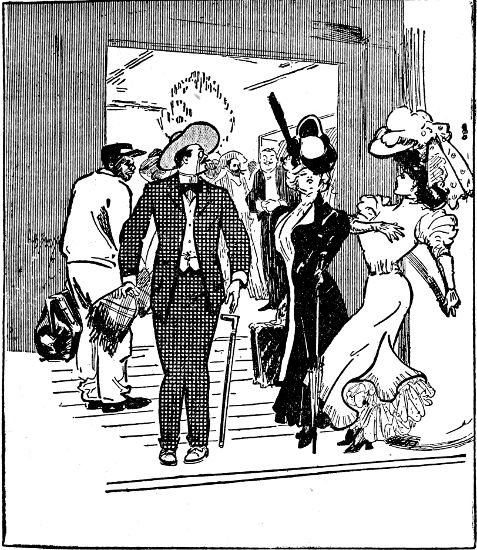
TITLES ARE CONSIDERED GREAT ORNAMENTS
"For as it was in the beginning, the American girl came over and
energetically pursued the Lords."
Marietta said he secured most of his wives through the
marriage agency. Mills said to Miss Headley, after meeting
her the second time: "How anxious are you to marry me?
Make me an offer in cash of the sum you are willing to settle
on me." "Three thousand dollars," she answered. "All right,"
he replied, "but you know I am from Missouri, you will have
to show me." She gave him the $3,000 and they were married.
At the time of his conviction Marietta had in the bank
$25,000, said to have been secured in the above manner.
The marriage bureau is not a distinctly American institution.
They know the animal in Europe, only there the operators
refer to themselves as marriage brokers, and are decidedly
more careful than their American prototypes to steer clear
of crime.
The idea of marriage broking has thoroughly permeated the
effete nobility of Europe. The broken-down "nobles," out at
heels and buried under a mountain of debt, look to America
for a rich heiress to whom their titles may be sold. For many
years they looked to the brokers on their own side of the water
to provide them with golden girls; but of late years they have
been mixing with the American Matrimonial Agencies, sometimes
to their sorrow, as attest the case of Count Larisch.
The story of the attempt on Count Larisch is not an unusual
one. Briefly, the count, who is an Austrian, but who has estates
in Prussia, was anxious to replenish his treasury by marrying
an heiress. A syndicate composed of the men now under
indictment, it is said, financed him. He set out to marry the
daughter of Faber, the multi-millionaire pencil manufacturer
of Nuremberg, giving his notes for $50,000, payable upon his
marriage to Fraulein Faber. The venture was a failure, for
Fraulein Faber did not care to become Countess Larisch. The
noble fortune-hunter then went to America in quest of a bride.
Whether it was on his own account, or under the auspices of
another marriage syndicate, does not appear, though it is hinted
the latter is the case. In any event, he was successful, and
married Miss Satterlee, of Titusville, Pa.
On his return the members of the first Faber syndicate demanded
payment, and presented a note purporting to have been
given by Larisch without the qualification that it was payable
only after his marriage to the pencil manufacturer's daughter.
Larisch, regarding the Faber affair a closed incident, and declaring
the note presented a forgery, refused to pay. The
matter got before the public prosecutor and the exposé resulted.
Oct. 24, 1905, Miss Gladys Simmons, Hot Springs, Ark.,
married Lord Bertie Cavendish after two days' acquaintance.
He represented himself to be of noble birth, son of the late
Marquis of Queensbury, and to have immense possessions in
South Africa and Mexico, which he was unable to obtain on
account of his banishment from England for serving against
the British in the Boer war, due to the activity of British army
officers against him.
Miss Simmons' mother received information that her son-in-law's
name was not Lord Bertie Cavendish, but Douglass. By
photographs and further investigation his identity was established
as that of an adventurer.
Following is a partial list of his wives, several of whom
have asked the court to grant them divorces:
- Miss Louisiana Hobbs, Lambert Point, Va., near Norfolk.
- Mrs. Mabel Duncan, Denver, Colo.
- Mrs. Scott, South Bend, Ind.
- Mrs. Beatrice E. Anderson, Fort Worth, Texas.
There has been more than one similar scandal involving
members of the high nobility and rich American girls.
It will be remembered last year there was a stir created by
The broadcast announcement that Prince Hugo Von Hohenche-Oehringen,
Prince Heinrich Von Hanan and Baron Berhard-Muenhausen,
accused an Englishman, O'Brien, who was alleged
to be the agent of Berlin marriage brokers, of attempted
blackmail.
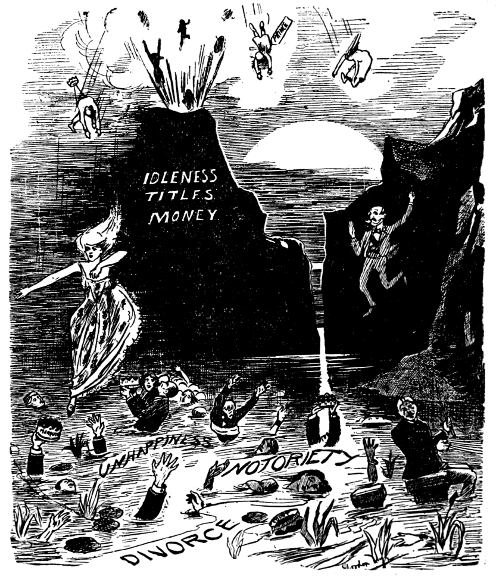
IDLENESS, TITLES, MONEY, UNHAPPINESS, NOTORIETY,
DIVORCE
Among the Americans whose names are said to be on the
list of this marriage syndicate, without their personal knowledge
or consent, are the Misses Angelica and Mabel Gerry,
the Misses Nora and Fannie Iselin, the Misses Adeline
and Electra Havemeyer, Mrs. Lewis Rutherford Morris, formerly
Miss Katherine Clark, daughter of Senator Clark, of
Montana; Mrs. Francis Burton Harrison, formerly Miss Mary
Crocker, daughter of Mrs. George W. Crocker; Miss Dorothy
Whitney, the Misses Beatrice and Gladys Mills, Miss Gwendolyn
Burden, and the Misses Florence and Ruth Twombly.
The second blow has been struck against the affinity trust,
of Chicago, and the second member of the alleged trust in
Chicago, Mrs. Jennie Scott, a woman of many aliases, by
Postoffice Inspector James E. Stuart.
This woman was arrested at her home, at 214 Thirty-second
street, her "Cupid shop," where she received thousands of letters,
descriptions and photographs of affinity seekers from all
over the United States and Canada. She received them in the
name of "Glinn's International Corresponding Association," to
join which from $2 to $5 was drawn from each affinity. Thousands
joined.
Postoffice Inspectors A. E. Germer and Frank Sheron worked
up the case against the woman and discovered that the same
literature was used by this woman as was used by Marion
Grey, convicted for the misuse of the mails in operating an
affinity matching business at Elgin.
There were some changes, however, in the method. This is
shown in the literature sent out by this woman. Her literature
explains to the affinities that the business is absolutely honest
and above board, and must be kept so. Under "special reduced
rates," she drew in hundreds of women clients, many
of whom sent in their pictures.
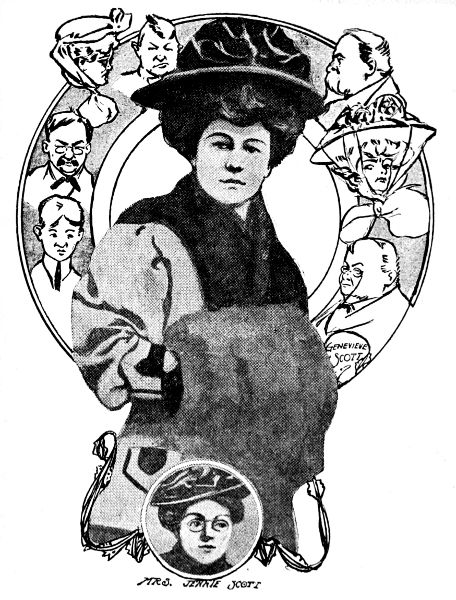
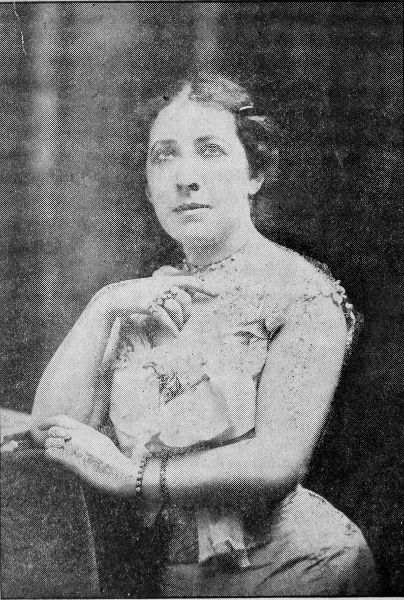
MRS. JENNIE SCOTT
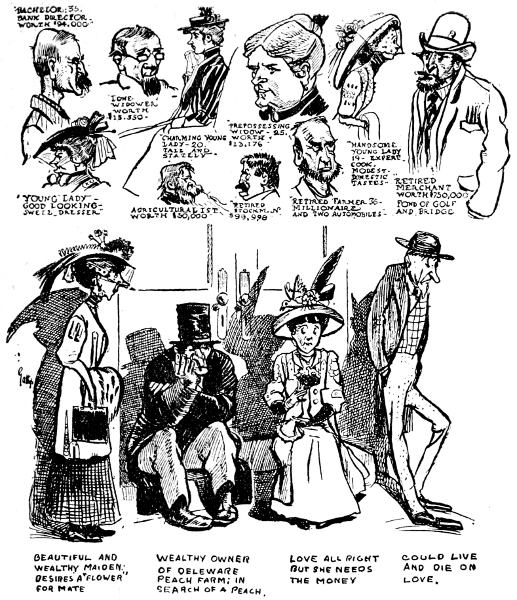
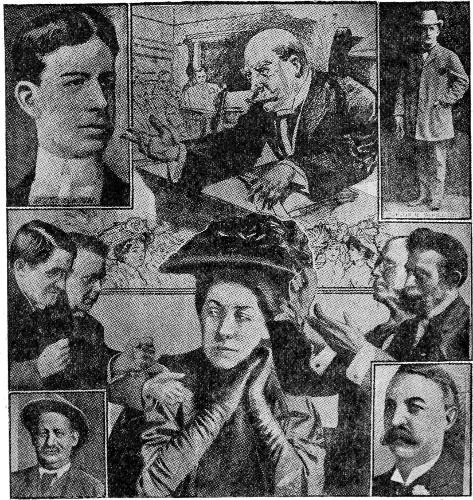
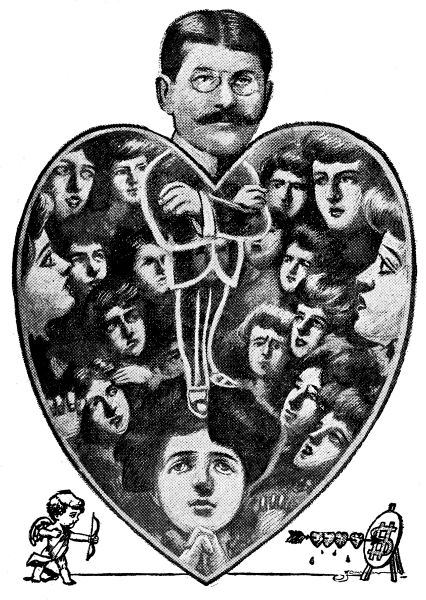
TYPES OF "AFFINITIES" FOUND BY MARION GRAY,
SKETCHED IN COURT WHERE BEAUTY IS ON TRIAL
Mrs. Scott operated also at 2208 Wabash avenue, where she
had a room for receiving mail. She was known not only as
Mrs. Scott, but as E. L. Glinn, Mrs. Jennie Call, Mrs. A. M.
Harvey and Mrs. E. L. Glinn. She lived on Thirty-second
street, with her young daughter.
Almost every client on the books of this marriage-fostering
concern claimed to be worth from $5,000 to £1,000,000 sterling.
Many of them were alleged to have large incomes. Some
were said to have children and are not to be divorced, but still
seek life partners.
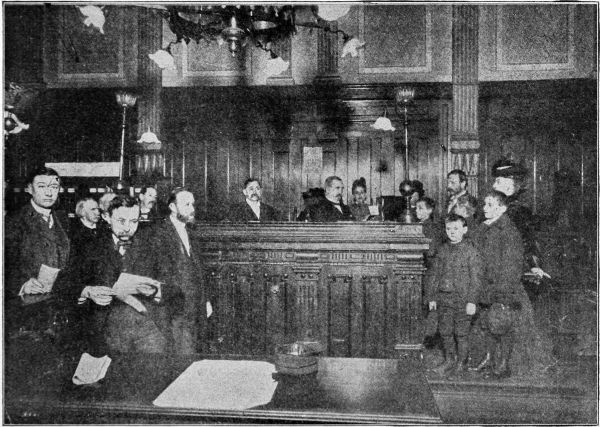
Then, from among the queer little party huddled together
on the benches at the rear of the big court room—a helpless,
shepherdless flock—Mr. Shirer began to call out his witnesses.
First of the hungering souls who sought life companions
through Mrs. Scott came Mrs. Mary Quinn, of Trenton, Ill., a
short, dumpy little person of about thirty-five or forty, who
was chiefly remarkable for the white hat she wore.
"I saw the ad.," she whispered—it was with the greatest
difficulty that Judge Bethea induced her to talk so she could
be heard ten feet away—"and I answered it. They sent me back
a circular and a photograph of a nice-looking fellow who was
said to be rich.
"I sent my $2 and wrote that I would like to get into correspondence
with him. They sent me back word that he was
corresponding with another lady just then, and didn't want
any more names at present, but there was another one just as
good.
"I corresponded with him until three weeks before I remarried
my divorced husband, last December. He wrote very nice
letters, but he certainly didn't sound rich."
"You got what you asked for, didn't you?" asked Mr. Murphy.
"Oh, yes, I guess so; I'm not complaining."
The uncomplainingness of the alleged victims is the odd
feature of the case.
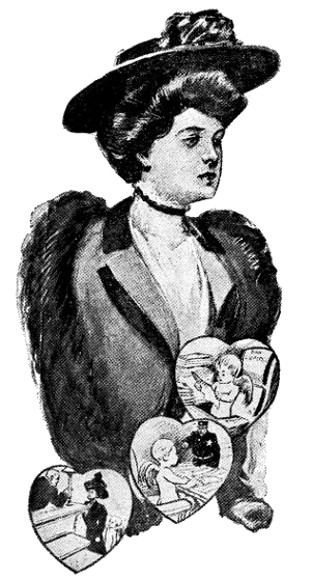
JAIL FOR CUPID'S AID
Marion Grey, Pretty Love Broker, Who
Was Sentenced to a Year in Prison
Dr. Montgomery Porter, a graduate of the University of
Arkansas, came all the way from his home in Pine Bluff, to
say that he had answered one of Mrs. Scott's advertisements
but had not paid the $5 fee, "which she charged the men members."
Porter C. Dyer, a graduate of the Ohio State University, who
lives in Austin, O., said that he paid the fee and was disappointed,
"because the names sent were not those of refinement
and culture, as promised in the circulars."
Mrs. Flora Scott, a restaurant keeper at Middleport, O., tall
and not particularly stylish, couldn't recall what any of the
circulars said, but she was quite sure she hadn't landed a rich
husband yet.
The handsomest of the witnesses was Miss Avis Christenberry,
a stately brunette from Memphis, who rather liked the
looks of the rich young man's photograph used for bait and sent
in $2.
"They told me he was corresponding with some one else
just then," she testified, "and I corresponded with two substitutes,
but they didn't entertain me much."
Wilson Schufelt, a real estate man, said that he had rented
the matrimonial headquarters to "Mrs. A. M. Harvey" for a
mail order house business. Mrs. Harvey got her mail under
the names of Glinn and Hill, and when the postal authorities
became interested in her she told Schufelt that her name was
Jennie Scott. At her home, 214 East Thirty-second street, she
is known as Mrs. Jennie Call.
She was indicted under the name of Glinn. It was testified
by E. J. Beach, superintendent of the Twenty-second street
sub-postal station, that the matrimonial agency received from
50 to 200 letters every day.
She was arraigned before Judge Bethea and found guilty,
on April 25, 1908, and was sentenced to one year in the House
of Correction, and was fined $500.
But the giant blossom of this plant of hell is not bigamy, not
swindling, not desertion; it is murder, wholesale, ghastly murder.
For it is the matrimonial agency, nothing else, which is
directly responsible for the unbelievable horrors of the Gunness
Murder Farm, at Laporte, Ind., the revelation of the existence
of which shocked the entire civilized world as it has not
been shocked since the time of the Borgias.
This wholesale murderess invariably lured her victims to
their fate through advertisements in a "matrimonial paper," or
through an agency. She would insert the usual stereotyped
"ad." of the wealthy widow lady who desired a mate, but always
a mate with money.
Always being able to produce proof that she was well-to-do,
it was an easy matter for her to persuade her victims to visit
her at the Laporte farm. She invariably stipulated that they
should bring a substantial sum with them.
Arriving at the Gunness farm, the prospective suitors were
invariably impressed with the evidences of wealth and luxury.
After a stay of a few days, during which time the cunning
murderess would find out how much money her victim had, and
whether he could immediately procure more in the form of
cash, the victim would be invited to supper and his food
drugged.
He would then be escorted to his room, where he would soon
become unconscious. Chloroform was then administered, the
body hurled through a chute to the basement, where it would
be dismembered and placed in a gunnysack.
The sack would then be taken out and buried in a convenient
spot on the farm. It was an inquiry from the brother
of one of the victims, Andrew Helgelein, which revealed the
whole horrible affair.
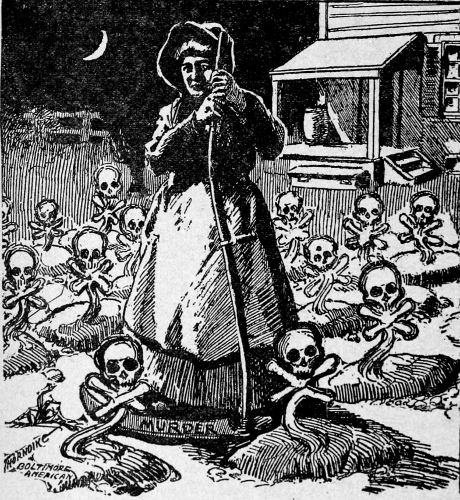
THE DEATH HARVESTER.
A Crop on the Gunness Farm.
It is estimated that this woman, through the aid of the matrimonial
agencies, murdered more people than any other human
being that ever lived. She exceeded the records of the Benders,
Holmes, and even those arch-assassins of the middle ages,
the Borgias.
Dr. Cesare Lombroso, of the University of Milan, the world's
greatest criminologist, in discussing this woman, said:
"In general the moral physiognomy of the born female criminal
approximates strongly to that of the male. The female
criminal is exceedingly weak in maternal feeling, inclined to
dissipation, astute and audacious, and dominates weaker beings
sometimes by suggestion, and at other times by muscular force;
while her love of violent exercise, her vices and even her dress,
increase her resemblance to the stronger sex.
"Added to these virile characteristics are often the worst
qualities of women; namely, an excessive desire for revenge,
cunning cruelty, love of dress and untruthfulness, forming a
combination of evil tendencies which often results in a type
of extraordinary wickedness. Needless to say these different
characteristics are not found in the same proportion in everybody.
One criminal will be deficient in intelligence, but possessed
of great strength, while another, who is weak physically,
triumphs over this obstacle by the ability with which she lays
her plans.
"But when, by an unfortunate chance, muscular strength
and intellectual force meet in the same individual, we have a
female delinquent of a terrible type, indeed.
"In short, we may assume that if female-born criminals are
fewer in number than the males; they are usually much more
ferocious.
"What is the explanation? We observe that the normal
woman is naturally less sensitive to pain than a man, and
compassion is the offspring of sensitiveness. If the one be
wanting, so will the other be.
"We also find that women have many traits in common with
children; that their moral sense is deficient; that they are revengeful,
jealous, inclined to vengeances of a refined cruelty.
"In ordinary cases these defects are neutralized by piety,
maternity, want of passion, by weakness and an undeveloped
intelligence. But when a morbid activity of the psychical
centres intensifies the bad qualities of women, and induces them
to seek relief in evil deeds; when piety and maternal sentiments
are wanting, and in their place are strong passions, much muscular
strength and a superior intelligence for the conception
and execution of evil, it is clear that the innocuous semi-criminal
present in the normal woman must be transformed into the
born criminal more terrible than any man.
"What terrific criminals would children be if they had strong
passions, muscular strength and sufficient intelligence; and if,
moreover, their evil tendencies were exasperated by a morbid
intellectual activity! And women are big children; their evil
tendencies are much more numerous and more varied than
men's, but generally remain latent. When they are awakened
and excited they produce results proportionately greater."
Below is given a partial list of the victims of this inhuman
monster, as it appeared in the Chicago American, Sunday,
April 26, 1908:
Partial Catalogue of Mrs. Gunness' 180 Victims.
- 1. Max Sorenson, Mrs. Gunness' first husband—whom she
poisoned.
- 2. Peter S. Gunness, second husband, whom she killed with
a meat axe.
- 3. Her infant child, whom she strangled to death.
- 4. Miss Justina Loeffler, of Elkhart, Ind., believed to have
been married to Johann Hoch and sent by him to Mrs.
Gunness to be murdered and buried.
- 5. Olaf Limbo, Norwegian farm hand.
- 6. Ole Budsberg, a hired man, from Iola, Wis.
- 7-9. Three well-known men of Fort Wayne, Ind., who have
disappeared in the last two years.
- 10. A horse trader from Montana.
- 11. Jennie Olsen, eighteen years old, adopted daughter of
Mrs. Gunness.
- 12. Henry Gurholt, left Scandinavia, Wis., on March 12, 1906,
saying he was going to marry Mrs. Gunness.
- 13. George Bradley, forty years old, of Tuscola, Ill., went to
La Porte, Ind., October 20 of last year.
- 14. Olaf Lindboe, farm laborer, of Chicago, employed by Mrs.
Gunness.
- 15. Lee Porter, of Bartonville, Okla., quarreled with his wife
and answered one of Mrs. Gunness' matrimonial "ads."
- 17. Crippled man from Medina, N. D.
- 18-20. Three children of Mrs. Gunness killed or burned in
house—Myrtle, aged 11; Lucy, 9; Philip, 5.
- 21. Body of unidentified woman found in ruins of burned
house.
- 22. Strange baby left last fall by man and woman, as told
by Ray Lamphere, arrested as accomplice of Mrs.
Gunness.
- 23. John O. Moe went to La Porte from Elbow Lake, Minn.,
day before Christmas, 1906, with $1,000.
- 24. Armat Hartoonan, wealthy Armenian rug merchant of
Binghamton, N. Y., who went to La Porte in 1906 in
answer to a matrimonial "ad."
- 25. Charles Neuberg, of Philadelphia, took $500 and went
to visit Mrs. Gunness in June, 1906.
- 26. George Berry, of Tuscola, Ill., went to work for Mrs.
Gunness July, 1905. He took $1,500, expecting to
marry the widow.
- 27. John A. Lefgren, aged forty-eight, disappeared from the
Chicago Club, and is believed to have gone to Mrs.
Gunness' farm.
- 28. E. J. Tiefland, retired railroad man, of Minneapolis.
- 29-30. A Los Angeles college professor and wife—names not
yet ascertained.
- 31. Andrew K. Helgelein, Aberdeen, S. D., ranchman, the
last victim, whose fate led to the discovery of Mrs.
Gunness' crimes.
- 32. Charles Edman, farm laborer, from New Carlisle, Ind.
Took $3,000 in savings to Mrs. Gunness' home.
- 33. Frank Riedinger, young German farmer, of Delafield,
Wis., went to La Porte in February, 1907.
- 34. Babe seen by a neighbor, Mrs. William Diesslen, which
afterward disappeared.
- 35. Unknown young woman visitor, seen to go to Gunness
house; never accounted for afterward.
- 36. Unknown man, a widower, and his young son, went to
Mrs. Gunness' house a year ago—never seen again. One
of the bodies found on farm was that of a small boy.
- 37-57. Twenty-one babies entrusted to Mrs. Gunness' care
while she was running a "baby farm" on the outskirts
of Chicago all disappeared mysteriously.
- 57-180. Other unknown men, women and babies, who went
to Chicago and La Porte homes of Mrs. Gunness, and
were never seen again, are estimated to bring the grand
total of victims up to 180.
This, then, is the crowning work of the matrimonial agency;
this horrid burying ground of dismembered bodies, this ghastly
charnel pit on an Indiana hillside. By their fruits ye shall
know them. In the dread Gunness Farm behold the ripened
fruit of the matrimonial agency.
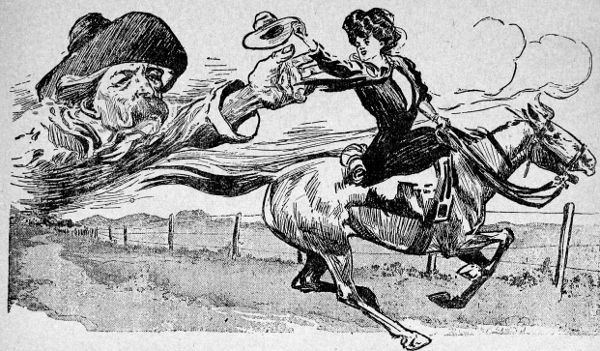
RIDES OUT OF THE CLUTCHES OF MATRIMONY
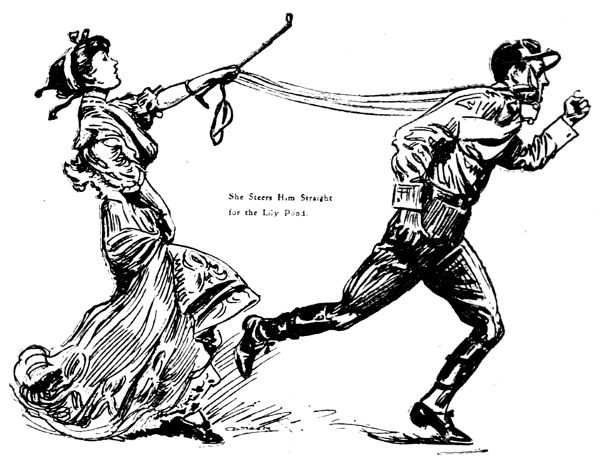
She Steers Him Straight for the Lily Pond.
The Funny Side of the Matrimonial Business.
There is necessarily the amusing side in all this miserable
trading upon the affections of fools. Some of the letters sent
in to the matrimonial agencies are little less than "screams."
Imagine, if you can, a big, husky farmer, a collarless, coatless
son of the Utah deserts, gushing forth that he "could live and
die on love." Think of a staid and sober trained nurse who
has arrived at the ripe age of forty pouring into the ears of
the matrimonial agent that she "wants a man who is a flower,"
and also saying confidingly that she believes that she requires
a few more years in which to prepare for the "solemn step."
One who is 39 and dark, blushingly admits that she is a
"young girl" of loving disposition, and, since love is the destiny
of us all, prays for a husband of fifty or thereabouts.
One who describes herself as "lively and frolicsome" frankly
admits that she is out for the money and can get along without
the love end of it at all. It is needless to say that this letter
comes from the Pennsylvania Dutch regions.
Here are a few of the gems:
Huntsville. Utah,
Dec. 27. 1902.
Mrs. Ellen Marion.
Grant Works, Ill.
My Dear Lady:
I wish to beg your pardon if I appear rude in trying to
personally introduce myself, but allow me to assure you that
I am sincere in my quest for a kind friend, and it is nothing
but the purest and holiest motives of the human heart that
prompts the intrusion.
I saw your advertisement in the Valley Farmer, and in it
I seem to behold the image of an ideal lady, who is well
worthy of the highest esteem and admiration from a true
gentleman, and how happy and thankful should the man be
who is so fortunate as to captivate the love and heart of so
noble a prize. Among many others your advertisement to me
seemed to be the most suitable and impressive. While it would
not be within good taste to express a great love for you at
present, yet I believe that I could come as near living and
dying on love as the next one. My object in writing you is
to find if there should be a chord within our natures that could
be touched mutually to harmonize with the word love.
I have been married and know of the joy and happiness of
a kind and loving companion. Two years ago death robbed
me of my greatest prize in life. Since then I have been baching
it. I am tired of roughing it alone, and if there were only
some one to meet me with a kind smile of approval I could work
much harder and be a better man for it, and I do most earnestly
and sincerely solicit your correspondence with a view to closer
ties should our natures prove congenial.
Should you feel inclined to favor me I would certainly feel
highly flattered.
Please do not rank me with the ordinary flirts and adventurers,
for I assure you that I am honest in my intentions and
would not mislead or advise anyone wrongfully. My age is
thirty-seven, height five feet nine inches, weight 175 pounds,
have a good moral character in every respect, honest and industrious,
without any bad habits, total abstainer from liquor and
tobacco, move in the best society, am of a quiet, kind and
loving disposition. Home is the dearest place to me on earth
and I know how to make it happy. I can appreciate and know
the real value of a kind and loving wife, and the dear lady
that becomes my wife will find in me a true and honest husband,
a kind and loving companion, one whose greatest aim
and object will be to make his home and loved ones happy.
To you the above may have a smattering of self-praise and
flattery, but the facts are wholly true, which I hope in due
time will be fully demonstrated. Should you wish to hear
further from me I shall be quite pleased to furnish any information
desired.
Anxiously awaiting your acquaintance, I am,
Yours sincerely,
Jens Winter.
With best wishes and compliments of the season.
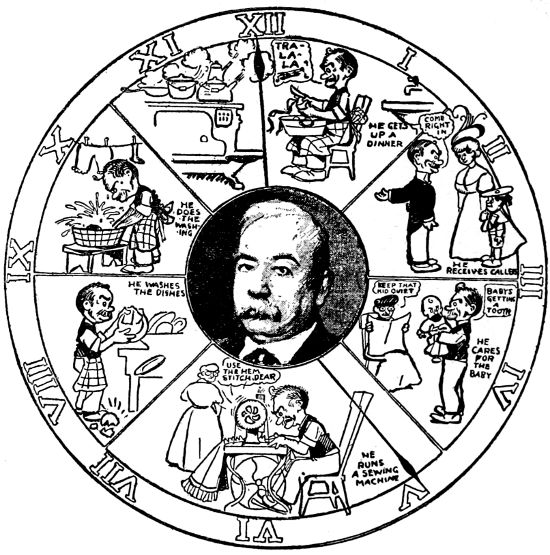
AROUND THE CLOCK WITH A "HOME HUSBAND"
I want a man who is a flower, with love and affection oozing
from all its petals. Maybe, however, I need a few more years'
preparation for the most solemn of steps—matrimony. I admire
a man of good physique, kind, gallant, conscientious, of
good morals as can be expected nowadays, home-loving, and
fond of children.—Application for a husband from Catherine
M. Barnes, trained nurse, aged 40, Indianapolis.
Love is the destiny of us all. At times it seems it is going
to side-track and pass us. Therefore, I ask you to help me
to find a handsome man of 50 or over who has some money
and can make more.
I am a young girl of loving disposition; do not powder, except
on special occasions; can cook, and know how to dress
on nothing or little. I want love and fidelity. Do not send me
the name of any traveling men.
I am 39 and dark.—Miss Ella Miller, 837 Spring Garden
street, Philadelphia.
Introduce me to a widow with money who wants a good
entertainer and honest man. I have no funds, but don't tell
her that. I play, sing and recite well.—Adam Werker, Glen
Ellyn, Ill.
"My ideal must be tall," suggests Miss Mary Hester, from
Wayland, N. Y., "and a gentleman in every sense of the word.
He must be of good standing socially and morally. He must
be of temperate habits, kind, generous, affectionate, devoted—a
man of ability, who would be a companion socially, intellectually
and morally to a true, pure, devoted wife."
She says she would ask for no more.
"READ US 'BOUT WHUT DE FOLKS IN PITTSBURG AN' NEWPORT IS
UP TO."
"I'D RUTHER BE MARRIED TO A WOMAN WHO WAS REFORMIN'
THINGS OUTSIDE DE HOUSE DAN IN HIT."
Here is another letter from Reading, Pa:
Dear Sir: I notice by Sunday's paper that you are looking
for a wife. Now, strange to relate, I am looking for a husband.
I don't know what your requirements are, but I do know
mine, and the chief ones of them are money, a good home,
less work and worry, and happiness. If love comes, too, I
shall not object, although I have lived long enough to realize
that there can be a sort of lukewarm happiness without love.
Be that as it may, I judge my capacity is sufficiently large
to satisfy the sort of a man I judge you to be. Now, for the
next item of importance—myself. I am tall and slender, five
feet six inches high, and quite "figuresque," as one of my girl
friends tells me. I am of the Irish-American type; hair
medium in shade and profuse as to quantity; deep-set, very
bright gray eyes; good carriage, on account of which strangers
often consider me haughty—an entirely erroneous idea.
Am of a lively, frolicsome nature. I am full of fun, and no
matter how black things are I always find something to laugh
at. I am twenty-three years old, and decidedly domestic, that
being, in fact, my only accomplishment. I am artistic only
along some lines; have no musical talent and am not an artist,
but I love both devotedly. Am very practical, in fact, and a
good housekeeper. There is lots more I might tell you, but
we will call this enough for the present. Should like to know
something about you, and hope you will be as truthful and
frank as I have been.
Sincerely yours,
Mary Anderson.
A Matrimonial Agent Captures a Rich Husband and Retires
from Business.
Mamie Marie Schultz, a matrimonial agent, outwits the
police and postal authorities after being raided and broken up,
moves to other quarters, continues business, finds a rich man
seeking a wife among her patrons and marries him.
September 11, the German-American Agency, run by Mamie
Marie Schultz, 3150 Calumet avenue, was raided by Detective
Wooldridge, the literature seized and destroyed. Mamie Marie
Schultz was fined $25 by Justice Hurley. The evidence obtained
was submitted to the postal authorities for action.
Mamie Marie Schultz fled to Oak Park, where she continued
her matrimonial agency. After she moved to Oak Park she
was notified "by order of the town board" to vacate, but she
laughed at the order and enjoyed the newspaper notoriety she
attained, for it only increased her business. It is said she
made thousands of dollars out of her matrimonial agency.
With a stealth that is characteristic of his art, Cupid has
accomplished what Oak Park officials had been trying to do
for two years. He has closed out the Oak Park matrimonial
agency by making a victim of his promoter in that vicinity,
Marie Schultz, manager of the matchmakers' concern.
The postmaster, United States marshal and several of the
town officers yesterday received letters signed "Mrs. J. D. Edwards,"
announcing that Marie Schultz "had been caught in
her own net" and had deserted the village for a "palatial" home
in Seattle, Wash., where her new husband, J. D. Edwards, is
a wealthy lumber dealer.
Edwards, it is said, arrived in Oak Park on Tuesday, and
after a whirlwind courtship this "Lochinvar who came out of
the West" had won the whole matrimonial agency.
"Marie," the name in which all her extensive advertising
was done, has defeated the officials of Chicago, Oak Park, and
even the United States postoffice inspector, in every effort they
made to suppress her enterprise.
To Postmaster Hutchinson she wrote requesting that all
letters addressed to the agency be returned to the writers, as
she didn't "want any more of their money." The postoffice
force was burdened with the task of mailing back to some 500
lovelorn men and maidens the letters which had accumulated
in "Marie's" postoffice box.
But the bleatings of the overgrown calf from Utah, and the
wails of the maiden lady who desires a "flower" for a mate are
both eclipsed by the mushy outpourings of a Chicago business
man.
This fellow evidently possesses the artistic temperament.
Not only is he moved to write prose poetry, "to bay the moon
of love," but he insists on inserting illustrative sketches of an
ardent wooing.
He has forged the white heat of his passion, which evidently
puts Ella Wheeler Wilcox at her fiercest to shame, into pictures.
Here we behold him, hand in hand with his beloved,
under the kindly stars. There, more prosaic, it is true, but
still quite passionate, is the drawing room scene, with the lady
seated on his knee. Behold the works of genius when love
impels.
Among the hundreds of applications for a wife Detective
Wooldridge found one from Jacob C. Miller, of Martinsville.
Pa. Miller filled out the application blank as follows:
- Q. Where born? A. Lancaster, Pa.
- Q. What language do you speak? A. English.
- Q. Nationality? A. White.
- Q. Weight? A. 130.
- Q. Color of eyes? A. Greenish blue.
- Q. Color of hair? A. Brown on a little patch.
- Q. Complexion? A. Fair.
- Q. Circumference of chest? A. 36 inches.
- Q. Circumference of waist? A. 36 inches.
- Q. Circumference of head (just above ears)? A. 13
inches.
- Q. Circumference of neck? A. Wear 15-1/2 collar.
- Q. Profession? A. Farm hand.
- Q. Income per year? A. Nothing.
- Q. Extent of education: common, high school or university?
A. Common.
- Q. Do you use tobacco or liquor? A. I use a little tobacco,
but no liquor.
- Q. How much real estate do you own? A. Nothing.
- Q. Do any of the pictures we have submitted to you suit,
and will you marry? A. Yes, the one with the turned-up
nose.
- Q. If we secured you a wife worth $250,000 would you be
willing to pay us a small commission for our trouble? A. Yes.
Strangely enough, the abomination known as the "matrimonial
agency," bureau or what-not, has succeeded in hoodwinking
the great American press to a certain extent.
Advertisements appear in leading journals all over the
country. Without this the great fraud could not exist ten
minutes. There are numberless instances, we are quite sure,
where the publishers have no suspicion that they are furthering
the cause of scoundrels. In others, we regret to say, the
motive for accepting these advertisements is traceable to nothing
more or less than just the plain greed of the publisher.
It is impossible for a private citizen to prophesy whether
the entire power of the government of the United States can
purify the columns of some of our greedy newspapers.
HOW TO TRAIN A HUSBAND
These matrimonial agencies are frauds. The newspaper man
knows this and takes their money for the advertisements, and
becomes a messenger of a crime for a paltry sum, and if I
were the District Attorney I would get busy and call the
attention of the Postmaster General to these alleged newspapers
for the purpose of shutting off their distribution through
the mails.
Here are a few samples of the ads appearing in the reputable
daily press of the country:
They Appear in All the Leading Newspapers Throughout
the Country.
This is a very select list of ten ladies picked at random from
our books by one of the leading newspaper reporters of this
city, February 1, 1904:
- Minnesota Maiden—30 yrs., 5 ft. 2 in., weight 128 lbs.;
brown hair, blue eyes; has $10,500.
- Missouri Maiden—28 yrs., 5 ft. 7 in., weight 150 lbs.; blonde,
blue eyes, German; has $4,800.
- Pennsylvania Maiden—20 yrs., 5 ft. 4 in., weight 132 lbs.;
light hair, blue eyes; will inherit $30,000, provided she is married
on her 21st birthday.
Can a Man or Woman Know Each Other Before Marriage?
BEFORE.
"When he was wooing her, Romeo devoted his time to thinking of
delicate little attentions that he could pay Juliet, and of things he
could do to make her happy."
AFTER.
On Christmas he is liable to shove a dollar or two at his wife,
remarking: "Get yourself something. I don't know what you want, and
I haven't time to fool with it."
"ONE HOUR OF IT IS WORTH LIVIN' FOR AN' DYIN' FOR."
"AN' DAT WOMEN'S CLUBS IS DE CAUSE OF ALL DE PO' LITTLE
NEGLECTED CHILLEN."
- Wisconsin Widow—49 yrs., 5 ft. 3 in., weight 130 lbs.; black
hair, black eyes; no children; worth $15,000. Will marry
elderly man.
- Indiana Maiden—29 yrs., 5 ft. 4 in., weight 122 lbs.; brown
hair, blue eyes; pretty and worth $7,000. Would marry farmer.
- Illinois Maiden—21 yrs., 5 ft. 8 in., weight 140 lbs.; chestnut
hair, blue eyes; worth $40,000; is a cripple. Will marry
kind man who will overlook her misfortune.
- New Jersey Widow—28 yrs., 4 ft. 11 in., weight 150 lbs.;
brown hair, blue eyes, one child; worth $35,000. Will marry
and assist husband financially.
- Ohio Farmers Daughter—Orphan, 25 yrs., 5 ft. 7 in.; brown
hair, gray eyes; has large farm. Alone, will marry immediately,
farmer preferred.
- Montana Maiden—Half-breed Indian, age 25, 5 ft. 4 in., 130
lbs.; black hair, black eyes; has large ranch. Will marry
honest white man.
- Illinois Bachelor Girl—Age 35, 5 ft. 7 in., 160 lbs.; black
hair, brown eyes; owns fine estate, valued at thousands. Would
marry gentleman of equal wealth.
Pennsylvania.
Beautiful maiden lady, refined and well educated; American;
blonde, age 37 years, height 5 ft. 4 in., weight 106 pounds;
worth $30,000.
Nebraska.
Stylish young brunette, fond of society; American; age 28
years, height 5 ft. 3 in., weight 135 pounds; Baptist, and worth
$25,000; income $3,000 a year.
Ohio.
Stately widow, age 49 years, handsome and remarkably well
preserved; height 5 ft. 6 in., weight 160 lbs.; no children;
worth $5,000; wants elderly husband.
Kentucky.
Beautiful blonde Southern girl, educated and refined; age 21,
height 5 ft. 2 in., weight 115 lbs.; American, and worth $10,000;
wants nice-looking husband.
Pretty little girl, age 19 years, height 5 ft. 3 in., weight 112
lbs.; American; worth $10,000. Says she is very anxious to
marry.
Boston, Mass.
Fine-looking lady, age 37 years, height 5 ft. 3 in., weight
140 lbs.; American, Protestant, and worth $20,000.
Young lady, blonde, age 25 years, weight 128 lbs., height 5
ft.; American, Methodist; income $720 a year; worth $25,000.
Chicago, Ill.
Maiden, age 26 years, height 5 ft. 4 in., weight 140 lbs.;
Scotch, Protestant, Methodist; income $1,200 per year; worth
$75,000.
Monroe Co., Pa.
Young lady, age 23 years, very pretty, height 5 ft. 5 in.,
weight 150 lbs.; German, Methodist; worth $12,000.
Dover, N. H.
Stylish, brown-eyed lady, age 24 years, height 5 ft. 6 in.,
weight 135 pounds; American, Methodist; worth $50,000.
New York City.
Young widow, age 32 years, height 5 ft. 5 in., weight 140
lbs.; Irish Catholic; worth $40,000.
Utah.
Maiden lady, age not mentioned, height 5 ft., weight 120
lbs.; worth $35,000.
And all this, ridiculous, murderous and otherwise, is all outside
the pale of the law. The matrimonial agency is a crime
per se. It is a criminal institution. It has been pronounced
to be such by the best and foremost judges of the United States,
Germany and Great Britain.
Judge Klerbach, sitting in the case of a marriage broker at
Goettingen, Germany, in 1903, declared that the marriage
broker was a criminal in intent, from the very nature of his
business.
In the celebrated case of Alan Murray vs. Jeanie McDonald
at Edinburgh, Scotland, in 1898, Justice Grahame pronounced
from the judicial seat one of the most scathing arraignments
of the marriage bureau ever delivered. "Leeches upon the
body social, blood-suckers, destroyers of womanhood, abominations
of the bottomless pit," were some of the phrases used by
Justice Grahame in denouncing Murray.
In the petty sessions at Tinahely, Ireland, Justice O'Gorman
in May, 1905, is reported in the Wicklow People, a newspaper
which has a wide circulation in the South of Ireland, as fiercely
denouncing the marriage broker business. The Justice declared
that the marriage broker was a wolf, "preying upon
the weaknesses of humanity, a pander to the lowest instincts";
that he had no right to demand the interference of the law in
his behalf, but rather that the law should always be exercised
for the suppression of his nefarious traffic.
To get nearer home. In the Chicago American, February 12,
1903, Judge Neely, in the case of the State vs. Hattie Howard,
declared from the bench that to "sell men and women in marriage
is the height of crime." Judge Neely further said:
"Men and women who engage in this business of promoting
matrimony for money are guilty of crime. It is opposed to
the fundamental principles of society. Such a practice should
under no circumstances be tolerated. This practice should be
stopped. The trade should be killed. The courts should make
it their business to discourage this thing in a way that may
be easily understood."
Judge Kohlsaat, of Chicago, has inveighed against the practice
in equally vehement terms. Judge Kohlsaat declares that
"the Police Department of Chicago is entitled to great credit
for what it has done in discouraging this business. I hope it
will continue its vigilance until every promoter of marriages
of this character has been compelled to leave the city. They
should make such criminals give the city a wide berth."
There, then, is the law. The business is a crime in its very
nature. It leads to bigamy and wholesale murder. It is made
the instrument of the thief, the swindler and the murderer.
How much longer will the American people look with calmness
upon these practices, upon these abominations, which make a
stench of the very air of the great and free country in which
we live? The answer is up to you.