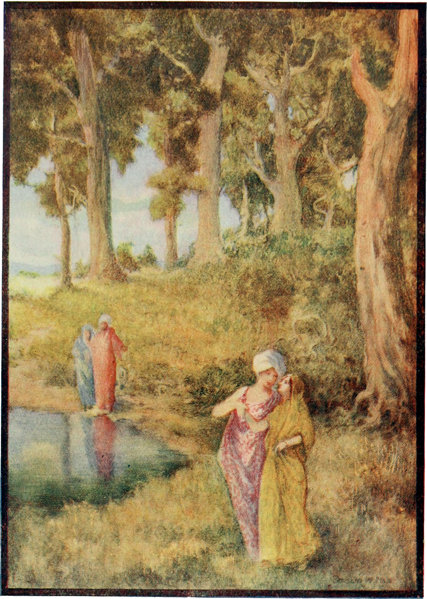
The Fairy Prince Cloud-chariot and the
Serpent Shell-crest. Which is the more
self-sacrificing?
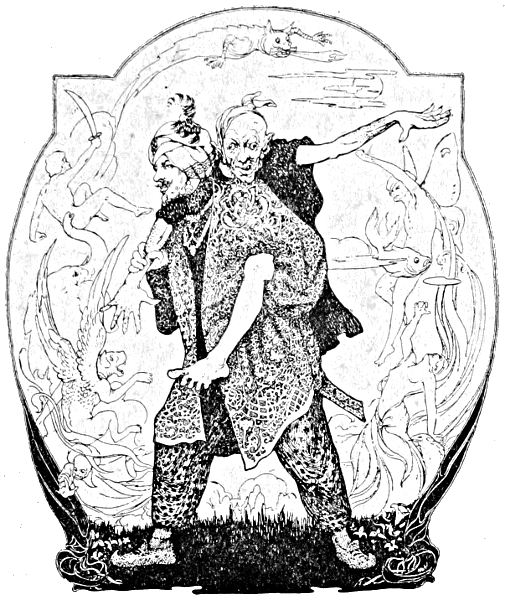
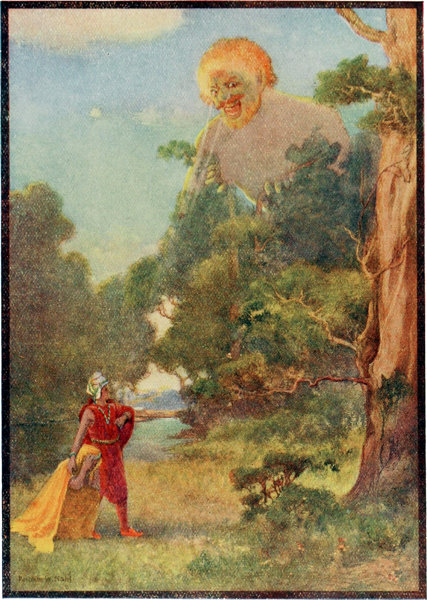
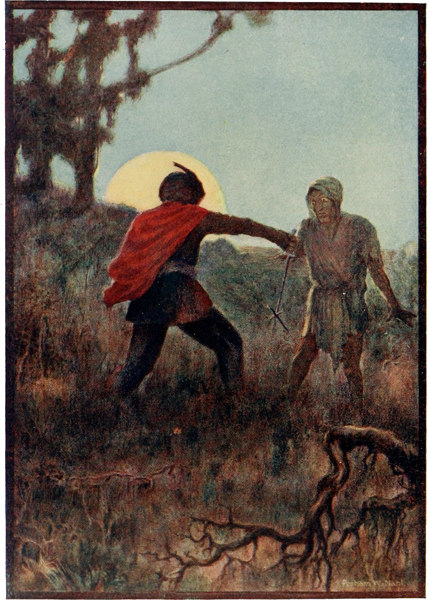
So the king walked along with the goblin.
And the goblin said: "O king, listen
to a story the like of which was never
heard."
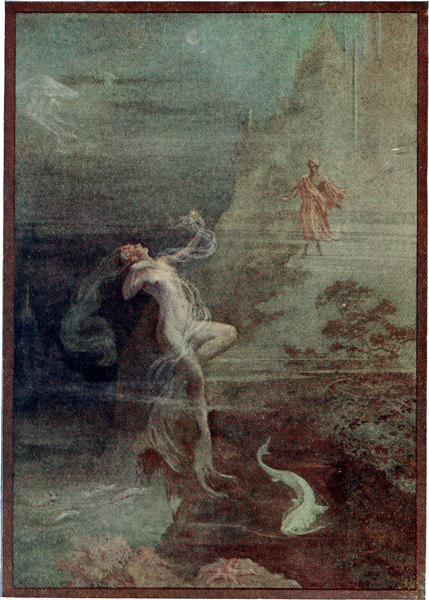
There is a mountain called Himalaya where
all gems are found. It is the king of
mountains. Its proud loftiness is everywhere
the theme of song. The sun himself has not
seen its top.
On its summit is a city called Golden City,
brilliant like a heap of sunbeams left in trust
by the sun. There lived a glorious fairy-king
named Cloud-banner. In the garden of his
palace was a wishing-tree which had come
down to him from his ancestors.
King Cloud-banner had worshipped the
tree which was really a god, and by its grace
had obtained a son named Cloud-chariot.
This son remembered his former lives. He
was destined to be a Buddha in a future
life. He was generous, noble, merciful to all
creatures, and obedient to his parents.
When he grew up, the king anointed
him crown prince, persuaded thereto by his
counsellors as well as by the remarkable
virtues of the youth. While Cloud-chariot
was crown prince, his father's counsellors came
to him one day and kindly said: "Crown
prince, you must always honour this wishing-tree
in your garden; for it yields all desires,
and cannot be taken away by anybody. As
long as it is favourably disposed to us, the
king of the gods could not conquer us, and
of course nobody else could."
Then Cloud-chariot thought: "Alas! The
men of old had this heavenly tree, yet they
did not pluck from it any worthy fruit. They
were mean-spirited. They simply begged it
for some kind of wealth. And so they
degraded themselves and the great tree too.
But I will get from it the wish which is in
my heart."
With this thought the noble creature went
to his father. He showed such complete
deference as to delight his father, then when his
father was comfortably seated, he whispered:
"Father, you know yourself that in this sea
of life all possessions, including our own
bodies, are uncertain as a rippling wave.
Especially is money fleeting, uncertain, fickle
as the twilight lightning. The only thing
in life which does not perish is service. This
gives birth to virtue and glory, twin witnesses
through all the ages to come. Father! Why
do we keep such a wishing-tree for the sake
of transient blessings? Our ancestors clung
to it, saying: 'It is mine, it is mine.' And
where are they now? What is it to them,
or they to it? Then, if you bid me, I will
beg this generous wishing-tree for the one
fruit that counts, the fruit of service to
others."
His father graciously assented, and Cloud-chariot
went to the wishing-tree, and said:
"O god, you have fulfilled the wishes of our
fathers. Fulfil now my one single wish.
Remove poverty from the world. A blessing
be with you. Go. I give you to the needy
world." And as Cloud-chariot bowed reverently,
there came a voice from the tree:
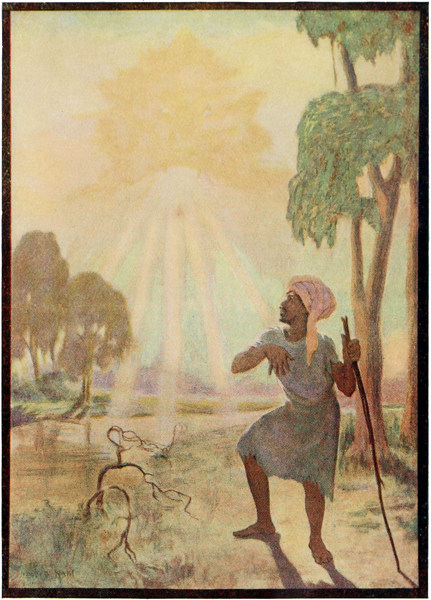
"I go, since you give me up." And the
wishing-tree immediately flew from heaven and
rained so much money on the earth that nobody
was poor. And Cloud-chariot's reputation for
universal benevolence was spread abroad.
But all the relatives were jealous and envious.
They thought that they could easily conquer
Cloud-chariot and his father without the
wishing-tree, and they prepared to fight to
take away his kingdom. But Cloud-chariot
said to his father: "Father, how can you
take your weapons and fight? What high-minded
man would want a kingdom after
killing his relatives just for the sake of this
wretched, perishable body? Let us abandon
the kingdom, and go away somewhere to
devote ourselves entirely to virtue. Then we
shall be blessed in both worlds. And let these
wretched relatives enjoy the kingdom which
they hanker after."
And Cloud-banner said: "My son, I only
want the kingdom for you, and if you give it
up from benevolent motives, what good is it
to me? I am an old man."
So Cloud-chariot left the kingdom and went
with his father and mother to the Malabar hills.
There he built a hermit's retreat, and waited on
his parents.
One day, as he wandered about, he met
Friend-wealth, the son of All-wealth, who
lived there as king of the Siddhas. And
Cloud-chariot spoke to him and made friends
with him.
Then one day Cloud-chariot saw a shrine to
the goddess Gauri in the grove, and entered
there. And he saw a slender, lovely maiden
surrounded by her girl friends and playing on
a lute, in honour of Gauri. The deer listened
to her music and her song, motionless as
if ashamed because her eyes were lovelier
than their own. When Cloud-chariot saw the
slender maiden, his heart was ravished.
And he seemed to her to make the garden
beautiful like the spring-time. A strange longing
came over her. She became so helpless
that her friends were alarmed.
Then Cloud-chariot asked one of her friends:
"My good girl, what is your friend's sweet
name? What family does she adorn?"
And the friend said: "This is Sandal, sister
of Friend-wealth, and daughter of the king of
the Siddhas." Then she earnestly asked for
the name and family of Cloud-chariot from a
hermit's son who had come with him. And
then she spoke to Sandal with words punctuated
by smiles: "My dear, why do you not show
hospitality to the fairy prince? He is a guest
whom all the world would be glad to honour."
But the bashful princess remained silent with
downcast eyes. Then the friend said: "She
is bashful. Accept a hospitable greeting from
me." And she gave him a garland.
Cloud-chariot, far gone in love, took the
garland and put it around Sandal's neck. And
the loving, sidelong glance which she gave him
seemed like another garland of blue lotuses.
So they pledged themselves without speaking a
word.
Then a serving-maid came and said to the
princess: "Princess, your mother remembers
you. Come at once." And she went slowly,
after drawing from her lover's face a passionate
glance, for which Love's arrow had wedged a
path. And Cloud-chariot went to the hermitage,
thinking of her; while she, sick with the
separation from the lord of her life, saw her
mother, then tottered to her bed and fell upon
it. Her eyes were blinded as if by smoke from
the fire of love within her, her limbs tossed in
fever, she shed tears. And though her friends
anointed her with sandal and fanned her with
lotus-leaves, she found no rest on her bed or in
the lap of a friend or on the ground.
Then when the day fled away with the
passionate red twilight, and the moon drew
near to kiss the face of the laughing East, she
despaired of life, and her modesty would not
let her send a message in spite of all her love.
But somehow she lived through the night.
And Cloud-chariot too was in anguish at the
separation. Even in his bed he was fallen into
the hand of Love. Though his passion was
so recent, he had already grown pale. Though
shame kept him silent, his looks told of the
pangs of love. And so he passed the night.
In the morning he arose and went to the
shrine of Gauri. And his friend, the hermit's
son, followed him and tried to comfort him.
At that moment the lovelorn Sandal came out
of her house alone, for she could not endure
the separation, and crept to that lonely spot to
end her life there.
She did not see her lover behind a tree, and
with eyes brimming with tears she prayed to
the goddess Gauri: "O goddess, since I could
not in this life have Cloud-chariot as my
husband, grant that in another life at last
he may be my husband."
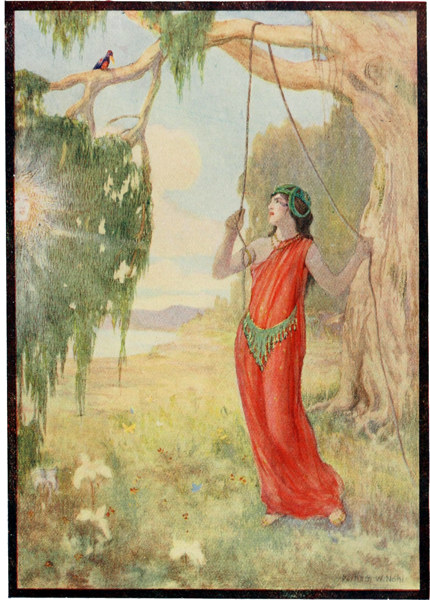
Then she tied her garment to the limb of
an ashoka tree before the goddess and cried:
"Alas, my lord! Alas, Cloud-chariot! They
say your benevolence is universal. Why did
you not save me?"
But as she fastened the garment about her
neck, a voice from the sky was heard in the
air: "My daughter, do nothing rash. Cloud-chariot,
the future king of the fairies, shall be
your husband."
And Cloud-chariot heard the heavenly voice,
and with his friend approached his rejoicing
sweetheart. The friend said to the girl:
"Here is the gift which the goddess grants
you." And Cloud-chariot spoke more than
one tender word and loosed the garment from
her neck with his own hand.
Then a girl friend who had been gathering
flowers there and had seen what was happening,
came up joyfully and said, while Sandal's
modest eyes seemed to be tracing a figure on
the ground: "My dear, I congratulate you.
Your wish is granted. This very day Prince
Friend-wealth said in my presence to King
All-wealth, your father: 'Father, the fairy
prince Cloud-chariot, who deserves honour
from all the world, who gave away the wishing-tree,
is here, and we should treat him as an
honoured guest. We could not find another
bridegroom like him. So let us welcome him
with the gift of Sandal who is a pearl of a
girl.' And the king agreed, and your brother
Friend-wealth has this moment gone to the
hermitage of the noble prince. I think your
marriage will soon take place. So go to your
chamber, and let the noble prince go to his
hermitage."
So she went slowly and happily and lovingly.
And Cloud-chariot hastened to the hermitage.
There he greeted Friend-wealth and heard his
message, and told him about his own birth and
former life. Then Friend-wealth was delighted
and told Cloud-chariot's parents who were
also delighted. Then he went home and made
his own parents happy with the news.
That very day he invited Cloud-chariot to
his home. And they made a great feast as
was proper, and married the fairy prince and
Sandal on the spot. Then Cloud-chariot was
completely happy and spent some time there
with his bride Sandal.
One day he took a walk for pleasure about
the hills with Friend-wealth, and came to the
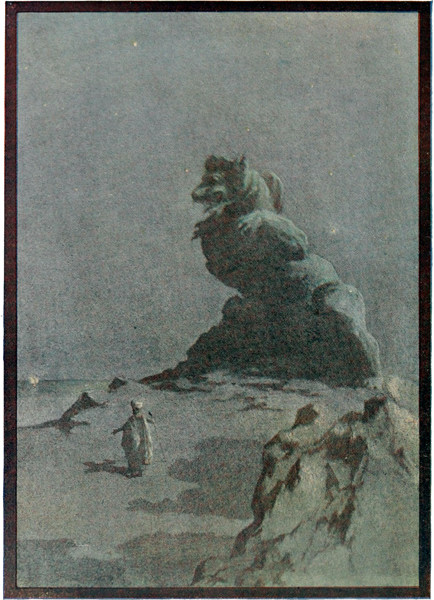
seashore. There he saw great heaps of bones,
and he asked Friend-wealth: "What creatures
did these heaps of bones belong to?" His
brother-in-law Friend-wealth said to the
merciful prince: "Listen, my friend. I will
tell you the story briefly."
Long ago Kadru, the mother of the serpents,
made a wager with her rival Vinata, the
mother of the great bird Garuda. She won
the wager and enslaved her rival. Now
Garuda's anger continued even after he had
freed his mother from slavery. He kept going
into the underworld where Kadru's offspring,
the serpents, live, to eat them. Some he killed,
others he crushed.
Then Vasuki, king of the serpents, feared
that in time all would be lost if the serpents
were all to be slain thus. So he made an
agreement with Garuda. He said: "O king
of birds, I will send one serpent every day to
the shore of the southern sea for you to eat.
But you are never to enter the underworld
again. What advantage would it be to you
if all the serpents were slain at once?" And
Garuda agreed, with an eye to his own
advantage.
Since that time Garuda every day eats the
snake sent by Vasuki here on the seashore.
And these heaps of bones from the serpents
that have been eaten, have in time formed a
regular mountain.
When Cloud-chariot heard this story from
the lips of Friend-wealth, he was deeply
grieved and said: "My friend, wretched indeed
is that king Vasuki who deliberately sacrifices
his own subjects to their enemy. He is a
coward. He has a thousand heads, yet could
not find a single mouth to say: 'O Garuda,
eat me first.' How could he be so mean as to
beg Garuda to destroy his own race? Or how
can Garuda, the heavenly bird, do such a
crime? Oh, insolent madness!"
So the noble Cloud-chariot made up his
mind that he would use his poor body that
day to save the life of one serpent at least.
At that moment a door-keeper, sent by Friend-wealth's
father, came to summon them home.
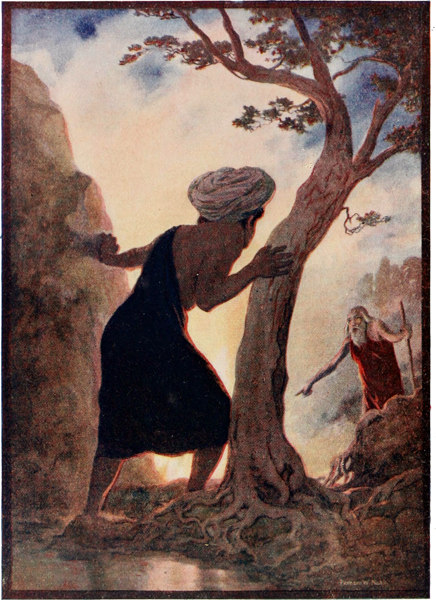
And Cloud-chariot said: "Do you go first.
I will follow." So he dismissed Friend-wealth,
and remained there himself.
As he walked about waiting for the thing
he hoped for, he heard a pitiful sound of weeping
at a distance. He went a little way and
saw near a lofty rock a sorrowful, handsome
youth. He was at that moment abandoned
by a creature that seemed to be a policeman,
and was gently persuading his old, weeping
mother to return. And Cloud-chariot wished
to know who it might be. So he hid himself
and listened, his heart melting with pity.
The old mother was bowed down by
anguish, and started to lament over the
youth. "Oh, Shell-crest! Oh, my virtuous
son, whom I fondled, not counting the labour
and the pain! Oh, my son, my only son!
Where shall I see you again? Oh, my darling!
When your bright face is gone, your
old father will fall into black despair. How
can he live then? Your tender form is hurt
by the rays of the sun. How can it bear
the pangs of being eaten by Garuda? Oh,
my unhappy fate! Why did the Creator
and the serpent-king choose my only son
from the broad serpent-world, and seize upon
him?"
And as she lamented, the youth, her son,
said: "Mother, I am unhappy enough. Why
torture me yet more? Return home. For
the last time I bow before you. It is time
for Garuda to come."
And the mother cried: "Alas, alas for me!
Who will save my son?" And she gazed
about wildly and wept aloud.
All this Cloud-chariot, the future Buddha,
saw and heard. And with deep pity he
thought: "Alas! This is a serpent named
Shell-crest, sent here by Vasuki for Garuda
to eat. And this is his mother, following
him out of her great love. He is her only
son, and she is mourning in pain and bitter
anguish. I should forever curse my useless
life if I did not save one in such agony at
the cost of a body which must perish anyway
some day."
So Cloud-chariot joyfully approached and
said to the old mother: "Serpent-mother, I
will save your son. Do not weep."
But the old mother thought that this was
Garuda, and she screamed: "O Garuda, eat
me! Eat me!"
Then Shell-crest said: "Mother, this is
not Garuda. Do not be alarmed. What a
difference between one who soothes our feelings
like the moon, and the fearful Garuda!"
And Cloud-chariot said: "Mother, I am a
fairy, come to save your son. I will put on
his garment and offer my own body to the
hungry bird. Do you take your son and
go home."
But the old mother said: "No, no. You
are more than a son to me. To think that
such as you should feel pity for such as
we!"
And Cloud-chariot answered: "Mother, I
beg you not to disappoint me." But when he
insisted, Shell-crest said: "Noble being, you
have certainly shown compassion, but I do
not wish to save my body at the expense of
yours. Who would save a common stone at
the cost of a pearl? The world is full of
creatures like me, who are merciful only to
themselves. But creatures like you, who are
merciful to all the world, are very rare. Oh,
pious being, I could not stain the pure family
of Shell-guard, as the dark spot stains the
disk of the moon."
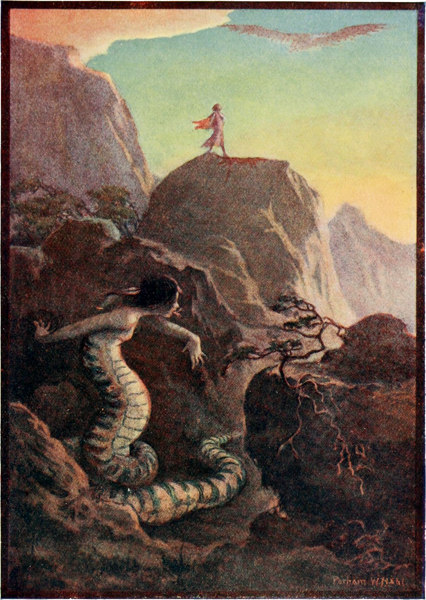
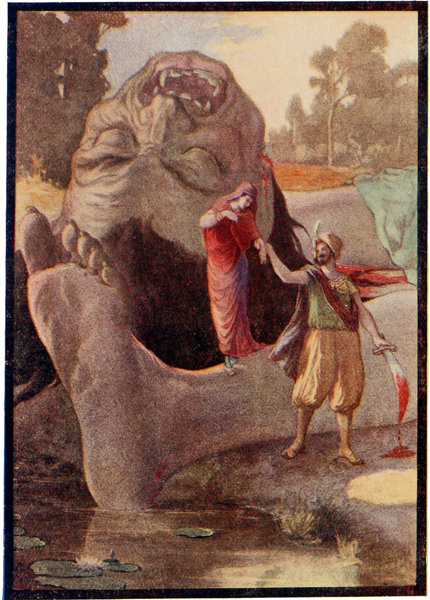
He climbed the rock of sacrifice, eager to give his life for another.
Then Shell-crest said to his mother:
"Mother, return from this desolate place.
Do you not see the rock of sacrifice wet with
the blood of serpents, the terrible plaything
of Death? I will go for a moment to the
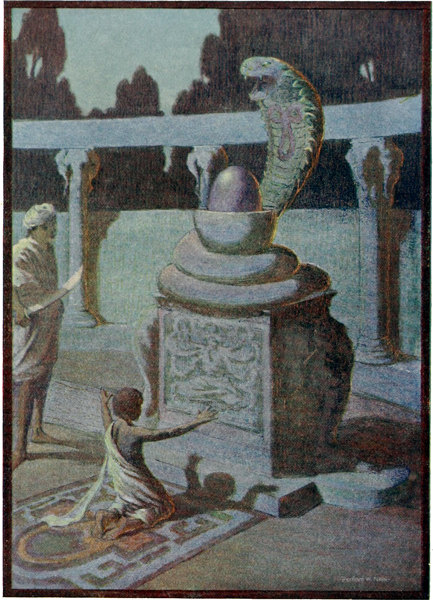
shore and worship the god Shiva there.
And I will return quickly before Garuda
comes."
So Shell-crest took leave of his mother and
went to worship Shiva. And Cloud-chariot
thought: "If Garuda should come in this
interval, I should be happy."
Then he saw the trees stiffening themselves
against the wind made by the sweeping
wings of the king of birds. "Garuda is
coming," he thought, and climbed the rock
of sacrifice, eager to give his life for
another.
And Garuda straightway pounced upon the
noble creature and lifted him from the rock
in his beak. While Cloud-chariot's blood
flowed in streams and the gem fell from his
forehead, Garuda carried him off and began
to eat him on the summit of the Malabar
hills. And while he was being eaten, Cloud-chariot
thought: "In every future life of
mine may my body do some good to somebody.
I would not attain heaven and salvation
without doing some good first." Then
a shower of flowers fell from heaven on the
fairy prince.
At that moment the blood-stained gem from
his forehead fell in front of his wife Sandal.
She was in anguish at the sight, and as her
parents-in-law were near, she tearfully showed
it to them. And they were alarmed at the
sight of their son's gem and wondered what
it meant. Then King Cloud-banner discovered
the truth by his magic arts, and he
and his queen started to run with Cloud-chariot's
wife Sandal.
At that moment Shell-crest returned from
his worship of Shiva. He saw the rock
stained with blood, and cried: "Alas for
me, poor sinner! Surely that noble, merciful
creature has given his body to Garuda in
place of mine. I must find him. Where has
the great being been carried by my enemy?
If I find him alive, then I shall not sink into
the slough of infamy." So he followed weeping
the broad trail of blood.
Now Garuda noticed that Cloud-chariot
was happy while being eaten, and he thought:
"This must be some strange, great being, for
he is happy while I am eating him. He does
not die, and what remains of him is thrilled
with delight. And he turns a gracious, benevolent
look upon me. Surely, he is no
serpent, but some great spirit. I will stop
eating him and ask him."
But while he reflected, Cloud-chariot said:
"O king of birds, why do you stop? There
is still some flesh and blood on me, and I see
that you are not satisfied. Pray continue to eat."
When the king of birds heard these remarkable
words, he said: "You are no serpent.
Tell me who you are."
But Cloud-chariot continued to urge him:
"Certainly I am a serpent. What does the
question mean? Continue your meal. What
fool would begin a thing and then stop?"
At that moment Shell-crest shouted from
afar: "O Garuda, do not commit a great
and reckless crime. What madness is this?
He is not a serpent. I am the serpent."
And he ran between them and spoke again
to the agitated bird: "O Garuda, what
madness is this? Do you not see that I have
the hood and the forked tongue? Do you
not see how gentle his appearance is?"
While he was speaking, Cloud-chariot's
wife Sandal and his parents hurried up. And
when his parents saw how he was lacerated,
they wept aloud and lamented: "Alas, my
son! Alas, Cloud-chariot! Alas for my
merciful darling, who gave his life for
others!"
But when they cried: "Alas, Garuda!
How could you do this thoughtless thing?"
then Garuda was filled with remorse and
thought: "Alas! How could I be mad
enough to eat a future Buddha? This must
be Cloud-chariot, who gives his life for others,
whose fame is trumpeted abroad through all
the world. If he is dead, I am a sinner, and
ought to burn myself alive. Why does the
fruit of the poison-tree of sin taste sweet?"
While Garuda was thus deep in anxious
thought, Cloud-chariot saw his relatives
gathered, fell down, and died from the pain
of his wounds. Then, while his grief-stricken
parents were loudly lamenting, while Shell-crest
was accusing himself, Sandal looked up
to heaven and, in a voice stammering with
tears, reproached the goddess Gauri who had
graciously given her this husband: "Oh,
Mother! You told me that the fairy prince
should be my husband, but it is my fate that
you spoke falsely."
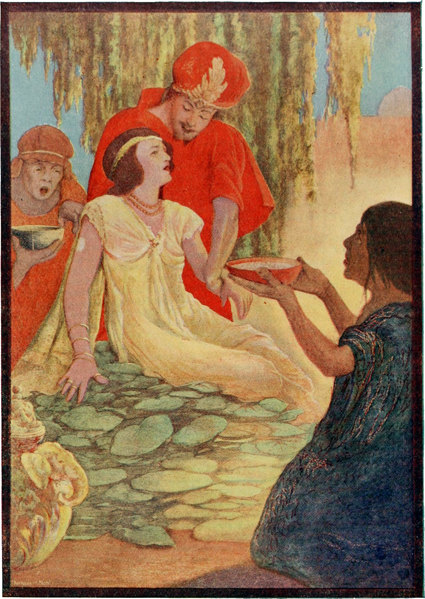
Then Gauri appeared in a visible form,
and said: "Daughter, my words are not
false." And she sprinkled Cloud-chariot with
nectar from a jar. And straightway he stood
up alive, unhurt and more beautiful than
before.
As they all bent low in worship, and Cloud-chariot
rose only to bend again, the goddess
said: "My son, I am pleased with your gift
of your own body. With my own hand I
anoint you king of the fairies." And she
anointed Cloud-chariot with liquor from the
jar, and then disappeared, followed by the
worship of the company. And showers of
heavenly blossoms fell from the sky, and the
drums of the gods were joyfully beaten in
heaven.
Then Garuda reverently said to Cloud-chariot:
"O King, I am pleased with your
more than human character. For you have
done a strange thing of unparalleled nobility,
to be marvelled at throughout the universe,
to be written upon the walls of heaven.
Therefore I am at your service. Choose from
me what boon you will."
The noble creature said to Garuda: "O
Garuda, you must repent and eat no more
serpents. And you must restore to life those
that you ate before, who now are nothing
but bones."
And Garuda said: "So be it. I will eat
no serpents hereafter. And those that I have
eaten shall come to life."
Then all the serpents who had been eaten
down to the bones, suddenly stood up. And
through the grace of Gauri all the leading
fairies learned immediately the wonderful deed
of Cloud-chariot. So they all came and
bowed at his feet and took him, freshly
anointed by the very hand of Gauri, with his
rejoicing relatives and friends to the Himalaya
mountain. There Cloud-chariot lived happily
with his father and his mother and his wife
Sandal and Friend-wealth and the generous
Shell-crest. And he ruled the fairy world
radiant with gems.
When the goblin had told this long, strange
story, he said to the king: "O King, tell
me. Which was the more self-sacrificing,
Cloud-chariot or Shell-crest? If you know
and do not tell, then the curse I mentioned
before will be fulfilled."
And the king said: "There was nothing
remarkable in what Cloud-chariot did. He
was prepared for it by the experiences of
many past lives. But Shell-crest deserves
praise. He was saved from death. His enemy
had another victim, and was far away. Yet
he ran after and offered his body to Garuda."
When the goblin heard this, he went back
to the sissoo tree. And the king returned to
catch him again.