To some men (certainly it is so to me) one great
element of the pleasure of walking shooting versus
standing shooting, viz., the driving of grouse, partridge,
and pheasant, is the working and use of dogs where
they are useful and essential to success, in the particular
sport for which they are used.
Do not let it be inferred that I am detracting from
driving, or the skill and experience that is necessary
to do it well, both in beaters and guns.
Each sport is delightful in its way and in its season.
The Yorkshire grouse cannot be brought to bag
without driving, and so with partridges and pheasants
in certain counties.
But I do feel more delight in hunting the game than
in having the game hunted towards me.
I have always worked a perfect retriever broken by
myself and kept to myself, a dog keen to his work,
and who keeps by your side, not at heel, as he needs
to see what is doing, if he is to help you to his uttermost,
who keeps his nose on the alert, and tells you
by a look when you are passing a close sitting partridge
or rabbit or hare in its form, and who tells you if
the partridge covey is still in front or run up the right
or left furrows of the swedes, who stops with you until
told to go, and then goes quietly back to where he
saw the bird drop, and takes up the scent of the dead
or running bird; not a dog who, when told to go
rushes and tears about hoping to flush the winged bird
into sight, or put up and chase some wretched rabbit,
which is far more to his taste.
I have never done any good with pedigree dog-blood
as shown on the show bench. Of course, on
the show bench it is not pretended for one moment
that any good is to accrue in a sporting sense; all is
sacrificed to shape, size, and coat, which in a sporting
dog get it if you can, but probably you have to do
without some points if you get brains and keenness.
Napoleon, Wellington, and Gen. Sheridan were all
small men, and their physique would not have commanded
prizes on the show bench.
Again, for field trials dogs are bred up for that
business only, and are rarely used for sporting.
At a field trial you want a bold pretentious dog
that will go in and do just one or two things in a
certain form, stand hares and rabbits, if he does it in
proper form, and as to whether he is an industrious
good worker, that is a matter of indifference. A really
good dog, if a little shied by the crowd round him, will
be quite out of the running in a field trial. I don't
say but that some field trial dogs may possess high
qualities that are useful as a cross in breeding.
I raise no objection to dog shows, they afford
pleasure to numbers of people. What I desire is that
the inexperienced sportsman shall not look in that
direction for his sporting dogs.
Caithness birds, especially in catchy weather, run very
much when pointed and drawn upon. Clearly, like a
red-leg partridge, he tries his legs well before he will
take to wing. Sometimes they will road over 100 yards
or more, and it is an unexplained mystery to me how
a brood will cross a burnt and bare patch in front of
you as fast as you can comfortably walk, without showing
themselves.
Old solitary cocks are terrible fellows for this, and
if your dog does not foot them fast they will outwalk
you, and ultimately rise wild.
One old brute pointed well fifty yards within the
march, took me such a distance across the Dunbeath
march that I began to be so thoroughly ashamed of
my trespass, that when he did rise and drop to the
shot, I felt half inclined to let him lie and come away.
To my mind working a brace of dogs is a mistake.
Rap, we will say, gets birds and Ben backs him;
certainly a very pretty picture, if the dogs do it well.
The birds draw on, and Rap draws on, Ben remains
behind, stands like a fool—the poetry of the picture is
gone, perhaps he draws on in Rap's footsteps.
Besides if you want to work your dogs in pairs you
will need double the number in the kennel, ay, and
an extra dog breaker as well.
In the course of a six or seven hour day, to work a
party, you will need, if you work them singly, three
experienced dogs and two younger ones coming on
to work.
In Caithness and Sutherland necessarily wide
ranging a little over two hours early in the season, is
enough for an old dog, and less for a young one
coming on, and four days a week is about as much as
they will do, and if the gun shoots four days a week,
it is as much as he can do to shoot properly. A man
who is careful of himself will get more birds in four
easy days, than the enthusiast who works long hours
and six days.
If you want to get birds, keep yourself and dogs and
gillies fresh and in good form, and so that when birds
rise they shall also fall.
I have heard of dogs that will work all day long and
every day as well, but I have never yet been fortunate
enough to come across that very remarkable and
desirable strain.
Here let me give a sketch that is no mere flight of
fancy.
The 26th of August, my birthday.
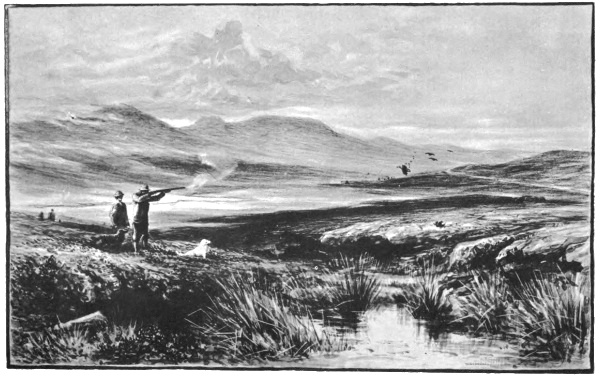
It is a sunny day with a gentle balmy wind, and the
heather, which is full in bloom, is dusting your boots
white with its pollen.
It is a lazy day for birds, and they will not much
care to run.
Daisy is ranging pretty wide, and, getting an indication
of birds, pulls up and looks over her shoulder
towards her master.
"Has she birds, David?" "She is no sure." You
walk slowly up to Daisy, she draws on, and her point
gradually stiffens; another twenty yards and she stops
full point; you both walk on, the old cock bird rises
first at twenty-five yards, and he goes down, you load,
and the hen and three young birds rise within ten
yards.
Take it calmly, don't smash up the old hen by
taking her too soon, and, after her, down with one of
the young birds; load quietly and quickly. Daisy
stops where she is; up gets another bird and that goes
down.
Smoker is sent forward, and he gathers and brings
in the old hen and two young birds from out of the
deep heather.
No doubt the old cock is a runner.
David and Daisy sit down whilst I go forward and
put Smoker on to where the old bird dropped.
We sit and watch him; see the old dog threading
the scent at a quick pace in and out amongst the peat
hags.
Oh dear, the bird has taken down the burn and we
may lose him.
But no; an hundred yards below out comes Smoker
from the burn triumphant, with the old cock, which
he delivers up without a scratch save the broken
pinion.
Daisy is now away to find a fresh point. What has
Smoker pointing there, with a look that says as plain
as dogs can speak, that fool, Daisy, who thinks so
much of herself in her hurry to get fresh points, has
left a close sitting bird in that tuft of good heather.
Yes, Smoker is right, as he always is in all he does,
and another bird is flushed and bagged.
The brood was seven, and now but two away, thanks
to the studious care and intelligence of my two four-footed
friends.
And what fine birds, with their white speckled
breasts! the young ones as large as the old ones.
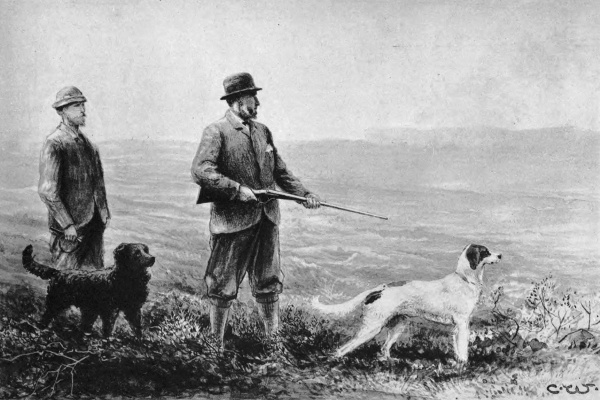
Daisy on Point.
We pile them in a heap for the gillie to collect as
he comes along.
Dear old Daisy, there were better dogs with better
noses and grander action, but the loving creature did
her very best to bring birds to bag by care and gentleness,
and she did it too.
That retriever, Smoker, the second of his name,
has now passed away, and his place taken by a worthy
third, was a character.
Amongst other things he was born defective in
the power of propagation.
I bred him from a bitch that I bought in Norfolk
solely to breed him from; the father was a dog
belonging to a keeper of Col. Kenyon Slaney.
There were only two dogs in the litter, all the
others being bitches.
He was a poor puny thing, and would have been
consigned to the bucket with sundry of his sisters, had
there been other dogs in the litter.
But as he grew, and he grew fast, he showed signs
of great intelligence.
When old enough, he was sent down to Dalnawillan,
to David's care, and there again I saw him when nearly
full grown, when there fishing in June.
He knew me again. "Is he steady and quiet,
David?"—"Oh, yes." So we took a walk.
He looked at me out of the corner of his eye, as
much as to say, "I wonder if he means to be my
master: I will have a try;" so he chases a lamb. I
came up with him; he drops the lamb, and away again
after the same lamb; aye, and once again after that.
The lamb takes to the river, and I after him. I get
hold of the lamb and take it ashore, and put it by my
side. It was not really hurt, but in a sad state of mind.
At last, up comes Smoker, and receives a real
roasting, that satisfies him as to who is to be master,
and I trust that retributive justice also satisfied the
injured feelings of the lamb.
He was, without exception, the rankest and most
determined puppy I ever handled. At times I thought
I must give him up; but he repaid my trouble.
At home in the autumn, a pair of partridges were
down in some deep feg he was put upon. Up jumped
a hare, far more interesting to Smoker, and he away
after. Whistle, whistle, yes until you be hoarse; he
would not come.
Again the question had arisen as to who was to be
master, so I sat myself down a good half-hour before
the guilty rascal came to heel; but when he did, and
he knew perfectly well what was coming, a hazel
stick, cut specially for his education, effectually
reminded him.
He lay on the ground, and howled and moaned.
Whips were of no effect, he laughed to scorn such
mild trifles.
Dogs never mind being thrashed, if they deserve it.
Don't do it oftener than you can help, and then do it
effectually.
Smoker gets up, wags his tail, has a bit of biscuit to
cement renewed friendship, limps a good deal, and
goes to work, and cleverly gathers first one and then
the other bird.
Only for me would he work. Not a dump did he care
for keeper or any other body, but just went his own
wilful way.
He was gentle as a lamb. Little children and small
dogs might do as they liked with him. My daughter's
pug regarded him with a mixture of intense jealousy
and reverence, but that did not prevent Toby from
occasionally attacking him tooth and nail, much to the
amusement of Smoker.
He was free of the library, and a constant partaker
of five o'clock tea when not out at work.
For many years Smoker, in the season, worked on
grouse, with Daisy, a setter bitch, and with other
dogs.
There was great jealousy between him and Daisy,
but both good natured over it.
Daisy was very fond, if she could manage to elude
attention, of quietly retrieving a bird, and it was as
good as a play to observe her delight and his indignation
at her encroachment upon his part of the work.
I could tell endless tales of his ability and intelligence.
When not at work, he was the laziest of dogs, but
any symptoms of shooting about he was all life. His
great object was, then, to get hold of my shooting
cape. He had some idiotic notion that he had a lien
upon me by so doing, and that I was bound to go out
to shoot.
On one occasion I was away from home, and a lady
in the house induced him to walk with her in the
garden.
As she went through the porch, she took my walking
stick.
Smoker, presently, in his quiet, gentlemanly way,
took hold of the stick, as the lady thought, to carry it.
But no, Smoker walks back and deposits it in the
porch, as much as to say, "None of that, when my
master is away."
In my time, I have had many good pointers and
setters.
I have no prejudice as to which, but pointers are
more easy to break; but, then, in those northern
latitudes they do not stand the cold so well as setters
do.
In breeding, you may reckon that out of four
puppies, you will not get more than two out of the four
that turn out fairly well, and for dogs of exceptional
intelligence not one in twenty; ay, in fifty.
Rap, who pointed my first Scotch grouse was, take
him all in all, as good a pointer as I ever had.
Grace, a setter bitch that I worked at the same time
as Rap, was charming in every way.
She was a puppy of the Rûg breed from North
Wales. How I came by her I forget, and from her I
bred many good dogs, but never anything of exceptional
excellence.
The best setter I ever handled was Ben, an ivory
coloured setter, a first cross between a Gordon and a
Laverack.
He was perfect in his work, but a bit rank if the
whip was spared.
He would go to the dead birds after they were down
if he possibly could, that is, if he had the least licence
granted to him.
Pointing and retrieving were all one to him.
He would watch a towered or a stung bird, and let
him go and he would go straight, judging distance
well, a thing very few retrievers can do; and if the
bird did not rise again, he would to a certainty bring
him.
The only retriever that I have seen judge distance
with a towered bird was a large black dog belonging
to the late Sir Stephen Glyn. He marked the bird;
the ground being difficult he went, not straight, but
across other fields to the right of his bird.
I never did any good with red Irish setters, but it
does not follow that, others may not have done so,
but I very much doubt it.
I was persuaded to buy a beautiful young pedigree
bitch puppy, warranted from dogs that on both sides
were worked on grouse. She was perfect in shape
and colour, but the veriest fool that ever ranged a
moor.
After a season's experience not work, for she never
did any work except range beautifully, David said that
I had better shoot her.
No, I said; I will advertise her in The Field, and I
did as follows:—
"A very handsome —— pedigree red Irish setter
bitch, useless on the field, no nose; probably make a
winner on the show bench."
I had several applications, and got a few pounds
for her, which I handed to David.