Chapter I — The Philadelphia Symphony Society 1893-1900. — Prospectus of Philadelphia Permanent Orchestra
A Road One Hundred and Fifty Years Long
“Time Was unlocks the riddle of Time Is”
“By Particular
Desire[1]
“On Tuesday next, the 25th inst., at the Assembly Room
in Lodge Alley will be performed a Concert of Music,
under the direction of Mr. John Palma; to begin exactly
at six o’clock.
“Tickets to be had at the London Coffee House, at one
Dollar each; and no person to be admitted without a ticket.”
Such in January, 1757, was the announcement of the first public concert
in Philadelphia of which there is record. So began the approaches to
the Philadelphia Orchestra, like the approaches to a great bridge which
begin hundreds of feet away from the span.
There had been music in private and other entertainments previous to
this public concert and in spite of the disapproval of the Society of
Friends and of a number of religious sects music found its first refuge
in the church. As early as 1701 Justus Falckner, a German Lutheran,
wrote as follows:
“I will here take occasion to mention that many others
besides myself who know the ways of the land, maintain that music would
contribute much toward a good Christian service. It would not only
attract and civilize the wild Indians, but it would do much good in
spreading the Gospel truths among the sects and others by attracting
them. Instrumental music is especially serviceable here. Thus a
well-sounding organ would perhaps prove of great profit, to say nothing
of the fact that the Indians would come running from far and near to
listen to such unknown melody, and upon that account might become
willing to accept our language and teaching, and remain with people who
had such agreeable things; for they are said to come ever so far to
listen to one who plays even a reed-pipe (rohrpfeiffe): such an
extraordinary love have they for any melodious and ringing sound.
Now as the melancholy, saturnine, stingy Quaker spirit has abolished
(relegiert) all such music, it would indeed be a novelty here, and tend
to attract many of the young people away from the Quakers and sects to
attend services where such music was found, even against the wishes of
their parents. This would afford a good opportunity to show them the
truth and their error.”[2]
When Falckner was ordained in Gloria Dei Church in 1703, the Hermits of
the Wissahickon played on the viol, hautboy, trumpets and kettledrums
(Pauken) and the service was opened with a voluntary on the little
organ, all of which he doubtless arranged and enjoyed. Gradually a
number of other churches followed suit and installed organs.
In regard to secular music in private houses, letters testify to its
existence early in the 18th century; and Whitefield on his arrival was
an ally to its opponents. One of his followers printed this information
for the public in 1740, although the statement was later denied:
“Since Mr. Whitefield’s Preaching here, the
Dancing School, Assembly and Concert Room have been shut up, as
inconsistent with the Doctrine of the Gospel: and though the Gentlemen
concern’d caus’d the Door to be broke open again, we are inform’d that
no Company came to the last Assembly night.”[3]
But music was craved by some of the inhabitants or a sensation would
not have been made by the Musical Clock:
“The Unparallelled Musical Clock, made by that
great Master of Machinery, David Lockwood. It excels all others in
the Beauty of its Structure and plays the choicest Airs from the most
celebrated Operas with the greatest Nicety and Exactness. It performs
with beautiful graces, ingeniously and variously intermixed, the French
Horn, Pieces, perform’d upon the Organ, German and Common Flute,
Flageolet, etc., Sonata’s, Concerto’s, Marches, Minuetts, Jiggs and
Scots Airs, composed by Corelli, Alberoni, Mr. Händel and other great
and eminent Masters of Musick.”
It was not until Mr. Palma’s concert however, that there seems to have
been any music for which the public could buy tickets. This pioneer
effort was followed by others. The “Subscription Concerts of Musick”
became fashionable in 1764; and later the fortnightly “City Concerts”
under John Bentley at the City Tavern. The Amateur and Professional
Concerts were a popular series. Groups of men fostered music as the
years passed. Francis Hopkinson and his friends both professional and
amateur assembled regularly to play “Concerti Grossi.” This group of
about twelve musicians probably formed Philadelphia’s first Orchestra.
The first real musical impetus came undoubtedly from Francis Hopkinson,
signer of the Declaration of Independence and later member of Congress.
He was besides, a teacher, organist, poet, harpsichordist, essayist,
improver of the harpsichord and the first American composer. Among his
works are the song, “My Days have been so wondrous free,” the earliest
American secular composition extant; and “Seven Songs” dedicated to
Washington. John Adams described him as:—“One of your pretty, little
curious, ingenious men. His head is not bigger than a large apple.
I have not met with anything in natural history more amusing and
entertaining than his personal appearance, yet he is genteel and well
bred, and is very social.”[4]
Other composers were not lacking as is seen by the announcement of John
Gualdo, in 1769, of a concert in which five out of thirteen numbers
were composed by him. This is the first recorded composers’ concert in
this country and his name appeared with those of the famous composers
of Europe of the day, as Philadelphia was never far behind.
Benjamin Franklin interested himself in the art and constructed an
improved Armonica or Musical Glasses. Thus two important public men of
the time gave music their sanction and assisted its cause.
As the city grew the people began to feel the need of instruction in
music. From early times Philadelphia had its share of music teachers,
the first one to publicly advertise, being a woman. Among them were a
number of excellent Englishmen who presented at concerts the works of
the great masters of Europe; and there were a few Germans. One of these
was an accomplished person if the following announcement which appeared
in 1755, be true:
“The subscriber proposes to open a school on Monday next, in the
house where the late Mr. Quin formerly dwelt, for the instruction of
Gentlemen and Ladies, in the following accomplishments:
“First, The French, Italian and German languages, in a method
concise and easy.
“Secondly, To play on the violin after the Italian manner, with a
peculiar method of bowing and shifting in solos or concertos.
“Thirdly, Drawing and miniature painting with colours, flowers,
insects, etc.... Likewise to draw patterns for embroidery, or any kind
of needle work....
“He has a variety of music, composed by the most eminent masters,
for the violino solo, concembalo et violoncello, to be disposed of on
easy terms.
“John Matthias Kramer”
Another German was H. B. Victor, who described himself as follows:
“Mr. Victor, Musician to her late Royal
Highness the Princess of Wales, and Organist at St. George’s in London,
lately arrived here, takes this method of acquainting the Musical
Gentry in general that he gives instructions on the Harpsichord, or
Forte Piano, Violin, German Flute, etc., especially in the thorough
Bass both in theory and practice, for that his pupils may soon come to
a fundamental knowledge of that fine science.
“N. B. Mr. Victor intended to give a concert,
and to perform on his new musical instruments, but is obliged to
postpone it for want of able hands; the one he calls Tromba doppia con
Tympana, on which he plays the first and second trumpet and a pair of
annexed kettledrums with the feet all at once; the other is called
cymbaline de amour, which resembles the musical glasses played by
harpsichord keys, never subject to come out of tune, both of his own
invention. He is to be met with at his house in Callowhill street near
Water street.”[5]
The many quaint advertisements of those times give an idea of the
musical activities of the people. Amateurs often assisted professionals.
Joseph Cézar, pupil of Viotti, in 1792, announced that: “Many amateurs
of the first eminence being so kind as to honor him with their
patronage, will perform,” etc. Again we hear of “a young lady who
has never before appeared in public and therefore craves protection
from all manner of insult.” Often the professional was “assisted by a
gentleman.” Infant prodigies, who were always under ten, were numerous
and they had invariably appeared before the crowned heads of Europe.
Organ dealers, spinet, harpsichord and piano makers, as well as dealers
in musical merchandise began to appear. Michael Hillegas, first
Treasurer of the United States and first music dealer in Philadelphia,
dealt in organs as early as 1753. His stock of music embraced all the
popular and standard compositions of the day, and included those of
Tartini, Tessorini, Pepush, Corelli, Händel, Vivaldi, Burney, Stamitz,
Barbella, and Scarlatti. Besides sheet music, many other articles were
to be had at his shop as we see from this advertisement:
“To be sold by Michael Hillegas, at his
House in Second street, opposite Samuel Morris, Esq., an extraordinary
good and neat Harpsichord with four stops; a good Violin-cello, an
Assortment of English and Italian Violins, as well as common ones, as
double lined, of which some extraordinary; a parcel of good German
Flutes, imported here from Italy. Also imported in the last ships from
London, a large Assortment of Musick, of the best Masters, viz: Solos,
Overtures, Concertos, Sonatas, and Duets, for Violins, German Flutes,
Hautboys, French Horns, Violoncellos, and Guitars, Voluntaries, Lessons
for Organs and Harpsichords, ruled paper of various Sorts for Musick,
and Musick Books, Tutors or Books of Instructions to learn to play on
the Violin, German Flute, Hautboy, or Common Flute, without a Master,
Song Books, Cantatas, Songs on Sheets, and a Choice Parcel of Violin
Strings, etc.” (Penna. Gazette, 1759.)
John Behrent has the honor of being the first piano forte maker in this
city. In 1775 his advertisement in the Pennsylvania Packet informed the
public that:
“John Behrent, Joiner and Instrument-Maker
living in Third street continued in Campington, directly opposite
Coate’s Burying-ground, Has just finished for Sale, an extraordinary
fine instrument, by the name of Piano Forte, of Mahogany, in the manner
of an harpsichord, with hammers, and several changes: He intends to
dispose of it on very reasonable terms: and being a master of such sort
of work, and a new beginner in this country, he requests all lovers
of music to favour him with their custom, and they shall not only be
honestly served, but their favours gratefully acknowledged, by their
humble servant, John Behrent.”[6]
Familiar professional names in the early days were James Bremner,
teacher of Hopkinson, John Gualdo, Stephen Forrage, George
d’Eissenburg, Philip Roth, Philip Phile, John Bentley, Henri Capron,
A. Juhan, Andrew Adgate, and Victor Pelissier, nearly all of whom
were teachers as well as performers and were strong influences in the
musical life of Philadelphia and in the training of the young who were
early taught to crave the best musically.
The American Revolution caused concerts and other entertainments to be
almost entirely abandoned, with the exception of the Mischianza and
other affairs in which the British were the leading spirits. Little
occurred during this period to advance musical art.
With the country again at peace and with the dawn of a new century,
interest in music revived and early in 1820 eighty-five men organized
the Musical Fund Society, so far Philadelphia’s greatest musical
achievement. The officers and directors chosen on January 29th, 1820, were:
- Dr. William P. De Wees, President
- Dr. Robert Patterson, Vice-president
- Daniel Lammot, Treasurer
- John K. Kane, Secretary
Managers of the Fund: James W. Barker, Thomas Artley, Francis G. Smith,
Edward Hudson, Benjamin Carr, William Strickland, Henry P. Barrekens,
William Hawkins, Charles A. Poulson, Benjamin Say, George Schetky and
Andrew Farrouihl.
The Charter states “That the essential objects of the said corporation
shall be the relief of decayed musicians and their families and the
cultivation of skill and diffusion of taste in music.” Four years
later Musical Fund Hall was built at Eighth and Locust streets.
For over thirty years this building was the centre of all music in
Philadelphia, except opera. The Society maintained an orchestra and a
chorus, and conducted an Academy of Music, which was the first school
in Philadelphia permitted by Charter to confer Academic degrees in
music. The orchestra of the Musical Fund Society was composed of its
members, professional and amateur, and there were strict regulations
as to rehearsals. They were players of no mean attainments for their
time, and it is to be regretted that the influx of dazzling foreign
performers was permitted to quench the ardor of the audiences and
finally their own. The quality of the music performed was of a high
order and compared favorably with that of Europe and of other American
cities of that period. The “Creation” was chosen for the first concert,
but the music could not be procured in Baltimore, New York or Boston,
or even in Europe, so the plan was abandoned. When it was first
produced trombone players were engaged to come from Bethlehem, as there
were none in this town. Indeed, the instrument itself was unknown and
aroused much curiosity. Later at these concerts (1845), Beethoven’s
Symphony No. 1 was given in full. It was announced as “The Entire Grand
Symphony of Beethoven,” and between the movements were vocal numbers
serious and comic. During the next season the Second Symphony was given
in the same way, and two years later came the “Eroica,” the Overture to
Oberon, and the Midsummer Night’s Dream.
When the period of the great visiting virtuosi, Jenny Lind, Henriette
Sontag, Vieuxtemps, Wilhelmj, Ole Bull, Sivori, Malibran, Lagrange,
Alboni, Hensler, Gottschalk and others arrived, the excitement over
their first appearances caused a decrease in interest in home talent
and achievements, and the activities of the Musical Fund Society were
maintained with less and less enthusiasm, until finally the Academy and
then the orchestra were abandoned. Another reason for this decline was
the growing popularity of opera, to the detriment of personal musical
effort by Philadelphians.
During the early years of the nineteenth century, as in the preceding
one, Philadelphia was the abiding place of a number of excellent
and hard working musicians. These carried on the labors of their
predecessors by teaching the young, leading choirs and guiding the
musical opinion of the city. Little recognition has been given these
men, who included among their number, Alexander Reinagle, George
Shetky, Benjamin Carr, Benjamin Cross, Raynor Taylor, Thomas Loud,
Charles P. Hupfeldt, and later Charles Jarvis and his son, Charles J.
Jarvis.
In our own time among the many musicians who have fostered music
here by their own example and by training others, four should be
particularly mentioned:
Dr. Hugh A. Clarke, for fifty years Professor of Music at the
University of Pennsylvania, whose sway has been felt through the many
students who have studied under him; Wm. W. Gilchrist, his pupil;
Michael H. Cross, and Richard Zeckwer. These men wielded so potent an
influence over music students and music lovers, that Philadelphians owe
them a heavy debt. They received the musical laying on of hands and
transmitted the traditions that have existed here for two hundred years.
The important undertaking of the middle of the century was the building
of the American Academy of Music.
With the growth of population and the increasing number of visiting
opera companies, a demand arose for an opera house of adequate size and
equipment. In 1852 the project was launched and a Charter obtained,
but the amount of money needed, $400,000, was difficult to procure,
and it was not until January 26th, 1857, that the Academy was opened
with a grand ball. This eclipsed in size and brilliance any assemblage
hitherto seen in Philadelphia, and was followed on February 25th, by
the first performance of opera in the new house. “Il Trovatore” was
presented with Gazzaniga, Aldini, Brignoli and Amodio, and this marked
the beginning of the splendid career of the Academy of Music. Gradually
other musical events were transferred to the Academy, which became, and
still remains, the musical centre of the city.
Now the days of modern orchestral development are at hand. The first
visiting orchestra of note was the Steiermärkisches Orchestra, of
twenty musicians, under the leadership of Henri Riha, which came from
Germany in 1838.
Ten years later the Germania Musical Society, from Berlin, appeared
under the leadership of Carl Lenshow. Pecuniary losses caused it to
disband and the members scattered. Later the Society was reorganized
under Carl Bergmann. It had the honor of appearing at Sontag’s concert,
in 1852.
The Germania Orchestra, instituted in 1856 and incorporated in 1860,
succeeded this Society and for over forty years was an important
part of Philadelphia’s musical life. Carl Sentz, the drummer of the
Steiermärkisches Orchestra, became the first leader. Its concerts were
given on Friday afternoons at Musical Fund Hall, at the price of two
concerts for twenty-five cents, and packages of eight tickets for a
dollar, which price was later raised to twenty-five cents per concert.
Sentz was succeeded by Charles M. Schmitz, the cellist, who in turn was
followed by William Stoll, Jr. Unlike the custom of today the Germania
was governed by a conductor and officers chosen by its members. The
performances were not confined to classical concerts, but it played
engagements for private dances, balls, festivals, oratorios, fairs,
commencements, and other miscellaneous entertainments. Besides the
performances at Musical Fund Hall, concerts were given on Thursday
afternoons at the Pennsylvania Academy of the Fine Arts, from 1879
until 1895, inclusive. It was then customary to play one movement of
a symphony each week for four weeks and at the fifth concert to play
the whole. Charles M. Schmitz, who so long gave Philadelphians the
satisfaction of hearing symphonic music which was their own, was the
son of Adolph Schmitz, of Düsseldorf, player of the French horn. He
taught woodwind and brass instruments in the Academy of the Musical
Fund Society, and had the distinction of being the first musician
brought to America for the purpose of teaching.
The Germania Orchestra finally disbanded and orchestral ventures were
undertaken at Musical Fund Hall, Witherspoon Hall and the Academy of
Music. Mr. Henry Gordon Thunder and Mr. Wm. Stoll, Jr., were active
in these efforts, but lack of money hampered the results. Tickets
were sold at five for one dollar and twenty for four dollars. The
programmes included one or two movements of a symphony or concerto and
miscellaneous selections now no longer played.
An interesting enterprise in the musical world was the Philadelphia May
Festival, in 1883, of which Mr. S. Decatur Smith was President, Mr.
F. T. Sully Darley, Vice-president, and Mr. George Burnham, Jr. and
Mr. Hartman Kuhn among the directors. Wm. W. Gilchrist and Charles M.
Schmitz were the musical directors. Aside from the advantages derived
from this series of concerts, it is worthy of record that Mr. Darley
was the first Vice-president of the Philadelphia Orchestra Association
and Mr. Burnham and Mr. Kuhn were charter members, while Mr. Smith was
one of the original guarantors.
The need of more orchestral concerts was evidently felt, for in 1893
the Philadelphia Symphony Society was organized by amateurs and
incorporated for the purpose of “the cultivation of the higher order of
Orchestral Work and the fostering of all matters tending to promote the
cause of music.”
The Society was fortunate in procuring as its first leader, Dr. Wm.
Wallace Gilchrist, founder of the Mendelssohn Club in 1875, and its
conductor for forty years. Members paid no fees or dues and the three
concerts given each year in the Academy of Music were supported by the
Associate membership. The two upper galleries were reserved for music
students in the public schools and conservatories, and about fifteen
hundred such tickets were distributed for each performance. The Society
possessed a musical Library and a Reading Room. Rehearsals were open
to accredited music students, much to the benefit of those who were
studying orchestration. It also fostered chamber music by bringing the
Kneisel Quartette to Philadelphia during sixteen seasons.
After the resignation of Dr. Gilchrist, Fritz Scheel
became the conductor. The list of works performed under
both leaders was of the highest standard and would do credit to any
professional orchestra. The place of this amateur orchestra in the
symphonic succession is a noble one and one of immense influence in
this community. The incentive that it gave to young players was worth
all the expense and effort involved. Scheel had hesitated when asked
to become leader of an amateur organization for fear of endangering
his reputation. Therefore, when the Philippine Concerts were arranged,
a separate committee was formed having no connection with the
Philadelphia Symphony Society.
In 1900 the Society disbanded and sold to the Executive Committee of
the Philadelphia Orchestra its library, a set of kettledrums and its
music desks, and issued the following circular to its members:
“The Society, always active in promoting
the musical interests of Philadelphia, gave its earnest and hearty
assistance to the organizing of the Philadelphia Orchestra, which, now
established on a firm basis and fortunate in its splendid personnel of
professional musicians, is in a position to continue orchestral work
in Philadelphia and carry it to a point beyond the possibilities of
amateurs. For this new orchestra, which aims to do and can do so much
for music in Philadelphia, the Society asks from its associate members
the same generous support that heretofore has been given to our amateur
organization.”
Thus ended the only connection that ever existed between the
Philadelphia Symphony Society and the Philadelphia Orchestra, which was
that Fritz Scheel led this amateur orchestra for one season before
the formation of the Philadelphia Orchestra, composed entirely of
professional Philadelphia musicians.
Besides the impetus given to music in Philadelphia by the Musical Fund
Society, the Germania Orchestra, and the Philadelphia Symphony Society,
another group of musicians has been important in this community since
1893. The Manuscript Music Society founded by Dr. Gilchrist for the
encouragement of native composers, continues to have a far-reaching
effect on our musical life and is of fundamental value.
Years passed and the fact became more and more accentuated in the
minds of musicians that Philadelphia, a city of 1,500,000 people,
was dependent on visiting orchestras for the performance of great
orchestral works. But while they were despairing of ever seeing in
this city an orchestra akin to the modern ones in Europe and in
other American cities, a seed was germinating. Philadelphia had
had a taste of what a modern orchestra was, as far back as 1876,
when Theodore Thomas played at the Centennial Exhibition, under the
auspices of a Women’s Committee, headed by Mrs. E. D. Gillespie. The
concerts were given up for lack of support, but a sip of ambrosia
can never be forgotten. It is to Mr. Thomas and to Mrs. Gillespie,
pioneers in the modern orchestral world, that we owe the Philadelphia
Orchestra today. Mrs. Gillespie made another effort in 1881, on her
return from a sojourn in Germany, for she realized that there were
no musical advantages for students in Philadelphia to compare with
those in Germany or in Boston, where Mr. Higginson had lately founded
the Boston Symphony Orchestra. She invited Theodore Thomas to come
to Philadelphia, give a series of symphony concerts, and share the
profits. A few musicians supported this enterprise, but for the
majority the programmes were severe and boring, and when after four
seasons the profits were found to be $28.00, the attempt to establish a
large modern orchestra in this city was abandoned. Thomas was lost to
Philadelphia because the time was not ripe. This be said to our regret,
not to our shame. As Mrs. Cornelius Stevenson remarked many years
afterwards, one cannot feed meat to babes. Even twenty years later the
majority of Philadelphia citizens felt that the season was being forced,
when after a number of unsuccessful attempts the Philadelphia Orchestra
was founded.
However, memories of Theodore Thomas, father of American orchestras,
lingered in the minds of a few music lovers, and their longing was
increased by regular visits from the Boston Symphony Orchestra, which
gave five and later ten concerts each season. Many people can bear
witness to the joy that they felt when Gericke and Nickisch brought
that orchestra here. Soon the jealousy of Philadelphia was aroused at
hearing that Theodore Thomas was to settle in Chicago. The West had
seized the pioneer leader whom we might have had. Philadelphia’s eyes
also turned to New York City, where Dr. Leopold Damrosch and his son,
Walter, and Anton Seidl led orchestras; and where the Philharmonic
Society had long had an honorable career. Still Philadelphia made no
move. Then, in January, 1899, it occurred to a group of women to raise
a fund of $100,000 and bring to Philadelphia as a nucleus the New York
Symphony Society under Mr. Walter Damrosch; fill it out with the best
available musicians and call it the Philadelphia Orchestra. A circular
to this effect was issued with the result that a storm of protest arose
headed by another group of women, during which much newspaper publicity
was given to the subject of an orchestra for this city. Finally the
matter was adjusted and a committee of women issued a prospectus for a
Philadelphia Orchestra of which the principal points are
quoted:[7]
“In order to establish an orchestra such
as would be a distinct credit to the city, it is necessary to have a
paid-up fund of not less than $250,000.
“1. Subscribers shall not be bound by their
subscriptions unless the sum of $200,000 shall have been subscribed.
“2. The fund shall be used only for the purpose
of establishing and maintaining a Permanent Philadelphia Orchestra, and
it shall be applied for that purpose by the following Trustees:
| C. William Bergner |
Chas. C. Harrison |
| John H. Converse |
C. Hartman Kuhn |
| Samuel A. Crozer |
Simon A. Stern |
| Geo. W. Childs Drexel |
James F. Sullivan |
| Thos. B. Wanamaker
|
The Trustees shall
invest $200,000 of the fund, using only the interest thereof and the
additional $50,000 shall be used for current expenses of the first few
years, when the expenses will be heavier and the deficit greater.
“3. The orchestra shall be composed, first,
of the best musicians resident in Philadelphia; then, of the best
musicians obtainable either in this country or abroad.
“4. The Board of Trustees, when it considers that
the completion of the fund is assured, shall select the leader upon the
careful and unbiased consideration of the merits and records of all
candidates submitted to it.”
Subscriptions towards this immense sum of
money—$250,000[8]—did
not come in fast, and finally the proposition was abandoned under
the prospect of a Philadelphia Orchestra formed on a very different
and much more modest plan. There are two ways of embarking on an
enterprise, one is to procure the funds in advance on faith; the
other is to start the undertaking on faith and hope for the best to
pay the bills. The first plan failed, the second succeeded; and after
twenty years of effort, an orchestra was financially established in
Philadelphia.
Chapter II The Last Turn of the Road — “ Committee of Women — “ A Plan to Develop the Orchestral Resources of Philadelphia
The last turn of the road was a long one. It led from Germany to New
York, to the World’s Fair in Chicago, to San Francisco, back to New
York and to Woodside Park, Philadelphia. The turn was made by Fritz Scheel.
The beginning of the Philadelphia Orchestra was the moment in July,
1899, when Mrs. Innes, wife of Bandmaster Frederic N. Innes, showed
some programmes to Dr. Edward I. Keffer and asked whether he had heard
Fritz Scheel and his orchestra at Woodside Park. At that moment the man
for whom Philadelphia had been waiting was found; and when the place
and the man come together the hour has come. Was it chance or was it
fate that caused that question to be asked? Who shall determine?
Dr. Keffer speedily went to Woodside Park[9]
and was so pleased with what he heard that he recommended his
friends to go to hear Scheel’s masterly leading and fine concerts,
besides mailing several hundred programmes to the musicians of his
acquaintance. He found to his surprise that in one week a Wagner
Night, a Beethoven Night and a Symphony Night were included. Many
of the listeners were convinced that Scheel was the man to organize
an orchestra in Philadelphia. He was competent to do it, he had no
permanent position and he saw the opportunity. Mr. John Fasshauer,
an active member in Mr. Thunder’s orchestra, succeeded in arranging
a meeting of professional musicians, who consented to enter into a
liberal agreement as to salaries and services. Still a guarantee fund
seemed to be a necessity. The plan proposed was to continue the Friday
afternoon concerts, long a feature here, under Fritz Scheel at the
Academy of Music. A conference was held at the University Club with Mr.
John H. Converse, Mr. George Burnham, Jr., and Mr. Thomas a’Becket. The
question of a fund was discussed and Mr. Converse, a trustee of the
proposed Permanent Orchestra, suggested that the Women’s Committee for
that orchestra should co-operate. This plan did not succeed, however,
and the idea of a Friday afternoon series was abandoned.
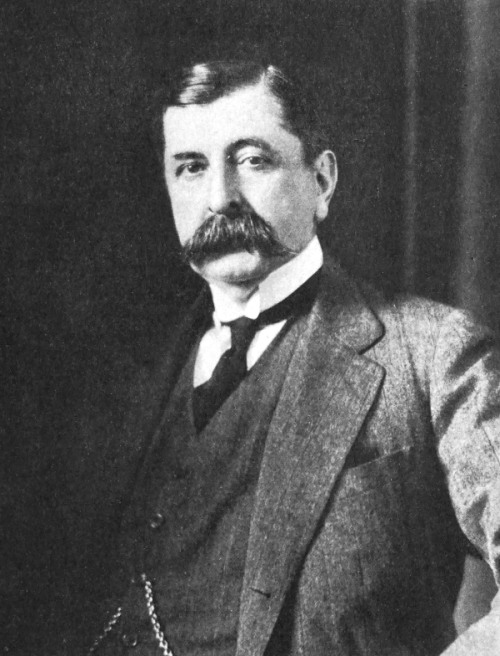
© The Phillips Studio
ALEXANDER VAN RENSSELAER, ESQ.
Finally, after much effort, terms were agreed to by which Mr. Scheel
consented to remain in Philadelphia. He was to conduct three different
enterprises during the winter:
1. The Philadelphia Symphony Society, a well-established amateur
orchestra organization (with weekly rehearsals and three public
performances).
2. The Opera Class (an amateur chorus meeting weekly at Mrs.
Alexander J. Cassatt’s house).
3. A week’s series of Popular Concerts during October at the
National Export Exposition at the Commercial Museum in West
Philadelphia.
He was to receive $1000 from each of these associations. He accepted
with the provision that at the end of the season he should be given the
opportunity to conduct two concerts with an orchestra of professional
musicians.
The winter passed and in the early spring Scheel asked to have this
part of the contract fulfilled. Like the ogre in the fairy tale, who
always claims the beautiful princess, it must have seemed to the men,
who had no idea how they were going to keep that promise. Scheel had
given this as his only reason for staying, for he wanted a chance to
show what he could do with professionals. However, having given their
word, a committee was formed consisting of Mr. John H. Ingham, Mr.
Oliver Boyce Judson, Dr. Edward I. Keffer, Mr. Edward G. McCollin
and Mr. Oscar A. Knipe. Scheel selected his players by visiting the
theatres and making notes each evening about the various musicians in
the orchestras. At this point his task was easy compared to that of the
Executive Committee who were responsible for the financial side of the
concerts. Various benefits were contemplated and finally a decision was
arrived at through the presence in Philadelphia of Lillie Langtry, who
was acting for the benefit of the families of soldiers fallen in the
Boer War. Why should not this undertaking be a patriotic one likewise?
Why not assist the families of soldiers and sailors fallen and disabled
in the Philippines? No sooner said than done. Mrs. Alexander J. Cassatt
had a son in the army, and was speedily interested in a plan to raise
money for the families of our own men in the service. She embraced the
idea with enthusiasm, formed a committee of prominent women and
carried the concerts through brilliantly and efficiently. The Executive
Committee managed the musical end, and Mrs. Cassatt’s Committee of
Women advertised the concerts, procured the support of musical and
social organizations, secured the patronesses, and filled the house.
The tickets were sold at auction with much profit.
The concerts were advertised as follows:
“Our Soldiers and Sailors.
Academy of Music
Thursday, March 29th and April 5th, 3.30 P. M.
Two Orchestral Concerts under the direction of
Mr. Fritz Scheel will be given for the Relief of the
Families of the Nation’s Heroes killed in the Philippines.
Soloist for the first concert:
M. Vladimir DePachmann
Programme
| Weber |
Overture “Euryanthe” |
| Goldmark |
Symphony, “A Rustic Wedding” |
| Chopin |
Concerto in F minor |
| Schumann |
“Abendlied” |
| Bizet |
Scherzo, Suite Roma |
| Liszt |
Rhapsodie Ongroise, No. 2 |
Soloist for second concert:
M. Edouard de Reszke
Contributions to the Cause may be sent to
Mrs. F. A. Packard, Treasurer,
No. 110 S. Eighteenth Street.“
“Our Soldiers and Sailors
On April 5th, at 3.30 P. M.
Second Concert by an Orchestra of
Eighty Philadelphia Musicians
Under the Direction of Mr. Fritz Scheel
For the Relief of the Families of men killed in the Philippines.
Mr. Edouard de Reszke, the famous Basso, will sing.”
Programme
| Beethoven |
Symphony “Eroica” |
| Meyerbeer |
Aria, “O Jours Heureux” (from L’Étoile du Nord) |
| Wagner |
Vorspiel, “Lohengrin” |
| Hofmann |
“Im Sonnenschein” |
| Verdi |
Aria, “Infelice” (Ernani) |
| Liszt |
First Hungarian Rhapsody |
“The Philippine Concerts[10]
March 29, 1900-April 5
Under the Patronage of
800 Philadelphia Men and Women
“Philadelphians generally do not know that The Philadelphia
Orchestra first appeared in this City of Brotherly Love in disguise,
a patriotic one, but none-the-less, a disguise. Had it tried to stalk
boldly through the city gates, it would have been riddled by the guns
of a critical public which disagreed at every point when a permanent
orchestra was discussed.
“The fact was not made public that these concerts for the benefit of
the families of American soldiers and sailors fallen in the Philippines
were a preliminary experiment, but on November 16, 1900, as a result
of their success, the first concert of The Philadelphia Orchestra took
place.
“The Committee of Women which launched the concerts, hardly realized
that through their efforts a new era in Philadelphia music was being
inaugurated. The Executive Committee of men behind the project had such
an end in view, but they preferred to remain unknown.
“The concerts were devoted to a popular benefit. They were also
the means of carrying out with Fritz Scheel, leader of the amateur
Philadelphia Symphony Society, a contract that he should have a public
appearance with an orchestra of professional musicians.
“The concerts were brilliantly successful and realized a net profit
of $10,252.73. The musicians played at less than Union rates for
thirty-six rehearsals and two performances, and Mr. Scheel gave his
services.
“The attitude of the public during these years is revealed in the
fact that it seemed natural for a group of women to sponsor concerts
for war heroes; but in 1904 it seemed an unheard of innovation
that women should organize to further the interests of a permanent
orchestra.
“Many people who prize The Philadelphia Orchestra as the greatest
treasure we possess, remember only too well the days when Philadelphia
was dependent on visiting orchestras. Young people today have the good
fortune to live in a town where an orchestra of the highest artistic
standards under a leader of world-wide reputation is now firmly
established. Music lovers and citizens generally, are grateful to the
men and women of courage, who gave Fritz Scheel
his first opportunity in Philadelphia.”
Mrs. Alexander J. Cassatt, Chairman; Miss Harriet Buchanan, Secretary;
Mrs. Frederick A. Packard, Treasurer; Mrs. C. William Bergner, Mrs.
Henry C. Boyer, Mrs. Edward Coles, Mrs. Joseph G. Darlington, Mrs.
Frank H. Rosengarten, Mrs. Barclay H. Warburton, Mrs. Charles S.
Whelen, Mrs. J. B. Sands, wife of Captain Sands, of the Naval Home; and
Miss Meade, daughter of the late General George Gordon Meade.
- “Executive Committee
- Mr. John H. Ingham, of the Melody Club
- Mr. Oliver Boyce Judson, of the Operatic Society
- Mr. Edward I. Keffer, of the Philadelphia Symphony Society
- Mr. Edward G. McCollin, of the Orpheus Club
- Mr. Oscar A. Knipe
The Philadelphia Times, March 30, 1900:
“When Johnny comes marching home again from the Philippines he will
find that the girl he left behind him has had a place in the hearts of
Philadelphia matrons at least. That interest was evidenced in the first
of the two widely heralded concerts in the soldiers’ and sailors’ aid,
which took place at the Academy yesterday afternoon. Society turned
out bravely and filled the whole of the auditorium and the balcony,
but there, unfortunately, it stopped, and the upper part of the house,
though the labors of the ladies interested have been unflagging and
strenuous, had plenty of room.
“Pacing up and down the corridors were privates from the Arsenal
and tars from the Navy Yard. In braided dress uniforms of brilliant
blue, shining helmets and buttons that glistened like molten gold, the
soldiers stalked to and fro, their belted waists giving pointers to the
masculine followers of the latest fad, and their shoulders putting to
shame the well cottoned ones of the ‘swells’ standing near. The tars
in their flapping breeches and spreading collars, were a picturesque
element among so many landsmen, and they, too, sold programmes, and
made good salesmen. On the stage guns were stacked at the sides and
colors dipped from the stacks.”
It is well to reiterate here that the Philadelphia Orchestra is not and
never was a continuation of the amateur Philadelphia Symphony Society.
Only one member of that organization played at the Philippine Concerts.
These concerts were so successful and so warmly received, that steps
were taken to organize a committee to continue concerts by Philadelphia
musicians. Later in the spring of 1900, a meeting was called in the
Orpheus Club Rooms by Dr. Richard J. Dunglison, President of the
Musical Fund Society. Officers of various musical organizations,
representatives of the press and prominent men in civic affairs were
present. A plan for organization was discussed and the necessity for
a Guarantee Fund was emphasized. The same committee of gentlemen
was appointed, with the addition of Mr. John C. Sims, as Treasurer.
Within four weeks of the second Philippine concert, the first circular
announcing the plan for forming a Philadelphia Orchestra was mailed by
this Committee:
“The plan briefly outlined herein is addressed to all those people
who are interested in good music and have at heart a desire to
propagate musical culture in Philadelphia.
“Much interest has been aroused by the successful result attained in
the symphony concerts recently given for the benefit of the sufferers
through the Philippine War. It is thought that these concerts proved
the availability or many of our resident players, and that the
experiment might well be followed by a series of concerts during the
season of 1900-1901, conducted upon the same general plan.
“The project of a permanent Philadelphia Orchestra is at present
not sufficiently advanced to permit of the hope that such a body can
be organized in time to be heard next season; therefore, the series
of concerts herein proposed will not conflict with, but will further
that movement, because it will provide the resident players with a
season’s training in symphonic work and thus enable them better to
fill positions in the permanent orchestra when it shall need their
services.
“The proposed plan embraces a series of about six evening and
possibly two afternoon concerts, to be given in the Academy of Music,
at customary concert prices. It has been ascertained that each concert
with its rehearsals will cost about $2000, an expense that will be
covered by a sale of two-thirds of the house.
“Hitherto it has been impracticable, when concerts have been given
by local orchestral players, to arrange for a sufficient number of
rehearsals. As a rule it has been impossible to obtain more than a
single rehearsal. The present scheme contemplates at least five or six
rehearsals for each concert.
“Mr. Scheel’s reputation abroad, where he was a colleague of von
Bülow, Brahms, Joachim, Sarasate, D’Albert and Wilhelmj, and conductor
of orchestras in Schwerin, Chemnitz and Hamburg, was a guarantee of
what was to have been expected of him here. The professional musicians
of Philadelphia are virtually unanimous in expressing hearty admiration
for his rare ability as a leader; they acknowledge that his work among
them this winter has been a real stimulus to the advancement of their
art, and they therefore desire to secure the advantage of his services
next season.
“In order to insure the financial success of the proposed concerts,
it has been deemed advisable to raise a guarantors’ fund of at least
$10,000. No payment of money is asked for at the present time; but all
who are willing to become guarantors are requested to send in their
names and addresses to the Secretary of the Committee, Mr. John H.
Ingham, 505 Chestnut Street, stating the amount of their subscription,
which, however, shall not be binding until the total sum of at least
$10,000 shall be reached.
“As the Committee wishes particularly to obtain a large number of
subscribers to the fund, it will be glad to accept contributions of any
amount not less than five dollars.
- “Committee:
- Henry Whelen, Jr.
- John C. Sims
- Edward G. McCollin
- Oscar A. Knipe
- Dr. Edward I. Keffer
- Oliver Boyce Judson
- April 30, 1900 John H. Ingham”
A Guarantee Fund of $15,000 was raised from one hundred and twenty
people[11],
a difficult task in those days, for an untried plan; and six
evening concerts were given during the winter of 1900-1901.
The Committee invited four thousand women to be patronesses, and
issued many circulars. It was the personal work, however, that accomplished
the result in 1900, and that has continued to accomplish results
during twenty-five years. Guarantors and patronesses were accorded the
privilege of securing seats, for which there was no demand, in advance.
PHILADELPHIA ORCHESTRA[12]
Mr. Fritz Scheel, Conductor
First Concert
Friday, November 16th, 1900, at 8.15 P. M.
| Programme |
| Carl Goldmark |
Overture “In Spring,” |
Op. 36 |
| Ludwig von Beethoven |
Symphony No. 5, C minor, |
Op. 67 |
| |
I. |
Allegro con brio |
2-4 |
|
| II. |
Andante con moto |
3-8 |
|
| III. |
Allegro |
3-4 |
|
| IV. |
Allegro |
4-4 |
|
| Peter Ilitsch Tschaikowsky |
Concerto for Pianoforte |
No. 1, |
| |
B flat minor, |
Op. 23 |
| |
I. |
Allegro non troppo e molto maestoso |
3-4 |
|
| II. |
Andantino simplice |
6-8 |
|
| III. |
Allegro con fuoco |
3-4 |
|
| Karl Maria von Weber |
“Invitation to the Dance,” |
Op. 65 |
| |
Orchestration by Felix Weingartner |
| Richard Wagner |
Entry of the Gods in “Walhalla,” |
| |
from “Das Rheingold.” |
Soloist
Mr. Ossip Gabrilowitsch
This concert was herald as a musical and social event and the
newspapers were highly commendatory and friendly in tone.
“Orchestra Concerts Open Auspiciously
“Philadelphia Getting in Line With Boston, Chicago
and New York in having Home Organization.
“Ossip Gabrilowitsch,
“The Russian pianist made his Philadelphia début last night.
“The series of concerts by the Philadelphia Orchestra opened
under notably happy auspices in the Academy of Music last evening.
The musical and social interests engaged constituted the occasion an
exceptional one.
“From the results evinced in the performance of the programme
under Mr. Scheel’s direction it must be regarded as well as marking a
distinct period in the musical advancement of the city. Not the least
interesting evidences of general sympathy with the movement to place
Philadelphia in line with Boston, Chicago, and other cities in the
possession of an established orchestra was the fact that Mr. William
Stoll, Jr., and Mr. Henry Gordon Thunder, both identified with the
endeavor to advance this branch of work in the past, figure in the
present movement, the one as a violinist in the organization, the other
as a guarantor.
“The Philadelphia Orchestra, as it exists, is, with slight
exception, what its name purports, engaging practically all the best
orchestral performers in the city. A portion of this material was under
disadvantage, both as to individual training and the fact that a few
men, fulfilling the demands of an orchestra in a theatre, are mainly
required to play as loud as possible, with corresponding absence of any
approach to phrasing.
“Considering these facts and in view of the works accomplished
in last evening’s programme, the results must be regarded as little
short of notable, not only as to the outcome of a training by a man of
exceptional thoroughness in this direction, but in the aspect of an
enthusiastic response on the part of the performers. It is only in case
of entire sympathy, between those engaged that an outcome corresponding
with that demonstrated in the first programme can be attained.”
“The Orchestra at the Academy
“Philadelphia’s New Organization Under Herr Scheel
Makes Its Début
“Gabrilowitsch the Soloist
“The Young Russian Heard in Tschaikowsky’s Concerto in B. Flat
Minor. A Brilliant Audience Greets Orchestra and Enjoys an Interesting
Program.
“With unequal forces at his command in the orchestral choirs, Herr
Fritz Scheel, by the sheer effect of personality, was able to carry
artistic conviction home to the brilliant audience at the Academy of
Music last evening, when the Philadelphia Orchestra made its first
appeal. By wise choice of program, by the happy selection of a soloist
and by the spirit which pervaded the interpretation of the numbers
read, the leader made a deep impression and the orchestra, when at its
best achieved a decided success. It has in it the promise of a new era
musically, and its work of last evening is an earnest of better things
to come. Certain readjustments are inevitable. The strings show up
finely. There is high finish and excellent tonal quality in all they
do. They are, indeed, the backbone of the orchestra. The brasses, on
the whole, met the demands of the leader and music, but the horns need
as keen a concern for time as for tone, and while these choirs in no
wise seriously interfered with an adequate realization of the beauty of
the work so interpreted, the same cannot be said for the woodwind which
was not up to the standard in several particulars, though the bassoons
were notably efficient and in fine trim.
“Herr Scheel’s Good Work
“All this was, however, to be expected. Every one present who is in
and of the new movement, which started off with such flying colors,
knew the limitations and accepted them in the right spirit. With this
said and understood one can speak enthusiastically of the really
amazing results obtained by Herr Scheel in so short a time. There were
moments when the orchestra played with a brilliancy and dash and with a
finish that was completely satisfying. Herr Scheel’s dynamic range is
extensive, his palette of color is rich and his contrasts are striking
and yet fully in the spirit of the work. The orchestra was particularly
effective in the Goldmark overture, in the “Entry of the gods into
Walhalla” and in the Weber music. Weingartner, instead of paraphrasing
the famous “Invitation to the Dance” rondo for the ballet, as Berlioz
did, has written what is really a brilliant open-air concert version
which taxes the full orchestra, and which Herr Scheel carried out in
splendid spirit, giving a chance for all the choirs to do their best,
the harp coming in for some crisp work that was very brilliantly done.
All these three highly colored numbers were set off against the more
trying classical demands of the Fifth Symphony. It the reading it
received revealed the individual weaknesses of the orchestra as now
made up, it was at least a revelation of the great advance the band
has made. There was decision and emphasis and grace in phrasing and a
keen discrimination in the shading. If Herr Scheel had his view of the
traditional tempi the final effect was to reveal the work in its noble
proportions and to make every one feel the true import of this great
masterpiece.
“Audience Enthusiastic
“The enthusiasm of the audience was most unrestrained and generous.
It was marked at the close of the symphony and fairly overwhelmed
Gabrilowitsch, and this, with the splendid turnout from top to bottom,
was a tribute to the committee and the guarantors who made the concert
possible.”
The first venture having been successfully concluded, business matters
were attended to by issuing the first call of the Philadelphia
Orchestra to the guarantors, combined with which was the announcement
of the formation of The Philadelphia Orchestra Association, on May
17th, 1901, with the following officers and directors:
| President |
| Alexander van Rensselaer |
| Vice-president |
| F. T. Sully Darley |
| Secretary |
| John H. Ingham |
| Treasurer |
| Henry Whelen, Jr. |
Board of Directors |
| A. J. Cassatt |
C. Hartman Kuhn |
| John H. Converse |
Edward G. McCollin |
| Eckley B. Coxe, Jr. |
Thomas McKean, Jr. |
| F. T. Sully Darley |
Clement B. Newbold |
| William L. Elkins |
James W. Paul, Jr. |
| Miss Mary K. Gibson |
Mrs. F. H. Rosengarten |
| Clement A. Griscom |
Edgar Scott |
| Mrs. A. C. Harrison |
Simon A. Stern |
| John H. Ingham |
Miss Anne Thompson |
| Oliver B. Judson |
Henry Whelen, Jr. |
| Edward I. Keffer |
A. Van Rensselaer |
| Oscar A. Knipe |
P. A. B. Widener |
Executive Committee |
| John H. Ingham |
Edward G. McCollin |
| Oliver B. Judson |
A. Van Rensselaer |
| Edward I. Keffer |
Henry Whelen, Jr. |
| Oscar A. Knipe |
|
Who was the conductor of this new orchestra, who until eighteen months
before was unknown in Philadelphia?
Fritz Scheel was born in Lübeck, Germany, in 1852. His father and
grandfather were orchestral conductors and his mother was a highly
talented singer, from whom he inherited his remarkable memory and fine ear.
Fritz was the oldest of a large family and worked for his own and his
family’s support from an early age. He received his education from the
city, in return for playing in orchestras and at concerts and operas.
As a boy he often had to fill sudden vacancies, and he was also able to
play the horn, trumpet, trombone and tuba. He was the principal teacher
of his four brothers, all musicians. As his father was a practical
musician, Scheel had had from his childhood an intimate experience
with the details of orchestral instruments. As a boy he conducted an
orchestra of his own formation, giving subscription concerts in nearby
towns which were well attended. At fifteen he appeared as a violin soloist.
Scheel’s first appearance as a conductor was when he was the youthful
trumpeter in the town band of Chemnitz. Like other municipal bands of
Germany, this one furnished the music for all occasions and happened
to be playing for the circus. The leader was taken ill, and one of the
men was selected as a substitute. When the ring master heard of it, he
said, “No, let that boy conduct. It is he who watches the horses’ feet,
when they dance, and it is he who sets the time for the music.” Scheel
became the leader of the band, and later on was employed by the town as
instructor of all the band and orchestral instruments. This experience
gave him an expert knowledge of technique, which proved valuable later.
In an interview given during the first season here, Scheel described
conducting his first opera, shortly after receiving a life appointment
as first violin in the Court Orchestra at Schwerin.
“Do I recall the first performance that I
conducted?” said Mr. Scheel. “Yes, and it was an opera. Meyerbeer’s
‘Robert Le Diable.’ I was exactly nineteen and a half years old, and
a lost orchestra score led to it. I was the concertmaster then in the
Chemnitz Orchestra, which in summer played for the opera performances
in Bremerhafen at the Court Theatre. The opera of ‘Robert Le Diable’
was announced, and when the morning of the first rehearsal came it
was discovered that the entire second act of the conductor’s score
had been lost. Herr Pohl, the conductor, a young man of thirty-three,
refused to go on with the opera. It was too late to think of getting
another score in time for the rehearsals necessary for the performance.
The only way out of it seemed to be the withdrawal of the opera. Some
of the singers, who had noticed the cue for their phrases that I had
given them on the violin, asked whether I would not conduct. ‘If the
conductor invites me I will,’ I said. When this was repeated to the
conductor he promptly gave the invitation, and it was a pressing one,
for they wished to give the opera and keep faith with the public.
That entire second act I had to conduct from the first violin part,
memory supplying the rest. The performance went without a break. That
settled my career. Three days later I conducted Gounod’s ‘Faust,’ and
immediately afterward ‘L’Africaine,’ of Meyerbeer, Herr Pohl himself
supplying the harp part on a piano. In the years that followed many
were the performances that I conducted, including the entire
‘Niebelungen Ring’ of Wagner. But I never hear a fragment of
Meyerbeer’s ‘Robert Le Diable’ without smiling to myself at the
recollection of the time when I conducted the second act from the first
violin part.”
After nine years at Schwerin, Scheel went to Chemnitz as Kappelmeister,
winning the appointment over thirty-five competitors, as successor
to Hans Sitt. There he also played weekly solos and conducted for
the most famous virtuosi, such as Hans von Bülow, Sarasate, Wilhelmj
and Joachim. He once prepared the orchestra for a Beethoven Concert
under Von Bülow’s direction in an hour and a half, the programme being
the Leonore Overture No. 3, the Eroica Symphony and a Concerto. The
Chemnitz Orchestra was often called to different cities in Saxony,
such as Dresden, Leipzig, etc., to play before crowded houses. Scheel
was also elected leader of the Sitt Chor Gesangverein, a Chorus of
400 mixed voices. With this Chorus and the excellent City Orchestra
he obtained marvelous results, and produced among other great works,
Bach’s “Mattheus Passion” and “Trauer Ode”; Beethoven’s Ninth Symphony
and his Missa Solemnis; Schumann’s “Faust Scenes,” Liszt’s “Christus”
and Händel’s “Samson.” The Choral works of Mendelssohn, Schumann, and
Gade were also performed, as well as many small choruses. In 1885
a Music Festival lasting three days was given to celebrate the two
hundredth anniversary of Bach’s birth, and he kept in the vanguard of
musical events in Germany.
During this period, Scheel spent four summers in conducting opera at
a Russian watering place. Four different operas were given each week,
and the repertoire included: “Tannhäuser,” “Lohengrin,” “The Flying
Dutchman,” “Rienzi,” “Euryanthe,” “Der Freischütz,” “Faust,” the
standard Italian operas of Verdi, Rossini, etc., for which he also
trained the chorus.
After nine years at Chemnitz, Scheel was called by von Bülow to
Hamburg to drill the orchestra for concerts which he and the pianist
alternated in conducting. He was a devoted admirer of von Bülow and
the great pianist showed his appreciation in many ways. Years later,
after von Bülow had retired, he offered to play at a concert given in
honor of Scheel. “I do it once more,” he said, “as gratitude for a true
colleague and friend.” He played the piano Concerto in E flat major, by
Beethoven, and the Hungarian Fantasie, dedicated to him by his
father-in-law, Franz Liszt. This was one year before his death and was
his last public appearance as a pianist. Scheel also knew well Brahms,
Tschaikowsky and Rubinstein.
In 1892 Dr. Ziegfeld engaged Scheel to go to Chicago the next year and
give historical concerts at the World’s Fair. The enterprise failed. He
then took an orchestra to the Mid-winter Fair in San Francisco, under
the name of the “Vienna Prater Orchestra,” in the winter of 1893. Later
he gave daily concerts, and, during two seasons, cycles of Afternoon
Symphony Concerts. For a season he was engaged by Oscar Hammerstein
and then he became the first leader of the San Francisco Orchestra.
He introduced the great classical and modern works to the people of
that city, who still speak admiringly of him and remember his success.
After five years in San Francisco, Scheel came to Philadelphia, and was
discovered at Woodside Park, conducting his “New York Orchestra.” The
newspaper criticisms were most flattering.
The following pen picture of Mr. Scheel has been given by a man who
played under his leadership and saw him under many conditions.
“A tall man, robust, large-framed, something more than spare, a
little less than stout; a back and broad shoulders in strikingly good
proportion, and a head poised upon them in easy dignity. The large
hands are full of character, delicately formed, refined, noticeably
plastic and adaptable.
“A dark-brown military moustache and a prominent nose stand out
clearly under a typical, high, German forehead and coiffure.
“In his brown eyes an infinite variety of expressions are lurking.
From humorous twinkles that are irresistible, to flashes of fire and
scorn that never miss the mark, they assume new and rapidly fleeting
phases with every phase of music or speech.”
Many stories are told of Fritz Scheel’s early efforts with amateurs
and with a group of musicians, strange to him, for in those days
the requirements for orchestral players were not the present ones,
and there were many obstacles to overcome. His ear was absolutely
correct, and he often told the players when tuning was needed. He was
on occasion obliged to use mechanical strategies to insure the proper
intonation. A close friend of his tells the following anecdotes:
“At the first rehearsal for the Philippine concerts, one of the
numbers contained a difficult trumpet part, which seemed impossible
for the first trumpet player, to play. Scheel postponed the rehearsal
of this number until the next day, to allow him time to practice, but
next day he could do no better. So the part was given to the second
trumpet very much to the humiliation of the first player. But though
very stern, Scheel was also very sympathetic with his musicians, and he
realized what the feelings of the man must be. He therefore addressed
the orchestra, in his usual formal way, and called for the attention of
the players. Then turning to the first trumpet player, he remarked: ‘I
have been listening to your playing for the last two days, and I feel
sure it is not your fault that you could not play that one part in the
composition. I notice that whenever you play a note in which the middle
valve of your instrument is used, you have no difficulty in playing
the part which you were unable to do before.’ This incident was told
by the player, who took his trumpet to his instrument-maker and had
one-sixteenth of an inch taken off the middle valve; with the result
that he could play parts that he never could play before. He then
remarked, ‘It matters not what happens between Scheel and me; I will
always take off my hat to him, and say ‘Master’.’
“On another occasion the tympanum was not in tune. Scheel stopped
the orchestra and asked the tympanist to tune his instrument. When
the man started to turn the keys, Scheel said, ‘No, it is not on that
side; it is on the right-hand side of the drum,’ showing that he, at
the distance of a great many feet, could tell that the false vibrations
were coming from the right side of the drum.
“At one of the rehearsals the harp player had trouble with her part.
Scheel said, ‘Skip that one chord and you will only have to change your
pedals twice in place of five times.’
“He also had the peculiar faculty of being able to get the effect of
instruments that were not in the orchestra by the combination of other
instruments that would give the same tone. The writer remembers very
distinctly Scheel’s using the French horn and the ’cello together to
play the third bassoon part.”
This brief account of the first leader of the Philadelphia Orchestra
explains why the Executive Committee pinned its faith to Fritz Scheel.
As the beginnings of the orchestra are recorded, how delightful it is
to music lovers to know that the Musical Fund Society, itself a bold
pioneer eighty years before, sponsored this most daring enterprise of
our musical history. Dr. Dunglison, its president, presiding in the
Orpheus Rooms on a spring afternoon in 1900, gave the blessing of the
first Philadelphia Orchestra to the present Philadelphia Orchestra.
Like Brünnhilde, herself shorn of godly powers, sending forth her hero
to do great deeds, so the Musical Fund Society, no longer composed of
active musicians, sent forth the young orchestra to conquer the musical
world. No magic rings, or swords, or helmets were given to aid it in
surmounting difficulties. The only magic formulas known to all the
people interested were hard work and an invincible spirit.
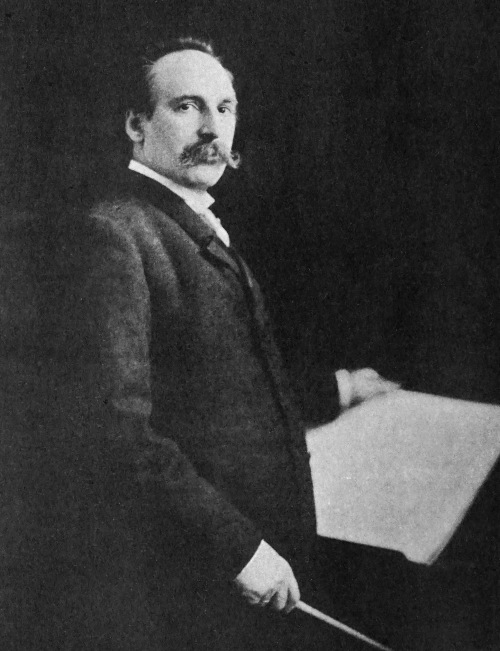
© Allen Drew Cook
FRITZ SCHEEL
Chapter III Early Years — The Strauss Concerts
With the first steps safely passed and the Philadelphia Orchestra
organized, the period of financial difficulty began. In 1901-1902
fourteen pairs of concerts in the regular series, and a total of
fifty-two concerts for the season were given. The deficit jumped from
$14,000 to $72,000. Everything was quadrupled except the audience. That
remained almost stationary. Twenty years after Theodore Thomas’s time
Philadelphia was still not ready to attend symphony concerts or support
an orchestra at any general sacrifice to its own purse. The general
attitude was that such a project must be supported by a few persons who
had time and money to spend. Indifference was widespread.
Scheel early saw the need of traveling to make the orchestra known,
especially in New York and Boston, as he realized that the saying about
the prophet held good for orchestras as well as for persons. He was
faced with the fact that the Association could not see its way to send
the orchestra to large cities. Appearances out-of-town were undertaken
as early as 1901-02, in cities in Pennsylvania and New Jersey. During
the next season New York, Baltimore and Washington were visited.
He well knew, however, that his work with soloists would bring
the orchestra fame, and much effort was expended in preparing
accompaniments. A case in point was the time that Ysaye was the soloist
and was playing a Bach Concerto. At the end the violinist stood like
a statue until the orchestra had finished. When Scheel went off the
stage, Ysaye kissed him on both cheeks and said that the accompaniment
was the finest he had ever had. Shortly after this a member of the
Boston Orchestra told one of our violinists that Ysaye had been booked
to play the Bach Concerto with his orchestra; but after starting it he
stopped the rehearsal and said: “Not after the Philadelphia Orchestra
will I play the Bach Concerto,” and another concerto was substituted.
With artistic ambitions ever growing, it was discovered that some of
the needed instruments were not to be found in the city and in addition
to this a number of players would not accept the terms of the contract.
The situation became acute, so in the summer of 1901, and again in
1902, the conductor was commissioned to seek musicians in Europe.
When it became evident that the Philadelphia Orchestra was going to
be permanent, application was made in 1902 for a Charter[13]
for the Association, which was granted on January 5th, 1903, to the
following persons, only nine of whom are now living:
| George Burnham, Jr. |
Edward G. McCollin |
| A. J. Cassatt |
Thomas McKean |
| John H. Converse |
Clement B. Newbold |
| Eckley B. Coxe, Jr. |
James W. Paul, Jr. |
| William L. Elkins |
Mrs. Frank H. Rosengarten |
| Mary K. Gibson |
Richard Rossmässler |
| Clement A. Griscom |
Edgar Scott |
| Mrs. Alfred C. Harrison |
Simon A. Stern |
| John H. Ingham |
Anne Thomson |
| Oliver B. Judson |
Alexander Van Rensselaer |
| Edward I. Keffer |
Henry Whelen, Jr. |
| C. Hartman Kuhn |
P. A. B. Widener |
From the beginning Scheel inaugurated the polity continued ever
since, of putting the orchestra in the lead artistically. “First,”
performances began almost immediately. Three years after the formation
of the orchestra he gave the first complete Beethoven Cycle ever
presented in Philadelphia. Five successive concerts were devoted
to this, ending with the Ninth Symphony, in which the Mendelssohn
Club participated. This event was preceded by a series of five Young
People’s Educational Concerts with lectures, by William J. Henderson,
William F. Apthorp, Louis C. Elson, Hugh A. Clarke and Henry E.
Krehbiel, whose subject was “Beethoven.” Other lectures were given on
the same subject on the days of the concerts.
| Programmes of the Beethoven Cycle |
| First Concert, Friday, March 20th, 1903 |
| 1. |
Overture |
“Egmont,” E major, Opus 84 |
| 2. |
Symphony No. 8 |
F major, Opus 93 |
| 3. |
Symphony No. 3 |
E flat major (Eroica), Opus 55 |
Second Concert, Saturday, March 21st, 1903 |
| 1. |
Overture |
“Coriolanus,” C minor, Opus 62 |
| 2. |
Symphony No. 1 |
C major, Opus 21 |
| 3. |
Symphony No. 6 |
F major (Pastorale), Opus 68 |
| Preceding lecture by Hugh A. Clarke, Mus. Doc.,
at 3 o’clock, |
| Saturday afternoon, at the Broad Street Conservatory, |
| 1329 South Broad Street, Gilbert R. Combs,
Director |
Third Concert, Tuesday, March 24th, 1903 |
| 1. |
Overture |
“Fidelio,” C major, Opus 72 |
| 2. |
Symphony No. 2 |
D major, Opus 36 |
| 3. |
Symphony No. 5 |
C minor, Opus 67 |
| Preceding lecture by Philip H. Goepp,
at 3 o’clock, |
| Tuesday afternoon, at the Assembly Hall of the |
| Sternberg School of Music, 10 South 18th Street |
Fourth Concert, Wednesday, March 25th, 1903 |
| 1. |
Overture |
“Leonore” No. 2, C major, Opus 72 |
| 2. |
Symphony No. 4 |
B flat major, Opus 60 |
| 3. |
Symphony No. 7 |
A major, Opus 92 |
| Preceding lecture by Hugh A. Clarke, Mus. Doc.,
at 3 o’clock, |
| Wednesday afternoon, at the Broad Street Conservatory. |
Fifth Concert, Thursday, March 26th, 1903 |
| 1. |
Overture |
“Leonore” No. 3, C major, Opus 72 |
| 2. |
Concerto for Piano and Orchestra |
E flat, Opus 73 |
| Constantin von Sternberg |
| 3. |
Symphony No. 9 |
D minor, Opus 125 |
| Preceding lecture by Philip H. Goepp, at 3 o’clock, |
| Thursday afternoon, at the Sternberg School of Music |
Musical Courier, New York, March 25th, 1903:
“The cycle was to crown the third season of the
Philadelphia Orchestra’s successful existence, and for many months, the
leader, the orchestra, the manager and the committees have been busy in
the endeavor to make these five concerts matchless in performance and
memorable in historical significance.
“The cycle was projected as an art undertaking pure and simple.
Profit was a secondary consideration. Flamboyant advertisement was
eschewed. There were announcements dignified and to the point. The
prices were put within the reach of the student and the poor lover of
music. Society was asked to patronize at the box office, but not on
the programme. It is thus apparent that never in the musical life of
America has there been conceived a project more ideal, more
artistic and more utilitarian than this Beethoven Cycle in the City
of Brotherly Love. Fritz Scheel is not overshadowed even by the great
Joseph Joachim, who together with three famous fellow musicians,
proposes next summer to play all of Beethoven’s string quartets at a
musical festival in Germany.”
“Beethoven’s ‘Coriolanus’ overture was played by the New York
Philharmonic Orchestra this season. The Filharmonic Fathers should have
been provided with free transportation to Philadelphia in order to
learn how one conductor can mar and another make the same composition.
This Philadelphia Coriolanus was a hero indeed, who walked with
erect head and proud chest. There was no rheumatism in his knees and
there was no crick in his back. When his mother pleaded she spoke in
accents human and loving. Her voice was softly attuned. It sang a song
that Coriolanus did well to heed. Scheel’s graphic characterization
made the Philharmonic performance appear in the memory like almost a
travesty.”
Musical Courier, April 1, 1903:
“At the end, when the composer abandons
absolute music and turns to song, Philadelphia’s own distinguished
choral body, the Mendelssohn Club, came to the support of the
musicians, and the beautiful ‘Hymn of Joy’ was brilliantly sung.
As a quartet for the solo part, Mrs. Marie Kunkel-Zimmerman, Mrs.
Osborne, Nicholas Douty and Mr. Schurig did brilliant work. Altogether
the playing of this Ninth Symphony formed a fitting climax to this
memorable week devoted to the great master’s own musical history.”
“After the performance of the overture,
Scheel was presented with a floral wreath, lyre and harp, and John H.
Converse on behalf of the Directors of the orchestra, bestowed upon
him a bronze bust of Beethoven, in well chosen words of compliment and
congratulations.”
Scheel’s one thought was the artistic development of the orchestra. The
story is told of a time when new members of the Board found that the
concerts were being given at a tremendous loss. They at once criticised
the quality of the music, and said, “The programme must be changed; you
are giving too high-class music for the people, and they won’t stand
it.” The Executive Committee therefore decided that Mr. Scheel should
put waltzes on his symphony programmes; and a meeting was arranged with
him. This was in the early days when his English was less fluent than
later, and his understanding of the language less keen. It took
him some minutes to find out the real purpose of the Committee.
Then he expressed himself in a very formal way—somewhat in this
wise: “Gentlemen, I am the head of the department of music of this
association. I am elected by you. You represent the business end of
this association; I stand for art. I cannot allow any one to interfere
with my programme. If my programme and my management of the musical
side of the association does not meet with your approval, you may get
another conductor; but as long as I am conductor of the Philadelphia
Orchestra, waltzes will not be played on a symphony programme.” He
spoke so emphatically that there was no recourse and the subject of
waltzes at the regular series was dropped.
After this decision, however, Mr. Scheel suggested giving popular
concerts. The committee immediately accepted this offer, and plans were
made for five. At the last minute, when the sale at the box office was
found to be exceedingly small, it was considered necessary to call upon
outside organizations to make the concerts a financial success, so they
were given for the benefit of various charitable organizations, such as
the University Hospital, Hahnemann Hospital, St. Christopher’s Hospital
for Children, and others.
The first Popular Benefit Concert for the Men’s Medical Ward of the
University Hospital was put in charge of the “Benevolent Aid Society”
of that ward. This committee, with Mrs. William W. Arnett, as Chairman,
and Mrs. S. Naudain Duer, as Vice-chairman, at ten days’ notice secured
one thousand patronesses and sold out the house, David Bispham having
been secured as soloist, and a popular programme having been announced.
This was the first time people representing a so-called “Opera
Audience” had heard the Orchestra. In 1905 this same Committee secured
the orchestra and gave an afternoon of Music in the Horticultural Hall.
Tea was served at tables, and two programmes, with an intermission,
were given. In each of these events about one thousand dollars each
was cleared by the orchestra and the Men’s Ward. While these efforts
were not entirely consistent with the dignity of a great orchestra,
the financial situation in which the management found itself made such
overtures for money making and advertising advantageous.
The Press, November 12th, 1902:
“PHILADELPHIA ORCHESTRA
“First Popular Concert a Great
Success—Bispham the Soloist
“The first popular concert of the Philadelphia
Orchestra at the Academy of Music last evening
was a great success, not only from the financial
point of view—the proceeds being for the benefit
of the University Hospital—but from the artistic,
the soloist, Mr. David Bispham, coming in for a
special word by reason of his familiar finesse as an
interpreter of aria and song.”
| Programme |
| Carl Goldmark |
Overture “In Spring” |
| Wagner |
Pilgrim’s Chorus from “Tannhäuser” |
| (a) Wagner |
“Evening Star” from “Tannhäuser” |
| (b) Verdi |
Page Song from “Falstaff” |
| Johann Strauss |
“Danube Maiden’s Waltz” |
| Brahms |
Hungarian Dances Nos. 1 and 2 |
| Beethoven |
Overture “Leonore” No. 3, Op. 72 |
| (a) Schumann |
“The Two Grenadiers” |
| (b) Schubert |
“Hark, Hark, the Lark” |
| Grieg |
“Ase’s Death,” “Anitra’s Dance” |
(For String Orchestra) |
| (a) Gounod |
“Oh That We Two Were Maying” |
| (b) H. H. Weizler |
“Killiekrankie” |
| (c) Damrosch |
“Danny Dever” |
| Liszt |
“Hungarian Rhapsody” No. 2 |
| Mr. David Bispham,
Soloist |
In the early days rehearsals were held in the banquet room of Musical
Fund Hall, and in the room of the Commercial Museum, through the
courtesy of those organizations. Later Odd Fellows Hall was rented, but
since 1912 the rehearsals have been held at the Academy of Music, by a
special arrangement with the management, which has always co-operated
to the fullest extent with the Association.
During the fourth season of the orchestra’s existence, the Executive
Committee took the bold step of engaging Richard Strauss to appear
with it in Philadelphia. Later, two appearances in Boston with the
Philadelphia Orchestra were added, as it was learned that no guest
conductor was permitted to conduct the Boston Symphony Orchestra.
Strauss’s first American concert was in New York, where the practice
of sending substitutes to rehearsals was common. In the middle of “Don
Juan” the orchestra broke down and they had to stop and begin again.
Therefore, when Dr. Strauss reached Philadelphia, he was prepared for
another such occurrence. He arrived for rehearsal in a perturbed state
of mind, and proceeded brusquely to the conductor’s stand. Mr. Scheel,
however, had spared no pains in preparation for the great event. The
rehearsal was held at Odd Fellows Temple, in a small room, where the
reverberations in the fortissimo passages were tremendous. After simply
bowing to Mr. Scheel, Dr. Strauss began to lead. He had played but a
few measures before he discovered an orchestra thoroughly proficient
and well-rehearsed in his numbers. After playing a few bars he dropped
his arms and allowed the orchestra to play on. There was an entire
change in his manner. He turned to Scheel, and, throwing both arms in
the air, exclaimed, “Famos!” Every few moments he cried, “Wunderschön!”
“Ausgezeichnet!” After making one or two corrections in the parts, he
stopped the rehearsal and became highly enthusiastic over the playing
of the orchestra.
| THE PHILADELPHIA ORCHESTRA |
Fritz Scheel, Conductor |
| Increased to 100 Performers for these Occasions |
| Dr. Richard Strauss |
| Conducting his own Compositions, and |
| Frau Strauss-de Ahna |
| Dramatic Soprano, accompanied by Dr. Strauss |
Programmes |
| Friday Afternoon, March 4, 1904 |
| 1. Franz Liszt |
A Faust Symphony in Three Pictures |
| |
(after Goethe) |
| I. Faust (Allegro) |
|
| II. Gretchen (Andante) |
|
| III. Mephistopheles (Scherzo, Finale) |
|
2. Richard Strauss |
|
| Songs with Orchestra: |
|
| a. “Das Rosenband” |
|
| b. “Liebes-Hymnus” |
|
| c. “Morgen” |
|
| d. “Cäcilie” |
|
| Frau Strauss-de Ahna |
| Conducted by the Composer |
3. Richard Strauss |
“Tod und Verklärung,” Tone Poem, Op. 24 |
| Conducted by the Composer |
Saturday Evening, March 5th, 1904
|
| 1. Johannes Brahms |
Symphony No. 2, D. major, Op. 73 |
| I. Allegro non troppo |
|
| II. Adagio non troppo |
|
| III. Allegro grazioso (Quasi Andantino) |
|
| IV. Allegro con spirito |
|
2. Richard Strauss |
|
| Songs with Orchestra: |
|
| Three Mother-Songs |
|
| a. “Meinem Kinde” |
|
| b. “Muttertändelei” |
|
| c. “Wiegenlied” |
|
| Frau Strauss-de Ahna |
| Conducted by the Composer |
| 3. Richard Strauss |
“Till Eulenspiegel and his Merry Pranks,” |
| |
Op. 28 |
| Conducted by the Composer |
Great preparations were made for this event and much money was spent,
for Strauss not only received a large fee, but much had to be used for
advertising.
Philadelphia Inquirer, March 5th, 1904:
“Richard Strauss At The Academy
“First Appearance of the Famous Composer made
Yesterday Afternoon. He Conducts a Fine Performance
of his Own
“Death and Transfiguration,” and His Wife Sings
Four Songs
“There was a very large audience at the Academy of Music
yesterday afternoon, when the Philadelphia Orchestra gave its last Friday
afternoon performance for the current season. The occasion was made
notable by the first appearance in this city of the famous composer,
Richard Strauss, who had arranged to guide the orchestra through
the mazes of the tone poem entitled, “Death and Transfiguration,”
one of his best and most characteristic works; and it was rendered
additionally interesting and important by the Philadelphia début of
Mme. Strauss-de Ahna, who has the reputation of being an exceptionally
skillful and sympathetic interpreter of her distinguished husband’s songs.”
“After his wife had finished her group of songs, and the
enthusiastic and long continued applause which her work had elicited
had died away, Mr. Richard Strauss returned to the platform to
conduct his own “Tod und Verklaerung.” He is a singularly modest and
unobtrusive looking man, with an appearance more suggestive of a
school teacher than of a musician, and with nothing about him to
betray any large estimate of his own consequence, but there can be
no question as to his ability as a conductor. That had already been
indicated in the manner he played the accompaniments to his wife’s
singing, but it was conclusively demonstrated by the way in which he
conducted the orchestral feature of the programme. In its lucidity and
balance, in its delicate sense of proportion; in its wide and pregnant
variations of light and shade; in the splendor of its climaxes and the
salient force with which each detail was projected and each nuance
given its proper value, his performance of “Death and Transfiguration”
has certainly never been equalled in this city. It was a very great
achievement and the audience rightly recognized it as such.”
Philadelphia Ledger, March 5th, 1904:
“Strauss Concert a Great Success
“Warm Greeting for the Composer and His Wife
“Strauss has a very precise beat, ordinarily quiet
and undemonstrative and making very little use of his left hand; but
when he wants a big climax for the brasses—and he is not afraid of
noise—he conducts with his whole person. The orchestra knew the music
perfectly and was absolutely responsive to every nuance.”
City and State, March 10th, 1904:
“The highest point, not only of the winter, but
in a certain sense of all previous musical seasons was reached last week.
“To have the most eminent musician—we use the word advisedly in the
strictest sense—interpret his compositions with our own orchestra in
two concerts, certainly marks Philadelphia as one of the self-dependent
musical centers of the world. But it was much more significant to hear
the unstinted praise which Mr. Strauss bestowed on the orchestra after
the concerts. On Friday, after the exalting performance of “Death
and Transfiguration,” the composer seemed to forget his audience in
the heartiness of his acknowledgments to the orchestra. Indeed, we
see no impropriety whatever in publishing the fact that Mr. Strauss
was immeasurably better pleased with the work of our orchestra than
with that of the New York orchestra, which he conducted last Thursday
evening. On Tuesday he declared himself entirely contented with the
single rehearsal for the Friday concert. It seems almost a pity that
we Philadelphians cannot discover for ourselves this excellence of our
own enterprise—that we must have the most distinguished musician of the
day come from Berlin to tell us that we have a splendid orchestra, and,
it may be added, splendid conductor. At any rate, the fact ought not
only to be taken to heart by all of us, but we ought not to hesitate to
boast bravely of this advantage of ours over New York.”
These concerts were repeated in Boston on March 7th and 8th, where
they had been well advertised and both houses sold out. But when the
programmes were announced there was a cry of protest from the critics
and musicians of that city. “Why should Boston have to listen to
Fritz Scheel conduct a symphony on each programme?” The Executive
Committee replied firmly that Boston had refused to have Dr. Strauss
lead the Boston Symphony Orchestra, and now the Philadelphia Orchestra
Association was giving Boston an opportunity to hear Dr. Strauss
conduct as guest conductor of the Philadelphia Orchestra. The programme
was not changed, but Philadelphia had to explain the stand she had
taken even after the orchestra had reached Boston.
Then a real contretemps occurred, trying enough to shake the strongest
nerves. In those days, either moving orchestras was more difficult, or
the Philadelphia Orchestra was still too inexperienced a traveler to do
so efficiently. When the hour for rehearsal in Symphony Hall arrived,
there was no music and there were no instruments. They had been lost
en route. The explanation arrived at after much telegraphing was that
these valuable possessions had been placed in a car too high to pass
under the bridges on the regular route, so it had been re-routed and
would probably not arrive until evening. This was a predicament for a
young orchestra, none too easy in its mind at the prospect of playing
in the city of the Boston Symphony Orchestra; and now deprived of
rehearsal in a hall new to the conductor, as well as to every player.
The day passed, evening came, the audience assembled, and still no
instruments. Twenty minutes after the concert hour, heavy teams were
heard outside. The day was saved, the instruments were hurriedly put
in place, the men went on, and the symphony, Brahms’ No. 2, began. The
Philadelphians present say that the orchestra never played so well,
and at the end of the symphony Scheel was recalled six times. Mr.
Elson, a most friendly critic, who had given a dinner for our conductor
the night before, rushed behind, saying, “Scheel, you have conquered
Boston.” At a reception given for the two conductors after the concert,
Mr. Philip Hale said of Scheel: “He has the right arm of Thomas and the
left arm of Nikisch.”
Boston Herald, March 8th, 1904 (Philip Hale):
“The performance of the orchestra under Mr.
Scheel was admirable.... Here is a conductor to be respected for many
qualities, for his mastery of mechanism and for his genuine and poetic
feeling.... There is no doubt that Mr. Scheel is an accomplished drill
master. His patience and intelligence in rehearsal were shown by the
fine performance of the supple orchestra under his direction.”
Boston Evening Transcript:
“Mr. Scheel is unquestionably a conductor of
parts, whom one would gladly know better.... The wonderful beauties in
the scoring of Liszt’s symphony were all made the most of, and under
the hands of Mr. Scheel the dull passages became less hopeless than
usual. Of the dramatic points Mr. Scheel took full advantage and with
the advent of the Gretchen theme in the third movement he made an
electrifying effect.”
Boston Daily Advertiser (Louis C. Elson):
“Musical Boston was waked up last night! Those who
braved the elements were rewarded by a concert which for novelty, for
excitement and for educational value has seldom been equaled even in
our symphonic city.
“The Philadelphia Orchestra proved itself to be the best that has
visited Boston since Theodore Thomas brought his band here.
“Its conductor, Fritz Scheel, is an orchestral genius. He evidently
knows his Brahms thoroughly, and by the time he had finished the first
movement of the D major symphony, he was clasped to the Bostonian
heart. To win a triumph in Brahms in a city where all our conductors
are Brahms scholars (and our auditors too, for the matter of that),
means very much. Mr. Scheel was recalled with enthusiasm.... The
Philadelphia Orchestra has proved itself one of the important
orchestras of the United States.”
A delightful anecdote is told about this visit to Boston. After the
success of the evening concert, Dr. Strauss, full of enthusiasm, told
Mr. Scheel that he must play the Domestica Symphony at its first
performance in New York, and they arranged to play it together on the
piano from the orchestral score in Symphony Hall the next morning.
Scheel took the score home with him and the next morning the first
playing of the Domestica in America began, Dr. Strauss taking the
treble and Scheel the bass. In Strauss’s excitement he knocked the
music off the rack just as the fugue started in the bassoons, but
Scheel continued to play. Strauss turned to watch him, but still he
played. The music was replaced and they finished the symphony. Dr.
Strauss then discovered that Scheel had spread the score on a trunk and
studied it all night, only closing the book at daylight.
Shortly after this Dr. Keffer received the following letter:
“Esteemed Doctor Keffer:
“You wish from me a leaf for your Album. I could not give same a
more beautiful contents than to give again expression of my greatest
pleasure over the splendid performance of the Philadelphia Orchestra,
with which I was so fortunate to obtain such extraordinary successes in
Philadelphia and in Boston.
“But the greatest merit of this success belongs to your excellent
Kapellmeister Fritz Scheel, who had trained his young and music-loving
orchestra so eminently, and who had prepared so well for my concerts,
that I was able to give the performance, satisfying my strongest
wishes, of my difficult works, after only one repetition.
Therefore, to Mr. Scheel, my special thanks and felicitation to which I
join my heartiest wishes for further flourishing and prospering of the
Philadelphia Orchestra under his energetic guidance.
“With especial esteem and best greetings also from my Wife,
“Yours sincerely devoted,
“(Signed) Dr. Richard Strauss
“New York, the 28th of March, 1904.”
The next event out of the ordinary in which the orchestra took part was
the Special Concert conducted by Felix Weingartner, about a year later.
THE PHILADELPHIA ORCHESTRA
Fritz Scheel, Conductor
Special Concert, February 16th, 1905
Felix Weingartner, Guest Conductor
| Liszt |
Symphonic Poem “Triumph and Death of Tasso” |
| Weingartner |
Symphony No. 2, E flat major |
| Glück |
Overture “Iphigenia” |
| Mozart |
Overture “Zauberflöte” |
| Weber |
Overture “Oberon” |
He was well received by the audience and by the critics, one of whom
wrote thus:
Public Ledger, February 17th, 1905:
“WEINGARTNER CONCERT”
German Court Conductor’s First Appearance Here
Directs Philadelphia Orchestra in His Own
“Second Symphony” and Other Works
“One of the incidental advantages of a permanent
concert orchestra is the opportunity afforded from time to time to
invite distinguished musicians to conduct performances of their own
compositions, or of other works for which they may have a particular
penchant. We had an interesting example of this last season in the
concerts of the Philadelphia Orchestra at which Richard Strauss
directed that expert band of executants in his own interpretation of
some of his tone poems. Last evening in the Academy of Music, Felix
Weingartner—less widely known as a composer than as a chief orchestral
authority in Germany at the present day—similarly conducted the
orchestra in a performance of his latest symphony, with an accompanying
programme of his own choice, representing classic, romantic and modern
music.
“In the remarkable organization of accomplished and enthusiastic
musicians which has grown up within a few seasons under Fritz Scheel’s
masterful direction, the leader of the Berlin Court Orchestra found
a perfect instrument of expression ready to his hand. It is not,
of course so large an orchestra as that to which he is accustomed,
but there could be no doubt that it played the music exactly as the
conductor wished it played. While last evening’s concert was thus
in one sense a glorification of the Philadelphia Orchestra and its
distinguished leader, the interest of the occasion was centered
entirely in the guest and what he might have personally to express.
“Herr Weingartner is a tall, slim man, erect and precise, but with
a winning personality that puts him at once in harmony both with the
orchestra and his audience. His manner in conducting is usually quiet
and firm, but he employs a great variety of detailed gesture that is
expressive and obtains its results. He plays everything with a strongly
marked accent, with more care for clarity and precision than for
suavity, and makes very strong and abrupt contrasts with tremendous
climaxes and with sharp periods. There is not a great deal of attention
to grace of phrasing or delicacy of nuance, but evidently the strong
effects he gets are what he thinks important.”
“Weingartner owes much to Liszt and the Weimar days and it is
natural that he should give a fine performance of the “Tasso” with
which the concert opened. This symphonic poem is one of so great
dignity and beauty as to deserve more frequent hearing. The illness
of Saal, the first ’cellist, left a note lacking in the beauty of the
performance, though the intrinsic worth of the music made it a pleasure
to hear.”
“After the concert a reception was given to the
guest conductor at the home of Mrs. Spencer Ervin.”
During this season Mr. Scheel presented his first programme of House
Music at a reception held in his honor, and the next winter he gave six
such concerts at the residence of Mrs. Spencer Ervin, as a compliment
to the Women’s Committee. These concerts much resembled the concerts
given by Francis Hopkinson and his friends in the early days of
Philadelphia, but were a complete and delightful novelty in 1905.
The most important evening of this kind was the concert given by Mr.
Scheel and Philadelphia Orchestra musicians for Mrs. Roosevelt and her
guests.
Programme
House-Music Concert
The White House,
Washington, D. C.
Monday Evening, January 29th, 1906
| Volkmann |
Serenade No. 3, D minor, Opus 67. Violoncello Solo: |
| |
Alfred Saal |
| Beethoven |
Rondino for two Oboes, two Clarinets, two Horns |
| |
and two Bassoons |
| Mozart |
From the Quintet, Opus 108. For Clarinet and String |
| |
Quartet |
| Svendsen |
From the Octet, Opus 3, for four Violins, two Violas |
| |
and two Violoncellos |
| Strauss |
Serenade (E flat major) Opus 7, for two Flutes, two |
| |
Oboes, two Clarinets, four Horns, two Bassoons, |
| |
and Contra-Bass or Bass Tuba |
“Director Scheel and Thirty-Two Members of
Philadelphia Orchestra Delight Mr. and Mrs. Roosevelt
and Guests at White House
Charm President by Their Music
“Thirty-two members of the Philadelphia Orchestra, and Director
Fritz Scheel, made a big impression on administrative, diplomatic and
social Washington last Monday evening, when they gave one of their
house-music concerts in the White House, and if you ask anyone of those
thirty-three men what they think of President Roosevelt you will hear
enough compliments to fill several bulky volumes.
“They had a delightful time, did these Quaker City symphony players,
and so favorably were they received, that it is probable that they will
be heard in the White House several times before the big orchestra
disbands for the summer and the members scurry away to all parts of the
earth.
“The full orchestra was not taken to the White House. Instead
Director Scheel took his baby orchestra, consisting of six first
violins, four violas, four cellos, two double basses, two flutes, two
oboes, two clarinets, one bass clarinet, three bassoons and the horn
quartet, and in that party there was but one American. Most of the
players were Germans. The horn players were Frenchmen.
“President and Mrs. Roosevelt gave a small dinner party and
afterwards a musicale. The dinner guests numbered about twenty,
while over four hundred came for the musicale, including many of the
most prominent men and women in Washington. It was a gay scene with all
the army and naval officers, and the members of the various Diplomatic
Corps in their gaudy full evening dress. The only Philadelphians there
were Mrs. A. J. Dallas Dixon and Miss Frances A. Wister.
“The orchestra men drove to the White House at 9.30 P. M. and at
10.15 they entered the East Room, where all the guests were assembled.
President Roosevelt and Mrs. Roosevelt sat in the front row and
listened with the gravest attention.
“Then Mr. Scheel played his rat-a-tat-tat baton solo on his stand,
and the thirty-two men broke into harmony as easily and gracefully as a
flock of sea gulls lights upon the ocean.
“The concert was to last one hour—no more and no less—and during
that hour the audience was treated to Volkmann, Mozart, Svendsen,
Beethoven and Strauss in solos, quintets, octets, sextets and
altogethers. Alfred Saal was the soloist—he with the long blonde hair
and the marvelous cello. He played as only Saal can play and his
serenade in D minor by Volkmann was one of the most delightful numbers
of the evening.
“Immediately after the closing number, President Roosevelt expressed
the wish to meet the musicians, and so one by one the men marched
up and shook hands with the greatest American of the day. Each man
received some kind word from the President, especially Director Scheel,
and to the latter he expressed his deepest thanks and congratulations
for having furnished such a delightful concert.”
“The next afternoon the full orchestra played a concert in Columbia
Theatre before an audience that crowded the house and again won decided
success. Just before the concert, Director Scheel received a huge box
of roses and carnations from President and Mrs. Roosevelt.”
All was not smooth sailing during the early years or for years to come.
Scheel had enemies, so did the orchestra. Many people were not pleased
when plans other than their own succeeded, and there was unpleasant
comment from time to time. This was gradually overcome by the sincere
attitude and the industry of the conductor and the improvement in the
playing of the orchestra. The Beethoven Cycle, the Strauss concerts and
the appearance of Weingartner were helps to popularity, not a sudden
popularity, but one achieved by real worth. Scheel was fast making a
place for himself in the musical life of the city, and in 1905 he was
engaged as leader of the Orpheus Club and of the Eurydice Chorus to
succeed Dr. Frank Damrosch. This put added burdens onto him, but it was
not understood then that the strain of leading an orchestra is enough
for one man.
Recognition also came from outside of Philadelphia. Scheel had the
compliment paid him of being invited to lead two concerts in New
York in place of Theodore Thomas, who had recently died, which
concerts were to mark the semi-centennial of Thomas’s connection with
the Philharmonic Orchestra. Unfortunately, conflicting dates made
acceptance impossible. He was even spoken of as a possible successor to
Thomas by Mr. Louis Elson, of Boston, who said:
“There is a most thorough and progressive
musician, who is perfectly fitted for the Chicago position—Mr. Fritz
Scheel of Philadelphia. This conductor, although he has been in America
but a short time, has already won his spurs and proved his right to the
highest orchestral position. He is not too conservative, an essential
point with an orchestral conductor of the present.”
In the meantime the concerts in Philadelphia were constantly improving,
and the number had increased from six single concerts to eighteen
pairs in six years. Out-of-town concerts in nearby places had been
attempted with varying financial results. The Board of Directors, the
Executive Committee and various Sub-committees worked hard to advance
the interests of the orchestra.
The standard of excellence was kept at a high point. Fritz Scheel, ever
ambitious for this venture in America, and possessing a keen artistic
sense, produced programmes of excellence, which equalled and sometimes
surpassed those of older American orchestras.
Chapter IV The Women’s Committees for the Philadelphia Orchestra — The Germantown and Chestnut Hill Women’s Committee — The West Philadelphia Women’s Committee — The Media, Chester and West Chester Women’s Committee, Since 1923, The Delaware County Women’s Committee — Women’s Committees in Other Places Delaware Committee Wilmington Formed June 29th, 1905 Officers — The Baltimore Committee Formed May, 1906 — The Washington Committee — The Atlantic County Committee — The Twentieth Anniversary of the Women’s Committee — The Auxiliaries — The Anniversary Ball for the Benefit of the Chorus — The Opera Supper Dances
To the Philadelphia Orchestra Association belongs the distinction of
first having promulgated the idea of procuring assistance from Women’s
Committees.
These were formed to promote out-of-town concerts in Harrisburg,
Lancaster, Allentown and Trenton. In 1902-03, during the second season
of concerts in those cities, it became evident that help was needed to
increase interest in the concerts and procure a larger audience. Miss
Mary Sergeant, sister of Mrs. A. J. Dallas Dixon, of Philadelphia,
undertook this work in Harrisburg; Miss Hall became the Chairman in
Trenton; Mrs. A. J. Steinman, in Lancaster; and Mrs. Robert E. Wright,
in Allentown. These committees worked hard to make the Philadelphia
Orchestra concerts successful.
No help of this kind seems to have been thought of for Philadelphia
until the financial situation became so acute in 1904, as to endanger
the life of the orchestra.
The Women’s Committee for the
Philadelphia Orchestra and the
First Ten Thousand
Each year had become more difficult financially and while the orchestra
was learning many tunes the Board of Directors could remember but one.
They constantly repeated the same question: “Where shall we get the
money?” with variations. The Academy was not sold out; if it had been
it would not have paid expenses. Nobody wanted to hear the Philadelphia
Orchestra. The general attitude was that there were too many concerts,
that even the Boston Symphony Orchestra gave only five in a series,
and that only a few extreme musical enthusiasts went to the two Boston
series, a total of ten. The Executive Committee and the Board of
Directors spent hours discussing means of procuring more guarantors to
meet the increasing deficit. Every improvement in players or special
soloists meant money.
The Guarantee Fund for a three-year term expired in the
spring of 1904, and there would be an extra deficit of
$16,000. The Association was facing a crisis. No contracts
could be made without some financial background.
Just at this moment an idea occurred to Mrs. Edward G. McCollin, wife
of a member of the Executive Committee. After approaching several
friends on this subject and failing to interest them, Mrs. McCollin
one day spoke to Mrs. A. J. Dallas Dixon, who persuaded Mrs. C. Stuart
Patterson to call a meeting. The result was that a number of women met
at Mrs. Dixon’s house, 709 Pine Street, to discuss plans to assist the
orchestra, on March 11th, 1904. Mrs. Dixon was elected president and on
March 13th, a Women’s Committee of twenty was formally organized. The
officers and directors were:[14]
| Mrs. A. J. Dallas Dixon, President |
| Mrs. Spencer Ervin, First Vice-president |
| Mrs. Thomas S. Harrison, Second Vice-president |
| Mrs. E. G. McCollin, Corresponding Secretary |
| Mrs. E. Coleman Lewis, Recording Secretary |
| Mrs. Alfred Reginald Allen, Treasurer |
Directors |
| Mrs. S. Naudain Duer |
Mrs. George A. Huhn |
| Mrs. Theodore N. Ely |
Mrs. Edward I. Keffer |
| Mrs. Samuel S. Fels |
Mrs. W. L. McLean |
| Mrs. Simon B. Fleisher |
Mrs. John B. Miles |
| Mrs. J. M. Gazzam |
Mrs. N. DuBois Miller |
| Miss Beulah Hacker |
Mrs. Morris Pfaelzer |
| Mrs. Walter Horstmann |
Mrs. George D. Widener |
| Miss Frances A. Wister |
Later the following Honorary Vice-presidents accepted:
Mrs. Wm. W. Arnett, Mrs. George F. Baer, Mrs. Alexander W. Biddle,
Mrs. John Cadwalader, Mrs. Alexander J. Cassatt, Mrs. Charles B. Coxe,
Miss Mary K. Gibson, Mrs. Austin S. Heckscher, Mrs. Charles Edward
Ingersoll, Mrs. Thomas McKean, Jr., Mrs. C. Stuart Patterson, Mrs.
Frank Rosengarten, Mrs. Cornelius Stevenson, Miss Anne Thomson, Mrs.
Alexander Van Rensselaer, Mrs. Henry Whelen, Jr.
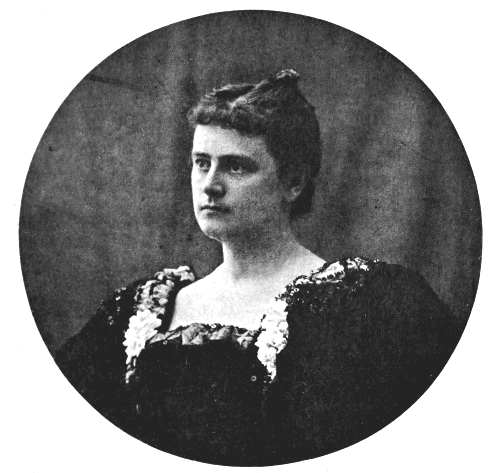
MRS. ALEXANDER J. DALLAS DIXON
The original of this letter is preserved in the archives of the
Committee:
“Mrs. McCollin
“Dear Madam:
“I wish to say on behalf of the Executive Committee of the
Philadelphia Orchestra that our Committee is in hearty sympathy with
the effort to form a Women’s Committee, and fully appreciates the
kindness of the ladies who propose to form such a Committee in coming
to the assistance of the Association, at a rather critical time. We
fully endorse any measures you see fit to take in carrying out your plans.
Yours very truly,
John H. Ingham, Secretary
333 South 16th Street
“March 13, 1904.”
Committees on Guarantors, Boxes and General Subscriptions were formed
and their labors began.
The first work which the women undertook at the request of the
Executive Committee was to secure $10,000, in new guarantees within the
first month of its existence; the Executive Committee feeling that the
best indication of a desire to continue the orchestra would be shown by
an increase in the Guarantee Fund.
The Committee at once went to the musical critics of the various
Philadelphia newspapers and secured their hearty co-operation in the
work of rousing the public to an appreciation of the musical and civic
importance of the orchestra. Within the allotted time the Committee had
not only secured more than $10,000 in new guarantees, but had received
new orders for $5,000 worth of seats and boxes for the next season. The
Association thereupon decided to continue the orchestra for one more
year, hoping that public interest would continue to increase.
The Guarantee Committee appointed by Mrs. Dixon to raise this sum was
composed of Mrs. Spencer Ervin, now Mrs. Harold E. Yarnall, Chairman;
Mrs. Morris Pfaelzer, Mrs. Edward I. Keffer, Mrs. George D. Widener and
Miss Frances A. Wister, Secretary. A careful plan was made for this
attack upon the public purse and all the members of the Committee threw
themselves into the task of raising this large sum for a little known
and unpopular cause.
Lists of prospective guarantors were compiled and each woman was
assigned her quota of people to approach. The time was short, the pace
was quick and the excitement was great. To at least one member it was a
first experience at raising a large amount, but the novelty quickly
wore off in the face of the continuous needs of the Association.
The Committee on Seats and Boxes became active at once, and Mrs.
McCollin as Chairman of the Press Committee attended most ably to the
publicity. Numberless articles appeared describing the Committee and
its activities, and the help of the papers was very valuable.
Another way of making the orchestra and the Committee known was the
parlor meetings. These were held in various places, with speakers
of influence in the community. The first of these took place at the
residence of Mrs. Thomas S. Harrison. Addresses were made by Dr. Alfred
C. Lambdin, Mr. Constantin von Sternberg, Miss Esther Kelly and Miss
Wister. No money was asked for at these meetings which were held in
all sections of Philadelphia and vicinity during many seasons. The
fact that Philadelphia had an orchestra was the point emphasized, as
there was general ignorance of its existence. Then its importance to
the musical life of the city and its needs were mentioned. Perhaps
the most useful work next to procuring guarantors was the formation
of the Auxiliary. These women were elected and asked to become season
seat holders. The reports of the sale of boxes and season seats show
thousands of dollars secured in new orders during the first years and
frequent comment is made upon the improved appearance of the house
through the filling of the boxes. The Friday house has been sold out
for a number of years, but the Saturday house was a more difficult
problem and only recently has been filled by season subscribers.
The list of activities was never-ending, and included visits to music
schools, circulars, appeals, the co-operation of libraries, orchestra
clubs, special rates for students, parlor meetings, of which Mrs.
Keffer became Chairman in 1905, letters to friends in other cities
where the orchestra was to appear and many more. The results were
good. Between 1904-05 and 1907-08, the total sales of new orders for
seats and boxes amounted to $29,670.00, and new guarantees amounted to
$37,500.
The activity of the Women’s Committee during its first year of
existence and the great need of the Association brought about the
formation of a second Committee in Germantown and Chestnut Hill, on
March 28th, 1905, under the leadership of Mrs. Francis Howard Williams,
a woman prominent in every good cause.
- Mrs. Francis Howard Williams,
President[15]
- Miss Anna Hazen Howell, Recording Secretary
- Mrs. Henry W. Raymond, Corresponding Secretary
- Mrs. Augustus Stoughton, Treasurer
- Miss Frances A. Wister, Secretary
- for the Guarantee Fund
No sooner were these women organized than they threw themselves
enthusiastically into work in their section and have since co-operated
with the Women’s Committee in every undertaking. They raised $26,825
for the Million Dollar Endowment Fund.
Mrs. Williams declined to be a candidate for the presidency in 1916 and
was succeeded by the Countess of Santa Eulalia, who still holds that
office. The Committee has recently celebrated its Twentieth Anniversary.
Shortly afterwards, on April 6th, 1905, the spirit moved the women of
West Philadelphia to form a third Committee. Mrs. C. Lincoln Furbush,
daughter of Mr. and Mrs. Wm. Burnham, staunch supporters of the
orchestra, organized it at her mother’s house, and became its first
president and the youngest of Women’s Committee presidents.
The officers were:
- Mrs. C. Lincoln Furbush,
President[16]
- Miss Margaretta Hinchman, Vice-president
- Miss Helen Fergusson, Corresponding Secretary
- Miss Edith Schoff, Recording Secretary
- Miss Grace Atlee, Treasurer
After one year of service Mrs. Furbush, Miss Schoff and Miss Atlee
resigned, and Mrs. Monroe Smith, now Mrs. L. Howard Weatherly, Mrs.
Charles L. Mitchell and Mrs. Samuel S. Fels succeeded them and still
hold those offices.
This active Committee has constantly been inaugurating new plans.
In 1915, to commemorate its Tenth Anniversary, it presented to the
Association the stage setting completed in 1918, which was used until
the new plans of Mr. Stokowski made a complete change of size and shape
necessary.
Entertainments of many kinds have been given and the Twentieth
Anniversary was celebrated in May, 1925.
At the Annual Meeting of the Women’s Committees and their Auxiliaries
in April, 1911, Mrs. J. Claude Bedford, an active amateur musician,
then living in Media, proposed that a Women’s Committee should be
formed in Delaware County. She had become convinced that work of value
could be done there and with the help of Mrs. Arnett, she formed a
Committee with members from nine towns within twenty-five miles of
Philadelphia, including West Chester, Glen Mills, Media, Wallingford,
Swarthmore, Primos, Lansdowne, Darby and Chester.
The task was a hard one. Many residents of the district were unable,
on account of the distance and of poor train service, to attend the
concerts. Yet there was enthusiasm and much hard work in Delaware
County. After several years, Mrs. Bedford was obliged to relinquish
her position, and Mrs. Matthew H. Cryer, of Lansdowne, succeeded
to the office of President, which she still retains. The work of
this Committee has been extraordinary and beset with obstacles. No
enterprise has ever been entered into by the other Committees, in
which the Delaware County Committee has not done its share and more,
including bringing in its quota of $20,000 for the Million Dollar
Endowment Fund. The Tenth Anniversary was celebrated in May, 1911, by a
reception given at the house of Mrs. Cryer.
These four Committees are actively engaged in working for the
Philadelphia Orchestra in Philadelphia, but they have been instrumental
in helping the out-of-town concerts by persuading women in other places
to foster concerts given there. The first of these was formed in
Wilmington, Delaware.
Mrs. Lewis C. Vandegrift, President; Mrs. Joseph Swift, Vice-president;
Mrs. William Betts, Secretary; Miss Annie T. Flinn, Treasurer.
Concerts were given in Wilmington as early as the season of 1902-03,
but they were not thriving as they should. The Women’s Committee
therefore sent a mission to Wilmington, where Mrs. Joseph Swift, a
composer and an amateur musician of prominence, called a meeting at her
house. Mrs. Dixon, Mrs. McCollin and Miss Wister were the emissaries
and the visit resulted in the formation of the Delaware Committee, with
the above officers and twenty-three Directors.
For fifteen years this Committee continued its active work under the
successive leadership of Mrs. Lewis C. Vandegrift, Mrs. Swift, and Mrs.
Robert B. Bird. It was active in selling seats, procuring the Guarantee
Fund for the Wilmington Concerts, without which the orchestra could
not appear, in arousing interest by giving receptions for our leaders
and in other ways. It was of immense help to have an organized group
of people furthering the interests of the orchestra in Wilmington. The
Committee continued its labors until the concerts had to be given up on
account of the press of engagements. This Committee was affiliated with
the Philadelphia Women’s Committee, and always sent a representative to
the Annual Meetings.
Baltimore and Washington were considered fruitful fields and
Philadelphia’s by right of propinquity. The Boston Symphony Orchestra
had established a large clientele in these cities, but it had years
of reputation, and of artistic achievement, with which to attract
audiences. Not so with a new and little known orchestra. Mrs. Dixon,
Miss Wister and Mrs. Thomas S. Kirkbride, Jr., paid a visit there in
December, 1905, on the occasion of an afternoon concert at the Arundell
Club, at which two members of the orchestra, with Mrs. Kirkbride at the
piano, played trios. In the following spring, Miss Mary B. Shearer
organized a Committee and became the Chairman[17].
In Washington, Miss Aileen Bell, after a meeting at which Mrs. Dixon
spoke, organized a group of women to assist in popularizing the
orchestra, and also secured many patronesses.[18]
Washington, the abode of representatives of foreign countries and with
a fluctuating population, was an easier field than Baltimore. Neither
of these Committees has been active lately, because the necessity is
past, but their help was much appreciated then.
This Committee, which was affiliated with the Women’s Committee, was
formed in Atlantic City, after a concert by the Philadelphia Orchestra
in 1912, and was active until 1915.
A Committee of five women was appointed, with Mrs. Joseph H. Ireland as
President, to take charge of a permanent series of concerts in Atlantic
City. During the three years of its existence, they sold the tickets,
carried on educational work in the schools, arranged for special
students’ tickets, distributed programmes in advance as a basis for
study, managed the publicity and indulged in other forms of activity.
The Women’s Committees for the Philadelphia Orchestra have been an
important part of the work at home and abroad. There have been twelve:
| 1902: |
Women’s Committees in Harrisburg, Lancaster, |
| |
Allentown, Pennsylvania, and Trenton, New Jersey. |
| 1904: |
The Women’s Committee for the Philadelphia Orchestra. |
| 1905: |
The Germantown and Chestnut Hill Women’s Committee, |
| |
the West Philadelphia Women’s Committee, the |
| |
Delaware Committee.
|
| 1906: |
The Baltimore Committee, the Washington Committee. |
| 1911: |
The Media, Chester and West Chester Women’s Committee |
| |
(now Delaware County Committee). |
| 1912: |
The Atlantic County Committee. |
The Women’s Committee, pioneer of the four in Philadelphia, celebrated
its Twentieth Anniversary in March, 1924. The event was marked by
a series of entertainments, beginning with a luncheon given by the
Officers and Directors of the Philadelphia Orchestra Association
on March 11th. After a number of speeches an anonymous gift of one
thousand Dollars to the Pension Fund from a member of the Committee,
in honor of the occasion, was presented to the President of the
Association. By vote of the Board of Directors this has been placed in
a separate fund bearing the donor’s name and the Women’s Committee has
the privilege of designating a special use for the income each year.
The next event was the reception given by the Women’s Committee, in
the Foyer of the Academy of Music, on March 14th, in which the members
of the Auxiliary joined, and at which the guests of honor were the
Officers and Directors of the Association, Mr.
Leopold Stokowski and the members of the Philadelphia Orchestra.
The Treasurer’s Report at the Twentieth Annual Meeting in 1924, showed
that since 1904, for dues and subscriptions to special entertainments
and gifts by the Committee, $11,432.00 had passed through her hands.
While for special funds such as the Scheel Memorial Bas-relief,
the Philadelphia Orchestra Chorus and the Opera Supper Dances, an
additional amount of $25,335.00 was received and expended, making a
grand total in twenty years of $36,759.00. This does not include any
money for the Guarantee or Endowment Funds, or money for tickets sold
by the Committee. Two interesting items are those of $6,456.00 for the
Fritz Scheel Memorial raised by the three committees; and of $7770
raised for the Philadelphia Orchestra Chorus in 1921-22.
“The time has come to talk of many things” when an account of the work
of the women is to be given; for the things they have done have been as
diverse as the “ships and shoes and sealing wax and cabbages and kings”
which so puzzled “Alice in Wonderland.”
They have ranged from guarantors, ticket selling and parlor meetings,
to balls, dances and selling post cards. Not to mention the two
Endowment Funds and the silhouettes, the contribution toward the Chorus
in 1921, and the receptions for the various conductors and soloists
during twenty-one years. While thousands of dollars have passed through
the Women’s Committees for the maintenance of the orchestra, apart from
the tickets they have sold, the women had no fund to fall back on until
1921, when the Women’s Committees Fund was established, to which the
proceeds of the Opera Supper Dances are added each year.
In speaking of the Endowment Funds it should be recorded that the first
gift ever made for such a fund came to the Women’s Committee in 1906,
from Mr. Theodore N. Ely.
“Resolution Adopted December, 1906
“Resolved: That
this Committee send to Mr. Theodore N. Ely, their most sincere and
appreciative thanks for his most generous contribution towards the
cause for which this Committee exists.
“And further resolved, that the Committee appoint a Sub-committee
of four, to urge upon the Executive Committee of the Philadelphia
Orchestra, the desirability and great appropriateness of starting the
Permanent Endowment Fund for the perpetuation of the Philadelphia
Orchestra, with this generous contribution in memory of one of the
first members of the Board of Managers of the Women’s Committee, Mrs.
Theodore N. Ely.
“And further resolved, that copies of this resolution be sent to Mr.
Ely, and to the Executive Committee of the Orchestra.
“In pursuance of this, our President has appointed the following
ladies a Committee to confer with the Executive Committee of the
Orchestra concerning this matter, Mrs. Yarnall, Mrs. Widener, Miss
Wister and Mrs. McCollin.”
With the exception of raising money for the various funds the most
important feature of the four Women’s Committees is their Auxiliaries,
now numbering 1985 women, attending the three Philadelphia series. It
was through these that the Friday audience was built up, for Auxiliary
members must have season seats. There are no dues and no other duties;
but some of the best work done for the Endowment Fund and for the
Anniversary Ball, was done by Auxiliary members, who for years have had
a deep regard for the orchestra. All women season ticket holders are
eligible.
The Women’s Committees have given many entertainments, beginning with
a reception in honor of Fritz Scheel on March 6th, 1905, followed by
House Music under Mr. Scheel’s direction.
Others have been given in the following order:
Mr. Carl Pohlig, 1908;
Mme. Pohlig and her daughter Mme. Maillard, 1909.
Mr. and Mrs. Leopold Stokowski, 1912.
Luncheon to celebrate Tenth Anniversary of the Women’s Committee, March
6th, 1914.
Reception to Mr. Stokowski and soloists and members of the Mahler
Chorus, March 4th, 1916.
Supper for Mr. Stokowski and assisting artists, March 4th, 1916, at
which many out-of-town guests were present.
Receptions at the houses of Mrs. Alexander J. Cassatt, the Countess of
Santa Eulalia, Mrs. Weatherly and Mrs. Cryer, in the interest of the
Seven Year Endowment Fund, October, 1916.
Reception to Mlle. Guiomar Novaes, 1917.
Receptions for Mme. Olga Samaroff, M. Alphonse Catherine, M. Sergei
Rachmaninoff, 1919.
Luncheon to celebrate Fifteenth Anniversary of the Women’s Committee,
April 14th, 1919.
Reception at house of Mrs. Matthew H. Cryer, Lansdowne, to celebrate
Tenth Anniversary of the Media, Chester and West Chester Women’s
Committee, 1921.
Musicale and reception at the house of Mrs. L. Howard Weatherly, to
celebrate Tenth Anniversary of the West Philadelphia Women’s Committee,
May, 1915.
Luncheon for Mr. Frederick A. Stock, guest conductor, January 19th,
1924.
Reception to celebrate Twentieth Anniversary of the Women’s Committee,
March 14th, 1924.
Reception to Mr. Igor Strawinsky, January 30th, 1925.
Luncheon to celebrate Twentieth Anniversary of Germantown and Chestnut
Hill Women’s Committee, March 31st, 1925.
Reception to celebrate Twentieth Anniversary of West Philadelphia
Women’s Committee, May 13th, 1925.
Among the artists whom the Women’s Committees have entertained, the
most popular one is Mme. Olga Samaroff. She is beloved by all the
members, and admired, not only because she is a great artist, but on
account of her unusual and delightful personality. The women will never
forget what she did for the orchestra during her years of residence in
Philadelphia.
No mention of the entertainments of the Committees would be complete
without an account of this. It was held January 24th, 1921, to mark the
Sixty-fourth Anniversary of the opening ball of the Academy of Music,
on January 26th, 1857. It should be called a study in co-operation, for
besides the four Women’s Committees, almost the whole city joined to
make it a beautiful affair and a success. The feature of the evening
was the quadrille in the costume of the period to which a number of
persons contributed sets, as well as the following organizations.
The Co-operating Societies were:
Matinee Musical Club, Mendelssohn Club, Musical Art Club, Musical
Fund Society, Philadelphia Music Club, Philadelphia Orchestra
Chorus, Philadelphia Choral Society, Treble Clef, Fortnightly Club,
Pennsylvania Academy of the Fine Arts, Sketch Club, School of
Industrial Art, School of Design for Women, Plastic Club, T Square Club.
Old trunks were overhauled and old papers assiduously read to get the
local color of the time, so that when row after row of the dancers
began to march down from the dais at the back of the stage and take
their places on the floor there was a scene of beauty which brought
forth rounds of applause. Mr. Charles S. Morgan, Jr., impersonated Mr.
Hlasko, Master of Ceremonies, and took charge of the quadrille which he
had trained.
A Loan Exhibition of much interest was held in the Foyer for which many
treasures were unearthed, including “Miss Ethel Newcome,” of London,
the doll dating from the Sanitary Fair. Various business firms assisted
by contributing materials and allowing the Committees to use their
windows for publicity of a unique kind, such as dolls and jewelry of
the period. Twenty years before such a joint undertaking would not have
been possible, and it was a mark of the general good will felt for the
Philadelphia Orchestra.
A word should be said about these Dances, the Sixth Series of which
has just begun. They are held in the Foyer of the Academy, after
performances of the Metropolitan Opera Company. The subscription and
supper are moderate in price and the affairs are much patronized. The
object is to raise money yearly and have a fund that can be used when
necessity arises.
When the war came a loss of interest might have been expected, but it
was the reverse. Not only the weekly respite at the concerts proved
a boon, but the activities of the Committees were a relief from the
anxiety and rush of war work.
The Women’s Committee has had good friends in the Board of Directors.
When they had no means of support, Mr. Richard Y. Cook for many years
contributed towards their expenses. Without his assistance they would
have been in a serious situation.
Mr. Wm. Jay Turner, the Vice-president, was an important person at the
Anniversary Ball which he led with Miss Frances A. Wister, president of
the Committee.
Mr. Edward W. Bok spurred the women on to victory for the Fund with
a kind but firm hand. Mr. Andrew Wheeler is always friendly and
interested, and so the story might go on naming every director.
First and last is Mr. Van Rensselaer, who has never lost an opportunity
to assist the women’s enterprises and who is regarded as the patron
saint of the Women’s Committees. Mrs. Van Rensselaer’s interest has
been a great help.
The members of the Committee deserve individual mention, but space is
lacking. In the early days Mrs. McCollin and Mrs. Keffer were untiring.
Mrs. Yarnall and Mrs. Allen have held office for twenty-one years. Mrs.
Henry is an adept at managing entertainments. Mrs. Cassatt was a most
valuable officer, possessing courage and judgment and her loss is
constantly felt.[19]
Mrs. Arnett’s direction of the work for the Auxiliary, passed on from
Mrs. McCollin, has been a quiet labor with little public notice. The
Recording Secretaries, Mrs. Ashton and Mrs. Wood, have been efficient
in keeping the minutes.
The woman who bore most of the burden of the pioneers was Mrs.
Alexander J. Dallas Dixon, whose recent death has left a gap in
their ranks. Although she gave up the presidency some years ago, her
influence was always noticeable and her fulfillment of the task was
appreciated. A special meeting was held on October 8th, 1925, to pass
resolutions for Mrs. Dixon.[20]
At the concert of October 16th, these were inserted in the programme
and the audience stood while the Chopin Funeral March was played, in
memory of the first president of the Women’s Committee.
The four Committees and their Auxiliaries have an Annual Meeting each
April, and the President of the Women’s Committee presents a general
report to the Association in May. The names of some of the reports are
indicative of the work, for instance: “A Calm Sea and a Prosperous
Voyage,” “The Adventures of the Women’s Committees, or How We Financed
the Chorus,” “Twenty Years at Hard Labor, a Motion Picture, with a
Prologue and an Epilogue and Continuous Music by the Philadelphia
Orchestra.” Their work has been strenuous, but the women have had
many thrills and good times in the doing of it. There are pleasures
in the chase only known to those who hunt, even when the quarry is an
Endowment Fund.
Women are needed in every household to attend to the personal side of
life, the entertainment of guests, the timely gifts, the flowers and
many other things. They have even been known to help to support the
establishment when the struggle seemed too hard for the men. This has
been much the position occupied by the Women’s Committees during the
last twenty-one years. Their entertainments have made many artists
welcome to this city. Their gifts have come at just the right time:
the share in the loving cup to Mr. Van Rensselaer; the silver plates
to Mr. Stokowski on the completion of his tenth year as conductor; the
silver vase to Dr. Rich after eighteen years of service; the porringer
to little Sonia Marie Noël Stokowski, engraved with a verse from
Wordsworth, all give a human touch to the Association. And when the men
were spent in the battle, the women worked to support the establishment.
The Women’s Committees rejoice in the work they have done for the
Philadelphia Orchestra, and in blazing the trail for women elsewhere.
When the first was formed twenty-one years ago it was a pioneer and a
unique organization, unknown anywhere in connection with a permanent
orchestra. Many persons looked on it with, at least, a question. Now
the questions are of a different nature, and come from other cities
where orchestras are being formed.
The value of women’s efforts in fostering music, and in making
orchestras popular, seems to be recognized. Women’s work for art in
America is rapidly expanding; the torch has been borne by the Women’s
Committees for the Philadelphia Orchestra.
Chapter V The Guarantors and the Guarantee Fund
There are a few satisfactory ways of financing an orchestra, but
there are a number of unsatisfactory ways, and maintaining or trying
to maintain a Guarantee Fund is one of them. The devotion of the
guarantors of the Philadelphia Orchestra through sixteen years of
financial embarrassment is a part of the story of which Philadelphia
may be proud. A group of one hundred and twenty men and
women[21]
constituted the first guarantors in 1900-1901.
At the close of the season this notice was issued:
“The Philadelphia Orchestra
“Fritz Scheel, Conductor
“Call for the
First Guarantee Fund
“Philadelphia, June 15th, 1901
“Dear Sir:
“The accounts of the Treasurer of the Philadelphia Orchestra
Association, for the season just closed, shows a total expenditure for
all purposes of $27,729.33, and total receipts from all sources of
$14,429.85, leaving a deficit of $13,299.48, to be met by the Guarantee
Fund.
“A copy of the report of the Auditors is hereto appended.
“The Guarantors are to be congratulated upon the success of this
experimental season—made possible only by their generous support.
The musical success of the concerts has surpassed the most sanguine
anticipation, but the most important and far-reaching result of
the undertaking has been the formation of the recently organized
Philadelphia Orchestra Association, with its well-assured plans for
weekly concerts and public rehearsals during the winter seasons of the
next three years.
“The total Guarantee Fund amounts to $15,720.00, upon which a call
of 84.61 per cent is necessary to meet the above deficit. Will you,
therefore, please mail to Mr. John H. Ingham, Assistant Treasurer, No.
505 Chestnut Street, your check drawn to his order, for $—— being 84.61
per cent of your subscription of $——
“Very truly yours,
“John H. Ingham
Oliver B. Judson
Edward I. Keffer
Oscar A. Knipe
Edward G. McCollin
Henry Whelen, Jr.
“Executive Committee”
“REPORT OF THE AUDITORS
“Philadelphia, 12th June, 1901.
“The undersigned, being two of the Guarantors for the first series
of Concerts of the Philadelphia Orchestra, and having been requested to
act as Auditors, have examined the accounts of the Treasurer and the
vouchers for disbursements.
“We find same in order and correct, and are satisfied that the
business management of the Orchestra has been efficient, and that the
expenditures were proper and necessary.
“The accounts show receipts from sales of tickets and incidentals
amounting to $14,429.85, and payments as per receipted vouchers
amounting to $27,729.33, leaving a deficit of $13,299.48.
“John H. Converse
“C. Hartman Kuhn
“Auditors”
When the business of this season was settled, a new fund had to be
procured; forty-three Philadelphians were found who were willing to
risk a three-year pledge for an untried experiment, and a number more
for shorter terms.
When this three-year guarantee expired the Association was facing a
crisis and was on the point of disbanding the orchestra. Then the newly
formed Women’s Committee was appealed to with the information that an
addition of ten thousand dollars to the Guarantee Fund, secured within
two weeks, was the only hope of saving the orchestra. An account of
this first effort by the women has been given in a previous chapter.
They succeeded in securing a number of new guarantors for one, two and
three-year terms, and completed the amount within the required time.
The story of the next sixteen years is one of constant begging on the
part of everybody connected with this institution. Many methods were
used to explain the financial condition. The Minutes, the programme
book, and the numerous letters issued bear witness to this fact. Many
were the meetings called “to consider the financial status of the
Association.”
“Dear Sir or Madam:
“At the end of the second season the Directors of the Philadelphia
Orchestra find that the deficit will practically be the same as at the
end of the first year, viz: $68,000 or $70,000. The expense of managing
the organization has been reduced as much as possible, and if the
organization is to be maintained on the same standard of excellence,
the management feel that a large guarantee fund is necessary.
“It is proposed to increase the guarantee fund from $40,000 to
$100,000, and by so doing we would not have to call on the entire
guarantee fund, possibly 50 per cent of such fund would be necessary.
The prices of admission for boxes and seats in the various parts of the
house are as low as it is possible to make them, so that the concerts
are within easy reach of students of music.
“The Orchestra during the past year has completed a season of 20
weeks, having given 71 concerts in all, 43 in Philadelphia and 28
outside of the City. In addition to these performances the orchestra or
a large number of them have appeared at concerts of the Orpheus Club,
the Choral Society, the Temple Chorus and the Maennerchor under their
several conductors.”
“The management have done their utmost to make the orchestra a
success, being aided in their efforts by the excellent conductorship
of Herr Scheel. Private individuals and those interested in music have
generously contributed, but it is to the public that we now look. By
an increased season sale the receipts will be greatly increased, and
consequently there will be more money to defray the expenses.
“If you have not as yet become a guarantor of the Philadelphia
Orchestra, will you not aid us by doing so and communicate with Mr.
John Ingham, Secretary, 505 Chestnut Street, who will furnish you
blanks for that purpose. The guarantee fund covers a period of three
years only.
“If the orchestra is to be continued, and it would be a disgrace to
Philadelphia to allow a fine organization of its kind to slip away from
us, two things are necessary: a larger guarantee fund and the support
of the public by an increased season sale. The outlook for the latter,
we are glad to say, is most encouraging for next season.”
“Of course, it must be understood, that unless a sufficient
guarantee fund be raised, they would not feel justified in continuing
the Orchestra indefinitely.”
“Hoping you will, if you have not already done so, aid us in
furthering and maintaining this orchestra, we remain
| Yours truly, |
| “George Burnham, Jr. |
A. J. Cassatt |
| John H. Converse |
Eckley B. Coxe, Jr. |
| Wm. L. Elkins |
Miss Mary K. Gibson |
| John H. Ingham |
Oliver B. Judson |
| Edward I. Keffer |
C. Hartman Kuhn |
| Edward G. McCollin |
Thomas McKean |
| Clement B. Newbold |
James W. Paul, Jr. |
| Mrs. F. H. Rosengarten |
Richard Rossmaessler |
| Edgar Scott |
Simon A. Stern |
| Miss Anne Thomson |
A. Van Rensselaer |
| Henry Whelen, Jr. |
P. A. B. Widener |
| Clement A. Griscom” |
1903
“To the People of Philadelphia:
“The management of the Philadelphia Orchestra Association, at the end
of the third season of concerts, feel that they may now claim that they
have fulfilled their original promise to supply the community with an
orchestra of the first class. There are but three other orchestras of
this rank in the country, those of Boston, Chicago and Pittsburg.
“A great orchestra is as much a civic institution as a great library or
art museum. It is the backbone of the whole musical organism. No large
city can afford to be without one.”
“The artistic success of the past season is unquestioned, the work of
the orchestra under Mr. Scheel, a leader admittedly second to none in
the country, received flattering comment wherever it has been heard,
both at home and in other cities, New York especially envying us the
possession of an orchestra of the first rank.”
“The deficit is practically the same as that of the preceding season,
viz: sixty-eight to seventy thousand dollars. While this is a large
sum, it compares favorably with the deficits of the three other large
orchestras of the country during their initial seasons, and is not a
cause for discouragement.”
“An orchestra of the first class, however, can never be entirely
self-supporting, and must be dependent upon the guarantees or
contributions of those who take pride in their city and look upon its
work as necessary to the education of the community.”
“Up to the present time the amount of the deficit over and above the
guarantee fund has been paid by a few (three or four) generous and
public-spirited members of the Association. It is not fair, however,
that the burden of such an undertaking should be borne by a few when
the whole community is benefited, and the Directors appeal to the
public generally to aid in this work.
“In a city of the size, wealth and culture of Philadelphia, it does
not seem unreasonable to hope that a sufficient number of people can
be found to assist in retaining the orchestra and increasing its
usefulness. One hundred additional subscriptions of a Thousand or
Five Hundred Dollars each, per annum, for three years, would go very
far toward enabling the management to establish the orchestra on a
permanent paying basis, but without such support from the public, the
Directors do not feel that they would be justified in continuing the
orchestra indefinitely.”
“As it is impossible to ascertain and approach personally all who are
interested in the cause, those who wish to subscribe to the guarantee
fund are requested to write to the Secretary, Mr. John H. Ingham, 505
Chestnut Street, for blanks. The intention is to raise a fund for three
years.
“On the success of this appeal will depend the future of the orchestra.”
(Signed as before.)
“Philadelphia Orchestra Association
“Philadelphia, April 15, 1905.
“To the Guarantors of the
Philadelphia Orchestra Association:
“In closing the Fifth Season of the Philadelphia Orchestra, the
Executive Committee think it is proper to report the result of the
season to the Guarantors and to the members of the Association.”
| “The total cost this season, including salaries |
|
|
| of musicians and conductor, office expenses, |
| rental of Academy of Music, etc., |
| amounted to |
$99,746.28 |
| “The total receipts from all sources were |
45,877.57 |
| Showing a Deficit of |
53,868.71 |
| “The Guarantee Fund is |
48,627.50 |
| Leaving a Deficit of |
$ 5,241.21[22] |
which we have every reason to believe will be
provided for in the near future.
“The loss in season 1903-04 amounted to $58,530.23, so that we can
show a distinct gain this year of $4661.52. The gain, however, was
really much greater, inasmuch as our fixed charges were increased
nearly $5000 due to increase in salary of conductor, increased rent of
Academy of Music and increased charges for advertising, etc.”
“Owing to the unflagging energy and enthusiasm of our Women’s
Committee, not only has our Guarantee Fund been substantially
increased, but the season’s sale of boxes and seats, etc., was larger
than for any previous year.”
“All this is very gratifying, but the fact remains that an
efficiently maintained orchestra will always cost in the neighborhood
of $100,000, with the possibilities of only $60,000 maximum
receipts secured from full houses at every performance.”
“There is no question whatever that the Orchestra is gaining in
prestige and popularity among the people of this city, and it is the
earnest hope of the Committee that the work should spread and that the
Orchestra should be put on a permanent basis.
“It has been decided to re-engage Mr. Scheel, and contracts have
been authorized with the members of the Orchestra, so that as far as
possible the present personnel may be retained.
“It is the hope of the Committee that you will continue to favor the
organization with your support as before, and that you will renew your
subscription to the Guarantee Fund.
“By Order of the Executive Committee
“(Signed) A. Van Rensselaer, President”
Programme Book
“The Philadelphia Orchestra Association
Owes Much of its Success to the Devoted
Labors of the Following
Women’s Committees
Any Member of Which Will be Glad to Receive
Your Subscription of Twenty-Five
Dollars, or More, to the
Guarantee Fund
of the
Philadelphia Orchestra
“What the Philadelphia Orchestra
Is Doing
for Philadelphia”
“The breadth of a city’s culture is measured by its point of
view toward the arts that interpret life. Music is one of them—with
Painting and Literature. It is the function of The
Philadelphia Orchestra to carry forward the musical tradition
that has been Philadelphia’s for five generations—
“And more, to keep its musical consciousness alive and virile, by
presenting the noblest works of the composers of today—composers who
are expressing life in the terms of the present day.”
“It has warm friends, enthusiastic audiences, the appreciation of
musicians. Its influence is far more than local.
“But more than this—it needs financial support.
“It is not a private enterprise for private gain, but a public
organization for public service.
“In the nature of things such an institution cannot be
self-supporting. Its box office receipts are fixed by the customary
scale of prices—while its expenses are the creatures of time and
circumstance.
“The resulting deficit is made up each season by The Philadelphia
Orchestra Association, whose members guarantee sums ranging from $25 to
$5000 each, annually, for this purpose.
“The Association is thus the instrument through which any one may
help to perform this public service. It needs more members—of whom you
are invited to be one.
“THE INFLUENCE OF YOUR NAME
AND YOUR MONEY ARE NEEDED.”
Programme Book
“A Call to Patriotism
“The Call to Civic Pride is in the Air.
‘Learn to know Philadelphia and work for her,’ is heard on every hand,
and our people are urged to form and join ‘Patriotic Societies,’ all of
which is good, and well worth-while.
“But Do You Know that for several years a
zealous Patriotic Society—one that evinces the truest Patriotism, the
Patriotism of the Pocket-book and Bank Account—has been quietly at work
doing all it could in its own way for the good name of Philadelphia and
for the enjoyment and welfare of her citizens?
“The Members of this Society have
demonstrated the soundness of their Patriotism, the reality of their
Civic Pride, and their zeal for the people’s good, without boasting
and without complaint, by contributing from their private means, in
the past nine years, approximately $468,000 to maintain and operate
The Philadelphia
Orchestra, an institution of which every good Philadelphian has
reason to be proud.
“The Membership of this Society of
liberal and public-spirited citizens known as The
Philadelphia Orchestra Association,
numbered 43 in the season of 1901-02. Last season there were 263 members.”
“Will You Not Show Your Patriotism,
your Civic Pride, your desire ‘to know and work for Philadelphia,’
by joining the honorable roll of this Association? A subscription of
Twenty-five Dollars, or more, toward the Guarantee Fund, will make you
a member.
“YOUR NAME AND MONEY ARE NEEDED!
“THEY ARE NEEDED NOW!
“Write today to the Manager for a Subscription Blank.”
One of the difficulties was the attitude of business
men who felt that after a few years the orchestra should be making a
return on the investment, or at least be self-supporting. Their opinion
was that an institution which was a constant expense did not deserve
the support of the community. Fortunately for music, the people of
Philadelphia now understand that an orchestra never can be anything but
a public charge.
Beginning with 1904 the number of guarantors ranged from two hundred
and fifty to three hundred and sixty per season. The Guarantee Fund
ranged from forty-five to fifty thousand dollars. During some seasons
there was that most intolerable of all things, an extra deficit: during
a few, a certain per cent of the fund only was called upon.
The discouraging part of the Guarantee Fund method of financing an
orchestra lay in the fact that the work was never-ending. A certain
number of guarantees expired each season and the guarantors had to be
persuaded by all the arts of man and woman to renew their pledges. The
fact that their money was to be immediately spent, militated, in the
minds of many people, against the Fund. It is so much pleasanter to
think of one’s gift safely ensconced in a permanent fund yielding an
income year after year for a favorite cause.
The Women’s Committees worked hard for the Fund. Besides procuring
new guarantees each year for twelve years, amounting to thousands of
dollars, they obtained renewals of old guarantees or made good the loss
by new ones. In 1905, they defrayed the extra deficit of $5300.00; no
doubt taxing everybody’s generosity and patience to the utmost.
Much of the financial burden in the first years was borne by a few
men and women, who time after time put their hands deep into their
pockets. Among these may be named Mr. Alexander Van Rensselaer, the
president; Mr. Thomas McKean, Jr., for some years vice-president; Miss
Anne Thomson and Miss Mary K. Gibson, directors. The treasurer, Mr.
Henry Whelen, Jr., was always optimistic and advanced money constantly.
What the result would have been if Mr. Whelen had not done this is
problematical. His untimely death in 1907 robbed the orchestra of a
devoted friend.
Mr. Whelen was succeeded as treasurer by Mr. Arthur E. Newbold, of
Drexel and Company, who arranged loans and advanced money and took
endless trouble for the Association. The same can be said of Mr. Robert
K. Cassatt, the present treasurer, who attends to many details of
business.
From 1905-06 until 1910-11, Mr. Horace Churchman was the Controller
of the finances, which he administered with ability and much to the
satisfaction of the Board.
A glance at the figures is all that is needed to learn the story of
those years so discouraging from a business point of view.
Résumé of the Guarantee Fund,
1900-01-1915-16
| Season |
Concerts |
Total |
Number of
Guarantors |
Amount
Collected |
|
Extra
Deficit |
| 1900-01 |
6 |
|
$15,720 |
120 |
$13,299 |
(84%) |
$40,000 |
| 1901-02 |
14 |
pairs |
32,000 |
43 |
32,000 |
|
30,000 |
| 1902-03 |
14 |
” |
38,000 |
113 |
38,000 |
|
16,000 |
| 1903-04 |
14 |
” |
42,000 |
137 |
42,000 |
|
5,300 |
| 1904-05 |
15 |
” |
48,000 |
259 |
48,000 |
|
|
| 1905-06 |
18 |
” |
50,000 |
315 |
47,000 |
(95%) |
| 1906-07 |
20 |
” |
46,840 |
281 |
41,900 |
(90%) |
| 1907-08 |
22 |
” |
42,285 |
273 |
40,100 |
(95%) |
| 1908-09 |
22 |
” |
45,125 |
352 |
42,800 |
(95%) |
| 1909-10 |
22 |
|
44,800 |
359 |
44,800 |
|
| 1910-11 |
25 |
|
42,400 |
311 |
42,400 |
| 1911-12 |
25 |
|
42,100 |
309 |
42,100 |
| 1912-13 |
25 |
|
43,200 |
314 |
43,200 |
| 1913-14 |
25 |
|
46,000 |
335 |
46,000 |
| 1914-15 |
25 |
|
45,300 |
323 |
45,300 |
| 1915-16 |
25 |
|
49,100 |
310 |
49,100 |
| Total |
$618,699 |
During these distressing days Scheel was asked to dine at the
Rittenhouse Club to meet some prominent men of affairs, at a time when
desperate efforts were being made to procure guarantors. The hour
arrived, but no Scheel and it was learned that he had not gone home
to dress. His friends started out to find him, and he was discovered
teaching the second bassoon player to play a syncopated passage in
a Tschaikowsky symphony. The dinner was entirely forgotten in the
absorption of the lesson, but he rushed home to dress and arrived only
thirty minutes late. The result of the dinner, however, was an addition
of several thousand dollars to the Guarantee Fund.
The total number of guarantors who defrayed the annual deficit
during sixteen years was about seven hundred and fifty, and to them
Philadelphia music lovers are deeply in debt. Many sighs of relief were
heard when this unstable way of financing an orchestra was ended by the
offer of the “Unknown Donor,” which made possible a more permanent method.
Chapter VI The Death of Fritz Scheel — The Scheel Memorial Tablet — The Future — The Musical Record 1900-1907 — A Tribute
But while the Board of Directors was in a continuous state of anxiety
about the expenses; and the guarantors were being kept up to the mark;
and the three Women’s Committees then in existence were straining every
nerve to help; and the orchestra was constantly improving through
the untiring efforts of the conductor, all was not well with Fritz
Scheel. In looking back over his term of leadership of the Philadelphia
Orchestra, his friends realize now that his illness began at least one
year, and perhaps more, before the final breakdown came. He became
irascible with his players, erratic in conduct, and his good judgment
in matters musical seemed to forsake him. During the first months of
1907 his programmes had to be constantly supervised to guard against
excessive severity; and on one occasion he had to be restrained from
playing five symphonies at one concert.
The first knowledge the public had that he was in a peculiar
mental condition was at a concert of the Eurydice Chorus, held in
Horticultural Hall on February 6, 1907. He had been much upset by the
death of a violinist in the orchestra, who disappeared and was found
drowned. During the concert he asked the audience to rise and then
played a funeral march in memory of this man. He constantly talked to
the audience and to the singers. It was immediately seen that he was
not responsible for his actions, and a specialist was consulted. He was
taken to Atlantic City for a week, but did not improve.
The news of Scheel’s illness brought forth universal expressions of
regret, as witness the following:
March 3, 1907.
“Fritz Scheel”
“Fritz Scheel’s illness is not only a personal
tragedy; it is a public calamity. The fine orchestra which he has
created for Philadelphia, and into which he has poured to exhaustion
his own nervous energy, remains the pliant instrument he made it, ready
to the hand of whatever master may be found to carry on his work, if
he should not return to it. But the orchestra has been so peculiarly
the expression of Scheel’s artistic personality, that his withdrawal at
the end of what had been a most prosperous and buoyant season leaves
the great constituency built up for it in these seven years with a
sense of bereavement and depression.
“Mr. Scheel is a remarkable instance of a concentrated musical
temperament, that views all life and thought through its own medium
alone. In the years that he has spent in Philadelphia, he has been
scarcely known beyond the immediate circle of the orchestra and the
musical societies that he has directed.”
“It is not enough to refer to the wide field of modern music that he
has made familiar to us, through his lucid presentation of the works
of the French, the Russian and other Continental composers, including
the most recent Germans, such as Strauss, whose recondite music he read
with a clearness and significance that the composer himself failed to
convey. Scheel’s peculiar insight is still more expressed in that fact
that he has made Brahms a popular composer in Philadelphia, and he has
triumphantly shown that the great ‘classics’ are not antiquated, but
that real musical thought may speak to modern ears as well through
ancient as through modern forms, if felt and interpreted with modern
understanding.”
“The orchestra, of course, goes on, and the best present hope is
that Scheel may be restored to health before another season. No doubt
another conductor will be found if this hope should fail, but he
will necessarily be different and there is no one now known in this
country whom with an equally broad musical outlook, could be counted
upon to make all the work of the orchestra so unfailingly and often
surprisingly interesting as Scheel has done. Such artists as he are
rare in any time or place, and it is to the honor of Philadelphia that
he has received not only from the few, but from the many, some measure
of the appreciation that is his due.”
Public Ledger, February 10, 1907
“... Scheel’s
collapse, however, came as a shock to everyone connected with the
orchestra, and yet they all realized that he could not endure for a
much longer time. For three weeks he had been unable to sleep.
“Never a moment of freedom did he allow himself. In Odd Fellows’
Temple each morning he rehearsed one group of players, in the afternoon
another group and in the evening the entire orchestra. At his meals
he arranged the sugar bowl so that it would keep the score of some
symphony or other in an upright position where he could study while
eating.
“In Harrisburg, only three weeks ago, Scheel had the grip, and when
the business manager, Charles Augustus Davis, went to see him, he found
the leader lying in bed with water bags over his heart and a score in
front of his eyes. All this time Scheel was also attending to his work
as leader of the Eurydice and the Orpheus Clubs, rehearsing and leading
at concerts.”
“Looks Haggard”
“Mr. Scheel was seen by the Public Ledger correspondent
as he returned to his hotel after a swift stroll down the boardwalk
with his physician. He looked haggard and spoke in an excited, almost
hysterical tone.
“‘Please tell my friends in Philadelphia that I am not a sick man,’
and greeted the newspaperman effusively. ‘All this talk about my mental
condition is absurd. I needed a rest, that was all, and the directors
very kindly allowed me to come to the seashore. I will be all right in
a few days, won’t I, doctor?’
“The concluding sentence was directed to Doctor Goodman in a tone
of pitiful appeal. Dr. Goodman nodded good-naturedly, as he does to
all the proposals and plans that the sick musician unfolds in his
illusions, when he talks about purchasing several beach play-houses for
great music festivals.”
After conducting a last concert in Reading, Scheel was taken to a
sanitarium where he died of paresis on March 13th, 1907.
One of his last hallucinations was to write letters to prominent
musicians in Europe, offering them large sums to come to Philadelphia
and teach in a conservatory that he was about to found. During his stay
at the sanitarium he organized the nurses and orderlies into a chorus
and made them sing part songs, grouped about his bed. This was a unique
occurrence in the conduct of sanitariums, and he was soon much beloved
by the attendants, whose tears at his funeral bore witness to their
feeling for him.
“Fritz Scheel, Fighter,” would have been a good name for the first
leader of the Philadelphia Orchestra. His death was generally
attributed to overwork, but modern psychologists insist that no man
ever came to his death by work. It was the strain of conquering,
handicapped by the financial condition of the Association, that killed
Scheel—conquering first his musicians, then the musical public, then
the opposition to a Philadelphia Orchestra, and last the general
apathy, most difficult foe of all to subdue. If he had not been a
fighter, the Twenty-fifth Anniversary of the Philadelphia Orchestra
would still be several years ahead.
Philadelphia Inquirer, March 14, 1907:
“Scheel, Martyr to Orchestra He Created, Is Dead.
Conductor Known Throughout This Country
and Europe Succumbs to Pneumonia
“Fritz Scheel, conductor and creator of the Philadelphia Orchestra,
who during the seven years which he headed that organization won the
affection of local music lovers as no other musician ever gained it,
died shortly before one o’clock yesterday afternoon in Dr. Francis X.
Dercum’s sanatorium, at 1929 Wallace Street. Double pneumonia was the
direct cause of his death.
“There is little doubt that the real cause of the sudden end of
the brilliant career of Mr. Scheel was his devotion to the orchestra,
of which he was the conductor, for had it not been for the nervous
and physical breakdown of a month ago, brought on by overwork, his
ordinarily sturdy constitution in all probability would have shaken off
the pneumonia which conquered him in his weakened condition.
“During the month before his nervous breakdown, Scheel, encouraged
by the artistic and financial success which was attending the season’s
performances, redoubled his efforts to make the remaining concerts even
outshine in brilliancy and attendance the preceding ones.
“There is no doubt that he would have succeeded, for he had not
only imbued both the musicians in the orchestra with his zeal, but had
also wrought the music lovers of Philadelphia up to a high pitch of
enthusiasm.”
Philadelphia Press, Thursday, March 14, 1907:
“Magic of Scheel’s Baton Stilled
by Leader’s Death”
“Double pneumonia ends life of gifted musician who brought the
Philadelphia Orchestra to a high plane of excellence.
“Philadelphia music lovers suffered perhaps the severest loss in the
city’s musical history yesterday, when Fritz Scheel, director of the
Philadelphia Orchestra, succumbed to double pneumonia.”
“The news was received with sorrow among rich and poor alike, among
those who were regular subscribers to the season of symphony concerts,
as well as among those, who loving music, waited patiently in line for
the doors to the family circle and amphitheatre of the Academy of Music
to open, to hear the diverse program which it was Scheel’s wont to
perform.
“The maestro had made a brave fight for his life, his vitality,
according to his physicians, having been remarkable.”
“Mr. Scheel added to the technical equipment, which is the natural
product of German life and training, a poetic temperament and a broad
outlook on matters musical, which not only gave great vivacity and
variety to his programmes, but which made for such insight in the
matter of the meaning of any given composition, as to produce the most
illuminating and inspiring results.
“A course of seven seasons under his baton was, therefore, not
only pleasurable in the highest sense of the meaning of the word, but
instructive and educational to a marked degree, the entertainment
however, marked, being as it were, incidental to a greater purpose of
not only creating, but of satisfying the desire for the higher things
in the most glorious of arts. In this sphere of endeavor Mr. Scheel’s
singleness of purpose was well known. His devotion to musical ideals
was manifest in everything he did, and his concentration on what he
considered his lifework was of so energetic and absorbing a character
as to make serious inroads on his health and strength. His death
places the musical world peculiarly in his debt, since he arrived in
Philadelphia at a critical period in our musical history and met the
situation admirably.
“It is natural that those interested in music should feel a personal
loss, but there is also a larger loss, in that every city must conserve
those influences which keep the fire burning for the finer things of
life. Hence, although those who are not of the musical world may not so
realize it, they are also the losers through the passing of so striking
a personality, for nothing is more certain than that any community does
not live for or by bread alone, and it is a hopeful sign when any city
is the scene of activities which include men and movements that look
beyond mere material comforts.
“It is fortunate that at this juncture Philadelphia has a large
group of self-sacrificing citizens who realize this. Mr. Scheel had his
reward in life in their support and appreciation, and the best tribute
to him, now that he is dead, will be that the good work will go on on
the lines laid down by him, so that what he stood for shall not be
lost, and the vantage ground attained to be held in all certainty.”
Funeral services for Fritz Scheel were held on March 16th in the
Lutheran Church of the Holy Communion, on Chestnut Street above
Twenty-first. The immense gathering was a tribute to the conductor
and a proof of his personal, as well as musical, popularity in
Philadelphia.
The list of honorary pall-bearers was a long one and included
representatives from almost every branch of musical activity in
Philadelphia:
Executive Committee of the Orchestra: Mr. Thomas McKean, Mr. Henry
Whelen, Jr., Mr. Richard Y. Cook, Mr. John H. Ingham, Mr. Andrew
Wheeler, Jr., Dr. Edward I. Keffer, Mr. Edward G. McCollin, Mr. A. J.
D. Dixon.
Orchestra Guarantors: Mr. F. T. S. Darley, Mr. S. Decatur Smith, Mr.
Richard S. Brock, Mr. John H. Converse.
Business Office: Mr. Chas. A. Davis, Mr. Horace Churchman.
Orchestra Members: Mr. Thaddeus Rich, Mr. Anton Horner,
Mr. Jan Koert, Mr. C. Stanley Mackey.
Philadelphia Symphony Society: Mr. Charles A. Braun, Mr. J. H.
Michener, Jr., Mr. Joseph M. Mitcheson.
Orpheus Club: Mr. Charles W. Baily, Mr. Arthur L. Church.
Eurydice Club: Mr. Louis F. Benson, Mr. F. H. Rosengarten.
Mendelssohn Club: Dr. W. W. Gilchrist.
Choral Society: Mr. Henry Gordon Thunder.
University of Pennsylvania: Dr. Hugh A. Clarke.
Philadelphia Press: Dr. A. C. Lambdin, Mr. Max Heinrici, Mr. George
Rogers, Dr. Martin Darkow.
Philadelphia Musicians: Mr. Philip H. Geopp, Mr. Maurice Leefson,
Mr. Richard Zeckwer, Mr. Wassili Leps.
Personal Friends: Dr. Victor Leser, Dr. John H. Musser.
Besides these, the Board of Directors of the Association and the
Women’s Committees for the Philadelphia Orchestra attended in two large
groups.
Although the orchestra had disbanded for the summer enough of the
musicians were still in Philadelphia to play the slow movement of the
Eroica symphony as the cortège entered the church. The Orpheus Club
sang “The Long Day Closes,” by Arthur Sullivan, and “Holy Peace,” by
Abt. At the grave the horn quartette of the orchestra played Mozart’s
“Ave Verum.” His baton and the score of the Ninth Symphony were buried
with him.
Telegrams and messages of sympathy poured into the offices of the
Association from musicians in all parts of the country and from foreign
artists, sojourning here.
A special meeting of the Board of Directors was held on March 14th,
1907, and this resolution adopted:
“The untimely death of Fritz Scheel has deprived this Association
of the services of a Conductor, who, by his genius and devotion to his
art, has successfully forwarded our efforts to establish an orchestra
that is a credit to Philadelphia and to the contributors whom we
represent.
“Artistic both by temperament and inheritance, the devotion to
his profession by which this community has profited so much has been
indirectly responsible for the untimely ending of his career. Had he
been less insistent upon the full performance of every detail involved
in a complete and conscientious fulfillment of his duties, the great
drain upon his powers that left him without sufficient vitality to
withstand the attack of his last illness, might have been avoided.
“If it be for us to write his epitaph, we would place devotion to
his art as his most prominent trait of character, and loyalty to his
orchestra and to our Association as its closest companion.
“In many respects the Philadelphia Orchestra stands as a monument to
his work and memory, for he must long be remembered as its first, and
for seven years its only Conductor.”
Scheel’s devotion to Beethoven was well known, and if he had been told
to arrange his last concert no doubt he would have chosen a Beethoven
programme. Was it more than coincidence that the following programme
was his last?
Beethoven Programme
February 7 and 8, 1907
Dr. Otto Neitzel, Pianist
Quartet
| Marie Kunkel-Zimmerman, Soprano |
Emily Stuart Kellogg, Contralto |
| Nicholas Douty, Tenor |
Frederic Martin, Bass |
The Mendelssohn Club
(Through the courtesy of Dr. W. W. Gilchrist, Director)
Ludwig von Beethoven (1770-1827)
- 1. Phantasie for Piano, Orchestra and Chorus, Op. 80
- AdagioPiano
- Finale
- Allegro
- Allegro molto
- Adagio ma non troppo
- Marcia assai vivace Piano and Orchestra
- Allegretto ma non troppo
- PrestoPiano, Orchestra and Chorus
Prefatory Remarks by Dr. Otto Neitzel
- 2. Quartet from “Fidelio” (“Mir ist’s so wunderbar”)
- For Two Sopranos, Tenor and Bass
- 3. Symphony No. 9, in D Minor (Choral), Op. 125
- Finale on Schiller’s “Ode to Joy”
- For Soli, Chorus and Orchestra
- Allegro ma non troppo, un poco maestoso
- Molto vivace
- Adagio molto e cantabile
- Allegro assai Quartet and Chorus
Prefatory Remarks by Dr. Otto Neitzel
The predicament of the Board of Directors during Scheel’s illness and
after his death can hardly be described. Apart from the feeling of
personal loss, the Association was pledged to give a series of concerts
in Philadelphia and elsewhere. All the best conductors in America were
engaged in mid-season and the best European ones, if available, were
to be had only at impossible prices.
The concerts of February 7th and 8th during the first week of his
illness were conducted by August Rodemann, the assistant conductor and
first flutist; and Dr. Otto Neitzel, who was included in the programme
as lecturer, directed the Ninth Symphony. The remaining ones were led
in an atmosphere of sadness and apprehension by Leandro Campanari.
Immediately after the death of Fritz Scheel the Women’s Committee
proposed to raise a fund for a memorial to him to be placed in the
lobby of the Academy of Music. A committee was appointed with Mrs. Wm.
W. Arnett as Chairman. The circular printed below was sent out, to
which there was an immediate and generous response.
FRITZ SCHEEL MEMORIAL FUND
Under the Auspices of
The Women’s Committee for the Philadelphia Orchestra
“The Women’s Committee for the Philadelphia
Orchestra has decided to erect in the Academy of Music a life-sized
bronze bas-relief portrait of the late Fritz Scheel, three-quarters
length figure, at a cost of $5000; $2000 of which has already been
contributed. This memorial will have great value as a work of art, as
it will be executed by Mr. Charles Grafly, of Philadelphia, the eminent
American sculptor. It will also be a lasting and visible monument to
the first conductor of the Philadelphia Orchestra, who was beloved by
the musical public not only of Philadelphia, but of other neighboring
cities. It is right and fitting that so great a man, representing so
great an organization, should have an adequate monument in our historic
Academy of Music.
“The music-loving public is asked to help erect this monument to
Mr. Scheel, and all lovers of Art who have the interest of the great
enterprise of their city at heart, will wish to have their part in this
Memorial.
“Messrs. Drexel & Co., Fifth and Chestnut Streets, have kindly
consented to receive contributions to the ‘Fritz Scheel Memorial
Fund,’ as also have Heppe & Son, 1115 Chestnut Street, and
Theodore Presser, 1712 Chestnut Street. Contributions may also be
sent to the office of the Philadelphia Orchestra Association, Room
1313, Pennsylvania Building, Fifteenth and Chestnut Streets, or to
Mrs. Alfred Reginald Allen, Treasurer, 111 South Twenty-first Street,
Philadelphia. Contributions of any amount, large and small, are solicited.
“It is important that all contributions be made by June 1st in order
that the bronze may be completed before the termination of the next
Orchestra season.”
Mr. Charles Grafly had taken a death mask of Scheel and produced a
fine work of art and a most excellent likeness of the man. The setting
was designed by Mr. Edgar V. Seeler. The Tablet cost six thousand
dollars, and enough money was raised in addition to purchase a lot in
West Laurel Hill Cemetery, and to place on Scheel’s grave a suitable
tomb-stone and some shrubbery. Perpetual care was arranged for, a great
satisfaction to Miss Scheel and to all his friends and admirers. For
many years the Women’s Committee has placed a wreath on the memorial
tablet on the anniversary of Scheel’s death, thus keeping alive the
memory of the man and what he did for music here.
One year after Scheel’s death a memorial meeting was held at the
Academy of Music at which time the tablet was unveiled.
Programme of Ceremonies
“FRITZ SCHEEL MEMORIAL
“Academy of Music
Wednesday, March Eleventh
Nineteen Hundred
and Eight
at Three O’clock”
“FRITZ SCHEEL
“A Tribute
“By Florence Earle Coates
“He gave his life to Music—gave—
For love, not hire—himself denying;
His body rests, o’er wearied, in the grave,
But Music lives and gives him life undying.
“In the deep silence, may he hear
Such harmonies as he could wake,
And O, may some faint accents reach his ear
From the great City’s heart that sorrows for his sake!”
“In Memoriam
“By Harrison S. Morris
“Broken in twain the ordered sum of years,
The baton fallen, the chords forever stilled;
Vanished the master, mourned of human tears,
Enduring what to Art his spirit willed.
“The hand that swept the strings
Like unto dust shall be;
The stricken chords vibrate
Eternally.”
“Program
“In Memoriam
“Fritz Scheel
“Born Lübeck, 1852; Died Philadelphia, 1907”
“Richard Wagner—Vorspiel, “Parsifal”
“Address
“Mr. Owen Wister
“Richard Strauss, Tone Poem, Opus 28,
“Tod und Verklärung,
“(Death and Transfiguration).”
“Unveil Memorial to Fritz Scheel”
Great Throng at Academy of Music to Participate in
Honor of First Conductor of Philadelphia Orchestra
“One of the greatest tributes ever paid to a musician in this city
was the Fritz Scheel memorial celebration at the Academy of Music
yesterday afternoon. It was a tribute to a man who was much beloved
for the years of hard work he had done in bringing the Philadelphia
Orchestra to its present perfection, as well as a tribute to his own
personality, which won for him hosts of very warm admirers here.”
“Great Crowd Gathered”
“The memorial services at the Academy yesterday, modest and
impressive as they were, were remarkable for the vast crowd that
assembled to honor the master. Long before the doors were opened,
hundreds of people had gathered at each of the entrances, which were
rapidly increased to thousands and when admission was finally gained,
it was only a short time before every bit of available space was taken,
with sufficient people on the outside to fill the place twice over.
“That the Academy was filled to capacity was announced at the
different entrances by attachés of the Academy, and although hundreds
turned away disappointed, an equal number of them remained during the
entire hour of the memorial services, and to repay them for their
patience, they were finally allowed admission, not to get a chance to
hear any of the ceremonies, but to view the handsome tablet.
“The tablet was unveiled while the audience listened to the brief
but impressive address of Mr. Owen Wister.”
“Mrs. Roosevelt Sent a Wreath”
“Encircling the tablet was a festooning of laurel sent by the
Women’s Committee, and underneath a large wreath of beautiful white
roses sent by Mrs. Roosevelt.
“Mr. Wister’s address was a brief but eloquent effort. After
a few introductory remarks, he said among other things:
“‘Great poems survive the poets who wrote them; great pictures and
statues survive their creators, as symphonies survive the masters who
composed them. In all these arts the work of genius lives on, while the
brain where it was born goes to dust. Not so is it with another sort of
artist, the interpreter. He who interprets—the actor, the singer, the
player—be he never so great, be he Garrick, or Mario or Paganini, still
must he perish with the generation that heard him, and sometimes he
does not even leave a name.
“‘The lot of the orchestral conductor is the same, for he belongs
to the class of interpreters, with the Garricks, the Marios, the
Paganinis. No matter what magic comes from the baton that he waves,
once that baton is laid down, the magic is dead.’
“Reviewed Mr. Scheel’s Work”
“Mr. Wister then went on to sketch briefly the work of Mr. Scheel
from the time he came to this country and of his residence in
Philadelphia for nine years, beginning with the conducting of the
Amateur Symphony Orchestra and including the years he was at the head
of the Philadelphia Orchestra. He said:
“‘Arduous were the pioneer steps, but between each one lie many
struggles, many examples of generosity, of munificent giving on the
part of private citizens; some gave their time and some their purse and
some both. Without their persmission (for they would refuse it), let
the names of the pioneers be mentioned:
“‘Mrs. A. J. Cassatt and that hardworking committee of four: Messrs.
Edward Keffer, Edward McCollin, John Ingham, Oliver Judson. Let us
remember next the boundless generosity of Alexander Van Rensselaer
and Thomas McKean, who poured their thousands out like a royal gift;
nor let us ever forget Miss Anne Thomson and Miss Mary Gibson; to
let any of these names go in silence today, would be to fail in due
appreciation. And for Henry Whelen, his untiring devotion of time and
purse, let a special word of remembrance be said.’
“‘But for the loyal help of all these we might not be here—nor
should we, if, in a dark hour, when masculine endurance gave out,
feminine energy had not stepped in.’
“Mr. Wister then followed with a eulogy of Mr. Scheel, the ‘artist’
as well as Mr. Scheel the ‘man.’ In conclusion he said:
“‘So did his work end. Many must be sitting here today who well
remember those years when Theodore Thomas played to a mere handful of
listeners in this house; when tickets were given away by the dozen and
the fifty, in order that there might not be a desert of empty seats.
“‘But it was not a barren field that Theodore Thomas sowed the
seed in. He made it ready for the Boston Orchestra, and thus at
length arrived the man and the hour for a Philadelphia Orchestra. We
have grown to understand the great value of such music, not only the
pleasure it gives, but its educational and civilizing importance;
and, although now and again some benighted voice is raised against
systematic musical instruction in our schools, the day of the municipal
savage draws to its close!
“‘Older governments assist symphonic art, liberally subsidizing it;
but in our Republic it is proper for the citizens to take this upon
themselves, and all over the country they are beginning to do so. But
Philadelphia’s progress since the days of Theodore Thomas is the most
extraordinary of all, and her citizens will see that it goes on.
“‘And so Fritz Scheel passes from this desk into bronze, where the
artist has caught his look with admirable and living skill; the very
look he had so often when he turned half round the moment before he
raised his baton. At this desk now stands his eminent successor, worthy
to perfect the work so worthily, so loyally begun. At future concerts
when we come in we shall see Fritz Scheel looking down from his bronze,
and imagine upon his face a look of serenity and approval.’
“Mr. Wister was heartily congratulated for his address, and the
ladies of the committee in charge of the memorial celebration received
many favorable comments as to the admirable way in which they had
carried out their work, not only in the collecting of the money, but in
providing such a fitting tribute to the late conductor.”
Evening Bulletin, March 11, 1908:
“The Memorial Tablet”
“The seats in the parquet circle, with the exception of the boxes,
had been reserved for the subscribers to the Fritz Scheel Memorial
Fund, and the Guarantors for the Philadelphia Orchestra.
“The balcony and family circle were for the regular ticket holders
of both series of concerts, while tickets for the amphitheatre
had been distributed to the music students of the various musical
conservatories.
“Proscenium Box No. 2 had been reserved for Mr. and Mrs. A. J.
Dallas Dixon, Miss Margaret Scheel, Mr. and Mrs. Alexander Van
Rensselaer, Mr. and Mrs. Andrew Wheeler, Jr., Mr. and Mrs. Arthur
Newbold, Dr. and Mrs. Edward I. Keffer and Miss F. A. Wister.
“Proscenium Box No. 3 for Mr. and Mrs. Thomas McKean, Mr. John H.
Ingham, Mr. Clement B. Newbold, Mr. and Mrs. Edgar Scott, Mr. E. T.
Stotesbury, and Miss Anne Thomson, representing the Board of Directors
of the Philadelphia Orchestra Association.
“Proscenium Box No. 4 had been allotted to the following ladies
representing the Honorary Vice-Presidents of the Women’s Committee
for the Philadelphia Orchestra: Mrs. George F. Baer, Mrs. Alexander
W. Biddle, Mrs. John Cadwalader, Mrs. Charles B. Coxe, Miss Mary K.
Gibson, Mrs. Clement A. Griscom, Mrs. Austin S. Heckscher, Mrs. C. E.
Ingersoll, Mrs. Frank H. Rosengarten, Mrs. Cornelius Stevenson, Mrs.
Theodore Voorhees and Mrs. L. C. Vandergrift and Mrs. Oscar R. Jackson
of Wilmington, Del.
“The parquet circle and balcony boxes were reserved for the officers
of the Women’s Committee for the Philadelphia Orchestra and their
guests. The list of Philadelphia guests included the following: Mr. and
Mrs. John E. Reyburn, Mr. and Mrs. Edward H. Coates, Mr. and Mrs.
Charles Grafly, Mr. and Mrs. C. C. Zantzinger, Mr. and Mrs. Charles L.
Borie, Mr. and Mrs. Edgar V. Seeler, Mr. and Mrs. Harrison S. Morris,
Mr. John Luther Long, Mrs. Owen Wister, Jr., Mr. and Mrs. H. B. Fine,
of Princeton, N. J., Miss Alice Nevin, Lancaster, Pa., Mr. and Mrs.
Frederick Martin, of Harrisburg, Pa.
“The following ladies had charge of the memorial services: Mrs. W.
W. Arnett, chairman; Mrs. A. J. Dixon, Mrs. H. E. Yarnall, Mrs. Thomas
S. Harrison, Miss Anne Thomson, Miss Nina Lea, Mrs. F. H. Rosengarten,
Mrs. George Widener, Mrs. John B. Miles and Mrs. W. L. McLean.
The Board of Directors immediately began to look for a successor to
Fritz Scheel. Various proposals were made, among them one to Franz
Kneisel, who was forced to decline by a storm of protest from his
New York admirers. At the Annual Meeting held May 14, 1907, this
announcement was made:
“Though the association has sustained a great loss in the death of Mr.
Scheel, who labored with untiring zeal, achieving successful results
in bringing our orchestra to a high plane of musicianship, the public
may be assured that his place will be worthily filled. At the present
moment, however, the Executive Committee is compelled to face a
question of some embarrassment in selecting the successor to the late
Mr. Scheel. Fortunately, your committee is in receipt of applications
that include many of the representative conductors in the world of
music, and, in consequence of this wealth of material from which to
select a conductor, the question of arriving at a decision is rendered
somewhat puzzling. The public may rest assured, however, that a
conclusion may be speedily reached, and a conductor named who will meet
with the approval of all.”
Fritz Scheel’s musical achievements were outstanding, considering
that he was organizing a new orchestra under difficulties, both artistic and
financial. The list of important works presented by him is of interest,
for besides the compositions of European composers, he also brought
forward those of American and Philadelphia musicians.
| 1900-01: |
Edward A. MacDowell: Concerto for Piano. |
| 1901-02: |
Dvorak: “Heldenlied.”[23] |
| 1902-03: |
Beethoven Cycle, including Ninth Symphony with Chorus; |
| |
Mozart, Aria for Contralto piano and orchestra. Martinus’ |
| |
Van Gelder[24]
Symphony, A major (dedicated to Mr. Scheel). |
| 1903-04: |
Beethoven: Ninth Symphony; Jan Sibelius, Swan of
Tuonela;[25] |
| |
Frank G. Cauffman,[26]
“Salammbo;” Camille W. Zeckwer,[27] |
| |
Concerto for piano and orchestra (composer at the piano). |
| 1904-05: |
Vincent d’Indy, Second Symphony,
B flat.[28] |
| 1905-06: |
Mozart Programme: |
| |
One Hundred and Fiftieth Anniversary of the |
| |
Birth of Mozart. |
| |
January 26-27, 1906. |
| Soloist: |
Mme. Charlotte Maconda, Soprano |
| 1. |
Symphony, G minor |
| 2. |
Recitative and Aria from “The Marriage of Figaro” |
| 3. |
A Short Serenade (Eine kleine Nachtmusik) for two |
| |
violins, viola, violoncello and bass |
| 4. |
Aria from “The Magic Flute” |
| 5. |
Overture to “The Magic Flute” |
|
| |
Wassili Leps;[29]
“Andon” (poem by John Luther Long[30]). |
| 1906-07: |
Beethoven: Ninth Symphony. |
Scheel possessed a fine music library, which was an asset to an
orchestra just starting out in an almost penniless condition. It
contained standard orchestral scores of symphonies, overtures, violin
and piano solos with orchestra, as well as music suitable for popular
concerts, operatic selections, and smaller orchestral works. He was
never handicapped on account of the lack of music for besides this the
Association was constantly purchasing what was needed. In addition to
first performances in America, there were constant novelties at the
concerts and the artistic standard was high from the outset. A glance
over the programmes shows that while on occasion minor works were
presented which are now not generally played, the works of the great
masters predominated. In this way the taste of the audience was trained
and for this education Philadelphia owes to Fritz Scheel much of its
ability to appreciate and enjoy music today.
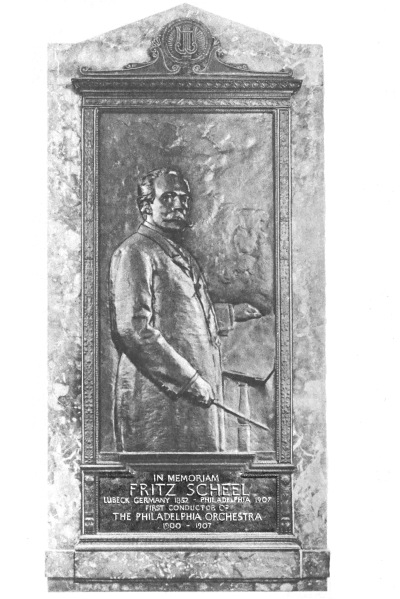
SCHEEL MEMORIAL TABLET
“The man who really made The Philadelphia Orchestra from a musical
standpoint is Fritz Scheel. I never knew him personally, but he must
have had very high musical ideals. They are evident in everything
he did. Also, he must have had a wonderful faculty for choosing the
highest type of artists for the orchestra; he set a standard then which
has been difficult to live up to musically. Such artists as Rich,
Horner, and Schwar (to mention only a few of the many who are still
remaining in The Philadelphia Orchestra from Fritz Scheel’s time)
are absolutely in the first rank for their instrument, not only in
America but in the whole world. It was Scheel’s vision that laid such a
wonderful foundation for this orchestra; that was very difficult, but
in most cases I feel that we have at last succeeded; but we never can
sufficiently recognize the debt we owe to Fritz Scheel; the good work
he did and the influence of his ideals seem to live on forever.
Leopold Stokowski.”
Chapter I The Next Step — The Musical Record, 1907-1912
The Board of Directors was now obliged to find a new conductor for the
Philadelphia Orchestra. A survey of America did not bring fruitful
results. Orchestral conductors were few in this country in those days,
and the Board was determined to engage no man but one competent to
carry on the work so well begun. Therefore it was decided to send
the business representative of the Association, Charles A. Davis,
abroad on this quest. After visiting Steinbach in Cologne and Mottl in
Munich, who both recommended Carl Pohlig, Mr. Davis went to Stuttgart,
where Pohlig was the director of the Court Orchestra of the King of
Würtemberg. After consultation with the officers, an offer was made to
him to become the leader of the Philadelphia Orchestra for a term of
three years, which was accepted.
Carl Pohlig was born at Teplitz, Bohemia, in 1864. Like
Robert Schumann, he was the son of a bookseller. His first musical studies
were at the piano. Early in life, while attending the gymnasium at
Weimar, the talented boy was cordially received by Franz Liszt, and was
permitted to accompany the master on his journeys to Rome, Budapest and
other cities, this privilege being shared only by Tausig, von Bülow and
Rubinstein. He thus learned many Liszt traditions.
After having toured Germany, Austria, Russia, Scandinavia and Italy,
he became Kapellmeister at Graz. Later he was associated with Mahler
at the Opera in Hamburg: then at Covent Garden, and Bayreuth, where
he trained artists for the Wagner Festival. Pohlig conducted symphony
concerts following this operatic experience and appeared in Coburg,
Stuttgart, Berlin, Frankfort, Munich and other cities. Finally he
was offered the position of First Court Kapellmeister to the King of
Würtemberg, whence he came, by permission, to Philadelphia.
The “Neue Musik Zeitung,” one of the best musical journals in Germany,
speaks thus of Carl Pohlig as conductor:
“In the symphony concerts he directs with equal
fervor the works of Beethoven, Mozart and Haydn, as well as the
creations of the later great masters. It goes without saying that Liszt
is especially dear to him.”
“Pohlig directs with fire and deep feeling, and with a certain
clearness that can only spring from a quiet insight into the innermost
content of the music; into the finest fibre of its design.”
The new conductor entered upon his duties in Philadelphia in the autumn
of 1907, presenting for his first concert the following programme:
THE PHILADELPHIA ORCHESTRA
Carl Pohlig, Conductor
First Afternoon Symphony Concert
Friday Afternoon, October 18th, 1907, at 3.00
First Evening Symphony Concert
Saturday Evening, October 19th, 1907, at 8.15
- Programme
- 1. Ludwig Van Beethoven (1770-1827)
- 1. Overture “Fidelio”
- 2. Overture “Leonore No. 3”
- 3. Symphony No. 5, in C minor, Op. 67
- I. Allegro con brio
- II. Andante con moto
- III. Allegro-Allegro, Presto
- 2. Richard Wagner (1813-1883)
- 4. Vorspiel, “Meistersinger”
- 5. “Siegfried Idyll”
- 6. Overture, “Tannhaeuser”
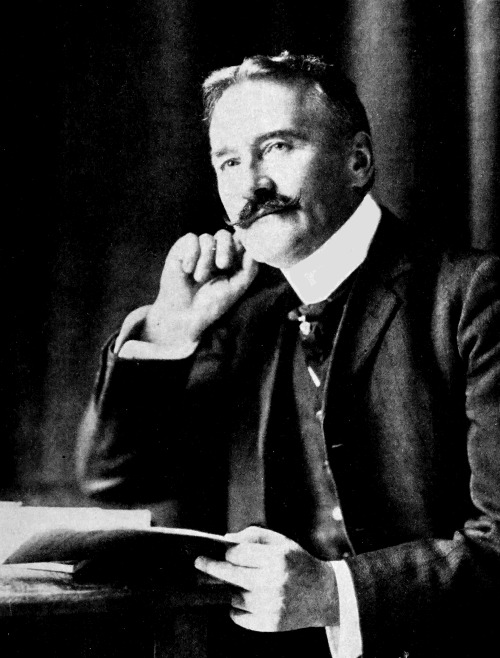
© Haeseler
CARL POHLIG
Pohlig was warmly received by the audience and acclaimed by the critics
as the following will show:
North American, October 19, 1907:
“Society, Fashionable and Cultured, Cheers Pohlig.
Music Lovers Turn Out in Force to Hear This
Season’s Philadelphia Orchestra’s First Concert
“Conductor Carl Pohlig came, waved his baton and conquered at
the Academy of Music, yesterday afternoon—the first concert of the
Philadelphia Orchestra’s regular season. The new musical director’s
local début was a brilliant success and an artistic triumph.”
“The house was crowded. It was apparent almost from the outset
that Conductor Pohlig was a master artist and craftsman. He knew his
business—‘the first among German conductors,’ as Felix Mottl styled
him. The great audience, representing fairly Philadelphia’s highest
artistic culture, quickly recognized the new orchestral director’s
high and rare quality. By the time the ‘Leonore’ Overture was ended,
mystic cords of sympathy between conductor and audience were flung out
and firmly fastened. The immortal Fifth Symphony, mightiest of musical
creations—was awaited with pleased expectation.”
Interpretation of Wagner
“Mr. Pohlig’s initial programme was too long—two hours of solid
music. He does not think so—he broke his watch crystal in an energetic
explanation.
“There was some weariness over the Wagner music—Mr. Pohlig has not
yet got his band keyed up to the marvelous complexion of the master of
Bayreuth. But again it was quite clear that conditions of Wagnerian
interpretation were as familiar to him as were the canons of classical
music.”
“There was no uncertainty of tempo, and when the tremendous finale of
the ‘Tannhaeuser’ prelude was stilled, the people rose in their seats
and acclaimed the new conductor in vociferous accents.”
Name and date of newspaper unknown:
“City Takes Commanding Place in Country’s Musical
Growth. Carl Pohlig, New Symphony Conductor,
Thinks America’s Future Place Will be First
“A dozen years ago, a symphony concert in Philadelphia meant the
arrival of an out-of-town organization, and the gathering of a sparse
audience, dismally scattered through the Academy of Music. The writer
remembers when on one occasion, in 1899, the Boston Symphony Orchestra
played to a handful of people in our city because of inclement weather.
The reports of the inception of orchestras like the Pittsburgh, the
Chicago, the New York Philharmonic and others reveal what an uphill
struggle was forced upon these musical bodies because of the lack of
interest in music in the various large communities.
“So different is the story today, that one is almost puzzled to
account for a change, which has led Herr Pohlig, the new Conductor of
the Philadelphia Orchestra, to remark: ‘Musically speaking, Germany is
the land of the setting sun; America the land of the rising sun.’ His
enthusiasm is not the result of the newcomer’s optimism, for Europe has
kept track of our musical progress, and is acquainted with the fact
that in a few years Philadelphia has been able to inaugurate season
upon season of successful concerts given by its own orchestra, that
Chicago’s magnificent organization created by Theodore Thomas, is now
on a self-supporting basis, and that Pittsburgh, Boston, New York and
Minneapolis are musical communities of great importance.”
“Asked about his plans for the concerts to be given this winter, Mr.
Pohlig talked unhesitatingly and with enthusiasm. The first question
put to him involved the type of music he would arrange for Philadelphia
music lovers, and was a query whether this would be of the same nature
he would have furnished a German audience. He said promptly: ‘Of
course, Philadelphia should get the best and previous programmes show
it has been getting it. And, of course, it must get everything. All
schools of music should be represented. If anything, a modern conductor
must be cosmopolitan.’
“His mode of arranging his programmes will be new to Philadelphia
concert-goers, who have been accustomed to a programme with the
symphony either at the opening of the concert or at the end. Mr. Pohlig
will have the symphony divide the programme into two, where it serves
the purpose of balancing the music of the recital. He intends, if the
opportunity offers, to combine with local singing organizations for
the production of music for chorus and orchestra hitherto unheard in
America. His belief in the great spirit of modern music will give
Philadelphians the chance of hearing the compositions of European
contemporaries....”
Pohlig’s first New York concert on November 5th, 1907, did not
meet with approval, which considering the programme presented is not
strange, but the comments were of such a nature as to call down the
wrath of at least one Philadelphia newspaper which retorted in kind. As
New York has since capitulated this can be inserted.
A Philadelphia Newspaper, November 7th, 1907:
“Pohlig in New York. Flings by Musical Critics at the
Philadelphia Orchestra and Its New Conductor
“The views of the musical critics of New York concerning Carl Pohlig
upon his first appearance with the Philadelphia Orchestra in that city
on Tuesday evening are not altogether flattering. The Sun,
as might be expected, leads in its light-hearted attack. Pohlig ‘is
employed in the pleasant city of Philadelphia, where he conducts the
local orchestra. Its work was so rough as to cause wonder that the
organization should have been brought all the way across the State of
New Jersey.’
“The Times says that ‘the orchestra is a good assemblage
of musicians that clearly brought all of Mr. Pohlig’s intentions to
realization. He is a strenuous conductor of advanced view as to the
treatment not only of Liszt but also of Beethoven.’
“The Tribune says: ‘It was a rather unfortunate conjunction
that of the Philadelphia Orchestra with its new conductor, Carl Pohlig;
Richard Buhlig, pianist; and Carl Klein, violinist; at Carnegie Hall
yesterday afternoon. Coming alone, and at a more opportune time, each
might have won a more dignified hearing and more serious consideration
than were possible under the conditions which prevailed yesterday.’
“The New York public is ‘already booked for three-score and ten of
the kind of concerts which it gives.’ However, Mr. Pohlig ‘presented
himself as a conductor of quite admirable capacities so far at least
as a command of the technics of his art is concerned (leaving all
questions of interpretation open).’
“The World speaks of the incapacity of the orchestra, who
seriously hampered the soloist, by as wicked an accompaniment as was
ever heard at a first-class concert.
“‘Provincial was writ large over the whole proceeding, and one felt
tempted to inquire: “Why Herr Pohlig; why the Philadelphia Orchestra;
why Richard Buhlig?”—at any rate in New York.’
“In Beethoven’s Fifth Symphony, however, Herr Pohlig ‘effectually
removed previous impressions and stamped himself at once as a thorough
musician, a graphic conductor of real distinction, possessing
authority, temperament, magnetism, poetic feeling and imagination. One
could quarrel with his rather slow tempi and liberties of phrasing, if
inclined to be captious, but the interpretation of this great work was
so well planned and coherent, that it aroused decided enthusiasm.’”
Editorial
The Same, November 7th, 1907:
“New York Snobbery”
“It is not pleasant to utter harsh judgments
against a neighboring city, but New York does much constantly to
deserve them at the hands of Philadelphians. The smug self-sufficiency
of the three or four millions of people who reside on or in contiguity
to Manhattan Island, is comical to witness, and we are again reminded
of this attitude by the unjust criticism which the newspapers have
launched against the Philadelphia Orchestra upon its first visit to
New York under its new conductor. This accomplished musician has had
the leadership of excellent organizations in Europe, where this form
of art was more or less known and enjoyed while New York was inhabited
by the Indians. He came here not without some right to a respectful
hearing, and since his arrival has received it in this city from a
public, which, we venture to say, is as discriminating as any that can
be assembled upon the tongue of land which is bounded by the Hudson
River and Long Island Sound. Remarks such as we reprint elsewhere today
do not fall under the head of criticism. They are a form of cheap wit,
which is supposed to be demanded by the inhabitants of this arrogant
and insular community at the expense of the people, the products and
the institutions of Philadelphia.
“The slurs of the press at our music, books, art and much
besides, do this city no particular harm. We are above any need of
the endorsement of the self-centered elements which congregate in
New York. The support which it gave to the Union during the war was
notably reluctant. Its patriotism was always in doubt. It was the
centre of disloyal conspiracy. A spirit of selfish commercialism rules
its affairs, and it was only by force made to observe its national
duty. Since that time it has been under foreign government, and it is
without a doubt the least American of our cities. It has less love for
our history as a nation; it is more willing to sell its birthright for
a joke or a dollar than any community which has yet been established
within American borders, and its swaggering air causes it to be loved
by the citizens of other portions of the Union about as much as they
love a produce market or a Midway Plaisance.
“It is nothing at all to Philadelphians whether New Yorkers like
our orchestra, our books, our poets, our historical personages, our
pictures, our homes, or anything else that is ours. They may go on
their sneering way amusing themselves from day to day, as they see
fit. They will find, if they make the effort to inquire, that most of
the mind and the soul, as well as the body of this nation have lain
and still lie in lands that they do not dominate. They may say what
they will, but their manners might be mended to their own conspicuous
advantage. That is all.”
At the expiration of Pohlig’s contract the Association renewed it for
three years more.
Pohlig was a fine-looking man of German military style, more popular
in America previous to 1914 than it has been since. His platform
manner was excellent and his appearance was elegant, and he made a
good impression on his audience. He was, however, of a difficult
disposition, which made dealings between him and the musicians, and the
Board of Directors, trying and difficult. This was the final cause of
his resignation, presented on June 10th, 1912.
Under the direction of Carl Pohlig, the orchestra continued to develop
and improve. He was a competent and well-trained musician, and was on
his mettle to do his best in an artistic way to keep up the precedents
established by the first conductor. He continued to give unusual
performances and to keep abreast of the day by producing modern works,
among them his own symphony, “Per Aspera ad Astra” (“A Hero’s Death and
Apotheosis”), in which members of the Eurydice Chorus took part.
| 1907-08: |
Carl Pohlig, Symphony, “Per Aspera ad Astra.” |
| 1908-09: |
Frank G. Cauffman[31], “Legende”; |
| |
Philip H. Goepp[32]: Academic March. |
| Feb. 26th-27th, 1909: Mendelssohn Centenary: Midsummer |
| |
Night’s Dream with Ben Greet Players. Chaminade: |
| |
Concertstück, piano and orchestra (composer at the piano). |
| 1909-10: November 26th-27th, 1909: Rachmaninoff, Symphony No. 2, |
| |
E minor, conducted by the composer; Moussorgsky, |
| |
“La Nuit sur le Mont Chauve,” Rachmaninoff, guest |
| |
conductor; Wm. W. Gilchrist[33],
Symphony No. 1, |
| |
C major, conducted by the composer. |
| 1910-11: November 11th-12th: Schumann: to commemorate |
| |
the One Hundredth Anniversary of his birth 1810, |
| |
Symphony No. 1, B flat major; Henry Hadley, |
| |
guest conductor, Cantata “The Culprit Fay,” Op. 62, |
| |
after Joseph Rodman Drake, conducted by the |
| |
composer; November 11th and 12th, 1910, St. Saëns, |
| |
Symphony No. 3, in honor of seventy-fifth birthday |
| |
of composer; Louis von Gaertner[34],
Tone Poem |
| |
“Macbeth,” Celeste D. Heckscher[35], |
| |
“Dances of the Pyrenees.” |
| 1911-12: October 27th-28th: Liszt Centenary. Henry Hadley, |
| |
Symphony No. 3, B minor. |
| March 8th-9th: Brahms Symphony No. 3, F major, to |
| |
celebrate seventy-ninth anniversary of his birth, |
| |
March 7th, 1833. Herman Sandby, Prelude to “The |
| |
Woman and the Fiddler” (play by Mrs. Sandby). |
Chapter I The Coming of Leopold Stokowski — The New York Performance
The summer of 1912 brought the Board of Directors, for the second time
in five years, face to face with the problem of securing a conductor.
Again the place was waiting for the man, but under far different
conditions from those in the summer of 1899, when Fritz Scheel was
found at Woodside Park. Philadelphia had a good orchestra, a growing
audience tended carefully by the four Women’s Committees, and a
Guarantee Fund in a more or less satisfactory condition. It was an
opportunity. The Board of Directors looked around the field again. They
had heard of a young man, Leopold Stokowski, recently conductor of the
Cincinnati Orchestra, and heard well of him. Mr. Andrew Wheeler knew
him and suggested approaching him. He was then in Europe, so he was
cabled to, and accepted the position.
The first concerts under Mr. Stokowski took place on October 11th and
12th, 1912, with the following programme, which inaugurated the third
period of the Philadelphia Orchestra, and one which has been a story of
constant artistic development, until now this orchestra ranks with the
great orchestras of the world.
The Philadelphia Orchestra Association
(Incorporated)
Maintaining
The Philadelphia Orchestra
(Founded 1900)
Leopold Stokowski, Conductor
First Pair of Symphony Concerts
Friday afternoon at 3.00 Saturday Evening at 8.15
October 11th and 12th, 1912
| Programme |
| 1. Ludwig van Beethoven |
Overture, “Leonore No. 3” |
| (1770-1827) |
|
| 2. Johannes Brahms |
Symphony No. 1, in C minor, Op. 68 |
| (1833-1897) |
|
| I. Un poco sostenuto; Allegro (6/8) |
| II. Andante sostenuto (3/4) |
| III. Un poco allegretto e grazioso (2/4) |
| IV. Adagio-piu andante; Allegro non |
| troppo, ma con brio (4/4) |
| 3. Michael Ippolitow-Iwanow |
“Sketches from the Caucasus” |
| (1859- ) |
|
| I. In the Mountain Pass |
| II. The Mountain Village |
| III. March of the Sirdar |
| (First Time at These Concerts) |
| 4. Richard Wagner |
Overture “Tannhäuser” |
| (1813-1883) |
|
Public Ledger, October 12th, 1912.
“New Conductor of Philadelphia Orchestra
Tendered Ovation in Academy
“Leopold Stokowski made his début yesterday
afternoon at the Academy as conductor of the Philadelphia Orchestra,
in the opening concert of its thirteenth season. Every seat was taken
and the extra chairs had been placed within the orchestra rail. There
was much enthusiasm, manifesting itself at the beginning in prolonged
applause as Stokowski came forward with bowed head, evidently pondering
the content of his musical message. Those who went forth to see a
hirsute eccentricity were disappointed. They beheld a surprisingly
boyish and thoroughly business-like figure, who was sure of himself,
yet free from conceit, who dispensed with the score by virtue of an
infallible memory, and held his men and his audience from first note to
last firmly in his grasp.
“Mr. Stokowski has known the players, and they have known him, for
only four days of actual rehearsal, and it was not to be expected
that the organization at the outset would manifest the homogeneity
to be expected later. Yet in this brief time the new leader has
been surprisingly successful in welding the several choirs into
a single coherent entity. They played yesterday with a unity of
purpose—particularly among the first violins—not usually attained
until mid-winter. They brought out the full value of the lights and
shadows. The climaxes were duly accentuated, the pianissimos with the
utmost delicacy and refinement were contrasted with the full throated
polyphony.
“Methods of Conductor
“Mr. Stokowski’s conducting is after the order of Nikisch, whom
he frankly admires. He does not tear a passion to tatters. He holds
his thunders and the winds of Aeolus in a leash. His gestures
are graphic, the arcs and parabolas he describes tell of a kind of
geometrical translation going on in his mind, whereby he visualizes
the confluent rhythms in outward action. At impassioned moments his
movements have the freedom of a violinist’s bow arm; at other instants
he brings his fists against his shoulders with vehement concentration,
or his uplifted eloquent left hand pleads with some suppressed choir
to come forward and assert itself in power. There is, from first to
last, no languor or slackened moment; he directs with a fine vigor
and intensity that mounts to ecstasy yet does not lose its balance or
forget its sane and ordered method.
“Tribute Presented”
“At the close of the symphony a laurel wreath was laid on the dais
ere Mr. Stokowski found his way to the footlights in response to the
tumultuous applause. The wreath was so large that he stood in it while
he called upon his musicians to rise, himself applauding their efforts
and modestly disavowing his leonine share of the credit.”
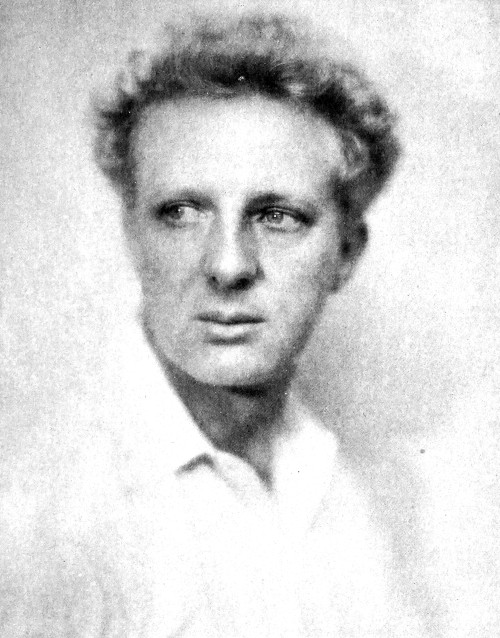
© R. T. Dooner
LEOPOLD STOKOWSKI
It soon became apparent that Philadelphia had something very unusual in
Leopold Stokowski. He was young, but rarely gifted, and he dedicated
himself to reaching a high artistic goal for the Philadelphia
Orchestra. His plans were of a daring character and at times almost
took away the breath of the Board of Directors; for instance, when the
idea of giving Mahler’s Eighth Symphony was presented and Mr. Stokowski
announced that it would cost $14,000. There was much discussion, as the
Board was convinced that this performance would be unpopular and not a
success from a financial point of view. However, the desire to have the
name of the orchestra connected with productions of an unusual nature
and to keep ahead of the times musically, won the day, and it was
decided in 1915 to produce this gigantic choral work in March 1916.
The story of this production is dramatic from the moment that Leopold
Stokowski, after having secured the rights for the first American
performance, escaped from Munich in August, 1914, with the score in a
handbag, all he had time to pack. Mr. Stokowski was at that time still
a British subject, having only taken out his first papers for American
citizenship.
Having secured the consent of the Board of Directors to produce this
symphony, this announcement was issued.
THE PHILADELPHIA ORCHESTRA
Leopold Stokowski, Conductor
First Performances of the Mahler Eighth Symphony
Academy of Music, Philadelphia
Thursday Evening—Friday Afternoon—Saturday Evening
March 2, 3, 4, 1916
Metropolitan Opera House, New York
Sunday Evening, April 9, 1916
With Orchestral and Choral Forces of Over One Thousand
and the Following Soloists:
| Florence Hinkle, Soprano |
Adelaide Fischer, Soprano |
| Inez Barbour, Soprano |
Margaret Keyes, Contralto |
| Susanna Dercum, Contralto |
Lambert Murphy, Tenor |
| Reinald Werrenrath, Baritone |
Clarence Whitehill, Basso |
First Chorus—The Philadelphia Orchestra Chorus, 400
Children’s Chorus, 150
Second Chorus—Philadelphia Choral Society, Mendelssohn Club
and the Fortnightly Club, 400
“The Philadelphia Orchestra Association takes pleasure in announcing
three performances in Philadelphia of Gustav Mahler’s Eighth Symphony
and, under the auspices of the Society of Friends of Music, one
performance in New York. The first Philadelphia performance is the
first presentation of this work in America, and is given under
an exclusive contract with the publishers. Although other famous
organizations had approached the Universal-Edition in Vienna, to the
Philadelphia Orchestra fell the honor and artistic responsibility
of presenting this work for the first time to the American public.
The production of the work, requiring three choruses aggregating 950
voices, an orchestra of 110, and 8 soloists, entails a cost for the
Philadelphia performances alone of approximately $15,000.”
“The New York performance owes its possibility to the public
spirit and generosity of the Society of Friends of Music, and will be
given with the complete forces employed in Philadelphia. This single
production will cost approximately $12,000.
“Owing to the great magnitude of the work and the great demand which
it makes on the musical forces employed, it is extremely doubtful
whether it can receive many performances in America. Two years have
been spent in preparation in order that the rendition of the work
might realize the ideals of the composer. That the value of the work
is appreciated is shown by the fact that orders for seats have been
received from all over the eastern and middle western sections of this
country. The Friday and Saturday performances in Philadelphia are sold
out and many mail orders have been received for Thursday night. An
early application for seats should be made.
“Prices of Tickets for the First Performance at the
Academy of Music, Thursday Evening, March 2, at 8.15
| Parquet and Balcony Box Seats |
$3.00 |
| Parquet and Parquet Circle, first two Rows in Balcony |
2.50 |
| Remainder of Balcony and first two Rows in Family Circle |
2.00 |
| Third and Fourth Rows, Family Circle |
1.50 |
| Remainder of Family Circle |
1.00 |
| Amphitheatre, First Two Rows |
1.00 |
| Amphitheatre (Unreserved) |
.50 |
(The Friday Afternoon and Saturday Evening performances being
already sold out, no orders can be taken for these two concerts.)
| Arthur Judson, |
Louis A. Mattson, |
| Manager |
Asst. Manager” |
Work with the two choruses which sang in German and in Latin began in
October, 1915. Hitherto the orchestra had had no chorus of its own,
but was obliged to depend on the good will of Philadelphia choral
organizations to co-operate in producing choral works. Now for the
first time the name “Philadelphia Orchestra Chorus” appeared, and, as
the first chorus of 400 members, was trained by Mr. Stokowski. The
second chorus of 400 voices was rehearsed by Mr. Henry Gordon Thunder.
The requirements were severe as to personnel and rehearsals. The spring
was occupied in the selection of voices. When rehearsals began in
October, men and women were rehearsed separately until January. After
that they had weekly rehearsals together. Singers who were inattentive
or who skipped rehearsals were not retained, and towards the end
everybody was over-worked and wrought up to a pitch of excitement.
NINETEENTH PROGRAMME
Friday, March 3rd, at 3.00 Saturday, March 4th, at 8.15
THE PHILADELPHIA ORCHESTRA
Leopold Stokowski, Conductor
| Programme |
| Symphony No. 8 |
Gustav Mahler |
| |
(1860-1911) |
| |
Part I. |
Hymn, “Veni, Creator Spiritus” |
| |
Part II. |
Final Scene from Part II of Goethe’s “Faust” |
| (First performance in America)
|
Assisting Forces: |
| |
Una Poenitentium, Florence Hinkle, Soprano |
| Magna Peccatrix, Inez Barbour, Soprano |
| Mater Gloriosa, Adelaide Fischer, Soprano |
| Mulier Samaritans, Margaret Keyes, Contralto |
| Maria Aegyptiaca, Susanna Dercum, Contralto |
| Doctor Marianus, Lambert Murphy, Tenor |
| Pater Ecstaticus, Reinald Werrenrath |
| Pater Profundus, Clarence Whitehill, Basso |
Augmented Orchestra of 110
First Chorus:
The Philadelphia Orchestra Chorus, 400
Second Chorus:
Philadelphia Choral Society, Mendelssohn Club
and The Fortnightly Club, 400
Children’s Chorus of 150
The English version (by Mr. Philip H. Goepp)
of Specht’s Analysis
may be obtained in the lobbies of the Academy
| |
Mr. Constantin Von Sternberg at the Piano |
| |
Mr. Henry Gordon Thunder at the Organ |
| |
Mr. William Silvano Thunder at the Harmonium |
| |
Mr. Hedda Van den Beemt at the Celesta |
While there were varying opinions about the musical value of this
symphony, the manner of producing it evoked but one. In order to make
the event national in character, prominent musicians from all parts
of America were invited to be present at the first performance. Among
the many notable persons from other cities were: Mr. and Mrs. Ossip
Gabrilowitsch, Mr. and Mrs. Harold Bauer, Mr. and Mrs. Josef Hofmann,
Mr. and Mrs. Ernest Hutcheson, Dr. and Mrs. Ernest Kunwald, Mr. and
Mrs. Harold Randolph, Mr. and Mrs. Ernest Schelling, Mr. and Mrs. David
Mannes, Mr. and Mrs. Samuel Untermeyer, Mr. and Mrs. Gustav Strube,
Judge and Mrs. J. Butler Woodward, Mr. and Mrs. J. Fred Wolle, Mrs.
Werrenrath, Mrs. William M. Bannard, Miss Kitty Cheatham, Dr. A. G. Rolfe,
Oscar G. Sonneck, Albert Spalding, Kurt Schindler and Theodore Spiering.
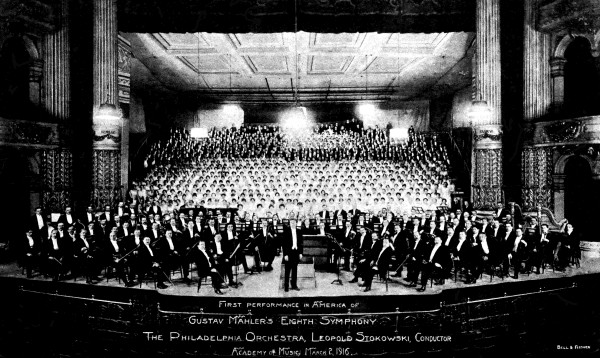
© Bell & Fischer
THE PHILADELPHIA ORCHESTRA
AND MAHLER CHORUS
Public Ledger, March 3rd, 1916:
“MAHLER’S WORK AND STOKOWSKI
SCORE TRIUMPH
Thousands at Academy of Music Aroused to High Pitch of
Enthusiasm. Noted Musicians Give Praise to Production
Prominent Persons from all over Country
Attend Rendition Here
“Every one of the thousands in the great building
was standing, whistling, cheering and applauding, when Leopold
Stokowski, his collar wilted, and his right arm weary, but smiling his
boyish smile, finally turned to the audience in the Academy of Music last night.
“He had scored, so famous musicians agreed, the greatest triumph of
his career, the greatest triumph the Philadelphia Orchestra has known
in its sixteen years of life and he had done it on a stupendous scale
with the American première of Gustav Mahler’s Eighth Symphony. He
carried along with him to triumph an orchestra numbering 110 pieces and
a chorus of 958 singers, to say nothing of the city’s music lovers and
scores of musical pilgrims from other cities.
“For every one who is any one in musical America was here for the
Mahler American première last night or will be here when the tremendous
work is repeated this afternoon and tomorrow night. The boxes were
filled with famous musicians and musical authorities. One and all
stood, applauding Mr. Stokowski and the symphony, while the orchestra
members blared a ‘touché’ in honor of their leader.
“The scenes at the Academy set nerves tingling. Two weeks before
the performance every seat had been sold. Fifteen minutes before Mr.
Stokowski swung his baton upon his augmented orchestra and upon the
great chorus, banked 24 tiers high, horns blew a fanfare in the foyer
of the Academy of Music, following an ancient custom at Bayreuth. The
curtain rose and the audience gasped.
“The 958 singers filled the great stage from footlights to roof
and the orchestra was upon an apron that has been built out into the
house.
“The first twelve rows of singers were women, dressed in white.
Above them were twelve rows of men, with a gardenia-like spot of girls,
members of the children’s chorus, pinned, it seemed in their midst.”
“Alexander Van Rensselaer presented a wreath for the orchestra.
It was inscribed ‘To Leopold Stokowski in commemoration of the first
performance of Mahler’s Eighth Symphony in America, March 2nd,
1916.’
Mr. Van Rensselaer’s
Remarks
“In presenting the wreath, Mr. Van Rensselaer said:
“‘The directors of the Philadelphia Orchestra Association feel that
the presentation of this Eighth Symphony of Mahler this evening, for
the first time in America, marks an epoch in the musical history of
Philadelphia to which no other event is comparable.
“‘This occasion is memorable not only because the Mahler Symphony
is such an extremely difficult work, but because we have here in
Philadelphia been able to follow out the precise instructions of the
composer in welding into one vast instrument these great choral and
orchestral forces which are here assembled. These two choruses of
400 trained voices each, together with the large chorus of boys and
girls selected from the best choirs of this city, the eight soloists
of metropolitan reputation, and the augmented orchestra of 120
instruments, all have been trained into one vast harmonious instrument
by you.
“‘We of Philadelphia are indebted for the production of this great
work to you, our brilliant and talented conductor. It was you who first
conceived the idea more than two years ago of producing this work; it
was you who made the arrangements with the publishers and guaranteed to
them that we would produce it in the manner indicated by the composer
and obtained from them the rights for the first performance in this
country; it was you who chose and trained Chorus No. 1 and intrusted
Chorus No. 2 to the able direction of Henry Gordon Thunder, to whom our
thanks are also due; it was you who arranged with the best choirmasters
of Philadelphia to train this large body of boys and girls in their
respective parts and it was you who brought together these large
agencies and trained them in the final ensemble of this great work.
“‘We feel that not only the musical public of Philadelphia, but the
entire city, owe you a debt of gratitude that never can be repaid.
And as a testimonial from the Board of Directors of the Philadelphia
Orchestra Association, and as an expression from them of their thanks
to you for the successful completion of this grand work, I have pleasure
in presenting the victor’s crown of laurel, made in perpetual bronze.’
Reply of Mr. Stokowski
“Mr. Stokowski lifted the wreath, and when the applause died down,
turning to Mr. Van Rensselaer, said:
“‘It is impossible for me to put into words my emotions tonight.
This stupendous and noble work was written six years ago. For six years
I have been meditating the possibility of its performance and hoping,
some day, to have the opportunity of giving it, although I knew the
requisite forces would be extremely difficult to obtain.
“‘Through a generosity for which I can never sufficiently express
my gratitude, Mr. Van Rensselaer and the directors of the Philadelphia
Orchestra Association made the great undertaking possible at last. The
dream still would have remained unfulfilled, however, had it not been
for the hard work and willingness of the orchestra; of all these dear
people in the chorus, who have worked for more than a year, training
for this night; of all the soloists, and of Henry Gordon Thunder, who
has supported and helped me with most wonderful generosity. To the
committee that tried thousands of voices, choosing this magnificent
chorus, we are particularly indebted.
“‘My final and greatest debt, a debt so great that I feel I
never can express it, is to you, the public, for your warmth and
understanding at the first hearing of this great work. It is a great
inspiration.’
Offers of $100 to Obtain Seats
“Popular interest in the Mahler Symphony’s American première was
evidenced by offers of $100 a seat, reported from several of the large
hotels, just before the Academy doors were thrown open, and by more
than 1000 persons, lucky holders of general admission tickets who stood
in Locust Street, or sat on newspapers spread on the Academy steps,
for hours before the performance was scheduled to start. At least 100
persons were waiting at 3.30 o’clock in the afternoon, braving the
drizzle, for a chance at a good seat.
“From 7 until 8 o’clock there was a steady stream of automobiles
stopping at the Academy doors. All society and all musical Philadelphia
streamed into the building. The stage door was besieged by the nearly
1000 chorus members, who were marshaled without a hitch or the raising
of a voice into their places. Necessary readjustments on and off the
stage, seating arrangements, provisions for the wardrobing of the great
chorus and the engaging of understudies for each of the eight soloists
cost, it was said, close to $4000. This sum, of course, did not include
the great expense entailed in training the voices during the last
twelve months.
“Mr. Stokowski was given two great demonstrations; the first during
the intermission, the second at the conclusion of the performance. Both
lasted for more than five minutes. The noise was so great that the
Academy doormen said it could be heard across Broad Street in the foyer
of the Walton.
Miss Florence Hinkle Applauded
“Mr. Stokowski bowed until it seemed his back would break. Then he
led forward Henry Gordon Thunder, William Silvano Thunder, Constantin
von Sternberg and Hedda van den Beemt. The audience wanted more. They
wanted the soloists, so forward came the eight of them, and as they
went back Florence Hinkle, who was being wildly applauded by the great
chorus, kissed her fingertips to them. Above the crescendo of applause
could be heard members of the chorus, crying, ‘Hinkle!’
“One of the most interested persons present was Mrs. J. F. D.
Lanier, president of the Society of Friends of Music, the New York
woman chiefly responsible for the invasion of New York with the Mahler
Symphony on April 9. She sat in the same box with the pianist, Harold
Bauer.
“In a nearby box was the pianist, Ernest Schelling. Aline van
Barentzen, the pianist, also was on hand. Ernest Hutcheson, Harold
Randolph, Joseph Hofmann, Ossip Gabrilowitsch, Director Bodansky, of
the Metropolitan Opera and of the Cincinnati Symphony, are expected
to be present at today’s performance. Other prominent guests were
entertained last night and will be entertained today by the Women’s
Committee of the orchestra.
“It was announced last night that all seats for the extra
performance of the Mahler Symphony on April 4th have been sold.”
After the third performance the Women’s Committees for the Philadelphia
Orchestra gave a reception to Leopold Stokowski, and the soloists,
in the foyer of the Academy. This was followed by a supper at the
Bellevue-Stratford in their honor and for a few distinguished guests.
The news of this production spread over America and Europe, and in
Philadelphia created more excitement than had arisen in a generation.
The demand for seats was so great, that it became necessary to
announce extra performances in this city, and four more were given,
making a total here of nine, including two public rehearsals. After
the last, orders for seats, amounting to over $10,000 in Philadelphia
alone, had to be refused. The dress rehearsal on Wednesday was open
to the families of the performers and some others at a special price.
A dress rehearsal was later given for public school children. The
first performance was on a Thursday night, and then followed two in
the regular season series. By the time four audiences had heard the
symphony, all who had not heard it were seized with an overpowering
desire to witness this extraordinary event.
Such a journey was never before undertaken in musical circles here
or abroad. Twelve hundred people left Philadelphia by private trains,
totalling seventeen cars, about noon on Sunday, April 9th, reached New
York in time to have a rehearsal and dine and dress at a hotel and at
8.15 appeared before a packed audience which included all the musicians
then in America.
It was an inspiring occasion and one long to be remembered. That
evening New York unreservedly acclaimed the Philadelphia Orchestra.
Scenes of enthusiasm followed the first half, after a tremendous burst
of applause when the curtain rose. But at the end the audience let
itself go in a way never seen in Philadelphia.
There were many musicians in the house, including Ignace
Paderewski, the members of the Flonzaley Quartet, Mme. Alma Glück
and Efrem Zimbalist, Pablo Fasals, Henry Hadley, Mr. and Mrs. Ossip
Gabrilowitsch, Rubin Goldmark, Dr. Frank Damrosch, Victor Harris,
Harold Bauer, George W. Chadwick, Mischa Elman, Emma Eames, Leopold
Godowsky, Rudolph Ganz, Arthur Foote, David Bispham, Percy Grainger,
Arthur Hinton, Alfred Hertz, Franz Kneisel, Daniel Gregory Mason,
Ernest Schelling, Walter K. Spalding (Department of Music, Harvard
University), Josef Stransky, Arthur Whiting, Marcella Sembrich, Antonio
Scotti, Cornelius Rübner (Columbia University), Fritz Kreisler, Mme.
Schumann-Heink, and others.
New York Sun, April 10th, 1916:
“EIGHTH SYMPHONY BY MAHLER HEARD
“Society of Friends of Music Gives Concert at
the Metropolitan. Sent by Philadelphia
“The Society of the Friends of Music, which has performed a valuable
function in the artistic musical life of this metropolis by bringing
to the notice of a circle of trained listeners compositions not to be
heard at public entertainments, emerged from its privacy to give an
ambitious concert last evening in the Metropolitan Opera House. The
novelty chosen was Gustav Mahler’s Eighth Symphony, which recently had
its first hearing in this country in Philadelphia.
“When the huge symphonic and choral creation of Mr. Mahler was
produced in Philadelphia, it was praised with emotion and thanksgiving,
the interpretation was considered with reverence and rapture, and the
concert had to be—or at any rate was—repeated several times. Upon the
heels of this excitement, the whole show came to New York.
“The entire cast, chorus, orchestra and conductor were brought
across New Jersey. The Philadelphia Orchestra, numbering for this
occasion 110 players; the Philadelphia Orchestra Chorus, a Children’s
Chorus, the Philadelphia Choral Society, the Mendelssohn Club and
the Fortnightly Club, constituted the choral forces. The presiding
genius of all was Leopold Stokowski, the gifted and accomplished young
conductor of the Philadelphia Orchestra.
“Not a Box Office Symphony
“Mahler’s Eighth Symphony quite properly belongs to the class of
compositions sought by the Society of the Friends of Music. It does not
court the attention of musical directors, who must consider the wishes
of the general public or the demands of the box office. New Yorkers
may regret that a local orchestra and local choruses were not chosen
for the presentation of the work; but only by preparing for more than
one performance could the projectors of this production have hoped
to complete their undertaking without losses too heavy to confront.
Mahler was not troubling himself with practical considerations when he
wrote the composition. He had a purpose, which he carried out in the
seclusion of his study. And if Hector Berlioz might write a requiem
mass fit only for festival occasions, why not Mahler an Eighth Symphony?”
“After the New York performance, W. J. Henderson said: “If
Philadelphia believes that Mr. Stokowski is essential to her musical
development, let her decline to permit him to conduct great concerts in
New York. This is a piece of perfectly disinterested advice.
“The Sun’s musical chronicler would be delighted to see Mr.
Stokowski a New York conductor. He has personality, force, authority,
temperament, scholarship and imagination. His conducting of the Mahler
Symphony was masterly. He would be a valuable factor in the musical
life of New York.”
Although the Philadelphia Orchestra is a serious working organization,
it has its moments of relaxation and pleasure. Such a one was the
reception and dinner given by Mr. Van Rensselaer to the members of the
Mahler Chorus on March 16th, 1916, at which the
following programme was presented:
HORTICULTURAL HALL
Broad Street, Philadelphia
Programme of
Mr. Alexander Van Rensselaer’s
Buffet Dinner
Thursday Evening, March 16th, at Seven o’Clock
Given to the Members of the Mahler Choruses and
the Philadelphia Orchestra
(dismembered)
Philadelphia Orchestra
Soloists
Horsecar Schwer!!! that’s all
Ham Byndler!! Solo-Killest
| Programme |
| Symphony “Ein Musikalischer Spass” |
Mozart |
| |
1787, German |
| |
Allegro |
|
| Minuetto Maestoso |
| Adagio cantabile |
| Presto |
| (Ten Minutes Intermission at this Concert Only) |
| Concerto Brosso (1916) |
Composer unknown |
| Probably an American, Philadelphian Preferred |
| (First time at these concerts) |
| |
Adagio |
|
| Andante Soustenuto |
| Large-o |
| Tone Poem “Tausend Künstler” |
Schreiner |
| (Augmented Orchestra) |
1850-1916, Bavarian |
| Conductor |
Sig ad Lib. Riddeus Thatch,
Actor-conductor |
“Note—Owing to the exceptional acoustic properties of the Hall, the
Audience is requested to refrain from hilarity as the slightest murmur
might be disconcerting to the performers. It is earnestly requested
by the ‘Damagement’ and the ‘Board of Erectors’ that all vegetable
offerings and tokens be of a firm nature.
“The personality of the orchestra will be found on the next
page among the Programme notes composed by Professor Yepp.
Yes, my dear! The Piano is a Steamway
“The next ‘Mahler-ia’ concert will take place next week at 2
o’clock. Owing to the Philadelphia Blue-laws a very limited number
of tickets will be available. The Knaben-chor will be heard to great
advantage at this concert.
“Andrew Wheel-her, Secretary”
SPECIAL MAHLERATE PROFUNNYGRAM
Horticultural Hall
March 16, 1916
| Programme Notes |
| “Ein Musikalischer Spass” |
Mozart |
| |
Born 1756, died 1791. |
“This symphony pictures Mozart in his most happy mood. Where he
got his inspiration from I do not know. What a pity he cannot be with
us tonight; he would surely have an inspiration. But who knows what
kind!
“The symphony, or, rather, first movement, opens with
‘Some Chords.’ However, they are in the key of ‘C’, so
we are pretty safe. These opening chords are for the ‘Full’ orchestra and are very effective, provided
they are ’Full Enough.
“The second movement is a minuet. You will notice that there
is three in a bar, but six in the orchestra, so you see we are at
least mathematically even, which ought to insure a fine rhythm—SOMETIMES (?). There is much fervor in this
movement and some wrong notes in the horns, but why worry; they are
printed in the score, and are consequently correct.
| “Tausend Künstler” |
Schreiner |
| |
Bavarian |
(First time in America)
“This work really requires ‘more men,’ but Herr Schwer thinks he
can handle it alone. The principal theme is of a martial and military
nature. Mr. Schwer only had one rival, and that man died long ago. You
will not have much difficulty in following Mr. Schwer, for in this
work the performer is very much in evidence at all times. He is very
familiar with all of the instruments required for this composition.
He has ‘hit them’ very often and possesses an unusual amount of
originalitye. ‘To See it is to Appreciate It.’
Mr. Schwer will depict thunder claps, echoes, bombardments, combats,
cavalry charges, charge accounts, railroad wrecks, and many other
scenic effects while performing this work.”
| Personnel of Orchestra |
| “Mozart Symphony |
|
| |
J. K. Witzemann, Schroon Lake, N. Y. |
| F. W. Cook, Hampton Beach, N. H. |
| Emil Hahl, Willow Grove, Pa. |
| Louis Boehse, Profile House, N. H. |
| Anton Horner, Stone Harbor, N. J. |
| Joseph Horner, Tent City, Cal. |
| “Conductors—(negotiations pending).” |
This occasion was much enjoyed by about 1200 guests, to whom an evening
of musical fun was somewhat of a novelty.
After the production of the Mahler Symphony the Philadelphia Orchestra
became the most talked of orchestra in America. Its reputation was
made. This success, however, did not bring about any abatement in the
conductor’s zeal, or make him relinquish his aims for the perfection of
the orchestra.
On the part of the Board of Directors the result was a determination
to put the orchestra on a firm financial basis. This desire was so
great on the part of one of them, who wished to remain unknown, that he
planned a course of action which involved a large expenditure on his
part, but which with the co-operation of 1200 Philadelphians made it
possible to roll up in seven years a fund of approximately $800,000.
Chapter II The Seven Year Endowment Fund, 1916
The question of placing the Philadelphia Orchestra on a firm financial
foundation had been under consideration for a long time by the Board
of Directors. Each year the Guarantee Fund was becoming more difficult
to secure and more of a burden; besides which hand-to-mouth financing
is not a very creditable path to travel indefinitely. When these
discussions arose, the first question always was “How can we solicit
money for a permanent fund and beg for a Guarantee Fund at the same
time?” That question always ended against a blank wall. No answer
suggested itself until in May, 1916, Mr. Van Rensselaer received a
communication from a person who wished to remain unknown, so he later
received the title “Unknown Donor.”
The proposition was accepted by the Board and later by the Association,
and was issued in a circular of which a copy is printed below.
“Endowment Fund
“To the Friends of the
Philadelphia Orchestra:
“A friend of the Philadelphia Orchestra Association, who desires to
remain unknown, has offered to meet any deficit of the Orchestra for
each of five years, beginning with the season of 1916-1917.
“The conditions under which this gift will become available are as
follows:
“1. That an Endowment Fund of $100,000 yearly for five years shall
be created by the Orchestra Association, so that the total Fund may be
$500,000 at the end of this period.
“2. That the contract of the present conductor, Leopold Stokowski,
shall be extended to cover this period of five years.
“3. It is earnestly desired that each friend of the Philadelphia
Orchestra will pledge a generous amount in order to create this
Endowment Fund. Heretofore, all subscriptions to the Philadelphia
Orchestra have been spent year by year, to meet the annual deficit.
Under this offer the money now contributed will not be so spent, but
will be invested to insure the permanency of the Orchestra as an
institution of Philadelphia.
“The Orchestra is a civic asset. If it is to fulfill its destiny and
place Philadelphia in the front rank among the musical cities of the
world, it must be endowed. In order to do this, the Orchestra
Association must depend upon the generosity of its friends. We ask
that the enclosed blank be signed and returned to us at your earliest
opportunity. While it is hoped that all gifts may be for a period of
five years, yearly contributions will be gratefully accepted. Payment
of subscriptions will be on November 1st and March 1st of each year,
beginning with November, 1916.
“Alexander Van Rensselaer
Frances A. Wister
Edward W. Bok
Endowment Committee”
The way out was found—at least the beginning of the solution was in
sight.
The proposal was widely circulated and everybody connected with the
Association began to work to raise the amount, which was to reach
$500,000 in five years. This was later extended to seven years and now
bears the name of “Seven Year Endowment Fund.” All persons connected
with the Association threw themselves enthusiastically into the work of
fulfilling the agreement with the Unknown Donor.
A meeting was called of the four Women’s Committees and their
Auxiliaries, at the auditorium of the Curtis Building through the
courtesy of Mr. Bok; the plans were explained and met with a vigorous
response. The women were to raise money in two ways. One was to procure
five-year subscriptions of large sums. The other was to secure small
subscriptions by the Group Plan. This idea was suggested because the
business management could not arrange to take care of sums of less than
$25.00. The accumulation of such, therefore, was undertaken by the
women, with Mrs. Arnett as Chairman. This piece of work was as trying
as any ever entered upon, on account of the detail of keeping small
accounts yearly for so long a period.
A group might include any number of persons but the minimum amount for
each group could not be less than $25.00 yearly, for five years. The
sum of $14,632.00 was raised by seventy-nine Groups, including two
Junior Groups; but the most important feature of the plan was that it
secured the interest of a number of hundred people who would otherwise
have been deprived of the pleasure of assisting this cause. This was of
infinite value to the Association. To Group Captains, who kept up their
quotas of $25.00 yearly for five years, the orchestra owes much, for
members often had to be replaced. The Women’s Committees have long acted
on the principal that the active interest of many people was a
necessity in building up an orchestra, and never was their belief more
justified than at that time.
The work of the women was prosecuted with enthusiasm and the response
was remarkable, not only from Philadelphia, but from Pennsylvania towns
as far west as Harrisburg and in New Jersey as far south as Atlantic City.
Other ways of raising money were resorted to, such as chains of card
parties, inaugurated by Mrs. John B. Thayer, Jr., whose own chain
amounted to $2870, and various entertainments and concerts given by
young people. These were necessarily gifts for one year and could not
be included in the required $100,000.
The amount including large subscriptions and groups collected by the
four Women’s Committees was a total for five years of $186,000, this
being twenty-five per cent of the Fund.
In November, 1916, it was announced that the amount guaranteed for
five years was over $500,000, more than stipulated under the contract
with the Unknown Donor. It was then decided to ask the contributors to
extend their yearly subscriptions two years longer, and many responded
heartily. The name was changed to Seven Year Endowment Fund, and in
1923, the total had reached $788,400. About twelve hundred individuals
contributed at this time, and through the groups over five hundred more.
The “Unknown Donor” disclosed himself in 1920, and proved to be Mr.
Edward W. Bok. The satisfaction was great of knowing at last the name
of this generous friend of music, who had enabled the Philadelphia
Orchestra to place itself on a firm foundation.
Chapter III The Orchestra During the World War — Liberty Loans — The Tribute Trees
One year after the offer of the Unknown Donor had been accepted by
the Board of Directors, the United States was in a state of war. The
condition of Europe during the past three years had in a way been
disturbing in orchestral circles, because no men could leave Europe
and players were scarce. Also, foreign men were called home, leaving
vacancies that were difficult to fill. Still, the orchestra had
flourished and continued to advance artistically under Mr. Stokowski’s
guiding hand.
In April, 1917, however, musical organizations in America were facing
a different and a serious situation. In everybody’s mind the questions
lingered and would not be put away: “How is the Philadelphia Orchestra
going to survive a war?” “Will there be any players, and will there
be any money for music?” Philadelphians spoke not these words aloud, but
they feared for the existence of the city’s most beloved art organization.
In December, 1917, the four Women’s Committees were desirous of making
a patriotic demonstration with the orchestra, and at the suggestion of
Mrs. J. Sellers Bancroft, an American flag was presented at each of a
pair of concerts.
“PRESENTATION OF FLAG
To the Philadelphia Orchestra Association by the Women’s
Committees for the Philadelphia Orchestra
Presentation of Flag
Miss Frances A. Wister, President
The Women’s Committees for The Philadelphia Orchestra
The audience is requested to join in singing the National Anthem:
The Star Spangled Banner
(1 verse)
Acceptance of Flag for The Philadelphia Orchestra Association:
Mr. Alexander Van Rensselaer, President
The Philadelphia Orchestra Association
Acceptance of Flag on behalf of the Orchestra:
Mr. Leopold Stokowski, Conductor
The audience is requested to join in singing
‘America’
(2 verses)”
Ledger, December 23rd, 1917:
“Viewed in the light of all that has been written,
said and done regarding the relation of the musical art and its
interpreters to the war and the conception of the majority as to what
constitutes patriotism, the public action of the Women’s Committee
of the Philadelphia Orchestra last week, on December 14th and 15th,
when their president, Miss Frances Wister, introduced by Alexander
Van Rensselaer, president of the Philadelphia Orchestra Association,
presented the orchestra with a flag which was accepted by Leopold
Stokowski, seemed full of deepest significance. In presenting the
flag, Miss Wister made a graceful little speech about the relation of
patriotism and art and said, among other things:
“‘In order to express our loyalty to our country’s cause and to
the Association which we have fostered so long, and to testify to our
belief in the necessity for music as a mighty inspiration, a profound
solace during times of stress, we take pleasure in presenting to the
Philadelphia Orchestra Association and to the Orchestra a flag.
“‘This is the visible demonstration of the patriotism of this
organization and of the Women’s Committees during our period of
national peril.’
“Both Mr. Van Rensselaer and Mr. Stokowski spoke words of
appreciation of the Women’s Committees’ offering. The former read the
resolutions adopted by the Association, and the most popular of musical
leaders, Mr. Stokowski, on behalf of the orchestra announced that he
and the men meant to give their services in a concert for the benefit
of the American Red Cross, which statement naturally was greeted with
responsive applause by the huge audience.
“The remarks by which Mr. Stokowski declared the Orchestra’s loyalty
to the United States were gracefully made, and his action necessarily
was profoundly appreciated by his many friends and admirers whose
numbers have already increased accordingly.
“The ceremonies closed with two verses of ‘America’ in which
everyone joined heartily. The effect was thrilling. Many eyes were
moist and many hearts were moved.
“These are trying times that test men’s souls and it does not
take much to force to the surface deep, pent-up emotions that long training
had suppressed.”
At a special meeting of the Board of Directors, December 13th, 1917,
the following Resolution was unanimously adopted:
“Whereas the Women’s
Committees for the Philadelphia Orchestra are presenting to the
Philadelphia Orchestra Association and the Philadelphia Orchestra two
American flags as an expression of the patriotic spirit animating their
organization of two thousand women,
“Be It Resolved by the Board of Directors of
the Philadelphia Orchestra Association in behalf of the fifteen hundred
contributing members of the Association, that these flags be accepted
in the spirit with which they are given, with the thanks of the
Association, and that the management be instructed to display them on
the stage of the Academy at each concert given by the Orchestra.
“Be It Further Resolved by the Board
of Directors, that it pledges the loyalty of the Association to the
Government and people of the United States in this crisis in the
affairs of the nation, and offers its services to be made use of in any
way in which the Government of the United States may deem wise.”
The next patriotic demonstration was the concert at Camp Dix, N. J.
Public Ledger, January 3rd, 1918:
“ORCHESTRA PLAYS FOR CAMP DIX MEN
100 Musicians under Leopold Stokowski
Entertain 3000 Soldiers
“The Philadelphia Orchestra, led by Leopold Stokowski, aroused
more than 3000 khaki-clad men here in the big Y. M. C. A. auditorium
to outbursts of enthusiastic applause, when they concluded an entire
Tschaikowsky programme, including the Symphony Pathétique, the famous
‘Nutcracker’ Suite, and the stirring overture Solennelle. The concert
was made possible through the courtesy of the Philadelphia Orchestra
Association.
“The large auditorium was crowded to the doors with the privates in
training for the National Army, while the officers occupied a square
patch of seats in the center. Alexander Van Rensselaer, President
of the Orchestra Association, and Edward Bok and Charles D. Hart,
directors, were among the officials who accompanied the orchestra. With
the party also was Noah Swayne of the Orpheus Club. The party arrived
in Camp on a special train, and the musicians were escorted to the Y.
M. C. A. hostess house and served a luncheon by society girls.
“Mr. Van Rensselaer, Mr. Bok, Mr. Stokowski and Mr. Swayne were
entertained at the division headquarters mess.
“When Mr. Stokowski took his place at the stage, he was given an
ovation, and throughout the four movements of the symphony, the men
watched the discipline of the players with an interested eye.
“The contrast of the dark evening suits of the orchestra with the
mud-stained puttees and brown uniforms of the thousands of enlisted men
formed a novel sight. One officer was overheard saying to another:
“‘How would you like to be captain of those collective artistic
temperaments?’
“After the first movement of the symphony was ended in a crash of
tympani, the same officer said:
“‘Well, if we can train a million men of the National Army to such
precision and such discipline as that, we will have no trouble in
beating the Huns.’
“During the intermission, the entire audience did a sort of ‘eyes
right’ when a group picture of the concert was taken.”
Besides this concert, men in the service stationed at Philadelphia were
given many opportunities to enjoy the orchestra. Beginning in November,
1917, subscribers were requested through a notice in the programme to
send tickets that they could not use to the manager, to be placed at
the disposal of soldiers and sailors and it was a common sight to see
men in uniform at the Saturday evening concerts.
On January 23rd the promised Red Cross Concert was given at the
Metropolitan Opera House before a large audience. The affair was most
successful financially, the amount turned over being $7045.00.
The subject of Liberty Loans was more and more occupying the public
mind and soon claimed the attention of musicians.
The first booth during the Third Liberty Loan of May, 1918, was in
front of 1427 Chestnut Street, and was presided over by Mr. and Mrs.
Stokowski on two Saturday mornings. A quartet of trombones from the
orchestra offered their services at the booth and attracted large
crowds. The result of these two mornings was $114,000.
During the next loan, the Fourth, the booth, which was a shell
dug-out in front of the Union League, was in charge of the four
Women’s Committees. For the first time in their existence the
Committees diverted their minds from the orchestra for a brief space
to participate in a patriotic act. This loan occurred at the time of
the influenza epidemic and the women who served did so at some risk.
No member, however, contracted the disease, or was the worse for the
experience.
The booth was open for two weeks only, but with the assistance of
members of the orchestra, the amount collected was $896,000.
When the Victory Loan was announced for May, 1919, the Women’s
Committees were asked to again take charge of a booth for three weeks
at the same place. Miss Frances A. Wister acted as Chairman for the
second time, and they were assisted by a Committee of Musicians from
the orchestra, when their engagements permitted; and a Committee from
the Business Management. Seventy-six members of the Women’s Committees
served during the Loan, as follows: Women’s Committee 27; Germantown
and Chestnut Hill, 13; West Philadelphia, 22; Media, Chester and West
Chester, 14. The total number of subscriptions received was 825,
amounting to $691,300.
This, added to the total of $896,000 for the Fourth Loan and that of
$114,000 at the Third Loan, made a grand total of $1,701,300.
Music at the booth was furnished without expense by members of the
Philadelphia Orchestra, and ten other well-known artists, including Mr.
David Bispham. Mr. Albert N. Hoxie gave a patriotic demonstration one
day, with a parade and a chorus of one thousand, and the First Regiment
Marine Corps Band.
Another patriotic enterprise in which the Board of Directors and the
Women’s Committees took part was the planting of tribute trees in honor
of men in the service, on Fairmount Parkway, at the invitation of
the Civic Club of Philadelphia. Fifty-five trees were planted on the
Parkway at Twenty-second Street, and the Board and the Committees were
represented at the ceremonies on April 25th, 1919.
The Association did all in its power to assist in war time. Nearly
$300,000 of the Endowment Fund was invested in Liberty Loans. On
account of railroad congestion traveling was largely eliminated, but
this was the only American orchestra permitted to cross the Canadian
border, which journey was made for the Toronto Festival.
The audience was not allowed to forget the nation’s situation, as
Mr. Stokowski had at the first concert of the season inaugurated the
ceremony of playing the Star Spangled Banner, orchestrated by himself,
at the beginning of every concert, while the house stood. Later he
organized and led a band of nearly two hundred pieces at Franklin
Field, when funds were being raised for a special War Chest, and he did
the same for the Service Star parade.
Eight of the musicians went into the service.
To mark the signing of the Armistice, special ceremonies were held
at the concert of November 15th, 1918. Representatives of the Allied
Nations appeared on the stage with their flags while their national
anthems were played. The audience stood during the playing of
MacDowell’s “Dirge,” from the Indian Suite, which was played in memory
of those Americans who had died in the war.
When Philadelphia realized that the orchestra had survived in its
full strength and with little curtailment of its schedule, except for
out-of-town concerts, and the postponement of two pairs of Philadelphia
concerts on account of the epidemic, there was a sigh of gratitude.
After such labors to procure an orchestra for Philadelphia, its
abandonment would have been a tragedy and a calamity.
Chapter IV The Twentieth Anniversary Million Dollar Endowment Fund, 1919 — Chairmen — Women Chairmen — Synopsis of the Results :
During the war the Seven Year Endowment Fund continued to be paid in
showing that Philadelphians were learning to prize what they had. But
the Board of Directors was now faced with another problem, the fact
that the increased cost of everything in life made it evident that even
the Seven Year Fund was going to be insufficient to meet the yearly
deficit. Mr. Edward W. Bok then suggested that the Association should
conduct a campaign to raise $1,000,000 during the month of October,
1919, in honor of the twentieth season of the Philadelphia Orchestra.
This was in January, 1919, and after the Board of Directors had decided
to take this bold step, a Campaign Committee was appointed by Mr. Van
Rensselaer, of which Mr. Bok was made chairman; in such fashion do
one’s sins return to one.
This Committee met at intervals during the winter, and Mr. Bok, fertile
in ideas, formulated his plan of action. This was to have a Committee
of Fifty Campaign Chairmen, men and women, each of whom should raise
$20,000. Luncheons were to be held twice each week during the month at
which reports were to be made. Chairmen having less than $2000 were
obliged to announce “No report.”
A circular was widely distributed in order to inform the public of the
plans of the Association.
“THE PHILADELPHIA ORCHESTRA
ENDOWMENT CAMPAIGN
“The next season of the Philadelphia Orchestra marks the Twentieth
Anniversary. To mark this event, the people of Philadelphia will
be asked to complete the Endowment Fund begun in 1915, which was
interrupted by the war. For nineteen years, a group of Philadelphia
men and women have sustained the annual deficit of the Orchestra.
This group has maintained the Orchestra until it reached its present
unquestioned position as the leading symphony orchestra in the United
States. The Association now feels that the Philadelphia public should
place the Orchestra, once for all, on a permanent financial basis. This
can be done by completing the Endowment Fund.”
“The Endowment Fund as it Stands
“The present Endowment Fund consists of $500,000. In addition to
this, there are pledges not yet matured which will bring the amount,
within two years, to $800,000. Carefully invested, this total fund will
insure the Orchestra a net income of approximately $36,000 a year. This
is not sufficient to carry the annual deficit.
“The Orchestra’s Annual Deficit
| The cost of the Orchestra per season is |
$304,000 |
| The income per season is |
238,000 |
| Last year’s deficit was, therefore |
66,000 |
| |
| “With increasing costs, the estimated deficit for |
|
| future years will be |
$80,000. |
“What the Complete Endowment Fund Will Mean
“To the present Endowment Fund, therefore, must be added
One Million Dollars. This would mean
an estimated income of $81,000, on a total fund of $1,800,000.
“It is this additional
One Million Dollars
that it is now proposed to ask the Philadelphia public
to subscribe.
“It should be borne in mind that not a penny of this amount is
spent; all is permanently invested, and only the interest therefrom is
used to maintain the Orchestra.
“Where the Money Goes
“93 cents out of every dollar of income is spent on the Orchestra;
put back into the Orchestra, in other words, in order to increase its
efficiency:
| Salaries of Orchestra members |
55.61% |
| Expense of rentals, etc., of concerts at |
|
| Philadelphia and out-of-town |
34.61% |
| Miscellaneous expenses |
|
| (Orchestra music, insurance, etc.) |
2.78% |
| Administration expenses |
7.00% |
“The Smallness of the Orchestra Deficit
“The annual deficit of the Philadelphia Orchestra of $66,000 is one
of the smallest of any of the large symphony orchestras of the United
States. These deficits average from $85,000 to $125,000 per year. And
yet, with one exception, the Philadelphia Orchestra is the largest
symphony orchestra in number of musicians, in the United States, and
plays a longer season.
“The Details of the Campaign to Raise
One Million Dollars
“It will begin October 1st, 1919, and continue throughout the month.
“The amount to be raised is One Million Dollars.
“There will be 50 Committees, each Committee to raise a minimum of
$20,000.
“These 50 Committees will be under the general chairmanship of Dr.
Charles D. Hart.
“The headquarters will be, during October, at the Hotel
Ritz-Carlton, Broad and Walnut Streets.
“The territory for the campaign will include the counties of
Philadelphia, Montgomery, Delaware, Chester and Bucks.
“Pledges will be payable in cash (much preferred) or 50% payable
January 1, 1920, and 50% payable May 1st, 1920.
“The Depository for the Fund will be Messrs. Drexel & Company,
to whom all checks should be drawn.
“All pledges should be delivered to Dr. Charles D. Hart, or Miss
Frances A. Wister, at the Ritz-Carlton Headquarters.
| “The Endowment Campaign Committee |
| Edward W. Bok, Chairman |
| John F. Braun |
Dr. Charles D. Hart |
Miss Frances A. Wister |
| Samuel S. Fels |
Effingham B. Morris |
Charlton Yarnall |
| Alexander Van Rensselaer |
| |
| General Chairman of Committees |
| Dr. Charles D. Hart” |
Mr. Joseph E. Widener provided the Campaign
Headquarters in the Ritz-Carlton Hotel where an office force was
installed and the bi-weekly luncheons held.
Dr. Hart worked hard to procure the fifty Chairmen and fifty-three
people consented to serve, but some dropped by the wayside. At the
opening campaign luncheon, on September 29th, 1919, there were in
actual service only forty-two. As was to be expected, some collected
more than their quotas and some less. Women chairmen predominated,
there being twenty-eight of these to fourteen men. Their names should
be recorded.
Messrs. Edward W. Bok, John F. Braun, Charles D. Hart, Henry McKean
Ingersoll, Alexander Van Rensselaer and Andrew Wheeler of the Board of
Directors; and from outside, Messrs. Henry G. Brengle, W. W. Fry, J. B.
Henkels, Jr., George I. Bodine, G. H. Lang, Maurice Speiser, Herbert J.
Tily and Wm. Jay Turner.
Mrs. Alfred Reginald Allen, Mrs. Wm. W. Arnett, Mrs. Thomas G. Ashton,
Mrs. Charles Carver, Mrs. Herbert L. Clark, Mrs. Matthew H. Cryer,
Mrs. Joseph M. Gazzam, Mrs. Charles W. Henry, Mrs. Henry S. Jeanes,
Miss Lea, Mrs. Joseph Leidy, Mrs. Wm. S. Newcomet, Mrs. Thomas Robins,
Countess of Santa Eulalia, Mrs. Wm. A. Slaughter, Mrs. John B. Thayer,
3rd., Mrs. L. Howard Weatherly, Miss F. A. Wister, Mrs. Harold E.
Yarnall and Mrs. Camille Zeckwer, all members of the Women’s Committees.
In addition to these women, able assistance was given by Mrs A. J.
Dallas Dixon, Mrs. L. Chandler Williams, and six women who had not up
to this time been connected with the Philadelphia Orchestra, except as
enthusiastic patrons. These were Mrs. Frederic W. Abbott, in charge
of the Matinee Musicale Club Committee, Mrs. Frank T. Griswold, Mrs.
Joseph N. Snellenburg, Mrs. John B. Thayer, Mrs. J. William White, and
the Motor Messenger Service under Mrs. Thomas L. Elwyn.
The Germantown and Chestnut Hill and the Media, Chester and West
Chester Committees acted under their own presidents. The work of this
committee under Mrs. Cryer and that of Mrs. Wm. A. Slaughter in West
Jersey deserve special mention on account of the distances covered.
| Twenty members of the four Women’s Committees, |
|
| as individual chairmen |
$396,292.36 |
| Women Chairmen outside of Women’s Committees |
191,832.55 |
| Total for 28 Women Chairmen |
$588,124.91 |
|
|
This was 53% of the Fund, but the women Chairmen were two to one
against the men.
Besides the collections made by the Committee of Fifty, amounts came
in from other sources, such as, members of the Philadelphia Orchestra
Chorus, the Van Rensselaer Tribute, the two Wister Tributes, the Van
Rensselaer-Bok Telegram to business firms, the Telephone Circular, the
Main Line Bonds, other Liberty Bonds, contributions received at the
office, etc.
A unique feature of the campaign was the memorials and tributes which
gave people an opportunity to place the names of family or friends on
special tablets to be placed in the Academy of Music. No less than
$1000 was accepted for each memorial.
| MEMORIALS AND TRIBUTES |
in
The Philadelphia
Orchestra Endowment Fund
1919 |
Memorials to the Fallen in the World War |
| Major Alfred Reginald Allen, U. S. A. |
| The American Heroes in the Great War, |
| Unknown and Unsung |
| Lieutenant Mortimer P. Crane, B. A. |
| Lieutenant William Boulton Dixon, U. S. A. |
| Ensign George B. Evans, Jr., U. S. N. Air Service |
| Lieutenant Robert H. Gamble, U. S. A. |
| Lieutenant William B. Kuehn, U. S. A. |
| Lieutenant Paul Borda Kurtz, U. S. A. |
| Ralph Leslie Melville, B. A. |
| Major Talbot Mercer Papineau, M. C. |
| Corporal Abram K. Street, U. S. A. |
| Lieutenant Arthur Richmond Taber, U. S. A. |
| Members of Strawbridge & Clothier Chorus |
| Arthur Howell Wilson, U. S. A. |
| Twelve Philadelphia Boy Scout Heroes |
| |
Tributes of Thanksgiving
for the safe return of |
| Lieutenant William Curtis Bok, U. S. N. |
| Hamilton Disston Carpenter, U. S. A. |
| Lieutenant Leonard E. Powell |
| Lieutenant Sydney Thayer, Jr., U. S. M. C. |
| Lieutenant George Bowen, U. S. M. C. |
| John Frederick Sieberling, U. S. A. |
| Harold Francis Weston, B. A. |
| |
| Personal Memorials and Appreciations |
| In Memory of |
| Josephine L. S. Adams |
G. Martin Brill |
| Blanche Baldwin |
Richard Vaux Buckley |
| Beulah Hecker Bancroft |
William Burnham |
| George Barrie |
Lois Buchanan Cassatt |
| Maude Eckert Benson |
William T. Carter |
| Rudolph Blankenburg |
Frederick Taylor Chandler |
| Joseph B. Bloodgood |
Mrs. Anna L. Comegys |
| Mary Frances Bloodgood |
Richard Y. Cook |
| Sieke Gertrude Bok |
Hugh Craig, Jr. |
| Elizabeth S. Braun |
Michael H. Cross |
| Louis Brégy |
Charles Howe Cummings |
| Arthur Brock |
Harry K. Cummings |
| Charles Hall Brock |
Louise Knapp Curtis |
| |
| Edward Tonkin Dobbins |
Richard Rossmässler |
| Franklin Duane |
Edward Collin Rossmässler |
| George W. Elkins |
John C. Schaefer |
| Adam H. Fetterolf, LL. D. |
Fritz Scheel |
| Simon B. Fleisher |
Mrs. Francis Schroeder |
| Robert H. Foerderer |
Mrs. William Simpson, Jr. |
| Rev. Frederic Gardiner |
Henry M. Steel |
| Dr. W. W. Gilchrist |
John M. Steffan |
| Anne Starr Griscom |
John B. Stetson |
| Harry B. Hall |
Dr. Reuel Stewart |
| John William Hallahan, 3rd |
William Stoll, Jr. |
| George W. Harrah |
Roland Leslie Taylor, Jr. |
| Thomazinha E. Harrah |
Archibald Graham Thomson |
| Maria Ames Harte |
Frank Thomson |
| Sarah Kent How |
James Tily |
| Max Livingston |
S. Letitia Tily |
| Harriet Anne Lucas |
Edward K. Tryon, Jr. |
| Mabel Eleanor McCahan |
Alice Douglas Turner |
| John R. McDowell |
Isabel G. Walker |
| Henry J. Maris |
Frederick Weber |
| Dr. Charles Mohr |
J. William White, M. D. |
| John Paul Morris |
Eleanor Mercer Vanderbilt |
| John Thompson Morris |
William F. Vache |
| Harlan Page |
Mary Channing Wister |
| Riehlé Memorial Fund |
William Brewster Wood |
| Helen Hamilton Robins |
Harold Ellis Yarnall |
| Theodore Roosevelt |
|
| |
| In Appreciation of |
| Edward W. Bok |
Alexander Van Rensselaer |
| Leopold Stokowski |
Frances Anne Wister |
| Olga Stokowski |
|
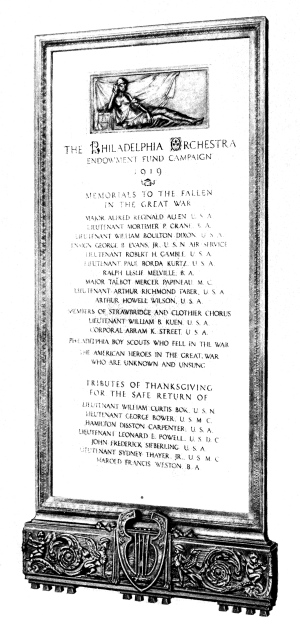
ENDOWMENT FUND
MEMORIAL TABLET
Miss Wister’s name was placed on the tablet by the contribution of
two large amounts, one from the Women’s Committee and one from the
Auxiliary.
The tablets beautifully designed by Mr. Paul Cret, the noted architect,
are placed on each side of the entrance to the inner lobby.
The delightful luncheons held bi-weekly instilled in the workers much
enthusiasm and were attended by from 300 to 400 people each time. At
these the following well-known public and private individuals and
artists appeared, all giving freely of their time and often of their
money to help the great cause:
Miss Margaret Anglin, Mr. David Bispham, Mrs. A. J. Cassatt, Mrs.
Edward H. Coates, Mr. Cyrus H. K. Curtis, Mr. Walter Damrosch, Mrs.
Minnie Maddern Fiske, Sir Johnston Forbes-Robertson, Mr. Walter
Hampden, Dr. John Grier Hibben, Mr. Josef Hofmann, Miss Estelle Hughes
(Winner of Stokowski Medal), Mr. Sascha Jacobinoff, Mr. Otto H. Kahn,
Mr. Hans Kindler, Rabbi Krauskopf, Mme. Matzenauer, Miss Violet Oakley,
Judge Patterson, Bishop Rhinelander, Dr. Thaddeus Rich, Mme. Samaroff,
Mr. Oscar Schwar and a group of men from the orchestra.
The thrill of these occasions will never be forgotten by the
campaigners. Only those who participated can have any idea of the
enthusiasm and excitement prevailing among the workers who eagerly
awaited the reports. After speeches and music of a very delightful
nature, the chairmen were called by name and saw their totals written
on a large black-board. Many of them went to bed the night before with
nothing in their pockets and arrived at headquarters in the morning to
find their able assistants had brought in the required two thousand and
more. It is marvellous that Mr. Bok could, besides running a campaign,
manage such brilliant affairs as these were, twice each week. It was no
unusual sight to see four hundred men and women come in exhausted and
discouraged, and go forth with renewed vigor to beg money. The spirit
of excitement ran through it all, for raising money is as uncertain as
gambling in that the pursuer never knows when he accosts a victim what
the outcome will be, large, small, or nothing, and many surprises were
experienced. The competition was great, for Mr. Bok had offered $1,000
each to the first ten committees to raise their quotas.
The Officers and Directors and the members of the Women’s Committees
and their Auxiliaries swarmed at the Ritz. Over it all was the
influence of Mr. Van Rensselaer, with a courteous and cheerful word for
all the harassed.
Philadelphia Press, September 28th, 1919:
“400 Enlisted for Campaign to Save Philadelphia Orchestra.
Volunteer Workers will Receive Final Instructions
at Ritz-Carlton Luncheon Tomorrow
$1,000,000 Fund the Goal
Failure may Mean Loss to City of Asset
of Incalculable Value
“Musical Philadelphia is watching with a great
deal of interest and anxiety, the movement on foot to ‘make the
Philadelphia Orchestra safe for Philadelphia’ by raising the endowment
of $1,000,000, for otherwise, it has been announced that this
organization must be seriously curtailed in its activities.”
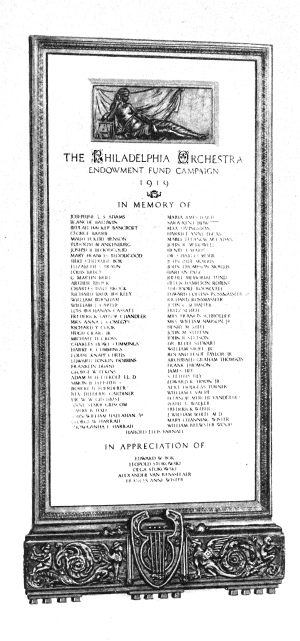
ENDOWMENT FUND
MEMORIAL TABLET
“Many cities sustaining an orchestra are greatly aided by the work
and philanthropy of one or two men, but in the case of the Philadelphia
Orchestra, the burden of making up the yearly deficit is distributed
among a number of people.
“The Committee of fifty Chairmen who will meet tomorrow at the
‘get-together luncheon’ are each pledged to turn in for his Committee
a sum of $20,000. Each Chairman has a group of co-workers, including
prominent social and philanthropic leaders of this city.
Orchestra’s Value to City
“The campaign to save the Orchestra for Philadelphia has set loose
a flood tide of arguments as to the value of this organization to
the city’s life. To business men the argument that the Philadelphia
Orchestra is a great advertisement to the city will make the strongest
appeal, while to the great number of people interested in the artistic
life of the city the argument that its pre-eminent place in the world
of music merits their greatest support will naturally serve to stir
them to action.”
“The realization that the possession of an orchestra of high
standing is a great commercial as well as a great civic asset to a
city, has caused a number of cities to build up an organization similar
to the one Philadelphia already possesses.”
Ranks With World’s Best
“By a most consistent plan of development under the direction of
Alexander Van Rensselaer, the Philadelphia Orchestra, now in its
twentieth year, has earned the reputation of being ‘the first orchestra
in America.’ No less a critic than H. T. Parker, of Boston, writing in
the Boston Transcript says, ‘there can no longer be any doubt
that the Philadelphia Orchestra is today the first of all American
orchestras. In fact, it may be said now to rank among the five great
orchestral organizations in the world.’ Mr. Ossip Gabrilowitsch, famous
no less as a conductor than a pianist, says that ‘it is now a most
important factor in the musical life of this country, and has set a
standard of excellence which all other symphony orchestras in America,
no matter how famous, must bear in mind, if they wish to maintain their
places in the front rank.’”
“Under Stokowski the Orchestra has made a rapid step forward. The
first performance in America of the Mahler Symphony, using a chorus of
over one thousand singers, made the whole country ‘sit up.’”
“One element that the committee in charge of this
endowment fund campaign must combat, is the confidence that the
$1,000,000 can be easily raised. This is unpsychological. This same
notion has frequently spoiled some of the best organized campaigns for
endowing other worthy institutions in this city.”
The publicity for the campaign was brilliantly conceived and executed
by Mr. Bok.
In the spring “The Orchestra News” began to appear monthly, with
the idea of making the story of the organization much more widely
known than it had heretofore been. Its pages were “instructive and
entertaining” as the expression was in old times. So were the various
folders and leaflets sent out during the campaign itself. Persons of
importance in the business world helped with the publicity as well as
with large contributions.
“THE ORCHESTRA NEWS
“Published Every Once in
a While in the Interests of
the Philadelphia Orchestra at
the
Pennsylvania Building, Philadelphia
“Why I Came to Philadelphia
“Because—America was
fast becoming (and has since completely become) the great music-making
country of the world.
“Because—Fritz Scheel (with his instinct
for choosing exactly the right artist for each position in the
orchestra) had laid the foundation of a wonderful orchestra. Since
then many fine artists have been added but the main structure of the
personnel remains as Scheel created it.
“Because—I felt in Philadelphia the
existence of a warm hearted and genuinely music-loving public which
I believed would grow. This it has done amazingly in the last few
years.
“It is my ardent hope that this development will continue, and
that we may soon welcome among us the great number of music lovers in
Philadelphia, who have not yet come to us.
“Leopold Stokowski”
“To The Business Men of Philadelphia
“We are convinced that the Philadelphia Orchestra
is entitled to the support of the business men of Philadelphia. The
Orchestra is now the leading symphony orchestra in the United States,
and has become a distinct civic asset of signal value to Philadelphia.
The impression made by the Orchestra in the largest cities in America
which it visits and where it plays before 100,000 persons during each
season has been proven to be of the most pronounced advertising value
to our city. To place this Orchestra on a permanent financial basis
such as the Endowment Fund of One Million Dollars now asked will
accomplish, is a distinct investment for the business interests of the
city. To compel so valuable a municipal asset to be discontinued for
lack of this fund cannot be considered.
“We ask, therefore, that the business men of Philadelphia will
join us in the support of the Orchestra in this campaign.
| “Samuel Rea |
“W. W. Atterbury |
| Effingham B. Morris |
E. Pusey Passmore |
| John Gribbel |
John H. Mason |
| Samuel T. Bodine |
James Crosby Brown |
| Samuel M. Vauclain |
Samuel S. Fels |
| Cyrus H. K. Curtis |
Ellis A. Gimbel |
| William A. Law |
William P. Gest” |
“We Do It In New York
By Otto H. Kahn
“A business man should realize that he makes a definite investment,
yielding interest to him and to his city in civic and business
advantage, when he supports a worthy art organization in his
community.
“In New York we have come more and more to realize the value, the
merit and the obligation of such investments.
“The Metropolitan Opera, for instance, and our several symphony
concert organizations were started and have always been and are now
being supported financially by business men.
“These and similar art enterprises have become not only genuine
assets in the lives of the people who support and patronize them, but
distinct and profitable business assets to the city.
“Of late, another organization, the Philadelphia Orchestra, has
entered into friendly and successful rivalry with the old-established
symphonic organizations of New York.
“The public and press of New York are one in acknowledging gladly
and cordially that Philadelphia has now in its Orchestra, under its
eminent leader, one of the greatest organizations of the kind in the
United States, or, indeed, anywhere.
“Its visits to New York are welcomed and looked forward to.
“It has taken an honored place in the musical life of New York.
“In what it has achieved, it has served and proclaimed
Philadelphia.
“It carries the message of Philadelphia wherever it appears: a high
and fine message of credit and renown to the city which gave it being
and supports it.
“The civic value and the business value of the investment which is
represented by the Philadelphia Orchestra are definite and great.
“The eminent position and conspicuous reputation which it has
attained are assets of great price to its home city.
“The business men of Philadelphia should take pride in coming
forward unhesitatingly and generously to the full support of the
splendid musical organization which bears the name and enhances the
fame of Philadelphia.
“Otto H. Kahn.”
The newspaper publicity was very fine and the programme books were
also pressed into service, to further the campaign. Mr. Bok’s and Mr.
Stokowski’s clever appeals kept the subject well in the minds of the
audiences during that month by the following appeals:
“A Personal Invitation
“Much as we would like to do so, we cannot
naturally reach personally every resident of Philadelphia for their
contribution to the Million Dollar Endowment Fund to save the
Philadelphia Orchestra.
“In case we have not reached you, will you regard this as a personal
invitation to help in our efforts to save our beautiful Orchestra by
filling in the blank below and mailing it to the address given?
“Please remember that not a penny of your money will be spent: every
dollar is carefully invested, and will work year in and year out, for
all time, only the interest being used to pay the expenses of the
Orchestra. Your subscription, therefore, is a legacy to yourself, your
children, the Orchestra and the city.
“The Philadelphia Orchestra Endowment
Campaign Committee.”
Programme, October 17th, 1919:
“A Personal Message From Mr. Stokowski
“We are facing two possibilities today:
- “One: Shall we continue the Orchestra as it is?
- “The other: Shall we reduce it?
- “Let me tell you exactly what these two things mean,
- so that we will know exactly what we are leading to.
“Suppose we reduce the orchestra: which we must do if we do not
raise this Endowment Fund. That means that your first men in the
orchestra, the chiefs of each section, would not remain, because
there are orchestras being formed all over the country now, and these
orchestras will naturally take away the splendid first men that we have
in our Orchestra.
“You would naturally have to replace those men with second-class
men. You would have to do this because the relation of supply and
demand of orchestral players is tremendously intense. There is far
more demand than there is supply of really great players. Having
second-class men in those positions—I must speak frankly to you now—you
would have a second-class orchestra.
“Now, whoever you have for conductor cannot possibly give you really
first-quality results if he has a second-quality orchestra. That is
impossible.
“Then you could not allow such an orchestra to go outside of
Philadelphia. You could not permit a second-class orchestra bearing
the name of the city to travel to the West, to New York, Washington,
Baltimore, Pittsburgh, Toronto, and the various places where we play.
It would be too much to our shame. We could not do it. So all the tours
would have to be cut out.
“In Philadelphia itself we should not be able to give concerts of
the first quality, and you would naturally become dissatisfied. And
after these second-rate concerts had gone on for one or two seasons,
you would say to yourself, this must stop; we must have again an
orchestra like what we used to have; we must have a first-class
orchestra. You would begin all over again to rebuild your Orchestra
once more, and do you realize how long it takes to build or rebuild an
orchestra?
“Do you realize that it took me personally all the seven years that
I have been in Philadelphia to get three first-class artists for just
one section of the Orchestra? And you have ninety-seven men in your
Orchestra! That gives you just an idea of the work involved.”
“Will Philadelphia give its Orchestra its needed fund, avoid the
calamity I have tried to outline and let the Orchestra go on as it is,
and as the generations go on, and we go from this life, we will have
the feeling that its influence will go on; that it will accumulate
tradition; that it will go on maturing; and that it will become more
and more beautiful.
“Leopold Stokowski.”
“P. S. In the above I have tried to tell you what must happen
if the Orchestra fails to secure the Endowment Fund for which it asks.
“In the programme for next week’s concerts, I want to tell you what
will happen if we do get the Fund; the plan that we have so long had in
mind for the Orchestra and Philadelphia.”
“To the Friends of
The Philadelphia Orchestra
“We have reason to believe that it is in the
hearts of a number of the friends of the Philadelphia Orchestra to
leave a legacy in their wills to the Orchestra. Appreciative as we are
of this beautiful thought on the part of these friends, we hope we may
not be misunderstood if we suggest the thought that were such legacies
now given to the Endowment Fund when the Orchestra stands at the
cross-roads of its career, and when the next fortnight must determine
its continuance or its dissolution, the service rendered would be
greater than may be possible at any other period in its history. If
ever the Orchestra has need of the kindliest thoughts of its friends
it is at this time when the prestige of this superb organization may
be maintained, its present excellence continued, and its strength
conserved: when it is here to support and when the generosity of those
who believe in it can save it and make it the permanent institution of
Philadelphia that it deserves and should be.”
Programme, October 24th-25th, 1919:
“It is not a campaign-slogan:
it is the truth when we say:
Save the Orchestra
“If the Endowment Fund fails, this will be the last
season that the Orchestra can remain at its present
strength of excellence.
“Is that to be your gift to it on its twentieth
birthday?”
“What Will Happen If We Succeed
By Leopold Stokowski
“In last week’s programme I tried to tell you how we
would have to curtail the Philadelphia Orchestra, if we failed to get
the Endowment Fund for which we are all striving; how we would have to
let our best artists go; how we would, for very shame, stop traveling
to other cities because we had a second-class orchestra. All this is
absolute.
“Just as absolute, however, is the other side of the picture if
Philadelphia will give its Orchestra this fund.
“We would naturally not only continue the Orchestra as it is, but we
would go on developing it every season to a higher quality, for in art
there is no end, since, as soon as you reach the horizon which you saw
a year ago, new horizons appear and new fields of beauty. The end never
comes, because you are never satisfied; that is the wonderful thing
about art.
“Let us in Philadelphia go forward; not backward! Let us carry this
fund through.
“We are not asking for a fund that is raised and spent. Not a penny
of the Million Dollars is to be spent; every dollar is to be invested
and put away. Twenty, thirty, forty years from now it will still be
there, always working, bearing interest. And only this interest is to
be spent.
“Is this not a good investment for yourself, your children and your
city?
“Upon this twentieth anniversary I plead for this birthday gift to
the Orchestra.
“Leopold Stokowski.”
The appeal sent to telephone subscribers ran as follows:
“The Present You Can Make With Two Dollars
For Yourself and Children
“A handful of people, for nineteen years, have paid all the bills
of the Philadelphia Orchestra; until now the foremost artists and the
leading music critics have proclaimed it to be the greatest orchestra
in the United States, and one of the five great orchestras of the
world.
“The expense of the orchestra is now too great for a few to continue
to pay. This year the orchestra will be twenty years old, and, as a
birthday present, it is now asked that the people of Philadelphia, as
a whole, will make the orchestra permanent by completing its Endowment
Fund, each contributing only two dollars, making it in a true sense the
orchestra of the people.
Your Two Dollars Will Never be
Spent
“It will be carefully invested, and only the interest used for the
Orchestra. Your gift is, therefore, one for all the years to come: a
permanent gift to a permanent institution.”
In December two concerts were given for these contributors who numbered
several thousand.
When October 31st arrived and the million dollars was neither in hand
nor in sight, the campaign was extended for one week. The appeals
became more and more urgent.
Programme October 31st, November 1st.
“For Lack of Help the Campaign may Fail!
“Owing to a lack of sufficient workers, the Million Dollars
necessary for the proper Endowment of the Philadelphia Orchestra has
not been raised.
“Tired, but full of courage, those who are working have decided to
extend the campaign for another week.
“Campaigns usually fail because the money cannot be had. Here the
money is in sight, but the friends of the Orchestra have not come forth
in sufficient numbers to collect the funds.
“Is the campaign to fail for this unusual reason?
“Will you not, man or woman, give a day, two days of this extra week
to help us collect the last $250,000 necessary to complete the fund?
“You cannot, at this time, render a greater service to the
Orchestra. You can, at this most critical time, do your part to
Save the Orchestra.”
“Will You Not?
“May we ask you, as a final appeal for the Orchestra,
to give to it
Just One Liberty Bond
of any denomination, as your contribution to save
the Orchestra for yourself and the city at this critical time in its
history?
“Whether you have given previously or not, will you not do this one
more act?
“The Bond you give will not be sold: it will not be spent. Not a
penny of it. It will be put away under a Deed of Trust, and only the
interest on it will be used to maintain the Orchestra.
“Could you put a Bond in a better, more permanent place?”
“Face to Face
“We now stand face to face with the question
whether our Orchestra is to be preserved as it is or reduced to a
second-class orchestra.
“The Million Dollars necessary for its preservation have not been
raised.
“The campaign will, accordingly, be extended for one week.
“But the question, after all, is—Will you give? Will you help?
“We need some $250,000 more.
“The workers have done their best. Hundreds of the friends of
the Orchestra have not done their part as yet. Less than 5000 have
contributed!
“Is the truth clearly realized without the mincing of words: If this
remaining sum is not raised, the Orchestra must be reduced; it cannot
remain the glorious thing it is today.”
“The Truth Is Simple and
Direct
“We must tear down the beautiful Orchestra that
has been so patiently and skilfully built up unless the Million Dollar
Endowment Fund is raised. Only one week remains in which to do it.
Whatever that tells is the answer.”
Finally the goal was won and the event was celebrated by a great dinner
at which there was much enthusiasm and rejoicing, when it was announced
that $1,100,000 had been contributed.
The twenty-eight women Chairmen expressed their appreciation of Mr.
Bok’s leadership in the following letter, which was read:
“Philadelphia Orchestra Association
Committee of Fifty
“Edward Bok, Esq., Chairman,
Twentieth Anniversary Endowment Fund Campaign Committee
“Dear Mr. Bok:
“The Women Chairmen of the Committee of Fifty desire to express
their appreciation of your leadership as Chairman of the Twentieth
Anniversary Endowment Fund Campaign for the Philadelphia Orchestra.
“The luncheons alone, as arranged and presided over by you, have
been the most unique and inspiring series of affairs ever conducted
in Philadelphia. But these have been only a part of your labors and a
detail in the large plans which you have undertaken and carried out.
“We thank you for your unfailing courtesy toward us and for your
words of encouragement at moments when the result of the battle seemed
to be in doubt. Your imagination and enthusiasm have led us to victory
and it has been a pleasure to co-operate with you in the important work
of placing the Philadelphia Orchestra on a permanent foundation.
Yours sincerely,
(Signed)
| Helen Warren Allen |
Katharine E. Newcomet |
| Elizabeth H. Arnett |
Marie R. Robins |
| Mary L. H. Ashton |
Countess of Santa Eulalia |
| |
per E. V. W. |
| Maretta Vernon Carver |
Irene H. Snellenburg |
| Elizabeth Conway Clark |
Florence Lewis Slaughter |
| Martha G. Cryer |
Marian M. Thayer |
| Margaretta S. Dixon |
Lois C. Thayer |
| Nellie Andrews Gazzam |
Caroline Clark Weatherly |
| Alice Griswold |
Letitia White |
| Sallie Houston Henry |
Louise Chandler Williams |
| Cora Baird Jeanes |
Frances Anne Wister |
| Nina Lea |
Adèle G. Yarnall |
| Helen C. Leidy |
Hortense L. Zeckwer |
| |
Matinee Musical Club, |
| Clara Barnes Abbott, Chairman |
| Motor Messenger Service, |
| Natalie J. Elwyn, Chairman |
| Victory Dinner, Philadelphia |
| November 10th, 1919.” |
The campaign under the able leadership of Mr. Bok was inspiring and
exciting to a degree. He gave time and money, but best of all, he gave
ideas, and he proved himself an accomplished beggar and a clever general.
The Association was not unmindful of his masterly achievement. At
a meeting of the Board of Directors held November 26th, 1919, this
resolution was passed:
“Whereas the Directors of the
Philadelphia Orchestra Association recognize that the splendid
services of Mr. Edward Bok, Chairman of the Campaign Committee of the
Philadelphia Orchestra Endowment Fund, were largely responsible for the
triumphant success of the Campaign,
“Be It Resolved that the Directors of
the Philadelphia Orchestra Association place on record such belief,
and, further, their appreciation of the energy, resourcefulness and
self-sacrificing devotion with which he led the Campaign to success,
together with a real expression of their regard for him.”
Also this one passed at the Annual Meeting of the Association, May
25th, 1920:
“Mr. Edward W. Bok as Chairman of the Twentieth Anniversary
Endowment Fund Campaign Committee was successful, in October, 1919, in
procuring from the people of Philadelphia and vicinity, a fund of One
Million Dollars for the Philadelphia Orchestra. This fund, when added
to the Endowment Fund of 1916, will place the Orchestra on a permanent
foundation.
“In no piece of work hitherto undertaken by Mr. Bok has he
shown more decided talents of leadership, executive ability and
resourcefulness, than in this brilliantly executed campaign. Future
generations, only, can measure the value of the establishment of a
great orchestra in this city, but certain it is that the raising of
this magnificent sum for music is an achievement the like of which
Philadelphia has not previously witnessed.
“Therefore be it Resolved:
“That the thanks of the Philadelphia Orchestra Association be hereby
expressed to the Chairman of the Endowment Campaign Committee, Edward
W. Bok, together with our appreciation of his great service to the
Philadelphia Orchestra, to the cause of music, and to the people of
Philadelphia.”
Gifts ranged from one penny, given by a blind child, to $100,000. Many
men and women of moderate means deprived themselves of necessities in
order that the orchestra might live. Others gave time and others again
gave both time and money, but never one word of regret has been heard.
The Chairman’s parting shot appeared in the programme book a week later:
November 14th-15th, 1919:
“THANK YOU!
“The Million Dollar Endowment for the Philadelphia Orchestra has
been secured with the goal passed by a generous margin. The result
ensures not only the permanency of the present Orchestra but the
expansion of its influence.
“To each and all who worked and gave and encouraged, we extend,
individually and collectively, our heartfelt thanks.
“We asked you to save the Orchestra!
“The Orchestra IS saved!
“Thank you!
The Philadelphia Orchestra
Endowment Campaign Committee
November 14th, 1919.”
Thus the creation of an Endowment Fund was achieved by the most
extraordinary campaign ever conducted in Philadelphia, and through
the contributions of more than 13,000 people who wished to place a
Philadelphia musical institution on a permanent foundation.
Chapter V Twenty Years of Progress
The Twentieth Anniversary of the Philadelphia Orchestra was
celebrated on November 19th and 20th, 1920; and great was the rejoicing
that this city possessed an orchestra of such attainment, brought to
its present high state by a distinguished conductor, and endowed by
a large number of citizens of Philadelphia and vicinity. The long
labors of the officers and directors, and of the Women’s Committees,
were bringing their recompense. The occasion was celebrated by the
playing of the first programme given by Fritz Scheel in 1900; and the
presentation of a silver loving cup, bearing the following inscription,
to Mr. Van Rensselaer:
“Alexander Van Rensselaer
First President of
The Philadelphia Orchestra Association
on the Occasion of the Twentieth Anniversary Concerts
November 19th and 20th, 1920
With gratitude and deep appreciation of his invaluable services
from
The Board of Directors, the Women’s Committees
The Philadelphia Orchestra, the Business Management”
The Philadelphia
Orchestra[36]
“With the concerts of November 19th and 20th,
1910, the Philadelphia Orchestra celebrates its twentieth year; a year
auspiciously opened in November, 1919, by completing the Endowment Fund.
“To have sustained an honorable career during twenty years is no
mean attainment for a business enterprise, a school or an institution.
But for a group of people to support an orchestra for twenty
years—years artistically certain, but financially uncertain—is a
memorable achievement and a cause for congratulation and rejoicing.
“The first concert of The Philadelphia Orchestra was played on
November 16th, 1900, and was one of the series of six evening concerts
given during the season of 1900-1901. The names of the founders, Dr.
Edward I. Keffer, Mr. Edward G. McCollin, Mr. John H. Ingham, Mr.
Oliver Boyce Judson, and Mr. Oscar A. Knipe, who formed the Executive
Committee, did not appear on the programme. Neither was it publicly
known that this was the Committee which had asked Mrs. Alexander J.
Cassatt to arrange the so-called Philippine Concerts about six months
earlier, which gave Fritz Scheel his first opportunity to conduct in
Philadelphia an orchestra composed of professional musicians.
“On the programme for the second series of concerts, consisting
of fourteen pairs, during the season of 1901-02, the names of the
above gentlemen appear with the additional names of Mr. Alexander Van
Rensselaer, President, and Mr. Henry Whelen, Jr., Treasurer.
“The talents of Mr. Scheel, who died after seven years of devotion
to the cause, soon placed the new organization among the first in
America; and the work thus begun has resulted in an orchestra which has
steadily and surely advanced to its present pre-eminent position under
the leadership of Leopold Stokowski.”
“The history of the Philadelphia Orchestra cannot be written in
this brief space. It is a story of the pioneers who were inspired to
found an orchestra; of devotion, faithfulness and financial aid on the
part of the Officers and Board of Directors; of continuous work by
the four Women’s Committees; of an ‘Unknown Donor,’ who is no longer
‘unknown’; of loyal support from interested citizens, and of a group of
artists, whose music speaks for them and for their leader. In short,
the orchestra, which now speaks for Philadelphia the world over, is the
result of co-operation on the part of all these groups; a co-operation
which has made Philadelphia one of the great musical centres of the world.”
Public Ledger, November 20th, 1920:
“Orchestra Gives Birthday Concert
“Programme same as that presented at First Performance
Twenty Years Ago
“Players Warmly Greeted
“Silver Urn for Mr. Van Rensselaer After His Review
of Two Decades
“The Philadelphia Orchestra gave a concert
yesterday that was real music, all of it. There was nothing ‘modern’
in the programme, nothing that teased the ear with puzzle-problems or
geometric exercises wrought ingeniously. The performance celebrated the
Twentieth Anniversary of the first concert and the programme was the
same as on that fundamental occasion.”
“After the symphony came the celebratory features. Alexander Van
Rensselaer made a graceful address in brief review of the twenty years.
The finished product of the present, he held, was the outcome of united
effort. The chief credit must go to the indefatigable women’s committees.
The munificence of the until recently ‘unknown donor,’ Mr. Bok, assured
us five years more of the inspiring leadership of Stokowski, and has
established the endowment fund.
“Dr. Stokowski declared that the music spoke for itself and that the
orchestra was heartily glad when it gave pleasure to its hearers. Dr.
Hart, in behalf of a committee, made an eloquent and feeling speech in
deserved tribute to Mr. Van Rensselaer, and presented a silver urn of
enormous dimensions, together with a set of resolutions.
“The members of the committee standing with Dr. Hart were Miss
Frances Wister, Miss Anne Thomson, Mr. Judson and Dr. Rich, and the
actual presentation was made by Miss Thomson. The orchestra blew a
fanfare and the audience stood and applauded.”
Public Ledger, November 20th, 1920, Editorial:
“Twenty Years in Music
“In signalizing its twentieth anniversary with a
revival of the original programme directed by Fritz Scheel on November
16th, 1900, the Philadelphia Orchestra has enabled its friends to
indulge in pleasurable reflections.
“It is difficult, of course, to recall accurately, the artistry of
any performance, musical or dramatic, after a lapse of two decades. But
a highly sensitized memory is not needed in this instance. Between the
most pioneering effort of the orchestra, which ventured upon only six
concerts in its first season, and the authority and artistic opulence
of the present organization, there is a disparity in which the whole
community can take the profoundest pride.
“Not only has the orchestra headed by Mr. Stokowski attained to a
position of splendid leadership in the realm of music, but the esthetic
standards of Philadelphia have admirably kept pace. Without affectation
it may be said that the growth of musical culture in this city during
the last score of years has been gratifyingly vigorous, unsurpassed
here in any previous period of similar length.”
“Cultural appreciation, it is said, usually follows an era
of fervent inspiration. Evidently it is an age of the former in
which we are now dwelling, hence the abiding charm and appeal of a
twenty-year-old programme. The new honors, well worth an anniversary
observance, are for the interpreters.”
To those who had devoted years of effort to the orchestra, this
occasion was full of interest. Their thoughts flew back to memories
of Fritz Scheel and the early struggles; to the advent of Leopold
Stokowski and the advance of the orchestra to its present position; to
the changed attitude of the public. A procession of events seemed to
march down the years; the inauguration of a Pension Fund; the Mahler
Symphony and the Chorus; the Peoples’ Concerts; the University of
Pennsylvania Concerts; the effort for Popular and Sunday Concerts. Such
recollections made the life of the Philadelphia Orchestra seem full and
vigorous.
The twentieth season was especially fine musically. It marked the
inauguration of the Special Monday Evening Concerts, three in number,
which have gradually been increased to ten.
Other musical features of the year were Beethoven’s Ninth Symphony;
the playing in November, 1920, of “The Pilgrim Vision” by John Alden
Carpenter, commemorating the 300th anniversary of the landing of
the Mayflower: the three performances in March, 1921, of the Brahms
Requiem; and the presentation of Mahler’s Second Symphony, both with
the Chorus, trained by Mr. Stephen Townsend, of Boston.
It also marked the first appearance, as guest conductor, of the
celebrated leader, Willem Mengelberg, of Amsterdam.
The year was one of great satisfaction to all lovers of the
Philadelphia Orchestra. An organization founded on faith that it would
succeed artistically; and on faith that Philadelphia would eventually
cherish it to the extent of placing it on a permanent financial basis,
had justified the hopes of the founders in both these particulars. The
number of musicians had been augmented from eighty-five in 1900, to
ninety-six in 1920, and the audience had so increased that hundreds of
people were often turned away.
All persons therefore interested in the progress of music in the city
and especially the ones whose efforts had helped to bring about this
result rejoiced in the position now occupied by the orchestra.
In addition to delighting music lovers here and elsewhere, the
Philadelphia Orchestra was carrying the name of Philadelphia gloriously
around the world.
Chapter VI Musical Neighbors
Occasionally philanthropic citizens express the wish that the
Philadelphia Orchestra was not conducted exclusively for a few idle
rich. Therefore, it is well to record some of the things that the
orchestra has done for the general public in this city.
The policy of the Association from the beginning has been to make the
orchestra the centre of Philadelphia’s musical life in an inclusive,
not an exclusive sense. Hence it has always been ready to reciprocate
any assistance rendered to it by giving its services free of charge
on numerous occasions. Often, of course, financial conditions had to
be considered first. Among the societies that have co-operated in
choral performances, without recompense, and, no doubt, at considerable
expense to themselves, are: the Eurydice Chorus, Fortnightly Club,
Jungermaennerchor Singing Society, Mendelssohn Club, Philadelphia
Choral Society. Outside of Philadelphia the Bach Choir of
Baltimore,[37]
Schola Cantorum of New York, and Pittsburgh Chorus.
On its part the orchestra has given a number of special performances
without remuneration, such as the concert for the Manuscript Music
Society in 1913, the concert in collaboration with the Mendelssohn Club
in honor of Dr. Wm. Wallace Gilchrist two years later; a performance
at Camp Dix and a concert for the benefit of the American Red Cross,
1918; a French War Relief Benefit the next year; the music at the
presentation of the Philadelphia Award for four years beginning in
1922, and the concert with the Mendelssohn Club to celebrate its
Fiftieth Anniversary in January, 1925. Special concerts were given for
the National Federation of Music Clubs in 1911, and for the National
Convention of Music Supervisors in 1920.
It must be remembered that such concerts undertaken in addition to the
regular engagements for the season have entailed special preparation
and have been an added burden to the busy conductor.
From the earliest days an effort was made to give music to the numbers
of people who enjoy lighter programmes. Popular concerts at low
prices were inaugurated by Mr. Scheel in 1903, at which time the name
“Popular” was such a misnomer that they had to be given in the form of
benefits on a fifty per cent basis of profit. Such concerts were given
at intervals after this for some years, and consecutively from 1909-10
to 1914-15 inclusive. In May, 1916, an effort was made to institute
“Pop” Concerts after the manner of the Boston Orchestra, at the close
of the regular season. The Academy parquet was floored over and light
refreshments were served at tables. The first season of eleven evenings
went off brilliantly, under the alternate leadership of Mr. Stokowski,
Dr. Rich and Mr. C. Stanley Mackey, and left a small surplus on hand.
Prices ranged from fifteen to fifty cents. The second season the
number was increased to eighteen, and for reasons not understood the
Association was left with a deficit, which caused the venture to be
abandoned.
An early enterprise of a philanthropic nature was the “People’s
Concerts” planned by the Executive Committee but placed in charge of
the Civic Club, with a committee composed of Mrs. Edward I. Keffer,
Chairman; Mrs. Spencer Ervin, Mrs. C. Howard Clark, Mrs. Frank
Rosengarten and Mrs. Walter Horstmann.
The first programme would have pleased the most fastidious of tastes:
Labor Lyceum Hall
Second and Cambria Streets
Tuesday Evening, December 15th, at 8.15 o’clock
First of the Series of
The People’s Concerts
by the Philadelphia Orchestra
Fritz Scheel, Conductor
Under the Auspices of the Civic Club
| Programme |
| 1. Felix Mendelssohn-Bartholdy |
Wedding March from |
| |
“Midsummer Night’s Dream” |
| 2. Hector Berlioz |
Le Carnaval Romain |
| 3. Joseph Godefroid |
Dance of the Sylphs |
| Solo for Harp, Alfred Kastner
|
| 4. Johann Strauss |
Blue Danube Waltz |
| 5. Jules Massenet |
Scènes Neapolitaines |
| 6. Gioachino Antonio Rossini |
Overture “William Tell” |
| 7. Henri Vieuxtemps |
Fantaisie Appassionata |
| Solo for Violin and Orchestra, Hugo Olk |
| 8. Weber-Berlioz |
Invitation to the Dance |
| 9. Albert Franz Doppler |
“Das Waldvoeglein” |
| Solo for Flute and Horn Quartette, August H. Rodemann |
| 10. Richard Wagner |
Overture “Tannhaeuser” |
| Admission 10 Cents |
In the Annual Report of the Civic Club for 1904 this account is given:
“The first ‘People’s Concert’ was held in
Kensington at the Labor Lyceum Hall, Second and Cambria Streets,
admission being 10 cents. It was largely through the co-operation of
Mr. R. R. P. Bradford, of the Lighthouse Lyceum, his Committee and Miss
Esther Kelly, that the concert proved to be such a great success. The
hall was crowded and the people most enthusiastic; Mr. Scheel and his
orchestra were greatly interested and gave a number of encores.
“The receipts were $236.62 up to January 1st; expenses, $103.02. We
hope to have a balance of almost $100 when all returns are made. This
balance to be considered a fund for the People’s Concerts. The second
concert will be given at Bethany Hall on January 11th, the third at
Tuxedo Hall in March.”
There was no doubt about the success of these concerts from the point
of view of the enjoyment of the audiences. The hall was crowded almost
to the danger point, and the enthusiasm was unrestrained. The Women’s
Committees were much interested and kept in touch with Mrs. R. R.
Porter Bradford of the Lighthouse, Kensington, who knew the value of
such music in a section where the shutting down of textile mills for
a winter often made the price of a ticket unavailable. The Committees
used their persuasive powers with the Board of Directors to continue
these concerts at considerable expense, until a fight between two
labor unions made it impossible to rent the hall, the only one in
the neighborhood, and the concerts were no longer given. They were
the means, however, of procuring a number of guarantors, who were
interested in the orchestra from a philanthropic, instead of from a
musical point of view.
From the first, special rates were offered to music students through
the music schools of Philadelphia, for the attendance of the young
was especially desired. Tickets were also distributed free, but the
response was not encouraging.
Special prices were offered to boarding schools in and near
Philadelphia, but they too were not eager to patronize symphony
concerts.
In 1909, through the Women’s Committee, about 43,000 circulars about
the orchestra were sent out by the music schools and other schools with
their prospectuses, a favor much appreciated.
Special Concerts were given for the students at Weightman Hall,
University of Pennsylvania, from 1909-1922. These were conducted
under the auspices of a committee composed of representatives of the
student body, of the Faculty Tea Club (of which professors’ wives were
the members) and of the West Philadelphia Women’s Committee for the
Philadelphia Orchestra. Although the hall was unsuited to orchestral
performances, and the stage inadequate in size, these concerts were
very popular, and the orchestra was always treated in college style.
Press of engagements combined with the unsatisfactory physical
conditions there caused the abandonment of these.
Through the generosity of Mr. Cyrus H. K. Curtis two series of eight
“Public Ledger Educational Concerts” were given for public school
children in 1915-16 and 1916-17.
Public School Concerts have been given at the Academy of Music, with
all tickets at fifty cents, during the last two seasons.
Also for many years the orchestra played for the benefit of the Stetson
Hospital under a special business arrangement.
Free Sunday Concerts were inaugurated at the Metropolitan Opera House
in 1915-16, with a series of three, and continued during the next
season.
The Public School Concerts given in 1915-16 and led by Dr. Rich must
not be forgotten. They took place at the Normal School, Wm. Penn High
School, Philadelphia High School for Girls, Boys’ Central High School,
Germantown, West Philadelphia, Frankford and Southern High Schools.
The Young People’s Educational Concerts should be mentioned. Such a
series of five concerts was first given by Fritz Scheel in 1902-03, at
the Broad Street Theatre, with lectures by Wm. J. Henderson, Wm. F.
Apthorp, Louis C. Elson, Hugh A. Clarke and Henry E. Krehbiel. During
1903-04 and 1905-06 they were continued, and after a long intermission
came to life again in the Children’s Concerts, instituted in
1921.[38]
A special committee was organized in which many associations were
represented and the concerts were so successful that a second series
is now given in order to meet the demand. There is no more inspiring
sight than to watch the Academy filling up with eager-faced children
or than to hear their quick response to Mr. Stokowski’s remarks. The
first series was devoted to an explanation of the instruments and the
programmes are progressing educationally year by year. The principal
difficulty so far encountered is to prevent grown-up children from attending.
Compositions on the Children’s Concerts
“I want to tell you the lovely time I had at the
concert. I want to thank you for sending the tickets. I adored the
beautiful light in the Academy of Music. The conductor’s name was Mr.
Stokowski and he was a very nice man. I liked the part when the little
boy only seven years old played the violin. He looked like Jackie
Coogan. He watched the leader all the time he played. I wonder how long
it took him to learn to play the violin so well.
“Mr. Stokowski is a very pleasant man. He conducted very well. He
told a story of a little goat boy who played on Sand Pipes. He asked
the people to sing Auld Lang Syne.”
“I thought the concert was fine. I think the little boy played a
good piece of music when he played his violin. I would like to play
a drum, because my brother plays a drum, and I could easily learn.
He used to play in a band called the “Ardmore Band.” He was the best
drummer they had. People could hear him far away.”
“I enjoyed the concert so much. The orchestra was the largest I have
ever seen. It seemed as if there were at least a hundred men on the
stage. Mr. Stokowski looked very gay in his medium blue suit. I liked
to watch his hands.
“He said anyone could learn to play in an orchestra if he wanted to,
because it was up to the person himself.”
This short account demonstrates that the Philadelphia Orchestra is a
neighbor of much value to the community in which it dwells.
Chapter VII The Support of the Public Press
Long before the project of a permanent orchestra for Philadelphia
received any degree of public support, the newspapers of this city
in a body used their influence in favor of such an institution. Some
one has spoken of newspaper life as a “career for patriots,” and
surely the editors of the daily papers deserve this title, if any
newspaper men do. No stone was left unturned to further the effort
for a first-class modern orchestra in this city. Paid-for space
announcing performances is one thing. Editorials by the column and
general information, besides the work of the music critic for each
paper are another. In the orchestra archives are scrapbooks filled
with editorials of immense value to the cause. For the newspaper is a
marvelous teacher of public taste and a molder of public opinion. What
would the task have been for such a small number of people, first five,
then eight, then twenty-four, to which were presently added twenty-one
women, if such support had not been prompt and constant? The gallant
list of newspapers, some of which no longer exist is, the Evening
Bulletin, the Evening Ledger, the Evening Telegraph,
the Item, The Inquirer, the North American,
the Press, the Public Ledger, the Record, the
Times. Not only was support given to the orchestra itself, but
to the Women’s Committees in every undertaking. For this publicity the
Philadelphia Orchestra is in deep debt to the Philadelphia papers.
Of the music critics it can be said that they are human in their likes
and dislikes, but have always been really interested and friendly.
One newspaper writer must be mentioned. Mrs. Cornelius Stevenson, as
“Peggy Shippen” used her clever pen to further the cause and especially
the work of the Women’s Committees; and was an honorary vice-president
from the beginning until her death. She was also one of the original
guarantors. She was not a music critic, but in her youth she had
possessed a fine contralto voice and she was a devoted music-lover.
So many articles and extracts have already been given that only one
more will be added in order to prove that Philadelphia newspapers and
many others have been warm friends of the Philadelphia Orchestra.
Evening Telegraph, March 18th, 1901, Editorial:
“For a Permanent Orchestra”
“A constituency of nearly 3,000,000 people within
sight of William Penn’s statue on the Public Buildings ought to be
able to support all the institutions pertaining to a great modern
metropolis. The newspapers, the hotels, the theatres, the great stores,
the transportation facilities, and the institutions of learning and
of science in Philadelphia will compare favorably with those of any
other community of 2,000,000 in the world; while the Park attractions,
and the galleries and exhibitions of works of art are, in some
important respects, far above the standard referred to. One factor of
the metropolitan order of civilization has, however, been lacking.
Up to a very recent period, Philadelphia has not kept pace with the
modern procession in the public recognition of the value of music as a
factor of civic life. While several American cities of half the size
and quarter of the wealth have each maintained a permanent orchestra
of the first class, Philadelphia has not had such an organization
of any class. True, the Germania Orchestra made a brave struggle
for existence, aided by the Pennsylvania Academy of the Fine Arts,
and, for a time, gave promise of building up a permanent orchestral
structure on a solid basis, but this endeavor was made largely at
the cost of the musicians. While the Germanians and others who have
devoted time and money to the service of the community deserve and
should be given credit and honor for their labors, it yet remains true
that to establish a permanent orchestra worthy of the city, the first
requirement is a solid financial foundation to build on.
“Such a foundation is the one thing we need to provide at this hour.
We can today secure a permanent orchestra of the best type for our city
by providing a permanent basis for its support. We are fortunate in
having here at this time a musician who is at once a thorough artist
and an efficient drill master—a rare combination of qualities that gave
to the late Anton Seidl the highest place among orchestral leaders.
It is not necessary to institute comparisons between Mr. Fritz Scheel
and other conductors, but it is proper to say he has demonstrated the
possession of these higher qualities that go to the making of a great
leader. He has done wonders with the material at his command in this
city, and that, too, under conditions unfavorable enough to discourage
any less enthusiastic musician or less energetic worker. In view of
what he has already accomplished in the comparatively short time he
has been at work here, it is a safe and reasonable presumption that
if given a guarantee of control for five years, with means enough
available to warrant satisfactory contracts with competent musicians,
Mr. Scheel would create for us a permanent orchestra second to none
in this country. There is no question as to his ability to undertake
this task; the only thing to be determined being whether we are
wise enough and farseeing enough to strengthen his hands for its
accomplishment.”
Chapter VIII The Listeners
The largest portion of this story has been devoted to the orchestra
itself, and the people who founded it, supported it and endowed it.
Now comes the turn of the party of the third part, the audience.
An orchestra may be wonderfully trained, superbly led, comfortably
supported, and yet miss the main point of existing. For without
listeners, even in the days of radio, an orchestra is incomplete.
In 1900 it was difficult to lure listeners into a concert hall, where
symphonic or severely classical music was to be played. Philadelphians
began by listening to symphonies in bits and in the late nineties it
was the custom for the Germania Orchestra to play one movement of a
symphony each week for four weeks, and play the entire work in the
fifth week. Theodore Thomas did not do this, but he could not get an
audience in 1876 or even in 1881.
It is an inspiring sight of a Friday afternoon or Saturday evening to
see the crowds bound for the Academy of Music. Equally inspiring, is
it to see the audience standing on the steps of the Academy and on
the street for two and three hours before admission can be had to the
Amphitheatre for fifty cents. True lovers of music these.
One of the methods employed to persuade people to take season seats was
the membership in the Auxiliary of the Women’s Committees. Another was
the lure of big soloists. Year by year, this musical organization was
obliged to attract by advertising the appearances of great artists.
But once the audience was procured, it stayed; and today soloists are
on the verge of becoming unpopular. Such is the influence of symphonic
music.
The right to interrupt the progress of a concert by demands for
repeated encores was one which the audience gave up with little grace.
In 1913 a paragraph appeared on the programme, stating that:
“The management has decided in no case
to permit more than one encore.”
And again:
“As encores tend to disturb the unity of an
orchestral programme the patrons of the
Philadelphia Orchestra Concerts are respectfully
informed that encore demands cannot be granted.”
The conductor had one or two bad experiences, which occupied some
minutes, but finally patience won the day and the audiences realized
that this pleasure, if it was a pleasure, was over forever at a
symphony concert.
Next came the hat question. It is not a new one, for in 1841 the
Musical Fund Society placed this notice in one of its programmes:
“Ladies are particularly requested not to
wear their bonnets in the concert room.”
This makes one realize that Philadelphia women were always devoted
to their hats. The war on hats was a merry one and began as early as
1906, at a time when hats were large. It is rumored that the fashion
at the moment required pinned on hair, so hats could not be removed.
This matter was taken up in the Women’s Committee, thought by some to
be like the complaint desk of a department store; a situation of which
they are proud, as it shows how the public turns to the women. Much
discussion arose and notices began to appear in the programmes:
“For the greater convenience of all concerned, it
is earnestly hoped that the women patrons of the Orchestra WILL REMOVE
THEIR HATS during the performance. In many cities local ordinances
compel, by legal means, the removal of head coverings that obstruct the
view in places of amusement.”
“Madame Homer as a Heroine
“Louise Homer, the popular contralto of the
Metropolitan Opera Company, who was the soloist at the Symphony
Society’s concert in the New Theatre,” writes a New York critic,
“proved herself a heroine. SHE TOOK OFF HER HAT! To herself and to
every woman in the house, probably, the big creation, or confection,
or whatever it is called, which she wore as she came upon the stage
was a triumph in the art of millinery. Mere men knew only that it hid
her lovely face. If the audience hadn’t been as well bred as it was
musical, there would have been a demonstration when she pulled out the
pins, removed the hat and placed it at the foot of the conductor’s
stand. Instead there was only an audible sigh of delight. Is it too
much to hope that Mme. Homer’s sister artists will hasten to follow her
example, and that the hosts of her sex who attend concerts and recitals
may be moved to accede to the request of the managers: ‘Ladies will
please remove their hats’?”
The “hat question” would not down, but in Philadelphia the situation
was nothing to what it was in Boston, for the management was obliged to
put the following alarming announcement in the Programme Book:
“His Honor, the Mayor, has notified the Management
of Symphony Hall that, unless the law relating to the wearing of hats
by ladies at public entertainments is obeyed at the Symphony rehearsals
and concerts, he may be forced to revoke the license of Symphony Hall!”
“THE HAT AT THE CONCERTS
“An Earnest Request of Our Women Patrons
“A number of complaints have reached the Orchestra
Association regarding the practice of women wearing their hats at the
Orchestra Concerts, particularly at the Friday afternoon concerts,
despite the notice printed each week in this program asking that for
the comfort of others the hats shall be removed. This complaint has
become so general that it now bids fair to result in a city ordinance,
the same as in Boston and in Chicago, enforcing the removal of hats
at all occasions of public amusements. This legal enforcement of what
should be a matter of polite request ought not to be made necessary and
the Orchestra Association earnestly asks of all its woman patrons that
they will not permit this very simple matter to reach this acute stage.
The Association would exceedingly regret to be compelled to carry out
such an ordinance and it is within the power of each of our woman
patrons to keep what after all is a matter of simple thoughtfulness
within the bounds of politeness and consideration for others.”
Hats today are small, but all the listeners are not yet converted.
The next most disturbing element was, and is, the restlessness of the
audience.
There is a mistaken idea that coming late and leaving early is peculiar
to the modern era, and this day of haste. Far back in 1882 we know that
people left concerts early from this notice in a programme of that year:
“NOTICE
“The patrons of the Germania Orchestra Concerts
are respectfully requested to be in their seats, on the evenings of the
concerts, by eight o’clock punctually.
“Those persons who are unable to comply with this request, will
kindly wait in the lobby until the close of the First Movement of the
Symphony, when a pause will be made to enable them to reach their seats.”
Coming late is the habit of the American world at least, even when
taking trains. Being locked out does not remedy this habit, it only
evokes a few growls.
Again the management took up the subject through the programme:
“Notes of Interest
“The hat question is not the only question
that arises from time to time to prevent that serene enjoyment of
concerts, which is the ideal estate of things hoped for by Management
and concert-goers. Perhaps in the Elysian fields, choirs armed with
angelic harps, are listened to without distractions furnished by
late-comers and early-goers, or by people whose views on the numbers
interpreted are as obstreperous as their hats, or the numberless
physical annoyances that make for confusion and noise, that seem to be
inevitable in concert auditoriums the country over. And this is apropos
of the fact that a subscriber has written in to say that ‘The general
confusion during the last number of the concerts on Friday afternoons
is most annoying,’ and she continues, ‘I am wondering whether a request
cannot be put in the programme to stop this nuisance, as has been done
with regard to the wearing of hats. This is what one meets with; almost
as soon as the last number begins, hats and coats are put on, veils are
arranged, and during the playing of the finale people keep leaving,
causing a general feeling of unquiet and unrestfulness. This seems to
me very discourteous, and is most annoying to those who really want to
enjoy the concert from start to finish. I know that sometimes it is
necessary for a subscriber to leave early, but may I suggest that the
persons who have to leave before the last number, vacate their seats
before the Orchestra starts to play.’
“All this seems reasonable enough, but it is a matter entirely in
the hands of the concert-goers, who form their own ‘court of honor’ in
these particulars.”
However, Philadelphia audiences have improved in concert manners since
the olden time. Then the audiences, although considered ill-behaved,
were much like European ones; they did throw things at the singers and
did not hesitate to express their opinions of the performance. But the
city has advanced, as can be seen by the following notice:
“Pistole Reward—To whoever can discover the
person who was so very rude as to throw Eggs from the Gallery upon the
Stage, last Monday, by which the Cloathes of some Ladies and Gentlemen
were spoiled and the performance in some measure
interrupted!”[39]
Now we do not throw things, the performance is only “in some measure
interrupted” when we cough and sneeze during concerts and operas and
occasionally come in late. Frequent interruptions of a performance
by the screams and calls of displeased listeners, to say nothing of
constant conversation were the order of the early days of public music.
Not worse here than elsewhere, but annoying just the same. Now a
whisper is hardly ever audible at concerts, and a hiss is called forth
only by a modern composition too terrible to allow to pass unnoticed.
A hiss every now and again is not an unhealthy sign. It shows that
someone is listening; and there are a few coughs but always behind the
conductor’s back.
Early in the life of the orchestra the public began to write letters of
complaint to the management and to the newspapers. The management feels
that this is a sign of healthy interest and welcomes these comments. It
shows how strong the sense of possession of the orchestra is with its patrons.
Encores have vanished like the missiles of the past. Hats and
restlessness are going out of fashion. The audiences of the
Philadelphia Orchestra are wonderful groups of people, some of whom
have held seats continuously since 1900. Their regular attendance has
encouraged the Board of Directors and inspired the conductor and the
musicians to artistic achievements. The party of the third part is
doing its share toward making the concerts a success.
Chapter IX The Twenty-fifth Anniversary
Anniversaries are times for reminiscences and a general survey of
affairs.
The Corporation known as “The Philadelphia Orchestra Association”
today consists of four parts:
First, the Association:[40]
comprising the subscribers to the Endowment
Funds of $25.00 or more, and the yearly subscribers to tickets for the
regular series of concerts; and a Board of Directors elected by them
(one-third annually), who in turn elect the officers;
- Second, the Philadelphia Orchestra;
- Third, the four Women’s Committees;
- Fourth, the Business Management.
It is hardly necessary to mention the interdependence of this quartette
of activities, or to explain how many people have worked to procure an
orchestra for Philadelphia.
In 1900-1901 the Philadelphia Orchestra, composed of 85 musicians
gave six evening concerts. In 1925-26 this orchestra, composed of 106
musicians, will give performances as per the following schedule:
| [41]Academy
of Music, Philadelphia |
| Regular Series, 29 Friday afternoons, 29 Saturday evenings |
58 |
| Special Series, Monday evenings |
10 |
| Children’s Concerts, 2 series |
8 |
| Philadelphia Forum |
3 |
| Philadelphia Award |
1 |
| Out-of-town Concerts: |
|
| New York City |
10 |
| Washington |
5 |
| Baltimore |
3 |
| Pittsburgh, Dayton, Chicago, Cleveland, Toledo, |
|
| Detroit, Princeton, one each |
7 |
| Total |
105 |
Record of Performances |
| Total number of concerts, twenty-five years |
2017 |
| Number postponed |
6 |
| Number cancelled (Ottawa, 1924) |
1 |
A more perfect fulfillment of obligations would be hard to find.
The regular series of symphony concerts in Philadelphia has been the
primary object and main concern of the Association. Other performances
have been included when the Philadelphia demand did not consume all the
time of the orchestra. Now a third series is being built up, consisting
of ten Monday evening concerts, at which the programmes are identical
with those of ten of the regular series. More and more this city is
absorbing its own orchestra.
During these twenty-five years much traveling has been done. The
first journey was to Reading in 1900. The next year concerts in five
Pennsylvania cities were added as well as in Trenton and Wilmington. In
1902-03 the first concerts in Baltimore and Washington were attempted
and the first New York appearance was made. Growing bolder with
advancing years appearances were made in new cities each year, of which
the following are the most important: Boston (1903-04); Baltimore and
Washington, five each (1906-07); Pittsburgh, one (1911-12), five pairs
(1916-17); New York City, five afternoon concerts (1918-19); Toronto,
three concerts (1919-20); New York City, ten concerts (1922-23).
The orchestra has traveled as far east as Portland, Maine; as far west
as Detroit and Ypsilanti, Michigan; as far south as Richmond, Virginia,
and as far north as Toronto, Canada. During the coming season Chicago
will be added to this list.
Traveling has been tinged with adventure. In 1908, when returning from
Wilmington, the special train carrying the orchestra was wrecked near
Chester. Mr. Pohlig and six musicians were injured, when the cars were
derailed and rolled down a steep embankment. Fortunately, there were no
serious injuries and all the instruments were unhurt.
Ten years later the orchestra reached Kalamazoo, Mich., with difficulty
during a severe blizzard, en route for Grand Rapids, where a concert
was to be played. The thermometer fell to 27° below zero in a sixty
mile gale. The concert was postponed but later given.
The last experience of winter weather was in Canada in 1924, when the
Ottawa concert was cancelled after the audience had waited in perfect
good humor for three hours, hoping that the train carrying the
orchestra could push through the snow.
In the past special trains were almost invariably
used. Since railroad transportation has more than doubled, and since
the charge for a special train has also been raised, the management
wherever possible has availed itself of regular trains, generally
running as a second section. Since the party now constitutes upwards of
one hundred and twelve people, five twelve-section drawing room cars
and one baggage car make up the equipment for night trips. Going to
New York, two coaches are attached to an early afternoon train, and a
special train home is provided after the performance.
The labors of the officers and directors have been
continuous. The Executive Committee, chosen from the Board in the early
days; a sub-committee composed of Dr. Keffer and Mr. McCollin; the
Committee of Three, consisting of Mr. Norris, Mr. Wheeler, and the late
Mr. Charles A. Braun, who with the president, met daily from 1908 until
1920, shouldered most of the responsibility. Under the new By-Laws
the Administration Committee composed of Messrs. Edward W. Bok, James
Crosby Brown, Samuel S. Fels, Charles D. Hart, Effingham B. Morris,
William Jay Turner, Alexander Van Rensselaer, and Andrew Wheeler,
perform the arduous task of meeting every week regularly to dispose of
the business of the Association.
In the early days Mr. Henry Whelen, Jr., made it possible to carry on
the orchestra under financial difficulties, from 1900 until his death,
which, coming so soon after the loss of Fritz Scheel, was a double
blow. On May 22nd, 1907, this resolution was passed by the Board of
Directors:
“The death of Mr.
Henry Whelen, Jr., has deprived this Board of a most capable and
efficient officer, and its members, of an esteemed and highly valued
friend. To an artistic temperament, he added rare qualities of judgment
and discretion inherent in a disciplined mind, and coupled with a sense
of duty and habit of industry that continually and cheerfully placed
his valuable services at the disposal of the community. The positions
of member of the Board of Directors, of the Executive Committee, and of
Treasurer of this Association, are but a few of the positions in which
he stood in an unselfish relation to his native city, in an effort to
discharge what he conceived to be his duty in the development of Music
and Art in the community in which he lived.
“It is also with an acute sense of personal loss that
this minute is ordered in the sincere hope that it may beguile those
nearest and dearest to him from something of the grief of so great a
bereavement and also serve to perpetuate his memory in a community that
has profited so much from his useful and unselfish citizenship.”
Mr. Thomas McKean, for many years Vice-president, was
one of the officers who was always ready to assist in a financial
crisis. Mr. Richard Y. Cook and Mr. Theodore N. Ely were especially
devoted members of the Board, but all the membership should be included
in this category.
The social end, besides many others, has been taken care of by Mr. Van
Rensselaer, who has constantly given entertainments.
Of the many friends outside of the officers and directors, Mr. Philip
H. Goepp has worked as hard as any man. From 1901-1902 until 1920-1921
inclusive he was annotator of the programme and well fitted for the
task, as he is a musician, composer, and author of the series on
“Symphonies and their Meaning,” authoritative works on this subject.
He gave his time and his knowledge to the Association, at first
without remuneration, so great was his enthusiasm over the continued
development of the orchestra. Many days and nights through the years
were devoted to the study of the works performed, and the Association
is greatly in his debt.
During the period of his leadership Mr. Stokowski has had various
honors bestowed upon him. After the second performance of the Mahler
Symphony he was presented with a bronze wreath; on the completion of
ten years as conductor in 1922, by the Women’s Committees with a set
of twelve silver plates, and with a silver tankard by the Association;
the University of Pennsylvania conferred on him the Honorary degree of
Doctor of Music in 1920; and in 1922 he was the first recipient of the
Philadelphia Award of Ten Thousand Dollars. His appearances in Europe
in January 1923, when as guest conductor he led orchestras in France
and Italy were greeted with enthusiasm and with press notices of a
laudatory nature.
Although it is a rented building, the Academy of Music is the only
dwelling place the orchestra has known, and the auditorium with its
architectural beauty and perfect acoustics is a marvelous place for
orchestral concerts. Having been built in 1857, its traditions link the
past with the present and cast a spell over the music.
The present stage setting, which replaces the gift of the West
Philadelphia Women’s Committee, is from the design of Mr. Huger
Elliott, and was executed as a labor of love by the students of the
Pennsylvania Museum and School of Industrial Art for the Association.
A possession of the Association is the orchestral library that has
gradually been accumulated. Beginning with the purchase, for $600.00,
of the library of the Philadelphia Symphony Society and augmented in
1911 by Fritz Scheel’s collection, and by the constant addition of
new works, it is now suited to the needs of the orchestra and valued
as a great asset. It contains twelve hundred works with scores, and
orchestral parts for one hundred and ten men, besides four hundred and
thirty scores without orchestral parts.
Advantage is often taken of modern musical inventions. For some years
much care has been given to the making of Victor Records, which are
popular the country over. There is now a list of forty-six, all
exceptionally good, and they have brought the orchestra many friends.
Radio transmitters are not used at performances. The Board of Directors
feels that it is unfair to patrons of the orchestra, who pay for
tickets and take the trouble to attend the concerts in person, to
broadcast the music throughout the country.
Mr. Stokowski recently secured the rights for the first presentation
of the new Hammond Pedal, invented by John Hays Hammond, Jr. The
first public performance on the piano with this attachment was at the
Philadelphia regular series of concerts, on October 30th and 31st,
1925, when Lester Donahue played the Rachmaninoff Second Concerto. The
invention will also be used in Washington, New York City and on the
Western tour.
In looking back over the years, details come to mind. Much anxiety used
to be felt about Saturday nights, as bad weather meant a poor audience
and knocked the box office receipts. Now, the audience is anxious for
fear of uncomfortable delays on the steps during a storm, on account of
the crowd.
Another detail was the efforts that the women made long ago to brighten
up the appearance of the Saturday evening house, by asking their
friends in the boxes to wear gay clothes.
The policy of the Philadelphia Orchestra Association has always been
to sell tickets at moderate prices. Tickets for the best seats for the
first regular series of six concerts sold for $8.00. Students could
buy tickets for the amphitheatre for $1.75 for fourteen rehearsals
and $2.00 for fourteen concerts. The price of tickets has increased
seventy per cent and operating expenses have increased five hundred per
cent in twenty-five years, but considering this, the tickets are still
moderate. A story is told by Mr. George T. Haley, of the Academy of
Music Ticket Office, loyal friend to the orchestra, of how as a young
assistant agent he was in charge of the window on the first day of the
first sale for the Philadelphia Orchestra. He opened promptly at 8.30
a. m.; the first sale was about ten and the next about four in the
afternoon. Now, his principal business in connection with the orchestra
is to placate the people who cannot get the seats they want or get any
seats at all.
The Business Management of the Association has been since 1915 in the
hands of Mr. Arthur Judson, whose ability and that of the Assistant
Manager, Mr. Louis A. Mattson, is well known. Mr. Judson manages,
likewise, the Philharmonic Orchestra of New York and the Cincinnati
Orchestra. Mr. Mattson manages the summer concerts in Fairmount Park,
for which a number of Philadelphia Orchestra men are engaged. The ease
with which a large amount of business is conducted, and one in which
there is much detail, is due to the organizing talents of Mr. Judson
and to the devotion and long training of the office staff under him. The
Association is fortunate in having a manager of such rare business
acumen, whose talents have developed as necessity arose; until it is
safe to say that there is no more ably managed musical organization in
the country than this. To Mr. Mattson falls the task of distributing
the seats, no easy one in 1925, when there are almost none to dispose
of. No mention of the business end of this enterprise would be complete
without the names of Miss Ruth O’Neill, Miss Elizabeth M. Russell
and Miss Margaret E. Pringle, not to forget Mr. Stokowski’s private
secretary, Miss McGinty, who eases the thorny business path of an
artist.
Speaking of business, the Endowment Funds of the Association were at
first in the hands of three trustees but now are in the care of a
Corporate Trustee, the Girard Trust Company.
But enough of details! Many forces have combined to make it possible to
maintain an orchestra.
Some years ago Peggy Shippen wrote:
“This remarkable
performance (Mahler Symphony), which attracted music connoisseurs from
many cities, and which will remain a lasting credit to our town, was
the result of a combination of forces patiently brought together by the
will, power and genius of one man—Leopold Stokowski.
“Such triumphs of art scored in this city do more than all the
advertising in the world to place Philadelphia in the lead of the great
American centers. The Mayor has spoken of advertising this city; these
things do this legitimately by adding to its opportunities. The sooner
we realize that it is by honest work and the real thing well done that
we can impose respect for our city and State, the better.
“It is in the last decade or so that those interested have realized
the necessity for ‘coming together.’ This policy seems to have been
adopted since Alexander Van Rensselaer accepted the presidency of the
Board of Directors. No one could be selected in this entire city better
calculated to bring together the elements indispensable to the success
of such an undertaking. Himself a musician, all his life identified
with musical interests, he is one of the most widely popular men in
this community.
“As the audiences grew and became critical, exacting a higher
quality of music, Mr. Van Rensselaer and his board rose to the occasion
and met the requirements of growth.
“The Women’s Committee, besides developing the interest in the
success of the orchestra, has helped with the Guarantee Fund, which, of
course, is the pivot upon which turns the success of the undertaking.
Without the backing of money, to pay for the best procurable talent,
even the greatest genius is helpless to produce adequately a great work
of art.
“It was the combination of Mr. Van Rensselaer’s patient and broad
policy, of the women’s inconspicuous but telling work of years upon the
musical intelligence of the community, first under Mrs. A. J. Dallas
Dixon’s direction and then under that of Miss Frances Wister, that
provided the fertile ground upon which the genius of Mr. Stokowski
brought out the almost superhuman result of last week.
“The same success will attend similar methods in other fields.
The theory of ‘splendid isolation’ does not apply to our epoch.”
The Philippine Concerts which occurred on March 29th and April 5th,
1900; and which were the forerunners of the Philadelphia Orchestra,
were commemorated at the concerts of March 27th and 29th and April
3rd and 4th, 1925, by a notice in the programme and by the playing
of certain numbers played at those concerts. They marked the first
appearance of Fritz Scheel with an orchestra of professional musicians
in Philadelphia.
The Twenty-fifth Anniversary of the first concert on November 16th,
1900, is being celebrated at the concerts of November 13th and 14th,
1925, by simple ceremonies and a repetition of the first programme.
It is a long way from the total of seven concerts in 1900, to the one
hundred and five concerts arranged for this season. The road has been
discouraging and difficult, but the twenty-fifth anniversary is a cause
for rejoicing to all lovers of the Philadelphia Orchestra.
Little did the small group of men in 1900 dream that the orchestra they
founded would twenty-five years later be known throughout America and Europe.
The “Road One Hundred and Fifty Years Long” has been worth traveling
to Philadelphians, to reach the present milestone in the symphonic
succession, so far the most important achievement in the city’s musical
history. If Baedeker were to write a “Guide to Music in America” he
would put three stars against the Philadelphia Orchestra.
Chapter X The Point of the Story
“Time Was unlocks the riddle of Time Is.
That offers choice of glory or of gloom:
The solver makes Time Shall Be surely his.”
The point of the story is the music that the Philadelphia Orchestra
makes. It would be a tragedy if after twenty-five years anyone could
ask “Why?” A tragedy for the officers and directors, for the Women’s
Committees, and for the reader and writer of this book. For the
musicians and for Leopold Stokowski it would be more than a tragedy,
the object of life would cease to exist.
Beginning in 1912 the musical record becomes more and more interesting.
The leader has poured out his talents for Philadelphia and the feast
has been lavish. Programme after programme of the works of the
great, interpreted by the brain of Leopold Stokowski have enthralled
his audiences. Only a few special selections and occasions can be
mentioned, but a perusal of the programmes for thirteen years shows
that the average of Philadelphia Orchestra concerts is far above the
usual average, for he is a master maker of programmes.
1912-13: Gustav Strube, “Puck”; Herman Sandby, Prelude to Act IV
“The Vikings of Helgenland”; Edward Elgar, Symphony No. 1; Guiseppe
Martucci, Symphony No. 1; Sigismund Noszkowski, “Die Steppen”; Richard
Strauss, “Liesbes Scene” from “Feursnot,” “Salome’s Tanz”; Henri
Rabaud, Symphony No. 2[42];
Ernest Schelling, “Légende Symphonic.”[43]
1913-14: Hans Erich Pfitzner, “Käthchen von Heilbronn,” overture;
Fernandez Arbos, “Guajiras,”[44]
violin and orchestra; Florent Schmitt, “Rapsodie Viennoise”[45];
Albert Roussel, Evocation No. 2 “La Ville Rose”[46];
Henry Hadley, Symphony, “North, East, South and West”; Erich
Korngold, “Schauspiel” Overture; Otto Mueller, member Philadelphia
Orchestra, “Dramatic Overture”; Henry A. Lang[47],
Symphony “Fantasies of a Poet”; Beethoven, Ninth Symphony with Chorus.
1914-15: Jan Sibelius, “Finlandia”; Bach, triple concerto, piano,
violin and flute; Paderewski, Symphony B minor[48],
Special Concerts for the Benefit of the Pension Fund; Mendelssohn, “Lobgesang Symphony”
with soloists and sixteen Choral Societies; Wagner Programme. Frederick
Stock, Symphony C minor; Feruccio Busoni, Indian Fantasy, piano and
orchestra;[49]
Sandby, Suite from “The Woman and the Fiddler”; Mrs. H. H. A. Beach,
Symphony “Gaelic”; Georges Enesco, “Roumanian Rhapsody.”
1915-16: Gustav Strube, “Variations on an Original Theme”; Camille
Zeckwer[50],
Symphonic Poem, “Sohrab and Rustum” (conducted by composer); Enrique Granados,
Intermezzo and Epilogue from Goyescas; Gustav Mahler, Eighth Symphony for
orchestra soli and chorus;[51]
Strauss “Alpensymphonie.”[52]
1916-17: Frederick A. Stock: Violin Concerto, D minor; Arne Oldberg
“June” (conducted by composer); Gustav Mahler, “Das Lied von der
Erde,”[53]
symphony for soli voices and orchestra; Max Bruch, Concerto
for two pianos written for Rose and Ottilie Sutro (first world
performance); Michel Dvorsky, “Chromaticon” piano and orchestra, Josef
Hofmann, pianist; Debussy, “The Blessed Damosel” after Rosetti for
soprano and Chorus of Women; Schelling, “Impressions,” variations
for piano and orchestra, composer at the piano; Liszt, Eine Faust
Symphonie, orchestra, tenor and bass soli and chorus; Bach, Matthäus
Passion, orchestra, soli, Philadelphia Orchestra Chorus, Chorus of
Girls from Philadelphia Normal School and Girls’ High School.
1917-18: American Programme, Edgar Stillman Kelley Symphony “New
England,” compositions by Philip H. Goepp, Arthur Foote; Skryabin,
“Poème de l’Extase”; Beethoven, Three Equali for four Trombones; Bach,
Concerto, three pianos and orchestra, Mme. Olga Samaroff, Bauer,
Gabrilowitsch; Sinding, Symphony; Ernest Chausson, “Poème” violin and
orchestra, Thaddeus Rich, violinist; Bloch Programme, concert conducted
by composer; Selim Palmgren concerto “The River,” piano and orchestra.
1918-19: MacDowell “Indian Suite” dirge in memory of fallen Americans;
Dvorsky, “The Haunted Castle”; Debussy “Sirènes,” orchestra and women’s
voices; Lorenziti, Suite for Viole d’Amour, Henri Casadesus, soloist;
Rachmaninoff, Air for a Choir of Solo Violins with orchestra; Programme
of four American composers, Frederic S. Converse, H. Clough-Leiter,
John Alden Carpenter, Cecil Forsyth; Leo Ornstein, piano soli, composer
at the piano; Chadwick, “Tam o’Shanter”; Ernest Bloch, Symphony No. 1;
Louis Garnier, “Vision” Poème for Orchestra.
1919-20: Beethoven, Choral Fantasy in C minor, piano, orchestra and
chorus, Mme. Samaroff, pianist; Malipiero, “Pause del Silenzio”;
Loeffler “A Pagan Poem” for Orchestra, with piano, English horn and
three trumpets obligato, Bauer pianist; Charles T. Griffes, four
compositions for orchestra; Rachmaninoff, Concerto No. 3, piano and
orchestra, composer at the piano; Symphony “The Bells”[54] (after Poe),
orchestra solo voices and Philadelphia Orchestra Chorus; Lorenziti,
Concerto for Viole d’Amour, double bass and orchestra, Thaddeus Rich
and Anton Torello, soloists; Weber, Concertino in F for bassoon and
orchestra, Richard Krueger, soloist; André Maquarre, two compositions
for orchestra; Mozart Opus 30, arranged as a Concerto for oboe and
small orchestra, Marcel Tabuteau, soloist; Beethoven, Ninth Symphony,
Philadelphia Orchestra Chorus, marking Ninety-sixth Anniversary of
first performance, 1824.
1910-21: Leo Sowerby “Comes Autumn Time”; J. Guy Ropartz, Symphony
No. 4; Cyril Scott, concerto piano and orchestra, composer at the
piano; John Alden Carpenter “A Pilgrim Vision” to mark Tercentenary of
Landing of the Mayflower; Beethoven, Ninth Symphony with Philadelphia
Orchestra Chorus; Brahms; double concerto violin and cello, Rich and
Penha, soloists; Brahms, “Requiem,” soprano and baritone soli, chorus
and orchestra; Gilchrist[55],
Symphonic Poem, unveiling of Gilchrist memorial; Mahler, Symphony No.
2, for orchestra, chorus and solo soprano and contralto.
1921-22: Sibelius, Symphony No. 5[56];
Alfredo Casello, “Pages of War” for orchestra; Gregor Fitelberg,
Polish Rhapsody[57];
Bloch, Suite for viola and orchestra; Schoenberg, Five Orchestra Pieces; Vincent
d’Indy “Poème des Rivages,” d’Indy, guest conductor (first performed
on present tour); Bach Passacaglia, orchestrated by Leopold Stokowski
(first time); Strawinsky “Sacre du Printemps”[58];
Manuel de Falla, excerpts from “El Amor Brujo”[59];
Otto Mueller, Carnival Overture “Schlaraffiada.”
1922-23: Debussy “La Cour des Lys”; Ravel, “La Valse Choreographic,”
Poem for Orchestra; Strawinsky, “Feuerwerk”; Franck Centenary, Symphony
D minor. The orchestra was engaged by Dr. Richard Strauss for four New
York concerts of his own works exclusively. Dr. Strauss also conducted
one in Philadelphia.
1922-1923: Camille Zeckwer, “Jade Butterflies”; Strawinsky, “Trois
Poésies de la Lyrique Japonaise”; Enesco, Symphony E flat, Roumanian
Rhapsody, Enesco, guest conductor; Brahms, concerto for violin, Enesco,
violinist; January 26th and 27th, 1923, compositions by Milhaud,
Poulenc, Auric, Satie; Schelling, “A Victory Ball”; Pick-Mangiagali,
“Sortilegi,” Symphonic Poem, piano and orchestra; D. G. Mason, Prelude
and Fugue, piano and orchestra; Henry Eichheim, Oriental Impressions
for Orchestra; Schoenberg, “Kammersymphonie”.
1923-24: Strawinsky, “Chant du Rossignol”[60];
Bach concerto for harpsichord; Händel, concerto for harpsichord, Wanda Landowska,
soloist; Strawinsky, “Symphonie d’Instruments à Vent”[61]; Josef
Hofmann, compositions for piano and orchestra, East and West,
Caliedescope, the Haunted Castle, “Chromaticon” (Dvorsky); Ottorino
Respighi, “Sinfonia Drammatica”; Deems Taylor, Suite “Through
the Looking Glass”; compositions by Magnard, Jean-Jules-Amable
Roger-Ducasse; Hand Krása; Strawinsky, “Renard,” burlesque for Chamber
Orchestra, two tenors, two basses; Beethoven, Ninth Symphony with
Toronto Choir.
1924-25: Nicholas Medtner, piano concerto, composer at piano; Edgar
Varese, “Hyperprisms”; Paul Hindemuth, Nusch-Nuschi Dances; Karl
Szymsanowski, violin concerto[62];
Kurt Atterberg, Symphony No. 2; Henry
Joslyn, War Dance from Suite, “Native Moments”; Strawinsky programme,
Strawinsky guest conductor; Prokokieff, Suite Scythe, “Ala and Lolli”;
Arthur Bliss, “Mêlée Fantasque”; Germaine Taillefer, Concerto[63]
for piano and orchestra; Isaac Albeniz, “Fête Dieu à Séville”; Edward
Burlingame Hill, Arthur Bliss, compositions for two pianos and orchestra.
It must not be supposed from the above that the usual standard works
are not performed. The list is given to show the wide musical range to
which Philadelphians are treated. No mention has been made of the many
Wagner and Tschaikowsky programmes that have been presented. They have
occurred every year and are always a delight.
It is a pleasure to mention the principal players in the orchestra, who
are not generally known personally by the audience. It is a case of
“by their voices you shall know them,” and their voices enthrall the
listeners week by week. First comes Dr. Thaddeus Rich, most popular of
concertmasters and an assistant conductor of no mean attainments, who
is sometimes called to take the conductor’s place at the last minute,
where he acquits himself with honors. As we look farther there are:
David Dubinsky, first second violin; Samuel Lifschey, first viola;
Hanns Pick, violoncello; W. M. Kincaid, flute; Marcel Tabuteau, oboe;
Daniel Bonade, clarinet; Anton Horner, horn; Walter Guetter, bassoon;
Sol. Cohen, trumpet; Gardell Simons, Paul P. Lotz, C. E. Gerhard,
trombones; Philip A. Donatelli, tuba; Anton Torello, bass; Vincent
Fanelli, Jr., harp; and last but not least, Oscar Schwar, tympani.
These players all possess the requisites, which seem to be ability to
play and ability to obey, for the response of their wills to the will
of the leader is what makes success in an orchestra. One noticeable
feature about the musicians is their youth; this is patent to the eye,
and to the ear, from the virility of their performance.
To those who do not see farther than the Academy stage, it would be
useless to explain that the conductor’s activities are not confined to
stepping briskly onto the platform and leading concerts. People who
have given the matter thought must know that he is working all the year
round for the Philadelphia Orchestra. The rehearsals are very exacting
and the players are wonderfully prepared. Conducting a concert means a
physical, mental and emotional strain which is only understood by those
who have seen the conductor as he comes off the stage. Leading without
a score requires perfect concentration. Painstaking effort and patience
on the part of Mr. Stokowski bring their reward in the finish of the
performance, but it looks so easy! And therein is shown his skill.
Next there is the constant search for new works and the mastering of
them before rehearsals can begin. Much time is occupied in hearing
and selecting players, for no stone is left unturned to find the best
artists for each position. The mail is also a subject of importance,
as correspondence is kept up with individuals and publishers and then
there are letters of complaint or approval, all to be answered. The
conductor is a busy man, whose brain never stops working, planning,
devising for the orchestra.
Leopold Stokowski’s musical gifts are of a nature difficult to
describe. What thrills come to one at the remembrance of certain
moments, the first hearing of the Bach “Passacaglia,” the “Prelude
and Liebestod” from Tristan, the symphonies of Brahms, Schubert and
Tschaikowsky, Mahler’s Eighth, where the chorus “Alles Vergängliches
ist nur ein Gleichniss” soars aloft, Beethoven’s Seventh, and the Ninth
with the Mendelssohn Choir of Toronto. But why mention special moments?
The audiences have come to expect every concert to be a “special moment.”
Philadelphia is to be congratulated that the orchestra bearing its name
is in the hands of Leopold Stokowski, master musician. It is constantly
advancing. When one peak on the climb is reached, the clouds roll away
and another comes into view. Let no man speak its doom by proclaiming
that the summit of Parnassus has been reached by the Philadelphia Orchestra.
The name of Alexander Van Rensselaer, Esq., appears on the first page
of this book. It is fitting that it should also appear on the last,
for the president’s activities encircle the orchestra. Many records of
his deeds appear in the annals of the Association, and many more are
engraved in the hearts of his fellow-workers and fellow-townsmen. He is
the only person, however, who knows what sacrifices his devotion has
entailed. For although a president may appear to enjoy more sunshine
than other individuals, he also bears the shock of all the storms. The
responsibility of such a post for twenty-five unbroken years is a heavy
burden for a man to bear. To say that he has borne it and continued to
hold the respect and affection of Philadelphians is the finest tribute
that could be paid him.
The story told in this book has been made possible by the president of
the Philadelphia Orchestra Association.
In Memoriam
Theodore Thomas
Born October 11, 1835; Died January 4, 1905
“The death of the pioneer of American music, and a veritable Titan of
Conductors, Theodore Thomas, brings consternation to the world of
music, as this great man stood for all that is pure and noble in his art.
An event so calamitous, and peculiarly significant here in Philadelphia,
where he was well known and beloved, devolves upon me the sad duty
of giving an orchestral expression of our deep grief. While it is true that
an all-wise Providence saw fit to remove from the field of action one
who had probably reached the apogee of his power and influence, yet
keen regret must of necessity be experienced, an emotion best expressed
through the medium that the great Thomas made his own—the
orchestra. Therefore, I deem it wise to change the programme for the
Seventh Concert, selecting such numbers as, in a sense, may be regarded
as a mortuary mass. In agreement with this idea, which I am sure my
supporters will endorse, I have made the following changes, substituting
such numbers that, were the lips now stilled in death able to
articulate, they would, I trust, unreservedly approve.
Fritz Scheel
Conductor of the Philadelphia Orchestra.”
Philadelphia, January 6, 1905.
| Programme |
| 1. Richard Wagner |
Siegfried’s Death from “Die Götterdämmerung” |
| 2. Wolfgang Amadeus Mozart |
Symphony, G minor |
| I. Allegro Molto 4/4 |
III. Menuetto: Allegro 3/4 |
| II. Andante 6/8 |
IV. Finale: Allegro Assai 4/4 |
| 3. Jules de Swert |
Concerto for Violoncello and Orchestra, |
| |
No. 2, in C minor, Op. 38 |
| Allegro moderato—Espressivo, 4/4 |
| Alfred Saal |
| 4. Richard Strauss |
Serenade, Opus 7, Andante, E flat major |
| For 2 Flutes, 2 Oboes, 2 Clarinets, 4 Horns, |
| 2 Bassoons, and Contra Bassoon |
| 5. Ludwig von Beethoven |
Overture, “Leonore No. 3,” Op. 72 |
Programme of Ceremonies
Fritz Scheel Memorial
Academy of Music
Wednesday, March Eleventh
Nineteen Hundred and Eight
at Three o’Clock
In Memoriam
Fritz Scheel
Born Lübeck, 1852; Died Philadelphia, 1907
| Richard Wagner |
Vorspiel “Parsifal” |
| Address |
| Mr. Owen Wister |
| |
| Richard Strauss |
Tone Poem “Tod und Verklärung” |
| Beethoven |
Funeral March from Eroica Symphony |
| Dr. S. Weir Mitchell |
| January 9-10, 1914 |
|
| Beethoven |
Slow Movement from Symphony No. 7, in A major |
| Theodore N. Ely |
| November 3-4, 1916 |
|
| Beethoven |
Eroica Symphony Marcia Funèbre |
| Harold Ellis Yarnall |
| April 7-8, 1917 |
|
| MacDowell |
“Dirge” from Indian Suite |
| Tribute to the memory of our soldiers and sailors who |
| have fallen in the war |
| November 15-16, 1918 |
|
| Beethoven |
Eroica Symphony Marche Funèbre |
| Theodore Roosevelt |
| January 17-18, 1919 |
|
“Resolution Passed at Meeting of Board of
Directors, November 26th, 1919
“Whereas, the Directors of the
Philadelphia Orchestra Association note with deep sorrow the death of
Major Henry Lee Higginson,
“And Whereas, they recognize that by his
death the cause of good music throughout the country has sustained an
irreparable loss,
“And Whereas, they recognize their own
deep debt of gratitude to him for his pioneer work in the said cause of
music,
“Be It Resolved that they place on record
their very real sense of this great loss and their feeling of sympathy
in it not only with the members of his family, but with every officer
and member of the Boston Symphony Orchestra Association.
“It is further ordered that the Secretary of the Philadelphia
Orchestra Association transmit a copy of this resolution to Mrs.
Higginson and to the officers and members of the Boston Symphony
Association.”
“The Dirge from MacDowell’s ‘Indian Suite’
will be played
In Memory
of
The Founder of the Boston Symphony Orchestra
Major Henry Lee Higginson
November 18, 1834—November 14, 1919”
November 28-29, 1919
| Schubert |
Unfinished Symphony, Andante |
| George W. Elkins |
| December 5-6, 1919 |
|
| Wagner |
Funeral March from “The Twilight of the Gods” |
| Mrs. Alexander J. Cassatt |
| January 23-24, 1920 |
|
Resolution passed by the Women’s Committee,
January 20th, 1920.
Mrs. Alexander J. Cassatt
“Mrs. Cassatt was associated with the Women’s Committee for the
Philadelphia Orchestra, as an Honorary Vice-president, at the time
of its organization in 1904; in 1909 she was elected to the Board of
Managers, and in 1914 became a Vice-president, which position she
held until her death on January 9th, 1920. She was Chairman of the
Nominating Committee for many years and conducted its affairs with
discretion and ability. She was also Chairman of a Committee, which
during the winter of 1912 devoted much time and thought to the revision
of the By-laws.
“Mrs. Cassatt gave her support to the cause of an orchestra for
Philadelphia, however, before the Philadelphia Orchestra was organized
as such, and before the Women’s Committee had a reason for existing. In
the spring of 1900, she organized a committee of women which carried
through the two so-called Philippine Concerts and gave Fritz Scheel
his first opportunity to appear in Philadelphia as a conductor of an
orchestra composed of professional musicians; as a direct result the
Philadelphia Orchestra was organized in the fall of that year.
“In spite of failing health and physical suffering, Mrs. Cassatt’s
interest in the welfare of this Committee and the orchestra never
flagged; her wise counsel was freely given, and her gracious presence
was always an inspiration. She gave to this Committee the benefit of
her wide knowledge of people and affairs, and for this we have a deep
sense of gratitude.
“Her last public appearance was at the Philadelphia Orchestra
Endowment Fund Campaign Luncheon on November 6th, 1919, on which
occasion she presented the gift of one thousand dollars to the
Endowment Fund from the Women’s Committee as a tribute to its
President, Miss Frances A. Wister.
“The influence of her loyalty will remain a rich heritage for the
Women’s Committee for the Philadelphia Orchestra.
“Therefore, Be It
“Resolved, That we, the members of the Women’s
Committee for the Philadelphia Orchestra, hereby express our affection
and respect for Mrs. Cassatt, and our grief and sense of irreparable
loss at her death.
“Be It Also Resolved, That we record
our appreciation of Mrs. Cassatt’s interest in the affairs of this
Committee, of her work for the Philadelphia Orchestra, and of her
distinguished qualities of leadership. We are profoundly touched by the
fact that Mrs. Cassatt’s last public appearance was in our behalf, and
are mindful of the privilege that has been ours in working with her for
the cause of music in Philadelphia.
“Be It Also Resolved, That this
resolution together with the preamble be spread upon the minutes and
that copies be sent to Mrs. Cassatt’s family as an expression of our
deep sympathy in their loss.
Committee on Resolutions
(Signed) Frances Anne Wister, Chairman
Adèle G. Yarnall
Mrs. Simon B. Fleisher
Sallie Houston Henry
Elizabeth H. Arnett”
January 20th, 1920.
| Wagner |
“Götterdämmerung” Funeral March |
| Charles A. Braun |
| October 27-28, 1922. |
|
| Beethoven |
Symphony No. 7, Slow Movement |
| Edward G. McCollin |
| November 30, December 1, 1923. |
|
| Wagner |
Funeral March from Götterdämmerung |
| Woodrow Wilson |
| February 8-9, 1924. |
|
| Chopin |
Funeral March |
| Mrs. Alexander J. Dallas Dixon |
| October 16-17, 1925. |
|
Mrs. Alexander J. Dallas Dixon
“Died September 20, 1925
“Resolution Passed by the Philadelphia
Orchestra Association
“The officers and members of the Administration
Committee of The Philadelphia Orchestra Association have learned with
deep sorrow of the death of Mrs. Alexander J. Dallas Dixon, who had
been a member of the Board of Directors of the Orchestra Association
since its very beginning, as well as first President of the Women’s
Committee for The Philadelphia Orchestra. Her charming personality,
sweet disposition and wise judgment combined to make her endeared and
respected by all her associates.
“In her death we have lost a true and devoted friend of music and a
lady with whom it was a pleasure to be associated.
“The Women’s Committee for the
Philadelphia Orchestra
“Mrs. Alexander J. Dallas Dixon
“Mrs. Alexander J. Dallas Dixon, the first President of this
committee, who died on September 20, 1925, was for several reasons
especially dear to our members.
“Captains of ships who take the helm for voyages over uncharted
seas, or leaders of expeditions across unknown continents who bring
such undertakings to successful ends, receive the honor of their
comrades. How much more should we treasure the memory of a pioneer
leader, whose enterprise was so skillfully planned that the work for a
noble purpose has been able to continue during twenty-one years.
“Long before Mrs. Dixon entered upon the difficult position of
President of this committee, however, she was a force in the musical
life of the city. As an amateur pianist and singer, and as a member of
the Eurydice Chorus and of the Melody Club, she was a well-known and
important figure among the devotees of this enchanting art.
“Mrs. Dixon taught the committee many lessons, although some of us
were unaware of this fact at the time, and probably she was herself.
Behind a delightful simplicity of manner there lay courage, patience,
ability, firmness of purpose in an unpopular cause and a shining soul.
Therefore, personally and officially, Mrs. Dixon was the greatest
ornament that the committee has possessed and the most beloved officer.
It is especially distressing to us to lose her from our midst at a
time when all friends of the Philadelphia Orchestra are rejoicing in
the Twenty-fifth Anniversary of the first concert, which is to be
celebrated in November. So devoted a member of the Board of Directors
of The Philadelphia Orchestra Association will be much missed on that
occasion.
“It may be well said, ‘Her ways were ways of pleasantness and her
paths were paths of peace,’ for, led by her, the Women’s Committee for
The Philadelphia Orchestra has wended its steps along the same road.
Our gratitude will endure while the committee continues to exist.
“A committee composed of the officers has been
appointed to present a resolution for action at this
special meeting of the Women’s Committee for The
Philadelphia Orchestra.
Resolution
“Mrs. Alexander J. Dallas Dixon
“First President of the Women’s Committee for
The Philadelphia Orchestra—1904-1912
“Mrs. Alexander J. Dallas Dixon was the first President of the
Women’s Committee for The Philadelphia Orchestra, which was organized
at her house on March 11, 1904. Until 1912 she continued as its
presiding officer and during these years she held the esteem and
affection of the members of the committee and administered its affairs
with wisdom, justice and a broad vision.
“Therefore, be it Resolved:
“That we, the officers and
members of the Women’s Committee, desire to record our deep sense of
loss in the death of a beloved former President and late Honorary
Vice-President, and to express our appreciation of her fearless
initiative, her unfailing good judgment, her gentle but firm character,
her wise leadership.
“Be it also Resolved: “That this resolution be spread upon the
minutes and that a copy be sent to her husband.
| Committee |
| “Frances Anne Wister, |
President |
| Adèle G. Yarnall, |
Vice-president |
| Sallie Houston Henry, |
Vice-president |
| Helen Warren Allen, |
Treasurer |
| Elizabeth H. Arnett, |
Corresponding Secretary |
| Margaret S. Wood, |
Recording Secretary” |
October 8, 1925.
Appendix A
Charter
of
The Philadelphia Orchestra Association
(Adopted November 1, 1902)
The subscribers hereto, all of whom are citizens
of the Commonwealth of Pennsylvania, have associated themselves
together for the purpose herein below set forth and being desirous
of becoming incorporated agreeably to the provisions of the Act of
the General Assembly of the Commonwealth of Pennsylvania, entitled,
“An Act to provide for the incorporation and regulation of certain
corporations,” approved the twenty-ninth day of April in the year
of our Lord one thousand eight hundred and seventy-four, and the
supplements thereto, do hereby declare, set forth and certify that the
following are the purposes, objects, articles and conditions of their
said Association for and upon which they desire to be incorporated.
Article 1.—The name of
the corporation shall be The Philadelphia Orchestra Association.
Article 2.—Its object
is to encourage the performance of first-class orchestral music in the
City of Philadelphia and for that purpose to establish and maintain The
Philadelphia Orchestra.
Article 3.—The place
in which the business of the said corporation is to be transacted is
the City of Philadelphia.
Article 4.—The said
corporation is to exist perpetually.
Article 5.—The said
corporation shall have no capital stock.
Article 6.—The number
of Directors of the said corporation shall be twenty-four, and the
names and residences of those who are chosen for the first year are as
follows:
| Name |
Residence |
| George Burnham, Jr. |
Philadelphia, Pa. |
| A. J. Cassatt |
Philadelphia, Pa. |
| John H. Converse |
Philadelphia, Pa. |
| Eckley B. Coxe, Jr. |
Philadelphia, Pa. |
| William L. Elkins |
Elkins, Pa. |
| Miss Mary K. Gibson |
Philadelphia, Pa. |
| Clement A. Griscom |
Philadelphia, Pa. |
| Mrs. Alfred C. Harrison |
Philadelphia, Pa. |
| John H. Ingham |
Philadelphia, Pa. |
| Oliver B. Judson |
Philadelphia, Pa. |
| Edward I. Keffer |
Philadelphia, Pa. |
| C. Hartman Kuhn |
Philadelphia, Pa.
|
| Edward G. McCollin |
Philadelphia, Pa. |
| Thomas McKean |
Philadelphia, Pa. |
| Clement B. Newbold |
Philadelphia, Pa. |
| James W. Paul, Jr. |
Philadelphia, Pa. |
| Mrs. Frank H. Rosengarten |
Philadelphia, Pa. |
| Richard Rossmässler |
Philadelphia, Pa. |
| Edgar Scott |
Philadelphia, Pa. |
| Simon A. Stern |
Philadelphia, Pa. |
| Miss Anne Thomson |
Merion, Pa. |
| Alexander van Rensselaer |
Philadelphia, Pa. |
| Henry Whelen, Jr. |
Philadelphia, Pa. |
| P. A. B. Widener |
Ashbourne, Pa. |
Witness the hands and seals of the subscribers this first day
of November, in the year of our Lord one thousand nine hundred and two (1902):
- A. Van Rensselaer (L.S.)
- A. J. Cassatt (L.S.)
- Geo. F. Baer (L.S.)
- Henry Whelen, Jr. (L.S.)
- John H. Converse (L.S.)
- C. Hartman Kuhn (L.S.)
- Geo. Burnham, Jr. (L.S.)
- Edwd. G. McCollin (L.S.)
- Clement B. Newbold (L.S.)
- Jas. W. Paul, Jr. (L.S.)
- John H. Ingham (L.S.)
- E. I. Keffer (L.S.)
- State of Pennsylvania
- City and County of Philadelphia
Before me, the Recorder of Deeds for the County of Philadelphia,
on this twenty-first day of November A. D. 1902, personally appeared
Henry Whelen, Jr., John H. Ingham and Edward I. Keffer, three of the
subscribers to the foregoing certificate of incorporation and duly
acknowledged the same to be their act and deed, and desired that the
same might be recorded as such,
Witness my hand and official seal the day and year aforesaid.
Jos. K. Flescher, Deputy Recorder of Deeds (L.S.)
Decree
In the Court of Common Pleas No. 4, of the County of Philadelphia of
December Term 1902, N. 845.
And now this fifth day of January, A. D. 1903, the within Charter
and Certificate of Incorporation having been presented to me, a Law
Judge of said County, accompanied by due proof of publication of the
notice of this application as required by the Act of Assembly and rule
of this Court in such case made and provided, I certify that I have
examined and perused the said writing, and have found the same to be in
proper form and within the purposes named in the first class specified
in Section Second of the Act of General Assembly of the Commonwealth
of Pennsylvania, entitled “An Act to provide for the Incorporation and
Regulation of Certain Corporations,” approved April 29th, 1874, and
the supplements thereto, and the same appearing to be lawful and not
injurious to the community, I do hereby on motion of Edward G. McCollin
and John G. Johnson, Esquires, on behalf of the petitioners, order and
direct that the said Charter of The Philadelphia Orchestra Association,
aforesaid be and is the same hereby approved, and that upon the
recording of the same and of this order, the subscribers thereto and
their associates shall be a corporation by the name of The Philadelphia
Orchestra Association, for the purposes and upon the terms therein stated.
Robert N. Willson, Judge.
Filed in the office of the Prothonotary of the Court of Common Pleas
No. 4 as of December Term 1902 No. 845, on the Fourth day of December
A. D. 1902.
C. B. Roberts, Deputy Prothonotary.
Recorded in the office for recording Deeds etc. in and for the County
of Philadelphia in Charter Book No. 28, page 53 etc.
Witness my hand and seal of office this seventh day of January
A. D. 1903.
Wm. S. Vare, Recorder of Deeds (L.S.).
Appendix C
Officers and Directors of The Philadelphia
Orchestra Association
1900-1925
1901-1902
OFFICERS
Alexander Van Rensselaer, President
F. T. Sully Darley, Vice-president
John H. Ingham, Secretary
Henry Whelen, Jr., Treasurer
| DIRECTORS |
| A. J. Cassatt |
C. Hartman Kuhn |
| John H. Converse |
Edward G. McCollin |
| Eckley B. Coxe, Jr. |
Thomas McKean, Jr. |
| F. T. Sully Darley |
Clement B. Newbold |
| William L. Elkins |
James W. Paul, Jr. |
| Miss Mary K. Gibson |
Mrs. Frank H. Rosengarten |
| Clement A. Griscom |
Edgar Scott |
| Mrs. Alfred C. Harrison |
Simon A. Stern |
| John H. Ingham |
Miss Anne Thomson |
| Oliver B. Judson |
Alexander Van Rensselaer |
| Edward I. Keffer |
Henry Whelen, Jr. |
| Oscar A. Knipe |
P. A. B. Widener |
|
|
|
|
1902-1903
OFFICERS
Alexander Van Rensselaer, President
Thomas McKean, Vice-president
John H. Ingham, Secretary
Henry Whelen, Jr., Treasurer
| DIRECTORS |
| George Burnham, Jr. |
Edward G. McCollin |
| A. J. Cassatt |
Thomas McKean |
| John H. Converse |
Clement B. Newbold |
| Eckley B. Coxe, Jr. |
James W. Paul, Jr. |
| William L. Elkins |
Mrs. Frank H. Rosengarten |
| Miss Mary K. Gibson |
Richard Rossmässler |
| Clement A. Griscom |
Edgar Scott |
| Mrs. Alfred C. Harrison |
Simon A. Stern |
| John H. Ingham |
Miss Anne Thomson |
| Oliver B. Judson |
Alexander Van Rensselaer |
| Edward I. Keffer |
Henry Whelen, Jr. |
| C. Hartman Kuhn |
P. A. B. Widener
|
1903-1904
OFFICERS
Alexander Van Rensselaer, President
Thomas McKean, Vice-president
John H. Ingham, Secretary
Henry Whelen, Jr., Treasurer
| DIRECTORS |
| Mrs. William W. Arnett |
Thomas McKean |
| George Burnham, Jr. |
Clement B. Newbold |
| A. J. Cassatt |
James W. Paul, Jr. |
| John H. Converse |
Mrs. Frank H. Rosengarten |
| Eckley B. Coxe, Jr. |
Richard Rossmässler |
| Miss Mary K. Gibson |
Edgar Scott |
| Clement A. Griscom |
Simon A. Stern |
| John H. Ingham |
Miss Anne Thomson |
| Edward I. Keffer |
Alexander Van Rensselaer |
| C. Hartman Kuhn |
Andrew Wheeler, Jr. |
| Edward G. McCollin |
Henry Whelen, Jr. |
| Oliver B. Judson |
P. A. B. Widener |
1904-1905
OFFICERS
Alexander Van Rensselaer, President
Thomas McKean, Vice-president
John H. Ingham, Secretary
Henry Whelen, Jr., Treasurer
| DIRECTORS |
| George Burnham, Jr. |
Thomas McKean |
| John H. Converse |
Clement B. Newbold |
| Eckley B. Coxe, Jr. |
James W. Paul, Jr. |
| Miss Mary K. Gibson |
Mrs. Frank H. Rosengarten |
| Clement A. Griscom |
Richard Rossmässler |
| John H. Ingham |
Edgar Scott |
| Oliver B. Judson |
Miss Anne Thomson |
| Edward I. Keffer |
Alexander Van Rensselaer |
| C. Hartman Kuhn |
Andrew Wheeler, Jr. |
| Edward G. McCollin |
Henry Whelen, Jr. |
1905-1906
OFFICERS
Alexander Van Rensselaer, President
Thomas McKean, Vice-president
Andrew Wheeler, Jr., Secretary
Henry Whelen, Jr., Treasurer
| DIRECTORS |
| Mrs. William W. Arnett |
Edward G. McCollin |
| George Burnham, Jr. |
Thomas McKean |
| Alexander J. Cassatt |
Clement B. Newbold |
| John H. Converse |
James W. Paul, Jr. |
| Richard Y. Cook |
Mrs. Frank H. Rosengarten |
| Eckley B. Coxe, Jr. |
Edgar Scott |
| Mrs. A. J. Dallas Dixon |
Miss Anne Thomson |
| Miss Mary K. Gibson |
Alexander Van Rensselaer |
| Clement A. Griscom |
Andrew Wheeler, Jr. |
| John H. Ingham |
Henry Whelen, Jr. |
| Edward I. Keffer |
P. A. B. Widener |
| C. Hartman Kuhn |
Miss Frances A. Wister |
1906-1907
OFFICERS
Alexander Van Rensselaer, President
Thomas McKean, Vice-president
Andrew Wheeler, Jr., Secretary
Henry Whelen, Jr., Treasurer
| DIRECTORS |
| Mrs. William W. Arnett |
Edward G. McCollin |
| George Burnham, Jr. |
Clement B. Newbold |
| John H. Converse |
James W. Paul, Jr. |
| Richard Y. Cook |
Mrs. F. H. Rosengarten |
| Eckley B. Coxe, Jr. |
Edgar Scott |
| Mrs. A. J. Dallas Dixon |
Miss Anne Thomson |
| Miss Mary K. Gibson |
Alexander Van Rensselaer |
| Clement A. Griscom |
Andrew Wheeler, Jr. |
| John H. Ingham |
Henry Whelen, Jr. |
| Edward I. Keffer |
P. A. B. Widener |
| C. Hartman Kuhn |
Miss Frances A. Wister |
| Thomas McKean |
|
1907-1908
OFFICERS
Alexander Van Rensselaer, President
Thomas McKean, Vice-president
Andrew Wheeler, Jr., Secretary
Arthur E. Newbold, Treasurer
| DIRECTORS |
| Mrs. William W. Arnett |
Thomas McKean |
| George Burnham, Jr. |
Arthur E. Newbold |
| John H. Converse |
Clement B. Newbold |
| Richard Y. Cook |
James W. Paul, Jr. |
| Eckley B. Coxe, Jr. |
Mrs. Frank H. Rosengarten |
| Mrs. A. J. Dallas Dixon |
Edgar Scott |
| Miss Mary K. Gibson |
E. T. Stotesbury |
| Clement A. Griscom |
Miss Anne Thomson |
| John H. Ingham |
Alexander Van Rensselaer |
| Edward I. Keffer |
Andrew Wheeler, Jr. |
| C. Hartman Kuhn |
P. A. B. Widener |
| Edward G. McCollin |
Miss Frances A. Wister
|
1908-1909
OFFICERS
Alexander Van Rensselaer, President
Thomas McKean, Vice-president
Andrew Wheeler, Jr., Secretary
Arthur E. Newbold, Treasurer
| DIRECTORS |
| Mrs. William W. Arnett |
Thomas McKean |
| Charles A. Braun |
Arthur E. Newbold |
| George Burnham, Jr. |
Clement B. Newbold |
| John H. Converse |
G. Heide Norris |
| Richard Y. Cook |
Mrs. Frank H. Rosengarten |
| Eckley B. Coxe, Jr. |
Edgar Scott |
| Mrs. A. J. Dallas Dixon |
E. T. Stotesbury |
| Miss Mary K. Gibson |
Miss Anne Thomson |
| Clement A. Griscom |
Alexander Van Rensselaer |
| John H. Ingham |
Andrew Wheeler, Jr. |
| C. Hartman Kuhn |
Miss Frances A. Wister |
1909-1910
OFFICERS
Alexander Van Rensselaer, President
Thomas McKean, Vice-president
Andrew Wheeler, Jr., Secretary
Arthur E. Newbold, Treasurer
| DIRECTORS |
| Mrs. William W. Arnett |
C. Hartman Kuhn |
| Charles A. Braun |
Thomas McKean |
| James Crosby Brown |
Arthur E. Newbold |
| George Burnham, Jr. |
Clement B. Newbold |
| John H. Converse |
G. Heide Norris |
| Richard Y. Cook |
Mrs. Frank H. Rosengarten |
| Eckley B. Coxe, Jr. |
Edgar Scott |
| Mrs. A. J. Dallas Dixon |
E. T. Stotesbury |
| Theodore N. Ely |
Miss Anne Thomson |
| Miss Mary K. Gibson |
Alexander Van Rensselaer |
| Clement A. Griscom |
Andrew Wheeler, Jr. |
| John H. Ingham |
Miss Frances A. Wister |
1910-1911
OFFICERS
Alexander Van Rensselaer, President
Thomas McKean, Vice-president
Andrew Wheeler, Jr., Secretary
Arthur E. Newbold, Treasurer
| DIRECTORS |
| Mrs. William W. Arnett |
Thomas McKean |
| Charles A. Braun |
Arthur E. Newbold |
| James Crosby Brown |
Clement B. Newbold |
| Richard Y. Cook |
G. Heide Norris |
| Eckley B. Coxe, Jr. |
Mrs. Frank H. Rosengarten |
| Mrs. A. J. Dallas Dixon |
Edgar Scott |
| Theodore N. Ely |
E. T. Stotesbury |
| Miss Mary K. Gibson |
Miss Anne Thomson |
| Clement A. Griscom |
Alexander Van Rensselaer |
| John H. Ingham |
Andrew Wheeler |
| C. Hartman Kuhn |
Miss Frances A. Wister |
1911-1912
OFFICERS
Alexander Van Rensselaer, President
Thomas McKean, Vice-president
Andrew Wheeler, Jr., Secretary
Arthur E. Newbold, Treasurer
| DIRECTORS |
| Mrs. William W. Arnett |
Arthur E. Newbold |
| Charles A. Braun |
Clement B. Newbold |
| James Crosby Brown |
G. Heide Norris |
| Richard Y. Cook |
Mrs. Frank H. Rosengarten |
| Eckley B. Coxe, Jr. |
Edgar Scott |
| Mrs. A. J. Dallas Dixon |
E. T. Stotesbury |
| Theodore N. Ely |
Miss Anne Thomson |
| Miss Mary K. Gibson |
Alexander Van Rensselaer |
| Clement A. Griscom |
Mrs. L. Howard Weatherly |
| John H. Ingham |
Andrew Wheeler |
| C. Hartman Kuhn |
J. R. Barton Willing |
| Thomas McKean |
Miss Frances A. Wister |
1912-1913
OFFICERS
Alexander Van Rensselaer, President
Thomas McKean, Vice-president
Andrew Wheeler, Jr., Secretary
Arthur E. Newbold, Treasurer
| DIRECTORS |
| Mrs. William W. Arnett |
Arthur E. Newbold |
| Charles A. Braun |
Clement B. Newbold |
| James Crosby Brown |
G. Heide Norris |
| Richard Y. Cook |
Mrs. Frank H. Rosengarten |
| Eckley B. Coxe, Jr. |
Edgar Scott |
| Mrs. A. J. Dallas Dixon |
E. T. Stotesbury |
| Theodore N. Ely |
Alexander Van Rensselaer |
| Miss Mary K. Gibson |
Mrs. L. Howard Weatherly |
| Clement A. Griscom[64] |
Andrew Wheeler |
| John H. Ingham |
J. R. Barton Willing |
| C. Hartman Kuhn |
Miss Frances A. Wister |
| Thomas McKean |
|
1913-1914
OFFICERS
Alexander Van Rensselaer, President
Thomas McKean, Vice-president
Andrew Wheeler, Jr., Secretary
Arthur E. Newbold, Treasurer
| DIRECTORS |
| Mrs. William W. Arnett |
C. Hartman Kuhn |
| Edward W. Bok |
Thomas McKean |
| Charles A. Braun |
Arthur E. Newbold |
| John F. Braun |
Clement B. Newbold |
| James Crosby Brown |
G. Heide Norris |
| Richard Y. Cook |
Edgar Scott |
| Eckley B. Coxe, Jr. |
E. T. Stotesbury |
| Cyrus H. K. Curtis |
Alexander Van Rensselaer |
| Mrs. A. J. Dallas Dixon |
Mrs. L. Howard Weatherly |
| Theodore N. Ely |
Andrew Wheeler |
| Miss Mary K. Gibson |
Miss Frances A. Wister |
| John H. Ingham |
Mrs. Harold E. Yarnall |
1914-1915
OFFICERS
Alexander Van Rensselaer, President
Edward W. Bok, Vice-president
Andrew Wheeler, Jr., Secretary
Arthur E. Newbold, Treasurer
| DIRECTORS |
| Mrs. William W. Arnett |
John H. Ingham |
| Edward W. Bok |
C. Hartman Kuhn |
| Charles A. Braun |
Thomas McKean |
| John F. Braun |
Arthur E. Newbold |
| James Crosby Brown |
G. Heide Norris |
| Richard Y. Cook |
E. T. Stotesbury |
| Eckley B. Coxe, Jr. |
Alexander Van Rensselaer |
| Cyrus H. K. Curtis |
Mrs. L. Howard Weatherly |
| Mrs. A. J. Dallas Dixon |
Andrew Wheeler |
| George W. Elkins |
Miss Frances A. Wister |
| Theodore N. Ely |
Mrs. Harold E. Yarnall |
| Miss Mary K. Gibson |
|
1915-1916
OFFICERS
Alexander Van Rensselaer, President
E. T. Stotesbury, Vice-president
Andrew Wheeler, Jr., Secretary
Arthur E. Newbold, Treasurer
| DIRECTORS |
| Mrs. William W. Arnett |
Henry McKean Ingersoll |
| Edward W. Bok |
John H. Ingham |
| Charles A. Braun |
C. Hartman Kuhn |
| John F. Braun |
Thomas McKean |
| James Crosby Brown |
Arthur E. Newbold |
| Richard Y. Cook |
G. Heide Norris |
| Eckley B. Coxe, Jr. |
E. T. Stotesbury |
| Cyrus H. K. Curtis |
Alexander Van Rensselaer |
| Mrs. A. J. Dallas Dixon |
Mrs. L. Howard Weatherly |
| George W. Elkins |
Andrew Wheeler |
| Theodore N. Ely |
Miss Frances A. Wister |
| Samuel S. Fels |
Mrs. Harold E. Yarnall |
| Miss Mary K. Gibson |
|
1916-1917
OFFICERS
Alexander Van Rensselaer, President
E. T. Stotesbury, Vice-president
Andrew Wheeler, Jr., Secretary
Arthur E. Newbold, Treasurer
| DIRECTORS |
| Mrs. William W. Arnett |
John H. Ingham |
| Edward W. Bok |
C. Hartman Kuhn |
| Charles A. Braun |
Arthur E. Newbold |
| John F. Braun |
G. Heide Norris |
| James Crosby Brown |
E. T. Stotesbury |
| Richard Y. Cook |
Alexander Van Rensselaer |
| Cyrus H. K. Curtis |
Mrs. L. Howard Weatherly |
| Mrs. A. J. Dallas Dixon |
Andrew Wheeler |
| George W. Elkins |
Joseph E. Widener |
| Samuel S. Fels |
Miss Frances A. Wister |
| Miss Mary K. Gibson |
Charlton Yarnall |
| Charles D. Hart |
Mrs. Harold E. Yarnall |
| Henry McKean Ingersoll |
|
1917-1918
OFFICERS
Alexander Van Rensselaer, President
E. T. Stotesbury, Vice-president
Andrew Wheeler, Jr., Secretary
Arthur E. Newbold, Treasurer
| DIRECTORS |
| Mrs. William W. Arnett |
C. Hartman Kuhn |
| Edward W. Bok |
Effingham B. Morris |
| Charles A. Braun |
Arthur E. Newbold |
| John F. Braun |
G. Heide Norris |
| James Crosby Brown |
E. T. Stotesbury |
| Cyrus H. K. Curtis |
Alexander Van Rensselaer |
| George W. Elkins |
Mrs. L. Howard Weatherly |
| Samuel S. Fels |
Andrew Wheeler |
| Miss Mary K. Gibson |
Joseph E. Widener |
| Charles D. Hart |
Miss Frances A. Wister |
| Henry McKean Ingersoll |
Charlton Yarnall |
| John H. Ingham |
Mrs. Harold E. Yarnall |
1918-1919
OFFICERS
Alexander Van Rensselaer, President
E. T. Stotesbury, Vice-president
Andrew Wheeler, Jr., Secretary
Arthur E. Newbold, Treasurer
| DIRECTORS |
| Mrs. William W. Arnett |
C. Hartman Kuhn |
| Edward W. Bok |
Effingham B. Morris |
| Charles A. Braun |
G. Heide Norris |
| John F. Braun |
E. T. Stotesbury |
| James Crosby Brown |
Miss Anne Thomson |
| Cyrus H. K. Curtis |
Alexander Van Rensselaer |
| Mrs. A. J. Dallas Dixon |
Mrs. L. Howard Weatherly |
| George W. Elkins |
Andrew Wheeler |
| Samuel S. Fels |
Joseph E. Widener |
| Charles D. Hart |
Miss Frances A. Wister |
| Henry McKean Ingersoll |
Charlton Yarnall |
| John H. Ingham |
Mrs. Harold E. Yarnall |
1919-1920
OFFICERS
Alexander Van Rensselaer, President
E. T. Stotesbury,
Vice-president[65]
Andrew Wheeler, Jr., Secretary
Arthur E. Newbold, Treasurer
| DIRECTORS |
| Mrs. William W. Arnett |
C. Hartman Kuhn |
| Edward W. Bok |
Effingham B. Morris |
| Charles A. Braun |
G. Heide Norris |
| John F. Braun |
Miss Anne Thomson |
| James Crosby Brown |
Alexander Van Rensselaer |
| Cyrus H. K. Curtis |
Mrs. L. Howard Weatherly |
| Mrs. A. J. Dallas Dixon |
Andrew Wheeler |
| George W. Elkins[66] |
Joseph E. Widener |
| Samuel S. Fels |
Miss Frances A. Wister |
| Charles D. Hart |
Charlton Yarnall |
| Henry McKean Ingersoll |
Mrs. Harold E. Yarnall |
| John H. Ingham |
|
1920-1921
OFFICERS
Alexander Van Rensselaer, President
William Jay Turner, Vice-president
Andrew Wheeler, Jr., Secretary
Robert K. Cassatt, Treasurer
| DIRECTORS |
| Mrs. William W. Arnett |
C. Hartman Kuhn |
| Edward W. Bok |
Effingham B. Morris |
| Charles A. Braun |
G. Heide Norris |
| John F. Braun |
Robert K. Cassatt |
| James Crosby Brown |
Miss Anne Thomson |
| Cyrus H. K. Curtis |
Alexander Van Rensselaer |
| Mrs. A. J. Dallas Dixon |
Mrs. L. Howard Weatherly |
| William Jay Turner |
Andrew Wheeler |
| Samuel S. Fels |
Joseph E. Widener |
| Charles D. Hart |
Miss Frances A. Wister |
| Henry McKean Ingersoll |
Charlton Yarnall |
| John H. Ingham |
Mrs. Harold E. Yarnall |
1921-1922
OFFICERS
Alexander Van Rensselaer, President
William Jay Turner, Vice-president
Andrew Wheeler, Jr., Secretary
Robert K. Cassatt, Treasurer
| DIRECTORS |
| Mrs. William W. Arnett |
C. Hartman Kuhn |
| Edward W. Bok |
Effingham B. Morris |
| Charles A. Braun |
G. Heide Norris |
| John F. Braun |
Robert K. Cassatt |
| James Crosby Brown |
Miss Anne Thomson |
| Cyrus H. K. Curtis |
Alexander Van Rensselaer |
| Mrs. A. J. Dallas Dixon |
Mrs. L. Howard Weatherly |
| William Jay Turner |
Andrew Wheeler |
| Samuel S. Fels |
Joseph E. Widener |
| Charles D. Hart |
Miss Frances A. Wister |
| Henry McKean Ingersoll |
Charlton Yarnall |
| John H. Ingham |
Mrs. Harold E. Yarnall |
1922-1923, 1923-1924, 1924-1925
OFFICERS
Alexander Van Rensselaer, President
William Jay Turner, Vice-president
Andrew Wheeler, Jr., Secretary
Robert K. Cassatt, Treasurer
| DIRECTORS |
| Mrs. William W. Arnett |
C. Hartman Kuhn |
| Edward W. Bok |
Effingham B. Morris |
| Evan Randolph |
G. Heide Norris |
| John F. Braun |
Robert K. Cassatt |
| James Crosby Brown |
Miss Anne Thomson |
| Cyrus H. K. Curtis |
Alexander Van Rensselaer |
| Mrs. A. J. Dallas Dixon |
Mrs. L. Howard Weatherly |
| William Jay Turner |
Andrew Wheeler |
| Samuel S. Fels |
Joseph E. Widener |
| Charles D. Hart |
Miss Frances A. Wister |
| Henry McKean Ingersoll |
Charlton Yarnall |
| John H. Ingham |
Mrs. Harold E. Yarnall |
Appendix G
Assistant Conductors
Guest Conductors
Organizations That Have Appeared With the
Philadelphia Orchestra
Soloists Who Have Appeared With the
Philadelphia Orchestra
Assistant Conductors
A. H. Rodemann, 1907: Philadelphia, February 15-16, conducted
regular concerts during Scheel’s illness.
Thaddeus Rich, 1914: Assistant Conductor, Kensington,
Philadelphia, April 8; November 5-6, 1915, entire programme with
exception Schoenberg’s Kammersymphonie; November 9, 1915, Stetson
concert; Norristown, January 11, 1916; Philadelphia regular concerts,
January 28-29, 1916; Philadelphia Girls’ High School, January 31, 1916;
Lancaster, Pa., February 1, 1916; Easton, Pa., February 17, 1916;
Reading, Pa., February 22, 1916; University of Pennsylvania, February
24, 1916; Boys’ Central High School, March 7, 1916; Germantown High
School, March 30, 1916; Frankford High School, April 13, 1916; Stetson
Concert, January 9, 1917; Atlantic City, N. J., January 22, 1917;
Reading, Pa., February 20, 1917; University of Pennsylvania, February
21, 1917; Stetson Concert, November 7, 1917; Pittsburgh, Pa., February
11, 1918; Oberlin, Ohio, February 13, 1918; Philadelphia, December 28,
1918; Toronto, February 22, 1919; Philadelphia, March 21-22, 28-29,
April 12-15-16, 1919; Stetson, March 25, 1919; Wilmington, March
24, 1919; Stetson, November 15, 1921; University of Pennsylvania,
January 18, 1922; Philadelphia regular concerts, January 20-21,
1922; University of Pennsylvania, February 8, 1922; University of
Pennsylvania, March 1, 1922; University of Pennsylvania, March 22,
1922; Pittsburgh, November 10, 1922, January 13, 1923, and March 23,
1913, conducted Children’s concerts; Stetson, November 14, 1922;
Harrisburg, March 22, 1923; Pittsburgh, March 23, 1923; Philadelphia
regular concerts, January 19-20, 1923; Philadelphia regular concerts,
January 11-12, 1924; Princeton, March 18, 1924; Philadelphia regular
concerts, January 23-24, 1925; Princeton, March 2, 1925.
Guest Conductors
Ernest Bloch, 1918: Philadelphia, January 25-26, conducted
programme of his own works.
Leandro Campanari, 1907: Philadelphia, February 22-23, March
1-2; Harrisburg, February 19; Trenton, February 21; Reading, February
25; Washington, February 26; Baltimore, February 27, during Scheel’s
illness.
Alfredo Casella, 1921: Philadelphia, October 28-29, conducted
his own “Pages of War.”
Alphonse Catherine, 1919: Philadelphia, January 31-February 1,
conducted entire programme.
Frank Guernsey Cauffman, 1909: Philadelphia, March 5-6,
conducted his own “Legende.”
George W. Chadwick, 1911: Philadelphia, March 29, conducted
his own Suite Symphonique at National Federation of Musical Clubs
Concert.
Vincent D’Indy, 1922: Philadelphia, January 6-7; Princeton,
January 9; Washington, January 10; Baltimore, January 11; Harrisburg,
January 12; Pittsburgh, January 13-14, conducted entire programme.
Georges Enesco, 1923: New York, January 2; Philadelphia,
January 5-6; Washington, January 9; Baltimore, January 10; Harrisburg,
January 11; Pittsburgh, January 12-13; Pottsville, January 17,
conducted entire programme.
Ossip Gabrilowitsch, 1920: Philadelphia, April 3-5, conducted
entire programme.
Philip H. Goepp, 1909: Philadelphia, March 5-6, conducted his
own Academic March; February 1, 1911, conducted his own Wedding March;
April 2, 1913, conducted his own Wedding March, one number by Wm.
Gerstley and one by H. Pfitzner—all Philadelphia.
Samuel Gardner, 1919: Philadelphia, October 24-25, conducted
his own “New Russia.”
Henry Hadley, 1910: Philadelphia, November 25-26, conducted
his own “Culprit Fay”; New York, March 9, 1920, conducted his own
overture, “Othello.”
Victor Herbert, 1912: Philadelphia, February 16-17, conducted
the prelude to Act III of his own “Natoma.”
Henry Albert Lang, 1911: Philadelphia, March 1, conducted his
own Fantastic Dances (Popular Concert); Philadelphia, April 2, 1913,
conducted his “Fantasies of a Poet” (Manuscript Music Society Concert).
Wassili Leps, 1908: Philadelphia, February 21-22, conducted
entire Programme on account Pohlig’s injuries from railroad accident;
also Philadelphia, March 13-14, 1908, and March 5-6, 1909, conducted
his own “In the Garden of the Gods”; Philadelphia, February 15, 1911
(Popular Concert), conducted Clarence Bawden’s “Ballade” for Piano;
Wilmington, February 5, 1912, conducted entire Wagner programme;
Philadelphia, April 2, 1913 (Manuscript Music Society Concert),
conducted his own aria for soprano and orchestra, “Nirvana.”
Willem Mengelberg, 1921: Philadelphia, March 18-19, conducted
entire programme.
Darius Milhaud, 1923: Philadelphia, January 26-27, conducted
entire programme.
Otto Mueller, 1913: Philadelphia, April 2, conducted his own
Symphonic poem “Atlantis,” at Manuscript Music Society Concert.
Horatio Parker, 1911: Philadelphia, March 29, conducted his
own aria “Crépuscule,” at National Federation of Musical Clubs Concert.
Sergei Rachmaninoff, 1909: Philadelphia, November 26-27,
conducted his own Symphony in E minor and Moussorgsky’s fantasy, “Une
nuit sur le mont chauve”; also played group piano soli.
Herman Sandby, 1915: Philadelphia, February 19-20, conducted
his own orchestral suite, “The Woman and the Fiddler.”
Cyril Scott, 1920: Philadelphia, November 5-6, conducted his
own “Two Passacaglias for Orchestra.”
Frederick Stock, 1924: Philadelphia, January 18-19-21;
Washington, January 22; Baltimore, January 23, conducted entire
programme.
Richard Strauss, 1904: Philadelphia, March 4-5; Boston, March
7-8; conducted “Tod und Verklärung,” “Till Eulenspiegel,” also a group
of his own songs; Philadelphia, November 30, 1921; New York, October
31, 1921; November 15, 1921, December 13, 1921, December 27, 1921;
Philadelphia, December 23-24, 1921, conducted entire programme.
Igor Strawinsky, 1925: Philadelphia, January 30-31, conducted
entire programme of own works.
Gustav Strube, 1915: Philadelphia, December 31-January 1,
1916, conducted his own “Variations on an Original Theme.”
Hedda Van Den Beemt, 1913: Philadelphia, Manuscript Music
Society Concert, April 2, conducted his own “Introduction and Scene”
for orchestra, “Aucassin et Nicolette”; Philadelphia, April 3-4, 1914,
conducted same composition.
Willem Van Hoogstraten, 1925: Philadelphia, January 16-17-19;
Washington, January 20; Baltimore, January 21, conducted entire
programme.
Louis Von Gaertner, 1910: Philadelphia, December 22-23,
conducted his own Tone Poem, “Macbeth.”
Felix Weingartner, 1905: Philadelphia, February 16, conducted
entire programme—special concert.
Camille Zeckwer, 1916: Philadelphia, February 4-5, conducted
his own “Sohrab and Rustum.”
Organizations Which Have Appeared with
The Philadelphia Orchestra
- Bach Choir of Baltimore (1907), Baltimore.
- Eurydice Chorus of Philadelphia (1908, 1912).
- Fortnightly Club of Philadelphia (1908, 1916).
- Ben Greet Players (1909).
- Junger Maennerchor Singing Society of Philadelphia (1914).
- Mendelssohn Choir of Toronto (1914), Philadelphia.
- Mendelssohn Club of Philadelphia
(1903, 1904, 1907, 1911, 1913, 1914, 1916, 1919).
- Philadelphia Orchestra Chorus (1916, 1917, 1919, 1920, 1921).
- Pittsburgh Chorus, trained by Charles Heinroth (1921), Pittsburgh.
- Schola Cantorum of New York (1919), New York.
- Organizations participating in the Lobgesang Symphony:
- Cantaves Chorus, Eurydice Chorus,
Fellowship Club, Fortnightly Club,
- Germantown Choral Society, Haydn Club,
Junger Maennerchor,
- Lyric Club, Matinee Musical Club,
Mendelssohn Club,
- Orpheus Club, Philadelphia Choral Society,
Strawbridge and
- Clothier Choral Society, Treble Clef Club,
Vocal Art Society,
- Wanamaker Choral Society.
- Outside organizations participating in the performance of Bach’s
- “St. Matthew Passion”:
- Girls’ Normal School
and Girls’ High School Choruses.
Soloists Who Have Appeared with
the Philadelphia Orchestra
1900-1925
| Philip Abbas |
Cellist |
1917 |
| Mabelle Addison |
Contralto |
1914, 1915 |
| Frances Alda |
Soprano |
1914 |
| Perley Dunn Aldrich |
Baritone |
1910 |
| Merle Alcock |
Contralto |
1921 |
| Paul Alemann |
Bass Clarinet |
1923 |
| Ethel Altemus |
Pianist |
1907, 1911, 1916 |
| Paul Althouse |
Tenor |
1916 |
| Horace Alwyne |
Pianist |
1924 |
| Pasquale Amato |
Baritone |
1910 |
| Rufus M. Arey |
Clarinetist |
1924 |
| Robert Armbruster |
Pianist |
1912, 1916 |
| Pepito Arriola |
Pianist |
1910 |
| Adèle Aus Der Ohe |
Pianist |
1903 |
| Cecile Ayres |
Pianist |
1914 |
| Wilhelm Bachaus |
Pianist |
1912, 1914, 1923 |
| Della Baker |
Soprano |
1920 |
| Inez Barbour |
Soprano |
1916, 1921 |
| John Barclay |
Baritone |
1921, 1922, 1924 |
| Louise Barnolt |
Contralto |
1911 |
| Mary Barrett |
Soprano |
1915, 1918, 1919 |
| Vera Barstow |
Violinist |
1916 |
| Georgia Richardson Baskerville |
Pianist |
1915 |
| Harold Bauer |
Pianist |
1902, 1908, 1914, |
| |
|
1916, 1917, 1918, |
| |
|
1919, 1920, 1922 |
| Edna Harwood Baugher |
Soprano |
1912 |
| Clarence Bawden |
Pianist |
1910, 1911 |
| Dan Beddoe |
Tenor |
1915 |
| Wassily Besekirsky |
Violinist |
1915, 1916 |
| Louis Bailly |
Viola |
1921 |
| David Bispham |
Baritone |
1903, 1904, 1911, 1921 |
| Lillian Blauvelt |
Soprano |
1900, 1903, 1904 |
| Fannie Bloomfield Zeisler |
Pianist |
1902, 1903, 1904, 1907, |
| |
|
1908, 1915, 1916 |
| Edith Wells Bly |
Pianist |
1910, 1916 |
| Giuseppe Boghetti |
Tenor |
1915 |
| Edward Bonhote |
Baritone |
1910 |
| Elizabeth Bonner |
Contralto |
1919, 1923 |
| Leonard Borwick |
Pianist |
1914 |
| Rosario Bourdon |
Cellist |
1907 |
| Domenico Bove |
Violinist |
1916 |
| Sophie Braslau |
Contralto |
1915 |
| John F. Braun |
Tenor |
1902, 1908, 1911, |
| |
|
1914, 1915 |
| Robert Braun |
Pianist |
1915 |
| Elizabeth Pritchard Brey |
Soprano |
1922 |
| Bertha Brinker |
Soprano |
1912 |
| Horace Britt |
Cellist |
1907, 1908
|
| Viola Brodbeck |
Soprano |
1913, 1915 |
| Eddy Brown |
Violinist |
1918, 1920 |
| Helen Buchanan |
Soprano |
1914, 1915, 1919 |
| Richard Buhlig |
Pianist |
1907, 1908 |
| Mrs. Joseph Bunting |
Soprano |
1904 |
| Aloys Burgstaller |
Tenor |
1903 |
| Tom Burke |
Tenor |
1922 |
| Richard Burmeister |
Pianist |
1902 |
| Ferruccio Busoni |
Pianist |
1911, 1915 |
| Mme. Charles Cahier |
Contralto |
1922 |
| Giuseppe Campanari |
Baritone |
1905, 1908 |
| Teresa Carreño |
Pianist |
1901, 1908, 1909, |
| |
|
1913, 1914 |
| Pablo Casals |
Cellist |
1915, 1918, 1920 |
| Anna Case |
Soprano |
1911, 1917 |
| Marie Caslova |
Violinist |
1916 |
| Alfredo Casella |
Pianist |
1921, 1923 |
| Cecile Chaminade |
Pianist |
1908 |
| Kitty Cheatham |
Interpreter of |
|
| |
Children’s Songs |
1913, 1914 |
| Walter Clapperton |
Basso |
1922 |
| Julia Claussen |
Mezzo-Soprano |
1918 |
| Achille Cocozza |
Violinist |
1910 |
| David Cohen |
Violinist |
1917 |
| Sol Cohen |
Trumpet |
1923, 1925 |
| Frank M. Conly |
Basso |
1911 |
| Horatio Connell |
Bass-Baritone |
1911, 1914, 1917 |
| Luther Conradi |
Pianist |
1908 |
| Emilia Conti |
Soprano |
1914 |
| Elsa Lyons Cook |
Soprano |
1915, 1917, 1919 |
| Carlton Cooley |
Violinist |
1921 |
| Winner of Stokowski Medal |
| Albert Cornfeld |
Violinist |
1915 |
| Alfred Cortot |
Pianist |
1918, 1920, |
| |
|
1922, 1925 |
| Charles M. Courboin |
Organist |
1922 |
| Marcella Craft |
Soprano |
1916 |
| Julia Culp Lieder |
Singer |
1914, 1916 |
| Claude Cunningham |
Baritone |
1906 |
| Royal Dadmun |
Baritone |
1920, 1921 |
| Eugene D’Albert |
Pianist |
1905 |
| Marguerite D’Alvarez |
Contralto |
1922 |
| Murray Davey |
Basso |
1912 |
| Rebecca Davidson |
Pianist |
1917 |
| Eleanore de Cisneros |
Mezzo-Soprano |
1908 |
| Emilio de Gogorza |
Baritone |
1907, 1915, 1916 |
| Jose Delaquerriere |
Tenor |
1924 |
| F. Del Negro |
Bassoon |
1923, 1924 |
| Mary Hissem de Moss |
Soprano |
1908 |
| Vladimir de Pachmann |
Pianist |
1904, 1907, 1911 |
| Susanna Dercum |
Contralto |
1915, 1916 |
| Emmy Destinn |
Soprano |
1915
|
| Mina Dolores |
Soprano |
1923 |
| P. Donatelli |
Tuba |
1923 |
| Alfred Doucet |
Oboe |
1910 |
| Nicholas Douty |
Tenor |
1905, 1907, |
| |
|
1914, 1918 |
| Vladimir Dubinsky |
Cellist |
1907 |
| Marcel Dupre |
Organist |
1922 |
| Claire Dux |
Soprano |
1922 |
| W. B. Ebann |
Cellist |
1902 |
| Mischa Elman |
Violinist |
1909, 1912, 1913, |
| |
|
1914, 1915, 1916, |
| |
|
1917 |
| Myrtle Elvyn |
Pianist |
1914 |
| Georges Enesco |
Violinist |
1923, 1924 |
| Edwin Evans |
Baritone |
1915, 1919 |
| Mildred Faas |
Soprano |
1914, 1915, 1919 |
| Jules Falk |
Violinist |
1910 |
| Vincent Fanelli, Jr. |
Harpist |
1914, 1923 |
| Frank L. Farrell |
Pianist |
1914 |
| Geraldine Farrar |
Soprano |
1919 |
| Maude Fay |
Soprano |
1916 |
| Idette Feinman |
Pianist |
1917, 1922 |
| Mrs. Logan Feland |
Soprano |
1913 |
| Emile Ferir |
Viola |
1918 |
| Alice Fidler |
Contralto |
1918, 1919, 1920 |
| Adelaide Fischer |
Soprano |
1916 |
| John A. Fischer |
Flutist |
1922, 1923, 1925 |
| Carl Flesch |
Violinist |
1914, 1923, 1925 |
| Felix Fox |
Pianist |
1903 |
| Mary Woodfield Fox |
Pianist |
1911 |
| Cornelius Franke |
Violinist |
1902 |
| Olive Fremstad |
Soprano |
1917, 1918 |
| Carl Friedberg |
Pianist |
1917 |
| Blanche Friedmann |
Soprano |
1911 |
| Mme. Povla Frijsh |
Soprano |
1918, 1919 |
| Rudolf Friml |
Pianist |
1905 |
| Clarence Fuhrman |
Pianist |
1905 |
| Ossip Gabrilowitsch |
Pianist |
1900, 1902, 1907, |
| |
|
1915, 1916, 1917, |
| |
|
1918, 1919, 1920, |
| |
|
1923 |
| Johanna Gadski |
Soprano |
1905, 1906, 1907, |
| |
|
1908, 1915 |
| Rudolph Ganz |
Pianist |
1913, 1920 |
| Samuel Gardner |
Violinist |
1919 |
| Mabel Garrison |
Soprano |
1916, 1917, 1924 |
| Edith L. Gastel |
Soprano |
1912 |
| Lucy Gates |
Soprano |
1916 |
| Eva Gauthier |
Mezzo-Soprano |
1922 |
| Elena Gerhardt |
Soprano and |
1913, 1915, 1916, |
| |
Lieder Singer |
1917, 1921, 1922 |
| Jean Gerardy |
Cellist |
1901, 1905, 1922 |
| Jeanne Gerville-Réache |
Contralto |
1912, 1913 |
| Dinh Gilly |
Baritone |
1913 |
| Frank Gittelson |
Violinist |
1914, 1916
|
| Thelma Given |
Violinist |
1920 |
| Alma Glück |
Soprano |
1910, 1911, 1914, |
| |
|
1915, 1916 |
| Leopold Godowsky |
Pianist |
1912, 1916 |
| Dorothy Goldsmith |
Pianist |
1912, 1917 |
| Effie Leland Golz |
Violinist |
1915 |
| Katharine Goodson |
Pianist |
1908, 1909, 1913, |
| |
|
1914, 1920 |
| Percy Grainger |
Pianist |
1916 |
| Mrs. William Houston Greene |
Soprano |
1911, 1913 |
| Charles Gregorowitsch |
Violinist |
1901 |
| Hermann Grevesmühl |
Violinist |
1903 |
| David Griffin |
Baritone |
1915 |
| Bonarios Grimson |
Violinist |
1913 |
| Georges Grisëz |
Clarinet |
1923 |
| Maud Grove |
Contralto |
1910 |
| Walter Guetter |
Bassoon |
1923, 1925 |
| Henry Gurney |
Tenor |
1915 |
| Arthur Hackett |
Tenor |
1920, 1923 |
| Emily Stokes Hagar |
Soprano |
1915 |
| Marguerite Hall |
Contralto |
1904 |
| Marie Hall |
Violinist |
1905 |
| Mark Hambourg |
Pianist |
1902, 1907 |
| Rachel Hamilton |
Soprano |
1917 |
| Vahrah Hanbury |
Soprano |
1920 |
| Elsie Stewart Hand |
Pianist |
1903 |
| Harold Hansen |
Tenor |
1924 |
| Theodore Harrison |
Baritone |
1914, 1915 |
| Arthur Hartmann |
Violinist |
1906 |
| Sue Harvard |
Soprano |
1913 |
| Hugo Heermann |
Violinist |
1905 |
| Jascha Heifetz |
Violinist |
1918 |
| Alexander Heinemann |
Baritone and |
|
| |
Lieder Singer |
1912 |
| Anton Hekking |
Cellist |
1907 |
| Otto Henneberg |
Horn |
1923 |
| Rudolph Hennig |
Cellist |
1901 |
| Myra Hess |
Pianist |
1922 |
| Florence Hinkle |
Soprano |
1910, 1911, 1912, |
| |
|
1913, 1914, 1915, |
| |
|
1916, 1917, 1920, |
| |
|
1921, 1922 |
| Allen C. Hinckley |
Basso |
1909 |
| Josef Hofmann |
Pianist |
1901, 1902, 1904, |
| |
|
1907, 1913, 1915, |
| |
|
1917, 1918, 1919, |
| |
|
1922, 1923, 1924 |
| Louise Homer |
Contralto |
1905, 1908, |
| |
|
1913, 1914 |
| Horace R. Hood |
Baritone |
1913 |
| Anton Horner |
Horn |
1923 |
| Joseph Horner |
Horn |
1923 |
| Henry Hotz |
Basso |
1918 |
| Mae Hotz |
Soprano |
1917, 1919 |
| Bronislaw Huberman |
Violinist |
1922, 1923 |
| Caroline Hudson-Alexander |
Soprano |
1914 |
| Estelle Hughes |
Soprano |
1919, 1920
|
| Winner of Stokowski Medal |
| Elsa Alves Hunter |
Soprano |
1920 |
| Ernest Hutcheson |
Pianist |
1906, 1908, 1910, |
| |
|
1915, 1921 |
| Maria Ivogun |
Soprano |
1922 |
| Sascha Jacobinoff |
Violinist |
1917, 1918 |
| Rafael Joseffy |
Pianist |
1904 |
| Clara Yocum Joyce |
Contralto |
1913 |
| Franceska Kaspar-Lawson |
Soprano |
1908, 1909, |
| |
|
1911, 1912 |
| Albert Kastner |
Harpist |
1901 |
| Emily Stuart Kellogg |
Contralto |
1907 |
| Grace Kerns |
Soprano |
1913 |
| Margaret Keyes |
Contralto |
1911, 1914, |
| |
|
1916, 1917 |
| W. M. Kincaid |
Flutist |
1922, 1923, |
| |
|
1924, 1925 |
| Hans Kindler |
Cellist |
1915, 1916, 1917, |
| |
|
1918, 1919, 1921, |
| |
|
1922, 1923, 1924, |
| |
|
1925 |
| Karl Klein |
Violinist |
1907 |
| Charles E. Knauss |
Pianist |
1905, 1906, 1907, |
| |
|
1911, 1913 |
| Paul Kochanski |
Violinist |
1921, 1923, 1924 |
| Tilly Koenen |
Contralto and |
|
| |
Lieder Singer |
1910, 1916 |
| Augusta Kohnle |
Contralto |
1913 |
| Benjamin Kohon |
Bassoon |
1914 |
| Nina Koshetz |
Soprano |
1922, 1923, 1924 |
| Elkan Kosman |
Violinist |
1901, 1902 |
| Fritz Kreisler |
Violinist |
1901, 1902, 1905, |
| |
|
1907, 1908, 1910, |
| |
|
1913, 1915, 1917, |
| |
|
1920, 1921 |
| Richard Krueger |
Bassoon |
1920 |
| Joseph La Monaca |
Flutist |
1925 |
| Frederic Lamond |
Pianist |
1924 |
| Wanda Landowska |
Pianist and |
|
| |
Harpsichordist |
1923, 1924 |
| Edward Lane |
Pianist |
1922 |
| Winner of Stokowski Medal |
| Marie Stone Langston |
Mezzo-Soprano |
1911, 1913, 1914 |
| Edward Lankow |
Baritone |
1920 |
| Francis Lapitino |
Harpist |
1911, 1912 |
| Earle Laros |
Pianist |
1914, 1916 |
| Florence Larrabee |
Pianist |
1915 |
| Hulda Lashanska |
Soprano |
1921, 1924 |
| Roberta Lee |
Soprano |
1919 |
| Maurits Leefson |
Pianist |
1907 |
| Alfred Lennartz |
Cellist and |
|
| |
Organist |
1915 |
| Wassili Leps |
Pianist |
1908, 1910, |
| |
|
1911, 1912 |
| Emilie Fricke Lesher |
Pianist |
1922 |
| Mischa Levitzki |
Pianist |
1921 |
| Josef Lhevinne |
Pianist |
1907, 1909 |
| Josef and Rosina Lhevinne |
Pianists |
1922 |
| James Liebling |
Cellist |
1914
|
| Albert Lindquest |
Tenor |
1917 |
| Hubert Linscott |
Basso |
1924 |
| S. H. Lipschuetz |
Basso |
1912, 1913 |
| Carlo Liten Dramatic |
Reader |
1918 |
| Alfred Lorenz |
Violinist |
1904 |
| Waldemar Lutschg |
Pianist |
1905 |
| Madeleine McGuigan |
Violinist |
1915, 1916, 1917 |
| J. Campbell McInnes |
Baritone |
1920 |
| Margaret McMullin |
Soprano |
1919 |
| Guy Maier |
Pianist (with |
|
| |
Lee Pattison) |
1924, 1925 |
| André Maquarre |
Flutist |
1919, 1920, 1921 |
| Daniel Maquarre |
Flutist |
1911, 1912, 1913, |
| |
|
1914, 1915, 1916, |
| |
|
1918 |
| Marvine Maazel |
Pianist |
1920 |
| Edward MacDowell |
Pianist |
1901 |
| Will C. MacFarlane |
Organist |
1917 |
| C. Stanley Mackey |
Tuba |
1914 |
| Francis MacMillen |
Violinist |
1911 |
| Helen MacNamee-Bentz |
Soprano |
1911, 1913, |
| |
|
1914, 1915 |
| Charlotte Maconda |
Soprano |
1903 |
| John Marquardt |
Violinist |
1903 |
| Mrs. John Marquardt |
Harpist |
1903 |
| Helena Marsh |
Contralto |
1923 |
| Henri Marteau |
Violinist |
1906 |
| Frederic Martin |
Basso |
1907 |
| Gurney Mattox |
Violinist |
1915 |
| Margaret Matzenauer |
Contralto |
1917, 1918, 1919, |
| |
|
1920, 1921 |
| George Meader |
Tenor |
1921 |
| Nicholas Medtner |
Pianist |
1924 |
| Elsa Meiskey |
Soprano |
1917 |
| Kathryn Meisle |
Contralto |
1918 |
| Yolanda Merö |
Pianist |
1911, 1913, 1916, |
| |
|
1921, 1924 |
| Caroline Mihr-Hardy |
Soprano |
1904, 1905 |
| Gwilyn Miles |
Baritone |
1901 |
| Letitia Radcliffe Miller |
Pianist |
1916 |
| Selden Miller |
Pianist and |
|
| |
Organist |
1905, 1906 |
| Margaret Ashmead Mitchell |
Soprano |
1915 |
| Benno Moiseiwitsch |
Pianist |
1919, 1923 |
| Grisha Monasevitch |
Violinist |
1924 |
| Winner of Stokowski Medal |
| Ruth Montague |
Mezzo-Soprano |
1923 |
| Winner of Stokowski Medal |
| Edward Mumma Morris |
Pianist |
1914, 1915 |
| Lambert Murphy |
Tenor |
1916, 1917, 1920 |
| Marguerite Namara-Toye |
Soprano |
1912 |
| Harold Nason |
Pianist |
1907 |
| Agnes Thomson Neely |
Soprano |
1906 |
| Otto Neitzel |
Pianist |
1906, 1907
|
| Anna Newhoff |
Pianist |
1920 |
| Frank A. Nicoletta |
Harpist |
1923 |
| Mitja Nikisch |
Pianist |
1924 |
| Elsie North |
Soprano |
1911 |
| Guiomar Novaes |
Pianist |
1917, 1921 |
| Margarete Ober |
Soprano |
1915 |
| Hugo Olk |
Violinist |
1902, 1903 |
| Sigrid Onegin |
Contralto |
1922 |
| Leo Ornstein |
Pianist |
1919, 1921, 1925 |
| Anna Otten |
Violinist |
1902 |
| Ignace Jan Paderewski |
Pianist |
1914 |
| William H. Pagdin |
Tenor |
1908 |
| Kathleen Parlow |
Violinist |
1911, 1916, 1921 |
| Lee Pattison |
Pianist |
|
| |
(with Guy Maier) |
1924, 1925 |
| Frederick Patton |
Basso |
1920 |
| Michel Penha |
Cellist |
1920, 1921, 1922, |
| |
|
1923, 1924 |
| Louis Persinger |
Violinist |
1912 |
| Alexander Petschnikoff |
Violinist |
1906, 1908 |
| May Peterson |
Soprano |
1916, 1921 |
| Fernand Pollain |
Violoncellist |
1918 |
| Mildred Potter |
Contralto |
1915 |
| John Powell |
Pianist |
1917, 1923 |
| Maud Powell |
Violinist |
1914, 1916 |
| Michael Press |
Violinist |
1924 |
| Raoul Pugno |
Pianist |
1903, 1906 |
| Robert Quait |
Tenor |
1920 |
| Agnes Clune Quinlan |
Pianist |
1910 |
| Sergei Rachmaninoff |
Pianist |
1909, 1919, |
| |
|
1920, 1921 |
| Paul Rahmig |
Double Bass |
1914 |
| Harold Randolph |
Pianist |
1906, 1909, 1910, |
| |
|
1913, 1915 |
| Alfred Reisenauer |
Pianist |
1905 |
| Gertrude Rennyson |
Soprano |
1911, 1914 |
| Thaddeus Rich |
Violinist |
1906, 1907, 1908, |
| |
|
1909, 1910, 1911, |
| |
|
1912, 1913, 1914, |
| |
|
1915, 1916, 1917, |
| |
|
1918, 1919, 1920, |
| |
|
1921, 1922, 1923, |
| |
|
1924, 1925 |
| Albert Riese |
Horn |
1923 |
| Mrs. Albert M. Rihl |
Soprano |
1904 |
| Emma Roberts |
Mezzo-Soprano |
1915, 1920 |
| Christian Rodenkirchen |
Trumpet |
1914 |
| Max Rosen |
Violinist |
1918 |
| Moriz Rosenthal |
Pianist |
1906, 1907 |
| Arthur Rubinstein |
Pianist |
1906, 1922 |
| Cornelius Rübner |
Pianist |
1908, 1910 |
| Zipporah Rosenberg |
Soprano |
1912, 1913 |
| Elsa Ruegger |
Violoncellist |
1903, 1906 |
| Ella Rumsey |
Contralto |
1920 |
| Alfred Saal |
Violoncellist |
1905, 1906 |
| Camille Saint-Saens |
Pianist |
1906 |
| Carlos Salzedo |
Harpist |
1918, 1919
|
| Carlos Salzedo |
Pianist |
1924 |
| Olga Samaroff |
Pianist |
1905, 1906, 1907, |
| |
|
1909, 1914, 1915, |
| |
|
1916, 1917, 1918, |
| |
|
1919, 1920, 1921, |
| |
|
1922, 1925 |
| Herman Sandby |
Violoncellist |
1902, 1904, 1908, |
| |
|
1909, 1910, 1911, |
| |
|
1912, 1913, 1914, |
| |
|
1915, 1916 |
| Emil Sauer |
Pianist |
1908 |
| Emile Sauret |
Violinist |
1905 |
| Ernest Schelling |
Pianist |
1905, 1913, 1915, |
| |
|
1917, 1922 |
| Hans Schlegel |
Flutist |
1925 |
| Emil F. Schmidt |
Violinist |
1920 |
| E. Robert Schmitz |
Pianist |
1920 |
| Alexander Schmuller |
Violinist |
1921, 1922 |
| Artur Schnabel |
Pianist |
1923 |
| Alwin Schroeder |
Violoncellist |
1905, 1908, 1909 |
| Edmund Schuëcker |
Harpist |
1909 |
| Max Schultz |
Violinist |
1904 |
| Ernestine Schumann-Heink |
Contralto |
1902, 1904, 1906, |
| |
|
1907, 1911, 1912, |
| |
|
1914, 1916 |
| Oscar Schwar |
Tympanist |
1923 |
| Cyril Scott |
Pianist |
1920 |
| Henri Scott |
Basso |
1915 |
| Oscar Seagle |
Baritone |
1915 |
| Vivienne Segal |
Soprano |
1915 |
| Mrs. F. A. Seiberling |
Contralto |
1913 |
| Toscha Seidel |
Violinist |
1918, 1919 |
| Johannes Sembach |
Tenor |
1915, 1916, 1917 |
| Marcella Sembrich |
Soprano |
1902, 1913 |
| Arrigo Serato |
Violinist |
1921 |
| Jules J. Serpentini |
Clarinet |
1923 |
| Irma Seydel |
Violinist |
1913 |
| Arthur Shattuck |
Pianist |
1918 |
| Oscar Shumsky |
Violinist |
1924 |
| Alexander Siloti |
Pianist |
1922, 1923 |
| Bruce Simonds |
Pianist |
1922 |
| Gardell Simons |
Trombone |
1924 |
| Margaret Sittig |
Violinist |
1921 |
| Jean Skrobisch |
Tenor |
1915 |
| Mrs. Farrington Smith |
Soprano |
1916 |
| David Sokolove |
Pianist |
1924 |
| Albert Spalding |
Violinist |
1915, 1916 |
| August Spanuth |
Pianist |
1903 |
| Janet Spencer |
Contralto |
1908 |
| Theodore Spiering |
Violinist |
1917 |
| Maud Sproule |
Contralto |
1902 |
| Helen Stanley |
Soprano |
1921 |
| Evelyn Starr |
Violinist |
1915 |
| Gertrude May Stein |
Soprano |
1902 |
| Fribda Stender |
Soprano |
1906 |
| S. Tudor Strang |
Organist |
1910, 1911 |
| G. Russell Strauss |
Baritone |
1909 |
| Pauline Strauss-De Ahna |
Soprano |
1904
|
| Henry Such |
Violinist |
1912 |
| Rose and Ottilie Sutro |
Pianists |
1916 |
| Michael Svedrofsky |
Violinist |
1905, 1906 |
| Noah H. Swayne, 2d |
Basso |
1911 |
| Marguerite Sylva |
Soprano |
1911 |
| Marcel Tabuteau |
Oboe |
1915, 1917, 1920, |
| |
|
1921, 1923, 1924 |
| Pasquale Tallarico |
Pianist |
1911, 1913 |
| Emil Telmanyi |
Violinist |
1921 |
| Maggie Teyte |
Soprano |
1919, 1920 |
| Jacques Thibaud |
Violinist |
1903, 1904, 1917, |
| |
|
1918, 1919, 1920, |
| |
|
1921, 1922 |
| Dorothea Thullen |
Soprano |
1913 |
| Henry Gordon Thunder |
Organist |
1916 |
| William Sylvano Thunder |
Organ and |
1915, 1916, 1917, |
| |
Harmonium |
1920, 1921 |
| Anton Torello |
Double Bass |
1914, 1917, |
| |
|
1920, 1921 |
| Ruth Townsend |
Mezzo-Soprano |
1915 |
| Evalyn Tyson |
Pianist |
1919 |
| Aline Van Barentzen |
Pianist |
1916, 1917 |
| Marcia Van Dresser |
Soprano |
1918, 1919 |
| Ellison Van Hoose |
Baritone |
1903, 1912 |
| Henri Varillat |
Baritone |
1912 |
| Ferenc Vecsey |
Violinist |
1921 |
| Romain Verney |
Viola |
1921, 1922, 1923 |
| Paul Volkmann |
Tenor |
1904, 1908 |
| Constantin Von Sternberg |
Pianist |
1903, 1905, |
| |
|
1910, 1916 |
| Julian Walker |
Basso |
1904 |
| Helen Ware |
Violinist |
1913, 1914 |
| Alma Weisshaar |
Soprano |
1912 |
| Hunter Welsh |
Pianist |
1914 |
| Florenz Werner |
Violinist |
1902 |
| Reinald Werrenrath |
Baritone |
1916, 1917, |
| |
|
1920, 1921 |
| Clarence Whitehill |
Baritone |
1911, 1916 |
| Charlotte Demuth Williams |
Violinist |
1921 |
| Ernest Williams |
Trumpet |
1921 |
| Evan Williams |
Tenor |
1913 |
| Arthur Howell Wilson |
Pianist |
1910, 1911 |
| Flora Wilson |
Soprano |
1910 |
| Rosalie Wirthlin |
Contralto |
1917 |
| Herbert Witherspoon |
Basso |
1915, 1917 |
| John K. Witzemann |
Violinist |
1902, 1903, 1904, |
| |
|
1906, 1910, 1913, |
| |
|
1915, 1916 |
| Ludwig Wüllner |
Reader and |
|
| |
Liedersinger |
1908, 1910 |
| Eugene Ysaye |
Violinist |
1904, 1913 |
| Camille Zeckwer |
Pianist |
1904, 1913, 1914 |
| Marie Zeckwer-Holt |
Soprano |
1907, 1908, |
| |
|
1910, 1917 |
| Efrem Zimbalist |
Violinist |
1912, 1914, 1916, |
| |
|
1918, 1919, 1921 |
| Marie Kunkel-Zimmerman |
Soprano |
1902, 1905, |
| |
|
1906, 1907 |
| Augusta Zuckermann |
Pianist |
1902 |
Appendix H
Some of the Principal Players in the Various
Sections of the Philadelphia Orchestra
1900-1925
Thaddeus Rich,
Assistant Conductor
and Concertmaster
Dr. Thaddeus Rich, who has been the
concertmaster of the Philadelphia Orchestra since 1906, was born in
Indianapolis. He began to play the violin in 1893, and when he was
twelve years old showed such remarkable talent that he was sent to
Leipsig, where he entered the Leipsig Conservatory, graduating with
honors at the age of fifteen. In 1901 he accepted a position as
first violinist with the famous Gewandhaus Orchestra under Arthur
Nikisch, and two years later he went to Berlin as concertmaster of
the Charlottenburg Opera. Here he studied violin with Joachim and
composition with Pfitzner. In 1905 he returned to America, and Fritz
Scheel, who was then conductor of the orchestra, heard him play and
immediately engaged him as concertmaster. At his performances in
Philadelphia he has played nearly every modern and classic concerto of
value in violin literature.
Hans Kindler,
First Violoncellist—1916-20
Hans Kindler was born in Rotterdam, Holland,
and was educated in the High School and University of that city.
When he was nine years old he began to play the ’cello, and later he
attended the Rotterdam Conservatory, where he studied under Mossel,
Jean Gerardy, and Casals. He was for two years solo cellist with the
Deutsches Opernhaus, Berlin-Charlottenburg, and during his residence in
Berlin he taught the ’cello at the Scharwenka Conservatory. Mr. Kindler
has appeared with the principal orchestras in Berlin, Amsterdam,
Birmingham, and Hanover, under such famous conductors as Mengelberg,
Kunwald, Schönberg, Landon Ronald, etc. He has also played in joint
recitals with Julia Culp, Xaver Scharwenka, and Ferruccio Busoni, who
dedicated to him a transcription of a Chromatic Fantasy by Bach. He has
also played for the Queen of Holland and for the Prince and Princess of
Wied in Berlin.
David Dubinsky:
First second Violinist,
was born in Odessa, Russia, educated in
Philadelphia. Began his musical education at the age of eleven. Studied
the violin under Schradieck and Sauret. Original member of Philadelphia
Orchestra. Four seasons in Pittsburg Orchestra under Emil Paur, serving
as principal second violin. Played in Cincinnati Orchestra in May
Festivals of 1906 and 1914 Boston Festival Orchestra. Engaged for
Philadelphia in 1908.
Romain Joseph Verney:
First Viola,
was born in Paris, France, graduated with
honors from the Paris Conservatory, where he studied under Theophile
Laforge, at the age of eighteen. Was one of the principals at the Opera
Comique and played in the Concerts Colonne. Came to this country in
1906 to be first viola with the New York Symphony Orchestra, where he
remained for five years, and from there went to the Chicago Grand Opera
Company. Engaged for Philadelphia Orchestra 1920.
William Morris Kincaid:
First Flute,
was born in Minneapolis, educated at Punahan,
Honolulu, also Columbia University. While living in Hawaiian Islands
began to study the piano at the age of seven, flute at the age of
eight, and after moving to the United States, the organ. He studied
the flute at Institute of Musical Art with George Barrère, from which
he graduated in the regular and artist course. He played with New York
Symphony Orchestra for five years. Soloist at concerts in and around
New York and on tour with New York Symphony and New York Chamber Music
Society. Engaged for Philadelphia Orchestra in 1921.
Marcel Tabuteau:
First Oboe,
was born at Compiègne (Oise), France. He
began his musical studies at the age of six, with his brother-in-law,
a well-known violinist. At the age of thirteen he became a pupil at
Paris Conservatory under Georges Hillet, the famous master of the
French Oboe School, where he studied five years. In 1904 was awarded
the first prize at Paris Conservatory. His teacher advised him to come
to this country and recommended him to Walter Damrosch, with whom he
played for several seasons, and in 1908 was engaged by Toscanini at the
Metropolitan Opera House. Engaged for Philadelphia Orchestra in
1915.
Anton Horner:
First Horn,
was born in Gossengrun, Bohemia. He began to
play the violin at the age of eight under his father’s instruction,
who was a professional musician; began to learn the horn at thirteen,
entered Leipsig Conservatory at fourteen where he studied for over
three years, violin under Hans Becker, and horn under Frederick
Gumbert. Three years with Pittsburgh Orchestra. (Also plays violin.)
Engaged for Philadelphia Orchestra in 1902.
Richard Krüger:
First Bassoon,
was born in Berlin, Germany. Received private
instruction in violin and piano from the age of twelve to fourteen;
then four years at the Parlow Conservatory of Music, Berlin, being
a pupil of Otto Schoenberg in the study of the bassoon. Played with
Symphony Orchestra at Aix-la-Chapelle and Cologne, and under the
direction of Richard Strauss, Felix Weingartner, Felix Mottl and Fritz
Steinbach, also with Theodore Thomas Orchestra in Chicago. (Also
plays piano and violin.) Engaged for Philadelphia Orchestra
1901.
Antonio Torello:
First Double Bass,
was born at San Sadurni de Noya, Province of
Barcelona, Spain. Received his musical education at the Municipal
School of Music at Barcelona. Began to play bass at the age of ten,
played in an orchestra and at fourteen was playing solos. Played in the
following orchestras: Associación? Musical de Barcelona, Boston Opera
Orchestra, Boston Festival Orchestra, has been heard as soloist in
Spain, Portugal and Madeira Island, and in the United States during the
Boston Festival Orchestra tour in 1911, all through the New England
States, Pittsburgh, Denver, Cleveland, etc. Came to America in 1909.
Engaged for Philadelphia Orchestra in 1914.
Daniel Bonade:
First Clarinet,
was born in Geneva, Switzerland. Studied the
clarinet under M. Lefèbre (solo clarinet at Paris Opera) in 1904, and
won first prize at Paris Conservatory in 1913. Played in Paris in
Sechiari Symphony Orchestra and in Monteux Symphonic Orchestra (Paris).
Engaged for Philadelphia Orchestra in 1917.
Solomon Cohen:
First Trumpet,
was born in New York City. Began studying
trumpet in 1912 under Mr. Schlossberg of the New York Philharmonic;
then studied harmony under Hedda van dem Beemt. Engaged for
Philadelphia Orchestra 1918.
J. Walter Guetter:
First Bassoon,
was born in Philadelphia. Studied violin from
nine to fourteen years of age; at fourteen began study of bassoon and
piano. From 1910 to 1914 studied at Klindworth Scharwenka Conservatory
of Music, Berlin, under Adolf Guetter, principal bassoonist of former
Royal Opera. With Chicago Symphony Orchestra from 1915-22. Appeared as
soloist with local Orchestra at St. Marknerkirchen, Saxony, in 1914; in
Chamber Music Concerts in Chicago and Philadelphia; with Philadelphia
Orchestra at Children’s Concerts in 1923. Engaged for
Philadelphia Orchestra in 1922.
Michel Penha:
First Cellist, 1920-1925,
was born in Amsterdam, Holland. He began his
general musical education at Amsterdam Conservatory, and studied under
Professors Mossel, Hugo Becker and Joseph Salmen. Toured as soloist
in Europe, Indies, South America and United States. Engaged for
Philadelphia Orchestra in 1920.
William Oscar Schwar:
Tympanist,
was born in Bautzen, Saxony, Germany. Began
to play the violin at the age of ten. Studied tympani under Mr.
Heinemann, first tympani player at the Royal Opera and teacher at
Royal Conservatory at Dresden, Germany. Was a member of the Royal
Opera at St. Petersburg, and has played in all the leading cities of
Germany and European countries under the following musical directors
and in the cities here cited: Felix Mottl, Karlsruhe; Treckler,
Dresden; Sauer, Coblentz, Frischen, Hanover. Shortly after joining the
Philadelphia Orchestra he made a sensation by his wonderful playing in
the overture “Romeo and Juliet” by Tschaikowsky. When he had finished,
the entire orchestra applauded him with great enthusiasm, an action
which is seldom accorded a member of an orchestra in rehearsal by his
colleagues. (Also plays snare drum, bells and xylophone.) Engaged
for Philadelphia Orchestra in 1903.
Gardell Simons:
Trombone,
was born at Allegan, Michigan. He began
the study of the trombone at the age of nine and a few years later
commenced a systematic course of study in Chicago. Since it was
difficult at that time to get instruction of a high order from
Trombonists he relied mostly upon singers and instrumentalists of
repute for his instruction in breathing, phrasing, articulation and
expression, and at length became one of the originators of the Modern
School of trombone playing; also studied harmony and composition to
some extent. Played first trombone with Philharmonic Orchestra, New
York City, Arens “People’s Symphony,” Volpe Symphony and others. Wide
experience as soloist with concert bands and concert companies, etc.,
and plays mostly his own compositions or violin music adapted by
himself to the trombone. Engaged for Philadelphia Orchestra
1915.
Daniel Maquarre:
First Flute, 1910-1918,
was born in Brussels. When five years old he
began the study of music in Paris, and in 1893, entered the National
Conservatory of Paris to study flute and harmony; in 1896 he won the
first prize for the flute. Toured in the United States as soloist
with Mme. Emma Nevada in 1901, and was for two years soloist with
Longy Club, of Boston. In 1902 became member of the Boston Symphony
Orchestra, where he remained for seven seasons; also one season
with New York Philharmonic. Organized the D. Maquarre Ensemble of
Instruments in fall of 1913 in Philadelphia. Engaged for
Philadelphia Orchestra 1910.
André Maquarre:
First Flute, 1918-1910,
was born in Brussels. Began his musical
studies at the age of eight at the Paris Conservatory, with Solfeggio
and Piano under Martini, also studied Harmony with Landon, Flute with
Henry Altes and Composition with Massenet. Played in several orchestras
in Paris, also Opera. Joined the Boston Symphony Orchestra in 1898 as
solo flute, and from 1906-1917 was conductor of the Boston Symphony
Orchestra during the period of the “Pop” Concerts season at Symphony
Hall. Wide soloist experience in Symphony orchestras, chamber music
organizations, also obligato with singers, such as Melba, Gilibert
and others. Founded the Maquarre Sextet in Boston in 1901. Composed
three operas and a number of orchestral pieces in Symphonic form, an
overture played by the Boston Symphony Orchestra; and chamber music
for wind choir and songs. Engaged for Philadelphia Orchestra
1918.
Peter Henkelman,
First English Horn and Oboe,
was born in Heusden, Holland. Attended school
in Holland, and at the age of seven began to study the violin. A
few years later he began the study of the piano, and at the age of
thirteen entered the Royal Conservatory at The Hague, where he started
to study the oboe and English horn, as well as continuing his studies
of the violin, piano and theory. He has played with the City Symphony
Orchestra at Haarlem and Utrecht, the Winderstein Orchestra of Leipzig,
the Symphony Orchestra of Budapest, the City Orchestra of Heidelberg,
as well as with the Concertgebouw of Amsterdam. Engaged for the
Philadelphia Orchestra 1901.
Appendix M
Philadelphia Permanent Orchestra Prospectus
March 3, 1899
The musical life of this city has reached a stage in its development
that must make it apparent to all who are interested in the advancement
of matters of art and education that if we are to continue the progress
of the past few years and take our place as a city of any musical
importance, the next and most necessary step is the founding of a
Permanent Philadelphia Orchestra. Such an undertaking is one that
requires serious consideration, and the co-operation not only of our
music-loving public but of all citizens who are interested in our civic
progress.
In order to establish an orchestra such as would be a distinct credit
to the city, it is necessary to have a paid-up fund of not less than
$250,000.
The following Committee, before issuing this circular, have given the
matter great consideration, carefully looked into various organizations
in other cities, and feel confident that if they meet with liberal
response Philadelphia will have in a few years an orchestra second to
none in America. When Boston, Chicago, Cincinnati, Buffalo, Pittsburgh,
and other cities, not nearly so large or so wealthy, have established
permanent orchestras, it is surely time that we should interest
ourselves and unite in aiding to form an organization in keeping with
our size and importance. This will not be possible with less than the
sum before mentioned, which they trust you will aid them in securing
upon the following terms and conditions:
1. Subscribers shall not be bound by their subscriptions unless the sum
of $200,000 shall have been subscribed.
2. The fund shall be used only for the purpose of establishing and
maintaining a permanent Philadelphia Orchestra, and it shall be applied
for that purpose by the following Trustees:
| C. William Bergner |
C. Hartman Kuhn |
| John H. Converse |
Simon A. Stern |
| Samuel A. Crozer |
James F. Sullivan |
| George W. Childs Drexel |
Thomas B. Wanamaker |
| Charles C. Harrison |
|
or their successors. The discretion of such
Trustees shall be absolute as regards the administration of the fund,
and they shall have power to fill any vacancy occurring in their
number, they having agreed to abide by the conditions herein stated.
The Trustees shall invest $200,000 of the fund, using only the interest
thereof and the additional $50,000 shall be used for current expenses
of the first few years, when the expenses will be heavier and the
deficit greater.
3. The orchestra shall be composed, first, of the best musicians
resident in Philadelphia; then, of the best musicians obtainable either
in this country or abroad. In order to insure the success of the
enterprise, it is absolutely necessary that the highest standard be
maintained, that the reputation of the orchestra can be established in
other cities beside our own, for it is not possible for an orchestra to
become self-supporting that cannot command engagements outside the city
to which it belongs.
4. The Board of Trustees, when it considers that the completion of the
fund is assured, shall select the leader upon the careful and unbiased
consideration of the merits and records of all candidates submitted to
it. Such candidates, however, to be only men of the highest reputation
either in Europe or America, and the leader one whose name will add to
the prestige of the orchestra both here and in other cities.
5. The selection and placing of the musicians shall be made by the
leader, subject to conditions in paragraph three.
6. As the subscribers contribute to the fund solely for the benevolent
purpose of advancing the cause of music in Philadelphia and release all
control over said fund, they shall not be considered as partners with
each other, or with the Trustees in the conduct or management of said
orchestra.
7. The Board of Trustees shall never exceed nine in number.
8. Subscribers to the permanent fund shall have choice of seats in
advance of the general public for all Symphony Concerts.
The Committee earnestly requests all who are interested and who will
aid them by subscribing to the Fund, to kindly give the matter their
prompt attention, and send in any subscription or communication as soon
as possible, for if the Orchestra is to be established by next season,
it is necessary to push matters without delay.
Committee
Philadelphia Permanent Orchestra[68]
| Miss Balch |
Miss Mary Moss |
| Mrs. William Burnham |
Mrs. Clement B. Newbold |
| Mrs. Louis F. Benson |
Mrs. Charles Platt, Jr. |
| Miss Bright |
Mrs. John Williams Patten |
| Mrs. George W. C. Drexel |
Miss Ethel Parrish |
| Mrs. Chancellor C. English |
Mrs. W. H. H. Robinson |
| Mrs. Simon B. Fleisher |
Mrs. Cornelius Stevenson |
| Miss M. K. Gibson |
Mrs. C. Morton Smith |
| Mrs. Alfred C. Harrison |
Miss Susan Stevenson |
| Mrs. John Harrison |
Mrs. Monroe Smith |
| Mrs. Edward Iungerich Keffer |
Mrs. John Thompson Spencer |
| Mrs. Joseph Leidy, Jr. |
Mrs. William Penn Troth |
| Mrs. William L. McLean |
Miss Frances Wister |
| Miss Ada Elizabeth Miles |
Mrs. Charles S. Whelen. |
| |
| Miss Edith Lee Hutchinson,
Secretary, 1936 Wallace Street |
| Endorsers |
| Mr. and Mrs. W. W. Arnett |
Miss Margaret Harvey |
| Mr. Francis R. Abbott |
Mr. Ellis Clarke Hammann |
| Mr. and Mrs. Samuel T. Bodine |
Mr. Alfred Curtin Hirsh |
| Mr. Richard S. Brock |
Mr. Max Heinrich |
| Mr. James M. Beck |
Mr. Samuel B. Huey |
| Mrs. William Bucknell |
Mr. James Hay |
| Mr. and Mrs. James M. Bennett |
Mr. H. H. Hallowell |
| Mr. Henry C. Blair |
Mr. John H. Ingham |
| Mr. David Bispham |
Mrs. Charles E. Ingersoll |
| Miss Emma M. Boyles |
Mr. Henry McKean Ingersoll |
| Dr. Edward Brooks |
Miss Hilda Justice |
| Blasius & Sons |
Mr. J. George Klemm |
| Mr. Charles A. Braun |
Dr. Edward Iungerich Keffer |
| Mrs. M. M. Baltz |
Mr. and Mrs. J. L. Ketterlinus |
| Mr. Samuel Castner, Jr. |
Mr. and Mrs. George B. Kester |
| Mr. Richard Y. Cook |
Miss Florence Keen |
| Mrs. Edward H. Coates |
Mr. Edward Knapp |
| Mrs. J. Gardner Cassatt |
Mr. and Mrs. Arthur Lea |
| Mrs. Edward Coles |
Mr. August B. Loeb |
| Mrs. William T. Carter |
Mr. Algernon Sidney Logan |
| Mr. Harrison K. Caner |
Mr. and Mrs. Thomas McKean |
| Mr. and Mrs. W. W. Curtin |
Mrs. Henry Pratt McKean |
| Miss Mary M. Cohen |
Mr. Edward Garrett McCollin |
| Mr. and Mrs. J. deW. Cookman |
Mr. James C. Miller |
| Dr. Hugh A. Clarke |
Mr. Selden Miller |
| Mr. Gilbert Raynolds Combs |
Miss Alice Lewis Murphy |
| Mr. and Mrs. Frederick S. Dickson |
Miss Agnes Morrison |
| Mr. F. T. Sully Darley |
Mr. and Mrs. Harrison S. Morris |
| Mr. Frederick Douredoure |
Mr. Charles T. Murphy |
| Mr. and Mrs. Stephen P. Darlington |
Mr. Frederick R. Meigs |
| Mr. Nicholas Douty |
Mrs. Markoe |
| Mr. William L. Elkins |
Miss Helen L. Murphy |
| Mr. Carl Edelheim |
Mrs. J. P. Mumford |
| Mr. Chancellor C. English |
Miss Mary Wanamaker Miller |
| Mr. Henry Erben |
Miss Adelaide Madeira |
| Mrs. Charles Este |
Mr. Edmond Morris |
| Mrs. George Harrison Fisher |
Mr. G. Heide Norris |
| Mr. and Mrs. Caleb Fox |
Mr. Charles E. Pugh |
| Mr. and Mrs. George C. Fletcher |
Miss Marie Virginia Peck |
| Mr. Charles N. Fahnestock |
Mr. Charles R. Peck |
| Mr. Charles Fearon |
Mrs. Frank Pleasanton |
| Miss Elizabeth Wilson Fisher |
Mrs. John Worrell Pepper |
| Mr. and Mrs. W. W. Gibbs |
Mr. Frederick Peakes |
| Mr. and Mrs. Wm. B. Gough |
Mr. Enoch Pearson |
| Mrs. J. Ernest Goodman |
Mr. Joseph Rosengarten |
| Mr. W. W. Gilchrist |
Mrs. Frank H. Rosengarten |
| Mrs. Charles W. Henry |
Dr. J. M. Reeves |
| Mr. and Mrs. Byerly Hart |
Mr. and Mrs. Richard Rossmaessler |
| Mr. Edward I. H. Howell |
Mrs. Harry B. Rosengarten
|
| |
| Dr. Henry C. Register |
Mrs. Eliza D. Turner |
| Miss Elsé West Rulon |
Mr. S. S. Thompson |
| Mrs. Thomas A. Scott |
Mr. and Mrs. W. H. Tenbrook |
| Mr. Justus C. Strawbridge |
Mr. Louis C. Whitney |
| Mr. N. A. Stout |
Mr. and Mrs. Owen Wister |
| Mr. Monroe Smith |
Dr. George Woodward |
| Mr. and Mrs. John Hasletine Shinn |
Mr. Massah M. Warner |
| Mr. A. M. Sheppard |
Mr. Clarence Wolf |
| Mr. Calvin Mason Smith |
Miss Woolman |
| N. Stetson & Co. |
Mr. Albert B. Weimer |
| Mr. Constantin von Sternberg |
Mrs. Wm. Rotch Wister |
| Mr. Frank Thomson |
Mr. Andrew Wheeler, Jr. |
| Mr. George C. Thomas |
Mr. E. Burgess Warren |
| Mrs. Charles Newbold Thorpe |
Mr. P. A. B. Widener |
| Miss Kate Tilge |
Mr. Richard Zeckwer |
The following members of the Board of the Musical Fund Society:
| Mr. Wm. F. Biddle |
Mr. Geo. P. Kimball |
| Mr. O. C. Bosbyshell |
Dr. Alfred C. Lambdin |
| Mr. John H. Carr |
Mr. Edw. G. McCollin |
| Mr. H. G. Clay |
Mr. R. P. Robins |
| Dr. Richard J. Dunglison |
Mr. Charles M. Schmitz |
| Mr. Jas. W. Hazlehurst |
Mr. Charles P. Turner |
| Mr. Wm. H. Hollis |
Mr. C. Wetherill |
Manuscript Society of Philadelphia
W. W. Gilchrist, President
The Symphony Society of Philadelphia
Dr. E. I. Keffer, President
A Philadelphia newspaper 1899:
“How to Get an Orchestra”
“It need not be difficult in Philadelphia to form as fine an
orchestra as anybody is willing and able to pay for. A permanent
orchestra is a very costly institution. It involves the permanent
employment of anywhere from fifty to a hundred good musicians, at
salaries sufficient to secure their constant and exclusive services as
orchestra players throughout the active portion of the year. A simple
calculation will show that the expense of this mounts quickly by tens
of thousands.
“Even in a great city, with a very large public interested in
orchestral music, it is scarcely possible to meet this expense by
the receipts from local concerts. There is a limit to the number of
concerts that can be prepared or that can find hearers in one place, so
that a large fixed orchestra can hardly earn its living—unless in some
great place of popular resort, like the Crystal Palace at London or the
Trocadero at Paris. Boston, an exceptionally self-reliant metropolis,
provides two full audiences a week for the symphony concerts in Music
Hall for twenty-four weeks in the year, but it is known that this does
not meet the expense of the orchestra. Experience furnishes no evidence
of any such hunger for orchestral music among the general public of
Philadelphia as would justify a reliance on its financial support
for an orchestra of the class of that which private generosity has
maintained at Boston and that has established a standard with which, as
a business enterprise, it would be necessary to compete.
“Clearly, therefore, such an enterprise, if undertaken here, must
be undertaken either in a missionary spirit by those who regard
music as an elevating influence in the community, or for their own
gratification, by those who wish for greater musical opportunities for
themselves. In either case, or both, the promoters must expect to pay
the piper. And this being the case, we should say that those who pay
have an entire right to choose their piper—to organize their orchestra
in their own way and put it in charge of whom they please.
“The discussion that has been going on recently upon this subject
has run wide of the mark. It is not a question of the best way to
organize an orchestra, but simply whether there is anybody ready to
put up the money to have an orchestra at all. If there is not, the
whole discussion is futile; if there is, we cannot see that the details
concern anybody else. The rest of us can pay for our tickets and find
fault, or we can let it alone, as we have done with so many excellent
orchestra concerts, past and present. Something beside the purely
musical appeal is required to attract an audience, very few of whom can
know the actual difference between one band and another, except in size
and in some of the more meretricious technical effects, and if this can
be supplied by personal, social or fashionable interest and influence,
there is that much gained.
“It is an old rule in Philadelphia, that when anybody undertakes to
do anything, everybody else proposes a different way. This has always
prevented the natural development of a local orchestra, and always will
do so as long as the matter is open to public contention. The first
essential to the establishment of a high-class orchestra is capital.
If that is provided, the rest can be obtained, and those who provide
it have the right to determine how to spend it, and the right also
to command appreciation an support. Without this we can dispute till
the cows come home with no more result than at any other time in the
past forty years, during which time everybody has been agreed that
Philadelphia should have such an orchestra, but no two agreed as to who
should conduct it, or how it should be maintained.”
Public Leger, March 4, 1899:
“A Philadelphia Orchestra”
“The movement which has long been on foot to establish a permanent
symphony orchestra in this city, one which should from its inception
challenge favorable comparison with any other orchestra in the United
States, and one in which all who take an interest in music might
feel a justifiable pride, has now taken such definite shape that its
accomplishment is practically assured.
“A perusal of the prospectus of the Philadelphia Permanent Orchestra
which was issued yesterday by the committee who have piloted the
undertaking into its present haven, an which will be found published
in full on another page, shows that a paid-up fund of $250,000 is
necessary for the work in hand. All who are interested in the civic
progress of the city, an those in particular who are interested in
music, are invited to contribute to the fund.
“The details of the scheme speak for themselves, but the pith of
the understanding is that $200,000 of the fund shall be permanently
invested and the interest used for the advancement of the orchestra,
while the $50,000 cash balance is to be devoted to the current expenses
of the first few years. Preference is to be given to musicians resident
in Philadelphia, and the Board of Trustees is to select the leader from
conductors of acknowledged reputation at home or abroad.
“That such an institution will be of great and permanent value to
the city, there can be no possible doubt. A symphony orchestra of the
calibre proposed is as essential to the musical taste of the rising
generation as a well endowed public library is to their literary
education. Without an acknowledged standard to judge by, musical taste
and musical judgment become chaotic, and degenerate by feeding without
discrimination on what is inferior.
“That such an organization will draw full houses, those who have
seen the Academy packed to the ceiling at every concert given by the
Boston Symphony Orchestra will not doubt, an the fact that Philadelphia
has enabled a grand opera company of the first magnitude to give an
extended season here with a large margin of profit for the past two
years, is another demonstration of the existence of a large musical
public. It must be admitted that the musical public of Philadelphia
is peculiar in some respects; it has a rooted antipathy to mediocrity
and an invincible dislike of being managed from New York. But the
public know what they want. They have long wanted an orchestra—a real
orchestra—of their own. Various obstacles have cropped up from time to
time in the way, but the last one—the war with Spain—no longer exists;
the way has been cleared and the time is ripe for the accomplishment of
its desire.
“The names of the committee who will direct the affairs of the
orchestra are substantial guarantees of an able, impartial and
business-like administration of its affairs, and the names of those who
have endorsed it financially, a list that will be double and trebled in
a few days, are certain indications that the orchestra will shortly be
an accomplished fact.”
Appendix N
Literature of Early Days
First Circular Announcing The Philadelphia Orchestra
Mailed in September, 1900, to About 4000 People
THE PHILADELPHIA ORCHESTRA
85 Performers
Mr. Fritz Scheel, Conductor
A series of six Symphony Concerts will be given at the Academy of
Music during the season of 1900-1901, on the following dates: Friday
evening, November 16; Friday evening, December 14; Friday evening,
January 18; Friday evening, February 8; Wednesday evening, March 6;
Friday evening, April 19.
Soloists of the first rank will assist at the concerts, and names
will be announced as soon as pending engagements have been made.
The prices of season tickets, with reserve seats to the six
concerts, are: Boxes with six seats $75; boxes with four seats $50;
other seats $8, $6 and $4; proscenium boxes on application.
Sale of seats to holders of Patronesses’ Cards will begin at Miss
Harris’s office, No. 1115 Chestnut Street, on Wednesday morning,
October 10, at 9 o’clock.
The series announced above is the outgrowth of two
Symphony Concerts given last winter for the benefit of sufferers by
the Philippine War. The committee in charge was the auxiliary to the
committee of ladies who supervised the Philippine concerts, and it is
intended that the management of the series of the coming season shall
be generally the same. To cover expenses of the concerts a guarantee
fund has been subscribed, the amount of which is sufficient to meet
the requirements of the present undertaking; but it is hoped that our
people will give the concerts such liberal support as to prevent a
deficit at the end of the season.
The Philippine concerts proved the availability of
many of our resident musicians for work of the highest grade, and the
committee has undertaken the task of organizing this series of concerts
because it believes that with a sufficient number of rehearsals, under
capable direction, our home players will be able to render great
orchestral compositions efficiently and acceptably.
Mr. Scheel will insist upon frequent and thorough rehearsals of the
music; and no labor nor expense will be spared to make the work of
preparation complete and the musical results wholly satisfactory.
The committee feels, however, that without a widely spread interest
among the people of Philadelphia, its chief object would not be
realized. That object is largely to promote the musical culture of the
city, and to improve its status as a center of musical effort.
Therefore, an appeal is made to every Philadelphian who understands
what this undertaking may mean to the city’s future musical life for
active interest and co-operation.
Most useful help can be given to the movement by making its object
known to friends and acquaintances; all personal effort will be an
effective aid to the committee’s work.
Whether or not the receipts equal the expenses of the concerts,
it is the hope of the committee that this movement for music in
Philadelphia will receive hearty encouragement and support from every
one who has a pride in the city’s artistic life.
| Committee: |
|
| Henry Whelen, Jr. |
| John C. Sims |
| Edward G. McCollin |
| Oscar A. Knipe |
| Dr. Edward I. Keffer |
| Oliver Boyce Judson |
| John H. Ingham, Secretary, |
| 508 Chestnut Street. |
Circular Letter Mailed to Patronesses Who Had Not
Purchased Tickets About Ten Days Before Sale
to Public, October, 1900:
THE PHILADELPHIA ORCHESTRA
85 Performers
Mr. Fritz Scheel, Conductor
The Management of the Philadelphia Orchestra wishes to inform
those interested in the concerts that the sale of season tickets has
progressed most favorably. Of the forty-nine boxes forty-one have been
sold, and about thirteen hundred seats have been taken. There now
remain unsold but 140 seats in the Parquet, 103 in the Parquet Circle
and 76 in the Balcony. Prompt application at Heppe’s Piano Rooms, 1115
Chestnut Street, will be necessary to secure choice places. Should
these seats be disposed of, there will, of course, be no sale of
reserved seats for single concerts.
Such widespread support is the best proof that the public of
Philadelphia has undoubted faith, not only in the musical ability of
Mr. Scheel and his men, but also in the value of this effort to advance
the cause of orchestral music in our community. The attitude of the
musical profession toward the project is clearly set forth in the
enclose circular.
| Committee: |
|
| Henry Whelen, Jr. |
| John C. Sims |
| Edward G. McCollin |
| Oscar A. Knipe |
| Dr. Edward I. Keffer |
| Oliver Boyce Judson |
| John H. Ingham. |
Circular Issue About October 15, 1900,
for Press and for Soliciting Patronesses, to
be Enclosed With Other Literature:
THE PHILADELPHIA ORCHESTRA
Mr. Fritz Scheel, Conductor
Believing that the public would be glad to hear what the Musical
Profession in Philadelphia thinks of this undertaking, the committee in
charge has written to a few of the leading musicians, asking for their
views. Extracts from their replies are given below.
The intelligent and keen critical standpoint from which their life’s
training enables them to judge, gives weight to their words, and the
complete unanimity of opinion which they express is noteworthy.
From Mr. Thomas a’Becket, President, Pennsylvania
State Music Teachers’ Association:
“Without a doubt the best man who has taken up
residence in Philadelphia during the past forty years. This opinion
is shared by the older of our orchestral musicians; also by men
who have recently played under his conducting. It has been fully
demonstrated, first, that Mr. Scheel has wonderful ability in handling
musicians—amateur as well as professional—and drawing from them
their best work; second, that there is in Philadelphia—which I have
maintained for twenty-five years—the nucleus for a good orchestra.
The great need has been the proper man to bring together conflicting
elements. (The movement) has, indeed, my heartiest support.”
From Dr. Hugh A. Clarke, Professor of Music,
University of Pennsylvania:
“I believe Mr. Scheel to be a leader of first-rate
ability in every respect. His work during the past winter gives ample
evidence of his high standing as a musician and a conductor. The
movement for the establishment of an orchestra in Philadelphia has my
most cordial support, as I am convinced that it has now taken the right
shape and is in the hands of the right people.”
From Mr. W. W. Gilchrist, Principal of the Central Conservatory of
Music, Leader of the Mendelssohn Club, Leader of the Harrisburg
Oratorio Society, etc.:
“Those in whose judgment I have confidence speak very
highly of him. The movement has my cordial support.”
From Dr. Alfred C. Lambdin, Musical Editor, of
“The Philadelphia Times.”
“To the broad musical knowledge, the imaginative
perception, the technical accomplishment that makes up the interpretive
artist of high rank, he seems to add those peculiar personal qualities,
the power of expressing his musical ideas through the medium of
others, that differentiate the real ‘conductor.’ The value of such a
man in any musical community is measured only by his opportunity. The
great value of Mr. Scheel’s work this winter has been in the fresh
and full artistic authority, which he has brought to bear upon our
disorganized musical forces here. The two concerts at the Academy
abundantly demonstrated what can be done under such leadership and how
it can be done. The movement, therefore, to continue that work, and
develop it on the lines already laid down, commands my most cordial support.”
From Mr. D. D. Wood, Organist of St. Stephen’s Church, Instructor at
Philadelphia Musical Academy, Teacher of Harmony, Counterpoint, etc.:
“Mr. Scheel is possessed of all those rare qualifications which go
to make up a great leader.
“He is most excellent musician of large and varied experience, an
earnest and conscientious worker, a man of great personal magnetism,
and thoroughly capable of making the very best of the means at his
disposal. As a conductor he deserves a place in the very first rank.
“The work accomplished by Mr. Scheel during the past winter has been
eminently successful, and deserves the cordial recognition of all true
lovers of musical art, and of all who are interested in the progress of
that art in our city.
“I am in hearty sympathy with the movement set forth in your circular.”