INTRODUCTION.
It has seemed good in the sight of many people
that I should place on record, in some permanent
and acceptable form, the story of my eventful
life. And so I am about to write a book. The
task is a daring one—perhaps the most daring of
the many strange and unlooked-for incidents
which have marked my career of adventure. I
approach it with no light heart, but rather with a
keen appreciation of all its difficulties.
To cater, and cater successfully, for the reading
public of this fin de siècle period is an undertaking
which fairly taxes all the powers of resource and
experience of the most brilliant writers of our
time. And I am in no sense a practised writer,
much less a professional litterateur. I have spent
my life working at too high a pressure, and in too
excited an atmosphere, to allow of my qualifying
in any way for the rôle of author.
Nor am I handicapped in this way alone. I
am, unfortunately for my purpose, deprived of the
most important of collaborators a writer ever
called to his aid—the play of imagination. For
me there is no such thing as romance to be indulged
in here. The truth, the whole truth, and
nothing but the truth is what I have set myself
to tell regarding all those matters with which I
shall deal. There are many things, of course, to
which I may not refer; but with respect to those
upon which I feel at liberty to touch, one unalterable
characteristic will apply all through, and
that will be the absolute truthfulness of the
record.
This may seem strange language coming from
one who, for over a quarter of a century, has played
a double part, and who to-day is not one whit
ashamed of any single act done in that capacity.
Men’s lives, however, are not to be judged by the
outward show and the visible suggestion, but
rather by the inward sentiments and promptings
which accept conscience at once as the inspirer of
action and arbiter of fate. It is hard, I know, to
expect people in this cold prosaic age of ours to
fully understand how a man like myself should, of
his own free will, have entered upon a life such as
I have led, with such pureness of motive and
absence of selfish instinct as to entitle me to-day
to claim acceptance at the bar of public opinion
as an honest and a truthful man.
Yet such is my claim. When years ago, as
these subsequent pages will show, I was first
brought into contact with Fenian affairs, no fell
purpose, no material consideration prompted me
to work against the revolutionary plotters. A
young man, proud of his native land and full of
patriotic loyalty to its traditions, I had no desire,
no intention to do aught but frustrate the schemes
of my country’s foes. When, later on, I took my
place in the ranks of England’s defenders, the
same condition of mind prevailed, though the
conditions of service varied.
And so the situation has remained all through.
Forced by a variety of circumstances to play a
part I never sought, but to which, for conscientious
motives, I not unwillingly adapted myself, I can
admit no shame and plead no regret. By my
action lives have been saved, communities have
been benefited, and right and justice allowed to
triumph, to the confusion of law-breakers and
would-be murderers. And in this recollection I
have my consolation and my reward. Little else
indeed is left me in the shape of either the one or
the other. There is a popular fiction, I know,
which associates with my work fabulous payments
and frequent rewards. Would that it had been
so. Then would the play of memory be all the
sweeter for me. But, alas! the facts were all the
other way. As I will show later, in the Secret
Service of England there is ever present danger,
and constantly recurring difficulty, but of recompense,
a particularly scant supply.
I.
TWENTY-FIVE YEARS IN THE
SECRET SERVICE.
Of my early youth little that is very interesting
or exciting can be told. A faded entry in the
aged records of the ancient borough of Colchester
evidences the fact that a certain Thomas Beach,
to wit myself, came into this world some fifty and
one years ago, on the 26th day of September
1841. My parents were English, as the American
would phrase it, “from far away back,” my
grandfather tracing his lineage through many
generations in the county of Berkshire. The
second son of a family of thirteen, I fear I proved
a sore trial to a careful father and affectionate
mother, by my erratic methods and the varied
outbursts of my wild exuberant nature. My
earliest recollection is of the teetotal principle
on which we were all brought up, and the absence
of strong drink from all our household feasts.
The point is a trivial one, but not unworthy of
note, as it supplies the key to some of my successes
in later life, in keeping clear of danger
through intoxication, when almost all of those with
whom I dealt were victims to it. When others
lost their heads, and their caution as well, I was
enabled, through my distaste for drink, to benefit
in every way.
Living in a military town as I did, and coming
into daily contact with all the pomp and circumstance
of soldiering, it was but natural that the
glory of the redcoat life should affect me, and that,
like so many other foolish boys, I should feel
drawn to the ranks. Of course I wanted to
enlist, and what wonder that for me life held no
nobler ambition and success, no grander figure than
that clothed with the uniform of the bold drummer-boy.
All my efforts, however, were naturally of
no avail, and I found the path to glory blocked
at every point. The fever, nevertheless, was
upon me, and my want of success only made me
the more determined to achieve my object in the
long run. Home held no promise of success, and
at home I decided I would no longer remain. So
it came about that one fine morning, when little
more than twelve years of age, I packed my
marbles, toys, and trophies, and in the early light
slipped quietly out on to the high-road en route
for that Mecca of all country boys—the great
glorious city of London!
I had run away from home in grim earnest.
Not for very long, however. Fortunately for
me—unfortunately as I thought in those young
days—I committed a grave blunder in tactics.
Meeting one of my school-fellows on the journey,
I was foolish enough to inform him of my proceeding
and intention, and in this way my anxious
parents were soon put upon my track, and my
interesting and exciting escapade was brought to
an ignominious conclusion. I had, however, tasted
of the sweets of adventure, and it was not very
long before I made another attempt to rid myself
of the trammels of home life. Here again I was
fated to meet with defeat, but not before I had
made a distinct advance upon my first effort, for
two weeks were allowed to elapse before I was
discovered on this occasion. The natural consequences
attended these attempts of mine, and
soon I was written down as the black sheep of
the family, from whom no permanent good could
ever be expected.
The idea of keeping me longer at school was
quite given up, and in order the better to tie me
down, I was apprenticed for a period of seven
years to Mr. Thomas Knight, a Quaker, and well-known
draper in my native town. The arrangement
suited me not at all. Nothing could be more
uncongenial than a life worked out in the solemn
atmosphere of a staid and strict Quaker’s home,
where the efforts to curb my impulsive nature
resulted in increasing bitterness of spirit on my
part every day. In eleven months it was conceded
on both sides that the continuation of the
arrangement was distinctly undesirable, and so I
was free once more. A short residence with my
parents followed; but the old promptings to wander
afar were too strong for me, and once more, for
the third and last time, I broke away, and reached
London at last, in the month of May 1857.
Through the kindness of relatives, employment
was secured for me in a leading business house;
but my stay there was of short duration. With
my usual facility for doing everything wrong at
this period of my existence, I happened to accidentally
set fire to the premises, and was politely
told that after this my services could not be properly
appreciated. I was not long out of employment,
and strangely enough, through the
agency of one of the gentlemen whose house
had suffered through my carelessness, I was later
on enabled to obtain a much better situation than
I had held in their house.
From London I subsequently made my way to
Bath, and from Bath to Bristol, always in search
of change, though everywhere doing well. When
in Bristol, however, I was struck down with
fever, and reduced to a penniless condition.
Then came the idea of returning to London,
which I duly carried out, walking all the way.
My foolhardiness proved almost fatal, for ere I
got to the metropolis, my illness came back upon
me, and I was scarce able to crawl to St. Bartholomew’s
Hospital in search of relief.
My stay at St. Bartholomew’s was not a very
long one. Horrified at the terrible death of a
patient lying next to me, and fearful that, if I
remained, something equally horrible might be
my fate, I managed to obtain possession of my
clothes and to leave the institution. Thoughts
of home and mother decided my return to Colchester,
and thither I immediately proceeded to
make my way on foot. Again the fever attacked
me, and once more I had to seek the
friendly shelter of an hospital, this time taking
refuge in the Colchester and East Essex Institution.
Here I remained till I was permanently
recovered, after which I entered the service of
Mr. William Baber of the town. However, my
efforts to lead a sober conventional life were all
in vain. The wild longing for change came back
in renewed strength, and in a little while I had
left London altogether behind and journeyed to
Paris viâ Havre.
II.
I am amused as I look back now upon the utter
recklessness and daring of this proceeding of
mine. I knew not a soul in France; of the language,
not a word was familiar; and yet somehow
the longing to get away from England and to
try my luck on a new soil was irresistible. One
place was as good as another to me, and Paris
seemed rather more familiar than the other few
centres of activity with the names of which I
was then acquainted. And so to Paris I went.
It was my good fortune to hit upon an hotel
kept by an Englishwoman in the Faubourg St.
Honoré, and here I tarried for a time while my
little stock of money lasted. This was not by
any means a long period, and soon I found myself
reduced once more to a condition of penury,
having in the interval gained little but an acquaintance
with the principal thoroughfares and
their shops, and a slight knowledge of the language,
to which latter I was helped in no inconsiderable
degree by a wonderfully retentive
memory.
Things were at a very low ebb for me indeed,
when help came from an entirely unexpected
quarter. Happening one Sunday to pass by the
English Church in the Rue d’Aguesseau, of which,
by the way, the Rev. Dr. Forbes was at that time
chaplain, I was attracted by the music of the service
then proceeding, and entered the little unpretentious
place of worship. Here I joined heartily
in the service, with the order and details of which
I was perfectly familiar, having already sung in
the choir of my native town. My singing and
generally strange appearance attracted the attention
of a member of the church, with whom I
formed an acquaintance. We left the church
together—not however before I had promised
my assistance in the choir—and at his request I
breakfasted with my English friend at one of the
crêmeries in the Faubourg. Now, as then, a
respected citizen of Paris, I am happy to number
this countryman among the truest and most
steadfast of my friends.
We passed the day together, attending the
remaining two services at the church, and in the
hours we spent in each other’s company I told
him my history and my needs. Warm-hearted
and impulsive, he immediately suggested that I
should vacate my room and share his lodging,
even going the length of advancing me money to
enable me to do so. Before a week had passed,
he had capped his goodness by securing a situation
for me; and I found myself at length comfortably
installed in the house of Withers, à la Suissesse,
52 Faubourg St. Honoré. Through his
influence also I became a paid member of the
church choir, and in a very short time I was
the recipient of the friendship and confidence of
Dr. Forbes and his wife, from both of whom I
received very many kindnesses. Thanks to them,
I was very soon enabled to better my position,
and to change to the house of Arthur & Co.,
where matters improved for me in every way.
There then succeeded some of the happiest days
of my life. Freed from care and anxiety, with
all the necessaries of life at my control, and a
fund of boyish spirits and perfect health, I was
without a trouble or a dark hour, happy and contented
in my daily task.
So the weeks and months came and went without
discovering any change in my position, till
an unlooked-for incident once more brought the
wild mad thirst for change and excitement back to
me, and sounded the death-knell of my quiet life.
On the 9th April 1861, the shot was fired at Fort
Sumpter which inaugurated the war of the Rebellion
of the United States. That shot echoed all
over the world, but in no place was the effect more
keenly marked than in the American colony in
Paris, which even in these early days was a very
numerous one.
Arthur’s, the place of business of which I speak,
was one of the most favoured of the American
resorts, and here the excitement raged at fever
heat, as little by little the news came over the
sea. Those were not the days of the cable,
flashing the news of success or defeat simultaneously
with its occurrence, and picturing in vivid
phrase and description every incident and climax
of warfare, till almost the figures move before
us, and our eyes and ears are deadened by the
smoke and sound of shot. The tidings came in
snatches, and the absence of completeness and
detail only served to give the greater impetus to
discussion and imagination.
There was no more excited student of the situation
than myself; and very soon, of course, I was
fired with the idea of playing a part in the scenes
which I was following with such enthusiasm and
zest. Friends and associates, many of them
American, were leaving on every hand for the
seat of war; and at last, throwing care and discretion
to the winds, I took the plunge and
embarked on the Great Eastern on her first
voyage to New York.
I reached that city in good time, and without
delay enlisted in the Northern Army, in company
with several of my American associates
from Paris. In connection with my enlistment
there occurred a circumstance, trivial in itself
at the moment, yet fraught with the most important
consequences in regard to my after-life.
This was the taking to myself of a new name
and a new nationality. I had no thought of
remaining in America for any length of time—at
the outset, indeed, I only enlisted for three
months, the period for which recruits were
sought—and, regarding the whole proceeding
more in the light of a good joke than anything
else, I came to the conclusion that I should not
cause anxiety to my parents by disclosing my
position, and decided to sustain the joke by playing
the part of a Frenchman and calling myself
Henri le Caron. So came into existence that
name and character which, in after years, proved
to be such a marvellous source of protection and
success to me personally, and of such continued
service to my native country, whose citizenship
I had, by my proceeding, to resign.
As subsequent events proved, however, I was
not to carry out my original idea of returning.
The three months came and went, and many
more followed in their wake, till five years
had passed and left me still in the United
States’ service. The life suited me. I made
many friends; soldiering was a pleasant experience;
and I was particularly fortunate in escaping
its many mishaps. I had no care for the morrow,
and, happily for me, I found my morrows to
bring little if any care to me. Only on one
occasion was I seriously wounded. This was
when, during an engagement near Woodbury,
Tennessee, I had my horse killed under me by
a shell, my companion killed at my side, and
myself wounded by a splinter from the explosive,
which laid me up for about a month.
Interesting and animated as was my career as
a soldier, I must not delay to deal with it too
fully in detail, but must hurry on to that subsequent
life of mine in America, which possesses
the greatest interest for the public at large. I
shall, however, before leaving it, run over very
shortly the different stages of my soldiering
experience. The facts may be interesting to
the many people in this country and America
who are familiar with the history of the American
war of the Rebellion. I enlisted as a private
soldier on August 7, 1861, in the 8th Pennsylvanian
Reserves, changing therefrom to the
Anderson Cavalry, commanded by Colonel William
J. Palmer. Here I remained for a year
and ten months, serving through the Peninsula
campaign of the army of the Potomac, including
the battles of Four Oaks, South Mountain,
Antietam, and Williamsport, all of which were
fought under the command of General George B.
MacClellan.
In October 1862, I joined, with my regiment,
the Western Army, under General William S.
Rosencranz, and participated in the advance from
Louisville, Nashville, and Murfreesboro’, including
the engagements at Tullahoma and Winchester,
and ending with the capture of Chattanooga and
Chicamanga in September of the same year. The
failure of Rosencranz at Chicamanga closed his
career. He was succeeded by General George
H. Thomas, who remained in command up to
the end of my service in the army. By this
time I had obtained a warrant as a noncommissioned
officer, and was principally engaged
in scouting duty. On the command in
which I served being ordered to the relief of
General Burnside at Knoxville, I left Chattanooga,
then in a state of siege and semi-famine,
and reaching Knoxville, I took part during the
whole of the winter of 1863 in the East Tennessee
campaign against the rebel General Longstreet,
my engagements including Strawberry
Plain, Mossy Creek, and Dandridge. I was fortunate
enough to be recommended for a commission
in 1864, and, after my examination before a military
board, was gazetted Second Lieutenant in
the United States Army in the month of July of
that year. For the next twelve months I was
exclusively employed in scouting duty, in charge
of a mounted company, serving in this capacity
under General Lovel L. Rousseau in West Tennessee.
In December 1864, being attached to
General Stedman’s division of the Army of the
Cumberland, I was present at the battle of Nashville,
and took part in all the engagements through
Tennessee and Alabama, being promoted in the
course of them to the rank of First Lieutenant.
During 1865 I was appointed upon detached
service of various descriptions, filling amongst
other positions those of Acting Assistant-Adjutant-General
and Regimental Adjutant. At the close
of the war I joined the veteran organisations of
the Army of the Cumberland, and the Grand
Army of the Republic, and held the appointment
therein of Vice-Commander and Post-Surgeon,
ranking as Major.
Long ere this I had, of course, given up all
idea of returning to France, and had communicated
my whereabouts and position to my parents,
much to their anxiety and dismay.
Tragedy and comedy blended together in
strange fellowship in our experiences of those
days; and, as I write, a couple of amusing examples
of this occur to me. It was in 1865, when
engaged on scouting duty in connection with the
guerilla warfare carried on by irregular bands of
Southerners, that I received the following order:—
“Head-Quarters, Third Sub-District, Middle Tennessee,
“Acting Assistant-Adjutant-General’s Office,
“Kingston Springs, Tenn., May 17, 1865.
“Sir,—The following despatch has been received:—
“Nashville, May 16, 1865.
“Brig.-Gen. Thompson.
“In accordance with orders heretofore published of the
Major-Gen. Commanding Dept. of Cumberland, Champ Fergusson
and his gang of cut-throats having refused to surrender,
are denounced as outlaws, and the military forces of this district
will deal with and treat him accordingly.
“By Command of Major-Gen. Rousseau,
“(Signed) H. C. Whitlemore,
“Capt. and A.A.A.G.”
This, of course, meant sudden death to any of
the band who might come within range of our
rifles. The men, indeed, were nothing less than
murderers and robbers, carrying on their devilish
work under the plea of fighting for Southern independence.
It was not long before an opportunity
was afforded me of coming in contact with
a specimen of the class, and it is on this meeting
that one of my anecdotes will turn.
A few days after, when riding ahead of my
troop, in company with a couple of my men, in
order to “prospect” the country, with a view to
finding suitable accommodation for our wants, I
came to a well-built farmhouse a few miles from
the Duck River. As we approached the front,
my attention was attracted by an armed man, in
the well-known butter-nut grey uniform of the
enemy, escaping from the back in a very hasty
and suspicious manner. Reading his true character
in a moment, I shouted to him to halt, at the
same time directing my troopers to “head him
off” right and left. Disregarding our cries, he
started off in hot haste, while we pursued him in
equally hurried fashion. The chase was a hard
and a stern one, his flight being only broken for
a moment to allow of his discharging his carbine
at me. Not desiring to kill him, I saved my
powder, and in the end ran him to earth, and
stunned him with a blow from the butt-end of my
revolver.
When my companions arrived, we proceeded to
examine our prisoner, and found, on stripping
him of his grey covering, that underneath he wore
the unmistakable blue coat of our own regiment,
with the plain indication of a corporal’s stripes
having been torn therefrom. As we had a few
days previously discovered the stripped, bullet-riddled
body of a brave corporal of ours, who
had been murdered by some of these scoundrels,
we at once concluded that this was one of his
assassins, and my troop, coming up at this point,
dealt him scant mercy, and filled his body with
their bullets ere consciousness returned. A search
of his pockets revealed his identity, his pocket-book
containing some two hundred dollars in
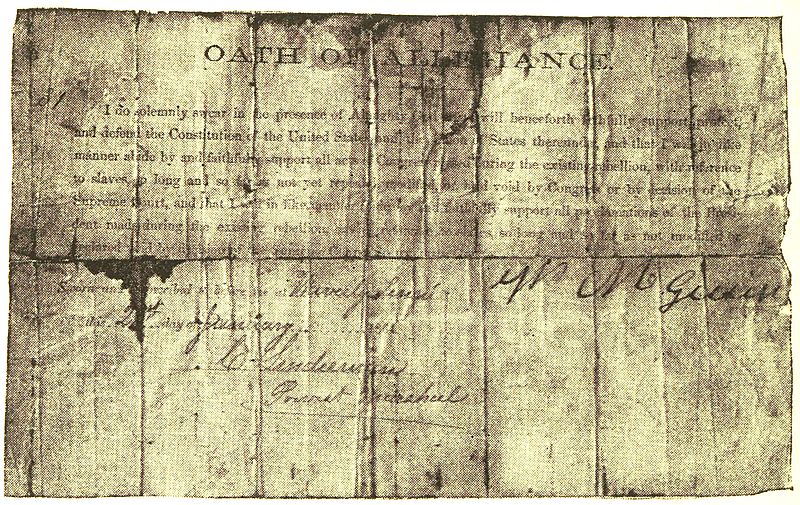
bills, and an oath of allegiance to the U.S.
Government, which he had doubtless used many
times to save his wretched life. The following
is a facsimile of the original document, which I
have kept through all these years—the stains
being those of the man’s blood:—
Making our way back to the house, we discovered
two weeping women, and half-a-dozen
small children. A single question elicited the
fact that the elder of the two was the mother,
while subsequent inquiries proved that the dead
man was the notorious William M. Guin, a nephew
of ex-U.S. Senator Guin, of California, and one
of the leaders of as notorious a gang of cut-throats
as ever operated in the South-West. Our custom
was to burn the houses of any persons found
harbouring these guerillas, but the heartrending
entreaties of the wretched women and children
caused me to leave them unmolested. Some
time afterwards, when peace was finally declared,
I was quartered at Waverley, in the same vicinity,
and often met the unfortunate mother,
who knew me as “the man who killed her boy,”
though, as she told me, she never blamed me,
having often warned her son that he would come
to a bad end.
And now for the other side of the picture.
During these operations, my men were principally
mounted on horses captured from the citizens,
who were invariably rebels; and as our habit
was to take every available animal when found,
the methods adopted to hide them in caves,
ravines, and swamps were sometimes very remarkable.
Upon one of my expeditions at the
time, in the direction of Vernon, on the Duck
River, I came across a fine black horse, which I
speedily confiscated to the use of “Uncle Sam.”
My prize, however, did not long remain in my
possession, for in a few days my quarters were
invaded by a deputation of the fair sex, who presented
me with the following amusing appeal:—
I.
“We write in good spirits to you,
For our glad expectations we hope to find true,
That you’ll act as a gentleman always should do,
And with a request from the ladies comply
Which a fame would attain you that never should die;
While we’ll think of you ever with kindness sincere,
And say of you what it would please you to hear,
And wish for you always a life long and free
From grief and visitation that sometimes will be.
II.
“Now, what must you do these good wishes to gain,
And make us rejoice that we asked not in vain?
Well, a something ’twill be a great boon to obtain
To us who now ask—and a kindness most true
And most earnestly wished for—but to you
It will be what they tell us a victory is—
Quite easy to “Grant,” and we hope you’ll grant this.
III.
“We once (not long since) had a favourite here,
Obedient and gentle, deservedly dear;
He was patient, obeying our will without force,
And he seemed like a friend, though he was but a horse.
How much we esteemed him we never can say,
And Dixie we named him. You took him away!
And sadly and truly we’ve missed him since then—
Oh, captain, do give us poor Dixie again.
If you have conquered one Dixie, be generous here;
Return us the other we all count so dear,
And we’ll say Captain Le Caron (and hold it so too)
Is the very best soldier that ever wore blue.
Your country is famed both in prose and in song;
To its sons truth and justice are said to belong—
Good principle, honour, with bravery too;
Prove now to us, captain, that this is quite true.
Let us have our old friend—you have better by scores,
But to us none so dear can e’er stand at our doors;
None other can seem half so good or so wise,
So worthy our care as he was in our eyes.
You must be enlightened, be generous too;
Give us back our poor Dixie,
Do, captain, please do.
Just say we may have him, that welcome word say,
And your petitioners will evermore pray.
“Mary Barr.
“Cynthia Barr.
“Polly Hassell.
“Mary L. G., a sympathiser.
“Vernon, Tennessee,
“July 1865.
“To Captain Le Caron.”
I naturally pursued the only course which a
soldier could, and surrendered the horse. Strange
to say, one of my lieutenants afterwards surrendered
his affections and future happiness to one
of these fair damsels, and still lives with her as
his wife, surrounded by a charming family, away
out in central Kansas.
III.
In the midst of all my soldiering, I wooed and
won my wife. She is the principal legacy left
me of those old campaigning days of mine, as
bonny a wife and as sympathetic and valuable a
helpmate as ever husband was blessed with in this
world. Many years have gone by since we first
met away in Tennessee, where she, a bright-eyed
daring horsewoman, and I, a happy-go-lucky
cavalry officer, scampered the plains together in
pleasant company. Little thought either of us
then what the future years held in store. Yet
when these years came, and with them the
anxious moments, the uncertain intervals, and
the perilous hours, none was more brave, more
sympathetic than she. Carrying the secret of
my life close locked up in that courageous heart
of hers, helping me when need be, silent when
nought could be done, she proved as faithful an
ally and as perfect a foil as ever man placed like
me could have been given by Heaven. A look,
a gasp, a frightened movement, an uncertain turn
might have betrayed me, and all would have been
lost; a jealous action, a curious impulse, and she
might have wrecked my life; a letter misplaced, a
drawer left open, a communication miscarried, and
my end was certain. But those things were not
to be. Brave, affectionate, and fearless, frequently
beseeching me to end this terrible career in which
each moment of the coming hours was charged
with danger if not death, she tended her family
lovingly, and faced the world with a countenance
which gave no sign, but a caution which never
slumbered.
I had not to wait for these later years, however,
to prove her readiness and resource. These had
been shown me long ere marriage was dreamt of
by either of us, and when, in one of the most
exciting episodes of my military career, she gave
me my freedom and my life. For our wooing
was not without its romance. Our first meeting
was quite a casual one. An officer in charge
of a party of thirty, engaged in scouting duty, I
stopped my little troop one night, in the winter
of 1862, at a house some fifteen miles from Nashville,
Tennessee, in order to rest our horses and
prepare our supper. We selected the house, and
stopped there without any prearrangement. This,
however, was in no way extraordinary. It was
quite the common practice to stop en route and
buy hospitality from the residents. The house
was the property of my wife’s uncle, and here she
lived. While our supper was being prepared, we
chatted agreeably together, and the time swept
pleasantly along, We were in fancied security,
and gave no thought to immediate danger. In
a moment, however, all was confusion. The
house was suddenly surrounded by a band of
irregular troops, calling themselves Confederates,
but in reality nothing more or less than marauders,
and soon the fortunes of war were turned
against us.
Half my little command, fortunately, escaped,
owing to their being with the horses at the time
of the enemy’s approach, and so enabled to take
to flight. The other half, however, with myself,
were not so fortunate. We were in the house,
surprised, and immediately taken prisoners. A
large log smoke-house was improvised for a prison,
and in this my comrades and myself were placed,
tortured with indignation and hunger, as the
riotous sounds which followed proclaimed to us
that our captors were partaking of the supper
which had been originally intended for ourselves.
Our position altogether was anything but a happy
one. Death was very near. Irregular troops like
those with whom we had to deal seldom gave
quarter. If we escaped immediate death, it would
be only to be brought within the Southern line to
be condemned to a living death in prison.
We sat and pondered; and as the probabilities
of the future loomed heavily and darkly before
us, the sounds of revelry in the adjoining house
gradually died away. Our captors, filled with the
good things provided for us, gradually dropped
to sleep, and soon nothing was heard but the
measured movement and breathing of the guard
stationed at our door. In a little time, however,
there was perfect silence, and our watchful ears
detected the absence of our sentry’s person.
Curious but silent we anxiously waited, and soon
heard the withdrawal of the bolt by some unknown
hand. Opening the door, we found the pathway
clear. My brave Tennessee girl, finding the
gang of irregulars all steeped in heavy slumber,
had decoyed our guard away on pretence of his
obtaining supper, and returning, had unbolted our
prison-house, prepared to face the consequences
when the sleeping ruffians awoke. Through her
action our safety was assured, and after walking
fifteen miles, we reached camp in the morning to
join our comrades, who had given us up for lost.
This happened on Christmas Eve 1862; and
it was not until April 1864—sixteen months
afterwards—that I again met the girl who had
done so much for me, and who was subsequently
to become my wife.
The house in which these exciting events had
taken place had meantime been totally destroyed
by the ravages of war, and she was now living
with her aunt in Nashville itself. I was stationed
in camp, there awaiting my examination before a
board of officers for further promotion, and here
occurred the most eventful engagement in which
I ever took part, where, conquering yet conquered,
I ignored all the articles of war and subscribed
to those of marriage, entering into a treaty of
peace freighted with the happiest of results.
IV.
The war was now over and done, a thing of the
past. I was situated in Nashville with my wife
and family, and with my savings, happy in the
enjoyment of the moment, and the pleasant reminiscences
of the past. Henri le Caron, the
agent of the British Government in the camps of
American Fenianism, did not exist, and I had not
the shadow of a conception as to what the future
held in store for me. The future indeed troubled
me not one whit. Looking back, as I do now, upon
all that has happened since then, I am filled with
astonishment as great and sincere as that which
affected the world when I first told my story in its
disjointed way before the Special Commission. It
may be that I am somewhat of a fatalist—I know
not what I may be called—but my ideas, strengthened
by the experience of my life, are very clear on
one point. We may be free agents to a certain
extent; but, nevertheless, for some wise purpose
matters are arranged for us. We are impelled by
some unknown force to carry out, not of our own
volition or possible design, the work of this life,
indicated by a combination of circumstances, to
which unconsciously we adapt ourselves. In such a
manner did I become connected with Fenianism
and the Irish Party in America. For I never
sought Fenianism; Fenianism rather came to me.
I use the phrase Fenianism as one that is
familiar, and requires no explanation from me.
All the world must surely know by this that
almost from time out of mind there has existed
in America a body of discontented and rebellious
Irish known as Fenians, who, working in
harmony with so-called Nationalists in this
country, seek the repeal of the Union between
Great Britain and Ireland. It will, however,
be necessary for me to say something about
the position of Fenianism at this time—I speak,
of course, of the year 1865—in order that what
follows may be quite clearly understood.
Fenianism at this period was in a rather bad
way. Its adherents in America and Ireland were
divided into two hostile camps, and its most
recent effort had been of a very poor and depressing
character. In fact, the division of forces had
been brought about by the failure of this selfsame
effort, an attempt at the emancipation of Ireland,
which is known as “the ’65 movement.” It
was organised by the Fenians in Ireland and
America, under the direction of James Stephens;
and for the purpose of its development very many
officers and men crossed to Ireland from American
soil. The attempted rising, however, proved,
like almost all Fenian efforts, a fiasco. It was
found that Stephens had wofully misrepresented
the state of affairs at home, both as regards
preparation and enthusiasm; and those who had
come from America returned to their homes,
disgusted and indignant at the way in which they
had been sold.
In the result disaffection quickly spread, and
the organisation in America broke up into hostile
camps, the majority, under the leadership of Colonel
W. R. Roberts, revolting from the leadership of
Stephens and Mahoney, and declaring their belief
that “no direct invasion or armed insurrection
in Ireland would ever be successful in establishing
an Irish Republic upon Irish soil, and setting
her once more in her proper place as a nation
amongst the nations of the earth.” Not content,
however, with the situation, the seceders met in
convention in September 1865 in Cincinnati, and
formed themselves into what was known for the
next eventful five years of its existence as the
Senate Wing of the Fenian Brotherhood. They
scoffed at the idea of invading Ireland successfully,
but by no means advocated a policy of
inaction. They simply sought to change the
base of operations. “The invasion of Canada”
became their cry; and with this as their programme
they succeeded in gaining the allegiance of some
thousands of the disaffected Irish, whose support
was attracted by the familiar device of a de facto
civil and military Irish Government upon paper,
framed upon the model of the United States. A
good deal of money was subscribed, and with
funds so obtained ammunition was purchased and
shipped along the Canadian border.
The methods of obtaining money were many
and varied, but none was more successful than
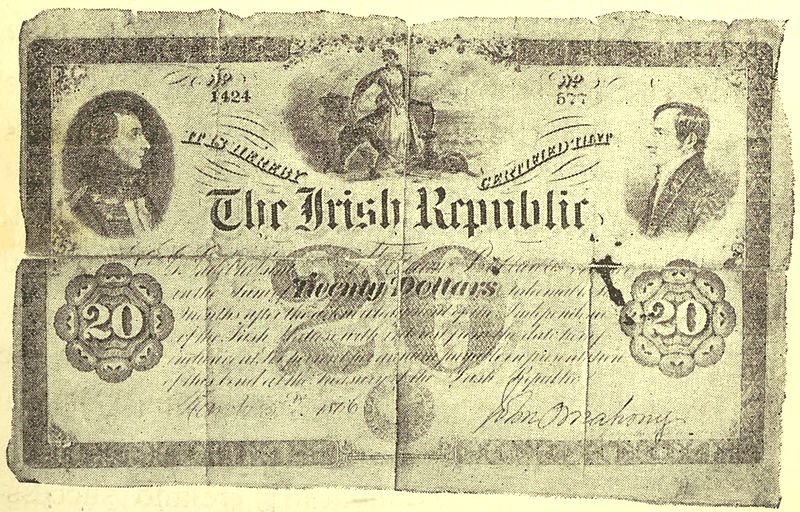
the issue of Fenian bonds. The following is a
reproduction of a twenty-dollar bond in my possession.
These bonds were given in exchange
for ready money to the many simple souls who
believed in the possibility of an Irish republic,
and who were quite ready to part with their
little all, in the belief that later on, when their
country was “a nation once again,” they would
be repaid with interest. Very many of the
persons displaying this credulity were Irish girls
in service in the States, and thus came into vogue
the sneering reference to the agitation being
financed by the servant-girls of New York.
A curious feature of the intended invasion
was the publicity given to the design, and, more
remarkable still, the action, or rather want of
action, of the United States Government in
regard to it. This latter, indeed, was the subject
of very angry comment at the time on the part
of Englishmen resident in the States. It certainly
seemed strange, and passing all comprehension,
that the United States Government,
although in full possession of the facts, and quite
peaceful in its relations with England, could have
permitted the organisation of a raid upon a portion
of English possessions without movement
or demur on their part of any kind whatever.
Yet such is the deplorable fact. From the commencement
of the preparations till five days after
the Fenians had crossed at Black Rock, the
government of President Andrew Johnson did
nothing whatever to prevent this band of marauders
from carrying out their much-talked-of invasion.
Let it not be thought that I exaggerate or draw
on my imagination. I do not. If evidence in
support of my statement be needed, it is to be
found in the speeches made from public platforms,
in open meetings, fully reported throughout the
country at the time.
It was during this period that I was brought
into close acquaintance with Fenianism and its
workings. Strangely enough, it was my army
associations which formed the medium. Through
an old companion-in-arms, the man O’Neill mentioned
above, by whose side I had served and
fought, I learnt, at first casually, and in broken
conversation, what was transpiring in the circles
of the conspiracy. Indignant as I was at learning
what was being done against the interest of my
native country, I knew not how to circumvent
the operations of the conspirators, and did nothing
publicly in the matter. Without my own knowledge,
however, I was to become one of the instruments
for upsetting all these schemes. Writing
as I regularly did to my father, I mentioned
simply by way of startling news the facts I learned
from O’Neill. My letters, written in the careless
spirit of a wanderer’s notes, were destined to become
political despatches of an important character.
Without reference to me, my father made
immediate and effective use of them. Startled
and dismayed at the tidings I conveyed, he, true
Briton that he was, could not keep the information
to himself, but handed over my letters immediately
to John Gurdon Rebow, the sitting
member for Colchester.
Mr. Rebow, fully concurring with my father as
to the importance of my news, proposed that he
should, without delay, communicate with the
Government of the day, to which my father
agreed. In this way my first connection with
the Government was brought about. So keenly
alive to the position of affairs did the Home
Secretary show himself, that he, as I learnt subsequently,
in the most earnest way requested my
father to correspond with me on the subject, and
to arrange for my transmitting through him to
the Government every detail with which I could
become acquainted. This I did, and continued
so doing until the raid into Canada had been
attempted, and attended with failure.
V.
Before proceeding further, I had perhaps better
give some idea of what the raid was like. The
details should prove of interest, if for no other
purpose than that of contrast with those of the
second attempted invasion, of which I shall have
to speak more fully later on. This, which was
the first invasion of Canada by the Fenian organisation,
took place upon the morning of the
1st of June 1866. As I have already stated, the
design had been flourished in the face of government
and people for six months previously. All
this time active preparations were proceeding,
and thousands of stands of arms, together with
millions of rounds of ammunition, had been purchased
from the United States Government and
located at different points along the Canadian
border; while during the spring of the year,
military companies, armed and uniformed as
Irish Fenian soldiers, were drilled week by week
in many of the large cities of the United States.
No opposition was offered to the proceedings;
indeed, John F. Finerty, the editor of the Chicago
Citizen, in a public speech made by him
at Chicago so late as February 5, 1886, declared
with great glee that Andrew Johnson, the then
President of the United States, openly encouraged
the movement for the purpose of turning
it to political account in the settlement of
the Alabama claims. Be the blame whose it
may, however, the result was not unsatisfactory.
The attempt proved a complete failure. The
Fenians were driven out of Canada, sixty of them
killed and two hundred taken prisoners, with the
loss of but six lives in the Canadian ranks. All
the same, however, the unsatisfactory condition
of things I speak of existed, while, to make
matters worse, not a single one of the defeated
invaders was called to account by the United
States for the violation of the Neutrality Laws.
The whole affair, viewed from any but an
imaginative Fenian standpoint, was of a ludicrous
character. The time for the operation was
chosen by the Fenian Secretary for War, General
T. W. Sweeny, then commanding the 16th
United States Infantry stationed at Nashville,
Tennessee. A particular route had been selected,
but when the amount of funds came to be questioned,
the original idea of carrying the men by
steamer to Goodrich, Canada, had to be abandoned
for the less romantic but more economical process
of crossing the Niagara River in flat boats with
a steam tug called into requisition. Under the
command of General John O’Neill, and a number
of other gentlemen of high-sounding ranks, and
distinctly Irish patronymics, the raid actually came
off on the morning of the 1st of June, when about
3 A.M. some 600 or 800 Irish patriots, full of
whisky and thirsting for glory, were quietly towed
across the Niagara River to a point on the
Canadian side called Waterloo!
At 4 A.M. the Irish flag was planted on British
soil by Colonel Owen Starr, commanding the
contingent from Kentucky, one of the first to
land. Unfortunately no Canadian troops were
in the vicinity, and O’Neill’s command, which
had by the next day decreased to some 500,
marched upon and captured Fort Erie, containing
a small detachment of the Welland battery.
Matters, however, were not long allowed to go
in favour of the invaders. In a very little time
the 22nd Battalion of Volunteers of Toronto—a
splendid band of citizen-soldiers—appeared upon
the scene, and at Ridgeway, a few miles inland,
there occurred a fair stand-up fight, in which the
Fenians in the end got the worst of the day’s
work. Ridgeway has frequently since been
claimed by the Fenian orators as a glorious
victory, but without justification. It is true that
at first, flushed with their almost bloodless victory
at Fort Erie, the Fenians advanced fiercely
upon their opponents, and for the moment
repulsed them; but in the end the Canadians
triumphed, and succeeded in putting the invaders
to flight, driving them back to Fort Erie a
frenzied, ungovernable mob, only too thankful to
be taken as prisoners by the United States war
steamer Michigan, and protected from total annihilation
at the hands of the, by this time, thoroughly
aroused and wrathful Canadian citizens.
The following extracts from the official report
made by General O’Neill to Colonel William R.
Roberts, President of the Fenian Brotherhood,
though very highly coloured, admits the defeat:—
“Here truth compels me to make an admission I would fain
have kept from the public. Some of the men who crossed
over with us the night before (i.e., the morning of the 1st of June)
managed to leave the command during the day, and re-crossed
to Buffalo, while others remained in houses around the fort
marauding. (Real Irish patriots these!) This I record to
their lasting disgrace.
“On account of this shameful desertion, and the fact that
arms had been sent out for 800 men, I had to destroy 300
stand to prevent them from falling into the hands of the
enemy....
“At this time I could not depend upon more than 500 men,
one-tenth of the reputed number of the enemy, which I knew
was surrounding me—rather a critical position.
“Thus situated, and not knowing what was going on elsewhere,
I decided that the best course was to return to Fort
Erie and ascertain if crossings had been made at other points;
and, if so, I was content to sacrifice myself and my noble little
command for the sake of leaving the way open.
“I returned to the old fort (Erie), and about six o’clock
sent word to Captain W. J. Hynes, and his friends at Buffalo,
that the enemy would surround me with 5000 men before
morning, fully provided with artillery; that my little command,
which had by this time considerably decreased, could not hold
out long; but that, if a movement was going on elsewhere,
I was perfectly willing to make the old fort a slaughter-pen,
which I knew would be the case the next day if I remained.
“Previous to this time, some of the officers and men, realising
the danger of their position, availed themselves of the small
boats and re-crossed the river; but the greater portion of them—317,
including officers—remained until 2 A.M., June 3rd, when
all, except a few wounded men, went safely on board a large
scow attached to a tug-boat, and were hauled into American
waters.
“Here they were hailed by the United States steamer, which
fired across their bows and demanded their surrender. With
this request we complied, not because we feared the twelve-pounders
or the still more powerful guns of the Michigan, but
because we respected the authority of the United States.”!!!
Thus fought the Irish patriots of 1866. Thus
ended the first Fenian raid upon Canada. Not a
glorious achievement, by any means. Quite the
reverse, in fact. Even the leader of the expedition
himself has to subscribe to failure and defeat.
And yet there have been, and are to-day, men who
boast of all this as a glorious victory, and proudly
vaunt the statement that they were present at and
participated in it.
Lucky it was that the movement was thus
defeated at its very start. If it had not, the
consequences might have been very different
indeed. The news of the temporary victory at
Fort Erie had a wonderful effect, and by the 7th
of June not less than 30,000 men had assembled
in and around Buffalo. The defeat of their
comrades, however, and the tardy issue of Andrew
Johnson’s proclamation enforcing the Neutrality
Laws, left them no opening, and so the whole
affair fizzled out in the most undignified manner.
Undignified indeed it was for all parties concerned.
The prisoners were, without a single exception,
released on their own recognisances, and sent
home by the United States authorities; while the
arms seized by the United States Government,
through General Meade, commanding in Buffalo,
were returned to the Fenian organisation, only to
be used for the same purpose some four years
later.
VII.
On my return to my Western home, I lost no
time in commencing my double life. I organised
a Fenian “circle” or camp in Lockport, Illinois,
and took the position of “centre” or commander
of it, thus becoming the medium for receiving all
official reports and documents issued by O’Neill,
the contents of which documents were, of course,
communicated by me to the Home Government.
I went to work with a will, and was soon in the
very thick of the conspiracy, organised a military
company for the Irish Republican Army, and
eventually attended the Springfield Convention in
the position of a delegate.
While so engaged, I entered the Chicago
Medical College, and commenced my medical
studies in earnest. I was much assisted in this
direction by the kindly help of an old friend, Dr.
Bacon, who had been attached to my regiment in
war times as surgeon. He was then surgeon to
the Illinois State Penitentiary, and through him
I obtained the position created at this time of
Hospital Steward, or, in other words, Resident
Medical Officer in that institution. There was a
comfortable salary attached to the office, which
I found to be in every sense a useful post.
Although, as matters turned out, I was only to
spend some few months there, I gained even in
this short time a vast amount of experience in
almost every branch of medical study.
Life, indeed, in the Illinois Penitentiary gave
me experience in many ways. It brought me
for the first time into direct contact with many
of the evils which then affected official administration.
Things, of course, are different now,
though it must be confessed still anything but
perfect; but when compared with the usages of
olden times, the shortcomings of the present
system are of no account whatever. At the time
of which I speak, money could accomplish everything,
from the obtaining of luxuries in prison
to the purchase of pardon and freedom itself.
Everything connected with the prison administration
was rotten to the core. Corruption
was in every place. The penitentiary contained
some fifteen hundred prisoners, and the whole
management of affairs affecting these men was
vested in three Commissioners, as they were
styled, whose proceedings were of the most
flagrant and jobbing character. So great did the
scandals of their doings become at one period,
that one of the three had to abscond; but so
demoralised was the condition of affairs that no
attempt was made to arrest and bring him back.
These three men had no object save that of
gaining money. They were the proprietors of
a general shop inside the prison, from which the
prisoners purchased luxuries at usurious rates;
and the work of the prisoners themselves was let
out to contractors, who paid heavily for the privilege
of remaining undisturbed in their monopoly.
Everything was turned to money. In one case
I knew of a prisoner, failing to win his cause on
appeal, and having thereby to undergo a period
of seven years’ imprisonment, being offered his
release for a sum of 10,000 dollars, which offer he
refused, stating in the most business-like way that
he would only give 7000. This was not considered
satisfactory, and so the negotiations fell through.
No popular idea of prison life now indulged in
at all fits in with the actual condition of affairs
five-and-twenty years ago. Money was useful for
the purpose of commerce in the Commissioners’
interest, and therefore was allowed free circulation
amongst those confined. Those who could
afford it, and whose cases were not finally decided—appeals
were constantly being heard—were
allowed to board at the Governor’s table, to wear
their own clothes, and in every way conduct
themselves as if in a private house. In those
days the prisoners were not shaved—they wore
their hair and whiskers as they pleased. Those
who could not afford to live the lives of gentlemen
had the store to go to for petty luxuries; and so,
no matter how matters turned, the Commissioners
were the gainers. The Governor, or Warden,
as he was called, was their nominee, dependent
upon them for office; and everything was governed
by their wishes and desires.
In such a vast assembly of criminals there
were many whose characters and careers formed
subjects for very interesting study to me. I was
fortunate in being connected with the prison at a
time when some more than usually clever and
facile scoundrels were temporarily resident there.
Towering head and shoulders over the whole
crowd was that king of forgers, Colonel Cross,
perhaps the most daring, successful, and expert
penman of our time. About forty years of age at
this period, a man of fine commanding presence,
splendid diction, and gentlemanly demeanour,
Cross attracted me from the first day I was
brought into contact with him. The son of one
of the most prominent Episcopalian clergymen in
the United States, he was possessed of a wide
classical education, and discoursed with intelligence
and wondrous fluency on theology, medicine,
and every kind of science.
He was no ordinary criminal. Even in prison
he commanded admiration from his fellows, and
I was often amazed to see how respectful were
the salutations accorded him as he moved
about. He boasted, I learned afterwards with
truth, that he had never robbed a poor man;
and, strange being that he was, he had borne
almost all the cost of the education of his
brother’s children. Indeed, at the time I met
him, he was educating in the most expensive
manner a poor little girl whom, in a moment of
generous caprice, he had adopted as his daughter.
When I was first brought into contact with
him, Cross had his case before the courts on
appeal, and, pending the decision, he was living
in the most expensive way in prison, boarding
at the Governor’s table, dressing in the most
fashionable way, and smoking the best of cigars.
Having no work to do, he interested himself in
the affairs of his fellow-prisoners; and so clever
and capable was he, and so great a knowledge of
law did he possess, that he succeeded in preparing
the cases of many of them for appeal in such a
way as to allow of their regaining their liberty.
I had not been in the prison very long before
he appealed to me to take him as my assistant
in the hospital; and attracted by the man as I
was, I acceded to his request, to discover subsequently
that I had a most valuable attendant,
whose knowledge of medicine was both extensive
and practical.
VIII.
The career of Cross would supply material for a
most exciting novel. He always went in for
“big things,” as he phrased it. Nothing troubled
him more than the fact that he was then undergoing
punishment for a small affair which he
contemptuously referred to as being too paltry
altogether for association with him. Perhaps the
“biggest thing” he ever did was the forgery of a
cheque for £80,000 in Liverpool, and his escape
with the booty. Like many other talented criminals,
if he had but turned his ability to proper
account, he would undoubtedly have won a place
and name in the foremost ranks of honest men
to-day. He planned his enterprises with the
most consummate care, and worked them out for
months before reaching the final stage. An illustration
of his method was very well afforded by his
forgery on the Park National Bank of New York.
Determining to commit a forgery on this bank,
he set to work to obtain the needful introduction
and guarantee for his accomplice, who should
eventually present the forged cheque. He, by
the way, never presented a forged cheque himself—this
was always the work of an accomplice.
In order, therefore, to obtain the introduction to
the bank, he opened some business with a certain
firm of brokers in Wall Street who happened to
“deposit” at the particular bank in question. In
this way he ran up an account for a respectable
sum, to obtain the repayment for which he one
day went to the office in Wall Street accompanied
by one Simmons, the accomplice in the future
forgery. The cheque—a draft for twelve hundred
dollars—was duly drawn, when Cross asked his
friend Simmons to go to the bank to cash it,
requesting in a free-and-easy way that the broker
might send one of his clerks with him to identify
Simmons, he being a stranger. No suspicion
was indulged in—there was no ground for such,
and the request was willingly complied with.
Simmons, coached by Cross beforehand, had
a hundred-dollar bill in his pocket, the use for
which will be apparent in a moment. When the
clerk and he reached the bank, the necessary
introduction took place; and in reply to the usual
question how he wished the money, Simmons
replied, “In hundred-dollar bills.” As the clerk
counted the notes, Simmons drew his bill out of
his pocket, and mixing all up as he stood aside
to check his payment, he recalled the clerk’s
attention by the announcement that he had given
him thirteen instead of twelve bills. The clerk
indignantly protested he had made no mistake.
Simmons, playing the rôle of honest man, became
distressed, the manager was appealed to, one of
the notes eventually received back, and Simmons
retired, the recipient of most fulsome thanks, his
character and reputation fully established in the
minds of the banking officials. Of course the
clerk was one hundred dollars to the good at the
end of the day, but Simmons’ claim to honesty
in no way suffered by the fact, as no one for a
moment thought of a plot.
Content to lose the hundred-dollar bill, in the
promise of things to come, Cross continued his
legitimate traffic with the brokers, Simmons, on
the most friendly terms at the bank, cashing the
cheques, which increased in amount as the time
passed. Months had passed, and nothing of an
illegal nature had been attempted, when at the
end of the fifth month a genuine cheque for thirty
dollars was by Cross changed to 30,000, and
cashed by Simmons without the slightest hesitation
or suspicion at the bank, both Cross and
he escaping with the booty.
Many and varied as were Cross’s tricks with
his pen, none was more daring or successful than
that which led to his escape from Sing-Sing
Prison, that famous home of criminals in New
York. Obtaining through outside agency a
printed and properly headed sheet of note-paper
and envelope from the Governor of the States’
Office at Albany, he actually forged the order for
his own release, had it posted formally from Albany,
and, on its receipt, obtained his freedom without
provoking the slightest suspicion or inquiry.
I am glad to say that Colonel Cross still lives,
and is now working out an honest existence under
another name in the north-west of America.
My life at the Illinois Penitentiary was crowded
with incidents, and little leisure was left me.
Where real sickness did not exist, shamming and
malingering in their most ingenious phases were
resorted to. I was amazed at the talent brought
to bear upon their attempts to escape work by
those with whom I had to deal. Some of the
methods adopted were simply marvellous in their
conception and execution. A more quick-witted
lot of men it has never been my fate to meet.
Every twist and turn of daily life was subordinated
to the needs of the trickster, and not one single
daily incident seemed to be without its possibility
of application, either to assist in the attempt to
shirk work or to escape from imprisonment altogether.
Nothing in this way impressed me more
than the case of a man known as Joe Devine,
an eminent hotel sneak thief, some two-and-thirty
years of age, and of very distinguished appearance.
It happened that one afternoon about five
o’clock a negro prisoner died of consumption.
It was the practice to bury the dead immediately
the coffin was made ready; but, owing to the fact
that the coffin in this case was not ready till after
the prison gates had been locked for the night,
the burial had to be postponed till the following
morning.
Under the circumstances, I arranged that the
coffin with the body enclosed should remain for
the night in the prison bath-room. This Joe
Devine of whom I speak happened to be in
charge of the bath-room at this period, and it
therefore became his duty to see that proper
arrangements were made for the disposal of the
coffin for the night. Early the next morning, as
was customary, Devine and some of his fellow-prisoners
were allowed out of their cells some
little time before the others, in order to prepare
the bath-room and other places for their use.
With assistance Devine unscrewed the coffin,
took the dead negro out, and concealed himself
in his place, not, however, before he had worn
down the thread of the screws in the lid, so that
they could be thrust out with a heavy push from
the inside. The time for the funeral arrived in
due course, and the coffin was removed in a little
cart accompanied by two prisoners whose time
was nearly expired, and who were therefore trusted
outside the gates of the prison (being known by
the name of “trusties”), together with the clergyman
of the jail.
Nothing happened till the grave was reached,
when Devine, presumably concluding that it would
be dangerous to remain longer where he was,
burst the lid of the coffin and jumped out, immediately
starting off at a run. The clergyman and
“trusties” being too horrified to offer any resistance,
he escaped without molestation. The first
I heard of the matter was on the return of the
clergyman and the “trusties” with the news that
the man had come to life; but, as they explained
in their horrified way, he was white, not a nigger!
The roll was called, and Devine was missing; so
we concluded he was the white man in question.
We then set to work to find the corpse of the poor
negro. For two hours the prisoners searched up
and down without any result. Eventually, however,
the body was discovered underneath a pile
of towels in one of the box-seats of the bath-room,
the corpse being doubled up in two, the head and
feet meeting, in order to permit of its being concealed
in its narrow hiding-place.
Another escape equally effective, for the moment
at least, was that of a man known as Bill Forester,
a notorious bank robber, and one of the suspected
murderers of Nathan the Jew, whose death in
New York created a profound interest at the
time. Forester, fortunately for himself, selected
as his medium of exit one of the many boxes
employed by Mack & Co., contractors for shoe-making,
who employed some four hundred of the
convicts. Surrounded and hedged in between
boots and shoes, in one of the large boxes used
for their transport, Forester passed through the
prison gates in one of Mack’s vans, and not
till he had got a distance of a mile and a half
from the jail did he venture to emerge from his
hiding-place. His liberty, however, proved to
be only of a temporary character, for, caught in
another State a little later, the enterprising burglar
was again arrested, and carried back to the Penitentiary
to complete his term of imprisonment.
His method had many imitations. None was
more novel or disastrous than that employed by
a fellow-convict whose name I cannot at the
moment recall. This poor fellow hit upon the
ingenious idea of getting out of durance vile
inside a load of horse-manure, and when the load
was half-way packed, he lay at full length with a
breathing space arranged, while the remainder
of the loading was completed. His intention, of
course, was to be freed from his uncomfortable
position within an hour, when the manure would
be discharged at the quay adjoining the prison.
To his horror, however, he discovered, when the
cart reached the quay, that a gang of fellow-convicts
were engaged unloading a boat under
the charge of armed wardens or sentries. To
attempt escape meant instant death, and there
he lay for hours with the heavy weight of the
upper portion of the cart’s load pressing upon
him. Six o’clock came and with it the return
of the men and sentries to prison. Through the
long weary hours of the night the poor fellow lay,
unable now to move from the consequences of
his continued prostration in the manure; and
when the morning arrived he was found but too
willing a captive. He was immediately placed
under my charge, but his recovery proved by no
means a rapid affair.
IX.
In the midst of all these exciting incidents of
prison life, I received a telegram from O’Neill
in New York, as follows: “Come at once, you
are needed for work.” To comply was to surrender
my pleasant and interesting position, and
to lose for the moment all chance of pursuing my
medical study. On the other hand, however,
the opportunity of doing good service to my
native land presented itself. I did not hesitate.
Communicating immediately with the “Warden”
or Governor, I resigned my position, much to
his disgust. He sought an explanation. I could
give none. He offered an increased salary. I
was unable to explain why even this could
not tempt me, and so I left in a way which
was misunderstood, and under circumstances
which, by the very reason for their existence,
could not be appreciated.
Hurrying to New York, I soon presented
myself in person to O’Neill at the headquarters
of the Fenian Brotherhood, then situated in
the mansion at 10 West Fourth Street. Here
I found the President of the Brotherhood, surrounded
by his staff of officials, transacting the
duties of their various positions with all the
pomp and ceremony usually associated with the
representatives of the greatest nations on earth.
I was not long left in suspense as to what was
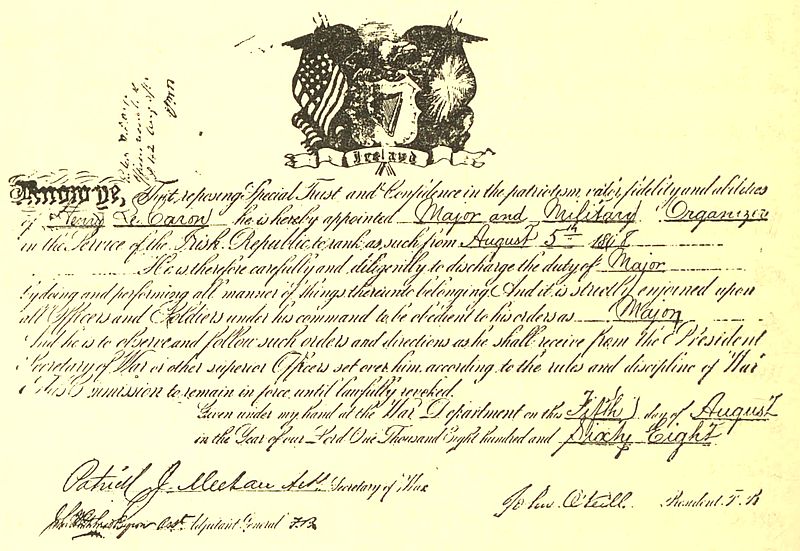
required of me. Commissioned at the very
outset as Major and Military Organiser of the
Irish Republican Army (at a salary of sixty dollars
per month, with seven dollars per day expenses),
I was instructed to proceed to the Eastern States
in company with a civil organiser, in order to
visit and reorganise the different military bodies
attached to the rebel society. To my unhappy
amazement, I learned that I was, while engaged
on this work, to address public meetings in support
of the cause, and my miserable feelings were
accentuated by O’Neill’s desire that I should
accompany him, the very evening of my arrival,
to a large demonstration being held at Williamsburg,
a suburb of Brooklyn. I was in a regular
mess, for if called on to speak—as I feared—I
should be found absolutely ignorant of Irish affairs.
There was nothing for it, however, but to keep
a brave face, for I had undertaken my work, and
in its lexicon there was no such word as fail.
The evening came, and with it our trip to
Williamsburg. On arrival there, in the company
of O’Neill and some brother officers, I found
several thousands of persons assembled. We
were greeted with the greatest enthusiasm, and
given the seats of honour to the right and left of
the chairman. My position was a very unhappy
one. I was in a state of excessive excitement,
for I greatly feared what was coming. Seated as
I was next to O’Neill, I could hear him tell the
chairman on whom to call, and how to describe
the speakers; and, as each pause took place
between the speeches, I hung with nervous dread
on O’Neill’s words, fearing my name would be
the next. The meeting proceeded apace; some
four or five of my companions had already spoken,
and I was beginning to think that, after all, the
evil hour was postponed, and that for this night
at least I was safe. Not so, however. All but
O’Neill and myself had spoken, when, to my
painful surprise, I heard the General call upon
the chairman to announce Major Le Caron. The
moment was fraught with danger; my pulses
throbbed with maddening sensation; my heart
seemed to stop its beating; my brain was on fire,
and failure stared me in the face. With an almost
superhuman effort I collected myself, and as the
chairman announced me as Major M‘Caron,
tickled by the error into which he had fallen, and
the vast cheat I was playing upon the whole of
them, I rose equal to the occasion, to be received
with the most enthusiastic of plaudits.
The hour was very late, and I took advantage
of the circumstance. Proud and happy as I was
at being with them that evening, and taking part
in such a magnificent demonstration, they could
not, I said, expect me to detain them long at
so advanced an hour. All had been said that
could be said upon the subject nearest and dearest
to their hearts. (Applause.) If what I had experienced
that night was indicative of the spirit
of patriotism of the Irish in America—(tremendous
cheering)—then indeed there could be no fears
for the result. (Renewed plaudits.) And now I
would sit down. They were all impatiently waiting,
I knew, to hear the stirring words of the
gallant hero of Ridgeway, General O’Neill—(thunders
of applause)—and I would, in conclusion,
simply beg of them as lovers of liberty and
motherland—(excited cheering)—to place at the
disposal of General O’Neill the means (cash)
necessary to carry out the great work on which
he was engaged. This work, I was confident,
would result in the success of our holy cause, and
the liberation of dear old Ireland from the thraldom
of the tyrant’s rule, which had blighted and
ruined her for seven hundred years.
These last words worked my hearers up to the
highest pitch of enthusiasm, and amidst their
excited shouts and cheers I resumed my seat,
with the comforting reflection that if it took so
little as this to arouse the Irish people, I could
play my rôle with but little difficulty. And as
time passed on, and my experience widened, the
justice of the reflection was fully assured. With
a little practice and scarce any labour, save that
necessitated by the use of a pair of scissors
and some paste, I succeeded in hoodwinking the
poor and deluded, together with the unprincipled,
blatant, professional Irish patriots.
Before, however, starting on my travels as
organiser, I had an experience which went far to
justify all I had previously thought and heard as
regards the part played by Andrew Johnson in
connection with the first Canadian raid. I recall
the incident as important, as showing to what extremes
American political exigencies have carried
men in catering for the Irish vote in America.
About American politics generally I shall have
something to say later on; but as this matter fits
in chronologically here, I think it better to deal
with it now. Johnson, it must be remembered,
was not by any means a man above suspicion.
In 1868, so great was the disaffection with his
administration of the Presidency, that he was
impeached, though unsuccessfully, by the Senate.
ALEXANDER SULLIVAN
It was in this year—1868—that, at O’Neill’s
request, I accompanied him to the White House
to have an interview with Johnson. O’Neill and
he had been personal friends from ’62, when
Johnson had acted as Military Governor in
Tennessee. The precise object of our visit was
the securing of Johnson’s influence in the return
of the arms to the Fenian Brotherhood, previously
seized by the American Government. It will be
remembered that I mentioned, some pages back,
that every gun taken by the United States
Government, after the first raid in 1866, was
returned to the Fenian organisation by this
government under a promise, only made to be
broken, that they should not be used in any
unlawful enterprise; and in consideration of
certain worthless bonds.
Our reception at the White House was a
cordial one, O’Neill’s distinctly so. During the
conversation the President used some remarkable
words. So strange did they sound in my ears,
that they impressed themselves upon my memory,
and are even now fresh in my recollection.
“General,” said Johnson, addressing O’Neill,
“your people unfairly blame me a good deal for
the part I took in stopping your first movement.
Now I want you to understand that my
sympathies are entirely with you, and anything
which lies in my power I am willing to do to
assist you. But you must remember that I gave
you five full days before issuing any proclamation
stopping you. What, in God’s name, more did you
want? If you could not get there in five days,
by God, you could never get there; and then,
as President, I was compelled to enforce the
Neutrality Laws, or be denounced on every side.”
Such was the language used, such the position
assumed, and such the apology tendered to the
Fenian leader of 1868 by the President of the
United States Government. Can any comment
of mine point the moral and adorn the tale of all
this better than the incident itself can do when left
in its naked and startling significance? I think not.
XI.
It was during the autumn of 1868 that, in the
course of my travels on behalf of the organisation,
I first met Alexander Sullivan. Alexander
Sullivan is a well-known man to-day, but if by
any chance his identity has to be marked, little
else need be mentioned beyond the words, “The
Cronin affair.” He was a young man then, but
then as now he was the same Alexander Sullivan,
clever, unscrupulous, careful only of himself, subordinating
everything to his personal ambition,
using Irish politics as a stepping-stone to advancement
in American affairs, and reckless who or
what suffered if but he did succeed.
The “Arch Fiend” of Irish-American politics,
as he has been dubbed, and the alleged chief conspirator
in the brutal murder of Dr. Cronin, is no
ordinary man; he is an individual with a history,
and that not by any means a creditable one. The
son of a British pensioner, born in Canada some
forty-five years ago, he left that country under a
cloud, and settled down in Detroit, where he
started a boot-and-shoe store in the Bresler
Block, Michigan Avenue. On the night of the
12th May 1868 a fire totally destroyed his shop
and its contents. The occurrence had its suspicious
features, and Sullivan was arrested on a
charge of arson. Although the over-insurance
of his goods and other questionable proceedings
were proved at the trial, he gained his liberty
through an alibi, sustained by the evidence of
Margaret Buchanan, a teacher in the public
school of Detroit, who afterwards became his
wife. A man, as I have said, of stirring ambition,
he had from the outset of his career
in Detroit taken a prominent part in political
affairs, and his status as an Irish leader (he was
then a State “Centre” for Michigan) lent his
position and views a certain importance. He
took an active part in the then pending national
campaign upon the side and in the interests of
General Grant and Schyler Colfax, who in that
year were nominated as the respective Republican
candidates for President and Vice-President of
the republic.
It was at this time that Sullivan commenced
his political tricks in the manipulation of the Irish
vote in American party interests, and it was in
consequence of his action in this respect that I
was first brought into contact with him. Previous
to this date, the Irish vote had been almost
exclusively Democratic; but, from the loud and
frequent complaints which reached headquarters,
Sullivan was found to be using his influence in
the organisation for political purposes, and seeking
to bring about a change of policy in the
organisation itself, which threatened a serious
schism amongst our members.
I was despatched by the President to Detroit
in order to investigate the case, and if possible
settle the difficulty. I found ample proof of
Sullivan’s guilt of the charges alleged against
him, and, after repeated interviews between us,
he agreed that the best thing he could do would
be to hand in his resignation as State “Centre”
of the Brotherhood, which he accordingly did.
My intercourse with him at this time left no
doubt on my mind as to his great ability. His
line of defence was an exceedingly clever one,
and is well worth recording here, as showing how
in these early days Sullivan had carefully mapped
out his policy in regard to Irish affairs, and their
connection with American matters. He contended
that, in all he had done, he had had the
best interests of Ireland at heart. He did not,
he said, consider that the Irish people in America
had ever occupied the position in the body politic
to which they were fairly entitled. The Irish
vote, argued he, had been hitherto solidly cast
for the Democratic party. Only a division of that
vote would cause them to be a potent power in
politics. With that position and influence to
which they were entitled assured to them, they
could make terms with the American Government
for the cause of Ireland.
The history of the past twenty years shows
how cleverly Sullivan worked out these views of
his, and gained acceptance for them at the hands
of his fellow-patriots. The pity of it is, however,
that in the result Ireland has gained not at all,
while Irish patriots like Sullivan and Egan have
filled their pockets and reaped their harvests in
Chili and elsewhere.
Sullivan’s immediate reward was his appointment
as United States Collector of Internal
Revenue at Santa Fé, New Mexico. His resignation
of his official position in the Brotherhood
had come too late; his work bore fruit in the
Presidential election, the vote was split, and so
he earned his wage. It is worthy of note that
this was the first time the Irish vote was split,
and that Sullivan was the primary cause of it.
Ever since the vote has so remained, to the
advantage of the Irish leaders of both sides, who,
in the scramble for office, barter the adhesion of
their followers in the public market-place.
Santa Fé, however, did not hold Sullivan long.
His shady methods compelled him to make an
inglorious exit; and so he was to be found in the
year 1873 working with his wife, née Buchanan, in
a reporting capacity on Chicago newspapers.
Here for the present, however, I must leave
Sullivan. I have dealt thus fully with the man
at this early stage, because of the strange influence
he from this time forth wielded over Irish
politics in America; and in order to properly
represent his character, I have somewhat anticipated
events in his life which are far ahead of the
time with which I am at present dealing. I have
done so advisedly, for Sullivan will play a large
part in the chapters to which I must now proceed.
Where his personality will not thrust itself
upon the scene, his shadow will darken every
act and incident. From this time onward, for a
period of twenty years, I used the man as my
dupe. Feeding his vanity, assisting his ambition,
helping him in the hundred and odd ways in which
it was possible for me to do, I gained his friendship
and his confidence to such an extent, that no
man in the whole course of my career in the Secret
Service proved a more valuable, albeit an unconscious,
ally than he.
XIV.
The year 1869 saw O’Neill still at the helm of
Fenian affairs, and large sums of money rolling in
to the coffers of the organisation; although, as
always the case with Irish movements, dissensions
reigned within the ranks. The Stephens section,
now presided over by John Savage, who had
succeeded John O’Mahony, was constantly
attacking the Senate wing, and many and bitter
were the feuds which raged. In my position as
Inspector-General of the Irish Republican Army,
I was fully engaged in my old work of inspecting
the companies, and directing the location of arms
along the Canadian country for coming active
operations. In this way I distributed fifteen
thousand stands of arms and almost three million
rounds of ammunition in the care of the many
trusted men stationed between Ogdensburg and
St. Albans. Some thousands of these guns were
breech-loaders, which had been re-modelled from
United States Government “Springfields” at
the arms factory, leased, and “run” by the
organisation at Trenton, New Jersey. The depôt
from which the bulk were packed and shipped
was “Quinn and Nolan’s” of Albany. Quinn
was a United States Congressman and Senator of
the Fenian Brotherhood; and Nolan, that very
Mayor Nolan so prominently mentioned by Mr.
Parnell in his evidence as one of the eminently
conservative (!) gentlemen who received him in
America. Constantly the recipient of compliments
for the admirable way in which I discharged
my duty, I was now promoted to the office of
Assistant Adjutant-General, with the rank of
Colonel; and my new position enabled me not
only to become possessed of the originals of every
document, plan of proposed campaign, &c., but also
specimens of the Fenian army commissions and
uniforms of the time, which of course I conveyed
to the officials of the Canadian Government.
Successful as I was in evading detection
through all this work, those assisting me in
my Secret Service capacity were not always
destined to share in my good luck. This was
particularly the case on one occasion. I was
at the time shipping arms at Malone, N.Y., and
attended, on behalf of the Canadian Government,
by one of the staff of men placed at my
disposal for the purposes of immediate communication
and the transit of any documents requiring
secrecy and despatch, as well as for personal
protection, should such prove necessary. This
man, John C. Rose, was one of the most faithful
and trusted servants of the Canadian administration,
and for months he followed me along the
whole border. Though stopping at the same
hotels, and in constant communication with me,
no suspicion was aroused, until his identity was
disclosed by a visitor from the seat of Government
at Ottawa to G. J. Mannix, the head-centre
of that Gibraltar of Fenianism, Malone. Men were
immediately set to watch him without my knowledge,
and the fact of his being found always in
my wake on my visits to and return from several
towns led to the belief that he was spying upon
my actions. A few nights after this belief had
been formed, poor Rose, on his return from sending
a despatch from the post-office, was waylaid,
robbed, and brutally beaten, and subsequently
brought back to the hotel in as sorry a plight as
I ever saw. I was immediately advised by my
Fenian friends as to the dangerous character of
this mutual enemy of ours, as he was termed; and
though shocked and embittered by the treatment
accorded to the poor devoted fellow, I had, for
politic reasons, to applaud their cowardly assault,
and to denounce my brave friend, who was bearing
all his sufferings in silence and with a splendid
spirit. For months poor Rose was quite prostrated,
and through this act of my brother Fenians,
I was deprived of the services and co-operation of
as faithful and capable an ally as ever was given me.
In the winter of 1869, the Fenian Senate announced
the completion of the arrangements for
the invasion; and in the month of December the
Ninth Annual Convention was called in New
York. In connection with this convention, I
was called upon to perform a little act which
served to more closely knit the bonds of friendship
between O’Neill and myself, and, if possible,
to obtain for me an even larger share of his confidence
than I had hitherto enjoyed. O’Neill, as
was customary in Irish revolutionary circles, had,
in his capacity of leader, been making free with
the funds of the organisation. In a word, he
had been spending for personal purposes monies
received from the circles or camps. Professor
Brophy, the Treasurer, one of the few honest
deluded Irish patriots of the time, refused to cook
the accounts in order to cover the President’s
delinquencies. The books had to be submitted
to the Convention, and O’Neill was in a frightful
difficulty. In his embarrassment he came to me,
and, to my surprise, made a clean breast of the
whole matter. The opportunity was too good a
one to be lost. I advanced the money, and took
his note of hand, thus saving his reputation before
the Convention.
Need I say that money was never repaid me.
Surely not! The only memento which I have of
my dollars is O’Neill’s note of hand, which, as a
curiosity, I have preserved to this date. It is
certainly an interesting document, so I give it
here.
“New York, April 19, 1870.
“$364, 41/100.
“Received from Colonel H. le Caron, three hundred and
sixty-four dollars and 41/100, borrowed money, to be returned
whenever demanded.
“John O’Neill.
“Pres. F.B.”
A council of war followed, and all was now
activity. In view of active operations in Canada,
all monies were called in, and orders were issued
from head-quarters to have in readiness all the
military organisations. The final order was issued
in April as follows:—
“Head-Quarters Fenian Brotherhood,
“No. 10 West Fourth Street,
“New York, February 10, 1870.
“P.O. Box 5141.
“To the Military Officers of the Fenian Brotherhood.
“Brothers,—You have, no doubt, ere this received general
orders No. 1 from General Michael Kerwin, Secretary of War,
F.B. (head-quarters, No. 50 North 12th Street, Philadelphia,
Penna). A strict compliance with the requirements thereof is
hereby imperatively demanded. The success or failure of our
holy cause now depends upon the prompt and energetic performance
of the duties incumbent upon each and all of us,
and upon none does the responsibility rest so heavily as upon
the military officers of the F.B.
“Brothers, if you be so situated that business or family
duties will prevent you from getting your commands in readiness
for active and immediate service, you will please forward
your resignations to the Secretary of War at once, and at the
same time send on the names of persons suitable to take your
places. If you are thoroughly in earnest, you will not hesitate
to give your assistance to those who may be appointed to fill
the vacancies created by your voluntary withdrawal from the
positions to which you have been commissioned.
“Your duty, if circumstances permit, will be to get your men
in readiness at the earliest practicable moment. If you should
resign, this duty will devolve upon your successors. If there
are any arms, ammunition, or military clothing within your
knowledge which can be forwarded to certain points, to be
named hereafter, so inform the Secretary of War, whom you
will address in reply to this circular, and he will, on receipt of
your communications, forward private instructions with regard
to your respective commands.
“Pay no attention to what may appear upon the surface or
in newspapers. We mean fight—speedy fight—and nothing
else, thigin thu?[2]
“Officers receiving copies of Military Oath with this circular
will sign the same in presence of witness, and return to the
Secretary of War.
“Ascertain and report how many of your men can and will
furnish their own transportation, and in the meantime try and
persuade all of them to save enough for that purpose. Military
men should not forget that the civic circles have supplied the
means wherewith to provide breech-loaders, ammunition, &c.
&c. Their liberality in these regards will, to a limited extent,
relieve them from the responsibility of advancing the means of
transportation. They will not, however, hesitate to co-operate
with the military branch of the F.B. in this matter.
“Preserve the utmost secrecy with regard to this circular, and
reply at once. Delay, and you are guilty of neglect of duty!
“Yours fraternally,
“John O’Neill,
“President Fenian Brotherhood.
“Head-Quarters, War Department, F.B.,
“Deckertown, Sussex County, N.J.,
“April 28, 1870.
“General Orders.
“No....
“Commanding officers of regiments, companies, and detachments
will hold their respective commands in readiness to
move at a moment’s notice.
“Officers of circles having no military organisations attached
will immediately take the necessary steps to organise the military
of their neighbourhoods, and forward to this office the names
of officers selected, so that they may be commissioned.
“Commanding officers of companies will get as many men as
possible ready to move at once, leaving to the civic officers the
task of collecting and forwarding—if possible within twenty-four
hours thereafter—those who may not be able to move with
the first detachments.
“Officers and men must avoid the use of uniforms or any
insignia that would distinguish them.
“Officers must not be recognised by military titles, and
officers or men must not speak of Fenian matters while en
route.
“Take no man who is a loafer or a habitual drunkard.
“Take no man who has not seen service, or who has not
sufficient character to ensure his good behaviour en route and
in presence of the enemy.
“Any arms, uniforms, or war material remaining in the hands
of circles must be immediately packed and forwarded to the
points designated in circular of February 19, 1870.
“Hold no communications with any person not authorised
from these head-quarters. All letters relating to military
matters must be addressed to M. Kerwin, Deckertown, Sussex
County, New Jersey.
“Let no consideration prevent a prompt compliance with
this order.
“M. Kerwin,
“Brig.-Gen. and Sec. of War.
“Approved,
“John O’Neill,
“President Fenian Brotherhood.
“H. le Caron,
“Col. and Adj.-General.”
XV.
At this time I was out West, and receiving a
telegram from O’Neill, directing me to meet him
in Buffalo, I hurried thither without delay. I
reached that city only to find that O’Neill had
ordered an immediate movement on Canada, and
that, as he phrased it, “no power on earth could
stop it.” This condition of things startled and
surprised me. His determination in the way of
immediate action was opposed to the decision of
the last council of war, and my chiefs in Canada
would, I feared, be quite unprepared. I at once
telegraphed the authorities at Ottawa, and was
soon in personal communication with their trusted
agents in Buffalo. Fortunately, as matters turned
out, the plan of action was the same as decided
upon at the last council of war, the full details
of which the authorities possessed; and so the
situation was not so complex as I had at first
feared.
The next few days were busy ones. All military
commanders were ordered to report at given
points with their commands; instructions were
issued for the placement of arms by the following
Tuesday, at rendezvous near the line at Franklin
and Malone, and I was appointed Adjutant-General
with the rank of Brigadier-General. We
had quick promotion and brave ranks in the
Fenian army!
On Saturday, April 22, 1870, O’Neill and I
left Buffalo for St. Albans, he full of enthusiasm
and the belief that the Canadians would be taken
entirely by surprise, I laughing to myself at his
coming discomfiture. We arrived at Milton, Vermont,
at daylight on the following morning, to find
that everything was proceeding most satisfactorily.
Prompt action had been taken by those in charge
of the munitions of war, and by the following
Tuesday morning sufficient war material for our
army was ready at the appointed places.
This second and last invasion of Canada differed
in many respects from that of 1866. Then the
raid was loudly advertised for months before it
actually took place. This time everything was
different. Secrecy (as it was supposed) covered
every move and intention. Had not the Canadian
authorities been fully advised, the results,
under the circumstances, would have been undoubtedly
serious. There was another important
feature about this second raid, and that was its
preparedness. Matters in connection with the
first affair had been of a very happy-go-lucky
character. Now the services of a number of
ex-military men of undoubted ability had been
secured, and war material for at least twelve
thousand men was actually on the ground.
O’Neill’s ideas may be set forth in very few
words. The chief object he had in view was to
obtain possession of Canada, not as the permanent
seat of an Irish republic, but as the
only vulnerable point of attack—the base for
operations against England. His theory was
that the Fenians needed the ports and shipyards
of the Dominion from which they could despatch
privateers to prey upon English shipping. By
the possession of territory he anticipated they
could claim and obtain the rights of belligerents
from the United States. In this event he held
the promise of many men, eminent on the side of
both North and South during the War of Rebellion,
to enroll themselves under the Irish banner,
and to command expeditions which it was fondly
hoped and expected would wrest Ireland from
the hands of the oppressor.
His plan was to get across the boundary line
without delay, and then to intrench himself at
a point where his small contingent would form
the nucleus round which a large army and unlimited
support would rally from the United
States. Buffalo, Malone, and Franklin were the
three points from which attacks were to be made.
However, “the best laid schemes of mice and
men gang aft aglee.” O’Neill expected 1000
men to meet him at Franklin on the night of
Tuesday, April 25, 1870. The history of 1866
repeated itself. As was the case then, so now,
only a quarter of the number presented themselves.
By the following morning only 500
had mustered. Every hour’s delay added to the
danger of failure and collapse; and so he feared
to postpone the arrangements any longer. I
viewed the situation with a good deal of equanimity,
for on the previous night all my trusty
messengers had departed, carrying full details
as to the time, exact points of crossing, numbers,
place of operations, &c., to the enemy’s lines.
At eleven o’clock on Wednesday, O’Neill left
the Franklin Hotel to place himself at the head
of the Fenian army, not without hope and confidence,
yet struggling with the disappointing fact
that one-half his men had not arrived. His
chief anxiety appeared to be that the Canadians
would not give him a chance to fight. He misapprehended
the situation on this score, however,
as subsequent events showed.
Hubbard’s Farm, the Fenian camp and rendezvous,
was situated about half a mile from Franklin,
and here all the available “invaders” were mustered.
Arranging them in line, O’Neill addressed
them as follows:—
“Soldiers, this is the advance-guard of the Irish-American
army for the liberation of Ireland from
the yoke of the oppressor. For your own country
you enter that of the enemy. The eyes of your
countrymen are upon you. Forward. March.”
And march they did, O’Neill, as he departed
at their head, instructing me to bring to his
support on their arrival a party of 400 men then
en route from St. Albans.
XVI.
Careless of consequences, I waited to see what
would happen. As I stood on the brow of the
hill where our company was situated, the scene
was indeed worthy of my study. Ludicrous as
were many of the elements which went to make
it up, the charm of nature was superior to them
all, and commanded my tribute of respect and
admiration. Right below me was a pretty valley,
down the very centre of which flowed a little
creek marking the boundary of Canadian territory,
and dividing by its narrow course the Canadian
from American soil. A soft pleasant sward sloped
gracefully down from where I stood to its bank,
while on the other side there rose in graceful
outlines the monarchs of a Canadian forest,
overtopped by a rocky cliff standing out in bold
and picturesque relief. The soft sweet breezes
of the spring morning played upon our faces,
while the brilliant sunlight sent its rays flashing
upon our bayonets, and dancing on the waters
underneath.
Nature was in her very best and sweetest mood,
and yet little room for appreciation of her charms
existed in the breasts of those who, sweeping
down the valley’s side beneath me, were seeking,
in their own foolish way, to make “Ireland a
nation once again.” They were a funny crowd.
All were armed, but few were uniformed. Here
and there a Fenian coat, with its green and grey
faced with gold, caught the eye, but only to stand
out in contrast with the surrounding garments of
more sombre hue and everyday appearance. The
men marched with a certain amount of military
precision, for all had received some degree of
military training. At last they reached the little
wooden bridge by which the water was crossed,
and deploying as skirmishers in close order, they
advanced with fixed bayonets, cheering wildly.
Not a soul appeared in front. The dark Canadian
trees hid from their view the ambushed Canadian
volunteers; and, fixed in their belief that nothing
was known of their coming, they advanced in a
spirit of effervescent enthusiasm. But not very
far, however.
A few paces, and on their startled ears came
the ringing ping, ping, of the ambushed rifles, as
the Canadians poured a deadly volley straight into
their ranks. Utterly taken aback, they stopped,
broke rank, and fled as in 1866, an ungovernable
mob, to return for a moment in order to pour a
volley on their almost invisible enemy, and to
finally retreat up the hill to where I stood, still
under the fire of their adversaries, leaving their
dead to be subsequently buried by the Canadians.
On the slope of the hill was a large structure
known as Richard’s Farm, to which the invaders
retreated and continued their firing, ineffective as
it was.
Seeing that all was over here, for a time at
least, I hurried off to the point where the St.
Albans contingent had by now arrived, and were
arming. The process took some time, and while
engaged in superintending it, I was afforded practical
evidence of the termination of O’Neill’s part
in the fight. Standing in the middle of the public
road where the men were forming into line—it
was now half-past one, the “battle” which I have
just described having taken place about 11.30—I
was startled by the cry, “Clear the road, clear the
road!” and almost knocked down by a furiously
driven team of horses, to which was attached a
covered carriage. As the conveyance flashed
by me, I caught through the carriage window a
hurried glimpse of the dejected face of O’Neill,
who was seated between two men. I understood
the situation in a moment, but said nothing.
To have given the command to shoot the horses
as they turned an adjacent corner would have
been the work of an instant, but it was no part
of my purpose to restore O’Neill to his command.
I learned subsequently that O’Neill was
in the custody of the United States marshal,
General Foster, who, acting with that precision
so peculiar to General Grant’s administration,
when contrasted with that of Andrew Johnson’s,
had, in consequence of the information
furnished, arrived on the scene of the battle
immediately after I left, and arrested O’Neill
for a breach of the Neutrality Laws. O’Neill,
who was in the company of his comrades, had
at first refused submission, and threatened force,
but on General Foster placing a revolver at his
head, he gave in.
When the news of O’Neill’s arrest reached us
later on in the afternoon, a council of war was held,
presided over by John Boyle O’Reilly, of whom
I have already spoken, the council being held in
a meadow, where we all stood in a circle. Contingents
were hourly arriving, and a strong attempt
was made to get Boyle O’Reilly to take command,
and lead the attack at some other point, but in the
end nothing was done.
Next morning, General Spear, the Secretary
of War of the Fenian Brotherhood, arrived at St.
Albans, and sought to do something practical in
the way of continuing the invasion. Through his
aide-de-camp, Colonel Brown, and subsequently in
person, he appealed to me to supply him with
400 or 500 stands of arms and ammunition within
twenty-four hours. Of course, it would never
have done for me to have allowed further operations,
and so I pleaded it was impossible under the
condition of affairs then developed. Thousands
of Canadian troops had arrived on the border,
and the arms being located in places difficult to
get at, they were out of reach for the moment.
Luckily for me, the appearance of United States
troops in the vicinity put any further attempt at
war operations out of the question, for in order to
avoid arrest for breach of the Neutrality Laws,
the Fenians had to disappear with alacrity. I
left this point with the rest of them, and
hurrying to Malone, another of the places
where rendezvous had been arranged, I found a
similar state of things prevailing here, although
the arrest of O’Neill, and the unexpected appearance
of the United States troops, filled the invaders
with dismay, and utter demoralisation was
the result.
XVII.
On Friday, April 27th, under the excuse that I
was going to Burlington to see about O’Neill, I
went round by way of Rouses Point to Montreal.
I was elated with my success, and wanted to
report myself at head-quarters without delay. It
would not, however, have been safe for me to
have gone direct to Ottawa, and so I travelled
in a roundabout way. On the Friday night I
stopped with Judge Coursel, the Commissioner of
the Quebec police, and the following morning took
train to Ottawa. Before my journey concluded,
I found I had been altogether too premature
in my self-congratulations. In fact, that journey
brought me even closer to discovery than
I had ever been before.
Nothing unusual happened till we got to Cornwall,
where there was the usual half-hour’s delay
for dinner. Taking full advantage of it, I was
enjoying a hearty meal, when both my meal and
peace of mind were disturbed by an unlooked-for
incident. Struck by an unusual commotion at the
door of the dining-room, I looked round to find
advancing towards me two men, one remarkable
for his tall military appearance, and the other for
his clerical attire. All eyes were turned upon
them, and as I ceased eating for the moment to
look up, I heard the clerical-looking person say,
as he pointed his finger towards me, “That is the
man.” Advancing, the tall man, who subsequently
turned out to be the mayor of Cornwall, speaking
with a Scotch accent, said, “You are my prisoner,”
accompanying the words with a grasp of my
shoulder. I imagined there was some mistake,
and laughed as I turned to resume my dinner,
asking at the same time what was the matter.
Not a movement, however, disturbed the solidity
of my Scotch friend’s face as he solemnly repeated
the words, “You are my prisoner,” adding, “you
must come with me at once.”
As I learned subsequently, the priestly looking
person was a wandering preacher, who had happened
to be in the vicinity of Malone when I was
locating arms there, and I had been pointed out
to him then as the leading Fenian agent. His
memory was a very good one, and he immediately
recognised me when we met again.
Matters were beginning to look serious; but
still I could not comprehend what all this meant,
and being still hungry I said, “But won’t you let
me finish my dinner?” “No,” was the sharp
reply; “come.” “For what reason?” quoth I,
indignantly. “Why am I arrested?” “You are
a Fenian,” came the reply, the words falling
clearly and distinctly on the hushed room, where
those present began to show signs of anger and
indignation towards me. I hurried out with my
captors, and was taken to a room adjoining the
ticket-office, there to have demanded of me my
luggage and my keys, with everything on my
person. I had no luggage save a hand-bag, yet
I had with me documents which would reveal
everything, if made public. My position was
dangerous—distinctly dangerous. The prospect
before me was that of disclosure and imprisonment
amongst a strange people, where I had no
friend. Prompt action was called for, and so I asked
the mayor for a few minutes’ private conversation.
Suspicious, and yet curious, he brought me into
the ticket-office, where we were left alone. Here
I told him the exact situation. It was true, I
said, that I was a Fenian, but also a Government
agent. I was even then on my way to
Ottawa to see Judge M‘Micken. To delay or
expose me would mean serious difficulty for the
Government. Let him send me on to Ottawa
under guard, if he liked, and then he would
prove my statements true. Did he want immediate
proof, then here were my papers, and
there a telegram to Judge M‘Micken, advising
him of my coming, which he himself would
despatch.
My manner must have impressed him, for he
decided to adopt my suggestion, and send me on
by the same train in which I had been travelling
(which had not yet gone, all this occupying but a
few minutes), under the escort of a lieutenant who,
with his Canadian regiment, was then returning
from the scene of the invasion. The details of
my arrest as a Fenian quickly spread amongst
my fellow-passengers, and travelled before me on
the route, and the reception I met with along my
journey was most disagreeable. For safety’s sake,
the lieutenant transferred me to the care of a
sergeant and couple of soldiers, and the carriage
in which we travelled was the sole point of attraction
in the train. Crowding round this carriage,
the infuriated Canadians would hiss and hoot me,
while their cries of “Hang him,” “Lynch him,”
gave me a very uncomfortable idea of what would
happen to me if left alone amongst them. So
careful were my guardians of me, that they would
not even allow me to have the window raised, so
that I might smoke, fearing that in some way I
might take advantage of the open window to
escape. This was really a serious grievance with
me, for they could not possibly have inflicted a
greater deprivation than that in the matter of
smoking. All through my life, even down to the
present time, I have been a great smoker, sometimes
consuming as many as sixteen cigars in the
day, a statement which will probably puzzle some
people who hold that tobacco ruins the nerves.
On reaching Prescott Junction, I found that the
news of my capture—of course my name and rank
never transpired—had created such a sensation that
a special correspondent of the Toronto Globe had
travelled to meet me, in order to find out who and
what I was, and everything about me. He was
doomed to be disappointed, however, for I could
not be got to speak. When, eventually, we
arrived at Ottawa, I found my telegram to Judge
M‘Micken had brought his representative to the
station, and by him, myself and my guards were
immediately conveyed to the police-office, where
the Commissioner was awaiting us. Pretty certain
of my safety now, I was quite prepared to
smile, and really did laugh when brought into
the presence of my friend the judge. Not so
he, however. With proverbial soberness and
solemnity he heard the details of my capture,
received possession of my person, and gave a
formal receipt for my custody. Armed with this,
my guardians left, and then the old man’s genial
kindly nature asserted itself. By his instructions
I remained in his office till nightfall, when, in a
cab under cover of the darkness, I accompanied
him to the club to take up my quarters there for
the night.
In the club the Fenian prisoner of a few hours
previously was made a most welcome guest, and
had an exceedingly good time. My identity being
known to some of the officers who crowded the
club-house after their return from Franklin, I
found myself quite the hero of the hour, and had
most interesting chats over the experiences of the
raid on both sides of the fight. Amongst the
pleasant people whose acquaintance I then made
was Dr. Grant, the physician to Prince Arthur,
who was in Ottawa at that time.
With the following day came arrangements for
my departure for home, and it was decided that,
in order to avoid travelling over the same line
again, I should be driven during the night to Ann
Prior terminus—a distance of some forty miles
from Ottawa—from which place I could take a
branch line to my destination. Fortunate though
I thought myself, my troubles were not at an end.
This trip of mine to Ottawa was a chapter of
misfortunes. As I was on the point of starting,
I discovered that I had not sufficient money to
bring me home. Accordingly, Judge M‘Micken
had to supply me with the needful funds. This,
however, did not prove by any means an easy
thing to do. A cheque was duly drawn, but of
course I could not cash it, and the judge had to
have recourse to a friend. The amount was a
large one—three hundred and fifty dollars—and
it was beyond the resources of the club at the
moment. The services of the club porter therefore
had to be utilised for the purpose of obtaining
the money. Here, unknown to us, seed was being
sown which was to bear evil fruit. The porter
knew, of course, that I was the Fenian prisoner,
although nothing more; and, gossip that he was,
he let out the secret a little later. It became
public property; and the Canadian press published
the fact that an important Fenian had been in
Ottawa immediately after the raid, and received a
very large sum of money from the Government
official with whom he was in communication, adding
that the Fenians must have been nicely duped all
through. This was bringing danger very, very
near to me again; yet, marvellous to relate,
suspicion never rested upon me in connection
with the paragraph. I drove from Ottawa in the
night, got safely home, and was never troubled
further by my eventful visit. But, for a long
time, I treasured very unchristian-like feelings
towards that porter.
XVIII.
With the fiasco at Pigeon Hill, and the equally
inglorious termination of the musters at other
points of the Canadian border, there died out
altogether the idea of attacking and seizing any
portion of Canada. O’Neill, after some confinement,
was brought to trial, and sentenced to six
months’ imprisonment, and the Fenian organisation
literally went to pieces for the time. I had
no thought of its ever reviving again, and so
turned my attention once more to my medical
work, which I had had to completely neglect
from the time of my leaving Joliet and attaching
myself to O’Neill’s staff.
I had scarcely resumed my studies, however,
when a visit from O’Neill on his release showed
me that there was still some fight left in himself
and his comrades. He came to me as a matter
of fact to enlist my co-operation in some work of
a distinctly active character. In explanation of
the position of affairs, he laid before me the
originals of several letters to him from the Rev.
W. B. O’Donohoe, a young priest of Manitoba,
who was at the time acting as secretary for the
notorious Riel. The correspondence gave all
the details of a contemplated uprising of the half-breeds
in the North-West against the Dominion
authorities, and stated, to my amazement and
disgust, that he—this young priest—had received
permission from his Archbishop—Tasché—to
throw off his ecclesiastical garments and take a
part therein.
In conclusion, O’Neill’s assistance and co-operation
in the attempt was sought, and as he put it,
“anything to cripple the enemy” being his motto,
he was only too eager for the fray. He had one
great difficulty, however, and that was the want
of arms. Knowing that a quantity remained in
hiding since the second raid, he had sought to
obtain possession of them, but had been referred
to me as the person who had deposited them with
their present custodians, and without whose permission
they could not be given up. I cheerfully
agreed to let him have 400 breech-loaders and
ammunition, and accompanied him to the points
where they were, for the purpose of their delivery,
but not before I had surreptitiously obtained the
use of the documents, and sent copies to both the
Home and Canadian Governments with full information
as to what was sur le tapis.
O’Neill, in company with a trusted confederate,
J. J. Donnelly, fitted out his expedition, and on
the 5th day of October 1871, after crossing the
line at Fort Pembina, was arrested with his party,
and all his war material seized, in consequence
of the information supplied by me. Riel, thus
deprived of the expected assistance, surrendered
at Fort Garry to Lord Wolseley without firing a
shot. O’Neill and his party having been turned
over to the United States authorities, were, four
days afterwards, tried and acquitted. Strange as
it appears, these men, captured on Canadian soil,
were, by some egregious blunder, handed over
to the United States authorities, and by them
acquitted on the ludicrous technicality that the
offence was not committed on American, but
Canadian soil.
Subsequently O’Neill came back to me and
made my life a burthen. Discredited and disheartened,
he took to drink and went entirely to
the dogs, bringing to the verge of starvation an
affectionate but heart-broken wife, who, once a sister
of mercy, had nursed and grown to love him in a
hospital where he was confined, and, disregarding
all her vows, had in the end married him. Drifting
slowly downward through disgrace and drink,
O’Neill, the once brilliant, if egotistical, Irishman
met a lone and miserable death.
XIX.
On resuming my studies, I decided to enter the
Detroit College of Medicine, and so, taking my
family with me, I settled down there. There
were many reasons for my change of residence,
not the least important of which was that connected
with the unpopularity which I found attached to
me in my old home after my return from the
Canadian affair. O’Neill had many opponents,
and by these opponents I was attacked in company
with O’Neill, and the others engaged in the
affair, for having ruined the organisation by the
premature “invasion” which had taken place.
Therefore, I thought it better to remove to another
quarter where this state of feeling did not
exist, and where my Irish record would be of service
to me in the future. As far as Detroit was
concerned, I fixed upon it because of the desire
of Judge M‘Micken that I should become acquainted
with, and obtain as much information as I
could about, Mackay Lomasney—whose name will
be familiar in connection with the London Bridge
explosion—and others just settled down there.
Lomasney was, in the eyes of the authorities,
an important man; and his subsequent career,
terminating with the attempt to blow up London
Bridge, in which he lost his own life, fully justified
their estimate. He had been engaged in the
’65 and ’67 movements in Ireland, had been
charged with the murder of a policeman and
acquitted, but sentenced to twelve years’ penal
servitude for his work as a rebel, and, with others
whose names will appear later, had been amnestied
in the year 1870. He had now settled down in
Detroit as the proprietor of a book-store; and as
he was known to be a most active revolutionist,
much curiosity was felt as to what he was actually
doing. I formed a very pleasant acquaintance
with Mackay Lomasney, and found him a most
entertaining man. The future dynamitard was at
this time about twenty-eight years of age. Though
of youthful appearance, his face was a most determined
one, and the way in which it lent itself to
disguise truly marvellous. When covered with
the dark bushy hair, of which he had a profusion,
it was one face; when clean-shaven, quite another,
and impossible of recognition. Acting, as he
constantly did, as the delegate from the American
section to the Fenians at home, this faculty of
disguise proved of enormous service, and may
very well have had disastrous effects on police
vigilance. I have seen Lomasney both shaved,
on his return from Ireland, and unshaved, in his
American life; and in all the men I have ever
met, I never saw such a change produced by so
easy a process. I may dismiss Mackay Lomasney
from this point of my story by saying that,
beyond his activity in connection with the establishment
of the Irish Confederation, his movements
gave little ground for apprehension, and,
as far as the Confederation was concerned, its
development proved of very little account.
But, if the Confederation was to accomplish
little, the men who with Lomasney took part
in its initiation were not without their claims
to attention. Foremost amongst them were two
bearing names destined to be familiar in latter-day
politics. These were O’Donovan Rossa and
John Devoy. As both will be found constantly
strutting across the stage of Irish-American affairs
from this date, I will pause here to refer to them
in some little detail.
Jeremiah O’Donovan—the “Rossa” was, he
claims, added in early years as the outward and
visible sign of the alleged fact of his being directly
descended from the Princes of Rossa—was, at the
time of his arrival, one of the most popular men
amongst the Irish in the United States. Sentenced
to imprisonment for life for taking part in
the ’65 movement, he had, according to general
rumour, undergone the severest of sufferings and
indignities in the British dungeons. A strong
current of sympathy set in in his favour in consequence,
and as both in public and private he
lost no opportunity of dilating upon his grievance,
the sentiment was in no sense allowed to waver
or grow weak. The man whose name was to be
so closely associated with dynamite and devilry in
later years, did not at this time suggest by his
appearance the possession of any undue ferocity.
His face, though determined, was yet not without
its kindly aspect, while his love for the bottle
betrayed a jovial rather than a fiendish instinct.
His fierceness, indeed, lay altogether in speech.
Voluble and sweeping in his language, he was
never so happy as when pouring out the vials of
his wrath on the British Government.
Devoy, the notorious author of the “New
Departure,” was at once seen to be a man of
weighty influence. Forbidding of aspect, with a
perpetual scowl upon his face, he immediately
conveyed the idea of being a quarrelsome man,
an idea sustained and strengthened by both his
manner of speech and gruffness of voice. Experience
of Devoy’s character only went to
prove the correctness of this view. Quarrelsome
and discontented, ambitious and unscrupulous,
his friendships were few and far between;
and had it not been for his undoubted ability,
and the existence of those necessities which link
adventurers together, he could never have reached
the prominent place which he subsequently attained
in the Fenian organisation.
With their fellow-prisoners who had been
amnestied, General Thomas F. Bourke, Thomas
Clarke Luby, Edmond Power, and Henry S.
Meledy, together with James J. O’Kelly, late
M.P. for Roscommon, but then a struggling reporter
on a New York paper, Rossa and Devoy
brought the Irish Confederation into existence,
and formed its first “directory” or executive.
They indulged in the wild hope of being able
to gather in all the scattered Irish under one
banner, and to put an end once and for all to
the dissensions and divisions which had so disastrously
affected Irish affairs in the past. They
were disappointed. Not by their unaided efforts
was this to be accomplished. Indeed, the Confederation
was never popular. It was regarded
as a sort of close corporation “run,” as we say in
the United States, in the interest of the exiles,
and, as a consequence, was jealously viewed by
the rank and file. Every effort that could be
made to bring about a fusion was tried by these
men, but without success. Even Stephens himself
was brought over from France and put at the
head of affairs; but his name had lost its charm,
and he had to return to Paris a discredited man.
XX.
While my Fenian friends struggled on in this
way, I looked after my own affairs. Completing
my studies and business in Detroit, I moved
myself and my family to Wilmington, where I
settled down to make a home and secure an
income. I was now a fully fledged M.D., and
so I immediately commenced practising at Braidwood,
a suburb of Wilmington. Success attended
my start, my Irish connection and record bringing
me an amount of patronage almost beyond my
powers of attention. I had given up all idea of
anything definite happening in the way of Fenian
affairs, and turned my attention to local politics.
Here, of course, my Irish friends were again of
use. Failing to obtain a seat on the School
Board, for which I had been nominated, I succeeded
in getting an appointment on the Board
of Health. The office was really a sinecure,
with one hundred dollars a year attached. Not
content with it, I gained the much more lucrative
appointment of Supervisor of Braidwood,
attached to which was a daily fee of 2½ dollars,
and travelling allowances when engaged on
town business. Anybody acquainted with the
American political system, even to a moderate
extent, will know how paying such offices can
be made.
Meantime I had joined the Medical Society of
my State, and assisted in founding the State
Pharmaceutical Society. My activity did not
even stop here, and, in addition, I took a very
active part in bringing about much-needed legislation
on the question of the practice of medicine.
In these days there was no such thing as a State
law regulating the practice of medicine or pharmacy,
and I—let me frankly confess it—as much
for the sake of popularity as anything else, spared
no pains, even going to the extent of “lobbying”
in Springfield, the State capital, in the
interest of legislation on these matters, in which
I was very successful.
Little as I imagined it then, events were at this
time shaping themselves to an end which, frequently
attempted, had never yet been wholly
accomplished by the aspiring leaders of the Irish
in America. This was the bringing together of
all Irishmen at home and abroad into one vast
and perfect organisation. The hour was coming,
and with it the men. Born in comparative poverty
and insignificance, but under an impressive name,
the association now being formed, the great Clan-na-Gael
of the future, was destined to be a powerful,
rich, and far-reaching organisation, healthy of
limb and strong of hand, fated to leave its heavy
mark upon the pages of this half-century’s history.
From small beginnings have come great results.
Away back towards the end of the sixties, there
came into existence one of those temporal societies,
an off-shoot of the permanent conspiracy known
under the name “Knights of the Inner Circle,”
which was joined by many Irish conspirators,
myself amongst the number. With its members
there became associated, in the latter end of 1869,
some three hundred members of the “Brian Boru”
Circle of the Fenian Brotherhood in New York
City, who, in consequence of a political quarrel
over electioneering matters, seceded from their
original body; and by these men, acting in concert
with others under the name of the “United
Irishmen,” what were really the first camps of the
Clan-na-Gael were established.
The V.C. (the cypher was arranged on the plan
of using the alphabetical letters immediately following
those intended to be indicated) had for its
object the same intention which governed the
inception and development of all Irish conspiracy
in America—the freedom of Ireland from English
control by armed force. It was, however, to
differ from its predecessors insomuch as, unlike
them, it was to be of an essentially secret character.
P. R. Walsh of Cleveland, Ohio, known
as “the Father of the Clan,” was the apostle of
this new condition of things, and he, with others
of shrewd and far-seeing minds, argued with great
success, that if one lesson more important than
another was to be learnt from the past history and
miserable fiascos of the movement, it was that no
possible success could be achieved with a revolutionary
organisation working in the open day.
The Irish people, reasoned these priests of the
new faith, had not judgment enough to manage
their schemes for freedom. They revealed their
secrets to the heads of their Church; they were
dictated to by these heads; they feared to obey
their non-clerical leaders; and so were thwarted
the best schemes of the most active workers. A
revolutionary movement must be secret and unscrupulous,
and, to be successful, they could not
enter on the contest for freedom with the yoke of
the Church around their neck.
Language like this reads strangely indeed in
the light of latter-day revelations, and the knowledge
the world now has of Clan-na-Gael priests
and their work. But at the time it was not without
its appropriateness and significance. The priests
at the period of which I write were, neither in
Ireland nor America, the priests of these subsequent
years. Then, as in those days of old,
when religion was paramount and priestly control
salutary and effective, the ban of the Church was
not merely a phrase dangerous in sound, it was a
living dread reality, fearful in its consequences in
the eyes of those who in their lives worked out
that grand old characteristic of the Irish people,
faith in their Church and reverence toward its
rulers. It was reserved for the coming years to
bring to the view of a startled public a people
reckless and defiant of priestly control, because of
the teachings of their atheistic and communistic
leaders, and the self-surrender of all their higher
and priestly functions by those who were content
to be led by, rather than to lead those whose
consciences were their charge and their responsibility.
XXII.
Up to the year 1881, when the administration
of the conspiracy underwent a change, with which
I will deal at its proper time, the Clan-na-Gael
was governed by an executive body (known in
the cypher as F.C.), presided over by a Chairman
elected by the body at the annual conventions,
and a Revolutionary Directory known without
any regard to the cypher by its initial letters R.D.
This Revolutionary Directory was composed of
seven men, three of whom were nominated by the
Executive, three by the Irish Republican Brotherhood
(known as the J.S.C.) in Ireland, and a
seventh selected by the six when appointed. The
Revolutionary Directory was, as its name implies,
a body dealing directly with revolutionary matters,
and it was chiefly characterised by the autocratic
power possessed by its members, about whose
action no detailed information was supplied, and
against whose proceedings there was, in consequence,
no basis for appeal. The names of all
these officers were known only to the delegates
who elected them, and to the Presiding Officer of
each camp, known as Senior Guardian.
To the Executive (or F.C.) was intrusted,
amongst other things, the arrangements regarding
the places and dates for holding the biennial
and annual conventions of the order; and their
decision in this respect was carefully guarded, and
only at the very last moment communicated to
the high officials, in order to prevent any spies or
agents of the British Government from becoming
acquainted with their proceedings. The head of
each subordinate body was informed a week in
advance of the date and place of the convention;
and he was instructed to arrange for the immediate
election of a delegate from his camp. So
close was the secret kept, that the delegate, if
other than the presiding officer, did not know till
the very hour of his starting where he was bound
for. Like convicts, the members were known by
numbers, never by names. Camps (known as
D.’s) were also numbered; and, in order the better
to cover their doings from the outside world, each
camp had a public name by which it was known.
For instance, my own camp was known as the
“Emmet Literary Association.”
During the early years of its existence I was
not a member of the Clan-na-Gael. Although,
as I have stated, I was one of the “Knights of
the Inner Circle,” I did not take any prominent
part in the early days, when the V.C. succeeded,
or rather absorbed it. There were reasons for
my not doing so. My prominence and action in
the ill-fated Canadian raid had not been altogether
forgotten, and I was still held responsible, in certain
minds, for the premature undertaking of it.
Another reason affecting my action was the difficulty
introduced by a clause in the new constitution
in regard to the question of nationality. This
clause read as follows:—
“All persons of Irish birth or descent, or of partial Irish
descent, shall be eligible to membership; but in cases of
persons of partial Irish descent, the camps are directed to
make special inquiries in regard to the history, character, and
sentiments of the person proposed.”
In view of the whole situation, I determined
that I should live down any ill-feeling which
might exist regarding my previous exploits, and
that I should take advantage of the interval thus
brought about by arranging some plan for my
election later, on the ground of my partial Irish
descent. I had, of course, hitherto passed myself
off as a Frenchman, strongly sympathising with
Irish affairs, though never laying any claim to
connection with the country. Now I had to
change my tactics a little, and so I gradually got
it put about that my mother—poor lady, she is
living to-day, and will probably never know till
she reads this of the liberty I took with her
birthright—was of Irish descent. Of course, as
the people out there had never seen or heard of
my mother, and it was quite a common thing for
French and Irish to intermarry, the deception
was not likely to be discovered, as indeed it never
was.
There was still yet another reason for my
being cautious. The most insane and implacable
enemy of O’Neill’s—and through my friendship
for O’Neill, of myself—Major William M‘Williams,
of old Fenian fame, was now high in the councils
of the new organisation. In the O’Neill régime,
presumably jealous of my position, he had denounced
me as an adventurer, and the ill-feeling
he had for me had culminated during the sittings
of a Fenian congress in an open attack, reported
in the New York papers as follows:—
“The Fenian Congress and a Fenian Row.
“The Fenian Congress was in session yesterday. A quorum
of the Executive Committee appointed in Chicago was in session
all day. They say they intend to commence work as soon
as they obtain possession of the munitions of war. Major
M‘Williams and Major Le Caron, two of the delegates, had a
little onset in front of the Whitney House last eve, and blood
might have flowed had it not been for the interference of
several delegates.”
The altercation, I may add, on this occasion
involved the use of revolvers, and created too
pronounced a feeling between us to allow of my
ever after expecting anything but the bitterest
opposition from M‘Williams. To my relief,
however, M‘Williams eventually got into a personal
altercation with a fiercer antagonist than
myself, by whom he was shot in Columbia, S.C.,
being killed on the spot. His exit cleared the
way of the only difficulty which existed at the
time of his death, and so I considered it prudent
to accept the invitation, often extended to me,
to join the Clan-na-Gael. I joined, and an
appointment upon the Military Board of the
organisation quickly followed. It must not,
however, be thought that I had been “out of
things” meantime. Not at all. Possessed, as I
was, of more than one confiding friend, I secured
information about everything that took place.
XXIII.
Slowly but surely the Clan-na-Gael was gaining
ground, despite all the forces arrayed against it.
Triumphing over Church opposition, conscientious
scruple on the score of joining secret societies,
and the single opposing Revolutionary faction
still faithful to the memory of Stephens, it had,
in 1876, a membership exceeding 11,000, which
included amongst its leading names those of
Alexander Sullivan, John Devoy, O’Donovan
Rossa, Thomas Clarke Luby, Thomas F. Burke,
Dr. Carroll, James Reynolds, Frank Agnew,
Colonel Clingen, Wm. J. Hynes, P. W. Dunne,
Michael Boland, Denis Feeley, J. J. Breslin,
Michael Kirwen, and General Millen.
These were the men who in the after years
were to be in the front rank of the Clan-na-Gael,
and by their position and influence to model and
direct the policy of the organisation. Of them
and their position at this time I shall now have
some little to say.
With Sullivan I have already dealt, and here I
need only state that, having established himself
in Chicago, he had taken to the study of law, in
which branch of the profession he was now—in
1876—preparing to practise. He had been maintaining
his questionable reputation, for he had
shot a man in cold blood; and though twice tried,
had been successful in escaping the consequences
of his act, owing to the employing of that process
so frequently charged against the Government
in Ireland—packing the jury. Of Devoy and
O’Donovan Rossa I have also spoken before.
The former, drifting to New York, had since we
parted with him been engaged on some two or
three American papers, and he was now, if I
remember aright, engaged on the New York
Herald staff. Rossa, very much to the front for
the moment, in consequence of his “skirmishing”
theory, had meantime been living on the proceeds
of the fund raised for himself and his fellow-exiles
on their arrival in 1871, and a special subscription
for himself, which Ford inaugurated in the Irish
World. Luby had been a well-known patriot
since 1865, when, in company with John O’Leary
and Charles J. Kickham, he had been sentenced
to a long term of penal servitude for the part he
played in Ireland as one of the editors of the
Irish People. General Thomas Fras. Burke had
served with the Confederate Army, and had been
amongst those who, in 1867, left America to lead
in that most disheartening of fiascos, the Irish
rising of 1865, as the result of his part in which
he was sentenced to death, but subsequently
amnestied.
Dr. William Carroll, one of the principal physicians
in Philadelphia, whose name will appear
prominently in the future, and who stood one of
the sponsors for Mr. Parnell on the occasion of his
arrival in America, was best known as the admirer,
friend, and associate of John Mitchell, and
was himself nothing if not a Revolutionist. James
Reynolds of New Haven, Conn., whom I first
met in connection with the secret organisation,
was by profession a gas- and brass-fitter, and an
avowed advocate of “extreme” measures. He
was in fact a member of the Revolutionary Directory
of this period. Frank Agnew had a Fenian
record extending as far back as the Senate period
of the Fenian Brotherhood. Strangely enough,
I first came in contact with him when, on an inspecting
tour, I had occasion to inspect a Fenian
Company of which he was captain in Chicago.
He was one of those who arrived too late to be
of use in connection with the Fenian raid of ’70.
He was now a contractor of some importance in
Chicago, and a great friend and ally of Sullivan’s.
Of Colonel Clingen I need not say much, save
that he had been an old Fenian ally of mine in
days gone by, and had sat with myself on the
Military Board during O’Neill’s régime.
Of the others I have mentioned, Hynes and
Dunne perhaps deserve the most prominent place,
by reason of the part they have recently played
in the Cronin affair. Both these men, it will
be remembered, came out as very strong opponents
of Alexander Sullivan, whom they roundly
accused of causing Dr. Cronin’s death. Hynes
I knew as far back as 1865, when, as a clerk to
John O’Neill, he took a very active part in the
work of the Fenian Brotherhood. Owing to a
row between O’Neill and himself, he severed his
connection with active Fenianism, and obtained
a clerkship in one of the departments at Washington,
finding his way, after a little time, to
Arkansas. Although returned as a carpet-bag
Congressman for the State, he failed to prosper,
and at last he found himself without a dollar in
Chicago. Here the first man to help him was
Alexander Sullivan, against whom he is now
arrayed. Through Sullivan’s political influence,
Hynes was engaged as professional juryman at
a fee of two dollars a day, from which position
he worked himself forward to that of a prominent
politician and a well-known member of the bar
at which he practises.
P. W. Dunne proved to be a duplicate of
O’Donovan Rossa, in appearance and in many
other ways, with this one strong exception, that,
whereas Rossa never sacrificed any of his means for
the good of his countrymen, but rather lived upon
them in fact, Dunne sacrificed an almost princely
fortune. In early years he had been a prominent
distiller (a very lucrative business) in Peoria,
Illinois; and he was one of the leading seceders
from the Stephens wing of the Fenian Brotherhood,
after the failure of 1865, in which he himself
participated, in company with P. J. Meehan,
editor of the Irish American. He was now situated
in Chicago, occupying the position of Superintendent
of Streets, and had preceded Sullivan and
Clingen upon the Executive of the Clan-na-Gael.
As for the remainder, Boland, once a lieutenant
in the United States Army, was now a practising
lawyer in Kentucky, having meantime taken part
in the ’66 raid on Canada. He was also one of
the most prominent of Clan-na-Gael officials, and
an advocate of extreme measures. Feeley, also
an attorney-at-law, had been a member of the
Royal Irish Constabulary in his early days, and
was now, as of yore, one of the most prominent
and bloodthirsty of rebels in the States. Kirwen
had been Brigadier-General and Fenian Secretary
of War during the Canadian raid of 1870, and had
preserved his Revolutionary record unbroken;
while Breslin, chiefly remarkable for the part he
had played in helping James Stephens to escape
from Richmond prison (Ireland) in 1866, now,
as ever since then, a prominent and avowed
Revolutionist, was occupying his public life in
some municipal office of an important character,
while, in secret, playing his part on the Revolutionary
Directory of the Clan-na-Gael.
One name I have left to the last, and that is
General Millen’s. The discredited hero of the
Jubilee Explosion Scheme of 1887 was at this
time engaged on the editorial staff of the New
York Herald. Unlike almost every one whom
I have named, his military title was neither of
Fenian nor of American extraction. He had,
according to his own account, gained both his military
knowledge and his rank when, out in Mexico
on the part of the New York Herald, he had
thrown in his lot with Juarez prior to the overthrow
of the government of Maximilian and the
establishment of the First Republic, of which
Juarez was President. Be the claims to military
knowledge which he advanced good or bad, they
were accepted with a certain amount of good faith
by the Clan leaders; and his usefulness in this
regard being appreciated, he held a position of
some importance at this time, being in fact Chairman
of the Military Board.
XXIV.
My advent in the organisation, though gratifying
to a certain extent, did not satisfy me as fully as
I wished. I wanted to know everything that took
place on the inner side of the movement, and I found
that, as one of the rank and file, I could really learn
nothing. Accordingly, I set my wits to work to
see how I could accomplish my desire of gaining
such a position as would give me all I wanted.
Very little consideration was needed to show me
that, in a large centre like Chicago, where jealousy
and ambition governed every motive, it would be
impossible for a new-comer to get to the front, and
so I decided to work out my designs in a smaller
and more unimportant place, where internal dissensions
would find little if any home. It will
be remembered that Braidwood was the place
where I had my drug-store, and where I had had
strong evidence of my popularity in my election
as Supervisor by a majority of 103 over my
opponents. In the end, therefore, I determined
to establish a camp in Braidwood, and with the
assistance of the official organiser, a most promising
“camp” was got together, to the Senior
Guardianship or Presidency of which I was
unanimously elected. Sullivan unconsciously
assisted me in my design. It was through his influence,
though at my suggestion, that the official
organiser was sent down in the first instance.
Having once obtained the position, I spared
neither pains nor money to make myself secure
in it. My status and extensive practice as a
doctor permitted of my playing the rôle of the
generous patriot, and there was no subscription
list on which my name did not figure in some
capacity as the patriotic, political, charitable, or
religious friend. The latter was not by any
means the most infrequent, for religion of a
certain type plays a very large part in Irish
politics. Where money and the other arts failed,
then I took to diplomacy. Year in, year out, I
continued president of my camp, though always
at election time asking to be allowed to retire in
favour of some better and more deserving brother.
Of course it was simply a case of “swearing I
would ne’er consent, consenting.”
I was too useful to my brothers of “Camp 463,”
now 204, to allow of their permitting me to retire
to the ranks. If no other reason but the question
of money came in, then this of itself alone would
have been sufficient. When a delegate had to
be despatched to conventions or gatherings elsewhere,
none were more ready to start than I,
while—more important still for the patriots—my
bills for expenses, instead of being of the large
and unjustifiable character usually associated with
such proceedings, could only be got from me under
protest, and with every manifestation of desire to
save them outlay. Of course, this travelling about
from centre to centre, this mixing with many men
from many points, and the opportunities thus
afforded for gaining information and opening
up new sources of supply, admirably suited my
purpose; and by taking advantage of the varied
openings given me, I was enabled to extend my
usefulness as a Secret Service agent to a very
appreciable extent.
Matters, indeed, were satisfactorily situated for
me at every point. As Senior Guardian of the
Braidwood camp, I was in receipt of every document
issued from head-quarters, and through me
many of these found their way to Mr. Anderson on
the English side of the water. My work in connection
with these documents taxed all my powers
of resource; and had it not been for the popular and
trusted position which I held, I could have accomplished
very little in regard to them. A stringent
regulation of the Executive required that all documents—when
not returned to head-quarters, as
many had to be—should be burned in view of
the camp, in order that the most perfect secrecy
should be secured. It was, of course, impossible
for me to retain the originals of those which had
to be returned, and of them I could only keep
copies. With those requiring destruction in the
presence of my camp, I was enabled to act
differently. Always prepared for the emergency,
I was, by a sleight-of-hand performance, enabled
to substitute old and unimportant documents for
those which really should have been burnt, and
to retain in my possession, and subsequently
transmit to England, the originals of all the most
important. I was, of course, shaking hands with
danger and discovery at every turn, and yet so
marvellous was my success that I not only escaped
betrayal, but that which would undoubtedly have
led to it, namely, suspicion.
To this end, I was much assisted by the confidence
reposed in me by my fellow-officials, the
Junior Guardians, who exhibited their trust to the
extent of giving me possession of their keys of the
strong-box, of which they held possession during
their period of office. This contained all the
papers of the camp; and with a view to its safety,
one key was given to the Senior Guardian, and
the other to the Junior Guardian, the locks being
different in construction, so that the box could
only be opened by the concurrence of both
officials. Had I not been able to obtain the
confidence of my Junior Guardians to the extent
of possessing their keys, I could never have
brought my designs to such a successful issue.
Strangely enough, when I appeared in the witness-box
at the Commission—for I was even then
Senior Guardian of my Clan-na-Gael camp—I
had both keys of our strong-box in my possession,
which I jokingly offered to Mr. Houston
as a memento of our strange and unlooked-for
meeting.
XXV.
Meantime, events had been developing themselves
in a strange and unlooked-for way.
O’Donovan Rossa—speaking to the Irish in
America through the columns of the Irish World—had
advocated the establishment of a Skirmishing
Fund in the following style:—
“Five thousand dollars will have to be collected before the
campaign can be started. England will not know how or
where she is to be struck. A successful stroke or any stroke
that will do her 500,000 dollars’ worth of damage will bring us
funds enough to carry on the work: and by working on incessantly
and persistently, the patient dirt and powder shock will
bring out enough perhaps to carry on the war.”
In the same issue of the Irish World, Patrick
Ford, in the course of a commendatory article,
said—
“What will this irregular warfare of our Irish Skirmishers
effect? It will do this much. It will harass and annoy England.
It will help to create her difficulty and hasten our opportunity.
It will not only annoy England, but it will hush her
too. This is what we look for from the Skirmishers. One
hundred dollars expended on skirmishing may cause to England
a loss of 100,000,000 dollars. That would be a damaging
blow to the enemy; and what is to prevent the dealing one of
three or four such blows every year?”
Here I shall drop Rossa and his Skirmishing
Fund for the moment, to say a few words about
Ford. The opportunity seems a favourable one
for dealing with a man whose name has been so
prominent of late years, and clearing up a few of
the many misconceptions which appear to exist
regarding him. Like O’Donovan Rossa, his
colleague at this time in skirmishing matters,
Ford’s position in Irish revolutionary affairs has
been quite misunderstood in British quarters
outside the Parnellite party. As a matter of
fact Ford is not, and never has been, a member
of the Clan-na-Gael. True it is that he was a
member of the old Fenian organisations which
preceded it—as, for instance, the Irish Confederation,
but in the membership of the last and
most powerful of all the branches of the Irish-American
conspiracy, the editor of the Irish
World has had no place. The secret of his
position and influence lies in his paper. This,
from the very moment of its start, has been a
pronounced success, reaching a high-water mark
of influence and circulation, which threw the puny
efforts of its competitors completely into the
shade. The paper came into existence at the
proper moment for itself; it was well edited,
well printed, and splendidly equipped with news
from every quarter, and on every point. It
caught the public fancy and “went” amazingly.
Ford, originally a printer and a man of no mean
attainment, gathered round him a staff of equally
clever writers, established correspondents at every
important centre, and working at very high pressure,
was on the point of failing on several occasions,
only to escape through the assistance of
friends, politicians, or capitalists, willing to oblige
for certain considerations. Indeed, if I am not
very much in error, matters are not in the most
favourable way for the paper at this very time.
Patrick Ford, according to Michael Davitt, is
a most worthy disciple of the Christian principles,
and a man whose life would serve as a model for
very many of those who criticise this dynamite
advocate’s character in no enthusiastic vein.
Speaking of the man simply “on the view” as
the American phrase has it, Davitt’s observations
are not so far-fetched as they would appear
to be at the first blush. In appearance and
manner, the editor of the Irish World is quite
the opposite of the man you would figure to
yourself after reading his dynamite appeals and
exordiums in his own journal. Quiet and unobtrusive
alike in look and speech, he is as mild
a mannered man as ever scuttled a ship. Of
medium height, spare of build and spare of feature,
without any ferocity whatever marking the outer
man, he gives the observer the idea of being a
quiet, sedate, and rather retiring business person.
Although a vigorous and effective writer, he is
not remarkable for his platform utterances, and
while a good talker, is by no means an orator.
Associated with Patrick Ford in his connection
with Irish-American affairs have been his brother
Augustine and his nephew Austin. Augustine,
whose name comes into prominence with Rossa
in the Skirmishing Fund affair, was the publisher,
as distinct from the editor, of the Irish World;
while Austin, then a young fellow, was afterwards
to become a member of the Clan-na-Gael, and to
serve as the medium of communication between
the leaders of the Revolutionary organisation and
his uncle, the editor of what was undoubtedly,
though unofficially, their mouthpiece, the Irish
World. There were many reasons for an
alliance, unofficial though it might be, existing
between the Irish World and those charged with
the conduct of the vast secret conspiracy known
to the initiated as the V.C. For what the Irish
World, with its extended popularity, its great influence,
and its enormous circulation, championed
in public, the Clan-na-Gael worked for in private.
Ford and his fellow-workers, in a different path,
understood each other full well; and when, within
a year after the establishment of the Skirmishing
Fund, it became desirable that the Clan-na-Gael
should take charge of it, there was no more ardent
advocate of the change than he. And as in the
early, so in the later years. When the new
departure came to the front, Ford and his Clan-na-Gael
friends were of the same mind as to its
importance, and the necessity for supporting it.
When dynamite came to be the order of the day,
he was its loud-tongued apostle; and when, later
still, “martyrs” like Brady and Curley suffered in
Ireland the just consequences of their fiendish
part in the Phœnix Park murders, the editor of
the Irish World was first to fill the gap with a
fund on behalf of their families, excluding from its
benefits all connected with those who had had
the good sense, though bad patriotism, to plead
“guilty” to their part in the fell transaction.
XXVI.
To return, however, to Rossa and his Skirmishing
Fund. As a prominent Fenian of “the old
guard,” and a member of the Clan-na-Gael, Rossa’s
influence, backed up by Ford’s advocacy, succeeded
in getting together no less than 23,350
dollars by the 14th March following the issue of
the appeal—in something less than twelve months
in fact. Although, however, this large sum had
been accumulating during this period, and portions
of it had been ready at different times for use if
required, no skirmishing or pretence at skirmishing
had taken place, and some little dissatisfaction
commenced to manifest itself at the non-fruition
of the many promises which had been held out of
“hurting England.” There then occurred the
transfer of the fund to the Clan-na-Gael under
very mysterious circumstances, which have never
been thoroughly explained or understood. The
nearest approach to an explanation was afforded
by a communication from Rossa, which appeared
in the Irish World of the 21st April 1877, which,
I think, I cannot do better than quote here.
“When I started this Skirmishing Fund, the council-men of
the two Irish revolutionary societies in America—the Fenian
Brotherhood and the Clan-na-Gael—took it into their heads
that I was going to interfere with the regular revolutionary
work, that I was going to play the deuce with everything, and
they gave me no friendly help. I have been doing all I could
to convince them that I am not the very desperate character I
was in prison or out of prison; and some six months ago, being
telegraphed to visit a convention of one of those societies, I
went there. I there proposed to receive into the trusteeship
and Executive Council of the Skirmishing Fund one or two of
their body, provided that the one or two meant skirmishing
work such as was laid down in our programme. This proposition
of mine was accepted, and all passed off harmoniously.
“Here is how things stand now:—Mr. James J. Clancy,
who acted as treasurer of the fund, got married a few weeks
ago and ceased his connection with the Irish World. Then
Austin Ford wrote me (on 14th March) the following note:—
“‘I told you that, at a certain Irish convention, I had consented
to admit to the trusteeship of the fund some members
of their body. They gave me several names to select from;
and looking about for men who meant work, I took the names
of John J. Breslin, who rescued the Australian prisoners, and
who was the principal actor in the rescue of James Stephens
in 1865; of Doctor William Carroll, of Philadelphia, who left
his professional business (and being a particular friend of John
Mitchell), came to New York when Mitchell was going to Ireland
two years ago, went on board the steamer to see him off,
went on the steamer with him to Ireland, having no other idea
in his head but to take care of him. The other name I took
was that of James Reynolds of Newhaven, Connecticut. He
is the man in whose name the Catalpa was registered, and he
mortgaged his property to raise $4000, when it was needed at
a crisis in connection with the expedition. Now Mr. Clancy
and Mr. Ford have resigned, I have in connection with these
three men I have mentioned taken into the trusteeship John
Devoy, Thomas Clarke Luby, and Thomas Francis Bourke.’
“Last night Thomas Clarke Luby went to Washington, carrying
with him $17,500 in American bonds endorsed by me,
to have them transferred for safe keeping to the names of
Dr. Carroll, Thomas C. Luby, John Devoy, Tom Bourke,
John Breslin, and James Reynolds.... John O’Mahony
died. It was deemed well to send his remains to Ireland.
There was no money to bear the expenses. I thought I might
trespass on the skirmishing money. I consulted Mr. Ford
and Mr. Clancy about a loan. They said it could be legitimately
looked upon as within the pale of our work, and they
paid me $2030 to defray the expenses. The Clan-na-Gael
and the Fenian Brotherhood have promised to refund the
money.”
No secret was made of the connection which
now existed between the “trustees” and the
“fund,” for a public address was issued “to the
Irish people in the United States,” and published
in the Irish World of the 21st April, containing
the following passages:—
“But since the ‘skirmishing’ project was first announced,
circumstances have greatly altered.... Old Europe is
threatened with a general convulsion. War on the most
tremendous scale cannot much longer be staved off by all the
artifices and subtleties of all the diplomatists in the world.
Russia and Turkey are equally resolute to fight the inevitable
fight.... The rest of the Great Powers of Europe will be
drawn by an irresistible force into the arena. England, above
all, whether she likes it or not, must draw her sword once more
or meanly confess herself a third-class power. She is too
proud of the part to yield her high place without a blow. She
must first be beaten to her knees.
“England’s difficulty then has all but come; in other
words, ‘Ireland’s opportunity.’ Is Ireland prepared to seize
that opportunity?...
“In view of the altered circumstances of the time, ‘big
with fate to us and ours,’ we propose to enlarge the basis of
the ‘Skirmishing Fund,’ established by Rossa, and of the
plans it was intended to further. We propose forthwith to
create a ‘Special National Fund’ to aid the work of Ireland’s
deliverance.
“Action, some may think, has been postponed too long.
Be this as it may, we are determined to lose as little further
time as possible ere we furnish our countrymen with practical
results of our work. But a blow must be followed up by blows.
Unhesitatingly then” (they ask for) “the means to do what may
give heart and inspiration to our brothers at home, and prepare
the way for the last grand struggle.
... “We shall only add that it is plain that ‘the
Home Rule Agitation’ has signally failed to satisfy the yearnings
of the Irish people. The O’Mahony funeral demonstration,
with its deep heroic significance, has exercised the vain misleading
phantom. Every true Irishman in Ireland (and shall
we not say in America too?) once more believes in the old
creed of our gallant fathers—that the sole way to free or
regenerate Ireland is by total separation from England; and
that total separation can only be achieved by desperate sacrifices,
daring enterprises, and the strong hand.
| “John J. Breslin, |
} |
|
| “Thomas Clarke Luby, |
} |
|
| “John Devoy, |
} |
New York. |
| “Thomas Francis Bourke, |
} |
|
| “Jer. O’Donovan Rossa, |
} |
|
| “Wm. Carroll, M.D., Philadelphia, Pa. |
| “James Reynolds, New Haven, Conn.” |
The names of the trustees will, of course, be
familiar, as being amongst those regarding whom
I gave some details some few pages back, and
who were all remarkable for their past Fenian
records and present prominence in the Clan-na-Gael
ranks.
XXIX.
While the ball was thus rolling in this way,
Davitt completed his tour in America, and returned
to Ireland to resume his work there. He did not
return alone, however, for in his wake there
travelled his new colleague, Devoy, who, journeying
as one of the secret agents of the Clan-na-Gael,
went to Ireland to inspect and report on
the condition of the Revolutionary organisation
there to the V.C. Convention, to be held
in Wilkesbarre, Pennsylvania, in July 1879.
Associated with Devoy in this work of inspection
was General Millen, acting in the capacity of
military envoy. Devoy, while in Ireland, made
good use of his time. While he organised the
Irish Republican Brotherhood in their secret
meetings, he openly advocated the proposed
alliance with all his might and main. In Ireland,
however, as the report which he afterwards made
to the Clan-na-Gael showed, the Fenians were
not so ripe as his colleagues in America for giving
up, even temporarily, their secret methods for
constitutional agitation; and the work which he
was to accomplish was not destined to bear too
early fruit.
As the report which Devoy presented of the
visit thus made gave an interesting account of
how matters stood in Fenian circles there at this
period, I give a few extracts. They are important
as showing the condition of the Revolutionary
forces, which gave Mr. Parnell so much trouble a
year or two later, when, through me, he appealed
to Devoy to come over and cripple the opposition
he was receiving from this quarter:—
“Three of the best organised counties—Dublin, Louth, and
Wexford—seceded from the S.C. (Supreme Council or Executive
of the Irish Republican Brotherhood), and believing the
statements, so often repeated, that the American organisation
supported Mr. Stephens, transferred their allegiance to that
gentleman. There still remained with the S.C. (Supreme
Council), Ulster, Connaught, Munster, a portion of Leinster,
Scotland, and South of England; but the work in these districts
was almost paralysed, and the attention of the men distracted
by repeated visits and communications of a conflicting nature
from contending factions, who all claimed to be ‘working for
Ireland.’ The numbers stood at this time (1878) as follows:—About
19,000 men stood by the S.C., some 3000 acted independently
in the North of England, and not more than 1500, chiefly
in Leinster, followed Mr. Stephens. No real work could be
done; it was a struggle for existence, and ultimately the majority
prevailed. When your former envoy arrived in Ireland, this
was the state of things he found existing. As you have been
informed, he succeeded, with the help of another member of
the V.C. residing in Ireland, in first gaining over the Leinster
men to the S.C., by telling them the real truth about the state
of things in America.
“A reorganisation of the S.C. satisfactory to all parties concerned
was then effected, and an efficient secretary elected,
who has since then rendered invaluable service in repairing the
damage done during the short period of turmoil and contention.
Some years before the organisation had been a compact
body of over 40,000 men, acting under its elected council, and
making commendable efforts to arm its members in spite of the
most discouraging difficulties. At the beginning of last year,
after the S.C. had triumphed over the difficulties above mentioned,
it was reduced to about 24,000 men, the confidence of
many of its members greatly shaken, and much of the material
accumulated during past years badly damaged through neglect
or entirely lost.
“It was deemed better to endeavour to weld into a solid
mass the united fragments than to increase its size by the
addition of new members. Some mistakes were made, but,
upon the whole, the action of the S.C. seemed to me judicious
and safe. Some 17,000 dollars had been sent by the F.C.
(10,000 dollars came from the National Fund for arms) for the
purpose of introducing arms into the country; but it was left in
the hands of the R.D. until my arrival, in the belief that the
machinery of the movement had undergone too great a strain
to be able to bear much pressure, and the hands of the S.C.
were too full with the work of restoration to allow them to
undertake any more. The organisation was just beginning to
breathe a little freely, and to feel that it was again a solid living
body, when I arrived to confer with the S.C. as to the best
means to infuse new life and vigour into it.
“I began with Tipperary, Limerick, and Clare, and continued
my tour till I had a fair idea of the condition of the
organisation in all of the seven provinces.... Besides county and
circle meetings, I attended provincial conventions in Munster,
Ulster, Connaught, North of England, and South of England,
and local district meetings in Dublin, Cork, Limerick, Derry,
Ennis, Glasgow, Dundalk, and other towns.
“When Leinster and Munster shall have been thoroughly
reorganised, which will take some time, I hope to see 50,000
good members in Ireland alone, and I should not care to see
many more. In Ulster, Connaught, Tipperary, and Clare the
great bulk of the men are small farmers or farmers’ sons, and,
on the whole, there is a much better representation than in ’65.
I am glad to be able to report also the presence in the organisation,
and in positions of trust, of a few of the smaller landed
gentry, a few professional men, and a large sprinkling of comfortable
business men.”
Nothing calls for further attention in connection
with this visit of Devoy and Millen to Ireland,
beyond the fact that the expenses of it were defrayed
out of a sum of 10,000 dollars taken from
the Skirmishing Fund for the purpose. Nor need
I speak in any detail of the proceedings of the
Wilkesbarre Convention to which the delegates
reported. There was no incident connected
therewith which calls for any special mention, as
particularly affecting events at this period.
XXXI.
So matters progressed and developed, the only
important incident of the interval being the discovery
that James J. O’Kelly, late M.P. for
Roscommon, after being despatched by the
Revolutionary Directory of the Clan-na-Gael to
England with moneys to attend to the shipping
of arms to Ireland, had thrown in his lot with the
advocates of the New Departure in Ireland, and
been returned to Parliament with the funds placed
at his disposal by the Revolutionary chiefs in
New York. This, of course, was not the only
occasion on which the moneys subscribed for
blowing up England went to subsidise the New
Departure. Davitt and Devoy had both drawn
upon them to a large extent, though Davitt conscientiously
paid every farthing of his share back
in 1882.
In the month of November 1880, John Devoy
issued a very peculiar circular to the Senior
Guardians of the V.C., or Clan-na-Gael camps,
which was remarkable as showing how loyal after
all this author of the New Departure was to
the methods of revolutionary work, and how he
regarded the Land League but as the stepping-stone
to more decisive things. This is how he
put the matter:—
P.O. Box 4, 479.
New York, November 1, 1880.
“Dear Sir and Brother,—I propose to give a course of
lectures this winter on the subject of “The Irish National
Cause and the Present Crisis,” with a view to stirring up our
people here and increasing the resources of the National
movement. I will stipulate beforehand that the proceeds
shall either go to the Revolutionary Fund of the V.C. or to
the National Fund, so that we may be better prepared to meet
any emergency that may be forced upon us by England.
While believing that all our efforts should be directed to
restraining the people in Ireland from any premature insurrectionary
movement, I think the excitement at home should
be utilised for the purpose of procuring the funds necessary to
enable the National party to complete the preparations for the
struggle for independence. The time for that struggle must
be selected by us and not by England; but one must not
forget that our hand may be forced in spite of all our
endeavours; and it therefore behoves us to commence stirring
up our people in America now. I think the Land League
has now money enough for present purposes, and that the
state of things prevailing in Ireland demands that all money
that can be got from our people here should be devoted to
revolutionary purposes. I am convinced, in fact, that the
doing of this is the best help we can at present give the Land
League. The prosecutions have already given the agitation a
more decidedly national tone. Let us help to broaden it into
a truly national movement, and make it serviceable to the cause
of independence.
“If you agree with this view of the situation, I should be
glad to receive your assistance in organising lectures in your
vicinity, provided your doing so would not be detrimental to
the interests of the V.C.
“I intend to begin in the New England States, then to go
through a portion of New York State and Penna, and thence
west. Communicate to the P.O. Box mentioned.—Fraternally
yours,
“John Devoy.”
I was only too willing to arrange for such a
lecture as Devoy wanted, for thereby I should
be bringing Devoy and myself into contact, with
every probability of getting useful information.
Accordingly, Devoy lectured for me somewhere
about January or February ’81, and during his
stay visited and addressed my camp. He made
a visit of some three or four days to my district,
and as I had hoped and anticipated, we had
many and long confidential chats together. The
position of affairs was fully discussed. Devoy
was very pronounced in his views about
money subscribed for Land League purposes.
What had been only hinted at in his letter, he
gave very plain utterance to in his speech. The
money subscribed for the Land League, he contended,
should not all go for bread, and in this
connection he outlined to me the ideas of the
Revolutionary Directory of the Clan-na-Gael (of
which he was a member) at this time. These
were, to put it shortly, to strike and damage the
British Government where and when they could.
“The organisation on this side,” said he, meaning
America, “have agreed to furnish the means,
and the organisation in Ireland have signified
their willingness to carry out a system of warfare,
characterised by all the rigours of Nihilism.”
All, however, was not plain sailing to him,
and with amazing frankness he explained to me
what his fears were. There was, he admitted,
no possibility of a rising, as the leaders in Ireland
were all against such a movement in the weak
condition in which the organisation was. But,
on the other hand, all attempts made to restrain
the fire-eating elements would be met with failure,
unless something practical was done. The attitude
of Rossa and his followers had also to be
considered. If no active work was done, some
of our best men would flock to Rossa’s standard
and so weaken the organisation (Rossa, I should
explain, had by this time taken up an independent
attitude, and was working in connection with
the fragments that remained of the old Fenian
Brotherhood). It was thoroughly understood
that work had been done by Rossa’s emissaries
or rather some of them; hence the danger. The
name of Boyton, whom I did not know at the time,
but who was, as I learnt, a brother of Boyton the
swimmer, engaged as a League organiser in Ireland,
then came up, and I was informed that Boyton
was one of those occupied in developing the new
policy. By this I mean active warfare aux Clan-na-Gael
as distinct from the constitutional work
openly advocated by the Land League. Devoy
remarked regarding this active policy that it was
being well looked after, but would take time to
complete.
Devoy’s confidences were in fact most exhaustive,
and enabled me to send quite an interesting
budget by the next mail to Mr. Anderson. I
learnt, as a further item of news, that much trouble
was being experienced in keeping the I.R.B. (the
sister society) men in some parts of Ireland,
notably in Mayo, where they had the best
organisation and most arms, from making what
Devoy described as “fools of themselves.” He,
it appeared, feared attacks on the military when
the latter were attending evictions. This striking
interview between the Clan-na-Gael leader and
the Secret Service agent concluded with the
important announcement on the part of the
former that he had received a letter from Mr.
Parnell, through a friend, in which Mr. Parnell
stated he was exasperated and was willing to
do anything. He (Mr. Parnell) had agreed
to the calling of the 1882 Convention, and to
its being a National Movement Convention;
and, in conclusion, Devoy said Mr. Parnell’s
personal attitude towards the National (i.e., Revolutionary)
party was well and satisfactorily
understood.
This was, indeed, a time of confidences with
me. I had communications with Alexander
Sullivan and Meledy within a very short period
from this, and from them—Sullivan being one of
the Executive, and Meledy a leading member of
the Clan-na-Gael—I learnt, though at different
times, that a new plan of campaign was coming
into force, nothing more or less indeed than
one of cold-blooded murder and destruction. It
appeared that a man called Wheeler had invented
a new hand-grenade, and had offered a supply to
the organisation. They were of such a portable
character as to be easily carried in a satchel,
and were especially adapted for the purpose in
view. Meledy told me he had offered to take
part in the work of placing them in Ireland and
England.
The significance of the matter was lost upon
me at the time, but was fully appreciated by me
later on, when I learnt of the informer Carey’s
evidence in connection with the Phœnix Park
murders and the Invincible conspiracy, in the
course of which he confessed that he and his
confederates had arranged to kill Earl Cowper,
the Lord-Lieutenant of Ireland, by a hand bomb
just perfected in the organisation, which could be
easily thrown from a window in a house in Cork
Hill, Dublin, which they had selected for the
purpose.
XXXII.
My private affairs permitted of my taking a holiday
in the early part of the year 1881, and so I
determined to make a trip to Europe. Happening
to communicate my intention to my old friend,
Colonel Clingen, now the commander of the
Clan-na-Gael guards in Chicago, and a very
prominent member of the organisation, he gave
me to understand that the Executive would avail
themselves of my journey to send by me documents
which could not be trusted to the mails.
Nothing could have suited me better, and I
willingly consented to be of any service I possibly
could. Devoy, it subsequently transpired, was
the correspondent whose communications I was
to convey, and by an arrangement of Clingen’s
a meeting took place between Devoy and myself
at the Palmer House, Chicago, in the month of
March 1881. Devoy on this occasion handed
me sealed packets addressed to John O’Leary
and Patrick Egan in Paris. O’Leary was then
regarded as the representative agent and official
means of communication between the Clan-na-Gael
and the Irish Republican Brotherhood in Ireland;
Egan was the treasurer and accredited representative
of the Irish Land League.
Journeying by way of Liverpool, I reached
England on the 12th of April 1881, and stopping
in London in order to see Mr. Anderson and
show him the packets, as well as to receive
instructions, I eventually travelled to Paris. On
arrival there I drove to the Hotel Brighton, where
I had learned Egan was located, and where I
determined to take up my abode. The first
person I met with in the hotel was Egan himself.
He was coming down the stairs in view of me,
as I asked for him, in company with Mrs. A. M.
Sullivan (wife of the late M.P.), both being bound
for the opera, where, on their invitation, I subsequently
joined them. I made myself known to
Egan at once, only to find of course that he had
received some hint of my coming, and was quite
expecting me.
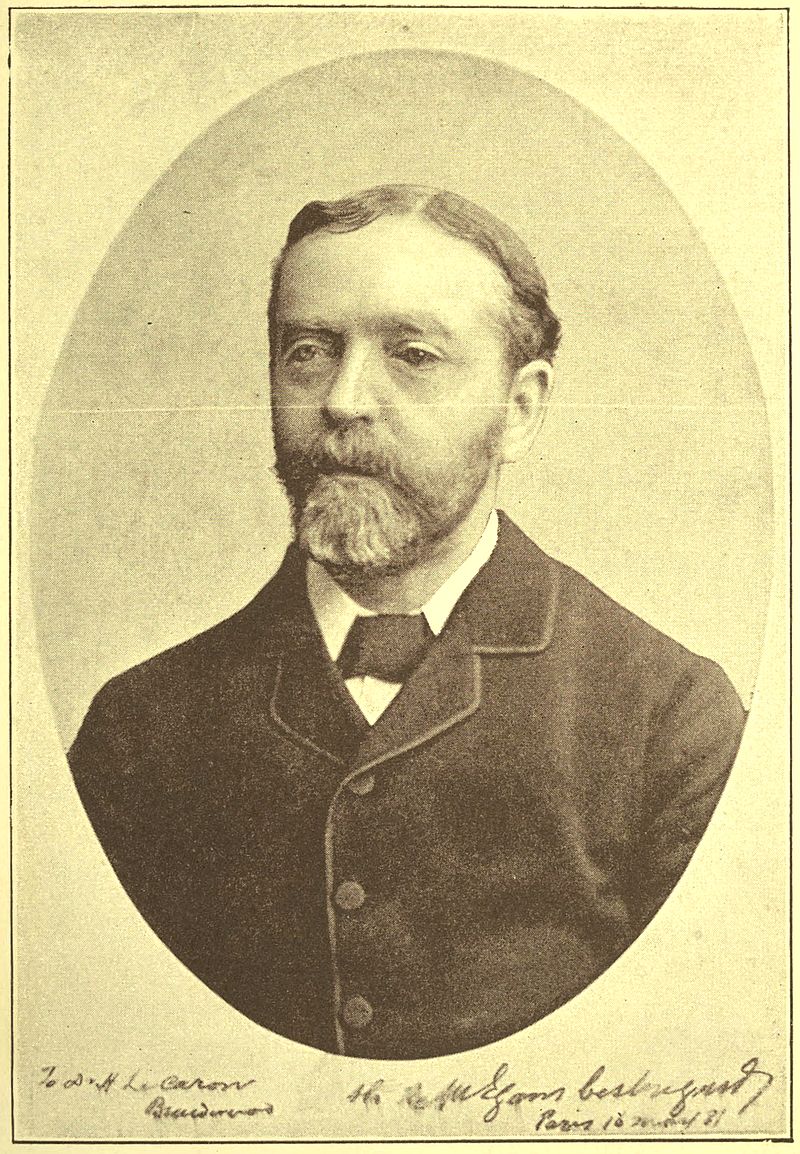
PATRICK EGAN
As I washed and prepared to take myself to
the opera, to see some more of this strange man,
I endeavoured to recall his appearance, and to
see how far he fitted in with the idea I already
held regarding him. A man of bright cheery
presence, stout build, and jovial look and voice,
the latter very marked in its Irish accent, with
bright laughing eyes and warm handshake and
a closely cut head of tawny hair, he was the last
person in the world you would take for a deep
conspirator, and a constructor of murder. I was
puzzled and bewildered—I could not make it out;
and so giving up all thought of trying to read the
man’s character on the outward view, I determined
I should leave my further studies in this
direction to a later date and go and enjoy the
opera, which I did.
The next morning saw me en route for the
residence of John O’Leary, to whom I wished to
deliver my second packet without delay. I discovered
him without much difficulty in his abode
at the Hotel de la Couronne, in the Quartier
Latin. I found the old man surrounded by his
books and manuscripts, and from his appearance
more fit for the patient secluded life of the student
than the troublous career of the rebel. Seated in
his room, and gazing affectionately on his different
treasures of old and rare editions, he seemed
to have little in common with my friends of
the Clan. Yet I found him fully posted, and
as keen to talk with me as possible. At first
somewhat suspicious and uncertain in his manner,
he gradually lost his appearance of distrust, and
in the end gossiped with me quite freely. As
he opened Devoy’s packet in my presence, I was
enabled to discover that I had been the bearer
of a very long document, with an enclosure, to
which he paid great heed.
From the very start I found O’Leary opposed
to the “active” policy. He was as strong and
bitter an opponent of the murderous idea as one
could wish to meet; and, unlike Irish patriots in
general, he was not without the courage of his
convictions. He showed me a copy of the Dublin
Irishman (the unfortunate Pigott’s paper), of some
date in the month previous, containing a letter
over his signature, denouncing all secret warfare.
In fact, so far did this really honest patriot go,
that he refused in his official capacity to take any
responsibility for expenditure in connection with
the “active” policy. While condemning such
methods, however, he avowed himself in full
accord with an open insurrectionary movement;
and he spoke in the bitterest terms of the way
in which J. J. O’Kelly and others had played
false, while acting as paid members of the organisation.
Another point in connection with our
talks was the opposition shown by O’Leary to
the Parnellite alliance. He would have nothing
to do with such a joining of forces as was proposed,
and he was all against mixing up the honest
rebel movement with one which was, in his opinion,
worthy of great distrust.
I enjoyed my talks with O’Leary because in
him I found a fine, honest, fearless spirit. The
man was old and grey, with furrowed brow and
stooped figure, the result of his long confinement
in English prisons. There was little about him
then to remind one of the bright-eyed daring
prisoner who, fifteen years before, had, from the
dock of a Dublin court-house, hurled defiance at
judge, jury, and Government alike; but there still
remained with him the same fearlessness of tone
and honesty of conviction which marked him
out then, as now, a prince amongst his fellows
of the Irish conspiracy.
XXXIV.
All this time Egan and I had been constantly
together. My desire was, of course, to make a
study of the man, and to get to know as much
about him as I possibly could. Everything
played into my hands. Egan was ignorant both
of the geography and the language of the French
capital, and he very largely availed himself of
the help which I was enabled to render him, as
the result of my supposed French nationality and
knowledge of the city. My position, altogether,
was a very pleasant one at this period. Egan
lived in a most extravagant fashion, and as he
would pay for everything and would not allow
me to share in any outlay, I had the best of all
things without any strain on my pocket whatever.
He frequented the most expensive cafés, had
the choicest of dishes, would only be content
with the best boxes at places of entertainment,
and, in a word, spent his money right royally.
The information should be pleasant reading for
the poor dupes in America and Ireland who
subscribed the funds over which he was then
presiding.
We cemented a strong friendship, and I was
with him almost at all times. I made a point of
being in his rooms when his letters arrived, and he
was certainly very frank and open in acquainting
me with their contents. As a result, I obtained
full and accurate information as to the position
and progress of affairs in Ireland during my stay.
There was not the faintest shadow of a suggestion
of secrecy between us as to our attitude
towards Revolutionary matters. I remember
well on one occasion Egan summing up his own
position in these words—which I noted at the
time—“I am a Land Leaguer, and something
else when the opportunity presents itself.” He
boasted to me of his having been the backbone
of the Fenian organisation in Dublin for many
years, and admitted the fact, with which I was
acquainted, that he was a member of the Supreme
Council or executive body there.
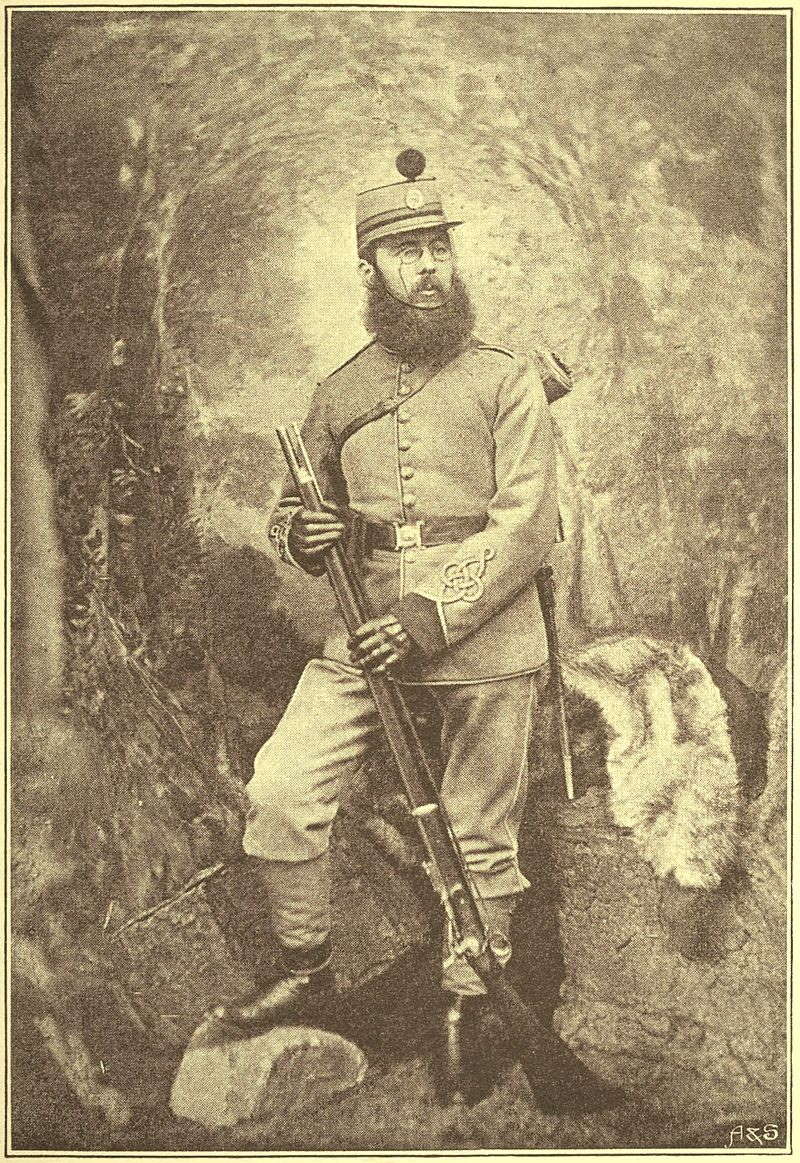
“NUMBER ONE”
P. J. TYNAN
In our talks on Revolutionary organisations,
I found Egan an enthusiastic advocate of the
“active” policy spoken of by Devoy, and he
heartily entered into a discussion with me as to
the ways and means of carrying it out. In this
connection reference was made to Mr. Parnell,
and he assured me most emphatically that
“Parnell was all right as a Revolutionist.” In
support of this statement he cited the fact that
some twelve months previously Mr. Parnell
sought admission into the ranks of the Irish
Revolutionary Brotherhood, but was refused.
“Parnell,” remarked Egan with a wise look,
“thought a good deal of the organisation, but
it was not then in a flourishing condition, and
we thought he would think a great deal more of
it by being on the outside rather than in it.”
Our conversations naturally tended in the direction
of finance; and when the topic cropped up,
Egan dealt with it in no nervous spirit, regarding
me as quite a worthy recipient of his confidence.
About this time a demand was being made for a
public audit of the accounts of the League. He
explained that an audit committee of three members
of the League had already gone over his
books, and this was all the audit that could possibly
take place. His reasons for such a strong
statement were very frankly given. A public
audit would, he said, be the very thing Dublin
Castle—meaning the Irish Government—would
like to have, but this was out of the question. It
was impossible for him to make public many of
the items of his expenditure! I laughed to
myself as he said this, wondering whether the
expenses of our many extravagant trips about
Paris came under this head.
But he was dealing with far more dangerous
matters. He stated explicitly, in a very significant
way, that the money had been used for other
purposes than those of constitutional agitation.
Amongst these sources of outlay were the expenses
of the Dutch officers from Amsterdam to
assist the Boers in their revolt against British
control in South Africa; and coming nearer home,
the varied expenditure in connection with parties
attached to the Irish Republican Brotherhood in
Ireland. Altogether our talks on this branch of
the subject enlightened me on many points, and
supplied me with sufficient material to form a
fixed belief in my mind that his idea, at least,
was identical with that held in the States—that
the open agitation was but a branch of the movement
to obtain the separation of Ireland from
England.
I use the phrase “his idea,” but to be really
accurate I should say “their idea,” for Egan
always spoke on behalf of his colleagues—with one
exception, which I can recall—and represented
that a complete harmony of view prevailed. And
in everything that happened subsequently during
my stay in England, I found this representation
of his sustained by fact, save the single exception
of which I speak—namely, in the case of Mr.
A. M. Sullivan. I had not long to wait for an
opportunity of putting the statement to the test as
far as several of the M.P.’s were concerned; for
very shortly after this conversation, Egan and I
travelled to London, and by him I was introduced
into the House of Commons, and to several Irish
M.P.’s, with the significant description “one of
our friends from America.” I well remember that
amongst those I first met in this way was Mr.
Parnell himself, from whom I received a very
warm greeting. On this occasion I was accommodated
with a seat under the gallery of the
House. This was but one of several visits I paid
to the House at this time, in the course of which
I constantly came in contact with Egan. When
alone I generally sent in my card to Mr. Parnell,
and he obtained the necessary admission for me,
much to his disgust, I am sure, when a later day
came and I put in an appearance in the witness-box
of Probate Court No. 1, London.
At every point I, of course, made careful notes
of what occurred, and, either verbally or in writing,
reported them to my chief, so that the Government
were not really so deplorably ignorant as
the Parnellites then proudly hoped and believed.
In fact, not one occurrence of importance with
which Egan became acquainted—and he really
knew everything, and kept nothing back from
me—was delayed by a single post from headquarters
at the Home Office in London. To
resume, however. After this first visit to London,
Egan and I returned to Paris by different routes
and on arriving there the same close intercourse
prevailed between us. I had not been very long
back, when Egan informed me that Mr. Parnell
had written him expressing a very strong desire
to see me before my return to America. Nothing
loth, I promised to call upon the Irish leader
when next in London, and I duly carried out my
promise.
XXXV.
Making my way down to the House on the
occasion of my next appearance in London, I
obtained admission to the Lobby—admission was
then an easier matter than now—and encountered
Mr. J. J. O’Kelly in my search for Mr. Parnell.
The late envoy of the Clan-na-Gael, who, unfaithful
to his trust, had got into Parliament with
skirmishing money instead of attending to the
shipping of arms for “active” work, had a long
chat with me over the situation, before the Irish
leader put in an appearance. While we talked
in this way, O’Kelly complained bitterly of
the opposition which the open or constitutional
movement known as the Land League was still
receiving from the Irish Republican Brotherhood
or secret organisation in Ireland, and he stoutly
advocated coercion on the part of the directors of
the American branch of the conspiracy in order
to bring the Irish malcontents into line.
His remarks, however, were cut short by the
appearance of Mr. Parnell, who, leading the way,
conducted us to a corridor outside the Library of
the House, where an interview of over an hour
took place, O’Kelly remaining for a little until
the conversation was well under way. O’Kelly,
while he remained, did almost all the talking.
His remarks were a repetition of what he had
already said to me in private. When he left, Mr.
Parnell adopted the same line of complaint, speaking
in low tones, as we walked up and down the
corridor, to prevent any one being continually
within ear-shot. I was told detectives were
watching us, and that spies held a place in every
corner. As I afterwards learnt, the statement
was not without foundation, for every movement
of myself and my companion was noted, with
details as regards time, and duly reported to
Government officials within twenty-four hours.
The whole matter, said Mr. Parnell, following
up O’Kelly’s remarks, rested in our hands in
America. We had the money, he said, and if
we stopped the supplies the home organisation
would act as desired. He expressed his belief
that Devoy could do more than any one else to
bring about a clear understanding and alliance;
and he commissioned me to use my influence with
Devoy, and to arrange for his presence in Paris
at as early a date as possible. So anxious was he
to bring Devoy over that he undertook to pay all
his expenses. Still speaking in this connection,
he asked me to at once proceed from New York,
after seeing Devoy, to other prominent members
of the organisation, mentioning particularly the
names of Alexander Sullivan and William J.
Hynes, the presence of either of whom, upon this
side of the water, he desired for the purpose of
bringing about a thorough understanding and
complete harmony of working. Special reference
was also made to Dr. William Carroll of Philadelphia,
and his attitude towards the open movement.
Dr. Carroll, I may here explain, had
been elected Chairman of the Executive Body at
the Wilkesbarre Convention of 1879, but had
resigned in 1880 in consequence of his opposition
to the way in which the New Departure was
being worked, and the treatment he received.
This was the same Dr. Carroll who had spent
the previous year in Europe, having been specially
charged with the carriage of negotiations between
the V.C. and the Russian Government.
After arranging these matters with me, Mr.
Parnell entered into details regarding the position
of the Irish Question at this time. His remarks
on this point were a veritable bombshell to me.
He started off by stating that he had long since
ceased to believe that anything but the force of
arms would accomplish the final redemption of
Ireland. He saw no reason why, when we were
fully prepared, an open insurrectionary movement
could not be brought about. He went carefully
into the question of resources and necessaries.
He stated what the League could furnish in the
way of men and money, and informed me as to
the assistance which he looked for from the
American organisation. He spoke of having in
the League Treasury at the end of that year an
available sum of £100,000. He discussed with
me the details of the position occupied by the
home and American Revolutionary organisations,
and defended the American policy for the time
being. I parted with him with the assurance that
I would do all he wished.
The interview had certainly proved a startling
one for me; and as I proceeded to my seat under
the gallery of the House, I pondered over the
manner and method of my late companion, to
discover, if I could, any incident in the course of
our hour’s talk which would materially affect all that
he had said. But there was none. The manner
of the League chief had been grave and impassive,
as was his wont; he had been business-like all
through; there was no uncertainty, no indistinctness
in his utterance. He had certainly made
a plunge, but it was a plunge taken with all
deliberation and premeditation. I went over
all the points in my own mind again, carefully
impressed them on my memory, and took my seat
in the house beside General Roberts, with whom
I had an interesting talk in an undertone, and to
whom I pointed out some of the celebrities on
both sides. If I remember aright, it was the
occasion of a vote of thanks to General Roberts
for his march on Candahar; and when the vote
had been recorded, a large number of members
crowded round to speak to him, whereupon
I left.
Reaching the street, I called a hansom at once,
and late hour though it was, I drove direct to
Mr. Anderson’s private house in order to acquaint
him with what had happened, while the facts
were fresh in my memory. Carefully I went
into every detail, and as carefully Mr. Anderson
followed, taking a note as I went along of the
principal points. The early dawn had crept
upon us ere my report was finished, and concluding
at last, I took my departure, to lose no
time in getting that sleep for which I commenced
to pine, and which I considered I had very fairly
earned.
XXXVI.
I saw Mr. Parnell once more. This was when
I went to say good-bye to him. I found him in
the tea-room of the House of Commons, as
cordial as ever. Indeed, he was particularly
agreeable on this occasion, presenting me with a
photograph of himself, on which he wrote, “Yours
very truly, Charles S. Parnell.” This portrait,
which is here reproduced, I kept as an interesting
souvenir for a long time, but had to
surrender it at last to the Special Commission,
amongst the records of which it is now duly
numbered. Soon after I left London for Ireland,
not, however, before I had seen a good
deal of Egan, and spent several pleasant evenings
in his company, at the house of Mr. A. M.
Sullivan, M.P., who now, poor man! is no more.
I well remember Egan’s impressing upon me the
necessity for my covering my revolutionary sentiments
whenever Mr. Sullivan was near. It would
never do, I was told, to talk of revolutionary
matters, for he was ultramontane. This advice
I followed, noting the fact in my own mind to
Mr. Sullivan’s credit.
Talented, witty, and brilliant, Mr. Sullivan
made a magnificent raconteur. Even now I can
recall many of his happy efforts which would well
bear reproduction. I shall not, however, yield to
the temptation of bringing them in here, but will
content myself with recalling one pleasant story
told about the irrepressible Mr. Biggar. Mr.
Biggar, as I was informed by way of preface, was
known as the great objector and “counter-out,”
sometimes, sad to relate, moving that the House
be counted when it was not to the interests of the
party to take any notice of the want of a quorum.
Very pious in disposition, he rarely failed to
attend early mass, in spite of late sittings and
consequent fatigue. One morning Mr. Biggar,
fatigued after a very heavy night’s sitting, but
still devotionally inclined, attended mass at St.
George’s in Southwark. So tired out was he
that he fell fast asleep in his chair as the service
proceeded, and so he remained until all had been
concluded and every one had gone. Upon being
vigorously aroused by the verger, Mr. Biggar
started up, rubbed his eyes, looked at the roof,
and fancying himself at the moment in the House
of Commons, with the master instinct strong
within him, loudly exclaimed, “Mr. Speaker, I
move that the House be counted.”
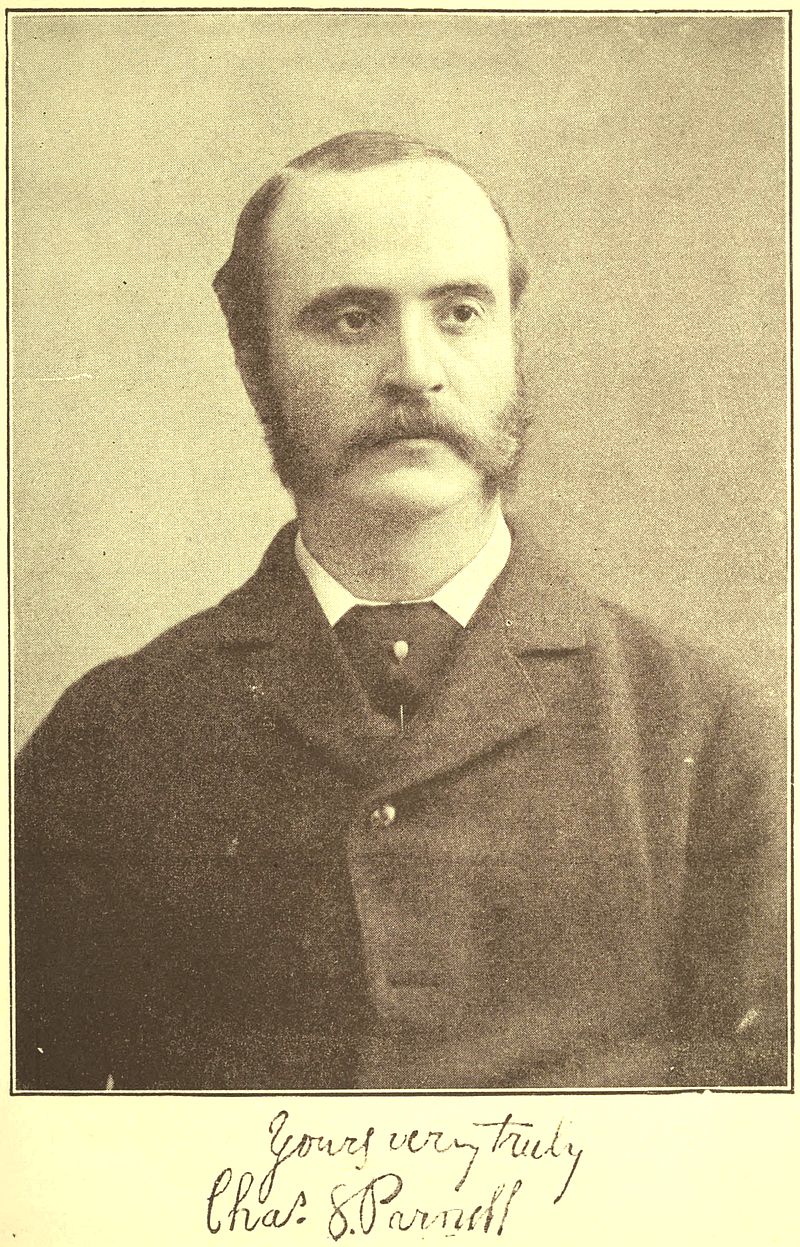
Yours very truly
Char. S. Parnell
Thanks to Egan, I travelled to Dublin under
happy circumstances. I was the bearer of letters
of introduction to Dr. Kenny, M.P., O’Rorke,
Egan’s brother-in-law, and to those in charge at
the Land League head-quarters. I anticipated
an interesting time, and I was not disappointed.
Dr. Kenny, though his memory is now very
deficient—shall I say?—proved the most entertaining
of men, and I had both lunch and dinner
at his hospitable board in Gardiner Street. It
was in his company I paid my visit to Kilmainham
Prison, and through his kind introduction
that I made the acquaintance of John Dillon,
P. J. Sheridan, M. J. Boyton, and the others I
met on the occasion. My visit and its incidents
afforded a very good insight into how matters
were conducted, and proved to me how very
easy it was to carry on communication with the
outside world—at least when you were an Irish
political prisoner. To my surprise there was no
attempt made by the warder to hear the conversation
I had with Boyton. On the contrary,
this interesting official most obligingly took himself
off.
This meeting with Boyton was full of interest
to me. He was the man, it will be remembered,
who had been named by Devoy as carrying out
the arrangements for the “active” policy of
Ireland, and who was best known as the brother
of Captain Boyton the swimmer. From him in
the secrecy of conversation, undisturbed by the
presence of a warder or fellow-prisoner, I learnt
that the Land League had placed the Fenian or
National cause in a far stronger position than
ever in Ireland. Could the Clan-na-Gael only
see the national spirit which had been developed
all over Ireland, they would never oppose it, he
believed. In counties where the Revolutionary
organisation had been dead for years, continued
he, there was now material for work, and men
ready to go as far as any one. All these men
wanted was organisation and leaders. He
besought my assistance in proving his claim to
be a naturalised American citizen, which, if
established, would mean his release. I left him
with no doubt in my mind as to his being a
thorough-paced Revolutionist. When I got outside
the prison, I received from Dr. Kenny a
letter which Boyton had intrusted to him after
leaving, containing a couple of his photos.
Boyton, need I state, was a paid Land League
organiser like Sheridan, the director of the
Invincibles. My meeting with Sheridan was,
by the way, almost a momentary affair, and that
with Dillon in the presence of a warder.
After a very interesting time in Dublin, I
left by North Wall boat, being “seen off,” as
the phrase is, by Egan’s business partner and
brother-in-law, O’Rorke, and Andrew Kettle,
both Leaguers remaining on the bridge of the
boat talking to me till we left. The detailed
report of all I had seen and heard was duly
submitted to Mr. Anderson. I was commended
for my success, said good-bye to everybody,
and once more took ship for home, in order to
get back in time for the Convention of the Clan-na-Gael,
which was to take place very soon. Of
course there was another matter which prompted
my speedy return, and that was the work I had
undertaken to do on behalf of Mr. Parnell. I
had to see Devoy and the others, to report the
Irish leader’s views to them, and having acquitted
myself of all I had to do as a Revolutionary
envoy, to find out as much as possible of the
result, in order that I might utilise the information
in my capacity as an agent of the Secret
Service.
XL.
I have found this subject of Irish secret conventions
so interesting to the many people who
have talked with me about Clan-na-Gael affairs
since my appearance in the witness-box that I
almost think I might venture on some slight description
of the modus operandi of these gatherings
without wearying the reader. Like all proceedings
from which the general public are shut out,
a Clan-na-Gael assembly becomes interesting in
proportion to the amount of secrecy by which it is
attended. Not indeed that a Clan-na-Gael Convention
is anything very exciting or terrible after
all. It possesses none of the weird features of
that scene in which our three old friends of Macbeth
figure. It is on the contrary very Irish—very
Irish indeed. But what it is and what it is
not can best be demonstrated by some few details
by way of description; and so, transforming my
gentle reader for the nonce into a V.C. delegate,
I will take him with me for a flying visit to the
Clan Convention of 1881 in the club-room of the
Palmer House, Chicago.
As we pass along down the corridor to the iron
doors of the club-room, we find our passage barred
by two stalwart Irishmen. They are members of
the local camp, stationed as sentinels to prevent
the entry of the unauthorised. We have already
presented our credentials and been intrusted with
the necessary passwords, and on giving the outside
password to these guardians of the door, we are
duly admitted. On the other side, however, we
are brought face to face with another couple of
trusted Gaels, and to them we have to give the
inside password. ’Tis done, and, freed now from
further question, we enter the charmed assembly.
What a sight! What a babel of voices and a
world of smoke! You can scarce see for the
clouds which curl and roll round you as the
breath of fresh air is admitted by the opening
door, while, as for hearing, your ears are deafened
by the din and clatter of many tongues and stamping
feet. Yes, we are at last in the Irish Parliament,
as it is grandly termed, in full session.
These are the hundred and sixty odd delegates of
the great V.C., sworn “to make Ireland a nation
once again,” who are now assembled in the year of
grace 1881 to clamour for dynamite as the only
means of achieving their patriotic ends.
Let us sit down in the corner and study the
scene with attention. It partakes, on the first
view, more of the character of a “free and easy”
entertainment than a grave portentous gathering
of conspirators; but you must not judge by first
appearances or outward characteristics. It is the
way these men have of doing their business, and
the dread character of their work is in no way
affected by the almost ludicrous phases of the preliminary
performance. Always you must remember
that you are dealing with Irishmen, who in
their wildest and most ferocious of fights still retain
that substratum of childishness of character and
playfulness of mood, with its attendant elements
of exaggeration and romance, which make it as
difficult for an ordinary House of Commons
member to rightly understand his Irish colleague
when he launches forth in description or invective,
as it is for the civilised foreigner to know where
the actual grievance now comes in.
Well, we are seated, and we must proceed to
make the most of our time. And so I hurry
on with my description. That is the chairman
seated over there on the platform, with his two
secretaries in attendance. The permanent presiding
officer, as he is termed, is on this occasion
no other than our friend Wm. J. Hynes, the
gentleman who received his start in Chicago politics
as a professional juryman through the instrumentality
of Alexander Sullivan, and who since
that time has put together flesh as well as riches,
and is now one of the strongest-looking men
here, possessed of that which, if he had no other
qualification, would yet constitute a strong claim for
the office of chairman—a voice capable of rising
above the din caused by fifty excited patriots all
yelling with their greatest might. Seated round
in semi-circular fashion are the different delegates
who, in the language they love so well, may be
described as the flower of Irish-American patriotism.
They are a funny crowd, as lolling with
arms akimbo, and thumbs resting in their waistcoat
arm-holes, they hang their feet on the chairs
in front, which for comfort’s sake are tilted to an
angle of some 40 or 45 degrees, and puff their
cigars—on such an occasion there is nothing so
vulgar as a pipe indulged in—high up into the
air, changing their position now and again in
order to have a pull at those interesting-looking
black bottles, or to disrobe themselves of coat or
waistcoat, the better to cool their heated frames.
But hark! there is a row on now. Listen to
the oaths and foul epithets which fill the air.
These two patriots to our left have apparently
disagreed about something and, want to fight it
out. See how they jump to their feet, kick the
chairs about, throw a curse across the floor at the
chairman as he seeks to stop their rowdy proceedings,
and enter into grips with each other.
Watch how friends hurry up on either side, and
note the general confusion which now reigns.
The business of the Convention of course is
brought to a standstill, but not for long. See,
all is quiet again now. These incidents are of
hourly occurrence, and the fun of it all is that
these two combatants will be drinking whisky
in the most amicable way out of the same black
bottle in less than a quarter of an hour’s time.
Do you notice these few men hurrying in with
handkerchiefs to their lips? Thirsty souls! They
have been taking advantage of the interval to
pay a visit to the bar.
XLI.
At last we turn to business again. Luckily the
topic is an exciting one—nothing less indeed
than the Skirmishing Fund discussion—and so
matters will be interesting. O’Meagher Condon
is on his feet, and he is launching forth in vehement
style against the whole of the governing
powers. Condon is one of those men who were
mixed up in the Manchester Martyr affair, and
since his arrival here a couple of years since, on
being amnestied, he has been quite a hero. He
has now a position in a Government department
at Washington, and is much esteemed in the
ranks of the Gaels. How his face works with
excitement and passion as he attacks Devoy and
his fellows on the Revolutionary Directory for
their want of practical work. He finishes at last,
and up jumps Devoy, more sour-looking than
ever, with the perpetual scowl growing heavier
and heavier. As he proceeds, the author of the
New Departure has recourse to the usual method
of controversy. He asserts that Condon is a
coward, and was guilty of the grossest neglect at
Manchester. If Condon had but distributed the
twenty odd pounds which were found on him on
his arrest, many of the men would have escaped,
instead of being captured with empty pockets.
Gruffer and gruffer becomes Devoy’s voice, as
losing partial control of himself he trembles with
excitement and flings charge after charge across
the floor.
We are in for another personal quarrel, and
so have to wait patiently while Condon, for the
hundredth time, recites the threadbare narrative
of his glorious deeds in Manchester. Matters
are very electrical when the Rev. George C.
Betts of St. Louis craves a hearing, and with
his well-known smile seeks the suffrages of his
fellow-patriots for the moment. Truly, a strange
figure in a strange place. Tall, erect, in the
black garb of the Church, with priest-like face
and priest-like form, he woos the assembly to a
strange quietness as his clerical style of utterance
falls upon the audience. He is as hot a dynamitard
as any, but he wants no personalities.
If they are to accomplish anything, they really
must be more practical. And so he proceeds,
winning applause and spreading enthusiasm, till
Devoy and Condon, and their personalities, are
swept into forgetfulness, and all are engaged in
applauding revolutionary sentiment spiced with
religious quotation, and served up in the most
orthodox of fashions.
The reverend dynamitard concludes, and
resumes his seat amidst most enthusiastic evidences
of his popularity. He gives way to an
equally inharmonious figure in this motley
gathering. The man who now rises is one of
medium height, whose every movement bespeaks
the professional man, as awhile back the picture
presented by the Rev. Dr. Betts bespoke the
cleric. A young man too is this, with his neat
attire, trim beard, and gold-headed cane. No
less a person is he than Dr. Gallaher, who, in this
year of 1892, in the convict suit of grey with
its regulation arrows, works out his weary life
in Portland prison. As you watch, and as he
speaks in that quiet gentlemanly fashion of his,
you can well believe that he is a man of whom
it might be afterwards boasted that he was
introduced to Mr. Gladstone himself. Save in
his sentiments there is nothing of the dynamitard
about him, but in the matter of his speech
there is no room for doubt. Quiet and self-controlled
though he be, his talk is the talk of
war, and the enthusiasm which lights up his
countenance is that strong steady flame which
will steadily burn till England’s dungeon doors
close upon him and cut short his career of
recklessness.
Following him on the floor is the familiar
form of Denis Feeley, the fellow “Triangler”
of Sullivan in later days, and with him the object
of attack on the part of Cronin’s friends. Cool,
calm, and deliberate, he carries his audience with
him as he advocates “a secret blow at the
enemy”; while his big form shakes with indignation
as he works himself up to an excited
pitch over “the wrongs of their beloved country.”
At last Feeley concludes, and there rises another
well-known figure, that of T. V. Powderly,
for years the chief of the largest working-men’s
organisation in America, known as “The Knights
of Labour.” Little doubt can there be as to his
views. Listen to what he says:—
“The killing of English robbers and tyrants in Ireland, and
the destruction by any and all means of their capital and
resources, which, enables them to carry on their robberies and
tyrannies, is not a needless act. Hence I am in favour of the
torch for their cities and the knife for their tyrants till they
agree to let Ireland severely alone. London, Liverpool, Manchester,
and Bristol in ashes may bring them to view it in
another light.”
And so the talk goes on, and seven hundred
years of grievances find expression from the lips
of excited patriots, while quarrelsome delegates
destroy all decorum. There is little purpose in our
waiting further. One hour will be but the repetition
of the other. As we rise to leave, however,
one figure catches the eye and impresses itself
upon us. It is that of the arch-plotter Sullivan,
who, through all this din and turmoil, sits and
makes no sign. He knows that later on he will
be the candidate for the highest place amongst
them, and so he takes no side. There is no
possibility of your missing him as you pass him
by. There he sits, quiet, watchful, and alert.
You cannot mistake the man. There is a sense
of power and intelligence in that clean cut,
clean shaven face of his, lit up by its bright
daring eyes. Had you but heard him speak,
the lesson of his presence would have been
complete. His clear trumpet voice, rising and
falling with the play of a practised orator, his
choice finished diction, his well-reasoned, well-arranged
argument, and the graceful gesture and
movement of his whole body would prove to you
that there at least was a man gifted to command
and competent to control.
And so we terminate our flying visit to the
Eighty-one Convention of the Clan-na-Gael,
wherein there were assembled forty lawyers,
eight doctors, two judges, clergymen of both
leading religions, merchants, manufacturers, and
working men, all mixed up in glorious confusion,
almost all reduced to the level of the whisky
bottle, and none removed from the struggles of
personal avarice and ambition.
XLII.
Nothing of a very stirring character happened
for the next couple of months, and so, much to
my satisfaction, I was permitted to attend for a
little without interruption to my private affairs.
They sadly lacked some notice on my part,
for business was growing, my drug-stores were
increasing in number, and so was my family.
Patients were very numerous too, but expenses
were not without their increase, for I had to
employ a regularly qualified M.D. to take my place
in my absence. If I could have settled down and
simply minded my own business from this henceforth,
I would have been in a very satisfactory
position to-day. But ’twas not to be. I was constantly
on the move, and living at high pressure
right through. To keep myself thoroughly posted
I had to be here, there, and everywhere, and, in
the end, my ordinary business had to take a very
secondary place. Even at this time my leisure
from political affairs was to be of very short
duration, for, in my capacity as Senior Guardian,
I received the following in the month of November
1881:—
“Private.
“For S. G. alone.
“Head-Quarters, K.,
“November 21, 1881.
“S.G. of D.
“Dear Sir and Brother,—It is the desire of the F.C. that
as many members of the V.C. as can possibly attend the Irish
National Convention at Chicago, November 30, 1881, will do
so without entailing expense on the organisation.
“You will therefore make every effort to get the members
of the V.C. elected as delegates from any Irish society that
may have an existence in your neighbourhood, whether it be
as representative of the Land League Club, the A.O.H., or any
other organisation.
“The F.C. particularly desires your presence as a delegate,
if it is possible for you to attend as such.
“Fraternally yours,
“K.G.N. of the V.C.”
I thoroughly knew what this meant. Under
the new régime of Sullivan there was to be no
more of the “Buffalo business,” and to prevent it
things were to to done in a thoroughly practical
manner. The members of the secret revolutionary
organisation were to capture the representation
at the coming Land League Convention,
to act unitedly in the development of a policy
in harmony with the Clan-na-Gael, and to officer
the future executive in such a way as to prevent
further misunderstanding. In order to do all this,
the Clan-na-Gael men were to obtain election as
League, or Ancient Order of Hibernian, delegates,
the latter organisation being a purely benevolent
body, whose branches had largely affiliated with
the League or open movement from the start.
This was accordingly done; and thus it came
about that, when I met my fellow-delegates to
the open Land League Convention of 1881, I
found almost every second man a brother from
the camps of the Clan-na-Gael.
The whole scheme worked in the most perfect
manner. On arrival in Chicago each Clan-na-Gael
man reported himself to the chief officer of
the district, to whom credentials were presented.
Official intimation was then given as to what
would happen, and each conspirator learned that,
prior to the sessions of the convention, caucuses
of the Brotherhood would be held in the hall of
Camp 16, Twenty-second Street, Chicago. The
usual precautions were taken, and admission only
gained by passwords exchanged on each occasion.
As the chairman at the first gathering—the Rev.
George C. Betts—humorously put it, “our object
was to make things easy for the Land Leaguers,
and to save them as much trouble as possible.”
At each meeting the plan of procedure at the
coming session was decided upon, and the election
of temporary and permanent officers arranged.
Nominations for various committees were fixed,
and no opportunity neglected for adapting the
constitution and officials to our requirements.
The resolutions subsequently adopted in open
convention were drafted by our committees.
It therefore came about that John F. Finerty
of Chicago, the well-known dynamite advocate
and prominent member of the Clan, “called the
convention to order,” and made the opening
speech. William J. Hynes of the Revolutionary
Directory, and the chairman of the late Clan-na-Gael
Convention, was appointed temporary chairman,
and Joseph E. Ronayne, who had acted in
a similar capacity at the Dynamite Convention,
was appointed secretary, while T. V. Powderly
of the Clan Executive, whose fiery speech at the
same Convention was given a few pages back,
was nominated assistant-secretary. The nomination
of these men led to a trial of strength
between the two forces of the Convention, but
the real tug of war was reserved for the second
day, when resolutions previously adopted at the
Gael’s caucus were proposed, nominating the Rev.
George C. Betts of St. Louis as permanent
chairman, and Patrick Ford, John Devoy, Mrs.
Parnell, and a number of priests as vice-presidents.
Of course the priests were put forward
for politic reasons. The vice-presidents were
not objected to, but the appointment of the Rev.
George C. Betts, a Protestant clergyman, was
strongly opposed by the priestly party. A very
excited debate took place, but in the end the
opposition to Betts was withdrawn at the instigation
of the Irish visitors—Messrs. T. P.
O’Connor, M.P., T. M. Healy, M.P., and Father
Sheehy—and so at the close this Vice-President
of the Clan-na-Gael was elected, and the secret
organisation triumphed all along the line.
The Irish political controversy was darkened
the following year by the sad event in the Phœnix
Park, Dublin, when Lord Frederick Cavendish
and Mr. Burke met their deaths at the hands of
the Irish Invincibles. As regards the Invincible
conspiracy, I have little or nothing to say. It
was in no sense an American affair, and no matter
how little or how much certain sympathisers in
the States may have known of the murderous
conspiracy, nothing was said on the subject in
public or in secret to connect the Clan-na-Gael in
any way with the proceedings of Carey and his
friends. There was, of course, a certain amount
of sympathy with the affair, as was shown by the
attitude taken up by John Devoy in his paper
the Irish Nation, which was, by the way, the
official organ of the Clan-na-Gael at this time,
and subsidised from its fund. Devoy gave great
prominence to the refusal of Egan to offer a
reward for the discovery of the murderers, printing
the following telegram in his issue of 13th
May 1882:—
“PATRICK EGAN ON BLOOD-MONEY.
“Paris, May 10, 1882.
“Mr. Egan, the Treasurer of the Land League, has telegraphed
the following to the Freeman’s Journal of Dublin:—
“‘Editor, Freeman, Dublin.—In the Freeman of yesterday
Mr. James F. O’Brien suggests a reward of £2000 out of the
Land League Fund for the discovery of the perpetrators of
the terrible tragedy of Saturday. Remembering, as I do, the
number of innocent victims who in the sad history of our
country have been handed over to the gallows by wretched
informers, in order to earn the coveted blood-money, and
foreseeing the awful danger that in the present excited state
of public feeling crime may be added to crime by the possible
sacrifice of guiltless men, I am determined that if one penny
of the Land League Fund were devoted for such a purpose I
would at once resign the treasurership.
“‘Patrick Egan.’”
And commenting upon it in the following vein:—
“Patrick Egan has spoken out like a man against the
adoption by Irishmen of the base English policy of suborning
informers. He declares that should a penny of the Land
League funds be devoted to such an object, he will resign
the treasurership. Mr. Parnell should at once repudiate the
attempt made from this side to connect him with action so
culpable and un-Irish. By consenting to become the trustee
of the Irish-American blood-money he would forfeit the sympathies
of his warmest admirers.”
It was in this year, too, that O’Donovan Rossa
was finally expelled from the Clan-na-Gael. He
had been in very bad odour for a long time previously,
owing to his unsatisfactory connection
with the Skirmishing Fund; and at last, after a
couple of attempts to get rid of him, he was
summarily kicked out, and from henceforth repudiated
by the recognised officials of the secret
organisation.
XLIV.
It was shortly after this—I think somewhere about
the 29th of May—that I was fortunate enough
to learn from Sullivan some particulars as to what
was going on in connection with the Dynamite
Campaign. A demonstration had been arranged
at Milwaukie, Wisconsin, in honour of Patrick
Egan, and at Sullivan’s pressing invitation I
accompanied him in order to participate in it.
We travelled together and conversed almost all the
way, Sullivan, as was his wont, supplying me with
very interesting details. He told me that the management
of the secret warfare was entirely in the
hands of the Revolutionary Directory in America.
Men, it appeared, could not be obtained at home
to do the work, for from some lack of courage or
discipline they could not be relied upon.
The rule adopted was that no volunteer should
be accepted. Special choice would be made of men
without families, and a special course of instruction
in the use of explosives would be necessary
after a man was chosen. So great was the care
taken in the selection of agents, that their whole
career and character would be inquired into
beforehand without their knowledge. No new
members would be chosen for the work, because
forty of the Royal Irish Constabulary had been sent
on full pay to America to join the organisation with
a view to selling it. Sullivan imparted the further
interesting information that Dr. Gallaher, when on
his mission, purposely abstained from coming in
contact with Irish members, and obtained introductions
to, and acquaintance with, English members.
He was often in the House, I was told, and had
been even introduced to Mr. Gladstone himself.
Contrary to expectation and the requirements
of the existing constitution, no Clan-na-Gael Convention
took place in this year—1883. In the
ordinary course of events such an assembly should
have met in August 1883. For reasons best
known to themselves, however, Sullivan and his
colleagues on the executive of the secret organisation
postponed the gathering, and in the end,
by a system of manipulation which Sullivan
developed to a perfect science, in connection with
his management of Irish affairs, the approval of
the organisation was gained to certain changes
which included the putting off of the Convention
to the following year, 1884. To allow of these
changes being approved of, it was necessary to
hold a series of district Conventions, and delegates
were there elected to represent the districts
at the general Convention which would follow.
Sullivan’s adherents were generally in the majority
at such district assemblies, and so it was a
matter of ease for him to have supporters elected
at almost every gathering, which, in other words,
meant that the delegates then elected were
nothing more or less than ardent Sullivanites, who
in the future Convention would question nothing,
whereas ordinary delegates would undoubtedly
prove curious, if not embarrassing, in their search
for information as to the conduct of the affairs of
the Clan-na-Gael.
All was not clear sailing, however, and murmurs
were heard in several quarters regarding this
attempt to burk discussion and inquiry as to the
work of the past two years. Several of the camps
eventually ceased their allegiance and were
immediately expelled, and the organisation split
up into two sections, the one being Sullivanite
and the other anti-Sullivanite. Devoy and his
whole camp were amongst those expelled from
the Sullivan wing. The seceders formed a new
organisation under the old name, and the
Sullivanites became known as the U.S. Sullivan
was still the strong man, and had the greatest
number of supporters; and, following my usual
rule, I acted with the majority and became a
U.S. man. At the start a change was made as
regards the number and title of the governing
body. Three members formed the executive,
and they were now known as the Triangle—a
name taken from the △ sign which was used
by way of cypher signature on all documents
coming from head-quarters. The fight between
the two sections was now raging bitterly, and the
oath of the U.S. was so drawn as to exclude
members of any other Revolutionary body, thereby
denying the right of any person to be a member
of both organisations.
Meantime, under the plea of imminent danger
of discovery, the books of the organisation were
all burnt, and no record whatever was left in
existence which would allow of investigation.
This had driven very many men to desperation,
and loud and sweeping were the charges which
the seceders made against the Triangle for misappropriation
of funds and other like matters.
None were more prominent in leading the attack
on Sullivan and his colleagues than Dr. Cronin,
whose murder has recently been the subject of
such lengthy investigation. Indeed, from this
point onwards, almost down to the end of 1888,
the history of the Clan-na-Gael is the history of
the dispute between Cronin and Sullivan. And
now, having purposely excluded all special mention
of Dr. Cronin from my story heretofore, in order
that I might the more fully and clearly deal with
the matter in a compact form, I shall proceed to
sketch the life and career in Irish-American
politics of this last victim of political assassination.
In explaining the situations in Irish affairs as
they affected or were affected by Dr. Cronin, I
shall have to travel rapidly over points already
dealt with; but I think it better to do this
than to improperly represent the ill-fated Cronin
by omitting from my reference to his career the
points which told in favour of himself or his
adversaries.
XLV.
Philip H. Cronin was born in Ireland, but when
very young emigrated to Canada. From thence
when a young man he went to St. Louis, Missouri,
where he studied medicine at the St. Louis
College of Physicians and Surgeons. Before
this he had been clerk in a chemist’s store, and
had thus acquired a very considerable practical
knowledge of medicine. He graduated with high
honours, and became eventually Professor of
Materia Medica and Therapeutics in the college.
He also attended a medical college from which
he secured the degree of M.A. Cronin was a
man of fine presence, good looking, almost six
feet in height, and very well formed. He was a
clever man in every way, and a good forcible
speaker, though in style aggressive and combative
to a degree. Very ambitious, like his future
enemy Alexander Sullivan, he was never happy
in a back seat, always thrusting himself forward
and fighting for the place of leader. In fact,
so pronounced were his ideas in favour of his
supremacy, that where he could not rule he was
quite prepared to ruin.
He moved to Chicago in the latter part of
1881, and immediately entered upon the practice
of medicine, taking up his residence at 351 Clark
Street, at the corner of Oak Street. At this time
he was about thirty-two years of age, so that he
was only some forty years old at the time of his
murder. From the moment of his arrival in
Chicago, he went in enthusiastically for Irish
politics, and took a leading part in both Revolutionary
and Land League matters. He identified
himself with the Clan-na-Gael, and was prominent
at all gatherings of the Irish of every kind. He
was strong in social instincts, and was quite a
figure at social gatherings, where he used to great
advantage the fine tenor voice of which he was
possessed, singing national songs especially with
great spirit and enthusiasm. As a consequence
he rapidly came to the front in Chicago, and in six
months was better known than an ordinary resident
would have been in ten years. Towards the
Land League movement he was especially sympathetic,
and he took a very large part indeed
in building it up. He was in a short time
elected President of the 18th Ward League,
then known as the “Banner League” of Chicago.
Equally active in the secret movement, he was a
guiding spirit of Camp No. 96 of the Clan in
Chicago, publicly known as the “Columbia
Literary Association,” and so great was his influence
that, on the appointment of the notorious
Frank Agneau to the position of district member,
Cronin succeeded him as Senior Guardian of the
camp. This was the camp which held its weekly
meetings in the well-known Turner Hall on the
north side of the city.
It was at this time that the policy of dynamite
had been decided upon, and that the campaign
against English Government buildings and persons
was being inaugurated. Cronin (who was
anything but a saint in character) was an ardent
advocate of the policy; and, owing to his scientific
attainments, he was appointed as chief instructor
in the use and handling of explosives, acting
all this time, be it marked, as the President of
the Banner League (or Chicago branch of the
Land League) as well. In fact, he held the
position of President of the Land League branch
down to the year 1888. Cronin, unfortunately
for himself, succeeded at a very early stage in
falling foul of Alexander Sullivan. Living as
he did till 1887 at the corner of Clark and
Oak Streets, within a few doors of Sullivan
himself, he gained such an amount of prominence
that he was rapidly throwing Sullivan
into the shade. He threatened to become more
powerful than Sullivan, and this Sullivan,
equally ambitious and more unscrupulous, could
not brook. In a short time Sullivan and his
adherents came to detest the Doctor, and as
I found—for I lived within a stone’s throw of
each, knew them both intimately, and saw them
continuously—the relations between them were
becoming more strained and bitter every day.
In June 1881, as I have related, Sullivan
obtained a victory over all his rivals by being
chosen President of the Clan-na-Gael, or Revolutionary
organisation, at the Dynamite Convention
held that year at the Palmer House, Chicago.
It was after this that Cronin gave the first
pronounced sign of his enmity in public. The
opportunity for its display was brought about
by the attack made by O’Meagher Condon upon
John Devoy, the principal of the three members
of the Revolutionary Directory, Devoy with his
colleagues being charged with responsibility for
the failure of the many schemes of active warfare
proposed by Condon. Devoy, evidently
jealous of Sullivan’s election, indulged in a good
deal of incrimination, not confining his attacks
to Condon alone, and he was afterwards supported
by Cronin, who was possessed of the same
grievance. The two joined forces, but without
any effect, for Sullivan’s position was assured.
From the dispute, however, which occurred at
this Convention, dates the commencement of undisguised
hostility between Sullivan and Cronin.
Early in 1883, when the call was issued for
the Philadelphia Convention (at which was formed
the first branch of the American National League
as distinct from the Land League), a meeting of
Cronin’s branch of the League took place in
Chicago for the election of delegates to the Convention.
Sullivan and his friends, determining to
crush Cronin if they could, packed this meeting,
and had elected as delegates Alexander Sullivan
himself, his brother, and other personal adherents,
much to the disgust of Cronin and his supporters.
Sullivan was equally successful later on when,
under the new constitution, the Executive
called district Conventions in lieu of the general
convention they had managed to postpone.
The Convention in Cronin’s district was held
in Millionaire Smythe’s Hall in Chicago—Smythe
being Senior Guardian of Camp 458;
Cronin, as Senior Guardian of his own camp,
attended in the capacity of delegate therefrom.
Mackay Lomasney, my old friend from Detroit,
also attended from his district in a like capacity.
Although an attempt was made to impeach Sullivan’s
action, it was not successful. His friends
were in the majority, and his conduct was upheld.
All attempts on the part of Cronin to bring
about a different state of things—and they were
not a few—were voted down, and Alexander
Sullivan, in company with Mackay Lomasney,
the London Bridge dynamitard, was elected
delegate to the Triangle Convention of 1884.
Cronin, filled with fury, returned to his camp
and made a series of most sweeping charges
against the Triangle. In return charges were
preferred against him of being a traitor, liar, &c.
&c., Sullivan of course being the instigator. A
Trial Committee, of which I was one, was appointed,
and by it Cronin was promptly found
guilty and formally expelled. I voted, as I
always did, on the side of the winning party.
Cronin on his expulsion immediately joined the
ranks of the seceders, which by this time included
such well-known men as Devoy, Dillon, M‘Cahey,
and others, and he immediately obtained a seat
on the executive of the new body. And here,
for the moment, I must leave him.
XLVI.
The next matter of public importance in which I
was interested was the Boston Convention of the
Irish National League of America, which took
place in the Fanieul Hall, Boston, on the 13th
and following days of August. Of course I went
in my dual capacity as League delegate and
Revolutionary official. The same plan of campaign
was practised with the same successful
results. The Rev. Dr. Betts was again to the
front as president of the secret caucuses, while
Egan, grown more bold by this, was a regular
attendant. When the nomination of officials of
the League came up, Sullivan was named for
re-election as president. He, however, declined,
and made way for Patrick Egan. Egan, after
some refusal on the ground that the British
Government probably knew of his connection
with the secret movement, and that his taking
office might compromise Mr. Parnell, eventually
agreed, and so he took the chair vacated by
Sullivan. This Convention was attended by
Mr. Thomas Sexton, M.P., and Mr. William
Redmond, M.P., on the part of the Parnellite
party, and by P. J. Tynan, the famous “No. 1”
of the Phœnix Park murders—shall I say on
behalf of the Invincibles? Sullivan undoubtedly
was the pet boy of the period, for he was the
object of the most adulatory references on the
part of Mr. Sexton. He was, we were told, a
man who did honour to the race from which he
had sprung; a man of whom any race might well
be proud—and so on. Egan, however, came
in for his fair share of attention too. He was,
according to another speaker, “that clean handed,
that patriotic, that heroic exile,” although, of
course, no reference was made to the reasons for
his exile as supplied by the Phœnix Park crimes.
If, however, no reason was given in public for
his exile, Egan was not slow to refer to the
matter in private. I had journeyed in his company
to Boston, and had had a very exciting
chat with him, in which the question of his flight
had largely figured. His description of how
he was enabled to get away from Dublin was
most graphic. He started off by boasting how
he had got information from the Castle; and
to show how readily it could be obtained he
said that, within twenty minutes of the order
being issued for the warrant for his arrest,
he knew of the fact. He was at his office
at the time, and at once proceeded to his house
and packed his satchel. He had two children
sick then, and Dr. Kenny was attending them.
He destroyed a number of documents which he
had in the house, some of them pertaining to his
connection with the Irish Republican Brotherhood,
and also some letters of James Carey. In
fact he destroyed all papers tending to incriminate
him in case he was arrested. Fortunately
for him there happened to be in Dublin at
the time a Scotch friend in the Belfast flour
trade, who assisted him in getting away. He
gave this friend his rug and valise, and instructed
him to purchase a ticket for Belfast
at the Northern Terminus. He himself arrived
at the railway station one moment before the
train started, took his valise and rug from his
Scotch friend, slipped into the train, and that
night was in Belfast. On his arrival at Belfast
he found that he could not get out by boat, and
he went to an hotel, where he slept. In the
morning he purchased a return ticket to Leeds,
travelled with that as far as Manchester, and
then got off the train. There he purchased
another ticket from Manchester to Hull, took
the steamer from Hull to Rotterdam, and thus
got out of the country.
From the account of his own escape, he passed
on to tell me how his fellow-official Brennan, the
Secretary of the Irish Land League, had got
away. Brennan, it appeared, gained the first
hint of his being implicated by reading the announcement
of Carey’s evidence on a news sheet
displayed on the pavement in the Strand. He
was accompanied by Mr. Thomas Sexton, M.P.,
at the time, and on reading the announcement
they at once turned down a side street where
arrangements were made for Brennan’s flight.
Brennan started off for his lodgings in order to
pack a valise, while Mr. Sexton, going to Charing
Cross, purchased a ticket for Paris. On this
ticket he travelled to London Bridge, and there
by arrangement he met Brennan, who immediately
proceeded on the train to the French
capital. Egan was very generous in his confidences
on this occasion, and amongst other
things he told me that he was satisfied the new
Executive Body would continue the “active
work,” and it would be done by men who would
not go further than their orders, as Dr. Gallaher
had done. This was news to me, and I inquired
how. “Why,” replied Egan, “he (Dr. G.) got
in with some of Rossa’s men, and MacDermott
(a reputed informer) got it from them, and gave
him away.” Previously to this I had met Egan in
camp gatherings, and knew that he was now an
actual member of the American Revolutionary
organisation. It was, by-the-bye, at a camp
meeting in Philadelphia in this year that Egan,
addressing some sixty members, said, “I have
been reading up the records of the Italian banditti,
and from them I have come to believe in
this rule: Let us meet our enemies with smiling
faces, and with a warm grasp of the hand, having
daggers up our sleeves ready to stab them to the
heart.” Strange words these, and yet I thought
when I heard of their being uttered of the smiling
face and warm hand clasp which had puzzled me
not a little on that first night when I met the
speaker on the staircase of a Parisian hotel.
The Convention of the secret organisation
followed immediately after that of the National
League, but as I was not a delegate I had no
intimate connection with it. It was at this Convention,
as I learnt subsequently from Sullivan,
that arrangements were made—few, if any, Anti-Sullivanites
were present—for the destruction of
the records of which I have already spoken, and
which gave rise to so much bitterness on the
part of the Cronin faction.
The principal fact worthy of notice in connection
with the secret Convention of 1884
was the acknowledgment by the “Triangle” of
118,000 dollars as the sum received and expended
for dynamite purposes from the date of the holding
of the Convention of 1881. No vouchers or
detailed statements were forthcoming, and their
absence was sought to be explained on the ground
that it was inexpedient to supply information in
view of the risk and exposure of brave men
engaged in the enterprises. No detailed statement
of the expenditure of this vast sum has ever
been made to this day.
As one result of this unsatisfactory condition of
things, a circular was drawn up by Cronin and
his friends, making definite and formal charges
against the “Triangle” of stealing the funds of the
organisation. Cronin was very aggressive in giving
currency to these charges in the most offensive
language, and the feeling against him on the part of
Sullivan’s adherents became extremely embittered.
As it grew in intensity it spread to more than
Cronin, and soon the followers of both men were
ranged in hostile camps, fighting a wordy war of
the deadliest type. All attempts to heal the
breach proved fruitless, although much outside
influence of an important character was brought
to bear upon the different parties concerned.
XLVIII.
I have already touched at several points on the
Dynamite Campaign, and I will now pause in my
narrative for the purpose of dealing in some detail
with the incidents attending the development of
the plot to “blow up England.” Although there
had been several attempts made by O’Donovan
Rossa’s adherents to damage public buildings,
notably the Mansion House, London, the barracks
at Chester, the police-station and the Town Hall
at Liverpool in 1881 and 1882, the Dynamite
Campaign as organised by the Clan-na-Gael did
not really commence till the latter end of 1882,
or rather the beginning of 1883. Indeed the
attempts on the part of Rossa’s people were
simply gunpowder explosions, and had no connection
with dynamite at all. They were of a
very miserable character, and quite in keeping
with O’Donovan Rossa’s reputation in the States.
With him experience proved that it was always, as
the homely phrase has it, a case of “great cry
and little wool.”
To Dr. Gallaher, our friend of the professional
appearance and gold-headed cane, was intrusted
the task of inaugurating the work undertaken by
the Revolutionary Directory of the Clan-na-Gael.
At the time he set out all was enthusiasm in the
ranks of the Clan, and great things were promised.
In one secret circular the F.C. (or
governing body) had informed the members
“that it had no delicacy or sentimentality about
how it would strike the enemy, or when or
where.... They meant war, they meant that
war to be unsparing and unceasing. They
meant it to be effective. Their policy would
be to make assaults in all directions, so that
the suffering, bitterness, and desolation which
followed active measures should be felt in every
place.”
Under the pretence of taking a voyage to
Europe for his health’s sake, Gallaher set out in
the steamship Alaska on the 15th October 1882,
reaching Liverpool in good time, and from thence
travelling to Glasgow, in order, as he explained,
to see some relatives. Glasgow, by the way, has
always had a prominent representative of the
British branch of the Fenians in residence there.
From Glasgow he came on to the London Wall
Hotel, and here he remained for a month spying
out the land and making the preliminary arrangements
for the work which was to follow. His
work finished, he took a trip to Dublin, where
at the Gresham Hotel he lived as befitted a
man of his position. From thence he proceeded
to Donegal to visit more “relatives.” From
Donegal he eventually made his way to Queenstown,
where in the Bosnia he took passage
for home on the 10th December, having, as
he subsequently reported, made all necessary
arrangements for commencing his branch of
the “active work.”
He was with Sullivan in Chicago in the following
month, and here he and I met and had many
chats together. We were fellow-doctors, and we
“chummed” together in a fashion very agreeable
to me. He soon wearied me, however, for I
found he could talk of nothing but dynamite, its
production, its effectiveness, and the great weapon
it was soon to prove against the British Government.
He spent the next couple of months in
communication with the powers that were, and
placed them in full possession of all he had done
and all he hoped to do. They took an equally
sanguine view of the possibilities of success, and no
time was lost in enlisting the first dynamite band
which visited Europe. By the middle of March
there were eight men embarked on the dangerous
enterprise, Gallaher being the leader and paymaster;
and at this date the first of them set out
for England in the Cunarder Parthia. Every
precaution was taken to avert suspicion, and so
much care was exercised that some travelled as
steerage passengers, while the rest, like Gallaher,
journeyed in gentlemanly fashion. The band
was made up of Gallaher and his brother Bernard,
Dowd, Wilson, O’Connor, Curtin, Whitehead,
and Norman, all being Clan-na-Gael men, though
none save the doctor held any important position
in the organisation.
The first arrivals of this precious assembly of
dynamitards reached Liverpool on the 27th of
March, and, of course, separated at once. Gallaher
went to the Charing Cross Hotel, which he made
his head-quarters. His men were quickly put to
work, and in a very short time a nitro-glycerine
factory was established in Birmingham, under the
superintendence of Whitehead. From here large
quantities of liquid were conveyed to some few
points in London in rubber bags and rubber
shooting-stockings. All the elaborate arrangements,
however, were destined to come to naught,
for before any “active” work could be done,
thanks to the vigilance of the police in London
and Birmingham, Gallaher and his associates
were arrested, and the whole of the nitro-glycerine
seized. The month of May 1883 saw the trial
and conviction of the leader and three of his
associates, Whitehead, Curtin, and Wilson, the
case for the Crown being completed by the testimony
of Norman, alias Lynch, who played the
rôle which never lacks an exponent in the case
of an Irish conspiracy—that of informer. All
of the unfortunate prisoners were sentenced to
penal servitude for life. An interesting feature
in connection with Gallaher’s arrest was the
discovery on his person of no less a sum than
£1400.
What the actual designs of this dynamite band
were, are not, and probably never will be known.
Quite sufficient for the public must be the fact
that so enormous was the quantity of nitro-glycerine
discovered that according to experts,
it was quite equal to the blowing up of every
house and street in London, from one end to the
other. Pleasant discovery this for the ordinary
British citizen who laughs at dynamite and pooh-poohs
the existence of any condition of things
calling for a more elaborate Secret Service. The
arrest and discomfiture of the Gallaher band had
one very useful result. It effectively put an end
to all idea of manufacturing dynamite on English
soil. Unfortunately, however, it did not put an
end to the Dynamite Campaign. It simply affected
the weapon, not those who were prepared to
employ it.
The next group of dynamitards who visited
England included Cunningham, Burton, Mackay
Lomasney, Luke Dillon, and a man known as
Ryan of Philadelphia. These men did not all
come at the same time, but they worked together
in harmony so far as it was possible. During
their visit to London explosions occurred in
October 1883 on the Underground Railway; in
February 1884, at Victoria Station; in May 1884,
at Scotland Yard; in December 1884, at London
Bridge; and in January 1885, at the House
of Commons and the Tower. The dynamite
employed in these cases was all brought from
America, secreted about the persons of the conspirators,
and of women who were sent over
with it, as well as by an employé of one of the
steamers of the National Steamship Line, who
belonged to the organisation. The explosive was
generally made up in slabs of Atlas powder,
obtained from, amongst other sources, the Atlas
Company and the Repauno Chemical Company
of Philadelphia.
Of the second group, only two men were
brought to trial, Cunningham and Burton; and
these men, for the attempts on the House of
Commons and the Tower, were sentenced to
penal servitude for life. The remainder, with
the exception of Lomasney, escaped to America.
Lomasney, in company with a man supposed to
be named Fleming, met his fate under London
Bridge in his attempt to blow up that structure.
Luckily for the Londoners, the bridge escaped
without any injury, but Mackay and his companion
apparently came to their end by the discharge
of the explosive, for they were never seen
more.
There were two other men whose part in the
Dynamite Campaign of this period deserves mention.
These were “Jack” Daly, as he was
called, and his confederate, J. F. Egan, who were
tried and sentenced at Warwick in 1884, the
former to imprisonment for life, and the latter
to penal servitude for twenty years. Daly was
perhaps the most daring and desperate criminal
of all, and his intended crime merits special
reference. This was the blowing up of the
House of Commons while in session, by the
throwing of bombs on to the table in front of
the Speaker. So ardent was Daly in planning
this foul enterprise that he twice gained admission
to the Strangers’ Gallery of the House.
When arrested, some of these bombs were found
upon him, and examination showed that one of
them, if used, would have been quite sufficient
to send every stick and stone, to say nothing of
the members of the House of Commons themselves,
heavenwards or thereabouts. Luckily,
this desperate man was arrested in time, for
assuredly his character was quite sufficient to
warrant the belief that he would have carried
out his intention.[3]
Of all the schemes indulged in by the dynamite
men, none seems to have been more far-fetched
than that of the theft of a certain stone from
within the walls of Westminster Abbey. This
was the famous “Stone of Scone,” which serves
as the seat of the Coronation-chair in the Abbey.
To an outsider the possession of such a stone
as this seems of no importance whatever. Yet,
ludicrous as it may appear, the idea of securing
it gave rise to great enthusiasm and led to a
very generous subscription with this object.
According to the originators of the scheme, this
“Stone of Destiny” was really the property of
Ireland for a thousand years before Christ, and
upon it were crowned the Irish kings, for hundreds
of years, on the sacred Hill of Tara. Its restoration
to the land of its original and only lawful
owners, it was contended, would inspire confidence
in the course then being pursued, and the people
would be strengthened by the well-known tradition
“that so long as this stone remained in
Ireland, so long would she remain a united
nation,” while its loss to the English would work
wonders. Elaborate preparations were made for
carrying out the scheme. Men were sent from
America to work in conjunction with certain
Fenians in London, and it was decided that some
of the conspirators should secrete themselves in
the Abbey, and at night seize the police, remove
the stone, and pass it out through a window to
others who would be in waiting outside to take it
to a place of safety. For months these men waited
and waited, but the opportunity never came, for
one of the group gave the whole thing away to
the police, and the detectives who surrounded the
sacred edifice made the seizure impossible. In
the end the three principals had to leave the
country for fear of arrest, and the whole affair
ended in smoke—as usual!
The close of the year 1885 brought the announcement
of Mr. Gladstone’s conversion to
Home Rule, and the termination of the Dynamite
Campaign for the time being. How the
political situation was viewed at this period, can
best be represented by the following extracts
from a secret circular of the Clan-na-Gael, or
United Brotherhood, issued two days before
Christmas:—
“The operations so far conducted have compelled the
enemy to recognise the Constitutional party, and we are now
in a fair way to reap the benefits and results of the heroic
work of the members of the U.S. (United Brotherhood)....
We expect to resume active operations after the present
exigencies of the Constitutional party are passed. We have
purposely and advisedly abstained from doing anything likely
to embarrass them during the crisis of the elections. It is to
be hoped that during these operations, members will abstain
from making inquiries or discussing the subject in any manner,
for we cannot say when we undertake to answer members, but
that at the same time we are answering the inquiries of our
enemy, furnishing important information, and giving important
clues to detect and suppress our work. The mystery of an
unknown power striking in the dark, always able to avoid
detection, is far more terrible than the damage inflicted. We
caution you, therefore, above all things, to be silent; but if
compelled to speak, disavow all knowledge, or better still,
mislead all inquirers. In the meantime, we wish to impress
on you the necessity of mutual forbearance and faith.”
So, for the time, in deference to “the exigencies
of the Constitutional party,” the Dynamite
Campaign was brought to a close, leaving as its
record little or no damage to the enemy, but no
less than twenty-five of the unfortunate instruments
in prison, sixteen undergoing life sentences,
two, sentences of twenty years’ penal servitude,
and seven, sentences of seven years each. Of
course, some of these prisoners are not men from
the American side. In many cases those coming
from America picked up colleagues in England,
and, unfortunately for these latter, the knowledge
which the local police possessed proved disastrous
to them.
XLIX.
The secret convention of the Revolutionary
organisation—or rather, of the principal section
which had remained faithful to Sullivan—met in
due course, in August 1886, but as I was not a
delegate, I had no personal knowledge of what
took place. The spirit of the time, however, was
very fairly reflected in some circulars, issued prior
to its assembly, from which I take the following
extracts:—
“The indications all point to the conclusion that the measure
of Home Rule offered will be emasculated and pared
down in such a way as to make it unacceptable to those for
whom it is intended. We are now preparing for those contingencies,
and the estimates for the cost of making a rigorous
campaign with ‘delusion’ (dynamite) will absorb more funds
than are at present available from the prescribed percentage.
The Executive, therefore, in order to meet the great outlay
necessary at this crisis, take this occasion to request that, in
addition to the usual percentage, each camp at once, by a vote
of the camp, send on such additional funds as they may deem
proper.... It is suggested that in voting this fund it be
credited in forwarding it entirely to ‘delusion’ (dynamite).
In the meantime, in the next few months, important operations
are likely to take place; you are cautioned to use every
device to mislead those engaged in tracing our operations.”
And again:—
“We have some members who are opposed to the active
operations of the last few years, and who, therefore, favour a
more enlarged representation. It would seem to us that the
operations objected to are fully vindicated by the concessions
wrung thereby from England. However, we offer no suggestions
as to what line of policy you may see fit to pursue. It
will be the business of your Convention to frame that policy,
and the business of the Executive Body to execute them without
regard to individual opinions....
“The silent secret warfare has been productive of results.
It would be well, therefore, to instruct your delegates as
to your wishes on those points fully and clearly. Having
instructed your delegates which of these policies you wish to
pursue, the details will not be difficult. It would be well,
therefore, to put your instructions to your delegates in one of
the following general terms, with such alterations as you deem
proper:—
“Viz., ‘Our delegate is instructed to favour an active secret
policy, similar to recent operations;’ or, in the alternative of
favouring a return to open insurrectionary operations, as follows:—
“Viz., ‘Our delegate is instructed to favour the planting of
ploughs (distribution of arms) and an open insurrectionary
movement.’
“There can then be no insinuations of misrepresentation,
and whatever policy is adopted will have the overwhelming
support of the organisation at its back. It will be well, also,
to embody such changes as are desirable in the constitution in
your instructions. It is to be hoped that, in the short time
intervening between this and the Convention, you will fully,
wisely, and carefully consider the policy of the future, and the
character, intelligence, and experience of your delegates....
“The active operations of the U.S. (United Brotherhood)
have brought about the probable granting of Home Rule. It
is desirable that delegates to the National Convention shall be
fully informed of your desire to follow up these operations on
the same lines, or whether you desire to fall back on the old
work of putting ploughs in. The latter course does not seem
to us fruitful of results or practical. The former policy has
been vindicated by great destruction with little loss to us. It
is for the Convention to decide, however, what the future
policy shall be.”
From the official report of the secret Convention
which reached me subsequently, I learnt that
the votes in favour of dynamite had been in the
majority, for the policy of the late Executive had
been endorsed, and the new Executive given a
free hand for the future. What, however, was
perhaps the most important proceeding of all at
this Convention of the Revolutionists, was the
passing of the following resolution:—
“Resolved:—That we maintain the same relations in the
future to open societies, working for the same purpose as ourselves,
that we have in the past.”
If further proof were wanted beyond that already
given of the “understanding” which existed between
the open and secret organisations, it could
not be supplied in a more emphatic manner than
this.
Although the Executive were given full power
to act as they thought best, it was apparently
considered undesirable to do anything during the
latter part of 1886, and so nothing of importance
came to pass up to the month of April 1887, when
I made another trip to Europe, without, however,
any letters or credentials on this occasion. My
visit was, nevertheless, not of an uneventful
character. I visited the House of Commons
more than once, and in the social intercourse
which took place between myself and some of the
Irish M.P.’s, learnt many facts of an interesting
character. It was during this visit that I set
myself to find out some particulars regarding
Dr. James G. Fox, M.P. I was rather curious
about this gentleman, who now failed to recognise
me in the House of Commons lobby, although
we had met on more than one occasion at Land
League Conventions in the States, where we had
been brother delegates. His associations, his
position as State Executive for the League in
New York, and his well-known National proclivities
as evinced during his fifteen years’ residence
at Troy and elsewhere in the States, all made
me anxious to know something of the man in his
new position of M.P., and of how his thoughts
now inclined.
I learnt casually that he was in the habit of
frequenting Gatti’s Restaurant in the Adelaide
Gallery, Strand, and there I determined to renew
my acquaintance with him. The opportunity for
doing so was not long wanting, for on an early
day I found myself seated at the same table with
him, where he was deeply engaged in perusing
the Irish World. Making this fact an excuse for
opening a conversation with him, I asked, in an
interested way, if I could obtain copies of the
paper he was reading at any place in London.
I spoke with a marked American accent, and my
appearance did not belie the suggestion I wished
to convey as regards my nationality. He replied
that he thought not, explaining that he received
it regularly from the other side, asking me in
conclusion if I was interested in the publication.
I replied in the affirmative, and then followed his
query as to whether I was not from the United
States. To this I made answer by producing
my card, whereupon he looked intently at me as
he remarked, “Why, I ought to know you; I
have met you in conventions. My name is Fox.”
The information was rather unnecessary as far as
I was concerned, but, maintaining a quiet face, I
thought for a moment, and in the end confessed
to a recollection of him. We were soon on
familiar terms, and discussed American matters
with great freedom.
There was one fact that I wanted particularly
to discover, and that was whether or not Fox
was a member of the Clan-na-Gael. I had had
no opportunity of learning this at the open
conventions at which we had previously met,
but yet my view very strongly inclined to the
belief that he was. In the course of our conversation,
therefore, I took occasion to give him
the “hailing sign,” but he did not return it,
merely remarking significantly that he was not
a member of any secret society, a remark which,
taken in connection with my sign, tickled me
not a little. I never ascertained the truth of
the matter, but I remembered the circumstance
when, in June 1888, at the Clan Convention in
Chicago, a burly delegate near me mounted his
chair, announced himself from Troy—where Fox
had lived—and in a loud voice demanded recognition
by the chair. On this being accorded him,
he said, holding up the Times pamphlet, “Behind
the Scenes in America,” that he held in his
hand a little book which had been sent to him
by a Member of Parliament who was a member
of his camp. This book was being sold by the
thousand at the price of one penny, and the information
it contained could only have been
supplied by a traitor high up in the ranks of
the organisation. He moved for a committee
to inquire into the matter. This committee
was appointed, but their inquiry ended in smoke,
the “traitor,” as I was termed, having another
narrow escape.
While in England on this trip, the authorities
learned of the presence of General Millen in
Paris, and to Paris I was despatched, in order
to find out if possible what Millen was doing.
I found “le brave Général” of the Clan-na-Gael
very comfortably settled in the Hôtel des Anglais
in the Cour de la Reine, accompanied by his wife
and two interesting daughters. I called upon
him, representing that I had heard of his being
in Paris through the Herald office, and was
anxious as an old friend to say “how do you
do.” I did not, however, gain very much by
my visit, for the simple reason that at this time
Millen had not, as far as I believe, any close
connection with the dynamite business known as
the Jubilee Plot, with which his name was subsequently
associated. At this point his business in
Europe had to do with the bringing about of a reconciliation
between the British and the American
branches of the Revolutionary organisation.
The fact was, that for two or three years
previously the relations between the two sections
of the conspirators had been of a very strained
character. Sullivan, finding that the home organisation
was not in favour of dynamite, when
the campaign was started, had argued that they
should not have any more money to spend on
organisation and arms, which, for all that was
known to the contrary, were simply rusting
away in Ireland; and, accordingly, supplies were
stopped, and the home Fenians were not notified
of the last couple of conventions, with the result
that no envoys from Great Britain and Ireland
attended. This led to a very bitter feeling in
Ireland, and the contention was strongly urged
that the conduct of the American Executive was
distinctly ultra vires. Now, when dissensions
raged in America, Sullivan, long-headed as usual,
sought to strengthen his section by the allegiance
of the home organisation; and accordingly,
Millen was despatched to Europe to bring about
a more satisfactory condition of affairs. His
mission, in this regard at least, was unsuccessful.
As for Millen’s connection with the Jubilee
explosion, I know very little. The whole undertaking
was shrouded in mystery, but it is
pretty certain that it was not a Clan-na-Gael
affair alone. The best description that could be
given of it would be that it was in its inception
a Rossa undertaking financed by the Clan-na-Gael.
For political reasons the secret organisation
could not openly ally themselves with
dynamite for the moment, because tactical considerations
dictated the giving of a free and
untrammelled hand to Mr. Parnell to hoodwink
Mr. Gladstone and his supporters. As, however,
the circulars I quoted a few pages back showed,
dynamite was not by any means thrust aside;
so, in order to keep a fair front to the open
movement, and yet a satisfactory stand in the
eyes of the fiery rank and file, Rossa was temporarily
taken into the good graces of the Executive,
and some of his adherents despatched with
funds from the secret organisation to kick up
a row in England. Millen, at the time I saw
him, was not in the plot, which at that moment
indeed had not been hatched; but on his return
to America he fell in with the scheme and returned
to Europe to work it out. His bungling, however,
led to his being superseded by John J.
Moroney, a tried and trusted friend of Alexander
Sullivan, who was despatched to London with
a large amount of money and distinct orders
to show some value for it. What happened is
a matter of too recent history to need recapitulation
here. The introduction of Moroney and
his colleagues to the House of Commons by
Mr. Joseph Nolan, M.P., and the facts associated
with the working of the conspiracy, are
of too late a date to be forgotten so soon.[4]
I returned to the States in October, only to
remain a couple of months there, and to come
back again to Europe at the end of the year.
This time my visit was of a purely private character,
and the sluggishness of affairs allowed of
my having a complete rest from all sorts of investigations
and interviews. I came to Europe
in connection with a business speculation which
promised highly satisfactory returns, and I was
successful in laying the foundation for a very
encouraging enterprise. Unfortunately for me,
however, I was not to reap the fruits of my
work. As a consequence of my appearance
in the witness-box, I was prevented from returning
to the States at the time when the profits
were accruing, and so had to undergo the loss of
this as well as many other sources of income.
L.
The following year—1888—was my last in America,
and ere its close I left for the purpose of
attending the dying bedside of my father. I left
for England in December with the full purpose of
returning in a month, but as matters turned out I
really left my home for the last time. I had
written twice to Mr. Anderson, offering my services
in connection with the Special Commission,
but nothing had come of my proposal, and I had
no idea that anything would happen in connection
with the matter. My idea was, as I have
explained, that the Government were really prosecuting
the Parnellite party, and I could not
understand how all the information which I knew
them to be possessed of was not appearing. The
charges and allegations had made a great stir in
America, and the disclosure of the whole working
of the Clan-na-Gael in the “Behind the Scenes”
articles had created such a sensation as seemed to
me to make a full disclosure imperative, so that the
American public might have accurate and complete
data for arriving at a proper conclusion regarding
the foul conspiracy existing in their midst.
I must not, however, travel too fast; and so
shall have to go back a little, in order to complete
the story of the Cronin-Sullivan dispute, which, in
a way, came to a conclusion in the year of which
I write. As I have already stated, the history of
the Cronin affair while it lasted was the history
of the Clan-na-Gael for the time being, and thus
in completing my statement of it I shall be bringing
the record of revolutionary matters down to the
date at which they and I parted. To return, therefore,
to the Cronin matter, which I left at the point
in 1886 where appeals from outside quarters failed
to heal the breach. As a last resort, a conference
was arranged in September 1887 between
committees from each organisation, the Sullivan
section and the Cronin section; and a final effort
was made to settle the differences. Cronin was
one of the committee from his section, but he did
not help the settlement. The conference continued
up to April 1888, when a basis of union
was arrived at. The rock upon which the disputants
invariably split was the demand made by
the Cronin section for the appointment of a committee
to try their charges of misappropriation
against the Executive, and the expulsion of the
Executive from the organisation if found guilty.
In the end, this was conceded; and a united
Convention was called in June 1888, which, meeting
first in Maddison Street Theatre, was eventually
moved to Green Baum, in consequence of
the allegation that British detectives had gained
admission to the former place of meeting.
Here was pandemonium let loose for eight days,
during which the Convention sat morning, noon,
and night. I was a member of this assembly,
and I never heard such a row in my life. The
Sullivanites had it all their own way at first; but
the seceders, with Cronin at their head, threatened
to “bolt” if they did not get fair play; and they
appealed to the patriotism of their countrymen
to give them a chance. They were, accordingly,
given a representation on all committees, but
were always in a minority. Cronin perhaps
took as prominent a part in the Convention as
any man, and his conduct naturally incurred the
enmity, and eventually the vengeance, of his
opponents. He and Devoy submitted formal
charges of fraud, &c., against Sullivan’s executive.[5]
Strong language was used, but Sullivan’s
friends defended him warmly. Finally a Trial
Committee was appointed to try the parties
charged. Cronin, strange to say, was a member
of this Trial Committee, though he was one of the
persons making the charges. There was a terrible
scene when his appointment was made known, but
the Convention had to put up with him in the end.
All the Trial Committee were sworn by the
oath in the ritual to truly and justly try the charges
submitted to them. The committee consisted
of seven members, and as subsequent events
showed, four of them were Sullivan’s friends.
They met in November 1888. Previous to this,
however, Cronin had been playing a very objectionable
part. He spoke against the accused
whenever occasion offered, wrote to the papers
in accusation of them, and in no way showed
himself the unbiassed person he had sworn
himself to be. Sullivan naturally felt very bitter
over all this, and he fell out with a number of
friends who sided with Cronin in the claim for
full investigation. When the trial came on, it
was found that all the vouchers, papers, and
indeed every evidence of expenditure, had been
destroyed, in accordance with the resolution
which had been adopted at the Boston Convention.
This increased the uproar, and after two
weeks of inquiry the majority, consisting of
Sullivan’s friends, expressed themselves satisfied
with the statements made by the accused; while
the minority could only admit the proper expenditure
of 33,000 dollars, which left a deficiency of
85,000 dollars, or £17,000. The result of the
trial was that Michael Boland was convicted of
misappropriation; Sullivan was acquitted, but
censured for the loose way in which the Executive
had done its business, and D. C. Feeley was likewise
acquitted but censured. The details of this
finding were given me, by the way, by Sullivan.
At the time I left for Europe, the Trial Committee
had adjourned, and Cronin was back in
Chicago. The Executive had refused to sustain
the action of the Trial Committee by a majority
of one, and there the affair stood. But Cronin
would not let well enough alone. He had been
talking very plainly, and denouncing Sullivan right
and left. I figured in this trial by furnishing Sullivan
with affidavits for his defence. Cronin afterwards
charged Sullivan with getting me admitted
into the organisation, and with putting me into a
position of trust. This did not help matters, and
altogether Cronin proved himself to be a very
dangerous man in the eyes of Sullivan. Doubtless
he possessed much information, the publication
of which would damn Sullivan for ever. What
followed is a matter of recent inquiry. Cronin
was foully murdered, and Sullivan, with others,
was charged with participation in the crime.
Sullivan was released, but three men, well-known
members of the Clan, were convicted, and sentenced
to penal servitude for life.[6] The inquiry
was fruitful in many ways, and brought to light a
vast amount of corroboration of the most important
portions of my testimony. There were,
however, no two more sensational incidents
than those produced by the report issued by
Cronin after the Trial Committee had dissolved,
and the positive proof now supplied for the first
time of the statement frequently made, that Sullivan
had in May 1882 received in his position as
chief of the Clan-na-Gael a sum of £20,000 from
Patrick Egan, then Treasurer of the Land League
in Paris.
The report issued by Cronin stated amongst
other things—
“That the Trial Committee appointed at Chicago was unable
to elicit all the facts connected with the charges placed before
it, because of the refusal of several of the witnesses to answer
many of the questions asked, and because of the inability of
others to remember events and figures that might be supposed
to be indelibly impressed on their memories. From the
evidence presented, I am obliged to report—
“That the family of one who lost his life in the service of
this order was scandalously and shamefully neglected, and
continued to be neglected for two years after their destitute
condition was known, and that Alexander Sullivan, Michael
Boland, and D. C. Feeley are responsible and censurable for
that neglect.
“That the defendants, Sullivan, Boland, and Feeley, issued
a deceptive report to the Boston Convention, leading the order
to believe that its affairs had been examined by independent
committees, and that the order was $13,000 in debt; that, in
fact, Alexander Sullivan and Michael Boland were on the
Committee of Foreign Affairs, and the Treasurer states that
there was a balance in the treasury, and not a debt.
“That, prior to the Boston Convention, one hundred
and eleven thousand ($111,000) dollars was expended without
any direct or indirect benefit to the order, and most of it
in a manner that could not in any way have benefited the order,
and that the same three defendants are censurable and responsible
for this enormous and wasteful expenditure.
“That the $80,491 reported to the district Convention as
having been spent in active work was not spent for any such
work, no such work having been done or contemplated during
the eleven months within which this large amount was drawn
from the treasury. The active work done between the Boston
and district Conventions was paid for out of the surplus held
by the agent of the “Triangle” at the time of the Boston
Convention, and not out of the $87,491 drawn from the
treasury months after such active work had ceased.”
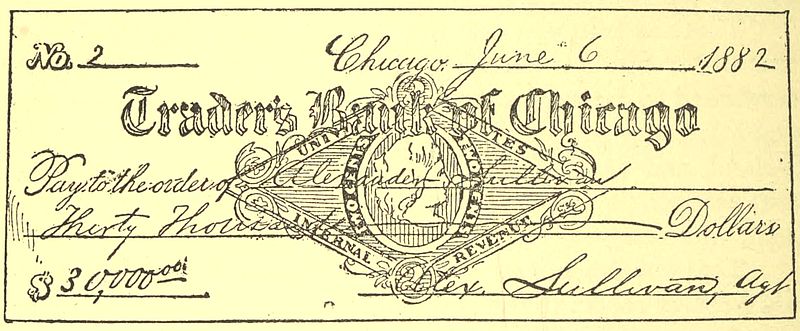
I give these extracts in order to show the
reader how matters stood between Sullivan and
Cronin on the eve of the latter’s murder. Into
the details of the £20,000 transaction I need not
enter, beyond stating the fact that banking officials
were called to prove by their books that on May
15, 1882, Sullivan cashed, through Monroe and
Co. of Paris, two cheques amounting to the sum
I name. This, I may state, was about the date
when Sullivan, in response to Mr. Parnell’s request,
crossed to Paris in order to settle the difficulty
with the Revolutionary body on the British
side. As the following extracts will show, the
matter had been one around which a great deal
of controversy had raged for many years:—
“The O’Donovan Rossa resents Mr. Patrick Egan’s imputation
against his character for truth and veracity. The
O’Donovan, when in this city a few days ago, intimated to a
Chicago Tribune reporter that Mr. Patrick Egan, while Parnell,
Dillon, Davitt, and other members of the Executive of the
Land League were in jail in Ireland, was visited in Paris by
Revolutionary Irish patriots from this country, who induced him
to give 100,000 dollars of the money contributed to Land
League purposes to them for revolutionary purposes, i.e.
making war on the British Empire with dynamite and such
things. Mr. Egan having seen or heard of O’Donovan’s statement,
denied that there was a particle of truth in it, and sent
the Tribune a telegram to that effect from Denver. Now
comes O’Donovan with a rejoinder. We have received from
him the following telegram:—
“‘Editor of the “Tribune.”
“‘Mr. Patrick Egan denies my statement. I say my statements
are more worthy of belief than Patrick Egan’s. I stated
in Chicago that money sent from America to support the
no-rent movement in Ireland was followed over by some
parties who got 100,000 dollars of it; that it was not used for
any such work in Ireland, and that Patrick Egan knows all
about it. I repeat my assertion. Will Patrick Egan meet me
in the presence of John Finerty and Denis O’Connor of
Chicago, or in the presence of Patrick Ford and Major
Horgan of New York, both answering all questions under
oath?
“‘O’Donovan Rossa,
“‘Editor “United Irishman.”
“‘New York, July 15, 1883.’”
LII .
Long before these final developments, however,
I had sailed for England, and severed for all time
my connection with Irish politics in the United
States. I had come, as explained, to my father’s
dying bedside. Unfortunately for me, I was not
in time to find him conscious, and did not reach
the house where he lay till the day on which he
died. When the sad offices connected with his
death had been fulfilled, I turned my thoughts
again to home, and set about preparing for another
voyage to the States. Everything had been
completed for my departure, when I suddenly
learned from Mr. Anderson that the Times had
approached him with a view of obtaining a witness
regarding the American side of the conspiracy.
Before this point was reached, I had chatted
over my proposal of going into the witness-box
with Mr. Anderson, but he had very frankly told
me that he had no intention of giving up such a
useful informant of his own initiative; and as he
had no connection with the Times case, he did
not think it likely that any approach would be
made to him on the subject.
Matters, however, turned out differently to
what he expected, and on the eve of my departure
for America I learned that my services might,
after all, be utilised, and my desire to drive the
truth home given full play. To be effective,
however, my coming appearance should be kept
a profound secret, and so I appealed to Mr.
Anderson to make such arrangements as would
allow of this being the case. As a result, I was
informed a little later that the Times people had
arranged that Mr. Houston should be the person
with whom I should deal, and that to him alone
should I be known pending my appearance in the
witness-box. This was the first mention I had
ever heard of Mr. Houston, and it was with no little
curiosity I made my way to No. 3 Cork Street in
search of the gentleman to whom I bore a single
line of introduction. I remember well how, when
I was first ushered into his now familiar room by
his faithful “Rogers,” I gazed suspiciously at the
tall youthful figure which met my view. As Mr.
Houston took my letter of introduction from me
and carelessly opened it, answering my suspicious
glance with a slight smile hovering about his face,
I could not help the remark, “Sir, you are a
much younger man than I was led to believe I
would meet.” The smile broadened into a laugh
as the reply came back, “I am sorry, but I cannot
help being young, you know. However, I
am Mr. Houston.” And so we two people met
for the first time.
I informed Mr. Houston that it was always an
understood thing on my part that my letters to
Mr. Anderson were private property, and that
whenever I liked to ask for them they would be at
my disposal. Accordingly I had, on learning that
my evidence would be accepted, requested that
Mr. Anderson should allow me to go over all my
documents and select such as appeared necessary
for the corroboration of my statements, as well as
for the assisting of my memory. To this he had
assented, excluding any of the papers which he
had made official by passing them on at the time of
their receipt. It was then arranged between Mr.
Houston and myself that I should get the documents
from Mr. Anderson, and go to work at
once in the preparation of my evidence. Much
to my disappointment, I learnt there was not time
for me to make a last hurried trip home, and that
if I was to carry out my intention of testifying I
should have to be content with the many losses
which would result from my stopping in England.
One thing, however, I stipulated for, and that was
the bringing over of all my family to England
before I appeared in the box. I was willing to
let all my private affairs go to ruin by my non-return;
but I was not prepared to leave my wife
and family to bear the brunt of the popular ill-will
which would result from what was to follow.
One of the first things I did, therefore, was to
cable for my wife and children; and having eased
my mind on this score, I went to work with a will
in the preparation of my evidence. For ten long
working days, Mr. Houston and I waded through
the hundreds of letters and Clan-na-Gael documents
I had now at my disposal, he taking notes
as he went along, and I dictating many items
brought to my recollection by the letters I was
perusing. We worked in this way from ten to six
o’clock each day, undisturbed by visitors of any
kind; and when I left him, Mr. Houston, with
the assistance of his clerks, worked far into the
night, copying the circulars, and transcribing the
notes which remained at the end of our day’s work.
On Tuesday morning, the 5th of February 1889,
the curtain was rung up, and throwing aside the
mask for ever, I stepped into the witness-box and
came out in my true colours, as an Englishman,
proud of his country, and in no sense ashamed of
his record in her service. On what followed I need
not dwell. While I was under examination, my
old employer, Mr. William Baber of Colchester,
was brought into court by the well-known detective
Meiklejohn, in order that he might identify
me. Nothing, of course, came of the incident;
but as I once more saw Mr. Baber, I thought to
myself how little he knew of the part I had
played at his father’s death-bed. It was in 1884
that I was hurriedly called one day to see a
patient who was said to be dying. I found him
an old man of eighty, surrounded by his family
and friends. In a few minutes he was dead; and
finding that all round about me were strangers
to the grim monster, I performed the last offices
for the body. As I was so employed, the poor
people related to me their history, and then I
learned to my surprise that the man whose eyes
I was now closing in death was none other than
the father of my former employer at Colchester,
who had emigrated to America some few years
previously.
Great as was the sensation produced by my
strange and weird but true story, it was as
nothing compared to that brought about by the
perfect corroboration afforded by the assassination
of poor Cronin, of whom I have said so much.
Little did I think, when day after day I stood
in the witness-box to tell my tale, and morning
after morning read the scoffing references of
those who believed it not, that in a little while
the blood of a murdered Gael would cry out in
judgment against those of whom I spoke, and
that in the outcome truth would prevail, and
the black foul conspiracy be dragged into the
open light. Yet so it was; and to-day there
are none who question the existence of the
murderous alliance to which I testified, and of
men within its ranks prepared to obey its leaders,
even unto the shedding of blood.
LIII.
I have told my story, and little more remains to
be done. Yet I cannot lay down my pen without
rendering some little tribute to one whose care
and caution on my behalf I can never repay.
I refer to Mr. Anderson. For twenty-one years
I served under this gentleman in the Secret
Service, and no greater honour can I pay him
than to say that during all this time I was never
discovered. Only those who have played my
part can fully appreciate what this means. Not
always careful, not always guarded enough in
the rattle and bustle of my life, there were times
when, had it not been for my chief’s watchfulness,
discovery might have overtaken me. But he
never wavered or grew lax in his care. He
proved indeed to me, not the ordinary official
superior, but a kind trusty friend and adviser,
ever watchful in my interests, ever sympathising
with my dangers and difficulties. To him, and
to him alone, was I known as a Secret Service
agent during the whole of the twenty-one years
of which I speak. Therein lay the secret of
my safety. If others less worthy of the trust
than he had been charged with the knowledge
of my identity, then I fear I should not be here
to-day on English soil quietly penning these
lines.
If my identity remained undiscovered, it was
not for want of attempts on the part of colleagues
of Mr. Anderson to find it out. It
was but natural, of course, that those associated
with my chief should seek to penetrate his reserve
regarding such a voluminous correspondent
as myself, and to gain, at first hand, possession
of the many important pieces of information
which he alone appeared to be able to supply.
All attempts, however, in this direction, and
they were many, proved fruitless. So determined
was a certain public official at one time
to discover my identity, that having in some
way got hold of my Christian name, Thomas—I
always wrote in the name of Beach to
Mr. Anderson—and assuming it to be my surname,
he despatched a detective to Chicago to
discover the man called Thomas in the organisation
there. Of course there was no chance
of getting at me in this way, but, nevertheless,
I was warned in time, and left no possible
loophole for discovery. Imagine, dear reader,
the weakness of such a policy as this, which
would commit the safety of an important informant
to the irresponsible knowledge of an
ordinary detective!
When this attempt failed, communications
were sought to be opened up with me by the
same official through Sir John Rose and Judge
M‘Micken, with whom I had acted at the time
of the Fenian raid of 1870. So strong, indeed,
was the pressure brought upon Judge M‘Micken,
that the old gentleman travelled specially to
Chicago to see me on the point. However,
I would have none of it. I was quite contented,
and too well assured of my safety as
I was; and so, much to my own satisfaction, I
was left undisturbed in Mr. Anderson’s charge.
There was only one thing about which he
had frequently to remonstrate with me, and
that was my expenditure. Many a lecture did
I receive from him on the subject of money
spending. It was not, of course, his fault, but
rather that of the system. Indeed, so kind
and friendly was he that he at times advanced
me money for which he himself had to wait
for repayment for some time, if indeed he ever
got all of it back, which I very much doubt.
Of course I could not help spending the money.
I tried to be as sparing as possible, and, whenever
I could, debited my expenses to those
other undertakings which I allied with my
Secret Service work. But it was not always
possible to pursue such an economic course,
and in very many instances where Mr. Anderson
could not pay, I had to pay myself. I
occupied a certain position; I had to live up
to that position. The expenditure of money
amongst the Irish patriotic class was an absolute
necessity for my purpose, and consequently
I could never put any money by, but rather
lived up to, if not, indeed, at times beyond
every penny of my income.
On this question of Secret Service money I
could say much. The miserable pittance doled
out for the purpose of fighting such an enemy
as the Clan-na-Gael becomes perfectly ludicrous
in the light of such facts as I have quoted in
connection with the monetary side of the Dynamite
Campaign. Gallaher, as I have said, had
no less than £1400 on his person when arrested
in 1883; while, coming down to a later date,
Moroney, when despatched from New York in
1887, in connection with the second stage of the
Jubilee explosion plot, carried with him some
£1200. How on earth can the English police
and their assistants in the Secret Service hope to
grapple with such heavily financed plots as this,
on the miserable sums granted by Parliament for
the purpose? There are, I believe, some thirty
men charged with the special duty of circumventing
political crime in London. All praise
and honour to them for the work they have done,
and the sincerest of congratulations to Chief-Inspector
Littlechild, who so ably conducted the
arrests of all the principals of the latter-day dynamite
plots. But these policemen have succeeded
more by chance than anything else; events have
played into their hands, and, clever men that they
are, they have been sufficiently capable to take advantage
of the little that came to their knowledge,
and from small clues to work out great things.
Some day, however, a big thing will happen,
about which there will be no leakage beforehand,
and then the affrighted and indignant British
citizen will turn on his faithful band of thirty and
rant and rave at them for their want of capacity
and performance. The fault will be the want
of a perfect system of Secret Service, properly
financed. If plots are to be discovered in time—and
already there are some whisperings of
coming danger—they can only be discovered
through information coming from those associated
with them. As I have shown, the men engaged
in them are very highly paid. If it is to be
made worth their while to speak, then the price
offered by the British Government must be higher
than that of the other paymasters. There is no
use in thinking that mere tools like Callan and
Harkins—the men now in prison in connection
with the Jubilee Explosion Plot—would be of any
service. These men know nothing. It is the
Millens and the Moroneys of the conspiracy who
should be in Government pay, and they have no
mean price. Imagine offering either of these
men a retainer of £20 a month with a very odd
cheque for expenses thrown in! The idea is
ridiculous. I have heard it urged that the
thought of Secret Service is repugnant to the
British heart, wherein are instilled the purest
principles of freedom. The argument has
sounded strange in my ears when I remembered
that London, as somebody has said, is the cesspool
of Europe, the shelter of the worst ruffians
of every country and clime. America is called
the Land of the Free, but she could give England
points in the working of the Secret Service, for
there there is no stinting of men or money.
APPENDIX. — I. THE STORY OF THE JUBILEE PLOT.
Fully two months before the celebration of the Queen’s
Jubilee in London, reliable intelligence reached the Scotland
Yard authorities that a gang of skilful and unscrupulous conspirators
in America were devising a plan for carrying out acts
of murder and destruction in London. The names of the
principal persons engaged for this purpose were known to the
police, and the individuals were closely watched even during
their voyage across the Atlantic. The headquarters of the
organisation were established in Paris, and both there and in
Boulogne their movements were under strict observation.
The direction of the conspiracy rested with General Millen, a
well-known Fenian agent, who, finding the police espionage
unbearable, had latterly kept out of England. Had he
returned, he would have been immediately arrested. Last
Saturday he left Amsterdam for New York, being watched by
English detectives down to the time of the vessel sailing.
After the Jubilee celebration, some of the gang crossed the
Channel and came to London, their plans previous to the
Jubilee celebration having been disconcerted. The most
prominent of the arrivals in London was the man Melville,
said to be the shrewdest of the whole gang. The police do
not believe that those conspirators were in communication
with O’Donovan Rossa, or acting with his cognisance. Cohen’s
presence in London was known to the police some time prior to
his death. There was only one of the gang of whose presence
they were not aware. Strangely enough, the police were on
their way to arrest the deceased [Cohen] at the moment of his
death, and had they been twenty minutes earlier they would
have captured the unknown individual who left the death
chamber just previously.
The man Melville came to London as an agent of Millen, and
took modest lodgings in Gladstone Street, but at the time was
deficient in funds. The police, however, watched him closely,
and found that on two occasions he called on Mr. Joseph Nolan,
M.P., at the House of Commons. He had for his companion
the man Harkins, and both of them were seen in company
with the dead man Cohen, upon whom an inquest was held
yesterday [26th October 1887]. The police suspicions of
Melville’s business were confirmed. His assertion, that he
represented Mr. Philips, of Philadelphia, proved entirely false.
Afterwards Melville went to Paris, and there met a man named
Dennehy, who, with a man named Maloney, sailed for America
on August 17. Dennehy is a member of the Clan-na-Gael,
and his address is known to the police. Melville then
returned to London and stayed at the Hotel Métropole with a
Miss Kennedy, of 53 Charles Street, Boston, with whom he
travelled through Ireland, and afterwards to Paris, where he
called upon General Millen at the Hôtel du Palais, and was
also seen in a cab with a man remarkably like the deceased
man Cohen, who was absent from his lodgings about five
weeks ago. He sailed for America from Havre on September
17, and on reaching New York, his companion, Miss
Kennedy, was arrested for smuggling a large quantity of
valuable goods. Melville’s hurried departure upset the plans
of the Clan-na-Gael, and closely following this Cohen died.
Harkins admitted yesterday that he called at the House of
Commons with Melville, and that he had written for money to
Burchall. Melville’s address in America is known to the
police—viz., Mr. J. J. Moroney, 925 Tenth Avenue, New
York.—Daily Press, 28th October 1887.
Thomas Callan, 46, labourer, and Michael Harkins, 30,
grocer, were placed upon their trial at the Central Criminal
Court, London, on February 1, 1888, upon an indictment of
various counts, charging them with maliciously conspiring with
Joseph Melville and Joseph Cohen, and other persons, to
cause, by an explosive substance, an explosion in the United
Kingdom of a nature likely to endanger life, and to cause
serious injury to property, and with having in their possession
and under their control an explosive substance with intent by
means thereof to endanger life and cause serious injury to property
within the United Kingdom, and with having in their
possession and under their control an explosive substance in
such circumstances as to give rise to a reasonable suspicion
that they did not have it in their possession and under their
control for a lawful object.
The prisoners were found guilty, and each sentenced to
fifteen years’ penal servitude.
The Select Committee appointed to consider the regulations
applicable to the admission of strangers to the House
of Commons met again on Thursday, the 19th inst., Viscount
Ebrington presiding.
Mr. James Monro, Assistant Commissioner of the Metropolitan
Police, examined by the Chairman, said:—Melville’s
real name is Moroney, of Philadelphia, New York, and a
member of the Clan-na-Gael. He was sent over here in pursuance
of instructions, and for the purpose of committing an
outrage in the Jubilee week. He came over with Callan and
Harkins in the steamer City of Chester. They did not arrive
in England until June 21. They had missed the previous
steamer, all the berths being engaged, and they did not arrive
until the Monday. They came at once here, only to find that
General F. F. Millen had been rendered powerless by the
operations of the police. Melville was the man who was chief
in giving them dynamite, in enabling them to get it in here.
and in giving them instructions how to dispose of it. The
dynamite was brought over by other persons to Melville—two
men, and also a person of the name of Callan, and another
man, I believe. The other man we have not been able to get
hold of. But Melville and this fifth man arrived on May 15;
so that when Melville and his associates came on June 5, Callan
was here to meet them.
The House of Commons was one point in these dynamite
operations. One of these men was sent down on two occasions
to Windsor Castle to “prospect” the State apartments,
taking with him a watch for the purpose of finding out how
long it would take him to effect his purpose and get away.
On both occasions the State apartments were closed. He did
not go back again, because I suppose he thought he would be
identified. General Millen was a man known twenty years ago in
Fenian matters. He was connected with the Fenians in 1867.
He was what was called a military member of the Clan-na-Gael,
and he was sent over to this country on a secret mission in
1879. He reported his progress to his associates under the
name of Robinson.
He was in communication with Melville. That is to say, he
met Melville on one occasion in Paris, not in this country.
He met Melville in Paris in September 1887. Melville was
sent over. He left in April and arrived in France about the
end of April. He was in England before that. He left this
country in January 1887, and went to America. He left
America and arrived in this country in April. I forget the
exact date.
General Millen had no home in England, but he had relatives—his
daughters, living in London for a certain time. On
August 4, Melville and Harkins came to the House of
Commons, and sent up their cards, or rather, Mr. Melville
sent up his card to Mr. Joseph Nolan. Mr. Nolan came out to
them and saw them in the central lobby. After a little conversation
they went away. On the 5th of August the visit was repeated
by the same two men. They sent up their card to Mr.
Joseph Nolan. Mr. Nolan came out and disappeared with them;
by that I mean the police did not follow them. He took them,
it is believed, to the gallery. Now it is known that he did so, as
the entry in the Strangers’ Gallery book shows. They were
not seen to leave that night by the ordinary entrance. They
were for some time on the terrace.
They must have gone down with a member?—They were
accompanied by Mr. Joseph Nolan.
About how long did they remain?—About twenty minutes or
half an hour, as far as I can remember. They were under
observation by my men; they were seen by the House of
Commons police. They were under observation outside.
At that time were you aware of any business in which they
were engaged in this country?—We had not identified Harkins
at that time, but I knew Melville was a dangerous character.
On his visit here my information was that he might be looked
for in the House of Commons. That information was received
in connection with his relation with Millen. He was met in
Paris afterwards, and Melville was actually in Paris in the
month of July, but I am not prepared to say he met Millen
then, but they were connected. There was another man in
Paris in regard to whose movements I was apprised in connection
with Millen’s relations in Ireland; and it is also a fact
that General Millen was in communication with Mr. Joseph
Nolan by means of letters conveyed by Millen’s daughters, who
were then in London and under observation. One of these
letters so conveyed was a letter of introduction to Melville.
Was that prior to the visit to the House of Commons?—That
was prior to the visit; that was on the 14th of July, on
which date Millen’s daughters visited the House of Commons.
They saw Mr. Joseph Nolan and repeated the visit on the 15th.
Millen is their real name. They had been living here for some
time before that.
The Home Secretary.—Did they visit the House on that
occasion, or did they remain in the central hall?—Witness:
On the first occasion they were taken by Mr. J. Nolan to the
Ladies’ Gallery, and on the second occasion they were taken by
Mr. Nolan to the bar of the House of Lords, and after they
left they were accompanied by Mr. Nolan some little up the
street on both days.
They did not go over the House of Commons?—I cannot
say they did. They then left for Paris, where Millen then was,
and, as I said before, on the 4th of August Melville then
appeared.
Did you follow up this matter by any inquiries of Melville
himself?—Melville was traced to his lodgings, and on the 8th
of August he was interviewed. After Melville’s interview we
interviewed Mr. Joseph Nolan on the 16th of August. He
was asked whether Melville had visited him and whether he
knew him. Mr. Nolan said Melville was a stranger to him,
that he had brought no letter of introduction, that he had
mentioned the names of several gentlemen known to him (Mr.
Nolan) in America, among them a gentleman named Stack,
who had been successful in life and was over in England on a
trip; that he (Stack) seemed to be well acquainted with the oil
wells and silver mines in the Rocky mountains, that he seemed
to be a man well read in history, and altogether was a rather
well-informed man; that he had come with this letter of introduction,
and that he (Nolan) treated him with the same civility
that he would expect in America. We made inquiries, and we
came in the Strangers’ Gallery book, upon an entry which we
believed to be in Mr. Nolan’s handwriting. We had the handwriting
submitted to an expert, and he said it was the same as
that on a remittance sent by Mr. Nolan. We had no doubt on
the subject, because when Mr. Nolan was examined he said it
was in his handwriting. We made inquiry of Mr. Stack, and
had him interviewed on the 26th of January this year. He
said he did not remember anything in connection with the
registry in the book at the gallery in the House of Commons,
and did not remember anything about the man Melville. The
writing in the book appeared, he said, to be his own, but he
was certain he never gave an order to Mr. Joseph Nolan, M.P.
and Mr. Nolan knew nothing about his signature. It was an
understood thing among the Irish party that everything possible
was to be done for Americans who might wish to see the
House of Commons, and the consequence was that there was
scarcely a day passed without application being made for
admission to the House by Americans. This matter would
stop that kind of thing. If the Irish members were aware of
it they would shun an American as they would poison, and it
would be detrimental to the party generally.
By Mr. Forrest Fulton.—One of the letters conveyed by the
daughter of General Millen to Mr. Joseph Nolan, who was
in communication with General Millen, was a letter of introduction
of Melville to Mr. Nolan. Millen introduced Melville
as a friend.
Is there any statement at all as to what Melville was doing
in this country?—No, not so far as I am aware.
The Chairman.—I think you spoke of letters passing?—Yes,
more than one. This was one of the letters conveyed to
Mr. Nolan from General Millen by his daughters.
And these letters passed on various occasions?—Yes, they
passed on more than one occasion.
By Mr. Fulton.—Mr. Nolan said he knew nothing at all
about Melville, and had not received any letter from him?—Yes.
Mr. Fulton.—You say you know where the daughters of
General Millen reside. Do you know that they were visited
by Mr. Nolan at any time?—Not at the period referred to, so
far as I know.
On other occasions?—On a previous occasion they were.
When was that?—In January of the previous year; but I
had not commenced observations then.
The Committee adjourned till three o’clock in order to give
Mr. Joseph Nolan, M.P., an opportunity of replying to the
evidence of Mr. Monro.
The Chairman communicated to Mr. Nolan the statements
made by Mr. Monro. Mr. Nolan said he had no wish to go
back upon the evidence he had given in Court in connection
with the dynamite trial. He had received no introduction of
any one from General Millen.
You visited the House with two daughters of General Millen
on the 14th or 15th of July, and showed them over the House,
and that one of them gave you a letter from her father introducing
a man who would come subsequently—a man named
Melville. Is it true that the two daughters of General Millen
were there on the 14th or 15th of July, and were shown over
the House by you?—It is true that I showed two ladies named
Millen over the House.
The daughters of General Millen?—I do not know about
that.
Were they strangers to you at that time?—One of them
was.
One of them you did know?—Yes.
She was the daughter of General Millen?—That I do not
know.
Did you meet her in London?—I met her in London, I
think, in 1886. She has been living in London.
Did you know General Millen?—I know him by repute.
As what?—As an officer in the Mexican Army, and as
correspondent of the New York Herald.
Have you ever met him?—Yes.
When?—In 1886.
In England or abroad?—In England.
Was he a stranger to you then?—He was.
Where did you meet him; at a private house?—He called
upon me at my own house.
Was that the only occasion on which you ever saw him?—Yes.
Mr. Lawson.—Called upon you doubtless as many Americans
do?—Yes.
The Chairman.—Is it true that the ladies brought a letter
of introduction about Melville?—It is not true.
Or a letter of any kind?—No.
The statement was a letter written by the General?—No;
not that I remember; in fact there was no necessity for it,
because one of the ladies knew me.
It is said they brought a letter to you at the House introducing
Melville to you on a future occasion?—That is not so.
One of the ladies said she had not seen her father for years,
and she believed he was ill at the time in Europe, and that she
intended to call upon him.
Have you had any communication with him?—No.
The Home Secretary.—Are you aware that Melville and
Millen had met each other?—No, and I may say that I had
never heard that General Millen had any connection whatever
with what is known as the dynamite party. It has been
stated, I believe, that he has, but I never heard it previous to
the recent case. On the contrary, I heard that General Millen
as an Irish officer was clearly opposed to the policy of that
party.
The Home Secretary.—That has nothing to do with it.
Did Melville come from America; he had been in London for
some months?—I did not know that.
Did Melville speak about Millen?—No.
Were you aware that they were acquainted?—No. I knew
a number of Irish Americans who have visited me at the
House. They asked for admission, and I have been told that
he was among the number. I remember that a policeman or
gentleman who said that he belonged to the detective force
called upon me in the House, and made inquiry about some
one or two men who had visited the House. I told them all
I knew at the time.
Mr. Lawson.—It is said you did not acknowledge the
handwriting on the Speaker’s Gallery ticket as yours, and you
said it was not your handwriting?—I simply said I could not
swear to the writing as being mine.
The Home Secretary.—Have you any doubt about it?—I
rather think it was I who wrote it, but I could not positively
swear.—The Times, 20 April 1888.
II. THE STORY OF THE CRONIN MURDER.
The Cronin murder trial ended yesterday, after prolonged deliberation
on the part of the jury, in the conviction of four of
the five prisoners arraigned. By the laws of the State of
Illinois the jury not only decide the issues of guilty or not
guilty, but also award the punishment of the convicts. To
this fact is probably due the long delay in the present case in
the announcement of the verdict. The jury have acquitted
John F. Beggs. They have awarded imprisonment for life to
Daniel Coughlin, Martin Burke, and Patrick O’Sullivan, whom
they convict of murder; and imprisonment for three years to
John Kunze, whose offence is reduced to manslaughter, and
whose part in the crime was shown to be of a very minor kind.[7]
Now that the case is over, it seems desirable to state in a connected
form the theory upon which this remarkable trial was
instituted by the State of Illinois.
The prisoners, Daniel Coughlin, Martin Burke, John F.
Beggs, Patrick O’Sullivan, and John Kunze, were indicted for
the murder of Dr. Patrick Henry Cronin, on May 4, 1889.
The case naturally created intense excitement throughout the
State, affecting as it did many and complex interests of party,
race, and creed. Committees were formed and funds were
raised for the prosecution and for the defence, and the prisoners
were convicted and acquitted on the platform and in the Press,
with that reckless disregard of common decency which disgraces
the partisan warfare of America. American judicial
proceedings are, however, framed to work in a society which
habitually indulges itself in debauches of partisan fury, even
while prisoners stand at trial for their lives, and accordingly
the most elaborate safeguards are employed to secure the impartiality
of the jury. The State and the prisoners exercise
the right of challenge both peremptorily and for cause, in a
degree undreamt of in this country. Each juror, before he is
sworn to try the issues, is subjected to the most merciless examination
and cross-examination by counsel for the State and
for the prisoners, and challenges “for cause” are allowed on
grounds which in English eyes appear ludicrously trivial. The
prisoners in the Cronin case were, by law, entitled to twenty
peremptory challenges apiece, or, as they combined their challenges,
to one hundred peremptory challenges in all, and the
State was also entitled to one hundred peremptory challenges.
The work of impanelling the jury began on August 30, and
ended on October 22. Seven full working weeks were spent
in this preliminary labour. No fewer than 1115 unfortunate
citizens of Cook County were exposed to the rigid scrutiny of
counsel for the State and counsel for the defence. Of these,
927 were “excused,” to use the American euphemism, for
cause, while 78 were peremptorily challenged by the State, and
97 were similarly challenged by the defence. Thus the State
had 22 challenges unexhausted, and the defence only three
when the tale was completed. At last, on October 24, the
State’s Attorney “got down to trial” and made his opening
speech. The case relied upon and proved by the State depended
on the following assertions and inferences.
Dr. Cronin was summoned from his home at half-past seven
on the evening of May 4, and never returned. On May 22
his naked body, bearing marks of violence, was found in the
catch-basin of a sewer. The theory of the prosecution was
that he was murdered in pursuance of a conspiracy, and that
the accused, together with other persons not in custody, were
members of that conspiracy. The jury by their verdict have
declared that Dr. Cronin was so murdered, and that all the
prisoners save Beggs did conspire to murder him. This conspiracy
arose from a bitter quarrel within the ranks of the
United Brotherhood, or Clan-na-Gael. The history of that
organisation was sketched by State’s Attorney Longenecker in
his opening speech. It was founded in 1869, to “free” Ireland
by open warfare. Irishmen joined it from “patriotism,” Irishmen
joined it for the purposes of American political warfare,
and others “for the sake of the money that was in it.” The
organisation grew “until now it stretches from ocean to ocean
in our land.” It was organised by districts, each with its District
Member and District “Camps.” Each “Camp” had a
public name, by which alone it was known to the general
public. Thus, “Camp 20,” to which several of the prisoners
belonged, was called the “Columbia Club,” and other
“Camps” were known as “Literary Clubs,” and so on. Prior
to 1881 the organisation was governed by an Executive Body,
which was composed of the District Members. In 1879 this
Board consisted of fifteen members.
In 1881 a National Convention of the United Brotherhood
was held in Chicago. At that Convention the Executive Body
was reduced to five members, and Alexander Sullivan, Feeley,
and Boland were appointed thereon. These three men constituted
a majority of the new Board, and, in the State’s Attorney’s
phrase, “took charge” of it. “They then adopted,” he
says, “what is called the dynamite policy. They called it
‘active work.’ They adopted a policy to blow up property
and individuals, and that policy was adopted immediately after
they got possession of the Executive Board of the organisation.”
Moreover, this new Executive Body inserted a provision in the
oath of the organisation binding all members to obey the Executive
Body without question. “If they directed a man to
go and kill another man in England it had to be done, and
they had no right to question the order.” In 1884 this controlling
Board adopted the symbol of the Triangle, and issued
orders under that designation. The whole object of this Junta
was to steal the funds of the organisation, and the State’s
Attorney roundly accuses them of endeavouring to effect this
object by acts of well-nigh incredible infamy. They pretended
to their organisation that great sums were being expended
upon “active work.” To lend colour to this fiction they procured
a certain amount of such work to be done. They sent
emissaries to this country. But they failed to provide them
with the funds indispensable for their personal safety. The
men were referred to an agent of the organisation in England,
and when they had reached this side of the Atlantic precautions
were taken that they should not too speedily return.
When the dynamite emissary landed in the United Kingdom,
“I say to you,” says the State’s Attorney, “that somebody
there made known who the man was, and what he was detailed
to do, and he was immediately arrested and thrown into prison.
To-day the prison doors in England are locked against twenty
or more men who were sent there by that Board.”
The next trick of the Triangle, to hide their embezzlement
of the funds, was to circulate a rumour that English detectives
were watching the Order, and to get the biennial Convention
postponed upon that plea. A meeting was held of the friends
of the Triangle, “and they destroyed every vestige of work they
had done. They destroyed their books, and then sent out a
circular showing that the Order was indebted to them $13,000,
notwithstanding when they took hold of it they had a fund of
$250,000 in the treasury.” Naturally these proceedings led to
great dissension in the Order, and finally to a split in its ranks.
To the quarrel that thus arose, Dr. Cronin, on the theory advanced
by the prosecution, and accepted by the jury, owed
his death. Cronin from the first protested against the action
of the Triangle. In 1885 he was tried for treason to the Order.
Alexander Sullivan prosecuted, and the convict Daniel Coughlin
sat on the Trial Committee. Cronin was convicted and expelled.
Thereupon Cronin joined a new organisation formed
by the seceding members of the Order, and no further steps
were taken until June 1888. In that month a joint convention
of the two factions was held in Chicago with a view to
reunion. At that convention Cronin charged the old Triangle,
which had then ceased to exist, with misappropriation of the
funds of the Order, and with misconduct towards their emissaries
to Europe. It was resolved that the charges should be
investigated, and a Trial Committee of six, three from each
faction, was appointed to try Sullivan, Feeley, and Boland.
Of that Trial Committee, Cronin was a member. A memorandum
in Cronin’s handwriting, containing the joint findings of
Cronin himself, and one P. M‘Cahey, as members of the Trial
Committee, and also minutes of the evidence adduced at such
trial, were found amongst Cronin’s papers, and proved at the
coroner’s inquest. These documents were, of course, inadmissible
at the actual trial, according to a well-known technical
rule of evidence, but, as they undoubtedly guided the State’s
Attorney and his associates in framing the case against the
prisoners, and as, moreover, they possess a very special and
personal interest for Englishmen, we do not feel constrained
to ignore their contents here.
The Trial Committee, it appears, met at Genesee House,
Buffalo, on August 20, 1888. Alexander Sullivan objected
that “one of the committee was a malignant enemy of his,”
and he named Cronin as that enemy. Feeley and Boland
joined in Sullivan’s objection, but Cronin denied that he had
any personal enmity to Sullivan and the objection was overruled.
Boland then charged the notorious John Devoy, who
was a friend of Cronin’s, and attended the Trial Committee,
presumably in his interest, with being a British spy. Cronin
defended Devoy, the committee settled down to work, and
the trial proceeded. The minutes of the evidence taken by
this committee, and found in Cronin’s own handwriting, form
one of the most startling documents ever produced in any
Court. Four principal witnesses were examined in support of
the charges made against the Triangle of neglecting to supply
the emissaries actually engaged in dynamiting with funds, and
of neglecting the families of those emissaries who had perished
by explosions, or had been sent to penal servitude in this
country. The first witness was himself one of the London
dynamiters. The last was the widow of Mackey Lomasney,
who was blown up while attempting to destroy London Bridge.
The names of the male witnesses are not given. The first witness
swore that after the Boston Convention of 1884, one
Donovan, “who acted as agent for the body,” and “was then
in the employ of General Kerwin,” asked him if “he could
furnish enough men to accomplish a certain amount of active
work.” The witness procured one recruit. Donovan and
John J. Moroney paid their steerage passage, and gave them
$100 each “to carry on work.” For further funds they were
referred to “the agent on the other side.” The two dynamiters
crossed to this country, but the funds were not forthcoming.
The agent, it is satisfactory to learn, “was sure he
had been betrayed by some one,” and it is yet more gratifying
to know that he “is now in prison.” The witness then gives
the following account of his exploits in this country, and of the
base ingratitude of his employers:—
“At the agent’s request, work was delayed six weeks. I at
last told him I would do the work. There were four of us....
I finally induced him to give orders to do the work.
This was on Thursday. On Saturday we did it. After the
work was done I met him the same evening. He remained in
capital city seven days afterward. I was so reduced for funds
that I prevailed upon him to give me four pounds of the sixteen
he had left. On landing in this country had three-and-one-half
pounds.... I at once complained to Donovan and
Moroney, and through them to the executive, or General
Kerwin, of the treatment I had received, and the culpable
neglect of the F. C. About the last of February 1885, Donovan
furnished me with $10 with which to reach my home.
“Q. How many operations did you perform?—A. Three.
We always bade each other good-bye after each meeting,
thinking it might be our last meeting on earth. I have learned
that, in order to get back, the other man who went over with
me had to sell his clothes to get passage-money. He came
with a sprained ankle. In July or August 1885, he received
$7 from Moroney.”
Subsequently the witness found that the mother of Cunningham,
the dynamiter, was in want. He complained to Moroney
and General Kerwin, whereupon Kerwin told him he ought to
be expelled. The munificent sum of $100 was finally sent by
the “F. C.” (Executive Body) to the mother of their dupe
Cunningham, now undergoing in this country the just but
awful punishment of penal servitude for life. The witness
further ascertained that Mrs. Mackey Lomasney, the widow of
Captain Mackey Lomasney, who “was killed in London, and
was assured, witness was told, that his family would never
want,” was in great distress. The relatives of Dr. Gallagher,
another dynamite convict under a life-long sentence, were also
in want. A hundred dollars was raised for Mrs. Gallagher.
Then comes this terrible statement, a statement which should
warn the miserable tools of the Clan-na-Gael what kind of
succour they may look for from their chiefs when their
“heroism” lands them in the dock. “I requested,” says this
same witness, “that the men on trial on the other side should
be defended. General Kerwin said that friendless men were
better off in such cases.” To the men who have risked their
lives at its bidding, the Order, with its ample revenues, grudges
the few pounds needed for their legal defence, and coldly
abandons them “friendless” to their fate.
The next witness confirms the above statements as to the
conduct of the organisation towards Mrs. Cunningham. In
July 1885, he succeeded John Moroney as D. M. (District
Member), and in October of that year he “went out as an
organiser of the National League in the West.” “I saw
General Kerwin and told him that he should send money to
Mrs. Cunningham, that the lady was hurt on the subject of
being neglected by us. He said he would send it.”
The cross-examination of this witness was directed to show
that he entertained animus against Kerwin and Boland for
endeavouring to defeat his candidature for the presidency of
the National League, which candidature, he alleges, had been
officially adopted by the Clan-na-Gael. “The slate,” he says,
“was Baldwin, Minton, and Carroll for F. C. (Executive Body),
and myself as President of the League.” Boland asked him
why he would not take the secretaryship.
The third witness, “a member since the beginning of the
old organisation,” knew Mackey Lomasney, and remembers
his departure for Europe in August 1884, with his brother Jim,
and a third conspirator. The witness describes his efforts to
obtain relief from the organisation for Mackey Lomasney’s
widow. In 1885 he went to Newhaven and saw Dr. Wallace
(who was then “D.”), Condon, and Boland. Boland “denied
all responsibility,” and alleged that Mrs. Mackey Lomasney
had been supplied with plenty of money. The witness called
on Carroll. “He professed utter ignorance of the whole
affair. I said, ‘By God, you must see her.’ Carroll offered the
witness $100, which he refused. I said, ‘You know how to
send this, as you have the others; if you respect the memory
of the dead, and the widow and the orphan made so by your
act, do your duty by all.’” The witness further states that Mrs.
Mackey Lomasney continued to be in a poverty-stricken state,
without coal or clothing, until August 1886.
The last witness was Mrs. Susan Mackey Lomasney herself.
Upon Alexander Sullivan’s request, made presumably to show
his reliance on the bare word of a dynamiter’s wife, she was
not sworn. Mrs. Mackey Lomasney stated that her husband
went away in August 1884, and that since that date she had
received $1000 from the organisation. She called on
Alexander Sullivan in 1885, but did not ask for help. In
August 1886, she again visited Sullivan, explained to him the
state of her affairs, and asked for help. “He asked me for a
schedule of my liabilities—$200. He would attend to the
matter. He gave me no money, nor offered me any.” Sullivan
told the witness not to mention his name to any one. She then
called on “James Q.,” who “talked to her about Father Dorney,”
but gave her no help. The witness was so poor at this time that
she borrowed a dress to visit Sullivan. Several weeks after the
witness again called on Sullivan and applied for a loan of $100,
which she obtained. That was all she ever got from Sullivan. In
cross-examination Mrs. Mackey Lomasney admitted that her
husband wrote to her from Europe, saying he had received
money from Mr. Sullivan. The witness did not know the
amount.
“Here,” say the minutes, “Mr. S. admitted that (Mackey)
Lomasney was sent by the organisation.”
The Trial Committee was divided in opinion as to the guilt
or innocence of the accused. Four members were for an
acquittal. Two, Cronin and M‘Cahey, were for a conviction
on the principal charges, and, in particular, on the charges of
“scandalous and shameful neglect” of “the family of one who
lost his life in the service of this Order,” and on that of issuing
a fraudulent financial report and squandering the funds.
Dr. Cronin’s documents illustrate many interesting points.
Amongst other things they prove that he, his friends Devoy
and M‘Cahey and their faction, are to the full as wicked
scoundrels as Sullivan, Feeley, Boland, and the party of the
Triangle. The minority report does not condemn the Triangle
for dynamiting, but for dishonest dynamiting. It does not
reprobate the despatch of miscreants like Mackey Lomasney
to work slaughter and destruction in the heart of a great city,
but the subsequent neglect of the Order to keep faith with
their emissary, by providing for his widow. It acquits the
Triangle of wilfully omitting to supply the actual authors of
the dynamite explosion with funds to fly from the law, but it
severely censures their “agent” for the omission. Both wings
of the Clan-na-Gael were engaged in the same devilish plots,
and while every one must rejoice that the assassins even of a
dynamiter should meet their lawful doom, Cronin merits no
more sympathy as an individual than “Captain Mackey”
himself. He was brutally murdered, while himself engaged in
plotting the wholesale murder of others.
On the theory of the State’s Attorney, now endorsed by the
verdict of the American jury, it was Cronin’s persistent efforts
to have the evidence taken by the Trial Committee published
with the report, that sealed his doom. That committee, as
has been seen, sat in August 1888. The report did not
appear while Cronin lived. But on the day of his murder the
Executive Body of the Clan-na-Gael met, and on the next day,
or the next day but one, the report was published to the Order.
The evidence was not then issued with the report, but a protest
from Alexander Sullivan was annexed thereto, in which he
charged Cronin as a perjurer, and a traitor to the Irish cause.
All the prisoners except Kunze were members of the Clan-na-Gael.
All those members belonged to the same “Camp” of
the Order, known in the ranks of the Order as “Camp 20,”
and in public as the “Columbia Club.” The prisoner, John
F. Beggs, was “Senior Guardian” of the “Camp,” and an
intimate friend of Alexander Sullivan’s. On February 8, 1889,
the “Camp” met, with Beggs in the chair, and from that
meeting the prosecution dates the conspiracy to murder
Cronin. A member got up and said that they should investigate
the affairs of the Triangle, these men who had robbed
them of their funds. The prisoner Coughlin and others
demanded the speaker’s authority for this statement. He
replied that he had heard part of the report of the Trial
Committee appointed to try the Triangle read in another
“Camp.” That other “Camp” was Dr. Cronin’s. The State
alleged that Beggs made a violent speech and declared that he
would not have these attacks made upon the Triangle, and
that it had to be stopped if it took blood. Coughlin at once
moved that a secret committee of three be appointed to investigate.
The motion was carried, and the prisoner Beggs, as
Senior Guardian, was directed to nominate the committee.
All the accused except O’Sullivan and Kunze attended this
meeting of “Camp 20.” Two days later Beggs wrote to his
superior officer, a man named Spellman, and informed him
that “it was charged that the S. G. of the Columbia Club at a
recent meeting read to the assembled members the proceedings
of the Trial Committee.” On February 17, Spellman
disclaimed any jurisdiction “to inflict the penalty” in the
case. On February 18, Beggs replied that the matter had to
be investigated or there would be trouble. The State’s
Attorney argued that this secret committee of three was in fact
appointed to try, and did try, the murdered man, and that
Spellman’s disclaimer of jurisdiction to inflict “the penalty”
proves that Cronin had been convicted and already stood for
sentence at the bar of the Order.
On February 19, a man giving the name of Simonds, who is
not in custody, took rooms at 117 Clark Street, Chicago,
immediately opposite to Dr. Cronin’s office. On the same
day he bought some furniture and a carpet. He asked for
goods of the cheapest quality, and stated that he required
them only for temporary use. He also bought from the same
dealers the largest packing trunk they had, a valise, and a
trunk strap. He told the shopman that the first strap supplied
to him was not large enough, and a larger one was procured.
All these articles were put into the rooms at 117 Clark Street.
On March 20, a man, proved to be the convict Martin
Burke, hired Carlson cottage, under the name of “Frank
Williams,” for one month from Mr. Carlson, who himself lives
next door. Burke then went to the prisoner P. O’Sullivan,
whose premises immediately adjoin the Carlson cottage, and
told O’Sullivan that he had taken it. Burke and another man
not in custody next removed all the furniture, the trunk, the
valise, and the carpet from 117 Clark Street into the Carlson
cottage. This removal took place on the evening of March 20,
the day Burke took the cottage.
O’Sullivan is an ice man by trade. On March 29, nine days
after the taking of the cottage, O’Sullivan tried to find one
Justice Mahoney, to come and make a contract between him
and Dr. Cronin. O’Sullivan did not find the justice on March
29, but some time in April they went together to Cronin’s
office, and a contract was made between O’Sullivan and
Cronin, whereby Cronin agreed to attend to O’Sullivan’s
workmen. O’Sullivan then gave Cronin some cards and said,
“I may be out of town and my card be presented.”
O’Sullivan’s business was not dangerous. No accident had
ever occurred amongst his men. Numbers of doctors lived
between O’Sullivan’s place of business and Dr. Cronin’s office,
which is nearly an hour’s drive from O’Sullivan’s yard.
“What,” the State asked, “was the object of this contract,
made after the discussion in ‘Camp 20,’ and after Beggs had
been directed to appoint the secret committee?”
On April 20, Martin Burke, under the alias of “Frank
Williams,” returned to the Carlson cottage and paid a second
month’s rent in advance. He had never occupied the cottage.
He said his sister was in hospital and could not come to
housekeeping. The Carlsons grew uneasy about their tenants.
They inquired of their neighbour O’Sullivan about these men,
who had taken their house but never moved into it. O’Sullivan
said, “You will get your rent; it is all right,” and told them he
knew one of their tenants. Shortly before May 4 the convict
Coughlin was heard to declare in a “saloon” or public bar
that a certain north-side man, a leading Catholic, or a leading
Irishman, would soon bite the ground, or to use words of the
like effect.
On the evening of May 3 there was a meeting of “Camp
20.” A member asked if the secret committee appointed in
February to inquire into the alleged publication of the report
of the Triangle Trial Committee in Cronin’s “Camp” had
itself reported. The State alleged that Beggs, the Senior
Guardian, answered, “That committee is to report to me.
The ‘Camp’ has nothing to do with that.”
Between eleven and one o’clock on May 4, the convict
Coughlin went to Dinan’s livery stable and ordered a horse
and buggy to be ready about seven that evening “for a friend.”
Later he telephoned to the convict O’Sullivan to go out.
About 7.15 in the evening Coughlin’s friend came and asked
for the buggy. The ostler harnessed a white horse. The
stranger objected to the colour, but the ostler said it was the
only horse he could have. The stranger then drove to Dr.
Cronin’s. He reached Cronin’s home about 7.20, gave
him one of O’Sullivan’s cards, saying, “O’Sullivan is out of
town, and here is his card”—the very words used by O’Sullivan
himself when he made his contract with Cronin—and told
Cronin that one of O’Sullivan’s men had his leg crushed, and
that the doctor was wanted immediately. The doctor took
his instruments and some cotton with him and drove hastily off
in the buggy. He was never seen alive again.
The State allege that the convict Burke was at the Carlson
cottage on the night of May 3, together with another man,
after the meeting of “Camp 20.” On the night of May 4
Burke was also there, and he bade good-night to his landlord
and neighbour, old Mr. Carlson, at a late hour that evening.
A casual passer-by saw a man whose description answers to
that of Cronin get out of a buggy and hastily enter Carlson
cottage, and she afterwards heard blows and cries. Between
eight and nine that night, two men, whose descriptions answer
to those of Coughlin and Kunze, were also seen to drive up to
Carlson cottage, and Coughlin was seen to enter it.
On the night of May 4-5 a waggon was seen at three
different points by policemen and night-watchmen in the
neighbourhood of Lake Michigan. There were three men in
the waggon, a driver and two others, who, when the waggon
was first observed, sat on a large chest which the policemen
took to be a tool-chest. At one in the morning of May 5, the
watchman at Edgewater challenged these men in the waggon,
and asked them what they were doing. They said they were
trying to find the lake shore drive. The drive is not continued
up to this point, and the watchman gave them some directions,
after which they drove away. They were seen later on in the
same waggon, but without the chest. The catch-basin in which
Dr. Cronin’s body was subsequently found is half a mile from
Edgewater. On the morning of May 5, a trunk identical in all
respects with that purchased by the tenant of 117 Clark Street,
in February, and afterwards removed by Burke to the Carlson
cottage, was found between this catch-basin and the city,
about three-quarters of a mile from the catch-basin. During
the trial Dr. Cronin’s clothes were found in a valise in the sewer
about a quarter of a mile further on from the point where the
trunk was found. This valise corresponded in all respects
with that bought by Simonds and delivered to him at 117 Clark
Street, and afterwards removed by Burke from Clark Street to
Carlson cottage. It will be remembered that Cronin took
cotton with him to dress the wounds of his expected patient
on the evening of May 4. Cotton was found in the trunk on
May 5. It was smeared with blood, as also were the sides of
trunk.
On May 6 the convict Martin Burke called at a tinsmith’s
shop, and asked the smith to solder up a box for him. The
smith wanted to raise the lid to do his work. Martin Burke
told him not to do so, and made him secure the box by
passing a metal band round it and soldering the band. The
smith had read some report as to the disappearance of Dr.
Cronin two days before. While he was soldering the box he
asked Burke what he thought of the matter. Burke replied
with coarse abuse of Cronin, denounced him as a spy, and
declared he would turn up all right.
On May 13, two men called on old Mrs. Carlson, the wife of
the owner of Carlson cottage, and tendered her another
month’s rent. She refused the offer, as she said she wished
the cottage to be occupied, and she added that no rent was
due until May 20. Shortly afterwards the Carlsons received a
letter from their tenants saying that they were sorry to give up
the building, and sorry that they had had to paint the floor,
but that that was done for their sister.
On May 20, the date of the expiry of “Williams’” lease of the
cottage, the Carlsons entered the building by the window.
They found the whole of the house in confusion and signs
that a severe struggle had taken place therein. All the Clark
Street furniture was there, but the trunk was gone, the valise
was gone, and the carpet was gone. The walls and the floor
were stained with blood. Paint had been hastily daubed over
the floor. The arm of the rocking-chair was wrenched off and
a key, which afterwards proved to fit the lock of the bloodstained
trunk discovered on May 5 near Edgewater, was found
under a bureau, stained with some of the paint which had been
applied to the floor.
On May 21, the Carlsons reported the state of their cottage
to the police, and on May 22 some men engaged in cleaning
the sewers found the naked body of Cronin in the catch-basin.
Some cotton similar to that taken away by the doctor on the
evening of May 4, and similar to that found in the bloody
trunk on May 5, was also found with the body in the catch-basin.
The head of the corpse was cut in a dozen different
places on the back and temples.
As soon as the body was identified, Martin Burke fled from
Chicago. He crossed the Canadian frontier, and was finally
traced to Winnipeg, where he was arrested under an assumed
name. He had taken a ticket from Winnipeg to Liverpool.
Kunze has rightly escaped with a much less severe sentence
than his co-conspirators. The more material of the allegations
against him, in addition to the fact mentioned above of his
having driven Coughlin to the cottage on the night of the
murder, are that he was seen in the rooms hired by Simonds at
117 Clark Street, and that he told a fellow-workman after the
murder, but before the discovery of the body, that he knew
Cronin was murdered, and that the body would never be found.
The substantive defence appears to have consisted chiefly of
a series of alibis. They were of the familiar Irish type—a type
which in the graphic American tongue is described as “lop-sided.”
Full reports of the speeches for the defence and of the
concluding arguments for the State have not yet reached this
country, and can hardly be expected for some days. But
whatever the line taken by counsel for the prisoners may have
been, it has failed to prevent a purely American jury of
citizens of Cook County from convicting and sentencing to
severe punishment four members of as foul and wicked a
conspiracy as ever was hatched by Irish brains. That conspiracy,
as the evidence shows, was itself the outcome of those
intestine quarrels that by a just retribution ever corrode the
heart of the Irish-American plots against this country. It was
the State’s Attorney’s cue to paint Dr. Cronin as an innocent
and patriotic Irishman, murdered by the hands of
villainous rivals. But the true nature of the patriotic society to which
Dr. Cronin belonged, and to the hands of whose members he
owes his dreadful end, can hardly escape the American public
when they come to study the records of the Cronin trial and
the verdict of the Chicago jury. Whether that study will nerve
the honest citizens of the Republic to rise against the tyranny
of Irish machine-men, and purge their name and nation of the
stain of harbouring and tolerating such associations, remains to
be seen. At any rate, the people of Illinois are to be congratulated
on their victory—a victory which, in spite of endless
“exceptions” taken on behalf of the prisoners throughout the
case, and the endless series of appeals allowed by American
law, will hardly be affected in the long run by any fresh
proceedings. On the other hand, the convictions may not
improbably result in some of the convicts turning informers
more patrio, and thus bringing the real prime movers in the
murder, whose existence is widely believed in in America, in
turn to their doom.—The Times, 17th December 1889.
The Great Educators.
A Series of Volumes by Eminent Writers, presenting in their
entirety “A Biographical History of Education.”
The Times.—“A Series of Monographs on ‘The Great Educators’ should
prove of service to all who concern themselves with the history, theory, and
practice of education.”
The Speaker.—“There is a promising sound about the title of Mr. Heinemann’s
new series, ‘The Great Educators.’ It should help to allay the hunger
and thirst for knowledge and culture of the vast multitude of young men and
maidens which our educational system turns out yearly, provided at least with
an appetite for instruction.”
Each subject will form a complete volume, crown 8vo, 5s.
Now ready.
ARISTOTLE, and the Ancient Educational Ideals. By
Thomas Davidson, M.A., LL.D.
The Times.—“A very readable sketch of a very interesting subject.”
LOYOLA, and the Educational System of the Jesuits. By
Rev. Thomas Hughes, S.J.
Saturday Review.—“Full of valuable information.... If a schoolmaster
would learn how the education of the young can be carried on so as to
confer real dignity on those engaged in it, we recommend him to read Mr.
Hughes’ book.”
ALCUIN, and the Rise of the Christian Schools. By
Professor Andrew F. West, Ph.D. [In October.
In preparation.
ABELARD, and the Origin and Early History of Universities.
By Jules Gabriel Compayre, Professor in the Faculty of
Toulouse.
ROUSSEAU; or, Education according to Nature.
HERBART; or, Modern German Education.
PESTALOZZI; or, the Friend and Student of Children.
FROEBEL. By H. Courthope Bowen, M.A.
HORACE MANN, and Public Education in the United
States. By Nicholas Murray Butler, Ph.D.
BELL, LANCASTER, and ARNOLD; or, the English
Education of To-Day. By J. G. Fitch, LL.D., Her Majesty’s Inspector
of Schools.
Others to follow.
THE GREAT WAR OF 189-. A Forecast. By Rear-Admiral
Colomb, Col. Maurice, R.A., Major Henderson, Staff
College, Captain Maude, Archibald Forbes, Charles Lowe,
D. Christie Murray, F. Scudamore, and Sir Charles Dilke. In
One Volume, 4to, Illustrated. [Nearly ready.
In this narrative, which is reprinted from the pages of Black and White,
an attempt is made to forecast the course of events preliminary and incidental
to the Great War which, in the opinion of military and political experts, will
probably occur in the immediate future.
The writers, who are well-known authorities on international politics and
strategy, have striven to derive the conflict from its most likely source, to
conceive the most probable campaigns and acts of policy, and generally to give
to their work the verisimilitude and actuality of real warfare. The work has
been profusely illustrated from sketches by Mr. Frederic Villiers, the well-known
war artist.
THE GENTLE ART OF MAKING ENEMIES. As
pleasingly exemplified in many instances, wherein the serious ones of this
earth, carefully exasperated, have been prettily spurred on to indiscretions
and unseemliness, while overcome by an undue sense of right. By
J. M‘Neil Whistler. A New Edition. Pott 4to, half cloth, 10s. 6d. [Just ready.
Punch.—“The book in itself, in its binding, print and arrangement, is a
work of art.... A work of rare humour, a thing of beauty and a joy for now
and ever.”
THE JEW AT HOME. Impressions of a Summer and
Autumn Spent with Him in Austria and Russia. By Joseph Pennell.
With Illustrations by the Author. 4to, cloth, 5s. [Just ready.
THE NEW EXODUS. A Study of Israel in Russia. By
Harold Frederic. Demy 8vo, Illustrated. 16s. [Just ready.
PRINCE BISMARCK. An Historical Biography. By
Charles Lowe, M.A. With Portraits. Crown 8vo, 6s. [Just ready.
The Times.—“Is unquestionably the first important work which deals,
fully and with some approach to exhaustiveness, with the career of Bismarck
from both the personal and the historical points of view.”
ADDRESSES. By Henry Irving. Small crown 8vo.
With Portrait by J. M‘N. Whistler. [In the Press.
STRAY MEMORIES. By Ellen Terry. 4to. With
Portraits. [In preparation.
LITTLE JOHANNES. By Frederick van Eeden. Translated
from the Dutch by Clara Bell. With an Introduction by
Andrew Lang. Illustrated. [In preparation.
*** Also a Large Paper Edition.
LIFE OF HEINRICH HEINE. By Richard Garnett,
LL.D. With Portrait. Crown 8vo (uniform with the translation of Heine’s
Works). [In preparation.
THE SPEECH OF MONKEYS. By Professor R. L.
Garner. Crown 8vo, 7s. 6d. [Just ready.
Daily Chronicle.—“A real, a remarkable, contribution to our common
knowledge.”
Daily Telegraph.—“An entertaining book.”
THE OLD MAIDS’ CLUB. By I. Zangwill, Author of
“The Bachelors’ Club.” Illustrated by F. H. Townsend. Crown 8vo,
cloth, 3s. 6d.
National Review.—“Mr. Zangwill has a very bright and a very original
humour, and every page of this closely printed book is full of point and go, and
full, too, of a healthy satire that is really humorously applied common-sense.”
Athenæum.—“Most strongly to be recommended to all classes of readers.”
WOMAN—THROUGH A MAN’S EYEGLASS. By
Malcolm C. Salaman. With Illustrations by Dudley Hardy. Crown
8vo, cloth, 3s. 6d.
Daily Graphic.—“A most amusing book.”
Daily Telegraph.—“Written with brightness and elegance, and with
touches of both caustic satire and kindly humour.”
Daily Chronicle.—“It is the very thing for a punt cushion or a garden
hammock.”
GIRLS AND WOMEN. By E. Chester. Pott 8vo, cloth,
2s. 6d., or gilt extra, 3s. 6d.
Literary World.—“We gladly commend this delightful little work.”
GOSSIP IN A LIBRARY. By Edmund Gosse, Author of
“Northern Studies,” &c. Second Edition. Crown 8vo, buckram, gilt top,
7s. 6d.
Athenæum.—“There is a touch of Leigh Hunt in this picture of the book-lover
among his books, and the volume is one that Leigh Hunt would have
delighted in.”
*** Large Paper Edition, limited to 100 Numbered Copies, 25s. net.
THE LIFE OF HENRIK IBSEN. By Henrik Jæger.
Translated by Clara Bell. With the Verse done into English from the
Norwegian Original by Edmund Gosse. Crown 8vo, cloth, 6s.
Academy.—“We welcome it heartily. An unqualified boon to the many
English students of Ibsen.”
DE QUINCEY MEMORIALS. Being Letters and other
Records here first Published, with Communications from Coleridge, The
Wordsworths, Hannah More, Professor Wilson and others. Edited,
with Introduction, Notes, and Narrative, by Alexander H. Japp, LL.D.
F.R.S.E. In two volumes, demy 8vo, cloth, with portraits, 30s. net.
Daily Telegraph.—“Few works of greater literary interest have of late years
issued from the press than the two volumes of ‘De Quincey Memorials.’”
THE POSTHUMOUS WORKS OF THOMAS DE
QUINCEY. Edited with Introduction and Notes from the Author’s
Original MSS., by Alexander H. Japp, LL.D, F.R.S.E., &c. Crown
8vo, cloth, 6s. each.
I. SUSPIRIA DE PROFUNDIS. With other Essays.
Times.—“Here we have De Quincey at his best. Will be welcome to
lovers of De Quincey and good literature.”
II. CONVERSATION AND COLERIDGE. With other
Essays. [In preparation.
THE WORD OF THE LORD UPON THE WATERS.
Sermons read by His Imperial Majesty the Emperor of Germany, while
at Sea on his Voyages to the Land of the Midnight Sun. Composed by
Dr. Richter, Army Chaplain, and Translated from the German by John
R. McIlraith. 4to, cloth, 2s. 6d.
THE HOURS OF RAPHAEL, IN OUTLINE.
Together with the Ceiling of the Hall where they were originally painted.
By Mary E. Williams. Folio, cloth, £2 2s. net.
THE PASSION PLAY AT OBERAMMERGAU, 1890.
By F. W. Farrar, D.D., F.R.S., Archdeacon and Canon of Westminster,
&c. &c. 4to, cloth, 2s. 6d.
THE GARDEN’S STORY; or, Pleasures and Trials of an
Amateur Gardener. By G. H. Ellwanger. With an Introduction by the
Rev. C. Wolley Dod. 12mo, cloth, with Illustrations, 5s.
IDLE MUSINGS: Essays in Social Mosaic. By E. Conder
Gray, Author of “Wise Words and Loving Deeds,” &c. &c. Crown 8vo,
cloth, 6s.
THE COMING TERROR. And other Essays and Letters.
By Robert Buchanan. Second Edition. Demy 8vo, cloth, 12s. 6d.
ARABIC AUTHORS: A Manual of Arabian History and
Literature. By F. F. Arbuthnot, M.R.A.S., Author of “Early Ideas,”
“Persian Portraits,” &c. 8vo, cloth, 10s.
THE LABOUR MOVEMENT IN AMERICA. By
Richard T. Ely, Ph.D., Associate in Political Economy, Johns Hopkins
University. Crown 8vo, cloth, 5s.
THE LITTLE MANX NATION. (Lectures delivered at
the Royal Institution, 1891.) By Hall Caine, Author of “The Bondman,”
“The Scapegoat,” &c. Crown 8vo, cloth, 3s. 6d.; paper, 2s. 6d.
World.—“Mr. Hall Caine takes us back to the days of old romance, and,
treating tradition and history in the pictorial style of which he is a master, he
gives us a monograph of Man especially acceptable.”
NOTES FOR THE NILE. Together with a Metrical
Rendering of the Hymns of Ancient Egypt and of the Precepts of Ptahhotep
(the oldest book in the world). By Hardwicke D. Rawnsley, M.A.
16mo, cloth, 5s.
DENMARK: Its History, Topography, Language, Literature,
Fine Arts, Social Life, and Finance. Edited by H. Weitemeyer. Demy
8vo, cloth, with Map, 12s. 6d.
*** Dedicated, by permission, to H.R.H. the Princess of Wales.
IMPERIAL GERMANY. A Critical Study of Fact and
Character. By Sidney Whitman. New Edition, Revised and Enlarged.
Crown 8vo, cloth 2s. 6d.; paper, 2s.
THE CANADIAN GUIDE-BOOK. Part I. The Tourist’s
and Sportsman’s Guide to Eastern Canada and Newfoundland, including full
descriptions of Routes, Cities, Points of Interest, Summer Resorts, Fishing
Places, &c., in Eastern Ontario, The Muskoka District, The St. Lawrence
Region, The Lake St. John Country, The Maritime Provinces, Prince
Edward Island, and Newfoundland. With an Appendix giving Fish and
Game Laws, and Official Lists of Trout and Salmon Rivers and their
Lessees. By Charles G. D. Roberts, Professor of English Literature in
King’s College, Windsor, N.S. With Maps and many Illustrations.
Crown 8vo, limp cloth, 6s.
Part II. WESTERN CANADA. Including the Peninsula
and Northern Regions of Ontario, the Canadian Shores of the Great
Lakes, the Lake of the Woods Region, Manitoba and “The Great
North-West,” The Canadian Rocky Mountains and National Park,
British Columbia, and Vancouver Island. By Ernest Ingersoll. With
Maps and many Illustrations. Crown 8vo, limp cloth. [In preparation.
THE GENESIS OF THE UNITED STATES. A
Narrative of the Movement in England, 1605-1616, which resulted in the
Plantation of North America by Englishmen, disclosing the Contest
between England and Spain for the Possession of the Soil now occupied
by the United States of America; set forth through a series of Historical
Manuscripts now first printed, together with a Re-issue of Rare Contemporaneous
Tracts, accompanied by Bibliographical Memoranda, Notes,
and Brief Biographies. Collected, Arranged, and Edited by Alexander
Brown, F.R.H.S. With 100 Portraits, Maps, and Plans. In two volumes.
Roy. 8vo, buckram, £3 13s. 6d.
Heinemann’s International Library.
Edited by EDMUND GOSSE.
New Review.—“If you have any pernicious remnants of literary chauvinism
I hope it will not survive the series of foreign classics of which Mr. William
Heinemann, aided by Mr. Edmund Gosse, is publishing translations to the great
contentment of all lovers of literature.”
Times.—“A venture which deserves encouragement.”
Each Volume has an Introduction specially written by the Editor
Price, in paper covers, 2s. 6d. each, or cloth, 3s. 6d.
IN GOD’S WAY. From the Norwegian of Björnstjerne
Björnson.
Athenæum.—“Without doubt the most important and the most interesting
work published during the twelve months.... There are descriptions which
certainly belong to the best and cleverest things our literature has ever produced.
Amongst the many characters, the doctor’s wife is unquestionably the first. It
would be difficult to find anything more tender, soft, and refined than this
charming personage.”
PIERRE AND JEAN. From the French of Guy de Maupassant.
Pall Mall Gazette.—“So fine and faultless, so perfectly balanced, so
steadily progressive, so clear and simple and satisfying. It is admirable from
beginning to end.”
Athenæum.—“Ranks amongst the best gems of modern French fiction.”
THE CHIEF JUSTICE. From the German of Karl Emil
Franzos, Author of “For the Right,” &c.
New Review.—“Few novels of recent times have a more sustained and
vivid human interest.”
Christian World.—“A story of wonderful power ... as free from anything
objectionable as ‘The Heart of Midlothian.’”
WORK WHILE YE HAVE THE LIGHT. From the
Russian of Count Lyof Tolstoy.
Liverpool Mercury.—“Marked by all the old power of the great Russian
novelist.”
Manchester Guardian.—“Readable and well translated; full of high and
noble feeling.”
FANTASY. From the Italian of Matilde Serao.
National Observer.—“The strongest work from the hand of a woman that
has been published for many a day.”
Scottish Leader.—“The book is full of a glowing and living realism....
There is nothing like ‘Fantasy’ in modern literature.... It is a work of elfish
art, a mosaic of light and love, of right and wrong, of human weakness and
strength, and purity and wantonness, pieced together in deft and witching
precision.”
FROTH. From the Spanish of Don Armando Palacio-Valdés.
Daily Telegraph.—“Vigorous and powerful in the highest degree. It
abounds in forcible delineation of character, and describes scenes with rare and
graphic strength.”
FOOTSTEPS OF FATE. From the Dutch of Louis
Couperus.
Daily Chronicle.—“A powerfully realistic story which has been excellently
translated.”
Gentlewoman.—“The consummate art of the writer prevents this tragedy
from sinking to melodrama. Not a single situation is forced or a circumstance
exaggerated.”
PEPITA JIMÉNEZ. From the Spanish of Juan Valera.
New Review (Mr. George Saintsbury):—“There is no doubt at all that
it is one of the best stories that have appeared in any country in Europe for the
last twenty years.”
THE COMMODORE’S DAUGHTERS. From the Norwegian
of Jonas Lie.
Athenæum.—“Everything that Jonas Lie writes is attractive and pleasant;
the plot of deeply human interest, and the art noble.”
THE HERITAGE OF THE KURTS. From the Norwegian
of Björnstjerne Björnson.
Pall Mall Gazette.—“A most fascinating as well as a powerful book.”
National Observer.—“It is a book to read and a book to think about, for,
incontestably, it is the work of a man of genius.”
In the Press.
LOU. From the German of Baron v. Roberts.
DONA LUZ. From the Spanish of Juan Valera.
WITHOUT DOGMA. From the Polish of H. Sienkiewicz.
Popular 3s. 6d. Novels.
CAPT’N DAVY’S HONEYMOON, The Blind Mother,
and The Last Confession. By Hall Caine, Author of “The Bondman,”
“The Scapegoat,” &c.
THE SCAPEGOAT. By Hall Caine, Author of “The
Bondman,” &c.
Mr. Gladstone writes:—“I congratulate you upon ‘The Scapegoat’ as a
work of art, and especially upon the noble and skilfully drawn character of
Israel.”
Times.—“In our judgment it excels in dramatic force all his previous efforts.
For grace and touching pathos Naomi is a character which any romancist in the
world might be proud to have created.”
THE BONDMAN. A New Saga. By Hall Caine.
Twentieth Thousand.
Mr. Gladstone.—“‘The Bondman’ is a work of which I recognise the
freshness, vigour, and sustained interest no less than its integrity of aim.”
Standard.—“Its argument is grand, and it is sustained with a power that is
almost marvellous.”
DESPERATE REMEDIES. By Thomas Hardy, Author
of “Tess of the D’Urbervilles,” &c.
Saturday Review.—“A remarkable story worked out with abundant skill.”
A MARKED MAN: Some Episodes in his Life. By Ada
Cambridge, Author of “Two Years’ Time,” “A Mere Chance,” &c.
Morning Post.—“A depth of feeling, a knowledge of the human heart, and
an amount of tact that one rarely finds. Should take a prominent place among
the novels of the season.”
THE THREE MISS KINGS. By Ada Cambridge, Author
of “A Marked Man.”
Athenæum.—“A charming study of character. The love stories are excellent,
and the author is happy in tender situations.”
NOT ALL IN VAIN. By Ada Cambridge, Author of “A
Marked Man,” “The Three Miss Kings,” &c.
Guardian.—“A clever and absorbing story.”
Queen.—“All that remains to be said is ‘read the book.’”
UNCLE PIPER OF PIPER’S HILL. By Tasma. New
Popular Edition.
Guardian.—“Every page of it contains good wholesome food, which demands
and repays digestion. The tale itself is thoroughly charming, and all the
characters are delightfully drawn. We strongly recommend all lovers of wholesome
novels to make acquaintance with it themselves, and are much mistaken if
they do not heartily thank us for the introduction.”
IN THE VALLEY. By Harold Frederic. Author of
“The Lawton Girl,” “Seth’s Brother’s Wife,” &c. With Illustrations.
Times.—“The literary value of the book is high; the author’s studies of
bygone life presenting a life-like picture.”
PRETTY MISS SMITH. By Florence Warden, Author
of “The House on the Marsh,” “A Witch of the Hills,” &c.
Punch.—“Since Miss Florence Warden’s ‘House on the Marsh,’ I have
not read a more exciting tale.”
NOR WIFE, NOR MAID. By Mrs. Hungerford, Author
of “Molly Bawn,” &c.
Queen.—“It has all the characteristics of the writer’s work, and greater
emotional depth than most of its predecessors.”
Scotsman.—“Delightful reading, supremely interesting.”
MAMMON. A Novel. By Mrs. Alexander, Author of “The
Wooing O’t,” &c.
Scotsman.—“The present work is not behind any of its predecessors.
‘Mammon’ is a healthy story, and as it has been thoughtfully written it has the
merit of creating thought in its readers.”
DAUGHTERS OF MEN. By Hannah Lynch, Author of
“The Prince of the Glades,” &c.
Daily Telegraph.—“Singularly clever and fascinating.”
Academy.—“One of the cleverest, if not also the pleasantest, stories that
have appeared for a long time.”
A ROMANCE OF THE CAPE FRONTIER. By Bertram
Mitford, Author of “Through the Zulu Country,” &c.
Observer.—“This is a rattling tale, genial, healthy, and spirited.”
’TWEEN SNOW AND FIRE. A Tale of the Kafir War of
1877. By Bertram Mitford.
THE MASTER OF THE MAGICIANS. By Elizabeth
Stuart Phelps and Herbert D. Ward.
Athenæum.—“A thrilling story.”
LOS CERRITOS. A Romance of the Modern Time. By
Gertrude Franklin Atherton, Author of “Hermia Suydam,” and
“What Dreams may Come.”
Athenæum.—“Full of fresh fancies and suggestions. Told with strength
and delicacy. A decidedly charming romance.”
A MODERN MARRIAGE. By the Marquise Clara Lanza.
Queen.—“A powerful story, dramatically and consistently carried out.”
Black and White.—“A decidedly clever book.”
Dramatic Literature.
THE PLAYS OF ARTHUR W. PINERO.
With Introductory Notes by Malcolm C. Salaman. 16mo, Paper Covers,
1s. 6d.; or Cloth, 2s. 6d. each.
THE TIMES: A Comedy in Four Acts. With a Preface by
the Author. (Vol. I.)
Daily Telegraph.—“‘The Times’ is the best example yet given of Mr.
Pinero’s power as a satirist. So clever is his work that it beats down opposition.
So fascinating is his style that we cannot help listening to him.”
Morning Post.—“Mr. Pinero’s latest belongs to a high order of dramatic
literature, and the piece will be witnessed again with all the greater zest after the
perusal of such admirable dialogue.”
THE PROFLIGATE: A Play in Four Acts. With Portrait
of the Author, after J. Mordecai. (Vol. II.)
Pall Mall Gazette.—“Will be welcomed by all who have the true interests
of the stage at heart.”
THE CABINET MINISTER: A Farce in Four Acts.
(Vol. III.)
Observer.—“It is as amusing to read as it was when played.”
THE HOBBY HORSE: A Comedy in Three Acts.
(Vol. IV.)
St. James’s Gazette.—“Mr. Pinero has seldom produced better or more
interesting work than in ‘The Hobby Horse.’”
LADY BOUNTIFUL. A Play in Four Acts. (Vol. V.)
THE MAGISTRATE. A Farce in Three Acts. (Vol. VI.)
To be followed by Dandy Dick, The Schoolmistress, The Weaker Sex, Lords and
Commons, The Squire, and Sweet Lavender.
A NEW PLAY. By Henrik Ibsen. Translated from the
Norwegian. Small 4to. [In preparation.
A NEW PLAY. By Björnstjerne Björnson. Translated
from the Norwegian. [In preparation.
THE PRINCESSE MALEINE: A Drama in Five Acts
(Translated by Gerard Harry), and THE INTRUDER: A Drama in
One Act. By Maurice Maeterlinck. With an Introduction by Hall
Caine, and a Portrait of the Author. Small 4to, cloth, 5s.
Athenæum.—“In the creation of the ‘atmosphere’ of the play M. Maeterlinck
shows his skill. It is here that he communicates to us the nouveau frisson,
here that he does what no one else has done. In ‘The Intruder’ the art
consists of the subtle gradations of terror, the slow, creeping progress of the
nightmare of apprehension. Nothing quite like it has been done before—not
even by Poe—not even by Villiers.”
THE FRUITS OF ENLIGHTENMENT: A Comedy in
Four Acts. By Count Lyof Tolstoy. Translated from the Russian by
E. J. Dillon. With Introduction by A. W. Pinero. Small 4to, with
Portrait, 5s.
Pall Mall Gazette.—“The whole effect of the play is distinctly Molièresque;
it has something of the large humanity of the master. Its satire is genial, almost
gay.”
HEDDA GABLER: A Drama in Four Acts. By Henrik
Ibsen. Translated from the Norwegian by Edmund Gosse. Small 4to,
cloth, with Portrait, 5s. Vaudeville Edition, paper, 1s. Also a Limited
Large Paper Edition, 21s. net.
Times.—“The language in which this play is couched is a model of brevity,
decision, and pointedness.... Every line tells, and there is not an incident
that does not bear on the action immediate or remote. As a corrective to the
vapid and foolish writing with which the stage is deluged ‘Hedda Gabler’ is
perhaps entitled to the place of honour.”
STRAY MEMORIES. By Ellen Terry. In one volume.
Illustrated. [In preparation.
SOME INTERESTING FALLACIES OF THE
Modern Stage. An Address delivered to the Playgoers’ Club at St.
James’s Hall, on Sunday, 6th December, 1891. By Herbert Beerbohm
Tree. Crown 8vo, sewed, 6d.
THE LIFE OF HENRIK IBSEN. By Henrik Jæger.
Translated by Clara Bell. With the Verse done into English from the
Norwegian Original by Edmund Gosse. Crown 8vo, cloth, 6s.
St. James’s Gazette.—“Admirably translated. Deserves a cordial and
emphatic welcome.”
Guardian.—“Ibsen’s dramas at present enjoy a considerable vogue, and
their admirers will rejoice to find full descriptions and criticisms in Mr. Jæger’s
book.”