WHAT ARE THE CAUSES OF THE GREAT MORTALITY AMONG THE NEGROES IN THE
CITIES OF THE SOUTH, AND HOW IS THAT MORTALITY TO BE LESSENED?
BY MRS. WARREN LOGAN.
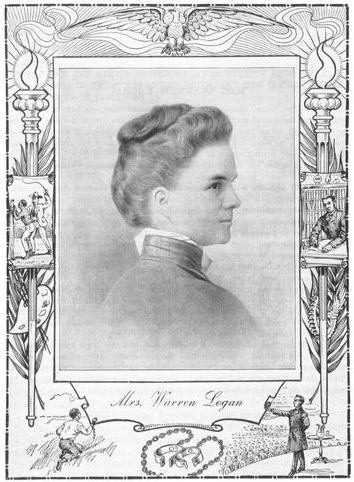
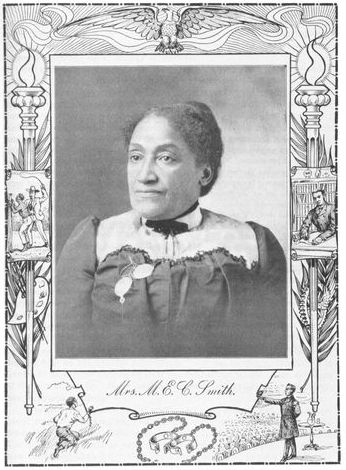
MRS. WARREN LOGAN.
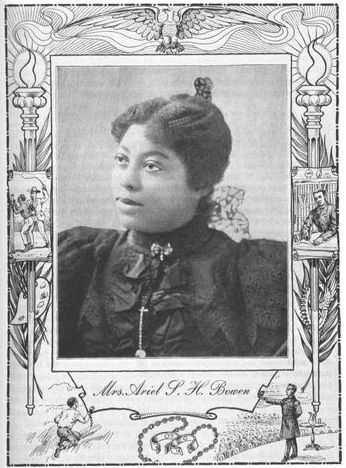
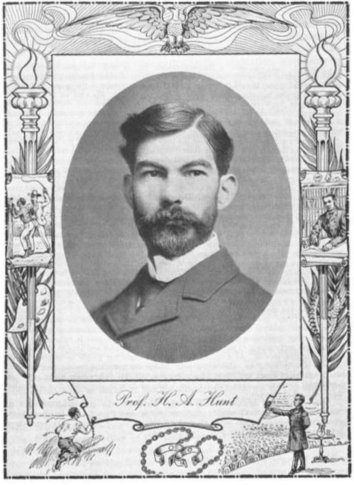
Mrs. Warren Logan, whose maiden name was Adella Hunt, was
born in a Georgia village after the close of the Civil War.
When asked for this sketch, she said: "There is little to
tell, as my busy life has been without romantic event. I was
not born a slave, nor in a log cabin. To tell the truth, I
got my education by no greater hardship than hard work,
which I regard as exceedingly healthful."
It is known that she has an inheritance of blood, tradition
and history of which any American woman might be proud.
Her early education was of a private nature. In 1881 she was
graduated from Atlanta University as a bright member of one
of its brightest classes.
Two years of teaching in an American Missionary School in a
South Georgia town, where she was also a city missionary,
prepared her for more advanced work, which opened to her at
Tuskegee, Ala.
In 1883 Miss Hunt joined Mr. Washington, Olivia Davidson,
Warren Logan and the handful of teachers who were the
originators of the now famous Industrial School.
From the first she fitted into the activities and spirit of
the school and became Miss Davidson's right hand helper. She
succeeded to the position of Lady Principal when Miss
Davidson became Mrs. Booker T. Washington. In this position
Miss Hunt emphasized the academic side of the school and
also urged the physical development of the girls. Her own
line of teaching was the normal training of student
teachers. Her services were constantly in demand for Peabody
and other teachers' institutes in Georgia and Alabama.
In 1888 Miss Hunt was married to Warren Logan, treasurer of
the Tuskegee Normal and Industrial Institute. Since that
time she has ordered her household, written a little, read
much, completed the Chautauqua Course, and kept abreast with
the times. While she has given her best thought to her
husband and children, she has kept in touch with the school
and has lent a hand to the Woman's Club.
In these days of specialists among physicians and of specialists among
students of social science it seems rather presumptuous for a teacher
to attempt any formal discussion of causes and remedies for the high
death rate among Negroes in the cities of the South. A few
suggestions, however, may serve to draw more attention to this vital
subject.
The sections of the cities inhabited by Negroes are generally the most
unsanitary. The house in which the average Negro family lives is
poorly built and too small. Frequently old houses are set aside as too
far gone for any except Negro tenants. In many instances these
dilapidated houses contain germs of disease which it is practically
impossible for the young and the feeble to withstand. The food, fuel,
clothing and general comforts of a family thus housed are
insufficient. Food plays too large a part in the havoc made by death
among Negroes. In many instances, there is great intemperance in both
eating and drinking. With another large class there is actual scarcity
of food and that, too, often of poor quality. Add to this,
irregularity of meals and poor cooking and one can not wonder at the
low state of health nor even at the excessive mortality.
One of the most serious phases of ignorance is criminal carelessness
in regard to nutrition. Cooking is that part of household work which
almost every woman undertakes and very few understand, and herein lies
the foundation of disease.
The long death-roll among Negroes contains an excessive number of
infants. Careful investigation shows that this slaughter of innocents
is due in large measure to improper feeding. Some mothers must be away
from their babies earning bread and shelter. Others leave their little
ones for less worthy and less honorable purposes. Others neglect their
offspring because they have a fancied or cultivated dislike of
children. It is a sad day for a people when happy motherhood
declines. Man has devised successful substitutes for natural food for
babies, but these should be used only when the best good of all
concerned can be subserved thereby. Nature's ways are wisest and best,
and parents must try to walk in those ways if they would have their
children have life and have it abundantly.
Far be it from us here to attempt a technical discussion of
tuberculosis, but in plain simple language, let us cite a few facts in
regard to lung diseases among Negroes.
The oft repeated statement that the Negro slave did not have
consumption, cannot be verified, for lack of authentic records on the
subject. The Negro free, however, is dying of consumption and kindred
diseases in appallingly large numbers.
Many theories in regard to consumption have been exploded, but it is
acknowledged by all, to be an infectious disease. As such, ignorant
people do not understand how to escape it; indeed, until anti-spitting
laws are more universal and more rigidly enforced, every one may be
exposed to these deadly germs. They respect neither race lines nor
intellectual grades. The Negro, however, seems to be peculiarly
susceptible to this class of ailments. 1. Because of comparatively
small lung capacity. 2. Because of general low nutrition. 3. Because
of lack of bath rooms and their proper use. 4. Immorality. 5. General
indifference to the incipient stages of the disease. Colds and coughs
are passed by as matters of course with little or nothing done to
prevent or cure them.
The physical life and death of man has a much more intimate connection
with his moral life than is at first thought apparent. Too many
children are robbed by Sin of a child's first right, viz.: the right
to be well born. If parents have lived lives of shame and thereby
weakened their bodies, the effects of this will be a sad legacy of
weakness in the persons of their children. Men and women given to
social impurity will hardly escape the notice of those about them.
Their characters are imitated and shame and weakness, physical as well
as moral, multiplied. "Sin conceived and brought forth Death."
Among people of low intellectual development and low moral standards,
family love is below normal. With this defective class, there is much
indifference to the life and death of their dependent relatives. The
young and the aged are shamefully neglected. It is sufficient to be
bereaved—better, the relieved, to say: "The Lord's Will be done."
Remedies for these sad and unfortunate conditions are much more easily
suggested than applied.
Better environment, greater comfort in the homes, come only as a
return for money. Money will come as a return for labor. Money will
come to those who earnestly desire it, because they will work for it.
They will do whatsoever their hands find to do, accepting the pay such
labor brings, but fitting and aspiring for something better. There is
usually plenty of work for all honest, industrious Negroes in Southern
cities.
Even money may not cause the old shanty to give place to a good house
nor raise the standard of general comfort very materially, except as
the demands of the family are enlarged as a result of education. No
one factor will have such weight in the decrease of suffering and the
reduction of the high death rate as enlightenment of mind.
The system of education in vogue in Southern cities will work slowly
because up to the beginning of the twentieth century, school
attendance has not been made compulsory. There are no truant schools,
no reform schools. Idleness tends to vice. Idleness and vice are in no
way conducive to health and longevity.
Many Negroes do not want education for themselves nor for their
children. These people swell the death lists in Southern cities'
health offices to such distressingly large numbers. They are often
cared for and buried by funds from the city treasury. Would it not pay
to try compulsory education? To try teaching them to help themselves,
to save themselves?
To say that the home life of the masses must be improved is but
another way of saying they must be educated.
Among the most potent forces in the uplift of a people are the school,
the press, the courts and the church.
Under a system of compulsory education, the Negro would much sooner
learn to observe the laws of health and thus to extend his life.
When newspapers in Southern cities are fairer in their attitude toward
the black citizen, he will become a better citizen. It will increase
his respect for others and greatly increase his self respect. He will
then make more effort to live and to live well, because his life will
seem more worth living.
Every state included under the "Land of the free and the home of the
brave" should strive to make its criminal laws reformative rather than
revengeful. A very considerable number of Southern Negroes come to
their life's end in the prisons, which in no Southern state are all
that prisons should be. From a health standpoint, most of them are all
that prisons should not be.
It pays the municipality better to educate and reform its citizens
than to convict and execute them.
A cultivated, spiritual ministry will emphasize the best teaching of
the schools.
An active church will sustain a fair press; will uphold law and order;
will supplement the work of the good doctor and in various ways try to
reduce the number of funerals among the Negro population in Southern
cities.
SECOND PAPER.
WHAT ARE THE CAUSES OF THE GREAT MORTALITY AMONG THE NEGROES IN THE
CITIES OF THE SOUTH, AND HOW IS THAT MORTALITY TO BE LESSENED?
BY HON. H. A. RUCKER.
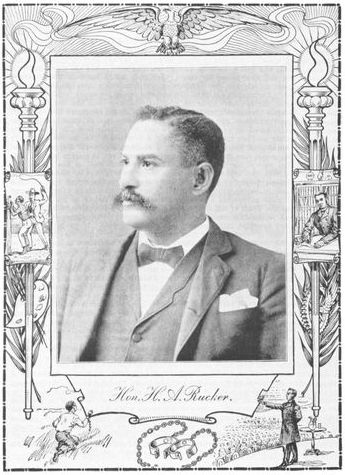
MR. H. A. RUCKER.
Out of the Southland—that awful crucible of prejudice and
proscription,—like steel tempered by fire, and hardened for
the practical uses of mankind, has come numerous valiant
spirits, whose advent was so timely as to have seemed
divinely inspired. Price and Cain, Elliott and Bruce,
Cailloux, and others, who have joined the silent majority,
did noble work and lived to see the race's redemption, but
it has been left for newer and younger men to complete the
structure on the foundation that was furnished by the "Old
Guard." The modern age of politics and business in the sunny
South—the home of nine-tenths of the Negroes—offers no
brighter luminary than the Hon. Henry A. Rucker of Georgia.
Young as years go, but mature in all the attributes that
command success and popular esteem, the life of Henry A.
Rucker is a priceless text-book for the aspiring
Afro-American youth. Guided upward by nothing save the lofty
counsel of a good mother and the inherent qualities of a
true gentleman, he has scaled the heights, and for himself,
has solved the problem of "how the fittest" may survive, and
is giving to the whole race the key by which he wrought out
so clear a solution. No legerdemain has worked his upward
flight. The ingredients that he has utilized are simple,
even if rare, and are within the reach of the least favored
of human beings—honesty of purpose, fidelity to every trust
and adherence to the golden rule. He has always been able to
secure what was justly his without encroaching upon the
sacred rights or legitimate possessions of another.
Harboring no malice in his own bosom he has softened the
wrath of his neighbor and demonstrated how clever diplomacy
and a manly appeal to the finer instincts of a possible
enemy yields richer returns than all the force and invective
that a century could bring to bear. If the battle is to be
fought out on lines of mental competition and personal worth
rather than by balls and bayonets, Mr. Rucker has grasped
the situation and the best evidence of the wisdom of his
policy of inter-racial coöperation is the results he has
individually achieved, and the commendation freely offered
by the white and colored people who greet him day by day in
the routine of duty. Atlanta owes much to the indefatigable
energy and inexhaustible public spirit of Henry A. Rucker.
He has been active in promoting all of her interests and
that his services have been valuable is cheerfully admitted
in the Board of Trade and industrial circles. He was
conspicuous in advancing the prospects of the famous
exposition of 1895, and is now striving to round out the
work of securing a commodious federal building for the
enterprising Georgian capital. He bore the brunt of the
fight against the "Hardwick bill" and was potent in
defeating both that infamous measure and the "Payne
resolution." He has been repeatedly elected a delegate to
the national conventions of the Republican party.
Since July 26, 1897, Mr. Rucker has been collector of
internal revenue for the District of Georgia with
headquarters in his own city, Atlanta. The receipts for the
last fiscal year were more than double those of preceding
years and exceeded in the same proportion the revenues
gathered in any single year since the organization of the
state. This marvelous showing is due partially to Mr.
Rucker's prompt, thorough and painstaking plan of operation
and of course in large measure to the national prosperity,
growing out of President McKinley's shrewd financial
policies. Brilliant as has been the past of this progressive
Afro-American, the future holds out the promise of grander
achievements. The race honors Mr. Rucker and holds him close
to its heart, because he has proven himself a leader that
can be trusted. When he commands "close ranks, steady,
march," the Georgia populace goes forward in one conquering
phalanx, determined, aggressive and undaunted, remembering
that enduring power comes not by "fits and starts," but by
clinching with mailed hand the rewards that have been won.
One who has never been taught to appreciate what health is and to
understand hygienic laws can not become a safe guardian of his or her
physical being. For when this being is attacked, as is constantly the
case, by its millions of enemies, if all of its portholes have not
been properly guarded it easily falls prey to disease and death.
As a race the Negro has had neither the time nor the opportunity to
inform himself on the principles of health saving or in those of
health getting—if there be such. Both prior to and since his
emancipation his time, except nominally, has been the property of
others from whom he has barely eked out an existence, and, from a
humanitarian standpoint, has had but little interest in caring for his
health.
During the years of his enslavement, his mortality, in proportion to
his numbers and his environments, was no less than it has been since
he became a free man—and the bald statement that his death-rate
during the past thirty-eight years has greatly increased, may not be
founded on facts. Fair play in discussing this phase of the subject
demands careful and patient inquiry into the past history of a
people concerning whom little or no minute data of a national
character was kept. However, this question may not properly enter into
the subject, the contention being that the mortality among the race is
excessive, which, if true, may be accounted for in part in the
existence of certain acknowledged conditions.
Wherever the Negro has been cared for either by himself or by others
he has enjoyed the same immunity from disease and death that those of
other races have. And whenever neglected or abused, whether the
failure or fault rests with himself or others, impaired health, decay
of mind and body and death have ensued.
Compared with the masses but few Negroes at any time within the
history of the life of the race in this country, have been properly
guarded against exposure—the few who in ante bellum days were
selected as house servants and to fill other kindred places, were
measurably protected. And now the same classes and that of the more
fortunate or business classes have limited protection from more than
ordinary exposure.
The masses have always done the drudgery. And that too without
knowledge or reference to health keeping. A common practice of
employed Negroes is to go or be sent on short quick errands, leaving
warm and, in this respect, comfortable places of employment without
hat or wrap to breast chilling winds or atmospheric conditions many
degrees removed from their places of services. In this practice is the
exposure from sudden changes of temperature without preparation. The
drayman, the cartman, the man in the ditch and others whose employment
is in the open air are exposed not alone by the character of the work
in which they are engaged but also by reason of the fact that six days
of the week, those in which they labor, of necessity, their clothing
is poor and shabby and their persons are ill kept. While the seventh
day finds them as a rule well clad and well shod. Then their
homes—no, their houses, partly because of circumstances beyond their
control and partly on account of their improvident natures, are little
more than shelters or huts.
These houses are built in what is known or accepted as Negro tenant
districts, and those acquainted with the localities need no evidence
to convince them that they are not sought as either health or pleasure
resorts. They are the city alley ways and the low malarial districts
where the noxious gases and foul vapors rise from emptying sewers.
More than two hundred years' application has made the Negroes
agriculturists; they have been accustomed to labor and to plenty of
nature's fresh, invigorating air; they have, because of conditions not
proper to treat here, drifted from the farms and fields into the
crowded cities, thence into the slums, to be infected with disease.
They have been thrust into prisons where they were provided with the
poorest of covering and meanest food for their bodies; where scurvy
and other loathsome diseases have made their impress upon them and
where incentive to cleanliness is as distant as the North and South
poles. Freed from prison life they have gone forth mingling with a
class of people infecting them with their scales and spreading disease
and death.
Then again the race is without proper places to care for its
unfortunate, aged and infirm; without orphanages, reformatories and
homes for its friendless. Institutions which are potent factors in the
efforts of a people to prevent neglect and cure criminal tendencies.
All of these conditions are breeders of ills and conductors of death
which must be and happily are being abated.
The remedy suggested is a knowledge coupled with an appreciation of
health. Both to embrace the science of health preserving and of health
getting; better homes and better habits, even to being "temperate in
all things."
Acquired, accepted and practiced the mortality of the race will be
materially lessened.
THIRD PAPER.
WHAT ARE THE CAUSES OF THE GREAT MORTALITY AMONG THE NEGROES IN THE
CITIES OF THE SOUTH, AND HOW IS THAT MORTALITY TO BE LESSENED?
BY DR. JOHN R. FRANCIS.
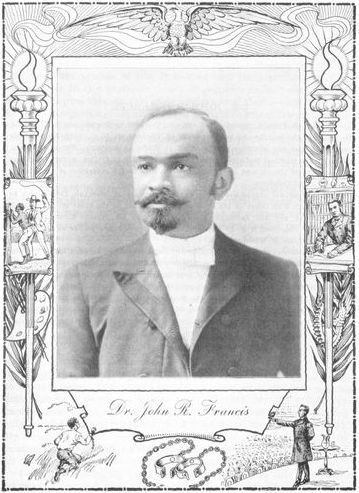
DR. JOHN R. FRANCIS.
Dr. John R. Francis, physician and surgeon, was born in
Georgetown, D. C., in 1856. He attended the private and
public schools of Washington, D. C., until his sixteenth
year. His academic education was received at Wesleyan
Academy, Wilbraham, Mass. He began the study of medicine
under the tutorage of Dr. C. C. Cox, at that time dean of
the Board of Health, and one of the foremost men in the
profession of medicine in the District of Columbia.
His professional course was taken at the University of
Michigan, from which he graduated with high honor in the
class of 1878. Settling in the home of his boyhood, where he
was well and favorably known, and where his parents before
him were honored and respected, it is no wonder that he
succeeded and stands as the leading Colored physician of
Washington, D. C.
Dr. Francis was appointed in 1894 by the Secretary of the
Interior to the position of first assistant surgeon of the
Freedman's Hospital, with a salary of $1,800. He instituted
several needed reforms in the treatment of patients. He
installed the present training school for nurses, and,
indeed, was so active in his reformation of affairs in the
institution that those who know the facts admit that Dr.
Francis, more than any other man, is responsible for the
opening of the new era of the Freedman's Hospital, which led
to its present flourishing condition. He is now, and has
been for several years past, the obstetrician to the
hospital.
He is the sole owner and manager of a private sanitarium on
Pennsylvania Avenue, Washington, D. C. This institution has
proven to be a panacea to the best element of Colored
citizens.
It is a noteworthy fact that Dr. and Mrs. Francis have both
served as members of the Board of Education of the District
of Columbia.
In the study of the causes and remedy for the great mortality among
the colored people of Southern cities I shall not waste time and words
in an attempt to prove, by much statistical evidence, that which is
already too well known to us as an admitted fact, viz.: a mortality of
colored people in cities of the South, very largely in excess of that
of the white people of the same communities.
I am fully justified, in the face of our present enlightenment, in
entering, at once, into the discussion as to its causes.
If it be true that the animal organism is intended by nature to pass
through a cycle, and that natural death is not a disease, but a
completion of the process of life, it follows that the organism, with
exceptions, as to any particular class of people born in health, is
constructed to pass through this cycle and is not of itself,—that is
to say, by its own organism,—capable of giving origin to any of the
phenomena to which we apply the term disease. We must, therefore, seek
for origins of the phenomena in causes lying outside the body, and
affecting it in such manner as to either render the natural actions
and processes irregular, or to excite actions and processes that are
altogether new.
Writing out in correct lists all the groups of phenomena that make up
the term disease, we will find that they invariably come from without.
From my point of view all the groups of diseases are in truth
accidents; exposure to some influence or influences that pervert
function or create new motion. I must first refer to the cause to
which at various times has been ascribed the responsibility for this
excessive mortality, viz.: that innate vital weakness exists in the
colored population of this country as a result of amalgamation. On
this theory the black race when mixed with the Caucasian is the only
one which produces with the latter a progeny of weakened innate
vitality. I have never seen this statement supported by any
trustworthy knowledge or information. On the other hand it has always
been accompanied by the most absurd arguments which invariably tend to
expose the mind of the writer as being prejudiced to the intermingling
and the intermarriage between the two races. It is among the
possibilities that physiological peculiarities account for
dispositions to disease belonging to typical classes of the human
family. No one has as yet been able to determine what those
peculiarities are. Whether they are primitively impressed on a race,
or are acquired is a question that can be answered only when the exact
relationships of diseases to race are discovered. My own view is, that
acquired and transmitted qualities and specific existing social
peculiarities are sufficient agencies for the production of all the
known variations of vitality belonging to peculiar races.
I am now thoroughly convinced that the causes of this great mortality
of the colored people of the cities of the South are poverty,
prejudice, and ignorance. For obvious reasons I will submit them
in the following arrangement:
1. POVERTY:
a. Contagious Diseases (close contact).—Diphtheria, scarlet fever,
small-pox, tuberculosis, syphilis, etc.
b. Unsanitary Nuisances (11,705 abated in the District of Columbia for
year ending June 30, 1900).—Filthy alleys, cellars, bad drainage,
garbage, filthy gutters, hog pens, filthy houses, filthy lots,
stagnant water, filthy privies, leaky roofs, sewers, filthy yards,
filthy streets, wells, etc.
c. Unsanitary Homes.—Only those houses that are refused or abandoned
by the white people are offered to the colored people for dwellings.
d. Impure Food.—The large quantity annually condemned in the District
of Columbia is an indication of that to which the poor is subjected.
e. Impure Air.—Bad design and construction (small rooms) and
unhealthy location.
f. Impure Water.—Unhealthy sources, cheap, shallow and unhealthy
wells, etc.
g. Infantile Mortality.—Unusually large from poverty alone.
2. PREJUDICE:
a. Idleness and Crime.—Late hours, broken rest, depraved association,
tobacco, alcohol, syphilis, other diseases, etc.
b. A Destitute Laboring Class.—Prejudiced employers, poor pay, excess
of work, deficient rest, worry combined with physical exhaustion,
unsanitary rooms, etc.
c. Defective Homes.—Small rooms, poor ventilation, either no water
supply, or a very bad one, neglect of sanitary measures by both
landlord and agent, all the nuisances enumerated above, etc.
3. IGNORANCE:
a. Diseases from bad hygiene (public, home, and personal).
b. Induced diseases from physical strain.
c. Diseases from combination of physical and mental strain.
d. Disease from the influence of the passions.
e. Disease from sloth and idleness.
f. Disease from late hours and broken rest.
g. Disease from food.
h. Disease from water.
i. Disease from alcohol.
j. Disease from tobacco.
k. Disease from errors of dress.
l. Children of parents diseased or weakened from various causes.
The space allowed for this article will not permit the discussion of
all the causes mentioned above. There are, however, a few that are
worthy of our special consideration. For the purpose of condensation,
I will attempt the elucidation of the importance of such causes as
demand our most serious attention by incorporating them in the
following discussion of the most important part of this article: "How
is this great mortality to be lessened?"
In my opinion the remedy for this alarming condition exists in
education and money. In other words our remedy is the same as that
of other races. The only difference is that the barriers we must
surmount are so very peculiar and so very much greater than that of
other peoples we must do our best to, at once, recognize the fact and
begin the work. I believe the goal is ours and if we will only
struggle manfully and hopefully onward we will soon reach it. With
EDUCATION AND MONEY
as the remedy, the colored people must be taught that the first step
towards the reduction of disease is to begin at the beginning, to
provide for the health of the unborn. The error, commonly entertained,
that marriageable men and women have nothing to consider except money,
station, or social relationships demands correction.
The offspring of marriage, the most precious of all fortunes, deserves
surely as much forethought as is bestowed upon the offspring of the
lower animals.
It is well that we teach, in the school room and from the pulpit,
about the condition that exists in the parental line, maternal and
paternal. The necessity for such instruction is somewhat indicated, in
the effect upon the prenatal state, of such conditions as scrofula or
struma, of various forms of tuberculosis and syphilis, of epilepsy, of
rheumatism, and of insanity. These are only a few. We have to contend
even with hereditary proclivity to some forms of the acute
communicable diseases, such as diphtheria and scarlet fever and also
to immunity from the same.
We must furnish, by all available means and through every possible
channel of information, persistent and systematic instruction in
public, home and personal hygiene. We should utilize especially the
power of the pulpit and influence the public school authorities to
institute, in the colored schools throughout the South, special
instruction on these subjects. The importance of such instruction is
evident in the agitation which is now occurring among the educators in
the schools of the Eastern states. If it is needed there then the need
of it in the colored schools of the South must be urgent indeed.
We must give such education as will tend to a better general
knowledge, especially of the two diseases which, I believe, more than
any, should be the most dreaded as being the most prolific of injury
to mankind and especially to the colored people on account of their
ignorance of the communicability of disease combined with their
poverty. I refer to the contagious maladies tuberculosis and the one
called "specific" or syphilis, the moral as well as the physical blot
on all civilized life. The former is well known nowadays to be one, if
not the worst contagion to which the human family is subjected. In its
various forms it is responsible, probably, for more deaths among the
colored people than any one disease with a definite phenomenon. As
less is known about the latter disease, syphilis, I must mention it a
little more forcibly, however unpleasant and brief the utterance. The
poison of the malady once engrafted into the living body, and
producing its effect there, leaves, according to my professional
experience, and observation, organic evils which are never completely
removed. Various forms of disease of the skin; some forms of
consumption; some phases of struma or scrofula; many forms of
cachectic feebleness and impaired physical build—what are denominated
delicate states of constitution—these and other types of disease are
so directly or indirectly connected with the "specific" taint, it
becomes impossible to be too careful in tracing it out, or in
measuring the degree to which it extends in the field of morbid
phenomenon, in our efforts to improve the vitality of the colored
people and to enlighten them upon this class of diseases.
The widespread encouragement of thrift, industry and efforts among the
colored people to gain a livelihood or, to put it more boldly, to get
money and keep it, thereby obtaining the means with which to supply
themselves with the necessaries of life, and possibly, with some of
its comforts, will materially wipe out a large percentage of that
class of diseases and death that proceed from such causes as worry,
excess of work, physical and mental strain, late hours, broken rest,
etc.
Washington, D. C., is considered a very clean city. It is, therefore,
significant that the 11,705 nuisances, referred to in the foregoing,
are an indication as to the great risk, from this source throughout
the South. It is obvious at once that the colored people, who form the
bulk of the poor class, are the principal victims to that which
escapes official inspection.
Notwithstanding the fact that the colored population of the District
of Columbia is less than one-third of that of the whites, in the year
1899-1900, there died in the homes located in the back alleys of the
city 411 colored persons and eleven white persons, indicating to what
extent these unsanitary homes are occupied by the colored people.
Space will not permit the further elucidation of the foregoing causes
and remedies, which I have done nothing more than to touch upon.
However, I cannot close without giving further emphasis to my views by
offering in evidence the conditions, as to vitality, of the Jews. The
facts are that this race, from some cause or causes, presents an
endurance against disease that does not belong to any other portion of
the civilized communities amongst which its members dwell. We do not
have far to go to find many causes for this high vitality. The causes
are simply summed up in the term "soberness of life." The Jew drinks
less than the Christian; he takes, as a rule, better food; he marries
earlier; he rears the children he has brought into the world with
greater personal care; he tends the aged more thoughtfully; he takes
better care of the poor; he takes better care of himself; he does not
boast of to-morrow, but he provides for it; and he holds tenaciously
to all he gets. It may be true that he carries these virtues too far,
but I do most earnestly plead that if the colored people will only
emulate the Jew, they, like the Jew, will win, like him they will
become strong, and like him in scorning boisterous mirth and passion,
will become comparatively happy and healthy.
FOURTH PAPER.
WHAT ARE THE CAUSES OF THE GREAT MORTALITY AMONG THE NEGROES IN THE
CITIES OF THE SOUTH, AND HOW IS THAT MORTALITY TO BE LESSENED?
BY JAMES RANDALL WILDER, M. D., PHAR. D.
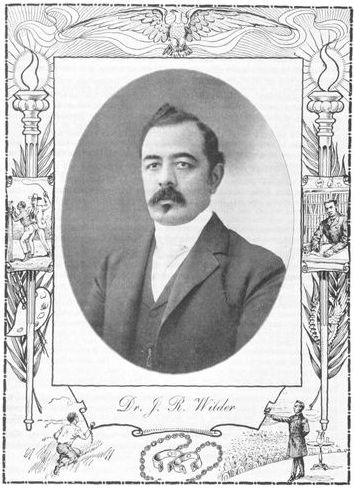
JAMES RANDALL WILDER, M. D., PHAR. D.
James Randall Wilder was born at Columbia, S. C., and is the
son of Charles M. Wilder, who was postmaster at Columbia for
many years. His mother was Marla Coleman, also a native of
the Palmetto State.
Dr. Wilder is a man of spotless character, and enjoys a
striking appearance, a magnetic personality, and a brilliant
and versatile mind. His early training was received in the
public schools of his native city. He spent a season in the
classical department of Howard University, and from there he
went to Howard Medical College, from which he graduated in
the year 1888. Availing himself of the unrivalled
opportunities afforded by the Freedman's Hospital, he
rapidly acquired both theoretical and practical knowledge,
so that when he stepped into the world he possessed a
preparation seldom equaled by the young practitioner. He has
also the degree of Phar. D. from Howard.
He located in Washington, the capital of the nation, where
today he enjoys a large and lucrative practice. His modest,
sympathetic nature makes him an ideal man for the sick room.
His ability has won professional recognition not only for
himself but for others. He was for many years physician to
the National Home for Destitute Colored Women and Children,
and is today the examining surgeon for a number of
benevolent and charitable organizations. He has been
prominently connected with many of the business ventures of
the colored people in the District of Columbia for the past
ten years, and is ranked as a broad-minded, solid,
public-spirited citizen—a grand object lesson for what is
best and most progressive in the community. He has invested
his earnings judiciously, so that today he has a competency
seldom attained by a man of his years. The success gained,
the making the most of himself, renders him the best
advocate of truth, and a potent factor in the growth and
development of the race. This plain, honest, earnest young
man is a type of the generation since citizenship came—a
splendid example of worth since the selfhood of the race has
been partially recognized, and the members have been
permitted to add their quota to the sum of human advancement
and achievement. The hour calls for fact, not fancy—for
flesh-and-blood examples of what has been done by the young
manhood of the country. The interest here and now is due to
the fact that he has had somewhat to say on a subject of
vital moment, and has said it vigorously and eloquently.
Here he is the champion of truth, performing a service in a
dignified, scholarly manner, and so winning the praise and
gratitude of all lovers of truth. His article must call a
halt to those inconsiderate ones who persistently repeat
what through haste and insufficient data has been given to
the world as fact—as logical inference from scientific
investigation.
Dr. Wilder has collected a large library of professional and
literary works, and has never ceased to be a hard student.
His home shows the taste of the scholar and wide-awake
practitioner. He married Miss Sallie C. Pearson of Columbia,
S. C., and to them have been born two children—Charles
McDuffie and Susan Maceo.
Dr. Wilder belongs to that class of quiet, earnest souls who
pursue the "even tenor of their way" and are doing most to
establish truth, to refute error, content to let the "deeds,
though mute, speak loud the doer."
The American Negro finds himself, at the beginning of the twentieth
century, seriously embarrassed by the many false and damaging
accusations that have been made against him, not least of which is the
charge of physical inferiority. The charge has been wholesale that the
Negro differs from the white man physically, and that he is ethnically
and strongly predisposed to certain fatal and contagious diseases.
This stigma of disease has been placed upon him and repeatedly
emphasized, but despite the fact that the effort has been made for
years, by men learned in anthropology to find and prove the inherent
inferiority of the Negro, based upon anatomical, physiological and
biostatic peculiarity, to-day the bare statistical fact of his high
mortality alone supports the calumnious fabrication. It is true that
according to official statistics the Negro's death rate in this
country is relatively high, but the causes of disparity are
extrinsic and remedial and he was not stamped thus ab initio,
but by the fiat of the Creative-will.
The Negro, identified as he is with the great human family, is subject
to the same deteriorating influences that affect his fellow-man. Hence
impure air and water, polluted soil from defective sewerage,
adulterated food-stuffs, and the unhealthful conditions imposed during
the school-going period of life—which are questions of public hygiene
and general concern—contribute, in no small degree, to his mortality.
But aside from these influences, common to all people, he is subject
to others peculiar to himself, on account of the environments that
govern him. The proverbial unreliability of statistics justifies the
assumption that the Negro's death-rate is not as great as it is said
to be. The occupations of the Negro tend to keep him in the
back-ground and to encourage a neglect on the part of the census
enumerator to record accurately all of the Negroes in a certain
locality. But the Negro dies faster than the white man, and it is not
my purpose to deny it, but to recite a few of the real causes of the
disparity in the cities of the South, and to show how that mortality
is to be lessened.
(1) American slavery, with its unparalleled cruelty and bestiality has
injured the Negro, intellectually, physically and morally. It has been
claimed that the admixture of the Negro with the Caucasian has given
us a resulting mulatto, weaker physically than either of the parent
stock, but this statement is based upon hypothesis, and is not borne
out by the facts in the case. It is true, however, that a resulting
lowering of vitality has followed the admixture of "kindred blood,"
which was almost unavoidable during the days of slavery as the result
of certain well-known procreative practices that obtained on the part
of the master, and on account of the itineracy of the Negro incident
to his chattelism. In "those dark days" it was hard enough for the
Negro to recognize his near kin on his maternal side, and it was
infinitely impossible for him to trace the "family tree" from the
paternal side. The evil effects of this consequent admixture of
"similar" blood cannot be denied, and must bear a modicum of
responsibility for the excessive mortality of the Negro of to-day.
(2) The fact that the great majority of the Negro women in the cities
of the South are compelled to work steadily even while they are
enceinte, doubtless often interferes with the normal development of
the internal organs of their offspring, causing a lack of vitality
which is not apparent to the casual observer, but which must make them
an easy victim to disease.
(3) The same social and economic conditions that keep the expectant
mother busy with her daily labors, also abbreviate her
"lying-in-period," which not only weakens her physically, but deprives
her newly-born offspring of its natural food—thus consigning it to an
infant's grave, or so debilitating it that it succumbs to the first
disease with which it becomes affected. It is bad enough to be
bottle-fed, physiologists tell us, but it is infinitely worse to be
hand-fed. The majority of the Negroes in the Southland are hand-fed
from birth with food decidedly improper both as to quality and
quantity, thus making defective the very substructure of their being.
Is it any wonder that such a people die faster than another people,
who nurse their young or have it done, or who give them pure cow's
milk modified scientifically, or other artificial infant food prepared
skilfully amid the best sanitary environments?
(4) The early motherhood of the Negro has its evil effects. The proper
age for a woman to become a mother is at twenty-five years and usually
before that time development is not complete, and the whole organism
is in a transition state. It is equally true that the use of any organ
before it has attained its complete growth or development is damaging
to that organ and interferes with its normal function, and "we cannot
but believe that children developed in immature sexual organs must be
deficient in true vital force and energy. It is often noticeable that
a child apparently strong and vigorous, may have but little power to
resist disease, or may even be strongly predisposed to some
infirmity." The colored women in the section under discussion who
become mothers, are usually multiporæ long before the twenty-fifth
year.
(5) The element of overwork must come in for its increment of
responsibility in the excessive mortality of the Negro. While
deficiency in exercise favors a lack of nutrition conducive to wasting
in size, on the other hand too much work favors hypertrophy of vital
organs and tissue degeneration. The average healthy man should work
about eight hours per day and "should do work to the equivalent of 150
foot-tons daily." The American Negro's working hours, as a rule, are
regulated, if at all, by the exigencies of the work to be performed,
as it appears to an exacting employer.
(6) The kind of work performed by the Negroes in the Southern cities
includes all menial occupations, which conduce to accident and
exposure. The death-rate among the laboring class of any community,
irrespective and independent of its nationality, is necessarily
greater than that of the well-to-do leisure class.
(7) The manner of living of the majority of the colored people in the
cities of the South—which is sometimes the progeny of ignorance, but
oftener the result of necessity—is responsible, in a large measure,
for their high mortality. They are crowded together on back streets,
in lanes and ill-smelling bottoms, near ponds of stagnant water, on
the banks of rivers—wherever their scanty means consign them. The
ignorant among them, like the ignorant among any other people, ignore
the teachings of hygiene, because they are ignorant, and not because
they are black. They do not know the value of fresh air and sunlight
and cleanliness, and hence are ignorant of the fatality attached to
the unholy trinity—darkness, dampness and dirt, which is responsible
for the tuberculosis that is charged to their "inherent tendencies."
The pittance that is paid to the Negro in the name of wages forces him
to crowd together in narrow and ill-ventilated sleeping apartments,
which is decidedly unhealthful and favors the spread of contagious
diseases. Thus smallpox spreads rapidly in a Negro settlement, not
because they are Negroes, but because their manner of living brings
them into the most intimate contact with one another, so that whatever
disease attacks one, rapidly spreads to all of the others who are not
immune.
The lack of suitable clothing and proper food, as a result of poverty,
weakens the Negro physically. The neglect of the bath through lack of
time, is responsible for much of the heart, kidney and skin diseases
so prevalent among the laboring classes of the colored people. It
takes time to keep clean, and the laborer has no leisure. Ignorance of
the seriousness of certain diseases like syphilis, scrofula and
rheumatism, has played an important role in the drama of his
mortality.
(8) Another fruitful cause of his excessive mortality arises out of
his struggle for existence. The exigencies of life are such with him
that he does not heed the admonitions of nature made manifest in the
early symptoms of disease, so that unwittingly he becomes habituated
to discomfort and pain. When the common Negro laborer lays aside his
implements of labor on account of sickness, the disease with which he
is affected is well founded and passed beyond the abortive and often
the curative stage, and very frequently when medical advice is
obtained, it is of the dispensary or "physician to the poor" type,
which too often savors of unconcern, inexperience and incompetency.
(9) The prevalent habit among the colored people of taking patented
cure-all nostrums, which contain narcotics that insidiously benumb the
sensibilities and mask the symptoms of disease, would naturally
contribute to the mortality of any people.
(10) Not the least fruitful of all of the causes of the Negro's
excessive mortality, is a lack of resistance to disease, engendered
by the social conditions that obtain in the Southland. There he is so
oppressed and persecuted that he finds himself not only an easy prey
to disease, but an early victim to death. He has little to live for,
and his religion promises him much after death, which, in a sense, he
welcomes as a relief from his trials and troubles. This statement will
not appear exaggerated when one considers the powerful influence that
the mind has over the body. A cheerful, hopeful, contented mind,
predisposes to a healthy body, and conversely, a discontented and
despairful mind, interferes with the vital functions and invites
disease and death.
(11) Lastly, in a consideration of the relatively high mortality of
the Negro in the cities of the South, considerable weight must be
given to the contracted death-rate of the whites due to their
superior social and financial condition. Their environments are, as a
rule, as healthful as education can suggest and as money can obtain,
and when disease overtakes them, they combat it not only with the
skill of science, but with the power of will. The incentives of life,
so lacking for the colored people, are theirs in all of their
plenitude. The earth is theirs and the fullness thereof, and there is
no power therein that they may not covet. This feeling, this
knowledge, becomes vis-a-mente that proves a potential factor in
their struggle with disease. Despite this powerful influence however,
and because of it, the morbidity of the white man in this country is
great. I venture the assertion that his morbidity far exceeds that of
the Negro—not because he is more prone to disease, but because he is
enabled to live longer with disease on account of the influences to
which allusion has already been made. The plain fact is, the Negro
dies sooner and the white man lives longer with disease, which
presents the unique question: Is it not more advantageous to the
public good to die of a disease and be buried safely and deeply
beneath the soil than to live with it and thus increase the
opportunities of disseminating it?
(12) The remedies for the excessive mortality of the Negro in the
cities of the South are self-evident. He is a man and identical with
other men structurally, so that whatever is health-giving and
life-lengthening for other civilized peoples, is health-giving and
life-lengthening for him. To be specific, his greatest need is an
increase of knowledge along the line of hygiene, and a studious
application of that knowledge. He must not only be taught to run the
race of life intelligently, but he must not be hindered in the process
of his running. He must know the life to lead, and then lead it. In
this he must have the liberal co-operation of his employer, and his
brother-in-white generally. He must be paid in accordance with the
labor that he performs and must be allowed an equitable participation
in the every-day affairs of life. Actuated by the hopes and
aspirations that actuate other men, and given a man's chance in the
struggle of life, his industry and genius will soon improve his
condition and bring him material prosperity, upon which depends, in a
measure, the development of moral, intellectual and physical growth.
Leisure and opportunity, comfort and freedom from sordid cares and
anxieties regarding the immediate necessities of life, must be
secured, if a race is to find time for study and thought, and to
develop its best moral and physical life. May not the Negro justly
find some consolation in his excessive mortality of to-day? May he
not believe that "death is the philosophy of life?" May he not feel
that his race is being strengthened by the dying of the weak, just as
a tree is strengthened by losing its unsound branches? If so, then the
future Negro in this country will be the fittest of "the survival of
the fittest," and will represent the grandest type of physical manhood
that the world has ever known.
FIFTH PAPER.
WHAT ARE THE CAUSES OF THE GREAT MORTALITY AMONG THE NEGROES IN THE
CITIES OF THE SOUTH, AND HOW IS THAT MORTALITY TO BE LESSENED?
BY DR. R. F. BOYD.
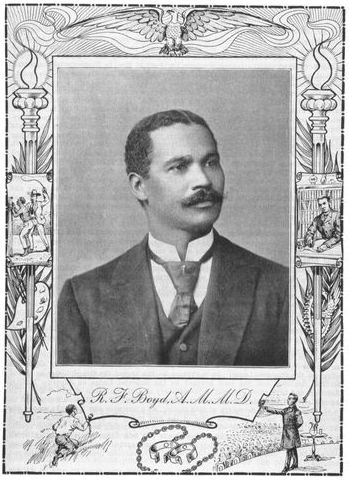
R. F. BOYD, M. D., D. D. S.
Dr. R. F. Boyd has clearly demonstrated by energy, pluck,
ability and upright dealing with his fellowman, the
possibility of rising from poverty's hard estate to honor's
golden prize. Dr. R. F. Boyd was born and partly reared on a
farm in Giles County, Tennessee, where he learned to hoe, to
plow, to reap and to mow. When quite a boy he worked for the
famous surgeon, Dr. Paul F. Eve, in Nashville, and attended
as best he could night school in the old Fisk buildings on
Knowles street. He taught his first school at College Grove,
Tennessee. The Doctor would teach a school and at its close
re-enter Fisk University or Central Tennessee College. In
1882 he graduated from Meharry Medical College, with the
degree of M. D. He went to Mississippi and taught a high
school at New Albany and practiced his profession till the
fall of 1882, when he re-entered the Central Tennessee
College to complete his college course, receiving at the
same time an adjunct Professorship in Chemistry at Meharry
and made teacher of Physiology and Hygiene in Central
Tennessee by which he was able to pay his college expenses.
In 1883 he was made Professor of Physiology in Meharry,
which position, together with a position in the Literary
Department, he held till he graduated from the College
Department of Central Tennessee College, in 1886. In 1887 he
graduated from the Dental Department of Meharry, receiving
the degree of D. D. S., teaching in the school at the same
time. In June, 1887, he opened his office in Nashville,
where so many had tried and failed. In 1888 Dr. Boyd was
made Professor of Anatomy and Physiology in Meharry; in 1890
he attended the Post-graduate School of Medicine at Chicago,
from which he received a diploma. In 1890 he was made
Professor of Hygiene, Physiology and Clinical Medicine,
which position he held until 1893, when he was made
Professor of the Diseases of Women and Clinical Medicine,
which chair he still holds. In 1892 he took a special course
in the Post-graduate Medical School and Hospital of Chicago,
on the diseases of women and children, among whom the
greater portion of his practice is. One of the greatest
needs of the colored people in the South is well regulated
hospitals, where trained nurses can handle and care for the
sick under skilled physicians. Until Mercy Hospital was
instituted, there was no place of this kind in the South. It
was Dr. R. F. Boyd who established and instituted this the
largest and most complete hospital owned and controlled by
colored people. There surgeons of our race do all kinds of
operations and trained and graduate nurses of the race care
for the sick under their management.
It is in this institution where the graduates of Meharry in
the Medical and Nurse-Training Departments get their
practical work. It is the great center to which colored
physicians of the South may send cases to be operated upon
by skilled physicians and handled by trained nurses. The
death rate of this institution has been less than three per
cent from all causes.
Besides this work, Dr. Boyd has taken a great interest in
secret societies. As an Immaculate, he has gained a National
reputation and has filled nearly all of the offices in the
Supreme Lodge. As a Pythian he has served the Grand Lodge as
Grand Medical Register, and has been honored by the Supreme
Lodge as Supreme Medical Register, and is Surgeon General of
the Military or Uniform Rank of that Order. The Ancient
United Sons and Daughters of Africa is a creation of his own
brain and he is at present Supreme Secretary of that Order.
As a business man he ranks among the foremost of the race.
He owns some of the best realty of the city, among which is
the Boyd Building, 417-419-421-423 Cedar Street. This
building has four business fronts, a hotel and restaurant,
offices of various kinds and four large society halls, in
which about forty societies meet. The Mercy Hospital was
purchased by him solely, at a cash value of $6,000. Besides
this he is the owner of other valuable property of Nashville
and suburbs.
This is a question of vital importance to us as a race and to the
nation as well. Much thought has been given to it by the best thinkers
of both races and many articles have been written by friend and foes.
All kinds of solutions have been proposed and yet the great death-rate
goes on. In the larger cities of the South our people die from two to
three times as fast as the whites.
The number of premature deaths is on the increase; the infant
death-rate is appalling; and consumption, a hitherto unknown disease
among our people, is credited with one-fourth the victims of all ages.
All the powers of science and art are being taxed to the utmost to
afford a complete solution to this problem. Every large city in the
South is being awakened to the sense of the importance of this
subject. And well they may; for the ignorance, the vice, the poverty,
the habitation and the food that cause this alarming death-rate effect
the whole community.
A proper knowledge and observance of the laws of health will give
happiness to all.
Man is as subject to the organic laws as the inanimate bodies about
him are to mechanical and chemical laws, and we as little escape the
consequences of the neglect or violation of these natural laws, which
affect the organic life, through the air we breathe, the food we eat,
the water we drink, the clothes we wear, and the circumstances
surrounding our habitation, as the stone projected from the hand, or
the shot from the mouth of the cannon can escape the bounds of
gravitation.
What we need is the gospel of the physical health to be preached from
every pulpit, and in every school room and in every home. All strong
motives of religion and the eternal world are taught from the pulpit
and the Sunday school to enforce certain duties that are no more
important to the well-being of man than the laws of health, which are
so widely disregarded. These laws are God's laws as truly as any
inscribed by Him on the Table of Stones.
The boards of health of our cities prescribe rules and regulations to
insure the peace and happiness of the individual and the longevity of
life which must apply to all in order that they might live out the
expected term of life. What is the natural term of life? Physiologists
have fixed it at a hundred years. Florens at five times the time
required to perfectly develop the skeleton. David says: "The days of
man's life are three score years and ten; and if by reason of strength
they be four score years, yet indeed is his strength labor and
sorrow."
Under modern hygienic rules and regulations the days of man have been
increased in civilized countries. Carefully prepared statistics show
that while the maximum age has not increased in many centuries, the
number of persons who survive infancy and reap a ripe old age is
greatly increased.
According to the Secretary of the Chamber of Commerce of New York
City, civilization largely interferes with the laws of evolution, by
survivorship and by encouraging the waste which arises from it. We
know that a human being soundly constituted continues in good health
until he reaps a ripe old age, provided certain conditions are
observed and no injurious accident befall him.
We might learn a lesson from the early Jews, or the ancient Greeks or
Romans, if we had at our command statistics of their mortality.
Doubtless they had a small death-rate! For they were strong and
vigorous and observed the laws of hygiene. When these laws are
properly observed, they decrease mortality and bring about greater
health, comfort and happiness to the individual and to the country at
large. Those who would preserve health in themselves and in the
community in which they live, who would reap the greatest benefits of
earth, and live out the appointed time, must strictly conform to these
essentials:
1. A constant supply of pure air.
2. Cleanliness of person and surroundings.
3. Sufficient nourishing food properly prepared and properly taken.
4. Sufficient exercise of the various organs of the body.
5. The proper amount of rest and sleep.
6. Right temperature.
7. Proper clothing.
8. Sufficient, cheerful, innocent enjoyment.
9. Exemption from harassing cares.
Conform strictly to these rules and all avoidable disease will be
annihilated. On the other hand, where hygienic and sanitary science is
not enforced, filth, decay and putrifying matter is sure to
accumulate. In this we have suitable material for the propagation of
disease germs, which cause all communicable and contagious diseases.
These minute organisms exist in the atmosphere everywhere, and
multiply by their own peculiar method of procreation; such as filth,
heat and moisture.
A population under the influence of vice, poverty, filth, debauchery,
foul air, poorly prepared food and crowded dwellings, or in low, damp
localities, with no rule regulating their eating or sleeping, clothing
or exercise, is sure to have a great degree of mortality.
With our thorough knowledge of how to prevent epidemics, most of the
diseases that enter the body through the respiratory, digestive,
cutaneous, circulatory, nervous, and genito-urinary systems should be
less frequent. Taking the facts which I have here given into account
one may see that not only do health and longevity depend upon laws
which we can understand and successfully operate, but man has it in
his power to modify to a great extent the circumstances in which he
lives, with a view to the promotion of his well-being and
preservation.
We know that the draining of a marsh pond banishes malaria; a change
from the city to the country reinvigorates, and that those who live in
the high, well drained portions of our cities have the smallest degree
of mortality and that the greater comforts possessed by the affluent
secure for them longer life than the poor who are not so favored. To
diminish the mortality in the Southern cities will depend upon both
the individual and social efforts as well as upon the public measures
of the legally constituted authorities.
The dirty neglected portions of our city where refuse and rubbish,
animal and vegetable matters are deposited and allowed to rest and
send up their poisonous odors from house to house, must be looked
after. The dwellings of our people must be improved. The old,
dilapidated stables, in the narrow, filthy alleys; the low, damp
basements and dark cellars, often below the ground, with an
insufficiency of both light and air; the clusters of homes built in
the bottom and low places, closely pent up, back to back so as to
prevent ventilation with only one entrance to each, and a privy
between; the over-crowded conditions of these uninhabitable quarters
and the quality of the food taken by those who live in these
disgraceful dwellings must be looked after.
Habits of living must be corrected and a crusade against ignorance and
vice begun by society. I don't think I would miss it very far when I
say that one-third of the colored people in our cities live in just
such dwellings as I have described here; while most of the white
population live in well-built houses in the healthy portions of the
cities. Is there any surprise that there should be so great a
disproportion in the mortality of the races? Compare the statistics of
all the large cities and you will find that under similar conditions,
this same proportion in mortality exists in the Northern and foreign
cities, where the food and dwelling of the poor have the same
difference. But this same difference exists nowhere in the world as it
does in the South. It is almost impossible for a colored man to rent a
respectable house anywhere in the cities; but the dark, low, damp,
confined, ill-ventilated cellars and alley houses are rented for as
much as comfortable quarters ought to bring. I don't wonder that the
mortality of the Negro is so great; but I do wonder that it is not
greater. Any other race of people would have been exterminated in
twenty years.
The remedy for the high death-rate is the enactment, and enforcement
of laws against allowing the people to sleep in basements, cellars,
old stables, alley houses, in low malarial sections of the cities, and
making the penalty against the landlords so great, that they will not
rent such places for dwellings. Regulate the kind of tenement houses
and the number of persons who shall sleep in one room, the kind of
food and rules for its preparation; break up these late church
meetings in poorly ventilated houses, and the problem will be solved.
The infant mortality will be reduced one-half when our people learn
that the care of a good conscientious physician is necessary, from
generation to development, and through the entire stage of
adolescence; not so much to cure, as to prevent disease. Our whole
system of medicine is now turning upon prevention rather than cure.
When the public is educated up to the point of paying physicians to
prevent as well as cure diseases, then, there will be less sickness
and fewer epidemics.
Then sanitary science, under the strict observance of hygiene, will
reach perfection; the rude, gross habits of living will be corrected;
a system of perfect drainage and ventilation will be inaugurated; pure
air and fresh water supply will be furnished to every public and
private house; only pure, unadulterated foods will be on the markets;
every hotel, private and boarding-house will furnish properly prepared
diets, and universal cleanliness will be the law.
Last, but by no means least, I call your attention to another most
potent remedy for the diminishing of the great mortality of the race
in the South. Besides the city hospitals, the whites have many other
hospitals and infirmaries, supported by church and benevolent
organizations where those that pay are at the hospitals because they
can receive the constant attention of a physician and nurse. We need
and should have such hospitals. The benevolently disposed people, the
churches and societies of the cities could establish and well support
them. In them, there would be pay wards and charitable wards. Each
church and society supporting the hospitals could send their indigent
sick to the charity wards and those who can pay, to the private
apartments.
These hospitals would afford a much needed opportunity for young women
of the race to prepare for trained nurses and afford better facilities
for the physicians to practice surgery and study remedies.
We have established in the city of Nashville, the Mercy Hospital under
the care and management of the Board of Trustees, composed of some of
the best citizens and heads of our great universities. Among the
directors are, Hon. J. C. Napier, President; W. T. Hightower,
Treasurer; Dr. G. W. Hubbard, Dean of Meherry Medical College; Dr. P.
B. Guernsey, President of Roger Williams University; Prof. H. H.
Wright, Fisk University, and Dr. R. H. Boyd, President of the National
Baptist Publishing Board.
The hospital is located at 811 S. Sherry street, Nashville, Tenn., in
one of the most quiet, beautiful and healthful localities of the city.
The site is high and well drained; the building large and commodious
and up-to-date in all its apartments. There are two large wards; one
for male and one for female, and private rooms, to which good pay
patients are assigned where they will come in contact with no one but
their physician and the nurse.
In this hospital great care is given to surgical work of all kinds and
especially to abdominal surgery and gynecology. Colored physicians
all over the South may send or bring their surgical cases here and
get every advantage that can be provided by the best first-class
hospitals and infirmaries all over the country. We have the best
graduate-trained nurses in constant attendance and the resident
physicians are men of the race who have made marvelous progress for
two decades in all branches of their work.
Since the establishment of the hospital we have had a record of which
few similar institutions can boast. During the first year we have had
more than 140 surgical cases, including abdominal section and other
major operations and yet the death-rate was less than 3 per cent from
all causes.
Our operating room is well appointed, with an abundance of sunlight by
day and gas light at night. Many of the physicians of the South have
sent us cases for which we are very grateful. We have had cases from
Alabama, Arkansas, Mississippi, Texas, Kentucky, Missouri, Florida,
and Georgia. Until the other cities of the South are able to afford
the facilities and accommodations and the skill and experience of the
Mercy Hospital we feel that it is the duty and should be the great
pleasure of every colored physician to send his surgical cases to this
hospital. I consider this one of the great factors to solve this vexed
problem.
The causes of the great mortality among the Negroes of the large
cities of the South are due to ignorance; vice; debauchery; poor food,
illy prepared; unsanitary environments; their habitation in the
over-crowded tenement houses; in old stables; damp cellars; and low,
damp sections and in narrow, filthy alleys, where the foul air,
improper nourishment, poor ventilation and the want of personal
cleanliness, furnish the proper condition for the development of
disease and death. Correct these conditions and educate the people up
to a thorough knowledge of and a strict compliance of the laws of
health and the problem is solved. The death-rate among our people will
not only be lessened, but I believe the Negro will outlive any other
people on earth.
SIXTH PAPER.
WHAT ARE THE CAUSES OF THE GREAT MORTALITY AMONG THE NEGROES IN THE
CITIES OF THE SOUTH, AND HOW IS THAT MORTALITY TO BE LESSENED?
BY HENRY R. BUTLER, A. M., M. D.
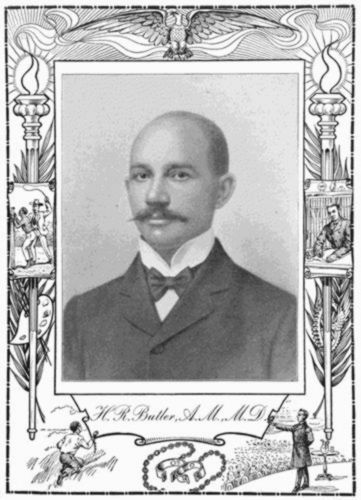
HENRY R. BUTLER, A. M., M. D.
Dr. Butler was born in Cumberland county, North Carolina,
April 11, 1862. His early life was spent on the farm, during
which time he received at odd times three months' free
school instruction.
In 1874 his parents moved to Wilmington; there he worked in
saw mills, lumber yards, with the cotton compresses and as a
stevedore. He spent his nights studying under Prof. E. E.
Green, now Dr. E. E. Green of Macon, Ga. January 3, through
the assistance of his instructor, he entered Lincoln
University, Pa., and was graduated June 18, 1887, receiving
the degree of A. B.; October, the same year, he matriculated
in Meharry Medical College, Nashville, Tenn., graduating
with the degree of M. D. February 27, 1890. The same year
the degree of A. M. was conferred on him by Lincoln
University. While at Nashville he won the H. T. Noel gold
medal for proficiency in operative surgery and dissecting.
He arrived in Atlanta March, 1890, and began the practice of
medicine. He was one of the organizers of the first drug
store owned and operated by colored men in Georgia. It was
known as Butler, Slater & Co. He was organizer and first
president of the Empire State Medical Association of colored
physicians. He was appointed surgeon of the Second Georgia
Battalion, colored volunteers, in 1891, with rank of first
lieutenant, by the Honorable W. J. Northern, then governor.
May 5, 1893, he married Miss Salina May Sloan of Atlanta, a
graduate of Spellman Seminary, who has been a most faithful,
loving and helpful companion. He took a special course in
the diseases of children in 1894 at the Harvard School of
Medicine, Boston, Mass. In 1895, in the same school he took
a special course in surgery. November 1, 1900, H. R. Butler,
Jr. came, adding new blessings and happiness to his home and
life. Dr. Butler is the first and so far the only colored
man to be a regular contributor to the great Southern daily,
The Atlanta Constitution. He has held that position since
1895. He was three years president of the Y. M. C. A. of
colored men. He was four years physician and surgeon in
charge at Spellman Seminary, and is now holding a similar
position in Morris Brown College, and is organizing a nurse
training department to that institution. He owns some
valuable real-estate, besides a beautiful home on Auburn
avenue. He has a large and lucrative practice. He is Grand
Master of Masons of the Jurisdiction Georgia, is grand
Medical Register of the Knights of Pythias. His life is
truly full, every moment of his time is taken.
The causes of excessive mortality among the colored people in Southern
cities are said to be many and have been discussed from just as
many points of view by students of the social status of this people.
But after several years of professional service among these colored
people, which service gave me an opportunity to more closely study
them, their faults, habits, needs, methods of living and their
knowledge of hygiene and its laws, I have calmly reached the
conclusion that the want of money is the main cause of the excessive
mortality of this people. It is true that there are several minor
causes, but all have their origin in the one mentioned.
Among the most prominent of these minor causes may be mentioned
Ignorance and Poverty. Let us briefly consider the first of these.
The colored people have made wonderful progress in the acquirement of
knowledge since emancipation, and this improvement has played no small
part in reducing their excessive death-rate. Yet from this height we
look down and see the great masses of these people still held in the
death-like grip of ignorance. To these, education has taken no
knowledge of clean homes, pure air, ventilation, soap and water and
other things conducive to good health. These are they who to-day are
falling so rapidly before the great reaper, death.
It is a truth known to the profession, health departments and students
of this subject that most of the deaths of the great human family
occur between birth and the ages of five years. The children of the
colored race are not an exception to the above statement.
If the children of the intelligent, good, better and best die fast, it
stands to reason that those of the ignorant, bad and poor would die
even faster, and this is just what I have found to be the case.
Ofttimes, among the lowly masses, ignorance is the first to take
charge of the babies at birth; it sticks a slice of fat meat in their
innocent little mouths immediately after birth; it rocks the cradle;
it fills their little stomachs with all kinds of decoctions, of teas
and whiskies to bring out the "hives;" yea, ignorance feeds these
little ones on all kinds of solid foods before they are able to digest
them, until it finally feeds the grave with the bodies of its little
victims.
Even when manhood and womanhood are reached, ignorance,
ghost-like, stands forbidding the ventilation and cleaning of homes;
it says: "It's too cold to bathe;" it sends men and women to bed in
wet and damp clothes and does many other acts that multiply the graves
in the old church-yard on the hill.
We come now to consider poverty. Oh, what an enemy it is, and has
been, to the human family! It makes its home mostly among the
ignorant, and especially among the masses. In the cities of the South
the great masses are colored people. Hence it is among these that
poverty sits enthroned—a sceptered king ruling amid disease and
death. It retards the masses of the race in their march to the city of
improvement; it prevents them from having larger and cleaner and
better homes; with its bony fingers it points them to the cheap
renting huts in alleys, dens, dives and basements of cities, and
commands them to enter and die; it follows them into the market places
and fills their baskets with cheap adulterated and semi-decayed
food-stuffs; aided by prejudice and man's inhumanity to man, it drives
the colored people from the healthy country districts into the
crowded, sickly settlements of the Southern cities, where they soon
sicken and die.
Poverty, supplemented by ignorance, and the want of the true Christian
spirit, stands in the doorways of the public hospitals, infirmaries
and libraries where aids to health are to be found and forbids these
people to enter either on account of their color or the "want of
space." Poverty keeps these people from building such institutions for
themselves.
Again, the colored people of Southern cities constitute the great
labor force, hence most of the diseases that result from exposure are
more prevalent among them than they are among the white race.
Those diseases that result from improper foods, poor sanitation, want
of pure air, need of better homes and want of public parks and baths,
together with those untimely deaths due to the want of proper medical
attention, good nursing and surgical operations at the right time are
more extensive among the colored masses because they are the ones
that suffer the privations mentioned to a greater extent than any
other people.
Along with the observations already mentioned on this subject, and
which observations have led me to reach the conclusion that "the want
of money" is at the base of this excessive mortality, is this
encouraging fact—that the colored people are not dying now as fast as
they were even a decade ago. The reason of this is not far to seek.
The truth of the matter is, these people are growing in wealth and
intelligence and in proportion as they have acquired these essential
qualities their mortality has decreased.
I have observed in my practice that those who live in good, clean,
well ventilated homes have no more sickness and deaths than white
citizens of equal intelligence and wealth. I now call to mind, here in
Atlanta twenty homes of colored citizens which are fitted and
furnished with all modern conveniences, including heating and baths.
The owners are well-educated and spend much time and money in keeping
their homes and yards clean and in good sanitary condition. What I
wish to say is this, in twelve years' time only two deaths have
occurred in that circle of twenty homes, and one of these was a baby
whose death was due to an accident, and the other was an aged person
whose death was the result of Bright's disease. Does not this speak
volumes to prove the truth of my position? What I have observed here
in Atlanta relative to the real causes and prevention of this
excessive mortality is true in other Southern cities.
It is no doubt plain to the reader that I have not mentioned here a
single cause upon which this excessive mortality rests, but that which
money can remove. That being true, what is the conclusion of the whole
matter? It is simply this:
1st. Pay the masses sufficient wages to remove their ignorance and
poverty, to build better homes and to furnish and equip them with
baths and other things necessary and conducive to good health, to
purchase proper food-stuffs, fuel and comfortable clothing.
2d. The cities should enlarge their present hospital facilities, or
build others especially for these people, cities and towns that have
no such facilities should provide them at once, parks, public baths
and libraries should be opened by the cities for the poor.
It is simply a matter of money, before that mighty king, ignorance and
poverty, together with all their allies, take flight.
 Dr. D. W. Culp