PRE-WAR PREFACE
I meant this book to be an image, a reflection, of
the Twentieth Century in France, so far as it is
shown in literature during the first fourteen years
of its course. But my book is small, the subject is
vast: an actual, living movement, a growing
generation, is a difficult thing to copy—it will not
keep still! And it branches out so wide: there
are so many French writers of the younger sort!
I am overcome with remorse when I think of the
gifted beings whom I have left out!
I remember that child whom Saint Augustine
saw, trying to gather the sea into his little shell;
like him, I see the waters stretching illimitably:
I have only brought away a sample. Yet those who
taste it may have some faint idea, if not of the
breadth and the numerousness of the literary movement
in France, at least of its savour and its quality.
Given the limits of my little volume, I was
compelled to make a choice; and there is always
some injustice in a selection. Why should some
be taken and others left? Why accept Rostand
and reject Bataille? Why give Madame de Noailles
and say nothing of Fernand Gregh? Why gather
up Boylesve and André Gide, neglecting Estaunie,
and Sageret, and Paul Adam? If I have Marie
Lenéru, why not Sacha Guitry? Choosing Madame
Colette, what reason have I for eliminating Madame
de Régnier or Madame Delarue-Mardrus? I especially
mourn the absence of the Brothers Tharaud, those
perfect artists, who preserve the tradition of
Flaubert. And there is a great gap in my fabric
where I should have put the colonial novel (that
flourishing Euphorion, born of the union of Loti
and Kipling). Why have I not a line for Henry
Daguerches, for Claude Farrère? All these are
names to remember.
At least I lay this unction to my soul: if I have
not always chosen the most perfect, I have faithfully
gone in for the most characteristic.
Having to choose a remnant, I have taken those
who, instead of continuing the traditions of the
Nineteenth Century, have said a new thing, boldly
differing, starting forth on a fresh career of their
own. I have ‘plumped’ for the daring apostles of
Life, those who cultivate movement and liberty
rather than Art; freedom of rhythm rather than
classic determinism and classic constraint; all
those whose method tends to the condition of
music, who say with the Abbess Hildegard (and
with Bergson), ‘Symphonialis est anima.’ Such
authors as these are emphatically of the youth of
the world, and the most difficult for a foreign
public to distinguish.
My readers will probably find most of these
names new; they may even be disappointed at
not meeting with those more illustrious spirits
with whom for five-and-twenty years they have
been familiar: Pierre Loti, Paul Bourget, Anatole
France. These great writers still shed on the
Twentieth Century the lustre its predecessor brought
them; but they are the glorious past, and our
concern is with the future. These younger men
are the French equivalents to our Wells, and
Galsworthy, and Hewlett, our Granville, Barker,
our Synge, and Yeats, our Masefield and our
Joseph Conrad, nay, even our Compton Mackenzie
and our Lascelles Abercrombie. And my task is
rendered more difficult by the fact that France
is a twy-creature, of double nature, a sort of two-headed
eagle or Rosa-Josepha among nations.
There is, I believe, one of the South American
republics which possesses a couple of capitals:
one to be used when the Liberals are in power,
and one for the Conservatives. France also has
a double set of everything, including celebrities:
those admired by the bien-pensant, and those peculiar
to the intellectuels. You may be illustrious in one
group and barely heard of in the other. Those who
adore Anatole France and praise Romain Rolland
smile sarcastic at the name of Barrès, and have never
opened a book by Paul Claudel. And, of course, it
is the same the other way round—only more so.
I have done my best to hold the balance even:
to group on the Right my seemly sheep, and on
the Left my free-ranging goats, in flocks of approximate
number, setting Boylesve over against Jules
Renard, and Francis Jammes in front of Charles-Louis
Philippe. If my reader discover that which
all have in common, I think he may have a fair
idea of the trend and the thrust of the spirit of the
age—at least, so far as it is manifest in fiction, in
poetry, and in the more literary drama, that
‘spectacle dans un fauteuil’ which may or may
not be a spectacle for the stage.
What I have not shown him—to my real regret,
to my recurrent remorse—is the world of the
critics, the intellectual flower of France. I am
not speaking of the reviewers; but of critics in the
sense that Carlyle, Matthew Arnold, Taine, Renan
were critics—the moralists, the biographers, the
portrait-painters of a soul, an epoch, or a race.
In France what branch of literature is more
important than such criticism? Who has more
charm than Suarès, with his imaginative and
morbid studies of great souls? Who forms the
mind of a generation more plastically than the
brilliant and perspicacious André Chevrillon? Who
interprets human nature more intimately than
André Gide, or the acute and icy Julien Benda, or
the romantic and religious Fortunat Strowski, the
historian of Pascal; or the humane and sensitive
Daniel Halévy, with his passionate Nietzsche, his
strong and suffering Proudhon? These, perhaps,
occupy less space in the booksellers’ windows than
our novelists and poets, but they are factors as
considerable in the education of a race. I salute
them, even as, perforce, I pass them by. Perhaps
another year I may reserve another book for them.
Mary Duclaux.
AFTERWORDS-AFTERWARDS
In August, 1914, this little book was already in
the printer’s hands, the last revise corrected, the
‘paste-up’ prepared, ready to appear in the autumn,
when certain events, which we all remember,
happened with the suddenness of a thunderclap.
The season was not favourable to the production
of books, and for nearly five years neither author
nor publisher gave the volume a thought. The
Twentieth Century writer was elbowed out of the
field by the Twentieth Century fighter. Alas, too
often the one has been buried in the grave of the
other, and the young man of letters whose fame
and fortune we were announcing has fallen into
nameless dust, or lies hidden under one of these
innumerable slim gray crosses that spring, like
some strange new harvest, on the low hills round
Verdun, or along the valleys of the Marne and the
Somme.
When, in the Spring of 1919, Messrs Collins
returned me my old revise for a last glance ere it
finally went to press, I gazed in consternation at
the pages which had seemed so reasonable five
years ago. Five years? Let us say ten years!
‘Les années de campagne comptent double.’ It
was like opening an old bundle of photographs
after a great lapse of time—the same mixture of
melancholy, and a sort of sad amusement. Look
at this absurd youth! Who could have supposed
that he would become so famous? And that
brilliant creature, dead now, and already half-forgotten.
So-and-so, at least, has developed
along the lines that we laid down and has turned
out just the successful and useful servant of civilisation
that we imagined.
In our case, So-and-so is Barrès. He has become
all that we thought he might become. Public
life and the patriotic duty have absorbed him
more and more; he has been to the France of
1914-19 something of that which Lamartine was in
1848. He, more than any, has preached the need
of union—‘L’Union sacrée,’ bringing into public
affairs a largeness of outlook and sweetness of
temper rare in politics,—especially in France.
Few of these eloquent pages which day by day he
has contributed to the Echo de Paris will remain
as works of literature, but, piled up, no longer
read, in their accumulation they form a pedestal
which certainly heightens the moral importance of
the man. Here at least we have the satisfaction
of finding our analysis exact. More and more, in
these days of storm and stress, Barrès has ‘felt the
need of merging himself in something larger and
more durable than any individual existence’;
‘no longer the singular, the extraordinary attracts
him;’ he finds something pleasant and satisfying
in the alliance of courage and the spirit of adventure,
‘with a certain soldierly mediocrity of mind’—and
all the more when their conjunction ‘promises
the conquest of Alsace-Lorraine.’ Above all, he
has given himself heart and soul to ‘the creation
of a truly National Party, capable of bringing out
of chaos a new organic order.’ Shall we not say
of him that, like his heroine, Colette, ‘Il se sent
chargé d’une grande dignité, soulevé vers quelquechose
de plus vaste, de plus haut, et de plus
constant que sa personne’?
Yes, I can re-read the chapter on Barrès with a
certain satisfaction.
But, when we come to Romain Rolland, what a
falling-off was there! How is it that Romain
Rolland, who seemed, if such there was, the very
prophet and the teacher of the younger generation,
should have proved so much less sure as a guide
and a standby than the fantastic and singular
Barrès? Always an aloof and solitary spirit,
Rolland completely detached himself from his
country during the war. In his voluntary exile at
Geneva he occupied his hands, and no doubt his
heart, with works of mercy, but his mind gave no
support to his compatriots. Doubtless the attraction
of Germany was too strong: ‘Jean Christophe’
continued to subjugate the delicate ‘Oliver.’ These
great international friendships have their perils (and,
doubtless, I speak of them in the mood of Bishop
Berkeley: ‘There, but for the Grace of God, go
I!’) Yet Renan was no less attached to intellectual
Germany than Rolland: Renan, who, when his
mind crossed the Rhine, ‘crut entrer dans un
temple,’ and in 1870-71 France had no firmer
patriot than Ernest Renan.
The fact is that Romain Rolland’s genius is not
French. The son of the lawyer at Clamecy is
French enough by descent and as good a Burgundian
as Lamartine, but he ought to have been Swiss
by nature as by choice. There is nothing Latin
or classic in him. His intense individualism, his
moral earnestness, his lyric love of nature, and
something querimonious, a scolding tenderness in
his voice, remind us sometimes of Rousseau. And
never was his high-minded crankiness more apparent
than in that untimely pamphlet—‘Au dessus de
la Mêlée,’ in which he rubbed it into us so tactlessly
that our preoccupations are not his who
dwells, unfriended, melancholy remote, above the
fray.
This little volume made him probably the most
unpopular writer in France. There is a radical
misunderstanding which separates Romain Rolland
from the young Frenchmen of the war. How has
it come about? Hamlet and Harry Hotspur were
good friends when we took leave of them in the
final chapters of Jean-Christophe. Few men of
letters had more vividly appreciated the active,
ingenuous, hardy generation that was taking its
first flights in the aeroplanes of 1912 and 1913.
Arrogant, gay and strong, cheerful in their bright
materialism (which allied itself so naturally with
the most orthodox acquiescence in the creed
of their forefathers), the tall and sturdy race of
the Twentieth Century pleased Jean-Christophe,
because they seemed so prosperous and so happy—and
that is, after all, what we chiefly ask of
those who are to take our place in life.
M. Rolland liked these young men; still, he
expected them to look up to him; he felt himself
their moral and intellectual superior, as doubtless
he was. But then the war broke out, and what a
reversal of values! Most of us, in France, who
sheltered behind the brave broad shoulders of our
‘poilus,’ felt our hearts melt with admiration, pity,
hope, and love. Not so, M. Rolland.
His attitude has been one of irritable self-defence.
First of all that pamphlet, ‘Au dessus de
la Mêlée’—and now this new book, published
to-day (April, 1919), but finished (M. Rolland tells
us) in May, 1914. Colas Breugnon is a study in
Rabelais’ vein. But, if M. Rolland’s style is far
from perfect when he writes as from the Twentieth
Century, what an exasperating gallimaufry it
becomes, what a pretentious farrago of lyrism,
puns, blank-verse, conceits, and quips, when he
assumes the character of one of his ancestors; a
certain joiner and cabinet-maker at Clamecy, under
the reign of Louis XIII. The rough jokes of the
tavern chronicled in the style of Euphues! Romain
Rolland maundering of Women, Wine, and Song!
The worst of it is that his boozing and his babble
do not seem genuine: the professor’s gown peeps
from under the starched blue folds of the carpenter’s
blouse. It is as though, irritated by the reproach
of internationalism and cosmopolitanism, M. Rolland
had said to himself, ‘After all, I am neither a Jew
nor a foreigner! If Péguy came from Orleans,
I come from Clamecy; I have just as good French
blood in my veins as he.’ And behold him capering
unconvincingly as a Burgundian artisan, drowning
his troubles in the bowl.
I wonder if any of my readers remember a
French country novel called Le Moulin du Frau,
which appeared about 1894, by Eugène le Roy,
the author of Jacquou le Croquant. Here is the
novel which M. Rolland has tried to write. It is
just the life, day by day, of a miller in Périgord—a
man of strong political feeling, a democrat
and a philosopher on his way, like Colas Breugnon.
But the miller of the Frau, though rustic and plain-spoken,
is not coarse, for his author lived all his
life amid the peasants of Périgord and Quercy.
The French peasant has his faults; he loves to
excess his money and his land; but as a rule he
is not coarse. I have known a great many, in the
country, and, since the war, in hospital; but for
coarseness commend me to the country folk of
Zola, the man of letters; or those of the author
of Nono, who is a schoolmaster; or these rowdy
village folk of Romain Rolland’s. They lay the
rustic varnish on too thick. Beneath this vulgar
varnish we discern an image sufficiently touching
and quite in Romain Rolland’s stoical vein: That
of an obstinate, obdurate, wine-bibbing, and free-loving
old cabinet-maker, besotted with his love of
art and liberty, who in the end, having lost his
savings, his home, his wife, his sculptured treasures,
finds himself happier than he ever was before
(though bedridden, poor, and a pensioner in his
children’s bounty) because he has conquered the
only liberty that really matters—the freedom of
the soul.
It is impossible to suppose that Colas Breugnon
will mark the close of M. Rolland’s career. It is
evidently a caprice, a boutade, an interlude. In
what sense will his talent now develop? His
years have just completed their half-century, but
he still has some good autumns before him:
Cervantes was turned fifty-seven when he published
the First Part of Don Quixote!
To return to our Twentieth Century writers,
Rostand stands the next upon our list. The war
has neither augmented nor diminished Rostand.
The few occasional poems that he published during
its course are of slight importance; one imagines
him following the tragic struggle with an attention
so deeply engrossed that he half-forgot to breathe,
and could not sing. When Victory promised us
Peace, the strain relaxed. The fragile enthusiast
could draw a deep breath. It was his last. He
died, after a brief illness, a few weeks after the
conclusion of the Armistice.
Let us turn the page again. Paul Claudel has
written a few more dithyrambs in prose, but these
five years have increased the volume without
changing the character of his work. He is still
predominantly the author of the Cinq Grandes
Odes, of L’Otage, of La Jeune Fille Violaine, all
published some years before the war. He serves
his country as Consul in Brazil instead of at
Hamburg; still in the full strength of his years,
with doubtless other laurels to conquer, he stands
out, among the ranks of our writers, a creature of
passion and combat, active, emotional, mystic,
and material at once—adequate to his age.
Francis Jammes, too, is unchanged, save by the
natural process of the years. The Faun turned
Friar is now more and more an author for the
family circle. He is a candidate to the French
Academy, which has just received his successor
on our list, René Boylesve. This last writer, at
least, has been deeply touched by the war. His
fine novel, Tu N’es Plus Rien, will remain as
evidence of that passionate patriotism—that detachment
from all individual interests and, I might
almost say, that cessation of all individual existence
which made the France of the Great War as rapt,
as ecstatic an example of the force of a collective
sentiment as the France of the Great Revolution.
And now (after a passing glance at an unchanged,
inconspicuous André Gide) we approach the name
of Péguy. Péguy was killed in September, 1914,
as he was leading his men into action at the Battle
of the Marne. And as the flash of a fusee lights
up the nocturnal battlefield, so that tragic illumination
of his death reveals the true meaning of much
that was obscure and easy to misunderstand in
his gift. I own that I have almost entirely rewritten
the chapter I had given to Péguy. I did not—do
not—fully like or appreciate a genius now generally
accepted as such in France, but I had composed
my first sketch in a mood of freakish pleasantry,
which might be permitted towards a man much
younger than myself, with a great future before
him, but which is not possible in speaking of a
poet, dead, who died a martyr and a hero. It is
perhaps the fault of a classical education which,
if it was not very extensive at least sank deep,
(inclining me especially to grace and measure,
to something exquisitely right, exactly true)—it
is perhaps the fault of a taste nourished on Sophocles
and Plato that these ultra-lyrical modern
geniuses, with their wild reiterations, their violence,
their volume, their hoarse abundance, more often
shock or dazzle me than please.... Péguy,
Claudel, carry me off my feet, drown me, drench
me in their billows full of sand and pebbles, and
leave me gasping: ‘Oh, for the well beneath the
poplar in the field!’ Yet Péguy and Claudel are
the names which must be most profoundly considered
in this little book, for they represent a
generation. I have placed in Péguy’s train, as
witnesses and mourners, his friend Ernest Psichari,
his fellow-officer, Émile Nolly, and the two really
considerable writers who have risen into eminence
during the war: Henri Barbusse and Georges
Duhamel.
Three of our four ladies have passed through the
time of stress unscathed nor greatly left their
impress on the angry world—not that they have
not published in due course their poems or their
novels. But these novels and poems are chiefly
reflections from a mirror fully occupied by their
own image. Madame Colette publishes to-day
Mitsou; the tender irony and charming grace of
her style are the same as of old—Mitsou is an
enchanting little savage of the music-hall stage—Madame
Tinayre has given us a novel which is
an agreeable fresco of the day of mobilisation in
Paris. Madame de Noailles has scattered a score
of lyrics, like a handful of rose leaves and cypress-buds,
over the pages of half a dozen reviews, but
the terrible enigma—‘Must I grow old like the
others? And, if not, must I die?’ is her most
intimate preoccupation, and blurs in her eyes the
great spectacle of the war.
Marie Lenéru nourished her soul in anguish on
the tragic problem: How can it be that the most
obvious social duty, the defence of hearth and
home, should come to mean in practice, crime
and cruelty let loose in the general reversal of all
social law? The daughter of a line of sailors,
with half a dozen filleuls in the Fusiliers-Marins,
she was the most martial of pacifists, but also the
most passionate. While embroidering a flag, or
tying up a packet for the front, she was busy
devising some League of Nations which might
prevent the recurrence of the infernal storm.
Early last spring she brought me to read a strange,
violent, lyrical debate, rather than a play, which
she had written. She called it La Paix, and hoped
it might one day be performed before the Congress.
She had wished, indeed, that the Théâtre Français
should produce it instead of La Triomphatrice.
But the House of Molière wisely stuck to its bargain:
La Paix was not a piece for war-time.
La Triomphatrice appeared at the Théâtre Français
in January, 1918. It did not take the town
by storm. The play is too exclusively concerned
with the manners and morals of a literary clique,
and the question discussed is after all a very
secondary question: Can a woman of genius be
really happy and beloved as a woman—be as
satisfactory as wife, mistress, or mother, as the
more receptive non-creative sort? Marie Lenéru
thought not. One feels inclined to answer that it
does not really matter: there are so few women
of genius. But Marie Lenéru debated her theme
so passionately that it was impossible to turn
an indifferent ear. If the general public remained
aloof, the salons and the newspapers were full of
La Triomphatrice, and recruited every week a
wider audience. With Madame Bartet triumphant
on the stage, with half the celebrities of Paris in
the stalls, Marie Lenéru might feel her hour was
come, or at least was at last tremblingly, exquisitely
coming, in all its fullness.... She was
ambitious....
And then, on the 23rd of March, ‘Grosse Bertha’
began to thunder. The German shells fell in the
centre of Paris; on Good Friday a church was
shattered, with all its faithful in it; one night, at
the Français, actors and audience had to take
refuge in the cellars, fortunately spacious. The
theatre was closed. The play was stopped in mid-career.
Mademoiselle Lenéru herself retired to
Brittany. After a long summer’s work and meditation,
with more than one play filling her portfolio,
she was full of plans for her winter in Paris, when
she fell a victim to the epidemic of infectious
influenza then devastating Lorient, and died there
on the 23rd of September, 1918. Except Péguy,
France has lost in the war no writer from whom
we hoped a richer harvest. Some day we shall
read La Maison sur le Roc, Le Bonheur, La Paix—those
plays so full of thought and a sombre passion,
which, to my thinking, are meant rather for the
student’s chair and the fireside lamp than for the
glare of the footlights. A great, active, heroic soul
still moves amply through all of them and swells
their sails: may they carry down the stream of the
century the echo of that voice, ardent and harsh,
monotonous, and yet so strangely moving, which
was silenced before it had time to deliver its full
message.
No such rich promise was cut short by the death
of André Lafon, who died of his wounds in hospital
early in the war. A shepherd—that is how I see
André Lafon—a charming young shepherd strolling
down Mount Olympus, to whom the Muse gave,
half-smiling, a dew-bespangled branch of laurel;
but, ere he could twist it into a crown, the wolf
came ravening and made an end of him and it!
It is not for his talent that I evoke the memory of
André Lafon (though I have read and re-read
L’Élève Gilles with singular sympathy, and love
the too-slender, charming little book), but few
things seem to me more romantic than the destiny
of this young man. In the spring of 1912 a solitary,
a sensitive, young usher in a school—before the
year was out, his name on every lip, his purse
swollen with those blessed ten thousand francs
of the French Academy’s new Great Prize (which
he had wrested from Péguy), and his slim portfolio
bursting with letters from publishers. He certainly
was not a Byron (it generally is not the genius who
‘wakes to find himself famous’); but that is always
a romantic adventure, especially when, two years
later, the young laureate fills a hero’s grave. Had
he a mother, still young, in some old house in the
provinces, to glory in her son’s miraculous
achievement, and to mourn the withering of her
hopes? I often sit and think of the fate of André
Lafon—as delicate and sad as one of his own
stories.
The name of Edmond Jaloux (nothing seems
to have happened to the writers of Pastoral novels),
reminds me that all our brilliant writers are not
dead. He has certainly increased in value during
the last five years. Two novels, published in 1918,
but written on the eve of the war, L’Incertaine and
Fumées dans la Campagne, prove him in full
possession of his gift. His novels are exquisite impressions
that somehow hauntingly convey the sense
of something round the corner that might please
us even more were it not just out of sight. Fumées
dans la Campagne, especially, is a fine piece of work,
subtle, tender, sad. Since Le Reste est Silence,
M. Edmond Jaloux’s art, while no less brilliant,
has gained in depth and refinement. No writer
on our list has in a higher degree the æsthetic sense.
His landscapes breathe the very spirit of the South.
The figures in them are gracious, cultivated beings,
whose psychology is full of delicate sentimental
complications....
But his voice is the voice of yesterday—or at
the latest of this morning: what will the morrow
bring forth? The violent realism of Barbusse?
the dithyrambs of Claudel? the infinitely delicate
divagations of Marcel Proust? or something wholly
different and unforeseen? With the signing of Peace
we now enter a new era, and there will be new
writers, doubtless, to greet the twentieth year of
the Twentieth Century.
Ultima Cumæi venit jam carminis ætas
Magnus ab integro sæclorum nascitur ordo.
Now dawns the last age of the Sybil’s sooth.
And lo! the world, transformed, renews its youth!
Mary Duclaux.
Paris, April, 1919.
MAURICE BARRÈS — I — II — III
Maurice Barrès is the oldest of all the personages
of this little book, which deals emphatically with
the young—with the writers of the Twentieth
Century, and not with those already famous fifteen
years ago. Still, every rule has its exceptions;
and it is impossible to imagine the young literature
of our days without this man of fifty. Time flies,
and never did it seem to me to fly more swiftly
than in this moment, when I realise that Barrès
must be ranked among the middle-aged. Only
the other day, he was that young Deputy, delightfully
impertinent, impatient of the ways of his
elders, who rose from his bench in the Chamber
to propose ‘that the ashes of Jules Simon be
transferred to the Panthéon’—Jules Simon being
at that moment comfortably seated in the Upper
House. May it be long before the ashes of Maurice
Barrès are carried to the home of the immortals!
Yet Time has already begun his travesties: the
Don Juan of letters, the enfant terrible of politics,
is already a sort of Conscript Father, almost a
Father of the Church. He, too, in the world of
letters, dignifies the Upper House, for he is an
Academician. Maurice Barrès is the Chateaubriand
of our unfolding age, or, to translate my meaning
into English, he is perhaps even more exactly its
Disraeli—a Disraeli reversed: an incomparable
artist, a brilliant politician, but, in this latter line,
something of an amateur. Still we cannot imagine
our Barrès stripped of his politics, nor even the
literature of our time without the politics of Barrès.
His Nationalism, his Regionalism fill and flood the
literature of France as fully as Imperialism occupied
the English horizons of yesterday. Doubtless we
are moving out of the sphere of their influence.
But they have nourished the imagination of our
younger men.
The Barrès of the Nineteenth Century was less
political. Like most of the masters of the present
hour, he entered letters as a Symbolist, almost as
a Decadent. Immersed in solitary introspection,
he at first appeared as the Narcissus of the Inner
Life, taking his stand somewhere between Bergson
and Mæterlinck. In those days, he asked from
politics merely an instigation, a fillip. That strange
temperament of his, at once dreamy, lethargic,
ironical and intensely passionate, sought in the
tumult and the fatigues of Boulangism a spur and
a sting, something which should urge and incite
him to adventure. ‘J’aime Boulanger,’ he said,
‘comme un stimulant.’ Politics were for this young
man an enchanting enterprise, an admirable expense
of energy, an inward animation; and, even when
he saw the General as he was, the experiment still
seemed interesting and poignant.
Barrès was so weary of his own fastidious refinement
that his devotion was perhaps enhanced by
the discovery that his hero was just an average
man. All that excitement and stir which his arid
self-culture had not afforded him, he expected from
the perpetual agitation of public life; he had
exhausted (or thought he had exhausted, for he
had not exterminated them from his brain) the
philosophers and the mystics; he had done with
Plotinus and Loyola and Hegel. Like the hero of
L’Ennemi des Lois, he exclaimed:—
‘Toujours les choses de l’intelligence! Je les
comprends; je n’en suis pas bouleversé. Ah!
des choses qui puissent changer les âmes!’
Barrès had delved down so deep into his conception
of the Ego, that he had (so to speak) come out on
the other side—at the Antipodes, and felt the need
of merging himself in something larger and more
durable than any individual existence. No longer
the singular, the extraordinary, attracted him, but
the normal type. And so, in General Boulanger, a
certain pleasant vulgarity, a soldierly mediocrity
of mind, seemed charming to this subtle neophyte:
he recognised the quality—a cheap chromo-lithograph
of Henri Quatre or Lafayette, and he liked
his chief none the worse for it. He saved himself
from smiling at his own enthusiasm by saying that
Boulanger was just the captain to re-conquer
Alsace-Lorraine for the French.
But, all the same, Boulanger was more to the
young member for Nancy than just a glass of
vermouth quaffed at the tavern door. He soon
saw that his adventurer was not adequate to the
adventure; an absurd conspiracy ended in smoke.
But when the last blue volutes had curled away,
and left unchanged the face of the Republic, something
important remained deposited in the mind
of Maurice Barrès: the idea of a party which
should embrace all opinions in its scheme for
reform, a truly National party, bringing out of
chaos a new organic order. Then he opened his
Sophocles and pondered the magnificent line which
no party leader has ever put in practice:—
οὐτoι συνέχθειν, ἀλλα συμφιλεῖν ἐφυν.
I live to share your loves and not your hates.
And through a maze of errors (for, in my opinion,
the political adventures of Barrès were chiefly
errors), this noble conception broadened and ripened,
dignifying a patriotic traditionalism with such
beauties as may spring from the hope of continuity
and the sense of order.
A great gulf divides, as we shall see, the Barrès
of the Nineteenth Century from the Barrès of the
Twentieth. We will not consider in this place that
earlier author, the gifted egoist of Bérénice, the
anarchist of L’Ennemi des Lois, the lonely mystic
of L’Homme libre, the dilettante, the self-worshipper.
Let us merely say (in order to explain him) that
our author was born in 1862 at Charmes in Lorraine,
a man of a mingled race, with a strain of Teuton
in him warring with the Celt, and a Rhenish sensibility
hampered by a Latin love of rule and law.
On his father’s side, he traces his descent to
Auvergne, and his relations still live in the little
town of Mur-en-Barrez; but his mother’s people
all come from the neighbourhood of Nancy in
Lorraine.
If we gave a free rein to our imagination, and
let ourselves argue from type and talent to a strain
of race, we might suppose that, like Montaigne,
Barrès had in his stock some Jewish or Marrana
grandmother, who gave him his taste for speculation,
with something curious, double, and ironical
in his outlook; but here, I believe, the genealogists
protest.
His first impressions of conscious and public
life were of a kind fit to aggravate the inherent
melancholy of a sensitive and impassioned nature.
He remembers a crowd, all surging towards one
point under a hot summer sun, and that point
the station; trains passing endlessly, filled with
soldiers, thousands of soldiers, drunk, some with
wine, some with sheer excitement, and all singing
at the top of their voices. And the inhabitants
of the little town of Charmes, men, women, and
especially the little boys like himself, are striving
towards, pressing against, hanging over the barriers
and railings of the station, handing across bottles
of wine, brandy, coffee, and crying: ‘À Berlin!’
as loudly as the soldiers. And then a few weeks
later, the retreat: that day of stupefied astonishment
in the soaking rain, while horsemen and
infantry in wild confusion troop by in a very rage
of shamed withdrawal; the soldiers insulting their
officers, a General in tears, the linen-clad Turcos
shivering in the dreary damp. And then five
Uhlans, their pistols in their hands, who ride
across the bridge and take possession.
The men of the Barrès family, notable citizens
of Charmes, were taken in hostage by the Prussians.
The trains that ran the Prussian troops towards
the front had a Barrès or so, as hostages, beside
the engine-driver. Their lives hung by a thread.
And so a proud, timid, melancholy little boy learned
early in life what it is to expect the worst, to go
in fear, and, out of pride, to dissimulate that fear.
The Nationalism of Barrès may be traced to these
first impressions. It is as invaders that he hates
the Germans: intellectually, he has no quarrel
with them.
In a discourse pronounced on the frontier during
the war-threatened summer of 1911, he asserted
anew all that he owes to the romantic fancy of
the Rhine, his real and fervent admiration for the
noble genius of Gœthe, his tenderness for the
sentimental Schiller, his sense of a deep interior
affinity between his own mind and that of Nietzsche.
But those terrible memories of childhood have
graven in his spirit a certainty of the preciousness
(but also of the precariousness, the fragility) of
civilisation; a hate and a contempt for the
‘Barbarians’ whose hordes are a perpetual menace;
and a feeling that, though every nation has plenty
of Barbarians at home, the worst of all Barbarians
are the Prussian Uhlans and the Bavarian troopers
of a German invasion.
Barrès was the most precocious, I think, of a
generation that began to pierce the soil (so to
speak) between 1886 and 1890, a generation idealist
and sceptical at once, which counts among its
glories Bergson, Maurras, Mæterlinck, and (their
Benjamin) René Boylesve. At nineteen years of
age, Barrès left Nancy and came up to Paris in
order to study law: his deluded family hoped to
make a magistrate of the ‘Ennemi des Lois.’
But the dreamy youth, silent, timid, yet brilliant,
had other aims in view. He had a volume of
Schopenhauer in his pocket and a certain number
of ideas in his head. He began to write in the
young reviews and to show these first essays to
his pastors and masters, the two rival librarians
of the Senate, Leconte de Lisle and Anatole France.
They were extraordinary essays which reflected
in nothing the physiological naturalism of the
hour—the hour of Zola! They were entirely,
exaggeratedly spiritual and interior, and yet full
of the dreariest nihilism. They were the essays
of a man with a soul, who says in his heart: ‘There
is no God.’
Those early essays, those first novels, have nothing
to do with the Barrès of the Twentieth Century,
save inasmuch as the child is the father of the
man. I have dealt with them elsewhere (in the
Quarterly Review), but some day it will be interesting
to take them up again and examine their development
parallel to the philosophy of Bergson. It
is often surprising, and makes one wonder if the
two writers have not, in their philosophy, some
common ancestor. But who was he? Was he
Burdeau? Was he Ravaisson? Was he Lachélier?
Was he Renouvier?
For my present purpose—which is to examine
the progress of Barrès, and especially his influence
on recent literature, it is enough to say that these
first volumes were the work of a man for whom
the inner world alone exists. He, who was to
become the voice of his province and his race,
makes his first appearance as a being released from
all ties and all traditions. The hero of Sous l’œil
des Barbares has no country, no profession, no
family, no local habitation, and no name. The
one existence and the one reality are, in his eyes,
the Ego,—in other words, his own mind. His sole
adventure is the lonely courage of a descent into
that Inner Abyss. He might have exclaimed with
Leopardi: ‘E dolce, il naufragar in questo mare!’
In the depth of this depth is something deeper
still, continuous beneath the difference of individuals,
as the mass of the sea is one below the variety of
the waves. ‘Penser solitairement, c’est s’acheminer
à penser solidairement,’ Barrès exclaimed, half
ironically, in Les Déracinés. If we sink deep
enough into our own souls, we fall into the general
soul of all: we find the deep subterranean flood
that fills all the fountains of the city!
And so the Egoist discovers that he is not alone,
that he is a living cell in a living organism. It
is this sense of Life and solidarity which distinguishes
Barrès, the man of action, Barrès, the
political leader, Barrès, the inventor of Nationalism,
the apostle of decentralisation, from the delightful
nihilist, the exquisite anarchist, that he was at
twenty—and even at thirty years of age. He has
gone far since then! Sure, now, of the existence
of his race; accompanied in all his thoughts by
those mysterious cohorts of the dead and the
unborn which prolong the importance of the
humblest life; our philosopher bids us lay no stress
upon our own experience, and sacrifice, if needs
be, the details of our happiness to the welfare
of the whole.
Slowly this second manner has developed since
the closing years of the last century: between
L’Ennemi des Lois (published in 1895) and Les
Déracinés (1897) there is a chasm, an apparent
disconnection. Something mysterious divides them—something
akin to a religious conversion. What
is the secret substratum which unites two phases
evidently alike sincere? What makes their diversity
none the less organic? It is, I think, the sense of
continuity, the desire to persist and to preserve.
The Barrès of Les Déracinés has reached the
further edge of youth: he is five-and-thirty years
of age.
Many men, on the threshold of forty, find themselves
suddenly and terribly alone, in an hour of
solemn solstice. So far, they have struggled up the
hill gaily, with companions, and always have seen
their goal ahead, like a cliff that shines in the sun
and masks the horizon. Now on that topmost
rock they stand, and now the road slopes downward—the
road leading nowhere—which they must
follow with diminished strength, in dwindling
numbers, to find a tomb somewhere at the foot
of the hill. Such an hour, such an experience marks
for ever a sensitive nature. Some, then, like
Tolstoi, have suddenly renewed the faith of their
childhood and reconciled themselves with Christianity
for the sake of a promised resurrection. Others
build above the abyss a narrow bridge with the
hope of the continuance of their race and their
ideal. So Barrès will one day write:—
‘J’ai confiance, pour atténuer certaines peines
morales, dans un esprit fait de soumission à la
terre natale, de fidélité aux morts, et de connaissance
que tous nos actes entreront dans l’héritage
social.’ (Amitiés Françaises, p. 41.)
There is at Bar-le-Duc, in the church of Saint-Pierre,
a mortuary statue of the Prince of Orange,
by Ligier Richier, that tragic sculptor who left
Lorraine to learn of Michael Angelo. The prince
lies in the tomb, dead, in all the horror of corruption,
his flesh dropping from his bones. But out
of that appalling decomposition he lifts his heart
intact—his living, his immortal heart—and he is
reconciled to perish if that alone survive. So all
of us, from the De Profundis of our accepted
mortality, raise something we would fain bequeath
as an heirloom to the future. Religion is based
on such a sense of the persistence and the perpetuity
of an ideal. Something, at least, survives; something
is incorruptible; Sursum corda! and because
of that persuasion of a continuity assured, the
sadness of our own sure destruction is tempered
with serenity and hope.
There exist two great families of literary works.
One kind is complex, often diffuse, romantic,
representing characters and sentiments too singular
to be recognised save by the chosen few; of such
are the works of Stendhal, and down to the close
of the Nineteenth Century the novels of Barrès
belong to this category. But in 1900, with L’Appel
au Soldat, he will effect his transition to that other
group, which instinctively we call classic, dealing
with the simple sentiments of general humanity,
seen from a great height, plumbed to a great
depth. With L’Appel au Soldat, Barrès enters
the sphere of Gœthe.
If the book please me greatly, it is less for its
animated picture of the Boulangist fever, for its
portrait of the General (so deeply pathetic in its
human weakness), less even for the death of Mme de
Bonnemains (though few things are more heartrending)
than for an interlude of some seven score
pages, La Vallée de la Moselle, the simple account
of a bicycle tour taken by two young men, natives
of Lorraine, from Bar-le-Duc in France to Coblenz,
which once was France. But these chapters are
written with a freshness and a feeling, a flexibility,
an evident sincerity which make them infinitely
touching. That Spanish crudity, bizarre, elliptic,
which Barrès used to affect, has vanished here. A
romantic sentiment is expressed with the ripe calm
and in the pure language of a classic. Our Barrès
sails his black Venetian gondola along the most
harmonious, amplest stream. He has forgotten
his impertinence and his perversity, but he has
lost nothing of his grace.
Marriage and the birth of a son had, no doubt,
much to do with this happy evolution. To a man
haunted by the dread of annihilation, a child is
an assurance against complete extinction. He is
(as the Parsees say in their touching phrase) ‘a
bridge’: a bridge across the abyss. A child prolongs
our Ego and assures the continuity of all that
we inherit from our ancestors. A child, we may say,
is the printed proof of our manuscript, safe henceforth,
and no longer so unique or so important!
The volume which Barrès wrote for his little
son of six years old is a sunlit exception in his
writings, as a rule so profoundly melancholy. Les
Amitiés Françaises is a First Reader in patriotism,
an alphabet of honour. It is an exquisite book
and might take for an epigraph the motto of the
town of Toul: Pia, pura, fidelis. It is the notebook
of an observer who is a poet, of a poet who is a
philosopher, of a philosopher who is a father; yet
even here I distinguish that subtle, poignant note
of suffering egotism, as inseparable from Barrès’
work as from that of Chateaubriand. There are
moments (as in the anecdote called Le Trou) when
this mournful undertone rises almost to the pitch
of rancour—a rancour almost immediately caught
up, it is true, in a passion of tenderness and gratitude.
The child, Philippe, shall see the light of
the sun so many years after the abyss shall have
swallowed up the father!
‘Non, Philippe, tu ne glisseras dans le trou que
trente années après que j’y serai—vingt années
après que ta petite maman y sera. Tant je que
demeurerai, jamais Philippe n’ira dans le trou!’
And the same passionate prolongation shows
itself at another moment in a tender encroachment,
a yearning monopoly, as though the father would
engross and captivate the child and make him
his, nay, make him he!—pour into this new vial
the old wine of his own heart, fill the transparent
and unsullied vase with the precious vintage which
it shall carry safely for one more season, decanted,
as it were, from one vessel into another. The child
is a new lease of life; the child is a bath of renewal;
new eyes wherewith to see things in the old forgotten
glamour; new ears with which to hear
delicate sounds that this long while have escaped
the father’s thickening tissues; above all the child
is an innocence, a freshness unspeakable:—
‘Tu vis chacune de mes heures. Avec toi je
repasserai par mon humble sentier. Ô ma jeunesse,
ma plus bête et jeune jeunesse, qui refleurit!
Quand j’étais rassasié, voilà que, par cet enfant,
je me retrouve à jeune devant le vaste univers.’
This pater-familias had been the most passionate
of pilgrims. Under the correctness and irony of
his style there had trembled an exasperated sensibility.
Impassioned and methodical, enthusiastic
and circumspect, chimerical and positive, two
natures had warred in Barrès; their conflict had
been at once his torment and his delight; and the
most romantic of European landscapes had long
been the battlefield of their interior quarrel. On
the red and sunburned hills of Toledo, Barrès
had mused on the cruelty of sensual passion and
on the imminence of death; he had meditated in
the cathedral and had read the inscription on a
pavement at his feet: ‘Hic jacet pulvis, cinis, et
nihil.’ And Venice had dissolved in his veins her
enervating beauty. But now it was towards
Sparta that he took the road. The very title is
a programme—Le Voyage de Sparte! (1906).
Of all the glorious memories of Greece there is
nothing that so much attracts our traveller as the
memory of two foreign visitors—Chateaubriand
and Lord Byron; the pathetic rather than the
heroic remains his ideal still. Yet little by little
Athena draws his soul towards her; first by
Antigone, a figure at once pathetic and heroic,
faithful to her dead, a holocaust to her race; and
next by the tombs of Greece, sepulchres carved
over with images of beauty and regret, yet without
despair or anguish. They teach that calm acceptance
of the inevitable which is more than resignation,
which is serenity.
And one day, on the banks of the Eurotas, Barrès
discovers a form of beauty novel to his soul, made
of measure and ease and grace, without excess
or rapture. ‘On y trouve des beautés que l’on
peut aimer sans souffrir!’ The sense of the whole,
the acceptance of the inevitable, the tranquilness
of Art, ‘épuré de tous éléments de désespoir,’
these are conceptions which, if properly assimilated,
are a liberal education for a Romantic. Barrès
could not say, like Gautier, ‘La vue du Parthénon
m’a guéri de la maladie gothique;’ the process
was slow and painful, and the inoculation of the
antique was followed by a violent and feverish
reaction. Between him and that unequalled past
there is a solution of continuity; it is a perfection
into which he cannot enter, for lack of a few
drops of Greek blood in his veins; yet he has
had his lesson, which he will not forget, and
bears away with him a counsel to ponder in his
heart.
‘La déesse m’a donné, comme à tous ses pèlerins,
le dégoût de l’enflure dans l’art. Il y avait une
erreur dans ma manière d’interpréter ce que
j’admirais; je cherchais un effet, je tournais autour
des choses jusqu’à ce qu’elles parussent le fournir.
Aujourd’hui j’aborde la vie avec plus de familiarité,
et je désire la voir avec des yeux aussi peu faiseurs
de complexités théâtrales que l’étaient des yeux
grecs.’
In this new mood of simplicity and responsibility,
Barrès conceived two short novels, companion
pictures, lessons in civic virtue; one for a man,
the other for a girl: Au Service de L’Allemagne
(1905), and Colette Baudoche (1909). The theme
of the first occurs already in L’Appel au Soldat,
where the two heroes examine the situation of a
young French Lorrainer under a German government.
When the hour comes for his military
service, shall the young man desert across the
frontier to a land where he is scarce accounted
French, or drafted off into the Légion Étrangère?
Or shall he bow the neck to the usurper? And to
whom shall he owe allegiance in case of war:
France or Germany?
The hero of Au Service de L’Allemagne is a young
Alsatian, whose very name is a symbol: Ehrmann,
the man of honour. He is the son of one of those
old autochthonous families who, under German
rule, remain at heart profoundly French; whose
ancestors have fought the battles of Louis Quatorze
and Napoleon; who continue to talk French by
their own fireside. In Alsace-Lorraine they are
at home; in France, almost as much as in Germany,
they are across the border. The French novelist
has hitherto taken for granted that his hero should
opter pour la France; yet in this fashion, without
great profit to the mother country, Alsace-Lorraine
is being emptied of her French blood.
Let the Alsatian serve his time in a German
regiment, says Maurice Barrès; and, afterwards,
let him live his life as an Alsatian doctor among
Alsatian patients; as an Alsatian manufacturer
among Alsatian workmen; let him remain true to
‘La Terre et les Morts!’ Let him march in the
ranks with comrades who may be the foes of
to-morrow, for his first duty is neither to Germany,
which has annexed him against his will, nor to
France, which stirs not a finger to let him out of
prison, but to Alsace-Lorraine, the home of his
race. So Ehrmann invents a new casuistry which,
in an impossible situation, satisfies his conscience:
he will serve his time in a German corps, reserving
the right to desert in case of a war with France.
But, even in that extremity, he will be no spy;
he will reveal no secret learned during the time of
compulsory service; he will observe towards his
old colours a loyalty absolute while it lasts, which
shall be succeeded by a faithful silence.
The sacrifice of Colette Baudoche, if not more
difficult or more meritorious, is simpler and easier
to admire. There lives in an old house at Metz
an old bourgeoise, Madame Baudoche, the widow
of a land agent, and her young orphaned granddaughter,
Colette. To eke out their narrow means,
the two women do a little dressmaking among the
neighbours who have known them in happier
days, and let their two front rooms. Enters to
them a young Prussian schoolmaster at the Lycée
(the ‘gymnasium’), and he becomes their lodger.
Asmus is a good young bear, a friendly and cordial
young bore. It is his first contact with the Spirit
of France—with ease, measure, liberty, and grace—qualities
which the young German begins by
admiring as French, but soon ends by loving as
peculiar to Colette Baudoche.
Asmus is the most generous of conquerors, for
his heart is filled by a tender admiration for the
vanquished. He listens to, looks at, admires all
that springs from the trampled soil. His love of
Nature—which at first is vague and pantheistic—takes
on the tone of France and becomes human,
historical, and scientific. His rich but rough nature
acquires finer shades and subtler blendings; in
fact, little by little, Lorraine recreates the German
tyrant in her own image:—
‘Il y a des petits villages, isolés au milieu des
espaces ruraux, qui, le soir, à l’heure où l’on voit
rentrer les bêtes et les gens, m’apparaissent comme
des gaufriers; et je crois que tout être, fut il
barbare prussien, soumis à leur action patiente
et persistante, y deviendrait lentement Lorrain.
Bien des générations reposent là, au cimetière,
mais leur activité persiste; elle est devenue ce
groupe de maisons, ce clocher, cet abreuvoir, cette
école qu’entourent les champs bigarrés de couleurs
et de formes; et si l’on entre dans cette communauté,
on y vient nécessairement à se conduire et penser
comme ont fait les prédécesseurs.’
On Herr Doktor Friedrich Asmus the land of
Lorraine exercises this sort of transformation the
more readily that he adores Colette; and she is
touched by his loyalty and strength. Nature
pushes her into his arms; and old Madame Baudoche
can only sigh and say, ‘C’est bien dommage qu’il soit
Allemand!’ The excellent young man sets out on
his summer holidays almost sure of Colette’s accord.
But she is a young maid of the lineage of Corneille,
accustomed to poise her feelings, and to decide
less by a passion of the heart than by a free consent
of the mind. For the whole world, she would not
forfeit her sense of honour! And Asmus returns
on Commemoration Day, when all that is French
in Metz is met together to attend a service in
memory of the soldiers of France fallen during
the siege. During that service something larger
than herself takes possession of the heart and soul
of the little dressmaker. ‘Elle se sent chargée
d’une grande dignité, soulevée vers quelque chose
de plus vaste, de plus haut et de plus constant
que sa modeste personne.’ Coming out of church
she turns to the kind and fervent young Prussian
who accompanies her: ‘Monsieur le docteur, dit
la jeune fille, je ne peux vous épouser.’
Maurice Barrès also is like his heroic Colette.
‘Il se sent chargé d’une grande dignité, soulevé
vers quelque chose de plus vaste, de plus haut,
et de plus constant que sa personne.’ He has
gone far since first we met him, half-mystical, half-quizzical,
rapt in the cult of the Ego. Now, as
we have said, freed from the service of Self, ‘La
Terre et les Morts’ is his watchword.
Or rather ‘La Terre et les Morts’ was his watchword,
for of late years the Dead have revealed to
him something wider and deeper than the Land.
Let us compare with the perverse charm and
insidious nihilism of his earlier book on Toledo,
Du Sang, de la Volupté et de la Mort (1895), his
treatment of the same theme in his recent essay
on Il Greco, and we shall catch the difference.
In either volume the landscape is the same. The
scene is arid; the red, steep banks of the ravine
through which the Tagus rolls its tawny floods
lead to a city set in ruin upon its lofty rocks; no
site suggests a more ardent melancholy.
In his young days, Maurice Barrès declared that
the traveller entering Toledo tasted the same harsh
and acrid pleasure that he derived from reading
Pascal’s Pensées or from contemplating Michael-Angelo’s
Penseroso: in three gulps, it is the same
rough and heroic draught. The melancholy splendour
of the scene exaggerates the stranger’s sense
of loneliness. There is an implacable indifference
to his needs in these magnificent ruins, and the
yellow rocks repeat the strange device inscribed
upon a brass let into the floor of the Cathedral.
Twenty years ago, this device appeared, in the
eyes of Barrès, to declare the secret of the city.
They are singular words to adorn a Christian
tomb: Hic jacet pulvis, cinis, et nihil.
But see how differently in 1910 our traveller
will read the secret of Toledo! Now, as of old,
the city on its sun-baked height, with the tawny
semicircle of the Tagus at its feet, seems less a
dwelling for men than a dreary highplace of the
soul, a sanctuary set apart for spiritual exaltation.
The dry orange tone of the soil and buildings; the
town compact of convents, fortresses, and prisons;
the barren sublimity of the prospect; the violent
African heat of the sky; the vast scent of sun-dried
lavender and sage and benjoin, seem proper to
some Holy City of the desert rather than to a
European town. And yet in all this sadness there
is a secret pleasure.
‘J’y respire une volupté dont j’ignore le nom,
et quelque chose comme un péché se mêle à tout
un passé d’amour, d’honneur et de religion. C’est
le mystère de Tolède, et nous voudrions le
saisir. Mais que donc pourrait nous guider?
Toute société a fui de cette ruine impériale.’
A painter, long dead, a foreigner—Il Greco—is
the traveller’s guide. It sometimes happens that
a foreigner surprises the fine evasive spirit of a
place which escapes the native, staled by custom,
until he catch it again through the fresh acuity of
a stranger’s glance. It was the Fleming, Philippe
de Champagne, newly disembarked from Brussels,
who discerned the austere heroism of Port-Royal;
and a Greek from Candy came from Venice to
Toledo in his twentieth year to surprise the secret
of Spain. He painted the souls of the men and
women who breathed the same air as Saint Teresa
and Cervantes.
Through him we learn the secret of Toledo,
and Barrès will no longer tell us that it is the
dreary motto: Pulvis, cinis, et Nihil; nay, he
assures us now that it is the mystical world beyond
reality—the spiritual life. The Cretan painted the
serious, narrow faces, the bizarre, aristocratic,
and elongated persons of his sitters, but also the
constant object of their secret thought: that
wonderful, mysterious, illimitable Other-World,
urging and surging just on the further side of
appearances; a world to which they aspire, and
ascend, which seems to suck them up into the
eddying whirlpool of the glorious Unseen.
He loves to paint a double vision: on the lower
half of his canvas Il Greco sets the world he
knows: the men of sad and sober visage, of neat
features and pointed beards and ruffs, elegant,
honourable gentlemen; scarcely, perhaps, men of a
great capacity; and then above them, only just
barely overhead, a mad world (if you choose to
call it mad) a mystical world at any rate, of rushing
spirits, of flooding light, of joy and fire (Joie!
Joie! Joie! Pleurs de joie!), a world of adoration,
bliss, eternal peace.
‘Et l’on a dit qu’il était fou!... Attention!
Tout simplement, c’est un catholique espagnol....
Ses toiles complètent les traités de Sainte
Thérèse et les poèmes de Saint Jean de la Croix.
Elles initient à la vie intérieure des dignes Castillans.
Aucun livre n’en donne une idée aussi complète,
aussi neuve.’
The faults of Il Greco, his voluntary distortion
of the figures that he represents, their flame-like
fragility and aspiration, the lividness of the painter’s
palette are not repugnant to our critic, who is
always willing to permit a sacrifice of exterior
truth in order to obtain a greater intensity of expression.
The admirer of Ligier Richier may well
be tender to the errors of Il Greco; fortunate errors,
since they are perhaps a condition of the utterance
of a certain spiritual state:—
‘De tels états ne semblent pas compatibles avec
la grande civilisation et par exemple avec l’emploi
de chef de gare. Mais ils laissent dans Tolède une
atmosphere où plus d’un, qui ne s’en doute pas,
gagnerait à fréquenter.’
More and more the consideration of these spiritual
conditions will henceforth absorb the attention of
Maurice Barrès. The indulgent historian of Bérénice,
the heir of Montaigne, has gradually become the
attentive devotee of Pascal, the commentator of
L’Angoisse de Pascal; for Pascal, all sincerity and
force and fire, attracts the myriad-minded, the
dilettante Barrès. As he has surprised the secret
of Toledo, so would he master the mystery of this
great savant who made so light of science.
There are points of resemblance between Barrès
and Pascal: both are sons of Auvergne, with something
positive and exact in their imagination, a
keen grasp of facts, a hatred of conventions. In
Pascal also, though so fiery on occasion, there is
something cold and harsh. And he, too, knew that
amor dominandi which so often inspired the political
combats of Barrès; Pascal, too, in his youth, was
imperious, vivacious, full of bizarre melancholy;
he, likewise, had been a dreamer and a dilettante.
And though the ultimate character of Pascal was
a tragic spiritual grandeur, yet almost to the end
there was a freakishness mixed up with it, a love
of paradox, a delight in subterfuges and disguises.
Saint as he was, Pascal was prompt to disdain,
proud, full of self-confidence, ardent; he had his
vanities and curiosities. His passionate and avid
soul was often unsatisfied, ‘parce que ce gouffre
infini ne peut-être rempli que par un objet infini
et immuable, c’est à dire, par Dieu même.’ (Pensées,
p. 425.)
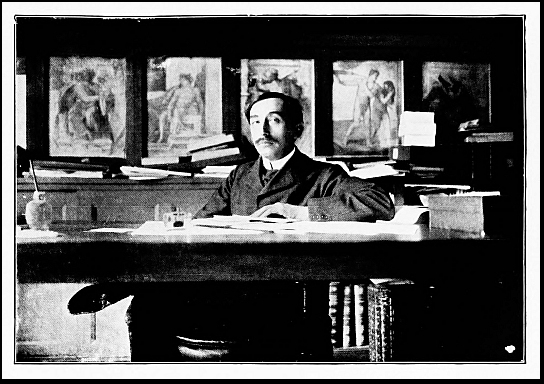
Photo: Dormac To face p. 24
Maurice Barrès
Was it the memory of Pascal that inclined Barrès
to collect the fragmentary legends and souvenirs,
even the documents, of a humbler mystic, half
saint and half schismatic, once famous in the region
round Charmes, the little town where Barrès was
born and where he still spends his summers?
Perhaps; but Barrès (whose singular temperament
appears to combine the sense of order with
a contempt for law) has always sought an axiom, a
religion, a discipline, which would satisfy an ardent
sensibility, and unite the individual with the
brothers of his race and faith, while yet leaving
free that inner Ego which, after all, has nothing
to do with our organisations and arrangements,
which transcends reason and order, being (if indeed
anything is) in direct communication with the
Infinite. From the time he wrote Un Homme
Libre, from the time he organised Nationalism,
Barrès has always sought a rule and a regulation;
but he has never bowed his head to a yoke. Self-discipline,
not obedience, is what he sought—and
at one season he sought it in the ascetic life. But
we must not forget that ἀ ςκητής means an athlete,
one who has exercised himself and grown strong;
and that which Barrès has always desired, in
religion as in politics, is a perfecting and augmenting
of his own personality.
That way lies heresy! And a heretic is the hero
of Barrès’ last novel, La Colline Inspirée.
It is a narration of religious experience (or rather
of religious aberration), and at the same time it
is an idyll of a strange Druid-like poetry, all the
native sap and strength of Celtic forests and high
places. Chateaubriand, with his Velléda, Renan,
these alone in France have touched that deepest
fibre of the Celtic heart, that dread, sacred, and yet
sweet, that sense of communion with the Invisible,
of which the mystery is deeper than the baptismal
font and larger than the consecrated altar stone.
Rome will never entirely wean Barrès from his
devotion to the Celtic divinities of wood and weald.
In La Colline Inspirée he opposes Poetry and
Dogma. On the one hand, the Church, with its
venerated hierarchy, its discipline, its universality
and order; on the other, the mystic, the prophet—impatient
of all mediation between the instinct
of his soul and the eternal life—the seer of visions,
too often sensual or insane.
Léopold Baillard is a real personage—almost
contemporary, since he died in 1883. He and his
two brothers, born of pious peasants in the dawn
of the Nineteenth Century were three priests who
dreamed of restoring, not only in their invisible
supremacy but also in their positive and material
prosperity, the prestige and the power of the
native shrines of Lorraine. They were, in fact,
as we should say (only a hundred years too soon),
Celtic revivalists. Restorers of altars fallen into
decay, founders of religious congregations, they
were, during the first years of their ministry, the
pride and the miracle of Alsace as of Lorraine.
The acropolis of Sainte Odile in the Vosges and
the sanctuary of Sion-Vaudémont in Lorraine
became the property of Léopold Baillard and his
brothers, where they founded convents and hostelries,
and instituted an Order of Begging Sisters,
who travelled all over Europe collecting alms.
(A happy touch is that which shows Léopold
Baillard in the Imperial Palace at Vienna, asking
a contribution from the Emperor of Austria as
Count de Vaudémont in Lorraine.)
Their enterprise, their intrepid imagination, their
financial audacities awakened the mistrust of a
prudent bishop, who refused to confirm the miraculous
cure of one of the Sisters, and subsequently
withdrew his sanction from their quest of alms.
It was the axe-stroke at the root of the
Baillards’ prosperity; it was the deliberate quashing
of a new (but a less spiritual) Port Royal. The
Baillards were obliged to sell all their possessions,
and, bankrupt in purse and credit, they were sent
into retreat in a Cistercian monastery. In that
place of peace a Cistercian father inconsiderately
bade Léopold Baillard visit in Normandy a wonder-working
visionary, Vintras, a prophet in his
degree.
Baillard was a sort of romantic genius—the
genius of revolt and sentiment—a man for whom
the invisible world exists so naturally that nothing
in him protested when Vintras, on the occasion
of their meeting, declared himself in constant and
direct communication with a spiritual sphere.
Baillard returned from Normandy to Sion-Vaudémont
a fervent disciple of the New Elias (as Vintras
styled himself), and, on the scene of his old labours,
began to edify—with how much less success!—a
schismatic Church. But he is no longer the
prosperous, the genial, Abbé Léopold Baillard.
His cure is taken from him, his doctrines are condemned,
his person excommunicated. He is the
fallen Angel, he whom pride misled.
There is tenderness as well as irony, poetry as
well as tragedy, deep compassion mixed with a
half-reluctant disapproval in the eloquence of M.
Barrès, as he relates the downfall of the schismatic—his
follies, his errors, his sufferings, his long
martyrdom, his final reconciliation with the Church.
Melius est ut pereat unus quam unitas. Yet if
that one be Pascal, or Fénelon, or Father Tyrrell,
or even an Abbé Léopold Baillard (so mere a
peasant in his harsh materialism, so nearly a saint
in his inspired spirituality), how shall one not
admire the ardour, the grandeur, the genius, the
generosity of a soul superior to the docile flock?
The lost sheep (depend upon it) was the fairest of
the fold—and was, as we know, the dearest to the
immortal Shepherd. The sympathies, if not the
convictions, of the author are evidently with the
vanquished prophet. For a religion, says our
author, is made of two elements, with difficulty
conciliable, yet equally vital: on the one hand,
enthusiasm, inspiration; on the other, discipline,
authority.
‘Eternel dialogue de ces deux puissances! À
laquelle obéir? Et faut-il donc choisir entre elles?
Ah! plutôt qu’elles puissent, ces deux forces
antagonistes, s’éprouver éternellement, ne jamais
se vaincre et s’amplifier par leur lutte même.
Elles ne sauraient se passer l’une de l’autre.
Qu’est-ce qu’un enthousiasme qui demeure une
fantaisie individuelle? Qu’est-ce qu’un ordre
qu’aucun enthousiasme ne vient plus animer?’
Est aliquid hominis quod nec ipse scit spiritus
hominis qui in ipso est: there is more in man than
the soul of man conceives. This line of Saint
Augustine (which serves as an epigraph to La
Colline Inspirée) might be inscribed above all
Maurice Barrès’ later writings: they are all laid
on the altar of an Unknown God. Nothing in the
eyes of this barely orthodox critic is more sacred,
more moving than a village church, whose narrow
chancel has echoed the prayers, the praise, of
countless spirits straining to approach the secret
Reality which sustains the world of Appearances.
The stones have witnessed the tears of generations
many times renewed as they consigned their dead
to the keeping of God; before the same altar
fathers and children have plighted their troth;
and the font served to christen the grandsires of
to-day. A village church is, to an imaginative
mind, a thing which revives the sacred memory
of our country and our dead. And so—not in a
spirit of narrow orthodoxy—but in the largest and
most human movement of generosity—Barrès takes
up his pen to plead for the churches of France,
falling into ruin since the separation of Church
and State.
It must be remembered that, when these parted
company, there was a question of constituting
certain parish councils, or associations cultuelles,
specially charged with the maintenance of the
churches of France; but the Vatican, ever suspicious
of all that tends towards a decentralisation
of authority, would not allow of their existence.
In consequence, no responsibility towards the
Government obliges the communes to restore their
parish church; if it fall into disrepair, they may
abandon it or amend it at their own sweet will,
should it threaten to tumble about their shoulders,
they may disaffect it, or even at a last extremity,
pull it down altogether.
Now, such is the antagonism of free-thinker and
Catholic in France, especially in the less cultivated
part of the community, that in certain villages,
where the Church-people would be willing to
restore their parish church at their own expense,
a sectarian town council has forbidden them to
do so, and, by an abuse of authority, has declared
the church disaffected. In other hamlets, too
poor for so great an outlay, the church is in ruins
for lack of means and initiative. In others, their
treasure, however slight, of old glass, enamel,
tapestry, or gold and silver embroideries, old lace,
or mediæval carving, has awakened the cupidity
of those who know too well how to dispose of such
relics of the past.
It is true that certain churches and certain
treasures are considered worthy of the rank of
historical monuments, and, as such, are entrusted
to the protection of the State. But the thesis
of M. Barrès is that all churches, built before 1800
(I don’t know why he insists upon the date), should
be included in this immunity; that any vote of a
sum to be expended in repairs, decreed by a commune
or department, should be immediately doubled
by the Government; and that any ratepayer should
have the right to restore his parish church at his
own expense. It is not as a Catholic that he pleads
the cause of the altar, but in the name of civilisation;
and he requires the nation to repair its
village churches just as he would demand the
preservation of the National Library or the College
of France.
‘C’est à la civilisation qu’il faut s’intéresser, si
l’on n’a pas le sens de Dieu et si l’on est rassasié
du moi. Eh bien! la civilisation, où est-elle
défendue aujourd’hui?’
‘Dans les conseils d’administration? Je ne suis
pas de ceux qui le croient. Elle est défendue dans
les laboratoires et dans les églises.’
It is perhaps a little difficult to formulate the
intellectual position of Barrès. What he craves,
appears to be, not an orthodoxy, but a preserve
of Mystery; a sort of private hunting ground for
the imagination; the right to lean out of the
visible world and draw a deep breath, hors de la
prison des choses claires. Or, shall we say? in the
blank wall of our science and our ignorance, he
wants to be free to throw open a window looking
on the Infinite? He defends, perhaps, less a faith
than a conception of life which is bound up with
all our ideas of honour, our notions of sacrifice.
I think he is inspired by a sense of ancestral piety
rather than by what we usually term religion.
Indeed, I imagine that no reader would have more
intimately vibrated to La Grande Pitié des Églises
de France, than a certain old friend of mine, whom
Barrès did not always understand, by name Ernest
Renan—Renan who wrote (already in 1849):—
‘N’y aurait il quelque moyen d’être catholique
sans croire au catholicisme?’
And who are the followers whom Barrès calls
to the rescue against an excess of sectarian zeal—against
the village science of the Radical
druggist, of Monsieur Homais? Nothing is more
interesting, more symptomatic, to those who
remember the France of yesterday, when, as a rule,
the Intellectuals and the artists were on one side of
the hedge, and the priests and the pious on the
other. Persecution has certainly done wonders
for the Church in France! Those whom Maurice
Barrès convokes to defend the belfry and the
altar are the younger generation in letters!
‘Je ne doute pas de leurs réponses.... Ces
mêmes jeunes troupes désintéressées qui auraient
à d’autres moments, combattu, rejeté un catholicisme
oppressif ... se rassemblent d’instinct pour
faire face à la Barbarie. Je voudrais tracer ici
le tableau de la littérature nouvelle que je salue
et d’où s’élève, plus ou moins haut, la grande
flamme spirituelle que le Café du Commerce ne voit
pas....’
ROMAIN ROLLAND
Among the still young masters of the young
in France, the men rising fifty—Rostand, Claudel,
Boylesve, Gide, Suarès, Francis Jammes, Romain
Rolland—only the first and the last are really
well known beyond our frontiers. Claudel is
appreciated in Germany as an interesting exotic;
but there, as well as in England and Italy, Romain
Rolland has an audience of his own. In some
ways he is the most approachable of French
writers to an English, or, indeed, to an Italian
mind. His intense moral earnestness, his love of
nature, his lack of irony, and his sense of sarcasm,
no less than an idealism devoid of all religiosity,
distinguish him among the men of his generation.
And he is an Individualist. When Claudel gibes
at the idols which Freethinkers raise on their
altars—the geniuses and the heroes, all the great
men—be sure he is thinking of Romain Rolland,
and perhaps of Suarès. Hero-worship, love of
the poor and humble, faith in the human mind
and its divine destinies, are indeed, to Romain
Rolland, as much a religion as the doctrines of the
Catholic Church to Claudel, or to his convert,
Francis Jammes.
Romain Rolland owes his fame to Jean-Christophe,
his great novel in ten volumes, the Clarissa of our
age. But he has written many other books. Romain
Rolland’s unknown works are voluminous and
abundant. Some twenty years ago I used to take
them to the Revue de Paris and expend all my
small store of diplomacy in persuading the editor
to print those immense and formless dramas,
Saint Louis, Aert, Danton, in which rare streaks of
real genius illumined desolate wastes of verbiage.
I cannot say that any of them attained success.
Having striven to express his mind in these
inchoate symphonies, Romain Rolland tried a
new form of art, in which from the first
stroke he was singularly successful: his Lives of
Great Men (Vies des Hommes Illustres), have the
terseness, the morality, the grandeur, and the
natural piety of Plutarch’s Lives. He has written
nothing better than his Beethoven or his Michael
Angelo, and he has given us a Mazzini, a Tolstoi
only less excellent. These are quite little books,
so far as size is concerned. And the mind of Romain
Rolland continued to teem with images and ideas,
with a sense of the tragedy of human destiny, and
yet with an invincible hope in human reason. He
had a thousand things to say to the men of his
generation; his heart burned within him. So he
invented a great man of his own making, Jean-Christophe.
Here he has written the tragedy of a free soul,
the tragedy rather, let us say, of a whole generation
perpetually in quest of Truth and Liberty. There
are many stars in the sky; there are many virtues
in the soul of man; perhaps no two succeeding
generations make their idols of the same. Truth,
Justice, Freedom, inflamed our youth with a noble
passion. The young men of to-day adore Courage,
Activity, Self-control, and Faith. They are optimists.
We were pessimists. And Romain Rolland
writes, as a foreword to the tenth volume of his
novel:—
‘I have written the tragedy of a generation which
soon must disappear. I have sought to dissimulate
nothing of its vices or its virtues—neither its
heavy sadness, its chaotic pride, its heroic efforts,
nor its spent weariness under the crushing burden
of a superhuman task: for we had to renew our
whole epitome of life, our conception of the world,
our æsthetics and our ethics, our religion, our
humanity.’
A Hamlet-like generation, intensely intellectual,
sensitive, and chivalrous, issuing painfully from the
shed sheath of a worn-out creed and struggling
painfully towards a loftier faith and a fuller life—such
is the subject of Jean-Christophe. And the
author, merely middle-aged, has lived to see a new
race inherit the earth: a race ingenuous, ingenious,
active, alert, little given to self-questioning, or
to any form of subtlety, and as a rule content with
the religion of its forefathers, just because it was
the religion of one’s forefather’s, and is probably
as good as any other. Already Jean-Christophe is
a portrait of the past, and certain volumes—as a
rule those we admired the most on their appearance:
for instance La Foire sur la Place—present
the half-pathetic interest of a photograph album
ten years old.
What is still fresh, what is still moving and
touching and delightful is the story of a heart,
the painting of passion and especially the drawing
of the feminine figures—the very numerous feminine
figures—who diversify the existence of Jean-Christophe.
The novel has been translated into English.
My readers know (or at least can easily learn)
that the story is that of a great German musician.
It follows him from his childhood in a little Rhenish
town, to Paris, whither Jean-Christophe resorts,
when, after a skirmish with a Prussian officer,
he has to flee for his life across the frontier. There
is no plot. The story is as ill-defined, as vague,
as fluctuating, as constantly developing, as life
itself; and these ten volumes are a sequence of
episodes rather than a tale. Above all, they are a
criticism of contemporary Europe, or rather of the
Europe of yesterday, a Europe less infected with
Nationalism, Imperialism, Panslavism, than the
instable and agitated compound that we know.
The hero is born in Germany. No German book,
I think, not even Werther, gives with a sweeter
serenity, the peculiar charm of Rhenish ‘Gemüthlichkeit’
than these early volumes of Jean-Christophe.
But, as the hero grows older, he finds himself
constantly hostile to the dreamy optimism of his
environment. He hates the humbler forms of
German idealism—that public and private Phariseeism
which will not admit the world to be that which
it is; the majestic sentimentality which invades
all German art; that general artifice of emotion,
moral nobleness, sensibility, and poetry which
exasperates when it does not endear.
Even the ‘cher vieux Schultz,’ ‘le bon Allemand,’
Christophe’s one admirer; even Modesta,
the blind girl who will not allow that she has any
cause to be unhappy, irritate the choleric young
man, despite their candid goodness and their
tranquil courage, because of a certain unconscious
hypocrisy in their attitude, a habit of ignoring the
truth when it happens to be disagreeable. Christophe
cannot as yet admit that human nature is incapable
of assimilating unadulterated reality: he has still
to learn that every nation mixes with the truth
some special spice of lies; and that there are more
dangerous condiments than a romantic optimism.
He himself, in his cult of force, is no less local, no
less German: he is merely a German of a later
generation.
When Christophe flies to France, he finds to
his discomfiture that sincerity is not a common
attribute, even across the frontier; but French
insincerity is of a different sort, cynical, excitable.
France has ever been a fanfaron de vices, and loves
to brag of her depravity rather than to practise
it. The angry, heady, passionate, fuming youth
spares no class or type in his first revolt against
his new environment: the squalor of the poor,
the struggling ambition and snobbish meannesses
of the world of art, the hollow ceremony of fashionable
circles combine to make him hate Paris.
Little by little he penetrates below the surface:
his friend Olivier Jalin interprets to him the real
France. The intellectuals and the æsthetes of
twenty years ago, who so irritate Christophe on
his first arrival, were but the foam on the face of
a deep reality. ‘C’est curieux que vous soyez
Française!’ says the musician to his friend’s sister,
with her honest, girlish face, her round, full forehead,
her little straight nose, her neat small chin,
and the brown locks that frame so demurely her
thin cheeks.
This quiet little girl, at once artless and disenchanted,
pious and disillusioned, does not answer
in the least to the conception that a young German
artist forms of France. But we know better! The
little governess personifies that France, known to
few outside her boundaries, which is compact of
sacrifice, of duty, of delicate conscientiousness, of
rigid economy for self and generous outlay for
some treasured ideal, child, or cause:—the France
of Port-Royal, the France of ‘48. Indeed, if we
mistake not, Mademoiselle Antoinette Jeannin has
misspelt her name; and we envy the novelist who
(annihilating time and space) can link the mind of
Beethoven to the soul of Henriette Renan, and
make two lovers happy.
It is true that Romain Rolland will not let them
be happy: Antoinette dies; and Christophe embarks
afresh on innumerable adventures. One
first of May, in a Socialist riot, his friend, Olivier
Jeannin is killed on a barricade; and Christophe,
red-handed, is spirited away by his friends, and
takes refuge in Switzerland. What an arraignment
of the civilisation of Bâle! Give us rather the
incoherence of German militarism mixed with German
schwärmerei! Steep us in the intellectual and
social extravagances of France! But keep us free
from that death-in-life, the Phariseeism of Bâle!
A rigid discipline never relaxed; a collective conscience
ever on the watch to punish and deride the
faults of individuals; a perpetual constraint in
which diversity and spontaneity perish; all the
virtues—without the grace of God! And underneath
the strict uniformity of its phylacteries,
human passions more brutal than elsewhere, because
never visited by the open air and sun. As we read
the description of Christophe’s life in Switzerland,
we fall in love with Bohemia. Order is only lovely
when it is tempered with grandeur or with grace.
But the order of these sordid millionaires is merely
a morose economy, a gloomy, dull privation, a
lifeless rigour, a sombre constraint. Against this
dark background, Romain Rolland projects a
figure of almost animal passion.
The story of Jean-Christophe in Switzerland
is the history of Wagner and Mathilde Wesendonk.
In either case a German musician, fleeing from
political difficulties, takes refuge (and takes refuge
in Bâle) with a friend who generously comes to
his rescue; and in return the musician seduces the
wife of his protector.
We know little of the Wesendonks, save that
Frau Mathilde was a poetess; I imagine her very
different from the wife of Doctor Braun. That
kind, fussy little man was oddly mated with the
stiff and silent spouse whose large, Michael-Angelesque
type of beauty seemed almost ugly or
ridiculous in her awkward provincial clothes. Anna
is an uninteresting but perfectly virtuous woman
until Jean-Christophe comes to stay in her house.
And then music invades her with an incomprehensible
passion, turning this sombre young Hausfrau
into an imperious Venus.
As she and Christophe sing together the fiery
phrases of his Opera, a frenzy overcomes them,
and they experience that sort of love in which
there is something savage, cosmic, as far as possible
removed from our ideas of tenderness or duty.
And Christophe, the faithful Christophe, steals
from his generous host that little treasure of honour
and domestic happiness which was all that Dr
Braun had known of life’s ideal. Christophe had
been received under that roof in his dire necessity,
and he betrayed a trust. With a woman whom he
barely knew, whom he did not pretend to understand,
whom he did not love. Not love? Love
was too weak a work to express the torrent of flame
that tortured the musician when he thought of
Anna or listened to her voice; and yet he was
dimly aware that this fierce instinct, this irresistible
intuition, was something less, or more, than human:
Ce n’était pas l’amour, et c’était mille fois plus que
l’amour.
Thus in the Swiss town, in the Calvinist society,
which glorified rationalism and made of Intellect
the sole motive power of life, Christophe encountered,
and was conquered by, that great irreducible
Force which makes light of reason and morality,
and in front of which all our laws and our scruples
and our duties are as idle straws caught in the
swirl of a river in flood.
But the strength of that fragility, which is Man,
lies in his power of recovery. Like the prodigal
son, having fed with the swine, he can always
return and go to his Father. Christophe, like
Maggie Tulliver in George Eliot’s novel, sets duty
and faithfulness above passion, and ascends out
of the abyss.
‘Il comprenait la vanité de son orgueil, la vanité
de l’orgueil humain, sous le poing redoutable de
la Force qui meut les mondes. Nul n’est maître
de soi avec certitude. Il faut veiller. Car si l’on
s’endort, la Force se rue en nous et nous emporte
... dans quels abîmes? Ou le torrent qui nous
charrie se retire et nous laisse dans son lit à sec.
Il ne suffit même pas de vouloir, pour lutter. Il
faut s’humilier devant le Dieu inconnu qui fiat ubi
vult, qui souffle quand il veut, où il veut: l’amour,
la mort ou la vie. La volonté humaine ne peut
rien sans la sienne. Une seconde lui suffit pour
anéantir des années d’efforts. Et, s’il lui plait, il
peut faire surgir l’éternel de la poussière et de la
boue.’
Jean-Christophe sacrifices his delight to his
ideal of conduct. He is rewarded by a great influx
of inspiration. In solitude and renunciation he
takes up his abode on the edge of a mountain, in
the shelter of great woods full of shadow and loneliness;
and he lives there in retreat and penitence,
hearing nothing of Anna. And, even as Wagner
in his exile at Venice, when he had renounced
Madame Wesendonk, composed Tristan und Isolde,
Jean-Christophe receives at last his inspiration as
a great musician.
The final volume takes us back to Paris, and
thence to Rome. Christophe is now the genius of
his age, but his personal life is still meagre and
sad; no wife, no child, no friend, no love, concentrates
its elixir in one golden drop. And one day
in the Alps he meets—as a middle-aged woman,
a widow still charming in her tired grace and kind
serenity,—that Countess Berény whom he had
known as a girl in Paris, long ago. And Grazia
Berény incarnates indulgent lazy Italy; as Anna
Braun, Switzerland; as Henriette Jeannin, France;
as the dear, feckless, gentle Sabina, South Germany;
in the long gallery of Christophe’s lady-loves.
Of them all, it is Grazia that he desires to marry.
But Grazia, indifferent and gentle, loves Christophe
less than her quiet days, her children’s interests,
her pleasant, nonchalant, and sociable life of a
handsome widow ‘well left,’ who cares above all
things for her quieto vivere. She is not very interesting,
this Grazia, so much in love with peace and
measure; she and Christophe would have been
as well mated as a sleek and sober Angora with a
mastiff ever on the growl (though his bark is
worse than his bite), and we are not very sorry
when she dies. We have wept so many tears for
poor old Louisa (Christophe’s mother), for Sabine,
for Antoinette, for Olivier, that we have none to
spare for the passive and elegant great lady.
Neither in the painting of Grazia nor in his image
of Rome is our author to be seen at his best. And
yet what citizen of Cosmopolis knows Rome as
well as Romain Rolland?
By the end of this tenth volume, Jean-Christophe
is no longer young, and all has happened to him
that reasonably could be expected to happen.
He has mixed in the politics of several nations, he
has known fight and flight and exile; he has been
poor, he has been famous; he is now the greatest
musician of his times. The most exacting reader
could not wish to stretch him out much longer on
the rack of this tough world. There are ten sizable
volumes of him at Mr Ollendorff’s—or, if you
prefer, seventeen of those wonderful little ‘Cahiers
de la Quinzaine’ (beloved of garrulous and expansive
genius) in which M. Charles Péguy has produced
not only M. Romain Rolland, but himself. Now
we know all there is to know, and find that (as in
real life) the climax is middling compared to the
hopes of youth.
Jean-Christophe dies a genius; but we, after
all, have never heard his operas. He dies, like any
other mortal whom a living faith sustains in the
last hour of all. The death of Jean-Christophe
has probably preoccupied more readers than the
end of any other hero in fiction since the great days
of Dickens and Thackeray. We ourselves know
one eminent hand in letters who wrote to the
author suggesting that his hero should disappear
in the wreck of the Titanic, conducting the band,
in place of the unforgettable bandmaster. Another
wished him to wander away alone and die in the
desert, after the fashion of Tolstoi.
And I should have liked for him the death of
Péguy—defending his country—leading his men
into battle on the Marne—Ah! there’s the rub!
Jean-Christophe was an enemy-alien; he would
have been fighting in the Prussian ranks. For
many years to come M. Rolland’s hero cannot be
our hero.
A reader appreciative of the intentions of M.
Rolland might have been sure than Jean-Christophe
would die in no such picturesque or dramatic
fashion, but quietly yield his life on the brink of
a new world, as a wave effaces itself gently and
vanishes in the sand, obliterated by the pressure
of the oncoming wave.
The whole meaning of M. Rolland’s book is the
continuity of Life, spreading insensibly from soul
to soul, from sphere to sphere, in an endless
symphony. And the last chapters are full of new
characters, pushing forward, rising to maturity;
children of the Past in whom the dead revive,
fathers of the Future who already are changing
the face of our world. The scheme of Jean-Christophe
(rising thus, and falling, and rising at
the end towards the yet unvisioned spectacle of
times about to be) recalls the structure of Tolstoi’s
War and Peace.
Jean-Christophe succumbs, sordidly enough, in
a Paris lodging, to pneumonia. But he gives up
the ghost in a mood of heroic joy, thankful to
exchange the worn-out faculties, the dreary, dingy
end of life, which are all he can dispose of here,
for some undreamed-of harmony and power which
await him (as he believes) beyond. Tolstoi himself
has not a serener conviction that Life extends
illimitably around our tiny sphere, bathing the
shores of all the stars in a tide of continual renewal.
The unity of the forces which compose a living
being must sooner or later dissolve, but the processes
of Infinity will reassemble them again. ‘Un
jour je renaîtrai pour de nouveaux combats!’
Meanwhile, caught in a rapture beyond the delusion
of self, the dying musician feels his personality
expand and vanish for a while in something vaster.
He is lost in the One-and-All. ‘Tu renaîtras....
Repose. Tout n’est plus qu’un seul cœur.’
And so Jean-Christophe greets a new dawn and
leaves behind him, also, on earth a new day. The
finest passages of this last volume contain M.
Rolland’s masterly portrayal of the young France
of our times. Surely never was there a generation
more unlike its introspective, intellectual forbears:
Hamlet has given birth to Harry Hotspur! We
must perhaps go back to the times of Ausonius
(when the fathers were readers of Seneca and Cicero
and the sons hardy Christian barbarians) to find
two generations similarly contrasted.
Jean-Christophe was a man of yesterday. His
creed was to think no lie, to consent to no injustice,
and to love his neighbour as himself. Here M.
Rolland shows him in his puissant and solitary
decline, dominating a new generation that rises
round his knees, strangely different, with other
ideals. Truth? Humanity? The old-fashioned
words are rarely heard. We hear of Authority, of
Order, of the claims of one’s race, of the rights and
responsibilities of the strong. This new generation,
which has witnessed no war, has the mind and
disposition of conquerors. Christophe surveys with
tender ironical affection the lovable breed of
airmen, and sportsmen, and soldiers who fill France
to-day—fresh, and frank, and admirably valiant,
full of prompt physical courage and intellectual
docility.
Jean-Christophe is perhaps the most remarkable
work of contemporary fiction: a singular moral fervour,
a rare imagination, an unequalled sensibility, a
torrent of sarcasm, rancour, revolt, tenderness,
stream from its disconcerting pages. But these
delicate notations of minute variations in sensibility,
though infinitely precious to the psychologist,
transgress the limits that strict art prescribes.
Romain Rolland sacrifices every grace of measure
and composition to his abundance, to his enthusiasm
for Life. He has no sense of style. His endless
files of short, breathless sentences succeed each
other interminably, with no variation, till we
experience at last the sensation of a drop falling at
regular intervals on the crown of our head! He
has been called ‘un volcan qui ne vomit que des
cendres.’ And then the rare flame strikes out—passages
of infinite tenderness or of solemn grandeur.
Still, let me own, while I admire Jean-Christophe,
I think sometimes with regret of a Turgeneff, no
less subtle, who composed his novels at a like
tremendous length, and then, pen in hand, went
through his manuscript again, and reduced it by
two-thirds.
When we open by chance one of those old novels,
still famous, long unread, which nourished the
minds of our ancestors—Clarissa Harlowe, La
Nouvelle Héloise, or L’Astrée, or Amadis—or any
other of those immense, untidy romances, vast
bazaars or stores of their age, which provided
several generations with every necessary of life,
we are nearly always astonished to find them so
interesting and so good. Our forefathers were no
fools: what they loved in these books, which were
for them a school of feeling, was not Art, but Life.
Nothing is more instructive in this connection than
to read a letter of Mme de Sévigné’s on the interminable
masterpiece of La Calprenède; the great
lady, so delicate, so difficile, ‘blessée des méchants
styles,’ can scarcely understand her own enthusiasm:—
‘Le style de La Calprenède est maudit en mille
endroits; de grandes périodes de roman, de méchants
mots—je sens tout cela ... et cependant je ne
laisse pas de m’y prendre comme à de la glu; la
beauté des sentiments, la violence des passions,
la grandeur des événements tout cela m’entraîne
comme une petite fille.’
And even as Mme de Sévigné was absorbed in
Cléopatre we lose ourselves in Jean-Christophe.
Romain Rolland is the great spectator of our times.
Will this quality of moralising criticism, this tendency
to preach as well as to paint, and to hold
the mirror up to Nature in a mood of violent irony—will
this gift of satire keep its savour when the
generation whom M. Rolland alternately objurgates
and encourages shall have passed away? It is
difficult to say. He is perhaps one of a race who
exist rather because of a certain flame of life, a
force of personality, than because of the perfection
of their work. Tolstoi, Dr Johnson, Rousseau,
are the great names of this fraternity. We are their
characters, they mould us, they move us, no less
than their puppets. And we treasure their lessons.
But do we often open The Rambler or La Nouvelle
Héloise? Will our children know, as we know,
all the ins and outs of War and Peace? And have
we, finally, the right to include M. Romain Rolland
in this great category of artists who were something
more than artists? It is too soon to say.
We are still lost in the multiplicity of detail, the
immense succession of portraits (not only of persons
but of generations and nations and societies) which
fill the vast canvas of Jean-Christophe.
EDMOND ROSTAND
When, in 1886, at eighteen years of age, Edmond
Rostand, carried off the Prize for Eloquence at
the Academy of Marseilles, the bent of his genius
was already plain. For in praising Honoré d’Urfé
and his great romance, Astrée, the young poet
pleaded the cause of a form of art as far removed
as possible from the Naturalist formulas which
were still the fashion of the hour. And his praise
appeared a programme; and the young apologist
of Urfé discovered himself to be the apostle of
an idealist and sentimental revival.
Despite his amusing originality, and notwithstanding
the real nobility of his ideas, Edmond
Rostand is not a poet for poets. He was too clever
by half—never was a clearer case of the wisdom
of the ancients whose proverb ran that ‘the half
is more than the whole!’ His poems are like a
brilliant display of fireworks, whose flowers and
fusees, whose flashing greens, and blues, and carmines,
confuse our sight and prevent our seeing
the quiet radiance of the stars behind, above.
And this is not saying that there are no stars
in Rostand’s poems, no ideas, that is to say,
eternally calm and bright. Although not primarily
a thinker, yet our poet thinks: there are as many
ideas in Rostand as, for instance, in Swinburne.
But too often he uses his unrivalled virtuosity to
obscure his plain meaning, as, in some modern
music, the importance of the accompaniment
drowns the voice. Contrasting the simple nobility
of his intention with the quips and the quirks,
the puns and the periods, of his rhapsodies, his
rhetoric and his rodomontade (the style is catching),
shall I say that he reminds us of that mediæval
acrobat who, not knowing how to express all his
adoration of the Virgin Mary, turned a somersault
before her altar? It is amusing to discover that
the ideas of Rostand, when we get at them, are
not so very different from the ideas of Paul Claudel,
who stands at the other extreme of the political
and literary horizon.
‘Ungefähr sagt das der Pfarrer auch,
Nur mit ein Bisschen andern Worten.’
Rostand, too, believes that order is rooted in
self-sacrifice. His heroes, like Claudel’s, strike
free of the sterile introspection which marred the
art of the Fin-de-Siècle. They make for action,
and aim at an end outside themselves (in which they
always fail), but Rostand amalgamates his modern
Anti-Individualism with the old Liberal romantic,
idealist enthusiasm, perfectly sincere so far as it
goes. If not devout, he is at least devoted. His
plays have generally for their subject some sort
of a burnt-offering. For instance in La Princesse
Lointaine, Bertrand and the Princess sacrifice
their passion to the peace of mind of the dying
Rudel:—
‘Oui, les grandes amours travaillent pour le Ciel!’
even as in Cyrano the poet renounces his love in
favour of his friend. And that friend again ...
Cyrano is a veritable vertigo of self-sacrifice!
The tragedy of L’Aiglon is the oblation of a
young man’s life to a great idea. Chantecler also
is a man—or rather a cock—with a mission to
which he is willing to immolate all personal delight.
The plays of Edmond Rostand are a sort of serum
against selfishness! Despite their rodomontade
and their buffoonery, they are nobly moral.
But how they irritate a fastidious taste, with
their perpetual posturing, their gesticulations, their
pirouettes, and their impertinence! Was ever a
real poet and a sincere knight-errant so quaintly
disguised as an acrobat, and sometimes, alas!
even as a commercial ‘gent’! Is it possible to
be at once quite sincere and yet so appallingly
clever? He moves us when he expresses the sense
of patriotism or the praise of courage. He had
a peculiar gift for expressing admiration blent
with pity. He had, in fact, a chivalrous soul,
an instinct for all that is gracious or grand, a
sensibility that was sincere but shallow. Had
he but lived a few months longer, how admirably
he would have celebrated the Fêtes of
Victory!
Was he a great poet? It is perhaps too soon to
say. Bad taste never yet prevented any one from
being a great poet. This is a point on which I
cannot insist too strongly. When Juliet says:—
‘Give me my Romeo and when he shall die,
Take him and cut him out in little stars,
And he shall make the face of heaven so fine
That all the world shall be in love with night.’
Shakespeare is writing Rostand with a vengeance.
When in Victor Hugo’s La Forêt Mouillée the
sparrow makes believe his woodland glade is the
court of Louis XIV., and says in a series of puns,
first of all, to a tuft of heather (bruyère):—
‘Bonjour,
La Bruyère! (à une branche d’arbre)
Bonjour, Rameau!
(à une corneille sur le rocher)
Bonjour, Corneille!
(au nénufar) Bonjour, Boileau!’
let us admit at once that Victor Hugo wallows
(and not in this instance only) in the very slough
of that bad taste so dear to Rostand. How
pleased Rostand would have been to call the
water-lily, say, John Drinkwater!
But then Shakespeare and Victor Hugo have
amazing qualities wherewith to counter-balance
these conceits. In art, that is everything. The
smallest chip of pure gold compensates for a bag
full of pebbles: a work of art must be estimated
by the degree of its merits and not by the quantity
of its defects. If there is dross along with the gold—even
though there be much more dross than
gold—let us be thankful if the gold itself is pure
and unaffected by the presence of the baser residue.
There is the question.
I borrow from a book, recently published in
French by a Hungarian Professor, M. Haraszti,
some details of the youth and origin of Rostand.
In 1868, he was born at Marseilles of a wealthy
family of merchants and bankers, long established
there. For a hundred years, at least, they had all
been lovers of the arts. Early in the Nineteenth
Century, the quatuors of Beethoven were performed,
for the first time in France, in the Rostands’
salon. In 1844, a Mademoiselle Victorine Rostand—a
great-aunt of the poet’s—published a volume
of lyrics in the manner of Lamartine. Edmond’s
uncle, the banker, Alexis Rostand, has composed
an opera and more than one oratorio; and his
father, the economist Eugène Rostand, is himself
a poet. A volume of verse, Les Sentiers Unis,
published in 1876, celebrates the precocity and
charm of the child, Edmond, at that time eight
years old; and it is interesting to learn that,
even at that early date, he was remarkable
for his original grace of words and flow of
language:—
‘Cette petite langue exquise,
Un vrai jargon de Paradis,
De mots qu’il façonne à sa guise.
De diminutifs inédits;
D’inimitables tours de phrases....’
At eight years of age the child, Edmond Rostand,
was certainly the father of the man. As a schoolboy,
at the lycée of Marseilles, his Quixotic, pathetic
temperament—his characteristic preference for the
unsuccessful—was already established. An old,
drunken usher scorned by the masters, tormented
by the boys, a dreamy Bardolph whom his pupils
(on account of his shining nose) surnamed Pif-Luisant,
was young Rostand’s chosen companion.
And in his first volume of verse, the poet dedicates
a charming poem to the tippler of genius who gave
him, perhaps, his first idea of Cyrano:—
‘Toi que j’ai tant aimé ... doux pochard ...
Pif-Luisant.’
At one-and-twenty years of age, Edmond Rostand
published his first volume of verse, Les Musardises,
and shortly afterwards married the beautiful young
poetess of Les Pipeaux, three years younger than
himself. I can remember Rosemonde Gérard in
her nineteenth year, a vision of loveliness, as, one
evening, in the salon of the old poet, Leconte de
Lisle, she stood up, so slender, so smiling, so
ravishingly blonde and fresh, and recited a lyric
as charming as herself. Madame Rostand has a talent
of her own, sincere, simple, femininely sentimental.
All the lovers in France know her Chanson éternelle:—
‘Car vois-tu chaque jour je t’aime davantage,
Aujourd’hui plus qu’hier, et bien moins que demain.’
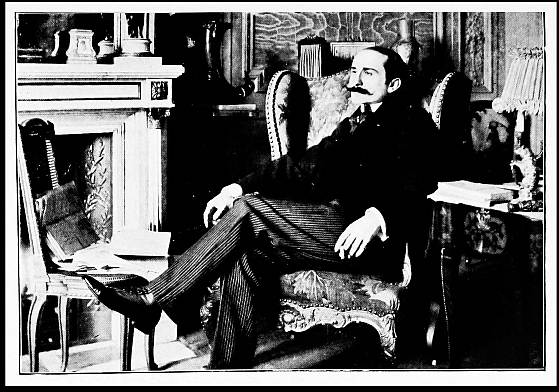
Photo: Dormac To face p. 56
Edmond Rostand
This marriage with Mademoiselle Gérard, granddaughter
of Napoleon’s marshal, the victor of
Wagram, the victim of Moscow and Waterloo,
confirmed Edmond Rostand in his meditations on
the dramatic fiasco of the First Empire—that
extraordinary antithesis of triumph and disaster,
of all tragedies the most touching to martial and
patriotic France.
The poet, however, was too wise to undertake
this tremendous subject with a ‘prentice hand.
He made his debut as a playwright in 1894, at the
age of twenty-six, with a pretty little fanciful
comedy, Les Romanesques. A year later, Sarah
Bernhardt produced his Princesse Lointaine, playing
herself the part of the Lady of Tripoli. Sarah
Bernhardt again, in the Easter week of 1896,
brought out La Samaritaine. And at Christmas,
1897, came the conquering hero, Cyrano de Bergerac.
I cannot analyse Rostand’s plays, which everybody
knows, which are (with Kipling’s novels) the
immense, the international, the universal success
of our times; I cannot calmly plod through the
plots of these familiar pieces with the patience I
employ on an obscure play of Paul Claudel’s,
known perhaps to a hundred readers in the British
Isles.
Every one (every schoolboy, as Macaulay would
say) has by heart the story of Cyrano. We all
remember the chivalrous hero, with his hideous
nose (Pif-Luisant), and his romantic nature; his
passion for the pretty blue-stocking, Roxane; his
handsome, stupid friend, Christian, in whom Roxane
thinks she discovers a kindred soul; and how Cyrano
writes Christian’s love letters, using the comely
face and figure of his friend as a mask for his own
soul, which thus approaches the beloved, though
under another name; and how Christian, when he
finds that his betrothed really loves, not him, but
the mind of the chivalrous friend whom he has
used as a secretary, gets himself killed in battle,
in order that the two persons whom he loves best
may be free to meet and to mate; and we have not
forgotten that Roxane is inconsolable for the handsome
Christian; that Cyrano never has the cruel
courage to reveal his passion until, after fifteen years
of mute misery, he dies: is it not written in the
chronicles of every theatre in Europe?
But it is not this pretty, precious, sentimental
story which made the triumph of Cyrano; it is
the indescribable, incommunicable glory and gaiety
of youth, the ardour, the joy, the fun, the fury,
the frolic which make the piece a perfect Fountain
of Jouvence. There is a heroic cheerfulness in
Cyrano, a love of life, a generosity, an activity, a
movement, and a flame, which so admirably suit
the temper of the dawning Twentieth Century that
we hardly know whether the public made the play,
or the play the public.
Ten years afterwards, Rostand produced his
L’Aiglon, which was not greeted with quite the
same triumph—the same joy for success, the same
rejoicing for victory. But little by little it, too,
won its audience; and, personally, I prefer this
travesty of Hamlet, with all its faults, to the
brilliant, the inimitable Cyrano.
For there is a deeper tenderness, a loftier poetry,
a more impassioned patriotism in L’Aiglon than
in any other of Rostand’s plays; that superficiality,
that haunting sense of insincerity, which elsewhere
are as the snake in the grass, are scarcely perceptible
here. The poor sick son of the dead hero, the
‘ineffectual angel,’ the sensitive, inefficient young
Duc de Reichstadt, Napoleon’s heir, is drawn with
a feeling and a depth of knowledge which make me
suspect that in his sad protagonist the poet drew,
not merely a historical personage, but his own
generation, the children of 1870, the sons of the
defeat, decadent and dilettante, incapable of action,
but so touching and so often noble in their disinterestedness,
their sense of the Ideal, their love
of liberty. Rostand, I think, in love and pity has
drawn their portrait—and then drew that of
Flambeau to inspire a bolder generation.
The boldest of the bold is Chantecler, the cock
of Gaul. In his legend of Chantecler, Edmond
Rostand bids us mark that courage needs more
to its making than mere temerity. He does not
say, with Danton, ‘De l’audace, de l’audace, et
toujours de l’audace.’ He says, ‘De l’audace, et
puis du bon sens, et puis le sens de la vérité!’
This history of a poultry-yard has somewhat
disconcerted the adorers of Cyrano. But Boileau
and the big-wigs of the Court of Louis Quatorze
were doubtful at first (and thought that Pegasus
had taken to pedestrian by-ways) when La Fontaine
produced his inimitable Fables; and only a few
years ago in London the public, expectant of more
Plain Tales from the Hills, gave a hesitating reception
to that Jungle Book of Mr Kipling’s which
already (in France at least) is regarded as his
principal title to honour. There are always amateurs
who insist on repetition, and blame Wouvermans
if he paint a picture without a white horse in it.
To my thinking, Edmond Rostand proved himself
a poet in looking no further than the farm-yard
gate to find a subject for his verse.
There is something singularly impressive to the
dreamer, to the man of imagination, in the certainty
that our world is inhabited by a race of
beings who see the things we see, and move in the
circles wherein we have our being, but look on
everything from a different point of view, and
perhaps with different senses. Ants, that have
no ears, yet hear through their feet, perceiving the
vibrations conveyed by solid bodies; flies, whose
innumerable eyes discern the X-rays as a colour;
these, and homing swallows, are more mysterious
than fairies. In the eye of a mystic, a cock is no
less wonderful than a ghost; a mouse than a muse;
a primrose by the river’s brim than the herb moly
(that white-blossomed flower which Hermes gave
to Ulysses), or than the plant called Love-in-Idleness
that charmed Titania’s eyes. The fact
that so immense a variety of existences shares with
us the boon of life, and feels the same sun, is a
perpetual fable to a certain order of minds, who
may affirm with Chantecler:—
‘Et quant à moi, Madame, il y a bien longtemps
Qu’un râteau dans un coin, une fleur dans un vase.
M’ont fait tomber dans une inguérissable extase,
Et que j’ai contracté devant un liseron
Cet émerveillement dont mon œil reste rond!’
This was Rostand’s attitude during the first two
acts, the two acts in which he showed himself a
poet. There is a humour, a tenderness, a charm
which recall Hans Andersen’s inimitable stories in
his vision of a world where none of our thoughts,
none of our knowledge, but perhaps most of our
feelings have free play. Man is absent.
‘Malebranche dirait qu’il n’y a plus une âme;
Nous pensons humblement qu’il reste encore des cœurs.’
The Cock’s Hymn to the Sun is so devoid of all
our cosmic ideas that I have heard more than one
critic deride it on this account; but how wise, how
truly a seer, is the poet in showing the wonder of
the sun as it appears to an animal who sees no
further than the almond trees at the end of the
valley! The Infinite is the Infinite, though we
look at it through a keyhole, and to an animal or
an infant the sun is still the sun. The poet has
chosen just those aspects and effects which may
appeal to a mind deprived of reason no less than
to ourselves. The sun dries the dew from the grass,
and lends a grace even to the faded almond flowers;
the sun shining on a pane of glass or the soapy
water in a tub makes of them a glory; the sun
turns the sunflower westward in his course, and
makes the tin cock on the church tower a dazzling
chanticleer; the sun shining through the boughs
of the lime-walk sheds on the gravel trembling pools
of light which wobble so lovely that one scarcely
dares to walk there; the sun makes a banner of the
clout that dries on the hedge; and gilds with a wonderful
lustre the varnished earthenware crock in the
farm-yard; thanks to the sun the hayrick has gold
on his hat and the hive has gold on her hood:—
‘Gloire à toi sur les prés! Gloire à toi dans les vignes!
Sois béni parmi l’herbe et contre les portails!
Dans les yeux des lézards et sur l’aile des cygnes!
Ô toi qui fais les grandes lignes
Et qui fais les petits détails!
‘C’est toi qui, découpant la sœur jumelle et sombre
Qui se couche et s’allonge au pied de ce qui luit,
De tout ce qui nous charme as tu doubler le nombre,
À chaque objet donnant une ombre
Souvent plus charmante qui lui!
‘Je t’adore, Soleil! Tu mets dans l’air des roses,
Des flammes dans la source, un dieu dans le buisson!
Tu prends un arbre obscur et tu l’apothéoses!
Ô Soleil! toi sans qui les choses
Ne seraient que ce qu’elles sont!’
In this beautiful ode, Edmond Rostand really
enriched French literature with an image of the
greatest thing in the universe as it may appear to
the humblest living being; and, despite here and
there an ugly, trivial turn of phrase (we shudder at
tu l’apothéoses), despite the hard, happy-go-lucky lilt
of the verse, its simplicity is full of a natural magic.
No less than man, just as naturally, and (owing
to his more limited imagination) even more fervently,
Chantecler considers himself the centre of
the universe. In a recent letter to Jean Coquelin
about the scene-painting and staging of his play
Rostand has put his point of view:—
‘L’idée de mon décor est ceci: donner la sensation
qu’une petite allée de jardin est, pour les
volailles, une voie immense, une Via Appia.’
They live no less than us in the middle of immensities,
only, from their lower standpoint, they
remark (even less than we do) the disproportion
between the world they inhabit, and the unthinkable
Infinity they leave unmodified.
‘Très peu de ciel dans ce décor; c’est important
de donner l’impression qu’étant très bas, à hauteur
de poule, on en voit moins.’
Knowing so little about it, Chantecler is convinced
that the magic of his cock-a-doodle-doo!
makes the sun rise every morning! The pearl of
the poem is the scene in the second act, where
Chantecler confides this marvellous secret to the
gloriosa donna delta sua mente, the Hen-Pheasant,
who has taken refuge in the poultry-yard. A
pheasant sees more of the world than a cock, flies
and rockets up in the sky, dwells in the forest, and
therefore, half-sceptical, half-scandalised, she listens
while Chantecler, manlike, expatiates on the necessity
of his existence.
So far at least the myth is charming in its quaint
philosophy, the characters appear full of humour
each of them as French as French can be; for
why should not animals as well as human beings,
have a nationality and racial qualities of their
own? Chantecler is a coxcombed Don Quixote,
chimerical, infatuate, peremptory, and brave; but
he is, we have said, a French Don Quixote, and so
he represents not only chivalry, but also order and
authority; he is not only generous but masterful;
loyal to his subordinates, vain of his beauty and
prone to vaunt it; and he thinks himself the
natural sultan of every female fowl. Chantecler,
like Don Quixote, is absurd; and yet not merely
lovable, but honourable in his absurdity. If his
adventure proves anything, it is that an illusion
and a chimera are necessary to prevent us from
lapsing into scepticism or savagery.
Chantecler, with his valiance, his vain-glory,
and his optimism, is one type of French character
(a noble or military sort of type); another French
fowl is the blackbird, the ‘Merle.’ Le Merle is a
French Mephistopheles—a Geist der stets verneinet—paralysing
all effort by his scepticism, his criticism,
his pitiless raillery, his pitiable blague, which
is often merely,—
‘Une prudence, un art de rester vague,
Un élégant moyen de n’avoir pas d’avis.’
He is
‘Le petit croque-mort de la Foi.’
The blackbird is at once a boulevardier and an
intellectuel. He is the ‘Chat Noir,’ he is Montmartre;
alas, he is the pretext for many bad
verses, execrable conceits, and parlous puns. Not
that a poet, I repeat, is obliged to have good taste;
but there are moments when the pun kills the
poem. When the Blackbird says to the philosophic
fowl, ‘Fichez le Kant!’ (camp); when he interrupts,
‘C’est vieux œufs!’ (vieux jeu)—surely he outdistances
the most trivial dialogues of Moth and
Armado; and we answer with old Chaucer,—
‘Allas! conceytes stronge!’
and exclaim with Shakespeare’s Troilus,—
‘He would pun thee unto shivers!’
Chantecler took seven years in the writing. I
know nothing of the mystery of its composition;
but one may perhaps suppose that Rostand
wrote the first two acts in a real objective vein
of poetry—tender, amused, imaginative, and then
shut them in a drawer, forgot them, and some time
later on, resumed the task in a mood of intellectual
exasperation against the literary world of Paris.
In this latter part, the poultry-yard à la La Fontaine
has changed to a parody of the boulevard and all
the charm has vanished. This third act is a sort
of bantam imitation of Jean-Christophe, in La Foire
Sur la Place. There is an operatic beauty in the
hymn of the owls; there is gaiety and good humour
later on; and, in the episode of the Nightingale,
I find a tender philosophic loveliness. And yet
we cannot defend ourselves from the impression
that Rostand wrote the first two acts in a sudden
vein of poetry; and then, long afterwards, took
up the incompleted masterpiece and finished it as
best he could, with the help of his gifted family
circle. We know that of the four Rostands, three
were poets—Edmond Rostand, his wife, and Maurice,
their elder son.... This, of course, is the mere
supposition of a critic’s idle brain.
We might take for the motto of all Rostand’s
work, a saying of Friar Trophime in La Princesse
Lointaine: ‘La seule vertu, c’est l’enthousiasme.’
Like Maurice Barrès, Rostand too, in his way, was
a Professor of Energy. In his last years, he
was writing a new Faust. That story of a great
Intellectualist who quits the kingdom of his mind
for the freshest fields and humblest pastures of
the realm of instinct is well suited to the genius of
Edmond Rostand. Why should he not write a
new Faust? Did not the classic poets of antiquity
all work on the same subjects? And did not
Corneille and Racine (in the same year, if I remember
right) each of them produce a Titus et Bérénice? It
would be interesting to read the Faust of Rostand’s
eager imagination. Edmond Rostand, as I have
said, is not a poet for poets. He had the same sort
of reputation in France that Mr Kipling has in
England—colossal, undoubtedly, but hardly literary.
Either of them, perhaps, is more appreciated in
Europe at large—in Europe and America—than in
the salons of their own metropolis. Something
inelegant, cocksure, aggressive, sometimes a little
superficial, checks in either of them the natural
homage of the difficult—of the delicate. They
gather no violets—Athena’s, Sappho’s violets!—but
what a quantity of buttercups and daisies!
PAUL CLAUDEL
It is not easy to account for the enthusiasm aroused
in France, among the younger writers, by the
works of Paul Claudel, unless we accept the explanation
that, with all his faults, he is a great poet.
He is a difficult author, often wilfully obscure and
allusive; his dramas are lyrical symbols rather
than plays and, whatever he write, ode or tragedy,
he uses the same medium, a sort of rhythmical
prose, sometimes like Walt Whitman’s dithyrambs,
and sometimes like the Psalms.
Nothing is less familiar, less lifelike, more hieratic,
than the manner of Claudel. In every detail of
his art he innovates and experiments: style,
language, conception, even the very names of his
characters bear witness to a restless personality,
starting off on a quest of his own, continuing no
other writer, impatient of yoke or path. And
though he lose himself and stumble in his search
for an Ideal, be sure he will never turn back, never
take the highroad, but just go on persistently,
making a rule and a guide for himself out of the
exigencies of his own peculiar temperament and
creating a doctrine out of his fantasies.
He is often absurd, violent, rhetorical, extravagant;
his plays are frequently no more than
psychological dialogues between the dissociated
elements of his own personality. At other times
he will suggest to us a Pindar disguised in the
mantle of Saint Thomas Aquinas. He is often as
unreal as Il Greco! And yet this incomplete and
exasperating poet is, in truth, a great artist (or
at least has the makings of one), and it is not out
of pure perversity that a Francis Jammes has
compared him to Pascal, that others have called
him haut comme Dante. They exaggerate; but
there is in them more understanding than in the
perplexed spectator of L’Échange or L’Otage, who
is persuaded that M. Claudel only does it to annoy.
What is then the message that Paul Claudel is
obscurely crying to his generation, faltering like
the prophet, ‘â, â, Domine, nescio loqui?’
He brings to these young men, accustomed to
the shifting relativities of Bergson, bathed since
their boyhood in the perpetual flow of a stream
whose onrush falls into no estuary, the vision of
an absolute Unity. To Claudel, movement, life,
are but a transient wave-and-wobble on the surface
of Reality, un tremblement essentiel devant la
face du Saint.’ Behind the streaming veil he
discerns the Eternal Face within, ever serenely
smiling. Behind Life there is that which Life is
not: there is the living God. Hidden by the
mists of our apparent disorder, he divines a crystal
sphere—an indivisible, unalterable, absolute Existence—where
right is always right, where wrong is
always wrong, to all eternity. This religious
idealism brings a sense of rest and peace to minds
unconsciously fatigued by Bergson’s theories of
incessant evolution. And then, also, the principle
of perpetual change is a solvent of energy; Faith
is a school of energy; and energy is what France
chiefly prizes among her many spiritual gifts:—
‘Tournons donc, comme la religieuse Chaldée,
nos yeux vers le ciel absolu où les astres, en un
inextricable chiffre, ont dressé notre acte de naissance
et tiennent greffe de nos pactes et de nos
serments.’ (Connaissance du Temps, p. 40.)
It is the prose writings and the Odes of Paul
Claudel that give us a clue to the secret of his
influence, but it is his plays that have made his
reputation. Strange and dithyrambic as is their
form, complicated and obscure as is their substance,
they are the same in Tête d’Or, composed in 1889
(when the poet was one-and-twenty years of age),
and in L’Annonce Faite à Marie, played in Paris
in 1912, of which a definitive version was published
in 1914. The same carnal and violent
imagination, the same heroic romance, are set to
serve the same central theme: the insufficiency of
worldly success.
It is a commonplace to say that the Twentieth
Century is an age of deeds, not words, that the
young generation (in France especially) are born
not dreamers, but doers. Claudel himself is a
traveller and a man of action. A native of Picardy
(he was born in 1868 of a Vosgian stock,) he has
lived of late years little in Paris and in the world
of letters. A pupil of the Symbolists, Arthur Rimbaud
and Mallarmé, he left France for America in his
early youth, at four-and-twenty years of age, to
make his way in the Consular service. It would
be interesting to learn in what degree this aristocrat
(by temperament at least), this Catholic, suffered
the contact of the democratic prophet, Walt Whitman.
There are points of similarity, not only in
the form. A few years later we find him Consul at
Tien-Tsin (one of the finest of his odes is dated
from Pekin), and since then, Paul Claudel has become
an authority and a specialist in the Chinese affairs
of the French Foreign Office. In 1908 he returned
to Europe in order to assume the duties of Consul
at Prague, then at Frankfort-on-the-Main, and,
at the present moment, he is Consul-General at
Rio-Janeiro.
The poet, therefore, is no idle singer of an empty
day; and his heroes, too, are men of action—a
general in Tête d’Or; a hydraulic engineer in La
Jeune Fille Violaine; an American merchant in
L’Échange; a Consul in Partage de Midi; a political
agitator in L’Otage; an architect in L’Annonce
Faite à Marie. And the sense of his plays, if we
read them right, is that not poetic feeling, but
effort, should be our daily bread; that mere sentiment
is sterile and incoherent (the adventurous
Louis Laine in L’Échange is the slave of the
sentiment of the hour); that activity, even when
it is evil activity, may bring forth a better future
(the murderous Mara in L’Annonce, the brutal
Toussaint in L’Otage are, no less, the begetters of
to-morrow); but that while energy should inspire
our life, yet none the less there is something
infinitely better which comes not by taking pains,
something better than all our work and labour,
just as there is something infinitely better than
Life, which may descend upon us, uplift us, carry
us into a superior sphere: there is the Grace of
God, there is Inspiration, there is ‘La Muse qui
est la Grâce!’
For, at heart, this poet of airmen and soldiers
is a sort of lay monk, reserving his palm of praise,
not for the conqueror, but for the rapt ecstatic—the
solitary, dying with half his labours unachieved,
the hermit Violaine, the broken-hearted wife of
Toussaint Turelure. And we might inscribe all
his books, for an epigraph, with that line of the
Vulgate, which Renan wrote in the monks’ ledger
at Monte Cassino: ‘Unum est necessarium ...
et Maria elegit optimam partem.’
From these plays—romantic, disconcerting, oversubtle—emerge
(as Meredith’s women, wonderfully
human, break through the tinsel veil of his artificialities)
the most living and the most lovable
of heroines. The Marthe of L’Échange may be a
symbol, may mean the Church, as we have been
told, or (as the poet himself has recently informed
us) may incarnate one state of his own soul; she
is certainly the most adorable of Frenchwomen—French
and woman to the tips of her fingers,
prudent and pure, silent and sage, wife-like and wise,
full of well-planned economies and exquisite order:—a
type our poet is never weary of reproducing.
The heroine of L’Otage might be her sister; the
long, slim, silent, energetic girl, who is all conscience
and courage, lifted just one degree higher;
no heroine, no virgin merely, but a saint, stretched
on the Cross to the extreme of human greatness.
The one exception in M. Claudel’s gallery is the
extraordinarily living portrait of an Englishwoman,
or Irishwoman, in Partage de Midi: Ysé, with her
fresh beauty and her yellow hair—Ysé, who is
just woman, as Eve was woman; all passion,
instinct, sex, all beauty, flower and grace: Ysé,
whom we associate mysteriously with the Epode of
La Muse qui est la Grâce, when the poet, overcome
by memory, cries to the Grace of God:—
‘Va-t-en! Je me retourne désespérément vers la terre!
Va-t-en! Tu ne m’ôteras pas ce froid goût de la terre.
Cette obstination avec la terre qu’il y a dans la moelle de mes os
et dans le caillou de ma substance, et dans le noir noyau de mes
viscères!
‘Qui a crié? J’entends un cri dans la nuit profonde!
J’entends mon antique sœur des ténèbres qui remonte une autre fois vers
moi, L’épouse nocturne qui revient une autre fois vers moi, sans
mot dire,
Une autre fois vers moi, avec son cœur, comme un repas qu’on se
partage dans les ténèbres,
Son cœur, comme un pain de douleur, et comme un vase plein de larmes.’
It is extraordinary that this great prose-poet,
who is known at least to an élite in Italy, who, in
the course of the year 1913, has been acted with
success in Germany, at Strasburg, at Frankfort,
and at Dresden; whose plays, in 1914, have twice
excited enthusiasm on the Parisian stage, should
have no public in our islands. Is there no translator
brave enough to undertake L’Otage, the most
accessible of Claudel’s plays, or L’Annonce, so like
the poems of our own pre-Raphaelites? The
readers who enjoy Thomas Hardy’s Dynasts, or
Doughty’s plays of Britain, should not find them
impossibly difficult, they might even welcome the
fresh source of a singularly noble pleasure.
In order to encourage and enlighten this hypothetical
translator, I will run through the plots
of the principal of these dramas. It is not an easy
task, for no sooner has Claudel accustomed his
readers to a set of characters, than he is out with
a second version of the same play; and lo! in the
twinkling of an eye, all is changed. I do not advise
my imaginary translator to begin with the first
of these pieces, Tête d’Or, which is really intolerably
prolix. Yet there is much that is fine and moving
in the sombre, magnificent pictures which show
us the folly of individualism. The hero staggers
on the stage, like Lear burdened with the dead
body of Cordelia, carrying the corpse of his young
wife; he is young and strong, but he has not been
able to save her; and under the beating rain in the
open field, he digs her grave and lays her there:—
‘Va là, entre dans la terre crue! À même! Là où tu n’entends plus
et ne vois plus, la bouche contre le sol.
‘Comme quand, sur le ventre, empoignant les oreillers, nous nous ruons
vers le sommeil!
‘Et maintenant je te chargerai une charge de terre sur le dos!’
Simon is the man of action, the strong man, the
soldier. He becomes a popular general, a sort of
Bonaparte, whom his soldiers, on account of his
touzled, yellow curls, call Goldilocks: Tête d’Or.
And, in the second act, he returns from a brilliant
victory having redeemed his country. But he
finds his one friend dying. This poor lad implores
the hero to save him—or, at least, to console him.
And Goldilocks discovers the limits of his power!
Finally he himself, though a king triumphant,
perishes as miserably.
‘Que je grandisse dans mon unité,’ cried Goldilocks.
But one man alone, however great, is little;
and his last words are: ‘Je n’ai été rien.’
This play was written by the unregenerate
Claudel; it shows a nature born to mysticism and
religion, with as yet no active faith. A few years
later, we find our poet the most convinced of
Catholics. Like the poet, Cœuvre (in his play,
La Ville), we leave him, at the end of the second
act, a simple dilettante; and when next the curtain
rises we find him resplendent in priestly vestments.
Not that Claudel has ever actually taken orders,
yet in his own way he is a priest and ordained to
a ministry. He, too, has found in thought a second
birth—‘dans la profondeur de l’étude, une seconde
naissance.’
And now he writes to promulgate his certitude.
Man does not live for man but for God; the happiness
of self is an illusion; the soul alone exists;
the only true order is based on sacrifice and association:
such is the lesson that all his plays expound.
La Jeune Fille Violaine is an early study for
Claudel’s masterpiece, L’Annonce faite à Marie.
It is a modern play, a touching, romantic story,
not unlike the work of the modern Irish school.
The setting is a large farm near Soissons. The
heroine, Violaine, is the elder of the two daughters
of the house. Because she is so happy and he so
miserable, the young girl bestows an innocent kiss
on Pierre de Craon, the hydraulic engineer, who
loves her and whom she cannot love; she embraces
him ‘en tout bien et tout honneur;’ but, just as
her fresh lips are on her lover’s cheek her jealous
younger sister, Mara, opens the door and stealthily
witnesses their farewell; and Mara thinks that her
sister is the man’s mistress.
Their father, Anne Vercors, the master of the
farm, is forced to leave his home for America,
where his brother has died, to go to the relief of
two young nephews. Before setting out on so
long a journey, he wishes to marry one of his
daughters to a young neighbour, Jacques Hury,
an active and honourable man, capable of managing
the land. Violaine is the eldest; Violaine shall
be the bride, and, having celebrated their betrothal,
the farmer sets out consoled.
Violaine loves her promised husband. Alas,
the treacherous Mara loves him too! She tells
Jacques of her sister’s kiss, and suggests that
Violaine’s love is given to Pierre de Craon. She
confides her own desperate passion to her mother—vows
she will hang herself in the woodshed
on the wedding-day.
‘Tell Violaine,’ she says, ‘tell Violaine.’
And Violaine gives up her hope of happiness
in order to save her sister.
Mara is not yet satisfied: Mara the practical,
Mara the unanswerable,—
‘You cannot stay here now,’ she says to the
sad Violaine. ‘And I suppose you will hardly
again think of marrying? Every one knew you
were betrothed to Jacques.’
‘No,’ says Violaine, ‘I do not think of marrying.’
‘Then, in that case, you may as well give me
your half of the farm! What use would it be to
you, if you do not live with us, and if you do not
marry? Come, sign! Here is the pen!’
And then, while Violaine signs away her birthright,
Mara seeks in the hearth a handful of wood
ashes to pounce the signature, and having dried
the writing, flings the remainder of the hot, stifling
dust in her sister’s face. And she laughs, coarse
and gay; but the ashes set up an inflammation
that ends by blinding Violaine for life.
When the third act begins, several years have
passed. Violaine, an outcast and a beggar, a sort
of pious wise-woman, lives alone in a wood. The
peasants revere her as a saint, and indeed her
virtues are acceptable in the sight of Heaven, so
that she performs many miracles. (This situation
in a modern play appears less far-fetched than it
would in England among the fields of France,
where the wise-woman and the sorcerer, the ‘meije’
and the ‘rebouteux’ and the ‘jetteuse de sorts,’
with their herbs and their charms and their clever
massage, still play so large a part in the life of the
remoter villages.) The art of Violaine is much
esteemed by the simple rustics that know neither
her name nor her birthplace. And so one day, in
order to consult the wise woman of the wood,
Mara sets out with her first-born, blind from birth.
She knows not whom she goes out in the wilderness
to see, as she joins company with a poor woman
bent on the same quest. They track the healer
for some while vainly, through a wood, in the
snow:—
La Femme: Si c’est pas un malheur de courir
les bois comme ça à mon âge! Pour sûr que ça
me fera pas de bien!
Mara: Alors on ne sait pas où elle gîte?
La Femme: Un jour ici, l’autre ailleurs. Et
puis des mois sans qu’on la voie. Faut la traquer
comme une bête.
Et comme ça, votre petit est aveugle?
Mara: Oui.
La Femme: Moi, j’ai mal dans le corps.
(Silence. Il neige.)
Mara: Alors c’est des miracles qu’elle fait?
La Femme: Y a pas de miracles, que vous êtes
simple! C’est ce qu’on appelle la ‘force,’ voilà!
Y a pas de miracles. C’est seulement la ‘force’
vous comprenez? On m’a bien expliqué tout ça.
At last Mara finds the wise woman in a cavern,
and blind Violaine gives to her sister’s child the
gift of sight.
The fourth act brings us back to the farm.
Mara, incurably jealous, has murdered Violaine,
and left her for dead in a ditch. But Pierre de
Craon has found her body, and brings her back to
her old home, still breathing, though blind and
bleeding. Jacques Hury opens to them and sees,
all mangled, murdered, the broken form of the
woman whose fresh youth he had loved. Violaine
tells him all. She dies forgiving, reconciling, everybody—even
the murderous Mara who, in her dreadful,
jealous, earthly way, had after all ‘loved much.’
Mara, not Violaine, was the mother of the child!
And we divine that Mara is Profane Love, and
Violaine that other Love.
‘L’Amor che muove il sole e l’altre stelle.’
Quite recently, in 1912, Paul Claudel has made
the symbol clearer in a new version of his play
The Angelus (L’Annonce faite à Marie), though it
is at some expense of the fresh, primitive grace,
the Celtic charm of the earlier conception. There
is something artificial, stiff, consciously pre-Raphaelite
in L’Annonce faite à Marie, but also a rare
spiritual beauty.
In the second version, place and personages
remain unchanged, but the time is altered; we
are no longer modern but plunged in the early
Middle Ages. Anne Vercors, the master of the
farm, leaves his home not on an errand of charity
to America, but in order to join the Crusade.
Pierre de Craon, instead of canalising rivers, builds
cathedrals: he is a great master-mason, so gifted
that, by a special dispensation he is allowed at
large, although a secret leper. And Violaine’s
kiss of compassion infects her with his disease.
This seems to me a grave artistic error, since
to some extent it exculpates the faithless Jacques,
the cruel Mara, who follow but the fashion of their
age in driving a leper from her home. But the
end: the death of Violaine, stifled under a cartload
of sand, from which the treacherous Mara
has drawn the back panel; and the return of Anne
Vercors; and the relative repentance of the obstinate
Mara; and the great mystical wind that rises and
uplifts us into a region where happiness and tragedy
are lost in a peace beyond understanding—all this
moves us deeply in the second rendering.
Each version has its beauties, and either makes
us realise the Celtic base of France—at least, of
the north of France. The French have ever Rome
upon their lips, and their education has been
strictly Latin since the time of the Gallo-Romans,
but, by instinct and blood, they are Celts: no
deep racial difference divides a Paul Claudel from
a Synge, or a Barbey d’Aurevilly from a Walter
Scott.
La Jeune fille Violaine presents no great difficulties
to a reader broken in by a sufficient course
of recent Irish literature. L’Échange is simpler
still—one of the most spontaneous and agreeable,
as also one of the earliest of Claudel’s pieces. It
is a little tragedy with four personages: Louis
Laine, an adventurer, a libertine, a man incapable
of discipline or of order—in fact, an Individualist,
and, as such, abominable in the sight of Paul
Claudel; his wife, the pure girl he has eloped with,
a Frenchwoman of a type which Claudel is never
weary of reproducing. Laine, an American, has
carried off his French bride to the New World,
a land whose traditions and conditions are contrary
to all her experience. Louis Laine incarnates
the mercantile American spirit, but he knows
nothing of its energy, its initiative; qualities
swiftly apprehended by the self-possessed and
diligent Marthe. She says to the Yankee, Laine’s
employer, Thomas Pollock Nageoire (Finn):—
‘Thomas Pollock, il y a plusieurs choses que
j’aime en vous.
‘La première c’est que, croyant qu’une chose
est bonne, vous ne doutez pas de faire tous vos
efforts pour l’avoir.
‘La seconde, comme vous le dites, c’est que
vous connaissez la valeur des choses, selon qu’elles
valent plus ou moins.
‘Vous ne vous payez point de rêves, et vous
ne vous contentez point d’apparences, et votre
commerce est avec les choses réelles.
‘Et par vous toute chose bonne ne demeure
point inutile.
‘Vous êtes hardi, actif, patient, rusé, opportun,
persévérant; vous êtes calme, vous êtes prudent,
et vous tenez un compte exact de tout ce que
vous faites. Et vous ne vous fiez point en vous seul.
‘Mais vous faites ce que vous pouvez, car vous
ne disposez point des circonstances.
‘Et vous êtes raisonnable, et vous savez soumettre
votre désir, votre raison aussi.
‘Et c’est pourquoi vous êtes grand et riche.’
Thomas Pollock is the natural mate of Marthe;
and he judges her ill-matched with her vagabond
adventurer of a husband so much better suited
to his own feckless mate, the dissolute actress,
Letchy Elbernon. So he proposes an exchange.
He will divorce anew (he is familiar with the process)
and marry Marthe, endowing sufficiently Letchy
to make it worth Laine’s while to espouse her.
Ah, if Nature were all! But to the delicate Marthe,
marriage is a sacrament, and only in marriage
may she love entirely anything less than God.
Unconsecrated love is but an ‘abjuration passionnée’—‘la
seule vie qu’on puisse partager—le seul
échange possible—c’est le marriage,’ as we have
learned already in Partage de Midi.
So Thomas Pollock argues in vain:—
‘Où est le règle de la vie
Si un homme ancien et éprouvé,
Mûr, solide, avisé, capable, réfléchi, ne cherche pas
À avoir une chose qu’il trouve bonne?
Et si je suis plus riche et plus sage que lui, est-ce ma faute?
J’ai été honnête avec lui....
Je lui ai offert de l’argent et il est tombé d’accord avec moi.’
When the mad and vicious Letchy has murdered
Laine and ruined her husband, Marthe still stands
firm. Her love is with the dead adventurer; his
duty is to the gibbering Letchy. They two can
pretend but to a perfect friendship. They stand
there loveless, homeless, penniless, but there is in
either an innate capacity which dreads no change
of circumstance. The fortunes of the American
will rise from the ashes like the Phœnix; and
Marthe fears nothing, having that to offer which
is always needed:—
‘I can earn my living by my needle—just finish
the piece of sewing that lies across my knee.’
Here, despite the lyric disorder of our poet’s
style, we have a fable perfectly clear, and four
personages quite alive and characteristic. Yet
Paul Claudel has set before us not a story, but a
symbol.
As he explained in a recent letter to the Figaro,
his personages mean more than meets the eye.
Aware of the symbolism of our poet, mindful that
he is essentially a pupil of Mallarmé, a subtle critic
has already interpreted L’Échange: Marthe was
the Catholic Church; Laine, her seducer, was the
Romantic spirit; Thomas Pollock, the friend to
whom in her distress she reaches her hand, was to
stand for the spirit of social activity. Nothing
could be neater than this gloss, so admirably
typical of our times; and I think, for my part,
that Paul Claudel would have been wise to leave
his ingenious scholiast in possession of his commentary.
When a poet is so obscure that he needs a Browning
Society or a Dante Society, or a Claudel clique,
to discover his meaning, he should never turn on
his interpreters, pointing-pole in hand; it is not
playing the game. They have found out something—perhaps
better than what he originally
meant. M. Claudel, however, informs us of his
real intention.
L’Échange was written in 1893 and 1894, at
New York and Boston, where the young poet was
occupied in the Consular service, and this melodrama
is in reality a lyric, an expression of his
own feelings during those first years of administrative
exile:—
‘I realised at last those old dreams of flight and
travel to which my hero, Louis Laine, gives expression;
and yet my heart was full of homesickness,
of the sense of strangeness, of not belonging to
my surroundings: my second personage, Marthe,
expresses this regret of my native land....
From another point of view, the play, which is the
drama of exile, is also that of a young man, a poet,
obliged to choose between two vocations, apparently
contradictory: on the one hand, free love, independent
life, unfettered fancy, art; on the other
hand, the obstinate, divine, conservative forces:
conscience, family, religion, the Church, and a
man’s sworn faith.’
But these symbolic forms of art should enjoy
the divine liberty of music. Like Calverley’s
lyric ‘the meaning is what you please’; or as
Claudel himself puts it:—
‘L’intérêt d’un drame doit dépasser l’anecdote
qu’il raconte; il veut dire quelquechose; quelquechose
de général et qui n’est étranger à aucun
des spectateurs.’
All Claudel’s dramas are symbols; all of them
tend to the condition of music; and yet all of them
are profoundly impregnate with his individual
experience. They take place all over the globe,
because Claudel, a pupil of the School of Political
Sciences, has followed the consular career in many
climates. He has visited India, Japan. He has
spent years of his life in China, in Bohemia, at
Frankfort, in Switzerland. He is almost as great
a traveller as Loti. But the multiplicity of experience,
the knowledge of many men and many ways
of life, which in Loti’s case has increased an innate
tendency to scepticism—deepening it to an intellectual
nihilism—has sent Claudel off at a tangent
back to the unquestioned certitudes of his childhood’s
prayers: he dare not be less than the devoutest
Catholic, for that way madness lies. Faith with
him is an appetite, almost a carnal satisfaction.
The theme of L’Échange—the incompatibility
of Action and the Soul—is the subject of one of
the most intense and original of Claudel’s plays,
Partage de Midi, a play revered and cherished by
the poet’s esoteric admirers partly, no doubt, on
its own considerable merits, but also because it is
not to be bought. (It was published in an edition
of a hundred and fifty copies for the benefit of a
chosen few, admitted to this record of a private
experience, so enveloped in symbolism that, of
those hundred and fifty, perhaps, not fifteen could
lift the veil.)
Here again four personages fill the stage: Ysé,
who is just woman, as Eve was woman, all passion,
instinct, sex, all beauty, freshness, grace, as devoid
of a spiritual soul as any houri; her husband, De
Ciz, a gentle, inefficient man of pottering mediocrity;
Amalric, the man of action, the adventurer,
the Empire-builder, the colonial à la Kipling; and
Mesa, the mystic, the virgin, the visionary, the
man for whom there is but one thing needful.
And all these men belong to Ysé in turn.
The theme is double: first, the gradual conquest
of Parseval by Kundry—of the imaginative and
spiritual man by the instinctive woman. Neither
has grasped the secret of love, but Ysé at least
apprehends it:—
Ysé: L’amour même?... Ça, je ne sais ce
que c’est.
Mesa: Eh bien, ni moi non plus.... Cependant,
je puis comprendre.
Ysé: Il ne faut pas comprendre, mon pauvre
Monsieur!
Il faut perdre connaissance!
And for the full space of a year Mesa loses,
in the arms of Ysé, that consciousness of a fuller
life, hidden behind the tattered screen of appearances,
which had long been to him the Unum necessarium.
But Mesa has his revenge. We make acquaintance
with these four persons on a ship sailing eastwards,
just as they cross the line. De Ciz is an
errant engineer, in search of employment: Amalric
is a trader ruined yesterday, but sure of his million
to-morrow; Mesa is, by his worldly situation, a sort
of Sir Robert Hart, a great functionary, equally
indispensable to the Europeans and the Chinese,
but by temperament he is a mystic, meditating the
full oblation, hesitating whether or no he shall
embrace the life of a monk. Ysé is a new world
to the visionary Mesa:—
‘Il fait bon près d’une femme!
On est comme assis à l’ombre et j’aime à
l’entendre parler avec une grande sagesse,
Et me dire des choses dures, malignes,
Pratiques, bassement vraies, comme les femmes
savent en trouver. Cela me fait du bien.’
The second act is two long duets in the cemetery
of the Hong Kong Happy Valley. The first between
Ysé and her husband, who leaves her on an expedition
to Siam; the second between Ysé and Mesa,
who, like a greater mystic, has sent the husband
to a place of danger in order that the fair Bathsheba
may be his own.
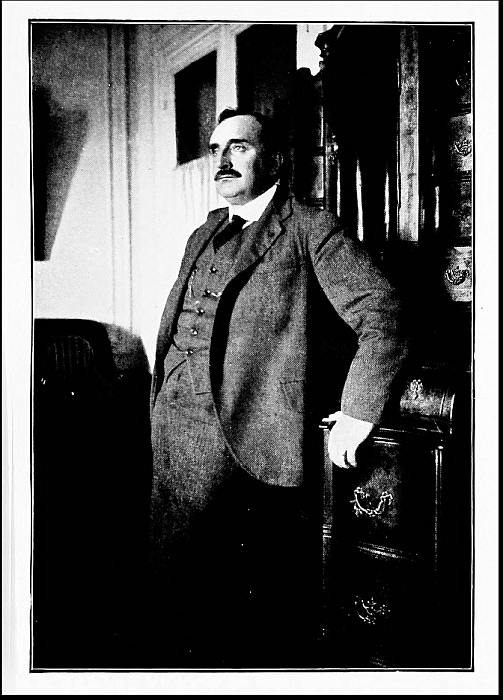
Photo: Dornac To face p. 88
Paul Claudel
But the third act is a surprise. The scene opens
in the great first-floor living-room of a European
factory or store in Southern China. It is evening;
all is peace within; Ysé is alone in her white tea-gown,
her yellow hair loosely plaited for the night;
a babe sleeps in its cradle; but without rages the
thunder of cannon with the shrieks of a pillaged
city, sacked by fanatics. The Boxers in revolt
are ravaging the Concession; this sole building, the
strongest, still holds out against them.
To Ysé, anxiously watching, enters her protector;
and, oh, most dramatic surprise!—it is not Mesa;
it is Amalric! And yet we learn the child is Mesa’s.
The man of action has carried off the love and the
son of the dreamer: all the profits of life are for
him. This night the lovers are to die. As club
after convent, store after villa, fall into the hands
of the screaming insurgents, Amalric (ever the
man of action, and even in this tragic hour cheerful,
limited, master of his fate) neatly adjusts the
mechanism of an infernal machine which, before
the Chinese can break down the gates and bolts
of the great factory, will blow the house, its inhabitants,
and its assailants high in the air, shattered
to dust in the twinkling of an eye:—
Ysé: Et cependant il est terrible d’être morte.
(Elle se trouble et lui prend la main.)
... Et, Amalric, est ce que vraiment il n’y a
point de Dieu?
Amalric: Pourquoi faire? S’il y en avait un,
je te l’aurais dit.
But here comes Mesa; he has a pass from the
insurgents which permits him to go where he
will; he comes to save Ysé. Amalric furious at
the sight of his rival, leaps at him with one bound,
wrestles with him, flings him off, broken, unconscious,
his shoulder out of joint. And he takes
from Mesa the talisman which will save their lives,
as he has already taken his love and his child.
Then, leaving Mesa still in his deep swoon, he
carries Ysé down to the harbour, where a ship is
waiting, just under the walls.
While Mesa still stirs and murmurs in his swoon,
Ysé returns; Amalric thinks her safe in her cabin.
But let Amalric live, let Amalric prosper! She
will choose rather to die with Mesa in voluntary
expiation. Like Gretchen, in Gœthe’s Faust, Ysé
forgoes her chance of life; she will risk the great
adventure of Eternity: ‘L’esprit vainqueur dans
la transfiguration de Midi.’ And these last words
explain the enigmatic title: Midi, Noon, is earthly
passion which must be purified by suffering and
sacrifice before it content the soul.
The Sharing of Noon, Le Partage de Midi, would
make an admirable opera for the music of a Claude
Debussy.
To my mind, the most interesting of Claudel’s
plays, is L’Otage (The Hostage), an historical piece
in the sense that our poet has captured the atmosphere
and character of the period he revives.
Though, as for the facts, he invents them at his
pleasure. This is the more startling that the time
is 1814, and among the personages are Louis XVIII.
and Pope Pius, whose ghosts must be surprised
to learn some of their adventures.
We are at the end of the First Empire; Napoleon
has the Pope safe in his keeping, a prisoner; so
far so good. But here Claudel parts company with
History. He imagines that a Royalist conspirator,
the Vicomte de Coûfontaine, carries off the Pope
by a deed of derring-do, and conveys him by night
to a half-ruined abbey hidden in the woods of
Picardy—all that is left of his family estate.
Coûfontaine is an émigré, a dangerous exile, with
a price set on his head, and the abbey is inhabited
by a young girl, his cousin, Mademoiselle Sygne
de Coûfontaine, who lives there in great retirement,
striving by endless patience, tireless economy, to
piece again together the tattered fragments of the
family fortunes—not for herself, but for the little
children of that exiled cousin whom, half-unwittingly
she adores.
The opening scene is exquisite: its delicate yet
homely poetry recalls Carpaccio’s Saint Ursula
asleep. But Sygne keeps vigil. She is alone by
night in the library of her abbey. The books of
the exiled monks line the walls; on the one side
left bare, a Christ of bronze is nailed to a huge
blackened cross made of the charred beams of
the Château de Coûfontaine, burned under the
Revolution. The tall shuttered windows have no
curtains. There is no carpet on the speckless
floor, where the very nails are burnished. Great
solemn chairs are ranged against the wall. In
one corner, on a wicker hurdle, the harvest of
plums is laid out to dry. In another corner of
the huge bare place the young mistress of the
abbey has established her abode; over her head,
sole ornament, is hung a torn fragment of tapestry,
snatched from the burning, blazoned with the
arms of Coûfontaine. In front of her, a pretty
old-fashioned bureau is covered with ledgers and
files of papers neatly tied. Close by a little table
is spread with bread and wine and the cold meat
for a frugal supper, as though some belated visitor
might be expected.
Coûfontaine arrives in the dead of night; he
brings with him an old nameless priest for Sygne
to house and hide; the girl does not guess it is
the Pope. She greets her cousin with quiet joy,
and with a girlish pride shows him her filed accounts,
her savings, all the store accumulated for the two
exiled children whose miniatures stand on her
writing-table. But both little ones are dead; the
scarlet fever has killed them over in England.
And their mother is dead too, their mother who
had betrayed hearth and home, their mother who
had been the Dauphin’s mistress. Coûfontaine is
a desolate man, beset with bitter memories. What
future is there for the race of Coûfontaine? The
scene closes on a betrothal. But (as in Corneille’s
Polyeucte) the hearth of plighted love is destined
to be shattered by the stroke of Grace, and the
act of God.
The second act rises on the same background,
but it is afternoon. The sun streams in at the
uncurtained windows and illuminates the bare
room; and the delicate beauty of Sygne, and the
figure of ruse and power in front of her. This is
her foster-brother, the son of the village sorcerer
and of her old nurse; Toussaint Turelure is now a
person of importance, one of Napoleon’s barons,
and Prefect of the Marne. Toussaint Turelure is
a vigorous portrait: the vulgarity, the unmannerliness,
the ostentation, the parvenu quality of the
First Empire are manifest in him; but also its
real capacity and power, its grasp of life and men.
Toussaint is an Amalric under other circumstances.
He loves his delicate and fearless foster-sister even
as Napoleon was attracted by the aristocratic
Josephine. But so far he has had no hold over
her. A woman who asks for nothing and dreads
nothing, and cares for nothing, is difficult to terrorise
or to seduce. Now Toussaint has surprised her
secret: he knows that she has in her keeping the
life of Coûfontaine—and that her hostage is the
Pope!
So he puts the bargain to her: her hand or their
heads! He gives her two hours to decide on all
their fates. And the English readers of Claudel
remember William Morris and the ‘Haystack in
the Floods’—more than once Claudel will remind
us of the pre-Raphaelites of yesterday.
The natural woman in Sygne decides for death
and freedom. But her parish priest comes to her
and (in a heartrending scene) points out to her
the path of sacrifice. No law, no obligation,
compels a human being to immolate his happiness
to the welfare of the community. Should Sygne,
in the interest of her personal honour, give up the
Pope, no priest dare refuse her absolution: she
is within her rights. But there are rights and
duties superior to our human rights. Man does
not live for man, but for God; and Sygne hears
the voice that, in the midst of his reasoning, surprised
the philosopher of Königsburg—the voice
that whispers: ‘Du kannst, denn du sollst!’
The third scene rises on the Château de Pantin.
Toussaint Turelure is Prefect of the Seine; he
holds in his hands the destinies of France. A
bevy of Napoleon’s officers are drinking the health
of his first-born, whose bells of baptism are ringing
loud and clear—for France has re-entered the
fold of the Church. But the mother is not present
at the festival: the Baronne Toussaint Turelure
is a shattered invalid. Her head, half-palsied,
moves continually from side to side, slowly from
right to left, and again from right to left, in the
weariest gesture of denegation and denial. She is
the wreck of Sygne de Coûfontaine.
While Toussaint drinks and sings with the
Imperial captains, he leaves his sick wife to draw
up a secret treaty with an emissary of the lawful
king of France—for he meditates a timely treason,
à la Talleyrand. Need I say that King Louis’s
envoy is the Vicomte de Coûfontaine? Need I
add that their negotiations are varied by the cruel
reproaches of Coûfontaine, by the broken-hearted
disculpations of Sygne. ‘Is there anything higher
than Love?’ says he; ‘is there anything deeper
than one’s Race? You have been a traitor to
your heart and your blood.’ ‘There is God,’ says
Sygne,—
‘J’ai sauvé le Prêtre éternel.’
But Coûfontaine will not be convinced. At least
he will wreak his vengeance on the usurper. So,
having signed the papers which bring the king to
his own, having carried them off, he takes, through
the open French window, a parting shot at Toussaint
Turelure, which Sygne intercepts, receiving it in
her heart, while Turelure, with a shot of his pistol,
kills the aggressor. Thus the two cousins perish;
their kingdom is not of this world; yet they leave
an heir: a child of the body of Sygne, an heir to
the name and the titles of Coûfontaine by an act
of legal substitution. Like Violaine, like Mesa,
Coûfontaine can leave no child: the hateful Mara,
the brutal Toussaint—brief the children of Action—can
make the fruits of the spirit flourish and
multiply, and they alone.
Why does Sygne save the life of the husband
she never forgives? Is it an act of sacrifice? A
homage to the sacrament? No, for she dies unshriven
because unforgiving. It is because Death
is better than Life: ‘une chose trop bonne pour
que je la lui eusse laissée.’ This heartrending
last act of L’Otage is especially moving in the
last version, that acted in Paris during the
summer of 1914, in which, mute, dying, relentless,
Sygne opposes only silence to the blatant
triumph of her odious master. It is, indeed, the
dialogue of Life and Death.
What will be the ultimate position of Claudel?
It is yet too soon to say. His influence on the
writers of our time is a fact. He is still young;
he is incontestably original; he is no doubt obscure.
But many of the greatest writers were and remain
obscure—Dante, for instance, and Pascal.
In our own times, Carlyle, Browning, Whitman,
Ibsen, Nietzsche, are often mysterious. And
none the less, from the date of their appearance,
they have been read with eagerness, and they
continue to be read (a little less eagerly), and,
indeed, to be revered, as the bearers of a message,
by an undaunted band of followers. Like all
these, Claudel aspires to be a conductor of souls.
And in the things of the spirit a certain obscurity
is no disadvantage, if there be a real message behind
it. We fill out the author’s adumbrated meaning,
as we read an intention into a fine musical phrase,
and his sentence gains by all the priceless bulk of
our accumulated interpretations.
There are passages of Shakespeare, there are
Pensées of Pascal, which we contemplate, as it
were, in an atmosphere of moral beauty, a halo, a
luminous aura, through which they shine
transfigured and augmented. They certainly mean
more to us than to the most admiring of their
contemporaries: their words have been messages
to so many passionate and earnest souls! This
phenomenon of accretion is the reward of the
obscure: they only, like the saints of Afghanistan,
continue to grow in their graves. An Addison,
a Voltaire, however great, means what he has
always meant. But your obscure genius, in time
to come, will be either a gospel or a Gongorism;
there’s no third state for him.
FRANCIS JAMMES
Francis Jammes is a Faun who has turned Franciscan
Friar. As we read his early poems, his
delicious rustic prose, we seem to see him sitting
prick-eared, in some green circle of the Pyrenees,
with brown hands holding to his mouth a boxwood
flute, from which he draws a brief, sweet music,
as pure as the long-drawn note of the musical frog,
as shrill as the plaintive cry of some mountain bird
who feels above its nest the shadow of the falcon.
And then he met Paul Claudel and was converted.
After all, little was changed, for his innocent
paganism had been tinged with natural piety,
and in his religion he might say, like the Almighty,
in the Roman de Lièvre,—
‘J’aime la terre d’un profond amour. J’aime
la terre des hommes, des bêtes, des plantes et
des pierres.’
Only henceforth we see him, in our imagination,
like Saint Francis, with a monk’s hood drawn
over his brow, sandals on his feet, his brown gown
cinctured with a knotted cord, a couple of doves
hovering over his shoulders, and, at his side,
fawning and faithful, a converted wolf....
I met M. Jammes at Madame Daudet’s house
one winter, and, in fact, his appearance was not
wholly unlike this fancy portrait. The gown was
a brown woollen suit, but just the Franciscan
colour. Above the ruddy, jocund, rustic face, a
crown of grizzling curls, behind which Nature had
provided the tonsure. Neither dove nor wolf,
but, in their stead, all the young Catholic poets of
Paris, pressed in serried ranks to meet the Master
who, for a few days, had consented to quit his
beloved solitude of Orthez.
We can remember a different Francis Jammes.
The poet has said of himself, ‘My soul is half the
soul of a Faun, and half the soul of a young girl.’
But let me quote an admirable strophe from his
Le Poète et sa Femme:—
‘Il est de ceux qui voient les parfums et il sent
Les couleurs. Et il s’intéresse
Au scarabée cornu, au hérisson piquant,
Et aux plantes des doctoresses.
Mais le voici, avec sa figure camuse
Et son sourire de Sylvain,
Fatigué par l’amour bien plus que par les muses
Qui aiment son cœur incertain ...
Lui-même est un Silène, on le voit au jardin
Veiller au légume, à la treille....’
This gentle Francis Jammes recalls sometimes
the charming La Fontaine, and also Verlaine. A
La Fontaine bereft of his philosophy, his deep
knowledge of human nature; a Verlaine from whom
the taint of corruption has been washed and therewith
his terrible sincerity. And if we can imagine
these two great poets mulcted so utterly in their
essential substance, the residue in them, too,
might remind us of a Faun and a young girl—a
mischievous, experienced rustic maid, yet holding
in her arms a bunch of lilies. The first prose study
of our poet—which still remains one of his most
exquisite pages—is the story of a young girl, Clara
d’Ellébeuse. What a delightful book! It is the
sort of little story one can read a dozen times in
a dozen years, and find it as affecting the last time
as the first.
If any attentive student should feel inclined,
having read these pages, to fill a shelf with some
selected volumes of these modern French writers—with
Colette Baudoche, for example, from among
the novels of Barrès, and Antoinette from Romain
Rolland; with La Jeune Fille Violaine from Paul
Claudel; with La Porte Étroite from André Gide;
to which he might add La Jeune Fille Bien Élevée
from the works of René Boylesve; L’Ombre de
l’Amour by Madame Tinayre; Marie-Claire by
Marguerite Audoux; and the young girls of Francis
Jammes, especially Clara d’Ellébeuse,—what an
idea, what an admirable, unconventional idea such
a reader would get of the young French girl!
What a gift, at once instructive and delightful, he
could make to some young English girl on, say,
her five-and-twentieth birthday!
Francis Jammes has spent nearly all his life in
or near that little town of Orthez (in the department
of the Lower Pyrenees), where he was born about
1869. In that part of France, almost as much as
in Ireland, Protestants and Catholics divide society
pretty equally. Our poet was born and baptized
a Catholic, but many of his nearest relations were
Huguenots, and, seeing so much of both sides, he
does not seem to have taken either very seriously.
He showed no particular precocity and, though he
began to write poetry, like most people, in his
twentieth year, he made his real debut only in
1898, with a volume called De l’Angelus de l’Aube,
à l’Angelus du soir.
A certain languor mixed with fervour ran in
his blood. He had inherited Creole traditions.
His grandfather, the doctor, and his grand-uncle
had emigrated from Béarn to Guadeloupe, and had
settled there, had died there; his father was sent
back to France to be educated at seven years of
age; his dim memories of the Antilles, his stories
of the cousins in Martinique, and the little chair
in rare colonial wood that the child had used on
the passage, were, a generation later, to set
a-dreaming another child, our poet, whose first
heroine will belong, like him, to a family dispersed
among the Atlantic Islands and the Pyrenees.
I suppose that a doctor would describe Clara
d’Ellébeuse as a victim of the maladie du scrupule.
She is a girl of sixteen; a dear little old-fashioned
girl, living in a dear little old-fashioned manor,
sheltered among the foothills of the Pyrenees,
towards 1848. She has that dread of sin, of impurity,
as a sort of quagmire into which one may fall
unawares and be lost for ever, which the practice
of confession may exaggerate, or palliate, according
to the wisdom of the confessor. (Our poet Cowper
was no Catholic.) Poor Clara d’Ellébeuse, because
one day the young poet she secretly adored had
wiped away her nervous tears and laid upon her
bowed nape a pitiful, respectful hand, imagines
that she has fallen into the sin of unchastity and
that she is with child! (And we think of Renan
who, in his twelfth year, I think, accused himself
in confession of ‘the sin of simony.’)
The mischief with Clara is that she does not
confess; she tells no kind elder of her secret fear;
she lets concealment feed, like a worm in the bud,
upon her damask cheek. And we know how that
ends. Clara does not pine away. One day in
March, overcome by horror and remorse for her
imaginary crime, she drinks a dose of laudanum
and quits this unkind world.
In telling the pathetic history of Clara d’Ellébeuse,
Francis Jammes left unhampered that half of his
soul which is that of a young girl; but in narrating
the fate of Almaïde d’Etremont, jeune fille passionnée,
that other half (which belongs to a Faun) shows
the cloven foot. More tenderly does he commemorate
the sad life of Pomme d’anis, jeune fille
infirme.
But it is not to be supposed that a poet who,
by his own showing, partakes so largely of the
nature of Silenus and his Sylvans, should frequent
exclusively the society of virgins. Some of his
earlier poems betray an ardent sensuality. One
cannot read either these or the Notes printed in
the volume called Le Roman du Lièvre (or even,
perhaps, that most touching idyll of a play: La
Brebis Égarée) without feeling that the poet’s
experience has lain also among the lost sheep ...
among the lost sheep, and perhaps among the
swine; for there was a moment when he was even
as the Prodigal Son!
In 1913, making a general confession of those
past errors (oddly enough) to a reporter of Le
Temps, Francis Jammes recalled their bitterness.
Nothing except a love story is so interesting as
the true history of a conversion—I give this one
therefore without apology, though it appeared for
the first time in a newspaper (November 3, 1913).
‘Je me suis converti le 7 juillet, 1905, commence
M. Francis Jammes lorsque je lui demande s’il
n’est pas indiscret que je cherche à savoir comment
sa pensée évolua de l’indifférence à la ferveur.’
‘Vous n’étiez pas catholique?’
‘De baptême? Si. Mais pas davantage, avec
des sympathies pour les beaux motifs littéraires
du catholicisme, avec beaucoup de dédain pour
ce que j’appelais, pour ce que je n’appelle plus le
catholicisme des vieilles femmes. J’étais un païen,
un véritable faune. Les fleurs, les bois, les femmes!
J’avais la passion de tout ce qui existait; il n’y
avait pas dans toute la nature de gamin plus
déchaîné; j’aimais tellement la vie que la seule
pensée de la quitter un jour me paraissait un
épouvantable blasphème.’
‘Et vous ne l’aimez plus?’
‘Plus de la même manière.’
‘Ce fut un coup de la grâce?’
‘Non. Avant la grâce, il y eut les épreuves et
il y eut Claudel.... Claudel, dont, par l’intermédiaire
d’un de ses anciens camarades de classe,
Marcel Schwob, je devins l’ami à l’époque faunesque
où je battais les buissons....
‘Claudel! Le poète prononce ce nom avec une
émotion et une admiration touchantes.
‘Claudel! Je n’oublierai jamais, raconte M.
Francis Jammes lyrique, ma première entrevue
avec lui; il était déjà grand pour quelques-uns
d’entre nous. Je vois encore cette petite chambre
où l’on nous introduisit, mon camarade et moi.
C’était une sorte de cellule nue; trois choses
attirèrent mon regard, les seules: un chapelet,
l’Appel au soldat de Barrès, et un paroissien de
vieille femme. Il parut. Le marbre romain allait
parler. Il avait de l’antipathie pour la personne
qui m’accompagnait: j’entends le son sec et
tranchant de ses brèves réponses. Le lendemain
je déjeunai avec Schwob et lui. Le marbre, resté
glacial la veille, s’anima: ce fut pour moi un
émerveillement. Le catholicisme entrait dans ma
vie.’
‘Le faune avait des inquiétudes?’
‘Le faune était tenace. Mais insensiblement
je commençais à me demander: où est la vérité?
Et de ne pas la connaître, de sentir une limite
à l’homme, j’éprouvais une impression pénible, je
découvrais un ver dans la pomme. Je m’apercevais
qu’il y avait une force dans la vie et que
cette force je ne la possédais pas.’
‘J’étais dans cet état de désillusion et de doute
quand je fus la victime d’une crise morale affreuse.
Je tombai dans le désarroi le plus complet. J’avais
demandé à un des mes amis de Bordeaux l’hospitalité
et je m’abandonnai à ma détresse; c’est alors que
par un bienfait de Dieu une lettre de Claudel nous
parvint, une lettre admirable de consolation et
d’enseignement. Je fus frappé, je réfléchis. Si
cette vie que j’aime tant, me disais-je, ne me donne
pas son explication, elle n’est qu’une horreur,
nous sommes dans un hôpital de fous; j’allai à
la cathédrale, longtemps je pleurai: le travail de
la grâce s’opérait en moi.
‘Je rentrai à Orthez. Ce que la lettre de Claudel
avait commencé, la parole de Claudel devait le
finir. J’eus bientôt le bonheur de le voir arriver;
il me parla du catholicisme en grand philosophe,
en savant. Ensemble nous priâmes. J’étais au
fond du fossé, mourant, anéanti. Je me relevai
guéri, sauvé. Le 7 juillet, 1905, je me confessai,
je communiai; Claudel, mon ange gardien, servait
la messe. Depuis lors j’ai retrouvé tout ce qui
me manquait, j’ai récupéré la joie. Après avoir
traversé d’âpres solitudes, j’ai la joie de la
certitude, l’explication de ma vie. Je suis catholique!’
Dans l’espace, M. Francis Jammes lance cette
profession de foi comme un cri de triomphe.
‘Catholique pour de bon, insistai-je, pratiquant?
La foi totale, absolue, obéissante?
‘La foi du dernier savetier. Je ne suis pas un
néo-chrétien. Je pratique, comme vous dites,
j’observe tous les préceptes de l’Église, ma mère....
Je sais: on rit, vous riez des dévotionnettes.
J’en ai ri jadis moi-même. Je me les suis expliquées.
L’Église ne les aurait peut-être pas imposées si
tous les hommes étaient des Pascal et des Claudel.
Mais l’humanité n’est pas composée que de Pascal
et de Claudel. Ces pratiques, ces observances sont
comme des nœuds au mouchoir, elles constituent,
en quelque manière, un rappel à la vertu et à la
piété. L’Église les a jugées nécessaires ou utiles.
Je m’incline sans discussion. Cette attitude a
déconcerté certains hommes qui n’ont rien de
catholique mais qui veulent exploiter le catholicisme
au profit d’un système politique. Quand
on a la flamme de la foi, comme je l’ai, on trouve
humiliante cette exploitation. Nous, nous sommes
catholiques foncièrement, pardessus tout.
‘Vous parlez comme si vous étiez certain de
posséder la vérité.’
‘Je la possède. Je suis dans la vérité puisque
la sécurité où je suis est si bonne! Il n’y a
rien dans le monde à quoi je puisse comparer le
bonheur que ma foi me donne. J’y tiens davantage
qu’à la vie elle-même. J’ai été comme un verger
où le vent a passé, maintenant je suis un verger
doré avec de beaux fruits.
‘Et comme j’esquissais un discret sourire de
scepticisme, M. Francis Jammes me regarda avec
infiniment de générosité.
‘Je vous souhaite le bonheur que j’ai.’
‘I was converted on the 7th of July, 1905,’
began M. Francis Jammes, when I asked him if I
were not indiscreet in seeking to trace the progress
of his mind from indifference to fervour.
‘You were not always a Catholic?’
‘I was christened a Catholic, but that was about
all: that, and a sort of sympathy for the fine
literary themes afforded by the Church, mixed by
much disdain for what I no longer call the “churchiness”
of old women. I was a Pagan, a veritable
Faun! Flowers, forests, women—I was in love
with all that lived! In all Nature there was not
a merrier young vagabond alive. Life was so
delightful in my eyes that the very idea of one
day quitting all that, seemed to me a frightful
blasphemy.’
‘And you are no longer so much in love with
Life?’
‘Not in the same way.’
‘You were changed by a sudden flash of grace?’
‘No; there were trials before the Grace of God
touched me; and there was Claudel, too, ...
Claudel with whom I made friends (through one
of his old schoolfellows, Marcel Schwob) when I
was still a Faun, haunting the thickets.
(Claudel! The poet pronounces the name with
a touching admiration and emotion.)
‘Claudel! I shall never forget our first interview.
He was already a great writer in the eyes
of a little clan. I still see the small room into which
we were shown, my friend and I. It was a sort
of bare cell: three things attracted my attention,
a rosary, an old woman’s prayer-book, and Barrès’s
Appel au Soldat. And then Claudel came in. It
was as if a Roman bust were to move its lips and
speak. He disliked the person who accompanied
me, and I remember the harsh cut-and-dry tone
of his short answers. But the next day I lunched
with him and Schwob; and the icy marble softened
into flesh and blood. I was lost in wonder, a sort
of happy astonishment. Catholicism had entered
into my life....’
‘The Faun began to feel anxious?’
‘The Faun stood firm! But, little by little, I
began to ask myself: Where lies the Truth? And
the sense of my ignorance, that feeling of a limit
to what man can do and be, was the canker in the
fruit. I felt there was a force in Life—a force that
I did not possess.
‘And while in that state of doubt and disillusion,
I was overtaken by a cruel moral crisis. I wallowed
in the Slough of Despond. One of my friends lived
at Bordeaux; I went to stay with him, and it was
there that, by God’s grace, I received a letter
from Claudel. Such an admirable letter, full of
consolation and instruction! I was struck by it.
And I pondered it in my heart. “If this dear life,”
said I, “that I so love, remains a riddle, if there
is no answer to our questions, then away with it!
Life is a horror, a madhouse!” I went to the
Cathedral, and for a long while I wept; the miracle
of grace began to operate in my soul.
‘I returned to my home at Orthez. That which
Claudel’s letter had begun, speech with Claudel
was to effectuate. He came; he spoke to me of
religion like a great philosopher, like a man of
science, too; and we prayed together. I was in
the bottom of the pit, dying, dejected. On the 7th
of July, 1905, I went to confession, I received
the Communion; Claudel, my guardian angel,
served the Mass. Since then I have found all that
I missed in life; I have recovered my delight.
After the harshest solitudes I have come to a
place of certainty: I am a Catholic!’
(And M. Jammes flings this cry forth into space,
like a chant of triumph.)
‘A real thorough-going Catholic?’ said I; ‘absolute,
obedient faith?’
‘The faith of a cobbler! I am no neo-Christian;
I practise all the precepts of the Church I know.
You smile (I used to smile) at certain observances.
The Church would not have enjoined them if all
the faithful stood on the intellectual level of a
Pascal or a Claudel. But humanity is not made
up of Pascals and Claudels. These minor practices
are just knots in our handkerchief, lest we forget!
The Church thinks them necessary; I bow to her
decision. I know this attitude seems disconcerting
to certain persons, who really are not Catholics
at all, but would like to exploit the Church
in favour of a political system. But, when the
flame of faith is lit in our hearts, we scorn
to be the catspaw of a politician. We are just
Catholics.’
‘You speak as though you were sure of possessing
Truth itself!’
‘So I am; Truth is my heritage, since I find my
security so good! Nothing in Life is comparable
to the happiness which I derive from my religion;
it is dearer to me than life itself! I was as an
orchard harassed by the wind; and now I am an
orchard golden with ripe fruit.’
So spake Francis Jammes. I smiled the slight
smile of the sceptic. The poet glanced at me with
an infinite generosity.
‘I wish you the same happiness!’ he said.
Elie-Joseph Bois, Le Temps.
Nov. 3, 1913.
But this conversion has not greatly changed the
nature of the poet. His verse is still fresh with
the fragrance of wild thyme newly wet with dew.
He continues to sing his happy valley, with the
mountain towering up behind, right into the blueness
of the sky. Only, in his landscape, he gives
more prominence to the village church, garlanded
with yellow roses: L’Église habillée de
Feuilles.
‘Par cette grande paix que l’homme cherche en soi;
Par les jours finissants aux vieux balcons de bois
Où le cœur noir des géraniums blancs s’attriste;
Par l’obscure douceur des choses villageoises;
Par les pigeons couleur d’arc-en-ciel et d’ardoise;
Par le chien dont la tête humble nous invite
À lui passer la main dessus; par tout cela:
Chapelle, sois bénie à l’ombre de ton bois!’
His verse has still its candour, its ingenuous
freshness, its Franciscan simplicity:—
‘Je prendrai mon bâton et sur la grande route
J’irai, et je dirai aux ânes, nos amis:
Je suis Francis Jammes et je vais au Paradis.
Car il n’y a pas d’enfer au pays du Bon Dieu.’
And yet so great a change has necessarily had
its repercussion in the very form of the poet’s art:
Francis Jammes is no longer a ver-librist. Having
accepted a discipline for his soul, he may well
admit one for his muse. He would no longer
write:—
‘J’avais été assez éprouvé pour connaître
Le bonheur de finir ses jours dans la retraite;’
and think he had done his duty by the rhyme.
He would not now content himself with the loose
and lazy assonance of a verse (a beautiful verse)
like the following:—
‘Accablé, je m’étais assis, tant les ajoncs
Étaient impénétrables.
Quand j’eus équilibré mon fusil contre un arbre,
Je relevai le front.’
His last charming volume of Bucolics, Les
Géorgiques Chrétiennes, is written in rhymed Alexandrines,
which differ only from those of classic
French poetry in a few innocent and agreeable
liberties—a plural and a singular being allowed to
rhyme together, the mute E not counting where
it is not pronounced. It is a pleasant form of
verse. The picture of the harvesting angels whirling
in the sky, which opens the poem, has the rich colour
and the large facility of a fresco by Correggio—say,
the Assumption at Parma. It is beautiful
with a calm beauty:—
‘De temps en temps l’un de ces anges touchaient terre
Et buvait à la cruche une gorgée d’eau claire.
‘Sa joue était pareille à la rouge moitié
De la pomme qui est l’honneur de compotier.
‘Il reprenait son vol, et d’abord sa faucille.
Quelque autre alors foulait l’ombre qui fait des grilles.
‘Ou tous ils descendaient ensemble, ou bien encor
Ensemble reprenaient avec calme l’essor.
‘Chacun avait passé le bras à sa corbeille
Dont les tresses formaient comme un essaim d’abeilles.
‘Clarté fondue à la clarté, ces travailleurs
Récoltaient du froment la plus pure des fleurs.
‘Ils venaient visiter sur ce coin de la Terre
La beauté que Dieu donne à la vie ordinaire.’
One of my friends, who is Professor of Rhetoric
(Modern Literature) in a High School, tells me
that the enthusiasm of her scholars for Francis
Jammes is a thing touching to behold—for we of
a bygone generation can never quite attain their
diapason. Michelet and Renan leave them cold;
Claudel and Francis Jammes fire their imagination.
If I were a teacher, certainly I should profit by
the experience; by all means let the young learn
from the young!
Les Géorgiques Chrétiennes is full of the most
delightful episodes of country life told in beautiful
(if rather free-and-easy) French. There is no
particular tale in it. It is rather a series of pictures;
the daily life of a family of husbandmen on a farm.
It is a sort of rural Christian Year. But what
candid and happy pictures! What a sense of rustic
cheer and frugal abundance! What primitive
poetry in the labourer’s account of the creation of
his daily bread; the chestnut, the maize, the vine!
And the betrothal of the little farm servant!
And the vocation of the farmer’s daughter who
takes the veil.
There is but one thing in the whole volume
which I find displeasing. It is the short certificate
of orthodoxy which the poet delivers to himself
on the first page and on the last. He is at great
pains to assure us that he is not a reformer, a
philosopher, a modernist, or a free-thinker. We
should never have suspected this gifted and ingenuous
singer of being any kind of thinker!
He is a poet, a most indubitable poet, and that
is enough.
RENÉ BOYLESVE
René Boylesve reminds me of some twy-faced
Roman statue, some bust of Janus, turning a
different mask to opposite points of the horizon.
One of these visages (but that regards the Nineteenth
Century) has the libertine grace, the refined
scepticism, the voluptuous detachment of an
Anatole France or a Henri de Régnier, with less
philosophy than the one and less poetry than the
other; but these are the qualities which distinguished
our Republic yesterday: Non ragionam
di lor. The second face looks at the new Renaissance
of our time, and is that of an inhabitant
of the province of Touraine, poet and gentleman-farmer,
a man pleasantly occupied with the affairs
of his neighbourhood, in which he finds the diversity,
the unexpected developments, the food for thought,
which animate, in any place, if sufficiently observed,
the innumerable acts of the Human Comedy.
In addition to a mind of the subtlest moral
delicacy and a more than feminine refinement,
M. Boylesve possesses a literary style of transparent
ease and charm; just the style to suit the landscape
he describes, the moderate classic harmonies and
Attic graces of Touraine. He is the historian of
the charming gros bourgs that surround Loches or
Azay. He describes their neat, white houses built
of freestone, topped with slate, their raised stone
perrons (or stoops, as they say in America) and
handsome ornamented windows; and we see the
trellised vine up the front, and the flowers in the
gardens, and the fruit trees everywhere. The
villages of Touraine have brought prosperity to
the very brink of poetry!
These little farms where every sunny slope all
round is planted with the vine; these old gray
manors and priories nestling under some cliff
lightly planted with slender oak-woods (so unlike
ours!), in which the gray-blue periwinkle and the
gray-pink cyclamen grow wild; these prosperous
rural properties, with their air of solid comfort,
their teeming vats of wine; their kitchen-gardens,
full of melons, cucumbers, asparagus, artichokes,
cardoons, green peas, egg-plants, tomatoes, salsify,
and scarlet-runners; their great barns; their stone
stables where the cattle spend so much of their
time (for the land is too fertile and too valuable
to lay down in pasture); all this dignified, delightful,
indolent country of Touraine has found its
prophet in René Boylesve. Except Balzac in his
Lys dans la Vallée, no one has described it half
so well—the land and the dwellers on the land....
‘Molles Turones,’ said Cæsar, and Tacitus calls
them ‘imbelles,’ and Tasso thought the peasant
here was like his field, which is ‘molle, lieta e
dillettosa.’ And, in fact, these adjectives serve
very well to describe the lazy, charming art of
René Boylesve.
I find in him the moral features of his race:
measure and tact, delicacy of sentiment, love of
ease, something at once noble and voluptuous,
something humorous and nonchalant, and yet, at
the same time, something precise and positive,
despite his softness. And often, when I read a
novel of M. Boylesve’s, the book slips from my
hands, and I see the Plain of Touraine under its
customary sky of sunny gray—its great wide
rivers, its rocky cavernous cliffs, its forests of Loches
and Amboise, its rambling lanes sunk deep between
two rows of pollard windows, the great straight
white high-roads that the aspens fleck with shadow,
and all the pleasant sequence of woods and fields,
which seem to be reasonably deduced the one from
the other, like the different parts of a discourse.
Did M. Boylesve know, he would be charmed;
for the object of his art is, not to hurry the reader
along on a current of breathless events, but to
foster in him this habit of reverie, of reminiscence
‘chewing the cud of sweet and bitter fancy.’
René Boylesve was born in 1867 at La-Haye
Descartes, in Touraine, and his first book, Les
Bains de Baden, was published in 1896; but this
belongs to the Boylesve whom we renounce. In
1899, with Mademoiselle Cloque, he opened that
series of ‘Scènes de la vie de province’ (as Balzac
would say), which have made his reputation. Mlle
Cloque is an old maid of narrow means; just one
of those ‘churchy’ old maids for whom Francis
Jammes has expressed a respectful tenderness.
But Francis Jammes was still a ‘Faun’ when his
contemporary, Boylesve, delineated this delightful
lady.
Mlle Cloque’s affections are divided between
two absorbing objects, her pretty young niece
and her church. That church is the basilica of
Saint Martin, fallen into ruin; and the dearest
aim of this devoted worshipper is to restore and
repair the great sanctuary of Tours. For to her
Tours is still that Jerusalem of the West that our
forefathers called it, in memory of the first confessor
of the Latin Church, Saint Martin, once the
honour and glory of France, neglected now in his
own diocese.
Long before Maurice Barrès wrote his apology
for the churches of France, the author of
Mademoiselle Cloque showed how a great monument
may be a liberal education, may raise an
illiterate mind to heights where it apprehends the
mystery which extends beneath, beyond, appearances;
he, too, affirmed that the prayer of an old
woman in her parish church may rank with the
meditation of the man of science and with the
inspired presentiment of the poet.
La Becquée followed Mademoiselle Cloque. It
is impossible to read this long, slow, humorous,
enchanting book, without seeing a resemblance (a
moral resemblance, for the setting, of course, is
widely different since the setting is Touraine), still,
a strong moral resemblance to the English novel
of Victorian days. Tante Félicie and her nephew,
Riquet Nadaud, remind us, though so unlike, of
Aunt Betsy Trotwood and little David Copperfield.
It seems to me that those who love the one might,
at least, like the other? I shall speak again of
Riquet Nadaud in my chapter on the Novel of
Childhood.
A great part of the charm of these stories is
the atmosphere of Touraine, so marvellously captured.
I do not mean only the physical atmosphere:
M. Boylesve is above all things a man for whom
the inner world is important. Twenty years ago,
French literature was positive, objective, and, if
I may say so, visual. But now our younger masters
are men for whom the invisible world exists; they
are chiefly occupied with the interior sphere.
Some while ago, René Boylesve described this
change of front very happily to a reporter of the
Revue des Français (September 25, 1912). He
said:—
‘In my young days, I used to visit Alphonse
Daudet whom I greatly admired. He was very
encouraging, and we would talk of literature; he
used to say to me gently: “I have never described
anything that I have not seen.” He was very
kind, very discreet, and I would go away despairing,
for I felt he was offering me a suggestion, a
piece of good advice. And for long afterwards
I was incapable of writing anything, since at every
turn I caught myself on the point of describing
things I had never seen, could never see!’
These unseen things—emotions, beliefs, traditions,
opinions, all that makes up the moral atmosphere
of a society—are the peculiar sphere of M. Boylesve.
On this occasion he showed our journalist the plan,
or scenario, for a novel which was lying on his
writing-table: no project of a plot, no list of
personages, but a sequence of maxims and reflections.
‘Take care of the moral atmosphere,’ he
seems to say, ‘and the characters will take care
of themselves.’ So soon as he begins to write, he
forgets these notes, which transpose themselves
into persons and events; but his preliminary care
is to invent the moral world which naturally
brings them forth.
The classic grace of his native province, its sober
delicacy, its quiet order, do not exclude a latent
energy, an amorous ardour, decently dissimulated
under the discretion and retinue of a civilised and
courtly tradition. The Tourangeau is sensual as
well as temperate; he is never perverse; he is
seldom excessive; none the less, if his name be
often Descartes or Berthelot, he may by chance
be called Ronsard, or Rabelais, or Balzac. How
should he live in a world of such good things, such
an earthly paradise, and not know—though he
discipline them—the pleasures of sense? His purity
is not austere and his piety no flaming romantic
enthusiasm.
All the delicate sensibility, all this impassioned
moderation of his native place, M. Boylesve has
put into the human, touching figure of his Jeune
Fille Bien Élevée. It is the story of a refined and
gentle girl, convent bred, pious, reared in all the
old-fashioned dignities and delicacies of a small
provincial society in Touraine. Her parents combine
for her a sensible match—a mariage de raison
with a Parisian architect who, visiting Chinon,
has espied the white sequestered lily; he marries
the dowerless Madeleine for her perfect manners,
her charming grace, her moral solidity—et parce qu’il
ne veut pas être.... Poor Madeleine in her wedding
veil has overheard the unthinkable word!
M. Serpe has evidently a great opinion of that
moral solidity which he so much admires, for,
during their married life in Paris, he takes no
pains at all to shield it, plunging his young wife
into the busy, frivolous circle of contractors,
speculators, money-makers, and pleasure-hunters
that eddied round the great Exhibition of 1889.
This is the subject of Madeleine, Jeune Femme,
which is the continued history of his heroine—M.
Boylesve’s novels have the broad full flow and
lengthy winding course of his native Loire!
Madeleine passes unscathed among the booths
of Vanity Fair. But by a friendly hearth (the one
spot which recalls the peaceful surroundings of
her early years) she meets a man of letters, a student
of subtle moral problems, a lover of Pascal, an
inhabitant of her own intellectual world, yet in
his private life just as much an average sensual
man as any bachelor of the Boulevards. Madeleine
succumbs at once almost without resistance to the
charm of M. Juillet—she succumbs morally, we
mean, and in secret; for in the world of fact she
never succumbs at all, and her would-be seducer
retires, rebuffed and ashamed, persuaded that she
is one of those impregnable fortresses it were a
waste of time to besiege, while Madeleine is half
enraged by that inalienable aureole, or aspect of
virtue, which so efficiently protects her. The flood
of sentiment which invades the charmed, the
passive soul of Madeleine, its mysterious regression,
and the final triumph of her old ideals—Duty,
Order, the Interior Altar—are evoked with a magic
which touches in the reader’s heart a secret spring,
and makes him share in Madeleine’s temptation,
her danger, her reluctant escape.
If Madeleine does not succumb, it was not the
beautiful quality of her soul that saved her (our
author seems to say) but the regularity and discipline
of her early education; and, to point his moral
still clearer, he places in front of Madeleine a
charming madcap, a dear little modern hoyden,
Pipette Voulasne. Pipette has not a bad instinct
in her composition, but neither has she a principle;
she has never heard of the spiritual combat.
Pipette, too, falls in love with the irresistible M.
Juillet. Pipette is sweet and twenty, rich, unmarried
and M. Juillet is a bachelor; but the lover
of Pascal hesitates at the idea of marriage with a
romp whose ideas of fun is to dress up as a seal at
a fancy ball and swim in the pond.
Pipette is marked out for fate, and here no
sudden angel intervenes; Pipette commits suicide,—an
almost comic suicide, in keeping with her
character; she makes a hearty meal of plum-pudding
and then takes a sea-bath! M. Boylesve
is a traditionalist, a lover of the ancient faiths and
disciplines of France (a lover, perhaps, rather than
a believer). He delights to show us, in his magic
mirror, the neat, well-ordered world of civilised
society; but sometimes the figures that move
there become transparent, revealing behind them
the great primeval forces, never completely disciplined,
which drop into our neatest systems some
soul irreducibly irregular, a grain of sand throwing
all things out of gear. All his novels are une
invitation à réfléchir sur la vie.
There is decidedly something English in the
talent of M. René Boylesve—perhaps his patience,
his slowness, his minuteness, his lambent humour,
as also his repugnance to all that is spasmodic,
jerky, or effective—for sometimes his art reminds
us not only of David Copperfield, but also of The
Mill on the Floss; and perhaps we must go back
so far to find a novel whose moral effulgence is as
persuasive. A pure and lonely soul, accustomed to
the quiet meditations of the inner life; a young
pilgrim of the ideal, suddenly plunged into the
robust materialism and frivolous worldliness of a
middle-class coterie, abruptly brought up face to
face with passion—with unlawful passion, in which,
none the less, the young soul recognises something
more akin to the altar of her inner worship than
was to be found in the daily round and common
lot; the swift temptation, the sick revulsion.
‘There came and looked him in the face
An Angel beautiful and bright;
And that he knew it was a Fiend,
This miserable Knight!’
Are we not telling the story of Maggie Tulliver?
It is also the history of Madeleine Serpe. It is
her story, with one great, one incalculable difference.
There is an old tale, familiar in many variants
to the students of monastic lore. Tempted, a nun
leaves her convent, errs, returns full of shame, to
find that no one has missed her, that her sin is
unguessed at, since the Virgin has taken her place
and her semblance, performing all her duties in
her place. This interior Virgin, who saves Madeleine
Serpe, who intervenes too late for Maggie Tulliver,
is the habit of goodness, the inheritance and practice
of virtue, which protects some natures half against
their will. For (and there lies the delicacy and
naturalness of M. Boylesve’s story) Madeleine’s
soul is saved against her will! She feels all the
attraction of the abyss. For one dizzy moment
she leans over, longs—but something pulls her back,
and places her reluctant feet on the dusty highway
they had thought to quit for ever.
René Boylesve is not one of the greatest names
in contemporary French literature—not a name
to conjure with. No one has ever compared him
to Pascal or Dante, as (to our stupefaction) they
compare Claudel; no one has said of him, as it
has been said of Péguy, that he is greater than
Victor Hugo. And it is as well: this discreet
and moderate artist would find no charm in immoderate
praise. But we may say without fear
of contradiction that he is one of the most readable
of contemporary novelists.
ANDRÉ GIDE
André Gide is one of the acutest, one of the most
sensitive critics of the Twentieth Century. His
review, La Nouvelle Revue Française, has been no
less indispensable to the development of our younger
writers in France, than the English Review to the
Georgian authors across the channel. Instead of Masefield,
of Conrad, André Gide has fostered the talent
of a Charles-Louis Philippe, of Marguerite Audoux.
But this critic, so perspicacious, so alert, so
abreast of his times, is, at the same time, a novelist,
apparently of another generation. The Nineteenth
Century in its decline—the dear, delightful, decadent
Nineteenth Century—with its dreams, and its
nihilism, and its irony, and its delicate disenchantment—the
Nineteenth Century which already seems
such worlds away!—remains incarnate still in the
novels of André Gide, hardly less than in those of
France, or Régnier, or Pierre Loti. He has the
same sense of beauty, the same regret for some
ante-natal magic never since re-found, the same
perfection of form, or rather a perfection almost
equivalent in its transparent and insidious grace,
in its purity, in its rare elegance: few writers of
the Twentieth Century are elegant! And, like
Anatole France, Gide, in his latest work, is full of a
bitter contempt, a mordant, an almost impious
derision of human nature. Evil is, in his eyes, the
mortar that binds together our earthly tenement; a
necessary condition of our being; man is a creature
made of dust and mud. But I will not speak of his
later books. Of the dozen volumes he has produced,
no one is negligible, and at least three, Paludes,
L’Immoraliste, and La Porte Étroite, have qualities
for which one may suppose survival.
Paludes has a charm of youth and decadence too
different from our serious age for me to praise it
here; but L’Immoraliste and La Porte Étroite are
as much in earnest as the Twentieth Century can
demand, and yet they are not of it!
L’Immoraliste is the story of a young man, newly
married, highly gifted, with all his life before him
apparently, who suddenly falls sick of a mortal
illness. Hitherto he has been a student, spiritually
minded, almost austere. But the sudden neighbourhood
of death, the dread possibility of annihilation,
change his philosophy; he feels that instinctive
shudder, that sense of the futility of creeds and conventions
which Mademoiselle Lenéru has called le sens
profond de la mort. And his ideals are reversed.
Henceforth he esteems not the moral, not the
refined, but such things as seem especially vital:
Life, in such manifestations, bad or good, as appear
the most spontaneous, the most energetic. Instinct
and Vigour draw him like a magnet, for these
make for survival. At Biskra, where he winters for
his health, he finds himself admiring the little Arab
boy who steals his wife’s scissors—the scamp is so
adroit, so deft!—and when he returns to his country
home in Normandy, it is the drunkards and the
poachers in the tavern who strike him as the most
alive, and therefore the most estimable. When
his wife, worn out with nursing, falls ill in her turn,
he neglects her (for illness has become in his eyes
disgusting, almost monstrous) and she dies in
isolation.
André Gide may be himself, perhaps, something
of an Immoralist—or rather an Amoralist—as was
the manner of the Fin-de-siècle, but he preserves,
as the clay preserves the trace of the long crumbled
sea-shell, the imprint of a severe and religious
education. Like our English Edmund Gosse, he
has left behind him a Protestant past, which he
looks back upon to-day with some distaste, and
yet perhaps with something of an unconscious
nostalgia.
His best novel, La Porte Étroite (1909), is laid,
so to speak, on the grave of that Huguenot youth
of his, so utterly vanished, like a handful of flowers.
‘Le goût exquis craint le trop en tout.’ These
words of Fénélon’s rise to one’s mind in reading
this story of a rare soul drawn into the abyss of the
inner life, ‘as waters are by whirlpools suck’d and
drawn,’ through a sort of dread of the excess, the
commonness, the transitoriness of mortal happiness.
Alissa Bucolin was the child of a West Indian
Creole and a Norman banker, Protestant and
pious. The beautiful Mme Bucolin never took
root in the Huguenot society of Havre; she spent
her days swinging in a hammock or reclining gracefully
upon a couch, a shut book dropping from her
idle hand; sometimes a violent crise de nerfs would
interrupt the languid course of her existence, would
alarm and arouse all the quiet, plain, provincial
household; only sometimes at dusk she would awake
for a moment as it were, show a transient animation,
or sit at the piano and begin some slow mazurka
of Chopin; but her lovely hands would stop in the
middle of a chord, her voice leave the phrase
unfinished, and the sleeping beauty sink again into
her incommunicable ennui.
Alissa Bucolin drew from her mother her dark
romantic beauty and a neurotic temperament, but
her spiritual strain reflected the cultured Huguenots
of her father’s family. Born in the native town of
Mademoiselle de Scudéry (the author of the Grand
Cyrus) and of Bernardin de Saint-Pierre (the author
of Paul et Virginie), she was akin to the great
précieuse and to the idealist philosopher—and the
likeness makes us wonder if a peculiar morbid
sentimentality, a rare delicacy of emotional fibre,
be usual in the inhabitants of that flourishing
seaport! Alissa had grown up in the companionship
of a sister, a brother, and a young boy cousin,
two years her junior—and from their childhood it
had been understood that Alissa and Jérôme were
one day to marry.
But when the girl was sixteen years of age, the
mystery of Evil, and all the scars and scoria of
mortal passion, were suddenly revealed to her by
the conduct of her mother. A novel gaiety and
laughter transfigured Mme Bucolin, coinciding with
the frequent visits of a certain young lieutenant.
And one day Jérôme found Alissa weeping and
praying by her bedside while from the floor below
her mother’s laughter pealed up—unaccustomed as
a portent. ‘Bucolin, Bucolin,’ drolled the young
lieutenant, ‘Si j’avais un mouton, sûrement je
l’appelerais Bucolin!’ and Alissa, weeping, murmured
to her dear confidant, ‘Jérôme, ne raconte
rien à personne ... mon pauvre papa ne sait rien!’
Thus, in its very bud, the young shoot of love
in her heart was infected by shame; and she felt
the longing to expiate and offer her life as an
oblation. Moreover, Juliette, three years younger
than Alissa, had let her fancy light on her young
cousin; and the serious Alissa (to whom every
preference appeared a vital passion) determined
to sacrifice her dream of happiness in her sister’s
favour. Her strenuous soul was naturally inclined
to sacrifice, finding in privation that mysterious
exaltation of the will, that constant and progressive
self-mastery, which animate with an intense though
secret interest the life of the ascetic.
But neither her young sister nor Jérôme would
accept her oblation. Juliette married very young
a middle-aged wine grower in the south of France,
had several children, became her husband’s associate,
provided an opening for her younger brother—fulfilled,
in fact, the French ideal of feminine
activity, importance, and devotedness, and was
perfectly happy; while Alissa was left (so to speak)
with her sacrifice returned unopened, left upon her
hands. And Juliette’s recovery from her first love,
her happiness in a simple marriage of reason,
contributed to discredit human passion in the
mind of the fastidious Alissa:—
‘Ce bonheur que j’ai tant souhaité, jusqu’à
offrir de lui sacrifier mon bonheur, je souffre de
le voir obtenu sans peine.... Juliette est heureuse;
elle le dit, elle le paraît; je n’ai pas le droit, pas
de raison, d’en douter.... D’où me vient, auprès
d’elle, ce sentiment d’insatisfaction, de malaise?
Peut-être à sentir cette félicité si pratique, si facilement
obtenue.... Ô Seigneur! Gardez-moi d’un
bonheur que je pourrais trop facilement atteindre!’
To Alissa, as to Mary, the usefulness and occupied
content of Martha appear the husks of life: Unum
est necessarium. Such natures need the liberty,
the solitude, the rapt interminable progression,
and ideal refuge of the inner life. A sort of disgust
of reality seizes them at the very moment when the
earthly paradise they dreamed of appears, at last,
within their reach. Alissa has only to stretch out
her hand in order to take her happiness. After
all, is it worth while? The dread of disenchantment,
the sense of mortal imperfection, paralyse
her. The dawn of love is surely its most delicate,
delicious moment; the high day of noon can never
improve upon that exquisite suggestion.
‘Enough; no more!
’Tis not so sweet now as it was before....’
Those who have once imagined themselves in
direct communication with that which lies behind
appearances cannot resume unaltered the conditions
of human society. Pascal in the full glory of scientific
discovery—and is there any human emotion to
compare with that of the man who suddenly sees
enlarged the very boundaries of Nature?—in the
passion of scientific debate, knew that abrupt
revulsion of the mind, that withdrawal from finite
things, that unique absorption in spiritual perfection
which drove a Charles V. to quit the affairs of
Europe for a monk’s cell in Estramadura.
More than once the sense of Divine things has
suggested to a strong nature some cruel doctrine
of voluntary martyrdom, which (according to our
own bias) we may deplore as a partial alienation
of the mind, or admire as evidence of eternal truth.
M. Gide’s Alissa is only a woman who renounces a
permitted love; yet, in the same spirit, and with
something of the same high strenuousness, she erases
her dream and writes across the page of life: Hic
incipit amor Dei. ‘La sainteté n’est pas un choix’ (she
tells the unfortunate Jérôme), ‘mais une obligation.’
But Alissa was not a saint. She was an artist
in Mysticism, a refined and fastidious spirit ‘who
would give all Hugo for a few sonnets by Baudelaire.’
Nothing in her life shows that warmth, that
zeal, that desire to rush in and save which marks
the saint, however visionary, however ecstatic, be
she Saint Teresa or St Catherine, be he St Francis
of Assisi or St Francis of Sales. In place of that
simple and passionate impulse of the soul Alissa,
in her self-regarding solitude, is all scruple, all a
fastidious fear of doing wrong. We think of her,
and, opening Fénelon’s Spiritual Letters, we read:—
‘Rien n’est si contraire à la simplicité que le
scrupule. Il cache je ne sais quoi de double et de
faux; on croit n’être en peine que par délicatesse
d’amour pour Dieu; mais dans le fond on est
inquiet pour soi, et on est jaloux pour sa propre
perfection, par un attachment naturel à soi....’
Over against these strenuous, self-torturing
spirits, who arrive with difficulty at perfection,
thanks to ‘une certaine force et une certaine
grandeur de sentiment,’ the great Archbishop sets
the luminous peace of those quiet souls who glide,
as it were, into their true haven, without a conscious
effort.
‘Tout les surmonte, selon leur sentiment; et
elles surmontent tout, par un je ne sais quoi qui
est en elles, sans qu’elles le sachent. Elles ne pensent
point à bien souffrir; mais insensiblement chaque
croix se trouve portée jusqu’au bout dans une
paix simple et amère, où elles n’ont voulu que ce
que Dieu vouloit. Il n’y a rien d’éclatant, rien
de fort, de distinct aux yeux d’autrui, et encore
moins aux yeux de la personne. Si vous lui disiez
qu’elle a bien souffert, elle ne le comprendroit pas.’
We read and reflect that such a friend as this
was just what was lacking to Alissa Bucolin. She
would doubtless have been happier as a Roman
Catholic (only even then she might have chanced
on a Pascal, who would have exasperated her
qualities, instead of on a Fénelon, who would have
tempered and allayed them to a milder perfection).
A spiritual director would have turned her energies
into courses of work and prayer, would have drawn
her mind from the attraction of the abyss, would,
perhaps, have married her (like Juliette) or, more
happily, have fulfilled her vocation in some great
active religious order, where an Alissa may succour
and inspire a multitude of lesser natures. Or, had
the bent to contemplation proved too strong, he
would have let her enter the contemplative life,
but not alone. A soul, scarred by what Sainte-Beuve
has described as la griffe de l’archange,
may be seized with a vertigo, on attaining the
summits of the inner world, if on these giddy
heights no staying, guiding, protecting hand be
near. Vae soli!
But in that case Alissa would not tragically have
died, leaving behind a long train of sterile regret
and hopeless memories, and M. Gide would not
have composed the frail and spiritual story, which,
in its purity and charm, reminds us sometimes of
Dominique.
CHARLES PÉGUY
When war broke out between Austro-Germany
and the Allies, Charles Péguy went to the front
as a lieutenant in the reserves of the line and
was struck by a ball, or a fragment of shell,
on the forehead as he was leading his men
into action at the Battle of the Marne. This
heroic death fitly crowns a career devoted to the
love of country and the gospel of fraternal self-sacrifice.
In its light, I re-read the trivial pages, the feeble
half-affectionate pleasantries with which I had
saluted the poet and teacher who, no doubt,
occasionally abused the privilege which genius
sometimes claims to alloy the sublime with the
ridiculous—or the merely ultra-lyrical and wearisome.
Is it possible that I did not appreciate, in
his lifetime, the prophet, the hero, the poet, whom
France reveres to-day? I examine my conscience.
It is clear that I was not drawn to Péguy in his habit,
as he lived.... I see him still. An odd little man
with the look of a small farmer from the Loire—a
farmer, a village schoolmaster, a country doctor,
a curé even—there was something of all that in
the refined and yet rather common little man with
the bent shoulders, the charming hands, the square
jowl, and the deep-set blue eyes whose glance was
at once so keen and so gentle, often so quizzical,
sometimes so mystically tender, and sometimes so
irritable and angry.
‘Un petit homme barbu (said Barrès) un paysan,
sobre, poli, circonspect, défiant et doué du sens
de l’amitié, bien campé sur la terre, et toujours
prêt à partir en plein ciel. C’était un petit homme
terne et lent, de qui se dégageait un merveilleux
rayonnement.’
He seemed to me like some preaching friar of
the Middle Ages, vowed to Dame Poverty; and,
for himself, content with a crust in his wallet,—a
wretched living picked up as he went along the
roads, yet, where his Order was concerned, insatiable,
a relentless beggar for the Love of God. Pitiless
to any human hobby or pursuit of yours which
did not square with that sublimer hobby and
pursuit of his; himself disinterested, and yet in
his ardent piety as dauntless an intriguer as any
Jesuit of Eugène Sue’s; cordial and frank by fits
and starts, with that engaging air of rustic simplicity
and popular plain-dealing, yet, on the
morrow, infinitely wily, full of craft, subtlety, and
innocent guile. I thought him (notwithstanding
the mysterious, irradiating kindness which beamed
from that wonderful glance of his) on the whole
a crotchety creature, ‘difficile à vivre,’ with a
temper full of sudden twists and turns and unsuspected
asperities.
Admirable he was, nevertheless. Patient as a
peasant and courageous as an apostle, wise and
witty, bitter and gay, Péguy was full of sense and
of charity—was almost that rarest of geniuses, a
saint—and failed there (remaining merely a poet
and a hero) chiefly, perhaps, because of that
insatiable vanity of his. He hungered and thirsted
not only after righteousness, but after praise. And
in his lifetime he never had his due share of it.
That meed so scantily meted I might in some small
degree have swelled, and now regret my suspended
judgment; but Péguy roughed me up in every
fibre, and I disapproved of him almost as much
as I admired him. There was something of Rousseau
in the fiery little autodidact with his penetrating
delicacy of sentiment, and that sore vanity of his
as touchy as a gouty foot which always fears the
man across the way may stumble on it. When
that aching place was hurt, the poet, so exquisite
in his sense of friendship, so abundant in his
recognition of encouragement, would surprise
those most who knew him best by certain restive
or morbid quarrels—the blemishes of a too sensitive
temperament.
Despite this temperament, which was not great,
there was something really great and grand in
Péguy. There was in him the most generous passion
of rescue—the desire at all risks to rush in and
save. The grandeur and misery of Man and his
need of salvation was the idea which dominated
all his life. Péguy was a mystic; Time was nothing
to him, and he was sincere in saying that an act
of rescue such as that which cost him his life was
worth a career of thirty years. Yes, Péguy was a
mystic, and one of the real, the greater race, no
romantic idealist, not at all vague or dreamy, but
positive and practical and intensely alive to every
detail, because every fact in nature (and indeed
all the best things in industry and in art) appeared
to him, in Meister Eckhart’s phrase, ‘the words of
God,’ and therefore infinitely precious and important.
One day that his friend and mine, Daniel Halévy,
that subtle and yet substantial critic, found him
reading Dante’s Paradiso, in view of a certain
Mystery he meant to write: Le Propre de l’Espérance
(and the part, the lot, of Hope is Paradise),
M. Halévy asked the audacious poet if those
whirling worlds of Dante’s and all those whorls
of singing aureoled angels did not inspire him
with at least a certain vertigo? ‘Not at all,’
replied Péguy. ‘My Paradise will be quite different.’
‘“Il y aura dans mon Paradis des choses réelles....
Toutes les cathédrales.” ... Et il faisait
avec les deux mains le geste d’y poser quelque
chose. “Je les y mettrai.”’
And in fact (continues M. Halévy in the letter from
which I am quoting) Péguy would have admitted
to his Paradise, not only the great Cathedrals, but
anything perfect in its own peculiar sphere. For
instance, he adduces:—
‘this ink with which I am writing to you, which
indeed was Péguy’s ink, made of the oak, coal-black,
indelible; and his pens—they too would
have gone into his Paradise, certainly, all his pens!
You have understood I am sure; Péguy extends
the future life, not only to souls and sentiments,
but to all that has achieved existence; a resurrection
not only of the flesh but of the things
made, cherished, and perfected by man on earth.’
It was more or less Swedenborg’s Paradise. In
Péguy’s eyes the soul vivified and transfigured
and made alive all that it touched. Hence his utter
incomprehension of all attempts to examine matter
that the soul had not transfigured, his withering
contempt for science and scientists, the scorn he
would pour on those miserable insects, the ‘puissants
millepieds’ of the University, in their laboratories
and archives:—
‘Et ce ne sera pas ces distingués cloportes
Qui viendront nous chercher dans notre enterrement....
Et ce ne sera pas par leur usage externe
Que nous nous lèverons de notre pourriture;
Mais la Foi qui nous sauve et seule nous discerne
Saura nous retrouver dans la fange et l’ordure.’
(Eve.)
What discussions I have had with Daniel Halévy
concerning the final value of this poem of Eve,
whose mighty jog-trot extends interminably over
a length which exceeds the Odyssey and the Iliad
together! My friend, to whose opinion I attach
the greatest weight, insists on ranking Péguy with
Victor Hugo for poetry and with Rabelais for prose!
And no doubt he emphasises his expressions in
order to spur my tranquil spirit to the fray. Indeed
the incitement never yet failed of its effect; I rush
to the encounter; sometimes, at the point of the
bayonet, M. Halévy recedes from his position as
regards Victor Hugo; but he maintains unshaken
that comparison with the creator of Pantagruel.
Well, all that is vain; Péguy now will never fill
his measure. His monument is a broken column,
like those we see in cemeteries. In these brief
passages of recollection, I may not even stay to
point out the extraordinary design and intention
of that monument; nor to quote that prose, surely
unlike any other prose, which creeps up, wave after
wave, with infinite repetitions and over-lappings,
until, like the tide on the strand, it has submerged
and sucked in all the subject it meant to cover. How,
in two words, could I give an idea of that style?
Péguy is a great prose writer, a wonderful wielder
of image and trope, a master juggler with all the
intricacies of French syntax. And the nation which
produced Agrippa d’Aubigné, Pascal, Voltaire,
has always loved the prose of a brisk polemic.
The prose works of Péguy are due to polemics.
And he lays into his enemy with a dexterity, a
surety, a variety of attack unrivalled—here a
shower of swift and sudden blows, there a slow
and paralysing envelopment of the adversary.
Péguy is an incomparable wrestler.
For the rest, shall we say that Péguy was the
Walt Whitman of France? Shall we translate
him into English under the name of Carlyle—or
even W. E. Henley? There was something of all
of them in the irascible, quizzical, and lovable
idealist whose life was one long struggle against
conventional standards and a conventional style;
against middle-class prosperity, modern commodities
(generally ‘tout le confort moderne’); against
the preferences of a well-to-do democracy; against
also, and no less, Parliamentary ideals; documentary
historical methods and culture; and, compendiously
and inclusively, all that is political as opposed
to mystical, all that is temporal as opposed to
spiritual, all that is matter as opposed to soul, all
that is personal as opposed to general, and, one may
add by extension, all that is rich as opposed to all
that is honourably, contentedly, and modestly poor.
With these dispositions it is natural that Péguy
should have begun life as a Socialist. Born of
humble stock in 1874 (on those prosperous banks
of Loire where the humblest have all things pleasant
and comely about them, and are themselves men
of a slow, wise wit and kindly culture) Péguy rose
from class to class, from board school to training
college, until at twenty he found himself at the
University of Paris, one of the future glories of
the École Normale. In the old house of the Rue
d’Ulm he wrote his first poem, Jeanne d’Arc (for
already this son of Orleans was possessed by the
memory of the Maid), of which the singular dedication
reflects not only his young ideas of fraternal
democracy, but that extraordinary tide-like style,
creeping on inch by inch, wave by wave, until it
submerge the whole ground of the matter, which
Paris, in later days, was so often to admire, to
praise, or to deride:—
‘À toutes celles et à tous ceux qui auront vécu,
À tout celles et à tous ceux qui seront morts pour tâcher de porter
remède au mal universel;
En particulier,
‘À toutes celles et à tous ceux qui auront vécu leur vie humaine,
À toutes celles et à tous ceux qui seront morts de leur mort humaine,
pour tâcher de porter remède au mal universel humain.
‘Parmi eux,
À toutes celles et à tous ceux qui auront vécu leur vie humaine,
À toutes celles et à tous ceux qui seront mort de leur mort humaine
pour l’établissement de la République Socialiste universelle,
ce poème est dédié.
Prenne à présent sa part de la dédicace qui voudra!’
‘Tâcher de porter remède au mal universel
humain’: To attempt to ease the universal disease
of humanity! All Péguy is there! As time went
on, he ceased to believe in the establishment of the
universal Socialist Republic; and, indeed, although
ineradicably attached to the Republican ideal, he
became increasingly anti-radical, anti-democratic,
almost tending towards the military, and aristocratic
theory of a State strongly constituted in
definite classes, each respectable, respected, and
informed with the same sense of national honour
and personal self-sacrifice. But Péguy went back
on no word of that early dedication. He simply
made over, so to speak, his stock in the universal
Socialist Republic to the credit of the Catholic
Church. For before Claudel, before Francis Jammes,
after Brunetière (or we should rather say along
with him) Péguy suffered a conversion to the faith
of his fathers.
Yet such was his respect for the individual
conscience, that he continued, in the eyes of the
Church, to live in sin. His wife, the daughter of
a Socialist, was a Free-thinker; she had never been
baptized; she had married Péguy before the Mayor
of her Commune and not before the priest of her
parish; she had not followed him in his conversion
and still maintained her rights. Péguy, that
arch-persuader, could not shake her. And, since
the indissolubility of the marriage-tie was the very
cornerstone of Péguy’s social doctrine, he continued
to live with this free-souled woman, who shared
his life but not his faith, in an unblessed union,
that the Church condemned; his children were
not baptized. Rome bade him bring them into
her fold. Péguy, in his pride of pater-familias,
upheld his claim to consider the convictions of
their mother. Deprived of the sacraments, he
ceased to go to Church, while still continuing to
believe and pray.... Anti-clerical and ardently
Catholic; tenderly preoccupied with his children’s
welfare and yet accepting for them that which his
new-found creed must have made him conceive
as the most dreadful risk of all—such was the
stubborn and irascible convert whom the Church
honours in his death, but whom in his lifetime
she covered with reprimands and ardent
reproaches.
Such was Péguy in his life—an enigmatic being;
nor was he less difficult to appreciate in his art,
which attempts to enlarge our sensibility and
quicken our moral vision much in the same way
as instantaneous photography has increased and
instructed our sense of sight. I am the first to
concede that this art of his (which proceeds,
perhaps, rather from Dostoievski than from any
great French tradition) appears, in its disconcerting
diversity, as one of the most interesting phenomena
of a new age. It is full of audacity, interest, genius,
adventure. But is it an art? Let us open any
page of Péguy and take at random a charming
page, where the book opens, p. 63 of the Porche
de la Deuxième Vertu:—
‘Et pourtant on est si fier d’avoir des enfants!
(Mais les hommes ne sont pas jaloux):
Et de les voir manger, et de les voir grandir.
Et le soir de les voir dormir comme des anges.
Et de les embrasser le matin et le soir et à midi.
Juste au milieu des cheveux.
Quand ils baissent innocemment la tête comme un poulain qui baisse
le tête.
Aussi souples comme un poulain, se jouant comme un poulain.
Aussi souples du cou et de la nuque. Et de tout le corps, et du dos.
Comme une tige bien souple et bien montante d’une plante vigoureuse.
D’une jeune plante.
Comme la tige même de la montante espérance!
Ils courbent le dos en riant comme un jeune, comme un beau poulain,
et le cou, et la nuque, et toute la tête.
Pour présenter au père, au baiser du père, juste le milieu de la tête.
Le milieu de la tête, la naissance, l’origine, le point d’origine
des cheveux.
Ce point, juste au milieu de la tête, ce centre, d’où tous les cheveux
partent en tournant, en rond, en spirale.
Ça les amuse ainsi.
Ils s’amusent tout le temps.’
The volume, the sensitiveness, the stammering
reiteration, the precision, the tenderness, the
subtlety of Péguy are all in this passage. One
would say an artist of genius, afflicted with general
paralysis, attempting to describe a miraculous
vision. And he is telling us that a father kisses
his small boy on the crown of his cropped little
pate. And this passage of Péguy’s is no more
extraordinary than any other passage of Péguy’s
on any other possible subject. Imagine Walt
Whitman turned a Christian mystic and endowed
with ten thousand times his original flux of
words.
And now, having relieved my soul, having put
the accent on this intolerable defect of our poet’s—and
it is almost, to my thinking, a redhibitory
vice—let me turn to his bright side and discover
what it is that attracts to him so many and such
distinguished admirers.
It is, first of all, a touch on the canvas, a liquid
and a living palette, an animation and abundance
of composition which, in his too rare happy
moments, suggest some large and brilliant sketch
of the school of Rubens. Take the opening quatrains
of the poem to which I have referred; let us
open Eve:—
‘Ô mère ensevelie hors du premier jardin
Vous n’avez plus connu ce climat de la grâce,
Et la vasque et la source et la haute terrasse,
Et le premier soleil sur le premier matin.
‘Et les bondissements de la biche et du daim
Nouant et dénouant leur course fraternelle,
Et courant et sautant et s’arrêtant soudain
Pour mieux commémorer leur vigueur éternelle.’
There is, in Péguy at his best, something not so
much antique as unchanged since ancient times,
like the pronunciation of certain peasants; and
this something makes us understand how there
once was in France a people of artists, the unknown,
unnamed, immortal builders of the great Gothic
cathedrals; we almost believe there might still be
such in reading his verse.
There is also in Péguy at his best a peculiar
humanity which makes me often remember those
lines of Mrs Browning concerning her favourite
Greek poet:—
‘Our Euripides the Human
With his droppings of warm tears,’
and an imagination so naturally and naïvely
religious that it would enchant me but for its
familiarity. No Baptist minister over his tea and
muffins, is on more intimate terms with the Eternal.
The interminable poem of Eve (as long—but
not as beautiful! as the Iliad and the Odyssey
united) fulminates against the Intellectuals of
France in an outburst of rhetoric which too often
degenerates into mere violence. Péguy is more
really poetic in his prose. The description of rural
life on the banks of the Loire, in Victor-Marie,
Comte Hugo; the death of Bernard Lazare in Notre
Jeunesse; above all, the long but the inspired
elevations and prayers of Jeannette—especially
the conversation with her little fourteen-year-old
friend Hanorette (which we keep in our remembrance
along with the dialogue of Antigone and
Ismene, and with the scene in the Gospel of Martha
and Mary, as a perfect characterisation of the two
great types of Charity and Piety)—are to our
thinking far more interpretative of Péguy’s true
genius than the mighty jog-trot of his later muse.
Still there is a power and an eloquence in that.
So far as the meaning goes, all his voluminous outpourings
have the same. There is but one thing
needful, and that is to be a hero or a saint. Preferably,
perhaps, a hero!
‘Ainsi Dieu ne sait pas, ainsi le divin maître
Ne sait quel retenir et placer hors du lieu,
Et pour lequel tenir, et s’il faut vraiment mettre
L’amour de la patrie après l’amour de Dieu.’
The saints that Péguy sang were patriot saints:
Geneviève, who preserved the city of Paris from
the Huns of Attila; Jeanne, who hunted the English
out of France. Of all glories, of all honours, that
dearest to this poet was military glory and national
honour—
‘Il n’y a rien à faire à cela, et il n’y a rien à
dire. Le soldat mesure la quantité de terre où
on parle une langue, où règnent des mœurs, un
esprit, une âme, un culte, une race. Le soldat
mesure la quantité de terre où une âme peut respirer.
Le soldat mesure la quantité de terre où un peuple
ne meurt pas.
This was Péguy’s firm conviction: no duty so
important as the military duty! When the war
broke out, man of forty as he was and father of
a struggling family—man, too, much engrossed
and overworked by his triple occupation as poet,
prose-writer, and publisher—he changed from the
Territorials into a regiment sent on active service
to the front. ‘No man hath greater love than
this....’
Thanks to the recital of one of his soldiers, Victor
Bondon, we can witness the fall—or rather I would
say the assumption—of the poet and brother of
Joan of Arc. For he too fell in driving the invader
out of France! There is an extraordinary breath
of heroism in this page of an unknown private
soldier relating the end of a great man. I cannot
do better than translate it here, with some abridgments
and suppressions:—
‘On the 5th September in the morning, the
55th division of the army of Paris was ranged on
the left of the forces which had received the general
order, “Die where you stand, rather than retreat.”
In front of us, on the wooded hills that reach
from Dammartin to Meaux, von Klück and his
Boches, who had followed us step by step from
Roye during our terrible retreat, lay in wait
for us, hidden in their trenches, like beasts of
prey.
‘The heat was tropical; the battalion halted a
moment at the pretty village of Nantouillet. I see
again, with the mind’s eye, our dear Lieutenant
Péguy, seated on a stone, white with dust (as indeed
we all were), covered with sweat, his beard rough
and shaggy, his eyes shining behind his pince-nez.
Such he was, as we had seen him in Lorraine during
the retreat, impervious to fatigue, brave under a
storm of shells, going from one to another of his
men with a cheering word for each throughout the
whole length of our company (the 19th), sharing
our rations (and we eat as a rule one day in three),
never complaining despite his forty years, as young
as the youngest, knowing just the right way to
take the Parisians that we were, heartening the
discouraged with a word, satirical enough sometimes,
but more often a friendly quizzical quip,
always brave, always an example; ah, yes! I
see again our dear lieutenant, bidding us fight in
hope, raising our flagging spirits in an hour when
many were near despairing, with the assurance
of his own absolute confidence in our final
victory.’
‘At last the sun began to slope towards evening;
it was five o’clock. After four hours’ incessant
fire, our 75’s had silenced the Prussian batteries on
the ridge, and the infantry were ordered to attack
their entrenchments. The black troops from
Morocco, in what had seemed an invincible rush,
had tried once, and failed. Now Péguy’s company
starts in skirmishing order; the German batteries
are quiet, but when our men reach the ridge they
are greeted by a storm of bullets. The ground is
covered with tangled, down-trodden oats that
catch the feet; and in front, just on a level with
their heads, that burst of fire. Péguy’s voice,
ringing and glad, commands the assault: “Feu!
En avant!...”
‘Ah! cette fois c’est fini de rire. Escaladant le
talus et rasant le sol, courbés en deux, pour offrir
moins de prise aux balles, nous courons à l’assaut....
Le capitaine Guérin, M. de la Cornillière, sont
tués raides, “Couchez-vous (hurle Péguy) et feu
à volonté!” mais lui-même reste debout, la lorgnette
à la main, dirigeant notre tir, héroïque dans
l’enfer.
‘Nous tirons comme des enragés, noirs de poudre,
le fusil nous brûlant les doigts.... Péguy est
toujours debout, malgré nos cris de “Couchez-vous,”
glorieux fou dans sa bravoure. Le plupart
d’entre nous n’ont plus de sac, perdu lors de la
retraite, et le sac, en ce moment, est un précieux
abri. Et la voix du lieutenant crie toujours:
“Tirez! Tirez! Nom de Dieu!” D’aucuns se
plaignent: “Nous n’avons plus de sac, mon
lieutenant, nous allons tous y passer!” “Ça ne
fait rien! (crie Péguy dans la tempête qui siffle).
Moi non plus! Je n’en ai pas, vous voyez. Tirez
toujours!” Et il se dresse comme un défi à la
mitraille, semblant appeler cette mort qu’il glorifiait
dans ses vers. Au même instant, une balle meurtrière
fracasse la tête de ce héros, brise ce front
généreux et noble. Il est tombé, sans un cri,
ayant eu l’ultime vision de la victoire proche; et
quand, cent mètres plus loin, bondissant comme un
forcené, je jette derrière moi un rapide coup d’œil
alarmé, j’aperçois là-bas, comme une tache noire
au milieu de tant d’autres, le corps de ce brave,
de notre cher lieutenant.’
And here for a threnody let me quote that noble
psalm, now familiar to the soldiers of France,
which, until Péguy’s death, lay hidden in that vast
storehouse of lumber and treasure, the poem of
Eve. Be sure it will remain for ever among the
ultimate residue—the pure regulus—of all that has
been written on the war. And these stanzas were
written before the battle was declared, since Péguy
(and therein lies his true grandeur) was a prophet
rather than a poet.
‘Heureux ceux qui sont morts pour la terre charnelle,
Mais pourvu que ce fut dans une juste guerre;
Heureux ceux qui sont morts pour quatre coins de terre,
Heureux ceux qui sont morts d’une mort solennelle.
‘Heureux ceux qui sont morts dans les grandes batailles,
Couchés dessus le sol à la face de Dieu;
Heureux ceux qui sont morts sur un dernier haut lieu
Parmi tout l’appareil des grandes funérailles.
‘Heureux ceux qui sont morts pour des cités charnelles.
Car elles sont le corps de la cité de Dieu;
Heureux ceux qui sont morts pour leur âtre et leur feu
Et les pauvres honneurs des maisons paternelles.
‘Heureux ceux qui sont morts, car ils sont retournés
Dans la première argile et la première terre;
Heureux ceux qui sont morts dans une juste guerre;
Heureux les épis mûrs et les blés moissonnés!’
‘Qui Dieu mette avec eux dans le juste plateau
Ce qu’ils ont tant aimé: quelques grammes de terre;
Un peu de cette vigne, un peu de ce coteau.
Un peu de ce ravin sauvage et solitaire.
‘Mère, voici vos fils qui se sont tant battus!
Qu’ils ne soient pas pesés comme Dieu pèse un ange:
Que Dieu mette avec eux un peu de cette fange
Qu’ils étaient en principe et sont redevenus....’
And, as we say a collect after singing an anthem,
let us conclude, in memory of all those heroic comrades
that fell with Péguy in the battle, with a noble
passage from his Mystery of the Holy Innocents:—
‘Une génération d’hommes (dit Dieu).
‘Une promotion, c’est comme une belle longue
vague qui s’avance d’un bout à l’autre sur un
même front et qui d’un seul coup d’un bout à
l’autre.
‘Toute ensemble déferle sur le rivage de la mer.
‘Ainsi une génération, une promotion, est une
vague d’hommes.
‘Tout ensemble elle s’avance sur un même front.
‘Et toute ensemble elle s’écroule comme une
muraille d’eau quand elle touche au rivage éternel.’
Thus Péguy died with the generation that he
led to victory.[1]
ERNEST PSICHARI
I think that Péguy never learned the death of his
young friend, Ernest Psichari; for the retreat of
Charleroi was, after all, such a little while before
the battle of the Marne, and news in those difficult
days travelled so slowly.... One of Péguy’s
last preoccupations was the hope of meeting Ernest
on the road to battle, and in fact they must have
been in Lorraine together, but no chance encounter
by road or rail set the two friends face to face.
They both started for the front in the same mood
of heroic exaltation:—
‘Si je tombe (said Péguy), ne me pleurez pas.
Ce que je vais faire vaut trente ans de travail.’
But the first to fall was Ernest Psichari. I
knew him root and branch—knew his parents and
grandparents before him, and the earliest image
that I preserve of him (since the first of all are
forgotten) is of a little lad between eight and nine
years of age, unaware of my presence in his grandmother’s
drawing-room, as he talks to his little
brother in the twilight: ‘When I am grown up
(says Ernest) I shall be a great man! Et j’aurai
ma statue sur tous les marchés de France!’ And
the little one of seven ripples with laughter at
Ernest’s having so satisfactorily ‘gone one better’:
‘Il y a du chemin à faire, mon frère! (says he).
Il y a bien de chemin à faire!’ Whereat I too
laughed and broke the spell, the two little boys
informing me that, while waiting for their violin-lesson,
‘on s’amusait à raconter des blagues.’
Even in Ernest’s fun there was a desire of
greatness; that, and an intense sensibility, a rare
faculty of moral imagination, were what I chiefly
noticed in the child, of whom I saw less and less
as his studies absorbed him more and more:
youths between twelve and twenty have little
time for their mother’s friends. A quiet young
man, with charming, living eyes, and in his whole
aspect something ardent, firm, and grave: that
is all that Ernest Psichari was to me.
And then came a bolt from the blue. It was
on the morrow of the Dreyfus case when France
was divided into two camps, and each faction
feverishly counted its men and the great families
which centralised these men on either side. As
Daniel Halévy wrote, in a passage already celebrated:
‘Paris a ses familles comme Florence eut
les siennes, et ses maisons, non couronnées de tours,
n’en abritent pas moins des factions guerrières.’
Ernest was born into one of these houses—one of
the most important to the Liberals—for those
grandparents of his (both dead before that shock
of schism shook France to her foundations), those
grandparents of whom I have written, were Ernest
Renan and his wife. And his father was Jean
Psichari, a Greek philologist of most ‘advanced’
opinions. It came, therefore, almost as a defection,
an apostasy, when the rumour spread in the ruffled
circles of the Dreyfusards that Ernest Psichari
had gone into the Army—that Renan’s grandson,
at nineteen, had enlisted as a volunteer in the
Colonial Artillery.
Although myself a Dreyfusard with the best of
them, I could not feel hurt by this change of front,
which seemed to me just the counterpart of Renan’s
own conversion. Given a young man with a passion
for justice, the more you treat him as a partisan,
the more his mind, by some dim process of unconscious
cerebration, will conjure up the arguments
for the other side. Besides Renan, although he
gave his casting vote to the Liberals, exhaled
often an exquisite regret in his vision of the other
side. He finally voted for Caliban; but few writers
have set forth more nobly the arguments for the
aristocratic ideal. Renan’s mind was singularly
full. Imagine a pair of scales, either balance
heaped high,—even the lighter of them was filled
with more reasons to believe, to rule, and to conquer
than many a fanatic could furnish forth; it
is true the reasons for doubting turned the scale.
The man who sacrificed everything to Truth and
Liberty was just the man to understand the young
apostle of Force and Faith; he too had felt the
spell of Force and Faith! Ernest Psichari—grave,
straightforward, active, patient—represented the
France of to-day in its modern cult of sacrifice and
duty, even as the grandsire stood for his own
generation. The symbols are different, but the
character is much the same—a like curiosity, an
equal contempt for worldly goods and mundane
honours, a conviction that life is worth living only
when employed in some vast impersonal service. The
wise Merlin of the Nineteenth Century would have
smiled: ‘ah! cher enfant, combien vous avez raison!’
‘Le fils a pris le parti de ses pères contre son
père’; so Ernest himself defined the situation in
his Appel des Armes. Just as his Breton ancestors,
curious of the vast world on the other side the seas,
most incurious of worldly advancement, would
sail the world over in the Service of the State,
before the mast, seamen content with the salt air
and their duty, so this grandson of theirs spent five
years with his cannon in the Congo, a non-commissioned
officer. When at twenty-four years of
age he returned to Paris, he could scarcely understand
why his friends pressed him to enter a school
for officers. ‘One can serve the country as well in the
ranks; one is perhaps more useful!’ But he yielded
to his mother—to her, indeed, he always yielded.
How I regret that during those eighteen months
which the young soldier spent at Versailles, in
order to obtain his brevet of second-lieutenant, I
remained unaware of his presence in France!
Péguy has left an eloquent description of his friend
and young alumnus, telling how he lived like a
king in the palace of the École Militaire, but a
step from the dome of the Invalides whither in the
summer mornings, in the freshness of the dawn,
he used to escort his slender little three-inch cannon—‘ses
75, ces petits jeunes gens de canons modernes,
ces gringalets de canons modernes, au corps
d’insecte, aux roues comme des pattes d’araignées’—filing
them off under the shadow of the monstrous
historic artillery of the great Pensioners’
Hospital, the cannon of Fontenoy and Malplaquet,
bronze mastodons and leviathans of an earlier
age. I can imagine Ernest, ‘l’homme au regard
pur’ (as Péguy calls him); I can see him, a young
Hippolytus of the School of War, in my mind’s eye—but
I did not see him in the world of facts.
Before I learned of his presence in my neighbourhood
he had left—he and his battery—for the
deserts of Mauritania, and there, in the desolate
tropical country that lies between the burning
plains of Senegal and the sands of the Sahara, he
spent three happy years. He sent home a little
book—Terres de soleil et de sommeil—which marked
the awakening of his literary gift; but the real
event of those three years, for Ernest, was his
ardent conversion to the Catholic Church. Ernest
was a mystic; the only life possible to his insatiable
heart was the spiritual life; and in the Sacraments
he sought that assurance of a world beyond our
own, in constant communication with our own,
which other minds may find by other means. His
fervour, his faith, was henceforth a remedy for
all his sins and all his sorrows; and, young as he was,
he had had his sorrows—doubtless, also, his sins.
It was, I think, in the end of 1912 that Ernest
left that immense and mortal splendour of the
Sahara and came back to France, bringing with
him a short military novel, L’Appel des Armes,
which (coming after Péguy’s elaborate pæan)
received, on its publication in 1913, an honourable,
a more than honourable, welcome.... I was one
of the welcomers. Few things are pleasanter to
the hoary critic than the éclosion of a fresh young
talent, and naturally all the more when that talent
flowers on a dear familiar stem. On this occasion
I renewed my long-interrupted friendship with the
young author, and we promised ourselves a more
frequent communication of our ideas. Fate however,
decided otherwise. Ernest and his battery
were sent to the cliffs of Cherbourg. And, a year
later the great war began....
Thus it happens that Ernest Psichari’s fame must
rest on three small volumes, of which the finest by
far appeared after his death—that Voyage du
Centurion, which is the unforgettable record of a
mystic’s conversion in the blazing African desert.
There is less genius and less force in this earlier,
tiny volume called l’Appel des Armes, so full of
inexperience, of an ardent evident parti-pris, but
also of a sincerity, a living sensibility, a moral
earnestness such that I would recommend it to the
English reader (and I am sure there are many
such) puzzled by the great spirit, the heroic steadfastness
that the French have shown in this war,
for which he finds little warrant in the ‘yellow-backs’
on his table. Among many others, this brief
record of the mind and conscience of a young
French officer is a document à l’appui of no mean
value. It relates the story of a youth of twenty
who turns from the Radical, humanitarian views of
his father, the village schoolmaster, to find salvation
(for it is, in his case, really a sort of religious conversion,
a change of heart) as a soldier in Africa. And
the reader will remark here—as also in the last novels
of Émile Nolly—an almost mystical view of military
matters recalling the recent German theories.
‘“Croyez bien,” répondait Nangès, “que la
force est toujours du côté du droit.”
‘L’instituteur se récriait:—
‘“Mais certainement,” expliquait Timothée.
“Qu’est-ce que la force? C’est l’intelligence, la
ténacité, c’est la patience, c’est l’habileté, c’est
la courage, c’est la volonté. Voilà, Vincent, les
facteurs de la force. Voilà les fibres du tissu. Ne
croyez-vous pas qu’avec toutes les vertus qui la
composent, la force n’a pas de grandes chances
d’avoir toujours le droit pour elle?”
‘Naturellement, Vincent ne comprenait pas.’
(L’Appel des Armes, p. 84.)
Alas, how soon were events to show our young
neophyte that intelligence, that tenacity—that
patience, ingenuity, courage, force of will—that
the most indisputable military qualities may be
associated with inhuman, with indeed a devilish
perversity! But Ernest did not live long enough
to learn all the ripe iniquity of his enemy. He fell
in the very beginning of the war, at Rossignol, on
the frontiers of Luxembourg, midway between
Virton and Montmédy—quite close to Sedan, in
fact; and the Germans thought to make another
great haul there.... The fight at Rossignol was
a sort of southern branch of that terrible battle
of Charleroi which no living European can ever
forget. The French Headquarters, perceiving the
ruse and danger of the enemy’s plan, set on the
low hill of Rossignol some twelve thousand men,
with orders to hold the heights to the last man
and shield the road beneath where the French
troops were passing in one constant stream; and
the men who died there were not less heroic than
those of Thermopylæ. Twelve thousand, they
were; and I am told that scarce one of them survived....
A few are prisoners of war in Germany.
Picked men, famous regiments, the nearest thing
the French possessed to our time-hardened professional
soldiers, for they were the Colonial
Infantry and Artillery. The batteries were set
up, and then the storm began. They fought all
day—thirteen hours—against more than a hundred
thousand Germans, holding the passage (one cannot
call it a pass, for the hills there are too low), and,
towards evening, they saw on the horizon a moving
gray mass, and thought for a moment that this
meant reinforcements. Oh, despair! they were
German reinforcements! I say, despair! for such
a feeling indeed fills my breast at reading of this
supreme deception; but the young officer who
gave this account to Psichari’s mother, affirms that
even then (feeling how useful was the part they
played) not despair but a noble exhilaration was
the intimate feeling of those heroes on the hill.
At last the German army, creeping steadily nearer,
and distant now by no more than thirty metres,
prepared to take the last irreducible French
batteries by assault. At this moment Lieutenant X
saw Ernest Psichari lead his Captain, grievously
wounded, to the poste de secours, immediately
returning to face the enemy. He came on with
that quick half-racing, half-dancing step which
the soldiers call the ‘pas gymnastique,’ on his face
a bright excited smile, and ran with this springing
gait to his battery, standing there a moment, still
smiling, as he watched the oncoming mass. And
then he fell right across his cannon—slipped heavily
to the ground; a ball in the temple had shattered
that young head, so full of dreams.
‘Pourtant, dans sa grande peine, une consolation
lui venait. Car il croyait que le sang des martyrs
était utile. Sa conviction était que rien n’est
perdu dans le monde, que tout se reporte et se
retrouve au total; ainsi tous les actes sublimes des
héros formaient pour lui une sorte de capital commun
dont les intérêts se reversaient obscurément sur
des milliers d’âmes inconnues.’
(L’Appel des Armes, pp. 295-296.)
And the blood of the martyrs is the seed of Faith.
ÉMILE NOLLY
No man had welcomed the war with greater
enthusiasm than Captain Détanger: he wrote
under the pseudonym of Émile Nolly. I was not
in Paris on that August morning when he left for
Lorraine, eager (he said) ‘to water his horse in
the Rhine.’ But I had bidden him good speed a
few years ago, when he set out for Morocco. Shall
I ever forget the transfiguration of that moody,
noble, saturnine face? or the gleam in the great
light-gray eyes, so often sad, or even morose, and
now lit with a wild joy? or the tall, lithe figure—striding
feverishly up and down my little drawing
room while, in a torrent of eloquence, the Captain
tried to explain to my languid feminine imagination
(which can only look on, and listen, and gasp
in amazement) ‘la joie du combat!’ That campaign
in Morocco brought him chiefly fatigue and
disappointment, since he and his black troops
had little fighting to do, and were chiefly employed
in convoying from sandy desert to sandy desert
the provisions and munitions needed on the front.
It brought him also, however, the material for a
fine book—a fine, bitter, disenchanted, weary yet
energetic book, eminently characteristic of its
writer—Gens de Guerre an Maroc.
One of his three fine books! It was not those,
however, which brought him the celebrity, almost
the fame, on which he was entering when he fell
in battle. The ardent soul of Détanger had thrown
his talent overboard, as a wandering apostle might
fling from his wallet some useless bauble and go
on unencumbered save by his staff and scrip. His
last two books, the famous ones—Le Chemin de
la Victoire and Le Conquérant—have indeed little
literary grace and no sort of style; they are like
those varnished Images d’Epinal in cut-out coloured
paper which bring to the humblest cottage a sort
of symbol of the wars of Napoleon, of the glories
of Turenne; or again, like the Stations of the
Cross in some wayside church. They preach a
truth so august, and in the author’s eyes so necessary
to salvation, that art is of little consequence,
the one thing needful being to make the meaning
plain. That meaning was the same in each: the
saving grace of the Army, and the glorious fact
that any young ne’er-do-well, any weak dilettante
creature even, so he be brave and willing to consent
to discipline, may find a personal salvation
there, while building a bulwark of glory round his
country.
I never really ventured to tell Émile Nolly what
I thought of those books, so I said nothing about
them—a language which he perfectly understood
and accepted with that grim, not untender smile
of his. No one better than he knew the charm of
art and romance. And I imagine he felt a certain
fierce pleasure in flinging all that to the winds,
in order, as he thought, to be more useful, reach
a wider public, and influence it with the directness
of a popular sermon. What use, after all, was
there in his two stories of Indo-China, or in Gens
de Guerre au Maroc? They were inclined, if anything,
to inspire a morbid pessimism. On the
whole, it is the first of his novels which I shall most
often re-read—Hiên le Maboul, a book so poignant,
clear and mild in its sadness, that it haunts our
imagination for years after the last page is closed.
No one, perhaps, has so well expressed the peculiar
beauty of Tonquin.... When, after Egypt, Aden,
Ceylon, the Frenchman reaches the Delta, his first
instinctive expectation is of something stranger
still; are we not here at the end of the world?
‘χθονὸς μεν ἐς τηλoυρὸν ἠκoμεν πέδoν,
Σκύθην ἔς oῖμoν, ἂβατον εἰς ἒρημίαν.’
But what is this gray land where the silvery
winter sunshine floats veiled by an imperceptible
haze? Is it Brittany? Or a misty March day in
the Landes, when the sun shines? And see, that
ruined tower set on the round breast of a hill, with
the far-off scaurs and peaks in the background—is
it Auvergne? Nor, in the character of the
conquered people, does there appear at first the
difference that separates the Frenchman from the
solemn Arab or the barbarous Kanak; the Annamite,
with his wide intelligence, his keen and quizzical
wit, his love of hearth and home, his respect for
tradition and his religious indifference, appears at
once a man and a brother. A certain aloofness
adds to his charm.... Such was the new and
yet half-familiar world with which Émile Nolly
made us acquainted. Hiên le Maboul is a yellow
brother of Loti’s Mon frère Yves.
And yet, on reopening the charming book (so
appealing in its tender hopelessness, its elegant
sobriety), I find, even here, the Pragmatist apostle
who wrote Nolly’s later works! For what is the
nexus of the novel? It is surely the despair of the
young French lieutenant when he finds himself
impotent to save the native tirailleur who, in an
hour of moral anguish, comes to ask his infallible
superior ‘les paroles qui guérissent.’ Alas, with
all his science, the ‘Ancestor with the two stripes’
does not know the words that save; his philosophy
affords him nothing but idle formulas void of faith
and healing. And thenceforth his whole system
of civilisation seems to him wanting and inefficacious.
For Hiên goes out in silence and hangs himself to
a banyan-tree.
Since then Nolly had learned the words that save.
He was, I think, no ardent Catholic, like Psichari
or Péguy; but his faith in the destinies of human
society, his conviction that the army of France
is indeed a Salvation Army, not only for Frenchmen,
but for his dear Senegalese, for black, red, and
yellow—every shade of skin or soul—gave him the
persuasiveness of the men of Napoleon’s army.
And he went out into the highways and the by-ways
and compelled them to come in.
And now these young men—so much younger
than I, who sit by my lonely fire and remember
them—these young men with a future, as it seemed,
are all dead for their country and for the faith
that was in them. Their bodies lie in wayside
tombs, or in the middle of the fields, with a rough
cross over them, and a name traced in ink that the
autumn rains efface. And that name, which was
beginning to shine in the literary record of their
nation, that name which they looked to burnish
in the course of the next thirty years, can now
receive no further lustre. From the personal,
individualist point of view, their fame is sacrificed,
even as their lives are sacrificed. They are mulcted
in their works, as in their race, for, among them
all, only Péguy was a father. And, so far as they
knew, their immense suffering and sacrifice was in
vain. They lie, perhaps, among those dreadful
heaps which the shell at once agglomerates and
scatters, and from which all individual difference
is wiped out. So many of them!
The saddest fate of all, I think, was Émile
Nolly’s—to die so slowly and so painfully of his
wounds, in hospital, while the fight in which he
longed to join was raging, still undecided.
HENRI BARBUSSE
Before the war, the name of Henri Barbusse was
practically unknown. And now he is, of all French
writers, the most widely read: he is the Prince of
Best-sellers. Bourget has his tens of thousands,
his scores of thousands; but Le Feu is in its 250th
thousand, L’Enfer in its 200th thousand, and Clarté
(published in January, 1919) had reached its fortieth
thousand by the beginning of March. And all
these novels have appeared in war time, despite
the endless difficulties of book-production.
What is the reason of this prodigious success?
How is it that Barbusse, who was an unknown young
poet in 1913, should satisfy to-day the souls of so
vast a public. One may say that he has inherited
the immense unsatisfied public left desolate since
the death of Zola. He has most of Zola’s qualities,
imagination; a tragic realism that impresses an
image lastingly on the reader’s brain; and a sort
of public passion, rather than public spirit, that
makes him feel other men’s grievances and wrongs
more keenly than his own. Moreover, he has all
Zola’s faults—and they are of a kind that do not
prejudice the sale of a book—he has Zola’s filth,
his sexual obsession; Zola’s anarchism, and his
Utopias; Zola’s abuse of horror in the evocation
of physical torture.
L’Enfer, M. Barbusse’s first great success, is a
really bad book! a far worse book, I think, than
Pot-bouille, with which it invites comparison.
Zola showed us an ordinary Paris mansion, or
system of ‘flats,’ and, taking off the roof Asmodeus-wise,
revealed on every floor the iniquities it contained,
and by so doing the novelist sought to
demonstrate the corruption of society in its actual
form. His earnestness to some extent redeemed
his foulness. And the same holds good of Barbusse.
But how miserable is his treatment of the theme.
He imagines a respectable boarding-house a kind
of Maison Vauquer of a less dilapidated sort. The
narrator is one of the boarders. In his wall, a cleft
or crevice in a panel puts his bedroom into unsuspected
communication with the chamber on the
other side. He looks and listens; and what goes
on under his spyhole is the unsavoury theme of
the volume tersely called: Hell. Debauch, despair,
adultery, death, birth; at one moment the consultation
of two doctors on a case of cancer; at another,
the vigil beside a corpse; such are the things
discovered by the peephole of an undreamed-of
witness. They are described with a luxury of
nastiness which suggests some medical student
afflicted with erotomania. He spies upon lust;
he prys into the last spasms of pain; his mind is
unbalanced. And we imagine him saying to himself,
‘Oh, I’ll make your flesh creep and your blood
run cold!’ When he leaves description for theory,
he is an Anarchist. Above all, he is a cad. (We
are speaking, of course, of the fictitious narrator,
and not of M. Henri Barbusse.) But we must
admit that he is a gifted and sensitive cad. That
is why, although we devote the book to the flames,
we read it first....
We have heard how Gautama, brought up until
adolescence amid the false enchantments of a
sequestered palace, one day crossed the threshold
and met, ere he had taken twenty steps, a corpse,
a leper, and an old man bent double and blind in
his decrepitude: Death—Disease—Old Age—and
was told it was the common lot. Whereupon
Gautama forsook the world and henceforth his
conversation was in Heaven.
M. Barbusse also has met the three spectres,
and with them their attendant spirits, Lust and
Cruelty. But pity has turned in his heart, not to
prayer, but to a passionate anger, a violent reaction
against civilisation as it stands. On every page
of this first book he shouts ‘Follow your instincts!
Eat, drink, and make merry, for to-morrow you
die!’ And sotto voce he seems to add: ‘Destroy!
lest ye be destroyed!’
The popularity of Barbusse is therefore a disquieting
symptom, but all his novels are not as
outrageous as L’Enfer. In Le Feu he discovered a
theme exactly suited to his genius. Le Feu is
perhaps the only war book which really gives a
living image of the war. It is unique and unforgettable.
L’Enfer, as I have said, is a bad book;
but Le Feu, with all its faults, is a masterpiece.
It is the journal of a squad—fifteen or a dozen
common soldiers in the trenches; their infinite
pettiness, their infinite grandeur; the horrors they
succumb to or surmount. The first page shows
the strange moats or living wells of the trenches—and
the strange creatures (huge bears, no doubt)
who growl and waddle and stumble therein—‘des
espèces d’ours qui pataugent et grognent. C’est
nous.’
The book is a series of episodes rather than a
novel. Strange how this form—which the French
call the ‘Chest-of-Drawers,’ the roman-à-tiroirs,
comprising a set of independent though sequestered
events contained in a solid framework—has taken
possession of French literature. M. Duhamel also
employs it. Jean-Christophe was a roman-à-tiroirs.
Most popular during the Middle Ages and Renaissance
(both the Divine Comedy and Don Quixote
are on this model), the Nineteenth Century preferred
the firm organic contexture of the novel of character.
La Cousine Bette or Madame Bovary, The Mill on
the Floss, Vanity Fair, The Old Curiosity Shop,
appeared to us of the Nineteenth Century, a finer
development, an evolution. But the world goes
round!
Some of these episodes, once read, are fixed in
the memory for ever; and of these the finest, I
think, is Le Portique. Who can forget the death
of Poterloo in the explosion of the obus, as he rises
from the earth, bolt upright, black, his two arms
stretched full length as on a cross, and a flame on
his shoulders in place of the shattered head? We
cannot banish that terrible image if we would.
There are pages of Le Feu, which, just glanced at,
imprint themselves on our consciousness—like the
death of the horse, Trompette, in the mine of
Germinal, for we are always brought back to our
initial comparison of M. Barbusse with Zola. And
those who appreciate what I can but call the epic
grandeur of Germinal or L’Assommoir, will do well
to read Le Feu; while those who cannot endure
the foul images, the filthy realism, the coarse slang,
the half-mad enthusiasms and indignations of
Zola, will be wise in avoiding any book by Henri
Barbusse.
For M. Barbusse, like Zola, is an apostle and
writes inspired by the energy of his social revolt.
Like Péguy—although he is so different from Péguy—he
longs to fly to the rescue. There was a
medieval saint and poetess, Mechtild of Magdeburg,
who sang in one of her lyric prayers, ‘Ô Christ
on the Cross, lend me Thine arms to save a suffering
world!’ That is the prayer of M. Barbusse, only
he addresses it to Socialism—or rather, if I understand
him aright, to Bolshevism. He would save
the dumb dwellers in that dark underworld which,
in the present state of things, appears to have no
issue. ‘And he went down into Hell.’ More than
once the line has slid into my mind in reading
his unedifying pages, and I understood that here,
too, was a sort of Gospel—the most modern of the
apocrypha.
One may doubt of the wisdom of a social theory
which, seeing the stain on our vesture, would
simply turn it wrong side out. The stain may go
right through. The world may prove no stronger
and no saner if you set it upside down. I am not
M. Barbusse’s political convert. But I admire
him for his reaction, his revolt against that which
most of us so readily accept—the sufferings of the
unknown mass. It is well that there should be
writers who rouse and reveal, though their trumpet
notes be harsh and unmodulated—well there
should be those who shake the sleepers from their
sloth and bid them save their neighbours and
themselves, building anew, lest the pillars of the
temple fall and crush us all in their ruin.
In Clarté the ideas of M. Barbusse are explained
at full length: abolition of inheritance, universal
disarmament, universal equality, universal Republic
in the Federation of the World. In this book (which
concerns the life of a clerk in the office of a factory,
who marries, goes to the war, and returns to look
at his wife and society, with not unkindly but
disenchanted eyes)—M. Barbusse has lost his
coarseness, but also that biting acid which imprinted
on our remembrance the scenes of Le Feu.
In his feminine characters—in the old aunt, in
Marie, the wife, in the little blind girl whom every
one pities and for whom no one cares—he shows a
new quality of tenderness.
What will he give us to-morrow?
GEORGES DUHAMEL
Like Henri Barbusse, M. Georges Duhamel has
found his great opportunity in the events of the
war. Before 1914 we knew him as a young writer
of promise in only too many directions. He had
written a play, À l’Ombre de Statues, which Antoine
produced at the Odéon Theatre, and which was
(with Marie Lenéru’s Affranchis) the chief success
of Antoine’s heroic voyage of discovery in the
perilous tracts of unknown youthful genius. M.
Duhamel was also just coming into notice as a
poet and especially as a critic of poetry in the
columns of the Mercure de France. We liked his
young uncompromising voice and the deliberate
way in which he said that he was proud to be born
in the century which produced a Paul Claudel.
He had as yet published no novel. But the
mobilisation revealed his capacity as a doctor, and
it was as an army-surgeon that he joined the
forces.
His Vie des Martyrs (which Mr Heinemann has
published in English as the New Book of Martyrs)
revealed a considerable writer, with that rare gift
of insight, of recognition, which pierces at a glance
to the core of things. Tenderness, infinite pity,
regret, a sense of the helplessness of science, a sense
of the hopelessness of so-called progress which ends
in such an explosion of organised disorder—it is
these feelings that inspire the good physician as
he bends above the murdered youths, the martyrs,
whom it is his destiny always to torture and sometimes
to cure or to relieve. La Vie des Martyrs is
a set of brief sketches of the lives and deaths of
wounded soldiers in hospital on the front.
With a brief, sure touch (which comes, I think,
from his familiarity with the writing of verse),
M. Duhamel indicates the few essential outlines
which bring into living relief the poor lads to
whom he ministers: the Zouave who thought
himself so strong when his spine was touched with
paralysis; Léglise, of whom his country claimed
the double sacrifice of his two legs and who yet
found life worth living; Boucheutore—but why
enumerate the cases? It is not the cases that
matter, it is the souls that animate these tortured
and shattered bodies, which M. Duhamel knows
how to make, as it were, transparent to our gaze.
There is in these studies (as there was in the eyes
of Béal) ‘une lumière, une douceur une tristesse
extrêmes.’ We have heard of the religion of human
suffering—and here it wells from a deep and loving
nature, full of spiritual richness, and yet totally
devoid of mysticism or piety.
I like La Vie des Martyrs better than Civilisation
which followed it in 1918 and was awarded the
Prix Goncourt last December. This latter book
inclines to the theories of M. Barbusse: Oh,
Civilisation, what crimes are committed in thy name!
The setting is the same; the personages are still
the wounded soldiers, but also the M.O.’s and great
visiting Surgeons, sanitary inspectors, and in these
latter sketches M. Duhamel reveals an admirable
talent for caricature. There is something of
Daumier’s biting wit in his portraits of medical
‘big-wigs.’
Here is a writer with great gifts, a master of
tears and laughter. His sketches are admirable.
But has he the gift of organic construction? Will
he (as the draughtsman Boz became the painter
Dickens) go on from strength to strength?
Time will show.
THE COUNTESS DE NOAILLES
Years and years ago—five-and-twenty years ago—I
used sometimes to spend my Thursday afternoons
with a Russian friend; more than once on these
occasions our pleasure was heightened by the musical
talent of her little cousins, the young daughters of
the Princess Brancovan. In my mind’s eye I still
see the two children seated on the long piano-stool;
I contemplate their fervent shoulders, their four
thick dark plaits, bobbing from side to side, and
the small eager right hand of one, and the left
hand of her sister, flying up and down the keyboard
as they interpret, four-handed, some difficult page
of Beethoven.
My friend died; years passed; I saw no more of
the young musicians. They grew up; they married.
And then one day, in 1901, a new book of poems
burst—yes, literally burst—upon the world of
letters; and I learnt with pleasure and curiosity
that its author, the Countess Mathieu de Noailles,
was the Princess Anna de Brancovan. Like all
Paris, I read her poems.
Have you ever seen, in Switzerland or in Auvergne
(in some mountain country), the spring meadows,
at Eastertime, when the young foals, the lambs,
and especially the little calves (born in the dusk of
the stable in February) make their first irruption
into a world of sunshine, of tender and fresh green
grass stretching illimitably in all directions? If
not, and if you would none the less realise the
extreme of joy, of young delight in mere existence,
take down from the shelf Le Cœur Innombrable, or
indeed any of the early poems of Madame de
Noailles.
Madame de Noailles resembles no living poet
or poetess. There is none among them who gives
us so absolutely the sense of inspiration—the poet’s
frenzy with its flights and its fervours—and also
the flagging, drifting laxness of the verse when
suddenly that inspiration fail. Yet, even in
that wandering delirium, we feel (as in the diviner
poetry of Shelley) no less than the poet’s weakness,
the strength and the ardour of the afflatus. On
the frontispiece of her second book (Les Éblouissements,
1907), Mme de Noailles has inscribed a
sentence from Plato’s Banquet: ‘My heart beats
more tumultuously than the pulse of the priests
of Cybele.’ And indeed the dance, the extravagant
fury, the κoρυβαντιασμός, of the Phrygian festival are
echoed in the strophes of this daughter of Hellas,
married into the house of Noailles. But the young
Mænad (strayed from Parnassus into France) is
never more to my liking than when suddenly she
interrupts her corybantic song to idle in her walled
fruit-garden, making friends with her pears and
apples, praising the brave, bright splashes of red on
the ranks of her scarlet-runners, or counting the
gathered peaches ranged among straw on the shelves
of the fragrant fruitery, while a wasp whizzes out his
soul of rage against the dusty window-pane:—
‘Ô peuple parfumé des fruits,
Vous que le chaud été compose
De cieux bleus et de terre rose,
Vous, sève dense, sucre mol,
Nés des jeux de l’air et du sol,
Vous qui vivez dans une crèche,
Petits dieux de la paille fraîche,
Compagnons de l’arrosoir vert.
Des hottes, des bêches, de fer,
Gardez-moi dans la douce ronde
Que forme votre odeur profonde!’
There is in Madame de Noailles something of
Pindar—and something of Herrick. I like her best
in Herrick’s vein, singing the homely things we
know with a penetrating, new, and yet familiar
sweetness:—
‘Bien plus que pour Bagdad dont le seul nom étonne,
Que pour Constantinople, ineffable Houri,
Je m’émeus quand je vois dans un matin d’automne
Le clocher de Corbeil ou de Château-Thierry.’
But that other self of hers—the Phrygian pythoness—is
no less worthy of our attention. Every page
of this volume bears the imprint of her image, ardent,
wasted, joyous, excited, full of a mingled asperity
and sweetness. Her voice rings out intoxicated
with the wonder of the universe, the mystery of
life, the terror of death. None of the poets of our
generation has expressed so keenly the mortal
pang caused by the impact of a beauty which is
eternal on a system of nerves which is the cobweb
of an hour:—
‘Je n’ai fait résonner que mes nerfs sur ma lyre.’
It is true there is little of deep emotion and little
of pure thought in these earlier poems of Madame
de Noailles; but all that the sense can receive of
the outer world is exquisitely rendered. So alive
is the poetess to the magic and glory of the visible
world that she is jealous of that inner, personal
realm which engrosses us so much. Constantly
she regrets those years of childhood, which were
objective, calm, free from the tumult of the heart:—
‘Enfants, regardez bien toutes les plaines rondes,
La capucine avec ses abeilles autour,
Regardez bien l’étang, les champs, avant l’amour;—
Car après l’on ne voit plus jamais rien du monde.
‘Après l’on ne voit plus que son cœur devant soi,
On ne voit plus qu’un peu de flamme sur sa route,
On n’entend rien, on ne sait rien, et l’on écoute
Les pieds du triste Amour qui court ou qui s’assoit.’
But passion is not the only power which contends
with our faculty for absorbing the imperishable
quality of the Cosmos. There is another, yet more
terrible, which splits the glass in our hands, even
as we raise it to our lips:—
‘Ô beauté de toute la terre,
Visage innombrable des jours,
Voyez avec quel sombre amour
Mon cœur en vous se désaltère.
‘Et pourtant il faudra nous en aller d’ici
Quitter les jours luisants, les jardins où noussommes,
Cesser d’être du sang, des yeux, des mains, des hommes,
Descendre dans la nuit avec un front noirci.
‘Descendre par l’étroite, l’horizontale porte,
Où l’on passe étendu, voilé, silencieux;
Ne plus jamais vous voir, Ô Lumière des cieux!
Hélas! je n’étais pas faite pour être morte.’
These verses, and many others no less beautiful—for
one of the characteristics of Madame de Noailles
is her abundance—could leave no doubt on my
mind of the quality of the poetess, and I remember
writing, when her second book appeared:—
‘There are four lyric poets—there are at least
four lyric poets—writing to-day in France. If we
glance over the land in a sort of bird’s eye view,
we see, down by the river, like a faun in the reeds
and rushes, M. Francis Jammes piping on his
Pan’s pipe a sweet irregular and broken music.
His is an elfin spirit, familiar with green things and
shy wild animal life; his patrons are St Francis
and Ariel. Where the bee sucks, there lurks he;
and yet he is not wholly natural. Something
quaint, furtive, and precious in his style reminds
us of a constant artifice in his simplicity.
‘Let us now lift our gaze towards the busier
haunts of men; there, in an inspired attitude,
stands M. Fernand Gregh, his hand lifted towards
the visionary lyre of Victor Hugo, which, like the
dagger of Macbeth, hovers before him, just out of
reach; yet, though he never wholly grasps it,
sometimes the poet snatches a fine strain of music
from the strings. A little higher, among the ruins
of antiquity, meditates in music M. Henri de
Régnier. But who is this who rushes past (her
eye in a fine frenzy rolling), singing in an incoherent
passion of delight, like the wild shepherdess—La
Ravie de l’Amour de Dieu—in the Queen of Navarre’s
delightful pastoral, soaring sunwards in a corybantic
ecstasy—who is this lyric muse, half siren
and half bird?
“And all a wonder and a wild desire.”’
(In those days I had not read the odes of M. Paul
Claudel. And, after all, can one call a poet ‘lyric,’
if he choose to write his rhapsodies in prose?)
A year or two later, our poetess gave us, one
after the other, three books in prose—a strange
beautiful Oriental prose, charged with colour as
the draperies of a Russian ballet, full of a crude
barbarian charm. First she produced (I think her
best prose book) La Nouvelle Espérance.
The novels of Madame de Noailles all tell more
or less the same story. They show us a woman of
passionate and eager temperament, a soul of suffering
ardour, fevered with a sort of avid languor,
of fierce tenderness whose cold fit is a sudden
revolt of indifference or pride: a woman who
reminds us sometimes of Mademoiselle de Lespinasse
and sometimes of Phædra! Need we say that this
self-centred and sensual being is unhappy? Yet
she is full of poetry, of passion, of charm, half a
spoiled child, half an inspired Muse. But she seeks
in sentiment and in sensation an Absolute which
does not exist on earth. Thus, imprisoned in the
tyrannous circle of her own personality, she turns
round upon herself, like a squirrel in its cage. So
at least we see her in this first novel and in the
last: La Domination.
Between the two the poetess has placed a sort
of pastel, a sort of fairy-tale, exquisite in its refinement
and impossible grace, Le Visage Emerveillé,
where, if the features are the same, the colour and
the lighting are so softened that we greet with a
smile what, in the other volumes seemed, in all
cruel sincerity, the terrible image of hysterical
passion.
And then, in the summer of 1913, she
produced, after so long a silence of the Muse,
her finest poems. Ah! here she is her real self—she
whom Melchior de Voguë used to call, briefly,
emphatically, ‘le grand poète,’ distinguishing her
thus among her contemporaries. The Countess de
Noailles is really a great poet—the greatest that
the Twentieth Century has as yet produced in
France, perhaps in Europe. In her the romantic
Nineteenth Century has its last echo: her ardent
magnificence, her sense of the wild beauty of natural
things, her lyric cries, her vast horizons magically
evoked, her summits and her tempests, and then
her sudden bursts of simple, friendly homeliness,
recall the genius of Victor Hugo.
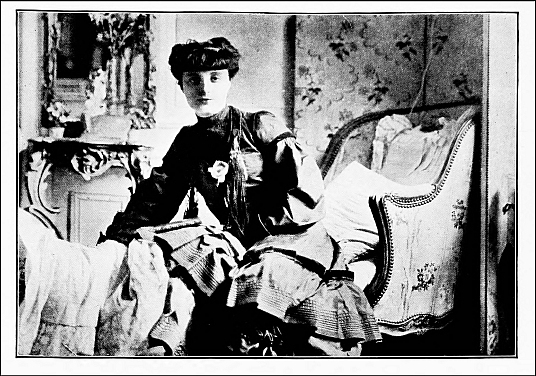
Photo: Dormac To face p. 184
The Countess de Noailles
But in this new volume the Bacchante, the
Undine, of her earlier poems comes back to us in
tears. Like Prince Gautama when he left his
palace, she has encountered love and sickness and
death. She has learned that to live is to suffer;
she has discovered that man (and especially woman)
has a heart to feel, as well as eyes to see with;
that our destiny is always mysterious and generally
sad. This is no longer the vine-crowned Bacchante,
irresponsible as a young and graceful tiger-cub,
whose sole desire was to satisfy her instinct. This
is not she who, in her tamer moments, tuned her
flute in the sunny kitchen-garden under the warm
south wall, hung with espaliers, smiling as she
sang: ‘Yon ripe pear is my heart!’
People will read those earlier poems as long as
they love gardens and the frisky joy of flocks,
and the swift upsoaring flight of the eagle above
the mountain-tops, and all the innumerable many-twinkling
smile of Nature. For so I should have
called her first volume: not the Innumerable
Heart (she had not yet grown a heart) but the
Innumerable Smile, ‘ανἠριθμoν γελασμα. That something
mad, and fierce, and glad, and living, can never
come again, nor that heroic impatience of mortality—and
morality. Our Muse is no longer twenty.
Like Thekla she has ‘geliebt und gelebet’; she has
discovered that inner universe which has no common
measure with the material world; she has loved
and parted; she has loved and lost; she has looked
on the icy face of Death and trembled; she has
stood on the pale verge of the unknown abyss.
As we read these lyrics for their splendid music
we gradually perceive the motives of the symphony.
There is more here than beauty. There is a secret
story intricately involved, as in Shakespeare’s
sonnets or Elizabeth Browning’s. The first poems
confess the end of a passion, still deep, and quick,
but full of quarrels and combats; we feel the
inevitable rupture close at hand, and the disenchantment
which notes the death of a sentiment that our
muse had believed immortal:—
‘Te souviens-tu du temps où, les regards tendus
Vers l’espace, ma main entre tes mains gisante,
J’exigeai de régner sur la mer de Lépante,
Dans quelque baie heureuse, aux parfums suspendus,
Où l’orgueil et l’amour halcettent confundus?
‘À présent, épuisée, immobile ou errante,
J’abdique sans effort le destin qui m’est dû.
Quel faste comblerait une âme indifferente?
‘Je n’ai besoin de rien puisque je t’ai perdu.’
The lovers separate. The meeting had seemed a
prodigy. But the Muse, in a cloud of poetry, has
declared to her votaress her jealousy of a mortal
lover:—
‘On n’est pas à la fois enivrée et heureuse,
L’univers dans vos bras n’aura pas de rival.’
and the great poet (who has also the misfortune
to be a young and beautiful woman) bids her lover
farewell, much as the immortal Diana may have
dismissed Endymion:—
‘Allez vers votre simple et calme destinée;
Et, comme la lueur d’un phare diligent
Suit longtemps sur la mer les barques étonnées.
Je verserai sur vous ma lumière d’argent.’
In vain he protests and begs her to consider how
void and out of shape her days will hang, bereft
of the substance of so rare an affection. A dreary
isolation, a self-centred ambition, are surely less
propitious to poetry than a sympathy communicated,
not only between two hearts, but between
two minds? (The man’s part of the dialogue we
must more or less supply.) The fact is, she is
tired of him, or rather of the storm and stress of
passion, and she replies with an absent look:—
‘Je n’avais plus besoin de vous pour vous aimer....’
‘Mon amour, je ne puis t’aimer! Le jour éclate
Comme un blanc incendie, au mont des aromates!
Le gazon, telle une eau, fraîchit au fond des bois;
Un délire sacré m’entraîne loin de toi.’
She is relentless, and all the more relentless
that she forgets nothing of their old delights.
Since Sappho has any woman uttered such a
burst of passion as she pours out in shameless
reminiscence in the marvellous lyric entitled ‘T’aimer.
Et quand le jour timide ...?’ (the day may enjoy
as much timidity as it pleases; the poetess leaves
all her share untouched). Here are the accents of
desire, the voice of nature naked and unashamed;
but it is the evocation of a love consumed and
finished. The remembered flame is now a handful
of ashes:—
‘Ô cher pâtre, inquiet et désormais terni,
J’ai vécu pour cela, qui est déjà fini!
Is there any happiness to equal our anticipation
of happiness? Only in listening to music can the
wearied beauty still believe: ‘Qu’il existe un bonheur
qui ressemble au désir,’ and then the melody
of Schumann seems to ring with a reproach, a
warning, a presentiment, a final certainty:—
‘Je vois, là-bas, dans l’ombre dépouillée
Du jardin où le vent d’automne vient gémir,
Les trahisons, les pleurs, les âmes tenaillées,
Le vieillesse, la mort, la terre entre-bâillée.’
At this point we lose the clue, and wander a while
in the Pindaric labyrinth of lyrics. A new love,
fresh, kind, and young, appears (we think) on the
horizon. Mindful of her ancient rigours, our muse
hesitates:—
‘Je porte un vague amour, plus grave et plus ancien,
Qui t’avait précédé et ne peut pas te suivre.’
Yet she does follow her mortal lover. And
again she feels that Nature rejects her, thrusts her,
with a flaming sword, forth from her Paradise
into a disordered world of souls and bodies:—
‘Tu n’es plus cette enfant, libre comme la flamme,
Qui montait comme un jet de bourgeons et d’odeurs.’
This new love is of a different sort, turned towards
eternity, and sometimes, as in the song called Un
Abondant Amour and also Je ne puis pas comprendre,
encore que tu sois né, we feel that it is perhaps the
love for a child. In any case, her passion is for
some creature still innocent and tender. And this
new feeling—the point of departure for the eternal
life—does really estrange the poetess from her
frenzied pantheism.
‘Je ne regarde plus
Avec la même ardeur un monde qui m’a plu.
Mon esprit tient captifs des oiseaux éternels....
Je songe au noble éclat des nuits platoniciennes.’
But Fate intervenes to separate the two lovers.
A lyrical intermezzo drags the pageant of a broken
heart through all the miracles of Italy. The universe
has avenged itself upon the woman; she is no
longer the child of the sun, the sister of the winds,
but an unhappy mortal everywhere estranged.
And in this desolation, this fast in the desert,
there dawns upon her the mystic apprehension of
the spiritual world. A series of poems, entitled
Les Élévations, enshrines, this experience of our
eternity:—
‘Mon Dieu, je ne sais rien, mais je sais que je souffre
Au delà de l’appui et du secours humain,
Et puisque tous les ponts sont rompus sur le gouffre,
Je vous nommerai Dieu, et je vous tends la main....
‘Les lumineux climats d’où sont venus mes pères
Ne me préparaient pas à m’approcher de vous,
Mais on est votre enfant dès que l’on désespère
Et quand l’intelligence à plier se résout....
‘Comme vous accablez vos préférés, Seigneur
Il semble que votre ample et salubre courage
Veuille assainir en nous quelque obscur marécage,
Tant vous nous arrachez, par des sueurs de sang,
L’âcre ferment vivant, orgueilleux et puissant.
On pense qu’on mourra du mal que vous nous faites,
Et puis, c’est tout à coup la fin de la tempête.’
But once again a flaming sword waves before her
eyes and drives her forth from the common experience
of humanity; even as Nature and genius
banished her from love, so the cold hand of death
shuts her out from religion. Her beloved dies;
and she has looked on his waxen face, and seen
the leaden coffin go down into the grave.
This terrible moment—which has driven many
in a panic of anguish from the despair of this world
to the desperate hope of a Beyond, as a stag harried
and hunted to the extreme edge of a cliff will
spring into the sea—this ‘sombre accident quotidien
de la mort’ immures our poetess in the prison of
a stoical grief, where sometimes (but very rarely)
rustle the wings of that angel who led Peter out
of his captivity. In that austere infrangible house
of mourning she remains, aloof from life and Nature,
choosing this living death rather than the treason
of a life renewed and fruitful, though bereaved.
There she sits still, forgetting the spring and the
summer, and looks in a white agony upon the face
of Truth. And in verse as firm and full as that
of Emily Brontë, she recites the sterile lesson she
has learned:—
‘Je m’emplis d’une vaste et rude connaissance,
Que j’acquiers d’heure en heure, ainsi qu’un noir trésor,
Qui me dispense une âpre et totale science;
Je sais que tu es mort.’
MADAME COLETTE
Imagine a young girl in the country, very young,
very fresh, sensitive to the finest degree, upright,
credulous, and doubtless dainty as a daisy; imagine
her in the flower of her youth married and carried
off to Paris—to the decadent Paris of the nineties—by
a man of the world, who is also a man of
letters and a man of science, intelligent, corrupt,
and cynical as Mephistopheles himself. No, I
am not telling you over again the story of
‘Madeleine Jeune femme’; I am telling the
history of Madame Colette, and it ends differently.
There is, it seems, an amusement in elaborating
the sentimental education of a young bride, in
complicating it with excursions into vice and into
art; brief, the gifted and immoral author who
chooses to be known as ‘Willy’ was pleased to
make over his wife in his own image. She was an
artist to the ends of her finger-tips, and they wrote
books together—the famous series of Claudine—hailed
with delight by all that is least strait-laced
in Paris (and, in those days especially, there was
very little screwing about the moral waist of one
sort of Paris!). For Colette Willy realised a personage,
always charming to the man about town
in its candid perversity, that of the innocent
wanton, or (to quote the title of one of her stories)
L’Ingénue Libertine.
One day I bought one of these Claudine books;
it was called Claudine en Ménage. I opened it
and thought it delightful. What an admirable
style, firm and free, full of nature, full of grace,
and the character of the girl, at once shrewd and
naïve, pleased me immensely ... and then I
began to wonder.... And then I did not know
what to do with the book! I would not place it
on my shelf, I could not leave it lying on the table.
Finally, remembering a certain lyric of Robert
Browning’s, I took it out into the forest and dropped
it deep in the hollow trunk of a tree. There, among
the pale wood-lice, and the centipedes, and the
fungus, Claudine in her seclusion, finds audience
fit though few.
One day it must have dawned on Madame Colette
Willy that all men were not made on the same
pattern—that there was fresh air somewhere in the
world even for a married woman—that a man might
be a support, and a comfort, and an example—or
perhaps, more simply, that one might do without
one altogether. Anyhow, Madame Colette Willy
became Madame Colette; she divorced her collaborator
and began her ascent out of Avernus. She
was, in these new conditions, obliged to earn her
living, and, mindful of the prices paid for even a
successful book, she complicated her profession
as woman of letters with the career of a Variety
Artist.
That is to say, she went on the music hall stage
and was immensely applauded; and I am sure she
is a splendid variety artist—just as I am sure that
Marguerite Audoux must have had a lovely ‘cut’—just
as I know (and as any one who goes to the
Place des Vosges can see) that a great cabinet-maker
was spoiled in Victor Hugo.... The music
hall feeds its flock. After a few years Madame
Colette returned to literature—returned, I mean,
to the exclusive practice of literature, which she
had never really abandoned—henceforth independent.
A Paris music hall may appear a strange place
of purification, but it all depends on what one is
used to. The courage, the indefatigable industry,
the gentleness, the charity and kindliness of her
new companions impressed Madame Colette; and
she admired the relative pureness of their lives.
We see her, in our fancy (like Roumanille when he
contemplated the lambs frisking in the meadows),
gazing on the clowns, and the quick-change artists,
and the circus-riders, and the dancers, and the
leaders of performing dogs, as she murmurs:—
‘Coume fan ben tout ço que fan!
Et l’innoucénço, coum es bello!’
And gradually her novels showed the influence
of a healthier environment. It is true that at first
she wrote Les Vrilles de la Vigne. But her last
three volumes possess (with rare literary beauty)
a freedom of soul and a sensitiveness which at
least, to my thinking, go far to compensate a little
colour-blindness as to morality. Experience has
rendered her wise and sad, indulgent and serene;
it has shown her how to organise her impressions,
so that her art—simple as it is and apparently
facile—has some of the qualities of a philosophy.
In the terms of a metaphor dear to Mr Henry
James, her novels henceforth are, not a slice of
life, but an extract, an elixir.
Not that her last three volumes—La Vagabonde,
L’Envers du Music Hall, and L’Entrave—are to be
recommended without precaution. They are very
free; they describe a world beyond the precincts
of conventional morality, and they are also very
Pagan. There is mighty little inner life in the
world of Colette Willy! But those who read Mr
Compton Mackenzie or Mr Maxwell will, after all,
find nothing more alarming in La Vagabonde, or
even in L’Entrave. And they will admire a natural
and yet exquisite faculty of expression—it is difficult
to write with a more delicate exactness than Madame
Colette—and also a psychology, and a sort of disenchanted
mansuetude, that go hand in hand with
a love of youth, a sense of youth, quite extraordinary.
For my part, I find the lady very taking;
but I do not recommend her to the more serious
admirers of Paul Claudel.
In La Vagabonde, we see her as a music hall
star, dropped from the sphere of the woman of
the world, and all the happier in her new orbit,
although aware she is a stranger there. Men, of
course, pay her court, and one of them, Maxime
Dufferein-Chautel (whose tender, bourgeois, authoritative
nature is admirably depicted) comes very
near to being her lover, and proposes to make her
his wife. But Max, good, solid, faithful, is the least
subtle of lovers—a great, affectionate Newfoundland
dog of a man. And Renée Néré, the vagabond,
who has borne so resentfully the yoke of her first
husband’s heart, fears to suffer as much from the
narrowness of a second husband’s brain. She cannot
resign her liberty to an inferior, and, on the eve
of their marriage, she sends him a cruel little
letter:—
‘Max, mon chéri, je m’en vais,’
and is off with her troupe on a tour to the New
World.
On the first page of L’Entrave, she has met
again with this old lover, or rather, herself unrecognised,
she has seen him pass, one day at Nice, on
the Promenade des Anglais, he, his young wife, and
his little child. He has not mourned her long!
And Renée feels oddly dispossessed: no one, nothing,
belongs to her; she has no place in the world for
she is no longer a star of the stage. A convenient
inheritance has given her the means of liberty—that
liberty she coveted of old—and she strays
from hotel to hotel on the Riviera mixing with
theatrical visitors, frequenting the better sort
(which, I suppose, means the wealthier sort?) of
demi-monde, yet oddly out of place among these
amiable barbarians who have neither an idea nor
an ideal.
The most barbarian of all is little May, a young
hetaira à la mode, fresh, fair, and five-and-twenty.
Renée is a dozen years older and ought to know
better; but she steals poor May’s lover away from
her; and she shackles herself with this uncultivated
young man for life, because she loves him; and
it is the first time that she has loved. Ah, she
no longer asks herself: is he her equal?...
Madame Colette, like her heroine, has consented
to the hobble, to the shackle, to L’Entrave. She,
too, has married, has found for herself again a
place in organised society, has seen open out before
her unsuspected interior horizons, and murmurs
perhaps, like Renée Néré:—
‘Se peut-il, Beauté, que je te préfère l’âme qui t’habite?’
And I await her next novel with almost a tremulous
expectation.
MADAME MARCELLE TINAYRE
When Madame Tinayre published her Maison du
Péché, we thought in France that we had discovered
our George Eliot. We pitched our hopes too high;
Madame Tinayre is not even a George Sand. But
she is a very interesting and gifted novelist. If
that first book was of a new and veritable beauty,
superior to any which has as yet followed it—but
Madame Tinayre is young—it is because the
conception of the story entailed a certain simplicity
and order of composition, an art of opposition and
construction, a severity of style even—in fact, the
qualities in which our novelist is generally lacking.
Her talent in her subsequent works is no less rich
and imaginative; but there is the difference between
a rose-tree covered with flowers trained over an
espalier, and the same lovely crimson rambler
left without support, and dropping half its fragrant
burden in the dust.
Madame Tinayre, like most women writers, is
endowed with an exact and attentive faculty of
observation; like very few women writers, she has
a sort of magic, similar to colour or melody, which
often disguises the poverty of her compositions;
her art aspires to the condition of music; she, too,
might say with Saint Hildegard, ‘Symphonialis
est anima.’ She knows how to project, from her
mind into ours, a violent, an incomparable
sentiment, as the waters in the marble fountains
of Versailles overlap and drop from one
basin into another. And she has the culture of
a man.
These are great gifts, sometimes impaired by a
certain warmth and coarseness in the treatment of
love,—an offence rare in male writers, however
libertine, but which hurts our taste occasionally
even in a Mrs Browning (for instance, in Aurora
Leigh); and sometimes her fault is a lack of
measure and order which lets her books meander
in a perpetual flux, branching hither and thither,
instead of moulding and rounding them into the
fore-established harmony of a perfect sphere. In
brief, Madame Tinayre is a romantic. But just
once, as it were by accident, she consented to the
classic discipline. And nothing in literature is so
charming, so touching, so delightful, as a romantic
who submits to be a classic.
That ‘once’ was, of course, when she wrote
La Maison du Péché. Her art, so often too literal,
and, as it were, photographed from reality without
arrangement (as in the greater part of La Rebelle),
at other moments excessive and satiating in its
lyrism, found on that occasion the exact middle
path between experience and imagination. There
is not only passion in the book and beauty, but
solidity, balance, meditation, reason; there is not
only spontaneity and grace, but a large and firm
knowledge of life, a perspicacity, a sincerity beyond
praise. It has the qualities of poetry and the
virtues of prose.
In this novel, Madame Tinayre shows us the
clash and the conflict, the attraction and the repulsion,
which cause a continual contest between the
two halves of France, equally important and
irreducibly different. Born into one of these
spheres, married into the other, Madame Tinayre
is at home in either. Her Augustin, so pure and
grave and true, so narrow, so weak, so passionate,
is the brother of M. Rolland’s Antoinette, is the
great-nephew of Pascal. He is a type which has
always existed in France, admirable but dangerous,
for he is incapable of understanding his contrary.
Among French Protestants, Jansenists, strict proverbial
Catholics, in certain austere university
circles, there are many variations on the type
of Augustin. And Fanny, the charming Bohemian,
light-hearted Fanny, an artist to the tips of her
fingers but only very dimly conscious of being
an immortal soul (a pretension which Augustin
never abandons for an hour), is not Fanny the very
flower of a different, a more frivolous, a lighter,
brighter France?
The contact and the conflict of these two natures,
their ill-starred, impossible love, is all the story
of La Maison du Péché: one of the most moving
stories of our times. There are readers, there are
even critics, who prefer Madame Tinayre’s subsequent
novel, La Rebelle. I have some difficulty,
I admit, in catching their point of view. I prefer
not only La Maison du Péché, but even that
exquisite piece of still-life, François Barbazanges,
which some have condemned on the ground that,
though it was art, it was not life. La Rebelle is
much more life than art. The background, a
fresco of popular Paris, is vast, living, and exact;
indeed it is too vast, too living, too exact, for it
distracts our attention from the rather ordinary
characters who occupy the foreground.
And yet there is a great charm in the drawing of
Josanne Valentin, the brave young woman-worker
married to a neurasthenic invalid—that charm of
poignant sincerity which sometimes, in a woman’s
work, makes the reader’s heart beat quicker, as
though he had suddenly stumbled on a private
confession. Josanne is so courageous, so tender,
so kind, that we forgive her conjugal infidelity,
and chiefly regret that her lover should be so
obviously unworthy of her.
He abandons her—we knew it!—and how
pathetic is the scene of their parting—out of
doors, in the street, poor Josanne encumbered
with the filet—the net—in which she is carrying
home the materials for the family dinner. That
parting scene is unlike any other in fiction in its
heart-piercing realism! But Josanne is young,
and when the morphino-maniac of a husband
(tenderly nursed to the last) departs this life; when
Josanne falls in with a high-minded radical philanthropist
of the most advanced views, we murmur,
much relieved: ‘Tout s’arrange.’
For Noël Delysle and Josanne Valentin are alike
apostles of a magnanimous democracy: he, a
social reformer, author of that notable work, La
Travailleuse; she, herself a woman-worker, the
feminist reporter of a ladies’ newspaper, in constant
contact with the poor in need of help, and the
fevered, fussy world of philanthropy. Self-subsisting,
‘generous’ in the wide sense which Descartes
gives to the word, Noël Delysle and Josanne
Valentin alike reject the tyrannous old dictum of
Arnolphe:—
‘Bien qu’on soit deux moitiés de la société
Ces deux moitiés pourtant n’ont pas d’égalité.’
For them, the woman-worker, self-supporting,
independent, has attained a moral and social
equality with man, and should be judged by the
standard of what Mr Shaw, we believe, has called
the New Morality.
They both possess that ‘vraie générosité’ which
consists in self-reliance, strength of will, endurance,
contempt for opinion, and respect for the liberty
of others. Descartes thought nothing more useful
than to foster a race of such generous individuals,
‘sachant subsister par soi-même ... pour ce qu’ils
n’estiment rien de plus grand que de faire du
bien aux autres et de mépriser son propre intérêt.’
And, despite one secret blemish in her past, Josanne
feels herself a member of this élite, a factor of
progress. Nor does she attach any great importance
to a back-sliding which is not esteemed too damnable
by the men and the women of the New
Morality. She makes her confession to Noël
Delysle in much the same spirit as Tess of the
D’Urbervilles unbosoms herself to Angel Clare.
For reformers are prompt to forget that what
was human nature in the past, what may be human
nature in the future (should they and others persist
in their modern ideal), is not human nature now.
The mind of man has modified all things around
him and within. From the seeding-grasses in the
hay he has produced the varieties of corn; from
the small and acid crab-fruit in the hedge, the
rennet and the Ribston pippin; and from the poisonous
roots of foreign forests our daily domestic
potato. Our morality is another product; we may
modify it yet further; such as it is, at present it
remains our staff of life. And the staunchest
feminist in the world, if he be a man and in love,
will expect his wife to be tender, chaste, and
faithful, and care little enough whether or no she
be self-reliant, generous, and brave.
Noël Delysle is a stronger man than Angel
Clare, and proportionately less hard and dour;
but he receives the shock of Josanne’s confession
with little less dismay. He learns then that the
little stepson who will share their home—the child,
he imagined naturally, of the unfortunate Valentin—is
in reality the son of Josanne’s lover. In
treating such a situation, Madame Tinayre is at
her best. The central fact of all her novels is the
struggle between nature and nurture, between
instinct and convention. Deep, deep below the
intellectual superstructure, the primitive man, the
primitive woman, stir in her heroes. His virtues
and tolerances fall from Noël Delysle, leaving him
jealous and passionate; her valour and self-reliance
fade in Madame Valentin, and Josanne, the rebel,
becomes the merest woman.
La Rebelle is an interesting book, but how much
do I prefer (though its faults he thick upon it)
L’Ombre de l’Amour![2] The tale rambles on as it
pleases, independent of design or composition,
poorly constructed enough with its two long parallel
lines, as monotonous, if as impressive, as those
low, even cliffs which enclose between their grassy
walls some Limousin or Gascon valley.
Bis repetita placent is a good motto if we wish
to amuse; for (as Bergson has pointed out) there
is something comic in reiteration, in a repeated
misadventure, and especially in a double fall—every
clown knows that! In spite of the rare
beauty and sincerity of the character-drawing, this
tale of two pure girls stumbling, one after the other,
in the same secret slip, does produce an effect of
painful ludicrousness.
The defilement of a young girl in her innocence
is the most pathetic of themes, but it is its singularity
alone that makes it touching. Mephistopheles,
in his cleverness, degrades the misery of poor
Gretchen when he observes: ‘Sie ist nicht die
Erste.’ We must imagine no angel ever tripped
before; we must have very present in our sight
the state of innocence from which she is thrust
out. So the wise Walter Scott places beside his
sad Effie the peerless Jeanie Deans. So George
Eliot relieves the abasement of Hetty by the pure
brilliance of Dinah. But in this novel of Madame
Tinayre’s, there are but two young girls, and, by
an inconceivable error, she involves them both
in the same miserable mystery. Involuntarily we
protest. I, for my part, protested, and the novelist
replied:—
‘Il me semble que votre principale objection porte
sur le double effet d’une double aventure, qui vous
paraît un artifice littéraire. Mais, dans ma pensée,
il fallait que Fortunade complétât Denise, que la
pitié spirituelle pour le maudit aboutit au même
échec que la pitié plus physique pour le malade.
Fortunade, c’est, en tout petit, Eloa. Je crois
que ces ‘doubles’ ne sont pas sans exemples dans
les grandes œuvres de la littérature, et que de
glorieux précédents auraient pu m’enhardir, si
j’avais hésité. Dans la réalité même on voit des
âmes de même nature se deviner et se rapprocher.’
The literary doubles of which our author speaks
are a charming device when the novelist treats
of what is normal, salutary, or pleasant: we love
to see Rosalind by the side of Celia, or the Two
Gentlemen of Verona; but we should not care to
look at two Quilps, or two Deformed Transformed,
or two Gretchens, or even two dumb girls of Portici.
The abnormal does not suffer repetition.
So I persist in my protestation, and all the more
because I love and admire the two sweet girls, so
pure, so devoted; ruined and debased, the one by
pity for a man’s bodily sufferings, the other by
compassion for his moral state. For Madame
Tinayre, following the theories of Spinoza and
Nietzsche, looks on pity as a debilitating emotion,
relaxing the fibres of the soul and predisposing to
an ignoble self-surrender.
But how charming is the first half of this novel;
the opening scene in the country doctor’s dining-room,
with the two girls seated in the red-paved
parlour that smells of damp bricks and freshly-washed
linen and ripe apples. Denise, the young
lady of the house, is the soul of a home:—
‘A perfect woman, nobly planned
To warn, to comfort, and command——’
a large human type, as easily imagined in England
or Scotland as in Central France. But the girl
who sews at her side is essentially Limousine, her
very name, Fortunade, recalls the pathetic head
of the girl-saint of the Corrèze whom she resembles—pensive
and slim, with the pursed, plaintive
mouth, the suffering grace of her profile, and the
something dreamy, sweet, yet almost sullen that
makes her appear half a Gothic angel and half a
scolded child.
Fortunade Brandou is only a little peasant, the
daughter of the village innkeeper, who goes out
sewing by the day to the few gentlemen’s houses
in the countryside. But all the dreams, all the
visions, all the missionary fervours and superstitious
fears of a Celtic race are locked beneath
the smooth black braids of her roundly projecting
brow. Her longing is not to be happy, but to
expiate, to redeem, to fly to the rescue of the
oppressed. She must up and grapple with sin and
sorrow. She cannot let the evil-doer perish before
her eyes. Fortunade, with her feeble body full of
suffering grace, her doleful smile, her plaintive
voice, has the soul of Corneille’s Pauline, destroying
the idols of the Temple and braving the Proconsul;
has the faith and the fervour of a Joan of Arc,
letting slip her shepherd’s crook to grasp an
enchanted sword.
And, even as she must suffer and struggle for
the moral welfare of her fellow-mortals, so Dr
Cayrol must needs overcome and stamp out disease.
Each of these personages is a type—complete,
rare, and living—animated with an extraordinary
racial truth. In describing the peasants and the
mountain of Corrèze, Madame Tinayre puts us in
contact with her own familiar country. There
are few more beautiful in France as scenery; none
more noble as a focus of human character.
Those who have studied the deep wave of moral
feeling which broke over France between the fall
of the First and the rise of the Second Empire—students
of the Saint-Simonians, historians of ‘48—have
always been struck by the great proportion
of men from the southern centre—from Auvergne
and Corrèze—generous, philanthropic, active sons
of Utopia, brusque and kind, avid for justice as
the prophets of Israel. These minds, less intellectually
or theoretically great than large and magnanimous,
form one of the finest categories of the French
character.
In no novel have we come across so adequate a
presentment of them as in the village doctor—worthy
confrère of Mrs Gaskell’s country surgeon
and of Balzac’s médecin de campagne—the rustic
savant, interested in the scientific and social movement
of his times yet homely in his private tastes
and standards of life; parsimonious in pence,
and liberal with his rare gold pieces; distrustful
of all strangers, yet quick to harbour a fresh chimera;
prompt to anger; to all appearance just a son of
the soil, a hearty meat-fed man, fond of his glass,
fond of his pipe, fond of his gun, striding at ease
in his strong solid shoes and his old country clothes—but
a sage for all that, and nearly a saint; a
man, at least, in the best sense of the word, with
the root of the matter in him. Such a man, choleric,
proud, and kind, is Étienne Cayrol, at once the
hero and the father of the heroine in L’Ombre de
l’Amour.
We recognise him at once and love him from
his very entrance on the twelfth page, when he
comes in, out of the mud, and the dark, whistling
the air of a country reel, and greeting, with kind,
quizzical observant eyes, the two young girls
mending the linen in his parlour.
‘Il avait un visage de vieux chef gaulois, coloré,
couperosé aux pommettes, les cheveux gris, l’œil
bleu saillant, le nez aquilin, la mâchoire solide
sous une longue moustache dédorée. Comme il
inclinait la tête, on voyait l’attache puissante du
cou, et cette forme du crâne qui s’unit à la nuque
par une ligne droite, caractéristique chez les gens
du Plateau central. Les épaules étaient carrées,
le torse trapu; les jambes un peu arquées devaient
peser lourd sur le sol. Toute la personne—sans
finesse mais non pas sans noblesse—d’Étienne
Cayrol, révélait l’origine paysanne. Elle exprimait
la force, une force stable, lente, réfléchie, sûre
d’elle même.’
And yet (an observation admirably in accordance
with the history of the type) some secret defect
of judgment condemns the dearest schemes of the
doctor (so well considered, so unselfish in their
working out, so noble and yet practical in their
aim), but destined none the less, to miscarry and
‘gang aft agley.’ His unfinished sanatorium scars
the hill-top with the mean unsightly ruins of uncompleted
work; and the consumptive youth,
whom he takes into his own home to nurse back
to health, not only dies, but seduces the doctor’s
only daughter: the girl who was the pride of his
heart, as the sanatorium was the dream of his
mind.
Denise Cayrol is a noble creature, strong, kind,
and pure. At twenty-seven years of age she no
longer thinks of herself as a young girl; she is not
concerned with love and marriage, and it is rather
with a half-maternal, half-sisterly devotion that
she tends the young consumptive, a few years
younger than herself, who is so eager to live, so
ardent in loving, and whom her clear, reasonable
judgment and pitiful heart see from the first as
marked with the signs of his doom. Denise attracts
the hapless Jean with all the force and promise of
her health. When the doctor suspects the secret
engagement that binds his daughter to his patient,
he is both jealous and indignant (for he cannot
conceive how a woman can love a consumptive),
and he sends Jean away into a sanatorium. But
Jean falls ill; Denise rushes to his death-bed, and
then and there (in a wild pitiful desire to pour
out all the best of life, in one moment, while there
is time) she yields to his fevered desire; she
succumbs.
There were two girls seated in the red-paved
parlour, that smelt of damp bricks and freshly-washed
linen and ripe apples, when the doctor
strode in from the dark night outside, on the
winterly evening which opens the novel. The second
is Fortunade Brandou, the little village dressmaker,
the mystic; an ill-judged pity lures her, too, to her
undoing. When Veydrenne, the poacher, the
outlaw, breaks his leg, Fortunade tends the village
miscreant in his illness and strives to save his
soul:—
‘Ce serait si beau de sauver cette âme!’
Alas, when did the wolf listen to the voice of
Little Red Riding Hood? The sweet, the mystical,
the charitable Fortunade fell prey to a wild beast,
and the deep gorges of the mountain torrent
received the soiled, childish body that dared no
longer affront the light of the sun.
‘Morte, morte! non par le hasard d’un faux pas,
non par un chagrin d’amour, elle n’avait jamais
aimé que Dieu, la chaste fille: Dieu et ses pauvres!
morte pour être allée vers celui que tous haïssaient;
morte pour avoir tenté l’entreprise folle de sauver
une âme perdue!... Perdue elle-même sans doute,
brutalement outragée, deux fois victime, elle
avait payé de sa pudeur et de sa vie l’imprudence
sublime de sa pitié.’
These characters are conceived with the sure
and intimate reality that comes of kinship; we
feel that Madame Tinayre is of their race and their
habitation. Here, her foot is on her native heath,
and she compels our interest far more powerfully
than when she writes of Paris (her Paris is always
a little too ‘Rive gauche’); when she pictures her
Corrèze, when she evokes the mountain scenery
round Brives or Tulle, I think no French novelist
since George Sand has possessed so masterly a
touch in peopling a living landscape with living
beings. Indeed, remembering the pastoral novels
of Our Lady of Nohant, recalling ‘Marie Claire,’
comparing them and this book of Madame Tinayre’s
with The Mill on the Floss and Adam Bede, it seems
to me possible that one of the greatest gifts of
woman as a novelist may lie in her singular power
of rendering country life in all the variety of its
personages, its customs, and its natural background.
MLLE. MARIE LENÉRU
A line from one of the essays of Suarès might
serve as a motto for all the plays of Mlle Lenéru:
‘La conscience malade, voilà le théâtre de la
fatalité moderne.’ A sick conscience, a soul diseased—in
other words, the problem of evil; or, in more
modern phrase, the war between an over-developed
personality and the rights of others; such is the
theme which her genius, at once lucid and sombre,
ardent and logical, treats with a penetrating passion,
with almost, as it were, a sort of introspection, as
though, in face of some grave derogation from
current morality, she had said: How did a nature,
apparently excellent, arrive at such a pass? How
should I, in his place, have fallen and yet have
remained consequent with all that I was up to the
moment of failure? So that the dramas of Mlle
Lenéru have the gravity and the spiritual ardour
of an examination of conscience. They seem to
radiate from an inner self full of revolt, passion,
and implacable reason.
Not that Mlle Lenéru is religious. In writing
this little book, it is borne in upon me very clearly
that man, not woman, is really the religious animal.
But Mlle Lenéru is not the usual free-thinker;
she is, so to speak, a theologian turned inside out.
There is about her something of the unfrocked
priest who, whatever his present opinions, feels
himself always a priest, entrusted with the souls
of others and responsible for their eternal fate. She
no longer accepts the promises and the commandments
of revealed religion; but nothing else appears
to her of really great importance.
In all she writes we recognise the conflict of
a proud and ardent character, a passionate and
avid sensibility, with a soul enamoured of honour,
order, discipline, self-immolation; so that we never
know which is the real Marie Lenéru: the impassioned
anarchist convinced that the one important
thing in life is for each individual to become the
most perfect example possible of his own peculiar
type; or the ascetic, eager to sacrifice the visible
and natural life to a life invisible and supernatural.
It is this double nature, doubtless, which gives
so much substance to the plays of this young
writer. She conceals in her heart a romantic
who died young—or rather he is not dead, only
buried in a perpetual in pace, whence his voice
sometimes issues in revolt or appeal; but her mind
is given over to the rule of a bitter and splendid
reason which assures her that neither the State, nor
the family, nor any constituted form of society,
based on a firm tradition, needs genius so much
as order, passion so much as discipline, grandeur
so much as happiness; and indeed in all her plays
she sacrifices (as Brutus sacrificed his sons) the
first of these categories to the second.
Her sensibility remains imbued with those ideals
of individualism and ambition which reigned in
France throughout the nineties: she was born
under the Consulate of Nietzsche and of Ibsen;
but experience and reflection have shown her the
disasters of a moral anarchy which still engages
her sympathy though she augurs no happy issue
for it. On the frontispiece of her first book, Les
Affranchis, she has written a couplet from Racine’s
Titus et Bérénice, expressing this antagonism between
the individual and his environment: two lines in
which the Jewish Queen, sacrificed by her royal
lover to reasons of state (invitus invitam), reminds
him of his duty to himself—and to her:—
‘Rome a ses droits, Seigneur, n’avez-vous pas les vôtres?
Ses intérêts sont-ils plus sacrés que les nôtres?’
And this question resumes a theme which never
ceases to occupy her tragic sense of passion and
her strong intellectual curiosity.
Her first play is the history of a grand passion
in two undisciplined yet superior natures—two
super-mortals—despite society, and law, and
order. Philippe and Hélène are (as Gobineau
would say) ‘Children of the King,’ morally and
intellectually a head and shoulders above the
people. By what process of reflection are they
induced to sacrifice a miraculous possibility of
happiness, a draught such as they alone might
quaff, to rights and duties which they do not
acknowledge? Why, being giants, do they submit
to the bonds of the pygmies? Are they right, are
they wrong in the renunciation? Is there only one
right and one wrong? Such are the questions raised
by the history of her Affranchis—her Free Souls, thus
most ironically named, since, in fact, none of us is
free, and we act, not as we would, nor as we should,
but as we can.
Philippe Alquier is a philosopher, a great professor,
a pioneer of ideas, an idol of the young: in
fact, a sort of Bergson, a sort of Barrès—the Barrès
of yesterday. He believes neither in duty, nor in
the moral law, nor in any Absolute, nor in any
certitude; and he discerns, in the floating relativity
of things, but one obligation, that of augmenting
to its utmost his personality. He is married to a
pleasant, pretty wife, whose irritating mediocrity
is, so to speak, the hall-mark of her virtue: it
is impossible to be more respectable than Marthe.
In the early Twentieth Century, at the dissolution
of French monasteries, Alquier, the philosophic
anarchist, receives under his roof his wife’s
sister, Mother-General of the order of Reformed
Cistercians, Abbess of Fontevrault.
Under his roof—or rather under her roof, for
the Abbess of Fontevrault is co-heiress with her
married sister in the properties which the Alquiers
inhabit, both in Paris and in the country. But
necessity in this case is doubled by no disapprobation:
Philippe Alquier naturally believes in the
rights of minorities. Although politically of the
extreme left, he would in this affair have voted
with the extreme right (as did many Dreyfusards
some twenty years ago, who opposed the banishment
of their political enemies, the Jesuits), and
thus, in the opening scene, the author establishes
her hero’s refusal to allow the tyranny of the
greatest number.
The abbess brings with her a postulate of her
order, secularised like herself, but (in the case of
the girl) before she had pronounced her vows.
Hélène Schlumberger, young, beautiful, intelligent,
and rich, is naturally the heroine of the piece. Her
mind, the fresher that hitherto it has been restricted
to the skyey sphere of theology and ethics, revels
in the wide and indiscriminate culture with which
Alquier delights to enrich it. Nietzsche, Bergson,
Anatole France, she absorbs all without a protest.
Naturally, history repeats itself, and Abelard falls
in love with Héloïse, and Héloïse still deeper in
love with Abelard.
What, in this conjuncture, is the duty of a free
soul? Shall Philippe Alquier divorce his faithful,
admirable, uninspiring wife? Shall he keep a
virtuous young lady as his secret mistress? He
makes both these proposals, but he makes them
as one who feels how impossible they are. For we
act, not in accordance with what we actually think
and believe, but as persons still inspired by what
we used to think and have long been in the habit
of believing: when Alquier proposes a divorce to
the girl he has educated in the ideas of Nietzsche,
her first instinctive cry is: Et les autres? She is
an altruist still, and a Christian, in spite of herself,
and acts according to an impetus given years ago,
perhaps before her birth.
Hélène in the convent to which, unbelieving,
she retires, is happier, probably, than she would
have been as Alquier’s concubine (setting society
at defiance) or as his wife, Hagar enthroned, having
sent out the lawful Sarah into the wilderness. In
the convent at least she finds, if not a faith, a rule
of life. A discipline and an ideal are things more
intimately necessary to her soul, such as the ages
have formed it, than the happiest passion, if
satisfied in their despite. And Alquier, too, will
acquiesce. When he threatens the abbess with
political reprisals, with the ruin of her order, she
smiles:—
‘Vous ne ferez rien de tout cela, Philippe, et
vous me donnerez votre fille à élever.’
In her second play, Le Redoubtable (produced at
the Odéon Theatre in January, 1912, and withdrawn
by the author after three representations),
Mlle Lenéru shows still more forcibly the monstrous,
the almost cancerous growth that a too exasperated
personality may become in an organised community
of mediocrities.
Georges Malte is the most brilliant naval officer
of his promotion; all that an individuality can
acquire and possess in one generation, he has
acquired, he possesses. But nothing else, neither
traditions, nor inherited breeding, nor the instincts
of a gentleman, nor even fortune; Malte is the son
of an Italian pastrycook, and no more French by
birth than Napoleon, or Zola, or Gambetta—who,
after all, were pretty tolerable Frenchmen. And
his soul is devoured with ambition for the refinements
he does not inherit; and his mind is consumed
by the desire to be first, by that amor
dominandi which is, in certain natures, the strongest
passion of all.
And his heart is wholly occupied by the mistress
he adores, who is, most simply and most naturally,
all that he can never be: the child of a ruling race.
Laurence Villaret is the daughter of one admiral,
the wife of another. For six years she and her
lover have belonged to each other in secret, and
at length the time comes when Malte (who in his
love of supremacy has affected the rich man) feels
his creditors close upon him and disgrace near at
hand. Money he must have or farewell to his
career, good-bye to the love of his life.
Unfortunately, a brilliant officer has always at
his disposal one means of raising funds—if he listen
to temptation. And Malte listens. He communicates
to a foreign power certain secrets, and the
good ship Redoubtable is rendered worthless—just
as the Affranchis were not free; just as La
Triomphatrice will be shown to be an unloved,
broken-hearted, solitary woman. All Mlle Lenéru’s
titles are epigrams of irony! Yet, in Le Redoubtable,
Mlle Lenéru has given us the reductio ad absurdum
of her former theme. If, at the close of the
Affranchis, we doubted whether the lovers were
wise in sacrificing their utmost joy ‘au bon gouvernement
du monde’ (and such is the contagious force
of passion that we had left the theatre happier
after seeing them elope to some undreamed of
isle), we doubt no longer when we have seen Le
Redoutable.
Although we may admit that the moral law is
in process of evolution, though we may look
forward to a day when a new vital order shall
supplant our established order, yet, meanwhile,
we must observe the rules of the game, even though
they mean no more to us than the rules of a game!
In fact, however we choose to think, there is but
one profitable way of living: that which consists
in treating as fundamentally true those truths alone
which have weathered the experience of generations.
Foris ut moris, intus ut libet. Or as Pascal
puts it: ‘Il faut dire comme les autres, mais ne
pas penser comme eux.’
And so Mlle Lenéru, one of the rare individualists
of the younger generation, Mlle Lenéru, so romantic,
with her love for the noble, the exceptional, with
her revolt against platitude and mediocrity, repeats,
in a mood of revolt and irony, the refrain of Jules
Romains:—
‘Nous cessons d’être nous pour que la Ville dise: MOI!’
This young writer, so extraordinary by reason
of her depth of meditation, and the strange Pascalian
vigour and beauty of her language, was the
more surprising (and yet perhaps the more
explicable) because of a singular infirmity: she
lived immured in an interior world. If, indeed,
her short-sighted vision perceived a vague image of
our earth and its inhabitants, the noisiest city
left her undisturbed to her reflections. Mlle
Lenéru was absolutely deaf. She heard no echo
of the applause which greeted the Affranchis.
In 1918 when the comedians of the Théâtre
Français read and accepted ‘à l’unanimité,’ her
new play, La Triomphatrice, she alone remained
unmoved. The blindness of Milton, the paralysis
of Heine, the deafness of Beethoven, have accustomed
us to these ironies, or compensations, of a
mysterious fate.
The humble ferment which produces alcohol
when its development is checked and interrupted,
flourishes as an unproductive mildew if its organism
find all that it requires. An obstacle is often the
stimulus of genius. But when genius has made at
last a pearl of the wound, a ruby of the fissure,
and turned starvation into rapture, how cruel
appears the sudden fate that snatches the hard-earned
prize from its grasp! Marie Lenéru died
of the grippe on the 23rd of September, 1918.
THE PASTORAL NOVEL
There has always been a pastoral novel in France,
because France is an agricultural country. Except
milk, meat, and a little bread, England draws too
little of her nourishment from her own resources;
her plenty is a cheap import; and even the beauty
of much of her landscape suggests an indifference
to agriculture. We have known a French admirer,
confronted with a marvellous panorama of wild
Sussex heath—wood, grassy links, and gorse-covered
common—contemplate the scene and sigh,
‘Rien, rien, rien, à se mettre sous la dent!’
France, on the other hand, is self-sufficing,
almost self-supporting, and always has been so.
If we consider the Duke of Berry’s Book of Hours
we realise that in many parts of France the business
of life has continued almost unchanged since the
Fourteenth Century. From the pruning of the
vine in February (our month of March) to the
fattening of the swine in the oak-woods in November,
while the wood-cutters mark the trees for felling,
here are just such scenes as the dweller in rural France
has constantly before his eyes to-day, unaltered—scenes
which the accumulated associations of
countless generations have invested with a human
interest more poignant, more intimate, than any
which mere landscape can afford. And we admire
the French peasant; his frugality, his industry,
his endurance are indeed beyond all praise; his
economy is marvellous, and such is his good humour
that he makes a pleasure of his self-denial; miserably
lodged, poorly fed, he is conscious of no
inferiority; he knows himself to be the backbone
of France.
The peasant and the landscape for ages have
remained unchanged. France is so large a country,
with so great a variety of soil and climate, that
there are all sorts of French peasants: materialistic,
clean, bright, and gay, in Touraine and the Charentes;
superstitious, poverty-stricken, imaginative,
in Vendée and Brittany; good-humoured, ambitious,
and positive in Auvergne—and so on through all
the nations of France. When you knew the place,
you knew the peasant—until quite lately. The
‘regionalist’ (the provincial) novel has come into
being just when the field labourer himself has
ceased to be regionalist, or provincial; for military
service is a wonderful leveller and unifier.
Until the middle of the last century (until, that
is to say, the days of George Eliot in England and
the latter days of George Sand in France), a
Fourteenth-Century peasant might have revisited
his country parish almost anywhere in France, and
have noted little alteration to mark the flight of
time. The last fifty years have made more difference
in rural matters than the five centuries that
went before them. The dairy farms of Normandy
with their patent separators, their ferments for
cheese flavours, sent down in neat little tubes
from the Pasteur Institute; the arable lands with
their great red, throbbing mechanical sowers,
reapers, binders, automatic ploughs, threshing
machines, etc.; the network of roads with their
motor-cars and bicycles; the train whirling past
in a white puff of smoke behind the screen of poplars;
such homely sights of our everyday Twentieth
Century would cause a mediæval husbandman to
open his eyes considerably.
He would have to seek the depths of Brittany,
the heart of the Cantal, the wastes of the Lozère,
to find some faint image of the world he knew.
There, indeed, save for the frequent crops of
potatoes and buckwheat, which he would not
recognise, he would find little changed; the one-toothed
wooden plough still scores its furrow on
the steep hillside; the thud of the flails is loud in
the dusk of autumn evenings; in the fields the
women stoop and gather the buckwheat into
stooks and bind it standing, even as the reapers
cut the stalks from the ground; the old pastoral
life continues, not greatly changed for better or
for worse. But even here the century-old country
life of France is menaced, and that threat hanging
over it renders it more dear, and almost sacred,
that the rural novel in France is at once more
exact and more tender in its record than it was
in the century gone by.
When I came to live in France in 1888, there
was a pastoral novel of course—there has always
been a pastoral novel in France, as I said—but it
was of a most calumniatory and reviling sort.
Great was my surprise, when I spent my summers
in the country, to find that the old gaffers on the
farms were not left to die of hunger and neglect
when they could no longer work, but, on the other
hand, were treated with the utmost honour and
consideration, given invariably the best seat on
the settle, the best wine, expensive tonics from the
doctor’s shop, and all that filial kindness could
devise. Maupassant’s wonderful stories, Zola’s La
Terre, must evidently have some foundation in
fact. But my personal experience has not corroborated
their pessimism.
Then, after the pastoral novel genre rosse, came,
with the very last years of the Nineteenth Century,
the reign of the social novel; and, as a matter of
course, the pastoral novel followed suit. The best
stories of those times, I think, are René Bazin’s,
especially that most picturesque and touching
idyll of a farm in Vendée gradually destroyed by
the rural exodus, La Terre qui Meurt. In Donatienne,
the same writer paints the poverty of a Breton
village, and the temptation—almost the dire necessity—which
induces the young mother to quit
home and children in order to earn the large wages,
and live the facile days of a wet-nurse in Paris.
And, naturally, he shows the moral (and finally
the material) ruin which follow on that ill-judged
step.
In Le Blé qui Lève (The Growing Corn), René
Bazin describes the life of the woodland labourers—the
foresters, wood-cutters, charcoal-burners, and
so on—who form an important part of the rural
population in France; and he shows them ravaged
by strikes, syndicates, etc.; for M. Bazin is nothing
if not Catholic and Conservative.
Yet the tone of his novels—though in my brief
account the stories sound melancholy enough—is
as far removed as possible from the roman rosse
of the Eighties; M. Bazin is full of faith and hope
and charity; he is, in spite of human malice, so
convinced of the final triumph of God that we might
write on all his books the refrain of Æschylus:—
‘Sing alas! and say alas! But the Good shall come to its own!’
Aιλινoν, Aἰλινoν, ειπε, τo δʹέυ νικατω.
In those last years of the Nineteenth—in those
first years of the Twentieth—Century, while René
Bazin’s angelic voice was welling up in treble
ecstasies, the pastoral novel in France had other
notes which held, as it were, the bass—deep,
strange notes—brief, complicated, syncopated
phrasing. In other words, Jules Renard and Charles-Louis
Philippe were giving their sense, too, of the
life of woods and fields.
I wrote once that Jules Renard was the Hokusaï
of French literature. He just glances at an object,
sees its essential character, fixes that and neglects
the rest; a bird, a flower, a little boy with carroty
hair and sensitive, eager eyes, a scolding housewife,
best of all, perhaps, an old, old country-woman,
who cannot read or write, but who is full of the
knowledge of things. I would give even Poil-de-Carotte
for Ragotte! The quarrel of Ragotte and
her son, ‘le Paul,’ moistens one’s eyes with the
tenderest pity; and yet it is told with a dry, almost
a hard precision, a concise sobriety; not a word
superfluous. The thing happened so, and a pity
’tis ’twas so; there’s no more to be said. But
underneath this real compassion there is a sad
certitude of the end of all things, a melancholy
nihilism, a hopeless irony.
Few books are sadder reading than Jules Renard’s
Bucolics. This harsh, terse, impassible writer
breaks our heart by his choice of a subject: an
ill-treated child, a helpless, infirm old woman. If
we smile at anything that he evokes, it is seldom
a happy thought, a hopeful suggestion, but some
quaint image or touch of character, for Jules Renard
enjoyed the gift of an incomparable visual imagination:
he makes us see the bushy-tailed squirrel
flitting through the autumn woods and lighting
up all the dead leaves with his bright brush as he
passes; or old Mother La Chalude, knitting as she
walks, who has threaded on her apron string the
pierced kernel of an apricot and placed it at her
waist, a little to the left, to support the end of
one of her knitting needles; or older Honorine,
coming across the field-path, bent double, so that
she appears a headless woman, while her stick,
on which her rugged hands stand out like knots,
is higher than her cap.
This keen appreciation of the beauty and
character of Nature, combined with a tragic sense
of the aimlessness and incertitude of human destiny,
are the peculiar quality, I think, of the closing
Nineteenth Century: a mingling of enchantment
and disenchantment. Nowhere, of course, is
it so remarkable as in Pierre Loti, but he is out of
our perspective—which only concerns the Twentieth
Century. We have noticed it in Jules Renard, only
lately dead (1864-1909). We shall find it again, with
less artistry and a more poignant pity, in another
writer, ten years younger, who died about the
same time, Charles-Louis Philippe; as we found it
in Madame Colette.
Jules Renard was one of the rare French authors
of our time who do not scorn to love their calling;
who are men of letters from the bottom of their
soul, and not principally apostles, or disciples, or
reformers, or philosophers;—who are as happy as
Flaubert when at last they enclose an aspect of
reality, however humble, in some perfect phrase
as pure as the amber which preserves a fly. Renard
had ideas and passionate convictions of his own;
to resume, let us say that they were the exact
opposite of the ideas and passionate convictions
of a Paul Claudel; but he did not usually write
to express or to expound his peculiar theory of anti-clericalism
or democracy. If these opinions came
into the picture, he noted them with his customary
poignant exactitude, no more. Only once did he
think of writing a play with a purpose. His great,
his scrupulous endeavour was to represent reality
as he saw it, just as it struck his shrewd, short-sighted
gimlet-glance, his Japanese or Alexandrian
sense of detail; but an endless patience—the
patience of the sportsman and the painter—enabled
him to track an impression down to its most secret
touch. And then he fixed it in one perfect phrase—sometimes
just marred by too tense an effort
to seize an evanescent reality. Jules Renard, in
fine, was an artist.
He looked at Nature, not as so many do, from
the fourth floor of a Paris boulevard, but from
the village street or from the field that slopes away
beyond the orchard hedge. He was mayor of the
little commune in the department of the Nièvre
where he spent so much of his time—and a mayor
passionately absorbed in his municipal affairs;
but when he turned homewards and sat down to
his writing-table, Chitry-les Mines and Chaumont
lost their magic; the man, the mayor, gave place
to the patient artist—surely the most scrupulous
of our time—carving his cherry-stone, polishing
his bead of amber, where some chance insect lives
for ever in a pellucid incorruptibility.
This love of detail, this desire to reproduce a
landscape, an object or a personage in its individual,
intimate truth, are points of contact between Renard
and another novelist from the same centre of
France: Charles-Louis Philippe. But Philippe’s
eyes were less keen and his heart was far more
tender: Philippe was, as it were, steeped in the
Russian pity of a Dostoievski. And he knew the
poor and the miseries of the poor, not as an artist
knows them, mingled with romance, but as the
child of poor people who has felt such things at
first hand.
He was born in 1874 at Cérilly, a little town of
the department of the Allier, where his father was
a maker of wooden shoes. A pupil of the board
school, his rare abilities promised a prosperous
future, and, gifted for mathematics, he studied
for the school of engineering—for ‘Polytechnique.’
But his frail health and tiny size rendered him
inapt for that profession, and his livelihood seemed
a problem too difficult to solve when Maurice Barrès,
a Deputy for Paris, recommended him for a small
post in the pay of the town council at the Hôtel-de-Ville.
Philippe was thenceforth an inspector
of stalls and shop-fronts—and his kind protector
chose for him the VII. arrondissement of Paris,
the Faubourg Saint-Germain, where stalls are few.
In return for his nine guineas a month (230 francs)
Philippe had but to stroll about the quiet, almost
provincial streets of the old-fashioned courtly
quarter and reap the harvest of a quiet eye. But
Philippe’s vision was chiefly interior. In the
noble Rue de Varenne and the historical Rue Saint-Dominique
he contemplated that abyss of misery,
that slippery Avernus of women’s lazy wiles and
young men’s dangerous desire, which he has revealed
to us in Bubu de Montparnasse and Marie Donadieu:
tragic idylls of the distant Latin quarter.
Here we seem as far as may be from the pastoral
novel! But Philippe, in Paris, saw rise upon his
inner eye the Cérilly of his childhood; the one-storied
house, opposite his father’s shop, where the
Père Perdrix lived with his old wife; and the lonely
cottage, capped with thatch, where little Charles
Blanchard lived alone with his mother, the widowed
charwoman, and where the poor, dull, dreamy,
ill-nourished lad died at nine years old—of ‘old
age.’ And he saw his own house and his childish
self, and his adorable clever mother, and all the
poem of their love. And he wrote Le Père Perdrix,
and La Mère et l’Enfant, and he began Charles
Blanchard. And then, at five-and-thirty years of
age, he died.
He cannot be said to have lived in vain, for
the young inspector of stalls left behind him, not
only a great name to a little clan—a clan which
included Barrès, André Gide, Daniel Halévy,
Valéry Larbaud, André Beaunier; that is to say,
whatever is most delicately critical in France—but
also a school. The chief names in that school
are Émile Guillaumin and Marguerite Audoux,
both of them, like Philippe, natives of the Bourbonnais.
There are, in the literary world of Paris, those
who do not scruple to assert that Madame Audoux’s
great pastoral novel, Marie-Claire, was in reality
written by Charles-Louis Philippe. I wonder if
those inconsiderate critics can have read either
author! It is as though one should accuse Baudelaire
of having written the country novels of George
Sand; as though one should say that Thomas
Hardy really wrote Tennyson’s Idylls of the King.
The incomparable simplicity and serenity of Marie-Claire
are as different as may be from the difficult
harmony, the obscure, subtle, poignant intuitions
of Philippe. It is true that Philippe was gaining
in simplicity (perhaps from his contact with
Madame Audoux?) when he died. And no doubt
he was prodigal of counsel, aid, and precept to
the little dressmaker who was his pupil in letters:
he showed her, perhaps, in a novel, how to ‘cut
out.’ But their genius, their experience, their
character, and even their view of life is quite
distinct: the one infinitely minute, tormented,
tragic; the other large, quiet, and serene; either
equally sincere.
It was Madame Audoux who called the friends—the
ardent, devoted friends—of Philippe to the
nursing home in the Rue de la Chaise, where he lay
dying of typhoid fever; it was she, with his mother,
summoned from Cérilly, who received his dying
breath; and he had often spoken in his circle of
the noble imagination, the just and luminous
elegance of mind which distinguish Marie-Claire.
So that when the book appeared there were friends
to greet it—the friends of poor Philippe, dead in
his grave.
But the book did not need these protectors, for
its success was immediate, popular, immense, and
by no means purely literary; readers, who had
barely heard of Philippe himself, of André Gide,
of any of Madame Audoux’s literary clan, opened
her volume in their thousands. The story has been
translated into several languages—into English,
I think. No doubt it owed something to Mirbeau’s
eloquent preface, revealing the author’s personality.
The public is sentimental; it was touched by the
picture of the poor little dressmaker—not a princess
of tape and scissors, but one of those little snips
who go out to ladies’ houses, working for half a
crown a day. The account of this poor woman,
no longer quite young, suddenly threatened with
blindness if she pursue her trade; turning then,
for a consolation, as much as for a means of livelihood,
to literature, and with her first venture
discovering herself a great artist; this poignant
history seemed to the public a novel before the
novel began.
Will Marguerite Audoux, intimidated by this
rare success, remain the woman of one book? I
hope not! If she dare not again attack the pastoral
novel, let her write the touching life of her friend
and master, Philippe. Or let her turn from the
fields of France to the moving story of a woman
alone in Paris, earning the right to live as she
draws an interminable thread.
Marie-Claire is the history of an orphan girl,
brought up in an orphanage, placed out at thirteen
years of age as little shepherdess on a farm; some
five years later—after the merest sketch of a
love-story with her mistress’s brother—dismissed;
again received at the orphanage as cook or kitchen-maid,
until, on the last page of all—not yet twenty
years of age, she takes the train for Paris. Can
one imagine anything flatter, staler, more unprofitable?
Such stories must be written by the thousand
in the simple annals of the poor. And yet Marie-Claire
is a sequence of images of unforgettable
loveliness.
The story is divided into three parts; and if the
beginning and the end—the convent and the love-story—have
their rare merits, the middle section,
the life of the little shepherdess on the farm, seems
to me in all sincerity equal to the loveliest pastoral
novels of George Sand—to François le Champi or
Le petite Fadette. The shepherdess and her flock
lost in the mist, and that winter scene, when a
‘great yellow dog’ pounces on a sheep and drags
it away while the collie howls plaintively, crouching
at the shepherdess’s feet:—
‘Aussitôt je devinai que c’était un loup. Il
emportait le mouton à pleine gueule, par le milieu
du corps. Il grimpa sans effort sur le talus et
quand il sauta le large fossé qui le séparait du bois,
ses pattes de derrière me firent penser à des ailes.
À ce moment je n’aurais pas trouvé extraordinaire
qu’il se fut envolé pardessus les arbres.’
And the personages of the farm: Maître Sylvain,
the kind Pauline, the friendly delicate-minded
Eugène, are drawn not only with an artist’s sense
of beauty, but with a marvellous and mysterious
sense of life. In France to-day there are many
women writers of great talent and success: Madame
Marcelle Tinayre, with her Maison du Péché;
Madame de Noailles, with her wonderful poems;
Mlle Marie Lenéru, with her plays; I admire them
all with my heart, but I think I would as soon
have written Marie-Claire!
Madame Audoux is not the only pupil of Charles-Louis
Philippe: Émile Guillaumin is also of his
following, or at least he resembles him in his birthplace
and his profession. Guillaumin is a farmer
who lives on his farm, about ten miles from Cérilly;
he works the land with his brother; and, in the
intervals of seedtime and harvest he, too, writes
pastoral novels about the pleasant country round
the Allier river.
But seek not there for the keen, anxious psychology
of Philippe, nor for the large poetry of
Madame Audoux; nothing could be more matter-of-fact,
more terre-à-terre (as we say in France),
than La Vie d’un Simple or Rose et sa Parisienne.
For that very reason these books, and others from
the same pen, are valuable to the inquirer who
desires to know, without any alloy of poetry, the
real conditions of the farmer’s and field-labourer’s
life in France; but they are not admirable to the
artist like the novels of Jules Renard or Marguerite
Audoux. Obstinate, precise, Guillaumin delves
his style as a peasant tills his land—not (like
Philippe or Madame Audoux, who are equally
fastidious and minute) in order to produce a certain
effect of beauty or impression of sensibility, but
in the effort to render a just, exact account of
what he has seen.
His best book is La Vie d’un Simple. Regarded
as art it is dull, monotonous, and bare; and yet,
considered as life, it is singularly touching and
ample, like one of those vast plains of France,
traversed by interminable, poplar-bordered roads,
whose great sweeping lines melt, far off, into long,
low horizons.
La Vie d’un Simple is the life of a peasant from
the time when, a child of seven years old, he
pastures his sheep among the stubble and the heather
until, an old, bent man, too feeble to work on the
land, he again minds the herds at pasture, as they
use in France. Tiennou has lived all his life in
front of the same horizon; he has no book-learning;
he knows nothing but the land; but he knows
it well. Like his father before him, he has been
a métayer, that is to say, a tenant-farmer who
combines with the landlord to stock a farm, tills
it, and manages the live-stock, and pays his rent
on a system of half-profits.
The system is very common in France, and in
theory is admirable. It appears a means of uniting
capital and labour in the cultivation of the soil.
But, if the tenant has no capital behind him, in
bad seasons he has to borrow at usurious interest.
And then, if the cart-horse break his neck, or the
cow die of anthrax, on the top of a bad harvest,
his plight is poor indeed; for the landlord has a
right to exact that stock and tools shall always
correspond to the inventory drawn up when the
tenant entered into possession. And too often,
if he improves his farm, the owner makes that an
occasion for increasing his own pretensions. Such
is the fate of Tiennou, who, having spent the better
part of his life on bettering his land, in the end
receives notice to quit.
Unless he be (as he so often is) a peasant-proprietor,
the lot of the French husbandman is
austere. In a little pamphlet, En Bourbonnais,
M. Guillaumin has added up the yearly receipts
of a day-labourer in good work, turn by turn
haymaker, harvester, thresher, wood-cutter, and
so on. His annual earnings amount, in English
coin, to £21 12s. Though he be fed abundantly
at the farms where he works all summer long, still
his family must live; and he must feed himself
all winter-time. And bread is dear in France;
out of his twenty guineas a year, the day-labourer
must reckon fifteen or sixteen for bread alone. The
rent of the cottage will cost another £4; and there
remains about 30s. for school expenses, shoes,
clothing, fuel, doctoring, wine, tobacco—all the
pleasures and luxuries of life. No doubt he sells
his pig, and his kids and his poultry, and anything
he can, to increase his slender revenues; for, in
the valley of the Allier, the peasant is too poor to
put a fowl in his pot on Sundays, or enjoy a rasher
of his own bacon by his own fireside.
Farther south, among the hills and high valleys
of the Cantal, another peasant-farmer, Antonin
Dusserre, offers us, in his Jean et Louise, another
image of pastoral France: the rich yeomanry,
the Couarrous and Couarros, who compose the
notable society of those isolated villages, where
the château is empty four-fifths of the year or
more. The Couarros (rich grazing-farmers, intelligent,
tenacious, positive, active, and money-loving)
compose a rustic middle-class far wealthier than
their simple lives would lead us to suppose, proud
of their flocks and herds, and their balance at the
bankers. M. Dusserre, I believe, is blind; but
before that misfortune fell upon him, he has looked
long and lovingly at the high-lying heather, the
cliffs capped with basalt, the gentian-starred mountain-pastures,
and the green glens and trobers of
his native land. The landscapes and the types of
the Cantal live on in his inner eye.
Much farther west, on the borders of Anjou
and Vendée, a village schoolmaster, M. Pérochon,
has recently given us a picture of peasant life in
the style of Guillaumin and Dusserre, in Les Creux-de-Maisons.
A creux-de-maison is not, as one might
expect, one of those cave-dwellings hewn out of
the chalky banks of the Indre or the Loire, which
look so primitive but which are said to be dry and
cosy, possessing the local reputation of keeping
off rheumatism; no, a creux-de-maison is a sort of
cabin about seven feet high, built of mud or of
rough stone cemented with clay, single-roomed,
thatch-roofed, with a pane for a window and an
earthen floor.
‘C’était une cabane bossue et lépreuse, à peine
plus haute qu’un homme; on descendait à l’intérieur
par deux marches de granit; il y faisait très
sombre, car le jour n’entrait que par une lucarne
à deux petits carreaux; l’hiver il y avait de l’eau
partout, et cela faisait de la boue qui ne finissait
de sécher, sous les lits surtout; il y avait des trous
qui empêchaient les tabourets de tenir debout;
on les bouchait de temps en temps avec de la
terre apportée du jardin.’
Such are the creux-de-maisons, still not infrequent
round Bressuire in Vendée, though happily rarer
every year, as the spread of creameries and
co-operatives brings the sense and the means of
comfort into the Ireland of France. M. Pérochon
is perhaps a little unfair in taking no notice of
this clearing of the horizon: he will not allow us a
gleam of consolation; Zola himself was never
more resolutely lugubrious. His book is conceived
in a low tone, a minor key, by a
deliberate purpose, and we must accept the artist’s
postulate.
His theme is the life of a day-labourer from
the day he leaves the regiment till the time when,
at forty-eight years of age, having buried wife
and child, he owns that life has been too much
for him. He has had his romance, has married
the miller’s lovely daughter, and has seen her
die of want in the horrible creux-de-maison. He
has watched the children grow thinner month by
month.
‘Depuis le Mardi-Gras, mes pauvres petits n’ont
mangé ni lard, ni œufs, ni lait ... quatre livres
de beurre en tout depuis quatre mois.... Je
suis fatiguée de n’avoir rien à faire manger aux
petits; des haricots et des pommes de terre, des
pommes de terre et des haricots! Pas moyen
seulement d’élever des poules!’
And indeed in the poorer parts of frugal France,
so royally fertile, there are many districts where
the married labourer in winter used to have little
more in his larder; where a sack of potatoes, a
sack of chestnuts, and a sack of buckwheat
supplied the chief of his diet, or at least of his
children’s diet if he be fed at the farm. I speak
in the past tense, but I fear it is so to-day in many
a village of Lozère or Brittany, where the food of
the agricultural poor is as much worse than it is
in England, as it is better and more varied in
Normandy or Anjou or Touraine. And this
constant strife between hunger and love, between
natures naturally tender, gay, and brave, and
circumstances continually depressing—has resulted
in a stampede towards the towns, a rural exodus,
which is the great problem of the day in the poorer
provinces of France.
The war has singularly respected the writers of
Pastoral novels. It has even added to their ranks
a new name, that of M. Henri Bachelin, whose
village tales, Le Serviteur, in 1918, Le Village, in
1919, are direct and living sketches of rural France
in the minute and finely-stippled taste of Émile
Guillaumin.
THE NOVEL OF CHILDHOOD
Edmond Jaloux, André Lafon, G. des Voisins,
Marcel Proust, etc.
Two of the pastoral novels we have just considered,
Charles Blanchard and Marie-Claire, are
novels of childhood; and the first two volumes (the
most beautiful) of Jean-Christophe come into the
same category; when we examined the works of
René Boylesve, we found that the hero of two of
his most touching stories is a little boy; Anatole
France is even now writing the history of ‘Petit
Pierre’; Francis Jammes has consecrated a whole
volume to the observation of his baby daughter;
and there is Mæterlinck’s exquisite Oiseau Bleu.
And here are several other writers who, in the
last half-dozen years, have written novels of
conspicuous beauty and reputation concerned
with little children.
When I came to live in France, some thirty
years ago, the novel of childhood was supposed to
be a product of English manufacture, almost
exclusively. It was much admired, for the French
are a nation of child-lovers and a people of psychologists;
but it was generally supposed that Anglo-Saxon
blood was needed to relate the youth of a
Maggie Tulliver or a David Copperfield. In those
days the French yellowback, in six cases out of
ten, was a love story; in the other four it was a
social novel.
Is it the philosophy of Bergson, his glorification
of instinct, sensibility, intuition, that has changed
all that? The novel of childhood is now one of
the most frequent, the most admired of French
romances. Not the mere observation of childhood;
not the sole charm of reminiscence, always popular
because it aureoles our faded foreheads with the
light of other days: ‘Ah! so I used to think!
Even so was I!’ It is rather a careful reconstruction
of the point of view of a young boy—except
Marie-Claire, I remember no girls in the novel of
childhood!—and his first impressions of the mysteries
of life: love, sin, pain, madness, death. These
novels of childhood are, in fact, studies in psychology.
Dickens perhaps began it—Dickens always so
beloved in France. Yet Oliver Twist, David
Copperfield, Little Nell, if they suffer from the
world’s oppression, suffer rather than reflect or
observe. The theme was really inaugurated, I
think, by Mr Henry James, some fifteen years ago,
in What Maisie Knew, the impression made on a
child by the mysterious iniquity of its elders.
M. René Boylesve was the first: L’Enfant à la
Balustrade appeared, if I remember right, in 1903.
We have considered in another chapter the provincial
studies of this exquisite author; here I
will only draw attention to his childish hero.
Riquet Nadaud, the narrator of La Becquée and
L’Enfant à la Balustrade,[3] is a little boy who has
been sent, on the death of his mother, to live with
his maternal grandparents in their old-fashioned
house in the country near La Haye-Descartes.
How charming his descriptions of the child’s
walks in the fields with brusque and capable Tante
Félicie I have had occasion to declare elsewhere.
For the moment my concern is with little Nadaud
when, after his father’s re-marriage, he goes back
to live with his parents at Loches.
The stepmother is a gentle, languid, gracious
creature, born in America though French by race,
a beautiful Creole from Louisiana. Needless to
say, she is bored to death at Loches—not quite at
first, when her young loveliness, her position as
bride, her gift for music, ensure her a certain
social importance and consideration. But her
husband, the notary, cribbed and confined in his
narrow house—mindful, too, that his first wife’s
death had been in some degree attributed to that
house’s sunlessness—secures the reversion of the
handsomest building in the town, after the actual
owner’s death. Unfortunately, M. Nadaud was
not the only man who had set his heart on that
comely residence! Soon the town is up in arms
against the lawyer for stealing his march on others,
and poor Tantine, the foreign wife, is left alone
in her dull parlour with Riquet for her sole society.
Riquet—and young Dr Troufleau, faithful to
his friends. Excellent Troufleau, awkwardest,
honestest of men! Charming Tantine, without
an evil thought in her feather-head! Alas, opportunity,
thy guilt is great! Out of sheer boredom
on her part and simple pity on his, they are drawn
quite close to the edge of the abyss—close enough
to feel its attraction, its dizzy, strange, reluctant
fascination—under the sensitive eyes of the child
who knows nothing of passion or of sin. Doubtless
that innocent presence it is that saves them; they
recoil in time.
M. Nadaud at last realises that his wife is being
enervated by solitude, demoralised by idleness,
deprived of energy to resist the simplest temptations.
She needs social intercourse. A few visitors,
a little appreciation of her music and her beauty,
and Troufleau would soon occupy his proper place
in her regard—that of a kind, friendly young man,
smothered in an absurd frock-coat and honestly
in love with another woman.
So the husband puts his pride in his pocket, and
reconciles himself with his neighbours; and things
soon right themselves. Only a child has apprehended
that which does not belong to the world of a child,
only a boy’s lofty pure-minded ideal has been
injured by contact with the hard realities of life.
Madame Tinayre, in a volume of stories, L’Amour
Pleure (1908), took up the tale a few years later.
Robert Marie is a lad of fifteen, sixteen, seventeen,
regarded as a ward by the notary of Beaugency
and his wife, Uncle Bon and Aunt Belle. He has
no relations, only his godfather and godmother,
M. and Mme Cheverny, who live in Paris, and who
from time to time come down to see him. Robert
can remember a time, long distant, when there
was no uncle Bon, no Aunt Belle, but, so far back
as his mind can carry, there have always been a
M. and Mme Cheverny, and always they have
come to see him together.
He knows there is a mystery about his real
parents; and the different suppositions he makes
concerning them, the gradual growth of his desire
to know who he really is, are the substance of this
haunting story; but not for a moment does he
suppose that M. and Mme Cheverny (who seem
the sole links between him, poor waif, and those
other boys who have a place in the world, parents,
a name) are not really M. and Mme Cheverny,
are not married: they whom he has not ever seen
apart!—are each of them married to another.
And he is their son, brought up by stealth, visited
in mystery. The contrast between the passion
of these unhappy, charming parents and the robust
indignant innocence of their unconscious son is
told with a sincerity and a romantic realism
peculiar, I think, to the work of Madame Tinayre.
About the same time—a year later, I think—in
1909, a young writer from Marseilles, M. Edmond
Jaloux, published his Le Reste est Silence, which
obtained the Prix Vie Heureuse for that year.
There are many points of contact between this
novel and L’Enfant à la Balustrade; but M. Jaloux
has not the more than feminine delicacy, the
subtle moral tenderness of M. Boylesve. He, too,
tells the story of a small boy, the surprised, half-unconscious
involuntary witness of the growth of
an unlawful love. Madame Meisserel is a less
innocent, less charming Tantine, and here, too,
there is a dull, awkward, not unpathetic husband.
The delicate sky, the gracious landscape of
Touraine are replaced by the busy brilliance of
Marseilles; the key is higher, the sonority is louder;
and it is well that this is so; we need a dose of
southern brutality—or at least callousness—to
enable us to digest the supposition that it is the
son of Madame Meisserel (now grown up) who
revives in reminiscence the history of his dead
mother’s guilty passion, as he witnessed it in his
seventh year. How wise was M. Boylesve to make
his little boy a stepson, and the charming stepmother
almost innocent—a little frivolous at worst.
We suspect Madame Meisserel of having gone to
greater lengths and yet we scarce forgive her son
his tone of superiority.
The same theme, in 1912, furnished M. Gilbert
des Voisins with the matter of L’Enfant qui prit
Peur. Here the plot is pushed to a tragedy; the
child, aghast to find the serpent rampant in his
little Eden, and his father’s friend his mother’s
lover, commits suicide. We are still further here
from M. Boylesve’s exquisite moral delicacy.
We neighbour it again in L’Élève Gilles, the
first novel of a young schoolmaster which, in
1912, obtained the new great prize of the French
Academy—the prize of £400, as yet only twice
bestowed: once on Jean-Christophe and once on
the too-slender but charming book before us. (I
mention all these prizes to show the undoubted popularity
of the theme, and may add that M. des Voisins’
book very nearly obtained a Prix Vie Heureuse.)
Gilles is a little boy suddenly sent from home
to live with an old aunt in the country because
his father is suffering from neurasthenia and needs
a complete rest: no noise, no movement about
him. The child’s mother takes him and leaves
him with her aunt and the old servant, Segonde,
whose portrait is one of the charms of the volume;
and though the lad is happy enough with them,
we feel there is something poignant behind—something
we do not know, and that the child does not
even suspect. He is sent to the grammar school
of the little town near his aunt’s property, and
we feel that the shadow—the unsuspected shadow—hangs
over him, there, too, increasingly evident to
those about him, though still invisible to the child
narrator.
Little by little, by a word here, a silence there,
by the sensitive temperament of the child himself,
by the strangeness of the father (who has come
for rest and change to the quiet country house) we
learn the truth: the man is mad. Gilles never
knows it; but if he is so quiet, so sensitive, and so
solitary, it is because the whole little world around
him marks him for the madman’s child; a being
to be spared, respected, but not played with like
another boy. He is a child apart.
No chapter in my book has a more delightful
choice of reading than is offered by these Novels
of Childhood. And among the most enchanting
of all I would place Le Grand Meaulnes. Henri
Alain-Fournier leapt into being (from a literary
point of view) in 1913 with this strange romantic
little novel. The book is not of our time in the
least, though without any affectation of archaism.
It appears related far more nearly to George Sand’s
Petite Fadette, or to some tale of Musset’s, or to
Gérard de Nerval’s Sylvie, than to any Twentieth
Century production; and I think the closest we
can get to it in our own times would be one of the
more poetical of Hardy’s Wessex novels, before
he fell into the tragic pessimism of Tess or Jude.
The poetry, the fantasy, is all in the author’s
imagination; for what, I ask you, could be less
romantic than the setting of his tale—a Training
College for Primary Education, or rather a large
village Board-School, with a class reserved for
future teachers,—even though it be situate in
the very heart of Berry? And yet over every
page of Le Grand Meaulnes there slips and trembles
the light that never was on sea or land. The
heroes are two lads of fifteen and seventeen; and
rarely has any author rendered more delicately
the prestige of the big boy for the little boy, and
the chivalrous half-mystic hero-worship in which
he walks enveloped. The mystery, the beauty,
the wonderfulness of the poet’s world transfigure
the homely story, which is merely that of a schoolboy
of fifteen who runs away from school, who
misses his way and gets caught up in the whirl of
a large country wedding at a quaint half-ruined
manor-house whose name he does not know.
Never again can the lad find that manor or that
beautiful girl who was the bridegroom’s sister,
with whom he has fallen in love. And at last
his boy friend, ‘le grand Meaulnes’ discovers her,
but keeps her for himself; the capricious, fascinating
Meaulnes marries that fairy Princess and deserts
her on the morrow, leaving her for all companionship
and consolation the adoring devotion of the
humble friend, who tells the story.
Those first rays of fame, which are brighter than
the rising sun, slipped over the young author’s
fresh horizon. And then the war broke out. Henri
Alain-Fournier set out for Lorraine, a Lieutenant
in the Reserve; on September 22, 1914, he was
reported missing. For many months, for nearly
a year, the hope that dazzles so many tearful eyes—the
hope that he was retained by the Germans a
prisoner in the invaded provinces, from which no
communication was allowed with France—sustained
his family and friends and that portion of
the public who, like myself, watched his career
with sympathy. And then, one day last summer,
I heard the sad story.
A young lieutenant, fresh from the Polytechnique,
the son of one of my friends, fell in with Alain-Fournier
during those months of victory and
retreat on the frontier of Lorraine. The two young
men, no less ardent in their intellectual energy
than in their military theories, recognised each
other as kindred spirits; with a third (a young
pastor, I think, or the son of a Protestant pastor)
they used to meet o’ nights, their day’s work done,
in a broken-down military motor car, wrecked by
the side of the road. I like to think of the three
young officers, on those August nights—the immense
French camp asleep all round them—as they sat
till the dawn broke, like gipsies in their van, eagerly
talking de omni re scibili. In the daytime they
generally saw little of each other; but, on August 22,
one of the two others, marching to the front, met
Alain-Fournier and his men going in a contrary
direction. ‘Ordered to the rear! (he called out);
no luck! Au revoir!‘; and he passed on. It
chanced that that day’s engagement was a particularly
murderous one, but the two friends when
they met at night felt no anxiety about the third
of their accustomed party, deeming him safe.
And yet, when the dead were counted and buried,
there was one figure, the head bashed in, whose
limbs and hands bore so great a resemblance to
their friend that the young men felt a chill presentiment.
They looked for the badge of identity; a
wicked bayonet-thrust had driven it into the
breast. So haunting was their surmise that they
cut it out; but they could not decipher the
number on the battered, bloodstained plaque.
Since then, unbroken silence: Alain-Fournier is
among the ‘missing.’
Of all these books—save, perhaps, Alain-Fournier’s,
for which I have, I own, a peculiar weakness; of
all these novels of childhood—unless I except
M. Boylesve’s, and Marie-Claire, and Jean-Christophe
(for so many of them, when you come to think
of it, are really quite first-rate)—the most delicate,
the most pregnant with a sensibility extraordinarily
rich, and ample, and yet sensitive as the
impressions of convalescence or the first images
of childhood, is an immense novel, published in
the winter of 1913-14 by M. Marcel Proust, under
the enigmatic title, À la Recherche du Temps Perdu:
Du Côté de chez Swann. The book with which it
is easiest to compare it, is Henry James’s A Small
Boy, though that, indeed, is concise and simple
compared with M. Marcel Proust’s attempt at
reconstituting the vague shimmering impressions
of a young mind, the wonderment with which—inexplicably
to us—it regards places and people
which in our eyes possess no magic. M. Proust’s
hero is a small boy living in the bosom of the most
regular of families—one of those vast French families,
closely knit, whose tissue unites grandparents,
great-aunts, uncles, cousins in such quantity as to
limit the possible supply of outside acquaintance.
One most familiar friend, however, there is, the
friend of the family, a ‘hereditary friend,’ as
Homer would say, M. Swann. He is a man of the
world, a member of the Jockey Club, a friend of
the Prince of Wales, a comrade of the Comte de
Paris, a great collector; but for the small boy and
his family he is especially ‘le fils Swann,’ the son
of their old friend the member of the Stock Exchange
(‘qui a bien dû lui laisser quatre ou cinq millions’) who
has made a ridiculous marriage with a demi-mondaine—a
case of all for love and the world well lost.
And the world is lost the more completely that
the impossible lady continues her adventures
unabashed and unabated after matrimony. She
therefore is not ‘received,’ or indeed hardly mentioned,
in the ample respectable home of the small
boy; so that Swann and this unlikely love of
Swann’s, this beautiful wife of Swann’s, and Swann’s
remote, intangible, but not invisible little girl, are
the constant objects of his romantic curiosity.
There are two walks at Combray: you may
set out in the direction of Guermantes or else go
round by Swann’s: ‘du côté de chez Swann,’ and
to the childish hero of the book these two walks
gradually accumulate round them the material for
two views of life—Swann standing for all that is
brilliant, irregular, attractive, Guermantes representing
an orderly and glorious tradition. This
long novel, À la Recherche du Temps Perdu, sets
out to recover, in three volumes, a child’s first
impressions in both sorts; but this instalment
records (in 500 closely printed pages) the earliest
images du côté de chez Swann: images forgotten by
the intellect, mysteriously resuscitated by the
senses—by a tune sung in the street, or a whiff of
thyme or mignonette, or (as in the case of our author)
by the flavour of a fragment of sponge-cake dipped
in tea; images in which matter and memory are
subtly combined in a sudden warm flood of life, revived,
without the intervention of the understanding.
In all this the influence of Bergson is evident.
But can we imagine the Twentieth Century in
France without Bergson? As well conceive the
Eighteenth Century without Rousseau. Such a
delicate excess of sensibility does not exist without
disorder; such a need to fuse and unite the very depth
of the soul with the ambient world—such a sense of
the fluid, pregnant, moving flood of life—exceeds the
strict limits of a perfect art. Evidently M. Proust’s
novel, by its faults as well as by its qualities, is admirably
adequate to the spirit of our age. Again, I repeat
that, while I read with delight the delicate, long-winded
masters of our times, I think sometimes with
regret of a Turgeneff, no less subtle, who, even as they,
wrote at tremendous length and recorded the minutest
shades of feeling, but, having finished, went through
his manuscript again, pen in hand, and reduced it to
about one-third of its original length.
In the case of M. Proust’s novel, the result is
the more bewildering that the book is conceived,
as it were, on two planes; no sooner have we accustomed
ourselves to the sun-pierced mist of early
reminiscence than the light changes; we find ourselves
in glaring noon; the recollection becomes a
recital; the magic glory fades from M. Swann and
the fair, frail Odette de Crécy; we see them in
their habit as they lived and moved among their
acquaintance; we smile at the evocation of an artistic
coterie under President Grévy, and suffer a sort of
gnawing under our ribs as we realise the poignant
jealousy of the unhappy Swann. And then the
light shifts again; we are back in childhood; and
Swann is again the mysterious idol of a dreamy,
chivalrous little boy:—
‘Il me semblait un être si extraordinaire que je
trouvais merveilleux que des personnes que je
fréquentais le connussent aussi et que dans les
hasards d’une journée quelconque on peut-être
amené à le rencontrer. Et une fois ma mère, en
train de nous raconter comme chaque soir, à diner,
les courses qu’elle avait faites dans l’après-midi,
rien qu’en disant: “À ce propos, devinez qui j’ai
rencontré aux Trois Quartiers, au rayon des parapluies:
Swann,” fit éclore au milieu de son récit,
fort aride pour moi, une fleur mystérieuse. Quelle
mélancolique volupté d’apprendre que cet après-midi-là,
profilant dans la foule sa forme surnaturelle,
Swann avait été acheter un parapluie.’
Can I end better than with this brief and casual
quotation, which, better than my criticism, will
show the fresh and fine reality which these pages
mysteriously recover from the back of our consciousness
(where it exists in a warm penumbra of
its own) and exhale, as naturally as vapour from
a new-ploughed autumn furrow? Something older
and deeper than knowledge pervades the book.
EPILOGUE
As we glance from across the Channel at these
writers, so often consciously opposed, the charm
of distance blends the tints, harmonises the outlines,
and shows us in most of them a certain
similarity. They are children of Dionysos, not of
Apollo; they are mystics, not materialists; they
conceive existence as a great religious symphony
which you must experience and not seek to understand.
More than once, in reading the most liberal
and modern among them, the words of the Catholic,
Claudel, have risen to my lips:—
‘Il ne faut pas comprendre; il faut perdre
connaissance!’
They have, most of them, the intuition of a
state transcending reality—I mean objective reality.
Yet, notwithstanding this spiritual ideal, they set
a high value on action, on social energy. I have
just said that, as a rule the French writers of the
Twentieth Century are mystics, but they are not
ecstatics wrapt in a solitary trance; they are eager
to act on men and women, to bind them in associations—though,
of course, their groups are different,
for some of them are Socialists, like our pastoral
novelists; many are Nationalists from points of
view as different as Rostand and Boylesve and
Barrès; and to some the only vital bond is a religion
(since they are French, naturally the Roman
Catholic religion).
They are almost all Intuitionalists; and, in
almost all of them there is the same reaction from
the Individualism of the Nineteenth Century.
The influence of Bergson is evident, and also that
of the Symbolists of the closing Nineteenth Century.
They are anti-rationalists, almost to a man—or a
woman; for it is perhaps symptomatic that the
feminine writers should be so abundant and so
remarkable in the younger generation.
There is something primitive, elementary, spontaneous,
romantic, in much of their art which will
often remind the middle-aged English reader of our
pre-Raphaelites of yesterday, but which is, really,
even more akin to the modern Irish revival, on the
one hand, and to the school of Dostoievski in
Russia. Although they are as national as they
are nationalist, these symbolists and mystics do
not seem to us English easily recognisable as French,
because we do not remember that France is Celtic
as well as Latin, sentimental no less than witty,
a land of saints as well as a land of pleasant sinners;
and that Pascal and Fénelon, Vincent de Paul and
Joan of Arc, are no less characteristic of France
than are Montaigne or Voltaire.