THE LETTER REACHES SARATOGA—IS FORWARDED TO ANNE—IS LAID
BEFORE HENRY B. NORTHUP—THE STATUTE OF MAY 14, 1840—ITS
PROVISIONS—ANNE'S MEMORIAL TO THE GOVERNOR—THE AFFIDAVITS
ACCOMPANYING IT—SENATOR SOULE'S LETTER—DEPARTURE OF THE AGENT
APPOINTED BY THE GOVERNOR—ARRIVAL AT MARKSVILLE—THE HON. JOHN
P. WADDILL—THE CONVERSATION ON NEW-YORK POLITICS—IT SUGGESTS
A FORTUNATE IDEA—THE MEETING WITH BASS—THE SECRET OUT—LEGAL
PROCEEDINGS INSTITUTED—DEPARTURE OF NORTHUP AND THE SHERIFF FROM
MARKSVILLE FOR BAYOU BŒUF—ARRANGEMENTS ON THE WAY—REACH
EPPS' PLANTATION—DISCOVER HIS SLAVES IN THE COTTON FIELD—THE
MEETING—THE FAREWELL.
I am indebted to Mr. Henry B. Northup and others for many of the
particulars contained in this chapter.
The letter written by Bass, directed to Parker and Perry, and which
was deposited in the post-office in Marksville on the 15th day of
August, 1852, arrived at Saratoga in the early part of September.
Some time previous to this, Anne had removed to Glens Falls, Warren
county, where she had charge of the kitchen in Carpenter's Hotel. She
kept house, however, lodging with our children, and was only absent
from them during such time as the discharge of her duties in the hotel
required.
Messrs. Parker and Perry, on receipt of the letter, forwarded it
immediately to Anne. On reading it the children were all excitement,
and without delay hastened to the neighboring village of Sandy Hill,
to consult Henry B. Northup, and obtain his advice and assistance in
the matter.
Upon examination, that gentleman found among the statutes of the State
an act providing for the recovery of free citizens from slavery. It
was passed May 14, 1840, and is entitled "An act more effectually
to protect the free citizens of this State from being kidnapped or
reduced to slavery." It provides that it shall be the duty of the
Governor, upon the receipt of satisfactory information that any free
citizen or inhabitant of this State, is wrongfully held in another
State or Territory of the United States, upon the allegation or
pretence that such person is a slave, or by color of any usage or
rule of law is deemed or taken to be a slave, to take such measures
to procure the restoration of such person to liberty, as he shall
deem necessary. And to that end, he is authorized to appoint and
employ an agent, and directed to furnish him with such credentials
and instructions as will be likely to accomplish the object of his
appointment. It requires the agent so appointed to proceed to collect
the proper proof to establish the right of such person to his freedom;
to perform such journeys, take such measures, institute such legal
proceedings, &c., as may be necessary to return such person to this
State, and charges all expenses incurred in carrying the act into
effect, upon moneys not otherwise appropriated in the treasury.[1]
It was necessary to establish two facts to the satisfaction of the
Governor: First, that I was a free citizen of New-York; and secondly,
that I was wrongfully held in bondage. As to the first point, there
was no difficulty, all the older inhabitants in the vicinity being
ready to testify to it. The second point rested entirely upon the
letter to Parker and Perry, written in an unknown hand, and upon the
letter penned on board the brig Orleans, which, unfortunately, had
been mislaid or lost.
A memorial was prepared, directed to his excellency, Governor Hunt,
setting forth her marriage, my departure to Washington city; the
receipt of the letters; that I was a free citizen, and such other
facts as were deemed important, and was signed and verified by Anne.
Accompanying this memorial were several affidavits of prominent
citizens of Sandy Hill and Fort Edward, corroborating fully the
statements it contained, and also a request of several well known
gentlemen to the Governor, that Henry B. Northup be appointed agent
under the legislative act.
On reading the memorial and affidavits, his excellency took a lively
interest in the matter, and on the 23d day of November, 1852, under
the seal of the State, "constituted, appointed and employed Henry B.
Northup, Esq., an agent, with full power to effect" my restoration,
and to take such measures as would be most likely to accomplish
it, and instructing him to proceed to Louisiana with all convenient
dispatch.[2]
The pressing nature of Mr. Northup's professional and political
engagements delayed his departure until December. On the fourteenth
day of that month he left Sandy Hill, and proceeded to Washington.
The Hon. Pierre Soule, Senator in Congress from Louisiana, Hon. Mr.
Conrad, Secretary of War, and Judge Nelson, of the Supreme Court
of the United States, upon hearing a statement of the facts, and
examining his commission, and certified copies of the memorial and
affidavits, furnished him with open letters to gentlemen in Louisiana,
strongly urging their assistance in accomplishing the object of his
appointment.
Senator Soule especially interested himself in the matter, insisting,
in forcible language, that it was the duty and interest of every
planter in his State to aid in restoring me to freedom, and trusted
the sentiments of honor and justice in the bosom of every citizen
of the commonwealth would enlist him at once in my behalf. Having
obtained these valuable letters, Mr. Northup returned to Baltimore,
and proceeded from thence to Pittsburgh. It was his original
intention, under advice of friends at Washington, to go directly to
New Orleans, and consult the authorities of that city. Providentially,
however, on arriving at the mouth of Red River, he changed his mind.
Had he continued on, he would not have met with Bass, in which case
the search for me would probably have been fruitless.
Taking passage on the first steamer that arrived, he pursued his
journey up Red River, a sluggish, winding stream, flowing through
a vast region of primitive forests and impenetrable swamps, almost
wholly destitute of inhabitants. About nine o'clock in the forenoon,
January 1st, 1853, he left the steamboat at Marksville, and proceeded
directly to Marksville Court House, a small village four miles in the
interior.
From the fact that the letter to Messrs. Parker and Perry was
post-marked at Marksville, it was supposed by him that I was in
that place or its immediate vicinity. On reaching this town, he at
once laid his business before the Hon. John P. Waddill, a legal
gentleman of distinction, and a man of fine genius and most noble
impulses. After reading the letters and documents presented him, and
listening to a representation of the circumstances under which I had
been carried away into captivity, Mr. Waddill at once proffered his
services, and entered into the affair with great zeal and earnestness.
He, in common with others of like elevated character, looked upon the
kidnapper with abhorrence. The title of his fellow parishioners and
clients to the property which constituted the larger proportion of
their wealth, not only depended upon the good faith in which slave
sales were transacted, but he was a man in whose honorable heart
emotions of indignation were aroused by such an instance of injustice.
Marksville, although occupying a prominent position, and standing out
in impressive italics on the map of Louisiana, is, in fact, but a
small and insignificant hamlet. Aside from the tavern, kept by a jolly
and generous boniface, the court house, inhabited by lawless cows
and swine in the seasons of vacation, and a high gallows, with its
dissevered rope dangling in the air, there is little to attract the
attention of the stranger.
Solomon Northup was a name Mr. Waddill had never heard, but he was
confident that if there was a slave bearing that appellation in
Marksville or vicinity, his black boy Tom would know him. Tom was
accordingly called, but in all his extensive circle of acquaintances
there was no such personage.
The letter to Parker and Perry was dated at Bayou Bœuf. At this
place, therefore, the conclusion was, I must be sought. But here a
difficulty suggested itself, of a very grave character indeed. Bayou
Bœuf, at its nearest point, was twenty-three miles distant, and was
the name applied to the section of country extending between fifty
and a hundred miles, on both sides of that stream. Thousands and
thousands of slaves resided upon its shores, the remarkable richness
and fertility of the soil having attracted thither a great number of
planters. The information in the letter was so vague and indefinite
as to render it difficult to conclude upon any specific course of
proceeding. It was finally determined, however, as the only plan that
presented any prospect of success, that Northup and the brother of
Waddill, a student in the office of the latter, should repair to the
Bayou, and traveling up one side and down the other its whole length,
inquire at each plantation for me. Mr. Waddill tendered the use of his
carriage, and it was definitely arranged that they should start upon
the excursion early Monday morning.
It will be seen at once that this course, in all probability, would
have resulted unsuccessfully. It would have been impossible for them
to have gone into the fields and examine all the gangs at work. They
were not aware that I was known only as Platt; and had they inquired
of Epps himself, he would have stated truly that he knew nothing of
Solomon Northup.
The arrangement being adopted, however, there was nothing further to
be done until Sunday had elapsed. The conversation between Messrs.
Northup and Waddill, in the course of the afternoon, turned upon
New-York politics.
"I can scarcely comprehend the nice distinctions and shades of
political parties in your State," observed Mr. Waddill. "I read of
soft-shells and hard-shells, hunkers and barnburners, woolly-heads
and silver-grays, and am unable to understand the precise difference
between them. Pray, what is it?"
Mr. Northup, re-filling his pipe, entered into quite an elaborate
narrative of the origin of the various sections of parties, and
concluded by saying there was another party in New-York, known as
free-soilers or abolitionists. "You have seen none of those in this
part of the country, I presume?" Mr. Northup remarked.
"Never, but one," answered Waddill, laughingly. "We have one here
in Marksville, an eccentric creature, who preaches abolitionism as
vehemently as any fanatic at the North. He is a generous, inoffensive
man, but always maintaining the wrong side of an argument. It affords
us a deal of amusement. He is an excellent mechanic, and almost
indispensable in this community. He is a carpenter. His name is Bass."
Some further good-natured conversation was had at the expense of Bass'
peculiarities, when Waddill all at once fell into a reflective mood,
and asked for the mysterious letter again.
"Let me see—l-e-t m-e s-e-e!" he repeated, thoughtfully to himself,
running his eyes over the letter once more. "'Bayou Bœuf, August
15.' August 15—post-marked here. 'He that is writing for me—' Where
did Bass work last summer?" he inquired, turning suddenly to his
brother. His brother was unable to inform him, but rising, left the
office, and soon returned with the intelligence that "Bass worked last
summer somewhere on Bayou Bœuf."
"He is the man," bringing down his hand emphatically on the table,
"who can tell us all about Solomon Northup," exclaimed Waddill.
Bass was immediately searched for, but could not be found. After some
inquiry, it was ascertained he was at the landing on Red River.
Procuring a conveyance, young Waddill and Northup were not long in
traversing the few miles to the latter place. On their arrival, Bass
was found, just on the point of leaving, to be absent a fortnight or
more. After an introduction, Northup begged the privilege of speaking
to him privately a moment. They walked together towards the river,
when the following conversation ensued:
"Mr. Bass," said Northup, "allow me to ask you if you were on Bayou
Bœuf last August?"
"Yes, sir, I was there in August," was the reply.
"Did you write a letter for a colored man at that place to some
gentleman in Saratoga Springs?"
"Excuse me, sir, if I say that is none of your business," answered
Bass, stopping and looking his interrogator searchingly in the face.
"Perhaps I am rather hasty, Mr. Bass; I beg your pardon; but I have
come from the State of New-York to accomplish the purpose the writer
of a letter dated the 15th of August, post-marked at Marksville, had
in view. Circumstances have led me to think that you are perhaps the
man who wrote it. I am in search of Solomon Northup. If you know him,
I beg you to inform me frankly where he is, and I assure you the
source of any information you may give me shall not be divulged, if
you desire it not to be."
A long time Bass looked his new acquaintance steadily in the eyes,
without opening his lips. He seemed to be doubting in his own mind if
there was not an attempt to practice some deception upon him. Finally
he said, deliberately—
"I have done nothing to be ashamed of. I am the man who wrote the
letter. If you have come to rescue Solomon Northup, I am glad to see
you."
"When did you last see him, and where is he?" Northup inquired.
"I last saw him Christmas, a week ago to-day. He is the slave of Edwin
Epps, a planter on Bayou Bœuf, near Holmesville. He is not known as
Solomon Northup; he is called Platt."
The secret was out—the mystery was unraveled. Through the thick,
black cloud, amid whose dark and dismal shadows I had walked twelve
years, broke the star that was to light me back to liberty. All
mistrust and hesitation were soon thrown aside, and the two men
conversed long and freely upon the subject uppermost in their
thoughts. Bass expressed the interest he had taken in my behalf—his
intention of going north in the Spring, and declaring that he had
resolved to accomplish my emancipation, if it were in his power. He
described the commencement and progress of his acquaintance with me,
and listened with eager curiosity to the account given him of my
family, and the history of my early life. Before separating, he drew
a map of the bayou on a strip of paper with a piece of red chalk,
showing the locality of Epps' plantation, and the road leading most
directly to it.
Northup and his young companion returned to Marksville, where it
was determined to commence legal proceedings to test the question
of my right to freedom. I was made plaintiff, Mr. Northup acting as
my guardian, and Edwin Epps defendant. The process to be issued was
in the nature of replevin, directed to the sheriff of the parish,
commanding him to take me into custody, and detain me until the
decision of the court. By the time the papers were duly drawn up,
it was twelve o'clock at night—too late to obtain the necessary
signature of the Judge, who resided some distance out of town. Further
business was therefore suspended until Monday morning.
Everything, apparently, was moving along swimmingly, until Sunday
afternoon, when Waddill called at Northup's room to express his
apprehension of difficulties they had not expected to encounter. Bass
had become alarmed, and had placed his affairs in the hands of a
person at the landing, communicating to him his intention of leaving
the State. This person had betrayed the confidence reposed in him to
a certain extent, and a rumor began to float about the town, that
the stranger at the hotel, who had been observed in the company of
lawyer Waddill, was after one of old Epps' slaves, over on the bayou.
Epps was known at Marksville, having frequent occasion to visit that
place during the session of the courts, and the fear entertained by
Mr. Northup's adviser was, that intelligence would be conveyed to him
in the night, giving him an opportunity of secreting me before the
arrival of the sheriff.
This apprehension had the effect of expediting matters considerably.
The sheriff, who lived in one direction from the village, was
requested to hold himself in readiness immediately after midnight,
while the Judge was informed he would be called upon at the same
time. It is but justice to say, that the authorities at Marksville
cheerfully rendered all the assistance in their power.
As soon after midnight as bail could be perfected, and the Judge's
signature obtained, a carriage, containing Mr. Northup and the
sheriff, driven by the landlord's son, rolled rapidly out of the
village of Marksville, on the road towards Bayou Bœuf.
It was supposed that Epps would contest the issue involving my right
to liberty, and it therefore suggested itself to Mr. Northup, that
the testimony of the sheriff, describing my first meeting with the
former, might perhaps become material on the trial. It was accordingly
arranged during the ride, that, before I had an opportunity of
speaking to Mr. Northup, the sheriff should propound to me certain
questions agreed upon, such as the number and names of my children,
the name of my wife before marriage, of places I knew at the North,
and so forth. If my answers corresponded with the statements given
him, the evidence must necessarily be considered conclusive.
At length, shortly after Epps had left the field, with the consoling
assurance that he would soon return and warm us, as was stated
in the conclusion of the preceding chapter, they came in sight of
the plantation, and discovered us at work. Alighting from the
carriage, and directing the driver to proceed to the great house, with
instructions not to mention to any one the object of their errand
until they met again, Northup and the sheriff turned from the highway,
and came towards us across the cotton field. We observed them, on
looking up at the carriage—one several rods in advance of the other.
It was a singular and unusual thing to see white men approaching us
in that manner, and especially at that early hour in the morning,
and Uncle Abram and Patsey made some remarks, expressive of their
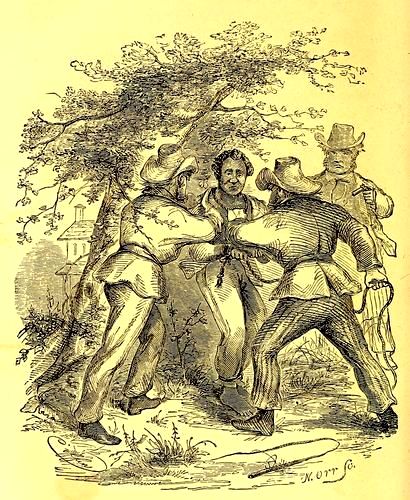
astonishment. Walking up to Bob, the sheriff inquired:
"Where's the boy they call Platt?"
"Thar he is, massa," answered Bob, pointing to me, and twitching off
his hat.
I wondered to myself what business he could possibly have with me, and
turning round, gazed at him until he had approached within a step.
During my long residence on the bayou, I had become familiar with the
face of every planter within many miles; but this man was an utter
stranger—certainly I had never seen him before.
"Your name is Platt, is it?" he asked.
"Yes, master," I responded.
Pointing towards Northup, standing a few rods distant, he
demanded—"Do you know that man?"
I looked in the direction indicated, and as my eyes rested on his
countenance, a world of images thronged my brain; a multitude of
well-known faces—Anne's, and the dear children's, and my old dead
father's; all the scenes and associations of childhood and youth;
all the friends of other and happier days, appeared and disappeared,
flitting and floating like dissolving shadows before the vision of my
imagination, until at last the perfect memory of the man recurred to
me, and throwing up my hands towards Heaven, I exclaimed, in a voice
louder than I could utter in a less exciting moment—
"Henry B. Northup! Thank God—thank God!"
In an instant I comprehended the nature of his business, and felt that
the hour of my deliverance was at hand. I started towards him, but the
sheriff stepped before me.
"Stop a moment," said he; "have you any other name than Platt?"
"Solomon Northup is my name, master," I replied.
"Have you a family?" he inquired.
"I had a wife and three children."
"What were your children's names?"
"Elizabeth, Margaret and Alonzo."
"And your wife's name before her marriage?"
"Anne Hampton."
"Who married you?"
"Timothy Eddy, of Fort Edward."
"Where does that gentleman live?" again pointing to Northup, who
remained standing in the same place where I had first recognized him.
"He lives in Sandy Hill, Washington county, New-York," was the reply.
He was proceeding to ask further questions, but I pushed past him,
unable longer to restrain myself. I seized my old acquaintance by both
hands. I could not speak. I could not refrain from tears.
"Sol," he said at length, "I'm glad to see you."
I essayed to make some answer, but emotion choked all utterance, and
I was silent. The slaves, utterly confounded, stood gazing upon the
scene, their open mouths and rolling eyes indicating the utmost wonder
and astonishment. For ten years I had dwelt among them, in the field
and in the cabin, borne the same hardships, partaken the same fare,
mingled my griefs with theirs, participated in the same scanty joys;
nevertheless, not until this hour, the last I was to remain among
them, had the remotest suspicion of my true name, or the slightest
knowledge of my real history, been entertained by any one of them.
Not a word was spoken for several minutes, during which time I clung
fast to Northup, looking up into his face, fearful I should awake and
find it all a dream.
"Throw down that sack," Northup added, finally; "your cotton-picking
days are over. Come with us to the man you live with."
I obeyed him, and walking between him and the sheriff, we moved
towards the great house. It was not until we had proceeded some
distance that I had recovered my voice sufficiently to ask if my
family were all living. He informed me he had seen Anne, Margaret
and Elizabeth but a short time previously; that Alonzo was also
living, and all were well. My mother, however, I could never see
again. As I began to recover in some measure from the sudden and great
excitement which so overwhelmed me, I grew faint and weak, insomuch
it was with difficulty I could walk. The sheriff took hold of my arm
and assisted me, or I think I should have fallen. As we entered the
yard, Epps stood by the gate, conversing with the driver. That young
man, faithful to his instructions, was entirely unable to give him
the least information in answer to his repeated inquiries of what was
going on. By the time we reached him he was almost as much amazed and
puzzled as Bob or Uncle Abram.
Shaking hands with the sheriff, and receiving an introduction to Mr.
Northup, he invited them into the house, ordering me, at the same
time, to bring in some wood. It was some time before I succeeded in
cutting an armful, having, somehow, unaccountably lost the power of
wielding the axe with any manner of precision. When I entered with it
at last, the table was strewn with papers, from one of which Northup
was reading. I was probably longer than necessity required, in placing
the sticks upon the fire, being particular as to the exact position
of each individual one of them. I heard the words, "the said Solomon
Northup," and "the deponent further says," and "free citizen of
New-York," repeated frequently, and from these expressions understood
that the secret I had so long retained from Master and Mistress Epps,
was finally developing. I lingered as long as prudence permitted,
and was about leaving the room, when Epps inquired,
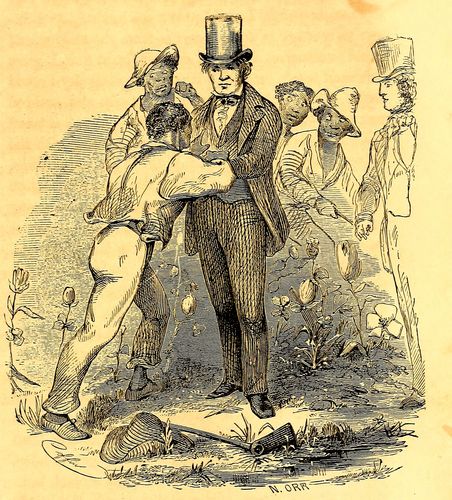
SCENE IN THE COTTON FIELD, SOLOMON DELIVERED UP.
"Platt, do you know this gentleman?"
"Yes, master," I replied, "I have known him as long as I can remember."
"Where does he live?"
"He lives in New-York."
"Did you ever live there?"
"Yes, master—born and bred there."
"You was free, then. Now you d——d nigger," he exclaimed, "why did
you not tell me that when I bought you?"
"Master Epps," I answered, in a somewhat different tone than the one
in which I had been accustomed to address him—"Master Epps, you did
not take the trouble to ask me; besides, I told one of my owners—the
man that kidnapped me—that I was free, and was whipped almost to
death for it."
"It seems there has been a letter written for you by somebody. Now,
who is it?" he demanded, authoritatively. I made no reply.
"I say, who wrote that letter?" he demanded again.
"Perhaps I wrote it myself," I said.
"You haven't been to Marksville post-office and back before light, I
know."
He insisted upon my informing him, and I insisted I would not. He
made many vehement threats against the man, whoever he might be, and
intimated the bloody and savage vengeance he would wreak upon him,
when he found him out. His whole manner and language exhibited a
feeling of anger towards the unknown person who had written for me,
and of fretfulness at the idea of losing so much property. Addressing
Mr. Northup, he swore if he had only had an hour's notice of his
coming, he would have saved him the trouble of taking me back to
New-York; that he would have run me into the swamp, or some other
place out of the way, where all the sheriffs on earth couldn't have
found me.
I walked out into the yard, and was entering the kitchen door, when
something struck me in the back. Aunt Phebe, emerging from the back
door of the great house with a pan of potatoes, had thrown one of them
with unnecessary violence, thereby giving me to understand that she
wished to speak to me a moment confidentially. Running up to me, she
whispered in my ear with great earnestness,
"Lor a' mity, Platt! what d'ye think? Dem two men come after ye. Heard
'em tell massa you free—got wife and tree children back thar whar you
come from. Goin' wid 'em? Fool if ye don't—wish I could go," and Aunt
Phebe ran on in this manner at a rapid rate.
Presently Mistress Epps made her appearance in the kitchen. She said
many things to me, and wondered why I had not told her who I was.
She expressed her regret, complimenting me by saying she had rather
lose any other servant on the plantation. Had Patsey that day stood
in my place, the measure of my mistress' joy would have overflowed.
Now there was no one left who could mend a chair or a piece of
furniture—no one who was of any use about the house—no one who could
play for her on the violin—and Mistress Epps was actually affected to
tears.
Epps had called to Bob to bring up his saddle horse. The other slaves,
also, overcoming their fear of the penalty, had left their work and
come to the yard. They were standing behind the cabins, out of sight
of Epps. They beckoned me to come to them, and with all the eagerness
of curiosity, excited to the highest pitch, conversed with and
questioned me. If I could repeat the exact words they uttered, with
the same emphasis—if I could paint their several attitudes, and the
expression of their countenances—it would be indeed an interesting
picture. In their estimation, I had suddenly arisen to an immeasurable
height—had become a being of immense importance.
The legal papers having been served, and arrangements made with Epps
to meet them the next day at Marksville, Northup and the sheriff
entered the carriage to return to the latter place. As I was about
mounting to the driver's seat, the sheriff said I ought to bid Mr. and
Mrs. Epps good bye. I ran back to the piazza where they were standing,
and taking off my hat, said,
"Good-bye, missis."
"Good-bye, Platt," said Mrs. Epps, kindly.
"Good-bye, master."
"Ah! you d—d nigger," muttered Epps, in a surly, malicious tone of
voice, "you needn't feel so cussed tickled—you ain't gone yet—I'll
see about this business at Marksville to-morrow."
I was only a "nigger" and knew my place, but felt as strongly as if
I had been a white man, that it would have been an inward comfort,
had I dared to have given him a parting kick. On my way back to the
carriage, Patsey ran from behind a cabin and threw her arms about my
neck.
"Oh! Platt," she cried, tears streaming down her face, "you're goin'
to be free—you're goin' way off yonder where we'll neber see ye any
more. You've saved me a good many whippins, Platt; I'm glad you're
goin' to be free—but oh! de Lord, de Lord! what'll become of me?"
I disengaged myself from her, and entered the carriage. The driver
cracked his whip and away we rolled. I looked back and saw Patsey,
with drooping head, half reclining on the ground; Mrs. Epps was on the
piazza; Uncle Abram, and Bob, and Wiley, and Aunt Phebe stood by the
gate, gazing after me. I waved my hand, but the carriage turned a bend
of the bayou, hiding them from my eyes forever.
We stopped a moment at Carey's sugar house, where a great number of
slaves were at work, such an establishment being a curiosity to a
Northern man. Epps dashed by us on horseback at full speed—on the
way, as we learned next day, to the "Pine Woods," to see William Ford,
who had brought me into the country.
Tuesday, the fourth of January, Epps and his counsel, the Hon. H.
Taylor, Northup, Waddill, the Judge and sheriff of Avoyelles, and
myself, met in a room in the village of Marksville. Mr. Northup stated
the facts in regard to me, and presented his commission, and the
affidavits accompanying it. The sheriff described the scene in the
cotton field. I was also interrogated at great length. Finally, Mr.
Taylor assured his client that he was satisfied, and that litigation
would not only be expensive, but utterly useless. In accordance with
his advice, a paper was drawn up and signed by the proper parties,
wherein Epps acknowledged he was satisfied of my right to freedom, and
formally surrendered me to the authorities of New-York. It was also
stipulated that it be entered of record in the recorder's office of
Avoyelles.[3]
Mr. Northup and myself immediately hastened to the landing, and taking
passage on the first steamer that arrived, were soon floating down
Red River, up which, with such desponding thoughts, I had been borne
twelve years before.