Among the most brilliant and picturesque figures
in American naval history stands Stephen Decatur.
His achievements were of that dashing and splendid
quality which leaves a blaze upon the page of
history; and the greatest of them, the destruction
of the Philadelphia frigate in the harbor of
Tripoli, earned from Lord Nelson the praise of
being "the most bold and daring act of the
age."
Decatur came justly by his genius for the sea.
His father was a captain in the navy of the
United States, and his grandfather had been a
French naval officer. His was no rude struggle
with adversity. The child of gentle people, he
entered the navy in 1797, with every advantage
of education and training. He was then eighteen
years of age,—old for a midshipman, when boys
entered at thirteen and were often acting lieutenants
at sixteen. Decatur was a handsome man,
tall and well made.
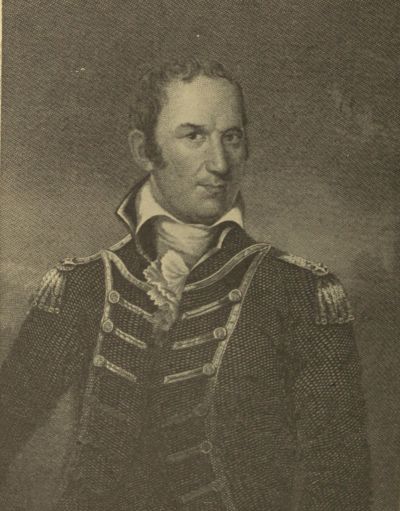
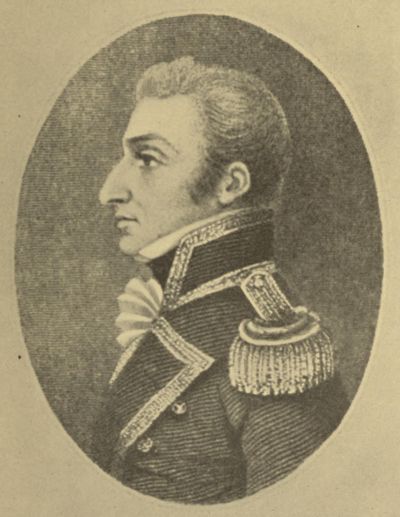
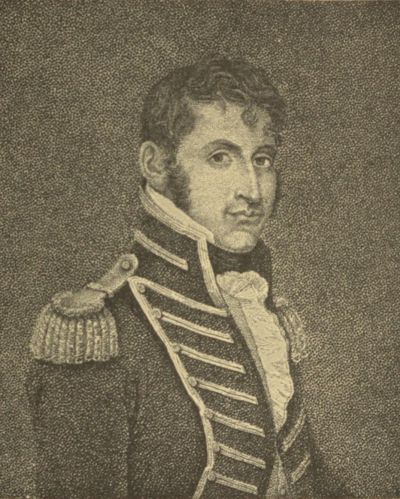 Stephen Decatur
Although of a disposition the most generous,
he was always of an impetuous and even domineering
nature. Strict habits of self-control
modified this impetuosity, but to the day of his
death he was subject to gusts of temper whenever
he came across any instance of cruelty or meanness
or oppression.
A famous example of this was shown shortly
before his untimely death. He was then at the
summit of his fame, one of the ranking officers of
the navy, a navy commissioner, and living in
grand style for the times in the city of Washington.
He had a favorite dog, and one day, when
the dog was lying quietly asleep on the doorstep
of Decatur's house, a policeman came along and
wantonly shot the poor creature. Decatur happened
to see the whole affair, and, rushing out,
he gave the policeman then and there a terrific
walloping. The policeman, smarting from the
injury to his dignity as well as the pounding of
his bones, swore out a warrant, and Decatur was
commanded to appear before the Mayor of Washington.
Furious at the turn of affairs, Decatur
flatly refused to obey the constable's summons.
In vain the officer pleaded with him to go quietly.
Decatur would not budge a step. At last the man
brought a posse and proceeded to take him by
force. Decatur would not be guilty of the crime
of resisting the law, but he proposed to let them
get him before the magistrate the best way they
could. He not only would not walk a step, but
lay down on the floor, and, as he was a large and
heavy man, it was a job to lift him up and put him
in a carriage; but at last it was accomplished.
By the time they reached the Mayor's court,
Decatur's temper, never mild, was red hot. He
proceeded to harangue and even to browbeat the
Mayor, who was a very insignificant person compared
with Commodore Decatur. At the first blast,
though, the Mayor proved that he had a spirit of his
own. "Look here, Commodore," said he, "when
you are on the quarterdeck of your ship you command.
I'll have you understand that this courtroom
is my quarterdeck, and I command here, and
if I hear another disrespectful word from you I'll
send you to jail for as long as I please." Decatur,
paralyzed with astonishment, looked at the Mayor
for a long time; then, suddenly bursting into a
shout of laughter, apologized for his behavior and
submitted to be fined for thrashing the policeman.
Such was the man through life,—daring, generous,
overbearing sometimes, but always responding
to what was just and courageous in others.
Decatur's first cruise was made in the United
States, frigate, forty-four guns, wearing the broad
pennant of Commodore Barry. Charles Stewart,
afterward the celebrated commodore, was one of
the junior lieutenants of the ship, and the heroic
and unfortunate Richard Somers was one of the
midshipmen.
Decatur and Somers had been schoolmates in
Philadelphia, and the association formed there
was cemented into a devoted friendship in the
steerage of the United States. No two natures
were ever more dissimilar than that of the impetuous
Decatur and the gentle and retiring but
indomitable Somers. From the beginning they
were actuated by a noble professional rivalry; yet
their close and affectionate friendship was that of
brothers, and their devotion to each other has
become a tradition in the navy.
The United States was a splendid frigate, fast
and weatherly, and, from the regularity with
which she made time on her cruises, was known
as "Old Wagoner." Commodore Barry was an
old officer who had done good service in the
Revolution, and when he took command of the
squadron of which "Old Wagoner" was the flagship,
he sailed at once for the West Indies, to
retaliate on the French ships which had preyed
upon American commerce. It was not the good
fortune of the United States to meet a frigate
of equal force, so that her men and their mettle
could be tried, but she did good service in clearing
out the French privateers which infested
those seas. Decatur saw much active cruising,
and gave indications of that dashing courage,
masterly seamanship, and fertile resource which
he developed the instant he got command of a ship.
He made several cruises, reached his lieutenancy,
and was attached to the Essex when she
went under Captain Bainbridge to the Mediterranean,
in 1802. During the troubles the officers
of the Essex had, at Barcelona, with the officers of
the Spanish guardship, Decatur was conspicuous.
Having been annoyed and insulted by the Spanish
officers, on his way to and from his ship, he went
aboard the Spaniard, and asked for her commanding
officer. He was absent, and Decatur left this
message, which he shouted out in his tremendous
voice, on the Spanish quarterdeck: "Tell him that
Lieutenant Decatur of the Essex declares him to
be a scoundrelly coward; and if Lieutenant Decatur
meets him ashore, he will cut his ears off!"
A duel in the case was narrowly averted.
At twenty-four Decatur got his first command,
the Argus, one of the two sixteen-gun brigs which
were to assist Commodore Preble in the reduction
of the Barbary powers. This was a heavier
vessel than a young officer of Decatur's rank
was entitled to, and he was given the command
of her only to take her out of the Mediterranean,
where he was to exchange with Isaac
Hull, then a lieutenant commandant, and take
Hull's vessel, the Enterprise, schooner, of twelve
guns. The Enterprise, like the great frigates
Constitution and Constellation, was a favorite
of fortune. She had a glorious record for so
small a vessel, and fought ten spirited actions
during her career, winding up with the capture
of the Boxer in the war of 1812-15. She was
lucky also in escaping many times from superior
force, and had an uninterrupted course of success.
Her good fortune really consisted in the
people who manned her, and the officers who
commanded her,—of whom Decatur was not the
least distinguished. He had the good fortune to
have as his first lieutenant in the little schooner
James Lawrence, a man after Decatur's own heart,
who was worthy of his ship and his captain.
Decatur was one of the young commanders
who took part in the council of war called by
Commodore Preble at Gibraltar, in the autumn
of 1803, at which the peppery commodore was so
disgusted that he called them "a parcel of schoolboys."
But most of them were shortly destined
to immortality.
After collecting his force, Preble sailed for
Syracuse, that historic city, beautiful in its decay.
The object of the American commander was to
establish a base of supplies, and to get the co-operation
of the King of the Two Sicilies, who
was also at war with the Bashaw of Tripoli. It
was while at Syracuse, in the autumn of 1803,
that the plan to destroy the Philadelphia in the
harbor of Tripoli was determined upon. The
credit of the original idea has been separately
claimed for Preble, Bainbridge, and Decatur;
and the fact probably is that it occurred at practically
the same time to each one of them. Every
one of Preble's dashing young captains desired
the honor of making the attempt, and the fact
that Decatur obtained the distinction is presumptive
proof that he had a share in the first inception
of the plan. Stewart's claim to a part in
the undertaking was so strong that to him fell
the honor of supporting, in the Siren, Decatur's
proposed attack.
In order to look over the ground, Preble in
the Constitution, accompanied by Decatur in the
Enterprise, sailed for Tripoli, in December, 1803.
Decatur, with his characteristic boldness, offered
to make the attempt with the Enterprise; but
Commodore Preble prudently concluded to use a
ketch, the Meshouda, which Decatur had lately
captured and which was of a build and rig common
in Mediterranean waters.
As Decatur meant to get inside the harbor of
Tripoli by stratagem, it was important to have a
vessel that would not attract attention. The
ketch was fittingly renamed the Intrepid, and
preparations were begun for the desperate adventure
with her.
Decatur was extremely anxious, as was Stewart,
to cut the Philadelphia out; but Commodore
Preble, as bold as they were, but older and more
prudent, saw the insurmountable difficulties in
the way of bringing so large a ship as the Philadelphia
out of a dangerous and unknown harbor
such as Tripoli. He therefore gave strict orders
that no attempt should be made to carry her out,
but that she should be destroyed at her moorings;
and the commodore was certain to be obeyed.
The Intrepid was converted into a fire-ship, or
"infernal." She was filled with combustibles, and
it was designed that she should steal in at night
in disguise, throw the combustibles into the Philadelphia,
fire them, and then make a race for her life.
The nature of this enterprise required men of
extraordinary steadiness as well as courage; but
they could be easily supplied from the American
squadron. It was intended to man and officer
the Intrepid as far as possible from the Enterprise;
and in pursuance of this, on the afternoon
of the 3d of February, 1803, all hands on
the Enterprise were called up and aft. Decatur
then stated the nature of the service for which
the Intrepid was destined,—a service of heroic
possibilities but appalling danger,—and then
called for sixty-two volunteers. Instead of sixty-two
men, the whole ship's company down to the
smallest boy volunteered with a cheer. This was
what any captain would have desired, and Decatur
was forced to make a choice. He selected sixty-two
of the youngest and most active men in the
crew, who showed their gratification by saying,
"Thankee, sir," as each man was told off. He
could make no choice among his lieutenants, but
took them all—Lawrence, Joseph Bainbridge, and
Thorn—and one of his midshipmen, the indomitable
Macdonough, the rest being necessarily left
to take care of the ship. He was compelled to
make a draft of junior officers from the Constitution,
and asked for midshipmen Morris, Laws,
Izard, Davis, and Rowe. There was also a surgeon,
Dr. Heermann, and Salvatore Catalano, a
Sicilian pilot, who, in return for his services, was
made a master in the American navy, and had an
honorable career in it.
On the evening of the 3d of February the
Intrepid sailed upon her glorious expedition,
accompanied by the Siren, whose character as
a ship of war was thoroughly concealed. The
ketch was to pass for a merchant vessel from
Malta, and her officers had the costumes of Maltese
sailors in which to disguise themselves. The
two vessels reached the entrance to the harbor of
Tripoli on the 9th of February, but a terrific storm
arose, which drove them off. For six days they
were storm-tossed in the gulf of Sydra, but on the
16th of February they found themselves together
again off Tripoli. The evening was mild and
beautiful, and the wind was so light that the
Siren was almost becalmed in the offing, but
the Intrepid met a wandering breeze that carried
her within the rocky harbor. Once inside,
a good breeze was blowing, which swept them
rapidly forward, and threatened to bring the
Intrepid up with the Philadelphia before it was
quite dark enough to do the work meant for her.
As it would not do to excite suspicion by taking
in sail, Decatur had buckets and sails towed astern
which acted as a drag, and brought the ketch in
very slowly. When Decatur noticed that the
Siren in the offing had no wind and consequently
could be of no assistance to him, he remarked
cheerfully to his men, "Never mind; the fewer
the number the greater the glory."
The ketch sailed leisurely in, having the appearance
of a merchant ship from a Mediterranean
port, after a considerable voyage.
The crew had been sent below, and only a few
officers, disguised as Maltese sailors, stood or sat
about the deck. Before them lay the Bashaw's
castle, with its menacing battlements, and all
around the harbor was a chain of forts that could
make a circle of fire for an invader. Directly
under the guns of the castle loomed the tall black
hull of the Philadelphia, flying the piratical flag of
Tripoli, while moored near her were three smaller
cruisers and nineteen gunboats.
The moon had risen, and by its clear illumination
the "infernal" steered straight across the
blue waters of the harbor for the Philadelphia.
When about two hundred yards off, Salvatore
Catalano, the pilot, hailed the Tripolitan officer
of the deck on the Philadelphia, who lounged
over the rail smoking a long pipe.
"This is the ketch Stella, from Malta," he
said in the lingua franca of the East. "We lost
our anchors and cables in the gale, and would
like to lie by you during the night."
"Your request is unusual, but we will grant
it," answered the Tripolitan officer.
The officer then asked what vessel it was that
was lying in the offing. The pilot, with much
readiness, replied that it was the Transfer, a
cruiser lately bought from the British by the Tripolitan
government, and which was daily expected.
This answer seemed to satisfy the Tripolitan, and
a boat then put off from the Philadelphia with
a fast, and at the same moment a boat also put
off, under the command of Lawrence, from the
Intrepid. On meeting, Lawrence coolly took the
fast from the Tripolitan boat, and soon had
the hawser aboard of the ketch. A moment more
and the supposed Maltese sailors, in their jackets
and red fezzes, roused on the hawser and breasted
the ketch along under the Philadelphia's quarter.
Had the slightest suspicion been aroused
then, they would have been blown out of the
water by a single broadside. But the Americans
retained their coolness in their desperate situation.
Presently the Intrepid drew out from the black
shadow of the frigate's hull into a great patch of
white moonlight. The Tripolitans saw the anchors
on the deck, with the cables coiled around
them. Instantly a cry rang through the ship,
"Americanos! Americanos!"
At the same moment the Intrepid came grinding
up against the frigate's stern quarter, and,
as if by magic, was alive with men. Decatur
shouted, "Board!" and the Americans dashed
at the frigate's deck.
Decatur, and two midshipmen, Morris and Laws,
leaped at the same moment into the chain plates.
Decatur and Morris made a spring for the rail;
Decatur's foot slipped, else he would have been
first upon the Philadelphia's deck; but Morris,
an agile young midshipman, was a moment before
him. Midshipman Laws dashed at a port, and
would have been before Morris in entering the
ship, but the pistols in his boarding-belt caught
for a moment between the gun and the port, and
he was third to stand upon the deck. The rest of
the Americans swarmed into the ship.
The Tripolitans, completely surprised, yet fought
desperately. They had been accounted the best
hand-to-hand fighters in the world, but they were
no match for the Americans. Within fifteen
minutes every one of them had been cut down
or driven overboard, and the Philadelphia was
once more an American ship. Meanwhile lights
had been moving about on shore, and the vessels
and forts saw that something was happening on
the Philadelphia, but not enough could be seen
to justify them in firing on their own ship. In
a few minutes more, though, smoke was pouring
from the ports, and flames were running up her
tar-soaked rigging. The Americans, with almost
incredible swiftness, had hoisted powder aboard
the ship and fired her in a dozen places. Two
guns, double-shotted, were dragged amidships and
pointed down the main hatch to blow her bottom
out. They then leaped into the ketch; but at
that moment the most awful danger of that terrible
yet glorious night awaited them. The fast
became jammed, and the jigger of the ketch
caught fire as it flapped against the burning
frigate, while below, on the Intrepid's deck, lay
all her powder exposed. The officers, undismayed
however, drew their swords and hacked at
the hawser until it parted. Then, under sweeps
and sails, the Intrepid made for the offing, the
men pulling for their lives, while the ships and
forts, now thoroughly aroused, opened all their
batteries on this daring invader. But the shot
fell short, and raised only showers of spray, at
which the Americans laughed and jeered.
The Philadelphia was now ablaze from rail to
truck, and sea and sky were lighted up by the
flames of the burning ship. Her guns began to
go off as the fire reached them, and she poured
a cannonade from every quarter. The ketch was
plainly visible as she made rapidly for the offing,
and a hundred guns were trained on her. At
this supreme moment the Americans gave one
last proof of their contempt of danger. The men
stopped rowing, and every officer and man, rising
to his feet, gave three thundering American cheers.
Then they bent to their oars with giant strokes,
and in a little while were safe under the Siren's
guns. They had not lost a man in the glorious
achievement.
The Siren, meanwhile, in the offing, had hoisted
out her boats, and was ready to assist the Intrepid,
in case she needed it. The progress of
the ketch was plainly visible until she was lost
in the shadow of the Philadelphia's black hull.
In a few minutes a single rocket skyward showed
the anxious watchers that the Philadelphia was
boarded; and almost at once the blaze rushed
up the rigging, and enveloped the tall hull, lighting
up the night with a lurid glare, while the
guns of the doomed frigate and those of the castle,
the ships, and the forts thundered out. Then
they knew that the great enterprise was accomplished.
The boats pulled toward the harbor
entrance; soon the ketch had shot across the
illuminated water, and had reached them. Decatur,
jumping into one of the Siren's boats, was
quickly pulled toward the brig. Stewart, standing
in the gangway, saw the boat approach, and
a man, in a sailor's round jacket and a fez, sprang
over the gangway, into his arms. It was Decatur.
Fifteen days after leaving Syracuse, the ketch
and the brig were seen standing in the harbor,
the signal of success flying from the Intrepid's
masthead. For this splendid adventure Decatur
was made a post-captain, his commission dating
from the 16th of February, and the officers and
men were rewarded.
Before, however, receiving his commission,
Decatur was yet to do glorious things in the bombardment
of Tripoli during the following summer.
Commodore Preble, in arranging the boat attacks,
which he supported by the batteries of the "Old
Ironsides," and all his brigs and schooners,
gave the command of the right division to Richard
Somers, Decatur's bosom friend, and the left
division to Decatur. On the 2d of August the
first attack was made. The Tripolitans had a
flotilla of fourteen gunboats to resist the six the
Americans could muster; and they had, in reserve,
behind the rocks in the harbor, five more gunboats
and several heavy galleys, besides their
forts, batteries, and larger clubs. The attack was
begun about half past one in the afternoon, the
whole force standing in; the Constitution approaching
as close as possible and pouring in
many broadsides against the forts, the brigs and
schooners supporting the gunboats, while the
latter dashed at the Tripolitan gunboats and galleys
with a swiftness and impetuosity that were
simply tremendous. The attack soon assumed a
character of hand-to-hand fighting that is seldom
seen in modern days. Decatur's own vessel laid
aboard a large Tripolitan gunboat, and in spite of
the most desperate resistance, grappled with her.
She was divided in the middle by a long narrow
hatchway, and in this the Tripolitans mustered
to drive back the Americans when they entered.
Immediately Decatur was over the side, followed
by his lieutenant, Mr. Thorne, by Macdonough,
and all the Americans in the gunboat's crew.
They advanced together with pikes and cutlasses,
and then ensued a contest, man to man, fighting
every inch of the way, which resulted in cutting
down or driving overboard every Tripolitan officer
and man.
Just as the Tripolitan ensign was hauled
down, it was seen that James Decatur, Decatur's
younger brother, who was in command of another
gunboat and had carried her into action with
great spirit, had fallen by a shot from a Tripolitan
which had surrendered and then basely
resumed firing. James Decatur was carried aboard
the Constitution to die, but it was no time to
indulge in private griefs; and Decatur, without
knowing whether his brother were living or dead,
turned upon the next foe. This was another
gun-vessel, which was commanded by a gigantic
Tripolitan, who seemed to court rather than avoid
a hand-to-hand contest with the Americans.
Decatur ran him aboard, and then with a
cheer the Americans leaped into the gunboat.
Seeing the force with which they had to contend,
Decatur waited until his men could form a line.
They then advanced resolutely, led by their officers.
They were greatly outnumbered, but by
standing together they made the most of their
number. The Tripolitan captain and Decatur
soon met face to face. The Tripolitan, a much
larger and more powerful man than Decatur,
stood on tiptoe to deal a more tremendous blow.
Decatur rushed at him with a pike. The Tripolitan
wrenched the pike from him, and raised it to
strike. Decatur then drew his sword, and in
trying to parry the pike, the sword broke off at
the hilt, and the pike entered Decatur's breast.
Pulling it out, he grappled with the Tripolitan,
and both came to the deck together. The
Tripolitan attempted to draw his dagger; but
Decatur, firmly grasping his arm, managed to
get a small pistol from his pocket, and fired it.
With a scream the Tripolitan relinquished his
hold and rolled over. As Decatur rose to his
feet, another Tripolitan raised his sword; as the
blow was about to descend on Decatur's head,
Reuben James, a powerful young sailor, threw up
his arm, and took the blow, which almost severed
his arm from his body. The Americans were
now beginning to get a little the advantage; and
by coolness and resolution they were soon enabled
to get possession of the gunboat. The Tripolitan
loss showed the nature of the fighting, fifty-two
men being killed and wounded out of a total of
eighty in the two captured gunboats. The loss of
the Americans was relatively small, owing to their
plan of standing together and attacking as a body.[10]
Four more of these ferocious attacks, combined
with a terrific cannonade from the Constitution,
and the assistance from the brigs and
schooners, lost the Tripolitans many of their
most serviceable craft, and made those that were
left very shy of coming outside the reefs to meet
the "Americanos." The great guns on the Constitution
had knocked to pieces many of the
more exposed land batteries, and brought down
the Bashaw's tone immeasurably. He was then
anxious to negotiate, but Commodore Preble
would listen to nothing but the unconditional
surrender of Bainbridge and his men.
The loss of the Americans was small in numbers
but great in value during the bombardment,
and was confined chiefly to the gunboats. In
the second attack, on the 7th of August, one of
the American gunboats blew up, killing her
brave commander, Lieutenant Caldwell, and several
others. When the smoke cleared away
after the awful explosion, it was seen that the
forward part of the vessel still floated. On it
was the long twenty-six-pounder, which was her
chief weapon, and which the gun's crew, directed
by Midshipman Spence, had just loaded. With
as much coolness as if there had been a whole
vessel instead of a half one beneath them, the
gun was fired, the eleven men on the wreck gave
three cheers, led by the midshipman, and then
sprang into the water. All were picked up, and
fought during the rest of the action.
There was another attack on the 28th of
August, and again on the 3d of September.
In this last the Constitution bore the brunt
of the Tripolitan fire, and did fearful execution
with her heavy guns. And on the 4th of September
occurred the terrible tragedy of the blowing
up of the ketch Intrepid.[11]
The beginning of the autumn marked the end
of the season for active operations, and the American
squadron withdrew, with a promise to return
the next season and do yet more damage,—a
calamity which the Bashaw avoided by promptly
giving up the American prisoners the next spring,
when the Americans, true to their word, returned
in greater force. A relief squadron which had
been sent out from the United States arrived
just at the close of the campaign before Tripoli.
It brought out Decatur's commission as a post-captain,
as well as lesser promotions for the other
young commanding officers. Commodore Preble,
on being relieved by Commodore Barron, turned
over the Constitution to Decatur, who thus, at
twenty-five, commanded what was probably the
finest frigate in the world. His rank, however,
as the youngest post-captain in the navy did not
entitle him to keep her very long, and he was
transferred to the Congress, a smart thirty-eight-gun
frigate. She was in the squadron of
Commodore Rodgers, which, after the humbling
of Tripoli, was engaged in bringing the Bey of
Tunis to terms. Commodore Rodgers sent Decatur,
who was well known to the heads of Barbary
powers, to negotiate a treaty with Tunis. The Bey
at first refused to receive him. Decatur returned
to his ship, which was cleared for action, and
sent a message saying that the Bey must decide
at once between war and peace. The Bey
succumbed immediately, and not only begged
for peace, but asked that the Congress should
convey a Tunisian envoy to the United States.
This was rather more than Decatur had bargained
for, particularly as he had to give up a part of his
quarters to the Tunisian envoy and his suite.
But having succeeded rather better than he expected,
Decatur took the party on board and
returned to the United States, reaching home
in 1805.
He was received with praise, admiration, and
the highest personal and official favor. He was
given good commands, and a few years after he
had gone out to the Mediterranean to command
a little twelve-gun schooner, he again went out
in command of a splendid squadron, his broad
pennant flying on the mighty Constitution. He
was sent to demand reparation from the Dey of
Algiers for certain injuries to American citizens.
The American consul went in person to see the
Dey, who sat in state, looking through the open
window at the formidable force with which Decatur
was prepared to enforce his demands. The
consul began by saying, significantly, that the
squadron was commanded by Commodore Decatur.
The Dey, gravely combing his beard with
a diamond comb, said: "I know this Decatur.
He is the man who burnt the frigate at Tripoli.
Hum! Why do the Americans send wild young
men to treat with old powers?" Nevertheless, he
very promptly gave all the satisfaction demanded
by the "wild young man."
On the outbreak of hostilities with Great
Britain in 1811-12, Decatur got the command
of the United States,—"Old Wagoner," the
stanch and weatherly frigate in which he had
made his first cruise with his beloved Somers.
In her he made the second capture of a frigate
in that war, Hull having preceded him in the capture
of the Guerrière by the Constitution.
Off Madeira, on the 25th of October, the
United States sighted the Macedonian,[12] a magnificent
thirty-eight-gun frigate, commanded by
Captain Carden. Decatur and Carden were personal
friends, and before the war broke out
had often discussed the relative fighting powers
of their ships. Decatur's black servant had listened
to these talks as he stood behind his
master's chair. Captain Carden frequently said,
"No, my dear Decatur. Your men are brave,
but not experienced; and when they meet a
British ship of equal force, with the best intentions
to do their duty, they will not know how
to fight." Cuffee remembered this, and as soon
as it was known on "Old Wagoner" that the
approaching frigate was the Macedonian, he very
prudently retired to the lower hold, and hid behind
a hogshead.
The action began with the greatest spirit on
both sides, the ships keeping up a furious cannonade
at close quarters, with a heavy sea on and a
good breeze blowing. The Americans showed
great superiority in gunnery, and although the
British fought with a gallantry worthy of British
tars, and their officers nobly encouraged
them by word and example, in seventeen minutes
from the time the first broadside struck the
Macedonian all was over, and her colors were
hauled down. She had suffered terribly, more
than a third of her men being killed and wounded.
She lost so many men at the guns that the marines
were called upon to work the batteries. On
the American ship only twelve men were killed
and wounded, and the marines during the whole
battle were drawn up in the waist of the ship,
with nothing to do. This, however, was much
more trying than fighting, as they had to stand
as if they were on parade, while shot and shell
screamed a few inches above their heads. The
men, however, showed the utmost steadiness, and
acted as well as looked as if they were merely at
Sunday morning quarters. When the Macedonian
struck, it was plain from the way she was
cut up that she had made a good and gallant
defence. As Captain Carden came over the side,
he offered his sword to Decatur, who refused to
take it, saying,—
"I cannot take the sword of a man who has
so bravely defended his ship."
The solemn silence of the occasion was broken
by Cuffee, who, the danger being over, had
crawled up out of the hold, and appeared upon
the quarterdeck at that moment, just in time to
bawl out,—
"I say, Marse Carden, what you think now
'bout de way dem 'Mericans fights!"
It was several weeks before the United States
reached home, and during that time Captain
Carden was Decatur's guest in the cabin. Decatur's
first letter to his wife after the capture
of the Macedonian says: "All my pleasure is
spoiled by poor Carden's sorrow;" for Captain
Carden knew nothing of the previous capture
of the Guerrière and of the Java, which followed
shortly after, and thought himself to be
the first and only English captain who had surrendered
his ship. On reaching the United
States, Decatur and his officers received the
thanks of Congress, and a gold medal for their
gallant conduct.
Decatur had looked forward to another active
cruise in "Old Wagoner," but he soon found himself
penned up at New London by a large blockading
force. Decatur's impetuous nature fretted
and chafed under this, and in 1814, realizing
the impossibility of the United States getting to
sea, he got command of the President, of forty-four
guns, then lying at New York. Decatur
took command of her with bright anticipations.
New York bay was closely watched by British
cruisers, but Decatur had no fears that he should
not be able to get out. Accordingly, on a dark and
stormy night in January, 1814, he picked up his
anchor, and made for the open sea; but before
daylight the pilots had run the frigate aground
near Sandy Hook, where for an hour and a half
she lay pounding on the bar. She got off by the
rising of the tide, but she was so hagged and
twisted that her back was nearly broken, her
masts sprung, and her sailing qualities so impaired
that she stood but a small chance of escape
should she fall in with an enemy. Unable by
reason of the wind to return to New York for
repairs, the President proceeded to sea, and by
daylight found herself surrounded by a British
squadron, consisting of the Majestic, razee, and
the Endymion, of forty guns, and the Tenedos
and Nymph, light frigates. Then began a fight
as well as a race for life, which lasted thirty
hours. The Endymion got near enough for a
bloody contest, in which she was badly crippled
and left behind, the President making a desperate
though lame attempt at flight from her
antagonists. But it was in vain. The Tenedos
and Nymph gained on her, and it was soon
known to all on board that the President was
a doomed ship. Three of her five lieutenants
lay dead upon her decks, while among the mortally
wounded was Midshipman Richard Dale,
son of the famous Commodore Dale, of Revolutionary
fame. The killed and wounded among
the crew were numerous, and Decatur himself
received a painful injury.
His people, who had never seen him except in
the light of triumph and success, were curious to
observe how he would stand impending defeat.
But never was he calmer and cooler. At one
time, seeing he could handle the Endymion
alone, he formed the desperate plan of boarding
her, transferring his people to her, and abandoning
the President. The proposition was received
with cheers. One of his youngest midshipmen,[13]
a lad of fourteen, said out aloud, in Decatur's
hearing,—
"I never can get over the side of that ship, as
small as I am."
"Oh, yes, you can," replied Decatur, smiling.
"I will pick you up and throw you over
myself."
The Endymion, seeing that the President must
be shortly overpowered by the rest of the squadron,
very sensibly refused to close, and fell out
of the chase in a helpless condition, every sail
being shot away from her.
It was now night, and the President hoped
to escape in the darkness, which was extreme.
But about eleven o'clock the Pomone ranged up
under her lee and poured in a broadside, while
the Tenedos was closing in on the weather quarter,
and the Majestic was within gunshot astern.
The President hauled her colors down, and Decatur
offered his sword to Captain Hayes of the
Majestic, the ranking officer present. It was
refused in the same noble words which Decatur
had used toward Captain Carden: "I cannot
accept the sword of a man who has so bravely
defended his ship."
Decatur was taken to Bermuda, where he was
received with the highest distinction by the great
Admiral, Lord Cochrane, and all of the British
officers. At a splendid dinner given him by the
British naval officers, some one was tactless
enough to allude to the capture of the President,
at which Lord Cochrane promptly said,—
"The President was mobbed, sir,—simply
mobbed."
Decatur and his officers were soon paroled, and
sent home in a special frigate. Peace was declared
a few days after, and at New London,
where Decatur was landed, there was a grand
celebration of the treaty of peace, on the 22d
of February. The British frigate in which he
had been returned took part in the celebration,
and the British and Americans united, as generous
enemies who have become friends should in
observing the glorious occasion.
After the peace, Decatur hoisted his broad pennant
on the Guerrière,[14] and commanded a fine
squadron in the Mediterranean, where his name
was always a power. On his return from this
cruise he was made one of the three navy
commissioners who were at the head of
the Navy Department in those days. He had
amassed a comfortable fortune, and built a fine
house in Washington, near the White House,
and had apparently entered upon a long career
of peace and prosperity; but it was not to
be.
It is distressing to chronicle the melancholy
end of so glorious a life. In those days duelling
was thought justifiable and even obligatory
on occasions. Decatur lost his life in March,
1820, near Washington, in a duel with Commodore
Barron, concerning some things he had
said about Barron many years before. His
death and the manner of it were universally
deplored, and when the anxious multitude who
surrounded his house in Washington was told
that he was no more, Reuben James, the old
sailor who had once saved Decatur's life at the
risk of his own, cried out, "The navy has lost
its mainmast."
Decatur was the author of that patriotic saying
which is heard from many American lips
and is deeply engraved in every American breast:
"My country, may she always be right; but, right
or wrong, my country!"