EARLIEST HISTORICAL ACCOUNTS OF TURQUOIS MOSAIC IN MEXICO
The Grijalva Expedition, 1518
The first knowledge received by Europeans of the existence
of turquois mosaic objects among the Mexicans was by members
of the expedition sent out from Cuba by the governor,
Diego Velásquez, during the spring of 1518, under the command
of Juan de Grijalva. After reaching the shores of Yucatan
near the island of Cozumel, the party coasted the Yucatan
peninsula, reaching the territory of the present State of Campeche,
which had been discovered the previous year by
Francisco Hernández de Córdoba. Proceeding westward along
unknown lands, they reached a great river in the State of
Tabasco, to which the name of the commandant was given,
and it is still known as Rio de Grijalva. Here, according to
some accounts, the expedition obtained the first specimens
of turquois mosaic. We shall consider this point later. Leaving
the Rio de Grijalva they went westward and arrived at the
site of the present city of Vera Cruz, where they obtained by
barter with the Indians a considerable treasure, including some
objects of turquois mosaic, which Grijalva decided to send
immediately to the governor in Cuba with a report of his discoveries
up to that time. Consequently, on June 24, 1518, one
of Grijalva’s captains, Pedro de Alvarado, set out on the return
voyage to Fernandina (Cuba), while Grijalva himself continued
the exploration of the eastern coast of Mexico.
The provenience of the treasure obtained by Grijalva on
this first expedition of discovery to the coasts of Tabasco and
Vera Cruz in 1518 is not at all clear from the accounts of this
voyage in the writings both of the eye-witnesses themselves
and of those who shortly afterward wrote of the conquest
from the reports of the participants in the events. It has been
generally assumed that Grijalva obtained mosaic objects from
the Indians of Tabasco; this is specifically stated by both
Oviedo and Gomara, who recorded detailed accounts of the
Grijalva expedition. The account by Oviedo[2] is even more
extended and valuable than the narrations of the eye-witnesses,
namely, Juan Díaz[3] the chaplain, and the redoubtable Bernal
Díaz. Oviedo states that his account is from the report forwarded
to the King of Spain by the governor Velásquez, who
sent out the expedition from Cuba. Gomara, who for a time
was chaplain of Cortés in Spain, never visited the New World,
but had access to the various reports sent to Spain regarding
the conquest.
Unfortunately in the writings of the eye-witnesses no detailed
descriptive lists are to be found relating just what pieces
of mosaic-work were obtained by Grijalva from the Mayan
Indians of Tabasco and the people of the coast of the present
State of Vera Cruz. The extended account given by Oviedo
recites the voyage from day to day and the character of various
objects received from the Tabasco Indians, followed by the
list of specimens obtained from the Mexican Indians near the
Isla de Sacrificios, Vera Cruz. We will quote from these lists
later. Gomara’s list is quite extended. In the first part of his
Historia de las Indias he describes various articles procured
by Grijalva from the Indians at the mouth of the river in
Tabasco, to which his name was applied, followed in turn by
the inventory of objects obtained at San Juan de Ulua, Vera
Cruz. In the second part of his history, the Conquista de
Mexico, he gives only a single long inventory of the barter
obtained, as he says, “from the Indians of Potonchan [Tabasco],
San Juan de Ulua, and other places of that coast.” It seems
highly probable, however, that such interesting and valuable
loot must have been accompanied with an inventory when it
was sent to Spain late in 1518 or early in 1519 by Governor
Velásquez. Oviedo mentions seeing the things, apparently in
Barcelona, in May 1519. It is possible that both Oviedo and
Gomara may have had access to such an inventory, or if not,
they wrote their own descriptions of the objects after seeing
them.
Bernal Díaz, who accompanied both Grijalva and Cortés
to Mexico, wrote his history nearly fifty years after the stirring
events of the discovery and conquest. He was a prejudiced
writer, and seems to have been largely animated in his old age
to tell the story of the conquest primarily to refute many of
the statements of Gomara. Bernal Díaz writes bluntly at the
very outset of his invaluable history, which he calls the “True
History,” that he speaks “here in reply to all that has been
said and written by persons who themselves knowing nothing,
have received no true account from others of what really took
place, but who nevertheless now put forward any statements
that happen to suit their fancy.” While not describing the
treasure obtained by Grijalva, he mentions “some gold jewels
some (of which) were diadems and others were in the shape of
ducks like those of Castile, and other jewels like lizards, and
three necklaces of hollow beads, and other articles of gold not
of much value, for they were not worth more than two hundred
pesos.”[4] These he states were obtained from the Indians of
Potonchan. For some reason he apparently was not greatly
impressed either by the technical excellence or by the esthetic
beauty of the objects procured by barter from the vicinity of
the present city of Vera Cruz; he simply writes that the
Spaniards were engaged for six days in trading with the Indians
and got more than sixteen thousand dollars’ worth of jewelry
of low-grade gold worked into various forms. He then says:
“This must be the gold which the historians Gomara, Yllescas,
and Jovio say was given by the natives of Tabasco, and they
have written it down as though it were true, although it is
well known to eye-witnesses that there is no gold in the province
of the Rio de Grijalva or anywhere near it, and very few
jewels.”[5] Torquemada wrote in later years to the same
effect.
In none of the accounts by the participants of this expedition
are mosaic pieces specifically mentioned. The chaplain
of Grijalva’s fleet, Juan Díaz, states merely that they were
given “a mask of gold beautifully wrought, and a little figure
of a man with a little mask of gold, and a crown of gold beads
with other jewels and stone of various colors.” This report was
first printed in Venice, March 3, 1520, appearing in Italian as
an appendix to the Itinerario of Ludovico de Varthema.
An anonymous independent relation in Italian of this
voyage seems to have been printed at Venice in the same year
under the title Littera Mãdata della Insula de Cuba, etc., the
copy in the Marciana Library, Venice, being the only one
known. From a photostat copy of the Italian we are able to
present a translation of the mention of these objects, somewhat
similar to that given by Juan Díaz. The Littera Mãdata states
that the Spaniards obtained “a mask of gold, and the figure of
a man all of gold, seemingly of the age of twelve, and a fan of
gold, and other jewels of divers colors.”[6]
Another anonymous early printed report, in Latin, without
date or place of printing, affords practically the same information
as that contained in the Itinerario of Juan Díaz and in
the Littera Mãdata.[7]
The earliest printed information regarding the Grijalva
voyage in which mosaic objects are specifically noted is in
Peter Martyr’s De Nvper Sub D. Carolo Repertis Insulis,
printed in Basle in 1521. In speaking of the valuable objects
obtained by Grijalva in Coluacan (Vera Cruz), and sent to
Spain, he mentions that “the cacique brought a small golden
statue of a man, also a gold fan, and a mask beautifully wrought
and decorated with stones.”[8] It will be observed that these
objects correspond with those mentioned in the reports noted
above, only that Peter Martyr speaks of the decoration of the
mask with stones. With the exception of this note by Peter
Martyr, who saw the objects in Spain, there is, as we have
said, no special statement regarding mosaic-work to be found
in the earliest known printed accounts of the Grijalva voyage.
In 1535 the great work of Oviedo was first published, and here
we find the following itemized description of pieces of mosaic-work,
said to have been obtained from the Indians of Potonchan, Tabasco.[9]
Another mask covered from the nostrils upward with well set
mosaic-work of stones resembling turquoises, and from the nostrils
downward with a thin plate of hammered gold.
Another mask resembling the first, but the stones were placed
from the eyes upward, and below them there were thin plates of
beaten gold over wood, the ears being of turquois mosaic-work.
Another mask made with bands or rods of wood, two of the
strips being covered with mosaic-work, and the remaining other
three with thin beaten gold.
A thin disc with a figure of a cemi or devil, covered above with
beaten gold-leaf, and in other parts were scattered some stones.
A tablet of wood like the headstall of a horse in armor, covered
over with thin gold-leaf, with some strips of black stones well set
between the gold.
The head of a dog covered with stones, and very well made.
From Ulua in Vera Cruz these mosaic pieces are noted:
Two masks of small stones like turquois set over wood like mosaic,
with some spangles of gold in the ears.
Two guariques of blue stones set in gold, each having eight
pendants of the same.
A mask of stone mosaic-work.
In the work of Gomara, printed in 1553, appears also an
extended account of this barter.[10]
Seler[11] and Lehmann[12] believe that most of the mosaic
objects “apparently came from the eastern provinces, i.e.,
Tabasco.” Relying on the authority of both Oviedo and
Gomara, Lehmann further uses in his discussion the original
Nahuatl text of Sahagun in the Florentine manuscript copied
and translated by Seler. In this section of Sahagun’s work
relating to the attributes of the Mexican deities occurs the
paragraph, “In jtlatquj Quetzalcoatl coa-xaiacatl xiuhticatl
achivalli, quetzalapanecaiotl,” which Lehmann renders, “The
Quetzalcoatl dress, the snake-mask with turquois work, the
feather ornament of the people of Quetzalapan (Tabasco).”[13]
But there is no mention in early chronicles or on early maps of
any town in this region bearing the name Quetzalapan, and
Torquemada in giving an account of some of the wars of
Montezuma writes that “during the twelfth year of his reign
(which was in 1514), his armies set out for the land of the
Chichimecas, and entered the Huaxteca, subduing those of
Quetzalapan.”[14] Other places bearing the name Quetzalapan
were in the present states of Morelos, Guerrero, and Colima.[15]
In recounting the episode of the conquest of this town, Clavijero
writes explicitly that “Montezuma sent out an army in
1512 to the north against the Quetzalapanecas and conquered
them with but little loss.”[16] Hence the place mentioned by Sahagun
would seem to have been in Vera Cruz, and probably the
region of Huaxteca or Cuexteca, for the Aztecs had considerable
communication with this territory.
Loot Obtained by Cortés, 1519-1525
But the treasures of native art secured by the Grijalva
expedition were insignificant by comparison with the enormously
valuable loot obtained the next year (1519) by Cortés.
It is not necessary in this study of Mexican mosaics to enter
into the details of the expedition which set out from Cuba to
follow the discoveries of Grijalva and which resulted in the
conquest of Mexico. This has been done many times, but in
the main most weight is given to the writings of the Spanish
participants and to the early chroniclers. We have already
studied in considerable detail the accounts of the art objects
sent to Spain by Cortés, as contained in these early writings,
and especially the inventories which accompanied the shipments
of objects sent to Europe by the conqueror. Let us
quote here merely what we wrote in presenting a summary of
the events that occurred when Cortés first landed on the coast
of Vera Cruz.
After the arrival of the Spaniards on the coast of Vera Cruz,
the Indians were not long in ignorance of the consuming thirst of
the conquerors for gold. In order to placate the formidable strangers
with childlike confidence that by giving them their wish the invasion
of his dominions would be averted, Montezuma sent rich
presents to Cortés through Tendile (Teuhtlile), governor of Cuetlaxtla
(the modern Cotastla), which was then subject to the Aztecs.
When all this treasure thus brought together was ready to be sent
to Spain, with the report of the voyage, an inventory or list of the
objects was drawn up and despatched with two special messengers,
Alonso Portocarrero and Francisco de Montejo, who were charged
to deliver the treasure to the King. These valuable gifts have been
briefly described by several members of the expedition who saw
them before they left Mexico, and on their receipt in Spain they
were described by various other chroniclers.
From the inventory, which we translated, we select the items
relating to objects ornamented with stone mosaic.
Item: two collars of gold and stone mosaic-work (precious
stones)....
Another item: a box of a large piece of feather-work lined with
leather, the colors seeming like martens, and fastened and placed in
the said piece, and in the center (is) a large disc of gold, which
weighed sixty ounces of gold, and a piece of blue stone mosaic-work
a little reddish, and at the end of the piece another piece of colored
feather-work that hangs from it.
Item: a miter of blue stone mosaic-work with the figure of monsters
in the center of it, and lined with leather which seems in its
colors to be that of martens, with a small (piece) of feather-work
which is, as the one mentioned above, of this said miter.
Item: ... a scepter of stone mosaic-work with two rings of
gold, and the rest of feather-work.
Item: an armlet of stone mosaic-work....
Item: a mirror placed in a piece of blue and red stone mosaic-work,
with feather-work stuck to it, and two strips of leather stuck
to it....
Item: some leggings of blue stone mosaic-work, lined with leather,
of which the colors seem like martens; on each one of them (there
are) fifteen gold bells.
Item: two colored (pieces of) feather-work which are for two
(pieces of) head armor of stone mosaic-work....
More: two guariques (ear ornaments) of blue stone mosaic-work,
which are to be put in the head of the big crocodile.
More: another head armor of blue stone mosaic-work with
twenty gold bells which hang pendent at the border, with two
strings of beads which are above each bell, and two guariques of
wood with two plates of gold.
Item: another head armor of blue stone mosaic-work with
twenty-five gold bells, and two beads of gold above each bell, that
hang around it with some guariques of wood with plates of gold,
and a bird of green plumage with the feet, beak, and eyes of gold.
Moreover: sixteen shields of stone mosaic-work with their colored
feather-work hanging from the edge of them, and wide-angled slab
with stone mosaic-work with its colored feather-work, and in the
center of the said slab, made of stone mosaic-work, a cross of a
wheel which is lined with leather, which has the color of martens.
Again: a scepter of red stone mosaic-work, made like a snake,
with its head, teeth, and eyes (made) from what appears to be
mother-of-pearl, and the hilt is adorned with the skin of a spotted
animal, and below the said hilt hang six pieces of small feather-work.
Item: a piece of colored feather-work which the lords of this land
are wont to put on their heads, and from it hang two ear-ornaments
of stone mosaic-work with two bells and two beads of gold, and above
a feather-work of wide green feathers, and below hang some white,
long hairs.[17]
Peter Martyr, who saw the specimens in Spain shortly
after they arrived, speaks of “certain miters beset with precious
stones of divers colors, among which some are blue, like unto
sapphires.” Also “two helmets garnished with precious stones
of a whitish blue color: one of these is edged with bells and
plates of gold, and under every bell two knobs of gold. The
other, beside the stones wherewith it is covered, is likewise
edged with XXV golden bells and knobs: and hath on the crest,
a green bird with the feet, bill, and eyes of gold.”[18]
Las Casas describes “a helmet of plates of gold, and little
bells hanging (from it), and on it stones like emeralds.” Also
“many shields made of certain thin and very white rods, intermingled
with feathers and discs of gold and silver, and some
very small pearls, like misshapen pearls.”[19]
These are some of the statements of early Spaniards. Let
us now consider what the Indians have said about the treasure
given by Montezuma to Cortés at that time. Our best source
of information is the great Historia composed by Fray Bernardino
de Sahagun, who spent many years in the valley of
Mexico gathering information at first-hand from intelligent
Indians. This was shortly after the conquest when the natives
still retained vivid recollections of the fall of their country.
Without this work the history of ancient Mexico, and of the
customs and traditions of the Indians, could not be written.
We must not lose sight of the fact that Montezuma, for a
number of reasons which we need not relate here, expected the
“second coming” of the culture-hero Quetzalcoatl, the great
beneficent god of the Aztecs. This myth was one of the several
causes that led to the comparatively easy conquest of a numerous
and warlike people by the Spaniards. We have translated
several chapters of Sahagun’s Historia relating to the
first coming of the Christians to the coast of Mexico, which
contain a description of some of the gifts sent by Montezuma
to Cortés, while he still believed the Spanish conqueror to be
the great god Quetzalcoatl. It is really a report transmitted to
us from the Aztecs, and is a most fascinating chapter of the
history of the conquest of Mexico.[20]
Chapter II. Of the first (Spanish) ships which arrived at this land
said to have been those of Juan de Grijalva.
The first time that ships appeared on the coast of New Spain, the
captains of Montezuma, who were called calpixques, who were near
the coast, at once went to see what it was that had come, never
having seen ships; one of whom was the calpixque of Cuextecatl,
named Pinotl: other calpixques went with him, one of whom,
named Yaotzin, lived in the town of Mictlanquauhtla, another
named Teozinzocatl resided in the town of Teociniocan, another
named Cuitlalpitoc was not a calpixque but the servant of one of
these calpixques, and principalejos, and another principalejo named
Tentlil. These went to see what the thing was, and carried some
things to sell under pretence, so as to see what the thing was: they
carried some rich mantles which only Montezuma, and no other
(person), wore, nor had permission to wear: they entered canoes and
went to the ships, saying amongst themselves, “We are here to guard
this coast; it is right that we should know for a certainty what this
is, in order to carry accurate news to Montezuma.” They entered
at once the canoes and commenced to paddle to the ships, and when
they arrived near the vessels and saw the Spaniards, all kissed the
prows of the ships, in sign of adoration, thinking that it was the
god Quetzalcoatl that had returned, which god, as appears in the
history, was already expected. Then the Spaniards spoke and
said: “Who are you? Whence have you come? From where are
you?” Those who came in the canoes responded, “We have come
from Mexico.” The Spaniards said, “If it is true that you are Mexicans,
tell us what is the name of the Lord of Mexico.” They replied,
“Our Lord, he is called Montezuma,” and then they presented all of
those rich mantles which they had brought to him who went as
general of those ships, who was, as is said, Grijalva, and the Spaniards
gave to the Indians some glass beads, some green and others
yellow, and the Indians when they saw them were very much
astonished and esteemed them greatly, and then they (the Spaniards)
dismissed the Indians, saying, “Now we return to Castile,
and will soon return and will (then) go to Mexico.” The Indians
returned to land and soon departed for Mexico, where they arrived
in a day and a night, to give the news of what they had seen to
Montezuma, and they brought to him the beads which had been
given them by the Spaniards, and spoke to him (Montezuma) as
follows: “Our Lord, we are deserving of death; hear what we have
seen, and what we have done. Thou hast placed us on guard at the
seashore; we have seen some gods on the sea, and went to receive
them, and give them various rich mantles; look at these beads that
they gave us, saying to us, ‘Is it true that you are Mexicans? Look at
these beads, give them to Montezuma, that he may know of us.’”
And they told him all that had happened when they were with those
(people) on the sea in the ships. Montezuma responded: “You have
come tired and worn out; go and rest. I have received this (news)
in secret, and command you not to say anything whatever about
what has happened.”
Chapter III. Of what Montezuma disposed after he heard the news
from those who saw the first (Spanish) ships.
As soon as he (Montezuma) heard the news from those who had
come from the seashore, he ordered to be called at once the highest
chief of those who were called Cuextecatl, and the others who had
come with the message, and ordered them to place guards and
lookouts in all the farms along the shores of the sea, the one called
Naulitlantoztlan, and the other Mictlanquactla, so that they might
see when those ships returned, and at once give a report. The calpixques
and captains then left, and at once ordered the placing of
lookouts on the said farms, and Montezuma then summoned the
most confidential of his chieftains and communicated to them the
news which had arrived, and showed them the glass beads which the
messengers had brought, and said, “It seems to me that they are
precious stones; take great care of them in the wardrobe that none
of them be lost, and if any are lost, those who have charge of the
wardrobe will have to pay.” One year hence, in the year thirteen
rabbit, those who were on guard saw ships on the sea, and at once
came with great speed to give notice to Montezuma. As soon as he
had heard the news, Montezuma despatched men for the reception
of Quetzalcoatl, because he thought that it was him who came, because
they expected him daily, and as he had received news that
Quetzalcoatl had gone by sea toward the east, and the ships came
from the eastward, for this (reason) they thought that it was he: he
sent five of his chief lords to receive him and to present to him a great
present, which he sent. Of those who went the most prominent one
was called Yallizchan, the second in rank Tepuztecatl, the third
Tizaoa, the fourth Vevtecatl, and the fifth Veicaznecatlheca.
Chapter IV. What Montezuma ordered when he learned the
second time that the Spaniards had returned, this was D. Hernando
Cortés.
To the above mentioned (messengers) Montezuma spoke, and
said, “Look, it has been said that our Lord Quetzalcoatl has arrived;
go and receive him and listen to what he may say to you with great
attention; see to it that you do not forget anything of what he may
say; see here these jewels which you are to present to him in my
behalf, and which are all the priestly ornaments that belong to
him.” First a mask wrought in a mosaic of turquois; this mask had
wrought in the same stones a doubled and twisted snake, the fold of
which was the beak of the nose; then the tail was parted from the
head, and the head with part of the body came over one eye so that
it formed an eyebrow, and the tail with a part of the body went over
the other eye, to form the other eyebrow. This mask was inserted
on a high and big crown full of rich feathers, long and very beautiful,
so that on placing the crown on the head, the mask was placed
over the face: it had for a (central) jewel a medallion of gold, round
and wide: it was tied with nine strings of precious stones, which,
placed around the neck, covered the shoulders and the whole breast:
they carried also a large shield bordered with precious stones with
bands of gold which went from the top to the bottom of it, and other
bands of pearls crossing over the gold bands from the top to bottom
of it, and in the spaces left by these bands, which were like the
meshes of a net, were placed zapitos (little toads) of gold. This shield
had edgings in the lower part; there was attached on the same
shield a banner which came out from the handle of the shield, made
of rich feathers: it also had a big medallion made of mosaic-work
which was fastened and girded around the loins: they carried also
strings of precious stones with gold bells placed in between the stones
to be tied to the ankles: they carried also a bishop’s staff all decorated
with turquois mosaic-work, and the crook of it was like the head
of a snake turned around or coiled. They also carried sandals (cotaras)
such as great lords were accustomed to wear. They also
carried the ornaments or finery with which Tezcatlipoca was
adorned, which was a head-piece made of rich feathers which hung
down on the back almost to the waist, and was strewn all over with
stars of gold. They carried also ear-ornaments of gold: they had
hanging from them little gold bells and strings of little white and
beautiful sea-shells. From these strings hung a piece of leather like a
plastron (peto), and it was carried tied in such a manner that it
covered the breast down to the waist: this plastron had strewn on it
and hanging from it many little shells. They carried also a corselet of
painted white cloth; the lower border of this corselet was edged with
white feathers in three strips all around the border: they also carried
a rich mantle the cloth of which was a light blue, and embroidered
all over with many designs of a very fine blue: this mantle was
worn around the waist, the (four) corners tied to the body: over this
mantle was worn a medallion of turquois [work] attached to the body
over the loins: they also carried strings of gold bells to tie around the
ankles, and also white sandals (cotaras) like those the lords are wont
to wear. They also carried the ornaments and decorations of the
god Tlalocantecutli, which were, a mask with its feather-work, and a
banner like the one above mentioned: also wide ear-ornaments of
chalchivitl with snakes of chalchivites inside: and also a corselet
painted with green designs, and strings or collar of precious stones,
and also a medallion with which they girded the loins, like the one
above described, with a rich mantle, with which they girded themselves
like the one described above, and golden bells to place on the
feet, and the staff like the one above described. Other ornaments
which they carried were also of the same Quetzalcoatl, a miter of
tiger-skin, and hanging from the miter a hood of raven’s feathers:
the miter also had a large chalchivitl rounded at the end, and also
round ear-ornaments of turquois mosaic with a hook of gold called
ecacozcatl, and a rich mantle with which he girded himself, and
some gold bells for the feet, and a shield which had in the center a
round plate of gold, which shield was bordered with rich feathers.
From the lower part of the shield came out a sash of rich feathers in
the shape of the one above described: it had a staff wrought in
turquois mosaic, and its crook was set with rich stones or conspicuous
pearls. They also had on top of it all some sandals (cotaras), such as
the lords were accustomed to wear. All these things were brought by
the messengers and presented, as they say, to D. Hernando Cortés.
Many other things they presented to him which are not written
about, such as a miter of gold made like a periwinkle with edging of
rich feathers which hung over the shoulders, and another plain
miter of gold and other jewels of gold which are not written about.
All these things were placed in hampers (petacas), and upon taking
leave from Montezuma he said to them, “Go and worship in my
name the god who comes, and say to him we have been sent here by
your servant Montezuma: these things which we bring have been
sent by him, for you have come to your dwelling, which is Mexico.”
These messengers set out on the road at once, and arrived at the seaside,
and there took canoes [cañas, undoubtedly canoas was written],
and arrived at a place called Xicalanco: from there they took other
canoes with all their clothes, and reached the ships, and then those
of the ships asked them, “Who are you, and whence have you come?”
And those of the canoes answered, “We come from Mexico.” And
those of the ships said to them, “Perchance you are not from Mexico,
but falsely say you are from Mexico and deceive us.” And upon
this they took and gave (bartered?), until they were satisfied on
both sides, and they tied the canoe to the ship, and a ladder was let
down, by which they climbed up to the ship and came to where D.
Hernando Cortés was.
Chapter V. Of what happened when the messengers of Montezuma
entered the ship of D. Hernando Cortés.
They commenced to climb up to the ship on the ladders, and
brought the presents that Montezuma had commanded them to
carry. When they were in front of the captain D. Hernando Cortés,
all kissed the ground [deck] in his presence, and spoke in this wise:
“May the god whom we come to adore in the name of his servant
Montezuma, who for him rules and governs the city of Mexico,
know, and who says that the god has come after much hardship.”
And at once they took out the ornaments they had brought, and
placed them in front of the captain D. Hernando Cortés, adorning
him with them, placing first the crown and mask which has been
described above, and all the other things: they put around his neck
the collars of (precious) stones with the jewels of gold which they
had brought, and put on his left arm the shield above described,
and all the other things were placed in front of him in the order they
were accustomed to put their presents. The captain said, “Is there
something more?” And they said to him, “We have not brought
anything else than these things that are here.” The captain at once
ordered them to be tied, and ordered shots of artillery fired, and the
messengers who were tied hand and foot, when they heard the
thunder of the bombardment, fell on the floor like dead, and the
Spaniards lifted them from the floor, and gave them wine to drink,
with which they strengthened them and revived them. After this
captain D. Hernando Cortés said to them, through the interpreter:
“Listen to what I say to you. I have been told that the Mexicans
are valiant men, that they are great conquerors and great warriors,
and are very skillful at arms: they tell me that one Mexican alone is
enough to conquer from ten to twenty of his enemies. I wish to
prove whether this is true, and whether you are so strong as I have
been told.” Then he ordered swords and shields to be given them
that they might fight with as many Spaniards, so that he might see
who might win, and the Mexicans then said to captain Cortés, “May
it please your grace to listen to our excuse, for we are not able to do
what you command, and it is because our Lord Montezuma has
sent us to do nothing else than to salute you and give you this
present, we cannot do anything else, nor are we able to do what you
order us, for if we did we should offend our Lord Montezuma, and
he would order us killed.” And the captain responded: “You will
have to do by all means what I say. I have to see what kind of men
you are, for over yonder in our country we have been told that you
are very courageous men: arm yourselves with these arms and be
ready that we encounter one another tomorrow on the (battle)
field.
Chapter VI. Of how the messengers of Montezuma returned to Mexico
with the report of what they had seen.
After what has been related was done, they took leave of the
captain, and entered their canoes, and commenced to go toward the
land, paddling with great speed, and saying to one another, “There
are valiant men; let us exert ourselves to paddle before anything
happens.” They arrived very quickly at the town of Xicalanco, and
there they ate and rested a little, and then they got into their canoes
again, and paddling with great speed they arrived at the town called
Tecpantlayacac, and from there began to journey by land, running
with great speed, and they reached the town called Cuetlaxtla:
there they ate and rested a little, and those of the town begged
them that they should rest at least a day, but they responded that
they could not, because they had to go with great speed to make
known to Montezuma what they had seen, very new things, and
never before seen nor heard of, of which no one else could speak
about: and so traveling with great speed by night and day, they
arrived in Mexico by night.”
In the accounts of the vast treasure secured by Cortés from
Montezuma before his untimely death, there is to be found no
specific mention or description of objects decorated with stone
mosaic. Much of the treasure secured in the final sack of
Tenochtitlan (Mexico) was lost. The “empire” of the Aztecs
was completely subjugated in 1521. From that time, and up to
1525, Cortés sent to Europe at various intervals great quantities
of loot, gathered as tribute from the stores of the Indians,
accompanied with inventories, a number of which have been
published. From these inventories we select the following items
which clearly relate to stone mosaic objects.
Report of the Feather-work and Jewels sent to Spain to be distributed
to the following Churches and Monasteries and Special Persons.
[Without date.]
For the Lord Bishop of Burgos
Item: something like a staff (crosier) of stone mosaic-work
of many colors, for him (the Bishop).
Copy of the Register of the Gold, Jewels, and other Things which are
to go to Spain in the Ship Santa María de la Rábida, its Master
(being) Juan Baptista. (The year 1522.)
This report contains a register of much treasure sent in one
of the several ships which left Mexico in June, 1522, in charge of
the treasurer Julian Alderete, and Alonso Dávila and Antonio
de Quiñones, proctors. The register contains statements of the
monetary value of certain treasure registered by various persons,
among whom we find one Juan de Rivera, who carried
treasure for himself, Cortés, and other persons named in the
inventory; but none of the articles is described. In the margin
of the report are notes stating that a considerable portion
remained in the Azores. In another inventory, from which we
shall quote later, are descriptions of certain pieces, jewels,
and feather-work that remained in the Azores in charge of the
above-named proctors. According to Peter Martyr the greater
part of this treasure was destined for the King of Spain, but it
never reached him, for the vessel, which with the others had
put into the Azores to escape French pirates, was captured
later by these corsairs and the rich spoils of the Aztecs went
to augment the treasure of Francis I.
The ship Santa María de la Rábida seems to have arrived
in Sevilla in November, 1522, and Peter Martyr saw the
treasure that it brought and interviewed Juan de Rivera at
length concerning the people and country of New Spain. The
account which he wrote, based on a view of the wonderful
objects and what Rivera had told him, comprises an entire
book in the Fifth Decade of his De Orbe Novo, first printed in
1530. It contains a mass of valuable and generally trustworthy
information, gleaned not only at first hand from Rivera, but
also from a young native Mexican whom Rivera had brought
to Spain as a slave and servant. This account supplies certain
information describing the treasure, which is missing in the
inventory. The report is so interesting that we quote what
Peter Martyr writes about some of the objects of stone mosaic-work
which Rivera displayed.[21]
We have been particularly delighted with two mirrors of exceptional
beauty: the first was bordered with a circle of gold, one palm
in circumference, and set in green wood; the other was similar.
Ribera states that there is stone found in these countries, which
makes excellent mirrors when polished; and we admit that none of
our mirrors more faithfully reflect the human face.
We also admire the artistically made masks. The superstructure is
of wood, covered over with stones, so artistically and perfectly
joined together that it is impossible to detect their lines of junction,
with the fingernail. They seem to the naked eye to be one single
stone, of the kind used in making their mirrors. The ears of the
mask are of gold, and from one temple to another extend two green
lines of emeralds; two other saffron colored lines start from the half-opened
mouth, in which bone teeth are visible; in each jaw two
natural teeth protrude between the lips. These masks are placed
upon the faces of the gods, whenever the sovereign is ill, not to be
removed until he either recovers or dies.
Peter Martyr gives us details regarding the King’s share of
the loot brought by the Santa María de la Rábida, writing as
follows:
Without mentioning the royal fifth, that ship brings the treasure
which is composed of a part of what Cortés amassed, at the cost of
risks and dangers, and the share belonging to his principal lieutenant:
they offer it all in homage to their King. Ribera has been instructed
to present to the Emperor in his master’s [Cortés’] name the
gifts he sends, while the others will be presented in the name of their
colleagues by the officers who, as I have said, remained behind at the
Azores.... The treasure destined for the Emperor is on board the
vessel which has not yet arrived: but it is said that it amounts to
32,000 ducats of smelted gold in the form of bars. Were all the
rings, jewels, shields, helmets, and other ornaments now smelted,
the total would amount to 150,000 ducats. The report has spread, I
know not how, that French pirates are on the watch for these ships:
may they come safely in.
As we have stated, the ships were captured and the treasure
was irretrievably lost to the Spaniards. An inventory of the
treasure, preserved in Spain, reads:
Statement of Pieces, Jewels, and Feather-work sent from New Spain for
His Majesty, and that Remained in the Azores in the Charge of
Alonso Dávila and Antonio Quiñones. [Without date.]
Statement of the pieces, jewels, and feather-work that are sent to
Their Majesties in the following boxes:
A shield with blue stone mosaic-work with its rim of gold.
A shield of stone mosaic-work, with a rim of blue and red feathers.
A shield of stone mosaic-work, the casco (crown) of feathers and
the clasps of gold, and on the rim some long green feathers.
A shield of stone mosaic-work and confas (shells) with some
pendants on the rim, of large and small gold bells.
Report of the Objects of Gold that are Packed in a Box for His Majesty
which are Sent in Care of Diego de Soto. [Without date.]
A face of gold with the features of stone mosaic-work.
A face of tiger-skin [sic] with two ear-ornaments of gold and stone
mosaic-work.
Report of the Things Carried by Diego de Soto from the Governor in
Addition to what he Carries Listed in a Notebook of Certain Sheets of
Paper for His Majesty. [Without date.]
A large shield with some moons of stone mosaic-work and with
much gold.
Two stone mosaic-work shields.
The final inventory from which we extract items relating to
stone mosaic-work objects is dated 1525. It is:
Report of the Gold, Silver, Jewels, and Other Things that the Proctors
of New Spain Carry to His Majesty. (Year of 1525.)
A large head of a duck of blue stone mosaic-work.
Two pieces of gold, such as the natives of these parts wear in their
ears with some red and blue stones, weighing altogether ten pesos.
A bracelet with four greenstones set in gold like the hoof of a stag.
Not weighed.
Another bracelet of gold with ten pieces like azicates, and two
claws of greenstone set in gold.
An armlet of tiger-skin with four greenstones and four small bars
of gold of little weight.
A shell like a venerica set in gold with a greenstone in the center.
A large shell set in gold with a face of greenstone, with some blue
and yellow little stones around the neck.
A butterfly of gold with the wings of venera, and the body and
head of greenstone.
Two veneras, one purple and the other yellow, each one respectively
with greenstones in the center and other blue ones around
it, set in gold.
Another white venera, set in gold, having some blue and red eyes,
the one inserted in the other.
A monster of gold with some greenstone mosaic-work in the belly,
weighing altogether eleven pesos.
A poniard (or jewel broncha) of white shell set in gold, weighing
altogether thirty-seven pesos, five tomins.
A butterfly of shell, of fancy work, set in gold, weighing altogether
eleven pesos, six tomins.[22]
TRIBUTE OF MOSAIC PAID TO THE AZTEC RULERS
Mosaic objects, and especially the raw material for their
manufacture, formed a part of the annual tribute paid by some
of the coast provinces of ancient Mexico to the Aztec kings of
Tenochtitlan. We have the pictorial representation of some
of the objects of such tribute in an important native book or
codex, painted in colors on maguey fiber paper, known as the
Tribute Roll of Montezuma. This original codex was at one
time in the famous Boturini collection, and is now one of the
treasured possessions of the Museo Nacional in the City of
Mexico. It lacks, however, several leaves which were abstracted
about a century ago, and which came into possession of Joel R.
Poinsett, who had been American Minister to Mexico, and
who presented them to the American Philosophical Society of
Philadelphia in 1830, where they now are. On the pages have
been written explanations of the pictures and figures in both
Nahuatl and Spanish. “The Nahuatl words look as if made by
a pencil, style, or short brush similar to that used in delineating
the figures, and with a sepia-like preparation; while the Spanish
ones have evidently been made with an ink containing iron, and
an instrument which disturbed the gloss of the paper, as is
shown by its penetration to fibres adjacent, giving the lines a
sort of hazy margin occasionally.”[23]
Some time between the years 1534 and 1550, Don Antonio
de Mendoza, the first Viceroy of Mexico, during this period,
had the Indians prepare for the Emperor Charles V, a book
on European paper, containing a pictorial account, in colors,
of some things relating to the history and life of the natives
of the Mexican plateau. It was painted in three sections, the
first being a chronological record of the Aztec kings and their
conquests, the third relating to the habits and customs of the
natives and especially of the education of Mexican youth.
PL. II
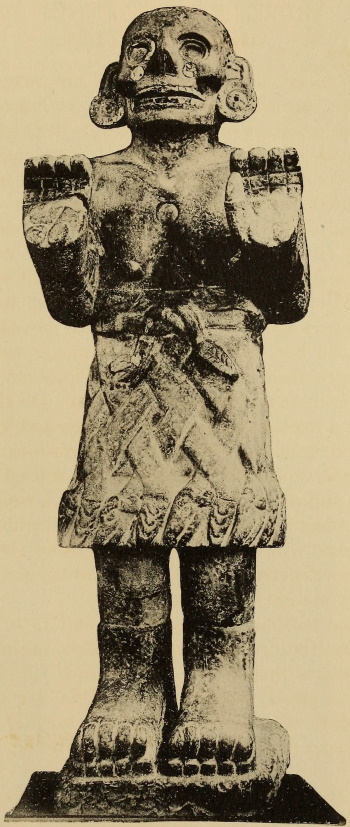
STONE IDOL: THE GODDESS COATLICUE, WITH MOSAIC DECORATION
NATIONAL MUSEUM, MEXICO
PL. III
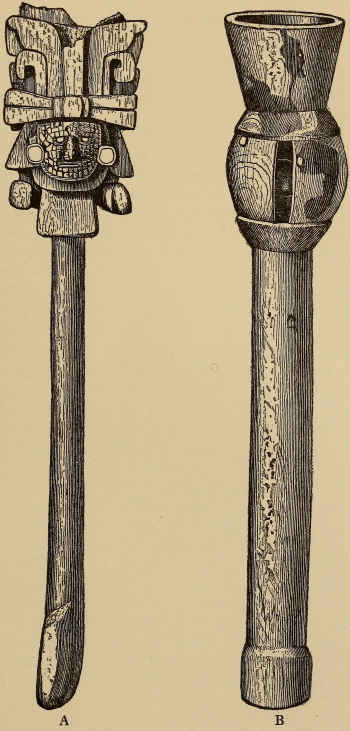
STAFF AND RATTLE OF WOOD WITH MOSAIC DECORATION
PEABODY MUSEUM, CAMBRIDGE
The second part was a copy of the Tribute Roll above referred
to. These pictures were given to other Indians for the interpretation
of their import, which was written down in the
Nahuatl language, and another person, well versed in both the
Indian and Spanish languages, made a translation into Spanish,
which was incorporated in the book. It was then despatched
to Spain, probably about the year 1549, but the vessel was
captured by French pirates, and the book came into the hands
of the French geographer, André Thevet, in 1553. After
Thevet’s death it was purchased, about the year 1584, by
Richard Hakluyt, at that time chaplain to the English Ambassador
to France. Hakluyt bequeathed the volume to Samuel
Purchas, who published it, without colors, with an English
translation of the text, in Purchas His Pilgrimes, London, 1625.
The English text was translated into French and accompanied
with the plates was published by Melchisedec Thevenot in
his Relations des Divers Voyages, in 1663. The codex ultimately
became the property of Selden, and with some other original
Mexican codices later became a part of the Bodleian Library
at Oxford, where it is now preserved. In 1831, Lord Kingsborough
issued it for the first time in colors, together with a
new and more accurate English rendering of the Spanish text,
in his monumental work on the Antiquities of Mexico.
The Tribute Roll was published by Archbishop Lorenzana in
Mexico in 1770, in his edition of the Cartas de Cortés, the drawing,
uncolored, being traced in a very inferior manner from the
original in Mexico. Finally, Dr. Antonio Peñafiel included a
beautiful colored facsimile of the Tribute Roll in his work,
Monumentos del Arte Mexicano Antiguo, published in Berlin in
1890, the missing leaves, in Philadelphia, being reproduced
from a very poor drawing of the codex on European paper,
probably executed for Boturini. These leaves were published
in exact facsimile in 1892, with an article entitled, The Tribute
Roll of Montezuma, edited by Dr. D. G. Brinton and Henry
Phillips, in vol. XVII of the Transactions of the American Philosophical
Society.
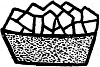
Fig. 1
On plate XVIII (we refer to the Peñafiel edition), in the second
section of the plate, among other objects of tribute is a small
bowl containing pieces of cut turquois (see fig.
1). In the explanation given by Purchas, this
item is described as “a little panne full of
Turkes stones,” and in the Kingsborough text
it has been translated “a little vessel of small
turquois stones.” On the plate published by
Lorenzana is the caption, “Matlauac Rosilla con q. se tiñe
azul.” The word matlauac is probably a corruption of the
Nahuatl word matlaltic, meaning ‘blue,’ but the rest of the
sentence in Spanish is confused, for rosilla means ‘reddish,’ and
con q. se tiñe azul, ‘with which they dyed blue,’ seems to indicate
that the phrase is incomplete. Accompanying the objects
depicted as tributes are the hieroglyphs of the towns which
paid them. These glyphs have been interpreted in the same
manner in all of the reproductions of the codex, but we use the
spelling adopted by Peñafiel, in preference to that given by
Purchas or by Kingsborough. They are: (1) Quiyauhtecpan,
“temple of rain or of its deities” Tlaloc or Chalchiuhtlicue; (2)
Olinalan, “place of earthquakes;” (3) Cuauhtecomatlan, “place
of tecomates;” (4) Cualac, “place of good drinkable water;”
(5) Ichcatlan, “cotton-plantation;” (6) Xala, “sandy ground.”
These places are given in the explanation as being “cities of
warm provinces.”
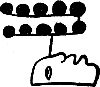
Fig. 2
In the third section of the same plate (XVIII) are the objects
shown in figs. 2 and 3. Peñafiel writes of fig. 2 as “ten little
figures worked in turquois.” Only one object
painted blue is depicted, the number ten
being indicated by the ten dots. That masks
form this tribute is clearly evident; in Purchas
the description is “tenne halfe faces of
rich blew Turkey stones,” and in Kingsborough,
“likewise 10 middling sized masks
of rich blue stones like turquois.”
PL. IV
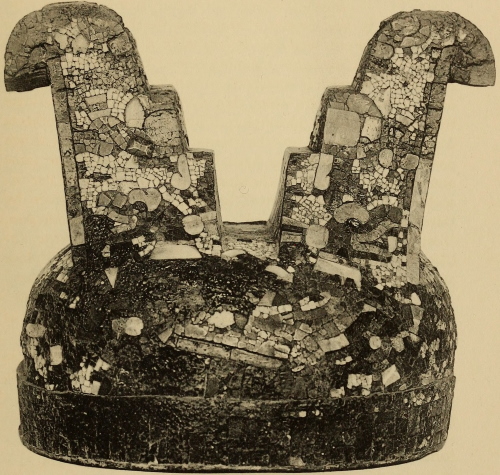
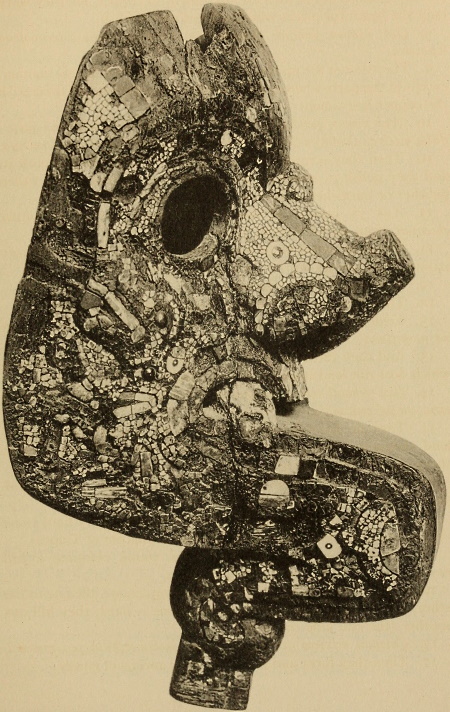
HELMET OF WOOD WITH MOSAIC DECORATION
BRITISH MUSEUM, LONDON
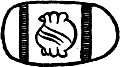
Fig. 3
The second item in this section (fig. 3) is described by
Peñafiel as “a small bag of the same stones.” Kingsborough’s
statement is, “a large bag of the said blue
stones,” while in Purchas the translation
reads, “a great trusse full of the said
Turkey stones.” On the bag which is
painted blue, with two red vertical bands,
is the Aztecan hieroglyph for stone, tetl.
The towns whence this tribute was exacted are: (1) Yoaltepec,
“place consecrated to the deity of the night;” (2) Ehaucalco,
“in the place of tanning;” (3) Tzilacapan, “river of chilacayotes;”
(4) Patlanalan, “place where parrots abound;” (5) Ixicayan,
“where the water comes down;” (6) Ichcaatoyac, “river of cotton.”
These cities are of the warm provinces.
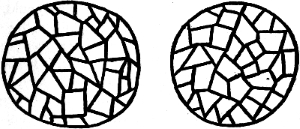
Fig. 4
The only finished objects of mosaic-work in the Tribute Roll
are on plate XXXII. This is one of the leaves of the original
codex in Philadelphia,
and
we have traced
fig. 4 from this
original. They
are described
by Purchas as
“two pieces
like platters
decked or garnished
with rich Turkey stones.” Kingsborough mentions
them as “two pieces like salvers ornamented or set with rich
turquoise stones.” Lorenzana has correctly printed the legend
which we find reproduced in the Philadelphia publication of
this leaf; it is “Ontetl xiuhtetl,” followed by the Spanish,
“turquesas o piedras finas.” Ontetl is Nahuatl for “two,” and
xiuhtetl, or xiuitl tetl, “turquois stone.” The mosaic character
of these two pieces is graphically represented by the ancient
artist. The towns paying the tribute illustrated on this sheet
are as follows: (1) Tochpan, or Tuchpan, “over the rabbit;”
(2) Tlaltizapan, “place situated over chalk;” (3) Cihuateopan,
“in the temple of Cihuacoatl;” (4) Papantla, “place of the
priests;” (5) Ocelotepec, “place of the ocelot;” (6) Mihuapan,
“river of the ears of corn;” (7) Mictlan, “place of rest.”
In the Crónica of Tezozomoc is an account of the campaign
of the Aztecan king Ahuitzotl into southern Mexico in 1497.
The towns of Xuchtlan, Amaxtlan, Izhuatlan, Miahuatla,
Tecuantepec, and Xolotlan, in the region of the Isthmus of
Tehuantepec, had revolted against him. After the complete
rout of the rebellious Indians, it was related by Tezozomoc
that “the kind of arms carried by the coast people was very
rich, so much so that the undisciplined soldiers began to strip
the bodies of the dead of the very rich feather-work pieces
called quetzalmanalli, and from their military ornaments
remove a round emerald like a mirror which sparkled in its
perfection, called xiuhtezcatl. Others of the dead carried on the
back of their arms that which was called yacazcuil, outside of
fine gold, and in the nose they wore stones; others (wore) gold,
and the shield which they carried had a very rich greenstone
in the center, and around it a decoration of very fine stones set
in (mosaic-work), said shield being called xiuhchimal.” Those
who remained after the slaughter came to Ahuitzotl, saying:
“Our Lords, let us speak. We will give our tribute of all that
is produced and yielded on these coasts, which will be chalchihuitl
of all kinds and colors, and other small stones called
teoxihuitl (turquois) for setting in very rich objects [mosaic],
and feathers of the richest sort brought forth in the whole
world, very handsome birds, the feathers of which are called
xiuhtototl, tlaquechol, tzinitzcan, and zacuan; tanned skins of
the tiger (ocelot), lions (puma), and great wolves, and other
stones veined with many divers colors.”[24]
In the same Crónica we read that Montezuma, who succeeded
Ahuitzotl after his death in 1502, received a royal tribute
from his vassals in Xaltepec, a coast town of Tehuantepec,
among which were “broad collars [sic] for the ankles, strewn
with gold grains and very rich stone mosaic-work.”[25]
PL. V
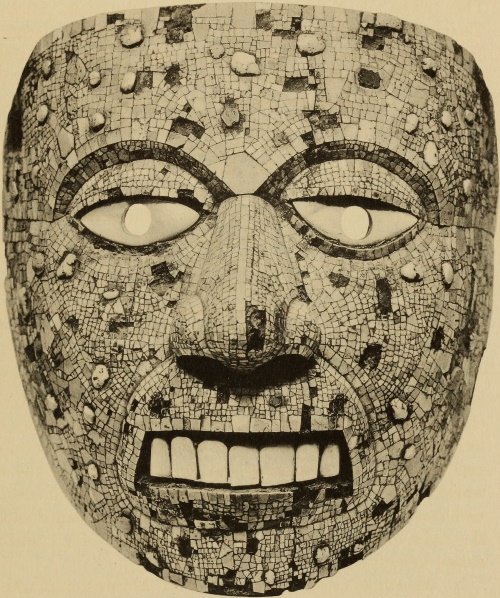
MASK OF WOOD WITH MOSAIC DECORATION
BRITISH MUSEUM, LONDON
SOURCE OF TURQUOIS
The source of the considerable quantity of turquois used in
Mexico in pre-Spanish times for personal ornaments and mosaic
incrustation is still an unsolved problem. Thus far no prehistoric
workings have been found in Mexico. Only recently
turquois has been discovered at the silver mines at Bonanza,
Zacatecas, but Dr. Kunz, who has called our attention to this,
writes that he has no information regarding prehistoric workings
there.[26] In the extensive bibliography on the geology of
Mexico by Aguilar y Santillan[27] we find only a single entry for
turquois, that being the study of Mexican mosaics in Rome
by Pigorini.[28] Pogue[29] writes that there are no important
turquois deposits that do not show signs of prehistoric exploitation,
and he is also of the opinion that it is very difficult to
trace the source of the turquois used by the Indians of ancient
Mexico and Central America. Pogue’s conclusion is that “as
no occurrence at all adequate as an important source has been
discovered south of the present Mexican boundary, it therefore
seems probable that the Aztecs and allied peoples, through
trade with tribes to the north, obtained supplies of turquois
from the Cerrillos hills [New Mexico] and perhaps other localities
of the Southwest.”
Sahagun is the only early chronicler who affords information
concerning this point. He writes explicitly that “the
Toltecs had discovered the mine of precious stones in Mexico,
called xiuitl, which are turquoises, which mine, according to
the ancients, was in a hill called Xiuhtzone, close to the town
of Tepotzotlan [State of Hidalgo].” We will quote other statements
by Sahagun concerning turquois:
The turquois occurs in mines. There are some mines whence
more or less fine stones are obtained. Some are bright, clear, and
transparent; while others are not.... Teoxiuitl is called turquois
of the gods. No one has a right to possess or use it, but always it
must be offered or devoted to a deity. It is a fine stone without any
blemish and quite brilliant. It is rare and comes from a distance.
There are some that are round and resemble a hazelnut cut in two.
These are called xiuhtomolli.... There is another stone, used
medicinally, called xiuhtomoltetl, which is green and white, and very
beautiful. Its moistened scrapings are good for feebleness and
nausea. It is brought from Guatemala and Soconusco [State of
Chiapas]. They make beads strung in necklaces for hanging around
the neck.... There are other stones, called xixitl; these are
low-grade turquoises, flawed and spotted, and are not hard. Some
of them are square, and others are of various shapes, and they
work with them the mosaic, making crosses, images, and other
pieces.[30]
If we are to credit Sahagun, turquois was worked not only
in the immediate region of the central Mexican plateau, but
they received supplies from distant points, and specifically
from Chiapas and Guatemala. The raw material mentioned
in the Tribute Roll of Montezuma as coming from coast towns
and from the south, must also be taken into consideration.
Hence, notwithstanding the present lack of information
respecting the localities where turquois is to be found in situ
in central and southern Mexico, we cannot reject the opinion
that ultimately ancient workings will be found at more than
one site in Mexico. We do not believe it necessary to
assume that the source of supply of both the Toltecs and the
Aztecs, as well as of other tribes, such as the Tarasco, and the
Mixtec and Zapotec, which also made use of this material, was
the far-distant region of New Mexico. It was formerly asserted
by some students that the jadeite of Middle America must
have come by trade from China,[31] because no deposits have
as yet been found in the former region; but it is now known
by chemical analysis that the Middle American jadeite is
distinct from that of Asia. In fact, the writer has long held
that not alone in one, but in at least five, different localities,
jadeite will in time be discovered.[32]
PL. VI
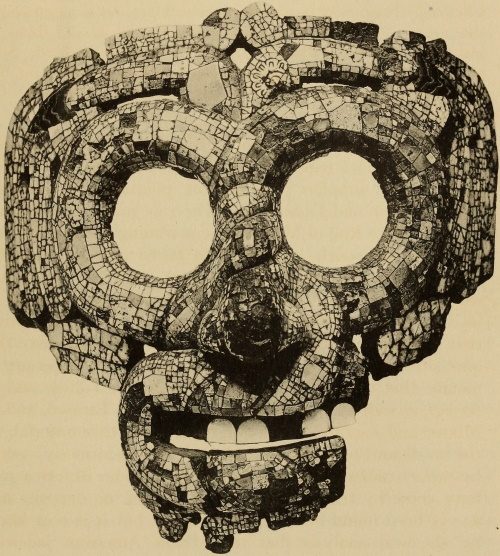
MASK OF WOOD WITH MOSAIC DECORATION
BRITISH MUSEUM, LONDON
THE AZTEC LAPIDARIES AND THEIR WORKS
The development of the art of the lapidaries and mosaic-workers,
like that of the goldsmiths, is attributed by Sahagun
to the Toltecs, under the beneficent influence of Quetzalcoatl,
the culture hero god. In treating of the pre-Aztec people called
Tultecas, or people of Tollan or Tula, by Sahagun, he states
that they were very skilful in all that pertained to the fine arts.
He writes:
The Tultecas were careful and thorough artificers, like those of
Flanders at the present time, because they were skilful and neat in
whatsoever they put their hands to; everything (they did) was very
good, elaborate, and graceful, as for example, the houses that they
erected, which were very beautiful, and richly ornamented inside with
certain kinds of precious stones of a green color as a coating (to the
walls), and the others which were not so adorned were very smooth,
and worth seeing, and the stone of which they were fashioned appeared
like a thing of mosaic.... They also knew and worked
pearls, amber, and amethyst, and all manner of precious stones,
which they made into jewelry.[33]
We find another statement to the effect that—
The lapidary is very well taught, and painstaking in his craft, a
judge of good stones, which, for working, they take off the rough part
and bring together or cement with others very delicately with bitumen
or wax, in order to make mosaic-work.[34]
In the pictorial section of the Florentine manuscript of
Sahagun,[35] in the Codex Mendoza,[36] and in the Mappe Tlotzin,[37]
are pictures delineating artisans engaged in various crafts,
such as weavers, painters, carpenters (wood-carvers), stone
carvers, lapidaries, goldsmiths, and feather-mosaic workers,
yet we find no actual representation of turquois-mosaic workers.
In the third section of the Codex Mendoza appears a picture
of a father teaching his son the secrets of the lapidary’s art.
The interpreter of the codex writes:
The trades of a carpenter, jeweler (lapidary), painter, goldsmith,
and embroiderer of feathers, accordingly as they are represented and
declared, signify that the masters of such arts taught these trades
to their sons from their earliest boyhood, in order that, when grown
up to be men, they might attend to their trades and spend their
time virtuously, counseling them that idleness is the root and
mother of vices, as well as of evil-speaking and tale-bearing, whence
followed drunkenness and robberies, and other dangerous vices, and
setting before their imaginations many other grounds of alarm, that
hence they might submit to be diligent in everything.
The elaborate series of pictures of the various crafts in the
Florentine manuscript of Sahagun (laminas liv to lxiv) includes
those that show in detail the work of the goldsmiths
and the feather-workers; but the illustrations devoted to the
lapidaries we are unable to correlate, in the absence of the
text, with the Nahuatl text of the Sahagun manuscript in the
Real Academia de la Historia in Madrid, which we will give
later from the study by Dr. Seler containing a translation of
the native text into French. This description of the work of the
lapidaries informs us only concerning the working and polishing
of the stones. Unlike the other accounts by Sahagun regarding
the goldsmiths and the feather-workers, which enlighten us
with respect to the details of these two fine arts, he does not
here enter into any description concerning the delicate work
of the artists who fashioned the beautiful pieces of stone
mosaic. Although such work was turned out by the Aztecan
workmen, as we have already demonstrated, it seems highly
probable that in times immediately preceding the Spanish
conquest, the Aztecan kings Ahuitzotl and Montezuma obtained
a considerable number of such objects through tribute
and by barter with the tribes living in what are now the states
of Vera Cruz, Oaxaca, and western Chiapas. As our knowledge
of Mexican archeology, now all too meager, is extended, it is
very probable that we will find vestiges of this art in the
Pacific state of Guerrero, where great numbers of jadeite and
other greenstone objects have been discovered, with a respectable
number of specimens indicating the high artistic skill
of the indigenes of that section. We may also hope to find relics
of this art in the area of Matlaltzincan culture to the north of
the valley of Mexico, and also in the field of Tarascan culture
in the states of Michoacan and Jalisco, for, as will be related,
mosaic specimens have been recovered from ancient ruins as
far north as the State of Zacatecas.
PL. VII
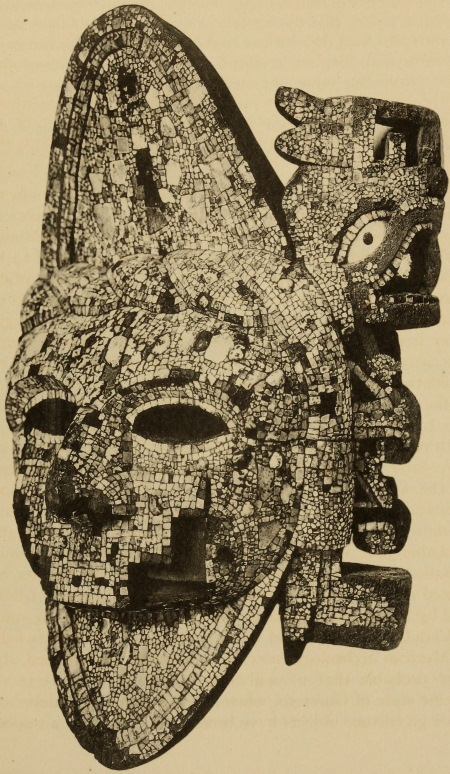
MASK OF WOOD WITH MOSAIC DECORATION
PREHISTORIC AND ETHNOGRAPHIC MUSEUM, ROME
Sahagun’s account (chap. II) of the work of the lapidaries
we herewith append, with the Nahuatl text and a translation
of the French rendering by Seler.[38]
1. In tlateque tulteca ynic quitequi yn yztac tehuilotl yoan tlapaltehuilotl
yoan chalchiuitl yoan quetzalitztli ynica teoxalli yoan tlaquauac
tepuztli.
1. The lapidary artisans cut rock-crystal, amethyst, emerald,
both common and precious, by means of emery and with an instrument
of tempered copper:
2. Auh ynic quichiqui tecpatl tlatetzotzontli.
2. And they scraped it by means of cutting flint.
3. Auh ynic quicoyonia ynic quimamali teputztlacopintli.
3. And they dug it out (hollowed) and drilled it by means of a
little tube of copper.
4. Niman yhuian quixteca quipetlaua quitemetzhuia, auh yn yc
quicencaua.
4. And then they faceted it very carefully; they burnished
(polished) it and gave it the final luster.
5. Ytech quahuitl yn quipetlaua ynic pepetlaca, ynic motonameyotia
ynic tlanextia.
5. They polished it set in wood, so that it comes to be very
brilliant, shining, glossy.
6. Anoço quetzalotlatl ynitech quilau ynic quicencaua ynic quiyecchiua
yn intultecayo tlatecque.
6. Or they polish it mounted in bamboo, and the lapidaries
finish it thus, and conclude their work.
7. Auh çannoiuhqui yn tlapaltehuilotl ynic mochiua ynic mocencaua.
7. And in the same manner they work and smooth amethyst.
8. Achtopa quimoleua quihuipeua teputztica yn tlatecque yn
tulteca ynic yyoca quitlatlalia yn qualli motquitica tlapaltic yn itaqui.
8. In the first place the lapidary artisans break into pieces the
amethyst and crush it with an instrument of copper, for they work
only the beautiful pieces which are entirely reddish.
9. Çan niman yuhqui tlatlalia yn campa monequiz quimoleua
tepuztica.
9. They do not set up the precious stones named in this manner,
except in the parts where it is necessary, when they break them with
the copper instrument.
10. Auh niman quichiqui quixteca yoan quitemetzhuia yoan quipetlaua
ytech quahuitl yn tlapetlaualoni ynic quiyectilia ynic quicencaua.
10. Then they scrape it, and they facet it, and they smooth it,
and they polish it, mounted in wood, set on the instrument called
polisher or burnisher, and they manufacture and finish it.
11. Auh yn yehoatl yn moteneua eztecpatl ca cenca tlaquauac
chicauac camo ma vel motequi ynica teoxalli.
11. The stone called blood silex (heliotrope) is very hard and very
strong, and they do not cut it well with emery.
12. Çaçan motlatlapana motehuia.
12. They break it and they cut it up in any kind of way.
13. Yoan motepehuilia yn itepetlayo yn amo qualli, yn amo uel
no mopetlaua.
13. And they throw away the vein-stone, the useless stone, that
which does not lend itself readily to polishing.
14. Çan yehoatl mocui motemolia yn qualli, yn vel mopetlaua yn
eztic, yn uel cuicuiltic.
14. They do not take or seek except the beautiful pieces that
lend themselves to good polishing, the red-banded, that permit
themselves to be well cut.
15. Michiqui atica yoan ytech tetl cenca tlaquauac vnpa uallauh
yn matlatzinco.
15. They rub them with water and mounted in a very hard stone
that comes from the country of Matlatzinca [district of Toluca].
16. Ypampa ca uel monoma namiqui, yniuh chicauac tecpatl
noyuh chicauac yn tetl, ynic monepanmictia.
16. And because these two stones are companions, the one to the
other, as the silex is very hard, so the stone is hard, they kill one
another (the one kills the other).
17. Çatepan mixteca yca teoxalli yoan motemetzhuia yca ezmellil.
17. Then they facet and polish them by means of emery.
18. Auh çatepan yc mocencaua yc mopetlaua, yn quetzalotlatl.
18. And they finish and polish them with bamboo.
19. Ynic quicuecueyotza quitonameyomaca.
19. In this way they make them scintillate and give to them a
luster like the rays of the sun.
20. Auh yn yehoatl motocayotia vitzitziltecpatl niman yuh yolli
tlacati.
20. And that which they call hummingbird silex (stone of a
thousand colors) is (in color like) an animal of that nature.
21. Miyec tlamantli ynic mocuicuiloua, iztac yoan xoxoctic yoan
yuhquin tletl, anoço yuhqui citlali yoan yuhquin ayauhcoçamalotl.
21. It is tinted (painted) in a thousand colors, white, blue, clear
brilliant red, black with white spots, and the color of the rainbow.
22. Çan tepiton xalli ynic michiqui ynic mopetlaua.
22. They scrape it and simply polish it with fine sand.
23. Auh yn yehoatl motocayotia xiuhtomolli camo tlaquauac camo
ezmellil ytech monequi ynic michiqui ynic mixteca yoan ynic motemetzhuia
yoan ynic mopetlaua ynic moquetzalotlahuiaya ynic motonameyotia
motlanexyotia.
23. The stone that they call round turquois is not very hard,
so they have no need of emery to scrape, facet, smooth, or polish, for
they apply to it the bamboo, then it receives its radiant luster and
brilliancy.
24. Auh yn yehoatl teoxihuitl ca amo cenca tlaquauac.
24. The fine turquois is not very hard either.
25. Çanno tepiton xalli ynic mopetlaua ynic moyectilia auh yn uel
no yc motlanextilmaca motonameyomaca occentlamantli ytoca xiuhpetlaualoni.
25. They polish it likewise with fine sand and they give to it a
very brilliant luster and radiance by the method of another polisher,
called the polisher of turquois.
PL. VIII
MASK OF WOOD WITH MOSAIC DECORATION
PREHISTORIC AND ETHNOGRAPHIC MUSEUM, ROME
Regarding the patron deities of the lapidaries, Sahagun has
given us a detailed account which is so interesting that we
translate in extenso.
The lapidaries who worked precious stones in the time of their
pagandom adored four gods, or better said devils: the first was
called Chicunavitzcuintli, the second Naoalpilli, the third Macuilcalli,
and the fourth Cintcutl: to all these last three gods they made a
festival when there reigned the sign or character called Chicunavitzcuintli,
which is a woman, and for this (reason) they painted it so: to
this (one) they attributed the cosmetics of the women, and in order
to signify this they painted it with a crosier in the right hand, and
in the left they put a shield, in the which (shield) there was represented
a foot. They also put ear-ornaments of gold on it, and from
the cartilage of the nose hung a butterfly of the same metal, and
they dressed it (the idol) with a uipil and woman’s shirt that was
woven white and red, and also the skirts: they put on some sandals,
also colored, having some paintings that appeared like almonds. To
all these four (gods) they gave their images or their titles, so that
they might die in their service on the day of their festival. That one
called Naoalpilli they decked out, and they cut the strands of hair
in unequal lengths, very badly cut, disheveled or standing on ends,
and divided in two parts. They put on the forehead a delicate plate
of gold (thin) like paper, some earrings of gold in the ears, and in the
hand a crosier decorated with rich feathers, and in the other (hand) a
shield made like a net, and in four parts it had rich feathers badly
placed. They also dressed it with a jacket woven white and red,
with edging in the lower end: they also put on it some colored sandals.
And the other god, called Macuilcalli, they also composed like
a man, the hair cut in the middle of the head like a ridge, that is
called quachichiquille, and this ridge was not of hair but made
of the richest feathers. They placed in the temples some plates of
delicate gold, and a jewel hung from the neck also, made of a round
and wide marine shell. In the hand a crosier made of rich feathers
was placed, and in the other hand was a shield with some circles of
red, some inside the others; they had the body painted vermilion
color, and they also put on it some sandals of the same color. The
other god, called Cinteutl, was fashioned in the likeness of a man,
with a mask wrought like mosaic-work, with some rays of the same
(mosaic-work), coming out of the same mask. They put on it a
jacket of cloth dyed light-blue; a jewel of gold hung from the neck.
They place it (the idol) on a high platform from which it looked out,
which platform, called cincalli, was composed of cornstalks after
the manner of a xacal. They adorned it with some white sandals,
the fastenings of which were made of loose cotton; they say that to
these gods they attribute the artifice of working precious stones, of
the making of barbotes (the tops of helmets), and ear-ornaments of
black stone, of crystal, and of amber, and of other white (stones).
They also attribute to these gods the working of beads, anklets,
strings of pearls which they carried on their wrists, and all kinds of
work in stones and chalchihuites, and the hollowing-out and polishing
of all the stones; they said that these gods had invented it, and
for this reason they were honored as gods, and to them the elder artisans
of this craft and all the other lapidaries made a festival. By
night they intoned their hymns and set the captives who were to die,
on watch in their honor, and they did not work during the festival.
This (festival) was celebrated in Xochimilco, because they said that
the forefathers and ancestors of the lapidaries had come from that
town, and there was the place of origin of these artisans.[39]
PL. IX
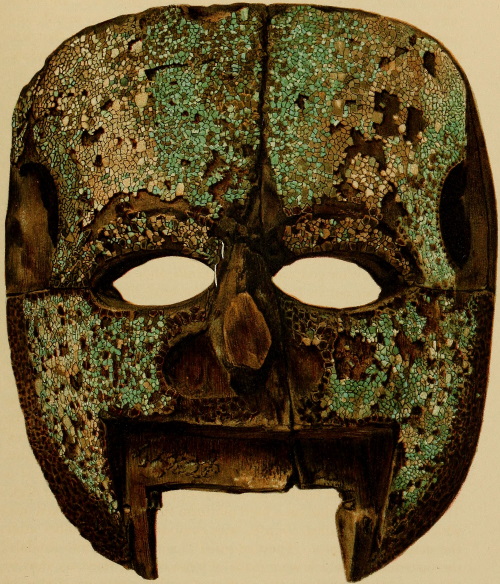
MASK OF WOOD WITH MOSAIC DECORATION
MUSEUM OF THE AMERICAN INDIAN HEYE FOUNDATION. NEW YORK
The ruler of the eighteenth week of the astrological calendar,
or tonalamatl, was a goddess named Chantico or Quaxolotl,
also nicknamed Chiconaui-itzcuintli,[40] from the ninth day of
the thirteen-day period or week. Seler writes:
She was the goddess of Xochimilco, and consequently also the
chief deity of the guild of the tlatecque, of the stone cutters, the
stone polishers, the jewelers, who were also supposed to come from
Xochimilco. (Duran calls her wrongly Ciuacoatl and identifies her
with the goddess of Colhuacan, which place stood opposite the city
of Xochimilco).... Besides Chiconaui-itzcuintli the stone-cutters
had still a few other titles for the goddess. Such were Papaloxaual
and Tlappepalo, i.e., “she of the red butterfly painting,” and “she
with the red butterfly,” and these have reference to fire.... The
stone-cutters also gave their goddess a butterfly as her nasal ornament,
which, red and white, are the colors of her robe.[41]
In some of the different versions or paintings of the tonalamatl
contained in old Mexican codices, opposite the delineation
of the goddess Chantico there is placed a fasting man in an
enclosure. In both Codex Borbonicus[42] and Codex Telleriano
Remensis,[43] this figure is found. Seler describes it as—
an enclosure inlaid with gold discs or rings. The interpreter designates
it as “house of gold.” Beyond doubt this name has reference to
one of the four little fasting houses (necaualcalli) which the hero of
Tollan, Quetzalcoatl, built for himself, and naturally corresponded
to the four quarters of the heavens, the first of which was said to
be made of gold or embellished with gold (coztic teocuitlacalli), the
second decorated with red musselshells (tapachcalli), the third with
turquoises (xiuihcalli), the fourth with white musselshells (teccizcalli).[44]
Seler draws this inference from the legend given by Sahagun,
which we have translated in full below.
As often is the case, there is some confusion in the description
of Chantico in the early writings. This deity is also
asserted to be a male. In the explanation of the Codex Telleriano
Remensis the attributes of Chantico or Cuaxolotle are
recited. It is said that—
Chantico presided over these thirteen signs (a division of the tonalamatl,
or divinatory calendar), and was the lord of chile or of the
yellow woman. He was the first who offered sacrifice after having
eaten fried fish; the smoke of which (sacrifice) ascended to heaven;
at which Tonacotli (Tonacatecutli, the father of all the gods) became
incensed, and pronounced a curse against him that he should be
changed into a dog, which accordingly happened, and he named
him Chantico on this account, which is another name for Miquitlatecotle.
From this transgression the destruction of the world ensued.
He was called Nine Dogs, from the sign on which he was born.
Chantico or Cuaxolotle is the symbol which the country people of
Xolotle wear on their heads.[45] (The symbol of the city of Xolotlan
in the Codex Mendoza is the head of a Dog.)
In the Sahagun manuscript of the Real Palacio in Madrid[46]
the deity is painted with the shirt and skirt of a woman, and
also in the Codex Borbonicus[47] and the Tonalamatl Aubin.[48]
In his explanation of the last codex Seler has treated exhaustively
of the various representations and attributes of
this goddess.[49]
Among the laws of the Mexicans was the following:
They hung and very severely punished those sons who squandered
the property left them by their fathers, or destroyed the arms, jewels,
or remarkable things that their fathers had left.[50]
PL. X
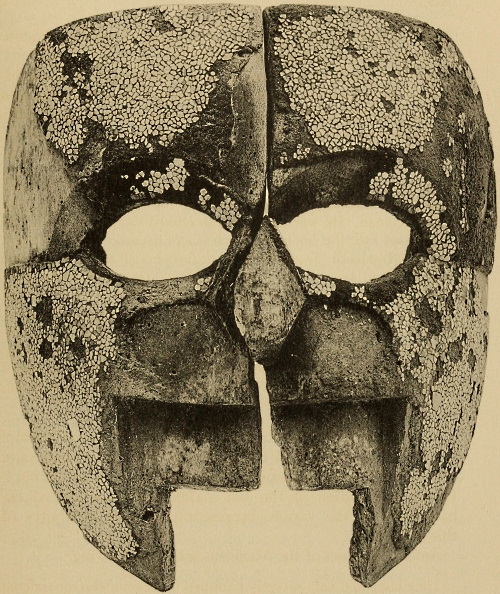
MASK OF WOOD WITH MOSAIC DECORATION
MUSEUM OF THE AMERICAN INDIAN HEYE FOUNDATION, NEW YORK
In another study[51] we have called attention, as follows, to the
daily traffic of gold and precious stones in the great market
of Tenochtitlan.
Cortés describes the great market of Tenochtitlan, and the great
quantity of things daily exposed for sale included jewels of gold,
silver, and stones. The Anonymous Conqueror, in describing the
great market, states that “on one side of the plaza are those who sell
gold, and adjoining are those who sell precious stones of various
classes set in gold, in the shapes of various birds and animals.”[52] This
refers to mosaic jewels with stone and gold inlays. Cortés further
informs us that Montezuma had in his house representations in gold,
silver, stones, or feathers, of every object of his domain, beautifully
executed; and there is also a statement (by Ixtlilxochitl) that in the
collection of Nezahualcoyotl, king of Texcoco, were the representations
in stone mosaic-work and gold of every bird, fish, or animal
which could not be obtained alive.[53]
A most interesting description is given by Sahagun of one
of the edifices erected by the Toltecs in Tula. If true, it
clearly shows that in pre-Aztec times much more elaborately
decorated buildings were erected than in the more recent period,
for there are no accounts in the writings of the Spaniards of
such lavishly ornamented buildings existing in the numerous
cities conquered by them during the beginning of the sixteenth
century. This is corroborated by the excavations now being
conducted in the ruins of Teotihuacan, the greatest city known
to us from Toltec times, where some marvelous structures have
been unearthed.[54] The temple in question is said by Sahagun
to have been built in honor of Quetzalcoatl, and included in
its embellishment some of the most precious work of which
they were capable.
It had four halls. The eastern one (had the walls) covered with
plates of gold, and it was called the golden hall or house. The
western hall was called the hall of emeralds, or turquoises, because
inside they had (the walls) covered with fine stonework, with all
manner of stones, all placed and joined (together) as a coating or
covering, like work of mosaic. The southern hall had the walls of
divers marine shells, and in place of any other covering, they had
silver, which was put together so nicely with the shells that the
joints were not visible. The fourth hall, the northern one, had the
walls made of colored jasper and shell, put on in a very ornamental
manner.[55]
The fame of this temple or palace seems to have been firmly
established, as Sahagun recurs to it in another part of his
history, but in less detail. Sahagun follows the fortunes of the
culture hero while he was in the ascendency in Tula, and
states that later, owing to circumstances which it is needless
to relate in this place, Quetzalcoatl determining to abandon
Tula, ordered the burning of “all the houses that he had made
of silver and shell, and furthermore commanded that other
precious things should be buried in the neighboring hills and
ravines.”[56] This indicates that the mosaic-decorated building
was laid in ruins, and part of the treasure, at least, was buried
before the inhabitants left the region and commenced the
migration southward.
In presenting the tradition of this migration of Quetzalcoatl,
Sahagun states that he (Quetzalcoatl) is reputed to have
made and erected some houses underground which are called
Mientlancalco. This of course refers to the famous ruins of
Mitla, and seems to be an authentic tradition of the Nahuan
origin of this important city of southern Mexico. It is doubly
significant, when considered in connection with the description
of the mosaic-decorated buildings in Tula, for, as is well known,
the dominant architectural feature of the Mitla group of
structures is the mosaic treatment of many of their outer and
inner walls.
PL. XI
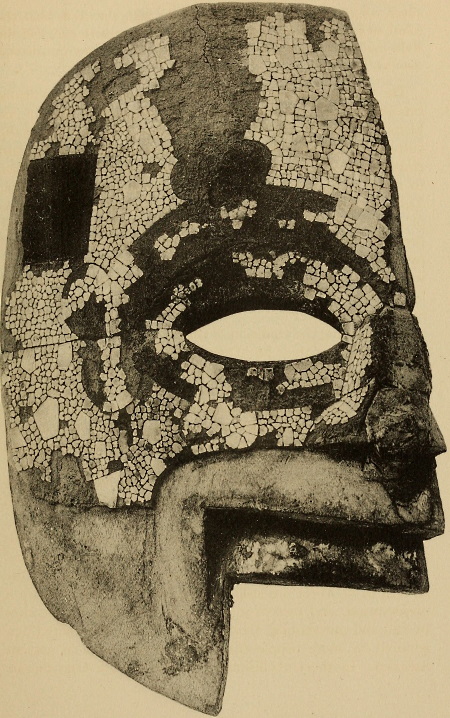
MASK OF WOOD (FRAGMENT) WITH MOSAIC DECORATION
MUSEUM OF THE AMERICAN INDIAN HEYE FOUNDATION, NEW YORK
It is not necessary to give more than brief attention to this
application of mosaic-work in architecture. The traditional
mosaic-decorated buildings of Tula have disappeared, but the
structures of Mitla are still standing in an excellent state of
preservation, and moreover are easily accessible to travelers
by rail and automobile; therefore they have been visited and
admired by more people than perhaps any ruins in ancient
America. In the embellishment of the walls a true mosaic
decoration was employed, differing in kind only from the
turquois mosaic on small objects. Geometric patterns were
produced by fitting together small stones of different shapes
and sizes, some of which were more deeply imbedded than
others, so that the designs were traced out by the stones which
projected more than others; in single panels, several planes
were necessary to bring out the desired patterns. In many
cases the stones are so neatly fitted that the joints can hardly
be traced. We have written elsewhere that—
the massiveness of the construction and simple and chaste ornamentation
place the Mitla structures in a class unapproached by any
other existing ruined edifices in ancient America. The workmanship
revealed in the stonework, the elegant precision with which the
stones are laid and carved, is not equaled in any of the Mayan ruins.
However, as noted by Holmes, the geometric fretwork mosaics differ
from the great façades of the Mayan buildings “in subject matter
rather than in kind, for the decorated surfaces there, though depicting
animal forms, are mosaics in the sense that they are made up
of separate hewn or carved stones set in mortar to form ornamental
designs.”[57]
OBJECTS DECORATED WITH MOSAIC
In the ancient chronicles are found many descriptions of the
employment of mosaic-work decoration in the central Mexican
region. From the writings of Sahagun and others it is clearly
evident that many such decorated objects were made for and
were used as parts of the paraphernalia with which great idols
of wood or of stone representing various deities were adorned
for the frequent religious festivals which occurred at stated intervals.
The rulers and the priests and members of the so-called
nobility used such objects on these occasions. The
major employment of the mosaic art seems to have been for the
adornment of objects or ornaments used ceremonially, such as
crowns or head-bands, helmets, masks, shields, scepters, ear-ornaments,
nose-ornaments, breast-plates, bracelets, and anklets.
The material on which the mosaic incrustation was
placed was chiefly wood, but gold, shell, bone, and stone were
also used. Small figures of the gods, either in human or in animal
form, as well as musical instruments, were thus adorned.
There are also indications that pottery vessels were sometimes
decorated by embedding turquois in the clay.
Unfortunately we still possess only scant knowledge of the
various objects ornamented in this manner. In the data obtained
from the early chronicles there is abundant evidence
that, in the central plateau of Mexico during the period immediately
preceding the Spanish conquest, the art was highly
developed. Visual evidence is at hand in the few beautiful examples
now in European museums, specimens which were sent
across the water by Cortés during the earliest period of the
conquest, between the years 1518 and 1525.
A few references from some of the early writers regarding the
use of turquois mosaic by the Aztecs will be presented.
PL. XII
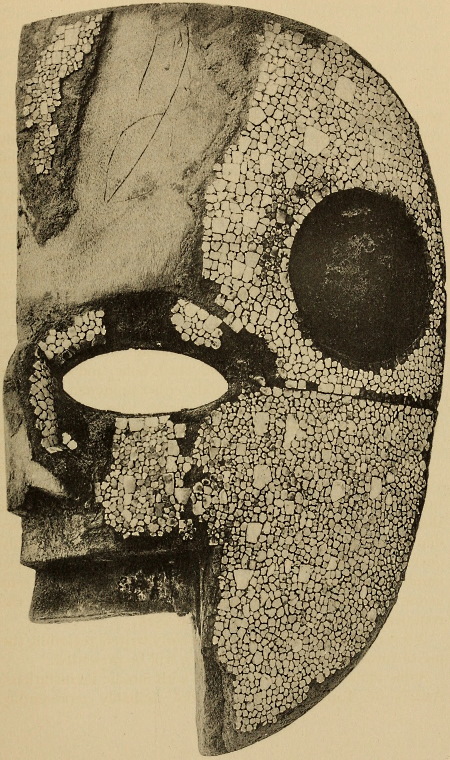
MASK OF WOOD (FRAGMENT) WITH MOSAIC DECORATION
MUSEUM OF THE AMERICAN INDIAN HEYE FOUNDATION, NEW YORK
Stone idols were often decorated with mosaic incrustations.
Andrés de Tapia describes an idol probably representing
Huitzilopochtli, showing this type of embellishment, in the
great temple at Tenochtitlan. Tapia’s account is worthy of
attention, for he was one of the captains of Cortés, and took a
prominent part in the capture of the capital of Montezuma.
He writes:
There were two idols on two pedestals, each one of the bulk of an
ox; the pedestals measured a yard in height, and above these (were)
two idols, each one almost three yards in height, of polished grain:
and the stone was covered over with nacre, which is the shell in
which pearls are created, and over this (mother-of-pearl), fastened
with bitumen after the manner of paste, were (set in) many jewels of
gold, and men, snakes, birds, and histories (hieroglyphs), made of
small and large turquoises, of emeralds and amethysts, so that all
the mother-of-pearl was covered, except in some places where they
left it (uncovered) so as to make work with the stones. These idols
had plump snakes of gold (as) girdles, and for collars each (one had)
ten or twelve hearts made of gold, and for the face a mask of
gold and eyes of mirror (obsidian or iron pyrites), and they had
another face in the back of the head like the head of a man without
flesh.[58]
Pomar describes the idol of Huitzilopochtli as of wood,
“having on the breast a jewel of turquoises set in gold, with
some gold bells (hanging), and on the face (were) two stripes
of gold and two of turquoises, very beautifully wrought and
placed.”[59]
In describing this idol, Bernal Díaz writes that “the whole
body was covered with precious stones, and gold and pearls,
and with seed pearls stuck on with a paste that they make in
this country out of a sort of root, and all the body and head
was covered with it, and the body was girdled by great snakes
made of gold and precious stones.” He goes on to mention
another idol close to it, which held “a short lance and a shield
richly decorated with gold and stones.”[60]
Concerning the ancestral treasure of the Aztecan kings which
Montezuma inherited from his father Axayacatl, finally exacted
by Cortés from the unfortunate ruler, Bernal Díaz describes
“three blowguns with their pellet molds and their
coverings of jewels and pearls, and pictures in feathers of little
birds covered with pearl shell, and other birds, all of great
value.[61]
Tezozomoc, in describing the great sacrifices offered to the
god Huitzilopochtli in honor of the coronation of Montezuma,
and the presents brought by neighboring chiefs and lords as
tributes from the various towns under their jurisdiction,
writes:
In the center of the great square there was a building (xacal) where
was the teponaztli, and the great tlapanhuehuetl with which they made
music. On the xacal was the device of the Mexican arms with a
small peñula (rock?) of painted paper, like a natural rock, with a
great cactus (tuna) on it, and on the cactus a royal eagle having in
its claws a great mangled snake, and the eagle had a crown of
doubled or twisted paper very well (made) and gilded, and (with)
very rich stone mosaic-work round about it, in the Mexican custom
called teocuitla amayxcuatzolli.[62]
At this festival Montezuma had the king of Aculhuacan attired
in special raiment, which Tezozomoc describes as “a
netted mantle with much rich stonework in the knots of the
mantle, and with little gold bells hanging from the fringe.[63]
According to Sahagun, Xiuhtecutli, god of fire, wore “earrings
in the holes of the ears worked with mosaics of turquois....
In his left hand he carried a shield with five greenstones
called chalchihuite, placed like a cross on a round gold plate,
which nearly covered the whole of the shield.”[64]
PL. XIII
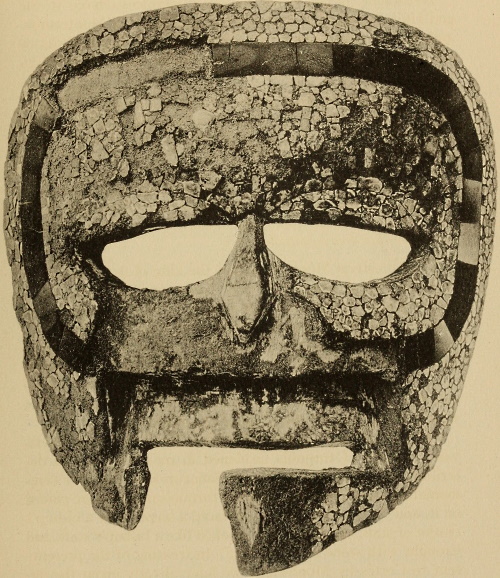
MASK OF WOOD WITH MOSAIC DECORATION
MUSEUM OF THE AMERICAN INDIAN HEYE FOUNDATION, NEW YORK
Chalchihuitlicue, goddess of water, fountains, and rivers,
wore earrings of turquois fashioned in mosaic-work. In describing
the idol of Quetzalcoatl, Sahagun says that, for ceremonial
occasions, ear-ornaments of turquois mosaic were placed
on it, and “in the right hand was placed a scepter like a bishop’s
crosier or staff, the upper part crooked like a bishop’s staff, and
wrought with stone mosaic-work.” In treating of the presents
sent to Cortés by Montezuma we have already given the description
of the paraphernalia pertaining to this deity. This
scepter is there described as having “the crook like the head
of a snake turned around or coiled.” In the codices the god
or his priest is represented with this staff
with a crook, but the serpent-headed
scepter is shown by Sahagun (manuscript
of the Real Palacio, Madrid, estampa VII,
fig. 1) as part of the ceremonial outfit of
Huitzilopochtli (fig. 5). The body of the
serpent is painted blue, representing the
scales done in turquois mosaic.
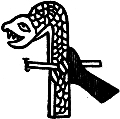
Fig. 5
In describing the god Tezcatlipoca,
Pomar states that he was represented with “a mask with three
stripes (vetas) of espejuelo (either transparent lamellated gypsum
[selenite], or more probably obsidian), and two of gold,
which crossed over the face.”[65] The idol was fashioned from
wood in the figure of a man. Espejuelo, he states, was a kind
of shining metal called tezcapoctli.
In the invocation to the god Paynal, which has been preserved
to us in the original Mexican tongue by Sahagun, is the
strophe, “yxiuh chimal, xiuhtica tlatzaqualli chimalli imax mani,”
which has been translated by Seler, “the blue shield, covered
with the turquois mosaic, hangs from his arm ... he carries
the (blue mosaic) shield.”[66] This chapter was copied by Seler
from the manuscript in the Real Palacio, Madrid. In the
reproduction of the pictorial part of the manuscript published
in colors by Troncoso, we find the representation of this deity,
in which the mosaic shield is graphically drawn and painted blue
(see our fig. 70, p. 17). Sahagun (book 1, chap. 2) briefly describes
“this god called Paynal, who was a kind of under-captain of
Huitzilopochtli.” He is said to have been a man adored as a
god.
The Anonymous Conqueror affords valuable information regarding
the use of shields. He says:
They use shields of various kinds, made of thick reeds which grow
in that country, interwoven with cotton of double thickness, and
they cover them with precious stones (turquois mosaic-work) and
round plates of gold, which make them so strong that nothing can
go through them, unless from a good crossbow. Some arrows, it is
true, pierced them, but could do no harm. And because some of
these shields have been seen in Spain, I say that they are not of the
kind borne in war, but only those used in the festivals and dances
which they are accustomed to have.[67]
In his chapter devoted to a consideration of “the finery that
the lords used in their dances,” Sahagun mentions “bracelets of
mosaic-work made of turquoises,” and also “masks worked in
mosaic, and (having) false hair such as they now use, and some
plumes of gold which came out of the masks.” He further describes
the costumes, as follows:
They also wear attached to the wrists thick bands of black leather
made soft with balsam, and decorated with a large bead of chalchihuitl
or other precious stone. They also wore labrets of chalchihuitl
set in gold, placed through the flesh, although they do not have this
custom now. They also have these ornaments made of large rock-crystals,
with blue feathers set in them, which give them the appearance
of sapphires. They wear also many other precious stones
protruding through openings made in the lower lip. The noses of the
great lords are also pierced, and they wear in the openings fine turquoises
and other precious stones, one on each side. They wear also
some strings of precious stones around the neck; they wear a disc of
gold hanging from a collar, and in the middle of it a plain precious
stone, and around the circumference some pendants of pearls. They
use bracelets of mosaic-work made of turquois, with some rich
feathers which come out from them higher than the head, and bordered
with rich plumes and gold, and some bands of gold which rise
with the feathers.[68]
PL. XIV
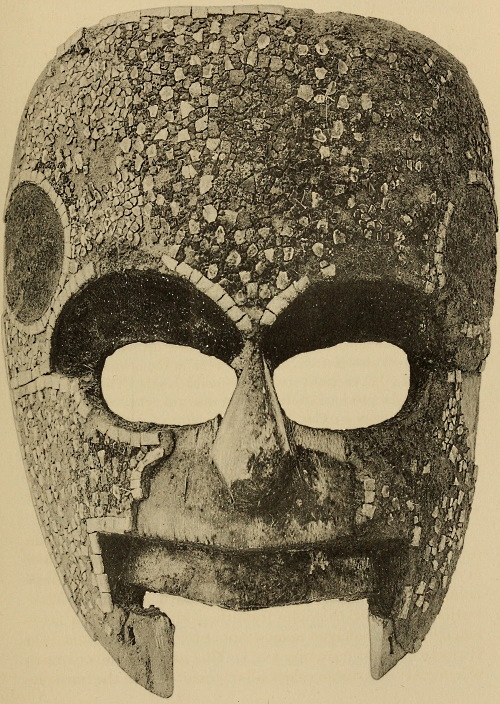
MASK OF WOOD WITH MOSAIC DECORATION
MUSEUM OF THE AMERICAN INDIAN HEYE FOUNDATION. NEW YORK
The distinctive head-band or crown worn by the Mexican
rulers is mentioned by numerous early writers and illustrated
in many codices. It was known as the xiuhtzolli or xiuhuitzontli,
and was called also copilli. We have selected for illustration
(fig. 6) two examples from the codices. The first (a) is
taken from the Sahagun manuscript of the Real Academia de la
Historia, Madrid (estampa XVII). This page contains pictures
of a number of Aztecan rulers, all represented with the turquois-mosaic
crown painted blue. Moreover, the hieroglyphic name
of Montezuma, here placed above his head, is a mosaic crown.
The crown itself
was of gold, on
which the turquois
mosaic was
placed. The other
example (b) is
from the Tribute
Roll of Montezuma
(Peñafiel
edition, pl. XIX).
It is part of the
hieroglyph for the place-name Tecmilco, signifying “the lands
of the royal crown,” the combination being the crown painted
blue resting on the sign for cultivated land. Our figure shows
a plain gold crown, but it is painted blue in the codex.
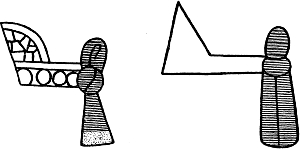
a Fig. 6 b
A copper crown from Tenango, State of Mexico, has been
figured by Peñafiel. It is properly a head-band with a triangular
projection with rounded top which rose from the forehead,
and was probably worn by a warrior or sub-chief.[69] In this work
Peñafiel illustrates the mask in Rome (see our pl. VII), and
states that the upper part is a xiuhhuitzolli, or turquois-mosaic
crown. We will discuss this point later. Many years ago, in
Mexico, the writer heard of a gold copilli as having been found
in the Matlaltzincan region near Toluca, but was never able to
verify the story. A few extracts from the chroniclers, relating
to these golden crowns with turquois mosaic, follow.
In the Codex Cozcatzin the Aztec king Axayacatl is represented
with the xiuhuitzontli, the turquois mosaic-work head-band.[70]
In the selection of Ahuitzotl as king, Tezozomoc writes:
They put on him the crown which was blue, of rich stone mosaic-work,
(in shape) like a half miter called xiuhtzolli (or xihuitzolli),
and also placed on him, among other things, a netted mantle strewn
with small stonework. This formed part of his costume when he
went to the temple of Huitzilopochtli to worship. When adored by
neighboring subjugated tribes he wore a crown of gold (adorned)
with much stone mosaic-work of a half miter shape, and on the
left shoulder was put a sash called matemacatl which was all gilded
and enameled with fine stone mosaic-work, which was also called
teocuitla cozehuatl, as we now speak of a shoe-ribbon, and on the foot
was placed something like an anklet of acero [sic] strewn with emerald
stones, all gilded.[71]
Duran states that among the offerings buried with the Aztec
king Ahuitzotl were “crowns of the fashion that they used, of
gold and of stone mosaic-work.”[72]
It is related by Tezozomoc that after the death of Netzahualpilli,
king of Texcoco, Montezuma assembled the senate
of Aculhuacan in order to select a new king. The choice fell on
the fifth son, Quetzalacxoyatl. In the ceremony of investiture
they placed on him “the blue crown or forehead-band decorated
with stone mosaic-work.”[73]
The Anonymous Conqueror writes:
To guard the head, they carry things like the heads of serpents,
tigers, lions, or wolves with open jaws, and the head of the man is
inside the head of the creature as if it was being devoured. They are
of wood covered over with feathers and with jewels of gold and
precious stones, which is a wonderful sight.[74]
From Alonso de Molina’s Vocabulario Mexicano (Mexico,
1555, reprinted 1571) we are able to interpret the Nahuan
words which occur in the chronicles in connection with the use
of turquois in the decoration of various objects. The following
are some of the more common: nacochtli, ear-plugs; tentetl, labret;
yacaxuitl, nose-ornament; copilli, crown; xiuhxayacatl, mask of
turquois mosaic; xayacatl, mask; cactli, sandal; tilmatl, mantle;
amaneahapantli, mantle for lords richly wrought; teopixcatla-quemitl,
vestment of priests; ecaceuaztli, fan; chimalli, shield;
teteotl, stone idol; tequacuilli, large stone idol or statue; xiuitl,
turquois; tlaquauac xiuitl, hard turquois; xiuhtomolli, turquois;
omichicauaztli, bone musical instrument; ayacachtli, rattle.
PL. XV
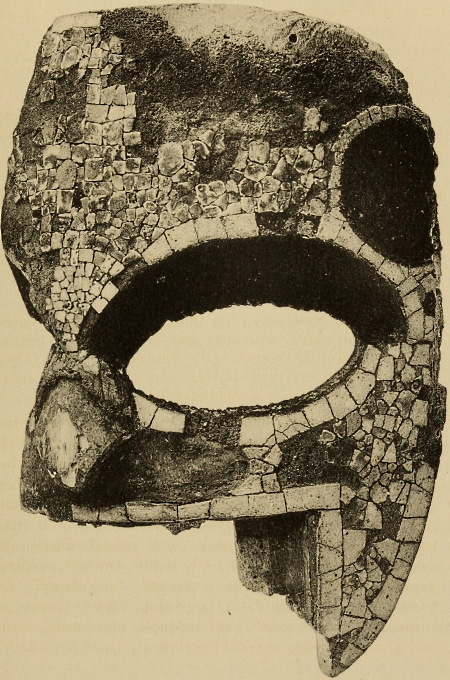
MASK OF WOOD (FRAGMENT) WITH MOSAIC DECORATION
MUSEUM OF THE AMERICAN INDIAN HEYE FOUNDATION, NEW YORK
EXISTING SPECIMENS OF MOSAIC
We will now consider the existing specimens of mosaic-work.
It has been demonstrated, by the extended quotations from the
old chronicles and codices, that this art was considerably employed
in adorning objects of a special nature in connection with
the dress of kings, nobles, warriors, and priests, and the paraphernalia
of the gods. We have at present no actual examples
of many of the objects which we have learned were thus ornamented,
consequently whatever conception we may gain by a
study of existing specimens will give us an inadequate idea of
the art. It is evident that the most elaborate works in stone
mosaic sent to Europe, as noted in the inventories, have not
been preserved, a fact borne out by the descriptions in the early
accounts of the discovery and “things” of Mexico. Moreover,
many of the pieces now in European museums are either in a
poor state of preservation or are incomplete.
Until recently only twenty-four major examples of mosaic-work
had come to light and been placed on record by printed
description and illustration. Of these twenty-three are in
Europe. The other specimen was found a few years ago in a
cave in Honduras, and for some time was exhibited in the
National Museum at Washington, but later came into the possession
of the Museum of the American Indian, Heye Foundation.
The twenty-three known specimens in Europe were probably
all sent to the Old World by Cortés or his companions.
Some years ago an Indian found a deposit of ceremonial
objects of wood, incrusted with mosaic-work, in a cave in the
mountains of the Mixteca region of the State of Puebla.
These specimens, seventeen in number, are now exhibited in
the Museum of the American Indian, Heye Foundation. The
chief object of this monograph is to describe and illustrate this
unique collection.
We are also now enabled to record and illustrate, through the
courtesy of the officials of the Peabody Museum, Harvard
University, four other objects decorated with mosaic-work.
These were found in the sacred cenote at the ruins of Chichen
Itza, Yucatan, and are now exhibited in the Central American
hall of the Museum mentioned. This brings the number of
known specimens to forty-five, of which twenty-two are in the
United States, and twenty-three in Europe. These specimens
are now preserved in the following museums:
British Museum, London, nine specimens.
Prehistoric and Ethnographic Museum, Rome, five specimens.
Ethnographical Museum, Berlin, three specimens.
State Natural History Museum, Vienna, three specimens.
National Museum, Copenhagen, two specimens.
Museum, Gotha, one specimen.
Museum of the American Indian, Heye Foundation, New York,
eighteen specimens.
Peabody Museum, Cambridge, four specimens.
In this census are not included the minor objects with mosaic
decoration, which we will also describe. Of the forty-five pieces
enumerated, all but three are of wood; two are human skulls,
and one a human femur. As the European specimens have
hitherto been described, and in some instances their history
traced to the middle of the sixteenth century, it will be necessary
only to refer the student to these studies, note of which will
be found in the bibliography at the close of this volume. In the
present study we have assembled photographs or drawings of all
of these major specimens, as well as of nearly all the minor
pieces, and drawings of some of the mosaic objects represented
in color in the codices. Our pictorial record is therefore practically
complete.
Minor Examples
The use of mosaic incrustation in the decoration of stone idols
is illustrated in pl. II. This stone figure, 3 feet 10 inches high,
came from Cozcatlan, district of Tehuacan, Puebla, and is now
preserved in the National Museum of Mexico. It represents
the goddess Coatlicue, mother of Huitzilopochtli, the Aztecan
war god. The Sahagun manuscript in the Real Palacio, Madrid,
represents this deity with a rattlesnake girdle around the
waist; held in the right hand is a staff in the form of a rattlesnake
with the head downward, and having depending feathers
projecting from the rattles, which are opposite the face
of the figure. Above the deity is the caption “Yztac ciuatl coatlicue.”
This statue, together with another, of colossal size, also
in the Museo Nacional of Mexico, has often been denominated
Teoyamiqui, and again at times it has been called Mictecacihuatl.
The turquois decoration is still preserved in the statue
illustrated, in the incrustation of the circular ear-ornaments and
in the discs of mosaic in each cheek. The teeth are made of
white shell; the inner part of the mouth is of red shell; the nose
is inlaid with white shell. There are traces of incrustation
around the eyes, but this mosaic feature is practically destroyed.
In the breast is set a circular mirror of iron pyrites.
Around the upper part of the forehead are small holes which
probably at one time contained stone or shell inlays. A poorly
colored representation of this idol has been published by Brocklehurst,
with the title “Teoyamiqui, goddess of death.”[75]
PL. XVI
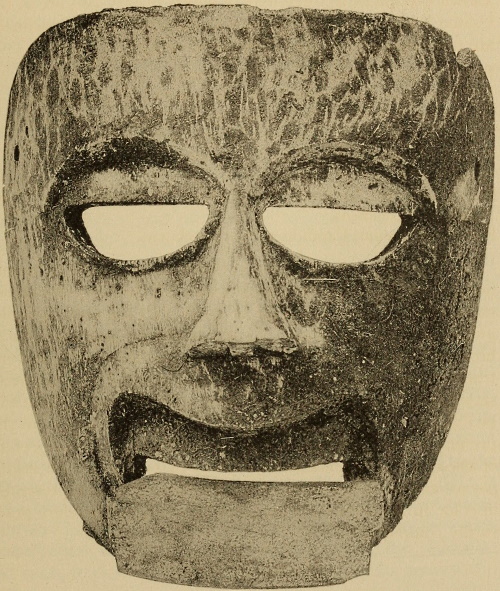
MASK OF WOOD, MOSAIC DECORATION MISSING
MUSEUM OF THE AMERICAN INDIAN HEYE FOUNDATION, NEW YORK
One of the most interesting uses of turquois-mosaic decoration
was in the embellishment of wooden covers for the ancient
books or codices. We are fortunate in still having preserved
even a single example bearing traces of this art. In 1896 the
Due de Loubat had reproduced the first of his series of Mexican
codices, being the first to appear in exact facsimile, even to the
ancient binding. This work was Codex Vaticanus No. 3773, a
pre-Columbian Nahua picture-writing preserved in the Vatican
Library. In a pamphlet by Francisco del Paso y Troncoso which
accompanies the reproduction is an interesting description of
the book, from which we quote with respect to the covers:
It is of fine and thin wood. Each cover measures six by five inches....
The wood of the covers is whitish, and traces of the brilliant
lacquer which covered it may still be seen.... (One) cover bears a
character which shows us that this is the point at which to begin the
reading of the book. As in modern binding the first cover bears a
lettering or coat-of-arms; so too, as a rule, the Indians indicated the
beginning of their books, and placed on the first cover the decorative
incrustations which indicate that here is the first page.... On the
center of the cover, placed two in a line, are four reliefs. At first
these appeared to have been made by impression on the lacquer, but
Monseigneur Francisco Plancarte, who examined them with a
microscope, has discovered that they are composed of a paste with
which the Indians fasten precious stones in their settings, and in
these incrustations we have the impress left by the inequalities of
the materials once fixed on the surface. One round greenstone is
left, of the kind used by the Mexicans in their mosaics; it is on the
upper right-hand corner of the volume, when held ready to be
opened. Below it, in the lower right-hand corner may be observed a
corresponding conical shaped depression, and the remains of the
lacquer in which a stone was fixed. In the other angles there is no
trace of anything, proving that nothing existed there of the same
kind as that which remains.
In the Loubat reproduction all these features are faithfully
represented, even to the single greenstone remaining in place.
The existence of mosaic objects in the Zapotecan region of
Oaxaca was one of the important discoveries made by the Loubat
Expedition of the American Museum of Natural History,
under the direction of the writer, during the winters of 1898 and
1902. In mounds locally called mogotes were discovered stone
burial chambers in which skeletons interred with numerous
offerings were uncovered.
In the burial vaults at Xoxo, excavated in 1898, practically
no personal ornaments were found, but fragments of mosaic objects
were discovered in the form of bits of shell, obsidian, jadeite,
turquois, and hematite, on fragmentary stucco matrices.[76]
PL. XVII
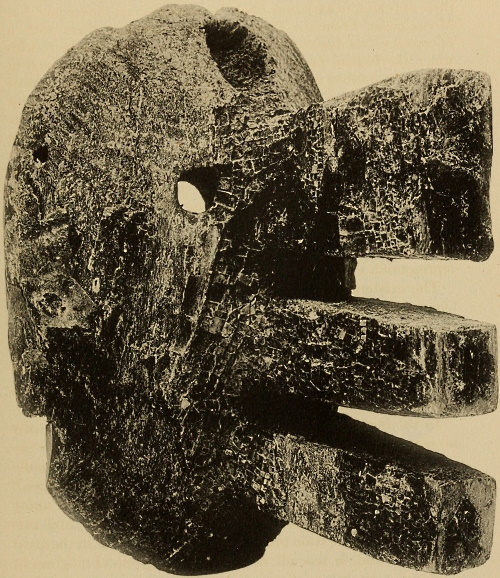
MASK OF WOOD WITH MOSAIC DECORATION FROM HONDURAS
MUSEUM OF THE AMERICAN INDIAN HEYE FOUNDATION, NEW YORK
In the graves and tombs at Cuilapa were discovered many
personal ornaments made of jadeite, amazon stone, and turquois.
In an excavation made during January, 1902, in the great
temple mound, or teocalli, dominating the group of mogotes at
Cuilapa, a grave was discovered on the summit at a depth of
six feet from the surface. It contained the skeleton of a child,
whose bones, together with the accompanying artifacts, were
stained bright-red by hematite paint which had been thrown
into the grave. Surrounding the skeleton were seventeen greenstone
idols in the form of human figures; more than four
hundred beads of greenstone and jadeite of varying sizes;
thirty-five shells of various kinds, perforated for suspension; bits
of mother-of-pearl, obsidian, and hematite, which evidently
were fragments of disintegrated mosaic objects; but the most
interesting objects recovered were a pair of small discs of pottery,
upon the flat upper surfaces of which were cemented
small pieces of very thin, highly-polished hematite, placed in
mosaic. These last were undoubtedly mirrors, although from
the small perforation in the center of each we are inclined to
regard the pair as having been used also as ear-ornaments. One
of these specimens should be in the Museo Nacional of Mexico,
where it belongs; the other is in the American Museum of
Natural History. The latter, now illustrated for the first time
(fig. 7), is an inch and three-quarters
in diameter, and an
eighth of an inch in thickness.
Our reproduction of this interesting
object has been made possible
by the courtesy of Dr. Clark
Wissler, Curator of Anthropology.
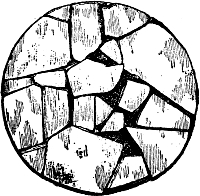
Fig. 7
An interesting specimen of
the combination of gold with turquois
mosaic in jewelry has been
recently figured in colors, and
described by the writer (see fig.
8).[77] It is in the form of a shield, with four arrows or darts and
pendent bells, and has an extreme length of three and one-eighth
inches from the top of the shield to the bottom of the
central bells. We have described in detail the meaning of the
hieroglyph formed by the mosaic-work, and shown that the
brooch-like jewel was the insignia of one of the four principal
chiefs of the Aztecan army, who governed one of the four
wards, or calpullis, into which Tenochtitlan, the capital of
Montezuma, was divided. As a matter of fact, the jewel was
found in a grave in Yanhuitlan, in the Mixteca region of Oaxaca.
It is the only known specimen that shows turquois set on
gold, a combination to which we have called attention, in quoting
from Sahagun and others, regarding turquois mosaic on
crowns, bracelets, and other gold objects for personal adornment.
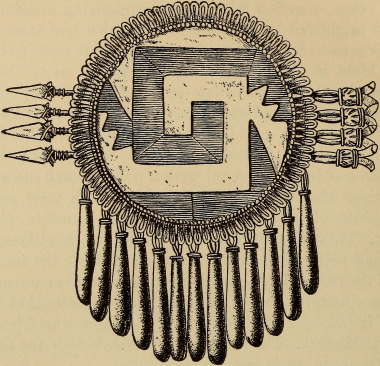
Fig. 8
In the collections of the Museum of the American Indian,
Heye Foundation, are three mirrors faced with highly-polished
marcasite on their original matrices, apparently slate—the
only specimens of this character that we have seen. Two of
these mirrors, which were collected by William Niven from
ancient graves near Iguala, Guerrero, are perforated for suspension,
and all three average five inches in diameter and a
quarter of an inch in thickness. With these mirrors were found
numerous little unpolished cubes of iron pyrites, which may
have been intended for use in mosaic-work. There are, however,
a number of rather thin, flat, irregularly shaped pieces,
with very thin matrix of stone, and with beveled edges, which
unquestionably have been parts of mirrors made in mosaic
fashion similar to those found in the Cuilapa grave, the only
difference being that the inlays from Iguala are larger and
thicker than those on the Cuilapa specimens, which are simply
thin sheets of hematite. The region where the Iguala specimens
were discovered was probably the seat of a people of
Nahuan culture.
PL. XVIII
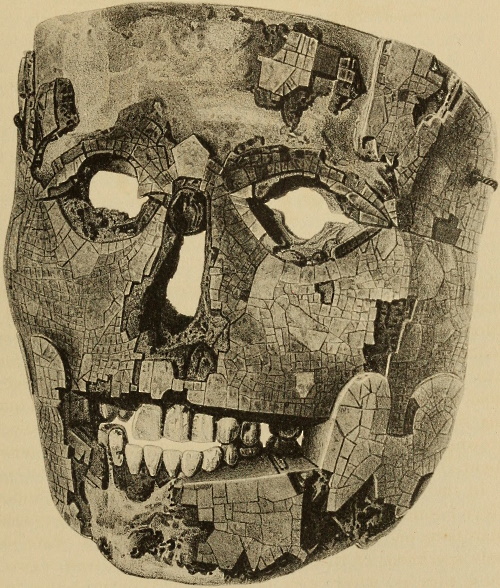
MASK OF HUMAN SKULL WITH MOSAIC DECORATION
ETHNOGRAPHICAL MUSEUM, BERLIN
In 1908 Dr. Manuel Gamio conducted an important excavation
of an ancient building at the site known as the monuments
of Alta Vista, near Chalchihuites, Zacatecas, in northern Mexico.
In a large chamber called the Hall of the Columns, Gamio
found two mosaics in a small circular compartment in the concrete
floor. One of these was a disc of yellow pottery encircled
by a ring of wood, the entire object being about two and three-quarters
inches in diameter and three-eighths of an inch thick.
The wooden ring bore traces of a coating of resin, and many tiny
bits which formed the mosaic incrustation were found with it,
although not in place. The bits that had formed the mosaic
were thin plates of worked turquois, beryl, and steatite. From
the fact that the disc contained perforations, evidently for
suspension, Gamio described it as a breast ornament.
The other mosaic piece Gamio believes to have been a labret.
He writes that “at first glance its shape may be described as
resembling the bridge of a violin.... Its nucleus is wood,
carved to represent two symmetrical figures of an alligator
(caiman), united at the belly. Crowning the head are two head
plumes, each having two branches. Above the point of union
of the two reptiles there is a square projection with a perforation.”[78]
The surface of the ornament had been covered with
small spherical plates of turquois, beryl, and steatite.
Near these two mosaic ornaments were found numerous small
pieces of turquois and beryl of different shapes.
In October, 1921, the Spanish newspaper La Prensa, New
York, published a short account, received by letter from the
City of Mexico, describing what purported to be an extraordinary
discovery made early in the autumn. It related to the
finding of a stone mask decorated in mosaic, discovered by one
of the assistants of the Museo Nacional in a sepulchral chamber
in Guerrero. This mask was described as being about eight
inches high, the human face being partly covered with an incrustation
of small pieces of turquois, with small bits of coral shell
above the eyebrows and below the nose. Each eye was formed
by an oval piece of pearl shell, with pupils of hematite. The
mosaic covering was missing from the upper part of the forehead
and the chin.
The newspaper Excelsior of Mexico City, under date of October
20, 1921, published a photograph of the specimen and a
detailed study of the object in a statement signed by José María
Arreola, a member of the staff of the Department of Anthropology
in the City of Mexico. In this statement Arreola casts
doubt on the authenticity of the specimen, pointing out that
none of the known pieces of mosaic-work in European collections
are of stone; that the surface of the mask is polished, which
would make it difficult for the incrustation to have adhered
during centuries of burial; that there are no traces of dirt in the
cracks between the pieces of turquois, and finally he calls attention
to a strong odor of glue which pervades the object.
These arguments seemed sufficient to cast serious doubt as to
the genuineness of the mosaic decoration of the mask. No such
question was raised in regard to the mask itself. In a brief article
entitled “Una Mascara de Mosaico Falsificada,” published in
Ethnos (nos. 8-12, dated Mexico, Nov. 1920-Mar. 1921), the
same writer categorically asserts that the specimen is fraudulent,
and calls on the reputed finder, Sr. Don Porfirio Aguirre, to
present the evidence regarding the exact place where the
specimen was discovered in order that further excavation may
be made with a view of establishing beyond question the history
of such an important and unique discovery.[79]
PL. XIX
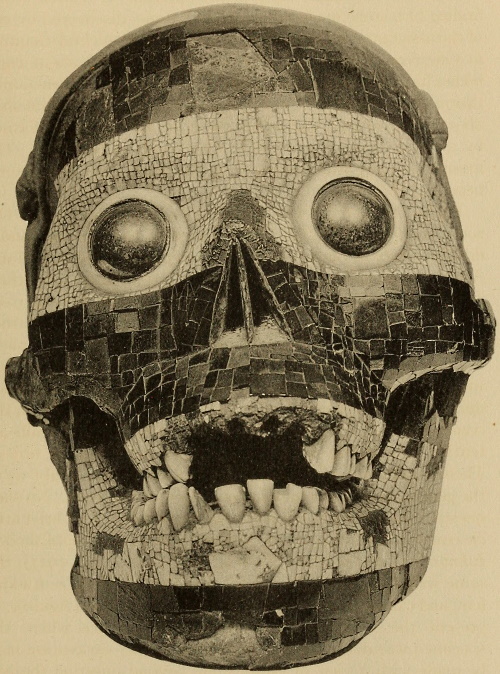
MASK OF HUMAN SKULL WITH MOSAIC DECORATION
BRITISH MUSEUM, LONDON
Precious and semi-precious stones were occasionally inserted
singly for decorative purposes. In this respect we may simply
refer, in passing, to the custom in ancient Mexico and Central
America of decorating the teeth by inserting inlays in the upper
incisors, turquois, jadeite, hematite, obsidian, and rock-crystal
having been used in such manner. Rarely two, and in one
instance three, insets have been found in a single tooth; but
this form of decoration can in no sense be considered as mosaic.[80]
Another example of the use of turquois as an inlay is supposed
to be unique. Many years ago we obtained from Don
Francisco Belmar a beautiful tripod vessel supporting against
the side a polychrome human figure in the round, representing
the god Macuilxochitl, god of dance and sport—the deity
represented with the painted design around the mouth. It is
not necessary here to discuss the question raised by Seler regarding
the attributes and representations of the two analogous
gods Macuilxochitl and Xochipilli. The vessel here seems
clearly to be Macuilxochitl, corresponding with that given by
Sahagun in the manuscript of the Real Palacio, Madrid. What
is of interest is the disc of turquois inserted in the clay on the
upper left-hand part of the chest, unquestionably there placed
to denote some attribute of the deity.
Chichen Itza Specimens
We will now consider some interesting examples from the
Mayan ruins of Chichen Itza, Yucatan, which were found in
the sacred well, or cenote, at that site. This sacred well is described
by Casares in 1905[81] as arousing the admiration and
awe of the Indians even to this day. It is about 450 feet north
of the great pyramid known as the Castillo, and a paved way,
several inches high, leads to it. At the brink is a small temple.
The cenote is about 150 feet in diameter; the level of the water
is 70 feet below the surface, and it is 40 feet deep, with a deposit
of mud estimated to be about 30 feet in thickness. Landa
writes: “They [the Maya] held Cozumel and the well of Chichen
Itza in the same veneration as do pilgrims now Jerusalem and
Rome, and so they used to visit them, carrying their offerings
chiefly to Cozumel, as holy places, and when they could not go,
they sent them.” In another place this author states that “they
had the habit then of throwing into this well living men as
sacrifices to their gods in time of drought, and they thought
that these would not die, though they never saw them again.
They used also to throw precious stones and the things they
most prized. Just on the brink of the well is a small building
where I found all kinds of idols in honor of all the gods of the
land.”[82] Casares adds: “What Landa, Cogolludo, and all other
writers had narrated from mere hearsay, one of the distinguished
members of the [American Antiquarian] Society, Mr.
E. H. Thompson, has had the satisfaction to realize, bringing
to light the truth of these statements, by diligent and intelligent
work, the results of which I will not mention, as that grateful
and honorable task belongs exclusively to him.”[83]
Holmes wrote in 1895 of the sacred cenote as follows:
The Sacred Cenote is larger, and more symmetrical than the
other, and, occurring in the midst of the somber forest, is a most impressive
and awe-inspiring spectacle. Its charm is enhanced by the
weird stories of human sacrifice associated correctly or incorrectly
with its history. The walls are nearly circular and approach the
perpendicular closely all around. They are diversified only by the
encircling ribs and pitted grooves produced by the uneven weathering
of the massive, horizontally-bedded limestones. The water has
a light coffee color and looks very impure. It is shallow on one side
and of unknown depth on the other. A small tomb-like ruin is
perched upon the brink. It is conjectured that this structure had
something to do with the ceremonies attending the casting of victims
and treasure into the terrible pool. There has been some talk
of exploring the accumulations from the bottom of this cenote with
the expectation of securing works of art or other treasures, but the
task is a most formidable one and will require the erection of strong
windlasses and efficient dredging apparatus. It is doubtful if promised
results warrant the outlay necessary for carrying out the work
in a thorough manner.[84]
PL. XX
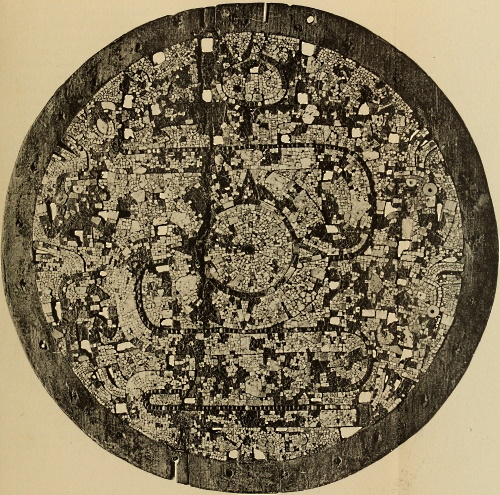
SHIELD OF WOOD WITH MOSAIC DECORATION
BRITISH MUSEUM, LONDON
Nevertheless, a few years later, as hinted by Casares, Mr.
Edward H. Thompson secured the complete confirmation of
the traditions concerning the character of the cenote. He
brought out of the mud a most amazing archeological treasure.
Through the kindness of Prof. A. M. Tozzer we are enabled to
include here drawings of four pieces of mosaic-work which were
among the many interesting things discovered. As Professor
Tozzer and Dr. Spinden are engaged in an exhaustive study of
the cenote material for publication, we will not further anticipate
the results of their investigations.
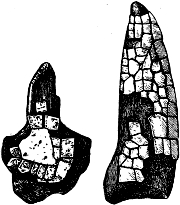
Fig. 9 Fig. 10
In figs. 9 and 10 are illustrated
two small fragments of wooden
objects from the cenote which still
retain portions of turquois-mosaic
decoration. In fig. 9 the irregularly
shaped piece in the center is a
thin plate of gold. Both fragments
are evidently from objects of considerable
size. Several wooden teeth
covered with the same kind of mosaic
incrustation were probably
from a jaguar mask or head.
Pl. III represents two fairly complete
specimens from the cenote. Of these, a is a small staff or
scepter, the face of which is covered with turquois mosaic, and
it is possible that the headdress was once similarly incrusted.
In b is shown a rattle of wood, within which is a copper bell.
Only two bits of turquois of the mosaic decoration remain.

Fig. 11
In this object we find in the Mexican pictures an instrument
analogous to the one last mentioned. In both of the Sahagun
manuscripts, that of the Real Palacio in Madrid and the one
in Florence, are representations of the deity Xipe Totec. In
the former manuscript is found the name of the god written
above the figure, Xippe anavatlitec, translated by Seler as
“Xipe, lord of the coastland.” He is an earth deity, “our lord
the flayed,” for he is represented wearing loosely about him a
human skin. He was the patron deity of the goldsmiths of
the valley of Mexico, and is said to have been paid special
homage by the people of the Teotitlan district, the
beginning of the highway to Tabasco. In the pictures
given by Sahagun, and in other codices, this
god carried a long staff which terminates in a kind of
rattle (fig. 11), similar in shape to that found in the
cenote of Chichen Itza. It was called chicauaztli by
the Nahua, and Seler asserts that the rattlestick of
the god Xipe was carried, besides him, only by the
goddesses of the earth.[85] Sahagun describes it as a
scepter made after the manner of the calyx of the
poppy where the seed is, with something like the
point of a dart fastened in and rising from the upper
part.[86] The resemblance of the cenote specimen to
the one shown in the Sahagun manuscript suggests that it was
brought from the Nahuan region.
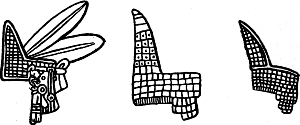
Fig. 12
In the sculptured wall of the Temple of the Jaguars at Chichen
Itza are represented a considerable number of warriors
and priests dressed in elaborate costumes and paraphernalia.
Several of these persons wear the typical triangular head-band
or crown of the Nahuas, on which may be distinguished turquois-mosaic
decoration (fig. 12). Two of these priests or
warriors have their faces covered with unmistakable turquois-mosaic
masks (figs. 13, 14).[87] This points to Nahuan influence,
and we have other instances of this influence both at Chichen
Itza and at Uxmal. We are thus led to the belief that the
mosaics recovered from the cenote were brought to Chichen
Itza from Nahuan
territory.
PL. XXI
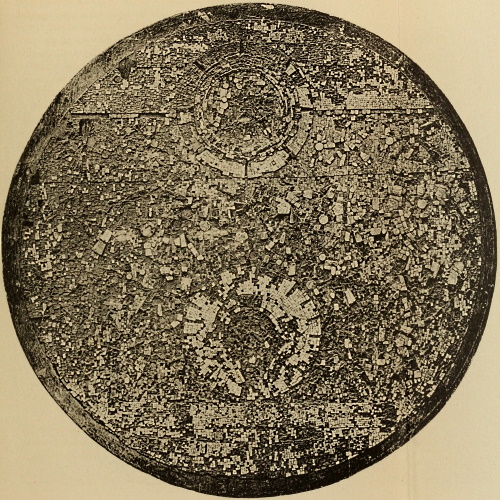
SHIELD OF WOOD WITH MOSAIC DECORATION
STATE MUSEUM OF NATURAL HISTORY, VIENNA
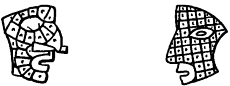
Fig. 13 Fig. 14
Another example
of a turquois
mosaic mask in
stone sculpture
is found at the
back of the profile
face, in front of the ear, of the human figure carved on the
front of stela 11 at Seibal, in the region of the upper Usumacinta,
Department of Peten, Guatemala. It was photographed
by Maler in 1895, and illustrated and described by him in his
monograph, Explorations of the Upper Usumatsintla and Adjacent
Region (Memoirs of the Peabody Museum, Harvard University,
vol. IV, no. 1, Cambridge, 1908). Morley has deciphered the
date on this stela as 10.1.0.0.0, corresponding approximately,
according to his method of correlation, to 590 A.D. It appears
to have been a hotun-marker, or stone erected every five years,
and is placed in the Great Period of Mayan civilization.
Major Examples
The more important major specimens now remain to be considered.
As all these objects are of wood, with the exception of
numbers 3 and 9, we will not repeat this in our descriptions.
They are:
- 1. Helmet or head-piece
- 2. Wooden masks
- 3. Skull masks
- 4. Shields
- 5. Ear-plug
- 6. Animal figures
- 7. God figure
- 8. Knife handles
- 9. Human femur musical instrument.
Helmet
The helmet or head-piece on pl. IV is in the British Museum,
and was first described and illustrated in colors in 1895 by Sir
Charles Hercules Read. From his study we take the following
notes:[88] The helmet is hollowed out inside to fit the head
and is painted green; the exterior is carved with two projections,
perhaps intended to represent the upper mandibles of
eagles. The space between the inner upper part of the two
beaks and the two outer faces of the beaks bears traces of
red paint. With this exception, the outer surface has been
covered with a mosaic of turquois, malachite, pearl shell, and
pink shell, inlaid or incrusted on a bed of dark-brown gum. A
great number of the pieces of mosaic have fallen out. It contains,
fashioned in dark-green malachite pieces, two involved
animal figures, which Read conjectures are rattlesnakes with
crested heads. Judging from the plate accompanying Read’s
study (no measurements are given), the specimen has an extreme
height of 7½ inches and a diameter of 7¼ inches. The
illustration which we reproduce, as well as of the other specimens
in London, we owe to the kindness of T. A. Joyce, Esq.,
of the British Museum.
Masks
The mask on pl. V is in the British Museum, and is one of
the best preserved specimens of mosaic-work from Mexico.
It is of cedar, the outer surface being covered with a mosaic of
minute pieces of turquois, of a brilliant color beneath the eyes
and on the forehead, while on the other parts the color is a poor
grayish-green. The face is studded with irregularly shaped
cabochon turquoises. The eyes, nostrils, and mouth are all
pierced; the first are filled with oval pieces of pearl shell, each
with a circular hole for the pupil. The gum surrounding the
shell and keeping it in position is gilded. In the half-open
mouth is a row of seven teeth of white shell set in the upper
jaw. On each temple is set a pierced square of pearl shell.
The inside of the mask is painted red. Its height is 6½ inches,
the width 6 inches.
PL. XXII
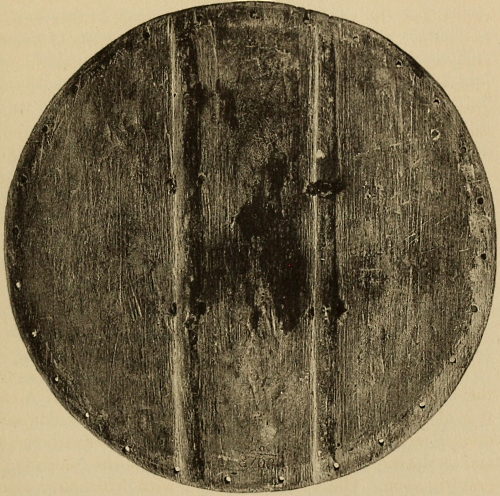
BACK OF SHIELD SHOWN ON PLATE I
MUSEUM OF THE AMERICAN INDIAN HEYE FOUNDATION, NEW YORK
On pl. VI is shown another mosaic mask in the British Museum.
We follow Read’s description. It is of cedar, and the
lower left-hand part of the face is missing. Over the face are
represented two entwined serpents curving around the eyes and
mouth, and the rattle-tipped tails rest over the right and left
of the forehead. The whole of the surface of the mask is covered
with a mosaic of turquois, bright-blue and dull-green in color,
arranged in such manner that the two snakes are distinct in
color. The rattle of each snake upon the temples are modeled
of the same gum as that in which the stones are embedded, and
it seems possible that they were formerly gilded. The mouth of
the mask is slightly open and contains teeth of white shell in
the upper jaw. There is a slit over each eye and a hole in each
temple. The inside of the mask is painted red. Height 6.9
inches, width 6.6 inches. Read believes that the heads of the
two snakes were on the lower checks, which are incomplete.
Maudslay identifies this mask with that described by Sahagun
in the chapter which we have translated (see p. 14), relating
to the objects pertaining to the god Quetzalcoatl which were
presented by Montezuma to Cortés.[89] In this description only
one serpent is mentioned, and Sahagun states that “the head
with part of the body came over one eye so that it formed an
eyebrow, and the tail with a part of the body went over the
other eye to form the other eyebrow.” In the plate the two
rattles are clearly seen, and Holmes has published a diagrammatic
drawing differentiating the bodies of the serpents. If
Sahagun’s description is accurate, this specimen cannot be the
one mentioned by him. It is, however, one of the most interesting
pieces of mosaic that has survived.
The very interesting mask of wood shown on pl. VII is in
the Prehistoric and Ethnographic Museum in Rome. It is one
of the best preserved pieces in Europe, and its history is known
as far back as 1553. It was purchased for the Museum by
Giglioli from Cosimo de Medici for two and a half francs. It
was first illustrated in colors by Pigorini,[90] and our illustration
is from a photograph just received from Rome through the
kindness of Dr. S. K. Lothrop. The specimen is 11 inches high
and 5⅜ inches broad, being the tallest mosaic mask that has
thus far come to light. It represents a human face placed in
what appears to be the flat open jaws of a snake or an animal,
a common motive in Middle American art. The back of the
mask is flat, and there are ovate openings for the eyes. From
the nose hangs an ornament of a type familiar in central
Mexico. Over the forehead appear what seem to be raised
twined bodies of serpents, and from the left of the upper part
of the face projects the plumed head of a serpent. We are
unable to say if the head of the other snake once projected from
the opposite side of the mask, but it seems impossible that the
artist would have made this elaborate piece so symmetrical.
From Dr. Lothrop’s notes it appears that the turquois around
the sides is of a slightly faded color, but the major portion is
brilliant and glistening. The materials used are turquois, pink
shell, white shell, mother-of-pearl, jadeite (for the facial lumps),
and a dull-black stone. This remarkable piece is a veritable
work of art, and from the serpent motive we would class it
as a Quetzalcoatl mask.
PL. XXIII
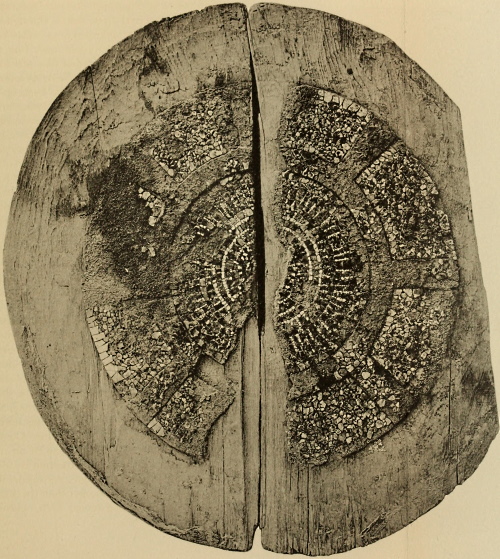
SHIELD OF WOOD WITH MOSAIC DECORATION
MUSEUM OF THE AMERICAN INDIAN HEYE FOUNDATION, NEW YORK
The other mask in Rome (pl. VIII) was illustrated as early as
1648. This illustration, and the one published by Pigorini
(fig. 15), are front views. Our plate, from a photograph taken for
Dr. Lothrop, is a sideview presenting interesting features
which are not revealed in the illustrations hitherto published.
The materials employed are turquois, malachite, pink shell,
white shell, mother-of-pearl, an unidentifiable black stone, and
garnet. The edges of the orbits and the protruding tongue
are painted red, while the fangs are painted white. On the
side of the face, below the right eye, is the head of an alligator,
in the neck of which is set a garnet. Attention is called
also to the peculiar nose and the curling tongue. A considerable
portion of the mosaic is lost. This mask is larger than the masks
in London and New York, being 8⅝ inches high, with an
extreme length, including the protruding tongue, of 11 inches.
Dr. Lothrop writes that in his description Pigorini has done
scant justice to this
remarkable piece.
On pls. IX to XVI
are illustrated the
series of masks
from the cave recently
discovered
in Mexico, which
are in the Museum
of the American
Indian, Heye
Foundation. They
fall into two
classes, those on
pls. IX to XII being
ornamented with
turquois mosaic,
and so nearly
alike in workmanship
that they
might well be the
product of one
artist, while the
masks on pls. XIII
to XV are different
in character, the mosaic pieces being larger and coarser,
and considerable stone other than turquois was employed in
the decoration. They are all in a damaged condition and lack
the chin. All the mosaic incrustations are set in a bed of gum.
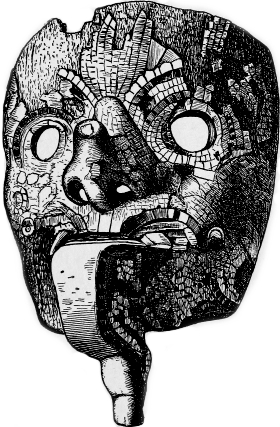
Fig. 15
The best-preserved specimen is illustrated in colors on pl.
IX; it is 7½ inches high, and 6¾ inches wide. Bands of light
and dark turquois will be observed on the forehead and temples.
Around the lower margin of the face is a band of blackish
to dark-brown stones. On the sides of the mask are two large
black discs made of a composition resembling charcoal and
sticky clay. This substance is present in a number of the
other masks, and we venture the conjecture that it may be the
material used by the goldsmiths in modeling figures to be cast
in gold. Sahagun describes it as follows:
The master gives them the charcoal, which they grind very fine.
And when it is ground they add a little clay, the glutinous earth
which they use in their pottery. They mix the charcoal with the
clay and stir it, and knead it in such manner that the two substances
constitute one solid mass. And when they have the mass prepared,
they shape it into thin discs which they expose to the sun....
For two days these objects dry, and become very hard. When the
charcoal is well dried and very hard, it is cut, then carved by means
of a little scraper of copper.[91]
The tip of the nose, as well as the chin, is gone. There are
traces of red paint over the mouth and in the circular spaces on
each side of the nose. When the specimen was received, the
missing section of the lower part of the face was covered with
a band of tin, as in the mask (pl. XVI) from which the mosaic
has disappeared. From this circumstance we believe that the
objects in this cave deposit were used by the Indians after the
Spanish conquest, possibly until comparatively recent times.
Our reasons for this belief will be found in the chapter translated
from Motolinia in our conclusion. If we assume that at
certain intervals during centuries the Indians resorted to the
cave to worship in secret their ancient gods, we can explain the
worn condition of nearly all of these specimens. Undoubtedly
they were preserved and treasured for many generations, revered
as precious relics of a lost but not entirely forgotten civilization.
There is not the slightest reason for doubting their
origin in pre-Spanish times.
PL. XXIV
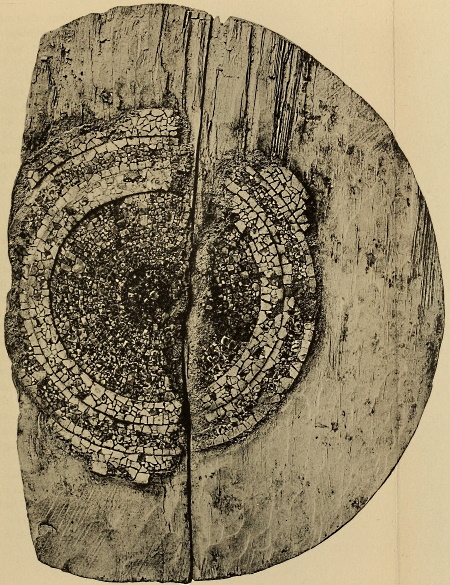
SHIELD OF WOOD WITH MOSAIC DECORATION
MUSEUM OF THE AMERICAN INDIAN HEYE FOUNDATION, NEW YORK
The mask on pl. X is 6½ inches high and 6¼ inches wide.
It is quite similar to the one last described, but lacks the encircling
lower marginal band. The outer zone is of light turquois,
with zones of a darker shade toward the center. There
are traces of red paint above the mouth and in the spaces on
each side of the nose. On the left temple are the remains of a
black disc of the same material as on the other mask.
The right section of the mask on pl. XI is 7¼ inches in height.
The turquois incrustation is light-blue in color. There are
traces of red paint above the mouth. The black composition
inlay on the temple is square, and contains a biconical depression
which does not pass through the wood. Around the eye
is a raised design, possibly a serpent’s body. The entire lower
zone is at present without decoration, and possibly was never
covered with mosaic.
The mask fragment on pl. XII is 7⅜ inches high. The small
section of mosaic remaining on the forehead is dark-blue, while
that on the rest of the face is light-blue. There is a black composition
disc on the temple, and traces of red paint above the
mouth. The marking on the plain surface on the forehead appears
to be ancient.
We now come to the other group. On pl. XIII is a mask 6⅜
inches high and 5¾ inches wide. A portion of the chin still
remains, with mosaic decoration, indicating that the missing
chins in the other masks were probably thus embellished. In
general appearance this specimen differs widely from those
just described. The pieces used in the mosaic are rougher in
shape and larger. A few bits of bright-green turquois are found
on the forehead, but the rest of the incrustation is a stone of
a brownish- or grayish-green color. The distinctive feature is
the band which encircles the forehead, running downward and
ending at the sides of the nose. It is of black composition, but
is highly polished, and there are pieces of light-brown color.
Traces of red paint appear above the mouth.
The mask on pl. XIV is 6¾ inches high and 5¼ inches wide.
It lacks the chin, but still retains a goodly part of the mosaic.
This specimen is somewhat different in treatment from the
others, closely resembling in technique the mask fragment
which follows on pl. XV. The mass of incrustation is outlined
by a band of single light brownish-gray stones. The forehead
has a mosaic of blackish and dark-green stones, the same effect
being seen on each side of the plain space at the sides of the
nose, merging into lighter zones on the cheeks. Red paint is
above the mouth and on the spaces at the side of and below the
nose. This mask had a tin band or plate over the missing chin.
The space above the eyes is coated black, the material being
probably obtained by thinning the black composition into a
coarse paint by the addition of melted gum or wax. Two black
composition discs are on the temples.
The fragment of mask on pl. XV is 5⅝ inches high. As before
stated, it resembles the mask just described. The mosaic, of
large bits of stone, is outlined by a line of single lighter stones.
The forehead contains a mosaic of greenish stones, and the
space above the ridge of the nose has a patch of light-red shell
bits. The space on each side of the nose and in the mouth is
painted red, while that above the eyes is painted jet black. A
black composition disc is on the temple.
The mask without mosaic on pl. XVI is 6⅞ inches high and
5¼ inches wide. The wood is of a light color, and rather soft.
We have left on this specimen the tin plate which replaces the
missing chin. That this mask was once covered with mosaic
decoration may be seen in the fragment remaining at the right
side of the mouth. The eyes in this specimen are semi-lenticular
in shape, differing from the others which are either ovate or
lenticular in outline.
This closes our description of the specimens found in the
deposit in the cave in the Mixteca. With them were found
some fragments of native paper made of amate fiber, two of
which enclosed regularly shaped small masses of gum incense.
In one of these several pieces of the gum were held together by
an interlaced string of flexible bark. They provide further
proof that the cave was resorted to for religious ceremonies or
sacrifices.
PL. XXV
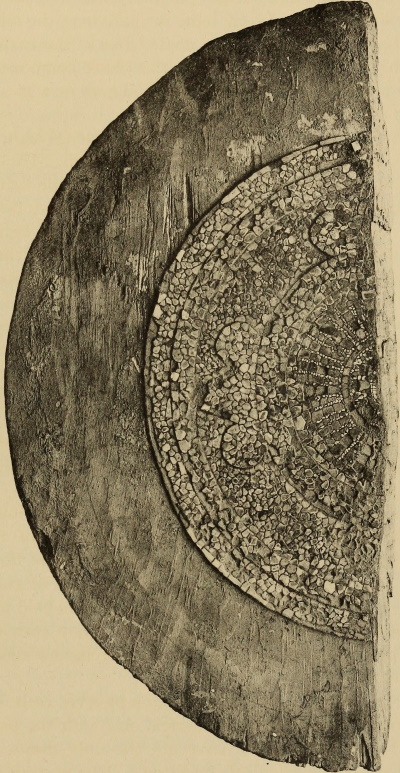
SHIELD OF WOOD (FRAGMENT) WITH MOSAIC DECORATION
MUSEUM OF THE AMERICAN INDIAN HEYE FOUNDATION, NEW YORK
The next mask to be considered, on pl. XVII, is the only specimen
known from Central America, and with the pieces found
recently in the Mexican cave are the only major specimens
found under archeological conditions. This mask is 8½ inches
high, and the three facial projections extend 4 inches from the
face. It is in the Museum of the American Indian, Heye Foundation.
This interesting object was found some years ago in a
cave in the mountainous region of Honduras, in an arroyo on
the headwaters of a small stream flowing into the Rio Chamelecon,
about 25 miles from the ruins of the ancient city of Naco.
Hundreds of copper bells of varying sizes and shapes were
found at the same time. The mask has been figured and described
by A. H. Blackiston, whose description follows:
First in interest in the writer’s collection is a large life-sized mask
of white cedar which was covered with mosaics of turquois and other
stones set in a thick gum or pitch with which it was coated. Three
greatly elongated straight projections answer for the nose and the
two lips. Holes were cut for the eyes and two small ones on the sides
for the thongs which bound it to the head. A large cavity in the
forehead was evidently the setting of the crowning stone of the collection,
though of what nature this was we unfortunately are unable
to surmise, as it evidently became loosened and dropped out years
before its discovery. Along the sides of the face are depressions in
the coating of gum for regularly shaped stones about half an inch
long by three-eighths of an inch in width, arranged in parallel rows—none
of which remain at present. The rest of the surface, as
noted, was covered with small turquois mosaics, a number of which
are in place today.[92]
Skull Masks
The two final masks to be described are the skull masks in the
Ethnographical Museum in Berlin, and in the British Museum,
London. On pl. XVIII is represented the Berlin example, which
has been described by Uhle and illustrated in colors, three-fourths
natural size.[93] Only the front of the skull has been used,
and it was incrusted with sky-blue to pale slabs of turquois.
The mask is 6⅝ inches in height. Our illustration is a photograph
of the lithograph published by Uhle.
The skull mask in the British Museum (pl. XIX) has been illustrated
many times, and is one of the best-known pieces of
Mexican mosaic. It has also been repeatedly described, so that
it is not necessary to present a detailed description at this time.
Suffice it to say that the back of the skull has been cut away,
and the front covered with five broad transverse mosaic bands,
alternating from the top downward, of lignite (not obsidian, as
all writers have described it, we are informed by Joyce) and
turquois. The inside is lined with leather, on which traces of
red paint still remain.
Shields
Richly decorated shields or chimallis played a prominent
part in certain phases of the life of the ancient Mexicans. Mrs.
Nuttall, in her interesting and instructive study, “On Old
Mexican Shields,”[94] has pointed out that “all authorities agree
that the shields were of two kinds. The first consisted of the
military shields used for protection in warfare by all grades of
warriors; the second comprised the shields carried, for display
only, in religious dances and festivals.” In this study Mrs.
Nuttall has made the following classification of shields, based
on an extended examination of the chronicles of early writers:
1. Plain, unadorned war-shields (yaochimalli) of several kinds,
used by the common soldiers.
2. Gala shields (totopchimalli), indicating the military rank and
achievement of chiefs. These seem to have been indiscriminately
used in warfare or feasts and dances. Their general structure seems
to have been alike in either case, though it is obvious that they may
have been more or less light and strong. Shields of this category
sometimes reproduced one or more features of the military costume,
body-painting and adornments pertaining to each grade. The
shield in Museo Nacional is an example of this kind. Others exhibited
the emblematic device of a militant god, Huitzilopochtli,
Xipe, Yiacatecuhtli, etc., marking an order of chivalry—and to this
division the Stuttgart specimens belong.
3. Shields, presumably of the supreme war-chief, exhibiting in
picture-writing the name of his people or his personal appellation.
Nothing certain is known about this group, but its existence seems
vouched for by a series of indications.
4. Shields pictured in the codices with deities only exhibiting
their emblematic devices or reproducing features of their symbolic
attire. Such shields seem to have been carried, in religious dances
and festivals, by the living images of the deities in whose honor
they were held.
5. Shields of most precious materials, with strange and elaborate
designs, described in the Inventories. As they are not mentioned
elsewhere, it is not possible to state anything definite about them,
but it is obvious that they were intended for the use of individuals
of supreme rank. The beautiful shield at Castle Ambras belongs
to this group. It is, consequently, the sole forthcoming specimen
with a valid, though shadowy, right to the title of “Montezuma’s
shield.”
PL. XXVI
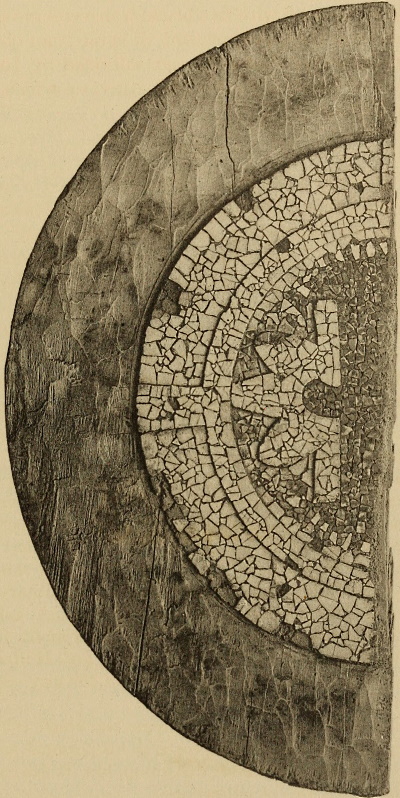
SHIELD OF WOOD (FRAGMENT) WITH MOSAIC DECORATION
MUSEUM OF THE AMERICAN INDIAN HEYE FOUNDATION, NEW YORK
In the inventories of the Cortés loot, 150 shields are enumerated,
mostly decorated with feathers, but 25 are specified
as being ornamented with turquois mosaic, while others were
garnished with gold. Of the feather-mosaic shields, one example
is in Vienna (the shield formerly in Castle Ambras), two are
in Stuttgart, and one is in the Museo Nacional, Mexico. Of the
turquois mosaic shields, one is in London, and one in Vienna;
none exists in Mexico. To this number we are now able to add
eight specimens in New York, namely, one perfect shield, two
nearly complete ones, and five fragments, all from the cave in
the Mixteca.
We have already given numerous extracts from the early
writers concerning the use of mosaic shields as part of the
paraphernalia of the deities. In figs. 16-17 are two representations
of the god Paynal, holding in his right hand a mosaic
shield. Fig. 16 is from the Florentine manuscript of Sahagun
(lamina 8), while fig. 17 is from the Real Palacio manuscript
of the same author. In the original the shield is painted blue.
These are the only examples we have been able to find in the
Mexican codices where the mosaic character of the shield is
unquestionably delineated.
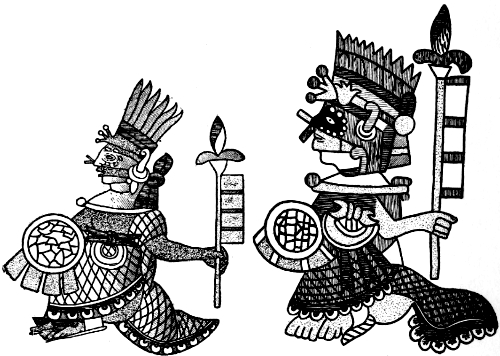
Fig. 16 Fig. 17
We will now consider the two mosaic shields in Europe. On
pl. XX is the shield in the British Museum. Its early history is
unknown, other than that it was purchased in 1866 from a
dealer who stated that it came from Turin. Quite a little of
the mosaic is missing, but not enough to destroy the intricate
and interesting designs. It has been described by Read,
accompanied with a drawing of the figures.[95] The shield is of
cedar, with a diameter of 12¼ inches. The material used for
the mosaic is turquois and shell. The center of the design
consists of a circle in relief, the edge of which is divided into four
equal parts by angular points in pink shell, and each quarter
of the circumference has three large but irregular pieces of shell
at intervals. It is a tonatiuh, or sun disc, and a figure of a serpent
is disposed meander-fashion vertically over the entire
central portion. One edge of the snake is bordered with imitation
studs formed of brown gum, of which a few still preserve a
covering of very thin gold-leaf. The head is placed at the upper
left side, the tail ending in three feathers at the lower right edge
of the circle. On each side are two human figures, and at the
center, near the top, projecting from the body of the snake, is a
bifurcated design, probably a tree, upon which rests, in a pear-shaped
enclosure, a human figure on its back. Through the
shield are many irregular perforations, and twenty-five small
holes are regularly disposed around the edge, possibly for the
suspension of feathers, or bits of stone, gold, or gold-leaf, over
gum, may have been inserted. Two larger holes are near the
upper margin.
PL. XXVII
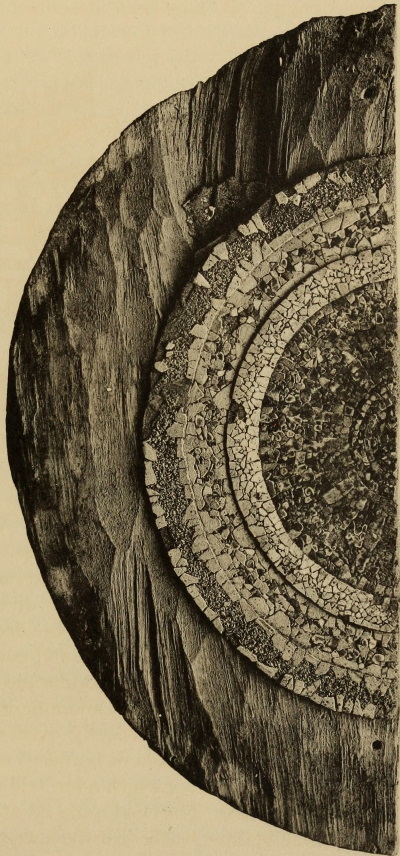
SHIELD OF WOOD (FRAGMENT) WITH MOSAIC DECORATION
MUSEUM OF THE AMERICAN INDIAN HEYE FOUNDATION, NEW YORK
On pl. XXI we reproduce the Vienna shield.[96] It is larger than
the London specimen, being 16½ inches in diameter, and the
designs are not so involved as in the London shield. Unfortunately
the greater part of the mosaic has fallen out, but the
figures in most cases may be traced by the impressions in the
gum matrix. The designs consist of two tonatiuh, or sun discs,
placed one above the other. In the upper tonatiuh is a human
figure. There are many examples of this motive in Mexican
sculptures and codices. Across the center of the shield, between
the two sun discs, is a procession of human figures, four each on
the right and the left, all facing the center. Between them is a
human figure, head-downward, in the act of falling or plunging
from the upper sun disc. Above this line of figures are four
others, two on each side of the sun disc, which they face. Below,
facing the lower disc, are three other figures on each side,
and lower still are two more on each side. The total number
of human figures, so far as we are able to determine, is twenty-four.
This shield was formerly in the Castle Ambras, near Innsbruck,
and its history is traceable to 1596, it being mentioned
in an inventory of that date.
We cannot identify these two shields with those described in
the Cortés inventories, but there is no reason to doubt that
they formed part of that treasure. As examples of mosaic art,
they are priceless, even in their damaged condition.
The circumstances attending the discovery of the shields now
in New York have already been alluded to. Pl. I is an exact
reproduction in colors of one of these, the most important example
of aboriginal American mosaic art known. It is in an
almost perfect state of preservation, and is practically of the
same size as the London specimen, being 12¾ inches in diameter,
with an average thickness of three-eighths of an inch. The
wood is probably cedar. In a highly esthetic manner the mosaic
incrustation has been set in a bed of gum, with alternating
massing of light and dark turquoises to produce bands or zones
of shading in light or dark bluish-green. It is estimated that
nearly 14,000 individual pieces enter into the composition of
this mosaic, the greater number being tiny circular bits. The
design represents a sun disc, with eight pointers in the outer
rim. Inside of the innermost of the two raised narrow encircling
bands is a picture of ceremonial or mythological character. We
hesitate at an interpretation, but the main features may quite
certainly be recognized. We are of the opinion that the scene
portrayed perhaps relates to the worship of the planet Venus.
It is in the region where this shield was found that Seler, after
making exhaustive comparative studies of several pre-Columbian
codices, concludes:
We have to look for the home of the Codex Borgia group of manuscripts....
It was a land inhabited by Aztec-speaking peoples; it
was conterminous with the Zapotec territory, and it lay on the
trade-route which led to the coast, and to the Maya-peopled district
of Tabasco.... Indeed we also know that in this very region astronomic
observation was highly developed, and the Morning Star
(Venus) held in special veneration.[97]
The upper horizontal band of the shield represents the
celestial region. It recalls, with its feather fringe at the top and
dots hanging from the lower section, the design around the so-called
calendar stone collected by Humboldt, now in the Berlin
Museum, and the upper encircling rim above the procession of
figures of the so-called stone of Tizoc, as well as some of the
upper bands in the murals of Mitla. If this is the celestial band,
as we believe, it is quite appropriate to find on it the tonatiuh,
or sun, represented in the rosette in the center. We find here
two sets of four pointers each, radiating from the central disc of
feathers, which surrounds a lozenge-shaped piece on which is a
tiny pit below two horizontal lines. In the Real Palacio manuscript
of Sahagun (estampa XII) are pictures of various symbols
for heavenly bodies, one being a small disc with tiny dots, explained
by Sahagun as being the sign for Venus. We have endeavored
to identify this glyph with that of the symbol for
turquois or jewel, or the sign for chalchihuitl. There is a slight
resemblance, but we hold the opinion, as before stated, that it
is the sign for the sun. We have been unable to find the exact
counterpart of this combination either in the codices or in
sculptures.
PL. XXVIII
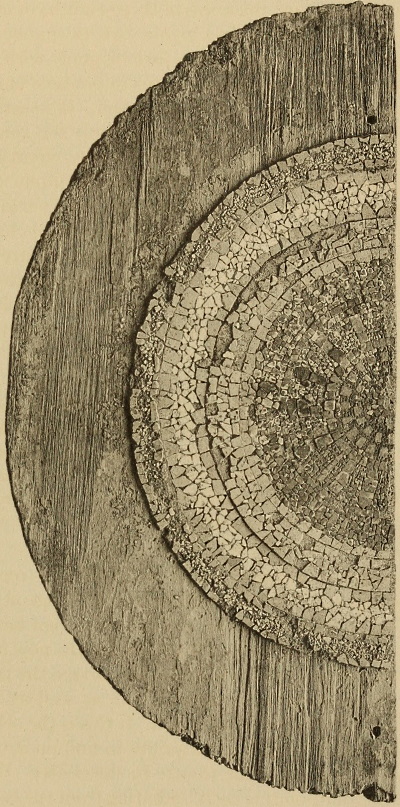
SHIELD OF WOOD (FRAGMENT) WITH MOSAIC DECORATION
MUSEUM OF THE AMERICAN INDIAN HEYE FOUNDATION, NEW YORK
We now come to a feature which is also found in the Vienna
shield, namely, a person falling or descending from the sun or
celestial regions. The injured condition of the Vienna specimen
renders it impossible to distinguish the sex of the figure, but in
the New York specimen a woman is represented, probably a
goddess. On several pages of the Codex Nuttall Zouche[98] (pp.
4, 19, 21) are representations of human figures hanging from or
plunging from the heavenly band. Seler has connected these
scenes with the Venus period of the Mexican calendar. Attached
to the band on our shield are five dots. Taken in connection
with the eight dots below, respectively four on each
side of the hieroglyph at the bottom, one recalls the suggestive
fact that the Mexicans were acquainted with the correspondence
of eight solar years to five Venus periods, and reckonings
connected with the correction of these two periods have been
established by both Seler and Bowditch.[99] In the Codex Selden
is found an analogous picture, the band of the sky, with a
central tonatiuh, and a descending human figure attached, below
which are two figures. This scene has been interpreted by
Beyer[100] as representing the solar god accepting human sacrifice.
In our shield, the feature which follows in Codex Selden,
depicting this sacrifice, is absent.
In our shield, facing the plunging figure, are two human
figures, one on each side, holding something like a staff in each
hand, similar to those held in the hands of the goddess. From
the mouth of each of these figures protrudes an unknown object,
perhaps a conch-shell trumpet, but it is not supported by
the hands.
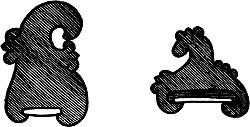
Fig. 18
Above a horizontal band just over the bottom of the inner
encircling rim is a hieroglyph. It is the well-known glyph for
Culhuacan, or Colhuacan, the name of an important town in
the valley of Mexico in ancient times. The form of the glyph,
a mountain with a curved peak, is derived from the tradition
that the Nahuan people originated where there was a mountain
with a curved peak, called in the Nahuan language Culhuacan.
The sign is interwoven with the legendary history of the ancient
tribes in central Mexico, Teuculhuacan being the province far
to the north where were situated the Seven Caves of Chicomostoc,
the primeval home whence sallied the Seven Tribes. In
the Codex Boturini I, this legend is pictured. In fig. 18 are
two forms of the glyph taken from the Codex Telleriano Remensis.
On each side of this glyph on the shield are four dots,
not to be confounded with the representations of shells attached
to the glyph. These eight dots should have a calendric meaning,
and we might stretch our imagination and consider the
glyph to be Calli, a day-sign and also year-bearer, represented
by the conventional figure of a house, which would give us the
date 8 Calli, capable of being coordinated with either the year
1461 or 1513. The general character of the glyph, however,
seems to be too well established as Culhuacan to admit of such
hypothesis.
PL. XXIX
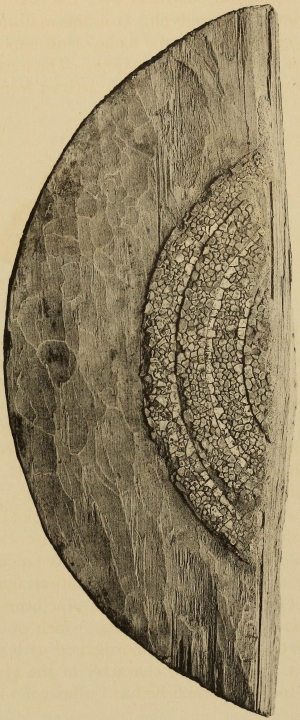
SHIELD OF WOOD (FRAGMENT) WITH MOSAIC DECORATION
MUSEUM OF THE AMERICAN INDIAN HEYE FOUNDATION, NEW YORK
In a letter to the writer Dr. H. J. Spinden advances an explanation
of the combination of the figures in this sun-disc
shield. With his permission we quote him verbatim:
I am inclined to believe that the design as a whole represents a
sun shield, the eight radiating bars being the rays, while the celestial
band, the three human figures, and the Colhuacan glyph replace
the parts of the sun’s face, namely, the head-band, the two eyes and
nose (the plunging figure in lieu of the nose), and the mouth. This
may seem pretty far-fetched at first glance, but it is quite in the
spirit of Aztec art. On the Calendar Stone, around the face of the
sun god and the ollin symbol with the enclosed glyphs of the four
ages, is, first, a circle of the day signs, second, a circle of quincunx
figures, supposed to be the classical hieroglyphs or rather symbols of
turquoises, third, a frieze of eagles’ feathers. Multiple rays of
different sizes complete the picture. In the actual shield before us
we have the turquois mosaic, and the holes around the rim suggest
that eagles’ feathers may once have been attached. Compare the
sun shield or sun basket of the Pueblo Indians, and the various sun
shields on Mayan monuments. Now, the sun and turquois seem to
be pretty closely connected symbolically—both mean divine. The
hieroglyph of the sun is used for the teo, god, in place names, while
the prefix xiuh means divine in connection with various objects.
Jade, on the other hand, means precious. The sun in Aztec ritual
is pretty closely connected with riches and jewels, and the sun disc
may easily have been conceived of as a gem-studded object. I
think it quite possible, therefore, that the design on this shield was
intended to symbolize the face of the sun, and the fact that complete
figures engaged in some ritualistic function replaces the parts of a
realistic face does not detract from the theory.
The back of the shield is shown in pl. XXII. Through the two
vertical ridges are pairs of holes, evidently for the leather
thongs for holding the shield. The twenty-eight small holes
around the edge of the shield were probably for the insertion of
feathers or other ornaments, as in the British Museum shield.
In technique our shield is similar in all respects to the two
mosaic shields in Europe. In all three the incrustation is in a
bed of gum that has been spread over the wood.
We now come to the series of seven mosaic shields in New
York, shown in pls. XXIII-XXIX. In these we are dealing with
a different technique, and one which is new to us. For the
matrix a kind of cement like fine gritty brown sand was
used in place of gum. They are unfortunately in a considerably
damaged state, but two are more or less complete. In
these examples the wood has been roughly shaped, and in all
of them the marks of the copper or stone adzes are clearly visible,
for there was no final smoothing of the wood as in the
three specimens before described. The probable reason for this
is seen in the shield on pl. XXIII. On the face of this specimen, on
portions of the lower edge, especially at the left, are traces of a
coarse native paper made from the amate tree, which occurs as
a band that had been glued to the wood. Traces of paper also
are found in the same place on the shield fragment illustrated
on pl. XXIV. It is impossible to state definitely if this paper
once extended from the edge to the raised body of the mosaic
decoration. On the fragmentary shield just referred to may
be seen a faint black line, made with some substance like
graphite, running partly around the circumference 1 to 1⅞
inches from the edge. It is probably the artist’s line in arranging
for some class of decoration, perhaps delimiting the
section to be covered with paper. On the first shield no such
line is found, but it seems certain that the rough wood between
the narrow band of paper and the mosaic must have been covered
either with paper or with some other material. There is no
trace of cement, and we are led to believe that the paper once
extended over the entire plain surface of the wood. Parchment
or soft leather may also have been stretched tightly over the
outer zones of shields which show no traces of paper. On this
surface some type of decoration was undoubtedly placed. We
recall the quotation given above concerning the use of turquois
mosaic decoration on paper, in connection with the worship of
the god Huitzilopochtli. Feather-mosaics, so far as we know,
were generally made either on parchment or on paper. The
codices were made either of leather, parchment, or paper, often
sized with stucco. In rare cases the painting was applied directly
on the paper. It is undoubtedly true that one or the
other of these processes of decoration completed the ensemble
of the shields we are now considering.
PL. XXX
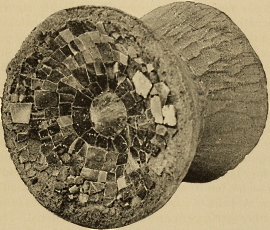
EAR PLUG OF WOOD WITH MOSAIC DECORATION
MUSEUM OF THE AMERICAN INDIAN HEYE FOUNDATION, NEW YORK
Another point of difference in this series of shields is the
material spread over the wood to receive the incrusted stones.
It must have solidified slowly to have allowed for the careful
and laborious work of fixing the pieces in the plastic matrix. In
the case of the matrix of gum, material could have been applied
and would have hardened immediately, for by tests, even after
the lapse of centuries, we have found it possible to loosen the
bits by the application of heat to the stone; but in the case of
the cement matrix this is not possible. We do not know what
liquid was used to harden the cement, which is now quite
friable.
Relatively speaking, comparatively little turquois was used
in this class of mosaics. Different shades of a soft light-gray
stone was employed in the outer zones, while darker stones
interspersed with turquois of varying shades, some almost
white, and bits of lignite and obsidian, are found.
A final unique feature may be noted in the shields on pls.
XXVII and XXVIII. In the outer band will be observed the irregular
inner edges of the two lines of stones which form the
border. In pl. XXVII the space is filled in with a sprinkling of
gritty, almost sand-like, bits of faded whitish-blue bastard
turquois. It appears to have been spattered or sprinkled on
while the matrix was very soft. In the case of the shield on pl.
XXVIII, the material is somewhat coarser, and consists of rough
bits of the same stone used in the broad light band within the
outer border.
These shields, so far as we are able to judge from the fragmentary
sections, contained no pictures or figures as in the
other type. In general execution they are inferior in workmanship,
and less refined and finished in appearance. In fact, they
constitute a quite distinct and, up to the present, unknown type
of stone mosaic from Mexico.
The first shield of this series (pl. XXIII) is in two fragments, a
portion of one edge being missing. It has an average diameter
of 15 inches, and a thickness of one-half to three-quarters of an
inch, the mosaic disc rising one-eighth of an inch above the
wood. The mosaic portion has a diameter of 10¼ inches.
It appears to be a sun shield, judging by the eight pointers
which radiate from the band surrounding the circular design
in the center, which suggest a conventional representation of
the sun. In the center the darker bits are obsidian. A portion
of the matrix and of the mosaic incrustation has fallen off,
and on the matrix near the upper left is a greasy patch which
may be candle grease.
The shield on pl. XXIV is the same size as the preceding one,
15 inches in diameter. It is also in two sections, and a larger
section of the side is missing. This likewise is probably a sun
shield, but it has no pointers. Where the outer band has fallen
off toward the lower part can be seen a faint incised line which
the artist placed there as a guide-line in following out the
circular mosaic decoration. In the center the black bits are
lignite.
The next shield shown (pl. XXV) consists of a half section
only. It was slightly larger than any other shield in the collection,
having a diameter of 15¼ inches and a thickness of 1
inch. It was a sun shield, and had four pointers identical with
those on the famous calendar stone of the Aztecs. There are
traces of a paper band glued around the outer edge; the black
line has already been referred to. The central disc, with the
white lines made of very tiny bits, is similar to the central part
of the shield on pl. XXIII.
PL. XXXI
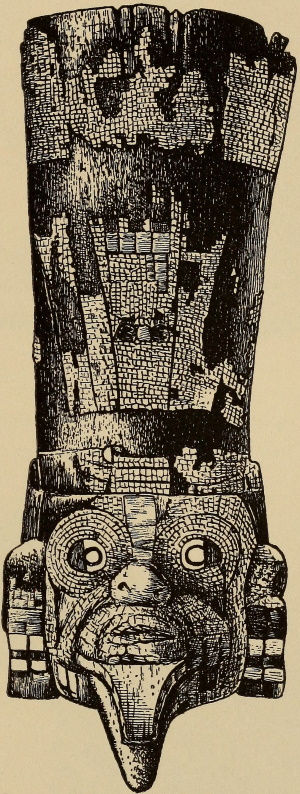
HEAD WITH HEAD-PIECE OF WOOD WITH MOSAIC DECORATION
NATIONAL MUSEUM, COPENHAGEN
PL. XXXII
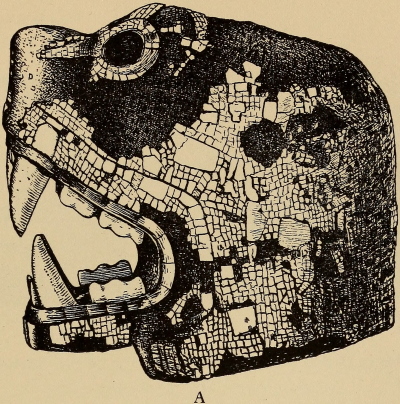
JAGUAR HEAD OF WOOD WITH MOSAIC DECORATION
ETHNOGRAPHICAL MUSEUM, BERLIN
PL. XXXII
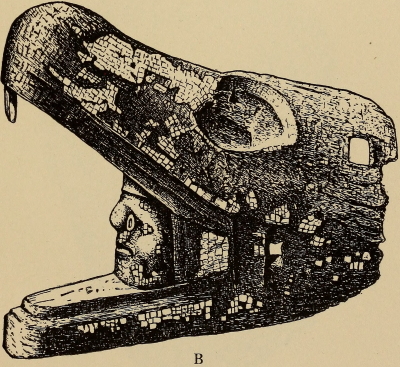
ANIMAL HEAD OF WOOD WITH HUMAN FACE IN OPEN JAW
WITH MOSAIC DECORATION
NATIONAL MUSEUM, COPENHAGEN
PL. XXXIII
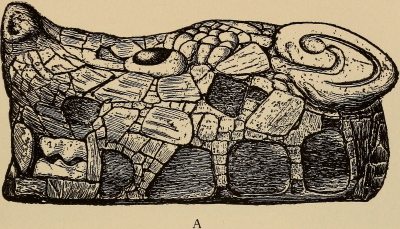
ANIMAL HEAD OF WOOD WITH MOSAIC DECORATION
STATE NATURAL HISTORY MUSEUM, VIENNA
PL. XXXIII
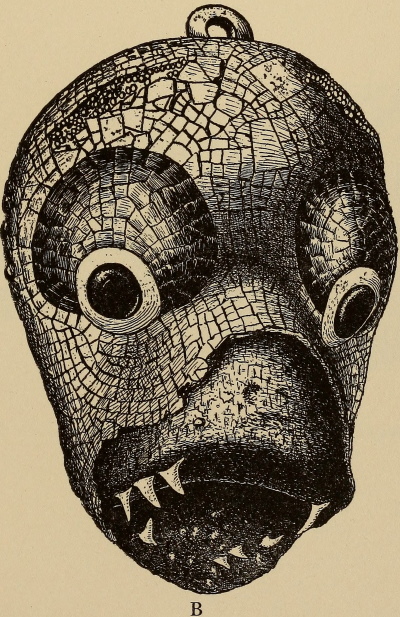
MONKEY HEAD OF WOOD WITH MOSAIC DECORATION
BRITISH MUSEUM, LONDON
PL. XXXIV
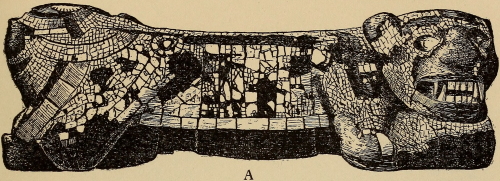
TWO-HEADED JAGUAR FIGURE OF WOOD WITH MOSAIC DECORATION
ETHNOGRAPHICAL MUSEUM, BERLIN
PL. XXXIV
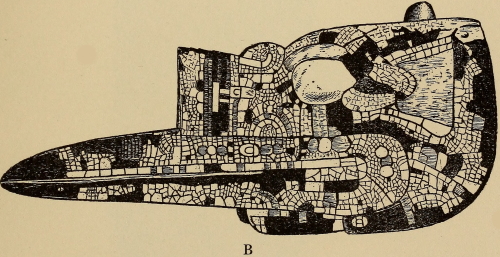
BIRD HEAD OF WOOD WITH MOSAIC DECORATION
MUSEUM, GOTHA
PL. XXXV
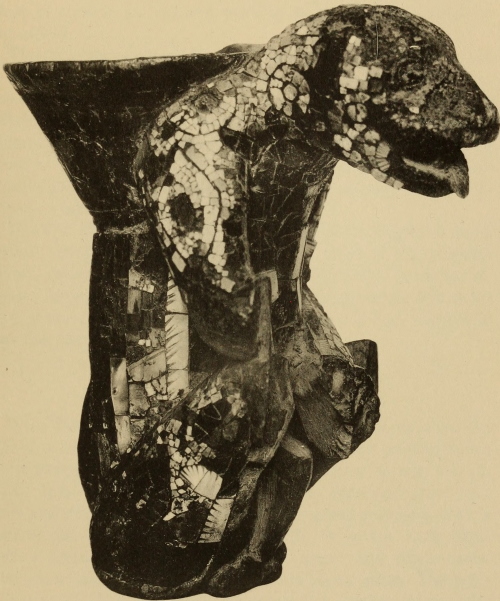
ANIMAL FIGURE OF WOOD WITH MOSAIC DECORATION
BRITISH MUSEUM, LONDON
One of the most interesting specimens is reproduced in pl.
XXVI, which is 14⅞ inches in diameter. This is the only shield
of the series bearing a figure. It had four pointers, which suggest
a sun disc, but the symbol seems clearly to be a conventional
cross-section of a conch-shell, the well-known and often
delineated symbol of Ehecatl, god of the air, one of the various
attributes of the god Quetzalcoatl. In this example the light
pieces of stone are larger than in any other piece, but they are
cut exceedingly thin. Around the outer edge of the mosaic is a
faint incised line, and three lines may be seen projecting from
the pointers, showing that the artist carried his guide-lines
beyond the zone finally used. The circular line is so regular that
there is no doubt that the workman used our methods, tying a
piece of cord to an awl and working from the exact center of
the shield.
The two fragments on pl. XXVII and XXVIII are the same size—15
inches in diameter. They are similar in workmanship;
the special feature, the sprinkled outer band, has already been
alluded to. In the first specimen an irregular cavity on the
upper face was apparently filled in with cement, traces of which
remain. The two holes in each shield are modern, but the two
specimens came to us joined with leather strings. They are,
however, sections of separate shields.
The last shield of the series (pl. XXIX) has a height of 14⅝
inches. It comprises little more than a third of the original
object, hence the diameter must have been fully 15 inches or
more. As in the others, we find the encircling bands, but as no
part of the center remains, we do not know if it had a figure or
was like the others of the series.
Ear-plug
With the deposit of masks and shields in the cave in the
Mixteca, now in the Museum of the American Indian, Heye
Foundation, was the unique wooden object shown on pl.
XXX. It is spool-shaped, the bottom flat, the upper part concave
and covered with a mosaic of dark-green turquois, with a
central disc of dark rose-colored shell. It is 1½ inch high,
with a diameter of 1¾ inch at the upper and lower rims.
There is no doubt that this specimen was an ear-plug. The sides
of the spool show the small gouges of the cutting instrument
with which it was fashioned, and the entire surface not covered
with mosaic was painted rose-red.
Animal Figures
The specimen in the National Museum in Copenhagen,
shown on pl. XXXI, has been described in detail by Lehmann,[101]
and our illustration is taken from his photograph. It is considerably
damaged, much of the mosaic incrustation having
disappeared. The materials are turquois, malachite, shell, and
mother-of-pearl. In its original state it was one of the imposing
pieces of this art. The upper projecting part rising from the top
of the head probably simulated a plumed head-dress. Its extreme
height is about 10½ inches, and the diameter only 3¾
inches.
On pl. XXXII are illustrated two animal heads. The first (a), a
jaguar head, in the Ethnographical Museum in Berlin, has
been described in detail by Lehmann in his paper published in
the Proceedings of the Fifteenth Congress of Americanists, held
at Quebec in 1906. It is 5¾ inches high, and the mosaic is
composed of turquois, malachite, and shell. The other specimen
(b) is in the National Museum at Copenhagen.[102] It seems to
represent a serpent’s head with a human face in the open jaws.
The mosaic is turquois, malachite, and reddish shell. It has an
extreme length of 13½ inches and is 8¼ inches high. Much of
the incrustation has fallen off.
The animal head shown on pl. XXXIII, a, is in the Vienna
Museum, and has been illustrated by Heger in three views.[103]
Our drawing is the side-view, after Heger. This object is 4⅝
inches long from front to back. Much of the mosaic has fallen
away, and the pieces of jadeite, obsidian, and shell are larger
and the work is generally coarser than in any of the other examples
in Europe. Heger’s photographs depict a leather
thong issuing from a hole at the back of the head.
PL. XXXVI
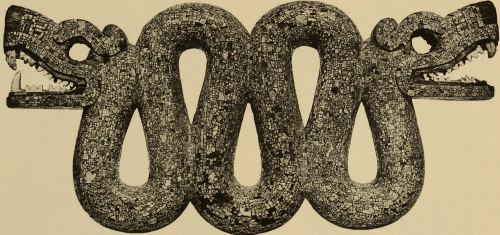
DOUBLE-HEADED SERPENT OF WOOD WITH MOSAIC DECORATION
BRITISH MUSEUM, LONDON
PL. XXXVII
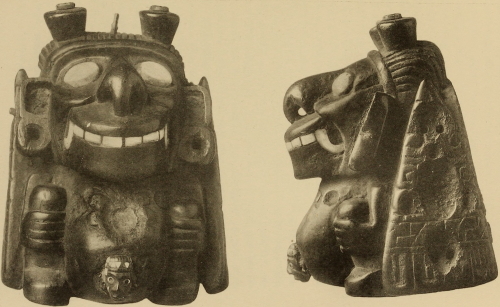
FIGURE OF WOOD WITH MOSAIC DECORATION, GOD XOLOTL
STATE MUSEUM OF NATURAL HISTORY, VIENNA
The other mosaic on this plate (b) is in the British Museum.
It represents a monkey-like head of white wood, with open
mouth. The mosaic coating is of turquois, malachite, and
other stones. The back has a hemispherical depression coated
round the sides with a thick layer of brown gum, smoothly finished,
containing some woolen threads. The turquoises are
chiefly of the pale-greenish variety, but above the sides of the
mouth are two patches of bright-blue stones. Each eye is set
in the lower edge of a protuberance coated with malachite, the
eyes themselves being convex discs of highly polished iron
pyrites set in a ring of shell. Height 4 inches, width 2.7 inches.
An interesting piece is the two-headed jaguar figure in the
Ethnographical Museum in Berlin (pl. XXXIV, a).[104] It is covered
with bits of turquois and malachite, together with some obsidian,
shell, and mother-of-pearl. The eyes are of malachite.
This specimen measures 12⅝ inches in length, and the workmanship
seems to be very artistic.
An important and unique example of mosaic art is shown on
pl. XXXIV, b, which represents a bird’s head embellished with an
incrustation of turquois, malachite, obsidian, mother-of-pearl,
red coral, and white shell, but much of the mosaic has fallen out.
This specimen is in the Museum in Gotha.[105]
A much injured specimen in the British Museum is illustrated
on pl. XXXV, which represents an animal on his haunches,
with open mouth and protruding tongue. On its back is a circular,
cup-like receptacle. It is cut from a hard, pale-brown
wood. Almost the entire surface was originally covered with
mosaic laid in a bed of black gum, the component pieces being
turquois, malachite, pink shell, pearl shell, and fragments of
iron pyrites. The cup-shaped receptacle on the back of the
animal is now covered with a transparent varnish, except in one
place where the black gum and bits of mosaic are still in place.
The varnish shows here and there fragments of gold-leaf, perhaps
indicating that the cup was once entirely gilded. The
height is 6.8 inches.[106]
The gracefully modeled breast-ornament representing a two-headed
serpent (pl. XXXVI) is in the British Museum. The base
is of light-colored wood, hollowed at the back and painted red.
The front of the snake is covered with turquois mosaic; the
teeth and fangs in each open jaw of the snake are made of
white shell, while the edges of the gums are indicated with
pink shell. Across each nose is a raised band of turquois and
red shell. The heads have mosaic-work on both sides, and it is
probable that the eye-sockets formerly contained discs of iron
pyrites. On the upper edges of the two loops of the bodies are
holes for suspension. Length 17⅛ inches, height 8 inches.
God Figure
The figure of the deity shown in pl. XXXVII is in the Vienna
Museum. It has been described by Dr. Heger, who has kindly
sent me a number of photographs of the object, and some details
regarding it. This has been identified by Dr. Seler as representing
the god Xolotl, one of the deities or guardians of the
Tonalamatl.[107] The specimen does not contain much mosaic
decoration, being of highly polished wood. It is 3½ inches high
and 2¾ inches broad. Dr. Heger has courteously sent me the
following notes concerning the specimen:
The posterior circular cavity (see side view) is partly filled with a
resin-like mass, by means of which the piece must have been fastened
to some other object. Vestiges of this resin-like substance are
found in all the hollowed places where today some of the inlay is
missing, as in each of the three rounded oval incurvations, of both
lateral walls, in which probably small heads [of mosaic?] were also
incrusted.
The eyes and the six small teeth consist of milk-white shells; the
two hook-like canines consist of white mother-of-pearl-like shells.
The two large ear-lobes, as well as the inferior part of the nasal
septum, are perforated transversely. The pretty little human head
at the navel of the figure probably consists of pitch-black obsidian.
The ear-pendants are missing on the left side. The pupils of the
eye (right one missing) are enclosed in small rings of mother-of-pearl.
Projecting from the opened mouth, there is above the red
tongue another small white shell-plate with three sharp downward
points (teeth). The little head shows injury in several places.
PL. XXXVIII
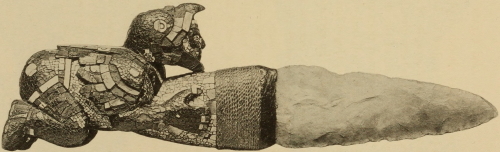
STONE KNIFE WITH HANDLE OF WOOD WITH MOSAIC DECORATION
BRITISH MUSEUM, LONDON
PL. XXXIX
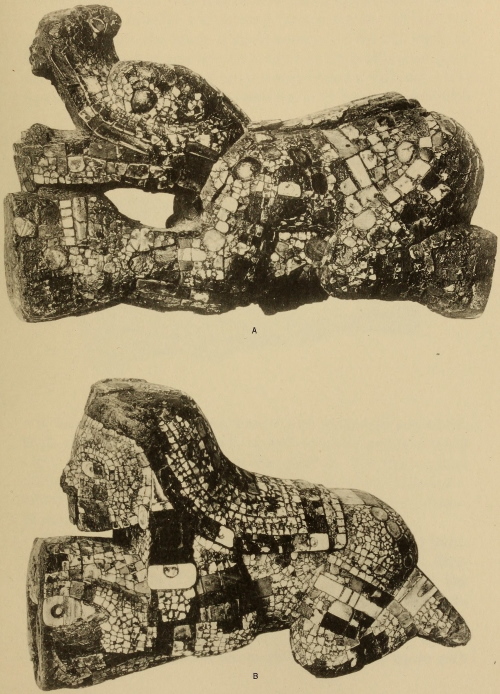
KNIFE HANDLES OF WOOD WITH MOSAIC DECORATION
PREHISTORIC AND ETHNOGRAPHIC MUSEUM, ROME
Knife Handles
The next group of objects to be noted consists of knife handles.
The beautiful specimen on pl. XXXVIII is in the British
Museum. It is a chipped leaf-shape bladed knife of honey-colored
chalcedony. The handle is of a soft, light-colored wood,
carved in the form of a crouching human figure. The actual
socket in which the blade is fixed proceeds from the chest of
the figure, which grasps it with a hand on each side, and rests
his chin on the top. The socket is firmly bound with cord. The
figure and the socket up to the binding have been covered with
a mosaic, chiefly of turquois, varied with malachite and white,
pink, purple, and orange shell, as well as a few pieces of pearl
shell. Much of the mosaic has disappeared. The figure wears
an eagle mask, the face appearing in the open jaws. This knife,
which measures 12½ inches in length, is one of the most artistic
of mosaic specimens.
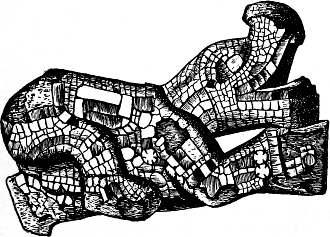
Fig. 19
Belonging to this class are the two handles on pl. XXXIX,
which are in the Museum in Rome. They have been illustrated
in colors by Pigorini. Through the interest of Dr.
Lothrop we are enabled to present photographs of these two
very interesting objects, together with some additional observations
concerning them. The first piece (pl. XXXIX, a, and
fig. 19 after Pigorini), is in the form of a crouching figure with
an animal head and wide-open mouth. It has been described
as a knife handle, like the other specimen (b), which is unquestionably
of that character, but Dr. Lothrop writes that the
front of this piece (a), where the knife blade should be inserted,
is smoothly covered with a kind of cement, while in the belly of
the figure is a large hole. From Dr. Lothrop’s examination of
the specimen he was unable to satisfy himself whether it was a
knife handle or was intended to be placed on the head of a
staff. The materials used for the incrustation are turquois,
reddish shell, dull white shell, mother-of-pearl, and small flakes
of gold. In the Pigorini illustration, which represents the side
opposite that shown here, two flakes of gold are shown, one
in the eye, the other on the arm between elbow and shoulder.
The other piece (pl. XXXIX, b), unquestionably a knife handle,
as stated, of the same technique as the specimens in the
British Museum, represents a crouching human figure. The
materials are turquois, dark-green malachite, white shell,
mother-of-pearl, and red shell. Lothrop calls our attention to
the tiny pieces of turquois set in shell on the shoulder and in
other places. He also states that a portion of a broken chert (?)
blade is still imbedded in the socket in front of the figure.
Human Femur Musical Instrument
The last of the specimens of mosaic to be described is the
musical instrument (omichicauaztli) made from a left human
femur, illustrated on pl. XL. This unique example, which is in
the Museum in Rome, has been reproduced in colors by Pigorini.
The mosaic seems to have been confined to the head and
neck, although the trochanter major may also have been covered
at one time. The incrustation at present consists of gum
in which are pinkish-orange bits of colored shell. A modern
copper chain is attached to the bone, from which hangs an oliva
shell, undoubtedly ancient.
PL. XL
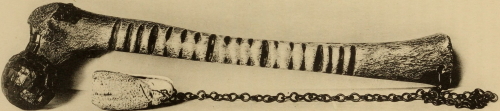
HUMAN FEMUR MUSICAL INSTRUMENT WITH MOSAIC DECORATION
PREHISTORIC AND ETHNOGRAPHIC MUSEUM, ROME
According to Dr. Lothrop, the oliva shell shows signs of
wear, and was probably the instrument used for rasping the
bone, as the bone is sound and produces a rather musical tone
when scraped with the shell, as if the bone were of china.
Notched human bones are not uncommon in ancient Mexico,
and some have been found elaborately engraved. In the course
of excavations made in 1900 in the street back of the Cathedral
in the City of Mexico, were uncovered many small pottery
models of musical instruments which had been placed there undoubtedly
when the foundations of the great Aztecan teocalli
were laid. The writer secured for the American Museum of
Natural History examples of these interesting models. Among
them was a notched bone having attached to it a model of the
handled instrument with which it was rubbed or rasped.[108]
*****
Finally, attention is called to three objects of wood, of
Mexican origin, in the Museo Borgiano, Rome. They have
been described by Colini, and two of the pieces illustrated, in
the Bollettino della Società Geografica Italiana.[109] The first is
an idol representing a human figure, 17¾ inches in height; the
other two specimens, those figured by Colini, are masks, and
it is highly probable that all of these pieces were once decorated,
at least in part, with mosaic. One of the masks is 6⅞
inches, and the other 7⅛ inches, in height.
CONCLUSION
In view of the considerable number of objects of stone mosaic
that were sent to Europe during the first years of the Spanish
conquest of Mexico, part of the loot obtained by Hernán Cortés,
it is quite possible that other examples are still hidden
away either in Spain or in Italy, which some day will be brought
to light. Only twenty years ago two wonderfully preserved
carved ceremonial spear-throwers, or atlatls, of wood, covered
with delicate gold-leaf, were found in an old leather-covered
case in a house in Florence, and are now exhibited in the Ethnological
Museum of that city. It is not to be doubted that
they were sent from Mexico by Cortés himself, and remained
stored away, unknown to the world, until recent times. Bushnell,
who figured and described these atlatls, believes that they
were formerly in the famous collection of the Medicis, and that
other objects of Mexican origin may be hidden away in Italy,
to be revealed from time to time.[110] Again, in 1891, Mrs. Zelia
Nuttall was the first to bring to our notice the important mosaic
shield, and the still more interesting feather-mosaic shield in
the Castle Ambras near Innsbruck, which were shortly afterward
transferred to the ethnographical section of the State
Natural History Museum in Vienna.[111]
We should call attention here to the possibilities of finding
mosaics in Mexico, emphasizing the fact that the collection in
the Museum of the American Indian, Heye Foundation, was
found under archeological conditions. Until now we have been
somewhat sceptical in regard to the possibility of wooden objects
of such a fragile and perishable nature being discovered
either in tombs or in ruined buildings in Middle America. As
we have already written, the few traces of this mosaic art found
heretofore in excavations have been of a fragmentary character.
No specimens of wood covered with mosaic have been
found previously in Mexico, with the exception of the
small rim of wood excavated by Gamio in Zacatecas, and the
four pieces from Chichen Itza. In the tropical and temperate
zones, where the most important ancient sites are situated,
artifacts of wood of any sort have rarely been unearthed. It is
true that in some of the remote villages carved wooden drums
(teponaztli) have been religiously guarded from the time of the
conquest, and are brought out and played at certain festivals
during the year. But these drums are kept in the cabildos,
and are preserved with zealous care.
We would again call attention to the statement of Sahagun
regarding the tradition of the abandonment of Tula, that
Quetzalcoatl ordered certain precious things to be buried in the
neighboring hills and ravines. This, of course, refers to times
long anterior to the coming of white men. After this unfortunate
event, fatal indeed to the Indian, the natives undoubtedly
secreted a vast amount of material. The circumstances
concerning this have been told by Father Motolinia. As
this account is but little known, we have translated literally the
entire chapter, for it reveals to us the miserable state into which
the aborigines had fallen within twenty years after their subjugation.
Of how there was an end of idols and of the feasts which the Indians
were wont to prepare, and of the vanity and the endeavor which the
Spaniards displayed in (their) search for idols.
The feasts which the Indians made, as is told in the first part (of
this book), with their ceremonies and pomp, all ended from the
beginning (of the time) that the Spaniards were making war (on
them), because the Indians had so much to think about in their
tribulations that they did not think of their gods, not even of themselves,
because they had so much sorrow that in order to remedy
that, all the principal (things in their lives) were stopped.
In every town they had an idol or demon whom they considered
chiefly as their mediator, and called him such, and they honored and
adorned him with jewels and garments, and the best they could find
they offered him, each town as it was (able to), and more so in the
capitals of provinces. These principal idols I mention, as soon as the
city of Mexico was taken by the Spaniards, with their jewels and
wealth the Indians hid in the most secret place they could find; a
large part of the gold that was on (or with) the idols and in the
temples they gave as tribute to the Spaniards under whose patronage
they belonged; for they could not do otherwise because in the beginning
the tributes were so excessive that all the Indians could scrape
together or search for, nor what the lords and chiefs had, would suffice;
besides, they were forced (to pay tributes) with such iniquity
that they also gave the gold they had in the temples of the demons
(idols), and even when this was exhausted they paid tribute in
slaves, and many times not having slaves in order to comply (with
the taxes), they gave free (Indians) as slaves.
These principal idols, with the insignia and ornaments or garments
belonging to the demons, the Indians hid, some in the earth, others
in caves, and still others in the woods. Later, when the Indians
became converted and were baptized, they unearthed many (of
them), and they brought them to the courtyards of the churches to
burn them publicly. Others rotted in the earth, because after the
Indians had received (or accepted) the Faith, they were ashamed to
take out those they had hidden, and would rather let them rot than
that anyone should know that they hid them. And when they
were importuned to tell (talk) about their principal idols and their
vestments, they took them out, all decayed, of which I am a witness,
for I have seen it (done) many times. The excuse they gave
was good, for they said, “When we hid it, we did not know God, and
we thought the Spaniards would soon return to their (own) country,
and after we came to understand (about) God, we left it to rot, because
we were afraid and ashamed to take it out.” In other towns
these principal idols with their vestments were in the care of the lords
or of the principal priests of the demons, and those kept them so secretly
that hardly anyone knew about them except two or three
people who guarded them, and of these (idols) they also brought a
very large number to the monasteries to burn them. In many
other remote villages, far away from Mexico, when the monks went
there to preach, they told them in their sermons and before christening
them that the first thing they had to do was to bring all the idols
they had and all the insignias of the demons to burn (them): and in
this manner they also gave and brought a large quantity which was
publicly done in many parts (of the country): because wherever the
doctrine and the word of God has reached, not a thing has remained
that they knew or could tell about, for if from now on for a hundred
years they should dig in the courts of the temples of the ancient idols,
they would always find idols, because there were so many that they
had made: for it happened that when a child was born they made an
idol, and the following year (they made) one a little larger, and after
four years they made another one, and as the child grew up they
went on making idols, and of these (idols) the foundations and walls
are filled, and in the courts there are many of them. In the year
(15)39 and in the year (15)40 several Spaniards, some with authority
and some without it, to show their zeal of the Faith, and thinking
that they were accomplishing something (worth while), began to dig
and to unearth the dead and to urge the Indians that they should
give them idols: and in some parts (of the country) this reached such
a stage that the Indians went to look for the idols that were decayed
and forgotten in the earth, and some of the Indians were even so
sorely tormented that, to tell the truth, they made new idols and gave
them (to the Spaniards) that they should cease maltreating them.
Mixed with the great zeal they (the Spaniards) showed in searching
for idols, (there was) not a little covetousness, and it was because
the Spaniards (would say), in such a village, or in such a parish,
there are (were) idols of gold, or of chalchihuitl which is a stone of
great value, and they imagined that there was an idol weighing ten
or fifteen arrobas: but in truth they came (too) late, because all the
gold and precious stones were spent and cashed in and safely in the
power (hands) of the Spaniards who first held those Indians under
their jurisdiction. They also thought of finding an idol of stone
which would be worth as much as a city, and certainly, although I
have seen many idols which were adored and held highly by the Indians
and (were) very (greatly) revered as chief gods, and some were
of chalchihuitl, the one which seemed to me to be worth most, I do
not think that in Spain they would give ten pesos of gold for it:
for this they upset and stir and scandalize the towns with their truly
indiscrete zeal, because if there really is still an idol in some village,
it is either rotten or so (completely) forgotten or (held or kept) so
secretly that in a town of ten thousand inhabitants there are not
even five who know it, and they hold them for what they are, either
for stones or for wood. Those who thus upset these Indians who
go their straight way, are like Laban who went to meet Jacob to
look for his property, and to upset his house in search of his idols,
because of this that I am telling here I have great experience and I
(can) see the deceit in which they go about and the way they have to
disturb and disfavor (hurt) these poor Indians who have forgotten
so absolutely their idols, as if it were a hundred years ago (that they
had had them).[112]
Hernándo Ruiz de Alarcon, in his treatise on the superstitions
of the natives of New Spain, relates that when they went
to the hills or other remote places where their idols were hidden
away, or to certain piles of stones where they often made offerings
and sacrifices, they carried there offerings which were
sometimes copal incense wrapped in quauhamatl, a kind of
white paper made from the bark of a soft tree. This work,
written in 1620, is entitled, Tratado de las Supersticiones y
Costumbres Gentilicas que oy viuen entre los Indios Naturales
desta Nueva España, and was published for the first time in 1892
by the Museo Nacional of Mexico. The present writer has
noted such stone piles, particularly in Yucatan.
It is probable that we have here an explanation of the existence
of our deposit of mosaic-incrusted wooden shields and
masks, which leads us to hope that still further discoveries of
this character may be made. The climatic conditions in certain
parts of the highlands of Middle America, where this deposit
was found in a cave, favor this assumption. There are great
sections of comparatively dry, wind-swept, almost desert
plains, treeless hill-slopes, and ravines, where the chief vegetation
is cacti in the lower altitudes, while higher up pines and
oaks abound. Here wooden objects should be indefinitely preserved
in ancient tombs or in caves, protected by a covering of
loose, dry earth, the condition under which our collection was
found.
The discovery of this remarkable collection of mosaics emphasizes
the fact that the investigation of the archeology of
Mexico is hardly commenced, in view of the vast amount of
material hidden under the ruins of thousands of ancient settlements
and burial places, and probably in countless caves,
which still remain untouched by the archeologist.
As revealed by the surprising results of Thompson’s dredging
in the sacred cenote in Yucatan, a wealth of archeological material
also lies buried in the mud under the waters of sacred
wells and lakes. This is notably so in the case of Lake Chapala,
on the borders of Michoacan and Jalisco in Mexico,[113] and of
Lake Amatitlan in Guatemala, where thousands of pottery vessels
and other objects have been recovered from the bottoms of
the lakes by divers, and from the mud when the waters have
receded from the shores during times of extreme drought.
These objects had been thrown into the waters as offerings to
the gods.
The recent results of the systematic exploration of the great
mounds at Teotihuacan have been quite surprising, and have
shed new light on the archeology of the central plateau of Mexico.
Even more important is the discovery of culture sequences
in stratified deposits in the valley of Mexico, the investigations
showing three distinct culture layers distinguished by the
character of the pottery. Of great significance are the discoveries
recently made under the great lava flow called the Pedregal,
at the very edge of the City of Mexico, where the artifacts
correspond in toto with those found in the bottom layer of
the stratified deposits.[114] These discoveries mark a great advance
in our knowledge of the history of ancient Mexico, but,
as we have before stated, they are only a beginning. Buried
underground are the “books” the student must study, if ever
the tangled history of Middle America is to become known and
the story of the development of this exceedingly interesting division
of the human race is to be recorded.
LIST OF WORKS DESCRIBING MEXICAN MOSAICS
1648
Aldrovanus, Ulysses. Musæum metallicum. Bologna.
In this work are a brief description (p. 550) and illustrations of two of the
specimens now in the Museum in Rome, namely, one of the knife handles (our
pl. XXXIX), and the mask (our pl. VIII). This book is vol. XIII of the fourteen
volumes of the Opera Omnia of Aldrovanus, issued in 1602-1668.
1861
Tylor, E. B. Anahuac: or Mexico and the Mexicans, ancient and
modern. London.
See pp. 110, 235, 337-339, I fig. Dr. Tylor illustrates the knife with handle
in the figure on p. 101. In the appendix (pp. 337-339), article V is a “Description
of three very rare specimens of ancient Mexican mosaic work (in the collection
of Henry Christy, Esq.).” These objects are now in the British Museum.
1866
Brasseur de Bourbourg, E., and Waldeck, F. Palenque et
autres ruines de l’ancienne civilisation du Mexique. Collection de
vues, bas-reliefs, morceaux d’architecture, coupes, vases, terre cuites,
cartées et plans, dessinés d’après nature et relevés par M.
de Waldeck. Texte rédigé par M. Brasseur de Bourbourg....
Ouvrage publié sous les auspices de S. E. M. le Ministre de
l’instruction publique. Paris. Arthur Bertrand, Editeur. Plates.
Monuments anciens du Mexique.
Describes (p. VIII) and illustrates in color (pl. XLIII, XLIV) the mosaic-handled
knife and mosaic skull mask formerly in the Hertz collection, now in
the British Museum.
1867
Léouzon le Duc, L. Rapport sur les antiquités mexicaines conservées
à Copenhague. Archives de la Commission Scientifique du
Mexique, Tome III. Paris.
Two Mexican mosaics in the Copenhagen Museum are described (tome III,
pp. 157-158), as follows:
“Voici maintenant trois pièces qui, à mon avis, méritent une attention
toute particulière.
“D’abord, une tête d’alligator, de 19 centimètres de longueur. Cette tête est
sculptée en bois et creusée par derrière. La gueule de l’alligator est largement
ouverte et ses mâchoires encadrent une tête humaine fixée au fond du palais.
“Ensuite, une tête d’idole, également sculptée en bois et évidée intérieurement,
avec une coiffure très-élevée et évasée au sommet, d’une hauteur totale, y
compris la tête, de 24 centimètres. La bouche de l’idole est vaste, ses lèvres
fortement tendues découvrent une double rangée de longues dents; ses oreilles
sont ornées de pendelogues.
“Ces deux pièces offrent cette singularité remarquable qu’elles sont garnies
en partie, et ont dû l’avoir été en entier, de petits fragments d’os la plupart
quadrangulaires, blanc ou teints en vert, en rouge et en noir, fixés sur le bois
à l’aide d’une espèce de résine, ce qui leur donne l’aspect d’une mosaïque. Fort
endommagées, elles n’ont guère conservé d’intacts que les yeux, dont les prunelles
sont formées d’os blancs, noirs et rouges, et entourées d’un cordon d’os
verts. L’état du bois qui les compose suffrirait à lui seul pour établir leur haute
antiquité, si déjà leur caractère symbolique ne la rendait évidente. L’une et
l’autre out été achetées à Rome, où l’on suppose qu’elles avaient été apportées de
Mexico par un missionnaire.”
1869
Squier, E. G. Observations on a collection of chalchihuitls from
Central America. Annals of the New York Lyceum of Natural
History, vol. IX, August, article XIV, pp. 252-253, fig. I.
The mosaic skull in the British Museum is illustrated, after Waldeck.
1870
Stevens, Edward T. Flint chips. A guide to prehistoric archæology,
as illustrated by the collection in the Blackmore Museum,
Salisbury. London.
Aztec mosaic work, pp. 324-328. Describes specimens in the Christy collection.
1880
Steinhauer, C. L. Das Königliche Ethnographische Museum zu
Copenhagen. Hand-catalog für die Besuchenden. Copenhagen.
Describes (p. 19) the two mosaics in the Copenhagen Museum. In the 1866
edition the description is on p. 22.
1883
Brocklehurst, Thomas Unett. Mexico to-day: a country with
a great future, and a glance at the prehistoric remains and antiquities
of the Montezumas. London.
Describes (p. 184) and reproduces in colors (pl. XXXIII) the human-skull
mask in the British Museum. Pl. XXXIV illustrates the goddess Coatlicue,
showing the turquois-mosaic in colors—the specimen to which Peñafiel refers,
vide 1903. See our pl. II.
1885
Colini, G. A. Collezioni etnografiche del Museo Borgiano. Bollettino
della Società Geografica Italiana, Roma, Anno XIX, vol.
XXII; serie II, vol. X, pp. 316-325, 914-932.
In this article Colini (pp. 324-325) describes two masks and an idol in the
Museo Borgiano in Rome. Regarding these specimens he quotes from Vitæ
Synopsis Stephani Borgiæ, S. R. E. Cardinalis amplissimi, S. Congr. de Propaganda
Fide Præfecti, Roma, 1805, p. 44, “Classis mexicana: multa lignea et
testacea idolorum simulacra forma et figura singulari, ac gente mexicanæ
propia.” He describes the idol as being made of wood in the form of a human
figure, 45 cm. high. The two masks of wood are described, and figured on the
plate containing drawings of other American antiquities. It is highly probable
that these three objects were formerly decorated with mosaic.
Pigorini, Luigi. Gli antichi oggetti Messicani incrostati di mosaico
esistenti nel Museo Preistorico ed Ethnografico di Roma. Reale
Accademia dei Lincei, Anno CCLXXXII, 1884-1885. 9 pp., I pl.
with 5 colored figs.
Bastian, A. Zwei altmexikanische Mosaiken. Verhandlungen der
Berliner Gesellschaft für Anthropologie, p. 201.
1888
Bastian, A., and Uhle, Max. Schädelmaske von Mexico und
Analogien aus der Südsee. Veröffentlichungen aus dem Königlichen
Museum für Völkerkunde, Herausgegeben von der Verwaltung,
Berlin, Oct.
A description (pp. 2-3) and colored illustration (T. I., I) of the mosaic-skull
mask in the Berlin Museum.
Andree, Richard. Die altmexikanischen Mosaiken. Beitrage zur
Ethnographie von Amerika aus dem Internationalen Archiv für
Ethnographie. Leiden.
Brief notice (p. 8) of the specimen in Gotha.
1889
Andree, Richard. Ethnographische Parallelen und Vergleiche.
Neue Folge. Leipzig.
Description (pp. 127-130) of the mosaic specimen in Gotha.
1890
Peñafiel, Antonio. Monumentos del arte Mexicano antiguo.
Berlin.
Description (Text, p. 23) and illustration in colors (Atlas, pl. 123) of the
knife with mosaic handle in the British Museum.
Andree, Richard. Sur une ancienne mosaique mexicaine. Congrès
International des Américanistes, Compte-rendu de la septième
session, Berlin, 1888. Berlin.
Describes the Gotha specimen (pp. 146-148).
Heger, Franz. Sur quelques objets archéologiques du Mexique et
de l’Amérique du Sud. Congrès International des Américanistes,
Compte-rendu de la septième session, Berlin, 1888, pp. 93-97.
The author describes (p. 94) one of the mosaic pieces in the Vienna Museum.
In the discussion of this paper, Seler (p. 104) identifies the animal-like figure as
representing the god Xolotl.
1892
Pi y Margil, Francisco. Historia de la América antecolombiana.
Tomo primero, segunda parte. Barcelona.
Two colored illustrations (opposite p. 1214) of the mosaic-handled knife in
the British Museum.
Heger, Franz. Altmexikanische Reliquien aus dem Schlosse
Ambras in Tirol. Annalen des K. K. Naturhistorischen Hofmuseums,
B. VII, Heft 4, pp. 310-400, pl. XVIII, XXII. Vienna.
In this paper Dr. Heger describes and illustrates the shield and animal head
(three views) of turquois mosaic in the Vienna Museum.
1895
Read, Charles Hercules. On an ancient Mexican head-piece
coated with mosaic. Archæologia, vol. LIV, 16 pp., pl. XXVIII,
fig. 1-6, London.
Gives in colors and describes for the first time the mosaic head-piece, and
illustrates all but one of the eight other pieces, in the British Museum.
1896
Oppel, A. Die altmexikanischen Mosaiken. Globus, Bd. LXX,
Nr. 1 (June), pp. 4-12, 15 fig., Braunschweig.
Figures seven mosaic pieces in the British Museum, five pieces in Rome,
one piece in Berlin, a piece in Gotha, and a section of the shield in Vienna.
1903
Peñafiel, Antonio. Indumentaria Antigua Mexicana. Vestidos
Guerreros y Civiles de los Mexicanos. Mexico.
Dr. Peñafiel, in chapter XXIII, under the heading “Incrustaciones de Mosaico,”
describes some of the mosaic pieces in Europe which he states are the most
important specimens. “Of this class of works the Museo Nacional (Mexico)
can count as having only one, in the statue of Coatlicue coming from Tehuacan.”
On pl. 26 are given the British Museum knife, and the two knife-handles
in Rome; on pl. 117 one of the masks in Rome; on pl. 118(A) the skull mask in
Berlin, and (B) the mask in Rome; pl. 123 is the femur musical instrument in
Rome; and pl. 168 restorations of the knife-handle specimens with blades, in
Rome. These illustrations are all in colors, excepting the last.
1906
Bushnell, David I., Jr. North American ethnographical material
in Italian museums. American Anthropologist, N. S., vol. VIII,
Lancaster, Pa.
On pp. 245-246 the author briefly describes the five mosaic pieces in Rome,
and regarding one of the masks (our pl. VII, a) quotes from the inventory of
the Guardaroba Medicea, 1553, showing the specimen to have been in the
Medici collection.
Lehmann, Walter. Altmexikanische Mosaiken und die Geschenke
König Motecuzomas und Cortés. Globus, Bd. XV, Nr. 20, pp.
318-322, Braunschweig, 29 Nov.
In this study Lehmann enumerates the twenty-three Mexican mosaic pieces
in European museums and gives considerable documentary material from the
early chroniclers.
1907
Kunz, George Frederick. Gems and precious stones of Mexico.
Mexico.
On pp. 7-10, Dr. Kunz discusses turquois and describes some of the turquois
mosaic specimens in European museums. On p. 52 he concludes that “it
must be considered as possible, at least, that other localities containing turquois
were once known, and may be hereafter re-discovered.”
Lehmann, Walter. Altmexikanische Mosaiken in Kgl. Museum
für Völkerkunde zu Berlin. Congrès International des Américanistes,
XVᵉ Session, tenue à Quebec en 1906, tome II, pp. 339-349, 4
fig., Quebec.
Describes and illustrates two pieces of Mexican mosaics in the Ethnographical
Museum of Berlin, a double-jaguar figure, and a jaguar head. The first came
from the estate of Alexander von Humboldt, the second was transferred to the
Berlin Museum from the Ducal Museum of Braunschweig.
Lehmann, Walter. Die altmexikanischen Mosaiken des Ethnographischen
Museums in Kopenhagen. Globus, Bd. XCI, Nr.
21, pp. 332-335, 6 June, 1907. Abb. I-III.
The author describes and figures the two pieces in Copenhagen, giving front
and side views, and two different drawings of one of the masks in Rome.
1908
Díaz del Castillo, Bernal. (Maudslay, A. P., translator and
editor.) The true history of the conquest of New Spain. Edition
of the Hakluyt Society, vol. I, London.
Under the title “Montezuma’s Gifts to Cortés,” Maudslay describes (Appendix,
pp. 299-302) and illustrates (pl. 13-16) the three mosaic masks in the
British Museum. Pl. 16 is a rear view of the skull mask showing the leather
strap by which it was attached to the head. This mask Maudslay identifies as
probably that of Tezcatlipoca, and the other two as belonging to Quetzalcoatl.
1910
Gamio, Manuel. Los monumentos arqueológicos de las inmediaciones
de Chalchihuites, Zacatecas. Anales del Museo Nacional de
Arqueología, Historia y Etnología, tome II, pp. 469-492, pls. 1-8,
Mexico.
On pl. 8 are figured two pieces of mosaic-work found in the ruins near Chalchihuites.
Blackiston, A. Hooton. Recent discoveries in Honduras. American
Anthropologist, N. S., vol. 12, Lancaster, Pa.
Describes (p. 539) and illustrates (pl. XLVI) the mosaic wooden mask found
in 1908 in a cave in an arroyo on the headwaters of a small stream flowing into
the Rio Chamelecon, about 25 miles distant from the ruins of the ancient city
of Naco. This specimen is now in the Museum of the American Indian, Heye
Foundation. See our pl. XVII.
1912
Joyce, T. A. A short guide to the American antiquities in the
British Museum. London.
Joyce describes (p. 14) and illustrates (figs. 12-17) six of the mosaic pieces in
the British Museum.
1914
Joyce, T. A. Mexican archæology. An introduction to the archæology
of the Mexican and Mayan civilizations of pre-Spanish
America. New York and London.
In pl. I is reproduced in colors the skull mask, and in pl. XVIII, fig. 1, the
knife with handle. Reference to these is made on p. 141.
Holmes, W. H. Masterpieces of aboriginal American art. II.
Mosaic work, minor examples. Art and Archæology, vol. I, no. 3,
Washington, November.
A description (pp. 91-102) of some of the more important specimens of
mosaics, with colored frontispiece and 9 figures.
1915
Pogue, Joseph E. The turquoise. A study of its history, mineralogy,
geology, ethnology, archæology, mythology, folklore, and
technology. Memoirs of the National Academy of Sciences, vol.
XII, part II, third memoir, Washington.
Mexican mosaics are described on pp. 93-97; fig. 4 illustrates the bird mask
in Gotha; pl. 15-17, Mexican mosaics in the British Museum and in Rome
(10 pieces). The Use of Turquois in Mexico and Central America: Use as
Attested by Historical Evidence, pp. 90-92; Use as Attested by Objects, pp.
93-97.
1921
Arreola, José María. Como legítima el Museo Nacional ha
adquirido una pieza falsificada. El Excelsior, Mexico, Oct. 20.
Illustrates in this signed newspaper article a stone mask with turquois
mosaic decoration said to have been found in Guerrero. He concludes that it
is fraudulent.
Lehmann, Walter. Altmexikanische Kunstgeschichte ein Entwurf
in Umrissen. Band 8 des Orbis Pictus. Weltkunst-Bücherei
herausgegeben von Paul Westheim. Berlin.
In this short study of old Mexican art history Dr. Lehmann illustrates a
number of notable Mexican antiquities. The Xolotl figure in Vienna is illustrated,
front and side views, pl. 7, and the crouching animal figure in the
British Museum is given on pl. 8. He gives brief descriptions in the description
of plates on pp. 22-23.
1922
Gamio, Manuel. Una máscara de mosaico falsificada. [A counterfeit
mosaic mask.] Ethnos, tomo I, núms. 8-12, pp. 260-264,
Mexico, Nov. 1920-Mar. 1921.
Gamio denounces as fraudulent the stone mosaic mask claimed to have been
discovered in Guerrero by Porfirio Aguirre.
Mena, Ramon. La arqueología debe de estar en manos de arqueológicos.
El Universal, Mexico, April 2.
In this signed newspaper article Mena defends the authenticity of the stone
mask decorated with turquois mosaic, said to have been found in Guerrero.
Transcriber’s Notes:
Variations in spelling and hyphenation are retained.
Punctuation has been retained as published.