THE life of Turner the man, that is, what we know of it, during these
twenty years, may be written almost in a page—the history of his art
might be made to fill many volumes. During this period he exhibited
nearly eighty pictures at the Royal Academy, and about five hundred
engravings were published from his drawings. If he had been famous
before, he was something else, if not something more than famous now; he
was “the fashion.” It was on this ground that Sir Walter Scott, who
would have preferred Thomson of Duddingstone to illustrate his
‘Provincial Antiquities’ (published in 1826), agreed to the employment
of Turner, who afterwards (in 1834) furnished a beautiful series of
sixty-five vignettes for Cadell’s edition of Sir Walter’s prose and
poetical works.
In 1819 Turner paid his first visit to Italy, which had a marked
influence on his style. From this time forward his works become
remarkable for their colour. Down to this time he had painted
principally in browns, blues, and greys, employing red and yellow very
sparingly, but he had been gradually warming his scale almost from the
beginning. From the wash of sepia and Prussian blue, he had slowly
proceeded in the direction of golden and reddish brown, and had produced
both drawings and pictures with wonderful effects of mist and sunlight,
but he had scarcely gone beyond the sober colouring of Vandevelde and
Ruysdael till he began his great pictures in rivalry with Claude. In
them may be seen perhaps the dawn of the new power in his art. In the
Exhibition of 1815 were two prophecies of his new style, in which he was
to transcend all former efforts in the painting of distance and in
colour. These were Crossing the Brook, with its magical distance, and
Dido building Carthage, with its blazing sky and brilliant feathery
clouds. The first is the purest and most beautiful of all his oil
pictures of the loveliness of English scenery, the most simple in its
motive, the most tranquil in its sentiment, the perfect expression of
his enjoyment of the exquisite scenery in the neighbourhood of Plymouth.
The latter with all its faults was the finest of the kind he ever
painted, and his greatest effect in the way of colour before his visit
to Italy. In his other Carthage picture of this period, The Decline
(exhibited 1817), the “brown demon,” as Mr. Ruskin calls it, was in full
force, and his pictures of Dido and Æneas (1814), The Temple of
Jupiter (1817), and Apuleia and Apuleius, are cold and heavy in
comparison. Indeed, from 1815 to 1823 his power, judged by his exhibited
pictures, seemed to be flagging. Whether his second disappointment in
love had anything to do with this we have no means of judging, but if it
disturbed for a time his power of painting for fame, it certainly had no
ill effect either as to the quantity or quality of his water-colours
for the engravers.
His most worthy and beautiful work of these years is to be found not in
his oil pictures but in his drawings for Dr. Whitaker’s ‘History of
Richmondshire’ (published 1823) and the ‘Rivers of England’ (1824). Both
series were engraved in line in a manner worthy of the artist. One of
the former, the Hornby Castle, a little faded perhaps, but still
exquisite in its harmonies of blue and amber, is to be seen at South
Kensington. Three more were lately exhibited by Mr. Ruskin—Heysham
Village, Egglestone Abbey, and Richmond. Of this series Mr. Ruskin
says, “The foliage is rich and marvellous in composition, the effects of
mist more varied and true” (than in the Hakewill drawings), “the rock
and hill drawing insuperable, the skies exquisite in complex form.” The
engravings probably owed much to Turner’s own supervision, and many of
them, such as Egglestone Abbey, by T. Higham, and Wycliffe, by John
Pye, Middiman’s Moss Dale Fall, and Radcliffe’s Hornby Castle, were
perfect translations of the originals, showing an advance in the art of
engraving as great as that which Turner had made in water-colour
drawing. Except in the heightened scale of colour there is little in
this series to show the influence of Italy, their temper is that of
Crossing the Brook, and the foliage and scenery that of England. Nor
do we find anything but England in the ‘Rivers.’ Nothing can be more
purely English than the exquisite drawing of Totnes on the Dart (of
which we give a woodcut). The original is one of the treasures of the
National Gallery, and is marvellous for the minuteness of its finish and
the breadth and truth of its effect. The tiny group of poplars in the
middle distance are painted with such dexterity that the impression of
multitudinous leafage is perfectly conveyed, and the stillness of clear
smooth water filled with innumerable variegated reflections, the
beautiful distance with castle, church, and town, and the group of gulls
in the foreground, make a picture of placid beauty in which there is no
straining for effect, no mannerism, nothing to remind you of the artist.
It is only in the touches of red in the fore of the river (touches
unaccounted for by anything in the drawing) that you discern him at
last, and find that you are looking not at nature but “a Turner.” If you
are inclined to be angry with these touches, cover them with the hand
and find out how much of the charm is lost.
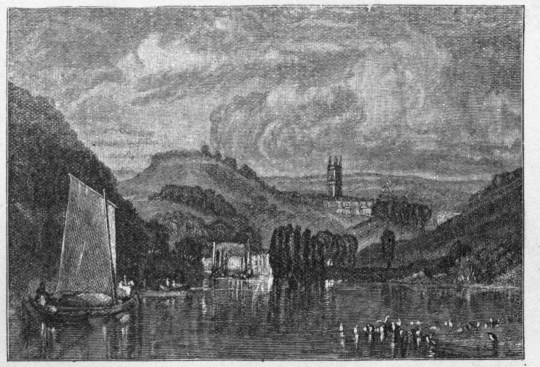
TOTNES ON THE DART.
From “Rivers of England.”
After the ‘Rivers of England,’ Turner produced work more magnificent in
colour, more transcendent in imagination, indeed the work which
singles him out individually from all landscape artists, in which the
essences of the material world were revealed in a manner which was not
only unrealized but unconceived before; but for perfect balance of
power, for the mirroring of nature as it appears to ninety-nine out of
every hundred, for fidelity of colour of both sky and earth, and form
(especially of trees), for carefulness and accuracy of drawing, for work
that neither startles you by its eccentricity nor puzzles you as to its
meaning, which satisfies without cloying, and leaves no doubt as to the
truth of its illusion, there is none to compare with these drawings of
his of England after his first visit to Italy—and especially (though
perhaps it is because we know them best that we say so) the drawings for
the ‘Rivers of England.’ We are certain at least of this, that no one
has a right to form an opinion about Turner’s power generally, either to
go into ecstasies over or to deride his later work, till he has seen
some of these matchless drawings. They form the true centre of his
artistic life, the point at which his desire for the simple truth and
the imperious demands of his imagination were most nearly balanced.
In 1821 and 1824 Turner exhibited no pictures at the Royal Academy, and
it would have been no loss to his fame if his pictures of 1820 and 1822,
Rome, from the Vatican, and What you will, had never left his
studio; but in 1823 he astonished the world with the first of those
magnificent dreams of landscape loveliness with which his name will
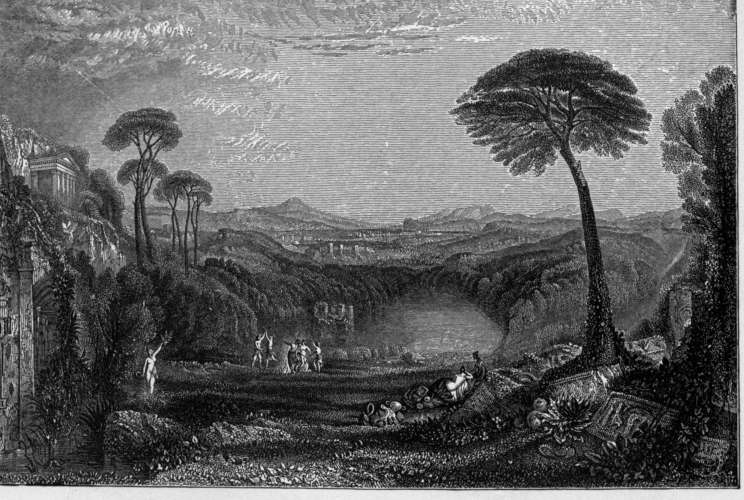
always be specially associated;—The Say of Baiæ with Apollo and the
Sibyl (1823). The three supreme works of this class, The Bay of Baiæ,
Caligula’s Palace and Bridge (1831), and Childe Harold’s Pilgrimage
(1832), are too well known to need description, and have been too much
written about to need much comment. They were the realization of his
impressions of Italy, with its sunny skies, its stone-pines, its ruins,
its luxuriance of vegetation, its heritage of romance. How little the
names given to these pictures really influence their effect, is shown by
the frequency with which one of them is confused with another. What
verses of what poet, what episode of history may have been in the
artist’s mind is of little consequence, when the thought is expressed in
the same terms of infinite sunny distance, crumbling ruin and towering
tree. The artist may have meant to embody the whole of Byron’s mind in
the Childe Harold, the history of Italy in Caligula’s Palace and
Bridge, the folly of life in Apollo and the Sibyl, but it does not
matter now, the things are “Turners,” neither more nor less; we doubt
very much whether Turner cared greatly for the particular stories
attached to many of his pictures. Some of them remind us of a title of
a picture in the Academy of 1808, A Temple and Portico, with the
drowning of Aristobulus, vide Josephus, book 15, chap. 3. In some it
was no doubt his ardent desire to proclaim his thoughts on history and
fate, but the result is much the same, for the medium in which he
attempted to convey them was that least suited for his purpose. It was,
however, his only means of expression, and there is something very sad
in the idea of a mind struggling in vain to give its most serious
thoughts didactic force. If these thoughts had been profound, and the
mind that of a prophet, the failure would have been tragical. The
language employed was the highest of its kind, but it was as inadequate
for its purpose as music. It has, however, like fine music, the power of
starting vibrations of sentiment full of suggestion, giving birth to
endless dreams of beauty and pleasure, of sadness and foreboding,
according to the personality and humour of those who are sensitive to
its charm.
In 1825 were published his first illustrations to a modern poet—Byron;
he contributed some more to the editions of 1833 and 1834, most of them
being views of places which he had never seen, and therefore
compositions from the sketches of others, like his drawings for
Hakewill’s “Picturesque Tour of Italy” and Finden’s “Illustrations of
the Bible.” No doubt the experience of his youth in improving the
sketches of amateurs and the liberty which such work gave to his
imagination, made it easy and congenial to him. These drawings show the
variety of his artistic power and the perfection of his technical skill.
The Hakewill series is marvellous for minute accuracy (being taken
from camera sketches) and for beautiful tree drawing, and the Bible
series for imagination. They are, however, of less interest in a
biography than those which were based upon his own impressions of the
scenes depicted, such as his illustrations to Rogers and Scott.
In 1825 he exhibited only one picture, Harbour of Dieppe, and in 1826,
the year when the publication of the “Southern Coast” terminated, three,
of one of which there is told a story of unselfish generosity, which
deserves special record. The picture was called Cologne—the arrival of
a Packet-boat—Evening. Of this Mr. Hamerton writes: “There were such
unity and serenity in the work, and such a glow of light and colour,
that it seemed like a window opened upon the land of the ideal, where
the harmonies of things are more perfect than they have ever been in the
common world.” The picture was hung between two of Sir Thomas Lawrence’s
portraits, and Turner covered its glowing glory with a wash of
lampblack, so as not to spoil their effect. “Poor Lawrence was so
unhappy,” he said. “It will all wash off after the Exhibition.” As Mr.
Hamerton truly observes, “It is not as if Turner had been indifferent to
fame.”
There are many stories of apparently contrary action on Turner’s part,
namely, of heightening the colour of his pictures to “kill” those of his
neighbours at the Academy, but they do not spoil this story. During
those merry “varnishing days” which Turner enjoyed so much, attempts to
outcolour one another were ordinary jokes—give-and-take sallies of
skill, made in good humour. No one entered into such contests with more
zest than Turner, and he was not always the victor. This story seems to
us to prove that when Turner saw that any one was really hurt, his
tenderness was greater than his spirit of emulation and jest.
Leslie tells the best of the “counter stories.”
“In 1832, when Constable exhibited his Opening of Waterloo
Bridge,[39] it was placed in the School of Painting—one of the
small rooms at Somerset House. A sea piece,[40] by Turner, was next
to it—a grey picture, beautiful and true, but with no positive
colour in any part of it—Constable’s Waterloo seemed as if
painted with liquid gold and silver, and Turner came several times
into the room while he was heightening with vermilion and lake the
decorations and flags of the City barges. Turner stood behind him,
looking from the Waterloo to his own picture, and at last brought
his palette from the great room, where he was touching another
picture, and putting a round daub of red lead, somewhat bigger than
a shilling, on his grey sea, went away without saying a word. The
intensity of the red lead, made more vivid by the coolness of the
picture, caused even the vermilion and lake of Constable to look
weak. I came into the room just as Turner left it. ‘He has been
here,’ said Constable, ‘and fired a gun.’”
On the opposite wall was a picture, by Jones, of Shadrach, Meshach,
and Abednego in the furnace.[41] “A coal,” said Cooper, “has
bounced across the room from Jones’s picture, and set fire to
Turner’s sea.” The great man did not come into the room for a day
and a half; and then in the last moments that were allowed for
painting, he glazed the scarlet seal he had put on his picture, and
shaped it into a buoy.”[42]
This daub of red lead was rather defensive than offensive, and there is
no story of Turner which shows any malice in his nature. To his brother
artists he was always friendly and just; he never spoke in their
disparagement, and often helped young artists with a kind word or a
practical suggestion. Even Constable—between whom and Turner not much
love was lost, according to Thornbury—he helped on one occasion by
striking in a ripple in the foreground of his picture—the “something”
just wanted to make the composition satisfactory. We think, then, that
we may enjoy the beautiful story of self-sacrifice for Lawrence’s sake,
without any disagreeable reflection that it is spoilt by others showing
a contrary spirit towards his brother artists.
The year 1826 was his last at Sandycombe. As he had taken it for the
sake of his father, so he gave it up, for “Dad” was always working in
the garden and catching cold. He took this step much to his own sorrow,
we believe, and much to our and his loss. Without the pleasant and
wholesome neighbourhood of the Trimmers, with no home but the gloomy,
dirty, disreputable Queen Anne Street, he became more solitary, more
self-absorbed, or absorbed in his art (much the same thing with him),
and lived only to follow unrestrained wherever his wayward genius led
him, and to amass money for which he could find no use. How he still
loved to grasp it, however, and how unscrupulous he was in doing so, is
painfully shown in his dispute with Cooke about this time (1827), which
prevented a proposed continuation of the “Southern Coast.” Mr. Cooke’s
letter relating to it, though long, is too important to omit, and,
though it may be said to be ex parte, carries sad conviction of its
truth:—
“January 1, 1827.
“DEAR SIR,
“I cannot help regretting that you persist in demanding twenty-five
sets of India proofs before the letters of the continuation of the
work of the ‘Coast,’ besides being paid for the drawings. It is
like a film before your eyes, to prevent your obtaining upwards of
two thousand pounds in a commission for drawings for that work.
“Upon mature reflection you must see I have done all in my power to
satisfy you of the total impossibility of acquiescing in such a
demand; it would be unjust both to my subscribers and to myself.
“The ‘Coast’ being my own original plan, which cost me some anxiety
before I could bring it to maturity, and an immense expense before
I applied to you, when I gave a commission for drawings to upwards
of £400, at my own entire risk, in which the shareholders were
not willing to take any part, I did all I could to persuade you to
have one share, and which I did from a firm conviction that it
would afford some remuneration for your exertions on the drawings,
in addition to the amount of the contract. The share was, as it
were, forced upon you by myself, with the best feelings in the
world; and was, as you well know, repeatedly refused, under the
idea that there was a possibility of losing money by it. You cannot
deny the result: a constant dividend of profit has been made to you
at various times, and will be so for some time to come.
“On Saturday last, to my utter astonishment, you declared in my
print-rooms, before three persons, who distinctly heard it, as
follows: ‘I will have my terms, or I will oppose the work by doing
another “Coast!”’ These were the words you used, and every one must
allow them to be a threat.
“And this morning (Monday), you show me a note of my own
handwriting, with these words (or words to this immediate effect):
‘The drawings for the future “Coast” shall be paid twelve guineas
and a half each.’
“Now, in the name of common honesty, how can you apply the above
note to any drawings for the first division of the work called the
‘Southern Coast,’ and tell me I owe you two guineas on each of
those drawings? Did you not agree to make the whole of the ‘South
Coast’ drawings at £7 10s. each? and did I not continue to pay
you that sum for the first four numbers? When a meeting of the
partners took place, to take into consideration the great exertions
that myself and my brother had made on the plates, to testify their
entire satisfaction, and considering the difficulties I had placed
myself in by such an agreement as I had made (dictated by my
enthusiasm for the welfare of a work which had been planned and
executed with so much zeal, and of my being paid the small sum only
of twenty-five guineas for each plate, including the loan of the
drawings, for which I received no return or consideration whatever
on the part of the shareholders), they unanimously (excepting on
your part) and very liberally increased the price of each plate to
£40; and I agreed, on my part, to pay you ten guineas for each
drawing after the fourth number. And have I not kept this
agreement? Yes; you have received from me, and from Messrs. Arch on
my account, the whole sum so agreed upon, and for which you have
given me and them receipts. The work has now been finished upwards
of six months, when you show me a note of my own handwriting, and
which was written to you in reply to a part of your letter, where
you say, ‘Do you imagine I shall go to John O’Groat’s House for the
same sum I receive for the Southern part?’ Is this fair conduct
between man and man—to apply the note (so explicit in itself) to
the former work, and to endeavour to make me believe I still owe
you two guineas and a-half on each drawing? Why, let me ask you,
should I promise you such a sum? What possible motive could I have
in heaping gold into your pockets, when you have always taken such
especial care of your interests, even in the case of Neptune’s
Trident, which I can declare you presented to me; and, in the
spirit of this understanding, I presented it again to Mrs. Cooke.
You may recollect afterwards charging me two guineas for the loan
of it, and requesting me at the same time to return it to you,
which has been done.
“The ungracious remarks I experienced this morning at your house,
where I pointed out to you the meaning of my former note—that it
referred to the future part of the work, and not to the ‘Southern
Coast’—were such as to convince me that you maintain a mistaken
and most unaccountable idea of profit and advantage in the new work
of the ‘Coast,’ and that no estimate or calculation will convince
you to the contrary.
“Ask yourself if Hakewill’s ‘Italy,’ ‘Scottish Scenery,’ or
‘Yorkshire’ works have either of them succeeded in the return of
the capital laid out on them.
“These works have had in them as much of your individual talent as
the ‘Southern Coast,’ being modelled on the principle of it; and
although they have answered your purpose, by the commissions for
drawings, yet there is considerable doubt remaining whether the
shareholders and proprietors will ever be reinstated in the money
laid out on them. So much for the profit of works. I assure you I
must turn over an entirely new leaf to make them ever return their
expenses.
“To conclude, I regret exceedingly the time I have bestowed in
endeavouring to convince you in a calm and patient manner of a
number of calculations made for your satisfaction; and I have met
in return such hostile treatment that I am positively disgusted at
the mere thought of the trouble I have given myself on such a
useless occasion.
“I remain,
“Your obedient servant,
“W. B. COOKE.”
When we realize that this was the same man that closed his connection
with Mr. Lewis, because he would not both etch and aquatint the plates
of the Liber for the same terms as those agreed upon for aquatinting
alone, we are able to understand why he was characterized as a “great
Jew,” in a letter of introduction, which he brought from a publisher in
London to one in Yorkshire, when he went to that county to illustrate
Dr. Whitaker’s History of Richmondshire. Mrs. Whitaker, who was his
hostess at the time, hearing of this took the phrase literally, and,
says Mr. Hamerton, “treated him as an Israelite indeed, possibly with
reference to church attendance and the consumption of ham.”
In 1827 was published the first part of his largest series of prints,
the “England and Wales,” which were engraved with matchless skill by
that trained band of engravers who brought, with the artist’s
assistance, the art of engraving landscapes in line to a point never
before attained. The history of Turner and his engravers has yet to be
fully written; the number of them from first to last is extraordinary,
probably nearly one hundred. Of these, twenty, and nearly all the best,
were employed on this work—Goodall, Wallis, Willmore, W. Miller,
Brandard, Radcliffe, Jeavons, W. R. Smith, and others. Never before was
so great an artist surrounded by such a skilled body of interpreters in
black and white. The drawings were unequal in merit, but nearly all of
them wonderful for power of colour and daring effect, with ever
lessening regard for local accuracy. The artist threw aside all
traditions and conventions, and proclaimed himself as “Turner,” the
great composer of chromatic harmonies in forms of sea and sky, hills and
plains, sunshine and storm, towns and shipping, castles and cathedrals.
He could not do this without sacrificing much of truth, and much of
what was essential truth in a work whose aim was professedly
topographical. Imaginative art of all kinds has a code analogous to, but
not identical with, the moral code: beauty takes the seat of virtue and
harmony of truth, and when the work is purely imaginative, there is no
conflict between fancy and fact which can make the strictest shake his
head. But when known facts are dealt with by the imagination, the
conflict arises immediately, and it would scarcely be possible to find a
case in which it was more obvious than in Turner’s “England and Wales,”
in which he made the familiar scenes of his own country conform to the
authoritative conception of his pictorial fancy. Whether he was right or
wrong in raising the cliffs of England to Alpine dignity, in saturating
her verdant fields with yellow sun, in exaggerating this, in ignoring
that, has been argued often, and will be argued over and over again; but
all art is a compromise, and the precise justice of the compromise will
ever be a matter of opinion. Art v. Nature is a cause which will last
longer than any Chancery suit. Even artists cannot agree as to the
amount of licence which it is proper to take, but they are all conscious
that they at least keep on the right side; one thing only, all, or
nearly all, are agreed upon, and that is that licence must be taken, or
art becomes handicraft. About Turner almost the only thing which can be
said with certainty is that he stretched his liberty to the extreme
limits.
Yet to the pictorial code of morals he was the most faithful of artists,
he almost always reached beauty, his harmonies were almost always
perfect, and he strove after his own peculiar generalization of fact,
and his own peculiar extract of truth with the greatest ardour. This
extract was his impression of a place, made up generally (at least in
his foreign scenes) of two or three sketches taken from different points
of view, and he was very careful to study not only the principal
features of the country, but the costume and employment of the
inhabitants, and the description of local vehicle, on wheels or keel.
From these studies would arise the conception of one scene, combining
all that his mind retained as essential—a growth which, however false
it might appear when compared with the actual facts of the place from
one point of view, contained nothing but what had a germ of truth, and
of local truth. That this applies to all his drawings we do not say, but
we are confident that it does to most. Many of his drawings for the
“England and Wales” were probably taken from sketches that had lain in
his portfolios for years, and were dressed up by him when wanted, with
such accessories of storm and rainbow as occurred to his fancy, or to
his memory and feelings as connected with the spot. There is, we think,
no doubt that Turner strove to be conscientious; but his conscience was
a “pictorial” conscience, and no man can judge him. We can only take his
works as they are, and be thankful that all the strange confusions of
his mind, and mingled accidents of his life, have produced so unique and
beautiful a result as the “England and Wales.” It is no use now
regretting that his vast powers in their prime were used wastefully in
what will appear to many as the falsification of English landscape; it
is far better to rejoice that the genius and knowledge of the man were
so transcendent that, in spite of all the worst that can be said, each
separate drawing is precious in itself as a record of natural phenomena,
and a masterly arrangement of indefinite forms and beautiful colour.
Mr. Ruskin affirms that, “howsoever it came to pass, a strange, and in
many respects grievous metamorphosis takes place upon him about the year
1825. Thenceforth he shows clearly the sense of a terrific wrongness,
and sadness, mingled in the beautiful order of the earth; his work
becomes partly satirical, partly reckless, partly—and in its greatest
and noblest features—tragic.” We are not prepared to assent to this
entirely, especially as Mr. Ruskin states immediately afterwards that
one at least of the manifestations of “this new phase of temper” can be
traced unmistakably in the “Liber,” which was concluded six years
before; but there is no doubt that his work for some of these years was
distinguished by recklessness and caprice in an unusual degree, and we
have little doubt that his removal from Sandycombe, and the consequent
loss of healthy companionship, had something to do with it. During three
years he exhibited no pictures of special interest, except the Cologne
of 1826, and the Ulysses deriding Polyphemus of 1829. This latter
picture we take to be a sure sign of recovery, as it shows perhaps the
most complete balance of power of any of his large works, being not less
wonderful for happy choice of subject than for grandeur of conception
and splendour of colour—the first picture in which, since the Apollo
and Python of 1811, the union between the literary subject and the
landscape, or (if we must use that horrid word) seascape, was perfect.
This picture was no Temple and Portico, with the drowning of
Aristobulus. The grand indefinite figure of the agonized giant, the
crowded ship of Ulysses, the water-nymphs and the dying sun, are all
parts of one conception, and show what Turner could do when his
imagination was thoroughly inflamed. Whence the inspiration was derived
it is difficult to say. Like most of his inspirations, it probably had
more than one source. Homer’s Odyssey is the source given in the
catalogue; but it is probable, as we before have hinted, that the figure
of Polyphemus was suggested by the splendid description in the
fourteenth book of Ovid’s Metamorphoses. Many years had lapsed since he
had shown the full force of his imagination under the influence of
classical story, and he was never to do so again. Subjects of the kind
suited to his peculiar genius were difficult to find, and he had no such
habitual intercourse with his intellectual peers as enabled him to
gather suggestions for his works. He was thrown entirely on his own
uneducated resources, and the result was, with his imperfect knowledge
of his own strength and the limits of his art, partial failure of most,
and total failure of many of his most strenuous efforts. This is one of
the saddest facts of his art-life, the frequent waste, or partial waste,
of unique power.
His increasing isolation of mind was mitigated no doubt by constant
visits to Petworth, Farnley, and other houses of his friends and
patrons, by the chaff of “varnishing days,” by social meetings of the
Academy Club, and by frequent travel; but it increased notwithstanding.
Not Mr. Trimmer, nor Lord Egremont, nor even his friends and fellow
Academicians, Chantrey and Jones, could break through his barrier of
reserve and see the man Turner face to face. From the beginning he had
his secrets, and he kept them to the end. He could be merry and social
in a gathering where the talk never became confidential, and with
children (whom he could not distrust); but his living-rooms in Queen
Anne Street, his painting-room wherever he was, and his heart, were,
with scarcely an exception, opened to none. At Petworth, Lord Egremont
indeed was allowed to enter his studio; but he had to give a peculiar
knock agreed upon between them before he would open the door.
In 1828 he was at Rome again, from which place he wrote the following
letters[43] to Chantrey and Jones of unusual length and interest.
“TO GEORGE JONES, R.A.
“ROME,
“Oct. 13, 1828.
“DEAR JONES,
“Two months nearly in getting to this terra pictura, and at work;
but the length of time is my own fault. I must see the South of
France, which almost knocked me up, the heat was so intense,
particularly at Nismes and Avignon; and until I got a plunge into
the sea at Marseilles, I felt so weak that nothing but the change
of scene kept me onwards to my distant point. Genoa, and all the
sea-coast from Nice to Spezzia, is remarkably rugged and fine; so
is Massa. Tell that fat fellow Chantrey that I did think of him,
then (but not the first or the last time) of the thousands he had
made out of those marble craigs which only afforded me a sour
bottle of wine and a sketch; but he deserves everything which is
good, though he did give me a fit of the spleen at Carrara.
“Sorry to hear your friend, Sir Henry Bunbury, has lost his lady.
How did you know this? You will answer, of Captain Napier, at
Siena. The letter announcing the sad event arrived the next day
after I got there. They were on the wing—Mrs. W. Light to Leghorn,
to meet Colonel Light, and Captain and Mrs. Napier for Naples; so,
all things considered, I determined to quit instanter, instead of
adding to the trouble.
“Hope that you have been better than usual, and that the pictures
go on well. If you should be passing Queen Anne Street, just say I
am well, and in Rome, for I fear young Hakewell has written to his
father of my being unwell: and may I trouble you to drop a line
into the two-penny post to Mr. C. Heath, 6, Seymour Place, New
Pancras Church, or send my people to tell him that, if he has
anything to send me, to put it up in a letter (it is the most sure
way of its reaching me), directed for me, No. 12, Piazza
Mignanelli, Rome, and to which place I hope you will send me a
line? Excuse my troubling you with my requests of business.
Remember me to all friends. So God bless you. Adieu.
“J. M. TURNER.”
“TO FRANCIS CHANTREY, R.A.
“No. 12, PIAZZA MIGNANELLI, ROME,
“Nov. 6, 1828.
“MY DEAR CHANTREY,
“I intended long before this (but you will say, ‘Fudge!’) to have
written; but even now very little information have I to give you in
matters of Art, for I have confined myself to the painting
department at Corso; and having finished one, am about the
second, and getting on with Lord E.’s, which I began the very first
touch at Rome; but as the folk here talked that I would show them
not, I finished a small three feet four to stop their gabbling.
So now to business. Sculpture, of course, first; for it carries
away all the patronage, so it is said, in Rome; but all seem to
share in the good-will of the patrons of the day. Gott’s studio is
full. Wyatt and Rennie, Ewing, Buxton, all employed. Gibson has two
groups in hand, Venus and Cupid; and The Rape of Hylas, three
figures, very forward, though I doubt much if it will be in time
(taking the long voyage into the scale) for the Exhibition, though
it is for England. Its style is something like The Psyche, being
two standing figures of nymphs leaning, enamoured, over the
youthful Hylas, with his pitcher. The Venus is a sitting figure,
with the Cupid in attendance; and if it had wings like a dove, to
flee away and be at rest, the rest would not be the worse for the
change. Thorwaldsten is closely engaged on the late Pope’s (Pius
VII.) monument. Portraits of the superior animal, man, is to be
found in all. In some, the inferior—viz. greyhounds and poodles,
cats and monkeys, &c., &c.
“Pray give my remembrances to Jones and Stokes, and tell him I
have not seen a bit of coal stratum for months. My love to Mrs.
Chantrey, and take the same and good wishes of
“Yours most truly,
“J. M. TURNER.”
This method of communicating with “his people” is peculiar, and shows
that he was not in the habit of corresponding with them when away on his
numerous visits and tours. Perhaps they could not read, perhaps he
wished to save postage—whatever hypothesis we may adopt, the fact is
singular. The pictures of The Banks of the Loire; The Loretto
Necklace; Messieurs les Voyageurs on their return from Italy (par la
Diligence) in a snowdrift upon Mount Tarra, 22nd of January, 1829—all
exhibited in 1829—were the results of this tour, besides some of the
pictures of 1830, one of which, View of Orvieto, is, according to Mr.
Hamerton, the identical “small three feet four” which he painted to
“stop the gabbling” of the folk at Rome.
In this year (1830, he being then fifty-five years old) died Sir Thomas
Lawrence, whose loss he probably felt much, and of whose funeral he
painted a picture (from memory); but the year had a greater sorrow for
him than this—the loss of his “poor old Dad.” The removal from
Twickenham did not avail to preserve the old man’s life for long. We
have the testimony of the Trimmers, with whom after the event he stayed
for a few days for change of scene, that “he was fearfully out of
spirits, and felt his loss, he said, like that of an only child,” and
that he “never appeared the same man after his father’s death.” To men
like Turner, who are not accustomed to express their feelings much, or
even to realize them, such blows come with all their natural violence
unchecked, unforeseen, unprovided against. It had probably never
occurred to him how much his father was to him, how blank a space his
loss would make in his narrow garden of human affection. From this time
he was to know many losses of old friends, each of which fell heavily
upon him, leaving him more lonely than ever. His friends were few, and
they dropped one by one, nor is there any evidence to show that their
loss was ever lightened by any hope of meeting them again; the lights of
his life went out one by one, and left him alone and in the dark. In
1833 Dr. Monro died, in 1836 Mr. Wells, in 1837 Lord Egremont, in 1841
Chantrey, and he was to feel the loss of Mr. Fawkes and Wilkie, and many
more before his own time came.
In February, 1830, he wrote to Jones:—
“DEAR JONES—I delayed answering yours until the chance of this
finding you in Rome, to give you some account of the dismal
prospect of Academic affairs, and of the last sad ceremonies paid
yesterday to departed talent gone to that bourn from whence no
traveller returns. Alas! only two short months Sir Thomas followed
the coffin of Dawe to the same place. We then were his
pall-bearers. Who will do the like for me, or when, God only knows
how soon! However, it is something to feel that gifted talent can
be acknowledged by the many who yesterday waded up to their knees
in snow and muck to see the funeral pomp swelled up by carriages of
the great, without the persons themselves.”
No doubt these deaths set him thinking of his own, and the disposition
of his wealth so useless to him, and he probably brooded long over the
will that he signed on the 10th of June in the next year (1831). Many
excuses have been made for his niggardly habits on the score of the
nobleness of mind shown in this document; he screwed and denied himself
(we are told) when living, to make old artists comfortable after his
death. We are afraid that there is no ground for this charitable view,
nor any evidence that he ever denied himself anything that he preferred
to hard cash, or that he ever thought of giving it, or any farthing of
it, away to anybody, till he had more than he could spend, and was
brought by the deaths of his friends to realize that he could not take
it with him when he died. Then indeed he disposed of it; but where was
the bulk to go? Not to his nearest of kin, whom he had neglected all his
life—fifty pounds was enough for uncles, and twenty-five for their
eldest sons; not to his mistress or mistresses, who had been devoted to
him all his life, or to his children—annuities of ten and fifty pounds
were enough for them; but for the perpetuation of his name and fame, as
the founder of “Turner’s Gift” and the eclipser of Claude.[44]
We do not know when Turner became acquainted with Samuel Rogers; but
probably some years before this, as he is named as one of the executors
in the will, and the famous illustrated edition of “Italy” was published
in 1830, followed by the Poems in 1834. These contain the most exquisite
of all the engravings from Turner’s vignettes. Exquisite also are most
of the drawings, but some of them are spoilt by the capriciousness of
their colour, which seems in many cases to have been employed as an
indication to the engraver rather than for the purpose of imitating the
hues of nature. The most beautiful perhaps of all, Tornaro’s misty
brow, seems to us far too blue, and the yellow of the sky in others is
too strong to be probable or even in harmony with the rest of the
drawing. It would, however, be difficult to find in the whole range of
his works two really greater (though so small in size) than the Alps at
Daybreak, and Datur hora quieti, of which we give woodcuts, losing of
course much of the light refinement of the steel plates, but wonderfully
true in general effect. The former is as perfect an illustration as
possible of the sentiment of Rogers’s pretty verses, but it far
transcends them in beauty and imagination; the latter is not in
illustration of any of the poet’s verses, but is a more beautiful poem
than ever Rogers wrote.
The illustration from “Jacqueline” which we give, though not so
transcendent in imagination, is a scene of extraordinary beauty of rock
and torrent, and castle-crowned steep, such as no hand but Turner’s
could have drawn, while the Vision from “The Voyage of Columbus” is
equally characteristic, showing how he could make an impressive picture
out of the vaguest notions by his extraordinary mastery of light and
shade.
In 1833 Turner exhibited his first pictures of Venice, the last home of
his imagination. The date of his first visit to the “floating city” is
uncertain. There are two series of Venetian sketches in the National
Gallery, which mark two distinct impressions. In the first the colour is
comparatively sober; the sky is noted as, before all things, a
marvellously blue sky; the interest of the painter is in the watery
streets, the picturesqueness of corners here and there, in narrow canals
and the different-coloured marbles of the buildings; he takes the city
in bits from the inside in broad daylight, and they are studies as
realistic as he could make them at the time. In the other series the
interest of the painter is COLOUR, not of the buildings, but of the
sunsets and sunrises, the clouds of crimson and yellow, the water of
green, in which the sapphire and the emerald and the beryl seem to blend
their hues. The substantial marble, the solid blue sky, the strong light
and sharp shadows have melted into visions of ethereal palaces and
gemlike colour, like those in the Apocalypse. As he began painting the
sea from Vandevelde and nature, so he began painting Venice from
Canaletti and nature; but the transition from the studious beginning
to the imaginative end was very swift in the latter case. Venice soon
became to him the paradise of colour, and he rose to heights of
chromatic daring which exceeded anything which even he had scaled
before.
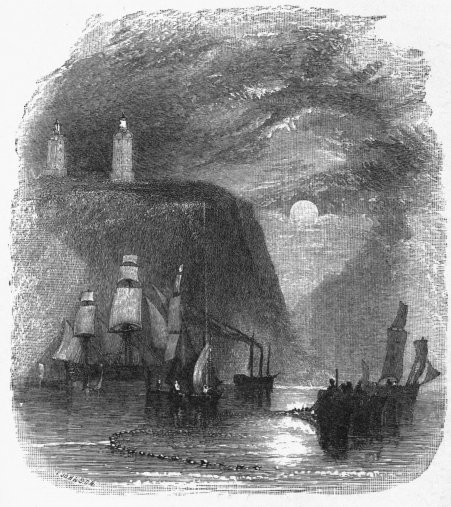
LIGHT-TOWERS OF THE HÈVE.
From “Rivers of France.”
The time at which we have now arrived was that of his earlier sketches,
and he could turn away from Venice and draw with unabated zest the
quieter but still lovely scenery of the Seine and the Loire. To 1833-4
and 1835 belong his beautiful series called The Rivers of France.
Opinions are divided, as usual, as to the truthfulness of his art to the
spirit of French scenery, and a comparison between The Light-towers of
the Hève in our woodcut, and the drawing which he made on the spot (now
in the National Gallery) will show how greatly his imagination altered
the literal facts of a scene. One who has patiently followed his
footsteps in many parts of England and on the Continent testifies to the
puzzling effects of Turner’s imaginative records. He seeks in vain on
the face of the earth the original of Turner’s later drawings, but he
can never see these drawings without finding all that he has seen.
Indeed, to understand them rightly, they must be considered as poems in
colour suggested by pictorial recollections of certain scenes on the
rivers of France. Most of them are arrangements of blue, red, and
yellow, some of yellow and grey, all exquisitely beautiful in
arrangement of line and atmospheric effect. Nor has he in any other
drawings introduced figures and animals with more skill and beauty of
suggestion. The whole series palpitates with living light, although the
pigments employed are opaque, and each view charms the sense of
colour-harmony, although the colours are crude and disagreeable. It has
always appeared wonderful to us that, with his power over water-colours
and delight in clear tones, he should have been content to work with
such chalky material and impure tints; it is as though he preferred to
combat difficulties; but they were drawn to be engraved, and as long as
he got his harmonies and his light and shade true we suppose he was
content. The great skill with which he could utilize the grey paper on
which these drawings were made, leaving it uncovered in the sky and
other places where it would serve his purpose, conduced to swiftness of
work, and may have been one of his motives. The drawing of Jumièges, of
which we give a woodcut, is one of the loveliest of the series, with its
mouldering ruin standing out for a moment like a skeleton against the
steely cloud, before the fierce storm covers it with gloom.
In these yearly visits to France, Turner was accompanied by Mr. Leitch
Ritchie, who supplied the work with some description of the places. They
travelled, however, very little together; their tastes in everything but
art being exceedingly dissimilar. “I was curious,” says his companion,
“in observing what he made of the objects he selected for his sketches,
and was frequently surprised to find what a forcible idea he conveyed of
a place with scarcely a correct detail. His exaggerations, when it
suited his purpose to exaggerate, were wonderful—lifting up, for
instance, by two or three stories, the steeple, or rather, stunted cone,
of a village church—and when I returned to London I never failed to
roast him on this habit. He took my remarks in good part, sometimes,
indeed, in great glee, never attempting to defend himself otherwise than
by rolling back the war into the enemy’s camp. In my account of the
famous Gilles de Retz, I had attempted to identify that prototype of
‘Blue Beard’ with the hero of the nursery
story, by absurdly insisting
that his beard was so intensely black that it seemed to have a shade of
blue. This tickled the great painter hugely, and his only reply to my
bantering was—his little sharp eyes glistening the while—‘Blue Beard!
Blue Beard! Black Beard!’”
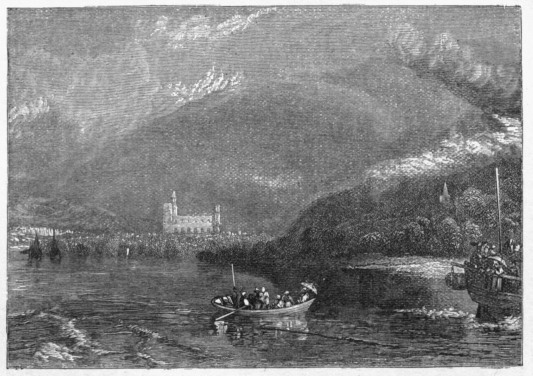
JUMIÈGES.
From “Rivers of France.”
We do not know when Turner became first acquainted with Mr. Munro of
Novar, one of the greatest admirers of the artist and collectors of his
later works, but it was in 1836 that we first hear of them as travelling
together, when, it is said, “a serious depression of spirits having
fallen on Mr. Munro,” Turner proposed to divert his mind into fresh
channels by travel. They went to Switzerland and Italy, and Mr. Munro
found that Turner enjoyed himself in his way—a “sort of honest Diogenes
way”—and that it was easy to get on very pleasantly with him “if you
bore with his way,” a description which, meant to be kind, does not say
much for his sociability at this period.
Indeed, he had been all his life, and especially, we expect, since he
left Twickenham, developing as an artist and shrivelling as a man, and
after this year (1836), though he still developed in power of colour and
painted some of his finest and most distinctive works, the signs of
change, if not of decline, were also visible. He was also getting out of
the favour of the public, who could not see any beauty in such works as
the Burning of the Houses of Lords and Commons, of 1835, or Juliet
and her Nurse, of 1836.
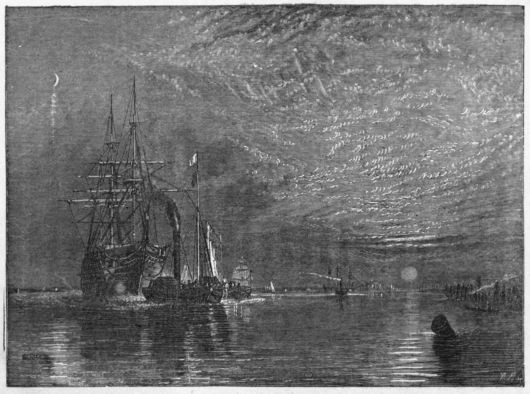
FIGHTING TÉMÉRAIRE.
Exhibited in 1839. National Gallery.
His fame began to oscillate, tottering with one picture and set upright
by another. As long, however, as he could paint such pictures as
Mercury and Argus, 1836, and the Fighting Téméraire, of 1839, it was
in a measure safe. He was still a great genius to whom eccentricities
were natural, but the Fighting Téméraire was the last picture of his
at
which no stone was thrown. This is in many ways the finest of all
his pictures. Light and brilliant yet solemn in colour; penetrated with
a sentiment which finds an echo in every heart; appealing to national
feeling and to that larger sympathy with the fate of all created things;
symbolic, by its contrast between the old three-decker and the little
steam-tug, of the “old order,” which “changeth, yielding place to
new”—the picture was and always will be as popular as it deserves. It
is characteristic of Turner that the idea of the picture did not
originate with him, but with Stanfield. Would that Turner had always had
some friend at his elbow to hold the torch to his imagination.