Yes: I remember that morning at Exeter
when I surprised you making a drawing
of the west porch of the cathedral. Timidly
were the unrestored figures of angels, apostles,
prophets, kings and warriors—very old, very
battered—taking form in your sketch-book:
timidly, for even then you were beginning to
be troubled by the blur that rose, after an
hour's work, between your eyes and the carven
kings and saints.
Your sister passed into the cathedral to her
devotions carrying white flowers for the altar:
we stayed in the sunlight. I cannot remember
how Turner became the subject of our talk;
but I think it was my mention of his drawing
of the west front of Salisbury Cathedral done
when he was twenty-three—one of the set exhibited
at the Royal Academy in 1799, which
hastened his election to an Associateship of
the Royal Academy. Those were the days of
the tinted architectural drawings, but in that
magnificent Salisbury, the details indicated, yet
not insistent, the old stones yellow in the sunshine,
grey-blue in the shadow, Turner was
already on the track of Light, the goal of
his art life. He had not yet formulated any
principle, that was not Turner's way; but those
small, bright eyes of his had already perceived
that there is light in shade as in shine. Girtin,
that marvellous boy, his friend and fellow-student,
was still alive; but art was in a poor
state in England, in 1799, and we can well
believe that this drawing of Salisbury made
Turner a marked man. I could dispense with
the lamp-post boys playing with hoops, as indeed
with every figure in every picture by Turner.
But he needed such strong foreground notes,
and he, like the older landscape painters, troubled
little about figures. Claude used to say, with a
laugh, that he made no charge for them. Their
use was to throw back the middle distance.
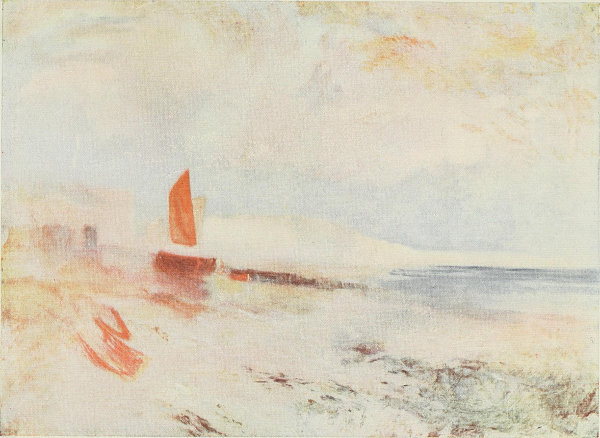
(From the oil painting
by Turner in the Tate Gallery)
One of the so-called "unfinished" pictures that, after half a
century of seclusion in the cellars of the National Gallery, were
removed to the Tate Gallery, and opened to public inspection
early in February 1906. This great "find," as it was called, of
twenty-one Turners was the sensation of the year in art circles.
Hastings was a favourite subject with Turner.
Then we talked of Turner's water-colours.
Had he never composed the "Liber Studiorum";
never produced gorgeous dreams of glowing
colour in his oil pictures; never with veils of
luminous paint flashed sunrise upon white canvases;
never done a moonlight, or white sails
billowing over a wet sea, he would, in his water-colours,
have earned the title of father of modern
landscape and of Impressionism.
You, who had seen nothing of Turner's work
except the plates, good in their way, but far
from being the real thing, in Mr. Stopford
Brooke's edition of the "Liber Studiorum," hinted
that you found the master old-fashioned. Corot,
Monet, and Harpignies were your idols in landscape.
That was not strange when I consider
that your childhood was spent in Jersey, and
your youth at Moret and in Paris, and that on
your twentieth birthday, a few months ago, you
were articled to an architect of Exeter, your
France-loving father's native place. So the
Master seemed old-fashioned, did he? And you
were a little sceptical of my enthusiasm.
"Ah," I said, "if you could see a range of
Turner's water-colours from the first boyish
drawing of Lambeth Palace exhibited at the
Royal Academy when he was fifteen, through
the plodding period of his development, cumbered
with ungainly figures, but set in the
Turnerian air and against infinite distances, as
in the winding Thames from Richmond Hill,
ever moving towards the light, on to his later
visions when buildings, hills, and clouds shimmer
in iridescent vapour! Then the figures of men
and women disappear, and after fifty years of
observation of Nature those old eyes see only
the chromatic glories of the reflections and refractions
of imponderable sun-rays. The lovely
colours linger so delicately on odds and ends of
paper that it seems as if a breath must blow
them away. If you could see the sapphire, opal
and amethyst tenderness of his 'Study on the
Rhine,' the misty hills rainbow-tinted, the sun
flushing the steep castle rock and making a
golden pathway over the sea, you would feel that
this barber's son, morose, mean, in whose muddled
brain moved until his last day magnificent ideas,
has given to the world the whole history of water-colour,
from the tinted drawing, to the flame of an
effect seen and caught in a moment of ecstasy."
You were still sceptical! I acknowledge that
there were others in Turner's day who also
broke new paths—Cozens, and of course Girtin,
of whom Turner is reported to have said, "Had
Tom Girtin lived I should have starved." As
an old man he would mumble of "Poor Tom's
golden drawings." I acknowledge that since
Turner's day the channel that he flooded has
broadened and gushed forth into many tributaries;
but he was the first, modelling himself
on Claude, to start in pursuit of the sun, to break
the rays, and flush the land.
I quoted a Frenchman, M. le Sizeranne: "All
the torches which have shed a flood of new
light upon Art—that of Delacroix in 1825, those
of the Impressionists in 1870—have in turn been
lit at his flame."
I quoted Constable—generous Constable—"I
believe it would be difficult to say that there is
a bit of landscape now done that does not
emanate from that source."
I quoted Pisarro, telling how during the war
of 1870 he and Monet came to London, studied
Turner at the National Gallery, and found in
Turner and Constable "practical certitude in
matters of technique which they had but vaguely
suspected and discussed at the Café Guerbois."
What would they have said had they known
that Ruskin, the champion of Turner, the foe
of Impressionism, when, in 1856, he sifted the
nineteen thousand Turner water-colours, drawings,
studies, and the "unfinished" paintings,
had condemned the sunshine and atmosphere
canvases now in the Tate Gallery to half a
century of obscurity, because in his opinion they
were "unfinished." Turner purposely left them
unfinished and elusive as sunrise itself, momentary
impressions of the glory of the world. The
sun is new each day, ever uncompleted: so are
these records of the flame of Turner.
"They are golden visions," said Constable,
speaking of the Venice pictures, "only visions,
but still one would like to live and die with such
pictures."
Turner, to whom the world of men and
women was a place to escape from, brooded
on scenes that open a pathway to tired eyes
leading away somewhere west of the sun and
east of the moon; he loved distances, lakes that
feel their way round hills to infinity, and sunsets
that are a world in themselves. Even in
his dark "Calais Pier" he must open the inky
clouds to a blue sky swaying above the bituminous
sea. In the "unfinished" "Chichester
Canal" you may sail over that happy waterway,
beyond the spire, on and on whithersoever your
fancy leads; in the "unfinished" "Petworth
Park" you may tramp away with the hunter
and the hounds past the sentinel trees to that
vast sky flaming and beckoning; in the "unfinished"
"Norham Castle Sunrise" the poet-artist
dreamed the mystery of dawn, and as he
saw the miracle unfolding, he told his dream to
you and to me; he saw the blue mists parting
before the sun-rays rising behind the castle;
saw the opalescent sky reflected in the water;
saw, perhaps, in the mind's eye, the strong red
note that the picture needed, and quickly set
that cow standing knee-deep in the shallows.
Turner gave all of himself to the making of this
lovely impression, for Norham Castle, which he
drew and painted so often, was his mascot.
Sketching on the Tweed with Cadell, the Edinburgh
bookseller, as they passed Norham Castle,
Turner suddenly swept off his hat to the ruins.
"I made a drawing of Norham several years
ago," he explained. "It took; and from that
day to this I have had as much to do as my
hands could execute."
There, I remember, I paused, noting that you
were again passing your hands about your eyes.
Troubled, you said that the blur had returned,
and that you must work no more that day. So
we walked towards the river.
On the way we saw Italian workmen in blue
trousers paving a road from cauldrons of molten
asphalt. We watched the little flames leaping
from the bubbling mass, and I drew from the
sight an image of the art life of Turner: how he
stoked his furnace with Poussin, Vandevelde,
and de Loutherbourg, and so brought to life his
dark early works such as "The Shipwreck" and
"Calais Pier"; how as he fed his fire with
Claude, Crome, and Wilson the furnace glowed,
and the world saw the ardour of "Ulysses Deriding
Polyphemus," and the splendour of "Dido
Building Carthage"; then when the flames leapt
towards the sky there was pure Turner, the
Turner of the "Téméraire" and the Venice
dreams, a "Hastings" that has lost all earthly
form; a dream boat passing between Headlands
at Sunrise, and the later water-colours—the red
Rigi, the blue Rigi, the blue and gold "Arth
from the Lake of Zug," the moonlight Venice,
and the atmospheric magic of the Lake of Uri.
When we regained the Cathedral close we
met your sister returning from her devotions.
She said: "What have you been discussing
this summer morning?"
"I have been discoursing on The Flame of
Turner," said I.
"Ah!" said she, "there's a Turner in the
Museum here."
We went to the Museum and stood before
"Buttermere Lake, with a part of Cromach
Water, Cumberland—a Shower." You were
silent. What a catastrophe—after my dithyrambs
about the flame of Turner and his slow
soar to light, that I should show you, as your
first Turner, that work of his early stoking
period, painted at twenty-two, before he learned
the method of oil painting and the ways of the
sun. The lake has almost gone, the trees have
blackened, only the rainbow dimly lingers. The
flame of Turner? The chrysalis husk of Turner!
That poor "Buttermere Lake" is still the
only picture by Turner that you have ever seen.
And now that you are far from here, walking
and digging in Sparta, and sailing in insecure
little crafts to the Islands, I hold it a duty to
write you in detachments this interminable letter
explaining as well as I can what I mean by the
Flame of Turner. Your sister will read the
letters to you, ill-starred student, who, at the
beginning of your art career, must not use your
eyes for twelve months on penalty of blindness.
When, after the last visit to the oculist, you
hurried from the lawyer's office in Lincoln's Inn
Fields, where I witnessed your Will, I did not
tell you that a few yards away rests a glorious
Turner, "Van Tromp's Barge entering the
Texel" and sailing in golden pomp eternally
through the Soane Museum. I saw it on my
way to your lawyer's office. The picture is
alone and I was alone with what Turner loved—a
sportive sea, an arching sky, gold overhead,
gold on the water, and a ship sailing home
golden-hulled beneath golden sails, with flags
flying at the mast, and a cunning wraith of
indigo cloud sweeping down the sky to give the
glamour value. You did not see the golden Van
Tromp. I had not the heart to show it to you.
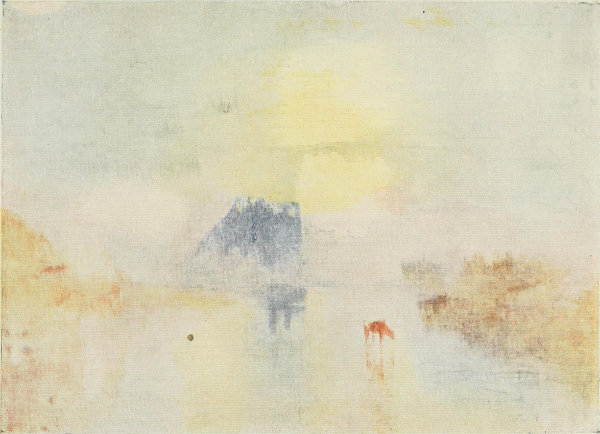
(From the
oil painting by Turner in the Tate Gallery)
One of the most beautiful of the impressionistic Turners that
were removed from the cellars of the National Gallery early in
1906, cleaned, and hung in the Turner Room at Millbank. Once,
when passing Norham Castle, Turner took off his hat to the
ruins. His companion inquired the reason. "I made a drawing
or painting of Norham Castle several years since," answered
Turner. "It took; and from that day to this I have had as
much to do as my hands could execute."
Now you are far from Turner. I can follow
your track to Olympia, and along the path by
the wood, above the excavations, to a rough
sign-post, where I stood two years ago and read
the words "To Arcadia!" Somewhere beyond
Arcadia you are, and some day these letters will
fall, one by one, into your hands.