The outbreak of the Great War precipitated a serious
political crisis at Constantinople. Decisions of the utmost
moment to the future of the Ottoman Empire had to be
taken. Chief among these was the choice between neutrality
and entry into the war in coöperation with the
Central Powers. Pacifists and Entente sympathizers, of
whom Djavid Bey was perhaps the foremost, counseled
non-intervention in the struggle. Militarists and Germanophiles,
headed by Enver Pasha, the distinguished
Minister of War, advocated early and complete observance
of the alliance with Germany, which called for active
military measures against the Entente. In support of the
pacifists were the great mass of the people, overburdened
with taxes, worn out with military service, and weary of
the sacrifices occasioned by the Tripolitan and Balkan
Wars. In support of the militarists were German economic
power, German military prestige, and the powerful
emotion of Turkish nationalism.
The case of the pacifists, like that of their opponents,
was based frankly upon national self-interest. A great
European war seemed to them to offer an unprecedented
opportunity for setting Ottoman affairs in order without
the perennial menace of foreign interference. Ottoman
neutrality would be solicited by some of the belligerents,
Ottoman intervention by others; during the war, however,
no nation could afford to bully Turkey. By clever
diplomatic bargaining economic and political privileges of
the greatest importance might be obtained—the Capitulations,
for example, might be abolished. Neutral Turkey
might grow prosperous by a thriving commerce with the
belligerents. After the peace both victor and vanquished
would be too exhausted to think of aggression against a
revivified Ottoman Empire. To remain neutral was to
assure peace, security, and prosperity. To intervene was
to invite defeat and dismemberment.
Militarists, however, appraised the situation differently.
National honor demanded that Turkey go to the assistance
of her allies. But, more than that, national security
demanded the decisive defeat of the Entente Powers. As
contrasted with the firm friendship of Germany for Turkey,
it was pointed out, there was the traditional policy
of Russia to dismember the Ottoman Empire and of
France and Great Britain to infringe upon Ottoman
sovereignty whenever opportunity presented itself. A
victorious Russia would certainly appropriate Constantinople,
and as “compensations” France would take Syria
and England Mesopotamia. By closing the Dardanelles
and declaring war, Turkey could deal Russian economic
and military power a blow from which the empire of
the Tsars might never recover. By associating herself
with the seemingly irresistible military forces of Germany,
Turkey might once and for all eliminate Russia—the
feared and hated enemy of both Turks and Germans—from
Near Eastern affairs. In addition, British security
in Egypt might be shaken, and the French colonial empire
in North Africa might be menaced by a Pan-Islamic
revival. In these circumstances the war might be for
Turkey a war of liberation, from which only the craven-hearted
would shrink.
For a time, however, practical considerations led to the
maintenance of Ottoman neutrality. “To Germany the
‘sphere of influence’ in Turkey was of far greater economic
and political importance than all her ‘colonies’ in
Africa and in the South Seas put together. The latter,
under the German flag, were an obvious and quick prey
to Great Britain’s naval superiority, but so long as Turkey
remained out of the war the German sphere of
influence in Anatolia and Mesopotamia was protected
by the neutral Crescent flag. As soon as Turkey entered
the war, however, Great Britain’s naval superiority could
be brought to bear upon Germany’s interests in the Near
East as well as upon her interests in Africa and Oceanica.
If German imperialists were devoted to a Berlin-to-Bagdad
Mittel-Europa project, there were British imperialists
whose hearts and minds were set upon a Suez-to-Singapore
South-Asia project. The Ottoman Empire
occupied a strategic position in both schemes. A neutral
Turkey, on the whole, was favorable to German imperialism.
A Turkey in armed alliance with Germany presented
a splendid opportunity for British imperialism.”1
Turkish mobilization, furthermore, was a tediously
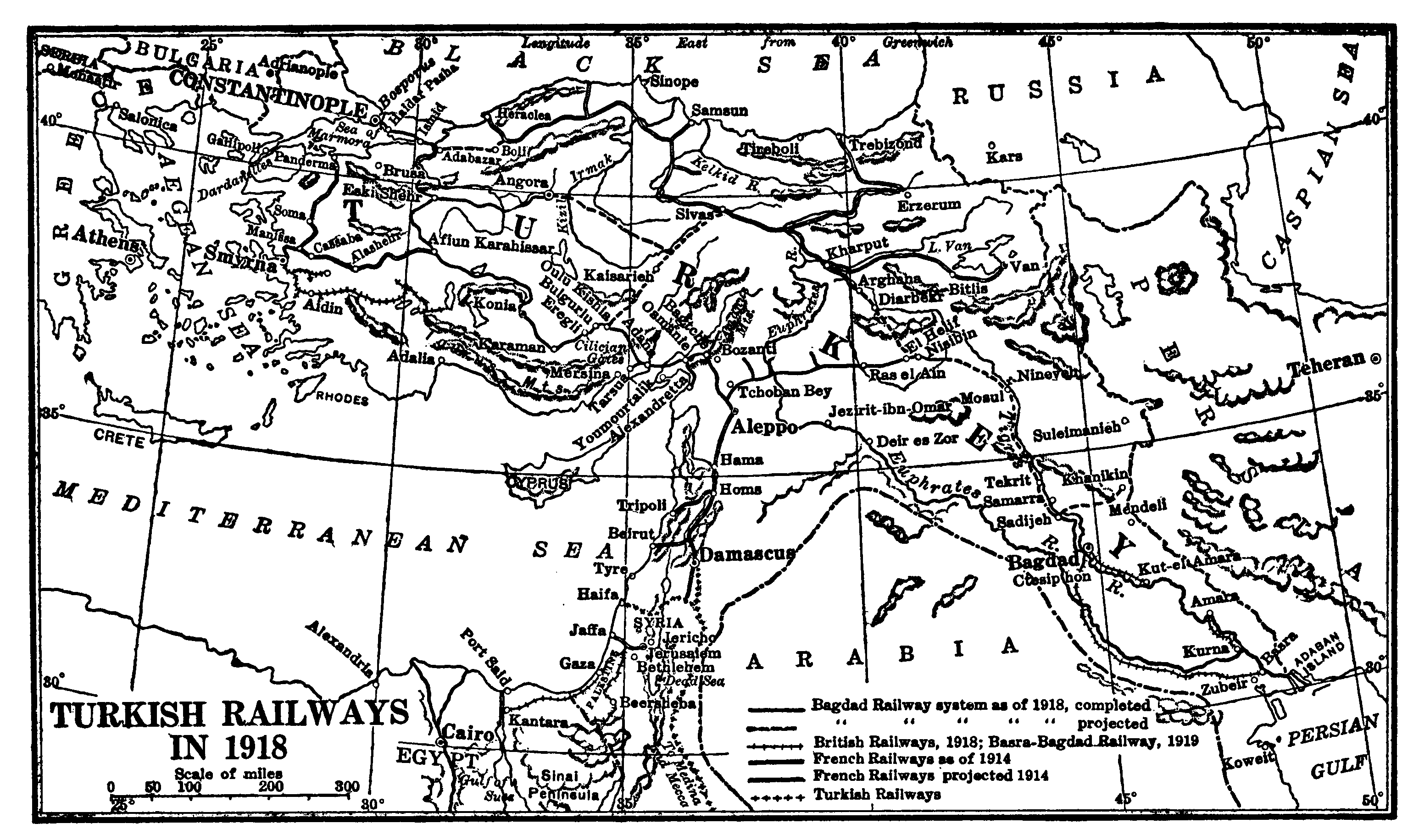
slow process. The construction of the Bagdad Railway,
as we have seen, had not been completed before the outbreak
of the Great War.2 There were wide gaps in
northern Mesopotamia and in the Amanus mountains
which made difficult the transportation of troops for the
defence of Irak, an attack on the Suez, an offensive in
the Caucasus, or the fortification of the Dardanelles.
The entry of Turkey into the war before the completion
of mobilization would have been of no material advantage
to Germany and would almost certainly have brought
disaster to the Ottoman Empire. Therefore, while the
war went well for Germany on the French and Russian
fronts, German influence at Constantinople was more
concerned with creating sentiment for war and with
speeding up mobilization than with encouraging premature
intervention. After the Teutonic defeats at the
Marne and in Galicia, however, active Turkish support
was needed for the purpose of menacing Russian security
in the Caucasus and British security in Egypt, as well
as for bolstering up German morale. During the latter
part of September and the month of October, Marshal
Liman von Sanders, Baron von Wangenheim, the commanders
of the Goeben and the Breslau, and other German
influences at Constantinople exerted the strongest possible
pressure on the Ottoman Government to bring Turkey
into the war on the side of her Teutonic allies.
On October 31, 1914, the Turkish Government took
the fatal step of precipitating war with the Entente
Powers, after Enver Pasha, Minister of War, and Djemal
Pasha, Minister of Marine, were satisfied that Ottoman
preparations were sufficiently advanced to warrant the
beginning of hostilities. The outcome of the Bagdad
Railway concession of 1903 was the entry of Turkey into
the War of 1914!3
Discouraged by their failure to maintain the peace, and
fearful of impending disaster to their country, Djavid
Bey and three other members of the Ottoman ministry
resigned their posts. There were other indications, also,
that intelligent public opinion at Constantinople was not
whole-hearted in support of war. But the nationalists—playing
upon the “traditional enmity” toward Russia—had
their way, and with an outburst of patriotic fervor
Turkey began hostilities. In a proclamation to the army
and navy the Sultan affirmed that the war was being
waged for the defence of the Caliphate and the “emancipation”
of the Fatherland: “During the last three hundred
years,” he said, “the Russian Empire has caused our
country to suffer many losses in territory. And when we
finally arose to a sentiment of awakening and regeneration
which was to increase our national welfare and our power,
the Russian Empire made every effort to destroy our
attempts, either with war or with numerous machinations
and intrigues. Russia, England, and France never for a
moment ceased harboring ill-will against our Caliphate,
to which millions of Mussulmans, suffering under the
tyranny of foreign domination, are religiously and wholeheartedly
devoted. And it was always these powers that
started every misfortune that came upon us. Therefore,
in this mighty struggle which we are undertaking, we
once and for all will put an end to the attacks made from
one side against the Caliphate and from the other against
the existence of our country.”4
Turcophiles in Germany were enthusiastic over Ottoman
participation in the Great War. The Turkish military
contribution to a Teutonic victory might not be
decisive, but neither would it be insignificant. And German
coöperation in Ottoman military ventures would
certainly strengthen German economic penetration in the
Near East, even though Turkish arms might not drive
Britain out of Egypt or Russia out of the Caucasus.
“Over there in Turkey,” wrote Dr. Ernest Jäckh, “stretch
Anatolia and Mesopotamia—Anatolia, the ‘land of sunrise,’
Mesopotamia, an ancient paradise. Let these names
be to us a symbol. May this world war bring to Germany
and Turkey the sunrise and the paradise of a new era.
May it confer upon a strengthened Turkey and a greater
Germany the blessings of fruitful Turco-Teutonic cooperation
in peace after victorious Turco-Teutonic collaboration
in war.”5
Whatever may have been the European origins of the
Great War, there was no disposition on the part of the
belligerents to overlook its imperial possibilities. A war
which was fought for the protection of France against
German aggression, for the defence of Belgian neutrality,
for the recovery of Alsace-Lorraine, for the democratizing
of a bureaucratic German Empire—this war was
fought not only in Flanders and Picardy and the Vosges,
but in Africa and Asia and the South Seas; not only in
Poland and Galicia and East Prussia, but in Mesopotamia
and Syria and the Dardanelles. Anatolia, Palestine, and
the region of the Persian Gulf were as much the stakes
of the war as Italia irredenta, the lost provinces of
France, or the Serbian “outlet” to the Adriatic.
Of all the spoils of the war, Turkey was among the
richest. Her undeveloped wealth in minerals and fuel;
her potentialities as a producer of foodstuffs, cotton, and
other agricultural products; her possibilities as a market—these
were alluring as war-time necessities and peace-time
assets. Her strategic position was of inestimable
importance to any nation which hoped to establish colonial
power in the eastern Mediterranean. Her future as a
sphere of influence promised unusual opportunities for
the investment of capital and the acquisition of exclusive
economic rights. It was no accident, therefore, that
brought men from Berlin and Bombay, Stuttgart and
Sydney, Munich and Marseilles, to fight bitterly for possession
of the cliffs of Gallipoli, the deserts of Mesopotamia,
and the coast of Syria. Turkey-in-Asia was a
rich prize upon which imperialists in Berlin and Vienna,
London and Paris and Petrograd, had set their hearts.
No sooner had Turkey entered the war than the imperial
aspects of the struggle became apparent. Germany
was deluged with literature designed to show that Ottoman
participation in the war would assure Germany and
Austria their legitimate “place in the sun.” Business
men and diplomatists, missionaries and Oriental scholars6
combined in prophesying that the Turco-German brotherhood-in-arms
would fortify the Teutonic economic position
in the Near East, disturb Russian equanimity in the
Caucasus, menace Britain’s communications with India,
and end once and for all French pretensions in Syria.
Moslem sympathizers predicted that the Holy War would
shake the Entente empires to their foundations. Pan-Germans
frankly avowed that the war offered an opportunity
to make Berlin-to-Bagdad a reality rather than a
dream—some went so far as to believe that German domination
could be extended from the North Cape to the
Persian Gulf! Mercantilists foresaw the possibility of
creating a politically unified and an economically self-sufficient
Middle Europe.7
As a means of promoting closer relationships with
Turkey numerous societies were established in Germany
for the purpose of disseminating information on the Near
East and its importance in the war. For example, Dr.
Hugo Grothe conducted at Leipzig the work of the
Deutsches Vorderasienkomitee—Vereinigung zur Förderung
deutscher Kulturarbeit im islamischen Orient.
This organization published and distributed hundreds of
thousands of books, pamphlets, and maps regarding
Asiatic Turkey; conducted a Near East Institute, at
which lectures and courses of instruction were given;
maintained an information bureau for business men interested
in commercial and industrial opportunities in the
Ottoman Empire; and established German libraries in
Constantinople, Aleppo, Bagdad, Konia, and elsewhere
along the line of the Bagdad Railway. A similar organization,
the Deutsch-türkische Vereinigung, was maintained
at Berlin under the honorary presidency of Dr.
von Gwinner of the Deutsche Bank and the active supervision
of Dr. Ernest Jäckh. The two societies numbered
among their members and patrons Herr Ballin, of the
Hamburg-American Line, General von der Goltz, Baron
von Wangenheim, and the Ottoman ambassador at
Berlin.8
The watchdogs of British imperial welfare, however,
were not asleep. Lord Crewe, the Secretary of State for
India, was busily engaged in plans for safeguarding
British economic and strategic interests in Mesopotamia.
Early in September, 1914, General Sir Edmund Barrow,
Military Secretary of the India Office, prepared a memorandum,
“The Rôle of India in a Turkish War,” which
proposed the immediate occupation of Basra on the
grounds that it was “the psychological moment to take
action” and that “so unexpected a stroke at this moment
would have a startling effect” in checkmating Turkish
intrigues, encouraging the Arabs to revolt and thus forestalling
an Ottoman attack on the Suez, and in protecting
the oil installations at the head of the Persian Gulf.9
Supporters of a pro-Balkan policy, in the meantime, were
urging an attack on Turkey from the Mediterranean.
Winston Churchill, Chief Lord of the Admiralty, for
example, in a memorandum of August 19, 1914, to Sir
Edward Grey, advocated an alliance with Greece against
Turkey; by September 4 he had completed plans for a
military and naval attack on the Dardanelles; on September
21 he telegraphed Admiral Carden, at Malta, to “sink
the Goeben and Breslau, no matter what flag they fly, if
they come out of the Straits.” Mr. Churchill, with whose
name will ever be associated the disastrous expedition to
the Dardanelles, believed that, whatever the outcome of
the war on the Western Front, the success or failure of
Germany would be measured in terms of her power in
the Near East after the termination of hostilities. To
destroy German economic and political domination of
Turkey it was necessary to have an expedition at the head
of the Persian Gulf and, possibly, another in Syria, but
the commanding strategic position was the Straits. The
capture of Constantinople would win the war.10
There were others who considered that a purely defensive
policy should be followed in the Near East. Lord
Kitchener, for example, believed in concentrating the
maximum possible man power in France and advocated
restricting Eastern operations to the protection of the
Suez Canal and other essential communications. Influential
military critics, like Colonel Repington, were firmly
opposed to “side shows” in Mesopotamia, at the Dardanelles,
or elsewhere, which would divert men, matériel,
and popular attention from the Western Front. Sir
Edward Grey appeared to be more interested in Continental
than in colonial questions. Lord Curzon was
swayed between fear of a Moslem uprising in India and
the hope that British prestige in the East might be
materially enhanced by outstanding military successes at
the expense of the Turks.11
The Near Eastern imperialists, however, had their way.
During September, 1914, the Government of India was
ordered to prepare an expeditionary force for service in
the region of the Persian Gulf. Early in October, almost
four weeks before Turkey entered the war, Indian Expeditionary
Force “D,” under General Delamain, sailed
from Bombay under sealed orders. It next appeared on
October 23, at Bahrein Island, in the Persian Gulf, where
General Delamain learned the purposes of the expedition
which he commanded. His army was to occupy Adaban
Island, at the mouth of the Shatt-el-Arab, “with the object
of protecting the oil refineries, tanks and pipe lines [of
the Anglo-Persian Company], covering the landing of
reënforcements should these be required, and assuring
the local Arabs of support against Turkey.” For the
last-named purpose Sir Percy Cox, subsequently British
High Commissioner in Irak, was attached to the army as
“political officer.” In addition, General Delamain was to
“take such military and political action as he should consider
feasible to strengthen his position and, if necessary,
occupy Basra.” Nevertheless, he was warned that the
rôle of his force was “that of demonstrating at the head
of the Persian Gulf” and that on no account was he “to
take any hostile action against the Turks without orders
from the Government of India, except in the case of
absolute military necessity”!12
Meanwhile, Sir Arthur Henry McMahon, subsequently
first High Commissioner in Egypt under the Protectorate,
entered into an agreement, dated October 23, 1914, with
the Sherif of Mecca, assuring the latter that Great Britain
was prepared “to recognize and support the independence
of the Arabs within territories in which Great Britain is
free to act without detriment to the interests of her ally,
France,” it being understood that “the districts of Mersina
and Alexandretta and portions of Syria lying to the
west of the districts of Damascus, Homs, Hama and
Aleppo cannot be said to be purely Arab.” In other
words, an independent Arab state was considered to be
feasible insofar as it did not conflict with the sphere of
interest in Syria developed by French railway-builders
and recognized by the Franco-German agreement of
February 15, 1914.13
Even before Turkey formally entered the war, therefore,
a British army was “demonstrating” in the Shatt-el-Arab;
Sir Percy Cox was coöperating with the Sheik
of Koweit for the purpose of precipitating a rebellion
among the Arabs of Mesopotamia, and a British representative
had sown the seeds of a separatist movement
in the Hedjaz. It was a short step from this, after the
declaration of hostilities, to the occupation of Basra, on
November 22, and of Kurna, on December 9. The close
of the year 1914 saw Turkey in the unenviable position
of having to choose between increasing German economic
and political domination, on the one hand, and dismemberment
by the Entente Allies, on the other.
The political and military situation of Turkey did not
improve during the year 1915. By mid-January, the
rigors of a Caucasian winter and the absence of adequate
means of communication and supply brought to a standstill
Enver Pasha’s drive against the Russians. Early in
February, Djemal Pasha’s army, which had crossed the
Sinai Peninsula in the face of seemingly insuperable obstacles,
attacked the Suez Canal only to be decisively
defeated by its British and French defenders. During
March a secret agreement was reached between Great
Britain, France, and Russia for the partition of the Ottoman
Empire, including the assignment of Constantinople
to the Tsar. On April 26, by the Treaty of London
which brought Italy into the war, the Entente Powers
bound themselves to “preserve the political balance in the
Mediterranean” by recognizing the right of Italy “to
receive on the division of Turkey an equal share with
Great Britain, France and Russia in the basin of the
Mediterranean, and more specifically in that part of it
contiguous to the province of Adalia, where Italy already
had obtained special rights and developed certain interests”;
likewise the Allies agreed to protect the interests
of Italy “in the event that the territorial inviolability of
Asiatic Turkey should be sustained by the Powers” or
that “only a redistribution of spheres of interest should
take place.”14 To give greater effect to these secret
imperialistic agreements British troops were landed at the
Dardanelles on April 28. The bargains were sealed with
the blood of those heroic Britons and immortal Anzacs
who went through the tortures of hell—and worse—at
Gallipoli!15
In the meantime, British activities were resumed in
Mesopotamia. In March, 1915, General J. E. Nixon was
ordered to Basra with renewed instructions “to secure the
safety of the oilfields, pipe line and refineries of the
Anglo-Persian Oil Company,” as well as with orders to
consolidate his position for the purpose of “retaining
complete control of lower Mesopotamia” and of making
possible a subsequent advance on Bagdad. On May 29,
in accordance with these instructions, the Sixth Division,
under General Sir Charles Townshend, occupied Amara,
a town of 12,000 lying about fifty miles north of Basra
on the Tigris, seat of the Turkish provincial administration
and one of the principal entrepôts of Mesopotamian
trade. Beyond this point General Nixon refused to
extend his operations unless assured adequate reënforcements,
which were not forthcoming. Nevertheless, because
of the insistence of Sir Percy Cox that some outstanding
success was necessary to retain support of the
Arabs, another advance was ordered in the early autumn.
On September 29, General Townshend occupied Kut-el-Amara,
180 miles north of his former position.
Then followed the decision to advance on Bagdad—a
move which will go down in history as one of the chief
blunders of the war, as well as a conspicuous instance
of the manner in which political desiderata were allowed
to outweigh military considerations. The soldiers on
the ground were opposed to the move. General Nixon
believed it would be disastrous to advance farther than
Kut without substantial reënforcements. General Townshend
was convinced that “Mesopotamia was a secondary
theatre of war, and on principle should be held on the
defensive with a minimum force,” and he warned his
superiors that his troops “were tired, and their tails were
not up, but slightly down,” that they were fearful of
the distance from the sea and “were going down, in
consequence, with every imaginable disease.” But the
statesmen at London were thinking not only of winning
the war but of eliminating Germany from all future
political and economic competition in the backward areas
of the world. “Because of the great political and military
advantages to be derived from the capture of Bagdad,”
and because the “uncertainty” of the situation at
the Dardanelles made apparent “the great need of a
striking success in the East,” Austen Chamberlain, Secretary
of State for India, telegraphed the Viceroy on
October 23, 1915, that an immediate advance should be
begun. Fearful of the consequences, but faithful to his
trust, General Townshend began the hundred-mile march
to Bagdad. Worn out, but heroic beyond words, his
troops drove the Turkish forces back and, on November
22, occupied Ctesiphon, only eighteen miles from their
goal. This, however, marked the high tide of Allied
success in the Near East during 1915, for General Townshend
was destined to reach Bagdad only as a prisoner
of war.16
Allied military successes in Turkey were not looked
upon with equanimity in Germany. There was a realization
in Berlin, as well as London and Paris and Petrograd,
that the stakes of the war were as much imperial as
Continental. Nothing had as yet occurred which had
lessened the importance of establishing an economically
self-sufficient Middle European bloc of nations. In the
event that the German oversea colonies could not be
recovered, Asiatic Turkey—because of its favorable geographical
position, its natural resources, and its potentialities
as a market—would be almost indispensable in
the German imperial scheme of things. As Paul Rohrbach
wrote in Das grössere Deutschland in August, 1915,
“After a year of war almost everybody in Germany is of
the opinion that victory or defeat—at least political victory
or defeat—depends upon the preservation of Turkey
and the maintenance of our communications with her.”
The dogged defence of the Dardanelles had convinced
Germany that, granted proper support, Turkey could be
depended upon to give a good account of herself. The
problem was one of supplementing Ottoman man power
with Teutonic military genius, technical skill, and organizing
ability. The enlistment of Bulgaria and the obliteration
of Serbia made possible more active German assistance
to Turkey, and during the latter months of 1915
and the early months of 1916 strenuous efforts were made
to bring the Turkish military machine to a high point of
efficiency. Large numbers of German staff officers were
despatched to Mesopotamia, Syria, and Anatolia, and
Turkish officers were brought to the French and Russian
fronts to learn the methods of modern warfare. The
Prussian system of military service was adopted throughout
the Ottoman Empire, and exemptions were reduced
to a minimum. Liberal credits were established with
German banks for the purchase of supplies for the new
levies of troops. Field Marshal von der Goltz was sent
to Mesopotamia as commander-in-chief of the Turkish
troops in that region.17
Perhaps the chief handicap of the Turks in all their
campaigns was inadequate means of transportation. The
Ottoman armies operating in the vicinity of Gaza and of
Bagdad were dependent upon lines of communication
more than twelve hundred miles long; and had the Bagdad
Railway been non-existent, it is doubtful if any military
operations at all could have been conducted in those
regions. But the Bagdad Railway was uncompleted.
Troops and supplies being despatched from or to Anatolia
had to be transported across the Taurus and Amanus
mountains by mule-back, wagon, or automobile, and then
reloaded on cars south or north of the unfinished tunnels.
To remedy these deficiencies, herculean efforts were made
by Germans and Turks during 1915 to improve the service
on existing lines and to hurry the completion of the
Bagdad Railway. Locomotives and other rolling stock
were shipped to Turkey, and German railway experts
coöperated with the military authorities in utilizing transportation
facilities to the best advantage. In September,
1915, the Bagtché tunnel was pierced; and although
through service to Aleppo was not inaugurated until
October, 1918, a temporary narrow-gauge line was used,
during the interim, to transport troops and matériel
through the tunnel. Commenting on the importance of
the Bagtché tunnel, the American Consul General at Constantinople
wrote: “With its completion the most serious
difficulties connected with the construction of the Bagdad
Railway have been overcome, and the work of connecting
up many of the isolated stretches of track may be expected
to be completed with reasonable rapidity. In spite
of delays occasioned by the war, this most important
undertaking in railway construction in Turkey has passed
the problematical stage and is now certain to become an
accomplished fact in the near future.”18
The effects of German assistance to Turkey soon made
themselves apparent. Field Marshal von der Goltz, commanding
a reënforced and reinvigorated Ottoman army,
supported by German artillery, compelled General Townshend
to abandon hope of occupying Bagdad and to fall
back toward Basra. By December 5, 1915, Townshend’s
army was besieged in Kut-el-Amara; and although the
Turks failed to take the town by storm, they did not fail
to beat off every Russian and British force sent to the
relief of the beleaguered troops. About the same time,
December 10, evacuation of the Dardanelles was begun,
and the last of the British troops were withdrawn during
the first week of January, 1916. On April 29, Townshend’s
famished garrison surrendered. Shortly thereafter
the offensive of the Grand Duke Nicholas in
Turkish Armenia was brought to a standstill. During
July and August a second Ottoman attack was launched
against the Suez Canal; and although it was unsuccessful,
the expedition reminded the British that Egypt was by no
means immune from danger. By the end of the year
1916 Turkey, with German assistance, had completely
cleared her soil of enemy troops, except for a retreating
Russian army in northern Anatolia and a defeated British
expedition at the head of the Persian Gulf.19
As for Germany, she “was unopposed in her mastery
of that whole vast region of southeastern Europe and
southwestern Asia which goes by the name of the Near
East.... She now enjoyed uninterrupted and unmenaced
communication and commerce with Constantinople
not only, but far away, over the great arteries of Asiatic
Turkey [the Bagdad and Hedjaz railways], with Damascus,
Jerusalem, and Mecca, and with Bagdad likewise....
If military exploits had been as conclusive as they
had been spectacular, Germany would have won the Great
War in 1916 and imposed a Pax Germanica upon the
world.... With the adherence of Turkey and Bulgaria
to the Teutonic Alliance, and the triumphs of those states,
a Germanized Mittel-Europa could be said to stretch from
the North Sea to the Persian Gulf, from the Baltic to
the Red Sea, from Lithuania and Ukrainia to Picardy and
Champagne. It was the greatest achievement in empire-building
on the continent of Europe since the days of
Napoleon Bonaparte.”20
If Germany had been alarmed during the summer of
1915 at the prospect that she might lose her preponderant
position in Turkey, the world was now alarmed at the
prospect that she might maintain that position. Nor was
that alarm easily dispelled, for the Bagdad Railway and
the power and prestige it gave Germany in the Near East
were pointed to by statesmen as additional evidence of
the manner in which the Kaiser and his cohorts had
plotted in secret against the peace of an unsuspecting and
unprepared world. In fact, the Bagdad Railway came
to be considered one of the fundamental causes of the
war, as well as one of the chief prizes for which the war
was being fought. President Wilson, for example, in
his Flag Day speech, June 14, 1917, stated the case in
the following terms:21
“The rulers of Germany ... were glad to go forward unmolested,
filling the thrones of Balkan states with German princes,
putting German officers at the service of Turkey to drill her
armies and make interest with her government, developing plans
of sedition and rebellion in India and Egypt, setting their fires in
Persia. The demands made by Austria upon Serbia were a mere
single step in a plan which compassed Europe and Asia, from
Berlin to Bagdad....
“The plan was to throw a broad belt of German military power
and political control across the very centre of Europe and beyond
the Mediterranean into the heart of Asia; and Austria-Hungary
was to be as much their tool and pawn as Serbia or Bulgaria or
Turkey or the ponderous states of the East.... The dream had
its heart at Berlin. It could have had a heart nowhere else!...
“And they have actually carried the greater part of that amazing
plan into execution.... The so-called Central Powers are in fact
but a single Power. Serbia is at its mercy, should its hands be
but for a moment freed. Bulgaria has consented to its will, and
Roumania is overrun. The Turkish armies, which Germans
trained, are serving Germany, certainly not themselves, and the
guns of German warships lying in the harbor at Constantinople
remind Turkish statesmen every day that they have no choice but
to take their orders from Berlin. From Hamburg to the Persian
Gulf the net is spread!”
As late as November 12, 1917, after some spectacular
victories by the Allies in Mesopotamia and Syria, President
Wilson made it plain that no peace was possible
which did not destroy German military power in the Near
East. Addressing the American Federation of Labor,
at Buffalo, N. Y., he said:22
“Look at the map of Europe now. Germany, in thrusting upon
us again and again the discussion of peace, talks about what?
Talks about Belgium—talks about Alsace-Lorraine. Well, these
are deeply interesting subjects to us and to them, but they are
not talking about the heart of the matter. Take the map and
look at it. Germany has absolute control of Austria-Hungary,
practical control of the Balkan States, control of Turkey, control
of Asia Minor. I saw a map the other day in which the whole
thing was printed in appropriate black, and the black stretched
all the way from Hamburg to Bagdad—the bulk of the German
power inserted into the heart of the world. If she can keep that,
she has kept all that her dreams contemplated when the war
began. If she can keep that, her power can disturb the world
as long as she keeps it, always provided ... the present influences
that control the German Government continue to control it.”
In the light of all the facts, this diagnosis of the situation
is incomplete, to say the least. Had President Wilson
been cognizant of the contemporaneous counter-activities
of the Allied Powers, he might not have been prepared
to offer so simple an explanation of a many-sided problem.
For it was not German imperialism alone which
menaced the peace of the Near East and of the world,
but all imperialism.
Germany may have been determined to dominate the
Ottoman Empire by military force. But from the Turkish
point of view domination by Germany was hardly
more objectionable than the dismemberment which was
certain to be the result of an Allied victory.
Indeed, confident that they would eventually win the
war, the Entente Powers had proceeded far in their plans
for the division of the Ottoman Empire. During the
spring of 1915, as has been indicated,23 Russia had been
promised Constantinople, and Italy had been assigned a
share of the spoils equal to that of Great Britain, France,
or Russia. To give full effect to these understandings,
further negotiations were conducted during the autumn
of 1915 and the spring of 1916, looking toward a more
specific delimitation of interests.
Accordingly, on April 26, 1916—the first anniversary
of the Treaty of London with Italy—France and Russia
signed the secret Sazonov-Paléologue Treaty concerning
their respective territorial rights in Asiatic Turkey.
Russia was awarded full sovereignty over the vilayets
of Trebizond, Erzerum, Bitlis, and Van—a vast area of
60,000 square miles (about one and one-fifth times the
size of the State of New York), containing valuable
mineral and petroleum resources. This handsome prize
put Russia well on the road to Constantinople and in a
fair way to turn the Black Sea into a Russian lake. And
at the moment the treaty was signed the armies of the
Grand Duke Nicholas were actually overrunning the territory
which Russia had staked out for herself! For her
part, France was to receive adequate compensations in
the region to the south and southwest of the Russian
acquisitions, the actual delimitation of boundaries and
other details to be the result of direct negotiation with
Great Britain.24
Thus came into existence the famous Sykes-Picot
Treaty of May 9, 1916, defining British and French political
and economic interests in the hoped-for dismemberment
of the Ottoman Empire. The Syrian coast from
Tyre to Alexandretta, the province of Cilicia, and southern
Armenia (from Sivas on the north and west to
Diarbekr on the south and east) were allocated to France
in full sovereignty. In addition, a French “zone of influence”
was established over a vast area including the
provinces of Aleppo, Damascus, Deir, and Mosul. Administration
of this stretch of coast and its hinterland
would give French imperialists what they most wanted in
the Near East—actual possession of a country in which
France had many religious and cultural interests, control
of the silk production of Syria and the potential cotton
production of Cilicia, ownership of the Arghana copper
mines, and acquisition of that portion of the Bagdad
Railway lying between Mosul and the Cilician Gates of the
Taurus.25 Aside from its satisfaction of French imperial
ambitions, however, “the French area defied every
known law of geographic, ethnographic, and linguistic
unity which one might cite who would attempt to justify
it.”26
Great Britain, by way of “compensation,” was to receive
complete control over lower Mesopotamia from
Tekrit to the Persian Gulf and from the Arabian boundary
to the Persian frontier. In addition, she was recognized
as having special political and economic interests—particularly
the right “to furnish such advisers as the
Arabs might desire”—in a vast territory lying south of
the French “zone of influence” and extending from the
Sinai Peninsula to the Persian border. Palestine was
to be internationalized, but was subsequently established
as a homeland for the Jews. In this manner Britain,
also, had adequately protected her imperial interests—she
had secured possession of the Bagdad Railway in
southern Mesopotamia; she had gained complete control
of the head of the Persian Gulf, thus fortifying her
strategic position in the Indian Ocean; she was assured
the Mesopotamian cotton supply for the mills of Manchester
and the Mesopotamian oil supply for the dreadnoughts
of the Grand Fleet; she had erected in Palestine
a buffer state which would block any future Ottoman
attacks on the Suez Canal. All in all, Sir Mark Sykes
had driven a satisfactory bargain.27
Italian ambitions now had to be propitiated. For a
whole year before the United States entered the war—while
the Allied governments were professing unselfish
war aims—secret negotiations were being conducted by
representatives of France, Great Britain and Italy to determine
what advantages and territories, equivalent to
those gained by the other Allies, might be awarded Italy.
In April, 1917, by the so-called St. Jean de Maurienne
Agreement, Italy was granted complete possession of
almost the entire southern half of Anatolia—including
the important cities of Adalia, Konia, and Smyrna—together
with an extensive “zone of influence” nort-heast
of Smyrna. With such a hold on the coast of Asia
Minor, Italian imperialists might realize their dream of
dominating the trade of the Ægean and of reëstablishing
the ancient power of Venice in the commerce of the
Near East.28
These inter-Allied agreements for the disposal of
Asiatic Turkey were instructive instances of the “old
diplomacy” in coöperation with the “new imperialism.”
The treaties were secret covenants, secretly arrived at;
they bartered territories and peoples in the most approved
manner of Metternich and Richelieu. But they were less
concerned with narrowly political claims than with the
exclusive economic privileges which sovereignty carried
with it; they determined boundaries with recognition of
their strategic importance, but with greater regard for
the location of oilfields, mineral deposits, railways and
ports of commercial importance. They left no doubt as
to what were the real stakes of the war in the Near East.
It is difficult, if not impossible, to reconcile the secret
treaties with the pronouncements of Allied statesmen
regarding the origins and purposes of the Great War.
Certainly they were no part of the American program
for peace, which promised to “the Turkish portions of
the Ottoman Empire a secure sovereignty”; which demanded
“a free, open-minded, and absolutely impartial
adjustment of all colonial claims, based upon a strict
observance of the principle that in determining all such
questions of sovereignty the interests of the populations
concerned must have equal weight with the equitable
claims of the government whose title is to be determined”;
and which announced in no uncertain terms that “the day
of conquest and aggrandizement is gone by” as is also
“the day of secret covenants entered into in the interest
of particular governments and likely at some unlooked-for
moment to upset the peace of the world.”29
Allied diplomacy was to have its way in the Near East,
however, for the goddess of victory finally smiled upon
the Allied armies and frowned upon both Turks and
Germans. As 1916 had been a year of Turco-German
triumphs at the Dardanelles and in Mesopotamia, 1917
brought conspicuous Allied victories along the Tigris
and in Syria, and 1918 saw the complete collapse of the
Ottoman Empire. On February 24, 1917, General Sir
Stanley Maude, in command of reënforced and rejuvenated
British forces in Mesopotamia, captured Kut-el-Amara,
retrieving the disaster which had befallen Townshend’s
army a year before. Deprived of the services of
Field Marshal von der Goltz, who died during the Caucasus
campaign, the Turks retired in disorder, and on
March 11 British troops entered Bagdad—the ancient
city which had bulked so large in the German scheme of
things in the Near East. Although the capture of Bagdad
was not in itself of great strategic importance, its
effect on morale in the belligerent countries was considerable.
British imperialists were in possession of the
ancient capital of the Arabian Caliphs, as well as the chief
entrepôt of caravan trade in the Middle East; therefore
their prestige with both Arabs and Turks was certain to
rise. At home, pictures of British troops in the Bagdad
of the Arabian Nights appealed to the imagination of
the war-weary, as well as the optimistic, patriot. In the
Central Powers, on the other hand, the loss of Bagdad
created scepticism as to whether the German dream of
“Hamburg to the Persian Gulf” was not now beyond
realization. This scepticism became more confirmed
when, on April 24, General Maude captured Samarra,
northern railhead of the uncompleted Bagdad line in
Mesopotamia.30
Scepticism would have turned to alarm, however, had
Germans been fully aware of the significance of the British
advance in the Land of the Two Rivers. For behind
the armies of General Maude came civil officials
by the hundreds to consolidate the victory and to lay the
foundations of permanent occupation. An Irrigation
Department was established to deal with the menace of
floods, to drain marshes, and to economize in the use
of water. An Agricultural Department undertook the
cultivation of irrigated lands and conducted elaborate
experiments in the growing of cotton—the commodity
which means so much in the British imperial system. A
railway was constructed from Basra to Bagdad which,
when opened to commerce in 1919, became an integral part
of the Constantinople-Basra system. There was every indication
that the British were in Mesopotamia to stay.31
Germans and Turks were sufficiently aroused, however,
to take strenuous measures to counteract General Maude’s
successes. In April, 1917, Field Marshal von Mackensen,
hero of the Balkan and Rumanian campaigns and
strong man of the Near East, was sent to Constantinople
to confer with Enver Pasha regarding the military situation.
It was decided, apparently, that Bagdad must be
retaken at all costs, for throughout the summer quantities
of rolling stock for the Bagdad Railway were shipped to
Turkey, enormous supplies of munitions were accumulated
at Haidar Pasha, and a division of picked German
troops (including machine-gun and artillery units) made
its appearance in Anatolia. Command of all the Turkish
armies in Mesopotamia was conferred upon General von
Falkenhayn, former German Chief of Staff. Germany
was not yet prepared to surrender her sphere of interest
in Turkey.
The great expedition against Bagdad, however, had to
be abandoned. In the first place, Turkish officers were
loath to serve under von Falkenhayn. Turkish nationalism
was beginning to assert itself, and German supervision
of Ottoman military affairs was resented—Mustapha
Kemal Pasha, for example, refused to accept orders
from German generals and resigned his commission.
Von Falkenhayn himself was disliked because of his
dictatorial methods and was held in light esteem because
of his responsibility for the disastrous Verdun offensive.
Furthermore, many Turks deemed it inadvisable to dissipate
energy in a Mesopotamian campaign, the avowed
purpose of which was a recovery of German prestige,
when all available man power was required for the defence
of Syria. Djemal Pasha was so insistent on this
point that he received from the Kaiser an “invitation” to
visit the Western Front! In the second place, Providence
or, perhaps, an Allied spy intervened to thwart
the German plans, for a great fire and a series of explosions
(September 23–26, 1917) destroyed the entire port
and terminal of Haidar Pasha, together with all the munitions
and supplies which had been accumulated there
by months of patient effort. And finally, the spectacular
campaign of Field Marshal Allenby in Palestine, which
opened with the capture of Beersheba, on October 31,
convinced even von Falkenhayn that an expedition in
Mesopotamia, while Aleppo was in danger, would be the
height of folly. German energies were thereupon diverted
to the defence of the Holy Land.32
During the autumn of 1917, Great Britain and France,
to assure their possession of the territories assigned them
by the Sykes-Picot Treaty, began a Syrian campaign
which was not to terminate until Turkey had been put
out of the war. Under Field Marshal Sir E. H. H.
Allenby, British troops, reënforced by French units and
assisted by the rebellious Arabs of the Hedjaz, captured
Gaza (November 7), Jaffa (November 16), and Jerusalem
(December 9). The triumphal entry of General
Allenby into Jerusalem was hailed throughout Christendom
as marking the success of a modern crusade to rid
Palestine of Ottoman domination forever. Jericho was
occupied, February 21, 1918, but Turkish resistance,
under Marshal Liman von Sanders, stiffened for a time,
and it was not until the autumn that large-scale operations
were resumed. On October 1, Damascus was occupied
by a combined Arab and British army; a week
later Beirut was taken; and on October 25, Aleppo, the
most important junction point on the Bagdad Railway,
capitulated. Five days afterward, Turkey gave up the
hopeless fight by signing the Mudros armistice, terminating
hostilities.33
Thus ended a Great Adventure for both Turkey and
Germany. Germany lost all hope of retaining any economic
or political influence in the Ottoman Empire; the
dream of Berlin-to-Bagdad became a nightmare. Turkey
faced dismemberment. “The Bagdad Railway had
proved to be the backbone of Turkish utility and power
in the War. Were it not for its existence, the Ottoman
resistance in Mesopotamia and in Syria could have been
discounted as a practical consideration in the War,
and the sending of Turkish reënforcements to the Caucasus
would have been even more materially delayed than
was in fact the case.”34 For Turkey, then, the war had
come at a most inappropriate time. Had hostilities begun
ten years later, after the completion of the Bagdad
system, military operations in the Near East might have
had an entirely different result. As it was, the Bagdad
Railway—and the international complications arising
from it—proved to be the ruination of the Ottoman
Empire.
During 1919, the Allied Governments set about possessing
themselves of the spoils which were theirs by virtue
of the secret treaties and by right of conquest. In
April, Italian troops occupied Adalia and rapidly extended
their lines into the interior as far as Konia. In
November, French armies replaced the British forces
in Syria and Cilicia. Great Britain began the “pacification”
of the tribesmen of Mesopotamia and Kurdistan.
And in the meantime there was plentiful evidence that
German rights in the Near East would be speedily liquidated
in the interest of the victorious Powers. For example,
on March 26, the Interallied Commission on Ports,
Waterways, and Railways announced at Paris the adoption
of “a new transportation agreement designed to
secure a route to the Orient by railway without passing
through the territories of the Central Empires.” Accordingly,
a fast train, the “Simplon-Orient Express,”
was to be run regularly from Calais to Constantinople
via Paris, Lausanne, Milan, Venice, Trieste, Agram, and
Vinkovce. Later this service was to be extended into
Asiatic Turkey, over the lines of the Anatolian, Bagdad,
and Syrian railways. To meet a changed situation one
must provide new paths of imperial expansion, and the
French press spoke glowingly of the prospect that the
slogans “Hamburg to the Persian Gulf” and “Berlin to
Bagdad” would be speedily replaced by “Calais to Cairo”
and “Bordeaux to Bagdad”!35
All German rights in the Bagdad Railway and other
economic enterprises in the Near East were abrogated by
the Treaty of Versailles, signed June 28, 1919. The German
Government was obligated to obtain and to turn
over to the Reparation Commission “any rights and interests
of German nationals in any public utility undertaking
or in any concession operating in ... Turkey,
Austria, Hungary, and Bulgaria” and agreed, as well,
“to recognize and accept all arrangements which the
Allied and Associated Powers may make with Turkey
and Bulgaria with reference to any rights, interests and
privileges whatever which might be claimed by Germany
or her nationals in Turkey and Bulgaria.”36
The Treaty of Sèvres, August 10, 1920—together with
the accompanying secret Tripartite Agreement of the same
date between Great Britain, France, and Italy—carried
still further the liquidation of German interests in the
Near East. The Turkish Government was required to
dispose of all property rights in Turkey of Germany,
Austria, Hungary, Bulgaria, or their respective nationals
and to turn over the proceeds of all purchases and sales to
the Reparation Commission established under the treaties
of peace with those Powers. The Anatolian and Bagdad
Railways were to be expropriated by Turkey and all
of their rights, privileges, and properties to be assigned—at
a valuation to be determined by an arbitrator appointed
by the Council of the League of Nations—to a Franco-British-Italian
corporation to be designated by the representatives
of the Allied Powers. German stockholders
were to be compensated for their holdings, but the
amount of their compensation was to be turned over to
the Reparation Commission; compensation due the
Turkish Government was to be assigned to the Allied
Governments toward the costs of maintaining their armies
of occupation on Turkish soil. German and Turkish
property in ceded territories of the Ottoman Empire was
to be similarly liquidated. The Treaty of Versailles and
the Treaty of Sèvres left hardly a vestige of German influence
in the Near East.37
The Sèvres settlement, furthermore, destroyed the
Ottoman Empire and sought to give the Allies a stranglehold
upon the economic life of Turkey. Great Britain
and France received essentially the same territorial privileges
as they had laid out for themselves in the Sykes-Picot
Treaty, with the vague restrictions that they should
exercise in Mesopotamia and Palestine and in Syria and
Cilicia respectively only the rights of mandatory powers.
Great Britain was confirmed in her oil and navigation
concessions in Mesopotamia, France in her railway rights
in Syria; in addition, the Hedjaz Railway was turned
over outright to their joint ownership and administration.
Italy received only a “sphere of influence” in southern
Anatolia, including the port of Adalia, but, as a consequence
of one of the most sordid of the transactions of
the Paris Conference, she was deprived of the bulk of
the privileges guaranteed her under the Treaty of London
and the St. Jean de Maurienne Agreement.38 Greece
was installed in Smyrna—the most important harbor in
Asia Minor, a harbor the control of which was vital to
the peasantry of Anatolia for the free export of their
produce and for the unimpeded importation of farm machinery
and other wares of western industry. Constantinople
was put under the jurisdiction of an international
commission for control of the Straits, and the balance
of the former Russian sphere of interest was assigned
to the ill-fated Armenian Republic. The Hedjaz was
declared to be an independent Arab state. The Ottoman
Empire was no more.
Even the Turkey that remained—a portion of Anatolia—enjoyed
sovereignty in name only. The Capitulations,
which the Sultan had terminated in the autumn
of 1914, were reëstablished and extended. Concessions
to Allied nationals were confirmed in all the rights which
they enjoyed before Ottoman entry into the Great War.
Because of the reparations, and because of the high cost
of the Allied armies of occupation, the country was being
loaded down with a still further burden of debt from
which there appeared to be no escape—and debts not
only mortgaged Turkish revenues but impaired Turkish
administrative integrity. To assure prompt payment of
both old and new financial obligations of the Turkish
Government, an Interallied Financial Commission was
superimposed upon the Ottoman Public Debt Administration.
The Financial Commission had full supervision
over taxation, customs, loans, and currency; exercised
final control over the Turkish budget; and had the right
to veto any proposed concession. In control of its domestic
affairs the new Turkey was tied hand and foot.
Here, indeed, was a Carthaginian peace! And all of
this was done in order “to help Turkey, to develop her
resources, and to avoid the international rivalries which
have obstructed these objects in the past!”39
In the meantime, however, while the Sèvres Treaty
was still in the making, there was a small handful of
Turkish patriots who were determined at all costs to
win that complete independence for which Turkey had
entered the war. These Nationalists were outraged by
the Greek occupation of Smyrna, in May, 1919, which
they considered a forecast of the kind of peace to be
dictated to Turkey. During the summer of 1919 they
held two conferences at Erzerum and Sivas and agreed
to reject any treaty which handed over Turkish populations
to foreign domination, which would reduce Turkey
to economic servitude to the victorious Powers, or which
would impair the sovereignty of their country. Upon
this program they won a sweeping victory in the parliamentary
elections of 1919–1920. For leadership they
depended largely upon that brilliant soldier and staunch
Turk, Mustapha Kemal Pasha, who had distinguished
himself by his quarrel with Liman von Sanders at the
Dardanelles and his defiance of von Falkenhayn in
Syria. Mustapha Kemal Pasha, who had bitterly contested
the growth of German influence in Turkey during
the war, was not likely to accept without a struggle the
extension of Allied control over Turkish affairs.40
In Constantinople, January 28, 1920, the Nationalist
members of the Turkish Parliament signed the celebrated
“National Pact”—frequently referred to as a Declaration
of Independence of the New Turkey. “The Pact
was something more than a statement of war-aims or a
party programme. It was the first adequate expression
of a sentiment which had been growing up in the minds
of Western-educated Turks for three or four generations,
which in a half-conscious way had inspired the reforms
of the Revolution of 1908, and which may dominate
Turkey and influence the rest of the Middle East for
many generations to come. It was an emphatic adoption
of the Western national idea.”41 It was based upon
principles which had received wide acceptance among
peoples of the Allied nations during the war: self-determination
of peoples, to be expressed by plebiscite;
protection of the rights of minorities, but no further
limitations of national sovereignty. As regards the Capitulations
and the Ottoman Public Debt Administration,
the Pact is explicit: “With a view to assuring our national
and economic development,” it reads, “and with the
end of securing to the country a more regular and more
modern administration, the signatories of the present pact
consider the possession of complete independence and
liberty as the sine qua non of our national existence.
In consequence, we oppose all juridical or financial restrictions
of any nature which would arrest our national
development.” Rather that Turkey should die free than
live in slavery! Foreswearing any intention of recovering
the Sultan’s former Arab possessions, the Pact proceeded
to serve notice, however, that Cilicia, Mosul, and the
Turkish portions of Thrace must be reunited with the
fatherland. “The Ottoman Empire is dead! Long live
Turkey!”42
With this amazing program Mustapha Kemal Pasha
undertook to liberate Turkey. In April, 1920, the government
of the Grand National Assembly was instituted
in Angora and proceeded to administer those portions of
Anatolia which were not under Allied or Greek occupation.
The proposed Treaty of Sèvres—which was handed
to the Turkish delegates at Paris on May 11—was condemned
as inconsistent with the legitimate national aspirations
of the Turkish people. The Allies and the
Constantinople Government were denounced—the former
as invaders of the sacred soil of Turkey, the latter as
tools of European imperialists. Then followed a series
of successful military campaigns: by October, 1920, the
French position in Cilicia had been rendered untenable,
the Armenian Republic had been obliterated, the British
forces of occupation had been forced back into the Ismid
peninsula, and the Italians had withdrawn their troops
to Adalia. In the spring of 1921 separate treaties were
negotiated with Russia, Italy, and France, providing for
a cessation of military operations and for the evacuation
of certain Turkish territories.43 Then came the
long, bitter struggle against the Greeks, terminating with
the Mudania armistice of October 10, 1922, which assured
to the Turks the return of Smyrna and portions of
Thrace. On November 1, the Sultanate was abolished,
and Turkey became a republic. Four days later the
Turkish Nationalists entered Constantinople in triumph.
The struggle for the territorial and administrative integrity
of a New Turkey seemed to be won.
The victory of the Nationalists scrapped the Treaty
of Sèvres and called for a complete readjustment of the
Near Eastern situation. When the first Lausanne Conference
for Peace in the Near East assembled on November
20, 1922, there were high hopes that a just and lasting
settlement might be arrived at. The conference was
only a few days old, however, when the time-honored
obstacles to peace in the Levant made their appearance:
the rival diplomatic policies of the Great Powers; the
desire of the West, by means of the Capitulations, to
maintain a firm hold upon its vested interests in the
East; the imperialistic struggle of rival concessionaires,
supported by their respective governments, for possession
of the raw materials, the markets, and the communications
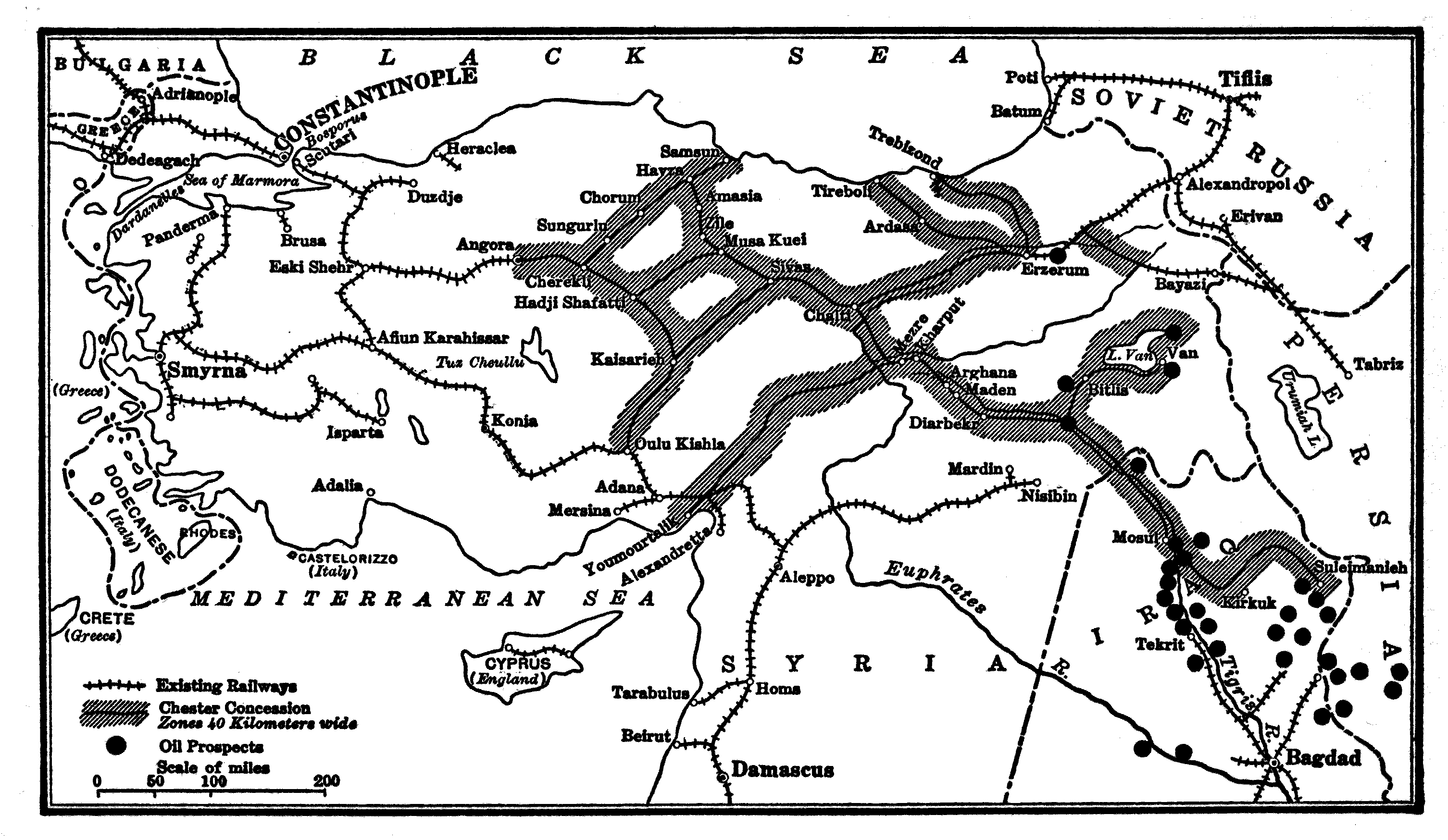
of Asiatic Turkey. Once more the Bagdad Railway, with
its tributary lines in Anatolia and Syria, became one of
the stakes of diplomacy!