IT is about forty years since one first heard of
a Young Turk party. Abd-ul-Aziz, having
broken the early promises of his reign, had
made himself the absolute despot, and had crushed
the liberalism that from the time of Mahmud II had
been gaining ground in Turkey. A number of educated
men then fled from the country to Paris and
London, and, calling themselves the “Young Turks,”
started a movement whose object it was to agitate
for the introduction of reforms into the government
of their native land. Among them were men of
great ability, including the illustrious Kemal Bey;
and all the Turkish literature of that period that had
any value was produced by this group of “intellectuals.”
They published a paper called the Hurriet,
which is the Turkish word for liberty, in which they
exposed in an unsparing fashion the corruption, incapacity,
and lack of patriotism of the high officials
and advisers of the Sultan. The outspoken Hurriet
alarmed the Palace, and was of course placed on the
black list; but it was smuggled into the country,
exercised a great influence, and effected its purpose of
spreading antagonism to the existing state of things.
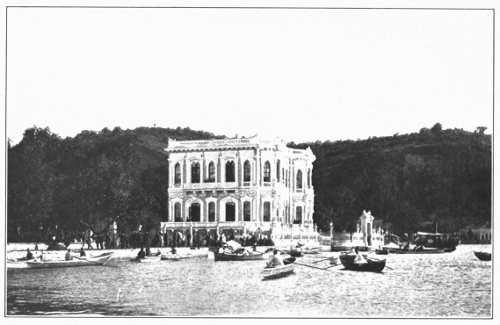
IMPERIAL PALACE OF THE SWEET WATERS OF ASIA
Liberalism, as we have seen, waxed strong enough
to have its way for a short period in Turkey. Abd-ul-Aziz
was deposed, and Midhat Pasha and the
patriotic statesmen who were his associates began to
introduce their reforms. Many of the Young Turks
returned from Europe to support the new Constitutional
Government, some sitting in the short-lived
Parliament which the present Sultan opened on his
accession to the throne.
Those who loved Turkey thought that the day of
her regeneration had dawned at last; but the disillusionment
soon came, for Abdul Hamid, in the
spring of 1878, dissolved the Parliament, suspended
the Constitution, and commenced his ruthless persecution
of liberalism. So the Young Turks were
once again scattered over the face of the earth;
some were imprisoned; some were exiled to distant
provinces of the Empire; some escaped to Europe;
and such as were allowed to remain in Turkey as
free men, had to conduct themselves warily and shun
politics, living as they did under the sleepless eyes
of the ubiquitous espionage.
For about fifteen years after this date one heard
nothing of the Young Turkey movement. If it
existed it had little if any organisation, and had no
power. To all appearances it had been stamped out
effectually by the suppressive measures that had
been taken by the Palace. One came across members
of the scattered band in European cities, earning
their living as teachers of languages and in other
capacities, but these rarely spoke to foreigners of
what was in their hearts, for they found few sympathisers
with the sorrows of Turkey.
But though “Young Turkey” showed no signs of
life it was not dead. In Constantinople and other
big Turkish cities the visitor from Europe would
never hear the movement spoken of; the word hurriet
was, so to speak, expunged from the Turkish
dictionary, and to have been heard uttering it would
have brought denunciation as a traitor. But in far
parts of the Empire tongues wagged more freely, and
the memory of the reformers was kept green. In the
autumn and winter of 1879 I was wandering over
that wildest region of all Europe, Northern Albania,
and there I found that men were speaking very
plainly indeed; for the espionage system was not
then fully organised, and at any rate it had not
reached that lawless province, where the Government
was helpless, and inspired neither respect or fear.
At the period of my visit, Albania, a country which,
as I shall show later, took a prominent part in
the recent revolution, was in a state of positive
anarchy—the gendarmerie on strike, the mutinous
soldiers refusing to salute their officers, neither having
received pay for months, while the natives held
seditious meetings publicly and unmolested in the
mosques of the garrison towns, in which rebellion
against the Porte was fearlessly advocated. The
army officers with whom I conversed despaired of
their country, and those who had been in Constantinople
said that the one hope for Turkey—an administration
under the direction of men of Midhat
Pasha’s stamp—had been destroyed. The army
doctors in Scutari—for the most part Armenians—were
still more outspoken, and advocated the deposition
and even killing of the Sultan. One of these
doctors described the condition of the country to me
in the following words: “You have no idea of what
a corrupt, vile thing this Turkish Government is.
The Court eats all the country. We who work, the
employés of the State, the doctors, the soldiers, never
receive any pay now. As long as they think they
can obtain our labour for nothing, not a para will
they let slip through their fingers. Look at my case.
I have been a doctor in the Turkish army for forty
years. I have been through the Crimean war, over
all Asia, in the service of Turkey. I am entitled to
a good pension. I have been day after day to the
offices at Constantinople, and put my case before
the authorities. They put me off with all sorts of
fair promises, but I knew what these meant, so went
to them day after day, and worried them so much
that they decided to get rid of me in some way.
‘There is a permanent hospital in Scutari in Albania,’
they told me. ‘In consideration of your long
service we appoint you as head doctor of it. Start
at once to your post.’ Now that I have travelled
all this way, at my own expense, mind you, what do
I find? The permanent hospital no longer exists—it
is a myth, and they knew it in Constantinople all
the time, and no doubt chuckled merrily, when I
had turned my back, at the clever way they had rid
themselves of the importunate old nuisance.” Then
he went on to speak of the sufferings of the troops,
and assured me that, faithful and obedient as they
were by nature and tradition, they would not put
up with the vile treatment much longer, and that a
military mutiny was brewing which would destroy
the Despotism within a few months. In this opinion
he was wrong, for thirty years had to roll by
before the event which he predicted actually came
to pass. He also spoke to me of men of the Young
Turk party whom he met in Constantinople during
the brief period of free institutions. He much
admired their tolerance, and asked me whether I
thought that the Young Turk refugees in England,
by explaining Turkey’s trouble, would be able to
persuade the British Government to champion the
cause of Turkish liberty.
I discovered, too, that the fame of Midhat Pasha
as an honest, just, and patriotic statesman had
spread throughout that wild country, and it is not
to be wondered at that the Sultan, fearing him,
brought about his destruction, and so made him
the first martyr of the Young Turkey cause. The
Mussulman Albanians themselves greatly revered
Midhat, and regarded him as their possible saviour.
They had at that time formed themselves into the
organisation known as the Albanian League, whose
object it was in the first place to resist by force of
arms the handing over to Montenegro of the Albanian
town and district of Gussinje, which, by the
terms of the treaty of Berlin, Turkey had ceded to
the mountain principality; and in the second place
to throw off the yoke of the Sultan. The leaguesmen
were then the masters of Albania. They decided
on, and carried out, the murder in Jakova of
Mehemet Ali, the general who had been sent by the
Porte on the dangerous mission of negotiating this
transfer of Turkish territories to her enemies, and
about eight thousand of them, Albanians, Mussulman
refugees from Bosnia, and deserters from the
Turkish army, were holding Gussinje under the leadership
of Ali Bey. Gussinje, by the way, still belongs
to Turkey; for the Great Powers who had
given it to Montenegro were unable to enforce with
the cannon of their warships the surrender of a place
lying amid the mountains of the interior; so Montenegro
ultimately had to content itself with another
arrangement.
I crossed the mountains that lie between Scutari
and Gussinje, and narrowly escaped having my
head cut off as a Russian spy on one occasion; but I
succeeded in seeing a good deal of the Albanian
leaguesmen. In the course of conversation with one
of their chiefs he spoke to me as follows: “The men
who rule in Constantinople, what do they do for us?
Tax us, rob us—that is all. And what do they
give us in return for what they steal? Can they defend
us, protect us? No! They have sold our lands
to the Montenegrins and the Austrians. I tell you
that we of the League have sworn that we will
have the Turk no more. Albania shall have her
independence and the Powers shall recognise us.
If they do not, we care not. Leave us alone; that
is enough for us.” Then turning suddenly to me,
he asked, “What do you English think of Midhat
Pasha?” I told him of the esteem in which Midhat
was held by my countrymen; he seemed pleased on
hearing this, and said, “The Turks will not have him,
but we will. What we wish is to create an independent
Albanian principality, with this good man Midhat
Pasha as our prince.” I have described these
experiences of mine in Albania to show how things
were shaping in the outer provinces of Turkey thirty
years ago, and how, though one heard nothing of
the Young Turks in Europe, the seed they had
sown had not fallen on barren ground; so that at
last, when the time was ripe, the people of Turkey,
remembering what their fathers had told them of the
good Midhat, were ready to range themselves by the
side of his disciples.
But from the year 1878, when the Constitution
was suspended, until 1891 there appears to have
been no Young Turk organisation, though the number
of Turks who longed for deliverance from a
detested régime was increasing by leaps and bounds.
For centuries Geneva has been the safe asylum for
men from other lands who have revolted against the
tyranny of Church or Government, and there, in
these days, is to be found an interesting little society
of Russian anarchists, and all manner of malcontents
and visionaries, who hatch their various plots,
and when the demand arises manufacture the favourite
weapon of anarchy, the bomb. It was in this
fair city, in the year 1891, that a group of Turkish
refugees and exiles formed themselves into the association
that afterwards developed into the “Ottoman
Committee of Union and Progress.”
The time had indeed arrived for patriotic Turks
to bestir themselves and come to the rescue of their
country; for it was about this date that the most
critical period of her history opened, and that various
happenings in her European and Asiatic provinces
threatened the disruption of the Empire. In 1890
the persecuted Armenians commenced the agitation
which later on the Sultan put down with wholesale
massacres. In the early nineties, too, the Bulgarians
in Macedonia initiated the conspiracy which,
after various small risings, culminated in the rebellion
of 1903; and here, as in Armenia, the Turkish
irregulars suppressed insurrection with slaughter and
rapine. Indignation was aroused in Europe, especially
in England, and in 1903 the British Government
urged the other Powers to join her in compelling the
Porte to accept a scheme of reform under European
supervision that should secure fair government and
the security of Turkey’s Christian subjects. But the
jealousy of the Powers stood in the way of any genuine
co-operation, while the policy of Turkey’s two
most powerful neighbours was to destroy the Ottoman
Empire and not to reform it; so the British
scheme was rejected; the measures that were taken by
the Powers proved wholly inadequate; the anarchy in
Macedonia ever grew worse; and it became evident
that sooner or later foreign intervention of an effective
and forcible character would be necessitated.
Now the one essential part of the Young Turk
programme is the preservation of the integrity of the
Ottoman Empire. Opportunists in the rest of their
policy, the Young Turks are determined that no
more Ottoman territory shall be placed under foreign
domination. They feel that foreign interference in
Turkey’s internal affairs means loss of national independence
and the ultimate expulsion of the Turks
from the European side of the Bosphorus. They
entertain the strongest objection to the attempted
settlement of the racial disputes in Macedonia by
foreign Powers, and the chief article of their faith is
that, for Turkey to hold her own in the world, her
reforms must come from within and not from without.
Therefore at this juncture, knowing that they had
the educated classes in Turkey in sympathy with
them, and that oppression had made the masses discontented,
these Turkish patriots in Geneva decided
to create an organisation whose object it would be
to bring pressure to bear upon the Turkish Government,
and move the Sultan to sanction the much needed
reforms. At this early stage they did not
feel sufficiently strong to plan the deposition of the
monarch should he prove obdurate, but they resolved
so to arrange matters in Constantinople as to make
it impossible, in the case of the death of that clever
and masterly monarch, for his successor to rule on
the same despotic lines.
The head-quarters of the organisation was moved
from Geneva to Paris, and it had its branches in
London and other capitals. Little heed was paid to
the Young Turks by the peoples in whose midst
they lived, and many regarded them as harmless
dreamers. But the Sultan himself knew better; his
Embassy in Paris was instructed to watch the
organisation closely, and spies were sent from Constantinople
whose business it was to report directly
to the Palace all they could discover concerning the
members. In Turkey itself active methods of suppression
were taken, and the system of espionage
became ever more unbearable, with the result that
the enemies of the régime increased in number, and
Turkey’s best men fled the country to swell the
band of conspirators in Paris.
Now that men can talk quite freely in Turkey,
returning exiles tell strange and romantic tales of
their adventures in those dark days. For a Turkish
subject to leave Turkey without the permission of
the inquisitorial Government was then a treasonable
offence involving outlawry and the confiscation
of property. As every outgoing steamer was closely
watched by the police, it was no easy matter to
escape from Constantinople by sea, and to do so by
land was still more difficult. On several occasions
distinguished Turks were assisted in their flight by
their English friends. For example, with the connivance
of one of our Consuls, a fugitive Pasha was
concealed in the Consulate, was disguised in a suit
of slops such as sailormen wear, and when the
opportunity arrived quietly walked away from the
carefully watched Consulate in the company of an
English merchant captain, satisfied the questioning
police spies on the quay, and boarded the British
vessel that was to carry him to safety; for he had
been entered on the ship’s books as cook, and
was provided with the necessary consular document
that testified to his having signed articles in that
capacity. Oftentimes, too, some British steamer
passing down the Bosphorus would stop her engines
and, under cover of the darkness, send off the friendly
boat that, by pre-arrangement, would take a party
of fugitive Turks from a lonely beach, and so save
them from the oubliette or the strangler’s cord.
The Palace employed terrorism in Turkey and
corruption in Paris in its attempt to destroy the
Young Turk association. By offers of rewards and
high positions, some of the members were persuaded
to desert the cause and to return to Turkey. Some
were found base enough to serve as spies. Thus,
one, whose name it is perhaps better not to mention,
contrived to work himself into a prominent position
on the Paris Committee, learnt its secrets, and
returned to Constantinople to betray them to the
Sultan. But the organisation ever grew stronger
under persecution, and patriotic Turks supplied the
funds which enabled it to carry on its propaganda.
The Paris Committee published a paper and numerous
tracts, which exposed the iniquities of the
Hamidian régime and called for the deposition of
the Sultan, and these were smuggled into Turkey
and were widely distributed and read, despite the
vigilance of the ever-increasing army of spies. The
agents of the Committee in Constantinople used to
placard the city under cover of the night with revolutionary
appeals, and seditious placards threatening
the life of the Sultan were sometimes placed
upon the walls of the Palace itself. Abdul Hamid,
living in perpetual fear, redoubled his precautions.
In 1901 the Sultan, having been informed by his
ambassador in Paris that the Paris Committee was
preparing a great Young Turkey demonstration in
Constantinople itself, was so anxious to intercept the
correspondence that was passing between Paris and
the members of the Young Turkey party in his capital
that he violated his international agreements
by seizing and breaking open the European mail-bags
that were addressed to the various foreign post-offices
in Constantinople, and thereby provoked the
Powers to threaten a joint naval demonstration,
which was only warded off by a humble apology
and further solemn promises on Abdul Hamid’s
part.
In Paris the “Ottoman Committee of Union and
Progress,” to give the association the now world-famous
name which it assumed a few years ago, was
ably directed by Ahmed Riza Bey, who, having
worked with devotion for the cause through eighteen
years of exile, returned to Turkey after the proclamation
of the Constitution last year, and is now
the President, or Speaker, of the Turkish Chamber
of Deputies. The Committee was also strengthened
during the last few years of the Hamidian régime by
the admission to it of several distinguished Turks of
high rank, who fled from Constantinople to Paris so
as to be able to assist the national movement from
that safe vantage-ground. Among these fugitives
was the Sultan’s relative, Prince Sabah-ed-din, who
threw himself heart and soul into the revolutionary
movement, and advocated a policy more advanced
and radical than that favoured by the large majority
of the Young Turks, whose Liberalism is full-blooded
Toryism when compared to what passes for
Liberalism in England in these latter days. Prince
Sabah-ed-din is an advanced home ruler, and he is
the virtual leader of the “Liberal Union” party,
which is working for a degree of centralisation that
is regarded as dangerous by most Mussulmans, but
is naturally pleasing to the Greeks.
But though these Turkish gentlemen, with their
clever conversation and their charming manners,
were welcomed in Paris salons and London drawing-rooms,
few people in Europe realised that the Young
Turkey movement had the remotest chance of
attaining its ends; for it was a silent movement,
and while the Greeks, Bulgarians, and Armenians
voiced their grievances with a persistence that gained
for them a wide hearing and much sympathy, the
patriotic Turks, unwilling to invoke the help of
foreigners, took no steps to make their aspirations
known in Europe. Ahmed Riza did, indeed, come
over to London in 1904, and, for the first time in
his life, addressed a meeting of Englishmen, but it
was not to crave sympathy for the Mussulman Turks
whom he represented, but to express the sentiments
of his party regarding foreign intervention in Turkey,
whether it were that of a Government or of the
English humanitarian committees. In the course of
his speech Ahmed Bey, while admitting the justice
of a revolt against despotism, condemned the European
friends of Armenia and Macedonia for wrongfully
and artificially inciting a rising, and so playing
the part of the Pan-Slavist agents, and he practically
put it that by fomenting insurrection among
the Christian populations in Turkey they were more
or less responsible for the massacres which followed.
The meeting, to quote from the official report, “became
extremely agitated, and many interruptions
were addressed to the speaker.” The speakers who
followed had some unkind things to say concerning
Ahmed Riza and the Young Turks. Here is a
quotation from the speech of an influential humanitarian
who was present: “I am not sorry that the
gentleman has spoken, because it shows us how impossible
it is to expect any reforms in Turkey from
the Young Turkish party. They are only thinking
of themselves. The liberties of the Christians would
be just as unsafe under a Sultan with the sentiments
of the gentleman who has just sat down, as under
the present Sultan.”
And yet, even at that time, Ahmed Riza and his
Mussulman associates were planning a scheme which
was intended to bring liberty, justice, and security
to the oppressed Christian subjects of the Porte, and
was, moreover, destined to prove successful where
all the diplomacy of the Powers and the too often
misdirected efforts of the humanitarians in Europe
had signally failed. For the Young Turks, like their
great forerunner, Midhat Pasha, realised that Turkey
could only be saved from disintegration by
placing all her races and creeds on an equality, by
giving the same rights to all. They therefore set
themselves to bring about a co-operation of the
various elements of the Turkish population, and to
make common cause with the Armenian, Bulgarian,
and other revolutionary non-Mussulman committees
in Paris.
It appeared, to those who heard of it, as being
the most chimerical of schemes; for the Young
Turks and their proposed allies had but one aspiration
in common—the overthrow of the Despotism.
Their ideals seemed indeed to be irreconcilable. The
Young Turks above all things desired the maintenance
of the integrity of the Ottoman Empire and a
union of her peoples that would make the Empire
strong. On the other hand, the non-Mussulman
revolutionaries cared nothing for the integrity of the
Empire. For the most part they desired not to
reform Turkey, but to break her up. Neither did
they seek union among themselves; for the different
Christian races hated each other, and cherished
mutually incompatible ambitions. Thus, Bulgarians,
Greeks, and Serbs in Macedonia dreamt of the
formation of autonomous States, or of annexations
to Bulgaria, Greece, and Servia, respectively. There
was to be found, too, in some of the non-Mussulman
committees, a considerable leavening of anarchical
and socialistic ideas with which the conservative
Turkish reformers could have no sympathy. Out
of elements so incongruous, and in many respects
antagonistic, it would seem impossible to effect any
sort of co-operation.
But the Young Turks were terribly in earnest,
and were patient and persuasive; they compelled the
leaders of the non-Mussulman committees to listen
to their arguments, and they sent delegates to their
meetings; but it was, of course, not for a long time
that they could come to an understanding with men
who found it difficult to believe that any form of
Turkish rule could deal fairly with Christians and
Jews. At last, wonderful to say, the Young Turks
in Paris, being honest patriots, succeeded in convincing
the other groups of their sincerity when they
put forward the full equality in the eyes of the law
of all races and creeds in Turkey as an essential portion
of their programme.
The Armenian committees were the first to fall in
line with the Young Turkey movement, and the
union between them that was arranged in Paris, in
1903, has been faithfully observed by both parties.
It will be remembered how the two races fraternised
after the declaration of the Constitution, how the
world was amazed by the spectacle of Armenian
and Moslem clergymen walking arm in arm in processions,
and how loyally the Turks and Armenians
worked together during the Parliamentary elections.
It was, indeed, a natural alliance; there has never
been real enmity between the two races until the
present Sultan’s reign. The Armenian massacres
were not the work of Turks but of savage Kurds,
instigated by the Palace Camarilla. “Few incidents
in history are more touching,” writes a Turkish subject
in the Nineteenth Century, “than the visit paid
by a large assembly of Turks (in August last) to
the Armenian cemetery in Constantinople, in order
to deposit floral tributes on the graves of the victims
of the massacre of 1894, and to have prayers recited,
by a priest of their own persuasion, over the butchered
dead.”
Moreover, there were few political difficulties in
the way of an understanding between the Young
Turks and the Armenian revolutionaries. The
problem was not like that of the Greeks and Slavs
in Macedonia, who had on the frontier independent
nations of people of their own kin on whom to lean
and to whom to look for protection and perchance
annexation. For Armenia is now but a geographical
expression, and ancient Armenia has been partitioned
between Turkey, Russia, and Persia. The
Armenians in Turkish Armenia are vastly outnumbered
by the Moslem population; and the creation
of an independent Armenian principality, desired
by a section of the revolutionists, was obviously an
impracticable scheme. The more sensible Armenians
realised that the only alternative for the rule
of Turkey was that of Russia, and the experience of
their brethren across the border had proved to them
that, of the two, the rule of Turkey was to be preferred;
for under it they enjoyed a measure of racial
autonomy and various privileges—much restricted,
it is true, under Abdul Hamid’s despotism—which
the Russian Government, ever bent on the Russianisation
of the nationalities subject to it, would certainly
have denied to them.
It was, therefore, the aim of the moderates among
the Armenian malcontents, while remaining under
Ottoman rule, to secure the civil liberties and institutions
calculated to guarantee their personal safety,
the security of their property, and the honour of their
wives and daughters. Now the Young Turk programme
promised them these things and more; so,
realising that this great Mussulman movement was
likely to meet with success, they decided to throw in
their lot with Ahmed Riza and his brother revolutionaries.
But this union could not be accomplished until the
Armenians had consented to abandon the methods
of their propaganda. They had for years been
appealing to the European Powers, through their
Committees, to compel the Sultan to grant good
government to his Christian subjects in Armenia
in accordance with the solemn pledges which he
had given to the signatories of the Treaty of Berlin.
But the Young Turks insisted that there must be no
appealing to foreign Powers for assistance, that the
Armenians henceforth would have to rely upon the
support of their Mussulman fellow-subjects alone,
that they must now cease from such agitation as
might invite further massacres, and await the outbreak
of the revolution that was to deliver all the
races that were oppressed by the Despotism.
It may have been noticed that from the date of
this understanding, in 1903, one heard very little
about trouble in Armenia; the violence of the Armenian
propaganda was restrained by the leaders so
that the Young Turk movement might not be embarrassed,
and the attention of Europe was now
turned to the state of anarchy in Macedonia. The
Young Turks always worked in secret, but when
policy demanded it they sometimes came out into
the open. Thus it was that Ahmed Riza went to
London in 1904, shortly after the union between his
party and the Armenian Committees, and, in the
speech from which I have quoted, protested at a
public meeting against the interference of English
humanitarians in the affairs of Armenia. He also
seems to have influenced those who governed the
policy of the Anglo-Armenian Association and to
have won their confidence in his judgment, for it
was at about this time that the active propaganda
of this organisation suddenly came to a stop.
But Ahmed Riza and his associates, though they
were working diligently to prepare the ground for the
coming revolution by sending emissaries to inoculate
the young army officers in Turkey with their
views, and the Moslem clergy with interpretations
of the Koran that breathed the spirit of reform and
tolerance, kept their doings secret even from their
friends. The revolution, so carefully planned, came
as a complete surprise even to those Englishmen
who had come in touch with the Turkish reformers
in Paris and sympathised with the aspirations of
those intensely patriotic men who shunned politics,
declined interviews with the press, and lived most
frugal lives, while they devoted themselves with
single-minded zeal to the cause. I may mention
that since 1904 the officials of the Eastern Questions
Association (which, I believe, has always held
the view that a strong and independent Turkey is an
essential factor in the polity of nations) have been
on friendly terms with Ahmed Riza Bey, visited him
in Paris, become strong supporters of the Young
Turk party, and have vigorously denounced the
crooked policy of Russia and Austria in Macedonia.
The Young Turks thus came to an understanding
with the Armenians, and later on it was arranged
between them that when the time was ripe, and the
Committee gave the word for the Mussulman revolt
in Turkey, the Armenians should also rise; for it was
realised that the Sultan would yield to nothing but
force, and that only by means of an armed rebellion,
and that possibly a very bloody one, could the liberators
of Turkey effect their end.
And now the Young Turks set themselves to win
over to their cause the other non-Mussulman revolutionary
Committees. With the Jews, as with the
Armenians, they had relatively little difficulty, for
the Jews were a people without a land, and therefore
could entertain no schemes of national independence;
their hope and interests lay in the good government
of the Ottoman Empire. But with the Bulgarians,
Greeks, and Serbs of Macedonia, whose very last
idea it was to become patriotic Ottomans, the Young
Turks found the work of persuasion attended with
almost insuperable difficulties.
To these revolutionaries other forms of argument
had to be applied. It was pointed out to them that,
unassisted from outside, they could not hope to
conquer their independence with the sword from the
armies of the Sultan; that the mutually jealous
Great Powers, if they did intervene in Macedonia,
were not in the least likely to favour the political
aspirations of the Christian populations; that to
appeal to foreign intervention was a very dangerous
thing; and that the annexation of the greater part of
Macedonia to Austria-Hungary—in detestation of
which Power all these Balkan races are united—might
be the result of the state of anarchy in that
region for which the revolutionary bands were
responsible; in short, that it would be to the advantage
of the Macedonian Christians to abandon their
ideas of separation from the Ottoman Empire and to
join cause with the Young Turks, whose aim it was
to hold the Empire together and to give equal rights
to all its peoples.
Wonderful to say, the Macedonian Committees in
Paris at last allowed themselves to be persuaded,
and threw in their lot with the Young Turks, half-heartedly,
perhaps, at first, and with mental reservations.
They realised that they could hope for little
help from Europe, and were willing to work with
the Young Turks in upsetting the Hamidian régime.
After a successful revolution something might turn
up that would enable them to gain the national independence
that they still had at heart; and even if
that hope was destroyed, they would be able, having
supported the Young Turks, to claim the equal
rights which these had promised to them. But the
conflict of interests that severed the various groups,
and the anarchical principles that some of the revolutionary
leaders professed, made the reconciliation
of all these discordant elements a matter of great
difficulty. The Congress held in Paris, in 1902, had
for its chief result the accentuation of schism; it was
not till 1907 that the various Committees were able
at last to arrange a programme that was acceptable
to all; and by that time the Young Turks had
established their secret society in Macedonia and
had gained the allegiance of a considerable portion
of that formidable Turkish army without whose
cooperation, as the Christians in Macedonia knew
well, no revolution had a chance of success.
So in December, 1907, a Congress of the Turkish
revolutionaries met in Paris, at which were represented
the Ottoman Committee of Union and
Progress, the Armenian, Bulgarian, Jewish, Arab,
Albanian, and other Committees; and the delegates
all agreed to accept the following principles: The
deposition of the Sultan Abdul Hamid. The maintenance
of the integrity of the Ottoman Empire.
Absolute equality in the eyes of the law of the
various races and religions. The establishment of
Parliamentary institutions on the lines of Midhat
Pasha’s Constitution.
The “Ottoman Committee of Union and Progress,”
as representing the dominant race and the
fighting forces of the revolution, naturally now took
the lead, and its members, of whom but a few
were non-Mussulmans, became the organisers of the
revolt and mandatories of the other Committees.
It may be pointed out here that the resolutions of
the Congress had no effect in pacifying Macedonia,
where, indeed, the condition of affairs was ever
becoming worse; for Greece and Bulgaria, still looking
forward to the disruption of Turkey, were pouring
into Macedonia their armed bands to “peg out
claims” in the Greek and Bulgarian interest; and
throughout all that region violence, murder, and
rapine prevailed. Of no more effect were the efforts
of the Great Powers, which, in 1907, issued a categorical
declaration that no Macedonian race would
be permitted to draw any territorial advantage from
the action of its bands.