There are few turkey-raising problems so important as brooding
and rearing the poults, because the greatest losses in turkey raising
usually occur in the first few weeks of the birds' lives. Heavy mortality
among the poults may indicate that the breeding stock used
was low in vitality or was poorly managed, but it more often indicates
poor feeding or management of the poults. The importance
of keeping both the poults and the breeding turkeys on ground free
from infection and away from chickens cannot be overemphasized.
Improper brooding methods cause great losses, because turkey poults
are very susceptible to cold, dampness, overcrowding, overheating,
unsuitable feeds, and unsuitable litter, and they succumb readily to
attacks of diseases and parasites.
The poults may be brooded naturally by turkey hens or artificially
by brooders. Brooding by turkey hens provides a never-failing
source of heat, allows the poults to be raised in small flocks, and permits
taking advantage of free-range conditions. Its disadvantages
are that the young turkeys may contract disease or become infected
with parasites from the hens and they may wander too far and be
killed by storms or predatory animals. Artificial brooding makes it
easier to maintain proper sanitation, keeps down costs, puts the poults
more directly under the control of the operator, and is more adaptable
to large-scale production.
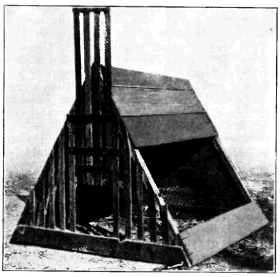
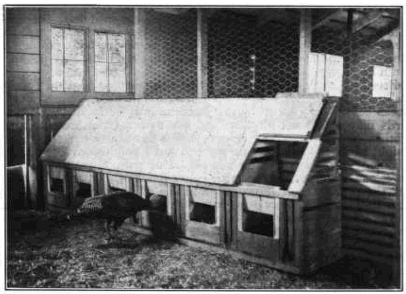
Figure 10.—A well-built brood coop which can be used
either for setting a turkey hen or for raising a brood of poults.
Brooding poults by turkey hens is not difficult, although several
details should receive careful attention. As soon as the hatch is
completed and the poults begin to run out from under the sitting
hen, transfer the hen
and her brood to a
coop. A coop of simple
design, such as the
A-shaped type (fig. 10), large enough to
accommodate a turkey
hen comfortably, and
well built to protect
the brood from rains
and natural enemies,
is all that is required.
It should be about 5
feet long, 3 feet wide,
and 3 feet high, with
a raised, rat-proof
floor. Provide good-sized
screened openings
for ventilation in
hot weather. These
openings should be so
fixed that rain will
not beat into the coop. Have a separate coop
for each hen, and if
there are several broods, place the coops some distance apart on well-drained
soil where the grass is fairly short.
For the first day or so it is well to confine the poults in the coop
with the mother hen. Then make a small yard, using boards or wire
around the front of the coop, and allow the poults to run in and
out at will. However, they should not be allowed to run in long,
wet grass, and during heavy rains they should be confined to the
coop. Move the coop and yard to fresh ground every few days, clean
it once a week or more frequently, and disinfect it occasionally.
When the poults are about a week old the mother hen may be allowed
to roam with her brood, but care should be taken to see that the
entire brood returns in the evening and is protected at night from
predatory animals. Good results may be obtained by keeping the
mother hens confined and allowing the poults to range, but the brood
should be properly sheltered during rainstorms or damp weather,
which are likely to cause high mortality. The poults may be kept
with the mother hen for 3 months or more, but better results are
usually obtained by moving them to a separate rearing field on clean
ground when they are from 8 to 10 weeks old. If they have shelter
and will roost, they are better off without the hens after that age.
A turkey hen will raise up to 20 poults successfully, but more than
20 can sometimes be placed with a hen in warm weather.
The practice of brooding poults artificially is becoming more popular
and is usually more successful than brooding with turkey hens.
The methods used in artificial brooding are very similar to those used
in raising chicks, which are discussed in Farmers' Bulletin 1538,
Incubation and Brooding of Chickens. However, one point of great
importance in brooding poults artificially is to make sure that they
do not crowd together while in the brooder house. This can be
avoided by frequent attention, by providing an even temperature,
and by having good ventilation in the brooder house. A colony
house or permanent brooder house that is suitable for brooding chicks
is equally suitable for turkeys, but fewer birds should be put in the
house, as turkey poults are larger than chicks. Between 75 and 125
poults should be placed under one 52-inch hover in the average
colony brooder House. Larger hovers and larger brooding rooms will
accommodate 225 poults or more, but only an experienced operator
should attempt; to raise groups larger than 150. The prevailing
custom is to use brooder stoves in portable colony houses or permanent
brooding quarters.
The colony houses may be moved several times each season, thereby
giving the poults plenty of free range on clean soil. Since blackhead
is closely associated with insanitary conditions, special effort must
be made to keep the houses, runs, and yards clean. If permanent
brooder houses are used, a floor of concrete from 12 to 14 feet wide
or a small gravel or cinder-floored yard is often used in front of the
house. A skeleton framework covered with to 1-inch-mesh wire
may also be used to floor the outside run either with the permanent
brooder houses or with the colony houses (fig. 11). Poults are
regularly confined to this small yard for the first 8 weeks and in some
cases have been successfully reared to market age in it. However,
a clean yard containing growing green feed is an advantage in brooding.
If it is used only for about 8 weeks each year, there seems little
danger of contamination.
The brooder and brooder house should be operated to keep the
young turkeys comfortable. A dim light under or above the hover
at night has a quieting effect on the poults. The temperature should
be high enough to keep the poults comfortable but not high enough
to be detrimental to their health. When the poults are first put into
the colony house with the brooder stove, the temperature 3 inches
above the floor under the hover should be from, 95° to 110° F. This
temperature should be lowered gradually as the poults get larger
until they are 6 or 8 weeks old, when they require little or no heat,
especially in the daytime. It is a common practice in cold weather
to keep the general room temperature at the floor rather high, about
75°, to prevent crowding. The exact temperature, however, is of
minor importance provided the poults are kept comfortable and good
ventilation is maintained. The poults, if comfortable, will be active
and contented. This is the real test of temperature. All warm
points and surfaces except those at the brooder itself should be
eliminated. Free access from all parts of the brooder room to the
hover must be provided. All corners in the brooding room, especially
back of the hover, should be rounded, preferably by using 1/2-inch-mesh
poultry wire. A fence of the same material should be set up
around the hover for the first 2 or 3 days until the poults become
accustomed to their surroundings and learn to return to the source of
heat. Flat roosts 2 to 21/2 inches wide and slightly tilted up at the
rear may be placed at graduated levels in the brooder house when
the poults are from 2 to 3 weeks old, to encourage them to begin
roosting at an early age. This provision lessens the danger of night
crowding. The front roost should be 6 inches above the floor and
each of the others a few inches higher than the one in front of it
and about 81/2 inches apart, center to center.
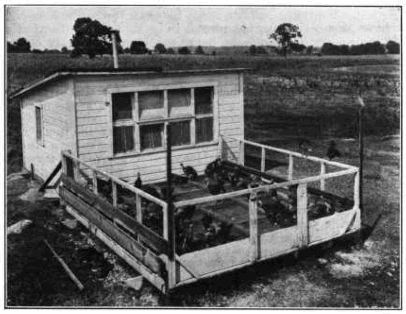
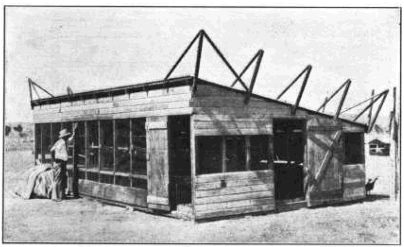
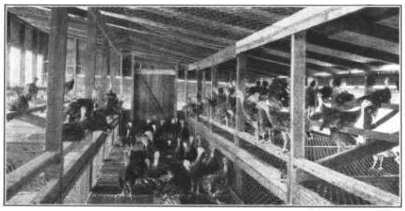
Figure 11.—Young turkeys in a colony house equipped with wire-floored sun porch.
The brooder house should be thoroughly cleaned and the litter
changed once every 7 days, or oftener if disease occurs, regardless of
the type of litter used. This cleaning schedule must be adhered
to rigidly if blackhead, coccidiosis, and other diseases are to be
prevented.
Thoroughly clean and disinfect brooder houses and equipment
used for turkeys at the end of each brooding season or oftener if
disease occurs. First clean the house thoroughly and burn all
litter and droppings or haul them to land that is not to be used for
poultry and from which there will be no drainage into the turkey
range. Then scrub the floor and sides of the house, if it is of board
construction, with boiling hot lye solution (one-third of a can to
a pail of water) and allow them to dry out. Next, thoroughly
spray the entire inside of the building with a 3- or 4-percent solution
of cresol compound or any other approved disinfectant. Give
the same treatment once a year to the quarters occupied by the breeding
stock. The "fire gun", a large kerosene torch which involves
the blow-torch principle, has proved to be valuable in disinfecting,
if it is properly used and the house has been thoroughly cleaned.
Sand or gravel is recommended for litter for the first 2 or 3
weeks; after that, clean wheat straw is advised as a means of saving
labor. Gravel or sand makes the best litter; but with large flocks,
using it for more than 2 or 3 weeks may require too much labor.
Straw or hay, if used during the first 2 weeks, may cause a stunting
of growth and a high mortality. Many growers have been successful
in using, as a substitute for litter, 1/2-inch wire mesh stretched
tightly a few inches above the floor of the house, but it requires
much labor to clean this, and it seems to have no advantage over
clean litter. A wire-floored sun porch makes a good substitute,
for an outside yard during the brooding period although, as previously
stated, a clean yard in grass is preferable.
The poults, when first hatched, are covered with soft down. When
they are about 10 days old, feathers begin to appear where the wings
join the body, and in about 3 weeks the tail feathers begin to appear.
From then on feather growth is rapid, and when the poults are 2
months old they are well feathered. About the fifth week fleshy
protuberances called caruncles begin to appear, and by the seventh
week they begin to extend down the neck. The appearance of caruncles
in the poults is termed "shooting the red." On the top of
the head of both males and females a fleshy protuberance develops
into what is called the "dew bill" or "snood"; on males it is larger
and more elastic than on females.
The sex of young turkeys can be distinguished by the appearance
of a tuft of hairs on the breast of males between 3 and 4 months old.
The tuft usually does not appear on the breasts of the females until
they are much older, and the hairs of the tuft are shorter and finer
than those on males. The hock joints on the males are much broader
and heavier than on the females. The sex of well-grown Bronze
turkey poults can be distinguished by examining the mature breast
feathers which appear at 12 to 14 weeks. Those of the males are
bronze black with no white, whereas the tip of those of the females
have a narrow white edge. Day-old poults may be sexed as is done
with baby chicks by examining that part of the sex organs that can be
seen at the vent.
When large numbers of turkeys are raised it is advisable to adopt
some system of marking the poults that enables the grower to keep
a record of the age and breeding of the different broods, as this is
of assistance in selecting early hatched birds for breeding and slaughter
purposes. Such a system also makes it possible to separate the
poults out of special matings from the rest of the flock or from
neighboring flocks. The poults may be marked by punching holes
in the webs between the toes or slitting these webs. Different webs
may be punched or slit for different broods, and thus provide a
record of all turkeys raised.
Heavy, aluminum, clinch pigeon-wing bands are well adapted for
marking young turkeys. The bands can be applied in two ways:
According to the first, the band is first made round and clinched,
then slipped over the baby poult's toes and flattened so that it will
not come off but at the same time will allow for some growth of the
leg. When the poult is about 4 weeks old the band is transferred
to the wing by unclinching and inserting it in a hole made in the
middle of the web between the first and second joints of the wing
and about one-fourth inch from the edge. The band is again
clinched and made round so that it is not easily flattened and its
lettering can be read easily. According to the second method of
application the band is put directly into the wing at hatching time,
a thin knife blade being used to make the hole for the band, near
the edge of the web and midway between the joints of the wing.
Turkey poults, when good sized, may be tattooed on the wing for
identification. When the breeding turkeys are selected as they approach
maturity, heavy wing bands or heavy permanent leg bands
may be used if the birds were not marked at an earlier age.
Success in turkey raising depends mainly upon the combination
of feeds given the young poults. Poor-quality feeds, lack of vitamins,
and shortage of proteins, especially if the poults are closely
confined, are the more common causes or failures. Some difficulty
may be experienced in getting artificially brooded poults to eat, as
a young poult is much less active than a chick; but if several small
troughs are provided there should be no serious trouble from this
cause. Dipping the beaks of backward poults in milk or water, or
feeding oatmeal flakes may induce them to eat. Poults brooded with
hens, of course, do not need this special attention.
After the poults are from 6 to 8 weeks old they may get some of
their living from a good range, but the use of additional feed, preferably
a balanced ration of mash and scratch grain, will give better
growth and result in early maturity and greater returns above feed
cost.
In natural brooding the turkey hen, while confined to the coop,
should be fed mash and given some tender green feed. Water and
gravel or grit should, of course, be kept before her all the time.
In feeding the hen and her brood it is advisable to feed the poults
outside the coop and the hen inside in order to prevent the hen from
wasting the feed intended for the poults.
For the first 24 to 72 hours after hatching, poults can live without
feed, the yolk of the egg which they absorb before hatching being
sufficient to maintain them for that length of time. As soon as they
are put into the brooder house or with the hen they should be fed.
If they are not fed for the first day or two they should be kept in
a darkened coop or incubator. However, leaving the poults in a
darkened incubator for only 12 to 24 hours and feeding them as soon
as they are removed to the brooder seems to be better and is now
becoming a general practice.
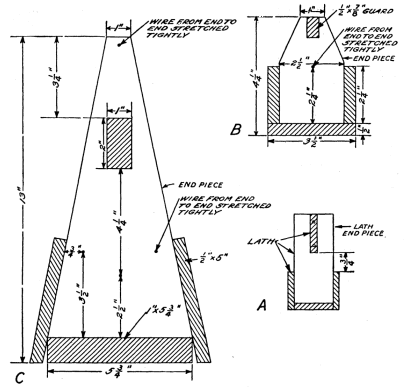
Click on image to view larger version.
Figure 12.—Cross section of trough feeders for turkey poults of various ages;
A, Lath
feeder for first week;
B, feeder for second to fourth weeks;
C, feeder for fifth to twelfth
weeks. Feeder
C will give better results if equipped with a reel, at the top, similar to
that shown in
figure 14.
The first feed may be a mixture of finely chopped, tender green
feed, and dry starting mash. Hard-boiled eggs, ground or crumbled,
may also be added if desired. This feed should be placed on clean
boards or in little feeders made of laths as illustrated in figure 12.
It is a good plan to keep the feed before the poults at all times from
the very beginning so that the backward poults will learn to eat
and their growth rate will not be retarded. Milk, if not too high
priced, may be kept before them in easily cleaned crockery, tin,
wooden, or graniteware receptacles which the poults cannot get into
or contaminate. After the first few days the green feed, unless it is
available in the yards, may be spread on top of the mash in the
feeders. Turkey poults appear to be easily harmed by eating large
quantities of tough, fibrous litter or green feed; hence the selection
of a tender green feed is most important.
The use of a well-balanced, all-mash ration is the simplest and most
practical method of feeding poults during the first few weeks of their
lives. Many commercial starting mashes are available or good home-mixed
mashes may be used with excellent success. The protein, mineral,
and vitamin contents are the main points to be considered. Milk
in some form is very desirable, dried milk being preferable. Liquid
milk is a fair feed, but the dried form is preferable at least for starting
rations.
The following starting mashes are recommended for feeding turkey
poults during the first 6 to 8 weeks. Mash No. 1, fed without liquid
milk, is preferable.
| STARTING MASH NO. 1 |
Parts by
weight |
| Yellow corn (ground) |
17 | |
| Whole oats (pulverized) |
15 | |
| Meat scrap (50- to 55-percent protein) |
12 | |
| Wheat bran |
12 | |
| Wheat middlings or shorts |
12 | |
| Dried milk |
10 | |
| Alfalfa leaf meal |
10 | |
| Fish meal (60-percent protein) |
10 | |
| Cod-liver oil |
1 | 1/2 |
| Salt (fine, sifted) |
| 1/2 |
| Total (crude protein 25 percent; crude fiber 6 percent) |
100 | |
| STARTING MASH NO. 2 |
Parts by
weight |
| Yellow corn (ground) |
33 | |
| Wheat middlings or shorts |
20 | |
| Wheat bran |
10 | |
| Whole oats (pulverized) |
10 | |
| Meat scrap (50- to 55-percent protein) |
10 | |
| Alfalfa leaf meal |
10 | |
| Fish meal (60-percent protein) |
5 | |
| Cod-liver oil |
1 | 1/2 |
| Salt (fine, sifted) |
| 1/2 |
| Total (crude protein 19 percent; crude fiber 6 percent) |
100 | |
Starting mash No. 2 is advised for feeding when liquid skim milk
or buttermilk is kept before the poults at all times. Some water is
furnished, allowing one dish of water to several of milk. These starting
mashes are fed without scratch grain; but water, green feed, and
hard grit such as fine gravel, coarse sand, or commercial granite
grit should be supplied. The green feed should be chopped fine and
scattered on top of the mash in the feeders once or twice daily, allowing
all the poults will consume in about half an hour. Tender
alfalfa tops, onion tops, lettuce, and tender, short lawn clippings,
preferably those containing clover, are all good feeds. Tough green
feed should be avoided as it may cause impaction. Green feed as
picked by the birds from the yards is most desirable. In that case
hand feeding is not necessary. The mash in dry form should be
kept before the poults at all times, but only enough mash to last for
a day or two should be supplied at one time. About 1 inch of feeder
space per poult (including both sides of the feeders) is desirable.
This should be increased to 2 or 3 inches after about 2 or 3 weeks.
Plans for feeders are shown in figure 12.
Rations for growing the poults after the age of 6 to 8 weeks may
include mash and whole grain or liquid milk and whole grain. Many
turkeys are grown and fattened on grain supplemented with whatever
insects and green feed can be obtained from the range. A better
plan is to provide sufficient protein and minerals to give normal
growth. The minimum feeding advised is to allow each day one
liberal feeding of a 20-percent protein mash, or to furnish all the milk
the birds will drink with a feeding of whole grain. Either the mash
or the liquid milk should be used with liberal feedings of whole grain
for fattening in the fall.
Good growing mashes suitable for different conditions may be made
as follows:
| GROWING MASH NO. 1 |
Parts by
weight |
| Yellow corn or barley (ground) |
25 | |
| Oats or grain sorghum (ground) |
25 | |
| Wheat middlings or shorts |
20 | |
| Meat scrap (50- to 55-percent protein) |
19 | |
| Wheat bran |
10 | |
| Salt (fine, sifted) |
1 | |
| Total (crude protein 19 to 21 percent) |
100 | |
| GROWING MASH NO. 2 |
Parts by
weight |
| Yellow corn or barley (ground) |
32 | |
| Soybean oil meal |
26 | |
| Wheat middlings or shorts |
15 | |
| Wheat bran |
10 | |
| Oats or grain sorghum (ground) |
10 | |
| Steamed bonemeal |
4 | |
| Ground oystershell or limestone |
2 | |
| Salt (fine, sifted) |
1 | |
| Total (crude protein 191/2 percent) |
100 | |
| GROWING MASH NO. 3 |
Parts by
weight |
| Yellow corn (ground) |
35 | |
| Meat scrap (50- to 55-percent protein) |
15 | |
| Wheat bran |
10 | |
| Wheat middlings or shorts |
10 | |
| Oats or barley (ground) |
10 | |
| Alfalfa leaf meal |
10 | |
| Dried milk |
9 | |
| Salt (fine, sifted) |
1 | |
| Total (crude protein 20 to 21 percent) |
100 | |
| GROWING MASH NO. 4 |
Parts by
weight |
| Yellow corn (ground) |
20 | |
| Wheat middlings (standard or brown) |
15 | |
| Oats (finely ground) |
15 | |
| Wheat bran |
10 | |
| Alfalfa leaf meal |
10 |
| Yellow corn gluten meal |
10 | |
| Dried milk |
10 | |
| Meat scrap (50- to 55-percent protein) |
5 | |
| Steamed bonemeal |
2 | |
| Ground oystershell or limestone |
2 | |
| Salt (fine, sifted) |
1 | |
| Total (crude protein 20 percent; crude fiber 6 percent) |
100 | |
These growing mashes are all fed with scratch grains consisting of
such grains as corn, wheat, barley, and oats. Corn, wheat, or barley
may be used as the only scratch grain except with growing mash No. 4,
which should contain from 50 to 75 percent of oats. A good grain
mixture may be made of 40 parts of corn, 40 parts of wheat, and 20
parts of oats. Mashes 1 and 2 are for flocks having access to a good
green range. In mash No. 2 soybean oil meal, which has proved to
be a good source of protein and is also good for fattening, is substituted
for meat scrap. Mash No. 3 is a more complete ration and is
advised for all conditions where the turkeys do not have an abundance
of growing green feed.
Other combinations of grains and byproducts may be used successfully,
the exact selection depending largely on availability and cost
of feeds. It is best to use at least two grains, and preferably three or
four, in the ration. Corn is the grain most commonly used in feeding
turkeys. Not more than 60 percent of the entire growing ration
should consist of oats or barley or a combination of the two. Yellow
corn tends to produce a deep-yellow skin color while white corn,
barley, and wheat produce turkeys with light-colored skins.
If the birds have all the milk they will drink along with whole
grains, they will consume enough milk to make good growth, if no
water is fed. A mixture of 30 percent of corn, 30 percent of oats,
20 percent of wheat, and 20 percent of barley is satisfactory; so is
a free choice of several grains. However, the whole-grain and
liquid-milk method works well only when the birds are on a good,
green range and is practical to use only when milk products are
cheap. Some loss from pendulous crops is to be expected when liquid
milk is consumed liberally and this is one of the chief objections to
its use. The milk receptacles should be set on a wire screen and covered
to protect them from the weather and from contamination with
droppings. Sanitation is especially important when milk is used.
Feed should be kept before the birds constantly from hatching to
market age. During the first 6 weeks feed starting mash. During
the seventh and eighth weeks feed a mixture of equal parts of the
starting and growing mashes. From 9 to 12 weeks feed the growing
mash. From 13 weeks to marketing feed growing mash and scratch
grain. No scratch grain is fed during the first 12 weeks. If a
change is made from mash to the whole-grain and liquid-milk
method, cut down the mash gradually until the poults learn to drink
the milk and to eat the whole grain freely.
Cod-liver oil is necessary in starting rations, but as a rule it is
not necessary in a growing ration unless the birds are confined. In
that case, about 1 percent should be added to the mash. A good grade
of plain cod-liver oil is advised for use in turkey feeds. Fish meal,
though an excellent feed, may impart an undesirable flavor to turkey
meat. Fish meal and cod-liver oil should be omitted from the fattening
ration during the last 8 weeks before the birds are marketed.
Birds should not be moved, or feeding arrangements radically
changed in the last 6 weeks before marketing.
Feeding the growing mash wet is a common practice in some
localities. Like the dry-mash and scratch-grain system, it produces
fine-quality turkeys although the labor in feeding may be greater.
With this method the turkeys are fed all they will eat of a moist,
crumbly mash placed in troughs with sufficient trough space provided
to accommodate all the flock at one time. Only as much mash as
the birds will clean up in 30 to 60 minutes is fed twice daily. Tail
picking seldom occurs during moist-mash feeding if the ration is
complete.
Grit may be furnished in the form of commercial granite grit or
coarse sand for little poults and fine gravel for the larger birds.
Limestone grit does not serve well as grinding material and is
unnecessary with the rations as listed.
The poults may be put on the rearing ground when they are from
8 to 12 weeks old. An alfalfa field is an ideal rearing ground and
may be used as a permanent, fenced, rearing range divided into 2
or 3 sections. When the rearing range is divided into 2 sections,
1 may be used for 2 seasons in succession while the other is rested
for 2 seasons. A better plan is to divide it into 3 parts, allowing
1 season's use followed by 2 seasons' rest for each of the 3 sections.
With portable houses and fences a method known as the "Minnesota
plan" (p. 37) permits the turkey poults to be moved to a new section
once a week and to an entirely new plot each year. Land on which
no poultry of any kind have run for 2 years and on which no poultry
manure has been spread, may be considered clean ground. The feed
should not be put on the ground but in hoppers or troughs which
should be moved frequently or set on wire-covered framework to
prevent contamination with droppings. It is very important that
the drinking water be fresh and clean and that the growing turkeys
should not have access to stagnant water pools. Watering dishes
should be placed on wire-covered platforms with a device to prevent
contamination from the birds' perching on the top or sides.
The limited-range method with full feeding, as described, is recommended
in preference to free range with limited feeding. However,
conditions sometimes demand that free range be permitted, and
limited feeding practiced. In such cases, when natural feed is
abundant, good results can be obtained by feeding the poults, after
they are from 8 to 10 weeks old, only once daily, as previously
suggested. Any of the growing mashes previously listed should make
a good supplement to range feeds. This extra feed will tend to
keep the birds nearer home and keep them growing at a reasonably
good rate. Scratch grains should also be fed and as marketing time
approaches, will be eaten more liberally by the birds. For turkeys
on free range, plenty of water in convenient locations should be
provided. Water helps to maintain good health and may help to
prevent the condition known as "crop bound."
Turkeys which are well fed should make increases in weight comparable
to those given in table 2, which gives the average weights,
at various ages, ox Bronze turkeys raised in an experiment conducted
at the United States Range Livestock Experiment Station at Miles
City, Mont. These birds were fed starting and growing mashes containing
about 22 percent of protein.
Table 2.—Average weights of Bronze turkey poults from hatching time to
market age
| Age |
Average live weight |
| Males |
Females |
|
Pounds |
Pounds |
| Newly hatched |
0.13 |
0.13 |
| 2 weeks |
0.33 |
0.30 |
| 4 weeks |
0.86 |
0.75 |
| 8 weeks |
3.13 |
2.68 |
| 12 weeks |
6.64 |
5.28 |
| 16 weeks |
10.35 |
7.67 |
| 20 weeks |
14.47 |
9.67 |
| 24 weeks |
18.23 |
11.15 |
| 26 weeks |
20.18 |
12.04 |
| 28 weeks |
21.35 |
12.48 |
The quantity and cost of feed used in raising a flock of 156 Bronze
turkeys in Montana in 1934 are shown in tables 3 and 4. These poults
(70 males and 86 females) had well-balanced dry mashes (containing
22 percent of protein) before them at all times and scratch grain beginning
with the second week. The birds were allowed to range on
2-acre nonirrigated lots after they were 8 weeks of age. The costs
were based on local feed prices in Miles City, Mont., in 1934. By
using the data in tables 2 and 3, the feed consumption and cost for
an average turkey can be estimated for any period of growth.
Table 3.—Average feed consumption and cost per pound of gain in 4-week
periods for 70 male and 86 female Bronze turkeys in 1934 at Miles City,
Mont.
| Age |
Feed consumed per pound of gain in live weight |
Cost of feed for each pound of gain in live weight |
| Mash |
Scratch grain |
Total |
|
Pounds |
Pounds |
Pounds |
Cents |
| 1 to 4 weeks |
2.44 |
0.21 |
2.65 |
5.9 |
| 5 to 8 weeks |
2.41 |
0.16 |
2.57 |
5.7 |
| 9 to 12 weeks |
2.42 |
0.43 |
2.85 |
6.1 |
| 13 to 16 weeks |
3.47 |
0.42 |
3.90 |
8.8 |
| 17 to 20 weeks |
3.05 |
1.52 |
4.57 |
9.8 |
| 21 to 24 weeks |
3.09 |
3.45 |
6.54 |
13.5 |
| 25 to 28 weeks |
2.46 |
5.64 |
8.10 |
16.1 |
Table 4.—Average feed consumption per bird in periods for 70 male
and 86 female Bronze turkeys in 1934 at Miles City, Mont.
| Age |
Mash |
Scratch grain |
Total |
|
Pounds |
Pounds |
Pounds |
| 1 to 4 weeks |
1.39 |
0.12 |
1.51 |
| 5 to 8 weeks |
4.45 |
0.29 |
4.74 |
| 9 to 12 weeks |
6.67 |
1.19 |
7.86 |
| 13 to 16 weeks |
9.96 |
1.21 |
11.17 |
| 17 to 20 weeks |
9.05 |
4.52 |
13.57 |
| 21 to 24 weeks |
7.64 |
8.53 |
16.17 |
| 25 to 28 weeks |
5.19 |
11.89 |
17.08 |
Using the data contained in tables 2 and 3, it will be found that
it took approximately 96 pounds of mash and scratch feed to raise a
21-pound tom to 28 weeks of age, and about 571/2 pounds of mash
and grain to raise a 121/2-pound hen to that age, or about 4.6 pounds
of feed for each pound of live weight, when practically all feed was
furnished. It took about 4 pounds of feed for each pound of live
weight up to 24 weeks of age. The birds had access to a moderate
sized range lot containing native grasses, but very little feed was obtained
from it during the 1934 season.
Crooked and dented breastbones in turkeys are common and sometimes
cause a considerable loss to growers when the birds are marketed,
since a severely crooked or very deeply dented breastbone
causes the carcass to be graded as no. 2.
It is generally believed that faulty nutrition causes most of the
deformed breastbones, although level roosts narrower than 21/2
inches have been known to cause deformities of this kind. If turkeys
are supplied with green feed, fed liberally on one of the rations
suggested, provided with tilted 2 by 4 roosts or medium-sized
poles (see page 35), and have plenty of direct sunlight, there will
be few crooked breastbones among them. A small number (from 1
to 2 percent) is to be expected as it seems to be impossible to eliminate
them entirely. The addition to the ration of steamed bone
meal and limestone grit or oyster shell as a mineral reinforcement
is recommended by some poultrymen. However, the various rations,
as listed, supply adequate quantities of the bone-building ingredients.
Further additions are unnecessary and may even be harmful.
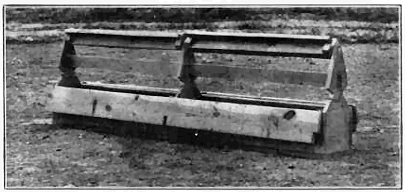
Figure 13.—Mash hopper for feeding young turkeys 12 weeks old or older. The end plan
of the same hopper is shown in
figure 14.