CENTURIES OF OPPRESSION—MOSLEM AND CHRISTIAN—SULTAN
AND PATRIARCH—BROKEN PLEDGES FOLLOWED
BY MASSACRE AND OUTRAGE.
THE RED CROSS TO THE RESCUE.
BY THE
REV. EDWIN MUNSELL BLISS,
Late of Constantinople,
Editor of Encyclopædia of Missions: Assistant Editor of The Independent.
ASSISTED BY
The Rev. Cyrus Hamlin, D. D., Founder of Robert College: Prof. E. A. Grosvenor, of Amherst
College; Rev. Benjamin Labaree, D. D., late of Persia, and Other Eminent Oriental
Scholars; also Several Eye-Witnesses of the Massacres.
WITH AN INTRODUCTION BY
Miss Frances E. Willard.
FULLY ILLUSTRATED.
HUBBARD PUBLISHING CO., Publishers,
PHILADELPHIA, PA.
Copyright, 1896, by M. J. Coghlan.
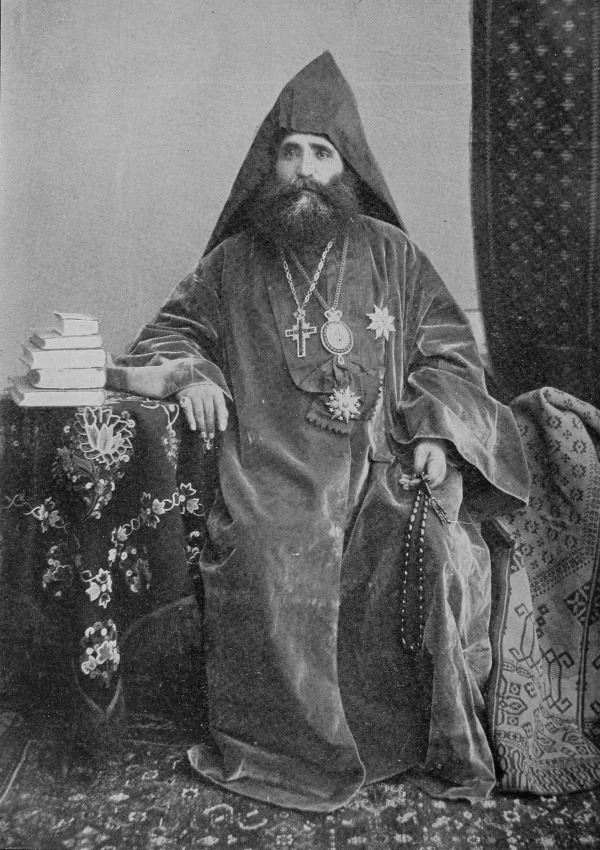
PATRIARCH OF CONSTANTINOPLE. The ecclesiastical head of the
Armenians is the Catholicos residing at Etchmiadzine, in the Caucasus. Of the
same rank are the Catholicos of Aghtamar (near Van) and the Catholicos of Sis,
in Cilicia. Next come the Patriarchs of Constantinople and Jerusalem, the
former taking precedence as the civil head of the Armenians in Turkey.
INTRODUCTION.
We need a new angle of vision on the martyrdoms in Armenia.
Let us suppose that we had never heard anything about
them and that on next Sunday morning, in our respective
churches, our respective pastors should come forward with a statement
like the following:—
Near the foot of a famous mountain there lived 1500 years ago, in a little
country about 400 miles square, a people numbering, perhaps, 3,000,000.
In the turmoil of the centuries they had been scattered until their ancestral
valleys and mountain slopes have largely passed into other hands.
They still preserve, however, the racial characteristics of that early time,
and look back with intense yearning to that olden time and those
familiar places.
In face, figure and bearing, they are remarkably attractive. It is said
that their personal resemblance to the supposed physical type of our
Lord is probably more striking than that of any other race. In the
simplicity of their faith and the earnestness of their character, these
people are reminders of the early Christian Church. The bravery of
their men and the chastity of their women are proverbial. They
cherish the Bible as the most precious of their possessions and guard
it all the more sacredly when to do so involves the hazard of their
lives. They are unarmed and do harm to none, they only seek to tend
their flocks, till their fields, and conduct their trade in quietness and
peace.
Their country is controlled by a rich and powerful potentate of
another race, who with his court and his army would be neither cruel
nor vindictive except for their religion. They are Mohammedans and
have been taught for centuries that a Christian slain was the surest
passport to the favor of God and the enjoyment of eternal happiness.
Under the insane spell of this awful fanaticism, they have come down
like wolves on the gentle Christian people under their sway, and within
the last year have slaughtered men, women and children without mercy,
not for any wrong that they have done, but only because they are
Christians. Their villages and homes have been burned to the ground
and such ingenuity of torture and outrage inflicted upon them as could
hardly have been excelled if the bottomless pit had vomited forth its
leading spirits to urge the battle on.
The cruelty towards priests and women, the two non-combatant
classes, has been bitterest of all. Because the priest represented the
detested religion of Christ, he has been not only slain but mutilated,
and the sign of the cross cut in his forehead by murderous swords, and
because Mohammedans believe before all things in the harem rather
than the home, a brutal soldiery has spared neither the wife, the
mother, nor the babe unborn. Outrages worse than death have been
endured by women, always preceded by the promise that they would
be spared if they would abjure their faith, but in no instance have they
hesitated to face their double agony rather than disclaim allegiance
to the Cross.
Now, in the presence of such a spectacle as this, with the martyrdom
of a devoted nation going forward under their eyes, the men of
Christendom have stood by and watched these agonies; have seen a
crowd of gentle Christian women shut up in a church and undergoing
a night of outrage ending in murder, the streams of blood flowing out
under the church doors; they have stood by while Moslem savages
deliberately disemboweled Christian mothers and brought into a world
accursed, innocent babes which were taken on the points of bayonets
and sportively tossed to and fro; they have passively beheld the massacre
of fifty thousand Christian people in the slowly-rounded circle of
a year.
Suppose that this were said in every Christian pulpit next Sunday morning,
with what righteous anger and holy indignation would the congregation
rise up exclaiming: “Where are these outrages? Who are the
dastards that stand by watching the slow martyrdom of a nation whose
only fault is its loyalty to the Gospel that we profess?”
And then should come the answer that Nathan uttered in the face of
David: pointing to America, England, the Christian nations of the
continent of Europe, “Thou art the man!” It is you that are standing
by like the traitors of old and consenting to the death of those who in
an age of spiritual apathy are sealing with the blood of martyrdom
their holy allegiance to “the faith once delivered to the saints.”
This is the situation: Armenians are the nation; the Sultan and his
soldiers are the devil’s scourge; the Anglo-Saxon race is the cold-hearted
spectator.
In saying this I am not upbraiding any person high in power, not
singling out any nation as more guilty than the rest. For in this crisis
mere criticism would be futile. What we must have is action; united,
cogent and immediate; we must not stand upon the order of our going,
but go at once, drawn by the compulsion of what is best and most
enduring in our natures, even “the tie that binds” us to the assertion
and proof of a common humanity and a “like precious faith” in
Christ. We have waited a year, and now across the horrid front of
war gleams the white figure of a woman. Clara Barton, the angel of
the battlefield, takes upon herself the heavenly task of going to Turkey to
represent the forces of the Golden Rule and of the Home which is
their outcome.
In the long and bloody annals of the Sultan’s country, two figures
brighten the scene, two names breathe benediction—Florence Nightingale
and Clara Barton, the fairest flowers of English and American
Christianity. Women may well be grateful that their sex has placed
in the sky where the crescent is fading into darkness the two brightest
stars of hope that shall glow in history’s constellation.
Americans have given costly hostages to the Turk. No band of
men and women more heroic have lived since the Great Light shone
forth out of Jerusalem, than our Missionaries in the land of the
harem.
The record of their danger, suffering and death is only second to that
of the beloved Armenians whose devotion has rewarded their heroic
toil. Their colleges and schools, churches and hospitals have passed
under the withering blight of the Mohammedan.
In the present desperate emergency, the work of Miss Kimball in
the devastated city of Van will be chronicled on the fairest pages where
the bravery of Christian women is described.
The record that follows is given us by a noble young American, the son
of Isaac G. Bliss, D. D., that statesman-like Missionary whose name
has been endeared to the Christian Church for well nigh half a century
by reason of his wise and unremitting labors. The appearance of this
book is opportune, and its moderation of tone will commend it to all
thoughtful readers. For we do not wish to hate the Turk or impale
him on the point of rapier-like epithets. He is what the centuries have
made him, and like Saul of Tarsus who became Paul of Damascus, he
“verily thinks that he doeth God service.” Superstition and fanaticism
have been in all ages the most deadly foes of the human race. Under
their withering breath the Armenians seem likely to be swept out of
existence. Surely such an illustration, surviving in a century when
“sweet reasonableness” and universal toleration have made more rapid
strides than in any that has preceded it, should nerve the will of every
Christian man and woman to defend our Mission and our Missionaries,
whose work alone can disinfect the land of the scimitar from its awful
taint, and disintegrate by means of education the public opinion that
prefers the harem to the home and the Koran of Mohammed to the New
Testament of Christ.
En route in the Southern States, January 15, 1896.
FRANCES E. WILLARD.
PREFACE.
The object of this book is not merely to set forth the
situation in Turkey as it is to-day, but to trace the
influences that have produced it. Those influences are very
complex. They include the social characteristics of the peoples
of Turkey, the religious beliefs and ecclesiastical customs
that have grown up in the empire during the past centuries,
the political ambitions and jealousies of the European Powers,
and the personal qualities of the different men who have been
prominent in the control of affairs. Probably no chapter in
history is more kaleidoscopic in its character. To set forth
its various phases, the topical rather than the strictly historical
form has been adopted. The effort has been made to let
each phase stand out as clearly as possible, first in itself, and
then in its relation to the other phases. The contemporary
historian is never logical. That remains for those who, with
longer range, have a better perspective.
The various histories of Turkey have been consulted, but
special acknowledgment must be made to “Turkey Old and
New,” by Sutherland Menzies, which more than any other
traces the development of the Eastern Question from the
standpoint of the European Powers. “The Life of Lord
Stratford de Redcliffe,” by Stanley Lane Poole, “Turkish Life
in War Time,” by Henry O. Dwight, and Dr. Cyrus Hamlin’s
books, “My Life and Times” and “Among the Turks,” have
been consulted with great advantage. It is a privilege not
less than a duty to acknowledge the very efficient aid rendered
by Dr. Cyrus Hamlin, Dr. Benjamin Labaree and Professor
E. A. Grosvenor. Dr. Hamlin’s vivid remembrance of the
picturesque phases of Turkish diplomacy during the reigns
of Mahmud II and Abd-ul-Medjid; Dr. Labaree’s scholarly
as well as practical knowledge of branches of the Eastern
Church which to most are little more than historic names;
Professor Grosvenor’s intimate acquaintance with, and sympathetic
appreciation of, the Greek life and character, have
laid me under peculiar obligations to each. I must also
express my thanks to those who from the very center of the
conflict have given those sketches which describe so vividly
the terror of the situation. Some of the letters appear for
the first time on these pages; others have been already given
to the world in the columns of The Independent and the daily
press. Their authors I know well and esteem most highly
for their great ability and high character, which has been most
nobly manifest during the trying scenes of the past year. As
I write these lines word has come of the death of one and of
the critical condition of another. They have been urged to
leave their posts, but one and all they have refused, with the
exception of a very few who, in their own physical weakness,
have felt that they could not strengthen their associates.
Turkey and Russia are banded together to force them to
leave; the former that they may not bear witness against the
evil done; the latter that they may not hinder the progress
of that policy of repression already applied to Evangelical
thought throughout her empire.
What is in the future no man can tell, but the growth of
pure religion in whatever form of church organization; the
development of freedom of thought; the attainment of civil
liberty, and that not merely for Armenian, but for Greek,
Nestorian, Jacobite, and even for the Turk himself, depends
upon the continuance of the influences for a higher life that
have been at work during the past sixty years, and that
depends upon the missionaries being supported at their posts.
Theirs is no sectarian work. They stand as the friends of
Gregorian Armenians, Roman Catholic Chaldeans, Nestorians
and Jacobites as well as of those in closer affiliation with the
Protestant Churches of Europe and America. America
should stand by them and demand their full protection. It is
our right by treaty; it is our right by the duty we owe
humanity, by the duty we owe to our tradition as a liberty
loving nation. We have no political ends to serve; we want
not a square foot of the Sultan’s domains; but we stand, as
we have always stood, for freedom for the oppressed, for the
right of every man to worship his God in the light of his own
conscience.
Edwin Munsell Bliss.
New York City, March 21st, 1896.
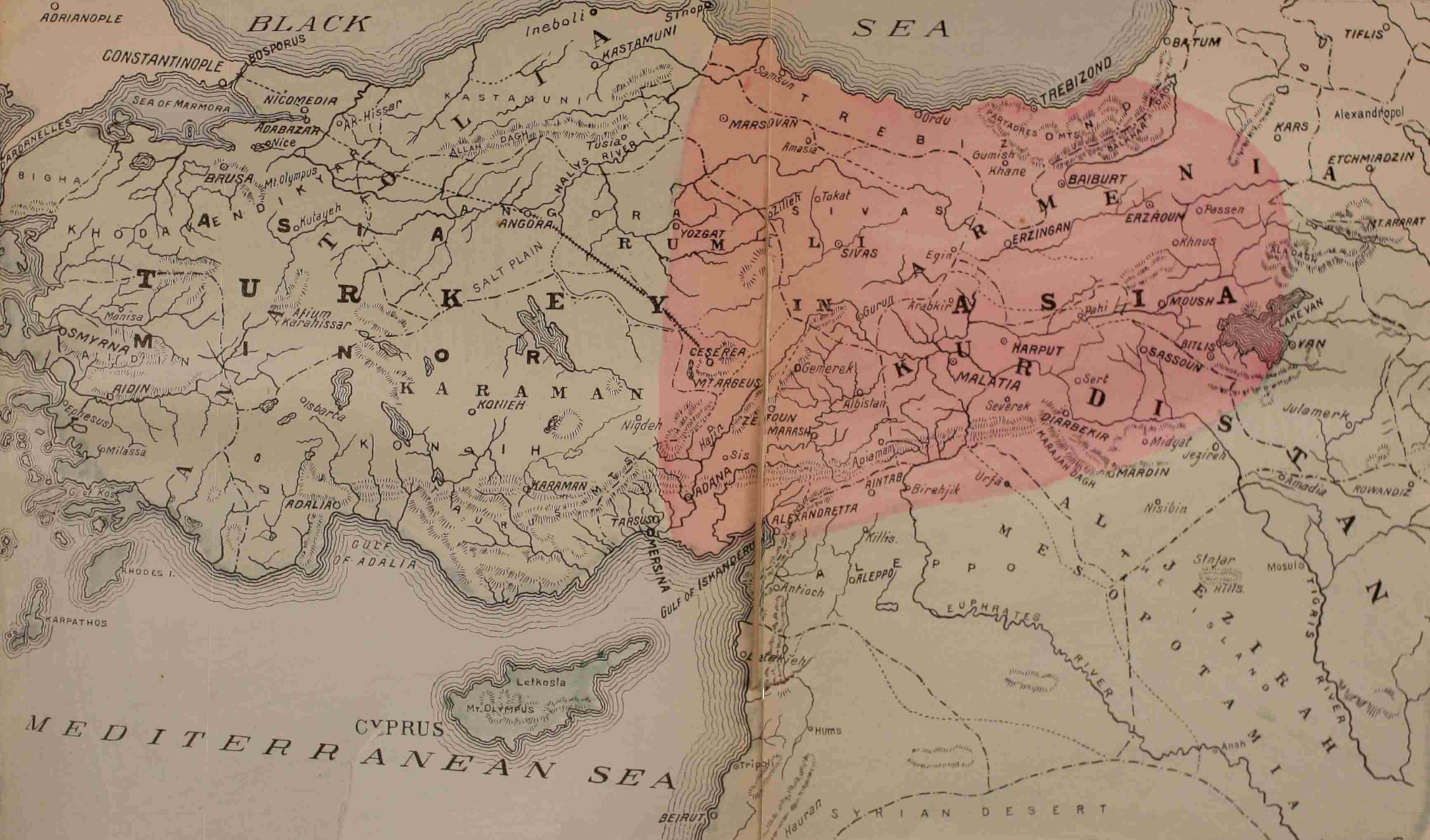
Red—District Where Massacres Occurred.
CONTENTS.
CHAPTER I.
The Turkish Empire.
Geographical Extent—Topography—Physical Characteristics—Products—Traveling
and Transportation—Building
Accurate Statements as to Population Impossible—No Census—Best Available
Estimates—Distribution—Most of the Races Described in Other Chapters—Jews
and Foreigners—General Characteristics—The Languages—How Distributed—Peculiarities
of the Turkish—Number Spoken in the Seaboard Cities
Islam and Christianity—A Few Pagan Communities—Origin of Mohammedanism—The
Koran—The Traditions—Extent of Islam—Present Condition—Effect upon
the Turks—Contact with Civilization—Sects—Oriental Christianity—Characteristics
Their Origin—Early History—General Characteristics—Good Qualities—Kindness—Hospitality—Temperance—Honesty—Intellectual
Ability—Obedience to Rulers—Bravery—Bad
Characteristics—Indifference to Suffering—Brutality—Degradation
of Women—Sensuality—Official Unreliability—Fatalism—Insolence—Indolence—General
Summary
Legend of the Serpents—Connected with the Medes—Tribal Organization—Nomad
Life—Saladin and the Crusaders—After the Russo-Turkish War—The Hamidieh
Cavalry—Brutal Treatment of Christians—Arabs—Circassians and Other
Moslem Subjects—The Nusairiyeh—Yezidis and Druzes
Their Origin—Early History—First Nation to Accept Christianity—Dispersion
Under Oppression—Change from Agricultural to Commercial People—General
Characteristics; Loyalty to Nation and Religion—Industry—Morality—Intellectual
Ability—Shrewdness—Jealousy of One Another—Influence of Missions and
European Ideas—Growth of National Ambition—Armenians in Russia—Autonomy—Armenians
in Other Countries—Patriarch Mattheos—Outlook for
the Future
Fidelity of the Oriental Churches—The Apostle Andrew—Concessions by Mohammed
II—Gennadios II—Suffering and Misery—Greek Revolution—Growth of National
Spirit—Hellenes or Romaioi—Bulgarians in their Relation to the Greek Church
The Syrian Church Divided into Syrians, Chaldeans, Nestorians, Jacobites, and
some Roman Catholic Bodies—The Jacobites—Patriarch of Antioch—Condition
of Villagers—Jebel Tur Region—Nestorians—Patriarch of Babylon—Badir
Khan Bey—Chaldeans—The Copts of Egypt—Maronites and Druzes
Capture of Constantinople—Victories of Mohammed II—The Sultans Assume the
Caliphate—Reign of Suleiman the Magnificent—Attack upon Venice—Constant
Strife over the Danubian Principalities—Internal Disorganization—Weak Sultans
and Powerful Viziers—Alliances with Foreign Powers—Repeated Disasters—Weak
Rule in Asia—Revolt in Egypt and Syria—Condition at Commencement
of present century
First Intercourse—Alliance between Francis I and Suleiman the Magnificent—Intrigues
between France and Austria—The First Treaty—Nature of Capitulations—Peculiar
Favors Granted to the French—Their Recognition as the Protectors
of Christians—Entrance of Other Powers—Louis XIV and His Ambassador—Influence
of De Brèves—Peace of Carlowitz—Turkey No Longer Dreaded
in Europe
Aggression of Peter the Great—Diminution and Renewal of French Influence—The
Contest over the Holy Places—Victory of Russian Influence in Favor of the
Greek Church—Russia’s Religious Propaganda Among the Greeks—Rise of
Phil-Hellenism—Dismemberment Talked of—Effect of the French Revolution—The
Russian Fleet in the Dardanelles—The English Fleet at Constantinople—Peace
of Tilsit—Plan for Partition—Accession of Mahmud II
A Disintegrating Empire—An Energetic Sultan—Napoleon and Alexander—Lord
Stratford de Redcliffe—Greek War for Independence—Russia’s Perfidy—Destruction
of the Janissaries—Reforms Attempted—Mehemet Ali of Egypt—Accession
of Abd-ul-Medjid
Reign of Abd-ul-Medjid—Influence of Lord Stratford de Redcliffe—English
Policy in Turkey—Hatti Sherif of Gulhané—A Remarkable Document—Equal
Rights for All Subjects of the Sultan—Land Tax and Judicial Reform—General
Situation of the Country—Application of the Reforms
Influence of Lord Stratford—The Holy Places—Crimean War—Treaty of Paris—Abd-ul-Aziz—Extravagance—Influx
of Europeans—Provincial Government—Accession
of Abd-ul-Hamid II—Russo-Turkish War—Treaty of San Stephano—Treaty
of Berlin—Cyprus Convention
The Christians under Early Moslem Rule—Mohammed II—General Oppression—Protection
by French Government—Russian Intrigue—Power of the Greek
Church—Reforms under Mahmud II and Abd-ul-Medjid—The Hatti Humayoun—General
Improvement Throughout the Empire
True Moslem State Theocratic—Dual Form of the Present Government—The Sublime
Porte—Army and Navy—Internal Administration—Financial Management—General
Corruption—Administration of Justice—Treatment of Christians—The
Ulema—The Palace Party—The Sultan
Early History—Opposition of Ecclesiastics in the Oriental Churches—Attitude of the
Turkish Government—Work Among Moslems—Development of Education—Societies
at Work—The American Board—Presbyterian Boards—American and
British Bible Societies—English Societies—General Statistics—Relations to the
Turkish Government—Character of the Missionaries
A Progressive Grand Vizier—Victory of the Reactionary Party—Egypt and the
Mahdi—Rise of the Armenian Question—Russian Intrigue—Articles of the Berlin
Treaty—Autonomy Desired—The Huntchagist Committee—Placards in Asia
Minor—Burning of American Building at Marsovan—Numerous Arrests—Armenians
Exiled—Coercive Measures of the Government—American Citizens—Threats—Huntchagists
Disowned by the Nation—Young Turkey Party—Absolute
Failure of the Huntchagist Movement
Terrible Oppression—Exaggerated Reports—Truth Stranger Than Fiction—Religious
Liberty Infringed Upon—Oppressive School Laws—Rigorous Censorship—General
Effort of the Government to Suppress Christian Development
A Deliberate Plan of The Turkish Government—Kurdish Raids—Armenians
Defend Themselves—Kurds Reinforced by Regular Troops—Terrible Scenes of
Slaughter—Stories of Survivors
Investigation at Sassun—Mr. Gladstone on the Situation—Disturbances in Constantinople—Joint
Notes by the Embassies—Plan of Reforms—New English
Government—Massacre in Constantinople—Decisive Action of the Embassies—Signing
of the Reforms—Subsequent Acts of Defiance—Breach Between
England and Russia—Collapse of English Influence
Importance and General Prosperity of Both Cities—Threats by the Turks—Terror
Among the Armenians—Suddenness of the Attacks—Murder and Pillage by
Regular Soldiers, Under the Eye of Foreign Consuls—Ferocity of the Turks—Testimony
of Eye-Witnesses—Terrible Scenes at the Burial of the Victims
American Residences—First Indications—Specious Promises—Riot, Murder and
Pillage—A Dangerous Journey—Attempts at Defense—List of Villages and
Details of Massacres—Statement of a Turkish Official—Armenians not Responsible—Turkish
Dread of Reform—Tabular Statement
The Situation in Northern Syria—No Revolutionary Movement—Massacre at
Aintab—Kurdish Women—A Turkish Captain Helps the Pillage—A Colonel
Checks it—Caring for the Wounded—Two Attacks at Marash—Destruction of
American Houses—Brave Men in Zeitun—Story of Massacres at Urfa
Massacres at Sivas, Cesarea, Birejik, Bitlis, and the Region of Mardin—Protection by
the Turkish Government for the Jacobites—General Survey—Place and Time of
the Massacres—Victims Exclusively Armenians—Effort to Destroy the Strength
of the Nation—Motive—Responsibility of the Turkish Government and of the
Sultan
Motive of the Massacres—Primarily Political, then Religious—The Religious
Element Overpowering the Political—Dread of Christian Domination—False Statements
by the Turkish Government—Instances of Persecution and Enforced Conversion
to Islam—A Tremendous Moral Disaster—Efforts of the Government to
Suppress Reports
The General Situation—Absolute Destitution—Appeals to America and England—Work
in the Sassun Region—Van and Dr. Kimball—Appeals Following the
Greater Massacres—Clara Barton and the Red Cross—Opposition of the Turks—Letter
from Van—After the Massacre in Harput—Suffering in the Villages—Appeal
for Help
Factors in the Problem—Turkey and Europe—Topography of the Country—Distribution
of Population—Countries Interested—Russia, England, France, Austria,
Italy, Germany, Greece, Bulgaria—Desire for Territorial Aggrandizement—Mutual
Jealousies—Possible Solution—Turkish Factor Often Overlooked—Great Difficulties
to be met
Early Treaties—Some Prominent Ambassadors—American Missionaries—Obedience
to the Laws—Treaty Rights—Questions of Importance—Indemnity at Harput
and Marash—More Consuls Needed—Naturalized Americans—Right of Domicile
Threatened—Positive Action Needed—Duty of America
Statistics of Massacre and Pillage—Where Does the Responsibility Rest?—The
Turks; Fear, Ferocity, Outrage—The Armenians; Ambition, Lack of Preparation,
Unwisdom of Huntchagists—The European Powers; Jealousy, Ambition,
Cowardice—The Sultan; Alliance with Reactionary Party, Difficult Position,
Individual Care of Minutiæ—Latest Development of Most Terrible Persecution
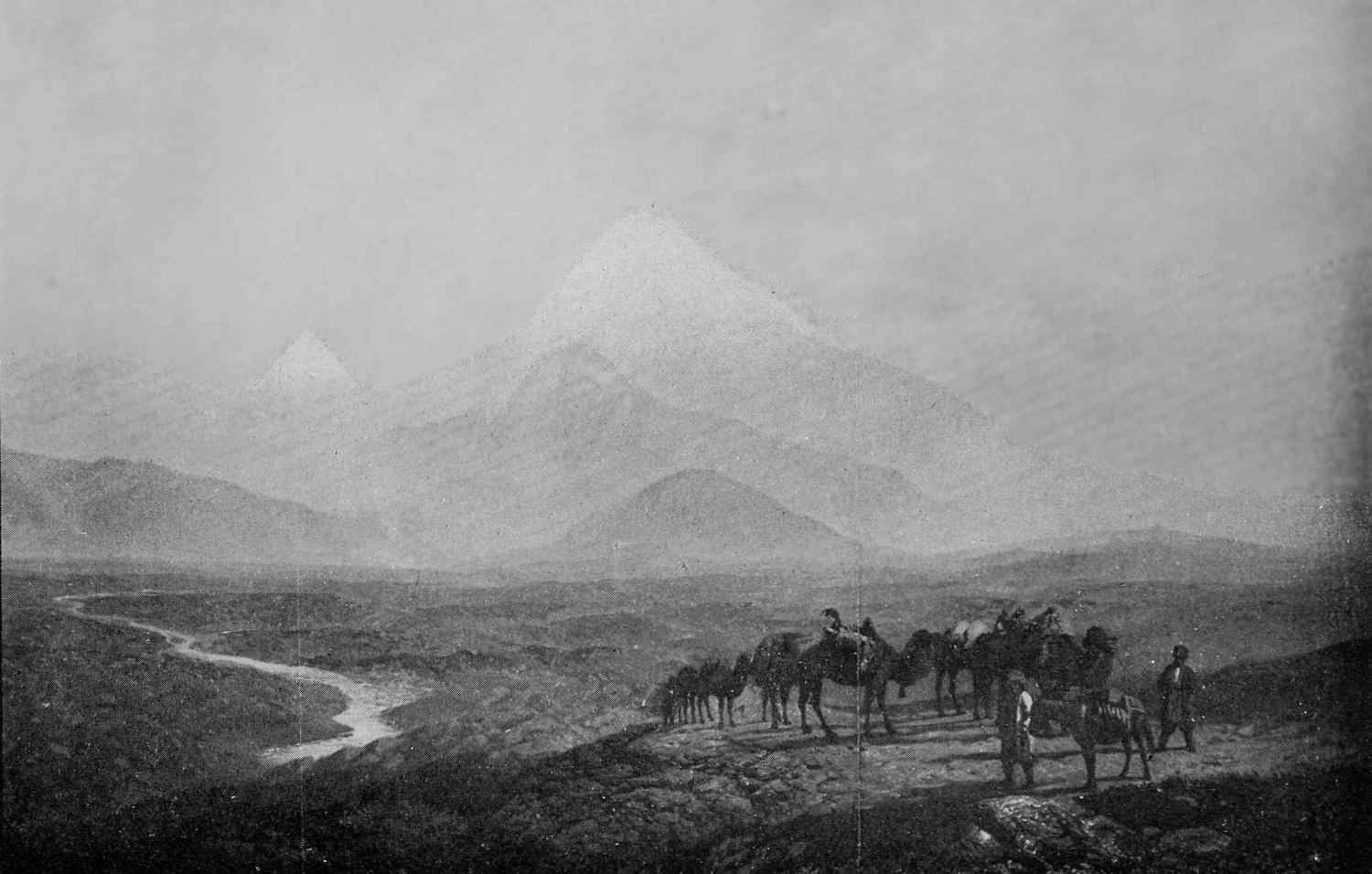
VIEW OF MOUNT ARARAT. This is taken from a celebrated painting, not from a photograph, but is,
perhaps, even better than a photographic view as it sets out the peculiar nature of the country. In the foreground is a
caravan of camels such as is found less and less frequently, most of the merchandise being now carried upon mules or
horses, or in wagons.
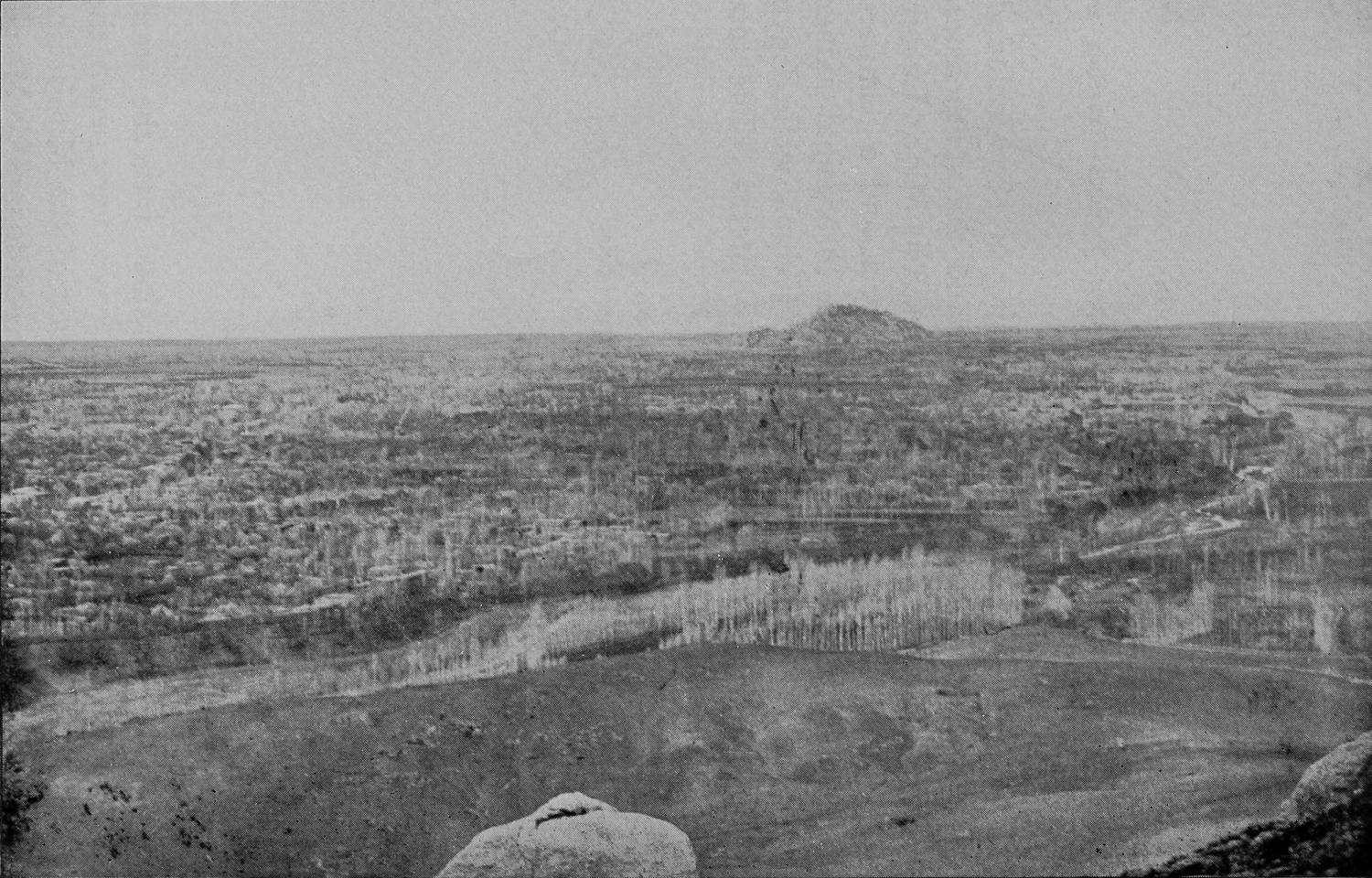
GENERAL VIEW OF THE GARDENS OF VAN. The hill in the background is the Acropolis, occupying
the site of the ancient city, which dates back beyond the time of Christ. The light trees in the foreground are poplars,
which are planted in numbers where there are streams, to furnish timber for the houses.
CHAPTER I. The Turkish Empire.
Geographical Extent—Topography—Physical Characteristics—Products—Traveling and
Transportation—Building.
The Turkish Empire at the beginning of 1896 included:
in Europe, Albania, Macedonia, and the southeastern
portion of the Balkan Peninsula; in Asia, Asia Minor, Eastern
Turkey or Kurdistan, Mesopotamia, Syria, and a comparatively
small section of Southern Arabia. In nominal subjection
was the large African province of Tripoli, while Egypt
and Bulgaria were reckoned as tributary States. The total
area may be estimated as follows:
IMMEDIATE POSSESSIONS.
Europe
63,850
square miles.
Asia
729,170
””
Total
793,020
Add Tripoli
398,873
””
Total
1,191,893
TRIBUTARY STATES.
Bulgaria
37,860
””
Egypt
400,000
””
Island of Samos
210
””
Total
438,070
Grand Total
1,629,963
A better idea of the extent will be gained from the statement
that the immediate possessions cover very nearly the
same territory as the United States east of the Mississippi,
while the addition of Tripoli carries the line to include Minnesota
and Louisiana, and the entire possessions correspond to
the section east of a line drawn south from the western boundary
of the Dakotas and cutting Texas in two.
It is, however, by no means a compact country, as will
readily be seen by the map, and the different sections are as
unlike to as they are distant from each other. The difference
between Albania and Mesopotamia, Asia Minor and Egypt,
is scarcely less great than that between Maine and Honduras,
Oregon and Cuba. This great diversity in topography carries
with it corresponding diversity in the general characteristics of
the people, and both must be kept in mind if the situation, political
and social, is to be understood.
Topographically the general characteristics of the Turkish
Empire, whether in Europe or Asia, are a great extent of
coast line and a large amount of mountainous country. With
the exception of the Mesopotamia plain, a portion of Northern
Syria and the plateaus of Western Asia Minor, the whole
Empire is distinctly mountainous. In European Turkey the
mountains extend from Montenegro into Greece; and until
within a hundred miles of Constantinople, with the exception
of the valley of the Vardar, there is scarcely any plain
at all. Asiatic Turkey may be divided into four sections:
Asia Minor, Eastern Turkey, Syria and Mesopotamia. Asia
Minor includes the country west of a line drawn north from
the Gulf of Iskanderun to the Black Sea; Eastern Turkey
the remainder eastward to the Persian border; Syria includes
the section south of the Taurus and east of the Mediterranean
to the Euphrates; and Mesopotamia covers the great
valley between the Euphrates and Tigris and the section between
the Tigris and the Persian border as far south as the
Persian Gulf.
From the very eastern end of the Black Sea along its
southern coast, along the Sea of Marmora, the Aegean and
the Mediterranean, extends a range of mountains, broken
only by occasional passes; while from the Mediterranean
through to the Persian border a line almost as sharp as that
of a seacoast separates the mountainous region known historically
as Armenia, more lately as Kurdistan or Eastern
Turkey, from the level of Mesopotamia. So also the Lebanon
range, extending from this same point of departure, the Gulf
of Iskanderun, separates the narrow coast line from the Syrian
Desert and the Hauran.
The coast has almost no harbors worthy of the name.
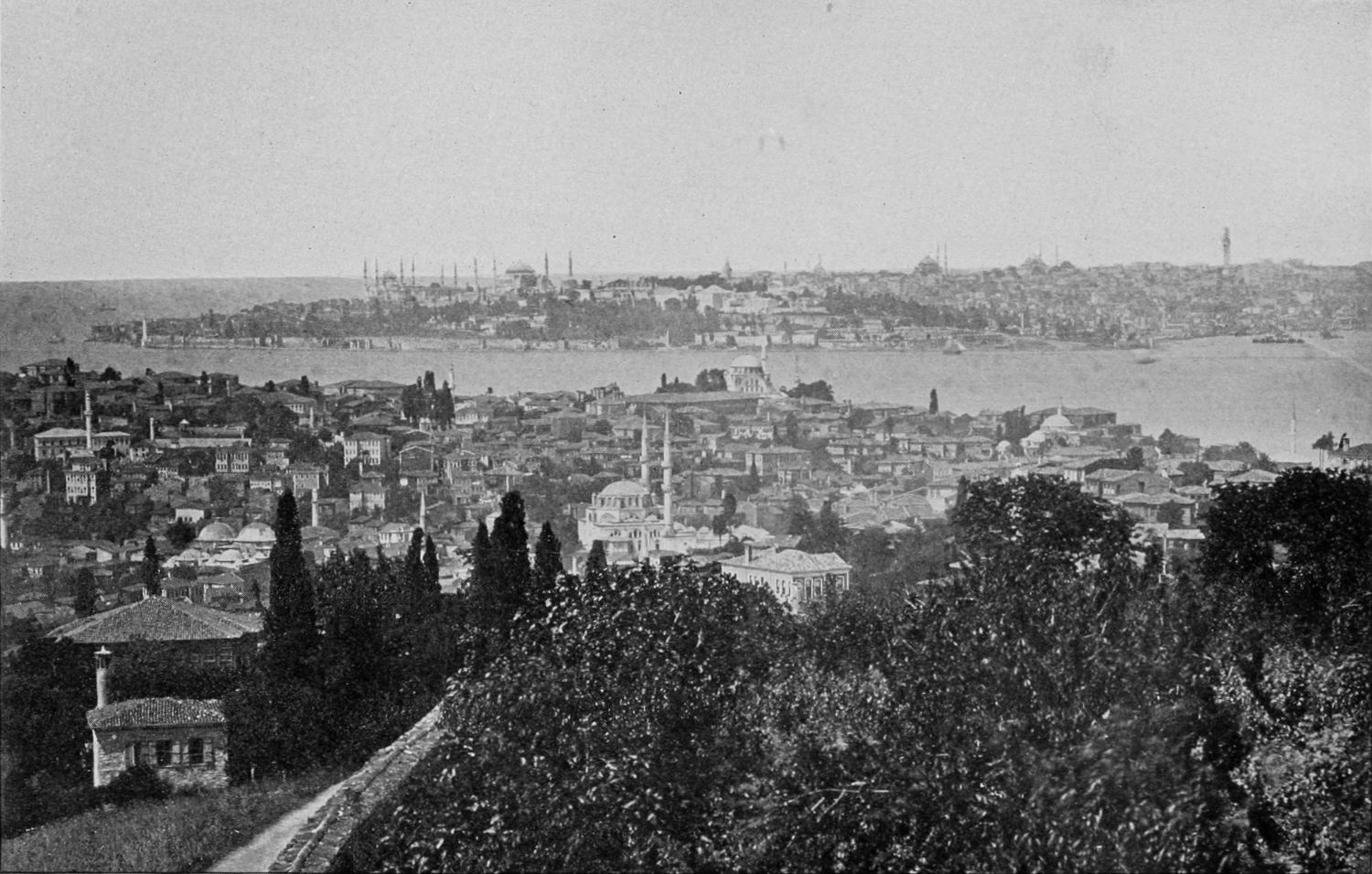
Constantinople, with its Bosporus and Golden Horn, is famous;
Smyrna has a good harbor, but Trebizond, Samsun and Ineboli
on the Black Sea; Adalia, Mersine, Alexandretta, Beirut
and Jaffa on the Mediterranean, are open roadsteads. In
European Turkey there are fairly good harbors at Kavala
and Salonica on the Aegean, but none on the coast of the
Adriatic. The mountain ranges have very few passes. The
most important ones in Asiatic Turkey are on the north from
Trebizond to Erzrum, from Samsun south to Marsovan and
Sivas, and from Ineboli to Kastamuni and Angora; and on
the south from Mersine and Adana to Nidgeh and Cesarea,
from Marash to Malatia and Harput, and from Diarbekir to
Harput. On the east there are passes from Erzrum to Kars,
from Van to Trebizond, from Mosul by Rowandiz to Lake
Urumia, and from Bagdad to Hamadan. There are of course
other roads, but they are so precipitous as to be most difficult of
passage. The western section of Asia Minor is mountainous,
without special ranges, and there are no passes of the same
nature as those that cross the northern and southern ranges
of mountains. Still the country is very rough and there are
only a few roads easy of travel.
In such a country it is natural to expect that the scenery
should be fine, and the expectation is not disappointed. Along
the Tigris there are views unsurpassed, except perhaps among
the high Alps or the Himalayas, for grandeur. As the river
cuts its way between lofty precipices and catches glimpses
through the valleys of snowclad summits, one gets an idea
of the strange effect it must have had upon Xenophon and his
ten thousand as they toiled along the path still easily traced
on the east bank. The approach to the city of Rowandiz
from Mosul and Arbela is through a gorge, where the road,
which winds for 2000 feet up a precipice, furnishes views
equal to any in Switzerland. The author, passing, here fired
his gun expecting an echo, but was disappointed and was just
starting on when from far down the cañon there came a faint
sound. Nearer and nearer it came, hurled back and forth
from cliff to cliff, until the echo was almost deafening, and he
was satisfied.
A very different kind of scenery is that over the plains.
The view from Mardin, bounded by the Sinjar Hills, nearly
100 miles away, is one never to be forgotten. The great
Mesopotamia plain lies at one’s feet, like a gorgeous carpet
of many colors, and the villages like children’s playthings dot
it with miniature pictures of life. So too the views over the
Cesarea plain, from the slopes of the snowclad Argeus; over
the Harput plain, from the Deli Baba Pass near Erzrum, and
from the summits back of Trebizond and Samsun, where the
Black Sea first breaks on the view; and most unique perhaps
of all, that from the citadel of Van, with the gardens and lake
in the foreground, and volcanic Sipan Dagh looming up in
the background. Of all the mountains Ararat is certainly
the most beautiful. From whatever direction it is seen its
symmetrical sides and regular summit appear perfectly approachable,
yet so difficult is the ascent that to the people it
seems almost as if God had forbidden its summit to be profaned.
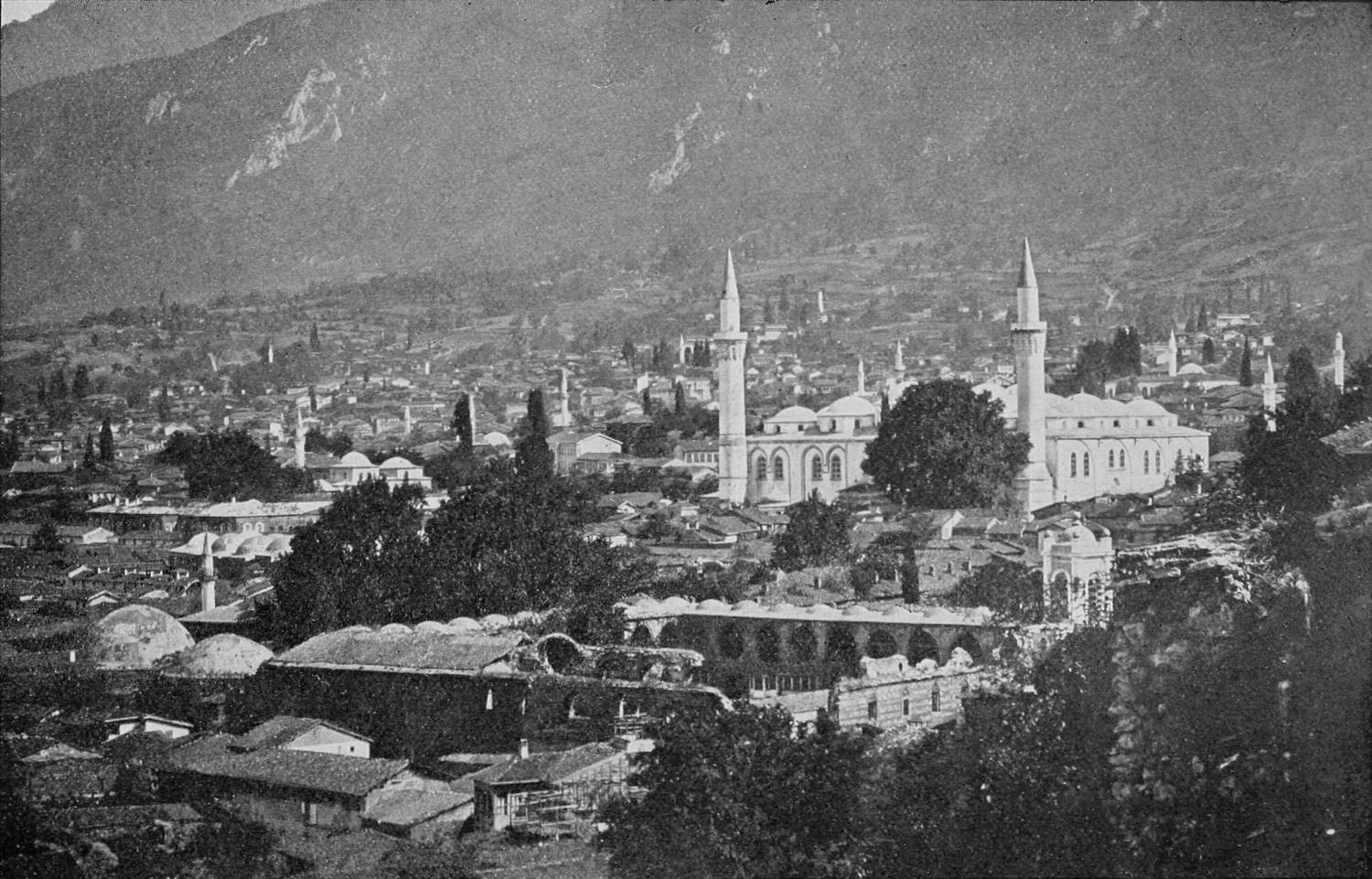
Very different from all these is the region near Brusa,
with its Bithynian Olympus, its lake of Nicaea, and its vineyards,
reminding one of Southern France. In some future day
when traveling is not only safe, but easy, searchers after the
beautiful as well as the grand, will find Turkey a favorite
field of travel.
Over the plateaus of Asia Minor and the great Mesopotamia
plain, passage is easy. Through the mountainous section
of Eastern Turkey it is almost as difficult in any direction
as over the great ranges. The Romans had built causeways
in every direction, but in the later Byzantine times, these
had fallen into disuse, and the great pitfalls occasioned by the
dropping out of huge blocks of stone made them almost impassable.
In a few instances, the Turkish Sultans made some
efforts to repair these causeways, but they were seldom successful.
The result was that everything was carried on horses,
mules or camels, and such a thing as a cart or carriage was
unknown. There have been various attempts on the part of
the Turkish government to develop a system of carriage
roads, especially within the past twenty years. Of these there
were five specially important ones designed to connect Bagdad
and Persia with the seacoast. One from Constantinople via
Nicomedia, Angora, Sivas and Diarbekir to Mardin, Mosul
and Bagdad; one from Samsun on the Black Sea via Amasia
connecting with the first at Sivas; one from Smyrna via
Konieh and Cesarea also connecting with the other at
Sivas; one from Alexandretta via Aleppo and Urfa to
Diarbekir on the north, and on the south via Nisibin
to Mosul connecting with the others at Diarbekir
and Mosul. On the north there was a road from Trebizond
via Erzrum and Van into Persia. In Syria the only
roads of importance are from Beirut and Khaifa to Damascus.
At the present time there are scarcely any roads worthy of
the name anywhere in the empire, except between Trebizond
and Erzrum and between Beirut and Damascus.
There are a few railroads. The first to be built was from
Smyrna to Aidin. That was followed by one from Smyrna
to Manisa, extended on to Alashehir; then followed one from
Constantinople to Nicomedia, since extended somewhat on
the way to Angora; one from Mersine to Adana, and one
from the coast to Brusa. It was the plan for all these to converge
into a great railway to Bagdad, but, like so many other
enterprises, they have proved unsuccessful. In European
Turkey, owing largely to the influence of Austria, there has
been better success, and both Salonica and Constantinople are
connected by rail with Vienna and Paris.
The climate of the Turkish Empire is very varied. In
European Turkey, Western Asia Minor and Northern Eastern
Turkey it is temperate; while Syria and Mesopotamia are
almost torrid in their heat. Undoubtedly the lack of trees
has much to do with the intense heat of the plains of Northern
Syria, and even of sections of Asia Minor. The rains have
washed the soil off the hills and mountains in many places,
leaving bare rock, the reflection from which is intense in
summer, while in winter the cold is almost equally unendurable.
The snows throughout Eastern Turkey are very severe,
rendering the roads almost impassable in winter, so that
caravans are frequently detained for days and weeks, and
sometimes goods on their way from Erzrum and Van into
Persia are delayed for several months. In Western Asia
Minor, there is comparatively little snow, but the winter season
is one of rain, and the soil, being in the main clay, renders
travel exceedingly difficult. In Syria the intense heat of the
plain may be escaped by going to the higher slopes of
Lebanon. Thus the inhabitants of Beirut have a pleasant
resort within a few hours’ ride. In Mesopotamia, however,
this opportunity does not exist, and almost the only relief
from the intense heat in Mosul and Bagdad, is found by taking
refuge in cellars.
The whole empire is extraordinarily fertile. The great
Mesopotamia plain will bear the richest harvests with even
the rudest form of agriculture; so also the plateaus of Asia
Minor and the valleys of Macedonia. There is scarcely a
level square mile in the whole empire that does not yield
excellent returns for very little labor. Originally there were
large forests. They have however almost entirely disappeared,
and the only sections of forest to-day are along the
shores of the Black Sea, in the region of Bitlis and between
Marash and the Gulf of Iskanderun. Elsewhere the country
is desolate, and the traveler is often directed on his way by
landmarks of single trees. Comparatively small portions of
the empire are, however, under cultivation. There are wide
extended pasturages for herds and flocks, but these do not by
any means cover the entire land, and there are long stretches
without a sign of cultivation and with scarcely an inhabitant.
The products of the country are chiefly wheat, rice and
barley. Cotton is raised somewhat in Northern Syria and in
Asia Minor, and there are also large fields of poppies, the
opium trade being quite extensive. Tobacco is cultivated
everywhere, and vegetables are much the same as ours, with
the exception of the potato, which is almost unknown. The
whole empire is rich in fruits of every kind, grapes, melons,
figs, olives, peaches, pears, oranges, pomegranates and dates.
All are of the best. The vineyards are extensive and in
European Turkey and Western Asiatic Turkey considerable
wine is made, which is largely exported to Europe and then
re-exported bearing a French or Italian brand. Olive groves
are especially abundant along the shores of the Mediterranean,
and the fig orchards of Smyrna are well known. Dates are
not found to any great degree outside of Egypt.
The mineral wealth of Turkey is very great, but it is so
thoroughly undeveloped as to make its estimate very difficult.
Along the shores of the Black Sea and in some portions of
the Taurus there is a great deal of coal, but it is not mined
and the extent of the deposit is practically unknown. In
Eastern Turkey there are important mines of copper, silver
and iron. These are worked with very rude methods and
with varying success, but the output is such as to indicate
great wealth, still undeveloped. There are also in Western
Asia Minor mines of baryta which have been worked to some
extent. In European Turkey there is considerable iron, and
probably considerable in the mountains of Western Turkey,
but there are few if any mines.
The domestic animals of the empire are horses, mules, donkeys,
camels, sheep, buffaloes and dogs. There are also in
certain sections wild boar, deer and other game, but to a
limited extent. The horses vary from the fine Arab of the
desert to the scrubby but enduring pony of Syria. The
ordinary horse used in caravans is a rather small but powerful
animal, sure-footed and easily adapting himself to the rough
roads and rather poor fodder. The use of donkeys and mules
is universal. The white donkey of Bagdad is almost as aristocratic
an animal as the Arab horse. Camels have gradually
disappeared from the North, but are found in the South, and
are still occasionally sent out in caravans from Smyrna. The
cows are poor, small and of little value, either for their milk
or for use in farming. Agriculture is carried on chiefly by
the use of buffaloes. The animal to whose development
most attention has been given, is undoubtedly the horse, and
next to that the sheep. The Angora sheep and goats of
Western Asia Minor are famous all over the world, and in
general the quality of wool and of mutton is most excellent.
The dogs are of many breeds, including fierce shepherd dogs
and fine greyhounds, but the most common is the mongrel
cur of the cities and towns. Fowls are to be found every
where and in large quantities, and there are pigeons and
partridges in abundance.
The food of the people is chiefly the different preparations
of wheat and rice, and in meats they eat little but mutton and
fowl; beef is considered by most as unfit for food. They also
use a great deal of milk, chiefly of sheep or buffaloes. They
are very fond of a preparation of fermented milk, not unlike
curds, generally eaten in the semi-solid form, but sometimes
mixed with water and made into a very refreshing drink. A
certain modification of this has been introduced into this
country and is widely known under the name of Madzoon.
The cooking is in the main very tasty, although the common
people, especially in the mountains and the southern plains,
are content with a very meager diet. The traveller who
understands the ways of the country can generally provide
himself well, but he must carry some form of provision with
him. As is natural, the food to be found depends very largely
upon the nature of the country. In the heart of the Kurdish
or Taurus Mountains, there will often be little more than a
coarse millet bread, and perhaps milk, to be had; while in the
cities and large towns, as also on the great agricultural plains,
almost anything can be secured, and a good cook will provide
a meal that the most fastidious would heartily enjoy. The
author has repeatedly enjoyed dinners that would do credit to
a New York Hotel for delicacy and richness of flavor.
Traveling and the carriage of merchandise is almost entirely
by means of horses, mules and camels. The use of wagons
has been introduced to a limited degree, but, except between
Trebizond and Erzrum, it has not become general. This is
chiefly in consequence of the poor roads, and the fact that
even where there are stretches of good roads, they are so
short as to necessitate a change when the journey is to be
continued. For the mail and for travelers with little baggage,
there is a system of relay traveling. Horses may be changed
at stations from sixteen to thirty miles apart, and although
seldom of the better sort, they can be kept at a slow trot or
uncertain gallop, so that a speed of from four to six miles an
hour can be maintained through the day. The ordinary distance
covered by a caravan, whether of travelers or of merchandise,
is from twenty-five to thirty miles a day. A post
rider will frequently, in Turkey, cover forty to fifty miles; and
in Persia, where the same system is employed, but the roads
and horses are better, seventy-five or eighty, even a hundred
miles a day, are not infrequently covered. The mail carriers,
or Tartars as they are called, ride day and night, stopping
only for change of horses and refreshments. One result of
this general method of traveling is that distances are measured
by hours, not by miles, the hour varying somewhat in different
parts of the country. In Asia Minor, where horses and mules
are chiefly used, the hour is equivalent to from three to four
miles, but in Syria and Mesopotamia, where camels are more
common, the hour is seldom over three miles. Thus Erzrum
is sixty hours from Trebizond—180 miles; and Harput sixty
hours from Sivas—240 miles; but thirty hours from Marash
to Alexandretta means no more than ninety miles.
The country is very thoroughly covered with telegraph lines
connecting the principal cities, and the postal arrangements
supply both the cities and larger towns. Both are under the
sole control of the government, although one of the lines of
telegraph, from Constantinople to Bagdad, connecting with an
extension to India, is owned by an English Company. Turkey
being a member of the Postal Union, letters from any interior
city can be forwarded to America at the regular rate, but the
internal rates are very high. Under the administration of
Abdul Aziz, and during the early part of the reign of Abdul
Hamid, both departments were, on the whole, fairly well conducted,
but of late years there has been no certainty of correct
transmission either of telegrams or letters, while papers
frequently fail to reach their destination.
In this connection a word should be said as to the means
of business communication. Constantinople and the seaboard
cities are fairly well supplied with banking facilities. The Imperial
Ottoman Bank has also a few branches in the interior,
but for the most part the only method of transmitting funds
has been by sending coin through the mails. In certain sections,
this has been very hazardous on account of the insecurity
of the country, and as a result, internal trade has been
greatly hampered. The establishment of the American missions
all over the land has served in this matter greatly to the
advantage of trade. A system of drafts has been established
by which the missionaries draw on their treasurer in Constantinople
and these drafts are sold in the market, facilitating
exchange greatly. The missionaries, however, are very
cautious, feeling that their position makes it unwise for them
to share to any great extent in general trade.
One thing that strikes the traveler in Turkey very forcibly
is the very sharp lines drawn between the cities, towns and
villages and the surrounding country. City walls have to a
considerable extent disappeared, though they remain in some
of the more ancient places, Diarbekir, Urfa, Erzrum, etc.
Beyond the line of houses there are in some instances,
notably the city of Van, large sections of cultivated land,
garden, vineyard or wheat field. In other cases, as at Erzrum,
the city seems set down in the plain with no sort of relation
to the surrounding country. The same is true of the towns
and villages. Some are so completely imbedded in the gardens,
that they appear much larger than they really are, while
others give no sign of their existence, except as the village
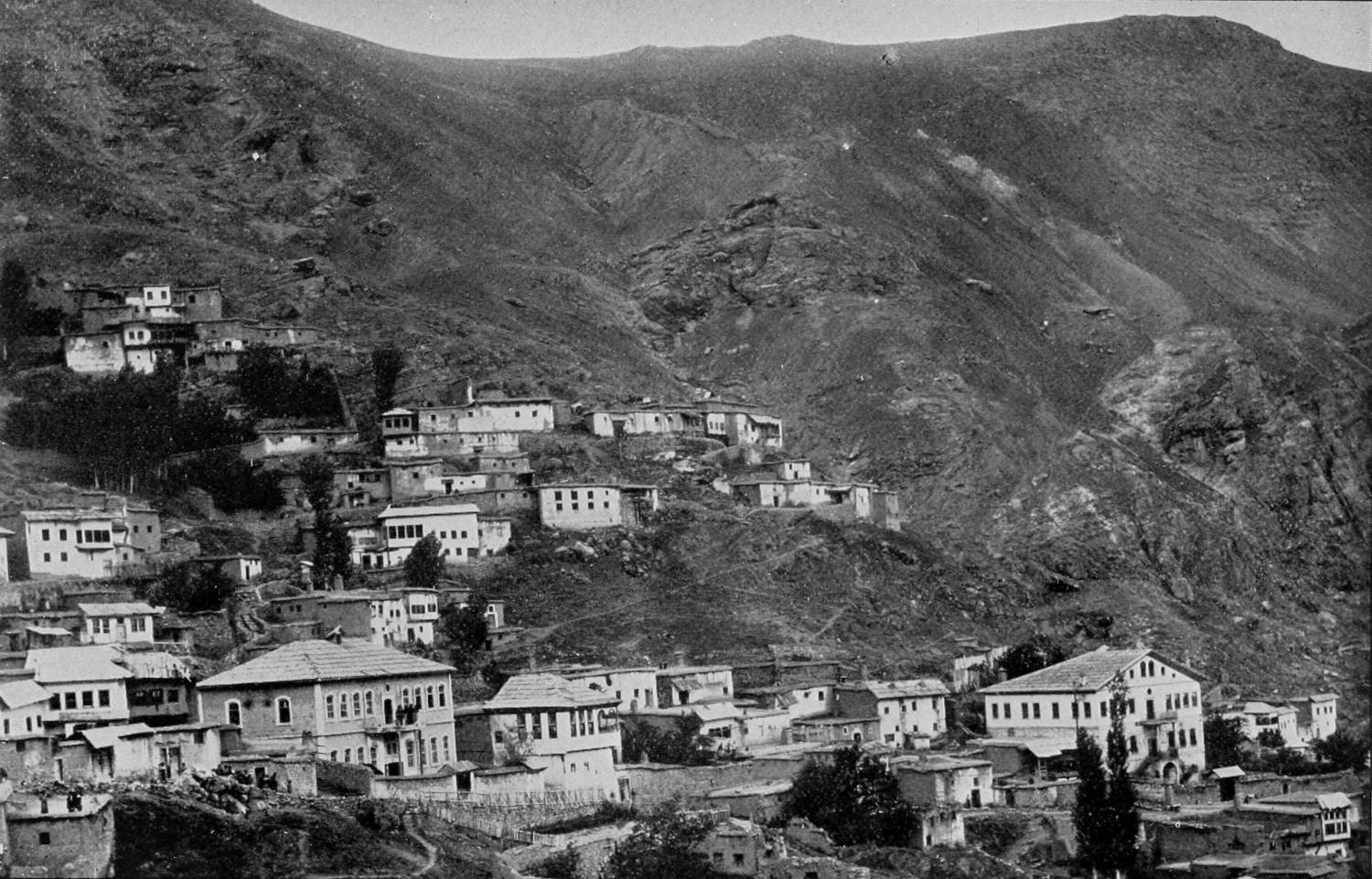
dog barks his signal of unwelcome to the traveler.
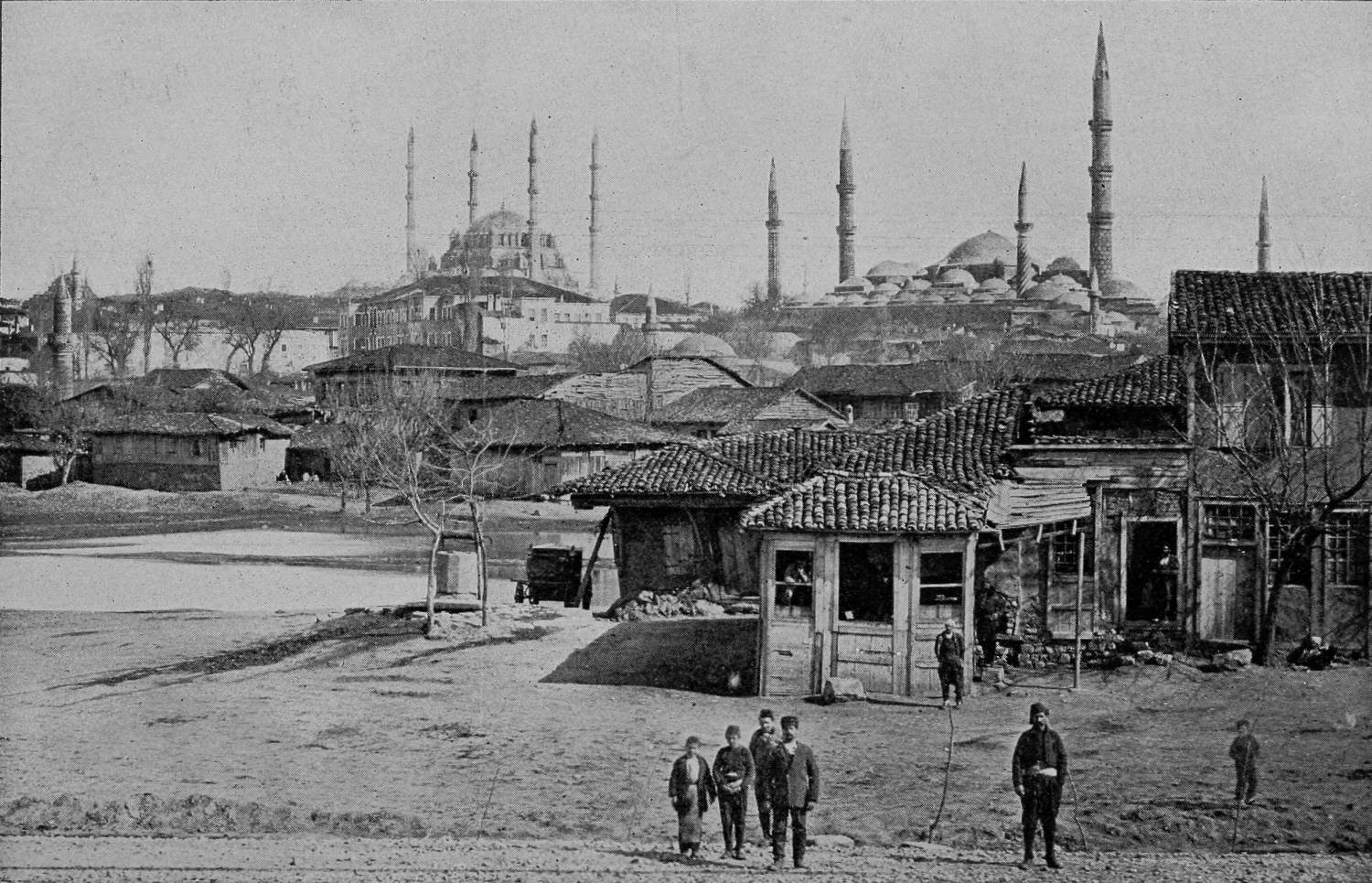
The general style of building varies with the section of
country. Along the seaboard, or within easy reach of it, the
general appearance of the houses reminds one of Europe.
There is a frame of timber, with a wall of board or rough
brick or stone covered with stucco. Red brick and dressed
stone are also not uncommon. In the interior, however, the
general style is that of the Mexican adobe. Sun-dried brick
furnishes the chief material, sometimes whitewashed for more
pretentious homes, government houses, churches or mosques,
but generally retaining the color of mother earth. In parts of
Asia Minor where a soft sandstone abounds, there are brownstone
fronts, rivalling in style some to be found in our own cities.
There is generally, however, some incongruity, made manifest
in a wooden beam supporting a carved window, or an elegant
doorway in the middle of an adobe wall. Diarbekir is famous
for its basalt walls, giving both city and houses a most forbidding
aspect. On the Mesopotamia plain, especially toward
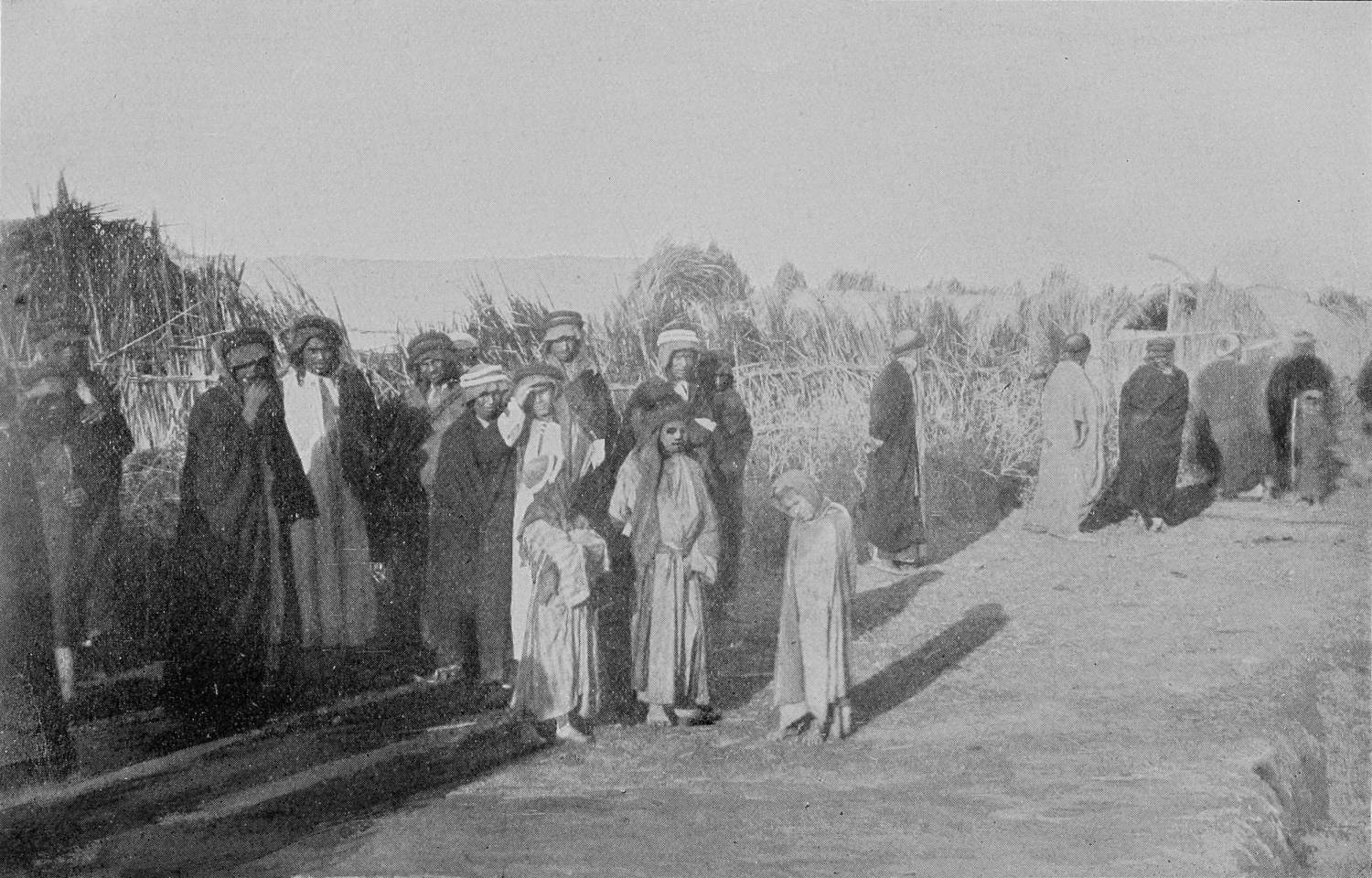
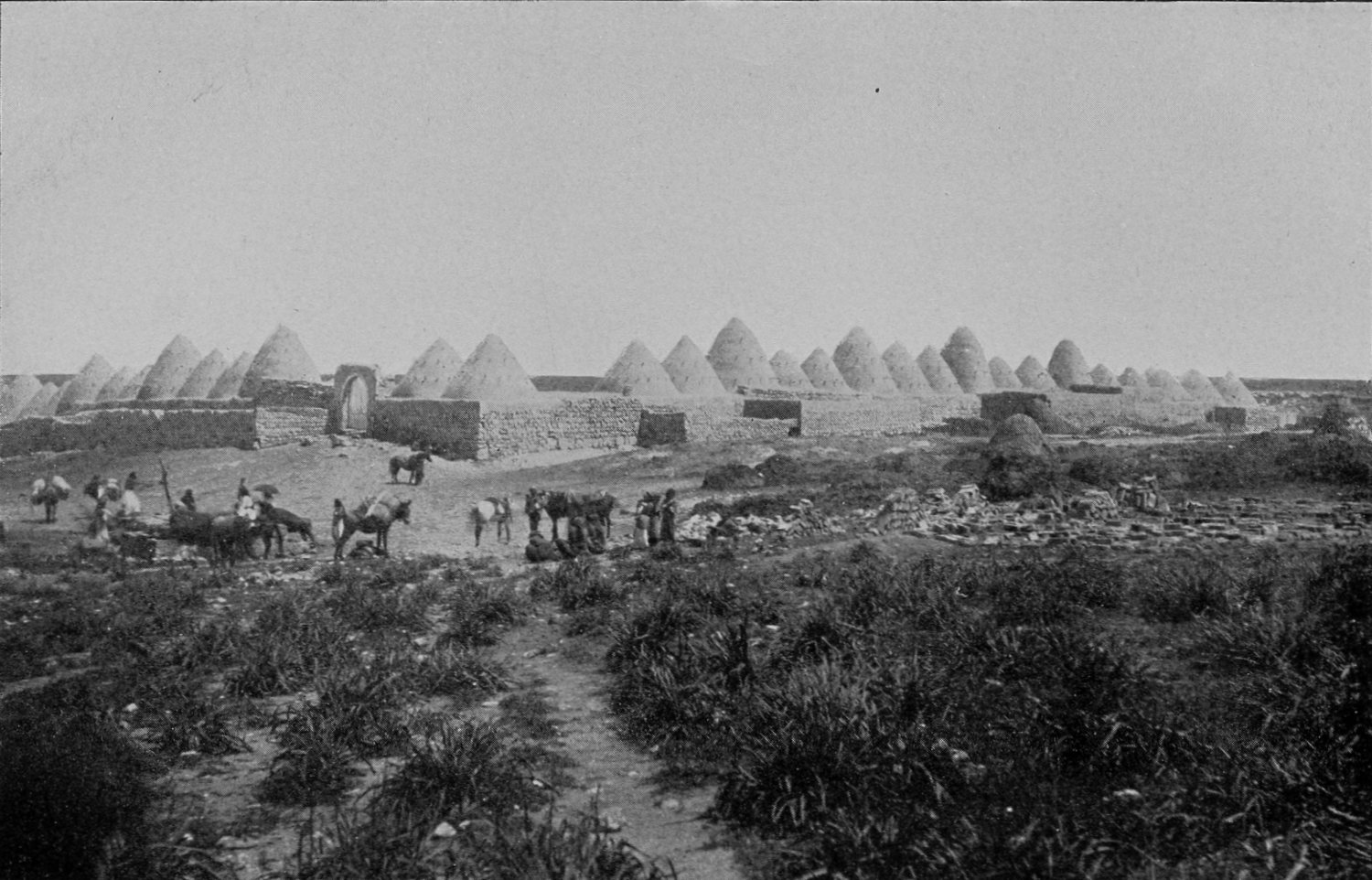
the south, reed huts are numerous, while in Northern Syria
the almost entire lack of timber has occasioned the building of
huts domed with sun-dried brick, anticipating the principle of
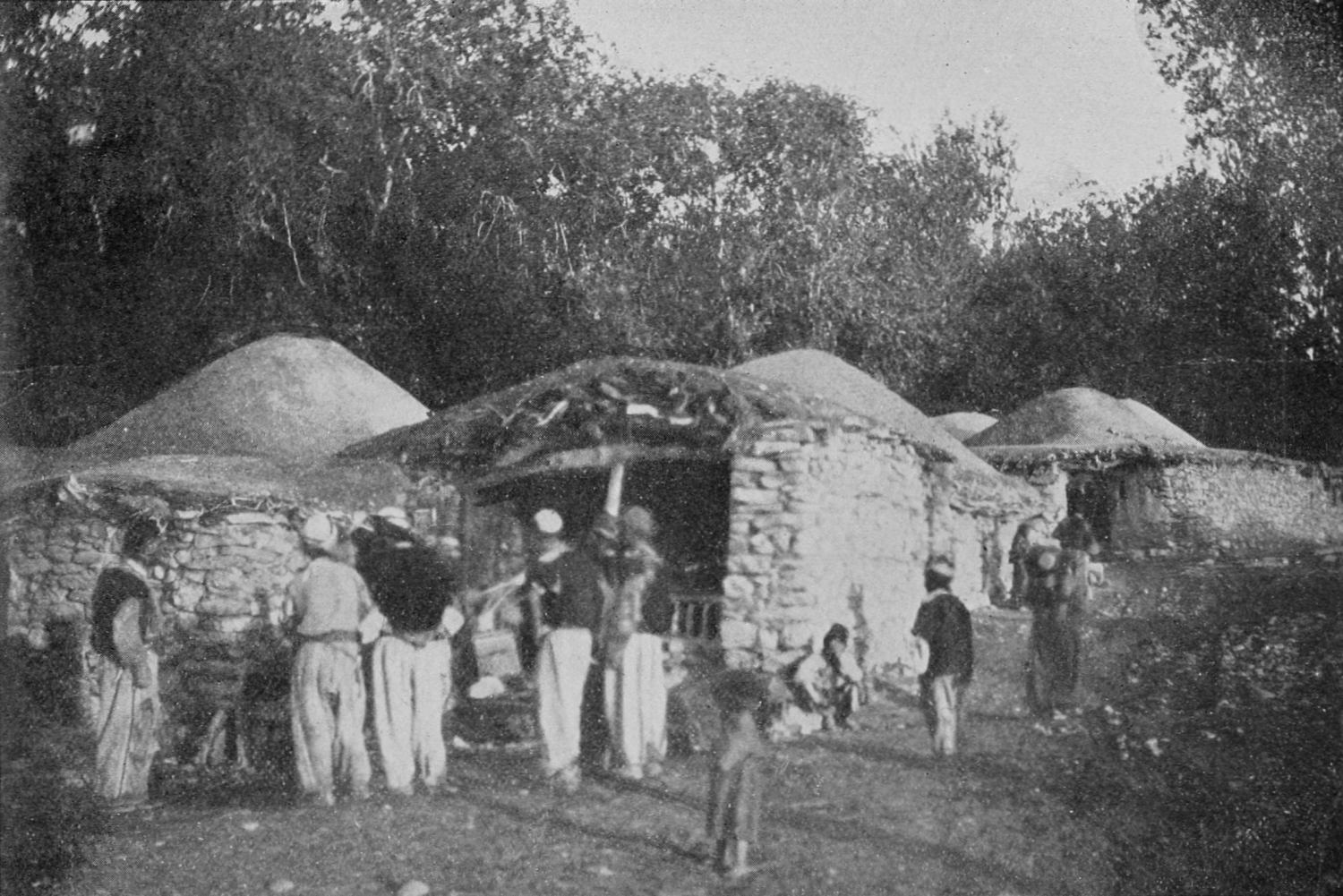
the Pantheon at Rome. In the mountains of Kurdistan the villagers
not infrequently burrow into the mountain side, and
even on the plains of Asia Minor advantage is taken of rolling
land to help in the making of the walls, and the traveler
by night need not be surprised if his horse breaks through
the roof of some unnoticed house. There are numerous instances,
notably in Amasia and Urfa and along the Tigris, of
villages cut into precipices of rock, while in other places the
villagers burrow into the hills. In passing from Mardin to
Urfa once, the author came, toward evening, to the foot of a
hill, where the guide said he was to spend the night in an Arab
village. He looked around, but saw no signs of life. The
guide went to the summit of the hill, and shouted into what appeared
a mere hole in the ground. A few minutes after a
man appeared through what had seemed to be the entrance
to a tomb, such as abounded in that region, and soon the
whole party were descending through a passageway into a
large room, used both as granary and living room by the
villagers.
Such descriptions might go on indefinitely, but this will be
sufficient to indicate that throughout the empire the people
have made the most of the resources at their command, for
their permanent dwellings. Tent life is confined to the
Bedouin Arabs and the summer wanderings of the Kurds
over the plains of Mesopotamia and Asia Minor. It should
be said, however, that within the past fifty years there has
been considerable advance in the style of building, chiefly due
undoubtedly to the influence of the missionary houses and
the evangelical chapels, and to-day the general appearance
throughout the entire country has greatly improved.
The arrangement within the houses also varies with the
section of country. In the interior cities and large towns,
the ground floor is taken up with court, stable, kitchen, storeroom
and perhaps an audience room, the living rooms being
chiefly on the second floor. In the villages, however, there
are few houses with a second story, and often the family share
the one living room with their animals.
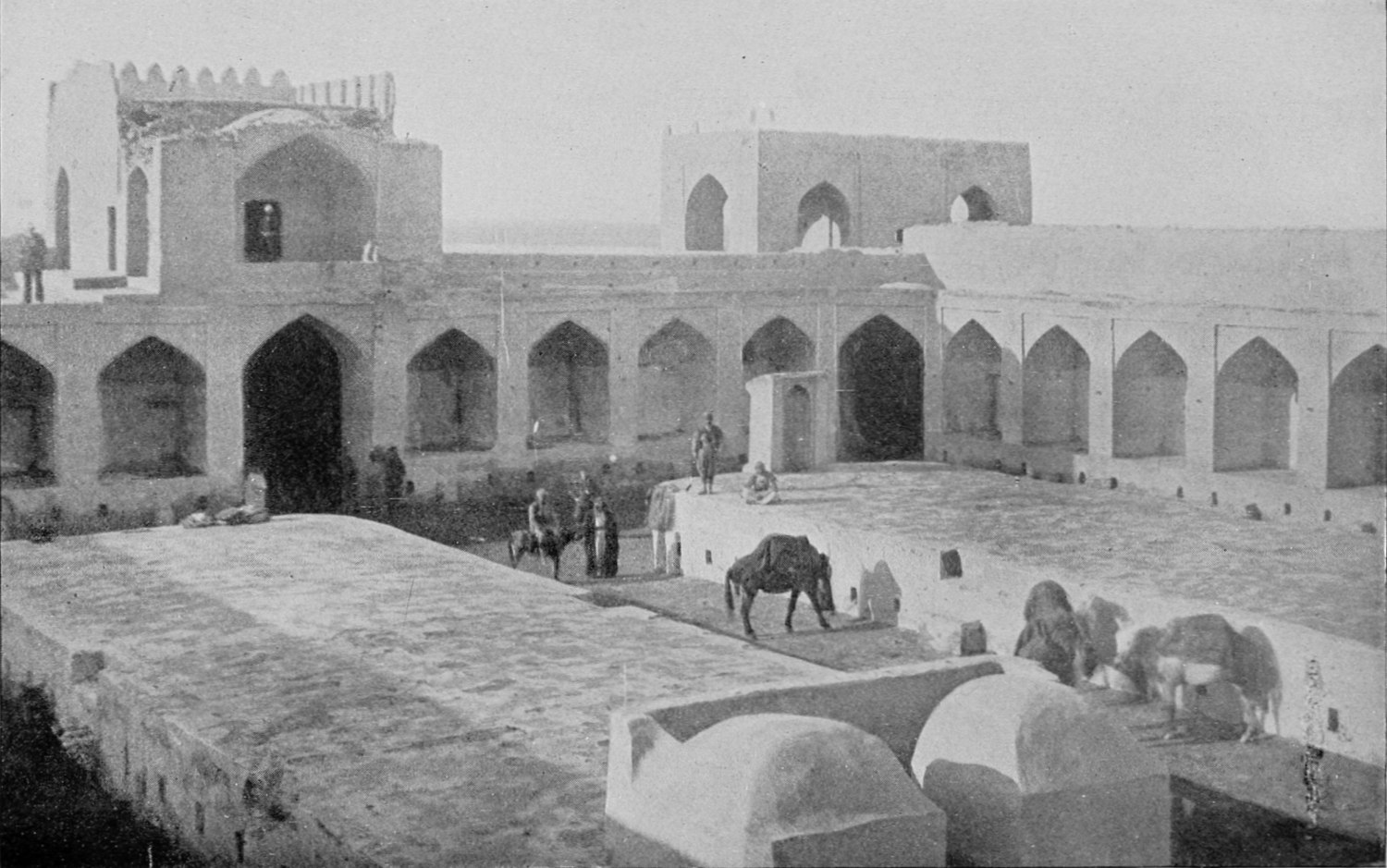
A word should be said as to the accommodation for travelers.
This is chiefly in the form of khans or caravansaries, situated
in the cities and on most of the caravan routes through the
greater part of the empire, at intervals of about thirty miles.
They are as a rule stone buildings, with a large open enclosure,
surrounded by alcoves, closed or open, according to the climate.
In the north, where the winter storms may be severe, there are
stables frequently partly underground. The alcoves are for
the travelers, the open space for their loads and the stables
for the animals, but in case of severe weather the stable
becomes also the refuge for the traveler, whether merchant,
muleteer or official. In the large cities regular rent is charged,
but in the country there is simply a keeper who receives a
small fee for furnishing fuel and water, otherwise the place
being free for all comers. In some cases there is no keeper
at all, the place being left to go to ruin. Most of these buildings
in the interior have been put up as acts of merit by
wealthy Turks, but with no regular income, and no one to be
responsible for them, they have in many places fallen sadly
into decay.
In the villages and even many of the larger towns where
there are no khans, the traveler is sent to what is known as
the “guest room.” A room, or in some instances, a house, is
set apart both for travelers, and as a meeting place, a sort of
club for the villagers. Here they meet in the evening to
discuss the events of the day, much as Americans gather at
the postoffice or corner store. Some one is designated to
provide fire and coffee and the head of the village holds a
sort of court or assembly. Here also the traveler is welcomed,
indeed has a right, whether welcomed or not, to make his
stay. The room as a rule is oblong, with a fireplace at the
end, and has a slightly raised platform on either side. If the
arrival be a foreigner or official, he immediately takes the
place of honor on the right near the fireplace and all gather
to show him courtesy. If an ordinary muleteer or peasant, he
must be content with a place near the door. Here also there
is no charge, the attendants being satisfied with what they
receive for the supply of food, etc. In case the village is too
poor to boast a guest room, the traveler must content himself
with some private house or room, which he generally finds no
difficulty in securing. It will be readily seen that the traveler
in the interior must in the main provide his own furniture and
provision, unless he is able to put up with the very simple fare
of the villagers. Foreigners, and even natives of the better
class, carry their own bedding, cooking utensils and, to a
degree, their food.
The furniture of the houses is very simple, even in the
cities, and in the villages it is primitive to the last degree.
Chairs, tables, upright bedsteads, knives and forks are penetrating
little by little even to the towns, but still the great
majority of the people roll themselves in quilts for the night,
sit on the floor around a platter for their meals and use little
more than spoons. A few copper kettles serve for the cooking
and goatskins for holding what little provisions they keep.
A story is told of a mountaineer in Eastern Turkey, who
went to visit some friends on the plain. When night came
he was offered a quilt or comfortable and a wool pillow. He
accepted them, though with rather rueful countenance, and
laid down to sleep. Sleep, however, refused to come.
Alarmed by his tossings his friends asked him if he were ill.
No, perfectly well. But still he tossed on. Again they came
to him to know what was the matter. At last he blurted out,
“I cannot stand this quilt and pillow. Give me a piece of
sacking to throw over my head and let me lie on the floor.”
Much against their will he insisted and they yielded, and he
slept the sleep of his own mountain home.
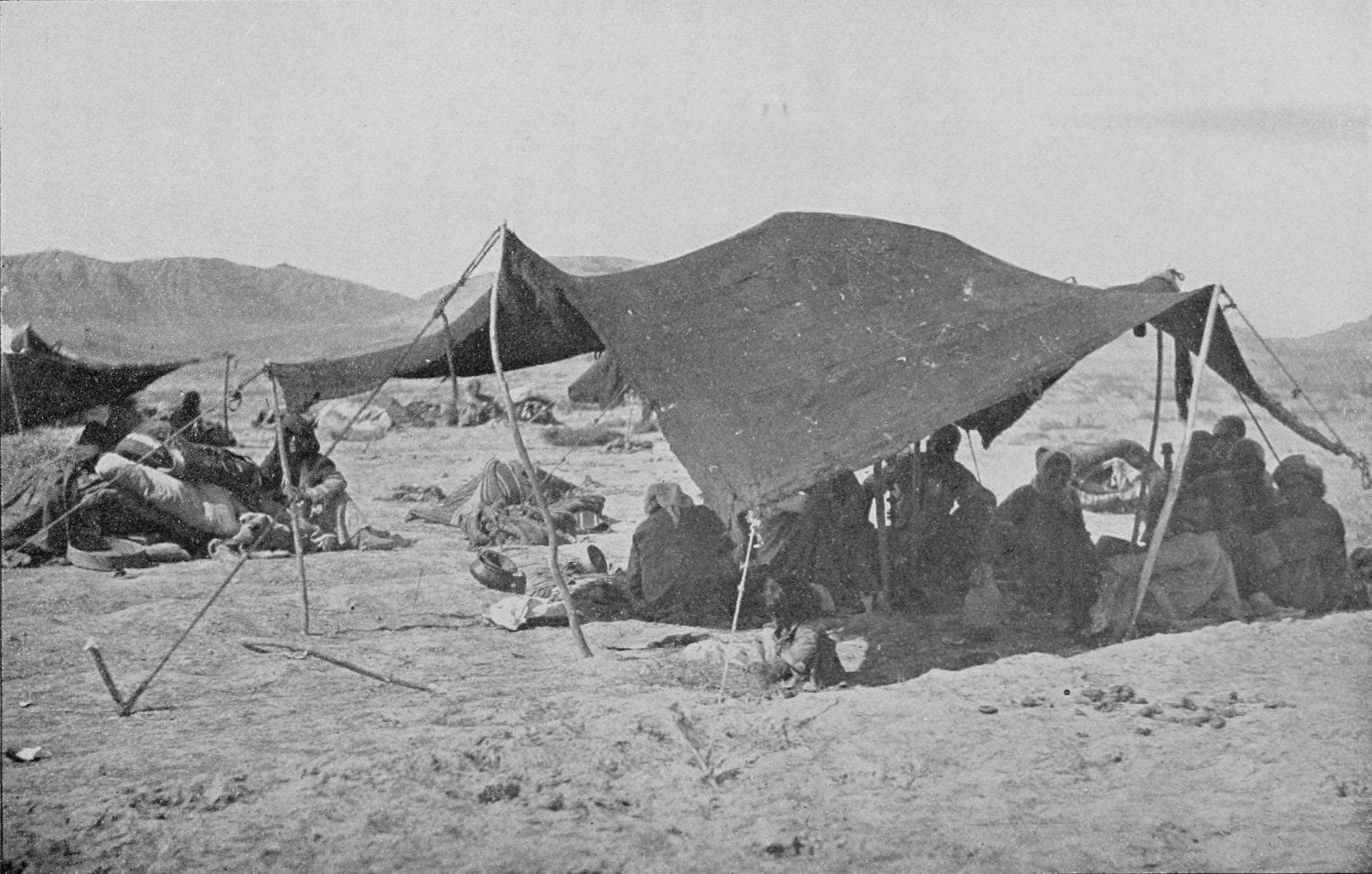
A KURDISH ENCAMPMENT. The black tents are those of Kurdish tribes who spend the winter in the
mountain villages and come down for the spring and summer to feed their flocks on the plains. They are spoken of in
the Bible as the “tents of Kedar.”
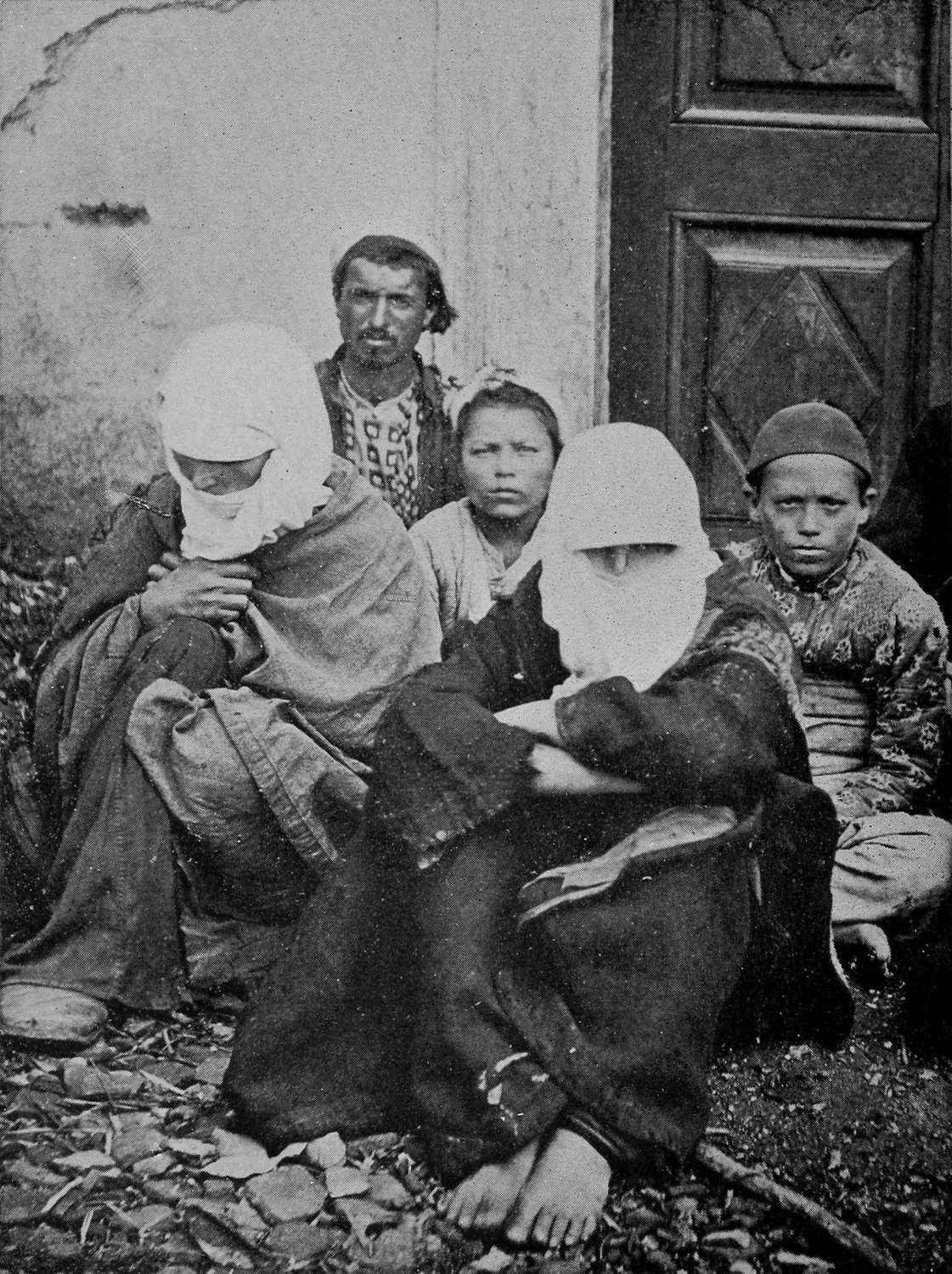
TURKISH PEASANT FAMILY, from the interior of Western Asia Minor.
The family consists of the mother in the foreground, the son and his wife and their
two children, son and daughter. An excellent illustration of the average Turkish
peasantry of the somewhat better class, as found in the villages of Asia Minor.
CHAPTER II. Population and Languages.
Accurate Statements as to Population Impossible—No Census—Best Available Estimates—Distribution—Most
of the Races Described in Other Chapters—Jews and Foreigners—General
Characteristics—The Languages—How Distributed—Peculiarities of the
Turkish—Number Spoken in the Seaboard Cities.
Any accurate statement as to the population of the
Turkish Empire it is impossible to make. There have
been various attempts at a census, but they have
amounted to little or nothing, as is illustrated by the fact that
in every case the number of males far exceeds, sometimes by
20 per cent., the number of females. The official returns likewise
are almost valueless. They are based chiefly upon tax
returns and these are notoriously inaccurate. The taxes are
collected by the farming system and based upon the returns
from the heads of the different communities. There is thus
on the one hand a strong temptation on the part of the communities
to underestimate the number of taxpayers, and on
the other hand a tendency on the part of the collectors to
misstate, in order to give as much leeway as possible for
filling their own pockets. Accordingly about the only basis
for an estimate that can in any degree be relied upon is
furnished by the statements of persons who have lived or
traveled extensively throughout the empire, are acquainted
with the manner of life of the people and have opportunities
for accurate information from the heads of the communities.
On this basis a general estimate of the population for the
entire empire, including tributary states, is about 30,000,000,
divided as follows:
Immediate Possessions.
Europe
4,000,000
Asia
16,000,000
20,000,000
Africa, Tripoli
1,000,000
Total
21,000,000
Tributary States.
Europe
3,000,000
Africa, Egypt
6,800,000
The Mediterranean
40,000
Total
9,840,000
Grand Total
30,840,000
Leaving out of account the tributary states as practically
outside of our purpose, we give here a brief general survey
of the distribution of this population, reserving more
definite and particular statement for the account of each race.
In European Turkey are Albanians, Greeks, Bulgarians
and Turks. The Albanians are found on the borders of the
Adriatic; the Greeks on the northern border of Greece, along
the shore of the Aegean and somewhat up the valley of the
Vardar; the Bulgarians occupy the northern part of that
valley and the mountains up to the very border of Bulgaria;
the Turks are principally found in the vicinity of Adrianople
and Constantinople; there are also Armenians in Adrianople
and along the coast of the Marmora. The Greeks are the
most numerous; next to them probably come the Albanians
and then the Bulgarians. Of Turks proper there are very
few. For years there has been a constant emigration from
European Turkey into Asiatic Turkey, many recognizing
that the time was at hand when the Ottoman rule in Europe
must end. The Albanians are Moslems. There is, also, in
the mountains on the borders of Eastern Rumelia, a considerable
population, Bulgarian by race and Moslem by
religion, called Pomaks.
Passing over into Asia, so far as the population is concerned,
the country may be divided into three sections: Asia
Minor and Eastern Turkey, Syria and Mesopotamia. In the
first of these there are Turks, Kurds and a number of minor
Moslem tribes, Circassians, Lazes, Xeibecks, Avshars, Turcomans,
etc. The Christian population is almost entirely
Armenian and Greek. The Turks are principally in Central
and Western Asia Minor; the Kurds are in Eastern Turkey,
though extending somewhat along the mountain ranges; the
Circassians are found scattered through Central and Western
Asia Minor; the Lazes are on the borders of the Caucasus; the
Xeibecks and others are tribes occupying the mountains inland
from Smyrna; Armenians are found over the whole of
the territory, in almost equal proportions; the Greeks chiefly
along the coast of the Black Sea and the Mediterranean and
in the western part of Asia Minor, though in Central Asia
Minor there are a number of Greek villages. In Syria
the population—something over 2,000,000—is about
equally divided between Moslems and Christians. The
Moslems are in the main of the orthodox Sunni sect, but
there are a number of Metawileh, and the Druzes and
Bedouin Arabs are numerous. There are also about
250,000 Nusairiyeh. The Christians are chiefly orthodox
Greeks and Maronites; there are some Armenians, Jacobites
and others. The Druzes and Bedouin Arabs are found
chiefly in the Hauran east of the Lebanon ranges. In
Mesopotamia, the population is chiefly Moslem and Arab,
though there are a number of Yezidis in the region of Mosul.
The Christian races are found in the mountains between the
Tigris and the Persian border, and include Jacobites, Nestorians
and Chaldeans; Armenians are also scattered throughout
the whole region.
Jews are found in large numbers in Constantinople, Smyrna
and Salonica, and in smaller communities all over the land
wherever there is trade. They are very largely Spanish in
their origin, having fled to the Levant at the time of the persecution
by Ferdinand and Isabella. They include the
wealthiest and the poorest of their class. Many of the
bankers are Jews, and their hold upon the finances of the
country is very strong. They also control certain branches
of trade, are very largely money-changers, and to a degree
artisans. They occupy certain definite quarters in the different
cities, which have the appearance familiarly associated with
the Ghetto of Venice. They have the same general characteristics
as their fellows in other lands, are shrewd, keen bargainers,
but frequently find more than their match in the
Christians. They are looked down upon and despised by
Turks and Christians alike except when their wealth makes
them the arbiters of the financial fortunes of the empire and
of individuals. Many of the wealthier class are men of high
character, universally respected for their ability and holding
a favored position in society. As to their numbers it is difficult
to give any figures. In Constantinople there may be
75,000, and in the empire, aside from Palestine, perhaps
150,000 to 200,000.
Almost all foreign countries are represented in Turkey.
Those that furnish the largest number are probably Italy,
Greece, France, Germany, Austria, England and Russia.
Italians are numerous in the cities on the seaboard, in connection
with shipping interests. The French are merchants,
bankers, and to a degree professional men, as also are the
Germans. Austrian subjects are not to a great degree pure
Austrians, but Hungarians, Bosnians, etc., interested in trade.
The English colony has been at times a very large one.
During the reign of Abd-ul-Aziz, English mechanics were
brought into the country in large numbers, and the various
departments of the navy, army and public works were managed
almost entirely by them. At the present time their number
has greatly diminished. They are still employed to a degree
by the government as engineers, but their places are being
taken by others. There are a number of English mercantile
houses, but the Germans have outstripped them in the conduct
of trade with the interior, and the community is not as
strong as it used to be. There is a large number of families
of these various nationalities connected with the diplomatic
circles, and Pera Society, as it is termed, is very largely composed
of them, together with the bankers and the wealthiest
merchants.
The Americans resident in Turkey are almost entirely
American missionaries. They number in all not far from 300
adults, and are found in all the chief cities of the empire,
their headquarters being in Constantinople and Beirut. Fuller
statements as to their location will be found in the chapter on
missions. There are other Americans, some merchants, a
few professional men, chiefly physicians, and a few interested
in one or another form of concession from the Turkish
Government. The missionaries, however, form by far the
bulk of the American community.
Mention should also be made of a class peculiar to Turkey,
known as Levantines. These are generally descendants of
foreigners, English, French, or others who have settled in the
seaboard cities, married women of the country and, while
retaining their political connections with the country from
which they originally came, have become thoroughly Orientalized
in many respects, in their manners, customs and ideas.
They are, as a rule, very capable, having all the shrewdness
of the East, and are apt to be equally devoid of moral principle.
In fact the term Levantine has become in great degree
a term of reproach, indicating a general lack of moral fiber.
Many of them, however, are persons of high character and
considerable influence.
Each of these different races has its own particular and distinctive
characteristics, to be noted in connection with the
specific description of each race. There are, however, certain
general statements to be made which come in place here.
The first thing to be noted is the marked unity, or perhaps
better, similarity between the different races. Notwithstanding
diversity of origin and language, it is by no means easy
for the uninitiated to draw the lines of distinction. This is
due partly to the fact of the general mingling of the races,
partly to the fact that dress and general habits of life are
regulated more by climate and physical conditions, than by
any arbitrary rule of government or society. In the first
place there is comparatively little pure blood except among
the Christians. In certain sections, notably the region of
Asia Minor, formerly occupied by the Seljuk domain, the
Turks are exceptionally pure-blooded, but on the seaboard
there is a large admixture of blood of other races. The introduction
of Georgian, Circassian and even Armenian and
Greek women into the harems of the Turkish nobles has had
a perceptible effect. So also the general fact that the Turk
is the dominant race has made large numbers of others of
entirely distinct racial origin ambitious to take the name of
Turk. Thus in Eastern Turkey, especially in the cities of
Erzrum, Bitlis, Van and Diarbekir, there is comparatively
little of pure Turkish blood, the great majority of those passing
under that name being of Kurdish origin. The same
thing is found elsewhere in Northern Syria, and to a degree
in European Turkey. It must also be remembered that large
numbers of Moslems called by various racial names are originally
of Christian blood. In the early conquest of the land
many villages and even communities accepted Islam under
the pressure of the sword and because of weak faith in their
own religion, due chiefly to the ignorance enforced by ecclesiastics.
Thus in the mountains of Southern and Eastern
Turkey there are whole communities known now as Kurdish
which were originally of the same blood and the same characteristics
as their neighbors now called Jacobites. Again in
European Turkey there is comparatively little difference between
the Moslem Albanian and the Greek Mountaineer of
the same section. The Moslem Pomak of the Rhodope Mountains
on the southern borders of Eastern Rumelia can with
difficulty be distinguished from the Bulgarians, where they
are engaged in similar pursuits and occupy similar territory.
In Syria and Mesopotamia it is scarcely possible to draw
racial distinctions. The line between Moslem and Christian
in Aleppo, Mosul, Bagdad or Beirut is practically imperceptible
except as occasional difference of dress or bearing is observed.
As we have said, almost the only peoples who have
kept their nationality clearly distinct are the Armenians,
Greeks, and there may be added the Bulgarians. Yet as was
inevitable, these have been to a considerable degree affected;
so that while the population of the Turkish Empire is thoroughly
heterogeneous, there is to the chance traveler comparatively
little distinction to be made between the men of the
different races. Among the women the different conception
of womanhood makes a very marked distinction, and on the
street certainly even the most casual observer finds little difficulty
in distinguishing between Moslem and Christian.
One general characteristic of the populations of the
Turkish Empire is that they are easily governed. This does
not mean that they are lacking in bravery, but the effect of
the centuries has been to impress upon them the necessity of
submission to whatever law is dominant in the empire. The
Kurds are in the main thorough cowards. With the exception
of those in the South they are always amenable to a
strong hand and a very slight show of real force on the part
of any government is sufficient to secure their obedience.
Travelers are usually able to control them even in the wildest
sections. It has been repeatedly said that a very small body
of European troops with mountain artillery could pass from
one end of Turkey to the other, even in times of general
anarchy, and meet with very little opposition. This as a general
statement is true. At the same time, organized resistance
on the part of the Turkish Government with its regular army,
would present an opposition which the strongest of European
armies might hesitate to meet. Among the Christians there
has been no organization against the Turkish Government,
with the exception of two small sections. The mountain
Nestorians are practically independent on the Persian border;
nominally they pay a certain tribute; sometimes they pay,
sometimes they do not. The Armenians of Zeitun have
been from time immemorial practically independent. About
20 years ago they submitted to the Turkish rule on certain
conditions, which were accepted by the Turkish Government.
Their recent revolt and the persistency with which they held
out against the Turkish troops manifest the character of the
people. Undoubtedly they were assisted in great degree by
the topography of the country, but that was by no means
the strongest feature of their resistance. Aside from these
two sections the Christians have been the prey of the Turkish
Government and have never organized in opposition to it.
The reasons for this will be apparent in the chapters relating
to the general history of the empire and the condition of the
Christians.
The languages of Turkey are Turkish, Kurdish, Arabic,
Syriac and Bulgarian. The Turkish is the official language
of the entire empire and is used to a greater or less extent
everywhere except in the remote villages of Kurdistan,
Mesopotamia and Syria and throughout Arabia. Arabic is
spoken everywhere south of the Taurus Mountains, with the
exception of a few cities in the vicinity of Aintab and Marash.
Kurdish is used in the mountains of Eastern Turkey and to
a limited extent in the mountainous sections of Asia Minor.
Armenian is spoken over the entire empire wherever there
are Armenians. Greek is used along the borders of the
Black Sea, the Archipelago and the Mediterranean and to a
very limited degree inland. Syriac is used among the
Nestorians and Jacobites, chiefly the former, in the mountains
of Eastern Turkey. The use of Bulgarian is confined to
Bulgaria, Eastern Rumelia and Macedonia. Constantinople
itself is a babel, all the different Oriental and many of the
European languages being found there in everyday use.
Turkish is spoken by the Turks and Circassians and the
various Moslem tribes, also to a considerable degree by
the Kurds, Armenians and Greeks and by government
officials everywhere. Certain sections of the Armenians,
especially those in Central Asia Minor, from Sivas west to
Angora and Cesarea, and those south of the Taurus in the
vicinity of Marash and Aintab, have in years past used
Turkish almost entirely, preserving their ancestral language
only in the church services. The same is true of the Greeks in
Central Asia Minor. Arabic is used by Moslems and Christians
alike in the sections where it is the vernacular. Kurdish
is spoken both by Moslems and Christians. Bulgarian
is used solely by Bulgarians. All of these languages vary
somewhat in their characteristics, according to the section
where they are used and the class of people by which they
are spoken. Thus the Arabic of the plains and of Egypt is
much milder in its form than that found in the mountains.
The same thing is true of the Turkish and the Armenian of
Bitlis, and the people of that section are almost unintelligible to
those farther west. The Greek of the Turkish Empire is also
quite different in many respects from that of Greece proper.
The Arabic and Greek languages are so well known as not
to need any particular description. They are essentially the
same as they always have been and are well known in literature.
The Arabic is one of the richest of all the Oriental
languages in its literature. The character is difficult to learn
and the construction is so involved that comparatively few
foreigners become masters of it. It is said of Dr. Van
Dyck, the eminent missionary at Beirut, that he could speak
Arabic so well as to deceive even the Arabs themselves, and
on one occasion it is reported that this very facility in the use
of the languages operated to create a prejudice that really at
one time endangered his life, because they could not understand
how any man who could speak Arabic as well as that
could be a foreigner and claim the protection which he
demanded.
The Turkish language is peculiar in many respects. Originally
a Tartar dialect, it has many of the characteristics of the
Saxon. It is terse and strong in its form of expression, and
to a considerable degree monosyllabic. The Turks, however,
passing through Persia, came very much under the influence
of that language and felt the softening influences of it. The
Persian, as spoken by the Persians, is smooth and flowing,
liquid as any of the Pacific Island languages, and even more
so than the Italian. The way in which an educated Persian
uses his own language is unsurpassed for delicacy of expression
or sound. Passing from Persia and accepting the Koran,
the Turks came under the influence of the Arabic language,
and the Turkish of to-day is the result of the commingling of
the three elements. As a consequence it is an exceedingly
rich language. As it is ordinarily spoken it is not at all difficult
to learn, but to use it in literature correctly and with the
appropriate adaptation of the forms derived from the Arabic
and Persian, requires an amount of study and skill such as
comparatively few have been able to bring to it. The character
used is the Arabic, which, however, is not entirely adapted
to the simpler Tartar forms, and as a result there is more or
less of reduplication of letters. While the lettering of the
three languages, Turkish, Arabic, and Persian, is the same,
each language has its own distinct form, so that a book printed
in the type favored by the Turks will not be acceptable either
to the Persians or the Arabs, and the same is true of the
others. The tendency of education with Turkish, as with
Arabic, is to soften the gutterals, of which there are several
harsh ones, and Turkish as spoken in Constantinople by the
educated is a smooth and flowing language.
The Armenian is naturally a harsh language, the strong
gutterals, aspirates and sibilants affecting it materially. Here
too is noticed the marked effect of education, and the Armenian
spoken in the western part of Asia Minor is very mild compared
with that along the mountains and even on the eastern
plains. The Armenians of the Caucasus and Northern Persia
use a form of Armenian which is somewhat distinct from that
used by those in Turkey. The basis of all is the ancient
Armenian, which has a very simple and direct construction,
not unlike the English. A sentence in the old Armenian
version of the Scriptures reads word for word almost the
same as the corresponding sentence in the English version.
The modern language as used by the Armenians of Turkey
has been to a considerable degree affected by contact with
Turkish and has degenerated in that respect. For some
years there has been a tendency to revert to the more ancient
form, and the teachers in the Armenian schools everywhere
have exerted all the influence possible in that line. The result
is manifest in their literature. The version of the Bible prepared
by Elias Riggs, D. D., of the American Board, represents
the best of what is known as modern Armenian of a quarter
of a century ago. But of late years there has been felt the
necessity of a revision to accord more closely to the type of
the ancient language. This tendency is in the line of simplicity.
On the other hand, among the Greeks, while there is
an increasing desire for the ancient Greek, which is quite distinct
from the modern, an increasing familiarity with it does
not appear to be as much of an approach to the ancient construction
in the ordinary conversation as is the case in the
Armenian.
The Bulgarian language is not unlike the Russian, both in
its character and general construction, and belongs to the
general Slav family.
The Kurdish language is entirely unique, though some
Kurdish scholars have claimed that it was parallel to the old
Persian. It is a rough language, and yet has certain musical
qualities, and its poetry and songs are like those of so many
mountain sections, exceedingly full of sentiment. Even the
wildest of the men seem to come under its influence most
powerfully.
In Constantinople and along the seaboard foreign languages
are used to a considerable degree. The diplomatic language
is French almost entirely. There is a considerable amount
of Italian used in the seaports, and not a little German. The
State papers for communication between the ambassadors in
the Sublime Porte are entirely in French, though decrees of
the government, of course, are written in Turkish. This
mingling of languages has necessitated the employment of
interpreters, and a large number of people, not merely connected
with the embassies, but in various departments of
business, are employed to transfer from one language to
another such documents as may be necessary. The use of
English is widely extended. The study of English in the
different schools of the American missionaries and also in
other schools has operated very largely to increase the use,
and English commerce has extended to a marked degree.
This latter, however, has yielded in some respects to German,
so that the German language is known and spoken more and
more. As a rule, Armenians in the cities all speak Armenian
and Turkish. Armenian merchants almost invariably add to
this French, and in not a few instances Greek. In fact no one
can do business successfully in the seaports without the
knowledge of Turkish, French and Greek. Smyrna is almost
entirely a Greek city, and even the Armenians use the language
to a great degree. The Greeks, however, seldom, if
ever, learn Armenian.
In traveling, a knowledge of Turkish will carry one with
ease over the whole empire, except in Syria and Mesopotamia
and a few sections of Kurdistan. Even there, however,
some one may usually be found who has enough knowledge
of the Turkish for ordinary use. On the seaboard,
Greek will be of advantage, but is by no means necessary.
All large business houses have some one who can converse
in any one of the languages of the country or of Europe.
One effect of this is that accurate use of any one language
is hindered. At a dinner table in Constantinople it will frequently
be the case that the conversation will turn from one
language to another, and Turkish, French, Greek, German,
Italian or English may be used. When such a condition
exists there will be a general conversational use of all, but
accurate scholarly use of any one is rare. In the schools,
Turkish, French and English are the most generally taught,
instruction in the other languages being chiefly confined to
those who use them as their own vernacular.
CHAPTER III. RELIGIONS.
Islam and Christianity—A few Pagan Communities—Origin of Mohammedanism—The
Koran—The Traditions—Extent of Islam—Present Condition—Effect upon the Turks—Contact
with Civilization—Sects—Oriental Christianity—Characteristics.
The religions of Turkey are in general two—Mohammedanism
and Christianity. The semi-pagan forms of
faith held by the Nusairiyeh, Yezidis and Druzes are spoken
of in another chapter in connection with an account of those
races. This is not the place for a scientific statement of the
general subject of Mohammedanism. The purpose of this
volume is to set forth the situation of the Turkish Empire as
it is, and we have to deal with Mohammedanism not as a
theory or a doctrine, but as a fact. At the same time some
understanding of the doctrine is essential in order to realize
how potent a factor it is in the present situation.
Mohammedanism is primarily a historical religion, based
upon the fundamental idea of the absolute unity of God and
the recognition by God of Mohammed as his latest and most
approved prophet. Without entering into the question of
the sanity or insanity of Mohammed himself, it is sufficient to
say that this Arab imbibed with his earliest teachings the
doctrine which was held by the Jews, and a few in Arabia, of
the power of the Deity. Apparently the teachings of the
Hebrews had left their trace upon him, and his mind dwelling
upon the precepts of Moses and comparing them with
what he saw of the Christians, developed within him a
hostility to any form of what seemed to him idolatry, such as
he found existent everywhere. Among the pagan tribes
there were said to have been 365 images of the gods, who
were looked upon as the children of Allah, the creator of all,
whose wife was Al-hat, and the Meccans looked upon their
local deities as the daughters of this idol. Idols were found
in every house and formed an important article of manufacture.
Religion was a sort of barter, and festivals and pilgrimages
made up a large part of religious life and worship.
At the same time the form of Christianity was of the most
inferior type. The doctrine of the Trinity was practically a
sort of tritheism in which the three persons were God the
Father, God the Son and the Virgin Mary. To Mohammed
there seemed little difference between the two and both
appeared to him the very lowest forms of religious faith, and
he was stirred with an earnest desire to know more. This,
according to the idea of the time, he thought to accomplish
by a hermit life and would spend days in a lonely cave.
While here it is probable that epileptic fits would come upon
him and there would be what he considered ecstatic reveries
in which revelations appeared to him. The story of the
fierce persecution which he suffered at the hands of his tribe
is a most interesting portion of history. From the time of
his fleeing from Mecca to Medina, in 622, which marks the
era of Mohammedanism, his advance was rapid. In eight
years at the head of 10,000 men he entered Mecca in triumph.
He only lived two years longer, but he had laid the foundation
for a religious power of marvelous vigor and extent.
As to his character, those who have studied him most say
that there can be no doubt of his sincerity and his conduct
was in the main beyond reproach. He believed himself to
be a divinely appointed messenger for the overturning of
idolatry, and for years endured the hostility and taunts of his
people with apparently no further motive than their reformation.
At a later time other characteristics appeared of a
much lower grade. Wealth and glory mingled with his
reform ideas. Cruelty, greed and the grossest sensuality
were not merely allowed but encouraged by his teachings,
and the most successful portion of his life, so far as his public
career was concerned, made it appear that he was a thoroughly
self-deceived man.
The Koran is a volume divided into 114 chapters or suras,
made up in a volume not quite as large as the New Testament.
It constitutes the revelation proclaimed by him as
received during the latter portion of his life. These were
originally written on all sorts of material, “bits of stone,
leather and thigh-bones,” but had their strongest hold in the
retentive memory of the Arabs, which assists their marvelous
power of story-telling. These were gathered together after
his death, in the caliphate of Othman, and the edition then
prepared has been the standard edition for the Moslem world
ever since. It is written in the Meccan dialect and held to be
the absolute standard of the Arabic language, so beautiful
that its very style is proof of its divine origin. The doctrine
of the Koran is thoroughly simple. The fundamental teachings
are the unity of God, the final judgment and absolute
submission to his will or “Islam.” The confession of faith
is simply, “There is no God but God, and Mohammed is his
prophet.” The general belief includes belief in God, angels,
the Scriptures, the resurrection and day of judgment, God’s
absolute decree and predestination of both good and evil.
In practice it requires prayers, alms, fasting and the pilgrimage
to Mecca. In its relation to Christianity the Koran
thoroughly recognizes the Scriptures, both of the Old and
New Testaments, and the prophets, from Abraham to Jesus,
are acknowledged as divinely sent and of authority only less
than Mohammed himself. The result of this is that a thoroughly
orthodox Mohammedan, well grounded in his own
faith, will always accept the authority of the Bible, merely
claiming that wherever that comes in contact with the Koran
the Koran supersedes it as being a later revelation. A
Kurdish Sheik with whom the author spent a Sunday in the
city of Rowandiz, said, “Why do not the great Bible societies
of England and America print the Koran and the Bible
together? Both are revelations from God; the only difference
is, that the Koran being later is more authoritative. Print them
both together and then we shall have the complete revelation.”
This fact explains in great degree the position of the
Turkish Government with regard to the Scriptures. So long
as they thought that there was no danger of the Christians’
Bible superseding the Koran they were entirely willing that
it should be printed. It was only when they learned that the
teaching of the Bible was antagonistic to the Koran that they
made every effort to hinder its publication and circulation;
and in the whole contest the strongest argument and the one
which they could not answer was that based upon the absolute
recognition of the Bible by the Koran and the teachings of
Mohammed.
Secondary to the Koran in form yet practically overpowering
it are the traditions: the “unread revelations,” the “uninspired
record of inspired sayings.” They refer “not only to
what Mohammed said and did, but what he allowed others to
say unrebuked.” As was inevitable, the mass of these traditions
is very great and their influence is proportionate. Any
statement of Mohammedanism based upon the Koran alone
is sure to be misleading. That together with the traditions
must be understood in order to gain a clear and accurate conception
of what the religion is. It is due to this fact that Mohammedanism
has adapted itself with such marked success to
the most varying conditions. It is as powerful in Central
Asia as in Central Africa. It appeals to the educated Moslem
of North India and to the ignorant and brutal Kurd. It numbers
among its votaries men of every grade of intellectual
ability. This is illustrated by the statement as to the extent
to which the religion has spread over the world. Any accurate
estimate is simply impossible owing to the fact that in
Moslem regions there is no such thing as a complete census
known. The Encyclopædia of Missions presents the following
table derived from the Statesman’s year-book published in
1890:
Europe.
Rumania
2,000
Bulgaria
668,173
Servia
14,569
Bosnia and Herzegovina
492,710
Montenegro
10,000
Greece
24,000
Turkey in Europe
2,000,000
Russia in Europe
2,600,000
Total for Europe
5,811,452
Asia.
Turkey in Asia (including Arabia)
22,000,000
Persia
7,560,600
Bokhara
2,500,000
Russia in Caucasus
2,000,000
Khiva
700,000
Russia in Central Asia
3,000,000
Siberia
61,000
Afghanistan
4,000,000
India
50,121,595
Ceylon
197,775
Beluchistan
500,000
China
30,000,000
Australasia
15,000,000
Total for Asia
137,640,970
Africa.
Egypt
6,000,000
Zanzibar
200,000
Morocco
5,000,000
Tripoli
1,000,000
Tunis
1,500,000
Algeria
3,000,000
Bornu (Lake Tsad)
5,000,000
Wadai
2,600,000
Baghirmi
1,500,000
Egyptian Soudan
10,400,000
Sokoto and Feudatory States
14,000,000
Sahara and scattered
10,000,000
Total for Africa
60,200,000
Total for Europe
5,811,452
Total for Asia
137,640,970
Total for Africa
60,200,000
Total Moslems
203,652,422
What is the effect of Mohammedanism upon the Moslems
of the Turkish Empire? What relation does it bear to the
situation in Turkey to-day? These are questions not altogether
easy to answer definitely and conclusively. A general
idea is gathered from references made all through this volume.
The situation may be briefly summarized as follows: Mohammedanism
is on trial; it finds itself face to face with the
aggressive power of a reformed Christianity; it no longer
has to meet the effete systems of the middle ages, weakened
by purely doctrinal discussions that spread among the Christian
Churches for centuries. It comes in contact thus with a
truer spiritual life, and finds that it has suffered itself in its
conceptions the same decadence that Christianity had suffered
when it started. The belief in the unity of God is
degenerating into pure and simple fanaticism; predestination
to good has disappeared, and in place of it comes predestination
to evil. The better characteristics of the Moslem
influence have disappeared, and it is only the worst elements
that come to the surface to-day. True there is an element
in the Moslem Church that realizes, in a degree at least, this
fact and is making strenuous efforts to reinstate the spiritual
power to which the system has owed a large part of its aggressive
strength, but it is doing it and has done it by means
utterly subversive of the very ends it seeks to accomplish.
From time to time there go forth fetvahs from the Moslem
priests commanding the faithful to attend the mosque service,
forbidding the faithful to indulge in certain things forbidden
by the Moslem laws. But such edicts accomplish absolutely
nothing. There is still to a certain degree the practice of the
old asceticism. Any one who will attend a meeting of the
Board of Censors in Constantinople will realize the truth of
this as he looks upon the hard-visaged Tartars from Central
Asia, whose fanaticism is manifest in every line of the countenance.
But with them their religion has ceased to have any
spiritual power. It has become nothing more than a form of
doctrine identified with aggression and despotism. Eternal
punishments take the place of eternal rewards and threats
overpower promises. This manifests itself in two ways: first,
in the tremendous pressure brought to bear upon the government
to restore the austerities of the Moslem faith, and second,
in the manifestation of the sternest Moslem arrogance in
the treatment of the Christians. Scarcely at any time in
Turkish history has that arrogance been more prominent in
certain sections and among certain classes. The scorn and
contempt manifest for the infidel; the utter disregard for the
most common rights of humanity; the assumption that Christians
exist purely and simply for the benefit of Mohammedans;
that rapine, murder and outrage are not criminal, but are
absolutely legitimate; that Christian property has no rights
that Moslems are bound to respect; all these characteristics
are apparent to-day as they have not been at any time during
the past century.
It is impossible for races such as the Moslem races of the
Turkish Empire to come into contact with the results of a
Christian civilization without realizing and acknowledging to
a considerable degree the advantages of that civilization.
These, recognizing the fact that Islam has adapted itself to
very varying communities and circumstances, claim that it has
still that power and that there is no reason why the highest
results of European progress may not be appropriated by the
Moslems. These men form the basis of what is known as
the Young Turkey party. They call for a constitution; they
demand railroads and telegraphs, electric lighting, free press,
widespread literature, freedom of thought and worship; they
refuse to allow that attendance upon mosque service is the
test of loyalty to their government. The strife between these
two forces is one of the most interesting and significant facts
in Mohammedanism to-day. What the result will be time
only will show. One more thing should be said. The exclusive
power of the Moslem faith has never been manifested
more forcibly than it is now. No form of Christianity has
affected it to any appreciable extent. The reasons for this
will be recognized by any who have followed with care the
developments of the past centuries.
They are to be found (1) in the dominating political power
of the religion, and (2) in the fact that as yet to only a limited
degree has there been any general perception of a truer
spiritual power. This last has affected some, but the great
mass are utterly untouched. Should the political break-up
of the empire come, then there are many indications that the
ecclesiastical power will weaken and with it the force of the
faith. Many Turks have spoken of this in private, not daring
to set it forth in public.
The great characteristic of Mohammedanism which is most
manifest in the dealings of Moslems with each other and
with the world at large, is the fact that it recognizes no moral
obligation of any kind. Sin is merely transgression of
statute; falsehood, deception, robbery, murder, have no
moral quality whatever. They are entirely legitimate when
used for the furtherance of the Moslem State and even for
the furtherance of individual advantage. Undoubtedly there
are individual Moslems everywhere who have a strong moral
sense, but the great mass of the Moslem community is
utterly ignorant of what evangelical Christians understand by
the sense of sin. Mistakes are to be atoned for by punishment,
penance or remission of penalty; forgiveness in the Christian
sense of the term is almost absolutely unknown. Hence
arises one of the fundamental difficulties in dealings between
Turkey and Christian nations. The Christian Governments
unquestionably are bad enough in this respect, but the
Moslem Government is far worse. It is a fundamental
element in the Moslem creed that “no faith is to be kept with
an infidel.” This has been carried out throughout the whole
of Turkish history and will continue to be carried out until
the Moslem system is overcome.
A word should be said with regard to the different sects of
Mohammedanism. Mohammed himself is reported to have
said that the children of Israel were divided into 72 sects,
and his people would be divided into 73. A Moslem writer
says that there are 150 sects in Islam, but the infinite shades
between them make them practically innumerable. The two
great divisions of the Moslem world are Sunnites and Shiites.
The first follow the first three caliphs after Mohammed; the
latter regard these as illegitimate and commence with the
caliphate of Ali, the prophet’s nephew. The former embrace
by far the larger part of the Moslem world. The latter are
chiefly confined to Persia, though they are represented in a
considerable degree in Turkey, especially by some tribes of
Kurds. The Shiites believe that the last Imam is still alive and
will appear as the Mahdi (director), after which the judgment
day will follow. Some of them even go so far as to give Ali
divine honors, holding him to be greater than Mohammed.
They are as a rule far more deceitful than the Sunnites, and
observe certain fasts denied by the orthodox. The Sunnites
are divided into four great sects and these again into a number
of smaller ones. One, the most important, includes in
greater part the Moslems of Turkey, Central Asia and
Northern India; the second those of Southern India and
Egypt; the third those of Morocco, Barbary and Northern
Africa generally; the fourth those of Eastern Arabia and
some parts of Central Africa.
Sikhism is a strange mixture of Hinduism and Mohammedanism
in Northern India. In Persia there are two great
sects of considerable power: the Sufis and the followers of
Bab. These, however, have no relation especially to Turkey.
In Arabia, there is a sect, the Wahhabees, which was at one
time very powerful and in the early part of the present
century occasioned the Turkish Government considerable
trouble. The most prominent development of Mohammedanism
of late years has been the rise of the Mahdi, in the
Sudan. To describe this at length is beyond our limits. It
arose in the dissatisfaction with the caliphate of the Turkish
Sultan, and the belief that the sheik who called himself the
Mahdi was in reality the one who was to lead Islam in its
final victory over the world.
In its relations to Christianity Islam allows absolutely no
apostasy. The death penalty is still existent in Persia, and
while nominally forbidden in Turkey, it is at least exile and
often death for any Turk to accept Christianity.
The different forms of Christianity are spoken of in connection
with the different races. A few statements, however,
should be made in regard to them in general. The characteristics
manifested by all the different Oriental churches are
essentially the same; a strict formalism in doctrinal belief
and in worship, a very general lack of spiritual life and an
intense devotion to the national idea as identified with church
life. It is to this very largely that is due the racial unity
of the different classes, and while there has always been
through the centuries a great deal of true devotion to
Christian faith, it is unquestionably the fact that the national
strife that centered about propositions or the most abstruse
facts of philosophical theology, seems in many respects impossible
to those of different race and different education. The
same characteristics, however, that existed then exist to-day
in considerable measure, and this must be remembered in
all consideration of the situation of Christians and the development
of Christian communities in the empire.
It must be remembered also that the rivalries first occasioned
by these theological differences and afterwards developed
by the peculiar system of government adopted by
the Sultans, has done very much to intensify the peculiarities
of each of these sects. They are bitterly opposed one
to the other. Armenians will have nothing to do with
Greeks, and Greeks are bitterly opposed to the Armenians;
Gregorian Armenians hate those of their own race connected
with the Roman Catholic Church, and the Greeks despise
the Bulgarians, although another branch of their own general
faith; Nestorians, Chaldeans, Jacobites, all strive against
each other. The position of the Protestants is somewhat
peculiar. At first they were looked upon merely as one additional
sect developing an additional nation, and to that extent
detracting from the power of those from whom they
sprung, and they were hated by all. Of late years, however,
it has become evident that they are no less national in their
feeling than those who have remained in the old churches,
and they have been recognized more and more as parts of
the same nations. It is hoped by many that, as Evangelical
ideas spread in all the different communions, there will result
a drawing together, not necessarily a unifying of forms
of worship or statements of doctrinal belief, but a sympathy
which shall make them support one another rather than
work against each other.
One thing more should be said. The general effect of religious
instruction throughout the Levant has been to divorce
the profession of faith from any control of life. The idea
that moral conduct was involved in the profession of a creed
seems to have disappeared from a good many lives, and the
Greek brigand will say his prayers and then start on his pillaging
expedition; the Armenian merchant will attend service
and then go forth to get the better of his opponent in trade
without the slightest regard to the use of truth in his dealings.
The same thing appears in the Moslem, the most outrageous
persecutions and terrible cruelties having been
carried on under the very lead of the Moslem Church and
as a matter of faith.
THE HAMIDIEH MOSQUE, located close by the Sultan’s palace, at
Yildiz, to which he goes every Friday for service. In former times it was the custom
of the Sultan to attend service on Friday in different mosques of the city, but Abdul
Hammed II. has confined his attention to this mosque, chiefly from fear of assassination
in the public streets of the city.
TURKISH DERVISH. The dervishes correspond in the Moslem communities
to the special orders in the Roman Catholic Church. There are different
classes, itinerant and local. This is one of the better class of local dervishes. They
are feared by the people rather than respected, and are usually men of ability and
considerable force; fanatical in the extreme and bitter haters of all Christians.
CHAPTER IV. The Turks.
Their Origin—Early History—General Characteristics—Good Qualities—Kindness—Hospitality—Temperance—Honesty—Intellectual
Ability—Obedience to Rulers—Bravery—Bad
Characteristics—Indifference to Suffering—Brutality—Degradation of
Women—Sensuality—Official Unreliability—Fatalism—Insolence—Indolence—General
Summary.
The term Turk is a somewhat indefinite one. In general
it applies to any or all of the different tribes originating
east of the Caspian, and who have spread in
varying degrees north, south and west. Without undertaking
to give specific definition, it is sufficient to apply the name to
the greater part of the Turanian race, and for present purposes
to limit it to those branches that have at various times
occupied what is known as the Turkish Empire.
According to a legend, the common ancestor of all was a
mighty king by the name of Turk, who lived in the time of
Abraham. A descendant of his, called Oghuz Khan, had six
sons, whom he sent one day to the chase. Returning, they
brought him a bow and arrows which they had found. The
bow was given to the three eldest and the three arrows to the
younger. The latter each took one, but the first three divided
the bow among them, receiving thereby the name Bosuk, The
Breakers. They were intrusted with the care of the right
wing of his army, while to the three youngest, called Utschok,
The Three Arrows, was given the care of the left wing.
These younger ones extended their rule eastward toward
China and were the ancestors of the Mongols. The others
roamed westward. One became the founder of the Turkomans,
another of the Seljuks and the third of the Ottomans
or Osmanlis. This, however, is chiefly legend. What is
clearer history is the fact that varying tribes, with some evident
connection with the Mongols of Eastern Asia, spread
westward through Russia and Persia, and encamped upon the
plains of Mesopotamia and Asia Minor. Their first incursions
were about the fifth and sixth centuries, at the very time
when both Caliphate and Byzantine Empire were showing the
weakness of effeminacy. At first their progress was, through
lack of any organization and unity, of little moment. They
furnished the mercenaries for the Caliphs, and while occasionally
governing one section or another, held their power in
very uncertain hands.
The first chieftain to accomplish anything like permanent
rule was Togrul Bey, the grandson of Seljuk, an Ameer of
Turkestan, who wrested one country after another from its
princes and reigned from Bokhara to Syria, from the vicinity
of the Indus to the Black Sea. He bequeathed his vast
empire to the famous Alp Arslan, who crossed the Euphrates,
conquered Armenia and Georgia, and came up to the very
borders of the already shrunken Byzantine Empire. Its
emperor sought to check the advance of the chieftain, but
was defeated, captured, and only received his liberty as a
special favor of his conqueror. He, however, granted it not
so much from any considerations of humanity, as because he
realized that, brave and intrepid as his horsemen were, they
were no match in the long run for the disciplined legions of
what was to him a new world. As so often is the case, the
adventurous rush westward left his ancestral region exposed
to enemies. On his return to reinstate himself in Bokhara,
Alp Arslan was killed, and his son, Malek Shah, came to the
throne. His reign, 1072-1092, was the golden era of the
Seljuk dynasty. His empire extended from the Caspian to
the Mediterranean, from Khorassan to the Bosporus. The
Fatimite Caliphs of Egypt were practically under his power,
and from his capital at Konieh (Iconium) he governed the
whole of his vast domains. The Seljuk ruler was not merely
a conqueror. Whether under the influence of the Caliphs
or not, he interested himself in education, founded schools,
and it was during his reign that many of the most beautiful
specimens of what is mistakenly called Saracenic architecture
were erected throughout Central Asia Minor. The graceful
mosques and arches, sometimes highly adorned, mostly now
fallen into ruin, are all that is left of a strange incursion of
the wild Tartars into civilization.
Malek Shah left little or nothing of his own ability to his
three sons, who disputed among themselves and divided the
empire: one holding Persia and laying the foundation for the
present Kajar dynasty; another occupying Northern Syria,
while the third retained the ancestral capital at Konieh. This
division not merely made them subject to incursions from
abroad, but to revolutions from the chieftains who nominally
gave them allegiance. The first to take advantage of their
weakness were the Mongols, who, under Zinghis Khan, either
overbore the weak Seljuks entirely or held them in subordination,
though still allowing them the title of Sultan. The
Mongols, however, had no staying power, and gave place in
their turn to still another incursion. A tribe of Turks swept
away by the Mongol invasion had found their way from
Khorassan to the region west of Ararat, where they camped
about the headquarters of the Euphrates. They found this,
however, not exactly to their mind, and longing for their
ancient home, set out to return to it. Their chief, however,
was drowned in attempting to cross the Euphrates, and the
result was a division of the troops. The two oldest sons
held on their way to Khorassan; the younger two, with about
400 families, wandered back and forth in true nomad style
from plain to mountain. One, Erthogrul, came out upon a
plain of Cappadocia and found, according to the story, two
armies in conflict. True to the mountain instinct, unfortunately
lost in later years, he joined the weaker company, and
with his fresh warriors won for them the victory. Later consultation
revealed to him the fact that his late ally was the
Sultan of the Seljuks, seeking to defend his much-diminished
kingdom against one of his periodical foes. The new
arrivals, fresh from their mountain life, unweakened by the
experiences of the plain, formed a valuable reinforcement.
They joined heartily with those they had helped, recognized
loyally their chief, and assisted him to regain his power over
the various tribes around, and also to make some headway
against the Greeks. In course of time a closer alliance was
brought about and the son of Erthogrul, Ottoman, Osman,
or Othman, by persistent courtship and a convenient dream,
won the daughter of an Arab chief, and Malkatoun became
the mother of Orchan.
Erthogrul lived to an advanced age, but little by little transferred
the care of his kingdom to Othman, who, on the
death of his benefactor, became the recognized head of the
nation. This was in the latter part of the thirteenth century.
His reign, and that of Orchan, were occupied chiefly in consolidating
their power, developing the general character of
the people, introducing the best military arrangements known
at that day, and in extending their empire. One by one they
drew under their leadership the various Turkish tribes, and
advanced nearer and nearer to Constantinople, until they made
Brusa their capital. It was here that both father and son are
buried, and their tombs are objects of great reverence among
the Turks to the present day.
It is probable that the influence of these two men largely
controlled the development of Turkish character. That character
is often greatly misunderstood. It is by no means as
thoroughly barbaric as many suppose. It is impossible that a
nation that could develop such power, could not merely extend
its boundaries, but maintain them, subdue nation after nation,
and keep them in subjection, hold its own for centuries against
the hostility of Europe, and withstand the disintegrating
influences that have been at work during the past century,
should not have much of vitality in its nature. Whatever of
weakness at the head, there must have been, and there must
still be, soundness of body. That this is true is testified to,
not merely by travelers, of whatever nationality, but by the
very people who are quoted as saying, “There is no good
Turk but a dead Turk.” The fact is, that in order to estimate
accurately the character of the Turkish native, we must go
not to the official circles, but to the private houses, whether
in the cities or the country, but most of all in the country.
The ordinary Turkish peasant, and many a townsman, is a
man very simple in his tastes. His food is plain but wholesome,
his dress is unassuming, his house most primitively furnished.
He is kindly in his bearing; intensely fond of his
children, frequently so of his wife; a great admirer of the
beauties of nature, generally contriving to have some flowers
within reach. He is social, but in rather a sober way, in this
respect quite different from the Armenians, who are far more
buoyant, and from the Greeks, whose entertainments are frequently
boisterous. He is thoroughly hospitable, entertaining
with a free hand. To the unfortunate, especially the blind, the
crippled, the demented, he is very kind, not only never lifting a
finger against them, but helping them when he can. So also
with animals, he is careful and generally considerate.
In his private life the Turkish peasant is temperate. Not
as temperate as he is supposed to be, but still temperate. As
a rule he is a monogamist. Polygamy is comparatively rare,
chiefly because of the expense. The facility and widespread
use of divorce, however, accomplishes much the same thing.
Any Turk can put away his wife at any time, and take another,
and in the towns this privilege is used constantly, nor is there
any disgrace involved. There are, however, multitudes of
instances where husband and wife are true to each other
through a long life. The statement is frequently made that
the social evil is unknown. This is not true. In the cities,
and wherever there are garrisons, there is prostitution, though
not to the same extent as in Europe. Sodomy is far more
common. In the main, however, the common Turk of the
provinces will compare very favorably with the peasant of
other lands, and one proof is found in the unimpaired vigor
of his physical constitution. He is ordinarily a robust, well-formed,
powerful man.
In his relations with the subject races of the empire, the Turk
never forgets that he is the lord of the land. This is intensified
by the fact that he occupies himself chiefly with the care
of the land, herds and flocks, which he considers the only real
property. Trade he has little taste for, and as little facility in
it. Banking, too, is entirely alien to his habits. These pursuits
he looks upon as implying endless trickery and deception,
and accordingly he looks upon them with contempt, for,
except under the influence of the West, he is in general truthful,
honest and reliable. This contempt is usually mingled
with somewhat of dread, for he is no match for the very people
he despises, whom yet he finds so essential to his comfort
and general welfare. The result is, that for the most part he
lives on good terms with his neighbors of whatever race or
creed. In ordinary times he will be seen on friendly, even
intimate, relations with them, and, although the distinction is
always clear, it is yet frequently overlooked. Villages,
Christian and Turkish, on the same plain, will ordinarily be at
peace, and in the towns and cities there is seldom any indication
of the line that separates one quarter from another.
Even in the massacres of the past year, there have been many
instances where they have given protection to hunted Christian
refugees.
So far as the foreigner is concerned, he is to the average
Turk more of a curiosity than anything else, a kind of being
with whom, or with which, he has very little to do. He has a
dim conception of the existence of some strange countries far
remote from his own, where people dress in a most uncomfortable
way, eat strange things, and altogether lead a life
which has not the slightest attraction for himself. There are
men, even in interior villages, who have a much more accurate
idea of Europe, and who have even heard of America, but
the following incident, which is a true one, will apply to the
greater part of the Turks of the provinces.
A foreigner who was traveling in Northern Syria came to
a village on the Euphrates, and entered into conversation
with his host, a part of which was as follows:
Host. What is the latest news?
Foreigner. Have you heard that the Russian Emperor is
dead?
Host. No! When did he die?
Foreigner. Two or three weeks ago.
Host. Is there a new king yet? (Notice change in title.)
Foreigner. Why, yes, even though not formally crowned,
the new Emperor became Emperor the moment his father died.
Host. Who is the new king?
Foreigner. The son of the one dead. In Europe the
crown goes from father to child, not to the oldest male of the
blood royal as in the Turkish Empire.
Host. Has the new king come to Constantinople yet?
Foreigner. What for?
Host. Why, to get our Emperor’s permission to put on
his crown; he cannot put it on without our Emperor’s permission.
Foreigner. I think that has not been the custom of late
years.
Host. Why, certainly it has. None of the kings of
Europe can be crowned without our Emperor’s permission.
Is not that so? (this to a Moslem who had just come in).
Visitor. Why, yes. They are all vassals of our Emperor.
Host. I wonder if our Emperor will not insist that the
new Russian king pledge himself to abstain from war two
years, before letting him put on his crown?
Visitor. Probably he will.
The intellectual ability of the Turk is good. When it is
remembered that there is almost no education of any kind
throughout the country; that what little there is, is confined to
the priests; that there is little reading and almost no opportunity
for development, the facts apparent on every hand
indicate no mean order of talent. The records of attainment
in government schools and elsewhere show that Turkish
young men are fully the equals of any. In many respects
the conduct of the government is of a very good order, and
the history of Turkish diplomacy is certainly on a par with
that of any court of Europe. They have not the keenness
of the Armenians or of the Greeks, but have good minds,
and, where circumstances give the opportunity, they show
ability to think for themselves. In the official class this is
particularly noticeable, and the educated Turk of Constantinople
stands fully abreast of his compeer in the cities of
Europe. An American, traveling in a railroad train from
Adrianople to Constantinople, got into conversation with a
Turkish army officer. He found the officer well posted in
many lines of investigation and even well read in the Turkish
version of the Bible. It is an interesting and significant fact
that large editions of that version, in the form specially
adapted to Turks, have been sold throughout the empire,
and that they are constantly read and studied, has been
repeatedly affirmed by the Turks themselves. A nation that
can produce such men as Fuad, Midhat, and Ali Pashas, and
not a few of those prominent in later years, and that shows
such interest in a daily press, cannot be considered of mediocre
intellectual ability.
From the standpoint of a despotic government the Turk
makes an almost ideal subject. He is absolutely obedient to
those whom he regards as constituted authorities, even where
treated by them with the most outrageous oppression and
injustice, as is repeatedly the case under the Sultan’s rule.
He seldom if ever complains, and when he does it is with
bated breath, as if there could be no criticism of his
superiors. Whatever of wrong there may be, is laid at the
door, not of the authorities, but of some outside and to him
unknown influences which compel this action under which he
suffers. Or it may be that he looks upon it as just punishment
from God for some crime against his law. But of this
later on. As a soldier he takes rank with the very best in
the world. His naturally fine physique and strong constitution
and simple manner of life give him great endurance, and
his unwavering obedience, which, however, is by no means
stolid, as is that of the Russian, makes him the reliance of
his officers, while his education in his religion from childhood
makes him reckless even to the point of despising death.
The record of Turkish wars throughout the centuries has
been one that any nation might well be proud of, so far as
achievements of its soldiers are concerned; and no one who
watched the veterans as they returned from Plevna and from
Shipka could fail to understand how it was that Russia had
to buy her way into the fortifications.
There is, however, another side to Turkish character,
illustrated by many facts along the lines already mentioned.
The treatment of the insane whose detention becomes necessary,
and who have none to provide for them, is brutal in the
extreme. In times of famine or of general distress the Turk
will do little or nothing to relieve even his own people, and
when an animal becomes sick or helpless, it is left to a
miserable end. It is no uncommon sight on the caravan
roads to see camels, horses or mules, that have fallen by the
way left to die, while the vultures gather and commence their
work even before life is extinct. The stories of the past
year of torture, murder and outrage, seem to belong to a race
of demons rather than of human beings. It is true that for
much of this the Kurds are responsible, as in the Bulgarian
massacres it was largely the Pomaks who were guilty of the
worst excesses, but still it is true that the Turks themselves,
soldiers and peasants, committed deeds of the most frightful
enormity. The ripping up of pregnant women to decide a
wager as to the sex of the unborn child, the wholesale outraging
of women and girls, not to speak of the torturing of
men, and even little children, in the most inhuman fashion,
indicate a fiendish barbarism that seems absolutely incompatible
with the kindness and hospitality to which so many
bear witness. Yet it is simple truth that, were the facts to be
detailed in all their horror, the chronicle would disgust the
world. A portion of it has been set forth in such articles as
those by E. J. Dillon, in the Contemporary Review; by Frederick
D. Greene, in “The Armenian Crisis in Turkey,” and a
few, comparatively very few, instances will be found in later
chapters of this book. They need not be repeated here. It
is sufficient to say that there is not a case given for which
there is not abundant proof.
So also in private life there are aspects of even the best
of the Turkish people that can call forth only condemnation.
Most noticeable, perhaps, is the condition of women, which is
in the main thoroughly degraded. From her birth she is
looked upon as a menial and an unfortunate. This is illustrated
by the great amount of infanticide, especially if the
child be a girl; by the haggard, ugly countenances of the old
women, so different in that respect from the Armenians;
the piercing shrillness of their voices, from which every tone
of tenderness seems to have gone; the very general vulgarity
of conversation and of thought, always attendant upon a
condition of society where the woman must rely upon satisfying
the passions rather than the heart of her husband. As
already stated, there are exceptions, but in the main the condition
of the Turkish women is very low. This condition
reacts upon the men and makes them vulgar and sensual in
the extreme. The everyday language of the average Turk
would shock the lowest of the slum boys in our own cities.
Under ordinary circumstances sensualism is kept measurably
in check by the inevitable restraints of community life, but
once let those be broken and lust reigns supreme, dominating
everything. As a gentleman who knows them well and
never hesitates to recognize their good qualities, has said,
“In a Turk’s eye all that a woman has is sex, and for it he
lusts with absolute brutality.”
Similar characteristics appear in his relations with others.
While ordinarily peaceable and desirous of living on good
terms with his neighbors of other creeds or races, and thus
generally truthful, honest and hospitable, he will on occasion
show the reverse of all these characteristics, and it is not
infrequently the case that travelers find it impossible to
understand how any one can possibly speak of the race with
other than contempt for its utter disregard of the most
ordinary amenities of life. The explanation is undoubtedly
partly to be found in their religious training, but there is
ingrained in the Turkish character an element of dishonesty
and of disregard for truth. This uncertainty appears somewhat
in their relations to their own government. Loyal as
they are, it has not infrequently been true that they, far more
than the Christian subjects, furnish the most anxiety, and if
now the inmost thoughts of the Sultan could be learned, it is
most probable that he fears the Softas far more than the
Armenians.
Next, perhaps, to the condition of woman, the weaker or
the worst side of Turkish character is manifest in the official
class. The Turks themselves have a proverb that “The
Turk is a decent man until he becomes an official, and then
he becomes a scamp,” and this is borne out in the greater part
of the intercourse between that class and the rest of the
world. Probably no court in history can give so marked an
illustration of the decadence of all moral power as the
Turkish court. There have been noble men, men of preeminent
ability and sterling character, but they have been
very rare, and the average official, whether in civil, military
or naval service, is absolutely unreliable. He will make
promises that he never intends to keep and that he
knows he cannot keep. He will accept bribes unblushingly
and will deal with all whom he comes in contact on the
general principle that he is the smartest man who can get the
most and give the least; a sycophant to his superiors, a bully
to his inferiors. His whole life is a constant strife with every
one with whom he has any relations whatever. The very
atmosphere in which he lives seems to breathe dishonesty
and falsehood, and the ability he shows is prostituted to the
very basest ends. Yet here again, as in almost every other
statement, exceptions must be made. No one who has had
dealings with the departments of the government has failed
to find many instances of courtesy and consideration. With
all the outrage and injustice perpetrated by the provincial
governors, there have been many instances of not merely
justice, but kindness, in their dealing with all classes of
people. When, however, every possible exception is noted,
it remains true that the official life from the highest to the
lowest is thoroughly demoralized.
The one dominant element in the Turkish character, however,
the one which controls and modifies all the others, is
his religion. This is no place for a general description of
Mohammedanism. Some reference has already been made
to it in a preceding chapter. Here we have only to note its
effect upon the Turkish character. That effect is both advantageous
and disadvantageous. The grandeur of its
monotheism fills his soul and holds him in absolute subjection
to that idea. One result of this is that the natural
simplicity of the race is strengthened rather than weakened.
Another effect of it is seen in his general self-control and
temperance. The Turk is by no means as temperate a man
as many suppose him to be; yet what temperance he has is
due primarily to the precepts of his religion. So also he is
as a rule self-contained, not from stolidity, but from principle.
He is above all things else a pure and simple fatalist,
acknowledging God’s absolute control over him and claiming
that whatever is, is right. It is immaterial to him what
happens to him. Thus, on the field of battle he absolutely
refuses to recognize danger, and in private life, when sickness
overtakes him, he will frequently make no effort for recovery.
The following incident illustrates, better than any
lengthy description can, the power of this influence.
In the various scourges of cholera that have swept over
many parts of the empire, the Turk has been the most
difficult patient to treat. In the dread time in Constantinople
in 1865, when the deaths numbered not less than a thousand
a day, a gentleman on his errand of mercy and of healing
met in the street a young man, who implored him to come
into a room near by and save, if he could, his father. The
room was entered, and there, upon a single quilt upon the
floor, lay a Turk, old in years, but not in strength, of magnificent
physique and apparently of perfect health until attacked
by the plague. The disease had secured so thorough a hold
of him that he seemed to be marked for death. As the
medicine was produced he absolutely refused to take it,
saying, “If it is God’s will that I should die, I shall die, and
your medicine will do no good. If it is His will that I shall
recover, I shall recover, and your medicine will be of no use.”
Scarcely needless to say the man died. This same principle
also makes him the obedient subject that he is, and keeps
him content with his lot when many another race would be
restless and urgent for revolution.
There are, however, other influences for evil. The very
absoluteness of Islam makes him overbearing and insolent to
all who are not of his own faith. Its exaltation of the sensual
paradise frees him from all restraint in the gratification of his
passions. If once his recognized ecclesiastical leaders, the
authorized interpreters of the law, declare against the authority
of the government, he becomes immediately the most dangerous
revolutionist known to history; this in aggression. But
in another sense the same religion develops within him an
indolence. The one word that probably to many a traveler
expresses Turkish character, is the word “kef.” It is an untranslatable
word, and denotes a general condition of indolent
and sensuous rather than sensual enjoyment of different
pleasures. In the enjoyment of it he is careless of the future
and the past, and lives only in the present. If urged to labor
in the fields, he says, “What is the use? I have enough for
the moment. Why should I look out for the future?” If
appeal is made to his ambition in the line of intellectual development
or wide extent of prosperity, the same indolent
luxuriousness prevents his taking the slightest trouble to alter
his situation. That this indolence should co-exist with the
tremendous fury of the Turkish onslaughts as known in history,
with the atrocious barbarity of the events of the past
year, seems almost incredible, and yet it is true. This same
characteristic appears in still another form. It stands in opposition
to any development of the land. It is epicureanism
interpreted in Tartar language, and we have the Sybarite,
with the bare mud floor, a cup of coffee and a pipe, instead
of the luxurious couch and deep potations of the Roman
court. This latter indeed is found where wealth gives opportunity,
but for the distinctive Turkish “kef,” we must look
not in the palace or on the shores of the Bosporus, but in
the village and on the plains of Asia Minor. An illustration
is furnished in the refusal of a Turkish pasha who owned
some land on the southern slopes of the Taurus. When
some Europeans came to get a concession for working some
coal mines on his property, he replied, “If God Almighty had
intended that coal to be used, He would put it near the surface
where it could have been got at, not away below, where you
have to dig for it. It is blasphemy to change His plans.”
What disturbed the pasha, however, in truth, was not the
blasphemy, but the interference with his “kef.”
It will be seen that the Turk, as is the case with so many
other peoples, is a bundle of contradictions. With some
noble qualities he unites some that are brutal and contemptible
in the extreme. Those who see only the courteous host
and the easy, suave diplomat, will defend him with all their
power, while those who have felt the iron heel of his despotism,
and seen the wanton outrage of his lust, find it hard to
think that there can be any good in him. Probably the most
typical Turk of the century is the Sultan himself. To the
foreign ambassador, to the guest whom he delights to honor,
he appears a man of kindly, even benign bearing, sincerely
desirous of the welfare of all his people, sad at their distress,
bitterly lamenting the cruel fate that has so weakened the
power of his rule that he cannot do what he would, yet
anxious to do all he can. To the official, however, who has
displeased him, to the peasant in his village who pays him
taxes, to the priest who seeks to perform the rites of his
church, he appears a tyrant of the most unjust and cruel type.
Which is correct? In all probability both. When all goes
well, Abdul Hamid, like any other Turk, is kindly, hospitable,
even generous. When, however, adversity comes upon him,
and he finds himself face to face with disaster, not merely to
himself, but to his boasted title of Defender of the Faith, the old
Tartar blood enkindled by the ferocity of the Moslem Arab
breaks forth, and he permits, if he does not directly order, the
most atrocious series of massacres known in history.
With capabilities for the best, the Turk frequently manifests
the worst elements in human nature.
TURKISH PEASANT. They are ordinarily quiet, kindly men, fairly
industrious, but not aggressive. It is only when stirred by fanatical appeals that
they come to be dreaded. They almost all wear charms, and the cord about the
neck is fastened to one such. The turban is a simple roll of dark cloth about a felt
cap.
GROUP OF MOUNTAINEERS FROM CENTRAL ASIA MINOR.
These are not as fierce, although fully as brave as the Xeibecks. They form a
considerable element in what are known as the Bashi-Bozouks, or irregular troops
of the Turkish army. They are pure-blooded Turks, stalwart, powerful men.
CHAPTER V. The Kurds.
Legend of the Serpents—Connected with the Medes—Tribal Organization—Nomad Life—Saladin
and the Crusaders—After the Russo-Turkish War—The Hamidieh Cavalry—Brutal
Treatment of Christians—Arabs—Circassians and other Moslem Subjects—The
Nusairiyeh—Yezidis and Druzes.
The passion for legend is illustrated in no better way
than in the statements as to the origin of the oriental
races. Even the wildest tribes share in this, and there have
come down, through their famous story-tellers, narrative after
narrative, to be taken not as authentic history, and yet as
giving after all the kernel of authentic history. The Kurdish
people are no exception to this rule. According to the story
that is told in their camps and castles, extending all the way
from the eastern end of the Black Sea to the very borders of
the Persian Gulf, and from the mountains of Western Persia
along the mountain ranges of Asiatic Turkey, they owed their
origin to one of those acts of cruelty familiar to all Eastern
history.
In the capital of Persia, in the ages long past, there was a
king famous even there for his cruelty. Through many years
his crimes went unavenged. At last the gods found them
too severe, and in punishment sent two serpents to take up
their abode, one in each shoulder. These serpents preyed
upon his flesh, which yet was constantly renewed by a miracle
of divine retribution, so that each morning found the body
still unimpaired. The torture of the day brought to the
king’s mind a suggestion of relief. Reasoning that his own
flesh was no sweeter than that of his nobility, and that the
younger the flesh the more dainty the morsel it furnished, he
sent out among the wealthy families of his kingdom, and
gathered in all the young men. Every morning lots were
cast, and two of these were taken and fed to the serpents,
that so they might be diverted from the body of the king.
Naturally terror reigned throughout the kingdom. Fear and
anger assisted the subjects to discover a way of cheating, both
the king and the serpents, just as the king had hoped to cheat
his tormentors. They reasoned that when the first taste of the
serpents was sated, an ordinary sheep would satisfy their
hunger. Accordingly each morning, lots were drawn between
the two victims, one escaped and fled to the mountains, while
his comrade suffered. This was carried on, for how long the
legend does not say, long enough, however, to result in the
gathering of a large number of these escaped members of
the nobility in the mountains of Demavend, banded together to
avenge the wrong upon them and upon their kindred against
the king and all his forces.
This, according to the legend, was the origin of the Kurdish
people. More authentic tradition states that a race variously
called Gutu (warrior), Gardu, and Karu (whence Kardukas,
Charduchi), occupied the mountainous eastern border of the
Assyrian empire in the time of its glory. These were of
Scythian origin, but were conquered by a tribe of Kermanj descended
from Madai (Mede), the son of Japhet. In any case
their mountain fastnesses furnished a sort of cave of Adullam,
to which every man who had a grievance came, and a rude sort
of feudal government arose. In some cases the men were
followed by the women of their families; in others they
gathered wives from the plain in their raids. Thus there
grew up a race in the mountains whose hand was against
every man and every man’s hand against them. Occupying
a position on the border of several kingdoms, it was natural
that they should become a thoroughly heterogeneous community,
owing their origin to no one race and taking their
characteristics from many. Still, whether due to the method
of their life or to the dominant influence of some racial
element, there resulted a very marked race, unity governing
the diversity. Thus, while the Kurds of the North are in
many respects essentially different from those of the far
South, both in general appearance and even in language,
there are certain characteristics of both that mark them all as
being of one race.
Probably no absolute distinction can be drawn between the
different sections. In general, however, it is legitimate to accept
the classification of some of those who have made careful
study of them. About the only published authorities are
the Kurdish history, “Shereef Na’ameh,” published in St.
Petersburg, a report to the British Government prepared by
Major Henry Trotter, British Consul for Kurdistan, and monographs
by the American missionaries. Considerable information
has been given by individual Kurds, for they have
furnished not a few scholars, and upon the basis of this information
they may be divided according to race, religion, government
and mode of life, the lines of separation not being
always clear, but sufficient to furnish the basis for classification.
Taking up first the question of race, there appear to be two
general divisions, each with two subdivisions. First comes
the great Jaff race, divided into Kermanj and Goran or
Koran; second, the Wend tribes, divided between the Wends
and the Lurs. The Jaff race includes those tribes occupying
the country from the eastern end of the Black Sea as far
south as Kerkuk in Turkey and Hamadan in Persia and
throughout the mountains of Asia Minor. The Kermanj are
by far the most numerous and include the entire population
as far as the vicinity of Mosul and throughout Asia Minor,
with the exception of a comparatively small number of tribes.
The remainder are Goran. Of the Wends, the distinctive
Wend tribe has its origin in Afghanistan and extends through
Persia into Southern Mesopotamia. The Lurs occupy a section
of Luristan southwest of Hamadan. If the total Kurdish
population be estimated at three and a half millions, fully two
millions belong to what may be called the Northern Kermanj
tribes; about 400,000 to the Southern tribes, and about the
same number (400,000) to the Goran tribes; while the Wends
number in all about 700,000.
In religion all are Moslems, the great majority being
Sunnis or orthodox; a comparatively small portion aside from
the Wend tribes being Shiahs. They are in the main very
scrupulous in their observations of religious rites, thoroughly
enthusiastic and intensely loyal Moslems, looking upon all
Christians with the most utter contempt. They are very
largely under the influence of Dervishes, many of their leaders
belonging to the different Dervish sects which abound far
more in Eastern Turkey and Persia than in Western Turkey.
The general form of government is tribal, corresponding
very closely to that of the clans of Scotland and such as is
natural to all mountainous sections of country. As a rule,
the chieftainship is hereditary, and in some families it has
remained for a long time; in others the democratic element
seems to rule, and there are frequent changes. In the chieftainship
among the Wend tribes that position is held according
to custom by the man whose prowess marks him as the leader.
There are, however, considerable sections in which the tribal
organization is practically disappearing. These mostly include
the Lurs of Persia and some of those found in Mesopotamia
and through Asia Minor. This loss of the tribal
character is due chiefly to the contact into which they have
come with the dominating power of the Persian and Turkish
Governments.
Perhaps the most apparent division of the Kurdish people
is according to their manner of life, nomad or sedentary. The
distinction between these is not always easily drawn. In
many cases the tribes are at one season of the year nomad
and at another sedentary; thus some of the wildest clans of
the mountains who spend their summers upon the plains
wandering back and forth with their tents, are in the winter
confined within their villages and have all the general aspects
of a settled population. It is doubtless true that the general
tendency has been from the nomad to the sedentary life, and
many tribes whose ancestors a half century ago knew practically
no abiding place, are now found year after year within
the same geographical territory. But one of these divisions
can fairly be said to have retained absolutely its nomad
character, and that is the Wend tribe. They live on horseback,
with comparatively few flocks or herds, and prey upon
whatever country they happen to enter.
The great mass of the Kermanj are partially nomad, while
the Lurs are almost entirely sedentary. The development of
city life has had its effect, and there are a number of cities
along the Persian border, including Kerkuk, Suleimanieh,
Rowandiz and Bitlis, where the entire Moslem population is
Kurdish. In some cases these have retained a certain tribal
form of organization though not of government, but in not a
few instances that has disappeared, and to the traveler the
Kurd appears to be an ordinary Turkish citizen.
The general characteristics of the Kurds vary somewhat
according to these general divisions. The nomads, whether
Kermanj or Wend, are lawless and often brutal to the last
degree. The sedentary Kurds are in the main sturdy, but
quiet and unaggressive. On the other hand there is a marked
distinction between the sedentary Lur on the plains of Persia
and his kinsman in the city of Bitlis. In general the Kermanj
are the most aggressive; the Gorans show the most character;
the Wends are the wildest, and the Lurs the most peaceful.
Comparatively few have come into contact with any form of
civilization, although some of the Goran chiefs, and even men
of no particular position, have manifested ability of high order.
One of the most successful ministers that the present Sultan
has ever had, who has not only been ambassador to Germany,
but has held the position of Minister of Foreign Affairs and
even that of Grand Vizier at Constantinople, is a Kurd from
Suleimanieh. The editor of one of the most successful papers
at the capital, before the present intense censorship was
established, was a Kurd from the same section; and one of
the most efficient assistants in the preparation of the version
of the Bible in the Turkish language was a Kurd who had
no education in foreign languages, simply what he had obtained
from Arabic, Persian and Turkish literature. No one can
travel through the mountains of Kurdistan, south of Van,
without coming in contact with men whose personal dignity
of character and whose wide information astonish him. Not
a few who have known of these people have thought that
possibly with them lay the solution as to the ultimate rule of
that whole section.
Authentic history of the Kurdish people dates back not
much more than three centuries. Before that time they were
simply a collection of tribes with some racial unity, developing
the idea expressed by the legend of their origin. Occasionally
chieftains made themselves a wider reputation. Saladin,
the famous Ameer of the time of the Crusades, was a Kurd
whose nomad instincts and ability placed him at the head of
the Moslem foes of the European kings. In the middle of
the sixteenth century they came under the power of the
Ottoman and Persian rulers, though the fealty that they rendered
was perhaps scarcely worth the name. Until the latter
part of the last century they confined themselves chiefly to
the mountain ranges bordering Turkey and Persia, spreading
out upon the plains merely for occasional pasturage, but
within the last half century the tribes have spread east and
west, but principally west. Little by little they occupied the
whole of the mountain section of Eastern Turkey; then the
mountain ranges skirting the Black Sea; then the Taurus,
until to-day they are found in varying numbers and with some
modified characteristics, yet still evidently of the same race,
even as far west as the borders of the Salt Plain of Western
Asia Minor.
The Kurds first came into prominence as an essential or at
least important element in the problems affecting the Turkish
Government, about the time of the Russo-Turkish war in
1876. Hitherto they had been looked upon chiefly as an
element of disturbance, but not of dread. Whenever the
government became more impatient than usual with their
raids, a strong hand was put forth and they were speedily
brought to terms. There was no apparent thought on their
part of any united action, or on the part of the Turks that
they could be in any way made use of.
The siege of Erzrum and attending battles on the border
first brought the Kurds into contact with the more advanced
methods of western warfare. They had seen something of
it at Kars in 1856, but there had not then been the advance
made in the weapons used which characterized the conflicts
of twenty years later, and it seems to have made little impression.
On this latter occasion the Kurdish chiefs with their
men hung on the outskirts of both armies pillaging each with
scrupulous impartiality. They had no love for either Sultan
or Czar, and looked upon the soldiers, whether wounded or
dead upon the battlefield, chiefly as furnishing material
for their own better arming. Two results followed. There
was a marvelous distribution of modern arms throughout the
Kurdish mountains, and a perfect revelation as to the methods
of modern warfare and the power that even they might
exert. More than this, however, there was borne in upon
the Kurdish mind that neither Sultan nor Czar was omnipotent.
The sudden arrest of the Russian advance and the
subsequent evacuation of Erzrum could not in their mind be
attributed to the power of the Turk. There must be other
influences more mighty than he. In one way or another there
came reports of the great Queen of England, the Emperor
of Germany and his wonderful minister.
The author was lunching one day in a Kurdish village, not
far from Arbela, when he had a call from a Kurdish Sheikh,
who asked him to read the inscription on a magnificent pistol.
He read, “Providence Tool Company, Providence, Rhode
Island.” The Sheikh would say nothing as to where and how
he gained possession of this weapon, but it did not require
much shrewdness to identify him with one of the leaders,
who brought terror to the stragglers, both Turks, and Russians,
in the war that had only ceased two years before. More significant,
however, were the questions he asked about Gladstone,
Bismarck, Queen Victoria, the Czar, etc., and especially
those in which he tried to sound the visitor as to the relations
between those men and the Sultan and Shah. He did not
get much satisfaction, but his talk came very vividly to mind
a few weeks later, when a messenger from the most powerful
chief of the mountains came to the same traveler to ask, in
a strictly private way, how he could best come into communication
with the Queen of England, whom he desired to
recognize as his suzerain. It was easy to refer him to an
English Consul, with the explanation that Americans had
nothing to do with Oriental politics.
The first fruit of this was manifest two years later, when the
chief who sent this last question declared open war on the
Shah, and started on an expedition that for a time threatened
ruin to the two large cities in Northern Persia. Sheikh
Obeidullah was one of the finest specimens of the Kurdish
chief. A man of wide acquaintance, shrewd judgment, boundless
ambition, and fine bearing, he was evidently fitted to
inaugurate a Kurdish kingdom. He was connected, too, with
the Nakshibendi order of Dervishes, and could bring to his
support the mighty influence of that, the most powerful order
in Western Asia. When he started out from the fastnesses
of the mountains north of Rowandiz there was terror everywhere,
and not a few felt that not merely had a new element
entered the conflict, but one whose power was beyond computation.
He traversed the plain south of Lake Urumia,
appeared before the city, and even threatened Tabriz. He
doubtless made his first attack on Persia, as the weaker of the
two empires, planning, in case of success there, to measure
strength with the Sultan. He doubtless hoped also to make
such an impression as to attract the attention of Europe. He
was disappointed, however. His followers, with no discipline
or morale, proved absolutely unmanageable when it came to
meeting even the play troops of the Persian army, and the
tumbledown walls of Urumia. They soon became disheartened,
feared lest they should lose the plunder already collected,
and the army of many thousand men melted away like dew.
As a Turkish subject the Sheikh, under the representations
from Teheran, was taken as a captive to Constantinople. He
was confined for a time in an apartment of the palace, but
managed to escape in the form of a green dove, as the nursery
stories went. He was found, however, back in his old home,
and again seized and sent into exile in Arabia, where in due
time he died.
This experience, however, had its lessons for the Turkish
Government. It was evident that there was an element of
danger in the mountains of Kurdistan, which, added to the
other dangers menacing the Sultan, from the activity of the
Armenians, the pressure from the European powers, and the
general hostility to his Caliphate among the Arabs, might
easily prove very serious. Were the Kurds to join the Arabs,
Turkish rule in Eastern Turkey and Mesopotamia would be
at an end. Were they to join the Armenians the result would
be equally disastrous. Such a thing may seem absurd, and
yet it was not so absurd as might appear. The one power
that seemed to Sheikh Obeidullah and doubtless to his friends
as the one to be courted, was England. England was well
understood to be the patron of the Armenians. The Kurds
had little hostility to the Armenians themselves. They were
glad to plunder them when they could, and very ready to
raise the Moslem cry if it served their turn; but in the main
Kurdish and Armenian mountaineers had gotten along together
fairly well. It was the villages of the plain that had
the most to fear. Both alike suffered from the Turkish Government,
both alike dreaded Russia. It is by no means inconceivable
that the two should have united forces against
both governments.
Whether this fear came to the Turkish authorities or not,
it is certain that they took the most effective way to prevent
such a union.
The two things that appeal most to a Kurd are plunder and
finery. If he can appropriate other people’s sheep and goods
and dress himself in showy colors he is happy. With true
Oriental shrewdness the Turkish Government took advantage
of this and sent word to the chiefs to organize a portion of
their men into a sort of irregular cavalry. They were to be
provided with uniforms and arms, were to be honored with
the Sultan’s own name, Hamid, and called the Hamidieh Cavalry.
At first there was some dismay, for it is the unvarying
rule of the Turkish Government to send its soldiers far away
from their own homes for active service. That rule was
broken in this case. The Hamidieh were especially favored
and permitted to remain in their own mountains, where they
were authorized to act as police. The effect of this was to
give them absolutely unlimited opportunity for plunder. The
slightest defense on the part of the Armenians against a raid
was sufficient pretext to warrant their punishment for open insurrection,
and this was what happened throughout Eastern
Turkey and even to the west, wherever the Kurds extended.
The result has been to bring out into bold relief the worst elements
in the Kurdish character. The atrocities committed
by them have been horrible beyond description. They have
showed no mercy to any. They have become so identified
with robbery, murder and outrage, that not merely have the
Armenians come to dread them as demons, but the Turks
themselves often look upon them as the most dangerous
allies. At the same time their innate cowardice as well as
their weakness have been made most apparent. In every
case where they have carried devastation to places of any
size or strength it has been with the aid of Turks, and whenever
the Turkish Government has really sought to ward off
their attacks it has done so with perfect ease. In defenseless
villages they have proved a perfect tornado of devastation,
but in not a single city have they unaided been able to accomplish
anything. In the attack on Harput, where the houses
of the American missionaries were destroyed, they were assisted
by the Turkish rabble from the city itself and by Turkish
soldiers in disguise; but when, as at Mardin, they sought
alone to attack the city, they were easily driven back.
The term Arab is applied in popular use to all the Moslem
subjects of the Sultan who use the Arabic language, and they
are found in Syria, Mesopotamia and Arabia. In fact a large
number of these are not Arabs at all. In both Northern
Syria and along the Lebanon, the great mass are Syrians who
early accepted Islam, and are of the same race as their
Christian fellows of the Jacobite and Chaldean Churches.
Thus, in the cities of Aleppo, Mardin and Mosul there are
comparatively few pure Arabs, although genuine Arab tribes
press very closely upon the borders of all these places.
Arabia itself, being practically independent, with the exception
of the provinces of Hejaz and Yemen, has comparatively little
to do with Turkish history, and notwithstanding that the
Bedouin tribes of Mesopotamia partake frequently of the
general characteristics of the mountain Kurds, they still have
come into little antagonism with Christians. They prefer the
free life of the plains and are not feared by the villagers as
are the rougher Moslems to the East. The chief interest for
Turkish history connected with the Arabs arises from the
control Turkey has held, ever since the conquering of Egypt,
of the provinces of Arabia, where the Moslem religion has
its center. The Arabs of Mecca and Medina, and also those
of the province of Yemen, have always hated the Turk. The
Moslem law says that the caliph should be a member of the
tribe of Koreish, and to have that high honor, so dignified by
the rulers of Bagdad and their followers, assumed by a Tartar
from Central Asia is a standing grievance with the descendants
of the Prophet and his kinsmen. Hence the Turkish
hold upon those provinces has always been very slight,
scarcely more than its hold upon any of the interior sections.
Revolts in Yemen have become so common a phrase that
they scarcely attract any special attention. The whole province
is in a chronic state of disturbance, and almost at any
time, were Arabs really to exert themselves, or could they
unite, they could throw off the Ottoman rule. More important
in many ways than the regular Arabs are the
Syrians. They are shrewd, proud, ambitious, love display
and manifest the peculiar characteristics of a race
which for centuries was subject and then assumed the
ascendancy.
The Circassians, who are found in numbers in Asia Minor,
from Constantinople to Sivas, along the shores of the Black
Sea, and also to a considerable extent in European Turkey,
are mostly the followers of Schamyl, the famous leader
who was defeated by the Russians in 1859. They are bold
and daring, far more fearless and aggressive than the Kurds
and are also of a higher type of ability and character. The
Sultan listened to their appeal for protection and gave them
a cordial welcome into his domains. He appropriated to
them certain lands and then practically left them to claim possession
and to extend their claim wherever they could. As a
result, for a number of years they were a terror to all, Moslem
and Christian. Gradually, however, they settled down
and then their industry manifested itself and the Circassian
communities in many cases attained a good degree of prosperity.
Naturally they brought more or less of their brigand
style of life and of dealing with them, and even the settled
communities included not a few who relied for their subsistence
upon plunder. One thing may be said in their favor.
They brought their wagons with them from the Caucasus,
and have done more perhaps than any others to change the
method of transportation. Accustomed to rough roads in
their old home, the absence of roads in Turkey did not terrify
them and they set to work to make some, and to them perhaps
more than to almost any other influence was due the
gradual disappearance in certain sections of carriage by horse
and mule caravan. Akin to the Circassians are the Lazes,
found chiefly in the region of Trebizond. They, however,
are of a lower grade, more brutal and less reliable, more
easily led into outrage and violence of the lower order. Their
work is especially seen in the massacres in the region of
Trebizond, Baiburt and Erzrum.
In Western Asia Minor, in the mountains back of Smyrna
and throughout the generally rough country as far east as Angora,
there are numerous Moslem tribes passing under one
name or another according to the location—Xeibecks, Avshars,
Yoruks, etc. They are a wild, lawless, brutal lot, a
terror to everyone in the whole region. They know no restraint
of any kind and put at defiance all law. Occasionally,
when their depredations upon the plains or villages have
become too severe, the Turkish Government has sent out some
troops, but ordinarily they have held their own in the mountain
fastnesses and plundered the villages and towns and
carried into exile prominent citizens, holding them for heavy
ransom. In this respect they have vied with some of the well-known
Greek brigands, until it was scarcely safe for foreigners
to ride out an hour’s distance from the cities of Smyrna,
Manisa or Aidin.
Ordinarily associated with Moslems and classed in a sense
as Moslems by the Turkish Government, yet not belonging
to them really, are three strange communities in Syria and
Mesopotamia; the Nusairiyeh and Druzes in Syria and the
Yezidis in Mesopotamia. The Nusairiyeh have their headquarters
in the cities of Adana, Tarsus and Latakia, and number
perhaps 300,000. Their origin is lost in obscurity. Some
claim that they are descended from the Persians; others that
they are the remnant of the tribes that Joshua drove out of
Palestine. Their religious practices, which are held very
secret, sustain the theory of their descent from the ancient
heathen tribes of Palestine. They receive their name from a
renowned leader and teacher, and their religious system was
brought to perfection by one of his descendants. They claim
to be followers of Mohammed, but are really pagans, the claim
being a diplomatic one, chiefly for the purpose of avoiding the
terrible oppression of the Moslem rule. They hold to special
mysteries into which none are initiated under eighteen years
of age, and each applicant must bring twelve men as security,
and these must each be secured by two others. He is then
required to swear by all the heavenly bodies never to reveal
the mysteries under penalty of having hands, feet and head
severed from his body. It is, as a consequence, almost impossible
to learn anything from them, and one of their number
at Adana, who revealed their mysteries in part, disappeared
shortly afterwards, and undoubtedly suffered the penalty.
They worship fire, the wind, the waves of the sea—anything
that manifests power; are hearty believers in the transmigration
of souls, and occasionally have a strange mixture of
paganism and Islam. They have numerous feasts, and some
of their religious rites are said to be most vile. They are
revengeful and practice blood atonement. They are thievish
and tricky to the very last degree, and their general morality
is very low. At the same time many of them manifest
elements of character of great interest, and their shrewdness
makes conversation with them almost fascinating. Their
relations to the Turkish Government have always been uncertain.
They have been heavily oppressed and have been called
on to furnish tributes, but are such adepts in the art
of deception that even the government has found it impossible
to carry out all its designs with them.
The Yezidis are popularly known as devil worshippers,
though this is probably incorrect and due partly to the secrecy
of their rites, and partly to their idea of propitiating the powers
of evil. They belong to those Arabs who refused to accept
Islam, and gathered in a loose organization under a certain
sheik from the region of Damascus, in the early part of the
twelfth century. Under Moslem rule they have in a certain
way accepted Mohammedanism, at least in outward appearance,
though they entertain a deep-seated hatred for Moslems,
whether Arabs or Kurds, and are in return treated by them
with contempt. They are found both in the mountains to the
east of the Tigris and also in the Sinjar Hills west of Mosul, as
well as in the vicinity of that city itself. Those in the mountains
use the Kurdish language, but those on the plains use
Arabic as well. They are an agricultural people, live in
villages, and as a rule are neater and cleaner in their dress
than either the Arabs or the Kurds. In the main they are
quiet and industrious, but in the northern sections among the
mountains they are given to highway robbery, and in the Sinjar
Hills, where they are in the great majority, they are restive
and hostile to the Turkish Government. Their religious
belief is very confused. They believe in God as the Supreme
Deity, but have nothing to do with Him in the way of worship
or service. They believe in an emanation from God who is
eternal, the Melek Taoos, or King Peacock, who became incarnate
as Lucifer, deceived Adam and Eve as Satan, and is
one of the seven gods who in turn ruled the world for ten
thousand years. They also worship the Sheik to whom they
owe the organization of their religious system, and various
other gods. They hold to the transmigration of souls and
give a qualified reverence to the Scriptures, the Old and New
Testaments. They have a religious oligarchy composed of
six orders; the Ameer, Sheiks, and priests, who are
Nazarites, having taken vows of celibacy. They worship the
sun and fire, and once a year perform the service before the
emblem of the Peacock, which is carried to the different
villages. They have no liturgy and observe several feasts.
Their relations to the Turkish Government have been not
unlike those of the Nusairiyeh, except that they have suffered
more severely than that community. In the early part of the
present century there was a terrible massacre in which thousands
of them were put to death.
More notable than either of these previous classes, although
much smaller in numbers, is the sect or race of the Druzes,
living in Northern Syria, along the slopes of the Lebanon.
They have about one hundred and twenty towns and villages,
and are estimated at a total population of 65,000. Their
chief town is Deir-el-Kamar, about fifteen miles southeast of
Beirut. Like the Nusairiyeh, they are generally supposed to
have descended from the pagan peoples of the land, especially
the Cuthites, who re-peopled Samaria; or perhaps partly from
the Mardis, brought to Lebanon by Constantine, with an
element of the Arabs and possibly something of the Crusaders.
Their own traditions indicate a widely extended knowledge,
and in their conversation and manners they show a
certain refinement which is in marked contrast to the other
Syrian races. The reputed author of their peculiar religion,
which is held in secret by them, was a caliph of Egypt at the
close of the tenth century, who was undoubtedly insane, but
who left the impress of his ferocity upon the people. They
do not acknowledge the claims of any other religion, but allow
the profession of any religion according to expediency, and
unite with the Moslem in many of his services. So also they
at times will sprinkle with holy water in the Maronite churches.
Far from being fatalists as the Moslems, they recognize
absolutely the freedom of the human will. Ordinarily they
are quiet and peaceable, but on occasion are stirred to terrible
ferocity, as was seen in the massacres of 1860, when they
killed so many Maronites, and at the present time they furnish
the Turkish Government with not a little cause for uneasiness.
A threatened revolt in the winter resulted in calling out the
reserves of the Turkish army, and for a time there was fear
of a general outbreak. This, however, was averted and
quiet was restored.
KURDISH SHEIKH, from the region north of Harput. Many of the Kurds
of that section were originally of Armenian origin. A great many of them are men
of considerable force of character and ability, generally kindly in their disposition,
and living for the most part on good terms with their Christian fellow-subjects.
GROUP OF XEIBECKS; a tribe of mountaineers inhabiting the mountain
section inland from Smyrna. They are bold, reckless, rather brutal men, famous
for their marauding expeditions, in which they plunder indiscriminately Moslem as
well as Christian villages. In the Russo-Turkish war, numbers of them were taken
into Bulgaria, where they committed the most atrocious outrages.
CHAPTER VI. The Armenians.
Their Origin—Early History—First Nation to Accept Christianity—Dispersion Under
Oppression—Change from Agricultural to Commercial People—General Characteristics;
Loyalty to Nation and Religion—Industry—Morality—Intellectual Ability—Shrewdness—Jealousy
of One Another—Influence of Missions and European Ideas—Growth of
National Ambition—Armenians in Russia—Autonomy—Armenians in Other Countries—Patriarch
Mattheos—Outlook for the Future.
The Armenians are generally supposed, from their language,
to be of Aryan origin, though having not a little
in common with the Turanian, or at least the non-Aryan races.
In the Assyrian period, their country was occupied by the
Nairi and Urarda, both probably Turanian stock. When the
Aryan Armenian migration occurred is not known, but the
name first occurs, in the form of Armaniya, in a Persian cuneiform
inscription of Darius Hystaspis, 522-486 B. C.
According to Armenian tradition, the name is derived from
a king, Aram, under whose rule the nation achieved considerable
power, though subsequently overcome by the mythical
Queen Semiramis of Assyria. They do not, however, call
themselves Armenians, but Haik, and their country Haiasdan,
after Haik, whom they consider the son of Togarmah, the son
of Gomer, the son of Japhet, the son of Noah. He, according
to their traditions, established the Armenian kingdom in the
vicinity of Ararat, to which country he had escaped from the
tyranny of Belus, the king of Assyria, at an uncertain date,
perhaps 2000 B. C. From that time on they were a more or
less powerful people, sometimes achieving a period of independence,
but generally succumbing to the attacks of the
more powerful kingdoms that arose to the south and west.
Any accurate statement of those early years it is impossible
to make. It appears to be the fact that most of their kings,
among them Tigranes, the friend of Cyrus, the younger
Chosroes of the family of the Arsacidae, and Mithridates,
were not of Armenian origin, but chieftains from the neighboring
races, Parthian or others, who by personal force of
character gained a supremacy, and established for the time
being what was called an Armenian kingdom.
On the defeat by the Persians of Chosroes, of the family of
the Arsacidae, his young son Durtad escaped and went to
Rome. He subsequently gained the assistance of Rome and
was re-established upon his throne. It was through his influence
in the latter part of the third century, that the Armenians
as a nation accepted Christianity. This was the signal for
renewed attacks by Persia, and the kingdom met with various
fortunes, achieving a certain independence under the sway of
the family of the Pagratidae, who for two centuries maintained
a general authority in what was known as Armenia. In the
middle of the eleventh century the Byzantine Empire became
master of the greater part of the country, and in the
fourteenth century the Ottomans commenced the reign that
has been carried on till the present day.
Armenian history states that, in the time of Christ, Abgar,
of their royal line, was king of Edessa or Urfa in Northern
Mesopotamia. In other histories he is spoken of as King of
the Arabs, but the Armenians claim him for themselves. The
name is certainly Armenian. According to the chief Armenian
historian, this king listened to the preaching of Thaddeus,
one of the seventy disciples who were sent forth by Christ,
and was also healed by him of a severe disease. The result
was that he accepted the Christian faith, and was baptized
with his whole family. His successor, however, refused to
follow in his steps, and persecuted the people so, that this incipient
growth of Christianity was almost destroyed. In the
time of Durtad (Tiridates), in the latter part of the third
century, under the influence of Gregory the Illuminator, as he
is called, there was a great revival of Christianity, and it was
accepted as the religion of the nation. From this great
preacher the Church receives the different names by which it is
known, “the Gregorian Church,” the “Loosavorchagan Church”
(Loosavorich being the Armenian for “Illuminator”). Under
his influence the king was baptized in 301 A. D., and although
there was bitter opposition on the part of some of the nobles,
the nation as a whole followed him, and the Armenians have
the distinguished honor of being the first people to make
Christianity their national religion.
Situated far from Constantinople, it was natural that they
should not mingle intimately with the theological strifes of the
early centuries. They were generally represented at the
Church councils, but by some chance sent no delegate to the
Fourth Council at Chalcedon in 451 A. D. The condemnation
at that council of Nestorianism and Eutychianism was
either misreported to them, or misunderstood by them, and at
a synod of their bishops it was repudiated, and they declared
themselves decidedly in favor of the Monophysite doctrine of
the nature and person of Christ. There thus arose constant
strife between them and the Greek Church, and more and
more they were shut off by themselves, so that their national life
developed, not merely independently of that of the surrounding
churches, but to the exclusion of any external influences,
such as materially affect the growth of modern ecclesiastical
communities. They would not accept instruction at the hands
of the Western Church, had no means of education within
themselves, and as a natural result formalism took the place
of spiritual life. This was assisted by the constant strife for
their existence as a nation, until the Church, as a church, lost
almost its entire hold upon the spiritual life of the people.
The history of the Armenians for the five centuries intervening
between the conquest of their home by the Turks and
their coming into prominent notice before the Christian world
in the early part of the present century, is one of constant
conflict between the disintegrating influences of an oppressive
government and the intense national characteristics of the
people. From the very beginning they felt the terrible rule
of the Moslems, and as far back as 1360 some refugees came
to Edward III. of England complaining that the Moslems were
trying to exterminate their people. A little was done for
them. They were allowed to live in England and to collect
subscriptions for their fellow-sufferers, but that was about all.
In a certain sense the result of the oppression was not
altogether injurious. Up to that time the Armenians had
been strictly confined within their borders. Whatever of
tyranny had been exercised there had served to repress their
national life. Now commenced a dispersion, with both good
and evil results. They wandered westward over Asia Minor;
quite a number settled on the northern slopes of the Taurus
and established a kingdom with Sis as its capital. Cut off
from their own people, they secured a patriarch to themselves,
and there seemed every possibility of their forming a distinct
nation. This, however, was destined to fall under the rule
of the Turks, and they were scarcely distinct from their
fellows in other parts of the empire. Others wandered eastward
and peopled the Caucasus, which was then Northern
Persia. Shah Abbas recognized their value as subjects, and
early in the seventeenth century transported a colony to
the vicinity of Ispahan. This emigration naturally carried out
of their own country some of the most aggressive elements,
and as was not unnatural, those who remained felt still more
the pressure of the surrounding Moslem tribes, who crowded
into their villages. Thus little by little the ancestral plains of
Armenia became more and more Moslem.
Another influence operated quite forcibly. In a preceding
chapter reference has been made to the custom of villagers
leaving their homes for a shorter or longer term of life in the
cities and larger towns. This was especially characteristic of
the Armenians. Constantinople, Smyrna, Trebizond, Adana
and all the western cities of the empire, as well as many
inland, depended entirely upon this form of emigration for
their artisans and the great mass of their day-laborers.
While many of these bachelors, as they were called, returned
to their own homes, a large number became permanent occupants
of the cities, sometimes bringing their families with
them, sometimes making their own homes. In this way there
grew up a class distinct in many respects from the original
Armenian population, with different ambitions, differing needs
and widely different customs. The agricultural character of
the race began more and more to disappear and the people
became known as tradesmen. With the control of commerce
came the control of money, and these Armenian tradesmen
were the bankers in the empire. They found their way into
the service of the government, made themselves essential to
the Sultans and governors, and amassed in many cases large
fortunes.
We come thus to the situation about the time of the Treaty
of Paris. The Armenians, no longer a homogeneous people
with a national territory markedly and distinctively their own,
were scattered to the number of from three to four millions
over the whole of the Turkish Empire, the Caucasus and
Northern Persia. They had the same marked racial characteristics.
Physically of good stature, strong features, manly
bearing; industrious and frugal; loyal to their religion and to
their nation; of marked ability, adapting themselves to any
circumstances, whether of climate, social or political life; very
kindly, sympathetic, affectionate; with an element of the
jovial in their life; intensely proud of their history and their
faith; clannish almost to the last degree, refusing such association
with other races as might imply the loss of their own;
of exceptionally pure morals among the Eastern races; intense
lovers of home and family life, and hospitable in the
extreme; with acute minds and suave manners, they manifested
many of the essential elements of a strong nation.
There were, however, other features which must be noted.
They were grossly ignorant and for the most part densely
superstitious, held in absolute thrall by a Hierarchy bigoted
and overbearing to the last degree, and fully as ignorant
as the people whom they misled. Their constant strife with
other races and their long history of subjugation had developed
a shrewdness of dealing which partook in marked
degree of the unscrupulous. They were ready to take
advantage of anybody and of anything to further their ends.
Obsequious and servile in their bearing towards superiors,
they were looked upon by the Turk as a necessary evil;
a fruitful source of income in the shape of taxes, advantageous
for their general skill as artisans and as servants, but
beneath contempt for their trickery. Similarly they had the
hatred of their fellow-Christians of other churches.
There was, however, another characteristic that has been
recognized by their best men for years as operating more
than almost anything else to keep them in subjection and
prevent their best development. With all their intense
nationality manifesting itself in their devotion to their history
and to their church, their absolute refusal to be swallowed up
in any other race or any other community, there is a lack of
mutual confidence, a jealousy of one another’s advance that
has made it impossible for them as a race to hold together in
any onward movement. This is undoubtedly due to intense
individuality and also to the pressure of despotism. They
are not by any means lacking in personal courage, as is
witnessed by multitudes of instances. Individually they will
fight for their lives and their honor and especially for their
families. They will suffer martyrdom for their religion, as
they have suffered repeatedly during the centuries. They
will sacrifice personal interests for Christ’s sake, but when
it comes to the waiving of personal opinion, the entrusting
of power and the rendering of obedience to others, they
have throughout their history failed entirely.
A most marked instance of this was seen in the city
of Erzrum. A wealthy Armenian from Russia, anxious for
the education of his people, established a set of schools
of very high grade, and for a time they were carried on most
successfully. But before long there came jealousies in the
management of those schools; mutual suspicion of personal
interest on the part of the directors, and year by year what
might have been the central point of Armenian national life
dwindled in strength until it almost disappeared.
The result of these characteristics was manifest in the
general situation of the Armenians, and their relation to the
other peoples of the empire. They were in many respects
the most useful, and in some respects almost the best hated
of all. Their shrewdness and ability made them indispensable.
Thus they were everywhere the tradesmen and small
bankers, but at the same time had very little interest in general
commerce. The business directory of Constantinople shows
almost no Armenian firms, even for local business, and very
few Armenian houses engaged in foreign trade. Then also,
when Sultan Mahmud II. organized the government on a semi-European
plan, he drew very largely upon the Armenians for
his administration officials in the various departments, finding
their versatility, ability and adaptability of the greatest value.
At this time they began to show the result of two very
powerful influences from the West—those of American missions,
and of French literature and social life. The influence
of American missions among the Armenians has been a great
power. While the proportion of those who have identified
themselves with what is known as evangelical Christianity, in
distinction from the excessive formalism of the old Church,
which had largely lost its spiritual power, was not large, it included
many men of great influence, and the general effect
upon the nation in opening the eyes of the more intelligent
to the possibilities of the new century were very marked.
Wherever an American missionary went, there was a school,
and not merely a school of his own, but a school for each of
the different communities. The priests of whatever faith found
that they could not afford to lose their hold upon the children
and young people, and thus were sown far and wide the seeds
of the intellectual life that was spreading so rapidly in Europe.
The general condition of the nation, so far as education was
concerned, was deplorable. Throughout the villages it was
rare to find a man who could read, and even in the towns and
cities the proportion was very, very small. Many of the priests
even were unable to read the Scriptures in the old language,
which was to them practically dead. The introduction of these
schools changed this in a marked degree. The natural intellectual
activity of the race asserted itself, and over all the empire
there was manifest a new impulse. So far as that impulse
was due to the influence of the missionaries, it was in the line
of good morals and the best national development.
Side by side, however, with this came another. As intercourse
with Europe increased, adventurous young men spread
throughout the schools of Paris and Vienna. They brought
back a craze for French literature, not the best, but the worst.
With this came a revolt against religion. It became fashionable
to be known as free thinkers, and free thinking meant
not liberty, but license of thought and of life. The immediate
effect was almost appalling. The nation which had hitherto
been noted for its strict morality, became widely immoral.
Gambling was almost universal among the young men in the
cities, on the seaboard, and the achievement of considerable
wealth, while in the government service, and the openings of
trade, had the effect of weakening national life. The pride
of national life had not lost all its power, but the hold of
national principles was becoming weaker. The best men in
the nation looked on aghast, and longed for influences that
should serve as anchors to keep the people. Thus there grew
up a sympathetic feeling between the better class of Armenian
ecclesiastics and the American missionaries, whose influence
was strongly conservative.
The reigns of Abdul Medjid and Abdul Aziz were times
of great advance for the whole Armenian people. Oppression
still existed, and oppression of the worst form, but they were
becoming more and more able to meet oppression. Not
merely in the cities, but throughout the empire, and even in
the villages, there was manifest a development which had, as
has already been said, its tokens both of good and evil, the
good, in the main, being predominant. The advent of the
present Sultan, following as it did upon the revolution which
showed how thoroughly rotten the whole Turkish fabric was,
and accompanied by the events which resulted in the formation
of the Bulgarian kingdom, seemed to open a new era to the
Armenians. The young men who had been under the educating
influences of the different schools and colleges of the
Americans, or of the universities of Europe, were assuming
positions of influence among their people. Furthermore, education
in their own schools had brought sharply before them
their own former history, and there was a great revival of interest
in the early kings. The plains and valleys and mountains
of Armenia were covered with a halo, which perhaps was
not historically just, but which served at any rate to rouse the
highest enthusiasm among the people. The use of their own
language, which had drifted from the severe simplicity of its
original form into a sort of mongrel, under the influence of
the Turkish language and other surroundings, was coming
back. Everywhere throughout the nation there was manifest
an increasing ambition to do for themselves what the Bulgarians
had done.
Accordingly, at the conference at Berlin, a prominent
Armenian was present, and he set forth in very vivid and
glowing terms the situation of his people. The political
effect of this is reserved for another chapter. We here simply
desire to point out its effect upon the nation. That was undoubtedly
in the main advantageous. It brought to an even
higher pitch their desire for education; it bound them more
closely together; brought them under the influence, to a greater
degree, of the better class of leaders, and as a natural result
the first ten years of Abdul Hamid’s reign were coincident
with an even greater advance in the general condition of the
nation than had been made during the preceding twenty years.
Parallel with this, however, there was another development,
the result of two influences: the free thought of central Europe
and the pressure brought to bear by their compatriots in the
Caucasus.
Here we should turn aside to refer to that section of the
Armenian nation under Russian rule. When Russia conquered
the Caucasus, and drove the Persians south of the
Aras and Schamyl’s followers into Turkey, she found that for
the development of the new territory she must depend chiefly
upon the Armenians, who had already come in in considerable
numbers. Accordingly they were made welcome and
for some time a good degree of freedom was allowed them.
Their national church was not interfered with, and though
their schools were under close supervision, they were not
prevented from developing to a considerable degree their
national life. At the same time they were practically unrestricted
in trade. The easy-going Georgians were no match
for them, and in Tiflis, Schemachi, Shusha, Baku, Erivan,
Armenian influence became very strong, so that it was not
surprising that there arose a dream of national independence.
They probably did not expect to wrest any portion of Russian
territory from the hand of the Czar, but they did apparently
hope for a revival of ancient Armenia in that portion under
Turkish rule. So long however as their condition in Russia
was fairly comfortable they made little attempt in that direction.
But it became apparent to the Russian Government as
the years went by that there was danger lest they find difficulty
in carrying out the general policy of the empire, which
was to weld its very heterogeneous population into a solid
mass. Accordingly a system of repression was commenced.
Everywhere the Armenians felt the severe iron hand that
drove the people on the Baltic to despair. Their schools
were more and more interfered with. Their monastery and
its theological department at Etchmiadzine were watched
with the eye of a detective, and both in the choice of the
Catholicos (the Primate of the Armenian Church) and in the
conduct of his office, the authority of the Holy Synod was
exercised in no slight degree. Naturally the people became
restive. They had seen the success of the Pan-Slavist Committee
in stirring up the disturbances in the Balkan Peninsula,
and they conceived the plan of accomplishing the same
thing for their compatriots in Turkey. The fuller statement
of this will come in a later chapter on the Rise of the
Armenian Question. Here we note simply that the general
effect upon the Armenian people was to create still more of
dissatisfaction with their situation under the Turkish rule and
fill their minds with visions of political independence.
Parallel with this was the other influence referred to, that
of the free thought of Central Europe. The young men who
had been educated in the schools of France and Germany
had become acquainted with the stories of the revolutions
that marked the close of the eighteenth and the early half of
the nineteenth century. Lacking the substantial basis of
careful investigation, not even knowing, or at least not recognizing,
the true character of their own history, they sought to
enkindle a flame not so much of revolt against the Turkish
Government as of protest to Europe against that government’s
oppression. Had it not been for the irreligion, even
atheism, that characterized their movement, they might perhaps
have had greater influence. In fact they accomplished
very little, for they immediately encountered the general conservatism
of the nation, which declined to commit itself to
the leadership of those who had thrown aside to such a degree
the restraints of the Church. This was assisted by the
conviction, or at least the fear, that these men were not so
much interested in the general welfare of the people as in
procuring opportunities for political advancement for themselves,
and by the fact that for the most part they were out
of the country and not liable to suffer themselves in case of
trouble. The result was that there was no unity of action or
of sentiment. No one man or body of men were authorized
to speak for the nation. Individuals set forth their personal
opinions, but there was no telling to what extent they represented
the people. Constant intrigues weakened the power
of the Patriarch at Constantinople, the civil head of the
nation, and affected the choice of the Catholicos, at Etchmiadzine,
its religious head. Furthermore, the very rigid censorship
of the press, the oppressive and absurd school laws, and
even the restrictions on travel, which made it no easy matter
for an Armenian to go from one section of the empire to
another, all combined to prevent any united action or even
sentiment.
In general the condition of the rural districts had grown
worse. Kurds, Circassians and Lazes held the greater portion
of the plains of Eastern Turkey, having dispossessed
the Armenians, without making good their place so far as taxpaying
was concerned. The result was that when the collector
came around, he found the revenue much diminished,
unless he could squeeze the same amount out of half the
people. In the mountains there was occasionally successful
resistance to the raids of freebooters, but that had grown
more difficult since the organization of the Hamidieh Kurdish
cavalry. On the other hand, in the towns and cities, the
Armenians were advancing, at least in material prosperity.
Not merely the trade and banking but the real estate had
come very largely into their hands. They were on the whole
wealthier and more comfortable. With material prosperity,
however, there had not come proportionate intellectual and
moral power, and the description given above was increasingly
true.
The bearing of all this upon the question of their autonomy
and independence as a nation is evident. That the Armenians
have very many of the qualities that make a successful
nation no one will deny. Their ability is undoubted.
Their race tenacity evidenced in their loyalty to their faith,
even in its weaker form, and the hold that their language has
even upon those with whom it ceased to be vernacular, mark
them as a people of power. Their faculty of adaptation to new
circumstances in the use of any means that come to hand
would ensure in marked degree success in meeting new
emergencies. The mutual jealousy and inordinate self-seeking
that have hitherto proved so serious a hindrance to their
general advancement might very likely be overcome were
they compelled by force of circumstances to waive personal
feeling or see everything collapse. Men who could fight together
as did the Armenians of Zeitun must have the best
elements of patriotism. For the overcoming of these obstacles,
however, it is essential that there be the pressure of
outside circumstances. In the case of the Armenians that
pressure was absolutely lacking. They were very differently
situated from the Bulgarians, who were in the overwhelming
majority in their own country, which moreover is compact.
The Armenians are scattered over the whole Turkish Empire,
and there are wide differences between those of different
sections. The mountaineers of Bitlis can neither understand
the language nor appreciate the ideas of the villager of
Harput, much less those of the merchant of Smyrna or Constantinople.
The men of Aintab and Adana, with their
Turkish, can scarcely confer, still less associate intimately,
with those of Marsovan.
Thus the very cosmopolitan character of the nation, its versatility
and ability, all operate to prevent what the Armenian
nationalists so much desire, and these characteristics must be
kept in mind if we would form an approximately correct idea
of the nation.
A word should be said about Armenians outside of their
own country. As a rule Armenians do not make a pleasant
impression upon the people of other countries. They are
looked upon as tricky, scheming, unreliable. Where they
have formed colonies of some size, as in New England and
California, they are contrasted to their own great disadvantage
with the communities of Scandinavians, Germans, and
others. Where they appear as individuals in the cities, in
trade or as artisans, they suffer from similar comparisons.
In all such cases, certain things must be kept in mind. The
colonies are almost entirely made up of those who come from
the poor sections of Asia Minor or Eastern Turkey, and
even then are deprived of the refining influences of home as
they have left their families in their own country. They are
entirely uneducated, accustomed to very different kind of living,
have not the language facility of those who have lived in Constantinople,
and find it extremely difficult to enter into the new
life about them. Those who gather in the cities are as a rule
planning for a return to the East. They purpose to remain
here long enough to make some money, or secure American
citizenship, and then to go back to their homes. A few come
expecting to stay and become loyal American citizens. Such
as a rule find a cordial welcome and make a good impression.
Two things must be remembered: the Armenian is essentially
Oriental in his character and the true Oriental does not
adapt himself easily or speedily to American life; those who
know the race most widely and most intimately esteem it the
most highly.
No better illustration can be given of the best development
of the Armenian character, that which gives hope of
their ultimate success as a nation, than the position taken by
the present Armenian Patriarch in Constantinople. Mattheos
Ismirlian is described by an American resident in Constantinople,
as a man somewhat above medium height, thin and of
dark complexion, but with strong, resolute face, having the
large features characteristic of his race. He was born in
1845, in Constantinople, and received the name Ismirlian (the
man from Smyrna, Ismir,) from the fact that his grandfather
was originally a resident of that city. He was educated in
the Armenian schools, and at the age of nineteen was made
deacon of the Armenian Church in one of the Bosporus
villages. In 1869, he entered the celibate college and was
ordained as arch-priest. His ability and industry brought him
to the front, and he was elected successively secretary to the
Patriarch, member of the assembly of the community and a
member of the synod. He was noted as a preacher and
teacher, simple, direct and intense in his style, and achieved a
high reputation throughout the nation. He was also recognized
on every hand as a man of unusual soundness of
judgment and purity of motive. Seven years later, when
only thirty-one years of age, he was ordained as bishop and
was promoted rapidly. In 1886, he was made leader or
director of the parish of Egypt, where he instituted numerous
improvements, and his service was so efficient as to bring
for him decorations from King Menelek, of Abyssinia, and
the Sultan, but more than all, the devotion of his own people.
After five years of service he returned to Constantinople and
soon after, when there became necessary the election of a
Catholicos, his name was prominent among the candidates.
He refused absolutely to make any effort to secure this prize,
coveted by every Armenian bishop, and yet his name ranked
not only among the first four in the assembly, but on the subsequent
ballot was one of the two sent to the Czar for selection.
The choice fell upon Khrimian, also well and most
favorably known throughout the nation, but it placed Ismirlian
in the front rank for further honors.
In December of 1894, at the time when the affairs of the
nation were most critical, as will be understood from the
chapter on the condition in 1894, the one sentiment of all
was in favor of him, but the question arose whether the
Sultan would favor his election. He was well known as a
man of great resoluteness and patriotism, and one who would
never yield an iota of what he felt it was right to demand.
He was elected, and contrary to expectation, that election was
immediately confirmed by the Sultan. From that time on
the Patriarch has been “in a very real sense the champion
of his people, bearing their griefs and carrying their sorrows
as few have done, in an office that has been filled by men of
conspicuous consecration.” Every legal means in his power
has been used in behalf of his people, and threats of imprisonment
or of death have accomplished nothing. Soon after
his installation he sent to the Minister of Justice a letter asking
power to appoint new bishops in places where the bishops
had been imprisoned for varying periods. The reply came
that the statements about those bishops were false, and their
withdrawal was demanded. The Patriarch answered, “The
statements are true, and the truth I cannot withhold.” From
that time to this he has been a thorn in the side of the
Turkish Government; neither bribes, flattery nor deception
have availed. Loyal to the Sultan, his loyalty refuses servility,
as is instanced in his statement to the Sultan in his first
audience: “As far as my conscience permits me I will obey
you, but at the same time I must look to the welfare of my
people.” It is scarcely surprising that the Sultan in a rage
sent him away and omitted the customary decoration. A
little later, realizing his power with the people, the Sultan
sent for him and offered him the highest decorations that
could be given to a civilian subject in the empire. The
reply came as follows:
“Your majesty, what have I to do with such things? I am
a simple priest. I live on bread and olives, as do my people.
I have no place in my house for such gorgeous things. I
pray you, do not ask me to accept them.”
Another illustration of his boldness and firmness is found
in the following statement, made to his people in the installation
service: “Before God and in presence of this meeting, I
swear to remain faithful to my government and my nation,
and to watch over the just and explicit fulfilment of this constitution
(the constitution granted by Abdul Aziz). My understanding
of the word faithful is this: faithfulness involves
on the side of the government protection of life and property.
Without this, faithfulness on the side of the subject is
hypocrisy.”
It was not only towards the government, however, that the
Patriarch had occasion to manifest his high courage. Recognizing
very clearly the absurdities of the revolutionist movement,
he steadily refused to give it any countenance whatever,
and threats were numerous on the part of the disappointed
Huntchagists that he should be killed. He feared this no
more than the threats of the government, and has steadily pursued
his way, holding to what he felt to be right and best
for his nation. It is scarcely too much to say that such a
man deserves the same rank accorded to the great leaders of
the world, and a nation that can at such a crisis produce such
a man and stand by him is a nation that under proper training,
and with favorable circumstances, may be expected to
develop a high national character.
The general situation of the Armenians at the present time
is one that calls for the sympathy of the entire Christian
world. They have lost a large proportion of their best men by
massacre; throughout the empire it has seemed to be the unwavering
purpose of the Turkish Government to cut down
the very men who had most influence, and who most used
their influence in behalf of good citizenship and upright life.
The most conservative estimates, endorsed by the British
Ambassador at Constantinople, for the sections where there
has been careful investigation, give the number killed at
25,000, and admit that the real number is far larger. For a
nation numbering not more than 2,000,000 within the borders
of the empire, to lose probably not less than 40,000 or 50,000
of its best men is a terrible thing, and the loss cannot but
have a serious effect upon the future development. This,
however, is not all. Not merely have these lives been blotted
out, but property to an incalculable degree has been destroyed.
The Armenian nation is shorn of a large part of its
strength; whether there is enough left to give it vigor or
power for the immediate future remains to be seen. The outlook
is by no means hopeful, and yet seldom in the history of
the world has the effort to blot out a race been successful.
Whatever be the political outcome, as set forth in other
chapters of this book, there can be but one hope for all those
interested in the Armenian people, and that is, that they may
by this terrible experience realize their weakness and unite
their strength for a purer and truer national life than they
have had at any time, even than many of them have dreamed
of. This, however, will depend very largely upon the support
accorded to them by the Christian nations of the world. If
that support fails, then the responsibility rests, not alone upon
the Armenians, but to a great degree upon those nations.
ARMENIAN WOMAN. A good illustration of the Armenian type. The
head-dress is that usually found in the Caucasus. The Armenian women, as a
rule, are fine looking, with intelligent faces and womanly bearing. This is especially
noticeable in the case of old women. Among the oriental races, as a rule, the old
women are not handsome, but the reverse is true of the Armenian women.
AN EVANGELICAL ARMENIAN CHURCH IN CONSTANTINOPLE. For many years the congregation
occupied a building which became unsafe through age and was taken down. Attempts were made for several
years to secure a permit for a new building, but all failed, and the people in a single night put up this building for the
purpose of having a place where they could worship.
KURDISH MOUNTAIN VILLAGE. A typical scene in the mountains. There is a group of houses mostly
connected by passages half under ground. The walls are of rough stone. The roof is formed, as seen, by rough
beams, over which branches are stretched and earth over them, sometimes formed into a dome, in which there is a hole
serving as window and chimney.
A TURKISH VILLAGE SHEIKH, probably connected with some one of
the Dervish orders. Many of them are men of great intelligence and considerable
force of character, especially those who are the chiefs of large communities.
CHAPTER VII. The Greeks.
Fidelity of the Oriental Churches—The Apostle Andrew—Concessions by Mohammed II—Gennadios
II—Suffering and Misery—Greek Revolution—Growth of National Spirit—Hellenes
or Romaioi—Bulgarians in their Relation to the Greek Church.
Too much honor cannot be paid to those Christians of the
East, whatever their church connection, who have
adhered unswervingly to their faith. The endurance of the
Covenanters and Huguenots and Waldenses casts a halo, not
only upon themselves, but upon the human family. It ennobles
the race that any members of it were capable of such devotion.
The sufferings of the Eastern Christians have been continuous,
and may be traced back by a chain, wherein there are no missing
links, to the day when their remote progenitors were first
compelled to bow their necks under the foot of a Moslem
conqueror.
Bondage, inferiority, contempt, are hard and demoralizing
teachers. Rapacity, which renders labor fruitless, and insolent
terrorism, which multiplies devices to make its victims cringe,
are not favorable to the development of the higher, manlier
traits, either in an individual or a community. Ignorant, superstitious,
untrustworthy, the Eastern Christians too often are.
Nevertheless, in view of the ceaseless, wearing ordeal which
they have undergone, their steadfastness and the many other
virtues they do possess are all the more memorable and praiseworthy.
Would we, children of the Pilgrim, of the Cavalier,
of the Maryland Catholic and the Pennsylvania Quaker, have
endured a like trial any better? Dare we assert that we
should have borne it as well?
In that group of churches the most venerable and the most
pathetic figure of all is the Eastern Orthodox, or, as it is commonly
called in foreign countries, Greek Church. According
to a tradition, so attested as to seem authentic history, the Apostle
Andrew preached Christianity upon the Bosporus within
three years of the crucifixion. Weaving into the Sacred story
“the golden woof-thread of romance,” the Byzantine Christians
loved to tell that the Bosporus reminded the Apostle of his
native Galilee, and that the first company which met to hear
him was made up of fishermen like himself. Here he remained
two years and organized a church and consecrated
Stachys, the “beloved” of St. Paul, first Bishop of Byzantium.
When Constantine transformed Byzantium into Nova Roma,
and made her, in place of the older Rome, capital of the
world, Metrophanes I, twentieth in Episcopal line from Stachys,
exchanged his humbler title of bishop for the more resounding
appellation of Archbishop of Constantinople, or Ecumenical
Patriarch.
The Sees of Antioch, Alexandria and Jerusalem, though
reckoned Apostolic, seemed to the ordinary eye less exalted
than the ecclesiastical thrones on the Bosporus and the
Tiber. Between these two pre-eminent arose unchurchly
rivalries and factional dissensions. Antagonism of East and
West, more than subtle differences of creed, were to tear
them asunder. Alternately separated and reunited, in 1053
the definite, final division came. Then was rent in twain what
a Greek historian calls “the hitherto seamless garment of
the undivided church.” The cleavage line was as old as
history and by a meridian of longitude accentuated the alienation.
The Latins and the Teutons were in one party: the
Greeks and almost all the Slavs in the other.
Around the Ecumenical Patriarch were grouped his Oriental
brethren of the three Apostolic Sees. Second only to the
Orthodox Byzantine Emperor in power and prominence, and
by his spiritual functions even more exalted than his sovereign,
the Patriarch was the most awe-inspiring personage in the
state.
In 1453 the gradual overthrow of the empire was consummated
by the fall of Constantinople under the resistless
attack of Sultan Mohammed II. The childless, wifeless
Constantine XIII was killed while leading the defense. The
Patriarch Athanasios II, a faithful, feeble old man, disappeared
and his after fate is a mystery. The former inhabitants of
the city had either been slain in battle or reduced to slavery,
or were endeavoring to save themselves by flight. The Sultan
was not only a mighty warrior, but a sagacious statesman.
He realized the necessity of reassuring the vanquished and
calling back the fugitives and re-populating the deserted town,
if his new capital was to be anything more than a soldier’s
camp. So he endeavored to allay the terrors of the Greeks
and to treat with the only national organization which remained.
The empire had been destroyed, but the church
still lived.
He ordered the few surviving bishops to at once choose a
new patriarch with all old-time formalities and without change
in the manner of election. The vacant post was as arduous
and dangerous as it was eminent. Doubtless there was no
desire on the part of any of the prelates to be chosen. The
suffrages fell upon the austere monk George, surnamed the
Scholarios. The Sultan wished the same ceremonial of
investiture should be observed as in happier days under the
emperors.
When Scholarios was sought for, he could nowhere be
found. Up to the conclusion of the siege he had been a
familiar figure, always fiercely declaiming against the Roman
Church and inspiring whoever heard him with his own unyielding
fanaticism. Several months of constant search passed
away, during which the church continued without a visible
head. At last he was discovered on the farm of a wealthy
Ottoman at Adrianople. Taken prisoner at the capture, he
had been sold and sent there as a slave. Released and
informed of his nomination, the change in his condition could
have appeared to him only as a change in the form of his
slavery. A tradition asserts that the Scholarios in his youth
had been ambitious of church promotion and had always aspired
to the primacy of the East. Now that it was thrust
upon him by a sanguinary and suspicious conqueror, even
his stout heart may well have shrunk from the obligation.
Proceeding to Constantinople, he was received with kindness
and honor by the Sultan. The Cathedral Church of
Sancta Sophia had closed its more than a thousand years of
Christian history and been made a mosque. The church of
the Holy Apostles, the Saint Denis of the capital, where the
emperors from the time of Constantine the Great had found
a mausoleum, was left in the possession of the Christians and
had been selected as their chief sanctuary. There the
Scholarios was consecrated with solemn, imposing, but
melancholy pomp as Patriarch Gennadios II.
After his enthronement he was entertained by Mohammed
II at a magnificent banquet. The Sultan bestowed on him
a richly jewelled sabre, promised him his protection and
friendship and on his departure accompanied him to the outer
door. Riding on one of the Sultan’s war-horses, wearing
one of the Sultan’s robes, attended by the highest of the
Sultan’s officers, he proceeded in state across the city to take
possession of his ecclesiastical residence. To the few Greeks
along the way, who cast furtive glances at their Patriarch and
at his cortège, every detail of his attire and appearance
must have emphasized the fact that the empire was no longer
theirs and that their haughty church like themselves was
fettered and enslaved.
Gennadios bore with him the still preserved berat or
written promise of the sovereign, which guaranteed certain
immunities and religious privileges to the Christians. It was
therein declared (1) that no person should in any wise interfere
with the ecclesiastical rule of the Patriarch and of his
successors, (2) that the Patriarch and all the bishops should
be exempt from tribute, (3) that the churches, not already
converted into mosques, should be forever retained by the
Christians in peace and safety, (4) that weddings, baptisms,
funerals and all other Christian rites and ceremonies should
be solemnized freely and without molestation, (5) that the
Christians should observe Easter and all other religious festivals
and fasts with perfect freedom and customary splendor.
These promises have been often evaded or restricted, and
sometimes enlarged. Still from that day to the present they
have been as well kept as such promises usually are, when
made by a stronger to a weaker and when the weaker has no
means of enforcing their observance.
The responsibilities and trials of his position were beyond
the physical strength of Gennadios. Sympathetic and warmhearted
despite his asceticism, the daily spectacle of the suffering
and misery among his flock overtaxed his endurance.
Utterly worn out, in 1459 he laid down the patriarchal staff
and withdrew to a monastery in Servia, where he died during
the following year.
Since then, in the space of 437 years the throne has been
occupied by just 100 different patriarchs. The average duration
of each incumbency has been a little over four years and
has been almost invariably filled with labor and sorrow. The
fate of the Patriarch Kyril Loukaris, whose name is more
familiar in the West than that of almost any other Eastern
prelate, differed little from that of others of his brethren.
Slandered and an object of suspicion to the government,
deposed by order of the Sultan and imprisoned in the fortress
of Roumeli Hissar upon the Bosporus, then bowstrung and
his remains cast into the strait, he trod the same path of
ignominy and martyrdom as Parthenios II, Parthenios III,
Païsios II and many another of the illustrious line.
The last to meet a violent death at the hand of the Moslems
was the saintly Gregory III, in 1821. The Greek revolution
had burst forth in Moldavia and the Peloponnesus.
The Ottomans rose in a frenzy of rage and terror, furious for
victims. The Patriarch and his clergy at Constantinople had
opposed the insurrection and could in no way be accused of
complicity with the Greek revolutionists. But the sanguinary
Ottoman Government and populace were indifferent as
to considerations of political innocence or guilt, and eager
only for blood. On Easter Sunday the Dragoman or Interpreter
of the Porte came to the patriarchate and ordered the
Holy Synod to assemble. Then he communicated the command
of Sultan Mahmud II, that the See should be considered
vacant and that they should at once name a new
Patriarch. Meanwhile the aged Gregory was hung to a
beam over the great gate in front of his residence and his
shrinking successor, after induction into his office, was forced
to pass in formal procession close to the still warm remains.
The reverent Greeks now point to a black beam in the archway
and in low, awed tones repeat the story of the tragedy.
It was the idea of Mohammed II that Gennadios should not
only represent his coreligionists, but be responsible for their
tranquillity and submission. After each race riot or disturbance,
the Patriarch must exculpate not only the participants
of disorder, but himself. Most perilous was the honor of
induction into the patriarchal office to him who filled it.
Nevertheless the system inaugurated by the conqueror was
of ultimate advantage in almost every respect to the non-Moslem
community.
Under Ottoman domination the centre of the Orthodox
Eastern Church remained at the same strategic centre, where
for centuries it had exercised a potent force. Jerusalem,
Antioch, Alexandria, were not acquired by the Ottoman
Empire for more than half a century.
When the patriarchs of those cities, whose Sees had endured
every vicissitude under Saracens, Kurds and Crusaders, became
in their later turn subjects of the Sultan, they found
that their patriarchal brother on the Bosporus was already
acknowledged by the Greeks all through the Turkish dominions
as not only their spiritual father, but as, next to the
Sultan, their civil head. The time-honored titles of their
sacerdotal rank still existed. There were no changes in the
hierarchy of the changeless Church. Yet to the eye of the
Moslem and practically to that of the Greek, there was henceforth
but one Patriarch.
The official recognition of a non-Moslem authority as in a
certain degree representative of a nation and intermediary
with the Sultan, has exercised vast influence in determining
the relations of the native Christians with the Porte. It was
based upon religious grounds, but speedily extended to and
included civil affairs. It was a natural sequence that the
course pursued with the Greeks should be followed in dealing
with other subject peoples. When, after the conquest of the
Crimea, the Armenian residents at the capital increased, Bishop
Horaghim was summoned from Brusa and installed Patriarch
of the Armenians. In time a khakham bashi or Grand Rabbi
was thus appointed for the Jews, a patriarch for the subject
Roman Catholics and, no longer ago than 1850, a vekil or
representative for the Protestants.
One result, which Mohammed II never dreamed of and
would have deplored, was inevitable from this system. By it
every person not a Moslem was bound in closer intimacy to
the fellow-members of his own distressed community. Each
was brought moreover into a closer identification of himself
and his interests with his church. Through that church was
to be obtained not only salvation in the future life, but whatever
alleviation was possible in the present existence. The
Ottomans have always sought to extirpate the spirit of
nationality or of any common feeling among the conquered.
They have welcomed every influence which would apparently
foster divisions and produce antagonistic factions among those
whom they ruled. Thus they judged they could play party
against party, interest against interest, and render each subservient
and pliable to their own control. For a Mussulman
to change his faith was, till within half a century, a crime
punishable with death. But they rejoiced at and favored the
labors of foreign missionaries among such of their subjects as
were already Christians, thinking that thus there would be a
multiplication of sects and a larger number of interests to set
against each other.
Through the system inaugurated by the Conqueror, unwittingly
in each community the instinct of solidarity was kept
alive and developed. The intensity of a common sentiment
among the proscribed was fanned to a hotter glow. Only
during the last century have the rulers recognized their
possible mistake.
The Constitution, craftily devised by the astute Midhat
Pasha and promulgated in the name of Sultan Abd-ul-Hamid II
in 1876, was designed to accomplish two results, one foreign
and one domestic. The former result was to be attained in
blinding the eyes of Europe to the real internal condition of
the empire. The latter result should be the gradual but
entire sweeping away of a policy of internal administration
which was intrenched in its duration of over four hundred
years. The scheme, so shrewdly contrived and so elaborate
in its provisions, utterly failed. Mussulmans and Christians
alike contemned it. Only for a short time did the Sultan
himself observe its conditions. It accomplished nothing
beyond the creation of vexatious questions between the
government and the Greeks. The latter perceived that their
scanty privileges were involved. For a time they were almost
delirious with excitement and ready to resist by every means
at their command the abrogation of the system. The diplomatic
skill of the Sultan conjured the difficulty and the
annoying issues were forgotten.
A hundred years ago the feeling of nationality—as we understand
the word—was practically non-existent among the
non-Moslems except the Greeks. With them it was always
keenly alive, even when destitute of outward expression.
But among the other peoples a stranger would have concluded
that that sentiment, so mastering to-day, was extinct. Even
forty years ago politics seemed restricted, not only by necessity,
but by common consent and preference, to ecclesiastical
questions.
In European Turkey and Asia Minor, almost every non-Moslem,
if not an Armenian or a Jew, was an adherent of the
Orthodox Greek Church and hence, whatever his blood and
vernacular, was reckoned and denominated a Greek. Up to
the Greek revolution, every communicant of that church,
whether Servian, Wallachian, Moldavian, Bulgarian, Bosnian
or Orthodox Albanian, spoke of himself as such. Further
examination would have revealed that these foster children
of the church founded by Saint Andrew, these worshippers
following the Byzantine ritual, recognized a broad distinction
between themselves and the real Greeks. But a community
of administrative and religious interests dwarfed
so small considerations as those of language and race. Each
readily accepted the label which circumstances had placed
upon him.
The Hellenes or Romaioi, in whom the traditional pride and
ambition through all their degrading servitude never slumbered,
rejoiced in this state of things which was to their political
advantage, and did their utmost to expand and intensify it.
With a lively appreciation of the past and an ardent anticipation
of the future, they looked forward to the time when the
Moslem domination should be swept away, and all the
various tribes south of the Danube be readily absorbed in
a resurrected Byzantine Empire.
It is a natural fact that the self-assertive sense of ignored
nationality was first manifested in an ecclesiastical phase.
The herald, for example, of the rousing of Bulgaria was the
universal demand among that people that the bishops, sent to
the region inhabited by them between the Danube and the
Balkans, should be not Hellenes but Bulgarians. All should
receive appointment and consecration as before from the
Ecumenical Patriarch, but it was fitting that they should be
of the same branch of the human family as the flocks to which
they were sent. Every detail of creed and ceremonial was
to remain unchanged. If the course hitherto pursued was
followed, each new bishop on arrival in his diocese was
regarded as an unwelcome foreigner. If the now longed for
innovation was made, he would be hailed as one of their own
kith and kin, from whose lips they would listen to their own
tongue. The Patriarch and Holy Synod obstinately resisted
the demand. If granted, it seemed to shatter every hope of
an ultimately to-be-restored Greek dominion. Every argument,
which ingenuity could suggest or which superstition
and ignorance might heed, was devised to quiet the awakened
aspiration. In the gospel there was neither Greek nor Jew;
therefore it made no difference from what nationality a bishop
was chosen; therefore it was appropriate that all the bishops
should be Greeks!
In the peculiar medley of Eastern affairs, the final decision
was to be rendered by no Christian organization, but by the
Mussulman Sultan. After months of delay it was announced
and it was favorably to the Bulgarians. Forthwith the Bulgarians
were anathematized by the Holy Synod, not for any
error of doctrine or depravity of life, but on account of ecclesiastical
insubordination. Lo, though Orthodox on every
point, holding in all its minutiæ the Orthodox creed, theirs is
in the eyes of the Greeks a Schismatic Church. It is however
in full communion and paternal fellowship with the
Orthodox Church of Russia. The position of the Bulgarian
Church is in other respects anomalous. Its spiritual head or
exarch is confirmed by the Sultan and resides not in Bulgaria,
but in Constantinople, where there are almost no Bulgarians,
and near the palace of the Sultan.
Gradually during the century, territories have been lopped
off from the Ottoman Empire and erected into sovereign
states. Such are Greece, Rumania and Servia. Montenegro
might be reckoned in the number, save that the heroic band
of mountaineers, which lives in her restricted limits, never
acknowledged subjection. As political independence was
achieved, there was a galling impropriety in the fact that a
people, politically free, should bow to the ecclesiastical control
of a religious organization over which the Sultan was master.
So naturally and without shock have arisen churches autonomous,
but revering the Ecumenical Patriarch as in rank and
functions superior to any other prelate.
As the Ottoman Empire shrinks and outlying provinces
drop away or are absorbed by neighboring states, the direct
jurisdiction of the Orthodox Church of Constantinople is
circumscribed in equal degree, but her indirect influence
knows no diminution or change. Her long-bearded, black-robed
clergy are the most imposing priestly body in the
world. An assembly of her bishops transports the stranger
to the early Christian centuries with their hoary titles of Nice
and Nicomedia and Chalkedon and Ephesus. Her formal worship
is the most elaborate rendered in the name of Christianity.
The devotion of her sons and daughters has grown
the stronger in their common humiliation and distress. The
active, tumultuous West may reproach her as unprogressive
and inactive and lifeless. But her children glory in her and
the Christian world may glory in her, as the Apostle of the
Gentiles gloried in the Thessalonian Church, for the patience
and the faith in all the persecutions and the tribulations which
she endured.
THE CITY OF BRUSA. Mount Olympus in the background. In the foreground is an old khan and just
behind it the mosque in which are buried the two first Sultans of the present dynasty, Othman and Orchan. This mosque
is held in special reverence by the Turks.
LAND WALLS OF CONSTANTINOPLE. They extend for about four miles from the Marmora to the Golden
Horn, and are now to a considerable degree in a ruined condition. The gardens in the foreground occupy the ancient moat.
CHAPTER VIII. OTHER ORIENTAL CHURCHES.
The Syrian Church Divided into Syrians, Chaldeans, Nestorians, Jacobites, and some
Roman Catholic Bodies—The Jacobites—Patriarch of Antioch—Condition of Villagers—Jebel
Tur Region—Nestorians—Patriarch of Babylon—Badir Khan Bey—Chaldeans—The
Copts of Egypt—Maronites and Druzes.
In the provinces of Mesopotamia and Kurdistan in Eastern
Turkey we meet with comparatively few Armenians or
Greeks, but large communities of Syrian Christians are numerous.
The Church of Syria is the oldest of all the churches
founded among the Gentiles. It was for centuries renowned
for its theologians, its schools of learning, and for its activity
in spreading the Gospel into the remote empires of Asia.
The remnants of it which are found to-day in Eastern Turkey
are but melancholy wrecks of a church once so flourishing
and aggressive. Like battered hulks on an unfriendly shore,
they bear witness to the fierce storms which have overtaken
them in the progress of time; storms now of internal dissensions,
now of violent theological controversies, and now of
cruel persecutions and decimating international wars. Here
on these fields of once great ecclesiastical activity have met
in protracted struggle for supremacy Roman and Persian
legions; here Mongols and Tartars have enacted terrible
scenes of massacre; Saracens and Kurds too have swept over
the land, leaving wasting and destruction in their paths, and
here now, in later centuries, the Turk has set his terrible iron
heel, as if to crush out the feeble remnant of the Christian
name altogether.
The numerous divisions into which this famous church is
now disintegrated is as much a cause for lament as is its
prostrate state under its conquerors. Syrians, Chaldeans,
Nestorians, Jacobites, Syrian Papists, are names of separate
and, in a degree, antagonistic bodies which the traveler meets
at different points as he journeys from Aleppo to the Persian
boundary. Each sect owns allegiance to some chief bishop
or Patriarch of its own, each holding a different creed or
ritual, and there is no intercommunion between any of them.
The Patriarch of the Jacobites is resident at Mardin, of the
Chaldeans at Mosul, of the Nestorians still farther east in
the heart of the Kurdish Mountains. Zealous though these
all are for their inherited creed and ritual, the form of Christianity
we meet among them is by no means an ideal one.
The ancestral organization remains. Rites and ceremonies
as handed down from the early fathers are observed with a
blind superstitiousness. There is a staunch grim loyalty to
the Christian name, in the face even of much persecution for
the name’s sake. But traces of genuine spiritual life are rarely
to be found among them. Their ancient missionary zeal,
which carried their priests and bishops throughout Persia,
Tartary and into China, has long since given way to a night
of stolid indifference as to the spiritual fate of even their
nearest neighbors. The struggle for self-preservation taxes
to its absolute limit all their present religious ambition. And
when we turn to find, if may be, some evidence that their ancient
learning may have survived the catastrophe that has extinguished
all but a name to live, we discover that, too, has
perished with the rest. Their language, once aglow with
devotion and religious thought, is long since dead. Their
clergy are sunk in deepest ignorance. The Syrian fathers
were eminent as authors of commentaries and hymns, grammars
and lexicons, but the highest attainment of a modern
scholar among them is to be a good copyist of the old books
and to repeat the vocabularies and grammars of the mediaeval
times with slavish devotion to all their oddities and errors.
But each of these particular bodies has a history and conditions
peculiar to itself that deserve a separate consideration.
The Jacobites cling proudly to their ancient name of
Syrians (“Syriani”) as we shall see do also the Nestorians.
But both have become better known by the names derived
from their great theological leaders. The Jacobites are so
called from Jacobus Baradeus, a monk, who in the sixth
century checked the tide of desolation caused by the Emperor
Justinian’s persecutions, revived their declining church, and,
with almost incredible zeal, spread the faith throughout Syria
and Mesopotamia. He established the Patriarch of Antioch
as their supreme head, who styles himself to this day as the
successor of St. Peter. Their attachment is strong to the
belief that theirs is the ancient Church of Antioch where the
followers of Christ were first called Christians. As there are
two other Patriarchs, of the Greek faith, who make the same
claim, there are no less than three prelates who bear this title,
“Patriarch of Antioch.”
The Jacobites hold to what is known as Monophysite
doctrine, the oneness of the divine and human natures in
Christ.
They have been estimated as some 250,000 souls in number,
but it is far too large a calculation. Turkish statistics,
however, are of no practical value for correctness. Their
chief centres of population are Mardin, Diarbekir, Aleppo,
Urfa, Jezireh, Mosul, and a district in the western mountains
of Kurdistan, named Jebel Tur. In their common speech
they use the Arabic, the language of their Moslem conquerors,
but in their church services they adhere to their
much revered ancient Syriac tongue. The church books
are of distinguished origin and of venerable date.
In the height of their ancient glory the Jacobite Church
embraced 159 bishoprics. Now, there are scarcely a score.
It once boasted of twenty-one monasteries. Of these but
two are even occupied so far as is known. It is in one of
these, the monastery of Zafaran, near the city of Mardin,
where the Patriarch of the Jacobites has his residence.
Here, perched high upon the rocks in a most commanding
position, surrounded at a distance by lofty and precipitous
crags, and near at hand by hillsides covered with vineyards,
orchards and gardens, has been the patriarchal abode for
some eleven centuries, except for two brief periods when the
Kurds have seized it for uses of their own. The late Patriarch
had visited England in recent years and through
assistance received he restored a part of the famous old
monastery and enlarged it, and had established a fine printing
press, which the Turks, however, did not allow him to use.
The support of the monastery, with its score or two of
monks, comes in part from their own fields, in the cultivation
of which the clergy of the church, and the Patriarch himself,
take an active share, and in part from contributions of the villages
lying between Mardin and Jezireh.
The Patriarch is recognized by the Turkish authorities as
having the right to exercise a measure of control in the civil
affairs of his spiritual subjects. His people at least look up
to him as their spokesman in time of trouble from the government,
and he is expected to act as mediator between the
two. The bishops of the church in their respective localities
are also allowed something of the same authority. But they
are a broken reed to lean upon as against the organized oppression
practised under Osmanli rule. They are, indeed,
themselves often the victims of the same relentless bondage.
The very manhood of this once noble, energetic race, is well-nigh
crushed out of them by the contumely and oppression to
which they have been subject for centuries. The pity of a
Western visitor mantles his face with a blush as he witnesses
the cringing demeanor of these Syrian dignitaries of the
Church in the presence of some Mohammedan lord, even when
for the nonce the Pasha or Agha may treat them with courtesy
and kindness. Yet in the presence of sympathizing
Christians from Europe, it is surprising to note the manly,
dignified bearing of these same men. When we come
down to the common villagers, their condition is, as
we might expect, pitiable in the extreme. Their moral
and spiritual apathy is painful to observe, and added to
this is their extreme industrial and financial distress, chargeable
to successive famines and a pitiless government. In their
times of greatest want and desperation, the government
never diminishes aught of its exactions. Pharaoh’s demand
of the same tale of bricks without straw is repeated over and
over again. It would seem at times as if the rulers had entered
upon a settled policy to stamp out the entire Christian element
of the population. In evidence of this we might cite the observations
of recent very intelligent travelers through Mesopotamia.
One speaks of passing through a number of ruined villages
that showed how the process of depopulation had been
carried on. The large stones in their buildings, the remains of
well-built churches, and the large tracts of land that had once
been terraced for vineyards, gave evidence of former thrift
and prosperity. The legitimate taxes alone are exceedingly
heavy, but they are often duplicated, or back taxes are
claimed. All these additional burdens, with and without the
knowledge of the central authorities, are laid upon the people,
driving them almost to distraction. Abuses through unjust
and corrupt assessment, extortion in collection, farming out
the taxes, and the demands of petty landlords and soldiers,
simply defy description. The people are largely in the hands
of Aghas. These are the remnant of the feudal system of
Turkey, descendants of the feudal lords, who became proprietors
of the soil by virtue of a grant from the Sultan. The
proprietorship has ceased, but the Aghas have their retainers,
and exercise lordship over the people by force of arms.
Each village is obliged to choose its Agha, and it is supposed
to receive protection from him. But it is like setting a
wolf to guard the sheep.
The Jebel Tur region, of which Midyat is the chief town,
has long been the stronghold of the Jacobite Church. It is
now gradually dying out under the crushing process practised
by the Turkish authorities. To one familiar with the history
of the place in the past twenty-five or thirty years, the
change that is going on is distressingly apparent. Not only
are mortgages upon fields and vineyards on the increase, but
there is a decrease of stock with which to work them. The
area of uncultivated land around the villages enlarges, and the
number of unkempt vineyards multiplies. Further marks of
the business stagnation are seen in the dress of the people,
and in the declining scale and style of living among all classes
of the population. And if other evidence is asked for, it is found
in the considerable numbers of families who have been obliged
to go elsewhere in search of a living. The town of Sert furnished
striking illustrations of this process, even before the
massacre in 1850.
Thus we find repeated in the social and industrial conditions
of this ancient Jacobite community the same proofs we have
seen to prevail elsewhere throughout the empire, of the utter
indifference of the Turkish Government to the well-being of
its Christian subjects, if not of its covert intentions to gradually
efface them from off the land.
Let us turn now to the other large division of the Syrian
Church, known as Nestorians. They are sometimes spoken
of as “Chaldeans,” and again as “Assyrians.” But for
neither of these names does there exist any sufficient warrant
either on historical or geographical grounds. They recognize
no appellation for themselves except “Syriani.” Their
chief bishop claims for himself the title of “Patriarch of the
East.” But they will always be best known to the world as
“Nestorians.”
When Nestorius, from Antioch, being Bishop of Constantinople,
was condemned by the Council of Ephesus, in the
year A. D. 431, for his alleged heretical opinions regarding the
Person of Christ, the “Church of the East,” with its headquarters
at Seleucia-Ctesiphon, warmly espoused his cause.
They were consequently cut off from communion with the
Western Church. Located so far to the East, beyond the
reach of the persecuting acts of the Byzantine powers, they
enjoyed unusual liberty, and used it with enthusiasm to extend
their faith at home and in remote lands. The growth of their
church is one of the brightest and most interesting chapters
in the annals of Christianity. By its wonderful missionary
enterprises churches were planted from Egypt to China, and
from north of the Caspian Sea to the southern bounds of India.
The flourishing church in Persia was of their founding. It is
admitted that they were the most numerous body of any of the
then existing Christian churches. Nor were they conspicuous
for their missionary zeal alone. Their schools, where Biblical
theology and medicine were taught, were famed throughout
Christendom. And when the Arabs became the patrons of
science and learning, these Nestorian scholars opened to them
the lore of the Greeks, and were allowed positions of honor
and influence at the courts of Haroun Al Rashid and other
Caliphs, at Bagdad. Under the Persian and Mongol rulers,
this church, eminent as well for its liberality of opinion and
catholicity of spirit, as its aggressive efforts, continued to
flourish, despite seasons of severe persecution. But towards
the close of the fourteenth century a terrible storm burst upon
it. It was then that Timour, or Tamerlane, emerged from
the far East, and swept the lands occupied by these Syrian
churches as with the besom of destruction. His Mohammedan
zeal added fury to his inhuman efforts to exterminate every
trace of the Christian faith. He was far too successful.
The Patriarchal seat was removed from place to place in
quest of a safe retreat. It is probable that about this time, in
consequence of these desolating conditions, large numbers
of these Christians found refuge from the tempest in the secluded
fastnesses of the inhospitable mountains of Kurdistan,
where they still dwell. A considerable portion of this people
are still found in Persia. The whole number in Turkey and
Persia is probably about 100,000.
In the sixteenth century there arose unfortunately a schism
in the church, resulting in the establishment of two Patriarchs,
both holding to the same creed. One of these made Mosul
his residence. In recent years a large body of this section of
the Nestorian Church has conformed to the Roman Catholic
Church, and is known as the “Uniat Chaldean Church,” under
a Patriarch, called the “Patriarch of Babylon.” But in the
earlier division mentioned, the larger portion of the Nestorians
living in Kurdistan and Northwest Persia, accepted the
Patriarch Mar Shimun as their head, who established his residence
in an Alpine village, among the Kurdish mountains.
His successors always take the same dynastic name of Mar
Shimun, and for nearly four hundred years have made their
home among these lofty crags and precipitous ravines. Where
the valleys broaden out into wilder areas, the various tribes
have built their villages, and through the centuries have maintained
their national existence and their ancient faith at serious
odds as against their neighbors and foes. The most important
of these villages are Tiari, Tkhoma, Jelu, Bas and
Dis. These Christian mountaineers are called “Ashiret,” or
tribal Syrians, while those living outside the mountains proper
are called “Rayahs,” or “Rayats,” subjects. The Ashiret are
semi-independent, and pay only a nominal tribute to the
Turkish Government. The Rayahs are the prey of Turkish
despoilers and Turkish exactors to a degree that makes life
miserable. That the Turkish Government is either unable or
indisposed to afford them protection from the Kurds is the
substantial ground on which the Ashiret refuse submission to
the constitutional authorities. The practical serfdom of their
Rayah brethren is before their eyes every time they step out
on the hills and plains. They are largely in the hands of
the Kurdish landlords, or Aghas, as are the Syrian Christians
of Jebel Tur, already described. They are taxed to the starvation
point. Their houses are miserable quarters for human
habitations. They are mercilessly robbed and even murdered
by the Kurds. Appeal to the government officials is seldom
of avail; for these are either Kurds themselves or are surrounded
by Kurdish gentry, once themselves the rulers of the
country, whom it is the government’s policy to placate now,
as much as possible. Quite in contrast is the independence
of the Ashiret, under their Maleks, or chiefs. They always
go armed, are bold and warlike, and no Turkish officials or
soldiers enter their tribal districts except with their consent.
Though possessing only the old-fashioned flint locks, they
are often a match for the Kurds, who are armed generally
with Martini-Henry rifles. Yet it is only by the most fierce
defense of themselves that they have maintained their freedom
against the sanguinary Kurds. And it is not strange
that they sometimes betray the same wild traits of character
as their hereditary enemies. But despite their desperate
stand for freedom and the fear in which the Kurds regard
them, they have suffered terrible assaults, which threatened
at the time to utterly exterminate them. Such was the case
in the terrible massacres perpetrated on them by the bloodthirsty
Kurdish Chief, Badir Khan Bey, in 1843. By bringing
an overwhelming force successfully against Tiari and Tkhoma
he succeeded in almost annihilating their populations. Layard,
the British explorer of Nineveh, and subsequently Minister
and Statesman, who was in the mountains both before and
after these occurrences, has described the inhuman slaughter
of the people of Tiari and Tkhoma in their homes, and the
destruction of their churches and sacred books. In Tiari,
after an indiscriminate slaughter of a crowd of assembled
fugitives, tired of butchering, and knee-deep in blood and
mangled carcasses, the Kurds forced the survivors at the
point of the dagger to leap down a precipice on the rocks
below. Not less than a thousand persons here perished.
Mr. Layard visited the fatal spot in 1846 and described, with
graphic pen, the terrible evidences still remaining of the
awful transaction. The patriarchal residence in Dis was also
sacked and the blood of nearly eight hundred, of both sexes,
stained its valleys. The leading men were assassinated at a
council to which they were invited to settle terms of peace.
The Patriarch himself had escaped beforehand, but his aged
mother was slain and her mangled body dragged to the river
Zab, her murderers exclaiming as they threw it in, “Go, carry
the news to your accursed son.”
The story of the cruelties of the Kurdish Chiefs of those
days will never perish from the legends of the Nestorians.
It should be said, that under the pressure from the European
Government the Turks sent a force against Badir Khan Bey,
and he was captured, but the only punishment inflicted on
him was banishment to the Island of Candia. There can be
little doubt, however, that the Kurds were encouraged by the
Turks in their nefarious job, with a view to the subjugation of
these Independent Christians.
Every few years since these events, there have been reasons
to fear a repetition of the Kurdish atrocities perpetrated
by Badir Khan Bey and his fellow-fiends. In July, 1888, one
of the summer encampments of the Tiarians, occupied chiefly
by the women to care for the products of their flocks, while
the men are engaged in their little fields in the valleys below,
was overpowered by a band of Kurds, who killed the few
men at hand and outraged the women. The Christians were
desperate for revenge. But a force of 8,000 Kurds promptly
assembling, there was imminent danger of their falling upon
the Christians in a general massacre. Speedy representations
through the English and American missionaries led to
energetic action on the part of the foreign Consuls which
compelled the Turks to force the Kurds to retire.
But in the absence of any such general outbreak of Turkish
fanaticism and outrage, the oppressions of the Christians
whenever in the least exposed to their enemies are of incessant
occurrence. The Patriarch, Mar Shimun, wears a sad,
weary countenance, as the tales of wrong and injustice practised
on his people are daily poured into his ear. Robberies,
outrages and murders are on the increase; the bishops and
chiefs, and even the Patriarch and his family, are continually
exposed to insults and indignities at the hands of Kurdish
chiefs. It is no great wonder that he believes, as most of the
Kurds confess to believing, and observant travelers are compelled
to the same conclusion, that the policy of the Porte is
to allow the Christians to be impoverished and exterminated
by the Kurds, provided that this is done so covertly that
European nations shall not be aware of it.
The Patriarch’s appeals for some sort of protection for his
distressed people, which come to the ears of American and
English friends, are truly affecting. And yet, even to these
he scarcely dares to speak his mind fully. He receives a
stipend from the Porte. The Turkish officials near him, at
Van and Julamerk, keep a sharp watch over all he does. So,
when his most trusted friends from Christian lands visit him,
he speaks to them in bated breath, and glares around in fear
lest somehow what he may say shall reach the ears of his suspicious
guardians, and the charge of treason be brought
against him. Can any one imagine a more pitiable position
for the head of this once renowned and widespread branch
of the Christian Church?
The Syrians on the plain of Mosul are known as “Chaldeans,”
whether the larger body of them, who have conformed
to the Church of Rome, and are under the spiritual jurisdiction
of the so-called “Patriarch of Babylon,” or the feebler
community under the Bishop Mar Elias Melus, who have
strenuously resisted union with the Romish Church. The
Chaldeans in the city of Mosul are many of them merchants,
fairly prosperous, as things go in that part of Turkey. The
Rassam family, distinguished in the English explorations at
Nineveh, are Mosul Chaldeans. A powerful Roman Catholic
establishment in the city affords considerable protection to its
own adherents. But the condition of the Chaldean villagers
is much the same as that of the Jacobites and Nestorian
Rayahs already described. They are often little else than the
serfs of the Kurdish Aghas. And the oppressions are increasing
from year to year. There can be little question that unless a
thorough system of reforms is introduced, the whole region will
soon fall into the hands of the Kurds. Yes, there is one other
alternative which would bring them relief. If they would give
up their faith, they might receive as efficient protection as their
Moslem neighbors. But in all their poverty in things spiritual,
as well as temporal, living in abject terror from day to
day, they cling to their Christian faith as to their ancestral
homes with a devotion that should compel admiration and the
assistance of the Christian powers.
The blame that rests upon the Turkish Government for its
chronic inefficiency in regard to these, its dutiful Christian
subjects, is made apparent in the strongest light by two now
well-known facts. The first is, that the Christians in Persia, also
a Moslem Government, in precisely similar conditions, though
the victims of much oppression from Kurds and Mohammedan
Aghas, live in greater security and ease than their
brethren in Turkey. The second fact is, that in the recent
outbreaks against the Armenians of Turkey, the Governors
of Mosul and Mardin, under the most imperative orders from
Constantinople, repressed all attempted assaults upon the
Christian population of those cities by the most rigorous
measures. It clearly shows what the government might
have done in other towns to protect the Christians if it had
wished to do so.
It is due to say that the Sultan directed the Vali of Mosul
to proclaim that the reforms which had been granted to the
Armenians were to extend to all the Christian nationalities
alike. The explanatory telegram was sent subsequently to
say that these promised reforms were simply those allowed
by his grandfather. It would be a joy to all classes—Jacobites,
Nestorians and Chaldeans—if they could indeed go back to
the brighter days of thirty years ago. Every year but envelops
their fate in direr gloom and hopelessness.
Of the other Christian sects in the Turkish Empire the
most important are the various branches of the Greek Church,
those connected with the Roman Catholic Church, and the
Copts of Egypt. The various branches of the Greek Church
have already been described in a previous chapter. The
Copts in Egypt are the descendants of the ancient Egyptians.
They number about 500,000. They live almost entirely in
the towns, and furnish the greater part of the clerks, accountants
and general administrative officers in the government.
They are also to a considerable extent farmers and land
owners, and have risen especially under the English administration.
They are an intelligent class, and were it not for the
oppression that they have endured from the past centuries they
would be far stronger than they are. They form one branch of
what is known as the Monophysite Church, akin to the Armenians
and Abyssinians. They preserve their old language in
their liturgy, but the language of daily life is entirely Arabic.
The hierarchy with them, as with other Orientals, has been
strongly conservative and oppressive, bitterly opposing every
effort to educate and raise the people. Of late years, under
the influence of the missionaries of the United Presbyterian
Board of the United States, there has been an earnest effort
to secure a better condition of things. This, however, has
not succeeded to the extent that was hoped, and still the
bishops and priests are a great obstacle in the way of intelligent
laymen who desire the reformation of the church.
The principal community connected with the Roman Catholic
Church is that of the Maronites. There are also Chaldeans
and Armenians in some considerable numbers, passing
under the name of the United Syrian and Armenian Churches,
or Uniats. The Maronites number about 250,000, and are
scattered all over the Lebanon and ante-Lebanon ranges in
Syria. They are found especially in the northern districts,
where they have complete control of local affairs. They also
extend south to Mt. Hermon, in the heart of the Druze
country, and they have always been on hostile relations with
the Druzes. They take their name from their first Patriarch
and political leader, John Maron, who lived in the latter part
of the seventh century, and under whose influence at the
time of the various ecclesiastical controversies they declared
themselves Monothelites. They then occupied the plains
chiefly, but afterwards, under the invasion of the Saracens,
fled to the mountains, and there maintained their independence
for a long time. At that time they used Syriac in all
their services and in their social life, and developed a feudal
system with a sort of theocratic government, their head being
styled “The Patriarch of Antioch and all the East.” At the
time of the Crusades they were brought to the knowledge of
Christendom, and about the middle of the twelfth century
opened communications with the Pope at Rome. They
gradually adopted the Arabic language as their vernacular,
and at the Council of Florence were received into the Roman
Catholic Church. They were, however, allowed to retain their
Syriac liturgy, the celebration of the communion in both
kinds, the marriage of the lower clergy, their own fast days
and their own saints. Little by little the power of the Pope
over them was strengthened. A special college was given
them at Rome, and schools for clergy and printing presses
were established in Syria. A Papal legate was sent to Beirut,
and the Maronites became most submissive followers in the
Latin Church.
They first came prominently into the notice of the rest of
the Christian world in connection with the famous massacres
in 1860, in which thousands of them were butchered by the
Druzes. The result of this was the redistricting of Syria
under European intervention and the formation of the province
of Mt. Lebanon under the rule of a Christian governor.
At present they are a frugal and industrious people,
mostly illiterate, except where schools have been established
under the pressure of the influence of Protestant missions.
They have many monasteries and guard as specially sacred
the famous group of cedars at the head of the gorge of the
Holy River, where is the summer home of their Patriarch.
Under the influence of the American missions the Jesuits and
Lazarists have exerted themselves to keep their hold upon
the young men. They have established a fine school for
boys and have a large college at Beirut and fine library with
very complete scientific apparatus. The American Board of
Commissioners for Foreign Missions commenced work
among these people early in the present century and it is
now carried on by the Presbyterian Church. The distinctive
Protestant community is not large, but has a very powerful
influence, and the Syrian Protestant College at Beirut, with
its medical department, has done very much to develop a
better life among all these people.
At the same Council of Florence in 1439 that gathered
the Maronites under the care of the Roman Catholic Church,
there was formed a United Armenian Church, consisting of
a number of Gregorian Armenians, who felt that it was best
for the interests of their people to cease their separation from
the Western Church. They have, however, not grown in
numbers to any great degree, and are chiefly known through
their monastery at Venice, which has been foremost in the
development of Armenian literature. They are strongest in
Constantinople and on the seaboard, though there are some
congregations in the interior. They are as a rule looked
upon by the Gregorian Armenians with more suspicion even
than the Protestants, on account of their political relations
with the French Government.
BRIDGE OF BOATS ACROSS THE LOWER TIGRIS. Over the boats, which are of the very simplest
construction, are laid poles, and over them rushes, the whole making a somewhat uncertain platform. In the foreground
is a greyhound, such as are rather common in Eastern Turkey.
VILLAGE OF REED HUTS IN LOWER MESOPOTAMIA, together with a group of Arabs. These are
not regular Bedouin Arabs, but belong to another tribe. These villages are found throughout the region south of Bagdad
and in the neighborhood of Babylon.
CHAPTER IX. Rise and Decline of Ottoman Power.
Capture of Constantinople—Victories of Mohammed II—The Sultans Assume the Caliphate—Reign
of Suleiman the Magnificent—Attack upon Venice—Constant Strife over the
Danubian Principalities—Internal Disorganization—Weak Sultans and Powerful Viziers—Alliances
with Foreign Powers—Repeated Disasters—Weak Rule in Asia—Revolt in
Egypt and Syria—Condition at Commencement of Present Century.
For a little more than half a century after the foundation
of the Ottoman dynasty, the Ottomans merely formed
one of the many bands of Turks who roamed over
Western Asia and Southeastern Europe, plundering the Christians
where they could and fighting each other in a promiscuous
contest for the supremacy; always, however, showing
an upward tendency. Not only were they vigorous on
the battle-field, but shrewd in their policies. The close of
the Seljuk dynasty was the signal for the division of the once
famous empire of Rum. One by one these divisions fell into
the hands of the new Sultans; some by conquest, some by
purchase, some by politics, until they were by far the most
powerful element in that whole section. The weakening of
the Byzantine Empire, and its practical loss of power over
the Danubian provinces, tempted these Turks across the
Dardanelles, and they measured swords with the Serbs,
Wallachs and others. Under Amurath, the founder of the
Janissaries, they became a terror to all, and the flag, whose
red color was established by himself as token of the blood
that flowed wherever they went, was flaunted in the very face
of Christian Emperors. Then, however, came a check;
Timour-Lenk (Timour the Lame, Tamerlane), who had risen
against his Sultan in the small canton of Trans-Oxiana,
gathered to his standard the semi-barbarous tribes of Turkestan,
spread through Khorassan, Persia, Georgia and Southern
Russia; then south through Armenia and Mesopotamia
into India. Then he turned again westward, and, influenced not
a little, perhaps, by the presence in his court of some Turkish
princes, deposed by the Ottoman Sultans, he captured Syria,
and just as Bajazet was under the walls of Constantinople he
heard that his own kingdoms were in danger. At the famous
battle of Konieh (Iconium) the Ottoman power was broken;
but with the death of Timour his empire went to pieces and
the Ottoman line again resumed its power. For another
half century advance was made even more rapidly than
before, and on either side of the Bosporus and Dardanelles
the arms of the Turks were victorious.
The capture of Constantinople, which followed in 1453,
really marked the beginning of the Turkish Empire. The
series of forays, with the occasional capture of an important
city or even of a province in Asia Minor or the Balkan Peninsula,
had become an organized campaign for the subjugation
of the whole of Western Asia and Southeastern Europe.
More than that, an entire change in form of government became
necessary. Hitherto all of government that there had been
was that of the army, and pertained to the immediate Moslem
followers of the Sultan. The various tribes or nations who
yielded to his arms, but refused to accept Islam, really had no
relation whatever to his rule. They paid what tribute was
demanded, but there was no such thing as regular civil
government. When, however, Constantinople was captured,
this condition could no longer continue. It was essential that
there be some definite relation arranged between the Sultan
and the large class of Greeks who had come to form so important
a part of the empire. He realized that the whole
position was changed; that he was no longer merely a
general, but an emperor, and an emperor over a very heterogeneous
empire.
To begin with, there were the Greeks in Constantinople,
all through Western Asia Minor and in Europe; there were
the Armenians, scarcely recognized as a distinct people, with
at the time no government of their own, scarcely more than
a race, an ecclesiastical unit, held together by their church relations,
and with a sort of tribal organization; there was the
Syrian Church in its varied forms, Nestorian and Jacobite;
there were the different branches of the Slav race, all combined
under the Greek Church. Undoubtedly Mohammed II,
would have been glad to have made them all Moslem. That,
however, he could not do, and very possibly he realized that
while such a course might flatter his pride, it would not be so
advantageous for his treasury, for he collected taxes from
Christians which Moslems would refuse to pay. Still, there
must be some method arranged by which these different
nationalities should not only have their existence recognized,
but should be allowed a certain development with a view to
the strengthening of the empire.
During the century that had elapsed since the Ottoman
dynasty began, the various Sultans had come into contact with
the forms of Roman government. They had taken advantage
of it in arranging for Moslems within the territories of the
Greek Emperors, and the Roman system of one law for the
citizen, another for the foreigner, was perfectly familiar to
them. Mohammed adopted this principle, and basing it upon
the idea, which dominates the whole growth of Moslem
power, of absolute union of Church and State, developed the
system which has governed in all that region until the present
day, and established a series of communities centering about
the different ecclesiastical leaders. Although it was not till a
later date that the Sultans assumed the title of Caliph, they
had practically ruled as Caliphs among their Moslem subjects.
The same principle Mohammed II applied to the Christians
of his empire. Recognizing the Greek Patriarch at Constantinople
as the centre of authority, he called to that
office the head of the party, which under the last Constantine
had opposed a union with the Latin Church, and thereby, as
he thought, had made his own conquest easier, and confirmed
him in the dignity of the double office, civil and religious,
which he was to exercise over his people. He associated
with him the clergy and learned men of the church, and
treated them with marked indulgence. He instituted a court,
giving the rank of Vizier to the Patriarch and granting
to him a guard of Janissaries. He established a system
of government by which all community and social rights
and duties were vested in the Patriarchate, which had
sole authority in cases of marriage contracts, legacies, wills,
divorces, and even had absolute authority in criminal matters,
except such as directly involved the Sultan’s authority.
Thus there grew up a distinct community life involving
a national life. The principle of the Moslem being
that there could be no legitimate relations between himself
and the non-Moslem, there were accorded to these all the
various community or communal rights. They had their own
quarter of the city, town or village; their own shops, butchers,
bakers, tailors; their own mills as well as their own churches.
True, there was demanded of them a heavy tax, the regular
capitation or poll tax, and the kharadj or military exemption
tax, demanded of every non-Moslem male from the age of
three years. These taxes were by no means light, and it was
the general principle of the government to so administer
them as to impress it very clearly upon the unbeliever that
his condition was abject, and that even his life was a mark of
the Sultan’s favor. Still, there was a certain independence,
and the Greeks gathered again to their city, and the wiser of
the Sultans that followed Mohammed II carried out the idea
of developing rather than of fiercely oppressing these communities.
With this granting of communal rights to the Greeks came
in due time the recognition of the same principle in the case
of the other Christians, and each was represented at the Sublime
Porte by its Patriarch, with the various attendants of
bishops and clergy.
One marked result of this course was to intensify the
separation between these different nationalities. The communities
of Greeks, Armenians and Syrians being so distinct,
there arose more or less of strife between them as to which
should secure the greater privileges and develop the most of
community life. Hence the original hostilities arising out of the
differences of creed and worship were emphasized rather than
lessened, and whether intentionally or not, there grew up the
custom under the Sultans of ruling in a great degree by
force of jealousies between different classes of their subjects.
This general principle adopted in Constantinople was
carried out in minor detail all through the empire. In every
city Christians were organized into their communities and the
ecclesiastical head, whatever he might be, whether bishop or
priest or deacon, was recognized by the local government
as the civil head of his community. Appeals could be made
to his higher ecclesiastical authorities, and the whole power
of the Turkish Government was brought to bear to enforce
the decrees of these semi-civil, semi-ecclesiastical rulers.
It was not, however an easy thing to develop any system
of this kind throughout the empire. Among the disturbing
influences was the confiscation of the lands of the great
Greek families and their transformation into fiefs, which were
conferred on distinguished warriors who held them on condition
of serving the Sultan with a certain number of followers,
helped to solidify the empire, but operated very heavily to
repress the Christians. It left them at the mercy of these
feudal chiefs, and the situation during the centuries that followed
was one of increasing oppression. This was assisted
by the degradation of their own priesthood. Their position
as civil representatives of their people detracted more and
more from their spiritual teaching, and they became addicted
to all sorts of intrigues.
Two notable results followed. One was the formation of
bands of freebooters in the mountain regions, who preyed
upon the plain villages in proportion as the feudal lords were
careless or weak; the other was the gradual dispersion of
these Christian communities. This affected the Armenians
more than any others. They wandered here and there over
the empire in search of some place where they should be left
unmolested. It was about this time that they established
their quasi-kingdom at Sis in Cilicia, and spread over the
plains of Northern Syria and of Central Asia Minor. Their
kingdom had a short life, and the effect of their wandering
from the ancestral home was to bring them still more under
the oppression of the Turks, so that they even lost the ordinary
use of their language.
Of the events that followed the capture of Constantinople
it is impossible here to do more than to give the very briefest
summary, and emphasize only such points as are most essential
to the understanding of the situation as it is to-day.
First came the extending of conquest, and during the thirty
years that followed the capture of Constantinople, it seemed
as if more had been done than at any time before. Servia
yielded; then came Greece, although the famous Scanderbeg
held his own in Albania. More than one historian has suggested
that the effort to subdue him was only half-hearted out
of regard for his bravery and for the memories of his early
life with the Turks. Then Wallachia yielded and the people
of Transylvania found the Moslem no severer ruler than
Wlad, called by his subjects Drakul (the devil). Bosnia
yielded its rule next, and war spread on southward and westward
against the Albanians and Venetians. Meanwhile the
princes of Karaman, who for a century and a half had held a
varying rule in Central Asia Minor, were finally subdued and
the Sultan’s power over what is now Asiatic Turkey was
practically complete. Again he turned to Europe, crossed
the Dardanelles, took Moldavia and captured the Crimea,
which had for a time been under the Khans of that country,
though they had in turn yielded to a Christian republic, which
had maintained itself for some time with its capital, the most
important town of the northern Black Sea coast. Always,
however, there was the outlook westward, and although Venice
checked the advance of the Ottomans, they still threw themselves
upon Transylvania and made incursions into Hungary
and Italy, and Mohammed II closed his reign with an attack
upon Rhodes, which, however, was repulsed.
From the death of Mohammed II, in 1481, to the reign of
Suleiman the Magnificent, in 1520, there were expeditions
into Hungary and Moldavia, and war with Venice and
Persia, but no great additions to the Ottoman domain. This,
however, was more than made up by the conquest of Syria
and Egypt. The significance of these conquests was great
as mere territorial enlargement of the empire, but more
important still were the attendant influences which resulted in
placing the Turkish Sultans at the head of the Moslem world.
The last Mameluke Sultan, of Egypt, was hanged at the gate
of Cairo in 1517, and Sultan Selim passed a month longer in
that capital presiding at two great Egyptian fêtes—the opening
of the Cairo Canal, and the departure of the annual
caravan for Mecca, and received from the Sherif of Mecca
the keys of the Kaaba. His army, however, became restless
and he returned to Constantinople. To that city he summoned
Mohammed XII, the last representative of the Abbasside
Caliphs, to whom the rulers of Egypt had always given
the honorary title. Selim required of him to relinquish the
rights and distinctive ensigns of the Caliphate, the standard,
the sword and the mantle of the prophet, and assumed the
political and religious chieftainship of Islam. This conquest
of Egypt and the assumption of the Caliphate attracted the
alarm of European powers and resulted in treaties with
Venice and Hungary. A second attack on Rhodes was
planned, but not carried out, and in 1520 Selim gave place to
his son Suleiman the Magnificent.
The reign of Suleiman from 1520 to 1566, deserves more
than a passing mention. It was the golden age of the Turkish
rule, when the empire reached its greatest extent and
achieved its highest success; when all Europe was either
dreading its advance or treating for its assistance. But it
was also noticeable for its internal organization, which remained
until Mahmud II, under the pressure of the altered circumstances
of 250 years later, made changes which have resulted
in the present system.
The relations between Turkey and the European powers,
inaugurated practically during this reign, will be treated of
later. Here it is the purpose to survey the general history
of that reign. The first act was the suppression of a revolt
along the Danube, and Belgrade was taken, its Serb population
being transferred to Constantinople in pursuance of a
policy inaugurated by Mohammed II for the building up of
that city. Then the Sultan turned his eyes to Rhodes, and
with a fleet of 300 vessels and 100,000 men undertook its
capture. For five months the Grand Master of the Knights
held out, but was finally forced to yield, and betook himself
with his men to Malta, where they planned anew the war
against the Koran. Next to Rhodes, Hungary was the great
object of the Sultan’s ambition, and it was only a few years
later that he made vast preparations for an invasion. At the
battle of Mohacz, in 1526, the Hungarian kingdom was destroyed,
and on the 10th of September Suleiman entered
Budapesth.
Revolts in Asia, however, called back the Sultan, though
the war continued in Hungary, and a second expedition was
started three years later. It was the Turkish theory that any
place in which the Sultan had slept was within the bounds of
his empire, and accordingly again Budapesth was occupied;
this time, however, merely as a vantage ground from which
to attack Vienna itself. The history of the defense of the
Austrian capital is one of the most brilliant in the military
history of Central Europe during that century. Notwithstanding
the overwhelming power of the Turks, with their army
of 300,000 men and 300 cannon, besides a strong flotilla, the
Austrians, reinforced by the Protestants—so-called since the
protest at Spires in the spring of that year—resolved to defend
the place. The city walls were weak and out of repair,
and the Sultan apparently thought conquest easy, for he sent
a message that if the garrison would surrender he would not
even enter the town, but press on in search of the emperor;
if they resisted he would dine in Vienna on the third day, and
then he would not spare even the child in the womb. They,
however, would not yield, and he never entered. The bravery
of the troops who gathered from every part of Germany,
assisted by the valor of the citizens, repulsed the Turks again
and again, and, as the season was advancing, the Sultan returned
to Constantinople. A third expedition resulted again
in a most humiliating disgrace; 350,000 Turks, led by the
Sultan himself, were detained more than three weeks by a
garrison of about 700 men at a little town in Styria. Germany
amassed all its forces, and now there came in the influence
of Western Europe. France had already made advances
to the Turkish Government, and Venice, seeking protection
for her commerce, had entered into treaty, and both of them
through their ambassadors advised the Sultan, with a weakened
army, not to meet the well-organized troops of Charles
V. The expedition, therefore, was reluctantly withdrawn, to
be renewed again later, and again given up when a general
truce was arranged with the German power. Meanwhile,
however, Barbarossa had come in conflict with the Venetian
Doria, and the Italian shore was threatened by the Turkish
troops. But no great gains were made, and at the death of
Suleiman, in 1566, no positive advance had been registered.
The internal history of the empire was in some respects
more important than the external. Suleiman is known among
the Ottomans as the Legislator. He organized the Ulemas,
altered the system of fiefs, and arranged matters of finance,
justice, civil and penal law, and the various departments of
his empire. The general principle of land tenure was based
upon the doctrine that the soil belonged to God, and thus to
his representative, the Sultan. It was, however, apart from
that reserved for the Sultan himself, divided into three classes;
land occupied by Mussulmans after the conquest, subject only
to the tithes; land let to conquered populations, especially
Rayahs (non-Moslem subjects), who, aside from the tithe, paid
capitation and exemption taxes; and the domains given by
the Sultan as military rewards under the arrangement inaugurated
by Amurath I. In general, the principle of the collection
of taxes had been to make them as onerous as possible.
Suleiman recognized the unwisdom of this, and introduced
various modifications, which had the effect of lessening
the harshness, and at the same time of increasing the revenues.
He also looked very closely after the fiefs, demanding that
only the smaller ones should be under the control of the governors
of provinces; that the larger ones must be referred to
Constantinople. This last order had special reference to the
taxes levied by these governors upon the peasants. Notwithstanding
this organized system of revenue, the income was not
sufficient, and additional contributions of one kind and another
were laid, especially upon conquered provinces, such as Hungary
and Transylvania, which resulted in the almost utter
destruction of their prosperity. In the matter of crime, corporal
punishment was sparingly inflicted. Almost every
crime could be atoned for by the payment of a fine. Notwithstanding
the brilliant success achieved, it was in this very
reign that the decadence of Moslem rule commenced. The
heavy expenses of the various wars, and of the organization
of the empire, had a great influence in bringing about a condition
of venality which rapidly sapped the strength of the
government. Suleiman saw it, but allowed it to pass, only
taking care that it did not interfere with his army. His power
over the army, however, weakened. It had hitherto been the
custom that the Janissaries should never enter war except
under the personal lead of the Sultan. This privilege was
withdrawn. Their numbers also were recruited by adventurers
of every kind, and the general discipline was weakened by
allowing them to marry, follow trades, and become stationary
in the garrisons, where they were practically citizens, merchants,
operators, etc. In the general conduct of the government
also, the Sultan no longer presided over the Cabinet
Meeting or Divan, as it was called. He confined himself
more and more to his palace, and came under the effeminating
influence of a luxury carried to such an extent that the surroundings
of the Christian princes of Europe paled before
the pomp of the Moslem Court. The formal condemnation
by the Koran of such luxury was passed by entirely, the simplicity
of manners to which the empire owed its advance was
greatly corrupted; the use of wine became quite common,
and the use of coffee, just introduced, was carried to excess.
The result was that in every department of the government
there were sown the seeds of the weakness that manifested
itself, with occasional exceptions, in the history of the succeeding
two and one-half centuries.
The history of the following years, aside from the relations
with the European Governments, must be passed over very
briefly. They include expeditions to Arabia, the conquest of
Cyprus in 1570, the battle of Lepanto, when the fleets of
Europe—Spanish, Italian and Venetian—blotted out the
Turkish marine, and freed the Mediterranean coast from the
terror of their devastations. This was, however, somewhat
compensated for by the capture of Tunis. There was chronic
war with Hungary and Persia, that with the latter power resulting
in the addition to the Ottoman Power of Georgia and
a considerable portion of Northern and Southeastern Persia.
The whole Balkan Peninsula was in a chronic state of revolt
and subjugation. There were powerful Sultans, such as Amurath
I, and great viziers, as the Kuprulis. At times the
Turkish successors threatened again the peace of Europe, but
they were generally used by one and another government,
particularly France, as a check to the encroachments of
enemies.
In 1669, “the Ottoman Empire included forty governments
and four tributary countries: in Europe all Greece, Illyria,
Maesia, Macedonia, Pannonia, Thrace and Dacia; the
kingdoms of Pyrrhus and Perseus; the states of Treballi and
the Bulgarians: in Africa the kingdom of the Ptolemies, with
the territory of Carthage and Numidia: in Asia the kingdoms
of Mithridates, Antiochus, Attalus, Prusias, Herod and Tigranes;
those of the obscure sovereigns of Cappadocia,
Cilicia and Comagena; the territories of the Iberians and the
Scythians, and a portion of the empire of the Parthians.
Without reckoning the Greek Republics and the Tyrian
colony, there were twenty kingdoms included in these forty
governments, from the Syrtes to the Caucasus, and to the
countries watered by the Hydaspes.”
To these territories was added the lower part of Russia,
held by the Cossacks of the Ukraine, who voluntarily submitted
to the Sultan’s rule as protection against the Russians
and Poland. This occasioned the war with Poland, when the
Poles were led by John Sobieski. The famous general, Kara
Mustapha, in 1683, sought to rival the conquests of Suleiman,
and with an army more powerful than any the Turks had
ever sent from Constantinople, determined to besiege Vienna.
The Austrian king called for Sobieski’s assistance, and secured
it notwithstanding the intrigues of Louis XIV, who vainly
sought to convince the Pole that his real enemies were in
Austria, and in that power of the north whom the Dutch
papers had begun to call “His Russian Majesty.” Loyal to
his religion, however, Sobieski went to the aid of Vienna.
His cavalry, aided by that of the Germans, put the Turks to
flight after more than 10,000 of their troops had been left on
the field of battle. Then came a panic, and the Turks fled in
disorder, leaving an immense booty to the victors. Of this
the King of Poland received as his share 4,000,000 florins,
while arms studded with precious stones, and banners and
treasures to a very heavy amount, were divided among the
victors.
The war with Austria developed into the war against the
Holy Alliance, a league against the Turks, under the protection
of the Pope, and formed by the Emperor of Austria, the
King of Poland, and the Republic of Venice, to which also the
Czar was invited. This war went on with varying fortunes
until the peace of Carlowitz, in 1699. This period included
the rule of the famous Kupruli Mustapha Pasha, one of the
most successful and most noted of the Macedonian family,
which supplied five viziers to the Ottoman throne. He was
probably one of the most intelligent, courageous and humane
statesmen of Turkey, and his death in battle was regretted
alike by Christians and Turks, who named him Kupruli the
Virtuous. The tide, however, had set against Turkey, and
under the influence of William of Orange the intrigues of
Louis XIV, were set aside, and Turkey signed the peace of
Carlowitz. By this Hungary and Transylvania were ceded to
Austria, with the exception only of a small territory. Poland
recovered Ukraine and Podolia; Russia retained Azof; Venice
on her part gave up her conquests to the north of the Gulf of
Corinth and almost the whole of Dalmatia, and all the tributes
paid by the Christian powers to the Ottoman courts were
abolished.
This was the first great gap made in the Ottoman Empire, and
from this time it ceased to be an object of dread in Europe.
Hitherto it had been isolated and owed its greatness to that
fact in considerable degree. Now it was dominated by its
allies and had to submit to the influence of ambitious neighbors
or interested friends. Its decline could no longer be
hindered, and already there was upon its borders that power
of the north, which, by gaining an entrance to the Black Sea,
commenced really its European life.
The example of Kupruli the Virtuous was followed by
Kupruli the Wise, who immediately set himself about improving
the general condition of the empire. In the European
provinces he favored his Christian subjects in regard to the
payment of arrears of taxes, and in Syria he gave them freedom
of pasturage for flocks. The Mussulmans under the
general influences of the time retrograded in their devotion to
their religion, and he strove by every means to recall them to
the study and practice of that religion, but failed to keep a
hold even upon the Moslem leaders, and yielded his life to
their intrigues. This was about the commencement of the
eighteenth century, and through that century the history, so
far as the immediate empire itself is concerned, is a varying
one. It commenced with a time of peace, under the diminution
of French influence and a general disregard of the Russian
power. That, however, under Peter the Great, commenced
aggressions that soon aroused Mussulman pride, which, irritated
at the appearance of the infidel on the Black Sea,
hitherto regarded as sacred to Islam, declared war. This resulted
in the restoration of Azof to the Ottoman Government
and the shutting out of Russia from the Black Sea. More
and more, however, the influence of European politics (dwelt
upon more in detail in another chapter) was evident in internal
disturbances, which had their effect not merely upon
Christians, but upon Moslems, and Russian intrigue played an
increasingly powerful part in the general development of the
empire.
Even throughout Asiatic Turkey the rule of the Sultan was
scarcely more than nominal. The province of Bagdad was
practically independent, furnished no revenues, and, although
a certain suzerainty of the Sultan was acknowledged, even
war with a European power brought no troops, which were
held to be necessary as a defense against the Arabs. Throughout
Eastern Turkey there were whole nations or tribes of
people independent of the Sultan and his pashas, and the
Pasha of Trebizond was master of the whole country. Aghas,
or independent lords, maintained armies even up to the
borders of Smyrna, and the mountains throughout Asia
Minor and the Lebanon were perfectly independent. Most
of them, aside from the Armenians and Greeks, were
Moslems, yet not a few sectaries, as Kurds and the
Metawelis, united religious to political hostility. On the
coast of Syria, only the ports were under strong Turkish
rule, and caravans from Alexandretta to Aleppo dared
not cross the mountains because of the Kurds. At this
same time was developed the power of the Mamelukes
in Egypt, under the famous Ali Bey, who joined with him
an Arab chief, and dominated pretty nearly all of Syria.
In 1770 the empire seemed near its dismemberment. The
Russians held the Danube and Azof, Georgia was in rebellion,
even Damascus was threatened, and Ali Pasha, of Janina,
was laying the foundations of his power in Albania. The
next step downward was the treaty of Kainardji in 1774,
which gave Crimea to the Czar, accorded the navigation of
the Black Sea to Russia, and ceded a portion of the Caucasus.
True, some of the Danube provinces were regained, but this
was of comparatively little moment. Another peace, that of
Jassy, signalized an additional step in the same downward
direction. Constantly there were increasing disorders in administration.
The Sultans were less and less men of ability,
dominated by the Janissaries or by the ecclesiastics, and
Turkey became the football of the various strifes for predominance
in Europe.
The present century opened with another war with Russia,
when the latter invaded the Danubian principalities, taking
advantage of a revolt of the Servians.
A KHAN OR CARAVANSARY. The alcoves are used by travelers in which to spread their rugs and store
their merchandise in good weather. What appear to be platforms are the roofs of the stables, half under ground. In
time of storm or in winter, most travelers occupy platforms in these stables.
A DOME VILLAGE IN NORTHERN MESOPOTAMIA. On account of the almost entire lack of timber
the villagers are compelled to make their roofs by using sun-dried brick or adobe in the form of the dome. In the center
of the dome, as a rule, there is a hole which acts both as chimney and as window. These houses are mostly connected by
semi-underground passages.
CHAPTER X. Turkey and Europe.
First Intercourse—Alliance between Francis I and Suleiman the Magnificent—Intrigues
between France and Austria—The First Treaty—Nature of Capitulations—Peculiar
Favors Granted to the French—Their Recognition as the Protectors of Christians—Entrance
of Other Powers—Louis XIV and His Ambassador—Influence of De Brèves—Peace
of Carlowitz—Turkey No Longer Dreaded in Europe.
Intercourse between Turkey and the European powers
commenced with the first invasion of the Balkan Peninsula,
but there were no formal relations until a Russian ambassador
entered Constantinople in 1495. That, however, was
not followed by important consequences, and Turkey did not
commence its career of European influence until the time of
Francis I, of France, about 1525. The French monarch
found himself in a very difficult situation. The house of
Austria had surrounded him, excluding him from the Mediterranean;
not only that, allied with Venice, she thus controlled
the Adriatic, possessed Oran and theoretically the whole
northern coast of Africa; while her relations with Spain made
her mistress of Barcelona, Naples and Sicily. France seemed
to be shut out entirely from Mediterranean power. It
was absolutely necessary for her at any price to find some
counterpoise; to oppose to Austria some other power, which
should perhaps by its own force, perhaps in alliance, enable
her to regain her legitimate influence in the Mediterranean
and her commercial relations to the countries of the Levant.
It is scarcely surprising that France looked with longing eyes
to the Turks. Suleiman the Magnificent was at the height of
his power and the foundation of his kingdom seemed impregnable.
His armies were attacking Hungary, his ships held
the Adriatic and the Black Seas; he could by no possibility
come into rivalry with France; each had the same enemies;
both were united by the same needs of commerce, and both
had a warlike reputation to sustain. True, Suleiman was a
Moslem and Francis I a Christian, and when the alliance between
them became known there arose a general clamor
against the “impious union of the Lilies with the Crescent.”
Whatever Francis thought, it is scarcely probable that he
looked upon the Turkish power as likely to spread much
farther west, and planned to use it as a weapon, which, after a
time, he might lay aside. For some time messengers had
been passing back and forth making full inquiry as to the
condition of the Ottoman rule, and secret negotiations had
been entered into with the Sultan for the protection of French
commerce. It was therefore no matter of surprise that he
sent an ambassador, who was, however, arrested and murdered
on the way. A second was sent who carried a letter
purporting to request the furtherance of the attack upon
Hungary and proposing to use counter influence on the other
side of the continent. This second envoy was received with
great honors, and notwithstanding the fact that Francis was
then in captivity, the Sultan expressed his royal determination
to enter into alliance with the French king, the token of
which was a letter written in 1526. This was the commencement
of those alliances which for the succeeding 300 years,
with differing degrees of fidelity, were kept up, and
proved of great value to France and of no little support to
Turkey. Five years later came the reception of a special
ambassador. Extraordinary honors were accorded to him
such as have been given, it is said, to no Christian ambassador
succeeding him. That these should be permitted by the
Sultan’s subjects is attributed by Turkish historians to a
report that made Mohammed II, the Conqueror of Constantinople,
the child of a princess of the royal family of France;
intended to be the bride of Emperor John IV, but who had
been taken captive in 1428. Austria at the same time sent
an ambassador, but he could by no means secure the same
treatment as his French associate. He, however, succeeded
in securing the first peace concluded between the two governments,
in 1533. The check given by Charles V to the
advance of the Ottoman power along the African coast made
him appear to the world as the liberator of the Christians
and the terror of the infidels, and gave him such prestige
that Francis felt obliged to get all the advantage possible out
of his alliance. Accordingly the official envoy met the Sultan
and a treaty was signed at Constantinople, in 1536. This
was in the form of what is known as a Hatti Sherif, or an
order from the Sultan which was the basis of all the treaties
that have been concluded since that period between Turkey
and the European nations. While substantially a treaty, it
took the form of a concession, and from this has arisen the
word “Capitulation” which has become recognized in all
Turkish history as governing the relations between the Turks
and Christians. It has always been contrary to the idea of
the Moslem that a treaty can be made with Christians; concessions
(capitulations) can be granted, and this is what has
repeatedly been done in the diplomatic relations between the
empires.
This first treaty is extremely interesting. In it Suleiman
gives to Francis I the title of Padisha, looked upon as sacred
by the Turks, and it is said only accredited to one other
Christian monarch, the Czar Paul, of Russia. The first
articles were as follows:
1. That as there is peace and concord between the Grand
Seignior and the King of France, their respective subjects
and tributaries may freely navigate and go into their different
ports for their commerce, buy, sell, load, conduct, and transport,
by water or by land, from one country to another, all
kinds of merchandise not prohibited, in paying the ordinary
dues, without being subjected to any imposition, tribute, or
other charge.
2. That when the king shall send to Constantinople, or to
any other part of the Ottoman Empire, a consul, in like
manner as the one he keeps at Alexandria, that consul shall
be accepted and sustained in his authority and shall judge
according to his faith and law, without that any judge or cadi
shall hear, judge, and pronounce, as well civilly as criminally,
upon the causes, processes, or differences which may arise,
between the subjects of the king only; and that the officers
of the Grand Seignior shall lend assistance for the execution
of the judgments of the consuls, any sentence passed by the
cadis between French merchants to be necessarily null and
void.
3. That in case of any civil contestation between the Turks
and the French, the plaint of the first named shall not be
received by the cadis unless they should bring proof in writing
of the hand of the adversary or that of the consul, and
that in any case the subjects of the king shall not be judged
without their dragoman being present.
4. That in criminal matters the subjects of the king may
not be brought before the cadi or ordinary judge, nor be
judged at once, but be conducted before the Sublime Porte,
and in the absence of the Grand Vizier, before his substitute,
in order that the testimony of the Turkish subject against the
king’s subject may be discussed.
5. That no use shall be made of the merchant ships
belonging to the king’s subjects, nor of their artillery, munitions
and equipages against their will, even for the service of
the Grand Seignior.
6. That if any subject of the king quits the States of the
Grand Seignior without having satisfied his debts, neither the
consul nor any other Frenchman shall be responsible for
them; but the king shall make satisfaction to the plaintiff
upon the goods or person of the debtor, should it be in his
kingdom.
7. That the French merchants and subjects of the king
shall freely make their wills, and that the goods of those who
shall die intestate shall be remitted to the heir by the care
and authority of the consul.
The importance of these articles is very evident. Theoretically
there could be no cordial relations whatever between
Christians and Moslems. The more enlightened judgment,
however, that had already recognized the necessity of a
modus vivendi with the Christian subjects of the Sultan,
recognized now also a similar necessity in connection with the
great states to the west with which the Sultan must come
into relation, but which he could not hope to conquer, at least
for some time to come. Thus there was introduced the
important innovation in the law of nations, since developed
into the principle of extraterritoriality, and recognized in all
treaties between Christian nations and Moslem or pagan
governments, where the habits of life, the national customs
and general laws are of necessity very different. This
treaty gave to the French the advantage of their national
laws and customs even under foreign rule; recognized that
in certain respects they had more rights and liberties even
than the Sultan’s subjects had, by acknowledging the protection
of their national magistrates. As was inevitable, out of
this came the development of small French colonies centered
about the mercantile houses; consuls also lost largely their
commercial character and became civil magistrates and even
political agents. It is probably to this treaty that is due the
fact that to-day all foreigners are classed under the general
term of “Franks,” which has also been applied even to many
of the Christian subjects of the Sultan.
But there were other articles of this famous treaty of great
importance. The French were guaranteed the absolutely
free exercise of worship. Their bishops and other priests of
this “Frank” religion, of whatever nation, were to be left
undisturbed wherever they dwelt, provided they kept within the
bounds of their condition. Thus, by an easy extension, France
secured the right of protection over all Catholics in the East,
and thus over the holy places in Palestine, as well as over
all the edifices of the Church. More than this, the French
flag became the protection for European merchants of other
governments not allied to the Porte by treaties, and, as a
matter of fact, every Christian nation was obliged to seek
the protection of the French king in its trade with Turkey.
A third condition was the liberation of slaves, and the Sultan,
on his side, agreed not to enslave the French, while the King
of France granted the same privilege with regard to Ottomans.
The signing of this treaty was in many respects the
most significant event in Turkish history. Probably without
any realization of its ultimate results, the greatest Sultan that
Turkey ever had voluntarily placed limits upon his relation
with Christians, and laid down the principles which have
governed Turkey in her foreign treaties ever since.
Previous to this time the only treaties between the Ottomans
and European powers had been certain commercial
treaties with Venice. These had dated from the first incursions
of the Turks into Europe, and in them Venice was
placed upon the footing of a vassal and tributary of the
Sultan. This was done as early as 1408, and tribute varying
from 1,600 to 10,000 ducats was paid at different times until
the capture of Constantinople, when peace was purchased by
an annual tribute of 36,000 ducats and the sending of a representative
to Constantinople, whom the Turks regarded and
treated as a hostage.
The alliance between Turkey and France went through
various stages. At first Francis I seemed not quite to realize
the whole bearing of his alliance with the Turk, and sought
to come to terms with Charles V. The conditions, however,
were not acceptable, and the result was a new alliance, notwithstanding
the fact that the ambassador who was charged
with the duty of securing the alliance was assassinated on the
way. Undoubtedly at times the French king was very
anxious, for his new allies seemed to have as much desire for
the French coast as for that of Spain. Still, they were
essential almost to his very existence, and he maintained
terms of harmony. After the middle of the sixteenth century,
however, the alliance was merely political. It had been
entered upon on the part of the French in order to limit the
house of Austria; on the part of Turkey for the purpose of
attacking more easily the countries of Europe. The end of
the former was obtained by a treaty, which suspended the
struggle with Austria for nearly a century; and the latter
found itself barred by Hungary, Italy and Spain. The next
was a renewal, on the part of Suleiman’s successor, of the
capitulations already made, but with certain modifications
rendered necessary by the developing hostility of Turks for
Christians. New privileges were also added. Every Frenchman
settled in the country was perpetually exempted from
the capitation tax; French officers were allowed to search for
French slaves seized by Mussulmans, and to demand punishment
for those who stole or captured them; the Sultan also
engaging to make restitution for such acts of piracy. French
ships were treated kindly, and given assistance in case of
running aground on the shores of Turkey, and the persons
and effects of those who were ship-wrecked were to be respected.
The most important of all, perhaps, was the fact
that the French enjoyed to the full the privileges which the
Venetians secured only through payment of tribute. The result
was that France was mistress of the commerce of the
Mediterranean, and she improved the opportunity, so as to
establish Catholic missions with the consent of the Sultan,
and convents were located even in Constantinople. At about
this time (1569) Turkey and Russia first measured their military
strength, and Turkey was driven back from the Don,
and a scheme for a ship canal, which should connect the
Black Sea and the Caspian by the Sea of Azof and the Don
and Volga, was stopped.
A few years later, in 1577, these privileges were enlarged,
so that France was acknowledged the protector of very
nearly all Europeans who sought to reach the Levant. Her
ambassadors had precedence of those of other Christian
lands, and especially of Spain, while Englishmen, Portuguese
and some others were dependant upon the French flag for
protection. England, however, was unwilling to rest in this
situation, and the first ambassador sent by Elizabeth to the
Porte obtained capitulations analogous to those of France,
but limited to commerce. He also sought Turkish aid against
Spain, as France had against Austria, but with less of success,
the Sultan caring less about the Spaniards, who were far
away, than the Austrians, who were near at hand. Russia
also in 1786 sent ambassadors with rich presents, and it was
scarcely surprising that the Ottomans were greatly exalted by
their victories. Poland solicited the arrangement of treaties;
Venice congratulated the Sultan upon his success over the
Germans; the English ambassador accompanied him in person
in his campaign, and France reconfirmed her alliance.
It was at the close of the sixteenth century that France was
represented at Constantinople by Savary de Brèves, who did
for France what Lord Stratford de Redcliffe did later for
England. By the shrewdest means he gained such influence
that a Turkish historian says:
“It very nearly happened that in the house of Islam a veritable
enthusiasm was declared for France by the secret dealings
of its accursed ambassador.”
That influence was powerful in many ways. It prevented
the conversion of the Church of the Holy Sepulchre into a
Mosque; turned aside the Sultan’s anger from the island of
Scio; protected the Christian churches in Constantinople from
the attack of the Janissaries, but found even then that English
influence was not easy to overcome. The British ambassador
had succeeded in persuading the Porte that other nations,
which had hitherto come under French auspices, might enjoy
the same privileges under the English flag. Other powers
also gained advantages: Poland secured capitulations, as also
the Republic of Venice; and the United Provinces of the Low
Countries obtained for the first time, in 1612, a treaty similar
to those which France and England enjoyed. The use they
made of this was characteristic. The Dutch introduced the
use of tobacco into the empire. In vain did the priesthood
try to oppose the innovation; the soldiers and common people
rose against them and they were compelled to revoke their
decision.
It is interesting to note the defense that De Brèves made
of the alliance between France and Turkey against the scruples
of his own countrymen, and the declamations of others,
who made this the basis of an accusation of treason against
Christianity. Not only, he said, were the commercial
advantages very great, and the political prestige most valuable,
but Christianity itself was greatly advanced, inasmuch as
it appropriated every sort of merchandise to be gathered
from the East, and was enriched by the accruing wealth. He
also dwelt upon the preservation of the Christian name and
of the “Catholic religion.” This is stated somewhat more
fully in another chapter.
French influence, however, suffered after the time of De
Brèves considerable change. This was due primarily to the
fact that the general policy of the Sublime Porte toward the
European Governments was no longer that of war, but of
peace, so that this alliance was open to all. The entrance of
other ambassadors brought other influences, and nations hostile
to France used the ignorance of the Turks to further their
own ends. So also France found Turkey of less use than
formerly, finding surer and less dangerous allies in the Protestants
of Germany. Other reasons were the weakness of
the Ottoman Sultans, and also the weakness of the French
ambassadors; the former paid no attention to the capitulations,
claiming that they were under no obligations to keep
their word with Christians; the latter, ignorant of the religion,
laws and customs of the Ottomans, had no knowledge of
when to waive their peculiar prejudices, and when to insist
upon the preservation of their rights. This was especially
noticeable during the first half of the seventeenth century,
and had its results in serious losses to the Roman Catholic
Church, and the general cause of Christians in the empire.
The reign of Louis XIV was a continued series of intrigues,
demands for renewals of treaties, recriminations against the
bad faith of the Ottomans, support now of the Venetians and
then of the Turks; until, in 1670, a more skilful ambassador
than France had sent at any time since De Brèves, secured
special favors. The customs duty was reduced, the King of
France recognized as the unique protector of the Catholics
of the East, and above all, French merchandise coming from
India given the through passage by the Red Sea and across
Egypt. The French ambassador regarded Egypt as the true
route to India, and after much negotiation and many threats,
in 1673 the new treaty was signed. True, the question of
through passage to India was not mentioned, but private
arrangements with the Pasha of Egypt secured that favor.
The treaty, however, was not destined to have great results.
Henceforward the policy of France was not to advance in
cordial relations with her Turkish ally. She laid down her
arms when Turkey commenced war, and Turkey made peace
as soon as France entered upon a campaign. The result
was evident in the development of the house of Austria, and
the establishment of the power of Russia. In marked contrast
to the course of France was that taken by the Poles.
Already reference has been made to the effort of Louis XIV
to secure the alliance of Sobieski and allow the Turkish Government
free course in its effort to overpower Austria, and to
the Pole’s noble defense of Austria as the greatest Christian
barrier to the spread of the Moslem power. One result of
this action was the establishment of the Holy Alliance, when
Austria, Poland, and Venice commenced the war against the
Sultan, which ended only in the peace of Carlowitz, which had
this chief result—that Turkey was no longer an isolated power,
but closely bound to the interests of Europe.
CHAPTER XI. Russia and Turkey.
Aggression of Peter the Great—Diminution and Renewal of French Influence—The Contest
over the Holy Places—Victory of Russian Influence in Favor of the Greek Church—Russia’s
Religious Propaganda Among the Greeks—Rise of Phil-Hellenism—Dismemberment
Talked of—Effect of the French Revolution—The Russian Fleet in the Dardanelles—The
English Fleet at Constantinople—Peace of Tilsit—Plan for Partition—Accession
of Mahmud II.
From the Peace of Carlowitz the history of the Turkish
Empire is involved with that of Europe to a degree
hitherto unknown. The varied schemes of ambitious rulers,
the influences of popular movements, were felt even across the
Bosporus, and Turkey becoming no longer an Asiatic but a
European power, found itself in a situation singularly incongruous.
There was all the old Ottoman pride, which had its
sharpest illustration in the custom of throwing European
ambassadors into the prison at the Seven Towers whenever
there was danger of hostilities, and there was also that
recognition of commercial relations and need which militated
so sharply against the former as to inevitably result in the
decadence of the following centuries. The eighteenth century
opened with considerable diminution of French influence
and with marked aggression on the part of the Czar.
Unfortunately for Turkey the Porte knew little and cared
less about the entrance of this last element, and paid little
attention to the efforts made by Charles XII to stop the
advance of Peter the Great. The battle of Pultowa had a
strange result in the reception of the Swedish King by the
Sultan and the combination of his efforts with those of French
ambassadors to secure an alliance against Russia, which,
however, would have failed, probably, had not the Russian
fleet appeared. The embassy of the Czar to counteract
their efforts appeared on a squadron which entered from the
Black Sea and cast anchor before the windows of the Seraglio.
The following years were a kaleidoscope of war and peace,
treaty and aggression; now with Russia, now with Venice
and Austria, resulting in the peace of Passarowitz, in which
Peter pledged himself not to appropriate any part of Poland
or to meddle with the government of its republic, but to make
every effort to prevent the sovereignty and hereditary succession
from being attached to its crown. A second article
was the securing of freedom for Russians and Turks to
travel and traffic in all safety in each empire. Pilgrimages
to Jerusalem were to be subjected to no pecuniary exactions
and Russian ecclesiastics throughout the East were to remain
unmolested. Thus was taken the first step toward the
dominating power of Russia in the Holy Land, which has
since had so great an effect. The next step was the alliance
between Austria and Russia to secure the ruin of Turkey
notwithstanding the alliance with France. Again treaty was
followed by war and war by treaty, until by the treaty of
Belgrade the desert territory of Azof was to form the
boundary between the two empires; commerce on the Black
Sea was to be free, with the condition, however, that the
Russians should only employ Turkish vessels. For this the
credit must chiefly be given to the French ambassador
Villeneuve, who restored the prestige which had fallen low
under the successors of De Brèves.
The Frenchman’s next victory was the developing of a
treaty of friendship and commerce into a treaty of alliance,
offensive and defensive, between the Porte and Sweden, for
mutual support against the aggression of Russia. He also,
in 1740, secured a formal treaty of friendship and commerce
between France and the Porte, which has only been renewed
once since, in 1802, and which still regulates the relations of
France with the Ottoman Empire. In this the precedence
previously accorded to the representatives of France was
renewed and new privileges given to the French consuls,
merchants and traders. A special rate of duty was extended
to every kind of merchandise and French protegés, as well
as Frenchmen themselves, even when wearing Oriental dress,
were granted free access to the States of the Sultan without
payment of a tax. One effect of this general diplomatic
intrigue was to give to Turkey the idea that its friendship
was sought on account of its power, whereas as a matter of
fact she had become weak and was liable to be overborne
at any time by one power or the other. This influenced her
to remain neutral during the war of the Austrian succession,
and rendered her blind to the revelations of the French
ambassador as to the encroachments of Russia. That
government had spread its fortifications into every territory
which had been declared neutral, by this means cutting off
communication between the Turks and the Tartars of Southern
Russia, as well as usurping a considerable territory. But all
to no avail. The Ottoman preferred peace and paid little
attention to the steps that were being taken against his
power.
Frequent references have been made to the relation of the
European governments, especially France and Russia, to the
Holy Places in Jerusalem. That question became at this
time a very important one, and a brief survey of the situation
will be in place. The possession of these places was disputed
between the Latins, the Greeks and the Armenians.
The Moslem law recognized no one of them as having exclusive
rights, but held that each communion might enter and
observe its ceremonies. To one, however, there was accorded
a certain primacy, involved in the keeping of the keys, repairing
the edifices, maintaining them at their own cost, lighting
them, and having general care for them. This privilege
was accorded primarily by the Porte to the French ambassador,
according to the firman given in 1564:
“The keys of the doors of the said place (the grotto in
which Jesus Christ was born) are in the hands of the Franks,
and pass successively from one to the other of those among
them who arrive at Jerusalem, and that, as well before as
since the taking of that city by the Sultan Selim I, up to the
present date, without having passed into other hands than
theirs. It is they who open to those of the Mussulmans or
of the Christians who dwell in, or who come to Jerusalem,
and who desire to visit that place (the grotto). There is no
record that they have ceased to possess the said keys, nor that
any one has contested with them for their possession, and
has dispossessed them of the keys. They are in constant
and uninterrupted possession of them from the most remote
times up to the day of the date of the present act. Consequently,
the under-mentioned judge has confirmed the possession
of the keys of the said places in the hands of the
Frank nation.”
Later, in 1620, another firman has the following:
“The Franks, ancient exclusive possessors of the Great
Church of Bethlehem and the Church of the Tomb of the
Virgin, have, of their full accord, granted to each of the other
Christian communions sanctuaries in the Superior Church;
but the inferior portion, the place wherein Jesus Christ was
born (may salvation rest with him!) is the sanctuary of the
Frankish monks; no other nation has any right therein, and
it is forbidden to each and every nation to usurp hereafter the
said place.... We order that no individual be permitted,
Armenian or other, to say mass in the place where Jesus
Christ was born, a place situate underneath the Church of
Bethlehem, no more than in the cupola, which is called the
tomb of Jesus Christ; neither in the interior of the tomb of
the Holy Virgin; nor finally in the sanctuaries which, from the
old time, belonged to the Frankish monks.”
In 1633 a still more explicit firman states:
... “To-day the Frankish monks came to produce the
titles which are in their hands. We have examined them, and
have recognized that they were ancient and authentic papers.
They prove that all the places above mentioned, as well as
the possession of the three doors of the grotto of Bethlehem,
and the keys of those doors, belonged exclusively to the
Frankish monks since the conquest of Jerusalem by the
Calif Omar, and that at the epoch at which Selim I made
himself master of those Holy Places, that a large number of
localities have remained, as before, in the hands of the same
Frankish monks. We order that the Franks have, as
anciently, the possession and enjoyment of the grotto situate
at Bethlehem, and known under the name of the Crib of
Jesus Christ, upon which the Greeks have seized, as it is said,
to the detriment of the Frankish monks, by fraud, and by
producing false titles; that they have the possession and enjoyment
of the keys of the three doors, north, south and
west, of the said grotto, and of two small gardens which
belong to it; that they may have again, and in the said manner
which they have had from all time, the enjoyment and
possession of the stone of unction, situate in the Church
of the Holy Sepulchre, the vaults of Calvary, the seven
arches situate below Saint Mary, the two cupolas, great
and small, which cover over the tomb of Jesus Christ; that
they may have, besides the enjoyment and possession, whether
at Jerusalem of the tomb of St. Mary or monastery called Deir-al-Amoud,
with its belongings and dependencies, or whether
in the village of Nazareth, of the churches and monasteries;
in a word, of all the places of which, up to the present day,
they have had uncontested possession; that henceforth neither
the Greeks nor the Armenians, nor any other Christian nation,
trouble or disquiet them, or cause them to be troubled or
disquieted; ... that always, in the said places, and chiefly in
Calvary, the Frankish monks may exercise their worship
at their will and as in the past; that they may place therein,
as before, candles and torches, without any one hindering
them; that in the exercise of their worship, the prefect of the
Frankish monks have, as in the past, precedence over all the
monks of other nations, provided that they pay the tribute
desired by ancient custom (about £800).”
Notwithstanding these, the Greeks succeeded in forcibly
taking away the power from the Latins within a year after
this last firman, but forty years later were obliged to yield.
Then followed a series of intrigues in which the Moslem
Governors of Damascus and Jerusalem were bribed by one
party or the other to favor them. This resulted in 1676 in
giving to the Greeks the keys, carpets and lamps of the sanctuaries
on condition of paying annually the rent of 1000 piasters
for the income of the mosque of Sultan Ahmet in Constantinople.
In 1690, however, this judgment was reversed,
and in 1718, in the treaty of Belgrade, the only stipulation by
Russia was that the Russians should have the right of making
pilgrimages to Palestine without molestation or payment of
ransom. The capitulations of 1740 solemnly confirmed the
rights of France, and peace seemed established. But again,
17 years later, some Greek pilgrims pillaged the Catholic
monastery at Jaffa, assailed the monks and the Catholics in the
Church of the Holy Sepulchre, broke the lamps and scattered
the ornaments; and, then having purchased at a heavy price,
various affidavits, proclaimed to the Turkish Government the
interruption of their worship by the Latins. They found
means of securing the favor of the Grand Vizier, and a Hatti
Sherif followed, which drove the Latins from the Church of
the Virgin, and from that at Bethlehem, and placed under the
special care and protection of the Greeks the Church of the
Holy Sepulchre and several other sanctuaries.
Russia’s next move was to start a religious propaganda in
the Greek provinces of Turkey. Peter III had sent zealous
emissaries among them, one of whom, a Greek of Thessaly,
an artillery officer in the Russian service, traversed the shores
of the Adriatic, Thessaly and the Morea; another, a monk, went
through Servia and Croatia. He said to the Sultan’s subjects
that neither Germany or Hungary could do anything for them;
France was careless, Poland helpless; Russia alone cared for
them, and was willing to help them; she alone belonged to
the orthodox church. Stirred by these harangues, the Christians
of Albania, Servia and Montenegro arose, but too early
for Russian movements, and the insurrection was of no avail.
The emissary to the Morea found greater difficulty. A bishop
promised to raise 100,000 Greeks at the approach of the Russians,
but a mountain chief refused to be seduced by flattery
or yield to the threats. He gloried in his chieftainship of a
free people, and said to the Russian that he was still a slave;
if Russia cared to come as an ally, he would take up arms on
condition of the war being pushed until the Turks were driven
out. A third emissary went among the Rumanian provinces,
but the Moldo-Wallachians achieved nothing more by an insurrection
than the pillaging of a few Turkish villages, and
the only result of the three movements was to deprive the
Christian merchants of their wealth, which was sent to Constantinople
to insure their loyalty, and to raise a suspicion
against all Christians on the part of the Porte. The intrigues
of Russia, however, continued and there was over the whole
empire a sense of uneasiness. The French ministers did
their best to stir the Turks against Russia, but the ministry
were either too weak or too lazy, and held off for a time. At
last war was again declared, and the Empress Catherine despatched
her fleet from the Baltic. The French ambassador
called the Turks’ attention to this and received in reply the
expression:
“Tell us how ships can get from St. Petersburg to Constantinople?”
At the same time, 1769, Voltaire was trying to stir the
spirit of Phil-Hellenism, in Germany and Russia. Already
he urged the partition of Turkey and the restoration of the
Greeks to independence. Fleets were fitted out; England
approved the project; the Morea arose, but there was no
general plan. The Russians withdrew and the Morea was
terribly devastated. Similar results followed renewed movements
in the Danubian Principalities; but the Turkish fleet
was defeated at Tchesmeh and the army on the Danube, and
Russia appeared predominant. Then came the mediation of
Austria, and England offered assistance, which, however, was
refused by the Turks, partly under the influence of France,
who was anxious to use the newly developing disturbances in
America to help her in her opposition to England. There
were leagues and counter-leagues from Austria and Russia,
with bargains for Wallachia, Moldavia, Bosnia and Dalmatia,
the Turkish Government developing its since famous principle
of sowing discord among the European powers that
thereby it might gain strength.
The next step of importance was the Congress of Bucharest,
when the Czarina sent in her demands for freedom of
navigation in the Black Sea, in the Archipelago for ships of
war and merchant vessels, the right of protection of the
Greeks in the Ottoman Empire, and various other things, all
of which, however, were indignantly rejected by the Turks,
who went to war and gained marked success. This, however,
was followed by the treaty of Kainardji, in 1774, when Russia
received the protectorate over the Danubian Provinces, over
the Christians of Turkey, and was henceforth to be the
“oracle of the diplomatic negotiations pursued by the Porte;
the arbiter of peace or war, the soul of the most important
affairs of the empire.” French influence received a mortal
blow in gaining a rival in the protectorate of the Christians,
who by having advantage of position, race and origin, could
be no longer baffled. England, too, had been made a
fool of and her influence was at a low ebb.
The Russians followed up their advantage by intriguing
anew in the Danubian Provinces, but came again in contact
with Austria, whom the French king sought to stir up to extend
her territory in proportion as Russia extended hers.
Very little, however, was gained and Russia secured the
sovereignty of the Crimea, fresh rights over the Black Sea,
and seemed in the way to accomplish the project of a new
Eastern Empire, which had already been set forth by Catherine.
England meanwhile had her hands busy with America
and paid little attention to Eastern affairs until her Western
task was finished, when she again entered the lists, endeavoring
to drive Turkey to war with Russia. In this she succeeded
and again came talk of dismemberment. Russia’s
advance along the Danube compelled England to act more
positively in aid of Turkey, when the French Revolution
broke out and turned every one’s attention, except that of
Russia, away from Turkey. Then came the treaty of Jassy,
in 1792, when the Danubian Principalities ceased to be recognized
as Turkish Provinces.
The first result of the French Revolution was the war of
the allied monarchs to restore the house of Bourbon, and in
this as hitherto entered the question of Turkey. England as
well as the rest sought to induce the Porte to break with
France, and to this end endeavored to secure some concessions
from Russia. The Porte, however, preserved its neutrality
and continued to extend its protection to French commercial
interests. Its increasing weakness, however, led
Europe to believe that the empire was fast approaching dissolution.
This also was the opinion of France, and Napoleon,
looking forward to taking a part in dismemberment, planned
for the leading part to belong to himself. The French
ambassador at Constantinople advised the renunciation of
the alliance with the Porte and the appropriation of the
provinces escaping from its rule. Accordingly, with this came
the invasion of Egypt and the sudden disillusion on the part
of the Turks of the value of the French alliance. England,
Russia and Austria profited by this to arouse French opposition,
and at last war was declared, the result of which was the
ruin of French influence in the Levant and an alliance between
the Porte and Russia, the admission of the Russian fleet into
the Dardanelles and the treaty of Constantinople, by which
the two powers mutually guaranteed each other’s possessions,
including Egypt. To this Great Britain acceded.
In the peace of Amiens England desired to bind the Porte
as a contracting party, but Napoleon persisted in a separate
peace with Turkey, and sought to gain favor by evacuating
Egypt and restoring the original situation. On the other
hand, the capitulations of 1740 were renewed with new articles,
recognizing the incontestable right of French vessels in the
Black Sea. Napoleon’s ambition for Eastern conquest continued,
and it was not long before the peace of Amiens was
broken through the re-establishment of French relations with
Turkey and the refusal of England to give up Malta and of
Russia to give up the Ionian Islands, where they had placed
a garrison. Then followed various concessions and accessions
accompanied by considerable dread on the part of the Turks
of the new French power, until the battle of Austerlitz made
him appear a most desirable ally.
Meanwhile the Turkish Government had so thoroughly left
Servia to the brigands and the Janissaries that in despair
they resolved to strike for independence, and called for the
protection and support of Russia. Similarly Rumania thought
to lean upon France for its independence, and the general
result was a rupture of the peace and the occupation by
Russia of Wallachia and Moldavia. Napoleon sent aid to the
Porte and urged the fortification of the Straits. Then the
English ambassador made strong demands, calling for the
expulsion of the French ambassador, the concession of the
Danubian Provinces to Russia, the giving up of the Turkish
fleet to England, as well as of the forts and batteries of the Dardanelles,
and threatened an expedition against Constantinople.
Already the Russian fleet was at the island of Tenedos, when
it was joined by the British admiral, who, taking advantage
of a favorable wind and a feast of Bairam, forced the passage
of the Dardanelles, burned the Turkish fleet near Gallipoli
and anchored off the Princes’ Islands.
Sharp conditions were sent demanding the dismissal of
the French ambassador, the renewal of alliance between
England and Russia, free passage of the straits and the surrender
of the Turkish navy. The Frenchman, however, did
not lose courage. He pointed out that the wind was no
longer favorable and that it would not be difficult to defend
the city. Encouraging messages came from Napoleon, and
meanwhile the English ambassador, thinking himself secure,
occupied himself with negotiations instead of taking action.
The result was that, notwithstanding summons after summons
from the fleet, the Turkish defense was complete and the
English ships had to withdraw through the Dardanelles.
Then came the sudden deposition of Sultan Selim by a
revolution of the Yamaks, which disgusted Napoleon and
undoubtedly influenced him in arranging the peace of Tilsit,
which was concluded, to the complete abandonment of Turkey
by France. It was stipulated that hostilities should cease
between Turkey and Russia, after an armistice concluded in
the presence of a French commissioner; but a secret article
made still more apparent the policy of France, in which it
was declared that in case the mediation of France was not
accepted she would make common cause with Russia against
the Ottoman Porte, withdraw all the Turkish provinces, in
Europe, from its rule, with the exception of Constantinople
and province of Rumelia. From correspondence it is
gathered that the partition would have been as follows:
France to have Bosnia, Albania, Epirus, all Greece, Thessaly
and Macedonia; Austria to have Servia; Russia to have
Wallachia, Moldavia, Bulgaria and Thrace, as far as the
Maritza. The French mediation was accepted, but definite
arrangements could not be secured. English intrigues interrupted,
but before any definite result could be achieved
another Sultan had been deposed and Mahmud II came to
the throne.
GENERAL VIEW OF CONSTANTINOPLE from the heights above Scutari on the Asiatic shore.
Immediately in front is the harbor opening into the Golden Horn and the Bosporus on the right and into the Sea of
Marmora on the left. The two prominent mosques in the city are, on the left hand Sultan Achmet, and on the right hand
St. Sophia. On the extreme right is the fire tower. The point of the city is occupied by the gardens of the Seraglio.
VIEW OF ADRIANOPLE, IN EUROPEAN TURKEY.
CHAPTER XII. Mahmud II.
A Disintegrating Empire—An Energetic Sultan—Napoleon and Alexander—Lord Stratford
de Redcliffe—Greek War for Independence—Russia’s Perfidy—Destruction of the Janissaries—Reforms
Attempted—Mehemet Ali of Egypt—Accession of Abd-ul-Medjid.
The general situation at the commencement of the reign
of Mahmud II is thus clearly described by Sir Stratford
Canning:
“The state of Turkey itself was anything but satisfactory
in view of those powers who did not wish the Porte to become
the prey either of Russia or of France. Both morally and
materially the empire was bordering on decrepitude. The
old political system of Turkey had worn itself out. The population
was not yet prepared for the new order of things. A
depreciated currency, a disordered revenue, a mutinous
militia, dilapidated fortresses, a decreasing population, a stagnant
industry, and general misrule, were the monuments which
time had left of Ottoman domination in the second capital of
the Roman Empire, and throughout those extensive regions
which had been the successive seats of civilization, ever varying,
generally advancing, from the earliest periods of social
settlement and historical tradition. A continual and often a
sanguinary antagonism of creeds, of races, of districts and
authorities within the frontier, and frequent wars of little
glory and much loss with the neighboring powers, had formed
of late the normal condition of the Porte’s dominions.
“Russia, France, Austria, and even Persia, had by turns
contracted the area and drained the resources of the empire.
From the corrupt monotony of his seraglio, the Sultan had to
send forth his firmans, his emissaries, his bands of irregular
soldiery, or, it might be, his naval armaments, against an invading
enemy, a rebellious chief, or an armed insurrection.
Several great families, several unsubdued tribes, and here and
there an overpowerful pasha, had succeeded in braving and
circumscribing the imperial authority. The Mamelukes still
prevailed in Egypt. The most important part of Syria was
under the sway of a Christian Emir. Ali Pasha of Janina
exercised royal power in the provinces bordering on Greece,
and Greece itself, excited by Russia, was preparing to burst
the fetters which had so long bound her to the Ottoman
throne. Servia, Montenegro, and the Danubian Principalities
were all more or less in league with Russia, and the Porte, at
war with that formidable power, had everything to apprehend
from the Russian forces concentrated upon her northern
frontier. The Sultan’s fleet was manned with Christian
Greeks from the island population of the Archipelago; the
Barbary Powers were scarcely even in nominal dependence
on the Porte; and a sect of Mohammedans, called the Wahhabis,
and having a kind of analogy with our Puritans, had
hoisted a separate standard of religious belief in parts of
Egypt and Arabia.”
Mahmud II was unquestionably the greatest monarch of the
Osmanli dynasty from Suleiman the Magnificent, 1566, to his
enthronement. He escaped assassination at the dethronement
of Mustapha IV by concealment in an old oven, and was
called from dust and ashes to be girded with the sword of
Osman. He was then, by the death of Selim III and Mustapha
IV, the only heir of the throne. The Janissaries killed
his faithful and able grand vizier, who was bent upon reforming
them, but Mahmud was sacred even to them. He then
resolved upon their destruction, for sixteen years was slowly
working towards it, and then the stroke fell upon them like a
thunderbolt, and they were no more.
He saw his empire going to ruin in every possible direction,
and enemies multiplying on every hand.
Napoleon and Alexander studied many schemes of dividing
up the Turkish Empire, but in every scheme Russia was to
have Constantinople and the Dardanelles, and to this France
would never agree, and the whole scheme of division fell
through. In a few years Moscow was in flames to drive out
Napoleon, and France had twice been occupied by foreign
armies, while Constantinople remained intact.
Mahmud had plans of reform in all departments of government,
and he, first of all the Sultans of his dynasty, saw not
merely the political necessity of friendly relations with the
Christian nations, but the advantage to his own government
of modeling his army and navy after them. In 1809 he made
a treaty with England to the disgust of the other powers. In
1810 he had many bloody battles with the Russians on the
Danube, in which he lost Silistria and other valuable positions.
But the plans of Napoleon troubled Russia, and she was glad
to make peace with Turkey and withdraw her forces for other
uses, giving up Silistria and other places.
By the treaty of Bucharest, 1812, Moldavia and Wallachia
were given back to the Sultan. Servia, also, after a most devoted
struggle for freedom, was coldly surrendered to the
Turks, who occupied the fortresses and renewed their tyranny.
A Servian historian accuses Russia of this base abandonment
for the purpose of finding, at some future time, an occasion for
intervention.
In the treaty of Bucharest, Sir Stratford Canning (quoted
above), a young man of twenty-three, first displayed that remarkable
insight and skill which made him during his long
career the greatest diplomat England has produced. France
was earnestly seeking an alliance with Turkey. Russia was
disposed to peace because she had 22,000 of her choicest
troops on the Danube, which a favorable peace would enable
her to withdraw. Canning showed the Turks clearly the
dangers they would incur by mingling in the contests of
France and Russia. All parties acknowledged the consummate
skill with which he cleared away objections and effected
a treaty useful to Turkey, Russia and England.
The embarrassment of the Sultan increased on every side,
and his reign became a struggle for existence rather than for
reform. The rebellious Janissaries were always a thorn in
his side, but in Egypt the Mamelukes were far worse than the
Janissaries. The Wahabites had raised a powerful insurrection
in Arabia and would dominate the sacred cities. Greece
was also threatening rebellion, but, worst of all, England,
France, Austria and Russia were pressing upon him conflicting
claims which might result in war. The Ulema, the whole
power of the Mosques, were against all reforms, all innovations,
and they backed up the Janissaries in their rebellions.
He faced all his enemies with unflinching resolution. He
committed to Mehemet Ali of Egypt the work of subduing the
Mamelukes and Wahabites. He performed his work with an
energy and success that amazed the world. The Sultan soon
understood that if two enemies had been destroyed, one had
come forward more powerful and dangerous than the two,
one who was destined to wreck the empire but for the intervention
of Europe.
It was about this time that the famous hetæria arose, an
association destined to have great influence among the Greeks,
and to play an important part in Greek independence. The
Greeks, like most of the Christians under Turkish rule,
accepted that authority so long as it did not affect their
religion and general customs. Certain ones, however, proved
recalcitrant. Some mountaineers took refuge in the rough
country back from the coast of the Archipelago, and rivaled
the bandits of Macedonia, Servia and Sicily. Others turning
to commerce, sought to get the better of their Moslem rulers
by shrewdness of intellect. They profited by the struggle in
the Mediterranean between France and England, and under
cover of the Turkish flag acquired great commercial strength,
owning, in 1815, 600 vessels. They sent their children abroad,
and established schools everywhere on the Islands of the
Archipelago, in Asia Minor and even in Constantinople. A
few of these men joined in a company called the hetæria, or
association, founded for the purpose of propagating religious
instruction and the publication of religious books. They
claimed to have the support of the Prime Minister of Russia,
and secured the alliance of the chief brigands of the Pindus,
the head men of the interior Greek communities, the merchants
of the Archipelago and the heads of the Mainotes of the
Morea who had proved impervious to Russian advances.
Their one object was the independence of Greece, and they
seized the opportunity offered by the revolt of the famous
Ali Pasha of Janina to make a strike for that independence.
Ali Pasha, who had long had more or less intimate relations
with these Greeks, summoned them to his aid and proclaimed
himself their protector. They hesitated, but influenced by
the report that the Turkish Government had decided upon
the extermination of the Christians, joined hands with the
Albanians, and Marco Bozzaris became the ally of the “Lion
of Janina.” In 1826 came the outrages at Patras and Seres,
and soon there was insurrection from the Danube to the
Gulf of Corinth. Russia again failed the very people who
relied upon her, the Sultan’s Government decreed the disarmament
and massacre of the Greeks, hung the Patriarch at
the door of his palace in Constantinople, and on Easter Day
three archbishops, and eighty bishops, exarchs and archimandrites
shared his fate. Through Thrace, Macedonia and Thessaly
the massacre spread, peaceable and defenseless Greeks
were pillaged or slain, churches were destroyed, and women and
children were dragged into slavery. In Greece, however, and
in Albania, Ali Pasha and Ypsilanti held the Turks in check,
captured several places, and retorted upon the Moslems the
terrors of massacre. Then came treason, and Ali Pasha fell,
but Greece refused to yield. The Turks in fury avenged
themselves on Scio, which had taken no part in the insurrection,
and out of 100,000 inhabitants scarcely 900 were left.
It was scarcely surprising that reprisals followed such a massacre,
but the utmost done by them was little in comparison
with the atrocities which the Christians of the whole empire
had endured.
The insurrection went on. Appeals were made to the
Christian nations of Europe, and delegates sent to a Congress
which met at Verona. The great purpose of that Congress
being, however, to stifle the insurrections of Italy and Spain,
it could hardly be expected to help Greece. They even
invited the Sultan to membership in the Congress. Everywhere,
however, there was popular enthusiasm. In France,
England, and Germany, societies of Phil-hellenes were formed,
and America lifted her voice in support of this effort for freedom.
Many arms and munitions were sent to the aid of the
Greeks, and many men came to share their fortunes, Lord
Byron, Colonel Fabvier, Count Rosa and others. The Greeks,
however, could not agree among themselves, and internal
dissensions, including even war, prevented their securing the
results of their victories. The Turks profited by their misfortunes,
and weakened the power of the Greeks till Missolonghi
fell and Athens and Nauplia alone remained. The
Greeks were almost disheartened, and turned to England for
help. What Sir Stratford Canning felt is evident from the
following extract from his Memoirs.
“In the port of Ipsera we gathered cruel evidence of what
war is when kindled by the antipathies of race and creed. It
was little more than dawn when we anchored before the
town. The houses had every appearance of undisturbed
repose, and the early hour sufficed to account for the want of
movement in the streets. The admiral’s steward went ashore
with the full expectation of finding a market well stocked
with all the objects he required. Imagine his surprise when
the truth broke upon him. A death-silence indoors as well
as without, not a voice, not a footstep, not an inhabitant; the
town was a mere shell, plausible to the eye, but utterly void
of life. Later in the day a party of us landed with our guns
and strayed among the vineyards in search of game. At
one spot near the coast we came upon a piteous sight, the
bones of many who had preferred a voluntary death to
captivity, when their homes became the prey of a Turkish
squadron. Mothers in horror and despair had slaughtered
their children on the cliff, and thrown themselves over on
their bodies which had already found a resting-place below.
Scarcely less horrible than this scene of death was the apparition
of two survivors from the interior of the island. Worn
nearly to skeletons by fear and anguish and famine, the very
types of hopeless misery, with haggard eyes and loathsome
beards, and tattered rags by way of clothing, they told without
language the history of their sufferings. Heavens! how
I longed to be the instrument of repairing such calamities by
carrying my mission of peace and deliverance to a successful
issue!”
He, however, could not do much, as Russia refused to join
heartily. Mahmud persisted in forcing subjugation. Athens
fell and at last a sort of agreement was reached by which the
Greeks gained somewhat. Then came the battle of Navarino,
when the Allied fleets under the lead of the British Admiral repelled
an attack by the Turks which resulted in the destruction
of the Turkish fleet. The responsibility perhaps rested with
the turbulent Ibrahim Pasha, but the inevitable result was
war with Russia which ended in the Treaty of Adrianople, by
which the independence of Greece was assured, although the
completely organized kingdom was not established for a few
years. During the negotiations between the five powers,
which resulted in the coronation of King Otho, Russian
influence was predominant, but had to submit to much of
hostility from the people, who could not forget the way in
which they had been now encouraged, then left in the lurch
by the Monarch of the North. In the meantime the Sultan
was training under European drill-masters a body of 14,000
artillery for the destruction of the Janissaries. When his
arrangements were complete and he felt he could trust
the commander of the artillery, “Black Hell,” he obtained
from the Grand Council of State an order sanctioned
by a fetva of the Sheik-ul-Islam, requiring each company of
the Janissaries to furnish so many of their number to the
artillery. It was rejected with scorn. They turned their
soup kettles upside down and beat upon them in sign of
rebellion. The palace gates were shut and they could not
get at the Sultan. The batteries were ready in barges on
the Asiatic side and soon to the consternation of the Janissaries
every street leading from the barracks was swept by
shot and shell as soon as they appeared. They made desperate
rallies, but grape cut them down. The remnant
retired to their barracks to defend themselves to the last.
“Black Hell” had no intention to give them any chance to
fight. He shelled the barracks till he set them on fire and
not a man escaped. The joy of the people was unbounded.
The Janissaries had become a terror to Moslems as well as
Christians. Their robberies and murders knew no law.
The smaller bodies scattered through the cities were hunted
down like wild beasts, the corps abolished and all its
standards and emblems destroyed.
Mahmud was now, 1826, free to institute reforms. He
resolved to have a cabinet of prominent ministers, each of
whom should be responsible for his department, and to
model his government after that of England. He felt keenly
the loss of Greece and the destruction of his fleet, but did
not abate one jot of his eagerness for reform. He had
40,000 soldiers under the discipline of the young Moltke,
afterwards so distinguished in German history. Russia caring
little for Greece, but never losing sight of Constantinople,
saw her opportunity, came down upon him with demands that
stirred his wrath, but he was powerless and she forced upon
him the treaty of Akkerman with many stipulations injurious
to Turkey, such as increased privileges for the Danubian
Principalities and free passage of the straits.
After the destruction of the Janissaries and of the Turkish
fleet and the loss of Greece, Russia regarded Turkey as
an easy prey, and the next step by the Czar was to send into
Bulgaria in 1828 an army which he believed would march
triumphantly across the Balkans, through Eastern Rumelia
to Constantinople. But the Turks fought with such enthusiasm
that the campaign of 1828 was a failure.
In 1829 Diebitsch crossed the Balkan with some hard
fighting and came down upon Adrianople, which he took
with ease. A most destructive cholera or plague was decimating
his army, and if the Turks had only maintained their
positions two weeks longer Diebitsch would have had no
force left. He played a high game of bluff, declared he had
50,000 men and that he would march immediately upon the
city. The ambassadors all joined in beseeching the Sultan
to save his capital, which he did by an indemnity of £5,000,000.
When he found out the deception, and that the Russian
army was chiefly beneath the soil, his chagrin was so
bitter that he shut himself up, and for a whole week his officers
could not see him. The result was the Treaty of
Adrianople, which added to the previous agreements the
demand for a heavy war indemnity to Russia.
The indemnity, which was manfully paid, swept off the
gold and silver of the empire, and Mahmud substituted a
base coin of the same numerical value, a kind of “fiat
money” which was thought at first to be a grand invention,
but which played the mischief with commerce and with
the finances generally.
Undaunted by all these reverses he rebuilt his navy, employing
one American, Mr. Eckford, and his foreman, Mr.
Rhodes, who produced some of the most noble vessels of
war then afloat.
He introduced reforms in the civil administration which
were welcomed by the people; the rajahs were treated with
a justice and consideration that was new to them. Many Armenians
were introduced into offices never before given to
rajahs. One Armenian was at the head of the mint, another
was the Sultan’s architect and another chief of his
powder works and most of the construction of arms, and
another was collector of the port. The latter was a man of
remarkable capacity, a friend of learning and a good friend
of the first American missionaries. Could Mahmud have had
a decade of peace after the destruction of the Janissaries and
the peace with Greece, with his iron will and wonderful
energy he might have brought up the old empire into some
degree of health and vigor. England had begun to favor his
reforms; France was friendly; but Russia and Austria were
bent upon his ruin.
Another danger threatened the Sultan. Among the men
sent to join the Turkish contingent in Egypt in their contest
with the French in 1801 was a young Albanian named Mehemet
Ali. During the two years that followed he gained increasing
influence among the Albanians and when soon there
came a conflict between them and the Turks he took the
position of leader, and at last succeeded in securing a firman
of investiture as Pasha of Egypt. He was ambitious and successful,
advancing his arms until he secured the west coast of
Arabia, and although acknowledging the Sultan as Suzerain
became, with his son Ibrahim, a cause of much anxiety. It
was Ibrahim who brought on the battle of Navarino, and once
feeling his power he did not hesitate to use it, and the next
step was to claim independence. The Egyptian forces conquered
Syria, Mahmud’s forces were defeated at Konieh and
there seemed nothing to prevent his march to Constantinople.
Mahmud sought in vain the intervention of England.
He had next to turn to his great enemy, Russia, who immediately
landed an army on the Asiatic shore of the Bosporus.
England bit her lips too late. Russia had eagerly seized the
opportunity which England had slighted.
Thus Ibrahim’s course was stopped and he had to turn
back. The treaty of Hunkiar Iskelessi, July 8, 1833, was an
offensive and defensive alliance between Turkey and Russia,
which closed the Dardanelles to other powers and gave the
right of intervening against the interior and exterior enemies
of the Porte. Some places of importance were yielded to Mehemet
Ali, who became an increasingly important factor even
in European politics. He had his eye on Bagdad and an arrangement
by which he should at least be Grand Vizier, perhaps
Sultan.
With all these difficulties, Mahmud, unsubdued, continued
his reforms, and began to lean more upon England as opposed
to Russia. He had again a fleet and a disciplined army
when again the great Viceroy of Egypt rebelled. Mahmud
was dying of consumption. One who saw him two weeks
before his death said that he had the looks of a caged eagle,
his spirit unsubdued. He sent his fleet against Alexandria,
and his army against Ibrahim. The fleet was basely betrayed
into the hands of Mehemet Ali, and the army was badly
beaten at Nezib, near the Euphrates. Mahmud died before
the terrible news reached the capital.
Abd-ul-Medjid was girded with the sword of Osman, July,
1839. A convention between Great Britain, Austria, Prussia,
Russia and Turkey settled the affairs of Egypt and the Porte;
in 1840 Mehemet Ali became the hereditary viceroy, and was
compelled to give up all the places he had won. Indeed, the
English navy had driven him out of all the ports on the Syrian
coast. He was to pay one-fourth of his revenue to the
Porte and acknowledge the suzerainty of the Sultan.
The young Sultan was inducted into his high office with unexampled
splendor. He had fully imbibed from his father the
spirit of reform, and a set of young men of marked ability had
been educated in England and France to co-operate with him.
He had nothing of the lion-like character of his father, but he
had what his father never had, able and faithful coadjutors.
Fuad, Aali, Midhat, Ahmed Vefyk Pashas did honor to his
reign, and in part to his successors. His commander-in-chief,
Omar Pasha, was a man of great military skill and genius, and
of sound judgment. He kept European Turkey quiet in
spite of Russian revolutionists. But from 1842 to 1856 the
controlling power was unquestionably the English Ambassador,
Sir Stratford Canning, better known as Lord Stratford
De Redcliffe.
Russia was having her own way, and the English Ambassador,
Ponsonby, was merely a nobleman of vast wealth. He
could make a splendid show. He had the finest “turn out”
of any ambassador; beyond that he had nothing. Canning
had been three times at the Ottoman court, and he knew the
ropes when he came in 1842. The Czar hated and feared
him, and he feared if he did not hate the Czar. There were
now to be fourteen years of the most indefatigable labor to
regenerate the Turkish Empire, and equal effort on the Russian
side to prevent and upset all Canning’s plans. But the
Czar had no man of such mighty personality to match him.
He recalled De Boutineff and sent Litoff.
Lord Stratford interested himself in everything that pertained
to the general welfare of the empire, especially in the
betterment of the situation of the Christians. He was greatly
pleased with the promulgation of the Hatti Sherif of Gulhané
(described in the chapter on the condition of the Christians),
and was a cordial friend to the missionaries. He also was
interested in archæology. He obtained for young Layard
(Sir Austen Henry Layard) a firman for those researches in
Nineveh which gave him the name of Nineveh Layard. This
was done at Canning’s personal expense. He obtained from
the Sultan the personal gift of the frieze of the Mausoleum of
Artemisia, at Budrum, and presented the seventeen slabs,
weighing twenty tons, to the British Museum. One of his
great diplomatic triumphs was obtained against the united
power of Austria and Russia, when the Hungarian Revolution
failed, and Kossuth and his three hundred companions fled to
Turkey. Every house, native and foreign, was opened to
them. Russia and Austria demanded that they be surrendered.
It was an anxious time until the Sultan’s reply came,
that he would sooner surrender his throne than give up any
one who had fled to him for shelter. Both embassies declared
this equivalent to a declaration of war, pulled down their flags,
covered with black the national signs and monograms on the
ambassadorial buildings, and departed in a rout of warlike
pomp. England and France assured the Sultan of their support,
and the proud ambassadors had to come back and be
laughed at. Russia and Austria would not meet England,
France and Turkey in a new war for the pleasure and privilege
of housing those few refugees.
The returned ambassadors tried every means to persecute
the brave men, but Canning met them at every point and
baffled them. It is not strange that Russian newspapers
lavished ink upon Sir Stratford Canning, or that they regarded
him as the Arch Fiend of diplomacy.
CHAPTER XIII. Reforms and Progress. — Hatti Sherif of Gulhané.
Reign of Abd-ul-Medjid—Influence of Lord Stratford de Redcliffe—English Policy in
Turkey—Haiti Sherif of Gulhané—A Remarkable Document—Equal Rights for all
Subjects of the Sultan—Land Tax and Judicial Reform—General Situation of the
Country—Application of the Reforms.
Abd-ul-Medjid was a man of entirely different type
from his father. He had little of that clear foresight
and determined will which made Mahmud throw aside
turban and kaftan, and assume the European dress, retaining
only the fez as the distinguishing mark of his Turkish race;
study a French book of tactics and learn to ride his horse
like an English dragoon instead of a Tartar courier. He
had, however, what Mahmud lacked, able assistants. Under
the general instruction of Mahmud there had grown up some
young men who realized as he did the absolute necessity of
change in the conduct of the Turkish Government, if it was
to hope for strength in comparison with the European forces,
and Abd-ul-Medjid had the judgment and tact to call them
into his councils. He was fortunate, too, in having through a
considerable part of his reign, the presence and counsel of
Lord Stratford de Redcliffe, and the famous Englishman threw
himself heart and soul into the effort to establish the Turkish
Empire upon such a basis of reform as should make it an
efficient ally of Western Europe in its effort to resist the
aggressions of the tremendous power of Russia, which was
not only menacing more and more the peace of Europe, but
threatening to spread over it the pall of its own barbarism.
Lord Stratford recognized very clearly the nature of the
men he had to deal with and the problem which faced him.
In a private letter he wrote: “Very false notions are entertained
in England of the Turkish nation. You know much
better than I do the mighty resources and native wealth which
this enormous empire possesses. I am myself a daily witness
of the personal qualities of the inhabitants, qualities which if
properly directed are capable of sustaining them against a
world of enemies. But the government is radically bad, and
its members, who are all alive to its defects, have neither the
wisdom nor the courage to reform it. The few who have
courage equal to the task know not how to reconcile reformation
with the prejudices of the people. And without this,
nothing can be effected.” Therefore he set himself, with all
his skill and energy, to the work of reconciling the needed
reformation with the prejudices of the people. The diplomatic
course of England has been singularly ill-advised, even
though perfectly natural. Realizing the nature of the terrible
oppression of the Turkish Government, especially as manifested
in the condition of the Greeks, but blind to the scarcely,
if any, less terrible oppression of the Russian Government,
as manifested in those interior provinces, which were later to
be photographed to the world by Eugene Schuyler, Macdonald
and George Kennan, she and France joined hands with
Russia in such a way as to give Russian influence an enormous
prestige. The result was that the genuine enthusiasm
for reform which filled Mahmud’s mind was chilled, and more
than that, he was discredited among his own people. Another
blunder was the yielding to French influence in permitting
the power of Mehemet Ali to increase in Egypt, so that he
could overrun Syria and Asia Minor. Against both of them
Lord Stratford had protested; not because he lacked sympathy
for the Greeks, but because he saw more clearly than
others that to weaken Mahmud was to weaken the only available
means of checking that Russian aggression and tyranny
which threatened to crush out all idea of development.
Turkish tyranny was bad, but Russian tyranny was worse in
his eyes; because in the Sultan he saw indications of a real
sympathy with the best life of the nation, while in the Czar
he found nothing but a fierce, unalterable determination to
secure personal aggrandizement at whatever cost to anybody
else. In accordance with this he outlined the foundation of
his policy as early as 1832, in a despatch to Lord Palmerston,
as follows:
“The great question to be resolved is this: How far is it
possible to introduce into the present system of administration
those improvements without which the army and finances
of the country must be equally inefficient? * * * More
than five years have elapsed since the Janissaries were
destroyed, and, although some regulations of a better kind
have been adopted, and the Sultan’s policy is in general of a
milder and more protecting character, no beneficial results,
except that of a diminished animosity between Turks and
Christians, are yet visible. The regular army is not more
numerous now, and scarcely better disciplined, than it was
before the war with Russia. The financial embarrassments
increase, and commerce is still depressed by a pernicious system
of monopoly. * * * I think the time is near at hand,
or perhaps already come, when it is necessary that a decided
line of policy should be adopted and steadily pursued with
respect to this country. The Turkish Empire is evidently
hastening to its dissolution, and an approach to the civilization
of Christendom affords the only chance of keeping it
together for any length of time. That chance is a very precarious
one at best, and should it unfortunately not be realized,
the dismemberment which would ensue could hardly fail of
disturbing the peace of Europe through a long series of years.”
Here we have the germ of Lord Stratford’s policy, and
just in proportion as that policy was carried out by the
Turkish Government was there peace in Europe and prosperity
in the Turkish Empire. It is to the neglect of that policy
by Abd-ul-Aziz, and its reversal by Abd-ul-Hamid, combined
with the inertness of Lord Stratford’s successors in the English
Embassy at Constantinople, and the determined hostility of
Russia, that have been due the terrible events of the past two
years. It was most unfortunate that for ten years, 1832-1841,
Lord Stratford had no voice in Turkish matters. During that
period came the treaty of Hunkiar Iskellessi, when the Russian
fleet, anchored in the Bosporus, made the Sultan a vassal
of the Czar, and the great advance of Mehemet Ali, all resulting
in the discouragement of the most courageous and progressive
Sultan Turkey has ever had, and a situation at his
death which would have appalled an ordinary man.
Abd-ul-Medjid’s first step was one which presaged good.
Scarcely had he ascended his throne when he promulgated
the Hatti Sherif of Gulhané. In some respects this is one of
the most remarkable documents in history. In a sense it is
surpassed by the more famous Hatti Humayoun issued
by the same Sultan some years later, but that was after he
had been under Lord Stratford’s influence, and was in the
flush of victory in the Crimean War. This was at a time
when discouragement was on every side, and all European
ideas were looked upon as thoroughly anti-Islam. In view
of its historical value, we give the text in full.
“All the world knows that, in the first days of the Ottoman monarchy, the
glorious precepts of the Koran and the laws of the empire were always
honored.
“The empire in consequence increased in strength and greatness, and all
its subjects, without exception, had risen in the highest degree to ease and
prosperity. In the last one hundred and fifty years a succession of accidents
and divers causes have arisen which have brought about a disregard for the
sacred code of laws and the regulations flowing therefrom, and the former
strength and prosperity have changed into weakness and poverty; an empire
in fact loses all its stability so soon as it ceases to observe its laws.
“These considerations are ever present to our mind, and ever since the
day of our advent to the throne the thought of the public weal, of the
improvement of the state of the provinces, and of relief to the (subject)
peoples, has not ceased to engage it. If, therefore, the geographical position
of the Ottoman provinces, the fertility of the soil, the aptitude and intelligence
of the inhabitants, are considered, the conviction will remain that by
striving to find efficacious means, the result, which by the help of God we
hope to attain, can be obtained within a few years. Full of confidence,
therefore, in the help of the Most High, and certain of the support of our
Prophet, we deem it right to try by new institutions to give to the provinces
composing the Ottoman Empire the benefit of a good administration.
“These institutions must be principally carried out under three heads,
which are:
“1. The guaranteeing and insuring to our subjects perfect security for life,
honor, and fortune.
“2. A regular system of assessing and levying taxes.
“3. An equally regular system for the levying of troops and the duration
of their service.
“And, in fact, are not life and honor the most precious gifts to mankind?
What man, however much his character may be against violence, can prevent
himself from having recourse to it, and thereby injure the government
and the country, if his life and honor are endangered? If, on the contrary,
he enjoys in that respect perfect security, he will not depart from the ways
of loyalty, and all his actions will contribute to the good of the government
and of his brothers.
“If there is an absence of security as to one’s fortune, everyone remains
insensible to the voice of the Prince and the country; no one interests himself
in the progress of public good, absorbed as he is in his own troubles.
If, on the contrary, the citizen keeps possession in all confidence of all his
goods, then, full of ardor in his affairs, which he seeks to enlarge in order to
increase his comforts, he feels daily growing and doubling in his heart not
only his love for the Prince and country, but also his devotion to his native
land.
“These feelings become in him the source of the most praiseworthy
actions.
“As to the regular and fixed assessment of the taxes, it is very important
that it be regulated; for the state which is forced to incur many expenses for
the defense of its territory cannot obtain the money necessary for its armies
and other services except by means of contributions levied on its subjects.
Although, thanks be to God, our empire has for some time past been delivered
from the scourge of monopolies, falsely considered in times of war as a source
of revenue, a fatal custom still exists, although it can only have disastrous
consequences; it is that of venal cessions, known under the name of
‘Iltizam.’
“Under that name the civil and financial administration of a locality is
delivered over to the passions of a single man; that is to say, sometimes to
the iron grasp of the most violent and avaricious passions; for if that contractor
is not a good man, he will only look to his own advantage.
“It is therefore necessary that henceforth each member of Ottoman
society should be taxed for a quota of a fixed tax according to his fortune
and means, and that it should be impossible that anything more could be
exacted from him. It is also necessary that special laws should fix and limit
the expenses of our land and sea forces.
“Although, as we have said, the defense of the country is an important
matter, and it is the duty of all the inhabitants to furnish soldiers for
that object, it has become necessary to establish laws to regulate the contingent
to be furnished by each locality according to the necessity of the
time, and to reduce the term of military service to four or five years.
For it is at the same time doing an injustice and giving a mortal blow to
agriculture and to industry to take, without consideration to the respective
population of the localities, in the one more, in the other less, men than
they can furnish; it is also reducing the soldiers to despair and contributing
to the depopulation of the country by keeping them all their lives in the
service.
“In short, without the several laws, the necessity for which has just been
described, there can be neither strength, nor riches, nor happiness, nor
tranquillity for the empire; it must, on the contrary, look for them in the
existence of these new laws.
“From henceforth, therefore, the cause of every accused person shall be
publicly judged, as the divine law requires, after inquiry and examination,
and so long as a regular judgment shall not have been pronounced, no one
can secretly or publicly put another to death by poison or in any other
manner.
“No one shall be allowed to attach the honor of any other person
whatever.
“Each one shall possess his property of every kind, and shall dispose of
it in all freedom, without let or hindrance from any person whatever; thus,
for example, the innocent heirs of a criminal shall not be deprived of their
legal rights, and the property of the criminal shall not be confiscated.
These imperial concessions shall extend to all our subjects, of whatever
religion or sect they may be; they shall enjoy them without exception. We
therefore grant perfect security to the inhabitants of our empire in their
lives, their honor, and their fortunes, as they are secured to them by the
sacred text of the law.
“As for the other points, as they must be settled with the assistance
of enlightened opinions, our council of justice (increased by new members
as shall be found necessary), to whom shall be joined, on certain days
which we shall determine, our ministers and the notabilities of the empire,
shall assemble in order to frame laws regulating the security of life and
fortune and the assessment of the taxes. Each one in those assemblies
shall freely express his ideas and give his advice.
“The laws regulating the military service shall be discussed by a military
council holding its sittings at the palace of Seraskier. As soon as a
law shall be passed, in order to be forever valid, it shall be presented to
us; we shall give it our approval, which we will write with our imperial
sign-manual.
“As the object of these institutions is solely to revivify religion, government,
the nation, and the empire, we engage not to do anything which is
contrary thereto.
“In testimony of our promise we will, after having deposited these presents
in the hall containing the glorious mantle of the prophet, in the presence
of all the ulemas and the grandees of the empire, make oath thereto in
the name of God, and shall afterwards cause the oath to be taken by the
ulemas and the grandees of the empire.
“After that, those from among the ulemas and the grandees of the
empire, or any other persons whatsoever, who shall infringe these institutions,
shall undergo, without respect of rank, position, and influence, the punishment
corresponding to his crime, after having been well authenticated.
“A penal code shall be compiled to that effect. As all the public servants
of the empire receive a suitable salary, and as the salaries of those
whose duties have not up to the present time been sufficiently remunerated
are to be fixed, a rigorous law shall be passed against the traffic of favoritism
and bribery, which the Divine law reprobates, and which is one of the principal
causes of the decay of the empire.
“The above dispositions being a thorough alliteration and renewal of
ancient customs, this imperial rescript shall be published at Constantinople
and in all places of our empire, and shall be officially communicated to all
the ambassadors of the friendly powers resident at Constantinople, that they
may be witnesses to the granting of these institutions, which, should it
please God, shall last forever. Wherein may the Most High have us in His
holy keeping. May those who shall commit an act contrary to the present
regulations be the object of Divine malediction, and be deprived forever of
every kind of (protection) happiness.
“Read at Gulhané, November 3, 1839.”
Through the peculiar Oriental verbiage it will be seen that
this famous charter (1) Guaranteed to all subjects of the
empire, without distinction, their life, their honor and their
fortune; (2) Re-established a uniform and regular mode of
assessing and subsequently levying the taxes; (3) Regulated,
by legal powers, the levy of soldiers and the duration of
military service; (4) Suppressed monopolies; (5) Ordered
that the taxes should be levied in proportion to the fortune
of each; (6) Promised laws that should fix the expenses of
the land and sea forces with the contingent of each locality;
(7) Ordered that every cause should be tried publicly according
to the civil and religious laws; (8) that every subject
should possess his property with all the rights of ownership,
and might sell it; and finally, (9) that the heirs of a criminal
should not be deprived of their claims to his estate.
Such reforms were far-reaching and it is scarcely surprising
that their promulgation stirred a dangerous reaction, or
that for a time the government was practically in the hands
of the reactionary party, which aimed at a return to the
system overturned by Mahmud, or at least to weaken the
force of the privileges granted to the Christians as much as
possible. In this they were assisted by the general conditions
of the country, already referred to as disorganized, but more
completely described by Lord Stratford’s biographer as follows:
“The general state of the empire was such as might be
expected after the late troubles and under the existing rulers.
Disorder reigned in the provinces. The misgovernment of
Wallachia offered an opportunity for Russian intrigues; Bulgaria
had caught the fever of disquiet, Albania soon broke
into revolt, and in 1843 Servia rose against her prince. The
local pashas did as they pleased. At Scutari, three Christian
peasants were executed without trial; at Trebizond, the pasha
cut the throats of two criminals in the public street; the
governor of Mosul rushed out one night, mad with drink, to
murder at pleasure; two towns were razed to the ground by
the troops in Albania; the soldiers mutinied for their pay at
Salonica, tried to kill their colonel, and then burnt the stores
in a caravanserai, while the pasha looked on; unequal and
cruel taxation was driving the people to despair; the ministers
of the Porte used their official authority in favor of their
private trading, and invited presents of hush-money from
offending pashas. Fanaticism against Christians was increasing,
and Pera was placarded with threats of burning the
Frank quarter. ‘There is no such thing as system in
Turkey,’ wrote the ambassador. ‘Every man according to
his means and opportunities gets what he can, commands
what he dares, and submits when he must.’ Financial
embarrassment, public and individual, prevailed to an alarming
extent. The only active trade was the traffic in lucrative
posts in the public service; but salaries were in arrears;
commerce languished; the currency was ruinously debased;
forests and mines and other resources were neglected; communications
were bad—no roads or mere tracks; good land
on the coast within 50 miles of Constantinople was to be
bought for two shillings an acre, while Russian grain was
sold at a comfortable profit hard by. Ignorance and corruption
prevailed in every department of the state; brutal
violence and torture were employed in the law courts; Christian
evidence was not accepted against Moslems; Christians
were annoyed if they entered the Turkish quarters of the
capital; constant cases occurred of fraud and outrage against
them; yet in spite of these disabilities the rayahs were slowly
advancing in wealth, education and independence, whilst the
Turks were losing ground.”
Into this condition of things Lord Stratford injected his own
fierce zeal, determined to carry through his point if possible,
and, as is so often the case, his very indomitableness was the
occasion for a large degree of success. One of his chief
points was the carrying out of reforms with regard to the
Christians, not because he wanted to help the Christians at
the expense of the Moslems, for he appreciated the situation
of the latter thoroughly, but because he recognized that the
development of the empire rested more with the Christians
than with the Turks, and also that that development could
not be hoped for until there was political equality. Hence it
was fully as much with a desire to help the Turks themselves
as the Christians that he set himself to oppose the reign of
fanaticism which threatened to swamp the best efforts of the
Sultan. Among the various points which he carried were
the abolition of religious executions and of the use of torture
in trials. Several instances occurred of the former, one
of an Armenian and another of a Greek, both of whom had
accepted Mohammedanism and then sought to return to their
Christian faith, which second apostasy the Moslem ferocity
had visited with death. This he carried by his own personal
influence with the Sultan. In other reforms he had the
cordial support of the famous Reshid Pasha, one of the
noblest men that Turkey had ever produced. Lord Stratford
also carried in 1845 a long-contested point, the right to
establish a Protestant Church at Jerusalem for the British and
Prussian subjects, and in 1846 mediated in behalf of the
Protestant Armenians, exposed both to the persecution of the
Porte and the hostility of their former ecclesiastical leaders.
A few years later came the imperial firman recognizing
Protestants as a distinct civil community.
Aside from these the Sultan pressed forward in the general
elevation of his empire. He sought to organize public
instruction, declared the Ottoman University an institution of
the state and inaugurated the division of the general education
into the primary, secondary and superior grades. The
first of these had already existed in a measure, but in the
most primitive form, being scarcely more than instruction in
the reading of the Koran; the secondary and superior grades
had to be created entirely. Then came the publication of an
administrative code regulating the duties and obligations of
officers of the government and the institution of mixed tribunals
of commerce. The first trial was held at Constantinople,
in 1846, the different legations nominating ten prominent
merchants to fill in turn the office of judge, while the Porte in
turn nominated ten noted Mussulmans. There was an
earnest effort to reform the system of taxation, and a decree
in 1850 ordered that the personal tax should be collected in
each province by the recognized head men of the communities,
and they were to forward the money thus received to
their patriarchate, from which it was to be passed over into
the imperial treasury. Thus the whole system of these laws
was applied little by little to every province of the empire in
succession. In some it met with reasonable success; in others
it called out the bitterest opposition. Mehemet Ali, of Egypt,
died in 1849, and was succeeded by Abbas Pasha, one of the
worst princes that Egypt ever knew. Order came to him to
apply the same system of reforms in Egypt. He was shrewd
enough not to make positive refusal, but disputed over its
details, and especially over the clause which took from him
the right to pronounce sentence of death. At last, however,
he yielded and the reforms were enforced. In 1851 another
innovation was made. Commissioners were appointed to
visit different provinces of the empire, examine carefully into
the condition of each, collect any complaints of the authorities
or of the inhabitants and transmit them to the Sultan.
Hitherto the government had scarcely allowed the right even
of petition, and while this was carried out in no very effective
way, and in not a few respects it seemed very weak, still the
fact that commissions were sent at all marked a great advance
in the conduct of the empire for the comfort and interest of
the people. In the same year there was another step forward
taken in education, and an academy of sciences and letters
was established at Constantinople. In all this the moving
spirit was Reshid Pasha. He made no attempt to secure
absolute success at first, but steadily persevered in the course
of reform wherever an opportunity offered.
CHAPTER XIV. Treaties of Paris and Berlin.
Influence of Lord Stratford—The Holy Places—Crimean War—Treaty of Paris—Abd-ul-Aziz—Extravagance—Influx
of Europeans—Provincial Government—Accession of Abd-ul-Hamid
II—Russo-Turkish War—Treaty of San Stephano—Treaty of Berlin—Cyprus
Convention.
The success of Lord Stratford in establishing reforms in
Turkey, and more than that in securing the cordial endorsement
of the Sultan and of Reshid Pasha, occasioned great
uneasiness in Russia. During the whole of Abd-ul-Medjid’s
reign there had been continuous intrigue, especially in the
Danubian Provinces and in Servia. This latter had been
practically independent since 1830, but its independence was
by no means a peaceable one. Its prince, the founder of the
Obrenowitch line, was a tyrant who took advantage of every
opportunity to fill his own private purse. There were risings
of the people followed by firmans from Constantinople,
which limited his rights, but still the general suzerainty of the
Porte was acknowledged, and Servia was recognized as a
Moslem State. Along the Danube there were similar occurrences
following on the revolutions of 1848. The prince of
Wallachia accepted a constitution and then fled, a provisional
government being established. The movement spread to
Moldavia and Russian troops occupied the provinces, resulting
in an agreement between the Porte and Russia for a sort of
mutual supervision. Similarly in Syria there had been
trouble which called for the intervention of Europe for the
protection of the Maronites against the Druzes. It was
again, however, about the Holy Places in Jerusalem that the
disturbance centered. During the reign of Mahmud II the
Church of the Holy Sepulchre had been devastated by fire and
the Greeks made the repairs, taking advantage of that to lay
claim to the church, and consequently to all the Holy Places,
thus superseding the French, who had the general primacy
since the time of the Crusades. In 1851, the government of
Louis Napoleon demanded and obtained from the Porte, on
the basis of the capitulations of 1740, the formation of a
mixed commission to look into the question of the possession
of the Holy Places. France claimed (1) the monument of
the Holy Sepulchre in the church of that name at Jerusalem;
(2) the great cupola built above the Holy Sepulchre; (3) the
stone of unction (this was not an exclusive claim); (4) the
site of the tombs of the French kings in Adam’s Chapel
under Calvary; (5) the seven arched vaults of the Virgin;
(6) the Church of Gethsemane and the tomb of the Virgin;
(7) the upper Church of Bethlehem with the gardens and
sanctuaries dependent upon it; (8) the mixed possession of
the altar of Calvary. While making these general claims for
the Latins, she declared that particular concessions would be
made to the other communions, but they must be renewed
annually. To these claims Russia objected very strenuously.
After considerable discussion the commission recognized the
rights of France, but proposed that the situation remain as it
was, except the admission of the Latins into the Sanctuary
of the Virgin and the right of Greeks to enter that of the
Ascension. France accepted this, but Russia objected, and
this was followed by a special embassy to Constantinople to
demand by virtue of the treaty of Kainardji the exclusive
protection of all members of the Greek Church in Turkey,
and the settlement of the question as to the Holy Places on
terms granting the supremacy to the Greeks. This was in
1853. The Porte replied with moderation, stating its desire
not to injure in any way the privileges of the various Christian
subjects, and its wish to satisfy the demands of the Greek
pilgrims and the Russian churches, but affirming that to
accept the demands of Russia would be practically to destroy
its own independence. The Russian ambassador, Menshikoff,
renewed his demands, and said that further refusal would
impose on his government the necessity of seeking it in its
own power.
At this time Lord Stratford was absent. Ten years before
he had met a somewhat similar difficulty by suggesting
to the Porte that they make the repairs themselves, but
now such a solution was no longer possible. It became evident
that a crisis was at hand, and he was immediately ordered
back from England. This was Lord Stratford’s fifth
embassy to Constantinople, and marked a new phase in his
policy. When first there, he had had a long struggle with
France, in which at the close he found himself in alliance with
Russia; in the second and third he had united with France
and Russia in seeking the pacification of Greece; in the
fourth, which covered the early part of Abd-ul-Medjid’s
reign, there was no great difference between the Powers,
and although his actions were looked upon with suspicion
by Russia, he met with practically no interference in pressing
for reform. Now, however, he found that the aggression of
Russia was becoming threatening. In private interviews between
the Czar and the British ambassador at St. Petersburg
in the early part of 1853, the Russians had made
known a definite proposal to England to join in winding up
the bankrupt estate of the “sick man.” Servia, the Danubian
Principalities and Bulgaria were to be independent under
Russian protection; if circumstances obliged the Czar to
occupy Constantinople, it would be as trustee and not as
proprietor, and England might be free to appropriate territories
as she chose, provided she did not undertake to hold
the capital. All this he thought might be accomplished by
the two Powers, and if they agreed, it made very little difference
what France and Austria thought. This, however, was
strongly opposed to the whole British policy, and Lord
Stratford, immediately upon the decisive action of Prince
Menshikoff, called the other representatives of the great
Powers and laid the foundation for the European alliance,
which was from that time steadily opposed to Russian aggression.
Russia announced in May her proposal to enter the Danubian
Provinces, and France and England answered by despatching
their fleets to the Island of Tenedos at the mouth
of the Dardanelles. A conference was proposed at Vienna,
but Turkey took the initiative by attacking the Russians in
the principalities. Russia retorted by the destruction of a
Turkish fleet at Sinop. The English and French fleets entered
the Black Sea and obliged the Russians to withdraw to
their own ports. A last attempt at peace was made by
France, but the publication of the English ambassador’s despatches
at St. Petersburg stirred the indignation of France,
Austria and Prussia, and the result was a general alliance of
the four kingdoms with Turkey. To this afterwards Sardinia
was admitted, and Italy first appeared in the general
European concert.
The story of the Crimean War it is not necessary to repeat
here. The mismanagement of the British army at its
commencement and that of the French at its close amazed
the world. At last England’s forces were well in hand and
the possession of the Crimea was practically secured. Then
France grew again suspicious of England’s power and
sought to hold a balance between her and Russia. Sevastopol
fell in September of 1855, but the Czar had just died
in chagrin at the complete failure of his plans and the terrible
injuries and sufferings inflicted upon his people. His
army had failed to take Silistria, and although Kars had fallen,
the general rout of the Russian arms was so complete as to
have made it possible to have carried the day completely.
Alexander II was willing to treat, and a Congress met at Paris
on the 25th of February, 1856. In this, France, England, Austria,
Prussia, Sardinia, Turkey and Russia appeared. Peace
was signed on the 30th of March on the following basis:
1. Russia renounced her exclusive right of protection over
the Danubian Principalities, and all interference with their
internal affairs. 2. The free navigation of the Danube was to
be effectually secured by the establishment of a commission,
in which all the contracting parties should be represented.
Each of them should have the right to station two sloops-of-war
at the mouth of the river. Russia consented to a rectification
of frontiers which should leave to Turkey and the
Rumanian Principalities all the Danubian delta. 3. The
Black Sea was made neutral; its waters, open to merchant
ships of all nations, were forbidden to men-of-war, whether of
the Powers on the coasts or any others. No military or maritime
arsenals were to be created there. Turkey and Russia
could only maintain ten lightships to watch the coasts. 4. The
Hatti Sherif by which Sultan Abd-ul-Medjid renewed the
privileges of his non-Mussulman subjects was inserted in the
treaty, but with the clause that the Powers could not quote
this insertion as authorizing them to interfere between the
Sultan and his subjects.
Russia thus lost both the domination of the Black Sea and
the protectorate of the Eastern Christians; lost her fleets and
naval arsenals on the Black Sea and the fortresses of the
Crimea. The imprudent policy of Nicholas had destroyed
the advantages gained by all the previous treaties. One
clause, however, in the treaty was worth to her almost as
much as these, and that was the one which prohibited the
Powers from interfering between the Sultan and his subjects.
Count Orloff with the aid of France proved more than a
match for the rest. Something, however, was gained, and
the treaty was scarcely signed when preparations were made,
and soon after came the publication of the Hatti Humayoun,
described in another chapter. Lord Stratford, when he heard
of the treaty of Paris, said, “I would rather have cut off my
right hand than have signed that treaty.” In a letter written
about that time he said:
“How are the Sultan’s reforms to be carried through; the
allied troops all gone and no power of foreign interference
reserved? How is the country to be kept quiet if hopes and
fears, equally excited in adverse quarters, have to find their
own level? What means shall we possess of allaying the
discordant elements if our credit is to decline and our influence
to be overlaid by the persevering artifices of a jealous
and artful ally? How can we hope to supply the usefulness
derivable from our command of the Contingent and Irregulars,
if they are to be given up? In short, when I hear the
politicians of the country remark that the troubles of Europe
with respect to this empire are only beginning, I know not
how to reply.”
Lord Stratford soon returned to England, but visited Constantinople
again, only to realize in the presence there of his
successor, Sir Henry Bulwer, that his great work for Turkey
was finished, and that much that he had striven for and
obtained would be abandoned. Sir Henry Bulwer was a man
of great diplomatic craft, but of the vilest moral character.
He commanded the respect of nobody. The best English
families in the city refused to receive him into their houses.
He was a giver and receiver of bribes, and it became notorious
that whenever the Turkish Government, or indeed anybody
else, wished to carry through a scheme that might be
supposed to be hostile to English interests, all they had to do
was to send a sum of money to the English palace or a pair
of fine horses to its stables. He was at last recalled for receiving
a bribe of $50,000. He did everything in his power to
undo the work that Lord Stratford had done and to prejudice
the Turks against the reforms which he had been instrumental
in inaugurating. With this appointment of Sir Henry Bulwer
commenced the decadence of English influence at Constantinople
and that long series of diplomatic blunders that have
resulted in the feeling on the part of every class of people in
the Turkish Empire that England is a synonym for treachery
and disgrace. There have been fine men in the English
embassy: Lord Lyons, so well known in the diplomatic circles
in Washington, was there for a time, and had he remained, it
is probable that much of the lost ground would have been
regained, but he was promoted to Paris; Lord Dufferin was
there for a time and his well-known high character and great
ability accomplished much, but his term was very short; Sir
William White had a period of most successful conduct of
English interests, but he was removed by death. Since 1857,
the English embassy at Constantinople has been occupied the
greater portion of the time by Sir Henry Bulwer, a man of
great ability, but of the lowest character; Sir Henry Elliot, a
man of high personal character, but of no diplomatic ability;
Sir Austen Layard, not dissimilar to Sir Henry Elliott, and
of late years by Sir Philip Currie, a man of ability and force
of character, but hampered by his relations and not equipped
by diplomatic tact and skill to meet the wiles of Russian
diplomacy.
The next most important event after the treaty of Paris
was the atrocities in Syria, where vast numbers of the
Maronites were massacred by the Druzes. All Europe was
filled with horror, and France sprang to the front to reassert
her former supremacy. The French fleet anchored in front
of Beirut; French troops held the road to Damascus, and
Syria became for the time being a French colony. The
influence of other powers, however, prevented her securing
occupation and Fuad Pasha represented the Turkish Government
with such success in the quieting of the Moslem turmoil
that the Sultan succeeded in preserving his hold upon
that portion of his empire. This much, however, was gained;
a reorganization of the government was secured and the
province of Lebanon was established under a Christian
governor, to be appointed with and not to be removed without
the consent of European Powers. This proved a great
boon, and Syria was at peace as she had not been for
centuries.
In 1861, Abd-ul-Medjid died and his brother Abd-ul-Aziz
came to the throne. The new Sultan was a man of entirely
different type from either of his predecessors; low-browed,
coarse, sensual, given up to the gratification of personal passions
and personal pique; caring for nothing except his
personal comfort and the gratification of his personal pride;
a coward, a tyrant, the tool of designing men, utterly weak
for any good. At times strong men, like Fuad and Ali and
Midhat and Ahmed Vefyk Pashas, succeeded in gaining a
temporary power, but they could accomplish comparatively
little for good, and the Turkish court from 1871 to 1876 was
the scene of unbounded extravagance and corruption.
Outwardly the reign was one of great progress. The
navy was built up and put on a footing which brought the
Turkish Government on a reasonable par with the other
Mediterranean Governments; the army was developed and
its organization was brought into better shape than at any
time previous; palaces and public buildings were erected.
Up to the reign of Abd-ul-Medjid the Sultans had occupied
the famous old palace of the Seraglio, but it was becoming
out of date, and furthermore, there were so many traditions
of violence and crime connected with it that there was a pall of
superstition hanging over it. Abd-ul-Medjid built the palace
of Dolma-Bagtche, which contains one of the finest throne-rooms
in the world. It was sumptuously furnished and most
beautifully decorated. When Abd-ul-Aziz came to the throne
this was not sufficient and he put up the palace at Tcheragan,
just above, with adornments even surpassing in beauty, in
some respects, those of Dolma-Bagtche. Other old palaces
were torn down and beautiful buildings erected in their place.
There were new roads built and efforts to improve the general
condition of the city. Constantinople itself has always
suffered from fires; the crowded wooden buildings furnished
the best possible food for conflagration, and the absolutely
worthless fire department seemed to help on rather than
hinder the flames. One great fire occurred in the latter part
of the reign, and it was common report that under the
Sultan’s special orders no efforts were made to stop it. It
spread right through the city from the Golden Horn to the
Marmora, and was checked only as it came up against the
high walls of the Armenian Patriarchate. The generally
understood reason for the action of the government was that
it might build up this section again in more approved modern
style. At any rate this was done, and the whole of that
region to-day bears a far different appearance from other sections
of the city. Wide streets took the place of the narrow
lanes, and brick and stone houses replaced the wooden fire-traps.
At the same time concessions were granted on every
hand for improvements of all sorts. European speculators
thronged in crowds around the offices of the Sublime Porte
and the gateways of the palace. They paid heavy bribes and
secured the most valuable subventions. Among the most
notorious, and one which yet was a fair illustration of many
others, was that for the railway extending from Constantinople
to Adrianople. An Austrian financier secured the concession,
and the contract awarded him so much for each kilometer.
The result was that the road, by taking advantage of every
possible turn, avoiding grades and bridges so far as possible,
nearly doubled the distance in a straight line between the
two cities. Care was taken also to have the different stations
at sufficient distance from the principal places on the route,
apparently in order to provide additional income to those
who wished to connect the cities with the railroad. The
whole matter was a “job” of the most stupendous character,
and was a simple illustration of what was done all over the
empire. The government borrowed money with absolute
recklessness. Engagements were entered into without the
slightest careful investigation as to the resources of the
empire and extravagance ran riot.
At the same time there were more favorable features. It
was during this period that Robert College in Constantinople,
the Syrian Protestant College in Beirut, the Bible House in
Constantinople and various other educational and philanthropic
institutions were started. So long as the immediate
interests of the more avaricious Turks were not interfered
with, there was in a degree free hand for those who sought
to improve the general condition of the people. Foreign influence
was at its height and many a native, not merely Christian,
but Turk, rejoiced in the support of those who sought
not any sectarian advantage, but the general improvement of
the country. In the administration of the government the
offices were filled to a degree as had never before been known
with Christians. There were large number of Europeans—English,
German and French; and with all the bribery and
extortion there was more of business enterprise than had
been known during any of the preceding reigns. Armenians
and Greeks also were pushed to the front. Their abilities
were recognized by the heads of departments, and the pressure
on every hand for the rapid accomplishment of enterprises,
which called for more of energy than the average
Turk was willing to exert, resulted in great opportunities for
those who were willing to work—and laziness has never been
a general vice of any of the Christian populations of the
Levant. This had its effect in ameliorating the condition of
the Christians; at the same time, as is noticed in other
chapters, this rapid improvement brought with it increasing
information and still higher ideas. All of the Christian subjects
of the Sultan began to feel still more restive under the
Moslem tyranny, for that tyranny still existed. The absence
of any genuine conception of reform or of good government
in the Sultans inevitably affected the whole management of
the empire, and taxation was scarcely less severe than it had
been in the past, the chief improvement being in the freedom
from certain other influences that worked heavily against the
Christians. Thus it came about that there was perhaps more
restiveness throughout the empire than there had been previously.
Soon after the disturbances in Syria, the Grand Vizier, Ali
Pasha, made public a new system of provincial government
in which each province was to have a Christian vice-governor
and advisory council composed of Moslems and Christians,
an independent judiciary and a complete police force. The
first application of this was to the province of the Danube,
including Bulgaria, which was placed under Mithad Pasha,
perhaps the most aggressive of all the officials that Turkey
has ever had. He carried it out there with great success,
and in a year and a half brigandage was practically extinct
in the province; several hundreds of miles of road had been
built, and schools, city hospitals, banks and steam navigation
companies had been established. In 1867 the system was
ordered to be applied throughout the empire, and the foreign
Powers acted as if they thought that the reorganization was
really going to be carried out. It seems scarcely possible
that they should have been thoroughly deceived in this, for
they knew perfectly well that the intricacy of the system offered
abundant facility for corruption, and that the contempt
felt by all Moslems for any laws not based upon the Koran
would effectually check the application of the European code.
As a matter of fact the whole system was lifeless from the
beginning, and with the death of Ali Pasha all pretense of
carrying it out disappeared. He, however, accomplished this
much, that he warded off active interference on the part of
Europe for fifteen years. He was followed by Mahmud
Nedim Pasha, a man of strong individuality, who claimed
that the Sultan could brook no interference of Europe in the
internal affairs of Turkey, and announced his determination
to govern upon the principle that Western civilization is inherently
unfit for the needs of Eastern races. In this he had
the cordial support of the Turks, and more significant still,
of the Russian Ambassador at Constantinople, General
Ignatief, probably the shrewdest representative that Russia
ever had at the Sublime Porte, and one to whom perhaps
more than to any one else has been due the policy which
Russia has followed out unwaveringly, of opposing any active
interference on the part of Europe in the internal management
of the Ottoman Government. That this was
prompted by any interest in Turkey no one will believe. It
was simply the plan by which the situation was to grow worse
and worse until it became inevitable for Russia herself to
intervene and take what she desired.
The results of this were soon manifest. In the summer of
1875 commenced revolt in Herzegovina, extending to Bosnia.
Already there had been disturbance in the Danubian Provinces
resulting in an increased independency; then came
the famous Andrassy note, in which Austria demanded reforms
in the Balkan Peninsula, opposed by the Turks as
derogatory to their honor. Meanwhile Russian embassies
were at work throughout the Balkan Peninsula, and Bulgarians
on every hand were being roused to a pitch of intense
hostility to Turkish rule. Then came Russian proposals
skilfully arranged in such form as to arouse hostility
rather than the support of the other Powers and also the
fanaticism of the Turks. The result was a series of arbitrary
arrests of Bulgarians, the sending of troops into Bulgaria
and the providing of Moslems with arms for use in case of
the arising of the Christians. Then came an outbreak in
Salonica, when the European consuls were beaten to death
by a fanatic mob, followed by a general movement throughout
Bulgaria attended by an outbreak of Softas in Constantinople.
The utter incapacity of Abd-ul-Aziz was more and
more evident, and there was a revolt under the lead of Mithad
Pasha. A fetvah was secured from the Sheik-ul-Islam,
Abd-ul-Aziz was dethroned, and notwithstanding the intrigues
that had been going on for several years in favor of his own
son, the legal heir, Murad, his nephew and the son of Abd-ul-Medjid,
became Sultan. Meanwhile the atrocities in Bulgaria
continued and it became evident that Murad was unequal
to the task. Abd-ul-Aziz had been assassinated, as was
generally understood, as were also some of the ministers.
The whole situation in Constantinople was chaos when Abd-ul-Hamid
II came to the throne. At this time Servia declared
war, and the situation throughout the empire became more
and more serious. Abd-ul-Hamid banished Mithad Pasha
and convened the first Turkish Parliament. For a while it
seemed as if something were going to be done, but negotiations
were followed by protocols, protocols by protests,
and in April, 1887, Russia declared war, feeling that there
would be no great opposition to the advance of her army
which she had been massing in Bessarabia. The story of the
war that followed, both in Eastern Turkey and on the Danube,
is familiar. The determined opposition of the Turkish
troops, the defense of Plevna, the storming of the Shipka Pass
and the final advance through Bulgaria, until the Russian
army had captured Adrianople and was massed on the very
outskirts of Constantinople, formed a panorama of intense interest.
All this was watched with great interest and some
solicitude by Europe, which came to realize that Russia was
on the point of securing the end that she had had in view
for so long. England was the only power to act and her
fleet was anchored in Besika Bay, just outside of the Dardanelles.
The armistice and terms of peace between Turkey
and Russia, forming the basis of the treaty of San Stephano,
were signed at Adrianople January 31st; the treaty itself at
San Stephano, within sight of Constantinople, March 3d, 1878.
The conditions comprised the establishment of a principality
of Bulgaria, the payment of a war indemnity or a territorial
compensation; the independence of Rumania, Servia
and Montenegro, with an increase of territory for each of the
principalities, the introduction of reforms in Bosnia and
Herzegovina and ulterior understanding between the Sultan
and the Czar in regard to the Straits and the evacuation by
the Turks of the fortresses of the Danube. As soon as this
became known England was alarmed and the fleet was sent
through the Dardanelles, and for the second time in history
anchored at the Princes’ Islands.
It has been a subject of much discussion, why Russia did
not improve her opportunity, and seize Constantinople when
it was in her power. She could have done this with comparative
ease, at least so many think. Others claim that the
Turks were in condition to offer considerable resistance still,
and that Russia knew very well that Europe, especially
England, would not permit her to carry out the plan without
war. For this certainly she was not prepared. So also there
were many questions in regard to partition of the empire
which may well have made her hesitate, and of which mention
will be made in a later chapter on the general question of the
partition of the empire. Whatever were the reasons, a halt
was called. Then came the field of diplomacy. England and
Austria, through their Ambassadors at St. Petersburg and
Constantinople, announced that they would refuse to recognize
conditions of peace in contravention of the terms of the
Treaty of Paris, except as Europe had an opportunity to consider
them. Russia declared that all such terms would be
submitted to a review by the Powers. Finally a Conference
of the Powers was called, first at Vienna, then at Baden-Baden,
and finally at Berlin. A difficulty arose in regard to the submission
to the Conference of the entire treaty of San Stephano.
This was demanded by England and refused by Russia. For
a time it seemed as if war was imminent, but at last a general
agreement having been reached by mutual conference between
Russia, England and Austria, the representatives of England,
Austria, Russia, France, Italy and Turkey met at Berlin in
June, 1878, and remained one month, the Treaty being signed
upon the 13th of July. Its main points may be summarized
as follows:
1. Bulgaria, including Sophia, to be constituted a tributary
principality of the Sultan, ruled by a prince and an elected
assembly, and to be organized under a Russian Commissary
General assisted by delegates from the European Powers.
The period of organization not to exceed nine months.
2. A province called Eastern Rumelia to be formed on the
south of the Balkans, and to be governed by a Christian under
the orders of the Sultan. The organization of this province
to be under control of a commission appointed by the
European Powers. Russian troops, not to exceed 50,000 in
number, to occupy Bulgaria and Eastern Rumelia during
nine months, and to fully evacuate both provinces within three
months after this period.
3. Administrative modifications promised in 1868 to be introduced
in the island of Crete. Similar modifications to be
introduced in the administration of all the provinces of
European Turkey which are not otherwise provided for.
These details of this reorganization to be submitted to the
European Commission charged with the organization of
Eastern Rumelia.
4. If Greece and Turkey fail to agree upon the ratification
of the frontier indicated in the proceedings of the Congress,
the Powers reserve the right to offer mediation to the two
parties.
5. Bosnia and Herzegovina to be occupied by Austria.
6. Montenegro to be constituted an independent principality,
with enlargement of territory (equal in amount to its
whole previous area), including the seaport of Antivari, but
not to be allowed to hold either ships or flags of war, and its
ports to be controlled by Austrian revenue cutters.
7. Servia to be constituted an independent principality, with
large additions of territory on the south and east.
8. Rumania to be constituted an independent principality,
to cede to Russia the portion of Bessarabia taken from Russia
by the Treaty of Paris of 1856, and to receive in exchange
the district of the Dobruja.
9. Kars, Ardahan and Batum to be ceded by Turkey to
Russia, and Katour to Persia.
10. The Turkish Government to introduce without delay
suitable measures of reform in all districts inhabited by
Armenians.
11. Absolute religious liberty to exist in all the territories
referred to above, including the whole Turkish Empire.
The gain of Turkey, by the substitution of the treaty of
Berlin for that of San Stephano, was in the territories cut by
this new treaty from the principalities erected by the older
one, and in the substitution of a European supervision for a
Russian supervision of the execution of the treaty.
Meanwhile other negotiations had been going on, and just
before the close of the Congress the British Government
announced a treaty concluded with the Porte consisting of the
following Articles:
“Article I. If Batum, Ardahan, Kars, or any of them, shall
be retained by Russia, and if any attempt shall be made at
any future time by Russia to take possession of any further
territories of his Imperial Majesty the Sultan in Asia, as fixed
by the definitive treaty of peace, England engages to join his
Imperial Majesty the Sultan in defending them by force of
arms.
“In return, his Imperial Majesty the Sultan promises to
England to introduce necessary reforms, to be agreed upon
later between the two Powers, into the government, and for
the protection of the Christian and other subjects of the
Porte in these territories; and in order to enable England
to make necessary provision for executing her engagement,
his Imperial Majesty the Sultan further consents to assign
the Island of Cyprus to be occupied and administered by
England.
“Article II. The present convention shall be ratified, and
the ratifications thereof shall be exchanged, within the space
of one month, or sooner if possible.”
To all appearance England had triumphed. Not only had
the treaty of San Stephano been set aside, but the Sultan had
practically recognized her as his most potent and most influential
ally. The prestige lost during twenty years of mismanagement
had suddenly by a master stroke been regained, and
all the Christians of Turkey were jubilant. The new Sultan
was looked upon as a mild man thoroughly desirous of the
good of his people, and there were the brightest anticipations of
genuine reform. At this point it will be advantageous to look
at the constitution of the Turkish Government.
GROUP OF ARMENIAN YOUNG MEN, students at the Euphrates College at Harput. This is a good
representative of the type of young men from that section. They are mostly from sixteen to twenty-five years of age,
though occasionally one is found among them of advanced years taking the course in order to fit himself for special
teaching or preaching.
THE CITY OF MARSOVAN IN ASIA MINOR. The white houses are the buildings occupied by the
American missionaries, also Anatolia College. The roofs of the houses are chiefly of curved tiles. The background
furnishes a good idea of the general hill region of the country. Marsovan was the seat of some disturbances early in
1893.
CHAPTER XV. Condition of the Christians. — HATTI HUMAYOUN.
The Christians under Early Moslem Rule—Mohammed II—General Oppression—Protection
by French Government—Russian Intrigue—Power of the Greek Church—Reforms
under Mahmud II and Abd-ul-Medjid—The Hatti Humayoun—General Improvement
Throughout the Empire.
Up to the time of the capture of Constantinople, the relations
of the Moslem Sultans to the Christians were
simply those of tyrants, who collected what they could and
recognized no rights of any kind on the part of those who
refused to accept Islam. The fact, however, that there was
scarcely any organized government of any kind made matters
worse, and soon after the establishment of the dynasty, even
as far back as 1360, just after the death of Orchan, it is said
that some Armenian refugees came to Edward III, at Reading,
made complaint that the Mussulmans were trying to exterminate
their people, and asked leave to live in England and
collect subscriptions for their fellow-sufferers. The king
granted the petition, took the Armenians under his protection,
but only so long as the protected should do nothing injurious
to his realm, and should “bear themselves in true faith and
honesty.” But it was not only the Armenians who suffered.
On both sides of the Bosporus and the Dardanelles the
Greeks felt the pressure of Ottoman power, and the situation
all through southeastern Europe was one of terror.
Among the greatest causes for suffering was the organization
of the Janissaries. So long as Christian captives were
constantly being taken, every fifth captive was claimed for the
Sultan’s service. The most robust and handsome were
trained for the regular military service, and formed the basis
of the famous body of Janissaries. Later, when the extension
of dominion put a stop to this source of supply, a tax was laid
by which every fifth male child of the Christian population
of the empire was converted by force and added to this company,
until it has been estimated that in the course of three
centuries not less than five million Christian children were
sacrificed to this policy of the Sultans. The effect was twofold;
it kept the Christian peoples in a constant state of subjection
and terror, and it served as a heavy tax upon their
actual strength by removing the most virile portion of the
population.
With the conquest of Constantinople there was a measure
of relief in the situation. Yet in one aspect it became
even worse. Under the policy of Mohammed II, by which he
sought to strengthen his capital, there was formed a group of
Greeks associated with the Patriarchs, to whom was granted
a special section of the city called then and still the Phanar
or Fanar. These Fanariotes became notorious for their
intrigues and unreliability. Their relations with the Ottomans
seemed to develop the very worst elements of the Greek
character, and there commenced under them that style of life
which has done more to degrade the Christians of the Levant
than almost anything else. One illustration of this is seen
in the fact of the very great number of Turkish officials of
Christian origin. Under Mohammed, of five grand viziers four
were Christians—two Greeks and two Illyrians; under Suleiman
the Magnificent, of nine grand viziers eight were of
Christian origin. With such opportunities opened for advancement
and wealth, the great surprise is, not that there were so
many defections, but that there were so few. The recognition
of the overpowering tyranny of the government, the realization
that that tyranny could be averted only by catering to
the passions or the cupidity of the ruling class, developed a
servility and treachery that has been the bane of the Christian
races of the Ottoman Empire. The same result was assisted
by the peculiar ecclesiastical rule which was established. The
worst features of the union of Church and State were manifest,
and the priests became even more political leaders than
spiritual guides.
The various revolutions noticed in the preceding chapters
operated also to bind still more closely the chains of oppression
upon the Christian populations. Were it possible to
learn the detailed history of those centuries, undoubtedly
instance after instance would be given of heroic defense and
of loyalty to their faith on the part of every class and every
church. On the other hand, the barbarism of the age had its
effects upon the Christian chiefs, and both in Europe and in
Asia, though especially in Europe, the Christians of Hungary,
Moldavia, Bosnia and Dalmatia were allied to Turkish Pashas
in ferocity.
The commencement of treaty relations between Turkey
and the European powers was the first gleam of light that
came to the Christian subjects of the Sultans. The simple
fact that there were Christians recognized as having rights,
in itself gave some encouragement, even to those who did
not share in the immediate benefits accorded to those connected
with the Roman Catholic Church. The appearance
of Catholic missions and convents in the various Turkish
States, the protection of Roman Catholic Christians, especially
in Syria, in their pilgrimages to Jerusalem, gave to all classes—Greeks,
Armenians, and others—a degree of hope that the
time might come when their load should be lightened. In the
main, however, the interest of Europe was political rather
than religious, and for the most part the Christians were so
thoroughly left to themselves that almost their only hope lay
in securing the friendship, by whatever means were available,
of their Moslem rulers. When by chance there came a
milder governor, especially in the European provinces, the
subject Christians would be found willing to sustain the cause
of the Turks, and in more than one instance the primates
were found to have intrigued in favor of the Porte. The
French Ambassador, De Brèves, rendered noble service when,
in Constantinople, he threw himself between the infuriated
Janissaries and the churches of Galata, declaring that he
would defend at the peril of his life the exercise of the Christian
religion; so also when he averted an initial massacre at
Scio and preserved the Church of the Holy Sepulchre to the
Christian faith. It was no vain boast he made when he
claimed to have given liberty to from one thousand to twelve
hundred men who had been made slaves at different times.
A picture of the condition of the Christians a century after
the capture of Constantinople is given by a traveler, who
describes them in 1571 as so depraved and degraded that
they hardly dared look a Turk in the face; the only care
of their listless existence being to raise enough for their
maintenance and pay the kharadj and poll tax—all beyond
would be seized by the Turks. In Constantinople only was
there any security, and here at the end of the sixteenth century
it is said that there were not less than 100,000 of them,
many of whom acquired wealth either by trade or farming
the revenues. One such was reported to have the fate of
whole provinces in his hands, and the splendor of his palace
rivalled that of the Sultan.
It was perhaps in view of this condition that the French
ambassador, De Brèves, in presenting his defense of the
Franco-Turkish alliance dwelt to a considerable extent on the
advantage accruing to the Christian population from the
French influence. He dwelt upon the number of monasteries
permitted by the Sultan in Constantinople, colleges established
by the Jesuits, the number of bishops in the different
Turkish States and the honor coming to the French name
by the securing of the protection of the Holy Places. But
it was not only the Roman Catholics that he felt would be
benefited. Reference was specially made to the Greek and
Armenian Christians and to the Copts of Egypt, all of whom
in their pressing necessities and terrible oppression were
glad to have recourse to the powerful support of the French
kings. In connection with this French influence commenced
Jesuit intrigues, and the priests already conceived great projects
for the re-establishment of Roman Catholicism in the
East. The English ambassador denounced them as spies of
Spain and alarmed the Turkish Government; so they were
arrested and imprisoned. Their release was immediately
secured, but the Ottoman Government did not hesitate to
declare that it preferred to see ten ordinary priests rather
than one Jesuit in Constantinople. So much did this prejudice
increase that a few years later, notwithstanding the
utmost efforts of the French Ambassador, the Jesuits were
banished from Constantinople for the period of twelve years.
At about this same time, the early part of the seventeenth
century, we find the Armenians developing considerable
influence. They had spread throughout Asia Minor and had
increased their colony in Jerusalem to such a degree that
they had forced the Catholic monks from the Holy Places at
Bethlehem and taken possession of them themselves, only in
turn to be removed on appeal to the French Government.
Perhaps on account partly of the aggressive action of some
of the French ambassadors, at about the same time, free
reins seem to have been given to the fanatical fury of the
Ottomans against the Christians in different parts of the
empire, and even in Constantinople itself the churches were
closed and terror reigned everywhere. Sultan Ibrahim I
gave way to such furious anger in consequence of some
European successes, that he resolved to exterminate all the
Christians in the empire. This, however, was limited, on the
representation of the Moslem Mufti to Europeans only, and
next, under the protest of his ministers, to the Roman
Catholic priests. The order for these massacres was given,
and for several days the Franks dwelling in Constantinople
believed themselves doomed to certain death. It was, however,
revoked after much diplomatic pressure.
The general effect of all this was to stir the Catholic
world and arouse the religious zeal even in France for war
against the infidels, and this had no slight influence upon the
strange vicissitudes of Turco-European diplomacy, all of
which accomplished practically little for the general welfare of
the Christians. The war in Hungary resulted in the carrying
of nearly 80,000 Christians into slavery and the general condition
was most deplorable. Occasionally there was a little
relief when such men as the Kuprulis held sway and introduced
certain modifications of the bitterness of Moslem rule
for the benefit of the Christian subjects of the Sultan, but in
the main fanaticism ruled and the Christian was looked upon
in the typical Moslem style, as a mere slave who had no
rights of any kind, simply duties.
With the peace of Carlowitz came into prominence the
power of the Greek Church. Already there had been more
or less of conflict, but now that assumed very great proportions.
Not that there was much of Christianity in it. The belief
professed by the people and even by the priests was
probably the most superstitious form of the faith that had
ever been set forth. The church, however, was led by men
and women of great power, and their Christianity, even
though largely destitute of moral power, was available for
some mitigation of the sufferings of those at least whom they
recognized as akin in Christian faith. As early as 1670 an
English historian calls attention to fact that the Greeks
throughout the empire turned to the Russian as their protector
and claimed that according to all their prophecies, ancient
and modern, he was destined to be the restorer of their
church and their freedom. This feeling was industriously
strengthened by Russian emissaries. The Czar issued a
proclamation guaranteeing to the Moldo-Wallachians the
exclusive exercise of the Greek religion. A bishop was seen
at Jerusalem circulating a report that the Turks would be
driven out of Europe by the Russian nation, and Peter
evidently hoped for a revolt of all the adherents of the
Greek religion. This mingling of politics with religion, however,
accomplished very little for the general welfare of the
people. Indeed in some respects it seems to have made it
worse. It roused the suspicions of the Turkish rulers, and
wherever they were naturally under the influence of fanaticism
it assisted rather than hindered the practice of outrageous
oppression. Especially was this true in the interior
provinces. Whatever of relief came was upon the borders. In
Constantinople, Smyrna and in Syria there was some pretence
of protection. But inland this disappeared entirely, and the
description given in previous chapters of the general demoralization
of the Turkish Empire emphasizes the terrible
condition of the Christian population. That they retained
their faith and even their national unity is a marvelous tribute
to their character and to the genuineness—if ignorant and
superstitious—of their religious belief.
Still there was growth and the treaty of Kainardji in 1774,
as it opened a wide door for Russian usurpation, opened
also a wide door of hope for the Christian population. The
promise of the Porte to protect the Christian religion and its
churches, although vague, really accomplished something, and
even those who refused any association with the Greek
Church reaped, perhaps to a slightly better degree, the benefits
of their fellows. The most, however, that can be said is
very little, and the general condition of the Christian population
of the Turkish Empire at the close of the last century
and the commencement of the reign of Mahmud was one of
intense suffering.
About this time the Christians were distributed in the main
as at present. The Greeks occupied the coast both of the
Black Sea and the Mediterranean, extending somewhat inland
from Smyrna and Adana and occupying villages in Central
Asia Minor; the Armenians in largest numbers in their
ancestral country, Erzrum, extended from the eastern end
of the Black Sea south to the region of Van. They were
also found in increasing numbers throughout Asia Minor and
Northern Syria. The Syrians of Mesopotamia had fled to a
considerable extent to the mountains where they led a sort of
feudal life, scarcely to be distinguished from the Kurds surrounding
them; those on the Mesopotamia plain, Syrians or
Chaldeans, were constantly subject to the oppression of the
Pashas; the Maronites of Syria occupied the Lebanon
heights and the Copts were in the towns of the Nile valley.
In European Turkey attention was mostly drawn to the Servians
and Wallachians; the Bulgarians had as yet not attained
any such national power as to bring them particularly into
prominence.
The early part of the reign of Mahmud II accomplished
very little for the Christians. Attention was directed more
especially to the Greeks and their efforts for independence,
and foreign nations were too absorbed in their international
politics to pay much attention to the general condition of the
Sultan’s Christian subjects. The Greek insurrection brought
heavy loss upon their communities, and the massacre at Scio,
which left scarce 900 out of 100,000, startled the whole Christian
world and operated strongly to bring about the independence
of Greece, just as, later, the Bulgarian massacres
resulted in an independent Bulgaria. Mahmud’s ideas were
tolerant. He realized the value to the state of the ability and
shrewdness of his Christian subjects, as is shown by his calling
numbers of Armenians to hold positions of influence in the
government, and had he been free to act as he desired, undoubtedly
their condition would have been very much ameliorated.
As it was, it improved. One influence that worked
in this direction was the arrival of the American missionaries
at Constantinople in 1831 and their subsequent rapid spread
over the empire. The first effect indeed seemed unfortunate.
The preaching of evangelical ideas aroused the bitterest
hostility of the Armenian and Greek ecclesiastics, and appeared
to increase the difficulties. This very fact, however, aroused
attention, and the persecution of the Evangelicals called out
the sympathies of Lord Stratford, who, though always holding
an impartial position, never allowing himself to appear as the
special defender of the missionaries, was able to bring to bear
considerable influence in favor of religious liberty and thus
improve the general condition of the people. The war with
Mehemet Ali and his son, Ibrahim Pasha, was felt very
severely by the interior Christian communities, and when
Mahmud II died, in 1839, there seemed little hope of great
improvement.
The reign of Abd-ul-Medjid, 1839-1861, was, at least, so far
as the Christians were concerned, the golden era of the
Ottoman Sultans. He inherited his father’s liberal ideas, and
furthermore had the good sense to call to his aid some of the
best statesmen that Turkey has known, men who cordially
endorsed his schemes for the general improvement of the
situation in the empire. Almost his first act was the promulgation
of the Hatti Sherif of Gulhané, a charter of equal
rights for all subjects of the Sultan. This was chiefly political
in its scope, having regard to the relations between the subject
and the government, and is noticed somewhat at length in the
chapter on Reforms and Progress. It was noticeable chiefly,
so far as the Christians were concerned, for its recognition of
their right to the same protection and justice which was
accorded to Moslems. The difficulty of carrying out any such
scheme as this was made evident by the terrible massacres
which occurred in Eastern Turkey, when the Nestorians and
Jacobites suffered at the hands of Badir Khan Bey and his
Turkish hordes (see chapter on the Nestorians). In general,
however, there was peace, and on every hand the condition
of the Christian population improved.
In 1853 appeared a firman recognizing the Protestant community
and giving them all the rights belonging to any other
Christian race. This was a great advance in the recognition
of the principle of religious liberty, and paved the way for the
next step.
In 1856 appeared the most notable proclamation ever issued
by a Moslem ruler, the Hatti Humayoun. This was specially
for the Christian races, and on account of its great importance
as well as general interest, is given below in full.
[1] These words, written by the Sultan’s own hand, constitute the decree a Hatti Humayoun.
“To you, my Grand Vizier, Mohammed Emin Ali Pasha, decorated with
my imperial order of the medjidieh of the first class, and with the order of
personal merit; may God grant to you greatness and increase your power.
“It has always been my most earnest desire to insure the happiness of all
classes of the subjects whom Divine Providence has placed under my imperial
sceptre, and since my accession to the throne I have not ceased to direct
all my efforts to the attainment of that end.
“Thanks to the Almighty, these unceasing efforts have already been productive
of numerous useful results. From day to day the happiness of the
nation and the wealth of my dominions go on augmenting.
“It being now my desire to renew and enlarge still more the new institutions
ordained with a view of establishing a state of things conformable
with the dignity of my empire and the position which it occupies among
civilized nations, and the rights of my empire having, by the fidelity and
praiseworthy efforts of all my subjects, and by the kind and friendly assistance
of the great powers, my noble allies, received from abroad a confirmation
which will be the commencement of a new era, it is my desire to
augment its well-being and prosperity, to effect the happiness of all my subjects,
who in my sight are all equal, and equally dear to me, and who are
united to each other by the cordial ties of patriotism, and to insure the
means of daily increasing the prosperity of my empire.
“I have therefore resolved upon, and I order the execution of the following
measures:
“The guarantees promised on our part by the Hatti Humayoun of Gulhané
(No. 188), and in conformity with the Tanzimat (scheme of reform),
to all the subjects of my empire, without distinction of classes or of religion,
for the security of their persons and property, and the preservation of their
honor, are to-day confirmed and consolidated, and efficacious measures shall
be taken in order that they may have their full, entire effect.
“All the privileges and spiritual immunities granted by my ancestors ab
antiquo, and at subsequent dates, to all Christian communities or other non-Mussulman
persuasions established in my empire, under my protection, shall
be confirmed and maintained.
“Every Christian or other non-Mussulman community shall be bound
within a fixed period, and with the concurrence of a commission composed
ad hoc of members of its own body, to proceed, with my high approbation and
under the inspection of my Sublime Porte, to examine into its actual immunities
and privileges, and to discuss and submit to my Sublime Porte the
reforms required by the progress of civilization and of the age. The powers
conceded to the Christian patriarchs and bishops by the Sultan Mohammed
II, and by his successors, shall be made to harmonize with the new position
which my generous and beneficent intentions insure to those communities.
“The principle of nominating the patriarchs for life, after the revision of
the rule of election now in force, shall be exactly carried out, conformably
to the tenor of their firmans of investiture.
“The patriarchs, metropolitans, archbishops, bishops and rabbins shall
take an oath on their entrance into office, according to a form agreed upon
in common by my Sublime Porte and the spiritual heads of the different religious
communities. The ecclesiastical dues, of whatever sort or nature
they be, shall be abolished and replaced by fixed revenues of the patriarchs
and heads of communities, and by the allocations of allowances and salaries
equitably proportioned to the importance, the rank, and the dignity of the
different members of the clergy.
“The property, real or personal, of the different Christian ecclesiastics
shall remain intact; the temporal administration of the Christian or other
non-Mussulman communities shall, however, be placed under the safeguard
of an assembly to be chosen from among the members, both ecclesiastics and
laymen, of the said communities.
“In the towns, small boroughs, and villages where the whole population is
of the same religion, no obstacle shall be offered to the repair, according to
their original plan, of buildings set apart for religious worship, for schools,
for hospitals and for cemeteries.
“The plans of these different buildings in case of their new erection, must,
after having been approved by the patriarchs or heads of communities, be
submitted to my Sublime Porte, which will approve of them by my imperial
order, or make known its observations upon them within a certain time.
Each sect, in localities where there are no other religious denominations,
shall be free from every species of restraint as regards the public exercise
of its religion.
“In the towns, small boroughs, and villages where different sects are
mingled together, each community inhabiting a distinct quarter, shall, by
conforming to the above-mentioned ordinances, have equal power to repair
and improve its churches, its hospitals, its schools, and its cemeteries.
When there is question of their erection of new buildings, the necessary authority
must be asked for, through the medium of the patriarchs and heads
of communities from my Sublime Porte, which will pronounce a sovereign
decision according that authority, except in the case of administrative obstacles.
“The intervention of the administrative authority in all measures of this
nature will be entirely gratuitous. My Sublime Porte will take energetic
measures to insure to each sect, whatever be the number of its adherents,
entire freedom in the exercise of its religion. Every distinction or designation
tending to make any class whatever of the subjects of my empire inferior
to another class, on account of their religion, language, or race, shall be forever
effaced from administrative protocol. The laws shall be put in force
against the use of any injurious or offensive term, either among private individuals
or on the part of the authorities.
“As all forms of religion are and shall be freely professed in my dominions,
no subject of my empire shall be hindered in the exercise of the religion
that he professes, nor shall he be in any way annoyed on this account. No
one shall be compelled to change his religion.
“The nomination and choice of all functionaries and other employes of
my empire being wholly dependent upon my sovereign will, all the subjects
of my empire, without distinction of nationality, shall be admissible to public
employments, and qualified to fill them according to their capacity and
merit, and conformably with the rules to be generally applied.
“All the subjects of my empire, without distinction, shall be received into
the civil and military schools of the government, if they otherwise satisfy
the conditions as to age and examination which are specified in the organic
regulations of the said schools. Moreover, every community is authorized to
establish public schools of science, art, and industry. Only the method of
instruction and the choice of professors in schools of this class shall be under
the control of a mixed council of public instruction, the members of
which shall be named by my sovereign command.
“All commercial, correctional, and criminal suits between Mussulmans
and Christians, or other non-Mussulman subjects, or between Christian or
other non-Mussulmans of different sects, shall be referred to mixed tribunals.
“The proceedings of these tribunals shall be public; the parties shall be
confronted and shall produce their witnesses, whose testimony shall be received
without distinction, upon an oath taken according to the religious law
of each sect.
“Suits relating to civil affairs shall continue to be publicly tried, according
to the laws and regulations, before the mixed provincial councils, in the
presence of the governor and judge of the place.
“Special civil proceedings, such as those relating to successions or others
of that kind, between subjects of the same Christian or other non-Mussulman
faith, may, at the request of the parties, be sent before the councils
of the patriarchs or of the communities.
“Penal, correctional, and commercial laws, and rules of procedure for the
mixed tribunals, shall be drawn up as soon as possible and formed into a
code. Translations of them shall be published in all the languages current
in the empire.
“Proceedings shall be taken with as little delay as possible, for the reform
of the penitentiary system as applied to houses of detention, punishment,
or correction, and other establishments of like nature, so as
to reconcile the rights of humanity with those of justice. Corporal
punishment shall not be administered, even in the prisons, except in conformity
with the disciplinary regulations established by my Sublime Porte;
and everything that resembles torture shall be entirely abolished.
“Infractions of the law in this particular shall be severely repressed, and
shall besides entail, as of right, the punishment, in comformity with the civil
code, of the authorities who may order and of the agents who may commit
them.
“The organization of the police in the capital, in the provincial towns
and in the rural districts, shall be revised in such a manner as to give to all
the peaceable subjects of my empire the strongest guarantees for the safety
both of their persons and property.
“The equality of taxes entailing equality of burdens, as equality of
duties entails that of rights, Christian subjects and those of other non-Mussulman
sects, as it has been already decided, shall, as well as Mussulmans,
be subject to the obligations of the law of recruitment.
“The principle of obtaining substitutes, or of purchasing, shall be
admitted. A complete law shall be published, with as little delay as possible,
respecting the admission into and service in the army of Christian
and other non-Mussulman subjects.
“Proceedings shall be taken for a reform in the constitution of the provincial
and communal councils in order to insure fairness in the choice of
the deputies of the Mussulman, Christian, and other communities, and
freedom of voting in the councils.
“My Sublime Porte will take into consideration the adoption of the most
effectual means for ascertaining exactly and for controlling the result of the
deliberations and of the decisions arrived at.
“As the laws regulating the purchase, sale, and disposal of real property
are common to all the subjects of my empire, it shall be lawful for foreigners
to possess landed property in my dominions, conforming themselves
to the laws and police regulations, and bearing the same charges as the native
inhabitants, and after arrangements have been come to with foreign
powers.[2]
[2] On the 18th of January, 1867, a law was passed granting to foreigners the right to hold
real property in the Ottoman Empire, and on the 28th of July, 1868, a protocol was signed
between the British and Turkish Governments relative to the admission of British subjects
to the right of holding real property in Turkey.
“The taxes are to be levied under the same denomination from all the
subjects of my empire, without distinction of class or religion. The most
prompt and energetic means for remedying the abuses in collecting the
taxes, and especially the tithes, shall be considered.
“The system of direct collections shall gradually, and as soon as possible,
be substituted for the plan of farming, in all the branches of the revenues of
state. As long as the present system remains in force, all agents of the government
and all members of the medjlis shall be forbidden, under the
severest penalties, to become lessees of any farming contracts which are announced
for public competition, or to have any beneficial interest in carrying
them out. The local taxes shall, as far as possible, be so imposed as
not to affect the sources of production or to hinder the progress of internal
commerce.
“Works of public utility shall receive a suitable endowment, part of
which shall be raised from private and special taxes levied in the provinces,
which shall have the benefit of the advantages arising from the establishment
of ways of communication by land and sea.
“A special law having been already passed, which declares that the budget
of the revenues and the expenditure of the state shall be drawn up and
made known every year, the said law shall be most scrupulously observed.
Proceedings shall be taken for revising the emoluments attached to each
office.
“The heads of each community and a delegate, designated by my Sublime
Porte, shall be summoned to take part in the deliberations of the supreme
council of justice on all occasions which might interest the generality
of the subjects of my empire. They shall be summoned specially for this
purpose by my Grand Vizier. The delegates shall hold office for one year;
they shall be sworn on entering upon their duties. All the members of the
council, at the ordinary and extraordinary meetings, shall freely give their
opinions and their votes, and no one shall ever annoy them on this account.
“The laws against corruption, extortion or malversation shall apply, according
to the legal forms, to all the subjects of my empire, whatever may
be their class and the nature of their duties.
“Steps shall be taken for the formation of banks and other similar institutions,
so as to effect a reform in the monetary and financial system, as
well as to create funds to be employed in augmenting the sources of the
material wealth of my empire. Steps shall also be taken for the formation
of roads and canals to increase the facilities of communication and increase
the sources of the wealth of the country.
“Everything that can impede commerce or agriculture shall be abolished.
To accomplish these objects, means shall be sought to profit by
the science, the art, and the funds of Europe, and thus gradually to execute
them.
“Such being my wishes and my commands, you, who are my Grand
Vizier, will, according to custom, cause this imperial firman to be published
in my capital and in all parts of my empire; and you will watch attentively
and take all the necessary measures that all the orders which it contains be
henceforth carried out with the most rigorous punctuality.
[3] This document, as also the Hatti Sherif, has been taken from Van Dyck’s report on the
Capitulations of the Ottoman Empire, published at Washington, D. C., 1881.
During the remainder of the reign of Abd-ul-Medjid, and
that of Abd-ul-Aziz (1861-1876), the condition of the Christians
throughout the empire generally improved. Outbreaks
were not wanting. There was the massacre of Maronites by
the Druzes in 1860, and the intrigues of Russia resulted in
the Bulgarian atrocities, which, in turn, resulted in the Russo-Turkish
war and Bulgarian independence. For the most
part, however, the situation was far better than it had been at
any time. This, not merely in general prosperity, but in the relation
between Christians and Moslems. Terms of reproach
were heard less. There was greater freedom of worship and
education, and it began to be possible for a Christian to secure
some justice in the Turkish courts. Christians became numerous
in administrative offices, and in the councils in the interior
provinces. Taxation, while heavy, was less unevenly divided,
and it became not unusual for a Christian to acquire property
without attracting the notice of the Turkish authorities, and
losing it all through the machinations of some jealous official.
Appeals, also, were more frequently made to the higher courts,
and local magnates learned that there was a power higher
than their own which they must respect. In this, the presence
of the American Missionaries assisted greatly. While not
interfering in the administration of the government, they
frequently protested to the local governors against manifest
injustice and assisted in the forwarding of complaints to Constantinople.
The Patriarchs found cordial support at the
hands of the foreign ambassadors, and not infrequently Turks
looked on with envy, saying to the Armenians, “When an
official treats you unjustly, you have some redress. You can
send to your bishop and he to the Patriarch, and he can get
the great Ambassador from Europe to support his plea. The
result is, you get justice. We have nobody to go to. The
official is one of us. He will forward no petitions, and we
must simply accept his decision, whatever it may be.”
This amelioration of their condition was assisted not a little
by the political necessities of the times, and the fact that
Abd-ul-Aziz was so absorbed with his plans for aggrandizement
that he thought chiefly of using every means that came
to his hand. He found the Christians very useful, and advanced
them so that they became a great power in the land.
Governors hesitated before they incurred their hostility, and
they were able to do much for their fellow-subjects. This
sort of prosperity, however, had its dangers. Intrigue increased
on every hand, and the coming in contact with the
new ideas of the West operated in some respects quite unfavorably
(see chapter on the Armenians).
It must not be supposed, however, that there was no oppression.
There was, and the suffering in many places was
intense. It would have been impossible for even the most
enlightened government to thoroughly carry out such radical
reforms as those of the Hatti Humayoun without great difficulty,
and in Turkey this was greatly increased by the fact
that they were bitterly opposed by the entire Moslem population.
Turkish pashas, sheiks, beys, and aghas were not slow
to see that their power was on the wane, and Turkish peasants
realized that the Christians were outstripping them in many
of the elements of prosperity. Officials thus used their power
when they could, and Turkish citizens made their hostility
manifest in the most unpleasant ways. The incursions of
Kurds, Circassians, Lozes, and others were also frequent, and
the suffering was intense in many places. Peace and prosperity
had by no means come. Yet, on the whole, the situation
of the Christians was far better when Abd-ul-Hamid II
came to the throne in 1876, than it had been at any time since
the establishment of the Ottoman dynasty.
SULTAN OF TURKEY. Sultan Abdul Hamid II is now fifty-four years
old. Personally, he is a man with whom intercourse is extremely pleasant. His
position has been a very difficult one, and he by identifying himself with the
reactionary party has made himself responsible for the terrible outrages in his
empire.
AUDIENCE AT THE PALACE. The Sultan and his Grand Vizier are giving audience to Sir Phillip Currie,
and his secretary. The room is in the palace of Dolma Baghtche, one of the most beautiful and richly ornamented
in the world. The attendant standing is an interpreter or palace official.
CHAPTER XVI. The Turkish Government.
True Moslem State Theocratic—Dual Form of the Present Government—The Sublime
Porte—Army and Navy—Internal Administration—Financial Management—General
Corruption—Administration of Justice—Treatment of Christians—The Ulema—The
Palace Party—The Sultan.
There can be no proper understanding of the situation
in Turkey without a knowledge of the peculiar character
of the Turkish Government. That government is
in reality dual in form. So far as the outside world is concerned
it is on the basis of an absolute monarchy or despotism. The
Sultan is the autocrat of his empire, but has under him a
complete organization of departments conducted by the appropriate
chiefs who form his cabinet. To the Moslem,
however, the same government bears another aspect, and
side by side with this organization that is apparent to the
Western eye there is another, which to the true Turk takes
precedence of it. The original Moslem State was distinctly
theocratic in its nature, and its entire organization was based
upon the idea that religion was the controlling element in the
conduct of all affairs, national, municipal and family. Both
forms, however, centre in the Sultan himself, and under the
peculiar conditions of his life there has grown up a third
element, often distinct from and even antagonistic to the
others—the palace element. Each one of these three play
an important part in the affairs of the empire.
The Turkish Government as it stands before the world at
large is organized like any other government. The Sultan is
the supreme head; under him is the Council of Ministers,
called Medjliss-i-Hass. This consists of the following members:
the Grand Vizier, the Sheik-ul-Islam, and the Ministers
of the Interior, of Foreign Affairs, of War, of Finance, of
Marine, of Commerce, of Public Instruction and of Evkaf,
together with the President of the Council of State and the
Grand Master of Artillery. These different departments
constitute what is known as the Sublime Porte, and are
carried on in much the same way as the corresponding departments
in this country or in any European country, and
most of them require no special description. The Grand
Vizier, as president of the Council, holds much the same
power as the Premier in England. Theoretically he has the
power to decide matters in any department on his own judgment,
and his endorsement of an undertaking is almost sure
to insure its success whether the rest of the Cabinet approve
it or not. Of the other members there are only three whose
office needs any special description. These are the Sheik-ul-Islam,
the Minister of Evkaf and the Minister of Public Instruction.
The Sheik-ul-Islam is popularly supposed to be the head
of the Moslem religion. This, however, is not true. He is
merely the representative in this Council of the Moslem Hierarchy.
Theoretically he is nominated by the Sultan with
the approval of the Ulemas, or general body of Moslem
Doctors of Law. Practically he is the choice, as are the
other members of the Council, of the Grand Vizier, who has
the privilege usually of making up his own Cabinet, as has
the English Premier. His membership in the Council is in
most cases honorary rather than important. Only under rare
instances does he come into position to exercise any positive
influence upon affairs. On the occasion of the death of
Sultan Abdul Aziz, the conspirators applied to the Ulema,
who made a statement that the Sultan was not fit to govern,
and as their mouthpiece the Sheik-ul-Islam issued a decree
of fetva, which made his deposition lawful. So also when it
became necessary politically to replace Murad by his brother
Abdul Hamid, the Sheik-ul-Islam was called upon, and, agreeably
to the influences brought to bear, issued the order.
There have been similar instances at other times, but since the
reorganization of the empire by Sultan Mahmud II the office
has been as a rule honorary rather than practical.
The Minister of Public Instruction is a Cabinet Minister by
virtue of the peculiar relations existing between the government
and the Mosque schools, and the necessity, under a
despotic government, of watching that nothing shall be taught
in one school that shall antagonize what is taught in another,
or be in the slightest degree derogatory to the general
government. The important duty in regard to the schools
connected with the Mosques, has to do not so much with the
education itself as with the control of that very large portion
of the revenues of the country which is applied to their support.
Another department under the same head is that of
the censorship. How important a department this is will be
manifest later on, illustrations of it being given in the chapter
on the condition of the empire in 1894. The countries
where this department occupies a somewhat parallel position
are Russia, Austria and Spain, where the censorship is very
rigid and the oversight by the government of all departments
of instruction is very complete.
The Minister of Evkaf has duties entirely unlike those of
any cabinet minister in European countries. They arise
from the inevitable mingling of the two characteristics of the
Turkish Government. The term vakouf is applied to property
which in one form or another is directed to religious uses and
generally indicates that belonging to the Mosques. It is
acquired in two ways; the property of any man who dies
intestate reverts under Turkish law not to the State itself, but
to the nearest Mosque. In addition to this, if any man desires
to secure special divine favor, such as is awarded particularly
to the charitable, according to Moslem teaching, he
may transfer during his lifetime or deed after his death any
portion of his property to any particular Mosque. He, however,
has the privilege of securing an annuity based upon this
property to some member of his own family or some one
whom he desires especially to favor. The result is that a
very large amount, estimated at from one-third to one-half,
of the real estate in the Turkish Empire is owned by the
Mosques in this way; the income, however, not by any
means being entirely under the control of the Mosques themselves.
It is evident that the direction of this involves a very
extended organization, and the elevation of it into a department
whose head shall be in the Cabinet was perfectly natural.
It will be easily seen that the style of questions arising in
such a case is very varied. Where a person wishes to buy
real estate the first thing he has to do is to find out whether
it, or any portion of it, is vakouf. If so, he must, in making his
contract, bind himself to pay the regular tax directly to the
Mosque or to the holder of the annuity. This can be done
without great difficulty. But in case he should die and the
property be divided according to law among his heirs, and one
of those heirs should die, then the portion of that heir goes to
the Mosque. Various methods have been devised to overcome
such difficulties. Two are provided for by Turkish law:
(1) A lump sum may be paid to the Mosque, securing complete
quittal of all claims; (2) The purchaser may find some
unencumbered property, and, by payment to its owners of a
consideration, secure its acceptance by the Mosque in lieu of
the property that he wishes.
The military departments of the government are organized
and officered very much as in other governments. The army
is divided into the Nizam, or regular army; the Redif, or
reserves, and the Mustahfiz, or veterans. Military service is
compulsory on all able-bodied Mohammedans for six years in
the regular army, eight years in the reserve, and six in the
veteran service. There are, however, the following exceptions:
(1) All Turks residing in Constantinople and its suburbs
are released; (2) Those who are infirm, are the sole support
of their families, or for any special reason may claim
exception, are required to go through from six to nine months’
drill in the regular battalion in the first year of their service,
and thirty days’ drill at their homes in every subsequent year,
and are also liable on emergency to be called to join the
regular army. Non-Moslems are prohibited from entering
the military service, but instead pay an exemption tax, which
is levied alike on males of all ages. The effect of this has
been to create a heavy strain upon the Moslem population
throughout the empire, while the Christians have found it to
their advantage to pay the tax rather than to endure the conscription.
In the apportionment of the troops it has been the
rule never to allow soldiers to serve in the districts near their
homes. Thus the troops employed in the garrisons in the
north are levied from among the Moslems of Syria and Mesopotamia,
while those accustomed to the snows and high altitudes
of Asia Minor are sent into the heated plains of the
south. Whatever advantage might result from this separation
from their homes is more than counterbalanced by the strain
upon the physical constitution. The total effective force of
the regular Turkish army in times of peace is estimated at
about 150,000 men and 9,800 officers, divided into 264 battalions
of infantry, 189 squadrons of cavalry, 104 batteries of
field artillery, 36 batteries of mountain and 29 battalions of
garrison artillery, 4 battalions of infantry train, 14 battalions of
artificers, 3 battalions of fire brigade, 22 companies of engineers,
2 sanitary companies and 1 telegraph company. The
total force that it is estimated might be put into the field
under the present system is said to be about 800,000 men.
The rank and file is of excellent material. There are no
better soldiers in the world than the Turks. They are
faithful, obedient, fearless, and accustomed to the utmost frugality
of life. The same, however, cannot be said of the
officers. There are brave, efficient men among them; but
for the most part they show the same defects as other Turks
in official position, and their weakness affects very seriously
the whole army.
The Turkish navy is the laughing stock of all who know
anything about it. In numbers it is strong, and probably, if
it were kept in repair and sufficiently well manned, it might
be available for warfare. As a matter of fact, its principal use
for the last few years has been to make annual trips from the
inner harbor to the Bosporus and back again, in which trips
it has to pass the two bridges that span the Golden Horn, and
if it gets through without really damaging the bridges, it is
matter of public comment and congratulation in the press.
The present navy owes its origin to the ambition and extravagance
of Sultan Abdul Aziz, who, having found that money was
to be had in Europe for the asking, paid little attention to the
conditions of the payment of interest, and borrowed right and
left for the purpose of building palaces, public works of various
kinds, and a navy. He had, however, to import engineers and
officers; for seamen he relied in some degree upon Dalmatians,
but they could not supply the demand, and he fell back
upon the Turks. The Turks are as poor sailors as most Orientals,
and as a matter of fact the fleet has been and is worth
next to nothing for offensive or even for defensive purposes.
The general collapse of the finances of the empire has made
it difficult to pay the engineers; the ships have not been well
cared for, and are practically of no account in estimating the
strength of the nation. There are 15 armor-clad ships of considerable
power, and 42 others, some of them of very little
value. Its nominal strength is 6 vice-admirals, 11 rear admirals,
208 captains, 704 under officers, 30,000 sailors, and 9,460
marines.
The department which at present attracts most attention is
that of the Interior. For administrative purposes the empire
is divided into vilayets (provinces), which are subdivided into
sanjaks or livas (governments or arrondissements), these again
into kazas (counties), and these into nahies (communes).
The governors of these divisions are styled Valis, or Walis,
Mutessarifs, Kaimakams and Mudirs. The first two officers,
who have the title of Pasha, and the third, are appointed by
the Council of State at Constantinople, the fourth by the Valis.
The last is generally some local magistrate; the others are
usually from places at some distance from where they hold
office. Their duties are both judicial and executive, and each
is practically autocrat within his own jurisdiction, subject only
to his immediate superior. There is a council connected with
each of these offices, composed of prominent members of the
different communities, Moslem and Christian, whose business
it is to advise the governor in the many details of his office.
The different communities have a loose organization called the
medjliss, which meets on occasion to discuss local matters,
and which is represented in a sort of council associated with
the governor. The general character of the provincial government
is largely dependent upon the Governor-General, or
Vali. If he is a man who seeks to deal justly by the
people, and who has a pretty firm hand, there is order and
quiet, for the people are usually peaceable. If he is an avaricious
man, that characteristic, always existent to a greater or
less degree, pervades the whole administration, and the
shrewdest politicians come out best. If he is easy-going,
caring more for his comfort, or kef, his subordinates do much
as they please, and that pleasure is, as a rule, to fleece the
people to the best of their ability. Occasionally, though it
must be said rarely, the governor is a man of marked brutality,
and then woe betide any in city or country who for any
reason incur his hostility. When it is remembered that appointments
to provincial offices are seldom made with any
reference to the welfare of the province, but usually as a matter
of favor to some one who desires to recover wasted fortune,
or whom revenge seeks to remove from Constantinople,
it will be readily seen that the chances are all in favor of poor
rather than good government. Taking into account also the
fact of the absolute autocracy of the governor, and the utter
lack of supervision, the wonder is not that the provinces are
governed so badly, but that they are not governed worse.
The financial management of the government is probably
the worst in existence. Properly speaking, Turkey has no
finance. There are revenues, but no regular way of collecting
them. There are salaries, but no regular way of paying
them. The result is chaos. From the Sultan down to the
lowest grade in the public service it is a scramble for money,
each one getting all he can and giving up as little as possible.
Many of the revenues are mortgaged to pay the loans contracted,
chiefly during the extravagant reign of Abdul Aziz,
and are under the absolute control of a commission of
foreigners. The tithes are farmed out to the highest bidders,
who have the whole power of the government at their disposal
to enable them to collect all they can, on the general principle
of a division of any profits between the collectors and the
authorities. Tax receipts are repeatedly refused, so that when
subsequent collectors come they can take advantage of their
absence to collect back taxes to the very limit of possibility.
Enumerators for personal taxes make their lists small so as
to lessen the amount for which they are held responsible,
while in view of this they levy on the community as high as
the community will give. Importers try to secure undervaluation
of their goods, land-owners undervaluation of their land,
peasants hide their grain, and men will often bear imprisonment,
and even the severest beating, rather than reveal their
deposits.
In case of special need at Constantinople, requisition is
made upon some province for a certain sum. Forthwith all
the efforts of every member of the administration of that
province are directed to two things: (1) to lessen if possible
the amount demanded; (2) to secure for themselves a portion
of the money that must be collected. Spies and informers
abound on every hand, and exceptional harvests, fortunate
investments, fat legacies, are made the pretexts of all sorts of
pressure. Salaries are always in arrears for months, and
sometimes years. The announcement that the treasury is to
pay a month’s salary to the clerks of the departments, or to
the army and navy, is a matter of public comment and advertisements
in the newspapers. But people must live. Hence
bribery and extortion rule everywhere. Judges, officials of
every grade, even heads of departments, rely for their support,
not upon the government itself, but upon what influence
they can exert on the lives and fortunes of others, and upon
appropriating at least a little of what passes through their
hands.
The general conduct of the various departments is thus
inevitably the poorest. There is not the faintest pretense of
civil service. All appointments go by favor, and, with rare
exceptions, the amount of work accomplished is lamentably,
even ludicrously, small. It is absolutely impossible to get
anything done in any of the departments except by one of
two means: constant pressure combined with the endorsement
of a superior official, or the most unblushing bribery.
Fees abound on every hand, and are given openly without
any apparent idea that there is anything derogatory to the
officials in taking them. In the Custom House there is a regular
scale of fees; so much to the porter who takes things out
of the lighter; so much to the inspector; so much to the
clerk, and so on from the bottom up. The inevitable result
is that there is false swearing on every hand, and the dues
supposed to be received seldom reach intact the treasuries of
the government. When it comes to the question of securing
concessions, the matter is still worse. Some ten years ago a
small book, called “Minor Memoirs of Turkey,” was published,
full of curious details. Among them was a list of
bribes received by dignitaries of the Ottoman Government;
they included 75,000 Turkish pounds paid by a railway company
to two secretaries, a chamberlain at the palace, a minister
in the cabinet, etc. A tobacco monopoly company paid
12,000 pounds to various officials; the directors of a bank in
Galata remitted 125,000 pounds as an agent for some enterprise.
The court chamberlain received 60,000 pounds from
Baron ——, through a certain effendi, for a concession.
Whether these particular instances are absolutely correct or
not, makes very little difference. It is perfectly notorious,
and has been for years, that every concession of any kind
for public works has to pass the gauntlet of bribes from the
lowest official at the Sublime Porte to the palace itself. It is
true that some enterprises are carried through without bribes,
but they owe their success to personal favor. One who was
well posted in Turkish Government dealings has said, that
“strong as Baksheesh Pasha is, Khatir Pasha is still stronger.”
(Khatir is what is done out of courtesy. If a Turk is asked
to do a thing as a personal favor, it lays a heavier obligation
upon him than even the presentation of a bribe, if the personal
relations are at all intimate.) To give in anything like
full detail a description of the methods adopted in the different
departments of the Turkish Government, would require
several chapters of itself, and would reveal an amount of
trickery, deception and fraud which would be almost incredible.
In the administration of justice there is a system of laws
and of courts based upon the Napoleon code. There is a
certain amount of regular law practiced. Here, however,
the Moslem organization comes into such close relation with
what we may call the European organization, that special
reference is reserved for a later paragraph. The policing of
the country is in the hands of the military, although the police
force is a different organization from that of the regular army.
The personnel of the different departments is almost entirely
Moslem, except where Turks are simply incapable of
performing the duties. To Mahmud II must be given the
credit of recognizing the superior ability of his Christian
subjects, and of employing them in the various departments
of the government. His practice was enlarged upon by Sultans
Abdul Medjid and Abdul Aziz. When the present Sultan
came to the throne, Armenians and Greeks were quite numerous
as clerks in the various departments. Some rose to high
position and were greatly honored. During the present
reign, however, the number of these has been steadily diminishing,
and their places have been taken by Turks. The
Turk, not being well adapted to bureaucratic work, the general
conduct of the empire has suffered proportionately. It
is to be noted that the diplomatic service of the Turkish Empire
is chiefly in the hands of the Greeks. There are few, if
any, Armenians. In the local administrative service the
Armenians outnumber the Greeks. The presence of these
men in the service is referred to as indicative of the kindly
feeling of the government for the Christian subjects. This
does not by any means follow. Their presence is due, not to
any favor on the part of the Sultan or his ministers, but to
the fact that they are absolutely essential for the efficient conduct
of the government.
Turning now to the Moslem organization, we find that
originally it was not dissimilar in form to the other. It is
based, however, upon an entirely different idea. In it the
Sultan is not an executive, but is the caliph; primarily the defender
of the faith, and only incidentally the governor of the
people. He has associated with him the different prefects,
practically ministers, who are his subordinates, and yet autocrats
each in his own department under his general authority.
So far as relations to foreign governments are concerned, there
is not so much of difference. In the conduct of home affairs
the difference is very marked, especially in the Department
of Justice. There the whole principle of judgment is based
upon the Moslem law, including both the Koran and the traditions.
Those traditions recognize as the fundamental principle
of law the faith and declaration of belief in the unity of
God. Every person who denies that is an idolater, and unworthy
of position equal to that of the true Moslem. Thus
no Christian testimony is available in a court of law, and in
any difference between himself and a Moslem, his interest is
entirely a secondary matter. The fact that the traditions
were very inchoate and uncertain left an enormous amount of
room for all kinds of legal quibbles. So long as the conduct
of the courts was on this basis pure and simple, the absolute
subordination of the Christians was very plain. They had no
rights of any kind, and when, by virtue of a sort of rude justice,
they occasionally were treated honorably, it was so much
clear gain. When, however, the new organization was
brought side by side with the old, and the Napoleon code was
made of equal importance with the law of the Cheri, then
there was a constant strife as to which should get the better
of the other, and between the two, even less of justice was
done than was accomplished by the former, except where there
were influences at work to compel, through diplomatic pressure,
the granting of just dues.
An illustration will give an idea of the situation better than
any general description. A foreigner purchased a house in
an interior city of Turkey which had been offered for open
sale by the government, which had sequestered it in lieu of
taxes due from its owner, an Armenian. A thorough government
title was given, and possession seemed absolutely sure.
After a few years the original owner died, leaving a son who
had not yet attained his majority. Meanwhile the foreigner
had improved the property so much that it had doubled, perhaps
tripled, in value. The son, on coming of age, wanted to
get back his ancestral property, and applied to the courts,
claiming that the original seizure by the government was unjust,
inasmuch as according to the Moslem law the rights of a
minor could not be prejudiced by the debts of the father.
The thing was brought before the local cadi, and for a consideration
he decided in favor of the young man, and the foreigner
was immediately ordered to leave. There had been
no opportunity for his case to be presented; simply the instructions
came from the courts that he was to withdraw, and a
platoon of soldiers was sent to enforce the order. Being a
foreigner, however, he had the right to refuse entrance to the
Turkish troops, and the matter was referred to Constantinople.
There it was brought before the regular court, and
the representatives of the foreigner said, “If the man has been
defrauded, why, that is not our business. The government
gave us a good title and took our money; we have improved
the property. Now, if the house belongs to this young man,
we shall bring suit against the government for the money
paid, the interest paid upon that money, and for the value of
the improvements.” They utterly refused to go into the
question of the original sequestration. This put the government
in a difficult position. They were entirely unwilling to
pay the money, and at the same time there was the decision
of their courts. So an experienced Moslem jurist was called
in, and he found that by some other precept of Moslem law
the minor had lost his rights through not having presented
his claim on a certain date. The result of the whole thing
was that the property remained in the hands of the foreigner.
Two other points deserve special mention: the position of
Christians in the courts, and the general relation of the government
as a protector. According to the true Moslem position,
as stated above, no infidel (and all non-Moslems are
infidels) has any standing before the law. His word is of no
value, and his testimony is worthless in comparison with that
of the true believer. Under the general reforms inaugurated
by Sultan Mahmud and carried on by his successor, this was
changed in theory, and, by the Hatti Humayoun, the Christian’s
witness was accepted on a par with that of the Moslem. Had
the new code been the only one in force, or had it been possible
to institute courts all over the country, it would have
been comparatively easy to accomplish the change; but the
continuance of the old system throughout the rural districts,
and in many matters, notably real estate transfers in the
cities, occasioned great confusion, which worked constantly to
delay and hamper the development of the Christians. As a
matter of fact, the local courts throughout the empire, in matters
affecting Moslems and Christians, have been and still are
conducted on the general basis of the distinctively Moslem
law, and not on that of the Napoleon code.
The same thing is true of the general relations of the Christians
to the government in all matters regarding his protection.
The old formula was, “Islam, tribute, or the sword,”
with an at least implied pledge of protection for those who
accepted the tribute. This was assured to the Christians by
various edicts, notably the Hatti Humayoun. Yet repeatedly
it has been manifest that the old Moslem law is practically in
force, according to which the moment a Christian becomes in
any way an element of uneasiness in the community, or of hostility
to the government, he may be suppressed. A doctor
of Moslem law, when questioned on this point, frankly
acknowledged the truth of the statement, and went on to say
that even if the Christian had done nothing, he might be incited
to some overt act which would give a pretext for suppressing
him. This fact throws a flood of light on the claim
of the Turkish Government that it has been suppressing
rebellion.
This distinctively Moslem idea is represented in the actual
government of Turkey in many ways. The Sheik-ul-Islam
is its formal representative in the cabinet, but it has absolute
control over the Board of Censors, in the Department of
Public Instruction, as will be seen in the chapter on the situation
in 1894. It is also dominant in the Department of Evkaf,
and practically, though not theoretically so, in the Department
of Justice. In the interior provinces, however, with rare
exceptions, it rules everywhere. The exponents are chiefly
the cadis in the villages and towns, who look with marked
disfavor on the new-fangled judges who have usurped their
privileges, and who strive by every means to arrest their
supremacy. In close sympathy with them are the Moslem
priests, especially the Ulema, or Doctors of Moslem law, the
Softas, or students of law. All of these are bitterly opposed
to the introduction of what they consider the infidel code, and
do not scruple to do all in their power to make it of no effect.
When their numbers and their wide distribution are taken
into account, it will be readily seen that while the paraphernalia
of the Turkish Government is to all appearances in
accord with modern and European ideas, there is an influence
not so visible, but very powerful, which renders it of extremely
little value in the actual conduct of the affairs of the
empire.
No one can live in Constantinople for any length of time,
least of all have much dealing with the government, without
learning the meaning of the term, “The Palace.” Theoretically
it means the Sultan, with his environments of police
officials and attendants; practically it means in most cases
those officials themselves, the Sultan being considered apart.
Those officials include the officers of the palace, the chamberlain,
chief eunuch and private secretaries. There is also the
introducer of ambassadors; and aside from these there is
generally a small coterie of men in whom the Sultan has personal
confidence. They hold no definite official position, but
live near the palace and are summoned at any time that the
Sultan desires their counsel. In addition to these there is
usually a small company of ecclesiastics or of Dervishes, who
have varying influence with the Sultan. The power of these
different officials varies greatly at different times, and also as
one subject or another comes up. Under some previous
reigns, when the personal comfort of the Sultan was predominant
in his plans, the chief eunuch was often practically
the ruler of the empire. It was said that he had considerable
influence in the reign of Abdul Aziz. Under the present
Sultan it is generally understood that he is purely a palace
official, with no relation to outside matters. The introducer
of ambassadors is generally a man personally agreeable to the
Sultan, and who, by virtue of his acquaintance with the different
representatives of the foreign governments, is able, in quiet,
unofficial ways, to exert considerable influence. One man
who has for a long time been quite prominent is the well-known
General Osman Pasha. His heroic defense of Plevna
made him quite a hero in Turkish eyes, and his influence in
many things has been quite noticeable. With regard to the
Dervishes, it is difficult to speak with any degree of certainty.
They are men gathered from different parts of the empire,
who for one reason or another, perhaps personal, perhaps
due to the locality from which they came, have made themselves
agreeable to the Sultan or have made themselves
useful. In general they represent to him the distinctively
Moslem feeling of his empire and of the general Moslem
world. There have been many reports as to their overpowering
influence, and names have been given of one and
another who seemed to dominate the Sultan absolutely.
These reports must be taken with large allowance. While
undoubtedly they have manifested considerable power on
different occasions, it may be questioned whether that power
has been at any time prominent or predominant, whether they
have not more often been the tools of the Sultan rather
than his masters.
One other department should be mentioned, the Council
of State or Privy Council. This is a large body, made up
of most of those who have been prominent in public affairs.
They may have been members of the Cabinet or not. Their
duties are advisory rather than official. The only one among
them having a definite position is the president, who is also a
member of the Porte or Cabinet. In ordinary times they do
not appear before the public to any great degree. On some
occasions, however, they form a very influential element in
the management of affairs. Reference has been also made to
the Ulema. Of these there is no definite organization. It is
a general body including the prominent instructors in Moslem
law connected with the different Mosques. They appear in
the regular government only in the person of the Sheik-ul-Islam,
who is a member of the Cabinet or Sublime Porte.
Dominating all these departments is the Sultan himself.
His word is law, and no official order of the Porte, the
Council of State, or connected with the Palace, can stand
against his personal displeasure. At the same time, as in all
autocratic governments, he is by no means an absolutely independent
ruler. He is compelled by force of circumstances
to recognize the very diverse interests about him; to realize
that he must on the one hand keep on good terms with the
nations of Europe, and not less carefully guard against
offending those who have a great hold upon his Moslem
subjects, and who may influence very seriously his position as
Caliph of the Moslem world. It is thus that the personality
of the Sultan is, after all, the most important element in the
Turkish Government. In cases like the Conqueror of Constantinople,
Mahmud II, and others, that influence is positive;
in the case of others it is negative, and the positive influence
has rested with one or another branch of the government.
Under the present reign the positive influence of the Sultan
himself is a most important factor, recognized as such by all
who have come into personal contact with him. And no one
who has followed the course of his reign can fail to recognize
the great degree to which Abdul Hamid III has impressed
his individuality upon the Turkish Government.
ROBERT COLLEGE, situated on the heights of Rumeli Hissar, about six miles up the Bosporus from the city
of Constantinople. Just below is the place where Darius crossed the Bosporus and where Mohammed II. built his
famous castles.
THE BOYS’ HIGH SCHOOL IN SMYRNA. It is under the care of the American missionaries. The students
are of all nationalities, Armenian, Greek, English, and other Europeans. The house is a good illustration of the style
of building. There are no chimneys, their place being taken by stovepipes, as seen in the picture.
CHAPTER XVII. Protestant Missions in Turkey.
Early History—Opposition of Ecclesiastics in the Oriental Churches—Attitude of the
Turkish Government—Work Among Moslems—Development of Education—Societies
at Work—The American Board—Presbyterian Boards—American and British Bible
Societies—English Societies—General Statistics—Relations to the Turkish Government—Character
of the Missionaries.
No statement of Turkey is complete without an account
of the rise and development of Protestant mission
work. The first effort of this kind in modern times was put
forth by the British and Foreign Bible Society. Soon after
its organization in 1804 colporteurs were sent inland from
Smyrna, and subsequent missionaries found to a considerable
degree traces of their work. There was also an attempt
on the part of English societies to reach the country from
Malta, but there was no organized effort until that of the
missionaries of the American Board, at that time representing
the Congregational, Presbyterian and Reformed Churches of
the United States. In 1819 two missionaries left Boston appointed
to work in Palestine. They stopped at Malta and
conferred with the representatives of the Church Missionary
and London Missionary Societies of England, and then went
to Smyrna. It did not take long for them to realize that there
was little opportunity for successful work in the vicinity of
Jerusalem, and they turned their attention to the Oriental
Churches with which they came in contact. They were joined
during the following years by a number of others, and aside
from Smyrna there were stations occupied at Beirut and at
Constantinople; this last in 1832.
Without entering into any detailed account of the occupation
of the different cities by individual missionaries, a general
statement as to their relations to the different races and
religions and the progress of their influence among them will
furnish what is most essential for the present purpose. This
may be done under two heads; the Oriental Churches, and
Moslems. The work among the Jews has been carried on to
a limited degree chiefly by Scotch Presbyterians and members
of the Church of England, but it has not been of such general
success as to materially affect the empire. Other work has
entered into the development of the empire in a most
noticeable degree.
We take up first work among the Oriental Churches.
These include the Armenian, Greek, Bulgarian, Jacobite,
Nestorian, Chaldean and Maronite. For the general statement
of these see a preceding chapter. It is sufficient here
to speak of the relations that Protestant missions have held
towards them all. The first missionaries entered upon their
work with no thought whatever of proselyting. They recognized
the essential Christian character of the churches, and
their object was to set before them not a new creed or a different
form of church government, but simply a higher conception
of what constituted Christian life. They found almost
absolute ignorance of the Bible; complete domination by an
ignorant and superstitious hierarchy, and a general feeling
that their church life was so thoroughly identified with national
life that to leave the church was to leave the nation, and that
every heretic was also a traitor. Combined with all of these
was the peculiar civil organization by which the ecclesiastics
were the practical rulers in every community and were enabled
to exercise a pressure, the extent and severity of which
it is almost impossible for us to understand at this time.
Excommunication from the church meant far more than ecclesiastical
disability; it involved the absolute loss of any civil
status. An Armenian or a Greek who incurred the hostility
of his bishop and was placed under the ban had no rights
that any one was bound to respect. He could neither be
baptized nor be buried; he could neither marry nor purchase;
no baker would furnish him with bread and no butcher with
meat; no one would employ him and no court recognized his
existence so as to give him the most ordinary protection.
The full extent of this situation did not appear at first.
The early missionaries sought merely to explain the Bible
doctrine of a purer, truer life dependent upon the atoning
work of Christ. As always, they met with some who seemed
to be looking for just such truth, and not a few welcomed
very gladly the teaching. The moment this became apparent,
however, the priests began to realize that their power was in
danger. Undoubtedly in some cases their hostility was perfectly
sincere. They really thought that it was dangerous for
these people to read the Bible for themselves. Fortified by
the traditions and education of centuries they felt that the
complete acceptance of certain formulas was absolutely essential
to eternal life. There were others, however, who feared
far more the loss of political influence. There was just beginning
to dawn upon Western Asia the light of European
civilization. Its influence was felt on every hand, as yet very
vaguely in most cases, but perhaps all the more forcibly.
The Greeks and Armenians had been trained to look upon
the Western churches as heretics or at least schismatics.
The remembrance of the strife that preceded the final break
between the Roman Catholic and the Greek Churches has
been handed down until the bitterness of hostility which rules
is scarcely conceivable. The predominant feeling was that
whatever of weakness or of poverty there was, was due entirely
to the tyranny of the Turkish Government which had
held them in thrall for nearly four centuries. They saw that
government perceptibly changing. Mahmud II was manifestly
recognizing that old-time methods were incompatible
with the changing situation, and was introducing customs
which to the traditional Turk savored of revolution if not of
denial of the faith.
The ecclesiastics of the Christian churches in a certain dim
way probably thought that if at this time they could hold their
own positively, and even aggressively, there would come to
them a share of the improvement all expected in the future.
It is therefore from every standpoint scarcely surprising that
they failed to recognize the true character of the work commenced
among them by these representatives of a, to them,
despised church. The strife that followed was exceedingly
bitter. On the one hand there was the all-engrossing power
of the hierarchy, on the other the irresistible force which the
reception of new ideas in an old established community
always betrays. Persecution merely fanned the flame of
eager desire to learn what it was that so aroused the ire of
the priests, whose power indeed had been recognized, but who,
in the degenerate condition of the church, had largely lost
their personal influence over the people. Man after man,
women even, came, openly at times, usually secretly, to the
homes of missionaries, not themselves with any thought of
leaving the old church, simply anxious to understand more
perfectly what they had been taught from childhood. Over
both, watching with a curious and somewhat nonchalant eye,
was the Turkish Government. It cared not a straw what particular
form of worship the “infidel dogs” preferred. On the
whole its officers were rather pleased at the newly offered
opportunity for carrying out their traditional policy of ruling
through the disunion of either their subjects, their allies, or
their enemies.
It was not long before matters came to a crisis. The
priests issued their bulls of excommunication and those thus
excommunicated naturally came to the missionaries for assistance.
They were indeed in a pitiable condition, some of them
persons of wealth and education, all of intellectual ability, and
keenly sensitive to the charges brought against them. Common
humanity compelled the missionaries to interest themselves
in their welfare, and they appealed to the representatives
of the Protestant Powers at Constantinople. They in
turn carried the matter before the Turkish Government, and
the Turkish Government in its semi-lordly, semi-contemptuous
way, reached out a hand of protection to the unfortunate
objects of ecclesiastical persecution. They granted a quasi-civil
organization to these Evangelical or Protestant Armenians,
as they were called, and recognized them as a distinct
body, notwithstanding the bitter opposition of the Armenian
and Greek Patriarchs. They, however took care not to give
this new body so much of power, or rather so much of prestige,
as to materially affect the standing of the older communities.
They used it as a foil to ward off dangers which they
conceived might come rather than as a means of doing justice
to a portion of their subjects. One instance will furnish an
illustration of the situation. One of the honored members of
the Evangelical community died. The question arose where
he should be buried. To bury him in the regular Armenian
burying-ground, consecrated by the bishops, was out of the
question. The Turkish Government granted a separate plot,
but the Armenians were bound that he should not be buried
at all. Every effort was made to preserve secrecy. The
time of the service became known and a great mob collected.
The Turkish Government was appealed to and the military
was drawn out. And this simple Evangelical Armenian was
buried amid a pomp of military display and a manifestation
of racial and ecclesiastical hatred which was a fit symbol of
the conflict that was to signalize the whole century.
If special description is given of the work among the Armenians,
it is merely because they attracted the most of public
attention. There were missionaries who sought to reach the
Greeks, but their efforts met with very little of success. Their
national and ecclesiastical pride was too strong, and their
nearer relations to Western life made the new teaching appear
less attractive than to those to whom it was in great degree
a revelation. In Syria also a work had been commenced,
chiefly among the Maronites of Mount Lebanon, and carried
to a great degree of success, so also among the Nestorians
and Jacobites of Eastern Turkey and the mountains along the
Persian border. It was among the Armenians, however, that
the greatest efforts were put forth and the greatest success
achieved. The general methods of work were the same with
all and whatever was done for one race was done with varying
degrees of success for all the Christian peoples of the
empire.
Of work among the Moslems there has been very little.
Various attempts have been made to reach them with special
work, but aside from the experiments of the Reformed Church
in America at Busrah and the Free Church of Scotland at
Sheikh Othman in Arabia, all have failed. There have been
several converts from Mohammedanism in different parts of
the empire, especially in Egypt, but no general movement.
Large numbers of Bibles in Turkish and Arabic are bought
by Moslems and it is evident that there are a number
who would accept Christianity, but for the fact that the
penalty is absolute loss of property, if not of life. So long
as the Turkish Government holds absolute power it cannot
be expected that much impression will be made on the Moslem
population.
Within twenty-five years after the establishment of the
work at Constantinople, the mission influences had spread
throughout the empire. There were missionaries at Trebizond,
Erzrum, Diabekir, Aintab, Brusa and Sivas. There
were also smaller communities in the different villages within
reach of these central stations and the Evangelicals or Protestant
Armenians had come to be recognized on every hand as
a power in the land. With the practical victory of Turkey
and her allies over Russia and the promulgation of the treaty
of Paris referred to above, there came increasing demand
upon the Christian powers for recognition and protection of
those who accepted the Evangelical ideas and forms. The
Hatti Humayoun was issued, the charter of religious liberty.
With this commenced in a certain sense a new phase of
missionary work. Hitherto it had been almost entirely
evangelistic. The effort had been to reach the consciences of
the people and set before them the Gospel demand for a pure
and true life. There was comparatively little of general education.
With the growth, however, of the communities and the
recognition of the fact that a community life was before them
such as had neither been expected nor planned, it became
evident to all that emphasis must be placed upon those same
principles of community development which had done so much
for England and America. It was not sufficient to put the
Bible into men’s hands nor to develop within them the idea
of their relation to God. They must learn to interpret the
Bible and apply it to their daily life; must learn the principles
that governed social and civil organizations. Hence education
in its broader sense became essential.
Education in the primary sense had always been carried on
by the missionaries. A certain amount was needed in order
to enable the people to read, for there was widespread ignorance
in that respect. It was essential in some degree for
those who were under training to be the spiritual guides of
their people. Now it became evident that something more
was necessary. At first there was considerable difference of
opinion. Many of the missionaries themselves felt that they
were simply heralds of spiritual truth. They could not admit
that they had anything to do with secular education. Others
realized that secular education has a fundamentally important
place in the development of national life; that it is essential
that that should be under religious influence if the general
life is to be in accord with true religious development. Moreover
the demand for this was increasing. Young men of intellectual
attainments sought instruction. They found opening
before them a constantly widening sphere of thought and of
investigation which they must enter. They would rather
enter it under the lead of Christian thought, but enter it they
would, and if the missionaries refused their counsel they would
go to what were then almost purely infidel schools in Europe.
Thus there was started, in minor form at first, afterwards more
fully developed, a system of education that has grown until,
taking into consideration the obstacles and perplexities attending
it, it is surpassed in its widespread and high influence
by no educational system even in far more favored lands.
As in regard to the spread of the Evangelistic work, so
here it is not the purpose to describe in detail the growth of
this school system. It is sufficient to say that five years later,
in 1861, Robert College was started on the shores of the
Bosporus by one who had been from the very beginning an
earnest supporter of the idea that evangelism and education
must go hand in hand if there is to be any Christian national
life. He had had experience in the work of training preachers,
and he realized that preachers need preparatory instruction.
The story of the years during which he battled the influence
of Armenian and Greek priests, of Papal representatives,
and even of French and Russian ambassadors, is one
of the most interesting on record. Robert College was followed
within two years by the Syrian Protestant College of
Beirut. Then commenced the development of the primary,
intermediate and higher schools that had already been formed
throughout the empire into larger institutions, until there are
to-day in the Turkish Empire seven colleges all under Christian
influence, though not all directly connected with missionary
enterprise. There are also hospitals, orphanages and a
variety of institutions which owe their inception to the influence
of the missions, even in cases where they are entirely
under native control.
A general survey of missions in the Turkish Empire at the
present time shows that there are the following societies at
work:
From this country there are the American Board, representing
the Congregational Churches; the Boards of Missions of
the Presbyterian Church (North), the United Presbyterian
Church, the Reformed Presbyterian Church (Covenanter),
and the Reformed (Dutch) Church; the Foreign Christian
Missionary Society of the Disciples of Christ; the American
Bible Society, and several independent workers connected
with other organizations. There are also a number of English
societies; the Church Missionary Society, the Presbyterian
Board of Ireland, the Free and Established Churches of Scotland,
the British and Foreign Bible Society, and several societies
for special work among the Jews. The Missionary Society
of the Methodist Episcopal Church has work in Bulgaria,
which, however, hardly comes under review as a part of the
Turkish Empire.
Of all these the largest work is that done by the American
Board. It covers the whole of Asia Minor and Eastern
Turkey together with Macedonia and a portion of Bulgaria.
The latest statistics show that there are 176 American missionaries,
including 56 ordained ministers and 68 unmarried
women, most of them engaged in teaching. There are also
869 native laborers, including 100 ordained ministers and 128
other preachers, the remainder being chiefly teachers. They
occupy 19 principal stations and have work in 306 important
out-stations. (The term out-station is given to a town or city
where there are preaching services and educational work and
sometimes a missionary resident, but not the full organization
of a mission station.) These are all divided into four missions,
called: The European Turkey Mission, covering Macedonia
and Bulgaria; the Western Turkey Mission, covering
Western Asia Minor; the Eastern Turkey Mission, covering
Eastern Turkey; and the Central Turkey Mission, covering
Northern Syria south of the Taurus Mountains. Constantinople
is the general headquarters for all four missions, and has
a large staff of missionaries engaged in the general conduct
of the work, the preparation of literature and evangelistic
work to a limited degree. The important stations aside from
this are as follows: In the European Turkey Mission, Samakov
and Philippopolis in Bulgaria, and Salonica and Monastir
in Macedonia; Western Turkey Mission: Brusa, Smyrna,
Marsovan, Cesarea, Sivas and Trebizond, this last being associated
with this mission because of easy access by sea; Eastern
Turkey Mission: Erzrum, Harput, Bitlis, Van and Mardin;
Central Turkey Mission: Aintab, Marash, Adana and Hajin.
Aside from these there are many important cities occupied,
such as Nicomedia, on the gulf of that name; Angora, Yuzgat,
Amasia, Tokat, in Western Turkey; Arabkir, Malatia, Palu,
Diarbekir, in Eastern Turkey; Urfa, Birejik, Albistan and
Tarsus, in Central Turkey. The city of Aleppo, just south
of Aintab, has been occupied at times by the American Board,
but the language being Arabic, association with the work at
Aintab has been somewhat difficult, and hence it has not been
developed.
In all of this great field the chief work has been carried on
in Europe among the Bulgarians, and in Asia among the
Armenians, though from the city of Mardin considerable
work has been done among the Jacobites of Northern
Mesopotamia. The result of this work is seen in the following
statements:
In European Turkey the number of places for stated
preaching is 42; the average congregations number 2,278;
the number of organized churches is 14, and of church members
952, while 2,713 are ordinarily classed as belonging to the
Evangelical community. There is one theological school with
8 students; one training school for boys with 65 students;
two boarding schools for girls with 92 pupils, while there are
17 common schools with 450 pupils. In this field the Bulgarian
Government has established an excellent system of
schools, so that the missionaries have not been compelled to
do as much work in that line. There are also a large
number of Bulgarian students in Robert College at Constantinople.
In Western Turkey the result of these years shows
122 places for stated preaching, with average congregations
of 10,336; 35 organized churches with a membership of
3,604 and a Protestant community numbering over 14,000.
There is a theological seminary with 6 pupils; schools for
higher education with 528 boys and 686 girls, while there are
122 common schools with a membership of 5,027. These
figures do not include Robert College at Constantinople,
which is on an entirely independent basis, and has a staff of
21 professors and instructors and about 200 students. They
do, however, include the American College for Girls in Constantinople
with its 23 teachers and 161 pupils. In Eastern
Turkey there are 111 places for stated preaching, with
average congregations of 11,639; 42 churches with a membership
of 3,107 and a Protestant community of nearly 17,000.
The two theological classes have been seriously broken up
by the disturbances, but only a short time ago had 11 members.
There are 364 boys and 220 girls in schools for higher
education, and 6,232 pupils in the 130 common schools. In
Central Turkey there are 52 places for stated preaching with
an average congregation of over 10,000; 34 churches with a
membership of 5,124, a Protestant community of 15,374, a
theological class of 9 students, and the pupils in the schools
for higher education number 321 boys and 300 girls; while
in the 98 common schools there are 4,326 pupils. These
statistics, however, give but a very partial conception of the
work done. As has already been intimated, the schools
established by the missionaries have been in many cases
duplicated by the Gregorian Armenians themselves, and the
influences that have gone forth from these preaching places
have been most effective in raising the general tone of community
life throughout the empire. In many places the
preaching in the Gregorian churches is of a most thoroughly
evangelical type. There are Bible classes formed in many
places and the general spiritual as well as moral effect of the
mission work is by no means to be gauged by the figures of
statistics.
One of the most important branches of work carried on by
the American Board is that of furnishing literature for the
people. There are conducted in Constantinople four weeklies
and four monthlies, in the Bulgarian, Armenian and
Turkish languages, there being two Turkish papers, one
printed in Armenian characters for those Armenians who use
chiefly the Turkish language, and one in Greek characters
for the Greeks who also use the Turkish language. Aside
from these there are school books and books of general
character, predominantly religious, though also scientific and
literary, issued by the committee of the mission from the
Bible House in Constantinople. There is also not a little
medical work carried on. There are medical missionaries in
several of the interior stations, especially Cesarea, Van and
Mardin. The fact that a large number of Armenians have
studied medicine in this country and have returned has
lessened the demand for American medical missionaries. At
Aintab there is a hospital under the care of Americans connected
with the Aintab College, but not under the immediate
control of the mission.
The Board of Missions of the Presbyterian Church (North)
occupies Syria and Mesopotamia. In Syria there are 14 ordained
missionaries, 2 medical missionaries, including one
woman, and 9 unmarried lady missionaries, making the total
American force 39. There are 6 native pastors, 26 organized
churches with a membership of 2,048. In the Syrian
Protestant College at Beirut, which is in harmony with, though
not under the direct control of the mission, there are 266
pupils; there are also boarding schools for boys with 213
pupils and for girls with 270 pupils; 8 high schools with 478
pupils, and 130 common schools with 6,387 pupils. The
stations occupied are Beirut, Abieh on Mount Lebanon,
Tripoli and Sidon on the seacoast, and Zahleh on the eastern
coast of Mount Lebanon. The work of this mission has been
chiefly among the Maronites, though to some degree among
the other races. The influence of the mission, however, is by
no means to be measured by its size. It was here in Beirut
that the Arabic version of the Scriptures was prepared, the
foundation being laid by Dr. Eli Smith, and the completion
being under the guidance of Dr. C. V. A. Van Dyck, both
men famous as among the finest orientalists in the world.
The version prepared by them is unsurpassed by versions of
the Bible anywhere, and has perhaps the widest use of any
except the English. It is in the vernacular not only of Syria
and Arabia, but of Northern and Central Africa; is used with
facility in India, China and Malaysia, and everywhere where
the Arabic language has spread. Its influence for good cannot
be measured. The same should be said of the college,
with its medical as well as academical department. Its
graduates are found all over the East.
The Mesopotamia mission of this Board has its headquarters
at Mosul. This was formerly occupied by the
American Board, but because of its close connection with the
Western Persia mission of the Presbyterian Board it was
passed over to that Board. The work is chiefly among the
Nestorians of the mountains and to a degree among the
Jacobites and Chaldeans of the city itself. It has schools for
boys and girls fully attended in the city itself, and Syriac
village schools in the field. During the past year (1895),
owing to the disturbance in the mountains, there has been
much difficulty in securing full attendance.
The mission of the United Presbyterian Board of this
country is located in Egypt and shows a very marked degree
of success. The principal stations occupied are Alexandria,
Cairo, Mansurieh, Fayum and Osiut. At the latter place
there is a large and successful college with a department for
girls. The work of the mission is among the Copts, though,
there has been something accomplished among the Moslems.
The mission of the Reformed Presbyterian (Covenanter)
Church is located in Northern Syria and occupies the stations
of Latakia and Mersine. There are six missionaries in the
different stations, including two physicians. Their work is
chiefly educational among the Nusairyieh, the evangelistic
work among that class of people being extremely difficult.
The Board of Missions of the Reformed (Dutch) Church is
carrying on an interesting work in Arabia. It was started as
an independent enterprise, but more lately has been taken up
by the Board. Its headquarters are at Busrah on the Persian
Gulf, but it extends all along the coast, working solely among
the Arabs. The mission staff is still very small, and the establishment
of schools has not yet been effected.
The Disciples of Christ have a few missionaries, all
Armenians who have become naturalized Americans, in Constantinople
and vicinity, and at some stations in the interior.
The same is true of some Baptist work carried on chiefly by
the same class of workers and supported by independent organizations
in this country.
The work of the American Bible Society covers the whole
empire. There are two agents resident in Constantinople
with sub-agents in Beirut and Alexandria. A large staff of
colporteurs is employed, numbering during the past year over
100, some of them directly under the control of the agency,
others under the supervision of missions and assisted by the
agency. The agency does most of its own publishing, including
printing and binding, in the Bible House at Constantinople
and at the mission press of the Presbyterian Board in
Beirut. The languages are: Turkish in the Arabic, Armenian
and Greek characters; Armenian both ancient and modern,
Bulgarian, Kurdish and Arabic. It also purchases Scriptures
in other languages from the British and Foreign Bible Society,
which has an agency also in the same places. The
total distributions during the year 1894 from the depots at
Constantinople and Beirut, were 52,895 in 32 different languages
and dialects, including most of the European as
well as the different Oriental languages. Of this total 8,674
were Bibles, 13,826 New Testaments and 30,395 were portions.
By the direct agency of the society through the colporteurs
and in their depots, the total distribution was 31,678,
while 21,107 were through correspondents, the largest number
being in Egypt, 14,258. It is interesting to note that of the
sales from the Syrian depot 6 Bibles went to Zanzibar on the
west coast of Africa, and 51 Bibles and 500 Testaments to
Tangiers in Africa. The total issues for 37 years amounted
to 1,376,798, and of the distribution for the past year it is
estimated that 12,000 at least went to non-Christian nationalities.
Of the English societies, the Church Missionary Society of
England occupies a few stations in Syria and Palestine, the
principal ones being Jerusalem, Jaffa, Gaza and Nablus.
There are also a number of out-stations. The missionaries
number 11 ordained clergy, 4 lay workers and 20 women.
The native clergy number 9 ordained and 71 lay workers.
The total number of communicants is about 500. There are
also 42 schools; seminaries with 1,752 students. Medical
work is carried on to a considerable extent, there being 284
in-patients and 32,810 out-patients under the care of the
physicians. The work is among Jews and also among the
Maronites. There is more work accomplished by this society
than by others among the Moslems.
The Scotch missions have stations at Constantinople,
Smyrna and different points in Syria and Palestine. Their
work is chiefly educational and almost entirely confined to the
Jews. There are some very fine schools in Syria carried on
under different organizations, English and Scotch, intended
primarily for the education of girls. They have accomplished
an excellent work.
The British and Foreign Bible Society conducts its work
on much the same general plan as the American Bible Society,
but confines its efforts more to the coast. Its chief
work is in Bulgaria, among the Greek islands and along the
Aegean coast of Asia Minor. It has also agencies in Syria
and Egypt. Arrangements are made between the two Bible
societies so that they shall not crowd or interfere with each
other. The Turkish agency reports a circulation of 31,548;
the Egypt agency of 15,191; Syria and Palestine 4,741, making
a total of 51,480, which with the circulation of the American
Bible Society makes a grand total of about 104,000 copies.
This survey of missions in the Turkish Empire is necessarily
very meagre. To go into it in full would require far
more space than can be given. If fuller details are given
with regard to the American Board it is simply because that
Board occupies the territory which is more especially under
notice at this time.
The question is frequently asked, What are the relations
between the missionaries and the Turkish Government?
Repeatedly the statement is made by that government that
the influence of the missionaries is antagonistic, disturbing,
and that they are the enemies of the present rule. This is
in no sense true. American missionaries have invariably
ranked themselves on the side of law. They have taken the
position that the Turkish Government is the government of
the land and its laws must be obeyed. If those laws are oppressive
they will do their best to secure a change, but so
long as the law is law it must be obeyed. In all the various
attempts to stir up revolutionary feelings among the people,
they have opposed with all their influence such movements.
It is undoubtedly the fact that the general result of their instruction
by stirring intellectual development, has been to
make men restive under oppression. Undoubtedly their
preaching has created an intense desire for true religious liberty.
Undoubtedly they have brought light into the empire,
and light is always a disturbing element where there is corruption;
it creates fermentation, and such fermentation as is
not pleasant to oppressors. As has already been indicated,
they have found some of their most bitter opponents among
the clergy of the Christian Churches, even more bitter than
the Turkish rulers themselves. But as the better class of
that clergy have come to recognize the value of their instruction
and their preaching, so the better class of Turkish officials
have realized that there are no more loyal subjects, no
more honest citizens than those who are under the guidance
of the American missionaries. Wherever their course has
been objected to their objectors have been men who sought
to cover up their evil deeds and hide from the world the
story of their outrageous conduct.
Individually there is no question but that the missionaries
represent the very highest grade of ability and personal
character. The record of their achievements in literature, in
research, in education, is not surpassed by that of any other
class of men or women in the world. Ambassadors, and travelers
of high character, who have come among them, have uniformly
borne testimony to their nobility, and the high position that
they deservedly hold in the world. Not infrequently the
diplomatic representatives of this country and England have
come to their post at Constantinople with the feeling that
these missionaries were a set of honest fanatics, well intentioned,
but incapable of judging accurately and wisely as to
the work which they were to do. In not one single case has
any such man returned from his post, without putting on record
his high estimate of these men and women. Whether it be
Lord Stratford de Redcliffe, Lord Dufferin or Sir Philip Currie
from England, Admiral Porter, General Williams, E. Joy
Morris, Gen. Lew. Wallace or Oscar Straus, from America,
their testimony has been one of unvarying praise for the
conduct of the mission work, and those who have had longest
experience have been slow to condemn, even where their judgment
could not coincide with that of the missionaries. Such
remarks as have been made by occasional travelers, who have
seen only the outskirts of mission work, to the effect that they
are a “bad lot;” that they are well meaning, but ignorant enthusiasts,
have simply served to rank those who uttered them
with the class of people who talk about what they know nothing
of. The words of Sir Philip Currie, uttered in private
conversation in connection with the recent events in Turkey,
will stand as a perpetual refutal of any such charges. He said:
“The one bright spot in all the darkness that has covered
Asiatic Turkey, has been the heroism, the prudence and the
common-sense of the American missionaries.”
CIRCASSIAN OFFICER IN THE SULTAN’S ARMY. After the
defeat of Schamyl, the famous Circassian leader, multitudes of his people came
into Turkey and spread over the whole of Asia Minor. They are powerful, fearless
men, and committed widespread depredations among the villages. They are
bolder than the Kurds and much braver; are all bigoted Moslems.
SLAUGHTER OF ARMENIANS AT SASSUN. This is a fair illustration of the slaughter of innocents that
the bloody Kurds and infuriated soldiers have visited upon the unarmed and unoffending Armenians, resulting in the
murder of some 50,000 or more, and through pillage and fire rendering homeless and destitute hundreds of thousands.
CHAPTER XVIII. The Armenian Question.
A Progressive Grand Vizier—Victory of the Reactionary Party—Egypt and the Mahdi—Rise
of the Armenian Question—Russian Intrigue—Articles of the Berlin Treaty—Autonomy
Desired—The Huntchagist Committee—Placards in Asia Minor—Burning of
American Building at Marsovan—Numerous Arrests—Armenians Exiled—Coercive
Measures of the Government—American Citizens—Threats—Huntchagists Disowned by
the Nation—Young Turkey Party—Absolute Failure of the Huntchagist Movement.
The close of the Russo-Turkish war and the Treaty of
Berlin left Abd-ul-Hamid II with the task before him of
building up an empire which had almost fallen to pieces. On
the one hand he was faced by the demands made upon him
by England; he was under obligations to make special reforms
in Asia Minor, also in Macedonia, Thessaly and Epirus,
besides granting a liberal form of administration to Crete.
On the other hand he was faced by an internal condition
which was enough to daunt the bravest man. The financial
condition of the empire was in a state of collapse; in fact
there were no finances of any sort. The regular expenditures
more than doubled the regular income; the currency
was in a hopelessly disorganized condition; gold, silver,
copper and paper were in circulation. The silver, however,
had several different values. There were alloys of silver and
copper of varying degrees of purity, each with its own value;
the paper currency also was never worth the same two days
in succession. The whole business of the empire was disorganized.
Various attempts, some of them honest, some
thoroughly dishonest, almost all ludicrous, were made to
bring order out of chaos. The Sultan entered upon his task
with unquestionably a sincere desire for the welfare of his
country, as is shown by his choice, within six months after the
signing of the treaty of Berlin, of a Grand Vizier who had
never been identified with Constantinople intrigue. Haireddin
Pasha, a Circassian by birth, had had some years of experience
in the control of matters in Tunis. He was known
as a man of education, strictly honest and with a sense of
duty very rarely to be found in the East. He was a thorough
Moslem, believing heart and soul in the Mohammedan faith;
believing also that it was thoroughly adaptable to all needs
of civilization, and that it could be made equal in beneficent
results to Christianity as set forth in the life of Europe. His
access to power was looked upon as a good omen. On every
hand the people expected him to restore in Turkey all the
ancient usages of Islam. He found a task before him which
demanded all his energies. He found officials in power in
the provinces who, when ordered to report the number of
able-bodied Moslems in their districts and draw rifles for distribution
among them to check a revolt, added 10 or 20 per
cent. to the actual number, drew the arms and then sold
those not required for the Turks to the Christians. Others
manifested the most atrocious lack of fidelity to their duty or
of common sense in the conduct of their office. But this
was not all; in the Porte itself the management was sincerely
opposed to all real reform. The very clerks managed by all
sorts of devices to misrepresent the orders that were given,
or to so tamper with the despatches that they were made of
no avail. Orders to provincial governors sent out from the
Palace frequently set aside previous orders of the ministry;
the intrigues of the Palace clique permeated every department
of the public service and the attendants upon the Sultan
succeeded in blinding him constantly to the real situation.
The first thing that Haireddin Pasha did was to send away
from Constantinople to different interior provinces nearly all
the pashas who had previously held the office of grand vizier.
This, of course, made them all his enemies and the result was
that he found himself involved in a struggle for his very
existence. More than this, he made it manifest that his idea
of justice included the Christians just as much as the Moslems,
and that Moslem oppression of Christian subjects met with
no favor at his hands. All these elements, combined with
the financial stress, for which in the popular mind he was
held responsible, helped on the struggle. At last he presented
an ultimatum to the Sultan, in which he demanded his
freedom, within the limits of responsibility, from the interference
of the clerks and from intervention in the appointment
of officials. The Sultan hesitated for some time, but at
last refused to give this on the ground of its being a limitation
of his royal prerogatives. Haireddin Pasha resigned,
and his place was taken by the very men whom he had sent
away.
Immediately following on this experience came the trouble
in Egypt. Mehemet Ali had been followed by Abbas, a
brutal voluptuary, and he by Ismail, a man of great ability,
but of no conscience, who had pushed the country forward in
some respects, but had so enslaved it by his personal extortion
as almost to ruin it. Ismail was deposed by the demands
of the European Powers interested in the conduct of
the Suez Canal and the securing of the bonds that had been
placed there, and was followed by Tewfik, a good-natured,
well-disposed, but weak man, incompetent to meet the difficulties
that encompassed him on every hand. Here again
the financial question came to the front. The interest on the
bonds must be paid whether the army officials were paid
or not. Thus arose the demand for the national party and
the revolt headed by Arabi Pasha, which resulted in the bombardment
of Alexandria, the war in lower Egypt and the
military occupation of the country by Great Britain. Another
important element in this was the desire of the Sultan
to regain his hold upon the country. By the firman given to
Mehemet Ali, the Sultan was really no more than suzerain.
He felt that this was derogatory to his honor and wished to
reduce the Khedive to the position of Vali. The whole story
of English, French and Turkish diplomacy here is beyond the
limits as well as the scope of this book. It is sufficient to say
that it furnished an additional influence in determining the
policy of the following years, carried out by Abd-ul-Hamid II.
Immediately consequent on the trouble in Egypt itself came
the rise of the Mahdi in the Sudan. References have
already been made to the peculiar jealousy on the part of the
Arabs as to the position held by the Sultans as caliphs of the
Moslem world. That existed to a considerable degree not
merely in Arabia, but throughout Africa. It was assisted by
the terrible oppression of the Egyptian Government under the
Khedive Ismail. All through upper Egypt, and especially in
the Sudan, there was the bitterest feeling, and when in 1880
a certain Mohammed Ahmet, a boat-builder of Dongola and
belonging to the Sennussi tribe, proclaimed himself as the
Mahdi, he almost immediately secured quite a following.
The Mahdi, or last high priest, or Imam, of the family of Ali,
according to Moslem tradition, entered a cave and henceforward
disappeared from the world. The Shiite Moslems believe
that he still exists, and look forward to his issuing from
it again in pomp to rule the world. The Sunnites believe
that he will appear only at the end of the world, when
he will convert all mankind to Islam and reign as vicar of
Jesus Christ. This boat-builder rapidly won veneration from
the Arabs of his section by the learning he had acquired in
the schools at Khartum and Berber, and his apparent piety.
He also manifested considerable ability and gathered a large
force of Arabs, making considerable advance, notwithstanding
the fact that the Sherif of Mecca branded him as an impostor
and the ecclesiastical Ottoman world refused to believe that
he had any claim worthy of recognition. He set forth to
conquer Egypt, defeated four expeditions sent against him by
the Egyptian Government, annihilated the Egyptian army, composed
of 10,000 soldiers, with 40 European officers, and captured
Khartum, killing General Gordon Pasha, the famous
English leader. Further than this, however, his power could
not go, and English troops kept him within the region of his
own Sudan.
Insignificant in a certain way in itself, this Mahdi movement
exerted considerable influence throughout the empire.
It assisted to focus attention upon the distinctively Moslem
character of the Ottoman Government and furnished quite a
factor in the decision which became manifest ere long on
the part of the Sultan to conduct his empire on different
bases from those accepted by his father, Abd-ul-Medjid, or his
grandfather, Mahmud II. In truth the Sultan seemed shut up
to one of two courses. He must either enter with his whole
soul into the line marked out by Haireddin Pasha, or he must
identify himself still more closely with the distinctively Moslem
element in his empire. He found himself unable, even if he
had been desirous, to do the former, and undoubtedly seemed
to himself to be shut up to the latter. His principle, therefore,
of government, as made manifest by the subsequent
history of his reign and illustrated very fully in a later chapter,
was to satisfy the Moslem element in his empire, whether
the Christian element was satisfied or not. Accordingly he
commenced a systematic course of developing the Moslem
power and prestige at the expense of the Christians. Little
by little he replaced Christians by Moslems in the administrative
offices of the government; he indorsed increasingly restrictive
laws, by which the Christian communities were
deprived of very much of the advance that had been made
manifest during the three preceding reigns. At first this
policy was not altogether apparent, and it is possible that it
was not definitely decided upon. Those who know the
Turkish Empire, know how many things go by default; how
one movement leads to another, and the result is a situation
not recognized and not planned for at the beginning, but
which becomes, as a matter of fact, a settled, definite policy.
In this it is not necessary to suppose that the Sultan himself
laid down the definite rules. Unquestionably a large part of
it was due to the same influences that deposed Haireddin, the
local officials both in Constantinople and the provinces.
That this was true was evident in many ways. Decisions
would be secured from the officers of the Porte, orders would
be sent to the provinces with regard to various matters, and
the reply would come after awhile that the orders had not
been carried out, and investigation would make manifest the
fact that at the same time that these orders had been given,
counter orders had been sent to the same official in a private
way, absolutely annulling the general orders. The situation
thus became increasingly difficult, when, after ten years or so,
the Armenian question began to assume special prominence.
The Armenian question, as such, began with the treaty of
Berlin. Previous to that there had been other questions: the
Greek question, the Bulgarian question—the former resulting
in the independence of Greece, and the latter in the independence
of Bulgaria. Throughout Asiatic Turkey there had
been no distinctive question of any sort; Armenians, Greeks,
Jacobites, all had suffered alike under the general oppression.
With the treaty of Paris, however, there began an increasing
manifestation of the power of Russia in the protection of
Greeks throughout the empire. The Armenians had had no
special patron, but as they increased in wealth and in general
prosperity, and also in education, learning more of their
ancient history, it was natural that there should develop among
them the idea of a renewed national life. The growth of this
has already been described in general in the chapter on the
Armenians; so also reference has been made to the various
influences that were at work in forming this national movement.
Here we dwell more especially upon the political side
of that movement. Those who have followed the very brief
summary that has been given in the preceding chapters of the
political intrigues and influences, operating throughout the
eighteenth and early part of the nineteenth centuries, will see
how constant was the influence of Russia, exercised first
among the Greeks on the shores of the Mediterranean, then
in the various Danubian Provinces and finally in Bulgaria;
always they had for their purpose the stirring of hostility between
Turks and Christians, and the enkindling of a feeling
of dependence upon Russia as the only Power that could secure
for them such national development as they desired.
The same thing became manifest after a few years among the
Armenians. The Pan-Slavist committee that had really fanned
into flame the embers of hostility to the Turks in the Balkan
Peninsula, with a view to the incorporation of those Slavic
races with the Russians into a great Slavic empire, hardly
found a congenial field among the Armenians. These latter
are of different race and schismatics in religion and are
looked upon by the Slavs everywhere as having no particular
relations to themselves. They could form no integral part of
the grand scheme, and there was no such feeling of sympathy
for them as was distinctly manifest toward the Bulgarians,
Servians, and others. Still the Russians never gave up their
idea of an empire that should take in the whole of the Eastern
Roman world, and replace the crescent by the cross on the
dome of St. Sophia. Crippled even by their victory in the
Russo-Turkish war, with great problems of internal administration
staring them in the face, with opportunities opening in
the far East and on the very borders of India, Turkey assumed
for the time being a somewhat minor position in Russian diplomatic
plans. At the same time it was never entirely out of
sight, and there became manifest, before many years had passed
by, the indications of another current of influence spreading
from the Armenians of the Caucasus throughout the whole of
Turkey. Whether these embassies were directly in the employ
of a Russian organization or not, it is probably impossible to
say; it may be that they were simply in sympathy with the
desire referred to in a previous chapter of establishing an
Armenia again in the ancestral region extending from Ararat
on the north to Van on the south. But whatever the immediate
connection may have been, the fact remains that Russian-Armenian
influences began to make themselves manifest within
not many years after the signing of the treaty of Berlin,
especially in certain sections. They found indeed very fertile
soil in which to work. The two clauses of the treaty of
Berlin to which the Armenians looked as furnishing them the
hope of a better national life were the 61st and 62d articles,
which read as follows:
“Art. 61. The Sublime Porte engages to realize without delay
those ameliorations and reforms which local needs require
in the provinces inhabited by the Armenians, and guarantees
their security against the Circassians and the Kurds. It
undertakes to make known, from time to time, the measures
taken with this object to the Powers, who will watch over
their application.
“Art. 62. The Sublime Porte having expressed its willingness
to maintain the principle of religious liberty, and to give
it the widest sphere, the contracting parties take cognizance
of this spontaneous declaration. In every part of the Ottoman
Empire difference of religion should not be held as a motive
of exclusion or unfitness in anything that relates to the use
of civil and political rights, admission to public offices, duties,
and honors, and the exercise of all professions and industries,
in whatever locality it may be. All should be admitted before
the tribunals, the exercise and external practice of all religions
should be entirely free, and no impediment should be offered
either to the hierarchical organization of the different communions
or to their spiritual chiefs; ecclesiastics, pilgrims, and
monks of all nationalities traveling in European and Asiatic
Turkey shall enjoy the same rights, advantages, and privileges.
The right of official protection is accorded to the diplomatic
and consular agents of the Powers in Turkey, no less with
regard to the persons above mentioned, with their religious
and charitable establishments, than to others in the Holy
Places and elsewhere. The rights conceded to France are
expressly reserved, it being well understood that the status
quo with respect to the Holy Places shall not be seriously
affected in any way. The monks of Mount Athos, whatever
their nationality, shall be maintained in possession of their
possessions and previous advantages, and shall enjoy without
exception full equality of rights and prerogatives.”
The most cursory reading of these in the light of the succeeding
years shows how completely the Turkish Government
had failed to carry out any one of the different promises made
in these articles, especially in that with regard to the Armenians.
It was, perhaps, not unnatural that the first idea of
those who plead the Armenian cause at Berlin should have
been to secure an autonomous province. They had seen
Bulgaria developed; they had seen also the growth of
Rumania, of Greece and of Servia into kingdoms, and many
of them could not understand why there might not be an
Armenia. They looked upon the whole section extending
south from the east end of the Black Sea, and including Van,
as their ancestral property. Whatever there was there of
Kurdish or Turkish occupation was really usurpation, and
they felt that if the Powers of Europe would simply support
them, they could assert their right and overpower these intruders.
But even if there were not a distinct national province,
they had seen the success of the plan developed in Syria.
In the province of the Lebanon there were Moslems in great
numbers; nevertheless a Christian governor had been granted,
and there had been for fifteen years such peace and prosperity
as had not been known for centuries. At least this much
might be secured to them. They, however, took the position
that they would get in proportion as they asked; hence they
asked for the greatest that could be given, with the expectation
probably, at least on the part of the better informed, of
securing not that, but something less, which should be after
all a great advance on the condition at that time.
As, however, the general discussion of the question came
up more and more prominently, the Armenian leaders began
to see that there was a very widespread feeling that the
Armenian nation was not equal to the position which they
claimed for themselves. To begin with, they were a distinct
minority in the very country that they desired to own; moreover
the inhabitants of that section were in a considerable
degree of the more ignorant classes. They were rude in
their speech, uncultured in their manners, ignorant of almost
all that pertains to national life. True, this was not their
fault; it was rather a misfortune due to centuries of oppression.
Still, there was the fact. Moreover, there was no
organization that bound all the Armenians together. They
were scattered communities with no bond of union, except
their language and their church creed. These communities
were ignorant of each other and jealous of each others’ prosperity.
The first thing, therefore, apparently that presented
itself to the minds of the leaders was a general propaganda
throughout the Armenians of the Turkish Empire, with a
view to developing the national idea, and also with a view
toward some form of organization, so that when the time for
action came, they would be in a degree united. This was
undoubtedly the chief purpose of such men as Minas Tcheraz,
who was at Berlin, and of the wisest men among the leaders.
They understood the situation, and set themselves to accomplishing
what they could. Had the movement remained in
their hands, there is little probability but that the ultimate
result, if not in accord with their highest ambition, would have
been a better condition than the present. Here, however,
appeared another phase.
There is in every nation a certain element of the heedless
and reckless, seeing only the end to be gained, and impatient
of the best means of reaching that end. Scattered throughout
Europe were a number of Armenians who, having imbibed
the free-thought ideas developed in the French Revolution,
and fired by the experiences of 1848, were utterly
impatient of the slower process of education. They were
hot-headed and ambitious rather for themselves than for the
nation, and they pointed to the experiences of Bulgaria and
of the Greeks. They claimed that this slower process of
education was all very well, but it would accomplish nothing.
It might go on for generations without securing any definite
national life. They pointed out that the European nations
would never interfere except for their own interests; that
England, France, and Europe generally, had cared nothing
for the Bulgarian troubles until the massacres compelled interference
in order to prevent Russia from overpowering
themselves. From this the argument was easy that the
Armenians could accomplish nothing unless the European
Governments saw that there was such a state of anarchy
throughout Asiatic Turkey as would compel their interference
in order to prevent the general collapse, which every one
feared would be the result of a widespread European war.
Their argument was simply, “These European Governments,
especially England, will never help Armenians practically
until they see that they have got to help them in order to
save themselves from great danger; the only way to secure
this is to stir the Turkish Government just as it was stirred in
Bulgaria, and secure some kind of atrocities that shall focus
the attention of the Christian world upon the Turkish Empire.”
This general argument was reinforced by the presence among
the Armenians of the Nihilistic tendencies developed in
Russia.
The result was the formation of a revolutionary society
called the Huntchagists. Just where it was formed, just
who were its members, and just where and how it operated,
is not yet definitely evident. Contemporary history is seldom
if ever complete. It is sufficient to say that in Athens, Marseilles
and London there were coteries of Armenians who
made it their business to stir strife throughout the nation.
They sent emissaries through the length and breadth of the
Turkish Empire. These met with the younger, more adventurous
and less scrupulous element to be found in every
nation, and commenced a general propaganda. Where there
was oppression, that oppression was made the most of in public
prints; stories of the most atrocious type were told. The
Turkish rule was bad enough, but it was made to appear infinitely
worse than it was by these men. But they found
that this was not sufficient. They became apparently exasperated
by their failure to rouse their own people to the
pitch of excitement which they deemed essential in order to
accomplish their purpose. Hence they commenced attacks
of one kind and another, not merely upon the Moslems, but
upon their fellow-countrymen who did not support them.
Threats were allowed to be heard of what the Armenians
would do to anybody and everybody they did not like. It
was inevitable that these should be heard; it was intended
that they should be heard. Turkish governors were on the
watch. One of the shrewdest of the provincial governors, a
man whose general conduct of his office was by no means of
the harshest, had the cannon of his capital trained upon an
Armenian church because of the stories that came to him of
the threats of these men. Then came the widespread use
of revolutionary placards. Apparently they were posted by
the Turks themselves, but whether this was true or not
seemed uncertain. Naturally the Turkish officials began to
exercise harshness. They felt that they were fighting some
unseen foe and the results appeared in the form of arbitrary
arrests and the most cruel punishments. Just when this
general work commenced it seems to be impossible to say.
Within ten years after the treaty of Berlin there were signs
of the existence of this influence, but the most marked indications
were manifest in 1892, coming to a head in the early
part of 1893.
About this time the revolutionists, whether members of the
Huntchagist party or not, seemed to have come to the conviction
that there must be some overt act that should accomplish
what they had in view—the focusing of the attention
of Europe upon themselves. They seemed at first to be at
somewhat of a loss as to the best method of doing this.
Finally, under just what influences is not evident, they gathered,
especially in the region of Marsovan and Yuzgat, and
placards began to appear, sometimes on public buildings,
sometimes on the walls of houses. On the night of the 5th
of January, 1893, scores, even hundreds of these placards,
were posted in many places, all of a seditious character,
rousing opposition against the government. Two were found
affixed to the outer gate of the premises of the American
Board missionaries at Marsovan, but before the paste upon
them was dry they were pulled down by persons belonging
to the college, who were passing through the gates. These
placards were addressed to the Turks and full of denunciation
of the government for its oppression and general corruption.
Within ten days arrests began to be made. The
chief of police was given full authority to investigate the
matter, but his previous record and subsequent conduct
showed him to be utterly unfit for the work. He was
brutal, utterly regardless of law and simply bent upon
wreaking personal vengeance wherever possible.
Just what the object was in endeavoring to identify the
American buildings with this movement, it is not difficult to
see. Americans are almost the only foreigners dwelling in
the interior of Turkey. They are under peculiar protection
by treaty rights. They are well known over the world, and
throughout the whole period of their residence in Turkey
have identified themselves very closely with the efforts to
ameliorate the condition of the people. Anything that could
identify them with anti-government manifestations would call
down upon them the hostility of the government. That would
result in damage of some sort, and this would call the attention
of the foreign governments, which it was hoped would
accomplish the end in view. With this it is entirely possible
that there may have been personal bitter feeling. Not a few
Armenians have felt that the missionaries were undermining
their national life by their opposition to ecclesiastical formalism,
and in their attacks on atheism and infidelity they were
charged by many with hindering the progress of free thought.
Whatever the immediate purpose, this much was accomplished,
that the attention of the Turkish Government was directed
very forcibly to the missionaries. The chief of police, who
perhaps had his own reasons for hostilities to the Americans,
took advantage of the opportunity to threaten both the college
and its teachers, charging the institution with being a source
of sedition and affirming that the placards were issued from
Anatolia College, since they were written by a cyclostyle such
as the missionaries used. It was also reported throughout
the city that the buildings were to be burned, and that high
officials had declared that the college site should be a plowed
field. In less than two weeks the senior Armenian professor
of the college, Mr. Thoumaian, and a little later another
member of the faculty, Professor Kayayan, were arrested and
imprisoned, and every request to see them or to give bail for
them was refused. There was not the slightest evidence that
they had had anything to do with the issuing of the placards,
and the whole charge seems to have been made for the purpose
of furnishing a basis for an attack upon the college.
On the night of February 1st, one of the buildings which
was in process of erection for the girls’ school was set on fire.
The presence of soldiers and officials near the building before
alarm could possibly have been given, indicated their connection
with it, but the charge was immediately made that the
college authorities themselves had fired the building either
to excite revolt among the Armenians or conceal the presence
of arms and ammunition. These charges were sent on to Constantinople
and the animus of the government is shown in
its appointment of the same local officials, notoriously corrupt,
and who were known to have threatened the college, for the
conduct of the examination. There was general disturbance
throughout the whole region, with outbreaks in a number of
places: Yuzgat, Gemerek, Cesarea, and elsewhere. Large
numbers of arrests were made until certainly between two and
three hundred Armenians, against whom no charge could be
found, were imprisoned. The professors were not released
even on bail and there was great excitement throughout the
region.
Throughout the summer of 1893 the excitement continued
to increase. Commissions were appointed to try these men
in prison. At the trials, torture of the most atrocious kind
was used to extort confession of guilt and charges against
prominent men. Very little, however, was learned, and at
last most of those arrested were released, though many were
transferred to the different fortresses at the Island of
Rhodes, near Mersine, and at St. Jean d’Acre in Syria.
Among these were some Protestant pastors who had had no
share whatever in the disturbance, but were looked upon
with suspicion by the Turkish Government for their liberal
ideas. The professors were put on trial. No proof whatever
was found against them, and at last, on special protest
by the English Government, they were released on condition
of leaving the country. One feature in the investigations
was the presence of a large number of documents, apparently
in the hand-writing of some of the arrested men. It
appeared, however, on investigation, that there were a large
number of forgeries, one of the American missionaries finding
his own name signed to some papers. The question of
the burning of the school building was taken up earnestly by
the American Government and indemnity was secured from
Turkey, together with a permit to rebuild.
In one sense the revolutionists had achieved their purpose.
They had attracted attention, and it had become very evident
to Europe that matters in Turkey were going from bad to
worse. The great activity of the Turkish Government, however,
made their position in Turkey quite difficult. They
appeared less and less in the country itself for some time,
but took their station outside, and through Europe and even
in this country they made general charges against the Turkish
Government and gathered funds to continue from a safe position
the general propaganda which had been started in
Turkey. At this point a new phase of their work appeared.
For some time there had been considerable effort on the
part of Armenians to secure American citizenship, return to
Turkey and demand the same protection at the hands of the
Turkish Government that was accorded to native-born
American citizens. The diplomatic relations of this will be
referred to in another chapter on the relations between
America and Turkey. In some respects they were able thus
to accomplish a good deal, but some serious difficulties arose.
Individuals claiming American protection were charged by
the Turkish Government with exerting seditious influence,
and complaints were made to the United States Government
with regard to it. The position was taken by this government
that it could not force upon the Turkish Government
the continued presence of its own citizens who were not
desired by that government. This aroused a great cry and
increasing efforts were made to secure at the hands of this
government complete protection. The chief effect, however,
was to direct attention more than ever to their work, and
letters appeared from different parts of Turkey protesting
against the influences that went forth from these revolutionary
committees, taking the ground that they were having
simply the effect of arousing the hostility of the Turkish
officials, while they were accomplishing no good purpose.
As has already been said, the extent of this revolutionary
movement it is impossible to state accurately. The members
of the committees are not known; how widely their movement
had received, if not the absolute indorsement, at least
the sympathy of their own people, is also very uncertain.
This much, however, is unquestionable, that while individuals
in various parts of the empire did have this sympathy with
the revolutionary idea, there were very few indeed who
carried it to the extreme favored by the committee. Occasionally
a man would be found who would say, as one did to one
of the missionaries, “If I had my way I would kill you
immediately. That would bring the whole matter to a crisis,
and it would be the best thing for us.” But this was entirely
repugnant to most of those who favored overt action, and the
great majority of Armenians in every portion of the empire
not only had no share in the plans, but where they knew of
them, bitterly opposed them. As a matter of fact the
revolutionary movement has never been a national movement.
It has represented individual ideas, and while those
individuals were to a degree numerous, especially in certain
sections, they have never represented the great mass of the
people. The influence of the American missionaries, the
influence of the Armenian ecclesiastics and of the better
informed in the nation, was strongly against any such attempt.
All knew that it was madness. The facts, that the Armenians
were so scattered throughout the empire, that they were
untrained in the use of arms, that so little organization was
possible among them, all combined to make the movement a
most atrocious wrong to the people. At the same time it
had its effect upon the Turks, both government and people.
The appearance of the placards was attended to a considerable
degree by talk among the people, which spread until there
became a widely extended feeling that there was a revolution
impending, and the Turks in many places really felt afraid of
the influence that might be exerted through the Christian
population. In some places this amounted to panic, and there
were not a few cases during 1893 and in the early part of
1894, when Turkish officials had all they could do to restrain
the hostile manifestations of the Moslem communities.
Another effect was that it gave force to the arguments of the
reactionary Turks, who claimed that all this yielding to the
desires of the Christians was nonsense, and that the only
thing for the Sultan to do was to set himself deliberately
against them and to make it very clear that in Turkey the
Turk ruled and Islam would brook no rival.
In this immediate connection mention should be made of
an undoubted fact. The elements among the Turks represented
by Haireddin Pasha, called variously the Party of
Progress, or the Young Turkey Party, were at the same time
carrying on a certain propaganda, to what extent it is impossible
to say. Their leaders, among them Midhat Pasha, and
those who had been associated with him, had been exiled and
put to death. They themselves had been scattered in one
way or another over the empire. Constantinople, and indeed
all Europe, was aroused by the story of a number of young
Turks who came from an interior city to Constantinople, were
seen upon the steamer, and then disappeared from view.
Whither they went no one could tell. Afterwards individuals
appeared claiming to be members of that company and saying
that they had been arrested and sent into exile only to return
with great difficulty. There was a general feeling that revolution
was in the air. The Huntchagists represented the
Armenian phase of it; the Young Turkey Party the Moslem
phase of it. Each probably helped the other; each laid upon
the other the responsibility for certain acts aimed against
the government. The Armenians said that the placards at
Marsovan, etc., were posted by the Turks; the Turks retorted
the charge upon the Armenians. Just where the truth is, it
will probably be some years before it is possible to state with
accuracy.
In the events that followed the massacres at Sassun, Constantinople,
Erzrum, etc., the traces of Huntchagists are
apparent in some; absolutely wanting in others. Since then
the party seems to have disappeared from view. Nothing is
heard of it; nothing said about it. If it exists, it is hiding
itself, partly, it is to be hoped, in shame and remorse for
the cruelties that have at least in good measure resulted from
its folly, partly because its schemes have been brought absolutely
to naught by the dominating power of Russia. They
started out for an autonomous Armenia. They failed absolutely
of securing even a moderate reform in the condition
of their people. Conceived in conceit, in treachery and in
falsehood, its fruit has been ruin and misery of the worst
type.
CHAPTER XIX. General Situation in 1894.
Terrible Oppression—Exaggerated Reports—Truth Stranger Than Fiction—Religious
Liberty Infringed Upon—Oppressive School Laws—Rigorous Censorship—General
Effort of the Government to Suppress Christian Development.
The situation in the summer of 1894 throughout the
empire was one bordering on anarchy. From every
section of the country came word of the most atrocious treatment
by the Turkish Government of its Christian subjects.
Taxes were imposed in a way that in the already impoverished
condition of the country was simply ruinous. The effect of
the action of the revolutionists in Marsovan had been to arouse
very bitter feeling against them on every hand and to create
an impression, even among those favorable to the nation, that
they were chiefly responsible for the situation. At the same
time reports were sent to the European papers of the most
thrilling type. Some of these were true, most were based
upon truth, but there was not a little exaggeration in details.
Great excitement was aroused by the publication in the
English papers of a detailed statement furnished by the
Vienna correspondent of the Daily News as to the treatment
of Armenian prisoners in Central Asia Minor. According to
this, hundreds of them were cast into prison, stripped of
their clothes and tortured in the most diabolical manner.
While men were beaten, women were outraged in the presence
of their husbands and fathers, and general atrocities committed
that surpassed in horror those of the invasions of the
Goths and Huns. Careful investigation showed that while
these charges were in some sense correct, the impression made
by them in general was often false. In one case the hundreds
dwindled to twenty-eight, and while there was outrage enough
to stir the indignation of every righteous man, there was
exaggeration enough to enable the Turkish Government to
represent that these stories were based upon a general desire
to create trouble. Instances innumerable might be given of
the methods adopted with regard to individuals. A few must
suffice. An intelligent Armenian physician had been practicing
for some years in one of the cities in Central Asia Minor.
He had a good reputation, and both Greeks and Turks as
well as Armenians patronized him and urged him to accept
the office of city physician. With some reluctance he yielded.
A petition was sent to Constantinople and he was appointed.
He found the drinking water of the city polluted by the proximity
of slaughter-houses and water closets to the water course.
He reported the case to the local government in accordance
with his duty as health officer. As nothing was done by them
he appealed to the Governor-General of the province, but
without any result. Then, following out strict orders from
Constantinople with regard to the prevention of cholera, he
reported to the health department at Constantinople and the
headquarters of the army corps of the district. The Governor-General
thereupon received a reprimand, and in great anger
summoned the physician to the capital of the province. A
request to go to his home for warmer clothing, for it was in
mid-winter, was met with stern refusal, and a police force of
twenty men with an officer at their head dragged him through
the markets and the streets for more than half a mile, to the
outskirts of the city, where he lay for half an hour unconscious.
When he recovered he was placed upon a horse, but he could
not sit up, and was tied to his back. The governor, in great
rage, said that he should not be allowed to live in the province
at all. Requests of people from another city that he come
there, were not granted.
As another illustration, a photographer of one city presented
the usual charge for some pictures made on the order
of an official. The governor summoned him, and roared out,
“Are not you one of those local Armenians that I can make
rot?” So terrified was the poor man that he was glad to
slink away and say nothing about pay.
These are but illustrations of what was done over the whole
empire by the order of high officials, until there became a
veritable reign of terror, and no man felt his life or property,
or the honor of his wife and daughter safe, in any interior city,
town or village. Perhaps, however, the most forcible setting
forth of the situation is found in a statement not in regard to
the ordinary brutality of officials, or the rapacity of Kurds.
It had become more and more evident that there was a general
plan of the government to intensify by its oppression, as
much as possible, the recognition on the part of the Christians
of their absolute subordination to Moslems. In response
to a special request from the British ambassador, a statement
was drawn up by persons thoroughly well-posted in regard to
the general condition, and from that statement are taken in
considerable degree the facts that follow.
One of the glories of the administration of Abdul Medjid
was the Hatti Humayoun of 1856, the charter of liberty and
equality to the Christians of Turkey. This has already been
referred to in preceding chapters, and needs no further
description here, except to recall the statement that its aim
was the carrying into effect of the principle of equality
between the Mussulmans and non-Mussulmans of the empire.
During the remainder of the reign of Abdul Medjid, and to a
considerable extent during that of Abdul Aziz, this principle
had been followed.
Soon after the treaty of Berlin, however, there became
manifest a tendency to displace Christians by Moslems in
responsible posts in every department of government in
Asiatic Turkey. Some still remained, for the reason that there
were practically no Moslems competent to fill the positions.
Administrative offices were even still to some extent occupied
by Armenians or Greeks, but their number had been increasingly
small. At the time of which we are speaking, 1894,
there was in the Council of State, to which the administration
of the interior provinces belongs, but one Christian member,
notwithstanding the fact that measures affecting the vital
interests of the Christian population were daily subjects for
consideration. So also the High Council of the Ministry of
Public Instruction, specially directed by the Hatti Humayoun
to be a mixed council, had but one non-Moslem member,
although it decided upon the interests of all Christian schools
in the country. The Superior Council of Censorship had also
a very insignificant proportion of non-Moslem members, notwithstanding
the fact that by far the greatest number of books
for Christians either published in Turkey or imported from
without were by Protestants. Although the proportion of
readers of books in the Protestant communities was far
greater than in any other, there was not a single Protestant
on this council, or indeed in any high council or responsible
position under the government. One result of this was seen
in the absurd laws passed by the Board of Censors with
regard to the introduction and publication of books. Instances
of this kind could be given in numbers; thus the word
Armenia was stricken out of every book. A translation of
the hymn—
“The children are gathering from near and from far,
The trumpet is sounding the call for the war,”
was forbidden as being revolutionary, and even a number of
English hymn books were detained for weeks and months by
the Board of Censors, in the search for the English version of
this same hymn.
One of the special points in the Hatti Humayoun was the
suppression of the ancient custom of making the police
agents collectors of taxes. This had given rise to grave
abuses. Little by little the usage was restored and finally, in
the summer of this year, an imperial edict set aside the work
of that charter, by appointing the police throughout the
country to be tax-collecting agents, with a system of rewards
to those officers who should succeed best in collecting money.
Torture and capital punishment were absolutely forbidden by
this same charter, yet in the trials in regard to the disturbances
at Angora, in 1893, and at Yuzgat, in 1894, torture of
the most inhuman character was extensively used in order to
force men to testify according to the orders of the officials.
An Armenian at Marsovan was flogged until his back was
raw flesh, to force him to sign a declaration that certain Americans
were plotting with Armenians an insurrection. An
Armenian blacksmith, in the province of Angora, was made
insane by the torture inflicted on him in prison.
Residents in Constantinople and throughout the empire in
the early years of the century had been accustomed to hear
the most opprobrious epithets used to them by Turks of
every grade. Under the influence of Abdul Medjid and the
Hatti Humayoun this diminished greatly, and as a consequence
the social relations grew more and more friendly.
During the five years previous to 1894, however, a marked
change was noticed everywhere throughout the empire.
There was far more of brutality in the treatment of individuals;
there was an increasing lack of regard for the customs of the
Christians. The governor of Nicomedia, only sixty miles
from Constantinople, ordered a leading Christian merchant of
that place to open his shop for business on Sunday. On his
refusal to do that which his religion forbade, this same officer
publicly and abominably reviled the religion that taught him
such a thing. He then struck the merchant in the face and
tried by fierce threats to compel him to “obey the orders of
an officer of the Sultan.” In the province of Erzrum some
soldiers came to a village on Sunday and demanded sacks
to carry grain. They were requested to wait until the
close of the service when the sacks would be furnished. They
however entered the church, bawled out to the preacher to
stop the service, and even drew their swords upon the men
who sought to quiet this interruption. An officer of a Christian
community in another city had occasion to go to police headquarters
for a document. He was met with a torrent of unspeakably
vile abuse of himself and the most sacred things of
his religion. There were a large number of officers and privates
of the police present, but not one remonstrated. In no
case was there any possibility of redress, although twenty
years before, punishment would have been accorded promptly
to the offending officers.
With regard to the general treatment of the Christian
peasants in the districts of Eastern Turkey, it is impossible to
give anything like an adequate conception of the situation.
Not merely were the villagers subject to open robbery by the
Kurds, but to the scarcely less ruinous extortion carried on
by the lower government officials. The outrages carried
on by Kurds under their new semi-military organization, had
given occasion to petition after petition to the Central Government.
No attention, however, was paid to them, and in 1893
orders were sent from Constantinople forbidding the transmission
of any more petitions against these regiments. But
it was not merely the Kurds that the people had to fear.
Reference has already been made to the Circassians that were
brought in in such numbers from the Caucasus. They had
spread themselves over Western Asia Minor, and while at first
less bold became, during the five years under special survey,
so arrogant that no Christian farmer could hope to hold his
property if it pleased the eye of one of these men. A general
survey of the whole situation leaves the inevitable impression
of a plan officially adopted to wage an indirect war upon the
whole Christian population by crushing them, reducing them
to poverty, and to clear them off from the face of the land
in order to replace them by a Moslem population.
That this plan was a general one against all non-Moslems
is evidenced by the fact that the oppression and the injustice
was by no means confined to the Armenian villages and towns.
The Greek villages suffered only in a secondary measure,
while the Christian population of Mesopotamia suffered fully
as much. In The Independent of New York, in the issue of
January 17th, 1895, was published a long statement as to the
exactions made upon the various villages by the Kurdish
chiefs and also by the government officials. The following is
an illustration of the latter. During the summer of 1894
the government demanded back taxes from a certain village
to a large amount, which according to the villagers had no
foundation in justice. They had already been impoverished
and had no means of paying the tax. Under very heavy
pressure from the government, however, they raised a part of
the sum by mortgaging their fields and future crops, leaving
a balance which they absolutely could not pay. Driven
to desperation by the soldiers, who insisted upon collecting
the taxes, they entirely deserted their village and fled to the
mountains. After some months the government endeavored
to induce them to return, and promised redress for their
wrongs. When however they did return, still increased
pressure was brought to bear upon them to secure money.
In a number of villages the people were literally bought
as slaves. In some cases the food supply, beds, household
utensils, farmers’ implements were seized by the collectors
in lieu of taxes. These collectors then made false returns of
taxes received, and when the new officials came, using the
incomplete reports of their predecessors they again collected
the taxes, entailing much suffering.
In still further proof of the statement that the situation was
the result of a general plan for the suppressing of the Christians,
attention should be called to a series of facts with regard
to aggressions upon specific religious liberty. Before
1856, an imperial firman (permit) had been required for all
Christian churches, and worship in any others than those indorsed
by the Imperial Government was absolutely forbidden.
After that date the Hatti Humayoun recognized the right of
all people to worship as they saw fit; and while the construction
of churches was especially referred for authorization
by imperial firman, the right to read the Testament, as
worship was called, in private dwellings was fully acknowledged.
From that time until 1891, this liberty was enjoyed
throughout the country. When it became a question of the
erection of a large church to be consecrated for divine service,
the imperial permit was always secured. But there were
many cases in smaller villages and towns, and even in cities,
where the community was not large enough to warrant an
expensive building, where the people gathered in a room in a
private house. This served for service on Sunday and sometimes
on week days; also for private schools, and meantime
was in many instances a dwelling place for the family of the
preacher or teacher. It was not until 1891 that the Sublime
Porte questioned for the first time officially the right of
Christians to conduct worship in this way in private houses.
In the following year an edict was issued which took advantage
of the fact that in certain cases worship was conducted
in the same room as private schools, and basing its claim upon
the recognized law that schools were under general imperial
supervision, decreed the suppression of worship in schools
not formally authorized and found to be without permits after
a stipulated time. When objection was made to this, the
reply was that this was a technical measure, bringing existing
places of worship under regular forms, and promising that
permits would be issued promptly on application. As a matter
of fact several permits were thus issued. But two years
later a new move was made in this same direction and a
number of places of Protestant worship throughout Asiatic
Turkey were suppressed, under the claim that no worship at
all could be carried on in any building that had not received
specific authorization by imperial firman. The situation was
explained by a provincial official as follows: “Every place
where a Christian says his prayers is reckoned as a church,
and a church cannot exist without an imperial firman.”
The result of this was that there were numerous cases all
over the country, not merely in the interior, but in Constantinople
and in Syria, where the Protestants were prohibited
from worship.
One case deserves special note. For many years the
Protestant community in Stamboul, or the city proper of
Constantinople, had worshipped in a private house under the
general permit accorded in 1856. That building became unsafe
through age and a new one was desired. Petition after
petition was made, and every conceivable pretext, and many
that seemed absolutely inconceivable, was brought forward
to prevent their securing the right to worship. Similar instances
occurred in Sidon, in Syria, others in the provinces
of Trebizond, Harput, Angora and Adana. In the city of
Ordu, not far from Trebizond, where there was a large
Protestant community, effort after effort was made to secure
a building, and one was at last obtained after repeated applications.
Objections, however, were made by local Greek
priests, and the Turkish Government took advantage of this
and stopped the worship. It thus became notorious that the
government would take advantage of every pretext of whatever
kind, whether of hostility on the part of local magnates
or of what they considered general welfare, to check so far as
possible the spread of Christian worship. Of course the
regularly authorized churches were not disturbed, whether
belonging to Armenians, Greeks, Jacobites or Protestants.
What is perhaps a still more marked instance of this is
found in the action with regard to schools. According to the
Hatti Humayoun the various communities were authorized to
open schools and in the circular that attended the promulgation
of the edict it was said:
“In regard to schools created and erected by the communities, the most absolute liberty
is left to them by the Imperial Government, which never intervenes save to prevent in cases
of necessity the confiding of the direction of these schools to persons whose principles are
notoriously hostile to the authority of the Imperial Government or contrary to public
order.”
For twenty-eight years this liberty was fully enjoyed by the
various Christian communities. The result was the springing
up of a system of education over the whole country that
changed in many respects the character of the various communities.
The dominant cause for this is set forth in another
chapter, that on mission work, and need not be explained
here further than to say that the impulse was given by the
American and English missionaries, but was cordially followed
out by Armenian, Greek, Maronite, Bulgarian and other
Christian communities, and had its effect even upon the
Moslems themselves. In Syria in 1882, and throughout the
empire in 1884, the government suddenly commenced to suppress
Christian schools on the ground of lack of conformity
to the school law of 1867. This was news to all. But on
examination it was found that in an obscure paragraph preceded
and followed by matter relating solely to the organization
of a governmental system, there was a single clause
touching what are known as private schools. According to
this these are permitted on condition that the course of
study, the books used, and the diplomas of the teachers be
submitted for the approval of the local authorities. For fifteen
years this had been held in abeyance, and was absolutely
unknown until some thirty schools were closed in Syria for
disobedience of it. Then followed a series of negotiations,
which resulted in a declaration by the Minister of Public Instruction
that existing Christian schools would not be molested
if they submitted to control in the three points mentioned.
Throughout the country there was general submission to this
control, but on application for permits, the statement was
uniformly made that they could be given to none but new
schools.
This again blocked the way. Three years later a large
number were closed for lack of permits. Then followed renewed
negotiations; and a vizerial order was issued in 1889,
confirming the declaration of the Minister of Public Instruction.
Again three years later the edict referred to was issued,
ordering the closing of all schools and places of worship
which did not obtain formal permits within a specified time,
though it was left to the will of the officials to issue or refuse
the permits. The situation was then somewhat alleviated, but
the next year a new difficulty arose. The local authorities
claimed that the permits required were not those of the Department
of Public Instruction but an imperial firman, and in
1894, the Sublime Porte declared that no school of any kind
could exist without an imperial firman. Stringent orders
were issued laying heavy penalties upon officials who neglected
to close schools without permits. Teachers were forbidden to
allow addresses to be made to scholars or to have essays read by
scholars at public festivals without first submitting both to the
censorship. No private house occupied by an authorized
Christian school was to be repaired except by special order
from Constantinople; houses or building lots could not be purchased
by English, American or French subjects without a
bond promising that the buildings should be razed to the
ground if worship or schools were at any time established in
them.
The inevitable result of this was to fill the provincial authorities
with the idea that the Ottoman Government was hostile
to Christian educational institutions.
Another illustration was the requirement by a decree issued
in this same year that all Christian schools were to give
considerable instruction in the Turkish language. Such an
edict inevitably closed the schools in Damascus, in Mesopotamia
and in certain portions of Asia Minor, where neither
teachers nor scholars knew that language. About the same
time there came to light the influence of a law issued in 1892,
organizing an Imperial Civil Service school, which forbade the
employment in government bureaus of any one graduating
from other than government schools. Thus again a blow was
struck at the higher education in Christian schools throughout
the country.
In the same line with this was the action of the government
with regard to censorship of the press and of books, whether
those printed in the country or imported from abroad. Immediately
following 1856, there was considerable freedom of
action in this particular. While there was a general supervision
of everything that was either printed or imported into
the empire, there was manifest an inclination to trust to the
honor of reputable publishers and importers. Occasionally
there was transgression, but as a rule by private individuals.
The large societies or printing houses invariably sought to
accord absolutely to the law, even where they found it extremely
irksome. With the advent of the present Sultan,
however, a change became manifest. Constantly increasing
restrictions were placed. Law after law regulating the sale
and publishing of books was issued, each more stringent than
its predecessor. No book was allowed to be printed without
carrying on its title page the permit of the Bureau of Censors,
and no book was allowed to be imported without the stamp
of the censors. Considerable negotiation in this regard resulted
in a plan, which while irksome was not really injurious,
and it was thought that everything would move rightly.
Soon, however, it became evident that still more restrictions
were to be enforced. The existing law was interpreted
in the most absurd ways. As an illustration; a colporteur
started out from the city of Erzrum to carry his books through
the villages. He was stopped at the gate of the city by the
police. He showed his traveling passport and stated that all
his books had the permit of the official board of censors. The
officer would accept nothing and insisted upon his going to
the government house. There his books were placed in a
room and he was told to come after a few days. He came
but there was no reply; there had been no time to examine
the case. He came again, and at last by persistence secured
the examination by the proper officer. This examination
showed conclusively that everything was according to law,
and the colporteur was permitted to go. He started again to
the gate of the city, and found a new officer on duty. He was
again arrested and sent back to the government house.
Again there was a delay, until the same officer’s attention
could be secured. This thing happened several times and
several weeks passed before the man could go on his way.
Instances innumerable of this kind could be given from all
over the country.
The last law gave a list of subjects on which all publications
were absolutely prohibited, so broad that any official might
if he chose, exclude from this province all Christian literature.
Any censor in the capital or in the interior provinces might
reject a book if a single sentence in it appeared of doubtful
meaning, and severe penalties upon the importation, sale, distribution
or even transportation of any book which had not
received the censors’ approval, were applied not merely to
dealers but to private owners. The result of this was that
again and again individuals were severely punished for having
in their possession technically unauthorized books; that
is, such as had been published before the existence of these
later laws. The effect of this is seen in the fact that throughout
the interior provinces of the empire it has been of late almost
impossible to find any books at all, and the children of
fairly educated parents are growing up in ignorance.
But the animus of the law was seen not only in its application
to the interior provinces, but to the private libraries of
foreigners, and to the local press in the border cities. In few
countries has there been a greater newspaper development
than in certain parts of Turkey. In Constantinople, there are
a large number of daily papers in every language, Turkish,
Armenian, Greek, French, English, Italian, Spanish, Judæo-Spanish
(for the large number of Spanish Jews), Bulgarian,
Arabic and others. Over every one of these papers there
was exercised the most rigid censorship; not merely local
news, but foreign news was subjected to the most careful
examination, and any item of any kind, that did not meet with
the approval of the officers, was remorselessly stricken out.
More than that, every paper was compelled under penalty of
instant suppression, to publish every item that the government
saw fit to issue to it. The effect of this is seen in the
statements in connection with the massacres. No statement
of any kind with regard to these massacres was allowed, until
they became so notorious that it was simply impossible to
absolutely prevent them. Then the government issued official
statements so utterly false, that not even the Turks themselves
would believe them. The following paragraphs, from
the paper referred to above, illustrate very fully the nature
of many of these restrictions:
“The censorship of foreign religious and literary works is
so stringent as to deprive the Christians in Turkey of the
ordinary means of keeping in touch with the advancement of
knowledge among their co-religionists abroad. Such classics
of English literature, for instance, as Shakespeare, Byron,
Milton, Scott, are refused authorization. So with the higher
literature of any language. No standard History, no Encyclopedia,
no treatise on metaphysics of any extended character,
no full and extended theology or commentary on the Bible,
can pass the censorship for introduction into the interior of
Turkey. And if any minister or teacher, anxious to fill well
his place, ventures to smuggle such books through or to
possess the rudiments of a library, he is certain sooner or
later to fall under the notice of the paid spy, and then must
submit to the condemnation for the crime which the authorities
choose to consider to be ‘incited’ by the history or theological
work concerned. The effect of the refusal to admit the
standard works of Christendom, in keeping teachers of Christian
schools in Turkey down to the level of the primary
school, need not be enlarged upon.
“The censorship of books published within the empire is
still more rigorous, no longer professing to confine itself to
politics or to polemics in religion, but taking hold of and
mutilating books designed for the religious instruction and
encouragement of Christians. It is conceivable that here
Mohammedan censors might defend their right to prohibit, as
they do, the publication in Turkish, where Moslems might see
them, of the noble works which have been the inspiration and
the comfort of Christians in all ages. But it is not conceivable
that justification can be found in the case of interference
with the publication of such books, printed, not in Arabic
letters that Moslems use, but in the Christian alphabets which
no Mohammedan can read. Yet the Christian, anxious to
aid his fellow-Christians to lead noble and useful lives, may
not publish articles in his own religious newspapers, which
contain, for instance, the quotation of texts of Scripture.
These are commonly prohibited either on the plea that the
texts are not suitable for the common people, or because they
contain words which are forbidden, and cannot be altered by
the publisher because they are the words of the Bible. For
instance, a text which alludes to rising from the dead may not
be used because the verb ‘to rise’ in some other context
might mean something else. Any passage from the Bible is
prohibited which contains any of the following words: Persecution,
courage, liberty, strength, rights, union, equality, star
(in astronomy one has to use the word ‘luminary’ instead),
king, palace, arms, bloodshed, tyranny, hero, etc., etc. In fact
these words are prohibited in religious articles in any context
whatever. A Christian religious newspaper may not place
before its readers a hymn or other poetry, and from the hymn
books used in Christian worship many of the grand old hymns
of the Church have been expunged, and the suppression sustained
after appeal to the highest authority of the Porte. A
Christian writer addressing Christians who know only Turkish,
in the Turkish language, is constantly forbidden to use words
of purely religious signification which are the words used in
the Bible and the only ones known to the people to express
a given idea, because the idea is held by the censor to belong
to Mohammedanism alone. Of such are ‘the guiding grace
of God;’ forbidden, because Moslems do not admit that
Christians can have this grace. ‘Good news,’ the literal
translation used in the Bible of the Greek word ‘Evangelion,’
commonly rendered in English as the Gospel. The use of
this word is prohibited, because Moslems do not admit that
the Gospel of Jesus Christ is ‘good news.’ ‘Apostle’
(resoul) is a word found in everyday Turkish law in its sense
of messenger. It is prohibited in the Christian newspaper
press, because it implies that the Apostles of Jesus Christ
were sent of God, which Moslems deny. The same prohibition,
for Mohammedan religious reasons, lies upon the use, in
Christian religious books or religious newspapers, of references
to our Saviour as ‘the Saviour of the world’ or to his shedding
his blood for the cleansing from sin.
“But aside from these interferences, the censors refuse to
allow certain subjects of religious discourse to be presented
to Christians. Thus the virtues of manliness, of moral
courage, or resignation under affliction, of hope in God under
adversity, are all subjects concerning which Christian religious
books may not speak to Christians. The same is true of
exhortations to benevolence, of practical suggestions to Christians
as to means of copying Jesus Christ in doing good to
others, of suggestions of Christian evangelistic work among
the ignorant and degraded of the Christian communities, and
of reference to Christian missions and their operations in
other parts of the world.
“Besides all this, Protestant ministers are molested in their
services when they preach upon these normal themes of their
religion. The Protestant pastor of Yuzgat was expelled from
the place for no other offence. The Protestant pastor at
Sungurlu was compelled to leave that town for preaching on
the resurrection from the dead. The Protestant pastor from
Gemerek is undergoing imprisonment in the fortress of St.
Jean d’Acre for no other offence, to judge from the evidence
produced at his trial. The Protestant pastor at Chakmak,
near Cesarea, has just been thrown into prison; and those
who know his law-abiding and sterling character, assure us
that his efforts to lead his flock into closer adherence to Bible
Christianity are his only crime. Protestant pastors everywhere
declare that they are compelled, in choosing texts from
the Bible, and in framing their exhortations upon them, to
hesitate, and paraphrase, and weigh words, through fear that
if they speak of the consolations of Christianity, they will be
charged with encouraging discontent; if they urge resistance
to sin, they will be condemned for suggesting resistance to
the Turkish Government; or if they speak of the demand of
Christianity for pure and noble character, they will be charged
with inciting men to unlawful aspirations. On complaint
being made of such restrictions upon the legitimate instruction
of Christians, officials in high position have answered
that while provincial governors are constantly sending extracts
from the Bible to prove the necessity of suppressing that book,
Christians should be grateful for the privilege of being allowed
to have the Bible, instead of complaining at being restricted
in making or publishing comments upon it. Yet when there
has been removed from the instruction of Christians all
reference to the requirements of Christianity for practical
benevolent living and to its abundance of assurances of the
Divine aid in adversity and of the rewards of resignation, and
to the proofs of its power which are found in the experiences
of the Church universal in different parts of the world, much
has been done to prevent Christians from knowing the worth
or experiencing the effects of their own religion in their own
hearts.”
It might be said that this whole question of restriction of worship,
schools and the press, is looked at from the distinctively
Turkish standpoint, and the claim made that the government
legitimately sought to protect the Moslems from being infected
with Christian ideas. The answer to this is found in the fact
that the restrictions did not by any means apply merely to
publications in the Arabic character, such as is used by all
Moslems, but to publications which no Moslem ever could or
would read, in the Armenian or Greek characters, or even in
foreign languages. In the same line is the fact that attacks
upon Christianity were freely allowed by the Turkish
Government, while replies from Christians were distinctly forbidden.
These Moslem attacks were full of the most scurrilous
statements and contemptuous epithets, and were so
maliciously false as to almost overshoot their mark. Still
the authors of these works were decorated by the Sultan himself,
and every effort was made to give to them the widest
possible circulation. So, also, in the Turkish newspapers,
attacks after attacks were made upon the Christian subjects
of the Sultan, to which absolutely no reply was allowed. The
paper closes with the following summary:—
“To review the case, we find an increasing stringency in
Turkey directed against Christian education, an increasing
tendency to hinder Christian worship, an increasing hostility
to the use of books by the Christians of Turkey, which result
in actually crippling the intellectual powers of men who would
carry their culture along the lines of the best thought of Christendom.
We find an increasing vigilance to prevent Christians
from exercising the injunctions of their religion in practical
benevolence and beneficence among their own people.
And in these later years we find this tendency reaching a
climax of intensity in the rough hands laid upon the exposition
of the Christian faith in a way to prevent Christians from
learning the full value of their religion and to prevent the
Christian religion from producing its full fruit among its followers.
In answer to inquiry as to the meaning of this
rapid trend of different lines of policy converging to one
point, we are told that the trouble is that Christianity tends to
make men grow into a better manhood. This statement is
made in various forms of paraphrase by officials of all grades
from Bagdad to the Bosporus, and in answer to all objections,
to the closing of schools, to the suppression of worship,
to the restrictions put upon the use of books, to the elision of
words and subjects from manuscripts in the press, and to the
silencing of Christian ministers. To this declaration we make
answer that the deliberate purpose of the founder of Christianity
and of the religion which He taught is the purpose to
take the debased and ignorant, and to make them men, self-controlled,
honest and useful; that the purpose to elevate man
is not a disloyal or seditious purpose; and that any far-reaching
scheme to restrain Christianity from accomplishing
its full fruit in purifying and quickening the lives of its
followers, is war upon the Christian religion itself.”
GATEWAY INTO THE WAR DEPARTMENT AT CONSTANTINOPLE. The fire tower on the right.
The horses are those used by persons wishing to go about the city, many of the streets being almost impassable for
carriages. The wagons are what are called “emigrant” wagons, used for cartage by peasants, who have brought them
from European Turkey.
THE CITY OF TREBIZOND, on the northern coast of Asia Minor. In the background is the Black Sea, and
in the foreground the only harbor that there is. This is open to the northeast, so that there is really very little protection.
Trebizond was one of the first cities to suffer from massacre in the fall of 1895.
CHAPTER XX. The Sassun Massacre. — STORY OF A SURVIVOR OF THE SASSUN MASSACRE. — STORY OF SEROPE ASDADURIAN.
A Deliberate Plan of The Turkish Government—Kurdish Raids—Armenians Defend
Themselves—Kurds Reinforced by Regular Troops—Terrible Scenes of Slaughter—Stories
of Survivors.
In view of the situation set forth in the preceding chapter
the European powers emphasized more earnestly than
before their demand for reforms, and the Turkish Government
became convinced that another step was necessary in order
to avert what they feared would be the complete destruction
of their power. What that step was it is the object of this
chapter to describe, leaving the inference as to the plan to
come later.
Among the different plains of Eastern Turkey there is none
more fertile than the plain of Mush, about forty miles west of
Lake Van. From the earliest times it has been noted for its
harvests and for the general prosperity of its people, who
partook, to a greater degree than was true of many other
sections, of the vigor of the mountaineers. Bordered with
high mountains on every side it was always an object of envy
to the Kurdish tribes. Incursions had been repeatedly made
and some result was manifest in the increase of Moslem villages
here and there over the plain. Still, however, it was
the center of Armenian influence in that section; even Bitlis
and Van were scarcely more intensely Armenian than Mush.
It was natural also that some of the revolutionists should
turn their eyes to this section. Here if anywhere must be
the center of the new Armenia, and an effort was undoubtedly
made to stir some of the people to a revolution in opposition
to the Turkish Government. The plain villagers, however,
furnished very little encouragement for anything of this
kind. They realized perhaps even more clearly than the
mountaineers did that opposition to the combined force of the
Turkish Government and the Kurdish tribes was worse than
useless, and the agitators found themselves turned aside after
accomplishing but very little. They then turned their attention
to the mountain villages where the spirit of independence
was more strongly manifest. In the summer of 1893
one of these men was captured near the city of Mush, and the
government had suspicion that friends of his were gathering
in the mountains on the east. They accordingly sent word
to certain Kurdish chiefs whose men had been enrolled in the
Hamidieh cavalry to make a raid. Knowing the character of
the mountaineers, these chiefs made their preparations somewhat
carefully. They gathered their men from every side,
and it became evident to the Armenians that there was to be
trouble. For a time there were simply ordinary raids; animals
were carried off, occasionally a man was killed—sometimes
Armenian, sometimes Kurd. Ordinarily when a Kurd
was slain his body was secured for burial before his people
could come to claim it.
At last there was a pitched battle in which the villagers
were able to do considerable execution without heavy loss of
life to themselves. The Kurdish chiefs finding themselves
worsted withdrew, and no sufficient pressure could be brought
to bear upon them to make them renew the contest. The
Governor-General of the province, however, with troops and
field pieces, infested the mountains but made no attack, preferring
apparently to come into parley with the Armenians.
He asked them why they did not submit to the government
and pay taxes. Their reply was that they were not at all disloyal
to the government, but could not pay taxes twice, to
Kurds and to the government. If the Turkish authorities
would give protection, they were perfectly willing to pay the
taxes. During the winter several of their leaders were invited
to Mush but declined to accept.
With the advent of the spring of 1894, the situation
became worse. The government decided to make the advance
and reiterated its instructions to the Kurdish chiefs to attack
the whole section, west of the Mush plain and known now as
Sassun, which included about forty villages. They came on
every side and practically besieged the whole province. They
stole animals, and the result was occasional contests in which
one or more on either side fell. On one occasion the Kurds
succeeded in securing the bodies of two of their comrades
who had been killed, and carried them to the government at
the city of Mush, reporting that the whole region was filled
with armed men, who were defying the power of the government.
Then followed a general attack upon the different
villages. The Armenians had the better situation, and defended
themselves with considerable success. The Kurds
appeared to be unequal to the task of subduing them. The
government reinforced them with soldiers, regular troops, but
generally in disguise so as to retain as far as possible the
appearance of the ordinary contests that had been going on
for years between the villagers and the Kurdish chiefs.
Reinforced by these men, the Kurdish chiefs spread on every
hand. They were assisted by the Turkish troops, not only in
positive attack, but in stratagems the most outrageous.
Companies of troops would enter a village, telling the Armenians
that they had come for their protection. They were
received and quartered in the different houses; then in the
night they rose and slew the villagers, men, women, and
children. Realizing now the evident intent, the Armenians
resolved to fight and sell their lives as dearly as possible.
The result was that for nearly three weeks from the latter
part of August there was a general campaign of butchery.
So bitter was the contest, that the Governor of Mush, fearing
that he had not sufficient force at hand, sent word to the
general commander of the Turkish forces in Eastern Turkey,
whose headquarters were at Erzingan, west of Erzrum, to
gather what troops he could, to join with the troops already
there, and the Kurds, in the fight.
Word meanwhile had been sent to Constantinople, that all
Eastern Turkey was in rebellion, and the Sultan had issued a
firman, calling upon his loyal subjects to put down the rebellion
at all hazards. This firman was in the hands of the Commander
Marshal Zekki Pasha as he came to Mush. He read it before
the troops, then placed it upon his breast, and exhorted the
men to do their duty. Especially on the last day of August,
which was the anniversary of the Sultan’s accession to the
throne, was this exhortation read, and by every means in his
power he roused the troops to the bitterest attack. At this
time all pretense of complaint of revolution was thrown aside.
Villages against which no charge of disloyalty had ever been
made, where there had been no trouble of any sort, suffered
equally with those where there had been contests. The receipt
of taxes amounted to absolutely nothing. On every
hand it was proclaimed that there must be a clean sweep;
that the whole population of the Armenian district must be
exterminated. In one village the priest, and some of the
leading men, went out to meet the Turkish officer, declaring
their loyalty, and begging for mercy. It was all to no avail.
The village was surrounded and every man put to death.
The stories of individual outrages were such as scarcely can
be believed. Private letters, from persons well qualified to
know the truth, many of which are quoted in full in “The
Armenian Crisis in Turkey,” by the Rev. F. D. Greene, give
instances almost too terrible for belief. We quote a few:
“A number of able-bodied young Armenians were captured,
bound, covered with brushwood and burned alive. A number
of Armenians, variously estimated, but less than a hundred,
surrendered themselves and pled for mercy. Many of
them were shot down on the spot and the remainder were
dispatched with sword and bayonet.
“A lot of women, variously estimated from 60 to 160 in number,
were shut up in a church, and the soldiers were ‘let loose’
among them. Many of them were outraged to death and the
remainder dispatched with sword and bayonet. A lot of
young women were collected as spoils of war. Two stories
are told. 1. That they were carried off to the harems of
their Moslem captors. 2. That they were offered Islam and
the harems of their Moslem captors; refusing, they were
slaughtered. Children were placed in a row, one behind another,
and a bullet fired down the line, apparently to see how
many could be despatched with one bullet. Infants and small
children were piled one on the other and their heads
struck off. Houses were surrounded by soldiers, set on fire,
and the inmates forced back into the flames at the point of
the bayonet as they tried to escape.
“At Geligozan many young men were tied hand and foot,
laid in a row, covered with brushwood and burned alive.
Others were seized and hacked to death piecemeal. At
another village a priest and several leading men were captured,
and promised release if they would tell where others
had fled, but, after telling, all but the priest were killed. A
chain was put around the priest’s neck, and pulled from opposite
sides till he was several times choked and revived, after
which several bayonets were planted upright, and he raised in
the air and let fall upon them.
“The men of one village, when fleeing, took the women and
children, some 500 in number, and placed them in a sort of
grotto in a ravine. After several days the soldiers found
them, and butchered those who had not died of hunger.
“Sixty young women and girls were selected from one village,
and placed in a church, when the soldiers were ordered
to do with them as they liked, after which they were butchered.
“In another village fifty choice women were set aside and
urged to change their faith and become hanums in Turkish
harems, but they indignantly refused to deny Christ, preferring
the fate of their fathers and husbands. People were
crowded into houses which were then set on fire. In one instance
a little boy ran out of the flames, but was caught on a
bayonet and thrown back.”
The following stories from survivors of the massacre will
give a more vivid picture than any general description:
“My name is Asdadur Giragosian. My home was on
the sunny side of a high mountain, in the central village of
the beautiful valley of Geligozan. This valley presents a
charming scene when viewed from the top of one of the
surrounding mountains, with many villages scattered here and
there, and clumps of huge walnut trees between, giving the
valley its name, ‘Valley of Walnuts.’
“Up to 1894 my family was a prosperous one, as were
most of the families of Sassun. The Kurds who lived about
us were, on the whole, friendly, though they frequently practiced
their habitual business of stealing cattle and sheep, but
we were generally able to re-take our own, or others in their
place. Our family consisted of twelve members, and we had
many cattle and sheep. In the whole village were two hundred
families, who possessed in the aggregate more than
15,000 sheep. Of course each of the sixty Armenian villages
in the Sassun district (of which 42 are now ruined) had many
cattle and sheep.
“In the spring of 1894 the Kurds began to drive away our
sheep more boldly than usual. At the same time the government,
suspecting that there were many armed revolutionists
in Sassun, sent to search for them, but failed to find them.
They then wished to arrest some of our notables and take them
to Mush as revolutionists, saying, ‘You have revolutionary societies
here.’ We resisted and prevented their taking our
men. As I said, the Kurds made several attacks that spring,
carrying off our animals, and we pursued them and rescued
the animals, killing one or two men, whom we buried so they
could not find them. Twice they attacked with this result,
but the third time we were not able to bury the two Kurds we
killed, and they carried them to Mush and showed them to
the government. A great tumult resulted, and it was reported,
‘The Armenians of Sassun have rebelled and massacred
the Moslem inhabitants.’ Also, ‘They are armed with
rifles and cannon.’ The Turkish Government availed itself
of the excuse, and instigated the Kurds to attack the Armenian
villagers and massacre them. This they attempted to
do, a large number attacking us, aided by many soldiers in
disguise. But though the Kurds had been well armed by
the government, we were able, owing to our superior position,
to withstand them successfully for fifteen days. The Kurds
were constantly repulsed, leaving many dead and wounded.
During this time the Turkish soldiers were being rapidly collected
in Mergé-mozan. About twenty-five battalions of
soldiers were gathered there. In these fights with the Kurds
we lost only seven persons, but three Armenian villages were
burned.
“The assembled soldiers now began to attack. One day we
heard the sound of their bugles, and for a whole day they continued
to advance with great tumult and besieged Geligozan
on the sides. The road to a very high mountain named
Andok was left open, and we were able to carry our families
and animals there, but this in a hasty manner, while fighting
with Turkish soldiers. Then the army divided, one part
going toward Andok, the other coming toward us. We had
already left the village and taken refuge among the rocks
above it. Our position enabled us to withstand them all day,
but we could see that they had burned the village of Husentsik,
near our own. Toward evening they made a fiercer attack
and got nearer us. Our ammunition was nearly exhausted,
and we began to retreat. They now set fire to our village
too, and from a distance, in the dark, we could see it burning.
We fled to Andok, where our families and animals had been
carried, but seeing that it was not a safe place to stay, we left
it, and after a day’s journey over rocks and mountains, towards
evening reached a ruined church. Here we passed the night,
but in the morning soldiers appeared and we hastened our
flight. All our goods and most of our animals we left there.
Near evening we reached a mountain named Gala-rash (Black
Castle). We were very tired and hungry, but had nothing to
eat, so we killed a sheep and ate it. But few of the villagers
were to be found, the greater part having fled to other places.
From this place we fled in the dark to the neighboring Kurdish
village, where our Aghas (chiefs) lived. Before morning
we learned that Aghpig was also burned. Our Kurdish
Aghas came out from the village to defend us against the
soldiers, but did not succeed, and returned to the village, and
we were obliged to continue our journey, though tired and
thirsty.
“When it was possible to stop, our first care was to find
water and kill a sheep for food. The following day we learned
that Hedink also was burned. Hearing this we fled to
Heghgat, and then to a near mountain. The next morning
we heard that Heghgat was burned. We descended from
the mountain into a valley up which we slowly retreated,
changing our position every day. But on the third day our
pursuers appeared, and we left all our sheep and fled with
our cattle. Soon we left the cattle too. One of my brothers,
Atam, fled with the family, while my other brother, his fifteen-year-old
daughter, and I, lagged behind and entered a forest,
but when they saw my brother, two soldiers fired and he fell
dead. Hearing the noise, the girl cried out and they saw her
and shot her dead also. Me they did not find, and towards
evening I came out of the forest, and hurrying forward,
reached the family and told them of my brother’s and his
daughter’s death. We wept aloud and spent the night disheartened,
tired and hungry. In the morning, thinking the
soldiers had turned back, we returned to a village to obtain
food. I found my brother’s body and buried it, but before I
had time to bury the girl, the soldiers appeared. My remaining
brother fled with the family, but I entered the forest.
In the morning I found another refugee in the forest, who was
seeking his family. He told me he had killed an ox, but had
been obliged to leave it because the soldiers appeared. We
were so hungry and faint that we could hardly walk, but we
sought the ox and were about cooking some meat when soldiers
again appeared.
“So we left the fire, climbed up the mountain, and hid behind
some rocks. The soldiers saw us and two of them came
to find us. We waited there for a few moments all trembling
with terror. Suddenly a soldier appeared, aimed his gun at me
and fired, the bullet piercing my leg. The other soldier also
fired and pierced my thigh. Then they came up and severely
wounded me with their short swords, in the shoulder and
thigh. I shut my eyes and they thought me dead, and were
about to depart when they saw my companion behind a rock;
they fired at him with true aim, and I heard his horrible cry
as he fell. Before leaving us, one of the soldiers suspecting
I was still living, proposed to cut my body to pieces, but his
companion rejected the proposition, objecting that there was
no water to wash the swords. So they merely threw some
large stones at me, which fortunately did no special harm.
When the soldiers were far enough away I spoke to my companion
to see if he was living, and he answered very feebly
saying he could neither walk nor move, and I was in the
same condition. Oh! our distress then! Tired, hungry,
thirsty, severely wounded, we should die in torture, or be the
prey of wild beasts. I cried to the soldiers, ‘We are still
alive, come and put an end to our misery.’ I cried but they
did not hear me.
“After a while two Armenian fugitives passed by and saw
us, and we besought them to carry us to a ruined sheep-cote
near by. They were so hungry and weak they could hardly
walk, and said they were not able to carry us, but yielding to
our entreaties, they made a great effort and carried us there,
gave us some water and fresh cheese and departed. We remained
there three days, these friends coming to us at night
and going away in the morning. We soon saw that this was
too dangerous a place to stay, as we constantly heard the
sound of guns and bullets passing over our heads. So they
transferred us to another ruin, where we were tortured by the
heat by day and the cold by night, naked and wounded. Our
friends did not do much for us, not believing we could live.
After three days my companion’s mother came, bringing
some millet to cook for us, but going out to get some water,
she heard the sound of bugles and fled, but soon returned
and cooked it. The next day our brothers came with the
woman and tried to cook some wheat, but were again frightened
by the sound of the bugles and fled, my brother wishing
to carry me with him, but I said, ‘It is better for you and the
family to escape. I must die.’ Toward evening they came
back and carried us on their shoulders to another place,
where some other families had already taken refuge. Soon
they were obliged to leave this place also, fleeing in haste,
and left me there. I remained in this dreary place eight days
alone with my suffering save that they sometimes brought me
a little food. After the eight days we heard that a firman had
come ordering the massacre to cease. The soldiers then
drove any fugitives they met, wounded or not, to the ruined
villages. I remained thus among the ruins for two months,
till my wounds were healed. As soon as I was strong enough,
I left the ruins and slowly made my way to Vartenis (an
Armenian village on the Mush plain). There I found my
wife, but of the rest of the family I know nothing.”
With the man whose story is told above was a lad of
seventeen years, named Serope Asdadurian, from the village
of Mushakhshen, not far from Mush city. His statement
shows the state of the region before the date of the massacre.
“Our family consisted of fifteen members, of whom four
are now living, the others having died by the hands of the
Kurds and Turks.
“Before the year 1893 the brother of the celebrated robber
chief, Mousa Bey, had abducted the daughter of the head
man of our village. After a while the girl was rescued from
his hands and married to a young man of Vartenis. In the
spring of 1893 she visited her father’s house, after which her
father wished to send her, under safe escort, to her husband
at Vartenis. He besought my father to carry her, and he accepted
the charge. On the way fifteen Kurds attacked the
party and attempted to carry off the woman, but my father
and his companions resisted, and delivered the woman safely
to her husband, two of the Kurds being killed in the affray.
My father fled to Russia, but soon returned, and for a month
or so remained so concealed that no one saw him. After a
while, however, it became known that he had returned, and
suddenly one day the Mudir (Turkish petty governor) of the
neighboring village surrounded our house with a band of
zabtiehs (gendarmes) to seize my father. He knew that to
be taken was probably to be killed with tortures, and determined
to sell his life as dearly as possible. So when the
zabtiehs burst open the door and came in my father killed
one of them and rushed out with his rifle. But in his haste
he struck his head violently against the frame of the door and
fell, nearly dead. One of the zabtiehs fired and killed him.
They then killed my mother, my two sisters, my uncle and
four cousins. They carried away our cattle and sheep, robbed
the house and burned it.”
So the crimson storm of carnage rolled on, until not less
than thirty villages had been laid waste, so completely destroyed
that even the names had been erased from the official
records. As to the number of killed it is almost impossible
to give accurate estimate. It must have been not less than
five or six thousand, many put it much higher. Some soldiers
said that a hundred fell to each one of them to dispose of,
while others wept because the Kurds did more execution than
they. Some, however, claimed to have been unwilling actors
in the scene and suffered great mental torments. The wife of
one noticed that he failed to pray, as had been his invariable
custom. She spoke of it to him and he answered, “God will
not hear me. If there is a God he will take vengeance for
these awful deeds. Is there any use to pray?” It is also
told of other soldiers that on reaching their homes they inquired
of Armenian acquaintances, “Who is this Jesus of
Nazareth? The Sassun women were constantly calling out
to Him.”
At last the carnage stopped. The commander-in-chief of
the fourth army corps at Erzingan reached the field in time
to save a few prisoners alive and to prevent the extermination
of four more villages that were on the list to be destroyed.
He then sent a telegram to Constantinople that rebellion had
been overcome and that order had been restored in the province.
For this he received a medal and the thanks of the Sultan.
THE CITY OF HARPUT IN EASTERN TURKEY. This is the eastern portion of the city, somewhat
distant from the site occupied by Euphrates College and the mission house. The hill is several hundred feet higher than
the plain. Immediately in front with the dome is an Armenian Church. The city of Harput suffered very severely in the
massacres.
THE CITY OF AINTAB, NORTHERN SYRIA. In the background is the old citadel. In the center is the
Girls’ School of the American mission. The building in the foreground gives a very good idea of the way in which the
roofs are made. The stone roller is used especially when, after a period of drought, the rain moistens the mud surface of
the roofs.
CHAPTER XXI. Politics and Massacre at Constantinople.
Investigation at Sassun—Mr. Gladstone on the Situation—Disturbances in Constantinople—Joint
Notes by the Embassies—Plan of Reforms—New English Government—Massacre
in Constantinople—Decisive Action of the Embassies—Signing of the Reforms—Subsequent
Acts of Defiance—Breach Between England and Russia—Collapse of English
Influence.
The report of the massacres in Sassun aroused a storm
of indignation throughout Europe. The British
Consul at Van made investigation, confirmed the report of the
massacres, which was again confirmed by the local military
commander. The British Ambassador at Constantinople sent
special officials to make public inquiries, with the result finally
that the Turkish Government was informed that prompt,
efficient steps must be taken to secure better government in
Eastern Turkey, or she would join with European Powers in
such intervention as would secure peace and justice for the
Armenians. Meanwhile Czar Nicholas had come to the
throne, and just what course would be taken by him was not
yet evident. There were indications that he would pursue a
different policy from his father, more in the line of general
liberty and toleration, and there was a widespread feeling that
the English demand was practically supported by Russia. A
Turkish investigating commission was appointed, but its
personnel was such as to make it open to grave suspicion,
and the British Consuls at Erzrum and Van were instructed
to watch its course carefully. This suspicion was increased
by the fact that the Turkish commander was decorated, and
notwithstanding the repeated efforts of the Turkish Government
to prevent the spread of news, the worst reports as to
the massacres were confirmed all over the empire. At the
same time the Turkish Government invited an American
representative to attend the commission. President Cleveland
declined to do this, but after negotiations with England decided
to send, as an independent investigator, Consul Jewett,
of Sivas. To this, however, the Turkish Government objected,
and refused to give him the traveling papers.
As matters became more clearly understood, reports were
spread of a separate commission to represent England, Russia,
Austria, France and probably Germany, entirely apart
from the commission appointed by the Turkish Government.
This general intensity of feeling on the part of Europe
aroused considerable anxiety among the Turks, and the result
was that a commission was at last appointed with regular
representatives of the different European Powers to attend
it and insure that its investigations were carried on in
an impartial and thorough manner. The anxiety, however,
was by no means confined to the government. Throughout
the empire word had been spread among the Moslems that
the Christians, backed by the European Governments, were
planning the overthrow of the Sultan. At the same time
the Huntchagists redoubled their efforts. They evidently
felt that a point had been reached at which they might make
a strike. The result was that disturbances were reported
from the whole region of Western Turkey, especially in the
vicinity of Zeitun, Marash and Adana. Destructive fires
were started in several cities. The Moslems charged it upon
the Armenians, the Armenians retorted the charge upon the
Moslems, and the situation rapidly grew more intense even
than it had been before. The next step of the Turkish Government
was to announce that a new plan of government
had been adopted for the districts of Erzrum, Van, Bitlis
and Mush. These four were to be made a single province
with a Mussulman governor appointed for five years, to be
succeeded by Christians, who, however, were not to be Armenians.
The gendarmerie were to be recruited from the
district and commanded by a general named by the Sultan;
local revenues were to be retained by the provinces except
one annual contribution to the Porte; judges were to be
elected and local ministries of education and public works
were to be formed. This was largely as the result of the
intense feeling roused in England, which was expressed by
Mr. Gladstone in response to a deputation of Armenians from
Paris and London on his eighty-fifth birthday, December 29,
1894.
“The history of Turkey has been a sad and painful history.
That race has not been without remarkable, and even in some
cases, fine qualities, but from too many points of view it has
been a scourge to the world, made use of, no doubt, by a wise
Providence for the sins of the world. If these tales of murder,
violation and outrage be true, then it will follow that
they cannot be overlooked, and they cannot be made light of.
I have lived to see the Empire of Turkey in Europe reduced
to less than one-half of what it was when I was born, and
why? Simply because of its misdeeds—a great record written
by the hand of Almighty God, in whom the Turk, as a Mohammedan,
believes, and believes firmly—written by the hand
of Almighty God against injustice, against lust, against the
most abominable cruelty; and if—and I hope, and I feel sure,
that the government of the Queen will do everything that
can be done to pierce to the bottom of this mystery, and to
make the facts known to the world—if, happily—I speak
hoping against hope—if the reports we have read are to be
disproved or to be mitigated, then let us thank God; but if,
on the other hand, they be established, then I say it will more
than ever stand before the world that there is no lesson, however
severe, that can teach certain people the duty, the prudence,
the necessity of observing in some degree the laws of
decency, and of humanity, and of justice, and that if allegations
such as these are established, it will stand as if it were
written with letters of iron on the records of the world, that
such a government as that which can countenance and cover
the perpetration of such outrages is a disgrace in the first
place to Mohammed, the Prophet whom it professes to follow,
that it is a disgrace to civilization at large, and that it is a
curse to mankind. Now, that is strong language.
“Strong language ought to be used when facts are strong,
and ought not to be used without strength of facts. I have
counselled you still to retain and to keep your judgment in
suspense, but as the evidence grows and the case darkens,
my hopes dwindle and decline; and as long as I have a voice,
I hope that voice, upon occasion, will be uttered on behalf
of humanity and truth.”
Soon after came the formation of a commission, which was,
however, so constituted as not to inspire the greatest confidence,
the foreign representatives not being of high rank.
However, it was better than nothing, and the general feeling
was that its report would be awaited with interest. Meanwhile
there came notices of disturbance elsewhere. There
was a rising of the Christians in Albania, and considerable
trouble in Bulgaria, where the Russian power was made
manifest by the appearance upon the scene of Mr. Zankoff,
who had been practically an exile for some time. The commission
had started, and by the middle of February was
thoroughly established in its work in Mush. On its way to
that place it made some interesting discoveries. At the
village of Bulanik some of the Armenian villagers came to
the European members and reported that Turkish soldiers
were at that time engaged in extorting money from villagers
by threats of reporting them as rebels. The commission sent
a polite invitation to the commander, asking him to come
and answer a few questions. Instantly the whole body fled
in every direction, evidently supposing that they would not
be interfered with. This was a fair illustration of the kind
of extortion carried on through the whole of Eastern Turkey.
Those who made any difficulty were imprisoned, until
it was said that there was scarcely a single Armenian of
prominence in the city of Bitlis who was not in prison,
while Armenian ecclesiastics of every grade were arrested.
This fact also illustrates the nature of the charges of the
government with regard to insurrection among the Armenians.
At Khnus the commission found some genuine refugees
whom they took along with them to Mush.
At the same time attention was diverted to the region of
Marash, so far as appears, there was no special charge of
insurrection, but a general uprising. The houses of the
American missionaries were entered by force and searched for
arms, which naturally they did not find. Complaint was sent
to Constantinople and demands were made through the
American Legation for protection. Similarly at Nicomedia a
French Catholic complained that his domicile had been violated
and that he himself had been arrested by the Turks.
The French ambassador, standing firm upon the capitulations
accorded to his government, demanded the removal of the
governor, the punishment of the officers and a public apology
to the priest. The Turks objected, but finally yielded. Even
Constantinople was not safe. An American citizen passing
through the streets, only a short distance from the Sultan’s
palace, was stabbed and killed by a Turkish soldier, who had
also seriously wounded sixteen others. A day or two later
another Turk in a theatre got into a quarrel with an Englishman
and endeavored to kill him. The Englishman escaped,
but a student friend who rose to defend him, was struck
down with a single blow of the Turk’s knife. The chief
value of these incidents was that the government made every
effort to excuse the criminals, and would give no punishment
except under pressure. The official statement as to the man
who murdered the American was, that the soldier had got
into a quarrel with one of his comrades and merely stabbed
the sixteen Christians on the supposition that they were trying
to catch him. The absurdity of this is evident from the
fact that one of them was an Armenian girl, standing on the
steps of her own home; another was a milkman, whom the
soldier asked, “Are you a Christian or a Moslem?” and on
being told that he was a Moslem let him go.
For some weeks there was no special change in the situation,
though the relations between Turks and Christians were
constantly more serious, so that the council of the Armenian
Patriarchate at Constantinople presented a memorial to the
Sultan, urging him to cease the constant ill treatment which
the Armenians suffered at the hands of the Turkish officers.
It was not surprising that the memorial was returned with a
request that it be modified in form. How needful it was,
however, was manifest from the following facts reported from
a city a short distance from Constantinople. An Armenian
pastor and teacher were arrested and imprisoned on the
charge of having seditious letters, which letters, when read,
were shown to be simply private correspondence. One man
was imprisoned for two weeks because his name suggested a
similarity to an address to which a telegram was sent saying,
“Come at once.” An Armenian was forced to sell his house
at only a trifle over half value, because a pasha wanted
it for one of his wives. A traveler happening to meet
an official on the road was turned back and imprisoned
for a week on no charge whatever, and released
only on the payment of three Turkish pounds.
These are but illustrations of what was going on near Constantinople.
In the region of Dersim, north of Sivas and
Harput, the Kurds seemed to have made special effort to
search for proofs of sedition. In two villages papers were
found stating that a certain order for arms had been filled and
forwarded. No weapons were discovered, however, and subsequently
a Turk confessed that he had himself forged the
papers. Notwithstanding this, fifty people, thirty from one
village, were imprisoned, of whom a number died. Everywhere
throughout Asia Minor the Christians were in constant
fear of the Turks, who were stirred by their priests to provide
themselves with arms in order to be ready for any emergency,
which the priests assured them would come as the result of
the efforts of the Christians, supported by European powers,
to overthrow the Turkish Government. For a time there
seemed to be hope of better things. The Turkish Government
revoked some of its appointments of notoriously unfit
men, and the commission at Mush were making increasing reports
of the situation, which aroused repeated and indignant
protests throughout Europe. It became apparent that the
moral sense of the Christian Powers was awake, and the
Porte understood very well that that could not be ignored.
The British Government had definitely announced its intention
to secure protection for Christians throughout the
empire. At the same time United States cruisers arrived on
the coast, and in interviews with the Turkish governors made
it very apparent that protection to Americans must be secured.
The immediate result of this was the release of a
large number of ecclesiastics who had been confined in various
fortresses, and who, though for some time under surveillance
in Constantinople, were practically at liberty. The
summer thus passed by with a generally better condition and
there were strong hopes that reforms would actually be instituted,
especially as reports came that Great Britain, France
and Russia had united in a joint note to the Porte, stating the
reforms which they insisted upon for the better conduct of
the government in the interior. A complete statement of
these reforms is hardly necessary here. In the main they followed
the line of the different promises that had been made
previously. Among the most important provisions were the
following:
“A High Commissioner, appointed with the assent of the
Powers, is to have general supervision over the whole empire,
with the assistance of a commission sitting in Constantinople;
the provinces of Eastern Turkey are to have Mohammedan
or Christian governors, according to the preponderance of
population, the vice-governor to be of different faith from the
governor; taxes are to be collected by local and municipal
agents instead of by soldiers or treasury agents, and the
provinces are to retain enough funds for their own administration,
and send the balance to Constantinople; there is to
be a general amnesty for crimes and offences other than
those against the common law; pending political trials are to
stop and the prisoners are to be released; imprisonment
without special warrant is forbidden and speedy trial assured,
together with release in case of acquittal; the number of
Christian judges is to be increased in proportion to the Christian
population; Christians are to serve equally with Moslems
in the gendarmerie; conversion to Islam by force is forbidden,
and general freedom of religious confession is to be secured;
the powers of magistrates are to be extended, and the
local courts are to be under the supervision of a delegation
from the Court of Appeals.”
The position taken by the Ottoman Government with regard
to these reforms was not such as to inspire much of hope.
Answer was long delayed; furthermore, there was a change
of ministry, the new Grand Vizier being one well known as anti-English
in his policy and warmly supporting Russia. The
one selected as Minister of Foreign Affairs was also president
of the commission to investigate the Sassun massacre.
Meanwhile trouble had arisen in Arabia, there being
attacks upon the English, French and Russian Consuls at
Jeddah. The whole Moslem world seemed to be on the
verge of an outbreak. The British Government was strengthening
its garrisons in the Mediterranean and in Egypt, and
there was a very general belief that it was ready to take extreme
steps, even to the extent of occupying the Dardanelles,
and perhaps the Bosporus in case of necessity. At last the
reply of the Turkish Government came, acceding to the general
principle of control by the Powers of the plan of reforms,
but asking that the period be limited to three years. As if,
however, to complicate matters still more, reports came of an
uprising in Macedonia. Bulgarian emissaries had apparently
been at work among their brethren under Turkish rule, exciting
revolt and urging annexation. The result was manifest
in incursions across the mountains, and notice was given by
the Bulgarian Government that it might be compelled to take
decisive action with regard to the disturbances. Underneath
all this there was generally recognized to be Russian, and perhaps
Austrian influence, so that the general situation was
uncertain in the extreme.
Just at this time, in July, came the overthrow of the liberal
government in England, and the return of the conservatives
to power. Hitherto the conservative policy toward Turkey
had always been aggressive, and every one expected that
tradition would be respected. In anticipation of this, the
Sultan’s Government sent conciliatory answers in regard to
reforms, stating that they proposed to apply them to the
entire empire; appoint Christian assessors to assist provincial
governors; make the selection of under-officials from both
Mussulmans and Christians, improve prisons, check the excesses
of Kurds, etc. In Tarsus a mob attacked the building of
St. Paul’s Institute, and in other portions of the country there
was manifest a great deal of tension of feeling. The Huntchagists
again stirred themselves, and in Marsovan murdered two
prominent Armenians, one a Protestant, the other a Gregorian.
They also committed various murders in Constantinople,
and threatened the life of the Patriarch because he refused
to endorse their scheme for absolute independence.
About this time also became increasingly manifest the bitter
feeling on the part of the Turks themselves against their own
government. Reports spread for the past year by the Moslem
priests that the Sultan’s rule was in danger, and that the
Christians were planning to overcome the Moslem power,
combined with the increasing taxation and the great injustice
from which in many sections of the empire Moslems suffered
not less than Christians, stirred the Young Turkey Party to
an increasing degree of bitterness. Just to what extent this
party was organized it has never been possible to learn; that
remains for the future historian. It is, however, a fact that
everywhere throughout the empire there was hostility not
merely against the Christians, but against the Turkish Government
for its failure to do justice to the Moslems even at
the expense of Christians. Just at this time came Mr.
Gladstone’s famous address at Chester, in which he summed
up very clearly the situation; under the treaty of 1856 the
Powers of Europe had a right, clear and indisputable, to
march into the country and take the government of it out of
the hands of the Turks; England had a special right under
the treaty of 1878 (the Cyprus Convention) and a special
duty, from the fact that the making of promises in treaties
carries with it the obligation to compel the keeping of the
promises; the whole situation, therefore, he summed up in the
three words: coercion, must and ought. The last he claimed
had absolutely no meaning; must, he said, is fairly understood,
but the first is the one that is thoroughly appreciated.
One of the first manifestations of spirit of the new English
Government was the sending of an English fleet to the vicinity
of the Dardanelles and there was a general feeling that
aggressive action would be taken. Here, however, appeared
a new phase. Having practically accepted the principle of
European control, the Sultan now denounced it, saying that
it was derogatory to his dignity and that it would endanger
his own control over his empire. In this connection also he
made complaint to France and Russia of the position taken
by England. They indeed did not give him encouragement,
but from this time it became questionable whether the concert
of the three Powers which had been supposed to be firm
was really so. Meanwhile relief work had been going on
and a special commission had been sent into Eastern Turkey
to manage the question of relief. This will be referred to
later, but reference must be made to it here to show the
peculiar situation in which England was placed. She was
manifesting her deepest sympathy with the Armenians, was
apparently taking steps to coerce the Sultan and had made,
or was on the point of making, propositions for his deposition.
So far as appears, she was doing all that could possibly
be expected. The next step was equally strong. It
was asserted that, in an interview with the Turkish ambassador
at London, Lord Salisbury had announced that the refusal
on the part of the Turkish Government to execute
Article 61 of the Treaty of Berlin would be the signal of the
dismemberment of the empire. This was indeed denied the
next day, but it was generally believed to be virtually true,
and the immediate issuing by the Sultan of a note stating
the concessions he was willing to make with regard to the
administration of the eastern provinces of his empire indicated
that some extra pressure had been brought to bear
upon him. Those concessions were not of remarkable character,
merely in the line of what had repeatedly been said
and repeatedly promised. It was evident, however, that
there was increasing uneasiness throughout the empire.
Next came reports that Russia and France had intimated
their acceptance of the Sultan’s proposals, while Great
Britain insisted that they were incomplete. Fresh outrages
were said to have started up throughout the empire. Despatches
from the region of Erzingan spoke of a band of
brigands attacking a company of Turkish soldiers, whereupon
the authorities decided that the assailants were Armenian
revolutionaries, and sent a force of 1,000 Turks to
the Armenian village of Kemakh, the result being that five
villages were pillaged, several thousand persons rendered
homeless, men tortured, women and children assaulted and
four monasteries attacked. There were also reports of an
organization among the Turkish minor officials to attack the
Christians on every hand if the government should definitely
accept the scheme of reforms. For a couple of weeks
there was apparent quiet, when the civilized world was astounded
by the report of a massacre in Constantinople itself.
The long delay in effecting any result favorable to good
order in Turkey from the negotiations respecting reform
gave opportunity for the Huntchagists. At the same time
the Turks were exasperated by the long continuance of the
English fleet near the Dardanelles. The Armenians said that
England and Russia had quarrelled. The Turks were inclined
to believe also that there was weakness and fear on
the part of the English, else the passage of the Dardanelles
would be risked. Then came reports of all sorts. The
Huntchagists circulated a story that the English Ambassador
desired to have a few Armenians killed in the streets of
Constantinople in order to have an excuse for bringing in the
fleet. On Monday, October 1st, a procession of Armenians
was formed, including perhaps 200, some armed with revolvers,
but the greater part entirely peaceable men, and even
those who were armed were for the most part ignorant of the
use of their weapons. They started to the offices of the
Sublime Porte to present their petition for relief from the
terrible oppression under which their nation was suffering.
Such petition was entirely in accord with the time-honored
customs of Turkey. It was, however, not difficult to give it
an illegal appearance, and taken in connection with various
threats, it is scarcely surprising that the Turkish Government
was alarmed. The police were drawn up hastily and the
Armenians were ordered to disperse. In some way or other
firing commenced, the Turks say by the Armenians, the
Armenians charge it upon the Turks. There was an attack
upon the men by the police and a number of persons were
killed before the procession was broken up. Once started,
however, the disturbance was not easily stopped. It spread
through different parts of the city. The Softas gathered
from their Mosques and started on a riot through the streets
armed with clubs. They attacked any Armenians they could
find, knocking them down, wounding them severely and
sometimes killing them; even attacking those who were
already prisoners in the hands of the police. Through all
that day and night and the next day this situation continued.
During Tuesday night a number of attacks on Armenians in
their lodging-places were made and from 70 to 80 were thus
killed in cold blood. The whole number of killed is
estimated at about 200 and most of them absolutely innocent
of any action hostile to the government. The Turks, however,
were thirsting for Christian blood and the Armenians
were in a panic. The government sent for the Armenian
Patriarch, but told him that none of his followers would be
permitted to accompany him. He therefore declined the
invitation and remained at his palace, where he was practically
imprisoned, together with a large number of Armenians.
In the main streets for two or three days there was apparently
no difficulty, but on a side street it was not safe for an
Armenian to be seen. The panic spread into the European
quarter and 21 Armenian laborers at the glass works in
Pera were killed. Multitudes took refuge in the churches,
and in one case an effort was made to break through the
walls, apparently to allow the Moslems free entrance to the
church. Under the lead of the British Ambassador the
foreign representatives acted promptly. The Dragoman of
the English Embassy, under orders from Sir Philip Currie,
visited the patriarchate to express sympathy with the
Armenians. Sir Philip insisted upon the prompt acceptance
of the scheme of reforms and demanded that every effort be
made to restore order. For several days, however, it was
impossible to persuade the terror-stricken Armenians to leave
the churches where they were taking refuge, and it was not
until the ambassadors sent their own officials to the churches,
giving their personal pledges for safety, that the churches
were cleared and quiet was re-established in the city. Just
at this time there came a change in the government and Said
Pasha gave place to Kiamil Pasha, one of the ablest statesmen
Turkey has ever known, and who was identified with the
best interests of the empire. This, however, was attended
by the sending to the Softas from the Sultan’s palace of
several hundred sheep and a quantity of delicacies as a
reward for their loyalty. The flame once started in Constantinople,
spread rapidly throughout the empire. The record of
the massacres is contained in the following chapters. We
confine ourselves here to a general survey of the political
events following, until March, 1896.
The immediate result of the disturbance at Constantinople
politically was the approval and signing by the Sultan of the
scheme approved by the embassies for reforms in Turkey
by the Sultan. This aroused great opposition among the
Moslems in Constantinople and corresponding delight
throughout the empire. It was not certain, however, what
the general result would be. The Sultan claimed that it was
done under compulsion and evidently cared very little about
the reforms being carried out. At the same time came
threats of the assassination of the Sultan on the part of the
Albanian guards in the palace, and the general situation in
the capital being serious, the embassies made a demand for
additional guardships for their own protection and the protection
of the foreign residents. Further than this there was
no indication of positive action on the part of the European
Powers, and the conviction grew rapidly that a breach had
formed between Russia and England and that nothing practical
would be done. With the constantly repeated reports
of massacres throughout the empire and the increased demands
of the foreign Powers came another change in the
ministry. Kiamil Pasha was summarily and very harshly
dismissed and ordered to Aleppo. He appealed for protection
to the ambassadors and receiving some support was
sent to Aldin, a more favorable post.
The most significant item in the early part of November
was a speech by Lord Salisbury, at the Lord Mayor’s banquet,
in which he expressed the hope that the Sultan would
grant justice to the Armenians and secure their prosperity,
peace and safety, but intimated very clearly that if he did
not, it would be the ruin of his empire. The fact that this
was coincident with the sending of the French Mediterranean
squadron to the Levant and the massing of the Russian
troops through the Caucasus, gave an impression that
positive intervention was nearer than at any time before.
It was asserted in the English papers that a joint ultimatum
would be presented to the Sultan transferring the internal
government to persons trusted by the Powers, and that in
case of refusal the combined squadrons would advance on
Constantinople. On the other hand, the Sultan was reported
as terrified at the increasing bitterness against him on the
part of the Turks; as improving every opportunity to decorate
and advance men who had been identified with the outrages,
and in general as holding an attitude of defiance. The
time passed by, however, with no positive action. News
came of massacres at Harput, Marash, Aintab and elsewhere,
with increasing proofs of the complicity, to say the least, of
the Turkish authorities. The man who was more than any
other identified with the worst oppression in the province of
Van was made governor of Aleppo, and there seemed to
be on every side a condition of chaos. Some defended the
Sultan, claiming that while he would be glad to stop the disturbances,
he was powerless, the movement having become
a popular movement and having gone clear beyond any
ability of his to check it. The next phase was the discussion
in regard to the admission of the guardships. The demand
was entirely within the rights of the embassies, but
the Sultan hesitated on the ground that it would exasperate
the Moslem communities, and the European Governments
hesitated to press the point. The result was, that more and
more it became evident that there was on the one hand no
cordial, united action between the European Governments,
and on the other that the disturbances throughout the empire
were under the direct orders of the Turkish Government. A
significant event was the fleeing of the ex-Grand Vizier, Said
Pasha, to the British Embassy for protection, on the ground
that his life was in danger. He was kept there for some
time and only left on specific assurance from the Sultan himself.
Meanwhile on every hand reports of the situation in the
interior increased in seriousness, but the government persistently
denied them and spread the most atrocious lies with
regard to the whole state of the country; declared that in
every case the Armenians had risen in defiance of the Turkish
Government, and that where massacre had been reported
there was simply a little disturbance.
The close of the year 1895 found everything in the empire
in a state of uncertainty. The fleets had withdrawn, and
there seemed to be no plan of action on the part of the various
Powers, while the Turkish Government was doing its best by
repeated falsehoods to arouse the Moslem populace to a high
pitch of exasperation. At the same time the Turkish army
was suffering from lack of pay, soldiers not receiving their
wages and having no clothing or adequate food. A revolt of
the Druzes in Syria called a large number of troops to the
south, but it was difficult to secure military discipline among
them. Meanwhile the widespread destitution resulting upon
the massacres had called the earnest attention of Europe and
of America, and appeals were made for assistance. This was
at first refused by the Turkish Government, which would not
even permit the Red Cross to enter the country, claiming that
there was no war and no necessity; that the story of sufferings
had been greatly exaggerated, and that the whole thing was
the direct result of Armenian revolution. The month of
January passed without any special change. The guardships
were admitted, but the long delay had deprived the matter of
any great significance. Then came reports of the secret
treaty between Russia and Turkey, by which Russia would
guarantee the Sultan’s Government and in turn receive free
passage for her fleets through the straits, which would be
closed by Turkey to other nations. These reports were
officially denied, but it was generally believed that there was
basis for them. Early in February the report of the commission
investigating the massacre at Sassun was issued.
The actual statements confirmed the story of the outrages,
showed that no steps were taken by troops to stop the Kurds,
that in fact the soldiers and Kurds alike were the authors of
the burning of entire villages; they also showed that there
was no proof of revolt on the part of the Armenians. In the
middle of February, Parliament assembled, and in the speech
from the throne, which sets forth the general policy of the
government, was the following clause in reference to Turkey:
“The Sultan of Turkey has sanctioned the principal reforms
in the government of the Armenian provinces, for which,
jointly with the Emperor of Russia and the President of the
French Republic, I have felt it to be my duty to press. I
deeply regret the fanatical outbreak on the part of a section
of the Turkish population which has resulted in a series of
massacres which have caused the deepest indignation in this
country.”
This clause aroused very strong criticism by the liberals,
but Lord Salisbury claimed that it was impossible for the
government to have done more, and intimated distinctly that
Russia and France had refused to co-operate, and had distinctly
said that they would resist any attack on the part of
England to bring coercion to bear on the Turkish Empire.
THE CITY OF GUMUSHKHANE, on the road from Trebizond to Erzrum in Eastern Turkey. The city
derives its name from the silver (gumush) mines, from which ore is taken for the artisans in Trebizond and Constantinople.
The buildings are of a much better class than are usually to be found in Eastern Turkey, and indicate the prosperity
of the place.
VIEW IN THE CITY OF TABRIZ, NORTHERN PERSIA; in some respects as typical a Turkish city as
any in Turkey. It gives a good illustration of the style of building. A Moslem procession is passing in the street and
the women and children are gathered on the roofs looking over the parapets. In summer the people bring their beds upon
the roofs to sleep on account of the extreme heat.
CHAPTER XXII. Massacres at Trebizond and Erzrum.
Importance and General Prosperity of Both Cities—Threats by the Turks—Terror Among
the Armenians—Suddenness of the Attacks—Murder and Pillage by Regular Soldiers,
Under the Eye of Foreign Consuls—Ferocity of the Turks—Testimony of Eye-Witnesses—Terrible
Scenes at the Burial of the Victims.
The city of Trebizond is one of the most beautifully
situated in the Turkish Empire. On the eastern end of
the Black Sea, occupying the southern slope of a picturesque
range of mountains, which extends all the way from Constantinople
to the Persian border, it has been since the time of
Xenophon one of the most important places of the region.
For centuries it was the starting-point of caravans to Persia,
and all the Persian trade passed through its harbor, notwithstanding
that that scarcely deserved the name, being little
more than an open roadstead. The city itself has grown far
beyond the original bounds, and there has seemed to be less
of that fear which compelled the crowding together of the
houses. Up the valleys of the mountains, and along the coast
on either side, there extend gardens and vineyards, with
many pleasant residences. Its population of about 45,000 is
divided between Turks, Armenians and Greeks, the Turks
being in a bare majority, and the Armenians somewhat outnumbering
the Greeks. There are also consular representatives
of the principal European countries, as well as of the
United States. Up till within a few years trade has been
brisk and the people acquired a reputation throughout the
East for shrewdness of dealing. After the treaty of Berlin,
and the occupation of Batum by the Russians, considerable
trade that had formerly passed through Trebizond was diverted
to Batum, and the wagons of the Circassians took the
place of the mule and horse caravans of the overland route
by way of Erzrum and Van. An effort was made to relieve
the situation by the building of a very good carriage road
over the mountain, south to Erzrum, a distance of about
180 miles. But the increasing disturbances in the region
of Van, and over the mountains to Khoi and Tabriz proved
more than an offset for the building of the road, and trade
once diverted could to only a limited degree be brought
back again into the old channel. Thus Trebizond has lost
not a little of its importance. It is still, however, a city
of considerable influence and its people are looked upon
with more or less suspicion by the Turkish Government. Its
proximity to Russia brought it within reach of the Russian
Armenian agitators, and although the general tone of the
Armenian community was thoroughly conservative there was
sufficient noise made to create an impression of disturbance.
The events in Constantinople narrated in the previous chapter
created excitement all over the empire, and it was natural that
in Trebizond the feeling should be quite intense.
About October 2d, two days after the disturbance in Constantinople,
an Armenian, supposed to be a revolutionist, made
a personal attack upon Bahri Pasha, the former governor of
Van, who had been dismissed in consequence of the pressure
brought to bear by the English Government after the disturbances
at Sassun. It was said that the attack was purely a
personal matter, the man seeking vengeance for injustice
done to himself and his family in the city of Van. The
Turks, however, took for granted that it was another move in
the same line as that at Constantinople and the disturbances
early in the year at Marsovan. Coincident with this was the
arrival of the news from Constantinople and the excitement
on every hand was greatly increased. The Turks seemed to
believe that all the Armenians were banded together and in
armed rebellion against the government, represented that
they were afraid of an attack from the Armenians, and
even in some cases took measures to put their families in
places of safety.
On Friday night, October 4th, there were extensive movements
of armed men on the streets. At about 11 o’clock
they seemed to disperse and nothing specially worthy of mention
occurred through the night. On Saturday night, Oct.
5th, the excitement in town was very intense. The European
Consuls had a consultation and going in a body to the governor,
earnestly pressed him to arrest those who were exciting
the people to acts of outrage. This he declined to do,
but promised in his own way to do the right thing. Until
Monday, Oct. 7th, matters seemed to be quieting down when
an incident stirred up the excitement anew. On the previous
Friday night, the son of a leading Turk of the town was
wounded on the street, some say by one of his companions,
others that he was shot by an Armenian whom he was trying
to arrest. On Monday he died and the funeral revived
the excitement in an intensified form, and loud and many were
the threats of massacre that night, and hundreds of the
Armenians rushed to places of safety. Nothing occurred,
perhaps, on account of rain. The next morning, October 8th,
all dispersed in the hope that the danger was past. Men
went to their shops, and were encouraged to open them
as they had not done for two or three previous days. Suddenly,
like a clap of thunder in a clear sky, the blow fell at
about 11 A. M., Oct. 8th. Unsuspecting people walking along
the streets were shot ruthlessly down. Men standing or
sitting quietly at their shop doors were instantly dropped with
a bullet through their heads or hearts. Their aim was deadly
and there were few, if any, wounded men. Some were slashed
with swords until life was extinct. They passed through
the quarters where only old men, women and children remained,
killing the men and large boys, generally permitting
the women and younger children to live. For five hours this
horrid work of inhuman butchery went on, the cracking
of musketry, sometimes like a volley from a platoon of
soldiers, but more often single shots from near and distant
points, the crashing in of doors, and the thud, thud, of sword
blows sounded on the ear.
Then the sound of musketry died away and the work
of looting began. Every shop of an Armenian in the market
was gutted, and the victors in this cowardly and brutal war
loaded themselves with the spoils. For hours bales of broadcloth,
cotton goods and every conceivable kind of merchandise
passed along without molestation to the houses of the spoilers.
The intention evidently was to impoverish, and as near
as possible to blot out the Armenians of the city. So far as appearances
went the police and soldiers distinctly aided in this
savage work. They were mingled with the armed men, and so
far as could be seen, made not the least effort to check them.
Apparently they took care to see that the right ones—that is,
Armenians, were killed; also that an offer of surrender might
be made to all that were found unarmed. To any found with
arms no quarter was given, but large numbers were shot
down without any proffer of this kind. This talk of surrender
would seem to be on the supposition that all were in an attitude
of resistance. One poor fellow when called on to surrender,
thought he was called on to give up his religion, and when he
refused he was hacked to pieces in the presence of his
wife and children. The next day the city was in a great stir
because news had come that the village Armenians, thoroughly
armed, were on their way to attack the town. The real fact,
however, seemed to be that the massacre was extending
to the villages, though the constant effort was to show that
this affair was only the quelling of an insurrection—like
Sassun. Not one of the perpetrators of these outrages was
arrested or disarmed, but all moved about with the utmost
freedom to accomplish their nefarious purposes. On the
other hand many of the Armenians were in prison.
The following account of the experience of an agent of the
American Bible Society, who had been in the service for
many years, and was a most valued man, will give an idea
of the situation.
Krikor was at the government building, getting his passport
to return, when the massacre began. He was with three
others, and when the soldiers endeavored to put them out into
the street, he refused to go, showing his special passport from
Constantinople as a reason why he should not go. Two
of his companions were instantly killed; the third was saved
by Greeks who hid him two days in a trough of bread. But
Krikor was able to delay a little by showing his passport.
He then remonstrated with the guard, giving him at the same
time a lira ($4.40). This did not conquer the guard, who
still continued to threaten him. But a second lira was more
effective, and Krikor remained. He demanded to see the
Pasha, but was told he was busy at the telegraph office,
where, in fact, he remained in constant communication with
Constantinople during the entire massacre.
Another guard ordered him off, and was bought off like the
first, but he took Krikor into the court near the prison.
Here were soldiers who were threatening him when a Turk appeared
who, though he did not know him, was influenced
by mercy and immediately took charge of him. This Turk,
an official in the prison, went with him to the “Bekje,” a doorkeeper,
saying to him, “This man is a friend of mine, a Turk,
but he resembles an Armenian so much that he is afraid to go
on the street lest he may be killed; you look after him.”
This the “Bekje” did, and although through the afternoon
many Turks came and glared at him, he was unmolested.
Finally a clerk who knew him came by and said, “This is an
infidel; why do you allow him to remain here?” Krikor
had presence of mind to say, “No, it is you who are an
infidel; get out of here,” and the man slunk away. After
dusk the friendly Turk came again to him, and took him into
the prison, where he found a number of other Armenians,
most of them officials in the Government House. Here
he guarded them for two days—false alarms of death coming
often, keeping them in constant fear.
Finally, at night, the friendly Turk came in and took him
out with him, going by a roundabout way to Mr. Parmelee’s
house, where he was safe under the American flag. Here he
remained with some 150 others, for 10 days. At last his
Turkish friend succeeded in getting him a passport to return
to Constantinople, and when he first reached home he could
not speak a word for joy. Some of the richest Armenians in
Trebizond reached Constantinople in rags and poverty—so
wretched that even their own friends did not recognize them
at first.
From Trebizond the wave of excitement spread southward,
following the line of the road to Erzrum. The first place
reached was the city of Gumushkhané, famous for the silver
mines from which it received its name, and which furnished
the ore for the silversmiths of Trebizond and Constantinople.
As in most mining districts the population was turbulent, and
easily aroused. Details of the strife are wanting, at least
such as furnish the basis of a reliable statement, but in general
it is known that the Christian quarter of the city was practically
destroyed.
From Gumushkhané the tide swept on to Baiburt, a thriving
city of perhaps 15,000 inhabitants, Turks and Armenians.
At Baiburt the road to Erzingan, the military headquarters for
the whole region, branches off from that to Erzrum, and
another gathers the trade of the Valley of Chorok. The
Baiburt Armenians were noted for their intense national feeling
and a vigor of character that frequently held the Turks in
check. They were also regarded as among the shrewdest
and most unscrupulous of their race. It was therefore to be
expected that the Turks should take advantage of the general
excitement to put down the men whom they hated and feared.
The outbreak at Gumushkhané had occurred three days after
the massacre at Trebizond, and two days later still the blow
fell upon Baiburt. Here again there are few details available,
but the Constantinople correspondent of the London Times,
who had the best sources of information, estimated the number
of killed at 1,000.
After the disturbances at Trebizond and these two places,
all eyes turned to Erzrum, about eighty miles southeast of
Baiburt. The city of Erzrum has been throughout the rule
of the Turks the most important and influential city of Eastern
Turkey. It has been a trade center, being the meeting-place
of the various routes from the eastern end of the Black Sea
to Persia, Bagdad and Central Asia Minor. It has also been
the seat of the Governor-General of the Province, though the
largest military force is at Erzingan, about ninety miles west,
largely on account of the necessity of keeping the mountainous
section occupied by the Dersim Kurds in order. It was thus
the seat of consulates of the different European Powers
interested in Eastern Turkey, chiefly England, Russia and
France. Situated on a high plateau about 6,000 feet above
the sea and surrounded by high mountains, the climate is
very severe and the winters’ cold and summers’ heat are
intense. Its proximity to the Russian border has made it the
object of attack in the different Russo-Turkish wars and twice,
in 1829 and 1878, it fell into Russian hands, being released
only by special treaty stipulations. In the Crimean war it was
saved by General Williams’s heroic defense of Kars. Of its
population, estimated at 40,000, the Turks formed the great
majority, though the Armenian community was strong, both
in numbers, wealth and character.
Next to Van, Erzrum has been looked upon by the
Armenians as belonging peculiarly to them, and as was natural
the revolutionary party sought to exert their influence in it.
That they so signally failed is but another proof of the inherent
weakness of the movement and the general conservatism
of the nation in regard to aggressive action against the
Turkish Government. There was, however, much anxiety,
and the tension of feeling between the two races had increased
greatly. Only a spark was needed to start the Turks, while
some Armenians were doubtless ready to begin, though in a
city where they number 10,000 and the Mussulmans 30,000,
including a large number of soldiers, it was sure to turn
against the 10,000, who were, besides, almost all unarmed.
For some days the Turks had been threatening to kill the
Christians. Heroes from the Trebizond massacre, from the
pillaging at Baiburt, from Erzingan and Kemakh, and from
other places had come to Erzrum as the most likely place
for another similar game. These men had boasted how
much they had got, and all had the gold fever.
The time had been set several times, but nothing had been
done and the Armenians had been induced to think that much
of the threatening was mere words. The police patrol was
very strong and apparently every means was used to preserve
peace. Consequently the Armenians were all in their places
when suddenly, shortly after noon on Wednesday, October
30th, the cry was raised, “They have commenced firing in the
market.”
A mob of Turks including many soldiers was seen running
towards the market, firing right and left into the houses, from
a few of which the fire was returned. The resident American
missionary, Mr. Chambers, had been to the post-office to send
a telegram to Bitlis to the Americans to say that all was right
in Erzrum, and to inquire how they were. On his way back
through the long, straggling market he noticed a general
uneasiness. Then he passed an Armenian who was running
from one shop to the other telling his brethren to close their
shops and run, for the firing would soon commence. But he
had heard such words as these so many times that he paid no
particular attention to them. Farther down in the markets
he saw some shops already closed and some being locked
up as he passed. But this had been done before, and several
merchants had moved a large part of their best goods up to
the mission building to be stored, until every corner
was full. He passed on, walking rapidly, and before
the Archbishop’s house he saw a certain Murad having
some trouble with a young and excited Turk. Evidently
Murad had just taken away a dagger from him and given
it back after some words. Mr. Chambers overheard
an Armenian say, “He’s given it back to him.” This
Murad, it was said on very good authority, had killed a
number of Christians in the riots of 1890 in Erzrum. He
was a police officer who watched every stranger that came to
Erzrum; but on this occasion he behaved well, for in his quarter,
which was thronged with Armenian shops, the mob was
unable to commit any violence.
Mr. Chambers walked on for five minutes from the spot
where he had seen Murad, when he heard shots behind him.
The people began to run, and he followed suit. Some friends
told him afterward that the Turks had fired at him, but he did
not know whether it was the mob or the soldiers. He met
one of the patrols of 20 soldiers, under command of an officer,
who were supposed to keep the peace. These men had drawn
their revolvers and were shooting right and left down the
street and into the windows. The bullets whistled unpleasantly
near to Mr. Chambers, who walked on until he was safe
at his home in the mission building. All this time a perfect
fusilade was going on, mostly in the direction of the bazaar.
In the extreme western part of the city a large fire had broken
out, the smoke of which drifted across the large barracks that
are situated in that part of the city. There seven Armenians
resisted the attack of the soldiers, who fired on them, riddled
the house with bullets, and then set fire to it, and it continued
to burn for 20 hours.
The attack was simultaneous on different sections of the
city where Armenians resided. Whenever an Armenian appeared
and the soldiers (who did by far the most of the killing,
as well as plundering) could get a shot at him or cut him
down with sword or dagger, they did so. The doors of the
houses were broken open by force and the contents of the
houses carried off. Everything that could not be carried off
was destroyed. Boxes and furniture were broken to pieces.
Pepper and pickles were mixed with flour that could not be
removed, and the bread, often the provision for a week, was
thrown on the floor and stamped to dust. As if to be sure
that it would not be eaten by the hungry, a jar of pickled cabbage,
or something of that kind, would be broken over it and
trampled into it. As if the soldiers could not carry off all they
wanted, a number of women attended them and carried off
the plunder. An eye-witness reports that in one street he
saw some officers lead a detachment of soldiers to two Armenian
houses; the commanding officers themselves broke
open the doors, entered and looted the whole house, stripping
it completely. All through the afternoon and evening the
suspense was intense. In the beautiful moonlight the Turks
could be seen carrying away the plunder, while occasionally a
volley of shots rang out on the night air.
All day Thursday the disturbance continued, though in
somewhat less degree. An Armenian, speaking of his experience
on that day, said that in the morning the soldiers entered
his house. He and his family were driven out. The soldiers
rifled the old man’s pockets, took his watch and chain, but did
not harm him. A soldier on the roof told the son to stand
still or he would shoot him. But he dodged quickly under
the lee of the wall and ran for the British Consulate, which he
succeeded in reaching. Later he saw the same soldier, who
had threatened to shoot him if he moved, acting as a special
guard at the Italian Consulate. One of the guard before the
English Consulate asked him sarcastically, “Which Consulate
is this?” “The British,” was the reply. “And this?” “The
Italian.” “Well, where’s the Armenian Consulate? You
were going to have a kingdom (beylik); you got a ‘beylik’
yesterday.” In rifling the village of Purnagaban, a prominent
Armenian, after being seized by the soldiers, with the naked
sword at his breast, was asked, “You wanted a ‘beylik;’ here’s
your ‘beylik.’” Another Armenian told how the soldiers on
Thursday morning had taken his watch and rifled his pockets.
The “dragoman” of the British Consulate, who had gone up
to the Government House just before the massacre began,
told his experience. He was with one of the “cavasses.”
On their way he heard an officer speak roughly to an unruly
Turk as follows:—“Can’t you keep quiet now; wait until it
begins and then you can do what you like.” In many places
on the long way up he saw the soldiers all drawn up ready
for the massacre. At the Serai he found not an official, which
was very remarkable as this was a very busy time. All the
lower officials were away. Both he and the “cavass” saw
the storm brewing and hastened to return. They were about
half-way, near an open market where fruit and grain and wood
are sold, when the soldiers began to fire on the defenseless
people. He relates that he saw one Armenian run up to a
Turkish officer, throw his arms round him and beseech him to
save him, but the officer pushed him away from him with both
hands, drew his revolver, and shot him. Another, a blacksmith,
they beat over the head with clubs as he ran until he
fell, and then three soldiers standing within a few feet of him
fired three bullets into him. One of them who looked at the
body a moment saw the convulsive movements, and said to
his companions, “Look, the dog isn’t dead yet; look, look.”
For two hours the dragoman saw this from a safe place. The
soldiers did the work, shooting every Christian they could see.
In the afternoon Mr. Chambers, with the English and Italian
Consuls, and Tewfik Bey, of Shakir Pasha’s suite, made a
tour of the Armenian quarter between Gümrük street and
the limits of the city on the east. What they saw there beggars
description. A long large barracks with a parade ground
in front is situated on the eastern side of the street. When
the massacre began these soldiers fired volley after volley into
the houses, and then looted them. Those who had not escaped
were murdered in their houses by the soldiers. In one
house they saw two young brides brutally murdered lying on
carpets bespattered with blood, disfigured, and almost naked.
In another house were two men butchered in a barbarous
way, splinters of broken boxes and doors, windows shattered
to pieces, the plastering torn and broken, everything in ruin.
In very many cases Armenians came to the guard-houses for
protection, and almost invariably they were first examined, and
then shot down in cold blood. Sometimes this was done to
single individuals, sometimes they were shot down in groups.
During that awful four hours, the military gave no quarter to
men found in the shops and streets, and in very many cases
not even to men found in the houses. The wounds of
the dead bodies were awful beyond description. Even the
wounded had awful wounds. Mr. Chambers helped to dress
the wounds, which included the amputation of the right hand
and left thumb, of a man who had sixteen. Ten of them were
on his head, all of them horrible gashes. Another he helped
to dress, had three horrible gashes on his head, two dagger
wounds in his back, and a bullet through his left hand. Coal
oil had been poured on him preparatory to burning. A little
nine-year old boy had his arm amputated. But this is enough
to give an idea of the determined onslaught. One soldier
declared that he used ten packages of ammunition, each package
containing twelve rounds, making in all 120 rounds of
ammunition shot away by one man in four hours.
There was one redeeming feature. Many Turks (civilians)
rescued Armenians who appealed to them. They kept them
in their houses or in their shops, till it was safe to send them
home. In one instance a Turk hid an Armenian under a pile
of wool in the Armenian’s own shop. When the shop was
attacked, the Turk went in and helped to distribute the goods,
trying in the meantime to turn the attention of the soldiers
from the wool. However, they demanded the wool, which he
was forced to give. Soon the Armenian began to appear.
The soldiers were for shooting him at once. The Turk protested
and prevented that. Then they insisted on searching
his person and taking his purse and watch. Then the Turk
said, “I am a Moslem. I have had no share in this plunder;
the purse and watch must fall to me.” The soldiers again
demanded to kill him. The Turk whispered something to
the officer in command, and they said that as the man was
such a bad Armenian, he should be kept for hanging. After
much persuasion the soldiers consented to this, so the Turk
marched off the Armenian as if to the Government House, to
be kept for hanging. However he got him to a place of safety,
and later, restoring his purse and watch, sent him home.
A large number of Armenians were saved by the good will of
Turkish friends. This is all the more remarkable as the
threats of slaughter against the Armenians seemed to be
quite universal on the part of the Turks, and generally
Turks joined with the soldiers in plundering the shops of their
Christian neighbors.
By noon on Thursday, all was quiet again. The soldiers
were bringing Armenians, who had managed to escape the
slaughter by hiding in all sorts of places, to their homes.
Many were brought to the Mission House first, where they
again saw their kinsfolk. One was a sick and poor woman
whose house had been entered by the soldiers. She fell at
their feet and besought them to leave the few things she had
in her home. One of the soldiers seized a “kalian” and
struck her on the forehead, knocking her senseless. Quiet
continued all day long, but the people could not be induced
to return to their homes. Some went there to find everything
cleaned out.
Thursday night passed much as the previous night had, and
Friday morning came. This was the Moslem Sunday, and
the terror of the Armenians was renewed. They had no confidence
in the soldiers at all, and the Turks, as well as the
soldiers, told them that the killing would begin again. Especially
were the Bishop’s house and the Sanassarian school
threatened. The women with babies, girls, and more men
flocked to the mission building until the building and enclosed
garden held little short of 500 frightened people, who could
not be induced to return to their homes. But gradually they
ventured to go to their homes, and night found the crowd
reduced to 200. The Turks made preposterous statements
about the number of revolutionists, and arms and ammunition
hidden in the Armenian church and Sanassarian school. Apparently
they had been too cowardly to attack the place with
their rifles, and now they threatened to bombard it from the
forts. The English Consul here lent his good services as
mediator. The places were searched quietly by the Turkish
officials, and, of course, not a weapon or a revolutionist was
found, for there are no more law-abiding citizens in the Ottoman
Empire than the gentlemen in charge of the Sanassarian
school. They are fine, cultured men, who desire nothing
more than peace to conduct their educational enterprise. In
1890, at the time of the riot, this same charge, equally unfounded,
was made against them. But the affair in that year
was really a riot, for a mob and not soldiers paraded the
streets, looting and spoiling. In that year the English Consul
lived in the mission building, where every glass was smashed
in with stones.
It was natural that there should be the wildest statements
as to the number of killed. Some put it at 2,000. The best
estimate available makes it 800 to 1,000. Nearly all were men.
Not a single dead Turk was reported or seen. A dragoman
of one of the Consulates, who saw the firing for two hours in
the bazaars, said that all the soldiers were out, fully armed, to
the number of 3,000. They were not content with shooting
a man once, but they fired at each one three and four times.
He boldly declared that the government officials had ordered
the soldiers to begin to kill. The patrol who held the foot of
the street occupied by the American Mission House and
several Consulates, deliberately squatted behind a pile of
newly-chopped wood in front of the French Consulate and
put the entrance to the Health Office under fire to prevent
the Armenians from seeking refuge there. The English
Consul stopped this, threatening to fire on them if they continued.
Both the English and French Consuls, whose houses
adjoin each other, were on their housetops when the attack
began, and found the bullets whistling so unpleasantly near
that they deemed it advisable to go below.
An eye-witness describes the scene on Friday afternoon as
most horrible. He went with one of the cavasses of the
English Legation, a soldier, his interpreter, and a photographer
(Armenian) to the Armenian Gregorian Cemetery. The
municipality had sent down a number of bodies, friends had
brought more, and a horrible sight met his eyes. Along the
wall on the north, in a row 20 feet wide and 150 feet long,
lay 321 dead bodies of the massacred Armenians. Many
were fearfully mangled and mutilated. He saw one with his
face completely smashed in with a blow of some heavy weapon
after he was killed: some with their necks almost severed by
a sword cut; one whose whole chest had been skinned and
his forearms cut off, while the upper arm was skinned of
flesh. He asked if the dogs had done this. “No, the Turks
did it with their knives.” A dozen bodies were half burned.
All the corpses had been rifled of all their clothes except a
cotton under-garment or two. These white under-clothes
were stained with the blood of the dead, presenting a fearful
sight. The faces of many were disfigured beyond recognition,
and all had been thrown down, face foremost, in the dust of
the streets and mud of the gutters, so that all were black with
clotted blood and dust. Some were stark naked, and every
body seemed to have at least two wounds, and some a dozen.
In this list of dead there were only three women, two babies,
a number of young children, and about thirty young men of
15 to 20.
A crowd of a thousand people, mostly Armenians, watched
him taking photographs of their dead. Many were weeping
beside their dead fathers or husbands. The Armenian photographer
saw two children, relatives of his, among the dead.
Some Armenian workmen were engaged excavating a deep
trench twenty feet square, close by, to bury the corpses.
Here, too, was a peculiar scene. The space of this trench
contained many graves, and on one side were a number of
skulls, perhaps twenty in all, and a pile of bones found in the
excavating. He left the sad sight sick at heart. Apart from
the rest was the horribly mutilated corpse of an Armenian
priest, with whom a story is connected. He came from a village
in the plain, Tevnik, where he had been attacked a few
days before and his house looted. At the same time, to save
his life, he signed a paper promising to pay the robbers 100
liras. As soon as he was free, he made for Erzrum to make
complaint. This man, it was said, was the first Armenian
killed. He was in the Serai, on his business, when he was
shot dead in the premises with several other defenseless Armenians.
This is the way it began at the deserted Serai, and
is the other side of the story.
The news of the massacre at Erzrum created a great
shock everywhere. That in such a city, in the very presence
of English, French and Russian Consuls, with high dignitaries
of the Turkish Government in command, such scenes
should occur was in itself a matter of great moment. That
the killing and pillaging should be carried on by the soldiers
under the direct command of their officers, showed conclusively
that it was no mere mob outbreak. Of course, there
were various stories told. Among them was one to the effect
that seven Armenians had run into the Government House
and made directly for the audience rooms of Raouf Pasha.
These had fired their revolvers right in the faces of those they
met, but two of them were killed and five taken prisoners
before they had done any harm. This was pretty hard to
believe, for at the outside entrance of the Serai were always
stationed at least two soldiers, and generally a dozen or more
were strolling about fully armed.
More than that, assurance upon assurance had been given
that if the Armenians would be quiet there would be no trouble.
The commanding officers claimed to be very indignant
that the soldiers had been guilty of looting and it was said
that they had done their best to stem the torrent. To those,
however, who know Turkish officers and soldiers, this statement
will carry little weight. Nine days after the massacre
there was still great anxiety. Then commenced an outbreak
of sickness, the result of the terrible nervous strain, of insufficient
food and the general privation. Then, too, stragglers
came in from the villages on the Passen, Khanus and Alashgerd
plains, with their own stories of horrors, until it seemed
as if the cup of suffering was more than full.
Lord Ashbourne.Marquis of Lansdowne. Lord James. Sir M. W. Ridley.Mr. Chaplin.Lord Balfour.C. T. Ritchie. A. J. Balfour.Lord Halsbury.M. H. Beach. Mr. Goschen. Joseph Chamberlain.Lord Hamilton.Duke of Devonshire. Lord Cross. Earl Cadogan. Lord Salisbury.
COUNCIL OF THE GOVERNMENT OF GREAT BRITAIN REGARDING THE ARMENIAN QUESTION.
SQUARE OF THE ATMEIDAN AND MOSQUE OF ST. SOPHIA, IN CONSTANTINOPLE. On
the left is an obelisk from Luxor, Egypt, and on the right is the column of serpents whose three heads formed the tripod
in which the priestess sat who uttered the famous oracles in Delphi, Greece. The mosque is the most interesting building
in Constantinople, famous for its mosaics and pillars, many of which came from the temple of Diana at Ephesus.
CHAPTER XXIII. Massacres in Harput District. — REMARKS. — STATISTICS OF THE RECENT OUTRAGES IN THE HARPUT VILAYET.
American Residences—First Indications—Specious Promises—Riot, Murder and Pillage—A
Dangerous Journey—Attempts at Defense—List of Villages and Details of Massacres—Statement
of a Turkish Official—Armenians not Responsible—Turkish Dread of Reform—Tabular
Statement.
The city of Harput stands on a hill in a plain to the east
of the Euphrates. It is a city of 30,000 inhabitants,
of whom less than one-half are Armenians, the others being
Turks. The plain stretches out in rolling country, except to
the north, where lies a hilly and even mountainous region.
The Harput plain has long been noted as one of the most fertile
in Asia Minor or Eastern Turkey. The inhabitants are quiet,
peaceful folk, both Armenians and Turks. The different
villages are prosperous, and there has been a good degree of
intelligence and of self-restraint among this people. The
wave of revolutionary feeling that extended over the region
of Marsovan and Yuzgat scarcely seemed to touch Harput,
and up to the close of 1895 there were no indications of any
trouble. The city is the centre of a large mission work and
the seat of the Euphrates College, together with a theological
seminary and a flourishing girls’ school. The students
are gathered from the whole of Eastern Turkey, and represent
the better element of the Armenian nation throughout
that section of the empire. From the very beginning of the
Armenian question, strong influence was exerted in favor of
entirely peaceful action in the effort to secure reform, and all
overt opposition to the government was strongly discountenanced.
Turkish officials were always welcomed at the exercises
in the college and repeatedly expressed their pleasure
at its conduct. The missionaries had always been on excellent
terms with the officials, especially with the governors
of the province, who were located at the town of Mezereh,
about four miles below the city on the plains. So far as was
apparent, not a sign of revolutionary influence was manifest
anywhere in the region, and friends of the missionaries located
there felt that they at least were in no danger from the
disturbances. The first indication of danger was the appearance
on the plain of bands of Kurds from the regions north
and east. Villages were attacked, looted and burned, while
the villagers were killed or scattered. For a time the marauders
seemed to hold aloof from the city itself, but as they kept
on their course of pillage their appetite for plunder was
whetted, and they looked with avaricious eyes at the city on
the hill. They were joined, too, by the Turkish rabble, both in
the city and villages, and it became evident that there was
danger, even for the Americans. Dr. H. N. Barnum went to
the city officials and was assured that nothing should happen
to them; that no Kurds would be allowed to enter the city.
What followed is best told in the words of an eye-witness.
“We were surrounded for a week or ten days by a cordon
of burning villages on the plain. Gradually the cordon of
fire and fiendish savages drew nearer the city. The attack
in the city was planned for Sunday, November 10th, and
some of the city rabble began to make demonstrations; but
the soldiers drove them back. The invading Kurds, Redifs
(Turkish soldiers in disguise as Kurds), were not ready for
the onset. On Monday, November 11th, the attack began
on Husenik (a village of the plains only a short distance
from the city), where 200 were killed and as many more
wounded, then up the gorge to Sinamood (a rocky hill on
which stands the ruins of an old fortress) and the east part
of the city. Then a body of men appeared in the Turkish
cemetery below the city. They came near a body of soldiers
posted on the hill with a cannon. Big Turks came down to
them from the city; a conference seemed to be held. Apparently
the invaders were forbidden to touch the markets
(from which, of course, they knew that both Christians and
Turks had removed their goods to their houses). Then the
soldiers withdrew and were posted on the road higher up,
apparently to better defend the empty markets. Then the
invaders, with a great cry of ‘Ash! ash!’ began to fire
their guns. The soldiers also began to fire. It was soon
apparent that this was only a little sham fight; but it was too
thin to cover the nefarious design of the men who planned
this thing. Then began the attack on the houses in this
quarter. (The American houses are in the western part of the
city, quite a distance from the markets.) The soldiers protected
the raiders, and not a finger was lifted by the military officers
on the ground to protect the people or us from the plundering,
murderous mob. There were hundreds of plunderers.
Scarcely a house in this quarter escaped, and a large number
were set on fire. A crowd of refugees were in our court and
house and girls’ school.
“Soon our outside gate was attacked, and the crowd of
fugitives fled for their lives. One company pressing through
a narrow passage were fired upon; the bullets fell like hail
around them; four were wounded. A cannon-ball went
through the same passage-way. This company fled to the hill
and were taken into the city (twenty-seven school-girls in the
crowd; they suffered untold misery in a khan that night; delivered
next day, and brought away under an escort of soldiers).
The rest of the refugees took refuge in the yard of
the girls’ school, surrounded by a high wall. At the last
moment I ran out to see if our heavy front gate was standing.
I saw a hole a foot wide made, and instantly the loud report
of a rifle warned me to retreat. We had been in the yard
but a few moments when the marauders were at the door of
the yard inside the school buildings. We made another start
and hurried out from the gate, and this time for the College
(boys’) building as our last refuge. I was on the outside of
the fleeing crowd, our invalids, Mr. W. and Mrs. A., borne
in strong arms. Suddenly a savage-looking Turk appeared
at the corner of the building outside. I instinctively raised
my hand to prevent his coming toward the fleeing crowd.
Instantly he drew and flourished a revolver and deliberately
pointed at me. I thought for an instant it was only to
frighten us and make us hasten our flight, but two shots from
his pistol convinced me that his purpose was to murder.
Some thirty or more had been shot down in the houses just
below us. Again, before we were all through the gate, he
aimed at Mr. Gates and Miss Wheeler and fired a third time;
but no one was hit. We breathed more freely as we pressed
into the three-story stone building with the more than four
hundred fugitives. Soon the smoke began to rise from the
front of my house and Mr. Brown’s; some say the house was
set on fire by bombshells. Soon the whole of the houses
connected with the Girls’ College were on fire, and the large
college building was no doubt set on fire; also fifty to seventy
houses were burning below ours. Then the chapel close to
us was set on fire, and the intense heat would have set fire to
the large high-school building between the college and chapel;
but with our new fire engine and a plentiful supply of water,
Mr. Gates was able to save it from taking fire. Here in the
college building, with 450 persons, we spent the night, with
little bedding and only dry crusts of bread to eat.
“The plan was evidently to destroy all the buildings, and
thus render our stay here impossible. One of the houses
was fired in three places, but the fire went out. A bombshell
was fired into Mr. Barnum’s study, and burst in the room
from which they had fled only a little before. Mr. Gates’ house
would have been burned—oil was poured in two places—but
happily was left unburned. Three nights we remained in
the college building, then went into a room in the Gates’ house;
the Barnums also went to theirs.
“The next morning after the attack, the Turkish military
commander advised and urged leaving the college building,
saying: ‘I can’t protect you here.’ Mr. Barnum replied:
‘The time has come for plain talk. I saw you standing on
the hill there yesterday when our houses were plundered
and burned, and you did nothing to prevent it. If you wish
to protect us, you can do it better here than anywhere else.’
The same officer had said two days before that he would be
cut in pieces before he would allow a Kurd to enter the
city. He now brazenly replied: ‘What could I do against
15,000 Kurds?’ They wanted to get the people scattered in
the city, and us out of the buildings, and then they would
have been burned. But I must not write more, although there
is much to tell. We write to Constantinople, but can’t be
sure of our letters getting through. We have telegraphed
a good many times, but telegrams can’t tell all. The pressure
on the villages to become Moslem is terrible; large
numbers have been instantly shot down or butchered who
would not instantly abjure their Christian faith. We have
already heard of the murder of seven of our pastors and six
preachers. But I have not time to enter on these horrible
details. If I can get letters sent on, perhaps I will send
again; 45 killed in the west quarter, 100 in the whole city.
Husenik, 200 killed, 200 wounded. Official reports will represent
Turks killed. There has not been a single one killed
or wounded.”
Northwest of Harput is the city of Arabkir, one of the
most prosperous in the whole region. The Armenians are
enterprising and thrifty, and for the most part have been on
good terms with the Mohammedans. The American Missionaries
have had considerable influence there and at the
time of the massacres two of the ladies were in the city.
The time had come for them to return to Harput, but every
possible difficulty was put in their way. There was intense
excitement on every side and the Armenians were in terror.
At last, by giving a heavy present the ladies secured a muleteer
and a guard and started on their journey home. One
of them has written of the journey as follows:
“Our journey was through a country infested with robber
bands. Twice they stopped our zaptieh and demanded permission
to rob us. We had the hardest time to get away
from Arabkir, for the governor declared that he had no zaptieh,
and we finally had to go to him in person to insist upon
his furnishing one. Then we did not find a muleteer for
nearly a week; he was a Kurd, and his animals were so lazy
and slow! We traveled as if all was as safe and pleasant
as possible. The first band of robbers who insisted upon the
satisfaction of ‘cutting us to pieces’ numbered seven fierce
Kurds. I sat up straight on my horse and passed them
quickly without looking, as if nothing was going on at all, and
after me came the rest of our caravan, in the same spirit.
The second band numbered 20, all fully armed. Again we
pushed past and left our zaptieh to parley. The latter band
had one man who took a fancy to my horse, and he proposed
to shoot me and take Nejib for himself! There were many
other robbers to be seen. We stayed the following night in a
lonely khan, where we were in great danger.
“This khan was on the other bank of the Euphrates, which
was crossed early the next morning. Our zaptieh was to be
changed at the town of Maden, just there. Again the governor
would give us none. I was obliged to go to him myself,
whereupon he gave orders that the one who brought us
to Maden should take us on. What a fierce and cruel-looking
man that governor was! But he had a little pity in his
heart, for, when he saw our servant loading up in the market,
he said: ‘Make haste, Yavroom (a term of endearment used
for animals), go quickly.’ He must have known what was
coming. Our zaptieh took us on for a big price. I would
have given him anything that he had asked. He was, to us,
kind and good. How more than glad we were to get out of
Maden. All were in fear, and the very next day the blow fell.
It was a very worldly place, and all were busy, trying alone to
hide their worldly goods. Oh, the pale faces and long-drawn
sighs!”
At Arabkir and at Malatia, another large and prosperous
city farther south, the Armenians undertook to defend themselves.
They, however, succeeded merely in stirring the
greater anger of the Turks, with the result that they suffered
terribly, while comparatively few Turks were killed. Estimates
made soon after the massacre put the number of
Armenians killed in Malatia at 5,000 and at Arabkir at 2,000,
while in all probably not over 500 Turks suffered. In Malatia,
all the Armenians, Gregorians, Roman Catholics and
Protestants gathered in two churches and fought for their
lives until compelled to surrender. One churchful first gave
up their arms on condition of being protected, but after that
they were surrounded and many of them were killed. Space
does not permit complete statements, but the following table
and notes, prepared in regard to the Harput region, will give
an idea of the terrible work. The list embraces only a single
month, commencing with the latter part of October, 1895.
The items have been gathered with great care, and may be
relied upon as within the truth rather than as exaggerated.
The number of houses is given rather than the population,
because that method is far more reliable. The number
of people to a house varies from 5 to 30. Probably 8 to 10
would be a reasonably fair average.
Names.
Houses.
Burned.
Killed.
Wounded.
1.
Adish
310
310
244
men
..
13
women
2.
Aivose
..
..
70
..
3.
Aghansi
47
1
12
10
4.
Arabkir
3,000
Armenians.
2,750
2,000
..
5,000
Turks.
350
shops.
325
5.
Bizmishen
270
190
23
5
Partly 40
6.
Chemishgesek
..
..
..
..
7.
Momsa
..
..
10
..
8.
Kutturbul
100
100
..
..
9.
Chunkush
1,000
Ar.
103
680
..
480
T.
10.
Chermuk
400
Ar.
most.
..
..
700
T.
11.
Diarbekir
..
..
2,000
..
12.
Egin
1,000
Ar.
..
..
..
1,000
T.
13.
Gamirgab
90
32
7
..
14.
Garmuri
..
..
..
..
15.
Hokh
125
Ar.
30
62
10
150
T.
16.
Huelu
300
Ar.
263
30
..
15
T.
17.
Habusi
180
90
75
50
18.
Hulakegh
150
11
16
..
19.
Havah
280
260
110
..
20.
Husenik
650
Ar.
9
260
200
120
T.
21.
Ichmeh
200
Ar.
..
60
..
60
T.
22.
Konk
300
..
..
..
23.
Malatia
1,500
Ar.
..
5,000
..
24.
Ozunonah
100
Ar.
..
65
..
25.
Peri and 63 villages.
400
Ar.
..
8
12
90
T.
89.
Palu
400
Ar.
..
1,580
..
90.
Kapu Achmaz
90
Ar.
75
..
..
91.
Khoshmat
160
Ar.
80
..
..
92.
Nurkhi
100
Ar.
90
..
..
93.
Shenaz and 40 villages.
80
Ar.
45
..
..
134.
Severek
350
Ar.
..
750
..
135.
Saru Kamish
80
Ar.
..
6
..
136.
Sheikhaji
..
..
..
..
137.
Tadem
300
Ar.
250
270
100
4
T.
138.
Upper Mezreh
20
11
..
..
Total
19,851
5,064
12,708
387
1. Adish is a mountain village, and many had gone away to
earn a living. Many females carried off by Turks and Kurds.
2. Aivose.—This place “wiped out.” Women and girls
carried off. Priest was forced to sound the “call to prayer,”
then shot. He blessed the man who shot him and said,
“Shoot me again.”
4. Arabkir.—Began Tuesday, November 6th, continued till
Saturday. After that the Protestant pastor and many leading
men were imprisoned. Pastor and others killed in prison.
Plunder complete. Even the richest are destitute.
5. Bizmishen.—Eight miles from Harput. All who remained
in the village were killed by Kurds. Most of them
were old or sick and could not flee. The rest fled to Mezreh
(the seat of the governor of the province) where they were
robbed by soldiers under pretense of search for arms.
6. Chemishgesek.—Up to within a few days the city had escaped,
but the villages being near the region occupied by the
Dersim Kurds had been ravaged and in part burned.
8. Kutturbul.—Karabash, Kahe, Cherokeeya were burned
with much loss of life. Only four men escaped from Kutturbul.
Two Protestants pastors, men, women and children killed.
9. Chunkush.—November 4th, Kurds plundered the market
and withdrew, but returned at night and burned 83 houses.
Christians taken to mosque and forced to accept Islam. Gave
up weapons. November 8th, Kaimakam (local governor)
came. November 11th, soldiers. November 14th, Kurds returned;
soldiers fired on Christians, and Kurds then raided
the town, all armed with Martini rifles. Protestant church,
school and parsonage burned.
10. Chermuk.—Few males escaped.
11. Diarbekir.—November 1st-3d. Began by Moslems issuing
from mosque and burning the market. Christians defended
themselves. Do not know how many Turks were
slain.
12. Egin.—Paid £. T. 1,500 ($6,600) to Mahmud Agha, a
Kurdish chief, to secure immunity.
13. Gamirgab.—A suburb of Egin.
14. Garmuri.—Chiefs took Christians to their houses while
Kurds plundered. Then they told them, “Unless you accept
Islam we cannot protect you.” At the edge of the
sword they accepted Islam and were circumcised. Protestant
chapel and parsonage burned. Armenian church now a
mosque.
15. Hokh.—Armenian church, Protestant chapel and parsonage
burned. Those killed had kneeled to receive circumcision.
Fifty-five women and children taken to harems
and Turkish villages. Women and girls outraged.
16. Huelu.—All but thirty-seven poor houses burned.
Seventy-five Protestant houses and their fine new church
burned. Two priests killed. The last houses burned were
kindled with kerosene sent by the government. Survivors
accepted Islam or are fugitives.
17. Habusi.—Dead unburied. Church, chapel and parsonage
burned.
18. Hulakegh.—Plundered by Turks. Preacher tortured
and killed in city. His wife killed.
19. Havah.—Being considered a centre of nationalism,
Turks said they would make this village “a field.” Attacked
by Kurds October 29th. Villagers held them off for
two days and sent to government for help, which was refused.
Then villagers fled, Kurds plundered the village. Killed 10
or 15. Thursday, October 31st, soldiers came. Fugitives
heard the bugle and returned, expecting protection. Soldiers
killed 50 of them; the rest fled to Ibraham Bey, at Socrat.
After two or three days he sent them to barracks at Palu.
There the women were separated, and sent to city; men sent
back to Socrat. Ibraham Bey sent Kurds to meet them, who
fired, killing 50 more. Survivors returned to barracks.
Since then they have lived here and there as they could, pulling
up the sprouting grain to get the seed, eating grass, etc.
Government gave a little grain, Kurds took it.
20. Husenik.—Many of the dead were shot by soldiers.
List of killed still increasing. Priests killed with great
indignity.
21. Ichmeh.—Survivors are considered Moslems. Males
are assembled in church, led out, and made to choose Islam
or death. Protestant pastor killed. Church a mosque, chapel
a sheepfold.
22. Konk.—“Worse than Habusi.” No details.
23. Malatia.—November 4th-7th. Began by sudden raid
of Turks and Kurds upon the market. Kurds armed with
Martini rifles. Four hundred killed in the market, 30 or 40
at government headquarters. Armenians defended themselves.
Five thousand Armenians, 500 Turks and Kurds
killed. Small rations given for a few days and then ceased.
24. Ozunonah.—Agha took people to his house for “protection,”
while Kurds plundered the village; then he sent them
back, gathered leading men to take them to Palu for circumcision.
Outside the village 10 were shot. Under the lead
of a Christian woman, 55 men, women and children threw
themselves into the river.
25. Peri.—Seventy villages—20,000 souls in that region
(Christians). Seven villages spared, rest plundered. In Peri
Kurds attacked November 6th. Soldiers guided them to
Christian houses. Plunder largely by Turks of the town.
Kurds, dissatisfied with their share of the plunder, returned
November 9th to plunder Turks, but two Kurds were shot
and they withdrew. Agha had 20 to 30 Kurds in his house
and secured much plunder. Four hundred and fifty Christians
were made Moslems. A colonel came a few days later with
soldiers. He reproached the Turks for the small number
slain, and said: “You should have killed at least 100.”
89. Palu.—November 5th. The market and 50 or 60 houses
were plundered by soldiers and Kurds. Afterward a government
telal (broker) ordered people to open shops on penalty
of three medjidies (silver dollars) fine. Said everything had
passed and no more danger. Kurds came again, but were
driven off to the villages, which they plundered. A sheik and
his son preached a crusade against Christians. An attempt
was made to involve Armenians, but failed. Sheik’s son said
he thirsted for the blood of Armenians, and they were foolish
to wait for them to start a disturbance. He is said to have
killed 43 himself. November 11th Kurds suddenly appeared
and began to kill. Only two Armenians resisted. The dead
are estimated from 1,200 to 2,000. Chapel ruined, parsonage
and school turned into barracks. Survivors dying of hunger.
No relief allowed. Forty-four villages around Palu all plundered
badly; seven more or less burned. From Khoshmat
20 or 30 women came to the barracks stark naked. Many
outraged.
134. Severek.—Attack began by rush of Turks and Kurds
upon the market; lasted three days. Of 80 Chunkush
families in city, only seven heads of families remain.
136. Sheikhaji.—November 5th and 6th. Saved by Agha
on payment of twenty liras. All became Moslems. Two
priests killed, one with great indignity. Hadji Beyo and
his son, Mustapha, were foremost in destroying the village.
Now Agha gives a woman to each soldier and zaptieh on
guard every night. He has given two married women to his
son and two to two renegade Armenians.
138. Upper Mezreh.—Much plunder from the city taken to
Ahmed Agha’s house. His son is a zaptieh and his stepson
a collector.
These are only the places in regard to which figures were
available at the time. No one counted the wounded in most
places. The number of deaths increased daily. From the
villages which have been counted around Peri and Palu
there were no particulars. The sum total must be dreadful
in the extreme. No attempt has been made to keep count
of the outrages upon women. They came from every quarter
and hardly attracted notice.
If any one is inclined to doubt the reality of these chapters
of horrors, they may be convinced by a table of statistics
given below and prepared by an intelligent Turkish official,
whose heart was greatly moved by the recent outrages in
the region of Harput. He devoted much time to it, although
secretly, for obvious reasons; and as he had had unusual
facilities for securing information, this table is the most complete
that has been made. As it is impossible to secure exact
information in such cases, and as there is always a tendency
to exaggerate, some of the items are probably an overstatement.
Along with this was a document of which the following
is a translation. Coming as it does from a Mohammedan,
who has a title and who is in the public service, it is
a document of no small interest and importance, for it is a
testimony independent of other testimony that has been
given, but which in every essential confirms what has been
previously related. This statement is as follows:
“A petition in behalf of the Armenians was given to the
Powers in the hope of improving their condition. An Imperial
Firman was issued for carrying out the Reforms suggested
by the Powers. On this account the Turkish population was
much excited by the thought that an Armenian Principality
was to be established here; and they began to show great
hostility to the poor Armenians, who had been obedient to
them and with whom they had lived in peace for more than
six hundred years. In addition to their anger was added the
permission and help of the government, by which, before the
Reforms were undertaken, the whole Turkish population was
aroused with the evil intent of obliterating the Armenian name:
and behold the Turks of the district, joining with the neighboring
Kurdish tribes, by the thousand, armed with weapons
which are allowed only to the army, and with the help and
guidance of Turkish officials, in an open manner in the daytime
attacked the Armenian shops, stores, monasteries,
churches and schools, and committed the fearful atrocities
which are set forth in the accompanying table. They killed
bishops, priests, teachers and common people, with every kind
of torture; and they showed special spite toward ecclesiastics
by treating their bodies with extra indignity, and in many
cases they did not allow their bodies to be buried. Some they
burned and some they gave as food to dogs and wild beasts.
They plundered churches and monasteries and they took all
the property of the common people, their flocks and herds,
their ornaments and their money, their house-furnishings,
their food, and even the clothing of the men and women in
their flight.
“Then, after plundering them, they burned many houses,
churches, monasteries, schools and markets, with the petroleum
they had brought with them, and the large stone churches,
which they could not burn, they ruined in other ways. Some
churches were converted into mosques and devoted to Moslem
worship; other churches suffered all sorts of defilement; and
their sacred books were torn in pieces and cast on the dunghills,
and even the priestly garments, used in the celebration
of the Mass, were put upon harlots. Besides this, priests,
laymen, women and even small children, were made Moslems
by force. They put white turbans on the men and circumcised
them in a cruel manner. They cut the hair of the women in
bangs—like that of Moslem women—and made them go
through the Moslem prayers. Married women and girls
were defiled against the sacred law, and some were married
by force and are still detained in Turkish houses. Especially
in Palu, Severek, Malatia, Arabkir, and Chunkush, many
women and girls were taken to the soldiers’ barracks and
dishonored there. Many to escape such dishonor, threw
themselves into the Euphrates, and some committed suicide
in other ways. It is very clear that the majority of those killed
in Harput, Kesirik, Malatia and Arabkir were killed by the
soldiers; and also that the churches and schools of the missionaries
and Gregorians in the upper quarter of Harput city,
together with the houses, were set on fire by cannon-balls.
Merchants, bankers and others of the principal Armenians
are obliged to beg their food. If immediate aid is not sent,
multitudes of the sufferers will perish from hunger and cold
during the severe winter.” (See the table on next page.)
Killed.
Burned.
Ecclesiastics and Teachers Killed.
Died From Hunger and Cold.
Died in Fields and on the Road.
Died from Fear.
Total Deaths.
Wounded.
Houses Burned.
Forcible Conversion to Islam.
Rape.
Churches, Monasteries and Schools Destroyed.
Married by Force to Turks.
Number of Destitute and Needy.
Harput and its 59 Villages
5,523
340
14
990
450
106
7,423
1,987
9,890
4,643
973
108
345
29,804
Arabkir and its Village
7,550
440
6
590
960
130
9,676
1,390
5,960
1,540
913
19
216
17,970
Egin, Pingan, and Villages
2,670
70
4
130
170
31
3,075
1,195
1,860
2,320
552
38
193
9,511
Keban Maden, Kaimakamluk
11
....
....
6
....
6
23
7
....
113
....
6
....
460
Malatia and District
6,540
213
7
495
1,960
203
9,418
1,721
5,602
3,450
1,120
13
195
11,650
Dersim Mutesariflik
2,450
75
9
260
320
72
3,186
710
2,350
1,573
192
27
156
13,850
Palu & its Villages (bel. to Diarbekir)
4,800
245
11
795
470
112
6,433
990
2,900
1,440
1,780
16
427
11,625
Totals
29,544
1,383
51
3,266
4,330
760
39,234
8,000
28,562
15,179
5,530
227
1,532
94,870
The government makes little effort to provide for the
security of the people and unless special protection is provided,
the survivors will perish also.
“It is impossible to state the amount of the pecuniary loss.
The single city of Egin has given twelve hundred liras ($5,280)
as a ransom. (It is said by others to have been fifteen hundred
liras.)
“These events have occurred for the reasons which I have
mentioned. I wish to show by this report, which I have
written from love to humanity, that the Armenians gave no
occasion for these attacks.”
Strong as these statements are, they are not overdrawn.
There may be exaggerations in the figures by hundreds and
thousands, but the facts it is impossible to exaggerate. Every
place has its own tale of horror, and when individual cases
are examined the record is too vast for the human imagination.
Only God and the angels can take it in.
BRITISH FLOTILLA. The gigantic gunboats of the British Mediterranean
fleet nearing Constantinople after the most terrible massacres.
MASSACRES OF ARMENIANS. This is a sketch by an eye-witness of the terrible massacre of Armenians by
Softas (fanatical Moslem Students) near St. Sofia.
CHAPTER XXIV. Aintab, Marash and Urfa. — LETTER FROM A MISSIONARY.
The Situation in Northern Syria—No Revolutionary Movement—Massacre at Aintab—Kurdish
Women—A Turkish Captain Helps the Pillage—A Colonel Checks it—Caring
for the Wounded—Two Attacks at Marash—Destruction of American Houses—Brave
Men in Zeitun—Story of Massacres at Urfa.
South of the Taurus Mountains, in what is called
Northern Syria, are a number of large cities, the most
important being Aleppo, Antioch, Aintab, Birejik and Urfa.
On the very edge of the mountains is the city of Marash,
while in the midst of the range are Zeitun, Albistan, Behesni,
Adiaman and some other places of more or less note.
Aleppo is a distinctively Moslem city, and, more noticeable
still, purely Arabic. Its inhabitants are only to a limited degree
Turks, the great majority, whether Moslem or Christian,
being of Syrian race. Antioch has less of the Arab element,
but all the rest are distinctively Turkish and Armenian. The
Turks are very largely of Turcoman rather than Ottoman or
Seljuk descent. The Armenians not only lose almost entirely
their own language, adopting the Turkish, but differ in some
respects from the Armenians of Asia Minor. Whether this
is because they are somewhat shut off by the mountains, or
because they were more bitterly oppressed, or because they
more thoroughly accepted the inevitable, it is impossible to
say. In any case they have been noted for their general
sturdiness of character, their general prosperity, and a large
degree of liberality for new ideas. Protestant missions have
advanced greatly among them, and their system of schools
established in the cities is probably the best in the empire.
In general, they have always been peaceable, though in the
mountains they have not been slow to assert their independence.
Few Turks cared to enter Zeitun against the will of
its people, and in Aintab their representatives in the local city
council were always found self-assertive, though always diplomatic
and not aggressive in their manner. As a natural result
of their interest in education, it came about that a college for
young men was established in Aintab, and one for young
women in Marash, and the students in both cities showed
marked ability and progressive ideas. For the most part
their relations with the Moslems were friendly, though in
Marash, where apparently the close proximity of the mountain
sections seemed to roughen all, there was considerable jealousy
and antagonism.
The Armenian Revolutionists apparently made little effort,
certainly met with no success, to embroil these communities,
and when the storm burst in the north there was a general
feeling that these places would be spared. One exception
might be made in regard to Marash, and the well-known
jealousy of the Turkish Government in regard to colleges
made some fear for Aintab. The mutterings preceding
the storm were heard, however, as soon as the word of the
massacre at Constantinople had reached the Turkish population
of the region. There was trouble in the smaller places
first, an attack in Urfa on November 3d; and then, less than
two weeks later, the blow fell at Aintab. The following description
by an eye-witness will give the story better than any
one else can. The letter is written from the college, which is
situated on a hill quite a distance from the city.
“Aintab, Monday, November 18th, 1895.
“We have been congratulating ourselves that our city had escaped the
outbreak of Moslem fanaticism which has lately swept the neighboring
cities with the besom of destruction. But Saturday morning, without the
slightest warning, while we were at breakfast, a great noise of shouting and
firing of guns came to us from the city, telling us that the work of blood
and plunder had begun here, also. My first thought was for the ladies and
girls at the seminary and hospital. So, seizing my revolver, I sprang upon
my horse and hurried over there. I met and passed many armed Kurds,
who live in the suburb just about the hospital and seminary, but they did not
interfere with me. Upon nearing the city, the confused sound that had
reached us at the college became resolved into its elements; and I could
distinguish the hoarse cries of fighting men, the screams of women and
children, and, most terrible of all, the shrill, exultant lu-lu-lu-lu of the
Kurdish and Turkish women, cheering on their men to the attack. I found
the girls’ school and hospital had not, as yet, been attacked. Dr. Hamilton
and Miss Trowbridge preferred to remain at their post of duty rather
than to join the ladies at the seminary, which decision I could not oppose.
Upon my return to the seminary, which is separated from the hospital yard
by a narrow street only, I found Brother Sanders there, and shortly our
nearest neighbor, Hadji Hussein Agha, came in and said that at the outbreak
which occurred at the Bazar, he had hastened at the top of his speed—not
great at best, for he is a very fat man—to protect the hospital and
girls’ school. As I had saved his brother’s life by a desperate surgical
operation some years ago, and always been on friendly terms with him, I felt
we could trust him to do his best. But when, a few minutes later, some 200
soldiers in uniform, with fixed bayonets, filed out of the street below
and marched into the open just beyond the seminary, I felt a great relief;
for that meant that the government intended to protect the Americans at
least. From the upper veranda of the seminary we could plainly see the
crowd of plunderers breaking into Christian houses and carrying off household
goods. We could see the brave defense made by some of the Christians
from the housetops with stones and firearms, where they had them, and
still the horrid lu-lu-lu of the Kurdish women rent the air, mingled with the
screams of the conquered, wounded and the dying, the hoarse cries of the
men and the frequent reports of the firearms. An attack was made upon
the hospital gate, but Hadji Hussein held the assailants in check until the
soldiers arrived and drove them off. Clouds of smoke from a fire in the
lower part of the city added to the terror of the women servants at the hospital,
some of whom lived in that neighborhood. But the girls at the
school behaved very well indeed. About noon, seeing that there was no immediate
danger of an attack upon the seminary or hospital, I left Brother
Sanders there and returned to the college. Here I found some thirty or
forty refugees, mostly stonecutters, who had been out on the hills at work,
and a few women and children.
“Not long after noon the disturbance in the part of the city near us had
mostly ceased, although the occasional sound of guns and the smoke of
burning houses from the central part of the city showed that the fiendish
work still went on; and a continual passing of villagers with bundles of
plunder on their backs, and some with donkey loads and camel loads,
showed too plainly that the looted area must have been considerable. Although
not anticipating a night attack, we thought it wise to make preparations
for one, and so barricaded the most defensible of the buildings on the
campus for a rendezvous, set a watch and retired. But there was not much
sleep. Nothing occurred during the night, and a cloudy morning broke
above the city. At sunrise the villagers had already begun to enter the
city; but soon after that the soldiers began to stop them, in a half-hearted
sort of way, allowing them to congregate in large numbers a short distance
away from the line of soldiers. About eleven o’clock I saw through my
field-glass a captain on a white horse (I recognized both the man and the
horse) approach a crowd of the plunderers, about two hundred strong, who
had been driven away from the city, upon the hill, a quarter of a mile or so
to the south, and make a harangue to them. Then he turned back toward
the city with the soldiers who had been holding back the mob; and before they
had reached the city the whole crowd had swarmed past them and entered
the streets; then I knew the scenes of the day before were to be repeated,
so taking my field-glass I mounted to the college tower as offering a better
view. I did not have long to wait before the head of the crowd appeared,
coming up through Pasha Street, which had been completely looted the day
before. They poured out of the street, a motley crowd of Turkish villagers,
city Kurds, and roughs to the number of fifteen hundred or so, and turning
to the right made a rush for the Christian quarter of Haik. That quarter
has a strong gate across its entrance, and thirty or forty Christians were
gathered upon the housetops, commanding the approach to this gate, armed
with stones and two or three guns; and with the advantage afforded by their
position on the flat roofs they held the mob at bay for three-fourths of an
hour, and finally drove them off. Meantime, on the north side of the city,
I saw the same Yûzbashi on the white horse. Here there were, perhaps,
one thousand plunderers held in check by thirty or forty soldiers. Not long
after the Yûzbashi made his appearance in that quarter, a part of their mob
made a break, and some two or three hundred of them rushed into a small
Christian quarter just under the seminary wall, and in a very few minutes
were to be seen running off with their plunder. In the case of both these
attacks there were plenty of soldiers standing about with loaded guns and
fixed bayonets, who made not the slightest attempt to prevent the attack, or
to scatter the mob; and the conclusion was irresistible that the Yûzbashi on
the white horse had planned the attack in each case, or at least had signified
to the mob that it could work its will. But his plans did not work altogether
to his taste, for while the plunder was going on upon the north side, a
Bimbashi (colonel) appeared upon the scene, and very soon the soldiers were
firing over the heads of the mob to frighten them, and they were flying pellmell
out of the city. I wondered at the time that they should be so much
frightened by a few guns fired into the air; but from a perfectly reliable
source we learned that the Bimbashi shot four of the mob with his own
hand, which would account for the celerity with which they dispersed. I
attempted to go to the hospital yesterday morning and again this morning,
but was not allowed to do so. Mr. Sanders brought word that the wounded
of the north side attack yesterday, had been taken to the hospital, and one
of them had died in the night, others being in a bad way. Dr. Hamilton
had cared for them with the help of Miss Trowbridge and Solomon, our surgical
assistant. We are as yet unable to form any idea of the number of the
killed and wounded, or of the extent of the plundering, although we know
of four outlying Christian quarters that have been entirely looted. The
main part of the Christians live in the two quarters of Haik and Kyajuk,
which have so far escaped. The women and children of two quarters that
were entirely looted are confined in the mosques of the quarters, with the
choice of ‘Islam or death;’ but if not murdered before that time will, of
course, be liberated as soon as the government gets control of the city again.
To-day the plunderers from outside have been kept out of the city, but
villagers have been freely allowed to go out of the city with their booty,
until just now as I write this, at 2 P.M., a company of mounted gendarmes
from Aleppo, which arrived this morning, has been sent out into the roads
leading out of the city, to arrest plunderers and take their booty from them.
“This, I take it, means that the trouble is nearly over. How I wish that
I could get into the city to look after the wounded. We have made application
to the governor for permission to go to the hospital, but have as yet
received no reply; yesterday he refused a similar request, and as there is a
large body of soldiers between here and there, it is impossible to go.
“Sunday Evening, November 24th.
“It seems at least a month since I wrote the first part of this letter.
Tuesday morning I was allowed to go into the city to see the Kaimakam
and the ‘Alai Pasha’—military commander—in whose company I found
most of the notables of the Moslem community. I appealed to them for
safe conduct for the wounded to be brought to the hospital and for burial of
the dead. Both of which requests they granted; and I had not been back
at the hospital more than half an hour when Dr. Habib, with an escort of
soldiers, brought in some fifty or sixty patients. We were soon at work, and
a ghastly set they were. They had been wounded upon the Saturday before,
and had lain either exposed to the weather or crowded into a dirty stable all
that time. Those who had escaped the ministration of the native hakim
were fortunate; for all the wounded which he had touched were in a terribly
septic state. The wounds were mostly made by knives or swords upon the
heads, or hands and arms raised to ward off the head blows; and very few
of the poor fellows had escaped without several, and some of them had ten
or a dozen cuts. There were a few bayonet and gunshot wounds inflicted
by the soldiers. In the middle of the afternoon, just as we began to congratulate
ourselves that we were getting through with them, a batch of twenty-one
more arrived, which kept us busy until dark. Among those brought in that
day there were four or five fractured skulls, and two arms that I had to
amputate, besides several other very severe cases. Three of them have since
died. Each day since there have been some new cases brought in, until the
number of wounded that we have treated at the hospital now exceeds 150.
We have as yet no means of knowing the number of the dead; for while
they readily promised protection for the burial, that promise was not carried
out. Most of the Christian dead were dragged to the outskirts of the city
with every imaginable indignity and either burned or cast into the old
quarries that abound upon the edge of the city, and left for the dogs and
vultures to eat. Some of them, after being thrown into these pits, were
covered out of sight by casting stones upon them. The best estimate
obtainable puts the number of the killed at between 300 and 400 for the
Christians and 10 or 12 from the Moslems. The massacre began in the market
without the slightest warning, and the poor unarmed Christians were scattered
like sheep before their well-armed assailants, who outnumbered them three to
one. The carnage soon spread from the bazars and markets to the outlying
Christian quarters of the city. All the Christian shops were plundered, and
four outlying wards, mostly occupied by the poorest classes. When the mob
reached the more compact Christian quarters of the city, they met with some
vigorous resistance; and many of the streets have heavy gates which were
closed, and some of them well defended; so their progress was checked, until
night came down and put an end to the scene. So far as I can learn there
was no attempt made by either the government or the Moslem beys and
effendis during the whole of that terrible Saturday to stop the killing and
looting, except that they hurried a large force of soldiers out for the defense
of the foreign residents. The soldiers took part in the pillage and
did nothing to prevent the butchery, although not doing a large part of
the latter themselves. The following day they began to repress the populace,
as I have already narrated in the earlier part of this letter, and up to the
present have succeeded in preventing any further general outbreak; but the
poor Christians are terror-stricken, and all of them await their death in their
houses or the churches. Yesterday there was a determined attempt upon
the part of a large mob to attack the Christian part of the city, but the
military quelled it without much difficulty. This took place upon the
southern side of the city; and while the soldiers were mostly withdrawn
to that side, two or three houses were looted upon the northern side of
the city, but no one killed.
“December 8th, 1895.
“The time drags on, with no great change in the situation. There has
been no further outbreak since my last writing, and the strain seems somewhat
relaxed; but the Christians dare not stir out of their houses yet, and
all business is at a standstill. The college is still shut off from the city by a
cordon of soldiers; and I am the only one allowed to go back and forth
without obtaining special permission each time from the captain of the
guard, and I am not allowed to enter the city except with a guard of two
soldiers. This is ostensibly for my protection, but practically restricts my
intercourse with the people very much, and debars me from much information
that I might otherwise obtain. We had from Judge Terrell a telegraphic
offer of an armed escort to the coast, where a United States cruiser awaited
us; but we could not entertain the thought of leaving these poor people in
their terror and distress, although we were in a good deal of anxiety for our
women and children. There are now between 3,000 and 4,000 soldiers in
the city, and so long as they remain under the control of the authorities
there is no danger of another massacre. There are rumors among the
Moslems of a commission coming here this week to investigate the massacre,
and they are in a good deal of apprehension.
“Yesterday the Kaimakam asked me if I were willing to go to Zeitun on
behalf of the government to negotiate for peace. I, of course, expressed
myself as willing and glad to do so if the government would offer such
terms as these Zeitunlis might probably accept, and he proceeded to communicate
with higher officials. I have not yet had any further advice from
him. I have managed to get a half-day’s rest to-day for the first time in
three Sabbaths. Our patients are all doing well, except one, who may very
likely die from thrombosis of the cerebral sinuses. The best information I
can get leads me to place the killed at not less than 400. The attack was
wholly unprovoked, and the fact that not more than ten Moslems were
killed, shows for itself that it was a mere butchery. Women and girls were
not molested except in a few cases, when they attempted to defend their
husbands or sons; but little boys were killed as ruthlessly as the men. It
has been a terrible time, and I have not written the horrible details that you
must have before you in order to realize the fiendish brutality of the affair.
One thing which has made it particularly hard to bear has been the impossibility
of communicating with the outside world, either to learn what is going
on there or to acquaint others with the state of things here. Our letters
have been intercepted in the mails, no newspapers allowed to reach us, our
telegrams not sent, etc.; and when we have attempted to send special messengers,
they have been arrested and treated as spies, imprisoned, and we
think in two cases killed. Letters are not now interfered with to the same
extent as before, and if things continue to improve I shall try to send this
by next post. We have felt that the Everlasting Arm was underneath us
through it all, and it has been a great pleasure to me personally to be able
to help the sick and wounded. What is to become of the thousands of
homeless widows and orphans during the coming winter? Aintab has
escaped with little loss as compared with many places; and still in Aintab
there are at least 2,000 people who must be wholly supported by charity during
this winter.”
Three days after the attack at Aintab came the massacre at
Marash. There had already been one outbreak on November
13th, and for four weeks there had been increasing disturbance,
but the chief massacre occurred on the 18th. As to the first,
an eye-witness wrote:
“Thus far at least fifty have been killed, and perhaps 300
have been wounded, some of them fatally. The affair is attributed
to a quarrel between a Mussulman and an Armenian,
in which the Mussulman was fatally injured. This was on the
24th of October. The next day, after the man was buried, the
attack began. According to a Turkish official the outbreak
would have occurred in any case, even had not this fatal
altercation precipitated it. The disorder commenced on
Friday, the 25th. Word came around that the plan had been
to have it on Sunday, when the Armenian population would
have been in the churches. We do not certainly know this.
But nothing could be more apparent than that it was, at
least, a permitted massacre. The worst occurred after the
Mutessarif had sent a crier around three times to order the
Armenians to open their shops on pain of fine. Those who
obeyed had their shops pillaged. This is only too significant.
Not a Moslem has been arrested for injuries to Christians. A
few who aided the Christians have been arrested. The order
of the day now is gradually to arrest the Armenians who are
prominent in influence or position. Two days ago the pastor
of the Third Protestant Church was imprisoned. He is as
innocent of any political crime as I am.”
As to the second attack, the following letter gives an interesting
account. It was written from the Girls’ College, on
the mountain just outside of the city:
“Marash, Nov. 26th.
“We survived the massacre of Nov. 18th, though we had given up all hope
for hours. For four weeks previously Christians had been shot at sight in
the streets, houses plundered, men’s heads put on pikes, and two cases in my
knowledge where little girls had been disemboweled. It was a reign of terror,
culminating in the butchery of the 18th. Early that morning the three
church quarters were fired, and the steady report of the guns told us of the
work of annihilation.
“We took the girls (of the college) and crossed the seminary yard into the
one occupied by the Lees and McCalloms. It was not a moment too soon,
as the houses overlooking their walls were then being plundered, and we
plainly saw what was in progress. It was about 9 o’clock. The Arab soldiers
had been turned loose on the city. A number of regiments were
drawn up west of the city ready to lend assistance if there should be any
opposition. A company was on a hill near us, not regulars, but still in uniform,
to see that no one interfered here, and the Arab fiends had possession.
I cannot now describe the scenes we witnessed. The raiding of the houses
in the seminary yard, the killing of our two men and a third riddled with
bullets. Finally they were held up and chopped and hacked with the sword
as mercilessly and with as little purpose as a child attacks a mullein head.
After the soldiers had left to carry away a load of our academy stores, the
old women and children came in to carry away what was left. It seemed the
plan that everything must go. I had said, ‘There will be a larger and better
organized force come here, for they may think we can resist.’ There
were 290 people in the two houses, chiefly women and children, and as still
as death; and our girls, our sweet-faced girls, who tortured us with no
wailing, but looking, in a heart-rendering manner, into our faces for the
comfort and assurance that had never failed before. Everything was given
over. The smoke and dusk were closing in around us. The seminary yard
was nearly finished. A lull of perhaps a moment. We peeped through the
curtains (Miss B. and I), and turning to each other, quietly said, ‘They’ve
come.’
“A large force of Arabs was in the street, drawn up in order, each with his
gun ready for firing, I thought, and started to go below to our girls, to be
with them to the last. Someone was pounding on the street door, and we
heard friendly calls. Mr. McCallom gave a glance at his wife and babies
and said, ‘I must go,’ and he went. The calling continued and we were
puzzled. But the gate, on being opened, let in some of our people and a
colonel who had come with a guard—the first in all that day. We had seen
the man on horseback in the afternoon, riding among the soldiers and playfully
hitting them on the shoulders as if pretending to drive them away.
This only made us feel sure that the government had doomed us and wanted
a pretext for trying to protect us. Fortunately for me, the two wounded
theologues were brought in, and I had my hands full till midnight, when one
of them died. The other was shot and hacked up terribly, but I dressed his
wounds and he is still alive. The condition in the city is beyond description.
Starvation on every hand; the best of our people gone. The soldiers
estimate as their day’s work 4,700 dead, but it is too much. They
were occupied with plunder. One young man was given the alternative of
death or becoming a Moslem. He chose death and they struck his head off.
His poor body was taken to his mother, who, taking his hand and kissing it,
said: ‘Rather so, my son, than living to deny our Lord and Saviour.’ He
is one of thousands to sacrifice his life rather than deny Christ.”
This, however, was not all. At Zeitun, not far away, the
Turkish troops had made an effort to attack the Armenians.
They in their turn arose, made the Turks prisoners, fortified
their position and defied the government. The effect was
manifest in Marash, which was made the headquarters for
the troops that soon came pouring in to put down this sole
instance of real insurrection in the whole empire. From that
time on, riot in greater or less degree was continuous, and
every Christian in the city, foreigner and native, lived in constant
terror. For more than three months the brave Zeitun
men held out, trusting in their own pluck, skill and knowledge
of the country, and at last, late in February, 1896, the Turkish
Government was forced to give them honorable terms of
peace.
For a month attention was specially directed to Zeitun
and the mountain cities, including Adiaman, but by the middle
of December there were indications that trouble was to break
out again in Urfa. That city was for a long time identified
with Ur of the Chaldees, not merely by Moslem tradition, but
in Christian books. It was, too, the seat of government of
Abgar, the Armenian king, to whom, according to Armenian
historians, Thaddeus preached, and who had the unique honor
of a letter from the Saviour. Here, too, was the home of
Ephrem Syrus, the famous ecclesiastic of the earlier Syrian
Church. Moslem and Christian interest and pride centered
alike about the place, and in some respects there was exceptional
Moslem fanaticism. In the city was a single American
missionary lady. Anxious for her safety, the missionaries at
Aintab had made efforts to bring her there, but she remained.
Her account of the scenes at that time is given below:
“We had often heard that the Moslems were dissatisfied with the attempt
of two months ago which resulted in the destruction of only 40 lives and
about £150,000 worth of goods, the plunder of 600 shops and 289 houses.
After this the Christians were all completely disarmed by the government.
Some 80 men had been imprisoned, and we feared another scene of terror.
It came at last with great suddenness.
“On Saturday, December 28th, the firing of a few guns in the Moslem
quarter south of us proved the signal. Immediately an immense multitude
gathered on the hill back of our house. The guards in the street east of us
went to meet the people, fired a few shots over their heads, and then allowed
the mass of wild humanity, thirsty for blood, to pass into the city and
begin their work. The horrid work continued until dark. Three soldiers
kept the mob from entering our street, constantly proclaiming: ‘It is the
house of a foreigner, and it is forbidden to touch her.’ We find by count
that our ‘shadow’ covered 17 houses and 240 people. The mob came as
far as to enter our girls’ schoolrooms in the churchyard, and they broke
open the third door below us on the street and plundered the house. I
saw one man beaten and then thrown down on the roof just opposite to me
on the other side of the street. The Syrians and Roman Catholics were
also spared. All other Christians suffered complete loss of all home furnishings,
and some houses were burned. The number of killed cannot be
less than 3,500 and may reach 4,000. Of these it is estimated that 1,500
perished in the great Gregorian church. On Saturday that portion of the
city was hardly touched, and great numbers of Armenians flocked to the
church for safety that night. Sunday morning the work began again at daybreak,
and when the people reached the church the soldiers broke open the
doors. Then entering, they began a butchery which became a great holocaust.
It was participated in by many classes of Moslems. For two days
the air of the city was unendurable; then began the clearing up. During
two days we saw constantly men lugging sacks filled with bones and ashes.
The dragging off of 1,500 bodies for burial in trenches was more quickly
completed, some being taken on animals. The last work of all has been
the clearing of the wells. From one very large well it is said that 60 bodies
were taken. It is well authenticated that 20 bodies were taken from another
well. About 300 persons escaped from the church by way of the roof,
which was reached by a narrow staircase on the inside. Shortly after noon
on Sunday, some fifteen or more of the prominent citizens and government
officials (not including the Mutessarif, or the military commander), preceded
by a military band and mounted guard, made a grand parade of the city.
They entered our yard, and, speaking with me from the veranda, they assured
me of perfect safety and begged me not to be alarmed, as it was
‘nothing that pertained to me.’ I very quickly went into my room.
“The work did not cease until dark on Sunday, the 29th. On Monday
the Kurds and Arabs were prevented from entering the city, the firing beginning
about dawn. All day Sunday a strong guard was about our premises.
A captain of the army sat on his horse for hours at our northwest
corner, just outside of the church premises. Repeatedly I received salutations
and assurances of perfect safety from government officials during that
longest day I ever knew. It was evident that the utmost was done to protect
me. How willingly I would have died, that the thousands of parents
might be spared for their children!
“The work of plunder is complete. Literally naught remains. By actual
count only ten Protestant houses remain untouched, and five of these
are in the district which I have spoken of as my shadow.
“Our loss of life is 105, all but nine being men. These nine include two
women and seven children, who were in the Gregorian Church when it was
sacked. Our wounded are many. I have eighteen under my immediate
care. Most of these have several severe wounds. One has 11; one has 18;
ghastly sword and axe cuts on head and neck. There are a few gunshot
wounds. There is only one doctor for the whole city. He has 350, and
cannot care for more, nor for these but in part. He came at my call to see
one who we supposed must lose his hand, dressed the arm and committed
the case to my care. Thus far, thank God, all are doing well. I have
found three persons who, like myself, are inexperienced in such matters;
but they are proving careful, sensible workers with me. We dress most of
the wounds in the church. Our schoolrooms (all but one, used as headquarters
of our guard) are crowded with some 250 or 300 of the most forlorn
and needy. Our home is also full. Those who are spared to their families
are in great fear, and wish to be near me. We cannot receive all, and it is
hard to daily turn away so many. Some have a little food, found in their
houses, and some nothing. One of the several great men who have called
to express sympathy, and to say, Turkish style, ‘It was from God,’ has
sent provisions, for which I am exceedingly grateful.
“The government provides about 200 loaves of bread per day for the
poor. But all this kindness will soon come to an end, and utter poverty will
be the lot of most. The Protestant pastor, the Rev. H. Abouhayatian, and
several efficient members of the church, are among the dead. I tried to secure
the body of the pastor, but failed. His children—six—they immediately
granted to me.
“The custom in these affairs, so general in Turkey, seems to be for one
party to rush ahead and kill. This is followed by another party which hurries
off the women and children to some mosque, khan or some Moslem home
temporarily open for their reception. Lastly, this operation is followed by
the stripping of the house. Children often get separated from their parents
and are late in being found. One of the earliest offers made to me was to
undertake finding any lost if I would send in the full name. My own guards,
twenty in number since Sunday, do my every bidding as if I were a queen.
I use them for help in all sorts of ways.
“Markets are closed, and it is very difficult to get some things much
needed. We have had but forty-five beds given back to us of those plundered,
and a few pieces of copper; as yet I fail to secure more, or instructions as to
method of procedure for individuals to secure stolen goods. The government
has large numbers of beds and much copper ware stored for return to
the owners, but all fear to stir lest the end has not yet come.
“The aged Bishop of the Gregorians was spared, but only one, or possibly
two priests.
“Our own teacher of the Boys’ High School and several Gregorian teachers
were killed. I believe the Gregorians are in greater suffering than the
Protestants, having no foreigner to do for them, and any efficient ones spared
are afraid to venture out.
“To-day the long-expected soldiers have arrived—eight or nine hundred.
Our city has been guarded (?) by resident soldiers. We must have your
prayers and your pecuniary aid. How are the people to live through this
winter?
“Urfa, January 7th, 1896.”
SCENE OF SLAUGHTER. Showing how the unarmed Armenians were clubbed and shot to death by the fanatical
and bloodthirsty Moslems.
IMPRISONING ARMENIANS. This is from a sketch by an eye-witness of the brutal seizure of Armenians, and
either murdering them or forcing them into the Prison or Death-house at Stamboul.
CHAPTER XXV. Character of the Massacres.
Massacres at Sivas, Cesarea, Birejik, Bitlis, and the Region of Mardin—Protection by the
Turkish Government for the Jacobites—General Survey—Place and Time of the Massacres—Victims
Exclusively Armenians—Effort to Destroy the Strength of the Nation—Motive—Responsibility
of the Turkish Government and of the Sultan.
The massacres at Sassun, Trebizond, Erzrum, Harput,
Aintab, Marash and Urfa were in some respects the
most important, though there were others where the loss
of life was greater. Those included Diarbekir, where
nearly if not quite 2,500 were slain; Gurun, in the mountainous
region of the Taurus, where the number reached 3,000,
and several where over 1,000 perished. With regard to most
of these, full and accurate reports, however, are as yet wanting.
This chapter includes briefer accounts of certain places, together
with a brief survey of the general characteristics
of all.
In Central Asia Minor, the most important city is that of
Sivas. It is the capital of the province and the trade centre
of a large section. Its population is Turkish and Armenian,
the Turks being largely in the majority. There is also a
considerable Kurdish element both in the city itself and in the
mountainous section to the south. The following account of
the outbreak was received from a perfectly reliable source:
“The outbreak began on the 12th (November) and was
‘permitted’ to continue for seven days; during this ‘bloody
week’ about 1,200 Armenians and 10 Turks were killed.
Suddenly at noon, as if at a given signal, the Turkish laborers
seized their tools, clubs, or whatever was at hand; soldiers,
Circassians and police with their arms, all under command of
officers—aided by the Moslem women and children, rushed
to the market to begin their dreadful work of killing, stripping
the dead and looting the houses. No resistance was made
by the Armenians, who seemed overpowered in the suddenness
of the onslaught, the number of their armed assailants
and the relentless ferocity with which they were pursued to
their death. The shops of the Armenian merchants, whether
wholesale or retail, were looted by the rioters and soldiers.
Many of the merchants and their clerks were killed; thus at
one blow the Armenian element was eliminated from the
trade at Sivas. As the importing business had been in their
hands almost exclusively, it is difficult to foresee anything to
avert the impending financial disaster. The Armenian
villagers in that vicinity have been robbed of everything, and
the people are left to beg and die. A gentleman in high official
standing, who has had unusual opportunities for information,
uses the following language with regard to this affair: ‘Don’t
be deceived by any of the silly government statements which
attribute all these massacres to Armenians. It was a deliberate
plan on the part of the government to punish the Armenians.
The Sultan was irritated because he was forced to give them
reforms, so he has had 7,000 Armenians killed to show his
power, since he signed the scheme of reforms. The government
has smashed some Turkish shop windows to show that the
Armenians did it.’ Food was scarce; everything was carried
off from the Armenian shops. There will be an immense
amount of suffering all over the country. It is said to be a
fact, that the Kaimakim (Governor) of Gurun telegraphed to
the Vali (Governor-General of the Province) at Sivas, saying
in effect, ‘You may rest assured that there is not an Armenian
left in Gurun.’ The Armenians at Gurun made some resistance
to being butchered and suffered worse for it. (Gurun
is a large village about twenty-four hours from Sivas. It has
a population of 10,000, one-half Armenians.)
“As the fury of this storm of blood and greed subsided, the
stricken Armenians of Sivas slowly gathered the mangled and
naked bodies of their kinsmen to their cemetery, where a great
trench had been dug to hold the horrid harvest of death. A
single priest read a short service over the long and ghastly
rank; and thus was closed another chapter in the yet unfinished
story of cruelty, lust and fanaticism.”
West of Sivas, in the ancient province of Cappadocia, is
the city of Cesarea. It has a large Moslem population,
chiefly Turkish of pure blood, as is the greater part of the race in
that section. The Christian population is both Armenian and
Greek, the former being largely predominant in the city,
though there are a number of Greek villages in the plain.
The Armenians here, as in the region south of the Taurus,
use Turkish chiefly and are noted for their general sturdiness
of character, and furnished very little support for the
Huntchagist movement. For the most part, their relations
with the Turks have been friendly, and the governors of the
city, which is in the province of Angora, have frequently been
men of character who have endeavored to deal justly by all
classes. Cesarea being outside of the six provinces mentioned
in the general plan of reforms, there was hope that it
would escape, but the following, from a letter by a resident,
will tell the story of the scenes that followed close upon the
news that came from other places.
“Cesarea, December 2d, 1895.
“At last the storm has struck us and the horror of the past three days is
beyond description. On Saturday, at about 2 P. M., one of our school boys
rushed into my room crying: ‘The destruction has begun!’ I hastened
to our roof and saw the scene which has so often been enacted of late.
Turks beating and killing every Armenian on whom they could lay their
hands. Much of the fiendish work was carried on from the roofs of the
houses, for here in Cesarea a large portion of the houses have flat mud roofs,
and one can go nearly everywhere on the roofs, they being practically continuous.
“Turks swarmed over the houses, breaking in doors and windows, stoning,
beating, cutting, shooting whoever opposed them, and many who did not.
I succeeded several times in turning back the crowd from the roofs immediately
adjoining our house, but beyond that I could do nothing. They
evidently had strict orders to let us alone.... No special guard was sent
to our house, but by calling upon passing soldiers I got temporary men
stationed near our door, but they would stay but a few minutes, then were off
to have their share in the business. However, we suffered no harm, but on the
contrary, succeeded in protecting many whose houses were attacked. They
came rushing over the roofs and up the ladder which I placed for them, until
we had over sixty people under our narrow roof. (Later they had 109.)
The strain was terrible for three hours, but after sundown it gradually
quieted.
“Firing on the mob by the troops was absolutely forbidden until special
orders to fire were received from Constantinople. This order was delayed
till about sunset. I have this direct from soldiers and believe it to be true.
From sunset on I give the government credit for making honest attempts
to restore quiet. On Sunday A. M. there was considerable disturbance,
quieted by noon. I then succeeded in getting two soldiers to accompany
me to the governor—he gave me six men for a guard. This morning again
there was disturbance, and a house near was attacked, but my men drove
them away. The worst was at evening, and seems to be past, but what
has been passes description. To-day I have been about looking up some
persons and seeing some of the wounded. Men and women were literally
hacked to pieces; certainly several hundred, and some Turks say 1,000
were killed.
“Saturday, 7 P. M. Women as well as men were fearfully handled.
Several thousand fierce fellows came from the neighboring Turkish villages
to help on the diabolical work, and many women were carried away. This
morning I was told that a bride and a young girl had been taken from a
neighboring house to the house of a Turk near by. The husband who was
in the market at the time, came and begged me to help him get them back.
On going to the Turkish house with two of my soldiers I found that the
girls had not been ill treated and the house owner readily gave them up.
In order to save their lives they had said, ‘We are Moslems.’ I know of
other Turkish families where Christians were sheltered. These are about
the only bright spots in a very dark picture. To add to the horror, many
houses were burned and some perished in the flames. Dr. Avedis Effendi
(an influential preacher for many years), with wife and oldest son, were
killed.
“I think the attack here was a concession to the thirsty mob, who could
not see why they should not have their fling as well as those in Sivas and
elsewhere.
“Our hearts are sick. We are so powerless to aid and comfort. Our
school boys are all safe.
“December 3d. We breathe easier this morning, but I cannot be sure all
danger is past. The method taken with the women was to demand that
they proclaim themselves Moslems. If they refused, as many did, even
girls from twelve to fifteen years of age, they were cut down mercilessly.
This fact can be substantiated with the utmost ease. Should the troops withdraw,
worse destruction is sure to follow. Neighboring villages have suffered
still worse, many of them stripped once, and twice, and thrice, till
nothing is left.”
The city of Birejik is on the Euphrates, between Urfa and
Aintab. It is a prosperous place, with a population of perhaps
10,000 to 12,000, overwhelmingly Moslem, partly Turkish,
partly Arab in origin.
“After the massacre at Urfa, on the twenty-seventh of
October, 1895, the authorities at Birejik told the Armenians
that the Moslems were afraid of them, and that therefore they
(the Armenians) must surrender to the government any arms
that they possessed. This was done, the most rigid search
being instituted to assure the authorities that nothing whatever
in the way of arms remained in the hands of the Armenians.
This disarmament caused no little anxiety to the Armenians,
since the Moslem population was very generally
armed, and was constantly adding to its arms. In fact, during
the months of November and December the Christians
have been kept within their houses because the danger of
appearing upon the streets was very great.
“Troops were called out by the government to protect the
people. Since the soldiers had come to protect the Christians,
the Christians were required to furnish animals for them to
carry their goods. Then they were required to furnish them
with beds and carpets, to make them more comfortable.
Finally, they were required to furnish the soldiers with food,
and they were reduced to a state bordering on destitution by
these increasing demands.
“The end came on the first of January, 1896, when the
news of the massacre of several thousands of Christians at
Urfa by the soldiers appointed to guard them incited the
troops at Birejik to imitate this crime. The assault on the
Christian houses commenced about nine o’clock in the morning,
and lasted until nightfall. The soldiers were aided by
the Moslems of the city in the terrible work. The object at
first seemed to be mainly plunder; but after the plunder had
been secured, the soldiers seemed to make a systematic search
for men, to kill those who were unwilling to accept Mohammedanism.
The cruelty used to force men to become Moslems
was terrible. In one case the soldiers found some twenty
people, men, women and children, who had taken refuge in a
sort of cave. They dragged them out and killed all the men
and boys because they would not become Moslems. After
cutting down one old man, who had thus refused, they put
live coals upon his body, and as he was writhing in torture
they held a Bible before him and mockingly asked him to
read them some of the promises in which he had trusted.
Others were thrown into the river while still alive, after having
been cruelly wounded. The women and children of this party
were loaded up like goods upon the backs of porters and
carried off to the houses of Moslems. Christian girls were
eagerly sought after, and much quarreling occurred over the
question of their division among their captors. Every Christian
home except two, claimed to be owned by Turks, was
plundered. Ninety-six men are known to have been killed, or
about half of the adult Christian men. The other half have
become Mussulmans to save their lives, so that there is not a
single Christian left in Birejik to-day. The Armenian church
has been made into a mosque and the Protestant church into a
mosque school.”
It was natural that after the Sassun massacre attention
should be turned to that section of country, including the
cities of Mush, Bitlis and Van. In Van the Armenians are
very strong, probably not outnumbering the Moslems, who
are chiefly Kurds, but so important an element that in a strife
they would be able to defend themselves with considerable
success. They are also of a generally higher grade of intelligence
and force of character than most of the race, and have
always been held somewhat in awe by the Turks. Their villages
in the vicinity, however, have been subject to constant
raids by the Kurds, and have suffered terribly. Bitlis is one
of the most picturesque cities in Turkey; surrounded by
high mountains and divided among the valleys so that it is
impossible to get a general view of it. It is almost entirely
cut off from the surrounding country by the snow during a
considerable part of the winter, and is at all times difficult of
access. The population, both Kurdish and Armenian—there
are very few Turks—is rough and uncouth in manners and
appearance. It has always been a turbulent city, and it was
inevitable that it should feel the pressure of the prevailing
uneasiness throughout the empire. The situation is thus
graphically described by a letter written early in December,
1895:
“The summer just past has been a quiet one, interest chiefly centering in
the work of distribution at Sassun, where the gentlemen have been laboring
five months, annoyed by every sort of opposition and insult on the part of
the Turkish officials, and any success in their efforts is due entirely to the
presence and vigorous support of the British Consul for Bitlis. Proof of the
quietness of the region and of the confidence all felt in that future which
was to be so wisely provided for by the ambassadors of the Christian nations
of Europe, is found in the fact that the writer made, without apprehension,
the four days’ journey from Bitlis to Van, with the intention of staying a few
weeks in the latter city. Three weeks later the storm broke. The Sultan
accepted the scheme of reforms. The Moslems of Bitlis, forming a large
majority of the population, and more fanatical than their co-religionists in
other cities, had told the Armenians that in case of such acceptance the
Turks would see to it that no Christian survived to be benefited by a new
regime. The Armenians behaved most prudently—knew so vaguely, in
fact, how much or how little the reforms promised, that they manifested
neither elation nor anger.
“On Friday, Oct. 25th, the Moslems closed their shops and went to prayer
in the mosques. Soon, at a given signal—the cry that the Armenians were
attacking the mosques—the Turks rushed forth, closed the entrances to the
bazars, and each man killed every Christian he could find. The Armenians
made no resistance; they had no arms and were taken by surprise, for the
governor had given assurance of safety but the day before. The barracks
were close by, the troops should have been on the spot on the instant, but
some time elapsed before they set out for the scene of slaughter, and when
they arrived the soldiers dispersed into out-of-the-way places and themselves
took part in the butchery. Repeated bugle calls had preceded the attack;
after three hours the bugles ‘called off,’ the slaughter ceased, and the work
of plundering began; and in this the troops took a very active part. Men,
women and children joined in carrying off everything of the slightest value;
goods, materials, instruments used in the trades, and what was of no use to
them was burned, till the markets were swept absolutely bare.
“The number of slain accounted for was about 500, but the actual number
must far exceed that. The Turks themselves buried fifty Armenians in order
that it might be supposed that so many Moslems had perished. In reality,
only one was known to have been killed. The governor soon after imprisoned
forty leading Armenians, and with threats of still more fearful massacre
tried to make them sign a paper which laid the blame of the affair on the
Armenians. This they would not do, but so great was the pressure that not
a few signed the following statement to be telegraphed to the Sublime Porte
and patriarchate: ‘Several ignorant and low fellows from our community,
induced by evil designs, were the cause of this trouble, and got their punishment
in being killed. We that are left are loyal to the Sultan and grateful
for his gracious government.’”
On the northern edge of the great Mesopotamia plains,
fully 1,000 feet above the plain, is the city of Mardin. It is
the centre of the Jacobite community, who are found not
merely on the plain, but in the rough and mountainous
country through which the Tigris runs, and extending
nearly to Bitlis. There are few Armenians, but the Kurds
are very powerful and very hostile to all Christians, as
has already been described in certain chapters of this book.
It was inevitable that they should look with considerable
jealousy upon their more favored comrades glutted with
Armenian plunder. They could see no difference between
one Christian and another. All were alike infidels, all under
the ban of the Prophet, all alike proper booty for them.
They therefore gathered in numbers in the mountains,
attacked whatever villages they could with reasonable safety
and came up to the borders of Mardin. The following is
from an eye-witness:
“The beginning of trouble for us here at Mardin was determined by the
outbreak which began in Diarbekir after the midday prayer on Friday,
November 1st. The riot continued for three days; Kurds from without riding
in, looting and firing shops and houses adjacent to the market. When
the Kurds were expelled from the city and the gates closed against them,
they turned their attention to the villages. These one after another were
taken, plundered, and in many instances burned; the massacres being
generally in proportion to the degree of resistance made by the villages. A
district about ninety miles long and fifty broad, east of Diarbekir and up to
the borders of Sert, in the province of Bitlis, was swept by this hurricane of
destruction wherever Christian villages nestled among the billows of this
rolling country. We are not yet in position to estimate the number of
killed and wounded in cities, towns and villages.
“The first intimation that the wave of wanton wreckage was moving
southward was given in the attack upon Tel Ermin, Wednesday, November
6th. This papal Armenian town of 200 houses and 60 shops, five hours (20
miles) west of Mardin, was taken on the following day, plundered and
burned. The next day Goeli, a Syrian village south of Mardin, and only
two hours (8 miles) off, shared the same fate. At about the same time three
other villages fell into the hands of the Kurds, and only one, 20 minutes
north of the city, remained intact. This they tried to capture, but were
driven back. The Kurdish tribes on every side were determined to attack
Mardin after finishing their destruction of the villages. Meanwhile the
local government was actively preparing for defense and the leading men of
the city, both Moslems and Christians, in a most fraternal spirit, joined
their efforts to those of the government to prevent a repetition of what had
occurred at Diarbekir. On Saturday and Sunday, November 9th and 10th,
three serious attempts were made by the Kurds to enter the city, in the hope
that they would be aided from within. In this they were disappointed,
especially when they were fiercely attacked by the very parties on whom
they were relying to let them in. They were obliged to draw off with
severe loss. The Kurds persistently asserted that a firman for the slaughter
of the Christians had been given, but that the Christians of Mardin had
bribed the government to conceal it and defend them. When the Kurds
realized that the government and city were a unit for the common defense,
they drew off and the tide of attack swept farther east, taking Nisibin and
some twenty Christian villages in its way. Many of the latter were also
burned. Midyat, like Mardin, resisted all attacks.
“The result of all this is that already some 3,500 refugees are collected here
with a prospect of more to follow. In the village of Kulleth, nine hours
(36 miles) east, 300 refugees from the Diarbekir plain are begging food and
clothing. The entire Christian population remaining in Sert have been
stripped of everything. Large measures of relief will need to be instituted
before winter is over, or thousands will die from exposure and hunger.”
Similar scenes occurred in other places. There was, in
general, however, considerable effort on the part of the
government to protect these Jacobite Christians. In the city
of Mosul, the governor’s orders were very positive that there
be no trouble at all, and in numerous villages the soldiers not
merely drove off the Kurds, but escorted the villagers to
places of safety.
A general survey of the massacres brings out certain very
distinct facts, which should be kept in mind in considering
their nature and their effect.
1. With only five exceptions of consequence, the massacres
were confined to the territory of the six provinces in Eastern
Turkey where reforms were to be instituted. These places
were Trebizond, Marash, Aintab, Urfa and Cesarea. Every
other massacre of any prominence occurred within the very
provinces for which the reforms were promised. In those
four places the Moslems were excited by the nearness of the
scenes of massacre and by the reports of the plunder which
the other Moslems were securing.
2. The massacre in Trebizond occurred just before the
Sultan, after months of every kind of opposition, was compelled
to give his assent to the scheme of reforms, and from
there the wave spread over the whole empire.
3. The victims were almost exclusively Armenians. The
large Greek population in Trebizond and also in the vicinity
of Cesarea, suffered scarcely at all, and the Jacobite population
in the region of Mardin not more than would necessarily
be expected from the incursions of the Kurds. Special care
was taken to avoid injury to the subjects of foreign nations,
apparently with the idea of escaping foreign complications
and the payment of indemnities. The damage done to
American buildings in Harput and in Marash was apparently
in direct disobedience to special orders sent, and in those
places, as well as in Aintab, Urfa, Cesarea, Bitlis, Marsovan,
and indeed in every place where there were foreigners, the
strictest orders were given that no harm whatever should
come to them. A notable instance of this was in the city of
Urfa, where an American lady missionary was protected by
troops from the fanatical Moslem populace even at considerable
risk to themselves.
4. With slight exceptions, the method was to kill within a
limited period the largest number possible of Armenian men,
especially those of capacity, intelligence and wealth, and to
ruin their families by looting their property. Thus, in the city
of Ak-Hissar, not far from Nicomedia, the order was distinctly
given, “Kill the men; the women and children will then fall
to us.” In several places the most explicit promises had been
given that there would be no danger to those who opened
their shops, and yet in almost every place a sudden and
simultaneous attack on the market-place was made just at
noon when shop-keepers and clerks were in their shops and
unable to flee. The perpetrators were also in almost every
place the resident Moslem population, reinforced by Lazes,
Kurds and Circassians. Exception must be made of certain
cities, as Erzrum, Erzingan and Harput, and to a degree,
Aintab, where the soldiers of the regular army took a part in
the work, and in two instances commenced and closed the
massacre itself at the signal of the bugle. In a few instances,
as at Diarbekir, Arabkir, Malatia and Gurun, the Armenians
undertook to defend themselves, and in those places the
slaughter was terrible, reaching not less than 2,000, and in
some cases 3,000. The plunder was complete. The shops
were absolutely gutted, even the doors and windows of the
houses were carried away, and in the market-places not a
single article of merchandise could be found. In many places
even the clothing worn by men, women and children was
stripped from them and they were obliged to flee naked.
5. The motive, so far as it has to deal with their religious
fanaticism, is dwelt upon in a succeeding chapter. So far as
the political element was concerned, it was evidently a firm resolve
to crush out the only element of the Christian population
which appeared to have any chance of asserting itself
against the Moslem Government. The Moslems everywhere
felt that their supremacy was at stake, and that unless these
Armenians were thoroughly suppressed, they would, with the
support of Europe, gain the upper hand. Only thus can be
explained the apparent destruction of the best of the taxpaying
element in the empire. The thought was to make
sure of their political supremacy, and no other way of securing
this could be conceived than by diminishing the number
of the Armenians and utterly destroying the power of the
survivors.
6. The responsibility for this whole movement must rest
with the Central Government at Constantinople. A brief survey
of the events in their chronological order will make this
apparent. The trouble in the Sassun region commenced in
1893 with contests between the Armenian villagers and the
Kurds, in which the Kurds were worsted. They appealed to
the Turkish Government, which supported them with regular
troops. Officials went to the Armenians, charging them with
revolution. This charge was denied; absolute loyalty to the
Sultan was avowed, and subsequent investigations of the commission
proved that this avowal was genuine. The fact of
the appearance of an occasional member of the revolutionary
party by no means involved the endorsement of that party by
the entire community. During 1894 the pressure from
Europe became more and more strong, and through various
sections of the country went the statement by officials and
by priests that there was an organized effort to make the
Armenians supreme and to destroy the Turkish power. The
massacres at Sassun in the fall of 1894 were absolutely
unprovoked, as has been shown above. The statements of
the Turkish Government with regard to them were proven to
be absolutely false. The men who were directly responsible
for them were honored by the Sultan himself with decoration
and promotion. Then followed the summer of 1895, during
which repeated pressure from the European powers was
brought to bear upon the Turkish Government for reform,
and as persistently refused by that government. If it be
granted that the disturbance in Constantinople was occasioned
by unwise action of Armenian revolutionists, the riot by the
Softas, which was not checked by the Turkish Government, was
allowed as an indication of what might happen. The massacre
at Trebizond commenced in the courtyard of the government
house, and the governor himself was in direct telegraphic
communication with Constantinople throughout the
whole massacre. From Trebizond the wave spread southward
and then in every direction over the empire. In every case
promises made by officials of the Turkish Government were
not only not kept, but were ostentatiously disregarded. In
every case the police or soldiers of the regular army either
looked on and did nothing to hinder the massacre and pillage,
or took a direct share in it. The conduct of the Turkish
Government throughout the whole and since, in absolutely denying
statements that were perfectly well known to be true;
in making misrepresentation upon misrepresentation; in
throwing obstacle after obstacle in the way of those who
would bring relief to the people, and in its methods of treatment
with the foreign Powers, makes it very evident that
it understood the situation, but did not wish it known.
To suppose that all this could happen through a series
of years and months without the immediate knowledge
of the government, is to assume that the government is
entirely ignorant of the most important details of its administration,
and no one who has followed the course of
Turkish history for the past three years will admit that
this is possible. The officials in Constantinople knew
just exactly what was going on over their empire and did
absolutely nothing to hinder it. Whether direct orders were
sent from Constantinople to the local officials instructing them
as to the day and hour of commencing and closing the
massacres, it is probably impossible to say. There are many
things that point in that direction, but it will require later and
more full investigation to establish that fact. As to the
personal responsibility of the Sultan, various positions have
been taken. He has been described as so kindly and cordial,
so sympathetic with his people, as to be utterly incapable
of having anything to do with such wholesale destruction in
his empire. The secrets of the Palace are not yet known.
It is sufficient, however, to say that, with possibly the exception
of Mahmud II, no Sultan has ever lived who gave such
minute attention to the administration of the internal affairs
of his empire. To suppose that he was ignorant is to belie
his whole past history; to suppose that he knew, but could
not prevent, is to credit him with a weakness that would be
indignantly repudiated by every Turk in the empire.
LOOTING IN STAMBOUL. Scene of the Riots. Breaking open stores
and houses and stealing the goods of Armenians.
MASSACRE IN STAMBOUL. This is a sketch drawn by an eye-witness of the murder of Armenians by officers,
Softas and Kurds in the streets of Stamboul.
CHAPTER XXVI. Religious Persecution.
Motive of the Massacres—Primarily Political, then Religious—The Religious Element
Overpowering the Political—Dread of Christian Domination—False Statements by the
Turkish Government—Instances of Persecution and Enforced Conversion to Islam—A
Tremendous Moral Disaster—Efforts of the Government to Suppress Reports.
The previous chapters have been confined chiefly to the
physical aspects of the massacres. There has been,
however, another side that is even more appalling, and that
is the moral and religious disaster. The question is often
asked whether this is a religious persecution. The question
is not an altogether easy one to answer. From one point of
view it is purely religious, from another, purely political.
The truth probably is, that in the East the two are so inseparably
associated that it is impossible to distinguish accurately
between them. To the Moslem, every Christian is either a
slave or an enemy, to be taxed for service or to be destroyed.
So long as the Armenians made no effort for political power,
they were slaves; the moment they showed hostility to or
impatience with Moslem rule, they became enemies. It made
no difference whether that hostility was actual or not; if it
had any existence in the minds of the Turks the result was
the same. It is unquestionable that there was a widespread
belief among the Turks that Moslem rule was in danger, not
merely from the revolt of the Armenians, but from the
assistance assured, as they believed, to the Armenians by the
European Powers. Hence, first of all, their hostility was
directed against them, and so far it was distinctively political.
They began to realize, however, that murder, pure and simple,
was not going to accomplish their purpose. How was it to
be done? There was only one other method—forced conversion.
What this means, no one who has not had some
personal knowledge of Mohammedan lands can fully imagine.
To the political hate and savage desire for plunder was
added the ferocity of Moslem propaganda. Any one who
has read in history the record of religious persecutions can
form a faint conception of what that means, but to understand
to the full is given to few people. At the risk of
occasional repetition we give some instances of the manifestation
of this destructive religious character of the massacres.
It will be noticed that parallel with forced conversion has gone
the outraging of women. So long as the chief idea seemed
to be the suppression of a supposed political revolt, or the
looting of property, this was not so noticeable. The moment,
however, that religious fanaticism came to the front, the most
brutal sensuality was made manifest. A significant comment
on Mohammedanism.
“At Chunkush, in the province of Diarbekir, there were
6,000 Armenian Christians. On the 4th of November, the
first attack was made and the town was partially pillaged.
On the 8th, 11th and 14th of November, these attacks on the
Christian houses were repeated. The Protestant church,
school and parsonage, and many other buildings were
burned by the Turks. 880 Armenians were butchered, and
the remainder were forced to accept Mohammedanism at the
point of the sword.
“In Palu, in the same province, in the month of August, the
governor called upon the Christian notables and told them
that he had received orders to tell them that the Sultan had
decided to introduce reforms, but that the reforms would be
with the sword. This speech reported to the British Embassy
at the time, led to the removal of the governor. On the 5th
of November, this town was plundered by the Kurds and
Turkish troops with but little shedding of blood. On the
11th of November, the attacking force returned, and out of
a total Christian population of 2,400 they slaughtered 1,580
souls. The Protestant chapel was demolished, and the school
and parsonage were taken as barracks for the troops. On
the 10th of December, but 300 Christians were left in Palu,
and they were at the point of perishing with hunger. The
government issued bread to keep them alive, but the public
ovens refused to sell to Christians. The policy seemed to be
to keep the people at the point of deepest misery, in order
to force them to become Mohammedans. The distribution
of bread by the government consisted of the filling of several
baskets with pieces of bread and emptying the baskets into
the street for the people to scramble for the bread. A
number of Christian families, driven by hunger, fled to the
city of Harput, about thirty-five miles away, where there is a
Governor-General. They hoped that this high Turkish official
would at least give them protection and bread to eat,
since it had been announced that the government intended
to feed all the suffering ones. On arrival at Harput, however,
they were bitterly disappointed. They were simply
put under arrest and sent back to starve at Palu. At
Severek, in the province of Diarbekir, out of a Christian
population of 2,900, nearly all of the males, in all 750 persons,
were killed. This left the authorities free to regard all
the women and children as Moslems, and they were distributed
among the Mohammedan populace to be taken into
their houses.
“At Urfa, after the massacre and pillage which took place
on the 27th and 28th of October, the police went around
from house to house in the Christian quarter announcing
that the people must accept Mohammedanism. They carried
axes to break open the doors. All who refused they
killed on the spot. Those who accepted the offer were required
to put white turbans on their heads and to hang white
flags on their houses. The number of white flags displayed
seemed innumerable after three days of this sort of work.
Shortly after this a storm arose which carried away many of
the white flags. They were not renewed, since the people
understood that the government would not recognize these
forced conversions. But on the 28th and 29th of December,
these people were attacked by the Turks and over 1,500 of
them were killed as apostates from Islamism. At Albistan,
in the same province, after the massacre began, the people
were overpersuaded by the assurance that all the Christians
in the empire were being killed, and nearly the whole
Christian population accepted Mohammedanism on this
representation.
“At Adiaman, in the province of Harput, on the other hand,
the same story was used without effect, and out of the Christian
population of 800, only 20 were left alive. At Husenik,
in the province of Harput, the Armenian priest was tortured
to force him to become a Mohammedan. On his persistent
refusal, and while he was still living, his body was obscenely
mutilated, and at last the poor man found rest in death. The
Protestant preacher in this village and a large number of the
people accepted Mohammedanism in order to escape the fate
inflicted upon this martyred priest. At Gamirgab, in the
same province, after the Turks and Kurds had pillaged all
the Christian houses, they burned 70 houses which could be
fired without endangering the Turkish houses, and removed
doors and windows from the remainder so as to render them
uninhabitable. The head master of the government school in
the place, one Ali Effendi, then called the Christians together,
and told them he would order them massacred at once if they
did not accept Mohammedanism. The people accepted the
new religion, but appealed for relief to their bishop at Egin.
On demand of the bishop, the governor ordered that these
new converts should be released from their promise of conversion,
and now the people live in hourly fear of massacre
as apostates from the Mohammedan faith.
“At Arabkir, in the province of Harput, on the 6th of November,
Turkish civilians aided by soldiers suddenly made an
attack upon the Armenian shops in the market. Arabkir
had an Armenian population of about 18,000, and a Turkish
population of about 30,000. When the Turks began to
attack the Armenian houses, the Armenians resisted. Then
the authorities called in Kurds from the surrounding region
and made a systematic destruction of the Christian quarters
of the city. The horrible work lasted six days, and at the
end of that time 4,000 Christians had been killed, and 2,750
Christian houses had been burned. Many of the survivors
accepted Islamism in order to escape. All alike, however,
were stripped of everything they had in the world, and in
some cases even of their clothing. The narrative of one of
the survivors, an entirely trustworthy woman, gives a vivid
impression of the horror of the experience: “On the 5th of
November, our Turkish neighbors, with whom we have always
been on good terms, came to tell us that orders had come to
kill the Christians, but that seeing our house was next to
theirs they would like to help us, and that if we would pay
them for it they would defend us. After some bargaining it
was agreed that we should pay them $25.00 for the service.
This was not easy to find, but we gathered all the money that
we had and what jewels we possessed, and so satisfied them.
On Tuesday the massacre began by an attack upon the market
and then upon the houses. The roar of the firing and the
shrieks of the women were awful, but our friends defended us.
That night there was no sleep for us, for the attacks on the
houses and the firing kept up all night. The next morning
our Turkish friends said to us: ‘We have fulfilled our
promise, but the massacre is still going on, and we can defend
you no longer unless you become Moslems. Otherwise you
will all be killed.’ The firing was going on all the time and
houses were being set on fire, and the smoke made it seem as
if the end of the world had come. I fell on my knees before
my father, who was the only man in our household of nine
people, and begged him not to swerve from his faith in Jesus
Christ. He rebuked me for thinking such a thing of him.
We all prayed for help and waited to see what would come.
That day my father was killed, but they did not kill us because
we were only women. But they made us go for three days
into a house with a great many other women, while they
robbed our house of everything. They did not burn the
house because their own house would have burned also.
After they had taken everything from our house, they let us
go back into it, and thought themselves very kind for doing
so. Crowds of our friends who were left without shelter
came to the house, and we have about 50 people in every
room, all without bedding and all without food. What is to
become of us?”
“At Tadem, in the same province, out of 1,800 Armenians
270 were killed. The survivors escaped only by accepting
Mohammedanism. Two Armenian priests were killed, one
after shameful mutilation. Of the outrages on women there
is no use in trying to keep account. They are universal and
hardly attract attention. At Tadem, a Turkish notable was
selling Christian women to Turks and Kurds in exchange for
horses and donkeys, as long as a month after the massacre.
He also kept a certain number of Christian women whom he
presented for the night to any police or soldiers who passed
through the village on their rounds. The same atrocious
practice is reported from other places also.
“In the provinces of Harput and Diarbekir alone, over 8,000
Armenian houses have been burned, and more than 15,000
Christians are known to have been killed, while every day adds
to the list. Fifty or more Armenian ecclesiastics are known to
have been killed for refusing to accept Mohammedanism, and
the list of martyrs among the Protestant pastors has risen to
twenty. Some of these are among the best and most influential
men in the Protestant community. In connection with
this subject one incident may be mentioned. At Cesarea, in
the province of Angora, on the 30th of November, 600
Christians were murdered by the Turks of the city. In one
of the Protestant houses of the city a father and his little
daughter, twelve years of age, were alone, the mother having
gone to visit a married daughter before the massacre began.
A fierce-looking Turk suddenly burst into the room where
the little girl was sitting. He spoke to the child in as kind
a voice as he could command. ‘My child,’ said he, ‘your
father is dead because he would not accept the religion of
Islam. Now I shall have to make you a Mohammedan, and
if you will agree to it I will take you to my house and you
will have everything that you want, just as if you were my
daughter. Will you become a Mohammedan?’ The little
girl replied: ‘I believe in Jesus Christ. He is my Saviour.
I love him. I cannot do as you wish, even if you kill me.’
Then the ruffian fell upon the poor child with his sword and
slashed and stabbed her in twelve different places. What
followed no one knows. The house was pillaged and burned
and the body of the father was burned in it. But that evening
a cart was brought by a Turkish neighbor to the house
in another part of the city where the mother of the little girl
was staying. The Turk said to her, ‘I have brought you
the body of your little girl. You are my friend and I could
not leave it. I am very sorry for what has happened.’ The
mother took the body of the little girl into the house,
and found that there was still life in it. A surgeon was
summoned. He restored the child to her senses, and she is
now in a fair way to recovery.
“Another indirect method of destroying the Christian communities
in these provinces must be referred to. As if for the
purpose of destroying self-respect and the grounds of
religious hope, a systematic course of debauching Christian
women has been kept up in some of these provinces. At
Tamzara, in the district of Sharka Kara Hissar, in the
province of Sivasall, the men were killed in the massacres
early in November. From a well-to-do Armenian population
of 1,500, all that remain are about 300 starving and half-naked
women and children. Trustworthy information from this
place, dated the twenty-fourth of January, says that the most
horrible feature of the situation of these women is, that passing
Mohammedan soldiery or civilian travelers attack them and
outrage them in their houses without hesitation and without
restraint. This license has been observed toward these
wretched women during all of the three months since the
massacres.
“Information from Mezreh, the seat of government in the
Province of Harput, dated the twenty-seventh of January,
says that the same license to abuse Christian women exists in
that province also. Within sight and hearing of the Governor-General’s
palace, Mohammedan young men have broken
into Christian houses by night and worked their infernal pleasure
upon the women of the houses. It is not once or twice
that this thing has happened, but it is week after week, until
the women are reduced to the condition of public prostitutes
without will of their own.”
In view of such facts, it is scarcely surprising that a missionary
wrote as follows:
“The world will have heard of the physical side of the disasters
which have come upon this country. The moral aspect
is still more deplorable. When the Saracens conquered these
lands, they offered the people the alternatives of the Koran,
tribute or the sword. These Moslems first strip the people
of everything, commit other nameless outrages, and then the
only alternative presented is Islam or death; and this in the
nineteenth century. Hundreds of people have accepted
martyrdom rather than deny their faith. Many more, some
from fear of death, and others to save their families from
a fate worse than death, have formally accepted Mohammedanism.
In most of the villages and towns in this region, the
majority of the survivors who were not able to flee, are now
professed Moslems. Throughout all this wide Harput mission
field, there is probably scarcely a Christian service held
among Gregorians or Protestants outside of this quarter of
the city. Although the church here was burned, our Sunday
services have been maintained in the college. Churches have
become mosques, and the trembling Christians are taught to
pray after the Mohammedan form. Schools, of course, are
disbanded, although we are gathering together the boys of
our male department at the college; and we hope to do the
same for girls if we can secure rooms outside, as the girls’
college is a complete ruin.
“Every day, from morning till night, our hearts are torn by
the recital of the most horrible tales of bloodshed and
outrage and heartless persecution. Some of our best and
worthiest men tell of the agony which they suffer from the
position which they hold as Mohammedans in form, while their
whole being revolts against it. They say: ‘We would welcome
martyrdom with cruel torture, if only our wives and
children could be saved from the clutches of these men by
death or by some sort of freedom. We have gladly surrendered
our homes to the flames and our property to plunder;
but we cannot sacrifice our families.’ Here is a very
serious problem. Of course we cannot justify this position; and
yet, when we see the fate of many of these helpless families,
bereft of their protectors, it is not in our hearts to reproach
those who have saved their lives by this hypocrisy. Either
alternative is dreadful; and to stand in the presence of such
calamities so utterly helpless, except to cry to God in the
agony of our hearts, is a trial which we never expected to experience.
“Of course, we cannot tell what the outcome will be. We
believe that God has a people here, and that in some way, out
of all this ruin, he will rebuild his Church; but at present the
outlook is dark in the extreme. Many of the churches,
parsonages and schools have been destroyed, how many we
do not know, for the country is in such a state that traveling
is very unsafe and reports come in slowly. We know
that seven of our pastors and six preachers have been killed,
and we may hear of still others. Few of the preachers
remain at their posts. Not only would they be put under a
pressure to accept Islam, but they are hated because they are
understood to be promoters of freedom of thought. Then,
too, where their congregations are recognized as Mohammedans,
their presence among them would not be
tolerated.”
As these facts have been spread abroad, a storm of indignation
has arisen over the entire Christian world, such that even
the Turks dared not disregard it, and accordingly, “early in
January the local officials of the provinces of Harput and Diarbekir
sent orders to the recently ‘converted’ villages, on no
account to admit, in case they are asked, that they were forced
to become Mohammedans. The people were informed that
death would be the penalty for any complaint respecting the
compulsion used to force them to accept Mohammedanism.
There are 15,000 of these forced converts in the province of
Harput alone, and about 40,000 of them in the whole region
devastated by the massacres. If the European Powers would
send a commission through the provinces to learn the real
facts, they could easily verify these statements, and if they
could let the people know that they would not be betrayed to
the Turks, they would find that these people are pleading for
relief from the servitude to a hated religion into which they
have been forced. If the Powers could demand of the Ottoman
Government the issue of a proclamation condemning
these military conversions, and giving the victims of them
liberty to return to their own faith without incurring the
death penalty which has now been pronounced against them,
the mass of the people would gladly return to the Armenian
Church.
“Information from several points in the provinces of Sivas,
Harput, Diarbekir, Bitlis and Van, shows that the process of
forcing Christians to become Mohammedans is still actively
used. Week by week the Christian population is warned
that all who have not accepted Mohammedanism are to be
massacred. Every Friday is a day of terror for the Christians
in all of these provinces. Constant pressure is exerted to induce
people in despair to deny their faith. In the country
districts neither priest nor pastor dare venture out of their
hiding, for they would be instantly killed as men who would
interfere with the conversion of the people. In the villages,
Christian worship is generally prohibited throughout the six
provinces of the reform scheme. In twenty-eight villages in
the district of Harput, there had been, at last accounts (January
30, 1896), no Christian worship since the first of November.
This abolition of Christian worship among a Christian people
is simply a part of the purpose to abolish Christianity.”
We close this chapter with a few illustrations drawn from
places well known, and in regard to which there can be no
possible question:
“Saturday evening, November 2d, the inhabitants of Kutturbul,
just across the Tigris, east of Diarbekir, took refuge
from the Kurds in the large stone church of the Jacobite
Syrians, to which they had already moved their household
goods. Fugitives from three other villages, which had been
attacked the day before, had also taken refuge here, so the
church was packed with goods and people. That night the
Kurds, with some men from Diarbekir, surrounded the church
and began to shoot into the high, narrow windows by which it
is lighted. Aboshe Jacob, pastor of the Protestant church of
the village, was the first one struck, but his wound was not
serious, and he kept on his feet, giving such comfort as he
could to his distressed companions. Seeing little effect from
their efforts to dislodge the people and get at the booty, about
midnight the Kurds tore up part of the vaulted roof, and first
throwing in firebrands through the opening, then poured
kerosene down upon the blaze, at the same time firing their
guns into the defenseless crowd of men, women and children.
A frantic rush was made for the door; but it was locked, and
could be opened only with the key from the outside. As is
the case with most of the old churches, in order to prevent
their desecration by being used as stables for horses, the door
was very small, only some four and a half feet high by two
and a half feet wide. After much effort it was finally broken
open, and the smoke-stifled, flame-scorched, terror-stricken
crowd poured out from the narrow egress, only to meet a
deadly shower of bullets from the surrounding Kurds.
“Among the crowd was Pastor Jurjis Khudhershaw Anteshalian,
a graduate from our Theological Seminary in 1868;
for some years pastor of the church in Mosul, later engaged
in evangelical work in Egypt, whence he had but recently
come to visit relatives. As he came out he was at once recognized
by his beard and intelligent face as one of the clergy,
and was seized, thrown down and clubbed. One of the books
which had been scattered about by the marauders was thrust
into his mouth, and he was mockingly called upon to read the
church service. Firebrands were then thrown upon him, and
as, restored to partial consciousness by the pain, he began to
crawl away, he was clubbed again, drawn back and burned to
ashes.
“The next to suffer was Pastor Hanoosh Melki, of Karabash,
three hours east of Kutturbul; a classmate of Pastor
Jurjis, an earnest worker, and especially efficient as an evangelist.
He was ordained and installed pastor of the Karabash
church at the time of its organization, but had resigned, and
was expecting a call to the church in Sert, which was then on
the way to him. Kurds attacked the village Saturday afternoon,
November 2d, but were repulsed; and that night most
of the unarmed villagers took refuge in the large buildings
erected around the outskirts of the village for dovecots. Having
received large reinforcements during the night, the Kurds
renewed the attack at daybreak Sunday, in spite of a cold,
driving rain which had set in, and, getting possession of the
village toward noon, began their horrible work of pillage,
burning and slaughter. As soon as Pastor Hanoosh, in the
dovecot where his family and many others had taken refuge,
knew that the village had been taken, he tried to open the
small door opposite one at which the Kurds were already trying
to force an entrance. Before he could get it open they
broke in, and he was the first to meet them. Judging from
his beard that he was the priest of the village, they supposed
he, of course, would have a large sum of money with him,
He only had some bread, and taking a loaf from his bosom
he gave it to one of them. They were enraged at this, yet
would have spared him had he but raised one finger in token
of acceptance of Islam. Refusing to do this, he was struck
down by a sword and killed before the eyes of his wife and
children. His body was then stripped and his family plundered.
“The third to fall was Hanna Sehda, son of one of the first
pastors, a member of our last theological class, and a preacher
of much promise. After graduating in 1890, he ministered
for a time to the Sert Church, of which his father had formerly
been for a long time pastor. He refused its urgent and oft-repeated
call to become its pastor, and had been for only a
few months with the Karabash church, which liked him much
and had just built a parsonage for him. That Sabbath morning
he led his wife, a graduate of our Girls’ High School, and
their three little children out of the dovecot, where, with many
others, they had taken refuge the night before, and fled to a
village half an hour away, which had already been plundered,
and where they thought, for a time at least, they might be
safe. Benumbed with the cold and rain, they were glad to
find in one of the vacant houses a supply of fuel—cowdung
mixed with straw, and made up into large cakes—and soon
had a comfortable fire. Here they were joined by Pastor
Hanoosh’s widow and children and others. Toward sunset a
roving band of Kurds came upon them as they were grouped
around the fire, and stripped them of most of what was still
left them. Later, another band came, and, enraged at finding
nothing left for them to plunder, turned upon the men. These,
seeing that the Kurds meant to kill them, rushed out, and
made their escape in the darkness, though fired upon. Hanna
had taken his two little boys out with him, but finding he
could not get away with them, he let go their hands and made
off. Already faint with hunger and stiff with cold, he could
make but slow progress. So he was soon overtaken by the
Kurds, to whom he refused to yield by accepting Islam to save
his life. The last seen of him by one of his church-members
as he looked back in his flight, he was extending his arms to
ward off the sword-blow which hewed him down, after which
a gun was discharged into his body. A few days after, one
of his congregation, compelled by Moslems to go to the village
where he was killed, saw that his body had been burned.
His baby girl and youngest boy died that night from exposure,
while the elder boy and his fair-looking mother were led away
into captivity, from which, however, they were recovered later
and are now at her father’s house.
“The fourth victim was Pastor Aboshe, of Kutturbul, already
mentioned as the first one wounded in the church Saturday
night before the roof was broken in. He escaped through
the broken door, and though thrust with daggers as he passed
out, made off in the darkness and climbed a tree in which
he stayed till near morning. Then he got down stealthily,
and made his way to a house in which cut straw was stored,
where he stayed hidden until Monday noon, when he felt
sufficiently revived to go out in search of his scattered family.
He found them in a deserted bath not far from their own
house, his wife uninjured, one child killed, a married daughter
lying in a corner fatally wounded, in attempting to protect
her husband who was killed, the eldest son severely wounded,
while a younger daughter had been carried away captive.
They passed Monday night caring tenderly for the wounded
daughter, mourning over the captivity of the younger one,
and praying for deliverance from further woes. Tuesday a
roving band of Kurds went through the village to see if anything
were still left to plunder, and, finally coming to the yard
of the bath-house, began to abuse some of the pastor’s congregation
who had gathered there, as it was a more protected
place than most. The pastor, overhearing them, went out to
try to persuade them to cease from further barbarities toward
those who had already suffered so much. Perceiving that he
was a ‘spiritual head,’ as the clergy are called, the Kurds at
once called on him to renounce his faith and embrace Islam.
He fixed a steady gaze on them, but said nothing. ‘Ha!’
said one, ‘see how the kafir (infidel) still holds stoutly to his
faith.’ Another said to him: ‘Just raise one finger (this is
accepted by them as a confession of one God: Mohammed
His prophet), and you will not be harmed.’ Instantly he
calmly replied: ‘I shall never raise my finger.’ Immediately
a Kurd near him made a thrust at him with a straight dagger,
while another a little farther away put a bullet through him,
right in the presence of several of his flock. His firm faith
and bold confession of it in the presence of death was the
weightiest sermon they had ever heard from his lips. He
was the most scholarly and refined among all our native
helpers. He came of an educated, priestly family, and his
grandfather was the author of a grammatical work in ancient
Syriac. Mr. Andrus’ first sermon in Kutturbul years ago
from the text, ‘Son, go work to-day in my vineyard,’ was the
means of his conversion and of bringing him later into the
ministry. Soon after graduating from the theological seminary
he became pastor of the church in his native village,
Kutturbul, and during his pastorate had erected a beautiful
little chapel, the finest in our field; now, alas! used as a sheepfold,
while the adjoining school building has been burned.
Out of his congregation of 161 souls, 98 went with him into
eternity, and of the 63 remaining, 18 of them are wounded;
most are scattered abroad—some of them we know not where.
Half of our pastors have fallen, ‘not accepting deliverance;’
half our churches are scattered; one-third of our stations are
destroyed. But God still reigns (Ps. 2). He is faithful and
true, and His promises sure. Pray with us that the desolate
places may speedily be rebuilt; that His Church, purified and
quickened by this tempest of persecution, may apply itself
with fresh faith and zeal to His work; and that He will shortly
accomplish His purpose of grace for this land.”
AFTER THE SLAUGHTER. Scene from an actual Photograph, showing how the able-bodied defenseless Armenians
were butchered in great numbers and left where they fell.
BURYING THE ARMENIANS. A view of how thousands of the murdered Armenians were buried in great trenches
after the massacres.
CHAPTER XXVII. Relief Work.
The General Situation—Absolute Destitution—Appeals to America and England—Work in
the Sassun Region—Van and Dr. Kimball—Appeals following the Greater Massacres—Clara
Barton and the Red Cross—Opposition of the Turks—Letter from Van—After the
Massacre in Harput—Suffering in the Villages—Appeal for Help.
No one can fully understand what these massacres have
meant to the Armenian people who does not understand
their manner of life; and no one can understand that
manner of life by mere description. It must be seen and
experienced. A few general remarks, however, will assist.
In the first place it must be remembered that there is absolutely
no system anywhere in Turkey of banking by which savings
can be put aside. Whatever of money is accumulated
is immediately invested in land or business, is loaned out
or is hoarded. As a matter of fact there is comparatively
little of either done by the great mass of the peasantry. The
tax-gatherers understand perfectly how much each man’s
property is worth, how much the harvest will bring, how
much clothing and house furniture he has, and for centuries
have made it their particular business to see that it will not
so develop as to give him exceptional power. The fact that
the general communities have been as prosperous as they
have been is, in view of all the circumstances, a marvelous
tribute to their industry and thrift. For the most part, however,
all have lived a hand to mouth existence, managing
through the summer and autumn to secure enough provision
to keep body and soul together through the winter, and starting
in on the spring with almost no supplies. Their clothing
is of the very simplest; heavy, coarse cloth and cloaks of
sheep’s wool. The house-furniture is almost nothing; a few
quilts, an occasional mattress, a small table or two, a few pots
and kettles, sum up the entire property of the great mass of
the peasantry in the villages. In the towns and cities proportionately
it is scarcely better. True, the Armenians have
had the trade of the entire empire practically in their hands,
yet it was rare that they could secure more than a bare living.
The collection of debts was almost impossible,
especially from Moslems. They were subject to all manner
of injustice. On the slightest pretext the municipal authorities
would enter in and confiscate anything they chose. In
the towns there was possible a certain amount of investment
in the way of loans, but most usurious rates of interest were
charged, all the way from twelve per cent. per annum to five
per cent. per month. The risk, however, was proportionate
and many a man was happy if he secured enough of his
principal, and enough of his interest together to give him a
very slight income. The house-furnishing was more elaborate
than in the villages, but by no means such as would
be considered even comfortable in this country. A few
merchants lived well, but the great mass of artisans and
tradesmen were poor with a poverty that is scarcely known
even in the slums of our great cities. Under such circumstances,
to destroy the homes and furniture, the shops and
their merchandise, was in itself a most terrible loss. It left
the people without capital or trade, without the means of
everyday life. When to this was added the wholesale massacre
of men—the bread-winners, the employers, the laborers—the
situation was something terrible. Families without number
were left absolutely destitute, with no food to eat, with
scarcely any clothing, and in some cases with no clothing,
with no homes to live in, and with absolutely no hope of any
support except as it should come from sympathizing friends.
Add to this the general demoralization referred to in the preceding
chapter; the utter despair as the result of the bitter
cruelties of the Turks and Kurds; the terrible outraging of
women, destroying the very essence of true womanhood,
leaving perfectly blank horror to take the place of home life—and
the situation is something which in this country cannot
by the most vivid picture be absolutely understood.
It has always been to the honor of America and England
that they have been in the forefront to relieve destitution, and
no sooner did the cry of these sorrowing and destitute ones
come up from every portion of the Turkish Empire than it
met with a hearty response in both countries. After the
Sassun massacre and through the summer of 1895 repeated
efforts were made to bring relief to that comparatively small
section. Many were provided with food, and a commission
of relief was sent by the English to assist in the distribution
and help on the general work. A Turkish commission was
also appointed, with what result will be seen below. It
would appear as if this was something that would appeal to
all; and yet the distributers, some of them American missionaries,
some of them English consular officials, found
themselves constantly hampered by the opposition of the
Turkish officials and, most of all, the Turkish Relief Commission.
Objection was made to the distribution of relief, and
when relief was given, the tax-gatherer came around to see
that the proceeds of relief came back, first in their own
pockets and then in driblets into the imperial treasury. A
few paragraphs from letters written in that summer by an
American will give an idea of the situation:
“Dr. R. joined me at Bitlis and we talked with the
Governor, who, of course, was very smooth, though I felt he
had other things in mind. The promised letter was not quite
as I expected, though the Mush Mutessarif seemed to meet
us and Mr. S. (an Englishman), pretty cordially, and
supplied us with a guard. Promised tents for the sick were
not forthcoming, while people from Dalvorsig were in trepidation
from fear of the Kurds and were being pressed to sign
petitions of thanks to the Sultan, or, as a condition of relief
at the hands of the local Mutessarif, who ended his words
by saying that if they did not sign such a paper, he would
set the ruffians upon them to extermination. So, with Mr.
S., I went down to see the Mush Governor, having in
mind also to hasten on the supplies for the sick.
“But, as might be expected, jealousy of the government,
local and general—at Mush and Constantinople—leads to
throwing about us all possible hindrances. The guard supplied,
two men, speak Armenian. One of them is chief
secretary of the Mush police, and boasts that he is sent with
us to spy out and report all our doings. Of course, we are
doing nothing we are ashamed to have him know, only we
had put in our protest against two men nominally being supplied
when but one, came and he with no gun and deputized
from his government to serve as a spy for its purpose, while
our men have to feed and serve him.
“We reached here the 12th inst., and soon put ourselves
in communication with the Turkish Relief Commission, composed
of five members, two of them Christians—calling on
them the day we came. They returned our call the next
morning and seemed provoked to good works, as we hoped,
claiming to be on the way to hunt out lumber for the buildings,
in forests controlled by Kurds. The next day they assigned
all of 44 ‘godes’ of millet to this village of more
than 70 houses, making a gode to about 28 persons. When
I was at Mush on the 23d ult., though I did not succeed in
getting into the province, I pushed on a scheme of relief
through other hands and inaugurated the sowing of some 65
kilehs (the kileh is 20 to 25 bushels) of millet, the near villages
loaning two hundred oxen to help on the enterprise.
The time set for the oxen was ten days, but the owners have
been patient now for 30 days. The day after our arrival we
got a few men at work in a small way on the old desolate
walls, though there is but one person left alive in this village,
and in Sennik, near by, not one. The commission has been
sitting here these three months and, so far as appears, has
done nothing, save to give out less than £400 of the reported
£2,000 ($8,800) in its hands and distribute 185 godes of millet;
not a sound of hammer has been heard towards rebuilding
the devastated houses. The members of the commission
draw 40 piasters, $1.60, a day (in a country where 25
cents a day is high wages). We have come to give free service
for humanity, and they now act the part of the dog in
the manger. On Monday I was at Mush and with Mr. S.
called on the Governor, arranging matters satisfactorily so
far as words go, but, alas for empty words and lack of
good deeds in this justice-lacking land!
“They make their declaration that nothing is to go direct
through our hands, though we may oversee—they are the
accredited Commission to do the work, and why should we
take the trouble? To this we replied that we had come for
work, not ease, and we alone must be responsible for the
funds in our hands, just as they are for the funds in their
hands, though we will cheerfully consult with them as friends
and are willing to show them account of every expenditure,
and they may do the same toward us. But they were implacable,
boasting of written orders as to how work for all must
go on through their hands. At first they suggested, and we
accepted the apportionment of their choice, that they get up
the lumber while we work at building, as well as feeding
the multitude. This time Dr. R. takes his turn at the
wheel, and has gone down to see the Mutessarif in company
with the Consul (English), most likely to see what the fates
are to evolve. There is hope the new Consul may arrive today,
and Mr. S. had news by telegraph he could leave.
This seems to indicate a bit of progress in the reform line,
though the flying in the face of our efforts for humanity by the
local government, backed, of course, from Constantinople,
looks in the opposite direction.”
More encouraging was the report given by the Van Armenian
Industrial Relief Bureau of its work during that same summer,
under circumstances where the Turkish Government were
unable to hinder as much as in the more isolated villages of
the Sassun region. We give a few extracts, not merely to
show what the work was and how it was done, but to give an
idea of the need:
“This province would be—if common safety prevailed—a
great wool-producing country; while abundant cotton is
brought from our near neighbor, Persia. This suggested a
simple solution of the work problem. In response to appeals
made in anticipation of certain future demands, some small
sums of money had, as early as June, come to us for our distressed
people. And on the strength of this money, and the
increasingly urgent demands for help, a tentative and very
simple beginning was made. A bag of wool was bought,
weighed out into pound portions, and whenever a woman
came begging for help or work, her case was investigated,
her name registered, and she was given wool to card and spin.
On return of the thread, it was weighed and examined as to
quality: the woman was paid at a rate that it was estimated
would supply her with bread, and she was given another lot
of wool. The giving of two or three lots in this way was
enough to bring down on us a crowd, and speedily we found
a large business flooding in upon us—one demanding good
organization and a corps of distributers. Cotton was added
to our supplies, and all the processes and tricks of the two
trades were quickly investigated, and every attempt was made
to put the enterprise on a sound business basis. Infinite
watchfulness was necessary in guarding against impostors,
and in preventing petty thieving and unfaithfulness on the
part of those who took work. The medical work had given
us acquaintance with the people, and from our ex-patients we
were able to select at once those whom our hearts had ached
to help to gain a living—those whom sickness had forced to
sell everything—and a good corps of helpers was soon organized.
Men to keep the door—and it often took three men to
do this against the clamoring crowd; men to receive and weigh
the wool, cotton, and thread; men for the various demands
of the Central Bureau. For the first two months the work
was accommodated in our house, in the rooms used as a dispensary,
and we were in a state of siege from morning to
night. The long lower hall was devoted to a row of cotton-carders,
the twang of whose primitive cards, and the dust of
whose work, filled the house from early morning till dark,
while a crowd of wretched men and women were never absent.
“The accumulation of thread brought the necessity for
weavers and all the processes of weaving had to be studied
with their peculiar tricks and merits. The demand was met
at once by weavers who were out of work and in dire poverty.
The thread was given them by weight, and the woven goods
received by weight; and they, in turn, were paid with due regard
to the needs of their families. Then to the children and
some who were too weak and sick to do the heavier work,
yarn was given to be knitted into socks.
“Shortly, we found ourselves in possession of a good stock
of cotton cloth, woolen goods for the loose trousers worn here,
and huge piles of coarse socks. And the question what to do
with them came to the front. The suggestion was made that
this work might help and be helped by the Sassun relief work,
by our supplying materials for distribution there. The proposition
was submitted to Messrs. Raynolds and Cole and
gladly accepted by them, and this arrangement has been the
means whereby our Bureau could double its efficiency, thanks
to having an assured market for all its produce, without affecting
the said industries here, which, on the contrary, it should
help.
“Our goods are done up in bales here, loaded on donkeys
or ox-carts and carried down to the lake harbor. There they
are received by the miserable little sail-boats that ply the lake
and taken—with prayers for insurance—to the opposite side
of Van Lake, a distance of some sixty miles. Thence they
are transported by horses or carts to Mush, the headquarters
of the Sassun Commission. The journey takes from
ten days to two or three weeks, according to the weather and
other exigencies of travel in this land. The entire distance
is only about one hundred and twenty miles.
“In this way we have already sent some 2,000 pairs of socks,
and 1,400 webs of cloth, to the value of £ T. 216 ($950). A
good market can be had here in Van for all our products, and,
indeed, we have sold enough here to bring our total sales up
to £ T. 258 ($1,156). But selling here has the disadvantage
of bringing down the price of goods and injuring the poor
producers, while, on the contrary, our trade with Sassun has
had the incidental advantage of advancing the price and thus
helping the community by so much.”
The total number of workers is as follows:
Spinners of Cotton and Wool
373
Weavers of Cotton Goods
49
Weavers of Woolen Goods
22
Weavers of Carpets
5
Carders
9
Spindle Rillers
9
Sizers
4
Weighers, Door-tenders, etc.
5
Total
476
With the greater massacres that followed the disturbance
in Constantinople and Trebizond, there broke upon the Christian
world a revelation of horror and of terror that was even
greater than any previous. From every side came the most
piteous appeals to the Christian world. Language itself
seemed to fail in telling of the situation, and many a sturdy
man and high-hearted woman felt absolutely helpless as they
looked out over the plains, into the villages and along the
streets of the most prosperous cities, and saw starvation and
death staring hundreds of thousands of men, women, and
children in the face. Some conception can be gathered from
the paragraphs in the preceding chapters. Those need not
be repeated here. It is sufficient here to say that everywhere
throughout England and America there was a prompt and
cordial response. We have to do especially with the work in
this country. Committees were formed in a great many cities
and Armenian relief associations of one kind and another
were organized. Armenian Sundays were observed by many
churches; collections were taken in churches, Sunday-schools,
colleges, societies and mass-meetings; journals opened their
columns for relief subscriptions; individuals collected funds
privately; Armenians throughout the country contributed
from their slender resources; and the money was forwarded
promptly to the field.
The question immediately arose as to how this money
should be distributed. The first thought of everyone was the
American missionaries. They were known to be disinterested,
to be wise, to be impartial and thoroughly in sympathy
with the need. But they were in a very difficult position.
They were looked upon with suspicion by the Turkish
Government, and to a large degree by the Turks themselves,
many of whom felt that their influence was political and that
their work was directed to the ultimate subverting of the
whole Ottoman Empire. At the same time there was no one
else. The absolute lack of banking facilities throughout the
empire made them practically the only persons through whom
relief could come. A single illustration of the situation is furnished
by the statement that the Armenian Patriarch in Constantinople
when he wished to send money to his own people
in Eastern Turkey was obliged to come to the Bible House
and secure the drafts of the treasurer of the American Missions.
Money sent by mail was never sure of reaching its
destination. The Turkish postal arrangements were all at
odds, and more than that, the reception of money in any
interior city by any except foreigners was merely the pretext
for the appearance of Turkish officials who sought to deprive
the people of what little they had. Moreover, there were
many sections that the missionaries themselves could not
reach. They were under suspicion in their homes and
traveling was almost impossible. For a time there seemed
to be hesitancy on the part of many lest the money that was
contributed should not reach the people who needed it. The
proposition then was made most naturally that the great Red
Cross Society should furnish its aid. Its record, not merely
in war but in famine, was most noble. In Russia and in this
country it has done yeoman service. The appeal came first
from the field and from those who, ready and willing to do all
they could, felt that the burden was heavier than they could
bear. The appeal met with a cordial response and Clara
Barton, notwithstanding her advanced years, rose immediately
to the emergency and gathered her forces to join with
those already on the field for the relief of the thousands of
suffering ones. It was at this time that an effort was made
to combine the different relief committees in this country,
and the organization was effected of a National Armenian
Relief Committee, with Justice Brewer of the United
States Supreme Court as its president and Brown Brothers,
the well-known bankers at 59 Wall Street, New York
City, as treasurers. Other organizations were invited, not to
sink their own individuality in this general committee, but
simply to co-operate with it. For a time it seemed as if
everything was going favorably and Miss Barton was on the
point of starting. Then came the well-known objection of
the Turkish Government. Word was sent that the Sultan
absolutely refused to allow the Red Cross to do the work.
In the first place he denied that there was any work needed;
affirmed that the stories of suffering were false, gotten up
purely for political effect; and that whatever work was
needed was already being done through Turkish officials and
could be carried out by the corresponding organization in his
own empire called the Red Crescent. Miss Barton, however,
and those in charge of the committees, were not discouraged.
Appeals were sent through Congress and the President and
in an unofficial way pressure was brought to bear by Minister
Terrell in Constantinople. The result was that at last objections
were overborne and Clara Barton and her associates
reached Constantinople. From there they have spread
throughout the empire using the means already at hand of
assisting those who are overborne, and are bringing relief to
the sufferers in all the empire.
To give that work in all its details would require a volume
by itself. Erzrum, Trebizond, Bitlis, Van, Mardin, Harput,
Sivas, Cesarea, Marsovan, Urfa, Aintab, Marash, are the centres.
To them from every direction come in the anxious
suffering victims of the most barbaric cruelty the world has
ever known. From them go forth the streams of life to the
thousands of poor unfortunates unable to leave even the
miserable shells of homes left to them. Engaged in this
work are noble men and women of high education and
the greatest refinement. It is no easy task for them to meet
the scenes that face them on every side. Regardless of
threats, fearless of disease, anxious only to do for the poor
people, whose sole return can be a “God bless you,” spoken
out of depths such as are unknown in more favored lands,
they stand at their posts clothing the naked, washing the
wounded, binding up broken limbs and soothing broken
hearts. Well did Sir Philip Currie, the British Ambassador,
say of them, that in the great cloud of disaster and ruin, the
one bright thing that stood out before the world was the courage,
devotion and common sense of the American Missionaries.
And now they are joined by Clara Barton, representing
altogether that highest reach of American help for
the needy. A grand company, an object lesson to the world
of American Christianity.
We can do no better than to give extracts from letters from
Van and Harput, describing the relief work in those places.
The following was written in Van in December, 1895:
“Dr. Kimball now employs over nine hundred persons,
who represent over forty-five hundred souls who are kept
from starving and freezing this winter through her efforts and
the contributions of friends. Yet she has to turn away hundreds
of applicants who crowd around her daily with such
desperate persistance that she cannot walk from her workshop
here without being fairly pulled to pieces by the famishing
crowd. It can readily be imagined that this turning away
of applicants is the hardest part of her work. Of this nine
hundred the greater part are spinners and weavers, and are
paid off by a native employe; eighty-six are sizers, carders,
cutters and weighers, whom she personally pays off. On one
Saturday evening she paid off these men and opened a new
account with each between half-past four and half-past six.
But since the beginning of the massacres of the last two
months, her work has been trebled.
“Some of the villagers, many in fact, were forcibly kept
within their own boundaries, to starve. Thousands of others,
in the scanty rags left them, toiled, hungry and half frozen,
through the snows to the city. Dr. Kimball immediately
undertook, single-handed, to relieve them. Immense crowds
of the miserable creatures throng her court daily. She has
the case of each investigated, thoroughly and with despatch,
then registers him, gives him a ticket on the two bread ovens
she has rented and runs herself, and gives him clothing—clothing
which has been manufactured by her own workers,
from the raw cotton and wool. To avoid being cheated and
to give work to more needy people, she has a department
which cuts and sews garments for these poor, which she
gives out instead of piece goods. She has just started
another department which is making bedding for the same
poor. Thus in these weeks she has fed and clothed over
4,800. Every detail of the work requires her personal
supervision, so you may understand why she is so busy. She
has, besides, several surgical cases. Her workpeople beg
to be paid in bread instead of money, so she wishes to open
another oven. But just now funds seem to be gathering
slowly in England, and fearful of debt, she has resolved to
register no new cases till the next mail comes at least, with,
we hope, more encouraging financial news. One great difficulty
is the scarcity of money in the city. The governor
gave out that he would open an oven for the poor, and
several thousand were registered, but no oven has been
opened by him nor ever will be, though he will get the full
credit of such a proceeding in Constantinople and Europe.”
The following was written to friends in this country by one
of the missionary company at Harput, and gives a very vivid
picture of the scenes in that city, one of the great centers of
relief work:
“I never shall forget the moment when I first realized
(after the massacre) that the clothes I wore and the change
which I had in a shawl bag with me were all my earthly possessions.
It was a good feeling, not only because there
seemed to be just so much less to separate me from Christ
and heaven, but because, surrounded as we were in that
college, by 400 of our people who were stripped of every
comfort, we could feel that not one of them could turn and
say, ‘You cannot understand our sorrows.’ That first
night and the next morning after the attack, when to each of
us was given a small piece of bread for our meal, again there
was a feeling of fellowship which I doubt not did us all
good.
“All honor to the brave cook who first dared to go out to
the market and bring us something a little more relishing.
It seemed to us a deed almost worthy of being mentioned
with David’s brave men who brought him water from the
well at Bethlehem. To be sure, every mouthful half choked
us, at first, because of the mental strain upon us, but soon
we appreciated the fact that it was our duty to try to live.
We were, many of us, sleeping on the floor on hard mattresses,
five feet long and three and a half wide. Imagine
three of us occupying one, with half of the body resting on
the bare floor. But sleep was good. It was the awaking
each morning to a realization of the horror of our situation
which seemed an evil.
“When the mixtures of feathers, molasses, straw, papers,
flour and canned fruits was cleaned from the two homes
remaining to us missionaries, there commenced the work of
making bedding and a very little necessary clothing, and
gathering together household utensils. At first it was a
grave question where we should get any money. The safes
of the station had proved no barrier whatever to the greed
of the plunderers. Few of us had had enough fear of an
attack to try to save money or valuables, or, if we had, the
fear was so desperate as to leave no heart to care for worldly
possessions. The other world seemed too near for us to
have any ‘thought for the morrow.’ But it was remarkable
how, little by little, the market furnished us, not only with
money, but with supplies for all our immediate wants. I
need not tell you how delightful it seemed the first time we
sat on a whole chair, at a table, with a cloth and napkins and
with a knife and fork and spoon apiece! Nor what sleep
was, the first time we stretched ourselves upon our beds!
“As soon as it seemed safe for the people to leave the
College and scatter to their homes, we who had been the
touring missionaries, Miss Seymour and myself, hired one
room where we commenced to have bedding made for the
boys in the school. Soon it seemed evident that this was the
beginning of a widespread work of relief for the sorely stricken
people in all this region. The work has naturally divided
itself up among those who were freest to take it in charge.
“Dr. Barnum and Mr. Gates have stood at the head of the
Relief Work. God bless them for their undaunted courage
in the time of fear, attack and fire. God bless them for the
inspiration of their faith and trust in Him and for their skill and
wisdom in dealing with the difficulties of our situation. Day
after day, for many weeks, their rooms have been crowded
with people of all classes. Sometimes there is a procession
of ragged villagers shivering with the cold; then again five or
six Armenians of influence, now humbled and anxious; later,
two or three Turkish officers whose present state of mind and
heart we will not pretend to fathom. All sorts of things are
wanted, from ‘Akkul’ (wisdom) down to five paras (half a
cent). One man tells how a neighbor has gained possession
of his bed and won’t give it up; another of how a Turkish
Bey wishes him to sign a receipt for eighty pounds which the
former never has paid, and, if he does not sign, the Bey will
burn his father’s house! Another comes to plead that money
may be given to release one of our school-girls, still held in
possession by the Kurds. A Turk comes to say that two
or three of our horses have been found and he can get them,
for a suitable compensation. Another comes to say that he
knows where our lamps are. One man wants to rent us a safe,
another wishes to get money and another to give that scarcest
of all articles. During a quiet evening of rest at home, in
comes a Protestant, full of deep anxiety for his sister in a
near village. She and all her relatives have become Moslems
in name through fear, and now the Turks insist that she shall
marry her brother-in-law who has one wife already! A living
death is existence on this earth, to such as these.
“In the midst of all these questions which truly belong to
‘Relief,’ come long consultations about letters, telegrams,
College work and funds. Dr. Barnum maybe said to possess
three tongues, English, Turkish and Armenian, which he uses
at will. To Mr. Ellis falls the work of giving out tickets for
bread. He now has some 1,500 hungry people on his list.
He also superintends workmen in tearing down or building
up walls.
“Miss Seymour and I found the one room far too small for
our work. The latter has grown, until we have taken the
whole house. Immediately after breakfast Miss Seymour
goes there to find the front room packed full of women and
girls who have come to bring back the suit of underclothes
each took the day before, receive her pay, the small sum of
two piasters (nine cents), and take home a new suit to sew.
Or, it may be wool for a pair of stockings, for knitting which
she will receive nearly sixteen cents. Miss Seymour commences
the work of the day by a brief reading from the Scriptures,
a few words of comfort, and prayer.
“Later I came from my Bible class in the Male Department
of the College and we worked together at the Relief Rooms
the rest of the day. Three other rooms in the house are
filled with women who are cutting out garments, and bedding;
sewing these; filling ticks with straw and quilts with wool;
spinning thread with which to sew and carding the wool for
stockings. We also buy cotton and send out to near villages,
to furnish the poverty-stricken people with spinning and
weaving. At first, it was a grave question how many whole
spinning wheels and looms had been left by the vandals who
had broken everything they could not carry away or burn.
From these rooms have gone out over 2,505 suits of underclothes,
104 pairs of stockings, 220 mattresses, 302 comfortables,
besides money and native calico for outside wear.
“We have various kinds of helpers in the work; one, our
Rebecca, a graduate of the College, patiently sits by us all
day long, to write down the names of those who are to take
suits and cross off the names when they are returned and
paid for. Then there is the energetic Vartar, superintendent
of all the cutting and sewing; she leaves at home each day
a little son and daughter, both wounded in the massacre
here; the little boy has been a great sufferer, and has longed
to go and be with Christ. There is Caspar, our touring
servant, who now buys our thread and straw and runs on
errands generally. Then Asdur, who was the first to brave
the dangers of a ride to Mezreh to send telegrams to
Minister Terrell, informing him of our condition, and who has
ever since gone hither and yon to hunt up cloth and money,
dive into Turkish houses after bedding and stolen goods, and
carry and bring telegrams and registered letters. Then
Giragos from Hoh, across the plain. His home, shop and
fields he has been obliged to leave to their fate and flee here
to save his life, or, worse than death, to save himself from
being made a Moslem by force. His face lights up with joy
at every good deed we call upon him to undertake. He
found fifty-three refugees from the plundered village of Geoljuk,
the other day, and was made happy by the privilege of
dealing out a bit of money to each and one hundred and fifty
suits of clothes to take back to the village. It is he who buys
cotton for us, weighs it and gives it out to villagers and
gives us the account. Then come Sitrag, Mardiros and
Hohannes. The first fled from the village of Hoh, where
he was preaching, just in time to escape the attack there.
The second was one of our colporteurs. He was away at
a village and was robbed of all his books and most of his
clothing and came here bare-footed and bare-headed. The
last is a preacher who, the past winter, was sorely discouraged
over his work in a near village and became really ill over it,
but is now well and glad to work for others. These three
are constantly examining into cases needing relief and entering
their homes to see whether the need warrants our incurring
expense for them. We are often in sore perplexity
over these cases. We are constantly in danger of running
on the Scylla and Charybdis of severity and too large mercifulness.
It needs the wisdom of the serpent and the harmlessness
of the dove to do just right and then we have to run
the risk of some criticism, but we know that this must be
expected, and we do seek to walk carefully and to obtain wisdom
from on high.
“It would require volumes to tell you the touching incidents
of this relief work. How many of those dear boys
and girls in the College, whose bedding was freshly and nicely
arranged for this term by a kind mother’s hands, were soon
to mourn with her, she in some distant city and they here,
the massacre of husband and father. The father and two of
the brothers of two of our girls were slain in the massacre
at Chermuk, which was one of the most severe and horrible
of any place. About 650 men were killed in that small town
where are only 400 Christian houses. Anna, the mother of
these girls, was three times stripped of all but two pieces of
underclothing. Finally a kind Turk told his wife that she
would be much to blame if she did not clothe and feed that
poor widow and her children. But, fearing worse evils, in
spite of all the dangers from robbers and the journey in winter,
she made her way here, where we have given her clothing,
bedding, bread and work, and I trust, some comfort for
her wounded heart. Her husband and sons were not even
given burial. Our devoted Churkush pastor perished nobly
testifying for Christ, and his wife also braved the dangers
of the mountain journey rather than be separated longer
from her eldest son who is in college here. We look into
the sad eyes of these women and do not need to ask them
what they have seen. Oh! the depths of anguish which
only one look reveals and yet they are so patient. God comfort
them.
“Another day comes word of an arrival from Malatia, a
beautiful woman, with five young children. Last year she
was inconsolable over the death of her husband from cholera.
Now she tells in the most tragic style of those awful days
of fighting; of the surrender of the church in which the
Christians had sought refuge; of her discovery of some relatives
after having wandered about alone in her flight to the
church; of passing out through files of soldiers; of God’s
wonderful protection so that not a Turk or Kurd looked at
her or her children for evil; then, with home and property
all gone, finally comes the dangerous journey here and a
shelter with her poor old mother-in-law, and our supply for
her immediate wants.
“A company of women from Palu came in, who fled from that
place of horrors, because defenseless women and girls are
constantly being carried off by Turks and Kurds and men
are turning Moslem from fear. One poor woman, thin and
white, her face almost covered with her veil, in true Palu
style, but shivering with cold and nervousness, told of the
death of her two-weeks-old baby on the road. The little
thing was frozen!
“A woman from a village on the opposite side of the plain
is brought, just rescued from the house of a Kurd, where
she had been held captive during the three weeks since the
assault. She now works in our rooms and we have tried
to do all we can to comfort her for her murdered husband
and that awful three weeks, but never a smile lights up her
face. More pitiful still was the case of two little girls, sisters,
who had been carried off in the same way. A brother,
fearfully wounded, their only protector, and he was not
able to save them from the bitter experience so common in
these days of lawlessness. More than one mother has
brought her daughter to this city to be under our protection
as far as possible, fearing greater evils than death.
“An Oriental woman thinks more of her head-covering
than of any other part of her attire. What rags of black
kerchiefs now cover the heads which bend low before us until
they kiss our feet to beg for charity. Other city women
who clothed themselves in silk dresses and sheets, now appear
in coarse, loose Turkish trousers and on their heads a
common old cloth. They dare not do otherwise, for, if
they appear in a shawl, some Turk is sure to say in passing,
with a look of hatred, ‘Ha! you still wear shawls, do you?’
The family comb, even, has gone in many cases, and for many
days there was an indiscriminate borrowing of this useful
article!
“Very many priests were slain in the massacres and those
who have escaped have been to us, from far and near, for
bedding and clothing. They are exiles from their homes at
present, not daring to return, lest they should be killed. To
such we seek to deal most liberally, for we hope to show the
true spirit of gospel love and to break down the wall of partition
which has so long separated them from us. Henceforth
we wish the names Protestant and Gregorian to be
merged in the one holy title of Christian.
“One man from a village where we have long tried to find
entrance, but encountered bitter and unconquered opposition,
pleaded for help most persistently. Finally I said, ‘Brother, I
do not know you; how can I tell if you are really needy? If
you were a Hulakeghli, (a native of a village near, where we
have had a flourishing church), I should be able to tell your
name and your circumstances and to trust your word. Now
I want to help you, but am puzzled; see what you have lost.’
I am glad to say that we found a safe way of helping even
that dark village, and Mr. Gates was much pleased with the
way money was distributed there by their own people.
“Many have been the wonderful deliverances of our Protestant
pastors and preachers. The preacher at Palu was
separated from his wife and both were in the greatest peril.
He was in hiding in a stable with his wife at first, when the
Kurds came in and attacked and killed the men there. Baron
Asdur, this preacher, was saved by clinging to two women to
prevent their separating enough from each other so that he
could be seen. Finally, during another attack there, they
were all driven from that spot and he received what was supposed
to be his death-blow. His poor little wife sat and wept
over him awhile, then fled, alone, for her life, from one spot
to another. A Kurd seized her in the street and said, ‘Now
you are to be my wife!’ He dragged her off a little way
when she saw two soldiers. She pulled away from the Kurd,
crying out, ‘I won’t go with this man!’ and placed herself
under their protection (?), half crazed with fear as she was.
A well-known Turk in the city saw her, picked up her shoes
and veil and put them on, and took her to his house with the
assurance that she was to be his wife! Poor child, she was
joined there by many refugees and one of them who knew
her soon said, ‘Do you know that your husband is down
stairs?’ She hastened down to find him, pale and ghastly,
standing in the hall of the Turk’s house. The story of how
they were ejected from that shelter, as the Turk’s life was in
danger if he protected them longer, of their appeal to the
Governor of Palu, of another kind Turk’s lending them
money to escape to Ichme (the wife’s native village, on this
plain, and a journey of eight hours), and of his flight from
there here, clad in coarse, old village clothes which he had
picked up, is too long to relate in detail. He was not safe in
Ichme, since our pastor, the priest, and many of the chief men
had become martyrs and others left alive had become Moslems.
The sequel was that Sara followed him here; we gave
them clothing and bedding, and a small salary was continued.
A babe was born to them soon after they were nicely settled,
but Sara lived only a few days, and one of the works of relief
done by willing, sympathizing hands, was to buy cloth for the
burial dress, and for the lining to the outside and inside of
the plain wooden box in which her tired body was laid to rest.
In a couple more days he buried his old mother, who had fled
from the fearful attack on Hueli, another village on the plain.
“There is a famine of the Word of God in our field, for
thousands of Bibles and Testaments in cities and villages
have been trodden under foot, torn to shreds, or thrown into
the fire to burn; and one of the most touching questions
asked us in our Relief Rooms is, ‘Haven’t you a Bible to give
me? We long for a Bible.’ We have to tell them that all
the great store we had of God’s precious word is gone and
even Miss Seymour and I have no English or Armenian Bible
of our own, only each a little Testament. So Miss Wheeler
is superintending the printing by hand of packages of texts
of Scripture, which are distributed with the work each day,
and by Dr. Barnum and Mr. Gates to men who come to them.
The boys of the school do this printing to earn their
schooling.
“I have said that we examined the cases carefully, to see if
we were warranted in giving relief. It is true that there are
thousands of cases we can never reach. It is also true that there
is scarcely an Armenian family anywhere that does not need
help, for with merchandise and tools plundered, with roads
too dangerous for travel and public confidence all gone, what
is there in the present or future to awaken hope? How are
those who are in these circumstances to live? Another grave
problem is the difficulty of getting money as fast as it is wanted.
There is no credit. People cannot get their debts paid, or
drafts cashed. In Malatia, where 4,000 Armenians and perhaps
1,000 Turks were killed, the £50 we first sent was
divided up among the most needy and about 3½ piasters, or
14 cents, was given to each person, or 22½ piasters to a
family of six persons—that is, about 90 cents. Remember
that everything is gone, houses, bedding, clothing, stores of
food, shops and merchandise. It is said that widows and
orphans wander about the streets begging, even going into
the market-place in their desperation, and there the Turks
often stand and throw out handfuls of nuts, or crumbs of
bread, and laugh to see the poor creatures scramble after them.
“A party of travelers coming from Palu saw a company
of people coming down from a mountain toward them. They
proved to be plundered Christians, driven out of their homes
into hiding-places in the mountains, where they were subsisting
on green stalks of wheat and such herbs as they could find.
They begged piteously for bread. Who can describe the
anguish of this land! ‘O Lord, how long!’ we cry. May
God, in His mercy, move multitudes of hearts to give with
rare liberality for these suffering ones. If we get these poor
widows and orphans through the winter, what means of living
have they for the future? Can we be too bold in our pleading
that, for Christ’s sake, all who enjoy the comforts and
luxuries of life will give until they feel it, for so pitiful a case?
Do you wonder, as we think of the blighted hopes for our
homes and work, that we say, ‘Is the past a dream, or, is it
the present which is the dream, and shall we wake to find the
dear old rooms, the mementoes, conveniences, and old, loved
paths of duty?’ Whichever it is, I tell you that we are content,
and only know, more and more surely, that ‘for us to live is
Christ and to die is gain.’”
This story is simple fact, told by a woman whom the
author knows well. He has been a guest in those Harput
homes, and in the villages, has traveled over those roads, has
shared with those pastors the services of God’s house. Let
his own most earnest testimony emphasize every word of this
record of devotion and of suffering, and add what force he can
to the plea for help—help ere it be too late.
CHAPTER XXVIII. Partition of Turkey.
Factors in the Problem—Turkey and Europe—Topography of the Country—Distribution
of Population—Countries Interested—Russia, England, France, Austria, Italy, Germany,
Greece, Bulgaria—Desire for Territorial Aggrandizement—Mutual Jealousies—Possible
Solution—Turkish Factor Often Overlooked—Great Difficulties to be Met.
The subject of the partition of Turkey has been prominent
before the countries of the world for fully a century. At
repeated intervals the different journals, as well as the statesmen
of this country and of Europe, have given considerable
space to plans for such a partition. That partition has not,
however, as yet taken place, and its possibility depends upon
a large number of factors which are often overlooked. It is
the purpose of this chapter to set forth the situation as it is,
as clearly as may be, not with a view to making any prophecy
of any kind—simply to furnish the basis for private judgment.
In any question of the partition of an empire, two factors
are prominent: 1st. The country to be divided, and 2d. The
people among whom it is to be divided. The first factor
is the Turkish Empire; the second, the nations of Europe.
The Turkish Empire has already in the first chapters of
this book been described in general. It is proposed here not
to repeat those statements, but to gather some of the facts
and place them in their relation to this particular topic. The
first factor again is a double one, (1) the country itself, and
(2) its population.
Topographically the Turkish Empire may be divided into
five sections: 1. European Turkey. 2. Asia Minor, extending
from the Bosporus and the Aegean Sea east to a somewhat
irregular line drawn from Samsun on the Black Sea south to
Alexandretta. 3. Eastern Turkey, including the section between
Asia Minor and Persia, and extending south along the
borders of Persia and the Tigris as far as somewhat below
Mosul. 4. Syria, including the section east of the Mediterranean
as far as Aleppo on the north and the Hauran on the
east; and 5. Mesopotamia. Arabia and Egypt practically do
not enter in. Of these different sections, European Turkey
is a very irregular country, including the eastern coast of the
Adriatic, Macedonia and the southeastern part of the Balkan
Peninsula to Constantinople. It is a very diversified section,
with really no distinctive physical characteristics. Albania is
mountainous, as is also Macedonia to a certain degree, but the
mountains are by no means forbidding, and the different valleys
furnish comparatively easy access in every direction.
Topographically, European Turkey offers no particular
difficulties to the progress of any conquering Powers, the
Balkans being eliminated. As we cross into Asia, however,
the situation is very different. Asia Minor consists
chiefly of a series of high plateaus averaging about 4,000
feet above the level of the sea, separated from each other
by rough rather than mountainous sections, but all separated
from the coast, north, south and west, by mountain ranges of
no very great height indeed, but extremely rugged and difficult
of passage. Eastern Turkey is entirely mountainous,
with numerous valleys, some of them of considerable extent,
so that they may fairly be called plateaus. Such are the
plains of Erzrum and those that branch off from it into the
east, the plain of Mush and the plain of Van. The mountains
are, many of them, very severe, not merely of considerable
height, but extremely difficult of passage.
Passing south, Syria is divided by the Lebanon range of
mountains into the narrow coast-line occupied by the cities of
Tripoli, Beirut, Sidon, etc., and the Hauran. North of this,
however, is a somewhat extended plain or rolling country,
whose chief cities are Aleppo, Urfa and Aintab. On the
north, where the Taurus Mountains form the division between
Syria and Asia Minor, there are quite a number of
cities, such as Marash, Albistan and others. Mesopotamia is
pure plain, extending from the sharply defined range that
borders the southern part of Asia Minor, and extends to a
little degree into Eastern Turkey, clear to the Persian Gulf.
Often this is looked upon as desert, but there is comparatively
very little of real desert, and even the unoccupied land, with
a little irrigation, becomes fertile. The Mesopotamian plain
proper is as beautifully fertile as any section of the world.
Of these different sections the only two that are not separated
from each other are Asia Minor and Eastern Turkey.
The line between them is very vague. They are both separated
very distinctly from Syria and Mesopotamia on the
south, and Syria and Mesopotamia are practically set apart
from each other by a wide extent of uninhabited land where
there is little to be found except roaming tribes of Bedouin
Arabs. These intervening ranges of mountains and tracts
of uninhabited country are traversed by almost no roads.
On the Black Sea border there are really but four roads that
can be said to be available, penetrating into the interior:
Trebizond to Erzrum; Samsun to Sivas and Harput; Kerasun
to Sivas, and Ineboli to Castamuni. Only one, that
from Trebizond to Erzrum, can really be said to be a good
road. That from Samsun to Sivas was at one time fairly
good, but is now in much disrepair. Both pass over such
sharp mountain ranges that they are very easily defended in
case of attack, and a comparatively small force could hold
them against a considerable invading army. The third road,
from Ineboli to Castamuni, passes over less rugged mountains,
but through a rough country, where defense is easy. On the
west, the roads from Constantinople by way of Nicomedia to
Angora and from Smyrna in two directions, on the north to
Angora and on the south to Konieh, pass over a very rough
country, easily defended. On the south, from the seaboard at
Adana there is a very rough road to Cesarea; also one extremely
difficult of passage, certainly for armies, from Aleppo
to Sivas and Harput. From Mosul and Mardin to Diarbekir
and on to Harput there is a fairly good road, but that is also
over a considerable mountain pass. East of these there are
really no roads at all, and the passage from Eastern Turkey
into Persia is confined to mountain paths.
Topographically thus, Asia Minor and Eastern Turkey are
one country, separated from all the countries around and
from access by sea, by mountain ranges of difficult passage.
Another thing that must be kept in mind is the general
condition of the country. Normally Asiatic Turkey is extremely
fertile, not merely the Mesopotamia plain already referred
to, but the plateaus and valleys to the north produce
the most wonderful crops. Under the administration of the
past century, or the past centuries, however, this condition has
diminished marvelously, so that there are wide sections of
country practically deserted, with no cities, towns or villages,
and not a sign of cultivation, and even where there is cultivation,
that is carried on in as limited a degree as possible, because
under the oppression of the Turkish Government there
is no incentive to increased production. The most noticeable
result of this condition, from the present standpoint, is that a
foreign army would find comparatively little upon which to
subsist. It would be compelled in great degree to carry its
provisions with it, especially in the face of the opposition of the
people.
The second element in the first factor is the population.
The general characteristics of that population have already
been stated and there needs to be no repetition. Here it is
sufficient to indicate the general distribution. From Constantinople
and the Aegean Sea through Asia Minor and through
a certain part of Eastern Turkey, the Turkish population is
in a considerable majority over all others. It occupies the
great plains of Central Asia Minor in strong force. It is found
not to so great an extent in the mountainous regions, but even
there it is the predominant element, not merely by virtue of
being the ruling class and identified with the government, but
because of its force of character. In the extreme eastern part
the Kurds are in the great majority, and they are to be found
in considerable numbers through all the mountain sections as
far west even as Adana on the south, and Samsun on the
north. Through Western Asia Minor, in addition to the
Turks, there are numbers of Circassians and the tribes known
as Xeibecks, Avshars, etc. Armenians are found in very
nearly equal numbers throughout the whole section, though
there is not one section in which they predominate. They are
strong in the cities of Van, Erzrum, Harput, Sivas, Cesarea,
Marsovan and the surrounding plains; also in the mountain
sections of Bitlis, Mush, Zeitun and Hajin. The Greeks are
found chiefly along the seaboard. All the way from Trebizond
on the Black Sea to Constantinople, then south through
Smyrna, Adalia to Adana, they are in large numbers, chiefly
in the vicinity of Smyrna, but they form a considerable element
in Central Asia Minor. Armenians are found to some extent
all through Western Asia Minor. In no one section, however,
are the Christians even in a numerical majority over the
Moslems, and when account is taken of their general condition,
the fact that they have no arms, have not been allowed
to have arms during all these centuries, have had no training
in organization, and have had their mutual jealousies and hostilities
constantly developed by the peculiar system of government,
and by their ecclesiastical differences, it will be readily
seen that it is impossible to expect of them any organized
resistance to Moslem government, or any effective assistance
to an invading army.
Passing south into Syria and Mesopotamia, very much the
same condition of things is seen. There are numerous Armenians
in Northern Syria, Marash, Aintab and Urfa. In
Aleppo and Syria proper, the Syrians, Jacobites and Maronites
are the ruling Christian sects, and in Mesopotamia the
Jacobites, Chaldeans and Nestorians. The Moslems, however,
are everywhere the dominant class. Along the eastern
bank of the Tigris to a considerable distance below Mosul,
the Kurds are powerful, not merely by numbers, but in
character, being of a higher grade than their fellows to the
north. Between them and the Syrian coast, the whole country
is dominated by the Arabs, all thoroughly, even where
they are not intensely, Moslem.
We come now to consider the second general factor in the
question of partition, the different countries which may
be supposed to be interested in taking their share. These
countries are Russia, France, Austria, Greece, Bulgaria,
Italy, England and Germany, named in the order of their
apparent interest in the acquisition of territory.
Russia’s idea has been made sufficiently clear in the preceding
pages of this book. It may be briefly stated as
follows: She needs free passage for her merchant marine
into the Mediterranean, in order to the best development
of her provinces, and also for her navy, in order that it may
be kept in good condition. At the best her egress through the
Baltic is uncertain, the harbors being closed by ice through a
considerable part of the winter, and the entrance to the
Baltic is too easily defended by other nations for her to be
confident of securing an always open passage. That is the
immediate necessity. Beyond that there is the great Russian
idea of an empire that shall eclipse all previous achievements
of Egyptians, Assyrians, Greeks, Romans, French and English.
The future of the Slavic race is to her bound up in her
political supremacy, and ever since the time of Peter the
Great, she has pressed toward that point with unwavering
fidelity, not always with uniform energy, frequently allowing
lapses, yet always with this ultimate idea in mind. For that
the entire Turkish Empire is essential to her. She claims
herself the successor of the Byzantine Empire through the
marriage of the daughter of the last Byzantine Emperor to
Ivan III, and she looks upon every inch of territory held by
that empire as legitimately hers, and proposes to claim it in
due time. More than that, as the defender of the Orthodox
Greek Church, she claims the primacy in the Holy Places and
has put forth every effort to secure her recognition there.
With Russia thus, there is practically no such thing as partition
possible. She means to have the whole. She may indeed
waive a portion of it for the time, feeling herself unequal to
accomplishing her entire purpose, but the whole she claims,
and the whole she is determined to have at some time in the
future.
France has no very great designs upon Ottoman territory.
Undoubtedly Napoleon had dreams of an Eastern Empire,
but it may be questioned whether his dreams have come
down to the present Republic. Still, France stands to-day
as the patron of the Roman Catholic Church and holds
hereditary primacy in the Holy Places in Palestine. More
than that, the Roman Catholic Church has extended its influence
throughout Mesopotamia in a great degree, and
French commercial interests, increasing in the far East, have
not been blind to the opportunities furnished, first, by the
Suez Canal; second, by the waterways of Mesopotamia and
the Persian Gulf. Her prompt action in 1860 secured for her
troops the occupancy of Syria and a general diplomatic precedence
in Damascus and Beirut. That she has never waived,
but has rather increased by numerous means. For Constantinople
itself, it is probable she cares comparatively little,
but she does assert her claim to Syria and her interest at
least in Mesopotamia.
Austria comes next, as the Power most closely interested
in a share as residuary legatee of the Sultan’s domain. The
Austrian Empire is curiously heterogeneous in its character,
embracing as it does Germans, Czechs, Magyars, and the
mountaineers of Bosnia and Herzegovina. She has the same
need that Russia has, an outlet to the sea. At present she
holds only Trieste and Fiume, but has for some time looked
with longing eyes upon the rich valley of the Vardar, with its
outlet at Salonica, which she considers a legitimate addition
to Bosnia. Whatever others may gain, it is generally conceded
that Austria would look for this at least.
Next to Austria comes Greece. Her ambitions are well
known and her desires perfectly natural. She wishes Epirus
and Thessaly, and it is generally conceded that, in any division,
a portion at least of those sections should belong to her.
On the other hand, Bulgaria longs for Macedonia, and
Bulgaria and Greece together would scarcely look with approval
upon a slice of Austrian territory right between them.
Bulgaria has already added Eastern Rumelia, and the Uskup
region and the upper valley of the Vardar would almost inevitably
fall to her unless Austria should come down and
claim the whole.
Italy’s interest lies less in the Sultan’s domain than in
Austria. She has long felt aggrieved by the loss of Trieste,
and were Austria to enlarge her borders south along the
Adriatic coast and across to the Aegean at Salonica, Italy
might claim that her ancient port should be restored to her.
England is ordinarily placed among the first of those interested
in the division of the Sultan’s domains. It is evident,
however, that her interests are not for the acquisition
of territory, certainly beyond the Island of Cyprus, which
she now holds. Whether her occupation of Egypt will be
permanent or not, is a mooted question. There is an increasing
feeling in England that if only there can be some
international guarantee for the inviolability of the Suez Canal,
it is far better for England to withdraw her troops, and to
content herself with developing other possessions more
thoroughly and entirely her own. As a positive factor then
with regard to the absorption of territory, England does
not stand in the front rank of those who look with eager
eyes upon the distribution of the spoils.
Germany comes last, because she really, so far as it appears,
has no desire whatever for territorial aggrandizement
in that region, and is mentioned merely because of her presence
as a factor in the general question.
The question of partition, however, is not by any means
merely one of special aggrandizement of the different empires.
Even deeper interests are involved in the mutual
jealousies of the Powers, and the influence that they seek to
exert in preventive form, are in some respects the most
potent. While England, for instance, cares little or nothing
for territorial enlargement at the expense of the Sultan, she
does care very much that Russia should not overpower the
Suez Canal. While Germany has no designs upon Macedonia
or Asia Minor, it is to her of great importance that her
nearest neighbor should not practically surround her, by extending
his domains even through to the Atlantic. Italy cares
nothing about the eastern shores of the Mediterranean, but
she does care about protecting her own borders against the
incursions of a powerful fleet exercised and trained in the
Black Sea as an inland lake. Greece may have no great desire
beyond Thessaly and Epirus, but she has no ambition to
be swallowed up by the great Power of the north. Bulgaria
has fought too earnestly for independence to be willing to
lose all the ground gained during these past years. France
will scarcely be willing to see her traditional influence in
Jerusalem entirely set aside. How are these various ambitions
to be gratified, and these jealousies to be avoided? That, so
far as the European Powers are concerned, is the problem involved
in the partition of Turkey.
Various solutions have been offered. The most plausible
is one outlined in a prominent English journal toward the
close of 1895, which is substantially as follows. Commencing
with European Turkey: Bulgaria to have the remainder of
the southeastern part of the Balkan Peninsula up to within a
few miles of Constantinople; Austria to have the valley of
the Vardar, with the port of Salonica, and probably the Adriatic
shore, nearly to the Ionian Islands, Greece taking the
remainder; Constantinople, with the Bosporus, the littoral
of the Sea of Marmora, and the Dardanelles, to be made a
Free State, with some sort of guarantee by the European
Powers, not unlike that by which Belgium secures her independence.
In Asia: Russia to be given full possession of
Eastern Turkey, including the cities of Trebizond, Erzrum,
Harput, Van, Bitlis, Diarbekir and Mardin, and, if she desires,
the entire Mesopotamia plain to Mosul, Bagdad and Bassorah,
thus securing an outlet to the Persian Gulf; France to
have Syria, including the coast cities of Sidon, Beirut, Tripoli
and Alexandretta, and Damascus, Aleppo, Aintab and Urfa;
Jerusalem and the immediately surrounding country to be made
independent, under international protection, much as Constantinople;
England to be allowed Cyprus and Egypt, the
Suez Canal being under international guaranties; Greece to
have Crete, Rhodes and the other islands of the Archipelago,
and Austria to yield to Italy Trieste. Three sections remain,
Arabia, Tripoli in Africa and Asia Minor. The first would be
left to itself, and Tripoli might be divided between Italy and
France; as to Asia Minor, there is more of doubt. Until
the time of the recent massacres, there was a very general
feeling that this might be left to the Sultan, with his capital
at Brusa, where his line began its reign, or at Konieh
(Iconium), the capital of the first Turkish (Seljuk) dynasty.
Since the massacres, there has arisen a popular demand that
the rule of the Sultans should cease, and two propositions
have appeared: one that France should add Asia Minor to
Syria, the other that Russia should be allowed to extend her
borders west to the Aegean Sea and the vicinity of Constantinople.
In this and in all similar plans, there is an element that is
practically left out of sight, and that is the first factor mentioned
above, Turkey itself, the country and its people.
There seems to be a general impression that about all that
the European Powers have to do is to arrange among themselves,
and then carry out any plan that they may see
fit. The difficulty of doing this will, however, be apparent.
To begin with, there is the country itself, difficult of access
from the outside, with such topographical characteristics as
would render it easy to carry on a guerilla warfare for a long
time, necessitating a large army of occupation, and so
generally destitute that the troops would require a considerable
commissariat. There is also the population. There are
at least 6,000,000 Turks, and those who have read the chapter
on the Turks will readily see that they are by no means to be
overlooked. They are not at all the effete race they are
sometimes described, but in the interior provinces are sturdy,
powerful men, of great physical endurance, simple habits,
and able to live where foreign troops would scarcely find
sustenance. Personally they are brave, as the Russians who
met them at Plevna and Shipka can testify; they have no
fear of death; indeed, under the influence of their priests,
they would throw themselves into the defense of their country
with a vigor and a recklessness that would tax the best troops
of Europe. The Turkish army may be, probably, is disorganized,
yet the material for a powerful army is ready at
hand and needs only circumstances to call it into being, and
make it an engine of destructiveness whose power it would
be difficult to estimate. Account must also be taken of the
other Moslem tribes. The Kurds are, it is true, cowardly
and easily subdued in regular combat. They are, however,
at home in the mountains and it would require a pretty strong
occupying force to keep them in absolute subjection. Two
and a half to three millions of such men are an element
which an occupying army can scarcely ignore. There are,
too, the Circassians and Lazes, far bolder and braver than the
Kurds, cherishing bitter resentment for their expulsion from
the Caucasus, and eager to take vengeance on any Christian
within reach; the Xeibecks, Yoruks and Avshars, of Western
Asia Minor, who will not readily yield their opportunities for
plunder; the Druzes, of Syria; the Bedouins of the desert and
the milder, but by no means cowardly, Arabs of Mesopotamia.
To suppose that the entire Moslem world of Asiatic Turkey
would quietly stand by and see the European Powers apportion
among themselves the domains that have belonged to
the house of Osman for six centuries, is scarcely within the
bounds of reason. It must be remembered too that the
Christians could offer little resistance to the Moslems or be
of great help to the invaders. A few, perhaps, like the
Armenians of Zeitun, or the Nestorians of Tiari, might hold
their own in their mountain fortresses for a time, but even
then they would accomplish little. Were the word to go from the
minarets of the Mosques, from Constantinople to Bagdad, that
the Cross was threatening to destroy the Crescent, there
would commence a slaughter not unlike the one Kingsley
describes in “Hypatia,” when the Goths entrapped the Alexandrines
and piled the corpses in the center, keeping time to
the weird notes of their leader’s flute. In time, the succoring
troops might come but they would find the land one vast
charnel house, with bones and tresses of hair alone left to
tell the story of the races that for the centuries have kept
true to their Christian faith.
It is easy, in well carpeted and luxuriously furnished drawing-rooms
and newspaper offices in Europe and America, to
demand the destruction of the Turkish Government, to lay
down plans for the apportionment of the empire, and then to
deride statesmen as cowardly because they hesitate to carry
out those plans. The Cabinets of London, Paris, Vienna and
Berlin understand the situation perfectly, and they, far better
than newspaper correspondents and chance travelers, know
the real meaning of the term, “Partition of Turkey.” They
know that it means war, if not among themselves, at least
with a race that has never yet tamely submitted to the conqueror,
and war in a country difficult of access, and easily
defended. War means heavy expense, and the treasuries of
Europe are by no means full. Already the cry of the Socialists
of Germany, the Nihilists of Russia, the overburdened farmers
of Italy and the peasants of Austria, is loud against increased
taxation, and partition means taxation. The object of this
chapter will have been secured if it is made clear what partition
of the Turkish Empire involves.
CHAPTER XXIX. America and Turkey.
Early Treaties—Some Prominent Ambassadors—American Missionaries—Obedience to the
Laws—Treaty Rights—Questions of Importance—Indemnity at Harput and Marash—More
Consuls Needed—Naturalized Americans—Right of Domicile Threatened—Positive
Action Needed—Duty of America.
The question will naturally arise, What are America’s
relations to the general situation in Turkey? So far
as benevolent, religious and philanthropic works are concerned,
they are set forth in the chapters on Missions and Relief Work.
A few things should be said in regard to the relations between
the two governments. The first treaty between the United
States and Turkey was negotiated in 1830, but not completed
until a year later, by Commodore David Porter, as Charge-d’Affaires.
It included “the most favored nation” clause and
placed this country on a footing of perfect equality with all
the European Powers. Subsequently ambassadors were sent,
and their number has included many men of eminence, Geo.
P. Marsh, Gen. James Williams, E. Joy Morris, Horace
Maynard, Geo. H. Boker, Gen. Lew Wallace, Oscar S. Straus,
and, at present, A. W. Terrell. All of these men have been
on terms of most cordial intimacy with the Porte and the Sultans,
and have exerted a strong influence in favor of the best
good of the empire. Especially since the Crimean War, on
account of the peculiar relations existing between Turkey and
the great Powers of Europe, it has been the custom of the
Sultans and their Ministers to hold more informal intercourse
with some ambassador, not so closely connected with the
diplomatic questions of Europe. Thus the Ministers of Belgium
and Holland have at times been peculiarly intimate with
the Turkish administration, but probably no country has, on
the whole, been more favored in this respect than the United
States. Mr. Maynard, Gen. Wallace and Mr. Straus, each
for different reasons, personal and political, have been specially
prominent, and each received marked tokens of the friendship
of the Sultan.
It was natural that their care should be especially exercised
for the missionaries who formed almost the entire American
community in the empire. It was inevitable also that the
most perplexing questions should arise in connection with
their work. The character of that work has already been
described in general, and it will be readily seen that friction
between them and the Turkish Government was very easily
produced. That there has been so little of it, is due both to
the patience and common sense of the missionaries and the
wise conduct of the American Embassy. On the one hand,
the missionaries realized that so long as they were residents
of the empire they were under obligation to obey its
laws. If those laws were unjust they might seek to secure
their modification, but until that was secured, the laws were
obeyed. Every statute as to the censorship of books, the
erection of buildings, the conduct of public service, traveling
from one place to another, was observed most scrupulously.
On the other hand, the ambassadors made it clear that they
were there purely to safeguard American rights, and that their
protection of American citizens was dependent upon the right
conduct of those citizens; they, as government officials, had
nothing to do with their special work as teachers, preachers
or philanthropists, more than with the work of merchants,
lawyers, doctors, mining engineers, or travelers. When, however,
the natural rights of those citizens were affected in any
way, they acted promptly and effectively. Three American
missionaries, Mr. Merriam, of Philippopolis; Mr. Parsons, of
Nicomedia, and Mr. Coffin, of Hajin, were murdered by
bandits, and in two cases execution of the murderers was
secured. At one time Turkish officers entered and searched
the Bible House at Constantinople, without observing the
regular forms of treaty law, and apology and indemnity were
given. When books were seized by local censors of a province
in spite of their having the regular permit of the Central
Bureau, apology and indemnity were secured, but in one
case the State Department at Washington most unfortunately
overruled the Ambassador, and waived the indemnity, thereby
giving encouragement for repetition of the offense. When
Dr. Raynolds and Mr. Cole were attacked and almost murdered
by a Kurdish chief in the vicinity of Bitlis, he was
arrested, tried and convicted, on the urgent demand of the
Ambassador. He proved too powerful for severe punishment
to be inflicted, yet good was done. So also in the
case of Kurds who attacked Miss Melton near Amadieh
in 1894.
In general, it may be said that they have been successful
in securing from the Turkish Government punishment of
offenders and indemnity for injuries whenever they have had
the cordial support of the home government. Unfortunately
there have been times when the State Department has not
seemed to wholly understand the case, and to imagine that
the difficulties which have arisen have been due to the religious
character of the work of the missionaries, and that therefore
they cannot claim the same protection which would be accorded
to any traveler or merchant. This has been a most serious
mistake. Those who will read the pages in Chapter X, on
Turkey and Europe, in which the first treaty between Suleiman
the Magnificent and Francis I of France is described,
and which furnished the basis for all succeeding treaties with
foreign governments, will readily see that the Turkish Government
has always recognized the right of foreigners to conduct
public worship, open schools, publish books, etc., and their
claims to the protection of their own governments and of the
Turkish Government, so long as they do not transgress against
the laws of the empire. Only as they do transgress those
laws do they forfeit the claim to protection. Each case then
should be judged on its merits in the same way that similar
judgment would be passed in this country. Men innocent
of crime should be protected to the full extent of the power
of this government, and for all injury, indemnity should be
paid.
There are certain cases of great importance now pending.
The burning of the school building at Marsovan in 1893 has
already been made good by the payment of indemnity and
the granting of a permit for rebuilding. There are to be considered
the questions as to the destruction of American property
at Harput and Marash, and the injury to American
citizens in both places. The responsibility of the Turkish
Government is easily recognized from the statements in
Chapters XXIII and XXIV, giving account of those massacres.
There was military force enough on hand in each place for full
protection, and in Harput, the finding of a bomb from the
cannon of the regular Turkish artillery is proof sufficient of
the complicity of Turkish officials. The American Government
should press the claim for full reparation, including cash
indemnity for loss, permits for rebuilding and punishment of
the officials who were responsible. Only thus can there be
any security for other property or comfort for American lives.
The question has been raised as to the return of American
citizens from Turkey. It has been urged that all leave the interior
cities, as it is impossible to protect them there. The immediate
answer is, that it is possible to protect them there, as
is evident from the experience of Miss Shattuck at Urfa, and
of others at Mosul. The Turkish Government has the power,
and will exercise it if it finds it must. The missionaries
decline to abandon to the ferocity of brutal Kurds and
Turks people whom they love, and large property entrusted
to their care, or to sacrifice the commanding influence in the
moral and spiritual development of the people gained during
sixty years of labor. So long as they are at their posts, the
actions of the Turks must be known. Should they leave,
massacre, pillage and outrage would be continued with impunity.
For every reason, not merely of property, but of
humanity, they should be protected in their position.
In one respect America is weak in Turkey, and that is in
the matter of diplomatic and consular representation. At
Constantinople there is an Envoy Extraordinary and Minister
Plenipotentiary, a Secretary of Legation, a Consul General
and Vice-Consul; at Smyrna, Beirut and Jerusalem, Consuls
General; at Trebizond, Alexandretta and Mersine, Vice-Consuls,
and Consular Agents at some other places. The only
Consul in an interior city is at Sivas, though an unpaid Vice-Consul
is located at Aleppo. When the protocol permitting
American citizens to hold property in the empire was adopted,
it was evident that increased Consular representation throughout
the empire would be necessary in view of the large
amount of property held and the number of persons resident
in places entirely beyond the reach of Consular authority.
Nothing, however, was done by Congress, chiefly on the score
of economy, and Americans were dependent upon the good
offices of the English Consuls at Erzrum, Van, Diarbekir,
Mosul, etc. When the Sassun massacre opened the eyes of
the world to the situation in Turkey, special effort was made
in Congress, resulting in the establishment of two additional
Consulates at Erzrum and Harput. The Consuls were appointed
and sent to Turkey, but the Turkish Government
refused the necessary exequaturs, and they returned to this
country, practically no pressure being brought to bear by the
State Department in the matter. This was most unfortunate.
Had there been a Consul at Harput, the destruction of property
would not have occurred, and probably not a little of the
horror of massacre would have been mitigated.
The question which, however, has been the most difficult
to settle between the two governments has been that in
regard to naturalized citizens. The peculiar privileges granted
to foreigners under the treaties have always occasioned much
hostility on the part of Moslems and been greatly desired
by the Christians. The English rule in regard to natives
of other countries who secure English citizenship is, that that
citizenship is void on their return for residence to their native
countries. This principle has been recognized by this country
wherever naturalization treaties have been made, as with Germany
and other countries. It is an evidently correct principle,
as otherwise American citizenship could be made use of to
avoid military service and many other duties. Soon after the
establishment of diplomatic relations between the United
States and Turkey, a number of Armenians came to this
country for purposes of education or business, became
American citizens and afterwards returned to Turkey to live.
Among them were some who studied medicine and served in
the civil war as surgeons. There was no naturalization treaty,
and they claimed and received the full protection and privileges
of American citizens. So long as they were few in
number there was no difficulty raised, but others of their
nation and of other nations looked on with envious eyes, and
within the past twenty years their example has been followed,
until a large number of Armenian-Americans were to be found
scattered over the country. In general, they did not make their
American citizenship known until they got into trouble of
some sort, but then not infrequently they were the occasion
of considerable friction between the governments. The
Turkish Government claimed them as Armenians and Turkish
subjects; the American Government claimed them as Americans.
Ordinarily matters were arranged by some diplomacy,
but it became evident that some understanding must be
secured. Accordingly a naturalization treaty was drawn up.
In it, however, the Turks insisted that it should be retroactive
and include all those who were already in Turkey, even those
who had served in the American army. This the Senate at
Washington refused to allow, and the result was, failure of
the negotiations. Since the commencement of disturbances
the situation has been much aggravated. The Turkish Government
has insisted that certain Armenian-Americans were taking
advantage of their American citizenship to disseminate
revolutionary ideas, and have sought to secure their arrest
and punishment. This was undoubtedly assisted by the fact
that several Armenians in this country made addresses in
many places, in which they used the bitterest expressions
of hostility to the Turkish Government. In view of this,
President Cleveland, in an annual message, gave expression
to the principle that no government can force the presence
of its own subjects upon another government, and that the
Turkish Government has a perfect right to exclude from its
territory those whom it deems hostile to its interests. While
undoubtedly correct as a general principle, it was incorrect in
view of the treaties, according to which foreigners have the
recognized right to live in Turkey and pursue their business
so long as they observe the laws of the empire. In case of
transgression of those laws, they are to be tried by their own
Consular authorities, the Turkish courts having no jurisdiction
except in cases of real estate and in certain matters when a
Consular officer is not within reach.
At present the most serious question between the two
countries is in regard to the right of domicile of American
citizens. The American missionaries stand as the sole witnesses
accredited before the world, of the atrocities committed
by the Turkish Government, therefore that government is
putting forth its best efforts to secure their ejection from the
country. They also represent the progress of religious
liberty and civilization, both of which are opposed by Russia,
who, looking forward to the time when Turkey shall be part
of her own empire, and dreading the results of American colleges
and schools, sympathizes in the wish of Turkey to
eliminate the whole influence of American missions from
that land. Unfortunately, working in harmony with these,
though from an entirely different motive, are some Americans,
who feel that there is no advantage in the missionaries remaining
there, and think that to press for their protection
may involve this country in complications with Europe.
This is not the place to discuss the general policy of this
government towards foreign nations. It may, however, be
said that so far as complications with Europe are concerned,
there need be no fear of them. There is no need of more
than the protection of American citizens in their right to stay
in a country where they have clear and well defined treaty
rights. That is all that is needed, and that surely no American
refuse. If the question be asked, how that protection can
be assured, the answer simply is, by firm, decided pressure
from the American Government. There will be no need of
war, or anything approaching it. It may be advantageous to
send some ships to the Mediterranean to give ocular demonstration
to the Turks that America exists. It may be advantageous
to do at Rhodes or Mitylene what England did at
Corinto, but even that will not be necessary. Those who
have had dealings with the Turkish Government know well
that it will always do what it has to. There is no need of
bullying, but there must be decided action.
We have said that all that is needed is the protection of
American citizens, that is, so far as the executive branch of
the Government can go, but surely the people may go farther.
They can give expression to their protest against the atrocities
that have stirred the whole world. There is a power in the
voice of a nation, and if that voice is uttered in clear, unmistakable
tones from every city, town and village in the country;
by every church, society and organization of any kind, it will
have its effect. The Sultan must respect the repeated protest
of Christendom. But that is not all. England, Germany,
France, even Russia, will not refuse to heed the words of
America. Along with this, however, should go prompt
relief. The situation is appalling. Not a tithe of the awful
story can be told in these pages. We have told enough,
however, to make it clear that the need is overwhelming.
Let associations for relief be formed all over the country.
The Rev. Frederick D. Greene, Secretary of the National
Armenian Relief Committee, 45 William Street, New York
City, who has been on the field and knows the situation
thoroughly, will give all needed information, and Brown
Brothers, the great bankers, 59 Wall Street, New York City,
will forward all funds to Americans on the field. Clara
Barton and her Red Cross associates and the missionaries
are at their posts. Great efforts are being made to force
them to leave. America should stand behind them and support
them. Humanity and duty demand it.
CHAPTER XXX. General Survey.
Statistics of Massacre and Pillage—Where Does the Responsibility Rest?—The Turks;
Fear, Ferocity, Outrage—The Armenians; Ambition, Lack of Preparation, Unwisdom of
Huntchagists—The European Powers; Jealousy, Ambition, Cowardice—The Sultan;
Alliance with Reactionary Party, Difficult Position, Individual Care of Minutiæ—Latest
Development of Most Terrible Persecution.
Any complete statement as to number of victims of the
massacres is at present impossible, and indeed, will
probably never be made. This partly for the same reasons
that make an exact census impracticable, partly because of
the general scattering of the people, resulting in the destruction
of their homes. It must also be remembered that comparatively
few people even in this country can be relied upon
to make a correct estimate as to numbers, and inaccuracy in
this respect is even more characteristic of the East. When to
these general statements is added the terror that fell upon all,
it will be readily apparent that exact figures are unattainable,
even in regard to places where there were intelligent observers.
But absolutely no account can be taken of the number
killed in the villages remote from the cities. The following
table has been made up from the best returns available, and
in all probability represents the facts in regard to the places
noted, which are all well known. The figures in regard
to the interior cities include also the figures for the villages in
the immediate vicinity, but not those for the remote sections.
Some of them were quite large districts. Thus, Van city
has not suffered, but the villages suffered terribly. Massacres
were also reported from a large number of places, such as
Tokat, Amasia, Gemerek, Adiaman, Argana, Severek, etc.,
but no reliable statistics, or even estimates, were furnished.
Constantinople
Sept. 30,
1895,
172
Trebizond
Oct. 8,
”
1,100
Ak-Hissar
” 9,
”
45
Gumushkhane
” 11,
”
350
Baiburt
” 13,
”
800
Erzingan
” 21,
”
1,900
Bitlis
” 25,
”
1,500
Palu
” 25,
”
650
Diarbekir
” 25,
”
3,000
Kara Hissar
” 25,
”
800
Erzrum
” 30,
”
1,200
Boulanik and Khnus
” 30,
”
700
Urfa
Oct. 27 and Dec. 30,
”
6,000
Malatia
Nov. 6,
”
5,000
Arabkir
” 6,
”
4,000
Harput
” 11,
”
1,900
Sivas
” 12,
”
1,300
Gurun
” 10,
”
2,000
Mush
” 15,
”
340
Marsovan
” 15,
”
125
Aintab
” 15,
”
400
Marash
” 18,
”
1,000
Zillè
” 26,
”
200
Cesarea
” 30,
”
350
Birejik
Jan. 1,
1896,
200
Total
35,032
Taking this sum, 35,000, as a basis, those who are on the
field and best qualified to judge make a general estimate of
the entire loss of life at not less than 50,000, and this has
the endorsement of the English and French Ambassadors at
Constantinople. This, however, is by no means all that is to
be taken into account. There is the number of those who
have been forced, sometimes on pain of death, sometimes on
pain of outrage and suffering worse than death, to accept
Mohammedanism. As to those, reports vary, but a conservative
estimate puts the whole number at about 40,000. Reference
must also be made to the destruction of houses and
shops. With regard to these, estimates are more easily
made and the sum total given of 12,600 burned and 47,000
plundered, is probably reasonably correct. There remains
to be considered the number of destitute. This can only be
estimated something as follows. If the number of killed was
40,000, inasmuch as they were almost entirely men who
would each represent a family of at least five persons, this
would give 200,000. Add to this those who were dependent
upon the murdered men for employment, those whose shops
and houses were burned and those who were imprisoned, and
the estimate of 350,000 to 500,000 it will be easily seen is
not unreasonable. It is evident that statistics as to the number
of women and girls outraged are absolutely unattainable.
We may then, in the most conservative way, summarize the
whole as follows:
Number of persons killed (almost entirely men)
50,000
Number of houses and shops burned
12,600
Number of houses and shops plundered
47,000
Number of persons forced to accept Mohammedanism
40,000
Number of persons destitute
400,000
These figures are certainly within the truth, and it requires
but little effort to imagine what they mean.
The question is forced upon the mind, Where does the
responsibility for all this loss of life and property, this terrible
suffering, rest? The answer is by no means simple,
though its general features will be easily recognized by those
who have read the preceding chapters carefully. The present
situation is the result of the mutual action of four chief
factors, some of them having various subdivisions. The
Turks, the Armenians, the European Powers and the Sultan.
We will take up each one of these in turn and state as
clearly as may be, in what is necessarily brief space, the relations
sustained by them to the others and to the general
result.
The Turks. The feeling among the Turks is very easily
understood. For half a century they have seen the general
situation of the Christians steadily improving, and their own
situation, if not actually growing worse, at least not improving
in equal degree. They have been taught by their priests
to look upon the Christians as “dogs,” utterly unworthy of
any regard. True, under force of circumstances, and in consequence
of certain natural characteristics they have not
always treated them as “dogs,” still the belief has been
there, and only needed the occasion of some kind to call it
into exercise. They could not see the slightest necessity of
any reforms for those whom they looked upon as slaves,
and the repeated statements issued by the Sultans, and the
Constitutions and Charters, of equal rights and religious
liberty, seemed to them treason to their religion and their
empire. They also realized that the time of their advance
had ceased. One after another their choicest provinces were
taken from them, in Europe, Asia and Africa. The more
intelligent among them began to think that there was some
power in the world besides their Padishah. The names of
Bismarck, Gladstone, Gortschakoff, Andrassy, not to speak of
the Emperors, were heard all over the land and occasioned
much uneasiness. Turks returned to their country homes
from Constantinople with stories of the grandeur of the foreign
ambassadors and the honors paid them by Turkish dignitaries,
even by the Sultan. There thus developed an increasing
fear among the whole Moslem population for everything
and everybody that was Christian. This was taken
advantage of by shrewd Moslem priests and plotters, who
carefully spread the report that the time might be near when
Islam would have to defend itself, and talk of the Jehad, or
Holy War, began to be heard. When the placards to which
reference has been made were scattered broadcast throughout
Asia Minor, the whole Turkish community was aroused.
In an ignorant community news travels exceptionally fast and
loses nothing as it goes. It was not long before everywhere,
in the Turkish villages and even in the Turkish quarters of
the cities, there was general fear of an uprising of the Christians,
probably to be supported by the European Governments.
It was absurd, for not one Christian in a hundred,
scarcely one in a thousand, had a weapon, while comparatively
few Turks were unarmed. It is also true that this condition
existed only in a limited section of the country. The greater
part of the Moslem population, Turkish, Kurdish, Circassian,
etc., had absolutely no sense of fear. Still its existence in
some places served the purpose of the leaders, a purpose
that will be stated later on, and helped to swell the tide of
anti-Christian feeling which was growing on every side. The
outbreak in Sassun served two purposes. It whetted the
appetite for plunder and also showed that that appetite could
be gratified with no evil results to the plunderers. The fact
that no one was punished and that the leaders were rewarded,
was well known throughout the empire. Longing
eyes were cast upon Christian shops and houses and upon
Christian women, and threatening glances turned upon the
owners of the former and the protectors of the latter. If
they could be got rid of safely, property and sex could be
appropriated without danger.
The massacre at Trebizond, following on that at Constantinople,
lighted the torch, and for three months the Moslem
fury, held in comparative check ever since the capture of
Constantinople, had full scope. There had indeed been massacres,
at Scio, in the Lebanon, in Kurdistan, but never was
such free rein given to the most outrageous cruelty. It is
well known that passions grow on what they feed on.
Ingrained in the Turkish character, with some noble elements,
exist also some of the vilest. Absolute freedom for the vile
simply overwhelmed the noble. The fury of the early centuries
of Moslem advance broke forth, with the added ferocity
gathered by its period of restraint and the fear lest its
last opportunity had come. It must be said that many Turks
have protested against this whole matter, feeling it an outrage
on humanity and a most impolitic thing, but their protest
has been as nothing. They have succored a few individuals,
but that is all. The great mass have joined heart and
soul in murder, pillage and outrage. This motive has
undoubtedly been mixed. Political fear, religious fanaticism,
lust for booty, have all entered in varying proportions in different
places.
The Armenians. It is frequently said that the Huntchagist
movement is largely responsible for the atrocities, at least as
furnishing the pretext for the charges of revolution made by
the Turkish Government. How much of truth there is in
this, it is very difficult to say. It is undoubted fact that in
certain sections, notably Central Asia Minor, that movement
operated very strongly to arouse the bitterest feeling on the
part of the Turks. On the other hand it is also undoubted
fact, that in not one single instance can it be fairly said that
the great massacres, as at Erzrum, Harput, Diarbekir, etc.,
had any excuse in the presence of Armenian revolution.
Granted, however, that the Huntchagist movement did harm,
and it certainly did, it must be remembered that it was an
almost inevitable development. The Armenian nation was
growing in intellectual and moral power. The heavy yoke
of Turkish oppression was becoming more and more galling.
The young men of the nation had before their eyes freed
Bulgaria, freed Servia, freed Rumania, freed Greece. They
had not read unmoved their early national history, and the
stories of the revolutions of the close of the eighteenth and
the middle of the nineteenth centuries. It was most natural
that they should arise in determination to make a break for
freedom, or at least for an improvement of their condition.
Europe had made Bulgaria, why should it not make Armenia?
This was fostered by Russian intrigue, just to what extent
will only be known later, if at all, but certainly to some
extent. It was foolish undoubtedly, for the circumstances
were very different. Armenia as a territory had no existence.
It was scarcely more than a historical name. Boundaries
might be drawn, but to make the enclosed space an Armenia
would require the importation of Armenians and the deportation
of Kurds to an extent almost inconceivable. Moreover,
the nation at large was not ready for the movement. It
was not unified in purpose any more than it was concentrated
in location. The plans of the Huntchagists were absurd;
their threats issued not merely against Turks, but against
their own people and friends who would not work with them,
were criminal. The great mass of the people, however, had
no part nor lot in those plans or threats, and the charges of
sedition are even more outrageous and criminal than their
own worst acts. The question is often asked why the
Armenians were singled out, and why the Greeks were left
unmolested. The answer is: (1) that for the time being the
Turks realized that the Armenian movement was the more
dangerous; (2) that there was no danger of the Greeks
joining them on account of the traditional, racial and
ecclesiastical hatred between the two races, and their subjugation
might be left to some other time; (3) that while the
Greeks had a well recognized protector in the Czar and his
powerful government, the Armenians relied upon England,
which was always a negligeable quantity. The Greeks also
have as a rule been far more politic in their dealings with
the Turks, less apt to rouse antagonisms than the Armenians.
The Armenians thus, while undoubtedly making mistakes,
and serious ones, were almost the sole victims because they
furnished the most available field for pillage.
The European Powers. The relation of the governments of
Europe, in which are included England, Russia, France, Germany,
Austria and Italy, to the subject of partition of the empire
has been stated in a preceding chapter. It remains here
simply to note their relation to the massacres. How far were
they responsible for them? Could they have prevented them,
and if they could, why did they not? The contemporary
observer of political history is very apt to greatly misapprehend
a particular situation, especially if it be somewhat complex.
Time is a most important element in correct judgment on
such matters. Certain things, however, are clear. The Powers
might, if they had taken the right steps, have prevented the
massacres, at least those of 1895. The Turkish Government,
especially of late years, has always yielded to the inevitable.
The course adopted has generally been as follows: A demand
on the part of the Powers is followed by a general protest on
the part of the Porte, which, however, promises to take the
matter into careful consideration; then comes a counter-proposal
which either absolutely neutralizes the demand or
materially modifies it, according to what seems to the Cabinet
practicable: this is rejected and the demand is reiterated;
with many protestations it is received, considered, and a new
counter-proposal presented, to be again rejected by the Ambassadors.
How long this continues depends upon the circumstances;
sometimes it covers months, rarely a few weeks.
At last the demand of the Powers is presented as an ultimatum.
To this comes a flat refusal. The Sultan appears
upon the scene and declines to accept of any abridgment of
his sovereign rights. The negotiations continue but on a
slightly different basis. After there has been time to have the
Sultan’s refusal reported over the empire, there is a change
of ministry, the new regime is instructed to accept the demand
and Europe has gained its point, at least in appearance, while
over the empire the Sultan has the reputation of having
thwarted the sovereigns of Europe.
To accomplish this, however, it is absolutely essential that
there be united, unintermitted pressure on the part of the
Powers interested. Any divergence between them of feeling
or judgment will be quickly seen and used by the astute
Turkish politicians, who are wonderfully skilful in fomenting
jealousies and in creating disturbance generally. The recent
diplomatic history, so far as it relates to the massacres, may
be briefly summarized as follows: The Treaty of Berlin and
the Cyprus Convention placed England in the lead in diplomatic
influence in Constantinople. That lead, however,
was soon lost largely through the Egyptian question. Russia
was busy with other matters, internal and Central Asian, but
kept up a constant intrigue not merely in Constantinople, but
throughout the empire, seeking to repair the damage done
to the Treaty of San Stephano, especially to regain her hold
upon Bulgaria. Austria was occupied with the Czechs and
Magyars, and gave her outside attention chiefly to strengthening
her hold upon Bosnia, but found time to see that Servia
did not become Russianized. France kept a jealous eye upon
Egypt and to that purpose watched also the English movements
at Constantinople, offering little hindrance, but refusing
positive help. Italy had her hands full with her national
development, as also had Germany, each being chiefly anxious
to keep the peace in general without giving prestige to any
one of her rivals. Bismarck’s famous dictum, “The whole
Bulgarian nation is not worth the bones of a single Pomeranian
grenadier,” expressed the general feeling of all Europe
except England, and that England shared in it to some extent
is evident from the fast-and-loose policy she pursued during
the greater part of Abd-ul-Hamid’s reign.
The constant agitation of the Armenians, however, had its
effect, and certain prominent Englishmen, notably Mr. James
Bryce, exerted considerable influence upon the government
to push the question of reforms. Mr. Gladstone also, who
had retired from office, joined heartily in the movement,
speaking and writing in favor of it. This pressure the
English Government transferred to Constantinople, and
secured a general endorsement from Russia and France;
Germany, Austria and Italy holding aloof from positive action,
leaving matters to the other three Powers as the ones most
immediately concerned. While the general discussion was
going on, the trouble in Sassun broke out, and all Europe saw
that there might easily be very serious results. Were there
to be general revolution and massacre, intervention might be
forced upon them, with a renewal of the former war, except
that now it would scarcely be possible to localize the trouble.
Military occupation might be necessary, and what would
result from that no one could tell. War was the last thing
any government wanted, therefore, for once, Russia and
France joined heartily with England, and the other Powers
gave moral support. The plan of reforms was prepared, and
the usual procedure, described above, commenced. After a
time, however, the zeal of Russia and France grew cool; difficulties
were raised and modifications suggested. United
action ceased and the quick eye of the Turk saw the opportunity,
and he did his best to foster distrust of England.
Meanwhile the situation was growing worse on every hand.
Constantinople was in turmoil, which resulted in the massacre
of September 30th. Then all united in strong pressure, and
the scheme of reforms was signed, only to be attended by the
massacre at Trebizond, followed by bloodshed and pillage all
over the empire. The Ambassadors were apparently uncertain
what to do. The Sultan, in abject terror—to all appearances—told
them that he was powerless; that to give reforms
to Christians meant the uprising of the Moslem people, and
he was helpless. England indignantly repudiated his claim,
it is said, raised the question of his deposition, and sent her
fleet to the Dardanelles. Russia and France, however, would
not support England, and Emperor William of Germany
entered the lists in favor of the Sultan, claiming that he
meant well; all he wanted was a little time. The result was
absolute collapse of any modifying influence upon the Sultan,
and the Turks were free to do as they liked.
A gentlemen well versed in Oriental matters has said that,
in his judgment, England held the key to the situation in
June, and, by forcing the Dardanelles with her fleet, could
have prevented the massacres, and at the same time have
avoided a European war; also, that even in October or
November, had she acted positively and aggressively, Russia
and France would have been forced to accept her action.
Lord Salisbury, however, has stated that this was impossible;
that Russia asserted positively that the entrance of the fleet
would mean war.
It is evident that responsibility for the massacres rests
largely upon the European Powers. Upon England for her
delay in enforcing the stipulations of the Cyprus Convention—and
perhaps for her cowardice at the close, in refusing to
act alone, and run the risk of war. Upon Russia for her
absolute refusal to support England, and probably for her
encouragement of the intrigues among the Armenians to stir
revolutionary sentiment, and with the Turkish Government
to gain her end of dominant influence; upon France for her
alliance with Russia in her course; upon Germany for the
Emperor’s refusal to support the cause of justice and right.
Austria and Italy can scarcely be blamed, as they were not in
position to antagonize Russia, France and Germany; their
sympathy was unquestionably with England. Why were all
so unwilling to act? Primarily, because each feared damage
to her own interests; secondly, because no one except England
had the slightest interest in the Armenians. The
worst stories of the massacres have never moved the heart of
Europe. Even the support given at one time by France and
Russia was not from desire to help the oppressed, but to
watch England and see that she did not get too much advantage
to herself. Humanity availed not a jot with either.
The Sultan. Probably over no one factor in this whole
problem has there been so much discussion as over the responsibility
of Sultan Abd-ul-Hamid II. On the one hand,
those who have had personal intercourse with him, laud his
mildness and benignity, and affirm that it is utterly impossible
that he should have had any share in the immediate execution
of such atrocious outrages. On the other hand, many who
know the empire thoroughly, and understand how completely
the personality of the Sultan, if he is a man of marked individuality,
dominates every part of his government, even to
the remote provinces, claim that it is simply impossible that
the atrocities should have occurred without his knowledge,
and that he must either have ordered them or have permitted
them.
As has already been said, the Sultan has been in a very
difficult position. When he ascended the throne, or to speak
more correctly, was girded with the sword of Osman, he found
himself surrounded by a number of forces. There was the
old orthodox Moslem element, constituting by far the great
majority of his Turkish subjects, utterly disapproving of the
changes of the past three reigns, and calling for a return to
traditional Moslem customs; there was the Young Turkey
Party, not so large in numbers, but clamorous that the advance
made should not merely be preserved, but increased; there
was also the great outside Moslem world, jealous of the Tartar
usurpation of the Caliphate, and ready to join hands in
any effort that promised success for restoring the honor to
the tribe of Koreish; there were the Armenians, calling for
Europe to make them independent of Turkish rule; there
was Europe watching to see that he helped one power no
more than another, and anxious lest his internal troubles
affect the adjoining empires. His various efforts have
already been set forth in detail. Hence it is only necessary
to say that, from the time of the dismissal of Haireddin Pasha,
he apparently gave up all idea of progress and allied himself
more and more with the reactionary party, identifying himself
with the effort to restore the historic austerity and vigor of
Islam. A systematic course of restriction of Christian privileges
was commenced, with the result set forth in Chapter XIX,
on the Condition of the Empire in 1894. There was thus very
apparent an absolute reversal of the policy inaugurated by
his grandfather, endorsed by his father, and allowed by his
uncle. Instead of seeking out for use the best available men
for the general welfare of the empire, he gave prominence to
those who would emphasize the Moslem interest at the expense
of everything else. The natural result was that
favoritism and incompetence, bribery and extortion reigned.
The industrial, commercial and financial condition of the
empire rapidly deteriorated. Coincident with this was increased
complaint on the part of everybody. Orthodox Moslems,
the Young Turkey element, Armenians, Europeans, all
were dissatisfied, all laid the blame at the doors of the government,
and for them the government meant the Sultan. If
this appears unjust, it must be said that, with the possible exception
of Mahmud II, no Sultan has ever held such minute
control over the internal administration of his government as
has Abd-ul-Hamid II. Not merely the appointment of the
most minor officials, but the granting of the most insignificant
permits are subject to his approval. He is a man of
marvelous industry and great ability, and nothing in his empire,
and comparatively little outside of it, escapes his notice.
It soon became evident that a crisis was approaching. The
pressure from Europe for reforms and the pressure from
Turkey against reforms were increasing. If he yielded to the
former he endangered his Caliphate, if to the latter, his empire.
Somewhere, or to some one, the suggestion was apparently
made that the dilemma might be avoided if the reforms
were granted, but rendered of no practical effect by reducing
the proportion of Armenians to Turks and consequent
representation in the government. Whether this was formulated
before the Sassun massacre is doubtful. The experience
in connection with that probably gave substance to
the idea that Moslem fanaticism might be utilized in the form
of a general crusade against the Armenians in defense of the
Ottoman Empire and Mohammedanism. At any rate that is
just what was done. The impulse was given under government
direction and aid was furnished by government troops.
Once started, the conflagration spread. At first it was probably
intended merely to cover the six provinces specially
mentioned in the scheme of reforms. This, however, proved
impracticable. The Turks and Kurds of Cesarea, Aintab,
Marash, etc., were not disposed to stay quiet while those of
Harput, Diarbekir, Erzrum and Bitlis were gorging themselves
with Christian booty and enriching their harems with
Christian women. They demanded their share and, willingly
or unwillingly, the government yielded. In Mesopotamia it
succeeded in keeping the peace in good measure and so far
outbreaks in Western Asia Minor have been avoided, but
that was due probably chiefly to the different character of the
Moslem populace or the preponderance of the Greeks, whom,
being under the protection of the Czar, even the Turks dared
not touch.
Whether the Sultan directly advised the massacres in the
different cities, is immaterial. These facts stand out clear
and unmistakable: The massacres occurred; it was the repeated
statement of Turkish officials and citizens that they
were ordered from Constantinople; there was absolutely no
effort on the part of the government, except in some cases as
noted above, to prevent them; they were stopped in every
case when in the judgment of the officials they had gone far
enough; the most ardent admirers of the Sultan have claimed
for him the most minute supervision of his empire. The
reader can draw his own conclusions.
As this closing chapter is written there come in additional
statements of the suffering throughout the empire. Massacre
has been followed by persistent persecution, less prominent,
perhaps, but not less effective. Appeals have come from
one section of the country to stir the interest of the Christian
nations, but we can scarcely do better than to close with the
following letter from one of the largest cities in the empire:
“As to the whole circle of Christian nations that are standing
as idle spectators of these infernal orgies, I wonder if they
have looked upon the Gorgon’s head, or do they not yet comprehend
what is being done before their eyes? Do they know
that horrible and revolting as was the savagery of the recent
massacres, they have been narrow in effect and tame in
cruel barbarity compared with the deliberate, malicious and
unrelenting, crushing and grinding process to which the remnant
of the Armenian people are being subjected? Do these
Christian Powers comprehend that it is the settled purpose of
this government to prevent these poor people from being
properly clothed and fed, and so to make famine and pestilence
their executioners in place of the assassins heretofore
employed? It is a sharp stroke of business on the part of
the Turk to suspend his work of butchery for a time, and
allow his victims, by their unspeakable wretchedness, to draw
a few thousand pounds from the charitable people of England
and America, while he looks on complacently, sure of so much
more plunder whenever it pleases him to finish his bloody
work? In —— 12,000 Christians, after having more than
800 of their shops and 450 of their houses looted, and more
than $500,000 worth of property stolen or destroyed, have
been kept for over three months in daily and agonizing terror
for their lives, and utterly unable to do anything to earn a
livelihood; 4,000 of their number are wholly dependent
on charity for daily bread. In this condition government
has repeatedly demanded of them large sums of money for
special purposes, and these demands have been accompanied
with foul abuse and the most ferocious threats. Do the
Christian Powers understand the purpose of the plan everywhere
being carried out of removing first the principal men
from each Christian community? In —— sixty-four of the
most influential and wealthy Christians are now languishing
in Turkish prisons, arrested on purely fictitious charges.
The Protestant preacher of —— has been condemned to
ten years in a Turkish fortress simply for having in his possession
a copy of Lord Salisbury’s speech at the opening of
Parliament. Are the Christian Powers aware that, in these
prisons, deeds rivalling the worst barbarities of the dark ages
are being enacted? Overcrowded dungeons, unfit for men
to stay in, the most violent and offensive insults, beatings and
torture till the victim faints, are not uncommon; live coals
put upon the naked bodies of men, sodomy forced upon an
Armenian priest, are among the amusements in which Turkish
jailers have been freely indulging. These are only specimens
of classes of facts of which I have the most unimpeachable
evidence; and what is more, these things are part of a plan
which is being carried out in the end of this nineteenth century
by a government in treaty with Christian nations, and
under the most solemn pledges and obligations to secure
special privileges to its Christian subjects.”
“Though the mills of God grind slowly, yet they grind exceeding small;
Though with patience He stands waiting, with exactness grinds He all.”
Illustrations have been moved to the end of each chapter.
Errors in punctuation have been fixed.
Some page numbers in the list of illustrations appear to
be in error and have not been corrected.
Spelling has been retained as printed in the original publication,
except as follows:
Page xi: "Peculian Favors" changed to "Peculiar Favors"
Page xiv: Corrected page number for Chapter XXV. from 474 to 464
Page 17: "Hamadieh Mosque" changed to "Hamidieh Mosque"
Page 27: "carrried" changed to "carried"
Page 39: "almost entire" changed to "almost entirely"
Page 44: "hestitate" changed to "hesitate"
Page 61: "past centurie" changed to "past centuries"
Page 68: "during his region" changed to "during his reign"
Page 71: "lelt" changed to "felt"
Page 80: "fasehood" changed to "falsehood"
Page 84: "order, the the most" changed to "order, the most"
Page 88: "Kuran" changed to "Koran"
Page 102: "religious rights" changed to "religious rites"
Page 104: "Moselm" changed to "Moslem"
Page 109: "chieftians" changed to "chieftains"
Page 141: "hand of mountaineers" changed to "band of mountaineers"
Page 141: "minutiae" changed to "minutiæ"
Page 161: "Eastern Turkev" changed to "Eastern Turkey"
Page 163: "even that" changed to "even than"
Page 181: "keep a a hold" changed to "keep a hold"
Page 203: "monastry" changed to "monastery"
Page 206: "made a tool of" changed to "made a fool of"
Page 206: "bu" changed to "but"
Page 239: "devasted" changed to "devastated"
Page 254: "San Stefano" changed to "San Stephano"
Page 259: "as for back" changed to "as far back"
Page 276: "provvinces" changed to "provinces"
Page 287: "Posporus" changed to "Bosporus"
Page 340: "St. Jean d’ Acre" changed to "St. Jean d’Acre"
Page 355: "missonaries" changed to "missionaries"
Page 404: "were issued" changed to "was issued"
Page 412: "Paiburt" changed to "Baiburt"
Page 435: "zeptieh" changed to "zaptieh"
Page 472: "Ninty" changed to "Ninety"
Page 483: "knowlege" changed to "knowledge"
Page 504: "to lives in" changed to "to live in"
Page 514: "It is is no easy" changed to "It is no easy"
Page 535: "pratically" changed to "practically"
Page 536: "Whavever" changed to "Whatever"
Page 554: Ditto marks in table replaced with full text
Page 561: "at it relates" changed to "as it relates"
Page 566: "probbably" changed to "probably"
Index entry for "Reformed (Dutch) Church Missions" has been moved to alphabetical position