Long before the sun was up Tuen and her mother were huddled together,
talking in low tones about the wealth Niu would receive from the
Viceroy, and Tuen ever found herself planning what they would do when
they went back to their native town, and then she would suddenly
remember that she would not be with them, and a great lump would come up
into her throat and choke her. And it was small wonder that she felt she
would gladly starve with them rather than pay such a terrible price for
bread.
All the morning they squatted forlornly before the temple, hungry and
desolate and sorrowful, and when at last Niu Tsang arose, and Tuen knew
that the awful moment when she must leave them forever had come, she
felt as if she should surely die. Her mother caressed her, crying in a
hopeless, patient way, but she managed to whisper encouragingly:
"After all, you will be better off," and Tuen answered bravely: "All of
us will, I hope, be better off, mother. At least we shall not die of
hunger."
"No, and nothing could be worse than that," her mother said with a
shudder, for she was even now weak and well-nigh exhausted.
"You will never again want for food, mother," Tuen repeated, finding her
only consolation in this knowledge. "Never again be hungry, and after a
while my brother will grow up and marry a wife to wait on you. But
mother, mother, I will not be there, never, never, never," and Tuen
rocked herself to and fro and moaned.
"It is true," her mother answered, "but to live in the house of a
Viceroy is not an unpleasant prospect, for it must be very splendid
there." Thus did these two poor ones try to comfort each other.
"I will try to make the best of it, and maybe the gods will have pity on
me," Tuen finally said, and with a last embrace of her mother, a last,
long look at her baby brother, she followed her father, and she held her
head very high, and did not dare to look back at them, lest her courage
fail her.
Niu Tsang was also grief-stricken and spoke but little as they made
their way through the narrow, crowded streets, where the throng ever
pressed and jostled in good-natured confusion. At last they stopped in
front of a high wall, more pretentious than any they had yet seen. Upon
the lintels of the door, which was cut in the centre of the wall, were
imposing boards with curious red letters upon them announcing the
literary rank of the owner, while from the eaves hung lanterns
inscribed with his name and rank.
"It is the Viceroy's yâmen," her father said briefly. "Let us enter."
The gate-keeper, nodding contemptuously to them as he noticed the
poverty of their appearance, allowed them to pass when Niu stated that
he had an appointment with the Viceroy, and as this outer door, upon
which was carved the protecting gods, closed behind them, Tuen felt that
she had in truth passed the gates of doom. Nevertheless as they entered
the small space within the doorway, guarded on each side by great stone
lions, she forced back the tears that almost blinded her, and looked
curiously at this ogre palace that was henceforth to be her home. To the
left was the shrine of the gods of the threshold, where a bowl of ashes
showed that incense sticks had lately burned, and on the right, behind
bright red boards ornamented with gilt lettering, were several sedan
chairs. As they went behind the screen that separated this entranceway
from the inner buildings they found themselves in a paved court where
flowers bloomed in fancy jars, and rows of ornamental shrubbery outlined
the walk. Here they were met by a porter, more supercilious in manner
than the gate-keeper, and it was only after a prolonged argument, for he
liked not to admit such unprepossessing individuals, that he finally
conducted them to the main hall, where the Viceroy received his guests
and transacted all business. At one end of this apartment was an altar
dedicated to the household spirits, and upon it were incense vases and
tall candlesticks of wrought brass in which red wax candles were
burning, while on the wall hung gay banners and scrolls of white satin,
inscribed with the maxims of Confucius. Small tables were arranged
around the room, with two chairs at each one, where tea and tobacco
were served to callers, and at the end of the hall near the altar was a
square couch filled with silken pillows, and upon this the magistrate
half reclined, book in hand. He was clad in a flowing blue tunic, over
which were scattered crimson flowers, and upon the breast was
embroidered a great golden lily, its centre a lustrous pearl. His loose
pantaloons were met below the knees by stockings of white silk, and his
thick-soled shoes were made of yellow silk. Upon his head was a red
satin cap, adorned at the top with a crimson button, an insignia of his
high rank, while from the silken girdle around his waist hung his
tobacco pouch, pipe case, bag for flint and steel, and two purses of
loosely braided tinsel cord, in which huge gold watches were plainly
visible. His wide sleeves were much longer than his arms, and shaped
like a horseshoe at the hand, and his girdle was fastened with a clasp
of highly polished jade. Before him was a low stand of ebony, upon
which were writing materials, consisting of a pencil made of soft, fine
hair, delicately pointed at the end, a bit of India ink, and a small
stone where it could be rubbed smooth.
Tuen had a confused idea of these surroundings, although her eyes seemed
fixed upon the tiled floor, and her heart was beating so loudly that she
could but wonder if the Viceroy heard it.
"Ah, you have come," he said, hardly looking up from the book he was
reading, and taking no notice of Niu Tsang's polite greetings. "'Tis to
be hoped the girl will prove not a mere idle consumer of rice, for I
have paid a good price for her."
"Not so much as she is worth," her father replied quickly. "She is
wonderfully smart, considering that she had the misfortune to be born a
female."
"Girls are always useless," the Viceroy answered, pursing up his lips
knowingly "and the gods in punishment send us many."
"It is indeed so," Niu readily agreed. "They are a crop that never
fails. The land teems with them, and there seems no prospect of
decrease."
"And yet I have burdened myself with another," the Viceroy said
regretfully.
"If your illustrious highness," Niu commenced, when the Viceroy
interrupted him.
"The trade is made," he said shortly. "It only remains for the coin to
be counted."
Then he signed for a servant to approach.
"Take the girl to Wang," he commanded.
Tuen uttered a little gasp but did not move, and her father, seeing her
agitation, said tenderly:
"Go, my daughter, and may all the gods protect you."
Tuen followed the attendant, her form shaking with suppressed sobs, and
he led the way from the main hall into a second court, larger and more
beautiful than the first. A gnarled and twisted evergreen, simulating a
canopy, stood in the centre of this court, and underneath its thick
branches was a little pool, encircled by moss-covered rocks, and filled
with brilliant gold-fish. The walk was formed of many-colored pebbles,
laid in unique designs, but Tuen did not have time to decipher them for
she was hurried on into a luxurious apartment, where bright-colored
lanterns of horn and oiled silk, decorated with long red tassels, hung
from the joists, and on the walls were pen-and-ink sketches of
landscapes, and paper panels bearing the ornamental autographs of
friends—for with the Chinese, fine writing is a great accomplishment.
The bedstead was of ebony, carved in fruits and flowers, and from the
tester hung draperies of flowered silk. Beside it was a massive chair
of the same costly wood, the arms ending in dragon's claws; and rich
porcelain vases, taller than Tuen, stood upon the floor, while in one
corner was a handsome pearl-inlaid bookcase. Tuen had now dried her eyes
and was looking in wondering amazement at this fairy-land she had
entered, and as they went out through the leaf-shaped door, hung with
silken curtains, and through a narrow corridor lighted by means of a
window made of small panes of oyster-shell, she uttered an exclamation
of delight at the beautiful scene before her. They were now in a
spacious court, where lilies, peonies, geraniums, and many flowers she
had never seen before bloomed in odd-shaped jardinières. In the centre
was a miniature lake where the rich green leaves of the lotus lay upon
the still water, and here and there a pink bud peeped out from its cool
hiding-place. Shrubs cut in the shape of inviting benches or cosy
chairs invited the weary to rest, while the light fell dimly through a
roof of oyster-shells upon this lovely spot. A polished stone table
stood on the bank of the lake, with chairs around it—for here the
Viceroy often came to drink his tea—and hanging from the branches of
trees were cages of chirping goldfinch. Tuen could but wish she might
stay here a little while, but her guide was anxious to be rid of her and
went quickly on. They now entered another bedroom, not less magnificent
than the one she had lately seen, where the air was heavy with the
perfume of incense that burned in a copper tripod, and passing out at a
door, this time shaped like an urn, she was led through many other
corridors and apartments, until at last they came to the last court of
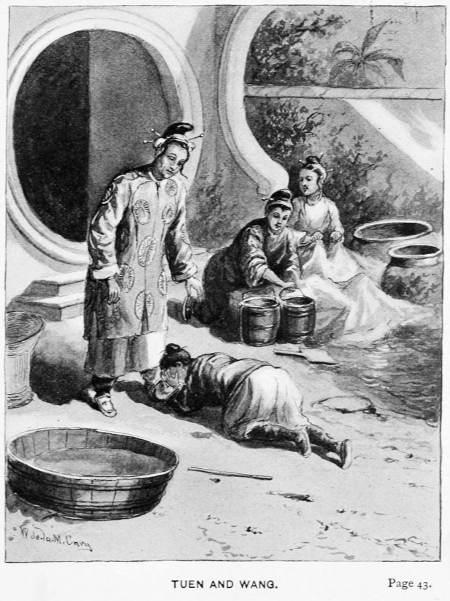
all, where, surrounded by earthen tubs and buckets, two women were
washing clothes, chattering constantly the while. A little apart from
them stood an elderly woman with a shrewd, pleasant face, who seemed to
be overlooking the others.
"The Viceroy sent her to you," the servant who was with Tuen said to the
older woman, pointing with one finger to the shrinking girl behind him.
At his words the women looked up from their work with evident curiosity,
for there was but little break in the monotony of their lives, and this
newcomer was therefore interesting. The one to whom he spoke came
forward that she might better examine her charge.
"Where did he get her?" she inquired, regarding Tuen with something like
disfavor in her keen eyes.
"Bought her," was the man's laconic answer. "From the ragman it
appears," he also volunteered; and then with a shrug of his shoulders he
went away.
"He was cheated if he paid much. Don't you say so, Wang?" one of the
women said with a laugh that was not unkind.
A feeling of such utter, overpowering loneliness swept over Tuen as she
stood undergoing their scrutiny that all at once she slipped down on the
muddy ground and fell to weeping violently.
"A cry-baby," one of them muttered contemptuously, returning to her
work.
"Poor child," the one called Wang murmured, perhaps remembering the day
when she had been bought by the Viceroy; and she went over to the
prostrate figure.
"O come, there's nothing to cry about," she said pleasantly. "You are in
great good-fortune to have such an illustrious and wealthy gentleman as
the Viceroy to buy you. It's not every girl has such a master."
"No indeed," replied the younger of the other two women. "Why he never
beats us at all."
Encouraged by these cheerful remarks Tuen's sobs grew less, and she
surreptitiously dried her eyes on the skirt of her jacket.
"You look like a lazy thing," the woman who had called her a cry-baby,
said spitefully. "Get up from there and draw me a bucket of water."
"You must not scold the child, Zau," Wang interposed. "She is only a bit
homesick, now."
Zau muttered something to herself as Tuen took the bucket and went over
to the middle of the court, where a stone with a small hole in the top
covered the well.
While she was at her task the women whispered among themselves and
nodded toward her, but when she returned Wang only said:
"Come with me and I will get you some better clothes. Then I will take
you to see the wife of the Viceroy."