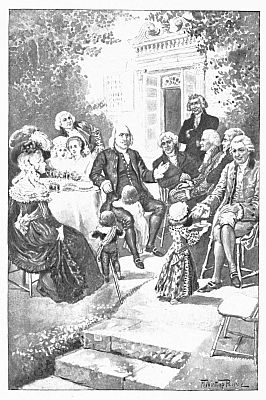
That was a charmed life that little Ben Franklin led in
the early days of his apprenticeship. He always thought of provincial
Boston as his "beloved city." When he grew old, the
Boston of his boyhood was to him a delightful dream.
He and his father were on excellent terms with each other.
His father, though a very grave, pious man, whose delight
was to go to the Old South Church with his large family,
allowed little Ben to crack his jokes on him.
He was accustomed to say long graces at meals, at which
the food was not overmuch, and the hungry children many.
One day, after he had salted down a large quantity of meat in
a barrel, he was surprised to hear Ben ask:
"Father, why don't you say grace over it now?"
"What do you mean, Ben?"
"Wouldn't it be saving of time to say grace now over the
whole barrel of provisions, and then you could omit it at
meals?"
But the strong member of the Old South Church had no
such ideas of religious economy as revealed his son's mathematical
mind.
The Franklin family must have presented a lively appearance
at church in old Dr. Joseph Sewell's day. They heard
some sound preaching there, and Dr. Sewell lived as he preached.
He was offered the presidency of Harvard College, but honors
were as bubbles to him, and he refused it for a position of less
money and fame, but of more direct spiritual influence, and
better in accord with the modest views of his ability. He began
to preach in the Old South Church when Ben was seven years
of age; he preached a sermon there on his eightieth birthday.
These were fine old times in Boston town. Some linen spinners
came over from Londonderry, in Ireland, and they established
a spinning school. They also brought with them the
potato, which soon became a great luxury.
Josiah Franklin probably pastured his cows on the Common,
and little Ben may often have sat down under the old elm
by the frog pond and looked over the Charles River marshes,
which were then where the Public Garden now is.
But the delight of the boy's life was still Uncle Benjamin,
the poet. The two read and roamed together. Now Ben had
a poetic vein in him, a small one probably inherited from his
grandfather Folger, and it began to be active at this time.
There were terrible stories of pirates in the air. They
kindled the boy's lively imagination; they represented the
large subject of retributive justice, and he resolved to devote his
poetic sense to one of these alarming characters.
There was a dreadful pirate by the name of Edward Teach,
but commonly called "Blackbeard." He was born in Bristol,
England. He became the terror of the Atlantic coast, and had
many adventures off the Carolinas. He was at length captured
and executed.
One day little Ben came to his brother James with a paper.
"James, I have been writing something, and I have come
to read it to you."
"What?"
"Poetry."
"Like Uncle Ben's?"
"No; it is on Blackbeard."
James thought that a very interesting subject, and prepared
to listen to his poet brother.
Little Ben unfolded the paper and began to read his lines,
which were indeed heroic.
"Come, all you jolly sailors,
You all so stout and brave!"
"Good!" said James. "That starts off fine."
Ben continued:
"Come, hearken and I'll tell you
What happened on the wave."
"Better yet—I like that. Why, Uncle Ben could not excel
that. What next?"
"Oh, 'tis of that bloody Blackbeard
I'm going now to tell,
And as how, by gallant Maynard,
He soon was sent to hell,
With a down, down, down, derry down!"
James lifted his hands at this refrain after the old English
ballad style.
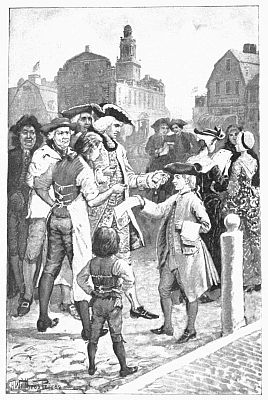
"Ben, I'll tell you what we'll do. I'll print the verses for
you, and you shall sell them on the street."
The poet Arion at his coronation at Corinth could not have
felt prouder than little Ben at that hour. He would be both a
poet and bookseller, and his brother would be his publisher.
He may have cried on Boston street:
"Blackboard—broadside!" or something like that. It
would have been honorable advertising.
His success as a poet was instantaneous. His poem sold
well. Compliments fell upon him like a sun shower. He wrote
another poem of like value, and it sold "prodigiously." He
thought indeed he was a great poet, and had started out on
Shakespeare's primrose way to fame and glory. Alas! how
many under like circumstances have been deceived. He lived
to call his ballads "wretched stuff." How many who thought
they were poets have lived to take the same view of their
work!
His second poem was called the Light-House Tragedy. It
related to a recent event, and set the whole town to talking,
and the admiration for the young poet was doubled.
In the midst of the great sale of his poems by himself, and
of all the flatteries of the town, he went for approval to his
father. The result was unexpected; the rain of sunshine
changed into a winter storm indeed.
"Father, you have heard that I have become a poet?"
"Ha! ha! ha!" laughed Josiah, in his paper cap and leather
breeches. "Like your Uncle Ben, my boy, and he amounted
to nothing at all as a poet. A poet—my stars!"
"I thought that you looked upon Uncle Ben as the best
man in all the world. The people love him. When he enters
the Old South Church there is silence."
"That is all very true, my boy, but he lives between the
heavens and the earth, and can not get up to the one or down
to the other. Poets are beggars, in some way or other. They
live in garrets among the mice and bats. Their country is the
imagination, and that is the next door to nowhere. You a
poet! What puckers my face up—so?"
"But my poetry sells, father," looking into his father's droll
face, his heart sinking.
"Your poetry! It sells, my boy, because you are a little
shaver and appear to be smart, and also because your rhymes
refer to events in which everybody is interested. But, my son,
your poetry, as you call it, has no merit in itself. It is full of
all kinds of errors. It is style that makes a poem live; yours
has no style."
"But, father, many people do not think so."
"But they will. You will think so some day."
"But isn't there something good in it?"
"Nothing, Ben. You never was born to be a poet. You
have the ability to earn a living, same as I have done. Poets
don't have that kind of ability; they beg. There are not many
men who can earn a living by selling their fancies, which is
mostly moonshine."
This was unsympathetic. Ben looked at the soap kettles
and candle molds and wondered if these things had not blinded
his father's poetic perceptions. There was no Vale of Tempe
here.
But Josiah Franklin had hard common sense. Little Ben's
dreams of poetic fame came down from the skies at one arrow.
That was a bitter hour.
"If I can not be a poet," he thought, "I can still be useful,"
and he reverted from heroic ballads to stern old Cotton
Mather's Essays to do Good. The fated poet is always left a like
resource.
Yet many people who have not become poets, but who
have risen to be eminent men, have had poetic dreams in
early life; they have had the poetic mind. A little poetry in
one's composition is no common gift; it is a stamp of superiority
in some direction. Josiah Franklin was a wise man, but
his views of poetry as such were of a low standard. Poetry
is the highest expression of life, the noblest exercise of the
spiritual faculties.
So poor little Ben had soared to be laughed at again. But
there was something out of the common stirring in him, and he
would fly again some day. The victories of the vanquished are
the brightest of all.
Franklin, after having been thus given over to the waste
barrel by his father, now resolved to acquire a strong, correct,
and impressive prose style of writing. He found Addison's
Spectator one of the best of all examples of literary style, and
he began to make it a study. In works of the imagination he
read De Foe and Bunyan.
This good resolution was his second step up on the ladder
of life.
Others were contributing to his brother James's paper,
why should not he? But James, after the going out of the
poetic meteor, might not be willing to consider his plain prose.
Benjamin Franklin has now written an article in plain
prose, which he wishes to appear in his brother's paper. If
it were accepted, he would have to put it into type himself,
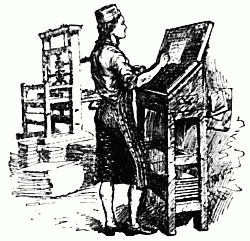
and probably to deliver the paper to its patrons. He is sixteen
years old. He has become a vegetarian, and lives by himself,
and seeks pleasure chiefly in books.
It is night. There are but few lamps in the Boston streets.
With a manuscript hidden in his pocket Benjamin walks slyly
toward the office of James Franklin, Printer, where all is dark
and still. He looks around, tucks his manuscript suddenly under
the office door, turns and runs. Oh, how he does glide away!
Is he a genius or a fool? He wonders what his brother will
say of the manuscript, when he reads it in the morning.
In the morning he went to his work.
Some friends of James came into the office.
"I have found something here this morning," said James,
"that I think is good. It was tucked under the door. It seems
to me uncommonly good. You must read it."
He handed it to one of his friends.
"That is the best article I have read for a long time," said
one of the callers. "There is force in it. It goes like a song
that whistles. It carries you. I advise you to use it. Everybody
would read that and like it. I wonder who wrote it? You
should find out. A person who can write like that should never
be idle. He was born to write."
James handed it to another caller.
"There are brains in that ink. The piece flows out of life.
Who do you think wrote it?"
"I have no idea," said James.—"Here, Ben, set it up.
Here's nuts for you. If I knew who wrote it I would ask the
writer to send in other articles."
Benjamin Franklin's Autobiography and Charles Dickens's
novels have had a sale equaled by a few books in the world.
The two authors began their literary life in a like manner, by
tucking their manuscripts under the editor's door at night and
running away. They both came to wonder at themselves at
finding themselves suddenly people of interest. Still, we could
hardly say to the literary candidate, "Fling your article into
the editor's room at night and run," though modesty, silence,
and prudence are commendable in a beginner, and qualities
that win.
What pen name did Ben Franklin sign to this interesting
article? It was one that implies his purpose in life; you may
read his biography in it—Silence Dogood.
The day after the name of Silence Dogood had attracted the
attention of Boston town, Benjamin said to Jane, his sympathetic
little sister:
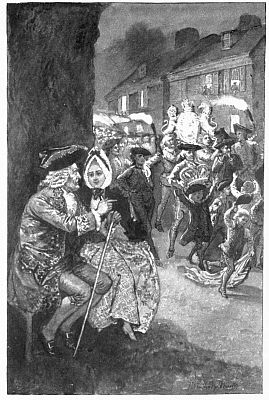
"Jenny, let's go to walk this evening upon Beacon Hill.
I have something to tell you."
They went out in the early twilight together, up the brow
of the hill which the early settlers seem to have found a blackberry
pasture, to the tree where they had gone with Uncle
Benjamin on the showery, shining midsummer Sunday.
"Can you repeat what Uncle Benjamin said to us here,
two years ago?" asked Ben.
"No; it was too long. You repeat it to me again and I
will learn it."
"He said, 'More than wealth, or fame, or anything, is the
power of the human heart, and that that power is developed in
seeking the good of others.' Jenny, what did father say when
he read the piece by Silence Dogood in the Courant?"
"He clapped his hand on his leather breeches so that
they rattled; he did, Ben, and he exclaimed, 'That is a good
one!' and he read the piece to mother, and she asked him who
he supposed wrote it, and she shook her head, and he said, 'I
wish that I knew.'"
"Would you like to know who wrote it, Jenny?"
"Yes. Do you know?"
"I wrote it. Jenny, you must not tell. I am writing another
piece. James does not know. I tucked the manuscript
under the door. I am going to put another one under the door
at night."
"O Ben, Ben, you will be a great man yet, and I hope that
I will live to see it. But why did you take the name of Silence
Dogood?"
"That carries out Uncle Ben's idea. It stands for seeking
the good of others quietly. That name is what I would like
to be."
"It is what you will be, Ben. Uncle would say that the
Franklin heart is in that name. If you should ever become a
big man, Ben, and I should come to see you when we are old,
I will say, 'Silence Dogood, more than wealth, more than
fame, and more than anything else, is the power of the human
heart.' There, I have quoted it correctly now. Maybe the day
will come. Maybe we will live to be old, and you will write
things that everybody will read, and I will take care of father
and mother while you go out into the world."
"Wherever I may go, and whatever I may become or fail
to be, my heart will always be true to you, Jenny."
"And I will do all I can for father and mother; I will be
your heart to them, so that you may give your time to your
pen. Every one in a family should seek to do for the family
what others lack or are not able to do. You can write; I can
not, but, Ben, I can love."
She walked about the wild rose bushes, where the red-winged
blackbirds were singing.
"O Ben," she continued, "I am so glad that you wrote
that piece, and that father liked it so well! I would not have
been more glad had you received a present from a king. Maybe
you will receive a present from a king some day, if you write as
well as that."
"You will keep the secret, Jenny?"
"Yes, Ben, I will look for the paper to-morrow. How glad
Uncle Ben would be if he knew it. Why, Ben, that name,
Silence Dogood, is a piece in itself. It is a picture of your
heart. You are just like Uncle Ben, Silence Dogood."
The name of Silence Dogood became famous in Boston
town. Jenny obtained Ben's permission to tell Uncle Benjamin
the great secret, and Uncle Benjamin's heart was so delighted
that he went to his room and told the secret "to the
Lord."
The three hearts were now very, very happy for a time.
Jenny was growing up a beautiful girl, and her thoughts were
much given to her hard-working parents and to laughed-at,
laughing little Ben.
When Uncle Benjamin had heard of Ben's failure as a poet
and success as Silence Dogood, he took him down to Long
Wharf again.
"I am an old man," he said. "But here I have a lesson
for you. If you are conscious that you have any gift, even in
small degree, never let the world laugh it away. See 'that no
man take thy crown,' the Scripture says. Every one who has
contributed anything to the progress of the world has been
laughed at. Stick a pin in thee, Ben.
"Now, Ben, you may not have the poet's imagination or art,
but if you have the poetical mind do not be laughed out of an
attempt to express it. You may not become a poet; I do not
think that you ever will. Perhaps you will write proverbs, and
proverbs are a kind of poems. I am going to reprove Brother
Josiah for what he has said. He has given over your education to
me, and it is my duty to develop you after your own gifts.
"Let us go back to the shop. I want to have a talk with
Josiah; but, before we leave, I have a short word to say to you.
"Hoi, Ben, hoi!—I don't know what makes me repeat these
words; they are not swear words, Ben, but they come to me
when my feelings are awakened.
"It is hard, hard for one to see what he wants to be and
to be kept back. I wanted to be a philosopher and a poet.
Don't you laugh, Ben. I did; I wanted to be both, and I was
so poor that I was obliged to write my thoughts on the margin
of the leaves of my pamphlets, which I sold to come to
teach you. Ben, Ben, listen: I can never be a philosopher or a
poet, but you may. Don't laugh, Ben. Don't let any one
laugh you out of your best ideas, Ben. You may. The world
will never read what I wrote. They may read what you will
write, and if you follow my ideas and they are read, you will be
content. Hoi, Ben, hoi!"
They went to the candle shop.
"Josiah, you do wrong to try to suppress Ben's gift at rhyme.
A man without poetry in his soul amounts to no more than a
chopping block. The world just hammers itself on him, and
that is all. You would not make Ben a dunce!"
"No, brother, no; but a goose is not a nightingale, and the
world will not stop to listen if she mounts a tree and attempts
to sing."
"No, Brother Josiah, but a goose that would like to sing like
a nightingale would be no common goose; she would find better
pasture than other geese. Small gifts are to be prized. 'A
little diamond is worth a mountain of glass,' as the proverb
says."
"Well, if you must write poetry, don't publish it until it is
called for."
"Well, Brother Josiah, your advice will do for me, for I
am an old man; but I must teach Ben never to be laughed
out of any good idea that may come to him. Is not that right,
brother?"
"Yes, Uncle Ben. But you can't make a hen soar to the
skies like an eagle. If you are not a poet, you have a perfect
character, and that is why I leave the training of Ben to
you. If you can make a man of him, the world will be better
for him; and if you can make something else of him besides a
poet out of his poetical gift, I shall be very glad. Your poetry
has not helped you in life, has it, Benjamin?"
"I don't know. You think it is that that has made me a
burden to you."
Josiah looked his brother in the face.
"A burden? No, brother. One of the greatest joys of my life
was to have you come here, and it will be the greatest blessing
to my life if you can make the life of little Ben a blessing
to the world. I am not much of a musician, but I like to sound
the fiddle, and if you have any poetic light, let it shine—but
as a tallow dip, like my fiddling. You are right, brother, in
teaching little Ben never to be laughed down. I don't blame
any one for crying his goods if he has anything to sell. But
if he has not, he had better be content to warm his hands by his
own fire."
"Brother Josiah, listen to me. Little Ben here has something
to sell.—Hoi, Ben, hoi! you listen.—There have thoughts
come to me that I know did not rise out of the dust. I have
been too poor to publish them. You may laugh at me, and
call me a poor philosopher and say that my philosophy has
kept me poor. But Benjamin here is going to give my
thoughts to the world, and the things that I put into my pamphlets
are going to live. It was not you that gave Ben to me:
it was Heaven. A veil hangs over us in this world, and if a
man does good in his heart, the hand behind that veil moves
all the events of his life for good.
"Don't laugh at us, Josiah; we are weaving together
thoughts that will feed the world. That we are.—Hoi, Ben,
hoi!"
"Well, Brother, your faith makes you a happy old man. I
hope that you will be able to make something of Ben, and that
he may do credit to your good name. It may be so. Faith
sees.
"I love to see you go into the South Church, Brother. As
soon as your face appears all the people look very happy,
and sit still. The children all sit still. The tithingman stands
still; he has nothing to do for a time.
"It is something, Brother Ben, to be able to cast such an
influence as that—something that money can not buy. I am
sorry if I have hurt your feelings. Heaven be praised for such
men as you are, Brother Ben! I hope that I may live to see
all that you see by faith. I think I may, Brother Ben. 'Men
do not gather grapes of thorns, or figs of thistles,' but they do
gather grapes of grapes and figs of figs. I hope that Ben will
be the book of your life, and make up for the pamphlets. It
would be a good book for men to read."
"Hoi, Ben, hoi!" said the old man, "I can see that it
will."
One Sunday, after church, in summer, Uncle Ben the poet
and Silence Dogood went down on Long Wharf to enjoy the
breezes from the sea. Uncle Ben was glad to learn more of
the literary successes of Silence Dogood.
"To fail in poetry is to succeed in prose," said the fine old
man. "But much that we call prose is poetry; rhymes are only
childish jingles. The greatest poetry in the world is written
without rhyme. It is the magic spirit and the magic words that
make true poetry. The book of Job, in my opinion, is the
greatest poetry ever written. Poetry is not made, it exists; and
one who is prepared to receive it catches it as it flows. Ben,
you are going to succeed in prose. You are going to become
a ready writer. Study Addison more and more."
"Uncle Ben, do you not think that it is the hardest thing
in life for one to be told that he can not do what he most wants
to do?"
"Yes, Ben, that is the hardest thing in life. It is a cruel
thing to crush any one in his highest hope and expectation."
"Was Solomon a poet? Are the Proverbs poetry?"
"Yes, yes. The book of Proverbs is a thousand poems."
"Then, Uncle Ben, I may be a poet yet. That kind of little
poems come to me."
"Ha! ha! ha!"
A voice rang out behind them.
It was Jamie the Scotchman.
"Well, Ben, it is good to fly high. I infer that you expect
to become a proverb poet, after the manner of Solomon. The
people here will all be quoting you some day. It may be
that you will be quoted in England and France. Ha! ha! ha!
What good times," he added, "you two have together—dreaming!
Well, it costs nothing to dream. There is no toll
demanded of him who travels in the clouds. Move along, young
Solomon, and let me sit down on the sea wall beside you.
When you write a book of proverb poetry I hope I'll be living
to read it. One don't make a silk purse out of a sow's ear—there's
a proverb for you!—nor gather wisdom except by experience—there's
another; and some folks do not get wisdom even
from experience." He looked suspiciously toward Uncle
Ben.
"Experience keeps a dear school," said Uncle Ben in a
kindly way.
"And some people can learn of no other," added Silence
Dogood.
"And some folks not even there," said Jamie the Scotchman.
The loons came semicircling along the sea wall, their necks
aslant, and uttering cries in a mocking tone.
"Well, I declare, it makes the loons laugh—and no wonder!"
said Jamie the Scotchman. He lighted his pipe, whose
bowl was a piece of corncob, and whiffed away in silence for a
time, holding up one knee in his clasped hands.
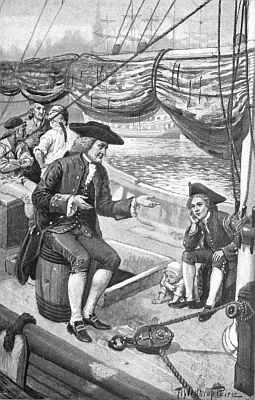
Silence Dogood surveyed his surroundings, which were ship
cargoes.
"The empty bags do not stand up," he said.
"Well, what do you infer from that?" asked Jamie.
Silence Dogood did not answer, but the thought in his
mind was evident. It was simply this: that, come what would
in life, he would not fail. He put his hand on Uncle Benjamin's
shoulder, for who does not long to reach out his hand toward
the fire in the cold, and to touch the form that entemples the
most sympathetic heart? He dreamed there on the sea wall,
where the loons seemed to laugh, and his dreams came true.
Every attainment in life is first a dream.
Silence Dogood, dream on! Add intelligence to intelligence,
virtue to virtue, benevolence to benevolence, faith to faith, for
so ascends the ladder of life.
Uncle Benjamin was right. Let no man be laughed out of
ideals that are true, because they do not reach their development
at once.
Many young people stand in the situation in which we find
young Franklin now. Many older people do in their early
work. England laughed at Boswell, but he came to be held as
the prince of biographers, and his methods as the true manner
of picturing life and making the past live in letters.
People with a purpose who have been laughed at are many
in the history of the world. From Romulus and the builders
of the walls of Jerusalem to Columbus, ridicule makes a long
record, and the world does not seem to grow wiser by its mistakes.
Even Edison, in our own day, was ridiculed, when a
youth, for his abstractions, and his efforts were ignored by
scientists.
Two generations ago a jeering company of people, uttering
comical jests under the cover of their hands, went down to a
place on the banks of the Hudson to see, as they said, "a crazy
man attempt to move a boat by steam." They returned with
large eyes and free lips. That boat moved.
In the early part of the century a young Scotchman named
Carlyle laid before the greatest of English scholars and critics
a manuscript entitled Sartor Resartus. The great critic read
the manuscript and pronounced it "the stupidest stuff that he
ever set eyes on." He laughed at a manuscript that became one
of the literary masterpieces of the century. A like experience
had Milton, when he once said that he would write a poem that
should be the glory of his country.
A young graduate named Longfellow wrote poems that
came to him amid the woods and fields, and published them
in newspapers and magazines, and gathered them into a book.
The book fell into the hands of one then held to be supreme
as a literary judge—Edgar Allen Poe. It was laughed at in ink
that made the literary world laugh. The poet Longfellow's
bust now holds an ideal place in Westminster Abbey, between
the memorials of Dryden and Chaucer, and at the foot of the
tombs of England's kings.
Keats was laughed at; Wordsworth was deemed a fool.
A number of disdainful doctors met on October 16, 1846,
in the amphitheater of the Massachusetts General Hospital in
Boston, to see a young medical student try to demonstrate
that a patient upon whom a surgical operation was to be performed
could be rendered insensible to pain. The sufferer
was brought into the clear light. The young student touched
his face with an unknown liquid whose strange odor filled the
room. He was in oblivion. The knives cut and the blood
flowed, and he knew it not. Pain was thus banished from the
room of surgery. That young medical student and dentist
was Dr. W. T. G. Morton, whose monument may be seen in
the Boston Public Garden, and in whose honor the semicentennial
of the discovery of anæsthesia has but recently been
celebrated.
"So, with a few romantic boys and crazy girls you expect
to see the world converted," said a wise New York journal
less than a century ago, as the first missionaries began to sail
away. But the song still arose over the sea—
"In the desert let me labor,
On the mountain let me till"—
until there came a missionary jubilee, whose anthems were
repeated from land to land until they encircled the earth.
When Browning first published Sordello, the poem met
with common ridicule. Even Alfred Tennyson is said to have
remarked that "there were but two lines in it that he could
understand, and they were both untrue." The first line of the
poem was, "Who will, may hear Sordello's story told"; and
the last line of the poem was, "Who would, has heard Sordello's
story told." Yet the poem is ranked now among the
intellectual achievements of the century in the analysis of one
of the deeper problems of life.
Samuel F. B. Morse was laughed at. McCormick, whose
invention reaps the fields of the world, was ridiculed by the
London Times, "the Thunderer." "If that crazy Wheelwright
calls again, do not admit him," said a British consul to his
servant, of one who wished to make new ports and a new commerce
for South America, and whose plans are about to harness
the Andes with railways. William Wheelwright's memory lives
in grateful statues now.
Columbus was not only laughed at by the Council of Salamanca,
but was jeered at by the children in the streets, as he
journeyed from town to town holding his orphan boy by the
hand. He wandered in the visions of God and the stars, and
he came to say, after the shouts of homage that greeted him
as the viceroy of isles, "God made me the messenger of the
new heavens and new earth, and told me where to find them!"
Burton, in his Anatomy of Melancholy, presents a picture
of the unfortunate condition of many lives of whom the world
expected nothing, and for whom it had only the smile of incredulity
when in them the Godlike purpose appeared. He
says:
"Hannibal had but one eye; Appius Claudius and Timoleon
were blind, as were John, King of Bohemia, and Tiresais the
prophet. Homer was blind; yet who, saith Tully, made more
accurate, lively, or better descriptions with both his eyes!
Democritus was blind, yet, as Laertius writes of him, he saw
more than all Greece besides. . . . Æsop was crooked, Socrates
purblind, Democritus withered, Seneca lean and harsh, ugly
to behold; yet show me so many flourishing wits, such divine
spirits. Horace, a little, blear-eyed, contemptible fellow, yet
who so sententious and wise? Marcilius Ficinus, Faber Stapulensis,
a couple of dwarfs; Melanchthon, a short, hard-favored
man, yet of incomparable parts of all three; Galba the emperor
was crook-backed; Epictetus, lame; the great Alexander a
little man of stature; Augustus Cæsar, of the same pitch;
Agesilaus, despicabili forma, one of the most deformed princes
that Egypt ever had, was yet, in wisdom and knowledge, far
beyond his predecessors."
Why do I call your attention to these struggles in this
place in association of an incident of a failure in life that was
ridiculed?
It has been my lot, in a somewhat active life in the city of
Boston for twenty-five years, to meet every day an inspiring
name that all the world knows, and that stands for what right
resolution, the overcoming of besetting sins in youth, and persevering
energy may accomplish against the ridicule of the
world. There have been many books written having that
name as a title—Franklin.
I have almost daily passed the solemn, pyramidal monument
in the old Granary Burying Ground, between the Tremont
Building and Park Street Church, that bears the names
of the Franklin family, in which the parents have found
eternal honor by the achievements of their son.
As I pass the Boston City Hall there appears the Franklin
statue.
As I face the Old South Church and its ancient neighborhood
I am in the place of the traditions of the birth of Benjamin
Franklin and of his baptism. It may be that I will return
by the way of Franklin Street, or visit the Franklin
School, or go to the Mechanics' Building, where I may see the
primitive printing press at which Franklin worked, and which
was buried in the earth at Newport, Rhode Island, at the time of
the Revolutionary War.
If I go to the Public Library, I may find there two original
portraits of Franklin and a Franklin gallery, and a picture of
him once owned by Thomas Jefferson.
If I go to the Memorial Hall at Harvard College, I will there
see another portrait of the philosopher in the grand gallery
of noble men. Or I may go to Boston's wide pleasure ground,
the Franklin Park, by an electric car made possible by the discoveries
of Franklin.
Nearly all of Franklin's early efforts were laughed at, but
he would not be laughed down. Time is the friend of every
true purpose.
Boys with a purpose, face the future, do good in silence, and
trust. You will find some Uncle Benjamin and sister Jenny
to hold you by the hand. Be in dead earnest, and face the
future, and forward march! The captains of industry and the
leaders of every achievement say, "Guide right! Turn to the
right, and advance!"