There is no profession drawing its members
from the peasant class which requires a combination
of so many high and rare qualities as that
of a mountain guide. Happily, the dwellers in hill
countries seem usually more noble in mind and
robust of frame than the inhabitants of plains, and
all who know them well must admit that among
Alpine guides are to be found men whose intelligence
and character would rank high in any class
of life.
I have usually noticed that the abilities and
duties of a guide are little understood by the non-climber,
who often imagines that a guide's sole
business is to know the way and to carry the
various useless articles which the beginner in
mountaineering insists on taking with him.
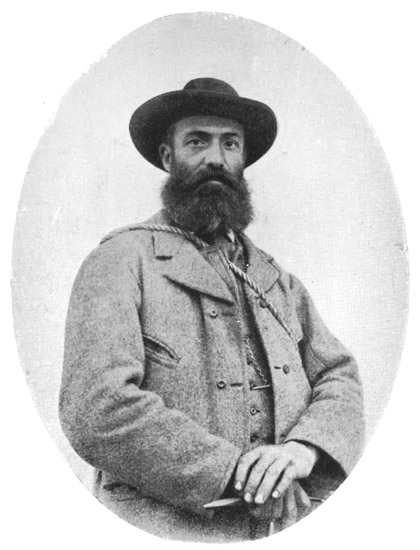
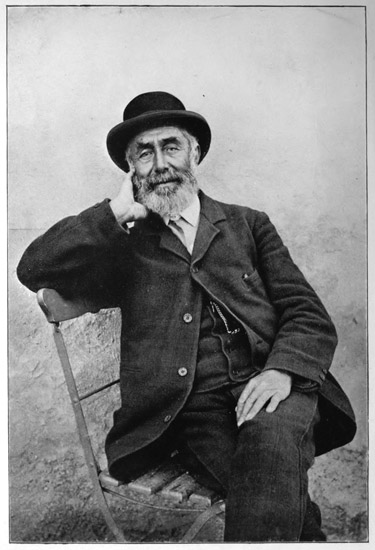
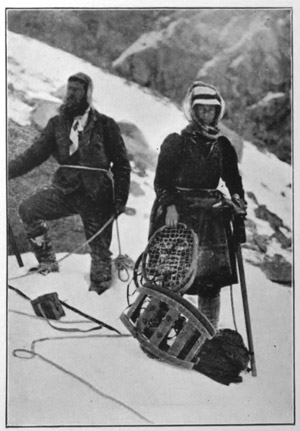
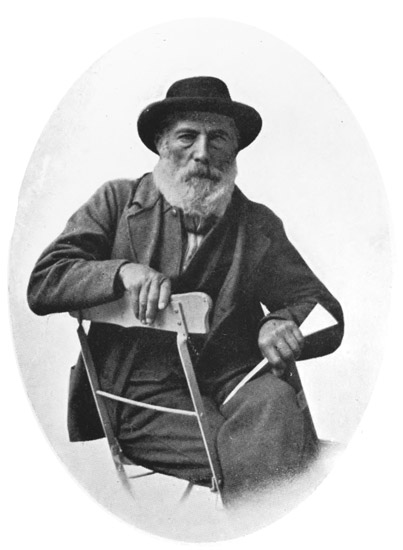
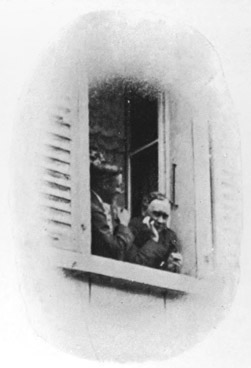
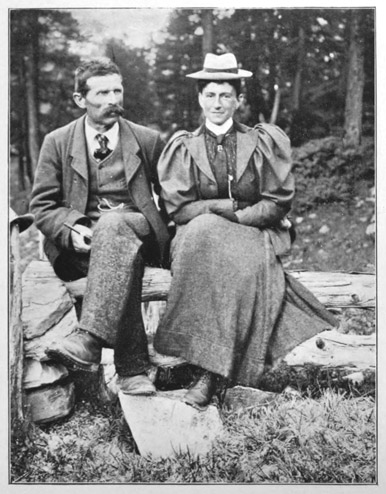
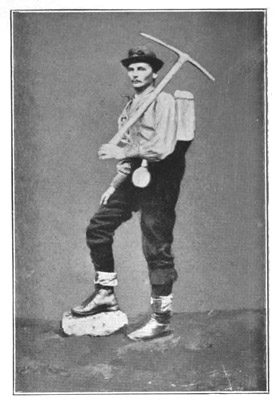
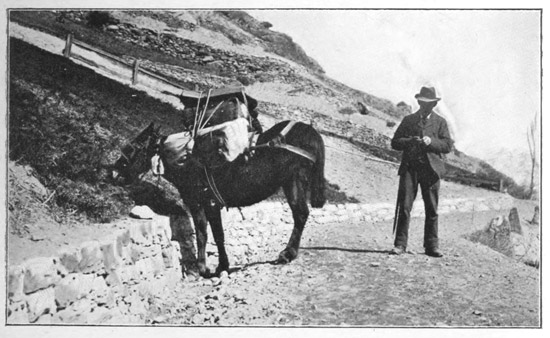
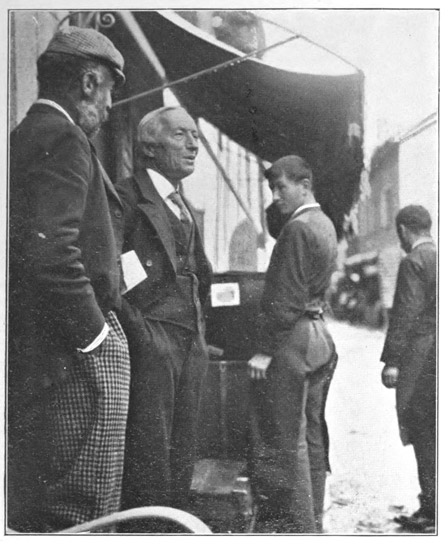
Edouard Cupelin of Chamonix.
The Guide with whom Mrs Aubrey Le Blond commenced
her climbing.
Guiding, if it sometimes does include these duties,
is far more than this. The first-class guide must
be the general of the little army setting out to
invade the higher regions. He need not know
the way—in fact, it sometimes happens that he
has never before visited the district—but he must
be able to find a way, and a safe one, to the
summit of the peak for which his party is bound.
An inferior guide may know, from habit, the usual
way up a mountain, but, should the conditions of
ice and snow alter, he is unable to alter with them
and vary his route. You may ask: "How does a
guide find his way on a mountain new to him?"
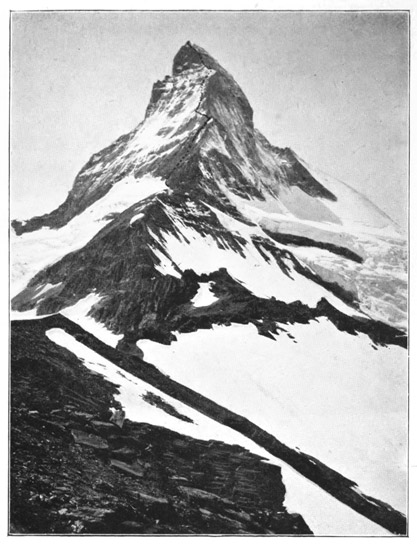
There are several means open to him. If the peak
is well known, as is, say, the Matterhorn, he will
have heard from other guides which routes have
been followed, and will know that if he desires to
take his traveller up the ordinary way he must go
past the Schwarz-see Hotel, and on to the ridge
which terminates in the Hörnli, making for the
hut which he has seen from below through the
telescope. Then he remembers that he must cross
to the east face, and while doing so he will notice
the scratches on the rocks from the nailed boots
of previous climbers. Now, mounting directly upward,
he will pick out the passages which seem
easiest, until, passing the ruined upper hut, he
comes out on the ridge and looks down the tremendous
precipice which overhangs the Matterhorn
Glacier. This ridge, he knows, he simply has to
follow until he reaches the foot of a steep face of
rock some 50 feet high, down which hangs a chain.
He has heard all about this bit of the climb since
his boyhood, and he tells his traveller that, once
on the top of the rock, all difficulty will be over,
and the final slope to the summit will be found a
gentle one. So it comes to pass that the party
reaches the highest pinnacle of the great mountain
without once diverging from the best route. Occasionally
the leading guide may take with him as second
guide a man from the locality, but most climbers
will prefer to keep with them the two guides they
are used to.
It is not only on mountains that a guide is able
to find his way over little known ground. Many
years ago Melchior Anderegg came to stay with
friends in England, and arrived at London Bridge
Station in the midst of a thick London fog. "He
was met by Mr Stephen and Mr Hinchliff," writes
his biographer in The Pioneer of the Alps, "who
accompanied him on foot to the rooms of the
latter gentleman in Lincoln's Inn Fields. A day
or two later the same party found themselves at
the same station on their return from Woolwich.
'Now, Melchior,' said Mr Hinchliff, 'you will lead
us back home.' Instantly the skilful guide, who
had never seen a larger town than Berne, accepted
the situation, and found his way straight back
without difficulty, pausing for consideration only
once, as if to examine the landmarks at the foot
of Chancery Lane."
Now, let us see how a guide sets about exploring
a district where no one has previously ascended
the mountains. Of this work I have seen a good
deal, since in Arctic Norway my Swiss guides
and I have ascended more than twenty hitherto-unclimbed
peaks, and were never once unable to
reach the summit. Of course, the first thing is to
see the mountains, and, to do this, it is wise to
ascend something which you are sure, from its
appearance, is easy, and then prospect for others,
inspecting others again from them, and so on,
ad infinitum. You cannot always see the whole
of a route, and, perhaps, your leading guide will
observe: "We can reach that upper glacier by the
gully in the rocks." "What gully?" you ask.
"The one to the left. There must be one there.
Look at the heap of stones at the bottom!"
Thus, from the seen to the unseen the guide argues,
reading a fact from writing invisible to the untrained
eye. Between difficulty and danger, too,
he draws a sharp distinction, and attacks with full
confidence a steep but firm wall of rock, turning
back from the easy-looking slope of snow ready
to set forth in an avalanche directly the foot
touches it.
And how is this proficiency obtained? How does
the guide learn his profession?
In different ways, but he usually begins young,
tending goats on steep grassy slopes requiring
balance and nerve to move about over. Later on,
having decided that he wishes to be a guide, the
boy, at the age of seventeen or eighteen, offers himself
for examination on applying for a certificate
as porter. The requirements for this first step are
not great: a good character, a sound physique, a
knowledge of reading and writing, and in most
Alpine centres the guild of guides will grant him
a license. He can now accompany any guide who
will take him, on any expedition that guide considers
within the porter's powers. His advancement
depends on his capacity. Should he quickly adapt
himself to the work, the guides will trust him more
and more, taking him on difficult ascents and
allowing him occasionally to share the responsibility
of leading on an ascent and coming down
last when descending. It will readily be seen that
the leader must never slip, and must, when those
who follow are moving, be able to hold them
should anything go wrong with them. The same
applies to the even more responsible position of
last man coming down. When a porter reaches
this stage, he is little inferior to a second guide.
He can now enter for his final examination. If he
is competent, he has no trouble in passing it, and
I fear that if the contrary—as is the case in many
of those who apply—he gets through easily enough.
At Chamonix the guides' society is controlled by
Government. The rules press hardly on the better
class of guides there, or would do so if observed;
but a first-class guide is practically independent of
them, and mountaineers who know the ropes can
avoid the regulations. At Zermatt greater liberty
is allowed, and, indeed, I believe that everywhere
except at Chamonix a guide is free to go with any
climber who applies for him. At Chamonix the
rule is that the guides are employed in turn, so that
the absurd spectacle is possible of a man of real
experience carrying a lady's shawl across the Mer
de Glace, while a guide, who is little better than a
porter, sets out to climb the Aiguille de Dru! However,
the exceptions to this rule make a broad
way of escape, for a lady alone, a member of an
Alpine club, or a climber bent on a particularly
difficult ascent, may choose a guide.
The pay of a first-class guide is seldom by tariff,
for the class of climber who alone would have the
opportunity of securing the services of one of the
extremely limited number of guides of the first
order generally engages him for some weeks at a
time. Indeed, such men are usually bespoken a
year in advance. The pay offered and expected is
25 fr. a day, including all expeditions, or else 10 fr.
a day for rest days, 50 fr. for a peak, 25 fr. for a
pass, in both cases the guide to keep himself, while
travelling expenses and food on expeditions are
to be paid for by the employer. If a season is
fine and the party energetic, the former rate of
payment may be the cheaper. The second guide
generally receives two-thirds as much as the first
guide.
When a novice is about to choose a guide,
the advice of an experienced friend is invaluable,
but, failing this, it is worse than useless to rely
on inn-keepers, casual travellers, or the guide-chef
at the guides' office of the locality. From these
you can obtain the names of guides whom they
recommend, but before making any definite
arrangements, see the men themselves and carefully
examine their books of certificates. In these
latter lie your security, if you read them intelligently.
Bear in mind that their value consists
in their being signed by competent mountaineers.
For instance, you may find something like the
following in a guide's book:—
A. Dumkopf took me up the Matterhorn to-day.
He showed wonderful sureness of foot and steadiness
of head, and I consider him a first-class guide,
and have pleasure in recommending him.
(Signed) A. S. Smith.
Now, this is by some one you never heard of, and
a very little consideration will show you that A. S.
Smith is quite ignorant of climbing, judging by
his wording of the certificate. That which follows,
taken from the late Christian Almer's Führerbuch,
is the sort of thing to carry weight:—
Christian Almer has been our guide for three
weeks, during which time we made the ascents of
the Matterhorn (ascending by the northern and
descending by the southern route), Weisshorn (from
the Bies Glacier), Dent Blanche, and the Bietschhorn.
Every journey that we take under Almer's guidance
confirms us in the high opinion we have formed of
his qualities as a guide and as a man. To the
utmost daring and courage he unites prudence and
foresight, seldom found in combination.
(Signed) W. A. B. Coolidge.
Visp, September 22nd, 1871.
It is when things go badly that a first-class
guide is so conspicuously above an inferior man.
In sudden storms or fog you may, if accompanied
by the former, be in security, while the latter may
get his party into positions of great peril. The
former will take you slowly and carefully, sounding,
perhaps, at every step, over what appears to you
a perfectly easy snow plateau. The latter goes
across a similar place unsuspecting of harm and
with the rope loose, and, lo and behold, you all
find yourselves in a hidden crevasse, and are
lucky if you escape with your lives. In the early
days of mountaineering guides were frequently drawn
from the chamois hunters of a district, a sport
requiring, perhaps, rather the quickness and agility
of the born climber and gymnast than the qualities
of calculation and prudence needed in addition
by the guide.
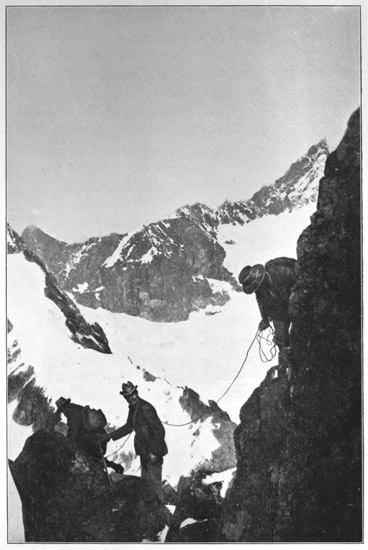
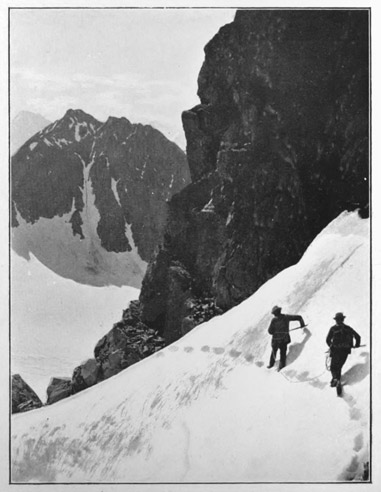
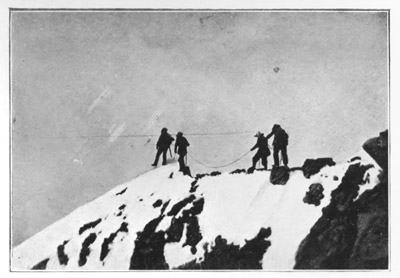
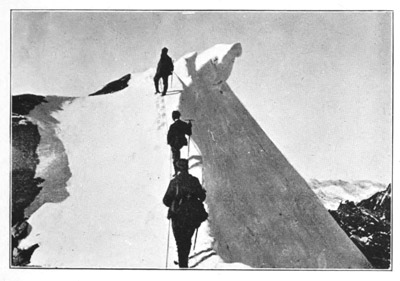
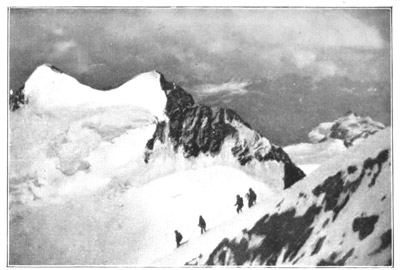
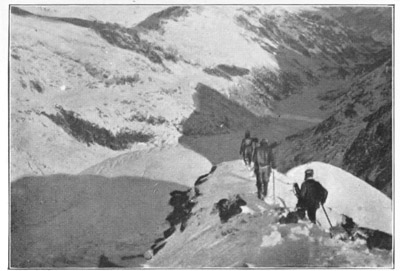
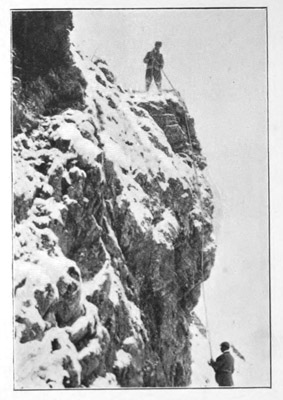
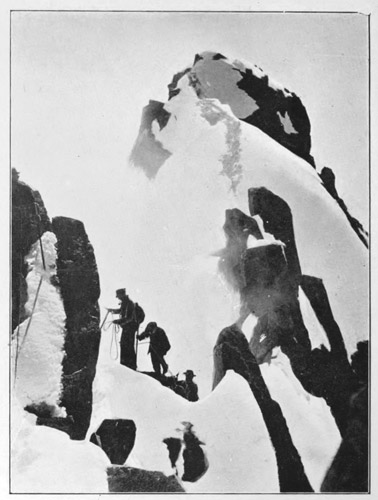
A careful party descending a Rock Peak near Zermatt (the Unter Gabelhorn).
The most thoroughly unorthodox beginning to
a great career of which I have ever heard was
that of Joseph Imboden, of St Nicholas. When
a boy his great desire, as he has often told me,
was to become a guide. But his father would not
consent to it, and apprenticed him to a boot-maker.
During the time he toiled at manufacturing
and mending shoes he contrived to save
20 fr. He then, at the age of sixteen, ran
away from his employer, bought a note-book,
and established himself at the Riffel Hotel above
Zermatt. On every possible occasion he urged
travellers to employ him as guide.
"Where is your book, young man?" they invariably
enquired.
He showed it to them, but the pages were
blank, and so no one would take him.
"At last," Imboden went on, "my 20 fr. were
all but spent, when I managed to persuade a
young Englishman to let me take him up Monte
Rosa. I told him I knew the mountain well, and
I would not charge him high. So we started. I
had never set foot on a glacier before or on any
mountain, but there was a good track up the snow,
and I followed this, and there were other parties
on Monte Rosa, so I copied what the guides did,
and roped my gentleman as I saw the guides
doing theirs. It was a lovely day, and we got on
very well, and my gentleman was much pleased,
and offered me an engagement to go to Chamonix
with him over high passes.
"Then I said to myself: 'Lies have been very
useful till now, but the time has come to speak
the truth, and I will do so.'
"So I said to him: 'Herr, until to-day I have never
climbed a mountain, but I am strong and active,
and I have lived among mountaineers and mountains,
and I am sure I can satisfy you if you will
take me.'
"He was quite ready to do so, and we crossed
the Col du Géant and went up Mont Blanc, but
could do no more as the weather was bad. Then
he wrote a great deal in my book, and since then
I have never been in want of a gentleman to
guide."
Imboden's eldest son, Roman, began still younger.
When only thirteen he was employed by a member
of the Alpine Club, Mr G. S. Barnes, to carry his
lunch on the picnics he made with his friends on
the glaciers near Saas-Fée. The party eventually
undertook more ambitious expeditions, and one
evening, Roman, who was very small for his age,
was seen entering his native village at the head
of a number of climbers who had crossed the Ried
Pass, the little boy proudly carrying the largest
knapsack of which he could possess himself, a huge
coil of rope, and an ice-axe nearly as big as himself.
Thus commenced the career of an afterwards famous
Alpine guide.
During some fifteen seasons Imboden accompanied
me on my climbs, frequently with Roman
as second guide. Once the latter went with me
to Dauphiné, and, though only twenty-three at the
time, took me up the Meije, Ecrins, and other big
peaks, his father being detained at home by reason
of a bitter feud with the railway company about to
run a line through his farm. It is sad to look back
to the terrible ending of Roman's career at a period
when he was the best young guide in the Alps.
How little, in September 1895, as with the Imbodens,
father and son, I stood on the summit of
the Lyskamm, did any of us think that never
again should we be together on a mountain, and
that from the very peak on which we were Roman
would be precipitated in one awful fall of hundreds
of feet, his companions, Dr Guntner and the second
guide Ruppen, also losing their lives.
I shall never forget the evening the news reached
us at Zermatt. Imboden was, as usual, my guide,
but Roman was leading guide to Dr Guntner. A
month or two previously this gentleman had written
to Roman asking if he would climb with him.
Roman showed the letter to his father, saying:
"I only go with English people, so I shall refuse."
"Do not reply in a hurry," was the answer; "wait
and see what the Herr is like, he is coming here
soon." So Roman waited, saw Dr Guntner, liked
him immensely, and engaged himself, not only till
the end of the season, but also for a five months'
mountaineering expedition in the Himalayas. We
had all arrived at Zermatt from Fée a few days
before, and while we waited in the valley for good
weather, Dr Guntner, Roman Imboden, and Ruppen
went to the Monte Rosa Hut to get some exercise
next day on one of the easier peaks in the neighbourhood.
Dr Guntner much wished to try the
Lyskamm. Roman was against it, as the weather
and snow were bad. However, in the morning
there was a slight improvement, and as Dr Guntner
was still most anxious to attempt the Lyskamm
and Roman was so attached to him that he wished
to oblige him in every way he could, he consented
to, at any rate, go and look at it. Another party
followed, feeling secure in the wake of such first-rate
climbers, and, though the snow was atrocious
and the weather grew worse and worse, no one
turned back, and the summit was not far distant.
The gentleman in the second party did not feel
very well, and made a long halt on the lower part of
the ridge. Something seems to have aroused his
suspicions—some drifting snow above, it was said,
but I could never understand this part of the story—and
an accident was feared. Abandoning the ascent,
partly because of illness, partly on account of the
weather, the party went down. At the bottom of
the ridge, wishing to see if indeed something had
gone wrong, they bore over towards the Italian side
of the mountain. Directly the snowy plain at the
base of the peak became visible, their worst fears
were confirmed, for they perceived three black
specks lying close together. Examining them
through their glasses, it was but too certain that
what they saw were the lifeless bodies of Dr
Gunnter, Roman, and Ruppen.
Meanwhile, unconscious of the awful tragedy
being enacted that day on the mountains, I had
sent Imboden down to St Nicholas to see his
family, and, after dinner, was sitting writing in
the little salon of the Hotel Zermatt when two
people entered, remarking to each other, "What a
horrible smash on the Lyskamm!"
I started to my feet. Something told me it must
be Roman's party. Crossing quickly over to the Monte
Rosa Hotel, I found a silent crowd gathering in
the street. I went into the office.
"Who is it?" I asked.
"Roman's party," was the answer.
"How do you know?"
"The other party has telephoned from the Riffel;
we wait for them to arrive to hear particulars."
The crowd grew larger and larger in the dark
without. All waited in cruel suspense. I could
not bear to think of Imboden.
An hour passed. Then there was a stir among
the waiting throng, and I went out among them
and waited too.
The other party was coming. As the little band
filed through the crowd, one question only was
whispered.
"Is there any hope?" Sadly shaking their heads,
the gentleman and his guides passed into Herr
Seiler's room, and there we learned all there was
to hear.
I need not dwell on Imboden's grief. He will
never be the same man again, though three more
sons are left him; but I must put on record his first
words to me when I saw him: "Ruppen has left
a young wife and several children, and they
are very poor. Will you get up a subscription
for them, ma'am, and help them as much as
possible?"
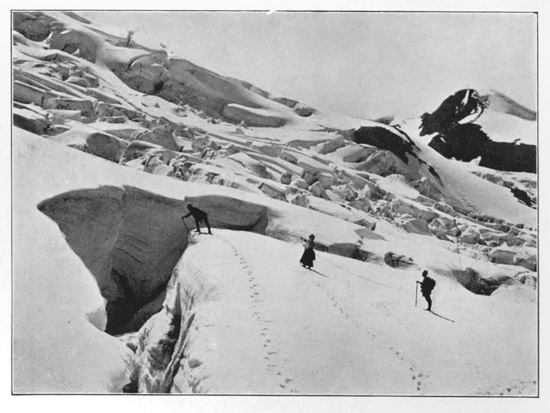
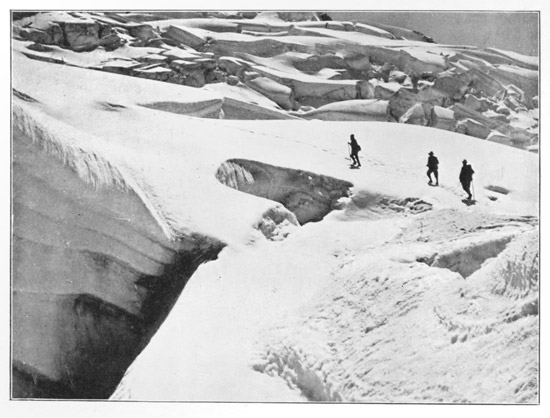
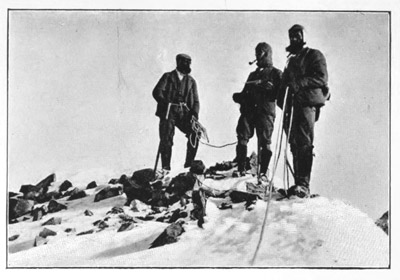
Stopped by a big Crevasse.
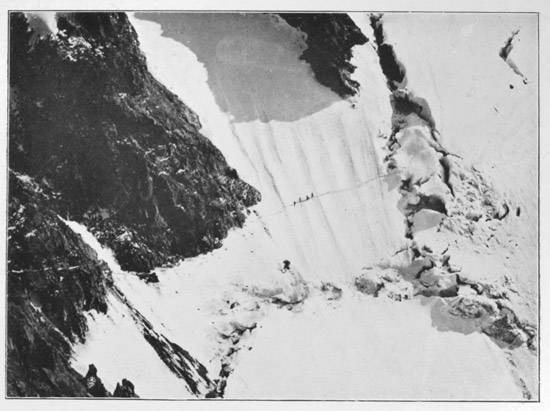
The party descended a little till a better passage was found by crossing a snow-bridge (page 37).
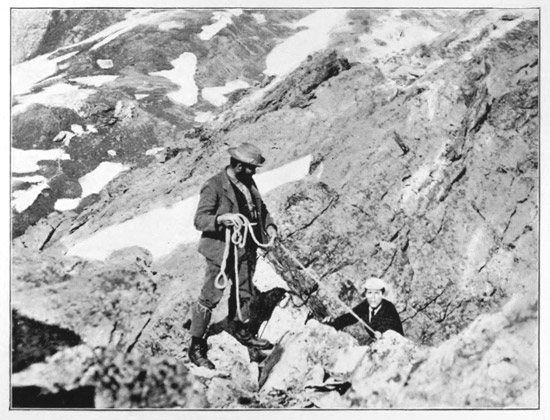
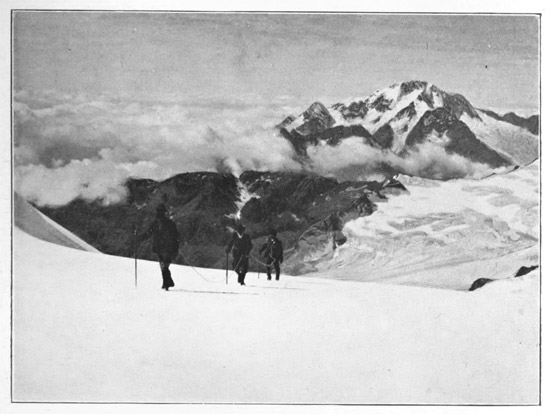
The gentle persuasion of the Rope (page 39).
It was done, and for Roman a tombstone was
erected, "By his English friends, as a mark of their
appreciation of his sterling qualities as a man and
a guide." Roman was twenty-seven at the time
of the accident. Neither Imboden nor I cared to
face the sad associations of the Alps after the death
of Roman, and the next and following years we
mountaineered in Norway instead.
It will have been noticed that a climber nearly
always takes two guides on an expedition. A
visitor at Zermatt, or some other climbing centre,
was heard to enquire: "Why do people take two
guides? Is it in case they lose one?"
There are several reasons why a climbing party
should not number less than three. In a difficult
place, if one slips, his two companions should be
able to check his fall immediately, whereas if the
party number but two the risk of an accident is
much greater. Again, a mishap to one of a party
of two is infinitely more serious than had there
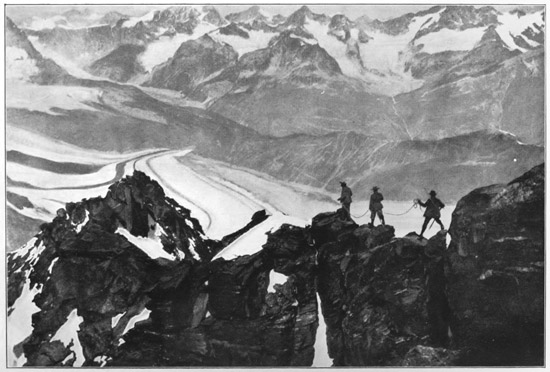
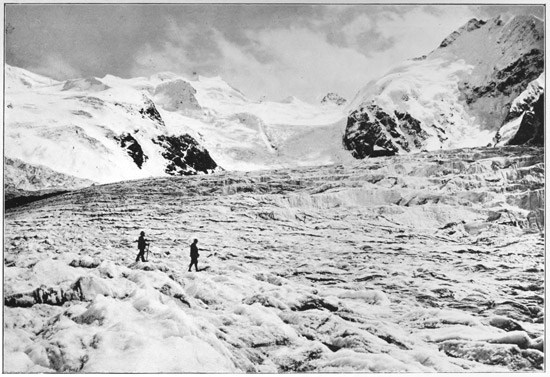
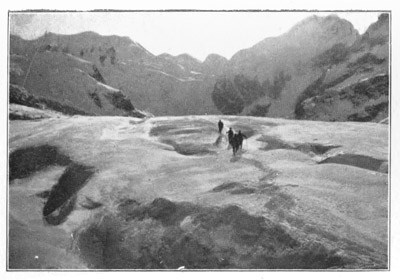
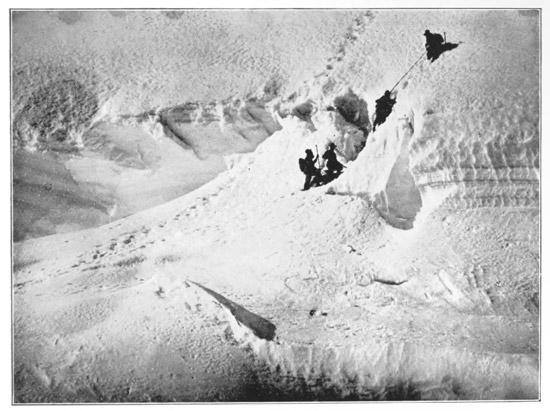
been three climbing together. A glance at the
accompanying photograph of some mountaineers
reconnoitring a big crevasse will make my point
clear.
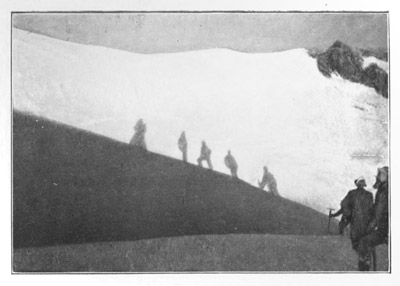
A first-class guide will use the rope very differently
to an inferior man, who allows it to hang about in
a tangle, and to catch on every point of projecting
rock.
A friend of mine, a Senior Wrangler, was extremely
anxious to learn how to use a rope properly. So,
instead of watching the method of his guide, he
purchased a handbook, and learned by heart all the
maxims therein contained on the subject. Shortly
after these studies of his I was descending a steep
face of rock in his company. I was in advance,
and had gone down as far as the length of rope
between us permitted. A few steps below was
a commodious ledge, so I called out: "More rope,
please!"
My friend hesitated, cleared his throat, and replied:
"I am not sure if I ought to move just now,
because, in Badminton, on page so-and-so, line
so-and-so, the writer says——"
"Will you please give the lady more rope, sir!"
called out Imboden.
"He says that if a climber finds himself in a
position——"
"Will you go on, sir, or must I come down and
help you?" exclaimed Imboden from above, and,
at last, reluctantly enough, my friend moved on.
He is now a distinguished member of the Alpine
Club, so there is, perhaps, something to be said in
favour of learning mountaineering from precept
rather than example!
Occasionally a guide's manipulation of the rope
includes something more arduous than merely being
always ready to stop a slip. If his traveller is tired
and the snow slopes are long and wearisome, it may
happen that a guide will put the rope over his
shoulder and pull his gentleman. A mountaineer
of my acquaintance met a couple ascending the
Breithorn in this manner. It was a hot day, and
the amateur was very weary. Furthermore, he
could speak no German. So he entreated his compatriot
to intercede for him with the guide, who
would insist on taking him up in spite of his
groans of fatigue.
"Why do you not return when the gentleman
wishes it?" queried the stranger.
"Sir," replied the guide, "he can go, he must go;
he has paid me in advance!"
The rope generally used by climbers is made in
England, is known as Alpine Club rope, and may
be recognised by the bright red thread which runs
through the centre of it. A climber should have his
own rope, and not trust to any of doubtful quality.
Should climbers desire to make ascents in seldom
explored parts of the world, such as the Caucasus, the
Andes, or the Himalayas, they must take Alpine
guides with them, for mountains everywhere have
many characteristics in common, and as a good rider
will go over a country unknown to him better than a
bad horseman to whom it is familiar, so will a skilful
guide find perhaps an easy way up a mountain previously
unexplored, while the natives of the district
declare the undertaking an impossible one. The
Canadian Pacific Railway Company have recognised
the truth of this, and have secured the services of
Swiss guides for climbing in the Rockies.
The devotion of a really trustworthy guide to his
employer is a fine trait in his character. My guide,
Joseph Imboden, has often told me that for years the
idea that he might somehow return safe from an
expedition during which his traveller was killed, was
simply a nightmare to him. Directly the rope was
removed his anxiety commenced, and he was just as
careful to see that the climber did not slip in an easy
place as he had been on the most difficult part of the
ascent. It is an unbroken tradition that no St.
Nicholas guide ever comes home without his employer;
all return safely or all are killed. Alas! the
list of killed is a long one from that little Alpine
village. In the churchyard, from the most recent
grave, covered by the beautiful white marble stone
placed there by Roman's English friends, to those
recalling accidents a score or more of years ago, there
lies the dust of many brave men. But I must not
dwell on the gloom of the hills; let me rather recall
some of the many occasions when a guide, by his
skill, quickness, or resource, has saved his own and his
charges' lives.
A famous Oberlander, Lauener by name, noted for
his great strength, performed on one occasion a marvellous
feat. He was ascending a steep ice slope, at
the bottom of which was a precipice. He was alone
with his "gentleman," and to this fact, usually by no
means a desirable one, they both owed their lives.
A big boulder seemed to be so deeply imbedded in
the ice as to be actually part of the underlying rock.
The traveller was just below it, the guide had cut
steps alongside, and was above with, most happily,
the rope taut. As he gained the level of the boulder
he put his foot on it. To his horror it began to
move! He took one rapid step back, and with a
superhuman effort positively swung his traveller clean
out of the steps and dangled him against the slope
while the rock, heeling slowly outwards, broke loose
from its icy fetters and plunged down the mountain
side, right across the very place where the climber
had been standing but an instant before.
A small man, whose muscles are in perfect condition,
and who knows how to turn them to account,
can accomplish what would really appear to be almost
impossible for any one of his size.
Ulrich Almer, eldest son of the famous guide, the
late Christian Almer, saved an entire party on one
occasion by his own unaided efforts. They were descending
the Ober Gabelhorn, a high mountain near
Zermatt, and had reached a ridge where there is
usually a large cornice. Now, a cornice is an overhanging
eave of snow which has been formed by the
wind blowing across a ridge. Sometimes cornices
reach an enormous size, projecting 50 feet or more
from the ridge. In climbing, presence of mind may
avail much if a cornice breaks—absence of body is,
however, infinitely preferable. Even first-class guides
may err in deciding whether a party is or is not at
an absolutely safe distance from a cornice. Though
not actually on that part of the curling wave of snow
which overhangs a precipice, the party may be in
danger, for when a cornice breaks away it usually
takes with it part of the snow beyond.
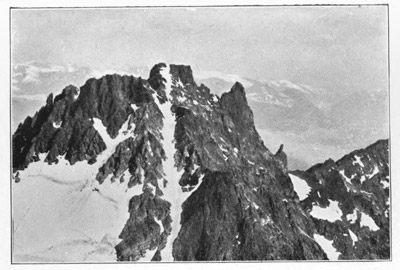
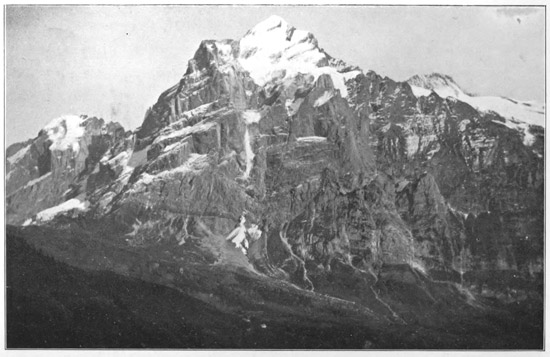
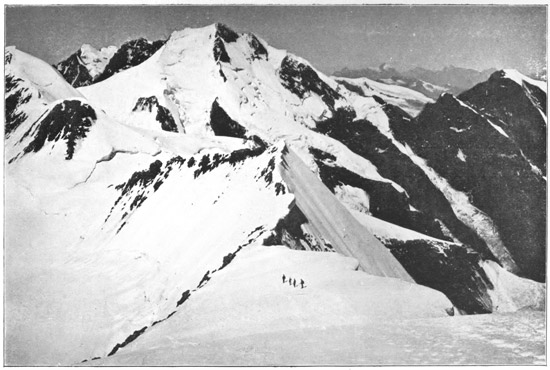
A typical Couloir is seen streaking the peak from summit to base in
the centre of the picture (page 73).
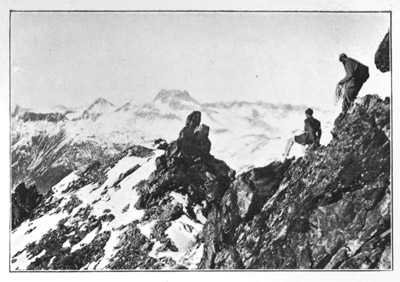
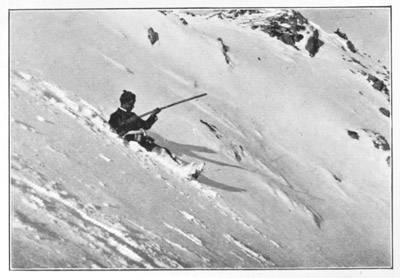
The wrong way to Descend.
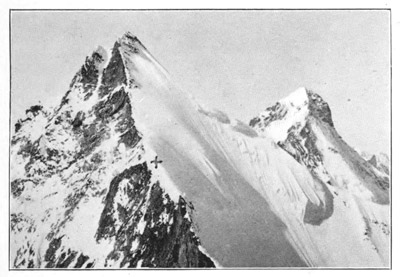
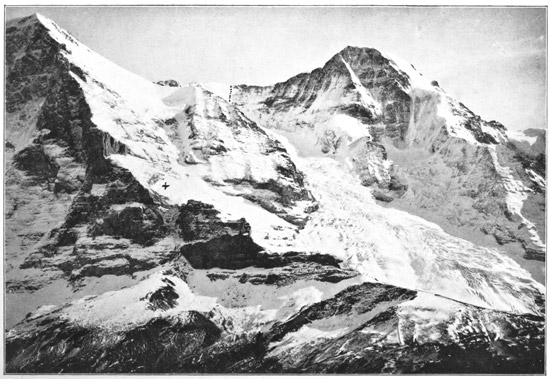
The Cross marks the spot where the accident happened on the cornice
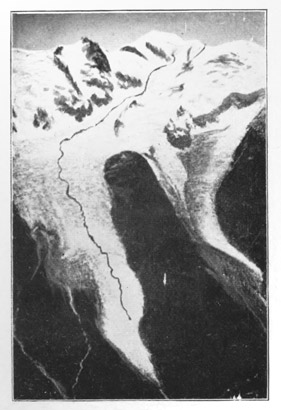
of the Ober Gabelhorn in 1880 (page 43).
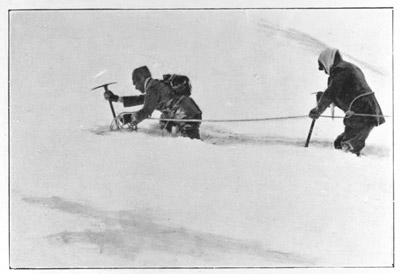
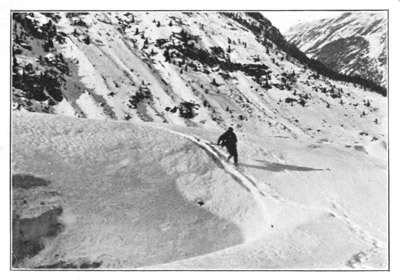
Very soft Snow which, on a steep slope, would cause an
Avalanche (page 60).
By some miscalculation the first people on the
rope walked on to the cornice. It broke, and they
dropped straight down the precipice below. But at
the same moment Ulrich saw and grasped the situation,
and, springing right out on the other side, was
able to check them in their terrible fall. It was no
easy matter for the three men, one of whom had dislocated
his shoulder, to regain the ridge, although
held all the time by Ulrich. Still it was at length
safely accomplished. The two gentlemen were so
grateful to their guide that they wished to give him
an acceptable present, and after much consideration
decided that they could not do better than present
him with a cow!
In trying to save a party which has fallen off a
ridge, either by the breaking of a cornice or by a slip,
I am told by first-rate guides that the proper thing to
do is to jump straight out into the air on the opposite
side. You thus bring a greater strain on the rope,
and are more likely to check the pace at which your
companions are sliding. I had a very awkward experience
myself on one occasion when, owing to the
softness of the snow, we started an avalanche, and
the last guide, failing to spring over on the other side,
we were all carried off our feet. Luckily, we were
able, by thrusting our axes through into a lower
and harder layer of snow, to arrest our wild career.
Piz Palü, in the Engadine, was once nearly the
scene of a terrible tragedy through the breaking of
a cornice, the party only being saved by the quickness
and strength of one of their guides. The
climbers consisted of Mrs Wainwright, her brother-in-law
Dr B. Wainwright and the famous Pontresina
guides Hans and Christian Grass. Bad weather
overtook them during their ascent, and while they
were passing along the ridge the fog was so thick that
Hans Grass, who was leading, got on to the cornice.
He was followed by the two travellers, and then with
a mighty crack the cornice split asunder and precipitated
them down the icy precipice seen to the
right. Last on the rope came sturdy old Christian
Grass, who grasped the awful situation in an instant,
and sprang back. He held, but could, of course, do
no more. Now was the critical time for the three
hanging against the glassy wall. Both Hans and
the lady had dropped their axes. Dr Wainwright
alone retained his, and to this the party owed their
lives. Of course he, hanging at the top, could do
nothing; but after shouting out his intentions to
those below, he called on Hans to make ready to
catch the axe when it should slip by him. A
moment of awful suspense, and the weapon was
grasped by the guide, who forthwith hewed a big
step out of the ice, and, standing on it, began the
toilsome work of constructing a staircase back to the
ridge. At last it was done, and when the three lay
panting on the snow above, it was seen that by that
time one strand only of the rope had remained intact.
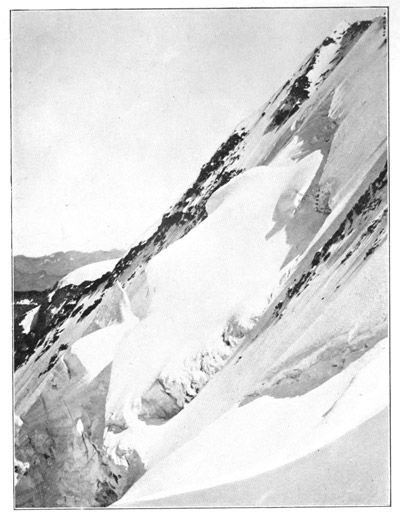
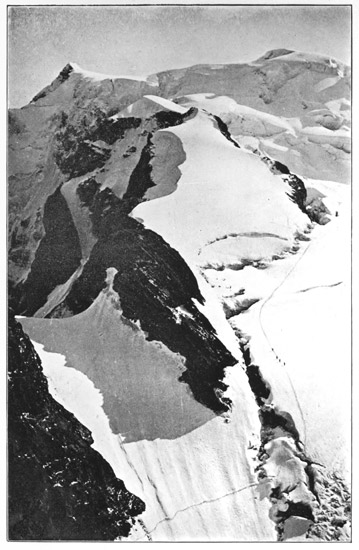
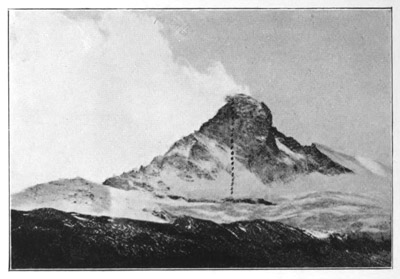
The dotted line in the top right-hand corner shows the spot on Piz Palü
where the Wainwright accident took place, the slope being the one the
party fell down.
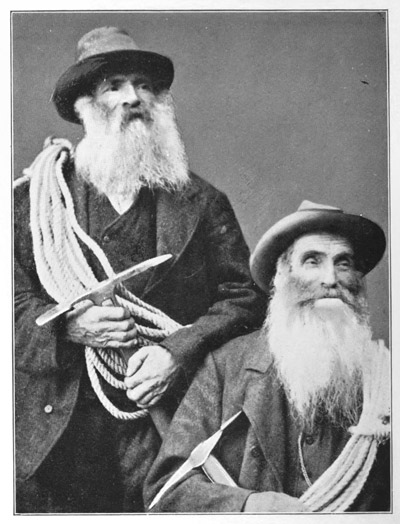
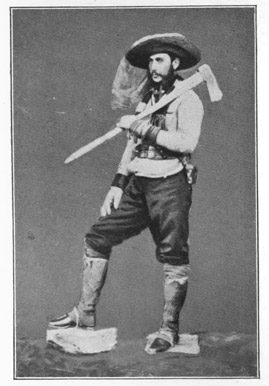
Hans and Christian Grass.
The following account of a narrow escape from the
result of a cornice breaking has an especially sad
interest, for it was found amongst the papers of Lord
Francis Douglas after his tragic death on the Matterhorn,
and was addressed to the Editor of the Alpine
Journal. The ascent described was made on 7th July
1865, and the poor young man was killed on the 14th
of the same month.
The Gabelhorn is a fine peak, 13,365 feet high, in
the Zermatt district.
Lord Francis Douglas writes:—"We arrived at
the summit at 12.30. There we found that some one
had been the day before, at least to a point very
little below it, where they had built a cairn; but they
had not gone to the actual summit, as it was a peak
of snow, and there were no marks of footsteps. On
this peak we sat down to dine, when, all of a sudden,
I felt myself go, and the whole top fell with a crash
thousands of feet below, and I with it, as far as the
rope allowed (some 12 feet). Here, like a flash of
lightning, Taugwald came right by me some 12
feet more; but the other guide, who had only the
minute before walked a few feet from the summit to
pick up something, did not go down with the mass,
and thus held us both. The weight on the rope
must have been about 23 stone, and it is wonderful
that, falling straight down without anything to break
one's fall, it did not break too. Joseph Viennin then
pulled us up, and we began the descent to Zermatt."
Here, again, one of the guides saved the party
from certain destruction.
It is in time of emergency that a really first-rate
guide is so far ahead of an inferior man. In many
cases when fatal results have followed unexpected
bad weather or exceptionally difficult conditions of
a mountain, bad guiding is to blame, while the cases
when able guides have brought down themselves and
their employers from very tight places indeed, are
far more frequent than have ever been related.
A really wonderful example of a party brought
safely home after terrible exposure is related in
The Pioneers of the Alps. The well-known guides,
Andreas Maurer and Emile Rey, with an English
climber, had tried to reach the summit of the
Aiguille du Plan by the steep ice slopes above the
Chamonix Valley. "After step-cutting all day, they
reached a point when to proceed was impossible,
and retreat looked hopeless. To add to their difficulties,
bad weather came on, with snow and intense
cold. There was nothing to be done but to remain
where they were for the night, and, if they survived
it, to attempt the descent of the almost precipitous
ice-slopes they had with such difficulty ascended.
They stood through the long hours of that bitter
night, roped together, without daring to move, on a
narrow ridge, hacked level with their ice-axes. I know
from each member of the party that they looked
upon their case as hopeless, but Maurer not only
never repined, but affected rather to like the whole
thing, and though his own back was frozen hard to
the ice-wall against which he leaned, and in spite of
driving snow and numbing cold, he opened coat,
waistcoat and shirt, and through the long hours of
the night he held, pressed against his bare chest, the
half-frozen body of the traveller who had urged him
to undertake the expedition.
"The morning broke, still and clear, and at six
o'clock, having thawed their stiffened limbs in the
warm sun, they commenced the descent. Probably
no finer feat in ice-work has ever been performed
than that accomplished by Maurer and Rey on the
10th August 1880. It took them ten hours of continuous
work to reach the rocks and safety, and
their work was done without a scrap of food, after
eighteen hours of incessant toil on the previous day,
followed by a night of horrors such as few can
realize." Had the bad weather continued, the party
could not possibly have descended alive, "and this
act of unselfish devotion would have remained
unrecorded!"
Perhaps the most remarkable instance of endurance
took place on the Croda Grande. The party
consisted of Mr Oscar Schuster and the Primiero
guide, Giuseppe Zecchini. They set out on 17th
March 1900, from Gosaldo at 5.10 A.M., the weather
becoming unsettled as they went along. After they
had been seven hours on the march a storm arose,
yet, as they were within three-quarters of an hour
of the top of their peak, they did not like to turn
back. They duly gained the summit, the storm
momentarily increasing in violence, and then they
descended on the other side of the mountain till
they came to an overhanging rock giving a certain
amount of shelter. The guide had torn his gloves
to pieces during the ascent, and his fingers were raw
and sore from the difficult icy rocks he had climbed.
As the cold was intense, they now began to be very
painful. The weather grew worse and worse, and
the two unfortunate climbers were obliged to remain
in a hole scooped out of the snow, not only during
the night of the 17th, but also during the whole
day and night of the 18th. On the 19th, at 8 A.M.,
they made a start, not having tasted food for
forty-eight hours. Five feet of snow had fallen, and
the weather was still unsettled, but go they had
to. First they tried to return as they came, but
the masses of snow barred the way. They were
delayed so long by the terrible state of the mountain
that they had to spend another night out, and it
was not till 6 P.M. on the 20th, after great danger
that they reached Gosaldo. The guide, from whose
account in The Alpine Journal I have borrowed,
lost three fingers of his right hand and one of the
left from frost-bite; the traveller appears to have
come off scot free.