With the American Escadrille at Verdun
Told by James R. McConnell, Sergeant-Pilot in the
French Flying Corps
The story of how Jim McConnell, the young North Carolinian,
went to France and gave his life to the cause of human liberty,
is a noble tribute to young Americanism. His heroic deeds at
the battle of Verdun when he fought with the American aviators
in a sea of clouds is a classic that would do credit to the
ancient Greeks. A comrade tells this story: "One day in January,
1915, I saw Jim McConnell in front of the Court House
at Carthage, North Carolina. 'Well,' he said, 'I am all fixed up
and I am leaving on Wednesday.' 'Where for?' I asked. 'I
have got a job to drive an ambulance in France,' was his answer.
And then he went on to tell me, first, that as he saw it the
greatest event of history was going on right at hand. 'These
sand hills,' he said, 'will be here forever but the war won't—and
so I am going.' So he went. He joined the American
Ambulance Service in the Vosges, was mentioned many times
in the Orders of the Day for conspicuous bravery in saving
wounded under fire, and received the much-coveted Croix de
Guerre." As a Sergeant-Pilot in the Lafayette Escadrille of
American Aviators, McConnell was killed in March, 1917, in an
encounter with two Boche-driven aeroplanes. It was his hope
that he might lead a United States Army Aero Corps on the
French front. He, indeed, had a part in great deeds and left
the best description yet published of the most terrific battle in
the war up to the time of his death. His book, titled "Flying
for France," is published by Doubleday, Page and Company,
Copyright 1916-17. Some of his experiences herein related are
presented with their full authority in this collection of stories.
[8]
I—STORY OF THE AMERICAN AIRMEN
Beneath the canvas of a huge hangar mechanicians
are at work on the motor of an airplane. Outside, on
the borders of an aviation field, others loiter awaiting
their aërial charge's return from the sky. Near the hangar
stands a hut-shaped tent. In front of it several short-winged
biplanes are lined up; inside it three or four young
men are lolling in wicker chairs.
They wear the uniform of French army aviators.
These uniforms, and the grim-looking machine guns
mounted on the upper planes of the little aircraft, are the
only warlike note in a pleasantly peaceful scene. The war
seems very remote. It is hard to believe that the greatest
of all battles—Verdun—rages only twenty-five miles
to the north, and that the field and hangars and mechanicians
and aviators and airplanes are all playing a part
therein.
Suddenly there is the distant hum of a motor. One
of the pilots emerges from the tent and gazes fixedly up
into the blue sky. He points, and one glimpses a black
speck against the blue, high overhead. The sound of the
motor ceases, and the speck grows larger. It moves
earthward in steep dives and circles, and as it swoops
closer, takes on the shape of an airplane. Now one can
make out the red, white, and blue circles under the wings
which mark a French war-plane, and the distinctive insignia
of the pilot on its sides.
"Ton patron arrive!" one mechanician cries to another.
"Your boss is coming!"
The machine dips sharply over the top of a hangar,
straightens out again near the earth at a dizzy speed a
few feet above it and, losing momentum in a surprisingly
short time, hits the ground with tail and wheels. It
bumps along a score of yards and then, its motor whirring
again, turns, rolls toward the hangar, and stops. A
human form, enveloped in a species of garment for all
the world like a diver's suit, and further adorned with
goggles and a leather hood, rises unsteadily in the cockpit,
clambers awkwardly overboard and slides down to
terra firma.
A group of soldiers, enjoying a brief holiday from the
trenches in a cantonment near the field, straggle forward
and gather timidly about the airplane, listening open-mouthed
for what its rider is about to say.
"Hell!" mumbles that gentleman, as he starts divesting
himself of his flying garb.
"What's wrong now?" inquires one of the tenants of
the tent.
"Everything, or else I've gone nutty," is the indignant
reply, delivered while disengaging a leg from its Teddy
Bear trousering. "Why, I emptied my whole roller on a
Boche this morning, point blank at not fifteen metres off.
His machine gun quit firing and his propeller wasn't turning
and yet the darn fool just hung up there as if he were
tied to a cloud. Say, I was so sure I had him it made
me sore—felt like running into him and yelling, 'Now,
you fall, you bum!'"
The eyes of the poilus register surprise. Not a word
of this dialogue, delivered in purest American, is intelligible
to them. Why is an aviator in a French uniform
speaking a foreign tongue, they mutually ask themselves.
Finally one of them, a little chap in a uniform long since
bleached of its horizon-blue color by the mud of the firing
line, whisperingly interrogates a mechanician as to
the identity of these strange air folk.
"But they are the Americans, my old one," the latter
explains with noticeable condescension.
Marvelling afresh, the infantrymen demand further
details. They learn that they are witnessing the return
of the American Escadrille—composed of Americans who
have volunteered to fly for France for the duration of
the war—to their station near Bar-le-Duc, twenty-five
miles south of Verdun, from a flight over the battle front
of the Meuse. They have barely had time to digest this
knowledge when other dots appear in the sky, and one
by one turn into airplanes as they wheel downward. Finally
all six of the machines that have been aloft are back
on the ground and the American Escadrille has one more
sortie over the German lines to its credit.
II—STORY OF THE PERSONNEL OF THE
ESCADRILLE
Like all worth-while institutions, the American Escadrille,
of which I have the honour of being a member, was
of gradual growth. When the war began, it is doubtful
whether anybody anywhere envisaged the possibility of
an American entering the French aviation service. Yet,
by the fall of 1915, scarcely more than a year later, there
were six Americans serving as full-fledged pilots, and
now, in the summer of 1916, the list numbers fifteen or
more, with twice that number training for their pilot's
license in the military aviation schools.
The pioneer of them all was William Thaw, of Pittsburg,
who is to-day the only American holding a commission
in the French flying corps. Lieutenant Thaw,
a flyer of considerable reputation in America before the
war, had enlisted in the Foreign Legion in August, 1914.
With considerable difficulty he had himself transferred,
in the early part of 1915, into aviation, and the autumn
of that year found him piloting a Caudron biplane, and
doing excellent observation work. At the same time,
Sergeants Norman Prince, of Boston, and Elliot Cowdin,
of New York—who were the first to enter the aviation
service coming directly from the United States—were at
the front on Voisin planes with a cannon mounted in the
bow.
Sergeant Bert Hall, who signs from the Lone Star
State and had got himself shifted from the Foreign Legion
to aviation soon after Thaw, was flying a Nieuport
fighting machine, and, a little later, instructing less-advanced
students of the air in the Avord Training School.
His particular chum in the Foreign Legion, James Bach,
who also had become an aviator, had the distressing distinction
soon after he reached the front of becoming the
first American to fall into the hands of the enemy. Going
to the assistance of a companion who had broken down in
landing a spy in the German lines, Bach smashed his
machine against a tree. Both he and his French comrade
were captured, and Bach was twice court-martialed by the
Germans on suspicion of being an American franc-tireur—the
penalty for which is death! He was acquitted but
of course still languishes in a prison camp "somewhere in
Germany." The sixth of the original sextet was Adjutant
Didier Masson, who did exhibition flying in the
States until—Carranza having grown ambitious in Mexico—he
turned his talents to spotting los Federales for
General Obregon. When the real war broke out, Masson
answered the call of his French blood and was soon
flying and fighting for the land of his ancestors.
Of the other members of the escadrille Sergeant Givas
Lufbery, American citizen and soldier, but dweller in
the world at large, was among the earliest to wear the
French airman's wings. Exhibition work with a French
pilot in the Far East prepared him efficiently for the
task of patiently unloading explosives on to German
military centres from a slow-moving Voisin which was
his first mount. Upon the heels of Lufbery came two
more graduates of the Foreign Legion—Kiffin Rockwell,
of Asheville, N. C., who had been wounded at Carency;
Victor Chapman, of New York, who after recovering
from his wounds became an airplane bomb-dropper and
so caught the craving to become a pilot. At about this
time one Paul Pavelka, whose birthplace was Madison,
Conn., and who from the age of fifteen had sailed the
seven seas, managed to slip out of the Foreign Legion
into aviation and joined the other Americans at Pau.
There seems to be a fascination to aviation, particularly
when it is coupled with fighting. Perhaps it's because
the game is new, but more probably because as a
rule nobody knows anything about it. Whatever be the
reason, adventurous young Americans were attracted by
it in rapidly increasing numbers. Many of them, of
course, never got fascinated beyond the stage of talking
about joining. Among the chaps serving with the American
ambulance field sections a good many imaginations
were stirred, and a few actually did enlist, when, toward
the end of the summer of 1915, the Ministry of War,
finding that the original American pilots had made good,
grew more liberal in considering applications.
Chouteau Johnson, of New York; Lawrence Rumsey,
of Buffalo; Dudley Hill, of Peekskill, N. Y.; and Clyde
Balsley, of El Paso; one after another doffed the ambulance
driver's khaki for the horizon-blue of the French
flying corps. All of them had seen plenty of action, collecting
the wounded under fire, but they were all tired of
being non-combatant spectators. More or less the same
feeling actuated me, I suppose. I had come over from
Carthage, N. C., in January, 1915, and worked with an
American ambulance section in the Bois-le-Prêtre. All
along I had been convinced that the United States ought
to aid in the struggle against Germany. With that conviction,
it was plainly up to me to do more than drive an
ambulance. The more I saw the splendour of the fight the
French were fighting, the more I felt like an embusqué—what
the British call a "shirker." So I made up my
mind to go into aviation.
A special channel had been created for the reception
of applications from Americans, and my own was favourably
replied to within a few days. It took four days more
to pass through all the various departments, sign one's
name to a few hundred papers, and undergo the physical
examinations. Then I was sent to the aviation depot at
Dijon and fitted out with a uniform and personal equipment.
The next stop was the school at Pau, where I was
to be taught to fly. My elation at arriving there was second
only to my satisfaction at being a French soldier.
It was a vast improvement, I thought, to the American
Ambulance.
Talk about forming an all-American flying unit, or escadrille,
was rife while I was at Pau. What with the
pilots already breveted, and the élèves, or pupils in the
training-schools, there were quite enough of our compatriots
to man the dozen airplanes in one escadrille.
Every day somebody "had it absolutely straight" that we
were to become a unit at the front, and every other day
the report turned out to be untrue. But at last, in the
month of February, our dream came true. We learned
that a captain had actually been assigned to command an
American escadrille and that the Americans at the front
had been recalled and placed under his orders. Soon
afterward we élèves got another delightful thrill.
III—STORY OF THE FLIERS IN TRAINING
Thaw, Prince, Cowdin, and the other veterans were
training on the Nieuport! That meant the American
Escadrille was to fly the Nieuport—the best type of
avion de chasse—and hence would be a fighting unit. It
is necessary to explain parenthetically here that French
military aviation, generally speaking, is divided into three
groups—the avions de chasse or airplanes of pursuit,
which are used to hunt down enemy aircraft or to fight
them off; avions de bombardement, big, unwieldy monsters
for use in bombarding raids; and avions de rélage,
cumbersome creatures designed to regulate artillery fire,
take photographs, and do scout duty. The Nieuport is
the smallest, fastest-rising, fastest-moving biplane in the
French service. It can travel 110 miles an hour, and is
a one-man apparatus with a machine gun mounted on its
roof and fired by the pilot with one hand while with the
other and his feet he operates his controls. The French
call their Nieuport pilots the "aces" of the air. No wonder
we were tickled to be included in that august brotherhood!
Before the American Escadrille became an established
fact, Thaw and Cowdin, who had mastered the Nieuport,
managed to be sent to the Verdun front. While there
Cowdin was credited with having brought down a German
machine and was proposed for the Médaille Militaire,
the highest decoration that can be awarded a non-commissioned
officer or private.
After completing his training, receiving his military
pilot's brevet, and being perfected on the type of plane
he is to use at the front, an aviator is ordered to the reserve
headquarters near Paris to await his call. Kiffin
Rockwell and Victor Chapman had been there for
months, and I had just arrived, when on the 16th of
April orders came for the Americans to join their escadrille
at Luxeuil, in the Vosges.
The rush was breathless! Never were flying clothes
and fur coats drawn from the quarter-master, belongings
packed, and red tape in the various administrative bureaux
unfurled, with such headlong haste. In a few
hours we were aboard the train, panting, but happy. Our
party consisted of Sergeant Prince, and Rockwell, Chapman,
and myself, who were only corporals at that time.
We were joined at Luxeuil by Lieutenant Thaw and Sergeants
Hall and Cowdin.
For the veterans our arrival at the front was devoid
of excitement; for the three neophytes—Rockwell, Chapman,
and myself—it was the beginning of a new existence,
the entry into an unknown world. Of course Rockwell
and Chapman had seen plenty of warfare on the
ground, but warfare in the air was as novel to them as
to me. For us all it contained unlimited possibilities for
initiative and service to France, and for them it must
have meant, too, the restoration of personality lost during
those months in the trenches with the Foreign Legion.
Rockwell summed it up characteristically.
"Well, we're off for the races," he remarked....
On our arrival at Luxeuil we were met by Captain
Thénault, the French commander of the American Escadrille—officially
known as No. 124, by the way—and motored
to the aviation field in one of the staff cars assigned
to us. I enjoyed that ride. Lolling back against
the soft leather cushions, I recalled how in my apprenticeship
days at Pau I had had to walk six miles for my
laundry....
Rooms were assigned to us in a villa adjoining the
famous hot baths of Luxeuil, where Cæsar's cohorts were
wont to besport themselves. We messed with our officers,
Captain Thénault and Lieutenant de Laage de Mux,
at the best hotel in town. An automobile was always on
hand to carry us to the field. I began to wonder whether
I was a summer resorter instead of a soldier.
Among the pilots who had welcomed us with open
arms, we discovered the famous Captain Happe, commander
of the Luxeuil bombardment group. The
doughty bomb-dispenser, upon whose head the Germans
have set a price, was in his quarters. After we had been
introduced, he pointed to eight little boxes arranged on
a table.
"They contain Croix de Guerre for the families of the
men I lost on my last trip," he explained, and he added:
"It's a good thing you're here to go along with us for
protection. There are lots of Boches in this sector."
I thought of the luxury we were enjoying: our comfortable
beds, baths, and motor cars, and then I recalled
the ancient custom of giving a man selected for the sacrifice
a royal time of it before the appointed day....
IV—STORY OF THE FIRST SORTIE IN THE
CLOUDS
The memory of the first sortie we made as an escadrille
will always remain fresh in my mind because it was
also my first trip over the lines. We were to leave at
six in the morning. Captain Thénault pointed out on his
aërial map the route we were to follow. Never having
flown over this region before, I was afraid of losing myself.
Therefore, as it is easier to keep other airplanes in
sight when one is above them, I began climbing as rapidly
as possible, meaning to trail along in the wake of
my companions. Unless one has had practice in flying
in formation, however, it is hard to keep in contact.
The diminutive avions de chasse are the merest pinpoints
against the great sweep of landscape below and
the limitless heavens above. The air was misty and
clouds were gathering. Ahead there seemed a barrier of
them. Although as I looked down the ground showed
plainly, in the distance everything was hazy. Forging up
above the mist, at 7,000 feet, I lost the others altogether.
Even when they are not closely joined, the clouds, seen
from immediately above, appear as a solid bank of white.
The spaces between are indistinguishable. It is like being
in an Arctic ice field.
To the south I made out the Alps. Their glittering
peaks projected up through the white sea about me like
majestic icebergs. Not a single plane was visible anywhere,
and I was growing very uncertain about my
position. My splendid isolation had become oppressive,
when, one by one, the others began bobbing up above the
cloud level, and I had company again.
We were over Belfort and headed for the trench lines.
The cloud banks dropped behind, and below us we saw
the smiling plain of Alsace stretching eastward to the
Rhine. It was distinctly pleasurable, flying over this
conquered land. Following the course of the canal that
runs to the Rhine, I sighted, from a height of 13,000
feet over Dannemarie, a series of brown, woodworm-like
tracings on the ground—the trenches!
My attention was drawn elsewhere almost immediately,
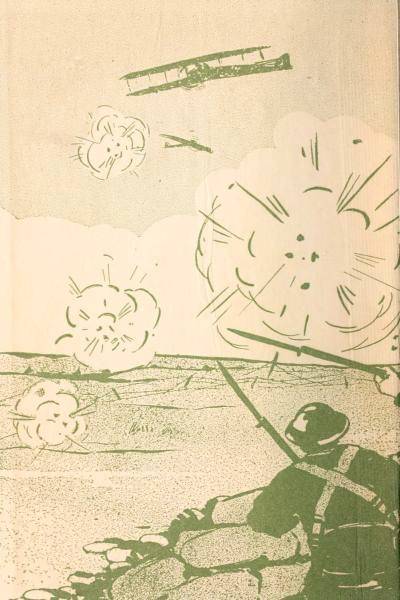
however. Two balls of black smoke had suddenly
appeared close to one of the machines ahead of me, and
with the same disconcerting abruptness similar balls began
to dot the sky above, below, and on all sides of us.
We were being shot at with shrapnel. It was interesting
to watch the flash of the bursting shells, and the attendant
smoke puffs—black, white, or yellow, depending on
the kind of shrapnel used. The roar of the motor
drowned the noise of the explosions. Strangely enough,
my feelings about it were wholly impersonal.
We turned north after crossing the lines. Mulhouse
seemed just below us, and I noted with a keen sense of
satisfaction our invasion of real German territory. The
Rhine, too, looked delightfully accessible. As we continued
northward I distinguished the twin lakes of
Gérardmer sparkling in their emerald setting. Where
the lines crossed the Hartmannsweilerkopf there were
little spurts of brown smoke as shells burst in the
trenches. One could scarcely pick out the old city of
Thann from among the numerous neighbouring villages,
so tiny it seemed in the valley's mouth. I had never been
higher than 7,000 feet and was unaccustomed to reading
country from a great altitude. It was also bitterly
cold, and even in my fur-lined combination I was shivering.
I noticed, too, that I had to take long, deep breaths
in the rarefied atmosphere. Looking downward at a certain
angle, I saw what at first I took to be a round,
shimmering pool of water. It was simply the effect of
the sunlight on the congealing mist. We had been keeping
an eye out for German machines since leaving our
lines, but none had shown up. It wasn't surprising, for
we were too many.
Only four days later, however, Rockwell brought down
the escadrille's first plane in his initial aërial combat. He
was flying alone when, over Thann, he came upon a
German on reconnaissance. He dived and the German
turned toward his own lines, opening fire from a long
distance. Rockwell kept straight after him. Then, closing
to within thirty yards, he pressed on the release of
his machine gun, and saw the enemy gunner fall backward
and the pilot crumple up sideways in his seat. The
plane flopped downward and crashed to earth just behind
the German trenches. Swooping close to the ground
Rockwell saw its débris burning away brightly. He had
turned the trick with but four shots and only one German
bullet had struck his Nieuport. An observation post
telephoned the news before Rockwell's return, and he got
a great welcome. All Luxeuil smiled upon him—particularly
the girls. But he couldn't stay to enjoy his
popularity. The escadrille was ordered to the sector of
Verdun.
While in a way we were sorry to leave Luxeuil, we
naturally didn't regret the chance to take part in the
aërial activity of the world's greatest battle. The night
before our departure some German aircraft destroyed
four of our tractors and killed six men with bombs, but
even that caused little excitement compared with going
to Verdun. We would get square with the Boches over
Verdun, we thought—it is impossible to chase airplanes
at night, so the raiders made a safe getaway....
The fast-flowing stream of troops, and the distressing
number of ambulances brought realization of the near
presence of a gigantic battle.
Within a twenty-mile radius of the Verdun front
aviation camps abound. Our escadrille was listed on
the schedule with the other fighting units, each of which
has its specified flying hours, rotating so there is always
an escadrille de chasse over the lines. A field wireless
to enable us to keep track of the movements of enemy
planes became part of our equipment.
Lufbery joined us a few days after our arrival. He
was followed by Johnson and Balsley, who had been on
the air guard over Paris. Hill and Rumsey came next,
and after them Masson and Pavelka. Nieuports were
supplied them from the nearest depot, and as soon as
they had mounted their instruments and machine guns,
they were on the job with the rest of us. Fifteen Americans
are or have been members of the American Escadrille,
but there have never been so many as that on
duty at any one time.
V—STORY OF THE BATTLES IN THE SKIES
Before we were fairly settled at Bar-le-Duc, Hall
brought down a German observation craft and Thaw a
Fokker. Fights occurred on almost every sortie. The
Germans seldom cross into our territory, unless on a
bombarding jaunt, and thus practically all the fighting
takes place on their side of the line. Thaw dropped his
Fokker in the morning, and on the afternoon of the same
day there was a big combat far behind the German
trenches. Thaw was wounded in the arm, and an explosive
bullet detonating on Rockwell's wind-shield tore
several gashes in his face. Despite the blood which was
blinding him Rockwell managed to reach an aviation field
and land. Thaw, whose wound bled profusely, landed
in a dazed condition just within our lines. He was too
weak to walk, and French soldiers carried him to a field
dressing-station, whence he was sent to Paris for further
treatment. Rockwell's wounds were less serious and he
insisted on flying again almost immediately.
A week or so later Chapman was wounded. Considering
the number of fights he had been in and the
courage with which he attacked it was a miracle he had
not been hit before. He always fought against odds and
far within the enemy's country. He flew more than any
of us, never missing an opportunity to go up, and never
coming down until his gasolene was giving out. His
machine was a sieve of patched-up bullet holes. His
nerve was almost superhuman and his devotion to the
cause for which he fought sublime. The day he was
wounded he attacked four machines. Swooping down
from behind, one of them, a Fokker, riddled Chapman's
plane. One bullet cut deep into his scalp, but Chapman,
a master pilot, escaped from the trap, and fired several
shots to show he was still safe. A stability control had
been severed by a bullet. Chapman held the broken rod
in one hand, managed his machine with the other, and
succeeded in landing on a nearby aviation field. His
wound was dressed, his machine repaired, and he immediately
took the air in pursuit of some more enemies.
He would take no rest, and with bandaged head continued
to fly and fight.
The escadrille's next serious encounter with the foe
took place a few days later. Rockwell, Balsley, Prince,
and Captain Thénault were surrounded by a large number
of Germans, who, circling about them, commenced
firing at long range. Realizing their numerical inferiority,
the Americans and their commander sought the
safest way out by attacking the enemy machines nearest
the French lines. Rockwell, Prince, and the captain
broke through successfully, but Balsley found himself
hemmed in. He attacked the German nearest him, only
to receive an explosive bullet in his thigh. In trying to
get away by a vertical dive his machine went into a corkscrew
and swung over on its back. Extra cartridge rollers
dislodged from their case hit his arms. He was
tumbling straight toward the trenches, but by a supreme
effort he regained control, righted the plane, and landed
without disaster in a meadow just behind the firing line.
Soldiers carried him to the shelter of a nearby fort,
and later he was taken to a field hospital, where he lingered
for days between life and death. Ten fragments
of the explosive bullet were removed from his stomach.
He bore up bravely, and became the favourite of the
wounded officers in whose ward he lay. When we flew
over to see him they would say: Il est un brave petit gars,
l'aviateur américain. [He's a brave little fellow, the
American aviator.] On a shelf by his bed, done up in a
handkerchief, he kept the pieces of bullet taken out of
him, and under them some sheets of paper on which he
was trying to write to his mother, back in El Paso.
Balsley was awarded the Médaille Militaire and the
Croix de Guerre, but the honours scared him. He had
seen them decorate officers in the ward before they died.
VI—STORY OF CHAPMAN'S LAST FIGHT
Then came Chapman's last fight. Before leaving, he
had put two bags of oranges in his machine to take to
Balsley, who liked to suck them to relieve his terrible
thirst, after the day's flying was over. There was an
aërial struggle against odds, far within the German lines,
and Chapman, to divert their fire from his comrades,
engaged several enemy airmen at once. He sent one
tumbling to earth, and had forced the others off when
two more swooped down upon him. Such a fight is a
matter of seconds, and one cannot clearly see what
passes. Lufbery and Prince, whom Chapman had defended
so gallantly, regained the French lines. They
told us of the combat, and we waited on the field for
Chapman's return. He was always the last in, so we
were not much worried. Then a pilot from another
fighting escadrille telephoned us, that he had seen a
Nieuport falling. A little later the observer of a reconnaissance
airplane called up and told us how he had witnessed
Chapman's fall. The wings of the plane had
buckled, and it had dropped like a stone he said.
We talked in lowered voices after that; we would read
the pain in one another's eyes. If only it could have
been some one else, was what we all thought, I suppose.
To lose Victor was not an irreparable loss to us merely,
but to France, and to the world as well. I kept thinking
of him lying over there, and of the oranges he was taking
to Balsley. As I left the field I caught sight of
Victor's mechanician leaning against the end of our
hangar. He was looking northward into the sky where
his patron had vanished, and his face was very sad.
By this time Prince and Hall had been made adjutants,
and we corporals transformed into sergeants. I frankly
confess to a feeling of marked satisfaction at receiving
that grade in the world's finest army. I was a far more
important person, in my own estimation, than I had been
as a second lieutenant in the militia at home. The next
impressive event was the awarding of decorations. We
had assisted at that ceremony for Cowdin at Luxeuil,
but this time three of our messmates were to be honoured
for the Germans they had brought down. Rockwell
and Hall received the Médaille Militaire and the
Croix de Guerre, and Thaw, being a lieutenant, the
Légion d'honneur and another "palm" for the ribbon of
the Croix de Guerre he had won previously. Thaw,
who came up from Paris specially for the presentation,
still carried his arm in a sling.
There were also decorations for Chapman, but poor
Victor, who so often had been cited in the Orders of the
Day, was not on hand to receive them.
VII—STORY OF THE MORNING SORTIE OVER
VERDUN
Our daily routine goes on with little change. Whenever
the weather permits—that is, when it isn't raining,
and the clouds aren't too low—we fly over the Verdun
battlefield at the hours dictated by General Headquarters.
As a rule the most successful sorties are those in the
early morning.
We are called while it's still dark. Sleepily I try to
reconcile the French orderly's muttered, C'est l'heure,
monsieur, that rouses me from slumber, with the strictly
American words and music of "When That Midnight
Choo Choo Leaves for Alabam'" warbled by a particularly
wide-awake pilot in the next room. A few minutes
later, having swallowed some coffee, we motor to
the field. The east is turning gray as the hangar curtains
are drawn apart and our machines trundled out by the
mechanicians. All the pilots whose planes are in commission—save
those remaining behind on guard—prepare
to leave. We average from four to six on a sortie, unless
too many flights have been ordered for that day, in
which case only two or three go out at a time.
Now the east is pink, and overhead the sky has
changed from gray to pale blue. It is light enough to
fly. We don our fur-lined shoes and combinations, and
adjust the leather flying hoods and goggles. A good deal
of conversation occurs—perhaps because, once aloft,
there's nobody to talk to.
"Eh, you," one pilot cries jokingly to another, "I hope
some Boche just ruins you this morning, so I won't have
to pay you the fifty francs you won from me last night!"
This financial reference concerns a poker game.
"You do, do you?" replies the other as he swings into
his machine. "Well, I'd be glad to pass up the fifty to
see you landed by the Boches. You'd make a fine sight
walking down the street of some German town in those
wooden shoes and pyjama pants. Why don't you dress
yourself? Don't you know an aviator's supposed to look
chic?"
A sartorial eccentricity on the part of one of our colleagues
is here referred to.
The raillery is silenced by a deafening roar as the
motors are tested. Quiet is briefly restored, only to be
broken by a series of rapid explosions incidental to the
trying out of machine guns. You loudly inquire at what
altitude we are to meet above the field.
"Fifteen hundred metres—go ahead!" comes an answering
yell.
"Essence et gaz! [Oil and gas!]" you call to your
mechanician, adjusting your gasolene and air throttles
while he grips the propeller.
"Contact!" he shrieks, and "Contact!" you reply. You
snap on the switch, he spins the propeller, and the motor
takes. Drawing forward out of line, you put on full
power, race across the grass and take the air. The
ground drops as the hood slants up before you and you
seem to be going more and more slowly as you rise. At
a great height you hardly realize you are moving. You
glance at the clock to note the time of your departure,
and at the oil gauge to see its throb. The altimeter
registers 650 feet. You turn and look back at the field
below and see others leaving.
In three minutes you are at about 4,000 feet. You
have been making wide circles over the field and watching
the other machines. At 4,500 feet you throttle down
and wait on that level for your companions to catch up.
Soon the escadrille is bunched and off for the lines.
You begin climbing again, gulping to clear your ears in
the changing pressure. Surveying the other machines,
you recognize the pilot of each by the marks on its side—or
by the way he flies. The distinguishing marks of the
Nieuports are various and sometimes amusing. Bert
Hall, for instance, has Bert painted on the left side of
his plane and the same word reversed (as if spelled backward
with the left hand) on the right—so an aviator
passing him on that side at great speed will be able to
read the name without difficulty, he says!
The country below has changed into a flat surface of
varicoloured figures. Woods are irregular blocks of dark
green, like daubs of ink spilled on a table; fields are
geometrical designs of different shades of green and
brown, forming in composite an ultra-cubist painting;
roads are thin white lines, each with its distinctive windings
and crossings—from which you determine your
location. The higher you are the easier it is to read.
In about ten minutes you see the Meuse sparkling in
the morning light, and on either side the long line of
sausage-shaped observation balloons far below you.
Red-roofed Verdun springs into view just beyond.
There are spots in it where no red shows and you know
what has happened there. In the green pasture land
bordering the town, round flecks of brown indicate the
shell holes. You cross the Meuse.
Immediately east and north of Verdun there lies a
broad, brown band. From the Woevre plain it runs
westward to the "S" bend in the Meuse, and on the left
bank of that famous stream continues on into the Argonne
Forest. Peaceful fields and farms and villages
adorned that landscape a few months ago—when there
was no Battle of Verdun. Now there is only that sinister
brown belt, a strip of murdered Nature. It seems
to belong to another world. Every sign of humanity
has been swept away. The woods and roads have vanished
like chalk wiped from a blackboard; of the villages
nothing remains but gray smears where stone walls
have tumbled together. The great forts of Douaumont
and Vaux are outlined faintly, like the tracings of a finger
in wet sand. One cannot distinguish any one shell crater,
as one can on the pockmarked fields on either side. On
the brown band the indentations are so closely interlocked
that they blend into a confused mass of troubled
earth. Of the trenches only broken, half-obliterated links
are visible.
Columns of muddy smoke spurt up continually as high
explosives tear deeper into this ulcered area. During
heavy bombardment and attacks I have seen shells falling
like rain. The countless towers of smoke remind
one of Gustave Doré's picture of the fiery tombs of the
arch-heretics in Dante's "Hell." A smoky pall covers the
sector under fire, rising so high that at a height of 1,000
feet one is enveloped in its mist-like fumes. Now and
then monster projectiles, hurtling through the air close
by, leave one's plane rocking violently in their wake.
Airplanes have been cut in two by them.
For us the battle passes in silence, the noise of one's
motor deadening all other sounds. In the green patches
behind the brown belt myriads of tiny flashes tell where
the guns are hidden; and those flashes, and the smoke of
bursting shells, are all we see of the fighting. It is a
weird combination of stillness and havoc, the Verdun
conflict viewed from the sky.
Far below us, the observation and range-finding planes
circle over the trenches like gliding gulls. At a feeble
altitude they follow the attacking infantrymen and flash
back wireless reports of the engagement. Only through
them can communication be maintained when, under the
barrier fire, wires from the front lines are cut. Sometimes
it falls to our lot to guard these machines from
Germans eager to swoop down on their backs. Sailing
about high above a busy flock of them makes one feel
like an old mother hen protecting her chicks....
Getting started is the hardest part of an attack. Once
you have begun diving you're all right. The pilot just
ahead turns tail up like a trout dropping back to water,
and swoops down in irregular curves and circles. You
follow at an angle so steep your feet seem to be holding
you back in your seat. Now the black Maltese
crosses on the German's wings stand out clearly. You
think of him as some sort of big bug. Then you hear
the rapid tut-tut-tut of his machine gun. The man that
dived ahead of you becomes mixed up with the topmost
German. He is so close it looks as if he had hit the
enemy machine. You hear the staccato barking of his
mitrailleuse and see him pass from under the German's
tail.
The rattle of the gun that is aimed at you leaves you
undisturbed. Only when the bullets pierce the wings a
few feet off do you become uncomfortable. You see the
gunner crouched down behind his weapon, but you aim
at where the pilot ought to be—there are two men aboard
the German craft—and press on the release hard. Your
mitrailleuse hammers out a stream of bullets as you pass
over and dive, nose down, to get out of range. Then,
hopefully, you re-dress and look back at the foe. He
ought to be dropping earthward at several miles a minute.
As a matter of fact, however, he is sailing serenely
on. They have an annoying habit of doing that, these
Boches.
VIII—STORY OF A FIGHT OVER FORT
DOUAUMONT
Rockwell, who attacked so often that he has lost all
count, and who shoves his machine gun fairly in the
faces of the Germans, used to swear their planes were
armoured. Lieutenant de Laage, whose list of combats
is equally extensive, has brought down only one. Hall,
with three machines to his credit, has had more luck.
Lufbery, who evidently has evolved a secret formula,
has dropped four, according to official statistics, since his
arrival on the Verdun front. Four "palms"—the record
for the escadrille, glitter upon the ribbon of the Croix de
Guerre accompanying his Médaile Militaire.[9]
A pilot seldom has the satisfaction of beholding the
result of his bull's-eye bullet. Rarely—so difficult it is
to follow the turnings and twistings of the dropping
plane—does he see his fallen foe strike the ground. Lufbery's
last direct hit was an exception, for he followed
all that took place from a balcony seat. I myself was
in the "nigger-heaven," so I know. We had set out on a
sortie together just before noon, one August day, and
for the first time on such an occasion had lost each other
over the lines. Seeing no Germans, I passed my time
hovering over the French observation machines. Lufbery
found one, however, and promptly brought it down.
Just then I chanced to make a southward turn, and
caught sight of an airplane falling out of the sky into
the German lines.
As it turned over, it showed its white belly for an
instant, then seemed to straighten out, and planed downward
in big zigzags. The pilot must have gripped his
controls even in death, for his craft did not tumble as
most do. It passed between my line of vision and a
wood, into which it disappeared. Just as I was going
down to find out where it landed, I saw it again skimming
across a field, and heading straight for the brown
band beneath me. It was outlined against the shell-racked
earth like a tiny insect, until just north-west of
Fort Douaumont it crashed down upon the battlefield.
A sheet of flame and smoke shot up from the tangled
wreckage. For a moment or two I watched it burn;
then I went back to the observation machines.
I thought Lufbery would show up and point to where
the German had fallen. He failed to appear, and I began
to be afraid it was he whom I had seen come down,
instead of an enemy. I spent a worried hour before my
return homeward. After getting back I learned that
Lufbery was quite safe, having hurried in after the fight
to report the destruction of his adversary before somebody
else claimed him, which is only too frequently the
case. Observation posts, however, confirmed Lufbery's
story, and he was of course very much delighted. Nevertheless,
at luncheon, I heard him murmuring, half to
himself: "Those poor fellows."
The German machine gun operator, having probably
escaped death in the air, must have had a hideous descent.
Lufbery told us he had seen the whole thing,
spiralling down after the German. He said he thought
the German pilot must be a novice, judging from his
manœuvres. It occurred to me that he might have been
making his first flight over the lines, doubtless full of
enthusiasm about his career. Perhaps, dreaming of the
Iron Cross and his Gretchen, he took a chance—and then
swift death and a grave in the shell-strewn soil of Douaumont....
IX—STORY OF PRINCE'S AERIAL FIREWORKS
Now and then one of us will get ambitious to do something
on his own account. Not long ago Norman Prince
became obsessed with the idea of bringing down a German
"sausage," as observation balloons are called. He
had a special device mounted on his Nieuport for setting
fire to the aërial frankfurters. Thus equipped he resembled
an advance agent for Payne's fireworks more than
an aviator de chasse. Having carefully mapped the
enemy "sausages," he would sally forth in hot pursuit
whenever one was signalled at a respectable height. Poor
Norman had a terrible time of it! Sometimes the reported
"sausages" were not there when he arrived, and
sometimes there was a super-abundancy of German airplanes
on guard.
He stuck to it, however, and finally his appetite for
"sausage" was satisfied. He found one just where it
ought to be, swooped down upon it, and let off his fireworks
with all the gusto of an American boy on the
Fourth of July. When he looked again, the balloon had
vanished. Prince's performance isn't so easy as it
sounds, by the way. If, after the long dive necessary
to turn the trick successfully, his motor had failed to
retake, he would have fallen into the hands of the
Germans....
After dinner the same scene invariably repeats itself,
over the coffee in the "next room." At the big table
several sportive souls start a poker game, while at a
smaller one two sedate spirits wrap themselves in the
intricacies of chess. Captain Thénault labours away at
the messroom piano, or in lighter mood plays with Fram,
his police dog. A phonograph grinds out the ancient
query "Who Paid the Rent for Mrs. Rip Van Winkle?"
or some other ragtime ditty. It is barely nine, however,
when the movement in the direction of bed begins.
A few of us remain behind a little while, and the talk
becomes more personal and more sincere. Only on such
intimate occasions, I think, have I ever heard death
discussed. Certainly we are not indifferent to it. Not
many nights ago one of the pilots remarked in a tired
way:
"Know what I want? Just six months of freedom to
go where and do what I like. In that time I'd get everything
I wanted out of life, and be perfectly willing to
come back and be killed."
Then another, who was about to receive 2,000 francs
from the American committee that aids us, as a reward
for his many citations, chimed in.
"Well, I didn't care much before," he confessed, "but
now with this money coming in I don't want to die until
I've had the fun of spending it."
So saying, he yawned and went up to bed.
X—STORY OF THE JOURNEY TOWARD THE
SOMME
On the 12th of October, twenty small airplanes flying
in a V formation, at such a height they resembled a
flock of geese, crossed the river Rhine, where it skirts
the plains of Alsace, and, turning north, headed for the
famous Mauser works at Oberndorf. Following in their
wake was an equal number of larger machines, and above
these darted and circled swift fighting planes. The first
group of aircraft was flown by British pilots, the second
by French and three of the fighting planes by Americans
in the French Aviation Division. It was a cosmopolitan
collection that effected that successful raid.
We American pilots, who are grouped into one escadrille,
had been fighting above the battlefield of Verdun
from the 20th of May until orders came the middle of
September for us to leave our airplanes, for a unit that
would replace us, and to report at Le Bourget, the great
Paris aviation centre.
The mechanics and the rest of the personnel left, as
usual, in the escadrille's trucks with the material. For
once the pilots did not take the aërial route but they
boarded the Paris express at Bar-le-Duc with all the enthusiasm
of schoolboys off for a vacation. They were to
have a week in the capital! Where they were to go after
that they did not know, but presumed it would be the
Somme. As a matter of fact the escadrille was to be sent
to Luxeuil in the Vosges to take part in the Mauser raid.
Besides Captain Thénault and Lieutenant de Laage
de Mieux, our French officers, the following American
pilots were in the escadrille at this time: Lieutenant
Thaw, who had returned to the front, even though his
wounded arm had not entirely healed; Adjutants Norman
Prince, Hall, Lufbery, and Masson; and Sergeants
Kiffin Rockwell, Hill, Pavelka, Johnson, and Rumsey.
I had been sent to a hospital at the end of August, because
of a lame back resulting from a smash up in landing,
and couldn't follow the escadrille until later.
Every aviation unit boasts several mascots. Dogs of
every description are to be seen around the camps, but
the Americans managed, during their stay in Paris, to
add to their menagerie by the acquisition of a lion cub
named "Whiskey." The little chap had been born on a
boat crossing from Africa and was advertised for sale
in France. Some of the American pilots chipped in and
bought him. He was a cute, bright-eyed baby lion who
tried to roar in a most threatening manner but who was
blissfully content the moment one gave him one's finger
to suck. "Whiskey" got a good view of Paris during
the few days he was there, for some one in the crowd
was always borrowing him to take him some place. He,
like most lions in captivity, became acquainted with bars,
but the sort "Whiskey" saw were not for purposes of
confinement.
The orders came directing the escadrille to Luxeuil
and bidding farewell to gay "Paree" the men boarded
the Belfort train with bag and baggage—and the lion.
Lions, it developed, were not allowed in passenger
coaches. The conductor was assured that "Whiskey"
was quite harmless and was going to overlook the rules
when the cub began to roar and tried to get at the railwayman's
finger. That settled it, so two of the men had
to stay behind in order to crate up "Whiskey" and take
him along the next day.
The escadrille was joined in Paris by Robert Rockwell,
of Cincinnati, who had finished his training as a
pilot, and was waiting at the Reserve (Robert Rockwell
had gone to France to work as a surgeon in one of the
American war hospitals. He disliked remaining in the
rear and eventually enlisted in aviation)....
XI—STORY OF THRILLING MOMENTS IN
THE AIR
Dennis Dowd, of Brooklyn, N. Y., is so far the only
American volunteer aviator killed while in training.
Dowd, who had joined the Foreign Legion, shortly after
the war broke out, was painfully wounded during the
offensive in Champagne. After his recovery he was
transferred, at his request, into aviation. At the Buc
school he stood at the head of the fifteen Americans who
were learning to be aviators, and was considered one of
the most promising pilots in the training camp. On
August 11, 1916, while making a flight preliminary to his
brevet, Dowd fell from a height of only 260 feet and was
instantly killed. Either he had fainted or a control had
broken.
While a patient at the hospital Dowd had been sent
packages by a young French girl of Neuilly. A correspondence
ensued, and when Dowd went to Paris on
convalescent leave he and the young lady became engaged.
He was killed just before the time set for the
wedding....
In a few days every one in this Anglo-American alliance
was calling each other by some nickname and swearing
lifelong friendship.
"We didn't know what you Yanks would be like," remarked
one of the Englishmen one day. "Thought you
might be snobby on account of being volunteers, but I
swear you're a bloody human lot." That, I will explain,
is a very fine compliment....
Considering the number of machines that were continually
roaring above the field at Luxeuil it is remarkable
that only two fatal accidents occurred. One was
when a British pilot tried diving at a target, for machine-gun
practice, and was unable to re-dress his airplane.
Both he and his gunner were killed. In the second accident
I lost a good friend—a young Frenchman. He
took up his gunner in a two-seated Nieuport. A young
Canadian pilot accompanied by a French officer followed
in a Sopwith. When at about a thousand feet they began
to manœuvre about one another. In making a turn
too close the tips of their wings touched. The Nieuport
turned downward, its wings folded, and it fell like a
stone. The Sopwith fluttered a second or two, then its
wings buckled and it dropped in the wake of the Nieuport.
The two men in each of the planes were killed
outright.
Next to falling in flames a drop in a wrecked machine
is the worst death an aviator can meet. I know of no
sound more horrible than that made by an airplane crashing
to earth. Breathless one has watched the uncontrolled
apparatus tumble through the air. The agony felt
by the pilot and passenger seems to transmit itself to
you. You are helpless to avert the certain death. You
cannot even turn your eyes away at the moment of impact.
In the dull, grinding crash there is the sound of
breaking bones....
In spite of their bombardment of open towns and the
use of explosive bullets in their aërial machine guns, the
Boches have shown up in a better light in aviation than
in any other arm. A few of the Hun pilots have evinced
certain elements of honour and decency. I remember one
chap that was the right sort.
He was a young man but a pilot of long standing. An
old infantry captain stationed near his aviation field at
Etain, east of Verdun, prevailed upon this German pilot
to take him on a flight. There was a new machine to
test out and he told the captain to climb aboard. Foolishly
he crossed the trench lines and, actuated by a desire
to give his passenger an interesting trip, proceeded
to fly over the French aviation headquarters. Unfortunately
for him he encountered three French fighting
planes which promptly opened fire. The German pilot
was wounded in the leg and the gasolene tank of his
airplane was pierced. Under him was an aviation field.
He decided to land. The machine was captured before
the Germans had time to burn it up. Explosive bullets
were discovered in the machine gun. A French officer
turned to the German captain and informed him that
he would probably be shot for using explosive bullets.
The captain did not understand.
"Don't shoot him," said the pilot, using excellent
French, "if you're going to shoot any one take me. The
captain has nothing to do with the bullets. He doesn't
even know how to work a machine gun. It's his first
trip in an airplane."
"Well, if you'll give us some good information, we
won't shoot you," said the French officer.
"Information," replied the German, "I can't give you
any. I come from Etain, and you know where that is as
well as I do."
"No, you must give us some worth-while information,
or I'm afraid you'll be shot," insisted the Frenchman.
"If I give you worth-while information," answered
the pilot, "you'll go over and kill a lot of soldiers, and if
I don't you'll only kill one—so go ahead."
The last time I heard of the Boche he was being well
taken care of.
XII—STORY OF ROCKWELL'S LAST FIGHT
Kiffin Rockwell and Lufbery were the first to get their
new machines ready and on the 23rd of September went
out for the first flight since the escadrille had arrived
at Luxeuil. They became separated in the air but each
flew on alone, which was a dangerous thing to do in the
Alsace sector....
Just before Kiffin Rockwell reached the lines he spied
a German machine under him flying at 11,000 feet. I
can imagine the satisfaction he felt in at last catching an
enemy plane in our lines. Rockwell had fought more
combats than the rest of us put together, and had shot
down many German machines that had fallen in their
lines, but this was the first time he had had an opportunity
of bringing down a Boche in our territory.
A captain, the commandant of an Alsatian village,
watched the aërial battle through his field glasses. He
said that Rockwell approached so close to the enemy that
he thought there would be a collision. The German
craft, which carried two machine guns, had opened a
rapid fire when Rockwell started his dive. He plunged
through the stream of lead and only when very close
to his enemy did he begin shooting. For a second it
looked as though the German was falling, so the captain
said, but then he saw the French machine turn rapidly
nose down, the wings of one side broke off and fluttered
in the wake of the airplane, which hurtled earthward in
a rapid drop. It crashed into the ground in a small field—a
field of flowers—a few hundred yards back of the
trenches. It was not more than two and a half miles
from the spot where Rockwell, in the month of May,
brought down his first enemy machine. The Germans
immediately opened up on the wreck with artillery fire.
In spite of the bursting shrapnel, gunners from a nearby
battery rushed out and recovered poor Rockwell's broken
body. There was a hideous wound in his breast where
an explosive bullet had torn through. A surgeon who
examined the body, testified that if it had been an ordinary
bullet Rockwell would have had an even chance of
landing with only a bad wound. As it was he was killed
the instant the unlawful missile exploded.
Lufbery engaged a German craft but before he could
get to close range two Fokkers swooped down from
behind and filled his aeroplane full of holes. Exhausting
his ammunition he landed at Fontaine, an aviation
field near the lines. There he learned of Rockwell's
death and was told that two other French machines had
been brought down within the hour. He ordered his
gasolene tank filled, procured a full band of cartridges
and soared up into the air to avenge his comrade. He
sped up and down the lines, and made a wide détour to
Habsheim where the Germans have an aviation field, but
all to no avail. Not a Boche was in the air.
The news of Rockwell's death was telephoned to the
escadrille. The captain, lieutenant, and a couple of men
jumped in a staff car and hastened to where he had
fallen. On their return the American pilots were convened
in a room of the hotel and the news broken to
them. With tears in his eyes the captain said: "The
best and bravest of us all is no more."
No greater blow could have befallen the escadrille.
Kiffin was its soul. He was loved and looked up to by
not only every man in our flying corps but by every one
who knew him. Kiffin was imbued with the spirit of the
cause for which he fought and gave his heart and soul
to the performance of his duty. He said: "I pay my
part for Lafayette and Rochambeau," and he gave the
fullest measure. The old flame of chivalry burned
brightly in this boy's fine and sensitive being. With his
death France lost one of her most valuable pilots. When
he was over the lines the Germans did not pass—and he
was over them most of the time. He brought down four
enemy planes that were credited to him officially, and
Lieutenant de Laage, who was his fighting partner, says
he is convinced that Rockwell accounted for many others
which fell too far within the German lines to be observed.
Rockwell had been given the Médaille Militaire and the
Croix de Guerre, on the ribbon of which he wore four
palms, representing the four magnificent citations he had
received in the order of the army. As a further reward
for his excellent work he had been proposed for promotion
from the grade of sergeant to that of second lieutenant.
Unfortunately the official order did not arrive
until a few days following his death.
The night before Rockwell was killed he had stated
that if he were brought down he would like to be buried
where he fell. It was impossible, however, to place him
in a grave so near the trenches. His body was draped
in a French flag and brought back to Luxeuil. He was
given a funeral worthy of a general. His brother, Paul,
who had fought in the Legion with him, and who had
been rendered unfit for service by a wound, was granted
permission to attend the obsequies. Pilots from all nearby
camps flew over to render homage to Rockwell's remains.
Every Frenchman in the aviation at Luxeuil
marched behind the bier. The British pilots, followed
by a detachment of five hundred of their men, were in
line, and a battalion of French troops brought up the
rear. As the slow moving procession of blue and khaki-clad
men passed from the church to the graveyard, airplanes
circled at a feeble height above and showered
down myriads of flowers.
Rockwell's death urged the rest of the men to greater
action, and the few who had machines were constantly
after the Boches. Prince brought one down. Lufbery,
the most skillful and successful fighter in the escadrille,
would venture far into the enemy's lines and spiral down
over a German aviation camp, daring the pilots to venture
forth. One day he stirred them up, but as he was short
of fuel he had to make for home before they took to the
air. Prince was out in search of a combat at this time.
He got it. He ran into the crowd Lufbery had aroused.
Bullets cut into his machine and one exploding on the
front edge of a lower wing broke it. Another shattered
a supporting mast. It was a miracle that the machine
did not give way. As badly battered as it was Prince
succeeded in bringing it back from over Mulhouse, where
the fight occurred, to his field at Luxeuil.
XIII—STORY OF LUFBERY'S DARING FLIGHT
The same day that Prince was so nearly brought down
Lufbery missed death by a very small margin. He had
taken on more gasolene and made another sortie. When
over the lines again he encountered a German with whom
he had a fighting acquaintance. That is he and the
Boche, who was an excellent pilot, had tried to kill each
other on one or two occasions before. Each was too good
for the other. Lufbery manœuvred for position but, before
he could shoot, the Teuton would evade him by a
clever turn. They kept after one another, the Boche
retreating into his lines. When they were nearing Habsheim,
Lufbery glanced back and saw French shrapnel
bursting over the trenches. It meant a German plane
was over French territory and it was his duty to drive
it off. Swooping down near his adversary he waved
good-bye, the enemy pilot did likewise, and Lufbery
whirred off to chase the other representative of Kultur.
He caught up with him and dove to the attack, but he
was surprised by a German he had not seen. Before
he could escape three bullets entered his motor, two
passed through the fur-lined combination he wore, another
ripped open one of his woolen flying boots, his airplane
was riddled from wing tip to wing tip, and other
bullets cut the elevating plane. Had he not been an
exceptional aviator he never would have brought safely
to earth so badly damaged a machine. It was so thoroughly
shot up that it was junked as being beyond repairs.
Fortunately Lufbery was over French territory or
his forced descent would have resulted in his being made
prisoner.
I know of only one other airplane that was safely
landed after receiving as heavy punishment as did Lufbery's.
It was a two-place Nieuport piloted by a young
Frenchman named Fontaine with whom I trained. He
and his gunner attacked a German over the Bois le Pretre
who drove rapidly far into his lines. Fontaine followed
and in turn was attacked by three other Boches. He
dropped to escape, they plunged after him forcing him
lower. He looked and saw a German aviation field under
him. He was by this time only 2,000 feet above the
ground. Fontaine saw the mechanics rush out to grasp
him, thinking he would land. The attacking airplanes
had stopped shooting. Fontaine pulled on full power
and headed for the lines. The German planes dropped
down on him and again opened fire. They were on his
level, behind and on his sides. Bullets whistled by him
in streams. The rapid-fire gun on Fontaine's machine
had jammed and he was helpless. His gunner fell forward
on him, dead. The trenches were just ahead, but
as he was slanting downward to gain speed he had lost a
good deal of height, and was at only six hundred feet
when he crossed the lines, from which he received a
ground fire. The Germans gave up the chase and Fontaine
landed with his dead gunner. His wings were so
full of holes that they barely supported the machine in
the air.
XIV—STORY OF A SURPRISE ATTACK ON
THE BOCHES
The uncertain wait at Luxeuil finally came to an end
on the 12th of October. The afternoon of that day the
British did not say: "Come on Yanks, let's call off the
war and have tea," as was their wont, for the bombardment
of Oberndorf was on. The British and French
machines had been prepared. Just before climbing into
their airplanes the pilots were given their orders. The
English in their single-seated Sopwiths, which carried
four bombs each, were the first to leave. The big
French Breguets and Farmans then soared aloft with
their tons of explosive destined for the Mauser works.
The fighting machines, which were to convoy them as far
as the Rhine, rapidly gained their height and circled
above their charges. Four of the battle planes were from
the American escadrille. They were piloted respectively
by Lieutenant de Laage, Lufbery, Norman Prince, and
Masson.
The Germans were taken by surprise and as a result
few of their machines were in the air. The bombardment
fleet was attacked, however, and six of its planes
shot down, some of them falling in flames. Baron, the
famous French night bombarder, lost his life in one of
the Farmans. Two Germans were brought down by
machines they attacked and the four pilots from the
American escadrille accounted for one each. Lieutenant
de Laage shot down his Boche as it was attacking another
French machine and Masson did likewise. Explaining
it afterward he said: "All of a sudden I saw a
Boche come in between me and a Breguet, I was following.
I just began to shoot, and darned if he didn't
fall."
As the fuel capacity of a Nieuport allows but little
more than two hours in the air the avions de chasse were
forced to return to their own lines to take on more gasolene,
while the bombardment planes continued on into
Germany. The Sopwiths arrived first at Oberndorf.
Dropping low over the Mauser works they discharged
their bombs and headed homeward. All arrived, save
one, whose pilot lost his way and came to earth in Switzerland.
When the big machines got to Oberndorf they
saw only flames and smoke where once the rifle factory
stood. They unloaded their explosives on the burning
mass.
The Nieuports having refilled their tanks went up to
clear the air of Germans that might be hovering in wait
for the returning raiders. Prince found one and
promptly shot it down. Lufbery came upon three. He
drove for one, making it drop below the others, then
forcing a second to descend, attacked the one remaining
above. The combat was short and at the end of it the
German tumbled to earth. This made the fifth enemy
machine which was officially credited to Lufbery. When
a pilot has accounted for five Boches he is mentioned by
name in the official communication, and is spoken of as
an "Ace," which in French aërial slang means a super-pilot.
Papers are allowed to call an "ace" by name, print
his picture and give him a write-up. The successful aviator
becomes a national hero. When Lufbery worked
into this category the French papers made him a head
liner. The American "Ace," with his string of medals,
then came in for the ennuis of a matinee idol. The
choicest bit in the collection was a letter from Wallingford,
Conn., his home town, thanking him for putting
it on the map.
XV—STORY OF THE LAST FIGHT OF
NORMAN PRINCE
Darkness was coming rapidly on but Prince and Lufbery
remained in the air to protect the bombardment
fleet. Just at nightfall Lufbery made for a small aviation
field near the lines, known as Corcieux. Slow-moving
machines, with great planing capacity, can be
landed in the dark, but to try and feel for the ground
in a Nieuport, which comes down at about a hundred
miles an hour, is to court disaster. Ten minutes after
Lufbery landed Prince decided to make for the field. He
spiraled down through the night air and skimmed rapidly
over the trees bordering the Corcieux field. In the
dark he did not see a high-tension electric cable that was
stretched just above the tree tops. The landing gear
of his airplane struck it. The machine snapped forward
and hit the ground on its nose. It turned over and over.
The belt holding Prince broke and he was thrown far
from the wrecked plane. Both of his legs were broken
and he naturally suffered internal injuries. In spite of
the terrific shock and his intense pain Prince did not lose
consciousness. He even kept his presence of mind and
gave orders to the men who had run to pick him up.
Hearing the hum of a motor, and realizing a machine
was in the air, Prince told them to light gasolene fires on
the field. "You don't want another fellow to come down
and break himself up the way I've done," he said.
Lufbery went with Prince to the hospital in Gérardmer.
As the ambulance rolled along Prince sang to keep
up his spirits. He spoke of getting well soon and returning
to service. It was like Norman. He was always
energetic about his flying. Even when he passed through
the harrowing experience of having a wing shattered, the
first thing he did on landing was to busy himself about
getting another fitted in place and the next morning he
was in the air again.
No one thought that Prince was mortally injured but
the next day he went into a coma. A blood clot had
formed on his brain. Captain Haff in command of the
aviation groups of Luxeuil, accompanied by our officers,
hastened to Gerardmer. Prince lying unconscious on his
bed, was named a second lieutenant and decorated with
the Legion of Honour. He already held the Médaille
Militaire and Croix de Guerre. Norman Prince died
on the 15th of October. He was brought back to Luxeuil
and given a funeral similar to Rockwell's. It was hard
to realize that poor old Norman had gone. He was the
founder of the American escadrille and every one in it
had come to rely on him. He never let his own spirits
drop, and was always on hand with encouragement for
the others. I do not think Prince minded going. He
wanted to do his part before being killed, and he had
more than done it. He had, day after day, freed the line
of Germans, making it impossible for them to do their
work, and three of them he had shot to earth.
Two days after Prince's death the escadrille received
orders to leave for the Somme. The night before the
departure the British gave the American pilots a farewell
banquet and toasted them as their "Guardian Angels."
They keenly appreciated the fact that four men from
the American escadrille had brought down four Germans,
and had cleared the way for their squadron returning
from Oberndorf. When the train pulled out the next
day the station platform was packed by khaki-clad pilots
waving good-bye to their friends the "Yanks."
The escadrille passed through Paris on its way to the
Somme front. The few members who had machines
flew from Luxeuil to their new post. At Paris the pilots
were reënforced by three other American boys who had
completed their training. They were: Fred Prince, who
ten months before had come over from Boston to serve
in aviation with his brother Norman; Willis Haviland, of
Chicago, who left the American Ambulance for the life
of a birdman, and Bob Soubrian, of New York, who had
been transferred from the Foreign Legion to the flying
corps after being wounded in the Champagne offensive....
(Here Jim McConnell continues to relate his adventures
in the air, describing how France trains her air
pilots. His book also contains many interesting letters
from him. And, then, alas, he, too, fell from the clouds
on that fatal day in March, 1917, and went to a hero's
grave.—Editor.)