Return to Hissarlik in 1873—Interruptions by holydays and
weather—Strong cold north winds—Importance of good overseers—An
artist taken to draw the objects found—Want of
workmen—Excavations on the site of the Temple—Blocks of Greek
sculptured marble—Great increase of the hill to the east—Further
portions of the great Trojan wall—Traces of fire—A terra-cotta
hippopotamus, a sign of intercourse with Egypt—Idols and owl-faced
vases—Vases of very curious forms—Whorls—Sling-bullets of copper
and stone—Piece of ornamented ivory belonging to a musical
instrument—New cutting from S.E. to N.W.—Walls close below the
surface—Wall of Lysimachus—Monograms on the stones—An
inscription in honour of Caius Cæsar—Patronage of Ilium by the
Julii as the descendants of Æneas—Good wine of the Troad.
Pergamus of Troy, February 22nd, 1873.
I RETURNED here on the 31st of January with my wife, in order to
continue the excavations, but we have been repeatedly interrupted by
Greek church festivals, thunderstorms, and also by the excessive cold,
so that I can scarcely reckon that I have had as yet more than eight
good days’ work. Last autumn, by the side of my two wooden houses, I had
a house built for myself of stones from the old Trojan buildings, the
walls of which were 2 feet thick, but I was compelled to let my foremen
occupy it, for they were not sufficiently provided with clothes and
wrappers, and would have perished through the great cold. My poor wife
and I have therefore suffered very much, for the strong icy north
wind[215] blew with such violence through the chinks of our house-walls
which were made of planks, that we were not even able to light our lamps
of an evening; and although we had fire on the hearth, yet the
thermometer showed 4 degrees of cold (Réaumur = 23° Fahrenheit), and the
water standing near the hearth froze in solid masses. During the day we
could to some degree bear the cold by working in the excavations, but of
an evening we had nothing to keep us warm except our enthusiasm for the
great work of discovering Troy. Fortunately this extreme cold lasted
only four days, from the 16th to the 19th of this month, and since then
we have had glorious weather.
Besides Georgios Photidas, who was with me during the excavations of
last year, I have as foremen Georgios Barba Tsirogiannis (a sea-captain
from Chalcis in Eubœa), and an Albanese from Salamis, whom, however, I
shall shortly send back on account of his uselessness, and get two other
foremen from the Piræus in his stead. A good foreman is more useful to
me than ten common workmen, but I find that the gift of command is
rarely met with except among seamen.
I have also brought with me an artist, that I may have the objects found
copied immediately in Indian ink, and the drawings multiplied in Athens
by means of photography. This will, however, render it impossible for me
to state the depths at which the objects were found upon distinct
plates, as I have hitherto done. The articles discovered in the
different depths are now mixed together, but in each case the depth, as
well as the relative size, is stated in meters, in addition to the
number in the catalogue.
Workmen are at present not so easily to be had as before; for a merchant
from Smyrna residing here has engaged 150 men to gather a medicinal
root, which is here called γλυκόριζα, out of which liquorice-juice is
prepared. The German word lakritze, the French lacorice, and the
English liquorice, are evidently corruptions of γλυκόριζα. Now, as the
men employed by the Smyrna merchant work the ground at a certain price
by square measure, they earn from 12 to 23 piasters (2 frcs. 40 cent, to
4 frcs. 60 cent.) daily; whereas I can give them only 9 piasters (1 frc.
80 cent.) during the present short days. At Easter I can offer them 10
piasters, and after the 1st of June 12 piasters. As the roots are dug up
in the neighbourhood of Renkoï, it is principally the people of this
village that are engaged in the work; and for carrying on my excavations
I have to apply to the villages of Kafatli-Asmak, Yenishehr, and
Neo-Chori, which are situated in and round about the Plain of Troy. If
the weather is dry, I can count upon obtaining after to-morrow 120
workmen every day.
On the north side of the hill, at a distance of 131 feet from the
declivity and at a depth of 51 feet, the wall of white stones, which
rises at an angle of 40 degrees, 6½ feet below the Trojan wall,
seems, as I have said, to mark the site of the Greek temple of Athena.
Here I am having five terraces made on two sides simultaneously, and the
débris carried away in man-carts and wheel-barrows. In the
north-eastern excavations this débris, from the surface to a depth of
10 feet, consists of black earth, mixed with splinters of marble; and
among them I find very many large and beautifully-sculptured blocks of
marble, which evidently belong to the temple of the time of Lysimachus,
which stood here, but are of no further value to archæology. The removal
of these blocks, the weight of which is often nearly two tons, gives me
the greatest trouble. The site of the temple is indeed indicated
distinctly enough by the existence of these large marble blocks in the
Doric style, but of the sanctuary itself there is not one stone in its
place. A depression in the earth, 112 feet long and 76 feet broad, seems
to prove that the place has been ransacked hundreds of years ago by
Turks seeking stones suitable for sepulchral monuments; they have also,
curiously enough, carried off all the foundations. Below the layer of
débris, 10 feet thick, which descends at an angle of from 50 to 60
degrees, there is an accumulation of ashes, covering with a crust of 131
feet thick the buttress previously mentioned, which distinctly marks the
former declivity of the hill. The declivity at this point is rounded off
towards the east; and—as is proved by the fact that the buttress itself
(as well as the layers of débris that lie above it) turns in the same
direction, and that the strata of débris which lie above it also
extend out to the east—the eastern declivity at one time likewise
commenced at this point, whereas its present position is 262½ feet
distant from it. The hill of the Pergamus has therefore increased
262½ feet in an eastern direction since the buttress was built. I do
not believe that there is a second hill in the world whose increase in
size, during thousands of years, can in the remotest degree be compared
with this enormous growth.
Except those small round terra-cottas in the form of volcanoes and tops,
with the usual decorations, and some more or less broken pottery,
nothing has as yet been discovered in this excavation. The other
cutting—which I opened to reach the supposed site of the very ancient
temple of Athena—is at the east end of my large platform, upon which I
am again throwing the greater part of the débris which is being dug
down there, because to remove it beyond the platform would be too
difficult. In the mean time I have only had this cutting made 42½
feet broad, but I intend to widen it as soon as I find any prospect of
advantage to archæology from doing so. In the lower terrace of this
cutting I find the continuation of that Trojan wall which also shows
itself in the more eastern cutting. This wall is here only 3¼ feet
high, but the stones lying below it leave no doubt that it was at one
time much higher. Every visitor to the Troad confirms my observation of
the remarkable fact, that this wall continues on the two sides of my
large cutting through the entire hill, to the right and left of the
entrance, at a depth of 39½ feet. If this wall belongs to a time
preceding the Trojan wall (as to which I can entertain no doubt, owing
to its great depth), yet the mighty ruins beneath it, as well as the
pavement of white pebbles lying below it, at a depth of 1¾ foot in my
large cutting, prove that it must have been built a long time after the
first destruction of the city. But the real object of the wall here
and further to the west is utterly inexplicable to me, for it is built
above and through the ruins of mighty buildings.
The strata of débris in this cutting all lie horizontally, which
leaves no doubt that they have been gradually formed in the course of
time. Their composition proves that most of the houses which stood here
were destroyed by fire. But there are also several thick strata here, in
which we find thousands of shells in a state of good preservation, which
proves that they at least cannot have belonged to buildings destroyed by
fire.

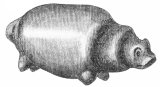 No. 159. Bright Red Terra-cotta Image of a Hippopotamus
(7 M.)
No. 159. Bright Red Terra-cotta Image of a Hippopotamus
(7 M.)
Among the interesting objects discovered in this excavation, I must
especially mention a brilliant red terra-cotta hippopotamus, found at a
depth of 23 feet. It is hollow, and has a ring on the left side, and
therefore may have served as a vessel. The existence of the figure of a
hippopotamus here at a depth of 23 feet is extremely remarkable, nay,
astonishing; for this animal, as is well known, is not met with even in
Upper Egypt, and occurs only in the rivers of the interior of Africa. It
is, however, probable that hippopotami existed in Upper Egypt in ancient
times; for, according to Herodotus (II. 71), they were worshipped as
sacred animals at the Egyptian town of Papremis. At all events, Troy
must have been commercially connected with Egypt; but even so, it is
still an enigma, how the animal was so well known here as to have been
made of clay in a form quite faithful to nature.
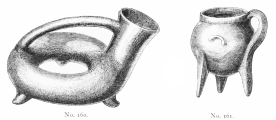
No. 160. Remarkable Terra-cotta Vessel, in the shape of a
Bugle, with three feet (3 M.).
No. 161. Terra-cotta Vessel with three feet, a handle,
and two ears (5 M.).
Of idols of marble, it is only during these few days that we have found
eight, only two of which had the engraved owl’s head of the Ilian
Athena. Of vases with owl’s faces, two female breasts, and two upraised
arms, I have found only one, at a depth of 15 meters (49¼ feet), and
at a depth of 7 meters (23 feet) the upper portion of another, upon
which the stump of one of the arms may still be recognised. At a depth
of 10 feet we found two vases, with two female breasts and an immense
navel, which are doubtless also intended to represent the tutelary
goddess of Troy. Lastly, of vase-covers with an owl’s face and helmet,
the first found was at a depth of 1 meter (3¼ feet), having a double
handle in the form of a coronet; another, found at a depth of 3 meters
(26 feet), has a simple handle. Among the other terra-cotta vessels I
must specially mention an exceedingly remarkable cup in the form of a
bugle-horn with three feet, which was found at a depth of 3 meters (10
feet); also a vessel with but two feet, which, however, as is proved by
the broken places on the right side, has been attached to some other
vessel of a similar form and description; this double vessel had a ring
on either side for suspension by strings. Of the other earthenware I can
only mention a small curious vase which has three long feet, one handle,
and two others in the form of ears.
The round articles of terra-cotta in the form of volcanoes and
humming-tops, with symbolical decorations, were met with in great
quantities, as they always are. Four sling-bullets were discovered, one
of which, made of copper, was brought out from a depth of 49 feet, one
of alabaster from 23 feet, and two of diorite from a depth of from 20 to
23 feet. At a depth of 4 meters (13 feet) I found a splendidly
ornamented flat piece of ivory, which must evidently have been part of a
musical instrument.[216] Lastly, at the depth of 1 meter (3¼ feet)
there was a fragment of a female statue of fine marble, executed in a
masterly style. It not improbably represents the tutelary goddess of
Ilium, whose temple, as we know, stood in the Pergamus.
Simultaneously with these excavations I had 22 men working in a
north-westerly direction, from the south-eastern corner of the
Acropolis, in order to lay bare the Great Tower still further on that
side, an operation that has become impossible to effect from my great
trench. But as the hill at this point has only a very gradual slope I
was compelled to make the new cutting with a considerable slope, which
renders the carting-off of the débris much more troublesome, but is
absolutely necessary, to enable us to reach the requisite depth of 26
feet for arriving at the Tower. At the very commencement of this
cutting, at a foot below the surface, I came upon two enormous walls,
each of which is 10 feet thick. The first seems to belong to the Middle
Ages,[217] and consists of large blocks of Corinthian pillars joined by
cement and of other marble blocks taken from ancient buildings. The
second wall, which follows immediately, must certainly belong to the
town-wall built by Lysimachus, which was 40 stadia long.[218] It is
composed of large and beautifully hewn blocks of limestone, which are
laid one upon another without any kind of cement, and which generally
bear a monogram. As the letter is not always the same, and as for
instance upon one stone there is a Σ, and upon another an Υ or a Δ, I
presume that they are the initials of the different builders. In the
first wall I found a marble slab nearly a foot thick, 32½ inches
broad, and 3½ feet long, with the following inscription:—
ΗΒΟΥΛΗΚΑΙΟΔΗΜΟΣ
ΓΑΙΟΝΚΑΙΣΑΡΑΤΟΝΥΙΟΝΤΟΥΣΕΒΑΣ
ΤΟΥΤΟΝΣΥΝΓΕΝΗΚΑΙΠΑΤΡΩΝΑΚΑΙΕΥ
ΕΡΓΕΤΗΝΤΗΣΠΟΛΕΩΣ
Ἡ βουλὴ καὶ ὁ δῆμος
Γάϊον Καίσαρα τὸν υἱὸν τοῦ Σεβασ-
τοῦ τὸν συνγενῆ καὶ πατρῶνα καὶ εὐ-
εργέτην τῆς πόλεως.
The person praised in this inscription can by no means have been the
Emperor Caligula, for in that case the title αὐτοκράτωρ would have been
added. But as this word is wanting, the person meant is certainly Caius
Cæsar, the son of Vipsanius Agrippa and of Julia, the daughter of
Octavianus. He had a brother called Lucius. Both were adopted by
Augustus, and owing to this adoption they received the title of “υἱὸς
τοῦ Σεβαστοῦ,” and both were selected by Augustus as his successors.
Caius Cæsar, born in the year 20 B.C., was adopted at the age of three
years. He took part in the Trojan games, which Augustus instituted at
the dedication of the temple of Marcellus. At the age of fifteen he was
appointed Consul, and when nineteen he was made Governor of Asia. During
his administration there he became involved in a war with Phraates the
king of Armenia, was wounded, and died in the year 4 after Christ, on
the 21st of February, at the age of 24.[219] As in the inscription he is
called the kinsman, the benefactor, and the patron of Ilium, it is
probable that he often came here during his administration; at all
events, he took great interest in the city, and lavished favours upon
it. The family of the Julii always attached great importance to their
descent from Iülus (or Ascanius) the son of Æneas; and the sole
political object of Virgil’s Æneid was to prove and glorify their
genealogy. This explains the favours which the Julii lavished upon
Ilium, and their hatred against the Greeks because they destroyed Troy,
and also because they had espoused the cause of Mark Antony.
An oka of wine, which contains about two ordinary wine-bottles, last
year cost 1¼ piaster (25 centimes); now it costs 2 piasters (40
centimes) the oka; but it is of a most excellent quality, and I prefer
it to any French wine.
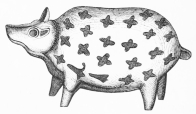
No. 162. Terra-cotta Image of a Pig, curiously marked
with Stars (4 M.).
Increased number of workmen—Further uncovering of the great
buttress—Traces of a supposed small temple—Objects found on its
site—Terra-cotta serpents’ heads: great importance attached to the
serpent—Stone implements: hammers of a peculiar form—Copper
implements: a sickle—Progress of the works at the south-east
corner—Remains of an aqueduct from the Thymbrius—Large jars, used
for cellars—Ruins of the Greek temple of Athena—Two important
inscriptions discussed—Relations of the Greek Syrian Kings
Antiochus I. and III. to Ilium.
Pergamus of Troy, March 1st, 1873.
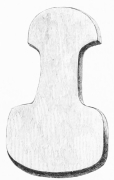 No. 163. One of the largest marble Idols, found in the
Trojan Stratum (8 M.).
No. 163. One of the largest marble Idols, found in the
Trojan Stratum (8 M.).
SINCE Monday morning, the 24th of last month, I have succeeded in
increasing the number of my workmen to 158, and as throughout this week
we have had splendid weather, I have been able to accomplish a good
stroke of work in the six days, in spite of the many hindrances and
difficulties which I had at first to struggle against. Since the 1st of
February I have succeeded in removing more than 11,000 cubic yards of
débris from the site of the temple. To-day, at last, I have had the
pleasure of uncovering a large portion of that buttress, composed of
large unhewn white stones, which at one time covered the entire
north-eastern corner of the declivity, whereas, in consequence of its
increase in size during the course of many centuries by the ashes of the
sacrificed animals, the present declivity of the hill is 131 feet
distant from it to the north, and 262½ feet distant to the east. To
my surprise I found that this buttress reaches to within 26 feet of the
surface, and thus, as the primary soil is elsewhere always at from 46 to
52½ feet below the surface, it must have covered an isolated hill
from 20 to 26 feet high, at the north-east end of the Pergamus, where
at one time there doubtless stood a small temple. Of this sanctuary,
however, I find nothing but red wood-ashes, mixed with the fragments of
brilliant black Trojan earthenware, and an enormous number of unhewn
stones, which seem to have been exposed to a fearful heat, but no trace
of sculpture: the building must therefore have been very small. I have
broken through the buttress of this temple-hill at a breadth of 13 feet,
in order to examine the ground at its foundation. I dug it away to a
depth of 5 feet, and found that it consists of the virgin soil, which is
of a greenish colour. Upon the site of the small and very ancient
temple, which is indicated by the buttress, I find in two places pure
granular sand, which appears to extend very far down, for after
excavating it to a depth of 6½ feet I did not reach the end of the
stratum. Whether this hill consists entirely, or but partially, of earth
and sand, I cannot say, and must leave it undecided, for I should have
to remove thousands more of cubic yards of rubbish. Among the débris
of the temple we found a few, but exceedingly interesting objects, for
instance, the largest marble idol that has hitherto been found, which is
5¼ inches long and 3 inches broad. Further, the lid of a pot, which
is divided into twelve fields by roughly engraved lines. Ten of the
fields are ornamented with little stars, one with two signs of
lightning, and another with six lines. There was also a small idol of
terra-cotta with the owl’s head of the Ilian tutelary goddess, with two
arms and long hair hanging down at the back of the head; but it is so
roughly made that, for instance, the eyes of the goddess are above the
eyebrows. I also found among the débris of the temple a vase with the
owl’s face, two female breasts and a large navel; of the face only one
eye and an ear is preserved. I must draw especial attention to the fact
that both upon the vases with owls’ heads two female breasts and a
navel, and upon all of the others without the owl’s face and adorned
only with two female breasts and a navel, the latter is always ten times
larger than the breasts. I therefore presume that the navel had some
important significance, all the more so as it is frequently decorated
with a cross, and in one case even with a cross and the marks of a nail
at each of the four ends of the cross.[220] We also discovered among the
ruins of the small and very ancient building some pretty wedges
(battle-axes), and a number of very rude hammers made of diorite;
besides a quantity of those small red and black terra-cotta whorls, with
the usual engravings of four or five 卐, or of three, four, or five
triple rising suns in the circle round the central sun, or with other
extremely strange decorations.
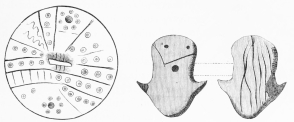
No. 164. Terra-cotta Pot-lid, engraved with symbolical
marks (6 M.).
No. 165. A curious Terra-cotta Idol of the Ilian Athena
(7 M.).
At a depth of 7 to 8 meters (23 to 26 feet), we also came upon a number
of vases having engraved decorations, and with three feet or without
feet, but generally with rings at the sides and holes in the mouth for
suspension by strings; also goblets in the form of a circular tube, with
a long spout at the side for drinking out of, which is always connected
with the other side of the tube by a handle; further, smaller or larger
jars with a mouth completely bent backwards; small terra-cotta funnels;
very curious little sling-bullets made of diorite, from only ¾ of an
inch to above 1 inch long. The most remarkable of all the objects found
this year is, however, an idol of very hard black stone above 2½
inches long and broad, discovered at a depth of 9 meters (29½ feet).
The head, hands, and feet have the form of hemispheres, and the head is
only recognised by several horizontal lines engraved below it, which
seem to indicate necklaces. In the centre of the belly is a navel, which
is as large as the head, but, instead of protruding as in the case of
the vases, it is indicated by a circular depression. The back of the
middle of the body is arched, and has the appearance of a shield, so
that in looking at the idol one is involuntarily led to believe that it
represents Mars, the god of war.
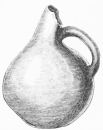 No. 166. Pretty Terra-cotta jug, with the neck bent back
(7 M.).
No. 166. Pretty Terra-cotta jug, with the neck bent back
(7 M.).
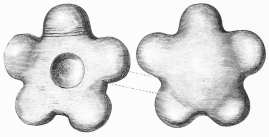
No. 167. Remarkable Trojan Idol of Black Stone (7 M.).
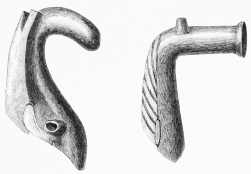
Nos. 168, 169. Heads of Horned Serpents (4 M.).
 No. 170. A Serpent’s Head, with horns on both sides, and
very large eyes (6 M.).
No. 170. A Serpent’s Head, with horns on both sides, and
very large eyes (6 M.).
At a depth of from 4 to 7 meters (13 to 23 feet) we also met with
fragments of terra-cotta serpents, whose heads are sometimes represented
with horns. The latter must certainly be a very ancient and significant
symbol of the greatest importance, for even now there is a superstition
that the horns of serpents, by merely coming in contact with the human
body, cure a number of diseases, and especially epilepsy; also that by
dipping them in milk the latter is instantly turned into cheese, and
other notions of the same sort. On account of the many wholesome and
useful effects attributed to the horns of serpents, they are regarded as
immensely valuable, and on my return here at the end of January one of
my last year’s workmen was accused by a jealous comrade of having found
two serpents’ horns in an urn at a depth of 52½ feet, and of having
made off with them. All my assurances that there are no such things as
serpents horns could not convince the men, and they still believe that
their comrade has robbed me of a great treasure. The serpents’ heads not
ornamented with horns generally represent the poisonous asp; above the
mouth they have a number of dots, and the head and back are divided by
cross lines into sections which are filled with dots.[221] These flat
serpents’ heads have on the opposite side lines running longitudinally
like female hair. We also found terra-cotta cones an inch and a half
high, with three holes not pierced right through. At a depth of from
3¼ to 6½ feet we have discovered several more terra-cotta vases
without the owl’s face, but with two female breasts and a large navel,
and with two small upright handles in the form of arms. In all the
strata below 13 feet we meet with quantities of implements of diorite,
and quoits of granite, sometimes also of hard limestone. Hammers and
wedges (battle-axes) of diorite and of green stone were also found, in
most cases very prettily wrought. The hammers do not all possess a
perforated hole; upon many there is only a cavity on both sides, about
1/5 to 2/5 of an inch deep.
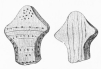 No. 171. Head of an Asp in Terra-cotta (both sides) (4
M.).
No. 171. Head of an Asp in Terra-cotta (both sides) (4
M.).
Of metals, copper only was met with. To-day we found a copper sickle
5½ inches long; of copper weapons we have to-day for the first time
found two lances at a depth of 23 feet, and an arrow-head at 4 meters
(13 feet) deep. We find numbers of long, thin copper nails with a round
head, or with the point only bent round. I now also find them repeatedly
at a depth of from 5 to 6 meters (16½ to 20 feet), whereas since the
commencement of my excavations in the year 1871, I only found two nails
as far down as this.[222]
I am now also vigorously carrying forward the cutting which I made on
the south-eastern corner of the Pergamus, for uncovering the eastern
portion of the Great Tower as far as my last year’s cutting, to a length
of 315 feet and a breadth of from 65½ to 78¾ feet. The work
advances rapidly, as this excavation is near the southern declivity of
the hill, and the rubbish has therefore not far to be carted off. I have
made eight side passages for removing it. Experience has taught me that
it is far more profitable not to have any special men for loading the
wheel-barrows, but to let every workman fill his own barrow. Experience
has also shown me that much precious time is lost in breaking down the
earthen walls with the long iron levers driven in by a ram, and that it
is much more profitable and less dangerous to the workmen always to keep
the earthen walls at an angle of 55 degrees, to dig as occasion
requires, and to cut away the rubbish from below with broad pickaxes. In
this new excavation I find four earthen pipes, from 18¾ to 22¼
inches long, and from 6½ to 11¾ inches thick, laid together for
conducting water, which was brought from a distance of 1½ German mile
(about 7 English miles) from the upper Thymbrius. This river is now
called the Kemar, from the Greek word καμάρα (vault), because an
aqueduct of the Roman period crosses its lower course by a large arch.
This aqueduct formerly supplied Ilium with drinking water from the upper
portion of the river. But the Pergamus required special aqueducts, for
it lies higher than the city.
In this excavation I find an immense number of large earthen wine-jars
(πίθοι) from 1 to 2 meters (3¼ to 6½ feet) high, and 29½ inches
across, as well as a number of fragments of Corinthian pillars and other
splendidly sculptured blocks of marble. All of these marble blocks must
certainly have belonged to those grand buildings whose southern wall I
have already laid bare to a length of 285½ feet. It is composed of
small stones joined with a great quantity of cement as hard as stone,
and rests upon large well hewn blocks of limestone. The direction of
this wall, and hence of the whole building, is E.S.E. by E.
Three inscriptions, which I found among its ruins, and in one of which
it is said that they were set up in the “ἱερόν,” that is, in the temple,
leave no doubt that this was the temple of the Ilian Athena, the
“πολιοῦχος θεά,” for it is only this sanctuary that could have been
called simply “τὸ ἱερόν,” on account of its size and importance, which
surpassed that of all the other temples of Ilium. Moreover the position
of the building, which is turned towards the rising sun, corresponds
exactly with the position of the Parthenon and all the other temples of
Athena. From the very commencement of my excavations I have searched for
this important sanctuary, and have pulled down more than 130,000 cubic
yards of débris from the most beautiful parts of the Pergamus in order
to find it; and I now discover it exactly where I should have least
expected to come upon it. I have sought for this new temple, which was
probably built by Lysimachus, because I believed, and still believe,
that in its depths I shall find the ruins of the primeval temple of
Athena, and I am more likely here than anywhere to find something to
throw light upon Troy. Of the inscriptions found here, as mentioned
above, one is written upon a marble slab in the form of a tombstone,
5¼ feet long, 17½ inches broad, and 5¾ inches thick, and runs
as follows:—
ΜΕΛΕΑΓΡΟΣΙΛΙΕΩΝΤΗΙΒΟΥΛΗΙΚΑΙΤΩΙΔΗΜΩΙΧΑΙ
ΡΕΙΝΑΠΕΔΩΚΕΝΗΜΙΝΑΡΙΣΤΟΔΙΚΙΔΗΣΟΑΣΣΙΟΣΕΠΙ
ΣΤΟΛΑΣΠΑΡΑΤΟΥΒΑΣΙΛΕΩΣΑΝΤΙΟΧΟΥΩΝΤΑΝΤΙΓΡΑ
ΦΑΥΜΙΝΥΠΟΓΕΓΡΑΦΑΜΕΝΕΝΕΤΥΧΕΝΔΗΜΙΝΚΑΙΑΥ
ΤΟΣΦΑΜΕΝΟΣΠΟΛΛΩΝΑΥΤΩΙΚΑΙΕΤΕΡΩΝΔΙΑΛΕ5
ΓΟΜΕΝΩΝΚΑΙΣΤΕΦΑΝΟΝΔΙΔΟΝΤΩΝΩΣΠΕΡΚΑΙΗ
ΜΕΙΣΠΑΡΑΚΟΛΟΥΘΟΥΜΕΝΔΙΑΤΟΚΑΙΠΡΕΣΒΕΥΣΑΙΑ
ΠΟΤΩΝΠΟΛΕΩΝΤΙΝΑΣΠΡΟΣΗΜΑΣΒΟΥΛΕΣΘΑΙΤΗΝ
ΧΩΡΑΝΤΗΝΔΕΔΟΜΕΝΗΝΑΥΤΩΙΥΠΟΤΟΥΒΑΣΙΛΕΩΣΑΝ
ΤΙΟΧΟΥΚΑΙΔΙΑΤΟΙΕΡΟΝΚΑΙΔΙΑΤΗΝΠΡΟΣΥΜΑΣΕΥΝΟΙ10
ΑΝΠΡΟΣΕΝΕΓΚΑΣΘΑΙΠΡΟΣΤΗΝΥΜΕΤΕΡΑΝΠΟΛΙΝΑ
ΜΕΝΟΥΝΑΞΙΟΙΓΕΝΕΣΘΑΙΑΥΤΩΙΠΑΡΑΤΗΣΠΟΛΕΩΣΑΥ
ΤΟΣΥΜΙΝΔΗΛΩΣΕΙΚΑΛΩΣΔΑΝΠΟΗΣΑΙΤΕΨΗΦΙΣΑΜΕ
ΝΟΙΤΕΠΑΝΤΑΤΑΦΙΛΑΝΘΡΩΠΑΑΥΤΩΙΚΑΙΚΑΘΟΤΙΑΝ
ΣΥΓΧΩΡΗΣΗΙΤΗΝΑΝΑΓΡΑΦΗΝΠΟΗΣΑΜΕΝΟΙΚΑΙΣΤΗ15
ΛΩΣΑΝΤΕΣΚΑΙΔΕΝΤΕΣΕΙΣΤΟΙΕΡΟΝΙΝΑΜΕΝΗΙΥΜΙΝ
ΒΕΒΑΙΩΣΕΙΣΠΑΝΤΑΤΟΓΧΡΟΝΟΝΤΑΣΥΓΧΩΡΗΘΕΝΤΑ
ΕΡΡΩΣΘΕ ΒΑΣΙΛΕΥΣΑΝΤΙΟΧΟΣΜΕΛΕΑ
ΓΡΩΙΧΑΙΡΕΙΝΔΕΔΩΚΑΜΕΝΑΡΙΣΤΟΔΙΚΙΔΗΙΤΩΙΑΣΣΙΩΙ
ΓΗΣΕΡΓΑΣΙΜΟΥΠΛΕΘΡΑΔΙΣΧΙΛΙΑΠΡΟΣΕΝΕΓΚΑΣΘΑΙ20
ΠΡΟΣΤΗΝΙΛΙΕΩΝΠΟΛΙΝΗΣΚΗΨΙΩΝΣΥΟΥΝΣΥΝΤΑΞΟΝ
ΠΑΡΑΔΕΙΞΑΙ ΑΡΙΣΤΟΔΙΚΙΔΗΙΑΠΟΤΗΣΟΜΟΡΟΥΣΗΣΤΗΙ
ΓΕΡΓΙΘΙΑΙΗΤΗΙΣΚΗΨΙΑΙΟΥΑΝΔΟΚΙΜΑΖΗΙΣΤΑΔΙΣΧΙΛΙΑ
ΠΛΕΘΡΑΤΗΣΓΗΣΚΑΙΠΡΟΣΟΡΙΣΑΙΕΙΣΤΗΝΙΛΙΕΩΝΗΤΗΝ
ΣΚΗΨΙΩΝ ΕΡΡΩΣΟ ΒΑΣΙΛΕΥΣΑΝΤΙΟΧΟΣΜΕΛΕ25
ΑΓΡΩΙΧΑΙΡΕΙΝΕΝΕΤΥΧΕΝΗΜΙΝΑΡΙΣΤΟΔΙΚΙΔΗΣΟ
ΑΣΣΙΟΣΑΞΙΩΝΔΟΥΝΑΙΑΥΤΩΙΗΜΑΣΕΝΤΗΙΕΦΕΛΛΗΣ
ΠΟΝΤΟΥΣΑΤΡΑΠΕΙΑΙΤΗΝΠΕΤΡΑΝΗΜΠΡΟΤΕΡΟΝ
ΕΙΧΕΝΜΕΛΕΑΓΡΟΣΚΑΙΤΗΣΧΩΡΑΣΤΗΣΠΕΤΡΙΔΟΣ
ΕΡΓΑΣΙΜΟΥΠΕΘΡΑΧΙΛΙΑΠΕΝΤΑΚΟΣΙΑΚΑΙΑΛΛΑ30
ΓΗΣΠΛΕΘΡΑΔΙΣΧΙΛΙΑΕΡΓΑΣΙΜΟΥΑΠΟΤΗΣΟΜΟ
ΡΟΥΣΗΣΤΗΙΠΡΟΤΕΡΟΝΔΟΘΕΙΣΗΙΑΥΤΩΙΜΕΡΙΔΙΩΙ
ΚΑΙΗΜΕΙΣΤΗΝΤΕΠΕΤΡΑΝΔΕΔΩΚΑΜΕΝΑΥΤΩΙΕΙ
ΜΗΔΕΔΟΤΑΙΑΛΛΩΙΠΡΟΤΕΡΟΝΚΑΙΤΗΓΧΩΡΑΝΤΗΝ
ΠΡΟΣΤΗΙΠΕΤΡΑΙΚΑΙΑΛΛΑΓΗΣΠΛΕΘΡΑΔΙΣΧΙΛΙΑ35
ΕΡΓΑΣΙΜΟΥΔΙΑΤΟΦΙΛΟΝΟΝΤΑΗΜΕΤΕΡΟΝΠΑΡΕΣ
ΧΗΣΘΑΙΗΜΙΝΤΑΣΚΑΤΑΥΤΟΝΧΡΕΙΑΣΜΕΤΑΠΑΣΗΣ
ΕΥΝΟΙΑΣΚΑΙΠΡΟΘΥΜΙΑΣΣΥΟΥΝΕΠΙΣΚΕΨΑΜΕΝΟΣ
ΕΙΜΗΔΕΔΟΤΑΙΑΛΛΩΙΠΡΟΤΕΡΟΝΑΥΤΗΗΜΕΡΙΣΠΑ
ΡΑΔΕΙΞΟΝΑΥΤΗΝΚΑΙΤΗΝΠΡΟΣΑΥΤΗΙΧΩΡΑΝΑΡΙΣ40
ΤΟΔΙΚΙΚΙΔΗΙΚΑΙΑΠΟΤΗΣΒΑΣΙΛΙΚΗΣΧΩΡΑΣΤΗΣΟΜΟ
ΡΟΥΣΗΣΤΗΙΠΡΟΤΕΡΟΝΔΕΔΟΜΕΝΗΙ ΧΩΡΑΙΑΡΙΣΤΟΔΙ
ΚΙΔΗΙΣΥΝΤΑΞΟΝΚΑΤΑΜΕΤΡΗΣΑΙΚΑΙΠΑΡΑΔΕΙΞΑΙ
ΑΥΤΩΙΠΛΕΘΡΑΔΙΣΧΙΛΙΑΚΑΙΕΑΣΑΙΑΥΤΩΙΠΡΟΣΕΝΕΓ
ΚΑΣΘΑΙΠΡΟΣΗΝΑΜΒΟΥΛΗΤΑΙΠΟΛΙΝΤΩΝΕΝΤΗΙΧΩΡΑΙ45
ΤΕΚΑΙΣΥΜΜΑΧΙΑΙΟΙΔΕΒΑΣΙΛΙΚΟΙΛΑΟΙΟΙΕΚΤΟΥΤΟ
ΠΟΥΕΝΩΙΕΣΤΙΝΗΠΕΤΡΑΕΑΜΒΟΥΛΩΝΤΑΙΟΙΚΕΙΝΕΝΤΗΙ
ΠΕΤΡΑΙΑΣΦΑΛΕΙΑΣΕΝΕΚΕΣΥΝΤΕΤΑΧΑΜΕΝΑΡΙΣΤΟ
ΤΟΔΙΚΙΔΗΙΕΑΝΑΥΤΟΥΣΟΙΚΕΙΝ ΕΡΡΩΣΟ
ΒΑΣΙΛΕΥΣΑΝΤΙΟΧΟΣΜΕΛΕΑΓΡΩΙΧΑΙΡΕΙΝΕΝΕΤΥΧΕΝΗ50
ΜΙΝΑΡΙΣΤΟΔΙΚΙΔΗΣΦΑΜΕΝΟΣΠΕΤΡΑΝΤΟΧΩΡΙΟΝΚΑΙΤΗΜ
ΧΩΡΑΝΤΗΝΣΥΓΚΥΡΟΥΣΑΝΠΕΡΙΗΣΠΡΟΤΕΡΟΝΕΓΡΑΨΑΜΕΝ
ΔΙΔΟΝΤΕΣΑΥΤΩΙΟΥΔΕΤΙΚΑΙΝΥΝΠΑΡΕΙΛΗΦΕΝΑΙΔΙΑΤΟΑΘΗ
ΝΑΙΩΙΤΩΙΕΠΙΤΟΥΝΑΥΣΤΑΘΜΟΥΕΠΙΚΕΧΩΡΗΣΘΑΙΚΑΙΗΞΙ
ΩΣΕΝΑΝΤΙΜΕΝΤΗΣΠΕΤΡΙΤΙΔΟΣΧΩΡΑΣΠΑΡΑΔΕΙΧΘΗΝΑΙ55
ΑΥΤΩΙΤΑΙΣΑΠΛΕΘΡΑΣΥΓΧΩΡΗΘΗΝΑΙΔΕΚΑΙΑΛΛΑΠΛΕ
ΘΡΑΔΙΣΧΙΛΙΑΠΡΟΣΕΝΕΓΚΑΣΘΑΙΠΡΟΣΗΝΑΜΒΟΥΛΗΤΑΙ
ΤΩΜΠΟΛΕΩΝΤΩΝΕΝΤΗΙΗΜΕΤΕΡΑΙΣΥΜΜΑΧΙΑΙΚΑΘΑ
ΠΕΡΚΑΙΠΡΟΤΕΡΟΝΕΓΡΑΨΑΜΕΝΟΡΩΝΤΕΣΟΥΝΑΥΤΟΝ
ΕΥΝΟΥΝΟΝΤΑΚΑΙΠΡΟΘΥΜΟΝΕΙΣΤΑΗΜΕΤΕΡΑΠΡΑΓΜΑ60
ΤΑΒΟΥΛΟΜΕΘΑΠΟΛΥΩΡΕΙΝΤΑΝΘΡΩΠΟΥΚΑΙΠΕΡΙ
ΤΟΥΤΩΝΣΥΓΚΕΧΩΡΗΚΑΜΕΝΦΗΣΙΝΔΕΕΙΝΑΙΤΗΣ
ΠΕΤΡΙΤΙΔΟΣΧΩΡΑΣΤΑΣΥΓΧΩΡΗΘΕΝΤΑΑΥΤΩΙ
ΠΛΕΘΡΑΧΙΛΙΑΠΕΝΤΑΚΟΣΙΑΣΥΝΤΑΞΟΝΟΥΝΚΑΤΑ
ΜΕΤΡΗΣΑΙΑΡΙΣΤΟΔΙΚΙΔΗΙΚΑΙΠΑΡΑΔΕΙΞΑΙΓΗΣ65
ΕΡΓΑΣΙΜΟΥΤΑΤΕΔΙΣΧΙΛΙΑΚΑΙΠΕΝΤΑΚΟΣΙΑΠΛΕ
ΘΡΑΚΑΙΑΝΤΙΤΩΝΠΕΡΙΤΗΝΠΕΤΡΑΝΑΛΛΑΕΡΓΑ
ΣΙΜΟΥΧΙΛΙΑΠΕΝΤΑΚΟΣΙΑΑΠΟΤΗΣΒΑΣΙΛΙΚΗΣΧΩ
ΡΑΣΤΗΣΣΥΝΟΡΙΖΟΥΣΗΣΤΗΙΕΝΑΡΧΗΙΔΟΘΕΙΣΗΙ
ΑΥΤΩΙΠΑΡΗΜΩΝΕΑΣΑΙΔΕΚΑΙΠΡΟΣΕΝΕΓΚΑΣΘΑΙ70
ΤΗΝΧΩΡΑΝΑΡΙΣΤΟΔΙΚΙΔΗΝΠΡΟΣΗΝΑΝΒΟΥΛΗΤΑΙ
ΠΟΛΙΝΤΩΝΕΝΤΗΙΗΜΕΤΕΡΑΙΣΥΜΜΑΧΙΑΙΚΑΘΑ
ΠΕΡΚΑΙΕΝΤΗΙΠΡΟΤΕΡΟΝΕΠΙΣΤΟΛΗΙΕΓΡΑΨΑ
ΜΕΝ ΕΡΡΩΣΟ
Μελέαγρος Ἰλιέων τῆι βουλῆι καὶ τῶι δήμωι χαί-
ρειν. Ἀπέδωκεν ἡμῖν Ἀριστοδικίδης ὁ Ἄσσιος ἐπι-
στολὰς παρὰ τοῦ βασιλέως Ἀντιόχου, ὧν τἀντίγρα-
φα ὑμῖν ὑπογεγράφαμεν· ἐνέτυχεν δ’ ἡμῖν καὶ α(ὐ)-
τὸς φάμενος, πολλῶν αὐτῶι καὶ ἑτέρων, διαλε-5
γομένων καὶ στέφανον διδόντων, ὥσπερ καὶ ἡ-
μεῖς παρακολουθοῦμεν διὰ τὸ καὶ πρεσβεῦσαι ἀ-
πὸ τῶν πόλεων τινὰς πρὸς ἡμᾶς, βούλεσθαι τὴν
χώραν τὴν δεδομένην αὐτῶι ὑπὸ τοῦ βασιλέως Ἀν-
τιόχου καὶ διὰ τὸ ἱερὸν καὶ διὰ τὴν πρὸς ὑμᾶς εὔνοι-10
αν προσενέγκασθαι πρὸς τὴν ὑμετέραν πόλιν. Ἃ
μὲν οὖν ἀξιοῖ γενέσθαι αὐτῶι παρὰ τῆς πόλεως, αὐ-
τὸς ὑμῖν δηλώσει· καλῶς δ’ ἂν ποήσαιτε ψηφισάμε-
νοί τε πάντα τὰ φιλάνθρωπα αὐτῶι καὶ καθ’ ὅτι ἂν
συγχωρήσηι τὴν ἀναγραφὴν ποησάμενοι καὶ στη-15
λώσαντες καὶ θέντες εἰς τὸ ἱερὸν, ἵνα μένηι ὑμῖν
βεβαίως εἰς πάντα τὸγ χρόνον τὰ συγχωρηθέντα.
ἔῤῥωσθε. Βασιλεὺς Ἀντίοχος Μελεά-
γρωι χαίρειν. Δεδώκαμεν Ἀριστοδικίδηι τῶι Ἀσσίωι
γῆς ἐργασίμου πλέθρα δισχίλια προσενέγκασθαι20
πρὸς τὴν Ἰλιέων πόλιν ἢ Σκηψίων. Σὺ οὖν σύνταξον
παραδεῖξαι Ἀριστοδικίδηι ἀπὸ τῆς ὁμορούσης τῆι
Γεργιθίαι ἢ τῆι Σκηψίαι, οὗ ἂν δοκιμάζηις τὰ δισχίλια
πλέθρα τῆς γῆς καὶ προσορίσαι εἰς τὴν Ἰλιέων ἢ τὴν
Σκηψίων. ἔῤῥωσο. Βασιλεὺς Ἀντίοχος Μελε-25
άγρωι χαίρειν. Ἐνέτυχεν ἡμῖν Ἀριστοδικίδης ὁ
Ἄσσιος ἀξιῶν δοῦναι αὐτῶι ἡμᾶς ἐν τῆι ἐφ’ Ἑλλησ-
πόντου σατραπείαι τὴν Πέτραν, ἣμ πρότερον
εἶχεν Μελέαγρος καὶ τῆς χώρας τῆς Πετρίδος
ἐργασίμου πέθρα[223] χίλια πεντακόσια καὶ ἄλλα30
γῆς πλέθρα δισχίλια ἐργασίμου ἀπὸ τῆς ὁμο-
ρούσης τῆι πρότερον δοθείσηι αὐτῶι μεριδίωι (;)
καὶ ἡμεῖς τήν τε Πέτραν δεδώκαμεν αὐτῶι, εἰ
μὴ δέδοται ἄλλωι πρότερον καὶ τὴγ χώραν τὴν
πρὸς τῆι Πέτραι καὶ ἄλλα γῆς πλέθρα δισχίλια35
ἐργασίμου, διὰ τὸ φίλον ὄντα ἡμέτερον παρεσ-
χῆσθαι ἡμῖν τὰς καθ’ αὑτὸν χρείας μετὰ πάση(ς)
εὐνοίας καὶ προθυμίας. Σὺ οὖν ἐπισκεψάμενος
εἰ μὴ δέδοται ἄλλωι πρότερον αὕτη ἡ μερίς (;), πα-
ράδειξον αὐτὴν καὶ τὴν πρὸς αὐτῆι χώραν Ἀρισ-40
τοδικικίδηι[224] καὶ ἀπὸ τῆς βασιλικῆς χώρας τῆς ὁμο-
ρούσης τῆι πρότερον δεδομένηι χώραι Ἀριστοδι-
κίδηι σύνταξον καταμετρῆσαι καὶ παραδεῖξαι
αὐτῶι πλέθρα δισχίλια καὶ ἐᾶσαι αὐτῶι προσενέγ-
κασθαι πρὸς ἣν ἂμ βούληται πόλιν τῶν ἐν τῆι χώραι45
τε καὶ συμμαχίαι· οἱ δὲ βασιλικοὶ λαοὶ οἱ ἐκ τοῦ τό-
που, ἐν ὧι ἐστὶν ἡ Πέτρα, ἐὰμ βούλωνται οἰκεῖν ἐν τῆ(ι)
Πέτραι ἀσφαλείας ἕνεκε, συντετάχαμεν Ἀριστο-
τοδικίδηι[225] ἐᾶν αὐτοὺς οἰκεῖν. ἔῤῥωσο.
Βασιλεὺς Ἀντίοχος Μελεάγρωι χαίρειν. Ἐνέτυχεν ἡ-50
μῖν Ἀριστοδικίδης, φάμενος Πέτραν τὸ χωρίον καὶ τὴ(γ)
χώραν τὴν συγκυροῦσαν, περὶ ἧς πρότερον ἐγράψαμεν
διδόντες αὐτῶι, οὐδ’ ἔτι καὶ νῦν παρειληφέναι, διὰ τὸ Ἀθη-
ναίωι τῶι ἐπὶ τοῦ ναυστάθμου ἐπικεχωρῆσθαι, καὶ ἠξί-
ωσεν ἀντὶ μὲν τῆς Πετρίτιδος χώρας παραδειχθῆνα(ι)55
αὐτῶι τὰ ἴσα πλέθρα, συγχωρηθῆναι δὲ καὶ ἄλλα πλέ-
θρα δισχίλια προσενέγκασθαι πρὸς ἣν ἂμ βούληται
τῶμ πόλεων τῶν ἐν τῆι ἡμετέραι συμμαχίαι, καθά-
περ καὶ πρότερον ἐγράψαμεν. Ὁρῶντες οὖν αὐτὸν
εὔνουν ὄντα καὶ πρόθυμον εἰς τὰ ἡμέτερα πράγμα-60
τα, βουλόμεθα πολυωρεῖν τἀνθρώπου, καὶ περὶ
τούτων συγκεχωρήκαμεν. Φησὶν δὲ εἶναι τῆς
Πετρίτιδος χώρας τὰ συγχωρηθέντα αὐτῶι
πλέθρα χίλια πεντακόσια. Σύνταξον οὖν κατα-
μετρῆσαι Ἀριστοδικίδηι καὶ παραδεῖξαι γῆς65
ἐργασίμου τά τε δισχίλια καὶ πεντακόσια πλέ-
θρα καὶ ἀντὶ τῶν περὶ τὴν Πέτραν ἄλλα ἐργα-
σίμου χίλια πεντακόσια ἀπὸ τῆς βασιλικῆς χώ-
ρας τῆς συνοριζούσης τῆι ἐν ἀρχῆι δοθείσηι
αὐτῶι παρ’ ἡμῶν· ἐᾶσαι δὲ καὶ προσενέγκασθαι70
τὴν χώραν Ἀριστοδικίδην πρὸς ἣν ἂν βούληται
πόλιν τῶν ἐν τῆι ἡμετέραι συμμαχίαι, καθά-
περ καὶ ἐν τῆι πρότερον ἐπιστολῆι ἐγράψα-
μεν. ἔῤῥωσο.
This inscription, the great historical value of which cannot be denied,
seems certainly to belong to the third century B.C., judging from the
subject as well as from the form of the letters, for the king Antiochus
repeatedly mentioned must either be Antiochus I., surnamed Soter (281 to
260 B.C.), or Antiochus III., the Great (222 to 186). Polybius, who was
born in 210 or 200 B.C., and died in 122 B.C., in his History (XXVIII.
1, and XXXI. 21) speaks indeed of a Meleager who lived in his time, and
was an ambassador of Antiochus Epiphanes, who reigned from 174 to 164,
and it is quite possible that this Meleager afterwards became satrap of
the satrapy of the Hellespont, and that, in this office, he wrote to the
Ilians the first letter of this inscription. But in the first letter of
Antiochus to his satrap Meleager, he gives him the option of assigning
to Aristodicides the 2000 plethra of land, either from the district
bordering upon the territory of Gergis or upon that of Scepsis. The town
of Gergis, however, according to Strabo, was destroyed by king Attalus
I. of Pergamus, who reigned from 241 to 197 B.C., and who transplanted
the inhabitants to the neighbourhood of the sources of the Caïcus in
Mysia. These sources, however, as Strabo himself says, are situated very
far from Mount Ida, and hence also from Ilium. Two thousand plethra of
land at such a distance could not have been of any use to the Ilians;
consequently, it is impossible to believe that the inscription can be
speaking of the new town of Gergitha, which was rising to importance at
the sources of the Caïcus. I now perfectly agree with Mr. Frank
Calvert,[226] and with Consul von Hahn,[227] that the site of Gergis is
indicated by the ruins of the small town and acropolis at the extreme
end of the heights behind Bunarbashi, which was only a short time ago
regarded by most archæologists as the site of the Homeric Troy. This
site of Gergis, in a direct line between Ilium and Scepsis, the ruins of
which are to be seen further away on the heights of Mount Ida, agrees
perfectly with the inscription. Livy (XXXV. 43) gives an account of the
visit of Antiochus III., the Great. I also find in the ‘Corpus
Inscriptionum Græcarum,’ No. 3596, that the latter had a general called
Meleager, who may subsequently have become satrap of the Hellespont. On
the other hand, Chishull, in his ‘Antiquitates Asiaticæ,’ says that
Antiochus I., Soter, on an expedition with his fleet against the King of
Bithynia, stopped at the town of Sigeum, which lay near Ilium, and that
the king went up to Ilium with the queen, who was his wife and sister,
and with the great dignitaries and his suite. There is, indeed, nothing
said of the brilliant reception which was there prepared for him, but
there is an account of the reception which was arranged for him in
Sigeum. The Sigeans lavished servile flattery upon him, and not only did
they send ambassadors to congratulate him, but the Senate also passed a
decree, in which they praised the king’s actions to the skies, and
proclaimed that public prayers should be offered up to the Ilian Athena,
to Apollo (who was regarded as his ancestor), to the goddess of Victory
and to other deities, for his and his consort’s welfare; that the
priestesses and priests, the senators and all the magistrates of the
town should carry wreaths, and that all the citizens and all the
strangers settled or temporarily residing in Sigeum should publicly
extol the virtues and the bravery of the great king; further, that a
gold equestrian statue of the king, standing on a pedestal of white
marble, should be erected in the temple of Athena in Sigeum, and that it
should bear the inscription: “The Sigeans have erected this statue to
King Antiochus, the son of Seleucus, for the devotion he has shown to
the temple, and because he is the benefactor and the saviour of the
people; this mark of honour is to be proclaimed in the popular
assemblies and at the public games.” However, in this wilderness it is
impossible for me to find out from which ancient classic writer this
episode has been taken.
It is very probable that a similar reception awaited Antiochus I. in
Ilium, so that he kept the city in good remembrance. That he cherished
kindly feelings towards the Ilians is proved also by the inscription No.
3595 in the ‘Corpus Inscriptionum Græcarum.’ But whether it is he or
Antiochus the Great that is referred to in the inscription I do not
venture to decide.
Aristodicides, of Assos, who is frequently mentioned in the inscription,
is utterly unknown, and this name occurs here for the first time; the
name of the place Petra also, which is mentioned several times in the
inscription, is quite unknown; it must have been situated in this
neighbourhood, but all my endeavours to discover it in the modern
Turkish names of the localities, or by other means, have been made in
vain.
The other inscription runs as follows:—
ΩΝΙΟΥΤΟΥΕΥΔ
ΟΣΜΕΝ ΟΥΚΑΜΕΝΑΧΟΣΓΛΑΥΚΟ
ΕΠΕΓΡΑΨΑΜΕΝΕΙΣΣΤΗΛΗΝΚΑΤΑΤΟΝΝΟΜΟΝΕΡΓΟΦΙΛΟΝΠΑΤΡΟΣΟΥ
ΧΡΗΜΑΤΙΣΖΗΕΖΗΜΙΩΜΕΝΟΝΥΠΟΤΩΝΠΡΟΤΑΝΕΩΝΤΩΝΠΕΡΙΔΙΟ
ΦΑΝΗΝΗΓΗΣΙΔΗΜΟΥΟΦΙΛΟΝΤΑΤΟΥΣΚΑΤΑΤΟΝΝΟΜΟΝΣΤΑΤΗΡΑΣΔΥΟ5
ΚΑΙΜΗΝΟΓΕΝΗΝΜΝΗΣΑΡΧΟΥΚΑΙΑΡΤΕΜΙΔΩΡΟΝΦΑΝΙΑΚΑΙΔΙΟΜΗΔΗΝ
ΑΠΟΛΛΩΝΙΟΥΕΖΗΜΙΩΜΕΝΟΥΣΥΠΟΤΩΝΠΡΥΤΑΝΕΩΝΤΩΝΠΕΡΙΔΙΟΦΑΝΗΝ
ΗΓΗΣΙΔΗΜΟΥΥΠΟΗΜΕΡΑΣΤΡΕΙΣΟΦΙΛΟΝΤΑΣΕΚΑΣΤΟΝΑΥΤΩΝΣΤΑΤΗΡΑΣΔΥΟ
ΜΗΝΟΔΟΤΟΝΜΗΝΟΔΟΤΟΥΚΑΙΗΡΑΚΛΕΙΔΗΝΚΑΙΜΗΝΟΔΟΤΟΝΤΟΥΣΗΡΑΚΛΕΙ
ΔΟΥΕΖΗΜΙΩΜΕΝΟΥΣΥΠΟΤΩΝΠΕΡΙΦΑΙΝΩΝΑΚΤΑΕΥΔΗΜΟΥΠΡΥΤΑ10
ΝΕΩΝΟΦΙΛΟΝΤΑΕΚΑΣΤΟΝΑΥΤΩΝΣΤΑΤΗΡΑΣΔΥΟ
ΑΡΤΕΜΙΔΩΡΟΝΜΗΝΟΦΑΝΤΟΥΕΖΗΜΙΩΜΕΝΟΝΥΠΟΤΩΝΝΟ
ΜΟΦΥΛΑΚΩΝΤΩΝΠΕΡΙΙΠΠΑΡΧΟΝΗΓΗΣΙΔΗΜΟΥΟΦΙΛΟΝ
ΤΑΣΤΑΤΗΡΑΣΔΥΟ
........................
...................ωνίου τοῦ Εὐδ....
......οσμεν.........ουκαμεναχος γλαυκο..
ἐπεγράψαμεν εἰς στήλην κατὰ τὸν νόμον Ἐργόφιλον Πατρόσου (;)
Χρήματις[228] ζη[229] ἐζημιωμένον ὑπὸ τῶν προτάνεων[230] τῶν περὶ Διο-
φάνην Ἡγησιδήμου, ὀ(φ)ίλοντα τοὺς κατ(ὰ) τὸν νόμον στατῆρας δύο5
καὶ Μηνογένην Μνησ(άρχ;)ου καὶ Ἀρτεμίδωρον Φανία καὶ Διομήδην
Ἀπολλωνίου, ἐζημιωμένους ὑπὸ τῶν πρυτάνεων τῶν περὶ Διοφά(νην)
Ἡγησιδήμου ὑπὸ ἡμέρας τρεῖς ὀφίλοντας ἕκαστον αὐτῶν στατῆρας δύο.
Μηνόδοτον Μηνοδότου καὶ Ἡρακλείδην καὶ Μηνόδοτον τοὺς Ἡρακλεί-
δου ἐζημιωμένους ὑπὸ τῶν περὶ Φαινώνακτα Εὐδήμου πρυτά-10
νεων, ὀφείλοντα ἕκαστον αὐτῶν στατῆρας δύο.
Ἀρτεμίδωρον Μηνοφάντον ἐζημιωμένον ὑπὸ τῶν νο-
μοφυλάκων τῶν περὶ Ἵππαρχον Ἡγησιδήμου, ὀφίλον-
τα στατῆρας δύο.
In the inscription quoted in the ‘Corpus Inscriptionum Græcarum’ under
No. 3604, which is admitted to belong to the time of Augustus
Octavianus, Hipparchus is mentioned as a member of the Ilian Council,
and as on line 13 the same name occurs with the same attribute, I do not
hesitate to maintain that the above inscription belongs to the same
period.
Spring weather in the Plain of Troy—The Greek Temple of
Athena—Numerous fragments of sculpture—Reservoir of the
temple—Excavation of the Tower—Difficulties of the work—Further
discoveries of walls—Stone implements at small depths—Important
distinction between the plain and decorated whorls—Greek and Roman
coins—Absence of iron—Copper nails: their peculiar forms:
probably dress and hair pins: some with heads and beads of gold and
electrum—Original height of the Tower—Discovery of a Greek
house—Various types of whorls—Further remarks on the Greek
bas-relief—It belonged to the temple of Apollo—Stones from the
excavations used for building in the villages around—Fever.
Pergamus of Troy, March 15th, 1873.
SINCE my report of the 1st of this month I have continued the
excavations with great zeal, favoured by glorious weather and an
abundance of workmen. The nights are cold, and the thermometer still
frequently falls to freezing point towards morning, whereas during the
day the heat of the sun is already beginning to be troublesome, the
thermometer often showing 18° Réaumur (72½° Fahrenheit) in the shade
at midday. The leaves of the trees are only now beginning to sprout,
while the Plain is already covered with spring flowers.[231] For the
last fortnight we have heard the croaking of millions of frogs in the
surrounding marshes, and during the last eight days the storks have
returned. One of the discomforts of our life in this wilderness is the
hideous shrieking of the innumerable owls which build their nests in the
holes of the walls of my excavations; their shrieks sound mysterious and
horrible, and are especially unendurable at night.
I have proceeded with the excavation of the site of the Temple of Athena
with the greatest energy. The foundations of this sanctuary nowhere
extend deeper than 2 meters (6½ feet), and generally only to 1 meter
(3¼ feet). The floor, which consists of large slabs of sandstone, and
which rests upon double layers of large hewn blocks of the same stone,
is frequently covered only with a foot, and never with more than 3¼
feet, of vegetable soil; this explains the total absence of entire
sculptures. For whatever sculptures there were in or upon the temple
could not sink into the ground on the summit of the hill, and they
therefore remained lying on the surface for many centuries, till they
were destroyed by religious zeal or wantonness. This, and this alone,
explains the enormous mass of fragments of statues which cover the
entire hill.
I find, however, a great number of large sculptured blocks of marble in
the Corinthian style which are difficult to destroy, and the removal of
which causes me great trouble and loss of time. As the Tower, which I
partly uncovered last year, extends directly below the temple at a great
depth, and as I wish at all events to lay bare its entire breadth, I
shall leave only the ruins of the north and south walls of the temple
standing, and break away all the rest, except a reservoir, 27 feet long
and 26 feet broad, which is in the sanctuary, and is built of blocks of
limestone laid together without cement or lime, and the walls of which
have a thickness of 8 feet. The four aqueducts mentioned in my last
report empty themselves into the reservoir. I shall leave it standing in
order to give visitors to the Troad a faint idea of the trouble which I
have to take in removing all the stones of a temple which is about 288
feet long and 72½ feet broad. But what is even much more difficult
than the removal of the stones, is the carrying off of the débris, for
as the excavation is made on the flat earth, this can only be effected
by side paths, which become steeper the deeper we dig. However, I only
wish to uncover the top of the ruined Tower, for to bring it to light
down to the primary soil is a piece of work to which my patience is
unequal. This new large cutting, therefore, only requires a depth of 26
feet, and on the western end I have given it a breadth of 78¾ feet.
By this means I hope to reach the ancient and highly important monument
on the north side in two or three days. As soon as this is done, I shall
have an upper and a lower terrace made for facilitating the removal of
the rubbish, and shall thus in a month from to-day be able to finish the
entire excavation of the Tower as far as its eastern end, which I came
upon yesterday in my steep cutting at the south-eastern corner of the
Pergamus, and of which I have laid open a breadth of 13 feet. This
eastern side of the Tower, thus brought to light, runs down at an angle
of 60 degrees, and has the same appearance as the ancient buttress which
I uncovered at the north side of the Pergamus. As I did not at first
think that it was the Tower, I had the first layer of stones broken off,
but I soon found a piece of masonry composed of large stones joined with
earth. In consequence of this I have entirely stopped the works in this
cutting, which already extended to a length of 111½ feet, and in
spite of its small breadth was one of the most difficult works in Troy.
For, as already said, I had first to break through a wall 10 feet thick,
consisting of large blocks of marble, but principally of Corinthian
pillars joined with lime (see p. 239); then the wall of Lysimachus,
which was also 10 feet thick, and built of large hewn stones. The large
drums of pillars had to be rolled up the steep path and then carried
off; the large hewn stones had to be broken with hammers and then
removed in wheel-barrows. In addition to this, as the visitors to the
Pergamus may see in the walls of this cutting, we had to cut through
two Trojan walls, the first of which is 5¼ feet thick, and the second
10 feet; both consist of stones joined with earth. The first of these
walls is directly below a portion of the western wall of the
comparatively modern Temple of Athena, and as—according to my pocket
compass—it runs due E.S.E.1/2E., I at first thought that it might
belong to the ancient diminutive temple of the Ilian tutelary goddess,
which Alexander the Great[232] found here. But nothing further has
appeared which could help to prove this. The second wall, 10 feet thick,
is extremely interesting, for it is built of large unhewn blocks of
shelly limestone (Muschelkalk), and on the top of it is a wall of
small stones joined with earth. It evidently belongs to a much later
age, but was in any case built long before the arrival of the Greek
colony in Ilium. But even the lower wall of large stones was not built
till the Tower of Ilium had formed a heap of débris 20 feet high; it
must therefore have been built centuries after the erection of the
Tower. This débris consists of ashes mixed with bones and small
shells, and on account of its dampness and toughness is just as
difficult to break down as damp limestone rock. In it I found many
fragments of those Trojan vessels, which are of a brilliant red or black
colour, both outside and inside, but nothing else of any interest. Above
the Tower, at the east side of the Pergamus, there is nothing but yellow
wood-ashes and a great number of stones. In fact, down to the present
depth of 4½ meters (14¼ feet) below the surface, that is, from 7
to 10 feet below the foundations of the temple of Athena, I find nothing
but yellow wood-ashes, and among these an immense number of enormous
earthen jars (πίθοι) from 3¼ to 6½ feet long, and pointed below,
which must have served not only as wine and water jars, but as cellars
for keeping provisions, for there are no walled cellars.
Stone implements, such as I found in my former excavations only below a
depth of 13 feet (with the exception of the few knives of silex), are
met with here in great numbers at as small a depth as 6½ feet, that
is, directly below the Temple of Athena; those most frequently found are
clumsy hammers of diorite, but occasionally also hammers of the same or
of green stone very prettily worked; some of them have a wide hole at
both sides and a narrow one in the middle, and I cannot understand how a
handle could have been fixed into them. The best finished instrument is
always the wedge,[233] which is of diorite or of hard green stone,
sometimes also of white silex, and occurs in all sizes from about ¾ of
an inch to above 5 inches in length. This instrument is always of such
exquisite workmanship and so well polished, that it is really
astonishing how it was possible, with the miserable means at the
disposal of those times, to make anything of such an excellent quality,
for a modern artist with the best instruments could not possibly make
better ones. The knives of silex, which I found last year in such great
quantities, are as yet but rarely met with in this excavation. As stone
implements do not occur elsewhere before reaching a depth of 4 meters
(13 feet), it is probable that the numbers of stone implements met with
here, as early as at a depth of 2 meters (6½ feet) on the site of the
temple, belong to the débris which was dug up when the large reservoir
was constructed, for it appears to extend pretty far down, and its
foundations may perhaps reach down to the Tower.
As, even in the temple itself, I find exclusively the round terra-cottas
in the form of cones and without decorations, while, on the other
hand, below the foundations of the temple I meet with great quantities
of them in the form of volcanoes and tops, with the most various Aryan
religious symbols, I am now of the opinion that all those bearing such
Aryan symbols must belong to the tribes which preceded the Greek colony
on this site.
Of moulds of mica-schist I have only found two, one of which was used on
all the six sides for casting weapons and instruments, the other for
casting headless nails, and has two round holes, not perforated, for
what purpose I do not know.[234]
While speaking of implements, I must mention a very remarkable hammer of
bone, found at a depth of 3 meters (10 feet), which is covered with
little engraved stars.
We again met with several marble idols, with the engraved owl’s face of
the Ilian Athena and her girdle with dots; also a very pretty marble
idol without the owl’s head, but with two small arms extended
horizontally. The only terra-cottas with owls’ heads that have been met
with, since my last report, are two cups (vase-covers).
I find very many copper coins of Ilium and Alexandria Troas, and Roman
ones from the time of Augustus to Constantine the Great, especially the
latter, directly below the surface, and at most down to a meter (3¼
feet) deep. Iron I do not find at all, not even in the temple, but a
number of copper nails, which, however, I begin to think could not have
been used for driving into wood; for this purpose they seem to be far
too long and thin. The usual length of the nails occurring below 6½
feet is from about 4 to above 6 inches, with a thickness of 1/5 of an
inch, and I do not think that it would be possible to drive such a nail
even into very soft wood. Besides this, most of the nails have no head
at all, others two heads, and many have two pointed ends, one of which
is bent round so as to form a head. Thick copper nails suitable for
driving into wood are very rarely met with; I have only found two in two
years. I am therefore induced to believe that all the nails which I find
in the strata of the nations preceding the Greeks have been used only as
dress or hair pins. This belief is confirmed by a copper nail, about 5
inches long, with a head of the usual form, and the fragment of a
similar nail, which were found only 3 inches below the surface, in a
small groove, which my men had made round their reed-hut to allow the
rain-water to run off. On the head of the nail there is a small gold
ball, and then there follows downwards on the nail a row of eighteen
similar little gold balls. At the end of this row there is a second row
of nine gold balls of like size. The rows of the little balls are in the
form of necklaces, and cover a third part of the nail. The fragment of
the other nail is still more remarkable, for it shows a string of little
balls which form a perfect bow; they are made of the alloy which in
antiquity was called electrum (ἤλεκτρον), consisting of three parts of
gold and one part of silver; below the bow, in a horizontal direction,
there is a row of little balls, which are probably intended to represent
the string. The little balls are firmly soldered to both of the nails.
In addition to this I must also mention that the silver nails so
frequently met with are generally of the same form and size as the
copper ones, and can certainly never have been used for driving into
wood.
On the west side of the Great Tower, which I laid bare last year, I am
likewise making an excavation 47 feet long and 48 feet broad, so as to
bring to light more of this side, and to see how the walls of Ilium are
connected with it. It is worth a journey round the world to see this
Tower, whose site was at all events so high, that it not only commanded
a view of the Plain, but also of the plateau lying to the south of it,
whereas its summit now lies a great many feet below the level of the
plateau. According to this it seems that the accumulation of débris on
the site of the city is as large as it is in the Pergamus.[235]
In the western excavation, already mentioned, I found the ruins of a
very large house of the Greek period. It extended to the depth of 6½
feet, and must have belonged to a rich man, for the floors of the rooms
are made of large red slabs splendidly polished. In it I found two small
and very pretty female heads of terra-cotta, as well as two extremely
remarkable pieces of hard brittle black stone, like glass, in the form
of mushrooms, but with a tube running through the centre. The heads of
the two pieces have decorations similar to those on the round
terra-cottas in the form of humming-tops and volcanoes, and I therefore
believe that both pieces belong to the pre-Hellenic period.
Below the foundations of the Greek house I found, at the depth of 3 and
4 meters (9¾ to 13 feet), many of the whorls with the usual
decorations of four, five, or six double or treble rising suns; or four
flaming altars; or four Rosæ mysticæ; or four or five 卐 in the circle
around the central sun. I likewise found, at a depth of 10 feet, one of
these articles, upon which there is a very rude and inartistic engraving
of the Ilian Athena, with the owl’s head and outstretched arms. By the
side of this representation there are two crosses, and at the four ends
of each are the marks of the nails with which our forefathers fastened
the two pieces of wood which were laid crosswise for igniting the holy
fire. In the same circle with the image of the goddess there are two
symbols of lightning. A faithful drawing of this terra-cotta is given in
the cut.
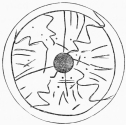 No. 172. A Whorl with rude Symbols of the Owl’s Face,
Suastika, and lightning (3 M.).
No. 172. A Whorl with rude Symbols of the Owl’s Face,
Suastika, and lightning (3 M.).
Of the earthenware found in this excavation there is one piece
especially deserving of attention. This is a vessel in the form of a
helmet, with a round hole at the bottom; it may have served as a kind of
funnel.
As has been already said, the splendid block of triglyphs representing
Phœbus Apollo with the four horses of the Sun, which I discovered last
July, must, as the triglyph on the left side proves, have stood over the
entrance of the temple, probably on its propylæa, and must have had
another block of triglyphs of the same size on its right side. It would
be of the greatest interest to archæology if I should find the second
block of triglyphs, which, as happened with the other block, has
probably been thrown from the summit of the hill down the steep
declivity. I have also previously expressed the opinion, that the block
of triglyphs which I saved had been thrown down by fanatical Turks
because it represented living creatures, which is strictly prohibited in
the Koran. However, the locality has not been inhabited at all since the
ninth century, and the labourers of the distant Turkish villages cannot
possibly have given themselves the trouble of rolling down from the hill
such tremendous weights from mere religious zeal. Besides this, the good
state in which the sculpture has been preserved proves that it cannot
possibly have stood upon the top of the hill up to the time of the
Turkish invasion, and this leads me to suppose that it was thrown down
by the early Christians more than a thousand years before, very likely
even in the fourth century A.D.; for it is well known, that all
sculptures of heathen gods which were difficult to destroy they simply
hurled from the top of the hills upon which they stood. That this is the
only true explanation is also confirmed by the covering of earth, 3¼
feet thick, which enveloped the sculpture on the declivity of the hill.
According to the average accumulation of the soil in this locality, the
formation of such a covering would be impossible in the course of three
or four centuries: it would have required more than a thousand years.
It is now quite certain that the Doric temple, which at one time stood
on the north side, and in the depths of which I have so long been
working, was the sanctuary of Apollo; and that the block of Doric
triglyphs so frequently mentioned belonged to this temple of Apollo, and
to none other; since Ilium’s great temple, which I am now investigating,
could only have been dedicated to the tutelary goddess of Ilium, Athena,
for in the great inscription quoted in my last report it is simply
called “τὸ ἱερόν.”
In order to try to find the second block of triglyphs, I have since
yesterday set 25 men to work upwards from the foot of the hill at the
point where the Phœbus Apollo was found, over a breadth of 59 feet, to
remove the débris which unfortunately I had thrown down the declivity
last year, and which forms a covering of 23 feet in thickness; and then
to dig away the whole steep side of the hill to a depth of 4½ feet
from the bottom upwards.
As soon as I have workmen to spare, I shall also employ thirty to make a
deep cutting into the theatre, the stage of which, as already said, is
197 feet broad; this cutting I intend to make 33 feet broad and 148 feet
long; for, in a small opening which I made there last year, I found a
number of fragments of broken statues, and it is quite possible that
some, which might be of the greatest interest to archæology, escaped the
zeal of the early Christians.
The many thousands of stones which I bring out of the depths of Ilium
have induced the inhabitants of the surrounding villages to erect
buildings which might be called grand for the inhabitants of this
wilderness. Among others, they are at present building with my Ilian
stones a mosque and a minaret in the wretched Turkish village of
Chiplak, and a church-tower in the Christian village of Yenishehr. A
number of two-wheeled carts, drawn by oxen, are always standing by the
side of my excavations, ready to receive the stones which can be of any
use as soon as they have been brought to the surface; but the religious
zeal of these good people is not great enough for them to offer to help
me in the terrible work of breaking the large, splendidly hewn blocks so
as to make them more convenient to remove.
Although spring is only just commencing, there is already a great deal
of malignant fever in consequence of the mild winter, and the poor
people of the neighbourhood are already daily beginning to make large
claims upon my stock of quinine.
I found myself obliged to raise the men’s wages to 10 piasters or 2
francs, eight days ago.
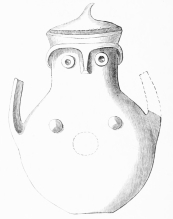
No. 173. Splendid Trojan Vase of Terra-cotta,
representing the tutelary Goddess of Ilium,
θεὰ γλαυκῶπις Ἀθήνη. The
cover forms the helmet. (8 M.)
9
PLATE IX.
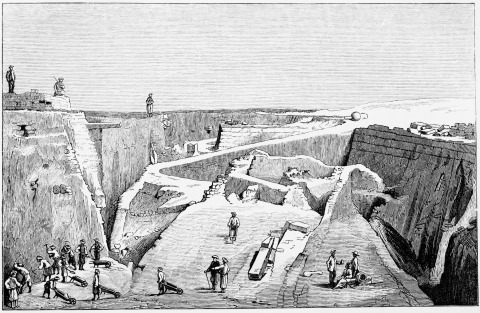
UPPER PART OF THE BUILDINGS DISCOVERED IN THE DEPTHS OF THE TEMPLE OF
ATHENA.
Page 259.
Weather and progress of the work—The lion-headed handle of a
sceptre—Lions formerly in the Troad—Various objects
found—Pottery—Implements of stone and copper—Whorls—Balls
curiously decorated—Fragments of musical instruments—Remains of
house-walls—The storks of the Troad.
Pergamus of Troy, March 22nd, 1873.
DURING this last week we have again had constant splendid weather, and,
with 150 men on an average, I have got through a good piece of work. On
the north side of the excavation on the site of the Temple of Athena, I
have already reached a depth of 26 feet, and have laid bare the Tower in
several places. The space to be dug down is now divided into four
terraces, and I am having the lowest terrace, which forms the surface of
the Tower, worked with especially great energy. As the paths are getting
both steeper and longer, the men with the wheelbarrows have now to stop
and rest half-way, so the work proceeds more slowly every day. Still I
hope that I shall bring to light the whole breadth of the Tower in the
eastern direction in three weeks, but the western side in a week and a
half. The only part of the interior of the Temple of Athena which I have
left standing is the reservoir built of large white stones without
cement, which, owing to my excavations, will in a few days be 26 feet
above the Tower, and will have a very pretty appearance. It is only by
excavating the west side of that part of the Great Tower which I
uncovered last year, that I shall be able to judge in what direction the
walls run out from it, and what my next work will be. The most
remarkable of the objects found this week is certainly a large knob
belonging to a stick, of the purest and finest crystal, and in the form
of a very beautifully wrought lion’s head; it was discovered upon the
Tower at a depth of 26 feet. It must have been the ornament of a
Trojan’s staff or sceptre (σκῆπτρον), for I found it among those
brilliant red and black fragments of pottery, which only occur at a
depth of from 36 to 46 feet, except upon the Tower. Not only this lion’s
head, but the illustrations drawn from the lion, which occur repeatedly
in the Iliad, make it seem extremely probable that in remote antiquity
lions existed in this neighbourhood. Homer could not possibly have
described so excellently the characteristics of this animal, had he not
had frequent opportunity of watching them, and his geographical
knowledge of southern countries is too slight for us to suppose that he
had visited them, and had there become intimately acquainted with the
characteristics of the lion. Not far from the lion’s head I found a
splendidly cut hexagon of the purest crystal, as well as a small
pyramid, 1½ inch long and broad, and 1-2/3 inch high, made of black,
white and blue streaked marble, such as is not found in this district;
the hole which runs through the centre of the pyramid is filled with
lead.
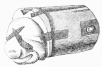 No. 174.
A Lion-Headed Sceptre-handle of the finest crystal: found on the Tower
(8 M.).
No. 174.
A Lion-Headed Sceptre-handle of the finest crystal: found on the Tower
(8 M.).
I also found upon the Tower a very primitive marble idol, 7½ inches
in length, 3-1/3 inches broad, and 1-1/5 inch thick; also a very fine
copper lance; further, a large mould of mica-schist for casting twelve
different weapons and instruments, as well as a beautiful sling-bullet
made of loadstone. In the higher strata, and in fact at a depth of 4
meters (13 feet), the most curious article certainly is an idol of the
Trojan tutelary goddess made of slate, such as has never hitherto been
found. It shows the owl’s face, two breasts and a navel, and long hair
at the back of the head; two horizontal lines on the neck, which are
joined by small cross lines, seem to denote armour. Marble idols without
the owl’s face, but otherwise of exactly the same form as those with the
owl’s face, are met with in numbers in all the strata between 3 and 8
meters deep (10 to 26 feet). I likewise found long, thin copper nails
with round heads at the thick end, or without heads, but with the end
bent round, which I now perceive can only be breast or hair pins, and
not actual nails for driving into wood. I find them also in quantities
in the strata of this excavation between 4 and 7 meters deep (13 to 23
feet), and I must therefore decidedly pronounce that the people to whom
these strata of ruins belong were acquainted with copper.
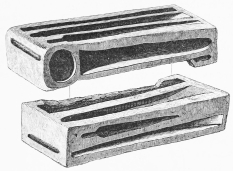
No. 175. A Mould of Mica-schist, for casting various
metal Instruments (Tower, 8 M.).
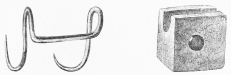
No. 176. A curious Instrument of Copper (3 M.).
No. 177. A perforated and grooved piece of Mica-schist,
probably for supporting a Spit. Found on the Tower (8 M.).
A strange instrument of copper, almost in the shape of a horse’s bit,
but with two pointed hooks, was found at a depth of 10 feet. Besides
this, we met with two somewhat crooked copper knives, at from 13 to
16½ feet down, as well as a small but very fine knife, in the form of
a saw, made of a shell. Stone instruments are continually met with here
in great numbers in all of the strata between 2 and 8 meters deep (6½
to 26 feet), whereas in my excavations of 1871 and 1872 I only found
them below a depth of 13 feet. Two beautiful stone lances, one of
diorite, the other of hard green stone, were found, the one at 20 feet
down, the other at 11½ feet. During this week, I also found very many
knives of silex in the form of saws or of sharp blades, with one or two
edges; further, a very prettily cut piece of mica-schist with a
perforated hole and a groove on the upper side, which may have been
fastened to a fireplace and have served for turning a spit.
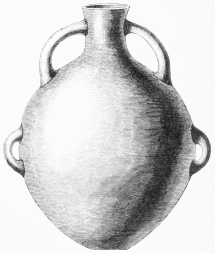
No. 178. A large Terra-cotta Vase, with two large Handles
and two small Handles or Rings (5 M.).
I have observed that the terra-cottas here generally occur in great
numbers only in and below those strata of débris which are mixed with
enormous quantities of small shells, and which usually commence at a
depth of 13 feet, but sometimes not till 20 feet. However, every now and
then we come upon beautiful terra-cottas above these shell strata; and
thus, for instance, in the great cutting, directly in front of my door,
we found, at a depth of 10 feet, several large and splendid vessels,
among which was an extremely elegant black vase, in the shape of a
soup-tureen, and at a depth of 11½ feet two mixing-bowls, the smaller
one of which has two, the larger one four, handles; the larger
mixing-bowl is two feet high, and its orifice is as much in diameter.
(See Cut, No. 41, p. 74.) At a depth of 16½ feet I found an extremely
curious large vase, which has two large handles at the top and two small
ones at the sides. Various other vases of extremely curious forms were
discovered at a depth of from 13 to 26 feet; of them I will only mention
one large brilliant black vase with two female breasts and two handles,
by the side of which are the stumps of the upraised arms which
ornamented this vessel. The upper part of it, which, as is proved by the
arms and breasts, was ornamented with the owl’s head of the Ilian
Athena, is unfortunately wanting. It is strange that this vase has no
navel.
Of the large and brilliant red goblets in the form of huge
champagne-glasses, with two immense handles, we met with many in a more
or less broken condition at a depth of from 6 to 8 meters (20 to 26
feet); among them is an enormous goblet 15¾ inches long, of which I
have been able to collect all the fragments and shall therefore be able
to restore it. (See No. 112, p. 158.)
I found, at a depth of from 23 to 26 feet, quantities of earthen plates,
some of which are of a brilliant red colour, but most of them are
uncoloured. At a depth of 20 feet I found a fragment of pottery with a
cross, at the four ends of which are dots, which can only indicate the
nails by means of which it was fastened. Small terra-cotta whorls, with
Aryan religious symbols, were again found in great numbers; several of
them have decorations not hitherto met with. Of terra-cotta balls we
have found three during these last days, two of them are very
remarkable. One hemisphere of the first has nineteen figures like the
Greek letter Rho (Ρ) in a circle round it, and ten of the same figures
in a line through the middle point, also a number of little stars; the
other hemisphere is entirely filled with little stars. The second ball
has a half moon on the one hemisphere and large stars on the other.
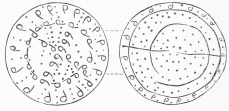
No. 179. A remarkable Terra-cotta Ball (6 M.).
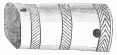 No. 180. A finely engraved Ivory Tube, probably part of a
Flute. Found on the Tower (8 M.).
No. 180. A finely engraved Ivory Tube, probably part of a
Flute. Found on the Tower (8 M.).
Among the remarkable objects found during the week, I must also mention
a splendidly ornamented piece of ivory, from a depth of 8 meters (26
feet), which is almost the shape of a flute, and may have been used as
such; further, a flat bone, which has one hole at the one end and three
at the other, and seems certainly to have belonged to a musical
instrument.
I sometimes find here house-walls built of stones joined with mere
earth, which must certainly have been erected long before the Greek
settlement, but which rise to within a meter (3¼ feet) of the
surface; in fact in the great cutting in front of my house, I have
pierced through two such walls 6½ feet thick, which here formed the
corner of a house, and which reach up to within a foot of the surface;
they appear to extend pretty far down, and in my next letter I shall be
able to give more details about them.
Although the Pergamus, whose depths I have been ransacking, borders
directly upon the marshes formed by the Simoïs, in which there are
always hundreds of storks, yet none of them ever settle down here. Upon
one of my wooden houses and upon the stone one I had two comfortable
nests made for them, but although there are sometimes twelve storks’
nests upon one roof in some of the surrounding Turkish villages, yet
none will settle on mine; it is probably too cold and stormy for the
little storks on “Ἴλιος ἠνεμόεσσα.”
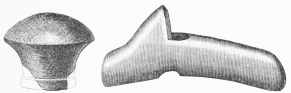
No. 181. Knob for a Stick, of fine marble (3 M.).
No. 182. Bone handle of a Trojan’s Staff or Sceptre,
σκῆπτρον (7 M.).[236]
Splendid vases found on the Tower—Other articles—Human skull,
bones, and ashes, found in an urn—New types of whorls—Greek
votive discs of diorite—Moulds of mica-schist—The smaller
quantity of copper than of stone implements explained—Discussion
of the objection, that stone implements are not mentioned by
Homer—Reply to Mr. Calvert’s article—Flint knives found in the
Acropolis of Athens—A narrow escape from fire.
Pergamus of Troy, March 29th, 1873.
SINCE my report of the 22nd of this month I have unfortunately made
little or no progress, for most of the villagers are trimming their
vineyards during this week; and besides this, we have been tormented by
a horrible icy-cold high north wind, which yesterday and to-day rendered
it impossible to carry on the works.
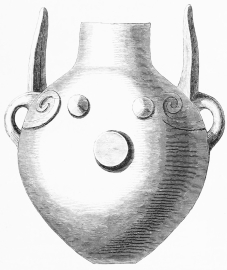
No. 183. A brilliant Black Vase, with the Symbols of the
Ilian Athena, from the Tower (8 M.).
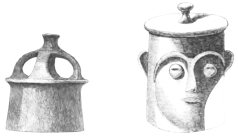
No. 184. Vase-cover with Handle in shape of a Coronet (8
M.).
No. 185. Vase-cover with a Human Face: found on the Tower
(8 M.).
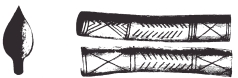
No. 186. Flat piece of Gold, in the Form of an
Arrow-head: from the Tower (8 M.).
No. 187. Prettily decorated Tube of Ivory. From the Tower
(8 M.).
But in spite of this, during the week we have found at a depth of 8
meters (26 feet), and upon the Tower, a great number of splendid vases
of the most remarkable form; they are indeed all in a more or less
broken condition, but they can easily be mended, as I have all the
pieces. Those especially deserving of being mentioned are a brilliant
black vase with two large female breasts, a large navel, and with two
mighty upraised arms (No. 183); further, a vase 33¾ inches high, in a
good state of preservation; a large mixing bowl (κρατήρ) with two
handles, and a smaller vase, round below, with four handles of two
different forms. Among the smaller vessels there are, especially
deserving of attention, a brilliant black cup cover, with a handle in
the form of a coronet, and a brilliant red cover, with a very curious
human face, in which the features of the owl cannot be mistaken. (Nos.
184, 185, p. 268.) Of the other articles, I can only mention a little
plate of gold in the form of an arrow-head, with a small hole at the
lower end (No. 186); an ivory tube with very curious decorations (No.
187); and a well-preserved skull with neat little teeth, which I
discovered, together with a few bones and a quantity of human ashes, in
a vase (unfortunately broken) 27½ inches high and broad, at a depth
of 26 feet, upon the Tower. This is the first time that I have found
such well-preserved human bones and even a skull in an urn. Funereal
urns, indeed, we dig out daily, but the bodies are always completely
burnt to ashes; and, with the exception of the skeleton (already
described) of an embryo found in a vase at a depth of 51 feet upon the
primary rock, I have hitherto never found an entire bone in a funereal
urn. The vase in which I found the skull is made of that excellent
Trojan terra-cotta which I find only at a depth of from 36 to 46 and
52½ feet, except upon the Tower; the skull must have belonged to a
Trojan woman, for it is too delicate to have been the skull of a man. In
the same urn I also found a copper hair or dress pin. Upon the Tower we
also met with two marble idols without owls’ faces, one of which is 6
inches long, the other 6-1/3 inches. We likewise discovered quantities
of terra-cotta whorls with symbolical decorations, twelve of which are
of types not previously found. One is the form of a shirt stud,[237]
1-1/3 inch high and 1-1/5 inch broad, with the never-failing perforated
hole and an engraved flower, the four petals of which form a cross round
the central point; in three of the petals there are very large dots,
which may denote suns or moons; upon another, in the form of a top,
there are six trees in the circle, the top and the foot of which are
alternately directed to the central sun.[238]
I have already repeatedly mentioned the terra-cotta discs, between 1 and
2 inches in diameter, thick in the middle and cut smooth on one side, in
the shape of a Greek lamp; they always have at one side two very small
perforated holes, and frequently a round or oval potter’s stamp, in
which one can recognise either an altar and a bee with outspread wings,
or a swan, an ox, a horse, a man, or something of the kind. I have also
said that these discs must have belonged to the Greek colony, for I
generally find them quite close to the surface as far down as 3¼ feet
and rarely below 6½ feet, and besides this the fine and almost
microscopical figures in the stamp show a Greek style of art.[239] The
small holes at the sides leave no doubt that the articles have been used
as votive offerings to be hung up in the temples or beside the idols.
These discs, which have hitherto only occurred in terra-cotta, I have
this week found at a depth of 1 meter (3¼ feet), made of diorite with
two holes on one side, which, however, are not perforated; owing to the
hardness of the substance it was no doubt found difficult to make the
two perforations.
During the last few days we have again found upon the Tower, at a depth
of 8 meters (26 feet), a mould of mica-schist, 11 inches long, upon five
sides of which there are forms for casting twelve, lances, knives, and
extremely curious implements, the use of which is a puzzle to me.
The many stone moulds for casting weapons, knives, and implements, which
are met with here, sufficiently prove that Troy possessed a number of
copper weapons, knives, and instruments. It is, however, quite natural
that I should find comparatively few of them, for the copper implements
could of course easily be melted down and re-cast, and it must not even
be supposed that I shall find any except those which were lost in the
tumult of battle, or were preserved amidst the destruction of the city.
Therefore the fact that I find immensely larger numbers of silex knives
than of copper knives, and by far more axes and hammers of stone than of
copper, by no means proves that at the time of the Trojan war there were
more stone than copper instruments. Stone lances are, moreover, very
rarely met with; this year I found only two of which I know positively
that they are lances; the one was discovered at a depth of 11½ feet,
the other at 20 feet deep.
Mr. Frank Calvert of the Dardanelles, who wishes to convince me by the
hippopotamus which I found at a depth of 23 feet, that the débris at
this depth belongs to a period when hippopotami inhabited the rivers of
the Troad, has expressed the opinion, in his article in the Levant
Herald of the 25th of January, 1873, that Homer would necessarily have
mentioned stone knives and instruments if they had existed in Troy, and
that, as he speaks of none, there could have been none; consequently,
that none of the ruined strata which I have cut through, containing
stone implements, can belong to the Homeric Troy, and that the stratum
directly following the Greek ruins, which extend as far down as 6½
feet, must be more than 1000 years older than the Trojan war.
If Mr. Calvert had taken the trouble to look into Homer, he would have
found that the word ‘hammer’ (ῥαιστήρ) occurs only once (Iliad, XVIII.
477), and that is in the hand of Hephæstus. It is, indeed, not said of
what material the hammer was made; the fire-god, however, would probably
have had none other than a copper hammer. Mr. Calvert also does not
appear to have ever seen a silex knife, for otherwise he would know that
they are almost always only from 1½ to 2½, and rarely 3, inches
long; and moreover, with but few exceptions, they are made in the form
of saws. I have here only once met with a saw of this kind 5 inches in
length.
In Homer there is not one opportunity where such small saw-knives
could have been mentioned, nor is it as yet altogether clear to me what
they can have been used for.[240] Homer’s heroes carry their copper
knives beside their swords, and generally use them for killing the
sacrificial animal, for which purpose, of course, flint knives from
1½ to 3 inches long would not have been appropriate; but those long
copper knives, the size of which is accurately indicated by the stone
moulds in which they were cast, would have been very suitable. In the
Iliad (XVIII. 597), we see Hephæstus making youths with golden cutlasses
upon the shield of Achilles.
Mr. Calvert believes that the fact of Homer’s not mentioning either the
small flint saws or stone knives is a proof against the identity of
Hissarlik with the site of Troy. I, however, should find it surprising,
and so assuredly would all scholars and admirers of Homer, if the
Homeric heroes had appeared armed with silex saws from 1½ to 3 inches
in length; for a hero, especially in an epic poem, can only carry and
achieve something heroic. If the Homeric hero requires a stone weapon,
he does not feel in his pocket for a silex saw from 1½ to 3 inches
long, but he takes the first huge stone he meets with, such as two of
the strongest men from among the people could not have raised from the
earth on to a cart by means of levers; but the hero carries it in his
hand with the same ease with which a shepherd would carry the fleece of
a ram, and flings the rock with infinite force against the gate of the
enemy, splinters the panels to shivers, and shatters the double hinges
and the bars; the gate flies open, and the stone-falls with a mighty
crash into the hostile camp.[241] Upon another occasion, another hero
uses a stone weapon. He, too, does not look for a small silex saw, but
takes an immense block of stone, which two men from among the people
would have been unable to lift, and hurls it against his opponent.[242]
Mr. Calvert’s excavations in the Pergamus were confined to two small
cuttings which still exist, and he is wrong in saying that I have
continued his excavations. As my plans of the Pergamus prove, my
excavations of 1870, 1871, and up to the middle of June, 1872, were made
exclusively on the Turkish portion of the Pergamus; and it was only in
June that I began to excavate the site of the temple of Apollo upon Mr.
Calvert’s land, because a depression in the ground, 111½ feet long
and 75½ feet broad, had betrayed the site to me. My friend’s two
small cuttings by no means gave any idea of the existence of such a
temple.
I have never, as Mr. Calvert says, found the native rock at a depth of
67 feet. I found it at a depth of 16 meters (or 52¾ feet) upon my
large platform, and at a depth of 14 meters (or 46-1/5 feet) in my great
cutting, in the Roman well, and upon the south side of the Tower. In Mr.
Calvert’s field, however, I found the primary soil only in the hill
covered by the very ancient buttress, which has been repeatedly
described.
Examining Mr. Calvert’s article further, I assure my readers that, with
the exception of the wall which I have already described as consisting
of Corinthian pillars taken from the temple of Athena, I have never come
upon any Byzantine ruins here;[243] that all the Byzantine coins I found
were but a few inches below the surface; and that the ruins and the
débris of the Greek colony, as anyone may convince himself from the
earthen walls of my excavations, rarely extend below 2 meters (6½
feet). Mr. Calvert’s statement, that I also find stone implements,
perforated cylinders, grinding-mills, and masses of shells, immediately
below these ruins, is incorrect; for in not one of my excavations have I
hitherto found these things at less than 4 meters (13 feet) deep, and if
I now find them immediately below the foundations of the Temple of
Athena, I explain this by assuming that the débris which was dug out
of the great excavation for the reservoir of the temple was used for
increasing the elevation of the site of the sanctuary. Mr. Calvert is
also wrong in his statement that the larger bones were all broken to get
at the marrow; on the contrary, we very rarely meet with broken bones.
He is again incorrect in stating that I find small articles of bronze,
as well as ornaments in gold and silver filigree work. I have never as
yet found bronze here, but in all cases copper; and never have I found
ornaments of gold or silver filigree work. The ornaments represented in
the drawings are of pure gold, or electrum, or silver, or copper. His
statement is also erroneous, that I occasionally find engraved
representations of fish-bones upon vessels. It is true that I often find
vessels round which rows of cuneiform decorations are engraved; but
these are never connected with one another, and therefore have no
resemblance at all to fish-bones. Further, Mr. Calvert is mistaken in
his assertion that in the depths of this hill there are house-walls
composed of unhewn stones laid roughly one on the top of the other. The
architect is not yet born, who could construct house-walls of such
stones without some kind of cement. The walls of clay do not, as Mr.
Calvert’s statement would lead one to believe, consist of one mass of
clay, but of sun-dried bricks; and I assure my readers that I have never
yet, as Mr. Calvert erroneously maintains, found the impressions of long
rushes, which indicate the use of thatch-work. My learned friend is also
completely wrong in his statement that the floors of some of the houses
have been glazed, and that the regularity of the levellings and the
flatness of these floors prove that the glaze is not the result of
accident; further, that one of these glazed floors has a length of 20
feet. I would give a great deal if this were true, for such a Trojan
marvel would attract thousands desirous of information. Unfortunately,
however, such glazed floors exist only in Mr. Calvert’s own imagination.
My friend is as completely mistaken in his reports about the Great
Tower, which he describes as consisting of two walls, which meet at a
sharp angle and diverge to a distance of 40 feet, the space between them
being as yet unexplored. It is only the southern wall of this building
that rises at an angle of 75 degrees: on the north side, as it was
sufficiently supported by the mound 65½ feet broad which rested
against it, it had above it only a small perpendicular wall, 3¼ feet
high and broad; whereas the southern wall, which inclines at an angle of
15 degrees, is 6½ feet thick. The whole of the inner space between
the two walls consists of stones laid loosely upon one another. The
perpendicular height of the Tower above the primary rock is not 15 feet,
as Mr. Calvert says, but exactly 20 feet. The terra-cotta discs with two
small holes, which, according to Mr. Calvert, I find here at all depths,
I have in reality always found only close to the surface, as far down as
3¼ feet, and rarely as far down as 6½ feet. I further assure my
readers that I know nothing about the large perforated cylinders, which
Mr. Calvert says I find in great quantities, and frequently with half
their diameter entirely in the clay of the walls. The largest of the
terra-cotta cylinders which I have discovered here are only 4 inches
long, and never have I seen one of these cylinders in a house-wall.
In conclusion, I must positively deny Mr. Calvert’s assertion that stone
implements, although met with in the same stratum with articles made of
different metals and with splendid earthenware, argue a primeval and
pre-historic age. Small knives and saws of silex are, for instance,
found in numbers in the Acropolis of Athens, and they appear to have
been used up to a very late period. A rude pre-historic people could by
no means have made the beautiful terra-cottas which are found here
immediately below the ruins of the Greek colony, and still less could
they have manufactured the splendid pottery which shows such a high
degree of artistic taste, and which I meet with here at a great depth.
The life in this wilderness is not without danger, and last night, for
instance, my wife and I and the foreman Photidas had the narrowest
escape of being burnt alive. In the bedroom on the north side of the
wooden house which we are inhabiting, we had had a small fireplace made,
and, owing to the terrible cold which has again set in during the last
six days, we have lighted a fire in it daily. But the stones of the
fireplace rest merely upon the boards of the floor, and, whether it was
owing to a crevice in the cement joining the stones, or by some other
means, the floor took fire, and when I accidentally awoke this morning
at 3 o’clock, it was burning over a space of two yards long by a yard
broad. The room was filled with dense smoke, and the north wall was just
beginning to catch fire; a few seconds would have sufficed to burn a
hole into it, and the whole house would then have been in flames in less
than a minute, for a fearful north wind was blowing from that side. In
my fright I did not lose my presence of mind. I poured the contents of a
bath upon the burning north wall, and thus in a moment stopped the fire
in that direction. Our cries awoke Photidas, who was asleep in the
adjoining room, and he called the other foremen from the stone house to
our assistance. In the greatest haste they fetched hammers, iron levers
and pickaxes; the floor was broken up, torn to pieces, and quantities of
damp earth thrown upon it, for we had no water. But, as the lower beams
were burning in many places, a quarter of an hour elapsed before we got
the fire under and all danger was at an end.
Discovery of a large house upon the Tower—Marks of a great
conflagration—Primitive Altar: its very remarkable position—Ruins
of the Temple of Athena—A small cellar—Skeletons of warriors with
copper helmets and a lance—Structure of the
helmet-crests—Terra-cottas—A crucible with copper still in
it—Other objects—Extreme fineness of the engravings on the
whorls—Pottery—Stone implements—Copper pins and other objects.
Pergamus of Troy, April 5th, 1873.
AMIDST cold but glorious spring weather most favourable for the workmen,
who now number 150 on the average, I have this week continued the
excavations with the greatest energy and with good results.
The most interesting object that I have discovered here in these three
years is certainly a house which I brought to light this week, and of
which eight rooms have already been laid open; it stands upon the Great
Tower, at a depth of 7 and 8 meters (23 to 26 feet), directly below the
Greek Temple of Athena. Its walls consist of small stones cemented with
earth, and they appear to belong to different epochs; for, while some of
them rest directly upon the stones of the Tower, others were not built
till the Tower was covered with 8 inches, and in several cases even with
3¼ feet, of débris. These walls also show differences in thickness;
one of them is 4¼ feet, others are only 25½ inches, and others
again not more than 19-2/3 inches thick. Several of these walls are 10
feet high, and on some of them may be seen large remnants of the
coatings of clay, painted yellow or white. Only in one large room, the
dimensions of which, however, cannot be exactly ascertained, have I as
yet found an actual floor of unhewn slabs of limestone, the smooth sides
of which are turned outside. Black marks, the result of fire, upon the
lower portion of the walls of the other rooms which have as yet been
excavated, leave no doubt that their floors were of wood, and were
destroyed by fire. In one room there is a wall in the form of a
semicircle, which has been burnt as black as coal. All the rooms as yet
laid open, and not resting directly upon the Tower, have been excavated
down to the same level; and I find, without exception, that the débris
below them consists of red or yellow ashes and burnt ruins. Above these,
even in the rooms themselves, I found nothing but either red or yellow
wood-ashes, mixed with bricks that had been dried in the sun and
subsequently burnt by the conflagration, or black débris, the remains
of furniture, mixed with masses of small shells: in proof of this there
are the many remains which are still hanging on the walls. In several
rooms I found red jars (πίθοι) from 7 to 8 feet high, some of which I
leave in situ. Above the house, and as far as the foundations of the
temple, I found nothing but red and yellow wood-ashes. (See Plate X.,
opposite p. 287.)
To the east side of the house is a sacrificial Altar of a very primitive
description, which is turned to the north-west by west, and consists of
a slab of slate granite about 5¼ feet long, and 5½ feet broad. The
upper part of the stone is cut into the form of a crescent, probably for
killing upon it the animal which was intended for sacrifice. About 4
feet below the sacrificial altar I found a channel made of slabs of
green slate, which probably served to carry off the blood. Strangely
enough this Altar does not stand on the Tower itself, but 3¼ feet
above it, upon bricks or lumps of earth which had been dried in the sun,
and which have been actually burnt by the conflagration, but
nevertheless have no stability. The altar was surrounded by an enormous
quantity of the remains of bricks of this description, as well as by
red and yellow wood-ashes, to a height of 10 feet. Of course I leave the
altar in situ, so that visitors to the Troad may convince themselves
by the nature of its pedestal and of the débris of the earthen wall,
beside which it stands, of the correctness of all these statements,
which might otherwise appear too incredible. The remarkable
sub-structure of this sacrificial altar, the curious débris in which
it was buried, the preservation of the great house, which has evidently
been burnt, and the walls of which were built at different epochs, and
lastly, the fact that its spaces were filled with heterogeneous débris
and with colossal jars—all this is a puzzle to me. I confine myself,
therefore, to stating the facts merely, and refrain from expressing any
kind of conjecture.
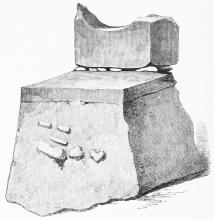
No. 188. Great Altar for Sacrifices, found in the depths
of the Temple of Athena (1/23 of the real size).
Above the house, in the south-western wall of this excavation, are the
ruins of the southern wall of the Temple of Athena. They are 5¼ feet
high, and consist of large white blocks of limestone. Their great
breadth gives them an imposing appearance, and this is further increased
by the great reservoir of the temple, the walls of which are directly to
the east of the altar, and 4¼ feet high. Above the very ancient
house, and below the southern wall of the temple, may be seen the ruins
of a small round cellar, 3½ feet in diameter and about 2½ feet
high, which stands below the foundations, and must, therefore, be older
than the temple. It is built of chalk and stones, but the inner side has
been painted over with a kind of varnish or glaze, and has a glossy
appearance. This small cellar was filled with fragments of Greek
terra-cottas, among which, however, I found six small vases, almost
uninjured.
This very ancient house, with its small rooms, as it stands, is very
like a Pompeian house; it cannot, indeed, be at all compared with the
houses of Pompeii in regard to architecture or decoration, but it
surpasses them in peculiarity.
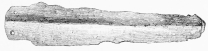
No. 189. Copper Lance of a Trojan Warrior, found beside
his Skeleton (7 M.).
By the side of the house, as well as in its larger apartments, I have
found great quantities of human bones, but as yet only two entire
skeletons, which must be those of warriors, for they were found at a
depth of 7 meters (23 feet), with copper helmets upon their heads.
Beside one of the skeletons I found a large lance, a drawing of which
I give. The one skull is uninjured, and I add a faithful drawing of it;
the other is somewhat broken, but I hope soon to have the pieces joined
with cement. Both of the skulls are large, but remarkably narrow.
Unfortunately both helmets were broken; however, I hope to be able to
put one of the two together when I return to Athens.
No. 190. Skull of a Trojan Warrior, belonging to one of
the two Skeletons found in the House on the Tower (7 M.). It is long,
but narrow.
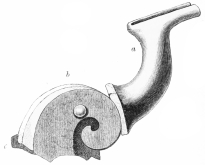
No. 191. (a) The upper and (b) lower pieces of a
Trojan Helmet-crest (φάλος) placed together. (c.) A small piece of the
Helmet remains adhering to the lower part of the Crest (7 M.). A pin,
fastened to the front of the part (b), goes into the hollow base of
(a), and supports it. (See the figures on p. 334.)
The upper portions of both helmets have, however, been well preserved;
and these parts form the “φάλος,” or ridge, in which the “λόφος
ἵππουρις,” or horse-hair plume, so frequently mentioned in the Iliad,
was fixed.”[244] In both cases the φάλος consists of two pieces. The
large copper ring found beside the helmet had been attached to it, in
what manner I do not know. Two days later, when I found the second
helmet, I perceived from the manner in which the lower portion was fixed
to the helmet that the pieces must be put together as shown in the
drawing. Through the lower portion of each helmet runs a copper nail,
which has a round head and its other end simply bent round. As to the
place into which the λόφος ἵππουρις was inserted and fixed there can be
no doubt, for the opening at the top of the ridge can have served no
other purpose. By the side of the second helmet also, I found the
fragment of a copper ring similar to that found beside the first
helmet.[245]
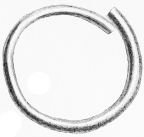 No. 192. Great Copper Ring, found near the Helmet-crest
(7 M.).
No. 192. Great Copper Ring, found near the Helmet-crest
(7 M.).
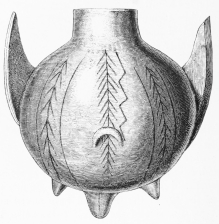
No. 193. An elegant bright-red Vase of Terra-cotta,
decorated with branches and signs of lightning, with holes in the
handles and lips, for cords to hang it up by. Found on the Tower (8
M.).
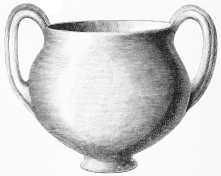
No. 194. Terra-cotta Vase. Found on the Tower (8 M.).
In some of the rooms I found no terra-cottas at all, but in others
enormous quantities of splendid black, red, and brown vases, pots, and
jars of all sizes, and of most fanciful shapes; but unfortunately in
hewing down the hard débris most of them were broken, and I shall not
be able to have them repaired till I return to Athens. I wish to draw
attention to the elegance of the red jars with necks bent back, two
ears, and three breasts; as well as to the black or red vases ornamented
with engraved branches of trees, with three feet and two small and two
large upraised handles as arms; also to the terra-cotta goblets, which
are occasionally the form of champagne-glasses, sometimes also in the
shape of a soup-tureen with two handles.
The most interesting of the terra-cottas found this week, and the most
important to archæology, are these:—the beautiful red vase-cover with
the owl’s face and helmet of the Ilian Athena, which was found in a
large red urn at a depth of 8 meters (27 feet):—then two vases,
likewise adorned with the owl’s head of the tutelary goddess of Troy,
but also with two breasts, a large navel, and two upraised arms. One of
these vases was found upon the Tower, the other above it, at a depth of
4 meters (13 feet).
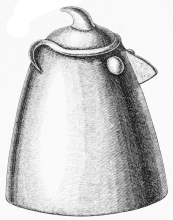 No. 195. Profile of a Vase-cover, with the Owl’s Face and
Helmet of Athena, in brilliant red Terra-cotta. Found in an urn on the
Tower (8 M.).
No. 195. Profile of a Vase-cover, with the Owl’s Face and
Helmet of Athena, in brilliant red Terra-cotta. Found in an urn on the
Tower (8 M.).
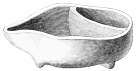 No. 196. An Earthenware Crucible on four feet, still
containing some copper. Found on the Tower (7 M.).
No. 196. An Earthenware Crucible on four feet, still
containing some copper. Found on the Tower (7 M.).
Among the other very remarkable terra-cottas found in one of the rooms
of the subterranean house, at a depth of 7 meters (23 feet), there is a
crucible with four feet, in which some copper is still to be seen; also
a small brilliant black funnel. I also found in the house, at the depth
of 7 and 8 meters (23 to 26 feet), several idols of ordinary stone or of
marble; one also of bone, upon which are seen the two arms of the
goddess; it is only upon one of the marble idols, and upon one of those
of stone, that I find the two eyes. This week we met with only one idol
of ordinary stone with a rude engraving of the owl’s face; it was
discovered at a depth of 4 meters (13 feet). I must remark that the
idols of common stone are always very roughly made.
Of the small terra-cotta whorls, both with and without symbolical
engravings, we this week again met with 251 pieces; of these, however,
only 31 had symbolical figures which I have not yet found. Several of
the engraved decorations on these articles have been executed with a
fineness which is truly astonishing, and more especially those which are
engraved upon brilliantly black wheel-shaped pieces: they are so fine
that I could only distinguish them through a magnifying glass.
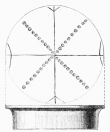 No. 197. Flower Saucer; the flat bottom ornamented. Found
on the Tower (8 M.).
No. 197. Flower Saucer; the flat bottom ornamented. Found
on the Tower (8 M.).
At a depth of 6 and 8 meters (20 to 26 feet) we again met with very many
ordinary plates, which had been turned on a potter’s wheel. At the same
depth, and in the above-mentioned house, we found a curious vessel,
exactly in the shape of a saucer to a flower-pot, ornamented with four
triangles and two large crosses, one of which is formed by large dots,
the other by lines. Several curious moulds were also found this week,
one of which is of coarse terra-cotta for casting eight copper bars; the
other moulds are made of mica-schist, and one was for casting an object
in the form of a leaf with three long thorns on either side; the other
mould shows three uniform furrows for casting oblong rings. This week we
found only fragments of stone moulds for casting weapons and
instruments. At a depth of from 10 to 26 feet we also discovered 27
small silex knives like saws, and six very pretty knife-blades made of
black obsidian, which are sharp enough to serve as razors. We have found
no copper knives this week, but, on the other hand, four copper dress or
hair pins, from 2-1/3 to above 5 inches long; also thirteen needles for
knitting or embroidering; likewise sixteen large bodkins made of
staghorn, and a number of pointed boars’ tusks. Among the stone
implements found during the week, there are two very pretty hammers of
diorite and a very neat perforated prop of mica-schist with a small
furrow at the top, for turning a spit, and other such things. (See No.
177, p. 261.)
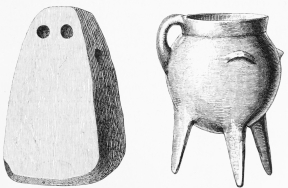
No. 198. A piece of Terra-cotta, with two holes slightly
sunk in front like eyes, and a hole perforated from side to side (8
M.).
No. 199. A remarkable Terra-cotta Vessel on three long
feet, with a handle and two small ears (7 M.).
In returning to the terra-cottas I must mention a square article, the
upper part of which gradually becomes narrower and thinner: on the front
side there are two small depressions in the form of eyes, and on one
side it is perforated. I add a drawing of this curious article, the use
of which is quite unknown to me. I may mention further a curious pot
found in the house, at a depth of 7 meters (23 feet), with three feet,
two small ears, and one handle; also those neat cups with one handle and
three feet, which are repeatedly met with in the same house. At a depth
of 3 meters (10 feet) we discovered a bright red polished little box,
from the under side of which two small perforated rings project. The
pattern on the bottom represents the sun with its rays; in the centre of
the sun’s disc is a cross, which ends in four small circles, and these
are probably intended to represent the heads of the nails which fastened
the two crossed staves employed to produce the holy fire. In every one
of the four spaces formed by the cross there is a 卐, one of which is
represented by dots.
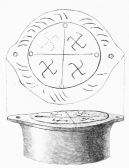 No. 200. A beautiful bright-red Terra-cotta Box (or
Vase-cover?), decorated with a [+
No. 200. A beautiful bright-red Terra-cotta Box (or
Vase-cover?), decorated with a [+
four 卐, and a halo of solar rays (3
M.).]
We also again met with one of those small perforated terra-cottas,
consisting of two connected balls, and which somewhat resemble our
shirt-studs; the upper part of the article in question shows three
simple rising suns and six stars; the lower part represents three triple
rising suns, and three stars in the circle round the central point.
During the week we have met with only one terra-cotta ball; it shows an
encircling jagged streak and five small streaks, which may denote suns
or moons.
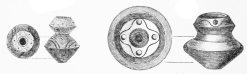
Nos. 201, 202. Little Decorated Whorls, of a remarkable
shape (6 M.).
7
PLATE X.
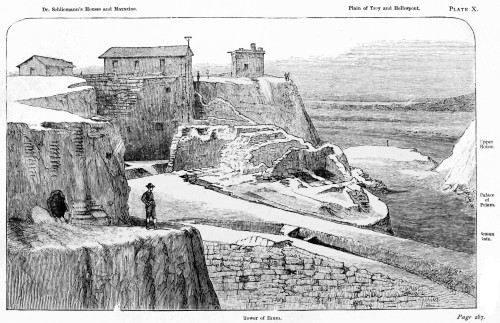
Page 287.
THE TOWER OF ILIUM, SCÆAN GATE, AND PALACE OF PRIAM.
Looking North along the cutting through the whole Hill.
Discovery of a street in the Pergamus—Three curious stone walls of
different periods—Successive fortifications of the hill—Remains
of ancient houses under the Temple of Athena, that have suffered a
great conflagration—Older house-walls below these, and a wall of
fortification—Store, with the nine colossal jars—The great
Altar—Objects found east of the Tower—Pottery with Egyptian
hieroglyphics—Greek and other terra-cottas, &c.—Remarkable owl
vase—Handle, with an ox-head—Various very curious objects—A
statue of one Metrodorus by Pytheas of Argos, with an
inscription—Another Greek inscription, in honour of C. Claudius
Nero.
Pergamus of Troy, April 16th, 1873.
SINCE my report of the 5th of this month I have had, on an average, 160
workmen, and have brought many wonderful things to light, among which I
may especially mention a street of the Pergamus, which was discovered
close to my house, at a depth of 30 feet, in the Great Tower. It is
17¼ feet broad, and is paved with stone flags, from 4¼ to 5 feet
long, and from 35 inches to 4½ feet broad. It runs down very abruptly
in a due south-western direction towards the Plain. I have as yet only
been able to lay bare a length of 10 meters (33-1/3 feet). It leads,
without doubt, to the Scæan Gate, the position of which appears to be
accurately indicated, on the west side at the foot of the hill, by the
direction of the wall and by the formation of the ground; it cannot be
more than 492 feet distant from the Tower. To the right and left of the
street there is an enclosure 28½ inches broad and 11 feet long. The
slope of the street is so great that, while on the north-east side, as
far as it is there uncovered, it is only 30 feet below the surface of
the hill, yet at a distance of 33 feet it already lies as low as 37
feet.[246]
This beautifully paved street leads me to conjecture that a grand
building must at one time have stood at the top of it, at a short
distance on the north-east side; and therefore, seven days ago, when the
street was discovered, I immediately set 100 men to dig down the
north-eastern ground lying in front of it; this cutting I have made
78½ feet long, 78½ feet broad, and 33 feet deep. The removal of
these 7600 cubic yards of huge masses of hard débris and stones is
rendered much easier by the fact that it joins my last year’s great
cutting, which runs quite horizontally from the northern declivity as
far as the Tower, and is therefore very well adapted for the use of
man-carts. In order to extract from this excavation all the objects of
the greatest use to archæology, I am having the walls made
perpendicular, as in fact I have had them made in almost all of the
other cuttings. As the work of removing this gigantic block of earth is
carried on both from above and from below, I confidently hope to have
finished it in twenty days’ work.
In this great bank of earth there are three curious walls, built one
above another, of small stones joined with earth. They have been built
at very different periods, and even the uppermost and latest of the
three, as is clear from the material, must be considerably older than
the foundation of the Greek colony about the year 700 B.C. This
uppermost wall is about 5 feet thick, built up from a depth of 11½
feet to within 1¾ foot of the surface, a circumstance which I do not
at all understand; for, as the ruins of the Greek colony reach down to
the depth of 6½ feet, the wall must, for many centuries, have stood
high above the earth. Still the Greeks may have used it as a foundation
for a building, and it may thus have been preserved. Below this wall
there is a stratum of earth 11½ inches thick; and then comes the
second wall, projecting about 11½ inches, and 6½ feet high; and
this again rests upon another and much older wall. The last runs in an
oblique line in a south-western direction parallel with the Tower-road,
and furnishes a second proof that the surface of the hill, which is now
quite horizontal here, did not slope down very abruptly towards the
Plain at this part.
Thus the opinion which I have previously expressed, that only the first
inhabitants of this hill had walls and fortifications, is now proved to
be erroneous. For these three walls, which at one time stood at the edge
of the declivity, and the three which I cut through at the south-east
side of the hill, can only have been walls of fortification, and they
evidently belong to the various tribes who inhabited this locality after
the destruction of the first nation up to the foundation of the Greek
colony.
As my further excavations have shown, at a depth of 8 meters (26 feet),
immediately below the Temple of Athena, and at a distance of 131 feet
from the above-mentioned street, a large wall runs out from the Tower in
a southern direction. I have had 6½ feet of this wall laid bare to
the south. But how far it extends in this direction cannot be
ascertained without making new and enormous excavations. It is also
impossible for me to ascertain its breadth without breaking down the
curious pre-Hellenic house. It also appears to me that the Tower ends
here, for in my investigations at the foot of that ancient house I no
longer found any trace of it. Instead of it I came upon very ancient
houses, the walls of which, still partially covered with a coating of
clay and white colour, all bearing traces of a terrible conflagration,
which has so completely destroyed everything that was in the rooms, that
we only occasionally find charred fragments of pottery among the red
wood-ashes with which the spaces are filled. Curiously enough we again
find, below these very ancient houses, other house-walls which must
certainly be older; and these too show indications of having been
exposed to a terrible heat. In fact, the labyrinth of very ancient
house-walls, built one above another, and found in the depths of the
Temple of Athena erected by Lysimachus, is unique, and presents the
archæologist with the richest materials for his investigations. But what
is most inexplicable to me about this labyrinth of walls is a wall of
fortification, 11¾ feet high, running through it from W.N.W. to
E.S.E. This is likewise built of stone joined with earth, and is 6 feet
broad at the top and 12 feet broad at the foot: it does not stand
directly upon the primary rock, and was not built till the rock had
gradually become covered with a layer of earth 1¾ foot in thickness.
It appears therefore to be somewhat less ancient than the Great Tower,
which stands directly upon the primary rock. Running parallel with this
wall of fortification, only 2½ feet from it and at the same depth,
there is a wall 2 feet high, which is likewise built of stones joined
with earth.
The room at the greatest depth which I have excavated is 10 feet high
and 11¼ feet broad; but it may have been higher; its length I have
not yet ascertained. One of the compartments of the uppermost houses,
below the Temple of Athena and belonging to the pre-Hellenic period,
appears to have been used as a wine-merchant’s cellar or as a magazine,
for in it there are nine enormous earthen jars (πίθοι) of various forms,
about 5¾ feet high and 4¾ feet across, their mouths being from
29½ to 35¼ inches broad.[247] Each of these earthen jars has four
handles, 3¾ inches broad, and the clay of which they are made has the
enormous thickness of 2¼ inches. Upon the south side of these jars I
found a wall 26 feet in extent and 10 feet high, built of sun-dried
bricks, which, however, had become really burnt bricks through the
conflagration. This wall, which likewise appears to me to be a
fortification and very thick, I have had broken down to the
perpendicular line of the foundations of the Temple of Athena.
PLATE XI.
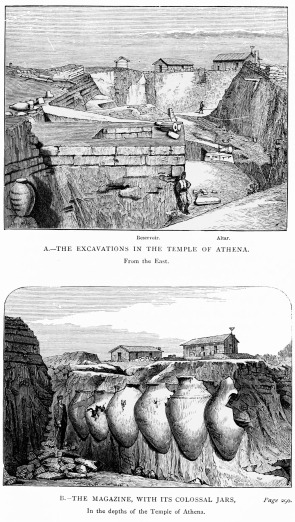
A.—THE EXCAVATIONS IN THE TEMPLE OF ATHENA.
From the East.
B.—THE MAGAZINE, WITH ITS COLOSSAL JARS,
In the depths of the Temple of Athena.
Page 290.
I am in great fear lest the Turks should make off with the large stone
altar, the upper part of which forms a crescent, to use it for building
a minaret in the village of Chiplak; therefore, without moving it from
its place, I shall have it carefully split in two, so that it will be
useless for building purposes. This stone and its pedestal are daubed
over with a white crust of clay, which upon the pedestal is nearly an
inch thick.
I have continued the excavation on the south-east side of the Pergamus,
and I have found that the great wall, which I regarded as a continuation
of the Tower, is part of a very ancient and large wall of enclosure.
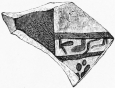 No. 203. Fragment of a Terra-cotta Vase, with Egyptian
hieroglyphics, from the bottom of the Greek Stratum (2 M.).
No. 203. Fragment of a Terra-cotta Vase, with Egyptian
hieroglyphics, from the bottom of the Greek Stratum (2 M.).
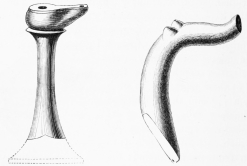
No. 204. A Greek Lamp on a tall foot (2 M.).
No. 205. Fragment of a two-horned Serpent (κεράστης), in
Terra-cotta (3 M.).
Since my last report we have not found any kind of interesting
antiquities worth mentioning on the whole of the east side of the Tower;
but in the large new excavation to the north-east of the Tower-road we
have discovered a great quantity of exceedingly curious articles. The
ruins of the Greek colony here extend exactly to a depth of 6½ feet,
and there I found a fragment of pottery with painted Egyptian
hieroglyphics, of which I give a drawing. Three other pieces of pottery
were found at a depth of 10 feet. One of these represents an owl’s face,
a 卐 and the impressions of the four nails for fixing it; the second
fragment has a 卐 in which each of the four ends again terminates in a
square; the third fragment represents a wheel in a state of rotation. At
a depth of 6½ feet we also came upon a terra-cotta idol with the
owl’s face and the upraised arms, which are broken off, but appear to
have been longer. This idol, like all the others, has a human figure:
the owl’s beak and eyes project from the head and have been carefully
wrought; there are indications of hair on the forehead, and two lines on
the neck seem to denote armour. At the same depth I found the bottom of
a dish, upon which there is a representation in high relief of two
youths embracing and kissing each other; this is a most masterly piece
of work. At a depth of 5 feet we found the upper portion of a vase with
a pretty owl’s head; the rim of the mouth forms a kind of helmet. A
little deeper than a foot we met with a good-looking head of a man in
terra-cotta; at 2 meters (6½ feet) down, a Greek lamp with a foot
2¾ inches long, and at the same depth some very pretty vases and
jugs, and a terra-cotta flattened on one side, with two perforated holes
and a stamp, in which there is a very pretty picture of the head and
shoulders of a woman. At a depth of 3 and 4 meters (10 and 13 feet) were
twelve marble idols without owls’ faces; upon one of these idols there
are four horizontal lines on the neck; further, at a depth of 10 feet, a
fragment of a serpent with two horns; at a depth of 16½ feet, a piece
of diorite in the form of a bell, beautifully polished, and twice
perforated; at the same depth, a quantity of beautiful terra-cotta
vases and jugs, prettily ornamented, ivory needles for knitting or
embroidering, and a very neat perforated terra-cotta cylinder 1¼ inch
long, covered with engraved symbolical signs. But the most curious
article, found at a depth of 5 meters (16½ feet), is an idol of the
Ilian Athena with an owl’s head, which is rounded off in front and at
the back; the eyes are very large and beautiful, but the beak is small
and roughly made; on the neck there is a cross line, and above it ten
upright lines, which are probably intended to denote armour; the whole
of the rest of the body is covered with lines, in which, more especially
on the back, the bird’s feathers are unmistakable; and there is a
peculiar ornament on the abdomen. This idol, like all the others, has a
human figure.[248]
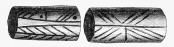
No. 206. Terra-cotta Cylinder, 1¼ in. long, with
Symbolical Signs (5 M.).
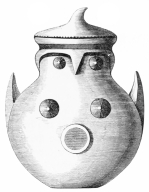 No. 207. Terra-cotta Vase with helmeted image of the
Ilian Athena (6 M.).
No. 207. Terra-cotta Vase with helmeted image of the
Ilian Athena (6 M.).
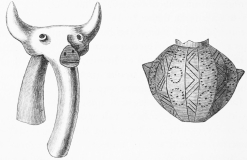
No. 208. Fragment of a large Cup-handle in black
Terra-cotta; head that of an Ox (6 M.).
No. 209. A finely decorated little Vase of Terra-cotta (6
M.).
At a depth of 6 meters (20 feet) I found two splendid brilliant red
vases with representations of the Ilian Athena with the owl’s head, a
kind of helmet, two upraised arms, two breasts, and the large circular’
prominent elevation on the abdomen.[249] At the same depth I found an
idol of the usual form, made of bone; and upon a handle of black
terra-cotta, which has probably belonged to a large cup, the head of an
ox, executed in high relief with great skill;[250] this involuntarily
reminds one of Homer’s Βοῶπις πότνια Ἥρη ("Our Lady Hera, with the head
[or eyes] of a cow”). Among many other remarkable terra-cotta vessels,
at this depth, I also found a small but really splendidly ornamented
vase, the surface of which is divided into fourteen alternate
compartments, larger and smaller.[251] In each of the larger
compartments there are three circles of little stars and a star in the
centre; in each of the smaller compartments there are triple zigzag
lines; this vase has little holes in the small handles for hanging it up
by a string. Among the other curious articles from this depth there is a
silex saw, 4 inches long and 1¾ inch broad, also one of those round,
twice perforated terra-cottas flattened on one side and with a large
stamp which represents a swan and an antelope. A similar terra-cotta,
the stamp upon which represents the head of a warrior with a helmet, was
found at a depth of 8 meters (26 feet). These two are the first
terra-cottas of this kind which I have hitherto discovered below a
depth of 2 meters (6½ feet).
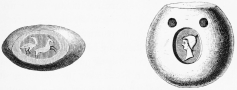
No. 210. Terra-cotta Disc stamped with a Swan and an
Antelope (6 M.). Remarkable for the depth.
No. 211. Terra-cotta Disc pierced with two holes, and
stamped with the Head of a Warrior. Remarkable for the depth (8 M.).
At a depth of 7 meters (23 feet) I found a small tripod with a
projecting owl’s face, also a pretty red terra-cotta cup (cover) with
the owl’s face of the Ilian Athena and her helmet; a knife and a long
copper instrument; a piece of bone 3¼ inches long, ornamented with
very artistically engraved symbolical signs, and among other exceedingly
curious terra-cottas, the handle of a cup with a cross and the marks of
the four nails for fixing it; further, a fragment of the upper portion
of a large urn, which is ornamented with three encircling stripes: the
upper and lower stripes consist of peculiarly interwoven crooked lines;
the middle one contains small circles, in each of which is a cross.
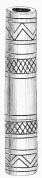 No. 212 A piece of bone, curiously engraved (7 M.).
At a depth of 8 meters (26 feet) we discovered a marble idol with the
owl’s head of the tutelary goddess of Ilium, and a brilliant red
terra-cotta idol of the same goddess, which, curiously enough, has on
its head a small, but very pretty vase with two handles; the owl’s face
of this last-mentioned idol has enormous eyes, and is very expressive.
Of terra-cotta vases and dishes we found an especially large number in
these depths. I can, however, only give drawings of a few of them, for
most were brought out in a broken condition, and I cannot have them
repaired till I return to Athens. Of those terra-cottas which were got
out unharmed, a small vase with two holes in the mouth, for being hung
up by a cord, is especially deserving of attention; it is surrounded by
figures in the shape of hearts with crosses; then saucer-shaped pots
with large handles; other little pots in the form of salt-cellars, and
several vases round at the bottom with three feet or without feet;
terra-cotta scoops in the form of cups with large handles; then a large
terra-cotta lid with a handle; it is of a very curious shape, and weighs
730 grammes. We also found several implements of copper.
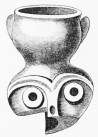 No. 213. Fragment of a Trojan Idol of bright-red
Terra-cotta (6 M.).
No. 213. Fragment of a Trojan Idol of bright-red
Terra-cotta (6 M.).
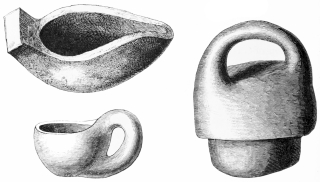
Nos. 214, 215. Terra-cotta Cups or Scoops (7 M.)
No. 216. Vase Cover in Terra-cotta (8 M.).
At a depth of 9 meters (29½ feet) we found a copper lance and a dozen
very large vases, brown and black. At the same depth I found a pretty
brilliant brown cup in the form of a flower-pot, with two large handles.
At a depth of 26 and 29½ feet I have found, since the 5th of the
month, eleven beautiful sling-bullets of loadstone and two of porphyry.
We met with very few stone implements, only two beautiful axes of
diorite, at the depths of 29½ and 33 feet. At the latter depth I
again found one of the brush-handles of terra-cotta, which are often
found, and some vases with three feet and rings at the sides for hanging
them up.
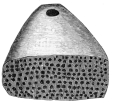 No. 217. Terra-cotta Handle of a Trojan Brush, with the
holes in which the bristles have been fixed. (10 M.).
No. 217. Terra-cotta Handle of a Trojan Brush, with the
holes in which the bristles have been fixed. (10 M.).
During the last eleven days I have collected 991 of the terra-cotta
whorls, 581 of which have symbolical signs, but only 79 have engravings
which are new to me. Long thin copper nails with rounded heads, which
must have been used as dress or hair pins, were met with at all depths.
During these eleven days I have found 20 exquisitely polished axes of
diorite.
At a depth of 1 meter (3¼ feet), we yesterday found in the Temple of
Athena, beside an inscribed pedestal of black slate, 3 feet 8 inches
high and 20¾ inches broad, the statue of a man, of fine white marble,
nearly 4 feet high. As is proved by the inscription, it was made by
Pytheas of Argos, and was erected by the Ilians in honour of Metrodorus,
the son of Themistagoras, of whom it is a representation. The figure was
in the position of an orator, as is proved by the footmarks on the
pedestal. The head and the feet are unfortunately wanting.
The inscriptions run as follows:—
ΟΔΗΜΟΣΟΙΛΙΕΙΩΝ
ΜΗΤΡΟΔΩΡΟΝΘΕΜΙΣΤΑΓΟΡΟΥ
And lower down, on the same side of the pedestal—
ΠΥΘΕΑΣΑΡΓΕΙΟΣΕΠΟΙΗΣΕ
Ὁ δῆμος ὁ Ἰλιείων
Μητρόδωρον Θεμισταγόρου
Πυθέας Ἀργεῖος ἐποίησε.
There were in antiquity many men named Metrodorus, but only two of them
were especially celebrated, and both were natives of Asia Minor. The
one, born in Lampsacus, was a pupil of Epicurus;[252] the other, a
native of Scepsis, was a philosopher, orator, and statesman, and was
held in high esteem by Mithridates VII., Eupator,[253] who afterwards
had him put to death in a horrible manner.[254] The name of the father
of this Metrodorus of Scepsis is unknown, and whether he was called
Themistagoras, or otherwise, is uncertain; but it is extremely probable
that the inscription and the statue were raised in honour of the
Scepsian orator, philosopher, and statesman. I find no mention whatever
of the sculptor Pytheas of Argos. Only one Pytheas, a silver-chaser, is
named by Pliny,[255] as being a contemporary of Pompey the Great: Pliny,
however, does not state his birthplace. Another Pytheas was a wall
painter and a native of Achaia. Neither of these can therefore be the
Argive sculptor who made the statue and put his name on the pedestal.
But as my learned and much esteemed friend, Professor Stephanos
Kummanudes of Athens, has remarked, it is not astonishing that the name
of an insignificant sculptor should be forgotten, seeing that the names
of so many great kings are lost.
In the same part of the Temple of Athena we found the fragment of a
marble slab, which has evidently been very long, with the inscription
given on the opposite page.
The Proconsul Caius Claudius Nero, the son of Publius, who is praised in
the above inscription, ruled over the province of Asia from 674 to 675
after the foundation of Rome. Hence he lived at the time of Cicero, who
mentions him in his orations against Verres.[256]
The Pœmanenians (Ποιμανηνοί) are the inhabitants of the fortress of
Pœmanenon, to the south of Cyzicus.[257]
To judge from the form and thickness of the stone, this inscription must
have been very long and have contained more than 70 lines. But even the
fragment is of historical value, and all the more as we know for certain
that it comes down to us from the year 80 B.C.
ΕΠΕΙΤΟΥΑΝΘΥΠΑΤΟΥΓΑΙΟΥΚΛΑΥΔΙΟΥΠΟΠΛΙΟΥΥΙΟΥΝΕΡΩΝΟΣΕΠΙΤΑΞΑΝΤΟΣ
ΤΟΙΣΠΟΙΜΑΝΗΝΩΝΑΡΧΟΥΣΙΝΕΞΑΠΟΣΤΕΙΛΑΙΠΡΟΣΗΜΑΣΕΙΣΠΑΡΑΦΥΛΑΚΗΝ
ΤΗΣΠΟΛΕΩΣΣΤΡΑΤΙΩΤΑΣΚΑΙΕΠΑΥΤΩΝΗΓΕΜΟΝΑΣΠΟΙΜΑΝΗΝΩΝ
ΟΝΤΕΣΗΜΩΝΦΙΛΟΙΚΑΙΕΥΝΟΩΣΔΙΑΚΕΙΜΕΝΟΙΠΡΟΣΤΟΝΔΗΜΟΝΗΜΩΝ
ΕΞΑΠΕΣΤΕΙΛΑΝΤΟΥΣΤΕΣΤΡΑΤΙΩΤΑΣΚΑΙΕΠΑΥΤΩΝΗΓΕΜΟΝΑΝΙΚ5
ΔΡΟΝΜΗΝΟΦΙΛΟΥΥΙΟΣΚΑΙΠΑΡΑΓΕΝΟΜΕΝΟΣΕΙΣΤΗΝΠΟΛΙΝΗΜΩΝ
ΤΕΕΝΔΗΜΙΑΝΠΟΙΕΙΤΑΙΚΑΛΗΝΚΑΙΕΥΣΧΗΜΟΝΑΚΑΙΑΞΙΩΣ
ΡΟΥΔΗΜΟΥΚΑΙΤΗΣΕΑΥΤΟΥΠΑΤΡΙΔΟΣΤΗΝΤΕΤΩΝ
ΕΑΥΤΩΙΝΕΑΝΙΣΚΩΝΕΝΔΗΜΙΑΝΕΥΤ...ΟΝΠ
ΤΟΝΚΑΘΑΠΕΡΕΠΙΒΑΛΛΕΙΑΝΔΡ10
ΧΕΙΡΙΣΜΕΝΗΝΕΑΤΩΙΠΙ
ΤΗΝΥΠΕΡΤΗΣΦΥΛΑΚ
ΕΙΣΦΕΡΕΤΑΙΣΠΟΥΔ
ΕΚΚΑΙΝΩΝΟΥΔΕΙ
ΜΟΝΚΑΙ15
ἐπεὶ τοῦ ἀνθυπάτου Γαΐου Κλαυδίου Ποπλίου υἱοῦ Νέρωνος ἐπιτάξαντος
τοῖς Ποιμανηνῶν ἄρχουσιν ἐξαποστεῖλαι πρὸς ἡμᾶς εἰς παραφυλακὴν
τῆς πόλεως στρατιώτας καὶ ἐπ’ αὐτῶν ἡγεμόνας Ποιμανηῶν (οἱ;)
ὄντες ἡμῶν φίλοι καὶ εὐνόως διακείμενοι πρὸς τὸν δῆμον ἡμῶν
ἐξαπέστειλαν τούς τε στρατιώτας καὶ ἐπ’ αὐτῶν ἡγεμόνα Νίκ(αν-)5
δρον Μηνοφίλου (υἱ)ὸς καὶ παραγενόμενος εἰς τὴν πόλιν ἡμῶν (τήν)
τε ἐνδημίαν ποιεῖται καλὴν καὶ εὐσχήμονα καὶ ἀξί(ως τοῦ τε ἡμετέ-)
ρου δήμου καὶ τῆς ἑαυτοῦ πατρίδος, τήν τε τῶν (ὑφ';)
ἑαυτῷ νεανίσκων ἐνδημίαν εὔτ(ακτ)ον π(αρέχεται καὶ ἑαυ-)
τὸν καθάπερ ἐπιβάλλει ἀνδρ(ὶ ...... καὶ τὴν ἐξουσίαν τὴν ἐγκε-)10
χειρισμένην ἑατῷ πι(στῶς καὶ .............
τὴν ὑπὲρ τῆς φυλακ(ῆς ..................
εἰσφέρεται σπουδ(ὴν
ἐκ καινῶν οὐδει
μον καὶ15
Interruptions through festivals—Opening of the tumulus of
Batiea—Pottery like that of the Trojan stratum at Hissarlik, and
nothing else—No trace of burial—Its age—Further discoveries of
burnt Trojan houses—Proof of their successive ages—Their
construction—Discovery of a double gateway, with the copper bolts
of the gates—The “SCÆAN GATE” of Homer—Tests of the extent of
ancient Troy—The place where Priam sat to view the Greek
forces—Homer’s knowledge of the heroic Troy only
traditional—Description of the gates, the walls, and the “PALACE
OF PRIAM.”—Vases, &c., found in Priam’s house—Copper, ivory, and
other implements—The δέπα ἀμφικύπελλα—Houses discovered on the
north platform—Further excavations of the city walls—Statuettes
and vessels of the Greek period—Top of the Tower of Ilium
uncovered, and its height determined—A curious trench in it,
probably for the archers—Further excavations at Bunarbashi: only a
few fragments of Greek pottery—The site of Ilium uninhabited since
the end of the fourth century—The place confused with Alexandria
Troas—No Byzantine remains at Hissarlik—Freshness of the Greek
sculptures.
Pergamus of Troy, May 10th, 1873.
SINCE my report of the 16th of last month I have had many interruptions,
for the Greek Easter festival lasts six days, then the feast of Saint
George and its after celebrations again took away several days, so that
during all this time I have had only four days of actual work; however,
on these days, with on an average 150 men, I have continued the works
with great energy.
As we have had continual fine weather since the beginning of April, my
men no longer go to the neighbouring villages for the night as they have
hitherto done; but they sleep in the open air and even in the
excavations, which is very convenient for me, as I now have them always
at hand. Besides this, the long days are of great advantage to me, for I
can continue work from a quarter to five till a quarter past seven in
the evening.
On the top of the tumulus, which is half an hour distant from the
Pergamus, and which, according to the Iliad (II. 811-815), was called by
men the tomb of Batiea, and by the gods the tomb of Myrina, I have had a
shaft sunk, 10¾ feet broad and 17½ feet long; and I find that the
layer of soil there is scarcely more than ¾ of an inch thick, and then
follows brown earth as hard as stone, which alternates with strata of
calcareous earth. In the brown earth I found a mass of fragments of
brilliant black, green, and brown vases, of the same description as
those which I find here in the Pergamus at a depth of from 8 to 10
meters (26 to 33 feet); also many fragments of jars (πίθοι). Beyond
these I discovered nothing at all, and at a depth of 4½ meters
(13¾ feet) I came upon the white limestone rock. What is most
surprising to me is that I did not even find any charcoal, much less the
bones of the burnt corpse. That I should have missed the traces of the
funeral pile, if such really existed, is inconceivable to me, when I
consider the size of my cutting and of its perpendicular walls.
Now, although I have failed in the actual object of this excavation,
still it has this important result for archæology, that, by means of all
the fragments of pottery discovered there, it enables us to determine
with some degree of certainty the date of the erection of this mound;
for it evidently belongs to a time when the surface of the Pergamus was
from 26 to 33 feet lower than it is now. It is therefore of the same
date as the Tower-road already described, which is paved with large
flags of stone, and above which I have carried on the excavations with
the greatest industry. I finished these excavations to-day. They have
brought to light two large buildings of different ages, the more recent
of which is erected upon the ruins of the more ancient one. Both have
been destroyed by terrible fires, of which the walls bear distinct
traces; moreover all the rooms of both houses are filled with black,
red, and yellow wood-ashes and with charred remains. The more recent
house was erected when the ruins of the more ancient house were
perfectly covered with ashes and with burnt débris, as is obvious from
the fact that the more recent walls run in all directions above the more
ancient ones, never standing directly upon them, and are frequently
separated from them by a layer of calcined débris, from 6½ to 10
feet high. The lower, as well as the upper house, is built of stones
joined with earth, but the walls of the lower house are much thicker and
much more solidly built than those of the upper one. The Tower-road can
only have been used when the more ancient house was still inhabited, for
it leads directly into it, and the more recent house was not built till
the street was covered to a height of 10 feet by the ruins of the more
ancient house.
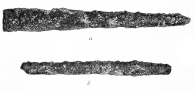
No. 218. Copper Bolts, found exactly in the middle (a)
of the first (b) of the second Scæan Gates.
PLATE XII.
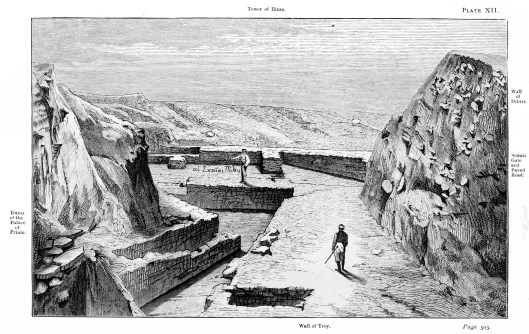
Page 303.
THE DOUBLE SCÆAN GATE, PALACE OF PRIAM, AND TOWER OF ILIUM.
From the North-West.
I was firmly convinced that this splendid street, paved with large flags
of stone, must proceed from the principal building of the Pergamus, and
I therefore confidently carried on the excavation in order to bring that
edifice to light. To accomplish this, I was most unfortunately compelled
to break down three of the large walls of the more recent house. The
result has, however, far surpassed my expectations, for I not only found
two large gates, standing 20 feet apart, but also the two large copper
bolts belonging to them, of which I give drawings. The first gate is
12¼ feet broad, and is formed by two projections of the wall, one of
which stands out 2½ feet, the other 2¾ feet; both are 3¼ feet
high, and 3¾ feet broad. The street paved with the large flags of
stone ends at the first gate, and the road from this to the second gate,
which is situated a little more than 20 feet further to the north-east,
is very roughly paved with large unhewn stones. The pavement has
probably become uneven through the walls of the more ancient house
having fallen upon it. (See Plan II., and Plates XII. and XIII.)
The second gate is likewise formed by two projections in the wall, which
are 2 feet high, above 3 feet broad, and project about 2½ feet.
I have cleared the street as far as 5 feet to the north-east of the
second gate, but I have not ventured to proceed further, as this could
not be done without breaking down more of the walls of the second house,
the preservation of which is of the greatest interest to archæology.
For, although it must be of a much more recent date than the lower one
upon the ruins of which it stands, yet, as is proved by the terra-cottas
and the idols with owls’ heads, as well as by its position at a depth of
from 6 to 7 meters (20 to 23 feet) below the surface, it was built
centuries before the time of the Greek settlement, the ruins of which
extend only to a depth of 6½ feet. This upper and later house is
therefore certainly older than the Homeric poems.
In my last report I expressed the firm conviction that the Tower-road,
which inclines abruptly towards the Plain to the south-west, must lead
to the Scæan Gate, which I thought could at most be 492 feet distant. I
now venture positively to assert that the great double gate which I have
brought to light must necessarily be the SCÆAN GATE. For in the mound,
which runs out for to the south-west from the foot of the Pergamus and
in a straight line with the Tower-road—which mound I had supposed to
contain the great city wall of Ilium and the Scæan Gate,—in this
mound, close to the main hill, I have sunk a shaft, nearly 6 feet broad
and 11 feet long. Here I found exclusively Greek fragments of pottery,
and I came upon the rock at the small depth of 7½ feet; thus I
convinced myself that ancient Troy can never have extended so far
towards the Plain. A second excavation, 11¼ feet long and 6½ feet
broad, which I made exactly 443 feet further to the east up the plateau,
had a similar result, for I came upon the rock at a depth of 16½
feet, and here also I found exclusively fragments of Hellenic pottery
(which in the Pergamus I meet with only at a depth of 6½ feet), and
no trace of Trojan pottery.
This sufficiently proves that the ancient city cannot even have extended
as far as this point, and its area must have been connected with the
Pergamus still further eastwards.[258] I am at present occupied in
making fifteen other shafts in this direction, and I hope, in spite of
the great depth I have to sink them, that I shall succeed, at least to
some extent, in determining the topography of Troy. I shall leave all
the shafts open, so that every visitor may convince himself about the
truth of my statements.
Meanwhile the two shafts described above have gained this much for
archæology, that the street which runs down abruptly at an angle of 65
degrees towards the Plain, in a south-western direction from the double
gate and the Great Tower, cannot possibly have led to a second gate, so
that the double gate which I have laid bare must necessarily have been
the Scæan Gate; it is in an excellent state of preservation, not a stone
of it is wanting.
Here, therefore, by the side of the double gate, upon Ilium’s Great
Tower, at the edge of the very abrupt western declivity of the Pergamus,
sat Priam, the seven elders of the city, and Helen; and this is the
scene of the most splendid passage in the Iliad.[259] From this spot
the company surveyed the whole Plain, and saw at the foot of the
Pergamus the Trojan and the Achæan armies face to face about to settle
their agreement to let the war be decided by a single combat between
Paris and Menelaus.
When Homer[260] makes Hector descend from the Pergamus and rush through
the city in order to arrive at the Scæan Gate, this can only have arisen
from the fact that, after the destruction of Troy, the gate, as well as
the street which led down from it to the Plain, were covered with a
layer of débris 10 feet thick, so that the names only were known from
tradition, and their actual site was unknown.
In order not to weary the reader with a detailed description of the
Scæan Gate, I give an exact plan of it, where all the details may be
seen. (Plan III., p. 306.) This gate, as well as the large ancient
building, stands upon the wall or buttress already mentioned as leaning
on the north side of the Tower. At this place the buttress appears to be
about 79 feet thick, and to be made of the débris which was broken off
the primary soil when the Tower was erected. The site of this building,
upon an artificial elevation directly above the gate, together with its
solid structure, leave no doubt that it was the grandest building in
Troy; nay, that it must have been the Palace of Priam.[261] I am having
an accurate plan made, so far as I can, of the portion that has been
laid bare; I cannot, however, bring to light the whole of it, for in
order to do this I should have to pull down both my stone and my wooden
house, beneath which it extends; and even if I did pull down my own
houses, I should still be unable to make a complete plan of the house
till I had removed the building which stands upon it, and this I cannot
at once make up my mind to do.
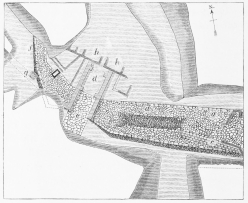
PLAN III.—THE TOWER AND THE SCÆAN GATE.
a a. The Great Tower of Ilium. b. Depression to shelter archers.
c. Steps. d. The Double Scæan Gate. e. Steep paved road leading to
the Plain. f. The City Wall. g. Place where the Treasure was found.
h h. The Palace of Priam.
Anyone may convince himself that the elevation, upon which stands the
Palace of King Priam above the Scæan Gate, is in reality an artificial
one, by examining my last year’s great cutting, which pierces through a
portion of this elevation. The walls of that cutting, from the shaft as
far as the gate, show that the mound consists of the native earth which
has been thrown up, mixed with fragments of rare pottery and shells.
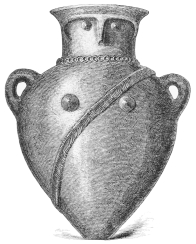
No. 219. Wonderful Vase of Terra-cotta from the Palace of
Priam (8 M.).[262]
Now, with regard to the objects found in these houses, I must first of
all mention having discovered, at a depth of 26 feet, in the palace of
Priam, a splendid and brilliant brown vase, 24¼ inches high, with a
figure of the tutelar goddess of Troy, that is, with her owl’s head, two
breasts, a splendid necklace, indicated by an engraved pattern, a very
broad and beautifully engraved girdle, and other very artistic
decorations; there are no arms, nor are there any indications of them.
Unfortunately this exquisite vase has suffered from the weight of stones
which lay upon it, and although I myself cut it with a knife from among
the stones and the stone-hard débris with the greatest care, I did not
succeed in getting it out without breaking it to pieces. I have,
however, carefully collected all the fragments and sent them to Athens
to be put together, that I may give a drawing of it. (This is No. 219.)
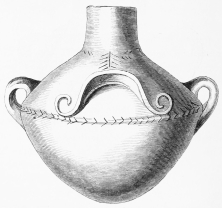
No. 220. Terra-cotta Vase from the House of Priam, with
remarkable Decorations (9 M.).
Among the very remarkable vases discovered in this palace, I must also
mention one nearly a foot high, with two handles, and an encircling row
of cuneiform engravings, above which, on both sides, there is a very
prominent decoration, in the form of spectacles, which is connected with
a kind of necklace by an engraved tree. I must further draw special
attention to an exceedingly remarkable vase, which was found in the same
house, and upon which there are actual letters in a circle round it.
One piece of the vase is wanting, and with it a portion of the
inscription; but, in order to lay before the reader all that has been
preserved of it, I give the inscription separately, for it would be
impossible to give it accurately on the drawing of the vase. (See No. 3,
p. 23.) It would please me immensely if anyone could decipher the Trojan
writing, and thus throw some light upon the great people to whom it
belonged, and upon the epoch at which it was written.[263] I must also
draw attention to a vase, upon which at first sight it seems as if there
were a row of letters; at a closer examination, however, it appears not
to be writing, but symbolical signs, as the cross is conspicuous in
almost every figure.[264]
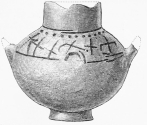 No. 221. A Terra-cotta Vase with two little Ears, and two
large perforated Handles, marked with eleven strange characters (5½
M.).
The depth must refer to the upper house above the Palace. it is
given as 8½ M. in the Photograph, but corrected in the descriptive
letter-press to 5½ M.; and a like correction seems to have been
neglected in the Book.—{ED.}
No. 221. A Terra-cotta Vase with two little Ears, and two
large perforated Handles, marked with eleven strange characters (5½
M.).
The depth must refer to the upper house above the Palace. it is
given as 8½ M. in the Photograph, but corrected in the descriptive
letter-press to 5½ M.; and a like correction seems to have been
neglected in the Book.—{ED.}
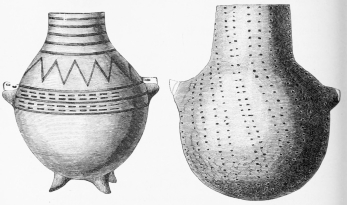
No. 222. A splendidly-decorated Vase of Terra-cotta, with
three Feet and two Ears. From the Palace (7½ M.).
No. 223. A Terra-cotta Vase, with two Ears and covered
with dots. From the Palace (7 M.).
In the same house I found three brilliant red vases, with two handles, a
prominent decoration on either side in the form of spectacles, and two
mighty wings, standing erect by the side of the neck;—half-a-dozen
vases of various sizes, with uncommonly long tubes at the sides and with
holes in the mouth for suspending them by strings;—a very large and
brilliant black vase, with two handles and two ornaments in the form of
large ears;—likewise a smaller vase, with large perforated ears for the
string by which it was hung up;—a vase with three feet, rings for
hanging it up, and beautiful engraved decorations, namely, two
encircling stripes with zigzag lines, and five lines round the neck.
(No. 222.) Further, I found a vase rounded at the bottom, with
perforated handles, and completely covered with dots (No. 223);—also
two covers with pretty owls’ heads, one of which has remarkably large
eyes;—also a fragment of the fore part of a vase with a sheep’s
head;—a curious small but very broad vase, with three feet and long
tubes for hanging it up by strings;—a peculiar terra-cotta lamp, with a
perforated handle in the form of a crescent, and two other projecting
handles, with tubes for suspension;—a red jug with a handle, a neck
completely bent back, a beak-shaped mouth, and two eyes;[265]—a small
vase, covered with dots and possessing two handles and two immense erect
ears;—a jug, with two female breasts;—a vase, with the owl’s face and
the body of the Ilian Athena, and two upraised arms;—also the upper
portion of another vase, upon which may be seen a mouth below the beak
of the Trojan tutelary goddess; and a vase, with a large hollow foot,
very long tubes at the sides for hanging it up, and two prominent
decorations in the form of spectacles.
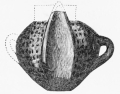 No. 224. Fine decorated Vase of Terra-Cotta, with two
Handles and two great upright Wings. From the Palace (7½ M.).
No. 224. Fine decorated Vase of Terra-Cotta, with two
Handles and two great upright Wings. From the Palace (7½ M.).
Among the smaller terra-cottas found in the palace of Priam, I have
particularly to mention a vessel 2¾ inches long, in a human form,
with the owl’s head of the Ilian Athena and unusually large eyes: two
lines on the temples appear to indicate the helmet, three horizontal
lines on the neck her armour.[266] The body is covered with an arched
shield 1½ inch long, upon which there are ten rows of dots, which are
probably intended to represent the heads of the small nails with which
the layers (πτύχες) were fastened together; the shield of Ajax, for
instance, consisted of seven layers of hides and an outer case of
copper.[267] The Trojan goddess carries on both sides a large wing, in
the form of a bottle, which is decorated with horizontal lines. The long
hair at the back of the goddess’s head is very distinct; it is gathered
into a plait, and falls down almost as far as her ankles, and is wrought
with great care, reminding one extremely of the very similar plaits of
the Caryatides in the Erechtheum of the Acropolis of Athens. Not only is
the idol hollow, but so also are the wings; the latter must positively
have some symbolical significance.
In the palace of Priam I further met with four marble and three bone
idols, with the owl’s head of the tutelar goddess of Troy: one of the
bone idols is painted with a white colour. I likewise discovered there
ten marble idols, without the owl’s head; also the fragment of a sword,
as well as of a lance, a knife, and some copper implements; further, a
dozen long, thin copper nails, which must have served as hair or dress
pins; besides these, a packet of five dress pins, which have been molten
together in the heat of the conflagration: one of the pins has two
heads, one above the other, the lower head being perfectly round. I also
discovered here a perforated cylinder, 1¾ inch long, made of blue
felspar, and ornamented all round with extremely remarkable engraved
symbols. I there also discovered an extremely curious ivory article,
which must be part of a musical instrument;[268] six sling bullets of
loadstone and an arrow-head.
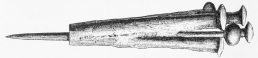
No. 225. Five Copper Dress Pins, molten together by the
conflagration. From the Palace (8 M.).
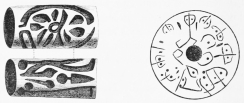
No. 226. Engraved Cylinder of blue Felspar. From the
Palace (9 M.).
No. 227. Terra-cotta, engraved with ten rude Owls’ Faces.
From the Palace (8 M.).[269]
Of 210 whorls found in the Palace adorned with Aryan religious symbols,
there are 60 with engravings that I have not hitherto met with, and
three terra-cotta balls with symbolical signs. One of these is
especially remarkable[270]: it has ten roughly-engraved owls’ faces, so
coarsely drawn that I should not even know them to be owls’ faces, were
it not that I have occasionally found just as rude representations of
the owl’s head upon idols. I also discovered in the same house six
beautifully-polished axes of diorite; also one of those round
twice-perforated terra-cottas, arched on both sides and flattened on the
edge of one side, the whole of this flat side being filled with a stamp
bearing the impression of an eagle and a stag or an antelope; further,
four of those frequently-described large red goblets, round below and
with two large handles, which can only stand on the mouth. These four
goblets are, unfortunately, all broken, and I shall not be able to have
them repaired till I return to Athens.
I now venture positively to maintain that these goblets, which, from my
former reports and drawings are known to be from 5 to nearly 16 inches
high, must necessarily be the Homeric “δέπα ἀμφικύπελλα,” and that the
usual interpretation of these words by “double cups, with a common
bottom in the centre,” is entirely erroneous. It really appears as if
this wrong translation arose solely through Aristotle; for, as is clear
from his Hist. Anim. (9, 40), there were in his time double cups with
a common bottom in the centre; and, in fact, many years ago it is said
that such a cup was discovered in Attica, and bought by the Museum in
Copenhagen. But in the Homeric Troy there were no such cups, otherwise I
should have found them. As already remarked in one of my previous
reports (p. 129), I found on the primary soil, at a depth of from 46 to
52½ feet, several fragments of brilliant black goblets, which I then
considered to be fragments of double cups, because there was a hollow
upon both sides of the bottom; but the one hollow was in all cases quite
small in comparison with the other, and must, therefore, have been in
the foot of the cup. If δέπας ἀμφικύπελλον means double cup, then
ἀμφιφορεύς must mean double urn, which is not possible either in the
Iliad (XIII. 92), the Odyssey (XXIV. 74), or elsewhere in Homer;
moreover, it has never occurred to anyone to translate it otherwise than
“urn with two handles;” consequently, δέπας ἀμφικύπελλον cannot be
translated otherwise than by “cup with two handles.” As an actual double
cup can, of course, only be filled on one side at a time, Homer would
certainly never have constantly described the filled cup as a double
cup, for there would have been no sense in the name. By the term
ἀμφικύπελλον, however, he wished to signify that the filled cup was
presented by one handle and accepted by the other handle. Interpreted in
this manner, there is a great deal of meaning in the name.[271]
The palace of King Priam furnished me also with two large fragments of a
large brilliant yellow urn, adorned in the most beautiful manner with
engraved decorations. Among others, it has several rows of circles
running round it, in each of which there is a triple cross. The elegance
of the vessel is enhanced by the broad handles, which also have circles
with triple crosses. In the king’s palace I also discovered the handle
of a vessel, broken off; it is 4¼ inches long, and in the form of a
serpent.
In the upper and more recent house, above the Scæan Gate, I found the
vase here represented, which is pointed below, has two handles and
decorations in the form of spectacles (No. 228); also the beautiful
vase, with four handles and a lid (No. 229); the large jug, with one
large and two small handles (No. 230); and a number of other vases and
jugs which I shall not describe, as they have already been frequently
met with. Of idols with owls’ faces I have found only one. There also I
discovered many fragments of those large red goblets with two handles,
which I now recognise to be the Homeric δέπας ἀμφικύπελλον.
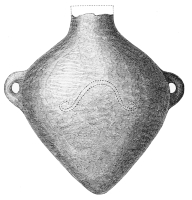 No. 228. Terra-cotta Vase, with a curious Decoration.
From the upper and later House above the Scæan Gate (6 M.).
No. 228. Terra-cotta Vase, with a curious Decoration.
From the upper and later House above the Scæan Gate (6 M.).
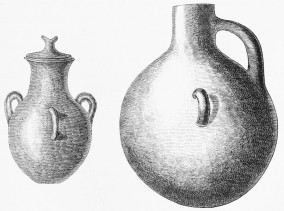
No. 229. Terra-cotta Vase, with four Handles and a Lid.
From the upper House above the Scæan Gate (6 M.).
No. 230. A great Jug, with Handle and two Ears. From the
upper House above the Scæan Gate (6 M.).
As the excavation above the Scæan Gate is finished, I am now again
vigorously at work on the great platform on the north side, which I have
lately had worked whenever I had workmen to spare. We now come upon
several houses there at a depth of from 33 to 20 feet; also, as it
seems, upon a great wall of fortification in the lower strata.
As it is extremely important to know what were the fortifications on the
west and north-west of the Pergamus at the time of the Trojan war, and
as I see another wall, 11½ feet thick, running in a north-western
direction from the Scæan Gate, which however it is impossible to follow
from this side,—during the last eight days I have been making a
cutting, 33 feet broad and 141 long, on the north-west side of the hill,
at the point where, in April 1870, I made the first cutting, which
therefore my men call ἡ μάμμη τῶν ἀνασκαφῶν ("the grandmother of the
excavations”). I am having the débris removed simultaneously by a
small platform, made at a depth of 34¼ feet on the declivity of the
hill, and by three galleries. The distance is not great, and the
wheel-barrows proceed across level ground, and moreover the débris
here is very light, and only requires to be thrown down the declivity;
so the work advances very rapidly. Upon the lower platform I came upon
the surrounding wall built by Lysimachus, which is 13 feet high and 10
feet thick, and is composed of large hewn blocks of limestone laid upon
one another without any kind of cement. I have just finished breaking
through this wall. Directly behind it I came upon an older wall, 8¾
feet high and 6 feet thick, which is composed of large hewn stones
joined with earth, and which of course I am also having broken through.
This second wall is immediately followed by that wall of large hewn
stones which I laid bare three years ago, and which I have hitherto
regarded as a bastion; it is, however, probable that it will prove to be
something else, and I shall describe it in detail in my next report.
This part of the Pergamus was evidently much lower in ancient times; as
seems to be proved not only by the surrounding wall, which must at one
time have risen to a considerable height above the surface of the hill,
whereas it is now covered with 16½ feet of débris, but also by the
remains of the Hellenic period, which here extend down to a great depth.
It appears, in fact, as if the rubbish and refuse of habitations had
been thrown down here for centuries, in order to increase the height of
the place. This also explains how it is that I find here a quantity of
small but interesting objects from the Greek period. Among others are 24
heads of terra-cotta figures, 17 of which are of great beauty; also a
great number of other fragments of statuettes of the same description,
which display skilful workmanship; a terra-cotta slab 5½ inches in
length, upon which is a representation of a woman; also eight small
terra-cotta slabs, nearly 2 inches in length, upon which I find very
curious and to me utterly unknown objects in high relief.[272] I also
found here the fragments of some vessels of exquisite workmanship; two
beautifully decorated lamps; and a leaden plate, 2¾ inches long and
broad, with a pig’s head in bas-relief, which, as I conjecture, may have
been a coin. We also discovered here a vessel 28¾ inches long, of an
extremely fanciful shape, with a long and very thin foot, a long thin
neck, and two enormous handles.
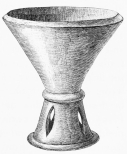 No. 231. A remarkable Terra-cotta Cup (4 M.).
Upon the great platform, at a depth of 4 meters (13 feet), we found a
very remarkable cup, which has a handle, and in its hollow foot four
oval holes, pierced opposite to one another. Last year I repeatedly
found the feet of cups of this sort at a depth of from 46 to 52½
feet, but hitherto I have never met with an entire goblet of this form.
As I no longer require the surface of the Tower for removing the
débris, I have had it quite cleared, and I find in the centre of it a
depression, 45¼ feet long, from 8¼ to 14¾ feet broad, and
barely 3 feet deep, which may have been used for the archers.[273] It
has now become evident to me that what I last year considered to be the
ruins of a second storey of the Great Tower are only benches made of
stones joined with earth, three of which may be seen rising behind one
another like steps.[274] From this, as well as from the walls of the
Tower and those of the Scæan Gate, I perceive that the Tower never can
have been higher than it now is.
The excavations of the north side of the field belonging to Mr. Calvert,
which I opened to discover other sculptures, have been stopped for some
time, as I can no longer come to terms with him. At present, I have only
two foremen, for I was obliged to dismiss Georgios Photidas, three weeks
ago, for urgent reasons.
In conclusion, I have to mention that, during the Greek Easter festival,
accompanied by my esteemed friend, Judge Schells of Ratisbon, and my
wife, I visited Bunarbashi and the neighbouring heights. In their
presence, I made some small excavations, and I have proved that even in
the village the accumulation of débris amounts only to 1¾ foot in
the court-yards of the buildings, and that upon and beside the street
there is nothing but the virgin earth; further, that upon the small site
of Gergis, at the end of the heights, which was formerly regarded as
identical with Troy, the naked rock projects everywhere; and besides, in
the accumulation of débris, which nowhere amounts to 1¾ foot in the
town itself, and to only a little more in the Acropolis, I found nothing
but fragments of pottery from the Hellenic period, that is, from the
third and fifth centuries B.C.
I must also add that I now positively retract my former opinion, that
Ilium was inhabited up to the ninth century after Christ, and I must
distinctly maintain that its site has been desolate and uninhabited
since the end of the fourth century. I had allowed myself to be deceived
by the statements of my esteemed friend, Mr. Frank Calvert, of the
Dardanelles, who maintained that there were documents to prove that the
place had been inhabited up to the thirteenth and fourteenth centuries
after Christ. Such documents, if they really do exist, must necessarily
refer to Alexandria Troas, which is always, as for instance in the New
Testament, simply called Troas; for on its site quantities of Byzantine
antiquities are found even on the surface, which seem to prove that the
city was inhabited up to the fourteenth century, or still longer. Here
in Ilium, on the other hand, there is no trace of Byzantine
architecture, of Byzantine sculpture, of Byzantine pottery, or of
Byzantine coins. Altogether I found only two copper medals of Byzantine
monasteries, which may have been lost by shepherds. I found hundreds of
coins belonging to the time of Constantine the Great, Constans II., but
no medals whatever of the later emperors.
As hitherto it was in the Pergamus alone that I found no trace of the
Byzantine period, I thought that it was only the fortress that was
uninhabited during that period, but that the region of the city had been
occupied. But my fifteen shafts, which I am having made on the most
various points of the site of Ilium, as well as the two shafts made upon
the primary soil, prove, as anyone may convince himself, that below the
surface there is no trace of the Byzantine period, nay that, beyond a
very thin layer of earth, which however only exists in some parts, the
ruins of the Greek period extend up to the very surface, and that in
several of the shafts I came upon the walls of Greek houses even on the
surface.
It is impossible that a Byzantine town or a Byzantine village, nay, that
even a single Byzantine house, can have stood upon this hilly and
stone-hard ground, which covers the ruins of a primeval city, without
leaving the most distinct traces of its existence, for here, where for
nine or ten months of the year it never rains, except during rare
thunderstorms, the productions of human industry do not become
weather-beaten and destroyed, as in other countries where there is
frequent rain. The very fragments of sculptures and inscriptions, which
I find here in the Pergamus and in the other districts of the city, upon
the surface, and which have lain exposed to the open air for at least
1500 years, are still almost as fresh as if they had been made
yesterday.
Trusting to the statements of Mr. Frank Calvert, and under the
impression that Ilium had been inhabited for a long time under the
Byzantine dominion, I described the wall, composed of Corinthian pillars
and cement, 10 feet thick, and which gave me so much trouble to break
through at the south-east corner of the Pergamus, as of Byzantine
architecture. (Pp. 230, 250.) I am now, however, forced to believe that
the Temple of Athena, to which these pillars belong, was destroyed by
the religious zeal of the first Christians as early as the reign of
Constantine the Great, or at latest during that of Constantine II., and
that this wall was built of its ruins about the same time.
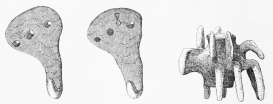
No. 232 (8 M.). No. 233 (7 M.).
Curious Terra-cottas from the Trojan Stratum. Dr. Schliemann takes No.
232 for a pair of pegs for hanging up clothes. No. 233 is a strange
animal figure, solid, except for a tube passing through the body and
open at both ends, so that it cannot have been a vessel. Dr. Schliemann
thinks it may represent the chimæra (Iliad, VI. 179, foll., “In
front a lion, behind a serpent, and in the middle a chimæra”). In one
sense, certainly, the name seems appropriate.
PLATE XIII.
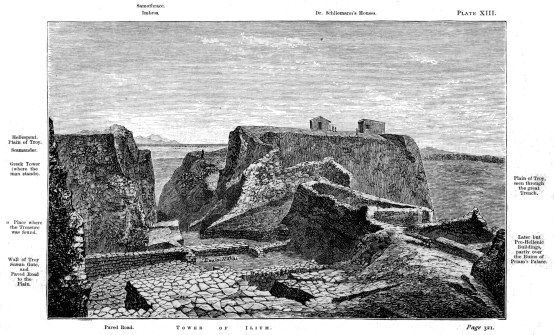
Page 321.
THE SCÆAN GATE AND PAVED ROAD, THE TOWER OF ILIUM, CITY WALL, PALACE OF
PRIAM, AND THE WALLS OF A TOWER OF THE GREEK AGE.
From the South-East.
Further discoveries of fortifications—The great discovery of the
TREASURE on the city wall—Expedient for its preservation—The
articles of the Treasure described—The Shield—The Caldron—Bottle
and Vases of Gold—The golden δέπας ἀμφικύπελλον—Modes of working
the gold—A cup of electrum—Silver plates, probably the talents
of Homer—Vessels of Silver—Copper lance-heads: their peculiar
form—Copper battle-axes—Copper daggers—Metal articles fused
together by the conflagration—A knife and a piece of a
sword—Signs of the Treasure having been packed in a wooden
chest—The Key found—The Treasure probably left behind in an
effort to escape—Other articles found near the Treasure—The
thousands of gold jewels found in a silver vase—The two golden
Diadems—The ear-rings, bracelets, and finger-rings—The smaller
jewels of gold—Analysis of the copper articles by M.
Landerer—Discovery of another room in the Palace containing an
inscribed stone, and curious terra-cottas—Silver dishes—Greek
terra-cotta figures—Great abundance of the owl-faced vases.
LIMITED extent of Troy—Its walls traced—Poetic exaggerations of
Homer—The one great point of Troy’s reality established—It
was as large as the primitive Athens and Mycenæ—The wealth and
power of Troy—Great height of its houses—Probable
population—Troy known to Homer only by tradition—Question of a
Temple in Homer’s time—Characteristics of the Trojan stratum of
remains, and their difference from those of the lowest stratum—The
former opinion on this point recalled—Layer of metallic scoriæ
through the whole hill—Error of Strabo about the utter destruction
of Troy—Part of the real Troy unfortunately destroyed in the
earlier excavations; but many Trojan houses brought to light
since—The stones of Troy not used in building other cities—The
Trojan houses of sun-dried bricks, except the most important
buildings, which are of stones and earth—Extent and results of the
excavations—Advice to future explorers.
Further excavations on the North side—Very curious terra-cotta
vessels—Perforated vases—A terra-cotta with hieroglyphics—Heads
of oxen and horses; their probable significance—Idols of the Ilian
Athena—Greek and Roman medals—Greek inscriptions—Final close of
the excavations: thanksgiving for freedom from serious
accidents—Commendations of Nicolaus Saphyros Jannakis, and other
assistants, and of the artist Polychronios Tempesis and the
engineer Adolphe Laurent.
Troy, June 17th, 1873.
SINCE my report of the 10th of last month I have been especially anxious
to hasten the great excavation on the north-west side of the hill, and
for this purpose I have made a deep cutting on the west side also, in
which, unfortunately, I came obliquely upon the enclosing wall of
Lysimachus, which is 13 feet high and 10 feet thick. I was therefore
compelled to break out from this wall a double quantity of stones in
order to gain an entrance; but I again came upon the ruins of colossal
buildings of the Hellenic and pre-Hellenic periods, so that this
excavation can only proceed slowly. Here, at a distance of 69 feet from
the declivity of the hill, at a depth of 20 feet, I met with an ancient
enclosure 5 feet high, and with a projecting battlement. It is not
connected with the wall which runs out from the Scæan Gate in a
north-westerly direction, and, on account of its very different
structure and small height, it must belong to a post-Trojan period. In
any case, however, it is much older than the Greek colony, because it is
built of stones and earth, and because I found by the side of it several
marble idols of the tutelar goddess of Ilium. I am, unfortunately,
obliged to break down a portion of this wall to a length of 17½ feet,
in order to proceed further, but I have left standing nearly 8 feet of
the part I have excavated, so that the wall may be examined. Behind it I
found a level place paved partly with large flags of stone, partly with
stones more or less hewn, and after this a wall of fortification 20 feet
high and 5 feet thick, built of large stones and earth; it runs below my
wooden house, but 6½ feet above the Trojan city wall which proceeds
from the Scæan Gate.
In the new large excavation on the north-west side, which is connected
with the one I have just been describing, I have convinced myself that
the splendid wall of large hewn stones, which I uncovered in April 1870,
belongs to a tower, the lower projecting part of which must have been
built during the first period of the Greek colony, whereas its upper
portion seems to belong to the time of Lysimachus. (See Plate XIII.) To
this tower also belongs the wall that I mentioned in my last report as 9
feet high and 6 feet broad, and as continuous with the surrounding wall
of Lysimachus; and so does the wall of the same dimensions, situated 49
feet from it, which I have likewise broken through. Behind the latter,
at a depth of from 26 to 30 feet, I uncovered the Trojan city wall which
runs out from the Scæan Gate.
In excavating this wall further and directly by the side of the palace
of King Priam,[275] I came upon a large copper article of the most
remarkable form, which attracted my attention all the more as I thought
I saw gold behind it. On the top of this copper article lay a stratum of
red and calcined ruins, from 4¾ to 5¼ feet thick, as hard as
stone, and above this again lay the above-mentioned wall of
fortification (6 feet broad and 20 feet high) which was built of large
stones and earth, and must have belonged to an early date after the
destruction of Troy. In order to withdraw the Treasure from the greed of
my workmen, and to save it for archæology, I had to be most expeditious,
and although it was not yet time for breakfast, I immediately had
“païdos” called. This is a word of uncertain derivation, which has
passed over into Turkish, and is here employed in place of ἀνάπαυσις, or
time for rest. While the men were eating and resting, I cut out the
Treasure with a large knife, which it was impossible to do without the
very greatest exertion and the most fearful risk of my life, for the
great fortification-wall, beneath which I had to dig, threatened every
moment to fall down upon me. But the sight of so many objects, every one
of which is of inestimable value to archæology, made me foolhardy, and I
never thought of any danger. It would, however, have been impossible
for me to have removed the Treasure without the help of my dear wife,
who stood by me ready to pack the things which I cut out in her shawl
and to carry them away.[276]
The first thing I found was a large copper shield (the ἀσπὶς ὀμφαλόεσσα
of Homer) in the form of an oval salver, in the middle of which is a
knob or boss encircled by a small furrow (αὔλαξ). This shield is a
little less than 20 inches in length; it is quite flat, and surrounded
by a rim (ἄντυξ) 1½ inch high; the boss (ὀμφαλός) is 2-1/3 inches
high and 4-1/3 inches in diameter; the furrow encircling it is 7 inches
in diameter and 2/5 of an inch deep.[277]
PLATE XIV.
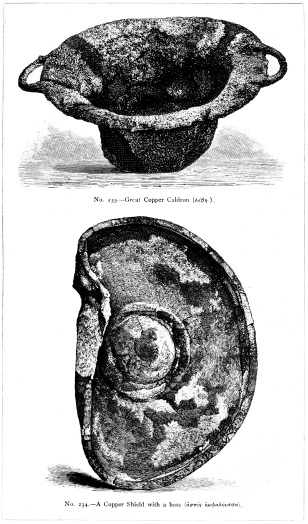
No. 235.—Great Copper Caldron (λέβης).
No. 234.—A Copper Shield with a boss (ἀσπὶς ὀμφαλόεσσα).
THE TREASURE OF PRIAM.
Page 324.
PLATE XV.
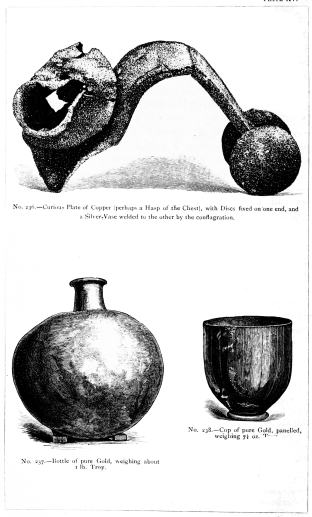
No. 236.—Curious Plate of Copper (perhaps a Hasp of the Chest), with
Discs fixed on one end, and a Silver Vase welded to the other by the
conflagration.
No. 237.—Bottle of pure Gold, weighing about 1 lb. Troy.
No. 238. Cup of pure Gold, panelled, weighing 7½ oz. Troy.
THE TREASURE OF PRIAM.
Page 325.
The second object which I got out was a copper caldron with two
horizontal handles, which certainly gives us an idea of the Homeric
λέβης; it is 16½ inches in diameter and 5½ inches high; the bottom
is flat, and is nearly 8 inches in diameter.[278]
The third object was a copper plate 2/5 of an inch thick, 6-1/3 inches
broad, and 17-1/3 inches long; it has a rim about 1/12 of an inch high;
at one end of it there are two immovable wheels with an axle-tree. This
plate is very much bent in two places, but I believe that these
curvatures have been produced by the heat to which the article was
exposed in the conflagration; a silver vase 4¾ inches high and broad
has been fused to it; I suppose, however, that this also happened by
accident in the heat of the fire.[279] The fourth article I brought out
was a copper vase 5½ inches high and 4-1/3 inches in diameter.
Thereupon followed a globular bottle of the purest gold, weighing 403
grammes (6220 grains, or above 1 lb. troy); it is nearly 6 inches high
and 5½ inches in diameter, and has the commencement of a zigzag
decoration on the neck, which, however, is not continued all round. Then
came a cup, likewise of the purest gold, weighing 226 grammes (7¼ oz.
troy); it is 3½ inches high and 3 inches broad.[280]
PLATE XVI.
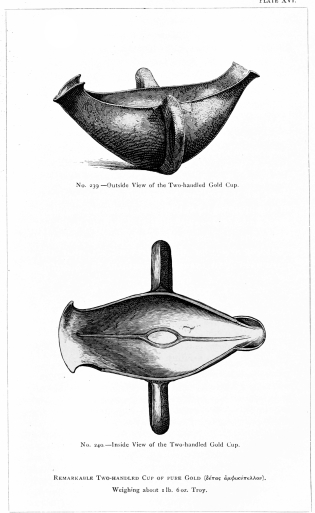
No. 239.—Outside View of the Two-handled Gold Cup.
No. 240.—Inside View of the Two-handled Gold Cup.
REMARKABLE TWO-HANDLED CUP OF PURE GOLD (δέπας ἀμφικύπελλον).
Weighing about 1 lb. 6 oz. Troy.
THE TREASURE OF PRIAM.
Page 326.
Next came another cup of the purest gold, weighing exactly 600 grammes
(about 1 lb. 6 oz. troy);[281] it is 3½ inches high, 7¼ inches
long, and 7-1/5 inches broad; it is in the form of a ship with two large
handles; on one side there is a mouth, 1-1/5 inch broad, for drinking
out of, and another at the other side, which is 2¾ inches broad, and,
as my esteemed friend Professor Stephanos Kumanudes, of Athens, remarks,
the person who presented the filled cup may have first drunk from the
small mouth, as a mark of respect, to let the guest drink from the
larger mouth.[282] This vessel has a foot which projects about 1/12 of
an inch, and is 1-1/3 inch long, and 4/5 of an inch broad. It is
assuredly the Homeric δέπας ἀμφικύπελλον. But I adhere to my supposition
that all of those tall and brilliant red goblets of terra-cotta, in the
form of champagne-glasses with two enormous handles, are also δέπα
ἀμφικύπελλα, and that this form probably existed in gold also. I must
further make an observation which is very important for the history of
art, that the above-mentioned gold δέπας ἀμφικύπελλον is of cast gold,
and that the large handles, which are not solid, have been fused on to
it. On the other hand the gold bottle and the gold cup mentioned above
have been wrought with the hammer.
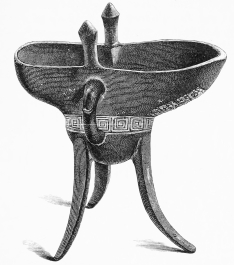
No. 241. Bronze Cup used in China for Libations and
Drinking.
The Treasure further contained a small cup of gold alloyed with 20 per
cent. of silver, that is, the mixed metal called electrum.[283] It
weighs 70 grammes (2¼ oz. troy), and is above 3 inches high, and
above 2½ inches broad. Its foot is only 4/5 of an inch high and
nearly an inch broad, and is moreover not quite straight, so that the
cup appears to be meant only to stand upon its mouth.
I also found in the Treasure six pieces of the purest silver in the form
of large knife-blades, having one end rounded, and the other cut into
the form of a crescent; they have all been wrought with the hammer.[284]
The two larger blades are nearly 8½ inches long and 2 inches broad,
and weigh respectively 190 and 183 grammes. The next two pieces are
about 7¼ inches long and 1½ broad, and weigh respectively 174 and
173 grammes. The two other pieces are nearly 7 inches long and 1-1/5
inch broad, and weigh respectively 173 and 171 grammes.[285] It is
extremely probable that these are the Homeric talents (τάλαντα), which
could only have been small, as, for instance, when Achilles offers for
the first prize a woman, for the second a horse, for the third a
caldron, and for the fourth two gold talents.[286]
PLATE XVII.
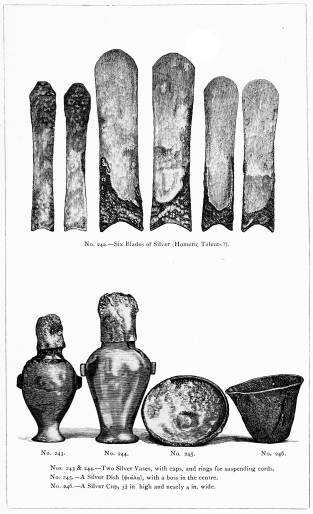
No. 242.—Six Blades of Silver (Homeric Talents?).
Nos. 243 & 244.—Two Silver Vases, with caps, and rings for suspending
cords.
No. 245.—A Silver Dish (φιάλη), with a boss in the centre.
No. 246.—A Silver Cup, 3-1/3 in. high and nearly 4 in. wide.
THE TREASURE OF PRIAM.
Page 328.
PLATE XVIII.
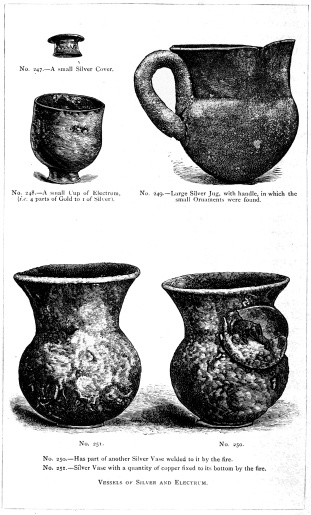
No. 247.—A small Silver Cover.
No. 248.—A small Cup of Electrum, (i.e. 4 parts of Gold to 1 of
Silver).
No. 249.—Large Silver Jug, with handle, in which the small Ornaments
were found.
No. 250.—Has part of another Silver Vase welded to it by the fire.
No. 251.—Silver Vase with a quantity of copper fixed to its bottom by
the fire.
VESSELS OF SILVER AND ELECTRUM.
THE TREASURE OF PRIAM.
Page 329.
I also found in the Treasure three great silver vases, the largest of
which is above 8¼ inches high and nearly 8 inches in diameter, and
has a handle 5½ inches in length and 3½ in breadth.[287] The
second vase is 6·9 inches high and nearly 6 inches in diameter; another
silver vase is welded to the upper part of it, of which, however, only
portions have been preserved.[288] The third vase is above 7 inches high
and above 6 inches in diameter; the foot of the vase has a great deal of
copper fused onto it, which must have dripped from the copper objects
contained in the Treasure during the conflagration.[289] All of the
three vases are perfectly round below, and therefore cannot stand
upright without resting against something.
I found, further, a silver goblet above 3-1/3 inches high, the mouth of
which is nearly 4 inches in diameter; also a silver flat cup or dish
(φιάλη) 5½ inches in diameter, and two beautiful small silver vases
of most exquisite workmanship. The larger one, which has two rings on
either side for hanging it up by strings, is nearly 8 inches high with
its hat-shaped lid, and 3½ inches in diameter across the bulge. The
smaller silver vase, with a ring on either side for suspension by a
string, is about 6¾ inches high, with its lid, and above 3 inches
broad.[290]
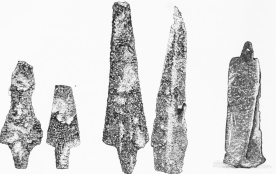
No. 252. No. 253.
No. 254.
No. 255.
No. 256.
Trojan Lance-Heads of Copper.—TR.
No. 256. Copper Lance and Battle-Axe welded together by the
Conflagration. The Pin-hole of the Lance is visible.—TR.
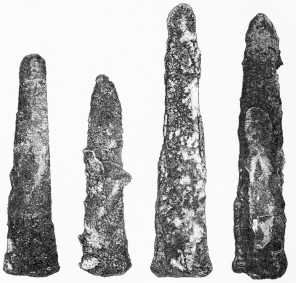
No. 257.
No. 258.
No. 259.
No. 260.
Trojan Battle-Axes of Copper—TR.
Nos. 258 and 260 have pieces of other weapons welded onto them by the
fire.
Upon and beside the gold and silver articles, I found thirteen copper
lances, from nearly 7 to above 12½ inches in length, and from above
1½ to 2-1/3 inches broad at the broadest point; at the lower end of
each is a hole, in which, in most cases, the nail or peg which fastened
the lance to the wooden handle is still sticking. The pin-hole is
clearly visible in a lance-head which the conflagration has welded to a
battle-axe. The Trojan lances were therefore quite different from those
of the Greeks and Romans, for the latter stuck the shaft into the
lance-head, the former fastened the head into the shaft.
I also found fourteen of those copper weapons, which are frequently met
with here, but which have never been discovered elsewhere; at one end
they are pointed but blunt, and at the other they end in a broad edge. I
formerly considered them to be a species of lance, but now after mature
consideration I am convinced that they could have been used only as
battle-axes. They are from above 6 to above 12 inches in length, from
nearly ½ to above ¾ of an inch thick, and from above 1 to nearly 3
inches broad; the largest of them weighs 1365 grammes (about 3 lbs.
avoirdupois). The following cut shows an axe more like those of later
ages.
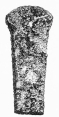 No. 261. Trojan battle-axe.—TR.
There were also seven large double-edged copper daggers, with a handle
from about 2 to 2¾ inches long, the end of which is bent round at a
right angle. These handles must at one time have been encased in wood,
for if the cases had been made of bone they would still have been wholly
or partially preserved. The pointed handle was inserted into a piece of
wood, so that the end projected about half an inch beyond it, and this
end was simply bent round. (See page 332.) The largest of these daggers
is 10-2/3 inches in length and above 2 inches broad at the broadest
part; a second dagger, which is above 1¾ inch broad, has the point
broken off, and is now less than 9 inches long, but appears to have been
11 inches; a third dagger is 8-2/3 inches long, and measures above 1¼
inch at the broadest point; a fourth has become completely curled up in
the conflagration, but appears to have been above 11 inches long. Of the
fifth, sixth, and seventh daggers I only discovered the fragments; these
are from nearly 4 to 5-1/3 inches in length. But in a packet of four
lances and battle-axes, which have been welded together in the heat of
the fire, I believe I can recognise another dagger.
Of common one-edged knives I only found one in the Treasure; it is above
6 inches in length. I also found a piece of a sword which is 8-2/3
inches long and nearly 2 inches broad: also a four-cornered copper bar
ending in an edge; it is nearly 15 inches long, and also appears to have
served as a weapon.
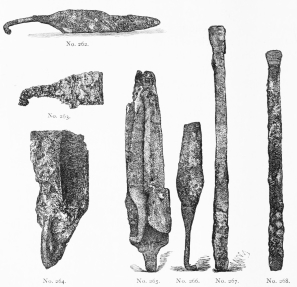
Nos. 262, 263, 264, 266, Trojan Two-edged Copper Daggers,
with hooked Stems that have been fastened into Wooden Handles; No. 264
is doubled up by the Conflagration. No. 265, Weapons molten together.
No. 267, a Copper Sword-Blade, with a sharp edge at the end. No. 268, a
Four-sided Copper Bar, ending in a sharp edge.—TR.
As I found all these articles together, forming a rectangular mass, or
packed into one another, it seems to be certain that they were placed on
the city wall in a wooden chest (φωριαμός), such as those mentioned by
Homer as being in the palace of King Priam.[291] This appears to be the
more certain, as close by the side of these articles I found a copper
key above 4 inches long, the head of which (about 2 inches long and
broad) greatly resembles a large safe-key of a bank. Curiously enough
this key has had a wooden handle; there can be no doubt of this from the
fact that the end of the stalk of the key is bent round at a right
angle, as in the case of the daggers.
 No 269. Copper Key, supposed to have belonged to the
Treasure-chest.—TR.
No 269. Copper Key, supposed to have belonged to the
Treasure-chest.—TR.
It is probable that some member of the family of King Priam hurriedly
packed the Treasure into the chest and carried it off without having
time to pull out the key; that when he reached the wall, however, the
hand of an enemy or the fire overtook him, and he was obliged to abandon
the chest, which was immediately covered to a height of from 5 to 6 feet
with the red ashes and the stones of the adjoining royal palace.
Perhaps the articles found a few days previously in a room of the royal
palace, close to the place where the Treasure was discovered, belonged
to this unfortunate person. These articles were a helmet, and a silver
vase 7 inches high and 5½ inches broad, containing an elegant cup of
electrum 4-1/3 inches high and 3½ inches broad. The helmet was broken
in being taken out, but I can have it mended, as I have all the pieces
of it. The two upper portions, composing the crest (φάλος), are
uninjured. Beside the helmet, as before, I found a curved copper pin,
nearly 6 inches in length, which must have been in some way attached to
it, and have served some purpose. (Compare No. 192, p. 281.)
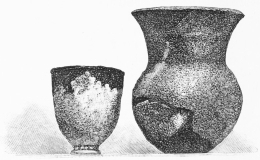
No. 270. No. 271.
Cups of Electrum and Silver. Found in the Palace, near the Treasure, 270
inside 271.
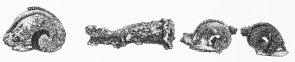
Nos. 272-275. Pieces of Helmet-crests found in a Room of
the Palace.
At 5 or 6 feet above the Treasure, the successors of the Trojans erected
a fortification wall 20 feet high and 6 feet broad, composed of large
hewn and unhewn stones and earth; this wall extends to within 3¼ feet
of the surface of the hill.
PLATE XIX.
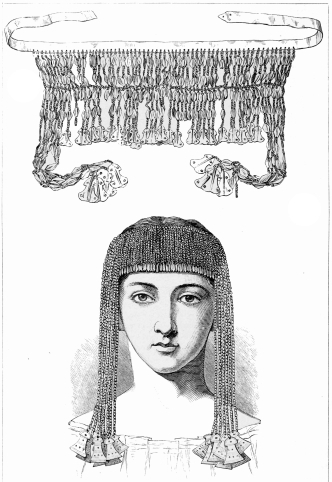
Nos. 276 and 277.—THE TWO GOLDEN DIADEMS (πλεκταὶ ἀναδέσμαι).
THE TREASURE OF PRIAM.
Page 335.
That the Treasure was packed together at terrible risk of life, and in
the greatest anxiety, is proved among other things also by the contents
of the largest silver vase, at the bottom of which I found two splendid
gold diadems (κρήδεμνα)[292]; a fillet, and four beautiful gold
ear-rings of most exquisite workmanship: upon these lay 56 gold
ear-rings of exceedingly curious form and 8750 small gold rings,
perforated prisms and dice, gold buttons, and similar jewels, which
obviously belonged to other ornaments; then followed six gold bracelets,
and on the top of all the two small gold goblets.[293]
The one diadem consists of a gold fillet, 21-2/3 inches long and nearly
½ an inch broad, from which there hang on either side seven little
chains to cover the temples, each of which has eleven square leaves with
a groove; these chains are joined to one another by four little cross
chains, at the end of which hangs a glittering golden idol of the
tutelar goddess of Troy, nearly an inch long. The entire length of each
of these chains, with the idols, amounts to 10¼ inches. Almost all
these idols have something of the human form, but the owl’s head with
the two large eyes cannot be mistaken; their breadth at the lower end is
about 9/10 of an inch. Between these ornaments for the temples there are
47 little pendant chains adorned with square leaves; at the end of each
little chain is an idol of the tutelary goddess of Ilium, about ¾ of
an inch long; the length of these little chains with the idols is not
quite 4 inches.
The other diadem is 20 inches long, and consists of a gold chain, from
which are suspended on each side eight chains completely covered with
small gold leaves, to hang down over the temples, and at the end of
every one of the sixteen chains there hangs a golden idol 1¼ inch
long, with the owl’s head of the Ilian tutelary goddess. Between these
ornaments for the temples there are likewise 74 little chains, about 4
inches long, covered with gold leaves, to hang down over the forehead;
at the end of these chains there hangs a double leaf about ¾ of an
inch long.
The fillet ἄμπυξ is above 18 inches long and 2/5 of an inch broad, and
has three perforations at each end. Eight quadruple rows of dots divide
it into nine compartments, in each of which there are two large dots;
and an uninterrupted row of dots adorns the whole edge. Of the four
ear-rings only two are exactly alike. From the upper part, which is
almost in the shape of a basket, and is ornamented with two rows of
decorations in the form of beads, there hang six small chains on which
are three little cylinders; attached to the end of the chains are small
idols of the tutelar goddess of Troy. The length of each ear-ring is
3½ inches. The upper part of the other two ear-rings is larger and
thicker, but likewise almost in the shape of a basket, from it are
suspended five little chains entirely covered with small round leaves,
on which are likewise fastened small but more imposing idols of the
Ilian tutelar divinity; the length of one of these pendants is 3½
inches, that of the other a little over 3 inches.[294]
PLATE XX.
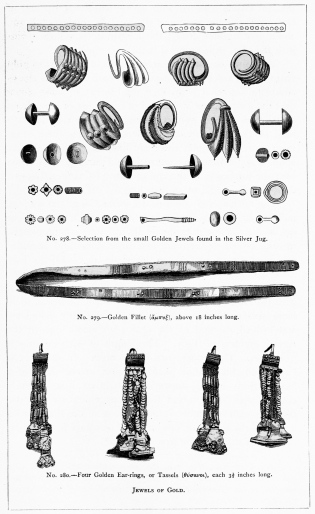
No. 278.—Selection from the small Golden Jewels found in the Silver
Jug.
No. 279.—Golden Fillet (ἄμπυξ), above 18 inches long.
No. 280.—Four Golden Ear-rings, or Tassels (θύσανοι), each 3½ inches
long.
JEWELS OF GOLD.
THE TREASURE OF PRIAM.
Page 336.
Of the six gold bracelets, two are quite simple and closed, and are
about 1/5 of an inch thick; a third is likewise closed, but consists of
an ornamented band 1/25 of an inch thick, and ¼ of an inch broad. The
other three are double, and the ends are turned round and furnished with
a head. The princesses who wore these bracelets must have had unusually
small hands, for they are so small that a girl of ten would have
difficulty in putting them on.
![No. 281. Six golden Bracelets welded together by the conflagration.—[TR.]](https://openoldbooks.sgp1.digitaloceanspaces.com/books/troy-and-its-remains/images/ill_pg_337_sml.jpg) No. 281. Six golden Bracelets welded together by the
conflagration.—[TR.]
No. 281. Six golden Bracelets welded together by the
conflagration.—[TR.]
The 56 other gold ear-rings are of various sizes, and three of them
appear to have also been used by the princesses of the royal family as
finger-rings.[295] Not one of the ear-rings has any resemblance in form
to the Hellenic, Roman, Egyptian, or Assyrian ear-rings; 20 of them end
in four leaves, ten in three leaves, lying beside one another and
soldered together, and they are thus extremely like those ear-rings of
gold and electrum which I found last year at a depth of 9 and 13 meters
(29½ and 42½ feet). Eighteen other ear-rings end in six leaves; at
the commencement of these there are two small studs, in the centre two
rows of five small studs each, and at the end three small studs. Two of
the largest rings, which, owing to the thickness of the one end,
certainly cannot have been used as ear-rings, and appear to have been
finger-rings only, terminate in four leaves, and at the commencement of
these there are two, in the middle three, and at the end again two small
studs. Of the remaining ear-rings two have the form of three, and four
the form of two, beautifully ornamented serpents lying beside one
another.
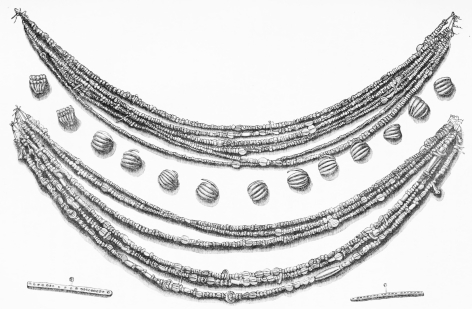
No. 282. THE TREASURE OF PRIAM.
4610 SMALL JEWELS OF GOLD.
Besides the ear-rings, a great number of other ornaments strung on
threads, or fastened on leather, had been put into the same large silver
vase; for above and below them, as already said, I found 8750 small
objects;[296] such as gold rings, only 1/8 of an inch in diameter;
perforated dice, either smooth or in the form of little indented stars,
about 1/6 of an inch in diameter; gold perforated prisms 1/10 of an inch
high and 1/8 of an inch broad, decorated longitudinally with eight or
sixteen incisions; small leaves about 1/5 of an inch long, and 1/6 of an
inch broad, and pierced longitudinally with a hole for threading them;
small gold pegs 1/3 of an inch long, with a button on one side, and a
perforated hole on the other; perforated prisms about 1/5 of an inch
long and 1/10 of an inch broad; double or triple gold rings soldered
together and only ¼ of an inch in diameter, with holes on both sides
for threading them; gold buttons or studs 1/5 of an inch high, in the
cavity of which is a ring above 1/10 of an inch broad for sewing them
on; gold double buttons, exactly like our shirt studs, 3/10 of an inch
long, which, however, are not soldered, but simply stuck together, for
from the cavity of the one button there projects a tube (αὐλίσκος)
nearly ¼ of an inch long, and from the other a pin (ἔμβολον) of the
same length, and the pin is merely stuck into the tube to form the
double stud. These double buttons or studs can only have been used,
probably, as ornament upon leather articles, for instance upon the
handle-straps (τελαμῶνες) of swords, shields, or knives. I found in the
vase also two gold cylinders above 1/10 of an inch thick and ¾ of an
inch long; also a small gold peg above 4/5 of an inch in length, and
from 6/100 to 8/100 of an inch thick; it has at one end a perforated
hole for hanging it up, and on the other side six encircling incisions,
which give the article the appearance of a screw; it is only by means of
a magnifying glass that it is found not to be really a screw. I also
found in the same vase two pieces of gold, one of which is 1/7 of an
inch, the other above 2 inches, long; each of them has 21
perforations.[297]
The person who endeavoured to save the Treasure had fortunately the
presence of mind to stand the silver vase, containing the valuable
articles described above, upright in the chest, so that not so much as a
bead could fall out, and everything has been preserved uninjured.
My esteemed friend M. Landerer, of Athens, a chemist well known through
his discoveries and writings, who has most carefully examined all the
copper articles of the Treasure, and analysed the fragments, finds that
all of them consist of pure copper without any admixture of tin or
zinc,[298] and that, in order to make them more durable, they have been
wrought with the hammer (σφυρήλατον).
As I hoped to find other treasures here, and also wished to bring to
light the wall that surrounded Troy, the erection of which Homer[299]
ascribes to Poseidon and Apollo, as far as the Scæan Gate, I have
entirely cut away the upper wall, which rested partly upon the gate, to
an extent of 56 feet. Visitors to the Troad can, however, still see part
of it in the north-western earth-wall opposite the Scæan Gate. I have
also broken down the enormous block of earth which separated my western
and north-western cutting from the Great Tower; but in order to do this,
I had to pull down the larger one of my wooden houses, and I had also to
bridge over the Scæan Gate, so as to facilitate the removal of the
débris. The result of this new excavation is very important to
archæology; for I have been able to uncover several walls, and also a
room of the Royal Palace, 20 feet in length and breadth, upon which no
buildings of a later period rest.
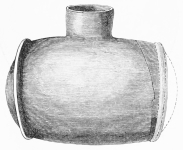
No. 283. Terra-cotta Vessel in the shape of a Cask. From
the Palace (8 M.).
Of the objects discovered there I have only to mention an excellently
engraved inscription found upon a square piece of red slate, which has
two holes not bored through it and an encircling incision, but neither
can my learned friend Émile Burnouf nor can I tell in what language the
inscription is written.[300] Further, there were some interesting
terra-cottas, among which is a vessel, quite the form of a modern cask,
and with a tube in the centre for pouring in and drawing off the
liquid. There were also found upon the wall of Troy, 1¾ feet below
the place where the Treasure was discovered, three silver dishes
(φιάλαι), two of which were broken to pieces in digging down the
débris; they can, however, be repaired, as I have all the pieces.[301]
These dishes seem to have belonged to the Treasure, and the fact of the
latter having otherwise escaped our pickaxes is due to the
above-mentioned large copper vessels which projected, so that I could
cut everything out of the hard débris by means of a knife.
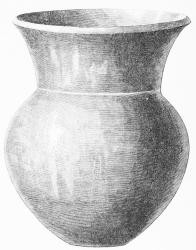
No. 284. Large Silver Vase found in the House of Priam (8
M.).
I now perceive that the cutting which I made in April 1870 was exactly
at the proper point, and that if I had only continued it, I should in a
few weeks have uncovered the most remarkable buildings in Troy, namely,
the Palace of King Priam, the Scæan Gate, the Great Surrounding Wall,
and the Great Tower of Ilium; whereas, in consequence of abandoning this
cutting, I had to make colossal excavations from east to west and from
north to south through the entire hill in order to find those most
interesting buildings.
In the upper strata of the north-western and western excavations we came
upon another great quantity of heads of beautiful terra-cotta figures of
the best Hellenic period, and at a depth of 23 feet upon some idols, as
well as the upper portion of a vase with the owl’s face and a lid in the
form of a helmet. Lids of this kind, upon the edge of which female hair
is indicated by incisions, are frequently found in all the strata
between 4 and 10 meters (13 and 33 feet) deep, and as they belong to
vases with owls’ faces, the number of lids gives us an idea of the
number of the vases with the figure of the owl-headed Athena, which
existed here in Troy.
But Troy was not large. I have altogether made twenty borings down to
the rock, on the west, south-west, south, south-east and east of the
Pergamus, directly at its foot or at some distance from it, on the
plateau of the Ilium of the Greek colony. As I find in these borings no
trace either of fragments of Trojan pottery or of Trojan house-walls,
and nothing but fragments of Hellenic pottery and Hellenic house-walls,
and as, moreover, the hill of the Pergamus has a very steep slope
towards the north, the north-east, and the north-west, facing the
Hellespont, and is also very steep towards the Plain, the city could not
possibly have extended in any one of these directions. I now most
emphatically declare that the city of Priam cannot have extended on any
one side beyond the primeval plateau of this fortress, the
circumference of which is indicated to the south and south-west by the
Great Tower and the Scæan Gate, and to the north-west, north-east and
east by the surrounding wall of Troy. The city was so strongly fortified
by nature on the north side, that the wall there consisted only of those
large blocks of stone, loosely piled one upon another in the form of a
wall, which last year gave me such immense trouble to remove. This wall
can be recognized at once, immediately to the right in the northern
entrance of my large cutting, which runs through the entire hill.
I am extremely disappointed at being obliged to give so small a plan of
Troy; nay, I had wished to be able to make it a thousand times larger,
but I value truth above everything, and I rejoice that my three years’
excavations have laid open the Homeric Troy, even though on a diminished
scale, and that I have proved the Iliad to be based upon real facts.
Homer is an epic poet, and not an historian: so it is quite natural that
he should have exaggerated everything with poetic licence. Moreover, the
events which he describes are so marvellous, that many scholars have
long doubted the very existence of Troy, and have considered the city to
be a mere invention of the poet’s fancy. I venture to hope that the
civilized world will not only not be disappointed that the city of Priam
has shown itself to be scarcely a twentieth part as large as was to be
expected from the statements of the Iliad, but that, on the contrary, it
will accept with delight and enthusiasm the certainty that Ilium did
really exist, that a large portion of it has now been brought to light,
and that Homer, even although he exaggerates, nevertheless sings of
events that actually happened. Besides, it ought to be remembered that
the area of Troy, now reduced to this small hill, is still as large as,
or even larger than, the royal city of Athens, which was confined to the
Acropolis, and did not extend beyond it, till the time when Theseus
added the twelve villages, and the city was consequently named in the
plural Ἀθῆναι. It is very likely that the same happened to the town of
Mycenæ (Μυκῆναι), which Homer describes as being rich in gold, and which
is also spoken of in the singular,εὐρυάγυια Μυκήνη.[302]
But this little Troy was immensely rich for the circumstances of those
times, since I find here a treasure of gold and silver articles, such as
is now scarcely to be found in an emperor’s palace; and as the town was
wealthy, so was it also powerful, and ruled over a large territory.
The houses of Troy were all very high and had several storeys, as is
obvious from the thickness of the walls and the colossal heaps of
débris. But even if we assume the houses to have been of three
storeys, and standing close by the side of one another, the town can
nevertheless not have contained more than 5000 inhabitants, and cannot
have mustered more than 500 soldiers; but it could always raise a
considerable army from among its subjects, and as it was rich and
powerful, it could obtain mercenaries from all quarters.
As I do not find in my shafts (that is, beyond the hill itself) a trace
of earthenware belonging to the successors of the Trojans up to the time
of the Greek colony, it may with certainty be assumed that Troy had
increased in size at Homer’s time only to the small amount of what was
added through the heaps of rubbish caused by the destruction of the
city. Homer can never have seen Ilium’s Great Tower, the surrounding
wall of Poseidon and Apollo, the Scæan Gate or the Palace of King Priam,
for all these monuments lay buried deep in heaps of rubbish, and he made
no excavations to bring them to light. He knew of these monuments of
immortal fame only from hearsay, for the tragic fate of ancient Troy
was then still in fresh remembrance, and had already been for centuries
in the mouth of all minstrels.[303]
Homer rarely mentions temples, and, although he speaks of the temple of
Athena, yet, considering the smallness of the city, it is very doubtful
whether it actually existed. It is probable that the tutelar goddess at
that time possessed only the sacrificial altar which I discovered, and
the crescent form of which greatly resembles the upper portion of the
ivory idol found in the lowest strata,[304] as well as the one end of
the six talents contained among the Treasure.
The position, size, and depth of all my shafts will be found most
accurately specified on my plan of the Ilium of the Greek colony;[305] I
therefore refrain from repeating these statements here, so as not to
weary the reader. I also add an accurate plan of my excavations,[306] a
plan of the Scæan Gate and of the Great Tower of Ilium,[307] and lastly,
a plan of the city of Troy at the time of the great destruction (Plan
IV.).
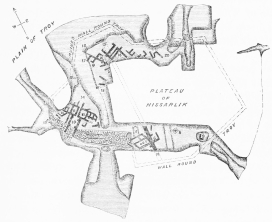
Plan IV.—Plan of Troy at the Epoch of Priam, according
to Dr. Schliemann’s Excavations.
The Scæan Gate gives us the age of the royal edifice in front of which
it stands, and of the vessels of pottery which are found in that house.
This earthenware is indeed better than what is generally found here at a
depth of from 7 to 10 meters (23 to 33 feet), but it is exactly similar;
and consequently all the strata of débris from these depths belong to
the Trojan people. These strata are composed of red, yellow, and
occasionally black wood-ashes, and every stone found there bears the
marks of the fearful heat to which it has been exposed. In these strata
we never meet with those brilliant black plates and dishes, with a long
horizontal ring on either side, found at the depth of from 13 to 16
meters (42½ to 52½ feet), nor do we meet with the vases with two
long tubes on either side. Besides the vessels in the lowest strata are
entirely different in quality and in form from those found at a depth of
from 23 to 33 feet, so that they certainly cannot have belonged to the
same people. But they belong, at all events, to a kindred Aryan nation,
as these too possessed in common with the Trojans the whorls ornamented
with Aryan religious symbols, and also idols of the Ilian Athena. I
formerly believed that the most ancient people who inhabited this site
were the Trojans, because I fancied that among their ruins I had found
the δέπας ἀμφικύπελλον, but I now perceive that Priam’s people were the
succeeding nation, because in their ruins I have discovered the actual
δέπας ἀμφικύπελλον, made of gold and also of terra-cotta, and likewise
the Scæan Gate.
Several geologists, who have visited me here, maintain that the stratum
of scoriæ, which runs through the greater part of the hill, at an
average depth of 9 meters (29½ feet), has been formed by melted lead
and copper ore, quantities of which must have existed here at the time
of the destruction of Troy; and this opinion is also shared by the
engineer, Adolphe Laurent, who has returned to help me with my last
works, and to make some new plans.
Strabo says,[308] “No trace of the ancient city (Troy) has been
preserved. This is very natural; for, as all the towns round about were
desolated, yet not completely destroyed, while Troy was razed to the
ground, so all the stones were carried off to renovate the others. Thus,
at least, Archæanax of Mitylene is said to have built a wall round
Sigeum with the stones.” These statements of Strabo are, however,
completely erroneous, and the tradition of antiquity, that Troy was
razed to the ground, can only be explained by its having been buried
deep beneath colossal masses of wood-ashes and stone, which were built
over by a new town; the latter being again destroyed, and again
surmounted by buildings which had a similar fate; till at last the mass
of débris lying upon Troy reached a height of from 6 to 8 meters (20
to 26 feet), and upon this was established the Acropolis of the Ilium of
the Greek colony.
In consequence of my former mistaken idea, that Troy was to be found on
the primary soil or close above it, I unfortunately, in 1871 and 1872,
destroyed a large portion of the city, for I at that time broke down all
the house-walls in the higher strata which obstructed my way. This year,
however, as soon as I had come by clear proofs to the firm conviction
that Troy was not to be found upon the primary soil, but at a depth of
from 23 to 33 feet, I ceased to break down any house-wall in these
strata, so that in my excavations of this year a number of Trojan houses
have been brought to light. They will still stand for centuries, and
visitors to the Troad may convince themselves that the stones of the
Trojan buildings can never have been used for building other towns,
for the greater part of them are still in situ. Moreover, they are
small, and millions of such stones are to be found upon all the fields
of this district.
Valuable stones, such as those large flags which cover the road leading
from the Scæan Gate to the Plain, as well as the stones of the enclosing
wall and of the Great Tower, have been left untouched, and not a single
stone of the Scæan Gate is wanting. Nay, with the exception of the
houses which I myself destroyed, it would be quite possible to uncover
the “carcasses” of all the houses, as in the case of Pompeii. The
houses, as I have already said, must have been very high, and a great
deal of wood must have been used in their construction, for otherwise
the conflagration could not have produced such an enormous quantity of
ashes and rubbish.
In my excavations of 1871 and 1872, at a depth of from 7 to 10 meters
(23 to 33 feet), I found only house-walls composed of sun-dried bricks;
and, as anyone may convince himself by examining the houses which I have
uncovered, this style of building was almost exclusively met with during
that year. It is only the buildings by the side of the Scæan Gate, and a
few houses in the depths of the Temple of Athena, that are made of
stones and earth.
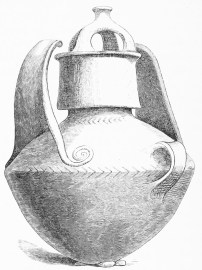
No. 285. Splendid Terra-cotta Vase from the Palace of
Priam. This is the largest vase of the type frequent in the ruins, with
two small handles and two great upright wings. The cover was found
near it.
As may be seen from my plan of the site of Troy, I have excavated
two-thirds of the entire city; and, as I have brought to light the Great
Tower, the Scæan Gate, the city wall of Troy, the royal palace, the
sacrificial altar of the Ilian Athena, and so forth, I have uncovered
the grandest buildings, and, in fact, the best part of the city. I have
also made an exceedingly copious collection of all the articles of the
domestic life and the religion of the Trojans; and therefore it is not
to be expected that science would gain anything more by further
excavations. If, however, my excavations should at any time be
continued, I urgently entreat those who do so to throw the débris of
their diggings from the declivity of the hill, and not to fill up the
colossal cuttings which I have made with such infinite trouble and at
such great expense, for they are of great value to archæology, inasmuch
as in these cuttings all the strata of débris, from the primary soil
up to the surface of the hill, can be examined with little trouble.
On the north side of the hill, I have now also uncovered several
house-walls at a depth of 13 meters (42½ feet), and also the
beginning of that remarkable wall of fortification already mentioned,
the continuation of which may be seen in the labyrinth of house-walls in
the depths of the Temple of Athena. On the north side, above the primary
soil, I have also brought to light a portion of the pavement already
mentioned, composed of small, round white sea-pebbles, below which are
the calcined ruins of a building which formerly stood there.
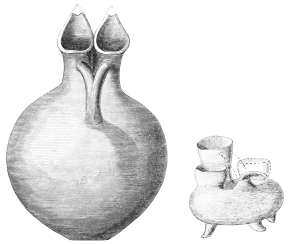
No. 286. Curious double-necked Jug (8 M.).
No. 287. Terra-cotta Vessel consisting of three Goblets
rising out of a tube on three feet (4 M.).—[6 M. in Atlas.]
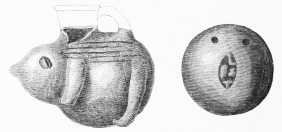
No. 288. Terra-cotta Vessel in the form of a Pig, with
legs too short to stand it on (7 M.).
No. 289. A round Terra-cotta, stamped with Hieroglyphics
(1½ M.).
Among some very remarkable terra-cottas discovered since my last report,
I must mention two jugs found on the north side, at a depth of from 23
to 26 feet, each of which has two upright necks standing side by side,
but their handles are united. One of them has also beside the mouths two
small elevations, which may probably indicate eyes. Of a third jug of
this kind, I only found the upper portion. I must also mention an
exceedingly curious cup, discovered at a depth of 4 meters (13 feet),
which consists of a tube resting upon three feet and ending in one large
and two small goblets; the larger goblet is connected with the opposite
side of the tube by a handle. At the same depth I met with a large vase,
from which projects a separate small vase; it is ornamented with
incisions, and has three feet and two very pretty handles and rings for
hanging it up. I found likewise, at the depth of 13 feet, a vase with
two female breasts, two large handles and engravings resembling letters.
Among other extremely curious terra-cottas, I must also mention three
pots with three rows of perforations; they have the usual handle on one
side and three feet on the other; also three large vases with
perforations right round, on all sides from the bottom to the top; their
use is a riddle to me; can they have served as bee-hives?[309] Also a
vessel in the form of a pig with four feet, which are, however, shorter
than the belly, so that the vessel cannot stand upon them; the neck of
the vessel, which is attached to the back of the pig, is connected with
the hinder part by a handle. I further found a pot in the form of a
basket with a handle crossing the mouth, and with a tube in the bulge
for drawing off the liquid. Also two terra-cotta funnels, at a depth of
10 feet, with a letter, which I have repeatedly met with on some of the
terra-cottas of which I have given drawings, and which therefore will
probably be deciphered. At a depth of 5 feet I found one of those round
twice-perforated terra-cottas with a stamp, in which there are Egyptian
hieroglyphics; also a dozen of the same articles in the stamps of which
are a crowned head, a bird, a dog’s head, a flying man or an eagle and a
stag. At a depth of 16½ feet, I found the handle of a cup with the
beautifully modelled head of a bull, which probably represents the
βοῶπις πότνια Ἥρη:[310] however, this cannot be proved, for up to that
time I had never found an idol with the head of an ox. Neither can I
prove that the terra-cottas here frequently met with, in the form of
horses’ heads, represent the mother of Hera, Cybele or Rhea; but it is
very likely, for, as is well known, in Phrygia she was represented with
a horse’s head. Terra-cotta idols of the Ilian Athena are rarely met
with; but we daily find marble idols of this goddess, most of which have
almost a human form. We also frequently come upon oblong flat pieces of
rough marble, upon which the owl’s face of the goddess is more or less
deeply engraved. It is often so finely scratched that the aid of a
magnifying glass is required to convince one that it actually exists; we
found several such pieces of marble where the owl’s head was painted in
a black colour. Since I have come to the conclusion that they are idols
of the tutelary divinity of Troy, I have carefully collected them; but
in 1871 and 1872 seven-eighths of all the marble idols must have escaped
my notice, for at that time I had no idea of their significance.
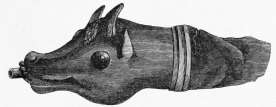
No. 290. Fragment of a Terra-cotta Vessel, in the shape
of a Horse’s Head (4 M.).
In excavating the ground upon which my wooden house had stood, we found,
at a depth of from 9 to 19 inches, eighteen copper and two silver
medals; one of the latter is of Marcus Aurelius. The other is a
tetradrachm of the island of Tenedos; on the obverse, to the right, is
the head of Jupiter, to the left that of Juno, both having one neck in
common, like the heads of Janus. The head of Jupiter is crowned with
laurels, that of Juno has a wreath or crown. Upon the reverse of the
coin there is a laurel wreath round the edge, and in the centre a large
double axe, above which stands the word ΤΕΝΕΔΙΩΝ: below and to the right
of the handle of the double axe there is a winged Eros, who is holding
up an object which it is difficult to distinguish; to the left is a
bunch of grapes and a monogram, which looks like the letter Α.
Of the copper coins, five are of Alexandria Troas, two of Ophrynium, one
of Tenedos, two of Abydos, and one of Dardania. Two have on one side the
bust of Julia Domna, with the inscription ΟΥΛΙΑ ΣΕΒΑΣΤΗ; one of these
has on the reverse the full-length figure of this empress with the
inscription ΙΛΙΕΩΝ, and the other has the figure of Hector with the
inscription ΙΛΙΕΩΝ ϶ΚΤΩΡ. The other medals belong to an earlier period
of Ilium, and have on the one side the bust of Athena, and on the other
the inscription ΙΛΙΕΩΝ.
In April of this year, when I uncovered the road paved with large flags
of stone, which leads from the Scæan Gate to the Plain, the stones
looked as new as if they had just been hewn. But since then, under the
influence of the burning sun, the flags of the upper portion of the
road, which have specially suffered from the conflagration that
destroyed the city, are rapidly crumbling away, and will probably have
quite disappeared in a few years. However, the flags of stone on the
north-western half of the road which have been less exposed to the heat,
may still last many centuries.
The following inscriptions were found at a depth of from 19 inches to
3½ feet below my wooden house.
...........................................
...........................................
......ΣΑ....................................
...ΕΣΑΙ..............ΝΟΥ.................
......ΑΒΟΥΚΟΛ......ΕΤΡΑΝΦ...........5
....ΣΚΑΤΑΠΛΗΘΟΣΕΙΣΟΙΝΙΣΤΡΑ.....
..ΤΩΝΕΨΗΦΙΣΘΑΙΣΚΑΔΡΕΙΣΟ.....
..ΣΑΝΔΡΑΣΤΟΥΣΣΥΝΘΗΣΟΜΕΝ.....
....ΕΡΟΝΥΠΗΡΧΕΝΚΑΙΣΤΗΛΩ.....
....ΙΕΝΤΩΤΩΝΣΑΜΟΘΡΑΚ.........10
....ΙΣΑΠΟΚΑΘΙΣΤΑΜΕΝΟ..........
....ΕΝΟΥΣΤΗΝΣΥΝΘΕΣΙΝ..........
......ΜΟΛΟΓΙΑΣΤΟΑΝΤΙΓΡΑ..........
......ΟΙΚΗΣΟΝΤΕΣΗΡΕΘΗΣ............
......ΟΠΕΙΘΟΥΜΙΛΗΣΙΟΣ..............15
......ΘΟΥΔΙΟΠΕΙΔΗΣΒ..................
..... ΤΙΦΑΝΗΣΑΠ.......................
..............................
......σα......................
....εσαι...............νου(ς...
........αβουκολ......ετραν φ...5
....ς κατὰ πλῆθος εἰς οἴνιστρα.....
..των ἐψηφίσθαι Σκαδρεῖς ο.......
..ς ἀνδρὰς τοὺς συνθησομέν(ους....
....ερον ὑπῆρχεν καὶ στηλω......
....ι ἐν τῷ τῶν Σαμοθράκ(ων......10
....ις ἀποκαθισταμέν(ο..........
....ενους τὴν σύνθεσιν...........
......ὁ)μολογίας τὸ ἀντίγρα(φον...
......οἰκήσοντες ᾑρέθησ(αν......
......Δι)οπείθου Μιλήσιος.......15
......θου Διοπείδης Β...........
......Αν)τιφάνης Ἀπ...........
This inscription contains a contract for a settlement and gives the
names of the men selected for founding it; Σκαδρεῖς is an unknown word,
which has never before been met with.
\ΧΝ
ΩΣΧΙΛΙΑΣ
ΩΣΤΗΣΔΟΘΕΙΣΗΣ
ΕΙΠΕΝΤΕΚΑΙΟΥΕΛΑΒΟ
ΒΑΛΛΟΝΤΩΙΕΝΙΑΥΤΩ5
ΤΗΝΣΥΝΕΔΡΕΙΑΝΟΥΚΑ
ΤΗΣΒΟΟΣΤΗΝΤΙΜΗΝΥ
ΤΩΓΚΡΕΩΝΤΑΣΛΟΙΠΑ
ΤΡΩΒΟΛΟΝΤΗΝΠΟΛΙΝΤΗΜ
ΚΑΣΑΝΤΟΥΣΤΟΚΟΥΣΤΟΥΣ10
ΚΟΣΙΑΣΤΕΣΣΑΡΑΚΟΝΤΑΠΕ
ΘΕΤΟΣΔΙΑΚΟΣΙΑΣΤΕΣΣΑ
ΚΑΙΟΤΙΤΗΝΣΥΝΕΔΡΕΙΑ
ΤΕΙΛΑΝΠΕΝΤΑΚΟΣΙΑΣΚΑΙΤΗ
ΡΗΜΕΝΗΣΤΗΣΤΙΜΗΣΤΩΓΚΡΕ15
ΤΑΔΥΟ
........ως χιλίας..............
......ε)ως τῆς δοθείσης..........
.....ει πέντε καὶ οὗ ἐλαβο........
....το ἐπι)βάλλον τῶι ἐνιαυτῶ(ι....5
....τὴν συνέδρειαν οὐ κα.........
....τῆς βοὸς τὴν τιμὴν ὑ.........
....τῶγ κρεῶν τὰς λοιπὰ(ς.......
....τε) τρώβολον τὴν πόλιν τημ...
....ἠνάγ;)κασαν τοὺς τόκους τοὺς..10
....α)κοσίας τεσσαράκοντα πέ(ντε.
....θετος διακοσίας τεσσα(ρα.....
...καὶ ὅτι τὴν συνέδρεια(ν........
...ἀπέσ)τειλαν πεντακοσίας καὶ τη.
...ρημένης τῆς τιμῆς τῶγ κρε(ῶν...15
...τάλαν;)τα δύο................
In this day closing the excavations at Ilium for ever, I cannot but
fervently thank God for His great mercy, in that, notwithstanding the
terrible danger to which we have been exposed owing to the continual
hurricanes, during the last three years’ gigantic excavations, no
misfortune has happened, no one has been killed, and no one has even
been seriously hurt.
In conclusion, I cannot refrain from most strongly recommending Nikolaos
Saphyros Jannakis, of the neighbouring village of Renkoï, to all those
who, sooner or later, may wish to make excavations in the Plain of Troy
or in the neighbourhood. During all my excavations here, since April
1870, he has been my attendant, cook, and cashier. It is in the latter
capacity especially that I find him incomparably useful on account of
his honesty, which has been well tested, and also on account of his
knowing the names and capabilities of every workman in the Troad. In
addition to this, his size and herculean strength, his cleverness, and
his thorough knowledge of the Turkish language, are excellently adapted
for settling the difficulties which continually arise in reference to
the excavations with the Turkish officials. I must also specially
recommend my foreman Spiridion Demetrios of Athens, and Captain Georgios
Tsirogiannis of Limme in Eubœa, for they have here learnt by long
experience the easiest way of removing colossal masses of débris, and
they have in addition the gift of command. I can also most strongly
recommend my accomplished draughtsman, Polychronios Lempessis, of
Salamis, who has here made all the drawings of my work from Plate 119 to
190.[311] Lastly, I can speak with the utmost satisfaction of my
engineer Adolphe Laurent, who has made the ground plans for me from
first to last.
AS the present name of the Simoïs, Dumbrek, is not a Turkish word,
some take it for a corruption of the name Thymbrius, and use it to prove
that the river—which, flowing past the foot of the ruins of Ophrynium,
runs through the north-eastern valley of the Plain of Troy, and falls
into the Kalifatli Asmak, the very ancient bed of the Scamander, in
front of Ilium—is the Thymbrius, and cannot possibly be the Simoïs.
To this I reply: that there is no example of a Greek word ending in os
being rendered in Turkish by a word ending in a k; further that
Dumbrek must certainly be a corruption of the two Turkish words طوك برق
Don barek. Don signifies ‘ice,’ and barek the ‘possession’ or the
‘habitation'; the two words therefore mean much the same thing as
containing ice, and the name might be explained by the fact that the
inundations caused by the Simoïs are frequently frozen over in winter,
when the whole north-eastern plain forms a sheet of ice. Throughout
antiquity, however, the river was called the Simoïs, for according to
Strabo (XIII. 1. p. 103), the grove dedicated to Hector was situated on
a hill near Ophrynium; according to Lycophron (Cassandra), the hero
was buried in Ophrynium; and according to Virgil,[312] who is the most
conscientious preserver of ancient traditions, Hector’s tomb was
situated in a little grove on the shores of the Simoïs.
I.—List of the specific weight in Grammes, of the terra-cottas in the
form of cylinders, balls, pyramids, &c., found in the various depths of
the Pergamus of Troy, and which appear to have been used as
weights.[313] (The depths are given in meters.)
| 1 | 2 | 3 | 4 | 5 | 6 | 7 | 8 | 9 | 10 | 11 | 12 | 13 | 14 | 15 |
| 67 | 98 | 73 | 58 | 107 | 177 | 95 | 70 | 38 | 26 | | | 210 | | |
| 125 | 149 | 202 | 298 | 110 | 221 | 198 | 74 | 75 | 42 | | | | | |
| 134 | 162 | 205 | | 120 | 259 | 215 | 90 | 83 | 144 | | | | | |
| 430 | 197 | 328 | | | 400 | 334 | 91 | 154 | 148 | | | | | |
| 545 | 220 | | | | 400 | | 109 | 73 | 167 | | | | | |
| 1005 | 228 | | | | 442 | | 112 | | 176 | | | | | |
| 306 | | | | 443 | | 133 | | 224 | | | | | |
| 495 | | | | 448 | | 141 | | 248 | | | | | |
| 509 | | | | 455 | | 177 | | 279 | | | | | |
| | | | | 456 | | 403 | | 300 | | | | | |
| | | | | 458 | | 458 | | 300 | | | | | |
| | | | | 458 | | 472 | | 308 | | | | | |
| | | | | 464 | | 748 | | 315 | | | | | |
| | | | | 465 | | | | 320 | | | | | |
| | | | | 470 | | | | 322 | | | | | |
| | | | | 475 | | | | 336 | | | | | |
| | | | | 475 | | | | 338 | | | | | |
| | | | | 555 | | | | 350 | | | | | |
| | | | | | | | | 355 | | | | | |
| | | | | | | | | 365 | | | | | |
| | | | | | | | | 366 | | | | | |
| | | | | | | | | 368 | | | | | |
| | | | | | | | | 374 | | | | | |
| | | | | | | | | 384 | | | | | |
| | | | | | | | | 430 | | | | | |
| | | | | | | | | 435 | | | | | |
| | | | | | | | | 450 | | | | | |
| | | | | | | | | 458 | | | | | |
| | | | | | | | | 500 | | | | | |
| | | | | | | | | 520 | | | | | |
| | | | | | | | | 575 | | | | | |
II. List of the specific weight in Grammes of the round stones found in
the various depths of the Pergamus of Troy, and which have apparently
served as weights. (The depths are in meters.)
| 1 | 2 | 3 | 4 | 5 | 6 | 7 | 8 | 9 | 10 | 11 | 12 | 13 | 14 | 15 |
| 418 | 183 | 79 | 69 | 100 | 100 | 169 | 102 | 223 | 145 | 555 | 485 | 190 | 135 | 332 |
| 576 | 275 | 109 | 71 | 112 | 185 | 186 | 150 | 224 | 146 | | 1710 | 468 | 413 | 363 |
| 757 | 442 | 135 | 100 | 140 | 300 | 186 | 207 | 227 | 182 | | | 1475 | 450 | 447 |
| 472 | 414 | 136 | 215 | 330 | 189 | 244 | 372 | 190 | | | | 485 | 475 |
| | 448 | 195 | 230 | 412 | 219 | 254 | 390 | 214 | | | | 505 | 557 |
| | 584 | 388 | 262 | 420 | 229 | 257 | 420 | 225 | | | | 1250 | 585 |
| | 726 | 400 | 268 | 427 | 245 | 288 | 500 | 280 | | | | 1852 | 680 |
| | | 513 | 293 | 446 | 266 | 295 | 852 | 310 | | | | | 3148 |
| | | 583 | 318 | 460 | 290 | 381 | | 334 | | | | | |
| | | 608 | 335 | 462 | 291 | 385 | | 341 | | | | | |
| | | 624 | 335 | 515 | 346 | 402 | | 372 | | | | | |
| | | 635 | 368 | 528 | 369 | 402 | | 450 | | | | | |
| | | 662 | 478 | 546 | 380 | 408 | | 545 | | | | | |
| | | 688 | 490 | 572 | 384 | 429 | | 605 | | | | | |
| | | 893 | 498 | 602 | 400 | 440 | | 627 | | | | | |
| | | | 537 | 628 | 435 | 472 | | 755 | | | | | |
| | | | 637 | 640 | 437 | 536 | | | | | | | |
| | | | 688 | 670 | 468 | 551 | | | | | | | |
| | | | 728 | 738 | 483 | 568 | | | | | | | |
| | | | 757 | 770 | 491 | 620 | | | | | | | |
| | | | 790 | 1288 | 515 | 638 | | | | | | | |
| | | | 4260 | 3000 | 534 | 658 | | | | | | | |
| | | | | | 560 | 660 | | | | | | | |
| | | | | | 569 | 712 | | | | | | | |
| | | | | | 606 | 764 | | | | | | | |
| | | | | | 632 | 825 | | | | | | | |
| | | | | | 825 | 1145 | | | | | | | |
| | | | | | 895 | 1160 | | | | | | | |
| | | | | | 904 | 1232 | | | | | | | |
| | | | | | 1005 | 1710 | | | | | | | |
| | | | | | 1082 | 1950 | | | | | | | |
| | | | | | 1193 | | | | | | | | |
| | | | | | 1877 | | | | | | | | |
Monsieur Ernest Chantre, Assistant Director of the Museum in Lyon, has
just sent me the result of the analysis of the Trojan weapons made by
the celebrated chemist, M. Damour, of Lyon. I had drilled three weapons,
and sent him the drillings.
No. 1.—Drillings from one of the battle-axes of the treasure.
Analysis.
| | Grammes. |
| | 0·3020 |
| Deducting the sand contained in it | 0·0160 |
| Analysed metal | 0·2860 |
| | | In | 10·000 parts. |
| | Grammes. | |
| This consists of copper | 0·2740 | = | 0·9580 |
| " " tin | 0·0110 | = | 0·0384 |
| | 0·2850 | = | 0·9964 |
No. 2.—Drillings of another battle-axe of the treasure.
Analysis.
| | Grammes. |
| | 0·2970 |
| Deducting the sand contained in it | 0·0020 |
| Analysed metal | 0·2950 |
| | | In | 10·000 | parts. |
| | Grammes. | |
| This consists of copper | 0·2675 | = | 0·9067 |
| " " tin | 0·0255 | = | 0·0864 |
| | 0·2930 | = | 0·9931 |
No. 3.—Drillings from a common two-edged axe, found at a depth of
3¼ feet, and therefore in the remains of the Greek colony.
Analysis.
| | Grammes. |
| | 0·5280 |
| Deducting the sand contained in it | 0·0070 |
| Analysed metal | 0·5210 |
| | | In | 10·000 | parts. |
| This consists of copper | 0·4810 | = | 0·9232 |
| " " tin | 0·0385 | = | 0·0739 |
| | 0·5195 | = | 0·9971 |
NO. 4.—Drillings of one of the Trojan sling-bullets, externally
covered with verdigris, and internally the colour of iron.
Analysis.
| | Grammes. |
| Quantity of analysed metal | 0·2410 |
| | | In | 10·000 | parts. |
| Consisting of sulphur | 0·0470 | = | 0·1950 |
| " " copper | 0·1920 | = | 0·7966 |
| " " iron | 0·0002 | = | 0·0008 |
| " " quartzose | 0·0005 | = | 0·0020 |
| | 0·2397 | = | 0·9944 |
DR. H. SCHLIEMANN.
Athens, January 1, 1874.
No. 291. An Inscribed Trojan Whorl (8 M.).


 (~1mb)
 (~1mb)


 (~1mb)
 (~1mb)
 (~1mb)