Sandy Steele slowly put down the phone and
pushed his blond cowlick back from his brow. Excitement
and confusion were mixed in equal parts
in his expression as he turned to his father, John
Steele, who stood leaning against his workbench,
idly tossing a piece of quartz crystal in the air.
“Wow!” Sandy said. “Leave it to Uncle Russ to
come up with a real surprise!”
“It certainly seems to be a habit of his,” John
Steele smiled. “What do you think of this particular
surprise?”
“I hardly know what to think,” Sandy answered.
“The question is, what do you and Mother think?
I mean, is it all right if I go—if I can find somebody
to go with me?”
10
“Your mother and I discussed this with your
Uncle Russ before he called you,” Sandy’s father
said, “so I guess that’s one worry you don’t have
to consider. The only problem you have is finding
somebody who knows how to handle a boat, and
who’ll be interested in making this trip with you.”
Wrinkling his forehead in thought, Sandy swung
his gangling six-foot frame up on to the workbench
next to his father. “How about you, Dad?”
he asked. “Do you know anything about sailing
a boat?”
His father shook his head. “Sailing is hardly a
skill that a government field geologist needs to
develop. My work is with rocks and minerals—the
dryest kind of dry land. What I know about water,
you could carve on granite and put in your watch
pocket!”
“Geology didn’t make you into an inventor, a
chemist, an electrical engineer, a carpenter and
gosh knows what else,” Sandy answered, waving
around him at the crowded workshop with its confusing
mass of equipment. “I just thought you
might have done some reading on this subject,
too.”
11
John Steele smiled. “As the proud but confused
owner of a new sailboat, one of the first things
you’ll learn is that there’s a world of difference
between theory and practice. I’ve been out on a
boat a few times; years ago, though. I’ve also read
some books on the subject, as you thought. But all
I know is that I don’t know anything.” He put
down the quartz crystal and moved away from the
workbench. “No,” he said, “if you’re going to be
able to accept your Uncle Russ’s offer of a sailboat
as a gift, and if you’re going to sail it on a three-day
trip down from Cliffport, you’ll have to find
someone with practical knowledge to help you
do it.”
Sandy frowned in concentration. “Finding a
sailor in Valley View is going to be like finding
a ski instructor in the Sahara Desert!” he said.
“Why, this town is almost one hundred miles inland
from the ocean!”
“That’s true,” John Steele said; “but it seems
to me that I once heard you and one of your
friends talking about sailing. If I’m not mistaken,
it was Jerry James, and it sounded to me at the
time as if he knew what he was talking about.”
12
“Of course!” Sandy said, slapping his forehead
in exasperation. “I don’t know why I didn’t think
of it! Jerry was a Sea Scout in Oceanhead before
his family moved to Valley View. It’s just that he’s
become so much a part of this town that I forget
he didn’t grow up here with the rest of us. I think
he was a Sea Scout for about three years, and he
had been sailing before he ever joined up. I’m
sure he can do it!”
“Well,” his father said, “you’d better hunt him
up fast and find out whether he can and will. Your
uncle expects us to call him back within a couple
of hours to give him an answer, because he’s leaving
the country in two days and he wants to get
this settled before he goes.”
He had hardly finished his sentence before
Sandy was out of the workshop, on his bike, and
tearing down the tree-shaded street. He was sure
that Jerry would be able to do it! He remembered
their conversation well, now that his father had
reminded him of it, and he recalled that Jerry had
said that he practically grew up on boats, and that
they were the only thing that he missed since moving
to Valley View. In the close friendship that
had grown up between them in the last couple of
years, Sandy could not think of one time that Jerry
had promised something that he did not deliver.
If he said he could do something, he could do it!
Sandy smiled, remembering Jerry’s early days in
Valley View, his modest admission that he “could
play a little baseball,” and his first day on the
diamond. Jerry had immediately shown himself
to be the best high school catcher in the county.
With Sandy as pitcher, they had developed into
an almost unbeatable battery.
13
As he pedaled toward the drugstore owned by
Jerry’s father, Sandy hoped that they would be
able to carry their teamwork on in this new venture.
He could still hardly believe his Uncle Russ’s
offer of a sailboat, provided he could find someone
to teach him how to sail. Like most boys, he had
read and enjoyed sea stories, although many of the
words used were strange and meaningless to him.
In his reading, he had often pictured himself at
sea, steering a tall ship through white-capped seas.
A confused series of sailing words went through
his mind: bow, stern, helm, topgallant sails, mizzen,
poop deck, quarter-deck, galley, batten the
hatches, go aloft....
He was suddenly brought back to land as he
narrowly missed running his bike into Pepper
March, who refused to hurry for a mere bike.
Putting the sea dreams firmly out of his mind, he
continued more carefully until he pulled up in
front of James’s Drugstore, where he put his bike
in the rack under the green-and-white striped
awning and hurried into the cool, vanilla-smelling store.
14
Jerry was behind the counter, making up a pineapple
ice-cream soda for Quiz Taylor who, with
two empty glasses in front of him, was impatiently
waiting for the third.
Sandy climbed onto the stool next to the stubby
Quiz and impatiently waited until Jerry was
through making the soda. When the concoction
was safely delivered into Quiz’s eager hands, Sandy
said, “Jerry, I’ve got some real exciting news! In
fact, it’s so exciting that I didn’t want to tell you
while you still had that soda in your hands. I was
afraid you’d toss the whole thing into the air!”
Having firmly secured both his friends’ attention,
Sandy told them about the phone call from
his Uncle Russ, the offer of the boat, the need for
instruction and the whole story. When he had
finished, Jerry’s lantern-jawed face was lit up with
a 500-watt grin.
“It sounds as if this is going to be the best vacation
of my life!” he said. “A boat! I can hardly
wait to get going!”
Sandy sighed with relief. “Then you’re sure you
can handle it?” he asked.
15
“That’s a good question,” Jerry said, running a
hand over his close-cropped inky hair. “To tell
you the truth, I don’t know because you haven’t
told me yet what kind of a boat it is. There are
plenty that I wouldn’t even say I could act as a
decent crew member on. Do you know what kind
it is?”
“Why ... why ... it’s a sailboat!” Sandy
said. “I mean, that’s all I know about it. Does it
make much difference?”
Jerry laughed. “There are almost as many different
kinds of boats as there are people,” he said.
“Nobody but a real Master Mariner would just
answer that he could sail anything. It’s like being
an airplane pilot. If you got your pilot’s license
flying a Piper Cub, you wouldn’t be exactly ready
to fly a four-engine jet bomber!”
“Still,” Quiz interrupted thoughtfully, “the
principle remains the same in both. It’s simply a
question of creating a high-speed airstream, so
directed as to pass over and under an aerodynamically
shaped surface which, because of the varying
degree of arc and the cambered sections and
angle of attack, produces a lift, drag and momentum
proportional to the density of the air, the
square of the speed and the area of the wing or
airfoil. It’s simple! What’s more, a sailboat works
the same way.” Looking pleased with himself,
Quiz happily returned his attention to the pineapple
soda.
16
“Why, Quiz!” Sandy said. “I didn’t know you
could fly!”
“Fly!” Quiz looked up from his soda with a
grimace. “The very thought of flying makes me
sick. If I don’t hold on to the banister, I get dizzy
when I go up to bed at night!”
All three boys laughed, for this side of Quiz’s
personality was a standing joke with them. Quiz,
formally known as Clyde Benson Taylor, was
a virtual encyclopedia of obscure information.
While he could tell you vast amounts about nearly
every human activity, the very idea of taking part
in an activity usually upset him.
“So much for theory,” Jerry said. “Now, to get
back to the practical realities of sailing a boat—I’d
have to know a few things about the kind of
sailboat you have before I’d be willing to give an
answer. There are all kinds of boats, of all different
sizes. There are sloops, cats, cutters, yawls,
ketches, schooners and a hundred variations. Did
your Uncle Russ give you any idea of what he has
for you?”
17
“I think he said it was a sloop,” Sandy said.
“And he did say that while it was large enough to
sleep on and take out on a cruise, it was a pretty
small boat. He said that anyone who knew how to
sail would know how to handle it.”
“That sounds right to me,” Jerry said. “I didn’t
think that he’d want to start you off with a complicated
rig or a big boat. If it’s the kind of thing
I think it is, I’m sure I can sail it, and teach you
too.”
“Will I have to learn all about yardarms and
fore-topgallant sails and things like that?” Sandy
asked, somewhat doubtfully.
“Not for quite a while,” Jerry laughed. “You’ve
been reading too many books about pirates and
whalers in the old days. You only find all those
complicated sail and rigging names on the big
square-rigged ships—the ones with three and
four masts. If your boat is a sloop, it only has one
mast, one mainsail, and a choice of maybe three
other sails, flown one at a time with the mainsail.
There’s nothing much to learn compared with the
old full-rigged ships with up to four masts.”
“Five,” Quiz said.
“I never heard of one with more than four,”
Jerry commented.
18
As if he were reading from a book buried deep
in his pineapple soda, Quiz mumbled around the
straws, “The steel ship Preussen was the only five-mast
full-rigged ship ever built. It was 408 feet
long, had masts 223 feet high, yardarms over 100
feet long and 47 sails totaling 50,000 square feet.”
Even though Sandy was used to this sort of thing
from Quiz, he was more impressed than usual.
“How would you like to come with us, Quiz?” he
asked.
“Who, me?” Quiz looked shocked. “I don’t
know the first thing about boats! No, thanks—I’ll
stay safe ashore!”
The next half hour was spent in excitedly discussing
the trip to come, the possibilities of sailing,
the things Sandy would have to learn, and the
equipment that he and Jerry would have to take
along. Finally Sandy remembered that his Uncle
Russ was expecting a phone call, and that Jerry
still had to get his parents’ permission to make the
trip. They agreed to go back to Sandy’s house and
let John Steele make the call to Jerry’s father so
that the adults could satisfy themselves about the
wisdom of letting the boys take a three-day cruise
for Sandy’s first trip.
Leaving Quiz in charge of the drugstore’s soda
fountain, they quickly hiked to the Steele home,
where Sandy’s father agreed to make the call.
19
Getting Jerry’s parents’ consent to the trip
proved not to be a difficult task. Mr. and Mrs.
James obviously had a good deal of confidence in
Jerry’s ability to handle a sailboat, and both sets
of parents felt that their level-headed sixteen-year-olds
could take such a trip on their own. In short
order, all of the details were worked out, and
Sandy was once more on the long-distance phone
to speak with his Uncle Russ in San Francisco.
“It’s okay!” he shouted, as soon as his uncle
answered the telephone. “Jerry James, my best
friend, used to be a Sea Scout and knows all about
boats. His parents say he’s a good sailor. We’re
ready to start any time you want!”
He listened for a minute to his uncle, then said,
“Swell! We’ll be ready. And thanks a million for
the boat!” Hanging up the phone, he turned to
his father, mother and Jerry with a wide grin.
“Uncle Russ sure doesn’t waste any time,” he
said. “He’s leaving now and expects to be down
here tonight. He says that we’d better get all
packed and ready, because he wants to take us up
to Cliffport tomorrow morning, and we’ll have to
leave here by six o’clock!”
20
CHAPTER TWO Make Ready to Sail!
“There’s one good thing about riding in this
little sports car,” Sandy said, and laughed as he
eased his cramped six-foot length out of his Uncle
Russ’s low-slung red racer. “It’s going to make
the sailboat seem as roomy as a yacht in comparison!”
Sandy pushed his cowlick out of his eyes and
stretched as his uncle and his friend Jerry followed
him out of the little car.
21
“Don’t worry about the size of the boat,” Jerry
said. “I’ll guarantee that it’s going to seem pretty
big and complicated, no matter how small it actually
is, until you’ve learned how to sail it. In
fact, you’re going to find that a boat is a whole new
world, full of all kinds of new things to get used
to. And from what your uncle told us about this
one, it’ll be more than big enough to keep us both
busy for a couple of summers to come.”
“I feel as if we’re in a whole new world already,”
Sandy replied, “and we’re not even on
board yet!” He looked about him at the beehive
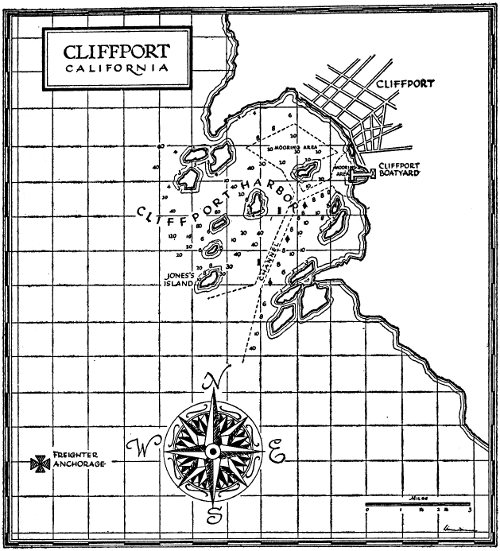
of activity that was the Cliffport Boat Yard. “I’ve
never seen anything like this before!”
From all sides came the sounds of hammering
and sawing, and the thin whine of electric sanders.
The brisk, salty smell of the sea was mingled with
the sharp odors of paint, varnish and turpentine
and the peculiar, half-sweet smell of marine engine
fuel.
Boats of every size and description were ranged
about them. Towering high above them, resting
in specially built cradles, were long hulls with
deep, weighted keels like giant fins under them.
Heavy frames and timbers held these boats upright,
and ladders leaned against them to where
their decks joined their sides, high overhead. Men
scrambled up and down the ladders with tools and
equipment, or sat on the scaffolds and frames,
painting.
22
Smaller craft without keels were braced in
cradles or frames on the ground, or lay bottoms
up on racks made of heavy beams that looked
like railroad ties. Some of the boats were having
their bottoms scraped, some were being sanded,
others were in the process of painting.
At one nearby boat, Sandy saw men hammering
on the bottom of the hull with big wooden
mallets. Jerry explained that these were calking
hammers, and that they were used to drive oakum
into the seams between the planks to make the
boats watertight for sailing. When the boats were
put in the water later on, he added, the planks
would swell and form waterproof joints where the
planks met.
On both sides, lines of railroad tracks led from
the boat yard and the big sheds straight down to
the water’s edge and on into the water. Boats on
wheeled flatcars stood on the rails here and there,
ready to be eased down the tracks into the water
for launching. Jerry explained how, when the flatcars
with their cradles had gone down the slope
and were under water, the boats simply floated
away from them. Then the launching device
would be hauled back up the tracks for use on
another boat.
23
Sandy looked about him in bewilderment at
the variety of boats in the yard. There were small
boats with one mast, larger ones with two, cabin
cruisers with no masts at all, and one sleek, beautiful,
black-hulled boat with three tall masts. He
was just beginning to think that he had found
some relationship between the size of the boat and
the number of masts when he spotted what appeared
to be one of the largest hulls in the boat
yard, with one immense mast. Next to it was a far
smaller boat with two. Sandy thought to himself
that there didn’t appear to be any simple rules to
the business of boat designing. All in all the bustling
Cliffport Boat Yard was a thoroughly confusing
sight for Sandy, and a pretty exciting one,
too.
As a matter of fact, the entire last two days had
been pretty confusing and exciting, Sandy reflected.
Just two days ago, he had started on his
spring vacation from Valley View High School
with not a thing to do but loaf around home. Now,
suddenly, he was the owner of a sailboat he had
never seen, and he was preparing to take a two-hundred-mile
cruise down the coast! A two-hundred-mile
cruise—and he had never even been on
board a sailboat!
24
Looking at the maze of masts and rigging
around him, Sandy sensed for the first time some
of the complications of handling a boat. Laying a
hand on his friend’s shoulder, he said, “Boy, Jerry,
I sure hope you can sail this boat alone! If what
I see around me is a sample, I’m afraid I’m going
to be too confused to do more than just watch you
and maybe ask a few simple-minded questions!”
“Don’t worry about it,” Jerry said with a grin.
“It’s not anywhere near as complicated as it looks
at first sight. I learned to handle a boat fairly well
in just a few summers at the shore, plus some instruction
in the Sea Scouts, and I didn’t even have
my own boat so that I could sail regularly. One
season of working your own boat will probably
turn you into a first-rate skipper!”
Then Jerry frowned for a minute and ran his
hand over his hair. “Speaking of being a skipper,”
he began awkwardly, “you realize, I guess, that I’ll
have to act as skipper of this boat at first? I mean,
I know it’s your boat and all, but....”
Sandy laughed. “You go right ahead and take
charge! I’ll be more than happy to take orders
from you. After all, somebody on board has to be
in charge, and it’s a good idea to have it be someone
who knows what he’s in charge of!”
“Fine,” Jerry said, looking relieved. “If you
just keep up that kind of attitude, you’ll be the
best kind of a crew member that any skipper could
ask for!”
25
Sandy’s Uncle Russ had been waiting by his car
while the boys had been talking and taking in the
sights, sounds and smells of the Cliffport Boat
Yard. Now he moved over to join them. “The
trunk of the car is open,” he said, “and your sea
bags are in there. And that’s as much as I intend
to do about it. I don’t know much about sailors,
but if they’re anything at all like soldiers, they
carry their own packs! Now let’s get going!”
The boys grinned sheepishly and ran to the
back of the car to gather their equipment, and
Russell Steele relaxed and dropped his mock military
manner. An ex-general of the United States
Army, he often kidded Sandy and his friends by
pretending that they were soldiers in his command.
This time, he reflected, it was very nearly
true. In the same way that a general must feel a
responsibility toward the men he sends out on a
mission, Russell Steele felt responsible for Sandy
and Jerry as they were preparing to set out on this
trip.
26
After all, he reminded himself, the trip had
been his idea, and the sailboat had been his present
to Sandy. He had been using the boat during
the last few months while doing some research on
special underwater equipment for the government,
and now he no longer had any need for it. As Vice
President of World Dynamics Corporation, Russell
Steele was in charge of the New Projects Division.
World Dynamics was a sprawling concern
with almost unlimited interests, often in the most
secret kinds of affairs, and his work with it often
called him to different parts of the world. He had
found his stay in Cliffport a pleasant change from
some of the remote and often primitive places he
had been forced to settle in in the past. Now, however,
he was off again, to one more secret destination.
He wouldn’t be in a position to use a sailboat
again for a long time to come.
Sandy’s Uncle Russ had been brought up on the
seacoast of California. While his brother, Sandy’s
father, had become fascinated with the rocks and
geological formations of the nearby mountains and
deserts, he had gone in the other direction to the
shores of the Pacific. During nearly all of his boyhood
he had puttered around boats and boat
yards.
Although Russell Steele had spent most of his
adult life in the Army (and maybe because of it)
he had always had a soft spot in his heart for the
sport of sailing. He had regretted that Sandy, his
only nephew, lived inland in Valley View where
he was unable to share in this enthusiasm. But
Valley View was only a couple of hours from the
seacoast and now that Sandy was old enough to
drive a car, it would be possible for him to own
and enjoy a sailboat.
27
Uncle Russ thought of all this, and then he
wondered whether it had been a good idea to
suggest that the boys bring the sloop all the way
down from Cliffport on their very first sail. Still,
he mused, Jerry seemed like a responsible lad, and
he had said that he knew how to handle a boat well
enough to make such a trip. And Sandy learned
fast and was good with his hands. Well, the General
thought to himself, we’ll just have to give
them their heads and let them try it to see how
they make out....
At that moment in his reflections, the boys
joined him with their luggage, and all three started
through the boat yard to the waterfront. As they
picked their way through the clutter of boats,
scrap lumber, railroad tracks and equipment, they
passed close by the side of a boat standing on the
ways about to be launched. Sandy ran his hand
over the gleaming paintwork of the hull, and
found that it was as smooth as glass. Jerry explained
that great care was given to getting a
smooth paint job, because the greatest force working
against a boat to slow it down is the friction
created by the water passing over the hull. Good
racing boats, he told Sandy, are hauled out of the
water to be cleaned and painted several times in a season.
28
Their walk had by now led them down to the
water’s edge, where they walked along a weathered
wharf. A light, early-morning haze made the colors
of the sailboats that floated in the bay seem soft
and pale. The water and the sky appeared to be
one single surface, with no break or horizon line
to indicate where one stopped and the other
began. The boat-yard flag on its mast atop the
main shed fluttered lazily in a mild breeze, and
a gentle ground swell made soft, lapping sounds
under the wharf.
Strolling along, they came to a long, steeply
sloping gangway that descended to a floating dock,
to which were tied several small sailboats that
rocked quietly on the smooth swell of Cliffport
Bay.
Russell Steele took his pipe out of his mouth
and pointed with it. “See there?” he said. “The
third sloop—the one with the white hull and the
green decks and the varnished mast—that’s your
new sailboat, Sandy, and I hope you enjoy it as
much as I have.”
29
Before he had finished his sentence, Sandy and
Jerry were down the steep gangway, racing along
the floating dock to where the trim, white sloop
was tied. Russ Steele smiled, replaced his pipe in
his mouth, and followed at a pace almost as fast as
the boys’.
“It’s a beauty!” Sandy panted, pushing his hair
back from his eyes. “What slick lines! And look
at how roomy the cabin is! And look at the height
of the mast! And all that rigging!”
His grin faded, and a look of bewilderment
spread across his face. “Boy, I can sure say that
again! Just look at all that rigging! How am I
supposed to know what to do with what and when
to do it, Jerry?”
Jerry laughed, and jumped lightly into the
small cockpit. “Come on board, skipper, and we’ll
start your first sailing lesson by showing you
around and telling you the names of things. It’s
not half as complicated as it looks. In fact, this
sloop rig is just about the simplest there is. As soon
as you learn what to call things, you’ll have the
hardest part of the lesson over with.”
Sandy followed Jerry into the cockpit, then
paused to turn and face his uncle, who was still
standing on the dock. “How about you, Uncle
Russ?” he asked. “Will you stick around for a
little while and take the first sail with us?”
30
“Thanks for asking, Sandy,” Russell Steele
answered, “but much as I’d like to come along
with you, I can’t manage it. I have to be back in
my office this afternoon for an important conference.
In fact, I’ll just about make it if I get
started now. But before I get under way, and
before you get carried away with the fine art of
sailing, there are a few things that you’ll need to
know.”
He talked rapidly and uninterruptedly for
about five minutes and, when he had finished,
Sandy appreciated for the first time how thoroughly
well-organized his Uncle Russ was. His
preparations for the boys’ trip had been complete
in every last detail. Russell Steele’s practiced military
mind had reviewed the situation and had
missed nothing that might be needed.
The sailboat had been fully provisioned for
more than a week of sailing, and had been
equipped for every possible emergency as well as
for a routine and pleasant cruise. The small cabin
contained an alcohol cookstove and a good supply
of canned food. Every locker and storage place was
full, and everything put on board had been chosen
with care and an eye for both comfort and necessity.
31
A complete tool chest was stowed in its cubby
with several boxes of spare hardware, ship fittings,
nuts and bolts, wire and odd tackle. A drawer
under one of the bunks contained a whole assortment
of fishing equipment. Another carried an
odd mixture of things that the boys might want,
even including clothespins for drying garments,
and a sewing kit. A specially made bag contained
another sewing kit, this one for sails and canvas
repair.
In a narrow, hanging locker in the forward part
of the cabin were two complete foul-weather suits
consisting of waterproof pants and jackets with
hoods. Below them were two pairs of sea boots.
Opposite this was the small enclosed “head,”
sailor’s word for bathroom. No bigger than a
telephone booth, it still managed to contain a
toilet and a sink, plus a cabinet for medicines and
first-aid supplies and another for towels, soap,
toothbrushes and the like.
“The only things that you won’t find on board
yet,” Russell Steele concluded, “are your sleeping
bags and your air mattresses. I’ve ordered
special ones that the local store didn’t have in
stock, and they’re not due to arrive until tomorrow.
For tonight, you’ll have to plan on sleeping
ashore, but I’ve taken care of that for you,
too. I’ve got a room reserved for you at the Cliffport
Hotel. After tomorrow, you can sleep on
board, like sailors.”
32
He scowled at his pipe for several seconds, as if
he hoped to see in it some hint of anything that
he might have forgotten to take care of, and he
mentally checked each item again. Sails okay?
Charts and navigating instruments in place? Food?
Tools? Spare lines? Life jackets? Oars for the
dinghy? Cleaning equipment? Sea anchor? Everything
checked out. At last, satisfied that all was in
good order, he smiled and clamped the pipe in
his teeth again.
“I think,” he said, “the only thing I’ve forgotten
is the seagoing way to say goodbye!”
He settled for “Ahoy!” and “Smooth sailing!”
and, brushing off Sandy’s thanks, walked briskly
up the gangway without turning back.
The boys watched him as he turned the corner
of the main shed and walked out of sight, then
they gave all their attention to a close survey of
their new floating home.
33
CHAPTER THREE Shakedown Cruise
“Well, Jerry, what do you think of it?” Sandy
asked his friend, as he cast a proud eye along
the sleekly shaped length of the little sloop.
“Not ‘it,’” Jerry said. “You should say ‘her.’
You always call boats ‘she’ or ‘her,’ though I’ve
never met a sailor who could tell you why.”
Jerry looked critically down the twenty-four-foot
length of the sloop. “She looks really seaworthy,”
he said, “and she looks pretty fast, too.
Of course, this is not a racing boat, you know.
They use this kind mostly for day sailing and for
short cruises. Even so, she looks as if she’ll go. Of
course, we can’t really tell until we’ve tried her,
and I don’t think we’ll be ready to try anything
fast for a little while yet.”
34
Noticing the flicker of disappointment that
crossed Sandy’s face, Jerry added, “I’d rather have
a boat like this than any racing machine ever
built. And I’m not saying that just to make you
feel better about not having a racer. There’s not
much difference in actual speed between a really
fast boat and an ordinary good boat of the same
size. But there sure is a lot of difference in comfort.
And I like my comfort when I go for a cruise.”
“Why should a racing boat be uncomfortable?”
Sandy asked.
“It’s not uncomfortable for racing, or for day
sailing,” Jerry answered, “but a racing boat of this
size wouldn’t be fitted out for cruising at all. You
see, to get the most speed out of a boat, designers
make sure that the hull is kept as light as possible
and as streamlined as possible, too. A light hull
will ride with less of its surface in the water, and
that cuts down on the amount of friction. You
remember what I told you about friction before?”
35
Sandy nodded, and Jerry went on. “Streamlining
the hull shape helps it to cut through the
water without making a lot of waves at the bow
to hold it back. Not only that, but to make the
boat really as fast as possible, most designers want
to streamline the decks, too. That way, even the
air resistance is lowered. Well, when you streamline
the hull, you make less cabin space below.
Then when you streamline the decks, you have to
lower the cabin roof so that it’s level with the
decks. You can see that in a small boat like this,
you wind up with no cabin at all.”
“I see,” Sandy said. “But how does the lightness
of the hull affect comfort? I’m not so sure I understand
that.”
“When you have a light hull,” Jerry replied,
“it’s a good idea to keep it light. If you overload it,
you lose the advantage you built into it in the first
place. That means that you can’t carry all the stuff
we have on board to make for comfortable, safe
cruising. Our bunks, the galley, the head, the
spare anchor, all the tools and supplies—it adds
up to a lot of weight. If you want a really fast boat,
you have to leave all that stuff behind.”
“Then if this were a racing boat,” Sandy said,
“we wouldn’t have anything more than a small
cockpit and a lot of deck, with a little storage
space! No wonder you said you’d rather have a
boat like this! But there’s one thing I’d still like
to know. You said that there wasn’t much difference
in real speed between a racing boat and
an ordinary good boat. How much is ‘not much’?”
36
Jerry thought for a minute. “Well—” he said,
at length—“I’d have to know a lot more about
boat design than I know to give you an accurate
answer, but I can give you a rough idea. This is
a twenty-four-foot boat. If it were a racing hull,
you might get eight and a half or maybe even
nine knots out of it under ideal conditions. For
practical purposes, you can figure eight or less. A
knot, by the way, is a nautical mile, and it’s a little
more than a regular mile. When you say eight
knots, you mean eight nautical miles an hour.”
“But that’s not fast!” Sandy objected. “You said
that’s what a fast racing boat would do!”
Jerry smiled. “Believe me, Sandy,” he said,
“when your boat is heeling way over and your
decks are awash and your sails are straining full
of wind, it seems like an awful lot of speed! You’ll
see when we get out today. Besides, speed is all
relative. A really dangerous speed on a bike would
seem like a slow crawl in a car.”
“I guess you’re right,” Sandy answered. “But
you didn’t tell me how fast this boat will go, compared
to a racer.”
37
“I think we’ll get five or six knots out of her,”
Jerry replied thoughtfully. “That’s not fast, but
it’s only a couple of knots slower than the fastest.
You see now what I mean?”
Sandy nodded, then said, “I’m with you, Jerry.
Now that I know a little bit about it, I sure think
you’re right. I’d much rather have a boat we can
sleep on and take on trips up and down the coast
than a racer that doesn’t even go so fast! Besides,
I’d be pretty foolish to think about any other
kind of boat at all, wouldn’t I? I don’t even have
the least idea of how to sail this one yet! Come on,
Jerry, start showing me!”
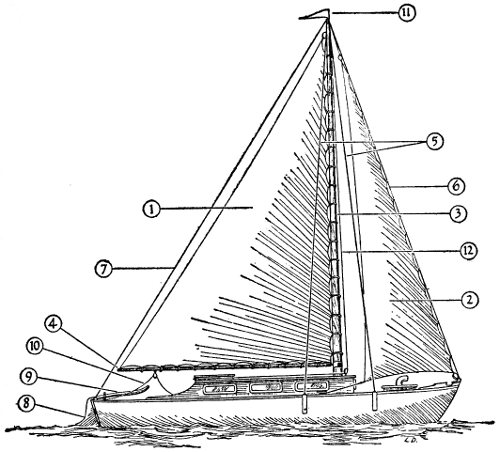
As Jerry carefully explained the different parts
of the rigging, the complicated-looking series of
wires and ropes around the mast began to look a
whole lot simpler to Sandy. The first thing he
learned was that not much of the rigging moved
or was used for actual sailing of the boat. The
parts that didn’t move were called “standing
rigging,” and if you eliminated them from your
thoughts, it made the “running rigging” comparatively
easy to understand.
38
“You have to learn about the rigging first,”
Jerry said. “The idea is simple enough. The
standing rigging is used to support the mast and
keep it from bending to either side or to the front
or back when the sails start to put pressure on it.
The standing rigging is every line or cable you see
that comes from the top of the mast or near it
down to the outer edge of the deck or to the bow
or stern.”
Sandy looked about the little sloop, and noticed
that this seemed to take care of more than half of
what he saw.
“The running rigging,” Jerry went on, “is used
to raise and lower the sails and to control their
position to catch the wind when you’re sailing.
The lines that are used to raise and lower the
sails on the mast are called halyards. They work
just like the ropes on a flagpole. The other kind
of running rigging—the lines used to control the
way the sails set—are called sheets. You’d think
that a sheet was a sail, wouldn’t you? It isn’t,
though. It’s the line that controls a sail.”
“I think I understand so far,” Sandy said, “but
don’t you think it would be easier for me to learn
if we went out for a sail and I could see everything
working?”
“Right,” Jerry said. “That’s just what I was
going to say next. Telling you this way makes me
feel too much like a schoolteacher!”
39
Jerry decided that it would not be a good idea
to try to sail away from the dock, because the
part of the harbor they were in was so crowded.
There would be little room to maneuver with
only the light morning winds to help them. The
best thing to do, he concluded, was to move the
boat to a less crowded part of the harbor. At the
same time, he would teach Sandy the way to get
away from a mooring. In order to do all this,
Jerry explained, they would row out in the dinghy,
towing the sloop behind them. Once out in open
water, they would tie the dinghy behind them and
pull it along as they sailed.
Together they unlashed the dinghy, which was
resting on chocks on the cabin roof. Light and
easy to handle, the dinghy was no trouble at all to
launch, and in a minute it was floating alongside,
looking like a cross between a canoe and a light-weight
bathtub.
Getting into the dinghy carefully, so as not to
upset its delicate balance, they untied the sloop
from the dock. Then they fastened the bow line of
the sloop to a ring on the stern of the dinghy, got
out the stubby oars and started to row.
At first, it took some strong pulling at the oars
to start the sailboat moving away from the dock,
and Sandy feared that they would tip over the frail
cockleshell of the dinghy. But once the sloop
started to move, Sandy found that it took surprisingly
little effort to tow it along. It glided easily
behind them, its tall mast swaying overhead, as
they rowed slowly out into the waters of Cliffport Bay.
40
“We’ll find an empty mooring, and tie up for
a few minutes,” Jerry said. “I don’t think that
anyone will mind. I want to show you the method
we’ll use most of the time for getting under way.”
He pointed to the anchorage area, or “holding
ground,” as it was called, and Sandy noticed
several blocks of painted wood floating about.
They had numbers, and some had small flags on
them. “Those are moorings,” Jerry explained.
“They’re just permanent anchors, with floats to
mark the spot and to hold up the end of the mooring
line. Every boat owner has his own mooring to
come in to. The people who own these empty
moorings are probably out sailing for the day, and
we won’t interfere if we use one for a while.”
Easing back on the oars, they let the sloop lose
momentum and came to a natural stop near one
of the moorings. They transferred the bow line
from the dinghy to the mooring and made the
sloop fast in its temporary berth. Then they
climbed back on board and tied the dinghy behind
them. Jerry explained that a long enough scope
of line should be left for the dinghy so as to keep it
from riding up and overtaking the sloop, as accidents
of this sort have been known to damage
the bow of a fragile dinghy.
41
This done, Jerry busied himself by unlashing
the boom and the rudder to get them ready to use,
while Sandy went below for the sail bags. These
were neatly stacked in a forward locker, each one
marked with the name of the type of sail it
contained. He selected the ones marked “main”
and “jib,” as Jerry had asked him to, and brought
them out into the cockpit.
Making the mainsail ready to hoist, Sandy
quickly got the knack of threading the sail slides
onto the tracks on the mast and the boom. He
worked at this while Jerry made the necessary adjustments
to the halyards and fastened them to the
heads of the sails. When this job was done, Sandy
slid the foot of the sail aft along the boom, and
Jerry made it fast with a block-and-tackle arrangement
which was called the “clew outhaul.”
“Now,” Jerry said, when they had finished, “it’s
time to hoist the mainsail!”
“What about the mooring?” Sandy asked.
“Don’t you want me to untie the boat from it
first?”
“Not yet,” Jerry answered. “We won’t do that
until we’re ready to go.”
42
“But won’t we start going as soon as we pull up
the mainsail?” said Sandy, puzzled.
“No,” Jerry said. “Nothing will happen when
we hoist the sail. It’s like raising a flag. The flag
doesn’t fill with wind and pull at the flagpole
like a sail, does it? It just points into the wind and
flutters. That’s just what the mainsail will do.
You see, the boat is already pointing into the
wind, because the wind has swung us around on
the mooring. You look around and you’ll see that
all the boats out here are heading in the exact
same direction, toward the wind. When we hoist
the sail, it’ll act just like a flag, and flap around
until we’re ready to use it. Then we’ll make it do
what we want it to by using the jib and controlling
its position with the sheets. Look.”
Jerry hauled on the main halyard, and the sail
slid up its tracks on the mast, squeaking and
grating. As it reached the masthead, it fluttered
and bellied loosely in the wind, doing nothing to
make the boat move in any direction. Motioning
to Sandy to take his place tugging at the halyard,
Jerry jumped down into the cockpit.
43
The halyard ran from the pointed head of the
sail up through a pulley at the top of the mast,
then down to where Sandy was hauling on it.
Below his hands, it passed through another pulley
near Sandy’s feet, then back along the cabin roof.
Jerry, from his position in the cockpit, grabbed
the end of the halyard and hauled tight, taking the
strain from Sandy. Then he tied it down to a wing-shaped
cleat on the cabin roof near the cockpit.
This was done with a few expert flips of the
wrist. The mainsail was up, and tightly secured.
“There,” Jerry said. “Now we’re almost ready.
We won’t move at all until we get the jib up, and
even then we won’t move unless we want to.
When we want to, we’ll untie from the mooring
and get away as neat as you please.”
They then took the jib out of its sail bag and
made ready to hoist it. Instead of securing to the
mast with slides on a track the way the mainsail
had, the jib had a series of snaps stitched to its forward
edge. These were snapped around the steel
wire forestay, a part of the standing rigging that
ran from the bow of the boat to a position high
up on the mast. The jib halyard was fastened to
the head of the jib, the snaps were put in place,
and a few seconds of work saw the jib hanging in
place, flapping before the mast. Then Jerry asked
Sandy to pick up the mooring that they had tied
to, and to walk aft with it.
44
“When you walk aft with the mooring,” Jerry
explained, “you actually put some forward motion
on the boat. Then, when you get aft and I tell you
to throw the mooring over, you put the bow a
little off the wind by doing it.”
Sandy untied the bow line from the mooring,
and walked to the stern of the boat, holding the
mooring float as he had been told. Then, when
Jerry said “Now!” he threw the mooring over
with a splash.
“With the jib flying and the boat free from the
mooring and no longer pointing directly into the
wind,” Jerry said, “the wind will catch the jib
and blow our bow even further off. At the same
time, I’ll steer to the side instead of straight ahead.
As soon as our bow is pointing enough away from
the wind, the breeze will strike our sails from one
side, and they’ll start to fill. When the sails have
caught the wind right, I’ll ease off on the rudder,
and we’ll be moving ahead.”
By this time, the morning haze had “burned
off” and the light breeze had freshened into a
crisp, steady wind. As the head of the little sloop
“fell away” from the direction from which the
wind was coming, the sails swelled, the boat
leaned slightly to one side, and a ripple of waves
splashed alongside the hull. Sandy looked back
and saw that the bow of the dinghy, trailing behind
them, was beginning to cut a small white
wave through the water.
45
“We’re under way!” Jerry cried. “Come on over
here, skipper! You take the tiller and learn how
to steer your boat while I handle the sails and
show you what to do!”
Sandy slid over on the stern seat to take Jerry’s
place, and held the tiller in the position he had
been shown, while Jerry explained how to trim
the sails and how to go where you wanted to go
instead of where the wind wanted to take you.
“I’ll take care of the sail trimming,” Jerry said.
“All you have to do is keep the boat heading on
the course she’s sailing now. The wind is pretty
much at our backs and off to the starboard side.
You have to keep it that way, and especially keep
the stern from swinging around to face the wind
directly. It’s not hard to do. Just pick a landmark
and steer toward it.”
He looked ahead to where a point of land jutted
out some miles off the mainland. A lighthouse
tower made an exclamation mark against the sky.
“Just steer a little to the right of that,” he said,
“and we can’t go wrong.”
“What if the wind shifts?” Sandy asked. “How
can we tell?”
46
Jerry pointed to the masthead, where a small
triangular metal flag swung. “Just keep an eye on
that,” he said. “It’s called a hawk, and it’s a sailor’s
weathervane.”
“With one eye on the lighthouse and one eye on
the masthead,” Sandy laughed, “I’m going to look
awfully silly!”
He leaned back in the stern seat with the tiller
tucked under his arm. The little sloop headed
steadily for the lighthouse, steering easily. Every
few seconds, Sandy glanced at the hawk to check
the wind. He grinned and relaxed. He was steering
his own boat! The sail towered tall and white
against the blue sky above him and the water
gurgled alongside and in the wake behind where
the dinghy bobbed along like a faithful puppy.
“This is the life!” he sighed.
Jerry pointed out a handsome, white-hulled,
two-masted boat approaching them. “Isn’t that a
beauty?” he said. “It’s a ketch. On a ketch, the
mainmast is taller than the mizzen. That’s how
you tell the difference.”
“How do you tell the difference between the
mainmast and the mizzen?” Sandy asked. “You’re
going to have to start with the simplest stuff with
me.”
47
“The mainmast is always the one in front, and
the mizzen is always the one aft,” Jerry explained.
“A ketch has a taller main; a schooner has a taller
mizzen; a yawl is the same as a ketch, except that
the mizzen is set aft of the tiller. Got it?”
Sandy shook his head and wondered if he would
ever get all of this straight in his head. It was
enough trying to learn the names of things on his
own boat without worrying about the names of
everything on other boats in the bay.
As the ketch sailed by, the man at her tiller
waved a friendly greeting. The boys waved back
and Sandy watched the big ketch go smoothly
past, wondering how much harder it might be to
sail a two-masted boat of that size than it was to
sail a relatively small sloop such as his own.
Certainly it could not be as simple as the sloop,
he thought. Why this little sailboat was a whole
lot easier than it had seemed to be at first. As a
matter of fact....
“Duck your head!” Jerry yelled.
48
Not even stopping to think, Sandy dropped his
head just in time to avoid being hit by the boom,
which whizzed past barely a few inches above him!
With a sharp crack of ropes and canvas, the sail
filled with wind on the opposite side of the boat
from where it had been a moment before, and
the sloop heeled violently in the same direction.
Jerry grabbed at the tiller, hauled in rapidly on
the mainsheet, and set a new course. Then, calming
down, he explained to Sandy what had
happened.
“We jibed,” he said. “That means that you let
the wind get directly behind us and then on the
wrong side of us. The mainsail got the wind on
the back of it, and the wind took it around to the
other side of the boat. Because the sheets were let
out all the way, there was nothing to restrain the
sail from moving, and by the time it got over,
it was going at a pretty fast clip. You saw the results!”
Jerry adjusted the mainsail to a better position
relative to the wind, trimming it carefully to keep
it from bagging, then he went on to explain. “A
jibe can only happen when you’ve got the wind at
your back. That’s called sailing downwind, or
sailing before the wind, or running free. It’s the
most dangerous point of sail, because of the chance
of jibing. When the wind is strong, an uncontrolled
jibe like the one we just took can split
your sails, or ruin your rigging, or even snap
your boom or your mast. Not to mention giving
you a real bad headache if you’re in the way of
that boom!”
49
“I can just imagine,” Sandy said, thinking of
the force with which the boom had whizzed by.
Then he added, “You said something about an
‘uncontrolled jibe,’ I think. Does that mean that
there’s some way to control it?”
“I should have said an accidental jibe instead of
an uncontrolled one,” Jerry said. “A deliberate
or planned jibe is always controlled, and it’s a
perfectly safe and easy maneuver. All you have to
do is to haul in on the sheet, so that the boom
won’t have any room for free swinging. Then you
change your course to the new tack, let out the
sail, and you’re off with no trouble.”
Sandy grinned. “I’m afraid that description
went over my head as fast as the boom did—only
a whole lot higher up!”
“Things always sound complicated when you
describe them,” Jerry said, “but we’ll do a couple
later, and you’ll see how it works.”
“Fine,” Sandy agreed. “But until we do, how
can I keep from doing any more of the accidental
variety?”
50
“The only way to avoid jibing,” Jerry replied,
“is never to let the wind blow from the same side
that the sail is set on. This means that if you feel
the wind shift over that way, you have to alter
your course quickly to compensate for it. If you
don’t want to alter your course, then you have to
do a deliberate jibe and alter the direction of the
sail. All it means is that you have to keep alert at
the tiller, and keep an eye on the hawk, the way
I told you, so that you always know which direction
the wind is blowing from.”
“I guess I was getting too much confidence a lot
too soon,” Sandy admitted, shamefaced. “There’s
obviously a lot more to this sailing business than
I was beginning to think. Anyway, a jibe is one
thing I won’t let happen again. I’ll stop looking at
other boats for a while, and pay more attention to
this one! There’s more than enough to look at
here, I guess.”
Once more, Sandy cautiously took the tiller
from Jerry. Then he grinned ruefully and said,
“Just do me one favor, will you, Jerry?”
“Sure. What?”
“Just don’t call me ‘skipper’ any more. Not for
a while, at least!”
51
CHAPTER FOUR The Man with the Gun
“Just keep her sailing on this downwind course,”
Jerry said. “Head for that lighthouse the way you
were before, and keep an occasional eye on the
hawk. As long as the wind isn’t dead astern, we
shouldn’t have any more jibing troubles. As soon
as we get out into open water, we’ll find an easier
point of sail. We can’t do that until we’re clear of
the channel, though. When we are, we’ll reach for
a while, and then I’ll show you how to beat.”
“What’s reaching?” Sandy asked. “And what’s
beating? And how do you know when we’re out of
the channel into open water? And how do you
even know for sure that we’re in the channel
now? And how....”
52
“Whoa! Wait a minute! Let’s take one question
at a time. A reach is when you’re sailing with the
wind coming more from the side than from in front
or from behind the boat. Beating is when the wind
is more in front than on the side, and you have to
sail into it. Beating is more like work than fun,
but a reach is the fastest and easiest kind of a
course to sail. That’s why I want to reach as soon
as we’re out in open water where we can pick our
direction without having to worry about channel
markers.”
“How come reaching is the fastest kind of
course to sail?” Sandy asked. “I would have
guessed that sailing downwind with the wind
pushing the boat ahead of it would be the fastest.”
“It sure seems as if it ought to work that way,”
Jerry said with a grin. “But you’ll find that sailboat
logic isn’t always so simple or easy. When
you’re running free in front of the wind, you
can only go as fast as the wind is blowing. When
you’re reaching, you can actually sail a lot faster
than the wind.”
“I’m afraid that I don’t understand that,” Sandy
said. “How does it work?”
53
Jerry paused and thought for a minute. “You
remember what Quiz said about the sailboat
working like an airplane? Well, he made it sound
pretty tough to understand, what with all his
formulas and proportions, but actually he was
right. A sail is a lot like an airplane wing, except
that it’s standing up on end instead of sticking out
to one side. Well, you know that the propellers
on a plane make wind, and that the plane flies
straight into that wind. You see, the wind that
comes across the wing makes a vacuum on top of
the wing surface, and the plane is drawn up into
the vacuum. You get a lot more lift that way than
if the propellers were under the wing and blowing
straight up on the bottom of it.”
“I see that,” Sandy said. “And a propeller blowing
under a wing would be pretty much the same
as a wind blowing at the back of a sail. Right?”
“Right!” Jerry said, looking pleased with his
teaching ability. “Now you have the idea. When
you have a sail, like a wing standing up, the air
that passes over the sail makes a vacuum in front
and pulls the boat forward into it. Actually, the
vacuum pulls us forward and to one side, the same
as the wind from the propeller makes the plane go
forward and up. We use the rudder and the keel
to keep us going more straight than sideways.”
54
Sandy shook his head as if to clear away cobwebs.
“I think that I understand now, but it’s
still a little hazy in my mind. Maybe I’ll do better
if you don’t tell me about the theory, and I just
see the way it works.”
“Could be,” Jerry said. “There are lots of old-time
fishermen and other fine sailors who have
absolutely no idea of how their boats work, and
who wouldn’t know a law of physics or a principle
of aerodynamics if it sat on their mastheads and
yelled at them like a sea gull! They just do what
comes naturally, and they know the way to handle
a boat without worrying about what makes it
run.”
Still heading on their downwind course, they
passed several small islands and rocks, some
marked with lights and towers, some with bells
or floating buoys. They seemed to slide by gracefully
as the little sloop left the mainland farther
behind in its wake.
“Before we get out of the channel,” Jerry said,
“I want to show you some of the channel markers
and tell you about how to read them. They’re the
road signs of the harbors, and if you know what
they mean and what to do about them, you’ll
never get in any trouble when it comes to finding
your way in and out of a port.”
55
He pointed to a nearby marker that was shaped
like a pointed rocket nose cone floating in the
water. It was painted a bright red, and on its side
in white was painted a large number 4.
“That’s called a nun buoy,” Jerry told Sandy.
“Now look over there. Do you see that black buoy
shaped just like an oversized tin can? That’s called
a can buoy. The cans and the nuns mark the
limits of the channel, and they tell you to steer
between them. The rule is, when you’re leaving
a harbor, to keep the red nun buoys on your port
side. That’s the left side. When you’re entering
a harbor, keep the red nun buoys on your starboard
side. The best way to remember it is by the
three R’s of offshore navigating: ‘Red Right Returning.’”
Sandy nodded. “I understand that all right,”
he said. “But what are the numbers for?”
“The numbers are to tell you how far from the
harbor you are,” Jerry said. “Red nun buoys are
always even-numbered, and black cans are always
odd-numbered. They run in regular sequence,
and they start from the farthest buoy out from
the shore. For example, we just sailed past red nun
buoy number 4. That means that the next can we
see will be marked number 3, and it will be
followed by a number 2 nun and a number 1 can.
After we pass the number 1 can, we’ll be completely
out of the channel, and we’ll have open
water to sail in.”
56
“Do they have the same kind of markers everywhere,”
Sandy asked, “or do you have to learn
them specially for each port that you sail in?”
“You’ll find the same marks in almost every
place in the world,” Jerry said. “But you won’t
have to worry about the world for a long while.
The important thing is that the marking and
buoyage system is the same exact standard for
every port in the United States and Canada.”
“What’s that striped can I see floating over
there?” Sandy asked, pointing.
Jerry looked at the buoy. “That’s a special
marker,” he answered. “All of the striped buoys
have some special meaning, and it’s usually
marked on the charts. They’re mostly used to
mark a junction of two channels, or a middle
ground, or an obstruction of some kind. You can
sail to either side of them, but you shouldn’t go
too close. At least that’s the rule for the horizontally
striped ones. The markers with vertical
stripes show the middle of the channel, and you’re
supposed to pass them as close as you can, on
either side.”
57
Another few minutes of sailing brought them
past the last red buoy, and they were clear of the
marked channel. From here on they were free to
sail as they wanted, in any direction they chose to
try.
For the next hour they practiced reaching.
With the wind blowing steadily from the starboard
side, the trim sloop leaned far to the port
until the waves were creaming almost up to the
level of the deck. Jerry explained that this leaning
position, called “heeling,” was the natural and
proper way for a sailboat to sit in the water. The
only way that a boat could sail level, he pointed
out, was before the wind. With the boat heeling
sharply and the sails and the rigging pulled tight
in the brisk breeze, Sandy really began to feel the
sense of speed on the water, and understood what
Jerry had told him about speed being relative.
After they had practiced on a few long reaches,
Jerry showed Sandy how to beat or point, which
is the art of sailing more or less straight into the
wind.
“Of course you can’t ever sail straight into the
wind,” Jerry said. “The best you can do is come
close. If you head right into it, the sails will just
flap around the way that they did when we were
pointing into the wind at the mooring. You’ve got
to sail a little to one side.”
58
“Suppose you don’t want to go to one side?”
Sandy asked. “If the wind is blowing straight from
the place you want to get to, what do you do
about it?”
“You have to compromise,” Jerry replied.
“You’ll never get there by aiming the boat in that
direction. What you have to do is sail for a point
to one side of it for a while, then come about and
sail for a point on the other side of it for a while.
It’s a kind of long zigzag course. You call it tacking.
Each leg of the zigzag is called a tack.”
Sailing into the wind, they tacked first on one
side, then on the other. Each time they came
about onto a new tack, the mainsail was shifted to
the other side of the boat, and the boat heeled in
the same direction as the sail. The jib came
about by itself, just by loosening one sheet and
taking up on the other one. Soon Sandy was used
to the continual shifting and resetting of the sails,
and to the boom passing back and forth overhead.
Suddenly Sandy pointed and clapped Jerry on
the shoulder with excitement. “Look!” he cried.
“There’s a whole fleet of boats coming this way!
They look just like ours! And they’re racing!”
59
Jerry looked up in surprise. “They sure are
racing! And they are just like this one! I guess I
was wrong when I said they didn’t race this kind
of boat. This must be a local class, built to specifications
for local race rules. Boy, look at them go!
I was wrong about not racing them, but I sure was
right when I said that she looked fast!”
The fleet of sloops swept past, heeling sharply
to one side, with the crews perched on the high
sides as live ballast, and the water foaming white
along the low decks which were washed over completely
every moment or so. The helmsmen on the
nearest of the boats grinned at them and waved
an invitation to come along and join the regatta,
but neither Jerry nor Sandy felt quite up to sailing
a race just yet.
As they watched their white-sailed sisters fly
down the bay, Sandy felt for the first time the excitement
that could come from handling a boat
really well. He turned to his own trim craft with
renewed determination to learn everything that
Jerry could teach him, and maybe, in due time,
a whole lot more than that.
The next few hours were spent in happily exploring
Cliffport Bay and trying the sloop on a
variety of tacks and courses to learn what she
would do. Eventually, the sun standing high above
the mast, they realized almost at the same time
that it was definitely time for lunch.
60
Jerry took the helm and the sheet while Sandy
went below to see what the boat’s food locker
could supply. In a few minutes, he poked his head
out of the cabin hatch and shook it sadly at Jerry.
“It looks as if Uncle Russ didn’t think of everything,
after all. There’s plenty of food all right,
but there’s not a thing on board to drink. The
water jugs are here, but they’re bone-dry, and I’m
not exactly up to eating peanut butter sandwiches
without something to wash them down!”
“Me either!” said Jerry, shuddering a little at
the thought. “Of course, we could settle on some
of the juice from the canned fruits I saw in there,
but we haven’t taken on any ice for our ice chest,
and that’s all going to be pretty warm. In any
case, we ought to have some water on board. I
think we’d better look for a likely place near
shore where we can drop anchor. Then we can
take the dinghy in to one of the beach houses and
fill up our jugs.”
“Good idea,” Sandy agreed. “And that way we
can eat while we’re at anchor, and not have to
worry about sailing and eating at the same time.”
61
Several small islands not too far away had
houses on them, and the boys decided to set a
course for the nearest one. As they drew near,
they saw a sunny white house sitting on the crest
of a small rise about a hundred yards back from
the water. Below the house, a well-protected and
pleasant-looking cove offered a good place for an
anchorage. A floating dock was secured to a high
stone pier, from which a path could be seen leading
up to the house. It looked like an almost perfect
summer place, set in broad green lawns, with
several old shade trees near the house and with a
general atmosphere of well-being radiating from
everything.
They glided straight into the little cove, then
suddenly put the rudder over hard and brought
the sloop sharply up into the wind. The sails
flapped loosely, and the boat lost some of its headway,
then glided slowly to a stop.
On the bow, Sandy stood ready with the anchor,
waiting for Jerry to tell him when to lower it. As
the boat began to move a little astern, backing in
the headwind, Jerry told Sandy to let the anchor
down slowly.
“You never drop an anchor, or throw it over the
side. After all, you want the anchor to tip over,
and to drive a hook into the bottom. It won’t do
that if it’s just dropped.”
62
When Sandy felt the anchor touch the bottom,
he pulled back gently on the anchor line until he
felt the hook take hold. Then, leading the line
through the fair lead at the bow, he tied it securely
to a cleat on the deck.
Loosening the halyards, they dropped first the
jib and then the mainsail, rolled them neatly, and
secured them with strips of sailcloth, called stops.
Jerry pointed out that it was not necessary to
remove the slides and snaps. That way, he explained,
it would only be a matter of minutes to
get under way when they wanted to. With the last
stop tied and the boom and the rudder lashed to
keep them from swinging, the sloop was all shipshape
at anchor, rocking gently on the swell about
fifty yards from the end of the floating dock.
“Let’s row the dinghy in to the dock and see if
we can find somebody on shore,” Jerry suggested.
“Of course, with no boats in here, there might not
be anyone on the island right now, but I think
that I saw a well up by the house, and I’m sure
that no one would mind if we helped ourselves to
a little water.”
63
But Jerry was wrong on both counts. There
was somebody on the island, and he looked far
from hospitable. In fact, the tall man who came
striding down the path to the float where the
boys already had the dinghy headed was carrying a
rifle—and, what was more, he looked perfectly
ready to use it at any minute!
“Turn back!” he shouted, as he reached the
edge of the stone pier. “Turn back, I tell you,
or I’ll shoot that dinghy full of holes and sink it
right out from under you!” He raised the rifle
deliberately to his shoulder and sighted down its
length at the boys.
“Wait a minute!” Sandy shouted back. “You’re
making a mistake! We just need to get some water
to drink! We don’t mean any harm!”
The man lowered his rifle, but looked no
friendlier than before. “I don’t care what you
want,” he called, “but you can just sail off and get
it some other place! This is my island and my
cove. They’re both private property, and you’re
trespassing here! Now turn that dinghy around
and get back to your sailboat and go!”
This speech finished, he raised his rifle to the
firing position once more and aimed it at the
dinghy.
64
“All right, mister!” Jerry yelled back at him.
“We’ll get going! But when we get back to the
mainland, you can bet that we’re going to report
you to the Coast Guard for your failure to give
assistance! I’m not sure what they can do about it,
but they sure ought to know that there’s a character
like you around here! Maybe they’ll mark it
on the charts, so that sailors in trouble won’t waste
their time coming in here for help!”
As the boys started to turn the dinghy about,
they heard a shout from the man on the pier.
“Wait a minute!” he called. “There’s no need to
get so upset. I’m sorry—but I guess I made a mistake
after all. Row on in to the float and I’ll get
you some water.”
Not at all sure that they were doing the wisest
thing, but not wanting to anger the strange rifleman
by not doing what he had suggested, they
decided to risk coming to shore. After all, Sandy
reasoned, he hadn’t actually threatened to shoot
them—just the dinghy—and he couldn’t do much
more harm from close up than from where they
were. Besides, both boys were curious about the
man and his island. They rowed to the floating
dock and made the dinghy fast to a cleat.
65
“I’m sorry, boys,” the man with the rifle said
pleasantly. “It’s just that I’ve been bothered in
the past by kids landing here for picnics and
swimming parties when I’m not here. They leave
the beach a mess, and one gang actually broke
into the house once, and stole some things. That’s
why I don’t like kids coming around. I thought
you were more of the same, but I figured you were
all right when you said that you’d report to the
Coast Guard. Those other kids stay as far away
from the Coast Guard and the Harbor Police as
they can.”
He smiled apologetically, but as Sandy started
to climb up from the dinghy to the floating dock,
his expression hardened once more.
“I said that I’d get you some water,” he said,
“but I didn’t invite you to come ashore and help
yourselves to it. You just stay right where you are
in that dinghy, and hand me up your water jars.
I’ll fill them up for you, and I’ll be back in a few
minutes.”
More than a little puzzled, Jerry and Sandy
handed up their two soft plastic gallon jugs. Their
“host” took them under one arm, leaving the
other hand free for his rifle which he carried with
a finger lying alongside of the trigger. Without a
word, the island’s owner walked off.
“I wonder what’s the matter with him,” Jerry
said.
“I don’t know,” Sandy replied, “but whatever
it is, we’d better do what he says, or something
pretty bad might be the matter with us!”
Halfway up the path to the house, the tall
man stopped, turned back, and looked hard at
the boys before continuing on up the hill.
66
“Mind you do just what I said!” he shouted
back over his shoulder. “You just stay in that
dinghy, and don’t get any fancy ideas about exploring
around. If I find you ashore, I’m still as
ready as ever to use this gun!”
67
CHAPTER FIVE Storm Fears
Unpredictable as the wind, the man was all
smiles when he returned with the two jars filled
with water. But he still had his gun.
“I’m glad to see you stayed put in your dinghy,”
he said. “I kept an eye on you from the hill.” He
handed down the plastic jugs to Sandy and added,
“Sorry I acted so gruff, but you know how it is.
I live all alone out here, and even though the
island is only a little over a half mile from the
mainland it’s a pretty isolated spot. I have to be
careful of strangers. But I should have seen right
away that you boys are all right.”
“Thanks,” said Sandy. “And thanks for filling
our water jugs. We’re sorry we bothered you.”
68
They cast the dinghy free, rowed quickly back
to the sloop and, as fast as they could manage it,
raised the anchor, hoisted the sails and skimmed
out of the cove. As they rounded the rocky point
that marked the entrance to the cove, they looked
back to where the island’s lone inhabitant was
standing on the dock, watching them out of sight,
his rifle still held ready at his hip.
“Boy, that’s a strange one!” Sandy said. “I
wonder what he’s hiding on that island of his—a
diamond mine?”
“You never can tell,” Jerry replied, “but it’s
probably nothing at all. I guess the kind of man
who would want to live all alone on an island
away from people is bound to be pretty crazy about
getting all the privacy he can. And as far as I’m
concerned, he can have it. From now on, if we
need anything, let’s head for the mainland!”
Dismissing the mysterious rifleman from their
minds, they set out once more to enjoy the pleasures
of a brisk wind, blue sky and a trim boat.
69
The afternoon went swiftly by as Sandy learned
more and more about handling his boat, and about
the boats they saw sailing near them. Jerry pointed
out the different types of boats, explaining more
fully than before that the ones with one mast were
called sloops, the two-masted boats were called
yawls, ketches and schooners. Telling one from the
other was a matter of knowing the arrangement
of masts. The ketches had tall mainmasts and
shorter mizzens behind them. The yawls had even
shorter mizzens, set as far aft as possible. Schooners,
with taller mizzen than main, were relatively rare.
Jerry also pointed to varied types of one-masted
boats. Not all of them, he told Sandy, were
sloops, though most were. The sloops had their
mast stepped about one third back from the bow.
Cutters had their mast stepped nearly in the center
of the boat. In addition, they saw a few catboats,
with their single masts stepped nearly in the bows.
Learning all this, plus trying to absorb all
that Jerry was telling him about harbor markers,
sail handling, steering, types of sails and conditions
under which each sail is used, Sandy found
the time flying by. Almost before he realized it,
the sun was beginning to set and the boats around
them were all heading back up the channel to
find their moorings and tie up for the night.
70
Everywhere they looked, the roadstead of Cliffport
Bay was as busy as a highway. Sailboats of
every description, outboard motorboats, big cabin
cruisers, high-powered motor racers, rowboats,
canoes, sailing canoes, kayaks, power runabouts,
fishing excursion boats and dozens of other craft
were making their way to shore.
The afternoon, which had started so brightly,
had become overcast, and the sun glowed sullenly
behind a low bank of clouds. The breeze which
had been steady but light during the late afternoon
hours, suddenly picked up force and became
a fairly hard wind. It felt cold and damp after the
hot day. Joining the homebound pleasure fleet,
Sandy and Jerry picked their way through the now
crowded harbor, back to Cliffport Boat Yard.
They arrived in a murky twilight, just a few
minutes before the time when it would have become
necessary for them to light the lanterns for
the red and green running lights demanded by
the International Rules of the Road.
The boys decided to drop anchor in the boat
yard’s mooring area, rather than tow the boat back
to the float where it had been tied. This would
make it unnecessary to tow the sloop out again
for the next day’s sailing, when they would start
on the long trip home.
71
They dropped the sails, removed their slides
and snaps on mast, boom and forestay, and carefully
folded them for replacement in the sail bags.
These were stowed below in their locker just
forward of the cabin. Then Sandy and Jerry
turned their attention to getting the boat ready
for the night.
Sandy helped Jerry rest the boom in its
“crutch,” a piece of wood shaped like the letter
Y, which was placed standing upright in a slot
in the stern seat. This kept the boom from swinging
loose when the boat was unattended, and thus
protected both the boat, the boom and the rigging
from damage. All the running gear was then
lashed down or coiled and put away, the sliding
cabin door and hatch cover were closed in place,
and the sloop was ready to be left.
“That’s what’s meant by ‘shipshape,’” Jerry
said with satisfaction.
As the boys rowed the dinghy back to the float,
they felt the first fat drops of rain and they
noticed how choppy the still waters of the bay
had become. Jerry cast a sailor’s eye at the ominously
darkening sky.
“That’s more than evening coming on,” he
said. “Unless I miss my guess, we’re in for a good
storm tonight. To tell you the truth, I’m glad
we’re staying ashore!”
72
They lifted the dinghy from the water, turned
it over on the float and placed the stubby oars
below it. Then, picking up their sea bags, they
ran for the shelter of the shed as the first torrential
downpour of the storm washed Cliffport in a solid
sheet of blinding rain.
Later that night, after a change of clothes,
dinner, and a movie at Cliffport’s only theater,
the boys sat on their beds in the hotel room and
listened to the howling fury of the storm. Raindrops
rattled on the windowpanes like hailstones,
and through the tossing branches of a tree they
could see the riding lights of a few boats in the
harbor, rocking violently to and fro. As they
watched, the wind sent a large barrel bowling
down the street to smash against a light pole,
bounce off and roll, erratic as a kicked football,
out of sight around a corner.
“It’s a good thing we anchored out,” Jerry said,
watching this evidence of the storm’s power. “The
boat could really have gotten banged up against
the float if we had tied it up where it was before!”
“Do you think it’ll be safe where it is now?”
Sandy asked anxiously.
“Oh, a little wind and water won’t bother a
good boat,” Jerry answered. “After all, it was
made for wind and water! Still....” He scowled
and shook his head doubtfully.
73
“Still what?” Sandy said with alarm. “Is there
something wrong with the way we left it?”
“Not really,” Jerry said. “I’m just worried
about one thing. We’re not tied to a permanent
mooring, the way the other boats around here
are. That means that we might drag anchor in a
storm as bad as this one, and if we happen to drag
into deep water where the anchor can’t reach the
bottom, the boat could drift a long ways off until
it hooked onto something again. And there’s always
the chance that it could get washed up on the
rocks somewhere, first!”
With this unhappy thought in mind, the boys
stared out the window for some time in silence
as the storm continued unchecked. Finally, knowing
that worry couldn’t possibly help, and that a
good night’s sleep would prepare them to meet
whatever the morning would bring, they turned
out the lights and went to bed.
But, for Sandy, bed was one thing—sleep was
another. Although Jerry managed to drop off to
slumber in no time, Sandy lay a long time awake
staring at the shadows of the tossing tree on the
ceiling of the hotel room.
74
His mind was full of the events of the crowded
day. It had been quite a day, starting with the
ride in his uncle’s sports car, and proceeding to
the new boat and learning to sail. Then the mysterious
man on the island, keeping guard with his
ever-present rifle, and concluding with a night
of powerful storm. He reviewed all this, and mixed
with his recollection his new worries about the
safety of his boat. A series of images crowded his
mind—a vision of the smart sloop lying smashed
against some rocky piece of shore was mingled
with a memory of the pleasures of his first day of
sailing; and somewhere, behind and around all of
his thoughts, was the unpleasantly frightening
memory of the man with the gun, waiting on his
hermit’s island.
All of this mingled in his mind with the sound
of the storm until Sandy slipped into an uncertain,
restless sleep—a sleep filled with vague, shadowy
dreams, connected only by a sense that somewhere,
something was wrong.
75
CHAPTER SIX Something Lost—Something Found!
The next morning, when Sandy and Jerry awoke,
the storm that had lashed Cliffport had vanished
as if it, too, had been a bad dream.
Cliffport’s Main Street, which fronted the bay,
was washed clean, and sparkled in the bright
morning light. The bay waters themselves even
looked cleaner than before, freshly laundered
blue and white, with silver points of sunlight
sprinkled over their peaceful surface. It was, in
short, a perfect sailing day, and the boys could
hardly wait to get down to the boat yard to see if
the sloop had ridden the storm at anchor.
76
They dressed hurriedly in their sailing clothes—blue
jeans, sneakers and sweat shirts—and bolted
breakfast in the hotel coffee shop. Then, sea bags
slung over their shoulders, they raced down the
street to the Cliffport Boat Yard, rounded the
corner of the main shed and, at the head of the
gangway, came to a stop.
Sandy felt a sick, sinking feeling as he scanned
the mooring area, searching vainly for a sight of
his sloop. But where she had ridden at anchor the
night before, there was only a patch of calm blue
water.
It hardly seemed possible that she wasn’t there.
The storm, on this bright, sunny morning, seemed
never to have happened. Other boats rode peacefully
at their moorings, apparently untouched by
the night’s wild work. Life in the boat yard and
on the bay went on as if nothing had occurred. But
Sandy felt as if it were the end of the world.
Slowly and silently, the boys walked down the
gangway to where their dinghy lay like a turtle,
unharmed. They anxiously scanned the bay on
all sides, searching for a mast that might be theirs,
but to no avail. Then Jerry straightened up and
clapped Sandy on the shoulder.
“Come on,” he said. “There’s no use standing
here moping. The only thing to do now is to take
out the dinghy and start to hunt.”
77
They launched the dinghy, put out the stubby
oars, and rowed away from the float.
“Where do we look first?” Sandy asked.
“We’ll just go the way the wind went,” Jerry
said. “Luckily, the storm came from the mainland
and blew out to sea. That means there’s a
good chance that the boat didn’t pile up on the
shore. Of course, there are a lot of islands out
there, and plenty of rocks, but there’s a lot more
open water. With any luck we’ll find her floating
safe and sound, somewhere out in the bay. I don’t
think she could have gone too far dragging that
anchor.”
They headed down the channel, taking occasional
side excursions around some of the small
islands whenever they saw, on the other side, a
mast that could be theirs. But none of the boats
they found was the right one. The hot sun made
rowing even the light cockleshell of the dinghy
unpleasant work. Sandy paused at the oars and
pushed back his cowlick, then wiped his perspiring
brow. He was beginning to fear that he would
never again see his trim new sloop—unless he was
to see it lying shattered on one of these rocky
islands. Then, with dogged determination, he
picked up his oars once more and bent his back
to the task of rowing.
78
Once or twice they asked passing sailors if they
had seen an unattended sloop out of the mooring
areas, but though everyone offered sympathy and
promised to help if they happened to see it, none
had any information to offer.
The morning wore on slowly as Sandy and Jerry
pulled farther and farther away from the mainland,
exploring every possible hiding place the
bay had to offer.
By noon, Sandy’s spirits were at low ebb, and he
was beginning to wonder how he would tell his
Uncle Russ the bad news. Then, almost tipping
the unsteady dinghy, Jerry half rose from his seat
and pointed. “Look!” he shouted. “Over there! I
think that’s her! And will you look at where she
drifted to!”
Sandy dropped the oars and turned to look at
the small white sloop with the green decks that
lay quietly bobbing at anchor just outside the
entrance of the cove where, yesterday, they had
been welcomed by a gun!
“Of all places to drift to,” he gasped. “It’s a
darn good thing she didn’t drift inside his cove,
or she might be shot full of holes by now!”
79
Then, with a lighter heart than he had felt all
morning, Sandy picked up the oars and sent the
dinghy fairly flying to the side of the trim sloop.
“From now on,” he said, “sleeping bags and air
mattresses or not, we’re sleeping on board until
we get a permanent mooring for this boat near
home!” Relieved and happy, Sandy climbed on
board as Jerry tied the dinghy to the stern.
“I’ll go below to get the sails out,” Sandy said,
“while you unship the boom and get the rigging
ready.”
He opened the hatch cover and slid back the
doors, then stepped down into the little cabin.
As he started forward to the sail lockers, he had a
sudden, odd feeling that something was wrong,
something out of place; a strange notion that he
had seen, out of the corner of his eye, something
that was not what it should have been.
Pausing to look around, he saw what had
bothered him. Clamped to the bulkhead over the
port bunk was a large, oddly shaped brass pistol,
like the kind he had always imagined the old-time
pirates carried. He had never seen anything like
it before—and he was almost positive that it had
not been there yesterday!
80
“Jerry!” he called, sticking his head out of the
hatch. “Come here! I want you to see something
and tell me what you think.” As Jerry poked his
head into the cabin, Sandy gestured at the brass
pistol. “Was that thing here yesterday, or have
we gotten into somebody else’s boat?”
Jerry brought his dark brows together in a
frown and scratched his crew-cut head. “I don’t
think it was here. I probably would have noticed
it. But maybe we just didn’t see it. We were so
busy with other things.”
“But why would Uncle Russ have left a pistol
on board?” Sandy asked, puzzled.
“He probably wouldn’t have,” Jerry said. “But
he might have left one of these. That’s a flare gun,
not a regular pistol at all. You use it as a signal
of distress. It shoots a rocket. Still ... I don’t
remember seeing it. And I know that your uncle
didn’t mention leaving one.”
“Well, I don’t know whether he did or not,”
Sandy said, “but we’d better make sure this is
our boat before we go sailing it off. If it belongs to
that guy on the island, we could get into some
pretty bad trouble if we took it by mistake!”
As they looked for some identifying marks, an
idea suddenly occurred to Sandy. “Maybe this isn’t
our boat, but one just like it, and maybe the man
with the gun was expecting it with somebody else
on board! That might explain his actions!”
81
“That makes sense,” Jerry said. “And in that
case, we’d better find out fast if it’s ours. Look—our
boat didn’t have any name on it, and most
boats do. If this has a name, we’ll know.” He
hurried to the stern to see, and then to the bow,
where some boat owners fasten name plates, but
none was to be seen.
“That doesn’t prove anything, though,” Sandy
said. “But I have an idea. Let’s look in the food
locker. I remember pretty well what was in there
yesterday, and I doubt if two boats would have
the identical food supplies. One look should tell
us.” He reached above the galley stove and slid
back the doors of the locker, then stepped backward
as if he had been hit.
“It’s sure not our boat,” Sandy said in hushed
tones, for in the locker there was no food at all.
Instead, where food should have been, was what
appeared to be a fortune in fresh, green money!
82
CHAPTER SEVEN A Million Dollars’ Worth of Trouble
Sandy and Jerry, stunned for the moment, stood
in silence, gazing at the neatly wrapped stacks of
tens, twenties, fifties, hundreds and five-hundred-dollar
bills—more money than either of them
had ever dreamed of!
“I don’t know whose boat this is,” Sandy said,
“but whoever he is, he can sure afford a larger
one!”
Awed by the sight of the money, Jerry reached
out and slipped a five-hundred-dollar bill from its
wrapper. “I just want to look at it for a minute,”
he said. “I’ve never seen a five-hundred before!”
83
Sandy joined him to look at the crisp bill.
“Neither have I,” he said. Then, stooping to look
closer, he took the bill from Jerry’s hand and
examined it with the most intense interest.
“Jerry!” he said, almost in a whisper. “I think
we’ve found more than a stack of money in a
peculiar place! I may be mistaken, but I think this
thing is counterfeit!”
“Counterfeit!” Jerry said, with a gasp. “How
can you tell, if you never saw a five-hundred-dollar
bill before?”
“Come on over into the sunlight where we can
see better,” Sandy replied, “and I’ll show you what
I mean.” They moved to the rear of the little
cabin, where the sun poured in through the open
hatchway cover. Sandy held the money up to the
light.
“Look at the corners,” he said, pointing to the
lower right-hand corner of the bill. “You see all
those fine hair lines that make the looping, criss-cross
pattern you see on all paper money? Well, I
read once that those loops and swirls are the hardest
part of a bill to counterfeit, and if you’re on
the lookout for phony money you should always
look there first. Ones or one-thousands, they’re all
very complicated to engrave. On a genuine bill the
lines are sharp and clear. On a counterfeit, they’re
usually a little fuzzy, especially where two lines
cross. Look over here, right next to the five-hundred-dollar
mark, for instance.”
84
He pointed to where a complicated series of
fine lines that came together had made a small
smear, instead of a sharp, well-defined pattern.
“You’d never find sloppy work like that on a
genuine government bill,” Sandy said, pointing
to this and to another telltale spot his sharp eyes
had uncovered.
“I see what you mean,” Jerry said. “Boy, there
must be more than a million dollars’ worth of this
useless stuff in that food locker!”
“It’s not so useless to someone,” Sandy returned.
“Whoever made this stuff and is responsible for it
is sure making real money out of it in the end—and
an awful lot of real money, too!”
Jerry nodded thoughtfully, then said, “Where
do you suppose it’s coming from?”
“That shouldn’t be too hard to figure out,”
Sandy answered. “That man on the island was
pretty nervous about having any unexpected
guests, I’d say. I’ll bet you this whole stack of
money that he’s behind the whole thing, and that
this is his boat that we’re on!”
85
“You must be right,” Jerry said. “From the way
that he came racing down that path with his gun
yesterday, he must have been watching us all
along, yet he didn’t come to stop us until we had
dropped our anchor, lowered our sails, and were
halfway in to shore in the dinghy! We should have
realized when he didn’t stop us sooner what that
meant. It meant that something funny was going
on here!”
“That’s right!” Sandy agreed. “He must have
been expecting somebody else to come along in
this boat—the same class and colors as ours—and
he thought that we were whoever he was expecting—until
he saw us in the dinghy! That’s why he
was acting so confused and excited that he didn’t
know whether to shoot at us, or to be nice and let
us get our water and be on our way. We really
caught him off guard!”
“Right,” Jerry said. “And now we’ve confused
the boats the same way he did, and we’ve caught
him off guard again!”
Sandy sat looking silently at the counterfeit five-hundred-dollar
bill, frowning. Then he looked up
at his friend and said, “The question now is, what
are we going to do about it? We’re pretty lucky
that we weren’t seen coming on board this boat,
but do you think our luck is going to last? I’m
worried that we won’t be able to get away from
here again without being seen.”
86
“We haven’t got much choice in the matter,
have we?” Jerry answered. “The longer we stay
here, the worse our chances will be. There’s no
telling when the man with the gun or somebody
else will come out here to do something with this
money, and if they find us here....”
“I’d sure hate to cross that fellow,” Sandy
agreed. “I don’t like the way he handles that rifle
of his. He looks too darn ready to use it!”
Stuffing the counterfeit five-hundred-dollar bill
into his pocket, Sandy stood up. “We’d better get
going now, while we still have a chance,” he said.
“The only thing to do now is to get this bill to
the police as evidence of what we’ve found, and
to put them on to this island.”
Sandy started up from the cabin but, as his head
emerged from the hatchway, he stopped dead in
his tracks, for floating in a dinghy just a few feet
away was the mysterious owner of the island accompanied
by two tough-looking sailors! Sandy
looked in dismay from their three faces to the
muzzles of three guns pointed directly at him!
It was not a pleasant smile that the man from
the island gave him as he said, “Well! This is quite
a surprise for all of us, isn’t it? Are you still looking
for water? Or do you have a better story to
entertain me with today?”
87
CHAPTER EIGHT Double Blackout
Sandy tried his hardest to look unknowing and
innocent, and at the same time shocked and outraged.
With the three guns aimed at him, it was
not an easy job.
“What’s the idea?” he exclaimed. “I’ve never
seen anybody so ready with a gun as you are! We
were only looking for our boat. You know it looks
the same as yours. We thought for a while that
this was it, but....”
88
“But you found out, after some thorough
snooping, that it wasn’t, didn’t you?” the man
sneered. “Of course you did. It’s my boat, all right!
And you’re trespassing on it! And this is my island
too, and you were trespassing there yesterday!
And if I were to shoot you, I would be perfectly
within my rights as a landowner!”
Sandy tried with difficulty to smile reassuringly.
“Take it easy, mister,” he said. “Honestly, we
were just looking for our boat. It dragged anchor
in the storm last night, and when we saw yours
we made a natural mistake and thought it was
ours. Okay, it isn’t. We made a mistake, that’s all.
Now if you’ll just let us apologize, we’ll get off
your private property and go looking again.”
But the man didn’t show the slightest intention
of even moving his rifle from the ready, much
less of letting the boys go.
“Of course you’ll go looking again,” he said.
“Looking for what you were looking for yesterday
and today. Oh, no! I hardly think I can let you
go!” Then he smiled his peculiar smile again.
“What’s more,” he added, “even if I were to let
you go, I would first have to ask you to return the
money you stole—the money I see sticking out
of your pocket!”
Sandy’s heart sank. There was nothing he could
think of to say now, and he could see no way out
of the situation. He sank wearily to a seat in the
cockpit and sighed.
89
“I guess we can both stop play-acting about this
trespassing thing,” he said. He pulled the telltale
bill out of his pocket and threw it on the deck.
“This is what you’ve been so upset about all along,
isn’t it?”
“You’re a very bright boy,” the man with the
gun said. “Far too bright, I’m afraid. You have
this whole thing figured out already, haven’t you?”
“Most of it,” Sandy admitted. “At least the parts
that count. You’re using this island to make
counterfeit money, and you’re using this sailboat
to take it somewhere. That’s about all I know,
but it’s enough to get you in trouble, isn’t it,
Mr.—?”
“Jones is the name,” the man said. “Yes, I
would say it was quite enough. The only mistake
you’ve made is your conclusion. What you know is
enough to get you in trouble—not me. In fact, I
should hate to be in as much trouble as you two
boys are in right now!” Jones put down his rifle
for a moment and said, “Do you mind if I come
on board my boat so that we can discuss your
difficulties in more comfort?”
Jones stepped out of the dinghy to the deck of
the little sloop and settled himself comfortably in
the stern seat while his two silent crewmen kept
Sandy covered. When he was set, with his ever-present
rifle held at ready across his knees, he was
followed on board by the larger and meaner looking
of the two sailors, who stationed himself beside Jones.
90
“Oh, yes,” Jones repeated, “I should say that
what you know is quite enough! And, since you
already have too much information to ever let
you leave here with, I’ll be happy to satisfy your
immense curiosity by giving you a little more. But
why not have your friend join us on deck?”
When Jerry had come up from the cabin and
was sitting beside Sandy, Jones cleared his throat,
as if he were about to give a formal speech.
“As far as you went in your thinking, you are
most certainly right,” he said. “I use this boat to
transport counterfeit money which I make on my
island. I take it to a waiting freighter that meets
me five miles off shore—well beyond the legal
jurisdiction of the United States government, in
international waters. The freighter takes my pretty
counterfeit money and disposes of it in foreign
markets, where I get a good price for it, and where
not every bright and nosy boy is out to make a
nuisance of himself.”
Then, once again, Jones smiled his peculiar and
unpleasant smile. “I find the foreign markets most
useful for disposing of items which are too difficult
to get rid of here. I expect that you will not
be much harder to dispose of than this money,
when you are beyond the limits of U.S. waters!”
91
Sandy looked at Jerry in silence, desperately
hoping his friend would come up with some flash
of inspiration—some idea—which would help
them to get out of this situation. But Jerry was no
help. For that matter, Sandy reflected, he was not
much help himself. But as long as he kept “Jones”
talking, he’d get some more information and
meanwhile, perhaps, he or Jerry might think of
something.
“There’s only one thing that has me puzzled
in all this,” Sandy said therefore. “Why did you
leave this boat full of money floating around outside
of the cove?”
Jones laughed. “There you have the full essence
of our little comedy of errors,” he said. “Last
night’s storm probably tore more than one
hundred boats loose from their anchorages and
moorings. Yours, I assure you, wasn’t the only one
that drifted a good distance, and neither was
mine!”
“Yours?” Jerry gasped. “You mean that our
boat did drift over this way? And that you—?”
92
“I think you understand,” Jones replied. “But
it wasn’t I. It was these stupid fools who work
for me. They had loaded the money on board the
boat last night before the storm. Then, when it
blew up, we knew that it was impossible to sail
to the freighter until the storm had passed. They
failed to take the money out of the boat for the
night, trusting to luck that nothing would go
wrong. But something did go wrong! My boat
broke loose and floated out around the point to
where it is now. Your boat drifted up to the
entrance of my cove. When they came out this
morning, my assistants saw your boat, and did not
see mine.”
Jones laughed a short, sharp laugh. “They
actually sailed your sloop five miles out to the
freighter! Of course they discovered their mistake
when they opened the money locker and found it
full of canned food!”
He looked at the sailors with disgust, then continued.
“When they realized their error, they
promptly sailed back here, but by that time you
had found my boat and assumed it to be yours.
When they told me their story, I guessed at once
what had happened and went to correct the mistake
before you found out about our little business.
If you had only come a half hour later, you
would have found your own boat and sailed it off
in perfect safety. Unfortunately for you, you were
just a little too soon.”
93
“As long as you’re telling us the whole story,”
Jerry said, “will you answer a question for me?
I don’t understand why you bother with sailboats,
when a power boat could do the job so much
faster.”
“That’s a fair question,” Jones said. “You are
smart boys, aren’t you? Well, I pride myself on
using my brains, too. I use this innocent-looking
sloop for several reasons, one of which caused this
whole ridiculous mix-up. For one thing, an individual
member of a popular class of sailboat is
very hard for the casual observer to identify. This
we have both seen to be true. For another thing,
everyone thinks of a sailboat as being merely a
pleasure craft, and would never suspect it of anything
illegal. It can go in and out of the harbor
on a regular schedule and nobody will notice
it or even realize it’s the same boat they are
seeing. Third, all power boats have to be registered
and licensed by the Coast Guard, while a
sailboat is so anonymous that it doesn’t even have
to have a name. Fourth, it gives me a reason to
live on this island. To the people who stop to
think of me, if they think of me at all, I am a retired
gentleman whose principal hobby is sailing,
and who lives on an island in order to get the most
enjoyment out of the sport.”
94
Again Jones smiled, and Sandy shivered. “It’s
quite a neat setup, don’t you agree?” Jones said.
“And, with the same neatness that is a part of my
way of life, I am now going to put an end to this
whole unpleasant interruption.”
Suddenly dropping his lazy conversational
manner, Jones sat upright and pointed his rifle at
Sandy. Not moving his eyes from the boys, he
spoke to the sailor who was still standing silent by
his side. “We’ll have to take them out to the
freighter now. There’s nothing else to do. I’ll
decide what to do with them later on. You and
Turk sail this boat and I’ll follow in theirs. Lock
them below,” he added, nodding toward Sandy
and Jerry.
For the first time since they had seen him, the
sailor spoke. “Okay,” he said. “We won’t mess it
up this time.” Then, this being apparently the
longest speech of which he was capable, he shut his
mouth into a thin, hard line, and moved heavily
to the boys.
95
Using his pistol as a goad, he poked Sandy in
the ribs and motioned him to go below. As Sandy
started to take his first step down into the cabin,
the sailor shoved him roughly and sent him
sprawling onto the deck below. His head spinning,
Sandy looked up to see the giant sailor towering
above him. He was conscious of an odd noise, like
a strangled, slow sobbing, far away. What was it?
He had never heard such an ugly sound in his
life....
Then, as his head cleared, he realized what it
was that he was hearing. The sailor was laughing!
Afterward, Sandy was unable to explain why
the strange laughing sound, and the sight of the
warped expression that only faintly resembled a
smile, should have made him behave as he did.
An uncontrollable fury filled him and he jumped
to his feet with a headlong rush!
Caught off guard by Sandy’s sudden attack, the
sailor made a clumsy move to sidestep, but not
before Sandy’s swing had caught him a terrific
blow in the ribs. All of Sandy’s six feet of wiry
muscle went into the blow, and the sailor reeled
back, staggering.
Sandy followed him into the cockpit to take
advantage of the surprise attack, just in time to see
Jones bring down the barrel of his rifle sharply on
Jerry’s head. Sandy whirled to face Jones as Jerry
dropped to the deck.
He started forward, cocking his fist to lash out
before Jones could raise his rifle again, but
suddenly, with a sound like a bat striking a ball, a
blinding light seemed to explode in his face. This
first sensation was followed by a dull roaring
sound and a spreading pool of inky blackness. He
felt his knees buckle....
96
Somewhere, from afar, he heard Jones speaking
in bored tones.
“Bull,” he was saying, almost lazily, “you know
how I dislike unnecessary violence in any form. If
you hadn’t shoved the boy, this little scene would
never—”
And that was the last Sandy was to hear for
quite a while.
97
CHAPTER NINE To the Freighter
When Sandy came to, the first thing he was aware
of was a terrific headache. This was accompanied
by such severe dizziness that when he tried to sit
up he sank back immediately, holding his head.
Gingerly, he ran his hand over his skull as if to
make sure that it was still all in one piece. Then
he lay still for a while, afraid to try moving anything
else, and looked at the ceiling above him.
Slowly, the dizziness ebbed away and the pain
lurking behind his eyes settled down to a more
bearable level. When he felt it was safe to try, he
moved more cautiously than the first time, sat up
and swung his long legs over the edge of the bunk.
98
For a moment, he simply sat there with his
elbows on his knees and his head propped in his
hands, and looked at the decking. He had to think
hard, as if he were remembering a dream that was
fast fading away. Why was he in this bunk below?
How was Jerry handling the boat alone? He
frowned, pushed back his cowlick and raised his
head.
As he did so, he caught sight of the brass flare
gun clipped to its bracket on the opposite bulkhead,
and suddenly he remembered everything
that had happened. Of course! This was not his
boat at all, and Jerry wasn’t sailing it alone—or
in any other way, for that matter!
Jerry lay on the opposite bunk below the flare
gun, propped up on one elbow and looking at
him with a grin.
“I guess it isn’t funny,” he said, “but you sure
took an awful long time to wake up and figure out
what had happened to you! I’ve been lying here
awake for five minutes now, just watching you
come up from under!” Ruefully rubbing a hand
across his black crew-cut, he added, “I guess I
must have taken the same length of time doing it
when I woke up, but there wasn’t anybody here
to time me!”
99
“I saw Jones hit you,” Sandy said, “and he sure
wasn’t making any special effort to be gentle. I
guess that Bull, the big sailor, got me from behind
when I turned to go after Jones.”
Still rubbing his head, Jerry sat up in his bunk
and faced his friend. “Sandy,” he asked, “what
made you take a swing at Bull like that? You sure
must have known that the two of us didn’t stand
much of a chance in a fight against three men with
guns!”
“I don’t suppose I was really thinking at all,”
Sandy answered. “I know it was a pretty foolish
thing to do, but there was just something about
Bull’s laugh.... Anyway, I’m sorry. It could
have got us killed right then and there, I guess. As
it is, I think we’re lucky to have got away with
nothing more than a couple of headaches.”
“What do you mean, a couple?” Jerry said. “I’ve
got two myself!”
Both boys laughed, but as their laughter died
down, they became more serious than they had
been before.
“Look, we can sit here and make jokes about
the situation until they get us out to that
freighter,” Sandy said, “but that isn’t going to
help us to figure out a way to escape and get to
the police.”
100
“You’re perfectly right,” Jerry agreed. “We’d
better scout around and size things up while we’ve
got a chance.”
“And we’d better do it fast,” Sandy added. “We
don’t know how long we’ve been knocked out, so
we haven’t any idea how much time we have left
before we arrive at the freighter. And by then, it
might very well be too late to do anything for ourselves
at all.”
Half rising from their bunks, for the cabin roof
was too low to allow them full standing headroom,
they moved aft to the sliding doors that separated
them from the cockpit. Gently testing the doors,
Sandy found that they were locked, as he had
assumed they would be. A crack of light showed
where the two halves of the door met, and he
placed his eye to it. With a frown, he turned
around to look at Jerry.
“Boy, they’re not taking any chances this time,”
he whispered. “Both of the sailors are out there in
the cockpit, and the one called Turk has his pistol
in his hand, and it’s pointed right at this door!”
101
Moving back to the bunks, Sandy and Jerry
knelt to look through the small windows above
them. On both sides of the sloop, there was
nothing to see but water—not so much as a buoy
or another boat in sight. Far off to the starboard
side, they made out a low smudge that was the
shore.
“We must be almost there!” Sandy said.
“Do you think there’s any use trying the forward
hatch?” asked Jerry. “Or do you suppose
that they have that one locked tight, too?”
“I don’t know if it matters much one way or the
other,” Sandy sighed. “Even if it is open, I
wouldn’t care to stick my head out—not with
Turk sitting back there with his pistol ready! I
think I’ve had enough of rushing into pistols for
one day!” Putting his hand to his head, he felt the
lump that was forming above his right ear.
Moving with the most extreme caution, so as to
attract no attention from their guards, they started
to explore the cabin for whatever possibilities it
had to offer. Coming to the two tiny forward portholes,
barely large enough to put a hand through,
Sandy paused to take a look forward.
102
Before their bow, perhaps fifty yards away, was
a boat sailing calmly along as if the whole world
were on a holiday. For one short instant, Sandy
thought that this might be their chance—perhaps
a signal with the flare gun might bring aid from
the passing sailor! But his hopes were shattered in
no time as he realized that the sloop sailing ahead
was his own, sailed by Jones who was leading the
way to the freighter that waited, like doom, not
far off.
Even in his hopelessness, Sandy could not help
pausing to admire his boat, graceful and trim,
making good time beating into a steady breeze. He
thought for a moment of the preceding day when
he had learned to take the tiller and had first
felt the happy pride of ownership and accomplishment
that comes to every boat owner. What a
change in fortunes this new day had brought!
Now his boat was no longer his and, instead of
carrying him to pleasure, was leading him to what
looked like certain disaster!
As he watched, his boat suddenly put about on
a new tack. He saw Jones skillfully handling both
the tiller and the sheets. The jib was swiftly
brought over to fill and, together with the mainsail,
was trimmed and drawing in no time. Whatever
else you could say about Jones, Sandy
thought, the man sure knew how to handle a boat!
103
The new tack set by Jones was followed by their
sailor-guards. With a creak of tackle and rigging
and a shifting of weight to the opposite side, the
little sloop came about. Still at his lookout post at
the forward port, Sandy saw the head of the boat
swing about. As it did so, he caught sight of their
destination.
“Jerry! Look!” he whispered, motioning his
friend to join him at the other porthole. There,
high in the water, perhaps a mile away, was the
dark shape of the freighter. Wisps of gray-white
smoke curled from its stack and drifted off in the
breeze. It was an ordinary-looking freight cargo
ship, such as you would see in any port of the
world. It had a black hull, a white deckhouse and
a black stack marked with green stripes. All
perfectly ordinary, perhaps, but to Sandy and
Jerry it looked sinister and piratical. They stared
at it for a few minutes, trying to judge their rate
of progress from the lessening distance between
themselves and the black-hulled ship. Then Sandy
tore himself away from the porthole and grabbed
Jerry’s arm.
“Jerry, we’ve got to start acting fast,” he said.
“There’s hardly any time left!”
“Act how?” Jerry said. “What can we do but sit
here and wait like a couple of chickens in a crate
being taken to market? If you can think of anything
to do, I’m game, but I haven’t got an idea in
my head.”
104
“I don’t think there’s anything we can do about
the situation now,” Sandy said, “but I have an idea
that might work later on. It may not be worth
much, but anything’s worth trying.” He cast his
eyes about the small cabin.
“Did you by any chance come across a first-aid
kit while you were searching?” he asked.
“Yes, I did,” Jerry answered. “It’s in that locker
next to the money. But what do you want it for?”
“Bring it over and I’ll show you,” Sandy
answered.
While Jerry went for the first-aid kit, Sandy
took the brass flare pistol from its bracket above
the bunk. Then he sat down on the bunk and
rolled up his pants leg. “Here,” he said. “Give
me some tape. I’m going to strap this bulky thing
to my leg if we have enough.”
“What for?” Jerry asked in surprise. “It’s not a
real gun, you know. All it does is fire a flare. Besides,
there’s only one flare in here, and I don’t
know if that can do us very much good.”
“I don’t care about the flares,” Sandy answered.
“It’s the gun itself that I’m interested in. It fooled
me when I saw it and it just might possibly fool
someone else who might not be familiar with these
things. I’m hoping that if we get a chance to pull
it on someone after dark, we can fool him long
enough to get hold of a real gun that will help us
escape!”
105
“That’s not a bad idea,” Jerry admitted. “That
is, if we’re still alive by dark!”
“That’s about all I’m hoping for now,” Sandy
answered. “I don’t know whether we can do any
good with this flare gun or not, but it’s pretty clear
that we can’t escape from this boat. So I’m doing
what I can to let us be able to take advantage of
any chance we get on board the freighter. If we’re
lucky enough to get a chance.”
As he spoke, Sandy was fastening the bulky flare
pistol to the inside of his calf, making it as secure
as he could with the tape from the first-aid kit.
Finished at last, he stood up as well as he could
in the low-ceilinged cabin, and tried to walk
around.
“Does it show too much?” he asked Jerry,
shaking his leg a little.
“It shows,” Jerry said, without much encouragement.
“But maybe if you move around carefully,
and if they don’t take a sudden interest in your
legs, you might get away with it. Anyway, what can
we lose by trying?”
106
Sandy looked down at the bulge which so obviously
distorted the leg of his blue jeans. He was
afraid that he would never get away with it. He
remembered the bell-bottom pants that the Navy
enlisted men wear and that all sailors once wore,
and he wondered if their original purpose had
been to carry concealed weapons. Whatever they
were for, he sure wished he were wearing a pair
now!
“I guess this is about as good as we can get it,”
Sandy said. “If one of us only had a jacket on, we
could probably hide the gun under an arm, but
these sweat shirts just don’t leave enough room.”
“No, I think the leg is a better place anyway,”
Jerry said. “If they search us for weapons, they’re
apt to miss your leg, but they’d never miss patting
you under the arm. Anyway, we don’t have a
jacket, and as far as I can see there’s no place else
to hide the thing.”
The boys took a last look around the cabin to
see if there was anything else to help them, but
there was not even a small kitchen knife or a can
opener in the little galley. It seemed that Mr.
Jones kept only counterfeit money in that area. As
they were carefully exploring every possible nook
and cranny in the cabin, they felt the sloop heel to
the other side as it once more came about to go on
a new tack.
107
From the vantage point of the two forward ports
they saw the reason for this latest maneuver. They
were coming up to the wind alongside the
freighter, preparing to stop. The high sides of the
big ship loomed above them like the walls of a
fortress, but chipped and scarred with streaks of
rust. As the sloop swung completely into the wind,
losing headway, they caught sight of Jones making
a line fast to the bow of Sandy’s boat. Then, with
a rattle of slides and a clumping of heavy steps on
the cabin roof overhead, the counterfeiters’ craft
came to a halt and was made fast alongside the
freighter.
Whatever was to happen, it would happen now!
108
CHAPTER TEN Aboard the Floating Prison
Moving away from the forward portholes, Sandy
and Jerry sat on the edges of the bunks and waited
for their captors to come and get them. Both boys
made themselves look as if they were completely
dejected—as if they had already given up any
hopes they might have had of escaping or of being
rescued.
In a few minutes the footsteps on the deck and
cabin top stopped and the little craft lay bobbing
and wallowing in the sea swell that rose and fell
alongside the freighter.
109
Rope bumpers, large braided lengths of thick
cordage, were lashed to the sides of the sloop to
keep it from being damaged by rubbing and banging
against the steel side of the big ship.
Although they were listening as closely as possible
to everything that went on, they could not
make out the words they heard shouted from the
freighter’s deck far above. Nevertheless, the sense
of them was made clear by the answer that Turk
bellowed back.
“Yeah! we got the stuff this time, all right! And
we got a couple of other pieces of cargo with us,
too! Wait and we’ll show you!”
This was the moment, Sandy thought. He
would have to be careful, he warned himself, not
to lose his temper as he had done last time, even
if he was roughed up and shoved around again.
And above all, he must be careful about the way
he moved. One false step would surely outline the
telltale shape of the flare gun taped to his leg—and
that would be the end of the only “weapon”
that he and Jerry had! Not only that, but it might
well be the end of the only chance they would
have to get away with whole skins!
A bolt grated in its slide on the companionway
door and the hatch slid open to reveal Turk,
pistol in hand, grinning nastily at them.
110
“Okay, gents,” he said. “The first-class passage
on the local ferry is over. Just step up on deck,
and we’ll transfer to the next vessel.”
As Sandy reached the companionway steps,
Turk reached down and grabbed him by the neck
of his shirt. With a swift heave, he sent Sandy
sprawling on the cockpit deck. Keeping a tight
control on his temper, Sandy confined his thoughts
to worrying about getting his leg tucked under
him in such a position that the flare pistol
wouldn’t show.
But he need not have worried, for Turk was too
busy enjoying himself giving the same treatment
to Jerry, who came flying out of the cabin to land
heavily on the deck alongside Sandy.
“These boys sure play a lot of rough games,” he
murmured. “And I’m afraid that this is only the
beginning of a whole world’s series!”
“Take it easy,” Sandy whispered to his friend.
“Let’s just go along with them quietly. Maybe we
can keep in one piece until we have a chance to
figure a way out.”
At Turk’s orders, they rose to their feet. Looking
up to the freighter’s deck high above them,
they saw the other sailor, Bull, already on board,
at the top of a long rope ladder. He too had his
pistol held ready, and the expression on his face
gave every indication that he would be only too
glad to use it if he were given even half an excuse to do so.
111
“Get up that ladder,” Turk ordered, “and don’t
try nothing funny. We’ll have you covered all the
way.” He waved his pistol at Jerry to indicate that
he wanted him to go up the ladder first.
Sandy’s heart seemed to sink in his chest. The
order of climbing was all wrong—it couldn’t be
wronger! Jerry first, himself next, and Turk last!
Surely Turk, if he was below him looking up as he
climbed, couldn’t fail to notice the flare pistol
taped to Sandy’s leg!
Acting as if he misunderstood Turk’s wordless
command, Sandy stepped forward and grabbed
the rope ladder, but the sailor’s big hand gripped
him by the shoulder hard and firmly pulled him
back.
“You sure are eager, ain’t ya, kid? And you’re
tricky, too. Now why did you want to go up that
ladder first? That ain’t no picnic or party up
there!” He screwed his big face into a frown of
deep thought. Apparently unable to reach a decision,
he undid his thinking expression and snarled
at Sandy. “Just stop thinkin’ up tricks, see! You
let me do the thinkin’ here! Now, you go on first,
the way I told ya!” He pushed Jerry toward the
ladder.
112
Resigned to having his flare gun discovered, and
almost resigned to whatever would happen next,
Sandy moved to the ladder to take his turn, when
once more the big hand of Turk pulled him
back. “I told you I’d do the thinkin’!” Turk
said. “I don’t know what you got up your sleeve,
but whatever it is, you’d better forget it. I’m goin’
up next!”
At last, here was a turn of luck! Sandy could
hardly keep from grinning as Turk started to
mount the rope ladder. The big sailor swung up
easily, keeping his eyes always turned downward
to Sandy. Halfway up, he stopped.
“Come on, now,” he said. “You won’t be able
to play no tricks this way. You’re too far back for
any leg grabbing, and I got this gun aimed right
at the top of your head. Now come on up, and
come slow!”
Sandy stepped from the deck of the sloop to the
lower rungs of the rope ladder and did as he was
told, moving his “gun leg” as carefully as he
could without running the risk of attracting any
attention to it. At least, he thought with some
satisfaction, he had gotten over the first hurdle!
113
On the deck of the freighter, the boys were met
by Jones, Bull, and a mean-looking crew of some
of the dirtiest men they had ever seen. The
freighter itself was none too clean, with paint
scaling from the decks and splotches of grease
covering the cargo-handling winches and other
deck machinery. The white deckhouse, seen from
close quarters, was a dingy and spotted gray, and
the portholes were streaked with dirt and dried
salt.
In the midst of a rat’s nest of coiled ropes, fraying
cables and other ship’s debris, Jones sat on an
overturned crate as if it were an easy chair. He
seemed perfectly at ease and completely out of
place at the same time, his smart sports clothes and
yachting cap making an odd contrast to the mixed
clothing of the freighter’s crew.
Despite his air of being a gentleman of leisure,
Jones had his rifle still with him, lying across his
knees, and his long fingers played restlessly with
the safety catch and the trigger.
“Gentlemen,” he smiled. “Welcome aboard. I
hope you will find our modest accommodations
suitable for your long journey. The Captain will
arrive in a moment, and I am sure that he will do
whatever is in his power to see to it that you are
treated—appropriately.” Still smiling, he turned
to Bull and said, “Bull, see to it that our passengers
aren’t carrying any unnecessary luggage.”
114
Bull looked puzzled. “I don’t getcha,” he
mumbled.
Jones rose with a swift movement, his smile
turned at once to ice. “If you weren’t such a stupid
lout, perhaps you’d get me the first time I speak
to you! If you weren’t such a stupid lout, we
wouldn’t have had these boys here with us in the
first place.”
He moved forward as if to strike the cowering
Bull, but stopped and regained control over himself.
Once more, he put on his bland smile.
“Pardon my temper and my little jokes, Bull,”
he said. “What I meant by ‘unnecessary luggage’
was concealed weapons. In other words, frisk
them.”
Bull shook his head and said, “Why’ntcha say
so inna first place?” and started toward Jerry and
Sandy.
Once again Sandy tensed. If only his luck would
hold and he could get through without having
Bull find the flare gun! Otherwise....
115
He watched as Bull patted Jerry, none too
gently. He realized that, if Jerry had been wearing
a jacket under which to hide the flare gun, it
would surely have been discovered. Soon Bull was
finished with Jerry, and it was Sandy’s turn. Bull
frisked him quickly and clumsily, patting his chest
and under his arms, even though it was obvious
that he couldn’t possibly have hidden anything
there. Bull’s big hands continued down to Sandy’s
pockets, hesitated for a moment, and stopped
right there. He turned to face Jones.
“They’re clean,” he said.
Jones nodded, not paying too much attention
to Bull or to the search. “I didn’t think that they
would have had the foresight to bring any
weapons. Still—there’s no sense taking any
chances. In this business, one can’t be too careful.”
Noticing that Jones was not looking directly
at either Bull or themselves as he said all this,
Sandy followed his gaze to the upper decks of the
freighter, wondering what he was looking for. A
door swung open and a man stepped out into
the late afternoon sunshine. Jones rose, waved to
the man and called, “Captain! Come down! We
have a little surprise for you!”
116
Sandy had not known what to expect of the
captain of such a ship as this, but surely, the man
who came down the ladder did not look in the
least like anything he might have imagined! He
would not have been really surprised by a bearded
giant, or another tough, such as one of the crew,
or even, perhaps, by a turbaned oriental—but this
captain was surely a complete surprise!
He was a thin, wispy-looking old man—how
old, Sandy could not begin to guess—with a face
like a wise preacher’s or perhaps a college professor’s.
He was dressed entirely in white, down to
his old-fashioned white high-buttoned shoes, and
he carried a bamboo cane with a gold head. To
finish off this spotless outfit, so out of keeping
with his ship, the Captain wore a pith helmet,
such as British officers wear in the tropics!
The old man moved briskly down the steep
ladder from the upper decks and, with scarcely a
glance at the boys, addressed himself to Jones.
“Who are these children?” he asked, his voice
thin and reedy, but carrying authority and as
sharp as the crack of a whip.
As Jones explained the presence of the boys on
board the freighter, the Captain looked from them
to Jones and back again. When Jones told him
how Bull and Turk had mistaken Sandy’s sloop
for his own, the Captain shifted his gaze to the two
sailors, who almost winced under his cutting stare
of scorn. Then, when the tale was done, he devoted
his attention exclusively to Jones once more.
“What do you want to do about it?” he asked.
117
“I leave that entirely up to you,” Jones said. “I
want no part of any violence—if it can be avoided.
Besides, you will have them on your hands, and
I’ll be ashore, so that it’s hardly my place to dictate
the conditions of their—er—disposal.”
Jones rose, leaning casually on his rifle as if it
were a walking stick. “Whatever you want to do
is all right with me. Just get rid of them, that’s
all. And do it in a way that won’t attract any
suspicions ashore. I don’t want anyone poking
around the island asking questions about them.”
The Captain thought for a minute, then
answered, “I don’t think we’ll have anyone poking
around the island. Not if we handle this thing
right. They must not, you see, simply disappear.
If they just drop out of sight without a trace, it
will surely bring on a search, and someone may
have seen them near your place. No, that won’t
do. On the contrary, they must be found. But they
must be found in such a condition that they can
answer no questions—ever. And it must look
natural.”
“Perfect logic,” Jones said. “I agree completely.
But how are you going to manage it?”
118
“We will keep them aboard,” the Captain
answered, “locked up below. I will tow their
sloop after us. When we are a satisfactory distance
from shore—say a thousand miles—we will put
them into their boat and cut them loose.”
“But,” Jones protested, “isn’t there a chance
that they could make it in to shore somewhere?
Men have managed rougher trips than that in the
past.”
“Don’t worry about details,” the Captain said in
his quiet, scholarly voice. “I’ll take care of everything.
First, we will drop them far out of any
regular shipping lanes. In addition, we will first
wreck their sails, their mast and their rigging as
if it had been done by a storm. When they are
finally found, it will be too late to do anything
about them. It will just look as if a storm had
wrecked them and blown them out to sea. It’s a
tidy way to operate—no messy violence—and
there will be no clues to lead to your precious
island.”
Jones considered for a minute before answering.
“It sounds all right to me, if you say so. After all,
you know your end of the business better than I
do.”
“Indeed I do,” the Captain answered calmly.
“Now,” Jones said briskly, dismissing the matter
of the boys from his mind, “we have my other
cargo to discuss before our dealings are finished
for this trip.”
119
The Captain held up a thin, white hand to stop
Jones. “Not now,” he said. “Our business can wait
until we have refreshed ourselves and had a bit
of dinner. Then when it is dark, you can turn
over your cargo—if the terms are satisfactory—and
sail home unobserved.”
He waved his stick at the boys and motioned
to two of his crew members. “Take them below
and lock them in an empty cabin. And set a close
watch on them.”
As Sandy and Jerry were led off by the two crewmen,
they saw the Captain precede Jones to the
foot of the deckhouse ladder. He paused and
bowed, indicating that Jones should go first.
Somehow, the courtly, old-fashioned gesture
seemed to Sandy more sinister than anything else
he had seen since the start of this day.
120
CHAPTER ELEVEN Escape to Danger
Stepping over the high sill of the door that led
from the deck to the passageway, Sandy and Jerry
were plunged at once into gloom and near-darkness.
The throb of the freighter’s engines, barely
noticeable on deck, became a roar, and the passage
was thick with the smells and heat from the engine
room below.
They were pushed and shoved along the
passage, past a number of doors which Sandy presumed
were the crew’s quarters. On the other side
of the passage, an occasional door opened onto
the engine room, a great cavern of heat and noise,
brightly illuminated by lights on all sides, and
crisscrossed by catwalks and ladders.
121
Without a word, their guides stopped before a
door opposite the main opening to the engine
room. One of them produced a large key ring and,
after a moment’s searching for the right key, unlocked
the door.
Motioning them to enter, the guard stood aside
as Sandy and Jerry stepped into the gloom of a
small cabin. Then the door slammed behind
them, the key clicked in the lock, and they were
alone. Through the ventilating slits cut in the
top and bottom of the door, they heard one of
their captors.
“You take the first watch while I go for chow.
I’ll bring the kids something to eat when I come
back, then you can get yours.” The other said
something in agreement, and the speaker’s footsteps
in the passageway were soon drowned out in
the roar of the engines.
Sinking to a seat on the bare springs of a bunk
with no mattress, Jerry looked up at Sandy and
asked, “What now?”
“I don’t know,” Sandy admitted. “But at least
we got away with the flare gun, and we may figure
out a way to use it.” He lowered himself to the
bare bunk opposite the one Jerry occupied, and
surveyed their floating prison.
122
The cabin offered very little promise of help.
There were the two double bunks, both bare of
mattresses, four lockers, a sink in one corner and
a single porthole. Going to the porthole, Sandy
tried to open it, but with no success. The “dogs”
that secured it, heavy steel latches, were welded
in place, and the glass of the porthole looked too
heavy to break. Obviously, the place had been
used as a prison before. Outside of the porthole,
there was nothing but the sea. Even if the glass
could be broken, Sandy didn’t like the idea of
dropping down into the black waters below. That
seemed as unpromising a position as the one they
were in now!
The lockers were the next subject of their exploration
but, as they expected, these proved as
empty and bare as the cabin itself. The sink, the
only remaining thing in the room, was the source
of no inspiration.
Settling himself on the bunk once more, Sandy
began to roll up his pants leg. “I guess this flare
gun is our only hope at that,” he said. “We might
as well have it ready.”
He quickly undid the adhesive tape, then stuck
the gun in his belt. As he did so, an idea came to
him.
“Jerry, I think I have it!” he whispered.
123
The plan was a simple one—almost too simple
to work. But it seemed the only chance they had.
Sandy proposed to wait until the guard came with
their food, then, threatening him with the flare
pistol, they would try to overcome him, tie him
up, and make their way to the deck. Once there,
they would have to find a way out. It seemed a
slim hope, but what else could they do?
Jerry agreed, and whispering quietly, they
worked out the best positions to take to make their
attack good. Meanwhile, one more stroke of good
fortune came to them. Jerry found that he still
had the roll of adhesive tape in his pocket, undiscovered
in Bull’s quick inspection. It would
come in handy for binding and gagging the
guards, if they could once overcome them.
Now there was nothing to do but wait. Through
the porthole, they could see the sky growing dark,
and the gathering gloom in the cabin raised their
spirits. It was one more bit of aid that might fool
their jailer into thinking the flare gun was a real
weapon. The last glow of day was dying on the
horizon when they once more heard voices in the
passageway.
124
Jerry took his position by the door while Sandy
readied the flare gun, then sat on one of the bunks.
The door swung open and their guards entered,
the lead man carrying a tray and his companion
behind him.
As they stepped over the sill, Sandy stood up
suddenly, upsetting the tray. Hot coffee spilled
over the lead man, who stepped backward with a
cry. As he did so, Jerry, from his position behind
the door, reached out and knocked the second
man to the deck. At the same moment, Sandy
raised his flare gun and aimed.
“All right,” he said. “I have you covered!”
“Do what he says,” one of the sailors said. “Do
you see that gun? It’s a flare!”
Sandy was startled. If they knew it was not a
real pistol, why didn’t they charge him? Why
were they cowering away? Then he realized for
the first time that the flare pistol, used as a weapon,
must be an awful thing. Anything that could send
a stream of flame hundreds of feet into the air
could surely inflict a terrible wound when used
against a man. He shuddered, knowing he could
never use it in this way. But as long as the sailors
didn’t know it....
125
It was short work to silence the men with adhesive-tape
gags, and to tape their hands firmly
behind their backs. When this was done, the boys
pushed the sailors into the lockers, taped their
ankles together, and shut them in. The locker
doors secured firmly with a latch. Leaving the
cabin silently, Sandy and Jerry locked its door
behind them. That certainly took care of two of
their captors. Now, if the rest would just prove
this easy!
As they stepped away from the door, Sandy
whispered, “Let’s get out of this passage fast.
There are too many doors here, and one might
pop open at any minute!”
They swiftly moved down the length of the
passage until they reached the bulkhead door.
Outside, the deck was dark, with the complete
blackness of a night at sea, pierced only by the
shaft of light that came from the passage. Moving
now as quickly as they could, they slipped out
onto the deck, and stepped back out of the light.
Their shadows had been outlined boldly against
the passage light for only a second. They crouched
in the darkness and waited to be sure they had
not been observed. So far, so good.
Now that they had gotten this far, Sandy realized,
their problems were just beginning. How
were they to get off the ship? And how could they
prevent being followed?
126
“Jerry,” he whispered, “we’ve got to see to it
that we get away from here in the fastest boat
they have! I wonder if there’s a power boat
around?”
“There has to be,” Jerry answered. “Every ship
carries lifeboats, and one of them always has power
so it can be used as a captain’s launch when
necessary.”
“Well, let’s find it!” Sandy whispered.
Gazing over the side, they could see no boat
tied up at all. They had to work their way to the
other side of the freighter, without once more
crossing the telltale path of light from the passageway.
To do this, they had to work their way
forward to the bow, and then around to the other
side of the ship. Slowly, with as much care as they
could muster, they dropped to their knees and
began to crawl.
They reached the forepeak with no trouble,
except the minor difficulties of crawling over the
mess of rope and ship’s gear scattered around the
disordered deck. As they started back, though,
two dark forms appeared in the light of the
passage!
127
“Down!” Sandy whispered, and he and Jerry
dropped flat on the deck behind the protection of
the windlass. Peering around the corner of the
huge machine, with its coil of giant anchor chain,
they watched the figures come nearer. Halfway
between them and the deckhouse, the shadows
stopped, leaning against the bulwark, and lit
cigarettes.
In the brief flare of the match, the boys recognized
the grim face of Turk. The other man
with him was a sailor they had seen on deck with
the rest of the crew when they had been taken
aboard the freighter. He spoke in a thin, flat,
whining voice, with a trace of a foreign accent
that might have had its origin in any country in
the world, but which by now was simply international.
The first words the boys could make
out came from Turk.
“This waiting is getting on my nerves,” he
rumbled. “What’s keeping us from shoving off?”
“It’s the big businessmen up there,” the sailor
whined, jerking his thumb toward the Captain’s
quarters. “Jones wants more for the phony dough
than he got last time, and the Skipper wants to
give him less. The Skipper says he rates a break in
the price for getting rid of those kids for Jones.
Jones says he’s taking as much risk as the Skipper.”
“And how about us?” Turk asked. “Ain’t we
in this as much as them? Where’s the payoff for
us?”
128
“I don’t know about you,” the sailor answered.
“But the Skipper never let us down yet. He says
he’s gotta have better terms so’s to pay us a bonus.
And we’ll get it,” he continued, his voice taking
on a mean, determined tone. “We’ll get it, or
else!”
Sandy and Jerry, scarcely daring to breathe, lay
still in the shadow of the windlass, listening to
this exchange. At each word, the black freighter
seemed less and less like a place where they wanted
to stay. Something had to be done, and fast! As
each moment wore on, Jones and the Captain were
coming closer to an agreement, and when that
agreement was reached, the ship would sail. And
if it sailed with them still aboard, Sandy thought,
their chance of escape would slim down almost to
the vanishing point!
For a few minutes, Turk and his friend stood
silently at the rail and smoked their cigarettes.
The stillness of the scene was marked only by the
glow of coals against the black sea and sky. Then
one of the cigarettes made an arch through the
night as it was flipped over the side. The figures
straightened.
129
“I’m going back up there,” Turk announced,
“and see if I can get any better idea what’s going
on. I’ll listen at the porthole, and you stay back
on the boat deck and cover for me. If anyone
comes along, start to whistle.”
The two dark figures walked back to the deckhouse
and disappeared for a moment in the
shadows. A few minutes later, Sandy saw their
forms outlined briefly against the light from a
porthole on the boat deck; then they passed once
more from sight.
Turning to Jerry, Sandy whispered, “We’d
better get going! If they wind up that business
talk before we’re out of here, I don’t give us much
of a chance!”
Once more, they crept in the shadows, moving
with painful care over the tangled equipment that
seemed to cover the decks everywhere. At last,
reaching the ladder from the main deck to the
boat deck, they paused and took stock. Above
them, showing only as a dark shape against the
dark sky, loomed the bow of the nearest of the
freighter’s four lifeboats. Slowly, and with the
greatest of care, they slipped up the ladder until
Sandy’s head was at a level with the deck above.
He waited and watched to be sure the deck was
uninhabited. When he was reasonably certain, he
moved ahead, slower now than before, and slid
his body up onto the deck. Jerry followed suit,
and soon the two, pulling themselves forward on
the deck by the flats of their hands and the toes
of their sneakers, were sheltered by a life-jacket
box below the lifeboat.
130
Turning over, Sandy scanned the bottom of the
lifeboat, until, with a sigh of relief, he saw what
he was hoping to see—the screw of a power boat
protruding from the stern. This was the object of
their search!
As he pointed excitedly to the screw, Jerry
whispered with puzzlement, “Now that we’ve
found their power gig, what are we going to do
with it? It takes four men to launch these things,
and even if we could launch it, it would make
such a noise that we’d have the whole crew on our
necks before it ever hit the water!”
“I didn’t figure on launching it,” Sandy said.
“What I want to do is fix it so they won’t be able
to follow us in it when we make our getaway on
the sloop!”
“Smart thinking!” Jerry whispered. “There’s
very little danger that they can chase us with the
freighter itself. In the first place, by the time they
could turn it around, we’d be out of sight. And
if they don’t catch up with us out here, they won’t
dare come too near the harbor. The water there
isn’t deep enough for a ship this size and it would
be too risky for them. But I don’t know too much
about engines. How are you going to disable this one?”
131
“I know a few ways,” Sandy answered, “and I’m
going to use them all! If I just put one thing out
of order, they might fix it right away. But, with
the mess I’m going to make of that engine, it’ll
take them a half hour or better to get it going.
And by then, I hope, we’ll have sailed out of
sight!”
Working with the greatest of care, the boys unlaced
the canvas cover on the outboard side of the
lifeboat. Standing on the rail of the ship, Sandy
swung up and slid in beneath the cover, into a
pitch-blackness that made the night outside seem
bright in comparison.
As Jerry joined Sandy, his added weight made
the lifeboat lurch to one side, and brought a creak
from the davits in which the boat was hung. To
the boys under the canvas, it sounded as loud as a
scream! Motionless in the dark, they waited for
the thud of running feet, the tearing back of the
boat cover, the glare of flashlights—but none
came. The only answer to the noise was a thin,
tuneless whistle from the deck above them. It was
Turk’s fellow sailor, keeping watch for his spying
friend, and he was as afraid of passing noises as the
boys were!
132
Not daring to move, Sandy and Jerry waited
for what seemed hours until the slight swaying of
the lifeboat stopped. As cautiously as they could,
so as not to start it moving again, they changed
their positions in such a way as to balance the boat
better. At last they were stationed one on each
side of what Sandy could only hope was the engine
compartment.
“How can you work in the dark?” Jerry
whispered. “How will you know what’s what in
there?”
“It shouldn’t be too hard,” Sandy replied.
“Almost all engines have a lot in common. If I
can just get my hands on the engine, I think I’ll
know what to do.”
Working only by touch, it was not easy to find
out how the lid to the engine compartment was
removed. Slowly moving his hands around the
surfaces of the box, Sandy found two hook-eyes,
which he carefully unfastened. On the opposite
side of the box, he found two more, which he also
undid.
“We’re in luck,” he whispered to Jerry. “If
this had been a hinged top, I don’t think we could
have opened it. There isn’t enough headroom
below this canvas to raise a boxtop this size.”
133
With the greatest of care, making only the
smallest of scraping noises, they removed the
heavy lid and placed it across two of the lifeboat’s
seats.
“I’m ready,” Sandy said. “I’m going to be
handing you some parts, Jerry. I want you to put
them in your shirt. We can’t leave them in here,
and if we threw them overboard, the splash
would surely be heard. Just be sure they don’t
clank around!”
Working noiselessly, Sandy ran his hands over
the engine, starting from the top of the block. He
touched and counted the spark plugs—four of
them. His own experience with assorted jalopies
would come in handy here, he thought. Carefully,
he slipped the wires off the tops of the spark
plugs. Following the wires to their source, he
came to the distributor cap. Two clips held it in
place. These were easily removed. Following the
wire that came from the center of the distributor
cap, he came to its end at the spark coil. A small
pull removed it. Then he handed the whole thing,
which felt like a mechanical octopus, to Jerry,
who slipped it into his shirt.
134
A little more probing brought out two more
parts from the distributor, both quite small. One
was the rotor, the other the condenser. “With any
one of these things gone,” Sandy whispered, “they
won’t be able to run this boat!”
“Great!” Jerry breathed. “Now let’s get going!”
“Not yet,” Sandy said. “We still have some
more to do. I don’t want to make it too easy for
them!”
The next thing to go was the fuel pump, as
Sandy unscrewed from it the glass bowl through
which the gasoline had to pass. This was followed
by a small collection of springs from the choke,
the accelerator and the carburetor.
“I think that ought to do it,” Sandy said. “Now
let’s put this engine lid back on, so they can’t tell
right away that somebody’s been in here!”
It took even more care to replace the lid than it
had to take it off. It was a tight fit, and really
needed a blow on the top to make it fit properly
on the casing, but this could not be done without
making far too much noise. Finally, they decided
to leave it unhooked, rather than run the risk of
giving away their presence in the lifeboat.
135
Getting out and dropping soundlessly to the
deck was not easy either, especially for Jerry, with
the hardware stored in his bulging shirt front.
Sandy, who had gone first, helped him down, and
Jerry landed beside him with a muted clinking of
metal and hard plastic. The slight noise brought
no warning whistle from Turk’s lookout.
A glance at the deck below showed them why.
Their eyes, grown accustomed to complete darkness,
were now able to see quite clearly about the
freighter’s deck. Up forward, near where they had
hidden below the windlass, stood Jones and the
white-uniformed little Captain, together with
Turk, Bull, and several other sailors.
Apparently the business talk was concluded and,
much more to the boys’ concern, the freighter was
making ready to hoist anchor and set off for ports
unknown!
136
CHAPTER TWELVE The Race Begins
Even as they watched, a working light mounted
on the foremast suddenly flooded the foredeck
with brilliance, bringing the shadowy figures into
sharp focus, like actors on a brightly lighted stage.
Instinctively, Sandy and Jerry shrank back into
the shadow of the life-jacket box, until Sandy
realized that the bright light on the foredeck
would make the rest of the ship almost invisible
to people in its rays.
137
For a few seconds or more, the boys watched the
tableau below them until several of the sailors
ambled over to the windlass. Then Jerry said,
“They’re getting ready to hoist the anchor now.
We have to move fast if we’re going to get to our
boat before Jones gets to his!”
Still exercising the greatest care, they re-laced
the canvas where they had entered the lifeboat,
then quietly crept alongside the rails under the
lifeboats until they came to the ladder connecting
the boat deck to the afterdeck.
This, fortunately, was both deserted and unlighted,
the deck crew having all gone forward to
work on the windlass. The boys made their way
down to the point where they had come on board
via the rope ladder, which was still slung over the
side, waiting for Jones’s departure.
Looking over the bulwark, they saw the two
sloops below them, bobbing gently in the swell
that washed against the sheer side of the tall
freighter. They looked almost unbelievably peaceful,
and Sandy thought once again about Jones’s
comments about the unsuspicious looks of sailing
craft. Next to their trim, small shapes, the
freighter looked every bit as sinister as it had
actually proved to be!
“This is it,” Sandy whispered. “Let’s make it
fast!”
138
He stepped over the bulwark and disappeared
down the rope ladder. Jerry was as close behind
him as he could get without running the risk
of stepping on Sandy’s hands. A moment more
brought them to the deck of the sloop.
“Now comes the hard part,” Jerry whispered.
“We’ve got to get our sails up and shove off without
anyone seeing or hearing us—and it’s not
exactly a quiet job. In fact, if I remember right,
our slides squeak pretty badly in their track. I
noticed it when we first took it out, and made a
mental note to oil the track as soon as we got some
time.”
“Maybe we’d better not risk it,” Sandy said. “Is
there some way we can get away from here without
having to hoist the sails right away?”
“Well ...” Jerry said, “if there were enough
current, we could drift off, but I don’t think there
is. Besides, it would take a long time, and I don’t
think we’ve got too much time to waste right
now.”
“Suppose we tow it off behind the dinghy?”
Sandy asked. “You know, the way we brought it
out of the harbor for the first day’s sail.”
“Good!” Jerry exclaimed. But it only took a
moment’s search to assure them that the dinghy
was not with them. “Jones must have left it tied to
his mooring,” Jerry said. “That puts us back
where we started.”
139
“I guess there’s nothing to do but try it with
our sails,” Sandy said. As he started to move
forward, Jerry stopped him with a hand on his
shoulder.
“Wait a minute! I think I know a way to do
this! I remember I was once taught about sculling
with the rudder. You use it like an oar. I’ve never
had to try it, but this is probably the best time.
C’mon! Let’s cast off those lines!”
Working swiftly, Sandy cast off the bow line
while Jerry did the same with the line at the stern.
Then both of them pushed off from the side of
the freighter, and the little sloop drifted noiselessly
away from the scarred steel cliff of the huge
hull.
The bright light from the foredeck spilled on
the waters around the bow of the ship, and seemed
even to light up the sloop. Sandy only hoped that
whoever was standing lookout on the freighter
was within that circle of light. If he was in the
darkness of the upper decks, even the few dim
beams that reflected from the white hull of the
little sailboat would shine out like a warning
beacon against the dark waters!
140
Sandy worked his way aft over the cabin roof,
and dropped into the cockpit to join Jerry at the
tiller. Jerry was carefully working the tiller backward
and forward, making small gurgling sounds
as the rudder swept through the water.
“Here’s the way it works,” he said. “I’m using
the rudder like a single stern paddle. Lots of
boats in the old days used to be run like that. If
the paddle’s properly shaped, it will do a good
job of propelling a boat. They call a long stern
oar a sweep, and it’s good enough so that it’s still
used on heavy barges in lots of places around the
world.”
“Won’t it just push the stern around from one
side to the other?” Sandy asked.
“Not if you do it carefully,” Jerry replied.
“What I’m doing is this: I ease the rudder to one
side, slowly, so as not to row with it. Then I give
it a strong pull toward me—like this—and then
I shove it halfway back.”
As he spoke, he hauled on the rudder, and the
stern of the sloop swung around a bit, but the return
motion of the rudder stopped the swinging
action and steadied the sloop on her course. Sandy
saw small ripples form a wake behind the boat as
some forward motion was gained. As Jerry repeated
the gentling, pulling and returning of the
rudder, the sloop gained a little more forward
speed. Slowly, the rusted sides of the black
freighter slid by them.
141
“So far, so good,” Sandy said. “If we keep this
up, we’ll be able to get away before we’re spotted.”
“I hope so,” Jerry agreed fervently, pulling
strongly on his improvised sweep. By now the
sloop was some thirty feet or more away from the
freighter, and heading past the overhanging stern
of the big ship. Suddenly, the stillness of the night
was shattered by a roar and clank of machinery.
“It’s the windlass!” Jerry cried. “They’re
getting ready to haul up the anchor! Jones must
be ready to go over to his boat!”
Even as he spoke, a flare of work lights came up
over the freighter’s afterdeck, clearly showing
Jones and the Captain standing by the head of the
rope ladder, flanked by Turk and Bull. The
Captain and Jones were shaking hands, apparently
having concluded a deal on the counterfeit cargo
that pleased them both. Neither of them had as
yet looked over the side to see that one of the
sloops was missing.
“We can’t chance this any more,” Jerry said.
“We’re bound to be discovered in another minute,
when Jones starts over the ladder! Let’s get those
sails up now, and do the best we can!”
142
“You’re right,” Sandy agreed, swiftly leaping
atop the cabin roof to reach the main halyards.
Taking a deep breath, he hauled. With a screech,
the slides moved stiffly up the track, and the mainsail
fluttered overhead.
Moving quickly, Sandy grasped the jib halyard
and hoisted it aloft while Jerry was fastening the
main halyard to its cleat. The sloop began to make
headway in the light breeze. Then, as Sandy
joined his friend in the cockpit, the sloop sailed
clear of the shadows that lay below the stern of
the freighter, and into the circle of light that surrounded
the afterdeck. At almost the same instant,
a shout rang out from above them.
“Look! It’s the kids!” It was Turk, who, seeing
the sail like a luminous flag in the water, had
sounded the alarm.
“Get down!” Sandy said, pulling Jerry to the
deck of the cockpit. His action came not a minute
too soon for a pistol shot rang out. It was followed
by a volley of shots, as more of the freighter’s crew
got into the action, but the boys were unharmed,
although two bullets had hit the cabin roof and
one had plowed a furrow in the deck.
143
The shooting stopped after a few more stray
shots were fired, the sloop having by now moved
out of effective pistol range. Making the best headway
they could in the light breeze, Sandy and
Jerry looked back with satisfaction to see the
freighter’s crew working feverishly at the davits
to get the ship’s power gig into the water.
“If we can just get enough lead time,” Jerry
said fervently, “we’ll make it to shore well ahead
of them!”
“What if Jones follows in his boat?” Sandy
asked.
“We’ll worry about that if he does,” Jerry
answered. “He’s a good sailor, but we have a lead
on him. It’ll be our first race, if it happens, and I
sure hope we win!”
By now the power gig was hanging over the
side, its davits having been swung into launching
position. The canvas cover had been removed,
and several sailors clambered in, waiting for the
boat to be lowered. With a creak of blocks and
tackle, the lifeboat was swiftly dropped to the
water. The boys could see someone bending over
the engine compartment, trying to get the boat
started.
“Jones’ll have a long wait, if he wants to go after
us in that!” Sandy chuckled. “That ship is so
sloppy, I’ll bet it will take them an hour just to
find the parts they need, once they discover what’s
wrong!”
144
But apparently Jones wasn’t going to wait. He
had sized up the situation quickly—too quickly—and
was going over the side and down the rope
ladder to the other sloop!
“Oh-oh!” Jerry said. “He’s going to try to catch
us in the other sloop! And we haven’t got more
than a few hundred yards on him yet. This is going
to be some race!”
Some race! Sandy realized once again how different
the meaning of speed is to a sailor and to a
landsman. Here they were, in a gentle breeze on
a calm sea, preparing to race for their very lives—and
they would probably not sail faster than he
could walk!
Consulting the stars, Jerry set a downwind
course, and the boat headed slowly but steadily
toward the mainland.
“We’d do better on some other point of sail,”
Jerry said, “but there’s one consolation.”
“What’s that?” Sandy asked.
“He’s got to sail on the same course we take, so
he can’t take advantage of any more favorable wind
than the one we get. That, and the fact that the
boats are the same, at least puts us on an even
footing.”
145
By now, Jones and a crew member were in the
sloop, and were getting the sails up. Sandy
watched as the mainsail caught the light from the
freighter, followed almost immediately by the jib.
The sloop swung about into the trail of light that
danced on the water between them and the big
ship, and set her sails for a downwind tack.
Small waves whispered softly at the bow, and
bubbles gurgled quietly in the wake. The mainsheet
hardly pulled at all in Sandy’s hand as the
sail caught all the wind there was to catch. Hardly
seeming to move at all, the sloop glided slowly
ahead in the soft night breeze.
And the toughest race they would ever sail was
under way!
146
CHAPTER THIRTEEN A Race of Mistaken Identity
“Trim your main!” Jerry said. “Haul back a
little ... more ... no, let it out a shade ...
that’s it! Cleat it down there!”
Sandy followed Jerry’s directions carefully,
hauling at the sheet to get the sail set to its best
position. Like the airplane wing it resembles, the
sail must be perfectly shaped to get the maximum
advantage of the wind. Sandy had learned that this
was true even on a downwind run, where a sail
let out too far will spill wind, and a sail sheeted
in too close will miss too much wind.
147
Rejoining Jerry on the cockpit seat, Sandy
looked aft to catch sight of their pursuer. He was
surprised to see the amount of water that now
separated them from the freighter, which seemed
a spot of bright light far behind them. Against
the light he could see the silhouetted shape of
Jones’s sloop. It seemed to him that they were
closer than before, and he motioned Jerry to turn
and look.
“You’re right,” Jerry said, guessing at the
question that had formed in Sandy’s mind.
“They’re closing in on us, all right. That Jones is
sure some sailor! We’ll have to do better than
this if we’re going to get ashore before they sail
within pistol range!”
“What can we do?” Sandy asked, his brow
wrinkling under the blond forelock that hung
over his eyes.
“The only thing we can do is put on more sail,”
Jerry answered. “That won’t be an easy job with
just the two of us. And you’ve never handled a
spinnaker.”
“You’d better give me some fast instruction,”
Sandy breathed. “First, what’s the spinnaker?”
148
“It’s a big oversized jib, cut like a parachute,”
Jerry replied. “You saw a few out in the bay
yesterday, remember? It’s that big sail that flies
out ahead of the boat. You can only use it on
downwind sailing, unless you’re a lot better sailor
than I am, and it’s the best pulling power you can
have when the wind’s at your back.”
“What do I have to do to help you?” Sandy
asked.
“I’ll have to put it up myself,” Jerry told him.
“Your job will be to hold a steady course and to
keep the sails trimmed the way they are now.”
Sandy grinned. “I won’t look around to see how
other boats look this time,” he promised. Then he
sobered. “I’ll do my best to keep her sailing right.
What’ll you be doing?”
“I’ll have to drop the jib, which will lose us
some speed for a minute. Then I’ll hoist the spinnaker,
with a pole to the tack—that’s the corner—to
swing it outboard to where it will catch the
wind. Then—but we can’t waste time talking
about it! I’ll show you now and explain some
other time!”
Both boys took another look back, but by now
the night had swallowed up Jones’s sloop, and all
they could see was the glow of the freighter, growing
rapidly smaller and fainter behind them.
“I wonder if Jones has seen that?” Sandy said.
“The freighter must be under way. They haven’t
even waited for him, to see how things turn out!”
149
“I’m not surprised,” Jerry said. “If Jones catches
us, they don’t have anything to worry about. And
if he doesn’t ... they want to be a long way
away from here!”
Turning their attention back to their own
problem, Jerry asked Sandy to go below to the
cabin’s sail locker and pull out the sail bags, but
not to light even a match. The odds were that
Jones still could not see them, and it was better
to keep it that way.
“How will I know which is the spinnaker?”
Sandy asked.
“We only have two sails below,” Jerry answered.
“We’re flying the main and genoa jib now. That
means that the only bags will have the working
jib and the spinnaker. The working jib is the
small bag, and the spinnaker will be as heavy as
the mainsail.”
In the cabin of the sloop it was as dark as it had
been under the cover of the lifeboat. Sandy groped
about, searching for the sail locker, which was
forward of the mast, in the peak of the boat. Finally,
after tripping a few times, and once bumping
his head badly, he felt his hands come in contact
with the brass catch that secured the locker.
150
Inside were several sail bags, most of them
empty. He came on one that contained a sail, but
it was obviously the small working jib. Worried
now, Sandy burrowed deeper into the locker, and
at last found a bag that seemed heavier than the
first. Relieved, he carried it out to the cockpit,
where Jerry was anxiously looking aft.
“Look! If you look just about four points off
our stern, you can see her!”
Sandy squinted to where Jerry had pointed,
and made out a dim white shape through the darkness,
surely no more than a few hundred yards
behind them!
“They’re closing in!” Jerry said. “I’d better rig
this thing as fast as I can!”
He took the sail bag from Sandy, and crawled
forward over the cabin. Sandy anxiously handled
the tiller, hoping that he was keeping the course.
Overhead, a few dim stars made points of light,
and he leaned back to line up the masthead with
one of them. In his right hand, the mainsheet felt
light—too light—and he worried that he had so
little control over it. What if they were to jibe
now, as they had on the first day’s sail? What if the
sails were not properly trimmed? And how could
he be sure they were? How long would it take
Jones to catch up with them? Taking his eyes for
a minute from the star and the masthead, he saw
Jerry kneeling on deck, doing something with the
sail. Then he looked back to the masthead, and
fixed all his attention on keeping the boat on a
steady course.
151
Suddenly, Jerry was back in the cockpit with
him, and the sail bag, still full, was dropped on
the deck at his feet.
“What’s wrong?” he asked.
“Sandy, was that the only heavy bag there was?”
Jerry asked.
“That’s right. The only other bag was so light it
must have been the jib. What’s the matter?”
Jerry shook his head slowly. “We’re in real
trouble now,” he answered. “That’s not a spinnaker
at all. It’s a spare genoa!”
“But—but I saw the bag marked spinnaker the
other day!” Sandy spluttered. “Why would Uncle
Russ put a spare genoa in a bag marked for a
spinnaker?”
“He wouldn’t,” Jerry answered. “And what’s
more, he didn’t. I was able to make out the letters
on the bag, and they said ‘genoa.’ Brace yourself
for a shock, buddy. I know we had a spinnaker
aboard. And I know we didn’t have two jennies!”
“Do you mean we’ve done it again?” Sandy
gasped.
“That’s right,” Jerry said sadly. “We goofed
again, and took Jones’s boat instead of yours!”
152
There was nothing to say. They turned in
silence to look aft at the dim white shape that
followed them through the night, and that slowly
ate away at the distance that kept them apart.
153
CHAPTER FOURTEEN Slow-Motion Chase
“What can we do now?” Sandy asked.
“Just what we’re doing,” Jerry answered mournfully.
“Just sail the best we can and hope that
he won’t close in on us before we come across some
other boat.”
“Maybe Jones won’t find our spinnaker,” Sandy
suggested. “If he thinks he’s on his own boat, he
knows he hasn’t got a spinnaker below, and maybe
he won’t see any reason to go poking around in
our sail locker.”
154
“I wouldn’t bet on it,” Jerry said. “We can
make a mistake like this—and make it twice—because
neither of us is really familiar with your
boat. But a good sailor like Jones knows his own
boat the way he knows his own living room. He
isn’t going to be fooled the same way we were!”
“Still,” Sandy reasoned, “that’s no guarantee
he’s going to go to our sail locker, is it?”
“It’s almost a sure bet,” Jerry replied. “He’s
probably got Turk looking around now to see
what kind of extra canvas we might have on board,
and when he finds that spinnaker, we can kiss our
chances goodbye!”
“Well, he hasn’t found it yet,” Sandy said stubbornly.
“And until he does, there must be something
we can do to get more speed out of this
boat!”
Stirring out of his gloom, Jerry trimmed the
mainsheet and then the jib. Then suddenly he
brightened. “Say! I remember reading about one
trick that might help us. It’s called wing-and-winging.
What you do is rig the jib on the opposite
side from the mainsail when you’ve got the wind
at your back. It’s supposed to act almost like a
spinnaker.”
“Well, let’s do it!” Sandy said. “What do you
want me to do?”
155
“You just hold the course, like before,” Jerry
explained. “I’ll go forward and re-rig. When I tell
you to, you uncleat the jenny sheet, and I’ll swing
the sail around on the other side and brace it out.
I’ll use the boat hook for a whisker pole to hold it
in place. Maybe this’ll turn the trick!”
He clambered forward, and once more Sandy
was left alone with the tiller, the star and the
masthead. For a few minutes he thought only of
holding the course, until he heard Jerry’s voice,
“Now!”
Leaning forward, Sandy uncleated the sheet
which held the genoa jib in trim, where it had
flown almost useless before the mainsail. He
watched eagerly as Jerry hauled the sail around to
the windward side, lashed the boat hook to the
clew and swung the big triangle outboard. Almost
instantly, the jenny started to fill, and Sandy felt
the little sloop start forward.
Jerry quickly leaped into the cockpit and
secured the sheet, trimming the billowing sail.
“It’s working!” he panted. “This may just turn
the trick!”
They listened in satisfaction to the increased
sound of the waves slipping past the sloop’s sides
and muttering in the wake. They could actually
feel the difference in the motion of the boat.
156
“Jones has probably had his jib winged out all
this time,” Jerry said. “That’s why he’s been
closing in on us so fast. Maybe this will keep the
distance the way it is until we can get ashore or
get help!”
“I sure hope so!” Sandy agreed.
“Just hope he doesn’t find that spinnaker! As
long as we’re both flying the same sail area, and
as long as we’re both heading downwind, there’s
not much he can do to catch us. Running before
the wind this way, equal boats with equal canvas
flown in the same way will come out just about
the same. It’s on a reach, or beating against the
wind that expert sail handling really makes the
difference. And I’m sure glad we’re not on some
other point of sail, because Jones would outsail
us every time!”
With that thought to cheer them, the boys
sailed in silence. Above them, clouds occasionally
blotted out the stars of the dark moonless night,
and it was hard to set a course by any one of them.
At the helm, Jerry steered as much by the feel of
the wind on his back as by the stars he could see.
Behind them always, never drawing any nearer,
but never falling astern, was the white blur of
Jones’s canvas. It was as if the two boats were tied
together with a fixed length of cable or a rigid
bar that would not allow the gap between them to
change.
157
The race went slowly. It was like a chase in
some fantastic dream, Sandy thought, a dream
where he was running in slow motion, trying with
every ounce of strength to make his legs go faster.
But there was a difference, for here there was
no exertion, no strain, except on the nerves. Here
all was, to a casual glance, peaceful and pleasant.
If any boat were to pass, all its passengers would
see would be two pretty sloops, out for a night-time
sail.
Suppose another boat did come? How would
they know? Then Sandy remembered the flare
pistol. He had put it on the seat when they had
come aboard! Maybe the bulky brass gun would
come in handy again! He searched the night for
some sign of a boat’s running lights, but saw only
the same black sea and sky on all sides. Still, perhaps
nearer shore....
The nightmarish quality of the race increased
as each moment wore on. It seemed to Sandy that
he was doomed to sail on forever, like the legendary
Flying Dutchman, never getting to shore,
never getting within hailing distance of another
boat.
158
He strained his eyes against the darkness ahead,
and then turned to look astern at the following
shape of Jones’s boat, stubbornly staying with
them at the same fixed distance. He almost wished
that Jones would in some way catch up, just to
break the tension. Maybe in a fight, there would
be a chance! At least, they wouldn’t just be sitting
and waiting.
As he watched, something on the pursuing
sloop seemed to change. A shimmer of white sails,
then nothing.
“Jerry!” Sandy whispered, gripping his friend’s
arm. “Look back there! I thought I saw something
change in his sails. I couldn’t tell for sure, but
doesn’t it seem to you that the shape is different
now?”
Jerry squinted back at Jones’s boat. “I think
you’re right,” he said. “It looks as if he’s changed
his sail trim some way. I wonder what he’s got up
his sleeve this time?”
“Do you think he’s found our spinnaker?”
Sandy asked.
As if in answer, the white shape behind them
altered once more. A new piece was added to it—a
long, flapping shape. As they watched, fascinated
and fearful, but unable to do a thing, the long
white triangle billowed out, changed into a full,
taut shape and lifted high above the deck of
Jones’s boat.
159
“So that’s a spinnaker,” Sandy said.
“It sure is,” Jerry answered grimly. “Take a
good look at it, because it may turn out to be the
last one we’ll ever see!”
160
CHAPTER FIFTEEN Turn and Turn Again
As Jones’s spinnaker filled and lofted, a fresh
breeze came up from astern, tugged at the rigging,
tightened the sails and sent the boys’ sloop ahead
at a sharper pace.
“Feel the breeze!” Sandy said. “Maybe that’ll
help us out of trouble!”
“I wouldn’t bet on it,” Jerry replied. “The
same breeze is helping Jones, and he’s got an awful
big sail up to catch it!”
“Even so, Jerry,” Sandy objected, “I seem to remember
you saying something that ought to give
us a chance now....”
161
“If you do, you’d better let me know,” Jerry
said, “because I sure don’t feel very full of ideas
now.”
Sandy wrinkled his brow and strained at his
memory. There seemed to be some fact, some idea
half remembered from all Jerry had told him, that
ought to help. He looked astern, and the sight of
Jones’s sloop bearing down on them and swiftly
closing the gap between the two racing boats,
seemed to have just the stimulating effect he was
looking for.
“I know!” he almost shouted. “Didn’t you say
that we can do better on a reach than a boat with
a spinnaker can do downwind?”
“That’s right,” Jerry said doubtfully. “But we
have to sail a downwind course to get to shore.”
“Well, what’s your hurry?” Sandy asked. “Why
don’t we put off going ashore just now? I mean, if
we take off on a reach, maybe we can lose Jones in
the dark before he can change sails to follow us. If
we can just put some distance between us, we can
head back for shore later!”
162
Jerry clapped Sandy on the shoulder and
shouted, “You’re right!” Then he looked back at
Jones’s boat, clear in shape, but not in detail. “I
wish I could see how he has his spinnaker sheeted,
but I can’t make it out. Still, let’s just take a
chance.” He looked at Sandy in admiration. “Boy,
you’re sure catching on fast! That was a real racing
sailor’s idea!”
Carefully selecting the best course to give their
boat the most speed and to lose the least time in
putting about, Jerry instructed Sandy.
“We’re going to jibe,” he said, “but don’t worry.
This is going to be deliberate, not accidental. It’s
the accidental jibes that wreck the rigging. We’re
going to put about this way so’s not to waste time
shifting the genoa jib to the other side. As soon
as I’ve got that whisker pole ready to come off,
we’ll do it.”
He went forward, and after a moment’s work,
quickly returned to the cockpit. “Ready now,”
Jerry said. “I’ll take the tiller and you take the
mainsheet. As I start to put about, you haul in on
the sheet, until the boom is right over the keel
of the boat. Then I’ll put her hard over, and you
let the sail out evenly on the other side until I say
stop. Got it?”
Sandy wasn’t sure, but he figured that this was
no time for more detailed instruction on the art
of the deliberate jibe. Holding the mainsheet, and
his breath, he silently hoped that he knew what
he was doing. One mistake now—the wrong kind
of jibe, that could wreck the rigging—would
surely put them back in Jones’s hands.
163
He watched Jerry carefully, and, following his
instructions, started to haul in on the mainsheet.
It came very lightly and easily. Remembering the
terrific force of the jibe on the first day’s sailing,
though, Sandy knew enough not to be fooled by
appearances. He shortened the sheet so that he
would not be taken unawares when the wind
caught the mainsail on its new tack.
A few seconds of hauling and shortening
brought the mainsail directly over the center of
the boat, with the sheet securing it tightly against
the dangerous sudden jibe. Then, as Jerry brought
the sloop about hard on her new course, the wind
took the sail. The boat heeled far over, leaning its
lee side into the waves through which they were
cutting with a new speed.
Sandy held hard to the sheet, the pull of which
was almost cutting his hand. The load of wind in
the taut sail transmitted its strength to the sheet,
and became a hauling, tug-of-war enemy.
“Let her out!” Jerry shouted. “More! More!
Okay ... hold her there!” Sandy felt some of the
pull lessen as he allowed the sail to swing farther
out over the side. “Good,” Jerry said. “Now
take the tiller—hold everything as it is—while I
free the jenny and trim it properly.”
164
Sandy, the mainsheet wound tightly about his
right hand, took the tiller in his left, while Jerry
went forward to do his job. He was burning with
eagerness to look back to see how their maneuver
had affected Jones, but he didn’t dare. He had
too much to think about to take his eyes away even
for a second from his own work of sailing. This
was the first time he had handled both the tiller
and mainsheet and it was really the first time he
had actually handled the boat. There was a new
sense of command now and of real control. The
feel of the boat was complete. It almost seemed
alive. His hands told him how a change of rudder
position worked a change on the sail, or how a
shift of the mainsail, a few inches in or out, affected
the pull on the helm.
In a few minutes, Jerry was back in the cockpit,
trimming the genoa sheet and setting the sail
in its best shape ahead of and overlapping the
mainsail. When all was made fast, he took the
tiller from Sandy once more, and the boys were at
last free to look back.
What they saw was not encouraging. As they
had expected, the change of course had increased
the distance between them and Jones, but the
distance was not great enough to take them out
of sight. A few minutes of looking revealed that
they were not likely to outdistance Jones on this
tack any more than they had on the downwind
run.
165
“How come we can’t beat him?” Sandy asked.
“He surely hasn’t had time to get his spinnaker
down and his genoa up, has he?”
“He didn’t have to,” Jerry answered. “He’s
using his spinnaker now as if it were a genoa. It’s a
good stunt. What he did was to bring the spinnaker
pole forward and lash it to the deck, so that
it made a kind of bowsprit. Then he sheeted the
sail flat. It makes a powerful sail that way.”
“What if he wants to go on the opposite tack?”
Sandy asked. “How can he put about?”
Jerry grinned. “I think you’ve done it again,
Skipper,” he said. “That’s the best question you’ve
asked all night!”
“What do you mean?” Sandy asked, puzzled.
“I mean that he can’t put about on the other
tack without an awful lot of trouble. We can, and
we will, and with luck we’ll lose him that way!”
This time the maneuver was a familiar one of
bringing the sloop up into the wind, shifting the
genoa jib and coming off the wind to the new
tack. It was performed smoothly, both boys working
like an experienced crew.
166
On the new tack, they looked about once more
for Jones’s following sloop. As they had hoped,
the strange zigzag they had described had left him
far astern, but still in sight. Even as they watched,
they saw Jones drop his spinnaker and re-rig it on
the new tack. Once more, he was in pursuit!
“I’ve never seen anyone handle sails that well,”
Jerry said in unwilling admiration.
“Do you think we can outmaneuver him?”
Sandy asked.
“Well, we might keep up the sort of thing we’ve
been doing,” Jerry answered. “If we keep changing
tacks, we can probably keep him out of close
shooting range all night. Then, by morning, we
can hope to see some other boats and maybe get
help. There’s only one thing wrong with that
plan, though.”
“I know,” Sandy offered. “We’re all right as
long as we don’t make any mistakes. But the
minute we goof on one maneuver, we lose the
race! Right?”
167
“Right,” Jerry said. “Still, I don’t see what else
we can do but try. We haven’t got much choice.”
As they sailed on in silence, Sandy reviewed
their situation. The trouble with their plan was
a simple one. They had to do a perfect job of sailing,
and he doubted whether they were up to it.
All Jones had to do was follow their maneuvers,
and when they made their first mistake, he would
close in. There was no hope, he could see, in waiting
for Jones to make the first mistake himself.
The man was too good for that.
If only they could find some new way to take the
initiative, things might work out, Sandy thought.
This cat-and-mouse game couldn’t possibly do any
good. Besides, even if they could hold out till day-light,
there was no guarantee that they would get
help from any other boat before Jones could finish
the job. After all, lack of light was all that was preventing
Jones from firing at them now. When
morning came, it would most likely be accompanied
by a hail of shots!
The more Sandy thought, the less it seemed that
they could find a way out of their desperate straits.
Then his gloomy thoughts were interrupted by
Jerry.
“Got any more ideas?” he asked. “I know it’s my
turn to think up a good one, but I can’t seem to
come up with a thing.”
“I don’t know,” Sandy answered. “It seems to
me though, that we’re going to have to do something
really different now if we’re going to get
back to shore in one piece!”
Then he suddenly sat up straighter, pushing
back his blond forelock. “Jerry! I think I have an
idea!”
168
“What is it?” Jerry asked eagerly.
“It may sound crazy, but I want to go back on
a downwind course again!”
Jerry looked puzzled. “A downwind course?
Sandy, we don’t have a chance that way! That’s
the way we were sailing when Jones first started
after us, and with his spinnaker in place, he’ll have
us in no time!”
“I know,” Sandy said, “but I have an idea that
might work this time. I want Jones to get close—real
close—to try this!”
Jerry shook his head. “It sounds nutty to me,”
he said, “but if you think you’ve got something
that’ll work, I’m game. Just tell me what....”
“Not now, Jerry,” Sandy cut him off. “Let’s just
change course while I work out the details. If we
don’t do this now, I might lose my nerve!”
“I’ll do it,” Jerry agreed, shaking his head
doubtfully from side to side. “But what worries
me isn’t that you might lose your nerve. I’m afraid
that you’ve already lost your mind!”
169
CHAPTER SIXTEEN The End of the Race
It was still pitch-dark on the Pacific, miles off
Cliffport, but Sandy saw a dim, gray smear of light
in the east that told him dawn was not too far off.
Dawn—and the shots it would bring from Jones
and Turk!
If his plan didn’t work now, it would never
work, he knew. This was to be really a one-shot
try! But better to try, he felt, than to tack aimlessly
back and forth, waiting for Jones to close in.
170
Almost mechanically, Sandy helped Jerry put
the sloop about on her new course before the
wind. Once again the genoa jib was held out wing-and-wing
with the boat hook, and once again the
mainsheet exercised only a light pull in his hand.
With everything set, Sandy and Jerry turned their
attention to the sloop behind them.
The pursuing white sails shone dimly through
the darkness as Jones followed them in their
course. His spinnaker, released from its duty as a
genoa, was once more flying full and round before
him, taking advantage of every puff of wind at his
back. It was a foregone conclusion that he would
catch them now, unless they were even faster than
before in putting about on some new tack.
Jerry could not stand the suspense a moment
longer. “Sandy, what are you going to do?” he
cried. “Whatever it is, if we don’t do it now,
we’re goners!”
“Not yet,” Sandy muttered. “He’s got to get
closer!”
“If he gets any closer, he’s going to start shooting,”
Jerry replied. “What do we do then?”
“We’ve got to be ready for it,” Sandy answered.
“I expect him to shoot, and I expect him to start
pretty soon. In fact, we’d better get down as far
as possible right now!”
171
Both boys sat together on the cockpit deck, Jerry
awkwardly steering and Sandy holding the mainsheet
in his left hand. “You steer, Jerry,” he said.
“I’m going to turn around so I can keep an eye
on Jones. I expect the fireworks to start any
minute now!”
“I can do without the entertainment,” Jerry
said. Then he added once more, “Boy, I sure hope
you know what you’re doing! If you don’t....”
His voice trailed off.
Half kneeling, Sandy crouched by the stern seat,
keeping as much under cover as possible. Over the
edge of the afterdeck he saw Jones’s sloop, closer
now than it had been ever since their fantastic race
had begun. For some reason, Jones was holding
back, not closing in as fast as he had been before.
Sandy knew that he must be puzzled, and trying
to figure out what their next move would be. His
success depended on outthinking them as much as
it did on outsailing them, and his skill lay largely
in his ability to guess what maneuver the boys
were going to try next. This time, Sandy thought,
he must really be baffled. No one in his right mind
would try to escape as they were doing!
172
For minutes that seemed like hours, the chase
continued with Jones making no effort to advance.
Then, Sandy realized, Jones made up his mind to
attack. His sails were trimmed fuller, his spinnaker
lofted higher, and a white bow wave broke
out to signify Jones’s new speed. There wasn’t
much time left now before things would start
popping!
By now, less than one hundred yards separated
the two boats. Not much more distance, Sandy
thought, than a target range. Still, it wasn’t quite
close enough....
A shot! As they heard the crack of the pistol, the
whine of the bullet passed overhead! Another shot—another—and
a piece of the coaming splintered
off uncomfortably close to Sandy’s ear!
Jones’s boat surged on, preceded by a rain of
shots. Now less than fifty yards of water were between
them! More shots followed, mostly going
through the sails. With a thunk, one hit the hull—another
gouged up the deck—a third hit the tiller,
not six inches from Jerry’s hand.
Jerry’s face looked white as he craned his neck
to look up at his friend. “Whatever you’re planning,
I wish you’d tell me now,” he said. “Because
I may not be around to see the big moment when
it comes!”
“You’ll be here,” Sandy said, “because the big
moment is now! Turn around with me and watch
Jones’s boat. If this works, it’s going to be something
worth watching!”
173
As Jerry changed his position, he saw for the
first time that Sandy had the big brass flare gun in
his hand! He was cocking it carefully, and keeping
an eye on Jones’s sloop which seemed to be almost
ready to ram them. Lying flat on the foredeck of
the pursuing boat, they could clearly see the figure
of Turk, hurriedly reloading his pistol.
“You’re not going to try to shoot him with
that?” Jerry said. “Those things are way too inaccurate!
You won’t stand a chance!”
“Not him,” Sandy said. “It!” He steadied the
flare gun on the edge of the afterdeck and squinted
down its length, aiming at the spinnaker!
Seeing now what Sandy was attempting, Jerry
crouched beside him and held his breath. Sandy
waited till almost the last possible minute until,
just as Turk was raising his pistol to fire once
more, he released the flare.
A dazzling arc of fire leaped from the brass
muzzle straight for the bellying spinnaker! It
landed in a shower of sparks, bright enough to
show them Turk’s astonished face turned upward
to see what had hit them. The shot had hit
squarely in the center of the ballooning sail, burning
a small, red-ringed hole which slowly spread.
174
Would this be all? Just a spreading ring of coals
that would die in a minute or two? If this was all,
it was not enough! Then, just as Sandy was beginning
to fear that he had made a mistake that might
well cost them everything, the sail burst into
flame!
The column of fire shot straight upward into
the blackness of the night, vividly illuminating
both boats. In its brilliant light, the boys saw
Turk stand up, black against the flames, then
leap overboard.
“One down!” Sandy said. “But what about
Jones?”
As the flaming spinnaker spread its fire to the
mainsail and the mast, they saw Jones rise in the
cockpit, level his rifle and shoot. Six shots rang
out in quick succession, and all six whizzed harmlessly
by. Then Jones flung his empty gun into the
sea and turned his attention to the fire.
Jerry and Sandy sailed slowly away from the
flaming scene, and then started to sail in a circle
around it, still watching Jones. He had gotten a
bucket from below, and was throwing sea water,
as fast as he could scoop it up, over the burning
and the unburned parts of the sloop. The fire was
gaining though, and his efforts were obviously
doomed to failure.
“If he hadn’t been so busy shooting when the
fire started,” Jerry said, “he would have stood a
good chance of putting it out. The delay is going
to sink him!”
175
Jones worked feverishly until the last possible
moment, until the decks and the cabin were
aflame, and the fire had spread to the little cockpit.
Finally, when it was obvious that there was no
more he could do, he kicked off his shoes and
jumped over the side.
“What do we do now?” Sandy asked. “We can’t
just leave them there to drown. They probably
deserve it, but I don’t think it’s up to us to judge
what kind of sentence they get.”
“You’re right,” Jerry agreed. “But if we take
them aboard, we won’t stand much of a chance
against them. Why don’t we try to find them and
toss them a couple of life jackets so they can stay
afloat while we make up our minds?”
It was no trouble to find Turk, who came
swimming up to the side to beg to be taken
aboard. Sandy kept the empty flare pistol aimed
at him while Jerry looked for the life jackets.
When he had found them, he tossed one over the
side, and Turk struggled into it. Then, still
frightened of the flare gun which he did not know
was empty, he held up his hands tamely to allow
Jerry to tie them together.
“Now will ya lemme come on board?” he
pleaded.
176
“I don’t think so,” Sandy answered. “I think
you’ll be safer at the end of a long line. Just relax,
and we’ll tow you back to shore!”
With Turk in tow, the sloop handled rather
sluggishly as the boys circled the scene of the fire
searching for Jones. The bright light of the flames
had died to a glowing, dull orange which was soon
to go out altogether as the sloop settled lower and
lower in the water.
“What we need is a searchlight,” Jerry said.
“We may never find him unless he swims to us the
way Turk did!”
“Listen!” Sandy said. “If I’m not mistaken, I
hear a searchlight coming now!”
Turning in the direction of the new sound of
powerful marine motors, they were met with a
bright searchlight beam, which swept from them
to the burning sloop and back again. For the first
time since their adventure had started, Sandy felt
a genuine feeling of relief, as the Coast Guard
cutter reversed its engines and came to a neat stop
alongside.
177
CHAPTER SEVENTEEN Another Discovery
With the arrival of the Coast Guard, the problem
of finding Jones solved itself. He quickly
realized the hopelessness of his position and swam
in from the darkness toward the cutter and the
sloop, tamely giving himself up.
It was only after he and Turk had both been
taken on board the Coast Guard vessel and placed
under guard that the captain of the cutter, Lieutenant
Ames, started to ask the necessary questions.
178
He listened, absorbed in the story, until Sandy
had finished talking. Then he sighed. “That’s
quite a yarn, boys. It sounds pretty wild. For your
sakes, I hope that you can show some evidence to
back it up. Otherwise, all we have is your word.
Now, your word may be good enough for me—”
he held up a hand to forestall Sandy’s objections—“but
it’s going to take more than that to make a
charge of counterfeiting stick in a court of law.”
“We’ve got more than that!” Sandy said angrily.
“We can show you the island, and unless I miss
my guess, we’ll find Jones’s counterfeiting presses
there!”
“I hope so,” Lieutenant Ames said. “Meanwhile,
since you’ve made charges against these
men, I’ll hold them in custody until we get ashore.
Then I’ll turn them and the whole case over to
the FBI, where it belongs.”
His official statement done, Lieutenant Ames
relaxed into a boyish grin. “You can get those
scowls off your faces now,” he said. “I just wanted
you to realize that we’ve got to have good, solid
proof before this business is over with. As for me,
I believe your story, and I think the FBI will,
too.”
“I’m not too worried about proving our story
about Jones and Turk,” Sandy said. “But what
worries me is how we’re going to get the freighter,
now that it’s out of U.S. coastal waters.”
179
“The Navy will take care of them,” Lieutenant
Ames said. “But that reminds me, you didn’t tell
me the name of the freighter, and we’ll need to
radio that to the Navy right away.”
“I noticed the name on the lifeboat,” Jerry said.
“It was the Mary N. Smith, from Weymouth.”
“No!” Sandy said. “You must have gotten it
mixed up in the darkness. I saw it clear as day on
the stern. It was the Martin South from Yarmouth!”
“I’m sure I had it right,” Jerry said. “I remember
thinking to myself that it was a pretty
innocent, girlish name for such a dirty freighter!”
“Maybe you’re both right,” Lieutenant Ames
said. “It sounds to me as if both names have a lot
in common. They probably have a set of phony
papers under each name—and maybe under
three or four more names that sound a lot like
those. That way, all they have to do is paint out
and change a few letters after each port, instead
of having the whole job to do. It allows them to
make quick shifts of identity.”
“It also lets them explain that they were picked
up because of an accidental similarity of names,
in case of trouble,” Jerry put in. “I wonder what
name they’re using now,” he added.
180
“That’s pretty easy to guess,” the Coast Guard
officer said. “If I were changing names after
leaving a port, I’d paint the bow and stern while
I was at anchor, and leave the lifeboats and other
things for when I was at sea. My guess is that
we’ll find them sailing as the Martin South from
Yarmouth.”
“Unless,” Sandy added, “unless they decided to
change it to something else while at sea, after the
trouble. After all, they have no idea whether Jones
got us or we got him, and they’ll probably be expecting
to get picked up.”
“Well, we won’t take any chances,” Ames said.
“I’ll radio the Navy now to be on the lookout for
any freighter with a name anything like Martin
South or Mary N. Smith. And if I know those boys,
we’ll have a report on them within the next few
hours!”
After giving his instructions to the radio operator,
Ames decided it was time to head for shore
and turn over Jones, Turk and the boys to the
FBI. It was decided to take the sloop in tow
behind the cutter, and Sandy went over the side
to find a towing line to hand up to the cutter’s
deck.
“Come on over with me,” Sandy said, “and
I’ll show you some of the bullet holes we’re carrying.
They ought to help support our story!”
181
Lieutenant Ames followed Sandy over the side
and joined him on the deck of the little sloop,
where he examined the holes in the sail and the
furrows in the deck and the coamings. “They sure
came close!” he said. “You’re pretty lucky to be
here in one piece now.” He ran his finger thoughtfully
along a deep scar in the coaming near where
Sandy’s head had been, and whistled low when he
saw the splintered spot on the tiller.
Lieutenant Ames followed Sandy below in
search of the spare mooring line. (The original
one had been left dangling from the deck of the
freighter.) He stood stooped over in the low cabin,
surveying the trim accommodations. At last, Sandy
found a line that would do, stowed away up
forward with the anchor.
Joining Ames in the cabin, he pointed to the
locker above the compact galley. “There’s where
we found the money when we went looking for the
canned food,” he said. “It was filled up all the way
to here,” he indicated, sliding back the locker
door.
“What do you mean, was?” the Coast Guard
officer asked with a gasp. The open locker door revealed
the stacked counterfeit, untouched, just as
the boys had first seen it!
“Whew!” Sandy sighed. “Well, I guess that
takes care of our case against Jones!”
182
As they towed the sloop back to Cliffport, heading
into the bright colors of a Pacific sunrise, they
pieced together what must have happened.
“From what we overheard on the freighter,”
Sandy said, “Jones and the freighter captain were
both dissatisfied with the original deal they had
made for the counterfeit money. Jones wanted
more for the stuff, because of the risk he had run
with us and because of the added chances he was
taking if we disappeared from Cliffport. A local
investigation of our disappearance might turn up
someone who had seen us near his island.”
“Right,” Jerry added. “And the Captain wanted
a larger share than usual for himself because of
the risk he was running in getting rid of us for
Jones. They bargained about it for a long time.”
Lieutenant Ames nodded. “And Jones wasn’t
taking any chances by bringing the money on
board until his deal had been settled. He must
have been going for it when you saw him and the
Captain shaking hands on deck. And the reason
he was so desperate when he saw you sailing off
was that he knew you were not only escaping,
but escaping with the evidence!”
“I guess it’s not always a bad thing,” Sandy
laughed, “to make the same mistake twice!”
Three days later, the case ended where it had
really begun—back in the Cliffport Boat Yard.
Only this time, Sandy and Jerry picked their way
over the timbers and rails with Lieutenant Ames
instead of with Sandy’s Uncle Russ.
“I guess you boys are glad this is all over,” he
said. “I suppose you’re all set for your trip home
now?”
“We sure are,” Jerry said. “We just need to buy
a few things, and we’re ready.”
184
“It was sure nice of the FBI to let us have
Jones’s sloop as part of the reward,” Sandy added.
“I felt pretty bad when I saw my boat on fire. I
was sure that if we ever got back to shore, we’d
be taking the train home!”
“There was no sense in keeping it,” Ames said.
“Not even for evidence. We had all the evidence
we needed with that bundle of counterfeit money—and
even more than that, with the printing
press and the plates we found at Jones’s little
resort. And everyone agreed that you ought to
have it.”
They walked along the sea wall until they
reached the corner of the shed, where Lieutenant
Ames suddenly stopped. “As long as you’re thanking
the FBI for the boat,” he said, “I think you
might as well thank the Coast Guard too!”
“Well, of course,” Sandy said, puzzled. “I only
meant that it was the FBI who really had title to
it, and they were the ones who decided.... I
mean, we’re grateful to you all.”
Ames laughed. “I don’t want to keep you in the
dark,” he said. “The FBI gave you the boat, all
right, but we decided to pitch in a little, too.
Look!”
They turned the corner of the boat-yard shed.
In front of them, resting in a high cradle, was the
sloop, freshly painted and gleaming in the sun,
her sides as smooth as glass.
185
After both boys had thanked Lieutenant Ames
profusely, Jerry asked, “How did you ever get so
much done in just three days?”
“Oh, that’s the Coast Guard way with boats,”
Ames said and he laughed. “A whole gang of the
boys decided to go to work on her, and we did in
three days what would take most boat yards a
week or two. It started when we decided to fix up
the bullet scars, and it just didn’t stop until we
had finished the whole thing!”
Climbing to the deck, they inspected the newly
painted cabin and cockpit, the freshly varnished
coamings and mast, the almost invisible repairs
on the decks.
“We’ll have her launched within the next
hour,” Lieutenant Ames said. “Why don’t you go
into town to buy whatever you need in the meanwhile?
It shouldn’t take you too long to get stores
for a short trip.”
“That’s a good idea,” Sandy said. “But we’re
going to need more than the regular stores. I’m
going to spend some of that reward money right
away on a new spinnaker. That’s one thing I’ve
decided never to be without again!”
“Not only that,” Jerry added, “but we want to
get some more shells for the flare pistol. I don’t
think I’ll ever feel comfortable without that on
board!”
186
“There’s something else, too,” Sandy said. “I
think we ought to think up a name for this boat
right away, and pick up some brass letters for the
stern. I don’t want to keep on making mistakes!”
Ames joined in the laughter, then said, “That’s
one thing I think you don’t have to do. That is,
unless you don’t like the name the Coast Guard
picked out for you!”
Rushing to the stern, Sandy and Jerry leaned
over to see the shiny brass letters screwed to the
counter of their sloop. Looked at upside down,
they spelled:
REWARD
1. BLACK TREASURE
Sandy Steele and Quiz spend an action-filled summer
in the oil fields of the Southwest. In their search for oil
and uranium, they unmask a dangerous masquerader.
2. DANGER AT MORMON CROSSING
On a hunting trip in the Lost River section of Idaho,
Sandy and Mike ride the rapids, bag a mountain lion,
and stumble onto the answer to a hundred-year-old
mystery.
3. STORMY VOYAGE
Sandy and Jerry James ship as deck hands on one of
the “long boats” of the Great Lakes. They are plunged
into a series of adventures and find themselves involved
in a treacherous plot.
4. FIRE AT RED LAKE
Sandy and his friends pitch in to fight a forest fire in
Minnesota. Only they and Sandy’s uncle know that
there is an unexploded A-bomb in the area to add to
the danger.
5. SECRET MISSION TO ALASKA
A pleasant Christmas trip turns into a startling adventure.
Sandy and Jerry participate in a perilous dog-sled
race, encounter a wounded bear, and are taken as
hostages by a ruthless enemy.
6. TROUBLED WATERS
When Sandy and Jerry mistakenly sail off in a stranger’s
sloop instead of their own, they land in a sea of trouble.
Their attempts to outmaneuver a desperate crew are
intertwined with fascinating sailing lore.
PUBLISHED BY SIMON AND SCHUSTER
Transcriber’s Note
Copyright notice provided as in the original—this e-text is public domain in the country of publication.
Silently corrected apparent typographical errors; left non-standard
spellings and dialect unchanged.
In the original, the last word in the text was printed upside down.