THE LEGEND OF A LOST POEM AND THE ADVENTURES
OF LITTLE ELSA IN RESTORING
IT TO HER PEOPLE
Eery, airy,
Elf and fairy,
Steep me deep in magic dreams!
Charm from harm of water witches,
Guide where hide the hoarded riches
Sunken in Suomi streams!
As the strains of Elsa’s voice floated up and
wandered away among the cottage rafters,
“Bravo”! cried her father; “bravo, little
one! Already thou singest like the April
cuckoo!” Elsa, the little Finnish girl thus addressed,
smiled with pleasure, and nestled closer
to her father’s reindeer coat as he proudly patted
her fair hair and gave her an approving
hug.
The two were sitting on a rude bench drawn
out from the cottage wall; and here they had
been all the evening, singing snatches of
strange old songs, and toasting their toes at the
turf fire that blazed in the great fireplace.
It was barely September, but in the far
North, the winter begins early and the winds
sweep with a bitter chill across the wide plains
of Suomi, the old name by which the Finnish
people love best to call their land.
Elsa’s father and mother—the mother was
now drowsing over her knitting, on the other
side of the hearth—were well-to-do peasant
farmer folk. They owned the land, called
from their name the “Sveaborg farm,” and
the cottage, which was large of its kind; that
is to say, it had two rooms besides the great
living-room and the loft.
One of these extra rooms, however, was set
apart for the use of occasional travelers; for in
Finland, through the country, inns of any kind
are very few, and at that time, as now, certain
of the better farm-houses were set apart as
places where travelers might be sure of entertainment
for the night at least. As Elsa’s home
lay on one of the main roads, the cottage now
and then sheltered one of the few strangers
who sometimes journey through the land.
The other little chamber belonged to Elsa, who
was the only child; but the main business of living
was carried on in the great room with the
hearth. It was a quaint place, broad and low;
the walls were covered with a rough plaster, and
overhead the rafters showed brown with smoke;
just below these were fastened two slender poles
from one of which hung festoons of dried herbs,
while on the other were strung a great number
of large flat brown rings, which were nothing
less than the family bread for the winter. For
the Finnish peasants do not trouble themselves
to bake too often, and they like their bread
made into these curious ring-shaped loaves
which they thus hang away until needed; nor
do they mind how hard and dry it becomes.
On one side of the cottage walls were several
large presses where cheeses were making; and
opposite these were two little doors that seemed
to open into cupboards; cupboards, however,
where no Finnish child would ever think of
looking for jam or sweetmeats, for, as is the
custom of the country, behind the doors were
fastened in the thick wall two shelf-like beds,
where Elsa’s father and mother slept.
But the chief feature, the heart of all the
room, was the great fireplace; at one side of it
was built a huge brick oven, in which Elsa’s
mother baked the queer flat-bread for the family,
and sometimes, when the nights were very, very
cold, she would make for Elsa a little bed on
top of the warm bricks, which was always so
cozy that the little girl did not care that it was a
trifle hard.
The broad hearth in front of the oven was
also of brick, and this hearth, as in every peasant’s
cottage, was the favorite gathering place.
Here through the long winter evenings, and
days when the sun barely peeped above the
horizon, they loved to sit and sing over their
quaint old songs and repeat in verse the strange
and beautiful stories that have been handed
down in Finland for hundreds, perhaps thousands,
of years.
Indeed, all Finnish peasants have always been
wonderfully fond of music and poetry, and, to
this day, as in Elsa’s time—which was nearly a
hundred years ago—in almost every house may
be found at least one of the curious harps of
ancient shape, which the people make for themselves
out of bone or wood. There are but few
peasants who can not sing some old story to the
music of this instrument which they call “kantele.”
Elsa’s father was an especially skilful harper,
and Elsa herself seemed to inherit a large part of
his passion for music and poetry. He had made
for her a little kantele of her own, and to the soft
weird music she struck from its strings, she sang
her little song,
Eery, airy,
Elf and fairy.
These lines, however, were but the beginning
of a song intended to charm and overpower the
wicked water-witches; for, as all the world knows,
Finland is the home of all manner of fairy folk,
of elves and gnomes and wizards and witches;
at least so all Finnish folk declare; and innumerable
are the charm-songs and incantations
and marvelous tales handed down from
generation to generation, telling of the witches
and fairies of Suomi.
Elsa knew a great number of these song-stories
and delighted above all things to learn a
new one. But, as she sat by the fire, the
warmth at last made her drowsy; presently the
harp fell from her hands, and still leaning against
her father she dropped into a sound sleep.
The next morning was crisp and frosty, but
the sun, rising in a strange slanting ring, tempered
the September chill almost to mildness.
Indeed the sun behaves very oddly in Finland;
it was then circling round the sky in its autumn
course, never setting, as in our country, but
staying up a little way all night, and all the
while weaving its spiral rings lower and lower
down the sky. By and by it would hide altogether
and not show itself for many weeks. So
while the light lasted every one was making the
most of it.
Elsa was astir early; breakfast had long been
over; she had swept the house with the broom
of birch twigs, and was now outside the cottage
helping her mother churn.
As she pushed the wooden dasher up and
down, the wind blew the color into her cheeks
and her hair about her face. She wore a close
little woolen hood, a homespun dress and a
long apron embroidered in bright colors, and
on her feet were wooden shoes.
All at once Elsa’s quick ears caught the
sound of wheels.
“See, mother!” she exclaimed, “there is
Jan of the Ohlsen farm; but who, thinkest thou,
is the stranger beside him?”
Fru Sveaborg shaded her eyes with her hand,
and sure enough, saw, jogging up the road, a
pony dragging one of the odd two-wheeled
carts of Finland. As she looked, it turned into
the narrow lane of birch trees leading to the
cottage.
Jan drew rein.
“Good morrow, neighbor Sveaborg!” he
called out.
Then as the Fru left her churn and came toward
them, he said:
“This traveler is Herr Lönnrot, from Helsingfors,
who is journeying through the country.
Last night he passed at our farm and to-night
he would spend at thine. He wishes much to
speak with peasant Sveaborg about certain matters
he is seeking to learn.” Then catching
sight of Elsa, “Good morrow to thee, Elsa!
How comes the churning? It hath made thy
cheeks red as cloud-berries!”
Elsa shyly drew near her mother, as the latter
greeted Jan, and, courtesying to the stranger,
assured him of a welcome at their home.
Jan then jumped from the cart to help Herr
Lönnrot, who was an old man. He had a
gentle face with kindly blue eyes, and his hair
and beard were gray. He was wrapped in a
long traveling cloak, and walked with a staff.
As Fru Sveaborg led the way to the cottage
door he coughed slightly and drew his cloak
closer about him.
Within the living-room, the Fru hastened to
set before them fresh milk and bread, and then
she and Jan gossiped a while over farm matters,
while the stranger, who seemed weary, went to
rest in the little guest chamber, which was
always in readiness for travelers.
In the afternoon, as Elsa sat by the fireplace
spinning, Herr Lönnrot came into the room,
and seating himself on the bench, began to
talk to her.
“Art very busy, little one?” he said; “canst
thou not sing a song for an old man? I trow
yonder tiny kantele fits thy fingers as if fashioned
for them!”
“Aye, sir,” answered Elsa shyly, “if thou
really wishest, I will sing the little charm-song
I have just learned.”
With this she took the kantele, and drawing
a wooden stool beside the bench began to sing.
Though her voice rose somewhat timidly at
first, presently she lost herself in the music and
poetry, and sang many of the strange Finnish
songs.
As Herr Lönnrot listened to the little girl his
eyes brightened and he smiled with pleasure;
and when, by and by, she ceased, he drew her
to his side and stroked her hair.
He then questioned her carefully about the
songs that she and her father knew, and told
her that he himself was even then traveling
through Finland for the express purpose of
gathering together all the songs of the peasant
folk, though not so much for the music as for
the sake of the words, which he was most
anxious to learn. He told her further, how,
for many years, the great scholars of Finland
had been certain that a great and wonderfully
beautiful song-story, a story of heroes and wizards
and fairies, had become broken up and
scattered among the people, just as if some
beautiful stained-glass window should come to
pieces, and the different fragments fall into the
hands of many different persons, and be scattered
about so that no one could make out the
first picture unless all the pieces could be found
and fitted together again.
Now the song-story, Herr Lönnrot said, was
made up ages before; long before people had
paper or pens with which to write. So the
story had been handed down from parents to
their children, who sang it from year to year
simply from memory; for people had wonderful
memories in those days.
It had begun so very long ago, however,
and the whole story was so long, that the peasant
folk had gradually forgotten parts of it; in
some families one part or rune, as the people
called it, would be handed down from generation
to generation, and in others, some other
part.
Now Herr Lönnrot was a physician of much
learning, and aside from his work of healing
the sick, he had a great fondness for beautiful
stories. He had spent much time among the
peasants especially to learn such parts of the
lost song-story as they might happen to know,
and was now devoting his old age to gathering
up as many as possible of these runes.
And then, he told Elsa, he intended to fit
them together and write them down so that none
should ever again be forgotten, and so that the
whole world might read this great Finnish
story.
“Ah,” said Herr Lönnrot, with kindling
eyes, “every one who has love for old Finland
should help save this wonderful song,
for ’twill be to the glory of our nation, even as
the songs of Homer have been to the glory of
the Greeks!”
And in this Herr Lönnrot spoke what is perfectly
true: for all wise persons know that to
add a beautiful poem or song or story to the
collection that every nation gradually makes up
for itself, is rightly considered a far more glorious
thing than to discover a whole mountain of
gold and diamonds. And so the Herr wished
greatly to find and restore this beautiful scattered
story to the poetic wealth of Finland and
of the world.
He then went on to explain to Elsa that the
scholars found these songs to cluster about three
ancient heroes, and of these, one, the mighty
wizard Wainamoinen, was the most powerful
of all.
Here Elsa, who had been listening attentively,
smiled.
“Yes,” she said, “I know many songs of
Wainamoinen and the rest.”
“Of that I am sure,” said Herr Lönnrot;
“but there is one rune that tells of the birth of
the harp: how Wainamoinen fashioned the first
kantele from the bones of a magic fish, and
how he sang with such marvelous sweetness that
all living things drew near to harken to him.
Of this rune I have heard many peasant-singers
speak, but have sought in vain for one who
can teach me the whole of it. And I must find
it before I can complete the story!”
Here Herr Lönnrot sighed, and dropping his
head upon his breast seemed lost in thought.
Presently a fit of coughing seized him; and
then he continued:
“Dost think, little one, that thy father knows
aught of this rune?”
Elsa thought very hard trying to recall the
rune; she was obliged to answer:
“Nay, sir; in truth he hath taught me many
runes about Wainamoinen and the others, but
I know not how the harp was born. But,”
she added, “my father will be home at supper-time;
he is helping thatch neighbor Friedvic’s
new barn, and perhaps he can tell thee!”
“Perhaps,” said Herr Lönnrot. “Thy neighbor
Jan told me he thought thy father knew
something of this rune I seek.”
Even as they talked, a whistle sounded without,
and Elsa clapped her hands joyously.
“There is my father now!” and bounding
to the door she flung it wide open. As the
peasant Sveaborg stepped within, seeing Herr
Lönnrot, he took off his cap and greeted him
kindly, for strangers were always welcome at
the Sveaborg farm.
When the Herr told him why he was journeying
through the country, and of the lost
rune he was seeking, Elsa’s father grew much
interested.
“The birth of the harp! Ah, sir,” said he,
“I know not the whole rune myself, but I know
of a peasant who does. I have heard him sing
it, and truly ’tis of marvelous beauty! But he
is very aged, and odd, sir”—here peasant
Sveaborg tapped his forehead meaningly “and
will teach it to no one else. Even now, I have
been told, he is very ill, and like to die. I know
not if thou canst learn aught from him, but if
thou wishest, I will take thee thither to-morrow.”
And while they were busy arranging
the trip for the morrow, Fru Sveaborg came
in, and with Elsa’s help soon set out the evening
meal.
As they ate their bowls of pimea or sour
milk, which is the chief part of every Finnish
meal, Herr Lönnrot entertained them with wonderful
stories of his travels and news of the
outside world, till all were charmed; and Elsa,
especially, thought him the most delightful traveler
their roof had ever sheltered. Her admiration
for him deepened as the evening wore
on, for the Herr, though evidently in feeble
health and weary from his journey, yet talked
so pleasantly that all were sorry when by and
by he bade them good night.
The next morning at breakfast, Herr Lönnrot
did not appear; but the family did not think
it strange, and supposing him still resting, did
not disturb him. Fru Sveaborg placed some
breakfast for him in an earthen dish, which she
set in the oven to keep warm. Then she went
about her work.
But as the morning passed on, and still he
did not come from his chamber, she became
uneasy, and sent Elsa to tap upon his door. As
Elsa lightly knocked, the door swung open, for
there are no locks in Finland, and there lay
Herr Lönnrot, motionless, on the floor of the
room! The aged physician had evidently
arisen, and made himself ready for the day,
when, overcome by weakness, he had fallen in
a swoon.
Elsa, thoroughly frightened, ran to the living-room,
crying out:
“Mother! Mother! Herr Lönnrot is dying!”
At this the Fru hastened in, and with Elsa’s
help, raised the frail old man and placed him
on a bench; and while her mother did what
she could to make him comfortable, Elsa hurried
to the fields to send her father for the village
doctor.
As it was a long journey to the village it was
almost nightfall before the peasant Sveaborg
reached home.
Meantime Herr Lönnrot had passed from the
swoon into a high fever, and all day his mind
had wandered, and he had talked strangely;
sometimes of his home and his journey, but
more often of the lost rune of the magic harp,
which seemed to trouble him sorely.
At last the doctor came, and after examining
his patient, said that he was suffering from the
effects of a serious cold, and that he must be
kept quiet and well cared for.
Then as Herr Lönnrot continued to toss and
murmur, the doctor asked Fru Sveaborg if she
knew of aught that troubled him. As the Fru
looked perplexed, Elsa spoke.
“The rune, mother! Hark! even now he is
speaking of it!”
And as they listened, the poor Herr, who
had not the least notion of what he was saying,
exclaimed:
“The harp! Ah, yes, I must go seek it! the
magic harp”—and here he broke off into low,
unintelligible words.
At this the doctor looked grave, and said
that it was a pity that anything seemed to be on
the patient’s mind, as it might make the fever
harder to overcome. He then measured out
some medicines, and took his leave, after giving
Fru Sveaborg directions for caring for the
aged patient.
The next day, under the faithful nursing of
Elsa’s mother, Herr Lönnrot seemed better,
though still very weak, and when the doctor
again saw him, he said that with continued good
care he thought all would go well, but that the
Herr must not think of going on with his journey
for a week, at least. After this visit from
the doctor, Elsa’s father, who had been waiting
at home in case he should be needed, told Fru
Sveaborg that he must go to finish the work
he was doing at a neighboring farm, and as it
would take him a day or two, he would stop on
the way and send the Fru’s sister to help her
care for the sick stranger.
When her father was gone, and her mother
busy about her work, Elsa drew out her wheel,
and as she sat alone spinning as hard as she
could, she yet found time to think of a great
many things. She thought of the lost rune of
the birth of the harp, and of good Herr Lönnrot,
lying on his bed and chafing and worrying
with every hour that his journey was delayed.
Then she thought of the peasant Ulricborg, and
of what her father had told of his reported illness.
“Ah”, said she to herself, “what if he die
before Herr Lönnrot can travel thither! Then
the rune may be lost forever, and dear Herr
Lönnrot can never, never finish the beautiful
song-story!” The more she thought about it,
the more Elsa became convinced that something
should be done, and that without delay.
She turned over in her mind a great many
plans, and presently an idea occurred to her
that made her smile happily; and, jumping up,
she ran out to where Fru Sveaborg was arranging
her milk-pans in the sun.
“Mother,” said Elsa, “mother, I wish to
go to the peasant Ulricborg!”
“Why, child,” exclaimed her mother in
amazement, “what dost thou wish with the
peasant Ulricborg?”
“I wish to learn from him the lost rune, so
that Herr Lönnrot can finish the beautiful song-story!
He may die before the Herr can see
him!”
“But,” protested her mother, “thou canst
not go alone, and thy father is too busy to go
with thee now.”
“But, mother,” said Elsa, “’tis no such
great journey; thou knowest I went thither
once with father in the sleigh two years ago,
and truly it seemed not far!” Elsa did not
realize how swiftly a sleigh will speed over many,
many miles. “I shall meet carts on the way,
and I can stop at the Ringstrom farm to-night.”
Now Fru Sveaborg was a simple soul who
had never been far beyond her own home, and
as the child pleaded so earnestly to go, at last
she consented, although somewhat against her
will.
Elsa was overjoyed, and at once made her
little preparations to start. She got a small
basket of birch bark and in it her mother placed
some black bread and cheese, a few herrings
and a bottle of milk. Then putting on her
thick woolen cloak and hood, and taking her
kantele in one hand and the basket in the
other, off she started.
Fru Sveaborg bade her good by. “Be careful,
child!” she said; “keep to the highroad,
and be sure to stay to-night at the Ringstrom
farm!”
“Good by, mother!” Elsa called back, “and
do not fear for me; I know the way!”
With this she tripped down the lane of birch
trees and turned into the road to the east. By
and by she was overtaken by a little Finland
pony trundling along a two-wheeled cart. As
the driver of the cart happened to be a young
boy she knew, she was glad to climb in beside
him. They rode thus for a number of miles till
they reached a cross-road where Elsa’s friend
told her he must turn off; so she jumped out,
and thanking him for her ride, bade him good
by and trudged on along the highway.
Presently she began to feel hungry, for it
was long past noon, and looking about, she
saw a pretty tuft of green moss under a tall
birch tree; and sitting down, she opened her
basket and ate some of the contents. She
thought she would rest a little while before
going on, so she wrapped her cloak close about
her and leaned back against the birch tree,—till—by
and by—her eyes began to blink
and blink, and before she knew it the little
girl was sound asleep.
She did not know how long she slept, but
at length, just in the midst of a beautiful dream
about magic fishes and harps and wizards, she
gave a shiver and waked up.
She rubbed her eyes for a minute, and involuntarily
drew her cloak closer, for it had grown
chilly.
At first, as Elsa gazed around, she thought
she must still be asleep and dreaming of cloudland!
But presently she realized that she was
not in the clouds, but in the midst of a dense
fog, such as often comes up in Finland without
warning, and covers up the fields and woods
as completely as any cloud might do.
Now, being a Finnish child, Elsa’s first
thought was of the hobgoblins and prankish
fairies of the fog who, as every Finlander knows,
float about in their mantles of mist seeking to
do mischief to unwary travelers.
So Elsa at once began to sing in a high, clear
voice a little charm-song; not the one she had
sung in the farm house to Herr Lönnrot, but a
song intended especially to ward off the wicked
fairies of the fog. It began like this:
Fogs of Finland,
Floating inland,
From the fairy-haunted sea,
Have a care now,
See ye bear now
No unfriendly folk to me!
As Elsa sang she cautiously stepped along,
she knew not where; till, faintly through the
thick shrouding mist, there came the soft tinkle,
tinkle of a little bell. Listening, she knew at
once that it must be fastened to the collar of
some cow, for such bells in Finland are very
sweet-toned and clear.
Sure enough, in a little while she heard the
trampling of hoofs, and the whole herd, drawn
by the sound of her voice, was thronging about
her.
But Elsa was used to the herds on her father’s
farm, and was really glad to feel the warm
breath of the gentle little Finnish cows. As
the leader came close to her she put up her
hand and patted its nose; then slipping her
fingers through the narrow leathern strap from
which the bell hung, she walked along beside
the cow.
This proved to be the very best thing she
could have done; for the herd was going home,
and the cows seemed to know their way instinctively,
even in spite of the white fog.
They walked thus a long way, till after a
while the fog began to lift somewhat; and
though it was growing dusk Elsa could distinguish
the outline of a comfortable-looking farmhouse.
It was not the Ringstrom farm, where
she had expected to pass the night, but a
strange place that she had never before seen.
The usual lane of birch trees led up to the
house, and behind it was a long, low barn,
whither the cows seemed to be directing their
way.
As she walked along beside them she was
thinking of what she had best do, and she
found herself very much perplexed. In truth
she had set out upon a very difficult errand for
a little girl, and had good Fru Sveaborg had
the least idea of the distance or possible dangers
of the journey she never would have given her
consent; while had Elsa’s father been at home,—but
then it is useless thinking things might
have been managed differently. Meanwhile
there was Elsa trudging along in the midst of
the herd, wondering much who were the dwellers
at the farm, and, on the whole, not a little
frightened.
By this time she had a pretty definite idea that
she had started on a rather reckless undertaking,
and she fancied that perhaps the people at
the farm might think so too, and would not allow
her to go farther; and as she was determined
at any risk to reach the peasant Ulricborg
and save the rune, she decided at last that she
would not go to the house.
So she kept with the herd, and when the cows
reached the door of the great barn, she slipped
in between them, unseen in the fog and gathering
dusk; for though the sun would not quite
disappear, it hung low and dim on the horizon
and shed but faint light through the misty air.
Within, the barn was arranged much like the one
at her home, though on a far larger scale. In
one corner was a large pile of soft sweet-smelling
hay, and going to this Elsa set down her
basket and kantele, and curled herself up for
the night.
As she looked about through half-shut, sleepy
eyes, she saw in the center of the wide earthen
floor a stone fireplace, and there over some
blazing fagots stood a great iron kettle; beside
it two ruddy-faced girls were hard at work stirring
the long marsh grass that was boiling
for the cows’ supper. Elsa would have very
much liked to make herself known to these
girls, for she was used to doing things openly
and did not at all enjoy hiding there in the corner;
but then she thought of the precious rune
and the possibility that they might stop her journey,
and so she remained quiet. As she nestled
down in the soft, warm hay, however, she thought
to herself that they could not possibly mind having
a little girl sleep in it for just one night, and
so reasoning she kept on drowsily watching the
movements of the two girls.
After a while they dipped out the soft food
and fed the cows; and then, when they had
milked them, one of the girls poured out a
bowlful of new milk and set it beside the
stone hearth, and then they both went off singing
toward the house.
Now Elsa knew, as every little Finnish farm
girl knows, that the fresh milk was set there for
the fairies; for should any roving band of elfin
people chance to wander thither, they might be
vexed and do mischief if they did not find a
fresh, sweet draft awaiting them. So Elsa felt
quite safe, sure that the fairies would not trouble
her; and, by and by, lulled by the soft breathing
of the cows, she fell asleep.
Very early in the morning she awoke, and
though at first much bewildered, she soon remembered
everything, and determined to slip
away before any one should find her.
So fastening her cloak and taking her little
belongings, she again set forth. As she stepped
out in the early morning light, a white frost
glittered over the fields; and as she gazed
around seeking the road, she saw a faintly-marked
path that seemed to lead to the highway.
She made a little breakfast from the
things she found in her basket, and then walked
on; but the path, instead of leading to the highroad,
took her farther and farther from it, for
she did not know that the farm whither the cows
had led her was a long distance from the way
she wished to follow.
Indeed Elsa was lost; and as she went on
the country grew wilder and more rugged.
Before she knew it the path had disappeared
altogether and she could find no trace of it;
and as far as she could see, there was no living
being near.
All the while she was becoming more and
more frightened, yet still bravely she went on,
vainly seeking the road. Before long she came
to a dense wood of firs, and thinking that perhaps
the way lay just beyond, she slowly entered
the forest, stepping timidly between the
dark resinous trees. Once or twice she trembled
as a fox crossed her path, but, by and by,
as she looked ahead, her heart fairly stood still
with terror. For there in the distance, where
a great ledge of rocks cropped out of the
ground, she saw a large brown something; and
the more she looked the more certain she felt
that it was a bear.
And true enough, it was a bear, “honey-paw,”
as Elsa would have said, for so the Finlanders
call the brown bear, because of his great
liking for wild honey. Now, as it happened,
this particular honey-paw was for the time so
intent upon his own affairs that at first he did
not see Elsa. He was walking carefully round
and round the great mass of rock, hunting a
good spot where he might curl up, bear fashion,
and sleep through the coming winter. He had
been looking at these rocks for many days, as
is the custom of bears, trying to decide which of
the little caves they offered would suit him best
for his long sleep; and he was still perplexed
about it when he happened to look in Elsa’s direction.
The little girl was standing still, frozen with
terror, when he saw her. Perhaps he would
not have noticed her had it not been for the
red hood she wore, which, of course, could be
seen for a long distance. When honey-paw
realized, however, that some one was looking at
him, he was greatly displeased; for when bears
are selecting their winter hiding places they like
to keep the matter as secret as possible. So
with a little growl of resentment he started toward
her. At this Elsa uttered a scream and,
dropping her basket, took to her heels, running
as fast as she could, she knew not whither.
The bear followed, at an awkward pace, but
when he came up and sniffed at her basket she
was already far in the distance.
As good fortune would have it, in her wild
flight Elsa had come to the edge of one of the
great bogs that cover so large a part of Finland,
and her light steps had taken her some distance
over its uncertain surface. On she went,
springing lightly from tussock to tussock of the
coarse grass, till at last she reached a little space
of firmer ground, and sank down, exhausted,
upon the fallen trunk of a willow tree.
Meantime honey-paw also had come to the
edge of the bog, but after a few cautious steps
had found himself too heavy to gain a foothold
on the soft ground, so with another sniff or two
he turned about and trotted off.
When Elsa saw him going away, she was so
worn out with fright, and so very tired, that
she did just what any other little girl would
have done: she began to cry, and cried and
cried as if her heart would break. She sat
there sobbing a long time, and was quite sure
she would have to stay in that little spot the
rest of her life, till the wicked bog witches found
her or the bears ate her up; for she did not
think she could ever venture on alone.
Indeed she cried so hard that she did not
notice that she was quite near the bank of a
good-sized river that flowed to the east, nor did
she know that after a while a large flat-boat
drifted in sight. It was laden with a great
number of bark-bound barrels, and on the deck
a man stood guiding the boat with a long pole.
As it floated slowly along, the boatman saw
Elsa, and called out in surprise.
“Ho, little one! what dost thou in yonder
bog? Art lost?” When Elsa heard him, she
quickly looked up, and begged piteously that
he take her away from that dangerous spot!
“That will I do right gladly,” said he; and
directing her how to reach the bank in safety,
he guided his boat to land and then helped
Elsa aboard.
He gave her a little box on which to sit, and
told her that the heavy barrels arranged in
rows in the boat were filled with turpentine
which he was floating down the river from the
pine woods farther inland. Then looking curiously
at Elsa, who sat there still tightly holding
her little kantele, which she had unconsciously
kept through her flight from honey-paw, he
said:
“But who art thou, little one?”
The man had a good face and a kindly manner
that quite reassured Elsa, who, now that her
fear of the bear was relieved, had begun to
wonder who her companion might be. When
she told him her name, “Ah,” he exclaimed,
“I know thy father well! But whither art
thou going all by thyself?”
When Elsa told him of her journey to the
peasant Ulricborg, he looked astonished, but
told her to have no fear, as he would see her
safely to the Ulricborg home, which was down
the very river on which they were floating, and
at no great distance from the bank.
As the boat glided along Elsa’s new friend beguiled
the time by telling her of the great pine
forests whence he had come, and explaining how
the pitch and turpentine were harvested. After
a while when he asked if she would sing him a
little song, she gladly assented; and striking
the strings of her little harp, she sang a Finnish
boat-song, her voice ringing out clear and
sweet on the frosty air, through which some big
snowflakes were beginning to fall. She had
scarcely finished her song when she noticed that
they were no longer in the center of the stream,
but that the boatman was deftly turning his
craft sidewise and guiding it toward the bank.
In a few minutes he had made it fast to a stout
oak tree that grew near the water’s edge, and
then helping Elsa out, he took her hand and
led her up a narrow path between tall grasses
and yellowing willows; then turning into a
lane they came toward a small weather-beaten
house standing in the midst of a little group of
fir trees. The door stood open, and a short
distance from the house they spied a bent old
woman gathering pine cones in the forest close
by. She had her apron filled, and presently,
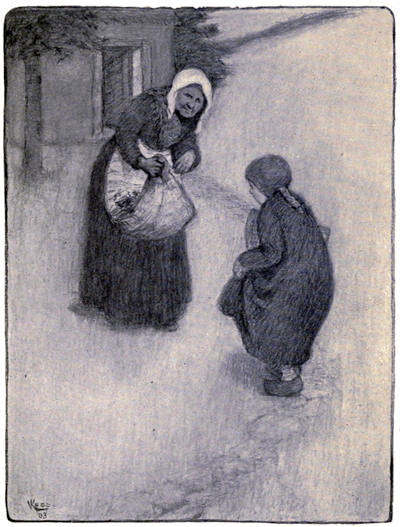
turning around and seeing her visitors, she
straightened herself as best she could and came
toward them with greetings. As she drew
near, Elsa saw that her face was withered and
wrinkled, and her hands brown with toil.
“Good morrow, Dame Ulricborg!” said the
boatman, “and how fares thy goodman to-day?”
“Ah,” answered the dame, “he is very weak
and grows more feeble every day. This twelve-month
past he hath scarce left his bed, and ’tis
weary work for an old woman to keep the kettle
boiling and the thatch mended over our
heads.”
“True,” said the boatman, sympathetically,
“thou hast done well, Dame Ulricborg!” Then
looking down at Elsa, he added: “Here is a little
girl come to see thee.”
The old dame looked curiously at Elsa; then,
as the latter held up her little skirt and asked
the dame if she might not help carry the cones,
she grew more kindly and led the way to the
house. But the boatman, seeing Elsa thus safe
at her journey’s end, bade them good by and
hastened back to his boat.
Now, Dame Ulricborg very much wondered
what the little girl could possibly wish with her;
but as it is considered unkind to question a guest
as to his coming, she said nothing, but waited
for Elsa to make known her errand.
As they drew near the door of the house,
Elsa hastened to explain to her how she had
come, and how she hoped to learn the rune
from the lips of the aged peasant Ulricborg.
At this the old woman, who had listened attentively,
shook her head.
“Ah, little one,” said she, “thou little knowest
how feeble he hath grown! He hath
strange fancies, too, and I doubt if he will wish
to let thee learn it. He hath never been willing
to teach it to any one. But,” she added,
“thou canst at least ask, if thou wishest.”
By this time they had reached the threshold
of Dame Ulricborg’s home, and stepped within.
The house was bare, but not uncomfortable;
some rings of flat-bread hung from the ceiling;
there was a spinning-wheel, two or three benches,
and, on the wall over the fireplace, a kantele.
The dame told Elsa to draw one of the
benches near the fire and warm herself, while
she went into the next room to see how her sick
husband fared, as she had been obliged to leave
him all alone when she went to gather the cones.
By and by the dame came back, and shaking
her head sadly, said to Elsa:
“Nay, to-day ’tis useless; his thoughts are
wandering and he will notice nothing. ’Tis
often so when he grows overweary. But thou
must bide the night with us, and it may be in
the morning he will be better.”
So Elsa helped Dame Ulricborg build up the
fire till it blazed brightly with the crackling resinous
cones, and then as the afternoon waned,
she made herself useful in many little ways as
they set out their simple evening meal.
Elsa thought no pimea and black bread had
ever tasted quite so good, for she was very
hungry after her long day, and Dame Ulricborg
smiled at her enjoyment. Indeed by the time
Elsa crept into the queer little cupboard bed
that the dame spread for her, she had so won
the latter’s heart that she bent over and kissed
the little girl with a pathetic tenderness; for it
had been a long, long time since poor old
Dame Ulricborg had had any young life about
her. Her own little girl had slept in the village
churchyard for many years.
The next morning, after they had breakfasted
together, the dame told Elsa that she might
see peasant Ulricborg, who seemed somewhat
brighter with the new day. So taking Elsa by
the hand she led her into the room where lay
the sick peasant.
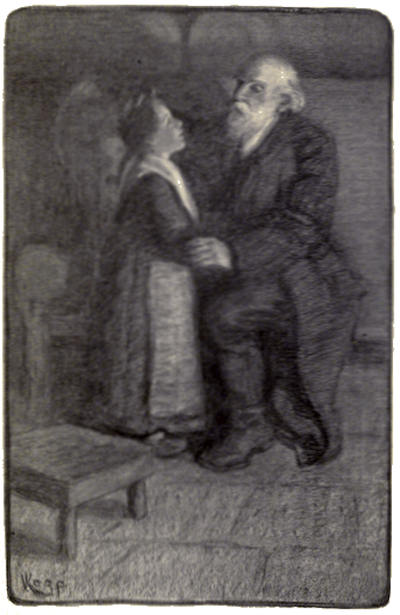
He looked very old and feeble; his hair was
white as snow, and his thin cheeks drawn into
innumerable wrinkles. Elsa went timidly over
and stood by his bedside, and in a low quivering
voice she made known her request. She
told him of Herr Lönnrot’s labors to save the
beautiful song-story of Wainamoinen, and of
his great desire to learn the lost rune that peasant
Ulricborg alone knew; how he wished to
write it down, so that it might never again be
forgotten and that all the world might enjoy its
beauty.
As she spoke, the old man looked at her with
dim blue eyes, and seemed to listen as one in a
dream. When she ceased, he appeared for a
moment lost in thought; then he said slowly
and dreamily:
“Yes, thou shalt learn it, Aino; thou shalt
hear of the birth of the harp, of the magic fish and
of the mighty hero Wainamoinen, little Aino.”
“’Tis our own little maid, Aino, that we lost
so long ago!” whispered the old dame to Elsa,
as the tears streamed down her face; “thou art
so like her!”
But she hushed her whisper, as suddenly the
old peasant began to sing in a weak, quavering
voice that seemed to grow stronger as he sang,
the beautiful lines telling how the ancient Wainamoinen
fashioned the first harp, and how he
sang till all the birds forsook their nests, the
fishes their deep sea homes, and all the creatures
of the woods, nay, the very trees themselves,
trooped forth from the forests that they
might listen to his enchanting music.
As Elsa heard, the tears came into her own
eyes, for she was a poetic little soul and quickly
touched by anything beautiful. When the peasant
Ulricborg had almost finished the rune, he
suddenly broke off and lay back on his pillow
exhausted. He lay for so long a while with
closed eyes, that both the dame and Elsa grew
frightened; but presently he again looked at
them, his vision becoming brighter; in a little
while all seemed to grow clear to him. He
gazed kindly at Elsa, for something about the
little girl seemed strangely to soften the old man.
He noticed her little kantele, and it seemed to
interest him, as he motioned her to lay it beside
him. He looked at it a while, and tried once
or twice to touch its strings to music, but his
strength failed him.
Presently, he said feebly:
“Ah, I thought thou wert Aino come back
for me!—but never mind—the rune thou wishest,
I can not show thee its music now,”—here
he looked sadly at his stiffened fingers, “but
the rune itself, yes, thou shalt have it, little
one!” Then he added slowly, as he gazed
dreamily into Elsa’s shining eyes:
“For thou, too, wilt love it truly!”
Here, as he paused a while, Dame Ulricborg
could scarcely hide her amazement, knowing
how often before he had wilfully refused the
same request from others. Indeed, the peasant
Ulricborg had all his life loved poetry with a
singular passion; and this particular rune, which
had come down in his family, he seemed to set
apart as something almost sacred; he treasured
its verses as misers hoard gold pieces. Whether
he thought it too beautiful to be made overcommon,
or for what reason, no one knew; that was
his oddity. So, while he sang it sometimes to
those he considered worthy, he would teach it
to none.
And now at last, as he promised it to Elsa,
Dame Ulricborg thought sadly that the promise
came too late; for how could he teach it to the
little girl, when every breath was such weary
effort? And she knew he was unable to write
readily even if he had the strength.
But having rested a little, he motioned her
to bend down, and then he whispered something
to her. She listened with a look of surprise,
and then hastened into the living room,
and opening a little cupboard, searched, till in
the farthest corner she found a small box, and
this she brought to the bedside. As she opened
it, out fluttered some thin old sheets of paper,
closely written over and yellow with age.
The old man’s eyes kindled as he saw these,
and as he marked the utter surprise of his wife.
“Ah, dear heart,” he said, “thou didst not
know—the priest wrote down the words for me—long
ago—I loved it—and wished to keep it—and
I hid it away”—but here the dying peasant,
too exhausted for further speech, paused,
and then, turning to Elsa the blue eyes from
which the light was swiftly fading, murmured
to her:
“Take it, little one; ’tis the rune—do with it
as thou wilt.”
Elsa was so overcome that she fell to crying
bitterly, and neither she nor Dame Ulricborg
noticed the sound of sleighbells, for the ground
was covered with a light snow. In a few minutes,
however, the cottage door opened, and in
came Elsa’s father, all anxiety for the safety of
his little girl. When Elsa, hearing him, came
into the living room, he caught her in his arms
and kissed her passionately, for he had been
greatly alarmed on learning of her journey, and
had set off in hot haste to find her.
Herr Lönnrot, too, who had grown much
better, had insisted on coming with him, and
was even then slowly walking toward the cottage
door, for he was still feeble from his illness.
He, too, was delighted to find Elsa
safely cared for; but both he and Elsa’s father
hushed their voices when she told them of the
peasant Ulricborg. They stepped softly into
the other room, and Herr Lönnrot’s practised
eye, for you remember he was a physician, at
once saw that his skill could do nothing to help
the old man. As the Herr gently smoothed
the coverlid the sick peasant gave a faint smile
to the faithful old wife who still bent over him,
and then, as Elsa stood reverently holding the
yellow papers between her little palms, he
turned to her a long lingering look that seemed
to say:
“Farewell, little one! and farewell to the
beloved song, that I have cherished so jealously
all these years. I must leave thee now, but I
leave thee in loving hands—farewell.” And
then peacefully, as the wife laid her withered
cheek close to his, his spirit passed away to find
their little Aino.
Afterward, when Elsa gave to Herr Lönnrot
the precious papers on which the rune was written,
at first he looked at them in amazement;
but his heart filled with delight when he learned
what the papers contained. He drew Elsa to
him, and kissing her forehead declared that she
had not only pleased him beyond measure, but
had done honor to old Finland in helping
complete the immortal poem he was striving to
save.
When, some weeks later, Herr Lönnrot went
away, after providing for the comfort of Dame
Ulricborg, he journeyed back to Helsingfors,
the capital city of Finland; and told the scholars
who were studying the poetry of the land how
the little girl had been the means of bringing to
light one of the most beautiful of the runes.
Then the scholars had a little silver medal
made which they sent to Elsa, and which she
took great pride in keeping through all her life;
and no doubt her great-grandchildren still keep
it to this day.
As for Herr Lönnrot, he lived to put together
the runes he had collected, and when he had
finished he called the poem “Kalevala,” which
in our language means “Land of Heroes,” because
it tells the wonderful story of the heroes
of that ancient land.
And some day, perhaps, you will read this
“Kalevala,” for it is one of the noblest and
most beautiful poems in all the world. And
then when you come to the rune which tells of
the birth of the harp, you too will be glad that
the little Finnish girl was the means of saving
it from being lost forever.