Transcriber’s Note: New original cover art included with this eBook is
granted to the public domain. The table of contents lists a poem “WHY
SHOULD I FEAR TO DIE?” that doesn’t actually appear in the magazine.
Copyright 1906 by Trotwood Publishing Co. All rights reserved. Entered as second class
matter Sept. 8, 1905, at the Postoffice at Nashville, Tenn., under the
Act of Congress of March 3, 1879.
Historic Highways of the South — PAPER VI.—THE ROAD TO NEW ORLEANS—THE NIGHT ATTACK
By John Trotwood Moore
It was the last of April when I journeyed
to New Orleans to study the
battlefield I had wished so often to see.
No battlefield has ever appealed to me
as has that—none has come near it to
me, in sentiment, except when I stood
in the trenches of Valley Forge and saw
the blizzard-swept lines where Patriotism
stood in the last ditch.
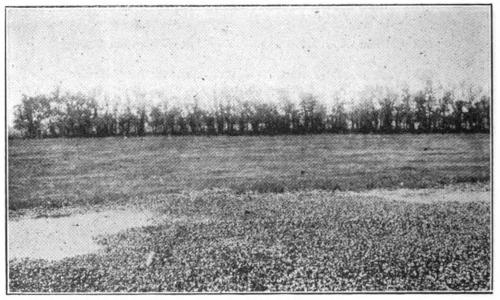
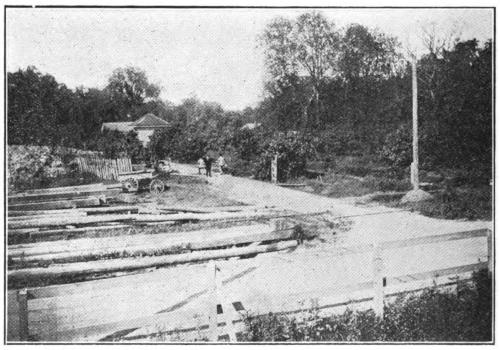
Looking toward the British line.
New Orleans is easily the greatest signal
victory ever won on American soil.
History shows nothing in its class except
King’s Mountain. Everything else
in the Civil War that we now regard as
decisive was an evenly matched, mathematically
planned contest, between great
armies, in which, so far as the records
go, one lost about as much as the other,
with victory at last on the banner of the
side with the most troops, the most guns,
the better equipment and the best food
for marching men.
Shiloh, Stone River, Chickamauga, in
the West—Bull Run, Seven Days, Antietam,
Fredericksburg, Gettysburg, in
the East—these were all great steel-sheathed
locomotives rushing full speed
to a head-on collision.
And, after the collision, there was
scrap-iron all around.
But New Orleans was a steel ram
striking a man-of-war, and the man-of-war
was not. There is only one way to
explain the miracle of the unexpected—the
incongruity of the Incongruous—and
that is, Providence.
Now, Providence had selected Jackson
for this job.
Five miles below the city the street car
lines stop, but it is an interesting walk
to clamber up on the bermuda and melilotus-covered
levee and follow the river
to the Chalmette battlefield. The air is
soft and warm, the big river sweeps
splendid along, the beautiful old homes
on the banks peep sleepily out from pecan
and great moss-covered oaks. Far away
to the southeast stretch plain and forest.
No wonder they fought for it, you
say. Who would wish to die in a fairer
land, under sunnier skies?
Then you get a shock.
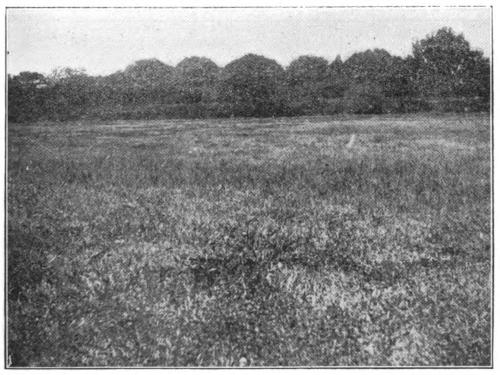
The field across which the British charged.
Just at the battlefield and where the
unfinished Chalmette monument (and
why should it remain unfinished, O, ye
of little faith save in your scrambling
for dollars?) looms up there is a repulsive
derrick very nearly on the spot where
Jackson’s grim lines ran up to the
river, and where the Carolina’s fiery little
battery spat at the Red Coats from
their earthworks. All around are evidences
of something that smells like Russell
Sage, Rockefeller, Morgan or New
York Life. It is a sugar refinery, said
to be the biggest of its kind anywhere—a
trust, and hence a thief by nature,
and now it has butted into the battlefield,
buying as it goes, and paying for the
privilege of wiping sentiment out with
sugar-coated pills. Its great banks already
overtop the spot where Jackson
stood under the moss-grown oaks. Its
embankments shut out the sun of New
Orleans. When it gets ready it will
take the rest of the battlefield. The sight
of it and its vandalism hurts, and the
hurt was worse when I found that New
Orleans did not care. Nay, I think from
what I heard, that she was prouder of
the refinery than she was of the battle;
for everybody could tell me of the refinery,
and no one knew anything of the
battle save a little woman who kept the
cottage and grounds where the half-completed
Chalmette monument marked the
spot of Jackson’s breastworks and glorious
stand. She knew that Jackson’s
breastworks ran down the row of trees
at the lane, that his headquarters were
right over there in that clump of old
oaks, and that Pakenham was buried for
six months under that pecan tree, where
some old masonry showed there had been
a grave. The rest of it I had to dig out of
the library of the Historical Society.
An old fisherwoman who stood on the
levee where Jackson’s line touched
the river, and where the cotton bales
were confiscated to help form the first
line of breastworks, in answer to my
question, told me, after expectorating a
large quantity of snuffy fluid into the
river, that she “had heurn of a right
peart fight bein’ fit hereabouts when my
mammy was a baby—but jes’ whur I
can’t say.”
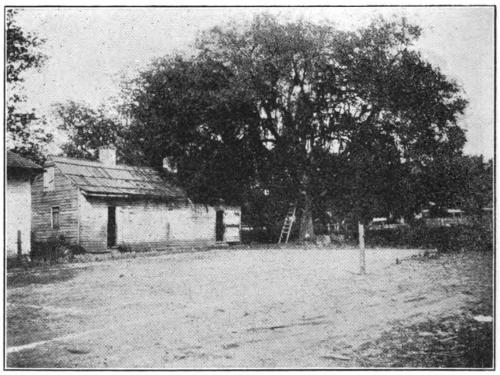
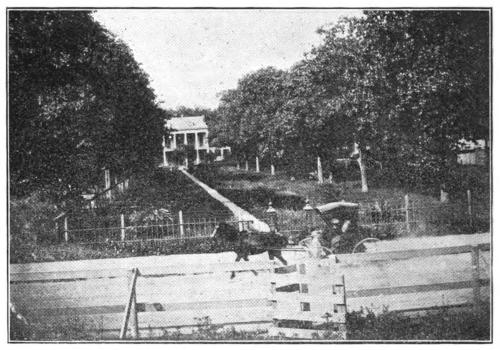
“That Jackson’s headquarters were right over there in that clump of oaks.” The
trees alone were there, this house having been built after
the original one was burned.
In his “Naval War of 1812,” Theodore
Roosevelt thus graphically describes the
place as he thought it was then: “Amid
the gloomy semi-tropical swamps that
covered the quaking delta thrust out into
the blue waters of the Mexican Gulf by
the strong torrent of the mighty Mississippi,
stood the fair French city of
New Orleans. Its lot had been strange
and varied. Won, and lost once and
again, in conflict with the subjects of
the Catholic king, there was a strong
Spanish tinge in the French blood that
coursed so freely through the veins of its
citizens; joined by purchase to the great
Federal Republic, it yet shared no feeling
with the latter save that of hatred
to the common foe. And now an hour of
sore need had come upon the city, for
against it came the red English, lords
of fight by land and sea. A great fleet
of war vessels—ships of the line, frigates
and sloops—under Admiral Cochrane,
was on the way to New Orleans, convoying
a still larger fleet of troop ships,
with aboard them some ten thousand
fighting men, chiefly the fierce and
hearty veterans of the Peninsular War,
who had been trained for seven years in
the stern school of the Iron Duke, and
who were now led by one of the bravest
and ablest of all Wellington’s brave and
able lieutenants, Sir Edward Pakenham.”
When the President wrote that he was
young and undecided whether he would
hunt grizzlies or write poetry, I, for
one, am glad he hunted the grizzly. Imagine
any man standing on the melilotus-covered
levees of the Father of Rivers
and tracing from horizon to horizon the
faint penciling of a sky so blue that
it flushes at times into purple, corralling
in the compass of its circle, now an
old mansion, pecan-shadowed and wisteria-crowned,
now a meadow, cattle-dotted
and sheened with little lakes, now
groves of oak and ash, moss swept with
hoariness, now fields beyond, broad in
their Southern fullness, big in benisons
of eternal summer—imagine this true
picture, and then hearing from the Far
North the sepulchral croak of a sophomoric
bullfrog: “Amid the g-l-o-omy semi-tropical
s-w-a-a-mps that covered the
q-u-a-king delta!”
I failed to see the gloomy swamps, and
the only things that ever quaked there
were the bull-bellied British, marching
nearly a century ago for the lust and
plunder on this fair Creole city, utterly
unconscious that any foe worthy of their
steel and stomachs stood before them,
until suddenly out of the sunset and
shadows of the memorable day of the
evening of their landing Jackson’s grim
Indian fighters fell on them in the darkness
and fought them to a finish, as they
fought all beasts, at close quarters, with
clubbed guns and bear-knives.
That was the night of December 23d,
1814, the beginning of the battle of New
Orleans.
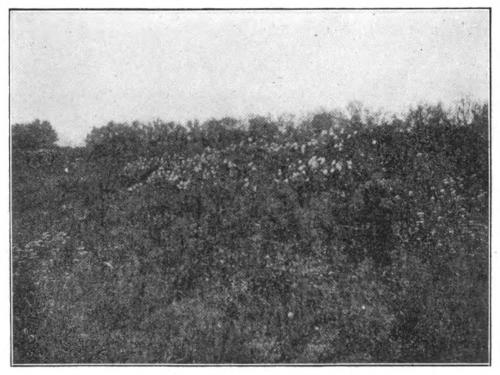
Old breastworks, primrose-covered.
Let us briefly go back and bring
events from our last paper—Jackson
in the wilderness of Alabama, victor
of an Indian war, remover of the strong
allies of the Spaniard and British—the
red, menacing, butchering wedge that
was thrust in between the two parts of
the young Republic. It really deserves a
chapter itself, and that chapter might
well be headed, “What Jackson Did to
the Spanish.” Briefly, it is this:
Jackson, having finished the Indian
War, marched, May, 1814, homeward,
amid the plaudits of the pioneer West,
disbanding his army at Fayetteville,
Tennessee, and receiving an ovation and
banquet in Nashville. He is appointed
by the President Major General in the
United States Army, and later, by his
influence and the great fear and respect
the Indians had for him, he closed a
treaty with them at Fort Jackson, and
the Southern territory to Florida (which
belonged to Spain), became the Republic’s.
And now, Jackson was free to turn
on the treacherous and double-dealing
Spaniard, who had secretly helped Britain
in the Indian War, and, even then,
contrary to her sworn neutrality, was
housing and feeding British troops at
Pensacola and other portions of her territory,
and permitting them, five thousand
strong, to rendezvous in Pensacola
preparing for the expedition which they
knew was already on the high seas bound
for New Orleans.
As stated in our last paper, these were
the darkest days of the Republic. Only
Jackson could have saved it. He alone
was the cog that fitted squarely into the
wheel of things.
Jackson struck squarely out from the
shoulder at the Spanish. He violated our
treaty with Spain openly when he marched
on Pensacola, for to his straight soul
he saw more honor in doing a thing
openly and aboveboard than in doing it
treacherously and slyly, as Spain had
done all along. If he had not whipped
the British at New Orleans, we would
have had a war with Spain on our hands.
He had to act quickly. The British had
come and were coming faster. By
August, 1814, the sleepy town of Pensacola
had awakened to new life—and the
life was red—red English. Eight or ten
English battleships lay in her harbor;
regiments of negro soldiers from the
West Indies went ashore, with other
British, soldiers, all drilling daily. The
English were repairing the forts, and
their commander and the Spanish governor
slept under the same roof.
“Its great banks already overtop the spot where Jackson stood.”
There were rumors of a great force
coming, but no one knew where it would
strike. Jackson learned it first from the
Pirate Jean La Fitte, and that pirate’s
story and the gallant fight his crew made
handling a battery of guns at New Orleans
is a story in itself.
Jackson decided to act. He wrote to
the Secretary of War, “If the hostile
Creeks have taken refuge in Florida and
are there fed, clothed and protected; if
the British have landed a large force,
munitions of war and are fortifying, and
stirring up the savages, will you not
say to me, raise a few hundred militia,
which may be quickly done, and with
such regular force as can be conveniently
collected make a descent upon Pensacola
and reduce it? If so, I promise you the
war in the South shall have speedy termination,
and English influence be forever
destroyed with the savages in this
quarter.”
Jackson received an answer six months
later, full of sound and meaning nothing,
or, if anything, that he mustn’t do it.
In the meanwhile he had done it, for the
British became bolder, threw off all restraint,
and prepared to sally from the
neutral port of Pensacola to take Mobile.
Jackson sent back to Tennessee through
the wilderness for his old fighters. And
they came, so eager to fight again under
their idolized leader that many paid as
high as eighty dollars for the privilege of
being substituted for those who could
not go. Jackson wrote again and again
to the Secretary of War, imploring him,
lecturing him: “How long will the United
States pocket the reproach and open insults
of Spain?... Temporizing policy
is not only a disgrace but an insult
to any nation.... If permission had
been given me to march against this
place twenty days ago I would ere this
have planted the American eagle; now
we must trust alone to our valor and the
justice of our cause.” And after a long
series of correspondence with the two-faced
Spanish governor, Jackson ended
his talk with him: “In future I beg you
to withhold your insulting charges
against my Government for one more
inclined to listen to your slander than I
am; nor consider me any more as a
diplomatic character, unless so proclaimed
to you from the mouth of my
cannon.”
It was now in early fall. The Tennesseans
under Coffee and Carroll were
pouring down South to him, past the old
battlefields of the Creeks, now an open
road to Mobile and New Orleans.
Before they arrived he had strengthened
Mobile, and the immortal Lawrence
had fought them off from Fort Bowyer,
killing 162, wounding the vaunting Colonel
Nichols himself, and sending them
crestfallen back to Pensacola.
Then, from La Fitte, whom the British
had attempted to bribe, he first knew
that New Orleans would be attacked,
and he waited no longer. He marched on
Pensacola and took it, and the English
fleet and army vanished at the first thunder
of his guns.
But where? To New Orleans, where
their great fleet on the high seas was
now headed—a fleet with a convoy of
ten thousand fighting British. And Coffee
and his Tennesseans still in the wilderness!
November 25th, 1814. Good news!
Coffee and his Tennesseans are at Mobile.
But that is not New Orleans, and
a hundred miles of wilderness lie between.
Jackson reached New Orleans December
2d. I hesitate to try to picture him
as he appeared to the gay, well fed,
well bred people of that Creole town.
Chronic dysentery since two years before,
terrible in its pains and griping on
his nerves and temper.
In the Howard Library, New Orleans,
the librarian of which is William Beers,
undoubtedly the best living authority of
Jacksonia, and a scholar and natural-born
bibliophile, I was shown many courtesies
and gathered some most interesting
facts. Mr. Beers ranks Judge Walker’s
book first on Jackson, because he
was an accurate, scholarly historian, who
got his information first-hand from survivors
of the great battle who lived with
him in his native city. “Parton’s book
was not even secondary, but tertiary,”
said Mr. Beers. “He took freely from
Walker and gave but scant credit.” Here
is Judge Walker’s description of Jackson’s
arrival in New Orleans, written
while many eye-witnesses were living,
in 1855:
“Along the road leading from Ft. St.
John to the city, early in the morning
of December 2d, 1814, a party of gentlemen
rode at a brisk trot from the lake
towards the city. The mist which during
the night broods over the city had not
cleared off. The air was chilly, damp,
uncomfortable. The travelers, however,
were hardy men, accustomed to exposure
and intent upon purposes too absorbing
to leave any consciousness of
external discomfort. The chief of the
party, which was composed of five or six
persons, was a tall, gaunt man, of very
erect carriage, with a countenance full
of stern decision and fearless energy, but
furrowed with care and anxiety. His
complexion was sallow and unhealthy;
his hair was iron gray, and his body thin
and emaciated, as of one just recovered
from a lingering sickness. But the fierce
glare of his bright and hawk-like eye
betrayed a soul and spirit which triumphed
over all the infirmities of the
body. His dress was simple and nearly
threadbare. A small leather cap protected
his head, and a short Spanish
blue cloak his body, whilst his feet and
legs were encased in high dragoon boots,
long ignorant of polish or blacking, which
reached to his knees. In age he appeared
to have passed about forty-five
winters—the season for which his stern
and hardy nature seemed peculiarly
adapted.”
One of the strange things about the
lives of all great men is the almost certain
fact that some grossly untrue story,
picturesque lie or exaggerated half-truth
of some personal trait will be started
and cling to them for all time.
For a half-bred lie always outruns a
full-blood truth.
The universally accepted misrepresentation
of Jackson’s character is that he
was an uncouth backwoodsman, half-spelled,
ill-bred and a bragging bully.
“The beautiful old homes on the banks peeped sleepily from pecan and oaks.”
As a matter of fact there never lived
a man of greater natural dignity, of finer
manners or more courtly grace when he
wished than Andrew Jackson, in spite
of his violent outbursts of passion at
times. In 1858, one of the finest old
ladies of New Orleans told this story to
James Parton:
The new aide-de-camp, Mr. Livingston,
as he rode from the parade ground by
the General’s side, invited him home to
dinner. The General promptly accepted
the invitation. It chanced that the beautiful
and gay Mrs. Livingston, the leader
of society then at New Orleans, both
Creole and American, had a little dinner
party that day, composed only of ladies,
most of whom were young and lively
Creole belles. Livingston had sent home
word that General Jackson had arrived,
and that he should ask him to dinner,
a piece of news that threw the hospitable
lady into consternation. “What shall we
do with this wild General from Tennessee?”
whispered the girls to one another,
for they had all conceived that General
Jackson, however becoming he might
comport himself in an Indian fight,
would be most distressingly out of place
at a fashionable dinner party in the first
drawing-room of the most polite city in
America. He was announced. The
young ladies were seated about the
room. Mrs. Livingston sat upon a sofa
at the head of the apartment, anxiously
awaiting the inroad of the wild fighter
into the regions sacred hitherto to elegance
and grace. He entered, erect,
composed, bronzed with long exposure
to the sun, his hair just beginning to
turn gray, clad in his uniform of coarse
blue cloth and yellow buckskin, his high
boots flapping loosely about his slender
legs, he looked the very picture of a
war-worn noble commander. He bowed
to the ladies magnificently, who all arose
at his entrance as much in amazement
as politeness. Mrs. Livingston advanced
to meet him. With a dignity and grace
seldom equaled, never surpassed, he went
forward to meet her, conducted her back
to the sofa and sat by her side. The fair
Creoles were dumb with astonishment.
In a few minutes dinner was served and
the General continued during the progress
of the meal to converse in an easy,
agreeable manner, in the tone of society,
of the sole topic of the time—the coming
invasion. He assured the ladies that he
felt perfectly confident of defending the
city, and begged that they would give
themselves no uneasiness in regard to
it. He arose soon and left the table
with Mr. Livingston. In one chorus the
young ladies exclaimed: “Is this your
backwoodsman? Why, madam, he is a
prince.”
Jackson had indeed arrived, but never
did a defender find so helpless and utterly
unprepared a city. The city was a
bickering, divided thing, not a fortification,
not a battery mounted, not an idea
even, and scarcely any law.
And scared stiff.
Jackson was both law and idea, and in
twenty-four hours, by his own calm and
intrepid bravery, his own self-assurance
and fiery determination, he had the impulsive
inhabitants ready to fight to
the death.
On December 8, 1814, just one month
to a day before the great battle was
fought, a splendid double-deck battleship,
the Tornant, flying the British admiral’s
flag, and the advance guard of the great
host, anchored off Chandeleur’s Island.
There were two ways to reach New Orleans—up
the Mississippi, or in the open
bay through Lake Borgne, thence a
march across the level delta straight to
the city.
The English chose the latter. Five little
American gunboats with 180 men lay
in Lake Borgne, and these put up a gallant
fight against the forty-five barges and
one thousand men who finally grappled
with them and took them with cutlass,
pike and pistols.
And there, at noon, December 23, 1814,
on the banks of the Bayou Bienvenue, a
lonely, marshy place, and the last place
that Jackson thought they would land,
the British, 1,900 strong, under General
Keane, one of the ablest officers of the
command, landed without opposition and
even without the knowledge of Jackson,
who was beyond the city, near Lake Pontchartrain,
expecting them there. In two
hours he had four hundred more troops,
a force larger that day than Jackson’s
entire available command, and in nine
miles of New Orleans, on a dead level
plain, bounded on one side by the river
and the other by the marshes of the
lake.
It was a plain, easy march to New Orleans,
and if he had marched at it that
afternoon it would have been his before
night. And why did he not? For only
one reason—neither Pakenham nor
Keane nor any general or soldier of all
the British army supposed for an instant
that there was anything before them but
a lot of cowardly backwoodsmen whom
they could brush away with their bayonets
or stampede with a single charge.
And who, indeed, were these men?
Who was their commander, and what
had they done on battlefield before?
Speaking of Pakenham’s utter defeat of
the French Field Marshal Soult, but a
short time before, the English historian,
Napier, says: “He was opposed to one
of the greatest generals in the world, at
the head of unconquerable troops. For
what Alexander’s Macedonians were at
Arbela, Hannibal’s Africans at Cannae,
Caesar’s Romans at Pharsalia, Napoleon’s
Guards at Austerlitz—such were
Wellington’s British soldiers at this period....
Six years of uninterrupted success
had engrafted in their natural
strength and fierceness a confidence that
made them invincible.”
And here is the same author’s description
of how Pakenham fell on Salamanca,
routing the best soldiers of continental
Europe:
“It was five o’clock when Pakenham
fell on Thomieres.... From the
chief to the lowest soldier, all of the
French felt that they were lost, and in
an instant Pakenham, the most frank
and gallant of men, commenced the battle.
The British columns formed lines
as they marched, and the French gunners,
standing up manfully for their country,
sent showers of grape into the advancing
masses, while a crowd of light
troops poured in a fire of musketry, under
cover of which the main body endeavored
to display a front. But bearing onward
through the skirmishes, with the weight
of a giant, Pakenham broke the half-formed
lines into fragments and sent the
whole in confusion upon the advancing
support, spreading terror and disorder
upon the enemy’s left.”
Pakenham, and the army under him
at New Orleans, were the pick of Wellington’s
troops, who had driven Bonaparte’s
greatest general across the Pyrenees.
They had conquered at Rodrigo,
Badajos, San Sebastian, Toulouse, Salamanca.
They laughed at raw backwoods
militia, with not even a bayonet to
their long, uncouth rifles. And what
were they in victory? Was there any
real ground for fear that they would
carry out their threats of Beauty and
Booty in New Orleans? When Jackson
rode along in the afternoon of December
23 to the front to meet the British,
women and children surrounded him in
consternation. “Say to them,” he said
to Livingston, “that no British soldier
shall enter the city unless over my dead
body. I will smash them, so help me
God!”
But that night many of the women of
New Orleans slept with small daggers in
their bosoms. And well may the handsome
Creole women of New Orleans have
been afraid. Badajos, San Sebastian, Toulouse,
all were friendly towns, only the
garrisons being hostile to the English.
And yet, General Napier, who was an eye
witness to what he describes, tells how
these same soldiers did at Badajos:
Jackson reached New Orleans December
2d, as stated, more fit for the hospital
than the camp, and with only three weeks
in which (as it proved) to prepare the defenseless
city. But under the magic
of that strange, positive, fiery man, the
quick tempers of the impulsive inhabitants
were welded to the white heat of
desperate determination. And what a
motley lot of defenders he found—About
800 new troops, regulars, raw and undrilled;
Planches’ City Battalion, five
hundred; two regiments of State militia,
armed with fowling pieces, muskets, old
rifles; a regiment of free negroes, or, as
Jackson called them, “free men of
colour,” and right well did they quit
themselves in the fight—in all, about
2,000 men. Two little men-of-war-armed
schooners, the Carolina and the Louisiana,
lay in the river.
But Coffee and his Tennesseans were
coming from Pensacola through the
woods, and Jackson sent courier after
courier to them, saying: “Don’t sleep till
you reach me or arrive in striking distance.”
Carroll, with other Tennessee
and Kentucky troops, had floated down
the Cumberland, the Ohio, and were now
on the Mississippi. But he had only one
gun to ten men until he overtook a boatload
of muskets, and with these he drilled
his men on the decks of his boat. To
him Jackson sent a steamboat up the
river with this message: “I am resolved,
feeble as my force is, to await the enemy
on his first landing, and perish sooner
than he shall reach the city.”
Two thousand Kentuckians under Generals
Thomas and Adair were also floating
down the Mississippi, a ragged, defenseless
and almost gunless crowd, without
blanket or tents, and only one cooking
kettle to every eighty men. And
now it was the 14th day of December,
and the British had been at the mouth
of the river nearly a week.
On the evening of the 17th Coffee, one
hundred and twenty-nine miles from New
Orleans, received Jackson’s note. His
horses were poor, three hundred of his
men sick, but in three days he was there;
but only with his picked men—800—all
that could follow so rapid a march. Here
is a description of them: “Their appearance
was not very military. In their
woolen hunting shirts of dark or dingy
color and coperas-dyed pantaloons, made,
both cloth and garments, at home, by
their wives, mothers and sisters; with
slouching wool hats, some composed of
the skins of raccoons and foxes, with
belts of untanned deerskins, in which
were stuck hunting knives and tomahawks,
hair long and unkempt, and faces
unshorn.”
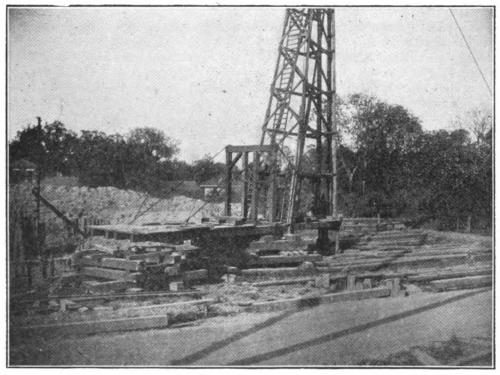
“Paying for the privilege of wiping sentiment out.” The Refinery’s work. The trees
on the left were Jackson’s headquarters. The half-completed monument
shows in the center of the picture.
Of their leader, Jackson, Roosevelt
says, in his “Naval War of 1812:”
“Yet, although a mighty and cruel foe
was at their very gates, nothing save
fierce defiance reigned in the fiery Creole
hearts of the Crescent City. For a master
spirit was in their midst. Andrew
Jackson, having utterly broken and destroyed
the most powerful Indian confederacy
that had ever menaced the Southwest,
and having driven the haughty
Spaniard from Pensacola, was now bending
all the energies of his rugged intellect
and indomitable will to the one object
of defending New Orleans. No man
could have been better fitted for the
task. He had hereditary wrongs to
avenge on the British, and he hated them
with an implacable fury that was absolutely
devoid of fear. Born and brought
up among the lawless characters of the
frontier, and knowing well how to deal
with them, he was able to establish and
preserve the strictest martial law in the
city without in the least quelling the
spirit of the citizens. To a restless and
untiring energy he united sleepless vigilance
and genuine military genius.
Prompt to attack whenever the chance
offered itself, seizing with ready grasp
the slightest vantage point, and never
giving up a foot of earth that he could
keep, he yet had the patience to play a
defender’s game when it suited him, and
with consummate skill he always followed
out the scheme of warfare that was
best adapted to his wild soldiery.”
It was two o’clock, December 23, before
Jackson learned that Keane, with
2,300 men, had landed and marched to
the river’s bank, in six miles of New Orleans.
Without a moment’s hesitation
he drew up his thin, sallow form, struck
his clenched fist on a table and said:
“By the eternal, they shall not sleep on
our soil!”
Very quietly, later, he ate a little rice
and dozed on a sofa—the only sleep he
had, say several reputable historians, for
four days and nights thereafter, and he
started to meet the enemy with a little
over two thousand men.
I am willing to stake my claim, previously
made, that this man was one of
the greatest military geniuses of the first
century of the Republic on this one act
alone. Here were the British, more than
a match for him in numbers, equipment
and confidence. So sure were they of
taking the city that they had loafed along
all afternoon and now had gone in a jolly
camp at sunset, on the banks of the great
river, preferring to march into the city
in the morning, and not at night. They
were disciplined and bayonetted, jolly as
a lot of schoolboys, and brave as men get
to be, full of fun and fight. I cannot think
of another general, from Washington to
Lee, from Gates to Grant, who would not
have said: “I will fight them in the
morning; this evening I will prepare. I
will barricade, I will entrench, I will
throw up my wall between them and the
city.”
And this would have been fatal. In
broad daylight Keane would have
whipped them. He would have whipped
Jackson’s troops that night but for the
darkness, but for the darkness and the
grizzled, homespun clothed men, who had
cat-eyes for night fighting, who had
stalked deer and panther and Indians in
the shadows of it, who could steal in and
steal out and use their knives in close
places.
This was December 23, but that night
he won the greater battle of January 8.
He fell on them like a panther from
the darkness of the swamp.
He gave them a jolt that Soult, nor
Ney, nor Napoleon had ever given. He
taught them a warfare they had never
dreamed of before. He took the sand out
of their craws and the conceit out of
their boasting mouths.
When he finished with them, at midnight,
they decided they had gone far
enough toward New Orleans for that day,
and several others. They threw up entrenchments
and waited for more troops.
They were hacked, demoralized, beaten!
And this is the way that Jackson did it.
For my part I think it a far prettier fight
than he made two weeks later, when he
finished the blow.
Jackson put his troops in motion about
three o’clock, amid alarm guns and beating
of drums. But he himself galloped
to the river bank and signalled to the
little Carolina to drop down. Then he
put spurs to his horse and galloped after
the dust cloud going down the road to the
Rodriguez Canal. I could see it all so
plainly as I stood on the banks of the
river and saw the same landscape before
me. The lean, sallow, booted man, his
long legs dangling underneath his horse’s
belly, galloping seemingly to defeat. This
man of destiny, this man who believed in
himself, this man who knew that God Almighty
had sent him to whip the British,
just as he knew he would kill Dickinson.
And the troops went down so merrily
to death in that cloud of dust—what
pathos, what patriotism, what sublime ignorance
of what they were up against,
what blind faith in Jackson and God went
forth that day to fight the conquering,
red English, who knew no such word as
defeat, no such tactics as retreat. Marines,
raw troops who hardly knew how
to drill, and one little battery, in all, 884;
flashy Creoles, gaudily equipped and making
much noise, the battalion of St. Domingo,
“men of color,” 210; Choctaw Indians,
18; Coffee’s Tennessee Volunteers,
mounted riflemen, 563; Beall’s Orleans
Rifle Company, 62; Mississippi Dragoons,
107, in all 2,131.
And this crowd were going to drive
the victors of Toulouse, San Sebastian,
Salamanca and Badajos into the river,
and do it at night, and not a hundred
bayonets on their guns and only two little
six-pound cannon!
It was six o’clock and the British were
having a jolly good time, with campfires
burning merrily and abundance of
supper for hungry, healthy stomachs.
And now it is seven o’clock and suddenly
a little gunboat looms out in the twilight
of the river before them, a queer looking
little craft to them, and they crowd up
on the bank to look at it. It came steadily
on, its guns trained on the crowd of
soldiers on the bank, who were laughing,
jollying and bantering it with empty
jokes. “Can it shoot?” “What is it?”
“Give it a few from a musket,” are the
shouts, and they fired on the little Carolina
with muskets and out of the gathering
darkness came:
“Now, boys, for the honor of America.
Give it to them” And, to their consternation,
there was poured into the
joking crowd a regular hell of grape and
shell, driving the British pell-mell to
camp and arms and the levee banks.
Jackson had reached the Bayou Bienvenu
about four o’clock and formed his
thin lines as far across the plain as he
could, to flank the enemy. Notices were
stuck up everywhere, signed “Keane and
Cochrane:” “Louisianans, remain quietly
in your homes; your slaves will be preserved
to you and your property respected.
We make war against Americans!”
The Carolina floats down to the river
opposite Jackson. He sends an aide
aboard and gives her commander his orders
to drop down and open on the British
camp. It was an hour before the
waiting Jackson heard her guns two
miles below, and then he advanced, Coffee,
regulars, marines, Indians, negroes,
artillery, forward, with blazing guns and
American yells and the British caught a
circle of fire.
No man can paint that battle in the
dark, for no man ever saw such a fight in
the dark before. The English fought
nobly, but Jackson went right in on them,
his men using their knives and rifle butts,
and in the mix-up they knew not front
from rear, nor friend from foe. Powder
smoke settled, gray and sulphurous over
the plain, half dimming an already cloud-dimmed
moon. The fog added to it, and
out of it, on the river, thundered the guns
of the Carolina pouring shot into their
ranks, and before them the sheeted fire
of Jackson’s battery, up the levee, poured
it in from the front. They fought by companies,
battalions, squads. They charged
around in the darkness and under clouds
of smoke and fog, and heard strange
backwoods yells and ungodly oaths, and
felt strange bear-knives rip into their
vitals from out of the dark. They fell
back, fighting, to the river bank, to the
camp of trees. They charged and drove
the Tennesseans time and again before
the naked, cold bayonet, but each time
they came back before clubbed guns and
tomahawk and bear-knife. It was a riot,
not a battle; a butchery, not a fight; a
stabbing contest in the dark, where the
bear killers and Indian fighters had all
the advantage.
At midnight Jackson collected his men,
fell back to the canal and began there to
throw up the long line of entrenchments
over which the vaunted British battalions
never put their foot.
Keane was stopped, shocked, chagrined;
his troops dumbfounded. Three
hundred and three lay dead or wounded
in the field, and sixty-four had run off
or been captured.
And now before them, entrenched, lay
the same intrepid backwoodsman who
had violated all the rules of warfare in
fighting them hand-to-hand in the night,
when, if he had waited a few more hours,
the city had been theirs.
They had gone far enough. They would
entrench and await Pakenham and the
ten thousand embarking troops. They
would take the city later.
Shakespeare did not write his plays to live, but to make a living.
There is no greater coward than he who despairs.
A Master Hand for Marryin’ — MEMORIES
By Florence L. Tucker
(NOTE.—A real story and a touch of
real mountain life.—Ed.)
A young girl on a bare-backed mule
rode up in front of a cabin at the foot
of a hill in the Tennessee mountains.
Slowly she surveyed the premises; beside
the open door hung a gun and a
powder horn and a string of red peppers;
to the left, rearing itself against the hot
afternoon sky, stood a gaunt martin
pole, and around the corner of the house,
inquisitive, but not unfriendly, advanced
a lean, spotted hound.
“Hullo,” she called in a quiet voice.
From inside a pair of steel-rimmed
spectacles was shined upon her, and the
heads of two half-grown girls peered
out.
“Ther’s somebody at the gate, thar,
Gabe,” said the woman.
But the man had already taken in the
figure in the pink calico frock and faded
sunbonnet and was regarding it with a
stealthy, sidewise glance from under his
flop hat. Deliberately he rose, and was
followed by the woman and the two girls.
“It’s Whit Bozeman’s Luce, from over
t’other side the mountain,” he said, halting
in the doorway. Then to the girl
waiting at the gate: “Hullo.”
But the woman went out. “’Light an’
come in,” she said, advancing with some
show of interest.
“No, I ain’t hardly got time,” responded
the girl. “Ole Gran’pap Bozeman is
be’n tuk pow’rful bad with the mizry in
his side, and I rid over to see ef I could
git a black chickin. I come acrost to
Weems, but nobody wasn’t to home, an’
I come on down here. I ’lowed I didn’t
know none o’ you-all, but I’d hearn tell
yer was mighty feelin fer folks in trouble,
so I’d resk it.”
“I seen yer at the meetin’ over at Big
Valley,” said Gabe from his station in
the door.
“A black chickin? Co’se yer kin hev the
blackest one we’ve got. Chicken gizzard
tea is mighty good fer the mizry in the
side. My ole aunt used to keep ’em
dried and ready. Ever’ time she’d kill
a black chickin she’d save the gizzard
an’ jes’ string it up ’gainst the time
when some o’ the folks or the neighbors
would be tuck down. She wuz a master
han’ fer chicken gizzard tea. But git
down an’ come in; settin’ in a cheer is
jes’ as easy as on the back o’ that thar
critter.
“Gabe, ketch that long shanked young
rooster I be’n er-saving—the one with
feathers on his legs. G’long, chillun an’
he’p yer pap run that chicken down! An’
don’t yer be long about it, fer the sun’ll
be gittin’ low afore she gits back over
t’other side the mountain.”
Luce sprank lightly to the ground and
the two seated themselves on the rude
wooden bench upon the porch. As the
girl removed her bonnet her reddish hair
clung in a mass of shining wave about
her neck, the warmth of the summer sun
was in her cheek, and stood in a delicate
moisture above her full lip. The elder
woman settled her glasses and regarded
her.
“Law, yes,” she said. “I had gizzards
saved up sence ’way back ’fore Chris’mus
two year ago, but Gabe’s las wife wuz
sick quite a spell—she jes died this
spring—and the gizzards jes’ did hold
out. She mighty nigh lived on chicken
gizzard tea toward the las’. I give it ter
all o’ his wives. Gabe’s be’n married
moren’t onct or twict,” she said explanatorily;
“he don’t have no luck with his
wives. The fust one died in no time, an’
the next one didn’t live so very long—she
wuz the mother o’ these two chillun;
the las’ one never had none. Gabe’s a
master han’ fer marryin’.”
Just then Gabe and the two girls and
the dog, in wild pursuit of the long
shanked rooster, the feathered legs well
in the lead, rushed pell-mell around the
house.
“What’s them girls’ names?” asked
Luce.
“Liz an’ Bet,” replied their grandmother.
“The’r ma wuz name’ Lizabet’, an’
when the twins wuz born I sez: ‘Well,
ef it had er be’n jes’ one we’d er called
it Liz, an’ sence it’s two we’ll call ’em
Liz an’ Bet.’ An’ so ’twuz. They’ll be
fourteen year ole three days afore this
comin’ Fourth o’ July. I ain’t never fergot,
kase I didn’t want ’em ever axed no
questions about the’r age thet they couldn’t
answer. I ain’t ever knowed jes’ how
ole I wuz, an’ sometimes I kinder wisht
I did. My ole man, he used ter figger on
it, but I never could feel no ways certain.
I wuz married when I wuz fifteen,
an’ from then on I kep’ ercount o’ things
jes’ in my head. Like them hats in thar
tells me how many year I be’n er livin’
on this mountain.”
She motioned her hand toward the
open door, and Luce shifted her position
to get a better view of a string of
wool hats swung across from one joist
to the other.
“Yer see, thar’s eleven of ’em. The ole
man, he bought a new one ever’ two
year—that would make twenty-two; an’
he’s be’n dead two year, which makes
twenty-four sence me an’ him moved into
this yere house. I never could bear to
see nothin wasted, so ever’ time he quit
wearin’ one I jes’ strung it up thar on
the j’ist, an’ sence he’s be’n gone I ain’t
never had the heart to take ’em down.”
A great flapping of wings and squawking
under the lean-to at the rear of the
house announcing that the remedy for
Gran’pap Bozeman’s “mizry” was in
hand, if not in sight, Luce, conscious of
the press of time, rose to be ready to receive
it. Gabe came round holding the
feathered legs in one hand and a strip of
old cloth in the other. As he saw the
girl’s look full upon him, he straightened
himself and quickened his gait.
“They do say,” said old Mrs. Freeler,
“that a green gizzard ain’t nigh the good
that a dry one is. Ef I kin git holt o’ ary
other black chicken I’ll save it and dry
it out fer yer.”
“I’m mighty glad I come on down
here,” said Luce, as she mounted from
the rail fence. “I couldn’t er gone back
without that chicken. Gran’pap Bozeman’s
pow’rful bad.”
“I’ll be over that er way Sunday,” said
Gabe in a low voice, as he handed up
the firmly tied legs, “an’ll stop by ter
see how the ole man comes on.”
“Ther’s preachin’” replied the girl, a
little red coming into her cheek. And
when mule and rider had vanished behind
the thick wood he took down his
gun called to the dog and followed slowly
the way she had gone.
Sunday, betimes he had ridden away
on the old gray mare.
“Yer pap mus’ be goin’ over ter Big
Valley ergin,” said Mrs. Freeler to the
girls. “Ther’s a preachin’ over thar onct
a month this summer. But he never
said nothin’ erbout it. Curious, too; he
inginerally does leave some idee o’ whar
he’s goin’.”
“I heern ’im tell Dick Weems he seen
a mighty fine lookin’ girl over thar las’
meetin’-day,” said Bet.
“Mebbe pap’s courtin’ ergin,” commented
Liz.
And when, four weeks from that day
he again rode off without having let fall
any hint of his destination, the suspicion
was confirmed. Mrs. Freeler had come
to know the signs; she grew restless and
watched Gabe furtively every time he
left the house, and when he came into
it. His tall, lank form was less indoors
than ever, and he grew more silent and
moody, riding away oftener over the
mountain. Always a shiftless fellow, he
appeared more so now, except at times,
when, in spurts of industry, he worked
off his newly-awakened energy. But not
so with Mrs. Freeler. The more her son
idled, the faster her fingers flew. “I wuz
allus a master han’ at patchin’,” she said,
as she turned over and over the garments
of them all.
As the haying season came on Gabe
became possessed of an unusual fit of
application. He had worked steadily for
three days when something happened.
Driving up with a load of hay piled rather
higher than the old mare liked, she
rebelled, and while she and he were having
it out together the load was overturned.
Liz and Bet, walking some distance
behind, rushed forward, and Liz
stooped to pick up her father’s coat,
which, lying on top of the load, had been
thrown to one side. As she did so she
discovered a letter that had dropped
out, and at the same moment his eye
fell upon it.
“You Liz,” he cried, his voice trembling
with excitement; “you leave my
love letter alone!”
The seal was unbroken and Liz turned
it over in her hand.
“Gabe Freeler,” she read slowly, “frum
Luce Bozeman.”
“You give it here,” he reiterated. “Er—mebbe,”
sheepishly, “yer mout make
out ter read it. I ain’t rightly guessed
what it mout be.”
The girl regarded him uncertainly as
she hesitated to break the seal.
“Read it, ef yer kin,” he said irritably,
standing beside the mare now disentangled
from the broken harness and shafts,
and mopping the perspiration from his
brow. “Ef ever I’d er be’n ter school
three months I ’low I could read any
writin’ thet ever wuz writ.”
“’Tain’t no three months!” replied the
girl with asperity. “’Twasn’t but only
two months and three weeks; but I
reck’n I kin read anything Luce Bozeman
kin write!”
“You gimme that letter!” he flared. “I
guess yer won’t git no chanct ter read
it!”
As he advanced to take it from her
hand the attention of the three was arrested
by the approach of a shock-headed
youth riding rapidly around the bend
in the thickly-shaded road. He wore no
hat and appeared to be in excited haste.
Without salutation or unnecessary parley,
he delivered his message:
“She says, air yer er comin’? Yes or
no!”
Freeler stared at him blankly. “Wall,
I know who ye air, an’ I know whar yer
come frum,” he said slowly, “but I’ll be
durned ef I know what ye air er drivin’
at.”
“Luce,” said the boy, “she writ yer a
letter and sont it by Dick Weems las’
Sadday.”
Liz and Bet regarded their father silently.
His face was a curious mixture
of chagrin, earnestness and baffled determination.
He had said Liz should not
read the letter; yet he must know the
contents now; and how to do it without
disclosing to the boy his ignorance of
learning?
“I ain’t but jes’ got the letter a little
bit ago,” he said, lying lamely as Liz’s
eyes were upon him. “Liz, thar, wuz jes’
about ter read it when we seen yer er
comin’—I ain’t seein’ very well sence
that spell I had o’ the yaller janders.” He
brushed an awkward hand across his
eyes. “Read it, Liz—ef yer kin!”
But this time the girl did not retort;
her curiosity invited nothing that would
delay its satisfying.
“Ef yer mean what yer sed las’ Sunday,”
she read, spelling out the words
slowly, “ther ain’t no time ter lose.
Gran’pap Bozeman wuz berried yistidy,
an’ no sooner wuz he in the groun’ than
Hiram he sez the place is hisn now, an’
ef I’m goin ter stay on here I got ter
marry him next Chuseday when ’Squire
Stark comes here. Which I’ll die fust,
fer I ain’t goin’ ter marry no cuzzen. In
pertickler I ain’t goin’ ter marry Hiram
Bozeman which I do despise fer the
meanest man on this mountain. Ef yer
ment what yer sed, then yer kin come
ter the big spring Monday nite an’ I’ll
be waitin’ fer yer in the shadder er the
ole chestnut. Ef yer ain’t thar by nine
o’clock thar won’t be nothin’ fer me ter
do but ter run away, which I will, so
help me God afore I’ll marry him as sez
I must.”
“You will no hoo this is frum fer the
name is writ on the outside.”
Gabe sat during the reading as if stupefied,
but when Liz had finished and
held out to him the scrawled sheet, he
rose. He looked at the sun; it was five
o’clock and a good three hours to Bozeman’s
when the mare was fresh; he
would have to take it easy, for there was
the return trip with the double burden.
“Lord!” he ejaculated under his breath,
and threw a leg over the animal’s lean
flank.
“I ain’t got no hat,” said the boy. “I
dropped it fordin’ the crick an’ this pesky
critter wouldn’t let me git it—orneriest
mule I ever see!”
“I got ter git my saddle an’ bridle.
Come on an’ I’ll find yer a hat,” answered
Gabe, as he put off in the direction
of his stable, followed by the other.
And in a few minutes the two returning
passed Liz and Bet still sitting in a state
of bewilderment by the side of the
overturned hay load. As they gazed
after the disappearing figures Liz turned
to Bet, a growing horror in her wide
eyes.
“That’s one o’ Gran’pap’s ole hats he’s
got on!” she said in an awe-struck voice.
To reassure themselves they hastened
home. Crossing the porch where the
dog lay asleep, their hurrying feet lagged
a little, a sort of superstitious fear upon
them. A sound fell upon their ears—a
low, piteous sobbing, that made them
clutch each other’s frocks and peer
breathlessly in at the half-closed door.
On the sill was a freshly-filled pail of
water, and in the middle of the floor
knelt their grandmother, her head bowed
in the string of wool hats which hung
dependant from one nail—in his haste
Gabe had not taken time to fasten again
the end which he had removed from the
opposite joist. And so it was, when she
returned from the spring whither she
had gone when he entered the house,
the sight met her gaze—the sacred line
of relics trailed in the dust, as it were,
affection’s altar rudely torn of its sacred
image, and that by the ruthless hand
of her own son—and his son!
She raised her head as the boards
creaked under the stealthy tread of the
twins. “He done it!” she cried brokenly,
the tears running down her wrinkled
cheeks. “Gabe done it. I seen ’em ez
I wuz comin’ up the hil frum the spring—him
an’ that thar Bozeman boy er ridin’
off—but I didn’t know ez ’twuz yer
Gran’pap’s hat the boy wuz er wearin’
’tel I got here an’ seen it wuz gone, an’
then I knowed it hed looked pow’rful
familiar. But what did he do it fer?
What did he do it fer?” her voice rose
into a little wail and her bent form shook
with painful sobbing.
Bet stared at her, dumb; her round
eyes filled with responsive tears which
she wiped away with the corner of her
dress.
“Did he tell yer?” asked Liz. “He’s
gone ter git married.”
Mrs. Freeler sank weakly into a chair,
and her hands fell limp in front of her.
“I knowed ’twuz comin’,” she said, “but
I ’lowed ez how he’d tell me. He ain’t
never married yet ’thout tellin’ me.”
“He never had time, I reck’n,” said the
girl, and then recounted the incident of
the coat and the letter; the coming of
the Bozeman boy and the reading of the
letter, the contents of which were fully
detailed; and, finally, the circumstance
which had led to the taking of the hat.
The old woman interrupted her not at
all, only when she came to the mention
of the hat, wiped her tears again with
shaking hand. Then they sat in silence,
drifting after a while into desultory talk,
as other occasions like this came back
to memory.
“I rickerleck,” said the grandmother,
“when he brought yer ma home. It
was jes’ this time o’ year. She wuz the
likeliest one of ’em all—I knowed the
minute I set eyes on her she’d do. The
fust one wuz a peart enough young
thing, too, but she whirled in an’ died
that very summer, an’ in two months
he married yer ma. You know how long
it’s ben sence the las’ one was tuk. Well,
Gabe never did lose no time!”
The sun’s rays grew less strong; she
rose mechanically. “Git up some light-’ood
knots,” she said, as she gathered her
milk pail. “They’ll be late gittin’ here,
an’ the nights is growin’ chilly. I’ll set
up fer ’em an’ have a blaze in the chimley,
an’ some supper ready—he allus
wants sumpin’ hot when he comes in
late.”
And when “the chillun” had gone to
bed she sat through her lonely vigil, pondering
over the advents and the changes
the room had known since the time she
and her “ole man” had been its first
occupants, gazing mournfully upon the
string of hats still hanging as she had
found them, and going now and then to
look out on the changing sky. She had
calculated the extra three miles around
by Parson Damon’s would make it twelve
o’clock by the time they could arrive,
and at eleven the moon had disappeared
and clouds were gathering thick and ominous.
She moved about restlessly,
threw on a fresh pine knot, trimmed the
small lamp, and was just settling herself
to renewed rumination when a low
“Whoa!” fell on her ears. Rising quickly,
she flung wide the door so that the
friendly light streamed out.
“Well, ye’ve come!” she called into
the darkness.
Gabe and the mare disappeared in the
direction of the stable, and Luce came
in rather uncertainly after her cramped
ride in the chill air. “Yes,” she replied,
blinking in the light, “an’ I brung
yer this,” holding out an old woolen hat.
“When Lige Bozeman come back er wearin’
it, I says, ‘That thar ain’t the hat
you went off from here with,’ an’ he
says, ‘No, this yere’s one o’ ole man
Freeler’s,’ an’ I says, ‘Well, jes give it
here, an’ I’ll take it back,’ I says. Which
I did, knowin’ what store you set by
them hats—an’ here it is!”
The old woman was trembling violently.
She looked at the girl with eyes
that saw only the lost and recovered
treasure. When Luce had finished she
turned from her without a word, and,
hurrying across the room, restored, with
little inarticulate cries of joy and love,
the precious hat to its place with the
other ten, then, mounting a chair, fastened
the end of string to the joist again.
Descending stiffly she turned to her with
glistening eyes.
“Ye’re welcome,” she said. “It’s the
most I’ve ever said to any of ’em. I
inginerally waits to see how it’s goin’
to turn out—yer never kin tell. But
this time, I says, ye’re welcome—an’
Gabe’ll treat yer right; he allus good to
his wives. Yer know, Gabe’s a master
han’ for marryin’!”
Knowledge is not so much in knowing as in knowing how to know.
It was Plautus who said: “To make any gain some outlay is necessary.”
Photo by Julie Royster, Raleigh, N. C.
O mystic Land of Smiles and Tears,
O Land that Was and Is,
Alone—unchanging with the years—
The Land of Memories.
—JOHN TROTWOOD MOORE.
Matthew Fontaine Maury
Paper by Mrs. H. P. Cochrane, Franklin, Tenn. and Mrs. Mary Lewis Preston, Va.
It seems but fitting that those who are
interested in the great seaman’s life
should know something of his ancestors
and early life.
His maternal ancestor in America was
Dudas Minor, an English gentleman who
received large grants of land from King
Charles II and settled in Virginia.
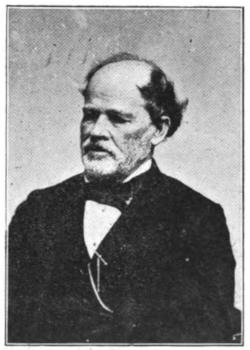
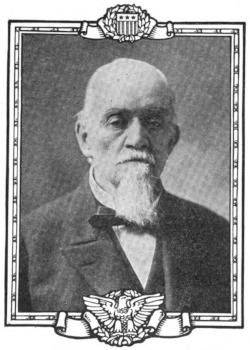
Matthew Fontaine Maury.
On the father’s side he was of Huguenot
descent. Rev. Jas. Fontaine thus
gives an account of Maury’s ancestor,
Jean de la Fontaine, a French nobleman
who held an exalted position in the court
of Francis I:
When the “Edict of Nantes” was revoked
the persecution of the Protestants
followed, and Fontaine was a shining
light for the Catholics, and it was deemed
advisable to get rid of so prominent a
heretic as soon as possible. A band of
ruffians were dispatched on the memorable
St. Bartholomew’s eve, and Fontaine
and his wife were dragged from their
beds and their throats cut. “Oh, my
children!” exclaimed the narrator, “let
us not forget that the blood of martyrs
flows in our veins.” This may explain
the strong religious bent of Maury’s nature,
which was evident to all long before
he connected himself with the Episcopal
Church.
He was born near Fredericksburg, in
Spottsylvania County, Va., January 24,
1806. When he was four years old his
parents moved to Tennessee and settled
near Franklin. Maury assisted his father
and brothers on the farm, and lived
the life of the early settler in a new country.
He thus became a sturdy, healthy
boy. Here in the wilderness schools and
churches were alike few and far between,
and the education of the pioneer’s children
was derived at home, or in the “old
held school.” Plain living and high
thinking was the motto in the Maury
household.
Matthew’s father was strict in the religious
training of his family. He would
assemble them night and morning to read
the Psalter for the day antiphonally, and
in this way so familiar did the barefooted
boy become with the Psalms of David
that in after life he could cite a quotation
and give chapter and verse, as if he had
the Bible open before him. Surrounded
by simple and pure influences, Maury
passed his youth. He possessed a deep
and inquiring mind and an insatiable
craving for truth.
Perhaps his greatest mental strength
lay in the direction of mathematics. “My
first ambition,” he says, “to become a
mathematician was excited by an old
cobbler, Neal by name, who lived not far
from my father’s home, and who used to
send the shoes home to his customers
with the soles scratched all over with
little x’s and y’s.” Maury was sent to
the Harpeth Academy, taught by the
Rev. James Otey, first Bishop of Tennessee,
and Wm. Hasbrouck, afterwards a
prominent lawyer of New York. Here
his brilliant mind and studious habits
won the esteem of his teacher, which
lasted through life.
Maury had an exceeding fondness for
the sea, which was fostered by the adventures
of his elder brother, who entered
the United States navy when but
thirteen years of age. When Maury made
known his determination to accept the
position of midshipman, which the Hon.
Sam Houston obtained for him, his father
did not command him to decline;
but he did not approve it, and would not
give him any financial aid, or even his
blessing. This was a great grief to
Maury, but he had put his hand on the
helm, and there was no turning back.
So, borrowing a horse, and with only
thirty dollars in his pocket, and the limited
experience of nineteen years, he
set out to seek his fortune. There was
no naval academy, and the young middy
began his duties and his studies on
board a man-of-war. What powers of
concentration he possessed, with what
unflagging zeal he pursued his studies,
proving by his subsequent career that
genius is the capacity for labor. William
Irving, brother of Washington
Irving, loaned him many books.
During his first year of service his
frigate, the Brandywine, conveyed Lafayette
back to France. The great
Frenchman was much attracted by the
young midshipman, and had many a kind
talk with him. In 1831 he passed his
examination, was appointed master of
the sloop-of-war Falmouth, and ordered
to the Pacific on a four years’ cruise. It
was on this voyage that Maury conceived
the idea of the famous “Winds and Currents
Charts,” which have done so much
for the commerce of the world.
He returned to the United States in
1834 and married his cousin, Miss Herndon,
to whom he had been engaged several
years. Shortly after this marriage
he went to Philadelphia to arrange for
the publication of his works on navigation.
His book, like himself, had the true
ring or true metal, and won distinction
In England and became the text-book of
the United States navy.
At this period Maury obtained leave of
absence, and on his way to his old home
in Tennessee he was thrown from the
top of a stage coach, which resulted in
an accident that lamed him for life and
interrupted his active service afloat. His
leg was improperly set, had to be broken
again and reset, and this in a day when
anaesthetics were unknown. This period
of enforced inactivity was most distressing
to the ambitious lieutenant, but
proved a blessing in disguise, for it was
then that his active mind turned to and
grasped the scientific part of his profession.
In 1839 he began a series of articles
on naval reform. He advised that
a navy yard and forts can be established
on the Gulf coast. “They cannot be too
strongly fortified with outfits for shipping
and implements of war.” He advocated
also a naval school for young midshipmen.
This article led to the building
of forts at Key West and the Tortugas,
and the establishment of the naval
academy at Annapolis.
In 1843 he wrote a notable treatise, entitled
“The Gulf Stream and its Causes.”
These and other contributions to science
were written under the pen name of
“Harry Bluff.” They attracted so much
attention and were so generally approved
by the navy that the officers had great
numbers of the papers printed and circulated.
When it became known that the
young Lieutenant Maury was the author
of these papers, his ability and grasp of
mind were universally recognized, and
his position as authority on naval questions
was established. Soon after he was
placed in charge of the Depot of Charts
and Instruments, which office he developed
into “The National Observatory and
Hydrographical Department of the United
States.”
In a speech before the Senate John
Bell said: “No man could have been
found in the country better fitted than
Maury for this difficult duty, and he
worked with the zeal and energy expected
of him.”
At this time he gave to the world the
famous “Winds and Currents Charts and
Sailing Directions.” Seamen were at
first distrustful of the new charts, fearing
that a route which could save from
ten to twenty days on an outward voyage,
was fraught with danger. At last
a Baltimore vessel determined to follow
the new chart. The voyage was a complete
success, for he made both trips in
the time consumed under the old system
in the outward passage alone. There was
now no hesitation about the use of the
charts. Active interest was excited and
the world rang with the fame of Maury’s
“Winds and Currents Charts.” Copies
were sent to every government and distributed
to men-of-war and merchantmen.
It has been estimated that “if the money
he saved to the world were collected,
a monument of precious stones could be
erected to his memory.” It was frequently
urged that Maury, who was drawing
a pay small in comparison to his service,
might secure a copyright and thus reap
material reward from his labors, but his
aim through life had been to make himself
of use to his fellow men, and he did
not put in a claim for prize money.
While at the observatory he wrote his
“Physical Geography of the Sea and Its
Meteorology.” This work met with great
enthusiasm in England and America, and
was translated into many languages for
use in the schools. The interest now excited
in meteorology and deep sea study
enabled Maury to assemble at Brussels,
under the auspices of King Leopold, a
congress to which England, Russia,
France, United States, Belgium and other
countries interested in commerce, sent
delegates. At the close of the congress
Maury returned to America laden with
honors and rich in fame. Many of the
learned societies of Europe elected him
an honorary member. Orders of knighthood
were offered him and medals given
him by nearly every crowned head of
Europe.
It is said that Humboldt received the
Cosmos Medal as being the greatest
scientist in the world, but he presented
it to Maury as being greater than he, saying
that he was the “founder of a new
science.”
Maury now began to carry out his plan
for meteorological co-operation on land.
To effect this he was obliged to travel
much and deliver many addresses. Out
of these efforts grew the vast “Weather
Bureau” of to-day. As early as 1848
Maury had believed that a broad level
plateau lay under seas between Newfoundland
and Ireland, and Congress dispatched
three vessels to perfect his discoveries,
and to decide if it would be
practicable to lay the cable between Europe
and the United States. He was consulted
by Cyrus W. Fields and others as
to the kind of cable to be used, the way
and the time to lay it. At a dinner given
in New York to celebrate the first message
across the Atlantic, Mr. Field rose
and said: “I am a man of few words.
Maury furnished the brains, England the
money and I did the work.”
In 1858 Maury was advanced to the
rank of Commodore, by special act of
Congress. Maury also originated the
idea of water-marks and river gauging
along the Mississippi and its branches.
In 1860 he had reached the high tide of
his worldly prosperity. He began to realize
material benefits from the fruits
of his pen when the Civil War broke
out. Mr. Lincoln called for 75,000 troops.
Virginia’s answer was secession and a
call upon her sons for support. Maury
resigned his office and went to Richmond.
Nothing had been offered him by the Confederacy.
He had everything to lose,
nothing to gain. He was a peace-loving
man, a student and philosopher; besides,
he was greatly opposed to the war. But
when Virginia called he left his congenial
pursuits, his achievements and his discoveries
for what he held to be his duty
to his mother State. When it became
known abroad that he had severed his
connection with the United States, he
was invited by France, Russia and Mexico
to become their guest, but he declined
both. He entered the Confederate States
navy, with the rank of commodore and
chief of the seacoast, harbor and river
defences of the South. He assisted in
fitting out the Merrimac and invented a
formidable torpedo. In 1862 he established
the Confederate submarine battery
service, at Richmond. In the same year
he was ordered to England to purchase
torpedo material. After the war he was
not allowed to come home for several
years.
In 1868 he, together with Tennyson
and Max Muller, received the degree of
LL.D. from the University of Cambridge.
In 1869 he accepted the chair
of physics in the V. M. I., at Lexington,
Va. Here, surrounded by his family and
friends, he passed the remaining years
of his life in peace and rest. He died
February 1, 1873.
I will conclude with two short extracts,
the first from the Richmond Dispatch, as
follows:
“The joint resolutions introduced into
the Legislature, memorializing the President
and Congress to erect, in the shape
of a lighthouse on the Ripraps, a monument
to Commodore Matthew Fontaine
Maury, opens the way for the nation to
efface from its escutcheon a blot that
has long rested there. Soon after the
death of Maury a movement was inaugurated
abroad to build at a point off
the coast of Brazil, an international lighthouse
as a memorial to the ‘Pathfinder
of the Seas.’ It was intended that each
nation should contribute individually to
the fund for this purpose, and that the
structure should be as enduring as money
and human skill could make it. The
movement found great favor with foreign
nations, and would have materialized
but for the attitude of the United
States. When this government was
sounded on the subject it was found that
the partisan hatred and sectional prejudice
was so strong at that time that, for
diplomatic reasons, the matter was
dropped.
“It is designed that the proposed monument
shall be dedicated in the presence
of the combined nations of the world.
And should the United States make the
occasion practicable, the grandest naval
demonstration that has ever been witnessed
anywhere, and in any age, may be
expected.
“The great foreign nations in whose
scientific societies and aboard whose
ships Maury’s name is a synonym of reverence,
would delight in an opportunity
to pay such a tribute to his genius and
to his services. By affording such an opportunity
the United States government
would put honor not only upon Maury,
but upon itself, and reach a higher plane
in the eyes of the governments abroad
than it has ever occupied since the war.
The memorial not only would be a monument
to the ‘Wizard of the Winds and
Currents,’ but a perpetual reminder of
the nation’s confidence in republican institutions
and in the fact that we are a
reunited people.”
The second extract is from a tribute
paid him by the Hon. A. J. Caldwell before
the “Agricultural Society.” He said:
“A farmer lad, he was trained by his
country for the sea. She made him a
sailor; God made him a genius. A genius
like Ariel’s, which made wind and tide
and meteor’s glare his servants, and laid
its wand upon the main of the ocean and
made it the servant of the servants of
men. The maritime world to-day would
be lost if his great works were blotted
out from human memory.
“He first spoke of the submarine telegraphic
plateau between Ireland and
Newfoundland, on which the ocean cable
is laid. He first told the ocean steamers
of the ‘sea lanes,’ where, outside of the
area of icebergs they run safe from shore
to shore. And such was the plenitude
of his power, such the comprehensive
grasp of his reason, and the fullness of
the blessing which his genius bestowed
upon the world, that, as experience and
time go by, his scientific methods are
adapting themselves to the needs of
every tiller of the soil in every State of
the Union and nation of the earth. The
Signal Service, with its daily weather reports,
its prognostications, control the
actions of every intelligent agriculturist
in the land to-day.
“With Promethean hand he snatched
the meteoric fires from heaven and lit
up the altars of industry. He is dead and
gone; but what Columbus was to discovery,
Newton to astronomy, LaPlace
to physics, Humboldt to national history,
Maury was to navigation, meteorology
and agriculture. The winds and currents
of the ocean bear his name around the
watery world. The lowing herd, the
bleating flock housed by him from the
storm, the flowering meads and golden
fields which filled with the shouts and
laughter of happy toil are memorials on
the lands. His memory will brighten as
the years go by, and the blessings of his
genius will reach every household and
the gratitude of mankind will follow him
where sweet fields beyond the swelling
flood stand dressed in living green.”
Read before the D. A. R., June 30, by
MRS. H. P. COCHRANE.
The Daughters of the American Revolution
plant this tree in honor of Commodore
Matthew Fontaine Maury, that
they may show in this simple way, here
in his old home, how they reverence his
name. Also by this act that they may
help to remove the stain, the disgrace
to the American people that no monument
has been raised to his memory.
This small beginning, they earnestly
hope, will lead to greater endeavor. To
this end this Chapter has recently endorsed
a petition asking the co-operation
of the Convention of National Daughters,
composed of 7,000 ladies, to memorialize
Congress to erect a light-house to his
memory, to efface from the nation a blot
which has long rested there. This, indeed,
has been the third attempt. Soon
after the death of Maury a movement
was inaugurated abroad to build on the
coast of Brazil an international lighthouse
as a memorial to the “Pathfinder
of the Seas.” It was intended that each
nation should contribute individually to
the fund for this purpose, and that the
structure should be as enduring as money
and human skill could make it. It would
have materialized, but for the attitude of
the United States. When this government
was sounded on this subject it was
found that partisan hatred and sectional
prejudice were so strong at the time that,
for diplomatic reasons, it was dropped.
Afterwards the Virginia Legislature petitioned
the President and Congress to
erect a light-house on the Ripraps, off
the coast of Virginia, in the Chesapeake
bay. It was designed that the proposed
monument should be dedicated in the
presence of the combined nations of the
world, and to be the greatest naval demonstration
that had been witnessed anywhere
and in any age. How fitting if this
could be done at the proposed exposition
at Jamestown, in 1907. It is but meet
that he should receive the highest acknowledgment
of his greatness, not only
in reparation, but in gratitude, for it
has been said if the money Maury has
saved to the world by his charts on
the winds and currents and navigation
generally, were collected, it would be
enough to build a monument of precious
stones to his memory, not to speak of the
saving of human life. But Humboldt paid
him the highest compliment when he presented
him with the Cosmos Medal,
which he received as being the greatest
scientist of the world. He said Maury
was greater than he.
It seems particularly appropriate that
this tree should be planted in the shadow
of this school building, as Maury’s text-book
is used here to instruct the children.
And now, Ladies of the American Revolution,
I feel that we honor ourselves in
paying this tribute to one who, by his
goodness, as well as his greatness, has
his “name written in the Hall of Eternal
Fame.”
The following paper was also received
by Trotwood’s, written by Mrs. Mary
Lewis Preston, Seven Mile Ford, Va.:
In the little mountain village of Lexington,
Va., on February 1, 1873, there
passed from earth one of her most choice
souls, great in mind, earnest in work,
simple in faith, courted by every civilized
nation!
His end was so beautifully simple and
childlike that even the newspapers far
and near rang with it. This great man,
when called by the God who made him,
simply lifted his hands in the attitude of
a little child expecting to be taken up
into the arms of a loving father, and
died in that attitude.
This was significant of his character.
He was too learned to be doubting, too
great for shams, too gentle and trusting
for affectation.
This man was Matthew Fontaine
Maury, “The Pathfinder of the Sea,” born
in Spottsylvania County, Va., January, 10,
1806, and was taken by his father to Tennessee
in his fourth year.
In 1825 he was appointed midshipman
in the United States navy, making his
first cruise in the Brandywine, on the
coast of Europe and in the Mediterranean.
In 1826 he made a cruise around
the world in the Vincennes. In 1831 he
was master of the sloop-of-war Falmouth,
but was soon acting first lieutenant on
the Dolphin, then transferred to the frigate
Potomac, in which he returned to the
United States.
At the age of 28 he published his first
work, “Maury’s Navigation,” which was
at once adopted as a text-book in the
navy!
He was at this time selected as astronomer
and offered the place of hydrographer
to the exploring expedition
to the South Seas, but declined.
In 1837 he was made lieutenant, and
not long after met with the accident
which lamed him for life.
While unable for active duty, he cultivated
his mind, and by his views published
in the “Southern Literary Messenger,”
worked great reforms in the navy
and secured a naval academy.
He first directed the observations of
the flow of the Mississippi. He proposed
a system which would enable the observers
to give information by telegraph,
as to the state of the river and its tributaries.
He suggested to Congress efficacious
plans for the disposition of the
drowned lands on the Mississippi. He
brought forward and successfully advocated
a warehousing system. In 1842 he
was appointed superintendent of the depot
of charts and instruments at Washington.
He added to his labors of astronomer
the task of unraveling the
winds and currents of the ocean. He instituted
the system of deep sea sounding,
leading directly to the establishment
of telegraphic communication between
the continents by cable.
The “Physical Geography of the Sea,”
translated into various languages, is an
enduring monument to the genius and
usefulness of its author. The powers of
Europe recognized the value of his services
to mankind. France, Austria, Russia,
Prussia, Denmark, Belgium, Portugal,
Sweden, Sardinia, Holland, Bremen
and the Papal States bestowed orders of
knighthood and other honors.
The academies of science of Paris, Berlin,
Brussels, St. Petersburg and Mexico
conferred the honors of membership.
He left the Federal navy to aid his own
State, when Virginia seceded, declining
from a sense of duty highly honorable positions
from Russia and France.
There have been few greater scientists
in the world. Humboldt pronounced him
“the greatest the world had ever known.”
The University of Cambridge conferred
on him the degree of L.L. D., and Emperor
of France invited him to the superintendency
of the Imperial Observatory,
at Paris. He patriotically preferred to
accept the chair of physics at the Virginia
Military Institute.
While here he prepared his latest work,
“The Physical Survey of Virginia.”
His remains rest beneath a modest
monument of native James River granite,
in Hollywood, Virginia’s beautiful city of
the dead.
When he died the Commander of Virginia
Military Institute thought it but
just and proper that every power in the
world should be informed, and telegrams
were sent. All were responded to in the
most appropriate manner, except one—that
of the United States. Not one word
from our then President U. S. Grant!
As his body lay in state at Lexington
it was literally covered from throat to
waist with decorations, some of them
the richest and most valuable jewels, the
gifts of the crowned heads of the earth.
Then to the man who first gave a
complete description of the Gulf stream,
who first marked out the specific routes
to be followed in crossing the Atlantic,
who first instituted the system of deep
sea sounding, who first suggested the establishment
of a telegraphic communication
between the continents by cable, on
the bed of the ocean, and who indicated
the line along which the existing cable
was laid, who caused the erection of our
naval academy—to this great man the
D. A. R. of America are striving to induce
Congress to build a suitable monument.
And what place could be more
appropriate than Hampton Roads, and
what time better than to have it ready
before the greatest naval display the
world has ever seen, which is arranged to
come off during the Jamestown exhibition
in 1907.
Isn’t it a great mistake that America
does not see fit to honor her great ones,
and if she does not, why cannot Virginia
and Tennessee join hands and do honor
to whom honor is due?
The voice which lives is the one which moulds the souls of men.
Tom’s Last “Furage”
By John Trotwood Moore
Manager’s Note—There has not been
a week since we commenced to publish
Trotwood’s Monthly that we have not
received one or more letters asking us
to reproduce “Tom’s Last Furage,” it
never having been published in any of
Mr. Moore’s books; hence is not in permanent
form. In compliance with these
requests, we reproduce the story together
with a note by the author as it appeared
in the Olympian Magazine, in October,
1903. Since that publication, the old
Judge after serving a quarter of a century
as Judge of the Black Belt Circuit,
died in harness, while holding court in
Greensboro, Alabama, April 27, 1904. It
is said that no judge ever lived in Alabama,
who held so generally the love and
affection of all the people, white and
black, as did Judge Moore. It seems almost
incredible to relate that the last
time he was re-elected to office, in a
general election, in which all parties were
represented and all classes of men voted,
out of 9,500 votes cast, Judge Moore received
all of them but one.
Speaking of his death the Birmingham
News said: “In his death, the last link
of the old leaders of just after the war,
passed away, honored, loved, lamented
sorely; not only by his home and district,
but by the South. As his pastor
said at the funeral, ‘let us pray God’s
guidance to fill his place; not only as a
jurist, but in the hearts of his people.’”
A few years ago William Jennings
Bryan related the story of “Tom’s Last
Furage,” in an after dinner speech, and
said it expressed more clearly the relationship
existing between the old Southern
gentleman and his slaves than any
story ever written.
Peace to the ashes of so noble a man.
The old Judge has passed into the beyond.
May he meet and know all whom
he loved here, even old Tom.
E. E. SWEETLAND,
Business Manager.
Author’s Note.—This story was first
published in the Horse Review of
Chicago, December, 1897, but in December,
1899, it was plagiarized by some
writer whose name, I am glad to say, I
have forgotten, and published in Munsey’s
Magazine under the title of “Jim’s
Defense.” Mrs. Frances Herrick Fowler,
the gifted California writer, called Mr.
Frank A. Munsey’s attention to the plagiarism
and he very promptly wrote me
a letter of apology. Since then, so many
public readers and even negro minstrel
companies have used the story, giving
credit to the plagiarized form, that, at
the earnest request of the editor of The
Olympian, I am permitting it to appear
again in its true form.
A coincident so amusing in the plagiarism
occurred that I shall mention it.
Much of the story is an incident in the
life of my father, Judge John Moore,
still Judge of the Black Belt circuit of
Alabama, and Tom’s home coming, bringing
my father’s saddle, clothes, and sidearms,
is the first distinct memory of my
life. In plagiarizing it the author in Munsey
did little less than to change the
names, and in doing so he changed “Miss
Mary” to “Miss Emily,” and thus unintentionally
gave all the characters their
true names.
J. T. M.
Columbia, Tenn., October, 1903.
Tom was a sly, rollicking rascal of a
darkey, with a catfish smile and a
jaybird eye. He was ever ready for a
laugh, a joke, a drunk, or a profession
of religion. He would spend his nights
as quickly in a bar-room as at a prayer-meeting,
and by day he was equally as
ready to battle for politics as for religion.
But his strong card was his
wonderful experience “endurin’ de wah,”
whither he went as a body servant to
“Marse John,” and his “hairbreadth
’scapes in the imminent deadly breach”
would have put a flush of envy in the
dusky cheek of Othello himself. But
Tom’s fighting was now mostly under his
tongue, and, like many who are yet wearing
the blue and gray a full generation
after all hostilities have ceased and all
animosities should long ago have ceased
with them, Tom’s war spirit increased
as the square of the distance from the
crack of the last cannon. From his own
statements there could be no doubt that,
besides actually participating in every
battle of the civil war, the Confederate
forces were maintained in the field as
long as they were, entirely on account of
his own skill and genius as a “furager.”
His other weakness was his habit of
disputing upon questions theologic. In
this he was peculiarly strong; for, if the
discussion waxed hot, and he found he
could not convince his hearer with words,
he did not hesitate to smite the centurion’s
ear, or bite off his nose; and as
his war record among the darkies was
already Achillean and his fistic abilities
unquestionable, there were few who
were willing to “’spute de p’int wid ’im.”
His great argument was the efficacy of
faith over work, and he was so scrupulously
religious in his belief that he finally
ceased to work altogether, while it
required but the spirit of a July sun and
a weedy garden to set him to arguing
with renewed zeal.
Now, a man is what his beliefs make
him; and so the effect of Tom’s belief
developed one virtue truly apostolic; he
took no thought for the morrow, what he
should eat or drink; he carried no scrip
in his purse, and, at the beginning of
this story, he had not even a change of
raiment.
But his staunch friend was “Marse
John,” the old Judge, who had long been
Judge of a Circuit Court in Alabama—so
long “the memory of man runneth
not to the contrary,” as the law books
have it. The old Judge was a good man
and a good Judge—so just that the poorest
and the blackest negro, when jerked
up before his bar, never failed, equally
with the richest and the whitest man in
the district, to get that justice to which
he was entitled. Nay, more; for in the
dignified old gentleman who looked down
upon him, pitying him in his environments
of ignorance and poverty, and
scrutinizing the evidence brought out by
the wily lawyers with an alertness that
reminded one of an eagle on his eerie
watching the sly maneuverings of a congregation
of foxes below, the poor wretch
often unexpectedly found a strong and
stubborn friend. And if the evidence contained
but the germ of a doubt in the
prisoner’s favor, he promptly got the
benefit of it, though often, to get it, the
old Judge had to bring to bear in the case
the guns of his own learned and analytical
mind. As he grew older, he continued
to fight for truth with a zeal that
seemed to increase with the silver of
his locks, and he would acquit innocence
though the hangman’s rope was already
around her neck.
The old Judge’s influence in the district
was wonderful, as is always the
influence of truth and strength. Though
unpretentious and often silent, not all
the preachers of the circuit could have
spun the moral woof that was in the
warp of his work.
Tom had belonged to the old Judge
“befo’ de wah,” and had gone through
that fiery ordeal with his master. There
is a peculiarly strong bond existing, in
the South, between the master and the
servant who have thus faced death together.
The world cannot show a similar
instance where the tie of servitude was
forged in the white heat of its destiny.
And so the old Judge now stood up
for Tom through thick and thin, and
while he openly lamented Tom’s worthlessness,
secretly he never failed to come
to his assistance when in trouble or supply
him and his family with food when
hungry. If Tom got in jail, he “saunt for
Marse John,” who quickly bailed him out.
If, in a religious scrimmage with another
darkey, he adopted the warlike
methods of Peter, and was fined for assault
and battery, he “saunt for Marse
John,” who, after listening to his tale,
paid his fine before the Mayor; and
turned him loose, to the terror and dismay
of all the other darkies who differed
from him religiously. If he even concluded
that marriage was a failure (and
the Chancery Court records will show
that he did so conclude at least several
times during the first thirty years after
the war), he “saunt for Marse John,”
who, after listening to his tale, must
have concluded that the poor woman was
entitled to a divorce, whether Tom was
or not, as he never failed to go Tom’s
security for the costs and the $15 lawyer’s
fee—all that is required in the black
belt of Alabama to enable two yoked-up
darkies to separate, and then proceed
to make themselves miserable again in
another effort to solve the problem.
This last act raised the old Judge among
the gods in Tom’s estimation; there was
nothing, he thought, Marse John couldn’t
do. The man who could thus sunder
bonds that God had joined together, possessed,
in Tom’s opinion, a few Olympian
attributes himself.
Therefore, Tom went on, in spite of
the old Judge’s talks, admonitions, and
even threats, until one day something
happened. The grand jury returned a
true bill against Tom for hog stealing.
Now, the old Judge would do anything
in the world for Tom outside of his own
court, but when Tom got into that temple
of justice, he found himself among the
laws of the Medes and Persians—and he
knew it. If that true bill, properly drawn
up by the solicitor and signed by the
foreman of the grand jury, had indicted
the old Judge’s own son, he would have
tried him as calmly as Brutus did his
boys of old.
But if Tom was in great danger, he
never troubled himself about it in the
least. Throughout the trial he sat with
the air of one who considered he was
being highly honored to be tried by
“Marse John,” and in the depths of his
face was a secret exultation that foreshadowed
a complete, a startling, and
even a sensational exoneration.
He had stolen the shoat from “the
major,” the old Judge’s neighbor, and
the major made out a plain, dead-shot
case against Tom. In fact, several colored
witnesses, led by the centurion’s
servant, as aforesaid, and others who
differed from Tom religiously, had even
waylaid and watched the defendant and
seen him take the shoat and carry it to
his own cabin.
In his own behalf, Tom said nothing,
but sat with a broad and knowing grin on
his face, and in his eyes the look of one
who, besides having a straight flush in
his hand, held a royal one up his sleeve.
His lawyer made a feeble effort at defense,
and, after submitting a charge
or two to the old Judge, who promptly
overruled them, the jury was duly
charged, retired, and quickly brought in
a verdict sentencing Tom to five years in
the penitentiary. This made Tom
chuckle outright; he almost split his
sides in quiet laughter, to the disgust of
the court and the astonishment of his
own lawyer.
“Stand up, sir!” gruffly thundered the
old Judge. Tom arose with his broadest
grin and most waggish air.
“Have you anything to say why this
sentence should not be passed upon you?”
said the Judge, looking sternly at the
prisoner.
And then came a rich scene.
“Look erheer, Marse John—he! he! he!—I
sutn’y am s’prised at you—he! he!
he!—to sot up dar on dat bench, an’
heah dis jury scan’lize my rippertashun
lak dat, an’ den you turn roun’ dar, so
sassy-lak, in dat cheer, an’ ax me whut
I got ter say erbout it—he! he! he!
Marse John, whut you mean by doin’ dis
way? Jes’ tell me.”
The old Judge turned red with anger.
“Mr. Sheriff,” he thundered, “take this
prisoner to jail!”
For a moment Tom was thunderstruck.
Could it be possible Marse John really
meant it? Was Marse John, the only
white friend he had, about to desert
him? Quick as a shot he changed his
tactics. He had tried his straight flush
and had failed. Now for his royal flush.
“Hol’ on, Marse John! hol’ on!” Tom
cried, dropping his funny ways and assuming
a look of intense earnestness
and desperate seriousness. “You dun ax
me now, an’ if nuffin’ else gwi’ do you,
I hafter tell you whut I do kno’ erbout
it. An you’ll ’skuze me, Marse John, ef
I happens not to be mealy-mouf ’bout
tellin’ it, nurther; fur you makin’ me
do it, whuther-no. But I want you,
gemmen ob de jury, an’ de shearf dar,
an’ dese lawyers heah, an’ all ob you, to
b’ar witness to de fac’, dat Marse John
don’ fotch all dis row down on hisse’f,
befo’ all dese heah folks heah, er-tryin’
to scan’lize my rippertashun. ’Stid ob
sayin’ to you all at the berry fus’, befo’
dis row was urver started: ‘Gem’men,
dese seedlings am squash, an’ dis ole
nigger kin go!’ he sot up dar on dat
bench an’ kerry dis thing on, an’ kerry
it on, an’ aig you all on, an’ aig you on,
er s’archin’ an’ er s’archin’ an’ er axin’
questions, an’ er nosin’ round in my
privut bus’ness twell you all, gemmen,
jes’ bleegter go out an’ fotch in dis heah
vurdick—an’ I don’t blame you all ’tall,
gem’men; I don’t think hard of you ’tall.
But I sut’n’y was ’sprised at Marse John,
when he turn roun’ so sassy-lak in dat
cheer, much es ter say: ‘You ole rascal,
I’ve got you now! Whut you gotter say
erbout it?’
“Erhuh! Erhuh!” said Tom, chuckling
and scratching his head in deep thought.
“Wall, suh, heah’s whut I gotter say erbout
it: In korse I tuck de majuh’s little
bitter old po’ shoat! But I jes’ swap
fur ’im, an’ de majuh kno’ as well es I
do I was gwi’ gib ’im ernudder one back
dis fawl, soon es my ole sower hed pigs—an’
er heap better shoat den I got fum
’im, too; fur, es you all kno’, my old
sower is three-quarters Burksheer, an’
’fo’ Gord, gem’men, es I stan’ heah on
my oaf, ’kordin’ to de supervisement of
Marse John, to tell you all whut I kno’
’bout dis thing, dat wus de little bitteres’,
no-countes’ pig I urver swap fur in all
my life! Gem’men, he didn’t make me one
good meal fur de old ’oman an’ de ten
older chilluns, let ’lone de two twins—de
majuh an’ de jedge. We had ter put
dese ter bed befo’ supper, by tellin’ ’em
we gwi’ have de pig fur bre’kfus’, an’ ter
make ’aste an’ go ter sleep so ester wake
up soon in de mohnin’ an’ git dey sheer.
Arter dey went to sleep, we greased de
majuh’s an’ de jedge’s mouf wid sum
cracklin’ skin, an’ put er plate ob rib-bones
an’ scraps by de baid, an’ de naixt
mohnin’ when dey wake up, we tell ’em
dey dun eat dair part whilst dey sleep,
an’ dey b’leeve it to dis day! Now, ain’t
dat er hog fur ter be kickin’ up sech er
dust erbout? Ef it ain’t so, gem’men, an’
dat wa’nt de littles’ razzerback I eber
swap fur, den I ain’t nurver stole horgs in
Georgy!
“Erhuh! Erhuh!” said Tom, reminiscently
again. “Nurver stole horgs in
Georgy? Hi-yi-ee! An’ now I’m gettin’
dar, is I? But b’ar in min’, gem’men,
Marse John dun fotch all dis down on
hisse’f. I’d nurver tole on ’im—no! not
eben at de jedgment mohn—don’t keer
how hard old Gabri’l keep tootin’ his
horn, an’ er lookin’ at me so s’archin’ lak
wid his fiah eyes, an’ er sayin’: ‘Tom,
whut you kno’ ’bout horg stealin’ in
Georgy?’ An’ I jes’ say: ‘Nuffin,’
Marse Gabri’l, nuffin, ’tall, suh, Gord
bless you, Marse Gabri’l: nurver was in
Georgy in my life, suh, Gord bless you!’
But I can’t say dat now no more, gem’men,
’kase Marse John hisse’f dun ax
me to tell whut I kno’ ’bout it!
“Gem’men, when I fus’ went to de
wah wid Marse John, fur ter wait on
’im, I was es hones’ es de noonday sun;
but I didn’t bin in de wah six weeks befo’
I’d steal ennything frum er saddle
blanket to de hoss dat wus under it;
ennything frum er hen-aig to de guv’ment
steer! An’ why? ’Kase Marse
John dar had ter hab sumpin’ n’ur ter
eat. You think I gwi’ see my young
Marster starve ter def’ fightin’ day an’
night, wid no chance to git nuffin’ to
eat, an’ libin’ on parch cohn an’ Georgy
branch water, an’ hit smellin’ ob de
week’s washin’ ob de po’ Georgy white
trash up de creek, allers washin’ dey
clothes in it? Ruther walk five miles to
wash dey clothes in er branch den ter
hab som-body wash ’em fur ’em in er
silver-lined wash-tub. You think I gwi’
see ’im starve, I say, jes’ on ’count ob
er littl ’lig’us skooples? Menny an’ menny
a mohnin’, suh, Marse John ’ud git
up from camp so hongry an’ weak he
couldn’t hardly walk, an’ say: ‘Tom, you
sly raskil! did you furage enny las’
night?’ (He call it furagin’ den, gem’men!)
An’ I’d laf an’ say: ‘Marse
John, you kno’ you ain’t nurver gin me
no money fur to get ennything!’ An’ den
he’d laf an’ say: ‘G’long, you sly raskil,
an’ fotch in my bre’kfus’!—jes lak he
wus orderin’ it from er resterrant. An’
den I’d laf an’ fotch ’im out de sof’-b’iled
aigs, an’ de br’iled chicken, an’ de home-made
Georgy kwored ham, an’ de biskits.
An’, fo’ Gord, gem’men, in all
dat campange I nurver knowed ’im
to challenge de rigularity ob his empanelmen’
nur ter s’arch too close into
de wharfore ob de fotchness. Nur did I
eber kno’ ’im ter go out an’ hab er jury
ob twelve men fotch roun’ to de tent to
hol’ enny inques’ ober de remains ob dat
fellerny, wid er leetle ole s’archin’ lawyer
fur to ax quextunes, an’ keep hintin’
’bout stealin’, an’ de pen’tenshury, an’ all
dat! No, suh, gem’men; ’stid ob all dis
hooraw an’ red-tape, he’d jes’ smile all
ober an’ fall to an’ say: ‘Gord bless
you, Tom; you am er jewel, an’ no mistake!’
“Now, whar’d dem aigs cum frum,
Marse John, an’ dem chickens? Whar’d
I laf an’ tell you dey cum from? Ax de
Georgy hen-roosts frum Ringgold to Dalton.
An’ whar’d dem home-kwored hams
cum frum? Ax de smoke-houses ob de
widders in de mountings frum Chat’nooger
to Atlanter! Erhuh! ’Twas furagin’
den, wus it; an’ it won’ no harm fur to
eat de po’ widders’ las’ ham or slorter
de chickens ob de innercents, long es
you didn’t pull ’em yo’se’f? Erhuh? An’
I ax you right now, gem’men, ef he didn’t
read outen a book dis mohnin’ mos’
Solomonly, an’ ’splain to you all mos’
capisly, dat de ’sessery to de crime mus
de same es de ’sessor? Erhuh! ’Scuse
me, Marse John, fur recognizin’ dis thing
so p’intedly, but you kno’ yo’se’f you tell
me most p’intedly ter tell whut I kno’
er-bout it, an’ I’m bleegter do it!
“Ole Gabri’l hisse’f c’u’dn’t made me
do whut you kin!
“An’ dar’s de majuh, er settin’ an’ er
smilin’ an’ er aigin’ dis thing on. Mebbe
he’d lakter kno’ whut I gotter say erbout
it! Lemme ax you, majuh, ef you disremembers
de week befo’ de battle ob
Resaker, an’ dat mohnin’ you cum ober
to me an’ Marse John’s tent an’ say:
‘Tom, you theevin’ son ob darkness, me
an’ yo’ Marse John wanter hab little Jo,
an’ General Cheatem, an’ Pat Claybu’n,
ober in de tent fur supper ter-morrow,
fur we’re all hongry an’ want sumpin’ fit
ter eat. We can’t fight fureber on er
empty stummic. Now, you jes’ git on my
hoss, ter-day, an git er huff on you, you
black scamp, an’ go up in dese hills an’
hollers, an’ steal ennything fit ter eat in
hair, hide or feathers—jes’ make dese
Georgy hen-roosts howl! Git us sumpin’
fit fur de men dat’s gwinter eat it, Tom,
fur yo’ rippertashun es er furager is sho’
at stake!’
“Erhuh! Erhuh! You ain’t furgot dat,
is you, majuh, nur de supper I got up
fur you all? Er hole b’iled ham—I stole
dat frum er widder’s smokehouse whilst
I wus pricin’ aigs wid her, an’ watchin’
de lay ob de hen-house, waitin’ fur de
moon to go down. Er tucky gobbler which
I mistuck an’ shot fur er wild one, meanderin’
round in er meader in front ob
er orphin ’sylum. Biskits frum flour I
got outer er mill dat seem ter kinder run
itse’f, an’ two gallins ob mountain dew
I stole outen er hard-shell preacher’s cellar.
An’ when all de ginerels dun sot
round de pine boards I fix up fur er
table, an’ I fotch all dem things in, smokin’
hot an’ smellin’ lak er supper in heaben,
didn’t all the ginerels’ eyes sparkle
lak di’mon’s; an’ little Jo up an’ say:
‘Why, majuh, you ax us ter supper, an’
sot us down to er banquet! Whar in de
wurl you git all dis?”
“An’ den you wink yo’ eye at Marse
John, an’ say: ‘Gineral Johnson, ef
you’d jes’ p’int dat nigger Tom, dar,
Cheef ob de Commissary Departmen’ ob
de Army ob Tennessee, we’d nurver go
hongry enny mo’, an’ we’d whip Gineral
Sherman in two weeks!’
“An’ den you all laf, an’ went to furagin’.
“Erhuh! Ain’t dat so? An’ lemme ax
you, majah, whut’s de difference in furagin’
in wah an’ in peace? An’ s’pose
sum thirty years arter de wah me an’
my fambly ’bout to starve, an’ I heah de
chillun cryin’ fur sumpin’ ter eat, an’
I goes by yo’ lot sum dark night er kinder
dreamin’ all de time an’ sorter libin’ lak
er ole man will, in de past, an’ I ’gin ter
think I’m in dat bloody wah erg’in, an’
out furagin’ fur you an’ Marse John, an’
I happen ter knock over one ob yo’ little
ole razzer-back shoats, ter take back ter
camp ergin—is dat ennything fur ter
raise sech er hooraw erbout? Ain’t I
gwi’ gi’ you er nudder one back dis fawl?
Jes’ tell me!
“But dat ain’t all, Marse John; an’ you
kno’ you ax me to tell it all! Who wus
it nussed you, day an’ night, when you
had de chills an’ fever in camp round
Atlanter? Who wus it stood by yo’ side
at de bridge, whar de giner’l tole you to
hol’ wid yo’ kumpny tell dey capture you
or kill you, an’ when de Yankees cum
lak bees er swarmin’, an’ shot you outen
de saddle, an’ dey captured you, bleedin’
to def—who pick you up an’ kerry you
quick to de Yankee surgun’s tent an’
tied de art’ry dat sabed yo’ life? An’
who nussed you in de hospital, day an’
night, er stealin’ aigs fur you when hard-tack
would er kilt you, an’ young chickens
when bacon meant def? An’ when
you got well ernuf ter be keeried to Johnson’s
Islan’, who wus it, ’stid ob gwine
on wid Sherman’s army to freedom, nurver
to be er slave enny mo’, gether’d up
yo’ things, took de letter you writ, an’
footed it all de way to Alabama to tell
Miss Mary you wus safe an’ well? An’
when he got dar, an’ seed Miss Mary—Gord
bless ’er—er cryin’ in de door, an’
de chillun cryin’ erroun’ er’, ’kase when
dey seed me bringin’ back yo’ things dey
dun gib you up fur dead, lak de papers
sed, an’ when I got up close ernuf ter
tell ’er you wus safe an’ well, an’ gib ’er
de letter you saunt, an’ tell ’er how I
cum jes’ ter bring yo’ letter an’ things
an’ sword an’ pistol home, who wus it
but de statelies’ an’ queenlies’ ’oman in
de State—now, thang Gord, one ob de
anguls in heaben—dat wept ober an’
clung to dis ole black han’ dat now you
say am de han’ ob de hog-theef, an’ fit
only fur de pen’tenshury; an’ es ’er tears
ob gladness drapt on it, she smiled sweetly
through it all, an’ say: ‘Oh, Tom!
Tom! Gord will reward you sum day fur
this, fur though you am po’ an’ black
an’ a slave, you have acted the whites’
ob de white; you chose yo’ duty befo’
yo’ own freedom!’
“Dat’s whut she sed, Marse John; yo’
own blessed wife an’ my Mistis’ dat’s in
heab’n an’ de grandes’ women dat now
libs in dat lan’ ob light! An’ dar I staid,
Marse John, an’ ’tended de place an’
wurked de crap, an’ tuck keer ob Miss
Mary an’ de chilluns tell you cum home
yo’se’f. Dat’s de truf, Marse John, es
you kno’ it is yo’se’f; and now I’ve tole
it all es you ax me.”
And Tom sat down.
From suppressed laughter in the beginning
of Tom’s speech, the entire court
had now dropped into subdued sympathy,
and even tears. The old Judge himself
blew his nose vigorously, and looked carefully
over his charges again, while the
major came up and whispered in his ear.
Finally he said, quietly, yet subduedly:
“The court is of opinion it has been
too hasty in this matter, for, on reading
carefully the second charge submitted by
the defendant’s counsel, the court is convinced
it erred in not giving this charge
to the jury. The verdict is, therefore, set
aside, and a new trial will be given the
defendant.”
And Tom walked out quietly and solemnly,
but a free man yet. But the case
never came to a trial again. Tom was
not himself from that day on. He was
sobered, subdued, crushed. He seemed
to think “Marse John had gone back on
him.” He quit drinking, fighting, and
disputing on things religious. He even
quit telling his experience “endurin’ de
wah,” and, more wonderful still, he actually
went to work. All this was too
much for him. As the day approached
for the trial he became melancholy,
morbid, and finally took to his bed in
earnest. At first they thought he would
get up soon, but he grew rapidly worse;
and a week before the trial, the doctor
said that Tom would never “furage”
again. The old Judge was holding court
in another county, and had not heard of
Tom’s sickness. He promptly called the
case in its order on the docket. Tom’s
lawyer read the physician’s certificate as
to Tom’s condition. The old Judge looked
worried—even troubled. Then he glanced
around the court—the major was not
there. He took up his pen and wrote
quickly across the docket: “Case nolle
prossed; no prosecutor!” and as soon as
the court adjourned he went by Tom’s
cabin to see if he wanted anything, and
to tell him about the nol prossing his
case. As he neared the cabin he heard
the uncanny music of the negro mourning
song, and it startled him as he went
in and found them chanting it around
Tom’s bed.
He looked at Tom; he was sober, but
dying.
The old Judge went up, sat by the bed,
and took Tom tenderly by the hand. The
negro’s face lit up for a moment with its
old-time light as he recognized the old
Judge. Then he remembered:
“Will dey try me ergin; will dey convict
de old man ergin, Marse John?”
eagerly asked Tom.
“Not while I am Judge of this circuit,
Tom—never!” as he gripped Tom’s hand.
“Thang Gord, Marse John! thang Gord!
I knew you—wouldn’t! You see I—wus—jes’
furagin’! The majuh knowed it—jes’
furagin’.” He was quiet a little and
dozed some. Then he sprang half-way
up in bed—a startled look in his eye:
“Lemme out! lemme out!” he cried.
“Don’t you hear it, Marse John? Dat’s
taps—de army ob de Tennessee am
sleepin’—de lights mos’ out—I must hustle
an’ git sumpin’ to eat—I mus’ furage—gwine
on er long furage—but I’ll wait—on—you—foreber—in—de—camp—dar,
Marse John——.” He broke off suddenly;
a radiant light gleamed in his
eyes; “Miss Mary, my mistis; O dar she
am, beckinin’ an’ smilin’ to po’ ole Tom;
beckinin’ an’ smilin’, ‘Gord will reward—you—sum—day!’
Oh, home, home,
Marse John!”
Two hours later the old Judge came
out of Tom’s cabin, crying like a boy.
Tom had gone on his last “furage.”
Old Casey, the Fifer — The Candle
By Henry Ewell Hord
[NOTE.—The Editor of Trotwood’s believes
this is one of the best descriptions
of Franklin’s bloody and needless fight
ever written, and a pathetic pen picture
never to be forgotten. Its author is an
inmate of the Old Soldiers’ Home, Nashville,
and was one of the bravest soldiers
of the Lost Cause. We are told by an
old comrade of the writer that in one
of the fiercest fights of the war, a large
shell bursted in a foot of Mr. Hord’s
head, knocking him down and completely
destroying his hearing, killing two men
behind him and one at his side. The historic
value of this pathetic story is great.
It has been said and denied that Forrest,
with his wonderful foresight, went to
Hood just before he ordered his army
to the holocaust of Franklin and begged
him for permission to flank the Yankee
army out, saying he would do it in fifteen
minutes, and there need be no battle.
“No,” exclaimed Hood, “no, charge them
out.” Forrest rode off in disgust. In
studying the battle of Franklin for a
chapter in the writer’s new novel, “The
Bishop of Cottontown,” we read all the
Records of the Rebellion pertaining to
the fight, endeavoring, among other
things, to find some evidence of the
truth of this. In Gen. J. D. Cox’ report
we found it corroborated, that General
saying in the afternoon he saw evidence
of Forrest’s Cavalry preparing to flank
him, and he prepared immediately to
evacuate Franklin! And thus was Forrest’s
military genius corroborated by the
other side. But here is the man who
carried the despatch, and the thrilling
picture of the brave boys going into that
veritable mouth of hell so gallantly, and
of old Fifer leading them on till his tune
ceased beneath a clubbed musket, caused
the writer to lay down the graphic story
of this old, maimed soldier and use his
handkerchief. And no more graphic
story of Franklin was ever written.]
The following characteristic letter accompanied
the story:
Dear Mr. Moore: I send you the enclosed
yarn of Fifer. If you think it
worth publishing in Trotwood you can
do so. I am, as you see, not much of a
writer like Ben Hord. I get the facts
all O. K., but, to tell it so somebody will
be interested, that’s the rub. The trouble
about writing a war yarn, no two
soldiers see things alike, and some fellow
is liable to make you out a liar
before you know it. I once wrote an
account of a drill we had against the
15th Mississippi for a flag offered by the
ladies, of Canton, Miss. I gave, as I
thought, and what some of my old regiment
had written, the exact facts. The
colonel of the 15th Mississippi is still
living. He answered my article, and
made me out seventeen kinds of liars.
I felt left. Not long after that the last
ex-Confederate Reunion was held at
Nashville. One day I was standing in
front of the Tulane Hotel watching the
big crowd going by, and a man passed
with a metal badge with “15th Miss.”
on it. I stopped him, and asked him
if he remembered that drill, and when
he found out I was in the other regiment,
he was delighted. He had a crowd
of Mississippi boys with him, but none
of them had been members of the 15th,
so he stood there and gave them an account
of the drill, and corroborated every
word I had written, though he had never
seen it. Well, I believe you literary fellows
say it is misquoted, but we privates
have another name for it.
Respectfully yours,
HENRY EWELL HORD.
Hermitage, Tenn., Soldiers’ Home.
It was at Gainsville, Ala., we parted
with our old Fifer Casey. He had been
with us ever since the regiment was organized
at Camp Boone, Tenn. He had
fifed all through the Mexican War and
nearly three years of the Civil War. At
first he had lots to tell us about Cerro
Gordo, Palo Alto and Chepultepec, but
after we got down to business old Casey
gave the Mexican War and Greasers a
rest.
He was a tall, slim old fellow, carried
himself as if steel ramrods were his
regular diet, scorned to ride in an ambulance
or wagon on a march, kept at
the head of the regiment all the time,
and went into all battles playing his liveliest
tunes.
At Shiloh, in the charge that broke up
the “Hornet Nest,” old Casey was playing
“Cheer, Boys, Cheer,” and the whole
regiment singing it as they closed in
with the Yanks.
At the tale end of many a long day’s
march, when everybody was footsore
and weary, thinking and wishing for
camp, marching any kind of old way,
Casey would notice it, and strike up “The
Girl I Left Behind Me” or “The Stump-Tail
Dog.” The boys would forget about
their weariness, close up, catch the step,
and before we had gone an hundred feet,
without a word from any officer, we would
be sailing along like we were “passing
in review.”
Casey had a musical chum that belonged
to the 9th Arkansas, of our brigade,
who was just the opposite of Casey—short
and stout built. The top of his
head would scarcely reach old Casey’s
shoulder. When those two got together
with a canteen of whisky there would
be little sleeping in that regiment that
night. We used to call it “The Girl I
Left Behind Me,” with variations, “Long
Girl” and “Short Girl.”
Casey always refused to be mounted,
saying he did not enlist in a cavalry regiment
and did not propose to be killed by
some fool horse. He did not condescend
to ask for any papers, but coolly walked
over and joined the 9th Arkansas, with
his old chum.
Our only regret about being mounted
was leaving the other regiments of our
brigade—Buford Brigade, Loring Division.
We had been together a long time,
and many battles and long marches had
formed many warm friendships. General
Buford had drilled us till we were one
of the best drilled and most soldierly-looking
brigades in the C. S. A., and always
gave a good account of ourselves
in battle. The regiments were the 35th
and 27th Alabama, 9th Arkansas and 12th
Louisiana, nearly all young men, and as
good soldiers as ever marched. After we
left, Colonel Scott, of the 12th Louisiana,
was ranking officer, and commanded the
brigade. General Buford accepted an offer
from General Forrest, and followed
us to North Mississippi, where we joined
General Forrest. The 3d, 7th, 8th and
12th Kentucky were brigaded, and Col.
A. P. Thompson commanded. He was
killed a short time after at Paducah,
Ky., and General Lyon succeeded him.
Lyon and Bell’s brigades formed the
Buford Division.
We followed the “Wizard of the Saddle”
till the surrender, and were engaged
in every fight and raid in which he was.
On the campaign to Nashville in front
of General Hood, I was detailed to act
as courier for General Buford. The day
of the battle of Franklin, Tenn., General
Buford had the right wing of our army.
There was nothing but General Wilson’s
cavalry in front of us. We drove the
Yankees back across Harpeth River, and
at a crossing five miles above Franklin
they dismounted and prepared to make
a desperate resistance to our crossing.
They formed their line on the north
bank close to the edge, and across the
river was an old field which we would
be forced to cross to reach the ford.
They could rake us fore and aft before
we could get to the river. As soon as
General Buford saw the situation, he
dismounted two of Lyon’s regiments
back of the field a half mile from the
river, and with four guns of battery
double-quicked them across the field up
to the river. They then opened a rapid
fire on the Yankee line across the
river. The two lines made a dense
smoke which hung like a fog over
the river. Under cover of the smoke,
General Buford with the balance of
the command crossed, mounted, the
smoke completely screening their movement,
and the Yankees never fired on
them while crossing. The boys had
orders to cease firing after we got down
the bank, which they did. The Yankees
thinking they had gained a victory because
the fire stopped, cheered lustily,
and almost ceased firing. While they
were still cheering, a long line of stern-faced
men cleared the bank and fell onto
them with carbine, pistol and saber.
I thought I would be smart, and got
right behind General Buford, going up
the bank at a place that I did not think
a goat could climb. The General weighed
320 pounds, and rode a big, old horse.
I did not think a ball could find me behind
such good works. A moment after,
when I saw old “Waggoner” and the
General hanging right over me, I thought
I had been a little too smart, but old
“Waggoner” did not slip. He got his front
feet on the top and sprang as lightly
as a cat right into the Yankee line. One
of them thought he had found a loose
horse and grabbed him by the bit, but
turned him loose with an awful howl. We
actually surprised the Yankees as much
as if we had ambuscaded them from a
stone wall, got the first fire, which at
such close range counts up. The boys
who did the firing on the south bank,
and the battery, mounted and came over
and joined. The Yankees were of the
very best brand—tall Westerners, could
ride and shoot with the best. They put
up a good fight, but we got away with
them and scattered them. There was
nothing between us and the Nashville
and Franklin pike then.
General Buford made a report to General
Forrest, and told him if he were
backed up by Infantry he would swing
on around and grab the Nashville pike,
and that would force the Yankees out
of their breastworks at Franklin. I was
selected to carry that dispatch.
To my anxious inquiry where I would
find General Forrest, “Damn if I know,”
said old Abe. “About Franklin, I guess,”
was all I could get.
The fight at Franklin was just commencing
then. I recrossed the river. I
had the choice of two routes. The one
up the river was shorter, but as far
as I could see it lay across soft fields
that would force me to ride slowly or
kill my horse. The other was a good,
hard road that, from the course it ran,
I knew must lead into the pike on which
General Hood’s army was advancing, a
few miles south of Franklin. I chose
the latter.
I reached the pike just as Hood’s artillery
was going to the front under whip
and spur.
There is nothing more thrilling than
to see a well-equipped battery going to
the front. As far as I could see up and
down the pike they were rushing forward,
six horses to each gun, and on the
Jump. Cannoneers sitting braced in their
places, stripped to the waist, yelling and
laughing at everything, as if it were the
most joyous thing in the world—fighting.
The guns followed each other so
close, and were going at such a rapid
gait, that I had to watch my chance and
slip across the pike. Across the pike,
and marching in the field parallel with
the pike, was the head of General Stewart’s
Corps, just passing, the General
riding in front. I knew him by sight,
and I thought he might be able to give
me some information as to the whereabouts
of General Forrest. I slipped
across the pike, jumped a wall and saluted
General Stewart. The General returned
my salute as politely as if I were
General Hood. I told him who I was,
and asked him if he knew anything about
General Forrest.
He said no, he had not been to the
front yet, and did not know what they
were doing.
I had turned, and was riding with him.
He then inquired of me what the cavalry
were doing. I told him about the fight
at the river, and added that if we could
get the infantry there would be no serious
fight at Franklin. He seemed to
be greatly interested.
Just then a staff officer came flying
down the pike, jumped the wall in front
of General Stewart, saluted, and said:
“General Hood’s compliments; you will
please move your command forward at
double-quick.”
While he was talking to General Stewart,
I was sizing him up. He was a
young, handsome, dashing looking fellow,
finely mounted, and a good rider,
but he looked as proud and haughty
as if he commanded the whole army. I
hesitated some little time before I could
muster courage to address such a magnificent
creature. Poor couriers did not
always get courteous treatment.
I think General Stewart noticed my
slowness, for he turned to the staff officer,
and said: “Here is a young man
very anxious to find General Forrest.
Can you inform him?” The fellow never
even looked at me, but whirled his horse
around and said, “Follow me!” He took
the wall, into the pike.
There was something about that “follow
me” and manner that got my back
up. He had hardly got his horse straightened
out down the pike before I was
alongside of him. If my thoughts had
been spoken there, they would have been
something like: “D— you, I have always
been used to riding beside better
men than you are.”
We passed the guns as if they were
standing still. Never a word or look
did that fellow give me. He kept on
till I thought he was surely going to
charge the town. After I had about
given him up as crazy, he suddenly pulled
up, and I, not expecting it, shot on by,
but stopped in almost a bound and rode
back. Pointing to the right of the pike,
he said: “I saw General Forrest up there
a few moments ago, and guess he is
there yet.”
I looked in the direction he pointed,
but could make out nothing for the
smoke. The lines seemed to be close together
and engaged in a fearful conflict.
This was my first and lasting sight of the
fearful fight at Franklin. I turned toward
the staff officer to get more definite directions,
and found he had disappeared. I
never saw him any more. I left the
pike and rode in the direction he had
pointed. The ground was strewn with
dead and wounded men. I had to ride
slowly. I worked my way along in the
rear of the Confederate lines a long ways
to the right, but could not find General
Forrest. Then I concluded I was too
close in. I knew he had no command
there. I did not think he would go up
so close to the firing line if he were only
looking on, so rode further off and then
turned towards the pike again.
I had almost reached the pike when I
heard someone swearing at a fearful rate.
I could not see very far for the smoke
and gloom.
I thought, “If that is not the General,
it’s his twin brother, for nobody could
swear that way but he.”
It proved to be the old boy himself.
By that time our lines were giving way,
and men were going to the rear in
squads. The General was trying to rally
them. He had worked himself into a
terrible rage, had his saber drawn, and
I expected to see him use it on some of
them, and they would probably have shot
the stuffing out of him. They did not
know him, and seemed to resent his
interference. Their own officers rallied
them and charged those impregnable
breastworks nine times, they say.
I rode up to General Forrest, stuck
my dispatch under his nose and told him
it was very important. He glared at me
a moment like he could not make up his
mind whether to cut my head off or
shoot me. Finally he called, “Major!”
Out of the smoke rode the major
and took the dispatch and read it to
the General. I don’t recollect now whether
it was Major Strange or Anderson.
Both were nice men to do business with.
Before he got through reading the report
all signs of anger and passion had disappeared
from the General’s face. It
was always my private opinion that most
of it was “put on,” though I did not tell
him so for various reasons.
“Bully for old Abe,” says General Forrest,
after hearing the report. “Major,
tell him to hold what he’s got, and I will
be with him as soon as I see General
Hood and get the infantry.”
He went off on the jump. We were
standing then on the side of the pike.
The major was dismounted, stooping
down writing on his knee, and I was
holding his horse.
Out of the gloom and smoke came the
sound of drum and fife. I looked back
down the pike and saw a long line of
bayonets coming at a double-quick with
“trailing arms.” They were not yelling,
their line as straight as a string, and
perfect time. Though they were leaving
a broad trail of dead behind, they kept
the ranks closed up. From the stern,
set face and fierce light of battle in their
eyes, I could see they meant business. In
front of them was our old fifer, Casey,
and his Arkansas chum, playing “The
Girl I Left Behind Me.” They had two
kettle-drums and a bass. They passed
within ten feet of me.
I yelled at old Casey as he recognized
me, and nodded as he flashed past. I
knew then that was our old infantry brigade.
I saw General Scott further down
the line. It enthused me so to see our
comrades going in so gallantly that I
yelled to beat the band. My horse thought
hell had broken loose somewhere and
wanted to go, too. The Yankees were
sending a perfect storm of shot and shell
down the pike. Two lines of breastworks,
two solid sheets of flame above
them, the batteries looked like the whole
top of the hill was ablaze, but into that
hell our old boys charged, over the first
line like a flash, and a race with the
Yankees for the second line. I watched
old Casey. All the musicians were killed
or wounded before they reached the second
line, but Casey, above the roar of
the guns and the bursting of shells, still
marched, playing on, and I could hear
that old fife screaming “The Girl I Left
Behind Me.” At last, for one short moment,
I saw old Casey’s tall, slim form
mount the second line of Yankee works,
and then “The Girl I Left Behind Me”
came to a sudden end. His music suddenly
ceased. A Yankee knocked him
over the head with a gun. Casey was
captured and sent to prison. I have
never seen him since, but the last I heard
of him he was living in Cadiz, Ky.
I was called back to my own business
by a gentle tap on my knee and heard the
major say, with a very superior smile:
“You seem to be a little excited.”
“Don’t get that way often, Major,” I
replied, “that’s our old infantry brigade.
Look how they go in.”
He looked across my horse, and I could
see his face light up. “By God, those are
gallant fellows,” he says.
“Yes, old Abe trained them,” was my
answer.
The major gave me the dispatch, and
I was obliged to leave at once.
Hood would not give Forrest the infantry
nor allow him to flank and follow
up our victory.
Twice in twenty-four hours had Forrest
let the bars down to the Yankee
rear, and Hood would not take advantage
of it. Things were changing every
moment, and I had to make several trips
between Buford and Forrest, just how
many I don’t remember. I was riding
long after the fight was over.
The education which is worth while is the one we learn in making a
living.
Some people work and wait, and
smile and steal, and cringe and plan;
make shifty cuts and cheat, lay up
whole tons of revenue and rot and
work their lives out—just to see
how big a funeral they may have.
—John Trotwood Moore.
In the Strawberry Country
By John Trotwood Moore
Castleberry, Ala., April 28, 1906.
This is the center of the strawberry
industry of Alabama. As your car
passes through the pine lands, stretching
along the lower half of the State, you
catch a whiff, now and then, from a passing
car-load of the queen of fruits. It
extends practically from the thriving
town of Greenville to Flomaton. It is a
delightful odor—these strawberries—mingled
with that of the pine, and the perfume
of some wild flower gifted beyond
its kind. It is a pretty sight to step off at
this little pine-bowered village, which,
a few years ago, was virgin pine lands,
and see some five hundred berry pickers
in one field of a hundred acres or more.
The pickers are nearly all negroes, and
about half of them women and children,
and they make wages while the season
lasts that should easily keep them the
rest of the year.
That is, it would keep anybody but a
negro—who never keeps.
At two cents a quart they earn from
two to four and one-half dollars per day.
They could earn more and save it all if
they would work Saturday afternoons.
But a negro, like a mule, has some peculiar
ideas engrafted into the network
of his being, garnered from a long line
of holiday-taking ancestors. “Like produces
like or the likeness of an ancestor”
is the unchanging rule of the physical
world; and it must not be forgotten
that for many thousands of years the
negro took nothing but holidays and
whatever else he found lying around
that was good to eat.
And he wore nothing but a smile. This
knowledge may help you in solving the
problem.
It is creditable to the white man that
he has bred any work into him at all.
However, he has ideas on the subject
yet, and one of them is that, since his
freedom, it is contrary to some amendment
of his Constitution to work Saturday
afternoons, even in fields carpeted
with berry leaves, studded with crimson
clusters of reflected sunset, cooled with
healthful pine breezes and saturated with
the perfume the gods loved most and
the soft balminess of the eternal spring
in the sky.
That sounds like heaven, but it is not
the heaven the negro wants. That’s the
white man’s heaven, and the white man
would just be fool enough to work right
on till dark, making that extra two dollars
and saving it and all the rest of his
week’s wages by keeping away from the
dives of near-by towns.
But the white man is a vain and foolish
creature to the negro.
He has aspirations and he lives for
the morrow. The negro has none—the
pure-blooded negro never had an aspiration
in his life—and he lives not even for
the day but for the night following it,
when his work ends and he may be a
nigger among his kind.
The white man works to accumulate;
the negro to spend. And Saturday afternoon
and night is a bully time to spend
what he has made the rest of the week.
There is only one better time, and that’s
the next day, if there is a foot-washing
or a funeral.
That’s enough for the negro. His problem
is nearly solved, for the tide of immigration
that has been flowing westward
is being turned southward. And when it
turns there will be no negro question.
Like everybody else he will take his place
in the order of things where his nature
fits. He will be then one muscle in the
South’s great arm of labor, but he will
never be the biceps.
I found the people primitive, but honest
and kind. They have lived around
here all their lives, and this thing is a
revelation to them. It is more money
than they ever heard of before. Why,
people actually carry bags of silver
around with them to pay off pickers.
Heretofore the land had been most anybody’s
for the asking, but now they can
make more money on one acre properly
tended to berries than they had before
on a whole farm.
Berry field and pickers, Marble, Alabama.
A group of berry pickers.
A small boy came in going to mill,
driving two little steers hitched to a
cart with wheels as primitive as the ancient
Britons used, sawn from the sound
pine logs. He is immediately surrounded
by the jolly drummers, while their picture
is taken for Trotwood’s. The big,
two-wheeled log carts used for hauling
the big pine logs, are everywhere. Four,
five, six and even twelve yoke of oxen
are seen in the woods or on the roads,
with tall, rawboned, sinewy fellows driving
them with a long whip able to reach
to the farthest yoke. He whirls it around
his head and it cracks with a noise that
would make it a great thing for a small
boy on the fourth of July.
Only it takes a man to crack it, and I
noticed that it never fell on his patient
team—only the terrible exploding crack
popped in the air above their ears, and
I rather thought the yoke seemed as
proud of it as their driver, for after every
crack I noticed he added soothingly and
softly: “Haw there, Buck!” and Buck
hawed calmly, as if he was not at all
afraid, nor even in a hurry, and they all
went forward together with the steady
pull of perfect understanding between
the man and his team.
I induced one of them, a lithe, fine looking
fellow, to stop his team in front of a
car of berries, that I might take them,
whip and all. And as I looked at him
I knew that in all his life nothing he
had ever eaten had ever disagreed with
him, and that he had eaten everything
that came his way.
O for his legs and back and these pineland
quail, and my own love for hunting!
This pine belt of Alabama (I think
while geology was fresh with me that it
was called a tertiary formation, it came
far after the carboniferous period around
the Birmingham district) is one of the
finest opportunities in the world for the
homeseeker. The price of the lands is
simply a song with a pine-top attachment.
Two dollars per acre, wild, and the improved
lands ten to fifteen. They are
sandy, with a good clay foundation, and
capable of holding what they get, and
of great improvement. When I went
through them last they were a wilderness
untouched, save where large corporations
had gobbled them up in vast
tracts for almost nothing and held them
for the long-leafed yellow pines upon
them. After the sawmill came the cotton
and corn. And of late has it been
learned that in this belt alone lie possibilities
of all kinds of fruits and vegetables,
undreamed of four or five years
ago. It is safe to say that in the belt
alone, extending from the seaboard clear
across the South, through Texas, even,
and Oklahoma, lies the future’s great
early fruit and vegetable area of the continent.
A load of Klondyke berries ready for the car.
The industry has scarcely begun here
yet, and that only along the line of the
railroad, and yet from Castleberry the
L. & N. railroad is shipping from five to
ten car-loads of strawberries alone per
day.
The American people are now rich—richer
than any nation ever was before.
They are learning how to eat and to
live comfortably, and to spend their
money for delicacies. They hunt Southern
climates in winter and winter climates
in summer. Once, when they were
poor, they were satisfied with things in
their season. In the memory of the
young man of to-day he who used ice or
had ice cream in summer was classed as
the profligate Solomon spoke of, and was
destined to die in rags. As for having
strawberries in February and March, tomatoes
at Christmas, asparagus the year
round, cabbages, lettuce—many of the
vegetables so common that even the
poor may indulge now and then out of
season—it was undreamed of. Think of
what it will be a century from now.
Think of it and all this great, balmy,
bright-watered, sky-domed, clay-founded,
health-breeding, beautiful, blossoming
land, greater in extent than a half dozen
Eastern States, lying sweet and cool under
the dark green of shadowing pine, untouched
by ax or plow, that may be
bought up for two dollars, and needs only
a little brains and energy to flush crimson
in peach or berry or green in vegetables.
And will it pay? I will give just one
instance, not the unusual incident, but
the common one. I had walked around
taking in the pretty picture at Castleberry,
the cottages among the pines, the
great gaps cut out solidly in the woods,
forming fields alive with pickers, veritable
pictures of life in paints of red and
green, and enclosed in frames of deep
emerald. I crossed the yellow, bright
waters of a creek, stepping from log to
log. I saw a dozen kinds of birds that
had not yet reached Tennessee in their
northern flight. Wild vines and flowers
bloomed everywhere. I walked two
miles along from Castleberry to Marble,
another coming town of berries and
fruits, enjoying it all as I did as a boy,
when I wandered among these trees of
poetry in a land of poems.
BUYING BERRIES AT CASTLEBERRY, ALABAMA.
This photo shows fifteen berry buyers from as many different commission houses. Over
sixty houses have been represented at different times this season at Castleberry.
The very smell of them said “home.”
The skies said “home,” the dying pine
needles, giving out their aroma beneath
the foot, the way a little stiff-tailed woodpecker
shifted around a rotting pine
stump. It meant home and memories—memories
that had slept embalmed.
Life—it has always hurt me. Was it
given us for pain, that we might not become
as the fatted swine, who, having
no hurt neither have any hope of immortality?
To me it has been one great hurting
and the times I have been joyous are the
times I have acted in self defense.
I unslung my little kodak and tried to
take a razor-back in the edge of the
woods. I wanted a good picture of one—this
hog of the Cracker South, whose sinewy,
lean, sweet bacon is sought for at
fabulous prices by the nobility of Europe.
I approached him with confidence, thinking
he would recognize me as an old
friend—nay, even, from my build, as one
of his kine. (A horrid pun, but a slippance.)
But the razor-back is born in the
land of the darky, and the same great
Designer who gave lightness to the fingers
of the darky gave speed to the heels
of the razor-back.
And thus has he survived and still
lives. I think he did not even stop to
look at my face. To this day he thinks
I was black.
Around Marble there are 350 acres
in strawberries and 100 or more in Alberta
peaches, and as I stepped into the
clearing I met a native with a good,
honest face and carrying a bag of silver
in his hands. We soon became acquainted
and he told me his name was John
Barns and that he was going to the field
to pay off his pickers. It being Saturday
noon. I found him very straightforward
and not inclined to exaggerate. He had
bought his farm of 240 acres Christmas,
1901, for $500. His daughter married
one W. W. Wright, who took a notion to
plant strawberries—just one acre. He
set out the plants December, 1905, and
though this had been the poorest year
in the history of the berry around Marble,
the late spring and frosts holding
them back fully three weeks, and cutting
off the first crop entirely, Mr. Wright had
cleared, after paying for his plants, labor,
fertilizers and picking, one hundred and
twenty-five dollars on that acre.
“Now, 1903 was our best year,” said
Mr. Barns, and he pulled out a little notebook
he had. “Now, that year I planted
my first berries, one and one-quarter
acres, and they netted me $521.27, to
be exact.”
“Under the dark of shadowy pines
Untouched by axe or plow.”
We were joined, as we walked along,
by another native, Mr. W. R. Adkinson,
who told me that in 1905 his neighbor,
Mr. Elisha Downing, cleared $2,050, net,
on seven and one-half acres of berries.
They both agreed that this year was not
so prosperous, and yet the railroad agent
told me they shipped fifteen carloads the
Saturday before. They fetched $2.50 to
$3.50 per crate f. o. b. track at Castleberry.
There were several representatives
of rival commission houses on the
ground all during the shipping season.
Although the section is comparatively
new in the berry and fruit business, I
found it had spread all up and down the
railroad, and from a reliable party I
found the area planted to be about 1,800
acres in berries and 1,100 acres in Alberta
peaches, extending from Bolling
and including Garland, Dunham, Owassa,
Evergreen (a beautiful little town and
a great health resort), Sparta, Marble,
Castleberry, Kirkland, Brewton (another
beautiful and thriving town), Flomaton,
Century and Canal. An hundred acres
will be planted at Evergreen this year
in cantaloupes, while many cars of radishes
were shipped from Greenville this
year. Eighteen hundred acres out of as
many hundred thousand, and two or three
weeks of strawberries for the millions of
people who have been waiting all winter
for them! This looks small and shows
what may be done in the future.
Mr. Adkinson and Mr. Barnes on their way to pay the berry pickers.
Before the berries came.
At Marble I found a most interesting
strawberry farm, and there I saw the
field dotted with pickers, a picturesque,
poetic sight, especially when dinner
time arrived and the berries came in
with the cream. The berries we had for
dinner were red and firm, with a fine
flavor, and Mr. Lister, who raised them,
assured me that just thirty-five days before,
or on March 23, he had transplanted
the vines. He called them, I think, the
Three W’s, though other berries which
were cultivated for market were Lady
Thompson, Klondike and Excelsior.
I found Mr. Lister a great stickler for
fertilizer, and though he said he had not
yet been able to carry out his plans fully,
he recommended the following as a sure
process to attain the highest degree of
success in raising the berries: Five hundred
pounds of acid phosphate and cottonseed
meal, equal parts, to begin with.
Later, in October, side dress them with
500 pounds equal parts acid phosphate,
cottonseed meal and kainit. Top dress in
February with 400 pounds fertilizer, one-eighth
per cent. potash, seven per cent.
acid phosphate and five per cent. nitrate
soda. After they are one year old about
500 pounds under them in fall, and so
applying about three dressings a year,
every four months apart, of about 400
pounds, for feeding the plants and building
the foundation for the berries.
“I induced one of them ... to stop his team in front of a car of berries,
that I might take them, whip and all.”
Mr. Lister thinks that the land may be
bought cleared, fenced, fertilized, planted
and cultivated ready to pick for sixty
dollars per acre. The following are some
of the companies I found engaged for a
hundred miles down the line of the
Louisville & Nashville Railroad. I
was unable to get all of them: Bolling
Stock Company, Bolling, Ala., about $20,000,
eighty acres in berries, eighty in
peaches and tomatoes in car lots; Garland
Company, Garland, Ala., forty acres;
Dunham Stock Company, Dunham, Ala.,
sixty acres, radishes in car lots; Brown
Shepard Fruit Co. and Gravella Fruit Co.,
Owassa, about 215 acres in berries and
peaches; Evergreen, Ala., about 100 in
berries and 300 in peaches; Sparta, Ala.,
forty acres in berries; Marble, Ala., 350
acres in berries and 100 acres in peaches,
and so on, as enumerated above. In some
places I have found that they were planting
the berries between the rows of
peaches, and, they tell me, with good results.
Mr. W. D. Brown, of Gravella, told
me of eight acres of berries which netted
their owner $1,800. I was impressed by
the fact that the entire business was in
its infancy, so far as gauging the possible
demands of the future or in establishing
the line of fruit and berries for
which the land was adapted. As time
goes on they will doubtless find that the
land will be found suitable for both cantaloupes
and watermelons and fruits of all
kinds, including figs and grapes. In the
matter of grapes alone, I happen to know
that in a similar section in Butler County,
Ala., a light, sandy land, with good clay
subsoil, the finest of Scuppernong grape
arbors flourished, some of them covering
a half-acre of ground, from which the
best of home-made wines are brewed.
Throughout all that section of the
South, the land itself is good for all farm
purposes, differing, more or less, in different
sections, but all capable of holding
the fertilizer used and returning good
crops of cotton, corn, oats, sugar cane,
peas and other legumes. I doubt if better
cotton lands may be found in the
South than in the pine flat section of
Alabama. On all of these lands wild
grasses and clover grow in abundance,
and I find the cost of growing stock reduced
to a minimum.
Strawberries and fruits are the poetry
of it—the prose is there, too, and awaits
only the hand of the practical, steady,
industrious man to make as good a yield
of good things all under the fairest skies
and in a climate as healthful and amid
people as hospitable as may be found in
all the world.
The History of the Hals — PART X.—THE FIRST TOM HAL
By John Trotwood Moore
The first Tom Hal of which there
is any record was a roan pacer about
fifteen hands high or a little over, with
a black mane and tail, very strong and
well muscled, and of a great deal of
style. He was a clean-limbed, beautifully-turned
little saddle horse (if tradition
has it right), remarkably fast at
the pace and going all the saddle gaits,
especially the running walk or fox trot,
so desirable then, as now, when a business
gait under the saddle was needed.
This was about the year 1824-5; and he
was ridden (so says tradition) by a Dr.
Boswell, who bought him in Philadelphia
and rode him from that city to Lexington,
Ky., his home. Boswell called
him a Canadian, and declared he was the
best saddle horse he ever rode. He also
said he was an iron horse, and later, to
prove it, he agreed for a wager to ride
the horse from Leesburg, Ky., to Louisville,
a distance of about seventy-five
miles, and back, in the same day. It was
midsummer at that. He did it, but tradition
says the hard, hot ride came
nearly ruining the horse, causing him
to go blind. I have often thought of this
Dr. Boswell. A right gallant pill mixer
and letter-of-blood he must have been.
I have never heard anyone describe him,
but I think I can: A good natured, horse-loving,
poker-playing, jolly cuss, a little
fat, with a well padded seat, or else he
had not been so fond of a saddle and
seventy-five miles a day. No skinny
man ever sticks to a saddle long. They
prefer to walk, even in those days when
all the goods for the Western Settlement
(as Kentucky and Tennessee were
called) were purchased in Philadelphia
and hauled across the mountains five
hundred miles, or floated down the rivers
a thousand. So Boswell loved a horse,
and loved to ride. He was not averse to
sharp horse-trading (as was customary
in those days), nor did he fail to put up
a little wager now and then, as witness
his bet that he could ride Tom Hal from
Leesburg to Louisville and back in a day.
Now, in studying Boswell and his
horse, we must go back to the times
in which they lived. Philadelphia was
the city which then rivaled New York,
and was the business market for nearly
all the Western and Southwestern States
and Territories. In our story of the Hermitage
we have seen that General Jackson
bought all the goods for his store,
even as far as Nashville, in Philadelphia.
It was the great mart for the Western
world. And all men rode in those days.
There were few roads, and rough ones,
and when the now famous Dr. Boswell
(it is very likely he was a young fellow,
who finished his medical education at old
Jefferson College) started back to Kentucky,
the cheapest and best way to get
there was to buy a Canadian pony, ride
him through, and sell him in Kentucky.
Anyway, that is what he did.
A sad pity it was that the booted mixer
of pills and calomel did not leave some
record behind as to just what the little
roan was. A sad pity he did not tell us
in enduring lines why he called him Tom
Hal, whom he beat in a horse trade when
he got him, whom he robbed when first
he mounted the original Tom Hal and
rode him to Kentucky to fame.
For Boswell is famous—yea, as the
other one was, for the other one is
known as the biographer of Johnson, and
this one as the biographer of the little
Canadian pacing stud horse, the immortal
Tom Hal, the pregenitor of the tribe
of Hals.
Glorious Boswell, we know not what
was his life, nor how nor when his taking
off; nay, nor whom he took off—though
we may be sure that in his day
and generation he did his share with
his lancet, his blue-mass and his calomel.
Doubtless around the classic town of Lexington,
perhaps even from Leesburg to
Louisville, he left in his track lamenting
widows and heart-broken orphans, whose
sires first called in the horse-trading Boswell,
and whose widow next called in
the undertaker. Many a night, too, he
rode the little pacer through the mud and
sleet to the cabin of some lusty pioneer
who had partaken too freely of biled
cabbages and moonshine, and let a quart
of blood from his guzzled body at the
time he needed it most, or put a hot rock
on the stomach that already had too
much thereon. Often—often—the little
pacer followed the trail of the stork at
a two-minute clip, until, doubtless, in
the language of Sentimental Tommy, he
knew the difference between the wail of
a “kid” and the groan of a “deader.”
And the pride of it—the glory of it!
Didn’t every barefoot boy know him?
“That’s Dr. Boswell an’ Tom Hal.”
“Didn’t the boys around the old
fort store know him?
“Doc, thet’s a hell of a good little
pony you’re ridin’.”
Didn’t all the old grannies know him:
“Thar comes the Doctor, Sal, a-ridin’
his little amblin’ stud. Lemme get some
clean sheets on the bed.”
Didn’t all the world know him—all the
great, wide world, extending from Leesburg
to Louisville? For there was nothing
beyond. You bet your life they did.
They all knew “Doc an’ his pacin’ stud.”
And Doc died and went the way of all
the others he helped over the Styx, and,
saddest of all, he left us nothing that
we know.
For knowledge at last is just nothing
that we know.
Less even than Shakespeare. For we
know positively three things of Shake:
He stole a deer in his youth, he married
Anne Hathaway in his manhood, and he
died and left a will in his older age—left
a will in which he very cautiously
told what was to be done with his best
bed. But Tom Hal, the equal of his kind—equal
even to Billy Shake and Dr.
Jonson—of Tom Hal (he never had any
best bed), and all we know is he was
bought in Philadelphia, was a little, clean-limbed,
rubber-hard pacer, and had his
eyes ridden out of his head by a little
wind-galled, blood-letting Doctor.
Great is Billy Shake! Great is Tommy
Hal! Genius runs in parallel lines, and
after centuries of mixing recipes to produce
it, mankind has given it up and is
willing to let it hit the earth now and
then, untrammeled by toe-weights, unreined,
unchecked, unbitted and unspurred.
Shakespeare once wrote a description
of a horse. You will find it
in Venus and Adonis (if you’re not an
old maid or a preacher), and this verse
is as great and beautiful a description
of Tom Hal, as he was and as he must
have looked then (barring his “fet-locks
shag and long”), as the poem itself is the
most vivid and beautiful story of red-hot,
immodest love:
“Look, when a painter would surpass the life
In limning out a well proportioned steed,
His art with Nature’s workmanship at strife,
As if the dead the living would exceed:
“Round-hoofed, short-jointed, fet-locks shag and long,
Broad breast, full eye, small head and nostril wide,
High crest, short ears, straight legs and passing strong,
But the horse of Shakespeare’s day
was not the horse of Tom Hal’s day.
“Round-hoofed, short-jointed, fetlocks
shag and long,” doubtless expressed the
Norman blood that Shakespeare knew.
To-day the round-hoofed ones are plugs,
the short-jointed ones are cart horses,
and those with fetlocks shag and long
are close kin to the Mustang.
But the rest of it was Tom Hal:
“Broad breast, full eye, small head and nostrils wide,
High crest, short ears, straight legs and passing strong.”
Yes, all this was the first Tom Hal—and
more.
Lexington, Ky., May 3.
Mr. John Trotwood Moore, Nashville, Tenn.
My Dear Sir: In one of your issues you
say that “in 1816 Maria, at Lexington,
Ky., beat Robin Grey.” My maternal
grandfather, Benjamin Hieronymous, of
Clarke County, Ky., was Robin Grey’s
original owner (owned his dam, of
course), and slept all night in the stall
with her the night little Robin was
foaled, March, 1804—such glowing visions
inspired him of the coming prodigy.
Hence, if Maria beat Robin Grey in
1816, it was when Robin was twelve
years old. But there must be some mistake
about it. If reliance can be placed
on tradition, it was the boast of my
grandfather to the day of his death, June,
1859, when in his ninetieth year, that
Robin Grey won every race, from one-quarter
to four miles, that he ever entered.
In boyhood I read the worn copy
of a famous placard, of which this is
the substance: “Captain Cook’s celebrated
‘Whip’ challenges any horse, mare
or gelding to run any distance, from
one-quarter to four miles, barring Robin
Grey.”
Captain Cook was a Virginian, and
owned, I think, a famous mare, “Fanny,”
or I may have the names mixed, and give
my early impressions. For more than
fifty years the children and grandchildren
of the grand old man were raised
on Robin Grey. No man ever idolized
the genus horse as he did—not General
Jackson, nor Hanie, nor Bailie Peyton.
I fear he was really a crank on the subject
of the horse, and Robin Grey was
his prophet. Two gentlemen were once
visiting his paddock, when one of them
(perhaps in a spirit of fun) discredited
a pet of its owner. Quick as a flash the
critic went down. In a moment the assailant
was penitent, led the victim tenderly
to the house, washed the crimson
from his face, saying: “I’m sorry—I’m—so
sorry! But you oughtn’t to insult
my horses. There now; it’s all over!”
Better offend him personally a thousand
times than to insult his horses.
It was at the old Lexington race track.
Robin Grey was there, and his owner,
also, of course. “Hurry up, Mr. Hieronymous!
The other horses are about ready
to start,” the judges called.
“Go ahead, gentlemen, whenever you
like,” replied the enthusiast, “a quarter
or a half minute, or such a matter,
doesn’t make the least difference to
Robin Grey. He’ll be in at the home
stretch.”
I could relate, if you had the patience
to read, many amusing and, to me, at
least, thrilling stories of Robin Grey. Mr.
Hieronymous sold a half interest in him
to Col. John Hunt, grandfather of the afterwards
famed cavalry leader, Gen.
John Hunt Morgan, such were the exigencies
of security debts. But the old
man never loved a child more devotedly
than he loved Robin Grey.
I must modify the statement that
Robin Grey never lost a race. Once, the
old Lexington track had been recently
repaired and widened, and a bridge near
the first quarter laid across a gully to
supply the necessary width, and covered
with dirt. Unfortunately Robin Grey
took this side of the track, went, heels
up, through the treacherous but unsuspected
pitfall, threw his mount and himself
to the ground, but was up at once
and waited for his rider to spring again
into the saddle, for Robin had the brains
of a statesman. Even then he made sufficient
speed to save his distance.
Please don’t ever tell it, especially to
“one of his kinfolks,” that anything on
four feet ever beat Robin Grey! You
mustn’t “insult his horses!”
Sincerely for Trotwood,
C. E. MERRILL.
[Our authority, as may be seen from
the chapter quoted, is Hon. Bailey Peyton,
now deceased, than whom no more
accurate authority on that subject existed.
We are glad, however, to publish
the above.—Ed.]
He who jests is weak, and nothing kills greatness like humor.
With Our Writers — The South’s Need for a Magazine of Its Own. — EDMUND WINSTON PETTUS.
Editor Trotwood’s:
While New York and the East may be
the natural publishing place for American
magazines, it should not be forgotten
that the South has within itself many
important problems peculiar to itself. If
one should start from the Potomac and
travel southwest two thousand miles, barring
mountainous sections, he would find,
generally speaking, less difference in people,
customs, and institutions than he
would be going one or two hundred miles
north from that river. Coupled with this
fact, the following story may not be without
significance:
A Northerner who had moved South
noticed that his new neighbors had what
struck him as being a rather unsatisfactory
method of doing a certain thing. So
he wrote an article suggesting another
method and sent it to a local publication.
The editor returned the article, pronouncing
what it proposed to be “impracticable
and visionary.” The writer then sent
the article to a Northern publication, at
the same time asking if what it proposed
was impracticable or visionary. It was
again returned, but the returner stated
that, so far from proposing anything impracticable
or visionary, the trouble lay
in the opposite direction. He said that
what was proposed had been in successful
operation so long that it would be
useless and tiresome reading.
This story seems to me to illustrate the
case of innumerable subjects important to
the South. In the matter of education,
for example, what would sound revolutionary
in some Southern States would,
I believe, be called pioneer work by the
majority of American-born Northerners.
Again, in the realm of economics, most
of us in the South have yet to learn some
of the first principles. As to our code
of social relations there are some sections,
fertile and penetrated by railroads,
which are in vital respects half a century
behind the advance guard of Anglo-Saxon
civilization. As to our courts of
justice, although law has been the favorite
profession of our ambitious young
men, and although we are supposed to
have some of America’s ablest practitioners,
it seems that almost none of
them ever try persistently to contribute
anything towards making either our
courts or our politics better, and by so
doing accomplish that for which courts
and politics are supposed to exist. In
conclusion, let it be remembered that not
only the Northern magazines are not so
directly interested in these matters as
are we, but also that when one wishes
to make a suggestion to his own section
he naturally prefers to do so through
a publication in that section.
Some of our newspapers have done
creditable work through their editorial
columns, but an editor cannot be a specialist
in everything. We need, I think,
a publication of the nature of a magazine
whose editors know what to solicit
and can determine whether or not a contribution
meets a need. Such a magazine
should be free from imitation. With
questions of vital sectional importance
bubbling and seething all around it, there
is no reason why it should give us stories
and treatises in competition with
Eastern magazines which can pay larger
prices for such. Finally, its purpose
should be for general rather than partisan
interest.
Generally speaking, Southerners seem
to me not to be finished writers. While
some of our newspaper editors have a
plain, unadorned style which is better
than the style of most “authors,” nevertheless
almost all of us Southerners
seem troubled with a limited and inaccurate
use of the English vocabulary. But
there are plenty of Southerners who
know their business and can go to the
root of a matter. I believe that most
readers who are looking for a Southern
magazine would rather hear from these
than from the more finished narrators
and expounders of nothingness. Finally,
a magazine which would put a premium
on substance told with clearness and
brevity, at the same time emphasizing
the fact that a contribution must meet a
real need, would have a tendency to develop
writers whose work possessed style
as well as substance.
Recently I made the acquaintance of
Trotwood’s Magazine, and, believing that
I noticed in it a strong and sincere inclination
to be original, the question
arose in my mind, Why should not this
magazine, already in actual operation,
become a forum for discussing Southern
problems? So, if this be Trotwood’s purpose,
to it I say, may you succeed; and
to Tennessee and the South, give Trotwood
a chance. It may prove to be what
you have long needed.
J. G. SIMS, JR.
Nashville, Tenn.
Editor’s Note.—Trotwood’s thanks Mr.
Sims (who, so far, like many of our readers
and contributors, is a stranger to us)
for his kind expressions. We learn that
he is a graduate of Princeton, and a teacher
and writer of reputation. We agree
with him that the South has problems peculiar
to itself, and that the proper place
for their discussion is among ourselves and
in a Southern journal. It is the aim and
ambition of Trotwood’s to be the medium
for this as well as for the development
of the South’s great resources. We welcome
such communications as the above,
even if some of his plain assertions do
grate somewhat on our nerves; for only
by a calm and fair discussion of the
problems which confront us can the truth
be ascertained. Some of Mr. Sims’ assertions
above are plainly open for discussion,
and some are plainly ambiguous.
For instance, what does he mean by “As
to the code of social relations, there are
some sections fertile and penetrated by
railroads which are in vital respects half
a century behind the advance guard of
Anglo-Saxon civilization?” Social relations
and civilization are two different
things, and as to the former, it is our
opinion that the South, in her fight for
the purity of her race, the integrity of
her morals and the hospitality of her people,
surpasses all other sections of
this country. In proof of this I will call
our esteemed contributor’s attention to
the following facts.
1. The white population of the South,
never having been augmented by foreign
immigration to any appreciable extent, is
more purely American than any other
section. It is to-day as it was one hundred
years before the Revolution. I am
not asserting that it is better for this
fact, but as a matter of “social relations”
I am claiming that it is purely American.
2. The religion of the South is in keeping
with the Anglo-Saxon race; it is the
simple religion of the Protestant peoples
of England, Scotland and Wales, the
Huguenots of France, and the sturdy,
honest Catholics of Ireland. There is less
skepticism and less materialism in the
South than in any other section. I consider
the above statement appropriate,
under the head of “social relations.”
3. There are fewer barrooms in the
South than in Greater New York alone—about
35,000. The South is essentially
temperate. This, too, seems to Trotwood
too, under the head of “social relations.”
4. Lastly (and this will doubtless astonish
some of our readers) since the
half-breed, the grade—the mulatto—is the
curse of any nation, whether white, black,
red or yellow, every mulatto is a living
misfit, whose making is the spoiling
of two men—a white man and a black
man. Either of these, in his ability to
accomplish the ends for which he was
made, is far greater than the cross-bred,
this being true in Maine,[1] where there
are no barriers between the social relations
of the whites and blacks, about two
per cent. of the population are negroes,
but about 59 per cent. of her negroes are
mulattoes, while in South Caroline, where
59 per cent. of her people are negroes,
only 9.7 per cent. are mulattoes. And it
runs about that way in the entire country,
north, where negroes are permitted to intermarry
with the whites. And if the
sturdy white population of the grand old
State of Maine—the State of such intellectual
giants as Blaine, Hale and hosts
of others—if this State becomes wholly
mulatto, it might as well be wiped from
the map of civilization and be added to
Hayti, the Philippines and Cuba.
This, to Trotwood’s, seems to be an
unanswerable argument as to the superiority
of the South’s social relations.
But this is as we understand social relations.
We welcome all communications
of thought and progress, but we expect
each correspondent to defend his position
and if, on the other hand, our correspondent
means to use social relations and
civilization as synonymous, this is another
proposition, and one which, doubtless,
he is able to defend.
There are other of his premises so
painfully true that we repeat them for
emphasis:
1. “In the realm of economics, most of
us in the South have yet to learn some
of the first principles.” For example, it
is said that the thrifty Yankee can live
on what the Southerner wastes. And
2. “As to our courts of justice,” etc.—e.g.,
where to-day is the old Southern
lawyer, who held his profession above
money, and his opinion beyond barter?
It is seldom that any magazine may
present to living readers the letter of
a man who has seen four generations
arise and pass away. And such a man!
Edmund Winston Pettus is one of the
great living men of the world. He is
an old Roman who represents the high-water
mark of the Republic’s true greatness—one
who might sit at the council
table of the Gracchii, of Pitt, of Washington.
I speak not from hearsay—all
my life I have known him. And never
will the Republic look upon his like
again, for as he quotes, “Time changes
and men change with it.” But there was
a scope, a broadness, a breadth and dignity
in the Time which reached out to
all the ages in making the men of his
day and generation which seems sadly
lacking to Trotwood’s in making of some
of our Southern statesmen of to-day.
But blame not the South for this. She
has passed through the shoals and the
rapids of politics since the war. It is
natural that much froth and foam should
follow it. But the two old Romans which
Alabama has sent to the Senate go far
to atone for the froth of some of our
sister Southern States. All honor to
Alabama for clinging to such ideals!
The picture we present of this grand
old man (by courtesy of The Saturday
Evening Post) brings to my mind a
flood of remembrance—tender, and of
the kind which has gone into the soul
of me. One morning in the year 1868,
when I was too small a boy to go anywhere
alone, my father took me by the
hand and led me to the courthouse to
hear General Pettus speak. He turned
me over to the sheriff while he himself
went on the bench, and the sheriff placed
me in a big chair, and, small as I was,
I sat spellbound under the thunder of
this man’s oratory. It was the first great
speech I had ever heard.
And when I see this picture I see the
old Judge, before whom he practiced—the
old Judge, my father—who died the
oldest judge in the State, wearing for
twenty-six years the ermine and never
sullying it.
They were men of the same type—men
of the Old South—men whom the
poet called for, saying:
“‘God give us men. A time like this demands
Strong minds, great hearts, true faith and ready hands;
Men whom the love of office cannot kill;
Men whom the spoils of office cannot buy;
Men who possess opinions and a will;
Men who have honor; men who will not lie;
Men who can stand before a demagogue
And damn his treacherous flatteries without winking!
Tall men, sun-crowned, who live above the fog
In public duty and in private thinking—
For while the rabble with their thumb-worn creeds,
Their large professions and their little deeds,
Mingle in selfish strife, lo! Freedom weeps,
Wrong rules the land, and waiting justice sleeps.”
The Saturday Evening Post, in its issue
of March 17th, says this of Senator
Pettus: “It isn’t much of a trick to be
eighty-five years young, but to be a vigorous
and virile senator at eighty-five
is an accomplishment. Few men have
done that. Edmund Winston Pettus, of
Alabama is one. One is reminded of a
buffalo when Pettus comes into the Senate
chamber. He has shoulders a yard
across and a barrel of a chest upholding
a short, thick neck and a massive head.
When he walks he holds his head forward
and shakes it slowly from side to
side. It is fascinating to watch the
sturdy old man and speculate how strong
he was when he was young. He left
Selma with a party of neighbors at the
beginning of the gold excitement and
rode horseback to California. He carried
a Bible and a copy of Shakespeare
in his saddle-bags and read them while
on horseback and by the light of the
camp fires at night. The Senator asserts
that no better library has been taken
there since. Pettus was a lieutenant in
the Mexican War and a brigadier-general
in the Confederate Army in the Civil
War. There is a big, sprawling painting
of the battle of Chepultepec over one
of the stairways in the Senate wing of
the Capitol. A few days ago a man was
studying the picture. Senator Pettus
came along.
Edmund Winston Pettus.
“Sir,” said the man, “I observe that
you are an old man. Will you kindly
tell me if the people of those days wore
clothes like those in the picture there?”
“No, sir,” thundered Pettus, “they did
not! I was in that battle, and I saw
no such clothes as those. So far as that
raiment is concerned that representation
is a mere pictorial lie!”
It is remarkable that from one section
of Alabama—the Black Belt—and from
one town in it—Selma—should have
come two such men as Pettus and Morgan,
both now octogenarians, and the
same intellectual giants they were a half
century ago.
In a near issue of Trotwood’s, perhaps
in the next number, will be told the story
of that section—a section rich not only
in sturdy, progressive people, but in a
soil and climate of such great natural
advantages that the mere telling of it
will be a revelation to those who have
not heard of it before.
Mr. John Trotwood Moore, Columbia,
Tenn.—My Dear Sir: I received your letter
and the magazines you sent me. I
read carefully your article on what Parton
calls “The murder of Dickinson,” and
I enjoyed it very much. I have always
thought that people who live in this age
give too much importance to questions of
right and wrong, to what I call “modern
ideas,” or, rather, who attach too
little importance to the theories of the
former generations. I have lived through
four generations complete, and there have
been in my day marvelous changes in
public opinion, and even the established
theories in the churches as to whether a
certain thing is right or wrong. When I
was a boy in North Alabama instrumental
music in a church was considered as a
sacrilege, and was not allowed under
any circumstances. Duelling was not
more condemned than the resenting of an
insult in any other way, and the old saying
is perfectly true, “Times change and
we change with them.” In your article
about the duel you failed to notice that
Mrs. Jackson, with her first husband, resided
in Kentucky, but Kentucky was
then a part of Virginia.
In my young days I was familiar with
the Hermitage grounds. For four years
I was a student at what was then called
Clinton College, which was in Smith
County, between Carthage and Alexandria,
and about forty miles east of the
Hermitage on the old emigrant road from
Knoxville to Nashville. I visited the
Hermitage on several occasions. My
grandfather lived for many years about a
mile from the Hermitage, and General
Jackson attended the marriage of my father
and mother, and my father and several
of my uncles went with General
Jackson through the Creek War.
In 1840 I went from Clinton College to
attend the Nashville convention, in what
has been called “the log cabin and hard
cider” campaign, and we stopped at the
Hermitage to see General Jackson.
Whilst we were sitting with a number
of persons on the piazza the East Tennessee
delegates to the Whig convention,
in vast numbers, passed on the pike in
front of the house. One party of them
had a small cannon, and when they
reached the front gate, then about two
hundred yards from the house, they
brought the cannon inside the gate and
fired on the house, with blank cartridges,
of course. This created great indignation
throughout Tennessee. I did attend
the convention. The principal purpose
of the students in attending the convention
was to hear Henry Clay; and we did
hear him. It was as poor a speech as I
ever heard from any man reputed to be
a speaker. The speech was not more
than ten minutes long, and the best part
of it was a fling at Felix Grundy. Mr.
Clay said that when he reached Nashville
he inquired for his old friend, the Hon.
Felix Grundy, and that he learned “that
he was at his old trade in East Tennessee
defending criminals.” Mr. Grundy
was then making political speeches in
East Tennessee for Mr. Van Buren and
the Democrats. You remember that Mr.
Clay was beaten for the nomination a
few weeks before by General Harrison,
and his whole speech and demeanor on
that occasion indicated great sourness
and dissatisfaction, and did him much injury
with his party.
I was much gratified to see from your
letter that you remember how your father,
the late Judge John Moore, and I
were for so many years fast and devoted
friends. Most respectfully, your friend,
E. W. PETTUS.
Washington, March 30, 1906.
And Plutarch says: “We are more sensible of what is done against
custom than against nature.”
TROTWOOD’S MONTHLYDevoted to Farm, Horse and Home.
TERMS OF SUBSCRIPTION: One Year, $1.00; Single Copy, 10 cents.
Advertising Rates on application.
NASHVILLE, TENN., JUNE, 1906.
With Trotwood — THE TRUTH IS PRECIOUS.
Trotwood holds that the truth is a very
precious thing. “It is more to be desired
than gold; yea, than much pure gold.”
It is more to be desired than office or
fame or popular approval. For these
things are transient, while truth is eternal.
And one truth fits every other truth
in the world, whereas, a lie fits nothing
but some other lie, made especially for it.
Trotwood loves also to build up. He
does not wish to tear down. And if he
is anything, the records of his writings—and
there is no record so complete as
the records put in writing—will show
that he has, both in and out of season,
plead for a reunited country.
In the May installment of our “Historic
Highways” we gave what we knew to be
the plain facts of history when we said
that the War of 1812 was very unpopular
in New England; that she secretly aided
the enemy; that she held the first secession
convention ever held on our soil.
And this was said, as stated, not in malice
nor to arouse bitterness, but for the
truth of history, which is precious.
Buffalo, N. Y., May 3, 1906.
Mr. Trotwood Moore,
Dear Sir: We all read your monthly
and are very much pleased with it. Wish
you success. In the May number you
speak of New England sitting sullenly,
secretly aiding the enemy and watching
for a chance to secede. As a descendant
of New England parents, I must protest.
Whatever may have been the sins of New
England, secession was not one. Not all
of New England favored the War of 1812,
but that isn’t secession. Men were killed
in Baltimore, Md., because they opposed
the war, but no one accused Baltimore
of secession. Write for the whole country
and not for a section.
Yours truly,
E. D. PRESTON.
Fortunately, we know Dr. Preston, the
writer of the above, and remembered
most pleasantly that he stopped off once
to see us in his journeyings South. He
is a gentleman and a man of much intelligence,
and we must make good our assertions
or acknowledge we have erred.
When Thomas Jefferson was elected to
the Presidency in 1800, New England regarded
it just as the South did Lincoln’s
election sixty years later—as a fit cause
for secession. John Quincy Adams published
a statement over his own signature
in which he said that in the winter of
1803, a plot was formed in New England
to separate from the Union: “The plan,”
he says, “was so far matured, that a
proposal had been made to an individual
to permit himself, at the proper time, to
be placed at the head of military movements
which, it would be foreseen, would
be necessary to carry the project into
successful execution.” Again, he says:
“The separation of the Union was openly
stimulated in the public prints, and a
convention of delegates of the New England
States, to meet at New Haven, was
proposed.” This is the same gentleman
who was the sixth President of the
United States, but who, before that event,
was forced to retire to private life by
his New England constituency for voting
with the Jefferson Administration in laying
an embargo on all shipping in American
ports in retaliation for the insults
of England. “The great damage fell upon
the maritime States of New England, and
there the vials of Federalist wrath were
poured forth with terrible fury upon Mr.
Jefferson and the embargo. But the full
measure of their ferocity was reserved
for the Adams,” etc. (Appleton’s Enc. of
Am. Biography, Vol. I., p. 25.)
Governor Wolcott, of Connecticut, said:
“I sincerely declare that I wish the Northern
States would separate from the
Southern the moment Jefferson is
elected.”
And Governor Plummer, of New Hampshire,
declared in 1805 that it was the
purpose of certain distinguished New
Englanders “to dissolve the Union.”
James Millhouse, U. S. Senator from
Connecticut, said: “The Eastern States
must and will dissolve the Union and
form a separate government of their own,
and the sooner they do it the better.”
Jonah Quincy, on the floor of Congress:
“I am compelled to declare, as
my deliberate opinion, that if this bill
(to admit Louisiana) passes, the bonds
of the Union are virtually dissolved; that
the States which compose it are hereby
freed from the moral obligations, and
that, as it will be the right of all, so it
will be the duty of some to prepare definitely
for the separation, amicably, if
we can; forcibly, if we must.” When he
was called to order for this by Poindexter,
of Mississippi, who proposed a vote
of censure by the House, the House sustained
Quincy and let him proceed.
Julian Hawthorne, in his “History of
the United States,” says: “In the War of
1812, our antagonists were many. First,
we had to fight the New England Federalists.”
Again, he says: “Connecticut
went so far as to raise a separate army
for the defense of her own domain—whether
against England or America
might be left to decide.” (U. S. History,
p. 709.) And again, he tells that by a
system of blue light signals the New
England Federalists kept the English
fleet informed of the plan of our troops,
thereby greatly aiding the enemy and
embarrassing our movements. “Thus,”
he says, “the Blue Light Federalists secured
for themselves a place of infamy
in our annals.”
The Supreme Court of Massachusetts
declared that no power was given to the
President or to Congress to declare war
or to levy troops; that only to the States
did they belong; and thereupon the Governor
of that State refused the request
of the President for its quota to defend
their coast. When the New England
members who voted for the War of 1812
returned home, they were reviled, denounced
and one of them actually kicked
and cuffed by a mob in historic Plymouth.
The Federalists of New England prevented
the Government’s every effort to
raise money or troops. Finally, on December
15, 1814, when Jackson was moving
heaven and earth to save New Orleans,
a New England Convention, “summoned
by State authority, assembled at
Hartford, Connecticut, whose object was
to secure armed resistance and overthrow
of the Union.... This convention
was attended by twenty-six delegates,
all respectable, cultivated gentlemen.”
(Hawthorne’s U. S. History, p.
731.) “It was composed of twelve delegates
from Massachusetts, seven from
Connecticut, four from Rhode Island (appointed
by the legislatures of these
States), and two from New Hampshire,
and one from Vermont (appointed by
counties), all Federalists.... Its
proceedings were carried on in secret,
and the convention was suspected at the
time of treason.” (Cent. Dict., Vol. IX.,
p. 484.) In their declaration this convention
said: “But in cases of deliberate,
dangerous and palpable infraction of the
Constitution, affecting the sovereignty of
a State and liberties of a people, it is
not only the right but the duty of such a
State to interpose its authority for their
protection in the manner best calculated
to secure that end. When emergencies
occur which are either beyond the reach
of the judicial tribunals or too pressing
to admit of the delay incident to their
forms, States which have no common
umpire must be their own judges and execute
their own decisions.” (Niles Register,
Vol. VII., p. 306.)
This was the view taken by the Southern
States when they seceded in 1861,
and which the great Civil War decided
in the negative forever, not as a question
of right nor of wrong, but as a policy of
a majority of the people of this country,
in arms assembled and on the field of
battle.
“Whatever may have been the sins of
New England, secession was not one,”
says our correspondent. In proving that
our friend is mistaken in his facts, I
take the liberty also of defending New
England as to his assertion that this was
a sin. It certainly was not a sin. The
New England States had this right, as
did every State up to its final settlement
by arms in 1861-5. It were no more a
sin then than for New England to vote
for McKinley and the gold standard in
1896, or for the South to vote for Bryan
and silver. There can be no sin in a
mere question of national policy by any
people or peoples. “Not all of New England
favored the War of 1812, but that
is not secession,” he adds, as the gist
of his argument.
That is true—neither did all the South
favor secession in 1860-61. Perhaps it
may be interesting to relate here that
Tennessee, on the only vote taken by
her as to whether it should be secession
or not, voted by nearly 60,000
majority against secession. Afterwards,
Governor Harris and the Legislature declared
her out of the Union. Perhaps it
may be still more of interest when I say
that although the South sent fully 600,000
troops into the war to battle for States’
rights, she sent nearly 400,000 to fight on
the other side. But everybody knows
that a majority of the Southern people
were for seceding and the foundation of
our esteemed correspondent’s argument
is gone when I assert, as I can prove,
that from the election of Jefferson to the
Battle of New Orleans, the majority of
the people of New England, as voiced in
the Federalist vote, were opposed to the
policy of Jefferson, to War of 1812, and
but for the Treaty of Ghent and the Battle
of New Orleans would have voted to
secede. In conclusion, let me say, those
questions are all settled—“those far-off,
old, unhappy days.” But the truth, at all
times, should be precious, for among its
many crowning glories, it teaches us that
man is not very different from his neighbor
after all. In 1898, at the outbreak
of the Spanish War, and when the United
States troops had rendezvoused on Chickamauga
battlefield, before marching into
Cuba, Tennessee unveiled her statue
erected to both her soldiers of the Blue
and the Gray who died there. The writer
was asked to read the dedicatory poem.
On the stage were General Wheeler, General
Stewart and many distinguished soldiers
of both armies. And thus was the
poem read:
REUNITED.
By steel-sheathed ship and iron gun
And forts that frown on a crouching sea,
Like a reef-split wave in the mad ebb’s run,
Like the foam, rock stopped, from the driven lea,
They have halted their butchering lines of red,
For a star-flung banner has published a ban:
Let the Past be past, let the dead be dead—
Now and forever, American.
It has girdled the depths of our heart’s red blood,
It has welded our chain in a white-heat fire,
And the Gray has come with the old-time flood,
And the Blue stands firm in the old-time fire.
And starving eyes, whence Hope had fled
Look up where the light of the message ran:
Let the Past be past, let the dead be dead—
Now and forever, American.
O, valorous Gray, in the grave of your fate!
Oh, valorous Blue, in the long deady ears!
Ye were sown in sorrow and harrowed in Hate,
But your harvest to-day is a nation’s tears,
For the message you left through the land has sped