TROPICAL NATURE, AND OTHER ESSAYS. — THE TROPICS. — ENGLAND.
Transcriber's Note
This eBook is dedicated to the memory of Joe Cooper, a long-time
volunteer with Distributed Proofreaders.
New original cover art included with this eBook is granted to the public domain.
TROPICAL NATURE, AND OTHER ESSAYS.
BY
ALFRED R. WALLACE.
AUTHOR OF “THE MALAY ARCHIPELAGO,” “THE GEOGRAPHICAL DISTRIBUTION OF ANIMALS,”
“CONTRIBUTIONS TO THE THEORY OF NATURAL SELECTION,” ETC., ETC.
London:
MACMILLAN AND CO.
1878.
[The Right of Translation and Reproduction is Reserved.]
LONDON: R. CLAY, SONS, AND TAYLOR,
BREAD STREET HILL.
Land of the Sun! where joyous green-robed Spring
And leaf-crowned Summer deck the Earth for ever;
No Winter stern their sweet embrace to sever
And numb to silence every living thing,
But bird and insect ever on the wing,
Flitting ’mid forest glades and tangled bowers,
While the life-giving orb’s effulgent beams
Through all the circling year call forth the flowers.
Here graceful palms, here luscious fruits have birth;
The fragrant coffee, life-sustaining rice,
Sweet canes, and wondrous gums, and odorous spice;
While Flora’s choicest treasures crowd the teeming earth.
Beside each cot the golden Orange stands,
And broad-leaved Plantain, pride of Tropic lands.
Sweet changing Seasons! Winter cold and stern,
Fair Spring with budding leaf and opening flower,
And Summer when the sun’s creative power
Brings leafy groves and glades of feathery fern,
The glorious blossoms of sweet-scented May,
The flowery hedgerows and the fragrant hay,
And the wide landscape’s many-tinted sheen.
Then Autumn’s yellow woods and days serene;
And when we’ve gathered in the harvest’s treasure,
The long nights bring us round the blazing hearth,
The chosen haunt of every social pleasure.
Land of green fields and flowers! Thou givest birth
To shifting scenes of beauty, which outshine
Th’ unvarying splendours of the Tropic’s clime.
PREFACE.
The luxuriance and beauty of Tropical Nature is a
well-worn theme, and there is little new to say about
it. The traveller and the naturalist have combined
to praise, and not unfrequently to exaggerate the
charms of tropical life—its heat and light, its superb
vegetable forms, its brilliant tints of flower and bird
and insect. Each strange and beautiful object has been
described in detail; and both the scenery and the
natural phenomena of the tropics have been depicted
by master hands and with glowing colours. But, so far
as I am aware, no one has yet attempted to give a
general view of the phenomena which are essentially
tropical, or to determine the causes and conditions of
those phenomena. The local has not been separated
from the general, the accidental from the essential;
and, as a natural result, many erroneous ideas have
become current as to what are really the characteristics
of the tropical as distinguished from the
temperate zones.
In the present volume I have attempted to supply
this want; and for my materials have drawn chiefly
on my own twelve years’ experience of the eastern
and western tropics of the equatorial zone, where the
characteristic phenomena of tropical life are fully
manifested.
So many of the most remarkable forms of life are
now restricted to the tropics, and the relations of these
to extinct types which once inhabited the temperate
zones open up so many interesting questions as to the
past history of the earth, that the present inquiry may
be considered a necessary preliminary to a study of the
problem—how to determine the climates of geologic
periods from the character of their organic remains.
This part of the subject is however both complex and
difficult, and I have only attempted to indicate what
seem to me the special physical conditions to which
the existing peculiarities of tropical life are mainly due.
The three opening chapters treat the subject under
the headings of climate, vegetation, and animal life.
The conditions and causes of the equatorial climate
are discussed in some detail, and the somewhat complex
principles on which it depends are popularly explained.
In the chapters on plant and animal life, the general
aspects and relations of their several component elements
have been dwelt upon; all botanical and zoological
details and nomenclature being excluded, except so far
as was absolutely necessary to give precision to the
descriptions and to enable us to deduce from them
some conclusions of importance.
The remaining chapters have all a more or less
direct connection with the leading subject. The family
of humming-birds is taken as an illustration of the
luxuriant development of allied forms in the tropics,
and as showing the special mode in which natural
selection has acted to bring about considerable changes
in a limited period. The discussion on the nature and
origin of the colours of animals and plants, is intended
to show how far and in what way these are dependent
on the climate and physical conditions of the tropics.
The chapter entitled “By-paths in the Domain of
Biology” contains an account of certain curious relations
of colour to locality, which are almost exclusively
manifested within the tropical zones; while the essay
on “Distribution of Animals and Geographical Changes,”
elucidates the relations of the several continents in
past time, and the probable origin of many of the
groups now characteristic of tropical or of temperate
regions.
While discussing the general laws and phenomena
of colour in the organic world, and its special developments
among certain groups of animals, I have been led
to a theory of the diverse colours of the sexes and of
the special ornaments and brilliant hues which distinguish
certain male birds and insects, which is directly
opposed to the view held by Mr. Darwin and so well
explained and illustrated in his great work on “The
Descent of Man and on Selection in Relation to Sex.”
Being strongly impressed with the importance and
fundamental truth of this theory, I published my first
sketch of the subject in Macmillan’s Magazine in order
that it might have the benefit of criticism before making
it public in a more permanent form. Taking advantage
of some suggestions from Mr. Darwin and from a
few other correspondents, I have made considerable
additions to the original essay and have rearranged,
and I trust strengthened the argument, which I now
hope may attract the attention of all who are interested
in the subject. I may be allowed here to remark, that
my theory cannot be properly understood without
reading the whole chapter on “The Colours of
Animals;” because the view set forth and illustrated
in the first part of that chapter—that colour in nature
is normal, and that its presence hardly requires to
be accounted for so much as its absence—is an essential
part of the theory.
Croydon, April, 1878.
CONTENTS.
I. The Climate and Physical Aspects of the Equatorial Zone.
The three Climatal Zones of the Earth—Temperature of the Equatorial
Zone—Causes of the Uniform High Temperature near the Equator—Influence
of the Heat of the Soil—Influence of the Aqueous Vapour of
the Atmosphere—Influence of Winds on the Temperature of the Equator—Heat
due to the Condensation of Atmospheric Vapour—General
Features of the Equatorial Climate—Uniformity of the Equatorial Climate
in all Parts of the Globe—Effects of Vegetation on Climate—Short
Twilight of the Equatorial Zone—The Aspect of the Equatorial Heavens—Intensity
of Meteorological Phenomena at the Equator—Concluding
Remarks
The Equatorial Forest-belt and its Causes—General Features of the Equatorial
Forests—Low-growth Forest-trees—Flowery Trunks and their
Probable Cause—Uses of Equatorial Forest-trees—The Climbing Plants
of the Equatorial Forests—Palms—Uses of Palm-trees and their Products—Ferns—Ginger-worts
and Wild Bananas—Arums—Screw-Pines—Orchids—Bamboos—Uses
of the Bamboo—Mangroves—Sensitive-plants—Comparative
Scarcity of Flowers—Concluding Remarks on Tropical
Vegetation
Difficulties of the Subject—General Aspect of the Animal Life of Equatorial
Forests—Diurnal Lepidoptera or Butterflies—Peculiar Habits of Tropical
Butterflies—Ants, Wasps, and Bees—Ants—Special Relations between
Ants and Vegetation—Wasps and Bees—Orthoptera and other Insects—Beetles—Wingless
Insects—General Observations on Tropical Insects—Birds—Parrots—Pigeons—Picariæ—Cuckoos—Trogons,
Barbets, Toucans
and Hornbills—Passeres—Reptiles and Amphibia—Lizards—Snakes—Frogs
and Toads—Mammalia—Monkeys—Bats—Summary of the Aspects
of Animal Life in the Tropics
IV. Humming-Birds: as Illustrating the Luxuriance of Tropical Nature.
Structure—Colours and Ornaments—Descriptive Names—The Motions and
Habits of Humming-Birds—Display of Ornaments by the Male—Food—Geographical
Distribution and Variation—Humming-Birds of Juan
Fernandez as illustrating Variation and Natural Selection—The Relations
and Affinities of Humming-Birds—How to Determine Doubtful Affinities—Resemblances
of Swifts and Humming-Birds—Differences between
Sun-Birds and Humming-Birds
General Phenomena of Colour—Theory of Heat and Light as producing
Colour—Changes of Colour in Animals produced by Coloured Light—Classification
of Organic Colours—Protective Colours—Warning Colours—Sexual
Colours—Typical Colours—The Nature of Colour—How Animal
Colours are Produced—Colour a Normal Product of Organization—Theory
of Protective Colours—Theory of Warning Colours—Imitative Warning
Colours—The Theory of Mimicry—Theory of Sexual Colours—Colour
as a Means of Recognition—Colour proportionate to Integumentary
Development—Selection by Females not a Cause of Colour—Probable Use
of the Horns of Beetles—Cause of the greater Brilliancy of some Female
Insects—Origin of the Ornamental Plumage of Male Birds—Theory of
the Display of Ornaments by Males—Natural Selection as neutralizing
Sexual Selection—Greater Brilliancy of some Female Birds—Colour-development
as illustrated by Humming-Birds—Theory of Typical Colours—Local
Causes of Colour-development—Summary on Colour-development
in Animals—Concluding Remarks on Causes of Bright Colour in the
Tropics
VI. The Colours of Plants and the Origin of the Colour-Sense.
Source of Colouring-matter in Plants—Protective Coloration and Mimicry
in Plants—Attractive Colours of Fruits—Protective Colours of Fruits—Seeds
how Protected—Attractive Colours of Flowers—Attractive Odours
in Flowers—Attractive Grouping in Flowers—Why Alpine Flowers are so
Beautiful—Why Allied Species of Flowers differ in Size and Beauty—Absence
of Colours in Wind-fertilized Flowers—The same Theory of
Colour applicable to Animals and Plants—Relation of the Colours of
Flowers and their Geographical Distribution—Recent Views as to the
Direct Action of Light on the Colours of Flowers and Fruits—Concluding
Remarks on the Importance of Colour in the Organic World—The Origin
of the Colour-sense.—Supposed Increase of Colour-perception within
the Historical Period—Concluding Remarks on the Colour-sense
BEING AN ADDRESS DELIVERED TO THE BIOLOGICAL SECTION OF THE BRITISH
ASSOCIATION (GLASGOW, SEPTEMBER 6TH, 1876) AS PRESIDENT OF THE
SECTION.
Introductory Remarks—On some Relations of Living Things to their
Environment.—The Influence of Locality on Colour in Butterflies and
Birds—Sense-perception influenced by Colour of the Integuments—Relations
of Insular Plants and Insects—Rise and Progress of
Modern Views as to the Antiquity and Origin of Man—Indications
of Man’s Extreme Antiquity—Antiquity of Intellectual Man—Sculptures
on Easter-Island—North American Earthworks—The Great
Pyramid—Conclusion
VIII. The Distribution of Animals as Indicating Geographical Changes.
Old Opinions on Continental Changes—Theory of Oceanic Islands—Present
and Past Distribution of Land and Sea—Zoological Regions—The Palæarctic
Region—The Ethiopian Region—The Oriental Region—Past changes
of the Great Eastern Continent—Regions of the New World—Past History
of the American Continents—The Australian Region—Summary
and Conclusion
I . THE CLIMATE AND PHYSICAL ASPECTS OF THE EQUATORIAL ZONE.
TROPICAL NATURE,[p. 1]
AND OTHER ESSAYS.
The three Climatal Zones of the Earth—Temperature of the Equatorial Zone—Causes
of the Uniform High Temperature near the Equator—Influence
of the Heat of the Soil—Influence of the Aqueous Vapour of the Atmosphere—Influence
of Winds on the Temperature of the Equator—Heat due
to the Condensation of Atmospheric Vapour—General features of the
Equatorial Climate—Uniformity of the Equatorial Climate in all parts of
the globe—Effects of Vegetation on Climate—Short Twilight of the Equatorial
Zone—The aspect of the Equatorial Heavens—Intensity of meteorological
phenomena at the Equator—Concluding Remarks.
It is difficult for an inhabitant of our temperate land
to realize either the sudden and violent contrasts of the
arctic seasons or the wonderful uniformity of the equatorial
climate. The lengthening or the shortening days,
the ever-changing tints of spring, summer, and autumn,
succeeded by the leafless boughs of winter, are constantly
recurring phenomena which represent to us the established
course of nature. At the equator none of
these changes occur; there is a perpetual equinox and
a perpetual summer, and were it not for variations in
the quantity of rain, in the direction and strength of the
winds, and in the amount of sunshine, accompanied by
corresponding slight changes in the development of
vegetable and animal life, the monotony of nature would
be extreme.
In the present chapter it is proposed to describe the
chief peculiarities which distinguish the equatorial from
the temperate climate, and to explain the causes of the
difference between them,—causes which are by no means
of so simple a nature as are usually imagined.
The three great divisions of the earth—the tropical,
the temperate, and the frigid zones, may be briefly
defined as the regions of uniform, of variable, and of
extreme physical conditions respectively. They are primarily
determined by the circumstance of the earth’s
axis not being perpendicular to the plane in which it
moves round the sun; whence it follows that during
one half of its revolution the north pole, and during the
other half the south pole, is turned at a considerable
angle towards the source of light and heat. This inclination
of the axis on which the earth rotates is usually
defined by the inclination of the equator to the plane of
the orbit, termed the obliquity of the ecliptic. The amount
of this obliquity is 23½ degrees, and this measures the
extent on each side of the equator of what are called the
tropics, because within these limits the sun becomes
vertical at noon twice a year, and at the extreme limit
once a year, while beyond this distance it is never
vertical. It will be evident, however, from the nature
of the case, that the two lines which mark the limits of
the geographical “tropics” will not define any abrupt
change of climate or physical conditions, such as
characterise the tropical and temperate zones in their
full development. There will be a gradual transition
from one to the other, and in order to study them separately
and contrast their special features we must only
take into account the portion of each in which these are
most fully exhibited. For the temperate zone we may
take all countries situated between 35° and 60° of latitude,
which in Europe will include every place between
Christiania and Algiers, the districts further south forming
a transitional belt in which temperate and tropical
features are combined. In order to study the special
features of tropical nature, on the other hand, it will be
advisable to confine our attention mainly to that portion
of the globe which extends for about twelve degrees on
each side of the equator, in which all the chief tropical
phenomena dependent on astronomical causes are most
fully manifested, and which we may distinguish as the
“equatorial zone.” In the debateable ground between
these two well contrasted belts local causes have a preponderating
influence; and it would not be difficult to
point out localities within the temperate zone of our
maps, which exhibit all the chief characteristics of
tropical nature to a greater degree than other localities
which are, as regards geographical position, tropical.
Temperature of the Equatorial Zone.—The most
characteristic, as it is the most important feature in
the physical conditions of the great equatorial zone is
the wonderful uniformity of its temperature, alike
throughout the changes of day and night, and from one
part of the year to another. As a general rule, the
greatest heat of the day does not exceed 90° or 91°
Fahr., while it seldom falls during the night below 74°
Fahr. It has been found by hourly observations carried
on for three years at the meteorological observatory
established by the Dutch government at Batavia, that
the extreme range of temperature in that period was
only 27° Fahr., the maximum being 95° and the minimum
68°. But this is, of course, very much beyond
the usual daily range of the thermometer, which is, on
the average, only a little more than 11° Fahr.; being
12·6° in September when it is greatest, and only 8·1° in
January, when it is least.
Batavia, being situated between six and seven degrees
south of the equator, may be taken as affording a fair
example of the climate of the equatorial zone; though,
being in an island, it is somewhat less extreme than
many continental localities. Observations made at Para,
which is continental and close to the equator, agree however
very closely with those at Batavia; but at the
latter place all the observations were made with
extreme care and with the best instruments, and are
therefore preferred as being thoroughly trustworthy.[1]
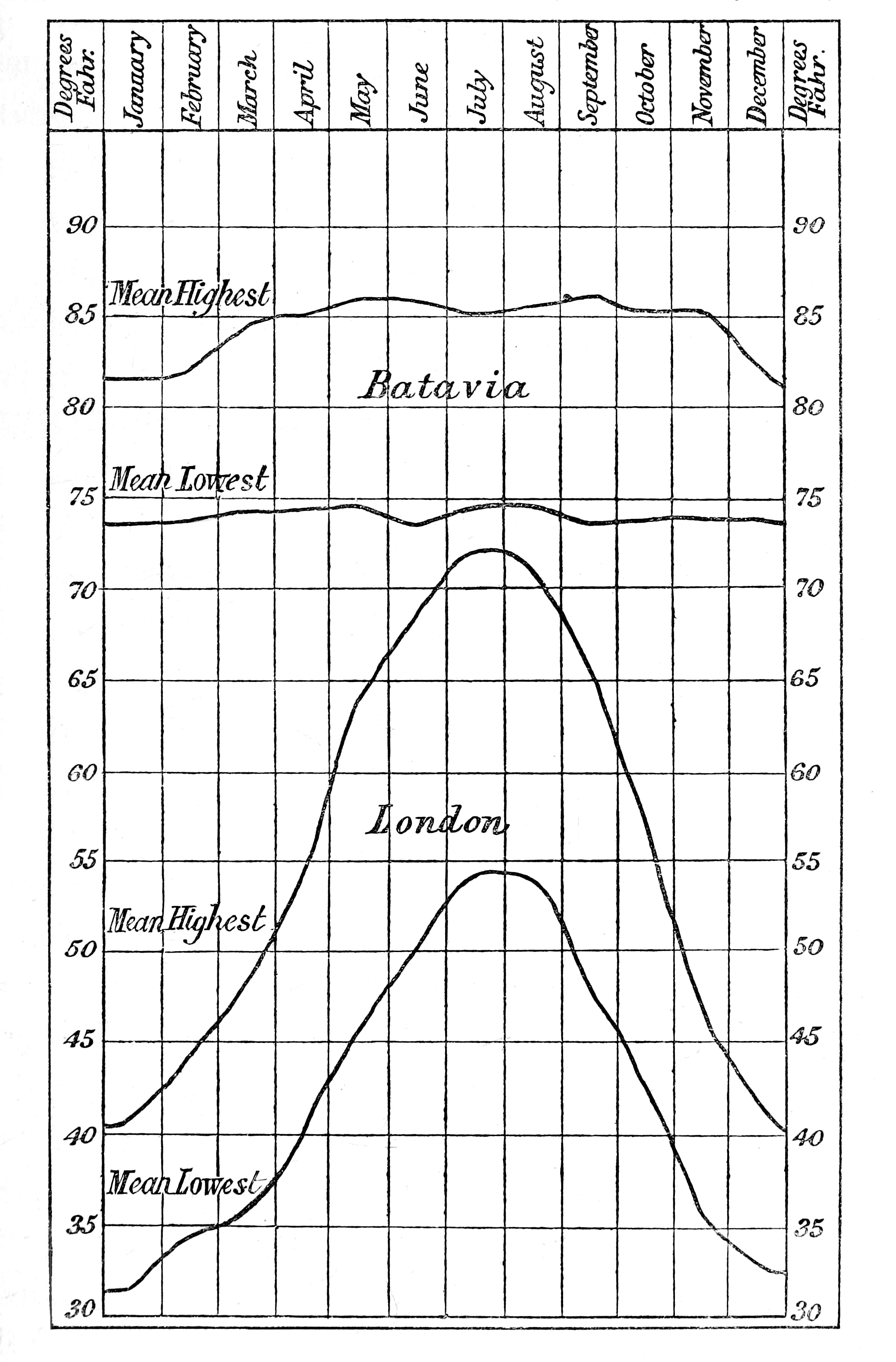
The accompanying diagram, showing by curves the
monthly means of the highest and lowest daily temperatures
at Batavia and London, is very instructive; more
especially when we consider that the maximum of
temperature is by no means remarkably different in the
two places, 90° Fahr, being sometimes reached with us
and not being often very much exceeded at Batavia.
[1] “Observations Made at the Magnetical and Meteorological Observatory
at Batavia. Published by order of the Government of Netherlands India.
Vol. I. Meteorological, from Jan. 1866 to Dec. 1868; and Magnetical, from
July 1867 to June 1870. By Dr. P. A. Bergsma. Batavia, 1871.” This
fine work is entirely in English.
Monthly Mean Temperature at Batavia & London.
Causes of the Uniform High Temperature near the
Equator.—It is popularly supposed that the uniform
high temperature of the tropics is sufficiently explained
by the greater altitude, and therefore greater heating-power,
of the midday sun; but a little consideration will
show that this alone by no means accounts for the
phenomenon. The island of Java is situated in from
six and a half to eight and a half degrees of south
latitude, and in the month of June the sun’s altitude
at noon will not be more than from 58° to 60°. In the
same month at London, which is fifty-two and a half
degrees of north latitude, the sun’s noonday altitude is 62°.
But besides this difference of altitude in favour of London
there is a still more important difference; for in Java the
day is only about eleven and a half hours long in the month
of June, while at London it is sixteen hours long, so that
the total amount of sun-heat received by the earth must
be then very much greater at London than at Batavia.
Yet at the former place the mean temperature of the
day and night is under 60° Fahr., while in the latter place
it is 80° Fahr., the daily maximum being on the average
in the one case about 68° and in the other about 89°.
Neither does the temperature at the same place depend
upon the height of the sun at noon; for at Batavia it
is nearly vertical during October and February, but
these are far from being the hottest months, which are
May, June, and September; while December, January,
and February are the coldest months, although then the
sun attains nearly its greatest altitude. It is evident,
therefore, that a difference of 30° in the altitude of the
sun at noon has no apparent influence in raising the
temperature of a place near the equator, and we must
therefore conclude that other agencies are at work
which often completely neutralise the effect which
increased altitude must undoubtedly exert.
There is another important difference between the
temperate and tropical zones, in the direct heating effect
of the sun’s rays independently of altitude. In England
the noonday sun in the month of June rarely inconveniences
us or produces any burning of the skin; while
in the tropics, at almost any hour of the day, and when
the sun has an elevation of only 40° or 50°, exposure to
it for a few minutes will scorch a European so that
the skin turns red, becomes painful, and often blisters
or peels off. Almost every visitor to the tropics
suffers from incautious exposure of the neck, the
leg, or some other part of the body to the sun’s
rays, which there possess a power as new, as it is
at first sight inexplicable, for it is not accompanied
by any extraordinary increase in the temperature of
the air.
These very different effects, produced by the same
amount of sun-heat poured upon the earth in different
latitudes is due to a combination of causes. The most
important of these are, probably,—the constant high
temperature of the soil and of the surface-waters of the
ocean,—the great amount of aqueous vapour in the
atmosphere,—the great extent of the intertropical
regions which cause the winds that reach the equatorial
zone to be always warm,—and the latent heat given out
during the formation of rain and dew. We will briefly
consider the manner in which each of these causes
contributes to the degree and the uniformity of the
equatorial temperature.
Influence of the Heat of the Soil.—It is well known
that at a very moderate depth the soil maintains a
uniform temperature during the twenty-four hours;
while at a greater depth even the annual inequalities
disappear, and a uniform temperature, which is almost
exactly the mean temperature of the locality, is constantly
maintained throughout the year. The depth at
which this uniform temperature is reached is greater as
the annual range of temperature is greater, so that it is
least near the equator, and greatest in localities near the
arctic circle where the greatest difference between
summer and winter temperature prevails. In the
vicinity of the equator, where the annual range of the
thermometer is so small as we have seen that it is at
Batavia, the mean temperature of about 80° Fahr. is
reached at a depth of four or five feet. The surplus heat
received during the day is therefore conducted downwards
very slowly, the surface soil becomes greatly superheated,
and a large portion of this heat is given out at
night and thus keeps up the high temperature of the air
when the sun has ceased to warm the earth. In the
temperate zones, on the other hand, the stratum of
uniform earth-temperature lies very deep. At Geneva
it is not less than from thirty to forty feet, and with us
it is probably fifty or sixty feet, and the temperature
found there is nearly forty degrees lower than at the
equator. This great body of cool earth absorbs a large
portion of the surface heat during the summer, and conducts
it downwards with comparative rapidity, and it
is only late in the year (in July and August) when the
upper layers of the soil have accumulated a surplus store
of solar heat that a sufficient quantity is radiated at
night to keep up a high temperature in the absence of the
sun. At the equator, on the other hand, this radiation
is always going on, and earth-heat is one of the most
important of the agencies which tend to equalise the
equatorial climate.
Influence of the Aqueous Vapour of the Atmosphere.—The
aqueous vapour which is always present in
considerable quantities in the atmosphere, exhibits
a singular and very important relation to solar and
terrestrial heat. The rays of the sun pass through it
unobstructed to the earth; but the warmth given off by
the heated earth is very largely absorbed by it, thus
raising the temperature of the air; and as it is the
lower strata of air which contain most vapour these act
as a blanket to the earth, preventing it from losing heat
at night by radiation into space. During a large part
of the year the air in the equatorial zone is nearly
saturated with vapour, so that, notwithstanding the heat,
salt and sugar become liquid, and all articles of iron get
thickly coated with rust. Complete saturation being
represented by 100, the daily average of greatest
humidity at Batavia reaches 96 in January and 92 in
December. In January, which is the dampest month,
the range of humidity is small (77 to 96), and at this
time the range of temperature is also least; while in
September, with a greater daily range of humidity (62
to 92) the range of temperature is the greatest, and the
lowest temperatures are recorded in this and the preceding
month. It is a curious fact, that in many parts
of England the degree of humidity as measured by the
comparative saturation of the air, is as great as that of
Batavia or even greater. A register kept at Clifton
during the years 1853–1862 shows a mean humidity
in January of 90, while the highest monthly mean for
the four years at Batavia was 88; and while the lowest
of the monthly means at Clifton was 79·1, the lowest at
Batavia was 78·9. These figures however represent an
immense difference in the quantity of vapour in every
cubic foot of air. In January at Clifton, with a temperature
of 35° to 40° Fahr., there would be only about
4 to 4½ grains of vapour per cubic foot of air, while at
Batavia, with a temperature from 80° to 90° Fahr., there
would be about 20 grains in the same quantity of air.
The most important fact however is, that the capacity
of air for holding vapour in suspension increases more
rapidly than temperature increases, so that a fall of ten
degrees at 50° Fahr. will lead to the condensation of
about 1½ grains of vapour, while a similar fall at 90°
Fahr. will set free 6½ grains. We can thus understand
how it is that the very moderate fall of the thermometer
during a tropical night causes heavier dews and a
greater amount of sensible moisture than are ever experienced
during much greater variations of temperature
in the temperate zone. It is this large quantity of
vapour in the equatorial atmosphere that keeps up a
genial warmth throughout the night by preventing the
radiation into space of the heat absorbed by the surface
soil during the day. That this is really the case is
strikingly proved by what occurs in the plains of
Northern India, where the daily maximum of heat is far
beyond anything experienced near the equator, yet, owing
to the extreme dryness of the atmosphere, the clear nights
are very cold, radiation being sometimes so rapid that
water placed in shallow pans becomes frozen over.
As the heated earth, and everything upon its surface,
does not cool so fast when surrounded by moist as by
dry air, it follows, that even if the quantity and intensity
of the solar rays falling upon two given portions of
the earth’s surface are exactly equal, yet the sensible and
effective heat produced in the two localities may be very
different according as the atmosphere contains much or
little vapour. In the one case the heat is absorbed
more rapidly than it can escape by radiation; in the
other case it radiates away into space, and is lost, more
rapidly than it is being absorbed. In both cases an
equilibrium will be arrived at, but in the one case the
resulting mean temperature will be much higher than in
the other.
Influence of Winds on the Temperature of the
Equator.—The distance from the northern to the
southern tropics being considerably more than three
thousand miles, and the area of the intertropical zone
more than one-third the whole area of the globe, it
becomes hardly possible for any currents of air to reach
the equatorial belt without being previously warmed by
contact with the earth or ocean, or by mixture with the
heated surface-air which is found in all intertropical and
subtropical lands. This warming of the air is rendered
more certain and more effective by the circumstance, that
all currents of air coming from the north or south have
their direction changed owing to the increasing rapidity
of the earth’s rotational velocity, so that they reach
the equator as easterly winds, and thus pass obliquely
over a great extent of the heated surface of the globe.
The causes that produce the westerly monsoons act in a
similar manner, so that on the equator direct north or
south winds, except as local land and sea breezes, are
almost unknown. The Batavia observations show, that
for ten months in the year the average direction of the
wind varies only between 5° and 30° from due east or
west, and these are also the strongest winds. In the
two months—March and October—when the winds are
northerly, they are very light, and are probably in great
part local sea-breezes, which, from the position of
Batavia, must come from the north. As a rule, therefore,
every current of air at or near the equator has passed
obliquely over an immense extent of tropical surface
and is thus necessarily a warm wind.
In the north temperate zone, on the other hand, the
winds are always cool, and often of very low temperature
even in the height of summer, due probably to their
coming from colder northern regions as easterly winds, or
from the upper parts of the atmosphere as westerly winds;
and this constant supply of cool air, combined with quick
radiation through a dryer atmosphere, carries off the
solar heat so rapidly that an equilibrium is only reached
at a comparatively low temperature. In the equatorial
zone, on the contrary, the heat accumulates, on account
of the absence of any medium of sufficiently low
temperature to carry it off rapidly, and it thus soon
reaches a point high enough to produce those scorching
effects which are so puzzling when the altitude of the
sun or the indications of the thermometer are alone considered.
Whenever, as is sometimes the case, exceptional
cold occurs near the equator, it can almost always be
traced to the influence of currents of air of unusually
low temperature. Thus in July near the Aru islands,
the writer experienced a strong south-east wind which
almost neutralised the usual effects of tropical heat
although the weather was bright and sunny. But the
wind, coming direct from the southern ocean during its
winter without acquiring heat by passing over land, was
of an unusually low temperature. Again, Mr. Bates
informs us that in the Upper Amazon in the month of
May there is a regularly recurring south wind which
produces a remarkable lowering of the usual equatorial
temperature. But owing to the increased velocity of the
earth’s surface at the equator a south wind there must
have been a south-west wind at its origin, and this would
bring it directly from the high chain of the Peruvian
Andes during the winter of the southern hemisphere.
It is therefore probably a cold mountain wind, and blowing
as it does over a continuous forest it has been unable
to acquire the usual tropical warmth.
The cause of the striking contrast between the climates
of equatorial and temperate lands at times when both
are receiving an approximately equal amount of solar
heat may perhaps be made clearer by an illustration.
Let us suppose there to be two reservoirs of water,
each supplied by a pipe which pours into it a thousand
gallons a day, but which runs only during the daytime,
being cut off at night. The reservoirs are both leaky,
but while the one loses at the rate of nine hundred
gallons in the twenty-four hours the other loses at the
rate of eleven hundred gallons in the same time, supposing
that both are kept exactly half full and thus
subjected to the same uniform water-pressure. If now
both are left to be supplied by the above-mentioned
pipes the result will be, that in the one which loses by
leakage less than it receives the water will rise day by
day, till the increased pressure causes the leakage to
increase so as exactly to balance the supply; while in
the other the water will sink till the decreasing pressure
causes the leakage to decrease so as to balance the
supply, when both will remain stationary, the one at
a high the other at a low average level, each rising
during the day and sinking again at night. Just the
same thing occurs with that great heat-reservoir the
earth, whose actual temperature at any spot will depend,
not alone upon the quantity of heat it receives, but on
the balance between its constantly varying waste and
supply. We can thus understand how it is that, although
in the months of June and July Scotland in latitude
57° north receives as much sun-heat as Angola or
Timor in latitude 10° south, and for a much greater
number of hours daily, yet in the latter the mean
temperature will be about 80° Fahr., with a daily
maximum of 90° to 95°, while in the former the mean
will be about 60° Fahr. with a daily maximum of 70° or
75°; and, while in Scotland exposure to the full noonday
sun produces no unpleasant heat-sensations, a similar
exposure in Timor at any time between 9 A.M. and 3
P.M. would blister the skin in a few minutes almost as
effectually as the application of scalding water.
Heat Due to the Condensation of Atmospheric
Vapour.—Another cause which tends to keep up a
uniform high temperature in the equatorial, as compared
with the variable temperatures of the extra-tropical
zones, is the large amount of heat liberated during the
condensation of the aqueous vapour of the atmosphere
in the form of rain and dew. Owing to the frequent
near approach of the equatorial atmosphere to the
saturation point, and the great weight of vapour its
high temperature enables it to hold in suspension, a very
slight fall of the thermometer is accompanied by the
condensation of a large absolute quantity of atmospheric
vapour, so that copious dews and heavy showers of rain
are produced at comparatively high temperatures and
low altitudes. The drops of rain rapidly increase in
size while falling through the saturated atmosphere;
and during this process as well as by the formation of
dew, the heat which retained the water in the gaseous
form, and was insensible while doing so, is liberated, and
thus helps to keep up the high temperature of the air.
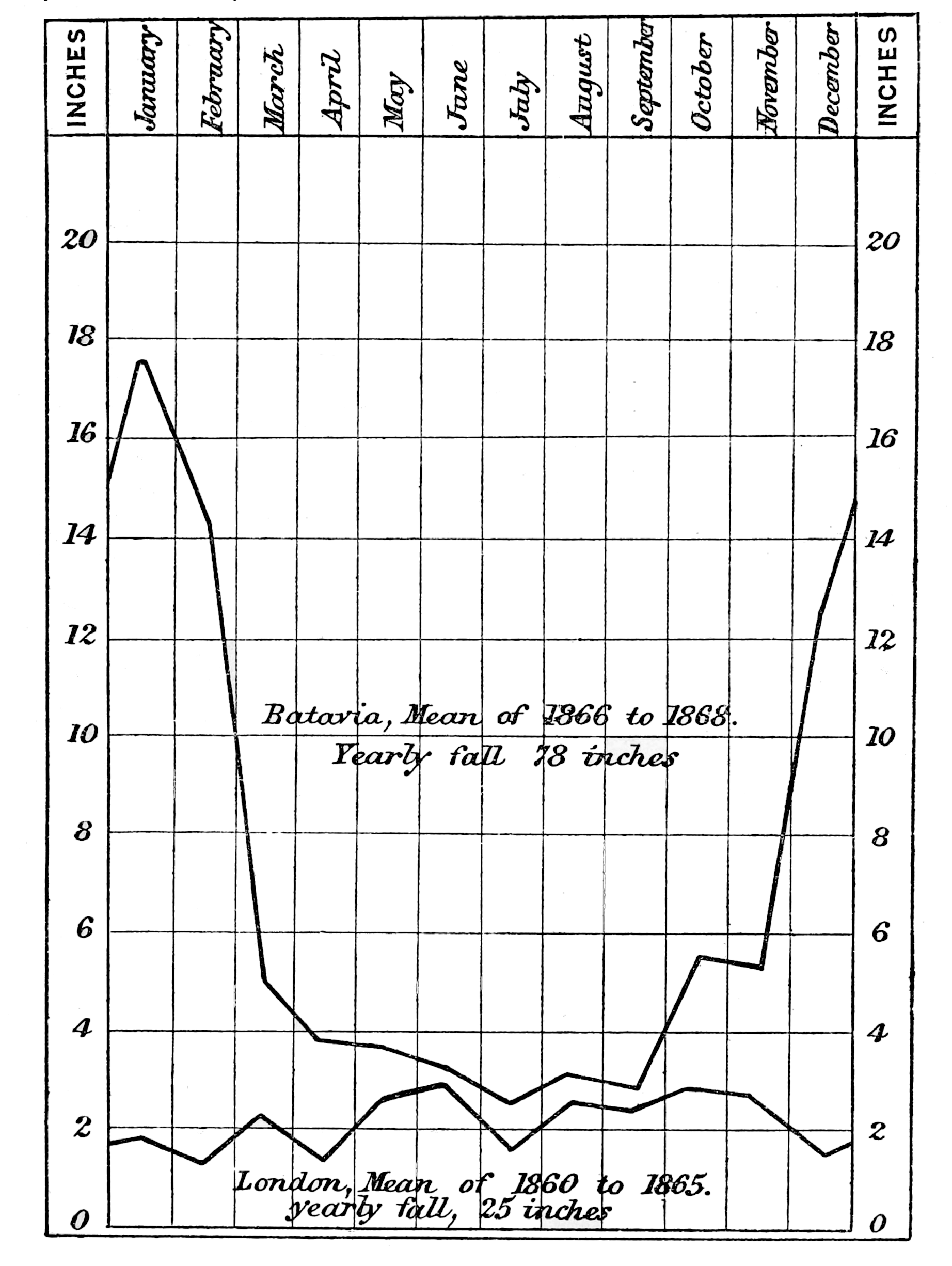
This production of heat is almost always going on. In
fine weather the nights are always dewy, and the diagram
on the preceding page showing the mean monthly rainfall
at Batavia and Greenwich proves that this source
of increased temperature is present during every month
in the year, since the lowest monthly fall at the former
place is almost equal to the highest monthly fall at the
latter.
Monthly Rainfall at London and Batavia.
It may perhaps be objected, that evaporation must
absorb as much heat as is afterwards liberated by condensation,
and this is true; but as evaporation and
condensation occur usually at different times and in
different places, the equalising effect is still very
important. Evaporation occurs chiefly during the
hottest sunshine, when it tends to moderate the extreme
heat, while condensation takes place chiefly at night in
the form of dew and rain, when the liberated heat helps
to make up for the loss of the direct rays of the sun.
Again, the most copious condensation both of dew and
rain is greatly influenced by vegetation and especially
by forests, and also by the presence of hills and mountains,
and is therefore greater on land than on the
ocean; while evaporation is much greater on the ocean,
both on account of the less amount of cloudy weather
and because the air is more constantly in motion.
This is particularly the case throughout that large
portion of the tropical and subtropical zones where the
trade-winds constantly blow, as the evaporation must
there be enormous while the quantity of rain is very
small. It follows, then, that on the equatorial land-surface
there will be a considerable balance of condensation
over evaporation which must tend to the general
raising of the temperature, and, owing to the condensation
being principally at night, not less powerfully to
its equalisation.
General Features of the Equatorial Climate.—The
various causes now enumerated are sufficient to enable
us to understand how the great characteristic features
of the climate of the equatorial zone are brought about;
how it is that so high a temperature is maintained
during the absence of the sun at night, and why so
little effect is produced by the sun’s varying altitude
during its passage from the northern to the southern
tropic. In this favoured zone the heat is never oppressive,
as it so often becomes on the borders of the
tropics; and the large absolute amount of moisture
always present in the air, is almost as congenial to the
health of man as it is favourable to the growth and
development of vegetation.[2] Again, the lowering of
the temperature at night is so regular and yet so strictly
limited in amount, that, although never cold enough to
be unpleasant, the nights are never so oppressively hot
as to prevent sleep. During the wettest months of
the year, it is rare to have many days in succession
without some hours of sunshine, while even in the
driest months there are occasional showers to cool and
refresh the overheated earth. As a result of this condition
of the earth and atmosphere, there is no check to
vegetation, and little if any demarcation of the seasons.
Plants are all evergreen; flowers and fruits, although
more abundant at certain seasons, are never altogether
absent; while many annual food-plants as well as some
fruit-trees produce two crops a year. In other cases, more
than one complete year is required to mature the large
and massive fruits, so that it is not uncommon for fruit
to be ripe at the same time that the tree is covered with
flowers, in preparation for the succeeding crop. This is
the case with the Brazil nut tree, in the forests of the
Amazon, and with many other tropical as with a few
temperate fruits.
[2] Where the inhabitants adapt their mode of life to the peculiarities of
the climate, as is the case with the Dutch in the Malay Archipelago, they
enjoy as robust health as in Europe, both in the case of persons born in
Europe and of those who for generations have lived under a vertical sun.
Uniformity of the Equatorial Climate in all Parts of
the Globe.—The description of the climatal phenomena
of the equatorial zone here given, has been in great part
drawn from long personal experience in South America
and in the Malay Archipelago. Over a large portion of
these countries the same general features prevail, only
modified by varying local conditions. Whether we are
at Singapore or Batavia; in the Moluccas, or New
Guinea; at Para, at the sources of the Rio Negro, or on
the Upper Amazon, the equatorial climate is essentially
the same, and we have no reason to believe that it
materially differs in Guinea or the Congo. In certain
localities, however, a more contrasted wet and dry
season prevails, with a somewhat greater range of the
thermometer. This is generally associated with a sandy
soil, and a less dense forest, or with an open and more
cultivated country. The open sandy country with
scattered trees and shrubs or occasional thickets, which
is found at Santarem and Monte-Alegre on the lower
Amazon, are examples, as well as the open cultivated
plains of Southern Celebes; but in both cases the forest
country in adjacent districts has a moister and more
uniform climate, so that it seems probable that the
nature of the soil or the artificial clearing away of the
forests, are important agents in producing the departure
from the typical equatorial climate observed in such
districts. The almost rainless district of Ceara on the
North-East coast of Brazil and only a few degrees south
of the equator, is a striking example of the need of
vegetation to react on the rainfall. We have here no
apparent cause but the sandy soil and bare hills, which
when heated by the equatorial sun produce ascending
currents of warm air and thus prevent the condensation
of the atmospheric vapour, to account for such an
anomaly; and there is probably no district where
judicious planting would produce such striking and
beneficial effects. In Central India the scanty and
intermittent rainfall, with its fearful accompaniment of
famine, is no doubt in great part due to the absence of a
sufficient proportion of forest-covering to the earth’s
surface; and it is to a systematic planting of all the
hill tops, elevated ridges, and higher slopes that we can
alone look for a radical cure of the evil. This would
almost certainly induce an increased rainfall; but even
more important and more certain, is the action of forests
in checking evaporation from the soil and causing
perennial springs to flow, which may be collected in
vast storage tanks and will serve to fertilise a great
extent of country; whereas tanks without regular rainfall
or permanent springs to supply them are worthless.
In the colder parts of the temperate zones, the absence
of forests is not so much felt, because the hills and
uplands are naturally clothed with a thick coating of
turf which absorbs moisture and does not become overheated
by the sun’s rays, and the rains are seldom
violent enough to strip this protective covering from the
surface. In tropical and even in south-temperate
countries, on the other hand, the rains are periodical
and often of excessive violence for a short period;
and when the forests are cleared away the torrents
of rain soon strip off the vegetable soil, and thus
destroy in a few years the fertility which has been the
growth of many centuries. The bare subsoil becoming
heated by the sun, every particle of moisture which does
not flow off is evaporated, and this again reacts on the
climate, producing long-continued droughts only relieved
by sudden and violent storms, which add to the
destruction and render all attempts at cultivation
unavailing. Wide tracts of fertile land in the south
of Europe have been devastated in this manner, and
have become absolutely uninhabitable. Knowingly to
produce such disastrous results would be a far more
serious offence than any destruction of property which
human labour has produced and can replace; yet we
ignorantly allow such extensive clearings for coffee
cultivation in India and Ceylon, as to cause the destruction
of much fertile soil which generations cannot
replace, and which will surely, if not checked in time,
lead to the deterioration of the climate and the
permanent impoverishment of the country.[3]
[3] For a terrible picture of the irreparable devastation caused by the reckless
clearing of forests see the third chapter of Mr. Marsh’s work The Earth as
Modified by Human Action.
Short Twilight of the Equatorial Zone.—One of the
phenomena which markedly distinguish the equatorial
from the temperate and polar zones, is the shortness
of the twilight and consequent rapid transition from day
to night and from night to day. As this depends only
on the fact of the sun descending vertically instead
of obliquely below the horizon, the difference is most
marked when we compare our midsummer twilight with
that of the tropics. Even with us the duration of
twilight is very much shorter at the time of the
equinoxes, and it is probably not much more than a
third shorter than this at the equator. Travellers usually
exaggerate the shortness of the tropical twilight, it being
sometimes said that if we turn a page of the book we
are reading when the sun disappears, by the time we turn
over the next page it will be too dark to see to read.
With an average book and an average reader this is
certainly not true, and it will be well to describe as
correctly as we can what really happens.
In fine weather the air appears to be somewhat more
transparent near the equator than with us, and the
intensity of sunlight is usually very great up to the
moment when the solar orb touches the horizon. As
soon as it has disappeared the apparent gloom is proportionally
great, but this hardly increases perceptibly during
the first ten minutes. During the next ten minutes
however it becomes rapidly darker, and at the end of
about twenty-five minutes from sunset the complete
darkness of night is almost reached. In the morning
the changes are perhaps even more striking. Up to
about a quarter past five o’clock the darkness is complete;
but about that time a few cries of birds begin to break
the silence of night, perhaps indicating that signs of
dawn are perceptible in the eastern horizon. A little
later the melancholy voices of the goatsuckers are heard,
varied croakings of frogs, the plaintive whistle of mountain
thrushes, and strange cries of birds or mammals
peculiar to each locality. About half-past five the first
glimmer of light becomes perceptible; it slowly becomes
lighter, and then increases so rapidly that at about a
quarter to six it seems full daylight. For the next
quarter of an hour this changes very little in character;
when, suddenly, the sun’s rim appears above the horizon,
decking the dew-laden foliage with glittering gems,
sending gleams of golden light far into the woods, and
waking up all nature to life and activity. Birds chirp
and flutter about, parrots scream, monkeys chatter, bees
hum among the flowers, and gorgeous butterflies flutter
lazily along or sit with fully expanded wings exposed to
the warm and invigorating rays. The first hour of
morning in the equatorial regions possesses a charm and
a beauty that can never be forgotten. All nature seems
refreshed and strengthened by the coolness and moisture
of the past night; new leaves and buds unfold almost
before the eye, and fresh shoots may often be observed
to have grown many inches since the preceding day.
The temperature is the most delicious conceivable. The
slight chill of early dawn, which was itself agreeable, is
succeeded by an invigorating warmth; and the intense
sunshine lights up the glorious vegetation of the tropics,
and realises all that the magic art of the painter or the
glowing words of the poet, have pictured as their ideals
of terrestrial beauty.
The Aspect of the Equatorial Heavens.—Within the
limits of the equatorial zone the noonday sun is truly
vertical twice every year, and for several months it
passes so near the zenith that the difference can hardly
be detected without careful observation of the very short
shadows of vertical objects. The absence of distinct
horizontal shadows at noon which thus characterises a
considerable part of the year, is itself a striking phenomenon
to an inhabitant of the temperate zones; and
equally striking is the changed aspect of the starry
heavens. The grand constellation Orion, passes vertically
overhead, while the Great Bear is only to be seen
low down in the northern heavens, and the Pole star
either appears close to the horizon or has altogether
disappeared according as we are north or south of the
equator. Towards the south the Southern Cross, the
Magellanic clouds, and the jet-black “coal sacks” are the
most conspicuous objects invisible in our northern latitudes.
The same cause that brings the sun overhead in
its daily march equally affects the planets, which appear
high up towards the zenith far more frequently than
with us, thus affording splendid opportunities for
telescopic observation.
Intensity of Meteorological Phenomena at the Equator.—The
excessive violence of meteorological phenomena
generally supposed to be characteristic of the tropics is
not by any means remarkable in the equatorial zone.
Electrical disturbances are much more frequent, but not
generally more violent than in the temperate regions.
The wind-storms are rarely of excessive violence, as
might in fact be inferred from the extreme steadiness of
the barometer, whose daily range at Batavia rarely exceeds
one-eighth of an inch, while the extreme range during
three years was less than one-third of an inch! The
amount of the rainfall is very great, seventy or eighty
inches in a year being a probable average; and as the
larger part of this occurs during three or four months,
individual rainfalls are often exceedingly heavy. The
greatest fall recorded at Batavia during three years
was three inches and eight-tenths in one hour,[4] but this
was quite exceptional, and even half this quantity is
very unusual. The greatest rainfall recorded in twenty-four
hours is seven inches and a quarter; but more than
four inches in one day occurs only on two or three occasions
in a year. The blue colour of the sky is probably
not so intense as in many parts of the temperate zone,
while the brilliancy of the moon and stars is not
perceptibly greater than that of our clearest frosty nights,
and is undoubtedly much inferior to what is witnessed
in many desert regions, and even in Southern Europe.
On the whole, then, we must decide, that uniformity
and abundance, rather than any excessive manifestations,
are the prevailing characteristic of all the climatal
phenomena of the equatorial zone.
Concluding Remarks.—We cannot better conclude
our account of the equatorial climate than by quoting
the following vivid description of the physical phenomena
which occur during the early part of the dry
season at Para. It is taken from Mr. Bates’ Naturalist on
the Amazons, and clearly exhibits some of the more
characteristic features of a typical equatorial day.
“At that early period of the day (the first two hours
after sunrise) the sky was invariably cloudless, the thermometer
marking 72° or 73° Fahr.; the heavy dew or
the previous night’s rain, which lay on the moist foliage,
becoming quickly dissipated by the glowing sun, which,
rising straight out of the east, mounted rapidly towards
the zenith. All nature was fresh, new leaf and flower-buds
expanding rapidly. * * * The heat increased hourly,
and towards two o’clock reached 92° to 93° Fahr., by
which time every voice of bird and mammal was hushed.
The leaves, which were so moist and fresh in early
morning, now became lax and drooping, and flowers shed
their petals. On most days in June and July a heavy
shower would fall some time in the afternoon, producing
a most welcome coolness. The approach of the rain-clouds
was after a uniform fashion very interesting to
observe. First, the cool sea-breeze which had commenced
to blow about ten o’clock, and which had increased in
force with the increasing power of the sun, would flag,
and finally die away. The heat and electric tension of
the atmosphere would then become almost insupportable.
Languor and uneasiness would seize on every one, even
the denizens of the forest betraying it by their motions.
White clouds would appear in the east and gather into
cumuli, with an increasing blackness along their lower
portions. The whole eastern horizon would become
almost suddenly black, and this would spread upwards,
the sun at length becoming obscured. Then the rush of
a mighty wind is heard through the forest, swaying the
tree-tops; a vivid flash of lightning bursts forth, then a
crash of thunder, and down streams the deluging rain.
Such storms soon cease, leaving bluish-black motionless
clouds in the sky until night. Meantime all nature is
refreshed; but heaps of flower-petals and fallen leaves
are seen under the trees. Towards evening life revives
again, and the ringing uproar is resumed from bush and
tree. The following morning the sun again rises in a
cloudless sky; and so the cycle is completed; spring,
summer, and autumn, as it were in one tropical day.
The days are more or less like this throughout the year.
A little difference exists between the dry and wet seasons;
but generally, the dry season, which lasts from July to
December, is varied with showers, and the wet, from
January to June, with sunny days. It results from this,—that
the periodical phenomena of plants and animals do
not take place at about the same time in all species, or
in the individuals of any given species, as they do in
temperate countries. In Europe, a woodland scene has
its spring, its summer, its autumnal, and its winter
aspects. In the equatorial forests the aspect is the same
or nearly so every day in the year: budding, flowering,
fruiting, and leaf-shedding are always going on in one
species or other. It is never either spring, summer, or
autumn, but each day is a combination of all three.
With the day and night always of equal length, the
atmospheric disturbances of each day neutralising themselves
before each succeeding morn; with the sun in its
course proceeding midway across the sky, and the daily
temperature almost the same throughout the year—how
grand in its perfect equilibrium and simplicity is the
march of Nature under the equator!”
II . EQUATORIAL VEGETATION.
The Equatorial Forest-Belt and its Causes—General features of the Equatorial
Forests—Low-growth Forest-trees—Flowery trunks and their probable
cause—Uses of Equatorial Forest-trees—The Climbing Plants of the
Equatorial Forests—Palms—Uses of Palm-trees and their Products—Ferns—Ginger-worts
and wild Bananas—Arums—Screw-pines—Orchids—Bamboos—Uses
of the Bamboo—Mangroves—Sensitive-plants—Comparative
scarcity of Flowers—Concluding Remarks on Tropical
Vegetation.
In the following sketch of the characteristics of vegetable
life in the equatorial zone, it is not intended to enter
into any scientific details or to treat the subject in the
slightest degree from a botanical point of view; but
merely to describe those general features of vegetation
which are almost or quite peculiar to this region of the
globe, and which are so general as to be characteristic
of the greater part of it rather than of any particular
country or continent within its limits.
The Equatorial Forest-Belt and its Causes.—With
but few and unimportant exceptions a great forest band
from a thousand to fifteen hundred miles in width
girdles the earth at the equator, clothing hill, plain, and
mountain with an evergreen mantle. Lofty peaks and
precipitous ridges are sometimes bare, but often the
woody covering continues to a height of eight or ten
thousand feet, as in some of the volcanic mountains
of Java and on portions of the Eastern Andes. Beyond
the forests both to the north and south, we meet first
with woody and then open country, soon changing into
arid plains or even deserts which form an almost continuous
band in the vicinity of the two tropics. On
the line of the tropic of Cancer we have, in America
the deserts and dry plains of New Mexico; in Africa the
Sahara; and in Asia, the Arabian deserts, those of Beloochistan
and Western India, and further east the dry
plains of North China and Mongolia. On the tropic of
Capricorn we have, in America the Grand Chaco desert
and the Pampas; in Africa the Kalahari desert and the
dry plains north of the Limpopo; while the deserts and
waterless plains of Central Australia complete the arid zone.
These great contrasts of verdure and barrenness occurring
in parallel bands all round the globe, must evidently
depend on the general laws which determine the distribution
of moisture over the earth, more or less modified
by local causes. Without going into meteorological
details, some of which have been given in the preceding
chapter, the main facts may be explained by the mode
in which the great aerial currents are distributed. The
trade winds passing over the ocean from north-east to
south-west with an oblique tendency towards the equator,
become saturated with vapour, and are ready to give
out moisture whenever they are forced upwards or in any
other way have their temperature lowered. The entire
equatorial zone becomes thus charged with vapour-laden
air which is the primary necessity of a luxuriant vegetation.
The surplus air (produced by the meeting of the
two trade winds) which is ever rising in the equatorial
belt and giving up its store of vapour, flows off north
and south as dry, cool air, and descends to the earth in
the vicinity of the tropics. Here it sucks up whatever
moisture it meets with and thus tends to keep this zone
in an arid condition. The trades themselves are believed
to be supplied by descending currents from the temperate
zones, and these are at first equally dry and
only become vapour-laden when they have passed over
some extent of moist surface. At the solstices the sun
passes vertically over the vicinity of the tropics for
several weeks, and this further aggravates the aridity;
and wherever the soil is sandy and there are no lofty
mountain-chains to supply ample irrigation the result is
a more or less perfect desert. Analogous causes, which
a study of aerial currents will render intelligible, have
produced other great forest-belts in the northern and
southern parts of the temperate zones; but owing to the
paucity of land in the southern hemisphere these are
best seen in North America and Northern Euro-Asia,
where they form the great northern forests of deciduous
trees and of Coniferæ. These being comparatively well known
to us, will form the standard by a reference to
which we shall endeavour to point out and render intelligible
the distinctive characteristics of the equatorial
forest vegetation.
General Features of the Equatorial Forests.—It is not
easy to fix upon the most distinctive features of these
virgin forests, which nevertheless impress themselves upon
the beholder as something quite unlike those of temperate
lands, and as possessing a grandeur and sublimity
altogether their own. Amid the countless modifications
in detail which these forests present, we shall endeavour
to point out the chief peculiarities as well as the more
interesting phenomena which generally characterise them.
The observer new to the scene would perhaps be first
struck by the varied yet symmetrical trunks, which rise
up with perfect straightness to a great height without a
branch, and which, being placed at a considerable average
distance apart, give an impression similar to that produced
by the columns of some enormous building.
Overhead, at a height, perhaps, of a hundred feet, is an
almost unbroken canopy of foliage formed by the meeting
together of these great trees and their interlacing
branches; and this canopy is usually so dense that but
an indistinct glimmer of the sky is to be seen, and even
the intense tropical sunlight only penetrates to the ground
subdued and broken up into scattered fragments. There
is a weird gloom and a solemn silence, which combine
to produce a sense of the vast—the primeval—almost
of the infinite. It is a world in which man seems an
intruder, and where he feels overwhelmed by the contemplation
of the ever-acting forces, which, from the
simple elements of the atmosphere, build up the great
mass of vegetation which overshadows, and almost seems
to oppress the earth.
Characteristics of the Larger Forest-trees.—Passing
from the general impression to the elements of which
the scene is composed, the observer is struck by the
great diversity of the details amid the general uniformity.
Instead of endless repetitions of the same forms of trunk
such as are to be seen in our pine, or oak, or beech woods,
the eye wanders from one tree to another and rarely
detects two of the same species. All are tall and
upright columns, but they differ from each other more
than do the columns of Gothic, Greek, and Egyptian
temples. Some are almost cylindrical, rising up out of
the ground as if their bases were concealed by accumulations
of the soil; others get much thicker near the
ground like our spreading oaks; others again, and these are
very characteristic, send out towards the base flat and
wing-like projections. These projections are thin slabs
radiating from the main trunk, from which they stand
out like the buttresses of a Gothic cathedral. They rise
to various heights on the tree, from five or six, to twenty
or thirty feet; they often divide as they approach the
ground, and sometimes twist and curve along the surface
for a considerable distance, forming elevated and greatly
compressed roots. These buttresses are sometimes so
large that the spaces between them if roofed over would
form huts capable of containing several persons. Their
use is evidently to give the tree an extended base, and
so assist the subterranean roots in maintaining in an
erect position so lofty a column crowned by a broad and
massive head of branches and foliage. The buttressed
trees belong to a variety of distinct groups. Thus,
many of the Bombaceæ or silk-cotton trees, several of
the Leguminosæ, and perhaps many trees belonging to
other natural orders, possess these appendages.
There is another form of tree, hardly less curious, in
which the trunk, though generally straight and cylindrical,
is deeply furrowed and indented, appearing as if
made up of a number of small trees grown together at
the centre. Sometimes the junction of what seem to be
the component parts, is so imperfect, that gaps or holes
are left by which you can see through the trunk in
various places. At first one is disposed to think this is
caused by accident or decay, but repeated examination
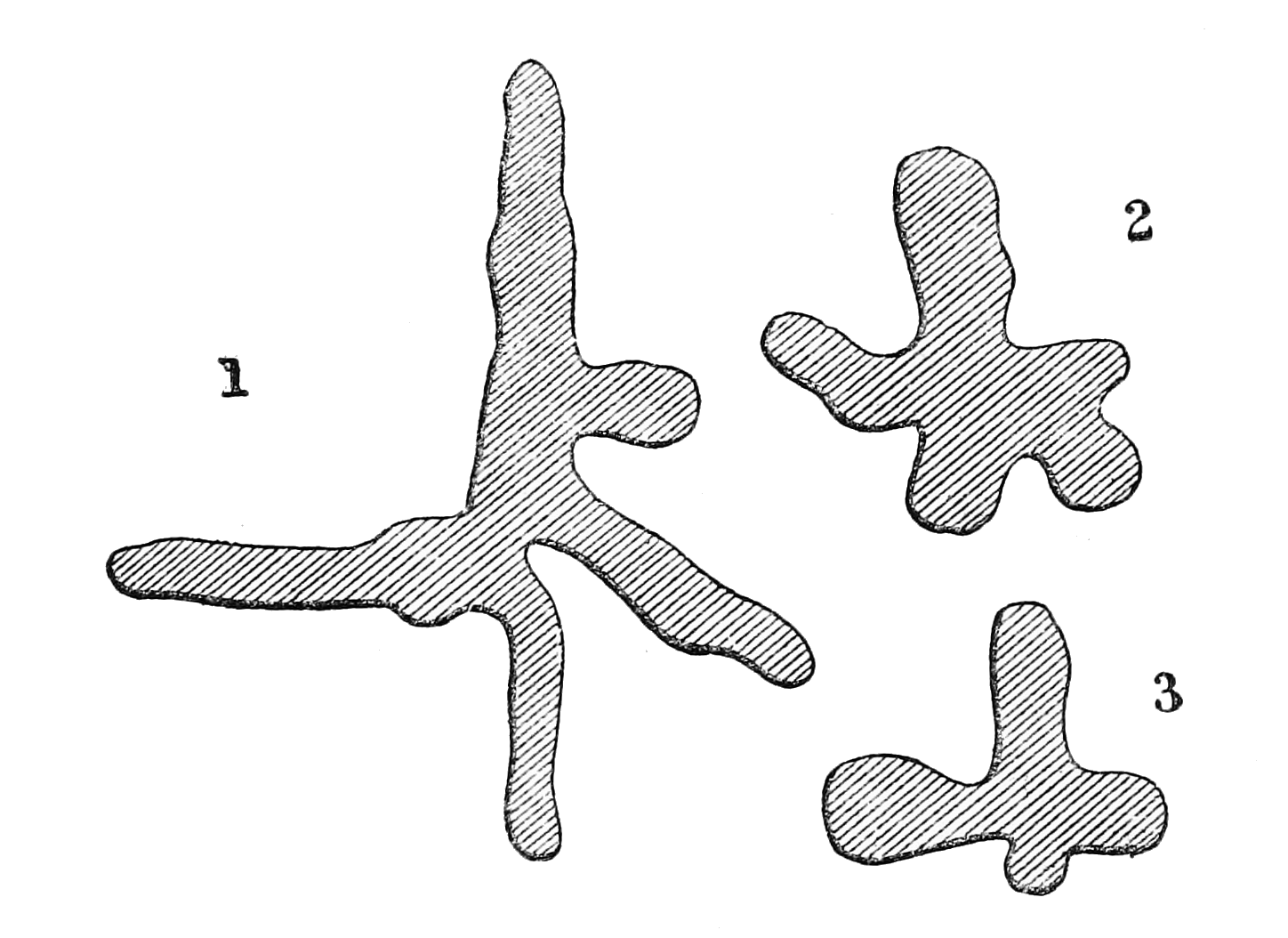
shows it be due to the natural growth of the tree. The
accompanying outline sections of one of these trees that
was cut down, exhibits its character. It was a noble
forest-tree, more than 200 feet high, but rather slender
in proportion, and it was by no means an extreme
example of its class. This peculiar form is probably
produced by the downward growth of aerial roots, like
some New Zealand trees whose growth has been traced,
and of whose different stages drawings may be seen at
the Library of the Linnean Society. These commence
their existence as parasitical climbers which take root in
the fork of some forest-tree and send down aerial roots
which clasp round the stem that upholds them. As
these roots increase in size and grow together laterally
they cause the death of their foster-parent. The climber
then grows rapidly, sending out large branches above
and spreading roots below, and as the supporting tree
decays away the aerial roots grow together and form a
new trunk, more or less furrowed and buttressed, but
exhibiting no other marks of its exceptional origin.
Aerial-rooted forest-trees—like that figured in my
Malay Archipelago (vol. i. p. 131)—and the equally
remarkable fig-trees of various species, whose trunks are
formed by a miniature forest of aerial roots, sometimes
separate, sometimes matted together, are characteristic of
the Eastern tropics, but appear to be rare or altogether
unknown in America, and can therefore hardly be included
among the general characteristics of the equatorial
zone.
Sections of trunk of a Bornean Forest-tree. 1. Section at seven feet from the ground.
2. 3. Sections much higher up.
Besides the varieties of form, however, the tree-trunks
of these forests present many peculiarities of colour and
texture. The majority are rather smooth-barked, and
many are of peculiar whitish, green, yellowish, or brown
colours, or occasionally nearly black. Some are perfectly
smooth, others deeply cracked and furrowed, while in a
considerable number the bark splits off in flakes or hangs
down in long fibrous ribands. Spined or prickly trunks
(except of palms) are rare in the damp equatorial forests.
Turning our gaze upwards from the stems to the foliage,
we find two types of leaf not common in the temperate
zone, although the great mass of the trees offer nothing
very remarkable in this respect. First, we have many
trees with large, thick, and glossy leaves, like those of
the cherry-laurel or the magnolia, but even larger,
smoother, and more symmetrical. The leaves of the
Asiatic caoutchouc-tree (Ficus elastica), so often cultivated
in houses, is a type of this class, which has a very
fine effect among the more ordinary-looking foliage.
Contrasted with this is the fine pinnate foliage of some
of the largest forest-trees which, seen far aloft against
the sky, looks as delicate as that of the sensitive
mimosa.
Forest-trees of Low Growth.—The great trees we
have hitherto been describing form, however, but a
portion of the forest. Beneath their lofty canopy there
often exists a second forest of moderate-sized trees, whose
crowns, perhaps forty or fifty feet high, do not touch
the lowermost branches of those above them. These are
of course shade-loving trees, and their presence effectually
prevents the growth of any young trees of the larger
kinds, until, overcome by age and storms, some monarch
of the forest falls down, and, carrying destruction in its
fall, opens up a considerable space, into which sun and
air can penetrate. Then comes a race for existence among
the seedlings of the surrounding trees, in which a few
ultimately prevail and fill up the space vacated by their
predecessor. Yet beneath this second set of medium-sized
forest-trees there is often a third undergrowth of
small trees, from six to ten feet high, of dwarf palms, of
tree-ferns, and of gigantic herbaceous ferns. Coming to
the surface of the ground itself we find much variety.
Sometimes it is completely bare, a mass of decaying
leaves and twigs and fallen fruits. More frequently it
is covered with a dense carpet of selaginella or other
lycopodiaceæ, and these sometimes give place to a
variety of herbaceous plants, sometimes with pretty, but
rarely with very conspicuous flowers.
Flowering Trunks and their Probable Cause.—Among
the minor but not unimportant peculiarities that
characterise these lofty forests, is the curious way in
which many of the smaller trees have their flowers
situated on the main trunk or larger branches instead
of on the upper part of the tree. The cacao-tree is a
well-known example of this peculiarity, which is not
uncommon in tropical forests; and some of the smaller
trunks are occasionally almost hidden by the quantity
of fruit produced on them. One of the most beautiful
examples of this mode of flowering is a small tree of
the genus Polyalthea, belonging to the family of the
custard-apples, not uncommon in the forests of North-western
Borneo. Its slender trunk, about fifteen or
twenty feet high, was completely covered with star-shaped
flowers, three inches across and of a rich orange-red
colour, making the trees look as if they had been
artificially decorated with brilliant garlands. The recent
discoveries as to the important part played by insects
in the fertilization of flowers offers a very probable
explanation of this peculiarity. Bees and butterflies
are the greatest flower-haunters. The former love the
sun and frequent open grounds or the flowery tops of
the lofty forest-trees fully exposed to the sun and air.
The forest shades are frequented by thousands of
butterflies, but these mostly keep near the ground,
where they have a free passage among the tree-trunks
and visit the flowering shrubs and herbaceous plants.
To attract these it is necessary that flowers should be
low down and conspicuous. If they grew in the usual
way on the tops of these smaller trees overshadowed by
the dense canopy above them they would be out of
sight of both groups of insects, but being placed openly
on the stems, and in the greatest profusion, they cannot
fail to attract the attention of the wandering butterflies.
Uses of Equatorial Forest-trees.—Amid this immense
variety of trees, the natives have found out such as are
best adapted to certain purposes. The wood of some is
light and soft, and is used for floats or for carving out
rude images, stools, and ornaments for boats and houses.
The flat slabs of the buttresses are often used to make
paddles. Some of the trees with furrowed stems are
exceedingly strong and durable, serving as posts for
houses or as piles on which the water-villages are built.
Canoes, formed from a trunk hollowed out and spread
open under the action of heat, require one kind of wood,
those built up with planks another; and, as the species of
trees in these forests are so much more numerous than
the wants of a semi-civilized population, there are probably
a large number of kinds of timber which will some day
be found to be well adapted to the special requirements
of the arts and sciences. The products of the trees of
the equatorial forests, notwithstanding our imperfect
knowledge of them, are already more useful to civilized
man than to the indigenous inhabitants. To mention
only a few of those whose names are tolerably familiar
to us, we have such valuable woods as mahogany, teak,
ebony, lignum-vitæ, purple-heart, iron-wood, sandal-wood,
and satin-wood; such useful gums as india-rubber,
gutta-percha, tragacanth, copal, lac, and dammar; such
dyes as are yielded by log-wood, brazil-wood, and
sappan-wood; such drugs as the balsams of Capivi and
Tolu, camphor, benzoin, catechu or terra-japonica, cajuput
oil, gamboge, quinine, Angostura bark, quassia, and
the urari and upas poisons; of spices we have cloves,
cinnamon, and nutmegs; and of fruits, brazil-nuts,
tamarinds, guavas, and the valuable cacao; while
residents in our tropical colonies enjoy the bread-fruit,
avocado-pear, custard-apple, durian, mango, mangosteen,
soursop, papaw, and many others. This list of useful
products from the exogenous trees alone of the equatorial
forests, excluding those from the palms, shrubs, herbs,
and creepers, might have been multiplied many times
over by the introduction of articles whose names would
be known only to those interested in special arts or
sciences; but imperfect as it is, it will serve to afford a
notion of the value of this vast treasure-house which is
as yet but very partially explored.
The Climbing Plants of the Equatorial Forests.—Next
to the trees themselves the most conspicuous and
remarkable feature of the tropical forests is the profusion
of woody creepers and climbers that everywhere meet the
eye. They twist around the slenderer stems, they drop
down pendent from the branches, they stretch tightly from
tree to tree, they hang looped in huge festoons from bough
to bough, they twist in great serpentine coils or lie in entangled
masses on the ground. Some are slender, smooth,
and root-like; others are rugged or knotted; often they are
twined together into veritable cables; some are flat like
ribands, others are curiously waved and indented.
Where they spring from or how they grow is at first a
complete puzzle. They pass overhead from tree to tree,
they stretch in tight cordage like the rigging of a ship
from the top of one tree to the base of another, and the
upper regions of the forest often seem full of them
without our being able to detect any earth-growing stem
from which they arise. The conclusion is at length
forced upon us that these woody climbers must possess
the two qualities of very long life and almost indefinite
longitudinal growth, for by these suppositions alone can
we explain their characteristic features. The growth of
climbers, even more than all other plants, is upward
towards the light. In the shade of the forest they
rarely or never flower, and seldom even produce foliage;
but when they have reached the summit of the tree that
supports them, they expand under the genial influence
of light and air, and often cover their foster-parent with
blossoms not its own. Here, as a rule, the climber’s growth
would cease; but the time comes when the supporting
tree rots and falls, and the creeper comes with it in torn
and tangled masses to the ground. But though its
foster-parent is dead it has itself received no permanent
injury, but shoots out again till it finds a fresh support,
mounts another tree, and again puts forth its leaves and
flowers. In time the old tree rots entirely away and the
creeper remains tangled on the ground. Sometimes
branches only fall and carry a portion of the creeper
tightly stretched to an adjoining tree; at other times
the whole tree is arrested by a neighbour to which the
creeper soon transfers itself in order to reach the upper
light. When by the fall of a branch the creepers are
left hanging in the air, they may be blown about by the
wind and catch hold of trees growing up beneath them,
and thus become festooned from one tree to another.
When these accidents and changes have been again and
again repeated the climber may have travelled very far
from its parent stem, and may have mounted to the tree
tops and descended again to the earth several times over.
Only in this way does it seem possible to explain the
wonderfully complex manner in which these climbing
plants wander up and down the forest as if guided by
the strangest caprices, or how they become so crossed
and tangled together in the wildest confusion.
The variety in the length, thickness, strength and
toughness of these climbers, enables the natives of
tropical countries to put them to various uses. Almost
every kind of cordage is supplied by them. Some will
stand in water without rotting, and are used for cables,
for lines to which are attached fish-traps, and to bind
and strengthen the wooden anchors used generally in
the East. Boats and even large sailing vessels are built,
whose planks are entirely fastened together by this kind
of cordage skilfully applied to internal ribs. For the
better kinds of houses, smooth and uniform varieties
are chosen, so that the beams and rafters can be bound
together with neatness, strength and uniformity, as is
especially observable among the indigenes of the Amazonian
forests. When baskets of great strength are
required special kinds of creepers are used; and to
serve almost every purpose for which we should need a
rope or a chain, the tropical savage adopts some one of the
numerous forest-ropes which long experience has shown
to have qualities best adapted for it. Some are smooth
and supple; some are tough and will bear twisting or
tying; some will last longest in salt water, others in
fresh; one is uninjured by the heat and smoke of fires,
while another is bitter or otherwise prejudicial to insect
enemies.
Besides these various kinds of trees and climbers
which form the great mass of the equatorial forests and
determine their general aspect, there are a number of
forms of plants which are always more or less present,
though in some parts scarce and in others in great profusion,
and which largely aid in giving a special character
to tropical as distinguished from temperate vegetation.
Such are the various groups of palms, ferns, ginger-worts,
and wild plantains, arums, orchids, and bamboos; and
under these heads we shall give a short account of
the part they take in giving a distinctive aspect to
the equatorial forests.
Palms.—Although these are found throughout the
tropics and a few species even extend into the warmer
parts of the temperate regions, they are yet so much
more abundant and varied within the limits of the region
we are discussing that they may be considered as among
the most characteristic forms of vegetation of the equatorial
zone. They are, however, by no means generally
present, and we may pass through miles of forest without
even seeing a palm. In other parts they abound;
either forming a lower growth in the lofty forest, or in
swamps and on hill-sides sometimes rising up above the
other trees. On river-banks they are especially conspicuous
and elegant, bending gracefully over the stream,
their fine foliage waving in the breeze, and their stems
often draped with hanging creepers.
The chief feature of the palm tribe consists in the
cylindrical trunk crowned by a mass of large and somewhat
rigid leaves. They vary in height from a few feet
to that of the loftiest forest-trees. Some are stemless,
consisting only of a spreading crown of large pinnate
leaves; but the great majority have a trunk slender in
proportion to its height. Some of the smaller species
have stems no thicker than a lead pencil, and four or five
feet high; while the great Mauritia of the Amazon has
a trunk full two feet in diameter, and more than
100 feet high. Some species probably reach a height
of 200 feet, for Humboldt states that in South
America he measured a palm, which was 192 English
feet high. The leaves of palms are often of immense size.
Those of the Manicaria saccifera of Para are thirty
feet long and four or five feet wide, and are not pinnate
but entire and very rigid. Some of the pinnate leaves
are much larger, those of the Raphia tædigera and
Maximiliana regia being both sometimes more than fifty
feet long. The fan-shaped leaves of other species are ten
or twelve feet in diameter. The trunks of palms are sometimes
smooth and more or less regularly ringed, but they
are frequently armed with dense prickles which are sometimes
eight inches long. In some species, the leaves fall
to the ground as they decay leaving a clean scar, but in
most cases they are persistent, rotting slowly away, and
leaving a mass of fibrous stumps attached to the upper
part of the stem. This rotting mass forms an excellent
soil for ferns, orchids, and other semi-parasitical plants,
which form an attractive feature on what would otherwise
be an unsightly object. The sheathing margins of
the leaves often break up into a fibrous material, sometimes
resembling a coarse cloth, and in other cases more
like horsehair. The flowers are not individually large,
but form large spikes or racemes, and the fruits are
often beautifully scaled and hang in huge bunches
which are sometimes more than a load for a strong man.
The climbing palms are very remarkable, their tough,
slender, prickly stems mounting up by means of the
hooked midribs of the leaves to the tops of the loftiest
forest-trees, above which they send up an elegant spike
of foliage and flowers. The most important are the
American Desmoncus and the Eastern Calamus, the
latter being the well-known rattan or cane of which
chair-seats are made, from the Malay name “rotang.”
The rattan-palms are the largest and most remarkable
of the climbing group. They are very abundant in the
drier equatorial forests, and more than sixty species are
known from the Malay Archipelago. The stems (when
cleaned from the sheathing leaves and prickles) vary in
size from the thickness of a quill to that of the wrist;
and where abundant they render the forest almost impassable.
They lie about the ground coiled and twisted
and looped in the most fantastic manner. They hang
in festoons from trees and branches, they rise suddenly
through mid air up to the top of the forest, or coil
loosely over shrubs and in thickets like endless serpents.
They must attain an immense age, and apparently
have almost unlimited powers of growth, for some are
said to have been found which were 600 or even 1000
feet long, and if so, they are probably the longest of all
vegetable growths. The mode in which such great
lengths and tangled convolutions have been attained
has already been explained in the general account of
woody climbers. From the immense strength of these
canes and the facility with which they can be split, they
are universally used for cordage in the countries where
they grow in preference to any other climbers, and
immense quantities are annually exported to all parts of
the world.
Uses of Palm-trees and their Products.—To the
natives of the equatorial zone the uses of palms are
both great and various. The fruits of several species—more
especially the cocoa-nut of the East and the
peach-nut (Guilielma speciosa) of America—furnish
abundance of wholesome food, and the whole of the trunk
of the sago-palm is converted into an edible starch—our
sago. Many other palm-fruits yield a thin pulp, too
small in quantity to be directly eaten, but which when
rubbed off and mixed with a proper quantity of water
forms an exceedingly nutritious and agreeable article
of food. The most celebrated of these is the assai of
the Amazon, made from the fruit of Euterpe oleracea,
and which, as a refreshing, nourishing, and slightly
stimulating beverage for a tropical country, takes the
place of our chocolate and coffee. A number of other
palms yield a similar product, and many that are not
eaten by man are greedily devoured by a variety of
animals, so that the amount of food produced by this
tribe of plants is much larger than is generally supposed.
The sap which pours out of the cut flower-stalk of
several species of palm when slightly fermented forms
palm-wine or toddy, a very agreeable drink; and when
mixed with various bitter herbs or roots which check
fermentation, a fair imitation of beer is produced. If
the same fluid is at once boiled and evaporated it
produces a quantity of excellent sugar. The Arenga
saccharifera, or sugar-palm of the Malay countries, is
perhaps the most productive of sugar. A single tree
will continue to pour out several quarts of sap daily
for weeks together, and where the trees are abundant
this forms the chief drink and most esteemed luxury of
the natives. A Dutch chemist, Mr. De Vry, who has
studied the subject in Java, believes that great advantages
would accrue from the cultivation of this tree in
place of the sugar-cane. According to his experiments
it would produce an equal quantity of sugar of good
quality with far less labour and expense, because no
manure and no cultivation would be required, and the
land will never be impoverished as it so rapidly becomes
by the growth of sugar-cane. The reason of this
difference is, that the whole produce of a cane-field is
taken off the ground, the crushed canes being burnt;
and the soil thus becomes exhausted of the various
salts and minerals which form part of the woody fibre
and foliage. These must be restored by the application
of manure, and this, together with the planting, weeding,
and necessary cultivation, is very expensive. With the
sugar-palm, however, nothing whatever is taken away
but the juice itself; the foliage falls on the ground and
rots, giving back to it what it had taken; and the
water and sugar in the juice being almost wholly
derived from the carbonic acid and aqueous vapour
of the atmosphere, there is no impoverishment; and a
plantation of these palms may be kept up on the same
ground for an indefinite period. Another most important
consideration is, that these trees will grow on poor
rocky soil and on the steep slopes of ravines and hill-sides
where any ordinary cultivation is impossible, and
a great extent of fertile land would thus be set free for
other purposes. Yet further, the labour required for
such sugar plantations as these would be of a light and
intermittent kind, exactly suited to a semi-civilized people
to whom severe and long-continued labour is never
congenial. This combination of advantages appears to
be so great, that it seems possible that the sugar of the
world may in the future be produced from what would
otherwise be almost waste ground; and it is to be hoped
that the experiment will soon be tried in some of our
tropical colonies, more especially as an Indian palm,
Phœnix sylvestris, also produces abundance of sugar,
and might be tried in its native country.
Other articles of food produced from palms are,
cooking-oil from the cocoa-nut and baccaba palm, salt
from the fruit of a South American palm (Leopoldinia
major), while the terminal bud or “cabbage” of many
species is an excellent and nutritious vegetable; so that
palms supply bread, oil, sugar, salt, fruit, and vegetables.
Oils for various other purposes are made from
several distinct palms, while wax is secreted from the
leaves of some South American species; the resin called
dragon’s-blood is the product of one of the rattan
palms; while the fruit of the Areca palm is the “betel-nut”
so universally chewed by the Malays as a gentle
stimulant, and which is their substitute for the opium
of the Chinese, the tobacco of Europeans, and the coca-leaf
of South America.
For thatching, the leaves of palms are invaluable, and
are universally used wherever they are abundant; and
the petioles or leaf-stalks, often fifteen or twenty feet
long, are used as rafters, or when fastened together with
pegs form doors, shutters, partitions, or even the walls
of entire houses. They are wonderfully light and strong,
being formed of a dense pith covered with a hard rind
or bark, and when split up and pegged together serve
to make many kinds of boxes, which, when covered
with the broad leaves of a species of screw-pine and
painted or stained of various colours, are very strong
and serviceable as well as very ornamental. Ropes and
cables are woven from the black fibrous matter that
fringes the leaves of the sugar-palm and some other
species, while fine string of excellent quality used even
for bow-strings, fishing-lines, and hammocks, is made of
fibres obtained from the unopened leaves of some American
species. The fibrous sheath at the base of the leaves of
the cocoa-nut palm is so compact and cloth-like, that it
is used for a variety of purposes, as for strainers, for
wrappers, and to make very good hats. The great
woody spathes of the larger palms serve as natural
baskets, as cradles, or even as cooking-vessels in which
water may be safely boiled. The trunks form excellent
posts and fencing, and when split make good flooring.
Some species are used for bows, others for blow-pipes;
the smaller species are sometimes used as needles or to
make fish-hooks, and the larger as arrows. To describe
in detail all the uses to which palm-trees and their
products are applied in various parts of the world
might occupy a volume; but the preceding sketch will
serve to give an idea of how important a part is filled
by this noble family of plants, whether we regard them
as a portion of the beautiful vegetation of the tropics, or
in relation to the manners and customs, the lives and
the well-being of the indigenous inhabitants.
Ferns.—The type of plants which, next to palms,
most attracts attention in the equatorial zone, is perhaps
that of the ferns, which here display themselves in vast
profusion and variety. They grow abundantly on rocks
and on decaying trees; they clothe the sides of ravines
and the margins of streams; they climb up the trees and
over bushes; they form tufts and hanging festoons
among the highest branches. Some are as small as mosses,
others have huge fronds eight or ten feet long, while in
mountainous districts the most elegant of the group, the
tree-ferns, bear their graceful crowns on slender stems
twenty to thirty, or even fifty feet high. It is this
immense variety rather than any special features that
characterises the fern-vegetation of the tropics. We have
here almost every conceivable modification of size, form of
fronds, position of spores, and habit of growth, in plants
that still remain unmistakably ferns. Many climb over
shrubs and bushes in a most elegant manner; others
cling closely to the bark of trees like ivy. The great
birds’-nest fern (Platycerium) attaches its shell-like
fronds high up on the trunks of lofty trees. Many
small terrestrial species have digitate, or ovate, or ivy-shaped,
or even whorled fronds, resembling at first sight
those of some herbaceous flowering-plants. Their
numbers may be judged from the fact that in the
vicinity of Tarrapoto, in Peru, Dr. Spruce gathered
250 species of ferns, while the single volcanic mountain
of Pangerango in Java (10,000 feet high) is said to
have produced 300 species.
Ginger-worts and wild Bananas.—These plants, forming
the families Zingiberaceæ and Musaceæ of botanists,
are very conspicuous ornaments of the equatorial forests,
on account of their large size, fine foliage, and handsome
flowers. The bananas and plantains are well known as
among the most luxuriant and beautiful productions of
the tropics. Many species occur wild in the forests;
all have majestic foliage and handsome flowers, while
some produce edible fruit. Of the ginger-worts (Zingiberaceæ
and Marantaceæ), the well-known cannas of our
tropical gardens may be taken as representatives, but the
equatorial species are very numerous and varied, often
forming dense thickets in damp places, and adorning the
forest shades with their elegant and curious or showy
flowers. The maranths produce “arrow-root,” while the
ginger-worts are highly aromatic, producing ginger,
cardamums, grains of paradise, turmeric and several
medicinal drugs. The Musaceæ produce the most valuable
of tropical fruits and foods. The banana is the variety
which is always eaten as a fruit, having a delicate
aromatic flavour; the plantain is a larger variety which is
best cooked. Roasted in the green state it is an excellent
vegetable resembling roasted chestnuts; when ripe it is
sometimes pulped and boiled with water, making a very
agreeable sweet soup; or it is roasted, or cut into slices
and fried, in either form being a delicious tropical
substitute for fruit pudding. These plants are annuals,
producing one immense bunch of fruit. This bunch is
sometimes four or five feet long containing near
200 plantains, and often weighs about a hundredweight.
They grow very close together, and Humboldt
calculated that an acre of plantains would supply more
food than could be obtained from the same extent of
ground by any other known plant. Well may it be said
that the plantain is the glory of the tropics, and well
was the species named by Linnæus—Musa paradisiaca!
Arums.—Another very characteristic and remarkable
group of tropical plants are the epiphytal and climbing
arums. These are known by their large, arrow-shaped,
dark green and glossy leaves, often curiously lobed or
incised, and sometimes reticulated with large open
spaces, as if pieces had been regularly eaten out of
them by some voracious insects. Sometimes they form
clusters of foliage on living or dead trees to which they
cling by their aerial roots. Others climb up the smooth
bark of large trees, sending out roots as they ascend
which clasp around the trunk. Some mount straight
up, others wind round the supporting trunks, and their
large, handsome, and often highly-remarkable leaves,
which spread out profusely all along the stem, render
them one of the most striking forms of vegetation
which adorn the damper and more luxuriant parts
of the tropical forests of both hemispheres.
Screw-pines.—These singular plants, constituting the
family Pandanaceæ of botanists, are very abundant in
many parts of the Eastern tropics, while they are comparatively
scarce in America. They somewhat resemble
Yuccas, but have larger leaves which grow in a close
spiral screw on the stem. Some are large and palm-like,
and it is a curious sight to stand under these and look
up at the huge vegetable screw formed by the bases of
the long drooping leaves. Some have slender-branched
trunks, which send out aerial roots; others are stemless,
consisting of an immense spiral cluster of stiff leaves ten
or twelve feet long and only two or three inches wide.
They abound most in sandy islands, while the larger
species grow in swampy forests. Their large-clustered
fruits, something like pineapples, are often of a red
colour; and their long stiff leaves are of great use for
covering boxes and for many other domestic uses.
Orchids.—These interesting plants, so well known
from the ardour with which they are cultivated on
account of their beautiful and singular flowers, are pre-eminently
tropical, and are probably more abundant in
the mountains of the equatorial zone than in any other
region. Here they are almost omnipresent in some of
their countless forms. They grow on the stems, in the
forks or on the branches of trees; they abound on fallen
trunks; they spread over rocks, or hang down the face
of precipices; while some, like our northern species,
grow on the ground among grass and herbage. Some
trees whose bark is especially well adapted for their
support are crowded with them, and these form natural
orchid-gardens. Some orchids are particularly fond of
the decaying leaf-stalks of palms or of tree-ferns. Some
grow best over water, others must be elevated on lofty
trees and well exposed to sun and air. The wonderful
variety in the form, structure, and colour of the flowers
of orchids is well known; but even our finest collections
give an inadequate idea of the numbers of these plants
that exist in the tropics, because a large proportion of
them have quite inconspicuous flowers and are not worth
cultivation. More than thirty years ago the number of
known orchids was estimated by Dr. Lindley at 3,000
species, and it is not improbable that they may be now
nearly doubled. But whatever may be the numbers of
the collected and described orchids, those that still remain
to be discovered must be enormous. Unlike ferns, the
species have a very limited range, and it would require
the systematic work of a good botanical collector during
several years to exhaust any productive district—say
such an island as Java—of its orchids. It is not therefore
at all improbable that this remarkable group may
ultimately prove to be the most numerous in species of
all the families of flowering plants.
Although there is a peculiarity of habit that enables
one soon to detect an orchidaceous plant even when
not in flower, yet they vary greatly in size and aspect.
Some of the small creeping species are hardly larger
than mosses, while the large Grammatophyllums of
Borneo, which grow in the forks of trees, form a mass
of leafy stems ten feet long, and some of the terrestrial
species—as the American Sobralias—grow erect to an
equal height. The fleshy aerial roots of most species
give them a very peculiar aspect, as they often grow
to a great length in the open air, spread over the surface
of rocks, or attach themselves loosely to the bark of
trees, extracting nourishment from the rain and from
the aqueous vapour of the atmosphere. Yet notwithstanding
the abundance and variety of orchids in the
equatorial forests they seldom produce much effect by
their flowers. This is due partly to the very large proportion
of the species having quite inconspicuous flowers;
and partly to the fact that the flowering season for each
kind lasts but a few weeks, while different species flower
almost every month in the year. It is also due to the
manner of growth of orchids, generally in single plants or
clumps which are seldom large or conspicuous as compared
with the great mass of vegetation around them. It is only
at long intervals that the traveller meets with anything
which recalls the splendour of our orchid-houses and
flower-shows. The slender-stalked golden Oncidiums of
the flooded forests of the Upper Amazon; the grand
Cattleyas of the drier forests; the Cœlogynes of the
swamps, and the remarkable Vanda lowii of the hill
forests of Borneo, are the chief examples of orchid-beauty
that have impressed themselves on the memory
of the present writer during twelve years’ wandering
in tropical forests. The last-named plant is unique
among orchids, its comparatively small cluster of leaves
sending out numerous flower-stems, which hang down
like cords to a length of eight feet, and are covered with
numbers of large star-like crimson-spotted flowers.
Bamboos.—The gigantic grasses called bamboos can
hardly be classed as typical plants of the tropical zone,
because they appear to be absent from the entire African
continent and are comparatively scarce in South
America. They also extend beyond the geographical
tropics in China and Japan as well as in Northern India.
It is however within the tropics and towards the equator
that they attain their full size and beauty, and it is
here that the species are most numerous and offer that
variety of form, size, and quality, which renders them
so admirable a boon to man. A fine clump of large
bamboos is perhaps the most graceful of all vegetable
forms, resembling the light and airy plumes of the bird-of-paradise
copied on a gigantic scale in living foliage.
Such clumps are often eighty or a hundred feet high, the
glossy stems, perhaps six inches thick at the base, springing
up at first straight as an arrow, tapering gradually to
a slender point, and bending over in elegant curves with
the weight of the slender branches and grassy leaves.
The various species differ greatly in size and proportions;
in the comparative length of the joints; in the thickness
and strength of the stem-walls; in their straightness,
smoothness, hardness, and durability. Some are spiny,
others are unarmed; some have simple stems, others are
thickly set with branches; while some species even grow
in such an irregular, zig-zag, branched manner as to form
veritable climbing bamboos. They generally prefer dry
and upland stations, though some grow near the banks
of rivers, and a few in the thick forests and, in South
America, in flooded tracts. They often form dense
thickets where the forests have been cleared away; and,
owing to their great utility, they are cultivated or
preserved near native houses and villages, and in such
situations often give a finishing charm to the landscape.
Uses of the Bamboo.—Perhaps more than any other
single type of vegetation, the bamboo seems specially
adapted for the use of half-civilized man in a wild
tropical country; and the purposes to which it is applied
are almost endless. It is a natural column or cylinder,
very straight, uniform in thickness, of a compact and
solid texture, and with a smooth flinty naturally-polished
external skin. It is divided into ringed joints at
regular intervals which correspond to septa or partitions
within, so that each joint forms a perfectly closed and
air-tight vessel. Owing to its hollowness, the hardness
of the external skin, and the existence of the joints
and partitions, it is wonderfully strong in proportion to
its weight. It can be found of many distinct sizes and
proportions; light or heavy, long or short-jointed, and
varying from the size of a reed to that of a tall and
slender palm-tree. It can be split with great facility and
accuracy; and, owing to its being hollow, it can be easily
cut across or notched with a sharp knife or hatchet. It
is excessively strong and highly elastic, and whether green
or dry is almost entirely free from any peculiar taste or
smell. The way in which these various qualities of
the bamboo render it so valuable, will be best shown by
giving a brief account of some of the uses to which it
is applied in the Malay Archipelago.
Several effective weapons are easily made from
bamboo. By cutting off the end very obliquely just
beyond a joint, a very sharp cutting point is produced
suitable for a spear, dagger, or arrow-head, and capable
of penetrating an animal’s body as readily as iron. Such
spears are constantly used by many of the Malay tribes.
In the eastern half of the Archipelago, where bows and
arrows are used, these weapons are often formed entirely
of bamboo. The harder and thicker sorts, split and
formed with tapering ends, make a very strong and
elastic bow, while a narrow strip of the outer skin of the
same is used for the string, and the slender reed-like
kinds make excellent arrows. One of the few agricultural
tools used by the Papuans—a spud or hoe for
planting or weeding—is made of a stout bamboo cut
somewhat like the spear.
For various domestic purposes the uses of bamboo are
endless. Ladders are rapidly made from two bamboo
poles of the required length, by cutting small notches
just above each ring, forming holes to receive the rungs
or steps formed of a slenderer bamboo. For climbing
lofty trees to get beeswax, a temporary ladder reaching
to any height is ingeniously formed of bamboo. One of
the hardest and thickest sorts is chosen, and from this a
number of pegs about a foot long are made. These are
sharpened at one end and then driven into the tree in a
vertical line about three feet apart. A tall and slender
bamboo is then placed upright on the ground and
securely tied with rattan or other cords to the heads of
these pegs, which thus, with the tree itself, form a ladder.
A man mounts these steps and builds up the ladder as he
goes, driving in fresh pegs and splicing on fresh bamboos
till he reaches the lower branches of the tree, which is
sometimes eighty or a hundred feet from the ground. As
the weight of the climber is thrown on several of the
pegs, which are bound together and supported by the
upright bamboo, this ladder is much safer that it looks
at first sight, and it is made with wonderful rapidity.
When a path goes up a steep hill over smooth ground,
bamboo steps are often laid down to prevent slipping
while carrying heavy loads. These are made with
uniform lengths of stout bamboo in which opposite
notches are cut at each end just within a joint. These
notches allow strong bamboo pegs to be driven
through into the ground, thus keeping the steps securely
in place. The masts and yards of native vessels are
almost always formed of bamboo, as it combines lightness,
strength, and elasticity in an unequalled degree.
Two or three large bamboos also form the best outriggers
to canoes on account of their great buoyancy. They
also serve to form rafts; and in the city of Palembang
in Sumatra there is a complete street of floating houses
supported on rafts formed of huge bundles of bamboos.
Bridges across streams or to carry footpaths along the
face of precipices are constructed by the Dyaks of
Borneo wholly of bamboos, and some of these are very
ingeniously hung from overhanging trees by diagonal
rods of bamboo, so as to form true suspension bridges.
The flooring of Malay houses is almost always of
bamboo, but is constructed in a variety of ways. Generally
large bamboos are used, split lengthways twice and
the pieces tied down with rattan. This forms a grated
floor, slightly elastic, and very pleasant to the barefooted
natives. A superior floor is sometimes formed of slabs,
which are made from very stout bamboos cut into
lengths of about three or four feet and split down one
side. The joints are then deeply and closely notched all
round with a sharp chopping-knife, so that the piece can
be unrolled as it were and pressed flat, when it forms a
hard board with a natural surface which, with a little
wear, becomes beautifully smooth and polished. Blinds,
screens, and mats, are formed of bamboos in a variety
of ways,—sometimes of thin kinds crushed flat and
plaited, but more frequently of narrow strips connected
together with cords of bamboo-bark or rattan. Strips
of bamboo supported on cross-pieces form an excellent
bed, which from its elasticity supplies the purpose of a
mattress as well, and only requires a mat laid over it
to insure a comfortable night’s repose. Every kind of
basket, too, is made of bamboo, from the coarsest heavy
kinds to such as are fine and ornamental. In such
countries as Lombock and Macassar, where the land is
much cultivated and timber scarce, entire houses are
built of bamboo,—posts, walls, floors, and roofs all being
constructed of this one material; and perhaps in no
other way can so elegant and well-finished a house be
built so quickly and so cheaply. Almost every kind of
furniture is also made of the same material, excellent
bamboo chairs, sofas, and bedsteads being made in the
Moluccas, which, for appearance combined with cheapness,
are probably unsurpassed in the world. A chair
costs sixpence, and a sofa two shillings.
Among simpler uses, bamboos are admirably adapted
for water-vessels. Some of the lighter sorts are cut
into lengths of about five feet, a small hole being
knocked through the septa of the joints. This prevents
the water from running out too quickly, and facilitates
its being poured out in a regulated stream to the last
drop. Three or four of these water-vessels are tied
together and carried on the back, and they stand very
conveniently in a corner of the hut. Water pipes and
aqueducts are also readily made from bamboo tubes
supported at intervals on two smaller pieces tied crosswise.
In this way a stream of water is often conveyed
from some distance to the middle of a village. Measures
for rice or palm-wine, drinking-vessels, and water-dippers,
are to be found almost ready-made in a joint of
bamboo; and when fitted with a cap or lid they form
tobacco or tinder-boxes. Perches for parrots with food
and water-vessels are easily made out of a single piece
of bamboo, while with a little more labour elegant
bird-cages are constructed. In Timor a musical instrument
is formed from a single joint of a large bamboo,
by carefully raising seven strips of the hard skin to form
strings, which remain attached at both ends and are
elevated by small pegs wedged underneath, the strings
being prevented from splitting off by a strongly-plaited
ring of a similar material bound round each end. An
opening cut on one side allows the bamboo to vibrate in
musical notes when the harp-like strings are sharply
pulled with the fingers. In Java strips of bamboo
supported on stretched strings and struck with a small
stick produce the higher notes in the “gamelung” or
native band, which consists mainly of sets of gongs and
metallic plates of various sizes. Almost all the common
Chinese paper is made from the foliage and stems of
some species of bamboo, while the young shoots, as they
first spring out of the ground, are an excellent vegetable,
quite equal to artichokes. Single joints of bamboo make
excellent cooking-vessels while on a journey. Rice can
be boiled in them to perfection, as well as fish and
vegetables. They serve too for jars in which to preserve
sugar, salt, fruit, molasses, and cooked provisions; and
for the smoker, excellent pipes and hookahs can be
formed in a few minutes out of properly chosen joints
of bamboo.
These are only a sample of the endless purposes to
which the bamboo is applied in the countries of which
it is a native, its chief characteristic being that in a few
minutes it can be put to uses which, if ordinary wood
were used, would require hours or even days of labour.
There is also a regularity and a finish about it which is
found in hardly any other woody plant; and its smooth
and symmetrically ringed surface gives an appearance
of fitness and beauty to its varied applications. On
the whole, we may perhaps consider it as the greatest
boon which nature gives to the natives of the Eastern
tropics.
Mangroves.—Among the forms of plants which are
sure to attract attention in the tropics are the mangroves,
which grow between tide-marks on coasts and estuaries.
These are low trees with widely-spreading branches and
a network of aerial roots a few feet above the ground;
but their most remarkable peculiarity is, that their fruits
germinate on the tree, sending out roots and branches
before falling into the muddy soil—a completely formed
plant. In some cases the root reaches the ground before
the seed above falls off. These trees greatly aid the
formation of new land, as the mass of aerial roots which
arch out from the stem to a considerable distance collects
mud and floating refuse, and so raises and consolidates
the shore; while the young plants often dropping from
the farthest extremity of the branches, rapidly extend
the domain of vegetation to the farthest possible limits.
The branches, too, send down slender roots like those of
the banyan, and become independent trees. Thus a
complete woody labyrinth is formed; and the network
of tough roots and stems resists the action of the tides,
and enables the mud brought down by great tropical
rivers to be converted into solid land far more rapidly
than it could be without this aid.
Sensitive-plants.—Among the more humble forms of
vegetation that attract the traveller’s notice none are
more interesting than the sensitive species of Mimosa.
These are all natives of South America, but one species,
Mimosa pudica, has spread to Africa and Asia, so that
sensitive-plants now abound as wayside weeds in many
parts both of the eastern and western tropics, sometimes
completely carpeting the ground with their
delicate foliage. Where a large surface of ground is
thus covered the effect of walking over it is most
peculiar. At each step the plants for some distance
round suddenly droop, as if struck with paralysis,
and a broad track of prostrate herbage, several feet
wide, is distinctly marked out by the different colour
of the closed leaflets. The explanation of this phenomenon,
given by botanists, is not very satisfactory;[5]
while the purpose or use of the peculiarity is still
more mysterious, seeing that out of about two hundred
species belonging to this same genus Mimosa, only
some three or four are sensitive, and in the whole
vegetable kingdom there are no other plants which
possess more than the rudiments of a similar property.
It is true that, as they are all low-growing herbs or
shrubs with delicate foliage, they might possibly be liable
to destruction by herbivorous animals, and might escape
by their singular power of suddenly collapsing before
the jaws opened to devour them. The fact that one
species has been naturalized as a weed over so wide an
area in the tropics, seems to show that it possesses some
advantage over the generality of tropical weeds. It is
however curious that, as most of the species are somewhat
prickly, so easy and common a mode of protection
as the development of stronger spines should here have
failed; and that its place should be supplied by so
singular a power as that of simulating death, in a manner
which suggests the possession of both sensation and
voluntary motion.
[5] See Nature, vol. xvi. p. 349, where the German botanist Pfeffer’s theory
is given.
Comparative Scarcity of Flowers.—It is a very
general opinion among inhabitants of our temperate
climes, that amid the luxuriant vegetation of the tropics
there must be a grand display of floral beauty; and this
idea is supported by the number of large and showy
flowers cultivated in our hot-houses. The fact is, however,
that in proportion as the general vegetation
becomes more luxuriant, flowers form a less and less
prominent feature; and this rule applies not only to the
tropics but to the temperate and frigid zones. It is
amid the scanty vegetation of the higher mountains and
towards the limits of perpetual snow, that the alpine
flowers are most brilliant and conspicuous. Our own
meadows and pastures and hill-sides produce more gay
flowers than our woods and forests; and, in the tropics,
it is in the parts where vegetation is less dense and
luxuriant that flowers most abound. In the damp and
uniform climate of the equatorial zone the mass of
vegetation is greater and more varied than in any other
part of the globe, but in the great virgin forests themselves
flowers are rarely seen. After describing the
forests of the Lower Amazon, Mr. Bates asks: “But
where were the flowers? To our great disappointment
we saw none, or only such as were insignificant in appearance.
Orchids are rare in the dense forests of the
lowlands, and I believe it is now tolerably well ascertained
that the majority of the forest-trees in equatorial
Brazil have small and inconspicuous flowers.”[6] My
friend Dr. Richard Spruce assured me that by far the
greater part of the plants gathered by him in equatorial
America had inconspicuous green or white flowers.
My own observations in the Aru Islands for six months,
and in Borneo for more than a year, while living almost
wholly in the forests, are quite in accordance with this
view. Conspicuous masses of showy flowers are so rare,
that weeks and months may be passed without observing
a single flowering plant worthy of special admiration.
Occasionally some tree or shrub will be seen covered
with magnificent yellow, or crimson, or purple flowers,
but it is usually an oasis of colour in a desert of
verdure, and therefore hardly affects the general aspect
of the vegetation. The equatorial forest is too gloomy
for flowers, or generally even for much foliage, except of
ferns and other shade-loving plants; and were it not
that the forests are broken up by rivers and streams,
by mountain ranges, by precipitous rocks and by deep
ravines, there would be far fewer flowers than there are.
Some of the great forest-trees have showy blossoms,
and when these are seen from an elevated point looking
over an expanse of tree-tops the effect is very grand;
but nothing is more erroneous than the statement sometimes
made that tropical forest-trees generally have
showy flowers, for it is doubtful whether the proportion
is at all greater in tropical than in temperate zones. On
such natural exposures as steep mountain sides, the
banks of rivers, or ledges of precipices, and on the
margins of such artificial openings as roads and forest
clearings, whatever floral beauty is to be found in the
more luxuriant parts of the tropics is exhibited. But
even in such favourable situations it is not the abundance
and beauty of the flowers but the luxuriance
and the freshness of the foliage, and the grace and
infinite variety of the forms of vegetation, that will
most attract the attention and extort the admiration
of the traveller. Occasionally indeed you will come
upon shrubs gay with blossoms or trees festooned with
flowering creepers; but, on the other hand, you may travel
for a hundred miles and see nothing but the varied
greens of the forest foliage and the deep gloom of its
tangled recesses. In Mr. Belt’s Naturalist in Nicaragua,
he thus describes the great virgin forests of that
country which, being in a mountainous region and on
the margin of the equatorial zone, are among the most
favourable examples. “On each side of the road great
trees towered up, carrying their crowns out of sight
amongst a canopy of foliage, and with lianas hanging
from nearly every bough, and passing from tree to tree,
entangling the giants in a great network of coiling
cables. Sometimes a tree appears covered with beautiful
flowers which do not belong to it, but to one of the lianas
that twines through its branches and sends down great
rope-like stems to the ground. Climbing ferns and
vanilla cling to the trunks, and a thousand epiphytes
perch themselves on the branches. Amongst these are
large arums that send down long aerial roots, tough and
strong, and universally used instead of cordage by the
natives. Amongst the undergrowth several small species
of palms, varying in height from two to fifteen feet, are
common; and now and then magnificent tree ferns
sending off their feathery crowns twenty feet from the
ground delight the sight by their graceful elegance.
Great broad-leaved heliconias, leathery melastomæ, and
succulent-stemmed, lop-sided leaved and flesh-coloured
begonias are abundant, and typical of tropical American
forests; but not less so are the cecropia trees, with their
white stems and large palmated leaves standing up like
great candelabra. Sometimes the ground is carpeted
with large flowers, yellow, pink, or white, that have
fallen from some invisible tree-top above; or the air is
filled with a delicious perfume, the source of which one
seeks around in vain, for the flowers that cause it are
far overhead out of sight, lost in the great overshadowing
crown of verdure.”
[6] The Naturalist on the River Amazons, 2nd edit. p. 38.
Although, as has been shown elsewhere, it may be
doubted whether light directly produces floral colour,
there can be no doubt that it is essential to the growth
of vegetation and to the full development of foliage and
of flowers. In the forests all trees, and shrubs, and
creepers struggle upwards to the light, there to expand
their blossoms and ripen their fruit. Hence, perhaps,
the abundance of climbers which make use of their more
sturdy companions to reach this necessary of vegetable
life. Yet even on the upper surface of the forest, fully
exposed to the light and heat of the tropical sun,
there is no special development of coloured flowers.
When from some elevated point you can gaze down upon
an unbroken expanse of woody vegetation, it often
happens that not a single patch of bright colour can be
discerned. At other times, and especially at the
beginning of the dry season, you may behold scattered
at wide intervals over the mottled-green surface a few
masses of yellow, white, pink, or more rarely of blue
colour, indicating the position of handsome flowering
trees.
The well-established relation between coloured flowers
and the need of insects to fertilize them, may perhaps be
connected with the comparative scarcity of the former
in the equatorial forests. The various forms of life are
linked together in such mutual dependence that no one
can inordinately increase without bringing about a
corresponding increase or diminution of other forms.
The insects which are best adapted to fertilize flowers
cannot probably increase much beyond definite limits,
because in doing so they would lead to a corresponding
increase of insectivorous birds and other animals which
would keep them down. The chief fertilizers—bees and
butterflies—have enemies at every stage of their growth,
from the egg to the perfect insect, and their numbers are,
therefore, limited by causes quite independent of the
supply of vegetable food. It may, therefore, be the case
that the numbers of suitable insects are totally inadequate
to the fertilization of the countless millions of
forest-trees over such vast areas as the equatorial zone
presents, and that, in consequence, a large proportion of
the species have become adapted either for self-fertilization
or for cross-fertilization by the agency of the wind.
Were there not some such limitation as this, we should
expect that the continued struggle for existence among
the plants of the tropical forests would have led to the
acquisition, by a much larger proportion of them, of so
valuable a character as bright-coloured flowers, this being
almost a necessary preliminary to a participation in the
benefits which have been proved to arise from cross-fertilization
by insect agency.
Concluding Remarks on Tropical Vegetation.—In
concluding this general sketch of the aspect of tropical
vegetation we will attempt briefly to summarize its main
features. The primeval forests of the equatorial zone are
grand and overwhelming by their vastness, and by the
display of a force of development and vigour of growth
rarely or never witnessed in temperate climates. Among
their best distinguishing features are the variety of forms
and species which everywhere meet and grow side by side,
and the extent to which parasites, epiphytes, and creepers
fill up every available station with peculiar modes of life.
If the traveller notices a particular species and wishes to
find more like it, he may often turn his eyes in vain in
every direction. Trees of varied forms, dimensions, and
colours are around him, but he rarely sees any one of
them repeated. Time after time he goes towards a tree
which looks like the one he seeks, but a closer examination
proves it to be distinct. He may at length,
perhaps, meet with a second specimen half a mile off, or
may fail altogether, till on another occasion he stumbles
on one by accident.
The absence of the gregarious or social habit, so
general in the forests of extra-tropical countries, is
probably dependent on the extreme equability and permanence
of the climate. Atmospheric conditions are
much more important to the growth of plants than any
others. Their severest struggle for existence is against
climate. As we approach towards regions of polar cold
or desert aridity the variety of groups and species regularly
diminishes; more and more are unable to sustain
the extreme climatal conditions, till at last we find only
a few specially organized forms which are able to
maintain their existence. In the extreme north, pine or
birch trees; in the desert, a few palms and prickly shrubs
or aromatic herbs alone survive. In the equable equatorial
zone there is no such struggle against climate.
Every form of vegetation has become alike adapted to
its genial heat and ample moisture, which has probably
changed little even throughout geological periods; and
the never-ceasing struggle for existence between the
various species in the same area has resulted in a nice
balance of organic forces, which gives the advantage,
now to one, now to another, species, and prevents any
one type of vegetation from monopolising territory to
the exclusion of the rest. The same general causes have
led to the filling up of every place in nature with some
specially adapted form. Thus we find a forest of smaller
trees adapted to grow in the shade of greater trees.
Thus we find every tree supporting numerous other forms
of vegetation, and some so crowded with epiphytes of
various kinds that their forks and horizontal branches
are veritable gardens. Creeping ferns and arums run
up the smoothest trunks; an immense variety of climbers
hang in tangled masses from the branches and mount over
the highest tree-tops. Orchids, bromelias, arums, and
ferns grow from every boss and crevice, and cover the
fallen and decaying trunks with a graceful drapery.
Even these parasites have their own parasitical growth,
their leaves often supporting an abundance of minute
creeping mosses and hepaticæ. But the uniformity of
climate which has led to this rich luxuriance and
endless variety of vegetation is also the cause of a
monotony that in time becomes oppressive. To quote
the words of Mr. Belt: “Unknown are the autumn
tints, the bright browns and yellows of English woods;
much less the crimsons, purples, and yellows of Canada,
where the dying foliage rivals, nay, excels, the expiring
dolphin in splendour. Unknown the cold sleep of
winter; unknown the lovely awakening of vegetation at
the first gentle touch of spring. A ceaseless round of
ever-active life weaves the fairest scenery of the tropics
into one monotonous whole, of which the component parts
exhibit in detail untold variety and beauty.”[7]
To the student of nature the vegetation of the tropics
will ever be of surpassing interest, whether for the
variety of forms and structures which it presents, for
the boundless energy with which the life of plants is
therein manifested, or for the help which it gives us in
our search after the laws which have determined the
production of such infinitely varied organisms. When,
for the first time, the traveller wanders in these primeval
forests, he can scarcely fail to experience sensations of
awe, akin to those excited by the trackless ocean or the
alpine snowfields. There is a vastness, a solemnity, a
gloom, a sense of solitude and of human insignificance
which for a time overwhelm him; and it is only when
the novelty of these feelings have passed away that he
is able to turn his attention to the separate constituents
that combine to produce these emotions, and examine
the varied and beautiful forms of life which, in inexhaustible
profusion, are spread around him.
III . ANIMAL LIFE IN THE TROPICAL FORESTS.
Difficulties of the Subject—General Aspect of the Animal life of Equatorial
Forests—Diurnal Lepidoptera or Butterflies—Peculiar Habits of Tropical
Butterflies—Ants, Wasps, and Bees—Ants—Special Relations between
Ants and Vegetation—Wasps and Bees—Orthoptera and other Insects—Beetles—Wingless
Insects—General Observations on Tropical Insects—Birds—Parrots—Pigeons—Picariæ—Cuckoos—Trogons,
Barbets, Toucans
and Hornbills—Passeres—Reptiles and Amphibia—Lizards—Snakes—Frogs
and Toads—Mammalia—Monkeys—Bats—Summary of the
Aspects of Animal life in the Tropics.
The attempt to give some account of the general
aspects of animal life in the equatorial zone, presents
far greater difficulties than in the case of plants. On the
one hand, animals rarely play any important part in
scenery, and their entire absence may pass quite unnoticed;
while the abundance, variety, and character of
the vegetation are among those essential features that
attract every eye. On the other hand, so many of the
more important and characteristic types of animal life
are restricted to one only out of the three great divisions
of equatorial land, that they can hardly be claimed as
characteristically tropical; while the more extensive
zoological groups which have a wide range in the tropics
and do not equally abound in the temperate zones, are
few in number, and often include such a diversity of
forms, structures, and habits, as to render any typical
characterisation of them impossible. We must then, in
the first place, suppose that our traveller is on the look
out for all signs of animal life; and that, possessing a
general acquaintance as an out-door observer with the
animals of our own country, he carefully notes those
points in which the forests of the equatorial zone offer
different phenomena. Here, as in the case of plants, we
exclude all zoological science, classifications, and nomenclature,
except in as far as it is necessary for a clear
understanding of the several groups of animals referred
to. We shall therefore follow no systematic order in
our notes, except that which would naturally arise from
the abundance or prominence of the objects themselves.
We further suppose our traveller to have no prepossessions,
and to have no favourite group, in the search
after which he passes by other objects which, in view
of their frequent occurrence in the landscape, are really
more important.
General Aspect of the Animal Life of Equatorial
Forests.—Perhaps the most general impression produced
by a first acquaintance with the equatorial forests, is the
comparative absence of animal life. Beast, bird, and
insect alike require looking for, and it very often
happens that we look for them in vain. On this subject
Mr. Bates, describing one of his early excursions into
the primeval forests of the Amazon Valley, remarks as
follows:—“We were disappointed in not meeting with
any of the larger animals of the forest. There was no
tumultuous movement or sound of life. We did not see
or hear monkeys, and no tapir or jaguar crossed our
path. Birds also appeared to be exceedingly scarce.”
Again—“I afterwards saw reason to modify my opinion,
founded on first impressions, with regard to the amount
and variety of animal life in this and other parts of the
Amazonian forests. There is in fact a great variety of
mammals, birds, and reptiles, but they are widely scattered
and all excessively shy of man. The region is so extensive,
and uniform in the forest clothing of its surface,
that it is only at long intervals that animals are seen in
abundance, where some particular spot is found which
is more attractive than others. Brazil, moreover, is
throughout poor in terrestrial mammals, and the species
are of small size; they do not, therefore, form a conspicuous
feature in the forests. The huntsman would be
disappointed who expected to find here flocks of animals
similar to the buffalo-herds of North America, or the
swarms of antelopes and herds of ponderous pachyderms
of Southern Africa. We often read in books of travel
of the silence and gloom of the Brazilian forests. They
are realities, and the impression deepens on a longer acquaintance.
The few sounds of birds are of that pensive
and mysterious character which intensifies the feeling of
solitude rather than imparts a sense of life and cheerfulness.
Sometimes in the midst of the stillness, a sudden
yell or scream will startle one; this comes from some
defenceless fruit-eating animal which is pounced upon by
a tiger-cat or a boa-constrictor. Morning and evening
the howling monkeys make a most fearful and harrowing
noise, under which it is difficult to keep up one’s buoyancy
of spirit. The feeling of inhospitable wildness
which the forest is calculated to inspire, is increased
tenfold under this fearful uproar. Often, even
in the still midday hours, a sudden crash will be heard
resounding afar through the wilderness, as some great
bough or entire tree falls to the ground.” With a few
verbal alterations these remarks will apply equally to
the primeval forests of the Malay Archipelago; and it is
probable that those of West Africa offer no important
differences in this respect. There is, nevertheless, one
form of life which is very rarely absent in the more
luxuriant parts of the tropics, and which is more often
so abundant as to form a decided feature in the scene.
It is therefore the group which best characterises the
equatorial zone, and should form the starting-point for
our review. This group is that of the diurnal Lepidoptera
or butterflies.
Diurnal Lepidoptera.—Wherever in the equatorial
zone a considerable extent of the primeval forest
remains, the observer can hardly fail to be struck by the
abundance and the conspicuous beauty of the butterflies.
Not only are they abundant in individuals, but their
large size, their elegant forms, their rich and varied
colours, and the number of distinct species almost
everywhere to be met with are equally remarkable. In
many localities near the northern or southern tropics
they are perhaps equally abundant, but these spots are
more or less exceptional; whereas within the equatorial
zone, and with the limitations above stated, butterflies
form one of the most constant and most conspicuous
displays of animal life. They abound most in old and
tolerably open roads and pathways through the forest,
but they are also very plentiful in old settlements in
which fruit-trees and shrubbery offer suitable haunts. In
the vicinity of such old towns as Malacca and Amboyna
in the East, and of Para and Rio de Janeiro in the
West, they are especially abundant, and comprise some
of the handsomest and most remarkable species in the
whole group. Their aspect is altogether different from
that presented by the butterflies of Europe and of most
temperate countries. A considerable proportion of the
species are very large, six to eight inches across the
wings being not uncommon among the Papilionidæ and
Morphidæ, while several species are even larger. This
great expanse of wings is accompanied by a slow flight;
and, as they usually keep near the ground and often
rest, sometimes with closed and sometimes with expanded
wings, these noble insects really look larger and
are much more conspicuous objects than the majority of
our native birds. The first sight of the great blue
Morphos flapping slowly along in the forest roads near
Para—of the large, white-and-black semi-transparent
Ideas floating airily about in the woods near Malacca—and
of the golden-green Ornithopteras sailing on bird-like
wing over the flowering shrubs which adorn the
beach of the Ké and Aru islands, can never be forgotten
by any one with a feeling of admiration for the new and
beautiful in nature. Next to the size, the infinitely
varied and dazzling hues of these insects most attract
the observer. Instead of the sober browns, the plain
yellows, and the occasional patches of red or blue or
orange that adorn our European species, we meet with
the most intense metallic blues, the purest satiny greens,
the most gorgeous crimsons, not in small spots but in
large masses, relieved by a black border or background.
In others we have contrasted bands of blue and orange,
or of crimson and green, or of silky yellow relieved by
velvety black. In not a few the wings are powdered
over with scales and spangles of metallic green, deepening
occasionally into blue or golden or deep red spots.
Others again have spots and markings as of molten silver
or gold, while several have changeable hues, like shot-silk
or richly-coloured opal. The form of the wings,
again, often attracts attention. Tailed hind-wings
occur in almost all the families, but vary much in
character. In some the tails are broadly spoon-shaped,
in others long and pointed. Many have double or
triple tails, and some of the smaller species have them
immensely elongated and often elegantly curled. In
some groups the wings are long and narrow, in others
strongly falcate; and though many fly with immense
rapidity, a large number flutter lazily along, as if they
had no enemies to fear and therefore no occasion to
hurry.
The number of species of butterflies inhabiting any
one locality is very variable, and is, as a rule, far larger
in America than in the Eastern hemisphere; but it
everywhere very much surpasses the numbers in the
temperate zone. A few months’ assiduous collecting in
any of the Malay islands will produce from 150 to 250
species of butterflies, and thirty or forty species may be
obtained any fine day in good localities. In the
Amazon valley, however, much greater results may be
achieved. A good day’s collecting will produce from
forty to seventy species, while in one year at Para about
600 species were obtained. More than 700 species of
butterflies actually inhabit the district immediately
around the city of Para, and this, as far as we yet
know, is the richest spot on the globe for diurnal
lepidoptera. At Ega, during four years’ collecting;
Mr. Bates obtained 550 species, and these on the whole
surpassed those of Para in variety and beauty. Mr.
Bates thus speaks of a favourite locality on the margin
of the lake near Ega:—“The number and variety of
gaily-tinted butterflies, sporting about in this grove
on sunny days, were so great, that the bright moving
flakes of colour gave quite a character to the physiognomy
of the place. It was impossible to walk far
without disturbing flocks of them from the damp sand
at the edge of the water, where they congregated to
imbibe the moisture. They were of almost all colours,
sizes, and shapes; I noticed here altogether eighty
species, belonging to twenty-two distinct genera. The
most abundant, next to the very common sulphur-yellow
and orange-coloured kinds, were about a dozen
species of Eunica, which are of large size and conspicuous
from their liveries of glossy dark blue and purple. A
superbly adorned creature, the Callithea Markii, having
wings of a thick texture, coloured sapphire-blue and
orange, was only an occasional visitor. On certain days,
when the weather was very calm, two small gilded species
(Symmachia Trochilus and Colubris) literally swarmed
on the sands, their glittering wings lying wide open
on the flat surface.”[8]
[8] The Naturalist on the Amazons, 2nd edit. p. 331.
When we consider that only sixty-four species of butterflies
have been found in Britain and about 150 in Germany,
many of which are very rare and local, so that these
numbers are the result of the work of hundreds of
collectors for a long series of years, we see at once the
immense wealth of the equatorial zone in this form
of life.
Peculiar Habits of Tropical Butterflies.—The habits
of the butterflies of the tropics offer many curious
points rarely or never observed among those of the
temperate zone. The majority, as with us, are truly
diurnal, but there are some Eastern Morphidæ and the
entire American family Brassolidæ, which are crepuscular,
coming out after sunset and flitting about the
roads till it is nearly dark. Others, though flying in
the daytime, are only found in the gloomiest recesses of
the forest, where a constant twilight may be said to
prevail. The majority of the species fly at a moderate
height (from five to ten feet above the ground) while a
few usually keep higher up and are difficult to capture;
but a large number, especially the Satyridæ, many
Erycinidæ, and some few Nymphalidæ, keep always
close to the ground, and usually settle on or among the
lowest herbage. As regards the mode of flight, the
extensive and almost exclusively tropical families of
Heliconidæ and Danaidæ, fly very slowly, with a gentle
undulating or floating motion which is almost peculiar
to them. Many of the strong-bodied Nymphalidæ and
Hesperidæ, on the other hand, have an excessively rapid
flight, darting by so swiftly that the eye cannot follow
them, and in some cases producing a deep sound louder
than that of the humming-birds.
The places they frequent, and their mode of resting, are
various and often remarkable. A considerable number
frequent damp open places, especially river sides and
the margins of pools, assembling together in flocks of
hundreds of individuals; but these are almost entirely
composed of males, the females remaining in the forests
where, towards the afternoon, their partners join them.
The majority of butterflies settle upon foliage and on
flowers, holding their wings erect and folded together,
though early in the morning, or when newly emerged
from the chrysalis, they often expand them to the sun.
Many, however, have special stations and attitudes.
Some settle always on tree-trunks, usually with the wings
erect, but the Ageronias expand them and always rest
with the head downwards. Many Nymphalidæ prefer
resting on the top of a stick; others choose bushes with
dead leaves; others settle on rocks or sand or in dry
forest paths. Pieces of decaying animal or vegetable
matter are very attractive to certain species, and if
disturbed they will sometimes return to the same spot
day after day. Some Hesperidæ, as well as species of
the genera Cyrestis and Symmachia, and some others,
rest on the ground with their wings fully expanded and
pressed closely to the surface, as if exhibiting themselves
to the greatest advantage. The beautiful little Erycinidæ
of South America vary remarkably in their mode of
resting. The majority always rest on the under surface
of leaves with their wings expanded, so that when
they settle they suddenly disappear from sight. Some,
however, as the elegant gold-spotted Helicopis cupido,
rest beneath leaves with closed wings. A few, as the
genera Charis and Themone, for example, sit on the
upper side of leaves with their wings expanded; while
the gorgeously-coloured Erycinas rest with wings erect
and exposed as in the majority of butterflies. The
Hesperidæ vary in a somewhat similar manner. All
rest on the upper side of leaves or on the ground, but
some close their wings, others expand them, and a third
group keep the upper pair of wings raised while the
hind wings are expanded, a habit found in some of our
European species. Many of the Lycænidæ, especially
the Theclas, have the curious habit, while sitting with
their wings erect, of moving the lower pair over each
other in opposite directions, giving them the strange
appearance of excentrically revolving discs.
The great majority of butterflies disappear at night,
resting concealed amid foliage, or on sticks or trunks,
or in such places as harmonise with their colours and
markings; but the gaily-coloured Heliconidæ and
Danaidæ seek no such concealment, but rest at night
hanging at the ends of slender twigs or upon fully
exposed leaves. Being uneatable they have no enemies
and need no concealment. Day-flying moths of brilliant
or conspicuous colours are also comparatively
abundant in the tropical forests. Most magnificent of
all are the Uranias, whose long-tailed green-and-gold
powdered wings resemble those of true swallow-tailed
butterflies. Many Agaristidæ of the East are hardly
inferior in splendour, while hosts of beautiful clear-wings
and Ægeriidæ add greatly to the insect beauty
of the equatorial zone.
The wonderful examples afforded by tropical butterflies
of the phenomena of sexual and local variation,
of protective modifications, and of mimicry, have been
fully discussed elsewhere. For the study of the laws
of variation in all its forms, these beautiful creatures
are unsurpassed by any class of animals; both on
account of their great abundance, and the assiduity with
which they have been collected and studied. Perhaps
no group exhibits the distinctions of species and genera
with such precision and distinctness, due, as Mr. Bates
has well observed, to the fact that all the superficial
signs of change in the organization are exaggerated,
by their affecting the size, shape, and colour, of the
wings, and the distribution of the ribs or veins which
form their framework. The minute scales or feathers
with which the wings are clothed are coloured in regular
patterns, which vary in accordance with the slightest
change in the conditions to which the species are exposed.
These scales are sometimes absent in spots or
patches, and sometimes over the greater part of the
wings, which then become transparent, relieved only
by the dark veins and by delicate shades or small spots
of vivid colour, producing a special form of delicate
beauty characteristic of many South American butterflies.
The following remark by Mr. Bates will fitly
conclude our sketch of these lovely insects:—“It may
be said, therefore, that on these expanded membranes
Nature writes, as on a tablet, the story of the modifications
of species, so truly do all the changes of the
organization register themselves thereon. And as the
laws of Nature must be the same for all beings, the
conclusions furnished by this group of insects must be
applicable to the whole organic world; therefore the
study of butterflies—creatures selected as the types
of airiness and frivolity—instead of being despised, will
some day be valued as one of the most important
branches of biological science.”[9]
[9] Bates, The Naturalist on the Amazons, 2nd edit. p. 413.
Next after the butterflies in importance, as giving an
air of life and interest to tropical nature, we must place
the birds; but to avoid unnecessary passage, to and fro,
among unrelated groups, it will be best to follow on
with a sketch of such other groups of insects as from
their numbers, variety, habits, or other important features,
attract the attention of the traveller from colder
climates. We begin then with a group, which owing to
their small size and obscure colours would attract little
attention, but which nevertheless, by the universality of
their presence, their curious habits, and the annoyance
they often cause to man, are sure to force themselves
upon the attention of every one who visits the tropics.
Ants, Wasps, and Bees.—The hymenopterous insects
of the tropics are, next to the butterflies, those which
come most prominently before the traveller, as they love
the sunshine, frequent gardens, houses, and roadways as
well as the forest shades, never seek concealment, and
are many of them remarkable for their size or form, or
are adorned with beautiful colours and conspicuous
markings. Although ants are, perhaps, on the whole
the smallest and the least attractive in appearance of all
tropical insects, yet, owing to their being excessively
abundant and almost omnipresent, as well as on account
of their curious habits and the necessity of being ever
on the watch against their destructive powers, they
deserve our first notice.
Ants are found everywhere. They abound in houses,
some living underground, others in the thatched roof on
the under-surface of which they make their nests, while
covered ways of earth are often constructed upon the
posts and doors. In the forests they live on the ground,
under leaves, on the branches of trees, or under rotten
bark; while others actually dwell in living plants, which
seem to be specially modified so as to accommodate them.
Some sting severely, others only bite; some are quite
harmless, others exceedingly destructive. The number
of different kinds is very great. In India and the
Malay Archipelago nearly 500 different species have been
found, and other tropical countries are no doubt equally
rich. I will first give some account of the various
species observed in the Malay Islands, and afterwards
describe some of the more interesting South American
groups, which have been so carefully observed by Mr.
Bates on the Amazon and by Mr. Belt in Nicaragua.
Among the very commonest ants in all parts of the
world are the species of the family Formicidæ, which do
not sting, and are most of them quite harmless. Some
make delicate papery nests, others live under stones or
among grass. Several of them accompany Aphides to
feed upon the sweet secretions from their bodies. They
vary in size from the large Formica gigas, more than an
inch long, to minute species so small as to be hardly
visible. Those of the genus Polyrachis, which are
plentiful in all Eastern forests, are remarkable for the
extraordinary hooks and spines with which their bodies
are armed, and they are also in many cases beautifully
sculptured or furrowed. They are not numerous individually,
and are almost all arboreal, crawling about
bark and foliage. One species has processes on its
back just like fish-hooks, others are armed with long,
straight spines. They generally form papery nests on
leaves, and when disturbed they rush out and strike
their bodies against the nest so as to produce a loud
rattling noise; but the nest of every species differs from
those of all others either in size, shape, or position. As
they all live in rather small communities in exposed
situations, are not very active, and are rather large and
conspicuous, they must be very much exposed to the
attacks of insectivorous birds and other creatures; and,
having no sting or powerful jaws with which to defend
themselves, they would be liable to extermination without
some special protection. This protection they no
doubt obtain by their hard smooth bodies, and by the
curious hooks, spines, points and bristles with which
they are armed, which must render them unpalatable
morsels, very liable to stick in the jaws or throats of
their captors.
A curious and very common species in the Malay
Islands is the green ant (Œcophylla smaragdina), a
rather large, long-legged, active, and intelligent-looking
creature, which lives in large nests formed by glueing
together the edges of leaves, especially of Zingiberaceous
plants. When the nest is touched a number of the ants
rush out, apparently in a great rage, stand erect, and
make a loud rattling noise by tapping against the leaves.
This no doubt frightens away many enemies, and is
their only protection; for though they attempt to bite,
their jaws are blunt and feeble, and they do not cause
any pain.
Coming now to the stinging groups, we have first a
number of solitary ants of the great genus Odontomachus,
which are seen wandering about the forest, and are conspicuous
by their enormously long and slender hooked
jaws. These are not powerful, but serve admirably to
hold on by while they sting, which they do pretty
severely. The Poneridæ are another group of large-sized
ants which sting acutely. They are very varied in
species but are not abundant individually. The Ponera
clavata of Guiana, is one of the worst stinging ants
known. It is a large species frequenting the forests on
the ground, and is much dreaded by the natives, as its
sting produces intense pain and illness. I was myself
stung by this or an allied species when walking barefoot
in the forest on the Upper Rio Negro. It caused such
pain and swelling of the leg that I had some difficulty
in reaching home, and was confined to my room for two
days. Sir Robert Schomburgh suffered more; for he
fainted with the pain, and had an attack of fever in
consequence.
We now come to the Myrmecidæ, which may be called
the destroying ants from their immense abundance and
destructive propensities. Many of them sting most
acutely, causing a pain like that of a sudden burn,
whence they are often called “fire-ants.” They often
swarm in houses and devour everything eatable. Isolation
by water is the only security, and even this does
not always succeed, as a little dust on the surface will
enable the smaller species to get across. Oil is, however,
an effectual protection, and after many losses of valuable
insect specimens, for which ants have a special affection,
I always used it. One species of this group, a small
black Crematogaster, took possession of my house in
New Guinea, building nests in the roof and making
covered ways down the posts and across the floor. They
also occupied the setting boards I used for pinning out
my butterflies, filling up the grooves with cells and
storing them with small spiders. They were in constant
motion, running over my table, in my bed, and all over
my body. Luckily, they were diurnal, so that on
sweeping out my bed at night I could get on pretty well;
but during the day I could always feel some of them
running over my body, and every now and then one
would give me a sting so sharp as to make me jump and
search instantly for the offender, who was usually found
holding on tight with his jaws, and thrusting in his sting
with all his might. Another genus, Pheidole, consists
of forest ants, living under rotten bark or in the ground,
and very voracious. They are brown or blackish, and are
remarkable for their great variety of size and form in the
same species, the largest having enormous heads many
times larger than their bodies, and being at least a
hundred times as bulky as the smallest individuals.
These great-headed ants are very sluggish and incapable
of keeping up with the more active small workers,
which often surround and drag them along as if they
were wounded soldiers. It is difficult to see what use
they can be in the colony, unless, as Mr. Bates suggests,
they are mere baits to be attacked by insect-eating birds,
and thus save their more useful companions. These ants
devour grubs, white ants, and other soft and helpless
insects, and seem to take the place of the foraging ants
of America and driver-ants of Africa, though they are
far less numerous and less destructive. An allied genus,
Solenopsis, consists of red ants, which, in the Moluccas,
frequent houses, and are a most terrible pest. They form
colonies underground, and work their way up through
the floors, devouring everything eatable. Their sting is
excessively painful, and some of the species are hence
called fire-ants. When a house is infested by them, all
the tables and boxes must be supported on blocks of
wood or stone placed in dishes of water, as even clothes
not newly washed are attractive to them; and woe to the
poor fellow who puts on garments in the folds of which
a dozen of these ants are lodged. It is very difficult to
preserve bird skins or other specimens of natural history
where these ants abound, as they gnaw away the skin
round the eyes and the base of the bill; and if a
specimen is laid down for even half an hour in an unprotected
place it will be ruined. I remember once
entering a native house to rest and eat my lunch; and
having a large tin collecting box full of rare butterflies
and other insects, I laid it down on the bench by my
side. On leaving the house I noticed some ants on it,
and on opening the box found only a mass of detached
wings and bodies, the latter in process of being devoured
by hundreds of fire-ants.
The celebrated Saüba ant of America (Œcodoma
cephalotes) is allied to the preceding, but is even more
destructive, though it seems to confine itself to vegetable
products. It forms extensive underground galleries, and
the earth brought up is deposited on the surface, forming
huge mounds sometimes thirty or forty yards in circumference,
and from one to three feet high. On first seeing
these vast deposits of red or yellow earth in the woods
near Para, it was hardly possible to believe they were
not the work of man, or at least of some burrowing
animal. In these underground caves the ants store
up large quantities of leaves, which they obtain from
living trees. They gnaw out circular pieces and carry
them away along regular paths a few inches wide, forming
a stream of apparently animated leaves. The great
extent of the subterranean workings of these ants is no
doubt due in part to their permanence in one spot, so
that when portions of the galleries fall in or are otherwise
rendered useless, they are extended in another
direction. When in the island of Marajo, near Para, I
noticed a path along which a stream of Saübas were
carrying leaves from a neighbouring thicket; and a
relation of the proprietor assured me that he had known
that identical path to be in constant use by the ants for
twenty years. Thus we can account for the fact mentioned
by Mr. Bates, that the underground galleries were traced
by smoke for a distance of seventy yards in the Botanic
Gardens at Para; and for the still more extraordinary
fact related by the Rev. Hamlet Clark, that an allied
species in Rio de Janeiro has excavated a tunnel under
the bed of the river Parahyba, where it is about a quarter
of a mile wide! These ants seem to prefer introduced
to native trees; and young plantations of orange, coffee,
or mango trees are sometimes destroyed by them, so
that where they abound cultivation of any kind becomes
almost impossible. Mr. Belt ingeniously accounts for
this preference, by supposing that for ages there has
been a kind of struggle going on between the trees and
the ants; those varieties of trees which were in any way
distasteful or unsuitable escaping destruction, while the
ants were becoming slowly adapted to attack new trees.
Thus in time the great majority of native trees have
acquired some protection against the ants, while foreign
trees, not having been so modified, are more likely to be
suitable for their purposes. Mr. Belt carried on war
against them for four years to protect his garden in
Nicaragua, and found that carbolic acid and corrosive
sublimate were most effectual in destroying or driving
them away.
The use to which the ants put the immense quantities
of leaves they carry away has been a great puzzle, and
is, perhaps, not yet quite understood. Mr. Bates found
that the Amazon species used them to thatch the domes
of earth covering the entrances to their subterranean
galleries, the pieces of leaf being carefully covered and
kept in position by a thin layer of grains of earth. In
Nicaragua Mr. Belt found the underground cells full of
a brown flocculent matter, which he considers to be the
gnawed leaves connected by a delicate fungus which
ramifies through the mass and which serves as food for
the larvæ; and he believes that the leaves are really
gathered as manure-heaps to favour the growth of this
fungus!
When they enter houses, which they often do at
night, the Saübas are very destructive. Once, when
travelling on the Rio Negro, I had bought about a peck
of rice, which was tied up in a large cotton handkerchief
and placed on a bench in a native house where we were
spending the night. The next morning we found about
half the rice on the floor, the remainder having been
carried away by the ants; and the empty handkerchief
was still on the bench, but with hundreds of neat cuts in
it reducing it to a kind of sieve.[10]
[10] For a full and most interesting description of the habits and instincts of
this ant, see Bates’ Naturalist on the Amazons, 2nd edit. pp. 11–18; and
Belt’s Naturalist in Nicaragua, pp. 71–84.
The foraging ants of the genus Eciton are another
remarkable group, especially abundant in the equatorial
forests of America. They are true hunters, and seem
to be continually roaming about the forests in great
bands in search of insect prey. They especially devour
maggots, caterpillars, white ants, cockroaches, and other
soft insects; and their bands are always accompanied by
flocks of insectivorous birds who prey upon the winged
insects that are continually trying to escape from the
ants. They even attack wasps’ nests, which they cut to
pieces and then drag out the larvæ. They bite and sting
severely, and the traveller who accidentally steps into a
horde of them will soon be overrun, and must make his
escape as quickly as possible. They do not confine
themselves to the ground, but swarm up bushes and low
trees, hunting every branch, and clearing them of all
insect life. Sometimes a band will enter a house, like
the driver ants in Africa, and clear it of cockroaches,
spiders, centipedes, and other insects. They seem to
have no permanent abode and to be ever wandering
about in search of prey, but they make temporary habitations
in hollow trees or other suitable places.
Perhaps the most extraordinary of all ants are the
blind species of Eciton discovered by Mr. Bates, which
construct a covered way or tunnel as they march along.
On coming near a rotten log, or any other favourable
hunting ground, they pour into all its crevices in search
of booty, their covered way serving as a protection to
retire to in case of danger. These creatures, of which
two species are known, are absolutely without eyes; and
it seems almost impossible to imagine that the loss of
so important a sense-organ can be otherwise than injurious
to them. Yet on the theory of natural selection
the successive variations by which the eyes were reduced
and ultimately lost must all have been useful. It is
true they do manage to exist without eyes; but that is
probably because, as sight became more and more imperfect,
new instincts or new protective modifications were
developed to supply its place, and this does not in any
way account for so wide-spread and invaluable a sense
having become permanently lost, in creatures which still
roam about and hunt for prey very much as do their
fellows who can see.
Special Relations between Ants and Vegetation.—Attention
has recently been called to the very remarkable
relations existing between some trees and shrubs and
the ants which dwell upon them. In the Malay Islands
are several curious shrubs belonging to the Cinchonaceæ,
which grow parasitically on other trees, and whose
swollen stems are veritable ants’ nests. When very
young the stems are like small, irregular prickly tubers,
in the hollows of which ants establish themselves; and
these in time grow into irregular masses the size of
large gourds, completely honeycombed with the cells of
ants. In America there are some analogous cases
occurring in several families of plants, one of the most
remarkable being that of certain Melastomas which have
a kind of pouch formed by an enlargement of the petiole
of the leaf, and which is inhabited by a colony of small
ants. The hollow stems of the Cecropias (curious trees
with pale bark and large palmate leaves which are
white beneath) are always tenanted by ants, which make
small entrance holes through the bark; but here there
seems no special adaptation to the wants of the insect.
In a species of Acacia observed by Mr. Belt, the thorns
are immensely large and hollow, and are always tenanted
by ants. When young these thorns are soft and full of
a sweetish pulpy substance, so that when the ants first
take possession they find a store of food in their house.
Afterwards they find a special provision of honey-glands
on the leaf-stalks, and also small yellow fruit-like bodies
which are eaten by the ants; and this supply of food
permanently attaches them to the plant. Mr. Belt
believes, after much careful observation, that these ants
protect the plant they live on from leaf-eating insects,
especially from the destructive Saüba ants,—that they
are in fact a standing army kept for the protection of
the plant! This view is supported by the fact that
other plants—Passion-flowers, for example—have honey-secreting
glands on the young leaves and on the sepals
of the flower-buds which constantly attract a small
black ant. If this view is correct, we see that the need
of escaping from the destructive attacks of the leaf-cutting
ants has led to strange modifications in many
plants. Those in which the foliage was especially
attractive to these enemies were soon weeded out unless
variations occurred which tended to preserve them.
Hence the curious phenomenon of insects specially
attracted to certain plants to protect them from other
insects; and the existence of the destructive leaf-cutting
ant in America will thus explain why these specially
modified plants are so much more abundant there than
in the Old World, where no ants with equally destructive
habits appear to exist.
Wasps and Bees.—These insects are excessively
numerous in the tropics, and, from their large size, their
brilliant colours, and their great activity, they are sure
to attract attention. Handsomest of all, perhaps, are
the Scoliadæ, whose large and rather broad hairy bodies,
often two inches long, are richly banded with yellow or
orange. The Pompilidæ comprise an immense number
of large and handsome insects, with rich blue-black bodies
and wings and exceedingly long legs. They may often
be seen in the forests dragging along large spiders,
beetles, or other insects they have captured. Some of
the smaller species enter houses and build earthen cells
which they store with small green spiders rendered
torpid by stinging, to feed the larvæ. The Eumenidæ
are beautiful wasps with very long pedunculated bodies,
which build papery cones covering a few cells in which
the eggs are deposited. Among the bees the Xylocopas,
or wood-boring bees, are remarkable. They resemble
large humble-bees, but have broad, flat, shining bodies,
either black or banded with blue; and they often bore
large cylindrical holes in the posts of houses. True
honey-bees are chiefly remarkable in the East for their
large semi-circular combs suspended from the branches
of the loftiest trees without any covering. From these
exposed nests large quantities of wax and honey are
obtained, while the larvæ afford a rich feast to the natives
of Borneo, Timor, and other islands where bees abound.
They are very pugnacious, and, when disturbed will
follow the intruders for miles, stinging severely.
Orthoptera and other Insects.—Next to the butterflies
and ants, the insects that are most likely to attract the
attention of the stranger in the tropics are the various
forms of Mantidæ and Phasmidæ, some of which are
remarkable for their strange attitudes and bright colours;
while others are among the most singular of known
insects, owing to their resemblance to sticks and leaves.
The Mantidæ—usually called “praying insects,” from
their habit of sitting with their long fore-feet held up as
if in prayer—are really tigers among insects, lying in
wait for their prey, which they seize with their powerful
serrated fore-feet. They are usually so coloured as to
resemble the foliage among which they live, and as they
sit quite motionless, they are not easily perceived.
The Phasmidæ are perfectly inoffensive leaf-eating insects
of very varied forms; some being broad and leaf-like,
while others are long and cylindrical so as to resemble
sticks, whence they are often called walking-stick insects.
The imitative resemblance of some of these insects to the
plants on which they live is marvellous. The true leaf-insects
of the East, forming the genus Phyllium, are the
size of a moderate leaf, which their large wing-covers
and the dilated margins of the head, thorax and legs
cause them exactly to resemble. The veining of the
wings, and their green tint, exactly corresponds to that of
the leaves of their food-plant; and as they rest motionless
during the day, only feeding at night, they the more
easily escape detection. In Java they are often kept
alive on a branch of the guava tree; and it is a common
thing for a stranger, when asked to look at this curious
insect, to inquire where it is, and on being told that it is
close under his eyes, to maintain that there is no insect
at all, but only a branch with green leaves.
The larger wingless stick-insects are often eight inches
to a foot long. They are abundant in the Moluccas;
hanging on the shrubs that line the forest-paths; and
they resemble sticks so exactly, in colour, in the small
rugosities of the bark, in the knots and small branches,
imitated by the joints of the legs, which are either pressed
close to the body, or stuck out at random, that it is
absolutely impossible, by the eye alone, to distinguish the
real dead twigs which fall down from the trees overhead
from the living insects. The writer has often looked at
them in doubt, and has been obliged to use the sense of
touch to determine the point. Some are small and
slender like the most delicate twigs; others again have
wings; and it is curious that these wings are often beautifully
coloured, generally bright pink, sometimes yellow,
and sometimes finely banded with black; but when at
rest these wings fold up so as to be completely concealed
under the narrow wing-covers, and the whole insect is then
green or brown, and almost invisible among the twigs or
foliage. To increase the resemblance to vegetation, some
of these Phasmas have small green processes in various
parts of their bodies looking exactly like moss. These
inhabit damp forests both in the Malay islands and in
America, and they are so marvellously like moss-grown
twigs that the closest examination is needed to satisfy
oneself that it is really a living insect we are looking at.
Many of the locusts are equally well-disguised, some
resembling green leaves, others those that are brown and
dead; and the latter often have small transparent spots on
the wings, looking like holes eaten through them. That
these disguises deceive their natural enemies is certain,
for otherwise the Phasmidæ would soon be exterminated.
They are large and sluggish, and very soft and succulent;
they have no means of defence or of flight, and they are
eagerly devoured by numbers of birds, especially by the
numerous cuckoo tribe, whose stomachs are often full of
them; yet numbers of them escape destruction, and this
can only be due to their vegetable disguises. Mr. Belt
records a curious instance of the actual operation of
this kind of defence in a leaf-like locust, which
remained perfectly quiescent in the midst of a host of
insectivorous ants, which ran over it without finding out
that it was an insect and not a leaf! It might have
flown away from them, but it would then instantly have
fallen a prey to the numerous birds which always accompany
these roaming hordes of ants to feed upon the
insects that endeavour to escape. Far more conspicuous
than any of these imitative species are the large locusts,
with rich crimson or blue-and-black spotted wings. Some
of these are nearly a foot in expanse of wings; they fly
by day, and their strong spiny legs probably serve as a
protection against all the smaller birds. They cannot be
said to be common; but when met with they fully satisfy
our notions as to the large size and gorgeous colours of
tropical insects.
Beetles.—Considering the enormous numbers and
endless variety of the beetle tribe that are known to
inhabit the tropics, they form by no means so prominent
a feature in the animal life of the equatorial zone as we
might expect. Almost every entomologist is at first
disappointed with them. He finds that they have to be
searched for almost as much as at home, while those of
large size (except one or two very common species) are
rarely met with. The groups which most attract attention
from their size and beauty, are the Buprestidæ and
the Longicorns. The former are usually smooth insects
of an elongate ovate form, with very short legs and
antennæ, and adorned with the most glowing metallic
tints. They abound on fallen tree-trunks and on foliage,
in the hottest sunshine, and are among the most brilliant
ornaments of the tropical forests. Some parts of the
temperate zone, especially Australia and Chili, abound
in Buprestidæ which are equally beautiful; but the
largest species are only found within the tropics, those of
the Malay islands being the largest of all.
The Longicorns are elegantly shaped beetles, usually
with long antennæ and legs, varied in form and structure
in an endless variety of ways, and adorned with equally
varied colours, spots and markings. Some are large and
massive insects three or four inches long, while others
are no bigger than our smaller ants. The majority have
sober colours, but often delicately marbled, veined, or
spotted; while others are red, or blue, or yellow, or
adorned with the richest metallic tints. Their antennæ
are sometimes excessively long and graceful, often
adorned with tufts of hair, and sometimes pectinated.
They especially abound where timber trees have been
recently felled in the primeval forests; and while
extensive clearings are in progress their variety seems
endless. In such a locality in the island of Borneo,
nearly 300 different species were found during one
dry season, while the number obtained during eight
years’ collecting in the whole Malay Archipelago was
about a thousand species.
Among the beetles that always attract attention in
the tropics are the large, horned, Copridæ and Dynastidæ,
corresponding to our dung-beetles. Some of these are
of great size, and they are occasionally very abundant.
The immense horn-like protuberances on the head and
thorax of the males in some of the species are very
extraordinary, and, combined with their polished or
rugose metallic colours, render them perhaps the most
conspicuous of all the beetle tribe. The weevils and
their allies are also very interesting, from their immense
numbers, endless variety, and the extreme beauty of
many of the species. The Anthribidæ, which are
especially abundant in the Malay Archipelago, rival the
Longicorns in the immense length of their elegant
antennæ; while the diamond beetles of Brazil, the
Eupholi of the Papuan islands, and the Pachyrhynchi of
the Philippines, are veritable living jewels.
Where a large extent of virgin forest is cut down in the
early part of the dry season, and some hot sunny weather
follows, the abundance and variety of beetles attracted by
the bark and foliage in various stages of drying is amazing.
The air is filled with the hum of their wings. Golden and
green Buprestidæ are flying about in every direction, and
settling on the bark in full sunshine. Green and spotted
rose-chafers hum along near the ground; long-horned
Anthribidæ are disturbed at every step; elegant little
Longicorns circle about the drying foliage, while larger
species fly slowly from branch to branch. Every fallen
trunk is full of life. Strange mottled, and spotted, and
rugose Longicorns, endless Curculios, queer-shaped
Brenthidæ, velvety brown or steel-blue Cleridæ, brown
or yellow or whitish click beetles, (Elaters), and
brilliant metallic Carabidæ. Close by, in the adjacent
forest, a whole host of new forms are found. Elegant
tiger-beetles, leaf-hunting Carabidæ, musk-beetles of
many sorts, scarlet Telephori, and countless Chrysomelas
Hispas, Coccinellas, with strange Heteromera, and many
curious species which haunt fungi, rotten bark or decaying
leaves. With such variety and beauty the most
ardent entomologist must be fully satisfied; and when,
every now and then, some of the giants of the tropics
fall in his way—grand Prionidæ or Lamiidæ several
inches long, a massive golden Buprestis, or a monster
horned Dynastes—he feels that his most exalted notions
of the insect-life of the tropics are at length realized.
Wingless Insects.—Passing on to other orders of
insects, the hemiptera, dragon-flies, and true flies hardly
call for special remark. Among them are to be found a
fair proportion of large and handsome species, but they
require much searching after in their special haunts, and
seldom attract so much attention as the groups of insects
already referred to. More prominent are the wingless
tribes, such as spiders, scorpions, and centipedes. The
wanderer in the forests often finds the path closed by
large webs almost as strong as silk, inhabited by gorgeous
spiders with bodies nearly two inches long and legs
expanding six inches. Others are remarkable for their
hard flat bodies, terminating in horned processes which
are sometimes long, slender, and curved like a pair of
miniature cow’s horns. Hairy terrestrial species of
large size are often met with, the largest belonging to
the South American genus Mygale, which sometimes
actually kill birds, a fact which had been stated by
Madame Merian and others, but was discredited till Mr.
Bates succeeded in catching one in the act. The small
jumping spiders are also noticeable from their immense
numbers, variety, and beauty. They frequent foliage
and flowers, running about actively in pursuit of small
insects; and many of them are so exquisitely coloured
as to resemble jewels rather than spiders. Scorpions
and centipedes make their presence known to every
traveller. In the forests of the Malay islands are huge
scorpions of a greenish colour and eight or ten inches
long; while in huts and houses smaller species lurk under
boxes and boards, or secrete themselves in almost every
article not daily examined. Centipedes of immense size
and deadly venom harbour in the thatch of houses and
canoes, and will even ensconce themselves under pillows
and in beds, rendering a thorough examination necessary
before retiring to rest. Yet with moderate precautions
there is little danger from these disgusting insects, as
may be judged by the fact that during twelve years
wanderings in American and Malayan forests the author
was never once bitten or stung by them.
General Observations on Tropical Insects.—The
characteristics of tropical insects that will most attract
the ordinary traveller, are, their great numbers, and the
large size and brilliant colours often met with. But a
more extended observation leads to the conclusion that
the average of size is probably no greater in tropical
than in temperate zones, and that, to make up for a
certain proportion of very large, there is a corresponding
increase in the numbers of very small species. The
much greater size reached by many tropical insects is no
doubt due to the fact, that the supply of food is always
in excess of their demands in the larva state, while
there is no check from the ever-recurring cold of winter;
and they are thus able to acquire the dimensions that
may be on the whole most advantageous to the race,
unchecked by the annual or periodical scarcities which in
less favoured climates would continually threaten their
extinction. The colours of tropical insects are, probably,
on the average more brilliant than those of temperate
countries, and some of the causes which may have led
to this have been discussed in another part of this
volume.[11] It is in the tropics that we find most largely
developed, whole groups of insects which are unpalatable
to almost all insectivorous creatures, and it is among these
that some of the most gorgeous colours prevail. Others
obtain protection in a variety of ways; and the
amount of cover or concealment always afforded by the
luxuriant tropical vegetation is probably a potent agent
in permitting a full development of colour.
Birds.—Although the number of brilliantly-coloured
birds in almost every part of the tropics is very great,
yet they are by no means conspicuous; and as a rule
they can hardly be said to add much to the general
effect of equatorial scenery. The traveller is almost
always disappointed at first with the birds, as he is with
the flowers and the beetles; and it is only when, gun
in hand, he spends days in the forest, that he finds out
how many beautiful living things are concealed by its
dense foliage and gloomy thickets. A considerable number
of the handsomest tropical birds belong to family groups
which are confined to one continent with its adjacent
islands; and we shall therefore be obliged to deal for the
most part with such large divisions as tribes and orders,
by means of which to define the characteristics of tropical
bird-life. We find that there are three important
orders of birds which, though by no means exclusively
tropical, are yet so largely developed there in proportion
to their scarcity in extra-tropical regions, that more
than any others they serve to give a special character
to equatorial ornithology. These are the Parrots, the
Pigeons, and the Picariæ, to each of which groups we
will devote some attention.
Parrots.—The parrots, forming the order Psittaci of
naturalists, are a remarkable group of fruit-eating birds,
of such high and peculiar organization that they are
often considered to stand at the head of the entire class.
They are pre-eminently characteristic of the intertropical
zone, being nowhere absent within its limits (except
from absolutely desert regions), and they are generally
so abundant and so conspicuous as to occupy among
birds the place assigned to butterflies among insects.
A few species range far into the temperate zones. One
reaches Carolina in North America, another the Magellan
Straits in South America; in Africa they only extend
a few degrees beyond the southern tropic; in North-Western
India they reach 35° North Latitude; but in the
Australian region they range farthest towards the pole,
being found not only in New Zealand, but as far as the
Macquarie Islands in 54° South, where the climate is very
cold and boisterous, but sufficiently uniform to supply
vegetable food throughout the year. There is hardly any
part of the equatorial zone in which the traveller will
not soon have his attention called to some members of
the parrot tribe. In Brazil, the great blue and yellow or
crimson macaws may be seen every evening wending
their way homeward in pairs, almost as commonly as
rooks with us; while innumerable parrots and parraquets
attract attention by their harsh cries when disturbed
from some favourite fruit-tree. In the Moluccas and
New Guinea, white cockatoos and gorgeous lories in
crimson and blue, are the very commonest of birds.
No group of birds—perhaps no other group of animals—exhibits
within the same limited number of genera
and species, so wide a range and such an endless variety
of colour. As a rule parrots may be termed green birds,
the majority of the species having this colour as the
basis of their plumage relieved by caps, gorgets, bands
and wing-spots of other and brighter hues. Yet this
general green tint sometimes changes into light or deep
blue, as in some macaws; into pure yellow or rich orange,
as in some of the American macaw-parrots (Conurus);
into purple, grey, or dove-colour, as in some American,
African, and Indian species; into the purest crimson, as
in some of the lories; into rosy-white and pure white, as
in the cockatoos; and into a deep purple, ashy or black,
as in several Papuan, Australian, and Mascarene species.
There is in fact hardly a single distinct and definable
colour that cannot be fairly matched among the 390
species of known parrots. Their habits, too, are such
as to bring them prominently before the eye. They
usually feed in flocks; they are noisy, and so attract
attention; they love gardens, orchards, and open sunny
places; they wander about far in search of food, and
towards sunset return homewards in noisy flocks, or in
constant pairs. Their forms and motions are often
beautiful and attractive. The immensely long tails of
the macaws, and the more slender tails of the Indian
parraquets; the fine crest of the cockatoos; the swift
flight of many of the smaller species, and the graceful
motions of the little love-birds and allied forms; together
with their affectionate natures, aptitude for
domestication, and powers of mimicry—combine to
render them at once the most conspicuous and the
most attractive of all the specially tropical forms of
bird-life.
The number of species of parrots found in the different
divisions of the tropics is very unequal. Africa
is by far the poorest; since along with Madagascar
and the Mascarene islands, which have many peculiar
forms, it scarcely numbers two dozen species. Asia, along
with the Malay islands as far as Java and Borneo, is
also very poor, with about thirty species. Tropical America
is very much richer, possessing about 140 species,
among which are many of the largest and most beautiful
forms. But of all parts of the globe the tropical islands
belonging to the Australian region (from Celebes eastward),
together with the tropical parts of Australia, are
richest in the parrot tribe, possessing about 150 species,
among which are many of the most remarkable and
beautiful of the entire group. The whole Australian
region, whose extreme limits may be defined by Celebes,
the Marquesas, and the New Zealand group, possesses
about 200 species of parrots.
Pigeons.—These are such common birds in all temperate
countries, that it may surprise many readers to
learn that they are nevertheless a characteristic tropical
group. That such is the case, however, will be evident
from the fact that only sixteen species are known from
the whole of the temperate parts of Europe, Asia, and
North America, while about 330 species inhabit the
tropics. Again, the great majority of the species are
found congregated in the equatorial zone, whence they
diminish gradually toward the limits of the tropics, and
then suddenly fall off in the temperate zones. Yet
although they are pre-eminently tropical or even equatorial
as a group, they are not, from our present point
of view, of much importance, because they are so shy
and so generally inconspicuous that in most parts of the
tropics an ordinary observer might hardly be aware of
their existence. The remark applies especially to
America and Africa, where they are neither very
abundant nor peculiar; but in the Eastern hemisphere,
and especially in the Malay Archipelago and Pacific
islands, they occur in such profusion and present such
singular forms and brilliant colours, that they are sure
to attract attention. Here we find the extensive group
of fruit-pigeons, which, in their general green colours
adorned with patches and bands of purple, white, blue,
or orange, almost rival the parrot tribe; while the
golden-green Nicobar pigeon, the great crowned pigeons
of New Guinea as large as turkeys, and the golden-yellow
fruit-dove of the Fijis, can hardly be surpassed
for beauty.
Pigeons are especially abundant and varied in tropical
archipelagoes; so that if we take the Malay and
Pacific islands, the Madagascar group, and the Antilles
or West Indian islands, we find that they possess
between them more different kinds of pigeons than all
the continental tropics combined. Yet further, that
portion of the Malay Archipelago east of Borneo,
together with the Pacific islands, is exceptionally rich
in pigeons; and the reason seems to be that monkeys
and all other arboreal mammals that devour eggs are
entirely absent from this region. Even in South America
pigeons are scarce where monkeys are abundant,
and vice versâ; so that here we seem to get a glimpse
of one of the curious interactions of animals on each
other, by which their distribution, their habits, and even
their colours may have been influenced; for the most
conspicuous pigeons, whether by colour or by their crests,
are all found in countries where they have the fewest
enemies.
Picariæ.—The extensive and heterogeneous series of
birds now comprised under this term, include most of the
fissirostral and scansorial groups of the older naturalists.
They may be described as, for the most part, arboreal
birds, of a low grade of organization, with weak or
abnormally developed feet, and usually less active than
the true Passeres or perching birds, of which our
warblers, finches, and crows may be taken as the types.
The order Picariæ comprises twenty-five families, some
of which are very extensive. All are either wholly or
mainly tropical, only two of the families—the woodpeckers
and the kingfishers—having a few representatives
which are permanent residents in the temperate
regions; while our summer visitor, the cuckoo, is the
sole example in Northern Europe of one of the most
abundant and widespread tropical families of birds.
Only four of the families have a general distribution
over all the warmer countries of the globe—the cuckoos,
the kingfishers, the swifts, and the goatsuckers; while
two others—the trogons and the woodpeckers—are only
wanting in the Australian region, ceasing suddenly at
Borneo and Celebes respectively.
Cuckoos.—Whether we consider their wide range,
their abundance in genera and species, or the peculiarities
of their organization, the cuckoos may be taken
as the most typical examples of this extensive order of
birds; and there is perhaps no part of the tropics where
they do not form a prominent feature in the ornithology
of the country. Their chief food consists of soft insects,
such as caterpillars, grasshoppers, and the defenceless
stick- and leaf-insects; and in search after these they
frequent the bushes and lower parts of the forest, and
the more open tree-clad plains. They vary greatly in
size and appearance, from the small and beautifully
metallic golden-cuckoos of Africa, Asia, and Australia,
no larger than sparrows, to the pheasant-like ground
cuckoo of Borneo, the Scythrops of the Moluccas which
almost resembles a hornbill, the Rhamphococcyx of
Celebes with its richly-coloured bill, and the Goliath
cuckoo of Gilolo with its enormously long and ample
tail.
Cuckoos, being invariably weak and defenceless birds,
conceal themselves as much as possible among foliage
or herbage; and as a further protection many of them
have acquired the coloration of rapacious or combative
birds. In several parts of the world cuckoos
are coloured exactly like hawks, while some of the
small Malayan cuckoos closely resemble the pugnacious
drongo-shrikes.
Trogons, Barbets, and Toucans.—Many of the
families of Picariæ are confined to the tropical forests,
and are remarkable for their varied and beautiful
colouring. Such are the trogons of America, Africa,
and Malaya, whose dense puffy plumage exhibits the
purest tints of rosy-pink, yellow, and white, set off by
black heads and a golden-green or rich brown upper
surface. Of more slender forms, but hardly less brilliant
in colour, are the jacamars and motmots of America, with
the bee-eaters and rollers of the East, the latter exhibiting
tints of pale blue or verditor-green, which are
very unusual. The barbets are rather clumsy fruit-eating
birds, found in all the great tropical regions except
that of the Austro-Malay islands; and they exhibit a
wonderful variety as well as strange combinations of
colours. Those of Asia and Malaya are mostly green,
but adorned about the head and neck with patches of
the most vivid reds, blues, and yellows, in endless combinations.
The African species are usually black or
greenish-black, with masses of intense crimson, yellow,
or white, mixed in various proportions and patterns;
while the American species combine both styles of
colouring, but the tints are usually more delicate, and
are often more varied and more harmoniously interblended.
In the Messrs. Marshall’s fine work[12] all the
species are described and figured; and few more instructive
examples can be found than are exhibited in
their beautifully-coloured plates, of the endless ways in
which the most glaring and inharmonious colours are
often combined in natural objects with a generally
pleasing result.
[12] A Monograph of the Capitonidæ or Scansorial Barbets, by C. F. T.
Marshall and G. F. L. Marshall. 1871.
We will next group together three families which, although
quite distinct, may be said to represent each other
in their respective countries,—the toucans of America, the
plantain-eaters of Africa, and the hornbills of the East—all
being large and remarkable birds which are sure
to attract the traveller’s attention. The toucans are the
most beautiful, on account of their large and richly-coloured
bills, their delicate breast-plumage, and the
varied bands of colour with which they are often adorned.
Though feeding chiefly on fruits, they also devour birds’
eggs and young birds; and they are remarkable for the
strange habit of sleeping with the tail laid flat upon
their backs, in what seems a most unnatural and inconvenient
position. What can be the use of their
enormous bills has been a great puzzle to naturalists,
the only tolerably satisfactory solution yet arrived at
being that suggested by Mr. Bates,—that it simply
enables them to reach fruit at the ends of slender twigs
which, owing to their weight and clumsiness, they would
otherwise be unable to obtain. At first sight it appears
very improbable that so large and remarkable an organ
should have been developed for such a purpose; but
we have only to suppose that the original toucans had
rather large and thick bills, not unlike those of the
barbets (to which group they are undoubtedly allied),
and that as they increased in size and required more
food, only those could obtain a sufficiency whose unusually
large beaks enabled them to reach furthest. So
large and broad a bill as they now possess would not
be required; but the development of the bill naturally
went on as it had begun, and, so that it was light and
handy, the large size was no disadvantage if length
was obtained. The plantain-eaters of Africa are less
remarkable birds, though adorned with rich colours and
elegant crests. The hornbills, though less beautiful
than the toucans, are more curious, from the strange
forms of their huge bills, which are often adorned with
ridges, knobs, or recurved horns. They are bulky and
heavy birds, and during flight beat the air with prodigious
force, producing a rushing sound very like the
puff of a locomotive, and which can sometimes be
heard a mile off. They mostly feed on fruits; and as
their very short legs render them even less active than
the toucans, the same explanation may be given of the
large size of their bills, although it will not account for
the curious horns and processes from which they derive
their distinctive name. The largest hornbills are more
than four feet long, and their laboured noisy flight and
huge bills, as well as their habits of perching on the top
of bare or isolated trees, render them very conspicuous
objects.
The Picariæ comprise many other interesting families;
as, for example, the puff-birds, the todies, and the humming-birds;
but as these are all confined to America we
can hardly claim them as characteristic of the tropics
generally. Others, though very abundant in the tropics,
like the kingfishers and the goatsuckers, are too well
known in temperate lands to allow of their being considered
as specially characteristic of the equatorial zone.
We will therefore pass on to consider what are the more
general characteristics of the tropical as compared with
the temperate bird-fauna, especially as exemplified
among the true perchers or Passeres, which constitute
about three-fourths of all terrestrial birds.
Passeres.—This great order comprises all our most
familiar birds, such as the thrushes, warblers, tits, shrikes,
flycatchers, starlings, crows, wagtails, larks, and finches.
These families are all more or less abundant in the
tropics; but there are a number of other families which
are almost or quite peculiar to tropical lands and give
a special character to their bird-life. All the peculiarly
tropical families are, however, confined to some definite
portion of the tropics, a number of them being American
only, others Australian, while others again are common
to all the warm countries of the Old World; and it is a
curious fact that there is no single family of this great
order of birds that is confined to the entire tropics, or
that is even especially characteristic of the tropical zone,
like the cuckoos among the Picariæ. The tropical
families of passerine birds being very numerous, and
their peculiarities not easily understood by any but
ornithologists, it will be better to consider the series
of fifty families of Passeres as one compact group, and
endeavour to point out what external peculiarities are
most distinctive of those which inhabit tropical countries.
Owing to the prevalence of forests and the abundance
of flowers, fruits, and insects, tropical and especially
equatorial birds have become largely adapted to these
kinds of food; while the seed-eaters, which abound in
temperate lands where grasses cover much of the surface,
are proportionately scarce. Many of the peculiarly
tropical families are therefore either true insect-eaters or
true fruit-eaters, whereas in the temperate zones a mixed
diet is more general.
One of the features of tropical birds that will first
strike the observer, is the prevalence of crests and of
ornamental plumage in various parts of the body, and
especially of extremely long or curiously shaped feathers
in the tails, tail-coverts, or wings of a variety of species.
As examples we may refer to the red paradise-bird,
whose middle tail-feathers are like long ribands of
whalebone; to the wire-like tail-feathers of the king
bird-of-paradise of New Guinea, and of the wire-tailed
manakin of the Amazons; and to the long waving
tail-plumes of the whydah finch of West Africa and
paradise-flycatcher of India; to the varied and elegant
crests of the cock-of-the-rock, the king-tyrant, the
umbrella-bird, and the six-plumed bird-of-paradise;
and to the wonderful side-plumes of most of the true
paradise-birds. In other orders of birds we have such
remarkable examples as the racquet-tailed kingfishers
of the Moluccas, and the racquet-tailed parrots of
Celebes; the enormously developed tail-coverts of the
peacock and the Mexican trogon; and the excessive
wing-plumes of the argus-pheasant of Malacca and the
long-shafted goatsucker of West Africa.
Still more remarkable are the varied styles of coloration
in the birds of tropical forests, which rarely or never
appear in those of temperate lands. We have intensely
lustrous metallic plumage in the jacamars, trogons,
humming-birds, sun-birds, and paradise-birds; as well as
in some starlings, pittas or ground-thrushes, and drongo-shrikes.
Pure green tints occur in parrots, pigeons,
green bulbuls, greenlets, and in some tanagers, finches,
chatterers, and pittas. These undoubtedly tend to concealment;
but we have also the strange phenomenon of
white forest-birds in the tropics, a colour only found
elsewhere among the aquatic tribes and in the arctic
regions. Thus, we have the bell-bird of South America,
the white pigeons and cockatoos of the East, with a few
starlings, woodpeckers, kingfishers, and goatsuckers,
which are either very light-coloured or in great part
pure white.
But besides these strange, and new, and beautiful
forms of bird-life, which we have attempted to indicate
as characterising the tropical regions, the traveller will
soon find that there are hosts of dull and dingy birds,
not one whit different, so far as colour is concerned, from
the sparrows, warblers, and thrushes of our northern
climes. He will however, if observant, soon note that
most of these dull colours are protective; the groups to
which they belong frequenting low thickets, or the
ground, or the trunks of trees. He will find groups of
birds specially adapted to certain modes of tropical life.
Some live on ants upon the ground, others peck minute
insects from the bark of trees; one group will devour
bees and wasps, others prefer caterpillars; while a host
of small birds seek for insects in the corollas of flowers.
The air, the earth, the undergrowth, the tree-trunks, the
flowers, and the fruits, all support their specially adapted
tribes of birds. Each species fills a place in nature,
and can only continue to exist so long as that place
is open to it; and each has become what it is in every
detail of form, size, structure, and even of colour,
because it has inherited through countless ancestral
forms all those variations which have best adapted it
among its fellows to fill that place, and to leave behind
it equally well adapted successors.
Reptiles and Amphibia.—Next to the birds, or
perhaps to the less observant eye even before them, the
abundance and variety of reptiles form the chief characteristic
of tropical nature; and the three groups—Lizards,
Snakes, and Frogs, comprise all that, from our
present point of view, need be noticed.
Lizards.—Lizards are by far the most abundant in
individuals and the most conspicuous; and they constitute
one of the first attractions to the visitor from
colder lands. They literally swarm everywhere. In
cities they may be seen running along walls and up
palings; sunning themselves on logs of wood, or creeping
up to the eaves of cottages. In every garden, road, or
dry sandy path, they scamper aside as you walk along.
They crawl up trees, keeping at the further side of the
trunk and watching the passer-by with the caution of
a squirrel. Some will walk up smooth walls with the
greatest ease; while in houses the various kinds of Geckos
cling to the ceilings, along which they run back downwards
in pursuit of flies, holding on by means of their
dilated toes with suctorial discs; though sometimes,
losing hold, they fall upon the table or on the upturned
face of the visitor. In the forests large, flat, and marbled
Geckos cling to the smooth trunks; small and active
lizards rest on the foliage; while occasionally the larger
kinds, three or four feet long, rustle heavily as they
move among the fallen leaves.
Their colours vary much, but are usually in harmony
with their surroundings and habits. Those that climb
about walls and rocks are stone-coloured, and sometimes
nearly black; the house lizards are grey or pale-ashy,
and are hardly visible on a palm-leaf thatch, or even on
a white-washed ceiling. In the forest they are often
mottled with ashy-green, like lichen-grown bark. Most
of the ground-lizards are yellowish or brown; but some
are of beautiful green colours, with very long and slender
tails. These are among the most active and lively; and
instead of crawling on their bellies like many lizards,
they stand well upon their feet and scamper about with
the agility and vivacity of kittens. Their tails are very
brittle; a slight blow causing them to snap off, when
a new one grows, which is, however, not so perfectly
formed and completely scaled as the original member.
It is not uncommon, when a tail is half broken, for a
new one to grow out of the wound, producing the curious
phenomenon of a forked tail. There are about 1,300
different kinds of lizards known, the great majority of
which inhabit the tropics, and they probably increase
in numbers towards the equator. A rich vegetation and a
due proportion of moisture and sunshine seem favourable
to them, as shown by their great abundance and their
varied kinds at Para and in the Aru Islands—places
which are nearly the antipodes of each other, but which
both enjoy the fine equatorial climate in perfection, and
are alike pre-eminent in the variety and beauty of their
insect life.
Three peculiar forms of lizard may be mentioned
as specially characteristic of the American, African, and
Asiatic tropical zones respectively. The iguanas of
South America are large arboreal herbivorous lizards
of a beautiful green colour, which renders them almost
invisible when resting quietly among foliage. They
are distinguished by the serrated back, deep dew-lap,
and enormously long tail, and are one of the few kinds
of lizards whose flesh is considered a delicacy. The
chameleons of Africa are also arboreal lizards, and they
have the prehensile tail which is more usually found
among American animals. They are excessively slow in
their motions, and are protected by the wonderful power
of changing their colour so as to assimilate it with that
of immediately surrounding objects. Like the majority
of lizards they are insectivorous, but they are said to be
able to live for months without taking food. The
dragons or flying lizards of India and the larger Malay
islands, are perhaps the most curious and interesting of
living reptiles, owing to their power of passing through
the air by means of wing-like membranes, which stretch
along each side of the body and are expanded by means
of slender bony processes from the first six false ribs.
These membranes are folded up close to the body when
not in use, and are then almost imperceptible; but when
open they form a nearly circular web, the upper surface
of which is generally zoned with red or yellow in a
highly ornamental manner. By means of this parachute
the animal can easily pass from one tree to another for
a distance of about thirty feet, descending at first, but as
it approaches its destination rising a little so as to reach
the tree with its head erect. They are very small,
being usually not more than two or three inches long
exclusive of the slender tail; and when the wings are
expanded in the sunshine they more resemble some
strange insect than one of the reptile tribe.
Snakes.—Snakes are, fortunately, not so abundant or so
obtrusive as lizards, or the tropics would be scarcely
habitable. At first, indeed, the traveller is disposed to
wonder that he does not see more of them, but he will
soon find out that there are plenty; and, if he is possessed
by the usual horror or dislike of them, he may think there
are too many. In the equatorial zone snakes are less
troublesome than in the drier parts of the tropics, although
they are probably more numerous and more varied.
This is because the country is naturally a vast forest, and
the snakes being all adapted to a forest life do not as a
rule frequent gardens and come into houses as in India
and Australia, where they are accustomed to open and
rocky places. One cannot traverse the forest, however,
without soon coming upon them. The slender green
whip-snakes glide among the bushes, and may often be
touched before they are seen. The ease and rapidity
with which these snakes pass through bushes, almost
without disturbing a leaf, is very curious. More
dangerous are the green vipers, which lie coiled
motionless upon foliage, where their colour renders it
difficult to see them. The writer has often come upon
them while creeping through the jungle after birds or
insects, and has sometimes only had time to draw back
when they were within a few inches of his face. It is
startling in walking along a forest path to see a long
snake glide away from just where you were going to set
down your foot; but it is perhaps even more alarming
to hear a long-drawn heavy slur-r-r, and just to catch a
glimpse of a serpent as thick as your leg and an unknown
number of feet in length, showing that you
must have passed unheeding within a short distance of
where it was lying. The smaller pythons are not however
dangerous, and they often enter houses to catch
and feed upon the rats, and are rather liked by the
natives. You will sometimes be told, when sleeping in
a native house, that there is a large snake in the roof,
and that you need not be disturbed in case you should
hear it hunting after its prey. These serpents no doubt
sometimes grow to an enormous size, but such monsters
are rare. In Borneo, Mr. St. John states that he
measured one twenty-six feet long, probably the largest
ever measured by a European in the East. The great
water-boa of South America is believed to reach the
largest size. Mr. Bates measured skins twenty-one feet
long, but the largest ever met with by a European
appears to be that described by the botanist, Dr. Gardner,
in his Travels in Brazil. It had devoured a
horse, and was found dead, entangled in the branches
of a tree overhanging a river, into which it had been
carried by a flood. It was nearly forty feet long. These
creatures are said to seize and devour full-sized cattle
on the Rio Branco; and from what is known of their
habits this is by no means improbable.
Frogs and Toads.—The only Amphibia that often
meet the traveller’s eye in equatorial countries are the
various kinds of frogs and toads, and especially the
elegant tree-frogs. When the rainy season begins, and
dried-up pools and ditches become filled with water,
there is a strange nightly concert produced by the frogs,
some of which croak, others bellow, while many have
clanging, or chirruping, and not unmusical notes. In
roads and gardens one occasionally meets huge toads six
or seven inches long; but the most abundant and most
interesting of the tribe are those adapted for an arboreal
life, and hence called tree-frogs. Their toes terminate
in discs, by means of which they can cling firmly to
leaves and stems. The majority of them are green or
brown, and these usually feed at night, sitting quietly
during the day so as to be almost invisible, owing to
their colour and their moist shining skins so closely resembling
vegetable surfaces. Many are beautifully marbled
and spotted, and when sitting on leaves resemble large
beetles more than frogs, while others are adorned with
bright and staring colours; and these, as Mr. Belt has
discovered, have nauseous secretions which render them
uneatable, so that they have no need to conceal themselves.
Some of these are bright blue, others are
adorned with yellow stripes, or have a red body with
blue legs. Of the smaller tree-frogs of the tropics
there must be hundreds of species still unknown to
naturalists.
Mammals—Monkeys.—The highest class of animals,
the Mammalia, although sufficiently abundant in all
equatorial lands, are those which are least seen by the
traveller. There is, in fact, only one group—the
monkeys—which are at the same time pre-eminently
tropical and which make themselves perceived as one of
the aspects of tropical nature. They are to be met with
in all the great continents and larger islands, except
Australia, New Guinea, and Madagascar, though the
latter island possesses the lower allied form of Lemurs;
and they never fail to impress the observer with a sense
of the exuberant vitality of the tropics. They are pre-eminently
arboreal in their mode of life, and are
consequently most abundant and varied where vegetation
reaches its maximum development. In the East
we find that maximum in Borneo, and in the West
African forests; while in the West the great forest plain
of the Amazon stands pre-eminent. It is near the equator
only that the great Anthropoid apes, the gorilla, chimpanzee,
and orang-utan are found, and they may be met
with by any persevering explorer of the jungle. The
gibbons, or long-armed apes, have a wider range in the
Asiatic continent and in Malaya, and they are more
abundant both in species and individuals. Their
plaintive howling notes may often be heard in the
forests, and they are constantly to be seen sporting at
the summits of the loftiest trees, swinging suspended
by their long arms, or bounding from tree to tree with
incredible agility. They pass through the forest at a
height of a hundred feet or more, as rapidly as a deer
will travel along the ground beneath them. Other
monkeys of various kinds are more abundant and
usually less shy; and in places where fire-arms are not
much used they will approach the houses and gambol in
the trees undisturbed by the approach of man. The
most remarkable of the tailed monkeys of the East is
the proboscis monkey of Borneo, whose long fleshy nose
gives it an aspect very different from that of most of its
allies.
In tropical America monkeys are even more abundant
than in the East, and they present many interesting
peculiarities. They differ somewhat in dentition and
in other structural features from all Old World apes,
and a considerable number of them have prehensile
tails, a peculiarity never found elsewhere. In the
howlers and the spider monkeys the tail is very long
and powerful, and by twisting the extremity round a
branch the animal can hang suspended as easily as other
monkeys can by their hands. It is, in fact, a fifth hand,
and is constantly used to pick up small objects from the
ground. The most remarkable of the American monkeys
are the howlers, whose tremendous roaring exceeds that
of the lion or the bull, and is to be heard frequently at
morning and evening in the primeval forests. The
sound is produced by means of a large, thin, bony
vessel in the throat, into which air is forced; and it is
very remarkable that this one group of monkeys should
possess an organ not found in any other monkey or even
in any other mammal, apparently for no other purpose
than to be able to make a louder noise than the rest.
The only other monkeys worthy of special attention are
the marmosets, beautiful little creatures with crests,
whiskers, or manes; in outward form resembling squirrels,
but with a very small monkey-like face. They are either
black, brown, reddish, or nearly white in colour, and are
the smallest of the monkey tribe, some of them being
only about six inches long exclusive of the tail.
Bats.—Almost the only other order of mammals that
is specially and largely developed in the tropical zone is
that of the Chiroptera or bats; which becomes suddenly
much less plentiful when we pass into the temperate
regions, and still more rare towards the colder parts of
it, although a few species appear to reach the Arctic
circle. The characteristics of the tropical bats are their
great numbers and variety, their large size, and their
peculiar forms or habits. In the East those which most
attract the traveller’s attention are the great fruit-bats,
or flying-foxes as they are sometimes called, from the
rusty colour of the coarse fur and the fox-like shape of
the head. These creatures may sometimes be seen in
immense flocks which take hours to pass by, and they
often devastate the fruit plantations of the natives.
They are often five feet across the expanded wings, with
the body of a proportionate size; and when resting in
the daytime on dead trees, hanging head downwards, the
branches look as if covered with some monster fruits.
The descendants of the Portuguese in the East use them
for food, but all the native inhabitants reject them.
In South America there is a group of bats which
are sure to attract attention. These are the vampyres,
several of which are blood-sucking species, which abound
in most parts of tropical America and are especially
plentiful in the Amazon Valley. Their carnivorous
propensities were once discredited, but are too well
authenticated. Horses and cattle are often bitten, and
are found in the morning covered with blood; and
repeated attacks weaken and ultimately destroy them.
Some persons are especially subject to the attacks of
these bats; and as native huts are never sufficiently close
to keep them out, these unfortunate individuals are
obliged to sleep completely muffled up, in order to avoid
being made seriously ill or even losing their lives. The
exact manner in which the attack is made is not positively
known, as the sufferer never feels the wound. The
present writer was once bitten on the toe, which was
found bleeding in the morning from a small round hole
from which the flow of blood was not easily stopped.
On another occasion, when his feet were carefully covered
up, he was bitten on the tip of the nose, only awaking
to find his face streaming with blood. The motion of
the wings fans the sleeper into a deeper slumber, and
renders him insensible to the gentle abrasion of the
skin either by teeth or tongue. This ultimately forms a
minute hole, the blood flowing from which is sucked or
lapped up by the hovering vampyre. The largest South
American bats, having wings from two to two-and-half
feet in expanse, are fruit-eaters like the Pteropi of the
East, the true blood-suckers being small or of medium size
and varying in colour in different localities. They belong
to the genus Phyllostoma, and have a tongue with horny
papillæ at the end; and it is probably by means of this
that they abrade the skin and produce a small round
wound. This is the account given by Buffon and Azara,
and there seems now little doubt that it is correct.
Beyond these two great types—the monkeys and the
bats—we look in vain among the varied forms of mammalian
life for any that can be said to be distinctive of
the tropics as compared with the temperate regions.
Many peculiar groups are tropical, but they are in almost
every case confined to limited portions of the tropical
zones, or are rare in species or individuals. Such are
the lemurs in Africa, Madagascar, and Southern Asia; the
tapirs of America and Malaya; the rhinoceroses and
elephants of Africa and Asia; the cavies and the sloths
of America; the scaly ant-eaters of Africa and Asia;
but none of these are sufficiently numerous to come
often before the traveller so as to affect his general ideas
of the aspects of tropical life, and they are, therefore,
out of place in such a sketch of those aspects as we are
here attempting to lay before our readers.
Summary of the Aspects of Animal Life in the
Tropics.—We will now briefly summarize the general
aspects of animal life as forming an ingredient in the
scenery and natural phenomena of the equatorial regions.
Most prominent are the butterflies, owing to their
numbers, their size, and their brilliant colours; as well as
their peculiarities of form, and the slow and majestic
flight of many of them. In other insects, the large size,
and frequency of protective colours and markings are
prominent features; together with the inexhaustible
profusion of the ants and other small insects. Among
birds the parrots stand forth as the pre-eminent tropical
group, as do the apes and monkeys among mammals;
the two groups having striking analogies, in the prehensile
hand and the power of imitation. Of reptiles,
the two most prominent groups are the lizards and the
frogs; the snakes, though equally abundant, being much
less obtrusive.
Animal life is, on the whole, far more abundant and
more varied within the tropics than in any other part of
the globe, and a great number of peculiar groups are
found there which never extend into temperate regions.
Endless eccentricities of form, and extreme richness of
colour are its most prominent features; and these are
manifested in the highest degree in those equatorial
lands where the vegetation acquires its greatest beauty
and its fullest development. The causes of these
essentially tropical features are not to be found in the
comparatively simple influence of solar light and heat,
but rather in the uniformity and permanence with which
these and all other terrestrial conditions have acted;
neither varying prejudicially throughout the year, nor
having undergone any important change for countless
past ages. While successive glacial periods have devastated
the temperate zones, and destroyed most of the
larger and more specialized forms which during more
favourable epochs had been developed, the equatorial
lands must always have remained thronged with life;
and have been unintermittingly subject to those complex
influences of organism upon organism, which seem the
main agents in developing the greatest variety of forms
and filling up every vacant place in nature. A constant
struggle against the vicissitudes and recurring severities
of climate must always have restricted the range of
effective animal variation in the temperate and frigid
zones, and have checked all such developments of form
and colour as were in the least degree injurious in
themselves, or which co-existed with any constitutional
incapacity to resist great changes of temperature or other
unfavourable conditions. Such disadvantages were not
experienced in the equatorial zone. The struggle for
existence as against the forces of nature was there always
less severe,—food was there more abundant and more
regularly supplied,—shelter and concealment were at all
times more easily obtained; and almost the only physical
changes experienced, being dependent on cosmical or
geological changes, were so slow, that variation and
natural selection were always able to keep the teeming
mass of organisms in nicely balanced harmony with the
changing physical conditions. The equatorial zone, in
short, exhibits to us the result of a comparatively continuous
and unchecked development of organic forms;
while in the temperate regions, there have been a series
of periodical checks and extinctions of a more or less
disastrous nature, necessitating the commencement of
the work of development in certain lines over and over
again. In the one, evolution has had a fair chance; in
the other it has had countless difficulties thrown in its
way. The equatorial regions are then, as regards their
past and present life history, a more ancient world
than that represented by the temperate zones, a world
in which the laws which have governed the progressive
development of life have operated with comparatively
little check for countless ages, and have resulted in those
infinitely varied and beautiful forms—those wonderful
eccentricities of structure, of function, and of instinct—that
rich variety of colour, and that nicely balanced
harmony of relations—which delight and astonish us in
the animal productions of all tropical countries.
IV . HUMMING-BIRDS: AS ILLUSTRATING THE LUXURIANCE OF TROPICAL NATURE.
Structure—Colours and Ornaments—Display of Ornaments by the Male—Descriptive
Names—The Motions and Habits of Humming-birds—Food—Nests—Geographical
Distribution and Variation—Humming-birds of
Juan Fernandez as illustrating Variation and Natural Selection—The
relations and affinities of Humming-birds—How to determine doubtful
affinities—Resemblances of Swifts and Humming-birds—Differences
between Sun-birds and Humming-birds—Conclusion.
There are now about ten thousand different kinds of
birds known to naturalists, and these are classed in one
hundred and thirty families which vary greatly in extent,
some containing a single species only, while others
comprise many hundreds. The two largest families
are those of the warblers, with more than six hundred,
and the finches with more than five hundred species,
spread over the whole globe; the hawks and the pigeons,
also spread over the whole globe, number about three
hundred and thirty, and three hundred and sixty species
respectively; while the diminutive humming-birds,
confined to one hemisphere, consist of about four
hundred different species. They are thus, as regards
the number of distinct kinds collected in a limited area,
the most remarkable of all the families of birds. It
may, however, very reasonably be asked, whether the
four hundred species of humming-birds above alluded to
are really all distinct—as distinct on the average as
the ten thousand species of birds are from each other.
We reply that they certainly are perfectly distinct
species which never intermingle; and their differences do
not consist in colour only, but in peculiarities of form, of
structure, and of habits; so that they have to be classed
in more than a hundred distinct genera or systematic
groups of species, these genera being really as unlike
each other as stonechats and nightingales, or as partridges
and blackcocks. The figures we have quoted,
as showing the proportion of birds in general to humming-birds,
thus represent real facts; and they teach
us that these small and in some respects insignificant
birds, constitute an important item in the animal life of
the globe.
Humming-birds are, in many respects, unusually interesting
and instructive. They are highly peculiar in
form, in structure, and in habits, and are quite unrivalled
as regards variety and beauty. Though the name is
familiar to every one, few but naturalists are acquainted
with the many curious facts in their history, or know
how much material they afford for admiration and study.
It is proposed, therefore, to give a brief and popular
account of the form, structure, habits, distribution, and
affinities, of this remarkable family of birds, as illustrative
of the teeming luxuriance of tropical nature, and
as throwing light on some of the most interesting
problems of natural history.
Structure.—The humming-birds form one compact
family named Trochilidæ. They are all small birds, the
largest known being about the size of a swallow, while
the smallest are minute creatures whose bodies are hardly
larger than a humble-bee. Their distinguishing features
are excessively short legs and feet, very long and pointed
wings, a long and slender bill, and a long extensible
tubular tongue: and these characters are found combined
in no other birds. The feet are exceedingly small and
delicate, often beautifully tufted with down, and so short
as to be hardly visible beyond the plumage. The toes
are placed as in most birds, three in front and one behind,
and have very strong and sharply curved claws; and the
feet serve probably to cling to a perch rather than to
give any movement to the body. The wings are long
and narrow, but strongly formed; and the first quill is
the longest, a peculiarity found in hardly any other
birds but a few of the swifts. The bill varies greatly in
length, but is always long, slender, and pointed, the
upper mandible being the widest and lapping over the
lower at each side, thus affording complete protection to
the delicate tongue the perfect action of which is
essential to the bird’s existence. The humming-bird’s
tongue is very long, and is capable of being greatly
extended beyond the beak and rapidly drawn back, by
means of muscles which are attached to the hyoid or
tongue-bones, and bend round over the back and top of
the head to the very forehead, just as in the woodpeckers.
The two blades or laminæ, of which the
tongues of birds usually seem to be formed, are here
greatly lengthened, broadened out, and each rolled up;
so as to form a complete double tube connected down the
middle, and with the outer edges in contact but not
united. The extremities of the tubes are, however, flat
and fibrous. This tubular and retractile tongue enables
the bird to suck up honey from the nectaries of flowers,
and also to capture small insects; but whether the latter
pass down the tubes, or are entangled in the fibrous tips
and thus draw back into the gullet, is not known. The only
other birds with a similar tubular tongue are the sun-birds
of the East, which however, as we shall presently
explain, have no affinity whatever with the humming-birds.
Colours and Ornaments.—The colours of these small
birds are exceedingly varied and exquisitely beautiful.
The basis of the colouring may be said to be green, as in
parrots; but whereas in the latter it is a silky green, in
humming-birds it is always metallic. The majority of
the species have some green about them, especially on
the back; but in a considerable number rich blues,
purples, and various shades of red are the prevailing
tints. The greater part of the plumage has more or less
of a metallic gloss, but there is almost always some part
which has an intense lustre, as if actually formed of
scales of burnished metal. A gorget, covering the greater
part of the neck and breast, most commonly displays this
vivid colour; but it also frequently occurs on the head,
on the back, on the tail-coverts above or below, on the
upper surface of the tail, on the shoulders or even the
quills. The hue of every precious stone and the lustre
of every metal is here represented; and such terms as
topaz, amethyst, beryl, emerald, garnet, ruby, sapphire;
golden, golden-green, coppery, fiery, glowing, iridescent,
refulgent, celestial, glittering, shining, are constantly
used to name or describe the different species.
No less remarkable than the colours are the varied developments
of plumage with which these birds are adorned.
The head is often crested in a variety of ways; either a
simple flat crest, or with radiating feathers, or diverging
into two horns, or spreading laterally like wings, or erect
and bushy, or recurved and pointed like that of a plover.
The throat and breast are usually adorned with broad
scale-like feathers, or these diverge into a tippet, or send
out pointed collars, or elegant frills of long and narrow
plumes tipped with metallic spots of various colours.
But the tail is even a more varied and beautiful ornament,
either short and rounded, but pure white or some other
strongly contrasted tint; or with short pointed feathers
forming a star; or with the three outer feathers on each
side long and tapering to a point; or larger, and either
square, or round, or deeply forked, or acutely pointed;
or with the two middle feathers excessively long and
narrow; or with the tail very long and deeply forked,
with broad and richly-coloured feathers; or with the two
outer feathers wire-like and having broad spoon-shaped
tips. All these ornaments, whether of the head, neck,
breast or tail, are invariably coloured in some effective
or brilliant manner, and often contrast strikingly with
the rest of the plumage. Again, these colours often vary
in tint according to the direction in which they are seen.
In some species they must be looked at from above, in
others from below; in some from the front, in others
from behind, in order to catch the full glow of the
metallic lustre; hence, when the birds are seen in their
native haunts, the colours come and go and change with
their motions, so as to produce a startling and beautiful
effect.
The bill differs greatly in length and shape, being
either straight or gently curved, in some species bent
like a sickle, in others turned up like the bill of the
avoset. It is usually long and slender, but in one group
is so enormously developed that it is nearly the same
length as the rest of the bird. The legs, usually little
seen, are in some groups adorned with globular tufts
of white, brown, or black down, a peculiarity possessed
by no other birds. The reader will now be in a position
to understand how the four hundred species of humming-birds
may be easily distinguished, by the varied combinations
of the characters here briefly enumerated,
together with many others of less importance. One
group of birds will have a short round tail, with crest
and long neck-frill; another group a deeply-forked broad
tail, combined with glowing crown and gorget; one is
both bearded and crested; others have a luminous back
and pendent neck-plumes; and in each of these groups
the species will vary in combinations of colour, in size,
and in the proportions of the ornamental plumes, so as
to produce an unmistakable distinctness; while, without
any new developments of form or structure, there is
room for the discovery of hundreds more of distinct
kinds of humming-birds.
Descriptive Names.—The name we usually give to the
birds of this family is derived from the sound of their
rapidly-moving wings, a sound which is produced by the
largest as well as by the smallest member of the group.
The Creoles of Guiana similarly call them Bourdons or
hummers. The French term, Oiseau-mouche, refers to
their small size; while Colibri is a native name which
has come down from the Carib inhabitants of the West
Indies. The Spaniards and Portuguese call them by
more poetical names, such as Flower-peckers, Flower-kissers,
Myrtle-suckers—while the Mexican and Peruvian
names show a still higher appreciation of their beauties,
their meaning being rays of the sun, tresses of the day-star,
and other such appellations. Even our modern
naturalists, while studying the structure and noting the
peculiarities of these living gems, have been so struck
by their inimitable beauties that they have endeavoured to
invent appropriate English names for the more beautiful
and remarkable genera. Hence we find in common use
such terms as Sun-gems, Sun-stars, Hill-stars, Wood-stars,
Sun-angels, Star-throats, Comets, Coquettes, Flame-bearers,
Sylphs, and Fairies; together with many others
derived from the character of the tail or the crests.
The Motions and Habits of Humming-birds.—Let us
now consider briefly, the peculiarities of flight, the motions,
the food, the nests, and general habits of the humming-birds,
quoting the descriptions of those modern naturalists
who have personally observed them. Their appearance,
remarks Professor Alfred Newton, is entirely unlike that
of any other bird:—“One is admiring some brilliant and
beautiful flower, when between the blossom and one’s
eye suddenly appears a small dark object, suspended as
it were between four short black threads meeting each
other in a cross. For an instant it shows in front of the
flower; again another instant, and emitting a momentary
flash of emerald and sapphire light, it is vanishing,
lessening in the distance, as it shoots away, to a speck
that the eye cannot take note of.” Audubon observes
that the Ruby Humming-birds pass through the air in
long undulations, but the smallness of their size precludes
the possibility of following them with the eye further
than fifty or sixty yards, without great difficulty. A
person standing in a garden by the side of a common
althæa in bloom, will hear the humming of their wings
and see the little birds themselves within a few feet of
him one moment, while the next they will be out of
sight and hearing. Mr. Gould, who visited North
America in order to see living humming-birds while
preparing his great work on the family, remarks, that the
action of the wings reminded him of a piece of machinery
acted upon by a powerful spring. When poised before
a flower, the motion is so rapid that a hazy semicircle of
indistinctness on each side of the bird is all that is
perceptible. Although many short intermissions of rest
are taken, the bird may be said to live in the air—an
element in which it performs every kind of evolution
with the utmost ease, frequently rising perpendicularly,
flying backward, pirouetting or dancing off, as it were,
from place to place, or from one part of a tree to another,
sometimes descending, at others ascending. It often
mounts up above the towering trees, and then shoots
off like a little meteor at a right angle. At other times
it gently buzzes away among the little flowers near
the ground; at one moment it is poised over a
diminutive weed, at the next it is seen at a distance of
forty yards, whither it has vanished with the quickness
of thought.
The Rufous Flame-bearer, an exquisite species found
on the west coast of North America, is thus described
by Mr. Nuttall:—“When engaged in collecting its
accustomed sweets, in all the energy of life, it seemed
like a breathing gem, a magic carbuncle of flaming fire,
stretching out its glorious ruff as if to emulate the sun
itself in splendour.” The Sappho Comet, whose long
forked tail barred with crimson and black renders it one
of the most imposing of humming-birds, is abundant
in many parts of the Andes; and Mr. Bonelli tells us
that the difficulty of shooting them is very great from
the extraordinary turns and evolutions they make when
on the wing; at one instant darting headlong into a
flower, at the next describing a circle in the air with
such rapidity that the eye, unable to follow the movement,
loses sight of the bird until it again returns to
the flower which at first attracted its attention. Of the
little Vervain humming-bird of Jamaica, Mr. Gosse
writes:—“I have sometimes watched with much delight
the evolutions of this little species at the Moringa-tree.[13]
When only one is present, he pursues the round of
the blossoms soberly enough. But if two are at the tree,
one will fly off, and suspend himself in the air a few
yards distant; the other presently starts off to him, and
then, without touching each other, they mount upwards
with strong rushing wings, perhaps for five hundred
feet. They then separate, and each starts diagonally
towards the ground like a ball from a rifle, and wheeling
round comes up to the blossoms again as if it had not
moved away at all. The figure of the smaller humming-birds
on the wing, their rapidity, their wavering course,
and their whole manner of flight are entirely those of an
insect.” Mr. Bates remarks, that on the Amazons
during the cooler hours of the morning and from four
to six in the afternoon humming-birds are to be seen
whirring about the trees by scores; their motions being
unlike those of any other birds. They dart to and fro
so swiftly that the eye can scarcely follow them, and
when they stop before a flower it is only for a few
moments. They poise themselves in an unsteady manner,
their wings moving with inconceivable rapidity, probe
the flower, and then shoot off to another part of the
tree. They do not proceed in that methodical manner
which bees follow, taking the flowers seriatim, but skip
about from one part of the tree to another in the most
capricious way. Mr. Belt remarks on the excessive
rapidity of the flight of the humming-bird giving it a
sense of security from danger, so that it will approach
a person nearer than any other bird, often hovering
within two or three yards (or even one or two feet) of
one’s face. He watched them bathing in a small pool
in the forest, hovering over the water, turning from side
to side by quick jerks of the tail; now showing a throat
of gleaming emerald, now shoulders of glistening
amethyst; then darting beneath the water, and rising instantly,
throw off a shower of spray from their quivering
wings, and again fly up to an overhanging bough and
commence to preen their feathers. All humming-birds
bathe on the wing, and generally take three or four dips,
hovering between times about three or four inches above
the surface. Mr. Belt also remarks on the immense
numbers of humming-birds in the forests, and the great
difficulty of seeing them; and his conclusion is, that in
the part of Nicaragua where he was living they equalled
in number all the rest of the birds together, if they did
not greatly exceed them.
[13] Sometimes called the horse-radish tree. It is the Moringa pterygosperma,
a native of the East Indies, but commonly cultivated in Jamaica. It has
yellow flowers.
The extreme pugnacity of humming-birds has been
noticed by all observers. Mr. Gosse describes two
meeting and chasing each other through the labyrinths
of twigs and flowers till, an opportunity occurring, the
one would dart with seeming fury upon the other, and
then, with a loud rustling of their wings, they would
twirl together, round and round, till they nearly came to
the earth. Then they parted, and after a time another
tussle took place. Two of the same species can hardly
meet without an encounter, while in many cases distinct
species attack each other with equal fury. Mr. Salvin
describes the splendid Eugenes fulgens attacking two
other species with as much ferocity as its own fellows.
One will knock another off its perch, and the two will
go fighting and screaming away at a pace hardly to be
followed by the eye. Audubon says they attack any
other birds that approach them, and think nothing of
assaulting tyrant-shrikes and even birds of prey that
come too near their home.
Display of Ornaments by the Male.—It is a well-known
fact, that when male birds possess any unusual
ornaments, they take such positions or perform such
evolutions as to exhibit them to the best advantage while
endeavouring to attract or charm the females or in
rivalry with other males. It is therefore probable that
the wonderfully varied decorations of humming-birds,
whether burnished breast-shields, resplendent tail, crested
head, or glittering back, are thus exhibited; but almost
the only actual observation of this kind is that of Mr.
Belt, who describes how two males of the Florisuga
mellivora displayed their ornaments before a female
bird. One would shoot up like a rocket, then, suddenly
expanding the snow-white tail like an inverted parachute,
slowly descend in front of her, turning round gradually
to show off both back and front. The expanded white
tail covered more space than all the rest of the bird, and
was evidently the grand feature of the performance.
Whilst one was descending the other would shoot up
and come slowly down expanded.[14]
Food.—The food of humming-birds has been a matter
of much controversy. All the early writers down to
Buffon believed that they lived solely on the nectar of
flowers; but since that time every close observer of
their habits maintains that they feed largely, and in
some cases wholly, on insects. Azara observed them on
the La Plata in winter taking insects out of the webs
of spiders at a time and place where there were no
flowers. Bullock, in Mexico, declares that he saw them
catch small butterflies, and that he found many kinds of
insects in their stomachs. Waterton made a similar
statement. Hundreds and perhaps thousands of specimens
have since been dissected by collecting naturalists,
and in almost every instance their stomachs have been
found full of insects, sometimes, but not generally,
mixed with a proportion of honey. Many of them in
fact may be seen catching gnats and other small insects
just like flycatchers, sitting on a dead twig over water,
darting off for a time in the air, and then returning to
the twig. Others come out just at dusk, and remain on
the wing, now stationary, now darting about with the
greatest rapidity, imitating in a limited space the evolutions
of the goatsuckers, and evidently for the same end
and purpose. Mr. Gosse also remarks:—“All the humming-birds
have more or less the habit, when in flight,
of pausing in the air and throwing the body and tail
into rapid and odd contortions. This is most observable
in the Polytmus, from the effect that such motions have
on the long feathers of the tail. That the object of these
quick turns is the capture of insects, I am sure, having
watched one thus engaged pretty close to me. I observed
it carefully, and distinctly saw the minute flies in the air
which it pursued and caught, and heard repeatedly the
snapping of the beak. My presence scarcely disturbed
it, if at all.”
There is also an extensive group of small brown humming-birds,
forming the subfamily Phaëthornithinæ,
which rarely or never visit flowers, but frequent the
shady recesses of the forest, where they hunt for minute
insects. They dart about among the foliage, and visit
in rapid succession every leaf upon a branch, balancing
themselves vertically in the air, passing their beaks
closely over the under-surface of each leaf, and thus
capturing, no doubt, any small insects that may lurk
there. While doing this, the two long feathers of the
tail have a vibrating motion, serving apparently as a
rudder, to assist them in performing the delicate operation.
Others search up and down stems and dead sticks
in the same manner, every now and then picking off
something, exactly as a bush-shrike or a tree-creeper
does, with the difference that the humming-bird is constantly
on the wing; while the remarkable Sickle-bill is
said to probe the scale-covered stems of palms and tree-ferns
to obtain its insect food.
It is a well-known fact that although humming-birds
are easily tamed, they cannot be preserved long in
captivity, even in their own country, when fed only on
syrup. Audubon states, that when thus fed they only live
a month or two and die apparently starved; while if kept
in a room whose open windows are covered with a fine
net, so as to allow small insects to enter, they have been
kept for a whole year without any ill-effects. Another
writer, Mr. Webber, captured and tamed a number of
the Ruby-throat in the United States. He found that
when fed for three weeks on syrup they drooped, but
after being let free for a day or two they would return
to the open cage for more of the syrup. Some which
had been thus tamed and set free, returned the following
year, and at once flew straight to the remembered little
cup of sweets. Mr. Gosse in Jamaica also kept some in
captivity, and found the necessity of giving them insect
food; and he remarks that they were very fond of a
small ant that swarmed on the syrup with which they
were fed. It is strange that, with all this previous
experience and information, those who have attempted
to bring live humming-birds to this country have fed
them exclusively on syrup; and the weakness produced
by this insufficient food has no doubt been the chief
cause of their death on, or very soon after, arrival. A
box of ants would not be difficult to bring as food for
them; but even finely-chopped meat or yolk of egg
would probably serve, in the absence of insects, to supply
the necessary proportion of animal food.
Nests.—The nests of the humming-birds are, as might
be expected, beautiful objects, some being no larger inside
than the half of a walnut-shell. These small cup-shaped
nests are often placed in the fork of a branch, and the
outside is sometimes beautifully decorated with pieces of
lichen, the body of the nest being formed of cottony
substances and the inside lined with the finest and most
silky fibres. Others suspend their nests to creepers
hanging over water, or even over the sea; and the
Pichincha humming-bird once attached its nest to a
straw-rope hanging from the roof of a shed. Others
again build nests of a hammock-form attached to the
face of rocks by spiders’ web; while the little forest-haunting
species fasten their nests to the points or to
the under-sides of palm-leaves or other suitable foliage.
They lay only one or two white eggs.
Geographical Distribution and Variation.—Most
persons know that humming-birds are found only in
America; but it is not so generally known that they are
almost exclusively tropical birds, and that the few species
that are found in the temperate (northern and southern)
parts of the continent are migrants, which retire in the
winter to the warmer lands near or within the tropics.
In the extreme north of America two species are regular
summer visitants, one on the east and the other on the
west of the Rocky Mountains. On the east the common
N. American or Ruby-throated humming-bird extends
through the United States and Canada, and as far as 57°
north latitude, or considerably north of Lake Winnipeg;
while the milder climate of the west coast allows the
Rufous Flame-bearer to extend its range to beyond Sitka
to the parallel of 61°. Here they spend the whole
summer, and breed, being found on the Columbia River
in the latter end of April, but retire to Mexico in the
winter. Supposing that those which go furthest north
do not return further south than the borders of the
tropics, these little birds must make a journey of full
three thousand miles each spring and autumn. The
antarctic humming-bird visits the inhospitable shores of
Tierra-del-Fuego, where it has been seen visiting the
flowers of fuchsias in a snow-storm, while it spends the
winter in the warmer parts of Chili and Bolivia.
In the south of California and in the Central United
States three or four other species are found in summer;
but it is only when we enter the tropics that the number
of different kinds becomes considerable. In Mexico there
are more than thirty species, while in the southern parts
of Central America there are more than double that
number. As we go on towards the equator they become
still more numerous, till they reach their maximum in
the equatorial Andes. They especially abound in the
mountainous regions; while the luxuriant forest plains
of the Amazons, in which so many other forms of life
reach their maximum, are very poor in humming-birds.
Brazil, being more hilly and with more variety of vegetation,
is richer, but does not equal the Andean valleys,
plateaux, and volcanic peaks. Each separate district of
the Andes has its peculiar species and often its peculiar
genera, and many of the great volcanic mountains
possess kinds which are confined to them. Thus, on the
great mountain of Pichincha there is a peculiar species
found at an elevation of about fourteen thousand feet
only; while an allied species on Chimborazo ranges
from fourteen thousand feet to the limits of perpetual
snow at sixteen thousand feet elevation. It frequents a
beautiful yellow-flowered alpine shrub belonging to the
Asteraceæ. On the extinct volcano of Chiriqui in
Veragua a minute humming-bird, called the little Flame-bearer,
has been only found inside the crater. Its scaled
gorget is of such a flaming crimson that, as Mr. Gould
remarks, it seems to have caught the last spark from
the volcano before it was extinguished.
Not only are humming-birds found over the whole
extent of America, from Sitka to Tierra-del-Fuego, and
from the level of the sea to the snow-line on the Andes,
but they inhabit many of the islands at a great distance
from the mainland. The West Indian islands possess
fifteen distinct species belonging to eight different genera,
and these are so unlike any found on the continent that
five of these genera are peculiar to the Antilles. Even
the Bahamas, so close to Florida, possess two peculiar
species. The small group of islands called Tres Marias,
about sixty miles from the west coast of Mexico, has a
peculiar species. More remarkable are the two humming-birds
of Juan Fernandez, situated in the Pacific Ocean,
four hundred miles west of Valparaiso in Chili, one of
these being peculiar; while another species inhabits the
little island Mas-afuera, ninety miles further west. The
Galapagos, though very little further from the mainland
and much more extensive, have no humming-birds;
neither have the Falkland islands, and the reason seems
to be that both these groups are deficient in forest, and
in fact have hardly any trees or large shrubs, while there
is a great paucity of flowers and of insect life.
Humming-birds of Juan Fernandez as illustrating
Variation and Natural Selection.—The three species
which inhabit Juan Fernandez and Mas-afuera present
certain peculiarities of great interest. They form a
distinct genus, Eustephanus, one species of which inhabits
Chili as well as the island of Juan Fernandez. This,
which may be termed the Chilian species, is greenish in
both sexes, whereas in the two species peculiar to the
islands the males are red or reddish-brown, and the
females green. The two red males differ very slightly
from each other, but the three green females differ considerably;
and the curious point is, that the female in
the smaller and more distant island somewhat resembles
the same sex in Chili, while the female of the Juan
Fernandez species is very distinct, although the males of
the two islands are so much alike. As this forms a
comparatively simple case of the action of the laws of
variation and natural selection, it will be instructive to
see if we can picture to ourselves the process by which
the changes have been brought about. We must first
go back to an unknown but rather remote period, just
before any humming-birds had reached these islands.
At that time a species of this peculiar genus, Eustephanus,
must have inhabited Chili; but we must not be sure
that it was identically the same as that which is now
found there, because we know that species are always
undergoing change to a greater or less degree. After
perhaps many failures, one or more pairs of the Chilian
bird got blown across to Juan Fernandez, and finding
the country favourable, with plenty of forests and a fair
abundance of flowers and insects, they rapidly increased
and permanently established themselves on the island.
They soon began to change colour, however, the male
getting a tinge of reddish-brown, which gradually
deepened into the fine colour now exhibited by the two
insular species, while the female, more slowly, changed
to white on the under-surface and on the tail, while the
breast-spots became more brilliant. When the change
of colour was completed in the male, but only partially
so in the female, a further emigration westward took
place to the small island Mas-afuera, where they also
established themselves. Here, however, the change
begun in the larger island appears to have been checked,
for the female remains to this day intermediate between
the Juan Fernandez and the Chilian forms. More recently,
the parent form has again migrated from Chili to
Juan Fernandez, where it still lives side by side with its
greatly changed descendant.[15] Let us now see how far
these facts are in accordance with the general laws of
variation, and with those other laws which I have endeavoured
to show regulate the development of colour.[16]
[15] In the preceding account of the probable course of events in peopling
these islands with humming-birds, I follow Mr. Sclater’s paper on the Land
Birds of Juan Fernandez,—Ibis, 1871, p. 183. In what follows, I give my
own explanation of the probable causes of the change.
[16] See Macmillan’s Magazine, Sept. 1867, “On the Colours of Animals
and Plants,” and Chapters V. and VI. of the present volume.
The amount of variation which is likely to occur in a
species will be greatly influenced by two factors—the
occurrence of a change in the physical conditions, and
the average abundance or scarcity of the individuals
composing the species. When from these or other
causes variation occurs, it may become fixed as a variety
or a race, or may go on increasing to a certain extent,
either from a tendency to vary along certain special lines
induced by local or physiological causes, or by the continued
survival and propagation of all such varieties as
are beneficial to the race. After a certain time a balance
will be arrived at, either by the limits of useful variation
in this one direction having been reached, or by the
species becoming harmoniously adapted to all the surrounding
conditions; and without some change in these
conditions the specific form may then remain unaltered
for a very long time; whence arises the common impression
of the fixity of species. Now in a country like
Chili, forming part of a great continent very well stocked
with all forms of organic life, the majority of the species
would be in a state of stable equilibrium; the most
favourable variations would have been long ago selected;
and the numbers of individuals in each species would be
tolerably constant, being limited by the numerous other
forms whose food and habits were similar, or which in
any way impinged upon its sphere of existence. We
may, therefore, assume that the Chilian humming-bird
which migrated to Juan Fernandez was a stable form,
hardly if at all different from the existing species which is
termed Eustephanus galeritus. On the island it met with
very changed but highly favourable conditions,—an abundant
shrubby vegetation and a tolerably rich flora; less
extremes of climate than on the mainland; and, most
important of all, absolute freedom from the competition
of rival species. The flowers and their insect inhabitants
were all its own; there were no snakes or mammalia to
plunder its nests; nothing to prevent the full enjoyment
of existence. The consequence would be, rapid
increase and a large permanent population, which still
maintains itself; for Mr. Moseley, of the Challenger expedition,
has informed the writer that humming-birds are
extraordinarily abundant in Juan Fernandez, every bush
or tree having one or two darting about it. Here, then,
we have one of the special conditions which have always
been held to favour variation—a great increase in the
number of individuals; but, as there was no struggle
with allied creatures, there was no need for any modification
in form or structure, and we accordingly find that
the only important variations which have become permanent
are those of size and of colour. The increased
size would naturally arise from greater abundance of
food with a more equable climate throughout the year,
the healthier, stronger, and larger individuals being preserved.
The change of colour would depend on molecular
changes in the plumage accompanying the increase
of size; and the superior energy and vitality in the
male, aided by the favourable change in conditions and
rapid increase of population, would lead to an increased
intensity of colour, the special tint being determined
either by local conditions or by inherited tendencies in
the race. It is to be noted that the change from green
to red is in the direction of the less refrangible rays of
the spectrum, and is in accordance with the law of change
which has been shown to accompany expansion in
inorganic,—growth and development in organic forms.[17]
The change of colour in the female, not being urged
on by such intense vital activity as in the case of the
male, would be much slower, and, owing probably
to inherited tendencies, in a different direction. The
under-surface of the Chilian bird is ashy with bronzy-green
spots on the breast, while the tail is entirely
bronze-green. In the Juan Fernandez species the under-surface
has become pure white, the breast-spots larger
and of a purer golden-green, while the whole inner web
of the tail-feathers has become pure white, producing a
most elegant effect when the tail is expanded.
[17] See “Colours of Animals,” Macmillan’s Magazine, Sept. 1877, pp.
394–398, and Chapter V. in the present volume.
We may now follow the two sexes to the remoter
island, at a period when the male had acquired his permanent
style of colouring, but was not quite so large as
he subsequently became; while the change of the female
bird had not been half completed. In this small and
comparatively barren island (a mere rock, as it is described
by some authors) there would be no such constant
abundance of food, and therefore no possibility of a large
permanent population; while the climate would not
differ materially from that of the larger island. Variation
would therefore be checked, or might be stopped
altogether; and we find the facts exactly correspond to
this view. The male, which had already acquired his
colour, remains almost undistinguishable from his immediate
ancestral form; but he is a little smaller, indicating
either that the full size of that form had not been
acquired at the period of migration, or that a slight
diminution of size has since occurred, owing to a deficiency
of food. The female shows also a slight diminution of
size, but in other respects is almost exactly intermediate
between the Chilian and Juan Fernandez females. The
colour beneath is light ashy, the breast-spots are intermediate
in size and colour, and the tail-feathers have a
large ill-defined white spot on the end of the inner web
which has only to be extended along the whole web to
produce the exact character which has been acquired in
Juan Fernandez. It seems probable, therefore, that the
female bird has remained nearly or quite stationary since
its migration, while its Juan Fernandez relative has
gone on steadily changing in the direction already begun;
and the more distant species geographically thus appears
to be more nearly related to its Chilian ancestor.
Coming down to a more recent period, we find that
the comparatively small and dull-coloured Chilian bird
has again migrated to Juan Fernandez; but it at once
came into competition with its red descendant, which
had firm possession of the soil, and had probably undergone
slight constitutional changes exactly fitting it to
its insular abode. The new-comer, accordingly, only just
manages to maintain its footing; for we are told by
Mr. Reed, of Santiago, that it is by no means common;
whereas, as we have seen, the red species is excessively
abundant. We may further suspect that the Chilian
birds now pass over pretty frequently to Juan Fernandez,
and thus keep up the stock; for it must be remembered
that whereas, at a first migration, both a male and
a female are necessary for colonization, yet, after a colony
is formed, any stray bird which may come over adds
to the numbers, and checks permanent variation by
cross-breeding.
We find, then, that all the chief peculiarities of the
three allied species of humming-birds which inhabit
the Juan Fernandez group of islands, may be fairly
traced to the action of those general laws which Mr.
Darwin and others have shown to determine the variations
of animals and the perpetuation of those variations.
It is also instructive to note, that where the
variations of colour and size have been greatest they
are accompanied by several lesser variations in other
characters. In the Juan Fernandez bird the bill has
become a little shorter, the tail-feathers somewhat
broader, and the fiery cap on the head somewhat smaller;
all these peculiarities being less developed or absent
in the birds inhabiting Mas-afuera. These coincident
changes may be due, either to what Mr. Darwin has
termed correlation of growth, or to the partial reappearance
of ancestral characters under more favourable
conditions, or to the direct action of changes of climate
and of food; but they show us how varied and unaccountable
are the changes in specific forms that may
be effected in a comparatively short time, and by means
of very slight changes of locality.
If now we consider the enormously varied conditions
presented by the whole continent of America—the hot,
moist, and uniform forest-plains of the Amazon; the
open llanos of the Orinoco; the dry uplands of Brazil;
the sheltered valleys and forest slopes of the Eastern
Andes; the verdant plateaus, the barren paramos, the
countless volcanic cones with their peculiar Alpine
vegetation; the contrasts of the East and West coasts;
the isolation of the West Indian islands, and to a less
extent of Central America and Mexico which we know
have been several times separated from South America;
and when we further consider that all these characteristically
distinct areas have been subject to cosmical and
local changes, to elevations and depressions, to diminution
and increase of size, to greater extremes and greater
uniformity of temperature, to increase or decrease of
rainfall; and that with these changes there have been
coincident changes of vegetation and of animal life, all
affecting in countless ways the growth and development,
the forms and colours, of these wonderful little birds—if
we consider all these varied and complex influences,
we shall be less surprised at their strange forms, their
infinite variety, their wondrous beauty. For how many
ages the causes above enumerated may have acted upon
them we cannot say; but their extreme isolation from
all other birds, no less than the abundance and variety
of their generic and specific forms, clearly point to a
very high antiquity.
The Relations and Affinities of Humming-birds.—The
question of the position of this family in the class of
birds and its affinities or resemblances to other groups,
is so interesting, and affords such good opportunities for
explaining some of the best-established principles of
classification in natural history in a popular way, that
we propose to discuss it at some length, but without
entering into technical details.
There is in the Eastern hemisphere, especially in
tropical Africa and Asia, a family of small birds called
Sun-birds, which are adorned with brilliant metallic
colours, and which, in shape and general appearance,
much resemble humming-birds. They frequent flowers
in the same way, feeding on honey and insects; and all
the older naturalists placed the two families side by side
as undoubtedly allied. In the year 1850, in a general
catalogue of birds, Prince Lucien Bonaparte, a learned
ornithologist, placed the humming-birds next to the
swifts, and far removed from the Nectarinidæ or sun-birds;
and this view of their position has gained ground
with increasing knowledge, so that now all the more
advanced ornithologists have adopted it. Before proceeding
to point out the reasons for this change of
view, it will be well to discuss a few of the general
principles which guide naturalists in the solution of
such problems.
How to Determine Doubtful Affinities.—It is now
generally admitted that, for the purpose of determining
obscure and doubtful affinities, we must examine by
preference those parts of an animal which have little or
no direct influence on its habits and general economy.
The value of an organ, or of any detail of structure,
for purposes of classification, is generally in inverse
proportion to its adaptability to special uses. And the
reason of this is apparent, when we consider that
similarities of food and habits are often accompanied by
similarities of external form or of special organs, in
totally distinct animals. Porpoises, for example, are
modified externally so as to resemble fishes; yet they
are really mammalia. Some marsupials are carnivorous,
and are so like true carnivora that it is only by minute
peculiarities of structure that the skeleton of the one
can be distinguished from that of the other. Many of
the hornbills and toucans have the same general form,
and resemble each other in habits, in food, and in their
enormous bills; yet peculiarities in the structure of the
feet, in the form of the breast-bone, in the cranium, and
in the texture and arrangement of the plumage, show
that they have no real affinity, the former approaching
the kingfishers, the latter the cuckoos. Such structural
peculiarities as these have no direct relation to habits;
and they are therefore little liable to change, when from
any cause a portion of the group may have been driven
to adopt a new mode of life. Thus all the Old World
apes, however much they may differ in size or habits,
and whether we class them as baboons, monkeys, or
gorillas, have the same number of teeth; while the
American monkeys all have an additional premolar
tooth. This difference can have no relation to the
habits of the two groups, because each group exhibits
differences of habits greater than often occur between
American and Asiatic species; and it thus becomes a
valuable character indicating the radical distinctness of
the two groups, a distinctness confirmed by other
anatomical characters.
On the other hand, peculiarities of organization which
seem specially adapted to certain modes of life, are
often diminished or altogether lost in a few species of
the group, showing their essential unimportance to the
type, as well as their small value for classification.
Thus, the woodpeckers are most strikingly characterised
by a very long and highly extensible tongue, with the
muscles attached to the tongue-bone prolonged backward
over the head so as to enable the tongue to be suddenly
darted out; and also by the rigid and pointed tail which
is a great help in climbing up the vertical trunks of
trees. But in one group (the Picumni), the tail becomes
quite soft, while the tongue remains fully developed;
and in another (Meiglyptes) the characteristic tail
remains, while the prolonged hyoid muscles have almost
entirely disappeared, and the tongue has consequently
lost its peculiar extensile power; yet in both these cases
the form of the breast-bone and the character of the feet,
the skeleton, and the plumage, show that the birds are
really woodpeckers; while even the habits and the food
are very little altered. In like manner the bill may
undergo great changes; as from the short crow-like bill
of the true birds-of-paradise to the long slender bills of
Epimachinæ, which latter were on that account long
classed apart in the tribe of Tenuirostres, or slender-billed
birds, but whose entire structure shows them to
be closely allied to the paradise-birds. So, the long
feathery tongue of the toucans differs from that of every
other bird; yet it is not held to overbalance the weight
of anatomical peculiarities which show that these birds
are allied to the barbets and the cuckoos.
The skeleton, therefore, and especially the sternum or
breast-bone, affords us an almost infallible guide in
doubtful cases; because it appears to change its form
with extreme slowness, and thus indicates deeper-seated
affinities than those shown by organs which are in direct
connection with the outside world, and are readily
modified in accordance with varying conditions of
existence. Another, though less valuable guide is
afforded, in the case of birds, by the eggs. These often
have a characteristic form and colour, and a peculiar
texture of surface, running unchanged through whole
genera and families which are nearly related to each
other, however much they may differ in outward form
and habits. Another detail of structure which has no
direct connection with habits and economy, is the
manner in which the plumage is arranged on the body.
The feathers of birds are by no means set uniformly
over their skin, but grow in certain definite lines and
patches, which vary considerably in shape and size in
the more important orders and tribes, while the mode of
arrangement agrees in all which are known to be closely
related to each other; and thus the form of the feather-tracts
or the “pterylography” as it is termed, of a bird,
is a valuable aid in doubtful cases of affinity.
Now, if we apply these three tests to the humming-birds,
we find them all pointing in the same direction.
The sternum or breast-bone is not notched behind; and
this agrees with the swifts, and not with the sun-birds,
whose sternum has two deep notches behind, as in all
the families of the vast order of Passeres to which the
latter belong. The eggs of both swifts and humming-birds
are white, only two in number, and resembling
each other in texture. And in the arrangement of the
feather-tracts the humming-birds approach more nearly
to the swifts than they do to any other birds; and
altogether differ from the sun-birds, which, in this
respect as in so many others, resemble the honey-suckers
of Australia and other true passerine birds.
Resemblances of Swifts and Humming-birds.—Having
this clue to their affinities, we shall find other peculiarities
common to these two groups, the swifts and
the humming-birds. They have both ten tail-feathers,
while the sun-birds have twelve. They have both only
sixteen true quill-feathers, and they are the only birds
which have so small a number. The humming-birds
are remarkable for having, in almost all the species,
the first quill the longest of all, the only other birds
resembling them in this respect being a few species
of swifts; and, lastly, in both groups the plumage
is remarkably compact and closely pressed to the body.
Yet, with all these points of agreement, we find an
extreme diversity in the bills and tongues of the two
groups. The swifts have a short, broad, flat bill, with
a flat horny-tipped tongue of the usual character; while
the humming-birds have a very long, narrow, almost
cylindrical bill, containing a tubular and highly extensible
tongue. The essential point however is, that
whereas hardly any of the other characters we have
adduced are adaptive, or strictly correlated with habits
and economy, this character is pre-eminently so; for
the swifts are pure aërial insect-hunters, and their short,
broad bills, and wide gape, are essential to their mode
of life. The humming-birds, on the other hand, are
floral insect-hunters, and for this purpose their peculiarly
long bills and extensile tongues are especially adapted;
while they are at the same time honey-suckers, and
for this purpose have acquired the tubular tongue. The
formation of such a tubular tongue out of one of the
ordinary kind is easily conceivable, as it only requires
to be lengthened, and the two laminæ of which it is
composed curled in at the sides; and these changes it
probably goes through in the young birds.
When on the Amazon I once had a nest brought me containing
two little unfledged humming-birds, apparently
not long hatched. Their beaks were not at all like
those of their parents, but short, triangular, and broad
at the base; just the form of the beak of a swallow
or swift slightly lengthened. Thinking (erroneously)
that the young birds were fed by their parents on
honey, I tried to feed them with a syrup made of honey
and water, but though they kept their mouths constantly
open as if ravenously hungry, they would not swallow
the liquid, but threw it out again and sometimes nearly
choked themselves in the effort. At length I caught
some minute flies, and on dropping one of these into
the open mouth it instantly closed, the fly was gulped
down and the mouth opened again for more; and each
took in this way fifteen or twenty little flies in succession
before it was satisfied. They lived thus three or four
days, but required more constant care than I could give
them. These little birds were in the “swift” stage;
they were pure insect-eaters, with a bill and mouth
adapted for insect-eating only. At that time I was not
aware of the importance of the observation of the
tongue; but as the bill was so short and the tubular
tongue not required, there can be little doubt that the
organ was, at that early stage of growth, short and
flat, as it is in the birds most nearly allied to them.
Differences between Sun-birds and Humming-birds.—In
respect of all the essential and deep-seated points
of structure, which have been shown to offer such
remarkable similarities between the swifts and the
humming-birds, the sun-birds of the Eastern hemisphere
differ totally from the latter, while they agree
with the passerine birds generally, or more particularly
with the creepers and honey-suckers. They have a
deeply-notched sternum; they have twelve tail-feathers
in place of ten; they have nineteen quills in place of
sixteen; and the first quill instead of being the longest
is the very shortest of all, while the wings are short
and round, instead of being excessively long and
pointed; their plumage is arranged differently; and
their feet are long and strong, instead of being excessively
short and weak. There remain only the superficial
characters of small size and brilliant metallic
colours to assimilate them with the humming-birds,
and one structural feature—a tubular and somewhat
extensile tongue. This, however, is a strictly adaptive
character, the sun-birds feeding on small insects and
the nectar of flowers, just as do the humming-birds;
and it is a remarkable instance of a highly peculiar
modification of an organ occurring independently in
two widely-separate groups. In the sun-birds the
hyoid or tongue-muscles do not extend so completely
over the head as they do in the humming-birds, so
that the tongue is less extensible; but it is constructed
in exactly the same way by the inrolling of the two
laminæ of which it is composed.
The tubular tongue of the sun-birds is a special
adaptive modification acquired within the family
itself, and not inherited from a remote ancestral form.
This is shown by the amount of variation this organ
exhibits in different members of the family. It is
most highly developed in the Arachnotheræ, or spider-hunters,
of Asia, which are sun-birds without any
metallic or other brilliant colouring. These have the
longest bills and tongues, and the most developed hyoid
muscles; they hunt much about the blossoms of palm-trees,
and may frequently be seen probing the flowers
while fluttering clumsily in the air, just as if they had
seen and attempted to imitate the aërial gambols of
the American humming-birds. The true metallic sun-birds
generally cling about the flowers with their strong
feet; and they feed chiefly on minute hard insects, as
do many humming-birds. There is, however, one species
(Chalcoparia phœnicotis) always classed as a sun-bird,
which differs entirely from the rest of the species in
having the tongue flat, horny, and forked at the tip;
and its food seems to differ correspondingly, for small
caterpillars were found in its stomach. More remotely
allied, but yet belonging to the same family, are the
little flower-peckers of the genus Diceum, which have
a short bill and a tongue twice split at the end; and
these feed on small fruits, and perhaps on buds and on
the pollen of flowers. The little white-eyes (Zosterops),
which are probably allied to the last, eat soft fruits and
minute insects.
Here then we have an extensive group of birds,
considerably varied in external form, yet undoubtedly
closely allied to each other, one division of which is
specially adapted to feed on the juices secreted by
flowers and the minute insects that harbour in them;
and these alone have a lengthened bill and double
tubular tongue, just as in the humming-birds. We can
hardly have a more striking example of the necessity
of discriminating between adaptive and purely structural
characters. The same adaptive character may coexist
in two groups which have a similar mode of life, without
indicating any affinity between them, because it
may have been acquired by each independently, to enable
it to fill a similar place in nature. In such cases it is
found to be an almost isolated character, apparently
connecting two groups which otherwise differ radically.
Non-adaptive, or purely structural characters, on the
other hand, are such as have probably been transmitted
from a remote ancestor; and thus indicate fundamental
peculiarities of growth and development. The changes
of structure rendered necessary by modifications of the
habits or instincts of the different species, have been
made, to a great extent, independently of such characters;
and as several of these may always be found in the
same animal their value becomes cumulative. We thus
arrive at the seeming paradox, that the less of direct
use is apparent in any peculiarity of structure, the
greater is its value in indicating true, though perhaps
remote, affinities; while any peculiarity of an organ
which seems essential to its possessor’s well-being is
often of very little value in indicating its affinity for
other creatures.
This somewhat technical discussion will, it is hoped,
enable the general reader to understand some of the
more important principles of the modern or natural
classification of animals, as distinguished from the
artificial system which long prevailed. It will also
afford him an easily remembered example of those
principles, in the radical distinctness of two families
of birds often confounded together,—the sun-birds of
the Eastern Hemisphere, and the humming-birds of
America; and in the interesting fact that the latter
are essentially swifts—profoundly modified, it is true,
for an aërial and flower-haunting existence, but still
bearing in many important peculiarities of structure the
unmistakable evidences of a common origin.
V . THE COLOURS OF ANIMALS AND SEXUAL SELECTION.
General Phenomena of Colour in the Organic World—Theory of Heat and
Light as producing Colour—Changes of Colour in Animals produced by
Coloured Light—Classification of Organic Colours—Protective Colour—Warning
Colours—Sexual Colours—Typical Colours—The Nature of
Colour—Colour a normal product of Organization—Theory of Protective
Colours—Theory of Warning Colours—Theory of Sexual Colours—Colour
as a means of Recognition—Colour proportionate to Integumentary
Development—Selection by Females not a cause of Colour—Probable use
of the Horns of Beetles—Cause of the greater brilliancy of some Female
Insects—Theory of display of Ornaments by Males—Natural Selection
as neutralizing Sexual Selection—Theory of Typical Colours—Colour-development
as illustrated by Humming-birds—Local causes of Colour-development—Summary
on Colour-development in Animals.
There is probably no one quality of natural objects
from which we derive so much pure and intellectual
enjoyment as from their colours. The heavenly blue of
the firmament, the glowing tints of sunset, the exquisite
purity of the snowy mountains, and the endless shades
of green presented by the verdure-clad surface
of the earth, are a never-failing source of pleasure
to all who enjoy the inestimable gift of sight. Yet
these constitute, as it were, but the frame and background
of a marvellous and ever-changing picture. In
contrast with these broad and soothing tints, we have
presented to us in the vegetable and animal worlds, an
infinite variety of objects adorned with the most beautiful
and most varied hues. Flowers, insects and birds,
are the organisms most generally ornamented in this
way; and their symmetry of form, their variety of
structure, and the lavish abundance with which they
clothe and enliven the earth, cause them to be objects
of universal admiration. The relation of this wealth of
colour to our mental and moral nature is indisputable.
The child and the savage alike admire the gay tints of
flower, bird, and insect; while to many of us their contemplation
brings a solace and enjoyment which is both
intellectually, and morally beneficial. It can then hardly
excite surprise that this relation was long thought to
afford a sufficient explanation of the phenomena of
colour in nature; and although the fact that—
“Full many a flower is born to blush unseen,
And waste its sweetness on the desert air—”
might seem to throw some doubt on the sufficiency of
the explanation, the answer was easy,—that in the progress
of discovery, man would, sooner or later, find out
and enjoy every beauty that the hidden recesses of the
earth have in store for him. This theory received great
support, from the difficulty of conceiving any other use
or meaning in the colours with which so many natural
objects are adorned. Why should the homely gorse be
clothed in golden raiment, and the prickly cactus be
adorned with crimson bells? Why should our fields be
gay with buttercups, and the heather-clad mountains be
clad in purple robes? Why should every land produce
its own peculiar floral gems, and the alpine rocks glow
with beauty, if not for the contemplation and enjoyment
of man? What could be the use to the butterfly of its
gaily-painted wings, or to the humming-bird of its
jewelled breast, except to add the final touches to a world-picture,
calculated at once to please and to refine mankind?
And even now, with all our recently-acquired
knowledge of this subject, who shall say that these old-world
views were not intrinsically and fundamentally
sound; and that, although we now know that colour has
“uses” in nature that we little dreamt of, yet the relation
of those colours—or rather of the various rays of light—to
our senses and emotions, may not be another, and
perhaps more important use which they subserve in the
great system of the universe?
We now propose to lay before our readers a general
account of the more recent discoveries on this interesting
subject; and in doing so, it will be necessary first to
give an outline of the more important facts as to the
colours of organised beings; then to point out the cases
in which it has been shown that colour is of use; and
lastly, to endeavour to throw some light on its nature,
and on the general laws of its development.
Among naturalists, colour was long thought to be of
little import, and to be quite untrustworthy as a specific
character. The numerous cases of variability of colour led
to this view. The occurrence of white blackbirds, white
peacocks, and black leopards; of white blue-bells, and of
white, blue, or pink milkworts, led to the belief that colour
was essentially unstable, that it could therefore be of
little or no importance, and belonged to quite a different
class of characters from form or structure. But it now
begins to be perceived that these cases, though tolerably
numerous, are, after all, exceptional; and that colour, as
a rule, is a constant character. The great majority of
species, both of animals and plants, are each distinguished
by peculiar tints which vary very little, while the
minutest markings are often constant in thousands or
millions of individuals. All our field buttercups are
invariably yellow, and our poppies red; while many of
our butterflies and birds resemble each other in every
spot and streak of colour through thousands of individuals.
We also find that colour is constant in whole
genera and other groups of species. The Genistas are
all yellow, the Erythrinas all red; many genera of Carabidæ
are entirely black; whole families of birds—as the
Dendrocolaptidæ—are brown; while among butterflies
the numerous species of Lycæna are all more or less blue,
those of Pontia white, and those of Callidryas yellow.
An extensive survey of the organic world thus leads us
to the conclusion that colour is by no means so unimportant
or inconstant a character as at first sight it
appears to be; and the more we examine it the more
convinced we shall become that it must serve some
purpose in nature, and that, besides charming us by its
diversity and beauty, it must be well worthy of our
attentive study, and have many secrets to unfold
to us.
Theory of Heat and Light as producing Colour.—In
commencing our study of the great mass of facts relating
to the colours of the organic world, it will be necessary
to consider first, how far the chief theories already
proposed will account for them. One of the most
obvious and most popular of these theories, and one
which is still held, in part at least, by many eminent
naturalists, is—that colour is due to some direct action of
the heat and light of the sun—thus at once accounting
for the great number of brilliant birds, insects, and
flowers, which are found between the tropics.
But before proceeding to discuss this supposed explanation
of the colours of living things we must ask the
preliminary question,—whether it is really the fact that
colour is more developed in tropical than in temperate
climates, in proportion to the whole number of species;
and even if we find this to be so, we have to inquire
whether there are not so many and such striking exceptions
to the rule, as to indicate some other causes at
work than the direct influence of solar light and heat.
As this is a most important branch of the inquiry, we
must go into it somewhat fully.
It is undoubtedly the case that there are an immensely
greater number of richly-coloured birds and insects in
tropical than in temperate and cold countries, but it is
by no means so certain that the proportion of coloured
to obscure species is much or any greater. Naturalists
and collectors well know that the majority of tropical
birds are dull-coloured; and there are whole families,
comprising hundreds of species, not one of which exhibits
a particle of bright colour. Such are, for example,
the Timaliidæ, or babbling thrushes of the Eastern,
and the Dendrocolaptidæ, or tree-creepers of the Western
hemispheres. Again, many groups of birds, which are
universally distributed, are no more adorned with colour
in the tropical than in the temperate zones; such are the
thrushes, wrens, goatsuckers, hawks, grouse, plovers, and
snipe; and if tropical light and heat have any direct
colouring effect, it is certainly most extraordinary that
in groups so varied in form, structure, and habits as
those just mentioned, the tropical should be in no wise
distinguished in this respect, from the temperate
species.
It is true that brilliant tropical birds mostly belong to
groups which are wholly tropical—as the chatterers,
toucans, trogons, and pittas; but as there are perhaps
an equal number of groups which are wholly dull-coloured,
while others contain dull and bright-coloured
species in nearly equal proportions, the evidence is by
no means strong that tropical light and heat have anything
to do with the matter. But there are other groups
in which the cold and temperate zones produce finer-coloured
species than the tropics. Thus the arctic ducks
and divers are handsomer than those of the tropical
zone; while the king-duck of temperate America and
the mandarin-duck of North China are the most beautifully
coloured of the whole family. In the pheasant
family we have the gorgeous gold and silver pheasants
in North China and Mongolia; and the superb Impeyan
pheasant in the temperate North-Western Himalayas, as
against the peacock and fire-backed pheasants of tropical
Asia. Then we have the curious fact that most of the
bright-coloured birds of the tropics are denizens of the
forests, where they are shaded from the direct light of
the sun, and that they abound near the equator where
cloudy skies are very prevalent; while, on the other
hand, places where light and heat are at a maximum
have often dull-coloured birds. Such are the Sahara
and other deserts, where almost all the living things are
sand-coloured; but the most curious case is that of the
Galapagos islands, situated under the equator, and not
far from South America where the most gorgeous colours
abound, but which are yet characterized by prevailing
dull and sombre tints in birds, insects, and flowers, so
that they reminded Mr. Darwin of the cold and barren
plains of Patagonia rather than of any tropical country.
Insects are wonderfully brilliant in tropical countries
generally; and any one looking over a collection of South
American or Malayan butterflies would scout the idea of
their being no more gaily-coloured than the average of
European species, and in this he would be undoubtedly
right. But on examination we should find that all the
more brilliantly-coloured groups were exclusively tropical,
and that, where a genus has a wide range, there is little
difference in coloration between the species of cold and
warm countries. Thus the European Vanessides, including
the beautiful “peacock,” “Camberwell beauty,”
and “red admiral” butterflies, are quite up to the
average of tropical colour in the same group; and the
remark will equally apply to the little “blues” and
“coppers;” while the alpine “apollo” butterflies have
a delicate beauty that can hardly be surpassed. In other
insects, which are less directly dependent on climate
and vegetation, we find even greater anomalies. In
the immense family of the Carabidæ or predaceous
ground-beetles, the northern forms fully equal, if they
do not surpass, all that the tropics can produce. Everywhere,
too, in hot countries, there are thousands of
obscure species of insects which, if they were all
collected, would not improbably bring down the average
of colour to much about the same level as that of
temperate zones.
But it is when we come to the vegetable world that
the greatest misconception on this subject prevails. In
abundance and variety of floral colour the tropics are
almost universally believed to be pre-eminent, not only
absolutely, but relatively to the whole mass of vegetation
and the total number of species. Twelve years of
observation among the vegetation of the eastern and
western tropics has, however, convinced me that this
notion is entirely erroneous, and that, in proportion to
the whole number of species of plants, those having
gaily-coloured flowers are actually more abundant in
the temperate zones than between the tropics. This
will be found to be not so extravagant an assertion as
it may at first appear, if we consider how many of the
choicest adornments of our greenhouses and flower-shows
are really temperate as opposed to tropical plants.
The masses of colour produced by our Rhododendrons,
Azaleas, and Camellias, our Pelargoniums, Calceolarias,
and Cinerarias,—all strictly temperate plants—can certainly
not be surpassed, if they can be equalled, by
any productions of the tropics.
It may be objected that most of the plants named are
choice cultivated varieties, far surpassing in colour the
original stock, while the tropical plants are mostly unvaried
wild species. But this does not really much affect
the question at issue. For our florists’ gorgeous varieties
have all been produced under the influence of our
cloudy skies, and with even a still further deficiency of
light, owing to the necessity of protecting them under
glass from our sudden changes of temperature; so that
they are themselves an additional proof that tropical
light and heat are not needed for the production of
intense and varied colour. Another important consideration
is, that these cultivated varieties in many
cases displace a number of wild species which are
hardly, if at all, cultivated. Thus there are scores of
species of wild hollyhocks varying in colour almost as
much as the cultivated varieties, and the same may be
said of the pentstemons, rhododendrons, and many
other flowers; and if these were all brought together
in well-grown specimens, they would produce a grand
effect. But it is far easier, and more profitable for our
nurserymen to grow varieties of one or two species,
which all require a similar culture, rather than fifty
distinct species, most of which would require special
treatment; the result being that the varied beauty of the
temperate flora is even now hardly known, except to
botanists and to a few amateurs.
But we may go further, and say that the hardy plants
of our cold temperate zone equal, if they do not surpass,
the productions of the tropics. Let us only remember
such gorgeous tribes of flowers as the Roses, Pæonies,
Hollyhocks, and Antirrhinums; the Laburnum, Wistaria,
and Lilac; the Lilies, Irises, and Tulips; the Hyacinths,
Anemones, Gentians, and Poppies; and even our humble
Gorse, Broom, and Heather; and we may defy any
tropical country to produce masses of floral colour in
greater abundance and variety. It may be true that
individual tropical shrubs and flowers do surpass everything
in the rest of the world; but that is to be expected,
because the tropical zone comprises a much greater
land area than the two temperate zones, while, owing
to its more favourable climate, it produces a still larger
proportion of species of plants, and a greater number
of peculiar natural orders.
Direct observation in tropical forests, plains, and
mountains, fully supports this view. Occasionally we
are startled by some gorgeous mass of colour, but as a
rule we gaze upon an endless expanse of green foliage,
only here and there enlivened by not very conspicuous
flowers. Even the orchids, whose superb blossoms
adorn our stoves, form no exception to this rule. It is
only in favoured spots that we find them in abundance;
the species with small and inconspicuous flowers greatly
preponderate; and the flowering season of each kind
being of short duration, they rarely produce any marked
effect of colour amid the vast masses of foliage which
surround them. An experienced collector in the Eastern
tropics once told me, that although a single mountain in
Java had produced three hundred species of Orchideæ,
only about two per cent. of the whole were sufficiently
ornamental or showy to be worth sending home as a
commercial speculation. The Alpine meadows and rock-slopes,
the open plains of the Cape of Good Hope or of
Australia, and the flower-prairies of North America, offer
an amount and variety of floral colour which can certainly
not be surpassed, even if it can be equalled,
between the tropics.
It appears, therefore, that we may dismiss the theory
that the development of colour in nature is directly
dependent on, and in any way proportioned to the
amount of solar heat and light, as entirely unsupported
by facts. Strange to say, however, there are some rare
and little-known phenomena which prove, that in exceptional
cases, light does directly affect the colours of
natural objects; and it will be as well to consider these
before passing on to other matters.
Changes of Colour in Animals produced by Coloured
Light.—A few years ago Mr. T. W. Wood called attention
to the curious changes in the colour of the chrysalis of
the small cabbage-butterfly (Pontia rapæ) when the
caterpillars, just before their change, were confined in
boxes lined with different tints. Thus in black boxes
they were very dark, in white boxes nearly white; and
he further showed that similar changes occurred in a
state of nature, chrysalises fixed against a white-washed,
wall being nearly white; against a red brick wall, reddish;
against a pitched paling, nearly black. It has also been
observed that the cocoon of the emperor moth is either
white or brown, according to the colours surrounding it.
But the most extraordinary example of this kind of
change is that furnished by the chrysalis of an African
butterfly (Papilio Nireus), observed at the Cape by
Mrs. Barber, and described (with a coloured plate) in
the Transactions of the Entomological Society, 1874,
p. 519.
This caterpillar feeds upon the orange tree, and
also upon a forest-tree (Vepris lanceolata) which has a
lighter green leaf; and its colour corresponds with that
of the leaves it feeds upon, being of a darker green
when it feeds on the orange. The chrysalis is usually
found suspended among the leafy twigs of its food-plant,
or of some neighbouring tree, but it is probably often
attached to larger branches; and Mrs. Barber has discovered
that it has the property of acquiring the colour,
more or less accurately, of any natural object it may
be in contact with. A number of the caterpillars were
placed in a case with a glass cover, one side of the
case being formed by a red brick wall, the other sides
being of yellowish wood. They were fed on orange
leaves, and a branch of the bottle-brush tree (Banksia,
sp.) was also placed in the case. When fully fed, some
attached themselves to the orange twigs, others to the
bottle-brush branch; and these all changed to green
pupæ; but each corresponded exactly in tint to the leaves
around it, the one being dark, the other a pale faded
green. Another attached itself to the wood, and the
pupa became of the same yellowish colour; while one fixed
itself just where the wood and brick joined, and became
one side red, the other side yellow! These remarkable
changes would perhaps not have been credited had
it not been for the previous observations of Mr. Wood;
but the two support each other, and oblige us to accept
them as actual phenomena. It is a kind of natural
photography, the particular coloured rays to which the
fresh pupa is exposed in its soft, semi-transparent condition,
effecting such a chemical change in the organic
juices as to produce the same tint in the hardened skin.
It is interesting however to note, that the range of
colour that can be acquired seems to be limited to those
of natural objects to which the pupa is likely to be
attached; for when Mrs. Barber surrounded one of the
caterpillars with a piece of scarlet cloth no change of
colour at all was produced, the pupa being of the usual
green tint, but the small red spots with which it is
marked were brighter than usual.
Many other cases are known among insects in which
the same species acquires a different tint according
to its surroundings; this being particularly marked in
some South African locusts, which correspond with the
colour of the soil wherever they are found. There are
also many caterpillars which feed on two or more plants,
and which vary in colour accordingly. A number of such
changes are quoted by Mr. R. Meldola, in a paper on
Variable Protective Colouring in Insects (Proceedings
of the Zoological Society of London, 1873, p. 153), and
some of them may perhaps be due to a photographic
action of the reflected light. In other cases, however, it
has been shown that green chlorophyll remains unchanged
in the tissues of leaf-eating insects, and being discernible
through the transparent integument, produces the same
colour as that of the food plant.
In the case of all these insects, as well as in the great
majority of cases in which a change of colour occurs in
animals, the action is quite involuntary; but among
some of the higher animals the colour of the integument
can be modified at the will of the individual, or at all
events by a reflex action dependent on sensation. The
most remarkable case of this kind occurs with the
chameleon, which has the power of changing its colour
from dull white to a variety of tints. This singular
power has been traced to two layers of movable pigment-cells
deeply seated in the skin, but capable of being
brought near to the surface. The pigment-layers are
bluish and yellowish, and by the pressure of suitable
muscles these can be forced upwards either together or
separately. When no pressure is exerted the colour is
dirty white, which changes to various tints of bluish,
green, yellow, or brown, as more or less of either pigment
is forced up and rendered visible. The animal is
excessively sluggish and defenceless, and its power of
changing its colour so as to harmonise with surrounding
objects is essential to its safety. Here too, as
with the pupa of Papilio Nireus, colours, such as
scarlet or blue, which do not occur in the immediate
environment of the animal, cannot be produced. Somewhat
similar changes of colour occur in some prawns
and flat-fish, according to the colour of the bottom
on which they rest. This is very striking in the
chameleon shrimp (Mysis Chamæleon), which is grey
when on sand, but brown or green when among
sea-weed of these two colours. Experiment shows,
however, that when blinded the change does not occur;
so that here too we probably have a voluntary or
reflex sense-action.
These peculiar powers of change of colour and adaptation
are, however, rare and quite exceptional. As a
rule, there is no direct connection between the colours of
organisms and the kind of light to which they are
usually exposed. This is well seen in most fishes and
in such marine animals as porpoises, whose backs are
always dark, although this part is exposed to the blue
and white light of the sky and clouds, while their bellies
are very generally white, although these are constantly
subjected to the deep blue or dusky green light from the
bottom. It is evident, however, that these two tints
have been acquired for concealment and protection.
Looking down on the dark back of a fish it is almost
invisible, while, to an enemy looking up from below, the
light under-surface would be equally invisible against
the light of the clouds and sky. Again, the gorgeous
colours of the butterflies which inhabit the depths of
tropical forests bear no relation to the kind of light
that falls upon them, coming as it does almost wholly
from green foliage, dark brown soil, or blue sky; and
the bright underwings of many moths, which are only
exposed at night, contrast remarkably with the sombre
tints of the upper wings, which are more or less exposed
to the various colours of surrounding nature.
Classification of Organic Colours.—We find, then,
that neither the general influence of solar light and heat,
nor the special action of variously tinted rays, are adequate
causes for the wonderful variety, intensity, and
complexity of the colours that everywhere meet us in
the animal and vegetable worlds. Let us therefore take
a wider view of these colours, grouping them into classes
determined by what we know of their actual uses or
special relations to the habits of their possessors. This,
which may be termed the functional and biological classification
of the colours of living organisms, seems to
be best expressed by a division into five groups, as
follows:—
Animals.
{
1. Protective colours.
2. Warning colours.
{
a. Of creatures specially protected. b. Of defenceless creatures, mimicking a.
3. Sexual colours.
4. Typical colours.
Plants.
5. Attractive colours.
It is now proposed, firstly, to point out the nature of
the phenomena presented under each of these heads;
then to explain the general laws of the production of
colour in nature; and, lastly, to show how far the varied
phenomena of animal coloration can be explained by
means of those laws, acting in conjunction with the laws
of evolution and natural selection.
Protective Colours.—The nature of the two first
groups, Protective and Warning colours, has been so
fully detailed and illustrated in my chapter on “Mimicry
and other Protective Resemblances among Animals,”
(Contributions to the Theory of Natural Selection, p. 45),
that very little need be added here except a few words
of general explanation. Protective colours are exceedingly
prevalent in nature, comprising those of all the
white arctic animals, the sandy-coloured desert forms,
and the green birds and insects of tropical forests. It
also comprises thousands of cases of special resemblance—of
birds to the surroundings of their nests, and
especially of insects to the bark, leaves, flowers, or soil,
on or amid which they dwell. Mammalia, fishes, and
reptiles, as well as mollusca and other marine invertebrates,
present similar phenomena; and the more the
habits of animals are investigated, the more numerous
are found to be the cases in which their colours tend to
conceal them, either from their enemies or from the
creatures they prey upon. One of the last-observed and
most curious of these protective resemblances has been
communicated to me by Sir Charles Dilke. He was
shown in Java a pink-coloured Mantis which, when at
rest, exactly resembled a pink orchis-flower. The
mantis is a carnivorous insect which lies in wait for its
prey; and, by its resemblance to a flower, the insects it
feeds on would be actually attracted towards it. This
one is said to feed especially on butterflies, so that it
is really a living trap, and forms its own bait!
All who have observed animals, and especially insects,
in their native haunts and attitudes, can understand how
it is that an insect which in a cabinet looks exceedingly
conspicuous, may yet when alive, in its peculiar attitude
of repose and with its habitual surroundings, be perfectly
well concealed. We can hardly ever tell by the
mere inspection of an animal, whether its colours are
protective or not. No one would imagine the exquisitely
beautiful caterpillar of the emperor-moth, which is
green with pink star-like spots, to be protectively
coloured; yet, when feeding on the heather, it so harmonises
with the foliage and flowers as to be almost
invisible. Every day fresh cases of protective colouring
are being discovered, even in our own country; and it is
becoming more and more evident that the need of protection
has played a very important part in determining
the actual coloration of animals.
Warning Colours.—The second class—the warning
colours—are exceedingly interesting, because the object
and effect of these is, not to conceal the object, but to
make it conspicuous. To these creatures it is useful to
be seen and recognized; the reason being that they have
a means of defence which, if known, will prevent their
enemies from attacking them, though it is generally
not sufficient to save their lives if they are actually
attacked. The best examples of these specially protected
creatures consist of two extensive families of
butterflies, the Danaidæ and Acræidæ, comprising many
hundreds of species inhabiting the tropics of all parts of
the world. These insects are generally large, are all conspicuously
and often most gorgeously coloured, presenting
almost every conceivable tint and pattern; they all
fly slowly, and they never attempt to conceal themselves;
yet no bird, spider, lizard, or monkey (all of which eat
other butterflies) ever touches them. The reason simply
is that they are not fit to eat, their juices having a
powerful odour and taste that is absolutely disgusting to
all these animals. Now we see the reason of their
showy colours and slow flight. It is good for them to
be seen and recognised, for then they are never molested;
but if they did not differ in form and colouring
from other butterflies, or if they flew so quickly that their
peculiarities could not be easily noticed, they would be
captured, and though not eaten would be maimed or
killed.
As soon as the cause of the peculiarities of these butterflies
was clearly recognised, it was seen that the same explanation
applied to many other groups of animals. Thus,
bees and wasps and other stinging insects are showily
and distinctively coloured; many soft and apparently
defenceless beetles, and many gay-coloured moths, were
found to be as nauseous as the above-named butterflies;
other beetles, whose hard and glossy coats of mail render
them unpalatable to insect-eating birds, are also sometimes
showily coloured; and the same rule was found to
apply to caterpillars, all the brown and green (or protectively
coloured species) being greedily eaten by birds,
while showy kinds which never hide themselves—like
those of the magpie-, mullein-, and burnet-moths—were
utterly refused by insectivorous birds, lizards, frogs, and
spiders. (Contributions to the Theory of Natural Selection,
p. 117.) Some few analogous examples are found
among vertebrate animals. I will only mention here a
very interesting case not given in my former work. In his
delightful book entitled, The Naturalist in Nicaragua,
Mr. Belt tells us that there is in that country a frog
which is very abundant; which hops about in the daytime;
which never hides himself; and which is gorgeously
coloured with red and blue. Now frogs are usually
green, brown, or earth-coloured; feed mostly at night;
and are all eaten by snakes and birds. Having full faith
in the theory of protective and warning colours, to which
he had himself contributed some valuable facts and observations,
Mr. Belt felt convinced that this frog must be
uneatable. He therefore took one home, and threw it
to his ducks and fowls; but all refused to touch it except
one young duck, which took the frog in its mouth, but
dropped it directly, and went about jerking its head as
if trying to get rid of something nasty. Here the uneatableness
of the frog was predicted from its colours
and habits, and we can have no more convincing proof
of the truth of a theory than such previsions.
The universal avoidance by carnivorous animals of
all these specially protected groups, which are thus
entirely free from the constant persecution suffered by
other creatures not so protected, would evidently render
it advantageous for any of these latter which were
subjected to extreme persecution to be mistaken for the
former; and for this purpose it would be necessary that
they should have the same colours, form, and habits.
Now, strange to say, wherever there is a large group
of directly-protected forms (division a of animals with
warning colours), there are sure to be found a few
otherwise defenceless creatures which resemble them externally
so as to be mistaken for them, and which thus
gain protection, as it were, on false pretences (division b
of animals with warning colours). This is what is called
“mimicry,” and it has already been very fully treated
of by Mr. Bates (its discoverer), by myself, by Mr.
Trimen, and others. Here it is only necessary to state
that the uneatable Danaidæ and Acræidæ are accompanied
by a few species of other groups of butterflies
(Leptalidæ, Papilios, Diademas, and Moths) which are
all really eatable, but which escape attack by their close
resemblance to some species of the uneatable groups
found in the same locality. In like manner there are
a few eatable beetles which exactly resemble species of
uneatable groups; and others, which are soft, imitate those
which are uneatable through their hardness. For the
same reason wasps are imitated by moths, and ants by
beetles; and even poisonous snakes are mimicked by
harmless snakes, and dangerous hawks by defenceless
cuckoos. How these curious imitations have been
brought about, and the laws which govern them, have
been discussed in the work already referred to.
Sexual Colours.—The third class comprises all cases
in which the colours of the two sexes differ. This
difference is very general, and varies greatly in amount,
from a slight divergence of tint up to a radical change
of coloration. Differences of this kind are found among
all classes of animals in which the sexes are separated,
but they are much more frequent in some groups than
in others. In mammalia, reptiles, and fishes, they are
comparatively rare, and not great in amount, whereas
among birds they are very frequent and very largely
developed. So among insects, they are abundant in
butterflies, while they are comparatively uncommon in
beetles, wasps, and hemiptera.
The phenomena of sexual variations of colour, as
well as of colour generally, are wonderfully similar in
the two analogous yet totally unrelated groups of birds
and butterflies; and as they both offer ample materials,
we shall confine our study of the subject chiefly to
them. The most common case of difference of colour
between the sexes, is for the male to have the same
general hue as the females, but deeper and more
intensified; as in many thrushes, finches, and hawks;
and among butterflies in the majority of our British
species. In cases where the male is smaller the intensification
of colour is especially well pronounced; as
in many of the hawks and falcons, and in most butterflies
and moths in which the coloration does not
materially differ. In another extensive series we have
spots or patches of vivid colour in the male, which are
represented in the female by far less brilliant tints or
are altogether wanting; as exemplified in the gold-crest
warbler, the green woodpecker, and most of the orange-tip
butterflies (Anthocharis). Proceeding with our survey,
we find greater and greater differences of colour in
the sexes, till we arrive at such extreme cases as some of
the pheasants, the chatterers, tanagers, and birds-of-paradise,
in which the male is adorned with the most
gorgeous and vivid colours, while the female is usually
dull brown, or olive green, and often shows no approximation
whatever to the varied tints of her partner.
Similar phenomena occur among butterflies; and in
both these groups there are also a considerable number
of cases in which both sexes are highly coloured in a
different way. Thus many woodpeckers have the head
in the male red, in the female yellow; while some
parrots have red spots in the male, replaced by blue
in the female, as in Psittacula diopthalma. In many
South American Papilios, green spots on the male are
represented by red on the female; and in several species
of the genus Epicalia, orange bands in the male are
replaced by blue in the female, a similar change of
colour to that in the small parrot above referred to. For
fuller details of the varieties of sexual coloration we
refer our readers to Mr. Darwin’s Descent of Man,
chapters x. to xviii., and to chapters iii., iv. and vii.
of my Contributions to the Theory of Natural Selection.
Typical Colours.—The fourth group—of Typically-coloured
animals—includes all species which are brilliantly
or conspicuously coloured in both sexes, and for
whose particular colours we can assign no function or
use. It comprises an immense number of showy birds,
such as Kingfishers, Barbets, Toucans, Lories, Tits, and
Starlings; among insects most of the largest and handsomest
butterflies, innumerable bright-coloured beetles,
locusts, dragon-flies, and hymenoptera; a few mammalia,
as the zebras; a great number of marine fishes; thousands
of striped and spotted caterpillars; and abundance
of mollusca, star-fish, and other marine animals. Among
these we have included some which, like the gaudy
caterpillars, have warning colours; but as that theory
does not explain the particular colours or the varied
patterns with which they are adorned, it is best to
include them also in this class. It is a suggestive fact,
that all the brightly-coloured birds mentioned above
build in holes or form covered nests, so that the females
do not need that protection during the breeding season
which I believe to be one of the chief causes of the
dull colour of female birds when their partners are gaily
coloured. This subject is fully argued in my Contributions,
&c., chapter vii.
As the colours of plants and flowers are very different
from those of animals both in their distribution and
functions, it will be well now to consider how the
general facts of colour here sketched out can be
explained. We have first to inquire what is colour,
and how it is produced; what is known of the causes
of change of colour; and what theory best accords with
the whole assemblage of facts.
The Nature of Colour.—The sensation of colour is
caused by vibrations or undulations of the ethereal
medium of different lengths and velocities. The whole
body of vibrations caused by the sun is termed radiation,
or, more commonly, rays; and consists of sets of waves
which vary considerably in their dimensions and rate
of recurrence, but of which the middle portion only is
capable of exciting in us sensations of light and colour.
Beginning with the largest waves, which recur at the
longest intervals, we have first those which produce
heat-sensations only; as they get smaller and recur
quicker, we perceive a dull red colour; and as the waves
increase in rapidity and diminish in size, we get successively
sensations of orange, yellow, green, blue, indigo,
and violet, all fading imperceptibly into each other.
Then come more invisible rays, of shorter wave-length
and quicker recurrence, which produce, solely or chiefly,
chemical effects. The red rays, which first become
visible, have been ascertained to recur at the rate of
458 millions of millions of times in a second, the length
of each wave being ¹⁄₃₆₉₀₀th of an inch; while the violet
rays, which last remain visible, recur 727 millions of
millions of times per second, and have a wave-length of
¹⁄₆₄₅₁₆th of an inch. Although the waves recur at
different rates, they are all propagated through the ether
with the same velocity (192,000 miles per second); just
as different musical sounds, which are produced by
waves of air of different lengths and rates of recurrence,
travel at the same speed, so that a tune played several
hundred yards off reaches the ear in correct time. There
are, therefore, an almost infinite number of different
colour-producing undulations, and these may be combined
in an almost infinite variety of ways, so as to
excite in us the sensation of all the varied colours and
tints we are capable of perceiving. When all the
different kinds of rays reach us in the proportion in
which they exist in the light of the sun, they produce
the sensation of white. If the rays which excite the
sensation of any one colour are prevented from reaching
us, the remaining rays in combination produce a sensation
of colour often very far removed from white. Thus
green rays being abstracted leave purple light; blue,
orange-red light; violet, yellowish-green light, and so
on. These pairs are termed complementary colours.
And if portions of differently coloured lights are abstracted
in various degrees, we have produced all those
infinite gradations of colours, and all those varied tints
and hues which are of such use to us in distinguishing
external objects, and which form one of the great
charms of our existence. Primary colours would therefore
be as numerous as the different wave-lengths of the
visible radiations, if we could appreciate all their differences;
while secondary or compound colours, caused by
the simultaneous action of any combination of rays of
different wave-lengths, must be still more numerous.
In order to account for the fact that all colours
appear to us to be produced by combinations of three
primary colours—red, green, and violet—it is believed
that we have three sets of nerve-fibres in the retina,
each of which is capable of being excited by all rays,
but that one set is excited most by the larger or
red waves, another by the medium or green waves,
and the third set chiefly by the violet or smallest
waves of light; and when all three sets are excited
together in proper proportions we see white. This view
is supported by the phenomena of colour-blindness,
which are explicable on the theory that one of these
sets of nerve-fibres (usually that adapted to perceive
red) has lost its sensibility, causing all colours to appear
as if the red rays were abstracted from them.
It is a property of these various radiations, that they
are unequally refracted or bent in passing obliquely
through transparent bodies, the longer waves being least
refracted, the shorter most. Hence it becomes possible
to analyse white or any other light into its component
rays. A small ray of sunlight, for example, which would
produce a round white spot on a wall, if passed through
a prism is lengthened out into a band of coloured light,
exactly corresponding to the colours of the rainbow.
Any one colour can thus be isolated and separately examined;
and by means of reflecting mirrors the separate
colours can be again compounded in various ways, and
the resulting colours observed. This band of coloured
light is called a spectrum, and the instrument by which
the spectra of various kinds of light are examined is
called a spectroscope. This branch of the subject has,
however, no direct bearing on the mode in which the
colours of living things are produced, and it has only
been alluded to in order to complete our sketch of the
nature of colour.
The colours which we perceive in material substances
are produced either by the absorption or by the interference
of some of the rays which form white light.
Pigmental or absorption-colours are the most frequent,
comprising all the opaque tints of flowers and insects,
and all the colours of dyes and pigments. They are
caused by rays of certain wave-lengths being absorbed,
while the remaining rays are reflected and give rise to
the sensation of colour. When all the colour-producing
rays are reflected in due proportion, the colour of the
object is white; when all are absorbed the colour is black.
If blue rays only are absorbed the resulting colour is
orange-red; and generally, whatever colour an object
appears to us, it is because the complementary colours
are absorbed by it. The reason why rays of only certain
refrangibilities are reflected, and the rest of the incident
light absorbed by each substance, is supposed to depend
upon the molecular structure of the body. Chemical
action almost always implies change of molecular
structure, hence chemical action is the most potent cause
of change of colour. Sometimes simple solution in
water effects a marvellous change, as in the case of the
well-known aniline dyes; the magenta and violet
dyes exhibiting, when in the solid form, various shades
of golden or bronzy metallic green.
Heat alone often produces change of colour without
effecting any chemical change. Mr. Ackroyd has
recently investigated this subject,[18] and has shown
that a large number of bodies are changed by heat,
returning to their normal colour when cooled, and that
this change is almost always in the direction of the less
refrangible rays or longer wave-lengths; and he connects
the change with the molecular expansion caused by heat.
As examples may be mentioned mercuric oxide, which is
orange yellow, but which changes to orange, red, and
brown when heated; chromic-oxide, which is green, and
changes to yellow; cinnabar, which is scarlet, and changes
to puce; and metaborate of copper, which is blue, and
changes to green and greenish yellow.
[18] “Metachromatism, or Colour-Change,” Chemical News, August, 1876.
How Animal Colours are Produced.—The colouring
matters of animals are very varied. Copper has been found
in the red pigment of the wing of the turaco, and Mr.
Sorby has detected no less than seven distinct colouring
matters in birds’ eggs, several of which are chemically
related to those of blood and bile. The same colours are
often produced by quite different substances in different
groups, as shown by the red of the wing on the burnet-moth
changing to yellow with muriatic acid, while the red
of the red-admiral-butterfly undergoes no such change.
These pigmental colours have a different character in
animals according to their position in the integument.
Following Dr. Hagen’s classification, epidermal colours
are those which exist in the external chitinised skin of
insects, in the hairs of mammals, and, partially, in the
feathers of birds. They are often very deep and rich,
and do not fade after death. The hypodermal colours
are those which are situated in the inferior soft layer of
the skin. These are often of lighter and more vivid
tints, and usually fade after death. Many of the reds
and yellows of butterflies and birds belong to this class,
as well as the intensely vivid hues of the naked skin
about the heads of many birds. These colours sometimes
exude through the pores, forming an evanescent
bloom on the surface.
Interference colours are less frequent in the organic
world. They are caused in two ways: either by reflection
from the two surfaces of transparent films, as seen
in the soap-bubble and in thin films of oil on water; or
by fine striæ which produce colours either by reflected or
transmitted light, as seen in mother-of-pearl and in
finely-ruled metallic surfaces. In both cases colour is
produced by light of one wave-length being neutralised,
owing to one set of such waves being caused to be half
a wave length behind the other set, as may be found
explained in any treatise on physical optics. The result
is, that the complementary colour of that neutralised is
seen; and, as the thickness of the film or the fineness of
the striæ undergo slight changes, almost any colour can
be produced. This is believed to be the origin of many
of the glossy or metallic tints of insects, as well as those
of the feathers of some birds. The iridescent colours of
the wings of dragon-flies are caused by the superposition
of two or more transparent lamellæ; while the shining
blue of the Purple-Emperor and other butterflies, and
the intensely metallic colours of humming-birds, are
probably due to fine striæ.
Colour a Normal Product of Organization.—This
outline sketch of the nature of colour in the animal
world, however imperfect, will at least serve to show us
how numerous and varied are the causes which perpetually
tend to the production of colour in animal tissues. If
we consider, that in order to produce white, all the rays
which fall upon an object must be reflected in the same
proportions as they exist in solar light—whereas, if rays
of any one or more kinds are absorbed or neutralised, the
resultant reflected light will be coloured; and that this
colour may be infinitely varied according to the proportions
in which different rays are reflected or absorbed—we
should expect that white would be, as it really is,
comparatively rare and exceptional in nature. The same
observation will apply to black, which arises from the
absorption of all the different rays. Many of the
complex substances which exist in animals and plants
are subject to changes of colour under the influence of
light, heat, or chemical change, and we know that
chemical changes are continually occurring during the
physiological processes of development and growth.
We also find that every external character is subject to
minute changes, which are generally perceptible to us
in closely allied species; and we can therefore have no
doubt that the extension and thickness of the transparent
lamellæ, and the fineness of the striæ or rugosities of
the integuments, must be undergoing constant minute
changes; and these changes will very frequently produce
changes of colour. These considerations render
it probable that colour is a normal and even necessary
result of the complex structure of animals and plants;
and that those parts of an organism which are undergoing
continual development and adaptation to new
conditions, and are also continually subject to the action
of light and heat, will be the parts in which changes of
colour will most frequently appear. Now there is little
doubt that the external changes of animals and plants in
adaptation to the environment are much more numerous
than the internal changes; as seen in the varied character
of the integuments and appendages of animals—hair,
horns, scales, feathers, &c. &c.—and in plants, the leaves,
bark, flowers, and fruit, with their various modifications—as
compared with the great uniformity in the texture
and composition of their internal tissues; and this
accords with the uniformity of the tints of blood,
muscle, nerve, and bone throughout extensive groups, as
compared with the great diversity of colour of their
external organs. It seems a fair conclusion that colour
per se may be considered to be normal, and to need no
special accounting for; while the absence of colour (that
is, either white or black), or the prevalence of certain
colours to the constant exclusion of others, must be
traced, like other modifications in the economy of living
things, to the needs of the species. Or, looking at it in
another aspect, we may say, that amid the constant
variations of animals and plants colour is ever tending
to vary and to appear where it is absent; and that natural
selection is constantly eliminating such tints as are
injurious to the species, or preserving and intensifying
such as are useful.
This view is in accordance with the well-known fact, of
colours which rarely or never appear in the species in a
state of nature, continually occurring among domesticated
animals and cultivated plants; showing us that the
capacity to develop colour is ever present, so that almost
any required tint can be produced which may, under
changed conditions, be useful, in however small a degree.
Let us now see how these principles will enable us to
understand and explain the varied phenomena of colour
in nature, taking them in the order of our functional
classification of colours.
Theory of Protective Colours.—We have seen that
obscure or protective tints in their infinitely varied
degrees are present in every part of the animal kingdom,
whole families or genera being often thus coloured.
Now the various brown, earthy, ashy, and other neutral
tints are those which would be most readily produced,
because they are due to an irregular mixture of many
kinds of rays; while pure tints require either rays of
one kind only, or definite mixtures in proper proportions
of two or more kinds of rays. This is well exemplified
by the comparative difficulty of producing definite pure
tints by the mixture of two or more pigments; while a
haphazard mixture of a number of these will be almost
sure to produce browns, olives, or other neutral or dingy
colours. An indefinite or irregular absorption of some
rays and reflection of others would, therefore, produce
obscure tints; while pure and vivid colours would require
a perfectly definite absorption of one portion of
the coloured rays, leaving the remainder to produce the
true complementary colour. This being the case we may
expect these brown tints to occur when the need of
protection is very slight or even when it does not exist at
all; always supposing that bright colours are not in any
way useful to the species. But whenever a pure colour is
protective,—as green in tropical forests or white among
arctic snows, there is no difficulty in producing it, by
natural selection acting on the innumerable slight
variations of tint which are ever occurring. Such
variations may, as we have seen, be produced in a great
variety of ways; either by chemical changes in the
secretions, or by molecular changes in surface structure;
and may be brought about by change of food, by the
photographic action of light, or by the normal process of
generative variation. Protective colours therefore, however
curious and complex they may be in certain cases,
offer no real difficulties.
Theory of Warning Colours.—These differ greatly
from the last class, inasmuch as they present us with a
variety of brilliant hues, often of the greatest purity, and
combined in striking contrasts and conspicuous patterns.
Their use depends upon their boldness and visibility, not
on the presence of any one colour; hence we find among
these groups some of the most exquisitely-coloured
objects in nature. Many of the uneatable caterpillars
are strikingly beautiful; while the Danaidæ, Heliconidæ,
and protected groups of Papilionidæ, comprise a series of
butterflies of the most brilliant and contrasted colours.
The bright colours of many of the sea-anemones and
sea-slugs will probably be found to be in this sense
protective, serving as a warning of their uneatableness.
On our theory none of these colours offer any difficulty.
Conspicuousness being useful, every variation tending to
brighter and purer colours was selected; the result being
the beautiful variety and contrast we find.
Imitative Warning Colours:—The Theory of
Mimicry.—We now come to those groups which gain
protection solely by being mistaken for some of these
brilliantly coloured but uneatable creatures, and here
a difficulty really exists, and to many minds is so
great as to be insuperable. It will be well therefore to
endeavour to explain how the resemblance in question
may have been brought about.
The most difficult case, and the one which may be
taken as a type of the whole class, is that of the
genus Leptalis (a group of South American butterflies
allied to our common white and yellow kinds), many of
the larger species of which are still white or yellow, and
which are all eatable by birds and other insectivorous
creatures. But there are also a number of species of
Leptalis, which are brilliantly red, yellow, and black,
and which, band for band and spot for spot, resemble
some one of the Danaidæ or Heliconidæ which inhabit
the same district and which are nauseous and uneatable.
Now the usual difficulty is, that a slight approach to
one of these protected butterflies would be of no use,
while a greater sudden variation is not admissible on the
theory of gradual change by indefinite slight variations.
This objection depends almost wholly on the supposition
that, when the first steps towards mimicry occurred,
the South American Danaidæ were what they are now;
while the ancestors of the Leptalides were like the ordinary
white or yellow Pieridæ to which they are allied.
But the danaioid butterflies of South America are so
immensely numerous and so greatly varied, not only in
colour but in structure, that we may be sure they are of
vast antiquity and have undergone great modification.
A large number of them, however, are still of comparatively
plain colours, often rendered extremely elegant
by the delicate transparency of the wing membrane, but
otherwise not at all conspicuous. Many have only
dusky or purplish bands or spots; others have patches
of reddish or yellowish brown—perhaps the commonest
colour among butterflies; while a considerable number
are tinged or spotted with yellow, also a very common
colour, and one especially characteristic of the Pieridæ,
the family to which Leptalis belongs. We may therefore
reasonably suppose that in the early stages of the
development of the Danaidæ, when they first began to
acquire those nauseous secretions which are now their
protection, their colours were somewhat plain; either
dusky with paler bands and spots, or yellowish with
dark borders, and sometimes with reddish bands or
spots. At this time they had probably shorter wings
and a more rapid flight, just like the other unprotected
families of butterflies. But as soon as they became
decidedly unpalatable to any of their enemies, it would
be an advantage to them to be readily distinguished
from all the eatable kinds; and as butterflies were no
doubt already very varied in colour, while all probably
had wings adapted for rather quick or jerking flight, the
best distinction might have been found in outline and
habits; whence would arise the preservation of those
varieties whose longer wings, bodies, and antennæ, as
well as their slower flight, rendered them noticeable—characters
which now distinguish the whole group in
every part of the world.
Now it would be at this stage, that some of the
weaker-flying Pieridæ which happened to resemble some
of the Danaidæ around them in their yellow and dusky
tints and in the general outline of their wings, would be
sometimes mistaken for them by the common enemy,
and would thus gain an advantage in the struggle for
existence. Admitting this one step to be made, and all
the rest must inevitably follow from simple variation
and survival of the fittest. So soon as the nauseous
butterfly varied in form or colour to such an extent that
the corresponding eatable butterfly no longer closely
resembled it, the latter would be exposed to attacks,
and only those variations would be preserved which
kept up the resemblance. At the same time we may
well suppose the enemies to become more acute and able
to detect smaller differences than at first. This would
lead to the destruction of all adverse variations, and
thus keep up in continually increasing complexity the
outward mimicry which now so amazes us. During
the long ages in which this process has been going
on, and the Danaidæ have been acquiring those specialities
of colour which aid in their preservation, many
a Leptalis may have become extinct from not varying
sufficiently in the right direction and at the right time
to keep up a protective resemblance to its neighbour;
and this well accords with the comparatively small number
of cases of true mimicry, as compared with the
frequency of those protective resemblances to vegetable
or inorganic objects whose forms are less definite and
colours less changeable. About a dozen other genera of
butterflies and moths mimic the Danaidæ in various
parts of the world, and exactly the same explanation
will apply to all of them. They represent those species
of each group which, at the time when the Danaidæ first
acquired their protective secretions, happened outwardly
to resemble some of them, and which have, by concurrent
variation aided by a rigid selection, been able to keep
up that resemblance to the present day.[19]
[19] For fuller information on this subject the reader should consult Mr.
Bates’s original paper, “Contributions to an Insect-fauna of the Amazon
Valley,” in Transactions of the Linnean Society, vol. xxiii. p. 495; Mr.
Trimen’s paper in vol. xxvi. p. 497; the author’s essay on “Mimicry,” &c.,
already referred to; and in the absence of collections of butterflies, the plates
of Heliconidæ and Leptalidæ, in Hewitson’s Exotic Butterflies, and Felder’s
Voyage of the “Novara,” may be examined.
Theory of Sexual Colours.—In Mr. Darwin’s celebrated
work, The Descent of Man and Selection in
Relation to Sex, he has treated of sexual colour in
combination with other sexual characters, and has
arrived at the conclusion that all or almost all the
colours of the higher animals (including among these
insects and all vertebrates) are due to voluntary or
conscious sexual selection; and that diversity of colour
in the sexes is due, primarily, to the transmission of
colour-variations either to one sex only or to both sexes;
the difference depending on some unknown law, and not
being due to natural selection.
I have long held this portion of Mr. Darwin’s theory
to be erroneous; and have argued that the primary cause
of sexual diversity of colour was the need of protection,
repressing in the female those bright colours which
are normally produced in both sexes by general laws;
and I have attempted to explain many of the more
difficult cases on this principle. (“A Theory of Birds’
Nests,” in Contributions, &c., p. 231.) As I have since
given much thought to this subject, and have arrived
at some views which appear to me to be of considerable
importance, it will be well to sketch briefly the
theory I now hold, and afterwards show its application to
some of the detailed cases adduced in Mr. Darwin’s work.
The very frequent superiority of the male bird or
insect in brightness or intensity of colour, even when
the general coloration is the same in both sexes, now
seems to me to be, primarily, due to the greater vigour
and activity and the higher vitality of the male. The
colours of an animal usually fade during disease or
weakness, while robust health and vigour adds to their
intensity. This is a most important and suggestive
fact, and one that appears to hold universally. In all
quadrupeds a “dull coat” is indicative of ill-health or
low condition; while a glossy coat and sparkling eye
are the invariable accompaniments of health and energy.
The same rule applies to the feathers of birds, whose
colours are only seen in their purity during perfect
health; and a similar phenomenon occurs even among
insects, for the bright hues of caterpillars begin to fade
as soon as they become inactive preparatory to undergoing
their transformation. Even in the vegetable
kingdom we see the same thing; for the tints of foliage
are deepest, and the colours of flowers and fruits richest,
on those plants which are in the most healthy and
vigorous condition.
This intensity of coloration becomes most developed
in the male during the breeding season, when the
vitality is at a maximum. It is also very general in
those cases in which the male is smaller than the female,
as in the hawks and in most butterflies and moths. The
same phenomena occur, though in a less marked degree,
among mammalia. Whenever there is a difference of
colour between the sexes the male is the darker or more
strongly marked, and the difference of intensity is most
visible during the breeding season (Descent of Man,
p. 533). Numerous cases among domestic animals also
prove, that there is an inherent tendency in the male to
special developments of dermal appendages and colour,
quite independently of sexual or any other form of
selection. Thus,—“the hump on the male zebu cattle of
India, the tail of fat-tailed rams, the arched outline of
the forehead in the males of several breeds of sheep, and
the mane, the long hairs on the hind legs, and the dew-lap
of the male of the Berbura goat,”—are all adduced by
Mr. Darwin as instances of characters peculiar to the
male, yet not derived from any parent ancestral form.
Among domestic pigeons the character of the different
breeds is often most strongly manifested in the male
birds; the wattles of the carriers and the eye-wattles of
the barbs are largest in the males, and male pouters distend
their crops to a much greater extent than do the
females, while the cock fantails often have a greater number
of tail-feathers than the females. There are also
some varieties of pigeons of which the males are striped
or spotted with black while the females are never so
spotted (Animals and Plants under Domestication, I.
161); yet in the parent stock of these pigeons there are
no differences between the sexes either of plumage or
colour, and artificial selection has not been applied to
produce them.
The greater intensity of coloration in the male—which
may be termed the normal sexual difference,
would be further developed by the combats of the males
for the possession of the females. The most vigorous
and energetic usually being able to rear most offspring,
intensity of colour, if dependent on, or correlated with
vigour, would tend to increase. But as differences of
colour depend upon minute chemical or structural differences
in the organism, increasing vigour acting unequally
on different portions of the integument, and often
producing at the same time abnormal developments of
hair, horns, scales, feathers, &c., would almost necessarily
lead also to variable distribution of colour, and thus to
the production of new tints and markings. These
acquired colours would, as Mr. Darwin has shown, be
transmitted to both sexes or to one only, according as
they first appeared at an early age, or in adults of one
sex; and thus we may account for some of the most
marked differences in this respect. With the exception
of butterflies, the sexes are almost alike in the great
majority of insects. The same is the case in mammals
and reptiles; while the chief departure from the rule
occurs in birds, though even here in very many cases the
law of sexual likeness prevails. But in all cases where
the increasing development of colour became disadvantageous
to the female, it would be checked by natural
selection; and thus produce those numerous instances of
protective colouring in the female only, which occur in
these two groups, birds and butterflies.
Colour as a Means of Recognition.—There is also, I
believe, a very important purpose and use of the varied
colours of the higher animals, in the facility it affords
for recognition by the sexes or by the young of the
same species; and it is this use which probably fixes
and determines the coloration in many cases. When
differences in size and form are very slight, colour affords
the only means of recognition at a distance, or while in
motion; and such a distinctive character must therefore
be of especial value to flying insects which are continually
in motion, and encounter each other, as it were,
by accident. This view offers us an explanation of the
curious fact, that among butterflies the females of
closely-allied species in the same locality sometimes
differ considerably, while the males are much alike;
for, as the males are the swiftest and by far the highest
fliers, and seek out the females, it would evidently be
advantageous for them to be able to recognise their true
partners at some distance off. This peculiarity occurs
with many species of Papilio, Diadema, Adolias, and
Colias; and these are all genera, the males of which are
strong on the wing and mount high in the air. In
birds such marked differences of colour are not required,
owing to their higher organization and more perfect
senses, which render recognition easy by means of a
combination of very slight differential characters.
This principle may perhaps, however, account for
some anomalies of coloration among the higher animals.
Thus, while admitting that the hare and the rabbit are
coloured protectively, Mr. Darwin remarks that the latter
while running to its burrow, is made conspicuous to the
sportsman, and no doubt to all beasts of prey, by its
upturned white tail. But this very conspicuousness
while running away, may be useful as a signal and guide
to the young, who are thus enabled to escape danger by
following the older rabbits, directly and without hesitation,
to the safety of the burrow; and this may be the
more important from the semi-nocturnal habits of the
animal. If this explanation is correct, and it certainly
seems probable, it may serve as a warning of how impossible
it is, without exact knowledge of the habits of an
animal and a full consideration of all the circumstances,
to decide that any particular coloration cannot be protective
or in any way useful. Mr. Darwin himself is not
free from such assumptions. Thus, he says:—“The
zebra is conspicuously striped, and stripes cannot afford
any protection on the open plains of South Africa.”
But the zebra is a very swift animal, and, when in herds,
by no means void of means of defence. The stripes
therefore may be of use by enabling stragglers to distinguish
their fellows at a distance, and they may be even
protective when the animal is at rest among herbage—the
only time when it would need protective colouring.
Until the habits of the zebra have been observed with
special reference to these points, it is surely somewhat
hasty to declare that the stripes “cannot afford any
protection.”
Colour Proportionate to Integumentary Development.—The
wonderful display and endless variety of colour
in which butterflies and birds so far exceed all other
animals, seems primarily due to the excessive development
and endless variations of the integumentary structures.
No insects have such widely-expanded wings in
proportion to their bodies as butterflies and moths; in
none do the wings vary so much in size and form, and
in none are they clothed with such a beautiful and
highly-organized coating of scales. According to the
general principles of the production of colour already
explained, these long-continued expansions of membranes
and developments of surface structures, must have led
to numerous colour-changes; which have been sometimes
checked, sometimes fixed and utilised, sometimes intensified,
by natural selection, according to the needs of the
animal. In birds, too, we have the wonderful clothing
of plumage—the most highly organized, the most varied,
and the most expanded of all dermal appendages. The
endless processes of growth and change during the development
of feathers, and the enormous extent of this
delicately-organized surface, must have been highly
favourable to the production of varied colour-effects;
which, when not injurious, have been merely fixed for
purposes of specific identification, but have often been
modified or suppressed whenever different tints were
needed for purposes of protection.
Selection by Females not a Cause of Colour.—To
conscious sexual selection, that is, the actual choice by
the females of the more brilliantly-coloured males, I
believe very little if any effect is directly due. It is
undoubtedly proved that in birds the females do sometimes
exert a choice; but the evidence of this fact
collected by Mr. Darwin (Descent of Man, chap. xiv.)
does not prove that colour determines that choice, while
much of the strongest evidence is directly opposed to
this view. All the facts appear to be consistent with
the choice depending on a variety of male characteristics,
with some of which colour is often correlated. Thus it
is the opinion of some of the best observers that vigour
and liveliness are most attractive, and these are no doubt
usually associated with intensity of colour. Again, the
display of the various ornamental appendages of the male
during courtship may be attractive; but these appendages,
with their bright colours or shaded patterns, are
due probably to general laws of growth, and to that
superabundant vitality which we have seen to be a
cause of colour. But there are many considerations
which seem to show that the possession of these ornamental
appendages and bright colours in the male is not
an important character functionally, and that it has not
been produced by the action of conscious sexual selection.
Amid the copious mass of facts and opinions collected by
Mr. Darwin as to the display of colour and ornaments
by the male birds, there is a total absence of any evidence
that the females admire or even notice this display.
The hen, the turkey, and the pea-fowl go on feeding
while the male is displaying his finery; and there is
reason to believe that it is his persistency and energy
rather than his beauty which wins the day. Again,
evidence collected by Mr. Darwin himself proves that
each bird finds a mate under any circumstances. He
gives a number of cases of one of a pair of birds being
shot, and the survivor being always found paired again
almost immediately. This is sufficiently explained on
the assumption that the destruction of birds by various
causes is continually leaving widows and widowers in
nearly equal proportions, and thus each one finds a fresh
mate; and it leads to the conclusion that permanently
unpaired birds are very scarce; so that, speaking broadly,
every bird finds a mate and breeds. But this would
almost or quite neutralize any effect of sexual selection
of colour or ornament, since the less highly-coloured birds
would be at no disadvantage as regards leaving healthy
offspring. If, however, heightened colour is correlated
with health and vigour; and if these healthy and vigorous
birds provide best for their young, and leave offspring
which, being equally healthy and vigorous, can best
provide for themselves—which cannot be denied; then
natural selection becomes a preserver and intensifier
of colour.
Another most important consideration is, that male
butterflies rival or even excel the most gorgeous male
birds in bright colours and elegant patterns; and among
these there is literally not one particle of evidence that
the female is influenced by colour, or even that she has
any power of choice; while there is much direct evidence
to the contrary (Descent of Man, p. 318). The weakness
of the evidence for conscious sexual selection among
these insects is so palpable, that Mr. Darwin is obliged
to supplement it by the singularly inconclusive argument
that, “Unless the female prefer one male to another, the
pairing must be left to mere chance, and this does not
appear probable” (l.c. p. 317). But he has just said—“The
males sometimes fight together in rivalry, and many
may be seen pursuing or crowding round the same
female;” while in the case of the silk-moths,—“the
females appear not to evince the least choice in regard
to their partners.” Surely the plain inference from all
this is, that males fight and struggle for the almost
passive female; and that the most vigorous and energetic,
the strongest-winged or the most persevering, wins her.
How can there be chance in this? Natural selection
would here act, as in birds, in perpetuating the strongest
and most vigorous males; and as these would usually be
the more highly coloured of their race, the same results
would be produced as regards the intensification and
variation of colour in the one case as in the other.
Let us now see how these principles will apply to
some of the cases adduced by Mr. Darwin in support
of his theory of conscious sexual selection.
In Descent of Man, 2nd ed., pp. 307–316, we find an
elaborate account of the various modes of colouring of
butterflies and moths, proving that the coloured parts
are always more or less displayed, and that they have
some evident relation to an observer. Mr. Darwin then
says: “From the several foregoing facts it is impossible
to admit that the brilliant colours of butterflies,
and of some few moths, have commonly been acquired
for the sake of protection. We have seen that their
colours and elegant patterns are arranged and exhibited
as if for display. Hence I am led to believe that the
females prefer or are most excited by the more brilliant
males; for on any other supposition the males would, as
far as we can see, be ornamented to no purpose” (l.c.,
p. 316). I am not aware that any one has ever maintained
that the brilliant colours of butterflies have
“commonly been acquired for the sake of protection,”
yet Mr. Darwin has himself referred to cases in which
the brilliant colour is so placed as to serve for protection;
as for example, the eye-spots on the hind wings
of moths, which are pierced by birds and so save the
vital parts of the insect; while the bright patch on the
orange-tip butterflies which Mr. Darwin denies are protective,
may serve the same purpose. It is in fact
somewhat remarkable how very generally the black
spots, ocelli, or bright patches of colour are on the
tips, margins, or discs of the wings; and as the insects
are necessarily visible while flying, and this is the time
when they are most subject to attacks by insectivorous
birds, the position of the more conspicuous parts at some
distance from the body may be a real protection to them.
Again, Mr. Darwin admits that the white colour of the
male ghost-moth may render it more easily seen by the
female while flying about in the dusk; and if to this we
add that it will be also more readily distinguished, from
allied species, we have a reason for diverse ornamentation
in these insects quite sufficient to account for most of the
facts, without believing in the selection of brilliant males
by the females, for which there is not a particle of
evidence.[20]
[20] See M. Fabre’s testimony on this point, Descent of Man, p. 291.
Probable use of the Horns of Beetles.—A somewhat
analogous case is furnished by the immense horns of
some beetles of the families Copridæ and Dynastidæ,
which Mr. Darwin admits are not used for fighting, and
therefore concludes are ornaments, developed through
selection of the larger-horned males by the females.
But it has been overlooked that these horns may be
protective. The males probably fly about most, as is
usually the case with male insects; and as they generally
fly at dusk they are subject to the attacks of
large-mouthed goatsuckers and podargi, as well as of
insect-eating owls. Now the long, pointed or forked
horns, often divergent, or movable with the head,
would render it very difficult for these birds to swallow
such insects, and would therefore be an efficient protection;
just as are the hooked spines of some stingless
ants and the excessively hard integuments of many
beetles, against the smaller insectivorous birds.
Cause of the greater Brilliancy of some Female Insects.—The
facts given by Mr. Darwin to show that
butterflies and other insects can distinguish colours and
are attracted by colours similar to their own, are quite
consistent with the view that colour, which continually
tends to appear, is utilised for purposes of identification
and distinction, when not required to be modified
or suppressed for the purpose of protection. The
cases of the females of some species of Thecla, Callidryas,
Colias, and Hipparchia, which have more
conspicuous markings than the male, may be due to
several causes: to obtain greater distinction from other
species; for protection from birds, as in the case of the
yellow-underwing moths; while sometimes—as in Hipparchia—the
lower intensity of colouring in the female
may lead to more contrasted markings. Mr. Darwin
thinks that here the males have selected the more
beautiful females; although one chief fact in support
of his theory of conscious sexual selection is, that
throughout the whole animal kingdom the males are
usually so ardent that they will accept any female,
while the females are coy, and choose the handsomest
males, whence it is believed the general brilliancy of
males as compared with females has arisen.
Perhaps the most curious cases of sexual difference
of colour are those in which the female is very much
more gaily coloured than the male. This occurs most
strikingly in some species of Pieris in South America,
and of Diadema in the Malay islands; and in both
cases the females resemble species of the uneatable
Danaidæ and Heliconidæ, and thus gain a protection.
In the case of Pieris pyrrha, P. malenka,
and P. lorena, the males are plain white and black,
while the females are orange, yellow, and black, and so
banded and spotted as exactly to resemble species of
Heliconidæ. Mr. Darwin admits that these bright
colours have been acquired for protection; but as
there is no apparent cause for the strict limitation of
the colour to the female, he believes that it has been
kept down in the male by its being unattractive to her.
This appears to me to be a supposition opposed to the
whole theory of sexual selection itself. For this theory
is, that minute variations of colour in the male are
attractive to the female, have always been selected, and
that thus the brilliant male colours have been produced.
But in this case he thinks that the female butterfly had
a constant aversion to every trace of colour, even when
we must suppose it was constantly recurring during
the successive variations which resulted in such a marvellous
change in herself. But the case admits of a
much more simple interpretation. For if we consider the
fact that the females frequent the forests where the Heliconidæ
abound, while the males fly much in the open
and assemble in great numbers with other white and
yellow butterflies on the banks of rivers; may it not be
possible that the appearance of orange stripes or patches
would be as injurious to the male as it is useful to the
female, by making him a more easy mark for insectivorous
birds among his white companions? This seems
a more probable supposition, than the altogether hypothetical
choice of the female, sometimes exercised in
favour of and sometimes against every new variety of
colour in her partner.
A strictly analogous case is that of the glow-worm,
whose light, as originally suggested by Mr. Belt, is
admitted to be a warning of its uneatability to insectivorous
nocturnal animals. The male, having wings,
does not require this protection. In the tropics the
number of nocturnal insectivorous birds and bats is
very much greater, hence winged species possess the
light, as they would otherwise be eaten by mistake for
more savoury insects; and it may be that the luminous
Elateridæ of the tropics really mimic the true fireflies
(Lampyridæ), which are uneatable. This is the more
probable as the Elateridæ, in the great majority of
species, have brown or protective colours, and are
therefore certainly palatable to insectivorous animals.
Origin of the Ornamental Plumage of Male Birds.—We
now come to such wonderful developments of
plumage and colour as are exhibited by the peacock
and the Argus-pheasant; and I may here mention that
it was the case of the latter bird, as fully discussed by
Mr. Darwin, which first shook my belief in “sexual,”
or more properly “female” selection. The long series
of gradations, by which the beautifully shaded ocelli
on the secondary wing-feathers of this bird, have been
produced, are clearly traced out; the result being a set
of markings, so exquisitely shaded as to represent
“balls lying loose within sockets”—purely artificial
objects of which these birds could have no possible
experience. That this result should have been attained
through thousands and tens of thousands of female
birds all preferring those males whose markings varied
slightly in this one direction, this uniformity of choice
continuing through thousands and tens of thousands of
generations, is to me absolutely incredible. And when,
further, we remember that those which did not so vary,
would also, according to all the evidence, find mates and
leave offspring, the actual result seems quite impossible
of attainment by such means.
Without pretending to solve completely so difficult a
problem as that of the origin and uses of the variously
coloured plumes and ornaments so often possessed by
male birds, I would point out a few facts which seem
to afford a clue. And first, the most highly-coloured
and most richly-varied markings occur on those parts
of the plumage which have undergone the greatest
modification, or have acquired the most abnormal development.
In the peacock, the tail-coverts are enormously
developed, and the “eyes” are situated on the
greatly dilated ends. In the birds-of-paradise, breast,
or neck, or head, or tail-feathers, are greatly developed
and highly coloured. The hackles of the cock, and the
scaly breasts of humming-birds are similar developments;
while in the Argus-pheasant the secondary quills are
so enormously lengthened and broadened as to have
become almost useless for flight. Now it is easily
conceivable, that during this process of development,
inequalities in the distribution of colour may have arisen
in different parts of the same feather; and that spots and
bands may thus have become broadened out into shaded
spots or ocelli, in the way indicated by Mr. Darwin,
much as the spots and rings on a soap-bubble increase
with increasing tenuity. This is the more probable,
because in domestic fowls varieties of colour tend to
become symmetrical, quite independently of sexual
selection. (Descent of Man, p. 424.)
If now we accept the evidence of Mr. Darwin’s most
trustworthy correspondents, that the choice of the female,
so far as she exerts any, falls upon the “most vigorous,
defiant, and mettlesome male;” and if we further
believe, what is certainly the case, that these are as a
rule the most brightly coloured and adorned with the
finest developments of plumage, we have a real and not
a hypothetical cause at work. For these most healthy,
vigorous, and beautiful males will have the choice of the
finest and most healthy females; will have the most
numerous and healthy families; and will be able best to
protect and rear those families. Natural selection, and
what may be termed male selection, will tend to give
them the advantage in the struggle for existence; and
thus the fullest plumage and the finest colours will be
transmitted, and tend to advance in each succeeding
generation.
Theory of Display of Ornaments by Males.—The full
and interesting account given by Mr. Darwin of the
colours and habits of male and female birds (Descent of
Man, Chapters xiii. and xiv.), proves that in most, if
not in all cases, the male birds fully display their ornamental
plumage before the females or in rivalry with
each other; but on the essential point of whether the
female’s choice is determined by minute differences in
these ornaments or in their colours, there appears to be
an entire absence of evidence. In the section on “Preference
for particular Males by the Females,” the facts
quoted show indifference to colour, except that some
colour similar to their own seems to be preferred. But
in the case of the hen canary, who chose a greenfinch in
preference to either chaffinch or goldfinch, gay colours
had evidently no preponderating attraction. There is
some evidence adduced that female birds may, and probably
do, choose their mates; but none whatever that
the choice is determined by difference of colour; and no
less than three eminent breeders informed Mr. Darwin
that they “did not believe that the females prefer certain
males on account of the beauty of their plumage.”
Again, Mr. Darwin himself says: “As a general rule
colour appears to have little influence on the pairing
of pigeons.” The oft-quoted case of Sir R. Heron’s
pea-hens which preferred an “old pied cock” to those
normally coloured, is a very unfortunate one; because
pied birds are just those that are not favoured in a state
of nature, or the breeds of wild animals would become
as varied and mottled as our domestic varieties. If such
irregular fancies were not rare exceptions, the production
of definite colours and patterns by the choice of the
female birds, or in any other way, would be impossible.
There remains, however, to be accounted for, the
remarkable fact of the display by the male of each
species of its peculiar beauties of plumage and colour,—a
display which Mr. Darwin evidently considers his
strongest argument in favour of conscious selection by
the female. This display is, no doubt, a very interesting
and important phenomenon; but it may, I believe, be
satisfactorily explained on the general principles here laid
down, without calling to our aid a purely hypothetical
choice exerted by the female bird.
At pairing-time, the male is in a state of excitement, and
full of exuberant energy. Even unornamental birds flutter
their wings or spread them out, erect their tails or crests,
and thus give vent to the nervous excitability with which
they are overcharged. It is not improbable that crests
and other erectile feathers may be primarily of use in
frightening away enemies, since they are generally
erected when angry or during combat. Those individuals
who were most pugnacious and defiant, and who
brought these erectile plumes most frequently and most
powerfully into action, would tend to increase them by
use, and to leave them further developed in some of
their descendants. If, in the course of this development,
colour appeared—and we have already shown that such
developments of plumage are a very probable cause
of colour—we have every reason to believe it would
be most vivid in these most pugnacious and energetic
individuals; and as these would always have the advantage
in the rivalry for mates (to which advantage the
excess of colour and plumage might sometimes conduce),
there seems nothing to prevent a progressive development
of these ornaments in all dominant races; that is,
wherever there was such a surplus of vitality, and such
complete adaption to conditions, that the inconvenience
or danger produced by such ornaments was so comparatively
small as not to affect the superiority of the
race over its nearest allies.
But if those portions of the plumage, which were
originally erected under the influence of anger or fear,
became largely developed and brightly coloured, the
actual display, under the influence of jealousy or sexual
excitement becomes quite intelligible. The males, in
their rivalry with each other, would see what plumes
were most effective; and each would endeavour to excel
his enemy as far as voluntary exertion would enable him,
just as they endeavour to rival each other in song, even
sometimes to the point of causing their own destruction.
Natural Selection as Neutralizing Sexual Selection.—There
is also a general argument against Mr. Darwin’s
views on this question, founded on the nature and
potency of “natural” as opposed to “sexual” selection,
which appears to me to be of itself almost conclusive
as to the whole matter at issue. Natural selection, or
the survival of the fittest, acts perpetually and on an
enormous scale. Taking the offspring of each pair of
birds as, on the average, only six annually, one-third
of these at most will be preserved, while the two-thirds
which are least fitted will die. At intervals of a few
years, whenever unfavourable conditions occur, five-sixths,
nine-tenths, or even a greater proportion of the
whole yearly production are weeded out, leaving only
the most perfect and best adapted to survive. Now
unless these survivors are, on the whole, the most
ornamental, this rigid natural selection must neutralise
and destroy any influence that may be exerted by
female selection. The utmost that can be claimed for
the latter is, that a small fraction of the least ornamented
do not obtain mates, while a few of the most ornamented
may leave more than the average number of
offspring. Unless, therefore, there is the strictest correlation
between ornament and general perfection, the
more brightly coloured or ornamented varieties can
obtain no permanent advantage; and if there is (as I
maintain) such a correlation, then the sexual selection
of colour or ornament, for which there is little or no
evidence, becomes needless, because natural selection
which is an admitted vera causa, will itself produce all
the results.
In the case of butterflies the argument becomes even
stronger, because the fertility is so much greater than
in birds, and the weeding-out of the unfit takes place, to
a great extent, in the egg and larva state. Unless the
eggs and larvæ which escaped to produce the next
generation were those which would produce the more
highly-coloured butterflies, it is difficult to perceive how
the slight preponderance of colour sometimes selected by
the females, should not be wholly neutralized by the extremely
rigid selection for other qualities to which the
offspring in every stage are exposed. The only way in
which we can account for the observed facts is, by the
supposition that colour and ornament are strictly correlated
with health, vigour, and general fitness to survive.
We have shown that there is reason to believe that this
is the case, and if so, conscious sexual selection becomes
as unnecessary as it would certainly be ineffective.
Greater Brilliancy of some Female Birds.—There is
one other very curious case of sexual colouring among
birds—that, namely, in which the female is decidedly
brighter or more strongly marked than the male;
as in the fighting quails (Turnix), painted snipe
(Rhynchæa), two species of phalarope (Phalaropus),
and the common cassowary (Casuarius galeatus). In
all these cases, it is known that the males take charge
of and incubate the eggs, while the females are almost
always larger and more pugnacious.
In my “Theory of Birds’ Nests” (Natural Selection,
p. 251), I imputed this difference of colour to the
greater need for protection by the male bird while
incubating; to which Mr. Darwin has objected that the
difference is not sufficient, and is not always so distributed
as to be most effective for this purpose; and he
believes that it is due to reversed sexual selection, that
is, to the female taking the usual rôle of the male, and
being chosen for her brighter tints. We have already
seen reason for rejecting this latter theory in every case;
and I also admit that Mr. Darwin’s criticism is sound,
and that my theory of protection is, in this case, only
partially, if at all, applicable. But the theory now
advanced, of intensity of colour being due to general
vital energy, is quite applicable; and the fact that the
superiority of the female in this respect is quite exceptional,
and is therefore probably not in any case of
very ancient date, will account for the difference of
colour thus produced being always very slight.
Colour-development as Illustrated by Humming-birds.—Of
the mode of action of the general principles of
colour-development among animals, we have an excellent
example in the humming-birds. Of all birds these are
at once the smallest, the most active, and the fullest of
vital energy. When poised in the air their wings are
invisible, owing to the rapidity of their motion, and
when startled they dart away with the rapidity of a
flash of light. Such active creatures would not be an
easy prey to any rapacious bird; and if one at length
was captured, the morsel obtained would hardly repay
the labour. We may be sure, therefore, that they are
practically unmolested. The immense variety they
exhibit in structure, plumage, and colour, indicates a
high antiquity for the race; while their general abundance
in individuals shows that they are a dominant group,
well adapted to all the conditions of their existence.
Here we find everything necessary for the development
of colour and accessory plumes. The surplus vital
energy shown in their combats and excessive activity,
has expended itself in ever-increasing developments of
plumage, and greater and greater intensity of colour,
regulated only by the need for specific identification
which would be especially required in such small and
mobile creatures. Thus may be explained those remarkable
differences of colour between closely-allied species,
one having a crest like the topaz, while in another it
resembles the sapphire. The more vivid colours and
more developed plumage of the males, I am now inclined
to think may be wholly due to their greater vital energy,
and to those general laws which lead to such superior
developments even in domestic breeds; but in some
cases the need of protection by the female while incubating,
to which I formerly imputed the whole phenomenon,
may have suppressed a portion of the ornament
which she would otherwise have attained.
The extreme pugnacity of humming-birds has been
noticed by all observers, and it seems to be to some
extent proportioned to the degree of colour and ornament
in the species. Thus Mr. Salvin observes of Eugenes
fulgens, that it is “a most pugnacious bird,” and that
“hardly any species shows itself more brilliantly on the
wing.” Again of Campylopterus hemileucurus,—“the
pugnacity of this species is remarkable. It is very
seldom that two males meet without an aërial battle,”—and
“the large and showy tail of this humming-bird
makes it one of the most conspicuous on the wing.”
Again, the elegant frill-necked Lophornis ornatus “is
very pugnacious, erecting its crest, throwing out its
whiskers and attacking every humming-bird that may
pass within its range of vision;” and of another species
L. magnificus, it is said that “it is so bold that the
sight of man creates no alarm.” The beautifully-coloured
Thaumastura Cora “rarely permits any other
humming-bird to remain in its neighbourhood, but
wages a continual and terrible war upon them.” The
magnificent bar-tail, Cometes sparganurus, one of the
most imposing of all the humming-birds, is extremely
fierce and pugnacious, “the males chasing each other
through the air with surprising perseverance and acrimony.”
These are all the species I find noticed as
being especially pugnacious, and every one of them is
exceptionally coloured or ornamented; while not one of
the small, plain, and less ornamental species are so
described, although many of them are common and
well observed species. It is also to be noticed that
the remarkable pugnacity of these birds is not confined
to one season or even to birds of the same species, as
is usual in sexual combats, but extends to any other
species that may be encountered, while they are said
even to attack birds of prey that approach too closely
to their nests. It must be admitted that these facts
agree well with the theory that colour and ornament
are due to surplus vital energy and a long course of
unchecked development. We have also direct evidence
that the males are more active and energetic than the
females. Mr. Gosse says that the whirring made by
the male Polytmus humming-bird is shriller than that
produced by the female; and he also informs us that
the male flies higher and frequents mountains while the
female keeps to the lowlands.
Theory of Typical Colours.—The remaining kinds of
animal colours, those which can neither be classed as
protective, warning, or sexual, are for the most part
readily explained on the general principles of the development
of colour which we have now laid down. It
is a most suggestive fact, that, in cases where colour is
required only as a warning, as among the uneatable
caterpillars, we find, not one or two glaring tints only,
but every kind of colour disposed in elegant patterns,
and exhibiting almost as much variety and beauty as
among insects and birds. Yet here, not only is sexual
selection out of the question, but the need for recognition
and identification by others of the same species, seems
equally unnecessary. We can then only impute this
variety to the normal production of colour in organic
forms, when fully exposed to light and air and undergoing
great and rapid developmental modification.
Among more perfect animals, where the need for recognition
has been added, we find intensity and variety of
colour at its highest pitch among the South American
butterflies of the families Heliconidæ and Danaidæ, as
well as among the Nymphalidæ and Erycinidæ, many of
which obtain the necessary protection in other ways.
Among birds also, wherever the habits are such that no
special protection is needed for the females, and where
the species frequent the depths of tropical forests, and
are thus naturally protected from the swoop of birds of
prey, we find almost equally intense coloration; as in
the trogons, barbets, and gapers.
Local Causes of Colour-development.—Another real,
though as yet inexplicable cause of diversity of colour,
is to be found in the influence of locality. It is
observed that species of totally distinct groups are
coloured alike in one district, while in another district
the allied species all undergo the same change of colour.
Cases of this kind have been adduced by Mr. Bates, by
Mr. Darwin, and by myself, and I have collected all the
more curious and important examples in my Address to
the Biological Section of the British Association, at
Glasgow in 1876 (Chap. VII. of this volume). The most
probable cause for these simultaneous variations would
seem to be the presence of peculiar elements or chemical
compounds in the soil, the water, or the atmosphere,
or of special organic substances in the vegetation; and
a wide field is thus offered for chemical investigation
in connection with this interesting subject. Yet, however
we may explain it the fact remains, of the same
vivid colours in definite patterns being produced in quite
unrelated groups, which only agree, so far as we yet
know, in inhabiting the same locality.
Summary on Colour-development in Animals.—Let
us now sum up the conclusion at which we have arrived,
as to the various modes in which colour is produced or
modified in the animal kingdom.
The various causes of colour in the animal world are,
molecular and chemical change of the substance of their
integuments, or the action on it of heat, light or moisture.
It is also produced by interference of light in
superposed transparent lamellæ, or by excessively fine
surface-striæ. These elementary conditions for the production
of colour are found everywhere in the surface-structures
of animals, so that its presence must be looked
upon as normal, its absence as exceptional.
Colours are fixed or modified in animals by natural
selection for various purposes; obscure or imitative
colours for concealment; gaudy colours as a warning;
and special markings, either for easy recognition by
strayed individuals, females, or young, or to direct
attack from a vital part, as in the large brilliantly-marked
wings of some butterflies and moths.
Colours are produced or intensified by processes of
development,—either where the integument or its
appendages undergo great extension or modification, or
where there is a surplus of vital energy, as in male
animals generally, and more especially at the breeding season.
Colours are also more or less influenced by a variety of
causes, such as the nature of the food, the photographic
action of light, and also by some unknown local action
probably dependent on chemical peculiarities in the soil
or vegetation.
These various causes have acted and reacted in a
variety of ways, and have been modified by conditions
dependent on age or on sex, on competition with new
forms, or on geographical or climatic changes. In so
complex a subject, for which experiment and systematic
inquiry has done so little, we cannot expect to explain
every individual case, or solve every difficulty; but it
is believed that all the great features of animal coloration
and many of the details become explicable on the
principles we have endeavoured to lay down.
It will perhaps be considered presumptuous to put
forth this sketch of the subject of colour in animals, as
a substitute for one of Mr. Darwin’s most highly elaborated
theories—that of voluntary or perceptive sexual
selection; yet I venture to think that it is more in accordance
with the whole of the facts, and with the theory
of natural selection itself; and I would ask such of my
readers as may be sufficiently interested in the subject,
to read again Chapters XI. to XVI. of the Descent of
Man, and consider the whole subject from the point of
view here laid down. The explanation of almost all
the ornaments and colours of birds and insects as having
been produced by the perceptions and choice of the
females, has, I believe, staggered many evolutionists, but
has been provisionally accepted because it was the only
theory that even attempted to explain the facts. It
may perhaps be a relief to some of them, as it has been
to myself, to find that the phenomena can be shown to
depend on the general laws of development, and on the
action of “natural selection,” which theory will, I
venture to think, be relieved from an abnormal excrescence
and gain additional vitality, by the adoption of
the views here imperfectly set forth.
Although we have arrived at the conclusion that
tropical light and heat can in no sense be considered as
the cause of colour, there remains to be explained the
undoubted fact that all the more intense and gorgeous
tints are manifested by the animal life of the tropics;
while in some groups, such as butterflies and birds, there
is a marked preponderance of highly-coloured species.
This is probably due to a variety of causes, some of which
we can indicate, while others remain to be discovered.
The luxuriant vegetation of the tropics throughout the
entire year affords so much concealment, that colour
may there be safely developed to a much greater extent
than in climates where the trees are bare in winter,
during which season the struggle for existence is most
severe, and even the slightest disadvantage may prove
fatal. Equally important, probably, has been the permanence
of favourable conditions in the tropics,
allowing certain groups to continue dominant for long
periods, and thus to carry out in one unbroken line
whatever developments of plumage or colour may once
have acquired an ascendency. Changes of climatal conditions,
and pre-eminently the glacial epoch, probably led
to the extinction of a host of highly-developed and finely-coloured
insects and birds in temperate zones; just as we
know that it led to the extinction of the larger and more
powerful mammalia which formerly characterised the
temperate zone in both hemispheres; and this view is
supported by the fact that it is amongst those groups
only which are now exclusively tropical that all the
more extraordinary developments of ornament and colour
are found. The obscure local causes of colour to which
we have referred will also have acted most efficiently
in regions where the climatal condition remained
constant, and where migration was unnecessary; while
whatever direct effect may be produced by light or heat,
will necessarily have acted more powerfully within the
tropics. And lastly, all these causes have been in action
over an actually greater area in tropical than in temperate
zones; while estimated potentially, in proportion
to its life-sustaining power, the lands which enjoy a
practically tropical climate (extending as they do considerably
beyond the geographical tropics) are very
much larger than the temperate regions of the earth.
Combining the effects of all these various causes we are
quite able to understand the superiority of the tropical
parts of the globe, not only in the abundance and
variety of their forms of life, but also as regards the
ornamental appendages and vivid coloration which
these forms present.
VI . THE COLOURS OF PLANTS AND THE ORIGIN OF THE COLOUR-SENSE. — ON THE ORIGIN OF THE COLOUR-SENSE.
Source of Colouring-matter in Plants—Protective Coloration and Mimicry
among Plants—Attractive Colours of Fruits—Protective Colours of
Fruits—Attractive Colours of Flowers—Attractive Odours in Flowers—Attractive
grouping of Flowers—Why Alpine Flowers are so Beautiful—Why
allied species of Flowers differ in Size and Beauty—Absence of
Colours in Wind-fertilized Flowers—The same Theory of Colour applicable
to Animals and Plants—Relation of the Colours of Flowers and their
Geographical Distribution—Recent Views as to the Direct Action of Light
on the Colours of Flowers and Fruits—On the Origin of the Colour-sense—Supposed
increase of Colour-perception within the Historical
Period—Concluding Remarks on the Colour-sense.
The colouring of plants is neither so varied nor so complex
as that of animals, and its explanation accordingly
offers fewer difficulties. The colours of foliage are,
comparatively, little varied, and can be traced in almost
all cases to a special pigment termed chlorophyll, to
which is due the general green colour of leaves; but the
recent investigations of Mr. Sorby and others have shown
that chlorophyll is not a simple green pigment, but that
it really consists of at least seven distinct substances,
varying in colour from blue to yellow and orange. These
differ in their proportions in the chlorophyll of different
plants; they have different chemical reactions; they are
differently affected by light; and they give distinct
spectra. Mr. Sorby further states that scores of different
colouring matters are found in the leaves and flowers of
plants, to some of which appropriate names have been
given, as erythrophyll which is red, and phaiophyll
which is brown; and many of these differ greatly from
each other in their chemical composition. These inquiries
are at present in their infancy, but as the original
term chlorophyll seems scarcely applicable under the
present aspect of the subject, it would perhaps be better
to introduce the analogous word Chromophyll, as a
general term for the colouring matters of the vegetable
kingdom.
Light has a much more decided action on plants than
on animals. The green colour of leaves is almost wholly
dependent on it; and although some flowers will become
fully coloured in the dark, others are decidedly affected
by the absence of light, even when the foliage is fully
exposed to it. Looking therefore at the numerous
colouring matters which are developed in the tissues
of plants, the sensitiveness of these pigments to light,
the changes they undergo during growth and development,
and the facility with which new chemical combinations
are effected by the physiological processes of
plants as shown by the endless variety in the chemical
constitution of vegetable products, we have no difficulty
in comprehending the general causes which aid in producing
the colours of the vegetable world, or the extreme
variability of those colours. We may therefore here
confine ourselves to an inquiry into the various uses of
colour in the economy of plants; and this will generally
enable us to understand how it has become fixed and
specialised in the several genera and species of the
vegetable kingdom.
Protective Coloration and Mimicry in Plants.—In
animals, as we have seen, colour is greatly influenced by
the need of protection from, or of warning to, their
numerous enemies, and by the necessity for identification
and easy recognition. Plants rarely need to be concealed,
and obtain protection either by their spines, their hardness,
their hairy covering, or their poisonous secretions.
A very few cases of what seem to be true protective
colouring do, however, exist; the most remarkable being
that of the “stone mesembryanthemum,” of the Cape of
Good Hope, which, in form and colour closely resembles
the stones among which it grows; and Dr. Burchell, who
first discovered it, believes that the juicy little plant thus
generally escapes the notice of cattle and wild herbivorous
animals. Mr. J. P. Mansel Weale also noticed that many
plants growing in the stony Karoo have their tuberous
roots above the soil; and these so perfectly resemble the
stones among which they grow that, when not in leaf, it
is almost impossible to distinguish them (Nature, vol. iii.
p. 507). A few cases of what seems to be protective
mimicry have also been noted; the most curious being
that of three very rare British fungi, found by Mr.
Worthington Smith, each in company with common
species which they so closely resembled that only a
minute examination could detect the difference. One
of the common species is stated in botanical works to be
“bitter and nauseous,” so that it is not improbable that
the rare kind may escape being eaten by being mistaken
for an uneatable species, though itself palatable. Mr.
Mansel Weale also mentions a labiate plant, the Ajuga-ophrydis,
of South Africa, as strikingly resembling an
orchid. This may be a means of attracting insects to
fertilize the flower in the absence of sufficient nectar or
other attraction in the flower itself; and the supposition
is rendered more probable by this being the only species
of the genus Ajuga in South Africa. Many other cases
of resemblances between very distinct plants have been
noticed—as that of some Euphorbias to Cacti; but these
very rarely inhabit the same country or locality, and it
has not been proved that there is in any of these cases
the amount of inter-relation between the species which is
the essential feature of the protective “mimicry” that
occurs in the animal world.
The different colours exhibited by the foliage of plants
and the changes it undergoes during growth and decay,
appear to be due to the general laws already sketched
out, and to have little if any relation to the special
requirements of each species. But flowers and fruits
exhibit definite and well-pronounced tints, often varying
from species to species, and more or less clearly related
to the habits and functions of the plant. With the few
exceptions already pointed out, these may be generally
classed as attractive colours.
Attractive Colours of Fruits.—The seeds of plants
require to be dispersed, so as to reach places favourable
for germination and growth. Some are very minute,
and are carried abroad by the wind; or they are violently
expelled and scattered by the bursting of the containing
capsules. Others are downy or winged, and are carried
long distances by the gentlest breeze; or they are hooked
and stick to the fur of animals. But there is a large
class of seeds which cannot be dispersed in either of these
ways, and they are mostly contained in eatable fruits.
These fruits are devoured by birds or beasts, and the
hard seeds pass through their stomachs undigested, and,
owing probably to the gentle heat and moisture to which
they have been subjected, in a condition highly favourable
for germination. The dry fruits or capsules containing
the first two classes of seeds are rarely, if ever, conspicuously
coloured; whereas the eatable fruits almost invariably
acquire a bright colour as they ripen, while at
the same time they become soft and often full of agreeable
juices. Our red haws and hips, our black elderberries,
our blue sloes, and whortleberries, our white mistletoe
and snowberry, and our orange sea-buckthorn, are
examples of the colour-sign of edibility; and in every
part of the world the same phenomenon is found. Many
such fruits are poisonous to man and to some animals,
but they are harmless to others; and there is probably
nowhere a brightly-coloured pulpy fruit which does not
serve as food for some species of bird or mammal.
Protective Colours of Fruits.—The nuts and other
hard fruits of large forest-trees, though often greedily
eaten by animals, are not rendered attractive to them
by colour, because they are not intended to be eaten.
This is evident; for the part eaten in these cases is
the seed itself, the destruction of which must certainly
be injurious to the species. Mr. Grant Allen, in
his ingenious work on Physiological Æsthetics, well
observes that the colours of all such fruits are protective—green
when on the tree, and thus hardly visible among
the foliage, but turning brown as they ripen and fall
on the ground, as filberts, chestnuts, walnuts, beech-nuts,
and many others. It is also to be noted that
many of these are specially though imperfectly protected;
some by a prickly coat as in the chestnuts, or
by a nauseous covering as in the walnut; and the
reason why the protection is not carried further is
probably because it is not needed, these trees producing
such vast quantities of fruit, that however many are
eaten, more than enough are always left to produce
young plants. In the case of the attractively coloured
fruits, it is curious to observe how the seeds are always
of such a nature as to escape destruction when the
fruit itself is eaten. They are generally very small
and comparatively hard, as in the strawberry, gooseberry,
and fig; if a little larger, as in the grape, they
are still harder and less eatable; in the fruit of the
rose (or hip) they are disagreeably hairy; in the orange
tribe excessively bitter. When the seeds are larger,
softer, and more eatable, they are protected by an
excessively hard and stony covering, as in the plum
and peach tribe; or they are inclosed in a tough horny
core, as with crabs and apples. These last are much
eaten by swine, and are probably crushed and swallowed
without bruising the core or the seeds, which pass
through their bodies undigested. These fruits may also
be swallowed by some of the larger frugivorous birds;
just as nutmegs are swallowed by pigeons for the sake
of the mace which incloses the nut, and which by its
brilliant red colour is an attraction as soon as the fruit
has split open, which it does upon the tree.
There is, however, one curious case of an attractively
coloured seed which has no soft eatable covering. The
Abrus precatoria, or “rosary bean,” is a leguminous
shrub or small tree growing in many tropical countries,
whose pods curl up and split open on the tree, displaying
the brilliant red seeds within. It is very hard
and glossy, and is said to be, as no doubt it is, “very
indigestible.” It may be that birds, attracted by the
bright colour of the seeds, swallow them, and that they
pass through their bodies undigested, and so get dispersed.
If so it would be a case among plants analogous
to mimicry among animals—an appearance of edibility
put on to deceive birds for the plant’s benefit. Perhaps
it succeeds only with young and inexperienced birds,
and it would have a better chance of success, because
such deceptive appearances are very rare among plants.
The smaller plants whose seeds simply drop upon the
ground, as in the grasses, sedges, composites, umbelliferæ,
&c., always have dry and obscurely-coloured
capsules and small brown seeds. Others whose seeds
are ejected by the bursting open of their capsules, as
with the oxalis and many of the caryophyllaceæ, scrophulariaceæ,
&c., have their seeds very small and rarely
or never edible.
It is to be remarked that most of the plants whose
large-seeded nuts cannot be eaten without destroying
their germinating power—as the oaks, beeches, and
chestnuts—are trees of large size which bear great
quantities of fruit, and that they are long lived and
have a wide geographical range. They belong to what
are called dominant groups, and are thus able to endure
having a large proportion of their seeds destroyed with
impunity. It is a suggestive fact that they are among
the most ancient of known dicotyledonous plants—oaks
and beeches going back to the Cretaceous period with
little change of type, so that it is not improbable that
they may be older than any fruit-eating mammal
adapted to feed upon their fruits. The attractive
coloured fruits on the other hand, having so many
special adaptations to dispersal by birds and mammals,
are probably of more recent origin.[21] The apple and
plum tribes are not known earlier than the Miocene
period; and although the record of extinct vegetable life
is extremely imperfect, and the real antiquity of these
groups is no doubt very much greater, it is not improbable
that the comparative antiquity of the fruit-bearing
and nut-bearing trees may remain unchanged
by further discoveries, as has almost always happened as
regards the comparative antiquity of animal groups.
[21] I owe this remark to Mr. Grant Allen, author of Physiological Æsthetics.
Attractive Colours of Flowers.—The colours of flowers
serve to render them visible and recognizable by insects,
which are attracted by secretions of nectar or pollen.
During their visits for the purpose of obtaining these
products, insects involuntarily carry the pollen of one
flower to the stigma of another, and thus effect cross-fertilization;
which, as Mr. Darwin was the first to
demonstrate, immensely increases the vigour and
fertility of the next generation of plants. This discovery
has led to the careful examination of great
numbers of flowers; and the result has been that the
most wonderful and complex arrangements have been
found to exist, all having for their object to secure that
flowers shall not be self-fertilized perpetually, but that
pollen shall be carried, either constantly or occasionally,
from the flowers of one plant to those of another.
Mr. Darwin himself first worked out the details in
orchids, primulas, and some other groups; and hardly
less curious phenomena have since been found to occur
even among some of the most regularly-formed flowers.
The arrangement, length, and position of all the parts
of the flower is now found to have a purpose, and not
the least remarkable portion of the phenomenon is the
great variety of ways in which the same result is
obtained. After the discoveries with regard to orchids,
it was to be expected that the irregular, tubular, and
spurred flowers should present various curious adaptations
for fertilization by insect-agency. But even
among the open, cup-shaped, and quite regular flowers,
in which it seemed inevitable that the pollen must fall
on the stigma and produce constant self-fertilization, it
has been found that this is often prevented by a physiological
variation—the anthers constantly emitting
their pollen either a little earlier or a little later than
the stigmas of the same flower, or of other flowers on
the same plant, were in the best state to receive it; and
as individual plants in different stations, soils, and
aspects, differ somewhat in the time of flowering, the
pollen of one plant would often be conveyed by insects
to the stigmas of some other plant in a condition to be
fertilized by it. This mode of securing cross-fertilization
seems so simple and easy, that we can hardly help
wondering why it did not always come into action, and
so obviate the necessity for those elaborate, varied, and
highly complex contrivances found perhaps in the
majority of coloured flowers. The answer to this of
course is, that variation sometimes occurred most freely
in one part of a plant’s organization, and sometimes
in another; and that the benefit of cross-fertilization
was so great that any variation that favoured it was
preserved, and then formed the starting-point of a whole
series of further variations, resulting in those marvellous
adaptations for insect-fertilization, which have given
much of their variety, elegance, and beauty, to the floral
world. For details of these adaptations we must refer
the reader to the works of Darwin, Lubbock, Hermann
Müller, and others. We have here only to deal with
the part played by colour, and by those floral structures
in which colour is most displayed.
Attractive Odours in Flowers.—The sweet odours of
flowers, like their colours, seem often to have been
developed as an attraction or guide to insect fertilizers,
and the two phenomena are often complementary to
each other. Thus, many inconspicuous flowers—like the
mignonette and the sweet-violet, can be distinguished
by their odours before they attract the eye, and this
may often prevent their being passed unnoticed; while
very showy flowers, and especially those with variegated
or spotted petals, are seldom sweet. White, or
very pale flowers, on the other hand, are often excessively
sweet, as exemplified by the jasmine and clematis;
and many of these are only scented at night, as is
strikingly the case with the night-smelling stock, our
butterfly orchids (Habenaria chlorantha), the greenish-yellow
Daphne pontica, and many others. These white
flowers are mostly fertilized by night-flying moths; and
those which reserve their odours for the evening probably
escape the visits of diurnal insects, which would
consume their nectar without effecting fertilization. The
absence of odour in showy flowers, and its preponderance
among those that are white, may be shown to be a fact
by an examination of the lists in Mr. Mongredien’s work
on hardy trees and shrubs.[22] He gives a list of about
160 species with showy flowers, and another list of sixty
species with fragrant flowers: but only twenty of these
latter are included among the showy species, and these
are almost all white flowered. Of the sixty species with
fragrant flowers, more than forty are white, and a
number of others have greenish, yellowish, or dusky and
inconspicuous flowers. The relation of white flowers to
nocturnal insects is also well shown by those which,
like the evening primroses, only open their large white
blossoms after sunset. The red Martagon lily has been
observed by Mr. Hermann Müller to be fertilized by the
humming-bird hawk moth, which flies in the morning
and afternoon when the colours of this flower, exposed
to the nearly horizontal rays of the sun, glow
with brilliancy, and when it also becomes very sweet-scented.
[22] Trees and Shrubs for English Plantations, by Augustus Mongredien.
Murray, 1870.
Attractive grouping of Flowers.—To the same need of
conspicuousness the combination of so many individually
small flowers into heads and bunches is probably due,
producing such broad masses as those of the elder, the
guelder-rose, and most of the Umbelliferæ, or such
elegant bunches as those of the lilac, laburnum, horse
chestnut, and wistaria. In other cases minute flowers
are gathered into dense heads, as with Globularia,
Jasione, clover, and all the Compositæ; and among the
latter the outer flowers are often developed into a ray, as
in the sunflowers, the daisies, and the asters, forming a
star-like compound flower, which is itself often produced
in immense profusion.
Why Alpine Flowers are so Beautiful.—The beauty
of alpine flowers is almost proverbial. It consists either
in the increased size of the individual flowers as compared
with the whole plant, in increased intensity of
colour, or in the massing of small flowers into dense
cushions of bright colour; and it is only in the higher
Alps, above the limit of forests and upwards towards the
perpetual snow-line that these characteristics are fully
exhibited. This effort at conspicuousness under adverse
circumstances may be traced to the comparative scarcity
of winged insects in the higher regions, and to the
necessity for attracting them from a distance. Amid
the vast slopes of debris and the huge masses of rock so
prevalent in higher mountain regions, patches of intense
colour can alone make themselves visible and serve to
attract the wandering butterfly from the valleys. Mr.
Hermann Müller’s careful observations have shown, that in
the higher Alps bees and most other groups of winged
insects are almost wanting, while butterflies are tolerably
abundant; and he has discovered, that in a number of
cases where a lowland flower is adapted to be fertilized by
bees, its alpine ally has had its structure so modified as
to be adapted for fertilization only by butterflies.[23] But
bees are always (in the temperate zone) far more abundant
than butterflies, and this will be another reason why
flowers specially adapted to be fertilized by the latter
should be rendered unusually conspicuous. We find,
accordingly, the yellow primrose of the plains replaced by
pink and magenta-coloured alpine species; the straggling
wild pinks of the lowlands by the masses of large flowers
in such mountain species as Dianthus alpinus and D.
glacialis; the saxifrages of the high Alps with bunches of
flowers a foot long as in Saxifraga longifolia and S. cotyledon,
or forming spreading masses of flowers as in S. oppositifolia;
while the soapworts, silenes, and louseworts
are equally superior to the allied species of the plains.
Why Allied Species of Flowers Differ in Size and
Beauty.—Again, Dr. Müller has discovered that when
there are showy and inconspicuous species in the same
genus of plants, there is often a corresponding difference
of structure, those with large and showy flowers being
quite incapable of self-fertilization, and thus depending
for their very existence on the visits of insects; while
the others are able to fertilize themselves should insects
fail to visit them. We have examples of this difference
in Malva sylvestris, Epilobium augustifolium, Polygonum
bistorta, and Geranium pratense—which have
all large or showy flowers, and must be fertilized by
insects—as compared with Malva rotundifolia, Epilobium
parviflorum, Polygonum aviculare, and Geranium
pusillum, which have small or inconspicuous flowers,
and are so constructed that if insects should not visit
them they are able to fertilize themselves.[24]
Absence of Colour in Wind-fertilized Flowers.—As
supplementing these curious facts showing the relation
of colour in flowers to the need of the visits of insects
to fertilize them, we have the remarkable, and on any
other theory, utterly inexplicable circumstance, that in
all the numerous cases in which plants are fertilized
by the agency of the wind they never have specially
coloured floral envelopes. Such are our pines, oaks,
poplars, willows, beeches, and hazel; our nettles, grasses,
sedges, and many others. In some of these the male
flowers are, it is true, conspicuous, as in the catkins of
the willows and the hazel, but this arises incidentally
from the masses of pollen necessary to secure fertilization,
as shown by the entire absence of a corolla or of
those coloured bracts which so often add to the beauty
and conspicuousness of true flowers.
The Same Theory of Colour Applicable to Animals
and Plants.—It may be thought that this absence of
colour where it is not wanted is opposed to the view
maintained in the earlier part of the preceding chapter,
that colour is normal and is constantly tending to appear
in natural objects. It must be remembered, however,
that the green colour of foliage, due to chlorophyll,
prevails throughout the greater part of the vegetable
kingdom, and has, almost certainly, persisted through
long geological periods. It has thus acquired a fixity
of character which cannot be readily disturbed; and, as
a matter of fact, we find that colour rarely appears in
plants except in association with a considerable modification
of leaf-texture, such as occurs in the petals and
coloured sepals of flowers. Wind-fertilized plants never
have such specially organized floral envelopes and, in most
cases, are entirely without a calyx or corolla. The connection
between modification of leaf-structure and colour
is further seen in the greater amount and variety of
colour in irregular than in regular flowers. The latter,
which are least modified, have generally uniform or but
slightly varied colours; while the former which have
undergone great modification, present an immense range
of colour and marking, culminating in the spotted and
variegated flowers of such groups as the Scrophularineæ
and Orchideæ. The same laws as to the conditions of a
maximum production of colour are thus found to obtain
both in plants and animals.
Relation of the Colours of Flowers and their Geographical
Distribution.—The adaptation of flowers to be
fertilized by insects—often to such an extent that the
very existence of the species depends upon it—has had
wide-spread influence on the distribution of plants and
the general aspects of vegetation. The seeds of a
particular species may be carried to another country,
may find there a suitable soil and climate, may grow
and produce flowers; but if the insect which alone can
fertilize it should not inhabit that country, the plant
cannot maintain itself, however frequently it may be
introduced or however vigorously it may grow. Thus
may probably be explained the poverty in flowering-plants
and the great preponderance of ferns that distinguishes
many oceanic islands, as well as the deficiency
of gaily-coloured flowers in others. This branch of the
subject is discussed at some length in my Address to the
Biological Section of the British Association,[25] but I may
here just allude to two of the most striking cases. New
Zealand is, in proportion to its total number of flowering-plants,
exceedingly poor in handsome flowers, and it is
correspondingly poor in insects, especially in bees and
butterflies, the two groups which so greatly aid in
fertilization. In both these aspects it contrasts strongly
with Southern Australia and Tasmania in the same
latitudes, where there is a profusion of gaily-coloured
flowers and an exceeding rich insect-fauna. The other
case is presented by the Galapagos islands, which, though
situated on the equator off the west coast of South
America, and with a tolerably luxuriant vegetation in
the damp mountain zone, yet produce hardly a single
conspicuously-coloured flower; and this is correlated
with, and no doubt dependent on, an extreme poverty of
insect life, not one bee and only a single butterfly having
been found there.
Again, there is reason to believe that some portion of
the large size and corresponding showiness of tropical
flowers is due to their being fertilized by very large
insects and even by birds. Tropical sphinx-moths often
have their probosces nine or ten inches long, and
we find flowers whose tubes or spurs reach about the
same length; while the giant bees, and the numerous
flower-sucking birds, aid in the fertilization of flowers
whose corollas or stamens are proportionately large.
Recent Views as to Direct Action of Light on the
Colours of Flowers and Fruits.—The theory that the
brilliant colours of flowers and fruits is due to the
direct action of light, has been supported by a recent
writer by examples taken from the arctic instead of from
the tropical flora. In the arctic regions vegetation is
excessively rapid during the short summer, and this is
held to be due to the continuous action of light throughout
the long summer days. “The further we advance
towards the north the more the leaves of plants increase
in size as if to absorb a greater proportion of the solar
rays. M. Grisebach says, that during a journey in
Norway he observed that the majority of deciduous trees
had already, at the 60th degree of latitude, larger leaves
than in Germany, while M. Ch. Martins has made a
similar observation as regards the leguminous plants
cultivated in Lapland.”[26] The same writer goes on to
say that all the seeds of cultivated plants acquire a
deeper colour the further north they are grown, white
haricots becoming brown or black, and white wheat
becoming brown, while the green colour of all vegetation
becomes more intense. The flowers also are similarly
changed: those which are white or yellow in central
Europe becoming red or orange in Norway. This is
what occurs in the Alpine flora, and the cause is said
to be the same in both—the greater intensity of the
sunlight. In the one the light is more persistent, in
the other more intense because it traverses a less thickness
of atmosphere.
[26] Revue des Deux Mondes, 1877. “La Vegetation dans les hautes Latitudes,”
par M. Tisserand.
Admitting the facts as above stated to be in themselves
correct, they do not by any means establish the
theory founded on them; and it is curious that Grisebach,
who has been quoted by this writer for the fact of the
increased size of the foliage, gives a totally different explanation
of the more vivid colours of Arctic flowers.
He says—“We see flowers become larger and more
richly coloured in proportion as, by the increasing length
of winter, insects become rarer, and their co-operation
in the act of fecundation is exposed to more uncertain
chances.” (Vegetation du Globe, vol. i. p. 61—French
translation.) This is the theory here adopted to
explain the colours of Alpine plants, and we believe
there are many facts that will show it to be the preferable
one. The statement that the white and yellow
flowers of temperate Europe become red or golden in the
Arctic regions must we think be incorrect. By roughly
tabulating the colours of the plants given by Sir Joseph
Hooker[27] as permanently Arctic, we find among fifty
species with more or less conspicuous flowers, twenty-five
white, twelve yellow, eight purple or blue, three lilac,
and two red or pink; showing a very similar proportion
of white and yellow flowers to what obtains further
south.
[27] “On the Distribution of Arctic Plants,” Linn. Trans. vol. xxiii. (1862.)
We have, however, a remarkable flora in the Southern
Hemisphere which affords a crucial test of the theory
of greater intensity of light being the direct cause
of brilliantly-coloured flowers. The Auckland and
Campbell’s Islands south of New Zealand, are in the
same latitude as the middle and the south of England,
and the summer days are therefore no longer than with
us. The climate though cold is very uniform, and the
weather “very rainy and stormy.” It is evident, then,
that there can be no excess of sunshine above what
we possess; yet in a very limited flora there are a
number of flowers which—Sir Joseph Hooker states—are
equal in brilliancy to the Arctic flora. These consist
of brilliant gentians, handsome veronicas, large
and magnificent Compositæ with purple flowers, bright
ranunculi, showy Umbelliferæ, and the golden flowered
Chrysobactron Rossii, one of the finest of the Asphodeleæ.[28]
All these fine plants, it must be remembered,
are peculiar to these islands, and have therefore been
developed under the climatal conditions that prevail
there; and as we have no reason to suppose that these
conditions have undergone any recent change we may be
quite sure that an excess of light has had nothing to do
with the development of these exceptionally bright and
handsome flowers. Unfortunately we have no information
as to the insects of these islands, but from their scarcity
in New Zealand we can hardly expect them to be otherwise
than very scarce. There are however two species
of honey-sucking birds (Prosthemadera and Anthornis)
as well as a small warbler (Myiomoira), and we may be
pretty sure that the former at least visit these large and
handsome flowers, and so effect their fertilization. The
most abundant tree on the islands is a species of Metrosideros,
and we know that trees of this genus are common
in the Pacific islands, where they are almost certainly
fertilized by the same family of Meliphagidæ or honey-sucking
birds.
[28] Coloured figures of all these plants are given in the Flora Antarctica,
vol. i.
I have now concluded this sketch of the general
phenomena of colour in the organic world. I have
shown reasons for believing that its presence, in some of
its infinitely-varied hues, is more probable than its
absence; and that variation of colour is an almost
necessary concomitant of variation of structure, of
development, and of growth. It has also been shown how
colour has been appropriated and modified both in the
animal and vegetable worlds for the advantage of the
species in a great variety of ways, and that there is no
need to call in the aid of any other laws than those of
organic development and “natural selection” to explain
its countless modifications. From the point of view
here taken it seems at once improbable and unnecessary
that the lower animals should have the same delicate
appreciation of the infinite variety and beauty—of the
delicate contrasts and subtle harmonies of colour, which
are possessed by the more intellectual races of mankind,
since even the lower human races do not possess it. All
that seems required in the case of animals, is a perception
of distinctness or contrast of colours; and the
dislike of so many creatures to scarlet may perhaps be
due to the rarity of that colour in nature, and to the
glaring contrast it offers to the sober greens and browns
which form the general clothing of the earth’s surface,
though it may also have a direct irritating effect on
the retina.
The general view of the subject now given must
convince us that, so far from colour being—as it has
sometimes been thought to be—unimportant, it is intimately
connected with the very existence of a large
proportion of the species of the animal and vegetable
worlds. The gay colours of the butterfly and of the
alpine flower which it unconsciously fertilizes while
seeking for its secreted honey, are each beneficial to its
possessor, and have been shown to be dependent on the
same class of general laws as those which have determined
the form, the structure, and the habits of every
living thing. The complex laws and unexpected
relations which we have seen to be involved in the
production of the special colours of flower, bird, and
insect, must give them an additional interest for every
thoughtful mind; while the knowledge that, in all
probability, each style of coloration, and sometimes
the smallest details, have a meaning and a use, must
add a new charm to the study of nature.
Throughout the preceding discussion we have accepted
the subjective phenomena of colour—that is, our perception
of varied hues and the mental emotions excited by them,
as ultimate facts needing no explanation. Yet they
present certain features well worthy of attention, a brief
consideration of which will form a fitting sequel to the
present essay.
The perception of colour seems, to the present writer,
the most wonderful and the most mysterious of our
sensations. Its extreme diversities and exquisite beauties
seem out of proportion to the causes that are supposed
to have produced them, or the physical needs to which
they minister. If we look at pure tints of red, green,
blue, and yellow, they appear so absolutely contrasted
and unlike each other, that it is almost impossible to
believe (what we nevertheless know to be the fact) that
the rays of light producing these very distinct sensations
differ only in wave-length and rate of vibration; and
that there is from one to the other a continuous series
and gradation of such vibrating waves. The positive
diversity we see in them must then depend upon special
adaptations in ourselves; and the question arises—for
what purpose have our visual organs and mental perceptions
become so highly specialised in this respect?
When the sense of sight was first developed in the
animal kingdom, we can hardly doubt that what was
perceived was light only, and its more or less complete
withdrawal. As the sense became perfected, more delicate
gradations of light and shade would be perceived;
and there seems no reason why a visual capacity might
not have been developed as perfect as our own, or even
more so in respect of light and shade, but entirely
insensible to differences of colour except in so far as
these implied a difference in the quantity of light. The
world would in that case appear somewhat as we see it
in good stereoscopic photographs; and we all know how
exquisitely beautiful such pictures are, and how completely
they give us all requisite information as to form,
surface-texture, solidity, and distance, and even to some
extent as to colour; for almost all colours are distinguishable
in a photograph by some differences of tint,
and it is quite conceivable that visual organs might exist
which would differentiate what we term colour by delicate
gradations of some one characteristic neutral tint.
Now such a capacity of vision would be simple as
compared with that which we actually possess; which,
besides distinguishing infinite gradations of the quantity
of light, distinguishes also, by a totally distinct set of
sensations, gradations of quality, as determined by
differences of wave-lengths or rate of vibration. At
what grade in animal development this new and more
complex sense first began to appear we have no means
of determining. The fact that the higher vertebrates,
and even some insects, distinguish what are to us
diversities of colour, by no means proves that their
sensations of colour bear any resemblance whatever to
ours. An insect’s capacity to distinguish red from blue
or yellow may be (and probably is) due to perceptions
of a totally distinct nature, and quite unaccompanied by
any of that sense of enjoyment or even of radical distinctness
which pure colours excite in us. Mammalia
and birds, whose structure and emotions are so similar
to our own, do probably receive somewhat similar impressions
of colour; but we have no evidence to show
that they experience pleasurable emotions from colour
itself, when not associated with the satisfaction of their
wants or the gratification of their passions.
The primary necessity which led to the development
of the sense of colour, was probably the need of distinguishing
objects much alike in form and size, but
differing in important properties;—such as ripe and
unripe, or eatable and poisonous fruits; flowers with
honey or without; the sexes of the same or of closely
allied species. In most cases the strongest contrast
would be the most useful, especially as the colours of the
objects to be distinguished would form but minute spots
or points when compared with the broad masses of tint
of sky, earth, or foliage against which they would be set.
Throughout the long epochs in which the sense of
sight was being gradually developed in the higher
animals, their visual organs would be mainly subjected to
two groups of rays—the green from vegetation, and the
blue from the sky. The immense preponderance of these
over all other groups of rays would naturally lead the
eye to become specially adapted for their perception; and
it is quite possible that at first these were the only kinds
of light-vibrations which could be perceived at all.
When the need for differentiation of colour arose, rays
of greater and of smaller wave-lengths would necessarily
be made use of to excite the new sensations required;
and we can thus understand why green and blue form
the central portion of the visible spectrum, and are the
colours which are most agreeable to us in large surfaces;
while at its two extremities we find yellow, red, and
violet—colours which we best appreciate in smaller
masses, and when contrasted with the other two, or with
light neutral tints. We have here probably the foundations
of a natural theory of harmonious colouring, derived
from the order in which our colour-sensations have arisen
and the nature of the emotions with which the several
tints have been always associated. The agreeable and
soothing influence of green light may be in part due to
the green rays having little heating power; but this can
hardly be the chief cause, for the blue and violet,
though they contain less heat, are not generally felt
to be so cool and sedative. But when we consider how
dependent are all the higher animals on vegetation, and
that man himself has been developed in the closest
relation to it, we shall find, probably, a sufficient explanation.
The green mantle with which the earth is
overspread caused this one colour to predominate over
all others that meet our sight, and to be almost always
associated with the satisfaction of human wants. Where
the grass is greenest, and vegetation most abundant and
varied, there has man always found his most suitable
dwelling-place. In such spots hunger and thirst are
unknown, and the choicest productions of nature gratify
the appetite and please the eye. In the greatest heats
of summer, coolness, shade, and moisture are found in
the green forest glades; and we can thus understand how
our visual apparatus has become especially adapted to
receive pleasurable and soothing sensations from this
class of rays.
Supposed increase of Colour-perception within the
Historical Period.—Some writers believe that our
power of distinguishing colours has increased even
in historical times. The subject has attracted the
attention of German philologists, and I have been
furnished by a friend with some notes from a work of
the late Lazarus Geiger, entitled, Zur Entwickelungsgeschichte
der Menschheit (Stuttgart, 1871). According
to this writer it appears that the colour of grass and
foliage is never alluded to as a beauty in the Vedas
or the Zendavesta, though these productions are continually
extolled for other properties. Blue is described
by terms denoting sometimes green, sometimes black,
showing that it was hardly recognised as a distinct
colour. The colour of the sky is never mentioned in
the Bible, the Vedas, the Homeric poems, or even in the
Koran. The first distinct allusion to it known to Geiger
is in an Arabic work of the ninth century. “Hyacinthine
locks” are black locks, and Homer calls iron
“violet-coloured.” Yellow was often confounded with
green; but, along with red, it was one of the earliest
colours to receive a distinct name. Aristotle names
three colours in the rainbow—red, yellow, and green.
Two centuries earlier Xenophanes had described the
rainbow as purple, reddish, and yellow. The Pythagoreans
admitted four primary colours—white, black,
red, and yellow; the Chinese the same, with the addition
of green.
Simultaneously with the first publication of this
essay in Macmillan’s Magazine, there appeared in the
Nineteenth Century an article by Mr. Gladstone on
the Colour-sense, chiefly as exhibited in the poems of
Homer. He shows that the few colour-terms used by
Homer are applied to such different objects that they
cannot denote colours only, as we perceive and differentiate
them; but seem more applicable to different intensities
of light and shade. Thus, to give one example, the
word porphureos is applied to clothing, to the rainbow,
to blood, to a cloud, to the sea, and to death; and no
one meaning will suit all these applications except comparative
darkness. In other cases the same thing has
many different epithets applied to it according to its
different aspects or conditions; and as the colours of
objects are generally indicated in ancient writings by
comparative rather than by abstract terms,—as wine-colour,
fire-colour, bronze-colour, &c.—it becomes still
more difficult to determine in any particular case what
colour was really meant. Mr. Gladstone’s general conclusion
is, that the archaic man had a positive perception
only of degrees of light and darkness, and that in
Homer’s time he had advanced to the imperfect discrimination
of red and yellow, but no further; the
green of grass and foliage or the blue of the sky being
never once referred to.
These curious facts cannot, however, be held to
prove so recent an origin for colour-sensations as
they would at first sight appear to do, because we
have seen that both flowers and fruits have become
diversely coloured in adaptation to the visual powers of
insects, birds, and mammals. Red, being a very common
colour of ripe fruits which attract birds to devour them
and thus distribute their seeds, we may be sure that the
contrast of red and green is to them very well marked.
It is indeed just possible that birds may have a more
advanced development of the colour-sense than mammals,
because the teeth of the latter commonly grind up and
destroy the seeds of the larger fruits and nuts which
they devour, and which are not usually coloured; but the
irritating effect of bright colours on some of them does
not support this view. It seems most probable therefore
that man’s perception of colour in the time of
Homer was little if any inferior to what it is now, but
that, owing to a variety of causes, no precise nomenclature
of colours had become established. One of these
causes probably was, that the colours of the objects of
most importance, and those which were most frequently
referred to in songs and poems, were uncertain and
subject to variation. Blood was light or dark red, or
when dry, blackish; iron was grey or dark or rusty;
bronze was shining or dull; foliage was of all shades of
yellow, green, or brown; and horses or cattle had no
one distinctive colour. Other objects, as the sea, the
sky, and wine, changed in tint according to the light,
the time of day, and the mode of viewing them; and
thus colour, indicated at first by reference to certain
coloured objects, had no fixity. Things which had more
definite and purer colours—as certain species of flowers,
birds, and insects—were probably too insignificant or
too much despised to serve as colour-terms; and even
these often vary, either in the same or in allied species,
in a manner which would render their use unsuitable.
Colour-names, being abstractions, must always have
been a late development in language, and their comparative
unimportance in an early state of society and
of the arts would still further retard their appearance;
and this seems quite in accordance with the various
facts set forth by Mr. Gladstone and the other writers
referred to. The fact that colour-blindness is so prevalent
even now, is however an indication that the fully
developed colour-sense is not of primary importance to
man. If it had been so, natural selection would long
ago have eliminated the disease itself, and its tendency
to recur would hardly be so strong as it appears to be.
Concluding Remarks on the Colour-sense.—The preceding
considerations enable us to comprehend, both why
a perception of difference of colour has become developed
in the higher animals, and also why colours require to
be presented or combined in varying proportions in order
to be agreeable to us. But they hardly seem to afford a
sufficient explanation, either of the wonderful contrasts
and total unlikeness of the sensations produced in us
by the chief primary colours, or of the exquisite charm
and pleasure we derive from colour itself, as distinguished
from variously-coloured objects, in the case of which
association of ideas comes into play. It is hardly conceivable
that the material uses of colour to animals and
to ourselves, required such very distinct and powerfully-contrasted
sensations; and it is still less conceivable
that a sense of delight in colour per se should have been
necessary for our utilization of it.
The emotions excited by colour and by music, alike,
seem to rise above the level of a world developed on
purely utilitarian principles.
VII . BY-PATHS IN THE DOMAIN OF BIOLOGY: — ON SOME RELATIONS OF LIVING THINGS TO THEIR ENVIRONMENT. — RISE AND PROGRESS OF MODERN VIEWS AS TO THE ANTIQUITY AND ORIGIN OF MAN.
BEING AN ADDRESS DELIVERED TO THE BIOLOGICAL
SECTION OF THE BRITISH ASSOCIATION, (GLASGOW,
SEPTEMBER 6TH, 1876,) AS PRESIDENT OF THE
SECTION.
Introductory Remarks—On some Relations of Living Things to their
Environment—The Influence of Locality on Colour in Butterflies and
Birds—Sense-perception influenced by Colour of the Integuments—Relations
of Insular Plants and Insects—Rise and Progress of
Modern Views as to the Antiquity and Origin of Man—Indications
of Man’s extreme Antiquity—Antiquity of Intellectual Man—Sculptures
on Easter-Island—North American Earthworks—The Great
Pyramid—Conclusion.
The range of subjects comprehended within the domain
of Biology is so wide, and my own acquaintance with
them so imperfect, that it is not in my power to lay
before you any general outline of the recent progress of
the biological sciences. Neither do I feel competent to
give you a summary of the present status of any one of
the great divisions of our science, such as Anatomy,
Physiology, Embryology, Histology, Classification, or
Evolution—Philology, Ethnology, or Prehistoric Archæology;
but there are fortunately several outlying and
more or less neglected subjects to which I have for some
time had my attention directed, and which I hope will
furnish matter for a few observations, of some interest
to biologists and at the same time not unintelligible to
the less scientific members of the Association who may
honour us with their presence.
The subjects I first propose to consider have no general
name, and are not easily grouped under a single descriptive
heading; but they may be compared with that
recent development of a sister science which has been
termed surface-geology or Earth-sculpture. In the older
geological works we learnt much about strata, and rocks,
and fossils, their superposition, contortions, chemical constitution,
and affinities, with some general notions of
how they were formed in the remote past; but we often
came to the end of the volume no whit the wiser as to
how and why the surface of the earth came to be so
wonderfully and beautifully diversified; we were not
told why some mountains are rounded and others precipitous;
why some valleys are wide and open, others
narrow and rocky; why rivers so often pierce through
mountain-chains; why mountain-lakes are often so
enormously deep; whence came the gravel, and drift,
and erratic blocks so strangely spread over wide areas
while totally absent from other areas equally extensive.
So long as these questions were almost ignored, geology
could hardly claim to be a complete science, because,
while professing to explain how the crust of the earth
came to be what it is, it gave no intelligible account of
many phenomena presented by its surface. But of late
years these surface-phenomena have been assiduously
studied; the marvellous effects of denudation and glacial
action in giving the final touches to the actual contour
of the earth’s surface, and their relation to climatic
changes and the antiquity of man, have been clearly
traced, thus investing geology with a new and popular
interest, and at the same time elucidating many of the
phenomena presented in the older formations.
Now just as a surface-geology was required to complete
that science, so a surface-biology was wanted to
make the science of living things more complete and
more generally interesting, by applying the results
arrived at by special workers to the interpretation of
those external and prominent features whose endless
variety and beauty constitute the charm which attracts
us to the contemplation or to the study of nature. We
have the descriptive zoologist, for example, who gives us
the external characters of animals; the anatomist studies
their internal structure; the histologist makes known
the nature of their component tissues; the embryologist
patiently watches the progress of their development; the
systematist groups them into classes and orders, families,
genera, and species; while the field-naturalist studies for
us their food and habits and general economy. But, till
quite recently, none of these earnest students nor all of
them combined, could answer satisfactorily, or even
attempted to answer, many of the simplest questions
concerning the external characters and general relations
of animals and plants. Why are flowers so wonderfully
varied in form and colour? what causes the Arctic fox
and the ptarmigan to turn white in winter? why are
there no elephants in America and no deer in Australia?
why are closely allied species rarely found together?
why are male animals so frequently bright-coloured?
why are extinct animals so often larger than those which
are now living? what has led to the production of the
gorgeous train of the peacock and of the two kinds of
flower in the primrose? The solution of these and a
hundred other problems of like nature was rarely approached
by the old method of study, or if approached
was only the subject of vague speculation. It is to the
illustrious author of the Origin of Species that we
are indebted for teaching us how to study nature as one
great, compact, and beautifully-adjusted system. Under
the touch of his magic wand the countless isolated facts
of internal and external structure of living things—their
habits, their colours, their development, their distribution,
their geological history,—all fell into their approximate
places; and although, from the intricacy of
the subject and our very imperfect knowledge of the
facts themselves, much still remains uncertain, yet we
can no longer doubt that even the minutest and most
superficial peculiarities of animals and plants either, on
the one hand, are or have been useful to them, or, on
the other hand, have been developed under the influence
of general laws, which we may one day understand to a
much greater extent than we do at present. So great is
the alteration effected in our comprehension of nature
by the study of variation, inheritance, cross-breeding,
competition, distribution, protection, and selection—showing,
as they often do, the meaning of the most
obscure phenomena and the mutual dependence of the
most widely-separated organisms—that it can only be
fitly compared with the analogous alteration produced
in our conception of the universe by Newton’s grand
discovery of the law of gravitation.
I know it will be said (and is said), that Darwin is
too highly rated, that some of his theories are wholly
and others partially erroneous, and that he often builds
a vast superstructure on a very uncertain basis of
doubtfully interpreted facts. Now, even admitting this
criticism to be well founded—and I myself believe that
to a limited extent it is so—I nevertheless maintain that
Darwin is not and cannot be too highly rated; for his
greatness does not at all depend upon his being infallible,
but on his having developed, with rare patience
and judgment, a new system of observation and study,
guided by certain general principles which are almost as
simple as gravitation and as wide-reaching in their
effects. And if other principles should hereafter be
discovered, or if it be proved that some of his subsidiary
theories are wholly or partially erroneous, this very
discovery can only be made by following in Darwin’s
steps, by adopting the method of research which he has
taught us, and by largely using the rich stores of
material which he has collected. The Origin of Species,
and the grand series of works which have succeeded it,
have revolutionized the study of biology; they have
given us new ideas and fertile principles; they have
infused life and vigour into our science, and have opened
up hitherto unthought-of lines of research on which
hundreds of eager students are now labouring. Whatever
modifications some of his theories may require,
Darwin must none the less be looked up to as the
founder of philosophical biology.
As a small contribution to this great subject, I propose
now to call your attention to some curious relations of
organisms to their environment, which seem to me
worthy of more systematic study than has hitherto been
given them. The points I shall more especially deal
with are—the influence of locality, or of some unknown
local causes, in determining the colours of insects, and,
to a less extent, of birds; and the way in which certain
peculiarities in the distribution of plants may have been
brought about by their dependence on insects. The
latter part of my address will deal with the present state
of our knowledge as to the antiquity and early history
of mankind.
Of all the external characters of animals, the most
beautiful, the most varied, and the most generally
attractive are the brilliant colours and strange yet often
elegant markings with which so many of them are
adorned. Yet of all characters this is the most difficult
to bring under the laws of utility or of physical connection.
Mr. Darwin—as you are well aware—has
shown how wide is the influence of sex on the intensity
of coloration; and he has been led to the conclusion
that active or voluntary sexual selection is one of the
chief causes, if not the chief cause, of all the variety
and beauty of colour we see among the higher animals.
This is one of the points on which there is much divergence
of opinion even among the supporters of Mr.
Darwin, and one as to which I myself differ from him.
I have argued, and still believe, that the need of protection
is a far more efficient cause of variation of colour
than is generally suspected; but there are evidently
other causes at work, and one of these seems to be an
influence depending strictly on locality, whose nature
we cannot yet understand, but whose effects are everywhere
to be seen when carefully searched for.
Although the careful experiments of Sir John Lubbock
have shown that insects can distinguish colours—as
might have been inferred from the brilliant colours of
the flowers which are such an attraction to them—yet
we can hardly believe that their appreciation and love
of distinctive colours is so refined as to guide and regulate
their most powerful instinct—that of reproduction.
We are therefore led to seek some other cause for the
varied colours that prevail among insects; and as this
variety is most conspicuous among butterflies—a group
perhaps better known than any other—it offers the best
means of studying the subject. The variety of colour
and marking among these insects is something marvellous.
There are probably about ten thousand different kinds of
butterflies now known, and about half of these are so
distinct in colour and marking that they can be readily
distinguished by this means alone. Almost every conceivable
tint and pattern is represented, and the hues
are often of such intense brilliance and purity as can be
equalled by neither birds nor flowers.
Any help to a comprehension of the causes which
may have concurred in bringing about so much diversity
and beauty must be of value; and this is my excuse
for laying before you the more important cases I have
met with of a connection between colour and locality.
The influence of Locality on Colour in Butterflies
and Birds.—Our first example is from tropical Africa,
where we find two unrelated groups of butterflies
belonging to two very distinct families (Nymphalidæ
and Papilionidæ) characterized by a prevailing blue-green
colour not found in any other continent.[29] Again,
we have a group of African Pieridæ which are white
or pale yellow with a marginal row of bead-like black
spots; and in the same country one of the Lycænidæ
(Leptena erastus) is coloured so exactly like these that
it was at first described as a species of Pieris. None of
these four groups are known to be in any way specially
protected, so that the resemblance cannot be due to
protective mimicry.
[29] Romaleosoma and Euryphene (Nymphalidæ), Papilio zalmoxis and
several species of the Nireus-group (Papilionidæ).
In South America we have far more striking cases;
for in the three subfamilies Danainæ, Acræinæ, and
Heliconiinæ, all of which are specially protected, we
find identical tints and patterns reproduced, often in the
greatest detail, each peculiar type of coloration being
characteristic of separate geographical subdivisions of
the continent. Nine very distinct genera are implicated
in these parallel changes—Lycorea, Ceratinia, Mechanitis,
Ithomia, Melinæa, Tithorea, Acræa, Heliconius,
and Eueides, groups of three or four (or even five) of
them appearing together in the same livery in one
district, while in an adjoining district most or all of
them undergo a simultaneous change of coloration or of
marking. Thus in the genera Ithomia, Mechanitis,
and Heliconius we have species with yellow apical spots
in Guiana, all represented by allied species with white
apical spots in South Brazil. In Mechanitis, Melinæa,
and Heliconius, and sometimes in Tithorea, the species
of the Southern Andes (Bolivia and Peru) are characterized
by an orange and black livery, while those of
the Northern Andes (New Granada) are almost always
orange-yellow and black. Other changes of a like
nature, which it would be tedious to enumerate but
which are very striking when specimens are examined,
occur in species of the same groups inhabiting these
same localities, as well as Central America and the
Antilles. The resemblance thus produced between widely
different insects is sometimes general, but often so close
and minute that only a critical examination of structure
can detect the difference between them. Yet this can
hardly be true mimicry, because all are alike protected
by the nauseous secretion which renders them unpalatable
to birds.
In another series of genera (Catagramma, Callithea,
and Agrias) all belonging to the Nymphalidæ, we have
the most vivid blue ground, with broad bands of orange,
crimson or a different tint of blue or purple, exactly
reproduced in corresponding, yet unrelated species,
occurring in the same locality; yet, as none of these
groups are known to be specially protected, this can
hardly be true mimicry. A few species of two other
genera in the same country (Eunica and Siderone) also
reproduce the same colours, but with only a general
resemblance in the markings. Yet again, in tropical
America we have species of Apatura which, sometimes
in both sexes, sometimes in the female only, exactly
imitate the peculiar markings of another genus (Heterochroa)
confined to America: here, again, neither genus
is protected, and the similarity must be due to unknown
local causes.
But it is among islands that we find some of the most
striking examples of the influence of locality on colour,
generally in the direction of paler, but sometimes of
darker and more brilliant hues, and often accompanied
by an unusual increase of size. Thus in the Moluccas
and New Guinea we have several Papilios (P. euchenor,
P. ormenus, and P. tydeus) distinguished from their allies
by a much paler colour, especially in the females which
are almost white. Many species of Danais (forming
the subgenus Ideopsis) are also very pale. But the
most curious are the Euplœas, which in the larger
islands are usually of rich dark colours, while in the
small islands of Banda, Ké, and Matabello at least three
species not nearly related to each other (E. hoppferi,
E. euripon, and E. assimilata) are all broadly banded
or suffused with white, their allies in the larger islands
being all very much darker. Again, in the genus
Diadema, belonging to a distinct family, three species
from the small Aru and Ké islands (D. deois, D. hewitsonii,
and D. polymena) are all more conspicuously
white-marked than their representatives in the larger
islands. In the beautiful genus Cethosia, a species from
the small island of Waigiou (C. cyrene) is the whitest
of the genus. Prothoë is represented by a blue species
in the continental island of Java, while those inhabiting
the ancient insular groups of the Moluccas and New
Guinea are all pale yellow or white. The genus Drusilla,
almost confined to these islands, comprises many species
which are all very pale; while in the small island of
Waigiou is found a very distinct genus, Hyantis, which,
though differing completely in the neuration of the
wings, has exactly the same pale colours and large
ocellated spots as Drusilla.
Equally remarkable is the increase of size in some
islands. The small island of Amboina produces larger
butterflies than any of the much larger islands which
surround it. This is the case with at least a dozen
butterflies belonging to many distinct genera,[30] so that it
is impossible to attribute the fact to other than some local
influence. In Celebes, as I have elsewhere pointed out,[31]
we have a peculiar form of wing and much larger size
running through a whole series of distinct butterflies;
and this seems to take the place of any speciality in
colour.
[30]Ornithoptera priamus, O. helena, Papilio deiphobus, P. ulysses, P. gambrisius,
P. codrus, Iphias leucippe, Euplœa prothoë, Hestia idea, Athyma
jocaste, Diadema pandarus, Nymphalis pyrrhus, N. euryalus, Drusilla
jairus.
[31] “Contributions to the Theory of Natural Selection,” pp. 168–173.
In a very small collection of insects recently brought
from Duke-of-York Island (situated between New
Britain and New Ireland) are several of remarkably
white or pale coloration. A species of Euplœa is the
whitest of all known species of that extensive genus;
while a beautiful diurnal moth is much whiter than its
ally in the larger island of New Guinea. There is also
a magnificent longicorn beetle almost entirely of an ashy
white colour.[32]
[32] These insects are described and figured in the “Proceedings of the
Zoological Society,” for 1877, p. 139. Their names are Euplœa browni,
Alcides aurora, and Batocera browni.
From the Fiji Islands we have comparatively few
butterflies; but there are several species of Diadema of
unusually pale colours, some almost white.
The Philippine Islands seem to have the peculiarity of
developing metallic colours. We find there at least three
species of Euplœa[33] not closely related, and all of more
intense metallic lustre than their allies in other islands.
Here also we have one of the large yellow Ornithopteræ
(O. magellanus), whose hind wings glow with an intense
opaline lustre not found in any other species of the
entire group; and an Adolias[34] is larger and of more
brilliant metallic colouring than any other species in the
archipelago. In these islands also we find the extensive
and wonderful genus of weevils (Pachyrhynchus), which
in their brilliant metallic colouring surpass anything
found in the whole eastern hemisphere, if not in the
whole world.
[33]Euplœa hewitsonii, E. diocletiana, E. lætifica.
In the Andaman Islands in the Bay of Bengal there
are a considerable number of peculiar species of butterflies
differing slightly from those on the continent, and
generally in the direction of paler or more conspicuous
colouring. Thus two species of Papilio which on the
continent have the tails black, in their Andaman representatives
have them either red or white-tipped.[35]
Another species[36] is richly blue-banded where its allies
are black; while three species of distinct genera of
Nymphalidæ[37] all differ from their allies on the continent
in being of excessively pale colours as well as of somewhat
larger size.
[35]Papilio rhodifer (near P. doubledayi), and Papilio charicles (near P.
memnon).
In Madagascar we have the very large and singularly
white-spotted Papilio antenor; while species of three
other genera[38] are very white or conspicuous as compared
with their continental allies.
Passing to the West-Indian Islands and Central
America (which latter country has formed a group of
islands in very recent times) we have similar indications.
One of the largest of the Papilios inhabits Jamaica,[39]
while another, the largest of its group, is found in
Mexico.[40] Cuba has two of the same genus whose
colours are of surpassing brilliancy;[41] while the fine
genus Clothilda—confined to the Antilles and Central
America—is remarkable for its rich and showy
colouring.
Persons who are not acquainted with the important
structural differences that distinguish these various
genera of butterflies can hardly realize the importance
and the significance of such facts as I have now detailed.
It may be well, therefore, to illustrate them by
supposing parallel cases to occur among the Mammalia.
We might have, for example, in Africa, the gnus, the
elands, and the buffaloes, all coloured and marked like
zebras, stripe for stripe over the whole body exactly
corresponding. So the hares, marmots, and squirrels of
Europe might be all red with black feet, while the
corresponding species of Central Asia were all yellow
with black heads. In North America we might have
raccoons, squirrels, and opossums, in particoloured
livery of white and black, so as exactly to resemble the
skunk of the same country; while in South America
they might be black with a yellow throat-patch, so as
to resemble with equal closeness the tayra of the Brazilian
forests. Were such resemblances to occur in
anything like the number and with the wonderful
accuracy of imitation met with among the Lepidoptera,
they would certainly attract universal attention
among naturalists, and would lead to the exhaustive
study of the influence of local causes in producing such
startling results.
One somewhat similar case does indeed occur among
the Mammalia, two singular African animals, the Aard-wolf
(Proteles) and the hyæna-dog (Lycaon), both strikingly
resembling hyænas in their general form as well
as in their spotted markings. Belonging as they all
do to the Carnivora, though to three distinct families,
it seems quite an analogous case to those we have
imagined; but as the Aard-wolf and the hyæna-dog
are both weak animals compared with the hyæna, the
resemblance may be useful, and in that case would come
under the head of mimicry. This seems the more probable
because, as a rule, the colours of the Mammalia
are protective, and are too little varied to allow of the
influence of local causes producing any well-marked
effects.
When we come to birds, however, the case is different;
for although they do not exhibit such distinct
marks of the influence of locality as do butterflies—probably
because the causes which determine colour are
in their case more complex—yet there are distinct indications
of some effect of the kind, and we must devote
some little time to their consideration.
One of the most curious cases is that of the parrots
of the West-Indian Islands and Central America, several
of which have white heads or foreheads, occurring in
two distinct genera,[42] while none of the more numerous
parrots of South America are so coloured. In the small
island of Dominica we have a very large and richly-coloured
parrot (Chrysotis augusta) corresponding to
the large and richly-coloured butterfly (Papilio
homerus) of Jamaica.
[42]Pionus albifrons and Chrysotis senilis (C. America), Chrysotis sallæi
(Hayti).
The Andaman Islands are equally remarkable, at least
six of the peculiar birds differing from their continental
allies in being much lighter, and sometimes with a large
quantity of pure white in the plumage,[43] exactly corresponding
to what occurs among the butterflies.
In the Philippines this is not so marked a feature;
yet we have here the only known white-breasted king-crow
(Dicrurus mirabilis); the newly discovered Eurylæmus
steerii, wholly white beneath; three species of
Diceum, all white beneath; several species of Parus,
largely white-spotted; while many of the pigeons have
light ashy tints. The birds generally, however, have
rich dark colours, similar to those which prevail among
the butterflies.
In Celebes we have a swallow-shrike and a peculiar
small crow allied to the jackdaw,[44] whiter than any of
their allies in the surrounding islands; but otherwise
the colours of the birds call for no special remark.
In Duke-of-York Island east of New Guinea we find
that the four new species figured in the “Proceedings of
the Zoological Society,” for 1877, are all remarkable for
the unusual quantity of white in their plumage. They
consist of a flycatcher, a diceum, a wood-swallow, and
a ground pigeon;[47] all equalling if not surpassing their
nearest allies in whiteness, although some of these, from
the Philippines, Moluccas and Celebes, are sufficiently
remarkable in this respect.
In the small Lord Howe’s Island we have the recently
extinct white rail (Notornis alba), remarkably contrasting
with its allies in the larger islands of New Zealand.
We cannot, however, lay any stress on isolated examples
of white colour, since these occur in most of
the great continents; but where we find a series of
species of distinct genera all differing from their continental
allies in a whiter coloration, as in the Andaman
Islands, Duke-of-York Island, and the West Indies,
and, among butterflies, in the smaller Moluccas, the
Andamans, and Madagascar, we cannot avoid the conclusion
that in these insular localities some general cause
is at work.
There are other cases, however, in which local influences
seem to favour the production or preservation of
intense crimson or a very dark coloration. Thus in the
Moluccas and New Guinea alone we have bright red
parrots belonging to two distinct families,[48] and which
therefore most probably have been independently produced
or preserved by some common cause. Here, too,
and in Australia we have black parrots and pigeons;[49]
and it is a most curious and suggestive fact that in
another insular subregion—that of Madagascar and the
Mascarene Islands—these same colours reappear in the
same two groups.[50]
[48]Lorius, Eos (Trichoglossidæ), Eclectus (Palæornithidæ).
Sense-perception influenced by Colour of the Integuments.—Some
very curious physiological facts bearing
upon the presence or absence of white colours in the
higher animals have lately been adduced by Dr. Ogle.[51]
It has been found that a coloured or dark pigment in
the olfactory region of the nostrils is essential to perfect
smell, and this pigment is rarely deficient except when
the whole animal is pure white. In these cases the
creature is almost without smell or taste. This, Dr.
Ogle believes, explains the curious case of the pigs in
Virginia adduced by Mr. Darwin, white pigs being killed
by a poisonous root which does not affect black pigs.
Mr. Darwin imputed this to a constitutional difference
accompanying the dark colour, which rendered what was
poisonous to the white-coloured animals quite innocuous
to the black. Dr. Ogle, however, observes that there
is no proof that the black pigs eat the root, and he
believes the more probable explanation to be that it is
distasteful to them; while the white pigs, being deficient
in smell and taste, eat it and are killed. Analogous facts
occur in several distinct families. White sheep are
killed in the Tarentino by eating Hypericum crispum,
while black sheep escape; white rhinoceroses are said to
perish from eating Euphorbia candelabrum; and white
horses are said to suffer from poisonous food where
coloured ones escape. Now it is very improbable that a
constitutional immunity from poisoning by so many distinct
plants should, in the case of such widely different
animals, be always correlated with the same difference
of colour; but the facts are readily understood if the
senses of smell and taste are dependent on the presence
of a pigment which is deficient in wholly white animals.
The explanation has, however, been carried a step further,
by experiments showing that the absorption of odours
by dead matter, such as clothing, is greatly affected by
colour; black being the most powerful absorbent; then
blue, red, yellow, and lastly white. We have here a
physical cause for the sense-inferiority of totally white
animals which may account for their rarity in nature;
for few, if any, wild animals are wholly white. The head,
the face, or at least the muzzle or the nose, are generally
black; the ears and eyes are also often black; and there
is reason to believe that dark pigment is essential to
good hearing, as it certainly is to perfect vision. We
can therefore understand why white cats with blue eyes
are so often deaf, a peculiarity we notice more readily
than their deficiency of smell or taste.
If, then, the prevalence of white coloration is generally
associated with some deficiency in the acuteness of the
most important senses, this colour becomes doubly
dangerous; for it not only renders its possessor more
conspicuous to its enemies, but at the same time makes
it less ready in detecting the presence of danger. Hence,
perhaps, the reason why white appears more frequently
in islands, where competition is less severe and enemies
less numerous and varied. Hence, also, a reason why
albinoism, although freely occurring in captivity, never
maintains itself in a wild state, while melanism does.
The peculiarity of some islands in having all their
inhabitants of dusky colours (as the Galapagos) may
also perhaps be explained on the same principles; for
poisonous fruits may there abound which weed out
all white- or light-coloured varieties, owing to their
deficiency of smell and taste. We can hardly believe,
however, that this would apply to white-coloured butterflies;
and this may be a reason why the effect of an
insular habitat is more marked in these insects than in
birds or mammals.
It is even possible that this relation of sense-acuteness
with colour may have had some influence on the
development of the higher human races. If light tints
of the skin were generally accompanied by some deficiency
in the senses of smell, hearing, and vision, the
white could never compete with the darker races so long
as man was in a very low or savage condition, and
wholly dependent for existence on the acuteness of his
senses. But as the mental faculties became more fully
developed and more important to his welfare than mere
sense-acuteness, the lighter tints of skin and hair and
eyes would cease to be disadvantageous whenever they
were accompanied by superior brain-power. Such variations
would then be preserved; and thus may have
arisen the Xanthochroic race of mankind, in which we
find a high development of intellect accompanied by a
slight deficiency in the acuteness of the senses as compared
with the darker forms.
Relations of Insular Plants and Insects.—I have
now to ask your attention to a few remarks on the
peculiar relations of plants and insects as exhibited
in islands.
Ever since Mr. Darwin showed the immense importance
of insects in the fertilization of flowers, great
attention has been paid to the subject, and the relation
of these two very different classes of natural objects
has been found to be more universal and more complex
than could have been anticipated. Whole genera and
families of plants have been so modified as, first to attract
and then to be fertilized by, certain groups of insects;
and this special adaptation seems in many cases to have
determined the more or less wide range of the plants in
question. It is also known that some species of plants
can be fertilized only by particular species of insects;
and the absence of these from any locality would
necessarily prevent the continued existence of the plant
in that area.
In this direction, I believe, will be found the clue to
much of the peculiarity of the floras of oceanic islands;
since the methods by which these have been stocked
with plants and with insects will be often quite different.
Many seeds are, no doubt, carried by oceanic currents,
others probably by aquatic birds. Mr. H. N. Moseley
informs me that the albatrosses, gulls, puffins, tropic
birds and many others, nest inland, often amidst dense
vegetation; and he believes they often carry seeds,
attached to their feathers, from island to island for
great distances. In the tropics they often nest on
the mountains far inland, and may thus aid in the
distribution even of mountain-plants. Insects, on the other
hand, are mostly conveyed by aerial currents, especially
by violent gales; and it may thus often happen that
totally unrelated plants and insects may be brought
together, in which case the former must often perish for
want of suitable insects to fertilize them. This will, I
think, account for the strangely fragmentary nature of
these insular floras, and the great differences that often
exist between those which are situated in the same
ocean; as well as for the preponderance of certain orders
and genera.
In Mr. Pickering’s valuable work on the “Geographical
Distribution of Animals and Plants” (founded on his
researches during the United States exploring expedition),
he gives a list of no less than sixty-six natural orders
of plants unexpectedly absent from Tahiti, or which
occur in many of the surrounding lands; some being
abundant in other islands—as the Labiatæ at the
Sandwich Islands. In these latter islands the flora is
much richer, yet a large number of families which
abound in other parts of Polynesia are totally wanting.
Now much of the poverty and exceptional distribution
of the plants of these islands is probably due to the
great scarcity of flower-frequenting insects. Lepidoptera
and Hymenoptera are exceedingly scarce in the eastern
islands of the Pacific, and it is almost certain that many
plants which require these insects for their fertilization
have been thereby prevented from establishing themselves.
In the western islands, such as the Fijis, several
species of butterflies occur in tolerable abundance, and
no doubt some flower-haunting Hymenoptera accompany
them; and in these islands the flora appears to be much
more varied, and especially to be characterized by a
much greater variety of showy flowers, as may be seen
by examining the plates of Dr. Seeman’s “Flora
Vitiensis.”
Darwin and Pickering both speak of the great preponderance
of ferns at Tahiti; and Mr. Moseley, who
spent several days in the interior of the island, informs
me that “at an elevation of from 2,000 to 3,000 feet
the dense vegetation is composed almost entirely of
ferns. A tree fern (Alsophila tahitensis) forms a sort of
forest to the exclusion of almost every other tree, and,
with huge plants of two other ferns (Angiopteris evecta
and Aspelenium nidus), forms the main mass of the
vegetation.” And he adds, “I have nowhere seen ferns
in so great proportionate abundance.” This unusual
proportion of ferns is a general feature of insular as
compared with continental floras; but it has, I believe,
been generally attributed to favourable conditions,
especially to equable climate and perennial moisture.
In this respect, however, Tahiti can hardly differ greatly
from many other islands, which yet have no such vast
preponderance of ferns. This is a question that cannot
be decided by mere lists of species, since it is probable
that in Tahiti they are less numerous than in some other
islands where they form a far less conspicuous feature in
the vegetation. The island most comparable with Tahiti
in this respect is Juan Fernandez. Mr. Moseley writes
to me:—“In a general view of any wide stretch of the
densely clothed mountainous surface of the island, the
ferns, both tree ferns and the unstemmed forms, are
seen at once to compose a very large proportion of the
mass of foliage.” As to the insects of Juan Fernandez,
Mr. Edwyn C. Reed, who made two visits and spent
several weeks there, has kindly furnished me with some
exact information. Of butterflies there is only one
(Pyrameis carie), and that rare—a Chilian species and
probably an accidental straggler. Four species of moths
of moderate size were observed (all Chilian), and a few
larvæ and pupæ. Of bees there were none, except one
very minute species (allied to Chilicola), and of other
Hymenoptera a single specimen of Ophion luteus a
cosmopolitan ichneumon. About twenty species of
flies were observed, and these formed the most prominent
feature of the entomology of the island.
Now, as far as we know, this extreme entomological
poverty agrees closely with that of Tahiti; and there
are probably no other portions of the globe equally
favoured in soil and climate, and with an equally
luxuriant vegetation, where insect-life is so scantily
developed. It is curious, therefore, to find that these
two islands also agree in the wonderful predominance
of ferns over the flowering plants—in individuals even
more than in species; and there is no difficulty in connecting
the two facts. The excessive minuteness and
great abundance of fern-spores causes them to be far
more easily distributed by winds than the seeds of
flowering plants; and they are thus always ready to
occupy any vacant places in suitable localities, and to
compete with the less vigorous flowering plants. But
where insects are so scarce, all plants which require
insect-fertilization, whether constantly to enable them
to produce seed at all or occasionally to keep up their
constitutional vigour by crossing, must be at a great
disadvantage; and thus the scanty flora which oceanic
islands must always possess, peopled as they usually are
by waifs and strays from other lands, is rendered still
more scanty by the weeding out of all such as depend
largely on insect-fertilization for their full development.
It seems probable, therefore, that the preponderance of
ferns in islands (considered in mass of individuals rather
than in number of species) is largely due to the absence
of competing phænogamous plants, and that this is in
great part due to the scarcity of insects. In other
oceanic islands, such as New Zealand and the Galapagos,
where ferns, although tolerably abundant, form no such
predominant feature in the vegetation, but where the
scarcity of flower-haunting insects is almost equally
marked, we find a great preponderance of small, green,
or otherwise inconspicuous flowers, indicating that only
such plants have been enabled to flourish there as are
independent of insect-fertilization. In the Galapagos
(which are perhaps even more deficient in flying insects
than Juan Fernandez) this is so striking a feature that
Mr. Darwin speaks of the vegetation as consisting in
great part of “wretched-looking weeds,” and states that
“it was some time before he discovered that almost
every plant was in flower at the time of his visit.” He
also says that he “did not see one beautiful flower”
in the islands. It appears, however, that Compositæ,
Leguminosæ, Rubiaceæ, and Solanaceæ form a large
proportion of the flowering plants; and as these are
orders which usually require insect-fertilization, we must
suppose, either that they have become modified so as to
be self-fertilized, or that they are fertilized by the visits
of the minute Diptera and Hymenoptera which are the
only insects recorded from these islands.
In Juan Fernandez, on the other hand, there is no
such total deficiency of showy flowers. I am informed
by Mr. Moseley that a variety of the Magnoliaceous
winter-bark abounds and has showy white flowers, and
that a Bignoniaceous shrub with abundance of dark blue
flowers was also plentiful; while a white-flowered Liliaceous
plant formed large patches on the hill-sides.
Besides these, there were two species of woody Compositæ
with conspicuous heads of yellow blossoms, and
a species of white-flowered myrtle also abundant; so
that, on the whole, flowers formed a rather conspicuous
feature in the aspect of the vegetation of Juan
Fernandez.
But this fact—which at first sight seems entirely at
variance with the view we are upholding of the important
relation between the distribution of insects
and plants—is well explained by the existence of two
species of humming-birds in Juan Fernandez, which, in
their visits to these large and showy flowers, fertilize
them as effectually as bees, moths, or butterflies. Mr.
Moseley informs me that “these humming-birds are
extraordinarily abundant, every tree or bush having
one or two darting about it.” He also observed that
“nearly all the specimens killed had the feathers round
the base of the bill and front of the head clogged and
coloured yellow with pollen.” Here, then, we have the
clue to the perpetuation of large and showy flowers in
Juan Fernandez; while the total absence of humming-birds
in the Galapagos may explain why no such large-flowered
plants have been able to establish themselves
in those equatorial islands.
This leads to the observation that many other groups
of birds also, no doubt, aid in the fertilization of
flowers. I have often observed the beaks and faces of
the brush-tongued lories of the Moluccas covered with
pollen; and Mr. Moseley noted the same fact in a species of
Artamus, or swallow-shrike, shot at Cape York, showing
that this genus also frequents flowers and aids in their fertilization.
In the Australian region we have the immense
group of the Meliphagidæ, which all frequent flowers;
and as these range over all the islands of the Pacific,
their presence will account for a certain proportion of
showy flowers being found there, such as the scarlet
Metrosideros, one of the few conspicuous flowers in
Tahiti. In the Sandwich Islands, too, there are forests
of Metrosideros; and Mr. Charles Pickering writes me,
that they are visited by honey-sucking birds, one of
which is captured by sweetened bird-lime, against which
it thrusts its extensile tongue. I am also informed that
a considerable number of flowers are occasionally fertilized
by humming-birds in North America; so that there
can, I think, be little doubt that birds play a much
more important part in this respect than has hitherto
been imagined. It is not improbable that in Tropical
America, where the humming-bird family is so enormously
developed, many flowers will be found to be
expressly adapted to fertilization by them, just as so
many in our own country are specially adapted to the
visits of certain families or genera of insects.[52]
[52] The probable influence of fertilization by birds on the flowers of the
Auckland Isles has been referred to at p. 238. Mr. Darwin, in his book on
Cross and Self-Fertilisation of Plants (p. 371), gives in a note numerous
cases in which birds are known to fertilise flowers, the most important being
that of several species of Abutilon in South Brazil, which, according to Fritz
Müller, are sterile unless fertilised by humming-birds. This proves, not
only that birds fertilise flowers in the same manner as insects, but that the
two classes of organisms have become so correlated as to be mutually necessary
to each other; and it completely justifies us in imputing the fertilization
of flowers to flower-frequenting birds wherever these are present and suitable
insects are notoriously scarce, as is the case in so many of the islands here
referred to.
It must also be remembered, as Mr. Moseley has
suggested to me, that a flower which has acquired a
brilliant colour to attract insects might, on transference
to another country and becoming so modified as to be
capable of self-fertilization, retain the coloured petals for
an indefinite period. Such is probably the explanation
of the Pelargonium of Tristan d’Acunha, which forms
masses of bright colour near the shore during the
flowering season; while most of the other plants of the
island have colourless flowers in accordance with the
almost total absence of winged insects. The presence
of many large and showy flowers among the indigenous
flora of St. Helena must be an example of a similar
persistence. Mr. Melliss indeed states it to be “a
remarkable peculiarity that the indigenous flowers are,
with very slight exceptions, all perfectly colourless;”[53]
but although this may apply to the general aspect of
the remains of the indigenous flora, it is evidently not
the case as regards the species, since the interesting
plates of Mr. Melliss’s volume show that about one
third of the indigenous flowering plants have more or
less coloured or conspicuous flowers, while several of
them are exceedingly showy and beautiful. Among
these are a Lobelia, three Wahlenbergias, several Compositæ,
and especially the handsome red flowers of the
now almost extinct forest-trees, the ebony and redwood
(species of Melhania, Byttneriaceæ). We have every
reason to believe, however, that when St. Helena was
covered with luxuriant forests, and especially at that
remote period when it was much more extensive than
it is now, it must have supported a certain number of
indigenous birds and insects, which would have aided in
the fertilization of these gaily-coloured flowers. The
researches of Dr. Hermann Müller have shown us by
what minute modifications of structure or of function,
many flowers are adapted for partial insect and self-fertilization
in various degrees; so that we have no
difficulty in understanding how, as the insects diminished
and finally disappeared, self-fertilization may have
become the rule, while the large and showy corollas
remain to tell us plainly of a once different state of things.
Another interesting fact in connexion with this subject
is the presence of arborescent forms of Compositæ
in so many of the remotest oceanic islands. They occur
in the Galapagos, in Juan Fernandez, in St. Helena, in
the Sandwich Islands, and in New Zealand; but they
are not directly related to each other; representatives
of totally different tribes of this extensive order becoming
arborescent in each group of islands. The
immense range and almost universal distribution of the
Compositæ is due to the combination of a great facility
of distribution (by their seeds) with a great attractiveness
to insects; and to the capacity of being fertilized by
a variety of species of all orders, and especially by flies
and small beetles. Thus they would be among the
earliest of flowering plants to establish themselves on
oceanic islands; but where insects of all kinds were
very scarce, it would be an advantage to gain increased
size and longevity, so that fertilization at an interval of
several years might suffice for the continuance of the
species. The arborescent form would combine with increased
longevity the advantage of increased size in
the struggle for existence with ferns and other early
colonists; and these advantages have led to its being
independently produced in so many distant localities,
whose chief feature in common is their remoteness from
continents and the extreme poverty of their insect life.
As the sweet odours of flowers are known to act in
combination with their colours, as an attraction to insects,
it might be anticipated that where colour was deficient
scent would be so also. On applying to my friend Sir
Joseph Hooker for information as to the odoriferous
qualities of New-Zealand plants, he informed me, that
the New-Zealand flora is, speaking generally, as strikingly
deficient in sweet odours as it is in conspicuous
colours. Whether this peculiarity occurs in other islands
I have not been able to obtain information; but we may
certainly expect to find it where colour is so strikingly
deficient as in the flora of the Galapagos Islands.
Another question which here comes before us, is the
origin and meaning of the odoriferous glands of leaves.
Sir Joseph Hooker informed me that not only are New-Zealand
plants deficient in bright-coloured and sweet-smelling
flowers, but equally so in scented leaves. This
led me to think that perhaps such leaves were in some
way an additional attraction to insects—though it is not
easy to understand how this could be, except by adding
a general attraction to the special attraction of the
flowers, or by supporting the larvæ which, as perfect insects,
aid in fertilization. Mr. Darwin, however, informs
me that he considers that leaf-glands bearing essential oils
are a protection against the attacks of insects where these
abound, and would thus not be required in countries
where insects were very scarce. But it seems opposed
to this view that highly aromatic plants are characteristic
of deserts all over the world, and in such places
insects are not abundant. Mr. Stainton informs me that
the aromatic Labiatæ enjoy no immunity from insect
attacks. The bitter leaves of the cherry-laurel are often
eaten by the larvæ of moths that abound on our fruit-trees;
while in the Tropics the leaves of the orange tribe
are favourites with a large number of lepidopterous
larvæ; and our northern firs and pines, although abounding
in a highly aromatic resin, are very subject to the
attacks of beetles. My friend Dr. Richard Spruce—who
while travelling in South America allowed nothing connected
with plant-life to escape his observation—informs
me that trees whose leaves have aromatic and often
resinous secretions in immersed glands abound in the
plains of tropical America, and that such are in great
part, if not wholly, free from the attacks of leaf-eating
ants, except where the secretion is only slightly bitter,
as in the orange tribe, orange-trees being sometimes
entirely denuded of their leaves in a single night. Aromatic
plants abound in the Andes up to about 13,000
feet, as well as in the plains, but hardly more so than in
Central and Southern Europe. They are perhaps more
plentiful in the dry mountainous parts of Southern
Europe; and as neither here nor in the Andes do leaf-eating
ants exist, Dr. Spruce infers that, although in the
hot American forests where such ants swarm the oil-bearing
glands serve as a protection, yet they were not
originally acquired for that purpose. Near the limits of
perpetual snow on the Andes such plants as occur are
not, so far as Dr. Spruce has observed, aromatic; and
as plants in such situations can hardly depend on insect
visits for their fertilization, the fact is comparable with
that of the flora of New Zealand, and would seem to
imply some relation between the two phenomena, though
what it exactly is cannot yet be determined.
I trust I have now been able to show you that there
are a number of curious problems lying as it were on the
outskirts of biological inquiry which well merit attention,
and which may lead to valuable results. But these
problems are, as you see, for the most part connected
with questions of locality, and require full and accurate
knowledge of the productions of a number of small
islands and other limited areas, and the means of
comparing them one with the other. To make such
comparisons, however, is now quite impossible. No
museum contains any fair representation of the productions
of these localities; and such specimens as do
exist, being scattered through the general collection, are
almost useless for this special purpose. If, then, we are
to make any progress in this inquiry it is absolutely essential
that some collectors should begin to arrange their
cabinets primarily on a geographical basis, keeping together
the productions of every island or group of islands,
and of such divisions of each continent as are found to
possess any special or characteristic fauna or flora. We shall
then be sure to detect many unsuspected relations between
the animals and plants of certain localities, and we shall
become much better acquainted with those complex reactions
between the vegetable and animal kingdoms, and
between the organic world and the inorganic, which have
almost certainly played an important part in determining
many of the most conspicuous features of living things.
I now come to a branch of our subject which I would
gladly have avoided touching on; but as the higher
powers of the British Association have decreed that I
should preside over the Anthropological Department, it
seems proper that I should devote some portion of my
address to matters more immediately connected with the
special study to which that Department is devoted.
As my own knowledge of and interest in Anthropology
is confined to the great outlines rather than to the special
details of the science, I propose to give a very brief and
general sketch of the modern doctrine as to the Antiquity
and Origin of Man, and to suggest certain points of difficulty
which have not, I think, yet received sufficient
attention.
Many now living remember the time (for it is little
more than twenty years ago) when the antiquity of man,
as now understood, was universally discredited. Not
only theologians, but even geologists then taught us, that
man belonged altogether to the existing state of things;
that the extinct animals of the Tertiary period had finally
disappeared, and that the earth’s surface had assumed
its present condition before the human race first came
into existence. So prepossessed were even scientific men
with this idea—which yet rested on purely negative
evidence, and could not be supported by any arguments
of scientific value—that numerous facts which had been
presented at intervals for half a century, all tending to
prove the existence of man at very remote epochs, were
silently ignored; and, more than this, the detailed
statements of three distinct and careful observers confirming
each other, were rejected by a great scientific
Society as too improbable for publication, only because
they proved (if they were true) the coexistence of man
with extinct animals.[54]
[54] In 1854 (?) a communication from the Torquay Natural-History Society
confirming previous accounts by Mr. Godwin-Austen, Mr. Vivian, and the
Rev. Mr. M‘Enery, that worked flints occurred in Kent’s Hole with remains
of extinct species, was rejected as too improbable for publication.
But this state of belief in opposition to facts, could
not long continue. In 1859 a few of our most eminent
geologists examined for themselves into the alleged
occurrence of flint implements in the gravels of the
north of France, which had been made public fourteen
years before, and found them strictly correct. The
caverns of Devonshire were about the same time carefully
examined by equally eminent observers, and were
found fully to bear out the statements of those who
had published their results eighteen years before. Flint
implements began to be found in all suitable localities
in the south of England, when carefully searched for,
often in gravels of equal antiquity with those of France.
Caverns giving evidence of human occupation at various
remote periods were explored in Belgium and the south
of France—lake-dwellings were examined in Switzerland—refuse-heaps
in Denmark—and thus a whole series of
remains have been discovered carrying back the history
of mankind from the earliest historic periods to a long
distant past.
The antiquity of the races thus discovered cannot be
measured in years; but it may be approximately determined
by the successively earlier and earlier stages of
civilization through which we can trace them, and by the
changes in physical geography and of animal and vegetable
life that have since occurred. As we go back
metals soon disappear, and we find only tools and
weapons of stone and of bone. The stone weapons get
ruder and ruder; pottery, and then the bone implements,
cease to occur; and in the earliest stage we
find only chipped flints of rude design, though still of
unmistakably human workmanship. In like manner
domestic animals disappear as we go backward; and
though the dog seems to have been the earliest, it is
doubtful whether the makers of the ruder flint implements
of the gravels possessed even this. Still more
important as a measure of time are the changes in
the distribution of animals, indicating changes of
climate, which have occurred during the human period.
At a comparatively recent epoch in the record of prehistoric
times we find that the Baltic was far salter than
it is now and produced abundance of oysters, and that
Denmark was covered with pine forests inhabited by Capercailzies,
such as now only occur further north in Norway.
A little earlier we find that reindeer were common even
in the south of France; and still earlier this animal was
accompanied by the mammoth and woolly rhinoceros,
by the arctic glutton, and by huge bears and lions of
extinct species. The presence of such animals implies
a change of climate; and both in the caves and gravels
we find proofs of a much colder climate than now
prevails in Western Europe. Even more remarkable are
the changes of the earth’s surface which have been
effected during man’s occupation of it. Many extensive
valleys in England and France are believed by the best
observers to have been deepened at least a hundred feet;
caverns now far out of the reach of any stream must for
a long succession of years have had streams flowing
through them, at least in times of floods; and this often
implies that vast masses of solid rock have since been
worn away. In Sardinia land has risen at least 300 feet
since men lived there who made pottery and probably
used fishing-nets;[55] while in Kent’s Cavern remains of
man are found buried beneath two separate beds of
stalagmite, each having a distinct texture, and each
covering a deposit of cave-earth having well-marked
differential characters, while each contains a distinct
assemblage of extinct animals.
[55] Lyell’s Antiquity of Man, fourth edition, p. 115.
Such, briefly, are the results of the evidence that has
been rapidly accumulating for about fifteen years, as to
the antiquity of man; and it has been confirmed by so
many discoveries of a like nature in all parts of the globe,
and especially by the comparison of the tools and weapons
of prehistoric man with those of modern savages (so that
the use of even the rudest flint implements has become
quite intelligible), that we can hardly wonder at the vast
revolution effected in public opinion. Not only is the
belief in man’s vast and still unknown antiquity universal
among men of science, but it is hardly disputed
by any well-informed theologian; and the present generation
of science-students must, we should think, be
somewhat puzzled to understand what there was in the
earliest discoveries that should have aroused such general
opposition, and been met with such universal incredulity.
But the question of the mere “Antiquity of Man”
almost sank into insignificance at a very early period of
the inquiry, in comparison with the far more momentous
and more exciting problem of the development of man
from some lower animal form, which the theories of Mr.
Darwin and of Mr. Herbert Spencer soon showed to be
inseparably bound up with it. This has been, and to
some extent still is, the subject of fierce conflict; but
the controversy as to the fact of such development is
now almost at an end, since one of the most talented
representatives of Catholic theology, and an anatomist
of high standing—Professor Mivart—fully adopts it as
regards physical structure, reserving his opposition for
those parts of the theory which would deduce man’s
whole intellectual and moral nature from the same
source and by a similar mode of development.
Never, perhaps, in the whole history of science or philosophy
has so great a revolution in thought and opinion
been effected as in the twelve years from 1859 to 1871, the
respective dates of publication of Mr. Darwin’s Origin of
Species and Descent of Man. Up to the commencement
of this period the belief in the independent creation or
origin of the species of animals and plants, and the very
recent appearance of man upon the earth, were, practically,
universal. Long before the end of it these two
beliefs had utterly disappeared, not only in the scientific
world, but almost equally so among the literary and
educated classes generally. The belief in the independent
origin of man held its ground somewhat longer;
but the publication of Mr. Darwin’s great work gave
even that its death-blow, for hardly any one capable of
judging of the evidence now doubts the derivative nature
of man’s bodily structure as a whole, although many believe
that his mind, and even some of his physical
characteristics, may be due to the action of other forces
than have acted in the case of the lower animals.
We need hardly be surprised, under these circumstances,
if there has been a tendency among men of
science to pass from one extreme to the other; from a
profession (so few years ago) of total ignorance as to the
mode of origin of all living things, to a claim to almost
complete knowledge of the whole progress of the universe,
from the first speck of living protoplasm up to
the highest development of the human intellect. Yet
this is really what we have seen in the last sixteen
years. Formerly difficulties were exaggerated, and it
was asserted that we had not sufficient knowledge to
venture on any generalizations on the subject. Now
difficulties are set aside, and it is held that our theories
are so well established and so far-reaching, that they
explain and comprehend all nature. It is not long ago
(as I have already reminded you) since facts were contemptuously
ignored, because they favoured our now
popular views; at the present day it seems to me that
facts which oppose them hardly receive due consideration.
And as opposition is the best incentive to progress, and
it is not well even for the best theories to have it all
their own way, I propose to direct your attention to a
few such facts, and to the conclusions that seem fairly
deducible from them.
Indications of Man’s Extreme Antiquity.—It is a
curious circumstance that, notwithstanding the attention
that has been directed to the subject in every part of the
world, and the numerous excavations connected with
railways and mines which have offered such facilities
for geological discovery, no advance whatever has been
made for a considerable number of years in detecting
the time or mode of man’s origin. The Palæolithic
flint weapons first discovered in the North of France
more than thirty years ago, are still the oldest undisputed
proofs of man’s existence; and amid the countless relics
of a former world that have been brought to light, no
evidence of any one of the links that must have connected
man with the lower animals has yet appeared.
It is, indeed, well known that negative evidence in
geology is of very slender value; and this is, no doubt,
generally the case. The circumstances here are, however,
peculiar, for many converging lines of evidence
show that, on the theory of development by the same
laws which have determined the development of the
lower animals, man must be immensely older than any
traces of him yet discovered. As this is a point of
great interest we must devote a few moments to its
consideration.
1. The most important difference between man and
such of the lower animals as most nearly approach him
is undoubtedly in the bulk and development of his brain,
as indicated by the form and capacity of the cranium.
We should therefore anticipate that these earliest races,
who were contemporary with the extinct animals and
used rude stone weapons, would show a marked deficiency
in this respect. Yet the oldest known crania
(those of the Engis and Cro-Magnon caves) show no
marks of degradation. The former does not present so
low a type as that of most existing savages, but is (to
use the words of Prof. Huxley) “a fair average human
skull, which might have belonged to a philosopher, or
might have contained the thoughtless brains of a savage.”
The latter are still more remarkable, being unusually
large and well formed. Dr. Pruner-Bey states that they
surpass the average of modern European skulls in
capacity, while their symmetrical form without any trace
of prognathism, compares favourably not only with those
of the foremost savage races, but with many civilised
nations of modern times.
One or two other crania of much lower type, but of less
antiquity than this, have been discovered; but they in
no way invalidate the conclusion which so highly developed
a form at so early a period implies, viz., that we
have as yet made a hardly perceptible step towards
the discovery of any earlier stage in the development
of man.
2. This conclusion is supported and enforced by the
nature of many of the works of art found even in the
oldest cave-dwellings. The flints are of the old chipped
type, but they are formed into a large variety of tools
and weapons—such as scrapers, awls, hammers, saws,
lances, &c., implying a variety of purposes for which
these were used, and a corresponding degree of mental
activity and civilization. Numerous articles of bone
have also been found, including well-formed needles;
implying that skins were sewn together, and perhaps
even textile materials woven into cloth. Still more
important are the numerous carvings and drawings representing
a variety of animals, including horses, reindeer,
and even a mammoth, executed with considerable
skill on bone, reindeer-horns, and mammoth-tusks.
These, taken together, indicate a state of civilization
much higher than that of the lowest of our modern
savages, while they are quite compatible with a considerable
degree of mental advancement, and lead us to believe
that the crania of Engis and Cro-Magnon are not
exceptional, but fairly represent the characters of the
race. If we further remember that these people lived
in Europe under the unfavourable conditions of a sub-Arctic
climate, we shall be inclined to agree with Dr.
Daniel Wilson, that it is far easier to produce evidences
of deterioration than of progress, in instituting a comparison
between the contemporaries of the mammoth
and later prehistoric races of Europe or savage nations
of modern times.[56]
3. Yet another important line of evidence as to the
extreme antiquity of the human type has been brought
prominently forward by Prof. Mivart.[57] He shows, by a
careful comparison of all parts of the structure of the
body, that man is related not to any one, but almost
equally to many of the existing apes—to the orang, the
chimpanzee, the gorilla, and even to the gibbons—in a
variety of ways; and these relations and differences are
so numerous and so diverse that, on the theory of evolution,
the ancestral form which ultimately developed into
man must have diverged from the common stock whence
all these various forms and their extinct allies originated.
But so far back as the Miocene deposits of Europe we
find the remains of apes allied to these various forms,
and especially to the gibbons; so that in all probability
the special line of variation which led up to man
branched off at a still earlier period. And these early
forms, being the initiation of a far higher type, and
having to develop by natural selection into so specialized
and altogether distinct a creature as man, must have
risen at a very early period into the position of a
dominant race, and spread in dense waves of population
over all suitable portions of the great continent—for
this, on Mr. Darwin’s hypothesis, is essential to
developmental progress through the agency of natural
selection.
Under these circumstances we might certainly expect
to find some relics of these earlier forms of man along
with those of animals, which were presumably less
abundant. Negative evidence of this kind is not very
weighty, but still it has some value. It has been suggested
that as apes are mostly tropical, and anthropoid
apes are now confined almost exclusively to the vicinity
of the equator, we should expect the ancestral forms of
man to have inhabited these same localities—West Africa
and the Malay Islands. But this objection is hardly
valid, because existing anthropoid apes are wholly dependent
on a perennial supply of easily accessible fruits,
which is only found near the equator; while not only
had the south of Europe an almost tropical climate in
Miocene times, but we must suppose even the earliest
ancestors of man to have been terrestrial and omnivorous,
since it must have taken ages of slow modification to
have produced the perfectly erect form, the short arms,
and the wholly non-prehensile foot,[58] which so strongly
differentiate man from the arboreal apes.
[58] The common statement of travellers as to savages having great prehensile
power in the toes, has been adopted by some naturalists as indicating an approach
to the apes. But this notion is founded on a complete misconception.
Savages pick up objects with their feet, it is true, but always by a lateral
motion of the toes, which we should equally possess if we never wore shoes or
stockings. In no savage have I ever seen the slightest approach to opposability
of the great toe, which is the essential distinguishing feature of apes;
nor have I ever seen it stated that any variation in this direction has been
detected in the anatomical structure of the foot of the lower races.
The conclusion which I think we must arrive at is,
that if man has been developed from a common ancestor
with all existing apes, and by no other agencies than
such as have affected their development, then he must
have existed, in something approaching his present form,
during the tertiary period—and not merely existed, but
predominated in numbers, wherever suitable conditions
prevailed. If then, continued researches in all parts of
Europe and Asia fail to bring to light any proofs of his
presence, it will be at least a presumption that he came
into existence at a much later date, and by a much more
rapid process of development. In that case it will be a
fair argument that, just as he is in his mental and moral
nature, his capacities and aspirations, so infinitely raised
above the brutes, so his origin is due, in part, to distinct
and higher agencies than such as have affected their
development.
Antiquity of Intellectual Man.—There is yet another
line of inquiry bearing upon this subject to which I
wish to call your attention. It is a somewhat curious
fact that, while all modern writers admit the great
antiquity of man, most of them maintain the very
recent development of his intellect, and will hardly
contemplate the possibility of men equal in mental
capacity to ourselves having existed in prehistoric times.
This question is generally assumed to be settled by such
relics as have been preserved of the manufactures of the
older races, showing a lower and lower state of the arts;
by the successive disappearance in early times of iron,
bronze, and pottery; and by the ruder forms of the older
flint implements. The weakness of this argument has
been well shown by Mr. Albert Mott in his very original
but little-known presidential address to the Literary and
Philosophical Society of Liverpool in 1873. He maintains
that “our most distant glimpses of the past are
still of a world peopled as now with men both civilised
and savage,” and “that we have often entirely misread
the past by supposing that the outward signs of civilisation
must always be the same, and must be such as are
found among ourselves.” In support of this view he
adduces a variety of striking facts and ingenious arguments,
a few of which I will briefly summarize.
Sculptures on Easter Island.—On one of the most
remote islands of the Pacific—Easter Island, 2,000
miles from South America, 2,000 from the Marquesas,
and more than 1,000 from the Gambier Islands, are
found hundreds of gigantic stone images, now mostly
in ruins. They are often forty feet high, while some seem
to have been much larger, the crowns on their heads,
cut out of a red stone, being sometimes ten feet in
diameter, while even the head and neck of one is said
to have been twenty feet high.[59] These images once all
stood erect on extensive stone platforms.
[59] Journ. of Roy. Geog. Soc. 1870, pp. 177, 178.
The island containing these remarkable works of art has
only an area of about thirty square miles, or considerably
less than Jersey. Now as one of the smallest images
(eight feet high) weighs four tons, the largest must weigh
over a hundred tons, if not much more; and the existence
of such vast works implies a large population,
abundance of food, and an established government. Yet
how could these coexist on a mere speck of land wholly
cut off from the rest of the world? Mr. Mott maintains
that these facts necessarily imply the power of regular
communication with larger islands or a continent, the arts
of navigation, and a civilisation much higher than now
exists in any part of the Pacific. Very similar remains
in other islands scattered widely over the Pacific add
weight to this argument.
North American Earthworks.—The next example is
that of the ancient mounds and earthworks of the North
American continent, the bearing of which is even more
significant. Over the greater part of the extensive Mississippi
valley, four well-marked classes of these earthworks
occur. Some are camps, or works of defence, situated on
bluffs, promontories, or isolated hills; others are vast
inclosures in the plains and lowlands, often of geometric
forms, and having attached to them roadways
or avenues often miles in length; a third are mounds
corresponding to our tumuli, often seventy to ninety
feet high, and some of them covering acres of ground;
while a fourth group consists of representations of
various animals modelled in relief on a gigantic scale,
and occurring chiefly in an area somewhat to the north-west
of the other classes, in the plains of Wisconsin.
The first class—the camps or fortified inclosures—resemble
in general features the ancient camps of our
own islands, but far surpass them in extent. Fort Hill,
in Ohio, is surrounded by a wall and ditch a mile and a
half in length, part of the way cut through solid rock.
Artificial reservoirs for water were made within it, while
at one extremity, on a more elevated point, a keep is
constructed with its separate defences and water-reservoirs.
Another, called Clark’s Work, in the
Scioto valley, which seems to have been a fortified
town, incloses an area of 127 acres, the embankments
measuring three miles in length, and containing not
less than three million cubic feet of earth. This area
incloses numerous sacrificial mounds and symmetrical
earthworks, in which many interesting relics and works
of art have been found.
The second class—the sacred inclosures, may be
compared for extent and arrangement with Avebury
or Carnak, but are in some respects even more remarkable.
One of these at Newark, Ohio, covers an
area of several miles, with its connected groups of circles,
octagons, squares, ellipses, and avenues on a grand scale,
and formed by embankments from twenty to thirty feet
in height. Other similar works occur in different parts
of Ohio; and by accurate survey it is found, not only
that the circles are true, though some of them are one-third
of a mile in diameter, but that other figures are
truly square, each side being over 1,000 feet long; and,
what is still more important, the dimensions of some of
these geometrical figures in different parts of the
country and seventy miles apart, are identical. Now
this proves the use, by the builders of these works, of
some standard measures of length; while the accuracy
of the squares, circles, and, in a less degree, of the
octagonal figures, shows a considerable knowledge of
rudimentary geometry and some means of measuring
angles. The difficulty of drawing such figures on a
large scale is much greater than any one would imagine
who has not tried it; and the accuracy of these is far
beyond what is necessary to satisfy the eye. We must
therefore impute to the builders the wish to make these
figures as accurate as possible; and this wish is a greater
proof of habitual skill and intellectual advancement than
even the ability to draw such figures. If, then, we take
into account this ability and this love of geometric
truth, and further consider the dense population and
civil organisation implied by the construction of such
extensive systematic works, we must allow that these
ancient people had reached the earlier stages of a civilisation
of which no traces existed among the savage
tribes who alone occupied the country when first visited
by Europeans.
The animal mounds are of comparatively less importance
for our present purpose, as they imply a somewhat
lower grade of advancement; but the sepulchral and
sacrificial mounds exist in vast numbers, and their
partial exploration has yielded a quantity of articles and
works of art which throw some further light on the
peculiarities of this mysterious people. Most of these
mounds contain a large concave hearth or basin of burnt
clay, of perfectly symmetrical form, on which are found
deposited more or less abundant relics, all bearing traces
of the action of fire. We are therefore only acquainted
with such articles as are practically fire-proof, or have
accidentally escaped combustion. These consist of bone
and copper implements and ornaments, discs, and tubes;
pearl, shell, and silver beads, more or less injured by
the fire; ornaments cut in mica; ornamental pottery;
and numbers of elaborate carvings in stone, mostly
forming pipes for smoking.[60] The metallic articles are
all formed by hammering, but the execution is very
good; plates of mica are found cut into scrolls and
circles; the pottery, of which very few remains have
been found, is far superior to that of any of the Indian
tribes, since Dr. Wilson is of opinion that it must have
been formed on a wheel, as it is often of uniform thickness
throughout (sometimes not more than one-sixth of
an inch), polished, and ornamented with scrolls and
figures of birds and flowers in delicate relief. But the
most instructive objects are the sculptured stone pipes,
representing not only various easily recognizable animals,
but also human heads, so well executed that they
appear to be portraits. Among the animals, not only
are such native forms as the panther, bear, otter, wolf,
beaver, raccoon, heron, crow, turtle, frog, rattlesnake,
and many others well represented, but also the manatee,
which perhaps then ascended the Mississippi as it now
does the Amazon, and the toucan, which could hardly
have been obtained nearer than Mexico. The sculptured
heads are especially remarkable, because they present to
us the features of an intellectual and civilised people.
The nose in some is perfectly straight, and neither
prominent nor dilated; the mouth is small, and the
lips thin; the chin and upper lip are short, contrasting
with the ponderous jaw of the modern Indian, while
the cheek-bones present no marked prominence. Other
examples have the nose somewhat projecting at the apex
in a manner quite unlike the features of any American
indigenes; and although there are some which show a
much coarser face, it is very difficult to see in any of
them that close resemblance to the Indian type which
these sculptures have been said to exhibit. The few
authentic crania from the mounds present corresponding
features, being far more symmetrical and better developed
in the frontal region than those of any
American tribes, although somewhat resembling them
in the occipital outline;[61] while one was described by
its discoverer (Mr. W. Marshall Anderson) as a “beautiful
skull, worthy of a Greek.”
[60] Woven cloth, apparently of flax or hemp, as well as gauges supposed to
have been used to regulate the thickness of the thread, have also been found
in several of the mounds of Ohio. (Foster’s Prehistoric Races of the United
States, 1873, pp. 225–229.)
[61] Wilson’s Prehistoric Man, 3rd edit. vol. ii. pp. 123–130.
The antiquity of this remarkable race may perhaps
not be very great as compared with the prehistoric man
of Europe, although the opinion of some writers on the
subject seems affected by that “parsimony of time” on
which the late Sir Charles Lyell so often dilated. The
mounds are all overgrown with dense forest, and one of
the large trees was estimated to be 800 years old, while
other observers consider the forest growth to indicate an
age of at least 1,000 years. But it is well known that it
requires several generations of trees to pass away before
the growth on a deserted clearing comes to correspond
with that of the surrounding virgin forest, while this
forest, once established, may go on growing for an
unknown number of thousands of years. The 800 or
1,000 years estimate from the growth of existing vegetation
is a minimum which has no bearing whatever on
the actual age of these mounds; and we might almost
as well attempt to determine the time of the glacial
epoch from the age of the pines or oaks which now
grow on the moraines.
The important thing for us, however, is that when
North America was first settled by Europeans, the Indian
tribes inhabiting it had no knowledge or tradition of
any preceding race of higher civilisation than themselves.
Yet we find that such a race existed; that they
must have been populous and have lived under some
established government; while there are signs that they
practised agriculture largely, as, indeed, they must have
done to have supported a population capable of executing
such gigantic works in such vast profusion; for it
is stated that the mounds and earthworks of various
kinds in the state of Ohio alone, amount to between
eleven and twelve thousand. In their habits, customs,
religion, and arts, they differed strikingly from all the
Indian tribes; while their love of art and of geometric
forms, and their capacity for executing the latter upon so
gigantic a scale, render it probable that they were a
really civilised people, although the form their civilisation
took may have been very different from that of later
peoples, subject to very different influences and the
inheritors of a longer series of ancestral civilisations.
We have here, at all events, a striking example of the
transition, over an extensive country, from comparative
civilisation to comparative barbarism, the former leaving
no tradition and hardly any trace of its influence on
the latter.
As Mr. Mott well remarks:—Nothing can be more
striking than the fact that Easter Island and North
America both give the same testimony as to the origin
of the savage life found in them, although in all circumstances
and surroundings the two cases are so different.
If no stone monuments had been constructed in Easter
Island, or mounds containing a few relics saved from
fire, in the United States, we might never have suspected
the existence of these ancient peoples. He argues,
therefore, that it is very easy for the records of an ancient
nation’s life entirely to perish or to be hidden from
observation. Even the arts of Nineveh and Babylon
were unknown only a generation ago, and we have only
just discovered the facts about the mound-builders of
North America.
But other parts of the American continent exhibit
parallel phenomena. Recent investigations show that in
Mexico, Central America, and Peru the existing race of
Indians has been preceded by a distinct and more
civilised race. This is proved by the sculptures of the
ruined cities of Central America, by the more ancient
terra-cottas and paintings of Mexico, and by the oldest
portrait-pottery of Peru. All alike show markedly
non-Indian features, while they often closely resemble
modern European types. Ancient crania, too, have
been found in all these countries, presenting very different
characters from those of any of the existing indigenous
races of America.[62]
[62] Wilson’s Prehistoric Man, 3rd edit. vol. ii. pp. 125, 144.
The Great Pyramid.—There is one other striking
example of a higher being succeeded by a lower degree
of knowledge, which is in danger of being forgotten
because it has been made the foundation of theories
which seem wild and fantastic, and are probably in great
part erroneous. I allude to the Great Pyramid of
Egypt, whose form, dimensions, structure, and uses have
recently been the subject of elaborate works by Prof.
Piazzi Smyth. Now the admitted facts about the
pyramid are so interesting and so apposite to the subject
we are considering, that I beg to recall them to your
attention. Most of you are aware that this pyramid
has been carefully explored and measured by successive
Egyptologists, and that the dimensions have lately
become capable of more accurate determination, owing
to the discovery of some of the original casing-stones,
and the clearing away of the earth from the corners of
the foundation showing the sockets in which the corner-stones
fitted. Prof. Smyth devoted many months of
work with the best instruments, in order to fix the
dimensions and angles of all accessible parts of the
structure; and he has carefully determined these by a
comparison of his own and all previous measures, the
best of which agree pretty closely with each other. The
results arrived at are:—
1. That the pyramid is truly square, the sides being
equal and the angles right angles.
2. That the four sockets on which the four first stones
of the corners rested, are truly on the same level.
3. That the directions of the sides are accurately to
the four cardinal points.
4. That the vertical height of the pyramid bears the
same proportion to its circumference at the base, as the
radius of a circle does to its circumference.
Now all these measures, angles, and levels are accurate,
not as an ordinary surveyor or builder could make them,
but to such a degree as requires the very best modern
instruments and all the refinements of geodetical science
to discover any error at all. In addition to this we
have the wonderful perfection of the workmanship in
the interior of the pyramid, the passages and chambers
being lined with huge blocks of stones fitted with the
utmost accuracy, while every part of the building
exhibits the highest structural science.
In all these respects this largest pyramid surpasses
every other in Egypt. Yet it is universally admitted
to be the oldest, and also the oldest historical building
in the world.
Now these admitted facts about the Great Pyramid
are surely remarkable, and worthy of the deepest consideration.
They are facts which, in the pregnant words
of the late Sir John Herschel, “according to received
theories ought not to happen,” and which, he tells us,
should therefore be kept ever present to our minds,
since “they belong to the class of facts which serve
as the clue to new discoveries.” According to modern
theories, the higher civilisation is ever a growth and an
outcome from a preceding lower state; and it is inferred
that this progress is visible to us throughout all history
and in all material records of human intellect. But
here we have a building which marks the very dawn of
history, which is the oldest authentic monument of
man’s genius and skill, and which, instead of being far
inferior, is very much superior to all which followed it.
Great men are the products of their age and country,
and the designer and constructors of this wonderful
monument could never have arisen among an unintellectual
and half-barbarous people. So perfect a work
implies many preceding less perfect works which have
disappeared. It marks the culminating point of an
ancient civilisation, of the early stages of which we
have no trace or record whatever.
The three cases to which I have now adverted (and
there are many others) seem to require for their satisfactory
interpretation a somewhat different view of
human progress from that which is now generally
accepted. Taken in connection with the great intellectual
power of the ancient Greeks—which Mr. Galton
believes to have been far above that of the average of
any modern nation—and the elevation, at once intellectual
and moral, displayed in the writings of Confucius,
Zoroaster, and the Vedas, they point to the conclusion
that, while in material progress there has been a tolerably
steady advance, man’s intellectual and moral development
reached almost its highest level in a very remote
past. The lower, the more animal, but often the more
energetic types have, however, always been far the more
numerous; hence such established societies as have here
and there arisen under the guidance of higher minds
have always been liable to be swept away by the incursions
of barbarians. Thus in almost every part of the globe
there may have been a long succession of partial civilisations,
each in turn succeeded by a period of barbarism;
and this view seems supported by the occurrence of
degraded types of skull along with such “as might have
belonged to a philosopher,” at a time when the mammoth
and the reindeer inhabited southern France.
Nor need we fear that there is not time enough for
the rise and decay of so many successive civilisations as
this view would imply; for the opinion is now gaining
ground among geologists that palæolithic man was
really preglacial, and that the great gap (marked alike
by a change of physical conditions and of animal life)
which in Europe always separates him from his neolithic
successor, was caused by the coming on and passing
away of the great ice age.
If the views now advanced are correct, many,
perhaps most, of our existing savages are the successors
of higher races; and their arts, often showing a wonderful
similarity in distant continents, may have been
derived from a common source among more civilised
peoples.
Conclusion.—I must now conclude this very imperfect
sketch of a few of the offshoots from the great tree of
Biological study. It will, perhaps, be thought by some
that my remarks have tended to the depreciation of our
science, by hinting at imperfections in our knowledge
and errors in our theories where more enthusiastic students
see nothing but established truths. But I trust that I
may have conveyed to many of my hearers a different
impression. I have endeavoured to show that, even in
what are usually considered the more trivial and superficial
characters presented by natural objects, a whole
field of new inquiry is opened up to us by the study of
distribution and local conditions. And as regards man,
I have endeavoured to fix your attention on a class of
facts which indicate that the course of his development
has been far less direct and simple than has hitherto
been supposed; and that, instead of resembling a single
tide with its advancing and receding ripples, it must
rather be compared to the progress from neap to spring
tides, both the rise and the depression being comparatively
greater as the waters of true civilisation slowly advance
towards the highest level they can reach.
And if we are thus led to believe that our present
knowledge of nature is somewhat less complete than we
have been accustomed to consider it, this is only what
we might expect; for however great may have been the
intellectual triumphs of the nineteenth century, we can
hardly think so highly of its achievements as to imagine
that, in somewhat less than twenty years, we have passed
from complete ignorance to almost perfect knowledge on
two such vast and complex subjects as the Origin of
Species and the Antiquity of Man.
VIII . THE DISTRIBUTION OF ANIMALS AS INDICATING GEOGRAPHICAL CHANGES. [63] — The Palæarctic Region. — The Ethiopian Region. — The Oriental Region. — Past Changes of the Great Eastern Continent. — Regions of the New World. — The Australian Region. — Summary and Conclusion.
Old Opinions on Continental Changes—Theory of Oceanic Islands—Present
and Past Distribution of Land and Sea—Zoological Regions—The
Palæarctic Region—The Ethiopian Region—The Oriental Region—Past
Changes of the Great Eastern Continent—Regions of the New World—Past
History of the American Continents—The Australian Region—Summary
and Conclusion.
[63] This is one of the Lectures on Scientific Geography delivered before the
Royal Geographical Society, but the introductory portion has been rewritten.
The original Lecture appeared in the Proceedings of the Society for September,
1877, under the title: “On the Comparative Antiquity of Continents, as
indicated by the Distribution of Living and Extinct Animals.”
There is a curious old book entitled Restitution of Decayed
Intelligence in Antiquities Concerning the Most
Noble and Renowned English Nation, written in 1605,
by R. Verstegen. The fourth chapter treats “Of the
Isles of Albion, and how it is showed to have been continent
or firm land with Gallia, now named France, since
the Flood of Noe;” and after referring to several ancient
writers who had held this opinion but without giving any
reasons for it, the author proceeds to argue the point,
referring to the narrowness of the straits, their extreme
shallowness, the similarity of the opposite coasts both in
height and character, the meaning of the word “cliff”
as being that which is cleft asunder, and other matters;
after which comes this quaint and interesting passage:—
“Another reason there is that this separation hath
been made since the flood, which is also very considerable,
and that is the patriarch Noe, having had with
him in the Ark all sorts of beasts, these then, after the
flood, being put forth of the ark to increase and multiply,
did afterward in time disperse themselves over
all parts of the continent or main land; but long after
it could not be before the ravenous wolf had made his
kind nature known to man, and therefore no man unless
he were mad, would ever transport of that race out of
the continent into the isles, no more than men will
ever carry foxes (though they be less damageable) out
of our continent into the Isle of Wight. But our Isle,
as is aforesaid, continuing since the flood fastened by
nature unto the Great Continent, those wicked beasts
did of themselves pass over. And if any should object
that England hath no wolves on it they may be answered
that Scotland, being therewith conjoined, hath very
many, and so England itself sometime also had, until
such time as King Edgar took order for the destroying
of these throughout the whole realm.”
The preservation of foxes for sporting purposes was
evidently quite out of the range of thought at this not
very distant epoch, and our author, in consequence,
made a little mistake as to what men “ever” would do
in the case of these noxious animals; but his general
argument is sound, and it becomes much strengthened
when we take into consideration the smaller vermin, such
as stoats, weasels, moles, hedgehogs, fieldmice, vipers,
toads, and newts, which would certainly not all have been
brought over by uncivilised man, even if any one of them
might have been. But there is another reason why they
were not so brought over. For on that supposition we
should discover remains of fewer and fewer species as we
go back into past times till at last when we reached the
time of the first occupation of the country by man we
should find none at all. But the actual facts are the
very reverse of this. For the further we go back the
more species of noxious and dangerous animals we discover,
till in the time of the palæolithic (or oldest)
prehistoric men, we find remains not only of almost
every animal now living, but of many others still less
likely to have been introduced by man’s agency. Such
are the mammoths, rhinoceroses, lions, horses, bears,
gluttons, and many others; and it is equally impossible
that these could all have swum across an arm of the sea,
which although only about twenty miles wide in its
narrowest past, is yet so influenced by strong tides and
currents that it becomes as effective a barrier as many
straits of double the width.
Owing, however, to the want of all definite ideas as
to the mode by which the earth became stocked with
animals and plants, the existence of identical species in
countries separated by arms of the sea attracted very
little attention till quite recent times. It is probable
that Mr. Darwin was really the first person to see the
full importance of the principle, for in his Naturalist’s
Voyage Round the World, he remarks, that “the South
American character of the West Indian mammals seems
to indicate that this archipelago was formerly united to
the southern continent.” Some years later, in 1845,
Mr. George Windsor Earl called special attention to the
subject by pointing out that the great Malay Archipelago
may be divided in two portions, all the islands in the
western half being united to each other and to the
continent of Asia by a very shallow sea, and all having
very similar productions, while many large animals, such
as the elephant, rhinoceros, wild cattle, and tigers, range
over most of them. We then come to a profoundly
deep sea, and the islands of the eastern half of the archipelago
are either surrounded by a deep sea or are connected
by a shallow sea to Australia; and in this half
the productions resemble those of Australia, marsupials
being found in all the islands while the large quadrupeds
of Asia are almost wholly unknown.
Theory of Oceanic Islands.—In 1859 the Origin of
Species was published, and in the thirteenth chapter
of this celebrated work Mr. Darwin put forth his views
on oceanic islands or such as are situated far away from
any continent and are surrounded by deep oceans. It
had been up to this time believed that in most cases
these islands were fragments of ancient continents; as
an example of which we may refer to the Azores, Madeira,
and the other Atlantic islands, which were thought to
support the notion of an Atlantic or western extension of
the European continent. In order to ascertain what was
the condition of these islands when first discovered, Mr.
Darwin searched through all the oldest voyages, and
found that in none of them was a single native mammal
known to exist, while in almost all of them frogs and
toads were also absent. All the Atlantic isles from the
Azores to St. Helena; Mauritius, Bourbon, and the
other isles of the Indian Ocean; and the Pacific islands,
east of the Fijis, as far as the Galapagos and Juan
Fernandez are thus deficient. They all of them, however,
possess birds, and most of them bats; and whenever
small mammalia, such as goats, pigs, rabbits, and mice
have been introduced they have run wild and often increased
enormously, proving that the only reason why
such animals were not originally found there was the
impossibility of them crossing the sea; while such as
could fly over—birds, bats, and insects—existed in
greater or less abundance. If, on the other hand, they
had once formed part of the continent, it is impossible
to believe that some of the smaller mammalia, as well
as frogs, would not have continued to exist in the
islands to the present day.
If we compare the productions of different islands, we
meet with peculiarities which throw much light on the
subject of distribution. In the Galapagos islands,
between 500 and 600 miles from the west coast of South
America, there are thirty-two species of land-birds, all
but two or three being peculiar to the group. In
Madeira, about 400 miles from the coast of Morocco,
there are nearly twice as many land-birds as in the
Galapagos, but only two of these are peculiar to the
island, the rest being South European or N. African
species. The Azores are 1,000 miles west of Portugal,
and they contain twenty-two species of land-birds, every
one of which is European except one bullfinch which is
slightly different and forms a peculiar species. This
remarkable difference in the proportion of peculiar
species between the Galapagos and the Atlantic islands,
is well explained by the theory that land-birds rarely
fly directly out to sea, except when carried against
their will by storms and gales of wind. Now the
Azores are situated in an especially stormy zone, and
it is an observed fact that after every severe gale of
wind some new bird or insect is seen on the islands.
The Galapagos, on the contrary, are in a very calm
sea where violent storms are almost unknown, and
thus new birds from the mainland very rarely visit these
islands. Madeira is less stormy than the Azores, but
its comparative nearness makes up for this difference in
the case of birds. In insects, however, the species of
Madeira are much more peculiar (and more numerous)
than those of the more distant Azores; while those of
the Galapagos are few, but all peculiar, and belonging
to groups many of which are widely spread over the
globe. All these facts are entirely in accordance with
the view that oceanic islands have been peopled from
the nearest continents by various accidental causes;
while they are entirely opposed to the theory that such
islands are remnants of old continents and have
preserved some portion of their inhabitants.
It is a curious fact, that land reptiles, such as snakes
and lizards, are found in many islands where there are
no mammalia or frogs; and we therefore conclude that
there must be some means by which their ova can be
safely carried across great widths of sea. A single
peculiar frog inhabits New Zealand, and some species are
found in the Pacific islands as far eastward as the Fijis,
but they are absent from all other oceanic islands.
Snakes also extend to the Fijis, and there are two species
in the Galapagos, but none in the other oceanic islands.
Lizards, however, are found in Mauritius and Bourbon;
in New Zealand; in all the Pacific islands, and in the
Galapagos. It is clear then that next to Mammals,
frogs and toads are most completely shut out by an
ocean barrier; then follow snakes, but as these are only
found in the Galapagos and are very like South American
species, they may possibly have been conveyed in boats
or by floating trees. Lizards, however, are so wide-spread
over almost all the warmer islands of the great
oceans, that they must have some natural way of passing
over, but the exact mode in which this is effected has
not yet been discovered. Birds, as we have seen, are
liable to be carried by winds and storms over great
widths of sea, but this only applies to certain groups;
and large numbers which feed on the ground or which
inhabit the depths of the forests, are almost as strictly
confined to their respective countries by even a narrow
arm of the sea as are the majority of the mammalia.
This sketch of the mode in which the various kinds
of islands have been stocked with their animal inhabitants
forms the best introduction to the study of those changes
in our continents which have led to the existing distribution
of animals. It demonstrates the importance of
the sea as a barrier to the spread of all the higher
animals; and we are thus naturally led on to inquire,
how far and to what extent such barriers have in past
time existed between lands which are now united, and
on the other hand what existing oceanic barriers are of
comparatively recent origin. In pursuing this inquiry
we shall have to take account of those grand views of
the course of nature associated with the names of Lyell
and Darwin—of the slow but never-ceasing changes in
the physical conditions, the outlines and the mutual
relations of the land-surfaces of the globe; and of the
equally slow and equally unceasing changes in the
forms and structures of all organisms, to a great extent
correlated with, and perhaps dependent on, the former
set of changes. Combining these two great principles
with other ascertained causes of distribution, we shall
be enabled to deal adequately with the problem before
us, and give a rational, though often only an approximative
and conjectural, solution of the many strange
anomalies we meet with in studying the distribution of
living things.
Past and Present Distribution of Land and Sea.—Before
proceeding to give details as to the distribution
of animals, it is necessary to point out certain geographical
features which have had great influence in
bringing about the existing state of things.
The extreme inequality with which land and water is
distributed has often been remarked, but what is less
frequently noted is the singular way in which all the
great masses of land are linked together. Notwithstanding
the small proportion of land to water, the vast
difference in the quantity of land in the northern and
southern hemispheres, and the apparently hap-hazard
manner in which it is spread over the globe, we yet find
that no important area is completely isolated from the
rest. We may even travel from the extreme north of
Asia to the three great southern promontories—Cape
Horn, the Cape of Good Hope, and Tasmania—without
ever going out of sight of land; and, if we examine a
terrestrial globe, we find that the continents in their
totality may be likened to a huge creeping plant, whose
roots are at or around the North Pole, whose matted
stems and branches cover a large part of the northern
hemisphere, while it sends out in three directions great
offshoots towards the South Pole. This singular arrangement
of the land surface into what is practically one
huge mass with diverging arms, offers great facilities for
the transmission of the varied forms of animal life over
the whole earth, and is no doubt one of the chief causes
of the essential unity of type which everywhere characterises
the existing animal and vegetable productions of
the globe.
There is, moreover, good reason to believe that the
general features of this arrangement are of vast
antiquity; and that throughout much of the Tertiary
period, at all events, the relative positions of our continents
and oceans have remained the same, although
they have certainly undergone some changes in their
extent, and in the degree of their connection with each
other. This is proved by two kinds of evidence. In
the first place, it is now ascertained by actual measurement
that the depths of the great oceans are so vast
over wide areas, while the highest elevations of the land
are limited to comparatively narrow ridges, that the
mass of land (above the sea-level) is not more than ¹⁄₃₆th
part of the mass of the ocean. Now we have reason to
believe that subsidence and elevation bear some kind of
proportion to each other, whence it follows that although
several mountain ranges have risen to great heights
during the Tertiary period, this amount of elevation
bears no proportion to the amount of subsidence required
to have changed any considerable area of what was
once land into such profound depths as those of the
Atlantic or Pacific Oceans. In the second place, we find
over a considerable area of all the great continents fresh-water
deposits containing the remains of land animals
and plants; which deposits must have been formed in
lakes or estuaries, and which therefore, speaking generally,
imply the existence in their immediate vicinity of land
areas comparable to those which still exist. The Miocene
deposits of Central and Western Europe, of Greece, of
India, and of China, as well as those of various parts of
North America, strikingly prove this; while the Eocene
deposits of London and Paris, of Belgium, and of
various parts of North and South America, though often
marine, yet by their abundant remains of land-animals
and plants, equally indicate the vicinity of extensive
continents. For our purpose it is not necessary to go
further back than this, but there is much evidence to
show that throughout the Secondary, and even some
portion of the Palæozoic periods, the land-areas coincided
to a considerable extent with our existing continents.
Professor Ramsay has shown[64] that not only the Wealden
formation, and considerable portions of the Upper and
Lower Oolite, but also much of the Trias, and the larger
part of the Permian, Carboniferous, and Old Red Sandstone
formations, were almost certainly deposited either
in lakes, inland seas, or extensive estuaries. This would
prove that, throughout the whole of the vast epochs
extending back to the time of the Devonian formation,
our present continents have been substantially in existence,
subject, no doubt, to vast fluctuations by extension
or contraction, and by various degrees of union
or separation, but never so completely submerged as to
be replaced by oceans comparable in depth with our
Atlantic or Pacific.
[64] Nature, 1873, p. 333; Quarterly Journal of the Geological Society, 1871,
pp. 189 and 241.
This general conclusion is of great importance in the
study of the geographical distribution of animals, because
it bids us avoid the too hasty assumption that the
countless anomalies we meet with are to be explained
by great changes in the distribution of land and sea,
and leads us to rely more on the inherent powers of
dispersal which all organisms possess, and on the union
or disruption, extension or diminution, of existing lands—but
always in such directions and to such a limited
extent as not to involve the elevation of what are now
the profoundest depths of the great oceans.
Zoological Regions.—We will now proceed to sketch
out the zoological features of the six great biological
regions; and will afterwards discuss their probable
changes during the more recent geographical periods, in
accordance with the principles here laid down.
The Palæarctic, or North Temperate region of the
Old World, is not only by far the most extensive of the
zoological regions, but is the one which agrees least
with our ordinary geographical divisions. It includes
the whole of Europe, by far the largest part of Asia,
and a considerable tract of North Africa; yet over the
whole of this vast area there prevails a unity of the
forms of animal life which renders any primary subdivision
of it impossible, and even secondary divisions
difficult. But besides being the largest of the great
zoological regions, there are good reasons for believing
this to represent the most ancient, and therefore the
most important centre of the development of the higher
forms of animal life,—and it is therefore well to consider
it first in order.
In enumerating the most important animal groups
characteristic of this and other regions, it must be
clearly understood that such groups are not always
absolutely confined to one region. Here and there
they will often overlap the boundaries, while in other
cases single species may have a wide distribution in one
or more of the adjacent regions; but this does not at all
affect the main fact, that the group as a whole is very
abundant and very widely spread over the region in
question, while it is very rare, or confined to a very
limited area in adjacent regions, and is therefore specially
characteristic of the one as compared with other
parts of the world. Bearing this in mind, we shall find
that the Palæarctic region is well characterized by a
considerable number of typical groups, although, as we
shall presently see, it has in recent geological times
lost much of its ancient richness and variety of animal
life.
Among Mammalia the groups most characteristic of
this region are the moles (Talpidæ), a family consisting
of eight distinct genera which range over the whole
region, but beyond it barely enter the Oriental region
in North India, and the Nearctic region in North-West
America; camels, confined to the deserts of North
Africa and Asia; sheep and goats (Capra), only found
beyond the region in the Nilgherries and Rocky Mountains;
several groups of antelopes, and many peculiar
forms of deer; hamsters (Cricetus), sand rats (Psammomys),
mole rats (Spalax), and pikas (Lagomys), with
several other forms of rodents. Wolves, foxes, and
bears, are also very characteristic, though by no means
confined to the region.
Among birds the most important group is certainly
the small-sized, but highly-organized warblers (Sylviidæ),
which, although almost universally distributed, are more
numerous, and have more peculiar and characteristic
genera here than in any other region. Most of our
song-birds, and many of the commonest tenants of our
fields, woods, and gardens, belong to this family; and
identical or representative species are often found ranging
from Spain to China, and from Ireland to Japan.
The reedlings (Panuridæ), the tits (Paridæ), and the
magpies (Pica), are also very characteristic; while
among the finches (Fringillidæ), a considerable number
of genera are peculiar. A large number of peculiar
groups of grouse (Tetraonidæ), and pheasants (Phasianidæ)
are also characteristic of this region. Although
the reptiles and fresh-water fishes are comparatively
few, yet many of them are peculiar. Thus, no less than
2 genera of snakes, 7 of lizards, and 16 of batrachia,
are confined to the Palæarctic region, as well as 20
genera of fresh-water fishes.
The insects and land-shells offer their full proportion
of peculiar types; but it would lead us beyond our
special object to enter into details with regard to these
less known groups of animals.[65]
[65] Details will be found in the Author’s work on The Geographical Distribution
of Animals.
The Ethiopian region, consisting of Africa south of
the Tropic of Cancer with Madagascar, is of very
small area compared with the Palæarctic region; yet
owing to the absence of extreme climates, and the
tropical luxuriance of a considerable portion of its
surface, it supports a greater number and variety of
large animals than any other part of the globe of equal
extent. Much of the speciality of the region is, however,
due to the rich and isolated fauna of Madagascar,
the peculiarities of which may be set aside till we come
to discuss the past history of the Ethiopian region.
Considering then, first, the zoological features of
tropical and southern Africa alone, we find a number
of very peculiar forms of mammalia. Such are the
golden moles, the Potamogale, and the elephant-shrews
among Insectivora; the hippopotami and the giraffes,
among Ungulata; the hyæna-like Proteles (Aard-wolf),
and Lycaon (hyæna-dog), among Carnivora; and the
Aard-varks (Orycteropus) among Edentata. These are
all peculiar; but among highly characteristic forms are
the baboons, and several genera of monkeys and apes;
several peculiar Lemurs; a great variety of the civet-family
(Viverridæ), and of rodents; peculiar genera of
swine (Potamochærus and Phacochærus), and a greater
abundance and variety of antelopes than are to be found
in all the other regions combined. But the Ethiopian
region is strikingly distinguished from all others, not
only by possessing many peculiar forms, but by the
absence of a number of common and widely distributed
groups of mammalia. Such are—the bears, which
range over the whole northern hemisphere, and as far
south as Sumatra in the eastern and Chili in the western
hemisphere, yet they are totally wanting in Tropical
and South Africa;—the deer, which are still more
widely distributed, ranging all over North and South
America, and over all Asia to Celebes and the Moluccas,
yet they are totally absent from the Ethiopian region;
goats and sheep, true oxen (Bos), and true pigs (Sus),
are also absent; though as to the last there is some
doubt, certain wild pigs having been observed, though
rarely, in various parts of Tropical Africa, but it is not
yet determined whether they are indigenous, or escaped
from domestication. The absence of such wide-spread
families as the bears and deer is, however, most important,
and must be taken into account when we
come to consider the geographical changes needed to
explain the actual state of the Ethiopian fauna.
The birds are not proportionately so peculiar, yet
there are many remarkable forms. Most important are
the plantain-eaters, the ground-hornbills, the colies, and
the anomalous secretary-bird;—while among characteristic
families there are numbers of peculiar genera of
flycatchers, shrikes, crows, sun-birds, weaver-birds,
starlings, larks, francolins, and the remarkable subfamily
of the Guinea-fowls. There are not such
striking deficiencies among birds as among mammals,
yet there are some of importance. Thus, there are no
wrens, creepers, or nut-hatches, and none of the wide-spread
group comprising the true pheasants and jungle
fowl—a deficiency almost comparable with that of the
bears or the deer. Among the lower vertebrates there
are 3 peculiar families of snakes and 1 of lizards, as
well as 1 of toads and 3 of fresh-water fishes.
The Oriental region comprises all tropical Asia east
of the Indus, with the Malay Islands as far as Java,
Borneo, and the Philippines. In its actual land-area it
is the smallest region except the Australian; but if we
take into account the wide extent of shallow sea connecting
Indo-China with the Malay Islands, and which
has, doubtless, at no distant epoch, formed an extension
of the Asiatic Continent, it will not be much smaller
than the Ethiopian region. Here we find all the
conditions favourable to the development of a rich
and varied fauna. The land is broken up into great
peninsulas and extensive islands; lofty mountains and
large rivers everywhere intersect it; while along its
northern boundary stretches the highest mountain-range
upon the globe. Much of this region lies within
the equatorial belt, where the equability of temperature
and abundance of moisture produce a tropical vegetation
of unsurpassed luxuriance. We find here, as might be
expected, that the variety and beauty of the birds and
insects is somewhat greater than in the Ethiopian
region; although, as regards mammalia, the latter is
the most prolific, both in genera, species, and individuals.
The families of Mammalia actually peculiar to this
region are few in number, and of limited extent.
They are,—the Galeopithecidæ, or flying lemurs; the
Tarsiidæ, consisting of the curious little tarsier, allied
to the lemurs; and the Tupaiidæ, a remarkable group
of squirrel-like Insectivora. There are, however, a considerable
number of peculiar genera, forming highly
characteristic groups of animals—such as the various
apes, monkeys, and lemurs, almost all the genera of
which are peculiar; a large number of civets and
weasels; the beautiful deer-like Chevrotains, often
called mouse-deer; and a few peculiar antelopes and
rodents. It must be remarked that we find here none
of those deficiencies of wide-spread families which were
so conspicuous a feature of the Ethiopian region—the
only one worth notice being the dormice (Myoxidæ), a
small family spread over the Palæarctic and Ethiopian
regions, but not found in the Oriental.
The birds of the Oriental region are exceedingly
numerous and varied, there being representatives of
about 350 genera of land-birds, of which nearly half
are peculiar. Three families are confined to the region—the
hill-tits (Liotrichidæ), the green bulbuls (Phyllornithidæ),
and the gapers (Eurylæmidæ); while four
other families are more abundant here than elsewhere,
and are so widely distributed throughout the region as
to be especially characteristic of it. These are—the
elegant pittas, or ground-thrushes (Pittidæ), the trogons
(Trogonidæ), the hornbills (Bucerotidæ), and the pheasants
(Phasianidæ); represented by such magnificent
birds as the fire-backed pheasants, the ocellated pheasants,
the Argus-pheasant, the pea-fowl, and the
jungle-fowl.
Reptiles are very abundant, but only 3 small families
of snakes are peculiar. There are also 3 peculiar
families of fresh-water fishes.
Past Changes of the Great Eastern Continent.—Having
thus briefly sketched the main features of the
existing faunas of Europe, Asia, and Africa, it will be
well, while their resemblances and differences are fresh
in our memory, to consider what evidence we have of
the changes which may have resulted in their present
condition. All these countries are so intimately connected,
that their past history is greatly elucidated by
the knowledge we possess of the tertiary fauna of
Europe and India; and we shall find that when we
once obtain clear ideas of their mutual relations, we
shall be in a better position to study the history of
the remaining continents.
Let us therefore go back to the Miocene or middle
tertiary epoch, and see what was then the distribution
of the higher animals in these countries. Extensive
deposits, rich in animal remains of the Miocene age, occur
in France, Switzerland, Germany, Hungary, Greece; and
also in North-Western India at the Siwalik Hills, in
Central India in the Nerbudda Valley, in Burmah, and
in North China; and over the whole of this immense
area we find a general agreement in the fossil mammalia,
indicating that this great continent was probably then,
as now, one continuous land. The next important geographical
fact that meets us, is, that many of the largest
and most characteristic animals, now confined to the
tropics of the Oriental and Ethiopian regions, were then
abundant over much of the Palæarctic region. Elephants,
rhinoceroses, tapirs, horses, giraffes, antelopes, hyænas,
lions, as well as numerous apes and monkeys, ranged all
over Central Europe, and were often represented by a
greater variety of species than exist now. Antelopes
were abundant in Greece, and several of these appear
to have been the ancestors of those now living in Africa;
while two species of giraffes also inhabited Greece and
North-West India. Equally suggestive is the occurrence
in Europe of such birds as trogons and jungle-fowl
characteristic of tropical Asia, along with parrots and
plantain-eaters allied to forms now living in West
Africa.
Let us now inquire what information Geology affords
us of changes in land and sea at this period. From the
prevalence of early tertiary deposits over the Sahara
and over parts of Arabia, Persia, and Northern India,
geologists are of opinion that a continuous sea or strait
extended from the Bay of Bengal to the Atlantic
Ocean, thus cutting off the Peninsula of India with
Ceylon, as well as all tropical and South Africa from the
great northern continent.[66] At the same time, and down
to a comparatively recent period, it is almost certain
that Northern Africa was united to Spain and to Italy,
while Asia Minor was united to Greece, thus reducing
the Mediterranean to the condition of two inland seas.
We also know that the north-western Himalayas and
some of the high lands of Central Asia were at such a
moderate elevation as to enjoy a climate as mild as that
which prevailed in Central Europe during the Miocene
epoch,[67] and was therefore perhaps equally productive in
animal and vegetable life.
[66] Mr. Searles V. Wood, “On the Form and Distribution of the Land-tracts
during the Secondary and Tertiary Periods respectively,” Philosophical
Magazine, 1862.
[67] This part of the Himalayas was elevated during the Eocene period, and
remains of a fossil Rhinoceros have been found at 16,000 feet elevation in
Thibet.
We have, therefore, good evidence that the great
Euro-Asiatic continent of Miocene times exhibited in its
fauna a combination of all the main features which now
characterise the Palæarctic, Oriental, and Ethiopian
regions; while tropical Africa, and such other tropical
lands as were then, like the peninsula of India, detached
and isolated from the continent, possessed a much more
limited fauna, consisting for the most part of animals of a
lower type, and which were more characteristic of Eocene
or Secondary times. Many of these have no doubt
become extinct, but they are probably represented by
the remarkable and isolated lemurs of West Africa and
Southern Asia, by the peculiar Insectivora of South
Africa and Malaya, and by the Edentata of Africa and
India. These are all low and ancient types, which were
represented in Europe in the Eocene and early Miocene
periods, at a time when the more highly specialised
horses, giraffes, antelopes, deer, buffaloes, hippopotami,
elephants, and anthropoid apes had not come into
existence. And if these large herbivorous animals were
all wanting in tropical Africa in Miocene times, we may
be quite sure that the large felines and other carnivora
which prey upon them were absent also. Lions, leopards,
and hyænas can only exist where antelopes, deer, or
some similar creatures abound; while smaller forms
allied to the weasels and civets would be adapted to a
country where small rodents or defenceless Edentata
were the chief vegetable-feeding mammalia.
If this view is correct (and it is supported by a considerable
amount of evidence which it is not possible
here to adduce), all the great mammalia which now
seem so specially characteristic of Africa—the lions,
leopards, and hyænas,—the zebras, giraffes, buffaloes,
and antelopes,—the elephants, rhinoceroses, and hippopotami,—and
perhaps even the numerous monkeys,
baboons, and anthropoid apes,—are every one of them
comparatively recent immigrants, who took possession of
the country as soon as an elevation of the old Eocene
and Miocene sea-bed afforded a passage from the southern
borders of the Palæarctic region. This event probably
occurred about the middle of the Miocene period, and
it must have effected a vast change in the fauna of
Africa. A number of the smaller and more defenceless
of the ancient inhabitants must have been soon exterminated,
as surely as our introduced pigs, dogs, and
goats, exterminate so many of the inhabitants of
oceanic islands; while the new-comers finding a country
of immense extent, with a tropical climate, and not too
much encumbered with forest vegetation, spread rapidly
over it, and thenceforth, greatly multiplying, became
more or less modified in accordance with the new conditions.
We shall find that this theory not only accounts
for the chief specialities, but also explains many of the
remarkable deficiencies of the Ethiopian fauna. Thus,
bears and deer are absent, because they are comparatively
late developments, and were either unknown or
rare in Europe till late Miocene or Pliocene times;
while, on the other hand, the immense area of open
tropical country in Africa has favoured the preservation
of numerous types of large mammalia which have
perished in the deteriorated climate and diminished area
of Europe.
Our knowledge of the geology of Africa is not sufficiently
detailed to enable us to determine its earlier
history with any approach to accuracy. It is clear,
however, that Madagascar was once united with the
southern portion of the Continent, but it is no less clear
that its separation took place before the great irruption
of large animals just described; for all these are
wanting, while lemurs, insectivora, and civets abound,—the
same low types which were once the only inhabitants
of the mainland. It is worthy of note, that south
temperate Africa still exhibits a remarkable assemblage
of peculiar forms of mammalia, birds, and insects,—the
two former groups mostly of a low grade of organisation;
and these, taken in connection with the wonderfully
rich and highly specialised flora of the Cape of Good
Hope, point to the former existence of an extensive
south-temperate land in which so many peculiar types
could have been developed. Whether this land was
separated or not from Equatorial Africa, or formed with
it one great southern continent, there is no sufficient
evidence to determine.
Turning now to tropical Asia, we find a somewhat
analogous series of events, but on a smaller scale and with
less strongly-marked results. At the time when tropical
and South Africa were so completely cut off from the
great northern continent, the peninsula of India with
Ceylon was also isolated; and it seems probable that
their union with the continent took place at a somewhat
later period. The ancient fauna of this south-Asiatic island
may be represented by the slow Loris a peculiar type
of lemurs, some peculiar rats (Muridæ), and perhaps by
the Edentate scaly ant-eater; by its Uropeltidæ a
peculiar family of snakes, and by many peculiar genera
of snakes and lizards, and a few peculiar amphibia. On
the other hand, we must look upon the monkeys, the
large carnivora, the deer, the antelopes, the wild pigs,
and the elephants, as having overrun the country from
the north; and their entrance must, no doubt, have
led to the extermination of many of the lower types.
But there is another remarkable series of changes
which have undoubtedly taken place in Eastern Asia in
Tertiary times. There is such a close affinity between
the animals of the Sunda Islands and those of the
Malay Peninsula and Siam; and between those of Japan
and of Northern Asia, that there can be little doubt that
these islands once formed a southern and eastern extension
of the Asiatic continent. The Philippines and
Celebes perhaps also formed a part of this continent;
but if so, the peculiarity and poverty of their mammalian
fauna shows that they must have been separated at a
much earlier period.[68] The other islands probably
remained united to the continent till the Pliocene
period. The result is seen in the similarity of the
flora of Japan to that which prevailed in Europe in Miocene
times; while in the larger Malay Islands we find,
along with a rich flora developed under long-continued
equatorial conditions of uniform heat and moisture, a
remnant of the fauna which accompanied it, of which
the Malay tapir, the anthropoid apes, the tupaias, the
galeopitheci or flying lemurs, and the sun-bears, may be
representatives.
[68] For a full account of the evidence and conclusions as to these islands see
the author’s Geographical Distribution of Animals, vol. i. pp. 345, 359,
426, 436.
There is another very curious set of relations worthy
of our notice, because they imply some former communication
between the Malay Islands, on the one hand,
and South India with Ceylon, on the other. We find,
for example, such typical Malay forms as the Tupaia,
some Malay genera of cuckoos and Timaliidæ, some
Malayan snakes and amphibia. The remarkable genus
Hestia among butterflies, and no less than seven genera
of beetles of purely Malay type,[69] all occurring either
in Ceylon only or in the adjacent parts of the Peninsula,
but in no other part of India. These cases are so
numerous and so important, that they compel us to
assume some special geographical change to account for
them. But directly between Ceylon and Malaya there intervenes
an ocean-depth of more than 15,000 feet; and
besides the improbability of so great a subsidence, of
which we have no direct evidence, a land communication
of this kind would almost certainly have left more
general proofs of its existence in the faunas of the two
countries. But, when in Miocene times a subtropical
climate extended into Central Europe, it seems probable
that the equatorial belt of vegetation accompanied by
its peculiar fauna, would have been wider than at present
extending perhaps as far as Burma. If then the shallow
northern part of the Bay of Bengal had been temporarily
elevated during the late Miocene or Pliocene
epochs, a few Malayan types may have migrated to the
Peninsula of India; and have been preserved only in
Ceylon and the Nilgherries, where the climate still retains
somewhat of its equatorial character and the struggle
for existence is somewhat less severe than in the northern
part of the region, which is so much more productive
in varied forms of life.
[69] For details see Geographical Distribution of Animals, vol. i. p. 327.
There are also indications hardly less clear, of some
communication between India and Malaya on the one
hand, and Madagascar on the other; but as these indications
depend chiefly on resemblances in the birds and
insects, they do not imply that any land connection has
occurred. If, as seems probable, the Laccadive and
Maldive Islands are the remains of a large island or
indicate a western extension of India, while the Seychelles,
with the shallow banks to the south-east and the
Chagos group are the remains of other extensive lands
in the Indian Ocean, we should have a sufficient approximation
of these outlying portions of the two continents
to allow a certain amount of interchange of such winged
groups as birds and insects, while preventing any intermixture
of the mammalia.
The presence of some African types (and even some
African species) of mammals in Hindostan appears to
be due to more recent changes, and may perhaps be
explained by a temporary elevation of the comparatively
shallow borders of the Arabian Sea, admitting of a land
passage from North-East Africa to Western India.
There remains to be considered the supposed indications
of a very ancient communication between Africa,
Madagascar, Ceylon, Malaya, and Celebes, furnished by
the occurrence over this extensive area of isolated forms
of the Lemur tribe. The anomalous range of this group
of animals has been thought to require for its explanation
the existence of an ancient southern continent which has
been called Lemuria, but a consideration of all the facts
does not seem to warrant such a theory. Had such a
continent ever existed we are sure that it must have
disappeared long before the Miocene period, or it would
assuredly have left more numerous and widespread
indications of the former connections of these distant
lands than actually exist. And when we go back to
the Eocene period we are met by the interesting discovery
of an undoubtedly Lemurine animal in France,
and what are supposed to be allied forms in North
America. This proof of the great antiquity and wide
range of lemurs is quite in accordance with their low
grade of development; while the extreme isolation and
specialization of many of the existing types (of which
the Aye-aye of Madagascar is a wonderful example),
and their scattered distribution over a wide tropical
area, all suggest the idea that these are but the remnants
of a once extensive and widely distributed group
of animals, which, in competition with higher forms,
have preserved themselves either by their solitary and
nocturnal habits, or by restriction to ancient islands,
like Madagascar, where the struggle for existence has
been less severe. Lemuria, therefore, may be discarded
as one of those temporary hypotheses which are useful
for drawing attention to a group of anomalous facts,
but which fuller knowledge shows to be unnecessary.
Regions of the New World.—We will now pass across
the Atlantic to the Western Hemisphere, and consider
first the Nearctic region, or temperate North America,
whose present and past zoological relations with the rest
of the world are of exceeding interest.
If we omit such animals as the musk-sheep (Ovibos),
which is purely Arctic, and the peccaries (Dicotyles),
which are hardly less distinctly tropical, the land-mammalia
of North America are not very numerous;
and they can be for the most part divided into two
groups, the one allied to the Palæarctic, and the other
to the Neotropical fauna. The bears, the wolves, the
cats, the bison, sheep and antelope, the hares, the marmots,
and the pikas, resemble Palæarctic forms; while
the racoons, skunks, opossum, and vesper-mice are now
more peculiarly Neotropical. There are also many
genera which are altogether peculiar and characteristic
of the region, as the prong-horn antelope (Antilocapra),
the jumping-mouse (Jaculus), five genera of pouched
rats (Saccomyidæ), the prairie dogs (Cynomys), the tree
porcupines (Erethizon), and some others.
Birds present the same mixture of the two types; but
the wild turkeys (Meleagris), the passenger pigeon (Ectopistes),
the crested quails (Lophortyx, &c.), the ruffed
grouse (Cupidonia), and some other groups of less
importance, are peculiar; while the family of the wood
warblers (Mniotiltidæ) is so largely developed that it
may claim to be more characteristic of North than of
South America.
Reptiles and Amphibia present a number of peculiar
types; while no less than five peculiar families of fresh-water
fishes would alone serve to mark out this as
distinct from every other part of the world.
Considering the evident affinity between the Nearctic
and Palæarctic regions, there are here some curious
deficiencies of groups which are common and widely spread
in the latter. Thus hedgehogs, wild horses and
asses, swine, true oxen, goats, dormice, and true mice
are absent; while sheep and antelopes are only represented
by solitary species in the Rocky Mountains.
Among birds, too, we have such striking deficiencies as
the extensive families of flycatchers, starlings, and
pheasants.
Turning now to the Neotropical region, comprising
all South America and the tropical parts of the northern
continent, we find that the Old World types have still
further diminished, while a number of new and altogether
peculiar forms have taken their place. Insectivora
have wholly disappeared with the exception of
one anomalous form in the greater Antilles; bears are
represented by one Chilian species; swine are replaced
by peccaries; the great Bovine family are entirely unknown;
the camel tribe are confined to the Southern
Andes and the south-temperate plains; deer are not
numerous; and all the varied Ungulata of the Old
World are represented only by a few species of tapirs.
These great gaps are, however, to some extent filled up
by a variety of interesting and peculiar types. Two
families of monkeys (Cebidæ and Hapalidæ) differ in
many points of structure from all the Quadrumana of
the eastern hemisphere. There is a peculiar family of
bats—the vampyres; many peculiar weasels and Procyonidæ;
a host of peculiar rodents, comprising five
distinct families, among which are the largest living
forms of the order; and a great number of Edentata,
comprising the families of the sloths, armadillos, and
ant-eaters; and lastly, a considerable number of the
marsupial family of opossums. As compared with the
Old World, we find here a great abundance and variety
of the lower types, with a corresponding scarcity of
such higher forms as characterise the tropics of Africa
and Asia.
In birds we meet with corresponding phenomena.
The most abundant and characteristic families of the
Old World tropics are replaced here by a series of
families of a lower grade of organisation, among which
are such remarkable groups as the chatterers (Cotingidæ),
the manakins (Pipridæ), the ant-thrushes (Formicariidæ),
the toucans (Rhamphastidæ), the motmots
(Momotidæ), and the humming-birds (Trochilidæ), the
last perhaps the most remarkable and beautiful of all
developments of the bird-type. Parrots are numerous,
but these, too, are mostly of peculiar families; while
pheasants and grouse are replaced by curassows and
tinamous, and there are an unusual number of remarkable
and isolated forms of waders.
Reptiles, amphibia, fresh-water fishes, insects, and
land-shells, are all equally peculiar and abundant; so that
South America presents, on the whole, an assemblage of
curious and beautiful natural objects, unsurpassed—perhaps
even unequalled—in any other part of the
globe.
Past History of the American Continents.—We will
now proceed to examine what is known of the past
history of the two American continents, and endeavour
to determine what have been their former relations to
each other and to the Old World, and how their existing
zoological and geographical features have been brought
about. And first let us see what knowledge we possess
of the past relations of North America with the Eastern
continents.
If we go back to that recent period termed the Post-Pliocene—corresponding
nearly to the Post-Glacial
period and to that of prehistoric man in Europe—we
find at once a nearer approximation than now exists
between the Nearctic and Palæarctic faunas. North
America then possessed several large cats, six distinct
species of the horse family, a camel, two bisons, and four
species of elephants and mastodons. A little earlier, in
the Pliocene period (although fossil remains of this age
are scanty), we have in addition the genus Rhinoceros,
several distinct camels, some new forms of ruminants
and an Old-World form of porcupine. Further back, in
the Miocene period, we find a Lemuroid animal,
numerous insectivora, a host of carnivora, chiefly feline
and canine, a variety of equine and tapirine forms,
rhinoceroses, camels, deer, and an extensive extinct
family—the Oreodontidæ—allied to deer, camels, and
swine. There are, however, no elephants. In the still
earlier Eocene period most of the animals were peculiar,
and unlike anything now living, but some were identical
with European types of the same age, as Lophotherium
and the family Anchitheridæ.
These facts compel us to believe that at distinct
epochs during the Tertiary period the interchange of
large mammalia between North America and the Old
World has been far more easy than it is now. In the
Post-Pliocene period, for example, the horses, elephants,
and camels of North America and Europe were so closely
allied that their common ancestors must have passed
from one continent to the other, just as we feel assured
that the common ancestors of the American and
European bison, elk, and beaver, must have so migrated.
We have further evidence in the curious fact that certain
groups appear to come into existence in the one continent
much later than in the other. Thus cats, deer, mastodons,
true horses, porcupines, and beavers, existed in
Europe long before they appeared in America; and as
the theory of evolution does not admit the independent
development of the same group in two disconnected
regions to be possible, we are forced to conclude that
these animals have migrated from one continent to the
other. Camels, and perhaps ancestral horses, on the
other hand, were more abundant and more ancient in
America, and may have migrated thence into Northern
Asia.
There are two probable routes for such migrations.
From Norway to Greenland by way of Iceland and
across Baffin Bay to Arctic America, there is everywhere
a comparatively shallow sea, and it is not improbable
that during the Miocene period, or subsequently, a land
communication may have existed here. On the other
side of the continent, at Behring Straits, the probability
is greater. For here we have a considerable extent of
far shallower sea, which a very slight elevation would
convert into a broad isthmus connecting North America
and North-East Asia. It is true that elephants, horses,
deer, and camels would, under existing climatal conditions,
hardly range as far north as Greenland and
Alaska; but we must remember that most mysterious
yet indisputable fact of the luxuriant vegetation,
including even magnolias and other large-leaved evergreens,
which flourished in these latitudes during the
Miocene period; so that we have all the conditions of
favourable climate and abundant food, which would
render such interchange of the animals of the two continents
not only possible, but inevitable, whenever a
land communication was effected; and there is reason
to believe that this favourable condition of things continued
in a diminished degree during a portion of the
succeeding Pliocene period.
We must not forget, however, that the faunas of the
two continents were always to a great extent distinct
and contrasted—such important Old-World groups as
the civets, hyænas, giraffes, and hippopotami, never
passing to America, while the extinct Oreodontidæ,
Brontotheridæ, and many others are equally unknown
in the Old World. This renders it probable that the
communication even in the north was never of long
continuance; while it wholly negatives the theory of an
Atlantis bridging over the Atlantic Ocean in the Temperate
Zone at any time during the whole Tertiary
period.
But the past history of the North American fauna is
complicated by another set of migrations from South
America, which, like those from the Old World, appear
to have occurred at distant intervals, and to have continued
for limited periods. In the Post-Pliocene epoch,
along with elephants and horses from Europe or Asia, we
find a host of huge sloths and other Edentata, as well as
llamas, capybaras, tapirs, and peccaries, all characteristic
of South America. Some of these were identical with
living species, while others are closely allied to those
found fossil in Brazilian caves and other deposits of
about the same age, while nothing like them inhabited
the Old World at the same period. We are therefore
quite sure that they came from some part of the Neotropical
region; but the singular fact is, that in the
preceding Pliocene epoch none of them are found in
North America. We conclude, therefore, that their
migration took place at the end of the Pliocene or
beginning of the Post-Pliocene epoch, owing to some
specially favourable conditions, but that they rapidly
disappeared, having left no survivors. We must, however,
study the past history of South America in order
to ascertain how far it has been isolated from or connected
with the northern continent.
Abundant remains of the Post-Pliocene epoch from
Brazilian caves show us that the fauna of South America
which immediately preceded that now existing had the
same general characteristics, but was much richer in
large mammalia and probably in many other forms of
life. Edentata formed the most prominent feature; but
instead of the existing sloths, armadillos, and ant-eaters,
there were an immense variety of these animals, some of
living genera, others altogether different, and many of
them of enormous size. There were armadillos as large
as the rhinoceros, while the megatherium and several
other genera of extinct sloths were of elephantine
bulk. The peculiar families of South American rodents—cavies,
spiny-rats, and chinchillas—were represented by
other species and genera, some of large size; and the
same may be said of the monkeys, bats, and carnivora.
Among Ungulata, however, we find, in addition to the
living tapirs, llamas, peccaries, and deer, several species
of horse and antelope, as well as a mastodon, all three
forms due probably to recent immigration from the
northern continent.
Further south, in Bolivia, the Pampas, and Patagonia,
we also find abundant fossil remains, probably a little
older than the cave fauna of Brazil, and usually referred
to the newer part of the Pliocene period. The same
families of rodents and Edentata are here abundant,
many of the genera being the same but several new ones
also appearing. There are also horses, peccaries, a mastodon,
llamas, and deer; but besides these there are a
number of altogether peculiar forms, such as the
Macrauchenia, allied to the Tapir and Palæotherium;
the Homalodontotherium, allied to the Miocene Hyracodon
of North America; and the Toxodontidæ, a group
of very large animals having affinities to Ungulates,
rodents, Edentata, and Sirenia, and therefore probably
the representative of a very ancient type.
Here then we meet with a mixture of highly developed
and recent, with low and ancient types, but the latter
largely predominate; and the most probable explanation
seems to be that the same concurrence of favourable
conditions which allowed the megatherium and megalonyx
to enter North America also led to an immigration
of horses, deer, mastodons, and many of the Felidæ into
South America. These inter-migrations appear to have
taken place at several remote intervals, the northern and
southern continents being for the most part quite separated,
and each developing its own peculiar forms of life.
This view is supported by the curious fact of a large
number of the marine fishes of the two sides of Central
America being absolutely identical—implying a recent
union of the two oceans and separation of the continents—while
the mollusca of the Pacific coast of America
bear so close a relation to those of the Caribbean Sea and
the Atlantic coasts, as to indicate a somewhat more
remote but longer continued sea-passage. The straits
connecting the two oceans were probably situated in
Nicaragua and to the south of Panama, leaving the
highlands of Mexico and Guatemala united to North
America.
Around the Gulf of Mexico and the Caribbean Sea
there is a wide belt of rather shallow water, and during
the alternate elevations and subsidences to which this
region has been subjected, the newly raised land would
afford a route for the passage of immigrants between
North and South America. The great depression of the
ocean, believed to have occurred during the Glacial
period (caused by the locking-up of the water in the two
polar masses of ice), may perhaps have afforded the
opportunity for those latest immigrations which gave so
striking a character to the North American fauna in
Post-Pliocene times.
Among the changes which South America itself has
undergone, perhaps the most important has been its
separation into a group of large islands. Such a change
is clearly indicated by the immense area and low elevation
of the great alluvial plains of the Orinoko, Amazon,
and La Plata, as well as by certain features in the distribution
of the existing Neotropical fauna. A subsidence
of less than 2,000 feet would convert the highlands
of Guiana and Brazil into islands separated by a shallow
strait from the chain of the Andes. When this occurred
the balance of the land was probably restored by an
elevation of the extensive submerged banks on the east
coast of South America, which in South Brazil and
Patagonia are several hundred miles wide, embracing
the Falkland Islands, and reaching far to the south of
Cape Horn.
Looking, then, at the whole of the evidence at our
command, we seem justified in concluding that the past
histories of North and South America have been different,
and in some respects strongly contrasted. North America
was evidently in very early times so far connected with
Europe and Asia as to interchange with those continents
the higher types of animal life as they were successively
developed in either hemisphere. These more perfectly
organised beings rapidly gained the ascendency, and led
to the extinction of most of the lower forms which had
preceded them. The Nearctic has thus run a course
parallel to that of the Palæarctic region, although its
fauna is, and perhaps always has been, less diversified
and more subject to incursions of lower types from
adjacent lands in the southern hemisphere.
South America, on the other hand, has had a history
in many respects parallel to that of Africa. Both have
long existed either as continents or groups of large
islands in the southern hemisphere, and for the most
part completely separated from the northern continents;
and each accordingly developed its peculiar types from
those ancestral and lowly-organised forms which first
entered it. South America, however, seems to have had
a larger area and more favourable conditions, and it
remained almost completely isolated till a later period.
It was therefore able to develop a more-varied and
extensive fauna of its own peculiar types, and its union
with the northern continent has been so recent, and is
even now maintained by so narrow an isthmus, that it
has never been overrun with the more perfect mammalia
to anything like the extent that has occurred in Africa.
South America, therefore, almost as completely as Australia,
has preserved for us examples of a number of low
and early types of mammalian life, which, had not the
entire country been isolated from the northern continent
during middle and late Tertiary times, would long since
have become extinct.
The Australian Region.—There only remains for us
now to consider the relation of the island-continent
of Australia to Asia and South America, with both
which countries it has a certain amount of zoological
connection.
Australia, including New Guinea (which has in recent
times been united with it), differs from all the other
continents by the extreme uniformity and lowly organisation
of its mammalia which almost all belong to one
of the lowest orders—the marsupials. Monkeys, carnivora,
insectivora, and the great and almost ubiquitous
class of hoofed-animals, are all alike wanting; the only
mammals besides marsupials being a few species of a
still lower type—the monotremes, and a few of the very
smallest forms of rodents—the mice. The marsupials,
however, are very numerous and varied, constituting
6 families and 33 genera, of which there are about 120
known species. None of these families is represented
in any other continent; and this fact alone is sufficient
to prove that Australia must have remained almost or
quite isolated during the whole of the Tertiary period.
In birds there is, as we might expect, less complete
isolation; yet there are a number of very peculiar types.
About 15 families are confined to the Australian region,
among which are the paradise-birds, the honey-suckers,
the lyre-birds, the brush-tongued lories, the mound-makers,
and the cassowaries.
Our knowledge of the former mammalian inhabitants
of Australia is imperfect, as all yet discovered are from
Post-Tertiary or very late Tertiary deposits. It is
interesting to find, however, that all belong to the
marsupial type, although several are quite unlike any
living animals, and some are of enormous size, almost
rivalling the mastodons and megatheriums of the northern
continents. In the earliest Tertiary formation of Europe
remains of marsupials have been found, but they all
belong to the opossum type, which is unknown in
Australia; and this supports the view that no communication
existed between the Palæarctic and Australian
regions even at this early period. Much farther back,
however, in the Oolite and Trias formations, remains of
a number of small mammalia have been found which
are almost certainly marsupial, and bear a very close
resemblance to the Myrmecobius, a small and very rare
mammal still living in Australia. An animal of somewhat
similar type has been discovered in rocks of the
same age in North America; and we have, therefore,
every reason to believe, that it was at or near this
remote epoch when Australia, or some land which has
been since in connection with it, received a stock of
mammalian immigrants from the great northern continent;
since which time it has almost certainly remained
completely isolated.
The occurrence of the marsupial opossums in America
has been thought by some writers to imply an early
connection between that continent and Australia; but
the fact that opossums existed in Europe in Eocene and
Miocene times, and that no trace of them has been found in
North or South America before the Post-Pliocene period,
renders it almost certain that they entered America
from Europe or North Asia in middle or late Tertiary
times, and have flourished there in consequence of a
less severe competition with highly-developed forms
of life.
The birds of Australia and South America only exhibit
a few cases of very remote and general affinity, which are
best explained by the preservation in each country of
once wide-spread types, but is quite inconsistent with
the theory of a direct union between the two countries
during Tertiary times.
Reptiles are even more destitute of proofs of any
such connection than even mammalia or birds; but in
amphibia, fresh-water fishes, and insects the case is
different, all these classes furnishing examples of the
same families or genera inhabiting the temperate parts
of both continents. But the fact that such cases are
confined to these three groups and to plants, is the
strongest possible proof that they are not due to land-connection;
for all these organisms may be transmitted
across the ocean in various ways. Violent storms of
wind, floating ice, drift-wood, and aquatic birds, are all
known to be effective means for the distribution of
these animals or their ova, and the seeds of plants. All
of them too, it must be noted, are to a considerable
degree patient of cold; the reverse being the case with
true reptiles and land-birds, which are essentially heat-loving;
so that the whole body of facts seems to point
rather to an extension of the Antarctic lands and islands
reducing the width of open sea, than to any former
union, or even close approximation of the Australian
and South American continents.
Let us now briefly review the conclusions at which we
have arrived. If we look back to remote Tertiary times,
we shall probably find that all our great continents and
oceans were then in existence, and even bore a general
resemblance to the forms and outlines now so familiar
to us. But in many details, and especially in their
amount of communication with each other, we should
observe important changes. The first thing we should
notice would be a more complete separation of the
northern and the southern continents. Now, there is
only one completely detached southern land—Australia;
but at that period Africa and South America were also
vast islands or archipelagos, completely separated from
their sister continents. Examining them more closely,
we should observe that the great Euro-Asiatic continent
had a considerable extension to the south-east, over what
are now the shallow seas of Japan, China, and Java. In
the south-west it would include Northern Africa, the
Mediterranean then forming two inland seas; while to
the west and north-west it would include the British
Isles, and perhaps extend even to Iceland and Greenland.
As a balance to these extensions, much of Northern Siberia
and North-Western Asia may have been under water;
the peninsula of India would be an island with a considerable
south-west extension over what are now the
Laccadive and Maldive coral-reefs. The Himalayas
would be a moderate range of hills; the great desert
plateau of Central Asia a fertile plain; the greater
part of the continent would enjoy a tropical or subtropical
climate, while even the extreme north would
support a luxuriant vegetation. This great continent
would abound in animal life, and would be especially
remarkable for its mammalia, which would comprise
ancestral forms of all our existing higher types, along
with a number of those lower grades of organisation
(such as lemurs and opossums) now found chiefly in the
southern hemisphere.
Connected with this continent by what is now
Behring Straits and the Sea of Kamschatka, we should
find North America, perhaps somewhat diminished in
the east, but more extensive in the south and north, and
abounding as now with great inland lakes which were
situated to the west of the present lake district. This
continent seems to have had a less tropical climate and
vegetation than prevailed in the eastern hemisphere, but
it supported an almost equally varied though very
distinct fauna. Ancestral horses no larger than dogs;
huge tapir-like and pig-like animals; strange forms allied
to rhinoceroses; the Dinocerata—huge horned animals
allied to elephants and to generalised Ungulata; and
the Tillodontia, still more unlike anything now living,
since they combined characters now found separated in
the carnivora, the Ungulata, and the rodents. Ancestral
Primates, allied to both the lemurs and the South
American monkeys, also inhabited this continent.
The great land masses of the northern hemisphere
thus appear to have possessed between them all the
higher types of animal life; and these seem to have
been developed for a time in one continent and then to
have been in part transferred by migration to the other,
where alone they have sometimes maintained themselves.
Thus, the elephants and the camels appear to have
descended from what were once exclusively American
types, while the opossums were as certainly European.
Many groups, however, never passed out of the continent
in which they originated—the civets, hyænas, and the
giraffes being wholly eastern, while the Oreodontidæ
and Brontotheridæ were no less exclusively western.
South America seems to have been united to the
northern continent once at least in Secondary or early
Tertiary times, since it was inhabited in the Eocene
period by many forms of mammalia, such as rodents,
felines, and some ancient forms of Ungulata. It must
also have possessed the ancestors of the Edentata
(though they have not yet been discovered), or we
should not find such a variety of strange and gigantic
forms of this order in later Tertiary deposits in this
part of the world only. During the greater part of
the Tertiary period, therefore, South America must
have been separated from the North and protected from
incursions of the higher forms of mammalia which
were there so abundant. Thus only does it seem possible
to understand the unchecked development of so
many large but comparatively helpless animals as the
Edentata of the Pampas and the Brazilian caves—a
development only comparable with that of the Australian
marsupials, still more completely shut off from all
competition with higher forms of life.
In Africa the evidence of a long period of insulation
is somewhat more complex and less easily apparent, but,
it seems to me, equally conclusive. We have first, the
remarkable fauna of Madagascar, in which lemurs and
insectivora predominate, with a few low forms of
carnivora; but none of the higher animals, such as
apes, antelopes, buffaloes, rhinoceroses, elephants, lions,
leopards, and hyænas, which swarm on the continent.
The separation of Madagascar from Africa must therefore
have occurred before these important groups existed there.
Now, we know that all these large animals lived in
Europe and Asia during late Miocene times, while
lemurs are only known there during the Eocene period,
and were probably more abundant in late Mesozoic times.
It is almost certain, therefore, that Southern Africa
must have been cut off from Europe and Asia during
the whole intervening period, or the same development
of high forms and extinction of low would have gone
on in the one country as in the other. The persistence
of a number of low and isolated types in South and
West Africa, which are probably a remnant of the
ancient fauna of the country, is also favourable to this
view. At the time we are considering, therefore, we
look upon tropical and South Africa, with Madagascar,
as forming a completely isolated land or archipelago;
while the Seychelles and Chagos banks, with Bourbon
and Mauritius, perhaps, formed another island or group
permanently separated from the larger masses. The
extra-tropical portion of South Africa was also probably
more extensive, affording an area in which its remarkable
flora was being developed.
Turning to Australia, we should probably find it, at
this remote period, more extensive than it is now,
including in its area New Guinea and some of the
adjacent islands, as well as Tasmania; while another
extensive land probably occupied the site of the New
Zealand group. It may be considered certain that,
whatever elevations and subsidences these countries may
have undergone, they have not been connected either with
Asia, Africa, or South America during the whole
Tertiary period.
In conclusion, I would especially remark that the
various changes in the outlines and mutual relations
of our continents, which I have now endeavoured to
establish, must not be supposed to have been all strictly
contemporaneous. Some may have been a little earlier
or a little later than others; some changes may have
been slower, others more rapid; some may have had but
a short duration, while others may have persisted through
considerable geological periods. But, notwithstanding
this uncertainty as to details, the great features of the
geographical revolutions which I have indicated, appear
to be established by a mass of concurring evidence; and
the lesson they teach us is, that although almost the
whole of what is now dry land has undoubtedly once
lain deep beneath the waters of the ocean, yet such
changes on a great scale are excessively slow and gradual;
so that, when compared with the highest estimates of
the antiquity of the human race, or even with that of
most of the higher animals, our existing continents and
oceans may be looked upon as permanent features of
the earth’s surface.
ERRATUM.
At page 59 I have said that there are only three or four species of Mimosa
which are sensitive. This is a mistake, as the greater portion of the species in the
extensive genus Mimosa, as well as some species of several other genera of
Leguminosæ, and also of Oxalidaceæ, possess this curious property. I cannot find,
however, that any one has suggested in what way the sensitiveness may have been
useful to the species which first acquired it. My guess at an explanation may
therefore induce botanists who are acquainted with the various species in a state
of nature, to suggest some better solution of the problem.
LONDON: R. CLAY, SONS, AND TAYLOR, BREAD STREET HILL.
Transcriber's Notes
The following changes have been made to the text as printed.
1. Illustrations and footnotes have been located in appropriate
paragraph breaks.
2. Obvious typographical errors have been corrected. Other than these and
particular changes noted below, inconsistencies in spelling have been retained as printed.
3. Where a word is used repeatedly in the same way, hyphenation has
been made consistent, preferring the form most often used in the
printed work, or failing that the more usual form in general use at
the time of publication. No typographical change has been made within
direct quotes from other works.
5. Page 51: "Cælogynes" has been changed to "Cœlogynes".
6. Page 115 and Index: "Dr. Gardiner" has been changed to "Dr. Gardner". (George Gardner, author of "Travels in the Interior of Brazil", London, 1846).
7. Page 221: The chapter heading "CHAPTER VI" has been changed to "VI", consistently with the other chapter headings.
8. Page 259 and footnote: "Euplæa" has been changed to "Euplœa".
9. Page 264 (footnote): "Phlogænas johannœ" has been changed to "Phlogœnas johannæ".