A MEMORABLE ENGAGEMENT—TARDY BRITISH
ADVANCE—SIR IAN HAMILTON'S MESSAGE—FIVE
DAYS' FIGHTING—OUR GALLANT INFANTRY—OFFICERS
WHO FELL—HOT BAYONET
WORK—THE NAVY SPEAKS—LONE PINE TAKEN
August on Gallipoli will be long remembered
by the Australian troops on account
of the terrific fighting in which they participated.
July was fairly quiet. But August witnessed the
great flanking movement of the British troops,
which we were confident at the time would result
in the final defeat of the Turks on the Peninsula.
The new movement took the form of an attack
and demonstration in front, while under cover
of darkness a new British force landed at Suvla
Bay and enveloped the enemy's flank. In the
better understood parlance of the ring, we feinted
with our right, and landed a terrific blow with
our left. So successful was this feint that all the
local reserves of the Turks were hurried up to
counter it, thus leaving an opening for the main
attack from Suvla.
All the honour and glory of the magnificent
charge of our Australians and the capture of Lone
Pine Ridge belongs to our infantry comrades
of the 1st Brigade. We of the Light Horse can
claim none of the kudos for that gallant feat of
arms, though the 2nd Light Horse Brigade and 2nd
Infantry Brigade fought like tigers day after day
and night after night to hold the line during the
consequent counter-attacks.
There was some fierce and bloody fighting
during those early days of August all along the
line, but the capture of Lone Pine Ridge stands
out, not only because of the complete success of the
operation but on account of the irresistible dash
and daring of the lads from New South Wales.
Just before the battle we got a message from
Sir Ian Hamilton. It was in a Special Order
issued from the general headquarters of the
Mediterranean Expeditionary Force, and was as
follows:—
"August 5, 1915.
"Soldiers of the old army and the new:—
"Some of you have already won imperishable
renown at our first landing, or have since
built up our foothold upon the peninsula, yard
by yard, with deeds of heroism and endurance.
Others have arrived just in time to take part in
our next great fight against Germany and Turkey,
the would-be oppressors of the rest of the human
race.
"You, veterans, are about to add fresh lustre
to your arms. Happen what may, so much at
least is certain.
"As to you, soldiers of the new formations,
you are privileged indeed to have the chance
vouchsafed you of playing a decisive part in
events which may herald the birth of a new
and happier world. You stand for the great
cause of freedom. In the hour of trial remember
this, and the faith that is in you will bring you
victoriously through.
"IAN HAMILTON, General."
For five days and nights the battle raged on
Gallipoli. The cannon roared incessantly; big
guns, little guns, field guns, mortars, ships' guns,
and howitzers belching forth their iron hail till
the earth trembled again.
Hardly heard amid the thunderous roar of
artillery were the interminable rattle of musketry,
and the spiteful snapping of Maxims.
From the firing fine to the base, hardly a square
foot of ground seemed safe from shrapnel shells
and high explosives. Probably 200,000 men
were engaged, hacking at each other day and
night; for this seemed the decisive battle of the
Gallipoli campaign.
It made one's blood flow faster and tingle with
pride to see the magnificent way our young Australians
played the great game of war. Hemmed
in and cooped up in the trenches for weary weeks,
they had at last been let loose upon the enemy
at Lone Pine. Like hounds from the leash, they
charged across the bullet-swept area between
the contending armies. The Turkish lines spat
fire from every loophole, and machine-guns
seemed to revel in murderous music. On swept
the line, thinned but dauntless. Heroes fell on
every side. Enfilading volleys swept across
from the side. To us on the right the men seemed
to falter for a space; but it was only to hack
their way through the maze of barbed wire.
Then they scrambled over the sandbags, their
last obstacle, and bayoneted the Turks by scores.
One wild mêlée on the parapet—thrust, lunge,
and parry—then the trenches were ours.
This charge was only one little episode in the
long, long struggle of those early days of August.
Each time the Turks massed for a charge Colonel
Rosenthal's guns tore great rents in their ranks,
and wrought havoc in their trenches. But again
and again their bomb-throwers—hidden behind
the communication trenches—massed and endeavoured
to retake the position.
On the left the Australian and New Zealand
Division, with whom were our 3rd Light Horse
Brigade, made a splendid advance over shrapnel-swept
ravines, defended by trenches and machine-guns
cunningly hidden in the scrub. They
charged the heights like the Highlanders at Darghai,
but against a far more formidable foe. They
suffered terribly, especially the Light Horsemen,
but there was no stopping them.
Hundreds of prisoners were captured, much
ammunition, many rifles, and a few machine-guns.
The prisoners stated that the Australians'
attack was a complete surprise. But a far
greater surprise awaited them. At night in the
offing there was only seen one hospital ship,
though now and then a destroyer sent its searchlight
on to the hills. But when the first streaks
of dawn-light fell on the Ægean Sea the amazed
Turks beheld a vast flotilla, and in futile anger
the German staff officers witnessed another landing
on Gallipoli. Almost unmolested, a new
British force landed at Suvla Bay, for the Turks
had hurried all their reinforcements back to stem
the onrush of the Australasians. Several warships
and a score of destroyers glided into the bay
or round the projecting horns, and sent a veritable
tornado of shells on to the enemy's position.
A dozen big transports came up and emptied
their khaki freight into a hundred barges, pinnaces,
launches, and sweepers. The new force
landed, formed up, and marched inland against
the Turkish right. At first the resistance was
feeble, and the enemy was driven back beyond
the salt lake towards the hills. More troops were
hurried up from Gallipoli, and the fight waxed
more strenuous. Nothing in the war has provoked
so much keen disappointment and vitriolic
criticism as the Suvla Bay business. We who
saw the landing, mingled with the British troops
and knew how much depended on the success of
the venture, are perhaps not the best critics.
We do not know all the facts of the case. We
think Sir Ian Hamilton's strategy was brilliant.
We know the work of the Navy was magnificent.
We fear that after the landing, the attack was
not pushed home with that vigour and determination
which were essential for the success of
the operation. Precious time was lost, and
while the British hesitated the Turks hurried
up reinforcements and once more barred the way
to Constantinople. And we had hoped that
August would herald the beginning of the end.
The First Infantry Brigade of the Australian
Division did big things since landing on Gallipoli—glorious
deeds that will be the pride and boast
of successive generations of Australians. It was
Colonel Maclagan's 3rd Brigade that achieved
undying fame by the electric daring of its picturesque
landing, but it was the 1st Brigade which,
following hot on the heels of the gallant Thirds
on that memorable day, swarmed up the heights
and drove back at the point of the bayonet the
successive swarms of fanatical Turks who tried
in vain to drive them into the sea. But how
dearly was that victory won! How the ranks
of these gallant Sydneysiders were decimated!
It was small comfort to us to know that Constantinople
reported 120,000 Turkish casualties for
the three months after our landing.
The list of senior officers killed was appalling;
not one of the original battalion commanders
retained his command. Not less tragic was the
loss of junior officers. In the Lone Pine attack
the 3rd Battalion lost eight officers killed and
nine wounded; while the 2nd Battalion lost
nine killed and eight wounded. We captured
many prisoners, several machine-guns, and many
thousands of rounds of ammunition. But the
cost to young Australia was so heavy!
Lone Pine Ridge was situated right in front
of the centre of the Australians' position, and
was strongly held and fortified like a little Gibraltar.
The overhead cover was so strong that
our shells made little impression on the Turkish
trenches. Machine-guns punctuated the line at
regular intervals. The open space in front was
swept by enfilading fire from the Bloody Angle
on the left and the Pine Ridge on the right, while
the German gunners behind Gun Ridge had the
range to a nicety. A network of barbed wire
entanglements provided a nasty obstacle right in
front of their trenches, while "posies" for expert
snipers and bomb-throwers completed their
defence works. To the trained soldier the position
looked absolutely impregnable.
But our lads were well trained. They reckoned
they were veterans. I who had visited
them in camp and on the march round about
Liverpool knew the stuff of which they were made.
Yet there were those who, ere they left Sydney,
said the Australians would only do garrison duty,
as it would be murder to put them in the firing
line. Competent critics held that General Birdwood
was the luckiest man in the army in getting
the command of the Australians, for no troops in
the world could do what they have done. Is
this boasting? Ask the British staff officers.
Ask the French. Ask the Gurkhas and the other
Indian soldiers.
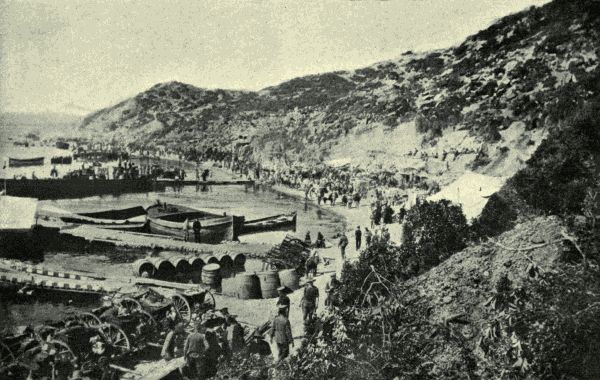
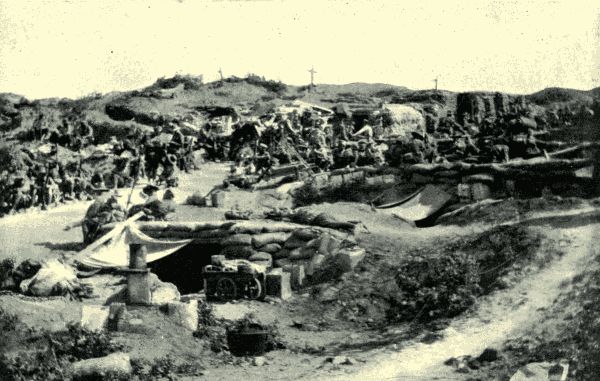 Entrance to Lone Pine, which was so hardly won.
The First Infantry Brigade fired not a single
shot during the great charge. It was all bayonet
work. In the ranks were many of the heroes
who landed on the memorable 25th of April, were
wounded, and were now back in the firing line.
Others had been in the thick of it all the time;
no periodical spells such as the soldiers in Flanders
get. Others again were the latest reinforcements
who left Sydney in June, and landed the
evening before the battle. Yet these raw youngsters,
having their first experience under fire,
charged with the best, and wielded a bloody
bayonet within the hour. And many of them—Dr.
Digges la Touche amongst the number—perished
in their first fight.
Prior to the charge our artillery opened a heavy
bombardment of the Lone Pine trenches. Shrapnel
and high explosives rained down on the
Turkish lines. The Turkish gunners in turn
opened on our lines a devastating fire, and the
resultant roar of heavy guns and screeching of
shells created a veritable inferno.
I don't know how long it lasted, but suddenly
our guns ceased, and on the instant our gallant
infantry sprang from their trenches and charged
straight ahead. They were over our parapets
and well on their way before the Turks could
realize it. Then rifles and machine-guns started
a murderous fusillade, while the guns in the background
sent a hail of shrapnel. Thick and fast
fell the attackers. One marvels how any escaped
that hell of fire. But, fortunately, only a small
percentage of the Turks are marksmen. The
German machine-gunners, however, were very
deadly, and the enfilading fire from Pine Ridge
increased in volume and effectiveness and the
trail to Lonesome Pine was strewn with khaki
figures. Our Light Horse on the right had all
their crack shots picking off the Turks on Pine
Ridge, while our field guns in Hughes's battery
at point-blank range helped to keep the enfilading
fire from this quarter down to a minimum.
Meanwhile the Firsts had almost reached their
goal. They were checked for a space by the
barbed wire; but hacking their way through
they scaled the enemy's parapets, tore aside the
overhead cover, leaped into the trenches, and
then, free from the murderous cross-fire of
machine-guns, they resolutely set to work with
the bayonet to finish the job. Since the days of
Plevna the Turk has been reckoned second to no
soldiers in the world behind the trenches and
parapets. I am not in a position to dispute this,
but I do claim that in the open or with the
bayonet the Turk is not a match for the Australians.
Right along the trenches and saps the
Firsts fought their way, bayoneting every Turk
or German who did not immediately throw
down his rifle. Here and there the defenders
made some resistance, and little knots of them
would rally for a minute or two. But the Firsts
flew at them like eagle-hawks, and a neat bit of
bayonet work settled the Turks for good and all.
As to the part played by the Light Horse
Brigades in the general scheme of attack, it fell
to General Ryrie's Second Brigade to hold the
right of the line opposite Gaba Tepe. We made
minor demonstrations against the enemy, cleaned
out a few of his trenches, kept his snipers very
much in subjection, mined and counter-mined,
and blew up Abdul's tunnel just when he thought
he was going to do the same to us. Also, we
kept each day a fresh squadron in Lonesome
Pine to assist in defending against the Turkish
counter-attacks. Our losses had not been great,
considering the slaughter all along the line. Since
landing we had had just over 600 casualties, of
whom 105 were killed; also we had had several
hundred sent sick to hospital.
General Chauvel's First Brigade had suffered
much more heavily. They had well performed
their share of the trench fighting since May. In
the big battle the First Regiment had to advance
under a murderous fire from Pope's Hill, and
take the Turkish trenches opposite the Bloody
Angle. Captain Laurie, with A Squadron, scaled
the parapets and charged across the bullet-swept
interval, while Captain Cox, with B Squadron,
crawled up a gully; and then both squadrons
rushed to the attack.
Without firing a shot, they captured three
successive trenches, bayoneting the defenders,
and then swept on. Twelve officers and 200
troopers made that dashing charge, and without
reinforcements they withstood all the Turkish
counter-attacks from four o'clock in the afternoon
till half-past six. But the slaughter was cruel.
Fewer and fewer were left to defend the hard-won
trenches. From all sides the enemy threw
bombs and grenades. Our bombs were all gone.
At last the remnant had to retire. Major Reid
was killed; Captain Cox so badly wounded that
he died a few days later; only fifty unwounded
men regained our trenches. Of all the officers,
Major Glasgow alone was unwounded.
A worse fate befel the 3rd Brigade, under
General Hughes. In their attack on Walker's
Ridge they lost thirty-two officers and 400 men
in ten minutes. They swarmed out of our
trenches and sprang forward; and then so
terrific was the hail of bullets that they fell in
heaps. It almost looked as if they had thrown
themselves prone to get cover. Machine-guns
swept the area from end to end. The 8th (Victorian)
and 10th (Western Australian) Light
Horse Regiments just thinned out and wilted
away. About a hundred unwounded men came
back from that hell.
Later on the 3rd Brigade had their revenge.
When the New Zealand and Australian Division
swept forward, driving the enemy before them,
and capturing trench after trench, there remained
one spot on the line of ridges that baffled the
attack. Both sides dug in, and had a few days'
respite. Then the 10th Light Horse hurled
themselves on the stubborn Turks, cleaned out
their trenches, and with bloody bayonets stood
masters of the hill. It was only a remnant of
the regiment that remained, but they baffled every
effort of the Turks to dislodge them.
One spot further along the line had at length
given way to the pressure of the enemy's attacks.
The New Zealanders, after some magnificent
fighting for several days, had been driven back
from one point on the line. It was essential
that the position should be retaken and our
advanced line linked up. So the 9th Light Horse
Regiment was sent forward to do the job, and
they did it brilliantly....
The pen seems so futile a thing to depict the
scene. It was the same thing day after day. A
stealthy advance through the scrub, a rattle of
snipers' rifles, then wild cheers, as the Australians
scrambled up the hill; a terrific fusillade as they
neared their objective; a glint of gleaming bayonets
as they charged the trenches; then the
wild mêlée of hand-to-hand fighting, when one
Australian always reckons himself a match for
three Turks; and finally the shout of victory.
And through it all the stretcher-bearers were
real true-blue. Under the heaviest fire they
went right up to the firing-line, tended the
wounded, and carried them back to the field
hospitals. Oh, you, who think the Army Medical
Corps is always comfortably and safely situated
at the base, pray be undeceived! Their part is
just as hazardous as that of the soldier of the line.
Soon the cheers of the victors and the cries of the
Turks died down. Above the groans of the wounded
could be heard the staccato tones of the officers
ordering platoons and sections this way and that
to defend the position against counter-attacks.
Scores of prisoners were led away. Hundreds
of captured rifles were stacked. German machine-guns
were faced about and manned. Bomb-throwers
were placed in position. Hot tea was
served out to the men. Night fell. Lone Pine
was ours. The successive ridges on our left
towards Hill 971 had all been captured by the
New Zealanders, and our 4th Infantry Brigade
under General Monash and the 3rd Light Horse
Brigade under General Hughes. The big battle of
Suvla Bay was over. But it was only a partial
victory. Despite our gains and our losses the
Turks still blocked the way to Constantinople.