Every Frenchman is liable to military service during
twenty-five years of his life—viz., from the age of twenty
until he is forty-five.[1]
In time of peace this period of service is thus divided:
(i) Three years of active service.
(ii) Ten years in the reserve of the standing army,
during which two periods of a month each with the colours
must be undergone.
(iii) Six years in the territorial army, with two periods
of thirteen days each with the colours, and
(iv) Six years in the reserve of the territorial army.
The conscription lists are thus made out:
Every year the Mayor of each "Commune" draws up a
list of all the young men who have arrived at the age of
twenty during the past twelve months.
These lists must be posted up by January 14 at the
latest. The names of the sons of foreigners, if born in
France, are included, and unless they claim foreign
nationality they are liable to serve, and on failing to do so
when called upon are regarded as deserters and punished
accordingly.
Domicile is established by the parents' residence.
Every year the War Minister fixes the number of conscripts
required to serve three years with the colours; those
in excess of that number are called upon to serve for one
year only; but during the following two years they are liable
to be called upon to complete their time of active service.
In order to determine those who are to benefit by this
arrangement tirage au sort (drawing lots) is resorted to.
In time of peace, conscripts falling under any of the
following categories, among others, are also called upon to
serve for one year only:
(a) The eldest of orphans, or the eldest son of a widow,
or of a family whose father is blind, or has reached his
seventieth year.
(b) The only son in a family of seven children or more—or
the eldest son of a family of at least seven.
(c) The elder of twins.
(d) Brothers of men engaged in active service.
(e) Brothers of a man who has been killed, or who has
died in active service, or who has been invalided on
account of disease contracted, or wounds received, while
serving.
(f) Young men who have signed an engagement to serve
during ten years as teachers in the National schools.
(g) Students in law, science, or medicine who have
already obtained their admission to the Government
Universities or other institutions mentioned in the Act.
(h) Students of the religious institutions who are studying
to become ministers of one of the religions recognised
by the State.
Provided that, in classes (f), (g), (h), such young men
have obtained their final degree before their twenty-sixth
year, or that religious students have been ordained before
the end of their twenty-sixth year, failing which, they are
called upon to complete three years' active service.
Whoever has been convicted of theft, obtaining money
by false pretences, rape, and other crimes against
morals, and has been sentenced to more than three
months' imprisonment for such crimes, or has been sentenced
twice for similar offences, is sent to special
battalions in Algeria. If, at the time a conscript is called
upon to serve, he is undergoing imprisonment, he begins
his service at the expiration of his sentence.
Instead of joining their regiment like other conscripts,
these men have to report themselves on a certain date at
the headquarters of the military district to which they
belong, and they are thence taken by gendarmes to the
dépôt of their battalion. They are subjected to an iron
discipline, being commanded by officers and non-commissioned
officers picked out from other regiments where
they have distinguished themselves for their harshness.
Many are the tales of dreadful revenge taken by these conscripts
on their officers. It is no uncommon thing for a few
of them to play away the life of an officer at cards, the loser
being obliged to kill him within a certain time. To quote
but a single instance: A few years ago one of these
battalions was being marched from Biskra to Tuggurt in
Southern Algeria. Before leaving, four of the men had
played away the life of their Major at cards. The loser,
who was to carry out the deed, pretended to be ill, and
kept to the rear of the column. On the second day he
kept still farther back, and sat down pretending to be
exhausted. The Major, who had fallen far behind, seeing
the man, spoke to him kindly, telling him to make an
effort. "Oh, sir," said the soldier, "I can't; I am done
for." The Major kindly handed the man his flask to take
a pull from, and as he was replacing it in his holster, the
man fired his rifle point blank at his officer. Fortunately
the horse swerved, and the bullet missed. Thereupon
the Major drew his revolver, and blew the ruffian's brains
out. A few months later a stone was found on the spot
bearing this inscription:
Here
On the 10th of December 18—
Private ——
Was murdered by Major X.
The man who placed the stone there was never discovered,
and, although it was removed by order of the
military authorities, another one bearing a similar inscription
soon afterwards stood in its place. Six times these
stones were removed, and six times they were replaced,
yet the guilty parties were never detected. It is hardly
to be wondered at if the officers of these battalions usually
carry loaded revolvers.
To return to our description of the mode of recruiting.
The lists having been duly posted up, a day is appointed
for drawing the lots. This public ceremony is presided
over by the "Sous-préfet" of the "Arrondissement."
Having counted the number of names on the list, the Sous-préfet
places a corresponding number of tickets, each
bearing a number, in an urn: he then calls out the names
of the young men, and each in turn draws a ticket; in
case of absence of one of them his lot is drawn by the
Mayor. As already explained only a certain number of
men being required to serve three years, those who draw
the highest numbers stand a chance of serving for but
twelve months, besides those who have a right to claim the
privilege, although the latter are also bound to draw lots.
All the young men whose names appear in the lists have
next to appear before a Conseil de Revision (Revising Commission).
This Commission consists of:
The Prefect of the Department, who is ex-officio President.
A Conseiller de Préfecture.
A Member of the Conseil Général.
A Member of the Conseil d'arrondissement.
A General or Field Officer appointed by the military authority.
An Intendant militaire (Commissariat officer).
The chief Recruiting Officer of the district.
A military Surgeon, or a Doctor, is appointed by the
military authorities to make a medical examination of all
the conscripts, and upon his report the Commission
decides by vote whether each individual conscript shall
serve or not. It should be added that the minimum height
is 5 feet 0½ inch.
The Commission also decides upon claims of exemption
made by sons of foreigners, and upon the claims of those
entitled to a service of one year only.[2]
Each conscript subsequently receives his feuille de route,
stating the regiment he must join, and the date on which
he must join it, and making an allowance for his journey to
the town where he is to be quartered.[3] From the moment
conscripts receive their feuilles de route they are under
military law, and can only be tried by court-martial for any
crimes or offences they may commit.
Men while serving for a month in the reserve, or for a
fortnight in the territorial army, are also exclusively under
martial law for the time being. Even in the case of a
soldier who has finished his service the fact of his assaulting
one of his former superiors (from a Corporal upwards)
renders him liable to be tried by court-martial "should
such assault be considered the result of revenge for a
punishment received during his service."—(Art. 223 and
224 of the Code of Military Justice.) So that a man who
has been abominably treated during his time of service
and who gives a good hiding to one of his former officers
ten or twenty years later, is liable to be tried by the
military authorities.
I may add here that the act of striking a supérieur,
meaning any man superior in rank to one's self, from a
Corporal upwards, is punished with DEATH, even in time of
peace. Two instances occurred while I served. In the
first instance a private had struck a Corporal who had
bullied him in a most shameful way; in the second instance
a Corporal had struck an officer who had called his mother
by a vile name. Both men were found guilty and publicly
shot in the presence of their regiment on special parade.
It very seldom occurs that a man who has struck even a
Corporal is reprieved.
In each subdivision of every military district is kept a
register in which are inscribed the names of all the men
in that subdivision who are serving, or have served.
In this register is stated the date at which each man
has been incorporated, as well as the date of his leaving
the service, the date of his passing into the reserve, then
into the territorial army and into the reserve of the territorial
army, until he has satisfied all his military obligations.
Every change of address is also noted.
Every soldier receives on joining his regiment a livret
matricule, a book in which are stated his age, his name,
the address of his parents, his full description, the list of
all the punishments he has received, and many other particulars.
It is of the utmost importance for every Frenchman to
keep this book carefully, as it has to be produced whenever
required by the military, civil, or judicial authorities, and
its loss entails several days' imprisonment. Whenever a
Frenchman—until he has reached the age of forty-five
and has thus satisfied all his military obligations—wishes
to absent himself from his domicile, he is bound to present
his livret at the nearest gendarmerie and to declare where
he is going: this is written down in his livret, and on
arrival at his new residence he must have this book "visé"
anew. If he goes abroad he must present it to the French
Consul, and whenever he changes his residence for more
than three months, he must repeat the operation exactly
after the fashion of a ticket-of-leave man in England. To
omit to do so renders the offender liable to imprisonment.
It is therefore easy to realise the tremendous power of the
military authorities in France.
The military law I have just explained is that which has
been in force since 1889 only. It differs from the previous
law chiefly in regard to the length of service. In my time
(1879) the period of service in the active army was five
years instead of three. Young men, however, who had
obtained the degrees of B.A. or B.S., provided they paid
£60 to Government, and provided also they contracted a
voluntary engagement within the year preceding that in
which they became liable to conscription, were allowed to
serve only one year instead of five. During the next four
years they still belonged, however, to the active army, and
were liable to be called at any time by decree of the War
Minister. These young men were officially called Engagés
conditionnels, but commonly termed Volontaires d'un an, or
by abbreviation Volontaires. It was as such that I served.
I have roughed it a good deal since those days, but I
have no hesitation in saying that the time of my active
service with the colours was the bitterest experience I
ever underwent.
In the case of a nation which possesses no public schools
like the great institutions of England, I believe that compulsory
military service might be made an excellent moral
and physical training for young men in every rank of life.
But the French system is vicious. A system in which
gentlemen of refinement and the vilest dregs of the city
slums are subjected to identical treatment, and ruled by
identical measures of discipline, is an impossible one.
Take punishments, for instance. "Equality of punishment"
may sound well in theory, but in practice it becomes
the rankest inequality. A gentleman accustomed to comfort,
or perhaps luxury, is for the slightest fault sent to the
Salle de Police to endure the degrading horrors presently
to be described—his companions are perhaps roughs who
have never slept in a bed since they were children, to
whom dirt is a mere necessary condition, and vermin are
"familiar beasts."
Where is the equality of punishment in such a case?
It must not be thought either that some compensation
lies in the comparative infrequency of the punishments
meted out to gentlemen. The contrary is the truth. For
an equal fault the rough usually gets a shorter punishment
than the man of higher class.
The German system is very different. In Germany
they also have the reduced service of one year for young
men who have fulfilled certain conditions of superior education.
But these ein jahr preiviller, as they are called, form
a class absolutely distinct from the other privates, and are
distinguished by a uniform of better cloth. During the
first month of their service they live in barracks, where
they learn the routine of a common soldier's duties, but
afterwards they are allowed lodgings in the town where
their regiment is quartered, and they are altogether treated
differently from the rest.
Then, again, in the German army non-commissioned
officers cannot punish a private, the Captain alone having
the right of punishment, while in the French army a
Corporal could give us two days' Salle de Police; a Sergeant,
four; a Sergeant-major, a Sub-lieutenant, or a Lieutenant,
eight; and a Captain could send us to prison. Each of
those punishments was usually increased by the Major,
and also by the Colonel, and it will scarcely be credited
that no man could appeal against a punishment until he
had undergone the whole of it. Things have altered a
little since General Boulanger was Minister of War, but
very slightly. There is still no higher appeal than to the
Colonel, and such a thing as a private or even an officer
having the right to ask for a court-martial in case he
considers himself unjustly punished does not exist. But
more of this in the sequel.
In order to enable readers to understand clearly the
account of my adventures, I think it will be necessary to
describe somewhat fully the routine of a French cavalry
regiment, as well as the rights and duties of officers, non-commissioned
officers, and privates.
Any one desiring further particulars can obtain them
from a little book called
"Règlement du Service Intérieur
des troupes de Cavalerie." (Paris: Librairie Militaire de L.
Baudoin, 30 rue Dauphine.)
The following are the titles of the officers and non-commissioned
officers of a French cavalry regiment, with
the duties and responsibilities which theoretically devolve
upon them. How far those duties are carried out will
appear in the course of my narrative.
COLONEL.
(Five Gold Stripes.)
The authority of the Colonel extends over every part of
the service. He is responsible for the discipline, military
education, instruction, police, hygiene, and appearance of
the regiment he commands. He directs its administration
with the help of a ""Conseil d'administration." He
appoints all non-commissioned officers and Corporals.
LIEUTENANT-COLONEL.
(Three Gold and Two Silver Stripes.)
"The Lieutenant-colonel is the intermediary of the
Colonel in every branch of the service. He acts on
behalf of the Colonel in the absence of the latter....
When thus acting he states that the orders are the
Colonel's, so that the authority of the latter should be
sustained....
"Among the books he has to keep are those containing
the individual notes on each officer, in which are entered
twice yearly the punishments inflicted on each officer,
and information as to their military as well as private
conduct, their instruction, and military aptitude. These
notes are countersigned by the Colonel, who adds whatever
remarks he thinks fit...."
"CHEFS D'ESCADRONS (Majors).
(Four Gold Stripes.)
There are two of these in each regiment, each commanding
two squadrons.
"The '"Chefs d'Escadrons' see that the Captains commanding
their squadrons carry out their duties, as well as
the Colonel's orders, with zeal and intelligence....
"One of them presides over the Commission des ordinaires
(food supply). The other presides over the Commission
d'abatage (killing of horses)...."
Each of them has also to look carefully into the service
of the kitchens of their squadrons, and they must frequently
visit the canteens.
They take in turns the weekly duty and are in charge
of the general police of barracks. Under their orders
they have for this service a Captain and an Adjudant.
MAJOR.
(Two Gold and Two Silver Stripes.)
The duties of this officer are chiefly connected with the
general administration of the regiment—accounts, purchases,
pay, equipment, barrack furniture, &c. He is in
command of the 5th squadron,[4]
which forms the "dépôt in case of war.
"CAPITAINE INSTRUCTEUR.
The Capitaine Instructeur is chiefly concerned with the
instruction of the non-commissioned officers. He also
gives the Lieutenants and Sub-lieutenants lectures on
shooting, artillery, topography, hippology, &c., and has to
teach the Adjudants (to be described later) their duties.
"CAPITAINE TRÉSORIER (Paymaster).
He receives all moneys for the use of the regiment; he
makes all payments authorised by the Council of Administration,
of which he is a member.
He keeps the "archives" of the regiment. Every five
days he hands over the pay to the Captain commanding
each squadron or to his Sergeant-major, and issues the
demand for forage supplied through the ""Intendant" (an
official apart from the regiment).
Under him he has a Deputy, a Lieutenant, or Sub-lieutenant.
"CAPITAINE D'HABILLEMENT.
This Captain is in charge of the armoury, clothing, and
barrack furniture, keeping all accounts relating to the same.
All the regimental workshops are under his orders: the
chief armourer, the master saddler, the master tailor, and
master bootmaker.
Under this officer is:
"THE PORTE ÉTENDARD.
A Lieutenant who helps generally his immediate chief,
and carries the colours on parade.
DOCTORS.
Two Doctors are attached to each cavalry regiment—a
médecin major (captain-surgeon) and médecin aide major
(lieutenant-surgeon). Their duties are similar to those of
regimental doctors in an English regiment.
VETERINARY SURGEONS.
Two Veterinary Surgeons are attached to each regiment,
and their duties need not be described here.
"CAPITAINES (Captains).
(Three Stripes.)
There are two Captains in each squadron—the Captain
Commanding (capitaine commandant) and a second Captain
(capitaine en second).
Captain Commanding.—This officer is in full charge of
the squadron (in time of peace a squadron consists of about
120 men and horses); he is the real chief and almost the
only one the non-commissioned officers and men of his
squadron know, many of them leaving the service without
having ever been spoken to by such an exalted and god-like
being as a Major, much less by their Lieutenant-colonel or
Colonel. The Captain in command is himself a very great
man indeed, who has very little intercourse with such
riff-raff as common privates. No leave nor promotion can
be obtained except through him, and punishments are
usually increased when they reach His Mightiness. When
I served my time I think I saw my Captain nearly twenty
times in as many months, but nevertheless I must show
what his duties are—in theory. Let us quote once more
from the ""Service Intérieur."
"The chief duty of the Captain Commanding is to
inspire the soldiers under his command with zeal and
love [!] of the service; to develop among them feelings
of duty, honour, and devotion to their Fatherland. He
must endeavour to make their duties easy by advice, the
equitable use of his authority, and a constant solicitude
for their welfare. He is the necessary intermediary of all
their requests.... He must repress the familiarity and
harshness of his subordinates towards the privates, who
must never be illtreated or insulted."
He has also to look after the officers under his direct
orders. "He visits his squadron daily, visits the men in
hospital, and signs a daily report to the Colonel."
"He is responsible for the military education of his
squadron, for the discipline of the rank and file, the
condition of the horses and stables...."
He is also responsible for the moneys and supplies
handed over to him.
The Captain receives from the Treasurer the money for
the use of the squadron on the 1st, 6th, 11th, 16th, 21st,
and 26th of each month. This money is divided into two
parts: the first being the money to be spent on the men's
food, and the second being the men's pocket-money,
"which," say the regulations, "must not be less than
5 centimes (½d.) per day." The money invariably handed
over to the men is 2½d. every five days in the infantry, and
4d. every five days in the cavalry! Corporals get about
twice as much, while Sergeants get about 4d. a day, and
Sergeant-majors 8d. What would Tommy Atkins say to
that?
All the accounts and books are kept by the Sergeant-major,
the Sergeant fourrier, and the Corporal fourrier,
non-commissioned officers whose duties will be described
more fully later on. All clothes, saddlery, arms, &c., are
supplied to the men in the presence of the Captain: all
repairs are done on his written requisition.
When the men's food is supplied through the Commission
des ordinaires the Captain finds every day the amount
of supplies required. When, however, he receives money
for the purchase of provisions he must see that supplies
are bought at the cheapest rate.
The daily rations for each private are as follows:
Ten ounces of meat (bone included).
One pound of bread for soup, which is reduced to 3½
ounces if stew is served instead of soup.
In the same way the ration of meat is reduced if fish,
lard, or preserves are given to the men.
The Captain in Command assigns a horse to each trooper,
and has to see that the horses are kept in good condition.
He reports on all matters to his Major.
Second Captain.—The duties of this officer are two-fold:
first, in the squadron, and secondly, as Captain on
regimental duty for the week—"Captain of the Week."
In the squadron he is under the orders of the Captain
Commanding, but he is specially in charge of all matters
connected with the food supply.
In case of the absence of the Captain Commanding he
takes the command of the squadron. The five Second Captains
take "the week" by turn. The "Captain of the Week"
is under the immediate orders of the "Major of the Week."
He has to see to the roll-calls, the assemblies, and the
changing of guards. He is in charge of the cells, and is
responsible for the cleanliness of the barracks, and their
police and security. The evening roll-call takes place in
the rooms, and is made by each Sergeant-major, who hands
over his report to the Adjudant, who makes out a general
bulletin and hands it over to the "Captain of the Week."
This Captain may order extra roll-calls in the middle of
the night should he think fit to do so.
LIEUTENANTS AND SUB-LIEUTENANTS.
There are four of these in each squadron, and they take
in turn the "weekly service" (service de semaine). As such
they must be, or ought to be, present at "stables," drill,
&c. Let us quote again from the ""Service Intérieur": "They
must maintain perfect order in their peloton [company]
excite emulation among their men, advise union" [the only
union I ever saw was in the hatred all the men felt against
them], "develop the love of service, and always show an
impartial example of justice." [But wait until I tell my
own story.] "The chief of a peloton visits it daily. He
inquires into everything relating to it....
"He sees to the cleanliness of his men" [mine must
have had peculiar ideas on the subject].... "Often and
without warning he inspects the clothes of a man whom
he suspects of bad conduct.
"He passes constant reviews of the men's effects"
[doesn't he], "and when a man returns after an absence of
fifteen days or more he inspects his kit...."
He does many other things—in theory—but chiefly acts
on the principle that rules are made to be broken.
"PETIT ETAT MAJOR AND "PELOTON HORS RANG.
Under these titles are known all the skilled assistants
(whether non-commissioned officers or troopers) who are
employed as clerks in the offices of the Treasurer, and
other officers employed in the various administrative services
of the regiment. The "Capitaine d'habillement acts
as their Captain Commandant.
ADJUDANTS.
The Adjudants, although non-commissioned officers,
wear the uniform of a Sub-lieutenant, the only difference
being that their galloons are striped with a small red thread.
They receive from the troopers and other non-commissioned
officers the same marks of respect as officers.
There are three Adjudants in each cavalry regiment.
The first two are the Adjudants proper, while the third
(Adjudant vaguemestre) has different duties. The two
Adjudants have under their immediate authority all the
Sergeants and Corporals so far as the discipline and the
general police of barracks are concerned. They have to
keep watch over the private conduct and appearance of
the Sergeants.
They take "the week" in turn under the immediate
orders of the "Captain of the Week." All strangers wishing
to enter the barracks are referred to him when he takes
"the week." The Adjudant receives from the one he has
relieved:
(1) The list of all Sergeants and Corporals, so as to
arrange their rotation of duty;
(2) The list of the various Sergeants and Corporals who
take "the week" at the same time as himself;
(3) The register of punishments of non-commissioned
officers and troopers, on which he inscribes all punishments
of two days or more of Salle de Police, or confinement to the
room, or of four days or more C.B.;
(4) The list of men under punishment, which he hands
over to the Sergeant of the Guard.
He posts up in the orderly room the list of the officers,
Sergeants, and Corporals "of the week."
He is responsible for all trumpet calls.
The Colonel's orders and decisions are handed over to
him for dictation to the various Sergeant-majors, by whom
they are read aloud to the troopers of each squadron, after
afternoon "stables."
He conveys the General's orders to the Colonel. Every
morning after réveille each Sergeant-major hands over to
him a report on the morning roll-call, but this call never
actually takes place in the cavalry.
At the same time the Sergeant of the Guard hands over
to him the register bearing the names of all troopers who
have returned to barracks after the last roll-call (9 P.M.),[5]
and he reports on these to the "Captain of the Week."
He sees that the canteens are closed at the proper time,
and that lights are extinguished in the rooms at 10 P.M.
He has besides the general control of all men undergoing
punishment.
It will thus be seen what enormous power the Adjudant
has. With his connivance a trooper may absent himself
for three or four days without any one being the wiser.
Let a Sergeant or a Sergeant-major dare to report the
matter to the Captain and he will soon discover what it
will cost him. How I made use of the Adjudant will be
seen when I describe my personal adventures. "Stand
well with your Sergeant-major and one of the Adjudants
and you are all right," is a well-known saying in the
French cavalry.
The Adjudant-vaguemestre is really the regimental postmaster
and postman; he collects letters, cashes money-orders
for the troopers, and does all sorts of dirty work
others don't care to undertake; he acts as Sergeant-major
to the Peloton hors rang, and is usually chosen from among
old Sergeants who are unfit for anything else.
Of the skilled artisans, armourers, saddlers, tailors, &c.,
little or nothing need be said, as they are soldiers but in
name.
Let us now return to the true inner life of a regiment,
the squadron and its units.
SERGEANT-MAJOR ("Maréchal des Logis Chef).
The Sergeant-major is the right hand of the Captain
commanding a squadron. In theory he is, of course, far
below a Lieutenant or Sub-lieutenant; in practice—at
least in most squadrons—he is the real head of the
squadron in barracks. He is in hourly contact with the
Sergeants, Corporals, and troopers, and it is through the
Sergeant-major that the Captain judges them. Most
Sergeant-majors will send a man to prison in the Captain's
name, knowing well that the latter will approve of and
endorse their decision.
"The Sergeant-major," says the ""Service Intérieur,"
"must study the conduct, the character, and the capabilities
of the Sergeants, Corporals, and troopers of his squadron,
in order to give information to the officers, and chiefly to
the Captain commanding the squadron. He gives all
orders with regard to duty, dress, and discipline....
He is the Captain's agent in all matters of administration
and accounts, he is responsible for the proper keeping
of all books, registers, &c., and for the proper state of all
the matériel belonging to the squadron.
"The Sergeant fourrier and Corporal fourrier do the
clerical work under his immediate supervision. He is
responsible for the proper keeping of the squadron stores
and must supervise the reception, distribution or return
of every article, whatever may be its nature...." The
Sergeant of the Week hands over to him the list of all
sick men and reports to him on every roll-call.
"It is through him that all applications of the Sergeants,
Corporals, or troopers must be addressed; after informing
the Lieutenant he submits these applications to the Captain.
Troopers cannot, without his leave, change their rotation
of duty."
SERGEANT (Maréchal des Logis).
"The Sergeants give the Corporals and troopers all
orders relating to duty, police, discipline, and military
instruction." They take in turn the duty "of the week"
in their squadron. Sergeants drill the men of their peloton,
and are responsible to their Lieutenant for the horses of
their peloton.
They have to take particular care that the rooms are
kept in proper order, that the men have their clothes
properly cleaned and arranged above their beds, and
no article of their kit is missing; they take care
that the arms and saddlery are always kept in perfect
order; they are responsible for the cleanliness of their
men, seeing that their clothes are duly mended, and that
they are frequently shaved and have their hair cropped
short.
Whenever the peloton is ordered to assemble, the
Sergeant passes through the rooms to see that the
troopers are getting ready. If the peloton has to be
mounted, the Sergeant sees that the horses are properly
saddled. He always superintends "stables" and sees
that the horses are properly groomed. When the peloton
is ordered to assemble singly, he calls the roll and reports
to the Lieutenant in command; in case, however, the
whole squadron is ordered out, he reports to the Sergeant-major.
"Sergeant of the Week."—The Sergeant of the
Week is under the direct orders of the officer "of the
week" and seconds him in every way.
He reports on the morning and evening roll-calls to the
Sergeant-major, and hands over to him the list of the sick
troopers. At the daily parade of the squadron he notes
all duties which are ordered and designates the troopers
for the fatigues and distributions. After réveille he goes
to the stables and superintends their cleaning and airing;
he must see that all head-stalls and stable utensils are in
proper order; he transmits to the stable guards their
orders, and sees that these are punctually executed. In
case of the sickness of a horse he sends at once for the
Vet.
The Sergeant of the Week also keeps the key of the
oat-bin and is responsible for the proper distribution of
its contents as well as of forage. Before the time fixed
for the assembly of the guard of the day he sees that the
troopers who have been ordered for such duty are properly
turned out. He then escorts them to the place which has
been fixed for the parade. He takes to the cells the
troopers who are to be punished, and those who are sick
to the Doctor's inspection.
He has to see that all corridors, staircases, and rooms
of his squadron are kept clean, and swept twice daily.
"SERGENT-FOURRIER
The Sergeant fourrier is under the direct orders of the
Sergeant-major, keeping all books and accounts under his
supervision; he receives besides, on his behalf, all
supplies, and is responsible for them. He escorts every
man sent to hospital.
"CAPORAL-FOURRIER.
This N.C.O. helps generally the Sergeant fourrier. He
enters in a book all the orders issued by the Colonel, and
takes it to each officer of the squadron; he reads these
orders out to the assembled troopers after afternoon
"stables."
CORPORALS.
(In command of an escouade of about ten men.)
"A Corporal sleeps in the same room with the troopers
of his escouade; he sees that his troopers wash their heads,
faces, hands and feet." He sees that the beds are properly
made, and that the troopers ordered for special duty are
in readiness. Once a week, on the day fixed by the
Captain, he gets all the kits thoroughly cleaned.
"He takes particular care that the troopers change
their linen once a week."
On pay-day he receives the pay from the Sergeant-major
and hands it over to the troopers. He superintends
the drill of the recruits, teaches them how to do their
packing, and how to clean their arms and kit. He also
shows them how to groom their horses.
He reports to the Sergeant the punishments he has
given, and reports to him on matters generally.
At réveille he compels the troopers to rise, and calls the
roll; he sees that all beds are uncovered, and that the
great-coats which may have been used at night are
properly rolled up. He then sends to the stables a
certain number of men to feed the horses and to clean the
stalls.
"When the other men are dressed he orders the windows
to be opened in order to change the air."
He takes the names of the sick men, and reports on the
events of the night.
He designates a trooper in turn to clean and tidy up
the room. (When several escouades sleep in the same
room the senior Corporal is in charge.) It is his duty to
keep proper order. He stops all games likely to lead to
quarrels, he sends men who are drunk to bed; should
they disturb the peace he calls the Sergeant of the
Week by whom they are sent to the Salle de Police. He
forbids smoking in bed, and sees that troopers take their
meals properly. In winter he takes care that the stoves
are heated in moderation, and in the evening sees that the
water jug is full. When the trumpeter has sounded
"lights out," he sees that all lights are extinguished.
When an officer enters the room the Corporal commands
"Fixe!" (attention). The troopers rise, uncover
themselves, and stand at attention until the officer has
given the word "Repos!" (stand at ease). Should the
officer be a Field or General officer the Corporal commands
"A vos rangs—Fixe!" at which command every
trooper stands at the foot of his bed at "attention."
The "Corporal of the Week" helps generally the
"Sergeant of the Week," who, in practice, relies upon him
for the performance of many of the duties he is supposed
to carry out himself.
"CAPORAL D'ORDINAIRE.
This Corporal takes delivery of, or purchases, the supplies
required for the meals of the troopers of his squadron;
he has also the supervision of the kitchen, and collects
the washing.
PUNISHMENTS.
"The following are regarded as offences against discipline,
and punished as such according to their gravity:
"On the part of the superior, every act of weakness,
abuse of authority, insulting language, or the unjust infliction
of any punishment.
"On the part of the inferior, murmuring, unseemly
answers, lack of obedience (whatever may be the circumstances
or the provocation); evading a punishment;
drunkenness (even without disturbance); general misconduct,
debt, quarrels ... in fact, every dereliction of
military duty, whether it is the result of negligence, laziness,
or stubbornness."
The fact of publishing, even under a nom de plume, a
book, pamphlet, article, or letter, whatever may be its
subject, without previous leave from the Minister of War,
is considered an offence against discipline.
"Any man belonging to the army or navy can be
punished by another man holding a rank superior to his
own, whatever may be the place or the circumstances." To
be rightly understood this requires some explanation.
For instance, a Captain in the navy (who ranks as a
Colonel), on leave in Paris, meets at a café a Major of a
cavalry regiment; if the latter does not salute him, or misbehaves
himself in any way, the naval officer can punish
him on the spot. It constantly happens, for instance, that
a trooper of a cavalry regiment passing a Corporal of the
line fails to salute him. The Corporal has the right to
punish the trooper forthwith.
"The officer in command of a regiment can increase or
reduce punishments; he can even cancel them. In that
case, he points out to the officer or non-commissioned
officer the mistake he has made, and orders him to cancel
himself the punishment he has inflicted...." The
Captain in command of a squadron can increase a punishment
inflicted by one of his direct subordinates. He
cannot, however, reduce such punishment without the
Colonel's leave.
PUNISHMENT OF OFFICERS.
The following are the punishments which may be inflicted
on regimental officers:
(a) "Arrêts simples (confinement to rooms).
(b) Reprimand by Colonel.
(c) "Arrêts de rigueur (strict confinement to room).
(d) "Arrêts de forteresse (confinement in a fortress).
(e) Reprimand by a General.
A Lieutenant can inflict a punishment of four days
arrêts simples on a Sub-lieutenant; a Captain a punishment
of eight days on any officer of lower rank; a Captain
of a squadron fifteen days on officers of his own squadron;
a Major fifteen days, and the Colonel thirty days, on any
officer of a rank lower than their own.
An officer thus placed under arrest must attend to his
military duties as usual, but in the intervals he must keep
to his room, and may receive no visits except official ones.
Arrêts de rigueur (viz., confinement to the room, with a
sentry posted at the door) and arrêts de forteresse can be
inflicted by the Colonel alone. He can give any officer
under his orders thirty days of the former and fifteen days
of the latter.
(In no case can an officer apply for a court-martial, as
in England. In some regiments, especially in the line,
officers get punished more frequently than privates get
mere C.B. in a British regiment.)
"The punishment begins from the moment it has been
inflicted."
Let it be also noted that an officer can inflict a punishment
on any other officer inferior in rank to himself, to
whatever squadron he may belong, and can similarly
punish officers of other regiments; and, as stated before,
any officer in the navy can punish an officer in the army
of inferior rank, and vice versâ!
Recent events in France give special interest to this
subject, and I will therefore give some account of various
other punishments which can be inflicted upon French
officers without enabling them to appeal to a court-martial.
The question is, indeed, one of such high interest at the
present juncture that I will quote verbatim from the Army
Regulations:
"When an officer commits a fault, which—without being
such as to entail the loss of his commission or his being
sent before a court-martial—is still serious enough to
require a heavier punishment than those above described,
he can be suspended (placed in non-activité) or his commission
can be cancelled (ils peuvent être mis en réforme)."
The non-activité, which means the temporary exclusion
from the service, is determined by decree of the President
of the Republic upon the report of the Minister of War.
The "superior authority" decides as to the causes which
may necessitate the placing of an officer in non-activité, a
disciplinary measure taken in cases of less serious a nature
than those for which an officer may lose his commission
(peut-être mis en réforme—c'est-à-dire, l'exclusion définitive
de l'armée[6]).
The place of an officer who has been suspended (non-activité
par suspension d'emploi) is not filled up during a
year, and he can be sent back to his regiment before the
expiration of that period.
An officer placed in non-activity par retrait d'emploi
remains in that position for an unlimited period, but at
the end of three years a court of inquiry (un conseil
d'enquête) is called upon to give its opinion as to whether
the officer ought to be cashiered or not (si l'officier doit
être mis en réforme).
When the officer commanding a regiment considers
that an officer under his orders cannot remain en activité
either on account of misconduct or on account of neglect
of duty, or else through incapacity, he details his complaint
against the said officer in a report he sends to
the Major-general commanding his brigade. He specifies
whether he considers that the officer ought to be suspended
for a time or permanently (si l'officier doit être
mis en non-activité par suspension ou par retrait d'emploi),
and sends with his complaint a list of the various punishments
inflicted on the officer, a copy of the officer's notes,
and, if necessary, documents relating to the facts upon
which the demand is based.
The documents are examined by the General commanding
the brigade, who forwards them to the General
commanding the division, who sends them in his turn to
the General commanding the army corps, by whom they
are forwarded to the Minister of War. Each one of the
above-mentioned Generals writes his opinion on the case.
An officer who has been suspended (mis en non-activité)
remains subject to military discipline under the surveillance
of the General commanding the military district where
he has been allowed to reside.[7]
The Mise en réforme[8]
(cashiering) is determined by the President of the
Republic upon the proposal of the Minister of War as a
disciplinary measure.
This punishment can be inflicted upon an officer as
an immediate measure without it being necessary that
he should have been previously suspended: it can
be inflicted for habitual misconduct, serious neglect of
duty, or breach of discipline, or dishonourable conduct.
It can also become the consequence of three years of non-activity
either as a disciplinary measure or through ill-health.
When an officer is, as above stated, sent before
a commission of inquiry (Conseil d'Enquête) the minutes
of the proceedings are forwarded to the Minister of War.
The opinion of such a commission cannot be modified
except in favour of the officer[9]
(sic). An officer who
has been cashiered (en réforme) is liberated from all
obligations imposed on officers in a position of activity or
non-activity.[10]
I have wandered far away from the regiment, I have
quoted dry law, and I feel afraid that readers will begin
to ask, "But what about your own adventures?" I am
as anxious as my readers to get to them, but I think it
better to get rid of all the dreary details first, and this
introduction will enable me to go on with my story
without having constantly to stop to explain this or that.
I shall not abuse the patience of my readers much longer,
but there are still a few details I must explain, and I
hope that I shall be forgiven for doing so.
The punishments which may be inflicted on non-commissioned
officers are as follows:—
(i) Confinement to barracks after the evening roll-call.
This is given to Sergeants who show laziness in, or
ignorance of, their work, or who return late to barracks.
(N.C.O.s, unless thus punished, can remain out till 11
P.M.)
(ii) Confinement to barracks. Inflicted on a Sergeant
whose personal appearance is slovenly, or who allows
his men to fail in their appearance.
(iii) Confinement to the room. Inflicted for slight
breaches of discipline. For more serious offences N.C.O.s
are sent to prison. (Except, in the latter case, N.C.O.s
under punishment have to do their duty as usual.)
(iv) Reprimand by Captain commanding the squadron.
(v) Reduction in rank (retrogradation).
(vi) Absolute loss of rank (cassation).
The appended table explains itself:—
| Right of Punishment by— |
| Punishments | Sergeant- | Sergeant- | Adjudant, | Captain. | Majors, | Colonel. |
| of | major. | major in | Lieut. | | and Capt.- |
| N.C.O.s. | | his | and Sub- | | commt. |
| | | Squadron. | lieut. |
| |
| | Days. | Days. | Days. | Days. | Days. | Days. |
| (i) | 4 | 8 | 8 | 15 | 30 | 30 |
| (ii) | 2 | 4 | 8 | 8 | 15 | 30 |
| (iii) | — | — | 4 | 8 | 15 | 30 |
| Prison | — | — | — | — | 8 | 15 |
Corporals in the French army do not rank as N.C.O.s.
The latter are far better treated now than they were in my
time, the change being entirely due to General Boulanger,
and being one of the causes of his great popularity among
the soldiers. Until he became Minister of War, non-commissioned
officers could be sent to the Salle de Police
(lock-up). An Adjudant could give a Sergeant eight days
of Salle de Police, or fifteen days' C.B., and a Sergeant-major
could give the Sergeants four days' Salle de Police
and eight days' C.B. Sergeants could even be sent to
prison by the Adjudants. There existed a Salle de Police
separate from the one allotted to the men, to which Sergeants
and Corporals were sent together, the only difference
being that Sergeants were allowed a straw mattress and
blanket, while the Corporals were only allowed one blanket
and slept on boards.
The punishments inflicted on Corporals are:
(a) Confinement to barracks.
(b) Salle de Police (lock-up).
(c) Prison.
(d) Reduction to the ranks.
| | Right of Punishment by— |
| Nature of | Ser- | Sergeant | Sergeant- | Adjudant, | Captains. | Field | Colonel. |
| Punishment | geants. | majors. | major | Sub-lieut. | | Officers |
| of | | | in his | and | | and |
| Corporals. | | | Squadron. | Lieuts. | | Captains |
| | | | | | | commanding |
| | | | | | | a Squadron. |
| |
| | Days. | Days. | Days. | Days. | Days. | Days. | Days. |
| (a) | 4 | 4 | 8 | 8 | 15 | 30 | 30 |
| (b) | — | — | — | 4 | 8 | 15 | 30 |
| (c) | — | — | — | — | — | 8 | 15 |
Corporals are confined to barracks for slight breaches
of discipline. For failing to answer the evening call,
bad language,[11] disobedience, quarrels, drunkenness, Corporals
are sent to the Salle de Police. For more serious
faults, especially when on duty, Corporals are sent to
prison.
TROOPERS.
The punishments inflicted on troopers are:
(a) Extra work.
(b) Inspection with the guard parade.
(c) Confinement to barracks.
(d) Salle de Police.
(e) Prison.
(f) Cells (solitary confinement).
Punishments (a), (b), (c) were in my time very seldom
inflicted in a cavalry regiment, being regarded as too mild
for a trooper and only fit for men in the line. I am told
that this is still the case.
| | Right of Punishment by— |
| Nature of | Corporals. | Sergeants | Sergeant- | Adjudant, |
| Punishments | | and | major | Sub-lieut. |
| given to | | Sergeant- | in his | and |
| Troopers. | | major. | Squadron. | Lieuts. |
| |
| | Days. | Days. | Days. | Days. |
| (c) | 2 | 4 | 8 | 8 |
| (d) | — | — | — | 4 |
| (e) | — | — | — | — |
| (f) | — | — | — | — |
| |
| |
| | Right of Punishment by— |
| Nature of | Captains. | Field | Colonel. |
| Punishments | | Officers |
| given to | | and |
| Troopers. | | Captains |
| | | commanding |
| | | a Squadron. |
| |
| | Days. | Days. | Days. |
| (c) | 15 | 30 | 30 |
| (d) | 8 | 15 | 30 |
| (e) | — | 8 | 15 |
| (f) | — | — | 8 |
(Until General Boulanger became Minister of War
Corporals could give a trooper two days' Salle de Police;
a Sergeant could inflict four days, a Sergeant-major eight
days, and an Adjudant fifteen days, or four days' prison.)
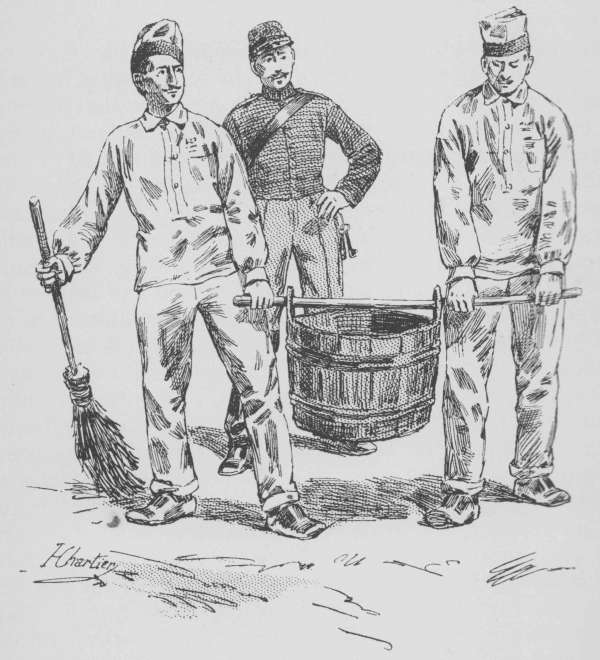
Troopers confined to barracks are employed in doing
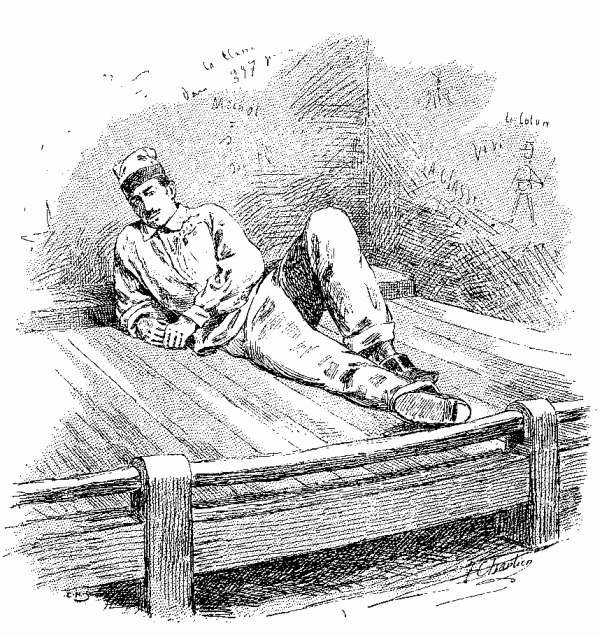
the hardest and dirtiest manual work. They take part in
every drill and duty besides. Those sent to the Salle
de Police are kept at night in the lock-up. Troopers sent
to prison do no duty, but undergo special punishment
drill for three hours in the morning and three hours at
night. They are deprived of pay, of sugar, and of coffee.
Troopers in the cells are kept in confinement day and
night. Only a blanket without bedding is allowed to the
troopers in prison or in the cells.
Any Corporal or trooper who, during his three years'
service, has been sent to prison or to the cells, must at the
expiration of his three years' service, remain with the
colours for a number of days equal to those he has spent
in prison or in the cells.
I have not yet exhausted the list of punishments which
may be inflicted upon French privates. There is another
one more terrible than all the others I have described.
This consists in sending a soldier to the Compagnies de
discipline. This means transportation to Algeria. There
the soldier is drafted into one of the special companies
encamped far away in the interior. The men are drilled
for several hours daily, and during the remainder of the
time they are employed at road-making and subjected to
other hard labour. Officers and Sergeants in command
are always armed with loaded revolvers, and at the least
sign of disobedience they can blow a man's brains out.
For the slightest fault these men are sent to the silos—deep
holes dug in the ground, and funnel-shaped at the
bottom, so that neither standing, sitting, nor lying down is
possible. They are left there for one or two days with
bread and water. An awful case occurred some years
ago in connection with these silos, which will be described
in the course of my narrative.
"The Minister of War," say the regulations, "has full
power to send to the Compagnies de discipline any private
who has committed one or several faults, the gravity of
which makes any other mode of repression inadequate."
Usually, however, such men are tried before a Conseil
de discipline. When the Captain in command of a
squadron considers that one of his troopers has deserved
to be sent to a Compagnie de discipline he sends a written
report to the Major stating the faults or misdemeanours of
the trooper and the punishments which have been inflicted
upon him, dwelling upon the recurrence of certain acts
which show a perseverance in ill-doing, a danger to the
good order of the service.
This report is endorsed by the Major, and the Lieutenant-colonel,
who hands it over to the Colonel. The latter can
either transmit this report to the Minister of War, who
decides upon the case, or (as is usually done) he can
assemble a disciplinary commission (Conseil de discipline)
consisting of the following officers of the regiment:
One Major (who presides over the commission).
The two senior Captains and the two senior Lieutenants,
provided they do not belong to the squadron of the trooper
to be tried.
The Captain who applies for the infliction of the punishment,
as well as the Major who commands the squadrons
to which the trooper belongs, lay their case before the
court. They then retire, and the trooper is brought in
and makes his defence. The court then deliberates and
sends its decision to the Colonel. It must be remembered
that the court merely gives its advice, and this is
sent to the General commanding the division of which the
regiment is a unit. Should the court recommend the
trooper to be sent to the Compagnies de discipline, the
General can decline to act upon their advice, but should
the court decide that the trooper ought not to be sent
there, the General is bound to abide by the decision.
This seems, at first blush, an equitable procedure, but
when we remember the almost unlimited power possessed
by a Colonel over the officers of his regiment, it is easy to
realise that a Conseil de discipline usually sits for the mere
purpose of carrying out the well-ascertained wishes of the
supreme regimental authority.