The progress of the nineteenth century, in everything that pertains to
civilization, arts, and sciences, has been greater than the total progress in
any decade of centuries in the history of the world, and this is equally true
in regard to the art and science of WAR; for the expenditure of blood and
treasure in the prosecution of the wars and the fighting of the battles of this
century far exceeds that of any other like period.
The first year of the nineteenth century dawned upon the United States at
peace with the world. In September, 1800, Napoleon, finding that he could
not coerce the young nation into “an entangling alliance,” and fearing lest
the United States should join England in opposing him, found it his best
policy to conclude a peace. The brilliant achievements of the newly organized
navy, under Commodore Truxton, not only illuminated these early pages
of our history, but established a prestige never yet forfeited; for the history
of this branch of our service is unparalleled from the first effort, during the
Revolution, of Esek Hopkins, to that of George Dewey at Manila, and Sampson
and Schley at Santiago.
War with Barbary States.—In 1803 the United States determined to
end the piracy of the Barbary States, and an expedition under Commodore
Preble was sent to the Mediterranean. The Philadelphia, while pursuing a
pirate, was grounded off the coast of Tripoli, and captured by the Tripolitans,
who made slaves of the crew and prisoners of the officers. In February, 1804,
Captain Decatur, with seventy-six men from his ship, the Intrepid, boarded
the Philadelphia, killed or drove off the Moors, fired the vessel, and returned
without the loss of a man, although fiercely attacked by the shore batteries.
In July, Commodore Preble, with his squadron, laid siege to Tripoli, but
his bombardment was ineffective. General Eaton, consul to Tunis, induced
Hamet, the brother of Yusef, who had usurped the sovereignty of Tripoli, to
furnish him a troop of Arab cavalry and a company of Greeks. With these,
and a band of Tripolitan rebels and a force of American sailors, he crossed
the Barcan Desert, stormed and captured Derne, an eastern seaport of Yusef.
The latter was glad to make peace, and a treaty was signed June 4, 1805.
Indian Wars.—From 1809 to 1811 fighting with the Indians in the
South and Northwest was constant. General Harrison and the celebrated
Indian chief Tecumseh were the principal actors.
War of 1812.—The contest between England and France for the dominion
of the seas was the cause of the war of 1812. England declared the
German and French coast to be in a state of blockade. Napoleon, in 1806,
made the same declaration regarding British ports. In 1807, England prohibited
trade with the coast of France. American commerce was injured and
almost destroyed by the combined action of the two powers. Four years
were consumed in negotiations, with constant aggressions on the part of
England, and on June 19, 1812, Congress declared war. The great error of
the campaign was the attempted invasion of Canada. Had the war been
made entirely upon the seas, an early peace might have ensued.
The war began on the Lakes, and, repulsed in the effort to make a stand
on the Canada shore, and falling back, Hull surrendered Detroit, August 5.
Again, at Queenstown, October 13, the Americans were defeated with the loss
of a thousand men. Altogether the first year of the war was a disastrous one
on land.
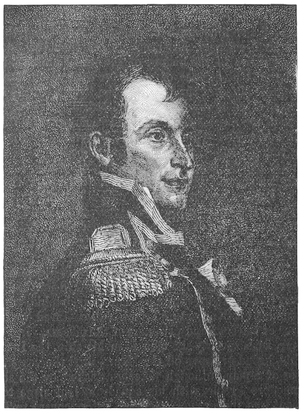
COMMODORE STEPHEN DECATUR.
At sea, the navy, consisting of not more than a half-dozen frigates, with
its magnificently disciplined officers, had been eminently successful. On
August 13, the Essex, Captain Porter, captured the British sloop Alert; on
August 19, Captain Hull, commanding the Constitution, destroyed the Guerriere
off the Gulf of St. Lawrence; October 18, the Wasp, Captain Jones,
captured the Frolic, but later in the day both the Frolic and the Wasp fell
into the hands of the British ship Poictiers. October 25, Captain Decatur,
with the frigate United States, captured the Macedonian off the Azores; on
December 29, after a desperate fight in the South Atlantic, Captain Bainbridge,
commanding the Constitution, defeated the British ship Java.
The campaign of 1813 opened on the Canadian frontier with the several
divisions in command of Generals Harrison, Dearborn, and Hampton. On
June 8, General Winchester, with eight hundred Kentuckians, drove the
British and Indians, under Proctor, from Frenchtown, on the River Raisin,
but returning with a force of fifteen hundred, they obliged Winchester to
surrender, which he only consented to do under Proctor’s promise to protect
the Americans from the Indians; which promise Proctor treacherously disregarded,
and marched away, leaving the sick and wounded Kentuckians to
be massacred. Henceforth the Kentucky war cry was, “Remember the
River Raisin,” and many were the British and Indians who had cause to
dread that slogan. May 5, General Harrison, reinforced by General Green
Clay and his Kentucky troops, repulsed the British and their dusky allies
under Tecumseh. July 21, they returned four thousand strong, but were
again repulsed.
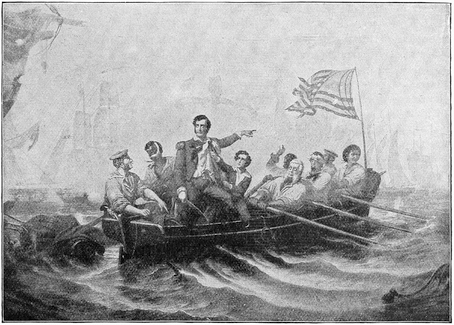
COMMODORE PERRY AT BATTLE OF LAKE ERIE.
The Americans, by wonderful exertion and hard work, built and equipped,
at Erie, a squadron of nine ships with fifty-five guns, the command of which
was given to Commodore Perry. September 10, Perry won his grand victory
on Lake Erie, over the English squadron of six ships and sixty-three guns.
This was the turning point of the war, and Perry’s name goes down to posterity
with the immortal names that never die. On October 5, General
Harrison, conveyed by Perry’s ships, landed his forces in Canada and completely
destroyed Proctor’s army, Tecumseh being among the slain. So
ended the war in the Northwest.
In the meantime, General Dearborn was fighting with varying success in
Upper Canada. Jackson, in the South, was avenging the Fort Mimms massacre,
finally crushing the Creeks early in the next year. The British, under
the odious Admiral Cochrane, plundered and ravaged and burned everything
in reach, from Lewistown to the Carolina coast, seizing the negroes and selling
them in the West Indies. During this year the American navy continued
to be successful, meeting few losses, though the fighting was even more
desperate.
July 5, 1814, the Americans defeated the British at Chippewa; and on the
25th was fought the battle of Lundy’s Lane, where Generals Brown and
Scott were wounded. In this desperate battle, eight hundred men were lost
on either side; and though the battle was undecisive, it had the effect of a
victory for the Americans. August 14, five thousand troops, under General
Ross, were landed on the Patuxent, and, defeating General Winder, who
made a stand with a handful of men near Bladensburg, proceeded to the city
of Washington. After burning the capitol and White House, and other
buildings, they hastily withdrew. The attempt to take Baltimore proved
abortive, and on September 14 the British reëmbarked. It was at this time
that Key wrote the “Star Spangled Banner.” August 15, the enemy were
repulsed at Fort Erie with the loss of one thousand men, and a month later
were finally driven back. The whole British squadron on Lake Champlain
surrendered to Commodore MacDonough after a terrific fight for several
hours, on September 17, and on the same day the British army of twelve
thousand was forced to retreat from Plattsburg by General Macomb’s force
of forty-five hundred.
In Florida the Spaniards had allowed, if not encouraged, the English to
use their territory to fit out expeditions against the United States. Jackson,
with two thousand men, took possession of Pensacola on the 7th of November,
driving out the British.
December the 28th the British opened fire on New Orleans; again, on
January 1, 1815; and on January 8 Packenham, with twelve thousand men,
made his supreme effort. Jackson’s force was now about six thousand. The
British were driven to their ships after losing two thousand killed and
wounded, their general being among the slain. The American loss was seven
killed and six wounded. The war was kept up on the ocean until March,
the last capture being that of the British brig Penguin by the American
sloop-of-war Hornet, in the South Atlantic.
The treaty of Ghent had been signed on the 24th of September, 1814, and
the news of the glorious victory at New Orleans reached Washington simultaneously
with that of the signing of the treaty. The war had been so distasteful
to the people of New England that Massachusetts and Connecticut
had passed laws directly antagonistic to those of the United States, and
hostilities between the Federal and State governments were feared, which,
perhaps, were only averted by the ending of the war. The issues leading to
the war of 1812 were left unsettled by the treaty, but England never again
attempted to interfere with American shipping.
Second War with Barbary States.—Immediately on the close of the
war of 1812, the Algerians, supposing that the American navy was badly
crippled, began again their depredations on American commerce. Commodore
Decatur was sent to the Mediterranean with a squadron, and once more
gave them an American drubbing. June 17, 1815, he destroyed two Algerine
vessels; June 28, in front of the city of Algiers, he demanded the release of
all American prisoners, indemnification for all property destroyed, and a
relinquishment of all claims for tribute from the United States. The Dey
quickly assented to the terms, and signed a treaty of peace. Tunis, Tripoli,
and Morocco were likewise brought to terms, the United States thus taking
the lead of all the other powers in its determination to break up the piracy
of the Barbary States.
Mexican War.—The Republic of Texas became, by its own request and
by Act of Congress, one of the United States July 4, 1845. Mexico prepared
for war; the United States took measures to protect the new State. March
8, 1846, General Zachary Taylor marched with fifteen hundred men to a point
on the Rio Grande opposite Matamoras, where he erected Fort Brown.
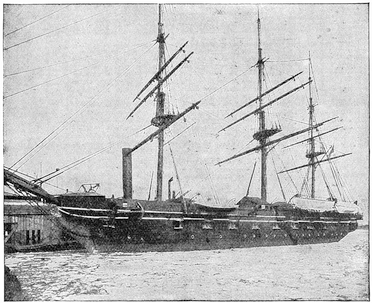
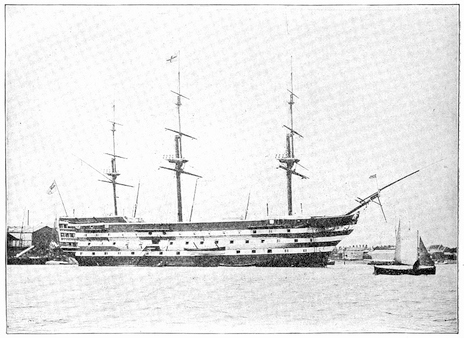
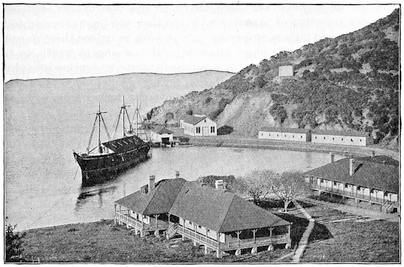
SCHOOLSHIP SARATOGA.
To the secretary of war, William L. Marcy, and to General Winfield Scott
was due the plan of campaign, the battles of which, like instantaneous flashes
of victory from the beginning of the war until its close, illumine the pages of
American history. Then, as now, Congress was slow to respond to the needs
of the military branch of the government.
April 24, 1846, hostilities began. General Taylor advanced into Mexico
and, May 8, won the brilliant victory of Palo Alto, and again, the next day,
the battle of Resaca de la Palma. Taylor’s force was less than one third
the number of the enemy, whose loss was one thousand. These two battles
crushed the flower of Santa Anna’s army. Taylor returned to the relief of
Fort Brown, where the brave garrison had sustained a cannonade for 168
hours. September 24, Monterey and its garrison of nine thousand men were
taken by General Taylor with six thousand.
February 23, 1847, Taylor gained the glorious victory of Buena Vista, in
which the Mexican loss was 2000, the American, 714. At times the Mexicans
were within a few yards of Bragg’s guns. “A little more grape, Captain
Bragg,” was Taylor’s celebrated order, the execution of which decided the
day. The American loss was severe in officers. Taylor’s force, depleted by
more than two thirds, which had been sent to reinforce General Scott, was
barely forty-five hundred; the Mexican troops numbered twenty thousand.
Captain Fremont, assisted by Commodores Sloat and Stockton, had subjugated
California; General Kearney and Colonel Doniphan, Northern Mexico.
Doniphan defeated the Mexicans at Bracito, December 25, 1846, and at Sacramento,
February 8, 1847, and took possession of Chihuahua, a city of
forty thousand inhabitants, and marched to join General Wool at Saltillo,
March 22.
Early in January, 1847, General Scott reached the mouth of the Rio Grande,
where he awaited the eight thousand troops sent by General Taylor. This
raised his force to twelve thousand. These were landed at Sacrificios. The
Americans debarked just below Vera Cruz between sunset and ten o’clock on
the night of March 8 without a single accident. With wonderful skill the
investiture of Vera Cruz and the castle of St. John de Ulloa was completed.
On March 22 the Governor of Vera Cruz was summoned to surrender. Day
and night the mortar batteries played upon the city, the fleet ably assisting;
and on the 29th the stars and stripes floated above the walls of city and fortress.
The Americans lost but two officers and a few soldiers. April 18, the
magnificent victory at Cerro Gordo, where three thousand Mexicans were
captured, was won; April 19, Jalapa was taken; April 22, Pecote, the strongest
of Mexican forts, was captured; and May 15, Puebla surrendered to
General Worth. Ten thousand prisoners, seven hundred cannon, ten thousand
stands of arms, and thirty thousand shot and shells were captured
within two months. When the army entered Puebla it numbered but forty-five
hundred.
Reinforcements reaching him, Scott set out from Puebla to the valley of
Mexico on August 7. August 20, the heights of Contreras were assailed and
taken, and the battle of Churubusco—with nine thousand Americans against
thirty thousand Mexicans—was fought and won. September 8, Molino del
Rey was taken; September 13, the heights of Chapultepec. The Mexicans
fled from the capital, and the victorious American army marched in and took
possession of the city, September 14, 1847. Here Scott and his noble warriors
rested until the treaty was concluded at Guadalupe Hidalgo, February
2, 1848, and peace was proclaimed, July 4, by President Polk. Guadalupe
Hidalgo, New Mexico, and California were ceded to the United States,
$15,000,000 paid to Mexico, and the debts due from Mexico to American citizens
were assumed by the United States.
The Civil War.—It is not here the place to rehearse or to discuss the
causes which led to America’s Civil War, a war perhaps the most stupendous
recorded in history. Looking backward, after the bloody foot-prints have
been well nigh obliterated by the growth of a generation, we can see that the
trend of human progress, the political problems confronting the federated
States, in the solution of which were evolved elements of discord, the inherited
antagonism between the Puritans of the North and the Cavaliers of the
South, all combined to make the conflict inevitable. For more than a decade
of years grievances had been growing and rumblings were heard, like the imprisoned
fires beneath the surface of the earth, until the election of Abraham
Lincoln as President, pledged to a policy believed to be inimical to the South,
caused the outburst of the volcano, whose fierce fires and molten lava for four
years spread desolation over the land.
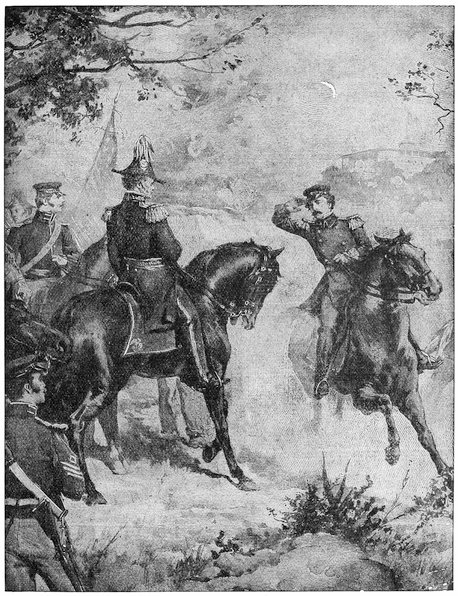
ROBERT E. LEE AT CHAPULTEPEC.
Time and milder judgment have very nearly smoothed away the wrinkles
of discord, and the close of the century finds the nation a reunited people,
whose new compact is written in the life-blood of her sons on the battlefields
of the recent war with Spain.
December 20, 1860, South Carolina; January 9, 1861, Mississippi; January
10, Florida; January 11, Alabama; January 18, Georgia; January 23, Louisiana,
and February 1, Texas, one by one asserted their supposed right to
withdraw from the federal compact, and enacted ordinances of secession in
their several state conventions. Each State, as it took action, claimed and
possessed itself of all government property, forts, guns, ammunition, within
its borders, and armed its militia for garrison duty. A convention of delegates
from the seceded States, held February 4, 1861, at Montgomery, Alabama,
organized a new federation, to be known as the Confederate States of
America, chose Jefferson Davis President and Alexander Stephens Vice-President,
and set the whole machinery of a provisional government in working
order. July 20, Richmond became the capital of the Southern Confederacy.
Virginia seceded April 17; Arkansas, May 6; North Carolina, May 20, and
Tennessee, June 8. Kentucky declared neutrality.
Lincoln, upon assuming the executive chair, March 4, 1861, found the
treasury depleted, the army of only sixteen thousand men scattered in the
West, and many of its best officers already with the Confederacy. The navy
had been sadly neglected by Congress, partly because this branch of the
service had been steadily antagonized by the West, so that at the beginning
of the war, both as to vessels and armament, it was by no means in a condition
for active service. As in the army, some of its most valuable officers
had espoused the cause of their native States, and the South Atlantic and
Gulf ports, being in possession of the new federation, left the United States
vessels no place of refuge. With unlimited means at command, the Union
navy increased the number of its vessels to 588—75 of them ironclads—with
4443 guns and 30,000 men, before the end of 1862. Torpedoes and
steel rams were first used during this war, and monitors, just invented, were
used by the United States. With a nucleus of 10 vessels, around which to
build its navy, the Confederacy had, by November, raised the number to 34.
Until the blockade became effective, “cotton was king;” for, in October,
1861, the Nashville, running out with a heavy consignment, brought back
into Charleston in exchange a cargo worth $3,000,000. Vessel after vessel
was bought from English shipbuilders, among them the celebrated Alabama,
which, in the fourteen months of her service, captured sixty-nine prizes,
and destroyed ten million dollars’ worth of merchandise. The armored ram
Stonewall was bought in France.
April 12, 1861, Fort Sumter, in Charleston harbor, was forced to surrender
to the Confederates, and the first shot at the old flag ushered in the long,
bitter struggle.
Troops were called for by Lincoln. Lieutenant-General Scott, the veteran
hero of Mexico, was in command of the army. In three months, three hundred
thousand men were in the field. One hundred thousand had swarmed
to the Confederate ranks. General McClellan was sent to the front and,
after the resignation of Scott in the latter part of the year, was made commander
of the army.
July 21, the battle of Bull Run was fought. The Union troops were disastrously
routed and retreated in confusion to Washington. The army did
little more during this year.
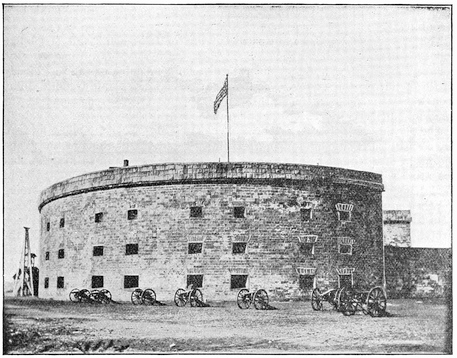
CASTLE WILLIAM. MILITARY PRISON, GOVERNOR’S ISLAND, NEW YORK HARBOR.
April 21, after setting fire to and destroying the Navy Yard and ships,
Norfolk was evacuated by the Union forces. The frigate Merrimac, which
had been sunk, was raised by the Confederates, plated with iron, renamed
“Virginia,” and became the scourge of the shipping off the Virginia coast.
The navy, as is usual, and because of its very organization, got in its effective
work much earlier than did the army, and the seizure of the forts and
ports on the coast of the seceded States began at once. Fort Hatteras was
taken August 29; Port Royal, in South Carolina, November 7. November 7
a naval officer, by overhauling an English mail steamer and taking off Messrs.
Mason and Slidell, who had been appointed commissioners of the Confederate
States to France and England, very nearly caused a complication with the
latter power. Mr. Seward’s diplomacy settled the incident amicably, and the
commissioners were allowed to proceed upon their mission, which, however,
proved futile. By the close of the year, Maryland, Kentucky, and Missouri,
at first doubtful, were securely in the Union, though many of their citizens
were in the Southern army.
1862.—February 6, General Grant, commanding the army of the Tennessee,
with the assistance of Commodore Foote and his gunboats, captured Fort
Henry, on the Tennessee River, and, on the 16th, Fort Donelson on the
Cumberland. The Federal forces had reached the number of four hundred
and fifty thousand, of which McClellan had two hundred thousand.
May 23, at Front Royal, and May 25, at Winchester, “Stonewall” Jackson
defeated the Union troops and forced them across the Potomac. Banks,
Fremont, and McDowell, concentrating their forces, bore down on Jackson,
who slipped through their lines, and, on June 9, defeated Shields at Fort
Republic.
The cry of the Northern press was, “On to Richmond,” and McClellan
endeavored to obey the command. He had arrived not far from the city,
between the York and James rivers, when he was defeated in the bloody
battle of Seven Pines, May 31 and June 1. The Confederate General Johnston
was wounded, and General Lee was assigned to the command of the
army of Northern Virginia, which he retained until the end.
The Seven Days’ battles, from June 25 to July 1, were fought at fearful
cost to the Confederates; nevertheless, “it was a glorious victory,” and
the siege of Richmond was raised. Lee advanced toward Washington, met
the armies of Banks and Pope, and defeated them in the second battle of
Bull Run, August 29 and 30, and at Chantilly, September 1 and 2, forcing
Pope’s army to retreat to Washington. The clamor in the South had been,
“On to Washington.” Lee crossed the Potomac at Harper’s Ferry and took
twelve thousand prisoners. McClellan, who had been recalled, met the
Confederates at Sharpsburg (Antietam), September 17, and fought a battle
with undecisive results. Each side lost about ten thousand men, and Lee
returned.
The Union army under Burnside, who had superseded McClellan, met a
fearful repulse at Fredericksburg, December 13, with a loss of fourteen thousand.
The Confederate loss was five thousand.
December 31, January 1 and 2, was fought the terrible battle of Murfreesboro,
Tennessee, where Bragg’s force was 35,000, and his loss in killed,
wounded, and missing, 10,466. Rosecrans’s force was 43,400, and his loss
12,595.
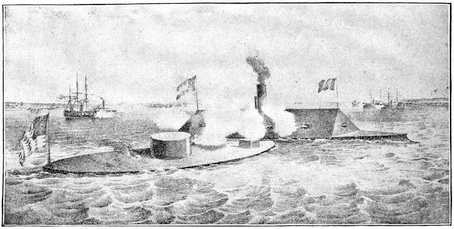
March 8, the Virginia attacked the Union fleet at Fortress Monroe and
destroyed the Cumberland and the Congress. The next day, the Monitor
attacked the Virginia, and, after five hours’ fighting, succeeded in disabling
her so that she returned to Norfolk. The Virginia was destroyed by the
Confederates before evacuating Norfolk, May 10.
Admiral Farragut, with a fleet of 45 vessels, entered the Mississippi and
bombarded the forts of St. Philip and Jackson. Despising the fear of mines
and torpedoes, he continued on his course, defeating the Confederate fleet,
and, together with General Butler, entered New Orleans April 25. During
this year the navy, with the assistance of land forces, had retaken all important
ports on the Virginia, North Carolina, and Georgia coasts, seriously
interfering with the blockade running, upon which the Confederacy depended
for its foreign supplies. The year 1862 closed with no advantage having
been gained on either side.
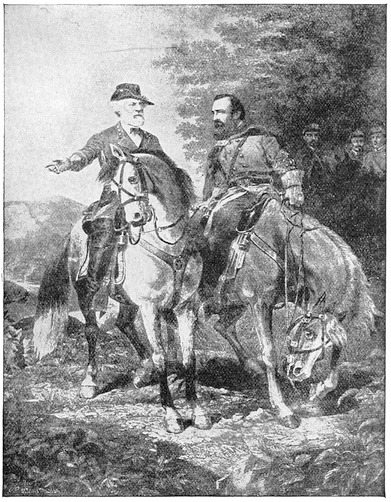
GENERALS ROBERT E. LEE AND STONEWALL JACKSON.
1863.—On January 1, Lincoln issued the threatened Emancipation Proclamation.
This destroyed the last hope of the Confederacy for recognition
by England. No event of importance occurred before the middle of spring,
when Hooker, who had relieved Burnside, made another advance upon Richmond,
and was routed by Lee and Jackson at Chancellorsville, May 2, and
on the 5th was forced across the Rapidan with a loss of seventeen thousand.
The Confederate loss was less than five thousand. In Jackson’s death the
Confederacy received a blow, the consequences of which may never be estimated.
Lee’s army again crossed the Potomac for an invasion of the North. The
Union forces, under Meade, marched in an almost parallel line with Lee’s
through Maryland into Pennsylvania. They met and fought at Gettysburg,
July 1, 2, and 3, one of the decisive battles of the world’s history. Lee was
forced to again retire beyond the river. The Union could well afford the
loss of twenty-three thousand men, but Lee’s loss of twenty thousand of the
choice troops of his army was irreparable.
In the meantime, Grant had been sent to open the Mississippi, and after a
six weeks’ siege, on July 4, Vicksburg, with nearly thirty thousand prisoners
and vast quantities of stores, fell into his hands. These two almost simultaneous
victories greatly encouraged the North, and formed the turning
point in the history of the war. July 9, Banks’s victory at Port Hudson
accomplished the desired possession of the Mississippi River.
Bragg, who had been sorely pressed by Rosecrans, made a stand at Chickamauga,
defeating the Union General Rosecrans, September 19 and 20, and
forcing him to retreat to Chattanooga, where he was besieged by Bragg.
Grant, with Sherman, coming to his aid, the battles of Lookout Mountain
and Missionary Ridge were fought, November 23 and 25, and Bragg was
driven back into Georgia.
The Federal navy was gradually taking possession of the whole coast, and
Charleston was tightly blockaded. In March the Confederate ship Nashville
was sunk in the entrance of the Savannah River.
During this year both governments were forced to resort to conscription.
Lincoln ordered a draft, and, in July, a three days’ riot in consequence prevailed
in New York, during which two million dollars’ worth of property was
destroyed.
1864.—In March, Grant was put in command of the whole Union army,
the grade of lieutenant-general having been revived in his behalf. He left
Sherman in command, repaired to Washington, and, May 3, started on the
third campaign against Richmond, with a force of one hundred and forty
thousand. Sherman, with one hundred thousand, was to march to Atlanta.
The whole strength of the Union army at this time was about seven hundred
thousand. Grant had spent some weeks in formulating his plans of
campaigns, from the main features of which he never deviated. The Union
had at last found the man, and at the same time had acquired the wisdom to
leave the conduct of the war to his judgment; proving, also, that “there
is no war on record that has not given its man to the world or shaped the
destiny of some other.”
Crossing the Rapidan, Grant encountered the Confederates, and the fighting,
on the 5th, 6th, and 7th, of the battles of the Wilderness, was terrific,
but the result undecisive. At Spottsylvania he fought from the 8th to the
18th with fearful loss. June 1, he was repulsed at Cold Harbor, and again
on the 3d, and fighting, more or less desultory, continued in that vicinity
until the 12th. Since the opening of the campaign, the Union army had lost
sixty thousand men; the Confederate thirty thousand. Grant moved on
Petersburg and began the siege which lasted from June until the next April.
The western part of Virginia had seceded from the eastern portion, and,
June 20, was admitted into the United States.
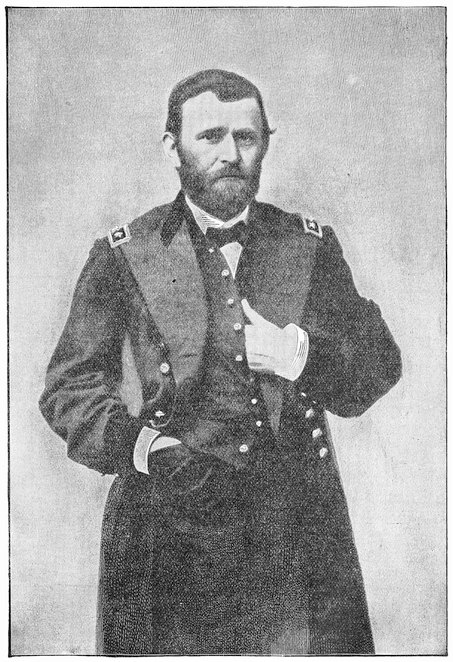
GENERAL ULYSSES S. GRANT.
To divert Grant, and, if possible, to raise the siege of Petersburg, in July,
Lee sent General Early to threaten Washington and Baltimore, which he
accomplished without, however, affecting Grant’s position. Returning laden
with spoils, Early turned, and driving back the Federal troops invaded
Pennsylvania, burning Chambersburg, and came back again bringing vast
quantities of supplies. Sheridan was sent to dispose of Early and to ravage
the valley. At Winchester, he met and defeated Early in a very severe fight
on October 20, almost destroying the force under that general’s command.
Sherman set out for Chattanooga on May 7, marching towards Atlanta. At
Dalton he met General Johnston’s army of fifty thousand men. Johnston’s
masterly retreat from Dalton to Atlanta is unrivaled in military history.
He made a stand from May 25 to June 4 at Dallas, but, being outflanked,
was obliged to fall back. The next stand was made at Great Kenesaw, on
June 22, when he repulsed the Federals. On the 27th, Sherman made a
powerful assault, but was again repulsed with a loss of four thousand, Johnston’s
loss being four hundred; but, again outflanked. Johnston was forced
across the Chattahoochie, and July 10 found the Confederate army entrenched
in Atlanta.
Johnston’s retreating tactics caused the people to clamor for a “fighting
leader,” and Davis, in transferring the command from Johnston at such a
crucial time, committed a grave error. Johnston was superseded by General
Hood, whose chief ambition was to fight, which, in this case, was a great
mistake in judgment. On the 20th, 22d, and 28th of July, Hood assaulted
the lines of the besiegers, only to be repulsed again and again. In these
fights more men were lost than during Johnston’s long, skillful retreat. An
injudicious movement by Hood separated his command, obliging him to
evacuate Atlanta, of which Sherman, on September 2, took possession. In
its advance on Atlanta, the Union army had lost thirty thousand men. Hood
saved his army and made his way towards Nashville, hoping to divert Sherman
from Georgia. At Franklin, November 30, he met General Schofield,
and drove him back to Nashville, from whence General Thomas made a
sortie, and fell upon Hood’s troops, December 15, completely routing them.
In the two fights, Hood lost in killed, wounded, and captured over eleven
thousand. With the remnant he escaped into Alabama, and these finally
reached Johnston, participated in his last fight with Sherman, and were surrendered
at Raleigh with the troops of their old commander.
November 14, Sherman burned Atlanta, cut all telegraph lines and began
his “March to the Sea,” ravaging, devastating, and utterly destroying everything
in his reach. He was opposed by the Confederate cavalry, which
successfully defended the cities of Macon and Augusta, upon which the
Confederacy mainly depended for the manufacture of munitions of war.
Sherman entered Savannah on December 22, the advance having cost him
only 567 men killed and wounded.
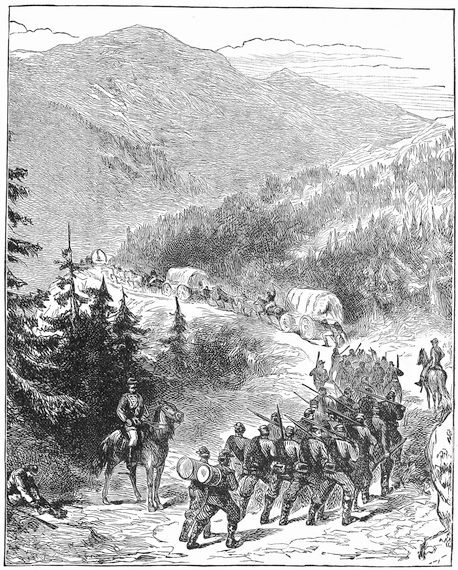
SHERMAN’S MARCH TO THE SEA.
On June 19, the celebrated sea fight between the Kearsarge and the Alabama
took place off Cherbourg, France. The Alabama was sunk after a five
hours’ fight. Admiral Semmes was rescued by the Deerhound, belonging to
an English gentleman, and thus saved from capture. August 5, Commodore
Farragut, overcoming the Confederate ram Tennessee and the gunboats,
sailed into Mobile Bay, commanding his fleet from the maintop of his flagship.
1865.—The opening of the campaign of 1865 found Grant’s army still
before Petersburg. On April 2, he ordered an attack along his whole line,
which had been so lengthened that the lines of Lee’s depleted army were
very thin. The Confederates were driven back with heavy loss. Lee telegraphed
to Davis: “My lines are broken in three places; we can hold Petersburg
no longer. Richmond must be evacuated this evening.” That night
Admiral Semmes, in obedience to orders, destroyed the Confederate fleet in
the James River. Richmond was in the possession of the Union forces the
next day, and on April 4 Lincoln held a reception in Davis’s vacated mansion.
Lee attempted to break through Grant’s lines at Appomattox, but closely
pursued by Sheridan, and finding further retreat impossible, he surrendered
with about twenty-six thousand men on the 9th of April.
Grant’s magnanimous terms were worthy of his fame. The troops were
paroled on condition of promise not to take up arms until exchanged. The
officers were permitted to keep baggage and side arms, and all were to retain
their horses, as, Grant said, “they would be needed in the crops.”
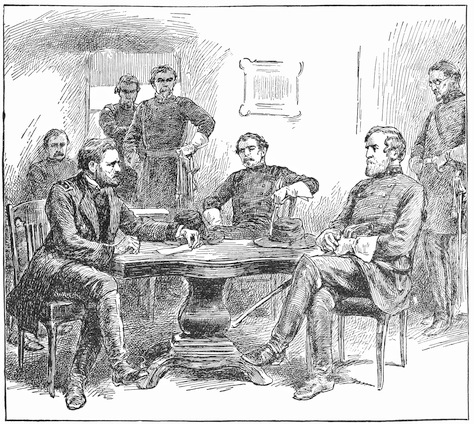
LEE’S SURRENDER AT APPOMATTOX.
Turning northward from Savannah, Sherman continued his march and
reached Fayetteville, North Carolina. Wilmington had been captured early
in the year by a land and naval force. Johnston had been reinforced by the
garrison which had been forced to evacuate Charleston and the remnant of
Hood’s army, and had several severe fights, with no decisive results, with
Sherman, who entered Raleigh; and here, on April 26, Johnston’s army surrendered
on the same terms given by Grant.
December 31 and January 1 Fort Fisher was captured, and on January
12 Wilmington was entered by the Federals; February 18, Charleston was
captured.
The regular battles during the Civil War numbered 892. Lincoln called
in all for 2,690,000 men. There were actually in service 1,490,000. There
were 400,000 disabled; 304,369 perished; 220,000 were captured, and 26,000
died in captivity. The expenses of the war were $3,500,000 per day. The
national debt was $2,700,000,000.
This great American War was fought on both sides with a courage and
fortitude never before experienced in the annals of warfare. As compared
with the statements of forces and losses in battles of European armies,
the casualties in the battles of the Civil War were three and four times
as great. And this proves that in the American War each side met “foe-men
worthy of their steel.” These overwhelmingly fearful casualties are
not to be explained otherwise. And each section respects the other more
than before the war—a war in which the conquered felt not, nor said,
peccavi, and in which surrender to greater numbers and heavier artillery involved
no sacrifice of belief in the truth and justice of their cause. Was there
ever an armed strife that brought forth greater generals or more knightly
valor, undiminished courage and unflinching fortitude on the part of combatants?
Together must the names of Grant and Lee go down to posterity as
great types of the American soldier,—the one, noble and generous in victory;
the other, though a hero uncrowned by success, a warrior still more heroic
in defeat.
The Spanish-American War.—The proximate causes of the war with
Spain are tersely set forth in the Joint Resolution declaring the independence
of Cuba and demanding the withdrawal of Spanish sovereignty therefrom,
which says:—
“Whereas, The abhorrent conditions which have existed for more than
three years in the island of Cuba, so near our own borders, have shocked
the moral sense of the people of the United States, have been a disgrace
to Christian civilization, culminating as they have in the destruction of a
United States’ battleship, with 266 of its officers and crew, while on a
friendly visit in the harbor of Havana, and cannot longer be endured, as
has been set forth by the President of the United States in his message
to Congress of April 11, 1898, upon which the action of Congress was invited;
therefore,
“Resolved, by the Senate and House of Representatives of the United
States of America in Congress assembled:
“First, That the people of the island of Cuba are, and of right ought to be,
free and independent.
“Second, That it is the duty of the United States to demand, and the
Government of the United States does hereby demand, that the Government
of Spain at once relinquish its authority and government in the island of
Cuba, and withdraw its land and naval forces from Cuba and Cuban waters.
“Third, That the President of the United States be, and he hereby is, directed
and empowered to use the entire land and naval forces of the United
States, and to call into the actual service of the United States the militia of
the several States to such extent as may be necessary to carry these resolutions
into effect.
“Fourth, That the United States hereby disclaims any disposition or intention
to exercise sovereignty, jurisdiction, or control over said Island,
except for the pacification thereof, and asserts its determination when that
is completed to leave the government and control of the Island to its
people.”
This resolution was signed by the President at 11.24 o’clock A. M., April 20,
1898.
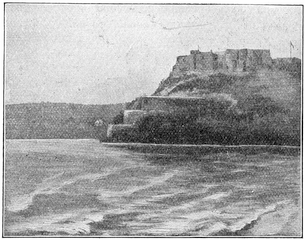
MORRO CASTLE, SANTIAGO, CUBA.
It was on February 15, 1898, that the catastrophe referred to—the blowing
up of the Maine—occurred. On April 25, the formal declaration of war was
made.
Spain had three fleets,—Admiral Cervera’s flying squadron, the Asiatic
fleet under Admiral Montejo, and Admiral Camara’s fleet of heavy armored
vessels.
The American navy is always ready for emergencies, and even with the
grudging appropriations made by Congress, the “new navy,” while not possessing
vessels of such large size as those of some other nations, was much
more formidable than was generally supposed. Congress, apprehending the
outcome, had given the President $50,000,000 to put the country on a war
footing. In reply to the call for 125,000 volunteers, five times that number
offered themselves.
It had been more than fifty years since the United States had encountered
a foreign foe, and since the close of the Civil War, for a third of a century,
peace had reigned.
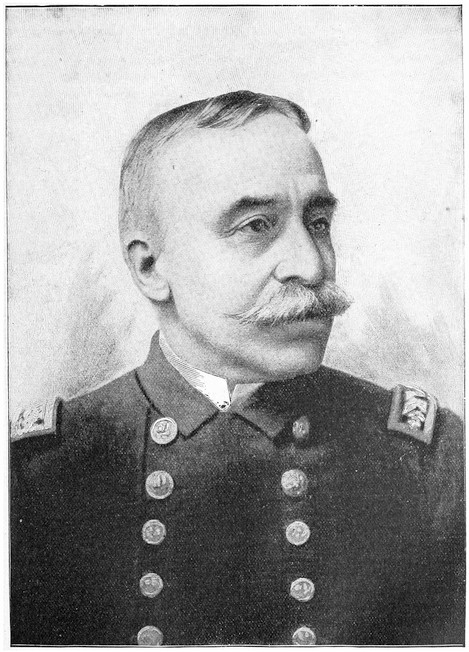
ADMIRAL GEORGE DEWEY.
April 25, by cable to Hong Kong, Commodore Dewey was ordered to find
and destroy the Spanish Asiatic fleet, which he proceeded to do on May 1st,
without the loss of a single man. Entering Manila Bay, scorning torpedoes
and mines, his wonderful battle at Cavite is the admiration of the
world.
Schley, with his flying squadron, watched in Hampton Roads for an attack
by the enemy on the Atlantic coast. Havana was blockaded by Sampson’s
squadron April 22, and his searchlights seen from the Cuban capital were
as the handwriting on the sky, foredooming Spanish rule. His tactics
were to take no risk with his vessels while awaiting the appearance of the
Spanish ships, so he failed to return the greeting of the shore batteries.
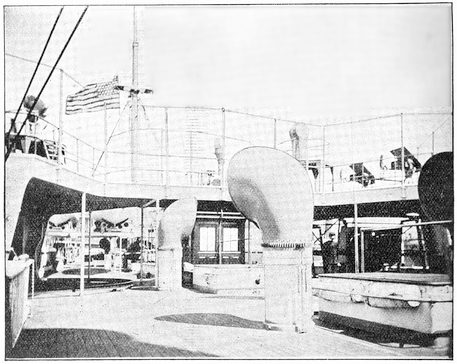
MAIN DECK OF CRUISER CHICAGO.
The first casualties of the war were in Cardenas harbor May 11, when upon
the Winslow, while chasing a decoy gunboat too far under the fire of the land
batteries, Ensign Bagley and four sailors were the first men of the navy to lay
down their lives.
It was known that Cervera had sailed from Cadiz toward the West Indies.
Sampson made a tour of Porto Rico to hunt the Spaniard, who mysteriously
eluded the sight of the Americans. San Juan was bombarded on May 12.
On May 30 Schley, who in the meantime had arrived off Santiago, dispatched:
“I have seen the enemy’s ships with my own eyes.” Cervera had then been
in the harbor ten days. On the 31st, Schley commenced a bombardment, and
the forts at the mouth of Santiago harbor and the vessels within replied for
an hour. June 1 Sampson came, and all hope of escape for Cervera was cut off.
On that night Lieutenant Hobson executed his bold, heroic plan of sinking
the Merrimac in the channel of the harbor, which was accomplished without
the loss of one of his seven co-heroes, although subjected to a deadly fire
from forts and vessels.
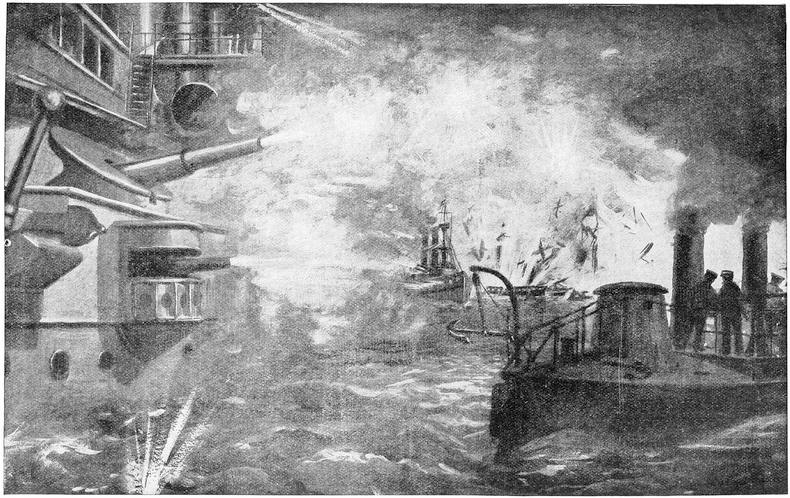
DEWEY’S GUNS AT MANILA.
The first troops landed on Cuban soil were the marines, 650 in number,
under Lieutenant-Colonel Huntington. This battalion had been on board the
Panther since May 22, and the men were eager to land. After Sampson had
shelled the shore and adjacent hills and woods, on the afternoon of June 10
the landing was made and the American flag raised for the first time on
Spanish territory in the west. No Spaniards were seen until after the tents
had been erected and the evening shadows were falling. Then for five nights
and days there was no sleep for these men, than whom there were no greater
heroes in this short, sharp war. With few exceptions they received their
“baptism of fire,” and nobly did they acquit themselves.
I am told that when almost utterly exhausted the first platoon reached the
summit of Cusco hill, so exactly in unison was their fire that the Spanish, believing
that machine guns were opening upon them, turned and ran, never
again making a stand. The first to consecrate the soil with his life’s blood
was Dr. John Blair Gibbs, who left a $10,000 practice in New York to go as
surgeon of the battalion, and who had greatly endeared himself to both officers
and men. Sergeant Goode, one of the finest subalterns in the corps, and
four men were killed. The good condition and health of this battalion during
the whole campaign were due to the fine organization of the commissariat
and the strict discipline maintained in this corps.
General Shafter arrived off Santiago, June 20, with a force of 773 officers
and 14,564 men. General Garcia, the Cuban commander, with four thousand
insurgents, was at Assuadero, eighteen miles west. There he, Shafter, and
Sampson held a consultation. On the 22d, the disembarkment of troops was
begun. On the morning of the 23d, General Lawton with his division advanced
to Juragua. Major-General Wheeler, after landing 964 of his force,
pursuant to General Shafter’s orders, moved rapidly to the front, and, passing
through Lawton’s lines, pushed on to Las Guasimas, attacking and defeating
General Linares on the morning of June 24.
The entire American force was pressed forward under General Wheeler,
General Shafter being detained on the ships to attend to the landing of the
armament and supplies. On the 29th, the commanding general left his ships
and pitched his camp on the Santiago road, and on the next day orders were
given for an attack along the whole line. In carrying out these orders, General
Lawton with about six thousand men attacked El Caney, a small town
about five miles north of Santiago. The garrison consisted of 520 men, the
defenses being one block-house and a shore fortification. It was not until
four o’clock that General Lawton’s success was complete. His loss was
437 killed and wounded, and but 30 of the enemy succeeded in escaping and
reaching the Spanish lines. While Lawton was moving on El Caney, the
cavalry division, unmounted, and Kent’s infantry division were ordered to
move forward. Crossing San Juan River at a point about five hundred
yards from the enemy’s fortifications on San Juan ridge, the left of the
cavalry rested on the main Santiago road and the infantry formed to the
left of the cavalry. These troops were subjected to a very heavy fire in
advancing from El Pozo, in crossing the river and in forming on the other
side; they, however, most bravely charged the enemy in their strong position
on Kettle Hill and San Juan ridge, and drove them precipitately from their
strong fortifications; the American loss being 154 killed and 997 wounded.
This placed the Americans in a position commanding the fortifications around
the city of Santiago.
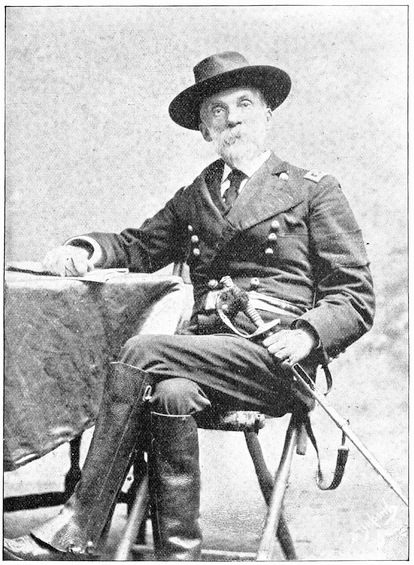
GENERAL JOSEPH WHEELER.
(Copyright by Aimé Dupont, 1899.)
The Spanish fleet, consisting of five armored cruisers of 7,000 tons and 2
torpedo-boat destroyers, attempted to escape from Santiago at 9.30 o’clock on
Sunday morning, July 3, just nine weeks after the destruction of Montejo’s
fleet. Schley and Sampson destroyed the vessels and made prisoners of 70
officers and 1600 men; 350 were killed and 160 wounded.
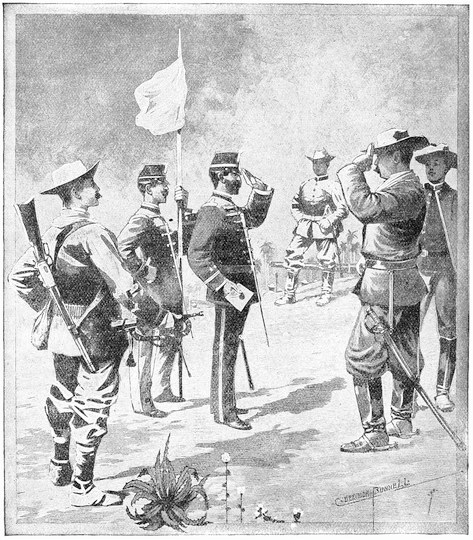
THE TRUCE BEFORE SANTIAGO.
Fighting more or less severe occurred until the 10th, when negotiations
for surrender were inaugurated, resulting in the capitulation of Santiago,
July 16, the Spanish fortifications, twenty-four thousand prisoners, and a
large amount of arms and ammunition. At noon on Sunday, July 17, 1898,
the American flag was hoisted over the headquarters at Santiago.
General Miles started on the invasion of Porto Rico, July 25, and reached
Guanica at daylight next morning. He landed with three thousand five
hundred men, marched toward Yauco, five miles distant, which he entered
after a skirmish, and was received enthusiastically by the citizens, as he also
was at Ponce, where he was joined by General Wilson, who had come with
the war ships, and who was made governor. The army continued on to San
Juan along the military road, meeting very little opposition.
July 26, the French ambassador, M. Jules Cambon, acting for Spain, made
overtures for peace. The protocol was signed on April 21, by M. Cambon
and Secretary of State Day. A cessation of hostilities was proclaimed. At
the very moment of the signing of the protocol, the last naval battle took
place at Manzanilla, Cuba, and an artillery engagement at Aybonito in Porto
Rico.
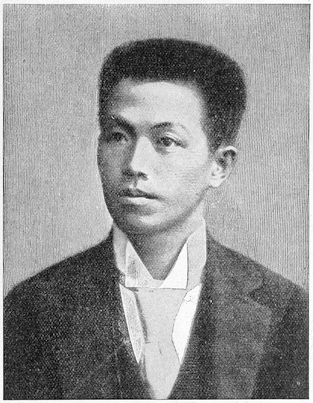
AGUINALDO, THE TAGAL LEADER.
The one-hundred-days Spanish-American war was concluded by the treaty
of Paris.
It will be only in the retrospect that we may tell the results of this conflict.
As the future unfolds them to our view, it may be that it will have
been more momentous in its consequences than we can now determine. One
thing it has proved, that is, that this nation is really reunited; for, from all
sections and from all grades of life, men flocked together to fight and conquer
under the old Stars and Stripes.
Napoleonic Wars.—The long contest between France and Austria began
when the Girondist ministry of France declared war, April 20, 1792. By
the execution of Louis XVI., January 21, 1793, the Revolution threw down
the gauntlet to all ancient Europe. England, whose sympathies had hitherto
been more or less with France, began to take measures to bring about more
cordial relations with the other powers of Europe. Spain, Portugal, Austria,
Prussia, and Russia, for the time seemed to forget their several grievances as
they found themselves confronted with a totally new move on the chessboard
of European autonomy. The year 1794 saw the French Revolution progressing
triumphantly, and all Europe, except England and Austria, appeared
acquiescent in apathetic indifference. In 1795 the royalists made a supreme
effort to recover power, but were crushed by the “Man of Destiny,” and the
Directory, consisting of five members, of whom Carnot was one, came into
power. Dominated by the martial genius of Carnot, “the organizer of victory,”
the Directory won the confidence of the army. Scherer, the commander,
lacked the qualifications to undertake a successful campaign against
Austria, and Bonaparte, succeeding him, soon infused his own spirit into the
army and bound it to himself with a devotion that never failed.
Early in the year 1800, Napoleon, having been made first consul, took up
his abode in the old palace of the kings of France, the Tuileries. The history
of Napoleon for the ensuing fifteen years is the history of Europe. It
is, therefore, best to begin with the close of the eighteenth century, in order
to appreciate the situation at the dawn of the nineteenth.
Austria and England, with several small German principalities, were still
in arms against France. The plans and movements of the armies under
Napoleon showed him to be verily a master in military skill. Opening this
campaign, he left Massena with about eight thousand soldiers to hold the
territory from Nice to Genoa, so as to keep the Austrian army in Italy busy.
He sent the Rhine army, under Moreau, to threaten Bavaria and to secure
the most important position between the Rhine and the Danube. Moreau
drove the Austrians to Ulm, and disposed his left flank to support Napoleon.
Meantime, he himself was recruiting another army for operations on the
Po. Baron de Melas, commanding the Austrian troops in Northern Italy,
besieged Massena in Genoa, which, after severe suffering, surrendered, leaving
De Melas free to join the army of the Po. Napoleon was between de
Melas and Austria. General Ott, with eighteen thousand men, attempted to
reach Placentia, but Lannes, with twelve thousand, defeated him at Montebello,
forcing him back to Allesandria. Napoleon hastened across the Po to
Stradella to intercept De Melas and prevent his breaking through the French
lines to Placentia.
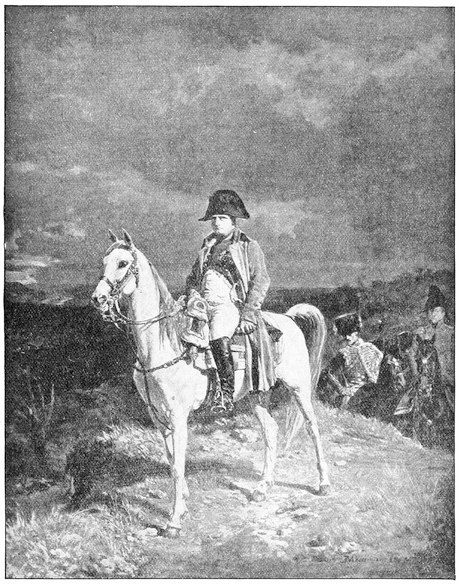
NAPOLEON, 1814. (MEISSONIER.)
The night of June 13, 1800, the French army was scattered, watching
along the Po and the Tessino for the Austrians, while their army, forty
thousand strong, with ten thousand more not far distant, was ready at daybreak
of the 14th to cut its way through the armies of France, and reach
Placentia. The French force was but eighteen thousand, but Victor with
his division held his position firmly, and the great leader, Kellerman, was in
command of the cavalry. Backward and forward surged the battle with
varying fortune, and at noon victory seemed perched upon the banners of
Austria. De Melas was so certain that the battle was won that he galloped
back to Allesandria and sent dispatches to that effect to the governments of
Europe. General de Zach was left in command to conduct the pursuit and
to drive the French across the Scrivia. Napoleon, dismayed, hoping against
hope that Desaix, whom he had sent towards Novi the day before to look
out in that quarter for De Melas, might hear the thunders of the battle and
return, saw him in the distance, hurrying with his troops, who, though worn
and tired, were eager for the fight, and Napoleon saw already the tide of
battle turned.
Desaix had found no trace of the Austrians, but he had heard the sound of
battle at day dawn, and he knew that De Melas was there, and that there he
was needed, and not at Novi. He roused his division, and hastened back
to Napoleon. A short conference with his chief, to whose questioning he
answered, “The battle is lost, but it is only three o’clock, there is yet time
to win another,” and the battle of Marengo, glorious in its consequences to
Napoleon, stupendous in its carnage, was won; but Desaix, the brave paladin,
lay dead upon the field. De Melas returned from Allesandria to meet
the victorious army he had left—flying in disorder—thoroughly routed.
On December 2, Moreau and Ney won the field of Hohenlinden, and the
“peace of Luneville” was concluded, February 9, 1801.
The result of this campaign was the cession of Austria’s strongholds in
the Tyrol and Bavaria to France, as also a number of important holdings in
Italy. France secured the left bank of the Rhine, the Belgian provinces and
Tuscany, and the king of Naples closed his harbors to England. In March,
1802, by the “treaty of Amiens,” peace was concluded with England.
The coalition of Denmark, Sweden, Russia, and Prussia, with France
against England, in 1800, fomented by Napoleon, broke down in 1801, after
Nelson’s battle of Copenhagen.
England had secured the supremacy of the sea and dominion over India,
rescued Portugal, Naples, and the States of the Church from France, and
restored the Sublime Porte to Turkey. Finding Napoleon again militating
against her interests, and resenting his encroachments, England declared war
against France in the spring of 1803. Russia espoused the cause of England,
Prussia held off, and Austria was friendly, though not in fighting trim.
The third coalition comprised England, Russia, and Austria.
Powerless to hurt England on the seas, Napoleon, who had the year previous
been proclaimed emperor, attacked Austria, invaded her territory, captured
her army at Ulm, proceeded to Vienna, and occupied a great part of the
valley of the Danube. On December 2, 1805, the “Battle of the Three Emperors”
(the battle of Austerlitz) was fought. The “Peace of Pressburg,” concluded
December 26, left Austria shorn of her ancient prestige, her title of
German Empire, and of a great part of her possessions. The “Sun of Austerlitz”
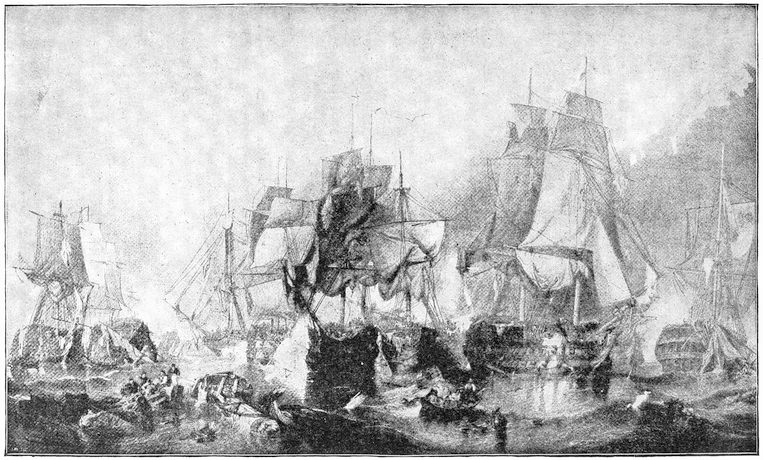
melted the third coalition. In the meantime the battle of Trafalgar,
won by the immortal Nelson, crushed the naval power of both France and
Spain.
In September, 1806, Prussia declared war against France, and, to the
amazement of Europe, alone undertook to engage armies flushed from their
recent victories and still in Germany. October 14, Napoleon utterly defeated
the Prussians at Jena and Auerstadt, and entered Berlin a conquerer, the
king having fled to Königsberg. Russia came to the aid of Prussia, but arrived
too late to accomplish anything except to check the advance of the
French, whose armies wintered on the Vistula. The next summer, however,
the Russians met their final defeat in this campaign at Friedland, and Königsberg
was taken. The “Treaty of Tilsit” ended the operations of this fourth
coalition July 7, 1807.
The fifth coalition against Napoleon comprised England, Austria, Spain,
and Portugal. The decisive battle of this campaign was at Wagram, July 5
and 6, 1809, and terrible as were the consequences of his defeat to Austria, so
crippled was Napoleon that he willingly granted the armistice of Znaim and
concluded the “Peace of Vienna.” When the fifth coalition ended, Napoleon
had acquired the Illyrian provinces and part of the Tyrol for France, and
eventually the Emperor’s daughter,
Maria Louisa, for his wife.
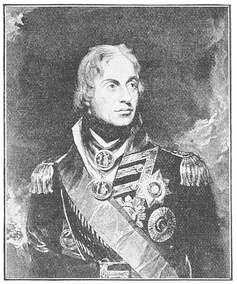
ADMIRAL HORATIO NELSON.
In 1812 came war with Russia,
and that most disastrous campaign
which cost France more than three
hundred thousand soldiers and Napoleon
his empire. Russia, England,
Prussia, and Sweden formed
the coalition now, and Turkey had
made peace with Russia. Napoleon
crossed the Niemen in June, halted
at Wilna to put his new conscripts
in better order, addressed words of
sympathy to Poland, and took measures
to keep Austria conciliated.
The Russians retreated before him.
He met and fought and defeated
them at Smolensk, August 17; they
retreated in good order, burning and
destroying all in their reach. The
terrible battle of Borodino was
fought September 7; the defeated
Russians again retreated in good order, pursuing the same tactics. Napoleon
reached Moscow September 15, but the heroic measure of Russia in destroying
that city was equal in its results to several victories. October 15, the
French troops commenced their fearful retreat. The Russian armies grew
bold, they harassed the French troops, weak from hunger and cold, and from
Moscow to Wilna their progress was one continual guerilla warfare. From
Wilna, their flight to France, December 5, was even more disastrous. Of
the grand army that set out in the spring not one fourth ever returned.
Affairs in Spain had fared badly for France. Wellington defeated the
French army in Spain, and finally expelled it. France, though sometimes
shaken in her devotion by the conscription that was draining her children’s
blood, still had faith in Napoleon, and in 1813, having raised another grand
army, he undertook to subjugate Prussia. His first victory was on the plain of
Lutzen. The Prussians and Russians retreated in good order through Dresden.
Napoleon pursued and drove them from Bauken, on May 20 and 21,
and established his headquarters at Dresden. Austria now joined the allies.
In their attack upon Dresden, August 26 and 27, they were defeated, but
Russian troops and the King of Bavaria coming up made Napoleon’s
position untenable. The allies were awaiting him at Leipsic. The battle
raged for three days, and Napoleon withdrew on October 19, utterly defeated.
January 23, 1814, Napoleon, having raised another army, left Paris to
assume command. The allies—England, Austria, Prussia, and Russia—were
more determined than ever to crush him. Many battles were fought,
and the fortunes of war varied. Blucher defeated him at La Pothiers on the
1st of February. Napoleon was the victor at Montenau; unsuccessful at
Soissons, March 3; victorious at Cravonne, March 7; and defeated by Blucher
at Laon, March 9. With more than half his army lost, Napoleon worried the
allies in their rear; but Blucher marched on Paris. The prestige of Napoleon
and France in Europe was at an end.
The Empress and the regency retired to Blois. On March 31 Paris surrendered,
and the Emperor of Russia and the King of Prussia entered the city.
A provisional government, with Talleyrand at its head, deposed Napoleon on
April 2, and on April 6 he abdicated. May 30, the First Peace of Paris was
concluded between France and the allies. France was to have her boundaries
as they were in 1792, and also her foreign possessions, except Tobago, St.
Lucia, and Mauritius, which, with Malta, were ceded to England. The Bourbons,
in the person of Louis XVIII., were restored; but the French people
were not content, so that when Napoleon appeared at Cannes on March 1,
1815, he was greeted with joy, even by the troops sent out to oppose him.
This astonishing news was communicated to the Congress of the Allies assembled
at Vienna. The allied armies at once gathered on the borders of France,
Wellington landed in Flanders, and Blucher’s Prussians joined him. Wellington,
finding Napoleon in front of him, fell back to Waterloo, lest the
approach of the Prussians should be cut off. Napoleon hurled his force on
Blucher at Fluores, and victoriously drove him from the field on the 15th.
Ney, who had been sent to confront Wellington, fought at Quatre Bras, and
the following day joined Napoleon. On the 18th of June, 1815, Napoleon
made his supreme and final effort to recuperate his lost fortunes and to reestablish
his empire.
The story of the battle of Waterloo, than which none ever fought was more
decisive in its consequences, has been told and retold. The battle was at first
undecided, victory seeming to incline to Napoleon, though the English and
Germans with unflinching heroism still held the field until the afternoon,
when Blucher, with his Prussians, at last arrived. Napoleon perceived that
the supreme moment was at hand, and that his only hope was to crush Wellington
before Blucher’s advancing columns could be thrown into line of battle.
He sent forward his magnificent Imperial Guard. They charged with chivalric
splendor, fought with heroic desperation, were repulsed,—and the star of
Napoleon set to rise no more.
Finding his cause irretrievably lost, leaving the remnant of his army in
command of Marshal Soult, Napoleon fled and, failing to find a passage to
America, surrendered. This battle, magnificent in its results, ensured to
England a long peace, and raised her to the first rank, for military prowess,
among the nations of the world.
Napoleon’s skill at Waterloo was up to the highest standard of his most
glorious work; but he was overwhelmed by preponderance in numbers.
His entire force with which he conducted this campaign was barely 104,000,
while the combined armies of Wellington and Blucher numbered 220,000.
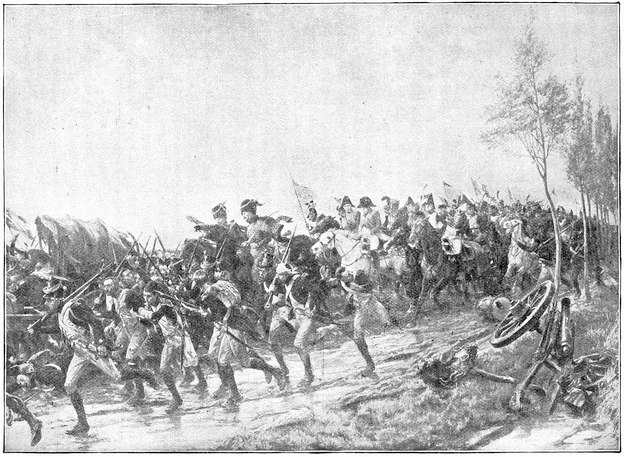
NAPOLEON’S RETREAT FROM WATERLOO.
The Congress of Vienna restored the ancien régime, replacing dethroned
monarchs upon their hereditary domains, but the parceling out of the smaller
territories showed the Powers to be quite as arbitrary as Napoleon himself.
The semi-decade of passive submission to the “policies of princes” was
broken in 1820 by general revolts in Europe. Spanish-American colonies,
indignant at French interference in Spanish matters, began their struggles
for independence.
Greek War for Independence.—Since the capture of Constantinople
by the Turks, in 1453, Greece had been subject to Turkey. Out of the defeats
of several rebellions against the greed, tyranny, and brutality of the
Moslem,—particularly from the revolutions of 1770 and 1790,—grew the
secret society of the Hetæria, cementing the union of the Greeks for the
struggle beginning in 1821. It is claimed that ten thousand Greeks were
slaughtered within a few days, and thirty thousand in less than three
months.
Mahmoud, having failed in 1825 to crush the rebellion, called Mehemet Ali,
the Pasha of Egypt, to his aid. Mehemet sent Ibrahim, his son, with his
army and navy, trained in the tactics of European warfare, into the Peloponnesus.
Victory and devastation marked his course. Never was grander
courage nor loftier bravery displayed than by the Greeks. The siege of Missolonghi
lasted from April 27, 1825, until April 22, 1826. Athens was captured,
June 2, 1827. The fleets of England, France, and Russia were cruising
on the coasts to prevent attacks by the Turks on the islands. Approaching
the bay of Navarino, they were attacked by the Turks and Egyptians, whose
combined fleets were thereupon annihilated on October 20, 1827. The Sultan
was forced by the powers to consent to the establishment of the kingdom of
Greece, and his delay to do so was punished by Czar Nicholas, who declared
war, crossed the Balkans, and at Adrianople in 1829 compelled the Sultan to
recognize her independence, grant Christian governors to Servia, Moldavia,
and Wallachia, and to yield Bessarabia to Russia.
Minor European Wars.—The French Revolution of 1830, placing
Louis Philippe on the throne of France, brought about Belgium’s independence.
The Polish insurrection of 1831–32 lost Poland her last vestige of liberty,
enchaining her irretrievably under the tyranny of Russia.
From 1840 to 1852 England was engaged in quelling periodic wars in her
Indian possessions. In 1841, her army, numbering seventeen thousand men,
perished in their retreat from Afghanistan. So with France in Algiers and
Morocco. And revolts in Spain were more or less successful.
In 1842, England’s war with China, caused by seizure of opium, resulted
in the cession by China of Hong Kong, the freedom of five other ports, and
$21,000,000 indemnity.
In 1848, the revolutionary spirit broke out fiercely, and the people made
strong leaps for liberty and constitutional government. In France, it overthrew
Louis Philippe, establishing a republic, with Louis Napoleon President.
In all Europe its echo resounded. Riots in Vienna forced Metternich to flee
to England; Ferdinand, to take refuge in the Tyrol and to abdicate in favor
of his son, Francis Joseph. Frederick William was compelled by the conditions
in Berlin to promise a constitution. The Frankfort Assembly, in 1849,
offered Frederick William the title and prerogative of Emperor of Germany,
and though, because of his respect for the Hapsburgs, he declined the honor,
he still took advantage of the sentiment that prompted the offer to so
strengthen the dynasty that later it might be held.
Hungary rose against Austria in 1848, and almost won independence.
Kossuth proclaimed Hungary a republic, and Nicholas immediately sent aid
to Austria. The Russian army, 130,000 strong, joined the Austrians. The
Hungarians retreated to Temesvar, where they were defeated with great
slaughter, and Georgy surrendered, August 9, 1849. The name of Haynau,
the Austrian commander, is held in execration for his awful cruelty to the
conquered.
In the meantime Italy rose. Lombardy drove out the Austrians. Charles
Albert, king of Sardinia, had declared war on Austria and crossed the Mincio,
April 8, 1848. Radetsky, commanding the Austrians, lost Gorto and yielded
Peschiera in May, but in June he forced the Papal troops, who were assisting
Charles Albert, to surrender, and completely routed the Italians at Custozza,
July 25, and entered Milan. Charles Albert was again defeated by Radetsky
at Novari, March 23, 1849, and Venice was captured August 23. Charles
Albert resigned his crown to his son, Victor Emmanuel, and died shortly
after.
Pope Pius IX. was forced to flee from Rome. Mazzini established the
Roman republic in November. Austria, by the close of the summer of 1849,
had regained control of her disputed possessions. Louis Napoleon, taking
part against Italy, occupied Rome with his troops, July 2, 1849, and drove out
Mazzini and Garibaldi.
The Crimean War.—In 1853, Louis Napoleon wanted war. He fomented
trouble between the Porte and Nicholas, which ended by a declaration of war
by Russia. The Czar claimed and demanded the protectorate of Christians in
Turkey. Austria, France, and England opposed the demand. Nicholas had
intimated to the British minister at St. Petersburg that England and Russia
should share the partition of Turkey,—showing that he was ready to carry
out the will and aims of Peter the Great and Catherine. The Russian army
was thrown across the Pruth into Moldavia, and was at first worsted by the
Turks. In deference to the wishes of Austria and Prussia, Nicholas withdrew
his army from the Danubian provinces, and so secured their neutrality.
He dislodged the Turkish fleet at Sinope, November 4, 1853.
England and France allied with Turkey and declared war against Russia,
March 28, 1854. The allied fleets and troops proceeded to the Black Sea.
Sebastopol was the great arsenal of Russia. Twenty-seven thousand English,
thirty thousand French, and seven thousand Turks were landed in the Bay of
Eupatoria, thirty miles above Sebastopol, September 14, 1854, towards which,
five days later, the southerly march began. The allies waded the river Alma
under terrific fire from the large Russian army, and won a brilliant victory.
The attack was remarkable in that it won victory over superior numbers in
seemingly impregnable positions, and in spite of official blunders. Mentschikoff,
the Russian general, withdrew the crews from the ships in the harbor
and put them, eighteen thousand strong, in command of the batteries. With
his own army he marched out of Sebastopol, leaving twenty-five thousand defenders
to the city. Admiral Korniloff and his able assistant, Colonel Von
Todleben, undertook to strengthen the defenses and to inspire the troops.
On October 17, the siege guns of the allies were in position. The English
stormed the suburbs of the city, the Malakoff and the Redan; the French
stormed the city. Both were unsuccessful. Russian troops poured into
Sebastopol, and invited battle outside of the fortifications. At the harbor of
Balaklava, Turkish troops recoiled from the Russian advance, and Sir Colin
Campbell, with the Highland Brigade, saved the shipping and stores by
timely check to the Russians. The battle of Balaklava, October 25, gave
the town to the British after stubborn fighting, more than two thirds of
the Light Brigade having been sacrificed to Lord Lucan’s misconstruction
of orders.
At Inkerman, on November 5, sixty thousand Russians, in fog and rain,
surprised the British Household Guards, and for six hours vainly strove to
crush them. General Bosquet, with the genius of the soldier, guessed the
point of severest attack, and sent reinforcements to the Guards. The Russians
were finally driven back. Little good resulted from these two stubborn
battles. Winter put an end to active operations. Rain, hurricanes, insufficient
shelter, lack of supplies, and extreme cold produced fearful misery
among the soldiers. Russia suffered as severely as did the allies, besides
having had her fleet on the Black Sea destroyed and her army beaten.
In April, 1855, the bombardment began again. In May the allies captured
Kertch and Yenikale, thus cutting off Russian supplies from the Caucasian
provinces. In June, Marshal Pelissier succeeded Canrobert and successfully
stormed Manelon; and, after the abortive attacks, June 18, of the French on
the Malakoff and the English on the Redan, General Simpson succeeded Lord
Raglan. August 16, the Russians crossed Tchernaya, but were repulsed by
the French. On September 8 the French carried the Malakoff; the British
failed to carry the Redan. The Russians set fire to the city and ships and
retired to the northern part of the harbor, where they held strongly intrenched
positions opposite the allied armies and beyond the reach of the
allied fleets. Russia was driven from the Black Sea, had lost her prestige
in the Baltic Sea, Bomarsund, on the Aland islands, and the arsenal of
Sweaborg, in the Gulf of Finland. She had saved Cronstadt, and, at
terrible sacrifice, had captured Kars from the English General Williams
with his army of Turks. Her vast territory was comparatively intact. The
nations were not satisfied. The Peace of Paris increased the prestige of
Louis Napoleon; it postponed the Eastern Question by putting the Christian
subjects under the nominal protection of the Powers, but virtually
under that of the Sultan. The treaty of peace was signed March 30, 1856.
Wars in the East.—In 1857, the Indian Mutiny was caused by the
introduction of Enfield rifles. Delhi was taken after desperate fighting,
September 20. Cawnpore and Lucknow were the theatre of horrible scenes.
The rebellion was finally crushed in 1859.
In the meantime war with Persia was begun and ended by the recapture of
Herat, in Afghanistan. In December, 1857, England and France made war
on China and captured Canton. They secured many concessions by the
Treaty of Tien Tsin, and $2,000,000 indemnity.
War between Austria, France, and Sardinia.—In 1859, Louis Napoleon
made a secret alliance with Italy. General disarmament was proposed.
Sardinia agreed to it; Austria stood aloof. On April 25, 1859, Austria ordered
the disarmament of Piedmont. On the 27th, King Victor Emmanuel proclaimed
war. On the 30th, French troops were in Turin. On May 13, Louis
Napoleon himself disembarked at Genoa, where he was met by Victor Emmanuel.
The Austrian forces crossed the Ticino, en route for Milan, but hesitated,
because of the French advance. The opening battles at Montebello and Balestro,
May 20, 30, and 31, were favorable to the allies.
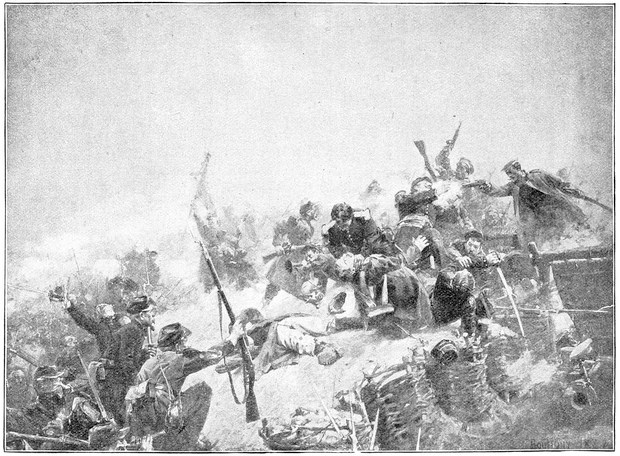
CAPTURE OF THE MALAKOFF.
At Magenta, June 4, the Austrians met with terrible defeat. The forces of
the allies numbered 55,000, and their loss was 4000; the Austrian army of
75,000 lost 10,000 killed and wounded and 7000 prisoners. The conquerors
entered Milan on June 8. Francis Joseph fell back to the line of the Mincio,
and at Solferino the decisive battle of the campaign was fought on June 24.
Napoleon commanded the allied armies, which numbered about 150,000; they
fought for sixteen hours against the Austrian force of 170,000, gaining a fearful
victory. This battle cost Austria 20,000 men; the French lost in killed
and wounded 12,000 and the Sardinians 5000 men.
The allies crossed the Mincio and laid siege to Peschiera, but while all
Europe expected another fight, an armistice of five weeks was agreed to, and
Napoleon, unknown to his ally, met Francis at Villafranca and made a peace,
upon which was based the Treaty of Zurich, signed November 10. Austria
gave Lombardy to Napoleon for the king of Sardinia, as also the fortresses of
Mantua and Peschiera. Italy was to become a confederation, with the Pope
as president, of which Austria was to be a member, because of her holdings
in Venetia. Tuscany and Modena were to be restored to their princes. Garibaldi’s
brilliant conquest of Sicily and Naples, in 1860, and Sardinia’s growing
power, startled Europe, but the nations dared not interfere. The general parliament
of Italy met in 1861, at Turin, and made Victor Emmanuel king of
Italy. Rome, under the Pope, and Venetia, under Austria, were as yet dismembered
from “Young Italy.”
War with Denmark.—Christian IX. succeeded to the throne of Denmark
November 15, 1863. He endeavored to incorporate Schleswig with
Denmark; the German population repudiated him and appealed to the Confederacy.
The Diet sent troops into Holstein. Bismarck induced Austria to
join Prussia in setting aside the London treaty of 1853, and the allied troops
forced the Danes back to the intrenchments of Duppel. The capture of Duppel
by the Prussians, April 18, proved the efficiency of needle guns and rifled
cannon. June 22, the allies crossed the channel to the Island of Alsen and,
on the 28th, captured the Danish stronghold Dennewerke, hitherto considered
impregnable. The Treaty of Vienna, October 30, 1864, closed the war.
Prussia and Austria together were to control the duchies.
The Seven Weeks’ War.—The arrangement between Prussia and Austria
respecting the Danish duchies caused the “Seven Weeks’ War” of 1866.
Bismarck induced Victor Emmanuel to form an alliance against Austria,
March 27. The Prussians, on June 7, without a blow forced the Austrians to
retire from Holstein, ignoring the protest of the Federal Diet. Austria was
not prepared for war. Her army, together with that of Saxony, amounted to
two hundred and seventy-one thousand. With Prussia, fully equipped and
on a war footing with three armies, besides the reserves, the grand total
estimated at three hundred thousand, the result was a foregone conclusion.
Prussia declared war, June 15, 1866, against Hanover, Hesse, and Saxony,
and next day threw her armies into the hostile states. On the 17th Francis
Joseph published his war manifesto. Italy declared war, on the 20th, against
Austria and Bavaria. In fourteen days Prussia’s immense army was mobilized.
In five days the northern states to the Main were disarmed, and the
Saxon army was forced to retreat toward Bohemia.
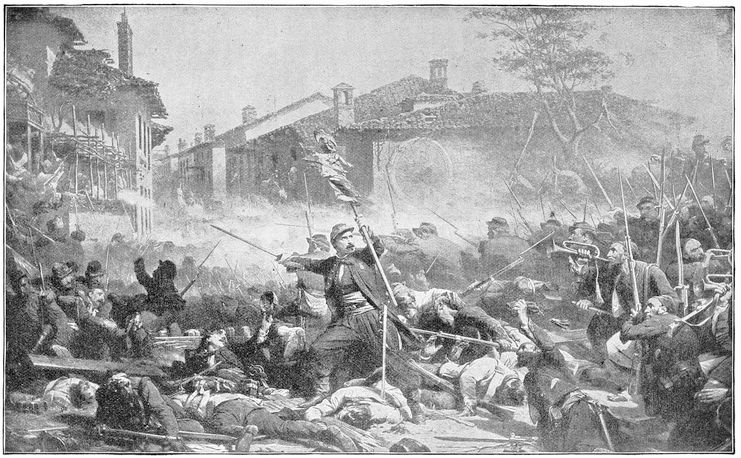
BATTLE OF MAGENTA.
General Benedek was commander of the Austrians. Upon news of Prussian
victories, he advised Francis Joseph to make terms of peace with William.
Prussia fought for German unification; Austria to protect her pride.
It was supposed the Austrians would first enter Saxony and dispute the
Prussian advance, but Bismarck had determined the war should be brief, for
Prussia was now master of the situation. On June 23, the Prussian army
marched from three points towards Josephstadt, where Benedek was preparing
to fight. On the 27th the Austrians were driven back at Soor, next day
at Skalitz, and on the 29th at Gitschen. Archduke Leopold, on the 28th,
and Count Clam Gallas, at Gitschen, both attacked the enemy in disobedience
of orders, and thus forced Benedek to fall back from his strongest
position towards Königgratz. The Austrians were also defeated, on the 28th,
at Königinhof and Schweinschadel, and their loss by this time numbered
over thirty-five thousand. Benedek asked permission to retreat into Moravia
and await reinforcements, but news of the Austrian victory over the Italians
at Custozza reached Vienna, and immediately battle was enjoined upon Benedek.
Benedek placed five hundred guns in position, spanning a league
between the Elbe and Bistritz.
On July 2, the king of Prussia assumed command of the Prussian hosts
and ordered attack for the next day. The Crown Prince, several miles away
with his army, received orders at four o’clock in the morning of the 3d to
advance his Silesian army from Königinhof. At eight o’clock, Prince Frederick
Charles, with a hundred thousand, attacked the Austrian centre lying
against Sadowa. General Herwarth, with four hundred thousand men, attacked
the Austrian right. The whole Austrian army was hurled against
these two commands for five hours. Prince Frederick Charles forced passage
through the Bistritz and took Sadowa, but could not take the heights. At
one o’clock retreat was being considered, but the Crown Prince coming up
with his troops the heights were taken at four o’clock. The fighting on
both sides in this battle was determined and heroic. The Prussian loss was
over ten thousand, and the Austrians lost twenty-seven thousand killed and
wounded, nineteen thousand prisoners, with 174 cannon and 11 colors. At
Lissa, on July 20, the Austrian navy destroyed the Italian fleet. July 22,
an armistice of four weeks was granted. The Peace of Prague was concluded
August 23. Her defeat cost Austria Venetia and the quadrilateral, namely,
the fortresses of Peschiera, Mantua, Verona, and Legnano, deprived her of
any part in Germany or German affairs, and Holstein and Schleswig, and
obliged her to pay 40,000,000 thalers, one half of which she was to retain in
lieu of the duchies.
Austria emerged from the “Seven Weeks’ War” with her ideas somewhat
liberalized, and though her territory was diminished her progress and prosperity
increased. The dual-Austro-Hungarian empire was formed by Francis
Joseph, he ruling at Vienna as Emperor of Austria and at Buda Pesth as
king of Hungary. This war also ended the Germanic confederation of 1815,
and the North German Confederation under Prussia arose.
At the peace of Vienna, October 3, Austria recognized the kingdom of
Italy, and with the acquisition of Venetia and the quadrilateral fortresses
the “Seven Weeks’ War” had greatly helped on the cause of “United
Italy.”
In April, 1864, Louis Napoleon sent an army of twenty-five thousand to
sustain the Austrian Archduke Maximilian on the throne of Mexico. At
that time the United States was occupied with the Civil War. This ended,
Napoleon was summarily required to withdraw his forces from the American
continent, which he did. Maximilian was thus left to his fate, and, after
being condemned by court martial, was shot at Querétaro, June 19, 1867.
The Franco-Prussian War.—Prince Leopold, of Hohenzollern, was
offered the throne of Spain after Isabella had fled from Madrid. Leopold
declined, but Napoleon demanded that the Emperor William should guarantee
never to permit Leopold to accept. William refused to accede to the
demand, and Napoleon, urged by the war party, declared war July 19, 1870.
On the same day the Confederation placed its forces in the hands of William,
as did the South Germans. This spontaneous uprising of all Germany was
unlooked for. Napoleon’s army numbered three hundred and ten thousand
men. In ten days William had nearly half a million soldiers ready to march
against the enemy. August 2, the first fight took place at Saarbrücken, a little
town over the German frontier. Napoleon and the young Prince Imperial
were present, and the force of Uhlans was driven back. August 4, the
Crown Prince of Prussia drove the right wing of MacMahon’s army back at
Weissenburg, and on the 6th, again was MacMahon defeated at Wörth. The
Germans, having separated MacMahon’s army, advanced into Alsace. In the
meantime General Steinmetz carried Spicheren by storm, and the whole German
army went forward. Together with the Crown Prince, Steinmetz, on
the 14th of August, defeated Marshal Bazaine, at Courcelles, who retreated
to Metz, and then endeavored to push on with his hundred thousand men to
Chalons. Von Moltke hurried on the Crown Prince to intercept Bazaine,
and at Mars la Tour was fought the fiercest battle, so far, of the war. On
either side the losses amounted to seventeen thousand. Gravelotte was
fought, on August 18, between the armies of Steinmetz and the Crown
Prince, King William commanding in person. The battle lasted all day
between two hundred thousand Germans and one hundred and eighty thousand
French. The Germans lost twenty thousand men, and succeeded in
forcing Bazaine into Metz. Although, in one sort, an undecisive battle,
Gravelotte perhaps settled the fate of the Empire. MacMahon’s plan was,
with his one hundred and twenty-five thousand men reorganized at Chalons,
to prevent the German advance on Paris. He was overruled and sent to the
relief of Bazaine. Defeated in several small fights, MacMahon was obliged
to fall back on Sedan. The heights and ridges above Sedan once occupied
by hostile troops, surrender or annihilation was the outcome. MacMahon
was wounded, then Ducrot, and the command fell to Wimpffen. Sedan was
forced to surrender, September 1, and Napoleon himself gave his sword to
King William. Paris was maddened. The Empress escaped to England.
Napoleon was taken to the castle of Wilhelmshöhe.
A month had hardly passed since the outbreak of the war, and one of the
two great French armies with the Emperor had been captured; the other
was besieged in Metz. Gambetta and other prominent men in Paris set up
the government of the national defense. A republic was proclaimed. The
defense of Paris was zealously undertaken. Large supplies of provisions
were gathered. Fortifications were strengthened. The siege began September
19, 1870, and ended January 28, 1871. The direst famine attended it.
Gambetta left Paris in a balloon, and at Tours succeeded in forming the
army of the Loire and the army of the North. Both were defeated. Strasbourg
was captured, and Metz surrendered with a hundred and seventy-three
thousand men, among them three marshals of France. The entire German
loss in this war was 129,700 men.
January 17, 1871, Thiers was elected President of the Third Republic.
Knowing the impossibility of further resistance, with half a million German
soldiers, flushed and inspired by constant success, on the soil of France, and
Paris in their anaconda coils, he counseled that peace be asked. Thiers,
Favre, and Picard negotiated with William and Bismarck. An armistice of
twenty days was permitted, that the National Convention then at Bordeaux
might ratify terms. In the meantime the house of Hohenzollern reached the
summit of its gratified ambition, when, on March 18, William was crowned
at Versailles, Emperor of Germany. The cession of Alsace and Lorraine, and
$1,000,000,000 indemnity, was the price of peace.
No patriot name in all history deserves more reverence than that of Louis
Adolphe Thiers. Upon him devolved the task of making peace with the
German foe, of quelling the civil war, and of so managing the finances of
France, that her people within two years were enabled, to the astonishment
of the world, to pay the enormous indemnity extorted by the Germans, and,
by September, 1873, the last franc was paid and the last German sentinel
removed from the soil of France.
The civil war between the Republic and the Commune settled the question
once for all, that Paris, accountable for all the errors and vicissitudes of the
country, is not France, and there is every reason to hope that out of the
unequaled horrors of those awful days of carnage the republican government
of France arose to remain in perpetuity.
Garibaldi, taking advantage of the fall of Louis Napoleon, and caring not
for the king’s promises, took possession with his troops of the city of Rome,
September 20, 1870, and on July 2 of the next year Victor Emmanuel erected
his throne in the Quirinal.
Turco-Russian War.—In 1875, the Bosnians, Turkish subjects, revolted.
They maintained their struggle, and the enraged Turks sent Mohammedan
troops among the defenseless Bulgarians, destroying unnumbered thousands
of men, women, and children. Czar Alexander declared war April 1, 1877.
His army crossed the Balkans and occupied Shipka Pass. Osman Pasha
developed unexpected military genius and skill. For five months he checked
the onward march of the Russians and won world-wide admiration by his
defense of Plevna. By the first of December Plevna was invested completely
by the Russians. Driven back whenever attempting to make a sortie,
starvation compelled Osman to surrender with forty-four thousand troops.
Adrianople was occupied. The Treaty of San Stefano was wrested in sight
of Constantinople. It greatly reduced Turkish power in Europe, and constituted
Russia heir to Turkey in Europe. Bulgaria was to be protected by fifty
thousand Russian troops for two years and to have a Christian governor.
Three months later, England formed a secret treaty with Turkey, securing
Cyprus and agreeing to protect Turkey in Asia. Austria, too, was dissatisfied,
and the treaty of Berlin was made in 1878, to rectify the balances of
the nations. Russia was by this treaty damaged in prestige and, shorn of
triumphs, was given only Asiatic provinces. Turkey was stripped of all real
power in Europe.
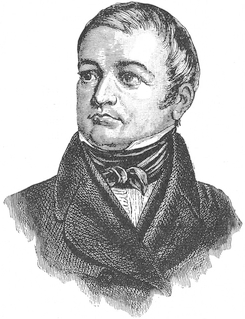
LOUIS ADOLPHE THIERS.
Chino-Japanese War.—In
Japan’s declaration of war against
China, August 1, 1894, she set
forth succinctly the provocation
forcing her to this action. She
said that Korea had been brought
into the notice of the nations of
the world by her efforts; that
China constantly had interfered
with Korea’s government, insistently
posing as her suzerain; that
when an insurrection in Korea
broke out China sent troops into
Korea, and that when Japan, under
the treaty of 1885, also sent
troops to assist Korea to quell the
rebels, asking China’s coöperation
in the effort, China refused her
rightful demand; that China’s
course tended to keep up the
trouble indefinitely, so that the
only course left for Japan was to
declare war.
As with Germany a score of years previously, when the time came Japan
was ready, not only with munitions of war, but with better topographical
knowledge of the enemy’s country than they themselves possessed. The
Emperor, whose dynasty antedates the Christian era, gave his people a
constitution, and stretching his hand towards Korea he helped her in the
same direction. He had Japan’s army and her navy drilled by expert European
officers. Arsenals and extensive manufactories for the implements
of war were started, with European superintendents. The latest and best
of ships were both bought at foreign marts and made at home. Her students
were to be found in the universities of the world. Her agents were
sent to study in their capitals the economy of every government and the
machinery of their executive departments. To find the best and assimilate
it seemed the principle of her progression, so that both in military skill
and the knowledge of diplomacy she acquired the ability to hold her place
among the nations of the civilized world. A war alone was needed to prove
that this was a fact.
Japan’s navy consisted of four armored cruisers and eight vessels of
3000 tons each. This was a much lighter fleet than that of China, but
swifter. China’s navy had been trained by an able English naval chief,
Captain Lang. Her outfit of ships was, perhaps, superior to that of Japan,
consisting of five armored vessels, nine protected cruisers, and torpedo boats
besides. The principal battle of this Chino-Japanese war was fought on
September 15 at Ping Yang, an old capital of Korea, situated at the meeting
of several roads. The Japanese landed troops at Gensan, on the northeast,
and at Hwang-jo, on the northwest, coast of Korea. These formed the right
and left wings of the army whose centre, under General Nodju, advanced
from Seoul, about one hundred miles to the south, of which the Japanese
were already in possession. Only one wing of the army met opposition in
its march, a small battle having been fought. The forces, so far as we can
learn, were between twenty and thirty thousand of Chinese and between
thirty and forty thousand of Japanese. Japan’s twenty-four years of scientific
preparation, her study of the art of war, the practicability of her strategic
movements,—admired by the soldiers of the world,—left China, with her old
semi-barbarian methods, no chance for victory.
The battle was a bloody one; the defeated Chinese fled until they were on
the other side of the Yalu River, in Manchooria. Seven hundred (some accounts
say fourteen thousand) Chinese were captured, two thousand killed
and wounded. The army continued fighting and conquering until practically
the province of Manchooria was in Japan’s possession, as well as the
peninsula of Liaotung, terminating with Port Arthur.
The battle of Yalu, or Hai Yun Tao, afforded the first practical test of
modern vessels, guns, and projectiles in Asiatic waters. Ping Yang has been
called China’s Sedan, and Yalu, Japan’s Trafalgar. Japan had nine cruisers
and two converted cruisers wherewith to fight twelve Chinese warships and
four torpedo boats. It is said that Japan used melanite shells. The fleet of
Chinese warships, convoying transports with ten thousand troops, entered the
Yalu River. The next day, September 17, the Japanese fleet, under Admiral
Ito, went out to meet them. A European officer on a Chinese vessel says:
“Passing along the Chinese line, the Japanese poured as heavy a fire as they
could bring to bear upon each ship in succession, and, while they had sea-room,
circled round their opponents. The Japanese state that no Japanese
war-ship was lost and only three seriously injured.” A Chinese officer says:
“As soon as the Chinese on the port side had brought their guns to bear and
had obtained range accurately, the Japanese would work around and attack
the starboard side.” Four ships were destroyed and two badly injured. One
of the Chinese ships was said to have been hit two hundred times. The
Chinese ironclads that escaped were later sunk off Wei Hai Wei. Port Arthur,
captured October 21, was filled to overflowing with ammunition, grain,
and other supplies.
China made three informal overtures for peace. Finally, Li Hung Chang
went from Tientsin to Shimonoseki, to make terms, on the 19th of March,
1895. By the treaty there made, May 17, China recognized the independence
and autonomy of Korea, ceded certain territory in Manchooria, all the islands
in the eastern part of the bay of Liaotung and the northern part of the Yellow
Sea, Formosa, and all islands belonging to it, and the Pescadores group. Two
hundred million Kuping taels were exacted as indemnity, to be paid in eight
installments, one every six months. The inhabitants were to sell out and
leave, or in two years to be Japanese subjects. Russia, Germany, and France
recommended that Japan should not permanently possess the peninsula of
Feng Tan, and Japan agreed to their suggestions.
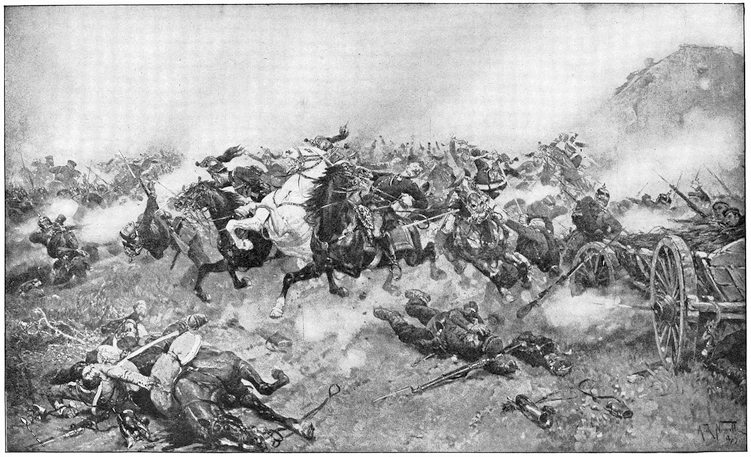
CAVALRY CHARGE AT GRAVELOTTE. (A. DE NEUVILLE.)
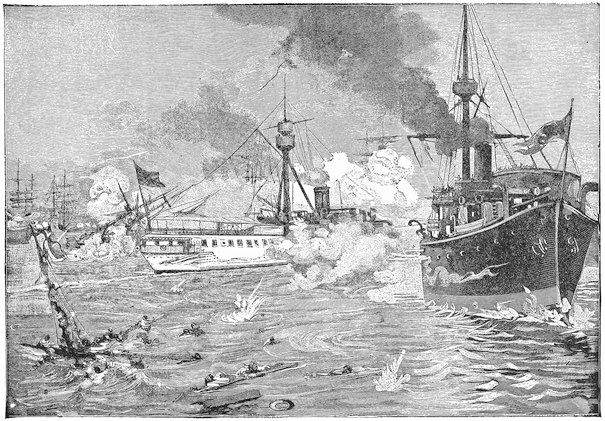
BATTLE OF YALU RIVER.
Formosa, as a strategetical post, is of the greatest value. Korea and Japan
now control absolutely the Japan Sea. It was only after four months of
fighting that Japan completely conquered the Formosans and had all her new
possessions under her control.
China paid Japan an additional $30,000,000 for the release of Port Arthur
and Liaotung peninsula. China was well pleased. But in April, 1897,
Russia herself had obtained possession of Port Arthur and Talien Wan, and
in December the Germans received Kaio Chao, the finest naval station of
the province of Shantung. France subsequently obtained Kwang-Chau, the
best port of Wangsi; and England, though not joining these powers in the
demand in favor of China in 1895, obtained Wei Hai Wei in 1897.
Greco-Turkish War.—In 1895, the fearful atrocities committed by the
“unspeakable” Turk began to assume appalling proportions. During three
years one hundred thousand Cretans were murdered. February 8, 1897, the
Cretans proclaimed union with Greece. The Greeks, unable longer to endure
the sufferings of their kindred, determined to help them.
Prince George left for Crete with a torpedo flotilla February 10; Colonel
Vassos, aide-de-camp to the king, followed with fifteen hundred men and two
batteries on the 13th. Prince Nicholas led a regiment of artillery to the
Thessalian frontiers. The powers sent a collective note of protest to Greece,
but it was not heeded. Colonel Vassos landed in Crete on the 14th. Sailors
from the fleet of the powers occupied the coast towns of Crete. Pasha Berovitch
resigned and returned to Constantinople. Greek reserves rallied
promptly. Volunteers offered. Colonel Vassos established headquarters in
the mountainous interior at Sphakia.
March 18, the powers blockaded Crete. On the 27th, Crown Prince Constantine
proceeded to the Turkish frontier. On April 5, the powers declared
no gain should accrue to the combatant who approached Thessalian borders.
April 8, three thousand Greeks crossed near Krania, began fighting, and were
driven back. On April 17 Turkey declared war. On the 18th, a battle of
twenty-four hours, in Milouna Pass, crowned Turkish arms with victory.
Another hard fought battle, at Reveni, discomfited the Greeks. Greeks
passed the Arta River and Greek ironclads bombarded Prevessa. On the
19th, the Turks were in Thessaly and the Greeks in retreat to Larissa. After
terrific battles Tornavo and Larissa, on the 25th, fell into the hands of the
Turks. Colonel Smolenski fought desperately at Valestino, but had to yield;
and Volo also fell to the Turks. The Turks occupied Pharsaos on May 6.
Greece asked the powers for peace, May 8; Cretan autonomy was agreed to,
and Turkey permitted armistice on the 15th. The war closed. Turkey was
forced to yield all Thessalian territory, and Crete was relieved of Turkish
oppression. Greece was forced to withdraw all support from Crete and pay
$20,000,000 indemnity.
The remarkable feature of this war was the intensely hard fighting from
start to close, and the disposition of the powers to assist Turkey by interfering
with the Grecian navy. Frequently the Austrians helped the Turks by
placing their guns in position. It was only when the Sultan conquered Thessaly
and threatened to keep it that the powers interposed.
The crime committed by the powers against civilization and Christianity
by their action seems incredible, even though the peace of Europe was
thereby secured.
England’s Wars in the Soudan.—The Khedive of Egypt had obtained
great loans from Europe. England and France took financial control of the
country. Arabi Pasha inaugurated a rebellion and fortified Alexandria.
Many Europeans were murdered, and England bombarded the city, taking
possession July 12, 1882. General Wolseley, at Tel el Kebir, September 13,
fought and defeated Arabi, who fled leaving two thousand dead. France
withdrew from the financial arrangement. The English remained to put the
Egyptians in condition for self-government. England has remained ever since.
Mohammed Ahmed arose in the Soudan, proclaiming himself El Mahdi,
the Mussulman Messiah. The barbarian hordes flocked to his banner. He
defeated the Egyptians in four engagements, October, 1883. The Anglo-Egyptian
force of ten thousand men, under General Hicks, was destroyed,
only two escaping. General Gordon was sent to the relief of the Egyptian
army. He reached Khartoum, February 18, 1884. The Mahdists besieged
the city. Gordon sent for reinforcements. England was so slow in sending
them that they arrived two days too late. Khartoum was captured through
treachery, and Gordon, the most beloved of English soldiers for his saintly
and heroic character, was put to death on January 27, 1885.
General Sir Horatio Herbert Kitchener was made Sirdar in 1890. He
started from Cairo with one thousand British and fifteen thousand Egyptians,
black and fellah troops, building a road across the desert as he advanced,
and engineering his gunboats up the Nile. The distance from his
base, at Cairo, to his first storehouse, at Wady Halfa, is eight hundred miles.
April 8, 1898, was fought the battle of Atbara, a fort at the point where the
Atbara River enters the Nile. Here Mahmud, the commander of the barbarians,
was captured and his army of twelve thousand infantry destroyed.
Osman Digna got away with the greater part of the cavalry, numbering four
thousand.
The force was about a month reaching Wady Hamed, and, September 1, was
in sight of Omdurman. The Sirdar’s line was drawn up in crescent form,
with Omdurman and Khartoum for its centre. In this position was fought
the first battle of Egeda, in which twenty-two thousand of the Dervishes fell.
The Khalifa and Osman Digna fled with a scant handful of followers, and are
now said to be bandits in the Kordofan. The number of the annihilated army
of the Mahdists will never be known. The British loss of whites was less
than two hundred, and the native loss less than three hundred. The fire of
the barbarians was generally too high to effect great injury. September 2 will
be a marked day in England’s calendar. The Sirdar marched into Khartoum,
the Union Jack was raised, and beneath its floating crosses his chaplains
performed Gordon’s funeral ceremonies on the spot where he was slain nearly
fourteen years before.
The Boer War.—By the treaty of 1881 Great Britain claimed suzerainty
over the South African (Transvaal) Republic and Orange Free State. These
Republics claimed that by the treaty of 1884 Great Britain gave up her claim
of suzerainty. Here arose an issue which was aggravated by the discovery of
diamonds at Kimberley and of gold at Johannesburg, followed by the Jameson
raid, which, shorn of its disguise, was notice to the Boers that Great Britain
desired and designed to occupy and absorb their two Republics. The diplomatic
war went on for years between President Kruger, of the Transvaal,
and Mr. Chamberlain, Great Britain’s Colonial Secretary. It culminated in
an ultimatum on the part of Kruger, on October 9, 1899, which Chamberlain
rejected. Both sides had been preparing for this, and on October 11, the outbreak
of the war, Great Britain had already an army of 25,000 men in South
Africa, while the Boers had mobilized an equal, if not superior, army of
effectives. The Boers immediately invaded Natal and Cape Colony, shutting
up General White and his army in Ladysmith, and Colonel Powell and his
forces in Mafeking. Kimberley was also besieged. The initial battles were
numerous, fierce, and generally favorable to the Boers. Great Britain’s eyes
were speedily opened to the gravity of the situation. She hurried large reinforcements
to the scene till her armies far outnumbered those of the Boers.
Yet her best generals, as Buller at Tugela River, and Methuen, at Magersfontein,
continued to meet with disastrous defeats. Lord Roberts, in connection
with General Kitchener, was sent, January 10, 1900, to supersede the
blundering generals, and to organize a new campaign. It was seen that
direct battle against the Boers was bound to end in defeat. So Roberts was
provided with an overwhelming army, estimated at 225,000, and he at once
entered upon a war of strategy. His northward advance was general along
his lines, thus keeping the Boers divided. He flanked them out of their
strongholds. By February he had invaded the Orange Free State, and raised
the siege of Kimberley. On February 27 he captured General Cronje and his
force of 4000 men, and on March 13 took possession of Bloemfontein, the
Free State capital, whence he issued a proclamation annexing the republic
under the name of Orange River Colony. On February 28 the siege of Ladysmith
was raised, and shortly after that of Mafeking. The Boers continued to
fight doggedly, all the while inflicting heavy losses on their enemy, but resistance
was futile against such overwhelming odds. They were gradually forced
from one position to another in the direction of Pretoria, the Transvaal capital.
On March 5 Presidents Kruger and Steyn joined in peace proposals,
which were rejected. On March 12 they made an appeal to the nations for
mediation. All refused to mediate. On March 27 the Boers lost their ablest
general in the person of General Joubert, who died at Pretoria. By May 12
Kroonstad, the second Free State capital, had fallen into Lord Roberts’ hands.
The Vaal River was then crossed and the Transvaal invaded. On May 31
the British army entered the important town of Johannesburg, and hastened
toward Pretoria, which was captured on June 5, 1900. President Kruger and
General Botha had left a few days before, the former in the direction of the
Portuguese port of Lorenzo Marques, the latter with the remnant of the Boer
army to the mountains beyond Pretoria. On September 3 Lord Roberts declared
the Transvaal annexed to Great Britain under the name of the Vaal
River Colony. Generals Botha and De Wet continued a guerrilla warfare
far past the end of the century. President Kruger accepted the protection of
Holland, and sailed thither on October 20, 1900. Lord Roberts arrived in
England in December, 1900, to receive his honors. At the turn of the century
the South African problem was a most wearying one for Great Britain.
The Boxer Uprising.—The defeat of China by Japan in 1894, the ambition
of European powers to occupy her ports and enlarge their “spheres of
influence,” the ominous threats to partition her territory, soured the Manchu
dynasty and the people of northern China against foreigners. The Empress
Dowager deposed the young Emperor, seized the reins of government, and
catered to that reactionary and hostile spirit which culminated in the
“Boxer” uprising. These mobs began the destruction of missions, the murder
and expulsion of missionaries, and concerted attack against everything
that savored of foreign direction and influence. The Chinese regular soldiers
were either helpless before them or in sympathy with them. By May, 1900,
all the powers represented at Peking stood aghast at the startling fact that
their respective legations were beleaguered in Peking, and liable to be murdered.
Warships were instantly ordered to Taku. By June 1, 1900, twenty-three
vessels had reported,—nine Russian, three British, three German, three
French, two American, two Japanese, one Italian. A force of 2000 soldiers
was landed from these, and immediately started for Peking, under command
of the British Rear-Admiral Seymour, for the rescue of the legations.
This force was defeated by the “Boxers,” and compelled to retreat to Tien-Tsin
with heavy loss. An attempt to torpedo the Taku harbor was resented
by the warships. They bombarded and blew up the Taku forts. In this
action the American warships did not participate. The “Boxers” swarmed
in Tien-Tsin, and an allied force of 4000 men was sent thither to capture it.
In their first attack, on July 9, they were repulsed with heavy loss. Being
reinforced up to 7000 men, their second attack, on July 13, was successful.
The city was taken, and made the base of further operations against Peking,
80 miles up the Pei-ho. The allies were further reinforced, and started for
Peking with an army of 16,000 men. They met the Chinese army of 30,000
men at Pei-Tsang, and after a severe battle on August 5, drove them from
their fortifications with great loss. The Chinese rallied at Yang-Tsun, but
were again defeated by the allies on August 6. They offered no further serious
resistance to the allies, who moved swiftly on Pekin, invested it, and, on
August 14, breached its walls and entered it in triumph. The legations were
relieved after an imprisonment of nearly three months. Two ministers, one
of Japan, the other of Germany, had been murdered. The others had escaped
death only by concentrating and defending themselves in the English compound.
The allied forces occupied the city for a time, and then those of
Russia and the United States withdrew, leaving a strong legation guard.
The Chinese government appointed Li-Hung-Chang and Prince Ching ministers
to meet ministers of the powers to arrange terms of settlement. After
months of conference a protocol was signed in January, 1901, which was supposed
to contain the germs of future settlement. But there was that in the
Chinese situation which was bound to tax the diplomacy of the world during
many years of the twentieth century.
A Review of Martial Results.—The history of the world shows that
successful war adds to the glory and prestige of the victorious nation, and
this is particularly exemplified by the wars of the nineteenth century.
France, so long victorious, dazzled the world. At Waterloo, her glory was
clouded. Napier, in his closing words of the history of these events of the
twenty years of war and turmoil, showed how thoroughly the English people
appreciated that their greatness and power were due to the glory achieved
by the arms of Britain’s chivalrous sons.
While England was covering herself with glory, her offspring, the United
States, was teaching her, in the war of 1812, that being now of age his
pockets were not again to be turned inside out, a lesson which thereafter she
heeded.
Greece, throbbing with the impulse of freedom, achieved her independence,
displaying all the heroism of her Hellenic ancestry.
The Mexican war added greatly to the glory of American arms and resulted
in the acquisition of a vast territory, whose inhabitants quickly assimilated
themselves to the requirements of American citizenship.
The Revolution of ’48 but served to consolidate the power of Prussia, laying
the foundation for the Imperial crown to rest upon the head of her king, while
fitting France for her future solid republican career.
The Crimean war, except that it checked the policy of Russia, produced few
results in comparison with the vast amount of blood and treasure so lavishly
spent.
The victories of Magenta and Solferino illumined again the eagles of
France. The “Seven Weeks’ War,” while still further consolidating Germany
under Prussia, was not without its blessings for Austria, and advanced
“Young Italy” greatly toward the goal of her ambition.
In America, the appeal to arms was made to decide the questions mooted
since the nation’s birth. One effect of this war was to show the wonderful
prowess and soldierly qualities of the American citizen.
The Franco-Prussian war lifted the dignity of Hohenzollern to its height,
ended forever the Empire of France in a crushing fall, and taught the lesson
of scientific preparation for war, than which no science is more worthy of
intense study and application in all its branches.
The Chino-Japanese war was a triumph of a growing civilization over semi-barbarism,
and foreshadows the prominent rôle that Japan may be called
upon to play in the twentieth century. The enlargement of her territory
was a fitting reward for her unselfish championing of her weaker sister,
Korea.
The Greco-Cretan-Turkish war shed no glory on the Turkish nor on the so-called
Christian nations, and will stand on history’s page as a crowning shame
to European civilization.
The opening of Africa by General Kitchener and his great achievements
read like old-time stories, and the twentieth century may see great results in
Africa from this wonderful campaign.
The war of the United States with Spain, fought because it was impossible
longer to allow the atrocities of her rule on this hemisphere at our very doors,
has brought conditions not dreamed of, and which, under the providence of
God, may lead to greater results in the development of Christian civilization
than we now may comprehend.
The Boer war had little instigation on the part of Great Britain, except
greed. Its management reflected no credit on her military genius, weakened
her in the eyes of nations, and entailed a loss of life and money from which
she will not recover in generations.
The Chinese disturbance did not rise to the dignity of war, but opened
problems of startling intricacy and moment for all the powers.