CHURCHYARDS
Graveyards seemed a strange place to want to
spend the afternoon after our experience of the
morning, but the cheerful Zebedee always made
for them, just as a sunbeam seems to be hunting
up the dark and gloomy corners.
"Saint Michael's first, as that is the nearest,"
suggested Louis.
We entered the churchyard through massive
old iron gates, and, turning to the right, followed
Louis to perhaps the most unique grave stone in
the world: the headboard of an old cedar bed.
It is a relic of 1770. The story goes that the
woman buried there insisted that her husband
should go to no trouble or expense to mark her
grave. She said that she had been very comfortable
in that same bed and would rest very
easy under it and that it would soon rot away and
leave her undisturbed. She little dreamed that
more than a century later that old cedar bed
would be preserved, seemingly in some miraculous
way, and be intact while stones, reverently
placed at the same time, were crumbling away.
"It seems like John Keats' epitaph: 'Here
lies one whose name was writ in water.' Keats
thought he was dead to the world, and see how
he lives; and this poor woman's grave is the first
one that tourists are taken to see," I mused aloud.
"I have often thought about this woman," said
Claire, in her light, musical voice. "I have an
idea that she must have been very hard-worked
and perhaps longed for a few more minutes in
bed every morning, and maybe the husband routed
her out, and when she died perhaps he felt
sorry he had not given her more rest."
"You hear that, Page?" asked Dum. "You
had better have some mercy on me now. I may
'shuffle off this mortal coil' at any minute, and
you will be so sorry you didn't let me sleep just
a little while longer." (It had been my job ever
since I started to room with the Tucker twins to
be the waker-up. It was a thankless job, too,
and no sinecure.) "See that my little brass bed
is kept shiny, Zebedee dear."
"I wonder why it is that no one ever seems to
feel very sad or quiet in old, old graveyards?" I
asked, all of us laughing at Dum's brass bed.
"I think it is because all the persons who suffered
at the death of the persons buried there
are dead, too. No one feels very sorry for the
dead; it is the living that are left to mourn. Old
cemeteries are to me the most peaceful and cheerful
spots one can visit," said Zebedee, leaning
over to decipher some quaint epitaph.
"I think so, too!" exclaimed Claire, who had
fitted herself into our crowd with delightful ease.
"New graves are the ones that break my heart."
Louis turned away to hide his emotion. He
had been too near to the Great Divide that very
morning for talk of new-made graves and the
sorrow of loved ones not to move him.
There was much of interest in that old burying
ground, and Louis proved an excellent cicerone.
He told us that the church was started in
1752; that the bells and organ and clock were
imported from England, and that the present
organ had parts of the old organ incorporated in
it. The bells were seized during the Revolution
and shipped and sold in England, where they
were purchased by a former Charleston merchant
and shipped back again. During the Civil
War they were sent to Columbia for safekeeping,
but were so badly injured when Columbia was
burned that they had to be again sent to England
and recast in the original mold. They chimed
out the hour while Louis was telling us about
them as though to prove to us their being well
worth all the trouble to which they had put the
worthy citizens of Charleston.
"Saint Philip's next, while we are in the
churchly spirit," said Louis; "and then the Huguenot
church."
St. Philip's was a little older than St. Michael's.
The chimes for that church were used
for making cannon for the Confederacy, and for
lack of funds up to the present time they have
not been replaced. On top of the high steeple is
a beacon light by which the ships find their way
into the harbor.
We had noticed at the hotel, both at our very
early breakfast and at luncheon, a very charming
couple who had attracted us greatly and who,
in turn, seemed interested in us. The man was
a scholarly person with kind, brown eyes, a very
intelligent, comely countenance, and a tendency
to baldness right on top that rather added to his
intellectual appearance. His wife was quite pretty,
young, and with a look of race and breeding
that was most striking. Her hair was red gold,
and she had perhaps the sweetest blue eyes I had
ever beheld. Her eyes just matched her blue
linen shirtwaist. What had attracted me to the
couple was not only their interesting appearance,
but the fact that they seemed to have such a good
time together. They talked not in the perfunctory
way that married persons often do, but with
real spirit and interest.
As we entered the cemetery of St. Philip's,
across the street from the church, we met this
couple standing by the sarcophagus of the great
John C. Calhoun. The lady bowed to us sweetly,
acknowledging, as it were, having seen us in the
hotel. We of course eagerly responded, delighted
at the encounter. We had discussed them at
length, and almost decided they were bride and
groom; at least Tweedles had, but I thought not.
They were too much at their ease to be on their
first trip together, I declared, and of course got
called a would-be author for my assertion.
"I hear there is a wonderful portrait of Calhoun
by Healy in the City Hall," said the gentleman
to Zebedee, as he courteously moved for
us to read the inscription on the sarcophagus.
"Yes, so I am told, but this young man who
belongs to this interesting city can tell us more
about it," and in a little while all of us were
drawn into conversation with our chance acquaintances.
Louis led us through the cemetery, telling us
anything of note, and then we followed him to
the Huguenot church, accompanied by our new
friends.
A Huguenot church has stood on the site of
the present one since 1667. Many things have
happened to the different buildings, but the present
one, an edifice of unusual beauty and dignity,
has remained intact since 1845. The preacher, a
dear old man of over eighty, who is totally blind,
has been pastor of this scanty flock for almost
fifty years. He now conducts the service from
memory, and preaches wonderful, simple sermons
straight from his kind old heart.
"Oh, Edwin, see what wonderful old names
are on these tablets," enthused the young wife—"Mazyck,
Ravenel, Porcher, de Sasure, Huger,
Cazanove, L'Hommedieu, Marquand, Gaillard——"
"Yes, dear, they sound like an echo from the
Old World."
"This Gaillard is our great, great grandfather,
isn't he, Louis?" asked Claire. "My brother
knows so much more about such things than I
do."
"Oh, is your name Gaillard?"
And then the introductions followed, Zebedee
doing the honors, naming all of us in turn; and
then the gentleman told us that his name was
Edwin Green and introduced his wife.
I fancy Claire and Louis had not been in the
habit of picking up acquaintances in this haphazard
style, and the sensation was a new and delightful
one to them. The Tuckers and I always
did it. We talked to the people we met on trains
and in parks, and many an item for my notebook
did I get in this way. Zebedee says he thinks it
is all right just so you don't pick out some flashy
flatterer. Of course we never did that, but confined
our chance acquaintances to women and
children or nice old men, whose interest was
purely fatherly. Making friends as we had with
Louis was different, as there was nothing to do
but help him; and his sex and age were not to
be considered at such a time.
"Are you to be in Charleston long?" asked
Zebedee of Mr. Green.
"I can't tell. We are fascinated by it, but long
to get out of the hotel and into some home."
"If I knew of some nice quiet place, I would
put my girls there for a few days while I run
over to Columbia on business. I can't leave them
alone in the hotel."
"I should love to look after them, if you would
trust me," said Mrs. Green, flushing for fear
Zebedee might think her pushing.
"Trust you! Why, you are too kind to make
such an offer!" exclaimed Zebedee.
"We have some friends who have just opened
their house for—for—guests," faltered Claire.
"They live only a block from us, and are very
lovely ladies. We heard only this morning that
they are contemplating taking someone into their
home." Tweedles and I exchanged glances;
mine was a triumphant one. The would-be author
had hit the nail on the head again. "Their
name is Laurens." I knew it would be before
Claire spoke.
"Oh, Miss Gaillard, if you could introduce us
to those ladies we would be so grateful to you!"
said Zebedee. "You would like to stay there,
wouldn't you, girls?"
"Yes! Yes!"
"And Mrs. Green perhaps will decide to go
there, too, and she will look after you, will you
not, Mrs. Green?"
"I should be so happy to if the girls would like
to have me for a chaperone."
"Oh, we'd love it! We've never had a chaperone
in our lives but once, and she got married,"
tweedled the twins.
And so our compact was made, and Claire
promised to see the Misses Laurens in regard to
our becoming her "paying guests."
Mr. Green, who, as we found out afterward,
was a professor of English at the College of Wellington
and had all kinds of degrees that entitled
him to be called Doctor, seemed rather amused at
his wife's being a chaperone.
"She seems to me still to be nothing but a girl
herself," he confided to Zebedee, "although we
have got a fine big girl of our own over a year
old, whom we have left in the care of my mother-in-law
while we have this much talked-of trip
together."
"Oh, have you got a baby? Do you know,
Dum and I just stood Page down that you were
bride and groom!"
"Molly, do you hear that? These young ladies
thought we were newlyweds."
"I didn't!"
"And why didn't you?" smiled the young wife.
"I noticed you gave separate orders at the
table and did not have to pretend to like the same
things. I believe a bride and groom are afraid
to differ on even such a thing as food."
"Oh, Edwin, do you hear that? Do you remember
the unmerciful teasing Kent gave you at
Fontainbleu because you pretended to like the
mustard we got on our roast beef in the little
English restaurant, just because I like English
mustard?"
"Yes, I remember it very well, and I also remember
lots of other things at Fontainbleu besides
the mustard."
Mrs. Green blushed such a lovely pink at her
husband's words that we longed to hear what he
did remember.
"Kent is my brother—Kent Brown."
"Oh! Oh!" tweedled the twins. "Are you
Molly Brown of Kentucky?"
"Yes, I was Molly Brown of Kentucky."
"And did you go to Wellington?" I asked.
"Yes, and I still go there, as my husband has
the chair of English at Wellington."
"Girls! Girls! To think of our meeting Molly
Brown of Kentucky! We have been hearing of
you all winter from our teacher of English at
Gresham, Miss Ball."
"Mattie Ball! I have known her since my
freshman year at college. Edwin, you remember
Mattie Ball, do you not?"
"Of course I do. An excellent student! She
had as keen an appreciation of good literature as
anyone I know of."
"She used to tell us that she owed everything
she knew to her professor of English at Wellington,"
said Dee, who knew how to say the right
thing at the right time, and Professor Green's
pleased countenance was proof of her tact.
Then Mrs. Green had to hear all about Miss
Ball and the fire at Gresham, which Tweedles
related with great spirit, laying rather too much
stress on my bravery in arousing the school.
"I deserve no more credit than did the geese
whose hissing aroused the Romans in ancient
times," I declared. "Why don't you tell them
how you got Miss Plympton out of the window
in her pink pajamas?"
The Greens laughed so heartily at our adventures
that we were spurred on to recounting
other happenings, telling of the many scrapes we
had got ourselves in. Claire listened in open-eyed
astonishment.
"It must be lovely to go to boarding-school,"
she said wistfully.
"It sounds lovelier than it is. We tell about
the scrapes and the fun, but there are lots of
times when it is nothing but one stupid thing
after another. It's lots lovelier just to be at home
with your father."
Claire shook her head doubtfully, and, remembering
her father, we did not wonder at her differing
with Dum.
"I have always held that home was the place
for girls until they were old enough for college,"
said Mrs. Green. "That is, if they mean to go to
college."
"But we don't!"
Zebedee and Professor Green had walked on
ahead. Louis was sticking close to Dee, so close
that Dum whispered to me that he must think she
had him on a leash. Claire and Dum and I were
having the pleasure of flocking around Mrs.
Green.
"You see, we haven't got a piece of mother
among us, and we had to go somewhere, as Zebedee—that's
our father, you know—had his
hands so full of us he couldn't ply his trade of
getting out newspapers. Dee and I are some improved
since we first were sent off to school, and
now that Gresham is burned, we don't want to
break into a new school. I tell you, it is some job
to break into a school. Page Allison lives in the
country, and she had to go to boarding-school or
not at all."
"Well, why don't you go to college now? Wellington
would just suit you, I am sure."
"Somehow I have never been crazy to go to
college. I want to do something else. You see,
I want to model. I feel as though I just had to
get my hands in clay and form things out of it."
"And you?" said the sweet young woman,
turning to me.
This Molly Brown of Kentucky certainly had
the charm of sympathy. You found yourself
telling her all kinds of things that you just
couldn't help telling her. She seemed so interested,
and her eyes were so blue and so true.
"Oh, I mean to be a writer!" I blurted out.
"That's the reason I don't want to go to college.
If I am going to write, I had better just write, I
think, and not wear myself to a frazzle over
higher mathematics."
"That's the way I used to feel. The only good
I could ever get out of that hated study was just
knowing I had done my best. My best seemed
so feeble by the side of the real mathematicians
that it was a constant mortification to me. I used
to call mathematics my hair shirt. No matter
how well I got along in other things, I was always
conscious of a kind of irritation that I was
going to fail in that. I just did squeeze through
in the end, and that was by dint of wet towels
around my head and coaching and encouragement
from my friends. I think it is quite natural
to dislike a subject that always makes you
appear at your worst. Certainly we are not fond
of people who put us in that position!"
I might have known our new friend would
hate mathematics. I have never yet been attracted
very much by any woman who did get
along very well in it, except, of course, Miss Cox.
I don't mean to say that female mathematicians
cannot be just as lovely and charming as any
other females, but I mean that I have never hit
it off with them, somehow.
"What are you going to write?" asked Claire.
"Write short stories and long novels, when I
find myself. I'm still flopping around in a sea
of words. Don't you write, Mrs. Green? It
seems to me Miss Ball said you did."
"Yes, I write a little—that is, I write a lot, but
I have published only a little. I send and send to
magazine after magazine. Every mail is an
event to me—either it brings back a manuscript
or it doesn't bring one, and sometimes it brings
an acceptance slip, and then I carry on like one
demented. Edwin says he is jealous of the postman
and wishes Uncle Sam would have women
deliver the mail."
"It must be wonderful to get into a magazine.
My only taste of it is seeing myself in print in
our school paper. Don't you write poetry, Mrs.
Green?"
"Well, I have melted into verse, but I think
prose is more in my line. The first money I ever
made was a prize for a real estate advertisement
in poetry, and of course after that I thought that
I must 'lisp in numbers' on all occasions; but it
was always lisping. And you—do you write
poetry, too?"
"Yes, she does," broke in Dum; "and Zebedee
thinks it is bully poetry. He said he was astonished
that she could do it. And he is a newspaper
writer and knows."
"I am sure he does. Some day we will have a
tournament of poetry, and you will show me
yours and I will show you mine. And you, Miss
Gaillard? Are you counting upon going to
college?"
Mrs. Green turned to Claire, who had been
very quiet as we strolled along Church Street, on
our way to Washington Park, which is a small
enclosure by the City Hall.
"Oh, no, I—I will not pursue my studies any
more. I keep house for my father, who does not
approve of higher education for women," and
the girl sighed in spite of herself. "I could not
go, anyhow," she continued, "as Louis and papa
need me at home."
Not one word of lack of money, which we
knew was an insurmountable obstacle with the
Gaillards, but I believe a Charlestonian would as
soon speak of lack of ancestry as lack of money.
Money is simply something they don't mention
except in the bosom of the family. They don't
mention ancestry much, either; not nearly as
much as Virginians do. They seem to take for
granted that anyone they are on speaking terms
with must be well born or how did they get to
be on speaking terms?
The Gaillards left us at Washington Park as
Claire thought she must hurry back to her papa,
who no doubt by that time was in a fret and a
fume over her long, unexplained absence. Mr.
Gaillard was the type of man who thought a
woman's place was in her home from morning
until night, and any little excursion she might
make from her home must be in pursuit of his,
the male's, happiness. Claire promised to see the
Misses Laurens and find out from them if we
could get board in their very exclusive home.
Louis asked to be allowed to take us to other
points of interest on the morrow, and with feelings
of mutual esteem we parted.
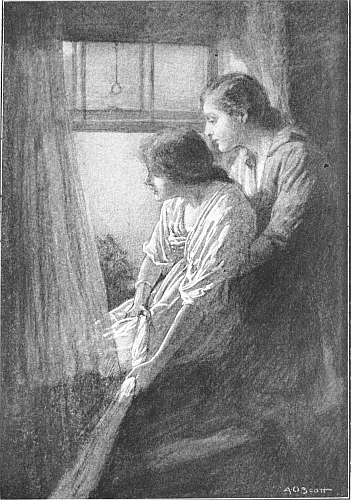 The room we girls were to occupy was a great square chamber with a large window looking on a cobbled street.