"Then the mortal coldness of the Soul like death itself comes down;
It cannot feel for others' woes, it dare not dream its own;
That heavy chill has frozen o'er the fountain of our tears,
And, though the eye may sparkle yet, 'tis where the ice appears.
"Though wit may flash from fluent lips, and mirth distract the breast,
Through midnight hours that yield no more their former hope of rest:
'Tis but as ivy leaves around a ruined turret wreathe,
All green and wildly fresh without, but worn and gray beneath."
WHEN Taffy and the Laird went back to the studio in the Place St.
Anatole des Arts, and resumed their ordinary life there, it was with a
sense of desolation and dull bereavement beyond anything they could have
imagined; and this did not seem to lessen as the time wore on.
They realized for the first time how keen and penetrating and
unintermittent had been the charm of those two central figures—Trilby
and Little Billee—and how hard it was to live without them, after such
intimacy as had been theirs.
"Oh, it has been a jolly time, though it didn't last long!" So Trilby
had written in her farewell letter to Taffy; and these words were true
for Taffy and the Laird as well as for her.
And that is the worst of those dear people who have charm: they are so
terrible to do without, when once you have got accustomed to them and
all their ways.
And when, besides being charming, they are simple, clever, affectionate,
constant, and sincere, like Trilby and Little Billee! Then the
lamentable hole their disappearance makes is not to be filled up! And
when they are full of genius, like Little Billee—and like Trilby, funny
without being vulgar! For so she always seemed to the Laird and Taffy,
even in French (in spite of her Gallic audacities of thought, speech,
and gesture).
All seemed to have suffered change. The very boxing and fencing were
gone through perfunctorily, for mere health's sake; and a thin layer of
adipose deposit began to soften the outlines of the hills and dales on
Taffy's mighty forearm.
Dodor and l'Zouzou no longer came so often, now that the charming Little
Billee and his charming mother and still more charming sister had gone
away—nor Carnegie, nor Antony, nor Lorrimer, nor Vincent, nor the
Greek. Gecko never came at all. Even Svengali was missed, little as he
had been liked. It is a dismal and sulky looking piece of furniture, a
grand-piano that nobody ever plays—with all its sound and its souvenirs
locked up inside—a kind of mausoleum! a lop-sided coffin—trestles and
all!
So it went back to London by the "little quickness," just as it had
come!
Thus Taffy and the Laird grew quite sad and mopy, and lunched at the
Café de l'Odéon every day—till the goodness of the omelets palled, and
the redness of the wine there got on their nerves and into their heads
and faces, and made them sleepy till dinner-time. And then, waking up,
they dressed respectably, and dined expensively, "like gentlemen," in
the Palais Royal, or the Passage Choiseul, or the Passage des
Panoramas—for three francs, three francs fifty, even five francs a
head, and half a franc to the waiter!—and went to the theatre almost
every night, on that side of the water—and more often than not they
took a cab home, each smoking a Panatella, which costs twenty-five
centimes—five sous—2-1/2d.
Then they feebly drifted into quite decent society—like Lorrimer and
Carnegie—with dress-coats and white ties on, and their hair parted in
the middle and down the back of the head, and brought over the ears in a
bunch at each side, as was the English fashion in those days; and
subscribed to Galignani's Messenger; and had themselves proposed and
seconded for the Cercle Anglais in the Rue Sainte-n'y touche, a circle
of British philistines of the very deepest dye; and went to hear divine
service on Sunday mornings in the Rue Marbœuf!
Indeed, by the end of the summer they had sunk into such depths of
demoralization that they felt they must really have a change; and
decided on giving up the studio in the Place St. Anatole des Arts, and
leaving Paris for good; and going to settle for the winter in
Düsseldorf, which is a very pleasant place for English painters who do
not wish to overwork themselves—as the Laird well knew, having spent a
year there.
DEMORALIZATION
It ended in Taffy's going to Antwerp for the Kermesse, to paint the
Flemish drunkard of our time just as he really is; and the Laird's going
to Spain, so that he might study toreadors from the life.
I may as well state here that the Laird's toreador pictures, which had
had quite a vogue in Scotland as long as he had been content to paint
them in the Place St. Anatole des Arts, quite ceased to please (or sell)
after he had been to Seville and Madrid; so he took to painting Roman
cardinals and Neapolitan pifferari from the depths of his
consciousness—and was so successful that he made up his mind he would
never spoil his market by going to Italy!
So he went and painted his cardinals and his pifferari in Algiers; and
Taffy joined him there, and painted Algerian Jews—just as they really
are (and didn't sell them); and then they spent a year in Munich, and
then a year in Düsseldorf, and a winter in Cairo, and so on.
And all this time Taffy, who took everything au grand
sérieux—especially the claims and obligations of
friendship—corresponded regularly with Little Billee, who wrote him
long and amusing letters back again, and had plenty to say about his
life in London—which was a series of triumphs, artistic and social—and
you would have thought from his letters, modest though they were, that
no happier young man, or more elate, was to be found anywhere in the
world.
It was a good time in England, just then, for young artists of promise;
a time of evolution, revolution, change, and development—of the
founding of new schools and the crumbling away of old ones—a keen
struggle for existence—a surviving of the fit—a preparation, let us
hope, for the ultimate survival of the fittest.
And among the many glories of this particular period two names stand out
very conspicuously—for the immediate and (so far) lasting fame their
bearers achieved, and the wide influence they exerted, and continue to
exert still.
The world will not easily forget Frederic Walker and William Bagot,
those two singularly gifted boys, whom it soon became the fashion to
bracket together, to compare and to contrast, as one compares and
contrasts Thackeray and Dickens, Carlyle and Macaulay, Tennyson and
Browning—a futile though pleasant practice, of which the temptations
seem irresistible!
Yet why compare the lily and the rose?
These two young masters had the genius and the luck to be the
progenitors of much of the best art-work that has been done in England
during the last thirty years, in oils, in water-color, in black and
white.
They were both essentially English and of their own time; both
absolutely original, receiving their impressions straight from nature
itself; uninfluenced by any school, ancient or modern, they founded
schools instead of following any, and each was a law unto himself, and a
law-giver unto many others.
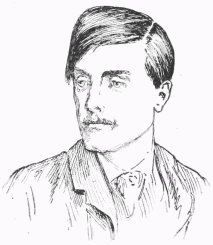 FRED WALKER
Both were equally great in whatever they attempted—landscape, figures,
birds, beasts, or fishes. Who does not remember the fish-monger's shop
by F. Walker, or W. Bagot's little piebald piglings, and their venerable
black mother, and their immense, fat, wallowing pink papa? An ineffable
charm of poetry and refinement, of pathos and sympathy and delicate
humor combined, an incomparable ease and grace and felicity of
workmanship belong to each; and yet in their work are they not as wide
apart as the poles; each complete in himself and yet a complement to the
other?
And, oddly enough, they were both singularly alike in aspect—both small
and slight, though beautifully made, with tiny hands and feet; always
arrayed as the lilies of the field, for all they toiled and spun so
arduously; both had regularly featured faces of a noble cast and most
winning character; both had the best and simplest manners in the world,
and a way of getting themselves much and quickly and permanently
liked....
Que la terre leur soit légère!
And who can say that the fame of one is greater than the other's!
Their pinnacles are twin, I venture to believe—of just an equal height
and width and thickness, like their bodies in this life; but unlike
their frail bodies in one respect: no taller pinnacles are to be seen,
methinks, in all the garden of the deathless dead painters of our time,
and none more built to last!
But it is not with the art of Little Billee, nor with his fame as a
painter, that we are chiefly concerned in this unpretending little tale,
except in so far as they have some bearing on his character and his
fate.
"I should like to know the detailed history of the Englishman's first
love, and how he lost his innocence!"
"Ask him!"
"Ask him yourself!"
Thus Papelard and Bouchardy, on the morning of Little Billee's first
appearance at Carrel's studio, in the Rue des Potirons St. Michel.
And that is the question the present scribe is doing his little best to
answer.
A good-looking, famous, well-bred, and well-dressed youth finds that
London Society opens its doors very readily; he hasn't long to knock;
and it would be difficult to find a youth more fortunately situated,
handsomer, more famous, better dressed or better bred, more seemingly
happy and successful, with more attractive qualities and more condonable
faults, than Little Billee, as Taffy and the Laird found him when they
came to London after their four or five years in foreign parts—their
Wanderjahr.
He had a fine studio and a handsome suite of rooms in Fitzroy Square.
Beautiful specimens of his unfinished work, endless studies, hung on his
studio walls. Everything else was as nice as it could be—the furniture,
the bibelots, and bric-à-brac, the artistic foreign and Eastern
knick-knacks and draperies and hangings and curtains and rugs—the
semi-grand piano by Collard & Collard.
That immortal canvas, the "Moon-Dial" (just begun, and already
commissioned by Moses Lyon, the famous picture-dealer), lay on his
easel.
No man worked harder and with teeth more clinched than Little Billee
when he was at work—none rested or played more discreetly when it was
time to rest or play.
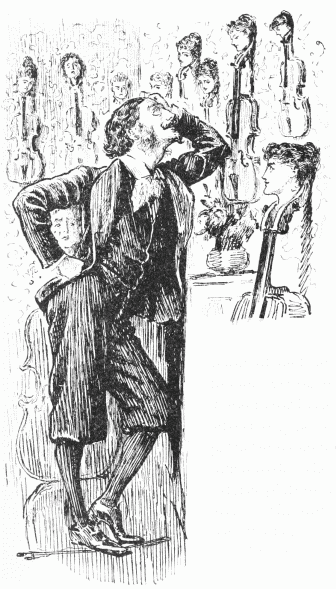
PLATONIC LOVE
The glass on his mantel-piece was full of cards of invitation,
reminders, pretty mauve and pink and lilac-scented notes; nor were
coronets wanting on many of these hospitable little missives. He had
quite overcome his fancied aversion for bloated dukes and lords and the
rest (we all do sooner or later, if things go well with us); especially
for their wives and sisters and daughters and female cousins; even their
mothers and aunts. In point of fact, and in spite of his tender years,
he was in some danger (for his art) of developing into that type adored
by sympathetic women who haven't got much to do: the friend, the tame
cat, the platonic lover (with many loves)—the squire of dames, the
trusty one, of whom husbands and brothers have no fear!—the delicate,
harmless dilettante of Eros—the dainty shepherd who dwells "dans le
pays du tendre!"—and stops there!
The woman flatters and the man confides—and there is no danger
whatever, I'm told—and I am glad!
One man loves his fiddle (or, alas! his neighbor's sometimes) for all
the melodies he can wake from it—it is but a selfish love!
Another, who is no fiddler, may love a fiddle too; for its symmetry, its
neatness, its color—its delicate grainings, the lovely lines and curves
of its back and front—for its own sake, so to speak. He may have a
whole galleryful of fiddles to love in this innocent way—a harem!—and
yet not know a single note of music, or even care to hear one. He will
dust them and stroke them, and take them down and try to put them in
tune—pizzicato!—and put them back again, and call them ever such sweet
little pet names: viol, viola, viola d'amore, viol di gamba, violino
mio! and breathe his little troubles into them, and they will give back
inaudible little murmurs in sympathetic response, like a damp Æolian
harp; but he will never draw a bow across the strings, nor wake a single
chord—or discord!
And who shall say he is not wise in his generation? It is but an
old-fashioned philistine notion that fiddles were only made to be played
on—the fiddles themselves are beginning to resent it; and rightly, I
wot!
In this harmless fashion Little Billee was friends with more than one
fine lady de par le monde.
Indeed, he had been reproached by his more bohemian brothers of the
brush for being something of a tuft-hunter—most unjustly. But nothing
gives such keen offence to our unsuccessful brother, bohemian or
bourgeois, as our sudden intimacy with the so-called great, the little
lords and ladies of this little world! Not even our fame and success,
and all the joy and pride they bring us, are so hard to condone—so
imbittering, so humiliating, to the jealous fraternal heart.
Alas! poor humanity—that the mere countenance of our betters (if they
are our betters!) should be thought so priceless a boon, so consummate
an achievement, so crowning a glory, as all that!
"A dirty bit of orange-peel,
The stump of a cigar—
Once trod on by a princely heel,
How beautiful they are!"
Little Billee was no tuft-hunter—he was the tuft-hunted, or had been.
No one of his kind was ever more persistently, resolutely, hospitably
harried than this young "hare with many friends" by people of rank and
fashion.
And at first he thought them most charming; as they so often are, these
graceful, gracious, gay, good-natured stoics and barbarians, whose
manners are as easy and simple as their morals—but how much
better!—and who, at least, have this charm, that they can wallow in
untold gold (when they happen to possess it) without ever seeming to
stink of the same: yes, they bear wealth gracefully—and the want of it
more gracefully still! and these are pretty accomplishments that have
yet to be learned by our new aristocracy of the shop and counting-house,
Jew or gentile, which is everywhere elbowing its irresistible way to
the top and front of everything, both here and abroad.
Then he discovered that, much as you might be with them, you could never
be of them, unless perchance you managed to hook on by marrying one of
their ugly ducklings—their failures—their remnants! and even then life
isn't all beer and skittles for a rank outsider, I'm told! Then he
discovered that he didn't want to be of them in the least; especially at
such a cost as that! and that to be very much with them was apt to pall,
like everything else.
Also, he found that they were very mixed; good, bad, and
indifferent—and not always very dainty or select in their
predilections, since they took unto their bosoms such queer outsiders
(just for the sake of being amused a little while) that their capricious
favor ceased to be an honor and a glory—if it ever was! And, then,
their fickleness!
Indeed, he found, or thought he found, that they could be just as
clever, as liberal, as polite or refined—as narrow, insolent,
swaggering, coarse, and vulgar—as handsome, as ugly—as graceful, as
ungainly—as modest or conceited, as any other upper class of the
community—and, indeed, some lower ones!
Beautiful young women, who had been taught how to paint pretty little
landscapes (with an ivy-mantled ruin in the middle distance), talked
technically of painting to him, de pair à pair, as though they were
quite on the same artistic level, and didn't mind admitting it, in spite
of the social gulf between.
Hideous old frumps (osseous or obese, yet with unduly bared neck, and
shoulders that made him sick) patronized him and gave him good advice,
and told him to emulate Mr. Buckner both in his genius and his
manners—since Mr. Buckner was the only "gentleman" who ever painted for
hire; and they promised him, in time, an equal success!
Here and there some sweet old darling specially enslaved him by her
kindness, grace, knowledge of life, and tender womanly sympathy, like
the dowager Lady Chiselhurst—or some sweet young one, like the lovely
Duchess of Towers, by her beauty, wit, good-humor, and sisterly interest
in all he did, and who in some vague, distant manner constantly reminded
him of Trilby, although she was such a great and fashionable lady!
But just such darlings, old or young, were to be found, with still
higher ideals, in less exalted spheres; and were easier of access, with
no impassable gulf between—spheres where there was no patronizing,
nothing but deference and warm appreciation and delicate flattery, from
men and women alike—and where the aged Venuses, whose prime was of the
days of Waterloo, went with their historical remains duly shrouded, like
ivy-mantled ruins (and in the middle distance!).
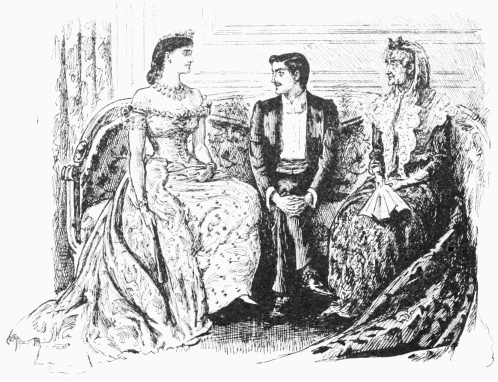
"DARLINGS, OLD OR YOUNG"
So he actually grew tired of the great before they had time to tire of
him—incredible as it may seem, and against nature; and this saved him
many a heart-burning; and he ceased to be seen at fashionable drums or
gatherings of any kind, except in one or two houses where he was
especially liked and made welcome for his own sake; such as Lord
Chiselhurst's in Piccadilly, where the "Moon-Dial" found a home for a
few years, before going to its last home and final resting-place in the
National Gallery (R. I. P.); or Baron Stoppenheim's in Cavendish Square,
where many lovely little water-colors signed W. B. occupied places of
honor on gorgeously gilded walls; or the gorgeously gilded bachelor
rooms of Mr. Moses Lyon, the picture-dealer in Upper Conduit Street—for
Little Billee (I much grieve to say it of a hero of romance) was an
excellent man of business. That infinitesimal dose of the good old
Oriental blood kept him straight, and not only made him stick to his
last through thick and thin, but also to those whose foot his last was
found to match (for he couldn't or wouldn't alter his last).
He loved to make as much money as he could, that he might spend it
royally in pretty gifts to his mother and sister, whom it was his
pleasure to load in this way, and whose circumstances had been very much
altered by his quick success. There was never a more generous son or
brother than Little Billee of the clouded heart, that couldn't love any
longer!
As a set-off to all these splendors, it was also his pleasure now and
again to study London life at its lower end—the eastest end of all.
Whitechapel, the Minories, the Docks, Ratcliffe Highway, Rotherhithe,
soon got to know him well, and he found much to interest him and much to
like among their denizens, and made as many friends there among
ship-carpenters, excisemen, longshoremen, jack-tars, and what not, as in
Bayswater and Belgravia (or Bloomsbury).
He was especially fond of frequenting sing-songs, or "free-and-easys,"
where good, hard-working fellows met of an evening to relax and smoke
and drink and sing—round a table well loaded with steaming tumblers and
pewter pots, at one end of which sits Mr. Chairman in all his glory, and
at the other "Mr. Vice." They are open to any one who can afford a pipe,
a screw of tobacco, and a pint of beer, and who is willing to do his
best and sing a song.
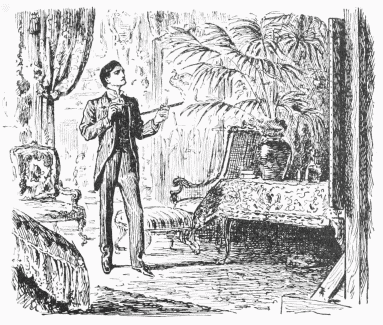
"THE MOON-DIAL"
No introduction is needed; as soon as any one has seated himself and
made himself comfortable, Mr. Chairman taps the table with his long clay
pipe, begs for silence, and says to his vis-à-vis: "Mr. Vice, it strikes
me as the gen'l'man as is just come in 'as got a singing face. Per'aps,
Mr. Vice, you'll be so very kind as juster harsk the aforesaid gen'l'man
to oblige us with a 'armony."
Mr. Vice then puts it to the new-comer, who, thus appealed to, simulates
a modest surprise, and finally professes his willingness, like Mr.
Barkis; then, clearing his throat a good many times, looks up to the
ceiling, and after one or two unsuccessful starts in different keys,
bravely sings "Kathleen Mavourneen," let us say—perhaps in a touchingly
sweet tenor voice:
"Kathleen Mavourneen, the gry dawn is brykin',
The 'orn of the 'unter is 'eard on the 'ill." ...
And Little Billee didn't mind the dropping of all these aitches if the
voice was sympathetic and well in tune, and the sentiment simple,
tender, and sincere.
Or else, with a good rolling jingo bass, it was,
"'Earts o' hoak are our ships; 'earts o' hoak are our men;
And we'll fight and we'll conkwer agen and agen!"
And no imperfection of accent, in Little Billee's estimation, subtracted
one jot from the manly British pluck that found expression in these
noble sentiments—nor added one tittle to their swaggering, blatant, and
idiotically aggressive vulgarity!
Well, the song finishes with general applause all round. Then the
chairman says, "Your 'ealth and song, sir!" And drinks, and all do the
same.
Then Mr. Vice asks, "What shall we 'ave the pleasure of saying, sir,
after that very nice 'armony?"
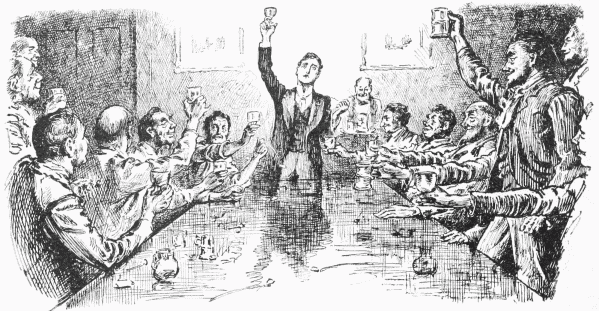
THE CHAIRMAN
And the blushing vocalist, if he knows the ropes, replies, "A roast
leg o' mutton in Newgate, and nobody to eat it!" Or else, "May 'im as is
going up the 'ill o' prosperity never meet a friend coming down!" Or
else, "'Ere's to 'er as shares our sorrers and doubles our joys!" Or
else, "'Ere's to 'er as shares our joys and doubles our expenses!" and
so forth.
More drink, more applause, and many 'ear, 'ears. And Mr. Vice says to
the singer: "You call, sir. Will you be so good as to call on some other
gen'l'man for a 'armony?" And so the evening goes on.
And nobody was more quickly popular at such gatherings, or sang better
songs, or proposed more touching sentiments, or filled either chair or
vice-chair with more grace and dignity than Little Billee. Not even
Dodor or l'Zouzou could have beaten him at that.
And he was as happy, as genial, and polite, as much at his ease, in
these humble gatherings as in the gilded saloons of the great, where
grand-pianos are, and hired accompanists, and highly-paid singers, and a
good deal of talk while they sing.
So his powers of quick, wide, universal sympathy grew and grew, and made
up to him a little for his lost power of being specially fond of special
individuals. For he made no close friends among men, and ruthlessly
snubbed all attempts at intimacy—all advances towards an affection
which he felt he could not return; and more than one enthusiastic
admirer of his talent and his charm was forced to acknowledge that, with
all his gifts, he seemed heartless and capricious; as ready to drop you
as he had been to take you up.
He loved to be wherever he could meet his kind, high or low; and felt as
happy on a penny steamer as on the yacht of a millionaire—on the
crowded knife-board of an omnibus as on the box-seat of a nobleman's
drag—happier; he liked to feel the warm contact of his fellow-man at
either shoulder and at his back, and didn't object to a little honest
grime! And I think all this genial caressing love of his kind, this
depth and breath of human sympathy, are patent in all his work.
On the whole, however, he came to prefer for society that of the best
and cleverest of his own class—those who live and prevail by the
professional exercise of their own specially trained and highly educated
wits, the skilled workmen of the brain—from the Lord Chief-Justice of
England downward—the salt of the earth, in his opinion: and stuck to
them.
There is no class so genial and sympathetic as our own, in the
long-run—even if it be but the criminal class! none where the welcome
is likely to be so genuine and sincere, so easy to win, so difficult to
outstay, if we be but decently pleasant and successful; none where the
memory of us will be kept so green (if we leave any memory at all!).
So Little Billee found it expedient, when he wanted rest and play, to
seek them at the houses of those whose rest and play were like his
own—little halts in a seeming happy life-journey, full of toil and
strain and endeavor; oases of sweet water and cooling shade, where the
food was good and plentiful, though the tents might not be of cloth of
gold; where the talk was of something more to his taste than court or
sport or narrow party politics; the new beauty; the coming match of the
season; the coming ducal conversion to Rome; the last elopement in high
life—the next! and where the music was that of the greatest
music-makers that can be, who found rest and play in making better music
for love than they ever made for hire—and were listened to as they
should be, with understanding and religious silence, and all the fervent
gratitude they deserved.
There were several such houses in London then—and are still—thank
Heaven! And Little Billee had his little billet there—and there he was
wont to drown himself in waves of lovely sound, or streams of clever
talk, or rivers of sweet feminine adulation, seas! oceans!—a somewhat
relaxing bath!—and forget for a while his everlasting chronic plague of
heart-insensibility, which no doctor could explain or cure, and to which
he was becoming gradually resigned—as one does to deafness or blindness
or locomotor ataxia—for it had lasted nearly five years! But now and
again, during sleep, and in a blissful dream, the lost power of
loving—of loving mother, sister, friend—would be restored to him; just
as with a blind man who sometimes dreams he has recovered his sight; and
the joy of it would wake him to the sad reality: till he got to know,
even in his dream, that he was only dreaming, after all, whenever that
priceless boon seemed to be his own once more—and did his utmost not to
wake. And these were nights to be marked with a white stone, and
remembered!
And nowhere was he happier than at the houses of the great surgeons and
physicians who interested themselves in his strange disease. When the
Little Billees of this world fall ill, the great surgeons and physicians
(like the great singers and musicians) do better for them, out of mere
love and kindness, than for the princes of the earth, who pay them
thousand-guinea fees and load them with honors.
And of all these notable London houses none was pleasanter than that of
Cornelys the great sculptor, and Little Billee was such a favorite in
that house that he was able to take his friends Taffy and the Laird
there the very day they came to London.
First of all they dined together at a delightful little Franco-Italian
pothouse near Leicester Square, where they had bouillabaisse (imagine
the Laird's delight), and spaghetti, and a poulet rôti, which is such
a different affair from a roast fowl! and salad, which Taffy was allowed
to make and mix himself; and they all smoked just where they sat, the
moment they had swallowed their food—as had been their way in the good
old Paris days.
That dinner was a happy one for Taffy and the Laird, with their Little
Billee apparently unchanged—as demonstrative, as genial, and caressing
as ever, and with no swagger to speak of; and with so many things to
talk about that were new to them, and of such delightful interest! They
also had much to say—but they didn't say very much about Paris, for
fear of waking up Heaven knows what sleeping dogs!
And every now and again, in the midst of all this pleasant foregathering
and communion of long-parted friends, the pangs of Little Billee's
miserable mind-malady would shoot through him like poisoned arrows.
He would catch himself thinking how fat and fussy and serious about
trifles Taffy had become; and what a shiftless, feckless, futile duffer
was the Laird; and how greedy they both were, and how red and coarse
their ears and gills and cheeks grew as they fed, and how shiny their
faces; and how little he would care, try as he might, if they both fell
down dead under the table! And this would make him behave more
caressingly to them, more genially and demonstratively than ever—for he
knew it was all a grewsome physical ailment of his own, which he could
no more help than a cataract in his eye!
Then, catching sight of his own face and form in a mirror, he would
curse himself for a puny, misbegotten shrimp, an imp—an abortion—no
bigger, by the side of the herculean Taffy or the burly Laird of
Cockpen, than six-pennorth o' half-pence: a wretched little overrated
follower of a poor trivial craft—a mere light amuser! For what did
pictures matter, or whether they were good or bad, except to the
triflers who painted them, the dealers who sold them, the idle,
uneducated, purse-proud fools who bought them and stuck them up on their
walls because they were told!
And he felt that if a dynamite shell were beneath the table where they
sat, and its fuse were smoking under their very noses, he would neither
wish to warn his friends nor move himself. He didn't care a d——!
And all this made him so lively and brilliant in his talk, so
fascinating and droll and witty, that Taffy and the Laird wondered at
the improvement success and the experience of life had wrought in him,
and marvelled at the happiness of his lot, and almost found it in their
warm, affectionate hearts to feel a touch of envy!
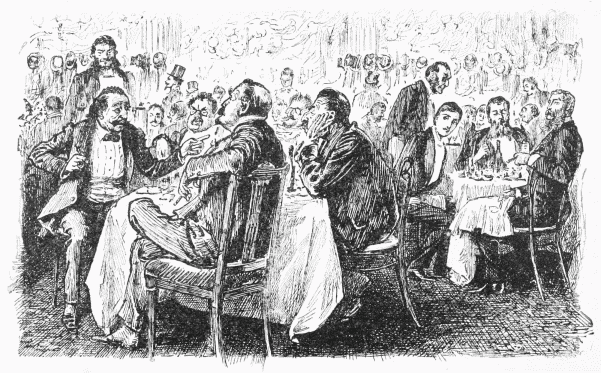
A HAPPY DINNER
Oddly enough, in a brief flash of silence, "entre la poire et le
fromage," they heard a foreigner at an adjoining table (one of a very
noisy group) exclaim: "Mais quand je vous dis que j'l'ai entendue, moi,
la Svengali! et même qu'elle a chanté l'Impromptu de Chopin absolument
comme si c'était un piano qu'on jouait! voyons!..."
"Farceur! la bonne blague!" said another—and then the conversation
became so noisily general it was no good listening any more.
"Svengali! how funny that name should turn up! I wonder what's become of
our Svengali, by-the-way?" observed Taffy.
"I remember his playing Chopin's Impromptu," said Little Billee; "what
a singular coincidence!"
There were to be more coincidences that night; it never rains them but
it pours!
So our three friends finished their coffee and liqueured up, and went to
Cornelys's, three in a hansom—
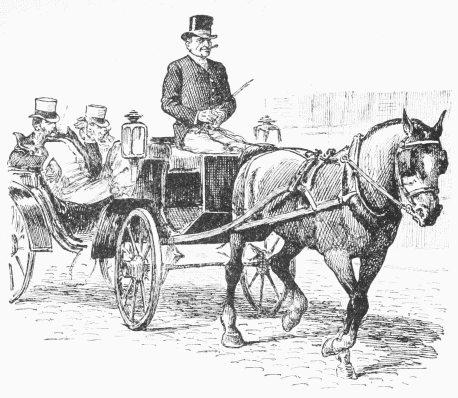
"Like Mars,
A-smokin' their poipes and cigyars."
Sir Louis Cornelys, as everybody knows, lives in a palace on Campden
Hill, a house of many windows; and whichever window he looks out of, he
sees his own garden and very little else. In spite of his eighty years,
he works as hard as ever, and his hand has lost but little of its
cunning. But he no longer gives those splendid parties that made him
almost as famous a host as he was an artist.
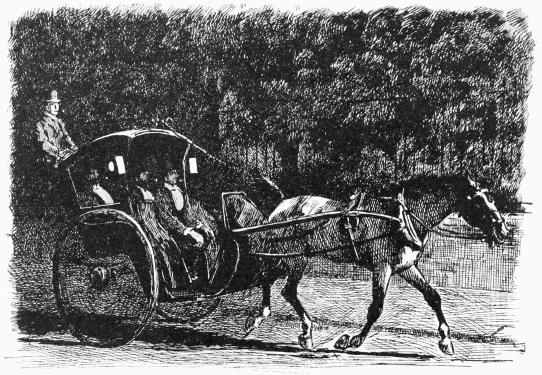
"A-SMOKIN' THEIR POIPES AND CIGYARS"
When his beautiful wife died he shut himself up from the world; and
now he never stirs out of his house and grounds except to fulfil his
duties at the Royal Academy and dine once a year with the Queen.
It was very different in the early sixties. There was no pleasanter or
more festive house than his in London, winter or summer—no lordlier
host than he—no more irresistible hostesses than Lady Cornelys and her
lovely daughters; and if ever music had a right to call itself divine,
it was there you heard it—on late Saturday nights during the London
season—when the foreign birds of song come over to reap their harvest
in London Town.
It was on one of the most brilliant of these Saturday nights that Taffy
and the Laird, chaperoned by Little Billee, made their début at Mechelen
Lodge, and were received at the door of the immense music-room by a
tall, powerful man with splendid eyes and a gray beard, and a small
velvet cap on his head—and by a Greek matron so beautiful and stately
and magnificently attired that they felt inclined to sink them on their
bended knees as in the presence of some overwhelming Eastern
royalty—and were only prevented from doing so, perhaps, by the simple,
sweet, and cordial graciousness of her welcome.
And whom should they be shaking hands with next but Antony, Lorrimer,
and the Greek—with each a beard and mustache of nearly five years'
growth!
But they had no time for much exuberant greeting, for there was a sudden
piano crash—and then an immediate silence, as though for pins to
drop—and Signor Giuglini and the wondrous maiden Adelina Patti sang the
Miserere out of Signor Verdi's most famous opera—to the delight of all
but a few very superior ones who had just read Mendelssohn's letters (or
misread them) and despised Italian music; and thought cheaply of "mere
virtuosity," either vocal or instrumental.
When this was over, Little Billee pointed out all the lions to his
friends—from the Prime Minister down to the present scribe—who was
right glad to meet them again and talk of auld lang syne, and present
them to the daughters of the house and other charming ladies.
Then Roucouly, the great French barytone, sang Durien's favorite song,
"Plaisir d'amour ne dure qu'un moment;
Chagrin d'amour dure toute la vie...."
with quite a little drawing-room voice—but quite as divinely as he had
sung "Noël, noël," at the Madeleine in full blast one certain Christmas
Eve our three friends remembered well.
Then there was a violin solo by young Joachim, then as now the greatest
violinist of his time; and a solo on the piano-forte by Madame Schumann,
his only peeress! and these came as a wholesome check to the levity of
those for whom all music is but an agreeable pastime, a mere emotional
delight, in which the intellect has no part; and also as a well-deserved
humiliation to all virtuosi who play so charmingly that they make their
listeners forget the master who invented the music in the lesser master
who interprets it!
For these two—man and woman—the highest of their kind, never let you
forget it was Sebastian Bach they were playing—playing in absolute
perfection, in absolute forgetfulness of themselves—so that if you
weren't up to Bach, you didn't have a very good time!
But if you were (or wished it to be understood or thought you were), you
seized your opportunity and you scored; and by the earnestness of your
rapt and tranced immobility, and the stony, gorgon-like intensity of
your gaze, you rebuked the frivolous—as you had rebuked them before by
the listlessness and carelessness of your bored resignation to the
Signorina Patti's trills and fioritures, or M. Roucouly's pretty little
French mannerisms.
And what added so much to the charm of this delightful concert was that
the guests were not packed together sardinewise, as they are at most
concerts; they were comparatively few and well chosen, and could get up
and walk about and talk to their friends between the pieces, and wander
off into other rooms and look at endless beautiful things, and stroll in
the lovely grounds, by moon or star or Chinese-lantern light.
And there the frivolous could sit and chat and laugh and flirt when Bach
was being played inside; and the earnest wander up and down together in
soul-communion, through darkened walks and groves and alleys where the
sound of French or Italian warblings could not reach them, and talk in
earnest tones of the great Zola, or Guy de Maupassant and Pierre Loti,
and exult in beautiful English over the inferiority of English
literature, English art, English music, English everything else.
For these high-minded ones who can only bear the sight of classical
pictures and the sound of classical music do not necessarily read
classical books in any language—no Shakespeares or Dantes or Molières
or Goethes for them. They know a trick worth two of that!
And the mere fact that these three immortal French writers of light
books I have just named had never been heard of at this particular
period doesn't very much matter; they had cognate predecessors whose
names I happen to forget. Any stick will do to beat a dog with, and
history is always repeating itself.
Feydeau, or Flaubert, let us say—or for those who don't know French and
cultivate an innocent mind, Miss Austen (for to be dead and buried is
almost as good as to be French and immoral!)—and Sebastian Bach, and
Sandro Botticelli—that all the arts should be represented. These names
are rather discrepant, but they made very good sticks for dog-beating;
and with a thorough knowledge and appreciation of these (or the
semblance thereof), you were well equipped in those days to hold your
own among the elect of intellectual London circles, and snub the
philistine to rights.
Then, very late, a tall, good-looking, swarthy foreigner came in, with a
roll of music in his hands, and his entrance made quite a stir; you
heard all round, "Here's Glorioli," or "Ecco Glorioli," or "Voici
Glorioli," till Glorioli got on your nerves. And beautiful ladies,
ambassadresses, female celebrities of all kinds, fluttered up to him
and cajoled and fawned;—as Svengali would have said, "Prinzessen,
Comtessen, Serene English Altessen!"—and they soon forgot their
Highness and their Serenity!
For with very little pressing Glorioli stood up on the platform, with
his accompanist by his side at the piano, and in his hands a sheet of
music, at which he never looked. He looked at the beautiful ladies, and
ogled and smiled; and from his scarcely parted, moist, thick, bearded
lips, which he always licked before singing, there issued the most
ravishing sounds that had ever been heard from throat of man or woman or
boy! He could sing both high and low and soft and loud, and the
frivolous were bewitched, as was only to be expected; but even the
earnestest of all, caught, surprised, rapt, astounded, shaken, tickled,
teased, harrowed, tortured, tantalized, aggravated, seduced,
demoralized, corrupted into naturalness, forgot to dissemble their
delight.
And Sebastian Bach (the especially adored of all really great musicians,
and also, alas! of many priggish outsiders who don't know a single note
and can't remember a single tune) was well forgotten for the night; and
who were more enthusiastic than the two great players who had been
playing Bach that evening? For these, at all events, were broad and
catholic and sincere, and knew what was beautiful, whatever its kind.
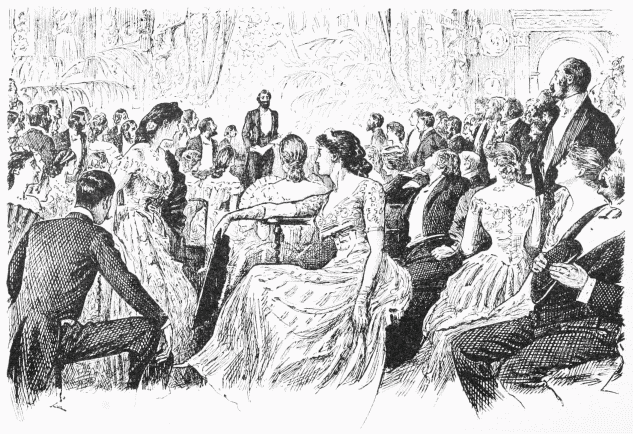
"BONJOUR, SUZON!"
It was but a simple little song that Glorioli sang, as light and pretty
as it could well be, almost worthy of the words it was written to, and
the words are De Musset's; and I love them so much I cannot resist the
temptation of setting them down here, for the mere sensuous delight of
writing them, as though I had just composed them myself:
"Bonjour, Suzon, ma fleur des bois!
Es-tu toujours la plus jolie?
Je reviens, tel que tu me vois,
D'un grand voyage en Italie!
Du paradis j'ai fait le tour—
J'ai fait des vers—j'ai fait l'amour....
Mais que t'importe!
Mais que t'importe!
Je passe devant ta maison:
Ouvre ta porte!
Ouvre ta porte!
Bonjour, Suzon!
"Je t'ai vue au temps des lilas.
Ton cœur joyeux venait d'éclore,
Et tu disais: 'je ne veux pas,
Je ne veux pas qu'on m'aime encore.'
Qu'as-tu fait depuis mon départ?
Qui part trop tôt revient trop tard.
Mais que m'importe?
Mais que m'importe?
Je passe devant ta maison:
Ouvre ta porte!
Ouvre ta porte!
Bonjour, Suzon!"
And when it began, and while it lasted, and after it was over, one felt
really sorry for all the other singers. And nobody sang any more that
night; for Glorioli was tired, and wouldn't sing again, and none were
bold enough or disinterested enough to sing after him.
Some of my readers may remember that meteoric bird of song, who, though
a mere amateur, would condescend to sing for a hundred guineas in the
saloons of the great (as Monsieur Jourdain sold cloth); who would sing
still better for love and glory in the studios of his friends.
For Glorioli—the biggest, handsomest, and most distinguished-looking
Jew that ever was—one of the Sephardim (one of the Seraphim!)—hailed
from Spain, where he was junior partner in the great firm of Moralés,
Peralés, Gonzalés & Glorioli, wine-merchants, Malaga. He travelled for
his own firm; his wine was good, and he sold much of it in England. But
his voice would bring him far more gold in the month he spent here; for
his wines have been equalled—even surpassed—but there was no voice
like his anywhere in the world, and no more finished singer.
Anyhow, his voice got into Little Billee's head more than any wine, and
the boy could talk of nothing else for days and weeks; and was so
exuberant in his expressions of delight and gratitude that the great
singer took a real fancy to him (especially when he was told that this
fervent boyish admirer was one of the greatest of English painters); and
as a mark of his esteem, privately confided to him after supper that
every century two human nightingales were born—only two! a male and a
female; and that he, Glorioli, was the representative "male rossignol of
this soi-disant dix-neuvième siècle."
"I can well believe that! And the female, your mate that should be—la
rossignolle, if there is such a word?" inquired Little Billee.
"Ah! mon ami ... it was Alboni till la petite Adelina Patti came out a
year or two ago; and now it is la Svengali."
"La Svengali?"
"Oui, mon fy! You will hear her some day—et vous m'en direz des
nouvelles!"
"Why, you don't mean to say that she's got a better voice than Madame
Alboni?"
"Mon ami, an apple is an excellent thing—until you have tried a peach!
Her voice to that of Alboni is as a peach to an apple—I give you my
word of honor! but bah! the voice is a detail. It's what she does with
it—it's incredible! it gives one cold all down the back! it drives you
mad! it makes you weep hot tears by the spoonful! Ah! the tear, mon fy!
tenez! I can draw everything but that! Ça n'est pas dans mes cordes!
I can only madden with love! But la Svengali!... And then, in the
middle of it all, prrrout!... she makes you laugh! Ah! le beau rire!
faire rire avec des larmes plein les yeux—voilà qui me passe!... Mon
ami, when I heard her it made me swear that even I would never try to
sing any more—it seemed too absurd! and I kept my word for a month at
least—and you know, je sais ce que je vaux, moi!"
"You are talking of la Svengali, I bet," said Signor Spartia.
"Oui, parbleu! You have heard her?"
"Yes—at Vienna last winter," rejoined the greatest singing-master in
the world. "J'en suis fou! hélas! I thought I could teach a woman how
to sing till I heard that blackguard Svengali's pupil. He has married
her, they say!"
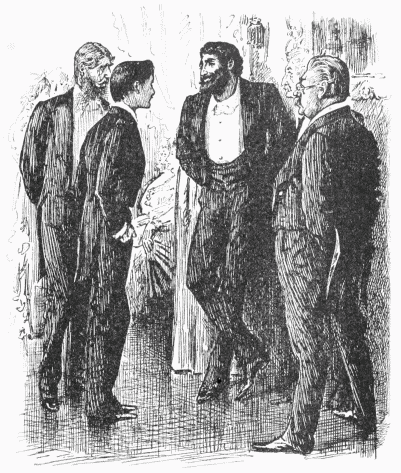
A HUMAN NIGHTINGALE
"That blackguard Svengali!" exclaimed Little Billee ... "why, that
must be a Svengali I knew in Paris—a famous pianist! a friend of mine!"
"That's the man! also une fameuse crapule (sauf vot' respect); his real
name is Adler; his mother was a Polish singer; and he was a pupil at the
Leipsic Conservatorio. But he's an immense artist, and a great
singing-master, to teach a woman like that! and such a woman! belle
comme un ange—mais bête comme un pot. I tried to talk to her—all she
can say is 'ja wohl,' or 'doch,' or 'nein,' or 'soh'! not a word of
English or French or Italian, though she sings them, oh! but divinely!
It is 'il bel canto' come back to the world after a hundred years...."
"But what voice is it?" asked Little Billee.
"Every voice a mortal woman can have—three octaves—four! and of such a
quality that people who can't tell one tune from another cry with
pleasure at the mere sound of it directly they hear her; just like
anybody else. Everything that Paganini could do with his violin she does
with her voice—only better—and what a voice! un vrai baume!"
"Now I don't mind petting zat you are schbeaking of la Sfencali," said
Herr Kreutzer, the famous composer, joining in. "Quelle merfeille, hein?
I heard her in St. Betersburg, at ze Vinter Balace. Ze vomen all vent
mat, and pulled off zeir bearls and tiamonts and kave zem to her—vent
town on zeir knees and gried and gissed her hants. She tit not say vun
vort! She tit not efen schmile! Ze men schnifelled in ze gorners, and
looked at ze bictures, and tissempled—efen I, Johann Kreutzer! efen ze
Emperor!"
"You're joking," said Little Billee.
"My vrent, I neffer choke ven I talk apout zinging. You vill hear her
zum tay yourzellof, and you vill acree viz me zat zere are two classes
of beoble who zing. In ze vun class, la Sfencali; in ze ozzer, all ze
ozzer zingers!"
"And does she sing good music?"
"I ton't know. All music is koot ven she zings it. I forket ze zong;
I can only sink of ze zinger. Any koot zinger can zing a peautiful zong
and kif bleasure, I zubboce! But I voot zooner hear la Sfencali zing a
scale zan anypotty else zing ze most peautiful zong in ze vorldt—efen
vun of my own! Zat is berhaps how zung ze crate Italian zingers of ze
last century. It vas a lost art, and she has found it; and she must haf
pecun to zing pefore she pecan to schpeak—or else she voot not haf hat
ze time to learn all zat she knows, for she is not yet zirty! She zings
in Paris in Ogdoper, Gott sei dank! and gums here after Christmas to
zing at Trury Lane. Chullien kifs her ten sousand bounts!"
"I wonder, now! Why, that must be the woman I heard at Warsaw two years
ago—or three," said young Lord Witlow. "It was at Count Siloszech's.
He'd heard her sing in the streets, with a tall, black-bearded ruffian,
who accompanied her on a guitar, and a little fiddling gypsy fellow. She
was a handsome woman, with hair down to her knees, but stupid as an owl.
She sang at Siloszech's, and all the fellows went mad and gave her their
watches and diamond studs and gold scarf-pins. By gad! I never heard or
saw anything like it. I don't know much about music myself—couldn't
tell 'God Save the Queen' from 'Pop Goes the Weasel,' if the people
didn't get up and stand and take their hats off; but I was as mad as the
rest—why, I gave her a little German silver vinaigrette I'd just bought
for my wife; hanged if I didn't—and I was only just married, you know!
It's the peculiar twang of her voice, I suppose!"
And hearing all this, Little Billee made up his mind that life had still
something in store for him, since he would some day hear la Svengali.
Anyhow, he wouldn't shoot himself till then!
Thus the night wore itself away. The Prinzessen, Comtessen, and Serene
English Altessen (and other ladies of less exalted rank) departed home
in cabs and carriages; and hostess and daughters went to bed. Late
sitters of the ruder sex supped again, and smoked and chatted and
listened to comic songs and recitations by celebrated actors. Noble
dukes hobnobbed with low comedians; world-famous painters and sculptors
sat at the feet of Hebrew capitalists and aitchless millionaires.
Judges, cabinet ministers, eminent physicians, and warriors and
philosophers saw Sunday morning steal over Campden Hill and through the
many windows of Mechelen Lodge, and listened to the pipe of
half-awakened birds, and smelled the freshness of the dark summer dawn.
And as Taffy and the Laird walked home to the Old Hummums by daylight,
they felt that last night was ages ago, and that since then they had
foregathered with "much there was of the best in London." And then they
reflected that "much there was of the best in London" were still
strangers to them—except by reputation—for there had not been time for
many introductions: and this had made them feel a little out of it; and
they found they hadn't had such a very good time after all. And there
were no cabs. And they were tired, and their boots were tight.
And the last they had seen of Little Billee before leaving was a glimpse
of their old friend in a corner of Lady Cornelys's boudoir, gravely
playing cup-and-ball with Fred Walker for sixpences—both so rapt in the
game that they were unconscious of anything else, and both playing so
well (with either hand) that they might have been professional
champions!
And that saturnine young sawbones, Jakes Talboys (now Sir Jakes, and one
of the most genial of Her Majesty's physicians), who sometimes after
supper and champagne was given to thoughtful, sympathetic, and acute
observation of his fellow-men, remarked to the Laird in a whisper that
was almost convivial: "Rather an enviable pair! Their united ages amount
to forty-eight or so, their united weights to about fifteen stone, and
they couldn't carry you or me between them. But if you were to roll all
the other brains that have been under this roof to-night into one, you
wouldn't reach the sum of their united genius.... I wonder which of the
two is the most unhappy!"
. . . . . . . . . .
. . . . . . . . . .
The season over, the song-birds flown, summer on the wane, his picture,
the "Moon-Dial," sent to Moses Lyon's (the picture-dealer in Conduit
Street), Little Billee felt the time had come to go and see his mother
and sister in Devonshire, and make the sun shine twice as brightly for
them during a month or so, and the dew fall softer!
So one fine August morning found him at the Great Western Station—the
nicest station in all London, I think—except the stations that book you
to France and far away.
It always seems so pleasant to be going west! Little Billee loved that
station, and often went there for a mere stroll, to watch the people
starting on their westward way, following the sun towards Heaven knows
what joys or sorrows, and envy them their sorrows or their joys—any
sorrows or joys that were not merely physical, like a chocolate drop or
a pretty tune, a bad smell or a toothache.
And as he took a seat in a second-class carriage (it would be third in
these democratic days), south corner, back to the engine, with Silas
Marner, and Darwin's Origin of Species (which he was reading for the
third time), and Punch, and other literature of a lighter kind, to
beguile him on his journey, he felt rather bitterly how happy he could
be if the little spot, or knot, or blot, or clot which paralyzed that
convolution of his brain where he kept his affections could but be
conjured away!
The dearest mother, the dearest sister in the world, in the dearest
little sea-side village (or town) that ever was! and other dear
people—especially Alice, sweet Alice with hair so brown, his sister's
friend, the simple, pure, and pious maiden of his boyish dreams: and
himself, but for that wretched little kill-joy cerebral occlusion, as
sound, as healthy, as full of life and energy as he had ever been!
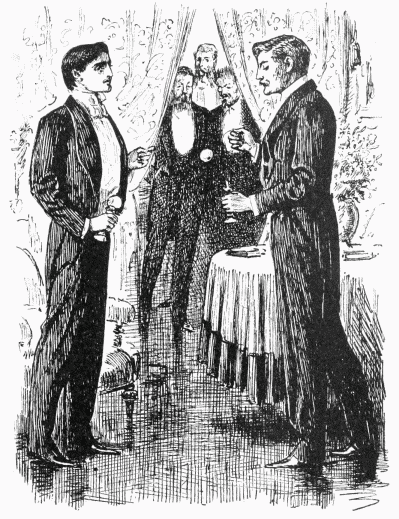
CUP-AND-BALL
And when he wasn't reading Silas Marner, or looking out of window at
the flying landscape, and watching it revolve round its middle distance
(as it always seems to do), he was sympathetically taking stock of his
fellow-passengers, and mildly envying them, one after another,
indiscriminately!
A fat, old, wheezy philistine, with a bulbous nose and only one eye, who
had a plain, sickly daughter, to whom he seemed devoted, body and soul;
an old lady, who still wept furtively at recollections of the parting
with her grandchildren, which had taken place at the station (they had
borne up wonderfully, as grandchildren do); a consumptive curate, on the
opposite corner seat by the window, whose tender, anxious wife (sitting
by his side) seemed to have no thoughts in the whole world but for him;
and her patient eyes were his stars of consolation, since he turned to
look into them almost every minute, and always seemed a little the
happier for doing so. There is no better star-gazing than that!
So Little Billee gave her up his corner seat, that the poor sufferer
might have those stars where he could look into them comfortably without
turning his head.
Indeed (as was his wont with everybody), Little Billee made himself
useful and pleasant to his fellow-travellers in many ways—so many that
long before they had reached their respective journeys' ends they had
almost grown to love him as an old friend, and longed to know who this
singularly attractive and brilliant youth, this genial, dainty,
benevolent little princekin could possibly be, who was dressed so
fashionably, and yet went second class, and took such kind thought of
others; and they wondered at the happiness that must be his at merely
being alive, and told him more of their troubles in six hours than they
told many an old friend in a year.
But he told them nothing about himself—that self he was so sick of—and
left them to wonder.
And at his own journey's end, the farthest end of all, he found his
mother and sister waiting for him, in a beautiful little
pony-carriage—his last gift—and with them sweet Alice, and in her
eyes, for one brief moment, that unconscious look of love surprised
which is not to be forgotten for years and years and years—which can
only be seen by the eyes that meet it, and which, for the time it lasts
(just a flash), makes all women's eyes look exactly the same (I'm told):
and it seemed to Little Billee that, for the twentieth part of a second,
Alice had looked at him with Trilby's eyes—or his mother's, when that
he was a little tiny boy.
It all but gave him the thrill he thirsted for! Another twentieth part
of a second, perhaps, and his brain-trouble would have melted away; and
Little Billee would have come into his own again—the kingdom of love!
A beautiful human eye! Any beautiful eye—a dog's, a deer's, a
donkey's, an owl's even! To think of all that it can look, and all that
it can see! all that it can even seem, sometimes! What a prince among
gems! what a star!
But a beautiful eye that lets the broad white light of infinite space
(so bewildering and garish and diffused) into one pure virgin heart, to
be filtered there! and lets it out again, duly warmed, softened,
concentrated, sublimated, focussed to a point as in a precious stone,
that it may shed itself (a love-laden effulgence) into some stray
fellow-heart close by—through pupil and iris, entre quatre-z-yeux—the
very elixir of life!
Alas! that such a crown-jewel should ever lose its lustre and go blind!
Not so blind or dim, however, but it can still see well enough to look
before and after, and inward and upward, and drown itself in tears, and
yet not die! And that's the dreadful pity of it. And this is a quite
uncalled-for digression; and I can't think why I should have gone out of
my way (at considerable pains) to invent it! In fact—
"Of this here song, should I be axed the reason for to show,
I don't exactly know, I don't exactly know!
But all my fancy dwells upon Nancy." ...
"How pretty Alice has grown, mother! quite lovely, I think! and so nice;
but she was always as nice as she could be!"
So observed Little Billee to his mother that evening as they sat in the
garden and watched the crescent moon sink to the Atlantic.
"Ah! my darling Willie! If you could only guess how happy you would
make your poor old mammy by growing fond of Alice.... And Blanche, too!
what a joy for her!"
"Good heavens! mother.... Alice is not for the likes of me! She's for
some splendid young Devon squire, six foot high, and acred and
whiskered within an inch of his life!..."
"Ah, my darling Willie! you are not of those who ask for love in
vain.... If you only knew how she believes in you! She almost beats
your poor old mammy at that!"
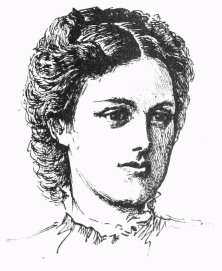 SWEET ALICE
And that night he dreamed of Alice—that he loved her as a sweet good
woman should be loved; and knew, even in his dream, that it was but a
dream; but, oh! it was good! and he managed not to wake; and it was a
night to be marked with a white stone! And (still in his dream) she had
kissed him, and healed him of his brain-trouble forever. But when he
woke next morning, alas! his brain-trouble was with him still, and he
felt that no dream kiss would ever cure it—nothing but a real kiss from
Alice's own pure lips!
And he rose thinking of Alice, and dressed and breakfasted thinking of
her—and how fair she was, and how innocent, and how well and carefully
trained up the way she should go—the beau ideal of a wife.... Could she
possibly care for a shrimp like himself?
For in his love of outward form he could not understand that any woman
who had eyes to see should ever quite condone the signs of physical
weakness in man, in favor of any mental gifts or graces whatsoever.
Little Greek that he was, he worshipped the athlete, and opined that all
women without exception—all English women especially—must see with the
same eyes as himself.
He had once been vain and weak enough to believe in Trilby's love (with
a Taffy standing by—a careless, unsusceptible Taffy, who was like unto
the gods of Olympus!)—and Trilby had given him up at a word, a
hint—for all his frantic clinging.
She would not have given up Taffy, pour si peu, had Taffy but lifted a
little finger! It is always "just whistle, and I'll come to you, my
lad!" with the likes of Taffy ... but Taffy hadn't even whistled! Yet
still he kept thinking of Alice—and he felt he couldn't think of her
well enough till he went out for a stroll by himself on a sheep-trimmed
down. So he took his pipe and his Darwin, and out he strolled into the
early sunshine—up the green Red Lane, past the pretty church, Alice's
father's church—and there, at the gate, patiently waiting for his
mistress, sat Alice's dog—an old friend of his, whose welcome was a
very warm one.
Little Billee thought of Thackeray's lovely poem in Pendennis:
"She comes—she's here—she's past!
May heaven go with her!..."
Then he and the dog went on together to a little bench on the edge of
the cliff—within sight of Alice's bedroom window. It was called "the
Honeymooners' Bench."
"That look—that look—that look! Ah—but Trilby had looked like that,
too! And there are many Taffys in Devon!"
He sat himself down and smoked and gazed at the sea below, which the sun
(still in the east) had not yet filled with glare and robbed of the
lovely sapphire-blue, shot with purple and dark green, that comes over
it now and again of a morning on that most beautiful coast.
There was a fresh breeze from the west, and the long, slow billows broke
into creamier foam than ever, which reflected itself as a tender white
gleam in the blue concavities of their shining shoreward curves as they
came rolling in. The sky was all of turquoise but for the smoke of a
distant steamer—a long thin horizontal streak of dun—and there were
little brown or white sails here and there, dotting; and the stately
ships went on....
Little Billee tried hard to feel all this beauty with his heart as well
as his brain—as he had so often done when a boy—and cursed his
insensibility out loud for at least the thousand and first time.
Why couldn't these waves of air and water be turned into equivalent
waves of sound, that he might feel them through the only channel that
reached his emotions! That one joy was still left to him—but, alas!
alas! he was only a painter of pictures—and not a maker of music!
He recited "Break, break, break," to Alice's dog, who loved him, and
looked up into his face with sapient, affectionate eyes—and whose
name, like that of so many dogs in fiction and so few in fact, was
simply Tray. For Little Billee was much given to monologues out loud,
and profuse quotations from his favorite bards.
Everybody quoted that particular poem either mentally or aloud when they
sat on that particular bench—except a few old-fashioned people, who
still said,
"Roll on, thou deep and dark blue ocean, roll!"
or people of the very highest culture, who only quoted the nascent (and
crescent) Robert Browning; or people of no culture at all, who simply
held their tongues—and only felt the more!
Tray listened silently.
"Ah, Tray, the best thing but one to do with the sea is to paint it. The
next best thing to that is to bathe in it. The best of all is to lie
asleep at the bottom. How would you like that?
"'And on thy ribs the limpet sticks,
And in thy heart the scrawl shall play....'"
Tray's tail became as a wagging point of interrogation, and he turned
his head first on one side and then on the other—his eyes fixed on
Little Billee's, his face irresistible in its genial doggy wistfulness.
"Tray, what a singularly good listener you are—and therefore what
singularly good manners you've got! I suppose all dogs have!" said
Little Billee; and then, in a very tender voice, he exclaimed,
"Alice, Alice, Alice!"
And Tray uttered a soft, cooing, nasal croon in his head register,
though he was a barytone dog by nature, with portentous, warlike
chest-notes of the jingo order.
"Tray, your mistress is a parson's daughter, and therefore twice as much
of a mystery as any other woman in this puzzling world!
"Tray, if my heart weren't stopped with wax, like the ears of the
companions of Ulysses when they rowed past the sirens—you've heard of
Ulysses, Tray? he loved a dog—if my heart weren't stopped with wax, I
should be deeply in love with your mistress; perhaps she would marry me
if I asked her—there's no accounting for tastes!—and I know enough of
myself to know that I should make her a good husband—that I should make
her happy—and I should make two other women happy besides.
"As for myself personally, Tray, it doesn't very much matter. One good
woman would do as well as another, if she's equally good-looking. You
doubt it? Wait till you get a pimple inside your bump of—your bump
of—wherever you keep your fondnesses, Tray.
"For that's what's the matter with me—a pimple—just a little clot of
blood at the root of a nerve, and no bigger than a pin's point!
"That's a small thing to cause such a lot of wretchedness, and wreck a
fellow's life, isn't it? Oh, curse it, curse it, curse it—every day and
all day long!
"And just as small a thing will take it away, I'm told!
"Ah! grains of sand are small things—and so are diamonds! But diamond
or grain of sand, only Alice has got that small thing! Alice alone, in
all the world, has got the healing touch for me now; the hands, the
lips, the eyes! I know it—I feel it! I dreamed it last night! She
looked me well in the face, and took my hand—both hands—and kissed me,
eyes and mouth, and told me how she loved me. Ah! what a dream it was!
And my little clot melted away like a snow-flake on the lips, and I was
my old self again, after many years—and all through that kiss of a pure
woman.
"I've never been kissed by a pure woman in my life—never! except by my
dear mother and sister; and mothers and sisters don't count, when it
comes to kissing.
"Ah! sweet physician that she is, and better than all! It will all come
back again with a rush, just as I dreamed, and we will have a good time
together, we three!...
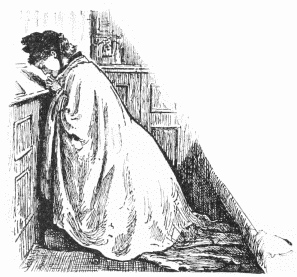 "MAY HEAVEN GO WITH HER!"
"But your mistress is a parson's daughter, and believes everything she's
been taught from a child, just as you do—at least, I hope so. And I
like her for it—and you too.
"She has believed her father—will she ever believe me, who think so
differently? And if she does, will it be good for her?—and then, where
will her father come in?
"Oh! it's a bad thing to live, and no longer believe and trust in your
father, Tray! to doubt either his honesty or his intelligence. For he
(with your mother to help) has taught you all the best he knows, if he
has been a good father—till some one else comes and teaches you
better—or worse!
"And, then, what are you to believe of what good still remains of all
that early teaching—and how are you to sift the wheat from the
chaff?...
"Kneel undisturbed, fair saint! I, for one, will never seek to undermine
thy faith in any father, on earth or above it!
"Yes, there she kneels in her father's church, her pretty head bowed
over her clasped hands, her cloak and skirts falling in happy folds
about her: I see it all!
"And underneath, that poor, sweet, soft, pathetic thing of flesh and
blood, the eternal woman—great heart and slender brain—forever
enslaved or enslaving, never self-sufficing, never free ... that dear,
weak, delicate shape, so cherishable, so perishable, that I've had to
paint so often, and know so well by heart! and love ... ah, how I love
it! Only painter-fellows and sculptor-fellows can ever quite know the
fulness of that pure love.
"There she kneels and pours forth her praise or plaint, meekly and duly.
Perhaps it's for me she's praying!
"'Leave thou thy sister when she prays.'
"She believes her poor little prayer will be heard and answered
somewhere up aloft. The impossible will be done. She wants what she
wants so badly, and prays for it so hard.
"She believes—she believes—what doesn't she believe, Tray?
"The world was made in six days. It is just six thousand years old. Once
it all lay smothered under rain-water for many weeks, miles deep,
because there were so many wicked people about somewhere down in
Judee, where they didn't know everything! A costly kind of clearance!
And then there was Noah, who wasn't wicked, and his most respectable
family, and his ark—and Jonah and his whale—and Joshua and the sun,
and what not. I remember it all, you see, and, oh! such wonderful things
that have happened since! And there's everlasting agony for those who
don't believe as she does; and yet she is happy, and good, and very
kind; for the mere thought of any live creature in pain makes her
wretched!
"After all, if she believes in me, she'll believe in anything; let her!
"Indeed, I'm not sure that it's not rather ungainly for a pretty woman
not to believe in all these good old cosmic taradiddles, as it is for
a pretty child not to believe in Little Red Riding-hood, and Jack and
the Beanstalk, and Morgiana and the Forty Thieves; we learn them at our
mother's knee, and how nice they are! Let us go on believing them as
long as we can, till the child grows up and the woman dies and it's all
found out.
"Yes, Tray, I will be dishonest for her dear sake. I will kneel by her
side, if ever I have the happy chance, and ever after, night and
morning, and all day long on Sundays if she wants me to! What will I
not do for that one pretty woman who believes in me? I will respect
even that belief, and do my little best to keep it alive forever. It
is much too precious an earthly boon for me to play ducks and drakes
with....
"So much for Alice, Tray—your sweet mistress and mine.
"But, then, there's Alice's papa—and that's another pair of sleeves, as
we say in France.
"Ought one ever to play at make-believe with a full-grown man for any
consideration whatever—even though he be a parson, and a possible
father-in-law? There's a case of conscience for you!
"When I ask him for his daughter, as I must, and he asks me for my
profession of faith, as he will, what can I tell him? The truth?
"But, then, what will he say? What allowances will he make for a
poor little weak-kneed, well-meaning waif of a painter-fellow like me,
whose only choice lay between Mr. Darwin and the Pope of Rome, and who
has chosen once and forever—and that long ago—before he'd ever even
heard of Mr. Darwin's name.
"Besides, why should he make allowances for me? I don't for him. I think
no more of a parson than he does of a painter-fellow—and that's
precious little, I'm afraid.
"What will he think of a man who says:
"'Look here! the God of your belief isn't mine and never will be—but I
love your daughter, and she loves me, and I'm the only man to make her
happy!'
"He's no Jephthah; he's made of flesh and blood, although he's a
parson—and loves his daughter as much as Shylock loved his.
"Tell me, Tray—thou that livest among parsons—what man, not being a
parson himself, can guess how a parson would think, an average parson,
confronted by such a poser as that?
"Does he, dare he, can he ever think straight or simply on any subject
as any other man thinks, hedged in as he is by so many limitations?
"He is as shrewd, vain, worldly, self-seeking, ambitious, jealous,
censorious, and all the rest, as you or I, Tray—for all his Christian
profession—and just as fond of his kith and kin!
"He is considered a gentleman—which perhaps you and I are not—unless
we happen to behave as such; it is a condition of his noble calling.
Perhaps it's in order to become a gentleman that he's become a parson!
It's about as short a royal road as any to that enviable distinction—as
short almost as her Majesty's commission, and much safer, and much less
expensive—within reach of the sons of most fairly successful butchers
and bakers and candlestick-makers.
"While still a boy he has bound himself irrevocably to certain beliefs,
which he will be paid to preserve and preach and enforce through life,
and act up to through thick and thin—at all events, in the eyes of
others—even his nearest and dearest—even the wife of his bosom.
"They are his bread and butter, these beliefs—and a man mustn't quarrel
with his bread and butter. But a parson must quarrel with those who
don't believe as he tells them!
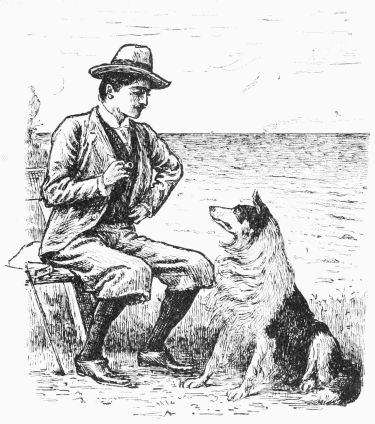
"'SO MUCH FOR ALICE, TRAY'"
"Yet a few years' thinking and reading and experience of life, one would
suppose, might possibly just shake his faith a little (just as though,
instead of being parson, he had been tinker, tailor, soldier, sailor,
gentleman, apothecary, ploughboy, thief), and teach him that many of
these beliefs are simply childish—and some of them very wicked
indeed—and most immoral.
"It is very wicked and most immoral to believe, or affect to believe,
and tell others to believe, that the unseen, unspeakable, unthinkable
Immensity we're all part and parcel of, source of eternal, infinite,
indestructible life and light and might, is a kind of wrathful,
glorified, and self-glorifying ogre in human shape, with human passions,
and most inhuman hates—who suddenly made us out of nothing, one fine
day—just for a freak—and made us so badly that we fell the next—and
turned us adrift the day after—damned us from the very beginning—ab
ovo—ab ovo usque ad malum—ha, ha!—and ever since! never gave us a
chance!
"All-merciful Father, indeed! Why, the Prince of Darkness was an angel
in comparison (and a gentleman into the bargain).
"Just think of it, Tray—a finger in every little paltry pie—an eye and
an ear at every key-hole, even that of the larder, to catch us tripping,
and find out if we're praising loud enough, or grovelling low enough, or
fasting hard enough—poor god-forsaken worms!
"And if we're naughty and disobedient, everlasting torment for us;
torture of so hideous a kind that we wouldn't inflict it on the basest
criminal, not for one single moment!
"Or else, if we're good and do as we are bid, an eternity of bliss so
futile, so idle, and so tame that we couldn't stand it for a week, but
for thinking of its one horrible alternative, and of our poor brother
for ever and ever roasting away, and howling for the drop of water he
never gets.
"Everlasting flame, or everlasting dishonor—nothing between!
"Isn't it ludicrous as well as pitiful—a thing to make one snigger
through one's tears? Isn't it a grievous sin to believe in such things
as these, and go about teaching and preaching them, and being paid for
it—a sin to be heavily chastised, and a shame? What a legacy!
"They were shocking bad artists, those conceited, narrow-minded Jews,
those poor old doting monks and priests and bigots of the grewsome, dark
age of faith! They couldn't draw a bit—no perspective, no
chiaro-oscuro; and it's a woful image they managed to evolve for us out
of the depths of their fathomless ignorance, in their zeal to keep us
off all the forbidden fruit we're all so fond of, because we were built
like that! And by whom? By our Maker, I suppose (who also made the
forbidden fruit, and made it very nice—and put it so conveniently for
you and me to see and smell and reach, Tray—and sometimes even pick,
alas!).
"And even at that it's a failure. Only the very foolish little birds are
frightened into good behavior. The naughty ones laugh and wink at each
other, and pull out its hair and beard when nobody's looking, and build
their nests out of the straw it's stuffed with (the naughty little birds
in black, especially), and pick up what they want under its very nose,
and thrive uncommonly well; and the good ones fly away out of sight; and
some day, perhaps, find a home in some happy, useful father-land far
away, where the Father isn't a bit like this. Who knows?
"And I'm one of the good little birds, Tray—at least, I hope so. And
that unknown Father lives in me whether I will or no, and I love Him
whether He be or not, just because I can't help it, and with the best
and bravest love that can be—the perfect love that believeth no evil,
and seeketh no reward, and casteth out fear. For I'm His father as much
as He's mine, since I've conceived the thought of Him after my own
fashion!
"And He lives in you too, Tray—you and all your kind. Yes, good dog,
you king of beasts, I see it in your eyes....
"Ah, bon Dieu Père, le Dieu des bonnes gens! Oh! if we only knew for
certain, Tray! what martyrdom would we not endure, you and I, with a
happy smile and a grateful heart—for sheer love of such a father! How
little should we care for the things of this earth!
"But the poor parson?
"He must willy-nilly go on believing, or affecting to believe, just as
he is told, word for word, or else good-bye to his wife and children's
bread and butter, his own preferment, perhaps even his very
gentility—that gentility of which his Master thought so little, and he
and his are apt to think so much—with possibly the Archbishopric of
Canterbury at the end of it, the bâton de maréchal that lies in every
clerical knapsack.
"What a temptation! one is but human!
"So how can he be honest without believing certain things, to believe
which (without shame) one must be as simple as a little child; as,
by-the-way, he is so cleverly told to be in these matters, and so
cleverly tells us—and so seldom is himself in any other matter
whatever—his own interests, other people's affairs, the world, the
flesh, and the devil! And that's clever of him too....
"And if he chooses to be as simple as a little child, why shouldn't I
treat him as a little child, for his own good, and fool him to the top
of his little bent for his dear daughter's sake, that I may make her
happy, and thereby him too?
"And if he's not quite so simple as all that, and makes artful little
compromises with his conscience—for a good purpose, of course—why
shouldn't I make artful little compromises with mine, and for a better
purpose still, and try to get what I want in the way he does? I want
to marry his daughter far worse than he can ever want to live in a
palace, and ride in a carriage and pair with a mitre on the panels.
"If he cheats, why shouldn't I cheat too?
"If he cheats, he cheats everybody all round—the wide, wide world,
and something wider and higher still that can't be measured, something
in himself. I only cheat him!
"If he cheats, he cheats for the sake of very worldly things
indeed—tithes, honors, influence, power, authority, social
consideration and respect—not to speak of bread and butter! I only
cheat for the love of a lady fair—and cheating for cheating, I like my
cheating best.
"So, whether he cheats or not, I'll—
"Confound it! what would old Taffy do in such a case, I wonder?...
"Oh, bother! it's no good wondering what old Taffy would do.
"Taffy never wants to marry anybody's daughter; he doesn't even want
to paint her! He only wants to paint his beastly ragamuffins and thieves
and drunkards, and be left alone.
"Besides, Taffy's as simple as a little child himself, and couldn't fool
any one, and wouldn't if he could—not even a parson. But if any one
tries to fool him, my eyes! don't he cut up rough, and call names, and
kick up a shindy, and even knock people down! That's the worst of
fellows like Taffy. They're too good for this world and too solemn.
They're impossible, and lack all sense of humor. In point of fact,
Taffy's a gentleman—poor fellow! et puis voilà!
"I'm not simple—worse luck; and I can't knock people down—I only wish
I could! I can only paint them! and not even that 'as they really
are!' ... Good old Taffy!...
"Faint heart never won fair lady!
"Oh, happy, happy thought—I'll be brave and win!
"I can't knock people down, or do doughty deeds, but I'll be brave in my
own little way—the only way I can....
"I'll simply lie through thick and thin—I must—I will—nobody need
ever be a bit the wiser! I can do more good by lying than by telling the
truth, and make more deserving people happy, including myself and the
sweetest girl alive—the end shall justify the means: that's my excuse,
my only excuse! and this lie of mine is on so stupendous a scale that it
will have to last me for life. It's my only one, but its name is Lion!
and I'll never tell another as long as I live.
"And now that I know what temptation really is, I'll never think any
harm of any parson any more ... never, never, never!"
So the little man went on, as if he knew all about it, had found it all
out for himself, and nobody else had ever found it out before! and I am
not responsible for his ways of thinking (which are not necessarily my
own).
It must be remembered, in extenuation, that he was very young, and not
very wise: no philosopher, no scholar—just a painter of lovely
pictures; only that and nothing more. Also, that he was reading Mr.
Darwin's immortal book for the third time, and it was a little too
strong for him; also, that all this happened in the early sixties, long
ere Religion had made up her mind to meet Science half-way, and hobnob
and kiss and be friends. Alas! before such a lying down of the lion and
the lamb can ever come to pass, Religion will have to perform a larger
share of the journey than half, I fear!
Then, still carried away by the flood of his own eloquence (for he had
never had such an innings as this, no such a listener), he again
apostrophized the dog Tray, who had been growing somewhat inattentive
(like the reader, perhaps), in language more beautiful than ever:
"Oh, to be like you, Tray—and secrete love and good-will from morn till
night, from night till morning—like saliva, without effort! with never
a moment's cessation of flow, even in disgrace and humiliation! How much
better to love than to be loved—to love as you do, my Tray—so warmly,
so easily, so unremittingly—to forgive all wrongs and neglect and
injustice so quickly and so well—and forget a kindness never! Lucky dog
that you are!
"'Oh! could I feel as I have felt, or be as I have been,
Or weep as I could once have wept, o'er many a vanished scene,
As springs in deserts found seem sweet, all brackish tho' they be,
So 'midst this withered waste of life those tears would flow to me!'
"What do you think of those lines, Tray? I love them, because my
mother taught them to me when I was about your age—six years old, or
seven! and before the bard who wrote them had fallen; like Lucifer, son
of the morning! Have you ever heard of Lord Byron, Tray? He too, like
Ulysses, loved a dog, and many people think that's about the best there
is to be said of him nowadays! Poor Humpty Dumpty! Such a swell as he
once was! 'Not all the king's horses, nor all the—'"
Here Tray jumped up suddenly and bolted—he saw some one else he was
fond of, and ran to meet him. It was the vicar, coming out of his
vicarage.
A very nice-looking vicar—fresh, clean, alert, well tanned by sun and
wind and weather—a youngish vicar still; tall, stout, gentlemanlike,
shrewd, kindly, wordly, a trifle pompous, and authoritative more than a
trifle; not much given to abstract speculation, and thinking fifty times
more of any sporting and orthodox young country squire, well-inched and
well-acred (and well-whiskered), than of all the painters in
Christendom.
"'When Greeks joined Greeks, then was the tug of war,'" thought Little
Billee; and he felt a little uncomfortable. Alice's father had never
loomed so big and impressive before, or so distressingly nice to look
at.
"Welcome, my Apelles, to your ain countree, which is growing quite proud
of you, I declare! Young Lord Archie Waring was saying only last night
that he wished he had half your talent! He's crazed about painting,
you know, and actually wants to be a painter himself! The poor dear old
marquis is quite sore about it!"
With this happy exordium the parson stopped and shook hands; and they
both stood for a while, looking seaward. The parson said the usual
things about the sea—its blueness; its grayness; its greenness; its
beauty; its sadness; its treachery.
"'Who shall put forth on thee,
Unfathomable sea!'"
"Who indeed!" answered Little Billee, quite agreeing. "I vote we
don't, at all events." So they turned inland.
The parson said the usual things about the land (from the
country-gentleman's point of view), and the talk began to flow quite
pleasantly, with quoting of the usual poets, and capping of quotations
in the usual way—for they had known each other many years, both here
and in London. Indeed, the vicar had once been Little Billee's tutor.
And thus, amicably, they entered a small wooded hollow. Then the vicar,
turning of a sudden his full blue gaze on the painter, asked, sternly:
"What book's that you've got in your hand, Willie?"
"A—a—it's the Origin of Species, by Charles Darwin. I'm very
f-f-fond of it. I'm reading it for the third time.... It's very
g-g-good. It accounts for things, you know."
Then, after a pause, and still more sternly:
"What place of worship do you most attend in London—especially of an
evening, William?"
Then stammered Little Billee, all self-control forsaking him:
"I d-d-don't attend any place of worship at all, morning, afternoon, or
evening. I've long given up going to church altogether. I can only be
frank with you; I'll tell you why...."
And as they walked along the talk drifted on to very momentous subjects
indeed, and led, unfortunately, to a serious falling out—for which
probably both were to blame—and closed in a distressful way at the
other end of the little wooded hollow—a way most sudden and unexpected,
and quite grievous to relate. When they emerged into the open the parson
was quite white, and the painter crimson.
"Sir," said the parson, squaring himself up to more than his full height
and breadth and dignity, his face big with righteous wrath, his voice
full of strong menace—"sir, you're—you're a—you're a thief, sir, a
thief! You're trying to rob me of my Saviour! Never you dare to
darken my door-step again!"
"Sir," said Little Billee, with a bow, "if it comes to calling names,
you're—you're a—no; you're Alice's father; and whatever else you are
besides, I'm another for trying to be honest with a parson; so
good-morning to you."
And each walked off in an opposite direction, stiff as pokers; and Tray
stood between, looking first at one receding figure, then at the
other, disconsolate.
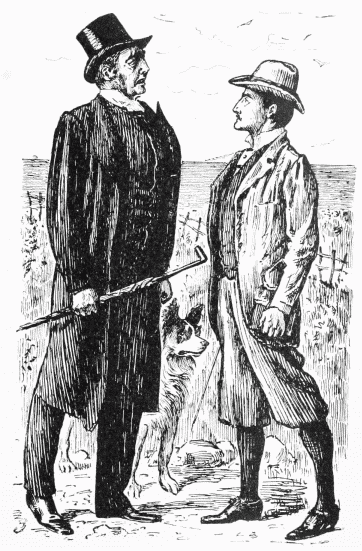
"'YOU'RE A THIEF, SIR!'"
And thus Little Billee found out that he could no more lie than he could
fly. And so he did not marry sweet Alice after all, and no doubt it was
ordered for her good and his. But there was tribulation for many days in
the house of Bagot, and for many months in one tender, pure, and pious
bosom.
And the best and the worst of it all is that, not very many years after,
the good vicar—more fortunate than most clergymen who dabble in stocks
and shares—grew suddenly very rich through a lucky speculation in Irish
beer, and suddenly, also, took to thinking seriously about things (as a
man of business should)—more seriously than he had ever thought before.
So at least the story goes in North Devon, and it is not so new as to be
incredible. Little doubts grew into big ones—big doubts resolved
themselves into downright negations. He quarrelled with his bishop; he
quarrelled with his dean; he even quarrelled with his "poor dear old
marquis," who died before there was time to make it up again. And
finally he felt it his duty, in conscience, to secede from a Church
which had become too narrow to hold him, and took himself and his
belongings to London, where at least he could breathe. But there he fell
into a great disquiet, for the long habit of feeling himself always en
évidence—of being looked up to and listened to without contradiction;
of exercising influence and authority in spiritual matters (and even
temporal); of impressing women, especially, with his commanding
presence, his fine sonorous voice, his lofty brow, so serious and
smooth, his soft, big, waving hands, which soon lost their country
tan—all this had grown as a second nature to him, the breath of his
nostrils, a necessity of his life. So he rose to be the most popular
Unitarian preacher of his day, and pretty broad at that.
But his dear daughter Alice, she stuck to the old faith, and married a
venerable High-Church archdeacon, who very cleverly clutched at and
caught her and saved her for himself just as she stood shivering on the
very brink of Rome; and they were neither happy nor unhappy
together—un ménage bourgeois, ni beau ni laid, ni bon ni mauvais. And
thus, alas! the bond of religious sympathy, that counts for so much in
united families, no longer existed between father and daughter, and the
heart's division divided them. Ce que c'est que de nous! ... The pity
of it!
And so no more of sweet Alice with hair so brown.


