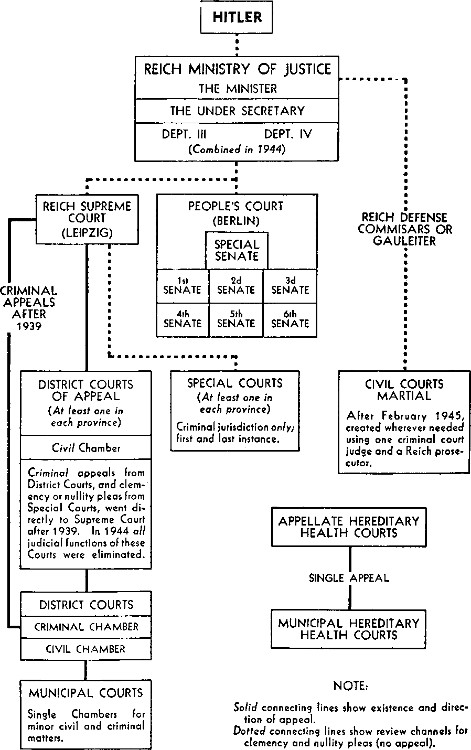
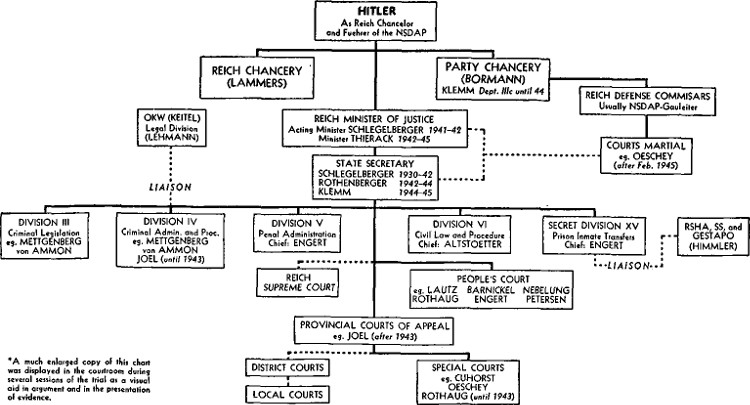
This major section of the volume contains selections from the evidence
concerning leading questions or issues of the trial. The evidence
selected for publication herein constitutes only about one-twentieth
of the total mimeographed record. Hence, all issues of the trial are
not covered, and numerous items of evidence mentioned in the printed
materials are not reproduced herein. Where extracts from testimony
have been reproduced, a footnote indicates the pages of the official
mimeographed transcript where the entire testimony can be found.
Both prosecution and defense evidence is contained in each of the
sections into which the evidence selected has been organized. The
prosecution evidence consists in the main of contemporaneous documents
of the Nazi era, most of them discovered in German archives by Allied
investigators after Germany’s unconditional surrender. The defense
evidence consists principally of extracts from the testimony of
defendants. A substantial number of the contemporaneous documents
offered by the defense have also been selected for publication.
With one or two exceptions, the contemporaneous documents have been
reproduced within the various sections in chronological order,
regardless of whether they were offered by the prosecution or the
defense. In selecting defense testimony under the various topical
sections, considerable emphasis has been given to the testimony of
the three defendants Schlegelberger, Rothenberger, and Klemm who were
appointed Under Secretaries in the Reich Ministry of Justice, and
to the testimony of the defendant Rothaug, presiding judge of the
Nuernberg Special Court.
The defendants were charged with participation in various types of
criminal conduct “by distortion and denial of judicial and penal
process.” The selections from the evidence below have been grouped into
five main sections (sec. VB through VF) treating of various types of
conduct by which it was alleged that the defendants engaged in criminal
acts as principals or accessories.
In Hitler’s Third Reich many persons were placed entirely outside
the judicial process. Therefore the first section (B) is concerned
with measures under which persons were committed to the “protective
custody” of the police (usually the Gestapo) or to the concentration
camps of Himmler’s SS.
The next four sections (C through F) deal with various methods whereby
it was charged that perversions of law and the judicial process were
employed to persecute, imprison, and execute or exterminate large
numbers of persons. Section C, which contains evidence on numerous
topics, has been divided into three periods of time: 1933—January
1941 when Guertner was Reich Minister of Justice; January 1941—August
1942, when the defendant Schlegelberger was acting Reich Minister
of Justice; and August 1942—1945, when Thierack was Reich Minister
of Justice. The next section (D) deals with large groups of persons
allegedly subjected to discriminatory treatment of many kinds: Germans,
Poles, Jews of several nationalities, the Night and Fog prisoners from
occupied western Europe, and others. Section E deals with the growth,
development, and application of such concepts as treason, undermining
the defensive strength, and public enemies. These concepts were applied
in cases against persons who were not nationals of Germany as well
as against Germans. The final section (F) deals with the handling of
religious matters.
Because of the close relationship of the developments of these various
topics to the crowded history of the Nazi regime, there necessarily
is considerable over-lap between the several sections into which the
evidence has been organized. A case where a Pole was convicted of
treason against Germany (reproduced here in sec. E) cannot be divorced
from the materials concerning the general treatment of Poles (included
in sec. D2). The Night and Fog prisoners offer another example, since
these prisoners were ordinarily kept incommunicado in concentration
camps, and the evidence concerning them (D3) is closely related to
the evidence dealing with protective custody and concentration camps
(B). The over-lap is often quite pronounced in the extracts from the
testimony of defendants. Most of the defendants were active in a number
of different fields and held different official positions during the
12 years of the Nazi era. In making out his case, each defendant chose
his own course in grouping together various items. In facing this
unavoidable problem of over-lap, the editors have employed footnotes
extensively in making cross-references between the materials contained
in various sections, particularly in extracts from testimony where
mention is made of decrees and other documents reproduced in various
parts of the volume.
- TRANSLATION OF KLEMM DOCUMENT 28
- KLEMM DEFENSE EXHIBIT 28
ORDER OF PRUSSIAN MINISTRY OF JUSTICE, 15 MARCH 1934, INFORMING
AUTHORITIES OF GOERING’S DECREE OF 11 MARCH 1934, AUTHORIZING THE
GESTAPO AND CERTAIN PRUSSIAN AUTHORITIES TO ORDER PROTECTIVE CUSTODY
FOR POLITICAL REASONS[185]
No. 76 Order concerning measures of protective custody, Executive
Order of the Prussian Ministry of Justice of 15 March 1934 (I 3540),
German Justice, page 341.
On account of its importance also with regard to the official sphere of
activities of judicial authorities, I hereby inform these authorities
of the following decree, by the Prussian Ministerpraesident (Secret
State Police), dated 11 March 1934.
Berlin, 11 March 1934
The Prussian Ministerpraesident [Goering]
Secret State Police
Insp. 1946/11 March 34
Subject: Order concerning protective custody
Effective immediately I order the following:
1. The regulations which so far dealt with competence with regard
to the application of protective custody for political reasons are
cancelled. In future restrictions of personal freedom in accordance
with article 1 of the Decree for the Protection of the People and
State, dated 28 February 1933, may be ordered with effect on the entire
state territory [of Prussia] by the Secret State Police Office only,
and within their local fields of jurisdiction by the Oberpraesidenten,
Regierungspraesidenten, the police president in Berlin and the local
state police offices.
The district police authorities, especially the Landraete, are no
longer competent for such measures. The measures hitherto ordered by
them will be rescinded as per 31 March unless they have been extended
by order of the competent police authorities of the constituent states.
[Page 342]
Offices of the Party and the affiliated organizations may not carry out
arrests on their own initiative. In case of disobedience to this order
the competent authority will interfere, and report to me, at once.
To the Ober- and Regierungspraesidenten
Secret State Police Office in Berlin
Police President in Berlin
State Police Offices
- TRANSLATION OF JOEL DOCUMENT 8
- JOEL DEFENSE EXHIBIT 11[186]
LETTER OF REICH MINISTER OF JUSTICE GUERTNER TO REICH MINISTER OF THE
INTERIOR FRICK,[187] 14 MAY 1935, PROTESTING AGAINST THE “MISTREATMENT
OF COMMUNIST PRISONERS BY POLICEMEN”
Copy
3751 PS of the IMT
The Reich Minister of Justice
Z.F.g 10—1717.34
Personal
Berlin, 14 May 1935
To the Reich and Prussian Minister of the Interior,
Berlin
Subject: Mistreatment of Communist prisoners by policemen
Enclosure: 1 loose sheet
My Dear Reich Minister!
Enclosed you will find copy of a report of the inspector of the Secret
State Police, dated 28 March 1935.[188]
This report gives me an occasion to state my fundamental attitude
toward the question of the beating of internees. The numerous instances
of ill-treatment which have come to the knowledge of the administration
of justice can be divided into three different causes for such
ill-treatment of prisoners.
1. Beating as a disciplinary punishment [Hausstrafe] in concentration
camps.
2. Ill-treatment, mostly of political internees, in order to make them
talk.
3. Ill-treatment of internees arising out of sheer fun, or for sadistic
motives.
I should like to make the following detailed comments on those three
categories:
About No. 1. In the remand prisons and penal establishments
under the Ministry of Justice, there was no need to introduce
corporal punishment as a disciplinary measure. The experience of the
administration of justice has taught that a well trained, reliable, and
conscientious personnel of wardens is in a position to set up and to
maintain model order under a strict discipline, even without corporal
punishment. The more training and discipline the prison guards have,
the less need exists to introduce corporal punishment as a disciplinary
measure.
But if, contrary to this view, one is to suppose that there might be
a need to introduce corporal punishment in concentration camps, it
appears indispensable that this disciplinary measure and the manner
of its application should be determined, uniformly and unambiguously,
for the whole territory of the Reich. It has happened recently that
camp orders of individual concentration camps concerning this matter
and the use of weapons, contained unusually severe instructions which
were brought to the knowledge of the internees as a stern warning,
while the warden personnel was administratively informed that these
regulations which dated mostly from 1933 were no longer applicable.
Such a situation is equally dangerous for the warden personnel and
for the internees. It would therefore appear, after the question of
imposing protective custody was generally settled by the competent
minister, that in the interests of all concerned, one should urgently
and clearly define responsibility and legal aspect, furthermore that
the same responsible authority would have to settle, by means of camp
regulations generally applicable, the question of corporal punishment
as a disciplinary measure, which is still unclarified, as well as the
question of the use of arms by the warden personnel.
About No. 2. I cannot concur with the opinions expressed in
the enclosed letter. The present penal law, which I have to enforce,
renders liable to particularly severe penalties those officials guilty
of inflicting ill-treatment in the performance of their duties,
especially when such ill-treatment is used to extort admissions or
statements. That these legal provisions also reflect the will of the
Fuehrer and Reich Chancellor is shown by the fact that, during the
suppression of the Roehm revolt, the Fuehrer ordered the shooting of
three members of the SS who had ill-treated prisoners in Stettin. That
being the legal situation, it is out of order to grant silently one
part of the police forces permission to extort statements by means of
ill-treating prisoners. Such a measure would destroy the respect for
the existing laws and would thereby lead necessarily to the confusion
and demoralization of the officials concerned.
Furthermore, such statements extorted by force are practically without
value if they are supposed to serve as evidence in trials for high
treason. The courts which have jurisdiction in cases of high treason
consider to an ever increasing degree statements of the defendants made
before the police as worthless and without any evidenciary value for
court decisions. This was the result of their getting convinced in the
course of numerous proceedings that confessions and statements made
before the police were extorted by ill-treatment.
Moreover, I cannot follow the statements contained in the attached
report in as much as the beating of Communists held in custody is
regarded as an indispensable police measure for a more effective
suppression of Communist activities. These explanations of the Gestapo
office show precisely that the methods used up to now have not been
successful in combatting the illegal Communist machine or to hinder its
development.
Experience shows that such police measures may perhaps partially be
successful but that they never can attain a total suppression and
destruction of an illegal revolutionary organization which alone is of
importance in the long run. Behind such revolutionary organizations
there are professional revolutionaries of great experience and
frequently exceptional intelligence. These succeed very soon by means
of cleverly camouflaging all more important functionaries in excluding
for all practical purposes the possibility of betrayal as a result of
mistreatment.
About No. 3. The experience of the first revolutionary years
has shown that the persons who are charged to administer the beatings
generally lose pretty soon the feeling for the purpose and meaning of
their actions and permit themselves to be governed by personal feelings
of revenge or by sadistic tendencies. As an example, members of the
guard detail of the former concentration camp at Bredow near Stettin
completely stripped a prostitute who had an argument with one of them
and beat her with whips and cowhides in such a fashion that 2 months
later the woman still showed two open and infected wounds on the right
side of her buttocks, one 17.7 by 21.5 centimeters and the other 12.5
by 16.5 centimeters, as well as a similar wound on the left side of
the buttocks 7.5 by 17 centimeters. In the concentration camp at Kemna
near Wuppertal, prisoners were locked up in a narrow clothing locker
and were then tortured by blowing in cigarette smoke, upsetting the
locker, etc. In some cases the prisoners were given salt herring to
eat, so as to produce an especially strong and torturing thirst. In the
Hohenstein concentration camp in Saxony, prisoners had to stand under
a dripping apparatus especially constructed for this purpose until
the drops of water which fell down in even intervals caused seriously
infected wounds in their scalps. In a concentration camp in Hamburg
four prisoners were lashed for days—once without interruption for 3
days and nights, once 5 days and nights—to a grating in the form of a
cross, being fed so meagerly with dried bread that they almost died of
hunger.
These few examples show such a degree of cruelty which is an insult
to every German sensibility, that it is impossible to consider any
extenuating circumstances.
In conclusion, I should like to present my opinion about these three
points to you, my dear Reich Minister, in your capacity as cabinet
member in charge of the establishment of protective custody and the
camps for protective custody.
1. It seems now absolutely necessary that the competent minister should
decree unified camp regulations for all camps for protective custody,
which shall regulate completely and unmistakably the question of
corporal punishment as disciplinary measure, and the question of use of
weapons by the guards.
2. It appears necessary that the competent cabinet minister order valid
for all police authorities an absolute prohibition against mistreatment
of prisoners for the purpose of forcing statements.
3. All mistreatments which are entirely or partly due to personal
reasons must be prosecuted vigorously and punished under close
cooperation of all governmental offices concerned.
Heil Hitler!
[Signed] Dr. Guertner
- TRANSLATION OF DOCUMENT NG-326
- PROSECUTION EXHIBIT 456
DIRECTIVE OF 12 JUNE 1937 FROM HEYDRICH, CHIEF OF THE SECURITY POLICE,
TO POLICE OFFICES, CONCERNING PROTECTIVE CUSTODY FOR JEWISH RACE
DEFILERS
Copy
The Chief of the Security Police
Berlin, 12 June 1937
S-P (II B) No. 4021/37
[Handwritten] Annulled 28 August 1937
[Handwritten] Ku
Subject: Protective custody for Jewish race defilers.
From what I can see from a statistical survey, cases of race defilement
have increased considerably recently. In order to take preventive
measures against this danger, it is to be examined in every single case
of race defilement whether protective custody is necessary after the
sentence inflicted by law has been served.
For this purpose I request that a short report be made 1 month prior
to the discharge of the condemned from prison with the valid judgment
concerning the case of race defilement attached.
Apart from this I request that immediately after termination of legal
proceedings in a case of race defilement in which a male person of
German blood has been sentenced, the Jewess involved be taken into
protective custody and reported to this office.
No publicity whatever is to be made of this order.
[Signed] Heydrich
S. Certified: [Signed] Kaskath
Clerk
To all—
- Higher State Police Offices
- State Police Offices
- Higher State Police Offices
- Criminal Police Offices
- TRANSLATION OF SCHLEGELBERGER DOCUMENT 90
- SCHLEGELBERGER DEFENSE EXHIBIT 83
EXTRACTS FROM THE REGULATIONS OF THE REICH MINISTRY OF THE INTERIOR, 25
JANUARY 1938,[189] CONCERNING PROTECTIVE CUSTODY
*******
Circular Decree[190] of the Reich Minister of the Interior
25 January 1938—Pol. S-V I No. 70/37—179 g
Secret
Article 1
Admissibility
1. For the protection against potential enemies of the people and the
State, the Secret State Police [Gestapo] is hereby authorized to
impose protective custody as a compulsory measure on all persons who
through their behavior endanger the welfare and the security of the
people and the State.
2. Protective custody shall not be decreed for punitive purposes or to
take the place of legal imprisonment. Punishable acts are to be judged
by the courts.
Article 2
Competence
1. Competence to order a person into protective custody rests
exclusively with the office of the Secret State Police.
2. Motions for an order of protective custody are to be addressed
through the local and regional State Police agencies to the office of
the Secret State Police. With every motion detailed reasons are to be
given which must include defensive statements [Einlassungen] made by
the arrested person. As soon as the person under provisional arrest
has been interrogated, a copy of this interrogation will be forwarded
immediately.
3. An order for protective custody can only be issued after the accused
has been heard on the charges raised against him.
Article 3
Temporary Arrest
1. The office of the Secret State Police, and the regional and local
state police agencies are authorized to order the temporary arrest of
any person to whom the provisions of article 1 apply, provided—
a. That such person is likely to engage in subversive activities unless
detained.
b. That there is danger that evidence may be destroyed
[Verdunklungsgefahr].
c. That the person is suspected of preparing for his escape.
2. The record must show that the accused has been advised of his
provisional arrest within 24 hours after he has been seized. Likewise
the record must show that he has been advised of the reasons for his
being placed under temporary arrest.
3. A person under temporary arrest must be released not later than 10
days from the day of his arrest, unless an order for protective custody
has been issued within that period by the office of the Secret State
Police.
Article 4
Right to Issue Directives
The right of the Reich governors, the Land government, the
Oberpraesidenten, and the Regierungspraesidenten, to issue directives
to the superior State Police and Police offices, is not affected by
articles 2 and 3.
Article 5
Order for Protective Custody
1. To place a person under protective custody an order for protective
custody must be issued in writing by the office of the Secret State
Police. At the time of his arrest or not later than the day after the
order for protective custody has been transmitted, the accused will be
handed a copy of the order for which he has to sign a receipt.
2. Any order for protective custody must include a brief statement of
the reasons for which protective custody was ordered.
3. The next of kin (wife, parents, children, brothers, or sisters) of
a person under protective custody are to be informed that he has been
placed under protective custody and where he is located, unless special
reasons render such action inadvisable.
4. If a civil servant is taken under protective custody the Secret
State Police must immediately notify his superior agency and state the
reasons for his protective custody.
5. If a member of the NSDAP or of any of its formations is taken under
protective custody, the Secret State Police must notify the Party
agency concerned and state the reasons for his protective custody.
Article 6
Execution
As a matter of principle, persons under protective custody are to be
placed in State concentration camps.
Article 7
Duration
1. Protective custody is to last no longer than necessary to achieve
its purpose.
2. Release from protective custody is ordered by the office of the
Secret State Police. It is the responsibility of the Secret State
Police to examine at regular intervals of not more than 3 months
whether the protective custody is to be lifted. The arrested person
must be released not later than 3 days after the protective custody has
been lifted.
Article 8
Foreigners
Foreigners, who have been taken into protective custody, are to be
deported unless special reasons render such action inadvisable.
Article 9
Executory Regulations
Executory regulations to implement the preceding provisions shall be
issued by the chief of the Security Police.
To the Office of the Secret State Police, the regional, and
local State Police Agencies.
For information only:
- The Reich Ministers, Reich Governors, Land Governments,
- The Prussian Oberpraesidenten, Regierungspraesidenten, and
- the Police President of Berlin.
(Not published)
- PARTIAL TRANSLATION OF DOCUMENT NG-2218
- PROSECUTION EXHIBIT 604
CIRCULAR LETTER FROM DEFENDANT SCHLEGELBERGER TO PRESIDENTS OF DISTRICT
COURTS OF APPEAL, 31 JANUARY 1938, REQUESTING LISTS OF ATTORNEYS
ALLOWED TO DEFEND PRISONERS HELD IN PROTECTIVE CUSTODY
Berlin, 31 January 1938
Copy
The Reich Minister of Justice
4611—1a^7 194/38
The Presidents of the District Courts of Appeal
Subject: Defense of prisoners in protective custody by attorneys
To prepare a decision of the Reich Leader SS and Chief of the German
Police on whether certain attorneys can generally be allowed to defend
prisoners held in protective custody, you are requested to examine
immediately whether attorneys in your district, and which ones, could
be considered in this respect. To defend prisoners held in protective
custody, qualification and reliability are necessary to a particularly
high extent. Therefore, in making the selection, a very strict standard
will have to be applied. Mere membership in the NSDAP—as far as it was
acquired only after 30 January 1933—will generally not warrant the
necessary extent of reliability; on the other hand, this qualification
will not have to be denied merely because the attorney is no Party
member. Only such attorneys can be considered whose attitudes prove
beyond doubt that they fully approve of the political plans of the
State and of the ideological aims of the movement. For the rest, it
will have to be assumed that attorneys not acting as counsel for the
defense in criminal cases—will generally not defend prisoners held in
protective custody either.
I request that attorneys qualified according to these rules to defend
prisoners held in protective custody and who, if possible, ought to
reside at various places of your district be in sufficient number
entered into a list arranged according to State Police Offices. As to
their qualification I request that the president of the bar then be
consulted, the necessity of a strictly confidential treatment will
have to be pointed out to him. Agencies, other than the judicial
administration, will not be consulted. I then request that two copies
of the list be submitted and that the opinion of the president of
the bar be attached. Concerning the attorneys mentioned in the list,
personal data and qualification for each of them have to be attached
in addition to the character and political attitude of the attorney,
particularly the manner of his professional training as counsel for
the defense in criminal cases has to be explained in this statement;
furthermore, if possible, whether it can be assumed that the attorney
enjoys the confidence of the State Police Office.
Negative reports, if such is the case, are requested.
As Deputy
[Signed] Schlegelberger
Note
I have discussed the question with the attorney Dr. Dormann today.
He received from me 3 copies of the decree to deal with them; it
was especially pointed out to him that the affair was strictly
confidential. After contacting Dr. Droege he will try to compile for
Hamburg and Bremen a list of such attorneys who are qualified to defend
prisoners in protective custody.
Note
After 2 weeks
11 February 1938
[Signed] Letz
Note.—I have reminded Dr. Dormann by telephone. The list is
under deliberation at present.
Note
1. To be submitted to the Senator.
2. Two weeks.
5 May 1938
[Signed] Letz
When opinion arrives, report has to be made.
[Signed] Rothenberger
Certified true copy.
Hamburg, 9 August 1947
[Signed] von Thaden
Justizoberinspektor
[Stamp]
Hanseatic District Court of Appeal
Hamburg
- TRANSLATION OF DOCUMENT NG-366
- PROSECUTION EXHIBIT 256
MINUTES OF DEFENDANT KLEMM ON CONFERENCES OF REICH MINISTER OF JUSTICE
WITH ATTORNEYS GENERAL AND PRESIDENTS OF COURTS OF APPEAL, 23 AND 24
JANUARY 1939, CONCERNING PROTECTIVE CUSTODY
Conference with the Attorneys General [Generalstaatsanwaelte][191] on
23 January 1939
Protective custody after serving punishment, after acquittal, after
release from arrest pending trial.
From the individual districts:
Munich (Leimer)—In Memmingen 4 cases of arrest for protective
custody occurred and 2 of those after penal detention, 2 after arrest
pending trial (not advisable, because executed in the same prison,
probably even in the same cell), 8 in Augsburg, 1 in Kempten, 7 in
Munich, altogether 359 after penal detention. The cases are decreasing.
Hamm (Semler)—No detrimental cases. 1 case in Arnsberg with the
explanation that there is no intention to criticize the sentence. There
have been frequent requests for calling back in cases where no warrant
of arrest is issued.
Berlin (Jung)—The State Police [Stapo] takes functionaries
of the KPD [Communist Party] into protective custody after penal
detention. In cases where a warrant of arrest in high treason affairs
is rejected, protective custody is to be ordered at once. Furthermore,
in 1937 and 1938 a few priests and Jews in protective custody in cases
of refusal of warrants of arrest. Protective custody justified on an
acquitted sexual criminal (later conviction). No further annoying
clashes.
Jena (Wurmstich)—Penitentiary inmates as a rule always in
protective custody after penal detention likewise traitors and
defaulters [violating restrictions acknowledged by signature upon
release]. As regards the detrimental cases, improvement since 1936.
Jehovah’s Witnesses are arrested on principle after penal detention,
but are mostly released after 3–4 days.
Duesseldorf (Hagemann)—3–4 percent of the released are taken
into protective custody. Jehovah’s Witnesses are released, if they
countersign. There are frequent requests for calling back in cases,
where no warrants of arrest are issued.
Stettin (Staecker)—Only in very few cases protective custody
after penal detention. In 2 cases (abortion by female defendant Dr.
Buchholz and 1 other case in accordance with section 175a of the penal
code [Sodomy]) protective custody was entirely justified as the result
of the appeal has shown. (Case Buchholz 4 years of hard labor.) As
a rule, Jehovah’s Witnesses and high treason criminals are arrested
pending trial.
Celle (Schoenering)—On principle, traitors, Jehovah’s
Witnesses, homosexuals, and persons guilty of abortion are taken into
protective custody after penal detention. 4 detrimental cases of
protective custody: priest, RM 10,000 bail; race defiler, RM 15,000
bail; acquitted because of proved innocence; Jew (after being acquitted
of acting maliciously against the State); insulter of the SS (after
penal detention).
Hamburg (Drescher)—Protective custody as preventative measure
after penal detention, etc., has to be acknowledged as justified, but
not as a correction of a judicial decision. No special details.
Karlsruhe (Lautz)—Jehovah’s Witnesses as a rule are taken into
protective custody after penal detention. Protective custody after
repeal of the warrant of arrest was justified in 2 cases.
Graz (Meissner)—The Chief Public Prosecutor asked the State
police in 2 cases for actions of protective custody, because a
13-year-old gangster could not be prosecuted and because the use of
violence could not be clearly proved to a priest in a case of sexual
crime.
Brunswick (Mueller)—There is one case, where protective
custody as a correction of a judicial decision is embarrassing,
because protective custody is justified (priest, sexual criminal). In
another case, (priest, sexual criminal) the protective custody is not
justified. In general the State Police is trying to act in agreement
with the public prosecutor.
Oldenburg (Christians)—On principle, functionaries of the
Communist Party are taken into protective custody after penal
detention, furthermore, Jehovah’s Witnesses in almost all cases. Only a
few unsatisfactory cases.
Naumburg (Hahn)—Frequent request for calling back if no warrant
of arrest is issued. The impression has been given that judges are
deciding for a warrant of arrest, because protective custody seems to
them harder than arrest pending trial. Often the criticism of justice
because of actions of protective custody is not absolutely unjustified.
Special example: A former SS Sturmfuehrer (disloyalty) after 1 year of
penal detention was given another year in protective custody.
Nuernberg (Bems)—Cases of protective custody after penal
detention, etc., have decreased, although frequently protective custody
is exercised, if no warrant of arrest is issued. Protective custody
as criticism of justice has not occurred any more. On principle, high
treason criminals, Jehovah’s Witnesses and race defilers are taken into
protective custody after penal detention.
The minister ends the conversation by stating that in the interest of
justice those cases are to be regretted where protective custody is to
be regarded as justified criticism of justice, besides no objections
can be raised against preventative measures.
[Signed] Klemm
25 January 1939
Conference with the Presidents of the Courts of Appeal on 24
January 1939
Protective custody after serving term of imprisonment, after acquittal,
after release from arrest pending trial.
Hamm (Schneider)—Conditions have improved during the year
1938. The most important cases are the ones after arrest pending
trial. The taking into protective custody is performed more carefully
today because of the reputation of justice. The complaint has been
made that the length of protective custody is assuming the character
of punishment. In one case (public notary) protective custody after
release from arrest pending trial was justified. Some lawyers refrain
from submitting a complaint of arrest because protective custody is
pending. There are judges who in case of doubt issue a warrant of
arrest in order to avoid protective custody. In one case of criminal
proceedings homosexuals were released from arrest pending trial and
later on legally acquitted; during the trial, however, they were
brought to court from protective custody every day. Monks from Dorsten
were taken into protective custody after their acquittal.
Darmstadt (Scriba)—In one case defendant taken into protective
custody while still being in court after acquittal. In some cases
protective custody was inflicted after repealing arrest pending trial,
release, however, was obtained after objecting by the administration of
justice. General picture: Decline of measures of protective custody in
face of contradictory legal decisions.
Berlin (Hoelscher)—In 1938 only 3 cases of protective custody.
A decline of arrests has been observed.
Duesseldorf (Schwister)—Frequent requests for calling back
if warrant of arrest has been refused. It has even been noticed
that corresponding agreements were made between the investigating
or examining judges and the State Police (Duesseldorf). In one case
protective custody was justified and in another case one additional
year of protective custody. Those cases are very rare now; good
understanding exists between the court and the State police. Therefore
the impression that justice is being criticized does not exist.
Naumburg (Sattelmacher)—A mitigation has been noticed, however,
there are frequent requests for calling back if warrant had been
refused.
Hamburg (Rothenberger)—Cases of protective custody have been
increased, because the warrants of protective custody are decided on
in Berlin. In 6 cases, Jewish women have been taken into protective
custody because of sexual intercourse with Aryans. In the case of
Laeiss vs. half-Jewess, she has already been under protective
custody for 1½ years. State police file notes from police records state:
(1) Protective custody, “to make the punishment finally effective.”
(2) Protective custody, “to make the served sentence still more
effective.”
(3) Protective custody, “because of the big number of previous
convictions.”
(4) Protective custody, “to prevent prejudicing the course of justice
through the interference of lawyers as defense counsel.”
Rostock (Goetsch)—Good cooperation with the State Police, only
preventive measures have been noticed.
Graz (Meldt)—No difficulties, not the slightest disharmony, or
criticism of the law.
The minister concludes the discussion by indicating that it is to be
the task of the presidents of the courts of appeal to see that arrests
in the courtroom by the State Police are avoided and recommends for the
rest to remain in contact with the State Police.
[Signed] Klemm
25 January 1939
- PARTIAL TRANSLATION OF DOCUMENT NG-629
- PROSECUTION EXHIBIT 28
- [Also Rothenberger Document 3
- Rothenberger Defense Exhibit 3][192]
EXTRACTS FROM A REPORT ON A 1 FEBRUARY 1939 CONFERENCE AT THE
MINISTRY OF JUSTICE BETWEEN DEFENDANT ROTHENBERGER AND VARIOUS COURT
PRESIDENTS[193]
Report on the conference of [court] presidents on 1 February 1939
Present: Senator Dr. Rothenberger, Attorney General Dr.
Drescher, Vice President Letz, District Court Presidents Korn
and Dr. Ruther, Bremen, Local Court President Dr. Blunk, Local
Court Directors Schwarz, Boehmer, Hansen, and von Lehe, Senior
Judges of Local Court Gersdorf and Stender, Chief Public
Prosecutor Lohse, Bremen, Oberlandesgerichtsrat Dr. Segelken and
the undersigned.[194]
Senator Dr. Rothenberger and the attorney general reported on the
discussions at the meetings of the presidents of the courts of appeal
and attorneys general with the Reich Minister of Justice.
Senator Dr. Rothenberger first asked for a report on the attitude of
the judges with reference to the articles in the “Schwarze Korps”
[Black Corps, official newspaper of the SS] before his speech on 28
January 1939, and wanted to know whether his address had put their
minds at ease. With the exception of Wandsbek where the articles of
the “Schwarze Korps” evidently were not noticed, it was the general
opinion, expressed particularly by the district court president of
Hamburg and Director Hansen, Altona, that the judges were actually
extraordinarily disturbed by the attacks of the Schwarze Korps. The
statements made by Senator Dr. Rothenberger have had a rather soothing
effect since there was now some hope for improvement. However, there
were doubts as to whether the Reich Minister of Justice would succeed
in carrying his point against the Schwarze Korps i.e., the SS. These
doubts were based especially upon the former passive attitude of the
ministry.
I. The attorney general then reported on the penal development of the
events of 9 to 11 November.[195] The former regulation according to
which the State Police is the final authority in deciding whether or
not such a case should be followed up, has been abolished following
a decision by the Reich Ministry of Justice. The Reich Minister of
Justice and Chief Public Prosecutor Joel have stated that it would,
of course, be impossible to handle these things the normal legal
way; if, at first, the law as such has been changed by order from
higher authorities, then it would not be possible to prosecute those
people involved in the perpetration. Therefore, by way of example
the conception of violation of the public peace would have to be
abandoned. This can be legally justified because the perpetrators
lacked the knowledge of illegality since they acted on order. As
far as the criminal offenses committed during the encounter are
concerned, negligible acts should be disregarded. Otherwise, cases
will be withdrawn, but only by order of the Fuehrer, while serious
criminal offenses, as for instance rape and race defilement have to be
prosecuted. The order for prosecuting will be issued in every case by
the minister after, to begin with, the perpetrators in case they are
Party members or members of a Party organization have been expelled by
a special department of the Supreme Court of the Party which has been
established in Berlin.
Goering had strongly disapproved of the events. In his opinion, it was
the hardest blow the Party had ever received.
Comments concerning these events should not be prosecuted under the
Heimtueckegesetz if they were occasioned by well founded protest.
Senator Dr. Rothenberger pointed out that nothing had happened
in Hamburg, thanks to Gauleiter Kaufmann’s attitude which
Ministerpresident Goering had expressly recommended. He asked for
understanding in the attitude of the Reich Minister of Justice and to
pass that understanding on to the judges.
As far as prosecution under the Heimtueckegesetz is concerned, because
of comments about the events between 9 and 11 November, he stated that
the court might find itself in the position where it would have to
investigate the facts. Such cases would have to be reported.[196]
*******
IV. The discussion on the question of protective custody by the police
was then reported upon. The standpoint of the ministry is, which also
finds approval here, that protective custody measures, insofar as they
are purely of a preventative nature, cannot be objected to; that,
however, corrective measures such as have become known in various cases
should not be permitted.
Senator Dr. Rothenberger requested immediate presentation of all
cases in which the judge is under the impression that the police are
attempting to correct the verdict through their arrest measures. In
addition to this, all cases should immediately be reported in which the
police effect an arrest in the courtroom.
*******
- PARTIAL TRANSLATION OF DOCUMENT NG-340
- PROSECUTION EXHIBIT 257
LETTER FROM BOUHLER, CHIEF OF THE FUEHRER’S NAZI PARTY CHANCELLERY, TO
LAMMERS, 26 JULY 1939, CONCERNING HITLER’S DECISION TO PLACE PERSONS IN
SECURITY DETENTION UNDER HIMMLER FOR WORK IN CONCENTRATION CAMPS
- Berlin W 8, 26 July 1939
- Vosstrasse 4
The Chief of the Chancellery of the Fuehrer in the NSDAP
To the
Chief of the Reich Chancellery, Dr. Lammers
Subject: People in security detention
Dear Party Member Dr. Lammers,
Some time ago the Reich Leader SS made a request to the Reich Minister
of Justice to the effect that some of the people in security detention
be put at his disposal for important work in the concentration camps.
The urgency for this increased, when on the 50th birthday of the
Fuehrer a great number of persons in protective custody were dismissed.
The request of the Reich Leader SS was refused in the letter of 14 July
1938 because these persons apart from carrying out work to fulfill the
requirements of the penal institutes also did such work as appeared
urgent under the Four Year Plan. When, however, the penitentiary
Brandenburg-Goehrden was inspected by the chief of the office for
matters concerning pardoning, the Chancellery of the Fuehrer, it was
established that a large number of the people in security detention
were busy painting cardboard soldiers for private firms. Considering
the far more important work (which can actually be regarded as urgent
in connection with the Four Year Plan) which is being carried out by
prisoners, for example, in the concentration camp Sachsenhausen and in
the adjoining brick yard, the Fuehrer has ordered that all dispensable
persons in security detention are to be put at the disposal of the
Reich Leader SS immediately.
At the request of the Reich Leader SS, after inspecting the
concentration camp Sachsenhausen in the spring, I supported the request
he made to the Fuehrer. I was then given the order to ascertain the
way in which the persons in security detention were occupied at the
present time. During the process of my investigation I established what
was required, and I also received the following report from the Reich
Ministry of Justice concerning this matter:
“According to the most recent information, there were 4,303
persons in security detention. Of these 4,096 are working; i.
e., 721 of them (16.8 percent) are carrying out work for the
requirement of the penal institutes and other authorities; and
3,375 persons in security detention (78.4 percent) are engaged
in work in connection with the Four Year Plan (including work
for export and for military use). The remaining 207 persons in
security detention (4.8 percent) were not working on the day of
my investigation, in consequence of illness or because they had
to undergo a term of imprisonment.”
There can be no doubt that the persons in security detention who
are working on the toys mentioned, and who, per person, enable the
institute to earn daily RM 1.20-1.80 are inserted under the heading of
“urgent work for the Four Year Plan.”
In consequence of my report in Obersalzberg, the Fuehrer, who already
had leanings toward this interpretation after my first report, decided
that the persons in security detention were to be incorporated into the
concentration camps under jurisdiction of the Reich Leader SS.
I have on purpose refrained from informing the Reich Minister of
Justice directly. I request you to inform the Reich Minister of Justice
of the decision of the Fuehrer.
I have informed the Reich Leader SS of the decision of the Fuehrer and
of my letter to you.
Heil Hitler!
Yours faithfully
[Signed] Bouhler
- TRANSLATION OF DOCUMENT NG-190
- PROSECUTION EXHIBIT 284
VARIOUS MEMORANDUMS AND LISTS OF REICH MINISTRY OF JUSTICE, 28
SEPTEMBER 1939 TO 7 MARCH 1941, CONCERNING EXECUTIONS WITHOUT TRIAL OR
EXECUTIONS AFTER TRIAL UNDER VARIOUS CIRCUMSTANCES
1. Note by Reich Minister of Justice Guertner to Lammers, 28
September 1939, Concerning Executions of Three Persons Without
Trial and Urging Clarification of Problems Created by Punishment
“Without Criminal Proceedings and Without a Sentence.”
Note
1. Publications in the press
a. The Reich Leader SS and chief of the German police reports
that Johann Heinen, Dessau, was shot on 7 September 1939, because of
his refusal to cooperate in tasks for the protection of the security of
the national defense. In addition, Heinen was a criminal who had been
convicted previously for theft.
b. The Reich Leader SS and chief of the German police reports
the following have been shot:
(1) On 11 September 1939 Paul Mueller from Halle because of arson and
sabotage. Mueller had been convicted previously 8 times to imprisonment
and penitentiaries because of crimes violating property rights.
(2) On 15 September 1939 August Dickmann from Dinslaken, born 7 January
1910, because of his refusal to fulfill his duty as a soldier. D.
stated as a reason for his refusal that he was a Jehovah’s Witness.
He was a fanatical follower of the international sect of the serious
explorers of the Bible [ernste Bibelforscher, Jehovah’s Witnesses].
2. Statement of facts—Details are not known here since the
judicial authorities had nothing to do with the matter. Whether the
military judicial authorities have knowledge of it (case Dickmann) is
not known here either.
3. Legal basis for the executions without trial—The Fuehrer
is said to have ordered these executions, or to have approved them.
Furthermore, he is said to have ordered that the Reich Leader SS should
maintain by all means the security within the territory of the Reich,
and this order includes also immediate execution in cases of actions in
violation of war laws (report of SS Brigadefuehrer Dr. Best).
Upon the request for information about this order of the Fuehrer,
Gruppenfuehrer Heydrich replied that the Minister of Justice should
contact the Fuehrer directly in regard to the executions.
4. Legal situation—Should the information made available to the
Ministry of Justice be correct, then a concurrent jurisdiction would
now exist in the nonoccupied territory of the Reich, that is outside
of the area of combat and operation. There would exist in this area a
concurrent jurisdiction for the punishment of war crimes between the
People’s Court, the military courts, and the Special Court on one hand,
and the police on the other hand. According to which criteria should
the question of the competency be decided in the individual case?
Within the nonoccupied territory the state of public order and security
does not permit that any authority should be hampered or disturbed in
its activities.
The criminal procedure according to the war laws is practically the
same as the procedure before the courts martial. The Special Courts
have just not been called courts martial. I refer to the case
of the farmer Glein from Obersleben near Weimar, who during the night
of 18 September 1939 put fire to his grain-rick and thus destroyed 100
hundred-weights of grain. He was sentenced to death by the Special
Court on 18 September 1939.
5. In a further case (Ernst Georgi of Freiberg), a warrant of arrest
had been issued against the defendant on charges of fraud. The State
Police, Office Plauen, suggested to place Georgi at the disposal of the
Secret State Police, and to cancel the trial fixed for the 18th of this
month, since this file should be treated in a special way according to
an order of the chief of the Security Police and, therefore, a transfer
to the trial in Freiberg would not be feasible.
In this case the crime was committed before the war decree
[Kriegsverordnung] took effect. After a short period the defendant
was returned to the public prosecutor. The trial took place, and the
sentence (10 years penitentiary, and protective custody) was passed on
26 September 1939. The Security Police did not refer to a general order
in this case. What the legal basis was for the interference with the
court proceedings, is not known to me.
6. I think it to be urgent that the problem, whether crimes committed
in the nonoccupied territories should be punished according to the
war laws, or by the police without criminal proceedings and without a
sentence, be clarified in general.
Berlin, 28 September 1939
[Signed] Dr. Guertner
The above note, I handed over to colleague Lammers on 28 September 1939.
Berlin, 30 September 1939
[Signed] Dr. Guertner
2. Handwritten File Note by Guertner, 14 October 1939, on a
Conference with Lammers Concerning Executions Without Trial upon
Order of Hitler
Note: 14 October 1939, 12:00 V. [Noon]
Lammers saw me by order of the Fuehrer.
He said that yesterday he had informed the Fuehrer about the contents
of my manuscript. The Fuehrer said he had not issued general
directions. He said he had ordered the 3 executions [Erschiessungen].
He also could not give up this right in individual cases, since the
courts (military and civilian) did not prove capable of coping with the
peculiar conditions of war.
Thus, he had ordered now the execution of the Teltow bank robbers.
Himmler would contact me in this matter before the day is over.
14 October 1939
[Signed] Guertner
3. Draft of a Proposed Letter from Guertner to Himmler, 30
November 1939, Concerning the “Carrying-out of Death Sentences”
Berlin, 30 November 1939
The Reich Minister of Justice
To the
- Reich Leader SS and Chief of the
- German Police in the Reich Ministry of the
- Interior, Heinrich Himmler
Subject: Carrying-out of death sentences
Enclosures: 2 documents (one copy of sheets 110–115 of the file
IIIg 19 5039/39 and one of the attached list II, sheets 67–72 of
the file IIIg 10a 5010/39)
[Handwritten marginal note] To be submitted again on 30 November
1939
[Initialed] Gtr [Guertner]
Dear Herr Himmler!
For your information I submit in the enclosure[197] two copies of
list reports to the Fuehrer about the death sentences passed since 3
September 1939, the day I have been put in charge of decisions about
appeals for mercy in regard to death sentences—and about the decisions
I made, or intend to make.
In regard to the shootings, mentioned at the end of list II it has
been published in the press that the perpetrators, as for instance in
the cases of Latacz, Jacobs, and Gluth, had made themselves guilty of
resistance by force or, as for instance in the case of Potzleschak,
had tried to escape. Let me point out that these publications—always
using the same phraseology—were apt to attract the same attention of
at least those persons who participated in the criminal proceedings.
On the day before the shooting of Latacz the press had reported about
the trial which took place in the hospital for prisoners on remand.
Latacz who prior to his transfer was lying in the prison hospital, had
a bandage with metal braces. Thus, also the broad public was informed
about his physical condition, and knew that a resistance was hardly
possible in such a condition.
Heil Hitler!
Yours very much devoted
To be signed by the Minister
[initialed] Dr. C.[198] [Crohne]
28 November
4. List compiled by the Reich Ministry of Justice tabulating
information concerning 18 persons executed without sentence or after
sentences for a term of years[199]
| Current number |
Name |
Facts in the case |
Proceedings and execution |
Stage of in proceedings in
which execution was carried out |
Method of transmission of orders to us |
| 1 |
Johann Heinen, Dessau,
-g 10b 1634/39 g- |
He was ordered to help in the construction of
an air raid shelter and refused to do so
arguing that he was a stateless person. |
No sentence.
Reich Ministry of
Justice was informed by a newspaper notice.
Shot on 7 September 1939. |
|
|
| 2 |
Paul Mueller, Halle,
-g 10b 1634/39 g- |
Arson and sabotage.
Details unknown. |
No sentence.
Reich Ministry of Justice was informed by a
newspaper notice. Shot on 15 September 1939. |
|
|
| 3 |
August Dickmann, Dislaken,
-g 10b 1634/39 g- |
As a Jehovah’s Witness he refused to serve in the Army. |
No sentence.
Reich Ministry of Justice was informed by a
newspaper notice. Shot on 15 September 1939. |
|
|
| 4 |
Horst Schmidt, Kassel,
-g 10b 1634/39 g- |
Wearing the uniform of a navy officer he
pretended to be a member of the crew of a
victorious submarine and committed numerous frauds. |
No sentence.
Reich Ministry was informed by a newspaper notice.
Shot on 6 November 1939. |
|
|
| 5 |
Israel Mondschein, Kassel,
-g 10b 1634/39 g- |
He committed rape using violence on a German girl. |
No sentence.
Reich Ministry was informed by a newspaper notice.
Shot on 6 November 1939. |
|
|
6
7 |
a. Franz Broenne,
b. Anton Kropf,
prisoners in protective custody, Mauthausen
-g 10b 140/39 g- |
They assaulted an SS guard and knocked him down. |
No sentence.
Reich Ministry was informed by a special delivery
letter of the Reich leader SS of 9 December 1939.
Were hanged on 8 December 1939. |
|
|
| 8 |
Spressert,
-III g 10b 1859/39 g- |
Attempted indecent assault on a half-Jewish girl,
whose father was a Jew. |
No sentence.
Reich Ministry of Justice was informed by a
newspaper notice. |
|
|
| 9 |
Witte,
-g 10b 1859/39 g- |
Refusal to work in a plant important to the war effort. |
No sentence.
Reich Ministry of Justice was informed by a
newspaper notice. |
|
|
10
11 |
a. Paul Latacz,
b. Erwin Jakobs, Berlin,
-g 10b 1846/39 g- |
They attempted, on 30 September 1939, to rob the Teltow
county savings bank. |
By sentence of the Berlin Special Court of
13 October 1939 sentenced to 10 years penitentiary. |
Shot on 14 October 1939 by order of the Fuehrer. |
No order was transmitted to the Reich Ministry Justice. |
| 12 |
Franz Potleschak, Langwied,
-g 10b 1743/39 g- |
He snatched away a girl’s handbag from her, on
21 September 1939, taking advantage of the black-out. |
By sentence of the Munich Special Court of 6 October
1939 sentenced to 10 years penitentiary in accordance with
paragraph 2 of the decree concerning public enemies. |
Shot on 16 October 1939. |
No transmission of orders to theReich Ministry of
Justice, subsequent information by report of the
senior prosecutor, Munich, and by letter of the
Reich Leader SS of 29 November 1939 stating that the
information had been omitted by mistake. |
| 13 |
Joachim Israel Joseph, Berlin-Spandau,
-g 10b 1895/39 g- |
He committed 6 cases indecent assaults on girls
under age, in the ages of 4–10 years. |
Sentence of the Berlin Special Court of
23 October 1939; for indecent assaults
coinciding with race defilement, sentenced to
6 years penitentiary. |
Shot on 25 October 1939. |
Letter from Bormann of 25 October 1939 to
the Reich Ministry of Justice stating that by order of
the Fuehrer the Jew was to be handed over to the
Secret State Police in order to be shot. |
| 14 |
Gustav Wolf, Naumburg,
-g 10b 1931/39 g- |
He attacked a girl in broad daylight and after having
repeatedly stabbed her with a knife, he robbed her
wrist watch and attempted to commit an indecent assault. |
By sentence of the Criminal Court Naumburg of
25 October 1939 he was sentenced to 10 years
penitentiary for highway robbery; and attempted rape. |
Shot on 1 or 2 December 1939 after sentencing. |
The order of the Fuehrer (through the Reich Leader
SS) to the Reich Ministry of Justice was
transmitted through Oberreg.rat Werner
of the criminal police office, by telephone and
letter on 1 December 1939, to the effect that
the sentenced person was to be handed over to the Gestapo. |
| 15 |
Fritz Bremer, Breslau,
-g 10a 5631/39 g- |
He called on family members of soldiers fallen in the Polish
campaign and stated he had been informed by his nephew serving on
the eastern front about the heroic death of the relative
concerned. He presented letters written by himself allegedly written
by his nephew and finally had “travel expenses and other costs”
refunded to him. |
By sentence of the Special Court at Breslau of 14 December 1939
he was sentenced to 15 years in the penitentiary in accordance with
paragraph 4 of the decree concerning public enemies. |
Shot on 21 December 1939. |
The order of the Fuehrer was transmitted by phone and
letter on 21 December 1939 by Oberfuehrer [Gruppenfuehrer]
Schaub to senior public prosecutor, Joel. |
| 16 |
Max Gross, Munich,
-g 14.177/40 g- |
On 13 November 1939 he took a 3-year-old boy with him and when
the latter was reluctant, coerced him by slapping and tried to
commit, as admitted by himself, an indecent assault
on him. The crime was prevented by the arrival of the mother. |
By sentence of the Munich criminal of 5 January 1940
he was sentenced to 6 months in prison for duress
in coincidence with bodily injury. |
Shot on 20 January 1940 after the extraordinary objection had
been submitted to the special division of the Supreme Court
(Reichsgericht). (In this connection, see remark 87). |
The order of the Fuehrer was transmitted by telephone by the
Gruppenfuehrer Schaub to the senior public prosecutor, Joel.
Later on confirmed by a letter of Schaub to Joel. |
| 17 |
Viktor Meyer, Berlin,
-g 14.225/40 g- |
He stole things belonging to his brother and to a businesswoman
(repeated offense) and knocked down and robbed a prostitute. |
By sentence of the Berlin Special Court of 19 January 1940
he was sentenced to 12 years in the penitentiary
for repeated theft and for serious robbery in
coincidence with bodily injury. |
Shot on 30 January 1940. |
Transmission by telephone of the Fuehrer’s order by Schaub to
senior prosecutor Joel. Later confirmed by letter. |
| 18 |
Alfred Gluth, Marburg,
-g 5.4688/39 g- |
7 cases of arson, from February to September 1939;
buildings, shacks, storehouses, and supplies of
agricultural products. |
By sentence of the Berlin Special Court of 17 November 1939
he was sentenced to 10 years in the penitentiary [handwritten:
prison?] for arson in coincidence with paragraph 1 of the decree
concerning crimes committed by means of violence. |
Shot on 18 November 1939. |
No order received by the Reich Ministry of Justice. The case
became known from newspaper reports. |
5. File Note of 6 March 1941 Submitted by Dr. Crohne to the
defendant Schlegelberger, concerning “Executions Planned and
Carried Out on the Basis of Dubious Information”
1. Gluth case—In the summer of 1939 the almost 18-year-old
locksmith apprentice Gluth set 4 fires in Marquardt near Potsdam in
order to disturb the population, and to show off afterwards as an
especially efficient member of the fire brigade. The medical expert
stated that Gluth was still in the age of puberty and that the state of
his development was equal to that of a 16½-year-old boy. In the opinion
of the experts his acts were caused by the physical and mental changes
connected with the age of puberty, and further by the awakening of the
desire to do important things, which is typical for this age. Sentence:
10 years’ imprisonment.
The Fuehrer ordered his execution. According to the statement of SS
Brigadefuehrer Mueller, the expert opinion was known to the Fuehrer,
but the latter stated that it would be foolish to save such persons,
who are a danger for society for further infamous actions. On 19
November 1939 Gluth was shot for offering resistance.
2. Trampe case—Trampe stole jewels and clothes from the
apartment of a friend, who was the wife of a soldier, and pawned these
articles for RM 200. He had access to the apartment in his capacity
of repair man. Afterward the soldier’s wife and her husband agreed
with Trampe on the damage. Trampe defended himself by stating that he
was by want compelled to steal, that he intended to redeem the stolen
objects later and that he was sure from the beginning that the couple
would forgive him afterward because of their friendship and because of
his distressed condition. The court accepted his statement as true and
sentenced him to 6 years of penitentiary. The press reported that his
defense was untruthful, and that it was not accepted as true by the
court.
Trampe was shot on 27 September 1940 by order of the Fuehrer. It is not
known here whether the shooting took place merely on account of the
incorrect reports of the press.
3. Jackubetzki case—The milker Jackubetzki had a savings
account in the Landeshaus in Breslau. These were the savings from his
wages. One day he came to Breslau without money and wanted to withdraw
his savings. Since the Landeshaus was already closed, he got the idea
of taking away the handbag from a woman walking in front of him in
order to get money for his trip home. He did that, and was sentenced to
10 years penitentiary.
Referring to a press report in the “Nachtausgabe” [Evening Edition]
(not in the file) the Fuehrer expressed, on 9 December 1940, by phone
through the SS Gruppenfuehrer Schaub his astonishment about the fact
that J. was not sentenced to death. In the “Nachtausgabe” the case was
misrepresented; it could not be seen from the article that the deed
concerned was prompted by the occasion.
On 26 February, Under Secretary Dr. Freisler conferred with SS
Gruppenfuehrer Schaub and related to him the details of the
perpetration, whereupon Schaub considers the case as settled.
4. Kuhlmey case—Kuhlmey in his capacity as an auditor knew a
number of manufacturers who were drafted into the army. He asked their
wives to authorize him to adjust their allowance cases. He cheated the
wives of 4 soldiers by giving them altogether about RM 375 less than
he had received at the public welfare office. He cheated the public
welfare office of about RM 3,000 by obtaining allowances on false
pretenses and without the knowledge of the woman concerned, and by
keeping the money for himself. Sentence: 5 years penitentiary. There
still are some minor cases to be sentenced.
On 14 October 1940, Schaub notified us by phone that the Fuehrer had
learned about the case through an article in the V.B. [Voelkischer
Beobachter] of 9 October 1940. If, in the still open cases the death
sentence should not be imposed, a transfer to the State Police will
be ordered. It cannot be seen from the report of the “Voelkischer
Beobachter,” under the headline, “Soldiers’ wives thoroughly cheated”
that K. caused detriment first of all to the welfare office and in
addition also to a few women. It contains some hints though that K.
also received subsidies which were not due to the women, but creates
the impression that the total amount of about RM 3,500 was withheld to
the detriment of soldiers’ wives.
[Handwritten note] Submitted to Under Secretary Dr.
Schlegelberger according to order. Case 1 does not belong here.
[Illegible initial] 6 March 1941
[Illegible initial] 6 March
7 March
[Signed] Dr. Crohne
- PARTIAL TRANSLATION OF DOCUMENT NG-369
- PROSECUTION EXHIBIT 258
LETTER FROM PEOPLE’S COURT PRESIDENT, THIERACK, TO GUERTNER, 14 AUGUST
1940, RECOMMENDING TRANSFER TO CONCENTRATION CAMPS WITHOUT TRIAL OF
PERSONS FALLING WITHIN A “MINOR GUILT” CATEGORY OF HIGH TREASON
The President of the People’s Court
1400-I, Confidential!
To the Reich Minister of Justice
Berlin W 8
Wilhelmstr. 65
- Berlin W 8, 14 August 1940
- Bellevuestr. 15
[Stamp]
- Reich Ministry of Justice
- 17 August 1940
- Dept. III
Immediately after I was recalled from the war, I realized that things
were not as I had expected when plans for the People’s Court were
worked out. It was overloaded with trials and this because it had to
handle cases which it had certainly not been intended to judge. This
happened especially in cases which arose in the Protectorate of Bohemia
and Moravia because as yet there was no possibility of transferring the
cases to the courts of appeal. But even among cases which are ready for
such a transfer there are some which should not be dealt with by the
courts of appeal for various reasons.
However right it is to exterminate harshly and uproot all the seeds of
insurrection, as for example we see them in Bohemia and Moravia, it is
wrong for every follower [Mitlaeufer], even the smallest, to be given
the honor of appearing for trial and being judged for high treason
before a People’s Court or, failing that, before a court of appeal.
In order to deal with these small cases and even with the smallest,
the culprits should surely be shown that German sovereignty will not
put up with their behavior and that it will take action accordingly.
But that can also be done in a different manner, and I think in a more
advantageous one, than through the tedious and also very expensive and
ponderous channels of court procedure.
I have therefore no objection whatsoever if all the small and smallest
followers who are somehow connected with the high treason plans which
have been woven and plotted by others are brought to their senses by
being transferred to a concentration camp for some time. This
would have the further advantage that dispositions would be taken
quickly and that they would be doubly effective because of that, and
that these dispositions could be rapidly modified if by the measures
taken the culprit were brought to a better attitude.
One can think, in addition to this, of the many cases of article
90c of the Criminal (Penal) Code, in which, by
inconsiderately exploiting the strong position of the foreign state,
persons who had to cross the border for some reason or other (work,
or visiting relatives) were used to find out something about the
neighboring state. This occurred particularly frequently in the border
areas which were at that time Polish or Czech.
In any case, I consider it to be an absolutely essential
prerequisite that all these cases should be submitted first of all
to the Chief Reich Public Prosecutor of the People’s Court for penal
prosecution. If he considers that article 153, Code of Penal
Procedure can be made to apply, then the People’s Court will be
able to give its consent to this in nearly all cases. Then the accused
would be put at the disposal of the Security Police with the injunction
that he be placed in a concentration camp for a certain period of time.
I start from the principle that the conception of minor guilt in the
sense of article 153, Code of Penal Procedure is naturally not the same
in cases which are suitable for the People’s Court, as in those cases
in which the official judge has to decide. Even if this conception
is relative and depends on the nature of the offense, a legal
extension of article 153, Code of Penal Procedure should surely be
made in order to presume insignificance of guilt for an act which can
be characterized as a crime, as, e.g., crimes in the nature of high
treason in the territory of Bohemia and Moravia.
[Signed] Thierack
- TRANSLATION OF DOCUMENT NG-540
- PROSECUTION EXHIBIT 260
LETTER FROM MEISSNER[200] TO DEFENDANT SCHLEGELBERGER, 22 APRIL 1941,
CONCERNING TRANSFER OF CONVICTED PRISONERS TO THE GESTAPO
- Berlin W 8, 22 April 1941
- Voss-Strasse 4
The Minister of State
and Chief of the Presidential
Chancellery of the Fuehrer
and Reich Chancellor
RP 83/41 Secret
02/312
Personal
Confidential
Dear Herr Schlegelberger!
In the matter of the transfer of convicted prisoners to the Secret
State Police, Reich Leader Martin Bormann has meanwhile informed me by
order of the Fuehrer that the Fuehrer does not consider it necessary
to procure opinions from the Reich Ministry of Justice on sentences
which are submitted to him for reviewing. The question remained
unsettled of whether the Fuehrer wants to request the transmittal of
sentences himself or to hear your opinion in cases in which no sentence
is submitted. At present, however, I do not consider it expedient to
pursue the matter by sending another letter to Reich Leader Bormann. I
would, however, leave it to your discretion to inform me briefly and
with the utmost speed prior to the transfer of the prisoners to the
Secret State Police about the factual and legal situation of all those
cases in which you think that essential details for the evaluation of
the perpetrator’s character or of the crime have not been brought to
the Fuehrer’s attention. I shall then inform the Fuehrer of the details
I learn from you as far as the case requires this. The transfer of the
convicted prisoners to the Secret State Police may be postponed in
these cases for a short period until you hear from me again.
Heil Hitler!
Yours very truly
[Signed] Dr. Meissner
To State Secretary Dr. Schlegelberger
Reich Ministry of Justice
Berlin W 8
Wilhelmstrasse 65
- TRANSLATION OF DOCUMENT 648-PS
- PROSECUTION EXHIBIT 264
DIRECTIVE ON BEHALF OF THE REICH MINISTER OF JUSTICE TO PUBLIC
PROSECUTORS, 22 OCTOBER 1942, CONCERNING THE “TRANSFER OF ASOCIAL
PRISONERS TO THE POLICE”
Reich Minister of Justice
IV a 1665/42 g.
- Berlin W 8, 22 October 1942
- Wilhelmstrasse 65
- Tel. 11 00 44
- Long Dist. 11 65 16
To the Attorneys General
For information
[Stamp] Secret
A. Chief Reich Prosecutor at the People’s Court
B. Presidents of the District Courts of Appeal,
- Graz
- Innsbruck
- Linz
- Vienna
Subject: Transfer of asocial prisoners to the police
I. In agreement with the Reich Leader SS, the following group of
lawfully sentenced prisoners confined to penal institutions will be
transferred to the custody of the Reich Leader SS.[201]
1. Jews—men and women—detained under arrest, protective custody, or
in the workhouse.
2. Gypsies—men and women—detained under arrest, protective custody,
or in the workhouse.
3. Russians and Ukrainians residing in the Reich as non-refugees
(excluding Latvians, Esthonians, and Lithuanians) detained under
arrest, protective custody, or in the workhouse.
4. Poles residing in the former Polish state territory on 1 September
1939, men and women, sentenced to penal camps or subsequently turned
over for penal execution, if sentence is over 3 years, or includes
subsequent protective custody, (including Kriegstaeter [perpetrators of
crimes during war time] and persons in protective custody).
5. Men only, in protective custody (except those sentenced
by Austrian Law to workhouse according to sec. 1, par. 2,
Reichsgesetzblatt, No. 165, dated 10 June 1932).
6. Convicts sentenced to subsequent protective custody—men only
(including Kriegstaeter). Excepted from this transfer are—
a. Those sentenced by an armed forces court and by an SS and
police court.
b. Prisoners of war.
c. Those sentenced by Dutch courts.
d. Those sentenced by former Yugoslav courts.
e. Foreigners, not coming under groups 1–4. People from the
Protectorate and stateless persons are considered natives.
Until further notice, the transfer is to be postponed for—
a. Those sentenced by former Polish courts or by the present
courts of the Government General. Poles, sentenced by former Polish
courts in the Occupied Eastern Territories can however be transferred.
b. Germans sentenced by German courts in the Occupied Eastern
Territories, in the Government General, in Holland, in Norway, Alsace,
Lorraine or Luxembourg.
c. Those sentenced by the courts of Alsace, Lorraine, and
Luxembourg.
d. Nationals of the Protectorate.
Those in protective custody and in the penitentiary with subsequent
protective custody are to be selected for special screening by the
[department] concerned, Department XV of the Reich Ministry of Justice,
and, therefore, are also not to be transferred immediately if the
institution is convinced that release from protective custody would
enter into the question within a predictable time. On account of their
favorable development during the execution of punishment (not merely
because of old age or similar reasons). Those who are sentenced to
additional protective custody upon completion of punishment for high
treason and sedition are generally to be selected for this special
screening. Department XV of the Reich Ministry of Justice will decide
which of the prisoners who are not to be transferred according to this
shall be excepted permanently from the transfer.
The director of the institution is personally responsible for the
selection of prisoners to be transferred.
If doubt arises in individual cases whether the transfer shall be made,
the decision of the Reich Ministry of Justice has to be requested.
The same applies if a prisoner who is considered for transfer is
still needed as a witness, etc., in other proceedings or in cases of
additional sentence by a court.
II. The decisive day fixed for lawful sentence is 1 November 1942.
Only prisoners lawfully sentenced before 1 November are liable for
transfer. Further directives concerning arrest, confinement in special
institutions, and so forth, of those legally convicted later, are
reserved.
III. Sick prisoners are not exempted from transfer, they are to be
transferred as soon as they are transportable. Final decision on insane
prisoners is reserved, transfer at the present is postponed.
IV. In preparation for transfer of prisoners belonging to groups I,
1–6, excluding cases of postponement, lists bearing name and current
number of each prisoner, separate for each group, and 1–4 for men and
women, are to be executed by the institutions. Four copies have to be
sent directly from the institution to the Reich Ministry of Justice
for the attention of President of the Senate Hecker. The first
lists are to be executed according to the status existing on 1 November
of this year. Supplementary lists, compare II, also, on the status at
1 December of this year and 1 January 1943, and are to be submitted up
to the 8th day of the month in question. Institutions having over 100
prisoners for transfer, submit partial lists for 100–200 prisoners,
whenever completed.
The lists must be divided as follows:
- 1. Number of list.
- 2. Surname and Christian name.
- 3. Date of birth (day, month, and year).
- 4. Place of birth.
- 5. Last residence.
- 6. Nationality.
- 7. Institution number.
- 8. Sentence or measure of security and improvement.
- 9. a. Acting court.
- b. Executing authority and its reference number.
- 10. Start and completion of sentence—in case of ex-servicemen,
note that term has not yet started.
- 11. Offense—main offense only.
- 12. Able to work—yes, no.
V. Prisoners not yet consigned to the proper institution, or
temporarily consigned to other institutions, will be specified by the
competent institution, to which they are to be delivered as soon as
possible.
VI. Slowdown of production in vital armament factories, is to be
avoided during transfer of prisoners. Therefore, the transfer has to
be effected gradually with distribution over several months, as deemed
necessary by the individual institutions, in consideration of the
factories. At the same time, the institutions most affected are already
filled up because of changes in the execution plans. The number of
prisoners and the time of transfer for the different districts, will be
announced here from time to time.
VII. With completion of the transfer to the police, the penal term is
considered interrupted. Transfer to the police is to be reported to
the penal authority, and in cases of custody to the superior executive
authority, with the information that the interruption of the penal
term has been ordered by the Reich Ministry of Justice.
VIII. Preparatory to examinations of all male penitentiary prisoners,
sentenced to terms over 8 years, the directors of institutions
concerned received verbal instructions at the Reich Ministry of
Justice. These instructions are valid correspondingly for persons
in protective custody and penitentiary prisoners with additional
protective custody, whose transfer has been postponed until examination
of case by department XV of the Reich Ministry of Justice (compare I,
par. (4)).
IX. The information of this statute is to be given exclusively to
such directors of institutions, for whom its knowledge is an absolute
necessity in consideration of the incarcerated prisoners. The number of
these directors is to be kept as small as possible, by concentration of
the prisoners concerned, in some cases in agreement with the adjacent
districts. Concerning convicts with a sentence of more than 8 years,
such concentration has already been ordered from here.
X. I request that special care be taken for the apprehension of all
prisoners, including those not delivered to the competent institution,
or those transferred to other institutions for industrial reasons.
By order:
[Typed signature] Dr. Crohne
Certified: [Signed] Kirsten
As Administrative Assistant
[Ministerialkanzleiobersekretaer]
[Seal]
Reich Ministry of Justice
Office of the Ministry
- TRANSLATION OF DOCUMENT 701-PS
- PROSECUTION EXHIBIT 268
DIRECTIVE OF 1 APRIL 1943, ON BEHALF OF THE REICH MINISTER OF JUSTICE
ANNOUNCING THAT POLES AND JEWS RELEASED FROM PRISONS PURSUANT TO A
DECISION OF THE REICH SECURITY MAIN OFFICE, ARE TO BE TRANSFERRED TO
CONCENTRATION CAMPS
The Reich Minister of Justice
4410 b Vs 1 379/43g
- Berlin W 8, 1 April 1943
- Wilhelmstrasse 65
To the Public Prosecutors of the Courts of Appeal,
To the Commissioner of the Reich Minister of Justice for the
penal camps in Emsland Papenburg, Emsland
Subject: Poles and Jews who are released from the penal institutions of
the department of Justice[202]
Additional copies for the independent penal institutions.
I. With reference to the new guiding principles for the application of
article 1, section 2 of the decree of 11 June 1940 (Reichsgesetzblatt
I, p. 877), enclosure I of the decree of 27 January 1943-9133/2,
enclosure I-III a2 2629, the Reich Security Main Office has
directed by the decree of 11 March 1943, II A 2 number 100/43—176—
a. Jews who, in accordance with number VI of the instructions
are released from a penal institution, are to be committed by the
State Police (Regional) Office competent for the district in which
the penal institution is located, for the rest of their lives to
the concentration camps Auschwitz or Lublin, in accordance with the
regulations for protective custody that have been issued.
The same applies for Jews who in the future are released from a penal
institution after serving a sentence of confinement.
b. Poles, who in accordance with number VI of the instructions
are released from a penal institution, are to be taken by the State
Police (Regional) Office competent for the district in which the penal
institution is located, for the duration of the war to a concentration
camp in accordance with the regulations on protective custody that have
been issued.
The same applies in the future to Poles, who after serving a term of
imprisonment of more than 6 months, are to be discharged by a penal
institution.
Conforming to the request of the Reich Security Main Office, I ask
that in the future, (a) all Jews to be discharged, (b) all Poles to
be discharged, who have served a sentence of more than 6 months be
designated for further confinement to the State Police (Regional)
Office competent for the district and are to be placed promptly at its
disposal, before the end of sentence for conveyance.
II. This ruling replaces the hitherto ordered return of all Polish
prisoners undergoing imprisonment in the Old Reich condemned in
Incorporated Eastern Territories. The decree of 28 July 1942-4410
b Vs 1 1731, has lost its validity. Imprisonment up to 6
months imposed within the Incorporated Eastern Territories, excluding
exceptions, is to be carried out in these territories, and not in the
Old Reich.
By order:
[Typed] Dr. Eichler
Certified: [Signed] Freyer
Clerk
[Seal]
Reich Ministry of Justice
Office of the Ministry
EXTRACTS FROM THE TESTIMONY OF DEFENDANT SCHLEGELBERGER CONCERNING
TRANSFERS OF PERSONS TO THE POLICE[203]
DIRECT EXAMINATION
*******
Dr. Kubuschok (counsel for defendant Schlegelberger): I
should like to refer to another complex of questions. Witness, in the
course of this trial you have often heard that persons against whom
prosecution was pending or who had already been sentenced were turned
over to the police. How did these transfers to the police come about?
Defendant Schlegelberger: These transfers are a very sad
chapter for anybody who has a sense of justice. They came shortly
after the beginning of the war in 1939. From publications in the press
Guertner found out that the police had killed people. Guertner made
notations about these notices in the press, had them filed and gave a
compilation of these notices through Lammers to Hitler together with
his compiled notes, and he explained the situation in detail. The
purpose was clear. Hitler should be made to discontinue these things.
Lammers actually submitted these compilations to Hitler, but told
Guertner later that Hitler had said that he had not given a general
directive to carry out these shootings but in individual cases he
could not do without these measures, because the courts, that is,
military courts as well as the civil courts, were not able to take
care of the special conditions created by the war. At the same time
Lammers announced that Hitler in a further case had already ordered the
execution by shooting.
Q. I refer to Document NG-190, Prosecution Exhibit 284.[204]
A. I am certainly not making a mistake in saying that that decision
on the part of Hitler was probably the most serious thing which ever
happened to this man Guertner, whose main intention was to serve
justice. It was an order which Hitler had given through administrative
channels to the police, and the execution of it was assured on the
basis of the means of power then prevailing. The attempt on the part
of Guertner to reinstate the respect for court decisions therefore
had failed; but he was not satisfied with that. He wanted to insure
that the administration of justice should be given the authority to
intervene in time and to attempt at least to thwart the execution of
the order given to the police. That, of course, was only possible if
the administration of justice was informed in time about the order that
had been given to the police, and that request by Guertner was actually
granted. Subsequently the administration of justice as a rule was
informed by Hitler’s adjutant, Schaub, wherever an order of that kind
was given to the police.
The question, therefore, as to how after one has been informed, one can
make an attempt to prevent the execution of Hitler’s order involved
great difficulties particularly because the police had a time limit of
24 hours after which it had to report to its superiors that the order
had been executed. Guertner then was of the opinion that for these
matters he had to assign the one official in his ministry whom he could
use as a capable man with the police—who shared Guertner’s opinion
in these matters—and from whom one could expect, on the basis of
previous experience, that he would show sufficient cleverness. Guertner
therefore charged my codefendant Joel with that mission.
When the information about such an order was received, feverish work
started. First one had to try to extend the police time limit; that is,
to persuade the police to delay the report. That alone brought great
difficulties, because the police official incurred considerable risk.
But in some individual cases it succeeded. At the same time, the files
of the case were called to Berlin and all other bits of information
which probably had caused Hitler to order the transfer of the person
concerned to the police. Then a detailed report was made of the act
and the culprit which justified the sentence, and telephone calls took
place with various agencies whenever that seemed to have chances for
success. Some individual cases were successful. But if it could not be
achieved that the order turning over the individual to the police was
rescinded, although everything had been tried, then there was no other
alternative than to issue a directive to the authority which was about
to carry it out, telling them that they should no longer resist but
should turn over the man to the police.
If the Reich Ministry of Justice had failed to give the man up, the
police would have broken the resistance by force; the condemned person
could not be saved. During the war, civilian and military command
offices in numerous cases were seriously charged with the fact that
through a defense which they had to consider as useless, they had
sacrificed many lives. Such a useless sacrifice it would have been if
the Reich Ministry of Justice had instructed the prison authorities,
via the executive office, to resist the police. The subject of this
sacrifice would have been not only threats to officials or civil
servants, but to the entire administration of justice, which would have
been eliminated and its opponents would have triumphed. The acting
official in the ministry would have been eliminated as a saboteur; and
already at that time he would have been replaced by a person who would
willingly and without exception have put the administration of justice
in the service of the Party. The individual cases of transfer which
the prosecution has described have to be evaluated from these points
of view. I myself, after taking charge of the Ministry of Justice,
immediately established contact with Minister Meissner in order to
determine basically that no order for transfer made by the police was
to be executed as long as the administration of justice did not have a
report. This intention of mine was again foiled by Bormann. A letter
from Meissner to me makes this apparent. Hitler had me informed by
Bormann that the obtaining of the opinion of the Ministry of Justice
was not necessary. Meissner, who shared my opinion, asked me in spite
of that, in those cases where the ministry believed that Hitler was not
properly informed, that a report should be sent to Meissner. I did that
in all cases.
*******
Q. What do you have to say about the Markus Luftglas case, a case of
transfer to the Gestapo, Document NG-287, Prosecution Exhibit 88?[205]
A. This case, too, I no longer remember even though the name recalls
certain memories. In my statements I have to refer to the documents
that have been submitted, and by referring to them I would like to
determine the following: the Fuehrer order to the police was given to
the Reich Ministry of Justice on 24 October 1941, through the usual
channels by the Presidential Chancellery. That nothing happened in this
case is absolutely impossible. It would have been inexplicable why my
letter to Lammers in which I informed him of the release was written
only 4 days later, on the 29th, for letters of that kind were answered
immediately in our office as a matter of course. The fact that our
letter is dated only the 29th shows me rather that in the meantime
unsuccessful interventions had taken place.
Now I notice that in this letter to Lammers I informed him that
Luftglas had been transferred to the police for the purpose of
execution. That is noticeable because the information about the orders
given by the police never said anything about executions, but merely
stated “transfer” as the subject of the order. If in this letter to
Lammers, I therefore informed him that Luftglas was transferred for
the purpose of execution, this can only be based on the information we
received from the police, and I am quite sure that I formulated the
letter in that way in order to inform Lammers how the direct Fuehrer
order—that is, the order to the police—was actually worded and in
order to point out to him the effects of such transfer orders.
In conclusion, in regard to this question of transfer I would like to
say that the Hitler order went to the police through administrative
channels. The police had legally and by authority the possibility
to execute the order. The Ministry, on the other hand, had only one
weapon, and that was the word. If this weapon remained without success,
the Ministry was defenseless and had to submit to force.
*******
a. Example of relations of officials of the Reich Ministry of
Justice, judges, and public prosecutors with officials of the
Nazi Party, the Gestapo, the SD, the SS, and the SA
- TRANSLATION OF KLEMM DOCUMENT 20
- KLEMM DEFENSE EXHIBIT 20
LETTERS FROM GUERTNER, REICH MINISTER OF JUSTICE, TO HITLER’S DEPUTY
RUDOLF HESS AND TO THE SA CHIEF OF STAFF, VIKTOR LUTZE, 5 JUNE 1935,
CONCERNING INTERFERENCE IN THE TRIAL OF CAMP HOHENSTEIN PERSONNEL
1. Letter from Guertner to Hess
Copy
The Reich Minister of Justice
Berlin, 5 June 1935
Z.F.g10 1696.34
Letter to the Deputy of the Fuehrer Reich Minister Hess
Secret!
Personal!
Subject: Criminal proceedings
against the merchant and SA Obersturmbannfuehrer Jaehnichen and
22 party members for causing bodily injury in the performance of
their official duties (protective custody camp Hohenstein/Saxony)
Dear Colleague!
With reference to the indictment which I submitted on 20 March 1935 in
the above-mentioned criminal case I wish to state the following:
On 3 May 1935, after a trial lasting approximately 6 weeks, the
prosecutor, and public prosecutor, Dr. Walther, proposed the following
sentences:
Against—
- Jaehnichen (camp commander), 5 years, penitentiary.
- Zikera, 1 year 6 months imprisonment.
- Heinz Meier, 3 years imprisonment.
- Herbert Meier, 3 years 2 months imprisonment.
- Tuerke, 3 years imprisonment.
- Volkmar, 2 years 3 months, penitentiary.
- Leuschner, 2 years 3 months imprisonment.
- Romkopf, 2 years 6 months imprisonment.
- Karche, 1 year 8 months imprisonment.
- Hausch, 1 year 4 months imprisonment.
- Lehmann, 3 years 3 months imprisonment.
- Kuehnel, 1 year imprisonment.
- Stachowski, 1 year imprisonment.
- Ude, 1 year imprisonment.
- Friedrich, 1 year 3 months imprisonment.
- Schmeling (police), 1 year imprisonment.
- Konitz, 1 year imprisonment.
- Uhlmann, 1 year imprisonment.
- Sturzkober, 10 months imprisonment.
- Schupp, 1 year 6 months imprisonment.
- Hensel, 2 years 3 months imprisonment.
- Heinicker, 1 year 6 months imprisonment.
- Putzler, 3 years 9 months, penitentiary.
- Liebscher, 7 months imprisonment.
- Heeger, quashed by reason of the amnesty.
On 15 May 1935 the 12th Great Criminal Panel of the District Court [12.
grosse Strafkammer des Landgerichts] in Dresden pronounced sentence
according to which the following were sentenced for violation of
Article 340[206] of the Criminal (Penal) Code:
- Jaehnichen to 6 years imprisonment.
- Zikera to 1 year 6 months imprisonment.
- Heinz Meier to 3 years imprisonment.
- Herbert Meier to 3 years imprisonment.
- Tuerke to 3 years imprisonment.
- Volkmar to 2 years 3 months imprisonment.
- Leuschner to 2 years 6 months imprisonment.
- Romkopf to 2 years 6 months imprisonment.
- Karche to 1 year 8 months imprisonment.
- Hausch to 1 year 4 months imprisonment.
- Lehmann to 3 years imprisonment.
- Kuehnel to 1 year imprisonment.
- Stachowski to 1 year 6 months imprisonment.
- Ude to 1 year imprisonment.
- Friedrich to 1 year 3 months imprisonment.
- Schmeling to 1 year imprisonment.
- Konitz to 1 year imprisonment.
- Uhlmann to 1 year imprisonment.
- Sturzkober to 1 year 10 months imprisonment.
- Schupp to 1 year 6 months imprisonment.
- Hensel to 2 years imprisonment.
- Heinicker to 1 year 6 months imprisonment.
- Putzler to 3 years 9 months imprisonment.
The proceedings against Liebscher and Heger were quashed by virtue of
the law concerning exemption from punishment [Straffreiheitsgesetz].
After the sentences had been proposed, but before they had been
actually pronounced, the president of the 12th Great Criminal
Panel received the following communication from the Reich
Governor in Saxony:
Office seal
The Reich Governor in Saxony
II 84/35
- Dresden—A, 1. on 8 May 1935
- Post Office Box: 78
- Telephone: 24 371
To the President of the District Court, Dr. Roth
Dresden—A.
Pillnitzer Strasse 41
Dear President:
I have been informed that a sentence of 3½ years penitentiary has
been proposed for the defendant Standartenfuehrer Jaehnichen. Without
wishing to interfere in the proceedings nor wanting to influence you
as judge in any way, I should like to point out to you again before
the passing of the sentence that the circumstances created by the
revolution in 1933, which—no doubt—were still affecting conditions at
the beginning of 1934 should not be disregarded when passing sentence.
Another point which seems to me worthy of consideration is the fact
that one cannot accuse Jaehnichen of a villainous disposition and,
above all, that the scum of the earth were to be guarded in Hohenstein.
In view of these facts I leave it to you to examine whether the
offenses actually demand a punishment of such great severity or whether
an acquittal might be considered.
As Gauleiter I consider it my duty to point once more to the
exceptional circumstances.
Heil Hitler!
[Signed] Martin Mutschmann.
Furthermore news was received here that the two lay judges who acted
as judges during the trial, Regierungsamtmann Helbig and the merchant
Pesler, were expelled from the NSDAP after the sentence had been
pronounced. I do not know who was responsible for this expulsion.
Finally, the prosecutor, Public Prosecutor Dr. Walther, an SA man, was
approached by his Obersturmfuehrer after the sentence had been passed,
suggesting that he withdraw from the SA.
The fact that these measures coincided with the passing of judgment
suggests some internal connection. This, however, would mean that
very dubious and most unwelcome consequences have resulted from
the proceedings which were legally perfectly correct. If, from the
communication of the Reich governor, which is reproduced above, the
receiver was apt to gain the impression that here his decision as a
judge was being influenced by high quarters, the same might be said,
only to a larger degree of the measures taken against the two lay
judges. Such action as was taken against lay judges after the verdict
was returned, would naturally leave them under the impression that
they are responsible before a certain authority for all their actions,
carried out in their line of duty while acting as judges. This would
destroy judicial independence, a factor which until now had been
considered the basis of an orderly administration of justice. Apart
from that the lay judge who when commencing his duties is made to take
an oath that he will vote to the best of his knowledge and belief will
in this way be subjected to great inner conflicts. The consequences
resulting from such measures against the prosecutor would be no less
serious. This official also would be faced by great conflicts in the
performance of his duty. Thereby the orderly unbiased work of the legal
authorities would be endangered to such an extent that I would feel
it my duty to examine, whether under these circumstances it is at all
possible for public prosecutors and judges to be party officials or
members of the SA.
It therefore seems necessary—
1. That in the above case the perplexity caused by these
measures should be removed by some suitable countermeasures, and
2. That provisions be made to avoid the renewal of such
occurrences which are incompatible with the administration
of justice and therefore with the security of legal right
guaranteed by the State.
I beg to let me have your opinion concerning this matter and to inform
me of the measures taken over there. In view of the importance of the
case I should welcome a speedy settlement.
Heil Hitler!
[typed] signed: Dr. Guertner
2. Letter to the Chief of Staff of the SA of the NSDAP with the copy of
the indictment attached
insert page 1
Enclosure: 1 separate document
Secret!
Personal!
Dear Chief of Staff:
In the above-mentioned criminal case, where severe ill-treatment of
prisoners in protective custody at the Hohenstein/Saxony internment
camp is the subject of the indictment, the trial took place before
the 12th Great Criminal Panel of the District Court in Dresden
between 20 March and the middle of May 1935. Regarding the details
of the incidents on which proceedings were based, I beg to refer
to the enclosed copy of the indictment, dated 25 October 1934, and
particularly to page 21 of the result of the inquiry.
On 3 May 1935 the prosecutor, Public Prosecutor, Dr. Walther, proposed
the following sentences:
insert page 1 and 2 up to
News was received here that the prosecutor, Public Prosecutor Dr.
Walther, an SA man, had been approached by his Obersturmfuehrer after
the sentence had been passed, suggesting that he withdraw from the
SA. The fact that this measure coincided with the passing of judgment
suggests that there might be some internal connection between the two.
This, however, would represent a very dubious and most unwelcome result
of the procedure, which was legally perfectly correct. As a result of
such measures the officials would be faced by the greatest of conflicts
in the performance of their official duty. This would endanger the
orderly unbiased work of the legal authorities to such a degree that
I consider it my duty to examine whether under these circumstances it
is at all possible for public prosecutors and judges to be also party
officials or members of the SA.
It appears therefore necessary—
1. That in the above case the perplexity caused by these
measures should be ended by some suitable countermeasures, and
2. That provisions be made to avoid the renewal of such
occurrences which are incompatible with the administration
of justice and therefore with the security of legal rights
guaranteed by the State.
May I ask you to let me have your opinion regarding this matter and to
inform me of the measures taken over there. In view of the importance
of the case I should welcome a speedy settlement.
Heil Hitler!
[typed] signed: Dr. Guertner
3. To the Minister, secret
4. 2 weeks
- TRANSLATION OF DOCUMENT NG-323
- PROSECUTION EXHIBIT 32
LETTER FROM THE REICH MINISTRY OF JUSTICE TO PUBLIC PROSECUTORS, 10
MARCH 1937, CONCERNING COLLABORATION BETWEEN PUBLIC PROSECUTORS AND THE
GESTAPO AND ENCLOSING A CIRCULAR DECREE OF HIMMLER ON THE SAME SUBJECT
D.RM.d.J.
[The Reich Minister of Justice]
4606—IIa^3 146/248
- Berlin, 10 March 1937
- Metallblatt [offset printing]
To the
- Chief Public Prosecutor
- at the Kammergericht[207] and
- to the Chief Public Prosecutors
- at the Courts of Appeal
- (with———* copies for the Public Prosecutors)
[Handwritten]* insert figures from distribution plan below.
[Stamp] received at office 11 March 1937
[illegible handwritten notes]
[Handwritten] according to distr. plan forwarded 17 March 1937
Concern: Collaboration between the office of the public
prosecutor and the Gestapo.
[Handwritten] (Copy Circular letter Reich Leader SS of 18 March 1937)
1 Enclosure forwarded 17 March 1937
For your information I forward the enclosed copy of a circular decree
of the Reich Leader SS and Chief of the German Police in the Reich
Ministry of the Interior of 18 February 1937.[208]
In order to have this decree fulfill its purpose and in the interest
of the closest possible collaboration between the office of the
public prosecutor and the authorities of the Gestapo, I hereby issue
this supplementary order that in future public prosecutors routinely
address all requests for investigations to be conducted on the basis
of reports of political nature received by them directly, to the
local and district police authorities via the competent State
police offices. When in cases based on such reports the necessary
interrogations of the accused or the witnesses are procured by the
court itself or by the expert of the prosecution, and the police
authorities are not at all involved in the proceedings, I request
that State police offices be informed of the proceedings as soon as
possible. If, because of the urgency of a matter, the transfer of files
is deemed inadvisable, the State police office is to be informed when
the proceedings are instituted and if the occasion warrants, a copy of
the indictment is to be submitted.
The enclosed circular decree was issued with my approval; but I also
made it known that I expect this interpolation of the competent State
police offices not to cause any great delay in the forwarding of the
proceedings to the public prosecutor, and that the State police offices
are merely transit agencies during this part of the proceedings. They
will be exclusively concerned with information on the proceedings and
not with the decision about the necessity of further inquiries or
perhaps even the question as to whether proceedings are to be turned
over to the public prosecutor at all.
With these aspects in mind, I request that the effects of this circular
decree for the police be carefully noted, and that I be informed in the
event of any considerable delays.
By order:
[Signature] Crohne
10 March
[Handwritten]
Distributed [Signed] Eck 19/3
1(a) copies of circular decrees distributed to all Dept. Chiefs
and assistants.
1(b) copy with enclosure to Depts.
3262, 4026, 4007/1
taken care of [Initial] E. 19/3
2. resubmit
(notice to Reich Leader SS)
to 2: Submitted
Gsta [signed] Eck 19/3
[Initials] Kle [Klemm]
9 March
Draft
Dept. IIa^3 323/37
Copy of circular decree to Reich Leader SS, for information
2. Request for copy of circ. decree.
E 22/3
3. Illegible
[Initial] Kle [Klemm] 22/3
[Illegible initials] 20/3
Plan for distribution
| Bamberg |
7 |
Kassel |
3 |
| Berlin |
8 |
Kiehl |
3 |
| Braunschweig |
1 |
Koeln |
7 |
| Breslau |
16 |
Koenigsberg |
7 |
| Celle |
11 |
Marienwerder |
3 |
| Darmstadt |
3 |
Muenchen |
10 |
| Dresden |
7 |
Naumburg |
10 |
| Duesseldorf |
6 |
Nuernberg |
7 |
| Frankfurt |
4 |
Oldenburg |
1 |
| Hamburg |
3 |
Rostock |
4 |
| Hamm |
9 |
Stettin |
5 |
| Jena |
11 |
Stuttgart |
8 |
| Karlsruhe |
9 |
Zweibruecken |
4 |
|
95 |
|
72 |
TOTAL 167
[Signed] Behrens, 11 March
Political dept. chiefs
Political assistants[209]
*******
[Handwritten:]
A few surplus copies are available. Distribution completed.
Gsta [Initial] E. [Eck], 8 May
to 4606—IIIa3——248
Berlin, 18 February 1937
The Reich Leader SS and Chief of the German Police in the Reich
Ministry of the Interior
S V 1 No. 341/36
To:
- a. The Gestapo Office in Berlin,
- for forwarding to all Regional State Police
- Offices and
- State Police Offices
- b. for information of:
- State Governments in Prussia:
- to the Regierungspraesidenten
Concerning: The forwarding of Gestapo affairs to the
office of the public prosecutor.
It is the Gestapo’s task, to investigate and to combat all
seditious movements, and to collect and evaluate evidence of such
investigation. These tasks can only be accomplished by the State police
offices, if all political police-affairs dealt with by the local and
district police authorities within their district are submitted to them
promptly. As auxiliary organs of the Gestapo, it is the duty of the
local and district police authorities to do so.
Thus, all matters in the affairs of the Gestapo are on principle to
be submitted to the office of the public prosecutor via the competent
State police office. In urgent matters of arrest, records may
be submitted directly to the office of the public prosecutor after
notifying the State police office previously by telephone. In such a
case, a copy of the interrogation record is to be forwarded at once to
the State police office.
The Reich Minister of Justice will instruct the office of the public
prosecutor to direct the requests for investigations of reports of
political nature, received directly by him, to local and district
police authorities via the competent State police office.
It is the responsibility of the State police offices to speedily
evaluate the proceedings channeled through their offices and to forward
them without delay.
By order:
[typed] signed: Dr. Best
[Stamp] The Reich Leader SS and Chief of the German Police
in the Reich Ministry of the Interior
Certified:
[Illegible signature]
Assistant
to IIIa3——248/37
- PARTIAL TRANSLATION OF KLEMM DOCUMENT 33
- KLEMM DEFENSE EXHIBIT 33
PARTY CHANCELLERY INSTRUCTIONS TO PARTY OFFICIALS, 31 AUGUST 1937 AND 9
FEBRUARY 1938, CONCERNING THE EXCLUSIVE CONCERN OF JUDICIAL AUTHORITIES
IN PROSECUTING PUNISHABLE OFFENSES AND PROCEDURES WHERE PARTY MEMBERS
MAY HAVE COMMITTED THEM[210]
Administration of Penal Law
Imposing of Fines by Party Offices
A. 108/37
31 August 1937
For special reasons, I draw your attention to the fact that the
prosecution of punishable offenses is exclusively the concern of the
judicial authorities.[211] All cases, where persons have committed a
punishable offense, must be turned over or reported to the appropriate
authorities.
It is not admissible that sentences, especially fines, are imposed
on punishable persons by offices of the NSDAP or its affiliated
organizations. Party members disregarding this warning, who demand from
the person who has committed an offense e.g., the payment of a fine,
possibly with an additional hint that this would settle the affair,
will run the risk of a criminal prosecution.
*******
A. 15/38
9 February 1938
The question of prosecuting or not prosecuting punishable offenses
committed by Party members, is exclusively a matter of decision by the
public prosecutor’s office or by the Reich Minister of Justice.
It has been noted, that Party offices have frequently approached
the regional State police office or other State police offices
with the request not to prosecute punishable offenses committed by
Party members, or not to submit their investigations to the public
prosecutor’s office. Since the officials of the Secret State Police
are at the same time assistant officials of the public prosecutor’s
office, and as such are obliged to prosecute all punishable offenses
without respect to the person of the offender and without any
special invitation from the public prosecutor’s office, unpleasant
discrepancies would result if such wishes were satisfied. Nobody but
the public prosecutor’s office or the Reich Minister of Justice can
decide whether or not a punishable offense shall be prosecuted. The
public prosecutor’s office therefore has always the opportunity to make
investigations of its own, concerning incidents which, by the Party’s
request are not prosecuted any longer by the Gestapo, or to have
investigations made by the police authorities or by the constabulary,
which would not exactly be in the interest of the Party. In the future,
the lawful duty of the Secret State Police to prosecute all punishable
offenses must be respected, and all cases of doubt with regard to such
prosecution have to be reported directly to the appropriate Chief
Public Prosecutor through the appropriate Gauleiter, or to the Reich
Minister of Justice through the chief of the Party Chancellery, the aim
being to accomplish an administration of criminal prosecution which
will comply with the interests of the Party.
However, this procedure must be adopted sparingly since the same, and
under certain circumstances more severe, principles will be applied to
Party members as to non-Party members.
- TRANSLATION OF SCHLEGELBERGER DOCUMENT 34
- SCHLEGELBERGER DEFENSE EXHIBIT 92
LETTER FROM THE CHIEF OF THE FUEHRER’S NAZI PARTY CHANCELLERY TO
DEFENDANT SCHLEGELBERGER, 30 JANUARY 1938, STATING THAT HITLER HAS
DIRECTED THAT SCHLEGELBERGER BE ACCORDED MEMBERSHIP IN THE NAZI PARTY
- Berlin W 8
- Vosstrasse l
- 30 January 1938
The Chief of the Chancellery of the Fuehrer of the NSDAP
To Under Secretary Dr. Schlegelberger
Berlin
Dear Mr. Under Secretary,
The Fuehrer has directed [verfuegt], on the occasion of the 5th
anniversary of the National Socialist rise to power, that you be
accorded membership in the NSDAP.
I take pleasure in bringing this to your attention while requesting
that you submit to me your personal data such as your first name, last
name, place and date of birth, and correct address.
Heil Hitler!
[Signed] Bouhler
- PARTIAL TRANSLATION OF DOCUMENT NG-901
- PROSECUTION EXHIBIT 436
TWO ORDERS SIGNED BY DEFENDANT SCHLEGELBERGER FOR THE INITIATION OF
CRIMINAL PROCEEDINGS AGAINST NOTARIES BECAUSE OF THEIR ATTITUDE TOWARD
THE NATIONAL SOCIALIST STATE, 19 MAY 1938 AND 6 DECEMBER 1938
Copy
Order for the Initiation of Criminal Proceedings
In accordance with article 38, paragraph 3 of the Reich Notary’s Code,
and article 71, paragraph 2, German Civil Service Law, I initiate an
inquiry against notary Karl Walbaum of Goettingen.
Notary Walbaum can no longer be relied upon to lend his active support
to the National Socialist State at all times. This suspicion is proved
by his general attitude, for instance—
(1) The notary joined the German National People’s Party [DNVP] towards
the end of 1932 in order to help in preventing the National Socialist
German Workers’ Party from taking over exclusive State leadership.
(2) In 1933 he was expelled from the Stahlhelm,[212] because he worked
openly against the affiliation of the Stahlhelm to the National
Socialist State.
(3) He did not adopt the German Salute in Court until fall 1937, and
in the streets he fails to use it even today. On the occasion of his
interrogation by the president of the district court on 13 April 1938,
he referred to the German salute as the ancient salute given by German
gladiators to the Roman emperor.
(4) He is opposed to the existence of the National Socialist Party and
its union with the National Socialist State, and he expressed this
attitude not only in a letter to the Kreisleiter of Goettingen, dated
11 April 1938, but also during his interrogation on 12 April at the
branch office of the Secret State Police, and on 13 April 1938 by the
president of the district court.
(5) In the plebiscite and general election on 10 April 1938 he voted
“No.” I appoint District Court Judge Weissgerber of Goettingen head of
the inquiry.
Berlin, 19 May 1938
The Reich Minister of Justice
As deputy
[typed] signed: Dr. Schlegelberger
Carbon copy
Order for the Initiation of Criminal Proceedings
By request of the deputy of the Fuehrer[213] I initiate an inquiry
against notary Dr. Kurt Prelle of Naumburg (Saale) in accordance with
article 38, paragraph 3 of the Notary’s Code; article 71 of the German
Civil Service Law and with the Executive Decree to article 71 of the
German Civil Service Law.
It has become doubtful whether notary Dr. Prelle can still be relied
upon to lend his active support to the National Socialist State at all
times. These doubts are based on the following occurrence:
Since 1 August 1932, Dr. Prelle had been a member of the National
Socialist German Workers’ Party, Membership No. 1 255 200. In the
course of a Party court proceedings he was accused of having made a
purchase from the Jew Max Cohn in Naumburg (Saale) on 24 December 1935.
On 18 February 1936, during the proceedings he submitted a questionable
justification in which he explained that not he himself but his wife
without his knowledge had bought picture postcards from the Jew Cohn
for a total of 10 Reichspfennig. He continued, however, to explain
that in view of the speech made on 18 August 1935 by the president of
the Reich Bank, Dr. Schacht, and in view of the fact that the Reich
government was using Jewish banks for raising Reich loans, every State
citizen was entitled to buy as much as he wanted from Jews. As a result
of this, Dr. Prelle was expelled from the Party by a decision of the
Party’s Kreis Court at Naumburg (Saale) dated 30 June 1936, because he
had not made the Party’s fight against Jewry his concern and did not
even support it.
The right to commission someone with the establishment of these facts
is being reserved.
Berlin, 6 December 1938
The Reich Minister of Justice
As deputy
[typed] Signed Dr. Schlegelberger
(Seal)
- TRANSLATION OF DOCUMENT NG-825
- PROSECUTION EXHIBIT 433
REPORT ON A CONFERENCE, 22 AUGUST 1939, BETWEEN DEFENDANT ROTHENBERGER
AND SS MAJOR ECKHARDT, SD CHIEF IN HAMBURG, CONCERNING COOPERATION OF
THE JUDICIARY WITH THE SD IN HAMBURG
Conversation between Senator Dr. Rothenberger, SS Sturmbannfuehrer
Eckhardt, SD Subsection Hamburg and SS Oberschar [Oberscharfuehrer],
Amtsgerichtsrat Moeller.
Subject: Cooperation of the Administration of Justice in Hamburg
with the SD Subsection Hamburg
1. There prevails agreement that it would be purposeless to appoint
special informants in the various branches of the administration of
justice to inform the Liaison Officer, Amtsgerichtsrat Moeller. The
already existing circle of informants, to which Moeller should from
now on belong, is abundantly sufficient to inform the senior president
[of the court of appeal] about wishes and difficulties, views on the
reaction to new laws, moods of the judges, etc. If from this circle
things are brought forward which cannot be settled directly by the
senior president, Sturmbannfuehrer Eckhardt is prepared to put his SD
apparatus at their disposal on instructions from Moeller.
2. Senator Dr. Rothenberger expressed the wish to be able to fall back
on the information apparatus of the SD in necessary cases, e. g., to
ascertain whether there is any truth in rumors which by repetition have
become the subject of a criminal procedure. Sturmbannfuehrer Eckhardt
consents to this.
3. Senator Dr. Rothenberger declares that he is prepared to put at the
disposal of the SD subsection current copies of such sentences as are
significant on account of their importance for the carrying-out of
National Socialist ideas in the field of the administration of justice,
and which are being collected in the appellate court. Sturmbannfuehrer
Eckhardt considers a current transmission of important judicial
sentences in this way to be particularly valuable for the work of the
SD.
4. Sturmbannfuehrer Eckhardt requests that employees of the judicial
authorities be reminded before they travel abroad to keep their
eyes open in foreign countries and to record their experiences and
impressions in a report on foreign opinion. Senator Dr. Rothenberger
points out that he has been kept informed up to now as to essentials,
of one employee’s impressions on journeys abroad. In future, each
employee of the judicial authorities is to make a report on foreign
opinion at the close of his journey, a carbon copy of which will be
forwarded to the SD subsection for information.
5. Up to now, informants who are at the disposal of the SD have not
been nominated for the local court districts Harburg and Wandsbeck.
Senator Dr. Rothenberger wants to seek out suitable individuals and to
nominate them to the SD subsection.
For the rest, the parties concerned are in agreement that cooperation,
with the wide consideration for the importance of the sphere of work on
both sides, is best guaranteed by any debatable questions being dealt
with directly by the liaison officer Moeller, either in writing or
orally.
Hamburg, 22 August 1939.
EXTRACTS FROM THE TESTIMONY OF PROSECUTION WITNESS FRIEDRICH ELKAR[214]
Mr. King: Will you please state your name?
Witness Elkar: Elkar.
Q. Will you tell us briefly what your educational background and
training has been?
A. I was born in July 1911 in Altenberg. Then, for 14 years I went
to elementary school, and I went to the Oberrealschule, Fuerth, and
there in the year 1931 I made my final examination. Then I studied for
four terms each at the Universities of Erlangen and Munich. In the
year 1935 I made the first state examination, the so-called Referendar
Examination. Then for about 3 years I was at the Nuernberg-Fuerth
court as a legal clerk in the administration for training. Then, in
July 1939, I made the second state examination, that is, the assessor
examination, at Munich. Thereafter, for a short time, I worked for a
Nuernberg lawyer. Then, due to wartime conditions, I was unemployed
for a while. In October I was taken into the Security Service at
Nuernberg. That was on 16 October 1939. I was there at the SD during
the entire war. In 1945 after the collapse I worked for some time as an
agricultural worker.
Q. After you had passed your first state examination and prior to the
time that you had taken your second examination were you at any time
assigned, while you were in Nuernberg, to the defendant Rothaug?
A. Yes, first I had two cases when I was appointed defense counsel
before the Special Court, and that is where I met Rothaug. And then for
2 months I was there for my legal training. That was at the end of my
legal training period in February or March 1939.
Q. You said that in October of 1939 you became a member of the SD.
A. Yes, on 16 October 1939.
Q. Before I put several questions to you concerning your activities
with the SD, will you explain briefly the relationship between the SD,
(Security Service) of the Reich Security Main Office (RSHA) and the SS?
A. Relations between the Reich Security Main Office and the SS—well,
the Security Service, SD, belonged to Office III of the Reich Security
Main Office. That was the central office of the SD at Berlin. A large
number of the employees of the SD, had been taken into the General SS.
To that extent a rather loose connection existed between the SS and
the SD. In particular, the Supreme Chief of the Reich Security Main
Office was first Heydrich and after his death, Kaltenbrunner, whereas
the chief of the SD who was under Heydrich and Kaltenbrunner was
Ohlendorf.[215] Is that sufficient?
Q. Tell me how the SD was organized at Gau level?
A. At Gau level principally every Gau had an SD department. That,
according to the Gau level, was the SD sector, and the extent of this
SD sector was usually the same as that of the Gau.
Q. How were these SD organizations which were attached to each Gau
organized? Were there departments in each SD organization within each
Gau, and if so, what were these departments?
A. In the SD districts there were departments [Referate], as we called
them. Essentially there were four—III was the designation of the SD
office in general; III-A, law and administration; III-B, folkdom and
public health; III-C, cultural fields, including education; and III-D,
economy.
Q. When you were assigned to the Gau here in Nuernberg for the SD, to
which one of these four departments were you assigned?
A. I was assigned to the department of law and administration.
Q. And what was your position in that department?
A. I was in charge of it. That is to say, for quite some time there was
only one man in it, really. There was only one person.
Q. Can you tell me in general—I will later ask you some specific
questions, but now tell me in general what your duties were as head of
law and administration of the SD in the Franconia Gau.
A. The SD as home information service, in our case through the
Reich Security Main Office had to inform about all developments in
various fields of German life. I personally had to report about
all developments in the field of law and administration, positive
and negative developments which occurred in that field of law and
administration, to investigate and to report about them.
Q. Being assigned to the law and administration section, did you confer
with the defendant Rothaug in connection with your official duties?
A. Yes. On the basis of an instruction received from the inspector
of the Security Police and SD at Munich who was our administrative
superior, from an instruction through him we had to take up in
connection with the prosecution of the Special Courts in order to
inform the inspector, and in the last event, the Reich Security Main
Office, about the pending criminal cases, that is to say, the activity
of the Special Courts. In the course of this action, it came to a
conference of my chief with the president of the court of appeal, and
in the course of that conference Doebig, the president of the court of
appeal, stated that he was not competent for any agreement that had to
be passed here, because as the Public Prosecutor, the prosecution was
under his control. For that reason on the same day, practically at the
same hour, a conference was brought about with the General Prosecutor
Dr. Bens. On that occasion, the presiding judge of the Special Court,
Rothaug, was present. Bens justified that by saying that the first
hand information about pending criminal cases before the Special Court
could best be obtained from the presiding judge himself, because it
was he who was in charge of scheduling the cases and therefore could
give the best information, and for that reason Rothaug was drawn into
that conference. The oral agreement came about to the effect that from
time to time if my superior office was interested, I should get the
appropriate information from Rothaug.
Q. In connection with this series of conferences, when did you first
see Rothaug?
A. Well, the conference in question you mean?
Q. No. As I understood the answer to the previous question, after you
had seen Doebig and Bens, you were finally told that you would confer
in connection with your official duties with Rothaug. When then did you
have your first conference with Rothaug concerning your official duties?
A. The first short conference took place immediately after that
conference with Bens and Doebig on the same day in Rothaug’s office. On
that occasion, Rothaug stated that he was quite ready to work together
with the SD, as far as information was concerned.
Q. And thereafter, did you see him at regular intervals, and if so, how
often did you see him?
A. At that time, an agreement was reached between Rothaug and myself
that principally I should come into his office every Saturday, and
there he would inform me about matters which in his opinion were
interesting for me—criminal cases—and give me all the information. On
that occasion, we were also able to discuss any other legal questions
of interest that actually came up; and particularly during the first
half year I met Rothaug pretty regularly on Saturdays.
Q. Now after these Saturday conferences with Rothaug, did you make a
report to your superiors on what was said?
A. I sent reports to the Reich Security Main Office about everything in
the way of information which I received from Rothaug.
Q. And these reports which you sent to the Reich Security Main Office
went first to your superior located in Nuernberg, and then, as far as
you know, to Berlin and possibly to the head of the SS? Is that right?
A. It really occurred that way, that whatever Rothaug considered
important he reported himself. I took stenographic notes, and I had
them transcribed at my office, and on the basis of this information, I
wrote my report to Berlin—of course without any opinion on my part and
without making essential changes which would not have been within my
duties.
Q. In these conferences with Rothaug, which occurred fairly regularly
every Saturday morning, can you tell the Court in general what was
discussed? Later on, I want to ask you several specific questions, but
now, if you will, please tell us in general what Rothaug discussed on
these occasions with you?
A. Mostly the information which he gave me was in a form of
instructions about developments of criminality which he explained with
examples of individual cases. He informed me, for instance, that mail
robberies or black-out crimes were increasing and that they constituted
most of the criminal cases at that time. Then he explained to me in
what manner criminal procedure had to be developed in order to present
effective measures against that undesirable development of criminality
and to manifest that in the way of jurisdiction. On that occasion, of
course, individual cases were also discussed. In addition to that, he
also mentioned matters of legal and political development; also in the
field of substantive law, matters which came to his attention in the
course of these proceedings, sometimes in the form of short dictation
or of handwritten slips which he prepared. It was not only that the
current cases were explained to show the development in criminality but
also anything that occurred in the field of law and had to be corrected
by higher offices, be it that it needed a negative or positive decision
that he wanted to have written down and reported to higher offices.
Q. Rothaug knew, I take it, that these notes and reports which he
handed to you were passed on by you in line with your official
duty—passed on to higher authorities in the Reich Security Main Office
and in the SS?
A. That he knew for certain, and in my opinion that was what he wanted.
It could be seen from remarks to the effect that such matters had
to be reported to higher offices so that from these higher offices
appropriate countermeasures could be taken.
Q. Did Rothaug discuss in these conferences with you the sentences he
expected to give in cases that were to be heard in his court in the
near future?
A. Yes, the proceedings in the next period of time which were to be
tried sooner or later, as far as they were important, were discussed
partly on the basis of the files, partly on the basis of his knowledge
of the files; he gave me a short explanation of the facts and also his
opinion about the legal procedure, the legal dealing with the cases as
far as the application of the facts was concerned in consideration of
the sentence to be expected.
Q. What in general was Rothaug’s attitude, so far as he reported it to
you, on the interpretation of criminal law?
A. Rothaug, in principle, was of the opinion that particularly in times
of war on account of a certain laxity of security measures, be it due
to shortage of personnel or other things, criminality would increase;
that not only an increase of serious criminal cases would occur, but
also of so-called political criminality; and that the activity of the
Special Courts should be conducted in such a manner that an increase
of serious criminality of that kind should be forestalled; that any
attempt against the State in a political, criminal, or other manner
would have to be wiped out by severe penalties.
Q. Can you tell us what Rothaug’s apparent attitude was toward
foreigners, especially Poles, so far as the application of criminal law
to them was concerned?
A. In my opinion, Rothaug’s position was that particularly toward
foreigners—Poles and others—that no clemency should be applied; that
especially these elements had to be met with severe measures in order
to assure that attempts which would be made to counteract the successes
of the armed forces should be choked off at the outset. It may be that
he would have used more clemency towards German criminals than to
foreigners.
Q. Can you tell us whether you are familiar with the decree against
Poles and Jews promulgated in 1941?[216]
A. Yes, that is a concept for me.
Q. You are in general familiar with the provisions of this decree, are
you not?
A. Well, in detail—of course today I couldn’t say—but in general, yes.
Q. What was Rothaug’s attitude toward Poles and Jews prior to the
time that this decree was promulgated so far as you know from the
conversations that you had with him and from the reports that you
passed on from him?
A. I believe that it was clear to Rothaug that here, if I may say so,
there was a gap in the law; that that gap should be bridged; but that
a judge with the right political attitude should be in a position, in
spite of this gap, to sentence accordingly. He found the juridical way
to pronounce the sentences which he considered appropriate.
Q. In other words, would you say that Rothaug achieved, without a
decree, and prior to the time that it was promulgated, the same legal
effect that later could be achieved under it?
A. That is correct, beyond doubt. As a Special Court judge in
Nuernberg, he achieved the same success. I should only think that
perhaps measured by conditions all throughout the Reich, he thought
that a formulation of these principles was needed.
Q. Is it your feeling that Rothaug’s outspoken comments on the need for
such a decree, as was later formulated, was influential in the final
promulgation of that decree?
A. Well, as far as the various things are concerned that finally led
to the decree, I am not well informed about that; but that Rothaug’s
information may have contributed, that I believe.
Q. In any event, prior to the time that that decree was formulated in
1941, you had sent up in line with your official duty many of Rothaug’s
comments on what the law, or what the situation lacked at that time?
A. That was certainly the case.
Q. In discussing the cases with Rothaug in these Saturday morning
conferences, do you recall any particular case to which Rothaug
referred?
A. You mean in a particular category of a criminal act?
Q. No, I do not refer to that. Perhaps my question was not clear. I
meant in spectacular cases which were to be tried by Rothaug, or other
judges in his court. In other words, did you discuss, or did he discuss
with you the more spectacular cases at any time?
A. Yes, he did. I remember, for instance, the case of the Dachau
criminal, I think it was Poelmann.
Q. One moment. I did not get that name.
A. Poelmann. That man Poelmann, if I remember correctly, had taken
a large quantity of lard from a barn in Fuerth, I believe at night.
There may have been several hundred pounds and also other things. If
I remember correctly, Poelmann was sentenced to death by Rothaug. The
verdict I believe was not executed, but through a pardon was commuted
into a long prison term, I think 8 years of hard labor. Rothaug talked
to me at that time about that pardon, which technically reduced the
death sentence, which in Rothaug’s opinion was a correct sentence, to a
prison term.
Q. Do you remember any other cases that you discussed with Rothaug?
A. Yes, one typical case, the case of Katzenberger. That case Rothaug
and I discussed also once, and I expressed my opinion that on the basis
of information I had received, and also on the basis of opinion on what
was known of the criminal, that the sexual relationship was not an
accomplished fact, because the law, insofar as I knew, required the act
of sexual relation between a German and a party of non-Aryan descent.
Dr. Koessl: May it please the Tribunal, I object against the
examination. I object to the examination in this manner, because the
opinion which is stated by the witness, the legal opinion which is
stated by the witness shows that he is not an expert, and furthermore,
he has not been called as an expert witness.
Presiding Judge Marshall: We see nothing in the answer in
the nature of which shows anything other than he was just stating a
conversation, the way we get it.
Witness Elkar: I do not in any way wish to give an expert
opinion here. I only wanted to explain why I came to speak about the
case of Katzenberger, because I was asked whether he spoke of any other
case, and particularly this case is one which was mentioned as the
case of Katzenberger. Therefore, may I continue with my statement? At
the time the facts were not complete, because it was not proved so far
as I know that the German woman was doing anything more, according to
the proof, other than that she was sitting on his lap, and Rothaug—I
remember that quite clearly here—said that one had to take the human
facts into consideration and could hardly expect that a man of that
kind, he meant the man Katzenberger, would act otherwise once the girl
had been sitting on his lap, and that consequently, he considered the
proof as given.
Mr. King: Now may I for a brief moment digress to another
subject. In your position with the SD you undoubtedly had an
opportunity to observe the political influence that various people with
whom you came in contact exercised?
A. Yes.
Q. What do you know about Rothaug’s influence with the Party men who
ran the Gau Franconia. What are your impressions?
A. Rothaug had some close connections to the Gau Inspector Haberkern.
Haberkern as Gau Inspector could gain an insight in all matters going
on in the Gau, and in my opinion for a discussion of such matters,
particularly in the legal field, he took the advice of Rothaug, so
that, since the Gauleiter depended on Haberkern, Rothaug certainly
could have his opinion go to the Gauleiter on legal matters.
Q. What men besides Haberkern were influential in directing the affairs
of the Gau Franconia?
A. Well, first, Streicher was Gauleiter. After he left, there were
several staff office chiefs who were acting, and then Holz became
acting Gauleiter. Then Holz went to the army, and at that time the
Kreisleiter Zimmermann was in charge of the official business of the
Gauleiter and as far as I know, the relationship between Zimmermann,
Haberkern, and Rothaug was very close.
Q. May I at this point ask you to clarify one matter. You say that
Streicher, Haberkern, Holz, and Zimmermann, as leaders of the Gau,
were, of necessity, members of the Party Leadership Corps?
A. Yes.
Q. Now in your opinion from what you were able to observe, did
Haberkern’s reliance on Rothaug, and Rothaug’s influence over him
result in Rothaug having a very great influence on the Party Leadership
Corps here in the Franconia Gau?
A. Insofar as Haberkern could indulge in the influence as to the
Leadership Corps, Rothaug through Haberkern had the same influence, and
I should like to assume that in the question of law Rothaug certainly
was the man who was the higher authority so far as the Gau was
concerned.
Q. Do you know whether Rothaug had ever taken an oath of secrecy as a
collaborator with the SD?
A. Yes, he did.
Q. Do you know when that happened?
A. That must have been in 1940, because in May 1940, approximately in
the spring of 1940, that is before the French campaign, the conference
of prosecutors which I had mentioned took place, and I believe a short
time afterward Rothaug was drafted for the SD and was put on oath by
the SD.
Q. What was the higher, more responsible position in the SD, the
position of informer [Nachrichtenmann], or the position of collaborator
[Mitarbeiter]?
A. May I correct that? There were no official informers. You mean the
confidential agent [Vertrauensmann]? Then there was also the term of
honorary collaborator [ehrenamtlicher Mitarbeiter]. The confidential
agent was the man who in a certain field of law, penal law or the
administration of justice, occasionally was used for information that
had to be kept secret. On account of the shortage of men, which existed
during the war, it had become necessary to bring in also honorary staff
members [ehrenamtliche Maenner] who had certain functions, and who in a
definite special field, also had the function of rendering information;
the informative material which had come from other places was digested
by them and put together in reports. All such people in the special
field, that is the field of penal law, were a source of information.
The honorary collaborator I would like to put on a higher level than
the confidential agent.
Q. I think I did use the wrong term in referring to the confidential
agent as informer, but in any event, you understood my question, and I
think I understand your answer.
Did you ever attend a trial which was presided over by Rothaug?
A. Yes.
Q. From your observation, can you tell us briefly how Rothaug conducted
his trials?
A. Once it was the case Heller and Muendel, well known highway
trap-setters [Autofallensteller]. Then the case Feldstengel. There were
several others. These were cases of burglary during the black-outs,
black-out crimes.
May I pick out here the principal matters such as they presented
themselves to me after my experiences as an SD man. I think I am
not mistaken in assuming that Rothaug considered the trial before
the Special Court as a means of direction and education and that
accordingly he conducted the main trial on a broad basis and facts
which constituted transgressions against the program of the Party,
the directives of the political leadership, such facts were developed
to such an extent that the illegal elements which were contained in
the opposition against the political leadership were brought to the
foreground. I would like to say that he rather disregarded other
circumstances concerning the defendant, his office, his position. He
wanted to remove those circumstances, to leave them aside, in order
to develop clearly the criminality of the act of the defendant, and
just because he considered the trial as a means for the direction and
education of the people, he used every means to make it possible for as
many people as possible to attend and underline matters which offered
possibilities for the political education in order to exert influence
on the listeners in that manner.
Q. In your conferences with Rothaug did he express the view that trials
were to be used as a means of political education?
A. Yes, of course.
Q. From your observation of Rothaug’s conduct of trials where he was
the presiding judge, your answer is that in practice they actually were
conducted that way, as a means of political education; that was the
purport of the answer to the next to the last question, I believe.
A. Yes, that was my personal impression, which I gathered from the
comparatively few trials which I attended myself and also from
information on the basis of the material about the trials. From those
reports, it could be seen that Rothaug had the intention to use the
many trials as a means for political education.[217]
*******
CROSS-EXAMINATION
Dr. Koessl (counsel for defendant Rothaug): Witness, your
position was that of chief of a department?
Witness Elkar: No, in an Abschnitt. May I point out that there
was no such expression as Abteilung; there were special departments,
Referate.
Q. So it was Referat III-A?
A. Referat III-A.
Q. Referat III-A was part of the home forces?
A. Yes.
Q. Your work with Rothaug was based on general directives, on the basis
of which the SD groups had to get in contact with the Special Courts;
is that correct?
A. The real cause for the contact with Rothaug as presiding judge of
the Special Court was, as I explained yesterday, the desire of the
inspector of the Security Police and the SD in Munich to be informed
about the decisions of the Special Courts, or to remain currently
informed about their decisions, because the inspector of the Security
Police and the SD in Munich was, at the same time, supposed to send
reports to the Reich defense commissar who, at that time, was in
Munich, but whose field was all of Bavaria. A measure of that kind was
of a local nature, at first only for Bavaria, an internal instruction,
let us say, from the RSHA, because a contact of that kind did not exist
at that time.
Q. But it was a contact which was taken up all over Bavaria?
A. Yes.
*******
Q. Do you still know what the purpose of the visit of the SD leaders
with Doebig and Bens was and what considerations, what principal
considerations were discussed on that occasion?
A. As I have already explained, subject at first on the occasion
of that official contact, taking up of contact, was that from an
authoritative source the reports should be received about pending
criminal cases, and of course also about legal problems in connection
therewith. The SD through all its reports from the outside, received
information about the consequences of court decisions on morale. It is
clear to us today that the layman’s point of view frequently deviates
quite essentially from the facts established in court. And in order
to provide a correction, a possibility of checking our reports, it
was necessary that we establish the official connection to the court
authorities.
Q. Therefore, it was intended that this contact should correct mistakes
in the reports received from other sources, which mistakes were based
on reports from laymen and frequently caused misunderstandings of the
facts?
A. That is essentially true.
Q. Now, you discussed at first the conferences. You came to Rothaug
first on Saturday mornings in order to get information?
A. Yes.
Q. Did you stick to that in the course of the following period, or were
there larger intervals between these meetings?
A. If I should indicate a period first—
Q. I asked only, was that regularly on Saturdays?
A. In the beginning yes, the first half year.
Q. And later?
A. Later, either if an inquiry had been sent to us from some other
source or when, on the basis of reports which we had received from
other sources we had questions to put before him, or when Rothaug on
his part had to report anything on the basis of his activity, and
I emphasized yesterday that he was very productive for us, that in
the field of political law, not only in the field of general law,
but beyond that and also in the field of civil law, he brought to us
experiences and inspirations.
Q. If I understand you correctly, Rothaug dealt with matters of
principle of a general nature not, for instance, the treatment of
individual cases, the manner in which individual cases were handled.
A. You have to distinguish here between the—you have to start here
from the assignment which the SD had as information sources for
the whole country. As I emphasized yesterday, the purpose was to
eliminate wrong developments first, to point them out. In case of
these developments in the wrong direction it could only be matters
of principle in the beginning. According to the instructions we had
received, it did not suffice to point out a principal wrong, that is
to say a gap in the law, but it was necessary that on the basis of
concrete examples of definite individual examples that gap be proved,
and if possible at the same time in this case, of course, by the
expert, recommendations had to be made for modifications. And on the
basis of this activity individual cases were the subject of discussions
and conferences. Frequently, as far as I remember, it occurred that at
times the individual case itself was discussed as, for instance, the
case of Katzenberger and another case which I still remember.
Q. So it was a matter of justifying opinions if individual cases were
mentioned?
A. Yes.
Q. It was not a matter of interfering into an individual case on the
part of superior offices, an interference into a pending, into an
actual proceeding?
A. Well, of course it was possible that the individual case itself,
through the leadership office, became known to the Ministry and caused
individual measures. I can give you an example. In the directives
concerning files there is a provision according to which wills
are to be attached to the files of the court. Furthermore, there
is some directive of some sort according to which last letters of
soldiers who have been killed could be considered, under certain
circumstances, as having the force of a “last will.” That was
particularly customary in the air force, that, in case a flier died,
these letters were considered, and if there were any provisions in
these letters concerning the heritage, and there was no other proof
of any will existing, they were considered to represent the will. That
happened, for instance, in one case. There was a soldier by name of
Schneiderbanger. The woman who had lost her husband in the First World
War, and I believe already one son in this war, lost her last son. It
was in air combat over London, I believe. She presented to the court
the letter in which some provisions were included about his luggage, I
believe. The court considered that letter to represent his will, and
asked for the original from the woman—asked that the original be put
in the files. Since for sentimental reasons she objected to that, she
was threatened with a fine or a prison term. That affair raised a lot
of discussion. Various offices of the Party intervened, and it came
before us. I reported that case. In the opinion of the RSHA it was
not a rare case, but a development which would have to be taken into
account either by law or by directive from the Ministry. It was strange
that in this case the reaction of the Ministry of Justice was not the
issuance of a general instruction, but an order through channels that
the woman in this particular case be permitted to keep the letter.
Presiding Judge Marshall: One moment, please. The witness
answered, some little time ago, that these reports to the RSHA and the
answers from them were for the purposes of justifying the opinions of
the lower court. At that point, Dr. Koessl asked the question whether
it was intended as an interference of those opinions. I couldn’t
observe that the witness answered that question, and I should like
to know whether it was an interference and not merely an attempt to
justify.
Witness Elkar: In as much as we discussed these cases at our
level, one could not speak of interference in the individual cases. How
far the RSHA, through conferences with the various ministries—in this
case, the Ministry of Justice—could interfere, I am not in a position
to estimate.
Q. I am not so much concerned as to how much they could do, but I am
very much interested in knowing what they did do, if anything, in the
matter of interference.
A. Well, of course we reported with the intention that a wrong
development in individual cases should find correction occasionally,
but I am not so familiar with that in the legal field. We received
instructions from superior offices that in this one or the other case a
measure from the Ministry or the respective superior office was caused
by the report.
Dr. Koessl: Wasn’t it so that at that time the fact had
become apparent and noticed that offices which were outside the
administration of justice were frequently concerned with matters of
justice; for instance, offices of the NSDAP, Kreisleiters, and so on?
Witness Elkar: Yes.
Q. Were the conferences also concerned with the attempt of preventing
such interference?
A. I can hardly remember that when speaking to Rothaug that problem
was ever discussed to any extent. Occasionally, when mention was made
from the outside, that question was touched too; but if I remember
correctly, Rothaug was of the position that the Party, for instance,
was definitely justified to make its intentions known to the court; he
said in the same manner which, for instance, the administration of mail
service—in case of a fraud on the part of one of the officials—gives
its expert opinion about the case, then in the same manner that right
should be conceded to the Party. For that reason, he offered at all
times information to the Party and gave also advance information about
pending cases and an opportunity to state its—the Party’s—point of
view.
Q. That was originated by law, if I remember correctly, Witness. Wasn’t
it provided that in penal cases against members of the Party, on the
basis of a legal decision, the Party had to be informed?
A. Yes, that of course.
Q. That is what I mean. Was there more involved?
A. For instance, in cases of insidious attacks[218], a directive by the
Ministry of Justice was required. That directive, as far as I know,
came about in cooperation with the Party Chancellery.[219] It is true
that the Party Chancellery, certainly before it rendered its decision,
received information from the Gauleitung concerned with that case. But
I believe that I am not mistaken to assume that Rothaug, even beyond
that in local cases of political significance, tried to get the opinion
of the Gauleitung concerned.
Q. You told us yesterday that you discussed pending cases on the
points of view of the general development of criminality. Was that the
basis of your conferences on Saturdays and later on at more frequent
occasions?
A. Perhaps I can make the answer a little clearer by emphasizing the
circumstances under which this more intense cooperation with the
Special Court under Rothaug, in particular, came about. The conference
between Doebig and the others was concerned with the official
agreement, as I have said. The position and the tasks of the SD are
known to you. I assume that the SD was in a position to obtain these
official informations and opinions from the official sources, but we
had to try to find out about the matters which were, for instance, in
the more detailed files—matters about which information cannot be
obtained through regular channels—or to find out about matters which
went beyond the pattern of an official opinion about a penal case; that
is to say, as we have explained before, a particular experience or an
opinion about another court. The obtaining of that information could
only be the case if as an SD man I had a closer connection to Rothaug
beyond the official character of my mission. And Rothaug, after that
first official conference with Doebig—in a conference between himself
and myself—stated that he was prepared to do so.
Q. Did you take up contact with other officials of the administration
of justice in your position at that time?
A. Here again I have to deal with the administrative organization. As
you have heard yesterday, the Abschnitt, after the SD Main Office, was
the next lower echelon. It was not our task as such in all fields,
let’s say of law and of administration, to obtain and to collect
material of information. That task remained to the so-called field
offices. I believe we had five in Nuernberg. These field offices as far
as I am informed had their confidential agents again; and that there
were legal men—members of the court—among those, is quite known. As
far as my mission was concerned, that is to say, in order to appraise
and evaluate the material which came from the field offices, I needed
of course a qualified person, an expert, who had a wider field of
experience; and for that purpose I needed Rothaug. He agreed, and he
also had the right attitude.
Q. Yesterday you spoke about the slackening of the security machinery
during the war. Could you remember that preventive measures against
danger arising through conditions of war was part of the discussions
and conferences with Rothaug?
A. You mean measures to be taken by leadership offices?
Q. In order to prevent possibilities of dangers arising from special
conditions, arising from emergencies of war.
A. Of course.
*******
Q. Witness, I want to go over to another point. What concrete reasons
do you have for judging what influence Rothaug had on Haberkern in
regard to the leadership of the Gau; what influence was exerted through
Haberkern on the Gau leadership?
A. I know that Rothaug was at the Hotel Haberkern, at the so-called
Stammtisch [club table], that he was seen there frequently; I know,
furthermore, partly from having been present there myself, in the
“Blaue Traube” restaurant [Hotel Haberkern] that other leading men
of the Gau were also present there. For example, the Kreisleiter
Zimmermann occasionally; also the Higher SS Police Leader Dr. Martin
and several other people; and I know furthermore that, at this
Stammtisch, matters concerning the Gau were discussed. I can further
say with quite a good deal of certainty that Haberkern, especially in
legal questions, based himself on the advice and actions of Rothaug,
since Haberkern, as I believe I emphasized already yesterday, as Gau
Inspector, at any time could have insight into any matters which were
of interest to the Gau and what was going on inside the Gau; he could,
of course, on the basis of this insight inform the competent Gauleiter.
Q. Did the Gau not have a definite office for handling legal questions?
A. Yes, the Gau had a legal office, the Gaurechtsamt.
Q. Was Rothaug in charge of this office?
A. No. Rothaug was in the National Socialist Legal Workers Association
[NSRB] the head of which in Gau Franconia, at times was also the head
of Gaurechtsamt, namely Oeschey. In the NSRB, Rothaug had the position
of a Gau group leader of the [group] judges and prosecutors; you know
that the NSRB was composed of [several] groups.
As Gau group leader of [group] judges and prosecutors, Rothaug was in
the Gau Franconia, the judge, the leading jurist, politically; who also
from the political point of view, especially the personnel policies
of the Party had the primary influence on it—the most important
influence, that is, on the Gau leadership. The Gau leader depended a
great deal on its own initiative or due to the questions by the Party
Chancellery, who had to advise and give opinions on certain personnel
policies, questions of personnel policy. The Gau leader and the
Gaurechtsamtleiter had to find out Rothaug’s attitude.
Q. But, Witness, is it not evident already from the fact that the Gau
leadership had to turn to Rothaug via the Gaurechtsamtleiter that
the Gaurechtsamtleiter was the decisive man, the advisor of the Gau
leadership?
A. One should suppose that from the outside, just from looking at the
organization, but actually I should suppose—I think I can say that
with certainty, that the Spiritus Rector, shall we say the guiding and
thinking spirit even under the leadership of Oeschey, was Rothaug.
Q. Now, did you have an insight into the attitude of Rothaug with his
associates from the political point of view?
A. Do you mean the association on the Special Courts?
Q. Yes.
A. In order to do so it is necessary—
Q. Please, did you have an insight or not?
A. Yes.
Mr. King: May I ask if the witness wants to expand his answer
or not. I think the witness should be permitted to if he so wishes.
What is the ruling of the Court on that?
Presiding Judge Marshall: Yes, he may answer it further if his
answer requires an explanation. Sometimes a question calls for a direct
answer; sometimes that answer is not fair to the witness unless he
explains why. In this instance he may answer.
Witness Elkar: Rothaug was operating on the principles from
the National Socialistic point of view, that was correct; that a judge
in a Special Court had to fulfill a certain minimum requirement from
a political point of view; that it was not enough for Rothaug that
Special Court judges were appointed who, from the technical point of
view, met the requirements, but they must also have, politically, a
certain maturity—shall we say, a certain political maturity.
Dr. Koessl: Are you finished?
A. Yes.
Q. Insofar as the political maturity of the associate judges goes, did
Gross and Ferber fulfill that and Hoffmann—were all of those taken
from the Special Court by Rothaug removed from the Special Court, or am
I correct?
A. It was so, the basic attitude of Rothaug toward the requirements
of judges in the Special Courts was that he emphasized occasionally,
again and again, that these requirements were, of course, not fulfilled
in all the points of the requirements, because in his opinion the
political orientation did not exist to the extent he desired it. He
said, however, that under his leadership, weaker judges would, shall we
say, fall in line.
Q. Did the associate judges of Rothaug suffer politically in any way,
such as through the SD, because they had different legal opinions and
different conceptions of law, because they had voted differently in the
discussions?
A. By the SD? Do you mean to say by that that steps were taken from the
higher authorities?
Q. Did Rothaug report about the unfavorable comments about his
associate judges in order to have them reprimanded?
A. That was not the case, for Rothaug stated again and again that under
his leadership the judges followed the corresponding course.
*******
Q. Can you remember whether it was Rothaug who made efforts to have the
severity of wartime legislation explained to the people—whether these
efforts of his were successful?
A. You mean to say that the hints upon the enlightening form of these
sessions brought it about also that the population would understand it
better now?
Q. Understanding on the part of the population, of the severity as well
as a warning.
A. As far as I remember, the material that was reported was not
sufficient in order to judge this—in order to draw such summary
conclusions.
Q. Did you, yourself, make observations that the people, the
population, felt that they had been warned?
A. That there was a fear of the Special Court is a matter of general
knowledge. That this was in connection with the efforts of Rothaug, I
cannot judge whether this was so.
*******
Q. You, yourself, were SS Hauptsturmfuehrer or SD Hauptsturmfuehrer,
how was that called?
A. During the course of the war I came to the rank of SD
Hauptsturmfuehrer, in 1942.
*******
EXTRACTS FROM THE TESTIMONY OF DEFENDANT KLEMM[220]
DIRECT EXAMINATION
Dr. Schilf (counsel for defendant Klemm): I shall now ask
you to describe to the Tribunal the work you performed at the Reich
Ministry of Justice. First of all, how was it that you got into the
Reich Ministry of Justice?
Defendant Klemm: That happened in the course of the
centralization [of the administration of justice in Berlin]. The
Minister of Justice, Dr. Guertner, appeared to have the desire that
the Reich Ministry of Justice, which comprised the administration
of justice of 16 states [Laender], have the Laender represented at
the agencies of the Ministry approximately according to their size
and their importance. That is how it happened that on 1 April 1935,
officials from every former Ministry of Justice in the states were
at that time, I believe, transferred to Berlin. From the Ministry of
Justice for Saxony, four officials were transferred to Berlin. I never
expressed the wish to be transferred to Berlin. The fact that I too was
transferred to Berlin is probably due to the fact that negotiations had
been held between Thierack and Guertner. I don’t know though. About my
being transferred to Berlin, I heard at the middle of March 1935. A
fortnight later, I was due to start work in Berlin.
Q. What was this sphere of work which was transferred to you at the
Ministry in Berlin?
A. Because from 1929 I had worked for the prosecution, and also because
at the Ministry of Justice for Saxony, I had dealt with special
measures concerning penal law, I was given at the Ministry of Justice
a position in Division III at that time, which later became Division
IV. I was appointed auxiliary advisor on high treason cases, and as
district Referent [Bezirksreferent] for several districts of district
courts of appeal, both in political and nonpolitical cases.[221]
*******
Q. As an expert on political penal cases in those days, that is in 1935
and 1936, did you have close connections with the Gestapo?
A. The Referent for political penal cases for district courts of appeal
entertained no relations with the Gestapo. When general questions,
questions of particular importance arose, they were dealt with by the
Special Referat, or if there was just one question, it was handled by
the one Referent charged as the SS liaison officer to the police.
Q. The prosecution submitted a document, which is Exhibit 31, NG-266.
Unfortunately, I can only quote the pages of the German text. In the
German document book, page 44, following. Mr. Klemm, I suppose you have
Exhibit 31 before you?
A. Yes, I have.
Q. You know the contents?
A. Yes, I know the contents.
Q. This is a letter of 13 June 1936 from the Reich Minister of
Justice to the chiefs of the various agencies, particularly the
Oberlandesgerichtspresidenten, and general public prosecutors,
informing them that in September or October of the same year, that is
1936, a discussion with experts of the Gestapo was to be held, I ask
you now whether that document is suitable to confirm your personal
statement that you never had anything to do with the Gestapo?
A. That conference was a conference of prosecutor generals and of the
Presidenten of Oberlandesgerichte. They were to be informed about
stopping crimes, particularly concerning high treason and treason.
For that reason police experts discussed the subjects. I did not
attend this conference, but the speeches made there dealt purely with
technical matters. They were speeches by experts from the central
organization of the police, which had the most comprehensive view of
these matters. I know that it has been tried to find out a little more
about this exhibit.
Q. Mr. Klemm, in this connection the prosecution has submitted another
exhibit, that is, Document NG-323, Exhibit 32.[222] The first part
of the document is a letter from the Reich Leader SS, Himmler, of 18
February 1937 to the Gestapo office in Berlin; and on that subject
the Reich Ministry of Justice stated his opinion on 10 March 1937
giving instructions to the general public prosecutors concerning the
collaboration between the office of the public prosecutor and the
Gestapo.
I ask you whether what you have said before is to be changed by this
Exhibit 32?
A. No, I do not have to change it. That circular instruction by the
Ministry of Justice, as one can see from the file note, was drafted
in Department II, not in Department III to which I belonged. Besides,
this regulation is a purely technical one as to how the files are to be
handled during the investigation made by the police.
Dr. Schilf: May it please the Tribunal to refer to the fact
that the file note which the witness mentioned is to be found on the
letter of 10 March 1937, left upper corner. It is IIA and then there
are some Arabic numbers. In this connection, the prosecution has not
submitted any further documents against you.
*******
EXTRACTS FROM THE TESTIMONY OF DEFENDANT ROTHENBERGER[223]
DIRECT EXAMINATION
*******
Dr. Wandschneider (counsel for defendant Rothenberger): Now
[beginning in 1933], a great change occurred in your career. Could you
tell the Court when and on the basis of what considerations you decided
to give up this quiet and secure life?
Defendant Rothenberger[224]: The year 1933 came. On 5 March
1933, there were parliamentary elections in Hamburg, as everywhere
throughout the Reich. In these elections the National Socialist Party
obtained about 40 percent of the votes. Therefore, it was ordered
to form a new government, because it was the strongest Party in the
Parliament.
Until that time Hamburg had the government majority which consisted of
Social Democrats and Democrats. The NSDAP, which was ordered to form
a new government, formed a coalition government with the Democratic
Party, the German People’s Party, and the German National People’s
Party.
The day after the election, that is on 6 March, the Reich Governor
and Gauleiter of Hamburg Kaufmann, called me up. Until that time I
had not known him personally. He asked me whether I would be willing
to assume the position of the acting mayor in this new government of
Hamburg. He told me that he had heard about me, and therefore he was
making this offer to me. I requested him to give me one day to think
the matter over, and then I refused his offer. I gave as a reason that
I considered that my task lay in the administration of justice, that I
wasn’t inclined for representative nor for political tasks, and these
were connected with the position of mayor of a city like Hamburg.
Thereupon, he asked me whether in that case I would be willing to take
over the administration of justice of Hamburg as its chief, and I
answered that I would.
Q. In the subsequent time did you again refuse leading positions in the
Reich? Perhaps you can mention that in this connection here now.
A. In March 1933 I thus became Justizsenator, as he was called, in
Hamburg, chief of the administration of justice. And the Tribunal
already knows that these Ministries of Justice of the individual
states, of which there were, I believe, 18 at the time, in 1935,
were dissolved by the so-called centralization of the administration
of justice. Therefore, toward the end of 1934, the Reich Minister
of Justice, Dr. Guertner, approached me in Kiel where we met on the
occasion of a university festival, and asked me whether I would be
willing to become presiding judge of the People’s Court, which at
that time was being created. I rejected that offer, even though this
was the second position of a judge in Germany next to the president
of the Reich Supreme Court. But for administration of criminal law
I had neither the experience nor the inclination. The political
development of the People’s Court, of course, one could not predict
in any way at that time. But I remained in Hamburg and when in 1935
the administration of justice was incorporated into the Reich and my
office as chief of the administration of justice, Justizsenator, was
eliminated. I became president of the Hanseatic District Court of
Appeals. That is a position of judge which, however, at the same time
also includes administrative jurisdiction. I believe that the Tribunal
is already familiar with the fact that, from 1935 on, Germany was
divided into, I believe, 35 or 37 areas of district courts of appeal,
and at their top there was each time a president of the district court
of appeal. In 1936 to 1937 the Reichjustizfuehrer [chief of NSRB]
Frank[225] approached me through a representative and asked me if
I would like to be his representative in Berlin in his capacity as
Reichjustizfuehrer. It was not difficult for me to reject that offer,
because during the course of those 2 years I got to know Frank. The
personal characteristics of Frank have repeatedly been emphasized
in this trial, but I want to add one more attribute, that he was
extraordinarily vain and that he never forgave me that I could refuse
to become his assistant.
Q. In conclusion, in regard to this question, would you please state
something about your additional positions in Hamburg which you had in
addition to your position as president of the district court of appeals?
A. In Hamburg I had several extra duties during the years when I was
still in Hamburg, that is, from 1935 on. That is in addition to my
main duty. I was Honorary Professor at the Hamburg University for
civil law, and there I, in a certain sense, continued my activity as
repetitor, that is, tutor, so to say. That is, I held lectures for
students. From 1938 on I was president of the Reich Maritime Office.
That was the final authority in decisions about collisions at sea and
about the litigations regarding the withdrawing of a license which
resulted from this for captains who were found guilty in case of a
collision. From the beginning of the war I was president of the Prize
Court [Prisenhof] in Hamburg. The Tribunal probably knows the functions
of such a Prize Court. Until August 1942 I remained at Hamburg,
and from August 1942 until December 1943 I was in Berlin as Under
Secretary. In December 1943 I again left there, returned to Hamburg,
and was a notary in Hamburg.
*******
Q. We now come to the question as to why you became a Party member
and a Gau Leader [Gaufuehrer] of the NSRB. Those are phases of your
political life during which you participated actually and formally in
the NSDAP. Can you explain why you first became a Party member?
A. For reasons of full conviction I became a Party member in 1933,
because at that time this party appeared to me to be more united and
less split up than the other, earlier parties; and in 1934 or 1935
when Gauleiter Kaufmann approached me and asked me to take over the
Gau leadership of the NSRB, I had already gained my first impressions
and experiences in the struggle between the administration of justice
and the Party. It has been emphasized here time and again how, during
the first period, after the revolution of 1933, every Kreisleiter
attempted to interfere in court proceedings; the Gestapo tried to
revise sentences, and it is known how the NSRB tried to gain influence
with the Gauleiter and Reichsstatthalter in order to act against
the administration of justice. In this respect I gained very bad
impressions in Hamburg with the Gaufuehrer at this time of the NSRB,
Dr. Haecke. The Reichsstatthalter removed him from office and asked me
to take his place, and I do not regret having taken that step because
only owing to the fact that I myself held that office, I was in a
position to eliminate attacks on the part of the Party against the
administration of justice from the outset. And that may only have been
possible because I had a Reichsstatthalter in Hamburg who was smart
enough and objective enough to realize pretty soon that any fight
against the administration of justice can only lead to the destruction
of the state itself. I gained influence on the man particularly by
two events. First, because at the first opportunity when the attempt
was made to put an incapable man in charge of a penal institution, I
refused to do so. I asked to be sent on leave and asked him to assure
me that that man would be removed. The case was mentioned here again—a
man by the name of Laatz.
Q. I shall submit an affidavit about that case.
A. To describe the attitude of the Reichsstatthalter in Hamburg, it
is important also to stress that the mayor of Hamburg today, who,
after the surrender in 1945 was appointed officially and publicly
expressed his gratitude for the calm and objective attitude displayed
by Reichsstatthalter Kaufmann during all these years in Hamburg. It
belongs to the same field that 2 years later I took over the Gau legal
office and thereby excluded any competition; and it belongs to the
same complex of questions that during the same year my membership in
the Party was put down as 850,000, which gave me a possibility to
stand up more strongly against the so-called “old fighters” [Alte
Kaempfer—earliest Nazi Party members]. On account of the identity,
of course, between president of the district court of appeals and
Gaufuehrer, I was envied by all other district court of appeals because
they continually had to struggle against the Party while I was saved
this struggle.
Q. How long did you hold these offices?
A. I held these offices until August 1942 when I was transferred to
Berlin; then the Gau legal office was dissolved; and the office of the
Gaufuehrer of the NSRB, I gave up.
Q. Then, you became deputy [Under Secretary in the Reich Ministry of
Justice] in Berlin.
A. Yes, I became deputy in Berlin until December 1943.
Q. What was your attitude toward the SD in Hamburg; could you tell us
something about that? I am referring to Document NG-825, Prosecution
Exhibit 433,[226] in that connection.
A. The SD in Hamburg during the first few years had a bad selection
of personnel. There was the usual system of informers; I was spied
upon; the Reichsstatthalter was spied upon and that led to their
removal. The Reichsstatthalter, when he found out about that, removed
the entire personnel from office from Hamburg. The new men whom he
appointed, as far as they were concerned with matters of administration
of justice, came to me in 1939. In the meantime, the directive had
been sent down from the Reich Ministry of Justice to the effect that
the SD should be considered and used as a source of information of
the state by agencies of the administration of justice; and here also
I was independent to nominate individuals who would not submit reports
intended to go against the interests of the administration of justice,
but who themselves were in favor and sympathy with the principles of
the administration of justice, and that is the basis for the conference
with the SD Fuehrer in Hamburg which is contained in NG-825, the fact
that I made suggestions to nominate men who were judges and whom I
knew would never submit reports which were against the administration
of justice. Since that time, also in Hamburg, no SD informer appeared
in court proceedings, and, as far as I know, no reports were submitted
which were against the administration of justice.
*******
EXTRACTS FROM THE TESTIMONY OF DEFENDANT ROTHAUG[227]
DIRECT EXAMINATION
*******
Dr. Koessl (counsel for defendant Rothaug): In what places and
what official positions were you employed before you became presiding
judge of the Special Court of Nuernberg?
Defendant Rothaug: I have already mentioned that after the
result of the state examination had become known, I was soon called
into the Bavarian administration of justice. My appointment was first
with the public prosecutor’s office in Ansbach for the so-called
post-practice [Nachpraxis]. This post-practice was supposed to last
for about 3 months. In my case, however, it was interrupted after only
3 weeks. Perhaps I had proved myself a good student, and after that
I was first transferred to the local court in Weissenburg. I want to
mention that I was called to the prosecution in Ansbach on 1 May 1926.
Until approximately August 1926, I was working at the local court at
Weissenburg. Subsequently I came to the local court at Pfaffenhofen on
the Ilm.
Q. You just mentioned Pfaffenhofen on the Ilm. Where were you living at
that time?
A. I would consider it more to the point if I would first describe my
official positions now, up to the Special Court in Nuernberg. That’s
what you asked me, isn’t it?
I believe I have already mentioned that I came to the local court at
Pfaffenhofen on the Ilm. There I was employed until the turn of the
year 1926–1927. Subsequently I came to the local court at Ingolstadt
on the Danube. I was court assessor during all this time up till 1
June 1927. At that time I became public prosecutor in Hof. In the late
fall of 1929 I became Amtsgerichtsrat at the local court of Nuernberg.
In the middle of 1933, I became first public prosecutor at the public
prosecutor’s office of Nuernberg-Fuerth; in the late fall of 1934,
district court judge at the Schweinfurt District Court; and on 1 April
1937, district court director at the District Court Nuernberg-Fuerth,
and there I was, among other positions, employed as presiding judge of
the Special Court of Nuernberg.
Q. You mentioned Pfaffenhofen on the Ilm. With whom were you living at
the time?
A. In Pfaffenhofen on the Ilm I was looking for a room. I was advised
to take a room with a family who were from Franconia because I myself
was from Franconia. This family had a small meat factory outside of
Pfaffenhofen on the Ilm. The family’s name was Haberkern. That was in
1926.
Q. Is that the later Gau Inspector Haberkern who was the owner of the
“Blaue Traube” where the club table [Stammtisch] was that was supposed
to have been the basis for your political position of power?
A. That is correct. That is the same Haberkern who later on became Gau
Inspector of Nuernberg or more correctly was working with Gauleitung of
Nuernberg.
*******
Q. On 1 May 1947 [30 April 1947], the witness Elkar[228] called you,
and I quote, “the highest authority on legal questions in the Gau of
Franconia.” (Tr. p. 2896.) A little later he calls you “the
Spiritus Rector in the NSRB.”
Doebig says you had been the leading spirit in the NSRB. (Tr. p.
1775.)
What influence did you exert on the NSRB as a whole?
A. First of all, may I say in general, particularly to the introductory
question, that I consider that those opinions expressed about me are
considerable exaggerations. As for having been an authority on legal
questions, that is out of the question. I have always found that other
people found it a great deal easier; they always dealt with problems
far more quickly, particularly those who passed these opinions. In
effect, the way with us was that questions which concerned my Gau
group, that is to say, the judges and prosecutors’ groups, were passed
on to me. I then gave my opinion on those questions. My opinion was
passed on to the Gauwalter and he then passed the matters on in the
routine way which is the custom in every state; it was just passed on
then to the next authority.
I really don’t think that at any time or at any place I had to cope
with a problem of world importance.
Q. Did you receive immediate instructions from the NSDAP and the
Gauleitung concerning your work in the NSRB?
A. I never received such direct instructions from the Gauleitung.
Q. What were your duties as Gaugruppenwalter in the NSRB for the
judges’ and prosecutors’ groups?
A. In part, that question has already been answered. All problems which
fell within the scope of that professional organization, the Jurists’
League, all problems which reached that organization could come to us
from any quarter, as they could come from the population itself. All
those problems were passed on to the Gaugruppenwalter to deal with, and
they were forwarded to that group, the members of which were in some
way affected by the event under discussion.
On the other hand, naturally, we also had to cope with the particular
difficulties and problems of our members and we had to take care of
their affairs because, after all, they had joined a professional
organization like ours for that purpose.
I should like to give a practical example to explain this matter, and I
will give an example of an event which actually occurred, an event with
which we had to deal.
When the administration of justice was centralized, certain offices
of judges were downgraded. Here at the district court of Nuernberg,
for example, the department chiefs who had had the rank of local court
directors [Amtsgerichtsdirector], overnight, and only because the
administration of justice was being centralized, were downgraded by one
grade. That was done without it being their fault in any way. Naturally
that caused a tension, and naturally the people whom it affected were
very much annoyed. They came to see me and told me about the matter.
As far as I remember they were not Party members, they were of the
older generation, and they said that they had been treated in a way
in which people should be treated only if they had violated service
regulations. I then gave a precise account of the occurrence, made a
report, and drew attention to the fact that such treatment of officials
was untenable. To begin with, Berlin was against taking any interest
and they used the well known slogan, “The interests of the people have
to take precedence over the interests of the individual.” However, by
again and again digging away at the matter, we succeeded in solving the
problem in a way which was satisfactory to everybody concerned.
That was, for example, one of the duties with which we had to deal.
Q. As Gaugruppenwalter for the judges’ and prosecutors’ groups, did you
have an office of your own?
A. I neither had an office of my own nor a staff of my own. I merely
had my chair and my two hands. The work that I had to do there I did as
an individual, and as a rule I wrote it out with my own hand. I then
submitted the matters to the Gauwalter.
Q. Did you wear a uniform in that capacity?
A. Except when I was in the army, all my life I have never worn a
uniform.
*******
Q. What offices were asked about the political attitude of a judge and
a prosecutor, and who made out the final qualifications?
A. Political qualifications were exclusively made under the
responsibility of the competent bearer of the sovereignty, that is,
the Kreisleiter or the Gauleiter. For these questions they had a
so-called Kreis personnel office, or Gau personnel office. When a
so-called political qualification of a civil servant was to be made,
these offices addressed inquiries to offices where the civil servant
or official concerned was known; that is to say, if he was a member of
the NSRB, they addressed an inquiry to the Gauwalter of the NSRB, or in
another instance to the competent office of the Civil Service League,
or to the Ortsgruppe, local group of the Party, or to the SA, or SS.
The answers to these inquiries were then gathered at these offices and
from there, if necessary, by reviewing or examining the facts that
were reported the so-called political qualifications report of an
official was made out. This political qualification report was made out
because the supervisory offices of this civil servant by provisions of
the law were obligated to form a judgment on this question with the
intervention of the Party.
Q. How did this develop in your case, and according to what principles
did that proceed?
A. That was an affair which caused the least difficulty. The Gauwalter
gave the slip that had been sent in by the competent Party office
to the Gau group administrator who was competent for that official.
That was I, myself, in the case of inquiries regarding judges and
prosecutors, as long as I was entrusted with that function. I then
returned the slip after it was filled out to the Gau administrator
again, who on his part then reported to the Party office.
It is important to know here that according to an express order a man
who was a Party member was not permitted to be judged as politically
unreliable as long as a Party disciplinary proceeding had not been
carried out against him because of some established facts.
During the time of my activity in regard to that function, it is of
significance that at that time almost all judges and prosecutors were
members of the Party on account of the well known action on 1 May 1937.
Q. Did you hear of a case in which a judge or a prosecutor was
described as politically unreliable? And if so, what happened to that
man?
A. In my time I did not hear of such a case. The declaration which
we made in every case had the following stereotyped contents:
“Circumstances which could raise doubts as to the political reliability
of the person concerned did not occur.”
*******
Q. The witness Elkar said literally, and I quote, “As far as I know,
the relations between Zimmermann, Haberkern, and Rothaug were very
close.” (Tr. p. 2896.) [Page 374, herein.]
How did you come to know Zimmermann, and what were your relations with
him?
A. I have already pointed out that it was only in the course of 1940
that I met Zimmermann by accident when he was at the Blaue Traube.
Q. How often did he attend sessions of the Special Court when you were
presiding judge, and do you know why he attended those sessions?
A. I cannot remember one single case when Zimmermann attended one of
my sessions. However, it is possible that he attended at the case of
Schmidt-Fasel, which has been discussed here several times.
Q. As to Haberkern, you have already testified that quite by accident,
as a young assessor, you met him in 1926 and that for many years you
had no contact with him. How and when did you hear that Haberkern was
in Nuernberg?
A. That was in connection with the National Socialist change-over in
1933. In those days his name often appeared in the newspapers, and
that was how I discovered that he was in Nuernberg and that he played a
political role.
Q. You have already said that you did not resume contact, not even
when against your will you were transferred to Schweinfurt. You have
also given us your reasons. When and how was it that you renewed your
relations with Haberkern?
A. It was in 1938 as far as I recollect. One day Haberkern rang me up
and asked whether I was that Rothaug who in 1926 had stayed in his
home. I told him that I was that man, and he was very pleased and asked
me to come to see him and his wife. They were the owners of the Hotel
Blaue Traube, Nuernberg. I told him that I would go to see him some
day, and one day I did go to see him. That was how I came to the Blaue
Traube.
Q. What were Haberkern’s offices in Nuernberg and the Gau Franconia?
A. He was Gau inspector, the leader of the Hotel and Restaurant
Association, and he was also an Ortsgruppenleiter. I believe he was the
Ortsgruppenleiter of the old city.
Q. Through this function did he have any contacts with your official
position as judge?
A. No. The Gau inspector, according to his official duties, has to
take care of internal matters of the Party. As a leader of the Hotel
and Restaurant Association all he could have done was to find me some
rooms for my summer holidays. I had nothing to do with his local group
[Ortsgruppe] because I belonged to a different group.
*******
Q. Witness, did the Party offices in Party affairs have their own legal
consultants?
A. In this connection, one must point out that every Party office, even
the Ortsgruppenleiter, the leaders of the local groups, had their own
legal offices. I had nothing to do with that matter.
Q. When were matters concerning legal questions brought to you?
A. Only if simultaneously they affected the interests of the NSRB, and
even then only if they affected the interests of the Gau Group for
judges and public prosecutors.
Q. Did the Gauleitung take any interest in the general administration
of justice?
A. I never noticed that the Gauleitung of Franconia ever took any
interest in the development of the legal situation.
Q. Did the legal situation play a decisive part in the Gauleitung?
A. I never noticed anything of that sort.
Q. At the table at the Blaue Traube that has been mentioned here so
often, were there ever any discussions which have been laid down
previously?
A. May I summarize my statement and perhaps say for the last time
that I went to the Blaue Traube with the same intentions that other
people had when they went there, and with which other people are in the
habit of going to other pubs. As for conferences with agendas, they
weren’t held there for the simple reason that that would have been
parliamentary. I met other people there, too, but I didn’t meet anybody
who went there with any political aims.
Q. Were official matters discussed there?
A. Not official, though Party matters were discussed there; but
there, as I think happened in those days at every table in every pub,
political things were discussed, and the war was discussed. If somebody
were to ask me today what we talked about, I would not be able to give
an account of even one trend of ideas that we discussed there.
Q. Did you ever go to Haberkern with your own affairs, that is to say,
to get any of your own wishes of a personal nature fulfilled?
A. I never bothered Haberkern on any matter of that kind.
Q. Do you know whether other people from your entourage asked Haberkern
for his help on their own behalf?
A. I heard that they did.
*******
Q. When the witness Ferber[229] mentioned the doubts which the Reich
leadership harbored for your political reliability, he said that the SD
took an interest in your remaining at Nuernberg. From the account of
the witness Elkar, English transcript, page 2888, [page 369, herein,]
we know that approximately in May 1940, you were called to a conference
which was attended by Doebig, Bens, and the SS section leader,
Friedrich, and that in that way you got into contact with the SD. What
was the topic of those discussions when you joined in?
A. That matter was rather different. To begin with, Elkar came to me
at my office. Then Obersturmbannfuehrer Friedrich called and also a
Standartenfuehrer whose name I no longer remember. All those three
men belonged to the SS. Those three men told me that they had come to
call on me because they wanted to introduce themselves to me, and they
wanted to try and establish good relations between their office and the
administration of justice authorities.
Conditions in general were then discussed, in particular the fact
that the administration of justice in certain press organs, above all
the Schwarze Korps, was being subjected to continuous attacks. They
considered that state of affairs undesirable, all the more so as they
also knew that those articles were generally written on the basis of
one-sided information. They also asked for my opinion as to what I
would think of all questions which arose here in Nuernberg concerning
the administration of justice, if they were to be dealt with to start
with on a lower level before a report was made on a higher level. I
thought that was a good idea. They asked me whether I would care to be
the mediator. I suggested district court of appeals and the general
public prosecutor since as it was, they had told me that they intended
to call on those officials, too.
I would like to point out that the three of them had only called on me
because Elkar had brought them along. As you know Elkar had been with
me for training as a Referendar. At that time I had no idea what the
SD was about, and what its functions were. The conference with Doebig
and Bens was along the same lines and both men saw the point and agreed
that it was quite a reasonable plan which had been submitted to them.
They suggested that it might be a good thing to let these matters be
dealt with through me because the cases which occurred with me were
cases which were to be treated later.
I would subsequently be asked to attend that conference. I, myself—and
I think it would have been the same with every human being—couldn’t
imagine, or anyway, couldn’t imagine very well what was going to happen
at that conference. That was the basis on which developments went along.
Q. What was Doebig’s attitude to Friedrich’s wishes?
A. I believe I have already answered that question. As usual, he was in
favor of cooperation.
Presiding Judge Brand: May I ask you a question. It wasn’t
entirely clear what you meant in your testimony. You suggested that
investigations on a lower level should take place before the higher
level. Investigations of what—what kind of matters?
Defendant Rothaug: Investigations is not the word I meant to
say. I wanted to say that by negotiations, matters which concerned the
administration of justice were to be settled on a lower level.
Q. What kind of matters—which concerned the administration of justice?
A. What we had in mind was attacks which within the sphere of the Party
were made against the administration of justice. I can illustrate that
by an example.
Q. It is not necessary now. No, I understood you to act under this
suggestion as an intermediary. Was that your word?
A. That I was to become the intermediary?
Q. Yes, between what parties or what groups?
A. Between the SD and the administration of justice.
Q. Yes, and then you said since these matters are all matters to be
dealt with by me afterwards, it was reasonable that you should be the
intermediary. Did you refer to legal matters?
A. That concerned matters—cases which might be brought before me or
which were already pending before me. Matters in which those agencies
were interested for reasons of criminological developments, but they
were not interested in the individual case as such, in its treatment,
or in the decision.
Q. And what was the lower level where the matters were to be first
discussed?
A. The main difficulties which arose and which gave cause to discuss
this matter at all were made from up above—from a higher level. A
report was made on some occurrence or other to the SD; the SD passed
the matter on to Berlin; from there it was passed on as a rule without
having been settled or even examined to the press where it caused a
great deal of sensation.
Q. Was this lower level, to which you refer, the local representatives
of the SD?
A. Yes, naturally.
Presiding Judge Brand: Go ahead.
Dr. Koessl: Now, Witness, tell us please, what was to be
prevented by the discussions, the report to the higher level; what was
it—was it that things were to be clarified after the higher level had
dealt with it?
Defendant Rothaug: One cannot state all that in one reply in
such a general way. With these questions it always depended on what
the individual case was like; what the attending circumstances of the
individual case was like; and it depended upon what the aims and
object of the participants were. Without going into the matter of the
individual case, it is impossible to give an objective answer.
Q. The witness Doebig said, “It was only a great deal later after I
had left Nuernberg that I heard for certain that Rothaug worked in
the SD.”[230] Later, Doebig stated that he remembered that the SD
Leaders Friedrich and Elkar paid him a visit, but that he could not
remember the subject which was discussed. Anyhow, he had never given an
inference that the administration of justice would cooperate with the
SD. (Tr. pp. 1865–1866.) What position did Doebig take?
A. I have already answered that question when I said that Doebig was
altogether in favor of settling matters in that way.
Q. How often would Elkar call on you in the subsequent periods?
A. He said on Saturdays, and that makes it sound as if he had come
every Saturday, but that is quite out of the question. He came on some
Saturdays, but sometimes weeks passed or months until he came to see
me again about some matter or other. As was the case with many other
things that were organized within the sphere of the Party, they dragged
on and finally nothing much was done.
Q. What did Elkar tell you during these discussions about the functions
of the SD, regarding the state of the Party?
A. He told me, and I think that was probably right, that the SD as we
saw it was an institution of the nature of an official agency; that is
to say, it was an organization of the police type; its activities and
functions can best be described as an agency that gathered the opinions
of the people; one intended to find out what the people really thought
on official measures taken by the government, that is to say what
they thought about laws, about judgments, about other administrative
measures, etc. Those reports were then to be evaluated and passed
on the competent Supreme Reich Authorities to enable them in their
governmental transactions and measures, to remain aware of the thoughts
of the people. In all these reports therefore, what mattered was not
to find out who the people were who were critical and undesirable, but
on the contrary, the intention was to find out what people were really
thinking; and therefore, it was undesirable and prohibited to prosecute
in any way an individual who stated his opinion in this connection.
That was roughly the scope of the functions of the SD.
Q. In the English transcript at page 2912, the witness Elkar mentioned
the official character of the SD. I am showing you a book, and would
ask you to tell the Tribunal what the title is.
A. The book is entitled Ministerial Gazette [Ministerialblatt]; it was
issued by the Reich Minister of the Interior; it was published in 1938.
Q. Please turn to page 1906. At the right hand corner you will find a
circular decree by the Reich Leader SS and Chief of the German Police
at the Reich Ministry of the Interior, dated 11 November 1938. Please
read out section 1 of that circular decree.
A. Under the heading police administration, it says, “Collaboration
of the authorities of the administration with the SD was the subject
of the Reichsfuehrer SS (SD) circular decree by the Reich Ministry
of Interior, dated 11 November 1938.” Then, there is a file note.
Then—“one: The SD of the Reichsfuehrer SS (SD), as information
organization, intelligence organization for Party and State, has to
work in particular in support of the security police and has to fulfill
important duties. The SD thereby acts on the instructions of the
State. That necessitates close understanding and cooperation between
the SD and the authorities of the general and internal administration.
In reply to inquiries by the SD, information has to be imparted
therefore to the same extent as if inquiries had come from a government
authority. The official agencies of the SD, in the same way, are
under obligation to reply to inquiries of the general and internal
administration.”
Q. Witness, what were the motives for which you met with Elkar and
discussed matters with him?
A. The main cause was that he knew me from his former training period.
Q. You may continue.
A. I said Elkar knew me since the time when he was in training, because
he was assigned to me. He was by nature a very faithful person, and
at the time when he was not yet with the SD, I was connected with
him by purely human relationships. That is how it came about that at
that time, after he had taken up service with the SD and a connection
with the administration of justice and the SD was sought, he came to
me first for I was known to him; and that is how in the subsequent
period the entire relationship was purely a matter of comradeship.
This is shown best perhaps by the fact that one day Elkar informed
me that he would probably be transferred to the RSHA in Berlin for
further training. Thereupon, I told him that in that case I would also
discontinue my activity because I would not start all over again with a
new man.
Q. What descriptions did Elkar give you about the further handling of
the SD reports in Berlin?
A. He said that the information which I gave him—which was usually
an opinion on problems which were connected with the collection of
comments from the people—he would incorporate into his reports.
These reports in Berlin would then be divided according to whichever
participating Reich agency was interested and put at the disposal of
those offices.
Q. Did you have an insight into questions and tasks which were outside
of the administration of justice?
A. I did not gain any insight into those questions.
Q. Did Elkar tell you anything about the activity of the SD
Einsatzgruppen in the east?
A. No. I only found out about that now.
Q. Did Elkar speak to you about the so-called final solution of the
Jewish problem by extermination, execution, or gassing?
A. No word was ever spoken about this. I do not believe that Elkar was
informed about matters of that kind either.
Q. Did Elkar tell you about individual SD Fuehrers being entrusted with
special tasks, as for instance, the feigned attack on the Gleiwitz
radio station, or similar undertakings which were the subject of the
IMT Trial?
A. Matters of that kind were not discussed among us. The examples you
have cited became known to me only here in Nuernberg in the course of
this trial.
Q. What was the basic line of your conversations with Elkar, or the
basic topic?
A. As I have already stated, the conversations were mainly on problems
which were raised by opinions which were gathered from the population.
That then led to problems of a general nature, for example, the general
development of wartime criminality in one field or another.
In general, that was the direction in which our conversations developed
and that was also the aim of such conversations.
Q. Could everything be said in such conversations without restrictions?
A. I believe that that was the only possibility at that time in Germany
where a person could say exactly what he was thinking; and the reason
for that is because, in this connection in particular, only the
truth was at stake for they were interested in finding out what the
population was actually thinking in regard to certain events, measures,
laws, speeches, judgments, etc.
Q. Do you know in what form these reports were forwarded?
A. That is not known to me; I never read such a report.
Q. According to Elkar’s testimony you directed your attention to the
development of criminal and penal proceedings. (Tr. p. 2890.)
What ideas did you represent?
A. I believe I have already stated my position on that question. I do
not remember a great deal in detail regarding what was discussed at
that time. One question, for example, which interested us and which
demonstrates how we came to speak about these matters and what opinion
we represented is the question which was frequently discussed in this
trial, and that is the contact of the prosecution during the trial
with the court because of the application for penalty. Opinions from
circles of lawyers and judges and from the prosecution were gathered
for this purpose at that time. I myself represented the opinion that
this problem grew into a problem only because it was treated in a
wrong manner on the part of the administration of justice. The entire
question could be solved by a small remark in the “Deutsche Justiz,”
namely, by pointing out that the law does not provide that a formal
application has to be made, and therefore it would have been sufficient
to instruct the prosecutors to refrain from a formal application for
penalty and to be satisfied with adducing the evidence and then stating
the reasons which spoke for and against the defendant. With that, the
entire excitement and fuss which was caused by the formal application
for penalty could have been avoided.
Q. What reason did you give for this suggestion?
A. The reason which I have just explained.
*******
Q. Elkar alleges that you had also talked about pending trials and had
discussed also the facts as well as the legal situation and future
judgment. (Tr. p. 2891.) Was the name of a defendant ever
mentioned as long as trial was still pending?
A. The names of defendants never played any importance in these
conversations. The manner of expression was general. The individual
cases, as such, were of no importance at all and their outcome even
less so. It is possible that in the most infrequent cases—as an
example of a definite criminal deed, in order to demonstrate, for
example, the method of the consequences of this crime and to use
it in the discussions of general questions, that an individual case
was mentioned, but not in a single case was it like this that Elkar
ever was interested in a certain pending trial or even wanted to get
information about the final outcome in advance; such an evaluation was
not possible in practice at all for the decision could be given only on
the basis of the trial after it was concluded. Thus, Elkar’s activity
was not aimed at such a goal.
Q. By mentioning an individual case, did you ask for the opinion of
the RSHA in order to find a basis for the political evaluation of the
offense?
A. Never. I had no connections whatsoever to the RSHA. Moreover,
such a method even in the Third Reich would have been an absolute
impossibility, and it was never alleged that this occurred.
Q. Did you, in any individual case, receive an instruction from the
RSHA or a recommendation to direct the trial in a certain direction
under a certain point of view, or to pronounce a certain definite
penalty?
A. This, too, was never alleged so far. Such a procedure, too, would
have been an absolute impossibility. No office would have dared to
suggest anything of that nature even.
*******
Q. We started with your relationships to the SD. On what formal basis
were your relationships with the SD? Were you a member of the SD?
A. I was never a member of the SD; I don’t know either whether there
was such a thing as a membership in the SD; or, whether the people
were assigned to the SD from the SS. Only during this trial did I hear
that there was such a thing as an actual membership in the SD. At that
time I assumed that it was an institution of the nature of an official
agency, the personnel for which was appointed by the SS. I never made
any application for any membership in this institution; I never signed
anything.
Q. Elkar says that in 1940 you had taken an oath as collaborator of the
SD; that is in the English transcript at page 2896. Did you take an
oath?
A. I can say this with absolute certainty, that I never took an oath
in that connection. The possibility exists that it was called to my
attention that matters which I found out in connection with such
conversations were supposed to be kept secret. However, I do not have
the slightest recollection of this either, so I cannot imagine that
I was approached on this matter in a solemn ceremony. It is a fact,
in any case—and this is why the people who worked for me also knew
about these occurrences—that the matters which were discussed there,
without exception, I believe, I had also discussed with them and among
them. Thus, I had no thought of violating any secrets or any pledges of
secrecy.
Q. What was the status called that you had with the SD?
A. In former times I never worried about that because for me it was not
a question of practical importance as to what I would be designated as,
since I had agreed to hold conversations of the type that I used to
carry on with Elkar. Thus, in former times, there was no need to have
some kind of a rank for that, or whatever you want to call it.
Q. Did you ever become a member of the SS?
A. I was never a member of the SS.
*******
b. New devices to change final court decisions—The “Extraordinary
Objection” and the “Nullity Plea”
- PARTIAL TRANSLATION OF NG-715
- PROSECUTION EXHIBIT 112
EXTRACT FROM LAW, 16 SEPTEMBER 1939, AMENDING REGULATIONS OF GENERAL
CRIMINAL PROCEDURE, MILITARY CRIMINAL PROCEDURE, AND THE PENAL CODE
1939 REICHSGESETZBLATT, PART 1, PAGE 1841
*******
Part 2
Extraordinary Objection [Ausserordentlicher Einspruch]
Article 3
Extraordinary Objection to final judgments [rechtskraeftige
Urteile][231]
(1) Against final penal sentences the Chief Reich Prosecutor at the
Reich Supreme Court can file an objection within 1 year after the
sentence has become final, if, because of serious misgivings as to the
justness of the sentence, he deems a new trial and decision in the case
necessary.
(2) On the basis of the objection, the special penal senate of the
Reich Supreme Court will try the case a second time.
(3) If the first sentence was passed by the People’s Court, the
objection is to be filed by the Chief Reich Prosecutor at the People’s
Court, and the second trial is to be held by the special senate of
the People’s Court. The same applies to sentences of courts of appeal
in cases which the Chief Reich Prosecutor at the People’s Court has
transferred to the public prosecutor at the court of appeal, or which
the People’s Court has transferred for trial and sentence to the court
of appeal.
(4) If there is a connection with a case which is under the
jurisdiction of the military courts, the proceedings can be transferred
to the jurisdiction of the armed forces by agreement between the Reich
Minister of Justice and the Chief of the High Command of the Armed
Forces. On the basis of the objection the case will then be decided by
the special senate of the Reich Supreme Military Court (art. 410b of
the Military Code of Criminal Procedure).
*******
Fuehrer Headquarters, 16 September 1939
The Fuehrer and Reich Chancellor
Adolf Hitler
The Reich Minister of Justice
Dr. Guertner
The Chief of the High Command of the Armed Forces
Keitel
EXTRACTS FROM THE TESTIMONY OF DEFENDANT LAUTZ CONCERNING THE
EXTRAORDINARY OBJECTION[232]
DIRECT EXAMINATION
*******
Dr. Grube (counsel for defendant Lautz): When, in effect, did
you assume your office as Chief Reich Prosecutor at the People’s Court?
Defendant Lautz: Due to illness, I only assumed office on 20
December 1939, in Berlin.
*******
Q. * * * Witness, first of all what general remarks do you have to make
on the subject of the extraordinary objection?
A. The extraordinary objection, which was introduced in 1939, was based
on a bill which had already been drafted. The purpose was to be able to
correct obvious mistakes in judicial decisions, and thereby to effect
uniformity in the practice of the courts.[233]
Q. In article 2, section 3 of the law of 16 September 1939, it says:
“Against final criminal sentences, the Chief Reich Prosecutor at the
Reich Supreme Court can file an objection within 1 year after the
sentence becomes final, if, on account of serious misgivings against
the justness of the sentence, he deems a new trial and decision in
the case necessary.” In paragraph 3 of the same section, it says, “If
the first sentence was passed by the People’s Court, the objection is
to be filed by the Chief Reich Prosecutor at the People’s Court, and
the second trial is to be held by the special senate of the People’s
Court.” According to this, one should assume that the two Chief Reich
Prosecutors were those who had to decide whether an extraordinary
objection was to be made or not. Please comment on this.
A. This assumption would be incorrect. According to all the regulations
and the constitutional basis of this law, it was without doubt that
such a far-reaching statement could be made only by the head of the
State for the government, because the extraordinary objection repealed
the sentence which had been pronounced, and returned the case to the
stage at which it was before the trial. Thus, if an extraordinary
objection was raised, a new trial had to take place as if nothing
had happened before. Therefore, through internal instructions, it
was assured that the two Chief Reich Prosecutors, the one at the
People’s Court and the other at the Reich Supreme Court, could raise
an extraordinary objection only by virtue of an order of the Minister
of Justice as the representative of the leadership of the State. And
this is not expressed in the law because according to the German
conception of a trial, the Minister of Justice cannot make any direct
statements in a trial. The two Chief Reich Prosecutors, therefore, made
these statements, as I said, only from case to case on orders of the
Minister, which as a rule, were even issued so unequivocably that the
statement which had to be made, with the reasons for it, was in each
case prescribed to the Chief Reich Prosecutors. Thus, the Chief Reich
Prosecutor just as the other authorities, for instance, the attorneys
general or the presidents of the courts were not prevented, if they
thought that there was a cause for it, from suggesting on their own to
the Minister of Justice that he should issue such an order.
Q. Witness, the material decision as to whether an extraordinary
objection should be raised or not was thus made in the Ministry?
A. The material decision was made exclusively by the Minister of
Justice. That is, only he personally made it on the basis of a report
made to him by his Referent personally. In particular it was like that;
in case of every decree issued by the Ministry it had been assured that
either by the signature of the Under Secretary or the Minister, or the
division chief, it was made clear that the decision had actually been
made by the Minister in this case.
Q. Did you ever raise an extraordinary objection without having an
order from the Minister?
A. That never happened.
Q. You just said that the two chief Reich prosecutors as the officials,
as supervising authorities of the administration of justice, for
example, attorneys general, presidents of the courts of appeal, etc.,
had the right to suggest to the Minister of Justice that he should
issue an order to raise an extraordinary objection. Did you make use of
that possibility?
A. I only did so very infrequently on my own initiative. I still
remember a few cases in which sentences pronounced by the senate
presided over by Freisler were concerned. We were per se not
very much inclined to attack sentences pronounced by our own court by
such a legal recourse. However, Minister Thierack, though not much
inclined to admit objections, occasionally could be made to do so in
cases presided over by Freisler. The cases which are pertinent here, I
may perhaps describe briefly. The first Senate of the People’s Court in
one case had condemned a person to death because of treason. The facts
were as follows: The defendant had transferred a model 38 machine gun
into the hands of the enemy; he had obtained the machine gun and given
it to an enemy agent. The enemy had known about this machine gun for a
long time because they had captured many of these machine guns on the
battlefield. Thus, only attempted treason could be the case, and the
indictment was filed in that manner. Nevertheless, the Senate passed
the death sentence. Here the extraordinary objection was permitted. A
second case was a death sentence against a member of the Protectorate,
the opinion of which consisted of three-quarters of a page by Freisler.
In this case I suggested that this was not an opinion at all, since
from the facts one could not find out at all what the defendant had
done; and because of this legal mistake the extraordinary objection
should be allowed. This extraordinary objection, therefore, was
permitted.
Q. Witness, could the defense suggest an extraordinary objection?
A. Yes, the defense counsel could do it, too. The contents of such
petitions frequently showed that pure clemency reasons were used by
them as arguments in favor of an extraordinary objection, and not basic
legal questions. In such cases it was suggested to them that they make
a clemency plea. But, if the extraordinary objection was based on such
grounds that there was a hope that it might succeed, I submitted it to
the Minister of Justice and supported it. However, and I have stressed
that here before, it was very difficult to get Thierack to allow
extraordinary objection to be made in favor of a defendant.
Q. May I interpolate a question? Were you, as chief prosecutor, the
competent official who had to deal with such extraordinary objections?
A. No, no, that was the Chief Reich Prosecutor of the Reich Supreme
Court at Leipzig.
Q. Can you tell us something as to whether extraordinary objection was
made frequently?
A. During the early part of the war, when the extraordinary objection
was introduced, that is, until approximately 1942, it was a very
infrequent occurrence. It was altogether the exception that it
was made. From that time onward, however, their number increased
slowly, but I cannot even give a rough estimate as to the number of
extraordinary objections that were ordered. Originally, the Ministry
of Justice, if a report was made by me as to whether an extraordinary
objection was to be made—for example, in the case of a sentence
passed by the court of appeals—originally the ministry was agreeable
to my using again and again the phrase that the sentence gave rise to
misgivings on some points, but these points were by no means of such a
serious nature that the unusual recourse of the extraordinary objection
should be used. That became different only when the new chief of
Department IV of the Ministry of Justice, Ministerialdirektor Vollmer,
assumed office. I asked him about this one day, and inquired from
him how it was that these days the Minister more frequently ordered
an extraordinary objection to be made. In reply he said, since the
Fuehrer decree of August 1942, Thierack had all authority in the field
of the administration of justice and, therefore, in the sphere of the
extraordinary objection, too, he had more scope than hitherto.
*******
- PARTIAL TRANSLATION OF DOCUMENT NG-715
- PROSECUTION EXHIBIT 112
DECREE OF 21 FEBRUARY 1940 CONCERNING THE NULLITY PLEA
1940 REICHSGESETZBLATT, PART 1, PAGE 405
Decree concerning the jurisdiction of the criminal courts, the Special
Courts, and additional provisions of criminal procedure of 21 February
1940.
*******
Part V
Nullity Plea [Nichtigkeitsbeschwerde] of the Chief Reich Prosecutor
Article 34
Prerequisites of the Nullity Plea
The Chief Public Prosecutor may lodge a nullity plea with the Reich
Supreme Court against a final judgment of the local court, the penal
chamber of the district court, or the Special Court, within 1 year from
the date of its becoming final, if the judgment is unjust because of an
erroneous application of law on the established facts.
Article 35
Decision on the Nullity Plea
(1) The nullity plea is to be filed in writing with the Reich Supreme
Court. This court will decide thereon by judgment based on a trial;
with the consent of the Chief Reich Prosecutor it can also reach a
decision without a trial.
(2) The Reich Supreme Court can order a postponement or an interruption
of the execution. It can order a warrant of arrest already before the
decision on the nullity plea. Outside of the trial, the penal senate,
composed of three members including the president, decide thereon.
Article 124, paragraph 3, of the Code of Criminal Procedure remains
unaffected.
(3) If the Reich Supreme Court reaches a decision based on a trial,
articles 350 and 351 of the Code of Criminal Procedure apply
accordingly. The president can order the personal appearance of the
defendant.
(4) If the Reich Supreme Court quashes the contested sentence, it can
make its own decision on the case if the facts found by the contested
judgment are sufficient for this; otherwise it will refer the case
to be retried and newly decided upon to the court whose sentence is
quashed or to another court.
*******
Part VI
Final Regulations
Article 40
Validity in the Protectorate
This decree is also valid for the German courts in the Protectorate of
Bohemia and Moravia.
Berlin, 21 February 1940
The Plenipotentiary for the Administration of the Reich
Frick
- PARTIAL TRANSLATION OF DOCUMENT NG-677
- PROSECUTION EXHIBIT 188
EXTRACTS FROM AFFIDAVIT OF DR. ESCHER, GERMAN ATTORNEY,[234] CONCERNING
THE USE OF THE NULLITY PLEA
Dr. Ernst Escher, Attorney
- Fuerth, 7 December 1946
- Rudolf Breitscheidstrasse 8
Sworn Affidavit
As a result of questioning by the American prosecutors in the Nuernberg
courthouse, I have the following declaration to make in connection with
the questions set before me concerning the procedure of the so-called
nullity plea by the Chief Reich Prosecutor:
1. Previous legal situation—It is true that the legal principle that a
man cannot be tried twice for the same offense [ne bis in idem]
is not clearly stated in the German Criminal Code, dated 22 March
1924, and since subjected to frequent editorial changes; this maxim,
however, was repeatedly acknowledged in the so-called “motives” of that
law. In all of the German legal terminology and literature, no doubt
had ever occurred that an individual, once legally tried, could not
be resummoned before a court for the same criminal act, without the
introduction of additional evidence of proof. New proceedings against
an accused who had been legally acquitted, could only be initiated in
accordance with the rules concerning such a reconsideration of a once
legally concluded trial (arts. 359 ff., in particular, art. 362 of the
Criminal (Penal) Code).
The accused was therefore assured that, once he had been legally
acquitted, he would not be summoned a second time before the court on
the same charge.
These principles were never repealed in the Code of Criminal Procedure
itself; they remained unaltered until the present, and the Criminal
Code of 1946, issued by the [Allied] Control Council also incorporated
them.
2. During the war, Hitler’s government, in a decree pertaining to
the competence of the criminal and Special Courts and covering
other regulations of criminal procedure, dated 21 February 1940
(Reichsgesetzblatt 1940, I, p. 405, in art. 5, pars. 34 to 37), created
the procedure of the so-called nullity plea[235] by the Chief Reich
Prosecutor and thereby annulled and destroyed this fundamental legal
maxim. Within a year after a verdict became valid, according to this
decree, the Chief Public Prosecutor at the Reich Supreme Court was
empowered to use the nullity plea against the final sentences of the
local courts of the criminal divisional courts and of the Special
Courts if, due to an error in the application of the law to clearly
established facts, the sentence could be regarded as unjust.
In a later decree, dated 13 August 1942, allowance was made for a
further extension in the use of the nullity plea. Published in the
Reichsgesetzblatt in 1942 (p. 508 ff.), this decree in article 7,
paragraph 2, established the right of the Chief Public Prosecutor at
the Reich Supreme Court to employ the nullity plea, if the decision
due to an error in the application of the law was unjust, or if there
were serious objections to the validity of the evidence on which the
decision was based, or to the sentence itself.
By this decree, it became practically possible to employ the nullity
plea against every final judgment and of summoning an accused man the
second time before a criminal court despite the fact that his case had
already been legally decided.
As is evident in the literature, and especially in the published
decisions of the Reich Supreme Court, the nullity plea was not
infrequently employed. I refer to the official collection of Reich
Supreme Court decisions, volumes 74, 75, and 76 of the published
decisions involving the nullity plea.
*******
I have been asked how the nullity plea of the Chief Public Prosecutor
at the Reich Supreme Court was obtained legally. In this connection,
I am only able to state that, according to regular procedure, the
chief of the local prosecution—thus in Nuernberg, the Chief Public
Prosecutor at the district court of Nuernberg-Fuerth—Chief Public
Prosecutor Schroeder in the cases with which I was concerned—would
send the documents with an appended suggestion to use the nullity plea
first to the attorney general at the court of appeal (during the last
years, Bens) and from there to the Chief Public Prosecutor at the Reich
Supreme Court in Leipzig.
According to the text of the law, the nullity plea could also be
employed to the advantage of the condemned. In one case, I myself filed
a nullity plea with the Chief Public Prosecutor at the Reich Supreme
Court. I was, however, informed that there was no justification for the
instigation of the nullity plea.
[Signed] Dr. Ernst Escher
Attorney
EXTRACTS FROM THE TESTIMONY OF PROSECUTION WITNESS ERNST ESCHER[236]
CROSS-EXAMINATION
*******
Dr. Schilf (counsel for defendants Klemm and Mettgenberg):
Now I am going to refer to the factual contents of your affidavit.
(NG-677, Pros. Ex. 188.[237]) This statement concerns itself
exclusively with the problem of the nullity plea. Therefore, Witness, I
will ask you whether you consider yourself a particular specialist on
this problem and held yourself to be such an expert when, on 7 December
1946, you made that statement.
May I point out that the first part—I should like to say one half, the
first half, is concerned with theoretical matters, that is to say, with
the interpretation of the law. The remainder is concerned with facts.
Furthermore, you refer to literature and also to decisions made by the
Reich Supreme Court. May I ask you to give me your point of view?
Witness Escher: On no account can I say that I am an expert or
that I have special knowledge of the problem of the nullity plea. We
defense counsels, generally speaking, do not have much time to devote
ourselves to scientific problems. As a rule we deal with problems only
when they have been brought to us by our practical work. Concerning the
theoretical aspect of the nullity plea, I have never in my practice
studied it, in detail, but when the nullity plea, became topical, I
examined the questions which a defense counsel has to investigate. When
in December 1946 I was asked what I knew about the nullity plea, what I
had to say about my knowledge of this matter, I mentioned the two cases
which occurred in my practice. It seemed necessary to me, however,
to give a brief introduction concerning the situation such as it was
before the introduction of the nullity plea and such as I saw it after
the introduction of the nullity plea. I read several decisions, but I
would consider it conceit if I were to say that I possessed thorough
knowledge of the problem of the nullity plea.
Q. Witness, in your practice you only came across two cases, isn’t that
correct?
A. Yes.
Q. In spite of your statement, Dr. Escher, I have to discuss one
theoretical question with you. In your introduction such as you
characterized it just now, on page 2 under 2 of your affidavit,
you have drawn a conclusion, that is a conclusion as to what the
introduction of the nullity plea led to. You said, and I am going to
quote literally: “The so-called nullity plea of the Oberreichsanwalt
was created and thereby the basic legal principle, ne bis in
idem, double jeopardy, was revoked and destroyed.” As you made such
a far-reaching statement on that point, I would like to hear in brief
as to what, at the time you deposited your affidavit, you understood by
the legal principle ne bis in idem, double jeopardy. I noted you
mentioned that principle twice. May I ask you to give a brief account
to the Tribunal of your opinion as you held it at that time?
A. The principle of double jeopardy meant that a person on whom a
legal verdict had been passed could not without new facts having
emerged or without the condition of articles 359 and following of the
Code of Penal Procedure applying, be retried by a court. Neither the
prosecution nor the defendant after legal sentence had been passed
could demand a new trial unless the conditions such as they are laid
down in the law were fulfilled. That is, for example, perjury on the
part of a witness, the finding of new documents or similar fundamental
new aspects. By that principle the possibility of the nullity plea was
eliminated. And that and not more is what I believe to have stated in
my affidavit.
*******
Q. Witness, concerning your opinion on the principle of double
jeopardy, your view that that principle was eliminated by the nullity
plea, will you maintain your opinion in the face of what I am going to
read to you now? It is a paper by Oberreichsanwalt Retzer, Leipzig,
published in Deutsche Justiz, volume 1941, No. 20, page 562, I
quote:
“It is doubtful whether the nullity plea is possible if the
violation of the law which occurred refers to a condition of
the trial. It is undisputed in the case of a violation of the
principle of double jeopardy. The Supreme Reich Court in a great
number of cases revoked sentences where the principle of double
jeopardy had been violated.”
That is the end of the quotation. To make it clearer, the Supreme Reich
Court revoked these decisions by way of the nullity plea, and four
cases are quoted and the file numbers are given. My question—now that
I have read this to you—do you maintain your opinion?
A. May I say briefly the nullity plea could only be made by the
Oberreichsanwalt, but not only against the defendant but also in favor
of the defendant. It was, therefore, altogether possible that the
Oberreichsanwalt, if he considered a verdict unjust, should use the
nullity plea in favor of the defendant. Such a case does exist, even
if through certain circumstances or errors a man is sentenced twice
for the same crime by different courts, which happened occasionally
because, for example, it wasn’t known in the case of a Nuernberg case
that this man had already been sentenced in Berlin. When that was
revealed, the Oberreichsanwalt naturally could make use of the nullity
plea in favor of the defendant. Such cases evidently are discussed in
the decisions which my colleague has just put to me. In those cases,
the nullity plea was a blessing and worked in favor of the defendant,
but in most cases, or at least in very many cases, the nullity plea was
used without any new facts or conditions, according to article 359 by
the Oberreichsanwalt against the defendant.
Q. Witness, the essence of what I put to you is this: You said, by the
nullity plea, the principle of double jeopardy has been destroyed, and
the other author says that the nullity plea was in fact to protect that
principle. I wanted to ask you whether you maintain your opinion, and
you have not answered that question as yet.
A. I am of the opinion that the question, the way it is put, contains
a little misunderstanding insofar as Retzer deals only with one
special case of the nullity plea where it was made in order to revoke
decisions which had been made in violation of the principle of double
jeopardy. Naturally, the principle of double jeopardy was not expressly
eliminated by so many words, but the effect of the introduction of the
nullity plea was that a man, on whom a legal sentence had been passed
without new facts or circumstances having come to light, could be
retried by a court. Sometimes it could operate in his favor, but in the
majority of cases it went against his interest, in my experience, that
is.
*******
EXTRACT FROM THE TESTIMONY OF DEFENDANT ROTHAUG CONCERNING A CASE
WHERE, AFTER A NULLITY PLEA, THE REICH SUPREME COURT CHANGED A PRISON
SENTENCE TO THE DEATH SENTENCE WITHOUT REFERRING THE CASE BACK TO THE
SPECIAL COURT OF FIRST INSTANCE[238]
DIRECT EXAMINATION
*******
Defendant Rothaug: * * * In order to elucidate how severe,
for example, the Reich Supreme Court, in particular, generally judged
the situation in those cases [sabotage cases during wartime] is
demonstrated by the case in the list of the death sentences of the
Special Court Nuernberg in which the notation is made—Sentence of the
Reich Supreme Court. I believe it was in 1941. The following were the
facts:
A Pole had given a civilian pair of pants to a Serbian PW in order to
enable him to flee into his home country. In fact, the Serbian prisoner
did escape. The Pole confessed; however, he denied decisively that he
had intended that the Serb should join the Tito forces; that he only
did it out of compassion. Therefore, we sentenced him to a penal camp,
3 years in a penal camp. Thereupon, a nullity plea was filed, the Reich
Supreme Court changed the sentence, did not even refer it back to us,
but quickly sentenced the Pole to death by stating that, in their
opinion the facts which we had already determined ourselves, as I have
just told you in a few brief sentences now, were absolutely sufficient
to pronounce the death sentence.
And I still recall that the important point of view was—and I remember
it, because I was interested—that it could not matter in wartime what
concrete intentions he had but that it was absolutely sufficient that
the Pole could have counted upon the possibility that the Serb would
join Tito’s forces.
*******
- PARTIAL TRANSLATION OF DOCUMENT NG-152
- PROSECUTION EXHIBIT 63
LETTERS FROM DEFENDANT SCHLEGELBERGER TO HITLER AND LAMMERS, MARCH 1941
AND MARCH 1942, CONCERNING JUDICIAL SENTENCES DISPLEASING HITLER AND
PROPOSING PARTICIPATION IN CIVIL PROCEEDINGS BY PUBLIC PROSECUTORS
[Stamp]
Reich Chancellery 5197 B-4 April 1941
The Acting Minister for Justice
Berlin, 10 March 1941
My Fuehrer,
In continuing the work of the deceased Reich Minister Dr. Guertner, I
will do my utmost to install the administration of justice with all
its branches more and more firmly within the National Socialist State.
In the course of the large number of verdicts pronounced daily there
are still judgments which do not entirely comply with the necessary
requirements. In such cases, I will take the necessary steps. In
order that such judgments be dealt with rapidly you, my Fuehrer, have
created the nullity plea and the extraordinary objection for criminal
cases. For civil proceedings, the right of application by the Chief
Reich Prosecutor at the Reich Supreme Court for the resumption of the
procedure, could serve the same purpose as provided in an ordinance
drafted by myself. So as to avoid all such wrong verdicts, the public
prosecutor’s office is called on, in this draft, to participate
in civil proceedings, and should stress the right of the national
community against the individual interests of the opposing parties.
Apart from this it is desirable to educate the judges more and more to
a correct way of thinking, conscious of the national destiny. For this
purpose it would be invaluable if you, my Fuehrer, could let me know if
a verdict does not meet with your approval. The judges are responsible
to you, my Fuehrer; they are conscious of this responsibility and are
firmly resolved to discharge their duties accordingly.
I feel that it is my duty to you, my Fuehrer, to bring it to the
attention of the judges if a decision does not conform to the opinion
of the State leadership.
Heil, my Fuehrer!
[Signed] Dr. Schlegelberger
[Stamp] 3868 B
[Handwritten] 1508/1
The Acting Reich Minister of Justice
- Berlin, 10 March 1941
- [Initial] L. [Lammers]
[Handwritten] 11 March 2 enclosures
Dear Reich Minister Dr. Lammers:
In connection with our telephone conversation of today, I am sending
you a copy of my letter addressed to the Fuehrer.[239] I consider it
of great importance that the Fuehrer receive this letter as soon as
possible. It has come to my knowledge that just recently a number of
sentences passed have roused the strong disapproval of the Fuehrer.
I do not know exactly which sentences are concerned, but I have
ascertained for myself that now and then sentences are pronounced
which are quite untenable. In such cases I shall act with the utmost
energy and decision. It is, however, of vital importance for the
administration of justice and its standing in the Reich, that the head
of the Ministry of Justice should know to which sentences the Fuehrer
objects; for nothing is more dangerous than the creation of a so-called
atmosphere, of the causes of which the Minister of Justice is unaware.
That is the reason for my request to the Fuehrer in the last paragraph
of my letter. I repeat, this attempt to establish a direct contact
between the Fuehrer and the Minister of Justice must be made at once if
irreparable damage is to be avoided.
In explanation of the first paragraph of my letter, I enclose the
mentioned draft of the decree, which is to be provisionally discussed
here on the 17th of this month with the Reich Chancellery. Basic
approval has already been received from the Reich Finance Minister, the
Reich Minister of the Interior and the Reich Minister of Economics.
Participation by the prosecuting authorities in civil cases was already
known in Roman law. Nowadays, in the recently published Italian code of
civil procedure, this participation has been extended, following the
general line of my draft, because, as is indicated in the report to the
king, a purely platonic participation is no longer sufficient.
The deceased Reich Minister Dr. Guertner, during the last days he was
still in office, advised me to examine the question of whether an
extraordinary objection should be created for civil as in criminal
cases. I have adopted the right of the Chief Reich Prosecutor to ask
for the reopening of a case but deliberately with such limitations,
that by human standards no offense can be created thereby; this special
reopening will only be put into practice in so-called secular cases.
With best regards and Heil Hitler!
Yours very truly
[Signed] Dr. Schlegelberger
Enclosure to the Letter of 10 March 1941 from Defendant Schlegelberger
to Lammers
Draft of a Decree Concerning Participation by the Public Prosecutor in
Legal Proceedings of matters of Civil Law
dated....................1941
The Ministerial Council for the Defense of the Reich issues the
following decree with force of law:
Article 1
(1) The public prosecutor is authorized to participate in civil law
proceedings in order to plead the circumstances which have to be
considered from the point of view of the national community and for the
final judgment. For this purpose, the public prosecutor may be present
at all proceedings and may give his opinion regarding the judgment
which is to be passed. He may submit facts and evidence insofar as
this does not affect the rights of either party with regard to the
disagreement.
(2) Regulations which already provide for participation by the public
prosecutor in matters of civil law, are not affected.
Article 2
In matters of civil law where a valid final judgment has been passed,
the Chief Reich Prosecutor at the Reich Supreme Court may, within a
year after the decision has become valid, file an application for
reopening the proceedings if there are serious legal and factual
objections against the justness of the decision, and if he considers
new proceedings and a new judgment to be necessary because of the
special importance of the judgment to the national community.
Article 3
(1) The high senate for civil matters at the Reich Supreme Court makes
a decision by writ, on application.
(2) The participants in the previous proceeding may be heard.
Article 4
(1) If the Reich Supreme Court grants the application of the
Chief Reich Prosecutor, it will again take up—as far as this is
necessary—the previous proceedings and the judgments passed, and will
order new proceedings and a new judgment.
(2) The Reich Supreme Court determines whether the new proceedings and
judgment will be dealt with by the court previously concerned with the
case, or will be replaced by another court of the same standing, or
whether it will be dealt with by a senate of the Reich Supreme Court.
Article 5
(1) The new proceedings will be considered a continuation of the
previous proceedings.
(2) The court is bound by the legal and factual judgment on which the
Reich Supreme Court based its writ.
(3) No court fees will be charged for the new proceedings and judgment.
Article 6
The president or a member of the high senate for civil matters,
appointed by him, may issue temporary orders regarding the execution of
judgments concerned in the application of the Chief Reich Prosecutor at
the Reich Supreme Court.
Article 7
The Reich Minister of Justice is authorized to issue supplementary
regulations and regulations for the implementation of this decree.
Article 8
In the Protectorate of Bohemia and Moravia, this decree is only valid
for proceedings before German courts.
The Acting Reich Minister of Justice
Berlin, 24 March 1942
My Fuehrer:
When I took office, I asked you to inform me whether, if a sentence did
not meet with your approval, you would allow me to correct it. I ask
permission to consider the telephone call made on Sunday, 22 March,
concerning the case of Schlitt at Wilhelmshaven as granting my request,
and I express my sincerest thanks for this.
I entirely agree with your demand, my Fuehrer, for very severe
punishment for criminals [Verbrechertum], and I assure you that
the judges have honest will to comply with your demand. Constant
instructions in order to strengthen them in this intention and the
increase of threats of legal punishment have resulted in a considerable
decrease of the number of sentences to which objections have been made
from this point of view, out of a total annual number of more than
300,000.
I shall continue to try to reduce this number still more, and if
necessary, I shall not shrink from personal measures as before.
In the criminal case against the building technician Ewald Schlitt from
Wilhelmshaven, I have applied through the Chief Reich Prosecutor for
an extraordinary objection against the sentence at the special senate
of the Reich Supreme Court. I will inform you of the verdict of the
special senate immediately it has been given.
Heil my Fuehrer!
[Signed] Dr. Schlegelberger
To the Fuehrer and Chancellor of the Greater German Reich,
Adolf Hitler
- TRANSLATION OF DOCUMENT NG-280
- PROSECUTION EXHIBIT 70
CORRESPONDENCE BETWEEN THE REICH CHANCELLERY AND DEFENDANT
SCHLEGELBERGER, MARCH AND APRIL 1941, AFTER HITLER HAD EXPRESSED
DISPLEASURE AT A SENTENCE GRANTING EXTENUATING CIRCUMSTANCES TO A POLE
Berlin, 28 March 1941
Pertaining to Reich Chancellery 4729
Subject: Sentences against Poles
1. Memorandum:
According to information from Reichsleiter Bormann a sentence of the
Lueneburg District Court (apparently in a rape trial) against a Polish
farm hand has been submitted to the Fuehrer, in which the defendant is
granted extenuating circumstances because it was felt that he did not
have the same restraint in his relations to female co-workers as German
farm hands have. The Fuehrer rejected this view of the court as totally
misleading. Under Secretary Schlegelberger is to take the necessary
steps to preclude a repetition of this view.
[Initial] F [Ficker]
The Reich Minister and Chief of the Reich Chancellery
- Berlin, 29 March 1941
- Dispatched 30 March
Reich Chancellery 4729 B
[Handwritten] See Reich Chancellery 5021 B
2. To: Under Secretary Dr. Schlegelberger
Reich Ministry of Justice
Dear Mr. Schlegelberger:
The sentence of the Lueneburg District Court of 21 October 1940 on the
Polish farm hand Wolay Wojcieck from Rolfsen has been transmitted to
the Fuehrer. In it the court states:
“The defendant is granted extenuating circumstances in respect
to the crime. The court considered in the defendant’s favor
that, as a Pole, he does not have the same restraint in his
relations with female co-workers as the German farm hand would
have.”
The Fuehrer rejected the view of the court as totally misleading. The
Fuehrer urges you to take immediately the steps necessary to preclude
repetition in other courts of the view of the Lueneburg court. I should
be obliged if you would inform me what steps you have taken in the
matter.
Heil Hitler!
Yours very truly,
(Name of the Reich Minister)
[Handwritten] with final copy
3. To Reichsleiter Bormann
Dear Mr. Bormann:
I transmitted the instruction of the Fuehrer as contained in your
letter of 26 March 1941, concerning the consideration of extenuating
circumstances in crimes committed by Poles, to Under Secretary Dr.
Schlegelberger with the request for information about what steps he has
taken in the matter.
Heil Hitler!
Yours very truly,
(Name of the Reich Minister)
[Initial] L
(with original copy)
4. [to be submitted again] on 28 April
[Initials] Ri 29/3
F 28/3
Reich Chancellery 5021 B—2 April 1941 Kri-Fi Record RH
4729 B 1b, 392 B
The Acting Reich Minister of Justice
Berlin, 1 April 1941
- [Initial] /L. [Lammers]
- 1. Office: 2 April
- [Stamp] Enclose previous records
- 2. Miss Frobenius:
See Reich Chancellery 5194
- [Initial] L. [Lammers]
- 2 April
Dear Reich Minister:
Upon receipt of your kind letter of 29 March 1941 I immediately
consulted the files of the criminal case against the Polish farm hand
Wolay Wojcieck. In the statement of the court the passage
quoted in your letter is indeed to be found. By means of a circular
letter with the order for immediate transmittal to all judges and
public prosecutors I brought the mistake in the viewpoint, as it is
shown in this passage of the court’s statement, to the attention of
the administration of penal justice [Strafjustiz] without delay. I
consider it impossible that such an incident will occur again.
I also had the responsible president of the Appellate court and the
judges concerned ordered to report here tomorrow with the intention of
changing responsibilities at the Lueneburg district court with a view
to excluding the judges who cooperated in issuing the sentence from
further employment in criminal jurisdiction.
Heil Hitler!
Yours very truly,
[Signed] Schlegelberger
1. Reported to the Fuehrer. Also reported on the letter of Under
Secretary Schlegelberger of 3 April 1941.
2. Office—The above letter is to be filed.
3. To be submitted to me again.
Berlin, 3 April 1941
[Handwritten]
1. Schl. has been provisionally informed by phone.
2. [Illegible] above Count 2
3. Min. Counsellor Kritzinger [illegible] L 4 April
[Stamp]
Reich Chancellery 5914 B—4 April 1941
[Handwritten] submitted with File Reich Chancellery 5021 B
The Acting Reich Minister of Justice
Berlin, 3 April 1941
[Initial] L [Lammers] 3 April
Your Excellency, Herr Reich Minister:
In addition to my letter of 1 April 1941 I beg to inform you that the
presiding judge of the penal chamber which passed the sentence in the
case against the Polish farm hand Wolay Wojcieck is no longer presiding
and that the two associate judges have been replaced by other associate
judges.
Heil Hitler!
Yours very truly,
[Signed] Schlegelberger
[Handwritten]
Reich Chancellery 5021, 5194 B
1. No further steps will be taken.
2. The Reich Minister of Justice is going to transmit the [Illegible].
3. To be submitted again on 24 April.
[Initials] Kr [Kritzinger] 10 April
See Reich Chancellery 5929 B
Justice 11
- TRANSLATION OF DOCUMENT NG-611
- PROSECUTION EXHIBIT 64
CORRESPONDENCE BETWEEN BORMANN, LAMMERS, AND DEFENDANT SCHLEGELBERGER,
25, 29 MAY AND 28 JUNE 1941, CONCERNING A SUGGESTION OF HITLER TO
CONVERT A PRISON SENTENCE INTO A DEATH SENTENCE
[Handwritten] Reich Chancellery 7593 B
Reich Leader Martin Bormann
To Reich Minister Dr. Lammers,
Berchtesgaden
Reich Chancellery
- Fuehrer Headquarters, 25 May 1941
- Bo/Si.
- [Initial] L [Lammers] 26 May
- 1 enclosure
[Handwritten]
1. [stamp] Miss Frobenius: (Reich Chancellery)
2. To Ministerialrat Ficker
[Initial] L [Lammers] 26 May
[stamp] See document of 29 May
Dear Mr. Lammers:
In yesterday’s edition of the “Voelkischer Beobachter” the Fuehrer read
the enclosed report according to which the Special Court of Munich
in a trial in Augsburg sentenced the 19-year-old Anton Scharff to
10 years’ hard labor for theft under cover of the black-out; the
public prosecutor had asked for the death sentence.
In the Fuehrer’s opinion this sentence is entirely
incomprehensible. The Fuehrer believes that in such cases capital
punishment must definitely be given if crimes committed under cover of
the black-out are to be kept to a minimum from the outset. The Fuehrer
has also emphasized time and again that the criminals should receive
severe punishment considering the heroic fighting of our soldiers.
The Fuehrer requests you to inform Under Secretary Schlegelberger again
of his point of view.
Heil Hitler!
Yours very truly,
[Signed] M. Bormann
[Typed] (M. Bormann)
1 enclosure
[Handwritten] War 12
[Enclosure]
JUST MISSED THE SCAFFOLD
10 Years’ Hard Labor for a Pickpocket—Death penalty demanded
Augsburg, 23 May
The 19-year-old Anton Scharff was tried for theft under cover of the
black-out before the Special Court of Munich in session in Augsburg.
On the evening of 18 April in the Jesuitengasse in Augsburg, the
perpetrator snatched the handbag from a young woman as she was going to
unlock the door of her house. Upon the woman’s screams for help, the
perpetrator was pursued and caught by passers-by. He was sentenced to
10 years’ penitentiary and corresponding loss of civil rights.
The public prosecutor had asked for the death penalty.
The Reich Minister and Chief of the Reich Chancellery
Reich Chancellery 7593 B
Fuehrer Headquarters, 29 May 1941
1. To Under Secretary Dr. Schlegelberger
[Handwritten] Charged with the management of the affairs of
the Reich Minister of Justice.
Subject: Crimes committed under cover of the black-out
Enclose copy of enclosure of Reich Chancellery 7593 B
Dear Mr. Schlegelberger:
The Fuehrer took from the Munich edition of the “Voelkischer
Beobachter” dated 24 May, a report, a copy of which is enclosed,
according to which the Special Court of Munich in a session in Augsburg
sentenced the 19-year-old Anton Scharff to 10 years’ penitentiary for
theft under cover of the black-out; the public prosecutor had asked
for the death penalty. The Fuehrer considers this sentence entirely
incomprehensible. The Fuehrer believes that in such cases the death
penalty must definitely be given, if crimes committed under cover of
the black-out are to be kept down to a minimum from the outset. The
Fuehrer has also emphasized time and again that the criminals should
receive especially severe punishment considering the heroic fighting of
our soldiers.
The Fuehrer requested that I reiterate his point of view to you.
Heil Hitler!
Yours very truly,
(Name of the Reich Minister)
2. To Reich Leader Martin Bormann
In reply to the letter of 25 May 1941—Bo/Si—
Enclose copy of 1
Dear Herr Bormann:
Enclosed please find a copy of my letter of today to Under Secretary
Dr. Schlegelberger for your information.
Heil Hitler!
Yours very truly,
(Name of the Reich Minister)
3. After dispatch to Ministerial Director Kritzinger for his
information.
[Initial] Kr [Kritzinger] 2 June
4. To be filed.
(Name of the Reich Minister)
[Initial] L [Lammers]
[Initial] F [Ficker] 27 May
Berlin, 28 June 1941
Reich Chancellery 9687 B/29 June 1941
The Acting Reich Minister of Justice
III secret 23 1548/41
[Initial] Kr [Kritzinger] 20 June
[Initial] F [Ficker] 30 June
To: The Reich Minister and Chief of the Reich Chancellery
Berlin W 8
Voss Strasse 6
Submitted to the Reich Minister for his information.
[Initial] Kr [Kritzinger]
1 July
Subject: Crimes committed under cover of the black-out
Reference: Letter Reich Chancellery 7593 B dated 29 May 1940.[240]
[Handwritten]: To be filed. [Initial] L [Lammers]
Dear Reich Minister Dr. Lammers:
I am very much obliged to the Fuehrer for having complied with my
request to take the sentence of the Special Court in Munich against
Anton Scharff as an opportunity to have me informed about his views
as to the proper expiation for crimes committed under cover of the
black-out. I shall again inform the presidents of the district courts
of appeal and the attorneys general of this view of the Fuehrer as soon
as possible.
The short notice in the Munich edition of the “Voelkischer Beobachter”
dated 24 May, which was enclosed in your letter of 29 May, does not
make the sentence comprehensible in my opinion either. In the judgment
the following facts are stated. Scharff, who was not quite 19 years old
when he committed the crime, is the only child of a painter’s family
and comes from a very poor home. On account of an infection of the
lungs his father is unable to work as a painter and his only occupation
is in the office of the Nazi Party Public Welfare Organization in
Pfaffenhofen on the Ilm. The parents have barely the necessaries of
life.
Since the middle of 1937 the defendant was thrown on his own resources
and gained his living without parental help and away from home on
poorly paid jobs, first by agricultural work and recently as an
unskilled worker with a firm in Augsburg. His conduct and efficiency
were satisfactory. As the defendant, whose wages amounted to 50 pfennig
per hour, could not make both ends meet and contracted harassing debts,
he absented himself from work several times in order to get better
earnings through odd jobs, such as helping in the loading of wagons at
the railroad station and also in this way to obtain dismissal from his
employers who would not discharge him.
Around Easter 1941 he left his job after having spent his last wages.
He reckoned with his early drafting into armed forces, since he had
volunteered for an antitank unit and, with consent of his father, had
enlisted for 12 years in order to bring his financial troubles to a
final stop. This time he did not find work at the railroad station.
Thus, it happened that he soon found himself without means, and hit
upon the idea of getting money by stealing a handbag. After having
watched the district in question, he thought that on 18 April 1941 at
about 2200 hours he had found a fitting opportunity and snatched the
handbag from under the arm of a young woman whom he had followed for
some time when she was about to unlock the door of her house. When
the woman, a war widow, called for help and people approached, the
defendant fled and threw away the handbag but was arrested a short time
later without offering resistance.
On the basis of these facts which help to elucidate the peculiarity
of the offense and the character of the perpetrator, the court was
induced to pass a mild sentence. Since no violence could be proved,
the defendant was not convicted of robbery, but only of theft. As
extenuating circumstances, the clean conduct sheet, satisfactory
work, his youth and immaturity, as well as the hard life, full of
deprivations, led by defendant, were put to his account by the court
and for these reasons the death penalty was dispensed with.
I ask you to assure the Fuehrer that my unwavering attention is
directed to the safeguarding of the protection of the people against
public enemies through the severe punishment of criminals.
Heil Hitler!
Yours very truly,
[Signed] Dr. Schlegelberger
- TRANSLATION OF DOCUMENT NG-287
- PROSECUTION EXHIBIT 88
CORRESPONDENCE BETWEEN LAMMERS, SCHAUB, AND DEFENDANT SCHLEGELBERGER,
OCTOBER 1941, CONCERNING TRANSFER OF MARKUS LUFTGAS TO THE GESTAPO FOR
EXECUTION[241]
The Reich Minister and Chief of the Reich Chancellery
Rk/ 15506 B
- Fuehrer Headquarters
- 25 October 1941
[Handwritten] 393A
1. To: Under Secretary, Professor Dr. Dr. h.c. Schlegelberger,
charged with the management of the affairs of the Reich Minister
of Justice
Berlin W 8
Wilhelmstrasse 65
[Handwritten] Refer to newspaper
Dear Mr. Schlegelberger:
The enclosed newspaper clipping about the sentencing of the Jew Markus
Luftgas to imprisonment for 2½ years by the Special Court of Bielitz
has been submitted to the Fuehrer.[242] The Fuehrer wishes Luftgas
to be sentenced to death. May I ask you urgently to instigate what
is necessary and to notify me about the measures taken so that I can
inform the Fuehrer.
Heil Hitler!
Yours very truly,
(Signature of the Reich Minister)
[Handwritten] Justice 11
2. To: SS-Gruppenfuehrer Julius Schaub[243]
Fuehrer Headquarters
Subject: Markus Luftgas
Dear Mr. Schaub:
After receiving your letter dated 22 October 1941 I got into touch with
the Reich Minister of Justice and asked him to instigate the necessary
measures.
Heil Hitler!
Yours very truly,
(Signature of the Reich Minister)
3. Copy of the newspaper clipping to be filed.
4. After dispatch—For the attention of Ministerial Director
Kritzinger for information.
5. After 1 month.
(Signature of the Reich Minister)
[Initial] L [Lammers]
Copy
[Enclosure] to Rk. 15 506 B
- “Berlin Illustrated Night Edition”
- No: 246, Monday 20 October 1941
Jew hoarded 65,000 eggs and allowed 15,000 of them to spoil
By wire from our reporter
Breslau, 20 October—The 74-year-old Jew Markus Luftgas from Kalwarja
removed a huge number of eggs from the controlled economy and had to
answer for it at the Special Court in Bielitz. The Jew had hidden
65,000 eggs in containers and in a lime-pit, 15,000 of which had
already spoiled. The defendant was sentenced to 2½ years’ imprisonment
as a just punishment for a crime against the war economy regulations.
Berlin, 29 October 1941
The Acting Reich Minister of Justice
III g-14 3454/41
To the Reich Minister and
Chief of the Reich Chancellery
in Berlin W 8, Vosst. 6
[Initial] L [Lammers]
[Handwritten] 3/11
1. Submitted to the Minister for his information
2. To be filed.
[Initial] Kr [Kritzinger]
Subject: Case against the Jew Luftglass (not Luftgas) Sg 12 Js
340/.41 of the Chief Public Prosecutor in Katowice —Rk. 15506 B
dated 25 October 1941.
Dear Reich Minister Dr. Lammers:
In accordance with the order of the Fuehrer and Reich Chancellor dated
24 October 1941, transmitted to me by the Minister of State and Chief
of the Presidential Chancellery of the Fuehrer, I have handed over to
the Gestapo for the purpose of execution, the Jew Markus Luftglass
who was sentenced to 2½ years’ imprisonment by the Special Court in
Katowice.
Heil Hitler!
Very truly yours,
[Signed] Schlegelberger
- TRANSLATION OF DOCUMENT NG-508[244]
- PROSECUTION EXHIBIT 72
CIRCULAR LETTER FROM DEFENDANT SCHLEGELBERGER TO PRESIDENTS OF DISTRICT
COURTS OF APPEAL, 15 DECEMBER 1941, QUOTING FROM A SPEECH BY HITLER AND
STATING THAT JUDGES AND PUBLIC PROSECUTORS MUST KEEP HITLER’S WORDS IN
MIND
The Acting Reich Minister of Justice
33/2-IIa2 3024/41
- Berlin W 8, 15 December 1941
- Wilhelmstrasse 65
- Tel. 11 00 44
- Long distance: 11 65 16
To: The Presidents of the District Courts of Appeal and the
Attorneys General
An important factor in keeping up the morale of the German people on
the home front is the prompt and purposeful administration of penal
justice.
The Fuehrer was referring to this when, in his speech before the German
Reichstag on 11 December 1941, he said:
“The memory of those who died for the existence and greatness
of the German people even before our time makes us realize the
extent of our duties.
“He who tries to escape this duty, however, has no right to live
among us as a member of the German national community.
“We shall be equally unrelenting in our fight for the
preservation of our people as we were in our fight for power.
“At a time when thousands of our best men, fathers and sons of
our people, are being killed in battle, nobody shall hope to
live who attempts to depreciate at home the sacrifice which is
made at the front. No matter under which disguise the attempt is
made to disturb this German front, to undermine the resistance
power of our people, to weaken the authority of the regime or to
sabotage production on the home front; the culprit shall die!
But there is this difference—while death brings highest honor
to the soldier at the front, the other who depreciates this
sacrifice shall die in shame.”
Every judge and every public prosecutor while doing his duty must keep
these words of the Fuehrer in mind. This will enable him to fulfill his
task in such a manner as is demanded by the Fuehrer.
I beg to give this outline immediately to all judges concerned with the
administration of penal justice and to all public prosecutors, and to
bring it to the notice of all judges who will in future be concerned
with the administration of penal justice.
[typed] Signed: Dr. Schlegelberger
Certified: [Signed] Massmundt
First Secretary at the Ministerial Chancellery
[Stamp]
Reich Ministry of Justice,
Office of the Minister
- TRANSLATION OF DOCUMENT NG-445
- PROSECUTION EXHIBIT 73
LETTER FROM THE PRESIDENT OF THE BERLIN COURT OF APPEAL TO DEFENDANT
SCHLEGELBERGER, 3 JANUARY 1942, COMMENTING UPON “INFLUENCE EXERTED UPON
THE JUDGES”
The President of the Berlin Court of Appeal
File number—3130.—A. 522/36
- Berlin W 35, 3 January 1942
- Eltzholzstrasse 32
- Phone No. 27 00 13
To: Under Secretary Dr. Schlegelberger
in Berlin W 8,
Wilhelmstrasse 65
Subject: Report about the general situation in the districts.
Reich Ordinance of 9 December 1935—Ia 11012.
1. When I paid a visit to the criminal court a few months ago in
order to attend proceedings of the Special Court, I heard from the
representative of the president of the district court in Moabit that
“the Reich Ministry of Justice was expecting two death sentences”
in the criminal case which was on the docket. My investigations
produced the fact that the competent public prosecutor had informed
the president of the Special Court prior to the session that he had
received a directive from the Reich Ministry of Justice to ask for
a death sentence in two cases. The president of the Special Court
had informed me the representative of the president of the district
court hereof. I consider it undesirable that officials of the public
prosecutor’s office pass on prior to the proceedings such directives
given them by a higher authority to the president of the court, as
it has been done here. For I am afraid that judges, including those
sitting in the Special Court, are in some cases much more easily
inclined to pronounce a given penalty, especially the death penalty, if
they hear that “the Reich Ministry of Justice” has given a directive
to the public prosecutor’s office to ask for such a sentence or that
“according to the views of the Reich Ministry of Justice” this penalty
is necessary. I consider such a communication, given to the court by
the public prosecutor, as undesirable, also because the “opinion of the
Reich Ministry of Justice” conveyed by the public prosecutor, might
possibly, in an individual case, but represent the personal views of
a minor official of the Reich Ministry of Justice, about which he had
informed the competent official of the public prosecutor’s office.
2. The president of the Berlin district court, according to what he
reported to me recently, in the course of a visit to a criminal trial
in Moabit observed the following:
The trial was set for 0900 hours. Punctually at 0900 the president
of the district court had taken a seat on the witnesses’ bench. The
judges did not show up at first. Instead, loud voices could be heard
from the conference room behind the courtroom. The president of the
district court got the impression of a heated debate in which one
voice could be heard above the others. According to what the president
of the district court could observe, the defendant’s attention was
aroused, and he listened in the direction of the conference room. No
actual words could be understood by the president of the district
court, but he thought it quite possible that the defendant who was
very much nearer to the conference room could hear details. Therefore,
the president sent a marshal to the conference room with the order to
inform the court about that. Shortly afterward the public prosecutor
appeared first in the courtroom, then the members of the court. They
all came through the same door which leads directly to the courtroom
from the conference room. After the beginning of the proceedings the
president of the district court soon could undoubtedly recognize that
the extraordinarily loud voice he had heard before had been the voice
of the public prosecutor’s representative for that trial.
3. Recently I learned from an official complaint
[Dienstaufsichtbeschwerde] that immediately prior to the session the
president of a Special Court had conferred with the public prosecutor.
Thereby the punctual beginning of the session was prevented, and the
final results were that all other people involved in the trial had to
wait unnecessarily for the beginning of the session. The president of
the district court told the judge that if such talks seemed necessary
they should be timed in such a way that the punctual beginning of the
session would not be delayed thereby.
4. It has been reported to me that repeatedly, even after the beginning
of the session, especially after the end of the producing of evidence
and prior to the beginning of the pleadings, the public prosecutor’s
representative repeatedly got in touch with members of the court in the
conference room, during an intermission in the proceedings. In these
talks, as I have been told, the question of guilt, but above all the
sentence, had been discussed.
5. I have been informed confidentially that a Gau office for legal
affairs [Gaurechtsamt] has conveyed the following information to the
Reich Office for Legal Affairs of the NSDAP:
“According to a confidential instruction of the Reich Ministry
of Justice, details of which I do not know, the public
prosecutors have been requested to contact the judges about the
sentence to be asked for before the pleadings take place. This
request has caused extraordinary surprise, especially among
lawyers. The pleadings of the defense counsel have practically
become a mere formality. Prior to the pleadings of the defense
counsel the court and the public prosecutor have already agreed
upon the penalty. In practice, the court in almost every
case always agrees to the penalty asked by the Chief Public
Prosecutor.
“Naturally, this does not only strike the defense counsel, but
gradually also the population.
“In this connection, a change must take place immediately.
If a conference between the public prosecutor and the court
concerning the degree of the penalty is considered necessary at
all, at least it can be asked that the defense counsel, too, be
present at these talks and be permitted to clearly state his
point of view.”
It is my opinion that, as soon as the trial has begun, any contacts
between the public prosecutor and members of the court are undesirable,
because, as the events discussed above prove, misunderstandings are
provoked thereby.
The public prosecutor’s getting in touch with the court, as requested
in the decree of 27 May 1939—4200. IIIa-4-758, and as it was also
suggested in the concluding speech of the late Reich Minister of
Justice at the conference held in the Reich Ministry of Justice on 24
October 1939 (condensed report, pp. 50 and 51), therefore, will have
to be limited to the time before the beginning of the trial. It seems
practical to have it take place already the day before the trial or
even earlier. At any rate I do not think it desirable that the contacts
are made immediately before the beginning of the trial and that, in
addition, they happen in the conference room of the court, because then
occurrences such as I have described under 2 and 3 of this report
cannot always be prevented. I consider it an illicit contact when the
latter takes place after the end of the producing of evidence or, even
more, after the pleadings have been concluded. Therefore, the president
of the district court in Berlin, upon my request, has conferred with
the attorney general of the district court. The latter has instructed
the public prosecutors within his area of jurisdiction to get in touch
with the president of the court—as far as this is necessary—already
the day before the trial or still earlier, at any rate, however, to
refrain from making contacts after the beginning of the trial. The
presidents of the courts have been notified by the president of the
district court accordingly, and have been instructed to refrain under
all circumstances from any getting in contact in the conference room
immediately prior to the beginning of the session. The prevention or
limitation of discrepancies between the penalty demanded by the public
prosecution and the sentence passed in court, which was the purpose
of the decree of 27 May 1939 and of the detailed arguments of the
late Reich Minister of Justice, should be safeguarded by a timely and
comprehensive contact prior to the trial.
Moreover, and as stated above, I consider it as undesirable in the
interest of the administration of justice, and in order to remove any
fears concerning influence exerted upon the judges, that officials of
the public prosecutor’s office communicate “the opinion of the Reich
Ministry of Justice” in the case on hand, or any orders which may have
been issued to them concerning the penalties to be asked, to the court
outside of the proceedings.
In view of the general importance of the matter, I thought it advisable
to report about it.
[Typed] Signed: Hoelscher
Certified.
[Signed] R. Ottilie
[Seal] Berlin Court of Appeal
Clerk
- PARTIAL TRANSLATION OF DOCUMENT NG-752
- PROSECUTION EXHIBIT 24
EXTRACT FROM HITLER’S SPEECH TO THE GERMAN REICHSTAG, 26 APRIL 1942,
REQUESTING CONFIRMATION OF THE RIGHT TO KEEP EVERYONE AT HIS DUTY AND
EXPRESSING HIS INTENTION TO INTERVENE WHERE JUDGES “DO NOT UNDERSTAND
THE DEMAND OF THE HOUR”[245]
*******
I do expect one thing—that the nation give me the right to intervene
immediately and to take action myself wherever a person has failed
to render qualified obedience and service in the performance of the
greater task, a matter of to be or not to be. The front and the
homeland, the transport system, administration and justice must obey
only one idea, that of achieving victory. In times like the present, no
one can insist on his established rights, but everyone must know that
today there are only duties.
I therefore ask the German Reichstag to confirm expressly that I
have the legal right to keep everybody to his duty and to cashier or
remove from office or position without regard for his person or his
established rights, whoever, in my view and according to my considered
opinion, has failed to do his duty.[246] And that just because
among millions of decent people, there are only a few exceptions. For,
today, one single common duty takes precedence over all rights, even
the rights of these exceptions. It does not interest me therefore
whether, in the present emergency, leave, etc., can be granted or not
to an official or employee in every individual case, and leave which
cannot be granted should not be saved up for a later date.
If there is anybody who is entitled to ask for leave, it would be
first of all only our front soldiers and secondly the men and women
workers who supply the front.
For months I have been unable to grant leave to the eastern front, and
nobody at home, whatever his office, should dare therefore to insist on
his so-called “established right” to leave. I myself am justified to
refuse because since 1933 I have not taken 3 days’ leave—a fact which
is probably not known to these individuals.
Furthermore, I expect the German legal profession to understand
that the nation is not here for them but that they are here for the
nation, that is, the world which includes Germany must not decline in
order that formal law may live, but Germany must live irrespective of
the contradictions of formal justice. To quote one example, I fail
to understand why a criminal who married in 1937, ill-treated his wife
until she became insane and finally died as a result of the last act of
ill-treatment, should be sentenced to 5 years in a penitentiary at a
moment when tens of thousands of honorable German men must die to save
the homeland from annihilation at the hands of bolshevism, that is, to
protect their wives and children.
From now on, I shall intervene in these cases and remove from office
those judges who evidently do not understand the demand of the hour.
The achievements and sacrifices of the German soldier, the German
worker, the farmer, our women in town and country, that is, the
millions of our middle classes, imbued only with the idea of victory,
demand the corresponding attitude on the part of those who themselves
have been called by the people to protect their interests. In times
like the present there can be no sacrosanct individual with established
rights but all of us are merely obedient servants of the nation.
Deputies!
Men of the Reichstag!
A tremendous winter battle is behind us. The hour will strike when
the fronts will come out of their rigidity, and then history will
decide who was victorious in this winter—the aggressor who insanely
sacrificed his masses or the defender who simply held his position.
During the past few weeks I have read continuously about the violent
threats of our enemies. You know that my duty is far too sacred to me
and that I take it far too seriously ever to be careless.
Whatever man can do to forestall dangers, I have done and shall
continue to do in future.
- PARTIAL TRANSLATION OF DOCUMENT NG-102
- PROSECUTION EXHIBIT 75
FOUR COMMUNICATIONS, MAY-JUNE 1942, CONCERNING THE AUTHORITY FOR THE
CONFIRMATION OF SENTENCES[247]
1. A Letter from Schlegelberger to Hitler, Enclosing a Proposed Decree
for Hitler’s Signature
The Acting Reich Minister of Justice
Berlin, 6 May 1942
My Fuehrer!
Repeatedly, and finally in the session of the Greater German Reichstag
on the 26 April of this year, you expressed that the front and the
homeland require the unrelenting punishment of criminals, and that the
judgments of the courts which do not meet these requirements cannot be
tolerated.[248]
In order to accelerate the setting aside of such decisions, you, my
Fuehrer, created the extraordinary objection to the Reich Supreme
Court.[249] With the help of this legal resource the judgment against
Schlitt, which you mentioned in the session of the Reichstag, was
quashed within 10 days by sentence of the Reich Supreme Court. Schlitt
was sentenced to death and executed at once. I believe, however, that
the desired aim could be achieved even better and quicker if the Reich
Minister of Justice, by means of an authority of confirmation, were
given decisive influence on the award of punishment.
If you, my Fuehrer, could decide, by signing the attached draft of a
decree, to transfer to the Reich Minister of Justice this right of
confirmation for cases in which you do not want to decide yourself, the
following would be achieved thereby:
The entire administration of penal justice be placed under the
supreme control of the Reich Minister of Justice as far as the award
of punishment is concerned. He could then achieve an increase of
insufficient punishment in every case.
The Reich Minister of Justice would pronounce the nonconfirmation
either himself or, more probably, in view of the approximately 300,000
penal sentences per annum, through the presidents of the courts of
appeal.
In case of a nonconfirmation, the president of the court of appeal
would himself fix the punishment or bring about another judicial
decision on the measure of punishment.
The Reich Minister of Justice could, as soon as it is obvious that a
criminal court cannot master a case, transfer the matter to another
court.
It is guaranteed that the Reich Minister of Justice will immediately be
informed about all important criminal matters. The attorneys general
who, according to the draft, would have to propose the nonconfirmation,
are under his direction. I can absolutely rely on the insight and
willingness to serve of the 35 presidents of the courts of appeal.
Should they ever lack the necessary severity, I myself would pronounce
the nonconfirmation.
Therefore I believe that, if you, my Fuehrer, will agree to the draft,
I could assume the responsibility that the punishment awards of the
courts will no longer lead to complaints.
Heil, my Fuehrer!
[Signed] Dr. Schlegelberger
[Draft]
Decree by the Fuehrer on the authority for Confirmation in
Criminal cases of
1942.
I
As far as I shall not decide myself, in my capacity as holder of the
supreme judicial power, I charge the Reich Minister of Justice to
regulate within his jurisdiction the confirmation of sentences passed
by special courts and other penal courts. In this connection the
following is ordered:
II
I authorize the Reich Minister of Justice to pass on to the presidents
of the courts of appeal the right to refuse confirmation to the amount
of penalty following a valid judgment upon application of the general
prosecutor in as much as such nonconfirmation of the sentence is not
pronounced by the Reich Minister of Justice himself.
III
In case the president of the court of appeal denies confirmation of
the sentence, he will return the case to the same or another court for
another award of penalty. In case it was wrongly denied or disregarded
that the culprit was a people’s parasite [Volksschaedling], brutal
criminal, dangerous professional criminal or a dangerous immoral
criminal, he is also entitled to quash the sentence for award of a just
penalty and to pass the case to the same or another court for a new
trial and judgment.
IV
Upon demand of the general prosecutor, the president of the court of
appeal, by calling in two judges as advisers, can also commute the
sentence in free procedure himself.
V
The court to which the president of the court of appeal has passed
on the case will, with the aid of the prosecutor, decide by writ or
judgment in a proceeding that will be freely determined by itself.
VI
In case of urgent reasons dictated by public interest, the Reich
Minister of Justice can pass a pending trial on to another court within
his jurisdiction.
VII
The Reich Minister of Justice, in accordance with the Reich Minister
and chief of the Reich Chancellery and the head of the Party
Chancellery, is entitled to issue instructions for the execution of
this decree.
1942
The Fuehrer
The Reich Minister and Chief of the Reich Chancellery
2. File Memo by Lammers Concerning Discussion with Hitler’s Subject
Decree on Authority for Confirmation of Sentences
To RK. [files] 6832 u. 6833 B.
Fuehrer Headquarters, 11 May 1942
Subject: Draft of a Fuehrer decree on the authority for
confirmation in criminal cases
1. Miss Buege: (a) The enclosed letter[250] of the Reich
Minister of Justice, dated 6 May 1942, addressed to me and also the
enclosed notes of the Under Secretary Dr. Schlegelberger are to be
registered under Rk., (b) the original copy of the Fuehrer
decree is to be placed into a separate file.
[Handwritten] carried out.
[Initial] Bg
11 May
2. I have presented the matter to the Fuehrer on 7th instant and
recommended the suggested decree. It seems to me indeed the only and
safe way to master insufficient punishment in legal sentences.
The Fuehrer agreed to the decree in principle but could not decide on
signing it; moreover, suggested whether it was not appropriate to soon
fill in the position of Reich Minister of Justice and to leave the
reform in question as well as the other reforms also to the new Reich
Minister of Justice.
3. Under Secretary Dr. Schlegelberger, who visited me here, has been
briefly informed by me on 8th instant about the state of the affair.
He told me that he had already interested the Reich Marshal [Goering]
also in the draft of the decree, and that he [the Reich Marshal] had
promised him to speak in favor of the decree.
Under Secretary Dr. Schlegelberger further stressed the fact that the
decree would naturally lose all its value for him if the confirmatory
authority would pass to party offices (Party Chancellery, Gauleiter).
To that I replied that one could perhaps consider to listen to the
party before using the confirmatory authority. With regard to this
question on 9th instant, Under Secretary Schlegelberger presented the
notes of the same day to me. (Rk. 6833 B). He promised me also to send
more material to the case in hand.
4. Office—Please enclose files for the filling of the position of
Reich Minister of Justice!
5. To UStS. Kritzinger with the request for consultation conferences
for further adaption of this matter. (Support of chief of Party
Chancellery, contact with the Reich Marshal.)
[Handwritten]
Rk. 1527 H 41
Mg. Rk. 553 Bg. 41
3. Letter by Bormann Opposing Schlegelberger’s Proposed Decree and File
Note by Lammers Concerning It
[Stamp] Reich Chancellery 8457 B 13 June 1942 Fi
[Handwritten] Submitted with Reich Chancellery 7964 B 13 June
NATIONAL SOCIALIST GERMAN WORKERS PARTY
PARTY CHANCELLERY
The Chief of the Party Chancellery
- Fuehrer Headquarters
- 10 June 1942
[Stamp] See affair of 10 June—III C—Ku.
[Stamp] Submitted through adjutant
[Handwritten] Duly submitted to the Reich Minister
13 June
Settled R 15 June
- [Initial] F [Ficker]
- [Initial] L [Lammers]
To: The Reich Minister and Chief of the Reich Chancellery
Dr. H. H. Lammers
Berlin W 8
6 Voss-Strasse
Subject: Draft of a Fuehrer decree concerning the authority for
confirmation [of sentences] in criminal cases
Reference: Your letter dated 21 May 1942—Reich Chancellery 7010 B.
Dear Dr. Lammers:
During the session of the Reichstag held on 26 April 1942, the Fuehrer
requested the Greater German Reichstag expressly in consideration
of the exigencies of the war, for the authorization to take all
measures he deemed expedient without being bound by the existing legal
provisions.[251] The Fuehrer’s choice of [expressing his desire] this
way shows the importance he imputes to sovereign acts of the State
[Hoheitsakten]. It is not proper to limit pronounced sentences—which
have a certain effect on legal affairs—in their guiding effect on
legal and factual circumstances by questioning their irrevocability
through further unpredictable interventions, after all lawfully
provided legal resources have been exhausted. This applies to a special
degree to the judgments of courts which, in every case, represent a
considerable intervention into the personal conditions of the people
involved and, moreover, have a certain effect on the entire nation,
be it as an intimidation or as a satisfaction with the strong,
order-establishing hand of the State. Moreover, the arrangement of
the life of the people requires that the further development of legal
conditions starts from certain fixed basic conditions which cannot be
shaken from any side, and that the security of the law be guaranteed.
If the Fuehrer expressly requested the right of direct intervention
over all formal legal provisions, then this emphasizes particularly the
importance of the modification of a judicial sentence.
The proposal made by the Reich Minister of Justice, however, is likely
to obliterate the impression of this authorization, and to impair its
importance. However, this would be an inevitable consequence of the
transfer of the correcting authority to the presidents of the court
of appeal and of the strong decentralization originating thereby. The
proposed decree of the Fuehrer would be nothing more than another
effort to correct insufficient sentences as has been repeatedly
undertaken before by the Reich Justice Ministry. In addition to the
analogy provision of article 2 of the Reich criminal (penal) Code, I am
especially thinking of the extraordinary objection, the nullity plea,
the participation of the public prosecutor in civil proceedings, the
public parasite decree, the decree against desperate criminals, and
the provisions concerning dangerous professional criminals and immoral
criminals.
[handwritten] Justiz 3
Despite all these provisions we were not in the position to silence the
complaints on judgment inadequate in consideration of the exigencies
of war. We observed again and again how these provisions were applied
as mildly as possible, and not at all with the required readiness for
responsibility and strictness which actually would have been possible.
It is my conviction that the proposed decree of the Fuehrer will
have the same fate as the measures whose execution remained with the
administration of justice.
It must be expected that the presidents of the courts of appeal will
shrink from an intervention into the independence of the judge,
of which they still have the old conception. They will bring the
judge concerned on to the right path, not so much guided by their
own conviction, but in order to get him to pass a sentence which
will satisfy the threatening criticism. Even less, however, can one
expect, for the same reason, more rigorously enhanced measures against
an obstinate or incapable judge. Therefore, we must not expect the
elucidating and guiding decisions hoped for in the material and
personal field, the value of which lies first of all in the educational
influence on other judges and on the public, but only measures or
indications limited to individual cases.
In a formal respect, the following misgiving should be stressed: With
the wording provided under paragraphs I and II of the draft, the
Fuehrer literally deprives himself to a vast extent of the right of
correcting sentences. In all cases which are brought to the Fuehrer’s
knowledge only after the president of the court of appeal or the
Minister of Justice has decided on the confirmation of a sentence,
this decision was taken “by order of the Fuehrer.” Even with regard
to the authorization by the Reichstag there would not be any room for
the Fuehrer’s decision, since by the proposed decree he would have
renounced the authorization legally assigned to him, in favor of the
Minister of Justice or even of the president of the court of appeal.
Because of these considerations I am not able to agree with the draft
of a Fuehrer decree as suggested by Under Secretary Schlegelberger.
In view of the importance which I assign to these fundamental
objections, I have refrained for the time being from showing the
additional objections I have to the structure of the decree and its
individual provisions.
Heil Hitler!
Yours very truly
[Signed] M. Bormann
[Typed] (M. Bormann)
1. During yesterday’s conference with Under Secretary Schlegelberger
I informed him of the basic ideas in Reichsleiter Bormann’s letter
dated 10 June 1942. Schlegelberger would appreciate a copy of this
letter. I do not think that there are objections to this. However, I
wish to answer Reichsleiter Bormann’s letter and perhaps make my reply
available to State Secretary Schlegelberger.
[Initial] Kr [Kritzinger]
26 June
2. a. UStS. Kritzinger
b. RKabR. Dr. Ficker
With request for conference
[Initial] F [Ficker]
26 June
Berlin, 25 June 42
[Initial] L [Lammers]
4. File Memo Noting Postponement of Proposals for Judicial Reform Until
a New Reich Minister of Justice is Appointed
Following report to the Reich Minister [Lammers]
To RK. 8457 B
Berlin, 26 June 1942
Subject: Confirmation of sentences in criminal cases
1. The Reich Minister does not consider to pass on the letter written
by Reichsleiter Bormann to State Secretary Schlegelberger and intends
to discuss the matter orally with Reichsleiter Bormann on occasion.
2. Submitted to the Reich Minister according to instructions.
Reichsleiter Bormann’s objections are aiming essentially at two points:
[Initial] L [Lammers]
a. He does not expect much from a delegation to presidents of
courts of appeal as these would not interfere with sufficient energy;
b. He fears the Minister of Justice’s proposal would flatten the
impression made by the Fuehrer’s Reichstag speech.[252]
As to the doubts of a more editorial nature expressed at the end of the
letter, it should be possible to remove them by another formulation,
which will also be necessary for other reasons. This reediting might be
taken in hand as soon as an agreement exists on the fundamental points.
3. In file Bormann.
[Initial] F [Ficker]
Turn over
[Reverse side]
1. Discussion with Reichsleiter Bormann took place.
We agreed that further handling of all proposals regarding justice
reform must be reserved to the new Minister of Justice.
2. a. To UStS. Kritzinger. [Initial] Kr [Kritzinger] August 3
b. To RKabR. Dr. Ficker. [Initial] F [Ficker] July 31
Who are requested to take notice.
3. To files.
Fuehrer Headquarters, 28 July 42
[Initial] L [Lammers]
- TRANSLATION OF DOCUMENT NG-387
- PROSECUTION EXHIBIT 400
REPORT FROM DEFENDANT ROTHENBERGER TO DEFENDANT SCHLEGELBERGER, 4 JULY
1941, CONCERNING CRITICISM OF JUDGES BY THE SS PERIODICAL, THE DRAFT
LAW ON “ASOCIALS”, AND THE LACK OF SUITABLE CANDIDATES FOR JUDGESHIPS
The President of the Hanseatic Court of Appeal
3130 E-1a/3/ (3x)
Hamburg 36, 4 July 1941
Registered
To: Under Secretary Dr. Schlegelberger
Reich Ministry of Justice,
Berlin
Subject: Report on the general situation
Reference: Your No. Ia 11012/35
I
The article “Mental Black-out” in the “Schwarzes Korps” of 17 April
1941 had a disastrous effect on the morale of the judges; in the last
paragraph of this article the actions of the judges are compared
with the conduct of a people’s parasite, who takes advantage of the
black-out to commit his crimes. If the judges read the correction in
the bulletin of the Reich chamber of attorneys of 20 May 1941 and then
see there is no vindication of the judges to the public, a further
increase of the displeasure among the German judges can scarcely be
imagined.
II
I was confidentially informed of the draft of the law of April 1941
concerning the treatment of asocial elements.[253] According to this
law the custody of these persons is exclusively in the hands of the
Reich Security Main Office, and so the sterilization insofar as the
decision of this office as to whether a person is asocial has been
declared binding on the eugenics court. I consider so extensive a
disregarding of a judicial authority very dubious, and I propose that
the local court consisting perhaps of a judge, a physician, and a
representative of the police should decide whether an asocial element
should be kept in lifelong custody or should be sterilized.
III
Day before yesterday I undertook a careful review of the courts of
Bremen, and I learned anew that there is in Bremen a complete lack of
suitable younger men to become judges. One of the reasons for this
lack was the fact that the customary manner in which lawyers had
hitherto applied for the judicial career has been made impossible
because only up to 4 years of their activity as attorneys may be
included in their service age for purposes of calculating salaries. As
the Finance Minister has agreed, for the annexed eastern territories,
three-quarters of the period of service as an attorney may be added
to the service age for purposes of calculating salaries. I propose
that this provision shall also be issued for Bremen, because of the
special circumstances. In view of the whole development of the judicial
situation in Bremen, I should consider it very regrettable if the
Bremen lawyers were deprived of the opportunity of becoming judges.
[Signed] Rothenberger
- TRANSLATION OF DOCUMENT NG-395
- PROSECUTION EXHIBIT 74
REPORT FROM THE PRESIDENT OF THE COURT OF APPEAL IN HAMM, 7 JULY 1942,
CONCERNING THE ALARM AMONG JUDGES CAUSED BY HITLER’S REICHSTAG SPEECH
OF 26 APRIL 1942, AND CERTAIN ACTIVITIES OF THE GESTAPO AND THE NAZI
PARTY AFFECTING LEGAL MATTERS
The President of the Court of Appeal
File No. 3130 I
To: The Reich Minister of Justice,
Berlin W 8
- Hamm (Westphalia), 7 July 1942
- Telephone 1780-1786
Subject: General situation, Decree of 9 December 1935—Ia 110/2
Enclosures: 2 copies of the foregoing report.
3 copies of a report by the senior judge of the local
court [at] Haltern, of 22 June 1942.
1. The Fuehrer’s speech at the meeting of the Reichstag on 26 April
1942 has, as far as the administration of justice is concerned,
caused alarm among the judges of my district. Uncertainty in the
administration of justice was threatening, since the Fuehrer’s
reproaches—except in the Oldenburg case, particulars of which were,
however, not given either—were held in general terms, and the question
on what reasons the Fuehrer based his reproaches could not be answered.
As soon as possible, I called together the judges of the court of
appeal and informed them, and through the presidents of the district
courts, the judges of their courts, and of the local courts that I,
too, did not know the reasons for the Fuehrer’s reproaches, but that
it was the duty of all of us to examine ourselves earnestly as to the
extent to which he was to blame; the judges were to continue to do
their duty and were to hold themselves responsible to the Fuehrer and
to their own conscience; the sentences passed by the courts of this
district have always been severe, except for some cases, and this
standard should be kept up in the future. It has been reported to me
that my words have had a calming effect; the administration of justice
in this district continues to proceed along the proper lines, and
according to my observations the standards of sentences have remained
the same.
Among the population, the Fuehrer’s critical remarks about the
administration of justice have given rise to spitefulness as well as
to sympathy for the profession of the judges. At the moment the matter
is hardly talked about, but it has not been forgotten. Above all, it
is painful for the judges that the number of persons is increasing who
do not believe that the judges pass unbiased sentences. In my opinion,
endeavors must be made to restore the confidence of the people in the
unprejudiced administration of justice. At any rate all things have
to be avoided which could further that impression. I have asked the
attorney general to take measures to prevent the sentence demanded by
the prosecution from leaking out previously. It is quite natural that
if it becomes known before the trial that the prosecutor will demand
the death sentence with the approval of the Ministry of Justice, it
will easily be believed that the judges are prejudiced.
According to my observations, information about the sentence which
the prosecutor will propose with the approval of the Reich Ministry
of Justice, is disturbing to the judges, even if mentioned only in
the course of conversation, which is understandable on account of
the authority of the Ministry of Justice and the position of the
judges. Even old, experienced judges find their unprejudiced state
of mind upset. But according to my observations, the judges are
absolutely ready to accept general directives and to follow them in the
administration of justice. Therefore, I think it highly desirable that
the directives which are issued at the conferences of the presidents
of the courts of appeal in the Reich Ministry of Justice as well as
those given some days ago at the meeting of the attorneys general in
the Reich Ministry of Justice should be submitted in writing to the
presidents of the courts of appeal for the information of the judges. I
think this will greatly assist the administration of justice.
2. The number of death sentences passed within the area of this court
of appeal shows the following development. There were—
| 1940 |
27 death sentences. |
| 1941 |
52 death sentences. |
| 1942 (first 6 months) |
45 death sentences. |
The increase is due to wartime conditions and to the extension of the
sphere of the death sentence by the law of 4 September 1941. Of the
death sentences passed this year, 6 were passed for offenses against
war economy, 10 for sexual offenses, 8 for crimes of violence, and 20
for theft.
On an average, 5 to 6 weeks elapse between the pronouncing of the
sentence and the execution.
3. Since last May, police officials have appeared frequently in the
criminal court in order to report to their superior office about
the proceedings. The president of the district court at Dortmund has
reported the following cases to me:
“(1) In the middle of May 1942, a habitual criminal was
tried before the criminal court and was sentenced to death.
A Kriminalsecretaer [detective] of the local criminal police
attended the trial as an observer. He told the president
himself, and expressly pointed out during the trial, that the
Reich criminal police office had instructed him by teletype to
attend. I heard that this criminal police official telephoned
the prosecuting attorney before the trial and told him that
he could imagine why he had been sent. The official had a
conversation with the prosecutor during the deliberation of the
court. During this conversation he declared that the police
would have no reason to take action if an order for security
detention would be made. He indicated that his presence was
connected with the speech of the Fuehrer. I have neither spoken
to the prosecutor nor have I had any reason to ask for a written
statement. For the president who informed me vouches for the
truth.
“(2) At the end of May, a trial was held before the criminal
court against another criminal who was condemned to death. An
official of the criminal police was summoned as a witness.
Before the opening of the trial this official submitted to
the court a letter from the Reich criminal police office, in
which the local police authorities were requested to inform
that office of the result of the trial—especially whether the
demand for the death penalty, which was to be expected, had been
complied with—and of the mitigating circumstances mentioned
in the court’s findings in the event that a punishment other
than the death penalty be awarded. Unfortunately, the president
failed to take note of the exact contents of the letter. The
official attended the proceedings after having been interrogated
in the witness box.
“(3) At another trial held before the criminal court, at which
the death sentence had been demanded but was not passed, a
criminal police officer who had been summoned as a witness took
the court’s findings down on a sheet of paper.
“(4) An SS member in uniform, holding the rank of a sergeant,
attended a trial before the Special Court in which, among other
persons, the wife of a Landrat was involved. He asked for
permission to be present at the hearing and said that he was
coming from Kassel on behalf of a police or security
authority.
“(5) An official of intermediate rank of the local secret State
police office participated as observer at another out-of-town
trial of the Special Court lasting several days. No further
details are known.
“(6) A detective from Bochum participated as witness at
the trial of a juvenile perpetrator by the Special Court
in Bochum. He compared the penalty imposed by the Special
Court with another penalty—a term of imprisonment for many
years—allegedly imposed the day before by the penal chamber at
Bochum upon a juvenile perpetrator (because of poisoning?). On
this occasion he remarked, with regard to the sentence handed
down by the penal chamber, that the police had but to examine
whether there was a motive, in order to interfere. This remark
was made after the trial.”
4. As the attorney general has already reported to the Reich Ministry
of Justice, the Secret State Police recently did not commit two
civilian workers from the Ukraine who had shot a forest keeper in the
Dortmund district court area to the court for prosecution, although
the court had issued a warrant for arrest and the Special Court was
prepared for an immediate conviction. They were hanged later on by
the secret State Police. Furthermore, it was reported to me by the
local court at Haltern that on 19 June 1942 a Polish laborer was
hanged in its district by the police because he was said to have
had sexual intercourse with a German woman. I enclose a copy of the
report dated 29 June 1942. If the rumors are true that the Fuehrer
has transferred capital jurisdiction to the police to this extent, it
would be desirable to inform the judges and public prosecutors of this
arrangement through official channels, as it is assumed that the police
are engaged in unauthorized and unlawful activity. Publications in the
daily newspapers give the impression that these were executions of
sentences which had been legally imposed.
5. The office of racial policy [Rassenpolitische Amt] of the NSDAP
issued a treatise on “National Socialistic policy with regard to
foreigners” for official use by the Party of which I received
confidential information. It contains regulations for marriages between
Germans and members of other nations which are of importance with
regard to the exemptions of foreigners from the marriage clearance
certificates which are subject to the approval of the presidents of
the courts of appeal. I propose to ask the office of racial policy
to submit this treatise to all presidents of the courts of appeal.
Applications for exemptions from marriage clearance certificates have
assumed large proportions within my district. The procedure which I
have adopted is in accordance with the principles of the treatise
“policy with regard to foreigners.”
6. The district of this court of appeal has been very disturbed by
air-raid alarms at night during recent months, until about two weeks
ago. Air raids occur only occasionally now, keeping within moderate
limits. In a number of places the Wehrmacht has started employing male
inhabitants to replace the antiaircraft personnel. Older age groups
have been trained for this purpose in daily courses from 1900 till 2200
hours. 15 officials and employees of the court of appeal have been
detailed for this.
[Signed] Schneider
- TRANSLATION OF DOCUMENT NG-417
- PROSECUTION EXHIBIT 23
SUMMARY BY DR. CROHNE OF THE REICH MINISTRY OF JUSTICE CONCERNING
GOEBBELS’ SPEECH TO THE MEMBERS OF THE PEOPLE’S COURT, 22 JULY 1942
Report on the Speech of Reich Minister Dr. Goebbels before the
Members of the People’s Court on 22 July 1942
Reich Minister Dr. Goebbels stated at the outset that he had been asked
by President Thierack to address the members of the highest German
court of justice. He had gladly complied with this request. What he had
to say had a special political aspect owing to the Fuehrer’s approval
of his comments, the draft of which he had submitted to the Fuehrer.
The civil servants of the administration of justice had, owing to the
nature of their work, always been subject to public criticism. Also
today decisions of the courts were criticized and called alien to
the spirit of the German people. One must not reply to the reproach
that justice had failed by protesting that always only certain cases
of wrong decisions had been singled out and the great number of the
good and correct judgments had been disregarded. We are dealing here
with a principle, i.e., of a wrong attitude of many judges who could
not redeem themselves from their old ways of thinking. The one-sided
teaching at the universities is to be blamed for it to a considerable
extent and also the fact that the judge lived secluded in his
professional surroundings and knew too little of life itself. Decisions
alien to the spirit of the German people had, however, very detrimental
effects especially during wartime. All must be done to remedy the
situation before it is too late for the administration of justice. No
professional men except the judges had heretofore had the guaranty of
being irremovable. Even generals could be removed. A powerful state
could not renounce the right to remove officers unsuitable for their
office because of inaptness or other reasons. This had to apply to the
judge as well. The idea of the irremovable judges he went on to say,
originated in an alien intellectual world, hostile to the German people.
The Minister then referred to individual judgments that nowadays
were unbearable. He cited in the first instance the case of the Jew
Leo Sklarek. (In the Minister’s speech stated by error is the case
of “Barmat.”) He could not understand that this notorious Jewish
profiteer, who after his emigration to Prague had been a spy, had
only been sentenced to 8 years’ penitentiary (the judgment of the
People’s Court of justice of 16 April 1942 was delivered for having
incited to commit high treason, based on paragraph 92 of the Penal
Code). The judgment which the court of Eichstaedt had delivered, in
the case of a man killed in action in the East having been insulted,
was also untenable. A woman upon receipt of the news of his death who
had uttered, “Thank God,” had been acquitted by reason of impossible
justification. The Minister also referred to Moelder’s letter.
While making his decisions the judge had to proceed less from the
law than from the basic idea that the offender was to be eliminated
from the community. During a war, it was not so much a matter of
whether a judgment was just or unjust but only whether the decision
was expedient. The State must ward off its internal foes in the most
efficient way and wipe them out entirely. The idea that the judge must
be convinced of the defendant’s guilt must be discarded completely. The
purpose of the administration of the law was not in the first place
retaliation or even improvement but maintenance of the State. One must
not proceed from the law, but from the resolution that the man must
be wiped out. The criminal must know beforehand that he will lose his
head, should he assault the foundations of the State. These drastic
measures must not be left to offices outside of justice but are the
duty of justice. The big sacrifices of life which must be made by the
best part of the people during the war give us a special reason to
treat the offender with all ruthlessness. We must bear in mind that
during the winter 1941–1942 every criminal had better billets in the
prisons than 3½ million German soldiers. Today we have an entirely
different conception of certain offenses which in normal times would
not have been considered serious at all, but are now regarded as
deserving death penalty; (theft during an air-raid alarm, robbery
of handbags during black-out hours, and heavy penalties in cases
of listening to foreign wireless stations this action being mental
self-mutilation). Justice ridiculed itself by placarding summons to
missing persons prior to their being pronounced dead, as everybody knew
the missing person in the East or even in any enemy’s country could not
report at all.
In this connection the Minister went on to speak about the Jewish
problem. He went on to say that if still more than 40,000 Jews whom we
consider enemies of the State could freely go about in Berlin, this was
solely due to the lack of sufficient means of transportation. Otherwise
the Jews would have been in the East long ago. The officers of justice
must recognize their political task also while attending to the
Jews. To feel sorry for them would be a blunder. It was an untenable
situation that still today a Jew could protest against the charge of
a president of the police who was an old Party member and a high SS
leader. The Jew should not be granted any legal remedy at all nor any
right of protest.
In his final comments the Minister pointed out again that the State
must apply all means to ward off its foes at home and abroad. During a
war it was therefore necessary that the idea of the expedient decision
took the first place in justice. The people had to be possessed with
the will of absolute self-maintenance. He recalled the words which
the Fuehrer had said on 30 January 1933 to him on their way from
the “Kaiserhof” to the Chancellery of the Reich upon entering the
chancellery, “Nobody will ever get me out of here alive.”[254]
After this speech President Thierack expressed his thanks to the
Minister for his fundamental comments and said that the Minister had
greatly assisted him once before and asked him to repeat his inspiring
and directing instructions also in future.
[Typed] [Signed] Dr. Crohne
23 July
- TRANSLATION OF DOCUMENT NG-071
- PROSECUTION EXHIBIT 98
SECRET REPORT OF THE CHIEF OF THE SECURITY POLICE AND SD, 3 SEPTEMBER
1942, CONCERNING “THE CONTROL OF PENAL JURISDICTION” AND THE REACTIONS
OF JUDGES THERETO
5 September 1942
[Stamp] Reich Chancellery
The Chief of the Security Police and of the SD Office III
- Berlin SW 11, 3 September 1942
- Prinz-Albrechtstrasse 8
[Stamp] Secret!
Personal—Submit immediately
Reports from the Reich No. 314
1. To be secretly submitted to the attention of the Reich Minister.
[Initial] L [Lammers]
10 September
2. Circulation—
Cabinet Counsellor Dr. [illegible]
Cabinet Counsellor v. Stutterheim
Cabinet Counsellor Dr. Ficker
3. To be filed.
Berlin, 5 September 1942
This report is strictly for the addressee personally and contains news
material transmitted unreviewed in order to retain its character of
fresh news.
ADMINISTRATION AND LAW
Reports on the Control of Penal Jurisdiction
Under the impression made by the Fuehrer’s Reichstag speech of 26
April 1942 and by the general criticism of penal jurisdiction, the
former leadership of the Reich Ministry of Justice[255] had, according
to additional clauses already previously existent, been persuaded to
reinforce the so-called control of penal jurisdiction. This control
consisted in an extensive participation of the Ministry and of the
supervising judicial officials, and presidents of the district courts
of appeal and of the district courts in the sentencing-activity of
the individual criminal judge on the principle that, especially in
criminal cases with a political implication, the judge must receive
assistance when pronouncing a sentence. Actually, it involved then a
substantial extension of the already existing consultative obligations
of the public prosecutor to the Ministry and, on the other hand, the
introduction of a consultative obligation in the relations of the
courts to the Ministry as well. According to numerous reports from
the whole territory of the Reich, these measures have met with an
extremely dissentient reception among juridical circles. The
complete break with the hitherto prevailing conception of judicial
independence which the control of penal jurisdiction means, is said
to have been, to a certain extent, very unfavorably commented upon
within the judiciary. In certain cases, this is even said to have led
to outspoken expressions of opinion against the National Socialist
State which allegedly wished to suppress judicial independence in
order to surrender justice to a right of control by political offices.
The origin of this attitude on the part of certain judges in this
respect is always the conventional conception of judicial independence
according to which the judge was exclusively subordinated to the
written law and therefore did not need to follow any directives even of
the most general character, that may be issued by the administration of
justice with reference to any precise line of conduct in jurisdiction.
Politically enlightened judges have likewise, according to the
reports, viewed the control of jurisdiction with misgivings.
In this, they have indeed not so much perceived a danger to judicial
independence, for it was clear to them that its implication up to now,
namely, exclusive subordination of the judge to the law, has been
deeply altered to suit the National Socialist juridical philosophy, as
in the fact that the obligations to the National Socialist ideology
must have precedence over the obligations to the law if jurisdiction
was not to be in opposition to the political objectives of the nation’s
leadership. Since the execution of law in the National Socialist State
has important political tasks to fulfill, a certain influence
on the judges must be made possible in the form of instruction on
important political viewpoints which the individual judge cannot grasp
outright by himself.
As reported, however, these judges have likewise given an unfavorable
reception to the method of control of penal jurisdiction, for it
amounts only to an attempt with inadequate means to solve from a
wrongly selected principle the very problem posed to the
administration of jurisdiction, namely the uniform political and
ideological adjustment of the judge.
The intention of the administration of justice to gain influence
on legal jurisdiction through the channel of the Ministry and the
presidents of the district courts of appeal and of the district courts
was therefore doomed to failure. The indispensable prerequisite for
the possible success of such a gain of influence would have been that
the officials exercising the control base their action on a unified
political principle. As shown by experience, however, this has by no
means been the case.
On the whole, the objective pursued by the leaders, who have been
at the head of the Reich Ministry of Justice so far, in introducing
the control of jurisdiction in order to reduce the far from
negligible number of wrong sentences, can only be reached under
certain conditions. Indeed certain sources of error have been
removed with great difficulty. Without active handling of the basic
problem of the political and ideological adjustment of the judiciary
itself, a real improvement [Gesundung] of the execution of law cannot
be expected in the long run.
The following example extracted from a series of similar cases is
characteristic of the situation created by the introduction of the
control of jurisdiction.
Roaming about at night at his place of domicile for several months, a
Polish civilian workman stole from gardens and dwelling places money,
numerous articles of underwear and clothing, as well as other articles
of daily utility. As the competent special court established, he had
carried this out under cover of the black-out.
In line with provisions, introducing reporting as a duty, the president
of the competent district court of appeal had brought the case by
telephone to the knowledge of the Reich Ministry of Justice. In its
reply to the telephone message the Ministry advised the following day
that the death penalty would probably not be deemed necessary for the
Pole. That in any case the public prosecutor would receive explicit
instruction before opening of the court hearing as to the penalty which
should be asked against the Pole. The Ministry thereupon instructed the
public prosecutor to propose 10 years of particularly rigid confinement
in a place of detention. The court ruled accordingly.
As reported, the hypotheses under which this verdict took place, as
well as the degree of the sentence itself, met with lively criticism
on the part of politically awake lawyers. On the one hand it caused
concern that by the direction of the administration of justice in
such a manner the judge might from the outset be relieved of personal
responsibility for his verdict. In as much as in a very great number
of cases it becomes known to the court that the public prosecutor is
being supplied with instructions regarding the application in criminal
proceedings, it merely needs to comply with the request of the public
prosecutor, thereby evading embarrassment which might possibly result
from mistrials through reference to the concept of the Ministry. On
the other hand, the case as described illustrates that the success
of such a control stands and falls with the persons to whom such
control is entrusted. If confusion prevails in the Ministry itself
as to the line which the administration of justice should follow in
regard to the Pole, there naturally is no guaranty that mistrials are
excluded through the concept of control. The verdict in the case under
consideration must be considered a faulty judgment; because under
prevailing conditions there is no justification for the leniency which
it expresses on behalf of a Pole who commits crimes under the cover of
the black-out.
In connection with this and a series of similar cases reports of judges
whom this development fills with serious concern stressed over and
over again the need for informing the judiciary about the
great goals of the leaders of the State. At the present time there
is but a comparatively small number of judges who make an earnest
endeavor to analyze the State political necessities as such, and the
political foundation of the administration of justice. Unfortunately,
it has so far been a fact that any civil servant in the administration
who has just passed his second state examination in law has been more
fully informed about the political goals of the State leaders and the
political opportuneness than perhaps any president of a senate.
Also, this circumstance should be recognized as an important reason
for the failure so far experienced in the administration of justice.
Consequently, there exists a greater need than ever for bringing the
judges much closer to the problems of State leadership and of State
necessities as they arise newly all the time due to the war.
In the opinion of others, the former heads of the Reich Ministry of
Justice likewise failed to fully realize their intent of remedying the
lack of judgment of some judges in the case of decisions on penal cases
with political aspects by controlling the administration of justice. It
was said that in meetings held in the Ministry, the presidents of the
district courts of appeal had been instructed to explain in official
meetings to the judges under their jurisdiction how serious the
situation is which is now encountered in the administration of justice,
and in that connection to discuss examples for faulty verdicts, among
other things also dealing with such which the Fuehrer himself has
criticized. Some of the presidents of the district courts of appeal
and of the district courts had discharged this task in such a manner
that they manifestly refrained from expressing an opinion of their own,
thereby making known that they themselves held a different opinion.
This led to increased insecurity on the part of many judges.
An extension of report requirements yielded in some districts results
along similar lines. It was partly made compulsory for judges at local
courts, for example, to report every case of even moderate import to
the president of the district court who on his part passed it on to the
president of the district court of appeal and he to the Ministry. In
some districts every judge at the local court was held to make a report
each session on all cases which had come up. According to another
report all judges of a district court of appeal had met to consult on a
verdict which a judge of the local court was about to pronounce.
Going by the Fuehrer’s criticism of some individual verdicts, the
Ministry occasionally makes reference as to the Fuehrer’s opinion in
principle—so it is reported—in regard to certain delinquencies,
urging upon the presidents of the district courts of appeal to acquaint
their judges with the Fuehrer’s attitude as it more or less was assumed
to be. This, too, resulted, in part, in completely confusing the
concepts of the judges. To cite an example, a verdict was discussed at
a meeting of the presidents of the district courts of appeal held in
the Reich Ministry of Justice, according to which a woman, whose child
had fallen into a vessel of hot water while playing and scalded itself
fatally, had been sentenced to 6 weeks of imprisonment. The Fuehrer
criticized that case because the loss of the child was hard enough
a punishment for the mother and that, therefore, court proceedings
reflected the concept of justice in form but were not in harmony with
the natural concept of justice. When this case was passed on by the
presidents of the district courts of appeal and of the district courts
to the court judges, it was, in part, understood to mean that in
principle it was the Fuehrer’s intent that women should be punished
very mildly only.
The following case is cited as an illustration of the practical result
of an interpretation of the Fuehrer’s will along such lines.—A woman
had planned to give to the judge, who was considering a civil complaint
made by her, a parcel with foodstuffs, a few days before the case
came up in court for a hearing. Thereupon, the judge initiated court
action against her because of an active attempt to bribe a judge.
Bearing in mind the purported will of the Fuehrer that mild sentences
should be imposed upon women and using such will as justification, the
instruction was given that the woman was not to be punished at all.
Only at a later date was this instruction modified in that it was ruled
that a small fine was to be paid.
In connection with these and similar cases it is reported that it is a
very doubtful principle to bring to the knowledge of the judges what is
merely the purported or assumed will of the Fuehrer. Naturally this is
bound to lead to constant conflicts for the judge. Considering things
from all angles it is evident from the numerous reports which have
come to hand that the so-called directing of the administration
of justice met with but a limited amount of the success
at which it had aimed. Aside from the numerous doubts which arise as
a matter of principle, the amount of work involved to make this
directing practically possible is not commensurate with results so
far achieved. Compulsory reporting, which met with a considerable
amount of criticism by the public prosecution even before introduction
of the directing policy, has been considerably increased after the
introduction of the directing policy and now extends even to the
presidents of the district courts of appeal and of the district courts.
This is said to have brought about a very considerable delay and
burden in work which can neither be reconciled with the simplification
and acceleration nor with the number of personnel at this time still
available to the judiciary. Over and above this, the duty to submit
reports has considerably paralyzed the power of decision and readiness
to assume responsibility on the part of the judges, in as much as in
many instances they are relieved of responsibility by other instances,
as a result of which they feel to have been deprived of their essential
task as judges.
EXTRACTS FROM THE TESTIMONY OF DEFENDANT SCHLEGELBERGER[256]
DIRECT EXAMINATION
*******
Dr. Kubuschok (counsel for defendant Schlegelberger): I am now
starting on a new group of questions. Do you wish me to start on it
before the recess?
The prosecution charges you with directing the administration of penal
law through the Reich Ministry of Justice. Please state your views.
Defendant Schlegelberger: Concerning these questions, we must
differentiate between the position of the public prosecutor and that of
the judge. The public prosecutor is an administrative agency dependent
upon the instructions from his superior agencies. The judge is
responsible merely to the law and his own conscience and judgment. The
question to what extent and under what prerequisites the prosecutor has
to report to his superior agency has been laid down in administrative
regulations. The more important the individual question, the higher the
agency the opinion of which is requested. It has therefore always been
a matter of course that the importance of penal cases according to the
case itself, or according to the punishment which is to be expected,
has to be reported to the higher authority. I notice the suggestion
was approved and an instruction was issued, an instruction which as
far as it concerned a matter which was being dealt with at the trial
always had to be interpreted in such a way that in the last analysis
the public prosecutor had to make his decision dependent on the course
of the trial. In 1939 Guertner—I myself had no part in these matters
at the time and I don’t know what part Freisler played—pointed out
to the public prosecutor that they should see to it that a great
difference between the demand for a sentence of the prosecution and the
actual sentence pronounced by the judge be avoided.
[Recess]
Q. Witness, we were discussing the guidance of the administration of
criminal justice. Please continue with your explanation.
A. Before the recess I had referred to a decree by Guertner which
required a constant connection with the courts in order to avoid a
discrepancy between the plea of the prosecution and the final verdict.
May I continue on this point?
I should like to assume that this decree or this order finds its
definite reason in the fact that at that time a large number of new
laws had been promulgated for which precedence in sentences did not
exist and could not exist. Only gradually it was possible, with regard
to these laws, to form a firm foundation based upon sentences and
opinions of the supreme judicial authority. Frequently, therefore,
surprises occurred if the prosecution in applying the law had a
definitely different position from the opinion of the Tribunal. The
purpose of that decree was to avoid this ambiguity as far as possible,
and to reduce these differences to the least possible measure, also
concerning the extent of punishment, which depended on the findings
of the court. That quite apparently, as a matter of course, could
only be achieved by a conference before the trial. The reports
submitted by the prosecution, by the president of the Kammergericht
on 3 January 1942, and from the same year by the president of the
district court of appeals at Hamm, revealed that some misuse had taken
place. It is stated there that the prosecutor after the presentation
of evidence—that is to say, during the proceedings—had pointed out
to the court what sentence with the approval of the Ministry he would
demand, and in so doing created the opinion in the court that he
expected that sentence and that penalty.
From this report can be seen that the presidents of the district
courts of appeal quite rightly considered this behavior a misuse. The
report by the president of the Kammergericht I had not seen until now.
I do not know what steps were taken after that report was received
by Freisler. Maybe this is a case again, one of these cases, where
important matters had been neglected by him.
The report from the president of the district court of appeal at Hamm
I remember very clearly. I had made up my mind to put this matter on
the agenda of the next meeting of the presidents of the district courts
of appeal. These meetings had the express purpose to discuss such
questions which had been raised in the reports. Owing to the fact that
I left my office soon thereafter, there was no longer any opportunity
for me to carry out these intentions.
Q. The two reports you mentioned were submitted by the prosecution
as Document NG-445, Prosecution Exhibit 73 and Document NG-395,
Prosecution Exhibit 74 with the Documents NG-505 and 508, Exhibits 71
and 72.[257] The prosecution also charges you with having influenced
the jurisdiction of the judges. I ask you to state your position with
regard to these documents.
A. In the course of the examination today I was compelled on various
occasions to explain to what degree the Party intended and tried to
wrest various fields from the administration of justice and turn
these competencies over to the police. In July 1941 that question was
especially acute because there was an attempt to take away from the
administration the prosecution of Jews and Poles. The opposition based
its arguments on sentences which revealed a certain ignorance on the
part of the judges of conditions of actual life. Under any form of
government one has heard complaints about the fact that the judges were
far removed from the facts and experiences of daily life. In the old
Reichstag there was hardly any debate on matters of justice without
these complaints, and such complaints naturally coming up during the
war and in the course of many events the complete changes of all
conditions of life and national economy found plenty of nourishment.
It was the duty of the central agency to acquaint the judges with such
general points of view and to demonstrate to them what the influence of
temporary conditions and recent conditions would have to be upon the
policy of criminal law. Apart from that, one had to be vigilant against
that danger which I have described, namely, that certain fields of the
administration of justice could be wrested from them.
At that time sex crimes of Poles were very frequent. The reason for
that could possibly have been that these laborers who had been brought
into Germany, in many cases, came into a living community with the
families of the employers, that the husbands were usually at the front,
and that the Poles themselves, that is, the greater part of the Poles
themselves were in Germany without their families. The ground for sex
offenses, therefore, was conditioned by these elements, and some judges
did not recognize that.
In the documents submitted by the prosecution one case is mentioned
which was tried before the Penal Chamber Lueneburg. It is the case
of a sex crime committed by a Polish agricultural laborer. That
defendant was granted extenuating circumstances, because, and I
quote, “He did not have the same restraint toward female co-workers
as a German agricultural worker would.” That opinion apparently was
untenable. The Reich Supreme Court sharply rejected it. It was also
very dangerous at the same time, because if reasons of that kind had
become known to Hitler there would have arisen a new grave danger to
the entire administration of justice. Therefore, I saw cause to find a
different job for this judge who apparently was not aware of prevailing
conditions. Cases of this nature and many others which may not have
been quite as wrong but could have made a certain impression gave cause
and reason for a type of propaganda which promised a great deal of
success and that made me write that letter of 24 July 1941 to the court
authorities in the provinces where I pointed out that in the cases
of definitely criminal elements a sexual crime as a rule should be
considered according to the legal provisions and regulations as a crime
to be punished with death. The actual documentary background for that
letter is to be found in the document of the prosecution. Therefrom
one can see in what cases the police may have corrected the sentences
by the judges, and one cannot overlook the fact that such frequent
interventions on the part of the police to improve on the sentences by
the judges represented a signal for the much desired event of taking
over the power to punish by the police, and the man in charge of the
Ministry conscious of his duty had to take that into account.
Document NG-508, which my defense counsel has mentioned, is the
reproduction of a passage from a Hitler speech concerning the
administration of justice; it was a speech before the Reichstag; and
that concerned in general the necessity of severe punishment in times
of war; and according to my duty I brought this speech to the attention
of the judges.
*******
Q. In Document NG-102, Prosecution Exhibit 75,[258] you made the
suggestion for a confirmation of sentences by the presidents of the
district courts of appeal. Under what circumstances did you make that
suggestion?
A. This suggestion to have the sentences by the courts confirmed is in
close causal connection with this practice of transferring prisoners
to the police.[259] Hitler’s Reichstag speech of April 1942 left no
doubt in my mind that these interventions would increase, and my
suggestion was to the effect that Hitler should delegate the right,
the prerogative which he reserved for himself, to the Ministry of
Justice and to the presidents of the district courts of appeal. If
this had been achieved, the whole matter would have remained in the
hands of the administration of justice, for even the applications for
nonconfirmation according to my draft were supposed to be made by
the attorneys general who in turn had received instructions from the
Ministry.
My letter in regard to this question of confirmation shows again what
means I had to use. I could not reveal the real reason if I did not
want to be unsuccessful from the very beginning. Bormann, however, in
this case saw through my reasons. In a letter from Bormann to Lammers,
Bormann writes, this attempt was again a confirmation of the will of
the administration of justice to keep these matters in their own hands,
as, for example, the question of analogy [analogy provision of article
2, Reich Criminal (Penal) Code], or the extraordinary objection or the
nullity plea; but in the Ministry of Justice there was not the will to
apply these means with the necessary severity. Above all, Bormann saw
clearly that if my draft had become law, Hitler’s right of intervention
would have been destroyed with one stroke. All the presidents of the
district courts of appeal were supposed to pronounce their decisions in
Hitler’s name, and if they had confirmed in the name of Hitler, Hitler
could no longer have attacked their opinion. If I may use a common
expression, I can say that Bormann, the fox, did not fall for the trap.
In that connection, perhaps, I may point out two things. Lammers’
remark in the document shows that I refused to have the Party drawn
into this confirmation procedure basically. Furthermore, the document
shows how I had to go about such things. These confirmation sentences
existed in the case of military courts, that is also in the case of air
force courts which were subordinate to the Commander in Chief of the
Air Force, that is Goering. Thus, I could count an understanding for
my suggestion in the case of Goering, and, therefore, I secured his
support through a special oral report on my suggestion.
*******
CROSS-EXAMINATION
*******
Mr. LaFollette: Doctor, I would like to go back, now, to
Prosecution Exhibit No. 75, which is Document NG-102. Briefly that was
the series of letters and correspondence beginning in May 1942, which
contains your proposed method of handling clemency matters after
Hitler’s speech of 26 April 1942. Do you remember?
Defendant Schlegelberger: Yes, it is a question of confirming
the sentences.
Q. Yes. On 6 May 1942, you wrote Dr. Lammers—addressed the letter to
Reich Minister Dr. Lammers—
“Dear Sir:
“During our last conversation, I already told you that I
intended to propose to the Fuehrer the introduction of a
confirmation of judgment passed; a plan to which you agreed.”
I am leaving out a sentence; I don’t think it is necessary. It’s in the
record here.
“Today I am transmitting to you an open letter to the Fuehrer
along with draft of the decree requesting them to the Fuehrer.
“Copies for your files are attached.”
Then on the same day, 6 May 1942, you wrote to Hitler, and you started
the letter, “My Fuehrer,” and you stated, among other things:
“If you, my Fuehrer, could decide by signing the attached draft
of a decree, to transfer to the Reich Minister of Justice this
right of confirmation for cases in which you do not want to
decide yourself, the following would be achieved.”
Then it lists a technical analysis of the decree, as you see it. Then I
go to the last paragraph of your letter addressed, “my Fuehrer,” of 6
May 1942, which reads in the English text:
“Therefore, I believe that, if you, my Fuehrer, will agree to
the draft, I could assume the responsibility that the punishment
awards of the courts will not lead to complaints any more.”
Now that followed the speech of Hitler on 26 April 1942. Do you recall
writing that letter?
A. Yes.
Q. On 12 May 1942, in this same exhibit and document, you write again
to Dr. Lammers, and this time you say:
“Dear Reich Minister Dr. Lammers:
“With regard to your request, I am sending you today some
material from which, I think, follows that a Reich Minister of
Justice controlling criminal justice cannot dispense with the
possibility not to confirm a sentence. I may add that when the
draft of the decree was already under way to you, Reich Marshal
Goering explained to me in detail at a visit in Karinhall that
he in the sphere of Wehrmacht justice, sector Luftwaffe,
could only overcome the difficulties of heterogeneous legal
administration by this confirmation, and that in his opinion it
was definitely necessary to introduce the confirmation also for
civil justice.”
Then I am going to skip a sentence and I’d like to read the last
paragraph of the letter:
“I would be especially grateful to you, dear Reich Minister
Lammers, if you would present the matter to the Fuehrer again. I
have the hope therewith that, if the Fuehrer rejects the present
handling of criminal justice, and on the strength of your
argument, knows that the confirmatory proceeding is the only and
safe remedy, he will not withhold this remedy from the Reich
Minister of Justice.
“With best wishes and Heil Hitler,
“Yours very sincerely, signed Dr. Schlegelberger.”
As I recall your testimony, it was that Hitler had been very abusive to
you in his speech of 26 April 1942, and that after that you had made up
your mind to resign. Is that what you testified to?
A. Yes. I have said that I wanted to make it clear whether these
attacks were directed against the administration of justice, and in
that case I was determined to let matters drift toward a break and to
withdraw from my office.
Q. Now I know that you said in 1941 that Goering had said to you that
he would never forgive you and Dr. Guertner for centralizing justice,
is that correct?
A. Yes.
Q. And now when you desired to have a conversation with Goering, would
you go to Karinhall or would he come to the Reich Ministry of Justice,
as a rule?
A. No, no. In such cases when Goering wanted to speak to me, he called
me up and asked me to come and see him. Goering at that time dealt with
a case in which he wanted to have a legal opinion. That was why he
wanted to talk to me. On that occasion, we came into that conversation.
Q. Did Goering agree to support your plan at this conversation you had
with him between 6 and 12 May 1942, or do you recall?
A. I take the liberty to explain that. I told him what my plan was, and
he told me, “But that is the only possibility to handle these things.”
[He said] I could not get anywhere in my field if I did not have that
right of confirmation.
Q. Now in May 1942—about that time during May and June 1942—Reich
Marshal Goering would have had the capacity to be a very strong ally,
did he not?
A. That could be stated in that general way, and now in retrospect I
could not state for any particular month because the relations between
Hitler and Goering changed continuously. And with Goering it might have
been similarly. It depended upon the question in what temper Hitler was
met.
*******
- TRANSLATION OF DOCUMENT NG-075
- PROSECUTION EXHIBIT 27
CORRESPONDENCE BETWEEN THE REICH CHANCELLERY AND HITLER’S ADJUTANT, MAY
AND JUNE 1942, MENTIONING THAT HITLER HAD CONSIDERED “NOTEWORTHY” THE
ROTHENBERGER MEMORANDUM ON JUDICIAL REFORM
The Reich Minister and Chief of the Reich Chancellery
Reich Chancellery 6837 B
Fuehrer Headquarters, 11 May 1942
Subject: Memorandum regarding judicial reform
1. When I reported to the Fuehrer on 7 May, the Fuehrer informed me
that he had received a memorandum regarding a judicial reform from a
well known lawyer which appeared noteworthy to him. He will arrange to
have this memorandum sent to me.
2. On 8 May, State Secretary Dr. Schlegelberger casually remarked,
while visiting me, that he believed that the memorandum which the
Fuehrer mentioned was drawn up by the president of a district court of
appeal, Rothenberger.
3. Miss Buege: Enter (Rk.) Letter remains here.
4. To the personal adjutant of the Fuehrer Major General Schaub.
Fuehrer Headquarters
Dear Mr. Schaub,
The Fuehrer told me when I reported to him on 7 May, that he had
received, sometime ago, a memorandum regarding a judicial reform from a
well known lawyer, which appeared to him worthy of consideration. The
Fuehrer did not mention the name of the lawyer. The Fuehrer promised to
have this memorandum sent to me. I should be much obliged to you, if
you would take care of this matter.
Heil Hitler!
Yours obediently
(Name of the Reich Minister)
5. Resubmitted on 25 May 1942.
[stamp] Resubmitted
Office 25 May
[Handwritten] see Reich Chancellery 8230 B
[Initial] L [Lammers]
Reich Chancellery 8230 B/ 8 June 1942
1 enclosure
The Fuehrer and Chancellor of the German Reich
CS—The Personal Adjutant
NSKK—Major General A. Bormann[260]
- Berlin W 8, Reich Chancellery
- Fuehrer Headquarters, 7 June 1942
[Initial] Kr [Kritzinger]
To Reich Minister Dr. Lammers
Berlin
Subject: Reich Chancellery 6837 B
My very dear Reich Minister:
In reply to your letter of 11 May, addressed to SS Gruppenfuehrer
Schaub, enclosed please find the memorandum which you requested
concerning the judicial reform drawn up by President of Senate Dr.
Rothenberger, Hamburg.
Heil Hitler!
[Signed] A. Bormann
Personal Adjutant of the Fuehrer
Certified: [Signed] Schroeder
Enclosure
Reflections on a National Socialist Judicial Reform
I
Since 1914 the world has found itself in one of the greatest
revolutions of history. National socialism, which was born during
the First World War, is the pivotal point of this revolution. Having
welded the German nation together politically from 1918 to 1933
into a national community it is about in the present World War to
“organize” Europe anew and to create a new world philosophy. It goes
without saying that during such a “world revolution” certain fields
of human endeavor cannot keep pace. Among such fields belongs, in
particular—along with all the arts and sciences—jurisprudence. The
first decisions in history were always made by men and nations in
the elementary struggle for power. But the aim of this tremendous
reorganization of the world is that for the first time in history not
power, but justice will be victorious. In periods of transition this
justice must prevail in different ways from the ways it chooses in
untroubled times of peace. The scope of a peacetime administration of
justice is often too narrow to do justice to present events. Thus, a
historical revolution such as the present one will, of necessity, bring
about a crisis in law, and particularly a crisis in the administration
of justice; and the extent and intensity of this crisis depend on the
extent of the revolution. A crisis is customarily defined as a state
of the most violent intensification of the symptoms of a sickness,
which is followed by a decisive turn, either toward the worse, to
final descent—death in the case of man, and dissolution in that
of a public institution—or the pendulum swings to the other side
after the climax of the crisis, toward recovery. The present crisis
in the administration of justice today is close to such a climax.
A totally new conception of the administration of justice must be
created, particularly a National Socialist judiciary, and for this the
druggist’s salve is not sufficient; only the knife of the surgeon, as
will later be shown, can bring about the solution.
II
What is the present state of German justice? Complete and clear fronts
are drawn—on the one side are all the activist forces in Germany,
particularly the old guard of the Party, to whom today’s justice is a
hindrance in the pursuance of their aims. Natural friction occurs daily
between elementary law, such as it is experienced by the activists, and
the law as it is administered by the legal authorities of today. In
every German village, and in every German city, modern jurisprudence,
as the representative of the law, especially the judge and his verdict,
have lost their influence considerably in the ancient struggle
between might and right. We find that the pronouncement of justice
does not enjoy in our totalitarian state the authority it deserves. On
the other side are the representatives of justice who complain about
this condition, namely, about the extensive elimination of judicial
procedures; the lack of authority of the verdicts; the revision of
lawful judicial sentences by police measures; the dwindling confidence
of the people in their judges; the slight regard generally accorded
the judges’ position in the press, on the air, and in films, etc. The
German judge, the true representative of justice, stands alone and
unprotected, presuming upon his so-called independence, above all,
justice; and the German judges have hitherto not succeeded in gaining
the confidence of the Fuehrer. It is true, German justice
has become, organizatorially speaking, a united Reich justice, and
all efforts are being made to create a National Socialist justice.
Jurisprudence strives—if only with varied success—to fit into the
National Socialist ideology. A close relationship based on trust,
however, does not exist between the Fuehrer and German justice, nor
between the German nation and the NSDAP which represents the people on
the one hand, and German jurisprudence on the other. This distinguishes
the present crisis from all the previous ones. The fact that
jurisprudence has been greatly criticized at all times lies in the very
nature of the problem. It has even been stated that criticism follows
the pronouncement of justice as inevitably as the shadow follows the
body. From all periods of history, and from all civilized countries,
cases can be cited which originate in the excitement over an injustice
which a judge may have done to a person (Plato’s Apology; Voltaire’s
writings in connection with the trial of Calas; Zola’s J’accuse). He
who goes to the judge believes that he is in the right. If he triumphs,
he considers it a matter of course; if he is defeated, he thinks he has
been wronged. However, the present condition is basically different.
Justice today cannot turn to anyone. It has not gained so far the
confidence of the leaders nor that of the NSDAP, and it is about to
lose the confidence of the people. But without such confidence, without
a connecting link with the leaders and with the people, justice is
condemned to a final decline. It requires this confidence as man
requires the air he breathes, in order to be able to live.
III
In a situation of this nature those who are responsible
for the administration of justice have a historical
responsibility—self-recognition. There is a painting by Raphael
in one of the rooms of the Vatican, the “Stanza della Segnatura,” which
represents the goddess of justice [Justitia] with her three genii—the
genius of truth, holding her torch on high; the two-faced genius of
wisdom; and her third companion, holding up a mirror to the goddess,
the genius of self-recognition. Why does the Fuehrer, the Party, and
the people criticize the administration of justice? What are the
causes? What suggestions can justice itself make to the Fuehrer, in
order to eliminate this condition?
1. Occasionally, the opinion is expressed that an authoritarian state
can tolerate no strong judiciary whatsoever. The dynamics
of national socialism exclude, it is said, the static which is the
very essence of justice. The independent judge is a sad remnant of a
liberalistic epoch, and there is no real justification for a separate
ministry of justice in addition to a national ministry of the interior
and the police. Also the National Socialist Reich came to power
without the support of law; indeed, it did so despite the law.
Consequently, it can solve its future problems without the help of the
law, or at least without a strong legal system. History shows time and
again—and the period since 1933 has confirmed it in many spheres of
public life—that progress is a series of contradictions. White follows
black. It is understandable that many old Party comrades raise the cry:
fight against the judge per se; and they do so as a reaction
against the legalistic state of the 19th century, against the neutral,
unpolitical administration of justice, against judges who were trained
unpolitically, who were taught to follow closely to the letter of the
law, and whose independence finally resulted in the separation of the
people and the state. Two aspects of this reaction are valid.
a. The bourgeois-liberalistic state which, under the influence
of the doctrine of the division of power, empowered the courts to
control legislation and administration, has finally been superseded by
the unity of the Reich. The courts are merely an organ of the state,
as the arm is only a limb of the human body. However, this arm can
never set its own head aright. Law must serve the political
leadership. Justice is not control of the leadership, neither is it
protection of the individual against the state; rather, it is
a function of the community which should serve to regulate the
community life. The functions and the jurisdiction of the judge, in
particular his relation to other departments, will therefore have to
be redefined. But before this decision is reached, which is of such
far-reaching consequences for the entire development of our Reich,
the administration of justice itself has to be reformed radically
in the interests of the Reich itself. This decision must not be
influenced in any way by the experiences which the leadership has had
with the law during the past 10 years. Otherwise, the danger exists
that an unorganic and planless undermining from within, and a gradual
fragmentation of the administration of justice will occur—as they
have already set in, because the administration of justice has failed.
The criterion, however, for the functions of justice and particularly
of the judge in the National Socialist Reich must be a justice which
meets the demands of national socialism. Therefore, suggestions must be
submitted to the Fuehrer which clearly define what such a justice, and
particularly a National Socialist judge, must be like.
b. In the second place, this reaction of “antagonism toward
law” is justified because the present moment absolutely
demands a rigid restriction of the power of law. He who is striding
gigantically toward a new world order cannot move in the limitation of
an orderly administration of justice. To accomplish such a far-reaching
revolution in domestic and foreign policy is only possible if, on
the one hand all outmoded institutions, concepts, and habits have
been done away with—if need be, in a brutal manner—and if, on the
other hand institutions that are in themselves necessary but are not
directly instrumental in the achievement of a great goal and which, in
fact, impede it, are temporarily thrust to the background. All clamor
about lawlessness, despotism, injustice, etc., is at present nothing
but a lack of insight into the political situation. The question is
solely: Is a strong judiciary incompatible with the National Socialist
authoritarian state (Fuehrerstaat) per se, that is, permanently,
or only temporarily?
2. He who is used to thinking along historical lines and who
understands the essence of national socialism will have no doubts as to
the answer. Justice has at all times been the strongest pillar of every
great civilized state. Great empires fell when despotism and corruption
took the place of justice and of order; great empires rose to heights
beyond imagination when the central figure, the actual creator, the
embodiment of the concept of justice—the judge—represented authority.
It was accepted as a matter of course during the classical age of the
Imperium Romanum that the most exalted and honored place in the state
was occupied by the praetor along with the consul—not to mention the
enormous cultural influence that Roman praetorian law has exerted for
centuries on the whole of Europe. The judge was the highest official of
the state also during the height of the British Empire. Italian fascism
also recognized the importance of this question for the preservation
of its empire by agreeing with me on the following propositions at the
German-Italian Conference held in Vienna in March 1939.
Proposition 5
“The judge, in contrast to other civil servants, derives his
authority directly from the state leadership.”
Proposition 8
“Among civil servants the judge occupies a unique position in
the organization of both states.”
What a far-reaching influence was exerted on the Germanization process
of the East in the early Middle Ages by the highly developed city
laws, particularly by the law of Magdeburg and Luebeck! The law and
therefore the judge has always been one of humanity’s most prominent
representatives of civilization. Also the aim of the gigantic struggle
for existence in which the German people are at present engaged is to
replace power and despotism by justice and order (the new order) in
Europe and the entire world. There is no order without a strong law.
Likewise the inner worth of the National Socialist Reich consists in
the fact that every citizen does not think of it, his Reich, as the
embodiment of the interests of individual pressure groups or parties,
but of his sense of justice. In the eyes of the German people, more
so than in the eyes of many other peoples, justice is and remains the
most treasured gift; it is not the illusion of “equal rights for all,”
but is in line with the old Prussian saying, “to each his own.” The
superficial view that an authoritarian state cannot tolerate a vigorous
judiciary is therefore wrong. The better the inner strength of a state
is consolidated, the better is justice assured and the stronger is
therefore the judiciary. Only a state based on external force must be
afraid of a strong judge, and history has shown time and again that
nothing leads faster to self-annihilation than a paucity of laws and a
feeble administration of justice. The judge is the representative of
justice. It is he who in the eyes of the people is the guarantor of
justice, not the professional jurist nor the public prosecutor, nor the
attorney; because he, the judge, administers justice, uninfluenced by
friend or foe, unbiased and unswayed by the quarrels and tendencies of
the day, not prey to human foibles. With him rests the decision over
life and death; he intervenes decisively in every sphere of human life
and in the most treasured possessions of a people such as liberty,
honor, family, work, land, etc. Here the people expect an unflinching
representative of a strong law who seeks the truth and justice with
intense devotion and a clear mind. Nor can a political leader, even the
best, nor a Landrat nor a Gestapo official be at the same time a judge.
They all perform completely different functions; they must direct,
organize, plan, and look into the future. Their decisions too must be
just, but the idea of justice is not the guiding principle of their
vocation. They all require a counterpoise in the form of a magistrate
of whom the great Ulpian says: “Priests are we, because we foster
righteousness and preach the knowledge of what is good and just.”
Corruption, personal selfish interests, vanity and craving for power
which happen to play an important part in human life, cannot—apart
from having a rigid political leadership—be better prevented than
through the fact alone that a strict judiciary authority exists.
3. And this is where the awareness of their mission and the historical
obligation begins for the men responsible for the German judges.
They are to see that the fire of justice never quite dies not even
during the most difficult times of a great world revolution. The
German ideals of justice embodied in a strong judiciary must—since
it is timeless—be fitted into the future construction of a National
Socialist Reich. This, however, is possible only when the fire
continues to glow. Political situations require constant measures of
opportuneness, and every stubborn resistance to it—“on principle” or
“fundamental deliberations”—is senseless. But one must be constantly
aware of the danger that the very “convenient” putting aside of a
regulated administration of justice conceals the tendency of
habit. It is the task of a new German justice to prevent such a
development. This cannot be achieved, however, by bewailing the present
condition or even by resigning herself to it. She must look into the
mirror and ask herself: What can I do to put at the disposal of the
Fuehrer a justice and judges in which he may have confidence?
IV
Theoretically, the constitutional position of the German judge,
especially his position in respect to the Fuehrer, is not difficult to
solve. Overcoming the division of power the Fuehrer is not only the
legislator and executioner of power, but also the supreme judge.
Theoretically, the authority to pass judgment is therefore only his.
If he could carry out this authority also in practice, there would be
no more judiciary problem and no legal crisis. But he cannot do so.
Therefore, he has transferred his authority to the individual judge,
that is, directly without any further administrative channels. The
judge acts differently from any other official who is a member of a
sometimes rather long official hierarchy, by virtue of a decree issued
to him direct by the Fuehrer. This is the meaning of freedom
of the bench. Every other private Party official or public office has
to abstain from all interference or influence upon the judgment. This
superior position corresponds to the obligations of the judge to find
justice exclusively according to National Socialist ideas. Because
a judge who is in direct relation of fealty to the Fuehrer must judge
“like the Fuehrer.” In order to guarantee this, a direct liaison
officer without any intermediate agency must be established between the
Fuehrer and the German judge, that is, also in the form of a judge,
the supreme judge in Germany, the “Judge of the Fuehrer.” He
is to convey to the German judge the will of the Fuehrer by authentic
explanation of the laws and regulations. At the same time he must upon
the request of the judge give binding information in current trials
concerning fundamental, political, economic, or legal problems which
cannot be surveyed by the individual judge.
That only the best are considered worthy of a privileged position such
as the judge holds can also be seen from another reason. The former
legislation was suspicious and therefore casuistic toward the judge. It
attempted to regulate every conceivable fact of law, thereby degrading
the judge to a subsumptive mechanism. The Fuehrer as legislator,
however, knows that a living people’s law which can be understood
by every citizen and which is to reach a truly just sentence in the
individual case can be established only by an elastic legislation with
far-reaching opinions of the judge. The multicolored and versatile
life is therefore fettered as little as possible by the law today.
Every Reichsgesetzblatt teems with such general terms as—normal
sentiment [of the people], dignity and etiquette, honesty, National
Socialist ideology, etc. This loose binding to the law of the judge
without an excellent judiciary personality is, however, a contradiction
in itself and will forcibly endanger justice, unity, and security
of law considerably. National Socialist free method of legislation,
creation of a living people’s law, and quality of the judge therefore
necessarily act and react on one another.
Repeated theoretical demands for a National Socialist personality as
judge are not enough. One must recognize reasonably and clearly that
the present type of judge—no reproach should hereby be made to an
individual judge—in his historic development, his training, and his
selection does not and cannot meet this demand. And just as reasonable
are the practical deductions to be made from this.
V
The historic development of the German judiciary is in short the
following:
At the same time at which the Roman law, which in no way whatever
was connected with the German national consciousness, was introduced
in Germany (15th century), the freely elected German people’s
judge was replaced by the civil servant, the professional
judge. He studied at first at Italian universities, and later—up
to the present time—his method of thought was influenced by legal
reasoning in accordance with Roman law. Originally he, though an alien,
was nevertheless, in his capacity as the highest official of the
individual sovereigns, an authority in the country; thus, 19th century
liberalism, with its hypertrophy of laws, its plethora of courts,
its wild pursuit of litigation, and its juridical thinking, led to a
steady increase in the number of judges, and indeed to a debasing,
vulgarization, and “bureaucratizing” of the judges. In a liberal state
these judges became independent simultaneously in the sense of a
complete detachment from people and state. The authority of the judge
can be determined by two entirely different means: Once by granting
him a superior position and by letting only few qualified men with a
strong personality become judges—then the authority and the so-called
independence will as a matter of course come out to a certain extent as
a by-product—or else the judge’s position will be formally converted
under severe stress into a bureaucratic civil service position in which
he will attempt to carry through his conception of law by being granted
independence through legal guaranty. Prussia, and with her the rest
of the German states, consequently the second German Reich, took the
latter way.
National socialism will have to proceed on the first path. Because
the nature of national socialism is in direct contrast to this
degeneration of the old German, nonbureaucratic people’s judge which
occurred historically through foreign influence. National socialism
will revive the concept of German judge as prototype the same as it
created the concepts of Fuehrer, followers, folk-community, honor,
loyalty, farmer, soil. It will also have to clear the concept of German
judge as prototype of human society from all that is foreign to him,
all that has stuck to him in the course of the developments of the
last centuries, and ask itself the question: What does a German mind
understand by the term “judge”?
According to the concept which every German has of a German community
the judge is a fundamental type of human life. Just like the farmer,
the soldier, and the various types of trade, the judge too belongs
to every community developed beyond the most primitive state. The
characteristics of the prototype of judge are—
1. That he is independent and not confined to directions. A
judge who has to ask someone else for the sentence is just as much a
caricature as a farmer without a plough and a soldier without a weapon.
Upon the fact that the judge can use his own discretion is founded the
magic of the word “judge.”
2. And a second item is in our description of a German community. The
judge has a strong inner authority. He is the interpreter of
law who is superior to all other servants of the state in knowledge,
experience, and humanity. That the German people have a fine feeling
for a strong, responsible, independent judge for the decision of its
interests, can be seen among other things from the following: In
spite of all judiciary crises and in spite of every reproach against
the judges and their decisions, national socialism has never called:
Dismiss the judges, we do not wish or require judges any longer! The
discontented have always turned only against the present ones and
have demanded better. Neither the laborer nor the farmer, neither the
businessman, nor the tradesman has ever voiced the desire to appoint
for the settlement of their arguments in place of a judge an official
who is bound by instructions. However, something entirely different has
occurred, with the Fuehrer a man has risen within the German people
who awakens the oldest, long forgotten times. Here is a man who in his
position represents the ideal of the judge in its perfect sense, and
the German people elected him for their judge—first of all, of course,
as “judge” over their fate in general, but also as “supreme magistrate
and judge.” The mail received in the Fuehrer’s office in one day would
prove this. No wonder, that next to this man, the German bureaucratic
judge who represents so little of long established judiciary grandeur
had to lose further authority. The special interest we have in this
election of the Fuehrer to supreme judge in the united Reich is the
acknowledgement of the true judge. This does not infer a
renunciation of the concept of the judges itself, as is sometimes
concluded, but it does infer a renunciation of the bureaucratic judge.
The spontaneous recognition of the Fuehrer as supreme judge of the
German people is essentially due to the fact that the Fuehrer wholly
independent, separate from any influence or person, not supported by
any machine of state but solely by the loyalty of the people fights for
the rights of the German people within and without its borders, that
is, all qualities which personify a true judge.
3. And thirdly, there will be only one judge in our community.
Just imagine! There is a judge on every corner of a market place which
we see before us. One feels that 3 of them are too many, while there
may safely be 4 tailors, even 40. That they might not have enough work
would not fundamentally disturb our imagination. But 4 judges. The
symbol that there is only one right, only one justice
as presented so clearly in the single judge, would be obliterated.
One would begin to compare as in the case of 4 stores—where do I get
better right? The authority of the judgment suffers if more judges than
needed are present.
Practical considerations also make a radical reduction of the number
of judges imperative. During the next decades Germany simply
will not have enough young students who have the requirements for
the profession of a judge, who have the inclination and aptitude to
become a lawyer, and especially a judge, in such an active period. The
thorough laying off of personnel which must take place in the entire
German administration after the war is even more urgent and justified
in the case of judges, as this reduction is in line with the essentials
of judges, they being the representatives of the one law and the
one justice.
VI
The historic evolution of the German judge is also in conformity with
his training and his selection. To decide what is right
does not require constructive or scientific thinking but above all,
it presupposes the art to appraise human beings, to understand human
emotions and the ability to comprehend all phenomena of life. Training
methods of today lead to abstract thinking, to materialism, and to an
ignorance of the ways of the world. The theoretical scientific method
taught nowadays in universities is apt to imbue the student after
being first introduced to a juristic line of thought with abstract
conceptions and with a system of logic which makes it very difficult
for the student to find his way later on in a world of facts. The
outcome is the abstract lawyer, subject to so much criticism who does
no longer recognize human beings but only conceptions, moreover, it is
also the source of ever recurring disagreements between politically
trained National Socialists and lawyers. Very often there is a world of
difference between them. The point from which all training reforms must
go out must be paragraph 20 of the Party program, which reads:
“The curriculum of all educational institutions must be adapted
to practical life.”
In detail this means—
1. Substitution of the logical, abstract method of thinking by a
method of conception taken from practical everyday life. No
“lecture” with a deductive training method, given by a professor to
a hundred or more “listeners,” but some kind of working community of
perhaps twenty to thirty students who will be introduced inductively
to the system—that is empirically from life—by a teacher endowed
with scientific, practical and educational talents. These teachers are
either university teachers who carry out at the same time the duties of
a judge or administrative lawyer, or else judges in office who teach
simultaneously at a university. The selection of about 200 qualified
leaders who must be held in readiness at the end of the war for a
fundamental reeducation of our youth is the most pressing problem. Only
such men are able to guide the productive energies of the beginners
into the right channels, and so prevent a false, abstract education as
well as the cutting of lectures and the cramming down of lessons.
2. These working communities to be established in universities must
ever maintain close contact with practical work (court, administration,
Party). The strict division practiced heretofore—at first 3 years’
university training exclusively, then 3 years’ practical work—has
provided them with a dangerous, theoretical “preinoculation.”
3. A man who chooses to be a judge and who therefore administers
justice to all phases of human endeavor must know life itself, the
real and practical life. Therefore, anyone who after passing the
probationary state examination, at the approximate age of 26, has
worked for 2 years in the judicial sphere as a candidate with some
court—as has been customary heretofore—has not the “calling” of a
judge. He has only become acquainted there with a small sector of
life from a very definite angle. Only he who has steeled himself
and proved his mettle outside a safe civil service position shall
pass judgment and decide over human lives. He may stand his test in
accordance with his inclination in economic life (banking, industry,
shipping, commerce, agriculture), or as an attorney who looks at the
objects of justice from “another” angle, or by taking an active part
in Party or administrative life either at home or abroad. The decisive
factor is that the future judge has not lived his life only “behind
bars.” He also must have stood “before the bars,” in real life. These
requirements lead us to recognize two facts.
a. No one should be appointed a judge before the age of 35. To
judge requires a ripe judgment, a certain spiritual detachment, and a
very pronounced character; qualities which can hardly be asked of a
28-year-old candidate who has never had to struggle in real life.
b. No one who has acquired a life position in another profession
wishes to become a judge at the age of 35, unless the following
primary conditions are created: The position of a German judge
must be of such high standard with regards to ideal and material
rewards as to attract even the best of our youth. By an elastic
legislation and the freedom of the bench, the leadership of
the State places such full confidence upon the judges—as are granted
to no one else in an autocratic state—that only the best can be
considered to deserve this confidence. He who has begun a thing must go
on with it; if there are to be men in an autocratic state invested with
the freedom of the bench, then this freedom should be granted to a few
and exceedingly well qualified men only.
VII
The demand to reduce the number of judges—I reckon with a reduction
from about 16,000 to about 8,000 for Germany proper—gives us the
problem of a fundamental reform of the entire organization
for the administration of justice. A mere reduction of the
personnel without a simultaneous reform of working methods and of the
organization would not result in improving the work but only to its
deterioration as is the case everywhere else in general administration.
I have laid down my conception of this reform of justice in the
following detailed proposals:
1. The general political satisfaction of the people and the concept of
a national community of interest, which is growing more and more, will
already by themselves relieve the courts of much work.
2. Much work is done which is only in a general way connected with the
administration of justice and which is more of an administrative than
of a judicial nature. This work can well be done and without harm by
other administrative departments. I mean herewith a large part of
the work done by voluntary jurisdiction, such as recording of deeds
and general registry work. The core of the administration of justice
from a political point of view—that is, the administration of criminal
law—must, on the other hand, remain in its entirety in the care of
the judiciary as it should under no circumstances be torn and split up
among several other ministries.
3. The organization of the courts, comprised at present of four
levels—lower court of first level, district courts [Landgericht],
court of appeal, and the supreme court—must be converted into an
organization of three levels—district court [Kreisgericht], Gau
court, and supreme court—to conform to the new political organization
of the Reich and to party jurisdiction.
All proceedings at law must be based upon the district court
[Kreisgericht] which will no longer be provided with three judges
as at present the district court [Landgericht] but only with one.
Moreover, trial by one judge only will be the ideal and the rule of
the administration of justice. The district judge is the principal
link between the judges and the people. Establishing the facts at the
source is decisive for all subsequent findings, as this established
the closest contact with real life in respect of time and locality.
The “exodus from the country” to “higher” positions, observed with
much concern in the case of judges and which is in concurrence with
the exodus from the country by the people in general and also of
interior administrative organs, must be counteracted with all means
with the aid of political pressure on the personnel concerned. The
district judge must be—from a human and from a professional point of
view—the most efficient judge of all. Legislation has placed all means
at his disposal for a quick and correct judicial decision. It must be
he who is directing all proceedings at law, and not the parties
as has been customary heretofore. A state of affairs is untenable
where the parties at times “just tested their ground” in the court of
the first level, and where they were reluctant to admit the truth and
the evidence, because “they will go to the Reich Supreme Court in any
case.” The better the guaranties created in the first level with regard
to personnel and proceedings, the less will be the justified demand
for the means for legal redress. Of course, the possibility
for a re-examination of each and every judgment (with the exception
of petty cases) must remain. The authority that goes with the word
“uncontestable” may be only accorded to the decisions of the Fuehrer.
But the primary conditions for the application of legal remedies will
be rendered more difficult. The capitalist conception of the value of
matter in litigation shall no longer be the standard as at present,
but the standard must be the importance and the effect a judgment will
have on the public in general and on the further evolution of justice.
The Gau court at the residence of the Gauleiter and Oberpraesident
will be designated as court of appeal and will be provided with three
judges in accordance with the Fuehrer principle; the Reich
Supreme Court with three or five judges sits as court of revision
also in accordance with the Fuehrer principle, therefore not subject
to the outcome of voting but to leadership. I am, in principle,
against all centralization. In spite of the foregoing, the place for
the Reich Supreme Court of Greater Germany is in the capital of the
Reich, consequently in Berlin and not in Leipzig (a compromise of the
second Reich). The Reich Supreme Court will not act as at present as
a court of revision for all cases of a certain value of the matter in
dispute. It is only competent with regard to maintaining a uniform
administration of justice and to guarantee stability of law.
Titles such as Amtsgerichtsrat, Landgerichtsrat, Oberlandesgerichtsrat,
and Reichsgerichtsrat are out of place to describe the activities
of judges of the future. A judge does not give “counsel” but passes
judgment. Therefore, the only title that corresponds to the matter in
question and with his activity is the title of “judge.”
4. The merger of the present day Amtsgerichte and the Landgerichte to
establish a Kreisgericht [district court] with its seat probably at
the residence of the Landrat [county councilor], or of the district
party leader, means the abolition of many smaller courts not capable
of sustaining themselves. Apart from this, the conception of the
“Amtsrichter” as the father of a small community has died out long
ago. In his place stepped the young and forever coming and going
assistant [assessor] who has to prove himself or the Amtsgerichtsrat
with his all too narrow outlook on life who has very often become
embittered because he had not been promoted or did not have enough to
do. The decisive factor is not his judicial wisdom but his authority as
a human being. Consequently, the honorary (unpaid) justice of peace
shall try petty cases of every day occurrence in each community.
He is not requested to have a legal training, in as much as it is
his duty to reconcile the parties and to restore the peace between
neighbors. The man who enjoys the most authority of all men in the
community—in accordance with the prevailing characteristics of the
place, he may be a trusted senior party member, a pensioned officer, or
a farmer—will be given the chance to perform here a most beneficial
activity. Besides, for judicial matters requiring the attention of a
trained lawyer, the judge of the district court [Kreisrichter] in his
capacity as a circuit judge will hold court in case of need on special
court days in communities belonging to his district. In this way every
German fellow citizen has access to a court in his place of domicile,
moreover, the judge heretofore confined to a too limited sphere for his
activities will automatically disappear.
5. The duties of a judge must have an exclusively judicial character.
All duties not requiring for their discharge the special schooling,
experience, and training of a judge must be transferred to the
judicial administrator, the higher, intermediate civil servant
of the administration of justice. The satisfactory experience made
by the general interior administration, and by financial and postal
offices in regard to their well versed, old time magistrates and chief
inspectors may well serve as an example. To relieve the higher
officials of some of their duties and to delegate them to lower
grade civil servants prevents the former from becoming narrow-minded,
short-sighted, and trivial and imbues the latter with the
readiness to assume responsibilities. The duties of a judicial
administrator—in places not provided with an official domicile of a
district judge—consists of preparing current work and applications
intended for the district judge [Kreisrichter] but also for the justice
of the peace.
VIII
Therefore, it will be possible to produce the type of National
Socialist judge only by—
1. A radical change of training methods.
2. A radical reduction in the personnel.
3. Removing the judges from the civil service.
4. A radical change in the entire judicial organization.
This means a sweeping judicial reform top to bottom,
talked about for decades, even for centuries, but which was not
accomplished either by the second or by the intermediate Reich [Weimar
Republic]. Administrative work and decisions on each and every point
require a great deal of time. Consequently, these problems must be
tackled as soon as possible from within the administration, not
“although,” but “because” we are engaged in war; not because they will
come into force and practice during the war, but because they must be
held in readiness for after the war. Frontline soldiers returning from
the war can be assured that the preparation made for the appointment
of National Socialist judges will contribute its share of safeguarding
for all time the ideals they have fought for. And the judiciary system,
if not completely transformed and reorganized, will hardly attract to
it the best of the returning soldiers primed with energy, wanting to
quench their thirst for peaceful and constructive work. Well qualified
and vigorous judges are indispensable for the enormous peacetime tasks
in store for the great Germanic Reich.
Hamburg, 31 March 1942
[Signed] Rothenberger
- TRANSLATION OF DOCUMENT NG-389
- PROSECUTION EXHIBIT 76
REPORT FROM DEFENDANT ROTHENBERGER TO DEFENDANT SCHLEGELBERGER, 11
MAY 1942, NOTING ROTHENBERGER’S INTENTION TO INTENSIFY “THE INTERNAL
DIRECTION AND STEERING OF THE ADMINISTRATION OF JUSTICE,” AND ENCLOSING
COPIES OF ROTHENBERGER’S INSTRUCTIONS TO JUDGES IN HIS DISTRICT
The President of the Hanseatic Court of Appeal
3130 E—1a/4
Hamburg 36, 11 May 1942
Personal!
Registered
To: State Secretary Dr. Schlegelberger Reich Ministry of Justice
Subject: Report on the situation
Reference: Your ordinance of 9 December 1935—Ia 11012
3 enclosures
I
In April of this year I made a trip through various provinces
[Gaue]—Dresden, Prague, Vienna, Graz—to inform myself to conditions
in central Germany and Austria.
II
The Fuehrer’s speech of 26 April 1942 did not surprise me very much. It
confirmed to me the regrettable fact that the Fuehrer has no confidence
in the German administration of justice and in the German judges. A
radical National Socialist reform of the legal system which I have
suggested for years in verbal and written reports[261] has therefore
become even more urgent.
The effect of the Fuehrer’s speech on the judges in my district was
absolutely crushing. It is impossible to gauge the effect on the German
judges of the proclamation regarding the removal of judges and the way
in which this was made known to the world in the form of an enabling
act[262] passed by the Reichstag with frantic applause. I therefore
considered it my first duty to counteract this effect by taking the
following measures:
1. On Tuesday, 28 April, I had a preliminary discussion with my
presidents to hear how my staff felt about the matter.
2. On Wednesday, 29 April, I discussed the present situation in detail
with the Gauleiter and asked him to address, together with me, all
judges of my district.
3. We did this on Friday, 1 May. I spoke for approximately
three-quarters of an hour, next the Gauleiter spoke for about 20
minutes. Neither of us glossed over the seriousness of the situation;
we openly faced the Hamburg judges whose jurisdiction did not cause the
present crisis, and we stressed the necessity for a fundamental reform.
We pointed out that two dangers had to be forestalled:
a. further loss of authority of the judge’s verdict,
b. a feeling of doubt on the part of the judges or of
anxiety with regard to their family’s livelihood.
I have, therefore assumed responsibility for each verdict which the
judges discuss with me before passing it.
4. On Wednesday, 6 May, the Gauleiter upon my request addressed all
political and economic leaders of Hamburg on the subject of the present
crisis. I considered this necessary so as not to alarm the population
and prevent attacks against the judges.
5. On the same day I made arrangements with all senior police officers
(the Higher SS and Police Leaders, heads of the criminal police, of the
Secret State Police, and of the SD) to the effect that every complaint
about juridical measures taken by judges was to be referred to me
before the police would take action (especially regarding execution of
sentence).
6. I made similar arrangements with all representatives of the Hamburg
Press. The press was to refer to me before subjecting a verdict to any
form of criticism.
I cannot agree with the objection to these measures on the grounds
that with other Gauleiter such procedure would not have been possible.
In 1933, the Gauleiter was anything but favorably disposed toward
the judges. I am of the opinion that every political minded National
Socialist leader can be convinced of the necessity of an orderly legal
system, provided the system is National Socialist in character. Not
even the continued changes of political leaders in Hamburg, especially
among senior police officers, which have occurred since 1933, ever
disturbed our smooth cooperation.
III
In view of the present situation I am intensifying the internal
direction and steering of the administration of justice which I have
considered to be my main task since 1933. For that purpose, I have
issued the instructions which are set out in enclosures 1, 2 and 3.
IV
The meeting of the chief presidents in the Reich Ministry of Justice on
5 May this year did not satisfy me. It was my impression that most of
the chief presidents were very much depressed. I do not believe that
their inner confidence was restored in the course of the meeting.
V
I suggest that the chief presidents should be confidentially informed
of judgments passed in the Reich which have caused special criticism in
the Reich Ministry of Justice, so that the judges may get some idea of
the Fuehrer’s will regarding the various spheres of the administration
of justice.
[Signed] Rothenberger
Enclosure 1
Hamburg, 6 May 1942
The President of the Hanseatic Court of Appeal
To: All Judges in the District of the Hanseatic Court of Appeal
As I already stated at the plenary meeting of the judges on 1 May
1942, I am prepared to advise every judge who in doubtful cases might
desire to approach me personally. I shall in such cases ask the judges
to arrange for an appointment with my staff and to bring along the
respective files for report.
[Typed] [Signed] Rothenberger, Dr
Enclosure 2
The President of the Hanseatic Court of Appeal
Hamburg, 7 May 1942
To:
The President of the Hamburg District Court
The President of the Bremen District Court
The President of the Hamburg Local Court
In view of the present situation I issue the following instructions in
agreement with the attorney general:
I
A meeting of the presidents will be held at my office every week at
which the presidents of the district courts of Hamburg and Bremen
and of the Hamburg local court as well as my expert adviser will be
present. The attorney general and the Chief Public Prosecutors with the
district courts of Hamburg and Bremen have promised to attend whenever
the cases under discussion are of special interest to them.
On the basis of brief written notes containing the titles, file
numbers, and a few key words of the matter to be discussed the
presidents in the course of this meeting will report on the important
decisions which were passed in penal and civil cases during the
preceding week as well as on the essential penal and civil cases to be
tried in the following week.
The attorney general as well as the Chief Public Prosecutors will also
bring up for discussion important preliminary investigations, submitted
to the attorney general during the preceding week.
Outside of these regular meetings the presidents will immediately
report to me matters of special importance and urgency.
II
For the purpose of procuring the material I request the presidents
to have the criminal and civil divisions and chambers submit brief
reports to them every week in the form of a review and a summing up of
important pending penal and civil cases, which, if necessary, will have
to be supplemented by verbal reports.
III
Apart from the weekly presidents’ meeting, a special meeting with the
presidents of the Special Courts in Hamburg will be held in my office
every week at a date personally arranged by me in each case in which
the attorney general and the chief public prosecutor of the Hamburg
district court will also take part. With this meeting I shall connect a
conference with the head of the public relations department for legal
matters in Hamburg.
As stated under I, the chief prosecutor of the Hamburg district court
will report on essential preliminary investigations on Special Court
cases, which have been brought before the prosecuting authority during
the preceding week.
The presidents of the Special Courts will report in the same way on
essential decisions passed by the Special Courts during the preceding
week as well as on important cases to be tried before the Special Court
in the following week.
In case of urgent Special Court proceedings the presidents of the
Special Courts have to report immediately and independently of these
regular meetings.
The cases of the Bremen Special Court will also be discussed at the
presidents’ conference.
IV
I consider as essential in the sense of these instructions all cases
which are of special importance, among them primarily—
a. Penal cases in which the death penalty or a long term of hard
labor is to be expected.
b. Penal cases which are of primary significance for the
protection of the population.
c. Penal cases due to the war, especially cases of offenses
against the war economy, illegal slaughtering and similar penal cases,
as well as cases against prisoners of war and against public enemies,
and cases concerning crimes committed under the cover of the black-out.
d. Penal cases against Poles, Jews, and other foreigners.
e. Penal cases of special importance concerning crimes committed
by, or against minors.
f. Crimes due to tragic unfortunate circumstances.
g. Penal cases in which a decision on the kind and degree of
punishment is especially difficult or in which uniform handling is
especially urgent.
h. Penal and civil cases in which persons are involved who are
State or Party officials, or dignitaries, or who hold other eminent
positions in public life.
i. Penal and civil cases in which it is clearly the intention
of the parties to call in agencies not connected with the judicial
authorities.
k. Penal and civil cases in which there seems to arise
a conflict between the established law and the necessity of an
economically and socially, reasonable solution.
l. Penal and civil cases concerning the interests of State and
Party, or political and economic problems, as well as problems of
foreign policy and ecclesiastical problems, or the effects of the war
(for instance bomb damage, matters concerning urgent payment of church
rates in kind, etc.).
m. Penal and civil cases in which legal problems of a general
nature arise which require uniform handling by the courts.
[Stamped] [Signed] Rothenberger, Dr
Enclosure 3
The President of the Hanseatic Court of Appeal
Hamburg, 7 May 1942
To the Presidents of the Civil Senates and of the Criminal Senate
The Fuehrer’s speech and the Reichstag resolution of 26 April 1942
make it necessary to do everything possible in the organizational
field in order to secure jurisdiction of the kind the Fuehrer expects,
especially in wartime. As announced in my speech of 1 May, I therefore
intend to inform myself as extensively as possible prior to the trials
of cases which are of political significance, or which involve the
possibility of a certain contradiction between formal law and the
public sentiment or National Socialist ideology in order to discuss
matters if necessary with the presidents in question. Incidentally, I
expect the presidents more than ever before to confidently submit to
me for discussion matters involving the afore-mentioned problems. To
obtain information as far as the civil senates and the criminal senate
of the Hanseatic court of appeal are concerned, I have requested the
president of the senate, Dr. Struve, at present my permanent deputy, to
assist me by holding conferences with the presidents of the senates at
regular intervals at which the presidents will furnish a review of the
cases which will come up in the near future. Generally the report can
be brief. But it must furnish sufficient details in cases which require
special attention according to the Fuehrer’s speech, in order to enable
my deputy to decide whether my intervention is necessary or expedient.
In this connection the facts of the case and the decisive legal points
of view will have to be discussed. I expect that these arrangements
which are only destined to serve jurisdiction and to strengthen the
position of the judges will meet with general approval, and I hope that
my deputy will be fully supported by you. I shall of course continue to
be at your disposal for personal discussions.
[Typed] [Signed] Rothenberger
The President of the Hanseatic Court of Appeal
3150 E—1a/4
Hamburg 36, 1 June 1942
Registered
To: State Secretary Dr. Schlegelberger
Reich Ministry of Justice
Berlin
Your Ordinance of 9 December 1935—Ia 11012.
Following up my report of 11 May 1942 on the situation, I beg to inform
that I have, in the meantime, taken the same steps in Bremen which I
had taken in Hamburg as a consequence to the Fuehrer’s speech. The
authorities at Bremen (the Lord Mayor, the Kreisleiter, the President
of the Police, the head of the Secret State Police, and the head of
the SD district) have made the same arrangements with me as did the
respective Hamburg authorities.
[Signed] Rothenberger
EXTRACTS FROM THE TESTIMONY OF DEFENDANT ROTHENBERGER[263]
DIRECT EXAMINATION
*******
Dr. Wandschneider (counsel for the defendant Rothenberger):
Dr. Rothenberger, would you please first make some general statement
about your memorandum?
Presiding Judge Brand: The exhibit number, please.
Dr. Wandschneider: We are concerned with Document NG-075,
Prosecution Exhibit 27,[264] in document book 1-B, page 1. I have
submitted a list to the Court on which the documents I shall mention
are listed. Please begin with your statement.
Defendant Rothenberger: The memorandum is a brief summary of
what I had worked out during the previous years in Hamburg. The reason
for my writing such a memorandum at all, I believe, I already indicated
yesterday. I had pointed out that the development in the Reich until
1942, when this memorandum was written, gave cause for growing dangers
and misgivings for every jurist.[265] Furthermore, I had pointed out
how the administration of justice was pushed more and more into a
defensive position by the Party and the SS and how the jurists, as
well as all Germans, either acquiesced in this condition and this
development or even went along with it, and how the administration
of justice was more and more in retreat battles. I did not want to
and could not go along with this line of action. And I did not want
the administration of justice again and again to be confronted with
faits accomplis. The Party and the SS concerned themselves
with ideas for reforms of the administration of justice and it was my
opinion that the only office which was competent for this and an expert
organization in the field was the administration of justice itself.
And the starting point for the attempt to change the course of this
development were my experiences which I had gathered in Hamburg and in
England.
My conviction grew stronger and stronger to the effect that that
question of the position of the judge in a state was significant not
only for the administration of justice itself, but that it was a basic
problem of political life in every state. Germany had always gone from
one extreme to the other in politics, and now we were experiencing,
during the year 1933 and the subsequent years, the extreme of a power
state. And one of the causes for this was, in my conviction, that in
Germany we were lacking a point of rest, an authority which due to
tradition and out of its independence was in a position to influence
the development critically. This impression in particular was very
vivid to me from my experiences in England. Therefore, my belief that
the idea of the so-called Judge-King in Germany too, if there was
any chance at all, would exert an influence on the development. This
memorandum represents a final warning to Hitler in order to hold him
back from this development which had begun. If today I put the question
to myself, whether I believed that I could convince Hitler at all from
my knowledge that I have today I, of course, have to answer no to that
question. According to my knowledge at that time I hoped for it and I
believe that the fact alone that I undertook such an attempt at all is
the best proof for this; and my belief of the time will be understood
on the basis of the experiences which I had gathered in Hamburg where
it had been possible by trying to swim against the current and to exert
influence upon leading political personalities, that one could succeed
there.
The aim of my memorandum was, in the final analysis, the same as has
to be the aim of every state, namely, the rebuilding of an autonomous
law which is independent of the form of government and without temporal
limitation. In countries which have a tradition this may not be a
problem at all, but in Germany this question had for decades been the
problem, and already since 1905 leading jurists in Germany had occupied
themselves with this problem again and again.
If I had described this idea in my memorandum in very dry and bare
words then this memorandum as hundreds of others would immediately
have been thrown into the wastepaper basket and I would have been
described as a fool. Therefore, I had first to describe the means
which could create the prerequisites for such a final condition and,
therefore, I described the proximate aims which I wanted to reach
first. I emphasized them first. In order to clarify to the Tribunal
that the position of a judge in Germany is a completely different one
than in England, and I believe also than in the United States, I have
to go into the historical development of the profession of the German
judge in a few words. I can do this more briefly since this historical
development is indicated briefly in this memorandum; furthermore,
because in a lengthy article which I wrote at that time, which will
be submitted as an exhibit by my defense counsel, I went into this
historical development in detail.
I therefore want to say here merely by a slogan that once due to the
acceptance of the Roman law in Germany in the 16th Century which
took place only on the continent of Europe and not in England, and
furthermore caused by the development of the Prussian state where the
administration of justice, as I already emphasized yesterday, was only
a stepchild; that due to these two circumstances the judges’ profession
played only a very modest and mediocre role. In Germany we had about
19,000 judges who belonged to the General Civil Service and who in
no way differed as far as their income, or their position, or their
reputation was concerned from an absolutely average civil servant.
The essential factor in this development was that the practical course
of the education of a judge in Germany to this very day brought about
that only persons who were merely average lawyers decided to take up
the judge’s profession.
If I may be permitted to do so, I would like to mention briefly how one
becomes a judge in Germany. At the age of approximately 25, one becomes
assessor; at this time one decides whether one wants to become a judge.
If one does decide to become a judge, one remains for a number of years
and at that time it was about 5 to 8 years—a so-called assistant
judge, Hilfsrichter.
This means that one exercises the functions of a judge, to be sure,
but one can be discharged any day. And then in the course of years one
finally achieves being appointed a judge. It happened only very rarely
that a person who had been sitting as an assistant judge for a number
of years was not appointed judge.
Then when one finally became a judge one received an income of about
300 marks. A fairly good skilled worker in Germany earned twice as
much. Therefore, one had to lead a very modest life. One was treated as
a civil servant to the extent that every year a so-called qualification
or efficiency report had to be written about every judge. In other
words, a report had to be made as to the qualifications of the judge.
The superior of the judge had to go to the court session in order, as
we expressed it, to examine the judge; that is, to examine whether the
judge was able or not.
Then, the judge waited for his next promotion which played a very
decisive role for him and for his family in view of his small income.
There was a scale of promotions from the local court to the district
court, to the district court of appeal, and finally, to the Reich
Supreme Court.
This briefly described course of training thus demonstrates that the
judge in a quiet existence of a civil servant was employed only as a
judge all the time, and this gave cause to the leading German jurists
since 1906 to do something about it. The first precursor of this
idea was a certain Adickes. These jurists tried to suggest a basic
alteration of this course.
Adickes was followed by an Under Secretary Muegel, and he in turn
during the Weimar Republic was followed by the then Reich Minister of
Justice Dr. Schiffer who today is again Minister of Justice in the
Russian zone of occupation. All were of the same opinion that his
position of the judge had to be changed fundamentally and that this
would be possible only by a very severe reduction of the number of
judges.
If the prosecution is charging me I believe even in the indictment
itself with the fact that I in very clear words desired to change this
condition, or suggested changing this condition, by saying that not the
salve of the drug store but the knife of the surgeon, was needed then I
am in good company in so saying to the extent that my predecessor for
these plans was Reich Minister of Justice Dr. Schiffer who by the way
is fully Jewish. He expressed the following thoughts about this problem
at the time, and I quote:
“The wound should not be covered up and smeared over, it
must be cut, pressed out, and scraped out. The reform in the
administration of justice which we need is not an enlargement or
a reconstruction but a thorough reduction.”
These plans which were discussed in Germany for 50 years, and the
execution of which failed every time, I now made my own. As can be seen
from the memorandum, I was confronted, above all, with the problem as
to what means could be used at all to bring about this reduction in
the number of judges without reducing the quality of jurisdiction. The
means which I suggested were also very closely allied to those means
which had been suggested for 50 years. These means were as follows:
First, the concept of the justice of the peace. I believe that I do not
have to go into the details of this position because, first of all,
I assume that the Tribunal is very familiar with this institution of
a justice of the peace; and secondly, because I said something about
it in the memorandum itself; and thirdly, because I discussed it in a
lengthy article which will be submitted.
The second method which I suggested, and which I also discussed in a
lengthy article, which will be submitted as an exhibit is the idea of
the administrator of justice [Rechtspfleger]. This is an idea which
conforms with the investigations I made in England about the master,
the registrar, and the clerk.[266] The aim here is clear too, namely,
that the judge should act during the trial exclusively as a judge and
must be relieved of the burden of all technical preparations and of the
tasks which are not truly the tasks of a judge.
The third method which I suggested was a change in the structure of
the German courts as a whole. Details about this too are not only in
my memorandum, but in articles which will be submitted in evidence
here. My aim was to introduce, in the place of the super organization
of the German courts, a nonbureaucratic, simple, and clear structure
of organization of the courts. In this organization of the courts the
idea was decisive for me that every judge in Germany should have the
same rank, but not as it had been up to now where the judge had to
wait for and was dependent upon a promotion so that his activity, even
subconsciously, was guided by his aim of being promoted. I wanted to
do away with all titles. In my opinion, every judge deserves only the
title “judge.” I was of the opinion that through these changes, the
inner independence of the judge would be strengthened. The decisive
factor for this inner strengthening of the judge was my suggestion to
take the judges out of the general group of civil servants.
In my memorandum I attempted to explain to Hitler the basic difference
between a regular civil servant and a judge.
This, of course, would have meant that the judge, from the point of
view of his income, his position, and especially his reputation,
would occupy an overwhelming position in Germany. I expressed this
as follows and underlined it. The position of the German judge must,
ideally and materially, be organized in such a way that it will appeal
to the best of the future lawyers. And with this question namely the
pure civil servant career of a judge, up to this time, is connected
another request I made, that only a person should be appointed judge
who before that had worked in another profession and had there gained
experience, be it in economics, be it in another sector of the state,
or above all, as an attorney. I was of the opinion that only a person
of advanced age and older than was usual in Germany—I said that the
minimum age should be 35—should become a judge, because a man who is
very young and who has not, outside of a quiet life as a civil servant,
been forced to fight and to gather experience, is not able to judge
about the fate of people which is entrusted to him in the courtroom in
a just and humane manner. And the last point of these suggestions for
reform is the training of judges already at the university. I started
with the assumption that the legal questions are very essential for
the pronouncing of a sentence, but that the decisive question in every
trial is the finding of the facts and the evaluation of the persons, be
it the witnesses, the plaintiff, or the defendants. The training that
was given at the German universities was in former times exclusively
concerned with legal problems. At the university the students listened
as an audience to a professor who read out his lectures on legal
theory; that to be sure is necessary, but it had to be supplemented by
a practical point of view. This recognition I had gained from my long
experience as a tutor in Hamburg, and therefore my detailed suggestions
which are mentioned in the memorandum which I later carried in Berlin.
And perhaps I may be permitted later to go into them in detail.
*******
Q. I now go into the individual cases. First I put the question to you.
On page 6 [section III] of your memorandum you said (NG-075, Pros.
Ex. 27)[267]: “Occasionally the opinion is represented that an
authoritarian state cannot bear a strong judiciary.” Whom did you mean?
Who represented that point of view occasionally?
A. That is very clear that the Party and the SS represented that point
of view.
Q. You meant thus your opponents in your daily life?
A. Yes.
Q. In your legal practice?
A. Yes, because I knew that these two organizations, the Party and
the SS, in the course of the years exerted a very strong influence
on Hitler. It was therefore decisive for me first to deal with the
question as an immediate aim from the point of view to gain an
influence on Hitler as a judge in order to exclude all influences
of the Party and the SS. And out of that knowledge I made the
requirement that between Hitler and the German judiciary there should
be no intermediary; that, in other words, nobody should be allowed
to influence the judge, be it a political leader, be it Bormann, be
it Himmler, or any other organizations which so far had exercised a
strong influence on the judge. And the second concrete requirement
which I made, and which is contained in my memorandum is that the
entire administration of the criminal law [Strafrechtspflege] should
not be split up but its entire extent remain with the administration
of justice. In connection with that are some formulations which I
made in my memorandum which state that the political leaders and the
official of the Gestapo cannot be judges at the same time. A corruption
and hunger for power cannot be prevented in any better way than by a
strong personality of a judge. And if I raised such requirements and
then thought about how I could explain these thoughts to a man like
Hitler, as I saw him at the time, how can I dare undertake such a
step at all, the result of such an attempt was exclusively dependent
upon the tactics or the methods which I employed. And therefore, in
formulating my memorandum, my ideas, I made certain concessions but I
always added the aim itself immediately afterward. I would like to cite
two cases particularly which the indictment put into the record in that
connection. First, the following sentence:
“All clamor about lawlessness, despotism, injustice, et cetera,
is at present nothing but a lack of insight into the political
situation.” And then I continue: “The question is solely: Is a strong
judiciary incompatible with the National Socialist authoritarian
state [Fuehrerstaat] per se, that is, permanently or only
temporarily?” And another sentence with which I am being charged is
the following: “Political situations require constant measures of
opportuneness, and every stubborn resistance to it—‘on principle’
or ‘fundamental deliberation’—is senseless.” And I continue: “But
one must be constantly aware of the danger that the very ‘convenient’
putting aside of a regulated administration of justice conceals the
tendency of habit”—and that last phrase is underlined—“What
can I do to put at the disposal of the Fuehrer a justice and judges in
which he may have confidence?”
Now for me the basic problem existed—how is it possible to make
these ideas of a judiciary at all compatible with the ideas of an
authoritarian state, because the authoritarian state as such was a
fact for me. I could not overthrow it; and to that extent, of course,
there is a difference in regard to the position of the judge which I
aimed at in Germany from the position of a judge in England. For me it
was a fact that Hitler was the man who in Germany combined all power
in his own person, but in order to make the dangers inherent in this
concentration of power clear to Hitler, I emphasized two factors in
particular in this memorandum.
First for one, a historical element. By referring to the Roman Empire,
to the British Empire, and to other empires, I pointed out to him on
the basis of history that: “Nothing brings about the self-destruction
of a state more than the absence of law and a weak judiciary.” The
second element with which I hoped to convince Hitler was a more
nationalist element. I attempted to explain to him the picture which
every human being makes himself of the position of a judge. I used
the expression, “The original judge and arch judge,” and I told him
that the essential characteristics of this arch judge consist of three
conditions.
First, that it is a distorted picture if this judge has to ask another
person what kind of a decision he should make. The independence of the
judge and his freedom in issuing instruction was the most essential
feature of a judge in contrast to a civil servant. The second element
which I wanted to include in this picture in which I told him that
he has to imagine a court on a market place was that a human being
can really only imagine that there was just one judge. As soon as
one has several judges in one case, one asks, “Well, who gives me a
better justice?” I said that the symbol for the fact that there is only
one law and one justice would be blurred. By saying so, of course,
I meant that there should be as few judges as possible. The third
element which I added to this picture was, and I quote: “The judge
has a strong inner authority. He is the interpreter of the law who
from the point of humaneness, wisdom, and experience must be superior
to all other servants of the State.” The fact that Hitler, himself,
was the highest legal reviewing authority in Germany was of course
from my conception of the dignity and independence of the judiciary,
a danger. The question exists anyhow as to whether this idea of the
absolute independence of the judge is compatible with the concept of an
authoritarian state.
After I was discharged, and after I had gathered the experience in
Berlin during the 15 months that I was there, I absolutely denied that
question. I said that those two concepts are not compatible with each
other. At the time when I made this attempt, I believed that they
were compatible, and that the separation of power which is necessary
in every state for the purpose of controlling the people, in practice
would be achieved by my program of having all influences on the
judiciary eliminated.
*******
Q. Dr. Rothenberger, would you now please tell the court how your
appointment to the post of State Secretary in 1942 came about? In this
connection I would refer to [1964-PS, Prosecution] Exhibit 65. That is
the authority dated 20 August 1942.
A. On 4 August 1942 the Reich Minister and Chief of the Reich
Chancellery, Lammers, suddenly asked me to come to Berlin for the
purpose of a conference. Lammers told me the Fuehrer had read my
memorandum. He had liked that memorandum, and he would like to have
the plans of that memorandum carried into effect. I asked Lammers
specifically as to whether Hitler had given him any further reasons. He
told me what had impressed Hitler was the question of the position of
the judge. His opinion of the judge of the civil servant type was very
low, and he thought that civil servants and judges were strangers to
practical life.
In reply to my question, Lammers said to me, “Hitler is convinced that
these plans must be carried out.” I then said to Lammers that I thought
during the war it was altogether impossible to put into effect my plans
and I would ask to be allowed to wait with carrying out my plans until
the end of the war, all the more so as I myself had not yet finished my
preparatory work in Hamburg. Lammers replied that Hitler counted on an
early conclusion of the war, and the preparation for carrying out the
reform would need some time after all, and I was to utilize that time.
*******
CROSS-EXAMINATION
*******
Mr. King: Dr. Rothenberger, I would like to come back to
Prosecution Exhibit 27, which is Document NG-075. This is your
memorandum to Hitler, or rather your memorandum which eventually
reached Hitler, and to which you attribute your appointment to the
position of State Secretary. The purpose of examining certain phrases
from this memorandum is to enable me better to understand what your
new program for the independence of the judiciary was. I am sure you
know that memorandum much better than I do. I want to read to you
several paragraphs from it. You say in one place: “Law must serve the
political leadership.” Then you say in another place on page 8 of the
document, “He who is striving toward a new world order cannot move in
the limitation of an orderly Ministry of Justice. To accomplish such
a far-reaching revolution in domestic and foreign policy it is only
possible if on one hand all outmoded institutions, concepts, and habits
have been done away with, if need be in a brutal manner.” Then you say
still further on, “The Fuehrer is the supreme judge, theoretically the
authority to pass judgment is only his.” Then you say still further
on: “A judge who is in a direct relation of fealty to the Fuehrer must
judge like the Fuehrer.” All of these phrases which I read appear in
that memorandum and based on them, I want to ask you this and perhaps
several other questions. You have repeatedly said that the purpose
of your program was to establish an independence of the judiciary.
However, the essence of your program, as it seems clear to me from
reading your memorandum, is that the Fuehrer is the supreme judge. As
you say here, theoretically the authority to pass judgment is only
his. A judge in a position of direct relation of fealty to the Fuehrer
must judge like the Fuehrer. Now my question to you, Dr. Rothenberger,
is simply this: When you speak of the independence of the German
judiciary, how do you reconcile that with these statements that the
Fuehrer is the supreme judge, and that only he can actually judge, and
that all judges must reflect his thinking?
Defendant Rothenberger: During my direct examination I
have already tried to explain the thoughts which made me write
this memorandum. It is extraordinarily difficult to do so briefly,
especially to state one’s attitude only in regard to two or three
sentences which are taken out of their context. Therefore, I am of the
opinion that the memorandum as such should speak for itself, and that
I leave it up to the Tribunal to form its judgment about the actual
thoughts contained in the memorandum. And if in spite of that I may
answer that question only very briefly in a concrete manner, I have
to say the following: In 1942 the authoritarian state as such was a
fact in Germany. That is to say, Hitler was also the highest judicial
authority, and if any chance or possibility still existed to remove
all the damage which had occurred during the course of years and all
the burdens with which the administration of justice was loaded by the
Party and by the SS—or, as we used to say at the time, on the part of
the thousand little Hitlers who every day jeopardized the independence
of the individual judge—under those conditions the only possibility
to bring about any amelioration at all was Hitler himself. That it was
impossible to convince Hitler I, and later on, everybody realized. But
at the time I believed that it was possible to convince him, and I had
to seize that possibility as a last chance. And if it would have been
possible to convince him, then in effect the independence of the courts
would have been reestablished again. For in that case this direct
relationship between Hitler and the judiciary which I asked for would
have been established and all other influences which burdened every
judge every day would have been eliminated.
Q. Dr. Rothenberger, may I interrupt you at this point? I think that
you are entirely too modest about the success of your program. If you
meant what you said in your memorandum, and I assume that you did mean
what you said, then isn’t it true that your program was a complete
success, since the final result was that the Fuehrer became the supreme
judge? Isn’t that true?
A. The fact that after only 15 months I again left my office is
probably the best proof of the fact that my program was a complete
failure.
Q. Dr. Rothenberger, do you distinguish between the success of your
program and your own failure to get along with people in the ministry?
Isn’t it possible that those two factors are separable?
A. No. A second reason also speaks for the assumption that it was a
complete failure—and that is the intervention of outside offices with
the activity of the judges which I wanted to prevent; this did not stop
at all after this memorandum was submitted, but rather became worse.
The independence of the court and the lifting of the judiciary from
the civil service, which I was striving for, did not become effective
at all. I request the Tribunal to tell me whether I should go into more
detail in regard to this problem, which of course is a fundamental
problem, or whether I should not say any more about it now.
Presiding Judge Brand: We will not interfere at this time.
Mr. King: Dr. Rothenberger, I am frankly puzzled by seemingly
contradictory statements in your memorandum. Let’s go over it once
more. You say, on the one hand, that you want an independent judiciary.
You say, on the other, that the Fuehrer is the supreme judge, and all
judges must act like the Fuehrer. Now, unless you meant that all judges
must act in accordance with the wishes of the Fuehrer, your memorandum
means absolutely nothing and is pure double-talk. If that isn’t what
you meant—if you didn’t mean that the Fuehrer’s decisions should be
the final decisions—just what do you mean by all that talk of the
Fuehrer being the supreme judge?
Defendant Rothenberger: I said in my memorandum that
theoretically the Fuehrer is the highest judge in Germany; I also
expressed that the individual judge in his decision must be independent
even in his relationship to the Fuehrer. What I attempted to achieve
first was to eliminate all other influences on the judge and therefore
to establish this direct connection between the Fuehrer and the judge.
Therefore, my suggestion in order to say it clearly to put in place
of the influence of Bormann or Himmler, the so-called “Judge of the
Fuehrer,” who would influence the Fuehrer in the capacity of a judge,
and would therefore not only try to direct the development in Germany
into quite different channels in a legal respect but in every respect.
Q. Let me put this question to you. If, under your program, as you
envisaged it in 1942, a judge came to a decision, and that decision was
known not to be in accordance with the Fuehrer’s views, in your view
whose opinion should have prevailed, as you intended it to work out?
A. The decision of the judge.
Q. Then what do you mean when you say the judge must judge like the
Fuehrer?
A. The Fuehrer does not have the right to touch a decision made by a
judge.
Q. Dr. Rothenberger, we know that that wasn’t so in practice, don’t we?
We have seen instances where it didn’t work out that way, haven’t we?
A. Unfortunately, after I wrote this memorandum, especially here in
this trial, and also when I was in Berlin already, I found out that
the Fuehrer acted in a different way. The purpose of this memorandum,
however, was merely the following: to convince the Fuehrer that the
men who had influenced him so far and in that direction were wrong. My
knowledge from Hamburg was not sufficient in order to know already at
that time that the Fuehrer himself could not be convinced. But that is
not only my own tragedy, but the tragedy of the entire German people.
Q. Did you ever consider the possibility that the Fuehrer in reading
your memorandum read it literally and decided that when you said “The
Fuehrer should be the supreme judge,” that you meant what you said? Did
you ever consider that possibility?
A. Yes, I considered that possibility.
Q. Do you have any feeling that in practice it didn’t work out that
way? In fact, the evidence adduced here at this trial tends to prove,
don’t you believe, that by the end of the war the Fuehrer really became
the supreme judge and interfered with all judicial decisions?
A. I saw that later, and if I had known that before, I would not have
undertaken this daring attempt, because there was no hope for it from
the very beginning. But at the time, I thought that as a jurist I was
under an obligation to make this final attempt, because I just could
not accept the conditions which existed.
Q. You knew what the Party platform was, did you not? You knew what
Hitler had said in Mein Kampf, did you not?
A. About that problem, he did not say anything in a negative way in his
Party platform and not in Mein Kampf either.
Q. Well, as a reasonable man, Dr. Rothenberger, you knew what his
attitudes were on all of these questions, and if your program embodied
having him become the supreme judge, you knew fairly well how he would
judge on all these questions from your prior knowledge, did you not?
A. No. I can only emphasize again and again that as long as I saw the
possibility of influencing him, I considered it my duty to make this
attempt; otherwise I would have been a fool.
Q. No one denies that you did influence him, Dr. Rothenberger; the
implication is that you did, and that you were completely successful.
A. I did not have any success. That is just it. Hitler could not be
convinced.
Q. He became the supreme judge, did he not?
A. In effect, he interfered with the administration of justice, as we
know now.
Q. All of the judges in Germany were in a position of fealty to the
Fuehrer, were they not?
A. No fealty, no.
Q. What do you understand by “fealty”?
A. Dependence upon him.
Q. And you don’t think judges in Germany at the end of the war were
dependent on Hitler?
A. I just wanted to prevent this fealty.
Q. You wanted to prevent it?
A. Yes.
Q. That is not what you said in your memorandum. You said in your
memorandum, “A judge who is in direct relation of fealty to the Fuehrer
must judge like the Fuehrer.” That doesn’t sound like you were trying
to prevent it. That sounds like you were trying to induce it.
A. You do not distinguish between the dependence and fealty on the one
hand, and an obvious natural relationship of trust and confidence which
every German and therefore every judge too should have in the Fuehrer.
*******
Judge Harding: Dr. Rothenberger, with reference to the time
you submitted your memorandum to Albrecht,[268] when did this speech of
Hitler declaring himself the supreme law lord of Germany occur? What is
the relationship between the time you submitted your memorandum and his
speech?
Defendant Rothenberger: The Hitler speech was delivered on 26
April [1942].[269] When my memorandum reached Hitler’s hands, I cannot
say.
Q. When did you submit it to Albrecht?
A. I can gather that only from the date which is below the memorandum
and that is 31 March; in other words, I probably gave the memorandum
to Albrecht during the month of April without knowing exactly when it
was and also without knowing when Albrecht succeeded in putting it in
Hitler’s hands. I don’t know that.
Q. It was submitted to Albrecht before you knew anything about this
speech of 26 April?
A. Yes, that is certain.
*******
- TRANSLATION OF DOCUMENT NG-059
- PROSECUTION EXHIBIT 38
FILE NOTE CONCERNING A CONFERENCE OF 18 SEPTEMBER 1942 AT HIMMLER’S
FIELD HEADQUARTERS BETWEEN HIMMLER, REICH MINISTER OF JUSTICE THIERACK,
AND DEFENDANT ROTHENBERGER
RK 13227 B 21 Sept 1942
Field Headquarters, 19 September 1942
Subject: Judicial reform
1. Remark—On 18 September 1942 following an invitation by the
Reich Leader SS, Dr. Thierack, Reich Minister of Justice, and Dr.
Rothenberger, State Secretary, met at the Reich Leader’s field
command post. They had a discussion, lasting 5½ hours, with the
Reich Leader, in which also participated on the side of the Reich
Leader, SS Gruppenfuehrer Streckenbach (Security Police) and SS
Obersturmbannfuehrer Bender (SS judge with the Reich Leader SS and
Chief of the German Police). The results of the discussion, about which
State Secretary Dr. Rothenberger expressed greatest satisfaction, are
to be summarized in minutes.[270]
[Notation in ink] Afterward the Reich Minister of Justice and
the Reich Leader SS had a private conversation.[271]
2. Obediently submitted to the Reich Minister.
[Initial] L [Lammers] September, 22
[Initial] F [Ficker]
3. For the files.
Justice 24
- TRANSLATION OF DOCUMENT 654-PS
- PROSECUTION EXHIBIT 39
MEMORANDUM OF THE REICH MINISTER OF JUSTICE ON A CONFERENCE WITH
HIMMLER, 18 SEPTEMBER 1942, CONCERNING “SPECIAL TREATMENT AT THE HANDS
OF THE POLICE” WHERE “JUDICIAL SENTENCES ARE NOT SEVERE ENOUGH”, THE
WORKING OF “ASOCIAL ELEMENTS” TO DEATH, AND OTHER MATTERS
Discussion with Reich Leader SS Himmler on 18 September 1942 at his
field headquarters in the presence of Under Secretary Dr. Rothenberger,
SS Major General Streckenbach, and SS Lieutenant Colonel Bender.
1. Correction [Handwritten insertion: “Lammers informed”] by
special treatment at the hands of the police [durch polizeiliche
Sonderbehandlung] in cases where judicial sentences are not severe
enough. On the suggestion of Reichsleiter Bormann, the following
agreement was reached between the Reich Leader SS and myself:
a. On principle, the Fuehrer’s time is no longer to be burdened
with these matters.
b. The Reich Minister of Justice will decide whether and when
special treatment [polizeiliche Sonderbehandlung] at the hands of the
police is to be applied.
c. The Reich Leader SS will send the reports which he hitherto
sent to Reichsleiter Bormann, to the Reich Minister of Justice.
d. If the views of the Reich Leader SS and those of the Reich
Minister of Justice agree, the final decision on the case will rest
with them.
e. If their views are not in agreement, Reichsleiter Bormann
will be asked for his opinion, and he will possibly inform the Fuehrer.
f. In cases where the Fuehrer’s decision on a mild sentence is
sought through other channels (such as by a letter from a Gauleiter)
Reichsleiter Bormann will forward the report to the Reich Minister of
Justice. The case will then be decided as described above by the Reich
Leader SS and the Reich Minister of Justice.
2. Delivery of asocial elements [asozialer Elemente] while serving
penal sentences to the Reich Leader SS to be worked to death [zur
Vernichtung durch Arbeit]. Persons under security detention, Jews,
gypsies, Russians, and Ukrainians; Poles with more than 3-year
sentences; and Czechs and Germans with more than 8-year sentences, will
be turned over without exception, according to the decision of the
Reich Minister of Justice. First of all, the worst asocial elements
among those just mentioned are to be handed over. I shall inform the
Fuehrer of this through Reichsleiter Bormann.[272]
3. Administration of justice by the people—This is to be carried out
step by step as soon as possible, first of all in the villages and
the small towns of up to about 20,000 inhabitants. It is difficult to
carry it out in large towns. I shall rouse the Party particularly to
cooperate in this scheme by an article in the “Hoheitstraeger.” It is
evident that jurisdiction must not be permitted to lie in the hands of
the Party.
4. Decrees concerning the police and the administration of justice will
in future be published after having been coordinated, for example, in
cases where unmarried mothers attempting to procure abortion are not
prosecuted.
5. The Reich Leader SS agrees that the cancellation of sentence,
even for members of the police, will remain with the Reich Minister
of Justice as laid down in article 8 of the law relating to the
cancellation of sentence.
6. The Reich Leader SS has given full consent to the ruling I have
planned on corporal punishment ordered by the Fuehrer.
7. I refer to the law concerning asocial elements and give notification
of the claims of the administration of justice, e.g., in the
classification of juveniles as asocial elements and their direction.
It likewise seems to me that the actual circumstances which serve
to classify a person as asocial are not laid down in the law with
sufficient clarity. The Reich Leader SS is awaiting our opinion and
will desist from submission of the law until then.
[Handwritten] One thing is clear—the reduction of the age of
discretion has been tentatively submitted to, and approved by
the competent agencies.
8. The Reich Leader SS has agreed to a clause for the Juvenile Court
Law, whereby the age of discretion can be reduced to 12 years and the
age of limited discretion can be extended to over 18 years.
9. SS Lieutenant Colonel Bender, on the staff of the Reich Leader SS,
is appointed by the Reich Leader SS as liaison officer for matters
which apparently necessitate direct liaison with the Reich Leader
SS. He can be contacted at any time by teleprinter at the field
headquarters of the Reich Leader SS, and will also come to Berlin once
every month to report to me. SS Captain Wanniger is appointed liaison
officer for other matters; he is stationed at the Reich Security Main
Office.
[Handwritten] Kuemmerlein[273]
10. The Reich Leader SS points out that in the administration of
punishment many more special institutions should be set up, following
the principle that incorrigible criminals should be confined
separately, and that those capable of improvement should be separated
according to the nature of their crimes (e.g., embezzlers, thieves,
and those who committed acts of violence). This is recognized as being
correct.
11. The Reich Leader SS demands that the penal register be kept by
the police. Arguments against this are to be examined (cancellation,
aggravation, and the use of an extract from the penal register). The
question is to be further discussed with SS Major General Streckenbach.
12. The Reich Leader SS points out SS First Lieutenant, Judge at the
Reich Supreme Court, Altstoetter, at present on active service as a
major, as being reliable and also District Court President Stepp; he
considers Attorney General Jung in Dresden unreliable.
13. Finally, the Reich Leader SS broaches the subject of the office of
the public prosecutor and its transfer to the police. I rejected it
flatly. There was no further discussion of this subject.
14. It is agreed that in consideration of the intended aims of the
government for the clearing up of the eastern problems in future Jews,
Poles, gypsies, Russians, and Ukrainians are no longer to be tried by
the ordinary courts as far as punishable offenses are concerned, but
are to be dealt with by the Reich Leader SS. This does not apply to
civil lawsuits, nor to Poles whose names are registered for or entered
in the lists of ethnic Germans.
[Initial] Th [Thierack]
- TRANSLATION OF DOCUMENT NG-857
- PROSECUTION EXHIBIT 434
LETTER FROM THIERACK TO THE PRESIDENT OF THE REICH SUPREME COURT, 29
SEPTEMBER 1943, PROPOSING SS GENERALS OHLENDORF AND CERFF AS GUEST
SPEAKERS[274]
Berlin, 29 September 1943
The Reich Ministry of Justice
T 712, M I a
To: The President of the Supreme Court of the Reich, Dr. Bumke
1.
Leipzig C 1
Reichsgerichtsplatz 1
[Stamp] Out: 29 September 1943
[Handwritten initials illegible]
Dear Dr. Bumke,
I would appreciate it if, together with the Chief Public Prosecutor
of the Reich, you would invite SS Brigadefuehrer Ohlendorf and SS
Brigadefuehrer Cerff to speak before the members of the Supreme
Court and before the public prosecution of the Reich. This plan has
been suggested by the Reich Leader SS, and I welcome it. The two
Brigadefuehrers can both be reached c/o the Reich Security Main Office
in Berlin.
Heil Hitler!
Yours obediently
[Typed] Dr. Thierack
2. After dispatch to State Secretary for information.
[Initials illegible]
3. To be returned to ministerial office.
- TRANSLATION OF DOCUMENT NG-219
- PROSECUTION EXHIBIT 42
REPORT FROM THE GENERAL PUBLIC PROSECUTOR IN JENA TO THE REICH
MINISTRY OF JUSTICE, 30 SEPTEMBER 1943, CONCERNING COOPERATION OF
JUSTICE AUTHORITIES WITH THE SD AND INTEROFFICE MEMORANDUMS PERTAINING
THERETO[275]
REICH MINISTRY OF JUSTICE
Business Office a-3
Subject: Cooperation of the justice authorities with the
Security Service of the Reich Leader SS.
IV a 2745.43 g-sheet No. 1
[Stamp] Secret
Copy of an extract from the report regarding the situation by
the general public prosecutor in Jena of 30 September 1943
[Handwritten] 4606/1-a-4, 1512/42
The reciprocity contained in the executive order of the Reich Ministry
of Justice concerning the cooperation of the justice authorities with
the SD (Security Service) of the Reich Leader SS [Himmler] of 3
August 1942—[published in] German Justice, page 521—is only
very conditional. The [Ministry of] Justice works openly, and the
Security Service secretly. So, as a general rule the [Ministry of]
Justice is not at all informed of the work which is being carried out
by the Security Service and is therefore also not in the position to
request information. It is usually accidentally informed about such
investigations. So it was in the case of Greiz, which was submitted to
the Minister and during which an inspector of justice was asked about
the attitude in the judicial circles regarding the judges’ letters.
I furthermore remember a case of Sonneberg from which the conclusion
could be drawn that the Security Service made investigations regarding
the protection of war marriages through the courts.
Berlin, 6 October 1943
Mr. MD I,
Mr. MD IV
For information. The Minister requests a report in this matter
[Illegible handwritten notes]
[Handwritten notes]
Mr. [?] Malzan
Mr. [?] Kremer
For information.
Are you informed about the above-mentioned cases of Greiz and Sonneberg?
[Signature] Mielke 7 October
None of the cases are known to me.
[Initial] M 7 October
Nor to me!
[Initial] K 8 October
Mr. [illegible title] Kuemmerlein
Are the above-mentioned details known to you? I would be grateful
if you could inform me about the whereabouts of the above-mentioned
documents.
[Signed] Mielke 8 October
[Marginal note] The cases are not known to me.
8 October
[Signed] Max Lechner
To Oberregierungsrat Mielke:
The documents have been thoroughly searched for in the Office of the
Ministry. None of cases mentioned are known.
[Signature] Beitz 25 October
[Marginal note] To Oberregierungsrat Mielke. Oberregierungsrat Bender
is the coordinator of the district Jena Department I (higher level,
civil service). Doctor S. P. N. Friedrich is the deputy coordinator.
The cases mentioned are not known to me. (I am an assistant to the
general officials.)
[Signature illegible]
26 October
To Mr. Reinecke:
I would appreciate information on the coordinators in Department I.
[Signature] Mielke
25 October
Registered
To Ministerialdirector Letz:
I would be grateful to you for information as to whether you are
informed about the cases of Greiz and Sonneberg. The peculiar method
of not answering special questions is generally known throughout the
entire Reich. It is unbearable for people with character and it is an
impossibility for decent people or members of the Party. In my opinion
it would come to an end at once if one is quite candid and would tell
them the whole truth about the P.K. I personally must persist in the
demand for complete equality and the corresponding etiquette. I have
just given orders to the Oberregierungsrat [illegible name] to raise
objections against certain abuses in a suitable manner at the Reich
Security Main Office.
[Signature] Vollmer 27 October
[Marginal note] to IV a 2745/43 g
[Handwritten notes]
To be submitted first to President Dr. Friedrich.
Are you acquainted with these cases (Greiz and Sonneberg)? Not
known to me.
[Signed] Dr. Friedrich
28 October
[Marginal note] to IV a 2745/43 g.
Sealed!
To Ministerialdirector Dr. Vollmer:
The cases of Greiz and Sonneberg have not been known in Department
I. Moreover, I know from documents, which the minister produces from
time to time out of his private files, that the Security Service
takes up special problems of the administration of justice with
thoroughness and makes summarized situation reports about them. As
far as I am informed, a member of the Security Service is attached to
each judicial authority. This member is obliged to give information
under the seal of secrecy. The procedure is secret and the person
who gives the information is not named. In this way we get, so to
say, anonymous reports. Reasons given for this procedure are of
State political interest. As long as direct interests of the State
security are concerned, nothing can be said against it, especially
in wartime. Moreover, as far as for instance evaluation of personnel
of less important nature, questions concerning the judiciary or
general “reports on public opinion” are concerned, I do not regard the
anonymity as harmless. The danger exists, that people will be trained
to snoop around, that unjustified denunciations will occur and that an
atmosphere of mistrust will be created. There can indeed be no question
of cooperation between the [Ministry of] Justice and the Security
Service curing such a procedure. On the other hand the minister may be
interested to know how the [Ministry of] Justice is criticized outside
the official channels of appeals. In any case the secret, one-sided
Security Service reports cannot be a basis for the establishment of
facts and certain conclusions. They may provide hints.
Berlin, 29 October 1943
[Signature] Letz
[Marginal note] to IVa 2745/43g
- PARTIAL TRANSLATION OF DOCUMENT NG-327
- PROSECUTION EXHIBIT 359
LETTER FROM LAMMERS TO THIERACK, 23 OCTOBER 1942, STATING THAT THE
OPINION OF THE GAULEITER HAS TO ACCOMPANY CLEMENCY CASES SUBMITTED TO
HITLER
The Reich Minister and Chief of the Reich Chancellery,
Rk. 779 B g
[Stamp]
Reich Ministry of Justice
25 October 1942
- Berlin W 8, 23 October 1942
- Voss Strasse 6 at present,
- Field Headquarters
SECRET
To the Reich Minister of Justice, Dr. Thierack
[Handwritten] has been submitted
[Signed] Ebersberg
Subject: Consultation of Gauleiter in clemency cases
Dear Mr. Thierack!
The Fuehrer ordered that in future in all cases submitted to him for
clemency, the expression of opinion by the Gauleiter[276] has to be
obtained. Details should be learned from the attached copy of my letter
to the Minister of State and Chief of the Presidential Chancellery of
the Fuehrer and Reich Chancellor, whom I requested to contact you.
Heil Hitler!
Very truly yours,
[Signed] Dr. Lammers
[Handwritten] taken care of IVa 1729/42g-1728/42g
EXTRACTS FROM THE TESTIMONY OF DEFENDANT ROTHENBERGER[277]
DIRECT EXAMINATION
*******
Dr. Wandschneider (counsel for defendant Rothenberger): We
are now coming to a group of problems which were set down in Exhibits
38 and 39.[278] The exhibits are concerned with a discussion between
Himmler and Thierack, in the presence of Dr. Rothenberger, as is said
at the beginning of the transcript of 18 September. Dr. Rothenberger,
would you tell us, please, who was your main opponent outside the
administration of justice?
Defendant Rothenberger: Himmler, as the Reich Leader SS.
That he was my opponent I had known for many years. I gathered that
on the one hand from the fact that at public demonstrations I had
repeatedly in view against all measures which had been taken against
the administration of justice at the instigation of Himmler.
In particular, I remind you of the measures described in the Schwarze
Korps against the German judges. I remind you of his measures which
amounted to a correction of sentences. It was natural that the view
which I had expressed in public as to what those measures would lead
to, that Himmler through the SD service would have been informed of
that. For me it was a matter of course, that Himmler would have been
informed of the contents of my memorandum to Hitler, and that was
proved right during the discussion later on. About that discussion
Himmler knew that I had warned Hitler of the development of the
administration of justice and of the development of the Reich as a
whole, a development towards becoming a pure power state.
In particular Himmler knew from the memorandum[279] that I had
requested that the entire administration of penal justice was to lie
exclusively in the hands of the judiciary. That that constituted a
camouflaged attack on the administration of justice by the Gestapo was
naturally obvious to Himmler. That view of mine, namely, that Himmler
for that reason harbored great distrust toward me, was confirmed to me
not in the course of the discussion, but it was confirmed to me by the
results of that discussion; and it was confirmed without any doubt. I
saw Himmler once in my life and for the following reason:
He had sent out an invitation. Thierack said to me that I was to go
along with him because it was a first official visit. We had only just
assumed office and this was supposed to be my first official call on
Himmler. We had not heard before what points were to be discussed
there. One could only rely on suppositions. My supposition was that
the problems which for years had been an object of dispute between the
administration of justice and the police would probably be mentioned
in the course of this discussion. Among those problems there were, in
particular, the following questions:
On the one hand, the question of the transfer of the prosecution to the
police, which has been mentioned here a few times, but the significance
of which, I believe requires some explanation. I mean, it is
significant for the entire set of proceedings and trials in Germany.
The German prosecution at this trial here has repeatedly been described
as the most objective authority in the world. Naturally, that was an
exaggerated expression. But contrary to the Anglo-American procedure,
what is correct about that statement is that the public prosecutor,
because he has to deal with all elements that speak in favor of the
defendant as well, constitutes a very far-reaching protective element
for the defendant as well.
This is therefore for the entire method of proceedings, the position
of the judge and in particular also the position of the defense
counsel—which for that reason, too, is an entirely different position
than it is under Anglo-American procedure—of essential importance.
If Himmler would have gotten the prosecution into his hands, which
he had wanted to do for years, that agency which hitherto had been
objective would have been in Himmler’s hands. Himmler’s struggle
against the administration of justice would have been carried into
the courtroom. That explains my great misgivings against that demand
of Himmler’s. For this reason, as far as I knew this problem would
become acute, I considered it my duty, although formally it did not
concern me, but because it was a basic question for the reputation
of the judiciary as such, I tried with all means at my disposal to
persuade Thierack before the discussions that on no account was he to
give way on that point. I had all the more cause to do so because I
had the feeling that Thierack wavered on that point. I did not know, I
only heard that here, that actually on the occasion of the Elias case
which has been mentioned here, in Czechoslovakia he in a certain way
had already committed himself. I made particular use of this factor
without Thierack—I told him that if the prosecution would no longer
be under the administration of justice, you yourself, who directs the
penal administration of justice, will lose the ground under your feet.
What I said was, “you yourself will saw off the branch on which you
are sitting.” That factor evidently did have some effect upon him; it
evidently succeeded.
The second problem which would probably be broached by Himmler was the
question of the community law concerning asocials, which has already
been mentioned. I shall refer to that briefly later, because that
problem was discussed during the conference.
There were two further points which I thought would be broached. They
were old hobby horses of my own. I am referring to the question of
the Schwarze Korps and that of the correction of sentences. Thierack
himself said to me before the conference on the way there—we went
there together—“Will you keep in the background at the conference,
please, because, on the one hand, the problems will probably concern
matters which do not affect you, that is to say, matters of the
administration of penal justice; and furthermore, I do not want
an argument to arise between us again, which is quite apparent to
outsiders, such as occurred during our visit to Lammers a month ago.”
Q. What happened at the conference itself?
A. It is nearly 5 years ago now since that conference took place, but
as it was very impressive I believe I can remember it fairly well. It
was not a formal meeting, since only a very small circle of people
attended. It was, in fact, an informal conversation, interrupted by a
supper. Himmler was the main speaker. I noticed this manner of speaking
was very much like that of Hitler’s.
Presiding Judge Brand: Wouldn’t it be possible for you to
concentrate a little more on the actual material features of the
conversation?
Defendant Rothenberger: Yes.
Q. We don’t care how he spoke, or about his manner.
A. Yes, Your Honor.
To begin with, he made general remarks about the war situation, of
which he took a favorable view. I do not remember now the sequence
of the individual points which are mentioned in the minutes, but
I do believe that he then immediately went over to the subject of
the transfer of prisoners, that is to say, the transfer from the
administration of justice to the police. That was a problem which was
entirely new to me. He said that through his organizations he had had
the facts established that the prisoners under the administration of
justice, on the one hand, were badly overcrowded, and furthermore
that in some cases at those prisons, work was still being performed
which was not essential to the war effort. He mentioned handicraft and
pasting together of paper bags. He himself, on the other hand, had
constructed large armament works. He was of the opinion that at a time
when every German, be it the soldier at the front or the man or woman
in the homeland, was working for the war efforts, the prisoners too,
in one form or another, should make their contribution toward the war
effort.
When he had explained that to us in great detail, it seemed to me that
Thierack’s attitude on that point was not altogether clear. On the
contrary, I had the impression that Thierack had understanding for that
request which Himmler had put forward.
No details were discussed as to what type of prisoner Himmler wanted
transferred, but it was said in a general way that only prisoners with
long terms would be considered for such transfer, since prisoners with
short terms would have to be discharged again at an early date.
I myself kept silent on that point to begin with, because for one
thing I did not feel certain on that question, and secondly, because
Thierack had especially asked me to hold back. However, in the course
of our talk—I do not remember whether it was immediately or whether
it was later on—the conversation turned to the subject of the general
relations between the administration of justice and the police. That
conversation dealt mainly with the old arguments concerning the
Schwarze Korps and Himmler’s correction of sentences. Himmler was of
the opinion that the administration of justice had failed in various
instances, and for that reason he had been compelled to intervene.
Since Thierack, on that point too, did not take up a clear attitude
in favor of the administration of justice, I considered it my duty to
interfere. Naturally, I was cautious in my manner, but I was clear
as far as the matter itself was concerned. I had just been appointed
by Hitler and had the belief that Hitler was backing up my plans. I
said that the problem of the police and the administration of justice
could not be considered just from the point of view of one single
sentence which might have been correct or incorrect, but that one must
regard that problem from the general point of view of the reputation
of the judiciary. I said that the reputation of the State as such was
dependent upon the reputation of the judiciary.
In speaking of these things I referred to my memorandum and my opinion
that Hitler had approved my memorandum on those points, too. I said
that from that point of view I, too, considered it incorrect for the
administration of justice to transfer prisoners to the police. If the
prisoners were not being put to sufficient use for the war effort,
the administration of justice itself would have to see to it that
sufficient use would be made of such prisoners.
Himmler listened to my remarks with comparative calm. It seemed to me
that he had understanding for what I was saying.
He said that he had never heard of these problems from that angle, and
he said that in future he would instruct the Schwarze Korps to refrain
from attacking the administration of justice; he would also stop the
police from intervening in the case of individual sentences.
These two subjects had thus been concluded. The question of the
transfer of prisoners seemed to me to remain undecided. Besides that
point a few other problems were discussed, for example, the question of
the asocial law.
Q. I wonder, would you for my convenience tell me the technical name of
the asocial law, either by date or in any other way? What law are you
referring to as the asocial law?
A. May it please the Court, that is not a law in the sense of ever
having become a law. It is merely a draft which dealt with the question
as to whether the police were to be allowed to arrest asocial elements.
Have I made myself clear, Your Honor?
Q. In saying “the asocial law,” you didn’t mean that there was any law
at all?
A. No, no, I did not. No, it never became law. I will explain that in
a moment. I was familiar with that problem from my time in Hamburg.
Yesterday I explained, as is evident from Document NG-387, Prosecution
Exhibit 400,[280] that I had put forward the proposal that if such a
law were to be issued at all, a judicial authority would have to be set
up in order to decide as to who, in fact, was an asocial element. That
same question was brought to my attention immediately when I assumed
office in Berlin. I believe it was in my first or second week there
when a Ministerialdirigent Rietsch came to see me. He said to me—Mr.
Under Secretary, you must help us. Minister Thierack is prepared to
agree to that law, and that would be impossible, because that law would
give to the police alone the right to determine who is an asocial
element. Since a large number of the criminal elements are also asocial
elements, such a regulation, that is to say if the police were to
have the right to determine who was asocial, that would mean that the
penal courts would be completely eliminated. Together with Rietsch,
before the conference at Himmler’s, I had had a lengthy conversation
with Thierack on the matter, because this problem again constituted a
fundamental question of the administration of justice. Thierack did
not give his approval, even when Himmler broached that question at the
conference and asked Thierack to give his consent, Thierack remained
firm. That is evident from item No. 7 of the document. As I heard later
on, negotiations were held between the Referenten, and the law never
became a law in effect, at least not during my period of office, and I
do not believe that it became effective afterwards. The further point
which was discussed was the problem which I think has been discussed
in almost too much detail here, that of the justice of the peace. It
was astonishing and surprising to me that Himmler had any interest at
all in that problem. He was fairly well informed about the historical
foundations both abroad and in Germany, and it was equally surprising
to me that he concurred in my opinion—I talked about that subject, my
opinion being that the office of the justice of the peace was not to
lie in the hands of the Party. That is evident from item No. 3 of the
document.
Various other questions were discussed at length, questions which were
largely of a technical nature, partly anyhow. I do not remember the
order in which these questions came up for discussion. I am merely
mentioning the question of age in regard to responsibility before
the law [Strafmuendigkeit]. I believe that Himmler mentioned a few
cases where children of only 13 years of age had committed punishable
acts and where he was of the opinion that one had to punish them,
whereas under the previously existing legislation a child only becomes
punishable at the age of 14. Questions concerning the penal register
were then discussed, concerning ordinances to be issued jointly by the
administration of justice and the police. I do not remember for certain
whether punishment by flogging was discussed in my presence. I think it
is possible. I am certain that while I was there the question of the
transfer of the prosecution was not touched upon at all. This document
contains a reference under 13 where Thierack says “I flatly rejected
Himmler’s demand for the transfer of the prosecution to the police.”
Dr. Wandschneider: Dr. Rothenberger, may I interrupt you
before we continue? When you spoke about the correction of sentences
you said that the correction of sentences, according to Himmler’s
remarks, was to be stopped. The document of 18 September 1942 itself
shows that beyond that a number of details were laid down as to what
procedure was to be adopted in correcting sentences, concerning the
relation between Himmler and Thierack and with the corresponding
participation of Bormann. Were such particulars discussed in your
presence?
Defendant Rothenberger: No. Himmler merely emphasized that a
unilateral interference such as has occurred hitherto would no longer
be permitted by him.
Q. Would you continue, please?
A. The last point which is contained in the document was also certainly
not discussed at all. I am referring to the question of the transfer of
the penal administration of justice concerning Jews, Poles, gypsies,
Russians, and Ukrainians.
Q. Dr. Rothenberger, you know the transcript of 18 September, those
minutes where it says that Himmler and Thierack led the discussion and
that you were present. How can you explain it that those points which,
according to you, were not mentioned in your presence must have been
kept secret from you or deliberately cannot have been discussed in your
presence?
A. The file note which Thierack wrote personally I saw for the first
time here.[281] Today it is altogether clear to me how that file note
came about.
Added to the file note in NG-059[282] is a notation signed by Ficker,
Reich Cabinet Counsellor.
That notation confirms that following the conference which I attended,
the Reich Minister of Justice and Reich Leader SS, I quote, “had a
private conversation.” When I think it over as to why such a talk
between the two alone took place, today I realize fully that Himmler
and Thierack quite deliberately excluded me and misled me, in
particular, concerning the most delicate points.
What their motives were, I naturally can’t say but in accordance
with all the previous and subsequent events, immediately after the
conference, I am bound to assume that Himmler and Thierack did not
exactly regard me as their ally in such plans, and that during the
first conference which I attended, they quite deliberately created the
impression that they were making certain concessions. As to whether
they, themselves, were not certain of themselves, as to whether Hitler
really had a certain amount of understanding for my plans I cannot
tell of course; but as far as the early period is concerned, that
is possible. And now Thierack, I do not know when, for it cannot be
seen from the file note (654-PS, Pros. Ex. 39), which bears no
date, summarized the results of both discussions; that is to say, the
conference which I attended and the following conversation between
Himmler and Thierack alone, in this file note, without differentiating
between them. It seems that a part of this file note was added by him
only at a later time. I gather so from the original document, according
to which some of the document was added later on by a different
typewriter. That part concerns the last item, point 14, the question of
the transfer of the administration of penal justice over Jews and Poles.
Q. Dr. Rothenberger, may I put another question to you in this
connection? If I understood you rightly, you wanted to tell us that
Thierack and Himmler were uncertain toward you and did not quite know
where they stood with you. To what do you attribute that feeling that
they had, that they did not quite know where they stood with you?
A. Mainly I think that feeling was caused by my memorandum. I assumed
that Himmler knew that memorandum and that Himmler was not certain
whether Hitler was really supporting the ideas of that memorandum.
Q. Did the unusual way in which you came to Hitler play any part in
that?
A. No doubt, for Himmler and Thierack both knew that I had been
appointed by Hitler himself in an unusual manner.
Presiding Judge Brand: You have covered that.
Dr. Wandschneider: Thank you. May it please the Tribunal, may
I continue with my examination?
Presiding Judge Brand: Yes.
Dr. Wandschneider: What was your first impression after the
conference?
Defendant Rothenberger: My first impression after the
conference was favorable. Immediately after the conference, I told
Reich Cabinet Councilor Ficker so. That too can be seen from Document
NG-059, Prosecution Exhibit 38. I believed that that favorable
impression was due to the fact that in regard to the main problems of
the administration of justice, Himmler had not prevailed with his view.
He had not asked to have the prosecution transferred. Concerning the
correction of sentences and that of the Schwarze Korps, he had given
assurances, in the problem of the asocial law, too, he had withdrawn
his demand, and the question of the transfer of prisoners had at any
rate remained open.
After the conference, the next morning in fact, I left by myself.
Thierack remained behind—I do not know for how long he stayed. I went
to Hamburg via Berlin to join my family in Hamburg, and there, too, I
talked to a friend in a very positive way about this very important
meeting which had concerned the administration of justice. When I
returned to Berlin, the great disappointment began. Already after a few
days, there was among the files which lay on my desk, a paper. That,
too, was a file note by Thierack. It was a much briefer file note than
the one here. As I remember it now, it concerned a conference with
Goebbels. That file note indicated, in what form I do not remember now,
that Goebbels had voiced to Thierack the idea of the extermination
through work. That file note, was not addressed to me. It must have
come into my possession by mistake.
When I read it, I could hardly comprehend that idea to start with.
I could not comprehend what was meant by it. Feeling upset, I went
upstairs to see Thierack immediately and asked him what it was all
about. Thierack said to me with a certain amount of arrogance and
condescension, “Do not get excited. It is correct that I talked to
Himmler alone afterwards, that was the first time I heard of it, and in
the course of that talk, this question, too, was discussed by Himmler
and myself. But I rejected that demand on the part of Himmler with
determination. I did that for humane reasons alone, and Himmler too
understood that at the time everybody in Germany was needed.”
During that talk, Thierack took a paper out of his desk, and on this
paper—which I did not read myself, but I could see it—Thierack wrote
in the margin so that I could see it, in his green pencil, “Settled” or
“Rejected.” I believe it was settled, as I can see now. Evidently, he
wanted to confirm to me his assertion that this idea of extermination
by work had been dropped by writing down that remark. I had only been
in office for 3 weeks at that time, and I was still so innocent that I
did not realize that those men might really carry out such an idea, and
that they were deluding me.
Q. Dr. Rothenberger, in connection with this group of questions, a
number of documents have been submitted about which you will have to
give us your views. I now want to enumerate the various documents and
to ask you to give us your views.
*******
We are now going to deal with Exhibit 264,[283] document book 4-A, page
42, that is a letter from the Reich Ministry of Justice to the general
prosecutors, dated 22 October 1942, it is signed by Crohne, and it was
connected with the carrying out of the agreement of September 1942.
A. I never saw the letter either, which was natural, because it was a
problem which concerned penal law and the administration of penalties.
Such matters were not submitted to me, on principle.
Q. As Exhibit 268,[284] the prosecution submitted a document which
was signed by Dr. Eichler, and is dated 1 April 1943; it concerns the
transfer of Jews, Poles, etc., into concentration camp. Did you ever
hear of such a letter?
A. No, I never saw that letter either.
Q. Finally, a gruesome letter from Thierack to Bormann, dated 13
October 1942, plays a part. That letter was read into the record and
was not submitted as a separate document—if I remember correctly.
The court knows it, did you ever see this letter from Thierack of 13
October 1942?[285]
A. No, I do not know that letter either.
*******
Q. And then at the end of 1943, how did your leaving the Reich Ministry
of Justice come about?
A. Yesterday I briefly mentioned the fact that as early as in April of
1943, after Thierack had tried to transfer me to the Reich Supreme
Court in January but had stated that the time was not yet ripe for
that, at that time I offered him my resignation which he rejected.
Furthermore, I had mentioned that at the same time that did not keep
him from starting investigation proceedings against me the same time
of that year 1943 without my knowledge for the allegedly illegal
procurement of furniture. That Thierack was primarily interested in
getting rid of me in a manner which would give the impression to the
outside world that I was being dishonorably discharged is proved by
what I shall say briefly about my finally leaving the office.
Yesterday I also mentioned the fact that Thierack, as early as
September 1942, kept my book for about 3 months. The German
Judge—
Presiding Judge Brand: You need not repeat what you said
yesterday; we remember it. Go on to something new.
Defendant Rothenberger: Yes. After Thierack had finally turned
over this manuscript to the Party Chancellery and after it had been
examined there for about 6 months, about in August or September—I
am not quite sure about that date any more—of 1943 an SD report was
received in the Ministry. Thierack put that SD report to me, and he
told me it could be seen from that SD report that a plagiarism was
contained in that book. That book contained a short historical review
of the position of the judge in the old Germanic and Franconian era,
and several sentences concerning that era were allegedly taken from
a book by a Professor Fehr. Professor Fehr, Thierack told me, was
an emigree, who lived in Switzerland, and a democrat; and there was
concern that one day the London broadcasting station might broadcast
the information that the German reform of the administration of
justice really emanated from an emigree who was a democrat and lived
in Switzerland. He said that was extremely dangerous from the point of
view of foreign policy, and that I had to clear it up.
I did not know the name “Fehr” at that time at all. As can be seen
from the preface, a considerable number of my assistants in Hamburg
had participated in the work on this book, and one of these assistants
dealt with the historical part of the book. One year before, when no
mention was made about the possibility of publishing that book, he had
compiled that historical data for me, which I needed for a lecture that
I was supposed to give in the Reich Ministry of Justice. The other day
I stated that in August of 1941 I gave a lecture in the Reich Ministry
of Justice about the segregation of the profession of judges from the
usual civil servant class. That historical compilation was made for
that purpose.
I had the matter clarified by that assistant, Dr. Brueckmann, and he
said yes, that was correct, he had used several sentences from a book
by Professor Fehr compiling the data, without having any opportunity at
that time to know that it would lead to publication.
Thereupon, I told Thierack what the causes for that oversight had
been. At no time did anybody, not even Thierack, make the assertion
that there was any guilt on anyone’s part. But I told him the man who
could be interested to see that some sentences of a general historic
content such as could be found in any book, that such sentences would
be also contained in my book would only be Professor Fehr. Therefore, I
wrote a letter to Professor Fehr, explained it to him, and asked him if
that should be necessary for an interview; and before that conference
took place—it was intended to take place in January 1944—Thierack
succeeded in having me dismissed, and that in the following manner: I
was just on a duty trip at the beginning of December 1943. During that
time he went to Lammers and reported to Lammers that an application
had been made by professors of the city of Hamburg who, he said, had
complained that I was still in office. That in other words, would have
been colleagues of mine, because I myself was a professor at Hamburg at
one time. He added that from the point of view of foreign policy one
could no longer maintain the responsibility of keeping me in office,
and therefore, he asked that Lammers should suggest my dismissal to
Hitler. I was informed about that at the end of December 1943, that
is to say, before that conference with Fehr was to take place. At the
end of 1943 I was suddenly called on the telephone—I was at that time
with my family, it was during Christmas—[and told] that I had to come
to Berlin immediately and take Thierack’s place temporarily because he
wanted to join his wife. Thierack called me into his office and told
me, “Hitler has directed that you be dismissed.” Upon my question,
“Why,” he answered that the matter with Fehr had gone so far on account
of the application made by the professors from Hamburg that it was no
longer bearable to keep me. I told him that he himself didn’t believe
that, and I wanted to leave the room. Thereupon suddenly he became
very friendly and soft and told me, why, of course the matter of that
book was just the external pretense, but first of all, in the course
of this year and a quarter, I had never succeeded in establishing good
relations with the Party Chancellery and the SS. Moreover he said I
was accused of having taken part in the funeral of Guertner, which I
didn’t understand at all, how anybody could be so stupid to charge one
with having attended the funeral of an extremely decent former Reich
Minister of Justice. I replied if these are the real reasons, then
I was proud of it. Before I left him he again lied to me by saying,
yes, he would have liked very much to nominate me for the position of
president of the Reich Supreme Court, but Lammers had raised opposition
against that. Then a few days later I saw Lammers in order to inquire
about the background of the story. Lammers told me just the opposite.
It was he, he said, who tried to offer some office of some kind to
me, but Thierack had been the person who rejected that. Through these
circumstances the separation which had been pending for a long time
actually took place, and without a new office, without gratitude,
and without any compensation of any kind I left. And in accordance
with that was the publication in all German newspapers where the
following notice appeared, and I quote: “Change of office in the Reich
Ministry of Justice. Upon the suggestion made by the Reich Minister of
Justice the Fuehrer, after effecting the transfer of Under Secretary
Rothenberger, into Wartestand [Civil Service inactive status] has
appointed Ministerialdirektor Klemm, who up to that time was in the
Party Chancellery, Under Secretary in the Ministry of Justice.”
*******
- TRANSLATION OF DOCUMENT NG-500
- PROSECUTION EXHIBIT 90
CIRCULAR LETTER FROM THIERACK TO JUDGES, 7 SEPTEMBER 1942, EXPLAINING
THE ESTABLISHMENT AND FUNCTION OF THE JUDGES’ LETTERS
The Reich Minister of Justice
3110/2-IVa 4 1902
- Berlin W 8, 7 September 1942
- Wilhelmstrasse 65
- Telephone: 110044
- Long Distance: 116516
To:
1. The Presidents of the Reich Supreme Court and People’s Court
2. The Presidents of the District Courts of Appeal (except of
Prague)
3. The Presidents of the District Courts (with extra copies for
the local courts)
For information:
1. The Chief Reich Prosecutor at the Reich Supreme Court and
People’s Court
2. The Attorneys General
3. The Chief Public Prosecutors
Subject: Judges’ Letters
I will, can, and must not tell the judge who is called to preside
over a trial, how to decide an individual case. The judge must
remain independent in order to be able to carry the full personal
responsibility for his decisions. I therefore cannot order him to use
a certain legal interpretation but only try to convince him how he can
help the nation by correcting or regulating with the aid of the law a
life that has gotten into disorder or is ripe to be brought into order.
In this respect the profession of the judge and that of the physician
are akin—he gives aid to the compatriot who asks him for help and thus
prevents damage to the community. The judge, like a physician, must be
able to eliminate the seat of a disease or perform operations like a
surgeon.
This conception of the duties of the administration of justice has
already been accepted by the German jurists to a great extent. Its
practical conclusions, however, have not been fully applied yet in the
field of the administration of justice.
To aid the judge in fulfilling his high duty in the life of our
people, I have decided to publish the “Judges’ Letters.” They shall be
distributed to all German judges and public prosecutors. These judges’
letters will contain decisions, which I consider to be especially
worthwhile mentioning on account of result or argumentation. With these
decisions I intend to show how a better decision could or should have
been found; on the other hand good, and for the national community
important, decisions shall be cited as examples.
The judges’ letters are not meant to create a new casuistry, which
would lead to a further ossification of the administration of justice
and to a guardianship over the judges. They are rather aimed at telling
how judicial authorities think National Socialist justice should be
applied and thereby give the judge the inner security and freedom to
come to the right decision.
The contents of these letters are confidential; the chief of an office
shall keep them personally, and let every judge and public prosecutor
take notice of them against receipt.
For the publication of the Judges’ Letters the collaboration of all
the judges and prosecutors is needed. I expect suitable decisions from
all branches of justice to be presented to me for publication. When
published, neither the judge nor the tribunal pronouncing the sentence
will be named.
I am convinced that the Judges’ Letters will help essentially to adjust
the administration of justice uniformly along National Socialist lines.
[Typed] [Signed] Dr. Thierack
[Certified]: [Signed] Massmund
As Chief Secretary of the
Ministerial Chancery
[Stamp]
The Reich Ministry of Justice
- PARTIAL TRANSLATION OF DOCUMENT NG-298
- PROSECUTION EXHIBIT 81
THE FIRST ISSUE OF THE JUDGES’ LETTERS, 1 OCTOBER 1942
RICHTERBRIEFE [Judges’ Letters] Communications of the Reich Minister of
Justice, Issue No. 1, 1 October 1942
Confidential
German Judges
According to ancient Germanic interpretation of the law, the leader of
the nation has always been its supreme judge. When the leader therefore
invests another person with the authority of a judge, this means that
the latter not only derives his judicial power from the leader and is
responsible to him, but also that leadership and judgeship have related
characters.
The judge is therefore also the guardian of national self-preservation.
He is the protector of the values of the nation and helps in the
annihilation of the unworthy. He regulates those functions of life,
which are considered diseases in the body of the nation. Justices
vested with absolute authority are essential for maintaining a true
national community.
On account of this task, the judge is the direct assistant of the
leadership of the State. This position renders him prominent, but also
shows the limits of his tasks which cannot, as a liberal doctrine
assumed, lie in the supervision of the leadership of the State. For,
if a state does not have an organization which grants the leadership
to the best, the administration of justice cannot substitute this
selection by its activity.
The judge is the embodiment of the wide-awake conscience of the nation.
Any state is bound to fall if honesty and common sense do not form the
standard of values in the national community. It is the task of the
judge to see that this is done. In rendering judgment he must always
show the people his adherence to this rule.
These tasks place the judge in the center of the administration of
justice. They show the profession of judges as one of the earliest
professions—to be compared with that of the farmer and the soldier.
These tasks can only be fulfilled by men who are mentally free and
honest, and who possess a high sense of responsibility, shouldering
this responsibility gladly, and conforming by their inner and outer
bearing to the picture of a judge as the German people see it. The
judges must therefore become a corps of judges, which represent an
elite of the nation. But this must not lead to the judge keeping aloof
from the people; on the contrary he has to live with and among his
people and know its needs and sorrows in order to be able to help.
Such a corps of judges will not slavishly cling to the letter of the
law. It will not anxiously look for cover by the law, but aware of its
responsibility, it will find within the bounds of the law a decision
which shall be the best guide for the life of the community.
The war for instance makes demands on a judge, which are totally
different from those in quiet peace times. The judge has to adapt
himself to these changes. He can only do this when he knows the
intentions and aims of the State leadership. The judge must therefore
always be in close contact with the leadership of the State. This
is the only way to guarantee the performance of his high task for
the good of the community, and it prevents the administration
of justice—detached from its real problems in the life of the
people—from being considered as a body for its own ends. From this
ensues the meaning and necessity for the guidance of the administration
of justice.
Guidance in the administration of justice does not mean to impose
upon the judges a certain view of the law. The judge must remain
independent, otherwise he will no longer be judge. But the State can
and must lay down the general line of policy, which judges must follow,
if the administration of justice shall fulfill its obligations.
I have therefore decided to issue Richterbriefe which will be sent
to all German judges and public prosecutors. These Judges’ Letters
shall mainly contain decisions which I deem to be especially worthy
of interest, because of their findings or argumentation. By these
decisions I want to show how better findings could and ought to have
been arrived at; on the other hand, good decisions which are essential
to the community shall be held out as exemplary.
There is yet another consideration, which caused me to issue these
“Judges’ Letters”—The outlined view of the judge’s tasks has carried
its point with most of the German lawyers, its practical effects on the
administration of justice, however, has not yet been totally realized
and cannot have been fully realized yet in view of the traditional
training of lawyers. Therefore, I want to help the judge by means of
the Judges’ Letters to accomplish his high duties in the life of our
nation. I want to impress upon him how he must help and protect the
community.
The Judges’ Letters are not intended to create a new cult of decisions,
which would lead to further formalism in the administration of justice
and to subjecting the judges to tutelage. They are only to give an idea
of how the leadership of justice wishes to apply National Socialist
law, in order to give the judge self-confidence and freedom to find the
right decision.
The contents of the letters are confidential; they are handed to each
judge and public prosecutor by the chief against receipt.
I am convinced that the Judges’ Letters will essentially contribute to
the creation of a uniformly directed German corps of judges.
Berlin, 1 October 1942
[Signed] Dr. Thierack
Reich Minister of Justice
1. PUBLIC ENEMIES, ESPECIALLY BLACK-OUT OFFENDERS[286]
Sentences imposed by several courts in the years 1941–1942
1. A 19-year-old laborer who had been employed by the Reichsbahn [Reich
Railroad] since 1941, stole, soon after his appointment in the winter
of 1941–1942, during black-out hours, luggage and parcels from the
luggage vans of long distance trains, and parcels from mail vans. There
were in total 21 charges against him.
The Special Court sentenced him to 4 years’ imprisonment as a public
enemy.
2. A 34-year-old lathe operator attempted black-out purse snatching
at the end of 1941. In the darkness he approached a woman in the
street and snatched her handbag off her arm. He was followed and
arrested. He has six previous convictions against him, among which
was theft, inflicting bodily harm, and killing by negligence. He had
been sentenced in respect of the bodily harm, because in 1931 he had
together with a Communist knocked down a National Socialist with a
fence pole.
The Special Court did not legally appraise the act as street robbery
but as theft, because the woman carried the handbag only loose on
her arm, so that the culprit did not have to use force. It regarded
him nevertheless as a public enemy, and expressed the view, that the
community should be specially protected against him. Yet the sentence
imposed was but 2 years’ imprisonment.
3. A 29-year-old laborer, who was a shirker and had several previous
convictions against him, tried in 1941 to commit black-out purse
snatching. He had just been discharged from the hospital as a
malingerer and wanted to provide himself with money. He followed two
women in the darkness in the street and reached for the purse while
passing them, but he could not pull it off, because it was held
tightly. In answer to cries for help, some men hurried to the scene and
got hold of the culprit.
The Special Court sentenced him to death as a public enemy, and added,
that persons needed special protection during the black-out in order to
retain the feeling of safety in the country for the people.
4. An 18-year-old culprit W., who had no previous convictions against
him raped a soldier’s wife during the black-out in 1941. After having
visited an inn, he accosted, about midnight while on the way home with
his 19-year-old friend P., a young woman who was going home from work
at that late hour. She rejected the men and said that her husband was
a soldier at the front and that she wished to go home without being
molested. W. hit a man, who was standing nearby and who witnessed the
incident, several times in the face without cause. Then he dragged the
woman into a lane, hit her, and raped her on a bench, breaking her
resistance by pretending to have a revolver on him. P. was waiting
nearby in the meantime but did not interfere.
The Special Court sentenced W. as a public enemy to death for rape.
P. was convicted to 5 years’ imprisonment for aiding and abetting the
criminal.
Opinion of the Reich Minister of Justice
At a time when the best men of the nation are risking their lives at
the front, and the nation is untiringly working for victory, there
is no room for criminals who destroy this will of the community. The
lawyers therefore must realize that during the war it is their duty
to exterminate the traitors and saboteurs on the home front. The law
offers enough expedients for this. The home country is responsible
to the front for peace, quiet, and order in the land. This high
responsibility lies not least of all, in the hands of the judge. In
principle, every crime counts more gravely in wartime than in peace.
The special struggle, however, is against the “public enemies” a
concept closely confined by the law. When a judge after careful
examination of the punishable offense and of the personality of the
accused decided that a criminal is to be considered a “public enemy,”
this serious decision must also be expressed with full severity by
the sentence. It is self-evident that a thief who steals goods and
property from fellow citizens after the terror raids of our enemies
deserves death only. But any other culprit too who commits crimes by
taking advantage of the circumstances of war sides with the enemy.
His faithless character and his challenge therefore deserve the
severest penalties. This applies especially to the cowardly black-out
criminal. “I do not want,” so the Fuehrer said, “a German woman who
may go home from work at night time, to have to watch anxiously that
no good-for-nothing or criminal will hurt her, for the soldier has the
right to demand that his family, his wife, and his kin at home are
protected.”
It can be said that the majority of the German judges have fully
recognized the demands of the hour. The death sentence which was
pronounced by the Special Court on the only 18-year-old criminal who
raped a soldier’s defenseless wife, also meted out to the shirker
who snatched handbags, justly puts the rights of the people in
the foreground. There are, however, still cases in which personal
consideration of the perpetrator is placed above the interests of the
absolute protection of the community. This is shown by the comparison
of the present judgments. The cunning handbag robbery at night by the
previously convicted perpetrator and the twenty-one thefts of parcels
by the 19-year-old worker are not justly punished with 2 and 4 years in
the penitentiary. The decisive element here is not whether the taking
of the handbag is legally to be considered theft or robbery—which,
incidentally does not depend on whether it was carried loosely or
pressed tightly to the body—or whether the sexual criminal has
done any particular harm. The fact that in wartime he assaults in a
cowardly and cunning manner a defenseless woman and that he endangers
the security in the blacked-out streets puts him on a level with the
traitor. The safeguarding of our community demands that in wartime in
such cases punishment should serve, above all, as a deterrent. Here
prevention is always better than cure. Every punishment of a “public
enemy” which is too mild will sooner or later be detrimental to the
community and carries with it the danger of disease-like spreading
and gradual disintegration of our defense. It is always better, the
judge exterminates such a bacillus in good time than having to face
helplessly a contaminated multitude later on. In the fourth year of war
the criminal must not gain the impression that the community relaxes in
combating him; he must feel always anew that the German judge fights
the internal enemy with the same determination as the soldier fights
the external enemy on our fronts.
2. SEXUAL CRIMES COMMITTED AGAINST CHILDREN AND MINORS
Several Verdicts from the Year 1941–1942
*******
The Opinion of the Reich Minister of Justice
*******
3. APPLICATION FOR COFFEE RATIONS BY JEWS
Decision of a Local Court of 24 November 1941
In autumn 1940 a special coffee ration was distributed to the
population of the town B. Among others a large number of Jews
applied for this coffee ration which, however, they did not receive
as they were excluded from the distribution per se. The food
authorities saw in this conduct an offense against the distribution
regulations and imposed fines on the Jews. Thereupon several hundred
Jews appealed against them and asked for a court decision, so that
about 500 identical cases were pending simultaneously with the local
court in B. The judge informed the food authorities that in his opinion
the imposing of fines could not be upheld for legal reasons—one of
which was the statute of limitations—and recommended rescinding them.
The food authorities did not share this legal opinion of the judge
and refused to rescind the fines but suggested to the court that it
mention only the point of limitation in case the fine should be set
aside. Thereupon the court rescinded the fine in one case; the other
cases were to be dealt with according to prescribed procedure and with
reference to this decision.
This ruling, in seven sections and covering 20 pages, contains verbose
interpretations of the factual and legal position. The introduction
tries to justify in long tirades the length of the reasoning. Then
it is set forth in detail that the Jews had been able to register
with their grocers before the official announcement of the
impending coffee distribution, since the distributors had been informed
in advance by their respective economic groups. “The contrary
interpretation on the part of the food authorities was absolutely
incompatible with the established facts,” as the food authorities had
“overlooked” various factors. After an entirely immaterial description
of the attitude of the individual grocers toward the Jews after the
announcement of the decree, the document deals in detail with the
investigations undertaken by the food office. The ruling continues that
the court had tried in vain to cause the public prosecutor to take over
the pending cases and deal with them in the regular manner, but that
it had also refused on the grounds that no punishable act had been
committed by the Jews, or, at least, that it falls under the statute
of limitations. After again dealing with the fruitless efforts of the
court to have the food office withdraw the fines, a series of factual
and legal questions are declared irrelevant, but nevertheless discussed
in detail beforehand. The following nine pages of the ruling deal with
the examination of the legal question whether the registration of the
Jews must be regarded a punishable act according to the distribution
regulations. They arrive at the conclusion that this is not the case
and that it would be wrong to prove it “by means of an abstruse
interpretation of the law.” The long interpretation culminates in the
summarizing statement that the Jews had not committed a punishable act.
Opinion of the Reich Minister of Justice
The ruling of the local court, in form and content amounts to pilloring
a German administrative authority by the Jews. The judge should have
put himself the question: How will the Jews react to this 20-page-long
ruling, which certifies that he and the 500 other Jews are right and
that he won over a German authority without losing one word about the
reaction of our own people to this insolent and arrogant conduct of the
Jews. Even if the judge was convinced that the food office had arrived
at a wrong judgment of the legal position, and if he could not make up
his mind to wait with his decision until the question, if necessary,
was clarified by the higher authorities, he should have chosen a form
for his ruling which under any circumstances avoided harming the
prestige of the food office and thus putting the Jew expressly in
the right. The freedom from punishment for the unauthorized coffee
registration was, even according to the law then in force, definitely
doubtful. The fact that Jews were not entitled to a supply of genuine
coffee was self-evident even if it was not specially mentioned in
the official decree. Registration had taken place by presentation
of a coupon of the ration card and by having this card stamped. If,
considering the special circumstances of this case, this had been
construed as an abuse of the right to draw rations, it could have
resulted in an affirmation of the punishable character of their act.
The impudent, provoking conduct of the Jews would have made it a
“particularly serious case.” In this case an offense could legally have
been assumed. To such an offense a longer statute of limitations would
have applied.
A legal view of this kind on the part of the food office need not have
been regarded as “untenable,” “fabricated,” or “abstruse.”
Apart from this it was not necessary to point out to the Jew that he
was only one of many members of his race who also had complained.
Just as superfluous was the information that the food office in the
preceding negotiations had refused to withdraw the fines and that
the local prosecutor, through its refusal to take up the case, had
also shown its opposition to the food office. These points were
irrelevant to the ruling. The Jew could perforce only gain the
impression of a dissension between the various authorities. Instead of
this a few sentences of the ruling, dealing merely with the statute
of limitations, would have been sufficient if the judge denied the
punishable character of the offense.
The voluminous argument of the case would not even have been necessary
if the case had involved a German. The order of the Fuehrer in the
decree of 21 March 1942 on the simplification of the law that “court
rulings must be given in short and concise form and must be limited to
the absolutely essential” was already a wartime necessity. The German
fellow citizen does not expect verbose and learned statements from the
judge. The various ancillary and incidental considerations which guide
the judge in his decision do not interest him. He wants to be informed
by a few easily understandable words on what grounds he was found right
or wrong.
4. VIOLATION OF FOREIGN-EXCHANGE REGULATIONS BY A JEW
Verdict by a District Court of 26 May 1942
The defendant, a 36-year-old Jew, had in 1936 taken possession of his
deceased father’s textile firm. In 1938 he emigrated to Holland. In
1941 he was arrested in Amsterdam.
The defendant is guilty of a number of cases of illicit dealings. His
activities began when he, as the chief heir of his father, ostensibly
renounced his inheritance in favor of his sister who was a foreigner
with the intention of depriving the German foreign currency control
of the entire domestic and foreign fortune; simultaneously he made an
agreement with his sister that everything should remain as it was.
From their holdings in a firm in Holland which, as a subterfuge, were
transferred to a dummy, the Jew and his fiancee received about 100,000
Dutch guilders in 5 years, which were not offered to the Reich Bank.
He also disposed of the proceeds from various houses without a permit.
As for the Dutch firm, which was practically his own, he deceived the
Reich Bank for several years by pretending that he had nothing to do
with it, and that moreover it was in the red and unable to repay a
loan. In doing so he cheated the German authorities by producing forged
balance sheets. Finally, after the Aryanization of his firm, he tried
to persuade the new owners, former employees of his, through reduction
of his claim by 80,000 RM, to bring 40,000 RM across the border to
Holland without a permit. When his property was registered as “Jewish
property” the defendant concealed considerable assets. He defended
himself mainly by asserting that all these offenses were only the
continuation of his father’s violations of foreign currency regulations
and that he was under the influence of his sister.
“For the reason given by the defendant” the district court did not find
it a grave offense in the sense of article 42 of the Foreign Exchange
Regulation of 4 February 1935, nor of article 69 of the Foreign
Exchange Regulation of 12 December 1938. It sentenced the defendant to
a total of 2 years’ imprisonment, making allowance for the pretrial
detention and to a fine of 9000 RM.
The verdict, in the accompanying opinion, discusses first of all
facts that might be extenuating and mentions that the defendant had
not previously been convicted; he had acted under a certain coercion,
owing both to his father’s doings and to his sister’s obstinacy. One
offense by necessity led to the next. Through his confession he had
considerably facilitated clearing up the facts. On the other hand, the
long duration of his offenses, his fraudulent conduct toward the German
authorities, and the requests he made of his former employees were
cited as demanding a heavier punishment.
Opinion of the Reich Minister of Justice
The court applies the same criteria for imposing punishment as it would
if it were dealing with a German fellow citizen as defendant. This
cannot be sanctioned. The Jew is the enemy of the German people, who
has plotted, stirred up, and prolonged this war. In doing so, he has
brought unspeakable misery upon our people. Not only is he of different
but of inferior race. Justice, which must not measure different matters
by the same standard, demands that just this racial aspect must be
considered in the meting out of punishment. Here, where a profiteering
transaction typical of the defendant as Jew and to the disadvantage
of the German people had to be judged, the verdict in awarding the
punishment must take into consideration in the first place that the
defendant had deprived the German people for years of considerable
assets. He had, as innumerable members of his race have done before
him, ruthlessly and for deliberate selfish reasons violated the most
vital German interests by profiteering and fraud. He has abused
Germany’s hospitality, which had enabled him and his father to pile
up a huge fortune, and finally has not hesitated to instigate German
men who depended on him economically to serious violations of foreign
currency regulations, violations which endangered their very existence.
From these general points of view of the German people the question had
to be clarified whether this was a particularly serious case; it did
not suffice here to rely solely on the rather unconvincing statements
of the defendant himself, who could not have been under coercion for 4
years, but acted in his own interests and on his own initiative. This
typical Jewish parasitical attitude required the most severe judgment
and heaviest punishment. The reflections of the Jew and his family, in
this respect, are of very minor importance.
5. CONCEALMENT OF THE REQUIRED DESIGNATION AS JEW
Verdict of a Local Court of 24 April 1942
A Jewish proprietress of a boarding house had failed to apply for the
addition of the surname Sara in the official telephone directory 1940
and 1941. The local court sentenced her to a fine of 30 RM, or an
alternative of 10 days’ imprisonment. In the opinion it says: According
to the ruling of the local court, Jewesses are obliged to add the name
Sara to their names in the telephone directory. Therefore, the Jewess
is to be fined. The reason for the mild sentence was the fact that
sometimes individual judges had not ruled in conformity with the local
court.
Opinion of the Reich Minister of Justice
The verdict contains no grounds for the sentence. The reference to a
ruling of the district court does not free the judge from offering an
opinion of its own; on the contrary, it rather gives the impression
as if the judge had half-heartedly and reluctantly submitted to the
authority of the district court. The verdict should give the essence
of the grounds in a short and concise form. Here the essence is the
following: when she registers in the official telephone directory,
the defendant enters into general legal and commercial life as the
proprietress of a boarding house. The registration in the telephone
directory is in the nature of the subscriber’s visiting card for
telephonic business relations. Application for change of name is
therefore absolutely necessary in order to avoid mystification.
Moreover the grounds for awarding the punishment are not sufficiently
set forth. The verdict must make a clear decision—if the court finds
an action punishable, then it has to award the punishment appropriate
for this action regardless of whether other courts have, because
of incorrect deductions, acquitted the culprit. The idea that the
defendant did not have to expect a sentence with certainty because the
court rulings, owing to deviating verdicts, were not yet uniform does
not justify leniency. The court which is lenient because of one single
wrong judgment actually compromises with the defendant. But what she
did was a typically Jewish camouflage in her business dealings. It is
surprising that people are only gradually realizing this.
- TRANSLATION OF DOCUMENT NG-315
- PROSECUTION EXHIBIT 82
EXTRACTS FROM ISSUE NO. 3 OF THE JUDGES’ LETTERS, 1 DECEMBER 1942,
SUMMARIZING TWO CASES AND GIVING IN EACH CASE THE OPINION OF THE REICH
MINISTER OF JUSTICE
*******
13. FORGERY OF A TESTIMONIAL BY A CLERK
Judgment of a local court of November 1942
A 19-year-old, so far unpunished clerk, who had worked in a firm of
machine tool makers wanted to be employed in a larger enterprise. For
this purpose she made herself out a testimonial of her present firm in
which she confirmed that she was efficient and able to cope with an
“independent leading position.” She forged the signature of her chief
by tracing it from the signature folder and copying it with ink. This
brazen forgery was immediately discovered when the testimonial papers
were submitted to the new firm, to which she had been referred by the
labor office.
The prosecution sees in the action of the part of B. severe forgery of
documents (pars. 267 and 268 of the Reich Criminal Code) on account of
the fact that the forgery was committed for monetary gain. The proposed
penalty was 2 months’ imprisonment and a fine of 30 reichsmarks.
The local court saw in this offense the given facts as contained
in the former paragraph 363 of the Reich Criminal Code which
provided imprisonment or a fine up to 150 reichsmarks for forgery of
testimonials for the purpose of improvement of one’s position. As
this ruling, however—this is what it says in the judgment—has been
rescinded through the law of 4 September 1941 and has been substituted
by the new paragraph 281 of the Reich Criminal Code (misuse of identity
papers)—which however does not apply in this case as the testimonial
is not a document of identification—the court has only to regard the
action of B. either as a grave forgery of a document according to
paragraphs 267 and 268 of the Reich Criminal Code or “again to apply
the provision of paragraph 363 of the Reich Criminal Code despite
its having been cancelled and to consider it still in existence in
accordance with the sound sentiments of the people and in accordance
with the will of the legislator insofar as the provisions of paragraph
281 of the Reich Criminal Code are not complied with.” The court
assumed the alleged second possibility. “Working on the principle
that nowadays the judge is no longer obliged to adhere slavishly to
the exact letter of law, the court found the accused guilty of having
forged a testimonial according to paragraph 363 of the Reich Criminal
Code.”
The sentence was 3 weeks’ arrest.
On passing sentence the judge remarked that the convicted person may be
placed on probation, which was later granted.
Opinion of the Reich Minister of Justice
It is correct that nowadays the judge should no longer have to adhere
strictly to the letter of law in a slavish way. This freedom in
applying the law should, however, not lead the judge to base judgment
on a law, which the legislator has cancelled. Moreover, the manner in
which paragraph 363 of the Reich Criminal Code is applied assumes a
law which is still in existence. Paragraph 363 of the Reich Criminal
Code was cancelled because particularly during the war it was no longer
possible to counter all forgeries of certificates generally with the
purpose of furthering one’s advancement merely by light contravention
punishment. The many opportunities of changing one’s job frequently
these days offer the temptation to facilitate this change of position
through such forgeries of testimonials. Such temptation must therefore
be countered by a threat of more severe penalty than was provided by
the former paragraph 363.
This generally more severe measure applied to such cases does not,
however, prevent from justly taking into consideration the particular
circumstances of individual cases within the framework of now existing
law codes, if the offense as in this instance is really a mild one. The
judge sensed correctly that B.’s offense corresponded to the degree of
guilt of the former paragraph 363. He could have provided for this also
under existing laws.
B. is a yet young and inexperienced girl of whom one may
assume that she was not entirely conscious of the extent of her deed.
This impression is confirmed by the primitive means of the forgery.
B. endeavored to leave her present firm in order again to work
in a larger enterprise. For this reason she wished to make her recent
activity appear to the best advantage. It cannot simply be assumed that
she thought of a better paid position in doing so, especially as it
is not so simple to secure such a position under wage scales in force
at present. In consequence, it could be rejected that she sought a
monetary gain. Thus only an ordinary document forgery could be dealt
with in accordance with paragraph 267 of the Reich Criminal Code.
As the penal code did not demand imprisonment, having regard to the
special circumstances of this case, the judge could have imposed a fine
according to paragraph 27b of the Reich Criminal Code.
The payment of this fine would have more forcibly brought home to the
still young B. the antisocial action of this deed rather than an
imprisonment, which the judge immediately postponed.
14. REFUSAL BY A SCHOOL CHILD TO GIVE THE GERMAN SALUTE
Decree by the Court of Guardians of 21 September 1940
An 11-year-old girl is conspicuous in school through continuously
refusing the German salute. She bases this on her religious convictions
and cites in explanation some passages from the Bible. In matters
concerning the Fuehrer she appears altogether disinterested.
The parents, who also have a 6-year-old daughter, approve of this
behavior of the child and obstinately decline to influence the child
to the contrary. They also refuse to give the German salute and point
to the passage in the Bible, “Do nothing with an upraised hand for it
displeases the Lord.” They adhere to this in spite of advice by the
court and the director of the school. The mother refuses altogether to
discuss it with the child. The father is willing to do so, but says
that the child should decide herself. The parents prove themselves to
be adversaries of the National Socialist State also in other respects.
They possess no swastika flag. They did not enter their child for the
Hitler Youth: they were expelled from the National Socialist Public
Welfare Association, because they will not support the collections,
despite an adequate income of the man. Nevertheless they deny being
adversaries of the movement. The juvenile board suggested that the
parents should be deprived of the right to bring up the two children on
account of their attitude.
The guardianship court refused to carry out this proposal and merely
made an order for supervision by a probation officer.
In the explanation, the court stated that it had not been proved that
the parents were adversaries of the National Socialist movement or that
they really had fought against it; they were merely “not sympathetic to
the movement and not willing to promote it.”
It was stated furthermore that “the parents are only in so far
responsible for their attitude toward the National Socialist movement
as they act contrary to the relevant penal laws.” The parents must
realize that the children must be brought up in the National Socialist
spirit and that the schools have instructions to educate them in that
spirit. If the parents are not willing to bring up their children in
that spirit themselves, or if they believe that their religious views
do not allow them to bring up their children in that spirit, the least
that must be demanded from them is not to oppose National Socialist
education at school. Owing to the fact that the child is well brought
up in other respects and that—judging from the court’s personal
impression—the parents are “of absolutely reliable character,” it may
be assumed that in future they will not give the school any trouble
with respect to education.
The court of appeal rescinded the decision of the guardianship court
and deprived the parents of the right to look after their children, as
they are not fit to bring them up.
Opinion of the Reich Minister of Justice
The judge at the guardianship court in his decision misunderstood the
principles of National Socialist education of youth.
Today, the education of German youth is based on the home, the school,
and the Hitler Youth (law regarding the Hitler youth of 1 December
1936). They have to cooperate and each of them has to carry out that
part of the educational task allotted to him by the community. The aim
of this joint work consists in educating the young people in body, in
mind, and morally in the National Socialist spirit for service to the
nation and for the community.
This aim can be reached only by joint cooperation of the home, the
school, and the Hitler Youth. Any opposition to and any deviation from
this education endanger the common aim. An essential part of this
education as well as a particular responsibility have been laid into
the hands of the parents. They are united with the child by ties of
blood. The child lives close to them and constantly looks to the habits
and the example of the parents. To educate means to guide. To guide
means to set an example by your way of life. The child models his way
of life on the example of his parents. What the child hears and sees
there, especially in early youth, it becomes accustomed to by degrees
and accepts it as a rule of life. Therefore, the educational aim of
the National Socialist State can only be achieved if the parents,
conscientiously and aware of their responsibility, give their child in
thought and deed a model example for its behavior in the community life
of our nation. To this education of German man or woman belongs also
the imparting of respect and awe for the symbols of the State and the
movement at an early stage. Here, too, the community expects active
cooperation on the part of the parents. A reserved neutral attitude is
as harmful as attacking the National Socialist idea. Thus, indifference
to the training of a patriotic member of the national community
means neglect of duty on the part of the parents and endangers the
educational aim for the child, even if this is not immediately apparent
in each case. For this reason, it is not enough that in the present
case the parents will not oppose the school in the future, they are
supposed to cooperate actively in their children’s education as a
whole. Thus, the responsibility of the parents does not start where its
violation becomes punishable. The child is often being endangered if
the parents consciously oppose the educational work of the community.
That was the case here. Who continues to refuse the German salute on
account of erroneous religious beliefs, who separates himself from the
great social work of construction of national socialism without any
reason, and who purposely withholds his children from the Hitler Youth
and never takes advice, of him it can no longer be said that he merely
“does not sympathize” with the movement and does not promote it. He
attacks it by his opposition and is its adversary. This is proved by
his convictions and by his inner attitude.
Thus, the judge of the guardianship court ought to have deprived them
of the right to look after their children simply by consideration of
the fact that parents, who openly profess the ideas of the “Jehovah’s
Witnesses,” are not fit to educate their children in the spirit of
national socialism.
- TRANSLATION OF DOCUMENT NG-498
- PROSECUTION EXHIBIT 93
LETTER FROM THIERACK TO PRESIDENTS OF VARIOUS DISTRICT COURTS OF
APPEAL, 17 NOVEMBER 1942, CONCERNING MANNER OF ACQUAINTING JUDGES AND
PROSECUTORS IN ALSACE, LORRAINE, AND LUXEMBOURG WITH THE JUDGES’ LETTERS
The Reich Minister of Justice
m Rb./34/42
- Berlin W 8 17 November 1942
- Wilhelmstrasse 65
- Tel. 110044
- Long distance: 116516
To the Presidents
of the District Courts of Appeal and the Attorneys General
in Karlsruhe, Cologne, and Zweibruecken
Subject: Judges’ Letters.
May I ask you to make it a habit to give the judges and prosecutors
in Alsace, Lorraine, and Luxembourg, too, an opportunity to acquaint
themselves with the Judges’ Letters. In cases where judges and
prosecutors are suspected of political unreliability, they are to be
excluded in a suitable manner from the list of subscribers to the
Judges’ Letters.
[Typed] [signed] Dr. Thierack
Certified:
[Signed] Beitz
Clerk
[Seal]
Reich Ministry of Justice
- PARTIAL TRANSLATION OF KLEMM DOCUMENT 33
- KLEMM DEFENSE EXHIBIT 33
ANNOUNCEMENT OF MARTIN BORMANN, PARTY CHANCELLERY CHIEF, 2 DECEMBER
1942, REQUESTING GAULEITER TO INFORM THE PARTY CHANCELLERY OF THEIR
OPINIONS ON THE JUDGES’ LETTERS AND OF GOOD AND BAD VERDICTS[287]
p. 377 ff.
Judges’ Letters
- R. 187/42
- 2 December 1942
Party Comrade Dr. Thierack, in his capacity as Reich Minister of
Justice, appeals to all German judges and public prosecutors, by way
of confidential Judges’ Letters, to bring German justice in line
particularly with the political exigencies of justice. I will see to
it that the Judges’ Letters are passed on to the Gauleiter, and I
request them to give their opinions, where necessary, on all proposals
and suggestions made by the Reich Minister of Justice in these Judges’
Letters.
Furthermore, I request the Gauleiter to inform the Party Chancellery of
good and bad verdicts, as far as they come to their knowledge, and as
far as they may be used in the Judges’ Letters. We will then discuss
the relevant parts with the Reich Minister of Justice.
*******
- TRANSLATION OF DOCUMENT NG-676
- PROSECUTION EXHIBIT 178
LETTER FROM DEFENDANT KLEMM TO THE PRESIDENT OF THE STUTTGART COURT OF
APPEAL, 5 JULY 1944, STATING SENTENCES IN THAT AREA WERE TOO LENIENT,
PARTICULARLY IN CASES IN WHICH DEFENDANT CUHORST PRESIDED[288]
COPY
The Reich Ministry of Justice
IV secret I 5045/44
Berlin W 8, 5 July 1944
To the
President of the District Court of Appeal
(Oberlandesgerichtspraesidenten)
and to the Attorney General
in Stuttgart
Subject: Practice [Rechtsprechung] of the District Court of Appeal
(Oberlandesgericht) Stuttgart
in cases of defeatism
For some time now the practice of the criminal senate of the District
Court of Appeal Stuttgart has given me cause for grave thoughts with
regard to matters of defeatism. In the majority of cases the sentences
are considerably too mild, they do not sufficiently bear in mind
the thought of the protection of the people which must govern the
punishment of defeatism, and are in an incompatible disproportion to
the sentences which are in similar cases passed by the People’s Court
and by other district courts of appeal. I would refer especially to the
following sentences which lately attracted my attention:
1. Criminal case against Friedr. Linder—OJs. 205/43—, sentence of
the 2d criminal senate of 7 January 1944 (President of the Senate Dr.
Kiefer, District Court of Appeal Counsellor (Oberlandesgerichtsrat)
Dr. Stuber, and Hegele, presiding officer of a chamber at the court
of appeal (Landgerichtsdirektor)). You made a report under date of
28 April 1944 on this case on the sentence. In view of the danger
and of the frequency of the statements made, I must maintain the
interpretation already expressed in my decree of 15 March 1944—IV
secret I 5045 b/44—that the defendant, a foreigner, deserved a severe
sentence of penal servitude. I have therefore directed the files to the
Chief Reich Prosecutor at the People’s Court to examine the question
whether the extraordinary objection should be applied against the
sentence.
2. Criminal case against Karl Unger—OJs. 203/43. Sentence of the 1st
penal senate of 22 February 1944 (President of the Senate Cuhorst,
Oberlandesgerichtsrat Dr. Stuber, and Oberlandesgerichtsrat Eckert).
The defendant is an old active Communist who apparently remained an
activist also after the assumption of power and who has not given
up his former opinions. His age and the illness, to which you refer
in your statement of 17 May 1944, did not prevent him again to make
malicious Communistic oral propaganda at an especially dangerous
time. I must, in these circumstances, consider the sentence passed of
2 years’ penal servitude, as being much too mild. I have therefore
directed this case also to the Reich Chief Prosecutor at the People’s
Court.
3. Criminal case against August Jooss for aiding and abetting the
enemy—OJs. 41/44—judgment of the 1st penal senate of 14 April 1944
(President of the Senate Cuhorst, Landgerichtsdirektor Dr. Bohn).
The foul defeatist statements made to the French civilian worker were
dangerous to such a degree that even the mentally deficient defendant
must have known about the consequences, and they show a frightening
measure of lack of national dignity. The sentence passed of 2 years’
penal servitude must in these circumstances be described as inadequate.
4. Criminal case against Johann Kornmayer—OJs. 31/44. Sentence of the
1st penal senate of 24 April 1944 (President of the Senate Cuhorst,
Landgerichtsdirektor Dr. Bohn, and Oberlandesgerichtsrat Dr. Stuber).
The reasons aggravating the punishment which were appropriately stated
in the sentence should have resulted in sentencing the defendant, an
old Marxist, to a considerably higher sentence than 3 years’ penal
servitude.
5. Criminal case against Paul Friebel—OJs. 32/44—sentence of the
1st penal senate of 4 April 1944 (President of the Senate Cuhorst,
Landgerichtsdirektor Hegele, and Oberlandesgerichtsrat Eckert).
The defendant spoke in an especially critical period, in favor of a
capitulation after the Italian example. I cannot accept the sentence of
1 year’s prison term as a sufficient punishment.
6. Criminal case against Clothilde Radspieler—OJs. 26/44—sentence
of the 2d senate of 9 March 1944 (President of the Senate Cuhorst,
Landgerichtsdirektor Payer).
The sentence passed of 1 year’s prison term is not in proportion with
the particularly dangerous remarks made, even taking into account the
mitigating reasons of the personality of the defendant.
7. Criminal case against Heinrich Brechtel—OJs. 221/43—sentence
passed by the 1st penal senate on 24 February 1944 (President
of the Senate Cuhorst, Oberlandesgerichtsrat Dr. Stuber, and
Oberlandesgerichtsrat Eckert).
There are considerable doubts about the negation of the inner facts of
the case, the defeatism, in view of the political past of the defendant
and the undisputable meaning of his remarks. In any case the sentence
of 1 year’s prison term cannot be regarded as sufficient in the case of
this old Marxist who saw a new light dawn after the fall of the Duce
and who openly expressed his hostility towards the State.
8. Criminal case against August Meier—OJs. 14/44—sentence of the
1st penal senate of 26 April 1944 (President of the Senate Cuhorst,
Landgerichtsdirektor Dr. Bohn, and Oberlandesgerichtsrat Dr. Stuber).
In this case also the especially dangerous remarks of the defendant
made to the wife of a soldier and to a soldier have been punished with
a sentence of 1 year’s prison which sentence is in no way satisfactory.
I intend, also in the cases 3 to 8, to submit the files to the Reich
Chief Prosecutor at the People’s Court for examination of the question
whether the extraordinary veto should be applied against the sentences
passed.
9. Criminal case against Maximilian Seebacher—OJs. 196/43—judgment of
the 2d penal senate of 10 February 1944 (President of the Senate Dr.
Kiefer, Oberlandesgerichtsrat Dr. Sick, and Oberlandesgerichtsrat Dr.
Stuber).
In the case of this defendant who, as a former Marxist, openly
expressed his hope for an overthrow by violence, a severe penal
servitude sentence would have been appropriate in place of the 2 years’
prison. In this case, however, for the reasons mentioned in your
statement of 27 and 28 April 1944, I shall put aside my objections and
refrain from further action.
10. Criminal case against Leo Graf—OJs. 22/44—judgment of the
1st senate of 22 February 1944 (President of the Senate Cuhorst,
Oberlandesgerichtsrat Dr. Stuber, and Oberlandesgerichtsrat Eckert).
This defendant who had repeatedly propagated the abdication of the
Fuehrer, would have deserved a considerably severer sentence than
the 10 months of prison term passed. For the reasons stated by you,
Attorney General, in your report of 8 May 1944, the sentence passed
may, however, be accepted as just adequate.
11. Criminal case against Alois Baum—OJs. 22/43 of the 1st penal
senate of 25 February 1944 (President of the Senate Cuhorst,
Oberlandesgerichtsrat Dr. Stuber, Oberlandesgerichtsrat Eckert).
This defendant, particularly as an old Party member, should have shown
more self-discipline. The annoyance about his treatment at the post
office was certainly not sufficient reason to make such foul defeatist
remarks. In view of the danger of these remarks, the sentence of 2
years’ prison term demanded by the representative of the prosecution
would at least have been appropriate. In view of the serious physical
ailment of the defendant I shall, however, refrain from any further
action.
12. Criminal case against Karl Peter—OJs. 28/44—sentence of the
second penal senate of 18 April 1944 (President of the Senate Dr.
Kiefer, Oberlandesgerichtsdirektor Dr. Sick, and Oberlandesgerichtsrat
Dr. Stuber).
The sentence of 2 years’ penal servitude passed on this defendant
appears to me precariously mild. Even if he be a mentally somewhat
deficient boaster he has, in an attitude of hostility toward the
State, continually incited others in an especially hateful manner. I
shall, however, refrain from submitting the files to the Reich Chief
Prosecutor.
At the meeting at Kochem I requested the President of the Senate to
explain, in what manner in the fifth war year cases of defeatism
should be tried. I believe that I may now expect that the District
Court of Appeal (Oberlandesgericht) Stuttgart will also pass
judgments accordingly. It is indispensable that you, President of the
Oberlandesgericht and you, Attorney General, will in future direct
your special attention to these criminal cases. I further request you,
Attorney General, to report to me until further notice when submitting
indictments for defeatism, what sentence you intend to demand in the
main trial so that I may point out possible objections with regard to
the measure of punishment.
As deputy
Certified: [Typed signature] Klemm
[Typed signature] Grundmann
First Judicial Secretary
- PARTIAL TRANSLATION OF DOCUMENT NG-627
- PROSECUTION EXHIBIT 474
- (Also Rothenberger Document 73
- Rothenberger Defense Exhibit 7)
LETTER OF DEFENDANT KLEMM TO THE PRESIDENT OF THE HAMBURG DISTRICT
COURT OF APPEAL, 1 MARCH 1945, STATING THAT SENTENCES IN CASES OF
“UNDERMINING THE MILITARY EFFICIENCY” OF GERMANY HAVE BEEN TOO LENIENT
The Reich Minister of Justice
IV g-23-3118/45
- Berlin W 8, 1 March 1945
- Wilhelmstrasse 65
- Telephone: 41 00 44
- Long distance 11 65 16
- (Stamp)
- Hanseatic District Court of Appeal
- Received: 9 March 1945
To the
President of the District Court
of Appeal
and the
Attorney General
in Hamburg
Subject: Too lenient sentences and sentences proposed by the
prosecution in cases of undermining the military efficiency
I have observed for quite some time that the sentences passed and to
some extent also the sentences proposed by the prosecution at the
Hamburg District Court of Appeal in cases of undermining the military
efficiency (offenses under par. 5, art. 1, No. 1, Extraordinary War
Penal Ordinance) are dangerously lenient and below the Reich average.
With unusual frequency I have had to decide therefore to propose
extraordinary objection to sentences pronounced by the District Court
of Appeal. Recent sentences submitted to me which appear to be too
mild, cause me to draw your attention to the particularly lenient
sentences passed in the following cases:
1. O. Js. 184/44 (IV g-23-3118/45) against Bastian u.T.[289]
*******
The judge in charge as well as the deputy of the attorney general
must proceed from the fact that public undermining the military
efficiency is punishable by death, according to article 5, paragraph
1 of the extraordinary war penal ordinance;[290] only in less serious
cases may the death penalty be waived. Therefore, the death penalty
has to be demanded not only if an especially serious case is under
consideration, but an offense of average gravity is sufficient to
render the provisions of article 5 of the ordinance applicable. Only
those cases can be considered less serious, where the gravity of the
offense is below average. The jurisdiction of the Reich Supreme Court
has developed the principle that a less serious case can be considered
as such only “if the facts of the case distinguish it fairly clearly
from the usual type of the punishable act in question, in favor of
the accused and if the over-all assessment of the circumstances,
especially the offender’s personality and the circumstances which might
have induced him to commit the offense, justify a deviation from the
regular jurisdiction” [handwritten: “usual punishment”]. This principle
also applies to cases of undermining the defensive power with the
reservation that on account of the particular danger in wartime far
less importance can be attributed to extenuating circumstances arising
from the personality of the criminal than in connection with other
crimes.
*******
It is justified that the sentences should go by the effect of the
remarks. In some sentences remarks can be found like, “Serious harm
has not resulted from his action.” I doubt whether in such cases the
repercussions of the remarks have been followed up to the end. Their
effect on the audience can be determined through their interrogation;
however, it is difficult to determine whether this audience has passed
on the remarks, and what impression they made on third and fourth
persons. Reasons of this type are therefore only justified if extensive
investigations with definite results have been instituted.
In the sentences cited above there are among the reasons for the award
of punishment, statements about the personality of the offender, the
extenuating consequences of which are doubtful, for instance—
“Especially hard life.”
“Uprooted by the Russian revolution.”
“Lets himself go frequently because of his rather surly nature.”
“He has been a good comrade.”
“People with a disorder of the stomach, as we know from
experience, are inclined to be disgruntled.”
“He may have been annoyed about a certain phrase in the radio
lecture in question.”
“He had to suffer under the Jewish boycott movement during his
activities abroad.”
(That should rather be a reason for more severe punishment).
“The accused has been happily married to her husband, a veteran
of the movement. She maintains she also got along very well with
her husband as far as political matters were concerned.”
(That, too, in consideration of the grave utterances—OJs.
275/44—should not serve as an extenuating but as an aggravating
reason, as on account of living together with a veteran of the
movement, the woman should have been better educated than others in
National Socialist sentiment and thought.)
Please discuss the sentences as well as my opinion about them in the
proper way with the judges and public prosecutors in question, and see
to it that in all cases of undermining the military efficiency the
required severe punishment will be meted out in your area, too.
Acting
Klemm
Certified:
[Signed] Schreiber
Clerk
[Stamp]
Reich Ministry of Justice
Chancellery of the Minister
EXTRACTS FROM THE TESTIMONY OF DEFENDANT KLEMM[291]
DIRECT EXAMINATION
*******
Dr. Schilf (counsel for defendant Klemm): Now we have finished
with the group of questions which concern the Party Chancellery. Now,
we are coming to the last phase, that is, your work as Under Secretary
of the Reich Ministry of Justice.[292] The Tribunal knows when you
became Under Secretary. Now, I am asking you, did you, yourself, have
any influence on your appointment to be Under Secretary in January 1944?
Defendant Klemm: No, I did not. During the last 3 months of
1943 I heard Thierack say to me that he was thinking it over whether
he should propose me to be his Under Secretary; then, I heard nothing
more. I only told the head of my department at the Party Chancellery
about that remark of Thierack’s.
*******
Q. Mr. Klemm, we shall now discuss the subject of Judges’ Letters and
also the so-called Guidance Letters [Lenkungsbriefe]. You know that the
prosecution submitted a very extensive amount of evidence in regard to
this subject.
First I want to ask you about the Judges’ Letters. In what manner did
you participate in Judges’ Letters?
For the information of the Tribunal, I would like to cite the documents
that are concerned with this question. They are Exhibits 81 through
86, 90, and 94 to 96 inclusive. The NG numbers are given on the list
which I have submitted. Since the documents do not have to be discussed
individually, I believe it is sufficient to refer to exhibit number.
Please answer my question, Mr. Klemm.
A. The Judges’ Letters had already been issued for more than a year at
the time when I became Under Secretary. I cannot say anything about
the history of their origin. My participation was limited to having a
carbon copy of the finished Judges’ Letters submitted to me in draft
form. Thierack was given a copy at the same time. When looking it
over, I had to start from the point of view of not only the selection
of the cases which had to be treated and the subjects, but also of
the fundamental opinion of Thierack which had already been laid down
by him in advance. Technical changes would have been of little avail,
since Thierack looked at these drafts word for word and changed them
considerably. He regarded the Judges’ Letters as his own exclusive
province.
Moreover, of the letters which the prosecution has submitted here,
I myself participated only in the Judges’ Letters, Document NG-321,
Prosecution Exhibit 86.[293] All of the other letters date from the
time prior to which I was Under Secretary.
Q. The prosecution regards the Judges’ Letters, from the point of
view of their contents as well as their form, as an illegal pressure
exercised on judges and jurisdiction at that time. It asserts that it
was a serious intervention into the independence of judges. When you
were concerned with the Judges’ Letters, did you consider that effect?
Did you fear it, or did you support it, or did you see those matters
from a different point of view than the prosecution asserts here?
A. I wish to say the following about that. The thought never occurred
to me that the impression could be created at all which the prosecution
today raises as a charge. The sentences were incorporated into the
Judges’ Letters anonymously, that is to say, without stating the name
of the court, without stating the name of the condemned person or even
the name of the judge, or the time. Through that, it was intended to
be emphasized, especially by this means, that the question of general
interest and not the individual case was at stake, nor the praise
or the blame of a judge. By the manner in which these matters were
incorporated into the Judges’ Letters, in particular, the judge could
not feel himself being addressed directly, as usually occurs in legal
journals, in which these sentences are published in the legal press
with the full naming of the court, the file number and the date, and
then there usually follows the discussions of the opinion.
That the Judges’ Letters were confidential was not due to the fact
that they had to be afraid of showing themselves in public, or that
something that was incorrect was supposed to be covered up. The reason
was rather the following; the truthful presentation of the case, and
they were not hypothetical cases reported in the Judges’ Letters, but
those which had actually occurred. Thus, I am saying that the truthful
presentation of a case could not always keep the judicial decisions
anonymous, but it was intended to avoid—also to the advantage of the
person who was condemned—that he not all over again be exposed to
public criticism. Furthermore, it was also intended to prevent that
the public may learn of the wide and general criticism of one court by
another.
The National Socialist press, in its total character, was exclusively
hostile to the administration of justice, and the administration of
justice in particular had to suffer the most unbelievable attacks in
the Nazi press. The press would have jumped at these Judges’ Letters
in order to criticize the administration of justice, and would have
said, “The offices of the administration of justice themselves state
how wrong the attitude of the administration of justice is.” Above all,
however, it was intended to be avoided that the Judges’ Letters would
be interpreted in an entirely wrong direction—that is, through the
general public—in clemency pleas, that in a false lay comparison, by
referring to Judges’ Letters, a claim for a pardon would be raised.
In addition to that, the Judges’ Letters were intended to be the
basis for a friendly discussion between the highest authorities
of the administration of justice and the individual judge. Judges
and prosecutors were requested expressly—by the Judges’ Letters
themselves—to address requests in regard to the Judges’ Letters
directly to the Minister of Justice, and they were told that they were
not forced to go through channels. Every judge and prosecutor was
supposed to be a direct collaborator in these Judges’ Letters, and in
this direct way letters reached the Ministry of Justice.
*******
Q. We can now interrupt the subject of the Judges’ Letters. May I
inform the Tribunal I intend to submit more evidence in my document
book in regard to this subject. Now we come to two so-called guidance
letters which bear your name, Document NG-676, Prosecution Exhibit
178 and Document NG-627, Prosecution Exhibit 474.[294] These letters
concern information issued by the Reich Minister of Justice which you
signed as Thierack’s deputy. Witness, the first went to the president
of the district court of appeals in Stuttgart. That is Exhibit 178.
The second one is to the president of the district court of appeals
in Hamburg. That is Exhibit 474. The contents of these documents show
that undermining of military efficiency was the subject. The sentences
by these courts of Stuttgart and Hamburg were criticized as being too
lenient by the minister—that is by you—because they were signed by
you as deputy. Please describe to the Tribunal how these two letters
came about.
A. Undermining of military efficiency was regarded as particularly
dangerous. The reason for it was the experiences which Germany had in
1918 when the German armies were far in enemy territory and through the
failure at home sufferable peace was prevented. Therefore, undermining
of military efficiency was already in 1939 introduced by law as a
subject for penalty. Care was to be taken that the will for tenacity
and the inner strength and hope and faith in a sufferable end of the
war would be maintained. In view of the successes which the German
Wehrmacht had the first years of this war and also during the middle
of the war, we hardly heard anything about reverses at that time with
the exception of Stalingrad. Thus, this crime never occurred. Only
toward the end of the war when the military situation got worse, the
prosecution had to send the indictment and the opinion to the Ministry
of Justice. These matters were handled in the Referat, the department
of Franke, in order to get a uniform picture of the jurisdiction. It
was also important to pay attention to the fact that the penalties were
uniform in the different districts of the Reich.
If it happened that in individual cases there were considerable
misgivings against the legal evaluation or the extent of the penalty,
the files were submitted to the Oberreichsanwalt, the Chief Reich
Prosecutor, for review as to whether a further means of legal recourse
was necessary. The misgivings, however, referred not only to sentences
that were too lenient, but also to sentences that were too severe.
Only in the latter case it was simpler. One could help by means of a
clemency plea. I here have to insert that neither the minister nor
I, myself, saw the opinions in cases in regard to the undermining of
military efficiency with the exception of those cases in which the
execution of a death sentence which had been issued was pronounced
or cases in which the Referent or department chief requested the
introduction of a legal recourse. A longer observation of the sentences
in the Referat, or department, could then show that a certain district
deviated from the generally recognized principles in its sentences,
especially from the principles recognized by the Reich Supreme Court.
Presiding Judge Brand: Mr. Klemm, I think you fully explained
the reasons why you desired to have uniformity. Now this particular
exhibit indicates that in this particular instance you complained
of sentences being too mild. You have explained the reasons which
underlay your theory in the matter, and I think you have covered it
sufficiently. We must avoid such continuous repetition, Mr. Schilf.
Dr. Schilf: Mr. Klemm, therefore let us go concretely to the
contents of these two letters. How did it happen that these two letters
as such were written? I believe it will be necessary to bore the
Tribunal with that still because your name is under this letter.
Presiding Judge Brand: Counsel, you are not boring the
Tribunal, nor is the witness. But we have the substance before us at
this moment of these letters and you need not ask the witness what the
substance of those letters were. We are here to try the case fairly and
we don’t want counsel to worry about boring us, but we do want counsel
to worry about undue explanations and too long explanations. Ask your
next question.
Dr. Schilf: Please state the practical cause how these letters
happened to be written. Due to the decision of the court, you do not
have to discuss the contents any more.
Defendant Klemm: The method for writing such letters had
already been established long before I entered the Ministry of Justice.
If cases accumulated in one district, the president of the district
court of appeal who was concerned received a letter so that in future
cases a general just sentencing, as it happened in the entire Reich,
would take place.
Presiding Judge Brand: Why did you write this particular
letter? Just ask him why he wrote the particular letter shown in
Exhibit 178.
Defendant Klemm: These cases had been collected in the
Referat—in the Department—and then they were reported to the minister
and the minister determined whether such a guidance letter was supposed
to be written. In these two cases of Stuttgart and Hamburg, Franke
and Vollmer, the department chief, reported to the minister about the
jurisdiction exercised by these district courts of appeal and suggested
to compile the most extreme cases and to call them to the attention of
the presidents of the district courts of appeal. The minister approved
of this suggestion and in addition to that determined that I had to
sign these letters. That in these letters, the first person singular
“I” was always used, is the accepted official style. To that extent I
may refer to Exhibits 48, 94, 95, 96, and 99 in which simply Referenten
and associates also write in the first person singular, although the
letter bears the letterhead of the Reich Minister of Justice, and they
sign it personally.
Dr. Schilf: Mr. Klemm, in regard to the two guidance letters
to Hamburg and Stuttgart, were the judges who pronounced these
sentences and who had aroused the disfavor of Thierack supposed to be
called to account personally, or were measures supposed to be taken
against them?
Defendant Klemm: That was not supposed to be done in any
case. It would have been neither in accordance with the intentions of
the Ministry nor was it the meaning of such a guidance. The president
of the district court of appeals in Hamburg, who was requested at the
end of the guidance letter to speak to the judges in the appropriate
manner, that was what it says literally in the letter, could handle it
directly. As the official superior, he did not use this letter at all;
but within the framework of a community of work within the NS lawyers
league, that is, on a purely comradeship basis and not as a superior,
he spoke about these matters. Even less could the president of the
district court of appeals in Stuttgart issue measures to the individual
judges personally, or reproach them, because this letter was expressly
addressed to him. At the end it says that “you, Mr. president of the
district court of appeal should call direct and special attention to
these problems.” There is also a circular letter by the Ministry of
Justice which is known and which emphasizes again and again that the
independence of the judges should not be touched.
Q. But in the Stuttgart case the names of the participating judges were
listed. What was the purpose of that?
A. Of the twelve sentences which are mentioned in the Stuttgart letter,
nine had been pronounced when different members were sitting in the
court. For that very reason the names were listed to show that the
issue was not the failure of one individual judge, but that the general
jurisdiction of the district court of appeals of Stuttgart in matters
of undermining military efficiency was not in accordance with the
wishes of the Reich level and the needs of the time.
Q. In that connection the name of the codefendant Cuhorst is mentioned.
Did you know at the time the then President Cuhorst?
A. No, his name did not mean anything to me.
Q. Did you know that the then Senate President Cuhorst was also
president of the Special Court of Stuttgart; and, were the guidance
letters supposed to criticize the jurisdiction of the Special Court at
Stuttgart?
A. I did not know the jurisdiction of the Special Court of Stuttgart at
all. That the same person was presiding judge of the Special Court and
president of the senate of the district court of appeal was not known
to me at the time.
*******
Q. One final question in that context. In the two so-called guidance
letters, especially in the one to Stuttgart, mention is made of the
fact that an extraordinary objection was supposed to be raised. Do you
know anything about whether that was done?
A. The sentences were not sent to the Oberreichsanwalt with a request
to raise the extraordinary objection, but with the instruction to
examine whether it would be worthwhile to raise an extraordinary
objection. In neither of those cases, neither in the guidance letter
to Hamburg or to Stuttgart, the problem was the changing of prison
sentences to death sentences, but the questions were merely prison
terms and whether they should be increased but still remain prison
sentences. Thus, the Oberreichsanwalt was not instructed to raise
an extraordinary objection. As far as I know, at the time, the
Oberreichsanwalt in the cases which were sent to him for examination
refused to register an extraordinary objection; and, as far as I know,
the minister was satisfied with those results of the examination.
Q. With that we have concluded the question of the Guidance Letters.
*******
- PARTIAL TRANSLATION OF DOCUMENT NG-260[295]
- PROSECUTION EXHIBIT 87
EXTRACTS FROM LAWYERS’ LETTER NO. 1 SIGNED BY REICH MINISTER OF JUSTICE
THIERACK, 1 OCTOBER 1944
Lawyers’ Letters
Information of the Reich Minister of Justice
Confidential
Number 1, dated 1 October 1944
LAWYERS OF GERMANY
The German people, on the threshold of the sixth year of war, face
tremendous war tasks.
The Fuehrer has ordered that all resources of the armed forces and
armament industry be used to the utmost in order to master these
problems.
In pursuance of these measures dictated by total war, the
administration of law will also be curtailed and simplified to a great
extent. The further mobilization of German lawyers into the armed
forces and armament industry cannot be balanced only by curtailment
and simplification. Above all it necessitates the utmost concentration
of those elements which will have to carry on with our future
administration of justice. Every lawyer who in the future will still be
entrusted with his office must always be aware that the administration
of German justice has, now more than ever, the direct duty of securing
the frontiers and the waging of war, especially in view of the new
tasks, which will arise through the increasing totalization of the war.
Thus, the German lawyers have become the rear guard of the fighting
forces. The complete concentration of all resources which this involves
and which is expected especially from the senior members who take the
place of their younger colleagues, presupposes unified direction and
rigid execution of the work of all lawyers regardless whether they are
judges, public prosecutors or attorneys.
In the hour, when our people have entered upon the decisive battle
for its right to live, each lawyer must concentrate all his attention
solely on this battle for freedom. Everything that does not directly
serve this battle must now be put aside and everything that serves this
struggle must be done with the least possible expenditure of time and
work and in the simplest fashion. When the life of our people is at
stake, all other individual interests must be pushed aside. For some
time now there has no longer been any room for petty quarrels. Things
which yesterday had some importance are perhaps quite unimportant
today. Legal affairs not immediately connected with the war, must also
be dealt with in the shortest and most economical way. The only aim of
judges, public prosecutors, and lawyers is to preserve the life of our
people.
The lawyer who is very often the first to deal with troubles and
needs of his fellow countrymen is today entrusted with a particularly
responsible task. Affairs which are not absolutely important in waging
war, he must keep away from the law courts; however, legal cases of
importance in respect to the war are to be dealt with quickly but
not less conscientiously as the need of the hour demands. This task
cannot be accomplished with good intentions only. Above all he must
be thoroughly acquainted with the various plans and intentions of the
administration of justice in the various branches of law.
I know that the lawyers are waiting for such a reorganization of their
work and that such a regulation of the administration of justice will
be welcomed especially by the conscientious members. Therefore, I have
decided to introduce in these fateful hours, at a time of total war, a
new chapter in our administration of justice by publishing the Lawyers’
Letters which are to supplement the Judges’ Letters, published two
years ago.
These Lawyers’ Letters serve a double purpose. They are to inform
lawyers of the aims of the administration of justice by means of
publication of the verdicts of law courts in various branches of
law, which are of importance in conducting the war, and they are to
demonstrate the policy of the court in order to save unnecessary work
in regard to remonstrances, complaints, or legal remedies of all kinds,
for which there is no longer any room today. On the other hand they
are to regulate the general relations of lawyers toward each other in
their own profession, and also toward the judges and public prosecutors
in order to develop close collaboration among all administrators of
justice, and thus avoid future friction, complaints, or quarrels on
this subject as far as possible in order to mobilize all forces for
the actual legal work. The harder the times and the more stringent the
restrictions, the closer cooperation should be among all administrators
of justice in their common task.
Therefore, the Lawyers’ Letters, just as Judges’ Letters are to be a
close link between the administrators of justice and its personnel; and
thus, judges, public prosecutors, and lawyers are to be more closely
connected by a general reorganization of their work. These are not
orders, but signposts to help master the great tasks which lie ahead of
us.
I expect that no German lawyer fails to recognize the seriousness
of the hour and the magnitude of the task. I expect the complete
mobilization of all resources for tasks that war puts before us,
including our people’s struggle for freedom. I know that we shall win
this battle, if we work together and fight like one man.
With this in mind, I hope these Lawyers’ Letters are a means of
unifying and strengthening the fighting spirit of German lawyers.
The letters are not to remain mere words but should take shape in
actions!
[Signed] Dr. Thierack
Berlin, 1 October 1944
Conduct of Lawyers in Penal Cases
1. The defense counsel selected by a citizen of the Protectorate who
was sentenced to 12 years’ penal servitude and 10 years’ loss of civil
rights directed a letter to his client in the penitentiary, wherein
he held out the prospect of obtaining a mitigation of the sentence by
means of a request for clemency. Among other things the letter states:
“Today I have a personal request. Of your own accord, you
offered to recommend me to other well known Czech families, in
which some members met with a similar fate. You also informed
your wife of this offer at the last discussion we had together
with her. Therefore, I wrote to Prague, but received the answer
several times that likely clients needing defense counsel are
not known. Had I been acquainted with this fact, I would have
asked you during our many conferences to give me the addresses *
* *.
“During the proceedings I was able to prove by many documents,
that you are not at all hostile toward Germany but definitely
pro-German. I also believe that you will find the right attitude
toward the new Greater Germany after this difficult experience
and wish you the best for the future.
“With the kindest regards and Heil Hitler!
“yours,
“signature”
2. An attorney defended a woman, who together with her sister was
accused of keeping contact with prisoners of war which was forbidden.
Both women were accused of having received French prisoners of war in
their home, of having entertained them and exchanged caresses with them.
Among other things the defense counsel said in his final statement:
“We too, would be glad if kindness were shown to our German
prisoners of war in foreign countries, and we do not consider
those foreigners, who are kind to our German prisoners, liable
to punishment.”
3. Several Czech businessmen had to vindicate themselves before
a Special Court because of offenses against the penal order for
protecting the rationing of consumer goods (receiving butter they were
not entitled to). Their counsel said in his final plea,
“I feel impressed by these defendants who like true German men
and good family fathers shouldered a responsibility which was
really one for their wives.”
In order to show the pro-German attitude of a defendant, the defense
counsel read parts of a speech which one of the defendants made on some
occasion with regard to the aims of national socialism. He interrupted
the reading and cried, “I could almost believe I hear my Fuehrer speak.”
4. A factory owner had obtained a great deal of food for the canteen
of his factory from the black market and had used part of it for
himself. Therefore, he was sentenced to 2½ years of penal servitude for
violating regulations for war economy. In his plea the defense counsel
pointed to the fact that the food was of benefit to the workers, and
thus also armament and the armed forces. He finished his speech with
the words—“And now, then, condemn the defendant!”
In answer to the reproach of the presiding judge he declared that he
could formulate his plea in other words and demanded the acquittal of
the defendant.
5. Counsel took charge of the defense of a woman shopkeeper, who had
in several cases sold new bicycle tires and high tension batteries
to customers without purchase certificates in exchange for butter,
meat, sausage, and bacon. She was sentenced to 2 years’ imprisonment
and a fine of 1,000 reichsmarks because of continued offenses against
the penal order protecting the rationing of consumer goods and the
prohibition of bartering.
The defense counsel said in his final speech:
“The defendant is not to be blamed for getting additional food
in an illegal way. She is very corpulent and therefore surely
needs more than other people. One need only look at that body
to see that it needs a considerable amount of food. The food
is insufficient even for normal persons. Reich Minister of
Health Dr. Conti himself declared, that the food rations are not
sufficient.”
The lawyer has repeatedly given cause for measures of controlling
him because of his professional conduct. To date, 16 statements of
objection and disapproval have been made against him because of
insulting expressions to the court, to colleagues and parties, and
because of charging of inadmissible special fees, etc.
6. A mother and her daughter were indicted by a Special Court because
of offenses against paragraph 4 of the decree dealing with people
violating the national emergency orders. The daughter as the head clerk
of a firm had stolen a large number of food ration coupons and clothing
cards and had given them to her mother. The latter loosened the coupons
from the paper and kept them for future use. The food bought with those
tickets was often served at their home parties.
In his final speech the defense counsel expressed himself somewhat in
the following manner:
“The indicted daughter was the brain of the firm. The rooms
expanded, the house expanded. According to that quotation it
is but natural that the daughter has given parties and invited
guests. The mother is a busy modest housewife, and both are
ladies of good family. The fact that the mother loosened the
coupons so neatly and guarded them so carefully shows her to be
a good and orderly housewife, who proved her orderliness even in
this work.”
The defense counsel came to the conclusion, that both women had earned
the sympathy of the court and a reward for having confessed. Neither
defendant, he finally said, did wrong; there is no criminal guilt.
7. A basket maker who was defended by a counsel was sentenced to 3
weeks’ imprisonment and 14 days’ detention for resistance against the
police and for insulting and gross misconduct. In a drunken state he
had tried to cross a train track at a point where it was forbidden to
cross and was offensive toward railway officials who tried to prevent
him from doing so. In town he had molested pedestrians and resisted
arrest by the police. The court had sentenced him to imprisonment
because the defendant had previously been punished at 4 different times
for attacking superiors, and because prior to that he was sentenced to
imprisonment for absence without leave while in the army.
His defense counsel petitioned for clemency, asking that the prison
sentence be changed into a fine, and in so doing he pointed out that
the defendant, who makes deliveries with his own team would be badly
affected economically by the prison term; that he was released from the
army because of imbecility and that, therefore, his offense was not so
bad. He lodged a complaint against the refusal of the public prosecutor
and in his argument he said, among other things, the following:
“The case was taken much too tragically. Under prevailing
circumstances incidents which were punished with minor fines
in peacetime are now often looked upon as capital offenses.
This is due to the general nervousness by which the courts are
undoubtedly influenced. However, this is only temporary just as
the immense number of private charges. There is a lack of humor,
preventing us to see these things at their true value.”
8. A woman was charged with insulting another woman. She had called
out to the other woman who had shortly before lost one of her sons at
the front: “They shot one of your boys, we hope they shoot the others,
too.”
In his appeal the defense counsel said:
“Without intending to minimize the heinousness of her words,
as they are stated in the indictment, the question of whether
the expression is an insult must be examined. The expression
contains—so it goes on to state—a malediction, a curse, and is
certainly wounding to the feelings of a relative, particularly
of a mother, very gravely, but thereby it does not amount to
defamation. It is not an expression slighting a person, and
therefore it is not an insult.”
The defense counsel adhered to this contention in his final speech
although the president had pointed out to him that his standpoint about
the punishable nature of the expression was not tenable.
When the insulted mother was questioned as a witness during the
proceedings, she started to cry when the president asked her about
her son, and took out two pictures of her son in uniform and showed
them to the judge; whereupon the defense counsel declared that she was
obviously hysterical. After being sharply rebuked by the president, the
defense counsel answered in the same sharp way that he quite understood
the grief of the woman, but he doubted the credibility of her words.
The word “over-excited” was also used.
*******
Opinion of the Reich Minister of Justice
The problematic nature of the position of the attorney at law which
rests upon the premise that the lawyer acts, on the one hand, on
principle as the representative of an individual citizen who appoints
and remunerates him, on the other hand, as an agent of administration
of justice and lawyer of the community which has assigned him to and
entrusts him with his function, has long been especially apparent in
criminal jurisdiction. The evolution of civil right from the purely
“private right” of the past—when the individual pursued his right
more or less for his own sake—to the civic right of our time in
which the citizen also administers his “private rights” as trustee
of the community has indeed also changed and reformed the task and
position of the lawyer. This modification did not, however, become so
obvious because in their widest sense the pursuit of justice and the
administration of justice in the domain of civil right still command,
at least outwardly and notwithstanding the sway of the community’s
influence, a form which does not make the dual position of the lawyer
with its inward conflict of duties so conspicuously prominent as has
always been the case in the domain of criminal jurisdiction. A penal
suit according to our present idea of penal law is no longer a matter
of two parties contending for their rights. Here, it is not a “private
citizen,” threatened in his freedom, who disputes against a “juridical
person” called the State opposed to him on a level of equality or
against the State attorney before an independent judge for the
rectification of a claim raised against him by the State, but a citizen
who vindicates his conduct before the community and its leadership
to which he owes loyalty and consideration, against the suspicion of
breach of loyalty or of contempt. Here it is not rights of freedom
which are fought for but social obligations which are assessed. Here it
is not mere compliance with the law that is examined; it is the honest
collaboration, the loyalty, and the worthiness or unworthiness of the
personality of the individual citizen which are weighed and determined
for the community. Here it is not so much a matter of the rights of the
community with regard to the individual as they have been given it by
the voice of the citizen, but rather that the individual has as many
rights and obligations as the community has conferred and imposed upon
him.
It is evident that such a viewpoint must involve far-reaching effects
on the position and task of the lawyer as the criminal defense counsel,
even if outwardly criminal procedure does not essentially differ in its
form from the former criminal trial. As defense counsel, the lawyer
has shifted closer to the State and community. He is incorporated
into the community of the administrators of justice and has lost his
former position as unilateral representative of the interests of the
defendant. Whoever is not ready to accept this clearly and absolutely
and is not prepared and able consistently to act accordingly ought not
to don the robe of a German lawyer nor take a place at the defense
counsel’s bench. Not only would he be at disagreement with himself,
not only would he fall from one conflict into another, but he would
also though often unconsciously do harm rather than service to the
administration of justice and last but not least also compromise the
reputation of those of his colleagues who think and act differently.
It is obvious that as defense counsel the lawyer has found it so much
more difficult than the judge and the public prosecutor to achieve this
mental change. However, this must never convey the delusion that merely
the thorough and successful striving to acquire this professional frame
of mind and a thorough devotion to this professional aspiration clears
the way to the fulfillment of the difficult as well as responsible and
gratifying office of defense counsel. What the issues involved in the
individual sphere by this altered role of the criminal defense counsel
are, will often be discussed in these Judges’ Letters in the future.
The fact remains, at all events, that the qualification of the lawyer
as criminal defense counsel, for which the bar has now been fighting
for over 10 years with varying success, will ultimately depend upon
whether and to what extent it succeeds in its attempt to attain this
new role not only ostensibly but also in a really moral sense and to
unite nonetheless, this enhanced position of obligations towards the
community with the obligations towards the individual citizens in such
a way that the community gets its right while the individual citizen
who entrusts himself to a lawyer is not abandoned or perhaps even
betrayed.
That this struggle of the bar is to this day by no means ended is daily
shown anew by incidents of professional routine, apart from the cases
mentioned.
I know full well that many lawyers shrink before this struggle for
their new adjustment which calls at the same time for an honest pledge,
because they deem it to be disloyal to their clients and therefore keep
aloof from penal cases.
My appeal is not meant for them. For whoever shuns moral obligations or
does not have the strength to see the fight through could never indeed
perform useful work as a criminal defense counsel.
However, the motives which have formerly induced and are still inducing
many others to shun criminal cases are very diverse. There is no
question here of those lawyers who from inclination or calling handle
civil cases only, and who in this and other spheres as lawyers in
economic cases, for instance, mostly in an exclusively advising and
managing capacity perform the most valuable legal work without this
ever becoming known to the courts or the public. Of these I do not wish
to make criminal counsel for it would be entirely amiss to take them
away from their important tasks and give them another one for which
they feel no moral calling. Aside from this there is, however, quite
a number of lawyers who decline to work on a criminal case because
they generally consider criminal cases of secondary order because
they are “less juristic.” One ought not to put questions of hierarchy
of this sort between criminal law and civil law at all. The opinion
that criminal jurisdiction and thereby also counsel for criminal
cases are of secondary importance—which is occasionally expressed
even today—can only be upheld by someone who interprets the concept
“juristic” by abstract constructions and logic reasoning thus trying to
maintain a concept “juristic” which has long been given up in civil law
also.
Whoever realizes that law is of vast significance to the life of the
community, conscious of the problem facing a lawyer in the serving of
his nation and its ways of life, recognizing the high ethical value
of such legal work, and measuring the importance of each individual
case for the community, will not underestimate the defense of the
life and freedom of a fellow citizen in a criminal case; but rather
consider it more vital and important than the contesting of property
rights or other legal questions which perhaps are of secondary concern
to the community. And whoever has come to realize that a serious and
responsible defense cannot be conducted nowadays, with the knowledge
of a few sections of the penal code or even with rhetoric swing and an
elegant appearance, but that in addition to this a profound knowledge
of modern criminal law and the entire legal sphere is essential not to
overlook criminal biology in its widest sense to which belongs above
all an extensive understanding of politics, and intuition will agree
that, nowadays, the defense counsel in his own “juridical value” does
not occupy a secondary rank any more than the judge or prosecutor. On
the contrary the best lawyers are barely good enough to be defense
counsels or judges particularly when taking into consideration the
vital importance of criminal law in wartime. Just as I fill the judges’
seats only with the best today—the same principle applies to civilian
law as far as the judges in the divorce courts are concerned who
similarly decide the fate of human beings—so only the best lawyers
should be admitted as defense counsel.
The measures required for the mobilization of all forces for total war
which must lead to further curtailment in the administration of justice
will automatically cause some lawyers, hitherto engaged on civil cases
only, now and again to occupy themselves with criminal cases, insofar
as personnel shortage necessitates this. For these lawyers, more than
for their colleagues (who up till now have been for the greater part,
or exclusively working on penal cases), it is necessary that they
approach their new work from the very beginning with a clear inner
attitude and professional conscience which will also give them the
necessary assurance in their appearance and work which is a primary
asset for successful legal work.
They need not fear to be called upon to do legal work of a secondary
nature. He who takes the job of a defense counsel in penal cases
of importance to the war, also contributes to the war effort. This
means today, however, that he is expected to make a considerable war
effort. In cases where the State permits the use of defense counsel, it
does not want to see court statisticians but sincere and responsible
fighters of the law who seek justice side by side with the judge and
the prosecutor. Penal cases have always demanded particularly exacting
work, due to the fact that the long sessions involve both physical and
mental strain, and require in every case a higher personal effort than
the most difficult civil cases, in which the main work can be completed
in the office and at the desk.
One of the main objections raised today by lawyers, and by no means by
the worst ones, concerning taking the job of defense counsel which can
only be approached with complete frankness can be found in results of
the guidance of practicing law. The defense counsel, they say, only
seldom has the opportunity to succeed, in getting through his deviating
opinion due to the close collaboration of judge and prosecutor, for
instance, in the introduction of evidence, or to find sufficient
attention in his final plea so that sometimes it may appear that the
verdict has already been pronounced prior to the main proceedings. The
lawyer’s success in any case is often rather minor, and the lawyer
very easily attains a secondary position compared to the judge and the
prosecutor.
This contains both truth and untruth.
He who is seeking “success” as defense counsel in penal cases must
first ascertain what is understood by it. It should go without saying
that a conscientious lawyer does not only see success where he
manages to reduce the sentence proposed by the prosecutor, to find
loopholes in the law for his client following the old tradition, or
where he otherwise succeeds in exploiting the case to his client’s
advantage. He who only has this conception of the entire affair, not
only misunderstands the tasks of a defense counsel, and not only lives
in penal conceptions of the past which have been overcome by the
introduction of paragraph 2 of the Reich Penal Code and by the law
itself, but he also lowers the value of his own work. The success of a
defense must already be apparent in the consciousness of having done
everything possible as a coresponsible lawyer in order to lead justice
to a successful conclusion.
More than that the defendant could not demand and if he did—which
is humanly understandable since he cannot be arbiter on his own
behalf—then the defense counsel should not support him.
As far as the secondary position compared to that of the judge and the
prosecutor is concerned which might be feared by quite a few, I can
only answer: Everyone achieves a rank in his life and profession which
he works and fights for through his accomplishments and personality.
The duty of a defense counsel is not limited to his activity in the
main proceedings as many believe. His chief task begins much earlier
while cooperating at the elucidation of the state of the case, the
production of evidence to be introduced in court, and numerous
interviews prior to the trial.
*******
The defense counsel as a result of his dual position as a defense
counsel of one person on the one hand and as an administrator of
justice for a community on the other hand will repeatedly face the
danger of the fact that the accused whom he is defending depends upon
him, making him forget that he is not the mouthpiece of his client but
an independent administrator of justice. If, for instance, a defense
counsel submits applications only upon request of the defendant, or
if he proposes the hearing of character witnesses though he himself
does not doubt the credibility of the hitherto heard witnesses, if he
adds more lengthy letters of the defendant to his brief as appendices
only to comply with the defendant’s wish, this indicates either a lack
of the required self-criticism or of the necessary energy toward his
client in carrying out his office as defense counsel.
*******
The cases mentioned in this first Lawyers’ Letters, some of which have
led to reprimands and disciplinary measures are only a small part of
the vast material at my disposal. They really speak for themselves. At
the same time they show how much work remains to be done, if we are
to solve the tasks which the increased totalizing of war puts to us.
If we succeeded in releasing only part of the manpower—represented
by lawyers at present engaged in examinations and court of honor
proceedings—for really important and war essential legal work, a
considerable contribution would have been made. To attain this is not
only the goal of the judicial administration. Lawyers themselves should
collaborate in this with self-discipline, which I particularly expect
from now on.
If there are any difficulties, doubts, wishes, and troubles, every
lawyer may report these to me either himself or through his chamber so
that these questions may be discussed and cleared as far as possible in
these Lawyers’ Letters.
As for the cases reported to me this is briefly to be said:
(1) The letter of the defense counsel to a traitor in a penitentiary
speaks for itself. Not only is the unconcealed wooing of clients
repulsive, but especially the inconceivable lack of dignity and the
servility with which this German lawyer addresses a declared marked
enemy of the state, calling him “Dear Sir,” wishing him “all the best
for the future,” and after mentioning “his esteemed wife” closes with
“best regards and Heil Hitler, yours.”
Surely it cannot be expressed more clearly that one is unqualified for
the legal profession.
(2) The lawyer, whose plea was that “we would be glad if our German
prisoners of war would be shown a kindness” shows a total lack of
understanding of the seriousness and significance of this offense. It
is not the business of German women “to show kindness” to prisoners
of war, but they should behave as German women. Decency and honor
should bar the least contact with prisoners of war who are still our
enemies. What should women who have resisted the temptation to which
the defendant fell say if they hear a lawyer express such views?
(3) As for the defense counsel, who was “impressed” by the attitude of
the Czech industrialists who had bought butter without ration tickets
because the defendants “like real German men they took the blame for
their wives who were really responsible,” all that can be said is
that he knows very little about the tasks of a German lawyer. Here
again the lack of tact and understanding was not that he tried to
minimize the offense. He obviously knows nothing about the situation
of ethnic Germans in the Protectorate and about the interests of the
German people. To mention a speech by one of the Czech defendants in
one breath with a speech by the Fuehrer was—no matter how it was
meant—outrageous. Such a thing cannot be excused as an “awkward
mistake.” Lack of instinct is a feature of one’s character.
(4) The lawyer who pleaded for a factory owner, accused of an offense
against wartime economy, was it is true right in pointing out that
the defendant also thought of his workers when he acquired food
illegally. As far as this was a fact he even had to point it out. But
in disregarding the fact, that the defendant as the sentence of 2½
years penal servitude shows bought considerably for his own benefit,
he has violated his duty as defense counsel. Furthermore, in trying to
influence and mislead the court by saying “and now condemn the accused”
thus demanding the acquittal of the defendant, he went far beyond the
limits of a possible and legitimate defense. This suggestion had to
give everybody and not least the defendant, too—to whom he should have
explained his offense—the impression that the sentence was unfair and
as such contrary to the interest of the people. This type of plea does
not serve, but damage the administration of law.
(5) The next two cases also show that some defense counsel have not
yet, in the fifth year of war, recognized the importance of criminal
proceedings to war economy. To excuse black market activities with
the obesity of the accused can scarcely have been meant seriously and
can, of course, not meet with success—except for the bad impression
counsel makes. This again cannot excuse the temporary lapse, because
counsel has, by saying incorrectly and tactlessly later on that the
Reich health leader himself describes the food rations as insufficient,
revealed that he himself disagrees with our laws and government. The
16 objections and reprimands brought up against him so far confirm the
picture, which he has given of himself in this case.
(6) To defend parties and dinners given by the two “better class women”
with the help of stolen ration cards by saying that business, so to
speak, required such parties is just as stupid as it is to expect the
court to find the defendants not guilty of an offense. Such statements
not only show considerable lack of understanding of the importance of
criminal cases in the field of the law of war economy, but they should
never be made at all in a court of law.
(7) Humor should certainly not be suppressed especially in difficult
times, but only where it is appropriate. But it is inconceivable for a
defense counsel to reproach a court or the prosecution for their lack
of humor, because a defendant who indulges in a drunken brawl annoys
people and resists the police received a well earned punishment. The
defense counsel would have done better to consider that in the fifth
year of war one should not burden judges and prosecutors with uncalled
for petitions for mercy and complaints; about the latter there is still
much to be said. He would have done better to make it clear to his
client who had already repeatedly made himself unfavorably conspicuous,
how to conduct himself in these times instead of backing him up by his
false statements.
(8) If in this case the defense counsel raises legal doubts against
the assumption of an insult to the mother, he can thus only intend to
obtain an acquittal. Therefore as a representative of the law he takes
the view that in such cases according to our law there is no protection
of the honor of soldiers killed in action and their relatives. This
attitude and his subsequent conduct at the trial, in which he called
the gravely afflicted mother of the dead soldier “hysterical and highly
strung,” when facing the judge she naturally re-experienced her pain
and sorrow, revealed, even had the mother been very excited, a rare
absence of any feeling for the community and human compassion. He who
tries to cover such a criminal deed, particularly as a representative
of the law, puts himself ideologically on a level with the defendant.
*******
- TRANSLATION OF KLEMM DOCUMENT 68a
- KLEMM DEFENSE EXHIBIT 68a
DECREE OF HIMMLER TO ALL HIGHER SS AND POLICE LEADERS, 10 AUGUST 1943,
CONCERNING “CONTROVERSIES BETWEEN GERMAN CITIZENS AND PARACHUTED
ENGLISH AND AMERICAN TERROR FLIERS”
Personal Staff
Diary Nr. 48/16/42 g
Bra/Bn
To: All Higher SS and Police Leaders
[Stamp]
- Personal Staff Reich Leader SS
- Archive SECRET
- File Nr. Secret/121/21
By order of the Reich Leader SS I am sending you enclosed a decree
with the request to bring it to the attention of all commanders of
the police and Security Police who are to inform orally all their
subordinate agencies of its contents.
In addition, the Reich Leader SS requests that the competent Gauleiter
be orally informed of this decree.
[Signed] Brandt
SS Obersturmbannfuehrer
1 Enclosure
Der Reich Leader SS
Rf/Bn
48/16/42 g
[Stamp]
- Personal Staff Reich Leader SS
- Archive
- File Nr. Secret/121/21
Field Command Post, 10 August 1943
Secret
It is not the task of the police to interfere in controversies between
German citizens and parachuted English and American terror fliers.
[Signed] H. Himmler
- PARTIAL TRANSLATION OF DOCUMENT NG-149
- PROSECUTION EXHIBIT 110
VARIOUS MEMORANDUMS FROM THE FILES OF THE HIGH COMMAND OF THE ARMED
FORCES, 6 JUNE–5 JULY 1944, CONCERNING THE TREATMENT OF “TERROR FLIERS”
1. Memorandum of General Warlimont, 6 June 1944[296]
Matter for Chiefs!—(only through officers)
Deputy Chief of the Operations Staff of the Armed Forces,
No. 771793/44 Top Secret Chief matter
Field Headquarters, 6 June 1944
Top Secret
3 copies—1st copy
Subject: Treatment of enemy terrorist airmen
Notes on a report
1. In the afternoon of 6 June, SS Obergruppenfuehrer Kaltenbrunner[297]
informed the Deputy Chief of the Operations Staff of the Armed Forces,
in Klessheim, that this question had been discussed a short time
previously between the Reich Marshal, the Reich Minister for Foreign
Affairs, and the Reich Leader SS. In the course of this conference,
and in opposition to the original suggestion of the Reich Minister
for Foreign Affairs, who wanted to include any kind of terror attack
against our own civilian population—thus bomb attacks on cities
too—an agreement was reached, according to which only machine-gun
attacks directly aimed at the civilian population and its property,
should be considered as constituting criminal acts in this sense.
Lynch justice should be considered as being the rule.
Sentencing by court martial and transfer to the police, on the
contrary, had not been discussed.
2. The Deputy Chief of Armed Forces Operations Staff set forth—
a. In pursuance of the broad outlines sketched by Reich Minister
Dr. Goebbels and various press reports which point in the same
direction the main task now consists in making public a case of
this kind which has been unexceptionally confirmed stating the name
and the unit of the concerned airman, the place where it happened, and
other details in order to establish accordingly the seriousness of
the German intentions in the face of incredulous enemy propaganda,
and above all in order to achieve the desired deterrent from further
assassinations of our own civilian population. Accordingly, the
question is to be put whether such a case is in the files of the SD, or
whether the necessary facts are at hand in order to fabricate such a
case with the necessary details.
Obergruppenfuehrer Kaltenbrunner answered both questions in the
negative.
b. Deputy Chief Operations Staff of Armed Forces points out that
besides lynch justice the procedure too of a segregation of any such
enemy airmen who are suspected of having committed criminal acts of
this nature, their admission into the airmen reception camp Oberursel,
and upon confirmation of suspicion their transfer to the SD for special
treatment should be prepared.
In this connection, the Operations Staff of the Armed Forces is in
contact with the High Command of the Air Force, in order to establish
the directives with which, in such cases, the commander of Oberursel
camp would have to comply.
SS Obergruppenfuehrer Kaltenbrunner declares that he agrees absolutely
with his suggestion and with the taking over of the segregated
individuals by the SD.
c. Concerning the publicity question, an agreement is
reached that until further notice an agreement between High Command of
the Armed Forces/Operations Staff of the Armed Forces, High Command of
the Air Force, and the Reich Leader SS should be arrived at in any case
in order to establish the form of publication.
The cooperation of the Foreign Office is to be secured through the
Operations Staff of the Armed Forces.
3. In the course of a conference with Colonel von Brauchitsch (of the
High Command of the Air Force) held on 6 June, it was established that
the following acts are to be considered as terrorist acts justifying
lynching:
a. Low level machine-gun attacks on civilian population, on
single individuals as well as on gatherings;
b. Attacks on own (German) airplane crews dropping by parachute;
c. Machine-gun attacks on passenger trains of the regular public
service;
d. Machine-gun attacks on hospitals, field hospitals, and
hospital trains clearly marked with the Red Cross sign.
The facts listed under 3 are to be communicated to the commander of the
airmen reception camp at Oberursel. If any such facts are proved by
interrogation, the prisoners are to be delivered to the SD.
Colonel von Brauchitsch said that another report about these matters to
the Reich Marshal was not necessary.
[Signed] Warlimont
Distribution:
Chief High Command Armed Forces copy 1
through Chief Operations Staff Armed Forces
Deputy Chief Operations Staff Armed Forces
Ktb. copy 2
Qu. (draft) copy 3
*******
2. Letter from Field Marshal Keitel to the German Foreign Office, 14
June 1944
Fuehrer Headquarters, 14 June 1944
Top Secret
The Chief of the High Command of the Armed Forces
Operations Staff Armed Forces/Qu. (Adm. 1)
Nr. 771793/44 top secret Chief matter
- 3 copies—2d copy
- Chief matter: only through officer.
To the Foreign Office,
c/o Ambassador Ritter[298]
Salzburg
In connection with home and foreign press reports concerning the
treatment of terrorist airmen who are falling into the hands of the
population an unambiguous fixation is needed of the concept of what
facts constitute a criminal act in this sense. At the same time the
procedure should be established as to the publication of such
cases which have led either to a lynching by the population or—in case
of apprehension of terrorist airmen by armed forces or police—to a
special treatment by the SD.
In agreement with the Commander in Chief of the Air Force [Goering], I
intend to write the communication a draft of which is attached which
should be an instruction to the commander of the airmen reception
camp at Oberursel. It concerns such cases in which, according to an
investigation made in this camp, it is found suitable to segregate the
culprit, owing to confirmation of suspicion, and to transfer him to the
SD.
Previous to any publicity in the press, by radio, etc., it must
be insured that name, unit, place of crime, and other detailed
circumstances present a perfectly clear picture which publication may
effect the intended result of deterring from further murders. In this
connection, the formulating of publication should make allowance for
the circumstance that enemy protests of all kinds are to be expected.
Therefore, and in agreement with the chief of the Security Police and
the SD and with the director of censorship, it is intended that prior
to any publication and until further notice an agreement is to be
reached between the High Command of the Air Force, the Operations Staff
of the Armed Forces, the Foreign Office, and the SD, in order to settle
facts, date and form of publication.
You are requested to confirm, if possible not later than 18th instant,
that you agree with the above principles as well as with the procedure
intended for publications.
1 enclosure
3. Letter from Goering’s Office to Keitel, 19 June 1944
The Reich Marshal of Greater Germany
Adjutant’s Office
Adj. Off. No. 7605/44 secret
Command matter
- Berlin WC, the
- Leipziger Str. No. 9
- Tel. 420044
Headquarters, June 19th, 1944
Subject: Treatment of enemy terrorist airmen
Reference: Your letter No. 771793/44 top secret chief matter II,
Ang. Operations Staff Armed Forces/Qu. (Admin. 1) of June 15th,
1944
2 copies—copy No. 1
To the Chief of the High Command of the Armed Forces,
Field Marshal Keitel
The Reich Marshal [Goering] has noted with reference to the
above-mentioned letter:
“The reactions on the side of the population are not in our
hands anyhow. However, it should be prevented as far as possible
that the population takes steps against other enemy airmen to
which above facts do not apply. In my opinion, above-mentioned
facts always can be dealt with by a tribunal, as in this
case acts of murder are concerned, which the enemy has
prohibited his airmen from committing.”
Acting:
[Signed] Teske
Lieutenant Colonel, GSC
4. Draft Letter from the German Foreign Office to Field Marshal Keitel,
20 June 1944
Ambassador Ritter No. 444
Carbon Copy
- Secret Reich Matter
- Salzburg, 20 June 1944
[Handwritten] Draft
To the Chief of the High Command of the Armed Forces
Your letter of 15 June 1944
No. Operations Staff Armed Forces/Qu. No. 772991/44.....II.ed.
Subject: Treatment of enemy terrorist airmen.
The Foreign Office agrees to the intended measures as a whole,
notwithstanding the clearly palpable objections from the viewpoint of
foreign policy and international law.
Examination in detail should differentiate between cases of lynching
and cases of special treatment by the SD.
I. In cases of lynching, a sharply defined establishment of criminal
facts according to paragraphs 2–4 of the letter of June is not very
important. First, a German authority is not directly responsible; death
has already taken place before some German authority deals with the
matter. Further, the circumstances will be such, as a rule, that it
will not be difficult to represent the case in a suitable manner on
publication. Accordingly, in cases of lynching, the principal aim will
be to deal suitably with the individual case on publication.
[Handwritten marginal note] only this was the aim of our letter.
II. The procedure suggested for special treatment by the SD[299]
with subsequent publication, would only be defensible if Germany
would openly repudiate at the same time, and in this connection, the
obligations under international law which are in force now and which
Germany still recognizes. When an enemy airman has been apprehended by
the armed forces or by the police and been transferred to the airmen
reception camp Oberursel, his legal status has become eo ipso
that of a prisoner of war. Concerning the criminal prosecution and
sentencing of prisoners of war and the carrying-out of death sentences
against prisoners of war, definite rules have been established by the
Prisoners-of-War Convention of 27 July 1929, such as, e.g., article 66,
which provides that a death sentence may be carried out no sooner than
3 months after notification of the death sentence to the protecting
power; in article 63: sentencing of a prisoner of war only by the same
courts and according to the same procedure as applicable to members
of the German Armed Forces. These regulations are so precisely worded
that it would be hopeless to try to veil any infraction thereof by
a clever form of publication of individual cases. On the other
hand, the Foreign Office cannot recommend a formal renunciation of the
prisoner of war convention on this occasion.
[Handwritten marginal note] this is already being prevented by
the intended segregation.
[Handwritten marginal note] No—owing to segregation and the
special treatment immediately following.
A way of escape would be the following, viz, that suspect enemy
airmen should not be allowed at all to have the legal status of
prisoner of war; that means that one should tell them immediately
on capture, that they were not to be considered as prisoners of war
but as criminals, that they be handed over, not to authorities
competent for prisoners of war such as a prisoner of war camp,
but to the authorities competent for the prosecution of criminal
acts, and that they then be sentenced in special summary judicial
proceedings. If, during the interrogation under these proceedings,
the circumstances prove that this special procedure is not applicable
to the case on hand, then in individual cases the concerned airmen
could afterwards be given the legal status of prisoners of war,
by transfer to the airmen reception camp at Oberursel. Of course,
even this opening would not prevent Germany from being blamed for
infractions against valid agreements, and perhaps not even the taking
of reprisal measures against German prisoners of war. Anyway, such an
opening would enable us to keep to a clear viewpoint and free us of the
necessity of either openly repudiating valid agreements or of making
use, on publication of every single case, of excuses which nobody will
believe. Of the facts mentioned under 2–4 of the letter of 13 June, the
facts mentioned under 1 and 4 are legally unobjectionable. The facts
under 2 and 3 are legally not unobjectionable. However, the Foreign
Office is prepared to disregard that.
[Handwritten marginal note] yes, this too is possible.
It would perhaps be advisable to summarize the facts under 1, 3, and 4
by saying that any attack of an airman on civilian population committed
with machine guns is to be treated as a criminal act. The individual
acts listed under 1, 3, and 4 would then merely form particularly
remarkable instances. Nor does the Foreign Office see any reason why
such attacks should not be punished, when committed upon civilian
population in ordinary dwellings, in motor cars, in river vessels, etc.
The Foreign Office proceeds from the fact that German airmen are, as a
general rule, forbidden, when attacking England, to make use of machine
guns against the civilian population. As far as the Foreign Office is
informed, such a prohibition was issued some time ago by the Commander
in Chief of the Air Force. A general publication could point out the
fact that such a prohibition is in force.
III. The above considerations warrant the general conclusion that the
cases of lynching ought to be stressed in the course of this action.
If the action is carried out to such an extent that its purpose, viz,
the deterring of enemy airmen, is actually achieved which the Foreign
Office approves of, then the machine gun attacks of enemy airmen upon
the civilian population ought to be given publicity in quite another
manner than has been the practice up to now, if not in home propaganda,
then at any rate in foreign propaganda. The competent local German
authorities, probably the police stations, should be instructed to
send at once, in every case of such an attack, a short and true report
mentioning details concerning place, time, number of killed and
wounded, to a central office in Berlin. This central office ought then
to transmit these reports at once to the Foreign Office for use.
As such machine gun attacks on the civilian population also have taken
place in other countries, e.g., in France, Belgium, Croatia, Rumania,
the competent German offices or the governments of those countries
ought to be asked to collect in the same way news about attacks on the
civilian population and to make propagandistic use of these in foreign
countries in cooperation with the German authorities.
IV. In the letter of 15 June the intention has been mentioned that any
publication should, until further notice, be proceeded by an agreement,
i.e., with the Foreign Office. The Foreign Office attaches special
importance to this and insists also that such an agreement take place
not only until further notice, but during the entire duration of the
action.
By order
[typed and crossed out] Signed: Ritter
5. Notes of General Warlimont, 30 June 1944
Operations Staff of Armed Forces
No. 006988/44 secret command matter
30 June 1944
Top Secret
3 copies—copy No. 1
Subject: Treatment of enemy terrorist airmen
[Pencil note] We must, at least, act. What more do we need?
Notes on a Report
I. Enclosed draft of a reply letter of the Reich Minister of
Foreign Affairs to the Chief of the High Command of the Armed Forces,
which has been transmitted to the Operations Staff of the Armed Forces
through Ambassador Ritter, is submitted.
On 29 of this month Ambassador Ritter states by phone, that the Reich
Minister for Foreign Affairs has approved this draft but has instructed
Minister Sonnleitner to report to the Fuehrer the point of view
of the Foreign Office prior to the sending of the letter to the Chief
of the High Command of the Armed Forces. Only if the Fuehrer approves
of the principles established by the Foreign Office, is the letter to
be sent to the Chief of the High Command of the Armed Forces.
II. The Reich Marshal agrees with the formulation transmitted from the
High Command of the Armed Forces concerning the concept of terrorist
airmen and with the proposed procedure.
[Signed] Warlimont
Distribution:
Chief High Command Armed Forces
through Deputy Chief Operations Staff Armed Forces, copy No. 1
Ktb. (files), copy No. 2
Qu. (adm. 1) copy No. 3
6. Notes of General Warlimont’s Office, 5 July 1944
Operations Staff Armed Forces
Qu. (Adm. 1)
5 July 1944
Top Secret
Notes
Concerning “Terrorist Airmen”
In the noon situation conference of 4 July, the Fuehrer decreed as
follows:
According to press reports, the Anglo-Americans intend for the future,
as a reprisal action against “V 1,” to attack from the air also small
places without any economic or military importance. If this information
is true, the Fuehrer desires publication through radio and press that
any enemy airman who participates in such an attack and is shot down
during it cannot claim to be treated as a prisoner of war, but will
be killed as soon as he falls into German hands. This measure is
to apply to all attacks on smaller places, which are not military,
communications, nor armament objectives, etc., and which accordingly
have no significance from the point of view of the war.
For the time being, no measures are to be taken, but only to be
discussed between the armed forces and the Foreign Office.
- TRANSLATION OF DOCUMENT NG-364
- PROSECUTION EXHIBIT 108
SECRET CIRCULAR FROM MARTIN BORMANN TO NAZI PARTY LEADERS, 30 MAY 1944,
CONCERNING “PEOPLE’S JUSTICE AGAINST ANGLO-AMERICAN MURDERERS”
German National Socialist Workers’ Party
Party Chancellery
The Chief of the Party Chancellery
Fuehrer’s Headquarters, 30 May 1944
[Stamp] 9 June 1944
[Stamp] Secret
[Initial] Th [Thierack]
Circular 125/44 Secret
(not for publication)
Subject: People’s justice against Anglo-American murderers
During the past weeks English and North American fliers have repeatedly
been strafing children playing on playgrounds, women and children
working in the fields, ploughing peasants, vehicles on the highway,
trains, etc., from a low height, thus murdering in the most despicable
manner defenseless civilians—especially women and children.
It has happened several times that members of the crew of such aircraft
who had bailed out or made a forced landing, were lynched on the spot
by the highly indignant population immediately after their arrest.
No police or criminal proceedings have been taken against citizens who
have taken part herein.
[typed] [signed] M. Bormann
Distribution: Reichsleiter
Gauleiter
Verbaendefuehrer
Kreisleiter[300]
Certified [Signed] Friedrichs
30 May 1944
To all Gauleiter and Kreisleiter!
[Initial] Th [Thierack]
Subject: Circular 125/44 Secret
The Chief of the Party Chancellery requests that the Kreisleiter inform
the Ortsgruppenleiter only verbally of the contents of this circular.
[typed] signed Friedrichs[301]
Certified [Signature illegible]
- TRANSLATION OF DOCUMENT 635-PS
- PROSECUTION EXHIBIT 109
LETTER FROM LAMMERS TO REICH MINISTER OF JUSTICE THIERACK, 4 JUNE 1944,
CONCERNING “PEOPLE’S JUSTICE AGAINST ANGLO-AMERICAN MURDERERS,” AND
ENCLOSING BORMANN’S CIRCULAR TO NAZI PARTY LEADERS ON THIS SUBJECT
The Reich Minister and Chief of the Reich Chancellery
Reich Chancellery 681 E secret
[Stamp] Secret
- Berlin W 8, 4 June 1944
- Vosstrasse 6
[Stamp] at present at Field Headquarters
To the Reich Minister of Justice, Dr. Thierack
Subject: People’s justice against Anglo-American murderers
[Initial] Kl [Klemm]
[Handwritten note] Department IV. Circular Decree with the
addition that such cases are to be submitted to me, when
they arise, for an examination of the question of quashing
proceedings.
[Initial] Th [Thierack]
Dear Dr. Thierack,
The Chief of the Party Chancellery informed me about his secret
circular letter,[302] a copy of which is enclosed, and requested me to
inform you as well. I herewith comply with this and beg you to consider
how far you want to inform the Courts and the prosecuting authorities
of it. The Reich Leader SS and Chief of the German Police has, as I was
further told by Reichsleiter Bormann, so instructed his police leaders.
Heil Hitler!
Yours very devoted
[Signed] Dr. Lammers
EXTRACTS FROM THE TESTIMONY OF DEFENSE WITNESS HANS HAGEMANN[303]
DIRECT EXAMINATION
Dr. Schilf (counsel for defendant Klemm): What was the last
position you held in the administration of justice?
*******
Witness Hagemann: I was attorney general [Generalstaatsanwalt]
at Duesseldorf.
Q. Since when had you been attorney general at Duesseldorf?
A. Since 1937.
Q. Herr Hagemann, can you remember that in 1944, the Reich Minister of
Justice, Thierack, had issued a so-called circular directive[304] to
all attorneys general which contained an instruction to the effect that
in cases where the German population had exercised lynch justice the
prosecution had been instructed to report to the Ministry about such
cases?
A. Yes, I remember such a decree.
Q. Can you tell the Tribunal what the text was?
A. No, I cannot tell you that. I can tell you the contents and what it
said was that in such cases a report had to be made to the Minister.
Q. Did that decree say anything to the effect that the Minister
intended to quash all such cases?
A. I don’t remember that passage, but it is possible that it did
contain such a passage. Generally speaking, all I remember is the fact
that a report had to be made on such cases, and if such a case had been
pending with me I would have had a look at the decree, and I would have
read it through. However, as no such case ever occurred with me, I
don’t exactly remember the text because it never became topical for me.
Q. Witness, would you kindly make a little longer pause after I finish
my question?
A. Yes, I will.
Q. Was that circular decree a so-called secret decree?
A. Yes, it was.
Q. And how did you keep it? Where did you keep it?
A. Secret decrees were entered in the register by my senior clerk who
was in charge of the registry. After that, they were put in the safe.
Q. Witness, in your district—that is to say, within the area of
the court of appeals of Duesseldorf—in the fall of 1944, a case is
supposed to have occurred where an SA leader shot down two or three
Canadian fliers who had been taken prisoners.
A. Yes, I remember that case perfectly well.
Q. Would you please give the Tribunal an account of that case?
A. In September of 1944 parachutists made an attack near Arnhem. In
the course of that attack some paratroopers drifted away, and came
down near the border between Holland and Germany. There, two Canadian
soldiers were taken prisoner, and an SA leader shot and killed them.
That is the general outline of the case. I did not hear it from the
Chief Public Prosecutor at Cleve who had taken charge of the case, but
I heard it from a judge at the court of appeals who informed me of the
matter. Thereupon, I told the Chief Public Prosecutor in Duesseldorf
to investigate the matter and immediately make a report to me. He
returned; I ordered some additional investigations, and I myself made
investigations, too. I interrogated witnesses, for example. I believe
the best thing would be for me to tell the Tribunal what the results of
all those investigations were.
The two Canadian soldiers had been taken prisoner close to the
frontier. Two customs officials took them back. The Canadian soldiers
were unarmed and, as I think is the custom with prisoners of war, they
held up their hands as they walked along. The two customs officials
took them back like that, until they got to Kranenburg, a little
place on the German-Dutch frontier. At Kranenburg that SA leader was
standing in the street—his name was Kluettgen; next to him stood the
Kreisleiter of Cleve, whose name was Hartmann. When Kluettgen saw those
two prisoners coming along he told them to halt; he drew his pistol
from his pocket and shot at the two Canadian soldiers. Kluettgen was
so cold-blooded that when at first his revolver was jammed he put it
right, and then shot those two soldiers down. As I found out later, at
that time or soon after, he said, “Now I have got two; I now only need
another two or three.” I can’t vouch for the latter figure, I don’t
know exactly what he meant. However when he said, “Now I need another
two or three,” he meant this: In an air raid, I believe, Kluettgen had
lost five close relatives, and it became evident that that killing was
just vengeance for his relatives whom he had lost in that air raid.
That is to say, if I may put it that way, he acted in a modification
of the old saying “An eye for an eye and a tooth for a tooth.” He just
changed it and made the “eye for eye” into “number for number.”
That clarified the SA Leader Kluettgen’s position, but the part
played by the Kreisleiter who had been standing next to Kluettgen,
remained unclear. I believe I can remember that the Kreisleiter had
said something that wasn’t quite above-board, something like, “That’s
right,” or “just do away with them,” or something like that. However,
it was possible to interpret the words in various ways. It is just
possible that he had meant to say, “Kluettgen should shoot them,” or
“Take those two away,” because somebody said afterwards that after
those two people had been killed, the Kreisleiter had said that that
was not what he had intended to happen.
That was the outcome of the investigations.
Now, as to the proceedings that were instituted.
The Chief Public Prosecutor had ordered the police to arrest Kluettgen,
but the police refused to carry out the order. Later on, when I
was interned, I heard from a Gestapo official that there had been
general instructions issued to the police to the effect that men
from the Ortsgruppenleiter upward were to be arrested and proceedings
instituted against them only if the Party Chancellery approved, and
similar instructions had been issued for people in the SA and the SS.
Generally speaking, I did not encounter any difficulties when making
investigations. The SA gave its consent for me to interrogate several
people. The Kreisleiter, however, refused to make a statement until
we obtained the approval, and it was the Party Chancellery which had
to give that approval; that is to say, it was Bormann. Although an
application was made for such consent, it never arrived.
I made a report to the Ministry about the case. Naturally, I had to
make a report because it was an important case, and reports had to be
made to the Ministry about all important cases.
I told the Ministry, over the telephone, about the fact that
proceedings had been instituted, and I believe it was Dr. Mettgenberg
to whom I spoke over the telephone. I told him as much as I knew at
that time. Afterwards I made a written report, that I intended to clear
up the matter, and I eventually managed to clear it up. I also told the
Ministry that I needed its support in order to obtain permission for
the Kreisleiter to make a statement.
The Ministry was altogether in agreement with the way I had handled the
case. I received written instructions. I understood them to want me to
clear up the case completely.
There was no question of quashing the proceedings. Not one word was
said of that.
Presiding Judge Brand: One moment please, Witness. Tell
us, please, what did you mean by clearing up the case? Did you mean
prosecute and convict? Or what did you mean?
Witness Hagemann: What I meant first, was to establish the
facts and once they were established to suggest to the Ministry that an
indictment should be filed against Kluettgen and, if necessary, also
against the Kreisleiter. I could not make a final suggestion at that
stage because I did not yet know what part the Kreisleiter had played.
That is to say, the Ministry agreed that I should carry out my plan to
clear up the case, but because no approval was received from the Party
Chancellery to interrogate the Kreisleiter, we could not close the
proceedings.
There were, of course, also great difficulties of transportation. The
further the war was brought into the country, the more difficult it was
to have any correspondence with Berlin.
Q. What was the date of this case?
A. I am afraid I cannot tell you the exact date. I think one should be
able to find out from the history of the war. It was that parachute
attack near Arnhem. I think I am pretty certain it was in September.
May I say that is the way I remember the case now. The files are in
existence.
Q. It was in 1944?
A. Yes, 1944. I did something which, as far as I know, I never did
in any other case. I had two copies made of that file, one original
file and a copy of it. I gave the original to my senior clerk, and I
told him to keep it, not to leave it in the courthouse at night but
to take it home with him, and to take it with him to the air-raid
shelter in case of an alert. I kept the duplicate myself, and whenever
the alert came I took it with me to the air-raid shelter to make sure
that if anything happened to either my senior clerk or to myself, one
file would always be available, so that there should be no difficulty
in prosecuting the case. I was convinced that this was an important
case not only from the point of view of guilt and expiation in the
individual concrete case, but also that was bound to be of importance
for the German armed forces, for, although I was not a soldier, I
could well imagine that if the Allied forces should come to hear that
the German administration of justice had not prosecuted that case,
they would take retaliation measures against German soldiers, or at
least might do so. In that event, soldiers who were innocent in this
connection might have suffered for what Kluettgen, and possibly also
the Kreisleiter Hartmann, had done.
What may be of interest, is the reaction of the German population in
Kranenburg. There were some German civilians standing in the street
when this happened, who quite openly showed their indignation.
Q. Was any indictment filed against the one who actually did the
shooting?
A. No, that was not done, because we had to wait. The role the
Kreisleiter played—
Q. Please answer this question. Did you have any difficulty with the
securing of the evidence concerning the actual shooting? As you have
told us you apparently had plenty of evidence as to that one person.
A. Yes, against this one man I had the evidence, but as it was possible
that another man was involved—the Kreisleiter—it was important that
we should not just indict one man and deal with him alone, but to
indict them together. We always did that in principle.
Q. Well, let me ask you this. Was that a matter of German law, that
when you knew one man had committed a crime you didn’t prosecute him
because perhaps someone else might have helped him?
A. But we did intend to indict him. We only wanted to await the result
of the investigations concerning the other person, so that we could
indict them both, because if we only indicted one, the proceedings
against the other one would have been confronted with a great many
difficulties. That was the way in which we proceeded, I should say,
almost regularly.
Presiding Judge Brand: Very interesting.
Dr. Schilf: Herr Hagemann, I would like to ask one more
question. The President has asked you whether you were confronted with
any difficulties in prosecuting one person. I am referring to Kluettgen
now.
Witness Hagemann: Yes.
Q. May I ask you to tell us whether you had an opportunity to talk to
Kluettgen yourself, or to interrogate him?
A. I asked the legal adviser of the SA, if possible, to make Kluettgen
come to see me. At first, Kluettgen had worked near Kranenburg, but
afterwards the SA had sent him to the district of Aix-la-Chapelle
[Aachen]. He had some special transport mission there, and when he came
to Duesseldorf on one of those transportation errands, he came to see
me in my apartment one Saturday evening. I was ill; that is why I was
at home. I had a short talk with him, and I was not favorably impressed
with him. He told me that he had killed those two Canadians because he
had been afraid that foreign civilian workers who were loafing around
in that district might have set those Canadians free. I wanted to
refute that statement, and I did refute it by the testimony obtained
from witnesses. However, that motive would have been quite indifferent
for the legal evaluation of the case.
As regards the clearing up of the case, it seemed important to me to
convict the man and prove to him that that motive could not have been
true.
Q. Witness, you have said that the order from the Chief Public
Prosecutor at Duesseldorf to the police, to arrest Kluettgen, had not
been complied with, and now you say Kluettgen came to see you. Did
you, as attorney general, not have the possibility to arrest Kluettgen
immediately?
A. No, I did not have that possibility. It was a Saturday evening, I
was alone in my apartment, and I had no weapons.
Q. You said that Kluettgen had been transferred to the Aix-la-Chapelle
district, and you said that the agency for which Kluettgen worked
had done that. In carrying out your investigations, did you find
any indications that that was done intentionally in order to remove
Kluettgen from your jurisdiction?
A. I did not find indications, and I certainly did not find any proof,
but the possibility exists. However, it is also quite possible that
Kluettgen was transferred from the Kranenburg district because the
population was excited.
Q. Could you just tell the Tribunal approximately when the Allied
troops arrived in Duesseldorf or Aix-la-Chapelle, the district where
Kluettgen was staying at the time.
A. Yes. I can’t tell you exactly when the Allied troops arrived in
Aix-la-Chapelle, but they arrived in Oberkassel, on the left bank of
the Rhine, at the beginning of March, and as far as I remember, they
got to Duesseldorf in April.
Q. Up to that time proceedings were continued, were they?
A. Yes.
Q. And later on, after you had received the support from the Ministry,
no instructions to the contrary were issued to you?
A. No contrary instructions were issued to me. The matter was
concluded. All that was missing was an interrogation of the Kreisleiter.
Q. And, in accordance with your suggestion, they would then have been
indicted?
A. Well, I couldn’t make a suggestion because I didn’t really know
what was the matter with Hartmann yet, but if I had found out, I would
then have suggested the indictment of Kluettgen and possibly of the
Kreisleiter too. However, as far as the Kreisleiter was concerned, that
depended upon those investigations which had not yet been made.
Q. I suppose these facts which you have described to the Tribunal can
be gathered from the files which you have mentioned?
A. Yes.
Q. May I ask you when you saw the files for the last time?
A. In the spring of this year.
Q. What has been done with the files?
A. I gave them to the attorney general, Dr. Junker, in Duesseldorf in
person.
Q. And presumably they are still there?
A. Yes, I am quite sure they must be.
Presiding Judge Brand: I would like to ask a question. The
case was pending for investigation from September 1944 until March
1945? Is that what you meant to say?
Witness Hagemann: Yes.
Presiding Judge Brand: Thank you.
Dr. Schilf: Mr. Hagemann, did you ever hear—
Presiding Judge Brand: Just a moment. One question.
Judge Harding: What else did the Ministry do about it?
Witness Hagemann: Well, naturally I don’t know what steps the
Ministry took, but I assume that the Ministry tried to get the Party
Chancellery to give its consent for the Kreisleiter to be interrogated;
again and again I suggested to the Ministry to take such a step.
Q. But you heard nothing further from the Ministry, is that right?
A. No, no, I heard no more later on, because—well, I don’t really
know why they didn’t write again. I have already told you that
transportation difficulties were great, and that it became more and
more difficult to keep in touch by letter or by telegram. For example,
since the middle of March—or anyway I think it must have been since
the middle of March—we were still in a sort of cauldron, we in
Duesseldorf were cut off on all sides from the outside world.
Presiding Judge Brand: In March 1945?
Witness Hagemann: Excuse me. What is it you mean? What
happened in March 1945? You mean it was then that Duesseldorf became a
cauldron? You mean it was then that we became cut off in Duesseldorf?
Q. Yes.
A. Yes, I think it must have been in March 1945, but naturally the
difficulties had been great before that time, I mean the transportation
difficulties, and they grew worse and worse.
Dr. Schilf: Mr. Hagemann, did you ever hear that that man
Kluettgen was recently sentenced to death by an American Military
Tribunal?[305]
Witness Hagemann: Yes, Dr. Haensel told me that a few days
ago. He told me that he had read in the paper that Kluettgen had been
sentenced to death in Dachau by an American Military Tribunal.
*******
CROSS-EXAMINATION
Mr. LaFollette: After you communicated with Dr. Mettgenberg
about your trouble with the case, did you ever get an answer back from
him?
Witness Hagemann: You’re now referring to the first case, are
you? You’re referring to the Kluettgen case, are you?
Q. Yes, I’m referring to the Kluettgen case.
A. Yes, I talked to him over the telephone and then I received an
order from the Ministry to the effect that they agreed with my plan to
clear up the matter and that in particular the Kreisleiter was to be
interrogated. I was also instructed that I should make a further report
and that probably further directives would be issued to me. Naturally,
I had to wait for the instructions from the Minister. Whether it was
Dr. Mettgenberg who had signed that order or whether it was Dr. Vollmer
who was then ministerial director, I naturally can’t tell you, for of
course I was interested in the case as such but not in the man who
signed it.
Q. And before you could do any more, you had to wait for instructions
from the Ministry in all cases where Allied fliers had been shot; is
that right?
A. Well, that is the way I remember that circular decree but that is
the only case that occurred in my area, and the instructions were to
the effect to clear up the matter.
Dr. Schilf: I have no further questions.
Presiding Judge Brand: The witness is excused.
EXTRACTS FROM THE TESTIMONY OF DEFENDANT KLEMM[306]
DIRECT EXAMINATION
*******
Dr. Schilf (counsel for defendant Klemm): We now come to the
next charge of the indictment. You are personally made responsible
in the indictment for having assisted in the so-called lynch justice
on the part of the German population exercised on bailed-out Allied
fliers during the war. May it please the Tribunal, the documents which
were introduced against the witness in that connection are NG-364,
Prosecution Exhibit 108; 635-PS, Prosecution Exhibit 109; and NG-149,
Prosecution Exhibit 110.[307] According to Exhibit 108 which we already
discussed a few days ago, Bormann had sent a secret letter from the
Fuehrer Headquarters to the Nazi Party which was addressed to Gau
and Kreisleiter. He spoke about lynch actions which had already been
taken by the people and it says further, and I quote: “no police or
criminal proceedings have been taken against citizens who have taken
part herein.” He is speaking in the past tense. Exhibit 109 shows
correspondence between Lammers and Thierack. Lammers informs Thierack
about this circular letter sent out by Bormann. First, I want to ask
you, in what relationship did you see these statements of Bormann to
the Kreisleiter and Gauleiter to Thierack at the time?
Defendant Klemm: According to the text of Lammers’ letter,
Exhibit 109, there must have been an enclosure in this letter.
Q. At the time[308] did you obtain knowledge of Exhibit 109 and the
enclosure, as you call it, Exhibit 108?
A. Yes, I saw Lammers’ letter and I must have seen this circular letter
of Bormann’s together with it.
Q. Bormann spoke about three of those cases which had occurred in
the past. Bormann stated that penal prosecution did not take place.
When you saw these two letters—when these Exhibits 108 and 109 were
submitted to you—did you know anything about it, that is that in the
past the administration of justice, that is the courts abstained from
penal prosecution against members of the German population?
A. I consider that that is absolutely impossible. If penal prosecution
would have been abstained from, this could have been done only by
quashing the trial, and for such a quashing Hitler was competent
exclusively or the Minister of Justice to the extent to which this
right had been delegated to him by Hitler. This can be seen from the
clemency regulations which have already been introduced as a document
here, in part. I cannot remember such a case being discussed, and I
cannot find anything in these reports about it either. I looked at them
with that in mind.
Q. If you say that at the time when you received this letter you did
not know any past cases, how should one understand Bormann’s letter? He
is speaking of the past and says that penal prosecutions did not take
place.
A. This can only be explained as follows: According to the letter,
before it was sent out, such cases must have occurred. Himmler had
already in 1943 instructed his police not to interfere in disputes
between the German population and terror fliers which had been shot
down.[309] This was already brought out in the IMT trial. This
sentence which Bormann used in his circular letter can be explained
in my opinion only as follows, namely: that the police did not
forward denunciations to the administration of justice and that in
this way a penal prosecution did not take place, but only because the
administration of justice did not hear anything about these matters.
From the hint that Lammers gives in this letter that Himmler had
already informed his police also on the basis of Bormann’s circular
letter, it is quite clear to me that such denunciations to the
administration of justice were also not to be made in the future. But,
of course it could happen that the administration of justice found out
about such cases on its own and took them up, but incidentally, that
Hitler backed this action himself is in my opinion shown in Exhibit 110.
Q. Mr. Klemm, Exhibit 108 and 109 bear your initials. I now want to ask
you, were these statements submitted to you before they were submitted
to Thierack or after that?
A. I received these documents after Thierack had seen them and after he
had already made his notation on them.
Q. This notation by Thierack reads as follows: “IV R-V with the
addition that such cases for the purpose of examination in regard to
quashing shall be submitted to me,” that is “to me” Thierack, that is
Thierack’s notation. What do you have to say about that? How did you
understand that notation?
A. The prosecution submitted this document with a supplementary
sheet and this says, at least in the German edition of the document,
handwritten note on the right upper corner, signed “Klemm.” That is
not right. There isn’t any handwritten notice in the upper right hand
corner at all but merely a “Kl,” my initials. Below the initials, that
is, about the upper one third of the page, there is the notation which
has just been quoted which was written by Thierack. The handwritten
note is without doubt in Thierack’s handwriting. If the original were
available and not merely a photostat, one would be able to see that
this note was written with a green pencil. That was the color in which
ministers had to sign, according to the business regulations for the
highest Reich authorities. Whereas in a purple pencil only my initials
are on this document.
Every one of the defendants here, if he has been in the ministry, would
be able to testify whether that was my handwriting or not.
Presiding Judge Brand: What is the exhibit number on that
again?
Dr. Schilf: Exhibit 109, Your Honor, 109; 635-PS. But may I
remark it is a later sheet. The prosecution submitted Exhibit [108 and
Exhibit] 109 at two different times in two parts.
Now, Mr. Klemm, I want to ask you—
Defendant Klemm: I want to make an additional explanation. The
figure “IV” means department IV. “R-V” means “Rundverfuegung”, circular
order, with the addition that such cases are to be submitted to me,
that is Thierack, and are to be submitted not for quashing but for the
purpose of examining the question of quashing if they were pending.
Thus, a quashing was not considered from the very beginning.
Q. Did this instruction issued by Thierack have any possibility of
inciting the population to lynch Allied fliers, or how did you look at
it at the time?
A. After the Minister had issued this instruction to Department IV
and thus had arrogated the decision in regard to this to himself, I
no longer had a possibility to undertake anything in the matter. This
circular order was issued with the stamp “secret” on it if it was sent
out at all, and I don’t know that. And one cannot talk about inciting
the population for the reason that the population did not hear about it
at all. However, after Bormann had informed the Party in this manner
and after Himmler had issued his instructions to the police, it was the
duty of Thierack to take some measures in regard to the prosecutions
in the country. I have already stated that the administration of
justice was unwilling, and Thierack was unwilling too, to grant freedom
from prosecution without any conditions like that. Thus, if the
administration of justice wanted to carry out a trial, the Minister had
to assert his authority and to protect the local prosecutors against
any elements of the Party or the police who would like to prevent such
a penal prosecution. If a proceeding was to be quashed, however, only
the Minister himself could do that, because of the regulations by law.
What were the consequences of this circular order in the administration
of justice, I can no longer remember. It may be one or two very special
cases were quashed. I do not know whether there were more such cases.
Q. You said that the administration of justice and Thierack, too,
turned against Bormann’s methods. Can you cite examples for this?
A. The Party did not only require that those people who participated
in lynchings should not be punished, but on the contrary, it wanted to
have severely punished those people who treated fliers who had been
shot down in a humane manner; and they wanted to have them punished
with the aid of the regulations regarding the forbidden contact with
prisoners of war. We did not concur with either of those measures. In
a case which took place in Magdeburg, the Party attempted to achieve
the most severe punishment of a couple which had given food to an enemy
flier who had been shot down and who had received a piece of candy from
him. This was stopped. We had received a report according to which a
couple was arrested because they had allowed an Allied flier who had
been shot down, into their apartment. The Canadian—I believe he was
a Canadian flier—had been taken prisoner during the air raid, that
is, before the all clear signal, by a civilian, and the civilian took
him into his apartment. In this apartment the flier received something
to drink and the Canadian offered the wife a piece of candy. At first
the woman refused it. When he offered it the second time, however,
she accepted it. She then put the piece of candy away and said,
“That is for the children.” The Party had achieved it with the local
administration of justice that the married couple was arrested and that
an indictment would be filed for illicit contact with prisoners of war
in a very serious case. When I heard about this report—I shall shorten
this description somewhat—I reported this case very emphatically to
Dr. Thierack, and during the very same night he called up the Chief
Public Prosecutor in Magdeburg and instructed him to have the married
couple released immediately the next morning.
Q. Mr. Klemm, that is sufficient. I shall submit an affidavit about
this incident. I only want to ask you now, those were cases in which
Germans were prosecuted because they were supposed to have treated
Allied prisoners of war too leniently. Can you also cite the opposite
cases where the Reich administration of justice prosecuted Germans who
participated in lynchings?
A. Around the turn of the year 1944–1945 in Kranenburg that is the
district of the district court of appeals, Duesseldorf, the following
case occurred. An SA leader had, during the course of the air war, lost
three very close relatives of his due to bombing. One noon he passed
the town hall in Kranenburg. There was a guard standing, and with him
he had two captured paratroopers. This SA leader went over to him and
shot the two captured paratroopers. We prosecuted that case and even
though the police as well as the Party offices offered considerable
resistance, these discussions were advanced energetically. I do not
know the final outcome, because later on due to the events of the war
this territory was occupied by the Allied troops.
Q. May it please the Tribunal, may I say briefly I have the approval
of the Court already to submit these files of the General Public
Prosecutor of Duesseldorf. I do not have them here as yet. When I
receive them, I shall then submit them in evidence.
Mr. Klemm, briefly in regard to Exhibit 110, which you have already
mentioned, “terror fliers,” secret military matter, that is how it is
called; and a note. Did you find out anything about that?
A. These are Wehrmacht files and a correspondence with the Foreign
Office, and the problem was to not let terror fliers obtain the status
of prisoners of war.
Q. Let me interrupt you; you do not have to discuss it. Did you find
out about the matter at the time?
A. The administration of justice neither took part in this case nor did
we know anything about it.
Q. The prosecution, furthermore, submitted document 1676-PS,
Prosecution Exhibit 417.[310] It is an article which appeared in the
Voelkischer Beobachter on 28–29 May 1944. The prosecution asserts that
from this article of Goebbels’ in the German press, one can read an
indictment of the population to administer lynch justice. Did you find
out about this article at the time?
A. I did not have knowledge of this article at the time. It was not
the cause for Thierack’s circular letter, which was issued for quite
different reasons; as I just described, it was issued for legal
considerations. Moreover, according to the affidavit in Document
NG-1306, Prosecution Exhibit 440, the issuance of this circular letter
must have occurred at a time which shows that it could have had no
connection with this article in the newspaper.
*******
CROSS-EXAMINATION
*******
Mr. LaFollette: * * * Now we will consider the matter of the
Allied fliers. That document is Exhibit 108 and 109.[311] NG-364,
Prosecution Exhibit 108 was the circular letter from Bormann dated 8
June [30 May] 1944, and Exhibit 109 is Document 635-PS. You testified
yesterday—I mean Friday morning—that the notation by Thierack was
on Exhibit 108 [Exhibit 109] reading, “IV circular with the addition
that such cases are to be submitted to me when they arrive for an
examination of the question in quashing.” That was on there when the
document reached you. We are in agreement on that, are we not?
A. It was an instruction to Division IV to draft such a circular decree
with these contents for the purpose of examining whether the case
should be quashed.
Q. Yes. Now then, you also said, “From the hint that Lammers gives in
this letter—that is Exhibit 109—that Himmler had already informed
his police also on the basis of Bormann’s circular letter, it is quite
clear to me that such denunciations to the administration of justice
were also not to be made in the future but of course it could happen
that the administration of justice found out about these on its own
and took them up, but incidentally Hitler backed that action itself.”
Do you recall, did you do anything after 4 June 1944 when you received
this notation from Thierack about this subject of quashing sentences or
did you let the matter drop?
A. I was not able to do anything, since the minister had ordered
that this circular decree would be drafted and these cases had to be
reported too, because according to the circular letter by Bormann to
the Party and according to the information by Lammers that Hitler
had instructed the police, the public prosecution had to get into
difficulties if it found out about such a case, and if it started an
investigation.
Q. Did you personally take any steps to see that there would be no
prosecutions against anyone who followed Bormann’s instructions?
A. I know for sure, and I have already described, that we did carry
out a proceeding against the party and the police. We continued
investigations, and furthermore, I testified that I cannot recall with
certainty any more whether, on the other hand, one or two cases in
which there was a special situation was quashed. I cannot recall that
any more with certainty.
Q. But you yourself gave no instructions to prosecutors on this line
because that was Thierack’s order, wasn’t that right?
A. Yes, that was Thierack’s order that the public prosecutors were
supposed to report on these matters; after they had reported, the
Minister had to decide whether the investigation and the case were to
be continued or whether the proceedings should be quashed. This means
that the instructions for the purpose of examination were for the
purpose of examining whether the proceedings should be quashed.
*******
Under National Socialist ideology and practice a large number of German
nationals were considered inferior or objectionable on racial and
political grounds. After Hitler came to power in January 1933, German
nationals were subjected to various discriminatory laws and practices,
including protective custody in the hands of the police (usually the
Gestapo or Secret State Police) or confinement in concentration camps.
After Germany occupied the territory of neighboring countries, these
practices were extended to non-German nationals. As the war progressed,
the intensity of discrimination and persecution increased.
In the Justice case, one of the most important issues was the manner
in which German criminal law was extended to the occupied countries.
German penal legislation and special legislation applicable to Poles,
Jews, and others was introduced in that part of western Poland usually
referred to as the “Incorporated Eastern Territories.” Evidence
concerning this aspect of the case appears below in section D2. (A
similar type of question arose in cases where persons who were not
Germans were compelled to work in Germany and accused of treason, of
undermining Germany’s defensive strength, or of being public enemies.
See section E, below.) In the occupied western areas the application
of the Night and Fog decree was the principal measure involving the
judicial process which affected the life and liberty of non-German
nationals. Evidence concerning this matter appears below in section D3.
- PARTIAL TRANSLATION OF DOCUMENT NG-629
- PROSECUTION EXHIBIT 28
- [Also Rothenberger Document 3
- Rothenberger Defense Exhibit 3]
EXTRACTS FROM A REPORT[312] ON A CONFERENCE OF DEFENDANT ROTHENBERGER
AND VARIOUS COURT PRESIDENTS, 1 FEBRUARY 1939, CONCERNING “RACE
POLLUTION,” EXCLUSIONS OF JEWS FROM EMPLOYMENT, AND “THE LEGAL
TREATMENT OF JEWS”
Report on the conference of [court] presidents on 1 February 1939
Present:
- Senator Dr. Rothenberger,
- Attorney General Dr. Drescher,
- Vice President Letz,
- District Court Presidents Korn and Dr. Ruether, Bremen,
- Local Court President Dr. Blunk,
- Local Court Directors Schwarz, Boehmer, Hansen, and von Lehe,
- Senior Judges of Local Court Gersdorf and Stender,
- Chief Public Prosecutor Lohse, Bremen,
- Oberlandesgerichtsrat Dr. Segelken
- and the undersigned.[313]
Senator Dr. Rothenberger and the attorney general reported on the
discussions at the meeting of the presidents of the courts of appeal
and attorneys general with the Reich Minister of Justice.
*******
II a. The Chief Public Prosecutor then spoke again on the treatment of
women in cases of race defilement. The Fuehrer refuses an extension of
culpability according to the blood protection law [Blutschutzgesetz].
Concerning complicity he pointed out the contradictory opinions of
police and justice. The public prosecutors are to work according to the
following directives:
If a woman merely denies the intercourse she will not be prosecuted. On
the other hand, if the woman was an active accomplice—if she concealed
the race defiler for instance—she will be prosecuted. If, at the same
time, there are other offenses (perjury) complicity is to be omitted
from the indictment. In such cases, however, a report is to be made to
the Reich Minister of Justice.
Senator Dr. Rothenberger pointed out once more that it is the Fuehrer’s
desire that the woman should not be punished. If, by mistake however,
any person should be indicted or if according to the results of the
main proceedings punishment because of complicity may be expected, the
proceedings are to be quashed in all circumstances. He urged that the
judges be instructed accordingly.
II b. The Chief Public Prosecutor then discussed the problem of
prosecuting women for failing to register illegitimate births. In this
case the Fuehrer is against punishment according to article 169 for
mere concealment of the identity of the father; because he considers
that in most cases the woman’s motive should be respected. The woman
will be prosecuted, however, if she gives false information concerning
the father’s identity.
Senator Dr. Rothenberger completed this statement by saying that it was
the Fuehrer’s express wish that the woman be exempted from punishment;
the Fuehrer had not yet made a final decision in the matter of false
statements. It should therefore be arranged that in such cases the
indictment be temporarily postponed according to article 169. If
necessary, a legal regulation may be expected in the near future.
III. Concerning the extent of the cases tried in accordance with the
gangster decree, the Chief Public Prosecutor reports that up to now 15
cases have been tried by special court in the Reich territory, most
of them in Hamburg. Care must be taken that accomplices do not escape
punishment through the carrying out of the trial before a Special
Court. The complete verdict must, on principle, be submitted before the
death sentence is carried out.
Senator Dr. Rothenberger declared that it would be advisable to make
the fullest possible use of the possibilities of the gangster decree.
The Hamburg cases were considered suitable in Berlin. The Ministry had
now realized that summary courts of the Hamburg type offer the only
proper solution; they will therefore be maintained.
Insofar as Berlin exerts pressure concerning the speed with which the
verdicts are delivered, this pressure must not go beyond the field of
the administration of justice and affect the judges. The verdict must
be submitted before the death sentence is carried out. In his opinion a
typewritten report on the oral verdict, as prescribed for Hamburg, is
sufficient.
He considers that the publication of sensational reports in the press
on such trials is extremely undesirable; there was general agreement
on this. Senator Dr. Rothenberger promised that he would personally
contact the competent authorities in order to stop such reports in the
future.
*******
V. The Chief Public Prosecutor then reported briefly that civil
servants with Jewish blood are on principle excluded from employment
and that it is necessary to make a report on exceptions.
No pressure is to be put on civil servants to induce them to subscribe
to the Party newspapers.
VI. Senator Dr. Rothenberger then stated the ministry’s opinion on
various special questions concerning the legal treatment of Jews.
(1) In cases where a Jew asks a bailiff to execute a sentence against
an Aryan, the bailiff is not authorized to refuse to do so.
(2) Aryan tenants of a Jewish landlord are obliged to pay rent.
(3) Jews enjoy protection against eviction and tenant’s protection to
the same extent as Aryans.
(4) The order suspending execution also applies to Jews in accordance
with the laws in effect. There may be exceptions in individual cases,
when it is purely a matter of opinion, for example when a radio is
seized.[314]
(6) The fact that a debtor is a Jew should as a rule be a reason for
arresting him. However, it depends upon the individual case.
(7) Security for the costs of litigation must not be demanded from a
Jew to a larger extent than from anybody else.
(8) Naturally, a Jew may be heard as a witness, but extreme caution is
to be exercised in weighing this testimony. Senator Dr. Rothenberger
requested that no verdict should be passed in Hamburg, when a sentence
would exclusively be based on the testimony of a Jew.
Senator Dr. Rothenberger then requested the presiding and supervising
judges to accordingly and urgently call the attention of the judges
concerned to the questions dealt with.
- TRANSLATION OF DOCUMENT NG-590
- PROSECUTION EXHIBIT 198
LETTER FROM THE REICH MINISTRY OF JUSTICE, SIGNED BY DEFENDANT
METTGENBERG, TO THE PRESIDENT OF THE DISTRICT COURT AND THE
CHIEF PUBLIC PROSECUTOR IN HAMBURG, 1 APRIL 1939, CONCERNING THE
REDESIGNATION OF JEWISH NAMES IN CRIMINAL PROCEEDINGS
Carbon Copy
The Reich Minister of Justice
III g^9 93/39
Berlin, 1 April 1939
[Stamp]
- Hanseatic Court of Appeal
- Received: 15 April 1939
Through the President of the Court of Appeal and the
Attorney General, to 1412 Bls 1938—
To the
President of the District Court and the
Chief Public Prosecutor
Hamburg
Document reference made for: 400 1a
Subject: Criminal Case against the former physician Albert Israel
Leopold for race defilement
11 K Ls 108/38
In the indictment of 17 October 1938 as well as in the verdict of 14
December 1938, Leopold’s profession is given as a physician, although
his permit expired on 30 September 1938 pursuant to article 1 of
the fourth ordinance of the Reich Citizenship Law of 25 July 1938
(Reichsgesetzblatt I, p. 969). This applies also to the report of the
Chief Public Prosecutor to the Reich Minister of the Interior of 6
February 1939. In this connection also the given name Israel should
have been added to the first name Albert pursuant to article 2, section
1 of the second ordinance of 17 August 1938 for the implementation of
the law concerning changes of family names and first names.[315]
I ask you to take the necessary steps and especially to take care that
in criminal cases against Jews which were filed prior to 1 January 1939
the names given will be rectified as far as this has not already been
done.
By order
[typed] Signed: Dr. Mettgenberg
1. 1 copy to the president of the district court with the
request to make further use of it.
2. 2 copies to the attorney general
3. Wegl
19 April 1939
- PARTIAL TRANSLATION OF DOCUMENT NG-880
- PROSECUTION EXHIBIT 459
LETTER FROM MINISTRY OF JUSTICE, SIGNED BY DEFENDANT SCHLEGELBERGER,
TO MINISTER OF INTERIOR AND THE FUEHRER’S DEPUTY, 3 FEBRUARY 1940,
TRANSMITTING DRAFTS OF DECREES FOR INTRODUCING GERMAN LAW INTO
INCORPORATED EASTERN TERRITORIES, AND A MEMORANDUM OF THE REICH
CHANCELLERY INITIALED BY LAMMERS AND DEFENDANT KLEMM
The Reich Minister of Justice
3200/4 1a-9-312
- Berlin W 8, 3 February 1940
- Wilhelmstrasse 65
- Telephone 110044,
- Long distance 11 6516
Urgent
To:
a. The Minister of the Interior
b. The Fuehrer’s Deputy[316]
Berlin W 8
Wilhelmstrasse 64
Subject: Introduction of the German Court Constitutional Law,
and German Criminal Law in the Incorporated Eastern Territories
To a. In reply to communication dated 19 January 1940.
I East 40/40
4024
Enclosures: 3 drafts
I request agreement as soon as possible to the drafts enclosed—
(a) An order concerning the abolition of the district court of
appeal at Marienwerder, and the modification of the court district.
(b) An order concerning the court organization and court
constitution in the Incorporated Eastern Territories.
(c) An order concerning the taking effect of legal regulations
in the sphere of the administration of criminal law in the Incorporated
Eastern Territories.[317]
An additional draft concerning the introduction of legal regulations in
the sphere of the administration of civil law will be dispatched at the
same time.
I have likewise asked the Reich Minister of Economics and the Reich
Minister for Public Enlightenment and Propaganda for their agreement
with regard to article 1, I, Nos. 8, 10, and 11 of draft (c).
Furthermore, I have asked for the agreement of the Reich Protector for
Bohemia and Moravia concerning article 1, II, No. 2 of draft (c). The
organization of the courts in the Incorporated Eastern Territories was
completed several months ago, and German courts are working everywhere
there and applying German law, without this application of law having
found its legal basis. The Reich governor of the Reich Gau Wartheland
in a letter dated 11 December 1939 told me that it is now desirable
for the application of German law by German courts to receive a legal
basis. Likewise the Reich governor of the Reich Gau Danzig/West
Prussia had me informed that it would conform to his wishes if the
German law were henceforth introduced legally in the Incorporated
Eastern Territories. The introduction of German law is also necessary,
because the regulation for the prevention of acts of violence in the
Incorporated Eastern Territories, prepared by the Ministry of the
Interior, tacitly implies the application of German criminal law and
court constitutional law.
I note the following concerning the individual drafts:
1. Draft (a)—In this draft I have summarized those regulations
from the draft of an order concerning court organization in the
Incorporated Eastern Territories which I had dispatched together with
a letter dated 26 October 1939—Ia-9-1961, according to which the
district court of appeal at Marienwerder is to be abolished. At the
same time the draft contains the measures necessary in this connection,
and those for the relevant delineation of the court districts in the
territory of the former Free City of Danzig.
2. Draft (b)—This draft regulates the court organization in the
Incorporated Eastern Territories, with the exception of the territory
of the former Free City of Danzig; at the same time it introduces court
constitutional regulations, valid in the old Reich, into these parts of
the territory.
3. Draft (c)—Reference to article 1—The temporary
modifications of the law concerning criminal procedure contained in
article 1, II, Nos. 1 and 2, are expressly desired by both Reich
governors, and are essential with regard to the special circumstances
in the Incorporated Eastern Territories.
The modification of the regulation of the Special Court dated 21 March
1933[318] provided for in article 1, IV, entitles the Special Courts
in the Incorporated Eastern Territories temporarily to assume the
character of a civilian court martial to a still greater extent.
Reference to articles 5 and 7—As, according to article 5, the
execution of punishment is provided for to a certain extent on the
basis of Polish verdicts, a reopening of the trial must be rendered
possible for which German law is applicable. In addition there is a
necessity to carry out anew legally closed Polish criminal proceedings
in cases which have to be given special consideration. However, this
should only occur in accordance with my order as set forth in article
5, section 2.
Reference to article 6—The regulation shall make it possible that
dangerous habitual criminals and dangerous sexual criminals be rendered
harmless by the subsequent order for protective custody or castration.
Reference to article 10—Thus, the actual German criminal law is also
declared applicable to those crimes which were committed before the
decree became effective in the Incorporated Eastern Territories. But
in accordance with article 1, II, number 1, prosecution need not be
enforced; also the public prosecutor only prosecutes if public interest
requires subsequent punishment.
In consideration of the fact that the introduction of German law in the
Incorporated Eastern Territories is imperative for reasons of legal
security, may I request that the affair be expedited?
As deputy
[Signed] Dr. Schlegelberger
Enclosure c
Order regarding the Coming into Force of Legal Regulations in the
Field of Administration of Justice in Penal Law within the Annexed
Eastern Territories February 1940
By virtue of article 8 of the decree of the Fuehrer and Chancellor
regarding the formation and administration of the Incorporated Eastern
Territories of 8 October 1939 (Reich Law Gazette I, p. 2042) in the
version of the decree of 2 November 1939 (Reich Law Gazette I, p. 2135)
the following is decreed regarding the administration of justice in
penal law within the annexed Incorporated Eastern Territories excepting
the territory of the former Free City of Danzig:
Article 1
Coming into force of regulations of criminal law
It is ordered that within the sphere of administration of justice in
criminal law the following laws and orders as well as the regulations
decreed for the purpose of changing and supplementing them and the
introductory, regulatory, and temporary regulations, in as much as it
is not ruled otherwise:
I
1. The Criminal (Penal) Code for the German Reich.
2. The law against the criminal use of explosives which are dangerous
to the public of 9 June 1884 (Reich Law Gazette, p. 61).
3. The law regarding the punishment of deprivation of electrical work
of 9 April 1900 (Reich Law Gazette, p. 228).
4. The ordinance of the Reich President against unauthorized use of
vehicles and bicycles of 20 October 1932 (Reich Law Gazette I, p. 496).
5. The law to ward off political illegal actions of 4 April 1933 (Reich
Law Gazette I, p. 162).
6. The law to guarantee law and order of 13 October 1933 (Reich Law
Gazette I, p. 723).
3200/4 Ia 2 312
I.P.O. 845
7. The law concerning insidious attacks against the State and the Party
and for the protection of the Party uniform and insignia of 20 December
1934 (Reich Law Gazette I, p. 1269)[319].
8. The law against economic sabotage of 1 December 1936 (Reich Law
Gazette I, p. 999)[320].
9. The law against highway robbery by means of car traps of 22 June
1938 (Reich Law Gazette I, p. 651).
10. The order on extraordinary measures concerning radio of 1 September
1939 (Reich Law Gazette I, p. 1683)[321].
11. Article 1 of the war economy decree of 4 September 1939 (Reich Law
Gazette I, p. 1009)[322].
12. The order against public enemies of 5 September 1939 (Reich Law
Gazette I, p. 1679)[323].
13. The Articles 1 and 4 of the ordinance for the protection against
juvenile major criminals of 4 October 1939 (Reich Law Gazette I, p.
2000).
14. The order supplementing penal provisions for the protection of the
Military Efficiency of the German people of 25 November 1939 (Reich Law
Gazette I, p. 2319)[324].
15. The order against violent criminals of 5 December 1939 (Reich Law
Gazette I, p. 2378)[325].
II
The Reich Code of Criminal Procedure, but for the present with the
following provisos:
1. Article 152, paragraph 2 of the Reich Code of Criminal Procedure
(compulsory prosecution) and the regulations of articles 172 to 177
of the Reich Code of Criminal Procedure (proceedings to enforce legal
action) do not apply. The public prosecutor prosecutes acts which he
deems necessary to be punished in the public interest.
2. The regulations of articles 374 to 394 and 395 to 406 of the Reich
Code of Criminal Procedure (private prosecution, concurring action)
only apply, if the injured person is a German national, racial German,
national of the Protectorate Bohemia and Moravia or of a state which
is not at war with Germany. The regulations of Reich law according to
which an office of the state is authorized to join in the bringing of a
civil action as coplaintiff remain unaffected.
3. Reopening [of proceedings] to the previous status [Wiedereinsetzung
in den vorigen Stand] in case of failure of appearance at set term
[Versaeumung einer Frist] (articles 44 to 47 of the Reich Code of
Criminal Procedure) has to be granted even if the person failing to
appear was prevented from appearing through no fault of his own.
III
1. The law concerning the indemnification of persons acquitted in the
retrial of 20 May 1898 (Reich Law Gazette, p. 345).
2. The law concerning the compensation for innocently suffered pretrial
detention of 14 July 1904 (Reich Law Gazette, p. 321).
3. The law concerning restricted information from the penal record and
the canceling of penal entries of 9 April 1920 (Reich Law Gazette, p.
507).
4. The juvenile court law of 16 February 1923 (Reich Law Gazette I, p.
135).
5. The penal register order in the version of 17 February 1934 (Reich
Law Gazette I, p. 140).
6. The law concerning interrogation of members of the National
Socialist German Labor Party and its formations of 1 December 1936
(Reich Law Gazette I, p. 994).
7. The regulation concerning fees for witnesses and experts in the
version of 21 December 1925 (Reich Law Gazette I, p. 471).
8. The law concerning court costs in the version of 5 July 1927 (Reich
Law Gazette I, p. 152), insofar as it refers to penal matters.
9. The regulation concerning fees for attorneys at law in the version
of 5 July 1927 (Reich Law Gazette I, p. 162), insofar as it refers to
penal matters.
IV
1. The order of the Reich government concerning the formation of
Special Courts of 21 March 1933 (Reich Law Gazette I, p. 136).[326]
2. Parts I, III, and IV of the order concerning the extension of the
competency of Special Courts of 20 November 1938 (Reich Law Gazette I,
p. 1632), but for the present with the following measures:
Article 16, paragraph 2 of the order of the Reich government concerning
the formation of Special Courts of 21 March 1933 (Reich Law Gazette I,
p. 136) does not apply. The Special Court will decide upon a reopening
of the proceedings.
Article 2
Temporary annulment of the existing law
The penal law which at present has been valid in the annexed
Incorporated Eastern Territories, except the area of the hitherto Free
City of Danzig and which opposes the new law or which regulates the
same subject, is canceled with the coming into force of the new law.
Article 3
Application of the new law
Insofar as a regulation coming into force cannot be applied directly,
it has to be applied according to the meaning.
If a regulation coming into force refers to a regulation not yet valid
in the annexed Incorporated Eastern Territories, this reference has to
be interpreted according to the law valid there.
Article 4
Application of the law hitherto valid
The general regulations of the Criminal (Penal) Code for the German
Reich have to be applied directly or according to meaning to criminal
offenses which have to be judged according to the law valid up to now.
Insofar as a regulation of the law hitherto valid remains in force for
the time being refers to a regulation which is going to be abolished,
the corresponding regulation of the new law has to take its place.
Article 5
Reopening of the procedure
The reopening of the procedure against valid judgments of foreign
courts is determined by the law coming into force.
The Reich Minister of Justice can order that procedures which have been
finished by a valid judgment of foreign courts are to be reopened.
Article 6
Supplemental order of security and improvement measures
Part 5, Nos. 2 and 3 of the law against dangerous habitual criminals
and concerning security and improvement measures of 24 November 1933
(Reich Law Gazette I, p. 995) is valid, with the proviso that * * *
takes the place of 1 January 1934 as key date.
Article 7
Execution of sentence [Strafvollstreckung]
Punishments or other measures which have been passed as valid by a
foreign court are only being executed if in each case the public
prosecutor orders the execution. It is he who orders the way and the
amount of the punishment or any other measure to be executed.
Article 8
Execution of sentence [Strafvollzug]
The execution of imprisonment sentences and the security and
improvement measures concerning deprivation of liberty is determined by
the principles of execution of sentence under the Reich law (part I of
the order concerning the execution of terms of detention and security
and improvement measures, which are connected with confinement of 14
May 1934, Reich Law Gazette I, p. 383).
Article 9
Fines
Legally passed fines are payed over to the Reich Treasury.
Article 10
Validity
The penal laws defined in article 1 under I and the articles 1 to 15
of the Juvenile court law of 16 February 1923 (Reich Law Gazette I, p.
135) apply also to criminal offenses that have been committed in the
annexed Incorporated Eastern Territories before the coming into force
of the order with the exception of the area of the hitherto Free City
of Danzig.
Article 11
Authorization
The Reich Minister of Justice is authorized to issue the regulations
and temporary regulations necessary for the carrying-out and completion
of this order. He may administratively adjudicate upon cases of doubt
which arise from the introduction of the new law.
Article 12
Effective date of the order
This order comes into force on...................., 1940.
Berlin,...................., February 1940
- The Reich Minister of the Interior
- The Reich Minister of Justice
Berlin, 14 February 1940
Reference: Reich Chancellery 2573 B
Subject: Introduction of the German civil and commercial law
in the Incorporated Eastern Territories
1. Comment—The Minister of Justice transmits a letter addressed
to the Supreme Reich Agencies containing two drafts of the orders
concerning the introduction of the German civil and commercial law
in the Incorporated Eastern Territories. He asks for the submission
of wishes for possible alterations. The drafts provide for the
introduction of the entire civil and commercial law in the Incorporated
Eastern Territories, excluding only the tenant protection law, the
hereditary farm law, and the law for the clearance of debts and
reduction of interest. Fundamentally, the German law as applicable in
the Reich proper must be introduced; it will, however, be adapted by
special supplementary regulations for the districts formerly under the
jurisdiction of Austrian law.
The Minister of Justice justifies this by stating that the judges de
facto already apply the German law, since they are in practice
unable to interpret the Polish law. Although it was suggested during
a conference of the under secretaries in the autumn of this year that
more discretion should be used when introducing the German law for
the present, the competent Reich governors now deem the introduction
necessary; Reich Governor Greiser expressed this also in writing, as
may be seen from the letter from the Minister of Justice, dated 3
February 1940, a copy of which is enclosed. The Minister of Justice
asks that the introduction be effected at an early date.
No comments are necessary.
2. Duly submitted to the Reich Minister.
[Initial] L [Lammers] 16 February
3. To be filed.
[Initial] Kl [Klemm] 14 February
[Initial] F [Ficker]
February 13
- TRANSLATION OF DOCUMENT NG-1612
- PROSECUTION EXHIBIT 519
DECREE OF 13 JUNE 1940 CONCERNING ORGANIZATION OF COURTS IN THE
INCORPORATED EASTERN TERRITORIES
1940 REICHSGESETZBLATT, PART I, PAGE 907
By virtue of the decree of the Fuehrer and Reich Chancellor concerning
organization and administration of the eastern territories of 8 October
1939 (Reichsgesetzblatt I, p. 2042), the following is hereby ordered:
Article 1
The courts in the Incorporated Eastern Territories shall render
judgments in the name of the German people.
Article 2
The following statutes shall take effect in the incorporated
territories:
1. The German law on the organization of courts.
2. The law on the jurisdiction of courts, with respect to changes in
the division of courts, of 6 December 1933 (Reichsgesetzblatt I, p.
1037).
3. The decree concerning a uniform organization of courts, of 20 March
1935 (Reichsgesetzblatt I, p. 403).
4. The law concerning the distribution of functions in the courts of 24
November 1937 (Reichsgesetzblatt I, p. 1286).
5. The decree concerning qualifications for the offices of judge,
public prosecutor, notary public, and attorney, of 4 January 1939
(Reichsgesetzblatt I, p. 5).
6. Decree concerning preparation for the offices of judge and public
prosecutor, of 16 May 1939 (Reichsgesetzblatt I, p. 917).
7. Decree concerning measures in the organization of courts and the
administration of justice, of 1 September 1939 (Reichsgesetzblatt I, p.
1658), and the implementing orders issued hitherto on 8 September and 4
October 1939 (Reichsgesetzblatt I, pp. 1703, 1944).
8. Decree concerning simplification of the legal examinations of 2
September 1939 (Reichsgesetzblatt I, p. 1606).
Article 3
This decree shall take effect as of 15 June 1940.
Berlin, 13 June 1940
Dr. Guertner
Reich Minister of Justice
Frick
Reich Minister of the Interior
- TRANSLATION OF SCHLEGELBERGER DOCUMENT 60
- SCHLEGELBERGER DEFENSE EXHIBIT 26
DECREE OF 6 JUNE 1940 ON THE INTRODUCTION OF GERMAN PENAL LAW IN THE
INCORPORATED EASTERN TERRITORIES[327]
1940 REICHSGESETZBLATT, PART I, PAGE 844
On the basis of articles 8 and 12 of the decree of the Fuehrer and
Reich Chancellor on the organization and administration of the
Incorporated Eastern Territories of 8 October 1939 (Reichsgesetzblatt
I, p. 2042), the following is decreed on the administration of criminal
law in the Incorporated Eastern Territories:[328]
*******
Article II
Special regulations with regard to criminal law for the Incorporated
Eastern Territories
Section 8
(1) Anyone committing an act of violence against a member of the German
armed forces or their auxiliaries, the German police including their
auxiliary forces, the Reich labor service, or a German authority, or
office, or organization of the NSDAP will be punished with the death
penalty.
(2) In less serious cases, particularly when the perpetrator has
allowed himself to be carried away by excusable violent excitement, a
sentence of hard labor for life or for a certain period of time, or
imprisonment is to be imposed.
Section 9
Anyone who willfully damages the equipment of German authorities, or
things which further the work of the German authorities or serve the
public welfare will be punished with the death penalty, and in less
serious cases with hard labor for life or for a certain period of time,
or with imprisonment.
Section 10
Anyone who instigates or incites disobedience of a decree or order
issued by German authorities will be punished with the death penalty,
and in less serious cases with hard labor for life or for a certain
period of time or imprisonment.
Section 11
Anyone who commits an act of violence against a German on account of
his being a member of the German ethnic community will be punished with
the death penalty.
Section 12
Whoever willfully commits arson (arts. 306 to 308 of the Reich Penal
Code) will be punished with the death penalty. [Page 846]
Section 13
Whoever conspires to commit a crime punishable in accordance with
sections 8 to 12 [herein] or enters into serious negotiation thereon,
and offers to commit such a crime or accepts such an offer will be
punished with the death penalty, and/or in less serious cases with hard
labor for life or for a certain period of time or imprisonment.
Section 14
(1) Anyone who receives authentic information of the project or
carrying out of a crime punishable in accordance with sections 8 to 12
at a time when the carrying out or the success can still be averted and
omits to give the authorities or person threatened due warning will be
punished with the death penalty, and/or in less serious cases with hard
labor for life or for a certain period of time or imprisonment.
(2) If the person upon whom it is incumbent to give warning, and
who omits to do so is a relative of the perpetrator punishment can
be waived if he has earnestly tried to restrain his relative from
committing the act or to prevent its success.
Section 15
(1) Anyone who has failed to comply with the surrender obligation as
stipulated in the decree of the Commander in Chief of the Army of 12
September 1939 (Ordinance Gazette for the Occupied Territories in
Poland, p. 8) or is otherwise caught in unauthorized possession of a
firearm, a hand grenade, or explosives will be punished with the death
penalty; the same applies for the unauthorized possession of ammunition
or other implement of war if by their nature or quantity public
security is endangered.
(2) A sentence of hard labor or imprisonment will be passed if the
perpetrator subsequently makes the delivery voluntarily, before the
case has been brought before the court or an inquiry against him has
been instituted. In this case punishment may even be waived.
(3) The person who has authentic cognizance of illegal possession of
weapons, ammunition, explosives, or implements of war and fails to
inform the official authorities accordingly without delay will receive
capital punishment, in less severe cases hard labor for life or for a
certain period or a term of imprisonment.
Section 16
(1) The provisions of sections 8 to 15 are not applicable to—
1. German nationals, ethnic Germans and nationals of the Protectorate
of Bohemia and Moravia.
2. Nationals of states which are not participating in the present war
against Germany.
(2) The Reich governors and provincial presidents are authorized to
exempt from the regulations of sections 8 to 15 other ethnic groups too.
*******
Berlin, 6 June 1940
Reich Minister of the Interior
Frick
Reich Minister of Justice
Dr. Guertner
- TRANSLATION OF DOCUMENT NG-144
- PROSECUTION EXHIBIT 199
LETTER FROM DEFENDANT SCHLEGELBERGER TO LAMMERS, 17 APRIL 1941,
CONCERNING “PENAL LAWS FOR POLES AND JEWS IN THE INCORPORATED EASTERN
TERRITORIES”
[Handwritten] submitted (last time)
Reich Chancellery
4.79 blb BBT 740 to 419/140
[Stamp] Reich Chancellery 5850 B 17 Apr. 1941
One Enclosure
The Reich Minister of Justice
9170 Eastern Territories 2-II a 2 996/41
- Berlin W 8, 17 April 1941
- Wilhelmstr. 65
- Telephone 11 00 44
- Long distance 11 65 16
To: The Reich Minister and Chief of the Reich Chancellery
Subject: Penal laws against Poles and Jews in the Incorporated
Eastern Territories
[Handwritten] see statement of 22 April
Reply to letter of 28 November 1940
Reich Chancellery 17 428 B
1 Enclosure
I worked on the premise that special conditions in the Incorporated
Eastern Territories also require special measures for the
administration of the penal laws against Poles and Jews. As soon as
the decree issued on 5 September 1939 by the Commander in Chief of the
Army had introduced the Special Courts in the Incorporated Eastern
Territories, I tried to make these courts, with their particularly
prompt and energetic procedure, centers for combating all Polish and
Jewish criminals. That I succeeded is shown by the very impressive
numbers of cases dealt with by the Special Courts during the first 10
months of their activity in the Incorporated Eastern Territories. The
Special Court in Bromberg, for instance, has sentenced 201 defendants
to death, 11 to penal servitude for life, and 93 to terms of penal
servitude amounting to 912 years in all, thus an average 10 years’
penal servitude for each individual. Only crimes of lesser significance
were indicted at the local courts. On the other hand, the criminal
courts were eliminated as far as possible as an appeal to the Reich
Supreme Court against their judgment is permitted, and I wanted to
prevent courts which were not entirely familiar with the special
conditions in the eastern territories—even though it be the highest
court in Germany—from giving a decision in these matters.
The aim of creating a special system of law [Sonderrecht] for Poles
and Jews of the eastern territories was systematically pursued by the
decree of 6 June 1940,[329] which formally introduced the German penal
law applied in the eastern territories from the very beginning. In the
sphere of the code of criminal procedure, compulsory prosecution no
longer exists; the public prosecutor prosecutes only such acts which
he thinks it necessary to punish in the public interest. The procedure
of compulsory prosecution (arts. 172, et seq., of the Code of Criminal
Procedure) was rescinded as it seems intolerable that Poles and Jews
should in this way compel the German prosecutor to issue an indictment.
Poles and Jews were also prohibited from raising private actions and
accessory actions.
In article II of the introductory decree [of 6 June 1940], special
cases for action [Sondertatbestaende] were annexed to the special
system of law in the sphere of legal proceedings—cases which had been
agreed upon with the Reich Minister of the Interior because they had
become necessary. It was intended from the beginning that such special
cases for action should be increased as soon as necessity arose. The
decree for the execution and completion of the introductory decree
mentioned in the letter from the Fuehrer’s deputy was meant to meet
the requirements which had become known in the meantime; whereas the
decrees mentioned also in said letter concerning the introduction of
the right of extradition, and of the law concerning the use of weapons
by persons entitled to the protection of forestry and game laws, are
only remotely connected with the criminality of Poles and Jews, and
are intended exclusively to develop the general coordination of law in
the eastern territories. I shall try to bring about an agreement with
the Fuehrer’s deputy in regard to both the last mentioned decrees, as
well as the decree for the execution of the law for the cancellation of
sentences, and the decree concerning criminal records.
On being informed of the Fuehrer’s intention to discriminate basically
in the sphere of penal law between the Poles (and probably the Jews
as well) and the Germans, I prepared—after preliminary discussions
with the presidents of the district courts of appeal and the attorneys
general of the Incorporated Eastern Territories—the attached
draft[330] concerning the administration of the penal laws against
Poles and Jews in the Incorporated Eastern Territories and in the
territory of the former Free City of Danzig.
This draft amounts to a special system of law both in the sphere of
actual penal law and that of criminal procedure. In this connection,
the suggestions made by the Fuehrer’s deputy were taken into
consideration to a great extent. Paragraph (3) of No. 1 contains a
statement of facts in general terms, through which penal proceedings
can be taken in future against any Pole or Jew belonging to the eastern
territories who is guilty of punishable activities directed against the
German race, and every kind of punishment is provided. This ordinance
is supplemented by No. 1, paragraph (2), which is already contained in
the preliminary ordinance, and which threatens the death sentence in
cases of violence committed against a German by reason of his belonging
to the German ethnic group. Furthermore, the cases in No. 1, paragraph
(4) which are also contained in the preliminary ordinance, are only
complements, which would perhaps no longer have been necessary in
view of the new general statement of facts, but which I have included
in order not to arouse a false impression that the scope of the acts
liable to punishment according to this draft is more restricted than
in the existing legislation. Finally, No. 2 makes it clear that a Pole
will in any case also be punished for such acts as are punishable
if committed by a German. Furthermore, the ordinance admits a wider
application of the law in a manner appropriate to the requirements of
the eastern territories. (Art. 2, Penal Code.)
I have already been in agreement with the opinion held by the Fuehrer’s
deputy, that a Pole is less sensitive to the imposition of an ordinary
prison sentence. Therefore, I had taken administrative measures to
insure that Poles and Jews be separated from other prisoners and
that their imprisonment be rendered more severe. No. 3 goes still
further and substitutes for the terms of imprisonment and hard labor
prescribed by Reich law other prison sentences of a new kind, viz, the
prison camp and the more rigorous prison camp. For these new kinds of
punishment, the prisoners are to be lodged in camps outside of prisons
and are to be employed there on hard and very hard labor. There are
also administrative measures which provide for special disciplinary
punishment (imprisonment in an unlighted cell, transfer from a prison
camp to a more rigorous prison camp, etc.).
The new kinds of punishment in No. 3 apply to all offenses committed by
Poles and Jews, thus also to cases when the criminal commits a crime
specified by the Penal Code. On the other hand, No. 3, paragraph (3),
insures that the minimum penalty prescribed by German penal law and a
mandatory penalty may be lessened if the crime was directed entirely
against the criminal’s own nation.
The part concerned with procedure contains first the special
regulations of the preliminary decree existing up to now. In addition,
Poles and Jews sentenced by a German court are not to be allowed in the
future any legal remedy against the judgment; neither will he have a
right of appeal, or be allowed to ask for the case to be reopened. All
sentences will take effect immediately. In future, Poles and Jews will
also no longer be allowed to object to German judges on the grounds of
prejudice; nor will they be able to take an oath. Coercive measures
against them are permissible under easier conditions. Furthermore, an
important point is that according to No. 10, paragraph (2), the locally
competent court of appeal decides concerning a nullity plea, which
insures that no court outside the eastern territories has anything
to do with proceedings against Poles and Jews. Further, No. 12 gives
the court and the prosecution an independent position, meeting all
requirements, with regard to the law concerning the constitution of the
courts and the Reich law of criminal procedure.
No. 13 makes the factual special legislation against Poles and Jews and
the elimination of compulsory prosecution apply also in cases where
the Polish or Jewish criminal does, in fact, reside in the eastern
territories, but the crime has been committed in another part of
greater Germany.
In my opinion, a special penal law against Poles and Jews in such a
form would neither restrict the liberty of action of German offices and
officials, nor allow Poles and Jews to profit from its introduction
insofar as they would be able then to lodge unwarranted actions and
complaints against German officials. Factual penal law provides for
such an increase in severity in the penalties threatened that these
will act as the strongest possible deterrent. Any hole in the law
through which a Polish or Jewish criminal might slip is also closed.
In the sphere of criminal procedure, the draft shows clearly the
difference in the political status of Germans on one side and Poles and
Jews on the other.
The introduction of corporal punishment, as discussed by the Fuehrer’s
deputy, has not been included in the draft, either as a criminal
sentence or a disciplinary measure. I cannot agree to this form of
punishment as in my judgment it would not correspond to the level of
civilization of the German people.
Criminal proceedings based on this draft will accordingly be
characterized by the greatest possible speed, together with immediate
execution of the sentence, and will therefore in no way be inferior to
civilian court martial proceedings. The possibility of applying the
most severe penalties in every appropriate case will enable the penal
law administration to cooperate energetically in the realization of the
Fuehrer’s political aims in the eastern territories.
I intend to have the draft submitted to the Ministerial Council for the
Defense of the Reich for approval. I should like, however, to discuss
the matter verbally with you prior to that, and to request you if
possible to get the Fuehrer’s decision as to whether he agrees with the
essentials of the intended regulations.
Acting Minister of Justice
[Signed] Schlegelberger[331]
- TRANSLATION OF DOCUMENT NG-331
- PROSECUTION EXHIBIT 343
DRAFT OF A PROPOSED ORDINANCE CONCERNING PENAL LAW FOR POLES AND
JEWS IN THE INCORPORATED EASTERN TERRITORIES, PREPARED BY DEFENDANT
SCHLEGELBERGER AND SUBMITTED TO THE CHIEF OF THE REICH CHANCELLERY ON
17 APRIL 1941[332]
Ordinance concerning the administration of justice regarding
Poles and Jews in the Incorporated Eastern Territories
Of....................1941
The Ministerial Council for Reich Defense decrees the following law:
1. Substantive Penal Law
I
(1) Poles and Jews living in the Incorporated Eastern Territories
have to conduct themselves according to the German laws and to the
instructions issued for them by the German authorities. They have to
refrain from every act detrimental to the sovereignty of the German
Reich or to the prestige of the German people.
(2) They will be punished by death if they commit an act of violence
against a German on account of his membership in the German ethnic
community.
(3) They will be punished by death, in less severe cases with an
imprisonment, if they manifest an attitude hostile to Germany by
hateful or inflammatory activity. Especially, if they talk in a way
which is inimical to Germany or if they tear down or damage public
announcements posted by German authorities or offices. Also, if they
lower or damage the prestige or the welfare of the German Reich or the
German people by their conduct in general.
(4) They will be punished by death, in less severe cases with
imprisonment—
1. If they commit an act of violence against any member of the
German armed forces or its auxiliaries, the German police including its
auxiliaries, the Reich labor service, a German authority or office or
an organization of the NSDAP;
2. If they deliberately cause damage to installations of the
German authorities, or offices, or to things which are used in the
course of their work or are established for the public interest;
3. If they encourage or stimulate disobedience against a decree
or ordinance issued by the German authorities;
4. If they enter a conspiracy for committing any action
punishable according to paragraphs 2, 3, and 4 No. 1–3. Also if they
enter into earnest conferences about such actions or declare themselves
willing to commit such or if they accept any such offer. Or, if they
get reliable information about such an action or plan at a time when
danger still can be averted and fail to report it in time to the
authorities or to the threatened person;
5. If they are found in illegal possession of a firearm, of
a hand grenade, of a weapon for stabbing or hitting, of explosives,
munitions, or other war equipment. Also, if they receive reliable
information about a Pole or Jew being in illegal possession of such
things and fail to report this fact without delay to the authorities.
II
Poles and Jews will also be punished if they violate the German penal
laws or if they commit an action which deserves punishment according
to the basic principles of German penal law, in accordance with
the requirements of national existence in the Incorporated Eastern
Territories.
III
(1) Punishment will be meted out to Poles and Jews in the form of
prison terms, fines, or confiscation of property. Prison terms will be
meted out in the form of prison camp terms ranging from 3 months up
to 10 years. In serious cases prison terms will consist of aggravated
prison camp terms ranging from 2 to 15 years.
(2) The death penalty will be imposed whenever the law threatens such
punishment. Also in cases where the law does not provide for the
death sentence, this penalty will be imposed, if the committed action
testifies to an exceptionally vicious character or if for other reasons
the crime is a very serious one. In such cases the death penalty will
be permissible also in the case of juvenile criminals.
(3) A lesser punishment than the minimum term of a penalty as
prescribed by the German penal code and any degree of punishment
mandatorily prescribed are not to be imposed except in cases where
the crime is directed exclusively against the ethnic group of the
perpetrator himself.
(4) Any fine which cannot be collected will be replaced by a prison
camp term ranging from 1 week to 1 year.
2. Penal Procedure
IV
The public prosecutor will prosecute crimes committed by Poles and
Jews, the punishment of which he thinks necessary in the public
interest.
V
(1) Poles and Jews are to be judged by the Special Court or by the
district judge.
(2) The public prosecutor is authorized to bring about indictment in
all matters before the Special Court. He may file a suit before the
district judge if no severer punishment than 5 years prison camp or 3
years aggravated prison camp is to be expected.
(3) The competency of the People’s Court remains untouched.
VI
(1) Each sentence has to be executed immediately. The public
prosecutor, however, may appeal to the Oberlandesgericht from sentences
passed by the district judge. The period set for motions in arrest of
judgment is 2 weeks.
(2) Also, the public prosecutor alone is entitled to the right of
complaining. Complaints are decided upon by the Oberlandesgericht.
VII
Poles and Jews cannot refuse German judges as being prejudiced.
VIII
(1) Arrest and preliminary custody are always permissible if there is a
strong suspicion of the accused having committed the crime.
(2) In the course of the preliminary proceedings the public prosecutor
also may order arrest and the use of other permissible means of
coercion.
IX
Poles and Jews serving as witnesses do not take the oath during
proceedings. To all untrue, unsworn evidence presented in court
regulations regarding perjury and unwittingly false oath are to be
applied, according to their sense, to false depositions in court not
made under oath.
X
(1) The reopening of the proceedings can only be ordered by the public
prosecutor. Request for reopening of the proceedings contrary to a
sentence passed by the Special Court are decided upon by the latter.
(2) The nullity plea is up to the public prosecutor, it is decided upon
by the Oberlandesgericht.
XI
Poles and Jews neither can file private suits nor bring about action as
coplaintiffs.
XII
The proceedings are conducted by court and public prosecutor on the
basis of the German law for penal procedure in full accordance with
their sense of duty. They may deviate from the regulations given in the
law about the constitution of courts and in the legal principles for
Reich penal proceedings, in all cases where it seems practical for the
carrying through of the proceedings rapidly and energetically.
3. Civilian Court Martial Proceedings
XIII
As far as the Incorporated Eastern Territories are concerned, the
Reichsstatthalter (Oberpraesident), with the consent of the Reich
Minister of the Interior and the Reich Minister of Justice, for the
area under his jurisdiction or single parts of it, may order that
Poles and Jews be sentenced, until further notice, by a civilian court
martial. This will take place in cases of serious violence committed
against Germans as well as on account of other crimes which seriously
endanger the German construction work.
As sentence, sentence of death will be imposed by the civilian court
martial. The civilian court martial may also refrain from punishment
and may instead pronounce transfer to the Secret State Police.
All details regarding the members of the civilian courts martial
and their procedure will be settled by the Reichsstatthalter
(Oberpraesident), with the consent of the Reich Minister of the
Interior.
4. Extent of the Area of Jurisdiction
XIV
(1) The regulations I to IV of this ordinance will equally affect Poles
and Jews, who had their place of residence, or permanent abode, within
the territory of the former Polish state on 1 September 1939, and who
have committed the crime within any other territory of the German Reich
outside the Incorporated Eastern Territories.
(2) In addition, the court of the place of residence or abode at the
respective time, is locally competent. For that court the regulations,
given under V-XII, also apply.
(3) Paragraphs 1 and 2 are not applicable to crimes which are sentenced
by courts of the Government General.
5. Concluding Regulations
XV
Poles in the sense of the ordinance are all proteges and stateless
persons who belong to the Polish racial community.
XVI
Article II of the ordinance of 6 June 1940,[333] concerning the
introduction of German penal law into the Incorporated Eastern
Territories, (Reich Law Gazette I, p. 844) does not apply any more to
Poles and Jews.
XVII
The Reich Minister of Justice, in full accord with the Reich Minister
of the Interior, is authorized to issue the legal and administrative
instructions necessary for the carrying through and supplementation
of this ordinance. Dubious questions, regarding the administrative
procedure, are to be decided by him.
XVIII
This decree comes into force on the fourteenth day after its
publication.
Berlin, the....................1941
The Chairman of the Ministerial Council for the Defense of the
Reich
The Plenipotentiary General for the Administration of the Reich
The Reich Minister and Chief of the Reich Chancellery
- TRANSLATION OF DOCUMENT NG-130
- PROSECUTION EXHIBIT 200
FILE NOTE OF THE REICH CHANCELLERY, 22 APRIL 1941, CONCERNING
SCHLEGELBERGER’S DRAFT OF A PROPOSED DECREE ON PENAL LAW FOR POLES AND
JEWS IN THE INCORPORATED EASTERN TERRITORIES
Berlin, 22 April 1941
Reich Chancellery 5850 B
Subject: Penal Law for Poles and Jews in the Incorporated
Eastern Territories
1. Note—The Minister of Justice transmits a draft of a decree
of the ministerial council on criminal law applicable to Poles and Jews
in the Incorporated Eastern Territories and in the city of Danzig.[334]
Through the decree of 6 June 1940 the German criminal law has been
introduced in the eastern territories to its fullest extent. On 20
November 1940 the Fuehrer’s deputy, in a detailed statement, took
the position that this was a mistake, in as much as the Poles would
thereby be placed under the German criminal law. The Fuehrer’s deputy
demanded that a special criminal law and a special criminal procedure
be provided for Poland. The particulars are contained in the note of 26
November 1940.
The proposals, contained in the draft of the decree of the Minister of
Justice and explained in the letter accompanying it, are far-reaching
in compliance with the wishes of the Fuehrer’s deputy.[335] The draft
establishes a draconic special criminal law for Poles and Jews, giving
a wide range for the interpretations of the facts of the case, with the
death penalty applicable throughout. The conditions of imprisonment
are also much more severe than provided for in the German criminal
law. (Instead of imprisonment in jail or in penitentiary—prison camps
and special prison camps.) Beside this special criminal law, in a
subsidiary way, the German criminal law is applicable. (II.) Provisions
of criminal law which might be used to obstruct the procedure have been
eliminated (the opportunity of the defendant for an appeal, compulsory
indictment, the challenge of a judge, compare also art. XII, S. 2). The
Minister of Justice differs only in two points from the suggestions of
the Fuehrer’s deputy—
a. The Fuehrer’s deputy considered it more appropriate to
authorize the Reich governors [Reichsstatthalter] (and therefore also
the two provincial presidents) to introduce the special criminal law,
whereas the Minister of Justice provides for its introduction by a
Reich decree.
b. The Fuehrer’s deputy considers the introduction of corporal
punishment—the Minister of Justice declines to do so. The Minister
of Justice intends to introduce this draft and have it passed by the
ministerial council. Under Secretary Schlegelberger desires to discuss
this matter first with the Reich Minister and would be pleased if the
Reich Minister would secure the Fuehrer’s decision concerning the
principal features of the intended regulation.
[Illegible handwriting]
[Initial] F [Ficker]
[Stamps] resubmitted office 3/5
2. Submitted to the Reich Minister.
[Initial] L [Lammers]
25 April
This matter should be first discussed with Under Secretary
Schlegelberger, [Handwritten] who would be ready to come to [Hitler’s]
headquarters. On information of Ministerial Counsellor Schaefer,
(Reich Ministry of Justice), Under Secretary Schlegelberger will at
this meeting also have some information on the Governor General’s
attitude.[336]
[Initial] L [Lammers] 3 May
[Stamp] Resubmitted
Office 5/5
[Initial] L [Lammers] 12 May
[Stamp] Resubmitted
Office 12/5
1. A report to the Fuehrer is not to be considered. First of all a
discussion with Under Secretary Schlegelberger is necessary.
[Initial] L [Lammers] 13 May
[Stamp] Resubmitted
Office 20/5/41
[Initial] L. [Lammers] 22 May
In the meantime an opinion of the Reich Leader H [Himmler] has been
received.
- TRANSLATION OF DOCUMENT NG-136
- PROSECUTION EXHIBIT 345
MEMORANDUMS OF THE REICH CHANCELLERY, 27 MAY 1941, CONCERNING CRIMINAL
LAW TO BE INSTITUTED IN THE INCORPORATED EASTERN TERRITORIES, INCLUDING
COPIES OF LETTERS TO DEFENDANT SCHLEGELBERGER, BORMANN, AND HIMMLER
[Handwritten] see Rk. 8621 B.
To Rk. 7592 B, 7760 B
Fuehrer Headquarters, 27 May 1941
After the report to the Reich Minister
Subject: Civilian court martial and right of pardon in the Warthegau.
Administration of criminal law in the Incorporated
Eastern Territories
1. Remarks:
[Handwritten marginal note.] To Rk 7592 B:
It may be pointed out in completion that a ruling in regard to the
Warthegau will bring about not only a corresponding ruling for the Gau
Danzig-West Prussian but also for the new territories of East Prussia
and Silesia. Thus, for example, in the last named territories the
right of pardon for capital crimes also must be transferred to the
Provincial president.
[Handwritten marginal notes.]
Rk 7760 B1b
blue[337]
In the meantime a letter from the Reich Leader SS (signed Heydrich) on
this subject has been received here. The Reich Leader SS agrees to the
special penal code for Poles in material matters—as provided for in
the draft of the decrees submitted by the Minister of Justice—but in
addition he asks for civilian court martial under police jurisdiction
and requests that this be presented to the Fuehrer when the Reich
Minister makes his intended report.
[Handwritten marginal notes.]
pink
yellow
The introduction of civilian courts martial in the Incorporated
Eastern Territories is an old desire of the Reich Leader SS and was
proposed in the draft of a decree of the ministerial council of the
General Plenipotentiary for the Reich administration, dated 21 February
1940—compare Rk 3215 B-40—; see note of 27 February 1940. The
introduction was rejected at the time on the basis of objections made
by the Reich Marshal to civilian courts martial—compare Rk. 5026 B of
21 March 1940.
[Handwritten marginal note.]
Justice 3
(Copy number 2) (copy number 2)
(to Rk 7411 h40 letter 13) (Justice 12)
pale violet
The Fuehrer’s decision corresponds to the desire of the Reich Leader
SS as far as the Warthegau is concerned in the meantime. It is not
considered advisable to report this to the Reich Leader SS unless the
minister in charge has been notified of the Fuehrer’s decision. The
Reich Leader SS further requests a copy of the comments of the Minister
of Justice dated 17 April 1941—Rk. 5850 B.[338] He should be referred
to the Minister of Justice concerning this request.
[Handwritten marginal note.] pale violet
[Initial] F [Ficker]
The Reich Minister and Chief of the Reich Chancellery
Fuehrer Headquarters, 27 May 1941
Rk. 7760B
- [Handwritten notes]
- see Rk 8621 B
- No. 934 29/5
- 2/4 written Ho
- 2/3 read Ho Hi/
- 4/ forwarded Ho 28/5
- 2/3 forward 29.5. Km
- to 2 m. 1 photo copy of Rk 7760 B
- to 3 m. 1 copy of 2 and
- 1 photo copy of Rk 7760 B
Urgent!
2. To the Reich Minister of Justice.
(Copy for 2.)
Subject: Administration of criminal law in the Incorporated
Eastern Territories
In reference to your letter of 17 April 1941
—9170 Eastern Territory 2-II a-2-996/41
[Handwritten marginal note.] pale violet
The Gauleiter and Reichsstatthalter Greiser reported to the Fuehrer
that an increasing number of acts of sabotage were committed in his Gau
by Poles. In the Landkreis Lódz it even happened a few days ago that
while the Reichsstatthalter was speaking in an old Swabian settlement,
a German policeman was stoned to death in a neighboring village.
In this case the Reichsstatthalter, according to his report to the
Fuehrer, gave orders that not only the culprits but 12 hostages as
well should be executed on the spot and under the eyes of the entire
village population, who were assembled at the spot. In view of these
sabotage acts the Reichsstatthalter asked the Fuehrer for authority to
reestablish civilian courts martial. He proposed to appoint the local
representative of authority as president, with police officer and a
security police leader as members of the court. No sentences other than
death or concentration camp are to be given by these civilian courts
martial. There must be no possibility of appeal. The Fuehrer decided
that Gauleiter and Reichsstatthalter Greiser be given authority as
requested to set up the civilian courts martial which he had proposed.
The Reichsstatthalter further reported to the Fuehrer that he had
asked you to delegate to him the right of pardon in regard to Poles
punished by the courts. The Fuehrer has decided that this desire of the
Reichsstatthalter is also to be complied with.
I beg to inform you of these decisions taken by the Fuehrer and to ask
you to take the necessary implementing steps without delay. I leave
it to you to consider whether it is advisable to include this ruling
on the basis of the above-mentioned decisions of the Fuehrer, in
whole or in part, in the draft of the decree which you have prepared
concerning the administration of criminal law against the Poles and
Jews in the Incorporated Eastern Territories and in the territory of
the former Free City of Danzig. I ask you to report to the Fuehrer, for
my attention, on the measure you have taken. [Handwritten] as soon as
possible
A photo copy of a letter received here from the Reich Leader SS and
Chief of the German Police in the Ministry of the Interior is enclosed
for your information.[339] May I leave it to your discretion to send
to the Reich Leader SS and Chief of the German Police a copy of your
comments, as requested in the last sentence of the letter.
[In margin] Bzf. Photo copy
of Rk. 7760 B
(Name of the Reich Minister)
3. To Reichsleiter Martin Bormann, at present Obersalzberg.
Subject: Administration of criminal law in the Incorporated
Eastern Territories
In answer to the letter of 24 May 1941—Bo/Si—.
Esteemed Mr. Bormann!
For your information I beg to submit herewith a copy of my letter
of today’s date to the Reich Minister of Justice, concerning the
establishment of civilian courts martial and the transference of the
right of appeal in the Reichsgau Wartheland.
- Bzf. copy of
- 2.
- also photo of
- Rk 7760 B
Heil Hitler!
Respectfully
(Name of the Reich Minister)
4. To the Reich Leader SS and Chief of the German Police,
Reich Ministry of the Interior,
Berlin SW 11
Prinz-Albrecht-Strasse 8
Subject: Administration of criminal law in the Incorporated
Eastern Territories
Reference: Letter of 16 May 1941-S-II A 2 (new) No. 127/41-173-1
I have forwarded a photo copy of your letter of 16 May 1941 to the
Reich Minister of Justice for his information. I have asked him to
forward to you a copy of his comments as requested in the last sentence
of your letter.
(name of the Reich Minister)
5. After sending it off
Min. Dir. Kritzinger for information.
6. Follow up after 1 month.
[Initial] L [Lammers]
(name of the Reich Minister)
[Initial] F [Ficker]
27 May
- PARTIAL TRANSLATION OF DOCUMENT NG-1615
- PROSECUTION EXHIBIT 521
DECREE OF 31 MAY 1941 CONCERNING THE INTRODUCTION OF THE NUERNBERG
RACIAL LAWS IN THE INCORPORATED EASTERN TERRITORIES
1941 REICHSGESETZBLATT, PART I, PAGE 297
By virtue of article 8 of the Decree of the Fuehrer and Reich
Chancellor, of 8 October 1939 (Reichsgesetzblatt I, p. 2042), it is
hereby ordered:
Article 1
In the Incorporated Eastern Territories the following are applicable:
(1) The Reich Citizenship Law of 15 September 1935[340]
(Reichsgesetzblatt I, p. 1146).
(2) Article 2, paragraph 2; article 4, paragraphs 1 and 3; article 5;
article 6, paragraph 1; and article 7 of the first amendment of the
Reich Citizenship Law of 14 November 1935 (Reichsgesetzblatt I, p.
1333).
*******
Article 3
In the Incorporated Eastern Territories the Law for the Protection
of German Blood and German Honor of 15 September 1935[341]
(Reichsgesetzblatt I, p. 1146), and the first decree concerning the
execution of this law of 14 November 1935 (Reichsgesetzblatt I, p.
1334), as well as the decree supplementing the first executive decree
for the Law for the Protection of German Blood, of 16 February 1940
(Reichsgesetzblatt I, p. 394) shall be applicable.
Article 4
(1) This decree shall take effect 1 week after promulgation.
(2) Part I, article 7 of the Decree concerning the introduction of the
German Criminal Law in the Incorporated Eastern Territories, of 6 June
1940[342] (Reichsgesetzblatt I, p. 844), shall be applied to violations
of the provisions for the Protection of German Blood and German Honor.
Berlin, 31 May 1941
The Reich Minister of the Interior
As deputy: Dr. Stuckart[343]
The Chief of the Party Chancellery
M. Bormann
The Acting Reich Minister of Justice
Dr. Schlegelberger[344]
- PARTIAL TRANSLATION OF DOCUMENT NG-715
- PROSECUTION EXHIBIT 112
SECOND EXECUTIVE DECREE, 31 MAY 1941, FOR THE EXECUTION OF THE LAW FOR
THE PROTECTION OF GERMAN BLOOD AND HONOR
1941 REICHSGESETZBLATT, PART I, PAGE 297
By virtue of article 6 of the Law for the Protection of German Blood
and German Honor of 15 September 1935 (Reichsgesetzblatt I, 1935, p.
1146), the following is hereby decreed:
Article 1
The protection afforded to German blood or to blood racially related
to German blood by the Law for the Protection of German Blood and
German Honor of 15 September 1935 (Reichsgesetzblatt I, p. 1146), and
its first executive decree of 14 November 1935 (Reichsgesetzblatt
I, p. 1334), as amended by the supplementing decree of 16 February
1940 (Reichsgesetzblatt I, p. 394), shall not extend to former Polish
nationals, unless they have acquired German nationality or have been
entered in the list of German nationals [deutsche Volksliste] by virtue
of the decree of the Fuehrer and Reich Chancellor concerning the
organization and administration of the eastern territories of 8 October
1939 (Reichsgesetzblatt I, p. 2042).
Article 2
(1) This decree shall be applicable in the Incorporated Eastern
Territories, too.
(2) It shall take effect one day after promulgation.
Berlin, 31 May 1941.
The Acting Reich Minister of the Interior
As deputy: Dr. Stuckart
The Chief of the Party Chancellery
M. Bormann
The Acting Reich Minister of Justice
Dr. Schlegelberger
- TRANSLATION OF DOCUMENT NG-505
- PROSECUTION EXHIBIT 71
CIRCULAR LETTER FROM DEFENDANT SCHLEGELBERGER TO THE PRESIDENTS OF THE
COURTS OF APPEAL AND ATTORNEYS GENERAL, 24 JULY 1941, ENTITLED “MILD
SENTENCES AGAINST POLES”
The Reich Minister of Justice
9170 Eastern territories 2-III
4 1137.41
- Berlin W 8, 24 July 1941
- Wilhelmstrasse 65
1. To the Presidents of the Courts of Appeals and the Attorneys General
(with the exception of Prague).
2. Through the Reich Protector of Bohemia and Moravia to—
The Presidents of the Courts of Appeals and the Attorney General in
Prague.
Subject: Mild sentences against Poles
Attached: 1 compilation
8 additional copies for the Chief Public Prosecutors
Despite my constant allusions to this matter during conferences and
in individual instructions, I am time and again notified of sentences
by which Poles in the Reich proper are given entirely insufficient
prison sentences for sexual and other serious crimes. Such sentences
reveal an incomprehensibly lenient attitude toward the Polish nation
which confronts us with implacable enmity. They constitute a danger
to the security of the German people and justify the reproach that
the administration of criminal law has not proved adequate to the
necessities of war.
To make this point clear, the attachment lists a few of such
sentences against Polish criminals which have been changed by special
instructions or which I had to have altered by way of the nullity plea.
I want to express my firm expectation that the officials of the justice
administration will not fail to recognize the serious danger this
constitutes for our people; and, last but not least, for the stability
of the administration of criminal law. I, therefore, expect that from
now on measures will be taken against Polish criminals in the Reich
proper with all the necessary firmness and with the heaviest sentences
in accordance with article 4 of the decree against public enemies.[345]
Elements clearly criminal and sexual criminals of Polish nationality
must, as a rule, be punished by death. That the application of article
4 of the decree against public enemies is principally justified in
the case of crimes committed by Poles in the Reich proper has been
recognized by the Reich Supreme Court in its decision C 258. 41 of 19
June 1941 with the following explanations:
“If * * * it is noted that entire groups of culprits * * *
possess fewer inhibitions with regard to certain crimes than
the German people in general, the protection of law and order
demands greater watchfulness as to the resulting dangers.
The demand for retribution and the deterrent effect would be
seriously impaired if the administration of justice would grant
such culprits any right of obtaining mild penalties.
The established fact that the defendant, a Pole, sexually
assaulted a German girl should have caused * * * the court to
examine the question of whether or not the characteristics of
a crime, as defined in article 4 of the decree against public
enemies, were present. There is reason to assume that the
defendant in his assault on a juvenile female fellow worker made
use of the absence, caused by war conditions, of male workers
who might otherwise have been able to come to her aid, and
that the circumstances of his crime, in addition, are of such
reprehensible kind that they reveal a criminal possessing the
essential characteristics of a public enemy * * *.”
In addition to this, it must be considered that Poles are now entering
Germany only as a result of the wartime shortage of German labor and
that as a result of the decrease of police forces, likewise due to the
war, the necessary police supervision over Poles which would have been
possible under normal peacetime conditions is no longer guaranteed.
The Acting Minister
[Typed signature] Dr. Schlegelberger[346]
Certified: [Signed] Bierwith
Administrative Assistant
[Ministerialskanzleiobersekretaer]
[Stamp]
Ministry of Justice
Office of the Minister
| Tribunal handing down the sentence |
Perpetrator |
Crime |
Penalty |
Sentence handed down on |
Remarks |
| Jury at the district court of Bielefeld. |
Maziarz |
Attempt to rape two German women. |
1 year, 3 months, of hard labor, lunatic asylum. |
23 September 1940 |
Shot because of resistance on 16 November 1940. |
| Penal chamber of the district court of Lueneburg. |
Wojcieck |
Sexual crime committed by violence. |
1 year of imprisonment. |
21 October 1940 |
Nullity plea, sentence was repealed and referred back by Reich Supreme Court
because section 4 of the decree against public enemies has not been applied. |
| Penal chamber of the district court of Guestrow. |
Wojtas |
Attempt to rape wife of employer. |
1 year of imprisonment. |
5 November 1940 |
Shot because of resistance on 1 March 1941. |
| Penal chamber of the district court of Prenzlau. |
Czaika |
Sexual crime against a child. |
2 years of hard labor. |
20 December 1940 |
Shot because of resistance on 10 March 1941. |
| Penal chamber of the district court of Rostock. |
Wojitarowicz |
Sexual offense against a child. |
2 years of hard labor. |
17 January 1941 |
Shot because of resistance on 17 February 1941. |
| Penal chamber of the district court of Cottbus. |
Chlabicz |
Numerous burglaries committed during the black-out after
having escaped from the penitentiary. |
10 years of hard labor, security detention. |
5 February 1941 |
Transfer to Gestapo has been ordered. |
| Jury at the district court of Munich. |
Dziubczyk |
Rape. |
6 years of hard labor. |
28 February 1941 |
Shot because of resistance on 8 March 1941. |
| Jury at the district court of Bielefeld. |
Franz Golembiowski |
Sexual offense against a child. |
8 years of hard labor. |
4 April 1941 |
Transfer to Gestapo has been ordered. |
| Penal chamber of the district court of Stargard (Pomerania). |
Aplas |
Attempt to rape. |
1 year and 6 months of hard labor. |
16 July 1940 |
Transfer to Gestapo has been ordered. |
- PARTIAL TRANSLATION OF DOCUMENT NG-715
- PROSECUTION EXHIBIT 112
DECREE OF 4 DECEMBER 1941 CONCERNING THE ADMINISTRATION OF PENAL
JUSTICE AGAINST POLES AND JEWS IN THE INCORPORATED EASTERN
TERRITORIES[347]
1941 REICHSGESETZBLATT, PART I, PAGE 759
The Ministerial Council for the Defense of the Reich herewith decrees:
1. Substantive Criminal Law
I
(1) Poles and Jews in the Incorporated Eastern Territories are to
conduct themselves in conformity with the German laws and with the
regulations introduced for them by the German authorities. They are to
abstain from any conduct liable to prejudice the sovereignty of the
German Reich or the prestige of the German people.
(2) The death penalty shall be imposed on any Pole or Jew if he commits
an act of violence against a German on account of his membership in the
German ethnic community.
(3) A Pole or Jew shall be sentenced to death, or in less serious cases
to imprisonment, if he manifests anti-German sentiments by malicious
or inciting activities particularly by making anti-German utterances,
or by removing or defacing official notices of German authorities or
agencies, or if he, by his conduct, lowers or prejudices the prestige
or the well-being of the German Reich or the German people.
(4) The death penalty or, in less serious cases, imprisonment, shall be
imposed on any Pole or Jew—
1. If he commits any act of violence against a member of the
German armed forces or its auxiliaries, of the German police force or
its auxiliaries, of the Reich labor service, of any German authority or
agency or of an organization of the NSDAP;
2. If he purposely damages installations of the German
authorities or agencies, objects used by them in performance of their
duties, or objects of public utility;
3. If he solicits or incites another person to disobey any
decree or regulation issued by the German authorities;
4. If he conspires to commit an act punishable under paragraphs
(2), (3), and (4), subparagraphs 1 through 3, or if
he enters into serious negotiations about committing such an act,
or if he offers to commit such an act, or accepts such an offer, or
if he obtains credible information of such act, or of the intention
of committing it, and fails to notify the authorities or any person
threatened thereby at a time when danger can still be averted; and
5. If he is found to be in unlawful possession of a firearm, a
hand grenade, or any weapon for stabbing or hitting, of explosives,
ammunition or other implements of war, or if he has credible
information that a Pole or a Jew is in unlawful possession of such an
object, and fails to notify the authorities forthwith.
II
Punishment shall also be imposed on Poles or Jews if they act
contrary to German criminal law or commit any act for which they
deserve punishment in accordance with the fundamental principles of
German criminal law and in view of the interests of the State in the
Incorporated Eastern Territories.
III
(1) Penalties provided for Poles and Jews are—imprisonment, fine, or
confiscation of property. The term of imprisonment is to be not less
than 3 months and not more than 10 years in a penal camp; for more
serious offenses, imprisonment consists of 2 to 15 years in a penal
camp in which a more severe regimen is enforced.
(2) The death sentence shall be imposed in all cases where it is
prescribed by the law. Moreover, in those cases where the law does not
provide for the death sentence, it shall be imposed if the act shows
a particularly base attitude or is particularly serious for other
reasons; in these cases the death sentence may also be passed upon
juvenile offenders.
(3) The minimum penalty or a fixed penalty prescribed by German
criminal law cannot be reduced unless the criminal act is directed
against the offender’s own people exclusively.
(4) If a fine cannot be recovered, it shall be substituted by
imprisonment in a penal camp from 1 week to 1 year.
2. Criminal Procedure
IV
The public prosecutor shall prosecute a Pole or a Jew if he considers
that punishment is in the public interest.
V
(1) Poles and Jews shall be tried by a Special Court or by the local
court.
(2) The public prosecutor can file the indictment with a Special Court
in all cases. He can file the indictment with the local court if the
punishment to be imposed is not likely to be heavier than 5 years in a
penal camp, or 3 years in a more rigorous penal camp.
(3) The jurisdiction of the People’s Court remains unaffected.
VI
(1) Every sentence will be carried out without delay. The public
prosecutor may, however, appeal from the sentence of the local court to
the court of appeal. The appeal has to be lodged within 2 weeks.
(2) The right to lodge complaints is also reserved exclusively to the
public prosecutor. Complaints will be decided upon by the court of
appeal.
VII
Poles and Jews cannot challenge a German judge on account of alleged
partiality.
VIII
(1) Arrest and temporary detention are allowed whenever there are good
grounds to suspect that a punishable act has been committed.
(2) During the preliminary investigations, the public prosecutor may
also order arrest and any other coercive measures permissible.
IX
Poles and Jews are not sworn in as witnesses in criminal proceedings.
If the unsworn deposition made by them before the court is false, the
provisions as prescribed for perjury and false sworn statements shall
be applied accordingly.
X
(1) Only the public prosecutor may apply for the reopening of
proceedings. In a case tried before a Special Court, the decision on an
application for the reopening of the proceedings rests with this court.
(2) The right to lodge a nullity plea rests with the attorney general.
The decision on the plea rests with the court of appeal.
XI
Poles and Jews neither can file private suits nor bring about action as
coplaintiffs.
XII
The court and the public prosecutor shall conduct proceedings within
their discretion according to the principles of the German Law of
Criminal Procedure. They may, however, dispense with the provisions of
the Judicature Act and the Law of Criminal Procedure, whenever this may
be expedient for the rapid and more efficient conduct of proceedings.
3. Civilian Court Martial Proceedings
XIII
(1) Subject to the consent of the Reich Minister of the Interior and
the Reich Minister of Justice, the Reich governor (or provincial
governor) may, until further notice, enforce martial law in the
Incorporated Eastern Territories, either in the whole area under his
jurisdiction or in parts thereof, upon Poles and Jews guilty of grave
excesses against Germans or of other punishable acts which seriously
endanger the German work of reconstruction.
(2) The courts established under martial law impose the death sentence.
They may, however, dispense with punishment and refer the case to the
Secret State Police (Gestapo).
(3) Subject to the consent of the Reich Minister of the Interior, the
constitution and procedure of the courts established under martial law
shall be regulated by the Reich governor.
4. Extent of Application of this Decree
XIV
(1) The provisions contained in sections I-IV of this decree apply also
to those Poles and Jews who, on 1 September 1939, were domiciled or had
their residence within the territory of the former Polish state, and
who committed the punishable act in any part of the German Reich other
than the Incorporated Eastern Territories.
(2) The case may also be tried by the court within whose jurisdiction
the former domicile or residence of the perpetrator is situated.
Sections V-XII apply accordingly.
(3) Paragraphs 1 and 2 do not apply to punishable acts tried by the
courts in the Government General.
5. Concluding Regulations
XV
Within the meaning of this decree, the term “Poles” includes protected
and stateless persons who belong to the Polish racial community.
XVI
Article II of the decree of 6 June 1940, concerning the introduction
of German Criminal Law in the Incorporated Eastern Territories
(Reichsgesetzblatt I, p. 844) no longer applies to Poles and Jews.[348]
XVII
The Reich Minister of Justice is authorized to issue rules and
administrative regulations concerning the execution and implementation
of this decree and to decide in all cases of doubt, in agreement with
the Reich Minister of the Interior.
XVIII
This decree shall come into force on the fourteenth day after its
promulgation.
Berlin, 4 December 1941
The President of the Ministerial Council
for the Defense of the Reich
Reich Marshal Goering
The Plenipotentiary for the Administration of the Reich
Frick
The Reich Minister and Chief of the Reich Chancellery
Dr. Lammers
- SCHLEGELBERGER DOCUMENT 61
- SCHLEGELBERGER DEFENSE EXHIBIT 27
EXTRACTS FROM AN ARTICLE BY DR. ROLAND FREISLER, UNDER SECRETARY IN
THE REICH MINISTRY OF JUSTICE, JANUARY 1942, CONCERNING CRIMINAL
JURISDICTION FOR POLES[349]
The German Criminal Code for Poles by Dr. jur. Roland Freisler, State
Secretary of the Reich Ministry of Justice, member of the Presidency of
the Academy for German Law.
*******
II
The objective Criminal Jurisdiction for Poles
*******
It is not contradictory to justice if criminal jurisdiction for
Poles is different from the German criminal jurisdiction. Even if
one people within a state can be subject to one [system
of] law only, it is yet quite possible that for another nationality
within the same state another [system of] law is applicable. Whether
this condition should be brought to bear must be determined by the
necessities of the State. It is essential of course that the other
national group can perceive the law in force for its members in order
to be able to abide by it.
For there must be a standard whereby it can regulate its behavior. By
this standard the conduct of its nationals can be judged fairly. There
is nothing contrary to justice if the one criminal law in its general
aspect is milder, the other, viewed as a whole is severer. After all
there is justice in a sphere of severity as well as in a sphere of
leniency.
If the administration of criminal justice for Poles devotes exactly
the same care to the investigation of the facts of a case, as does
the administration of criminal justice for Germans, viz, avoiding
everything which even very remotely might resemble a judgment on
suspicion, if, besides, it judges the established facts just as
conscientiously according to the law applicable to Poles, as it judges
the established facts in the case of Germans according to the general
German penal law, and if, finally, it endeavors to render the right
judgment in the award of punishment within the compass of the penal law
applicable for Poles, as within the compass of the penalties pursuant
to the general German penal law for Germans, the criminal jurisdiction
for Poles is just, regardless of the different evaluation of actions
of Germans and Poles, which might be necessary in many cases. The
political task of the administration of criminal jurisdiction is not at
all incompatible with justice.
The directives for arriving at a just decision, especially in the case
of the law pursuant to Number II, in the criminal jurisdiction for
Poles are deprived by viewing the German people and Reich as a whole in
regard to the necessities of the State, the judicial comprehension of
which is given by the political aim of German work in the Incorporated
Eastern Territories. Looking at the individual Poles who have been
committed for trial it follows from the general, legally established
subordination law to which he is subject pursuant to Number I, and
which should dominate and guide his whole conduct. By considering both
points, i.e., State necessity and the duty of subordination, no divided
result can be arrived at in any individual case, because the duty of
subordination of the Pole in the Incorporated Eastern Territories is
a State necessity, and because on the other hand the extent of this
duty of subordination in itself is determined by the aim of the German
construction work, i.e., by State necessity.
The German administration of criminal jurisdiction for Poles exercised
in the fulfillment of the Polish task of the German folkdom in the
Incorporated Eastern Territories will be characterized by justice just
as it is in every other German administration of justice.
*******
The penal code for Poles has only one form of detention—the punitive
camp. Therefore, this takes the place of confinement in a fortress,
imprisonment, penal servitude as provided by the general German penal
code. In the penal registers the punitive camp term will be recorded as
“penitentiary” [Zuchthaus]. This does not mean, however, that it will
be like penitentiary [service] in every respect. Thus not every term
in a punitive camp will be regarded as “penitentiary”; only a term of
increased severity in a punitive camp in the meaning of the regulations
for the noninclusion of the period of detention in custody in the
term of imprisonment for the duration of the war, will be regarded as
“penitentiary.” However, where no special ruling is applicable, it will
have to be concluded from the recording of the term in a punitive camp
in the penal register that its legal status is that of penitentiary
[service], as far as this can be applied to the State legal status of a
Pole.
The judge may also pronounce a sentence of detention of increased
severity in a punitive camp. In doing so, however, he does not choose
another method of punishment. Legally the sentence of increased
severity term in a punitive camp has to be considered as being the same
as pronouncement of punishment of increased severity in a legal system,
which allows the judge the possibility of sentences of increased
severity.
*******
From the much increased minimum duration of terms of increased severity
in a punitive camp (2 years) and from its increased limit (15 years) it
follows that the judge is expected to make use of it in serious cases,
which is also especially emphasized in the decree.
In case of death sentences the same methods of execution are in force,
as applied by the German Criminal (Penal) Code.
By adding fines, confiscation of property, imprisonment, and capital
punishment the penal code for Poles intends to complete the punitive
methods applicable to Poles.
III
Law of procedure against Poles
d. Preliminary proceedings.
*******
By the general principle of every German administration of criminal
jurisdiction, viz, that it must serve to establish actual facts and
their true judgment—a principle which is adhered to without exception
and unalterably the freedom of judgment in the arrangement of the
preliminary proceedings finds its unchangeable limit (the same has to
be said with regard to the trial). From this it follows as a matter of
course that the public prosecutor in the preliminary proceeding will
have to examine all evidence, extenuating as well as aggravating, and
investigate it.
It is just as self-evident that in the place of preliminary
proceedings by the public prosecutor and the decision of the public
prosecutor concerning the indictment and abatement there can be no
Klageerzwingungsverfahren[350] on the part of a private person in
consideration of the principle of liberty of decision with regard
to prosecution or nonprosecution, just as prosecuting authority
no private person can appear as prosecutor, replacing the public
prosecutor neither independently nor as coprosecutor; consequently
the Pole can be neither plaintiff nor coplaintiff. In order to avoid
any misinterpretation in this direction this has been expressly
stated already in the decree establishing a penal code. In the
decree establishing the penal code for Poles it is stated expressly:
“The public prosecutor prosecutes crimes of Poles and Jews * * *.”
(Number IV) “Poles and Jews can take neither civil action nor act
as coplaintiffs.” (Number XI). From the first of these two legal
provisions it follows also that against the Pole no civil action nor
action as a coplaintiff can be taken; the public prosecutor alone is
competent to prosecute.
If the liberty of decision in determining the procedure as well as
the main trial is stressed time and again, on the other hand it must
nevertheless be emphasized that the establishment of the true facts
of the case is the purport and the rendering of a just verdict the
aim of every criminal proceeding against Poles. Therefore, nothing
may be disregarded which may serve to establish the truth and to
arrive at a just verdict. For this it is essential that the accused
is heard,—as long as he does not use this possibility granted him
for propaganda—and that he can defend himself in connection with
the accusation, that he may offer evidence of any kind, that he can
express himself with regard to the findings of the evidence heard,
and that he may have the last word. In cases where difficulties
arise from difference of language it is of course essential that the
possibility of understanding is secured, if necessary with the help of
an interpreter. The judge and all the officials of the administration
of justice always and without exception will speak German. Likewise
all evidence, as far as it is not declared with certainty as being
unsuitable right away, must be fully investigated.
The giving of the opportunity to the public prosecutor and the judge to
use their own discretion in the arrangement of proceedings was possible
only because it may be assumed that no German public prosecutor and
no German judge in any proceeding conducted by him will ignore these
principles.
Should that happen, however, in an isolated case, it is to be
expected that the public prosecutor will appeal against a decision
arrived at during a trial exhibiting such fundamental defects with
the legal measures at his disposal. The senates of the four district
courts of appeal, which are the highest authority in Polish matters,
guarantee that they display in these cases by the way in which they
deal with appeals that such high principles may not be left out of
consideration and that they express this clearly in the reasons given
for the verdict, although this is not absolutely necessary for the
establishment of the sentence itself, because it is not a revised
judgment but a sentence on appeal * * *.
f. Execution of a sentence.
*******
Even if every sentence can be carried out immediately nevertheless it
is self-evident that the authority carrying out sentences will not
proceed to the execution if in a specific case the possibility exists
that the condemning verdict can undergo a substantial change by legal
measures to the advantage of the condemned person or even be changed
into acquittal. It is completely self-evident that the severest penalty
will not be put into effect before it has the force of law; this is
also impossible because the decision of the supreme authority as to the
execution or nonexecution can only be brought about after the sentence
becomes valid. It has also to be expected that the executing authority
will stay the execution of the penalty if that authority or the public
prosecutor—perhaps because of new evidence—later arrives at the
conclusion that the condemning sentence cannot be upheld, or at least
reckons with the not too distant possibility of such a result of an
appeal or of a retrial.
The decree contains no specification that the court of appeal, or
court of retrial, or its president can order a stay of execution of
a sentence. The legislator believed he could abstain from such a
specification, because the attorney general will see to it in the way
of administration that such a stay is brought about at the suggestion
of the president. It is not necessary that everything should be ordered
in the way of legislation that can be safeguarded in the way of
administration.
g. Legal means—The public prosecutor can “lodge an appeal against
sentences passed by the judge of a local court with the district court
of appeal. The period of time within which an appeal is to be lodged
is 2 weeks.” (Number VI) The extension of the time limit is explained
not only by the poor rail and postal communications which are sometimes
even worse in the Incorporated Eastern Territories than in other parts
of the Reich. Its explanation is to be found above all in the fact that
it is also the duty of the public prosecutor to examine whether an
appeal is to be lodged on behalf of the condemned person. The condemned
person will quite often suggest this to him. The public prosecutor will
then require a certain amount of time in order to examine whether the
new statements and evidence, which the defendant has perhaps given him
when he suggested such an appeal. For that the summary examination of
evidence offered will often be necessary and will take a few days. Just
when the public prosecutor is confronted with the question whether he
is to lodge an appeal on behalf of the condemned person he will do well
to hold himself more than ever aloof from the bad custom of lodging an
appeal “as a precaution.” For in this case he would raise false hopes
and in addition, even if he does not subsequently maintain the appeal,
would in the eyes of the condemned divest the judgment of some of its
authority. He must therefore have time for a summary examination. From
this resulted the extension of the time limit for the lodging of an
appeal.
- TRANSLATION OF DOCUMENT NG-665
- PROSECUTION EXHIBIT 346
SUPPLEMENTARY DECREE, 31 JANUARY 1942, CONCERNING THE ADMINISTRATION
OF PENAL JUSTICE AGAINST POLES AND JEWS IN THE INCORPORATED EASTERN
TERRITORIES
1942 REICHSGESETZBLATT, PART I, PAGE 52
Pursuant to article XVII of the decree concerning the Administration
of Penal Justice against Poles and Jews in the Incorporated Eastern
Territories of 4 December 1941[351] (Reichsgesetzblatt Part I, page
759), the following is decreed:
Article I
Articles I to III of the decree of 4 December 1941 (Reichsgesetzblatt
I, p. 759) may be equally applied with the consent of the public
prosecutor to offenses committed before the decree came into force.
Article II
(1) The court may rule in every case that Poles and Jews be
interrogated by a commissioned or requested judge; article 251,
paragraph 2, of the Reich Code of Criminal Procedure and article 252,
paragraph 3, of the Austrian Code of Criminal Procedure will remain
unchanged.
(2) This regulation equally applies to Poles and Jews who, on 1
September 1939, resided or were abiding in the territory of the former
Polish State and who are interrogated as witnesses in other parts of
the German Reich.
Berlin, 31 January 1942
The Acting Reich Minister of Justice
Dr. Schlegelberger
The Reich Minister of the Interior
As deputy: Pfundner
- PARTIAL TRANSLATION OF DOCUMENT NG-1106
- PROSECUTION EXHIBIT 462
EXTRACT FROM THE MINUTES OF A CONFERENCE BETWEEN DEFENDANT ROTHENBERGER
AND THREE JUDGES OF THE HAMBURG COURTS, 23 JANUARY 1942, CONCERNING THE
EXEMPTION OF DESTITUTE JEWS FROM COURT FEES
Notes on a discussion held on 23 January 1942
*******
II. Present: Senator Dr. Rothenberger, Local Court Judge Dr.
Schwarz, Presiding Judge Korn of the District Court, Judge Dr.
F. Priess of the District Court of Appeal
[Marginal note] copy made out for: 3715-1b 1/17 a-c
extract
The senator [the defendant Rothenberger] reported that the question of
the Armenrecht[352] concerning Jews has come into the foreground again.
With the district court there were two cases pending. He requested that
contacts with the judges of the district court and of the local court
be taken up at once so that a uniform line is followed to the effect
that the Jews be denied the benefits of the Armenrecht. It would be
entirely out of the question that Jews be granted the benefits of the
Armenrecht subsequent to the present development. This would apply
especially to Jews who had been evacuated, but in his opinion also to
those who had not been evacuated. With regard to the matter it had to
be considered whether or not any material claims of the Jews could
still be answered in the affirmative. Concerning this question, it
might, however, be practical to maintain a certain reserve.
Presiding Judge Korn of the district court had raised certain
objections to the denial, because up to now it was lacking any legal
basis.
Hamburg, 27 January 1942
For information—1. To Councillor of the Local Court for information
and further action (with regard to II)
2. To High Judicial Inspector Bellair for further action 27 January 1942
[Illegible initials]
323-1b 2/1
- TRANSLATION OF DOCUMENT NG-589
- PROSECUTION EXHIBIT 372
UNDATED REPORT FROM THE DISTRICT COURT IN HAMBURG CONCERNING GRANTING
OF BENEFITS FOR DESTITUTE PERSONS TO A JEW, TOGETHER WITH TWO LETTERS
OF DEFENDANT ROTHENBERGER AND AN INTEROFFICE MEMORANDUM, 13 FEBRUARY-22
MAY 1942
Excerpts from the File Prenzlau against Behrens and Lundin—2 0.84/41
The Jewish plaintiff Israel Prenzlau proposed that Armenrecht be
granted him in an intended lawsuit against Karl Behrens and Paul Lundin
in consideration of a claim which is supposed to have arisen from
the withdrawal of the Jewish co-associate from the G.m.b.H. [limited
liability company].
On 30 June 1937 the plaintiff withdrew from the Prenzlau, Behrens, and
Lundin G.m.b.H. The firm is now continuing its business as a trading
company with unlimited liability of the partners. At the time of the
withdrawal, it had not yet been ascertained that a former employee had
defrauded the firm for the amount of 80,000 reichsmarks. He maintains
that he retains his share of the claim against Hahn, or rather those
firms which by default have rendered possible the loss to the G.m.b.H.
of so large an amount. The defendants, in the course of the Armenrecht
proceedings, have offered 3,000 reichsmarks in settlement of the claim,
subject to approval by the Gau economic adviser. The Gau economic
adviser, after only a preliminary short comment, gave the following
interpretation on 6 November 1941:
“In reply to your inquiry I state my point of view in detail.
“In a lawsuit between a German national and a Jew I consider
the settling of a dispute by legal measures inadmissible for
political reasons. The German national as party in the lawsuit,
pursuant to his clearly defined legal standard derived from
his political training since 1933, can expect that the court
will decide the case by a verdict that is to meet a conclusive
decision on the case. What is expected is a decision which was
arrived at not from purely legal points of view, as result of
a legal trend of thoughts, but which is an expression of the
way in which National Socialist demands, concerning the Jewish
question, are realized by German lawyers. Evading this decision
by a compromise might mean encroaching upon the rights of a
fellow citizen in favor of a Jew. This kind of settlement would
be in contradiction to the sound sentiments of the people, I
therefore consider it as inadmissible.”
The defendants thereupon refused a settlement with the plaintiff and
now deny they owe him anything.
On 6 December 1941 the district court [Hamburg] granted Armenrecht.
Subsequently, action was brought in as follows:
1. To disclose to the plaintiff what the payments have been, which have
been made so far to the parties entitled to redress pursuant to the
claim against Hahn.
2. To pay defendant 22 percent of the total amounts received, with 4
percent interest from the day the action was filed.
The court intends now to issue a conclusion based on evidence.
3715-1b 1 17
13 February 1942
To the President of the District Court
Hamburg
1 Document
With regard to the pending case Prenzlau against Behrens and Lundin I
do not intend to approach the economic adviser of the Gau for the time
being, seeing from the documents that the ultimate beneficiary of the
claim—the son of the plaintiff—emigrated in the year 1938 and his
property has therefore surely been confiscated. I fail to understand
why the court granted Armenrecht to the assignee, a Jew, without
first consulting the authority for sequestration of property. The
cession most probably will become meaningless as it was transferred in
trusteeship by the son to the father shortly before his emigration.
Please discuss the matter with the judge.
[Typed signature] Dr. Rothenberger
Written: 13 February 1942
Read:
Mailed: 14 February 1942
Note
The senator discussed in Berlin the question of granting Armenrecht
to Jews. A ruling will probably be issued shortly. Every case coming
on hand must first be submitted to the senator. President Korn and
President Dr. Segelken have been informed by me to this effect.
Hamburg, 24 February 1942
[Illegible initial]
[Handwritten notes]
Local Court Judge Dr. Bartsch for information.
25 February 42
Seen 25 February 1942
[Signed] Sen
22 May 1942
3715-1b/1/17/
To the President of the District Court
Hamburg
Subject: Granting of Armenrecht to Jews
Reference: Your letter A.R. 53/42
1 Document
I hereby return the document Prenzlau against Behrens and Lundin
2648/41-20 H 28/41 sent to me with report of 7 May.
With his circular ordinance of 5 March 1942—3715 IV b 3 332, with
which you are familiar, the Reich Minister of Justice has annulled
his circular ordinance of 23 June 1939—3740 IV b 1118, stating that
the granting of Armenrecht to Jews could be taken into consideration
only in such cases where the carrying out of the lawsuit is in the
common interest. In consequence thereof I consider it adequate that the
Armenrecht granted to plaintiff Prenzlau be cancelled.
Please have this taken into consideration by the court in a form which
you deem appropriate.
[Typed signature] Dr. Rothenberger
22 May 1942
Written: 22 May 1942
Read:
Mailed: 23 May 1942
- TRANSLATION OF DOCUMENT 4055-PS
- PROSECUTION EXHIBIT 401
LETTER FROM DEFENDANT SCHLEGELBERGER TO LAMMERS, 12 MARCH 1942,
EXPRESSING CONCERN ABOUT CONTEMPLATED ANTI-JEWISH MEASURES; REPLY FROM
LAMMERS, 18 MARCH 1942; LETTER FROM SCHLEGELBERGER TO SEVEN GOVERNMENT
AND PARTY AGENCIES ON “THE FINAL SOLUTION OF THE JEWISH PROBLEM,” 5
APRIL 1942; FILE NOTE ON SITUATION OF BERLIN JEWS, 21 NOVEMBER 1941
Berlin, 12 March 1942
The Acting Reich Minister of Justice
Dear Reich Minister Dr. Lammers:
I have just been informed by my Referent about the result of the
meeting of 6 March regarding the treatment of Jews and descendants of
mixed marriages. I am now expecting the official transcript. According
to the report of my Referent, decisions seem to be under way which I
am constrained to consider absolutely impossible for the most part.
Since the results of these discussions are to constitute the basis for
the decision of the Fuehrer, and since a Referent from your Ministry
participated likewise in these discussions, I urgently desire to
discuss this matter with you on time. As soon as I have received the
transcript of the meeting, I shall take the liberty in calling you to
ask you if and when a discussion may take place.
With sincerest regards and Heil Hitler!
Yours devotedly
[Typed signature] Dr. Schlegelberger
To the Reich Minister and Chief of the Party Chancellery
Dr. Lammers,
Berlin
01/108
The Reich Minister and Chief of the Reich Chancellery
- Berlin W 8
- Vosstrasse 6
- 18 March 1942
Pk 3614 B
at present Fuehrer Headquarters
Under Secretary Professor Dr. Schlegelberger,
Acting Reich Minister of Justice
Subject: Total solution [Gesamtloesung] of the Jewish question
In reply to the letter of 12 March 1942
Dear Dr. Schlegelberger:
I will be very glad to comply with your request and to discuss this
question with you. I shall probably be visiting Berlin again toward the
end of the month and will then have you informed about a suitable date.
Heil Hitler!
yours sincerely,
[Signed] Dr. Lammers
The Acting Reich Minister of Justice
- Berlin W 8, 5 April 1942
- Wilhelmstrasse 65
Secret Reich Matter
IV b 40 g RE
To:[353]
1. The Chief of the Party Chancellery
Attention: SS Oberfuehrer Klopfer
2. The Reich Minister of the Interior
Attention: Under Secretary Dr. Stuckart
3. The Chief of the Security Police and the SD
SS Obergruppenfuehrer Heydrich
4. The Deputy for the Four Year Plan
Attention: Under Secretary Neumann
5. The Foreign Office
Attention: Under Secretary Luther
6. The Reich Minister for the Occupied Eastern Territories
Attention: Gau Leader and Under Secretary Dr. Meyer
7. The Race and Settlement Main Office of the Reich Leader SS
Attention: SS Gruppenfuehrer Hofmann
Subject: Final solution [Endloesung] of the Jewish problem
1. The final solution of the Jewish problem presupposes a clear-cut and
permanently applicable definition of the group of persons for whom the
projected measures are to be initiated. Such a definition applies only
when we desist from the beginning from including descendants of mixed
marriages of the second degree in these measures. The measures for the
final solution of the Jewish problem should extend only to full-blooded
Jews and descendants of mixed marriages of the first degree, but should
not apply to descendants of mixed marriages of the second degree.[354]
2. With regard to the treatment of Jewish descendants of mixed
marriages of the first degree, I agree with the conception of the
Reich Minister of the Interior which he expressed in his letter of
16 February 1942, to the effect that the prevention of propagation
of these descendants of mixed marriages is to be preferred to their
being thrown in with the Jews and evacuated. It follows therefrom that
evacuation of those half-Jews who are no more capable of propagation,
is excluded from the beginning. There is no national interest in
dissolving the marriages between such half-Jews and a full-blooded
German.
Those half-Jews who are capable of propagation should be given the
choice to submit to sterilization or to be evacuated in the same
manner as Jews. In the case of sterilization, as well as in that of
evacuation of the half-Jew, the German-blooded partner will have to
be given the opportunity to effect the dissolution of the marriage. I
see no objection to the German partner’s obtaining the possibility of
divorcing his or her sterilized or evacuated partner in a simplified
procedure without [having to observe] the limitation of article 53 of
the marriage law.
3. An exception might be worthy of consideration with respect to those
half-Jews whose descendants are becoming members of the German national
community, and who are finally absorbed by it. If these descendants are
to be incorporated into the German national community as full fledged
members—which has to be the aim in case of a genuine final solution
of the Jewish question—it seems advisable to protect them from being
treated as inferiors or from having feelings of inferiority which
could arise easily out of the knowledge and the bad conscience that
their immediate ancestors have been affected by the planned defensive
measures of the national community. For this reason, it should be
considered whether or not half-Jews whose living descendants are not
half-Jews should be spared from evacuation as well as sterilization.
4. I have no scruples against facilitation of divorce of marriages
between racial Germans and Jews. This facilitation should also be
extended to marriages with persons who are considered as Jews. The
divorce will have to be granted upon the request of the German-blooded
partner in a simplified procedure. I have considerable scruples about
compulsory divorces, for instance, on motion of the public prosecutor.
Such compulsion is unnecessary because the partners will be separated
in any case by the deportation of the Jewish partner. An enforced
divorce, moreover, is without avail, because, though it cuts the
marriage ties, it does not cut the inner tie between the partners;
moreover, it does not relieve the German partner from the scorn to
which he is exposed by clinging to his marriage. Finally, a clinging to
marriage on the part of the German-blooded partner is to be expected
only in the case of older marriages which have endured throughout
many years. In cases in which the Jewish partner, as a rule, is not
evacuated but confined to an old people’s ghetto, the German-blooded
partner who disclaims his membership in the German community should not
be prohibited from being admitted to the ghetto.
[Typed signature] Dr. Schlegelberger
Note—In view of the present position of the Jews, discussions
are pending in the building whether Jews are to be deprived of the
right to participate in a lawsuit and whether some other ruling
is to be made concerning their representation before court. The
decisive factor is whether the immediate removal of all Jews can be
counted upon. About 77,000 Jews live in Berlin alone. About 7,000
of these have been removed so far. The Labor Exchange for Jews, 15
Fontane-promenade—Government Counsellor Epphaus—and the Secret State
Police (Dept. Burgstrasse—official in charge, Pruefer) have “reserved”
the Jews, who at present are difficult to replace, who are working in
armament factories and other war essential concerns. Furthermore, Jews
living in privileged mixed marriages have not so far been removed.
On the other hand, all Jewish legal consultants [Konsulenten] in
Berlin have been ordered to leave. These Jews are today “reserved.”
Accordingly, it must be assumed that a considerable number of Jews will
remain on Reich territory, and particularly in Berlin, for some time to
come.
Berlin, 21 November 1941
[Typed signature] Lutterloh
Ministerialdirigent
Senior Government Counsellor Dr. Gramm
Please inform the Under Secretary.
- PARTIAL TRANSLATION OF DOCUMENT NG-270
- PROSECUTION EXHIBIT 155
EXTRACTS FROM AN ARTICLE IN STREICHER’S[355] “DER STUERMER,” 2 APRIL
1942, CONCERNING THE KATZENBERGER TRIAL AND JUDGMENT
Der Stuermer
DEATH TO THE RACE DEFILER
A Trial before the Nuernberg Special Court
Race defiler Katzenberger—13–14 March 1942—page 2, column 1
*******
The prosecutor reads the charge. The Jew Katzenberger had committed
“race defilement” with the now 31-year-old business proprietress Irene
S., of Nuernberg, of German blood, from 1932 until the year 1940 (!) by
exploiting this woman’s financial difficulties. He did not even shrink
back from exploiting—for his Talmudic practices—the conditions caused
by the war and the absence of the husband S. who has been conscripted
for military service. Irene S. is charged with attempting to withhold
the deserved punishment from the Jew by committing perjury in the
pretrial interrogation.
How Katzenberger defends himself (p. 2, col. 1)
*******
How will Katzenberger try to deceive the Court and escape avenging
justice?
The Jew Katzenberger developed special tactics of his own. He pretends
not to have engaged in “race defiling,” but to have entertained merely
“fatherly” relations with Irene S. * * * Only out of “pure fatherly”
sentiment has he thrown cigarettes to her through the window and given
her lots of shoes.
*******
Before the verdict (p. 2, col. 4)
After the presentation of evidence has been concluded, the prosecutor
rises. With sharp words he characterizes the defendant as a criminal,
who did not even shrink back from exploiting war conditions for his
shameless activities. As a race defiler and public parasite in the
sense of the law, Katzenberger has forfeited his life. Therefore, the
death sentence should be pronounced against him. The other defendant,
Irene S., should be sentenced to 2 years’ hard labor and loss of civil
rights for 2 years.
*******
In his final statement the Jew Katzenberger eventually tries at least
to save what can be saved.
Once more he tries to act the “benefactor,” in order to appeal to the
pity of the judges. With an impudence which only a Jew can muster, he
characterizes all that has been presented against him, as “backstairs’
gossip” and finally even wants to claim Frederick The Great as his
principal witness. But the president does not permit a Jewish race
defiler to soil the figure of the great Prussian King. The court then
adjourned for deliberation.
Sentenced to death! (p. 3, col. 1)
When the court reenters the courtroom to announce the verdict one can
already see from the earnest looks of the judges that the fate of the
Talmudic criminal has been sealed.
As a race defiler and public parasite Katzenberger is sentenced to
death.
The codefendant Irene S. gets 2 years’ hard labor and loss of civil
rights for perjury. President of the District Court of Appeal R.
points to words in the findings of the verdict, which prove to what
extent the German judges are imbued with the tremendous importance of
the racial laws. The president brands the depravity of the defendant
and stamps him as an evil public parasite. “Racial defilement is
worse than murder! Entire generations will be affected by it into the
remotest future!” President of the district court of appeal R. in his
speech also refers to the guilt of Jewry in this war. “If today German
soldiers are bleeding to death, then the guilt falls upon that race
which from the very beginning strived for Germany’s ruin, and still
hopes today that the German people will not emerge from this struggle.”
In the case of Katzenberger the court had to pronounce the death
sentence. The physical destruction of the perpetrator was the only
possible atonement.
The end (p. 3, col. 1)
With the findings of the verdict the sentence of the Special Court has
become effective.
Why the “Stuermer” describes the Katzenberger trial in detail
(p. 3, col. 2)
*******
The Jew Katzenberger was sentenced to death as a race defiler and
public parasite. This sentence (it is not the first of this kind in
the Reich) was pronounced in Nuernberg and thus honors the city whose
name was bestowed upon the racial laws of 15 September 1935. For the
“Stuermer” however, this sentence signifies a special satisfaction,
because it was the “Stuermer” which, in a special edition of the year
1938, had demanded the death penalty for race defilers.
*******
If today Jewish race defilers are really sentenced to death, then this
proves that the “Stuermer” has been a good prophet for many years.
Race defilers are public parasites (p. 3, col. 4)
*******
Jewish race defilers therefore will have to take care in the future.
They do not risk their freedom only but also their heads and necks.
The patience of the German people has become exhausted. It does not
treat Jewish public parasites more tenderly any longer than the public
parasites from our own ranks. In this sense the Katzenberger trial has
received a significance which goes far beyond the Nuernberg courtroom.
Everything for the German people (p. 3, col. 4)
The world Jewry will discover that Germany knows how to defend herself
with the severe measures against Jewish race defilers. Now it will
again write using the old long-tried tactics, about the “medieval
conditions” prevailing in Germany. It will again glorify those “poor,
deplorable, harmless Jews,” who become the victims of National
Socialist legislation. It will give vent to spite and malice toward
Germany.
- TRANSLATION OF DOCUMENT NG-154
- PROSECUTION EXHIBIT 152
OPINION AND SENTENCE OF THE NUERNBERG SPECIAL COURT IN THE KATZENBERGER
CASE, 13 MARCH 1942, IN WHICH DEFENDANT ROTHAUG WAS PRESIDING JUDGE[356]
Sg No. 351/41
Verdict
In the name of the German People
The Special Court for the district of the Court of Appeal in Nuernberg
with the District Court Nuernberg-Fuerth in the proceedings against
Katzenberger, Lehmann Israel, commonly called Leo, merchant and head of
the Jewish religious community in Nuernberg, and Seiler, Irene, owner
of a photographic shop in Nuernberg, both at present in arrest pending
trial the charges being racial pollution and perjury—in public session
of 13 March 1942, in the presence of—
The President—Dr. Rothaug, Senior Judge of the District Court;
Associate Judges—Dr. Ferber and Dr. Hoffmann, Judges of the
District Court;
Public Prosecutor for the Special Court—Markl; and
Official Registrar: Raisin, clerk,
pronounced the following verdict:
Katzenberger, Lehmann Israel, commonly called Leo, Jewish by race and
religion, born 25 November 1873 at Massbach, married, merchant of
Nuernberg; Seiler, Irene, née Scheffler, born 26 April 1910 at Guben,
married, owner of a photographic shop in Nuernberg, both at present in
arrest pending trial have been sentenced as follows:
Katzenberger—for an offense under section 2, legally identical with
an offense under section 4 of the decree against public enemies in
connection with the offense of racial pollution to death and to loss of
his civil rights for life according to sections 32–34 of the criminal
(penal) code.
Seiler—for the offense of committing perjury while a witness to 2
years of hard labor and to loss of her civil rights for the duration of
2 years.
The 3 months the defendant Seiler spent in arrest pending trial will be
taken into consideration in her sentence.
Costs will be charged to the defendants.
Findings
I
1. The defendant Katzenberger is fully Jewish and a German national; he
is a member of the Jewish religious community.
As far as his descent is concerned, extracts from the birth registers
of the Jewish community at Massbach show that the defendant was born
on 25 November 1873 as the son of Louis David Katzenberger, merchant,
and his wife Helene née Adelberg. The defendant’s father, born on 30
June 1838 at Massbach, was, according to an extract from the Jewish
registers at Thundorf, the legitimate son of David Katzenberger,
weaver, and his wife Karoline Lippig. The defendants’ mother Lena
Adelberg, born on 14 June 1847 at Aschbach, was, according to extracts
from the birth register of the Jewish religious community of Aschbach,
the legitimate daughter of Lehmann Adelberg, merchant and his wife,
Lea. According to the Thundorf register, the defendant’s parents were
married on 3 December 1867 by the district rabbi in Schweinfurt. The
defendant’s grandparents on his father’s side were married, according
to extracts from the Thundorf register, on 3 April 1832; those on his
mother’s side were married, according to an extract from the register
of marriages of the Jewish religious community of Aschbach, on 14
August 1836.
The extracts from the register of marriages of the Jewish religious
community at Aschbach show, concerning the marriage of the maternal
grandparents, that Bela-Lea Seemann, born at Aschbach in 1809, was
a member of the Jewish religious community. Otherwise the documents
mentioned give no further information so far as confessional
affiliations are concerned that parents or grandparents were of Jewish
faith.
The defendant himself has stated that he is certain that all four
grandparents were members of the Jewish faith. His grandmothers he
knew when they were alive; both grandfathers were buried in Jewish
cemeteries. Both his parents belonged to the Jewish religious
community, as he does himself.
The court sees no reason to doubt the correctness of these statements,
which are fully corroborated by the available extracts from exclusively
Jewish registers. Should it be true that all four grandparents belonged
to the Jewish faith, the grandparents would be regarded as fully
Jewish according to the regulation to facilitate the producing of
evidence in section 5, paragraph 1 together with section 2, paragraph
2, page 2 of the ordinance to the Reich Civil Code of 14 November 1935
Reichsgesetzblatt, page 1333. The defendant therefore is fully Jewish
in the sense of the Law for the Protection of German Blood.[357] His
own admissions show that he himself shared that view.
The defendant Katzenberger came to Nuernberg in 1912. Together with his
brothers, David and Max, he ran a shoe shop until November 1938. The
defendant married in 1906, and there are two children, ages 30 and 34.
Up to 1938 the defendant and his brothers, David and Max, owned the
property of 19 Spittlertorgraben in Nuernberg. There were offices and
storerooms in the rear building, whereas the main building facing the
street was an apartment house with several apartments.
The codefendant Irene Seiler arrived in 1932 to take a flat in 19
Spittlertorgraben, and the defendant Katzenberger has been acquainted
with her since that date.
2. Irene Seiler, née Scheffler, is a German citizen of German blood.
Her descent is proved by documents relating to all four grandparents.
She herself, her parents, and all her grandparents belong to the
Protestant Lutheran faith. This finding of the religious background is
based on available birth and marriage certificates of the Scheffler
family which were made part of the trial. As far as descent is
concerned therefore, there can be no doubt about Irene Seiler, née
Scheffler, being of German blood.
The defendant Katzenberger was fully cognizant of the fact that Irene
Seiler was of German blood and of German nationality.
On 29 July 1939, Irene Scheffler married Johann Seiler, a commercial
agent. There have been no children so far.
In her native city, Guben, the defendant attended secondary school and
high school up to Unterprima [eighth grade of high school], and after
that, for 1 year, she attended the Leipzig State Academy of Art and
Book Craft.
She went to Nuernberg in 1932 where she worked in the photographic
laboratory of her sister Hertha, which the latter had managed since
1928 as a tenant of 19 Spittlertorgraben. On 1 January 1938, she took
over her sister’s business at her own expense. On 24 February 1938, she
passed her professional examination.
3. The defendant Katzenberger is charged with having had continual
extra-marital sexual intercourse with Irene Seiler, née Scheffler, a
German national of German blood. He is said to have visited Seiler
frequently in her apartment in Spittlertorgraben up to March 1940,
while Seiler visited him frequently, up to autumn 1938, in the offices
of the rear building. Seiler, who is alleged to have got herself in
a dependent position by accepting gifts of money from the defendant
Katzenberger and by being allowed delay in paying her rent, was
sexually amenable to Katzenberger. Thus, their acquaintance is said to
have become of a sexual nature, and, in particular, sexual intercourse
occurred. They are both said to have exchanged kisses sometimes in
Seiler’s flat and sometimes in Katzenberger’s offices. Seiler is
alleged to have often sat on Katzenberger’s lap. On these occasions
Katzenberger, in order to achieve sexual satisfaction, is said to have
caressed and patted Seiler on her thighs through her clothes, clinging
closely to Seiler, and resting his head on her bosom.
The defendant Katzenberger is charged with having committed this act
of racial pollution by taking advantage of wartime conditions. Lack of
supervision was in his favor, especially as he is said to have visited
Seiler during the black-out. Moreover, Seiler’s husband had been called
up, and consequently surprise appearances of the husband were not to be
feared.
The defendant Irene Seiler is charged with having, on the occasion of
her interrogation by the investigating judge of the local Nuernberg
Court on 9 July 1941, made deliberately untrue statements and affirmed
under oath that this contact was without sexual motives and that she
believed that to apply to Katzenberger as well.
Seiler, it is alleged, has thereby become guilty of being a perjuring
witness.
The defendants have said this in their defense—
The defendant Seiler—When in 1932 she arrived in the
photographic laboratory of her sister in Nuernberg, she was thrown
completely on her own resources. Her sister returned to Guben, where
she opened a studio as a photographer. Her father had recommended her
to the landlord, the defendant Katzenberger, asking him to look after
her and to assist her in word and deed. This was how she became closely
acquainted with the Jew Katzenberger.
As time went on, Katzenberger did indeed become her adviser, helping
her, in particular, in her financial difficulties. Delighted with the
friendship and kindness shown her by Katzenberger she came to regard
him gradually as nothing but a fatherly friend, and it never occurred
to her to look upon him as a Jew. It was true that she called regularly
in the storerooms of the rear house. She did so after office hours,
because it was easier then to pick out shoes. It also happened that
during these visits, and during those paid by Katzenberger to her flat,
she kissed Katzenberger now and then and allowed him to kiss her. On
these occasions she frequently would sit on Katzenberger’s lap which
was quite natural with her and had no ulterior motive. In no way should
sexual motives be regarded as the cause of her actions. She always
thought that Katzenberger’s feelings for her were purely those of a
concerned father.
Basing herself on this view she made the statement to the investigating
judge on 9 July 1941 and affirmed under oath, that when exchanging
those caresses neither she herself nor Katzenberger did so because of
any erotic emotions.
The defendant Katzenberger—He denies having committed an
offense. It is his defense that his relations with Frau Seiler were of
a purely friendly nature. The Scheffler family in Guben had likewise
looked upon his relations with Frau Seiler only from this point of
view. That he continued his relations with Frau Seiler after 1933,
1935, and 1938, might be regarded as a wrong [Unrecht] by the NSDAP.
The fact of his doing so, however, showed that his conscience was clear.
Moreover, their meetings became less frequent after the action
against the Jews in 1938. After Frau Seiler got married in 1939, the
husband often came in unexpectedly when he, Katzenberger, was with
Frau Seiler in the flat. Never, however, did the husband surprise
them in an ambiguous situation. In January or February 1940, at the
request of the husband, he went to the Seiler’s apartment twice to
help them fill in their tax declarations. The last talk he ever had
in the Seiler apartment took place in March 1940. On that occasion
Frau Seiler suggested to him to discontinue his visits because of the
representations made to her by the NSDAP, and she gave him a farewell
kiss in the presence of her husband.
He never pursued any plans when being together with Frau Seiler, and he
therefore could not have taken advantage of wartime conditions and the
black-out.
II
The court has drawn the following conclusions from the excuses made
by the defendant Katzenberger and the restrictions with which the
defendant Seiler attempted to render her admissions less harmful:
When, in 1932, the defendant Seiler came to settle in Nuernberg at
the age of 22, she was a fully grown and sexually mature young woman.
According to her own admissions, credible in this case, she was not
above sexual surrender in her relations with her friends.
In Nuernberg, when she had taken over her sister’s laboratory in 19
Spittlertorgraben, she entered the immediate sphere of the defendant
Katzenberger. During their acquaintance she gradually became willing,
in a period of almost 10 years, to exchange caresses and, according
to the confessions of both defendants, situations arose which can by
no means be regarded merely as the outcome of fatherly friendliness.
When she met Katzenberger in his offices in the rear building or in her
flat, she sat often on his lap and, without a doubt, kissed his lips
and cheeks. On these occasions Katzenberger, as he admitted himself,
responded to these caresses by returning the kisses, putting his head
on her bosom and patting her thighs through her clothes.
To assume that the exchange of these caresses, admitted by both of
them, were on Katzenberger’s part the expression of his fatherly
feelings, on Seiler’s part merely the actions caused by daughterly
feelings with a strong emotional accent, as a natural result of the
situation, is contrary to all experience of daily life. The subterfuge
used by the defendant in this respect is in the view of the court
simply a crude attempt to disguise as sentiment, free of all sexual
lust, these actions with their strong sexual bias. In view of the
character of the two defendants and basing itself on the evidence
submitted, the court is firmly convinced that sexual motives were the
primary cause for the caresses exchanged by the two defendants.
Seiler was usually in financial difficulties. Katzenberger availed
himself of this fact to make her frequent gifts of money, and
repeatedly gave her sums from 1 to 10 reichsmarks. In his capacity as
administrator of the property on which Seiler lived and which was owned
by the firm he was a partner of, Katzenberger often allowed her long
delays in paying her rental debts. He often gave Seiler cigarettes,
flowers, and shoes.
The defendant Seiler admits that she was anxious to remain in
Katzenberger’s favor. They addressed each other in the second person
singular.
According to the facts established in the trial, the two defendants
offered to their immediate surroundings, and in particular to the
community of the house of 19 Spittlertorgraben, the impression of
having an intimate love affair.
The witnesses Kleylein, Paul and Babette; Maesel, Johann; Heilmann,
Johann; and Leibner, Georg observed frequently that Katzenberger
and Seiler waved to each other when Seiler, through one of the rear
windows of her flat, saw Katzenberger in his offices. The witnesses’
attention was drawn particularly to the frequent visits paid by Seiler
to Katzenberger’s offices after business hours and on Sundays, as well
as to the length of these visits. Everyone in the house came to know
eventually that Seiler kept asking Katzenberger for money, and they all
became convinced that Katzenberger, as the Jewish creditor, exploited
sexually the poor financial situation of the German-blooded woman
Seiler. The witness Heilmann, in a conversation with the witness Paul
Kleylein, expressed his opinion of the matter to the effect that the
Jew was getting a good return for the money he gave Seiler.
Nor did the two defendants themselves regard these mutual calls and
exchange of caresses as being merely casual happenings of daily life,
beyond reproach. According to statements made by the witnesses Babette
and Paul Kleylein, they observed Katzenberger to show definite signs
of fright when he saw that they had discovered his visits to Seiler’s
flat as late as 1940. The witnesses also observed that during the later
period Katzenberger sneaked into Seiler’s flat rather than walking in
openly.
In August 1940, while being in the air-raid shelter, the defendant
Seiler had to put up with the following reply given to her by
Oestreicher, an inhabitant of the same house, in the presence of all
other inhabitants: “I’ll pay you back, you Jewish hussy.” Seiler did
not do anything to defend herself against this reproach later on, and
all she did was to tell Katzenberger of this incident shortly after it
had happened. Seiler has been unable to give an even remotely credible
explanation why she showed this remarkable restraint in the face of so
strong an expression of suspicion. Simply pointing out that her father,
who is over seventy, had advised her not to take any steps against
Oestreicher does not make more plausible her restraint shown in the
face of the grave accusation made in public.
The statements made by Hans Zeuschel, assistant inspector of the
criminal police, show that the two defendants did not admit from the
very beginning the existing sexual situation as being beyond reproach.
The fact that Seiler admitted the caresses bestowed on Katzenberger
only after having been earnestly admonished, and the additional fact
that Katzenberger, when interrogated by the police, confessed only when
Seiler’s statements were being shown to him, forces the conclusion that
they both deemed it advisable to keep secret the actions for which they
have been put on trial. This being so, the court is convinced that the
two defendants made these statements only for reason of opportuneness
intending to minimize and render harmless a situation which has been
established by witnesses’ testimony.
Seiler has also admitted that she did not tell her husband about the
caresses exchanged with Katzenberger prior to her marriage—all she
told him was that in the past Katzenberger had helped her a good deal.
After getting married in July 1939 she gave Katzenberger a “friendly
kiss” on the cheek in the presence of her husband on only one occasion,
otherwise they avoided kissing each other when the husband was present.
In view of the behavior of the defendants toward each other, as
repeatedly described, the court has become convinced that the
relations between Seiler and Katzenberger which extended over a
period of 10 years were of a purely sexual nature. This is the only
possible explanation of the intimacy of their acquaintance. As there
were a large number of circumstances favoring seduction no doubt is
possible that the defendant Katzenberger maintained continuous sexual
intercourse with Seiler. The court considers as untrue Katzenberger’s
statement to the contrary that Seiler did not interest him sexually,
and the statements made by the defendant Seiler in support of
Katzenberger’s defense the court considers as incompatible with all
practical experience. They were obviously made with the purpose of
saving Katzenberger from his punishment.
The court is therefore convinced that Katzenberger, after the Nuernberg
laws had come into effect, had repeated sexual intercourse with Seiler,
up to March 1940. It is not possible to say on what days and how often
this took place.
The Law for the Protection of German Blood defines extra-marital sexual
intercourse as any form of sexual activity apart from the actual
cohabitation with a member of the opposite sex which, by the method
applied in place of actual intercourse, serves to satisfy the sexual
instincts of at least one of the partners. The conduct to which the
defendants admitted and which in the case of Katzenberger consisted
in drawing Seiler close to him, kissing her, patting and caressing
her thighs over her clothes, makes it clear that in a crude manner
Katzenberger did to Seiler what is popularly called “Abschmieren”
[petting]. It is obvious that such actions are motivated only by
sexual impulses. Even if the Jew had only done these so-called
“Ersatzhandlungen” [sexual acts in lieu of actual intercourse] to
Seiler, it would have been sufficient to charge him with racial
pollution in the full sense of the law.
The court, however, is convinced over and above this that Katzenberger,
who admits that he is still capable of having sexual intercourse,
had intercourse with Seiler throughout the duration of their affair.
According to general experiences it is impossible to assume that
in the 10 years of his tête-a-tête with Seiler, which often lasted
up to an hour, Katzenberger would have been satisfied with the
“Ersatzhandlungen” which in themselves warranted the application of the
law.
III
Thus, the defendant Katzenberger has been convicted of having had,
as a Jew, extra-marital sexual intercourse with a German citizen of
German blood after the Law for the Protection of German Blood came
into force, which according to section 7 of the law means after 17
September 1935. His actions were guided by a consistent plan which was
aimed at repetition from the very beginning. He is therefore guilty of
a continuous crime of racial pollution according to sections 2 and 5,
paragraph 11 of the Law for the Protection of German Blood and German
Honor of 15 September 1935.
A legal analysis of the established facts shows that in his polluting
activities, the defendant Katzenberger, moreover, generally exploited
the exceptional conditions arising out of wartime circumstances. Men
have largely vanished from towns and villages because they have been
called up or are doing other work for the armed forces which prevents
them from remaining at home and maintaining order. It was these
general conditions and wartime changes which the defendant exploited.
As he continued his visits to Seiler’s apartment up to spring 1940,
the defendant took into account the fact that in the absence of more
stringent measures of control his practices could not, at least not
very easily, be seen through. The fact that her husband had been
drafted into the armed forces also helped him in his activities.
Looked at from this point of view, Katzenberger’s conduct is
particularly contemptible. Together with his offense of racial
pollution he is also guilty of an offense under section 4 of the
decree against public enemies. It should be noted here that the
national community is in need of increased legal protection from all
crimes attempting to destroy or undermine its inner solidarity.
On several occasions since the outbreak of war the defendant
Katzenberger sneaked into Seiler’s flat after dark. In these cases the
defendant acted by exploiting the measures taken for the protection in
air raids and by making use of the black-out. His chances were further
improved by the absence of the bright street lighting which exists
in the street along Spittlertorgraben in peacetime. In each case he
exploited this fact being fully aware of its significance, thus during
his excursions he instinctively escaped observation by people in the
street.
The visits paid by Katzenberger to Seiler under the cover of the
black-out served at least the purpose of keeping relations going.
It does not matter whether during these visits extra-marital sexual
intercourse took place or whether they only conversed because the
husband was present, as Katzenberger claims. The motion to have the
husband called as a witness was therefore overruled. The court holds
the view that the defendant’s actions were deliberately performed
as part of a consistent plan and amount to a crime against the body
according to section 2 of the decree against public enemies. The law of
15 September 1935 was promulgated to protect German blood and German
honor. The Jew’s racial pollution amounts to a grave attack on the
purity of German blood, the object of the attack being the body of a
German woman. The general need for protection therefore makes appear as
unimportant the behavior of the other partner in racial pollution who,
however, is not liable to prosecution. The fact that racial pollution
occurred at least up to 1939–1940 becomes clear from statements made by
the witness Zeuschel to whom the defendant repeatedly and consistently
admitted that up to the end of 1939 and the beginning of 1940 she was
used to sitting on the Jew’s lap and exchanging caresses as described
above.
Thus, the defendant committed an offense also under section 2 of the
decree against public enemies.
The personal character of the defendant likewise stamps him as a public
enemy. The racial pollution practiced by him through many years grew,
by exploiting wartime condition, into an attitude inimical to the
nation, into an attack on the security of the national community during
an emergency.
This was why the defendant Katzenberger had to be sentenced, both on
a crime of racial pollution and of an offense under sections 2 and 4
of the decree against public enemies, the two charges being taken in
conjunction according to section 73 of the penal code.
In view of the court the defendant Seiler realized that the contact
which Katzenberger continuously had with her was of a sexual nature.
The court has no doubt that Seiler actually had sexual intercourse with
Katzenberger. Accordingly the oath given by her as a witness was to her
knowledge and intention a false one, and she became guilty of perjury
under sections 154 and 153 of the penal code.
IV
In passing sentence the court was guided by the following
considerations:
The political form of life of the German people under national
socialism is based on the community. One fundamental factor of the
life of the national community is the racial problem. If a Jew commits
racial pollution with a German woman, this amounts to polluting the
German race and, by polluting a German woman, to a grave attack on the
purity of German blood. The need for protection is particularly strong.
Katzenberger practiced pollution for years. He was well acquainted with
the point of view taken by patriotic German men and women as regards
racial problems and he knew that by his conduct the patriotic feelings
of the German people were slapped in the face. Neither the National
Socialist Revolution of 1933, nor the passing of the Law for the
Protection of German Blood in 1935, neither the action against the Jews
in 1938, nor the outbreak of war in 1939 made him abandon this activity
of his.
As the only feasible answer to the frivolous conduct of the defendant,
the court therefore deems it necessary to pronounce the death sentence
as the heaviest punishment provided by section 4 of the decree against
public enemies. His case must be judged with special severity, as he
had to be sentenced in connection with the offense of committing racial
pollution, under section 2 of the decree against public enemies, the
more so, if taking into consideration the defendant’s personality
and the accumulative nature of his deeds. This is why the defendant
is liable to the death penalty which the law provides for such cases
as the only punishment. Dr. Baur, the medical expert, describes the
defendant as fully responsible.
Accordingly, the court has pronounced the death sentence. It was also
considered necessary to deprive him of his civil rights for life, as
specified in sections 32–34 of the penal code. When imposing punishment
on the defendant Seiler, her personal character was the first matter
to be considered. For many years, Seiler indulged in this contemptible
love affair with the Jew Katzenberger. The national regeneration of
the German people in 1933 was altogether immaterial to her in her
practices, nor was she in the least influenced when the Law for the
Protection of German Blood and Honor was promulgated in September 1935.
It was, therefore, nothing but an act of frivolous provocation on her
part to apply for membership in the NSDAP in 1937 which she obtained.
When by initiating legal proceedings against Katzenberger the
German people were to be given satisfaction for the Jew’s polluting
activities, the defendant Seiler did not pay the slightest heed to the
concerns of State authority or to those of the people and decided to
protect the Jew.
Taking this over-all situation into consideration the court considered
a sentence of 4 years of hard labor as having been deserved by the
defendant.
An extenuating circumstance was that the defendant, finding herself in
an embarrassing situation, affirmed her—as she knew—false statement
with an oath. Had she spoken the truth she could have been prosecuted
for adultery, aiding, and soliciting. The court therefore reduced the
sentence by half despite her guilt, and imposed as the appropriate
sentence 2 years of hard labor. (Sec. 157, par. I, No. 1, of the Penal
Code.)
On account of the lack of honor of which she was convicted, she had
to be deprived of her civil rights too. This has been decided for a
duration of 2 years.
Taking into consideration the time spent in arrest pending trial:
Section 60, Penal Code. Costs: Section 465, Code of Criminal Procedure.
[Signed] Rothaug
Dr. Ferber
Dr. Hoffmann
Certified:
Nuernberg, 23 March 1942
The Registrar of the Office of the Special
Court for the district of the Nuernberg Court
of Appeal with the District Court Nuernberg-Fuerth
[Stamp]
District Court
[Illegible signature]
Nuernberg-Fuerth
Justizinspektor
- PARTIAL TRANSLATION OF DOCUMENT NG-129
- PROSECUTION EXHIBIT 355
LETTER FROM DEFENDANT SCHLEGELBERGER AND GREISER, REICH GOVERNOR OF THE
WARTHEGAU (POLAND) TO LAMMERS, 15 DECEMBER 1941, STATING THAT GREISER’S
AUTHORITY CONCERNING THE EXECUTION OF DEATH SENTENCES AND PARDONING OF
POLES AND JEWS IS NO LONGER RESTRICTED
Berlin, 15 December 1941
II a-2-3020/41
To the Reich Minister and Chief of the Chancellery of the Reich
Subject: Letter of the cosignatory Reichsstatthalter of the
Reichsgau Wartheland, dated 13 November 1941
Since the cosignatory Reichsstatthalter of the Reichsgau Wartheland
has been notified by the cosignatory Reich Minister of Justice, that
until further notice, that is for the duration of war, the delegation
of authority to the Reichsstatthalter in the Reichsgau Wartheland to
order the execution of death penalties against Poles and Jews, as well
as for pardoning of Poles and Jews who have been sentenced to death, is
no longer restricted, the contents of the communication of 13 November
is of no further consequence.
[Signed] Schlegelberger
[Signed] Greiser
Rk 1000 B
- TRANSLATION OF DOCUMENT NG-128
- PROSECUTION EXHIBIT 354
LETTER FROM THE PROVINCIAL PRESIDENT OF UPPER SILESIA TO LAMMERS,
26 JANUARY 1942, REQUESTING THE POWER OF AMNESTY FOR POLES AND JEWS
SENTENCED TO DEATH
BK 1279 28 January 1942 [Initial] Fi [Ficker]
Provincial President
Of the Province of Upper Silesia
O. P. I b 3
[Handwritten] on hand RM 1,000 B 1ob
- BBT 145
- Katowice, 26 January 1942
- Hindenburgstrasse
- Telephone: 34 921
[Initial] Ma 28/1
[Initial] Gg
[Illegible initial]
28/1
To the Chief of the Reich Chancellery
Reich Minister Dr. Lammers
Reich Chancellery
Berlin
Dear Reich Minister:
The decree of 4 December 1941, 1b (Reich Law Gazette I, p. 759),
concerning penal measures against Poles and Jews in the Incorporated
Eastern Territories aims at punishing quickly and effectively criminal
acts committed by Poles and Jews within the Incorporated Eastern
Territories. Its success, however, is doubtful as long as it is
necessary to obtain a decision from the Reich Minister of Justice
before granting amnesties [Gnadenrecht] to Poles and Jews sentenced
to death. In view of the peculiar criminal and political situation
in Upper Silesia, which is marked by the growing Polish resistance
movement, such delays—especially in wartime—are intolerable.
I therefore request you to take steps to have transferred to the power
of granting amnesties—at least for the duration of the war—to Poles
and Jews within the province of Upper Silesia who have been legally
sentenced to death.
I should like to point out especially that according to an article
in the periodical “Deutsches Recht,” 1941, (p. 2472), the Gauleiter
and Reichsstatthalter in the Reichsgau Wartheland [Greiser][358] has
already been granted similar powers.
Heil Hitler!
Yours
[Signed] Bracht
N 89 Justice 12
- TRANSLATION OF DOCUMENT NG-126
- PROSECUTION EXHIBIT 356
LETTER FROM DEFENDANT SCHLEGELBERGER TO LAMMERS, 26 MAY 1942,
TRANSMITTING A COPY OF SCHLEGELBERGER’S DECREE DELEGATING THE RIGHT TO
PARDON POLES AND JEWS TO REICH GOVERNORS AND PROVINCIAL PRESIDENTS
[Stamp]
Reich Chancellery 7996B-2 June 1942
[Initial] Fi [Ficker]
1 enclosure
Reich Minister of Justice
9170 East /2—IIa-2-1054/42
- Berlin W 8, 26 May 1942
- Wilhelmstrasse 65
- Telephone: 11 00 44
- Long distance: 11 65 16
[Initial] Kr [Kritzinger]
To the Reich Minister and Chief of the Reich Chancellery
Subject: Delegation of the right of pardon in the case of Jews
and Poles
Reference: Letter of 16 March 1942—Reich Chancellery 2477 B.
1 enclosure
I enclose for your information a copy of my decree of 28 May 1942,
by which I, in agreement with the Reich Minister and the Chief of
the Presidential Chancellery, delegated the exercise of the right of
pardon in the case of Poles and Jews sentenced by general courts in the
Incorporated Eastern Territories to the Reich governors and provincial
presidents of these provinces for the duration of the war.
The Acting Minister
[Signed] Dr. Schlegelberger
[Handwritten notes]
1. Submitted to the Reich Minister.
[Initial] L [Lammers] 6 June
2. File!
[Initial] Kr [Kritzinger] 3 June
[Initial] F [Ficker] 2 June
[Decree delegating Right to pardon Poles and Jews to Reich Governors
and Provincial Presidents]
I delegate for the duration of the war the exercise of the right
to pardon Poles and Jews sentenced by the general courts in the
Incorporated Eastern Territories (including the Special Courts), as
far as the Fuehrer has delegated it to me and no other delegation has
yet been made by me, to the Reich governors (attorneys general) each
for his respective province, in the Reich provinces of Wartheland and
Danzig-West Prussia and the provincial presidents of the provinces of
Upper Silesia and East Prussia.
Berlin, 28 May 1942
The Acting Reich Minister of Justice
[Signed] Dr. Schlegelberger
(Seal)
to 9/70 East /2—II a-2-1054/42
7886 B 341357
- TRANSLATION OF DOCUMENT NG-744
- PROSECUTION EXHIBIT 500
LETTER FROM THE REICH MINISTRY OF JUSTICE, SIGNED BY FREISLER, TO
PRESIDENTS OF DISTRICT COURTS OF APPEAL AND OTHERS, 7 AUGUST 1942,
CONCERNING “POLES AND JEWS IN PROCEEDINGS AGAINST GERMANS”
The Reich Minister of Justice
4110-IV a-4-1586
- Berlin W 8, 7 August 1942
- Wilhelmstrasse 65
- Telephone: 11 00 44
- Long distance: 11 65 16
To the
Presidents of the District Courts of Appeal,
Attorneys General at the District Courts of Appeal
For information to:
(a) The Presidents of the Reich Supreme Court and of the
People’s Court,
(b) The Chief Reich Prosecutors at the Reich Supreme Court
and at the People’s Court.
Subject: Poles and Jews in proceedings against Germans
Enclosures: Copies for the Presidents of the District Courts,
Chief Public Prosecutors, Local Courts, and Public
Prosecutors at the Local Courts
The Penal Ordinance for Poles of 4 December 1941[359]
(Reichsgesetzblatt I, p. 759) was intended not only to serve as a
criminal law against Poles and Jews, but beyond that also to provide
general principles for the German administration of law to be adopted
in all criminal proceedings against Poles and Jews irrespective of the
role which the Poles and Jews play in the individual proceedings. The
regulations of article IX, for instance, according to which Poles and
Jews are not to be sworn in apply to proceedings against Germans as
well.
I have found that the special legal status of the Poles and Jews who
are subject to the penal ordinance for Poles is not always taken into
account. Reference is therefore made to the following points:
1. Proceedings against Germans should be carried on whenever
possible without calling Poles and Jews as witnesses. If, however,
such a testimony cannot be evaded, the Pole or Jew must not appear
as a witness against the German during the trial, he must always
be interrogated by a judge who has been appointed or requested
to do so, (art. II, par. 1 of the Order for Execution of 31 Jan.
1942[360]—(Reichsgesetzblatt I, p. 52)).
2. Evidence given by Poles and Jews during proceedings against Germans
must be received with the utmost caution especially in those cases
where other evidence is lacking. I request that the Fuehrer order
published in my circular decree of 3 September 1941-4103-II a-2-2041/41
concerning the interrogation of enemy subjects be applied to Poles and
Jews as well.
3. Proceedings against Germans on the basis of charges preferred by
Poles and Jews are only justified if sufficient proof is available
that such a charge is well founded and if paragraph 153 of the Code
of Criminal Procedure appears to be nonapplicable right from the
beginning. As a rule, a thorough interrogation of the person preferring
charges will have to take place first. The public prosecutor will also
limit his application to the police in the same way. Coercive measures
against the accused German as well as his official interrogation should
in every case be undertaken only if the suspicion that the German has
committed a serious offense has been sufficiently substantiated.
No information about the result of the proceedings is to be given to a
Pole or Jew who has preferred charges against a German.
As deputy:
[typed] Signed: Dr. Freisler
Certified.
[Signed] Kanniess
Senior clerk of Ministerial Chancellery
[Stamp]
Reich Ministry of Justice
Office of the Minister
- TRANSLATION OF DOCUMENT 662-PS
- PROSECUTION EXHIBIT 263
NOTES OF THE REICH MINISTRY OF JUSTICE ON A CONFERENCE OF 9 OCTOBER
1942 ON TRANSFER OF CONVICTS AND “ASOCIALS” IN VARIOUS CATEGORIES TO
THE AFRICA BRIGADE, SPECIAL COMMANDOS IN THE EAST, AND TO HIMMLER
Copy
Conference on 9 October 1942
SECRET
I. AFRICA BRIGADE
The Fuehrer has ordered the formation of an Africa Brigade composed
of members of the age groups 1908 and younger who had hitherto been
classified as unworthy of military service. The military unworthy
assigned to the brigade in the African theater should be given the
opportunity to redeem themselves, and thereby obtain permanent military
worthiness. Those called up by virtue of the Fuehrer’s orders are to
be classified as military worthy for the duration of their military
service.
For the execution of the Fuehrer’s order, the High Command of the
Armed Forces has issued the order of 2 October 1942—Az 12 i 10.34
AHA/Ag/E (Ia)—Nr.550/42 g Kdos (top secret). Accordingly,
the following will be called up:
1. Military unworthy German citizens of the age group 1908 or younger
who have been sent to the penitentiary for 3 years or less and have not
been penalized for the same or similar offenses either before or after
the original offense.
2. Military unworthy German citizens of the same age group who have
been sentenced to the penitentiary for 3 to 5 years for a first
offense, and have no previous or later sentences.
3. Military unworthy German citizens of the same age group who have
been sentenced to the penitentiary for 3 years (ref. par. 1) and
who still are serving their sentences, in case they have served
1 year with good conduct.
Concerning paragraphs 1–3, those called up must be fit for field and
tropical service. Individuals with homosexual tendencies, or who were
punished for high treason, or have been ordered to be held in custody
for security reasons, or to be castrated are not to be called up. For
those unfit to serve who have been sentenced to and have served up
to 1½ years in the penitentiary and have otherwise served sentences
for only minor offenses, the restoration of military worthiness will
continue as a rule through the pardon channels. These may, as usual,
be placed in various units of the army.
The measures necessary in the administration of justice according to
this order are put into effect—
Pardon proceedings instigated by the local recruiting authorities on
behalf of those sentenced who belong to the age groups of 1908 and
younger will not as a rule be continued. The armed forces replacement
offices concerned will be informed by the pardoning authorities, to
desist from further processing of these requests by order of the High
Command of the Armed Forces. Exceptions are proceedings against those,
who have been sentenced up to 1½ years’ penitentiary (see above). These
proceedings will be acted upon in the manner heretofore customary, and
if need be, presented to the Reich Minister of Justice for decisions.
The attorneys general will issue a report on the number of convicts who
are still in confinement who come under this category for induction.
They will simultaneously compile lists which will contain personal
particulars of those persons sentenced (name, birth-date and town,
occupation, sentence, expiration date, behavior, etc.). The list will
be sent to the army office concerned. The named prisoners will await
the army’s call.
II. SPECIAL COMMANDOS IN THE EAST
The Reich Marshal has expressed the wish to have convicts made
available to be used as special commandos in the East, and to carry
out sabotage behind the enemy’s lines. He refers to convicts who
strayed off the straight and narrow and have not committed especially
dishonorable deeds, for whose person and deed one may have human
understanding. Especially suited are poachers who out of a passion for
hunting have trespassed, and smugglers who have risked their lives in
battle on the borders against the custom officials.
The poachers are already being turned over to the Reich Leader SS for
special duties. The number of smugglers who come under consideration
is exceptionally small. A telephonic questioning of the 13 district
attorneys located on the borders of the Reich, disclosed only 2
suitable smugglers in confinement and three are being investigated.
In the case of the latter, the citizenship is doubtful. There are no
similar groups of convicts for this task who could make any difference
in amounts. Under these circumstances it appeared practical to give
the attorneys general the general task of obtaining the convicts,
appropriate for this purpose, and reporting them. Prerequisites are,
voluntary enlistment, physical fitness for military service, age 18 to
45 years, confinement of at least 1 year for a deed not especially
dishonorable. The following are exceptions:
a. Foreigners, stateless persons, those of non-German blood.
b. Persons who have been punished because of homosexuality or
high treason, or against who imprisonment for security reasons or
castration has been ordered.
The appropriate request to the attorneys general has been made. The
reports are expected before 25 October 1942. They are being checked in
the Reich Ministry of Justice. The names of those convicts appearing
suitable according to this will be made known to the Reich Marshal.
Insofar as they fulfill also the prerequisites for induction into the
Africa Brigade, a corresponding reference will be necessary.
III. DELIVERY OF ASOCIAL CONVICTS
[Asoziale Strafgefangen]
Persons in penal institutions designated as asocial persons by judicial
decision are to be turned over to the Reich Leader SS.
1. Persons in custody for reasons of security—Persons in
custody for reasons of security who are in German penal institutions
will be put at the disposal of the Reich Leader SS. The execution of
sentence will be regarded as interrupted by the delivery.
In detail the following principles should govern proceedings:
a. Persons under court martial sentences will not be delivered.
Prisoners sentenced by former Polish courts or by courts of the
Government General, will be transferred; before this, however,
agreement with the Governor General will be obtained. The workhouse
according to Austrian law is not equivalent to security custody
[Sicherungsverwahrung].
b. Whether women are also to be delivered is still doubtful.
This question will be discussed with SS Gruppenfuehrer Streckenbach. In
this regard it will have to be a fundamental point from the beginning
that in the case of female Poles, Jews, and gypsies no doubt about the
delivery can exist.
c. Foreigners are not affected. Poles, Russians, Ukrainians,
Jews, gypsies do not rank as foreigners, however, Latvians, Estonians,
do. Czechs sentenced by German courts will be handled like Germans.
d. The sick will be delivered, as soon as they are able to be
transported. The question whether prisoners in penal institutions
who according to the opinion of the institution are insane should be
delivered will be discussed with SS Gruppenfuehrer Streckenbach.
e. The delivery of persons in custody for security reasons
will take place as a matter of basic principle also in the case of
such prisoners who on account of age or for other reasons no longer
seem dangerous. An exception will be made only in the case of persons
in security custody, in whose case the institution is convinced that
because of their favorable development they can be released within
a predictable time. These cases will be laid before section XV for
individual checking.
f. Persons sentenced who are still serving penitentiary
sentences, but who in addition have been sentenced to security custody,
will be put at the disposal of the Reich Leader SS.
g. When delivering prisoners it must be taken into account that
the production of industries important to defense should suffer no
stoppages. Insofar as necessary workers to replace them must be trained
first.
h. The question, to whom the delivery will be made, will be
discussed with SS Gruppenfuehrer Streckenbach.
i. In the immediate future only persons who have received
final judgment will be taken; the decision on future sentences is in
abeyance. For the reception of persons sentenced later, individual
institution will be designated, the number of which is to be limited as
much as possible.
2. Jews, gypsies, Russians, and Ukrainians will be delivered to
the Reich Leader SS without exception.
3. Poles—Ethnic Poles who are subject to the Polish criminal
law regulations or have been delivered to the Polish penal authorities
and who have more than 3 years’ sentence to serve will be delivered to
the Reich Leader SS.
Poles with smaller sentences will remain in custody of the prison
system. After serving their sentences they will be reported by name to
the police just the same.
4. Penitentiary prisoners—Penitentiary prisoners of the German
and Czech ethnic groups, who are sentenced to a punishment of over 8
years, will be individually checked to see whether they are according
to their personality, asocial, i.e., whether they will be worthless
forever to the nation. If the answer to this question is affirmative,
they will be delivered to the Reich Leader SS.
The check-up will be undertaken in section XV (Vice President of the
People’s Court Engert, Oberregierungsrat, Hupperschwiller, Chief Public
Prosecutor Meyer). Vice President Engert will regulate the technical
execution. The decisions in individual cases are incumbent upon him.
Special cases will be reported to the Reich Minister of Justice.
The guiding principles for those in security custody (III, 1) are
valid, and furthermore the following is to be observed in this regard.
On the treatment of Czechs sentenced by courts in the Protectorate
a conversation with the Reich Protector is necessary. The question
whether Alsatians and Lorrainers who have been sentenced in Alsace and
Lorraine should be taken must be cleared by negotiation with the chiefs
of the civil administration.
Persons originally sentenced to death whose sentences have been
commuted to penitentiary sentences over 8 years fall under the scope
of the action, insofar as they are regarded as asocial. Under this
requirement those sentenced persons are also included who have close
relatives in the field, and prisoners for whom, because of their
commitment in the removal of aerial bombs, a later commutation is
contemplated.
On the treatment of persons sentenced who are lodged in curative or
medical institutions, negotiations with SS Gruppenfuehrer Streckenbach
must be undertaken.
[typed] Signed: Dr. Crohne
13 October
- TRANSLATION OF DOCUMENT NG-558
- PROSECUTION EXHIBIT 143
LETTER FROM REICH MINISTER OF JUSTICE THIERACK TO BORMANN, 13 OCTOBER
1942, CONCERNING THE “ADMINISTRATION OF JUSTICE AGAINST POLES,
RUSSIANS, JEWS, AND GYPSIES”
T 459
The Reich Minister of Justice
Berlin, 13 October 1942
[Handwritten] Dispatched 13/10.
[Initials] Kue [Kuemmerlein]
To Reichsleiter Bormann
Fuehrer Headquarters
Subject: Administration of criminal justice against Poles, Russians,
Jews, and gypsies
Dear Reichsleiter:
With a view to freeing the German people of Poles, Russians, Jews, and
gypsies, and with a view to making the eastern territories incorporated
into the Reich available for settlements of German nationals, I intend
to turn over criminal proceedings against Poles, Russians, Jews, and
gypsies to the Reich Leader SS. In so doing I work on the principle
that the administration of justice can only make a small contribution
to the extermination[361] of members of these peoples [Angehoerige
dieses Volkstums auszurotten]. Undoubtedly the administration of
justice pronounces very severe sentences on such persons, but that is
not enough to constitute a material contribution toward the realization
of the above-mentioned aim. Nor is any useful purpose served by keeping
such persons in German prisons and penitentiaries for years, even if
they are utilized as labor for war purposes as is done today on a large
scale.
I am, on the other hand, of the opinion that considerably better
results can be accomplished by surrendering such persons to the
police, who can then take the necessary measures unhampered by any
legal criminal evidence. I start from the principle that such measures
seem entirely justified in wartime, and that certain conditions which
I consider essential are fulfilled. These conditions consist in the
prosecution of Poles and Russians by the police only if they resided
until 1 September 1939 in the former state territory of Poland or the
Soviet Union; and secondly, that Poles who were registered as being
of German descent will continue to be subjected to prosecution by the
administration of justice as before.
On the other hand, the police may prosecute Jews and gypsies
irrespective of these conditions.
But no changes whatsoever are to be made in regard to the prosecution
of other foreign nationals by the administration of justice.
The Reich Leader SS, with whom I discussed these views, agrees with
them. I also informed Dr. Lammers.
I submit this matter to you, dear Reichsleiter, with the request to let
me know whether the Fuehrer approves this view. If so, I would then
make my official recommendations through Reich Minister Dr. Lammers.
[Handwritten] After one week.
[Initial] Kue [Kuemmerlein] 10/19, 10/26
Heil Hitler!
yours
[Initial] Th [Thierack]
- PARTIAL TRANSLATION OF DOCUMENT NG-787
- PROSECUTION EXHIBIT 507
LETTER OF THE REICH MINISTRY OF JUSTICE TO LEADING JUDGES AND
PROSECUTORS, 4 APRIL 1944, TRANSMITTING A REPORT OF THE REICH
STATISTICAL BUREAU ON “CRIMINALITY IN THE GREATER GERMAN REICH IN THE
YEAR 1942,” EXCLUSIVE OF CASES HANDLED BY THE PEOPLE’S COURT
The Reich Minister of Justice
4206 III a-4-446
- Berlin W 8, 4 April 1944
- Wilhelmstrasse 65
- Phone: 110044
- out of town: 116516
To the Presidents of the Reich Supreme Court and the
People’s Courts
To the Presidents of the Districts Courts of Appeal and the
Chief Reich Prosecutors
at the Reich Supreme Court and the People’s Court,
as well as the Public Prosecutors at the Courts of Appeal
Subject: Development of criminality
1 enclosure: 1 copy each of the enclosed report regarding
criminality in the Greater German Reich in the year 1942
I am enclosing one copy of the report regarding criminality in the
Greater German Reich. Please acknowledge and treat confidentially.
By order:
[Typed] Signed: Grau
Certified: [Signed] Seemann
Judicial Clerk
[Stamp]
Reich Ministry of Justice
Ministerial Chancellery
[Handwritten] To Under Secretary Dr. Klemm
Reich Statistical Bureau
- Keep under lock and key
- Only for official use.
- Publication not permitted
Criminality in the Greater German Reich in the year 1942
1. Total result
Since 1 January 1942 the Reich statistics of criminality comprise
territorially the area of the Greater German Reich with the exception
of the Alpine and Danube Gaue where the criminal law of the Reich as
the exclusive basis of the statistics of criminality in the Reich,
has not yet been introduced in its totality. As to persons, the
statistics of criminality in the Reich enumerate separately—
a. German nationals and aliens (aliens too will be enumerated
separately from 1 January 1943 on).
b. Members of the Protectorate.
c. Poles and Jews sentenced on the basis of the Penal Ordinance
for Poles.
d. Other racial Jews.
Taking these individual groups together, a total of 457,129
persons were sentenced[362] with legally binding effect in the
Greater German Reich for crimes and offenses against laws of the Reich
(not counting sentences for crimes and offenses against laws of the
Reich falling under the jurisdiction of the People’s Court) that is,
9.4 percent more than in the year 1941 (417,923). The number of persons
convicted with legally binding effect amounts to 417,001—91.2
percent of the total number of persons accused; 1941 [amounted] to
377,072—90.2 percent. Punishment was inflicted on 372,502 persons
convicted (1941: 346,105)—89.3 percent (91.8 percent) and punishment
and corrective measures on 2,449 (3,082)—0.6 percent (0.8 percent).
Of 29,305 (1941: 30,540) persons sentenced 6.4 percent (7.3 percent)
were acquitted. In addition corrective measures were decreed in
the case of 139 (134) defendants who were acquitted, in the case of 487
(495) corrective measures were decreed independently, and in the case
of 35 (54) persons a motion to decree corrective measures independently
was refused.
In 10,162 cases (2.2 percent) compared with 9,628 (2.3 percent) in the
previous year, proceedings were quashed by the court.
In the year reported on 84,318—20.2 percent of the total number of
persons convicted, compared with 92,546—24.5 percent in the year 1941,
were persons who had been previously convicted of crimes or
offenses against laws of the Reich.
Total number of persons convicted—
|
1941 |
1942 |
| Number |
Percent |
Number |
Percent |
| I. Crimes and offenses in violation of the Reich Penal Code |
232,888 |
61.8 |
240,473 |
57.7 |
| II. Crimes and offenses in violation of other laws of the Reich |
144,184 |
38.2 |
176,528 |
42.3 |
Thus, the proportion of crimes and offenses in violation of the Reich
Penal Code decreased from 1941 to 1942, whereas the proportion of those
in violation of other laws of the Reich increases as a result of the
growing number of violations of wartime penal legislation.
Detailed information concerning the extent of criminal acts in 1942,
important for reasons of criminal policy as well as numerically
compared with the previous year, is furnished in the chart [1] below.
|
1941 |
1942 |
| Total number of persons sentenced |
Persons previously convicted among them |
Total number of persons sentenced |
Persons previously convicted among them |
| Sexual crimes and offenses against morality |
13,591 |
4,544 |
10,588 |
3,074 |
| Thereunder-- |
|
|
|
|
| Sodomy and bestiality |
3,963 |
1,522 |
2,790 |
936 |
| Indecent assault on persons under 14 years of age |
4,374 |
1,364 |
3,415 |
964 |
| Murder |
187 |
50 |
153 |
42 |
| Manslaughter |
151 |
37 |
118 |
25 |
| Abortion |
2,993 |
482 |
3,193 |
425 |
| Slight, dangerous, and serious bodily injury |
13,353 |
3,439 |
10,024 |
2,215 |
| Larceny, also in the case of repeated offenses |
77,556 |
21,675 |
89,656 |
21,188 |
| Aggravated larceny, also in the case of repeated offenses |
12,192 |
3,936 |
15,587 |
3,776 |
| Embezzlement |
10,987 |
4,129 |
10,179 |
2,968 |
| Robbery, also in the case of second offenders and
extortion equivalent to robbery |
300 |
104 |
186 |
59 |
| Extortion |
512 |
182 |
353 |
102 |
| Receiving stolen goods, also in the case of repeated offenses |
10,956 |
2,329 |
14,778 |
2,619 |
| Simple fraud, also in the case of repeated offenses |
16,258 |
8,005 |
12,551 |
5,266 |
| Forgery of Public Documents, etc. |
8,052 |
2,075 |
9,952 |
2,069 |
| Arson |
121 |
23 |
119 |
20 |
| Major and minor crimes by breach of official duties |
2,208 |
354 |
2,471 |
311 |
| Crimes and offenses against the law concerning
dealings with food, etc. (Adulteration of foods) |
3,433 |
668 |
2,801 |
557 |
| Law concerning fire arms |
1,626 |
304 |
1,317 |
206 |
| Law for the protection of German blood and German
honor (race pollution) |
189 |
86 |
109 |
46 |
| Decree against people’s parasites |
3,822 |
1,941 |
6,349 |
2,602 |
| Decree concerning Crimes of Violence |
282 |
149 |
263 |
131 |
Thus, we find an increase, to a more or less considerable
degree, in the following crimes: abortion (+6.7 percent), larceny
and aggravated larceny (+15.6 percent and +27.8 percent resp.), and
receiving of stolen goods (+34.9 percent). The three last named
criminal acts, the most important of which are directed against
property, constitute approximately 50 percent of all crimes and
offenses against the Reich Criminal Code recorded for this year. The
same offenses constituted only 43.2 percent of the total in 1941. Cases
of forgery of public instruments also show an increase (+23.6 percent),
partly in consequence of the forging of the numerous identity cards and
papers necessitated by the government control of economy. Offenses by
breach of official duties, likewise, have increased in number (+11.9
percent). The increase of cases pertaining to the decree against
people’s parasites is particularly noticeable (+66.1 percent).
On the other hand, all categories of sexual crimes have
decreased in number (-22.3 percent), particularly unnatural
sexual offenses (-29.6 percent) and indecent assault on persons under
14 years of age (-21.9 percent). Decreases are also recorded for the
various types of willful bodily injury (-24.9 percent), for the two
capital crimes, murder and manslaughter (-18.2 percent and -21.9
percent resp.), among the crimes against property, embezzlement (-7.4
percent), for both robbery and extortion equivalent to robbery (-38
percent) as well as extortion (-31.1 percent) to a considerable extent,
and, furthermore, for fraud (-22.8 percent). The decline in the number
of convictions arising from crimes of violence (-6.7 percent) is also
notable.
Sentences imposed in 1942 (1941) (this covers both fines and
imprisonment) are as follows: 2,199 (1,085) death sentences, 20,104
(15,981) limited sentences of penitentiary [Zuchthaus] (including
severe penal camp), 194,386 (162,768) sentences of imprisonment
(including ordinary penal camp) and 162,158 (170,254) fines.
A comparison between this and last year’s criminal statistical data
for individual groups cannot be drawn because of the introduction of
a revised system of enumeration, previously mentioned, that went into
effect 1 January 1942. Until then the Reich criminal statistics had not
yet provided such an analysis of individual groups.
2. Ethnic members of the German national community and foreigners
a. Sentences
In 1942 a total number of 378,670 persons, both ethnic members of
the German national community as well as foreigners were legally
sentenced within the Greater Reich for crimes and offenses against
Reich laws (not including sentences for crimes and offenses against
Reich laws falling within the jurisdiction of the People’s Court).
Of these, 341,540, or 90.2 percent were legally convicted.
Penalties alone were imposed on 297,324, or 87.1 percent of those
convicted, whereas both penalties and measures of security and reform
were imposed on 2,332 or 0.7 percent. The number of convicted persons,
punishment for whom was set aside in accordance with the juvenile court
law amounts to 2,911 or 0.8 percent. However, for the vast majority
of these cases measures of reform were ordered and these amounted
to 10,233 according to this year’s record. Juvenile detention was
ordered in the case of 37,717 defendants, which means 11 percent of all
convicted ethnic members of the German community (and foreigners), and
71.9 percent of the total number of juveniles within this particular
group who were subject to a penalty. In addition, prison sentences of
indefinite duration were imposed on 1,256 juveniles.
For the recorded year 26,544 defendants or 7 percent of the total
number, were acquitted. Besides, in 135 instances acquittal was granted
along with measures of security and reform, in 475 cases such measures
alone were imposed, and in 35 cases motions for measures of security
and reform were rejected.
Proceedings were quashed by courts in 9,941 cases,
representing 2.6 percent of the total of persons brought to trial.
212,410 or 62.2 percent of the total of convictions of German nationals
(including foreigners) in 1942, represent crimes and offenses in
violation of the Reich Penal Code and 129,130 or 37.8 percent represent
crimes and offenses in violation of other laws of the Reich.
b. Personal Data on Convicted Persons
Of convicted German nationals (and foreigners) 116,754 or 34.2
percent in 1942, were female and 52,423 or 15.3 percent were
juveniles (ranging in age from 14 to 18). The age group of 18
to 21, normally representing the heaviest criminal quota, participates
in the total of convictions only with a number of 34,401 delinquents
or 10.1 percent, due to the drafting of many of these age brackets.
The number of persons already previously convicted for crimes
and offenses against laws of the Reich amounts to a total of 77,322 or
22.6 percent of whom 18,478 or 23.9 percent had more than 4 previous
convictions. 36,419 of the convicted persons or 10.7 percent were
foreigners, of whom 3,064 or 8.4 percent represented juveniles.
c. Individual Criminal Acts
Chart 1 A[363] affords a view into the criminal structure of 1942.
According to this, the various acts of theft form, as previously, the
greater part of the total of convictions (91,476 or 43.1 percent; all
of whom are persons convicted for crimes and offenses in violation of
the Reich Penal Code). If one disposes of insult as a petty and civil
offense (13,516 or 6.4 percent), there follows—though at a greater
interval—the other two significant offenses against property, i.e.,
fraud (11,567 or 5.4 percent) and receiving stolen goods (12,115 or
5.7 percent). The fifth place is accorded to sexual offenses (10,205
or 4.8 percent) among which the indecent assaults on persons under
14 as well as sodomy and bestiality (32.7 percent and 26.2 percent
resp.) represent comparatively the greater share of all sexual crimes
and offenses. Then follow again two offenses against property, i.e.,
embezzlement (9,328 or 4.4 percent) and forgery of documents (8,628 or
4.1 percent).
In major crimes, murder participates with 117 convictions; manslaughter
with 101, and robbery together with extortion equivalent to robbery
with 147 delinquents.
If one arranges the above discussed, numerically significant criminal
acts in accordance with convicted adults and juveniles
the following results: Of the total number of adult and juvenile
persons convicted for crimes and offenses in violation of the Reich
Penal Code, the percentage is as follows:
|
Adults |
Juveniles |
| Petty larceny |
33.8 |
49.3 |
| Aggravated larceny |
3.8 |
17.5 |
| Embezzlement |
4.8 |
2.7 |
| Receiving stolen goods |
6.4 |
2.5 |
| Fraud |
6.0 |
2.8 |
| Forgery of Public Documents |
4.1 |
3.8 |
| Sexual crimes and offenses |
4.7 |
5.1 |
In petty and aggravated larceny together, the number of crimes
represent approximately two-thirds for juveniles and slightly less than
four-tenths for adults.
Due to enactment of laws pursuant to war exigencies, the following
other crimes and offenses deserve mentioning: They are arranged in
order of the number of their convictions.
|
Persons
convicted
with legally
binding
effect |
| Penal ordinances relating to the rationing of
consumer goods of 5 April 1940 |
18,565 |
| Decree amending the penal code for the protection of
the military power of the German nation of 25 November 1939 |
9,263 |
| Amongst them: prohibited contact with prisoners of war (article 4) |
9,103 |
| War Economy Decree of 4 September 1939 |
8,097 |
| Decree against people’s parasites of 5 September 1939 |
5,029 |
| Decree, subject: special measures concerning foreign
broadcasts of 1 September 1939 |
985 |
| Decree relating to crimes of violence of 5 December 1939 |
194 |
d. Sentences pronounced
Chart No. 2[364] gives the particulars about the sentences
pronounced.
According to it, in 1942, 1,061 death sentences were pronounced,
among them 18 against juveniles. 15,830 defendants were sentenced to
terms in penitentiary for definite periods of time, of them
6,543 or 41.3 percent to a period of 3 years and more, 56 terms in
penitentiary for a definite period of time were pronounced against
juveniles.
Of the total number of terms of imprisonment amounting to
143,685—in the year reported on short-term sentences formed 41.5
percent of them, these of medium length 47.3 percent, long-term
imprisonments 10.3 percent, and these of undefined length 0.9 percent.
Fines were imposed in 141,464 cases. Detention was pronounced in
378 cases.
In 1942 juvenile arrest was pronounced against 37,717 juveniles, i.e.,
against 71.9 percent of the total number of juvenile delinquents, among
them were 25,562 arrests or 67.8 percent for a definite period of time.
The proportion of chronologically defined terms of imprisonment of more
than 2 weeks to the total number of arrests is 51.5 percent. 12,155 or
32.2 percent of the juveniles were sentenced to weekend incarceration,
and among them 23.6 percent to the loss of three and four of their
weekly off-times.
Of the protective and reformative measures described in article
42a of the Reich Penal Code, the following have been decreed with
legally binding effect in 1942:
| Placing into a lunatic asylum |
906 |
| Placing into a reformatory institution for alcohol addicts |
90 |
| Placing into a workhouse |
400 |
| Protective custody |
1,414 |
| Sterilization of dangerous sexual offenders |
152 |
| Ban on the exercise of trade or profession |
298 |
In greater detail in the period reported on protective and reformative
measures were decreed e.g., in the case of convictions for indecent
assault on persons under 14 years of age; 232 times or 7.0 percent of
the persons convicted for the offenses in question; for repeated petty
larceny, 334 times or 7.4 percent; for repeated aggravated larceny,
195 times or 25.1 percent; and for repeated fraud, 271 times or 20.2
percent.
3. Other Groups of Persons
The following gives detailed particulars concerning the number of
Protectorate Nationals, Poles and Jews, as well as racial Jews brought
to trial in Greater Germany (exclusive of the Alpine and Danube Gaue)
in 1942.
|
Protectorate
Nationals |
Poles
and Jews |
Racial
Jews |
| Persons brought to trial |
13,060 |
63,786 |
1,613 |
| Juveniles brought to trial |
482 |
5,169 |
44 |
| Percentage of persons brought to trial |
3.7 |
8.1 |
2.7 |
| Convicted persons |
12,117 |
61,836 |
1,508 |
| Percentage of persons brought to trial |
92.8 |
96.9 |
93.5 |
| Acquitted |
871 |
1,816 |
74 |
| Percentage of persons brought to trial |
6.7 |
2.8 |
4.6 |
| Persons previously convicted |
2,493 |
4,237 |
266 |
| Percentage of total convicted |
20.6 |
6.9 |
17.6 |
Persons with more than 4 previous
convictions among these |
766 |
593 |
43 |
| Percentage of previously convicted |
30.7 |
14.0 |
16.2 |
The figures given above concerning the convictions of Poles
and Jews, refer exclusively to convictions according to the Penal
Ordinance for Poles, that is to say, mainly to such crimes which have
been committed in the Incorporated Eastern Territories. However, crimes
are also included which have been committed in other districts of the
German Reich by Jews and Poles, who on 1 September 1939 had their
residence or permanent abode in the territory of the former Polish
state (No. XIV of the Penal Ordinance for Poles).[365]
Contrary to expectations, the quota of Poles and Jews
previously convicted is low; this can first of all be explained
by the fact that some of the criminal records were destroyed in the
eastern territories; furthermore that during the fighting in autumn
1939, the Poles opened the doors of the penitentiaries and released
dangerous criminals who, in most cases, turned criminals again and
were brought before the German summary courts; a great number of those
retaken, against whom fresh violations of the law could not directly
be proved, were sent to concentration camps as a preventive measure.
In both instances, therefore, persons who had previous convictions
were thus omitted from the census of criminal statistics. Taking these
points into consideration, the quota of Poles and Jews previously
convicted has still to be regarded as comparatively high.
Particulars concerning the most important punishable actions,
committed by the above mentioned groups of persons which have led to a
conviction, can be obtained from chart I B.
With regard to the penalties imposed upon them by the courts a total
of 1,138 Protectorate Nationals, Poles, and Jews, as well as Jews by
race were sentenced to death during the current year according to chart
2. These figures include 930 Poles and Jews sentenced under the crimes
ordinance for Poles. The total number of penal servitude sentences,
imposed for limited periods of time, against Protectorate Nationals and
Jews by race amounts to 2,237 and the jail sentences amount to 7,321.
By virtue of the criminal ordinance for Poles the sentence of penal
camp for hard labor was imposed in 2,017 cases and that of regular
penal camp in 43,180 cases.
The total fines imposed, amount to 20,694.
85 defendants had their property confiscated.
*******
Chart 2 Punishments meted out in the year 1942 on account of
crimes and offenses against Reich laws
| Sentences |
Punishments[366] meted out to-- |
German Nationals
(and Foreigners
Total of this
total to
juveniles |
Inhabitants of
the Protectorate |
Poles[367]
and
Jews |
Racial Jews |
| Death sentences |
1,061 |
18 |
186 |
930 |
22 |
| Penal servitude sentences: |
|
|
|
|
|
| For life |
|
|
|
|
|
| For a certain length of time, in toto |
15,850 |
56 |
2,112 |
|
125 |
| For less than 3 years |
9,307 |
18 |
1,294 |
|
56 |
| For 3 years and more |
6,543 |
38 |
818 |
|
69 |
| Total of jail sentences |
143,885 |
9,695 |
6,875 |
|
646 |
| Of them-- |
|
|
|
|
|
| For less than 3 months |
59,736 |
2,520 |
2,595 |
|
348 |
| For 3 months up to 1 year |
88,012 |
5,315 |
3,020 |
|
218 |
| For one year and more |
14,881 |
504 |
1,051 |
|
80 |
| For an undetermined length of time |
1,256 |
1,256 |
9 |
|
|
Severe penal camp total of
sentences imposed |
|
|
|
2,017 |
|
| Of them-- |
|
|
|
|
|
| For less than 5 years |
|
|
|
1,257 |
|
| For 5 years or more |
|
|
|
760 |
|
Ordinary penal camp total
of sentences imposed |
|
|
|
43,180 |
|
| Of them-- |
|
|
|
|
|
| For less than 1 year |
|
|
|
32,540 |
|
| For 1 year or more |
|
|
|
10,640 |
|
| Confiscation of property |
|
|
4 |
78 |
3 |
| Fines |
141,464 |
2,021 |
3,037 |
16,939 |
718 |
| Confinement in a fortress |
|
|
|
|
|
| Arrest |
378 |
31 |
54 |
|
4 |
|
|
|
|
|
|
| Arrest of juveniles in toto |
37,717 |
37,717 |
134 |
|
|
| namely: for a certain period in toto |
25,562 |
25,562 |
|
|
|
| of this, for more than 2 weeks |
13,165 |
13,165 |
|
|
|
| Total of weekend imprisonments |
12,155 |
12,155 |
|
|
|
Of this, [those with]
3 and 4 pass privileges |
2,866 |
2,866 |
|
|
|
- PARTIAL TRANSLATION OF DOCUMENT NG-715
- PROSECUTION EXHIBIT 112
THIRTEENTH REGULATION UNDER THE REICH CITIZENSHIP LAW, 1 JULY 1943[368]
1943 REICHSGESETZBLATT, PART I, PAGE 372
Under article 3 of the Reich Citizenship Law of 15 September 1935
(Reichsgesetzblatt I, p. 1146), the following is ordered:
Article 1
1. Criminal acts committed by Jews shall be punished by the police.
2. The decree concerning penal law for Poles
[Polenstrafrechtsverordnung] of 4 December 1941[369] (Reichsgesetzblatt
I, p. 759) shall no longer apply to Jews.
Article 2
1. The property of a Jew shall be confiscated by the Reich after his
death.
2. The Reich may, however, grant compensation to the non-Jewish legal
heirs and persons entitled to sustenance who have their domicile in
Germany.
3. This compensation may be granted in the form of a lump sum, not
to exceed the ceiling price of the property which has passed into
possession of the German Reich.
4. Compensation may be granted by the transfer of titles and assets
from the confiscated property. No costs shall be imposed for the legal
processes necessary for such transfer.
Article 3
The Reich Minister of the Interior with the concurrence of the
participating supreme authorities of the Reich shall issue the legal
and administrative provisions for the administration and enforcement
of this regulation. In doing so he shall determine to what extent the
provisions shall apply to Jewish nationals of foreign countries.
Article 4
This regulation shall take effect on the seventh day of its
promulgation. In the Protectorate Bohemia and Moravia it shall apply
where German administration and German courts have jurisdiction;
article 2 shall also apply to Jews who are citizens of the Protectorate.
Berlin, 1 July 1943
The Reich Minister of the Interior
Frick
Chief of the Party Chancellery
M. Bormann
Reich Minister of Finance
Count Schwerin von Krosigk>
Reich Minister of Justice
Dr. Thierack
- PARTIAL TRANSLATION OF DOCUMENT NG-151
- PROSECUTION EXHIBIT 204
SELECTIONS FROM CORRESPONDENCE PRECEDING ISSUANCE OF THIRTEENTH
REGULATION UNDER REICH CITIZENSHIP LAW, 3 AUGUST 1942–21 APRIL 1943,
INVOLVING LIMITATIONS UPON LEGAL RIGHTS OF JEWS, THEIR PUNISHMENT BY
POLICE, AND RELATED MATTERS[370]
1. Letter from the Reich Ministry of Justice to several leading Reich
authorities, 3 August 1942
Direct Reich Chancery 10939 B
Reich Minister of Justice
III a-2 1637 42 1506/5
Carbon Copy
Berlin W 8, 3 August 1942
Urgent Letter
To the
a. Reich Minister of the Interior
b. Reich Leader SS and Chief of the German Police
c. Reich Minister for People’s Enlightenment and Propaganda
d. Foreign Office
e. Chief of the Party Chancellery, Munich
f. Reich Protector for Bohemia and Moravia
Subject: Restriction of legal rights [Rechtsmittel][371] for Jews in
criminal cases
1 Enclosure
Enclosed I submit the draft for an ordinance concerning the restriction
of legal rights for Jews in criminal cases with the request to state
your opinion in regard to it.
I have emphasized the importance in war of this ordinance,
because it indirectly serves national defense. The dissatisfaction
which is apparent in wide circles of the German population with regard
to the fact that legal rights in criminal cases are still afforded to
Jews and that they are still given the right to appeal to the courts
in cases of sentences inflicted by the police is liable to weaken the
determination of the German people to defend itself in this contest
which has been imposed on it.
As Deputy:
[typed] signed: Dr. Freisler
2. Draft enclosed with the letter of the Reich Ministry of Justice of 3
August 1942
Copy
[Handwritten] 1508/05
Ordinance concerning the restriction of legal rights for Jews in
criminal cases
Of....................1942
The Ministerial Council for the defense of the Reich decrees with force
of law:
Article 1
Jews are not entitled to make use of the right of appeal, revision
(appeal for nullification pursuant to the former Austrian law which has
remained in force), and complaint against decisions in criminal cases.
Jews cannot appeal to courts for a decision against sentences inflicted
by the police.
In cases where an appeal for legal rights has been filed already or
a decision by a court proposed at the time this ordinance is being
enforced, those are considered as cancelled.
Berlin,....................1942
The President of the Ministerial Council for
the Defense of the Reich,
[Handwritten] GFM [General-Feldmarshall]
Reich Minister and Chief of the Reich Chancellery
To IIIa-2 1637.42
344528
3. Letter from the Reich Ministry of the Interior to the Reich Ministry
of Justice, 13 August 1942
Reich Chancery 11452B 15 August 1942 [Initial] Fi [Ficker]
Reich Minister of the Interior
- Berlin, 13 August 1942
- NW 7, Unter den Linden 72
- Telephone: 12 00 34
- 12 00 37
Ib 1200/42 1508/06
7035
Use this reference in your reply.
Reference 15/8
Urgent Letter
S.Ang. of 21/8
To the Reich Minister of Justice
Subject: Restriction of legal rights for Jews
Referring to your letter of 3 August 1942 RK. 11405 B im Gg. 1b-III-2
1637.42
The same considerations which have prompted your suggestion to deny
legal rights to Jews in criminal cases also apply to administrative
matters. I would like to ask you, therefore, to extend the draft of
an ordinance concerning the restriction of legal rights for Jews in
criminal cases at the same time also to administrative matters, giving
it about the following tenor:
Ordinance concerning the restriction of legal rights for Jews
Of....................1942.
The Ministerial Council for the Defense of the Reich decrees with force
of law:
Article 1
Jews are not entitled to make use of the right of appeal in criminal or
administrative cases.
They cannot appeal, as is otherwise admissible, to the courts for a
decision against a decision taken.
Nor can they enter a protest which otherwise might be admissible.
Article 2
In cases where an appeal for legal rights or a protest has been filed
already they are considered as canceled.
Article 3
This ordinance is enforced 7 days after its announcement. It is valid
also in the Protectorate of Bohemia and Moravia and the Incorporated
Eastern Territories.
Berlin,....................1942
The President
of the Ministerial Council for the
Defense of the Reich
Delegate General for the Reich Administration
Reich Minister and Chief of the Reich Chancellery
Copies to the supreme Reich authorities, except the Reich Minister of
Justice with the request to state their opinion by 21 August 1942, in
case of difference of opinion. Otherwise agreement will be assumed.
As deputy:
[signed] Dr. Stuckart
4. Letter from the Reich Ministry of Justice, signed by the defendant
Schlegelberger, to the Reich Ministry for People’s Enlightenment and
Propaganda, 13 August 1942
The Acting Reich Minister of Justice
Copy
III a 2 1706.42
Berlin, 13 August 1942
[Handwritten] 1508/06
Urgent Letter
To the Reich Minister for People’s Enlightenment and Propaganda
Berlin
Subject: Restriction of legal rights for Jews
Referring to urgent letter of 12 August 1942[372] R 1400/23.7.42/122/1.9.
I. I thought of meeting at first the most urgent need within the
compass of my sphere of activity, viz, that of adjusting the
administration of justice from a legal point of view, and moreover I
had prepared a corresponding draft for the other administration of
justice belonging to my sphere of activity. However, I did not want to
take the initiative to make suggestions concerning matters which are
beyond the sphere of my department.
The draft enclosed in your urgent letter includes all supreme
authorities of the Reich, especially that of the Reich Minister
and all ministers whose sphere of work is connected with matters
of administrative law. While, as far as the sphere of activity of
these ministers is concerned I still adhere to the opinion that I
should refrain from making suggestions on my part, I declare that I
have no objections against an extension of my draft to matters of
administrative law and to decisions by administrative authorities.
II. 34529 114058
II. On the assumption that an extensive regulation of the situation of
the Jews with regard to legal and administrative decisions is desired,
it seems necessary to me that the question of the admissibility for
a Jew to testify on oath be legally regulated too, and this
regulation had best be included in the same decree.
Therefore, I furthermore suggest that the decree should provide that
the Jew is not admissible to testify on oath. Thereby the taking of an
oath or the furnishing of an affidavit by Jews is in general impossible.
In my opinion, however, the fact that the Jew is not permitted to take
an oath should not make the Jew have a better legal position than the
person who is authorized to take an oath. Therefore, I further suggest
to include a regulation according to which the testimony of a Jew which
could have been made under oath—if it had been given by a person who
is permitted to take an oath—should be treated like testimony given
under oath as far as criminal cases are concerned. My idea in this
connection is that the chiefs of the supreme authorities of the Reich
should order administratively that it should be pointed out to the Jew
that he could be legally prosecuted if he commits an offense against
his duty to give true testimony, but I do not propose to make this a
prerequisite of being liable to punishment.
In my opinion, comprehensive settlement of the problem requires
furthermore the exclusion, for reasons of foreign policy, of all Jews
from the regulations of this decree who are citizens of a foreign
nation.
Therefore, under the assumption that the persons participating in the
comprehensive solution of the problem and those supreme authorities of
the Reich which are in charge of specialized sectors agree, I would
suggest to give the following wording to the decree:
Decree concerning the restriction of legal rights for Jews and their
inadmissibility to take an oath.
dated....................1942
The Ministerial Council for the Defense of the Reich orders the
following to be enforced as a law:
Article 1
Jews are not entitled to lodge a plea for appeal, revision, and
complaint (nullity plea and appeal under the still valid parts of
Austrian law) against the decisions of the courts.
Jews cannot apply for a judicial decision against penal measures
inflicted by the police.
Article 2
Jews cannot make use of the legal rights provided against decisions
made by the administrative authorities.
Article 3
Insofar as legal right has already been exercised or an application for
legal decision has been requested when this law comes into effect, they
are considered to be withdrawn.
Article 4
Jews are not entitled to take an oath.
Article 5
The regulation concerning perjury and false oath applies to untrue
statements of Jews not made under oath, if a person entitled to take
an oath could have been sworn to this statement. In the same manner
the regulations concerning the making of a false declaration in lieu
of oath are to be applied to the untrue declaration of a Jew, if the
declaration was the substitute for a declaration in lieu of oath or a
statement with reference to such a declaration.
Article 6
The regulations do not apply to Jews who are citizens of a foreign
nation.
Article 7
The supreme authorities of the Reich are authorized to issue
regulations for the execution within their jurisdiction.
[Typed] signed: Dr. Schlegelberger
344531
5. Letter from Reich Leader SS to Lammers, 25 August 1942
13/9 RK. 12020 B 27 August 1942
[Initial] Fi [Ficker]
The Reich Leader SS
and
Chief of the German Police
in the Reich Ministry of the Interior
20/9
S IV B 4 b—Ref. No. 1268/42
Please quote above reference and date in reply.
[Handwritten] Submitted last to RM 11853 tz 1b
- Berlin SW 11, 25 August 1942
- Prinz-Albrecht-Strasse 8
- Tel. 12 00 40
1508/7
Urgent Letter
To the Reich Minister and Chief of the Reich Chancellery
Berlin
[Initial] L [Lammers] 30 August
Subject: Limitation of legal rights for Jews
Reference: Urgent letter of the Reich Minister for Popular Enlightenment
and Propaganda sent to you on 21
August 1942—R 1400/13 August 1942, 122—1,9.
Considering the fact that up to now, the competent authorities disagree
and that moreover a number of further questions must be regarded as
not clarified, I consider the suggestions which have been made up to
now as not yet arrived at a stage when they could be submitted to the
Ministerial Council for the Defense of the Reich, and for this reason
I have asked the Reich Minister of Justice to arrange for a discussion
for the clarification of these essential questions.
By order:
[Typed] Signed: Suhr
Certified:
[Illegible signature]
Employee of the Chancery
Resubmitted because of RM 11850 (marked red), Office 13/19
[Stamp]
The Reich Leader SS
and Chief of the German Police
[Initial] F [Frick] Sept. 12
6. Letter from Martin Bormann to the Reich Ministry of Justice, 9
September 1942
National Socialist German Labor Party
Party Chancellery
The Chief of the Party Chancellery
- Fuehrer Headquarters
- 9 September 1942.
- III C-Do. 2425/0/1
Copy
To the Minister of Justice
Berlin W 8
Wilhelmstr. 65
Subject: Limitation of legal appeal for Jews. RM 11405 B
Reference: Your letter of 13 August 1942—III a 2 1706.42—.
The limitation for legal appeal for Jews proposed by you extends in
the sphere of court decisions only to the legal appeal in a limited
sense—that is to say to appeal, revision, and complaint. This
regulation does not represent a comprehensive solution of the problem,
since the Jews will still be given the possibility of making use of
legal aids [Rechtsbehelfen] in a wider sense.
The considerations which are decisive for your draft also apply to
almost all cases of “legal aids.” In criminal cases this applies above
all to objections against penal rulings and to pleas for resumption
of proceedings. In the sphere of civil law it would apply, e.g., to
reminders of cost and execution matters, objections to execution orders
and judgments by default, as well as to nullity and restitutions suits.
Also, a limitation of the admissibility of suits protesting against
executions and suits filed by a third party will have to be taken into
consideration, as in these cases, too, the result will be a legal aid
against a judicial decision. I think it necessary to include all those
cases too into the regulation.
I further request you to include into the draft a regulation declaring
inadmissible the declining of a judge by a Jew.
I have no objections against the provisions of the draft relative to
the disqualification of Jews to take an oath.
Heil Hitler!
[Typed] Signed: M. Bormann
Certified copy:
[Signed] Doser
7. Letter from the General Plenipotentiary for the Administration of
the Reich to a number of leading Reich authorities, 29 September 1942
Copy
RK. 136 2 B 29 Sept. 1942
[Initial] Fi [Ficker]
The General Plenipotentiary
for the Administration of the Reich
GBV. 788/42
2425
[Handwritten] Last submitted RK 12853 B
Berlin, 29 September 1942
[Stamp] See document of 8.10.
Urgent Letter
To the:
- Head of the Party Chancellery
- The Reich Minister of Justice
- The Reich Minister for People’s Enlightenment and Propaganda
- The Foreign Office
- The Reich Minister of Finance
[Handwritten] Submitted with RK 442 B. attached October 2
Subject: Ordinance concerning legal restrictions to be imposed on
Jews
On the basis of a discussion of 25 September 1942 between the officials
in charge, a new draft of an ordinance concerning the restrictions
imposed on Jews in the proceedings before the administrative agencies
or courts has been drawn up under the title, “Ordinance concerning
Legal Restrictions to be Imposed on Jews.” Please let me know as soon
as possible your opinion about the enclosed new formulation.
If no reply has been received by 14 October, your consent will be taken
for granted.
This copy is forwarded for your information and with the request that
you take a decision by 14 October.
As deputy:
[Signed] Stuckart
Justice 1
To the other supreme Reich authorities
8. Draft of proposed decree enclosed with the letter of the General
Plenipotentiary for Reich Administration of 25 September 1942
Appendix to GBV 788/42—2425
25 September 1942
Draft of an Ordinance concerning Legal Restrictions to be imposed on
Jews of..............1942.
The Council of the Ministers for Reich Defense ordains with the force
of law:
Article 1
(1) Jews will have no right of appeal [Rechtsmittel] from the
decisions of administrative agencies and courts, nor other legal means
[Rechtsbehelfen] to attack the same. Should, at the time when the
present ordinance takes effect, an appeal already be lodged, it will be
treated as withdrawn.
(2) Other applications from Jews to the administrative agencies or
courts are admissible only insofar as the administrative agency or
court would be of the opinion that the consideration of the application
would be in the common interest.
Article 2
Jews cannot testify under oath.
Article 3
(1) The regulations concerning perjury apply to the untrue, unsworn
testimony of a Jew when the testimony could have been sworn to if it
had been made by a person capable of taking an oath.
(2) Similarly, the provisions concerning false assurances in lieu of
affidavits apply to a statement made by a Jew, if such a statement was
intended to replace an assurance in lieu of affidavit, or a deposition
made with reference to such an assurance.
(3) The Jew shall be warned that any such untrue deposition or false
statement will be punished according to those provisions.
Article 4
Statements of a Jewish party to the proceedings with respect to the
question whether a witness or expert should be put on oath, will be
disregarded.
Article 5
In the sentencing of Jews the provisions concerning the deprivation of
civil rights will not apply.
Article 6
Jews cannot challenge German judges on grounds of partiality.
Article 7
At the death of a Jew his fortune escheats to the Reich.
Article 8
The Reich Minister of the Interior in agreement with the supreme
Reich authorities in interest will issue the necessary legal and
administrative provisions for the implementation and amendment of the
present ordinance. He will hereby determine how far this ordinance is
to apply to Jews of foreign nationality.
Article 9
This ordinance will take effect on the seventh day after its
promulgation. It also will apply in the Incorporated Eastern
Territories. In the Protectorate of Bohemia and Moravia it will
apply within the limits of the German administration and the German
jurisdiction.
Berlin
The President of the Council of
Ministers for Reich Defense
The Plenipotentiary General
for Reich Administration
The Reich Minister and Chief of
the Reich Chancellery
9. Letter from the General Plenipotentiary for Reich Administration to
the Reich Chancellery, 3 April 1943
The General Plenipotentiary for Reich Administration
GBV 262/43 1508/10
2425
[Handwritten notes] RK 4482 E
RK 13672B 52 M
2 Enclosures
Berlin, 3 April 1943
To the Reich Minister and Chief of the Reich Chancellery
for Under Secretary Kritzinger
Subject: Ordinance concerning legal restrictions to be imposed on
Jews
With reference to today’s conference between Under Secretary Kritzinger
and Under Secretary Dr. Stuckart, I am forwarding herewith in
duplicate—
(1) the draft of the ordinance concerning the legal restrictions to be
imposed on the Jews.
(2) the copy of the letter of the Chief of the Security Police and SD
of 8 March 1943 (II A 2 No. 22 III/43 176—).[373]
By order:
[Signature illegible]
Justice 1
344545
10. Letter from Kaltenbrunner, Chief of the Security Police and the SD,
to Frick, 8 March 1943
The Chief of the Security Police and the SD
Copy
II A 2 No. 22 III/43-176
- Berlin SW 11, 8 March 1943
- Prinz Albrecht-Strasse 8
Urgent letter
To the Reich Minister of the Interior,
Party member Dr. Frick
Berlin NW 7
Unter den Linden 72
My dear Reich Minister:
Upon request I have been informed by Department I that you have stopped
the passing of the ordinance concerning the legal restrictions to be
imposed on Jews, as in view of the development of the Jewish question,
you no longer consider this ordinance necessary.[374] May I therefore
point out the following views taken by the Security Police, which are
in favor of an immediate passing of the ordinance:
1. Previous evacuations of Jews have been restricted to Jews who were
not married to non-Jews. In consequence, the numbers of Jews who have
remained in the interior is quite considerable. As the ordinance
would also include these Jews as well, the measures it plans are not
objectless.
2. The provision of article 7 of the ordinance according to which at
the death of a Jew his fortune escheats in its entirety to the Reich
results in the accumulation of considerably less work for the State
Police. At the present time the procedure used by the State Police in
handling the confiscation of such Jewish inheritances must frequently
be modified to suit each special case. If the decree were decided on
these separate procedures would no longer need to be carried out. The
ordinance would therefore bring about an effective reduction in present
administrative activity.
3. The provision according to which the application of criminal law
against Jews is transferred from the judicial authorities to the
police, is based on an agreement between the Reich Leader SS and
the Reich Minister of Justice Dr. Thierack. This agreement has been
approved by the Fuehrer. For if it is to be put into practice it must
be embodied in the form of a law, as the present competence of justice,
which is based on criminal procedure, can only be modified by a legal
provision.
If the ordinance which is planned does not come into force, this
provision as it is planned must then be set down in an independent law
which, however, is undesirable.
I beg you to consider the above-mentioned views and to examine whether
in spite of them an immediate passing of the ordinance does not seem
indicated.
Heil Hitler!
Yours obediently,
[Typed] signed: Dr. Kaltenbrunner
344547
11. Note of the Reich Chancellery, 6 April 1943, 1508/11
(14./4.) To RK. 13672 B, 4482 E
- Fuehrer Headquarters
- 6 April 1943
[Handwritten] 1508/11
1. Note—Under Secretary Stuckart asked me over the telephone
to obtain the opinion of the Reich Minister and Chief of the Reich
Chancellery as to the draft of the ordinance which had been sent him
with the accompanying letter of 3 April. As Under Secretary Stuckart
informed me, the Reich Minister of the Interior himself has his
doubts as to whether the ordinance is still necessary. When Stuckart
approached the Party Chancellery on the question, Reichsleiter Bormann
suggested that he should obtain the opinion of the Reich Minister and
Chief of the Reich Chancellery.
On 5 April I discussed the affair with Under Secretary Klopfer. The
latter is of the same opinion as myself, that with the exception
perhaps of articles 6 and 7 of the draft, the ordinance can be
dispensed with. As regards article 7 of the draft, Under Secretary
Klopfer took my point of view that the possibility must be considered
of directing the heritage of deceased Jews either in part or in its
totality to their non-Jewish relatives.
The Reich Minister, to whom I reported on 6 April, is of the opinion
that we should decline as far as possible from a settlement of the
matter by an ordinance.
In order to help on the affair I came to an agreement with Under
Secretary Klopfer and suggested to Under Secretary Stuckart that the
question of the further consideration of the draft should be raised at
a discussion in which, in addition to myself and him, Under Secretary
Klopfer and Under Secretary Rothenberger and the Chief of the Security
Police Kaltenbrunner should take part. Under Secretary Stuckart
agreed to this and suggested that the conference should take place on
Wednesday, 14 April, 11 o’clock.
2. RKabR. Dr. Ficker with the request for his consideration.
3. Resubmit 14 April (in Berlin).
[Initial] F [Ficker]
8 April
[Initial] Kr [Kritzinger]
344549
12. Note of the Reich Chancellery, 21 April 1943
Reich Chancellery 4611 E
for files Rk. 4748 E
[Handwritten] 1508/12
Berlin, 21 April 1943
1. Note—The Under Secretary conference, suggested by us,
about the draft on a decree concerning the limitation of the legal
right of Jews, which was at that time completed in the Reich
Ministry of the Interior took place today at the office of Under
Secretary Stuckart. Under Secretary Rothenberger, Under Secretary
Klopfer, SS Gruppenfuehrer Kaltenbrunner, and I were present as well as
Under Secretary Stuckart.
The discussion showed that only articles 6 and 7 of the provisions of
the draft of the order are considered necessary in which connection
article 7 is to be supplemented by a regulation which makes possible,
in the case of a confiscation of property, a settlement in favor of
non-Jewish heirs and legal dependents.
It was furthermore considered suitable to have the regulation issued as
a supplementary ordinance to the Reich citizens’ law.
The regulation accordingly would approximately take the form as shown
in appendix II.
[Enclosure] Appendix II.
2. To the Reich Minister with request for consideration.
[Initial] L [Lammers] 28 April
3. RK ab R. Dr. Ficker, respectfully.
[Initial] Kr [Kritzinger]
Justice 1
s.Rk 5761
344550
13. Draft of a decree concerning the Reich Citizenship Law, enclosed
with the note of the Reich Chancellery of 21 April 1943
[Handwritten] Supplement to the Reich Citizenship Law and
Appendix II
Decree Concerning the Limitation of the Legal Rights of the Jews
[Handwritten] 1508/13
dated................1943
(Abbreviated Form)
Article 1
1. Punishable offenses of Jews will be punished by the police.
2. The decree concerning the administration of penal justice against
Poles and Jews of 4 December 1941 (Reich Legal Gazette I, p. 759) no
longer applies to Jews.
Article 2
On the death of a Jew, his property is forfeited to the Reich.
[Handwritten] Hardship clause in favor of non-Jewish heirs and
legal dependents.
Article 4
The Reich Minister of the Interior, in agreement with the top Reich
authorities concerned, issues the legal and administrative regulations
which are necessary for the execution and supplementing of this
ordinance. In this case he determines how far this order applies to
Jews of foreign nationality.
Article 5
This ordinance will come into force on the seventh day after its
promulgation. It will also apply to the Incorporated Eastern
Territories. In the Protectorate of Bohemia and Moravia it will apply
to the sphere of German administration and German jurisdiction.
Article 2 also applies to Jews who are subjects of the Protectorate.
Berlin,............1943
344551
The President of the Ministerial Council
for the Defense of the Reich
The Plenipotentiary General for the
Reich Administration
The Reich Minister and Chief of
the Reich Chancellery
- TRANSLATION OF DOCUMENT NG-1656
- PROSECUTION EXHIBIT 535
DRAFT OF PROPOSED MEMORANDUM TO HITLER FROM MINISTRY OF JUSTICE, APRIL
1943, INITIALED BY DEFENDANT ROTHENBERGER AND MINISTERIAL DIRECTOR
VOLLMER, CONCERNING IMMINENT PROSECUTION OF A JEWESS FOR SELLING HER
MOTHER MILK TO A GERMAN PEDIATRICIAN
The Reich Minister of Justice
Information for the Fuehrer
(1943 No.)
After the birth of her child, a full-blooded Jewess sold her mother
milk [Muttermilch] to a pediatrician and concealed that she was a
Jewess. With this milk babies of German blood were fed in a nursing
home for children. The accused will be charged with deception [Betrug].
The buyers of the milk have suffered damage, for mother’s milk from a
Jewess cannot be regarded as food for German children. The impudent
behavior of the accused is an insult as well. Relevant charges,
however, have not been applied for, so that the parents, who are
unaware of the true facts, need not subsequently be worried.
I shall discuss with the Reich health leader the racial hygienic aspect
of the case.
Berlin,..............April 1943
(Referent: Ministerialrat Dr. Malzan)
To the Under Secretary
[Initial] R [Rothenberger]
[Initial] V [Vollmer] 19 April
- TRANSLATION OF DOCUMENT NG-351
- PROSECUTION EXHIBIT 132
SECRET JUDGMENT OF FIRST SENATE OF PEOPLE’S COURT CONCERNING TWO POLES,
21 MAY 1943, AND DIRECTIVE OF MINISTRY OF JUSTICE TO DEFENDANT LAUTZ
CONCERNING THE MANNER OF CARRYING OUT THE EXECUTION OF ONE OF THE
DEFENDANTS
9 J 190/420
Copy
1 H 110/43
SECRET!
In the Name of the German People
In the case against—
1. the porter Paul Stefanowicz, from Berlin, born 5 January 1922 in
Olyka (District of Rovno),
2. the laborer Franz Lenczewski, from Berlin, born 1 August 1924 in
Sandec (Government General), Poland, at present in custody pending
trial for treasonable intent, et cetera, the People’s Court, First
Senate, on the basis of the session of 21 May 1943, in which the
following participated as judges:
- People’s Court Senior Judge Laemmle, President
- District Court President Dr. Schlemann,
- SA Gruppenfuehrer Haas,
- SA Brigadefuehrer Hohm,
- SA Gruppenfuehrer Koeglmaier,
as representative of the Chief Reich Prosecutor [the defendant Lautz]:
Local Court Judge Dr. Pilz,
found:
As Poles, the defendants harmed the interests of the Reich by leaving
their places of work in Berlin in August 1942 and going to the Reich
border, with the intention of remaining in Switzerland until the end of
the war.
The defendant Stefanowicz is therefore condemned to death.
The defendant Lenczewski, since he acted under the influence
of Stefanowicz, who is mentally greatly superior to him, will receive
a sentence of 8 years in a penal camp, and the period of custody for
investigation will be included in this term.
Findings
Both defendants are ethnic Poles, were formerly Polish citizens, and on
1 September 1939 resided in the former Republic of Poland.
Both defendants reported for work and were assigned to work in Berlin;
Lenczewski in April 1941 in a chocolate factory, Stefanowicz in January
1942 at the Neukoelln hospital.
Of the two defendants, Stefanowicz makes a much more intelligent and
bold impression. He belongs to the Polish intelligentsia, which is the
stronghold of the Polish spirit of resistance. Consequently in March
1942 shortly after he began his work, he left his place of work and
attempted to flee to Denmark. He was arrested in Flensburg, however,
and after 2 months in a labor reformatory camp he was returned to
his place of work in Berlin. There he was noted for his anti-German
attitude. According to his own statement, the nurses threatened that
his attitude would bring him into the concentration camp one of these
days. It was Stefanowicz who persuaded the codefendant Lenczewski, who
is nearly 2 years younger and was at the time the deed was committed
barely 18 years old, to leave his place of work and escape with him to
Switzerland in order to live a more comfortable life there. They agreed
to escape on 2 August 1942.
On that day they left Berlin and went via Augsburg and Innsbruck to
Landeck/Tyrol. From there they went on foot toward the Swiss border,
with the intention of crossing the border secretly. In the mountains,
however, they suffered from bad weather, and on 6 August 1942 they were
arrested by a customs patrol in See (Tyrol), very close to the Reich
border.
The prosecution assumes that the defendants had the intention of
joining the Polish Legion. Both defendants, however, have denied this
from the beginning and maintain that they merely wanted to get better
working conditions in Switzerland. The assumption of the prosecution is
doubtless supported by the fact that members of the former Polish State
who wanted to join the legion have frequently been arrested at the
border under similar circumstances. On the other hand, no evidence has
been presented that the defendants were in contact with such circles.
As for their personality, neither of them gives an impression of a
fighter but rather an effeminate one, and the fact that they merely
wanted to go to Switzerland in order to live a better life there, could
not be disproved.
Nevertheless, as Poles, both of them have harmed the interests of the
German Reich by their conduct. For they were assigned to work in the
Reich, and in total warfare any loss in this regard harms the interests
of the Reich. They were aware of this fact, especially since they
intended to remain in Switzerland permanently and thus to deprive the
Reich of their work for the entire duration of the war (crime under
art. 1, par. 3 of the Regulation on Administration of the Penal Law
against Poles and Jews in the Incorporated Eastern Territories of 4
December 1941 (Reichsgesetzblatt 1, p. 759)).
The law provides the death penalty for this offense, as a rule. Only
in less severe cases can a prison sentence be imposed. The case of the
defendant Stefanowicz is not a less severe case. As already emphasized,
he belongs to the Polish intelligentsia, which is the stronghold of
the spirit of resistance. From the very beginning he failed to adapt
himself to the order prevailing in the Reich and once before made an
unsuccessful attempt to escape to Denmark. He is also responsible for
the fate of his codefendant Lenczewski, to whom he is mentally far
superior. He was therefore given the death sentence. On the other
hand, in the case of the defendant Lenczewski, who did not make a very
independent impression during the trial, who was very young at the
time the deed was committed, and who succumbed to the influence of his
mentally superior friend, a sentence of 8 years in a penal camp was
considered sufficient. The period of custody for investigation was
included in this term.
Under the law, the defendants have to bear the costs of the trial,
since they have been convicted.
[Signed] Laemmle
[Signed] Dr. Schlemann
25 May 1943
Carbon copy
The Reich Minister of Justice
Berlin, 7 August 1943
IV g 10a 4910 c/43 g
Urgent—Secret
The Chief Reich Prosecutor with the People’s Court,
Berlin
personally or to his deputy in office
Reference GJ 190/42g 30 July 1943
Enclosures:
- 1 volume
- 1 folder
- 1 decree of 5 August 1943 (fair copy)
- 1 certified copy of the decree
Referring to the proceedings against Paul Stefanowicz who was sentenced
to death on 21 May 1943 by the People’s Court, I send you a fair copy
and certified copy of the decree of 5 August 1943[375] with the request
to take the necessary steps with the greatest possible speed. The
executioner Reichhart is to be entrusted with the carrying out of the
execution. As to the delivery of the body to an institute according to
article 39 of the Reich Ordinance of 19 February 1939, the Anatomical
Institute of Munich University is to be taken into consideration.
Please refrain from publicity, either through the press or through
posters.
By order
[Typed] Dr. Vollmer[376]
- PARTIAL TRANSLATION OF DOCUMENT NG-457
- PROSECUTION EXHIBIT 201
OPINION AND SENTENCE OF THE NUERNBERG SPECIAL COURT, WITH DEFENDANT
OESCHEY AS PRESIDING JUDGE, 29 OCTOBER 1943, BY WHICH TWO FOREIGN
WORKERS WERE CONDEMNED TO DEATH[377]
Beg. f. H.V. Sg No. 256/1943
[Stamp]
The sentence is effective and must be executed.
Nuernberg, 3 November 1943
The Chief Registrar
of the Office of the District Court
Criminal Division
[Signed] Ramsenthaler
Chief Court Clerk
Sentence
In the Name of the German People
The Special Court
for the area of the Nuernberg District Court of Appeal
at the Nuernberg-Fuerth District Court in the criminal case against
Kaminska, Sofie, farm laborer in Uffenheim and 1 other person charged
with a crime under part I, section 4 No. 1 of the Penal Ordinance for
Poles and Jews, at a public session on 29 October 1943 attended by—
Presiding judge—District Court President Oeschey;
Associate judges—Local Court Judge Dr. Pfaff and
District Court Judge Dr. Gros;
Public Prosecutor for the Special Court;
Public Prosecutor Markl, and as registrar of the office.
Court Clerk Kastner rules as follows:
Kaminska, Sofie; nee Uba, born on 1 September 1907 at Czenstocice,
widow, Polish farm laborer,
Wdowen Wasyl, born on 20 February 1923 at Zatwanica, single, Ukrainian
farm laborer,
both last residing in Uffenheim, both under arrest pending
trial are guilty: Kaminska slapped a German soldier, threatened him
with a hoe, and threw a stone after him; furthermore offered resistance
to a policeman when she was being arrested. Wdowen tried by force to
prevent Kaminska’s arrest.
They are therefore sentenced to death; Kaminska under articles II, III,
and XIV of the Penal Ordinance for Poles; Wdowen is sentenced as a
public enemy.
Findings
The defendant Kaminska, who belongs to the Polish ethnic group and who
on 1 September 1939 was residing in the territory of the former Polish
State, attended elementary school and after having finished school
worked as a laborer on several farms in Poland. She was married in 1929
and since then had three children. Her husband was killed in action
during the Polish campaign in October 1939. At the middle of December
1939 she came to Germany being committed to work there. She was first
employed for over a year by a farmer in Weidenheim, then for a year
by the farmer Landshuter at Unternzenn, and since 15 March 1942 she
has been employed by the farmer Gundel at Uffenheim. Leo Gundel is 60
years old and fragile; his daughter manages the farm. At Weidenheim
the defendant Kaminska met the codefendant Wdowen who belongs to the
Ukrainian ethnic group. Wdowen never attended school, he can neither
read nor write, nor had he learned a trade. Until he came to Germany
in March 1940 for labor commitment he worked as a farm laborer for his
parents and for other farmers in the territory of the former Polish
state. In Germany he was first employed by a farmer in Weidenheim, and
in March 1942 he was transferred to Gundel together with Kaminska.
Wdowen started a love affair with the defendant Kaminska in Weidenheim.
The child born in June 1942 is a result of that relationship. The
defendant took the child to her mother in Wussiowa in March 1943.
On 1 July 1942 the two defendants entered Gundel’s home and demanded
money from the daughter, Marie, for the journey which the defendant
Kaminska had made to Poland to take her child to her mother. When the
daughter refused the request, they turned to old Gundel who was also
present in the room. When he, too, refused to pay any money to Kaminska
both defendants became more and more insistent; the defendant Wdowen
even gave the farmer a push. In his distress, Gundel called for the
help of the army private Anton Wanner, who used to work on the farm as
a laborer and who happened to be spending his leave there. Wanner was
in uniform. He came into the living room and told the defendants to
leave immediately. The defendant Kaminska at once attacked the soldier,
slapping his face once. Thereupon, Wanner slapped her face. Now a fight
resulted during which his infantry assault badge fell to the ground.
Wanner, feeling himself threatened, drew his bayonet and yelled at
Wdowen, “Get out, you bully.” The defendant Kaminska by this time ran
out of the room and took a hoe which was leaning near the staircase.
She did not get a chance of attacking him as the soldier quickly closed
the door.
Shortly afterward Wanner was riding on his bicycle along the road
to Uffenheim to go to the police station. When he was passing the
two defendants who were walking in the same direction, the defendant
Kaminska threw a stone weighing half a pound after the soldier without,
however, hitting him.
The next day police sergeant Dirmann went to Gundel’s farm, but the
defendant Kaminska was working in the fields. There, the police
official told her to follow him. The defendant Kaminska followed him
unwillingly and hesitatingly. The codefendant Wdowen ran after the
police official, although the latter had forbidden him to follow them.
On the way Dirmann twice slapped Wdowen’s face to force him to turn
back. Despite this he followed the two to the prison cell. When Dirmann
wanted to put Kaminska in the cell she began screaming. Wdowen rushed
up to them and embraced Kaminska with both hands so that the police
official was prevented from arresting Kaminska. Only after several
other people who were called in by the police official came to his aid,
he succeeded in overpowering the two defendants and putting Kaminska in
the cell.
The defendant Kaminska states that she learned before 1 July 1942 at
the employment office that the farmer Gundel had to pay her travel
expenses both ways. On 1 July 1942, she made only these demands.
Besides, she only slapped the soldier after he had slapped her face.
She had not purposely torn off his infantry assault medal. It was
true she had fetched the hoe but she had not raised it to assault the
soldier but only to intimidate him.
The defendant further admits having picked up a stone on the way to
Uffenheim and having thrown it after the soldier; she merely mentioned
as an excuse that she had been so angry that she had picked up a stone
and thrown it at Wanner.
Regarding her arrest by police sergeant Dirmann, the defendant says
she had offered resistance because she had been afraid that the police
official would throw her into a cellar; she had not known before what
the official really wanted from her.
The defendant Wdowen denies having struck or attacked the old man
Gundel and the soldier in the living room. He had only received a blow
on the nose from Wanner when Wanner had said something to him and to
Kaminska which he could not understand. He had not seized or held him.
Concerning the arrest of Kaminska, Wdowen states that he had “already
thought” that Kaminska was to be arrested by the police official; he
had also kept “running after them,” although he had been forbidden to
do so, and he did not let himself be intimidated by the slappings.
Outside the cell he had intended to tear Kaminska away from the
police official because he had felt sorry for her. The excuses which
the defendants have put forward are irrelevant; for the rest, the
afore-mentioned facts have been confirmed by the witnesses Gundel and
Wurm. The soldier Wanner has been reported missing since the fighting
in Tunisia. The witness, police sergeant Wurm testified, however, that
Wanner had made definite and clear statements. The court is therefore
convinced that the defendant Kaminska hit the soldier first; she was
not authorized to do so in any way. When the witness Miss Gundel
had told her that she would first make inquiries at the employment
office as to whether the demands for payment of travel expenses
were justified, the defendant Kaminska should have been satisfied.
If despite that she continued to insist on her imagined demand and
together with Wdowen behaved insolently towards Miss Gundel and her
father, it was absolutely understandable that old Gundel called the
soldier Wanner for help. The defendant Kaminska should have complied
immediately with Wanner’s demand to leave the room. She cannot claim
that she did not understand his demand. If instead of immediately
leaving the farmer’s living room, she slapped the soldier’s face then
this constituted a bodily maltreatment and thereby an assault and
battery.
As the codefendant Wdowen, too, according to the credible statements
which the soldier Wanner had made to the police sergeant Wurm, either
gripped the soldier or at any rate took sides with Kaminska, so that
Wanner had to fear a joint attack, it was understandable that he drew
his bayonet in his defense. If the defendant Kaminska had to run out of
the house to get a hoe and with it had walked towards the front door
where the soldier was standing, Wanner had to fear the possibility of
an attack on his life, although it was not established at the trial
whether the defendant had already lifted the hoe to hit him. This
behavior must be regarded as a threat within the meaning of article 241
of the Criminal (Penal) Code.
The defendant admits that after the incident in Gundel’s room, “some
time later” on the way to Uffenheim she, in her anger, picked up a
stone weighing a half pound and threw it after the soldier Wanner who
was sitting on a bicycle, however, without hitting him.
The facts thus established prove that the defendant has committed a
crime within the meaning of article 1, paragraph 1 of the Law against
Violent Criminals of 5 December 1939. For this the death sentence is
imposed on a person who, among other things, when committing a serious
act of violence uses cutting or thrusting weapons or with such a weapon
threatens the body or life of another person.
An act of violence within the meaning of that provision is constituted
by a violent attack on a person which, according to design or execution
or in view of the consequences for the person who is being attacked,
endangers the security afforded by law to a high degree, and which
therefore is particularly rejected and detested by the national
community which is engaged in a fight for its right of existence,
according to the verdict of the Reich Supreme Court of 26 January 1942,
Second Criminal Senate, January 1942.
In the present case, the basic punishable deed is a threat within the
meaning of article 241 of the Criminal (Penal) Code.
The defendant by throwing, in her anger, such a heavy stone after
the soldier did not merely make a purposeless gesture. The court
is convinced that it is evident from the over-all attitude of the
defendant Kaminska, which she had previously displayed toward the
soldier, that she meant to hit Wanner. A stone weighing half a pound
when being thrown by someone in a condition which the defendant herself
described as anger may kill a human being. Thus, a stone of that weight
must be considered equal to a cutting or thrusting weapon; it must be
considered as an object equal to a weapon within the meaning of the
law against violent criminals. The defendant dared attack a German
soldier, she took up an offensive position which would have caused
grave injury if the soldier had not evaded the stone which was thrown
at him. The defendant was about to endanger gravely the life and health
of a German national. The German nation which is engaged in a grim
defensive struggle rightly expects the most severe methods to be taken
against such alien elements. The crime of the defendant, by design, and
execution, as well as a considerable violation of the security afforded
by law, constitutes a serious crime of violence within the meaning of
the law against violent criminals. The fact that the criminal is a Pole
is of particular significance.
From the name of the law it is concluded that it can only be applied
against persons who are to be regarded as violent criminals. The
defendant had not been provoked to the violent action. After she had
failed to hit him with the hoe, she tried to hit the soldier on the
road. The over-all behavior of the Polish woman, also toward the
farmer, proves that the crime is not alien to her nature. She thereby
characterizes herself as a Polish violent criminal. The defendant
cannot dispute that she resisted with all her strength when a police
official wanted to put her in a cell. Her excuse that she had not
known what the official wanted from her cannot be believed. She knew
in what manner she had acted toward the Germans on the previous day.
She therefore had to expect the police official who moreover was in
uniform to try and arrest her. The court has no doubt that she, as well
as Wdowen who admitted having assumed that Kaminska was to be “picked
up” because of her behavior on the day before, knew that she would now
be arrested. By her violent resistance outside the cell, she therefore
violated article 113 of the Criminal (Penal) Code.
According to the opinion of the medical expert, which the Court
shares, the defendant shows no symptoms which could justify doubts as
to her responsibility for the crime.
As the defendant on 1 September 1939 was a resident in the territory of
the former Polish State, she had to be found guilty in application of
articles II, III, and XIV of the Penal Ordinance for Poles, of a crime
of assault and battery in conjunction with a crime of threat, a crime
under article 1, paragraph 1 of the Law against Violent Criminals, and
of a crime of offering resistance to the police.
The defendant was further charged with intentionally having torn off
the infantry assault badge of the soldier Wanner. That could not be
proved during the trial. The witness, Miss Gundel, testifies that after
the defendant Kaminska had slapped the soldier’s face, a fight ensued
and that afterward the soldier’s infantry assault medal was missing.
In view of this evidence there is, at any rate, a possibility that the
badge might have loosened in the course of the fight. A particular
acquittal was not necessary, however, as the attitude of the defendants
must be regarded as one action.
Although the old feeble farmer Gundel was not physically injured by
the thrust of the defendant Wdowen, he did rightly feel the action of
the Ukrainian to be an offense to his honor as a German. The defendant
Wdowen, by holding Kaminska with both hands when the Polish woman was
about to be put into a cell so that the police official was unable to
do so for the moment, and by allowing himself to be removed only after
the intervention of other persons, offered forceful resistance to an
official who was lawfully doing his duty.
By his action, he also tried to free the codefendant Kaminska from the
hold of the official in whose custody she was.
His act, therefore, constitutes an attempt to free a prisoner in
conjunction with resistance to the police under articles 120, 43, 113,
73 of the Penal Code.
That, however, does not exhaust the entire unlawful character of his
deed.
The defendant Wdowen knows very well that the German economy, on
account of wartime conditions, is dependent on foreign labor, in
particular on labor from the eastern territories. He speculated that
his offenses would be overlooked in order not to lose him as a worker.
The defendant also knew that because of the drafts into the armed
forces the security organs in the Reich have been reduced and that
Germany is deprived of the population fit for military service so
that the rural population is largely helpless against the insolent
and obstinate behavior and against attacks, which occur more and more
on the part of such elements from the East. The defendant Wdowen,
therefore, committed the offense taking advantage of the extraordinary
wartime conditions. His action is therefore particularly despicable and
demands that the ordinary limit of punishment be exceeded.
The defendant therefore had to be sentenced for a crime under article
4 of the Decree against Public Enemies in conjunction with resistance
toward the police and an attempt to free a prisoner.
Under article III, paragraph 2 of the Penal Ordinance for Poles, the
death sentence must be passed if the law provides for it. The defendant
Kaminska, therefore, under the law against violent criminals is
deserving of the death penalty.
The death penalty has to be pronounced as the only just atonement
because the security afforded by law within the German living space
must be protected against Polish criminality with the utmost severity.
The defendant Wdowen, if only by his behavior toward the feeble
old farmer Gundel proved that he is an insolent aggressive fellow
inasmuch as he kept following the police official, although he had
been chastized twice. It is to be concluded that he was waiting for
a favorable moment to free the codefendant Kaminska by force, and
finally by attempting to prevent by force the police official from
the execution of his official duties and the latter having to call
for assistance, he topped his provocative, dangerous behavior. Every
security organ enjoys the special protection of the Reich. He who
impedes in such a provocative manner the security organs, which are
stationed at home, and which on account of their numerical minority
are particularly overburdened during the war, must expect the Reich to
react with utmost severity. That applies, in particular, to the foreign
workers from the East who work in the Reich. In view of that, the court
has assumed a particularly grave case within the meaning of paragraph 4
of the Decree against Public Enemies, and has not attached any decisive
importance to the circumstances alone that the defendant Wdowen has had
no previous convictions and has hitherto not attracted any unfavorable
attention during his stay in Germany. Therefore, the defendant Wdowen
had to be sentenced to death under the penal law of article 4 of the
Decree against Public Enemies.
Costs: Paragraph 465, Code of Criminal Procedure.
[Signed] Oeschey[378]
Dr. Gros[379]
Pfaff[380]
- TRANSLATION OF DOCUMENT 664-PS
- PROSECUTION EXHIBIT 348
CIRCULAR LETTER OF HIMMLER TO THE SUPREME REICH AUTHORITIES, 10 MARCH
1944, NOTING THAT “THE ACCOMPLISHED EVACUATION AND ISOLATION” OF JEWS
AND GYPSIES HAD MADE MEANINGLESS THE PREVIOUS MANNER OF PUBLISHING
SPECIAL DIRECTIVES CONCERNING THEM
Berlin, 10 March 1944
The Reich Leader SS
Minister of Interior Affairs
S. Pol. IV D 2 c—927/44 g-24
[Initial] Th [Thierack]
[Stamp] Reich Ministry of Justice
17 March 1944
Dept. VII
SECRET
To the Supreme Reich Authorities
Subject: Posted prohibitions concerning Poles, Jews, and gypsies
The separately published decrees and rules governing the livelihood of
Poles, Jews, and gypsies within the jurisdiction of the Reich, have
frequently led to a summary equalization of these groups in the public
eye as far as sale-and-utilization prohibitions, public announcements
in the press, etc., are concerned. This attitude does not correspond
with the differentiated political position to be granted to these
groups now, and in the future.
As far as Jews and gypsies are concerned the accomplished evacuation
and isolation of these groups by the Chief of the Security Police and
the SD has made the publication of special directives (concerning the
all inclusive prohibition of participation in many livelihoods) in the
previous manner meaningless. Therefore, corresponding public directives
may be eliminated.
The decrees and regulations which have been decided upon to govern
the livelihood of the Poles will remain as before. For political
practical reasons it is hereby recommended to maintain a certain amount
of restraint in the public directives of these regulations, be it in
posters, signboards, on press releases, etc.
I wish that the subordinate officers be informed of the necessary
directives.
[Typed] Signed: H. Himmler
Certified: [Illegible signature]
SS Sturmbannführer
- TRANSLATION OF DOCUMENT NG-900
- PROSECUTION EXHIBIT 453
LETTER FROM THE CHIEF OF SECURITY POLICE AND SD TO MINISTRY OF JUSTICE,
3 MAY 1944, ENTITLED “REQUESTS MADE BY THE COURTS FOR INFORMATION ON
JEWS,” AND INTEROFFICE MEMORANDUMS LEADING TO DISPATCHING OF A LETTER
DRAFTED BY DEFENDANT ALTSTOETTER
The Chief of the Security Police
and the Security Service
IVA b (I) a 4647/43
Please state this business number,
the date and the subject in
correspondence
- Berlin SW-11, 3 May 1944
- Prinz Albrechtstr. 8
- Local Phone: 120040
- Long distance: 126421
[Stamp] Reich Ministry of Justice
5 May 1944
Dept. VII-VI
[Initial] Th [Thierack]
[Initials] Kle [Klemm]
To the Reich Minister of Justice
Berlin
Subject: Requests made by the courts for information on Jews
Reference: None
In a number of proceedings for the checking of descent, the District
Court Vienna requested information about the whereabouts of Jews, in
some cases it requested this information from the central office for
the regulation of the Jewish problem in Bohemia and Moravia at Prague,
and in some cases directly from here. These Jews were at some time
either evacuated to the East or were sent to Theresienstadt. Although
my local office drew the attention of the District Court Vienna several
times to the fact that such requests, as well as applications for the
admission of such Jews as witnesses before courts or for hereditary
biological examinations cannot be granted on account of reasons
stated by the Security Police, the District Court Vienna renews its
applications continuously.
Besides the fact that the Jews for years had time and opportunity to
clarify their position with regard to descent, the proceedings for
the checking of the descent demanded by the Jews or their families
are according to experience in general made only in order to conceal
their descent so that they would not be subject to the measures of the
Security Police intended for them, or to those which have already been
carried out. For this reason and in the interest of urgent dispatch of
work important to the war effort the granting of applications of this
kind has to be refused for the time being.
Therefore, I request to direct the District Court Vienna not to submit
any such applications in future. I would be grateful to be informed
about the steps taken from there.
As deputy:
[illegible signature]
The Reich Minister of Justice
Berlin, 3 June 1944
VIb 2 1124/44
Dispatched 14 June 1944, [initial] B
[Stamp] Office
8 June 1944
H/Frl. [illegible]
1. To the President of the Court of Appeal, Vienna
Subject: Handling of cases concerning descent of Jews or Jewish
persons of mixed race
No previous correspondence.
The Chief of the Security Police and the Security Service pointed out
that in cases concerning descent of Jews and Jewish persons of mixed
race the office of the police are frequently asked for information on
the place of abode of deported Jews by the courts especially by the
District Court Vienna, or that their admission, as witnesses or for the
purpose of examination for hereditary biological expert opinions is
requested. These requests cannot be granted for reasons of the Security
Police.
Even if the hearing (and examination)[381] of the Jews (be
an important piece of evidence for the clarifying of the question of
descent) in many cases help to frustrate the intentions (of the
Jews) to conceal their descent, reasons of the security police
demand to desist therefrom (from this piece of evidence).
In the near future I intend to issue in a decree detailed regulations
for the handling of cases concerning the descent of Jews and Jewish
persons of mixed race. Already now I request to inform the District
Court Vienna (and other courts, in your district, which according
to your judgment, Mr. President of the Appellate Court, should be
informed) of the following:
(insert)[382]
As deputy:
2. To the Chief of the Security Police and the Security Service
Subject: Requests for information on Jews made by the courts.
Reply to the letter of 3 May 1944—IV A-4-b (I) a-4647/43
1 enclosure (copy of 1)
[Stamp] Dispatched: 14 June 1944
3475/2
[Initial] B
In the enclosure I submit a copy of my letter to the president of the
Appellate Court Vienna for your information.
By order
[Initial] Al [Altstoetter]
3. Ministerial Counsellor Rexroth
With the request to settle the arrangement of the report with the
Minister
The settlement of the arrangement of the report was not possible on 3
June 1944
Before dispatch
Mr. Minister is informed
[Illegible initials]
[To the] Minister [of Justice] with request to permit the dispatch of
the above letter signed by me. The arrangement of the report could
be settled in connection with the report on the decree concerning a
general order on the handling of cases concerning the descent of Jews
and Jewish persons of mixed race. It is intended to put into the draft
of this official decree, the directives in the above letter sent to
the president of the Appellate Court Vienna for information to all
presidents of the appellate courts and general public prosecutors.
[Signed] Altstoetter, 3 June
[Initial] R [Rexroth] 3 June
[Insert]
(In cases of Jews who were deported to Theresienstadt or to other
places, a hearing as witnesses or a hereditary biological examination
is impossible for reasons of the Security Police, because persons
to accompany them and means of transportation are not available. If
the residents registration office or another police office gives the
information that a Jew has been deported, all other inquiries as to
his place of abode as well as applications for his appearance [before
court], questioning and examination are superfluous. On the contrary,
it has to be assumed that the Jew is not obtainable for the taking of
evidence.
If in an individual case it is in the interest of the public to make
an exception and to render possible the taking of evidence by special
allocation of persons to accompany and means of transportation for
the Jew a report has to be submitted to me in which the importance of
the case is explained. In all cases offices must refrain from direct
application to the police offices, especially also to the central
office for the regulation of the Jewish problem in Bohemia and Moravia
at Prague, for information on the place of abode of deported Jews and
their admission, hearing or examination.)
[Initial] R [Rexroth] 3 June
EXTRACTS FROM THE TESTIMONY OF DEFENDANT SCHLEGELBERGER[383]
DIRECT EXAMINATION
*******
Dr. Kubuschok (counsel for defendant Schlegelberger): Since
the Jewish question is of particular importance for several points
in the indictment, I would ask you first of all to tell us what your
personal attitude to the Jewish question was.
Defendant Schlegelberger: As far as I am concerned, there
is and there was no Jewish question. This is my attitude: all races
were created by God. It is arrogant for one race to place itself above
another race and try to have that race exterminated. If a state deems
it necessary to defend itself against being inundated and does so
within the frame of a social problem, then it can and must be done by
applying normal, decent means.
During the Goebbels campaign in 1938 I was abroad. When I heard
about those events I said to my family: “We must be ashamed of being
Germans.” That was my view at that time and that is my view today. The
only person with whom I am united in faithful friendship until today
because we went to school together is a full Jew. I succeeded in saving
his life all through that era. He again holds his former office as a
judge. My physician too is half-Jewish. That attitude of mine naturally
meant that on many occasions I was faced with inner conflicts. I ask
you to consider that the Jewish problem was regarded as the central
problem of the National Socialist State and the entire life in Germany
was to be placed in line with that. Concerning that question Hitler
and his followers worked in an entirely uncompromising manner; that an
expert administrator could not bypass that basic attitude is a matter
of fact. I shall have an opportunity to demonstrate what my personal
attitude was toward those questions and how it always evidenced itself
in an effort to put a check on the wishes of party policy, to make
improvements and to exercise as far as possible a moderating influence
on the practical application of those matters.
Q. What were the manifestations of your attitude to the Jewish question
in your office?
A. The prosecution charges me with having cooperated in taking measures
against the Jews. That the ordinance of 4 December 1941[384] against
Jews in the eastern territories must be evaluated under particular
points of view, I shall show in connection with the Polish question.
For the rest, I ask you to consider that in view of the strength of
the powers with which I was engaged in a struggle, a hundred percent
victory of the Ministry of Justice was entirely out of the question.
In that sphere, too, faithful to my basic attitude, I did work to
make justice prevail; but frequently I had to content myself with
making a compromise and I had to be pleased when at least I had
achieved some amelioration. To use a customary phrase, if I had drawn
the consequences from every defeat, I would have deprived myself of
all possibility to aid the Jews. Quite apart from the fact that the
resignation from office, before the war would have been a factual
impossibility, and during the war a legal impossibility until a new
minister was appointed.
With the permission of the Tribunal I will prove how difficult it was
by citing an example. When the Party started a campaign against Jewish
lawyers, I went to see Hitler and told him that it was untenable
to remove from their profession Jewish lawyers among whom research
people of repute were included, and with whom I myself had worked.
I was pleased when I succeeded in persuading Hitler that that was
correct and in achieving his agreement that he would reject the wishes
of the Party. To inform the agencies concerned, I called a meeting
of Ministers of Justice of the Laender who were still in office in
those days and informed them about Hitler’s decision. The result was
surprising. I encountered bitter resistance, and the meeting bore no
result. Hitler asked for Guertner to come to see him and asked him for
information as to whether I was not perhaps a Jew myself. Then the
Party began to exercise pressure on Hitler. He abandoned his decision,
and the Jewish lawyers were removed from office. So as to make it
possible at least for the Jews to preserve their rights, I proposed to
set up the institute of the so-called Jewish consultants where former
lawyers worked as consultants.
As to my own attitude toward these problems, that I could show properly
only where I, myself, had to make the decisions. In this connection,
I attach importance to the fact in saying here that nothing is more
removed from me than here to play the part of the friend of the Jews. I
am not a friend of the Jews; I am not a friend of the Aryans as such;
but I am a friend of justice. And anybody who saw me at work and wishes
to give a just opinion can confirm that with regard to all those who in
my opinion were unjustly persecuted; no matter what their race or what
their class, I tried to help them with all my strength.
Roosevelt, the former President of the United States of America, in
1944, in an address to the United Nations said, “Hitler asserts that
he had committed the crimes against the Jews in the name of the German
people. May every German show that his own heart is free of such
crimes by protecting the persecuted with all his might.” I can claim
for myself that I acted accordingly. Concerning the members of the
Ministry who were not fully Aryan, I kept them in office; and as has
been established at this trial concerning judges who were not fully
Aryan, I left large numbers of them in their offices irrespective of
the Party purge. I looked after those who had been dismissed from their
posts, and who were non-Aryans, and who had Jewish relatives. As far as
possible, I protected them against being driven out of their homes and
being deported.
Q. Concerning the question of civil servants remaining under Dr.
Schlegelberger who were not fully Aryan, persons who were only
dismissed on the basis of Thierack’s list, I refer to Exhibit 42.[385]
On the legal provisions concerning the fact that since 1933 a minister
could not resign on his own, I will submit Schlegelberger Documents 79
and 80.[386]
Witness, you also dealt with a bill concerning people of half Jewish
race. The prosecution has included those documents under PS-4055,
Prosecution Exhibit 401.[387] Will you tell us something about those
documents?
A. That document has been the subject of the discussion before the
International Military Tribunal. The document, if my recollection is
right, consists of two parts. On 12 March [1942], there was a letter
from me to Reich Minister Lammers, and a letter of 5 April, to various
agencies.
Q. May I interrupt you for a moment? The first letter is dated 6 March,
and is in the English text on page 95.
A. I thought you were talking of the discussion which took place on 6
March.
Q. Yes, on page 95.
A. First of all, I’d like to speak about the letter of 12 March. That
was, as I said, a letter from me to Reich Minister Lammers. From that
letter I gathered that on 6 March there was a discussion about the
treatment of persons of mixed origins, partly Jewish, partly Aryan. In
that conference, the SS had demanded that people of mixed origin were
to be treated in the same way as full Jews and were to be sent to labor
camps in Poland.[388] If that had been done, a demand which for a long
time had been voiced by the Party in a categorical manner would have
been carried out. If one reflects to what extent the police measures
were carried out in those days against Jews, one had to recognize that
now the question of the fate of the mixed Jews had entered into an
acute phase.
When I heard about the subject of that discussion, the question arose
immediately whether one could, and how one could, intervene. My moral
obligation was clear to me. There was the difficulty that it was a
different department; that in itself was difficult to interfere with
a different department in its work; and again and again there would
be the additional difficulty that I was no minister. But to put it
plainly, it was the case of an under secretary who was only appointed
[as acting Reich Minister of Justice] under a system by which he could
be given notice any day. If I had attempted to attack that political
solution with legal or ethical weapons, nothing would have been done
and there would have been nothing but mockery about me. Thus, I had to
find a different way.
I had to try to approach somebody who perhaps might have the
possibility to talk some sense into Hitler, and that person was Reich
Minister Lammers, a man from the group of old civil servants, a man
who had a feeling for right and justice, and whom I had frequently
assisted in difficult situations. I could be quite open and frank
with him; and, therefore, the quite open way in which I talked in
my letter was without any pretense. I described the suggestions as
entirely impossible. I did so knowing that thereby I was interfering
with affairs which had nothing to do with me as far as my department
was concerned, for the judiciary only had an outside interest in those
affairs. There was a question of compulsory divorce, a question which
naturally I answered in the negative; a question which was naturally
very important for those whom it concerned, but the importance of which
was not comparable to the great problem which was now my concern.
Lammers said I could talk to him, but that conversation never came
off, and probably it did not come off because Lammers was away at the
[Fuehrer] Headquarters. Thus, I had to act on my own initiative, and,
as I have said, I could not act in basing myself on legal and ethical
considerations because that would have amounted to doing nothing. I
had to limit myself concerning the agencies in question to acquaint
them with the fact that the solution which they intended to apply
was not possible. The entire idea and the entire way of thinking
concerning that question altogether was based upon the desire to see
to it that a further increase of persons of mixed origin, Aryan and
Jewish descent, was to be avoided. I used that as my basis, and this is
what my proposal amounted to. Certain groups were to be exempted from
the solution altogether from the very outset. First, persons of mixed
descent of the second degree, that is to say those persons who had
only one Jewish grandparent; second, a person of mixed descent of the
first degree, that is to say a person who had two Jewish grandparents;
of those the people who were not able to propagate; and three, those
persons of mixed descent, first degree, whose offspring under the
law were not considered half-Jews. By that proposal, therefore, all
persons of mixed descent, second degree a very large number, and a
considerable number of people of mixed descent first degree, would
have been excluded from this measure. The remaining persons were of
mixed descent, first degree. For them I suggested that if they were
to prefer it, they were to be sterilized rather than deported to
Poland. May I draw the attention to this point. The idea of escaping
deportation by voluntary sterilization did not originate within myself.
That idea originated from the persons of mixed descent themselves.
I knew that persons of mixed descent had asked physicians to exempt
them from the application of the Nuernberg laws and had themselves
suggested to afford them the possibility of sterilization. In view of
that situation in which they found themselves, I thought it justified
to revert to the suggestion which these people themselves had made
originally, and to afford them an opportunity in that manner to escape
deportation to Poland. The prosecution employed that suggestion of mine
to raise charges against me. I believe that if one thinks things out
until the last, it is not so difficult to recognize that these charges
are unfounded. My suggestion, altogether my work in that respect as I
have said before, was not one of the tasks of the judiciary. If I went
beyond the limits of my department, one must bear in mind that the
charge would only be justified if one took it for granted that I was a
model of active National Socialists, an active National Socialist who
overcomes every obstacle even the limitations of his department, and I
would assume that everything that has been discussed here so far will
show that to assume such an active National Socialist ardor would be
complete nonsense. I acted in accordance with my ethical feelings; the
only motive for me was the intention to check a development which was
fatal for a large number of persons. There are, after all, situations
where one can only escape a larger evil by applying a smaller evil.
But that somebody who all his life has thought along the lines of law,
found it extremely difficult to make a decision of that kind, that the
Tribunal will understand.
Q. Under Document NG-151,[389] the prosecution has submitted documents
concerning limitations of the legal means for Jews in penal cases.
Please give us an explanation concerning those documents.
A. Those documents begin with a letter by Freisler dated, I believe,
3 August 1942. In that letter Freisler tells the agencies in question
about a bill concerning the problem we have just mentioned. The reason
for his suggestion, he referred to as the exigencies of the war, he
says that the state of affairs is untenable, and that it weakens the
defensive will of the German people. Freisler wrote that letter without
my knowing anything about it beforehand, but afterward he told me
about it and gave me his explanation. This is what he told me: Himmler
and his agencies had pointed out again and again that the present
state of affairs was an impossibility; only a radical separation of
the entire Jewish problem from the judiciary and transfer to police
was conceivable. Again here we find—I shall have to revert to that
later—Himmler had also said that the administrative measures against
the Jews had advanced so far that it would be nonsense, in particular
concerning criminal Jews, to be more lenient; therefore, one had to
guard against allowing these criminal Jews, who were already under the
supervision of the judiciary, such benefits as legal protection.
Himmler’s desire to transfer Jewish affairs to the police was too
much even for Freisler. Perhaps he was also particularly proud of his
paternity of the penal ordinance concerning Poles and Jews which he
considered his own sphere. Therefore, so he told me—and I believed
him—in all circumstances he wanted to adhere to the competence of the
courts; but he then convinced himself that somehow or other he had to
make a concession because otherwise events would move without us.
Furthermore, we of the administration of justice, particularly in
the Incorporated Eastern Territories, suffered from a severe lack of
judges, and we could only master that difficulty if we exempted a
number of judges from service in the armed forces. If Freisler and we
had refused consistently to comply with Himmler’s wishes, it would have
been easy for Himmler to get Hitler to agree to cancel such exemptions
from service with the armed forces, and thus the administration
of justice in the eastern territories would have come to an end
altogether. In order to avoid this danger, Freisler believed that he
had found a way out in limiting legal remedies and thereby to start out
on a way which we later on, inside Germany, in cases against Germans,
had to take on account of the lack of judges. That is why he made the
suggestion. I could not altogether agree with Freisler’s arguments, but
I attached importance to the fact that this new regulation was to be
final and was to appear as such to the outside world, too. That might
strengthen our position toward the opposing forces and, therefore, in
the letter I wrote afterward,[390] I discussed the question of whether
Jews are able to take an oath, and I included that question in my draft
so as to make that draft more well rounded and complete. In itself this
question of the oath was important, for under German law it is the duty
of the judge to attach equal weight to statements made under oath, and
statements made while the person was not under oath.
There again we were faced with a case in which a concession which in
itself was immaterial but which to the outside world, nevertheless,
seemed important, had to be made in order to pacify Party circles. If
one wants to evaluate such a procedure, one must bear in mind that 1
month later Thierack did find a final and comprehensive solution. He
dropped my suggestion and transferred the Jews to the police.[391]
Q. The prosecution also submitted Document NG-589, Prosecution Exhibit
372,[392] a document which concerns a curtailment of the poor law
privileges of the Jews. Was that ruling made at your suggestion?
A. No. I only heard about that ruling here when the document book was
submitted. At every ministry certain matters which are not of much
importance are dealt with quite independently by departments which are
below the under secretary or the minister. It is altogether out of the
question that an under secretary or minister deals with everything
personally. He would even misunderstand his function if he were to do
so. Those matters, for example, the question of the poor law, fell
within the competence of the then Assistant Under Secretary Hueber, who
signed the ordinance.
As I said, I only heard about it here, but I should like to add
that the institution of the poor law was created so as to enable
poor persons to conduct civil litigations. The granting of poor law
privileges does not mean that the person to whom it is granted can
conduct proceedings free of costs, but it only exempts him from payment
in advance. He is still under an obligation to pay.[393]
The poor law institution, therefore, so to speak is an institution
of government welfare. For a long time before Hueber ordered it,
government financial support of Jews had been stopped, and they
had been referred to their own Jewish welfare organizations. The
uncurtailed provisions governing the poor law, therefore, were not in
accordance with the line otherwise observed, and Hueber refers to that
when he considers the old ordinance as outmoded.
Q. I do not know whether the witness’ statements were clear enough to
elucidate the concept of the poor law. I hear that the expression in
English has been translated by “poor law.” That translation might
perhaps lead to confusion. We are concerned here merely with the
question of costs and merely with the exemption of paying costs in
advance, and that is the cost of civil litigation.
*******
Q. I come now to the introduction of the German criminal law in the
Incorporated Eastern Territories. Will you please give a short review
of the general development of that question?
A. These matters, as far as the time was concerned, are connected with
what I said before. Among the drafts sent out in February 1940, there
was also one about the introduction of criminal law.
Q. May I interrupt you? That, again, is Exhibit 459.[394]
A. That draft comes from Freisler’s sphere, and in the absence of the
Reich Minister of Justice Guertner, as well as Freisler, I signed that
draft upon the request of the Minister. That draft provided absolutely
equal treatment of Germans and Poles. Later on, 6 June 1940, a decree
was issued about the introduction of penal law in the Incorporated
Eastern Territories and that decree was only designed for Poles and
Jews; that shows that before my time, and without any assistance on my
part a special law was created for Poles and Jews. Apparently Freisler
afterward gave in to the efforts of the Party and had managed after
hard struggles to obtain the approval of Guertner, who, as I know, was
against such a thing on principle. But the decree of 6 June 1940 bears
the signatures of Frick and Guertner.
Q. That decree will be contained in my document, Schlegelberger
60.[395] Then, it came to the penal ordinance concerning Jews and
Poles, 7 December 1941, that is Exhibit 343.[396] Will you please
discuss that decree in detail?
A. That decree of 7 December 1941 which has been the subject of a
detailed discussion in this trial is based on the following: The decree
of June 1940, in the view of the department of criminal legislation
in the Ministry, was not satisfactory. And that was because the
extent of punishment was not sufficient, neither the maximum nor the
minimum of punishment was sufficient. There was also a lack of specific
provisions. In addition to that, the Reich Chancellery had informed
the Ministry, that the deputy of the Fuehrer and the Party, demanded a
discriminatory law concerning Poles and Jews.
Q. I refer to Exhibit 341.[397]
A. Therefore, the Department for Penal Legislation—that was before
my period in office as Acting Reich Minister of Justice—had started
to work out a new draft which should take care of these deficiencies.
When I took over after Guertner’s death, Freisler reported to me about
that matter and told me the following: It was Himmler’s intention to
obtain sole competency for all cases against Poles and Jews, and that
Gauleiter Greiser of Warthegau province was of the same opinion, and
he if necessary wanted to eliminate the administration of justice with
the aid of civilian courts martial. Bormann was of the same opinion
and demanded, first of all, the introduction of corporal punishment.
According to this information I had to expect a fight with the Party.
This fight which was fought to maintain legal procedures for Poles
and Jews in all events, could only be successful if I could point
out that the courts had at their disposal an appropriate procedure
and appropriate provisions which were sufficient for all, even the
most serious cases. The new draft,[398] in my opinion, was designed
to rebut the assertion by the Party that the courts could not master
the situation. Therefore, in April 1941, I submitted that draft to
the Ministerial Council for Reich Defense to the attention of Reich
Minister Lammers, in order to achieve a decision. I also announced
to Lammers that I had to see him in advance to inform him about the
situation, and about the conditions which lead to the draft in that
form. The prosecution has repeatedly referred to that covering letter
which accompanied the draft.[399] Therefore, I should like to explain
the reason for this letter, and the manner in which it was written.
According to the legal provisions, to those provisions which I have
already discussed, I had to have the approval of the Party Chancellery,
but only then did I have any chance to obtain that approval, if
that draft was implemented with those main points which I considered
necessary.
If I had described in my letter the contents and consequences of the
draft without exaggeration, I could never have expected the approval
of the Party Chancellery. Therefore, I had no alternative but to
emphasize the increases in the severity of treatment with exaggerated
expressions, to pass over less severe provisions, and to leave out
references to decrees which would make this decree more lenient.
Whether it came to any conference with Lammers, I could no longer
tell. I remember quite clearly the event which proved to me that my
assumption was correct, that we would have to expect a most energetic
attack on the part of Himmler.
In the summer of 1941, Himmler asked me to come to a conference. That
was the only one I ever had with Himmler. There was a great pressure
with regard to time connected with that request. Himmler told me that
he was on his way to see Hitler and that he had to have my approval.
Penal cases against Poles and Jews should be turned over to him, that
is to say, to the police. That was regardless of where the acts had
been committed.
I rejected that categorically and told him that for that kind of change
of competence, there was no reason whatsoever, particularly since in a
very short time a new regulation could be expected about that question
by the Ministerial Council for Reich Defense. That, of course, made
Himmler suspicious. At that time, it did not seem to him to be the
right thing to fight against the Ministerial Council for Reich Defense
which was under the presidency of Goering, at that time a strong
opponent. Himmler seemed to depart for a short time from his original
plan.
The Ministerial Council for Reich Defense passed that draft in December
of the same year and that determined and assured the competence of the
courts for penal cases against Poles and Jews[400]. When I left office
that was immediately changed as could be seen from these proceedings.
That decree dates back to December 1941, as I have already pointed out
the period when my task as Acting Minister of Justice came to an end.
It is not surprising that I could not gain a clear picture, as to how
that decree was applied and what the consequences were.
I do recognize that one could criticize individual sentences at
least as far as the limited amount of material is concerned which is
available to us now. However, considering that there were about half a
million penal cases during 1 year—as regrettable as it may be in the
individual case—it is not very decisive for an over-all judgment of
conditions. I owe it to the German judges to state here frankly and
publicly that as long as I could observe their activity, they have
discharged their duties with a definite desire for justice in general.
Concerning the criticism which was voiced against this decree, I should
like to say the following in detail. The most essential feature of
that decree was its practical application. I took every opportunity
when a judge from the eastern territories came to see me to point out
that that decree gave a great deal of latitude to the judges; that
therefore, the judges for the procedure as well as for the sentencing
had to keep in mind that they were servants of justice. Beyond that I
caused Freisler to discuss the point of view of just application in an
article in a magazine, Deutsche Justiz (German Justice).[401]
Deutsche Justiz, an official publication, was read by all judges
and prosecutors, and that made absolutely certain that they knew how
Freisler thought about it, and that he did not want any arbitrary
application. That achieved that Freisler himself was prevented from
giving individual directives or expressing opinions which would go
contrary to the meaning of that decree. In view of his unstable nature,
this was particularly important.
This article by Freisler took into account my demands by stating that
it was a serious duty of judges and prosecutors in cases of Poles
and Jews to apply the same maximum care as they would in the case of
Germans. The prosecutors are instructed in preliminary investigations
to examine also points in favor of the defendant very carefully so that
the defendant can recognize the charges made against him and is put in
a position to prepare his defense. The courts are admonished to keep in
mind that it was not within the meaning of the decree that facts which
were of little or no importance should be artificially exaggerated.
What harms an individual does not harm the Reich. Sufficient
opportunity should be given to the defendant to use legal remedies,
to explain things, and to state his views to the evidence submitted.
Everything should be avoided which in the least would make the sentence
look like a sentence based on suspicion. Under all circumstances, the
extent of the punishment should be within sound measure. The legal
remedy of appeal should be applied by the prosecutor, also in favor of
the defendant and for that express purpose, the time limit was extended
to twice its normal length.
Presiding Judge Brand: Mr. Schlegelberger, you are referring
to an article by Freisler, are you not?
Defendant Schlegelberger: Yes.
Presiding Judge Brand: Does that have an exhibit number, or
will it have?
Dr. Kubuschok: I will submit that article as Document
Schlegelberger 61; 61 will be the number of that article. It is in my
document book.
Presiding Judge Brand: 161?
Dr. Kubuschok: No, only 61 in document book 3, Schlegelberger
document book 3.
Presiding Judge Brand: Thank you very much.
Defendant Schlegelberger: The right for civil suits for
Poles and Jews had already been rescinded by the old decree. A new
decree brought modification by which also Germans should not have that
right any longer as Freisler explained. And now the most important
element—the latitude and extent of punishment was increased not only
toward heavier punishment, but also by decreasing the minimum. The
death penalty was mandatory only where an act of violence was committed
against a German on account of his being a German. That was already
contained in the old decree. In all other cases, apart from the death
sentence, there was an opportunity for a prison term.
In the old decree, in the case of anyone owning or carrying weapons
a death penalty was mandatory. The new decree provides for the
possibility of a prison term which goes all the way down to 3 months in
prison. That modification applied to a large number of offenses. Also,
the mandatory death sentence for arson was abolished. Apart from that,
I am of the opinion—and it has been mentioned here frequently—that
whether the death penalty is mandatory or optional, a judge who does
not want the sentence of death in taking into account the facts in a
case, can almost always avoid that possibility.
The prosecution asserts that the new decree excludes the clemency plea
for Poles and Jews. That is not correct. If it is stated that the
sentence was final and had to be executed immediately that only means
that with the exception of that right the sentence is final. I will
not discuss the question as to whether a sovereign can forego the use
of the clemency plea from the outset, but it is beyond doubt that the
Ministerial Council for Reich Defense could not have excluded the right
of pardon on the part of Hitler. Besides, for the Incorporated Eastern
Territories, the pardon regulations of 1935 applied. Article 453 of
the Code of Criminal Procedure, according to which execution of the
death sentence is only possible after it has been ascertained that the
authority in charge of the clemency prerogative has refused to make
use of this prerogative was especially emphasized upon my demands in
Freisler’s article. In fact, Poles were pardoned. That was mentioned in
these proceedings. I would like to refer to two cases which I remember:
the case Pitra and the case Wozniak.
Dr. Kubuschok: Those cases are contained in Document NG-398,
Prosecution Exhibit 253.[402]
Defendant Schlegelberger: The right to have defense counsel
is not taken from the defendant by that decree. On the basis of the
regulations concerning Special Courts of that time, a defense counsel
had to be appointed for the defendant. And I may say in conclusion that
the penal ordinance concerning Poles and Jews guaranteed the Poles and
Jews a court procedure and a sentence by the court. Also, it prevented
these defendants from being dealt with without the protection of the
court and being turned over to the police.
Q. I am just informed that the translation on one point was in error.
The witness stated that he would not discuss the question as to whether
the right for pardon on the part of the sovereign, or the supreme
authority of the state, could be omitted, and instead of the word
“sovereign,” the word “defendant” came over the channel.
According to Exhibit 346, retroactivity of the penal ordinance for
Poles and Jews was ordered.[403] What can you say in that connection?
Mr. LaFollette: I did not get the Exhibit number.
Dr. Kubuschok: Exhibit 346.
Defendant Schlegelberger: I have described how great the
pressure on the part of Himmler and Bormann had been. We had just
succeeded in calming these parties down. They had had quite different
ideas of the practical application, but now Freisler again piped up. He
complained that in past cases the old decree was still applicable. In
order to prevent a renewed debate about the competency of the police,
that request for retroactivity was granted. Besides, that decree
concerning retroactivity had a consequence which the Party officials
had not taken into account, most probably, because now, on these many
pending cases against people who had been found to have arms, not the
old decree but the new decree had to be applied which also gave the
possibility of a penalty of 3 months’ prison term instead of the death
sentence, which was mandatory under the old decree.
Q. The prosecution charges you with having introduced or contributed
toward introducing the Standgerichte—the civilian courts martial—in
the Incorporated Eastern Territories. Document NG-136, Prosecution
Exhibit 345[404] is in point. What can you say in that connection?
A. Apart from the general desire to turn over cases of Poles and Jews
to the police, Himmler and Bormann, as it was said once, had a special
preference and desire for the establishment of civilian courts martial.
One could not quite bypass that desire in the decree concerning
Poles and Jews, but it was possible to establish an obstacle. I did
so, including the provision that civilian courts martial could only
be established with the approval of the Minister of Justice and the
Minister of the Interior. Greiser, with the support of Himmler, had
recognized that that clause or that provision would make it impossible
for them to have their wishes fulfilled.
Therefore, bypassing the Minister of Justice, they went directly to
Hitler. Lammers, by order of Hitler, informed me that Hitler had
decided that the demand for the establishment of civilian courts
martial and the transfer of rightful pardon should be granted.
What I had always tried to achieve by various means had not been
achieved; on the contrary, that which I had tried to avoid had come
true. By the decision on the part of the Fuehrer, my hands were tied.
*******
CROSS-EXAMINATION
*******
Mr. LaFollette: Now I believe you testified on direct
examination that you yourself had no anti-Semitic feelings as such
against the Jews as a race; that also you sought justice rather than to
classify people as groups. That, as I gather, was right?
Defendant Schlegelberger: Yes, that is correct.
Q. If then you extended the Nuernberg laws[405] by decree into the
eastern territories, that would be a little inconsistent with your own
feeling about the matter, would it not?
A. Certainly not.
Q. May I hand you a copy of an order of the 31 May 1941 which as
I read it has the effect of extending those laws into the eastern
territories. This order was signed by you. That is the prosecution’s
document NG-1615, which we asked to have marked for identification as
Prosecution Exhibit 521,[406] Your Honor.
If Your Honors please, if the Tribunal will permit me, I have had
English copies of this and I thought they were here. I am advised that
they are not in here now. I will furnish them. May I proceed and then
furnish them to the Tribunal?
Have you examined that exhibit, Doctor?
A. Yes.
Q. It is signed by you as Acting Reich Minister of Justice, Martin
Bormann, and Dr. Stuckart. Is that correct?
A. Yes. There are two decrees on the same day.
Q. Yes. Article 3 provides the Act for the Protection of German Blood
and Honor of 15 September 1935 shall be applicable in the annexed
eastern territories. That is what is known as the Nuernberg law, is it
not?
A. Yes.
Q. That was applied to the eastern territories?
A. In regard to this decree, I would like to say something, if I may.
Q. Surely.
A. These two decrees of 31 May 1941; the first one is an order
introducing it; and the second one is the executive order of the Law
for the Protection of German Blood and Honor. They have to be looked
at together. As far as the basic question of the introduction of that
law is concerned, the prosecutor has already spoken about my personal
feelings. I shall leave them out of consideration for the moment. In
regard to the question as to whether the Nuernberg laws were supposed
to be introduced, the following were the decisive legal sources:
First, here too the directives of policy which Hitler had issued;
secondly, the political responsibility of the Ministry of the Interior,
as the central office for questions regarding the eastern territories,
and the leader of the Party Chancellery.
The Ministry of Justice in regard to these laws participated only
because the so-called law for the Protection of German Blood and Honor,
by which Minister Guertner was completely surprised at the time,
contained a penal regulation. If now, in accordance with the political
directives, one had to introduce this decree, the penal regulation, of
course, had to be introduced too, and from that resulted, of necessity,
the signature. Moreover, from the connection of these two decrees, it
is apparent without any doubt that the decrees do not apply to Poles,
either Jews or non-Jews, but only to German citizens, and that they had
to comply is obvious.
*******
EXTRACTS FROM THE TESTIMONY OF DEFENDANT KLEMM[407]
DIRECT EXAMINATION
*******
Dr. Schilf (counsel for defendant Klemm): We come now to
the third phase of your activity, namely, your activity in the Party
Chancellery in Munich.[408] I ask you, first of all, how did it happen
that you came into the Party Chancellery at all? Please also tell the
exact dates to the Tribunal first.
Defendant Klemm: I began my activities in Munich on 17 March
1941. At that time the Party Chancellery did not exist at all. At that
time there was only the staff of the Deputy of the Fuehrer, and that
was Reich Minister Hess. Reichsleiter Bormann who had the position of
chief of staff was not in Munich at all, but since the beginning of
the war, in the Fuehrer Headquarters in the immediate proximity of
the Fuehrer. That remained the same way during the entire course of
the war. From the Party Chancellery I knew the chief of Department
III, that is Under Secretary Klopfer. I have known him since 1924 or
1925; that is, from my student days. We had not seen each other at all
for 1 or 2 years and had not written to each other. We met by chance
in Berlin in January 1941 in front of the Reich Chancellery, on the
occasion of the funeral of the Reich Minister of Justice Guertner. I
had come for this funeral from The Hague and Klopfer happened to be in
Berlin. At that time Klopfer had just been given Department III in the
staff of the Deputy of the Fuehrer, and he asked me whether I would
like to work in his department, and to take over the group in charge of
the administration of justice. That group consisted at that time of two
or three people, and there was no group leader because he was employed
in other matters.
Q. I believe that is sufficient to describe the cause—
A. I said at the time to Klopfer that I liked it very much at The
Hague; that I had an independent position there. I was able to work
independently, but during the war things were not done in accordance
with the personal wishes of a person; that I would work wherever I was
assigned to work. I never heard anything about it again until one day
Seyss-Inquart called me to him and told me that he had had a lengthy
correspondence with the Party Chancellery, that the Chancellery had
asked for me, that he had fought against this, but in the end had to
give in after all. And he had agreed to the chief of staff of the
Deputy of the Fuehrer to put me at his disposal, and therefore, he
instructed me to start my service in Munich 4 days or a week later.
That is how I entered the staff of the Deputy of the Fuehrer at the
time.
Q. Before we now turn to your activities in detail in the Party
Chancellery, it seems to be necessary to tell the Tribunal the most
important facts about the organizational structure of the Party
Chancellery or the staff of the Deputy of the Fuehrer. You know that
the Party Chancellery has a bad reputation. We want to tell the
Tribunal first the outside organizational structure.
A. The staff of the Deputy of the Fuehrer had that name until the
middle of May 1941, until the time when Reich Minister Hess—that is
the Deputy of the Fuehrer—secretly flew to England.[409] At that time
the staff was transformed into the Party Chancellery, and for the sake
of simplicity I shall only use the name “Party Chancellery” from now on.
The Party Chancellery was an organization with, in my estimation, from
750 to 1,000 persons. There was one office in Munich and one in Berlin.
The Party Chancellery was divided into three divisions, and these
divisions were again subdivided into groups:
Division I, which is of no interest here, was in charge of management,
building, and maintenance; and in that division the personnel of the
Party Chancellery itself was administered. Furthermore, the registry
was there and the telegraph and teletype system.
The nucleus of the Party Chancellery as a Party office was Division II,
the Party political division. Here was the actual leadership of the
Party, that is, the NSDAP, and here was the direct channel to the Gaue,
the Kreise, and the local groups. A certain Friedrichs was in charge of
this division.
Division III was the State or constitutional division as it was called.
Under Secretary Dr. Klopfer was in charge of it. Here everything was
dealt with which had to do with the State and the State functions of
the Party Chancellery, while, as I have already stated, purely Party
matters were dealt with in Division II.
Q. Would you please explain to the Tribunal the contrast between this
office, the Party Chancellery, and the purely Party offices of the
NSDAP?
A. In addition to the Party Chancellery, the Party had different
offices on the level of the Reich leadership, for instance, to cite
examples, the Reich Legal Office, the Office for Agricultural Policy,
and the Office for Public Welfare. Thus, there were a number of
different agencies. Party jurisdiction went through up to the supreme
Party court. It also was divided into Gau and Kreis courts. In addition
to that there were also, of course, some other Reich offices, such
as the office for Reich propaganda matters and Reich organizational
direction, and so on.
Within the Party Chancellery, in addition to these three divisions,
there was also the so-called Reichsleiter Bureau, Reich Leader Office.
That was, so to speak, the staff formerly closest around Reich Minister
Hess and later on around Reichsleiter Bormann. This Reich Leader Office
Bureau, which at times had up to three jurists on its staff, met partly
in Munich and partly in Berlin, in the office there, and partly at the
Fuehrer Headquarters immediately with Bormann.
Q. You spoke of Division III as the State or constitutional division. I
ask you whether it was anchored on a legal basis.
A. If I speak of a state or constitutional division, I give it this
designation because of the nature of the work of that division.
Division III was, so to speak, the counterpart of the State
organization in the Party sector. Division III was divided into seven
groups. I shall describe this organization somewhat later.
By virtue of the “law to secure the unity of Party and State,”[410] the
Deputy of the Fuehrer had been made a Reich Minister. Supplementary
decrees, and orders laid down that the Deputy of the Fuehrer, had to
participate in the making of national laws and ordinances, by having to
approve the drafts of such decrees. This right was then transferred to
the leader of the Party Chancellery, and in a more stringent form—as
the witness Schlegelberger has already testified—quite clearly in a
circular, or perhaps in an ordinance it was repeatedly stated that
the leader of the Party Chancellery always had the position of a
participating minister. In the same way as in the purely legislative
field, the Deputy of the Fuehrer entered into personnel matters of
the government. No higher official could be employed or promoted if
this measure in the State sector was not approved by the Deputy of the
Fuehrer and later by the leader of the Party Chancellery.
In order to fulfill these State and constitutional functions, Division
III had been formed in the Party Chancellery, or rather earlier, in
the staff of the Deputy of the Fuehrer. As I have already stated, it
consisted of seven groups:
Group III-A, above all, dealt with the sphere of the Reich Ministry of
the Interior and questions of nationality [Volkstum]. During the last
period of my time in Munich, the witness Anker, who was examined here
as a witness for the prosecution, was in charge of Group III.
In Group III-B, all economic matters were dealt with: economics, food,
traffic, mails, and armaments.
Group III-C, the group of which I was in charge, dealt with laws and
orders as far as they had been issued by the Ministry of Justice, and
with questions of Party law.
Group III-D worked on educational and ecclesiastical questions, as well
as matters of the Foreign Office.
Group III-E dealt with financial questions, and Group III-P (Paula)
dealt with personnel matters; that is, all State personnel matters,
without consideration of the fact as to whether they originated from
the judiciary, the administration, finance, or anywhere else.
Then there was a group, III-S, which had special tasks in the cultural
field.
*******
Q. Witness, you have now listed the individual groups, seven, as you
stated. I now ask you to make a statement as to how the individual
groups of the Party Chancellery were in contact with each other or how
they worked together.
A. In my description I omit Division I, because it only dealt with
technical matters of the management of the office, administrative
details within the Party Chancellery. I can limit myself to the
relationship of Division II, that is the purely Party political
division, and Division III. These two divisions worked not with
each other but against each other. Already this structure was quite
arbitrary and unorganized. For example there were fields of work which
had the same name in both divisions. In the course of time Division
II arrogated this to itself. This battle between the two divisions
was not based only on purely factual reasons in the fields of work but
also had other deeper reasons. In Division III officials were working
who had almost exclusively been detailed by their ministries for such
work. In Division II only political leaders were working whole time
who, for the most part, looked down upon the jurists with contempt.
The word “jurist” was a kind of epithet, and they saw in the people of
Division III only civil servants and deputies of the ministries. They
did not concede that we did any political work at all, and especially
not work of a party political nature. They did not acknowledge us as
political leaders at all. We in Division III were only a necessary
evil in the Party Chancellery; that is how they saw things, because
without the experts they could not get along. This disrespect—I
cannot call it anything else—this disrespect on the part of Division
II was especially strengthened by the attitude of Bormann toward
Division III. He had approximately the same attitude. The result was
that between Divisions II and III there was a constant malicious fight
for competency. Division II constantly tried to arrogate to itself
matters which could have something remotely to do with Party matters.
These attempts took place also when State matters were predominantly
or exclusively concerned; that is, if the effects would take place
in the State sector. This situation was favored by the unbelievable
conditions that existed in the registry. This registry had been built
up by laymen. In 1933 Germany had several million unemployed, and an
effort was made to find a place for these people and again give them an
opportunity to make a living. The result was that people were put in
such positions only to find a place for them, people who had no idea
about an organizational structure. In this registry, former streetcar
conductors and violinists were employed, people who knew nothing about
it. Therefore, the entries were constantly directed to wrong places and
then the other division did not let them go out. Whether a letter went
to Division II, or Division III, or directly to Bormann was in many
cases just a question of luck.
Q. I wanted to ask you also, in Division III was there also a
financially worse position compared with the people in Division II?
A. We were paid the same way as we were paid when we were in the employ
of the State, while the political leaders, the Main Office political
leaders, had their own salary scale; and I do not want to repeat here;
I can refer to what the witness Anker stated who explained that a
political leader of Division II in the same position as Anker got about
double the amount of salary than an official.
Q. I want to demonstrate to the Tribunal the borderline of competency
between Divisions II and III. I have here a document which the
prosecution believed they could bring into some kind of connection with
your case. It is Document NG-364, Prosecution Exhibit 108.[411] This is
the infamous letter about the lynching of Allied airmen who had bailed
out. The letterhead is the NSDAP, Party Chancellery. Further, the
leader of the Party Chancellery and the place from which it was sent is
the Fuehrer Headquarters. The date is 30 May 1944.
A. Even though this is a circular from the Party Chancellery at a time
at which I had been out of the Party Chancellery already for 5 months,
I do know that such circular letters in principle were not submitted
by Division II to Division III when they were in a draft form or for
cooperation, even if the police, the Wehrmacht, and the administration
of justice and their spheres of work were discussed in it.
Q. The letter is signed by Bormann. In the same document, that is
Exhibit 108, there is contained another letter which also has the date
30 May 1944. It is addressed to all Gau leaders and Kreis leaders, and
refers to Bormann’s circular letter. It is signed by Friedrichs. Is
Friedrichs the chief?
A. Friedrichs is the chief of Department II.
Q. Before, when you were speaking about the registry and the delivery
of letters, you mentioned that many letters went directly to Bormann,
to the Fuehrer headquarters. Thus, these letters did not go to Munich
to the divisions that had been established there. Was there any
standard in regard to the distribution of these letters, to whom they
were to be sent?
A. If personal letters to Bormann in his position as Reichsleiter or as
secretary of the Fuehrer were received by a minister or a Reichsleiter
or a Gauleiter or any other prominent person in the service of the
State or the Party, these letters always went first to Bormann in the
Fuehrer Headquarters. Other letters went quite frequently first to
Bormann. It depended entirely on who of the people I described before,
who did not have the requisite training at the registry, and the mail
got such a letter into his hands and how he forwarded it. Of course,
efforts were made to make as few mistakes as possible which would
arouse Bormann. The result was that as much as possible was sent to
Bormann so that the reproach could not be made that he had been skipped.
Q. Perhaps we can clarify this by means of an example. The prosecution
introduced Document NG-558, Prosecution Exhibit 143.[412] This is a
personal letter which Thierack wrote to Bormann, dated 13 October
1942. In this letter the information is passed on that in the
extermination of Jews and Poles the administration of justice wanted to
give a helping hand. In the form in which it is submitted, this letter
is addressed personally by Thierack to Bormann. I am asking you whether
this letter went via your Group III-C, that is the legal division, or
whether Bormann later sent it to your legal division and thus informed
you about it?
A. Whether this letter was sent to Bormann too, by Thierack, I don’t
know. It did not come to Munich to Group III-C. I personally saw this
letter for the first time here when the document was submitted.
Q. We have another document here, that is NG-280, Prosecution Exhibit
70.[413] It is a letter which Lammers, who was then Chief of the Reich
Chancellery, sent to Bormann. It is a complaint about an inadequate
sentence regarding a Pole. This document contains several letters.
We are here concerned with the third letter with the address: “To
Reichsleiter Bormann.” I ask you to also make a statement in regard
to this whether the legal group or you personally had this letter, as
shown to you, put at your disposal.
A. This letter came to Bormann personally, and in the same way as
the preceding letter from Lammers to Bormann which was written by
him personally. Group III-C, Bormann-Lammers, was not informed about
this correspondence. I have to add something here. Bormann had, after
all, two functions. He was leader of the Party Chancellery and he was
secretary to the Fuehrer. He stayed almost exclusively in the Fuehrer
Headquarters. It was often difficult to find out whether Bormann acted
as leader of the Party Chancellery or as secretary of the Fuehrer. In
a case like the one here, Exhibit 70, certainly the Fuehrer exercised
criticism and to that extent Bormann then acted as the Fuehrer’s
secretary. He then referred the matter to the State sector via Lammers.
In addition, an exterior circumstance must be considered between
the Fuehrer Headquarters and the Party Chancellery in Munich; there
were thousands of kilometers. For some time the Fuehrer headquarters
was in Vinnitsa in the Ukraine. In the immediate proximity of the
Fuehrer Headquarters were the field headquarters of Lammers, that
is, of the Reich Chancellery. For purely technical reasons the mail
went immediately back and forth between the Fuehrer Headquarters and
Lammers’ field headquarters.
Q. Another interim question, Mr. Klemm. You characterized Bormann in
two capacities; one, as leader of the Party Chancellery, and secondly,
as secretary of the Fuehrer. This letter which I am just showing to
you, however, contains the designation Reichsleiter Bormann. Was that a
third capacity in which Bormann worked?
A. In contrast to other Reichsleiters, as far as I know, Bormann became
Reichsleiter, more or less, in title only. Goebbels, for example, was
a Reichsleiter too, because he was in charge of the Reich Propaganda
Office. On top of that, he was also Reichsleiter Goebbels, the Gau
Leader of Berlin. At the very moment in which Bormann became leader of
the Party Chancellery and in addition secretary of the Fuehrer, the
concept Reichsleiter did not signify a special office or a special
function any more.
Q. That is enough. Since you have described the geographical and
technical conditions in which the correspondence went as a rule, I now
want to ask you in principle, did you at all receive information about
that correspondence which went to Bormann to the Fuehrer Headquarters
or which went from Bormann from the Fuehrer Headquarters or which went
from Bormann from the Fuehrer Headquarters to other State offices or
Party functionaries?
A. That depended. There were several possibilities. Either Bormann
answered such letters immediately himself, or those parts of the Reich
leader’s office which were also in the Fuehrer Headquarters dealt with
them. I have already mentioned that sometimes up to three jurists
belonged to the Reich leader office who advised Bormann.
A certain proof of the fact that Bormann dealt with a matter himself
is the initials “Bo.” Very frequently we were not informed about such
matters, because often they were put in the files of the secretary of
the Fuehrer which did not concern us in the Party Chancellery after all.
*******
Q. Mr. Klemm, you spoke about several possibilities concerning Bormann
receiving letters or sending letters. You said it all depended on the
circumstances. I now ask you to explain to the Tribunal further what
additional possibilities existed in order to clarify whether you were
informed about any measures taken by Bormann or not.
A. The second possibility was that Bormann wrote his decision or his
opinion on the margin of the letter and then gave it to the Referent
in the Party Chancellery and left it up to him to draft the answer in
accordance with the decision he had written in the margin. Whether the
answer to the letter then formulated was signed by Bormann himself, or
whether the Referent, his group leader, or the division chief signed
it, depended in each case on who signed the first letter.
Q. The documents which I just mentioned were all brought into close
connection with your person by the prosecution, apparently solely
because the Party Chancellery is mentioned on these documents. I
now come to Document NG-412, Prosecution Exhibit 77.[414] On this,
there is your name. The connection with your person is very clear
here. It concerns an approval that you gave to a draft of a law which
the Reich Ministry of Justice had drafted on order of the Party
Chancellery. The contents were retroactive application of regulations
concerning treason. I would like to ask you on the basis of what you
explained, was this approval given on your own decision or on Bormann’s
instructions?
A. I did not give this approval by my own decision. In the case of
drafts of laws in particular, Bormann always reserved the right to make
the decision for himself. In this case the letter concerned, which
the Ministry of Justice had, among others, probably also addressed to
the leader of the Party Chancellery, was returned from the Fuehrer
Headquarters. Probably on the margin it said “approved,” or “yes,” or
“in accordance,” those were the words which Bormann used; and since
in this letter of the Ministry of Justice a wish of the Fuehrer was
referred to which he had expressed already before in discussions, it
was quite clear for Bormann that he would agree, and in such a case I
could then sign.
Q. This letter of the Party Chancellery is dated 18 June 1942 and also
has the file number III-C; that evidently was issued by the legal
group. I would like to ask you now to describe somewhat more in detail
the sphere of the task of the legal group.
[Recess]
Q. We discussed Exhibit 77, that was the approval of the Party
Chancellery to a draft or law which was prepared by the Ministry of
Justice. I had asked you what matters in the legal group of the Party
Chancellery were dealt with by you in addition?
A. I want to summarize the tasks of the legal group briefly. First it
had to deal with laws and drafts and decrees of the Reich Ministry of
Justice, unless for reasons of their subject, they were dealt with by
another group, because that group appeared to be competent. Secondly,
penal matters based on the law on insidious acts, as far as on the
basis of legal provisions the approval of the chief of the Party
Chancellery was required for the prosecution. Thirdly, complaints from
Party offices or individuals against decisions by the courts. Fourth,
complaints from the administration of justice against interference by
Party offices into pending trials. Fifth, to observe especially civil
and penal cases which concerned the Party. Sixth, matters of legal
reform, and seventh, expert opinions in the field of the Party law.
Q. As for the first group, approval of laws and drafts, was that
approval of the Party Chancellery for drafts of law based on a legal
foundation?
A. I have already made statements concerning that question when I
explained why there was a Department III, the so-called state law and
constitutional law department in the Party Chancellery. The chief of
the Party Chancellery, on the basis of certain legal provisions in
the case of any law or draft or any decree was a minister who had to
participate in its drafting, that is to say, he had the same position
as a minister participating in legislation.
Q. In discussing the first part of your activities you made the
reservation that the legal group in the Party Chancellery dealt only
with those drafts which for reasons of their subject did not belong
within the competency of another group. Would you please elucidate to
the Tribunal what you mean by that?
A. First I have to make a more general reservation. It was not the task
of individual groups of Department III or of Department III itself to
display any political activity. The Party political elements connected
with a problem were to be dealt with by the political offices of the
Party. I had listed before the Reich Legal Office, the Office for
Agrarian Policy, the Office for Public Health and others. These offices
within the Party developed their policies through the Reichsleiters
who were in charge of these offices, and did that directly with the
Fuehrer. The groups of Department III, and above all not the Legal
Group, could not deal with the individually specialized matters to the
extent that it would have been necessary. I have already explained that
Group III-C comprised four to six officers. That group was balanced
in the Ministry of Justice by well over 200 experts. Our tasks—and
above all because each individual in that group considered himself
a representative of the thought of the Ministry of Justice,—were
to prevent difficulties which might arise by some legal arrangement
between the Party and the offices of the administration of justice. For
instance, in Group III-C, we always were very skeptical to any general
clauses which were contained in a draft and laws because such general
clauses are the pets of the layman, and he sticks to them because
that affords him the opportunity to criticize. That arrangement which
was as such provided by law that the chief of the Party Secretariat
always had the capacity of a participating minister, was not agreed to
by various sectors of the administration of the State, and thus, for
instance, Goering in his various positions which he held at the same
time, as Minister for Aviation, as Plenipotentiary of the Four Year
Plan, and as chairman of the Ministerial Council for the Defense of the
Reich, never stuck to it, and never submitted any drafts. Likewise, the
High Command of the Armed Forces never submitted the drafts of laws as
far as they concerned the administration of justice, penal regulations,
et cetera, to the Party Chancellery. The individual group, however,
the legal group could not independently deal with a draft, if problems
were dealt with in that draft which did not immediately concern the
legal group but in their essence concerned other ministries, for
instance, all questions of nationality, were dealt within Group
III-A. For instance questions of Poles and Jews, Group III-C, to cite
another example, in the field of law concerning hereditary estates,
could not decide independently. That was claimed by Group III-B, which
was in charge of questions of food, the Food Ministry, to which the
hereditary estate court belonged also. I believe these examples should
be sufficient.
Q. You had set forth that the various subgroups of III were offices
corresponding to the institutions of the State, that you would consider
the Ministry of the Interior as analogous to Group III-A. I ask you
now since you mention Poles and Jews, the problems of which were to
be dealt with by III-A, whether the purpose for that was that as far
as the organization of the State was concerned, the Ministry of the
Interior took a leading part in dealing with these questions?
A. Group III-A had dealt with these problems because it was the
equivalent of the Ministry of the Interior. It was dealt with there
only and if on the one side the Ministry of the Interior took the
leading part, then Group III-C had nothing to do with those matters at
all.
*******
Q. Then, since you worked in the Party Chancellery, Document NG-151,
Prosecution Exhibit 204[415] was submitted in connection with you.
It is a proposal on the part of the Reich Minister of Justice of 3
August 1942, with the designation “Limitation of Legal Remedies in
Penal Matters for Jews.” On page 108 of the German text, a letter
is submitted which has the signature of Bormann. Next to Bormann’s
signature there is also the file note “III-C,” that is to say, the
symbol of the Legal Group [in the Party Chancellery].
I ask you to comment on that and to tell us whether you or your Legal
Group had anything to do with that matter.
A. To answer this intelligently, I have to refer to the entire document
submitted by the prosecution. The document comprises 25 pages, and that
letter from Bormann is put at the end. The entire procedure, however,
can be understood only if one puts these various documents in the
correct chronological order, for only then can one see how this entire
development can be subdivided into three phases.
On 3 August 1942, the Ministry of Justice distributes its first draft,
which is draft number 1. The letter of 13 August 1942 shows the
approval of the Reich Ministry of the Interior, with supplementary
suggestions. In the meantime, however, the Ministry for Propaganda
quite apparently, although there is nothing contained in this file
about that, has made counterproposals and distributed those to all
offices concerned. That can be concluded from the fact that on 13
August—that is to say, on the same day when the Ministry of the
Interior first approved proposal number 1 with certain supplementary
requests—on the very same day, the Ministry of Justice distributed
suggestions for draft number 2, at the same time referring to
suggestions made by the Ministry of Propaganda. That draft number 2
was approved on 20 August 1942 by the Food Ministry, which also stated
requests for supplementation in its field, that is, in the field of
civil administrative law. Then, on 9 September 1942, the chief of the
Party Chancellery states his approval, and in that letter also the
request is expressed that the suggested draft concerning a restriction
of legal remedies for Jews should be supplemented.
As for the second phase, dealing with draft number 2, there are two
events to be noted—one, a certain activity of the Reich Chancellery,
that is to say Lammers, who suggests to the General Plenipotentiary for
the Administration of the Reich, that is, the Reich Minister of the
Interior, that he should see to it that these suggestions are adjusted
to meet the requirements and then submitted.
And the second is a letter from the Reich Leader SS of 25 August 1942,
who suggests a conference regarding draft number 2. On 10 September
1942, the High Command of the Wehrmacht also states its approval, and
that second phase of developments ends with the result that the leading
part is transferred from the Ministry of Justice to the Ministry of the
Interior. The final conclusion of that phase is the letter from the
Plenipotentiary for the Administration of the Reich, that is to say,
the Ministry of the Interior to the participating supreme offices of
the Reich containing draft number 3. Now the third and last phase of
this development starts, and the procedure as submitted in documentary
form by the prosecution for more than half a year does not produce any
results as far as matters developed. In the documents submitted by
the prosecution the only further development is that on 3 April 1943
the Minister of the Interior writes to the Reich Chancellery, that is
to say, to Lammers and encloses a letter by Kaltenbrunner from the
police of 8 March 1943 where the demand is made that the Jews should be
completely removed from the administration of justice. These documents
then contain only two further notations of the Reich Chancellery of
6 April 1943 and of 21 April 1943. The first notation deals with a
conference between the Under Secretary Kritzinger on the part of
Lammers, Reich Chancellery, Stuckart on the part of the Ministry of the
Interior, and Klopfer for the Party Chancellery, the Party Secretariat.
And the last notice of 21 April refers to a conference of various under
secretaries from the Reich Chancellery, Party Secretariat, Ministry
of the Interior, Ministry of Justice, and Kaltenbrunner on the part
of the police. The result of that conference is what we designate as
the 13th decree amending the Reich Citizen Law. The Party Chancellery
letter from 9 September 1942 does only refer to draft number 2 of the
Ministry of Justice, that is the draft of 13 August 1942. The problem
of removing the Jews entirely from the administration of justice and
to declare them incapable of inheriting property, that problem was not
all under discussion at the time when that letter was written, and the
suggestions made in that letter do not represent any change against
the fundamental character of that draft. They supplement the draft
only to the legal systematic side. In as far as the Party Chancellery
suggests that legal remedies should be included, they are suggestions
of a minor weight compared to those that are already planned in the
draft. According to the draft, limitations were provided to appeals
and revision, that is, matters which are directed to the next higher
resort. Whereas in the suggestion for supplementation made by the
Party Chancellery legal remedies are referred to which are normally
directed to the same court in the form of a reminder or a complaint.
The next suggestion to limit the right of challenging a judge is the
same provision which is also part of the IMT charter. This letter of
9 September 1942 I did not draft. Besides since it was issued more
than 1 month after the letter of 13 August, other offices must have
participated. Who it was in Group III-C who drafted that letter and who
was the referent dealing with the matter I can no longer tell. I cannot
even recall ever having seen that letter such as Bormann signed it.
It is quite possible that I was away on a duty trip and that my deputy
signed it for me.
Q. I believe, Mr. Klemm, that that is sufficient.
*******
Q. Then, concerning Poles, Jews, and members of the Protectorate,
Document 664-PS, Prosecution Exhibit 348,[416] was submitted, that
is a circular letter from Himmler with the classification of secret,
and was sent to all Reich authorities. Your initial is on that letter
because it was received in the Ministry and apparently came to your
attention. In this letter it is stated that posters such as “no Jews
permitted to enter public places and stores” should disappear. It was
no longer necessary to show such practice to the public because the
people concerned by evacuating and isolating them were no longer there.
I ask you, did that lead you to the conclusion that the Jews were to
be exterminated or already, at the time of this circular, had been
exterminated?
A. I would never have gotten a thought of that kind. I know nothing
about the places in the East. I knew that Jews lived in a city for
themselves in Theresienstadt near Leitmeritz. On the contrary, I
remember having seen series of pictures in magazines, I believe
pictures from Theresienstadt were shown of the Jewish mayor, of the
Jewish police, also of the baths and restaurants, and similar things.
Also, I believe from Warsaw, such pictures were shown in German
illustrated magazines. One could not gather any more from that circular
letter than that or conceive the thought that it had anything to do
with the extermination or anything similar to it.
*******
Q. In addition, Document NG-900, Prosecution Exhibit 453,[417] was
submitted against you. This concerns a document which treated so-called
complaints of descent of Jews. The decisive question in this document
is whether you, from the letter which is contained in this document,
which was written by the chief of the SD and the Security Police, could
gain the conviction that Jews should be exterminated. If you have the
document in front of you—it consists of several letters—the first is
of 3 May 1944, there the chief of the SD writes to the Reich Minister
of Justice in this letter, and the subject is a request for information
about reports regarding Jews. Please comment on this.
A. In regard to the first question I can only repeat what I have
already stated in regard to Prosecution Exhibit 348. No such thought
ever occurred to me. Moreover, I only saw the introductory letter
of this document on which the Minister had written “V”—which meant
“Vortragsanordnung,” schedule of report. With that, the matter was
taken out of my sphere of activity.
EXTRACTS FROM THE TESTIMONY OF DEFENDANT ROTHAUG[418]
DIRECT EXAMINATION
*******
Dr. Koessl (counsel for defendant Rothaug): It has been
asserted that you had coupled together the Katzenberger and Seiler
proceedings in order to exclude the Seiler woman as a witness.[419]
What was the situation there?
Defendant Rothaug: Under the German Code of Procedure, there
are always as many penal proceedings pending as there are defendants.
Under certain conditions, such penal proceedings can be tried together
for the purpose of uniform trial and decision. That is what we call
joinder of penal cases. That joinder may be decided by the court,
concerning cases which are pending with it separately. But such
joinder may be established by the prosecution itself by one combined
indictment. That was what was done in the Katzenberger-Seiler case. The
prosecution, by filing one indictment for both defendants, had already
established the joinder prior to the files reaching the court. The
joinder of the two cases was therefore neither due to a file prepared
by me, nor to a file prepared by the court.
Q. Would it have been possible for the prosecutor to proceed
differently?
A. Naturally. He could have filed separate indictments. The question
was merely whether that would have been correct from the technical
point of procedure.
Q. What are the legal provisions on which a joinder of penal cases is
based at the Special Court?
A. A joinder is based on article XV, section 2 of the competency order.
Q. When do the conditions exist for a joinder, such as demanded by the
law?
A. Such conditions can arise from all sorts of situations. They exist
in particular if one offense developed from another offense, and if the
judgment has to be based on the same facts. That was the case in the
Katzenberger-Seiler affair, which we have been discussing.
Q. What was the reason for the prosecutor to connect the two cases?
A. Both cases, as is proved clearly by the opinion of the court, had
to be decided on the basis of the same facts. Therefore, a joinder was
altogether natural and corresponded to the customary treatment such as
was applied in other cases as well.
Q. What was the legal nature of such joinder?
A. It was purely a measure of expediency.
Q. Is a defendant entitled to ask for not combining his case with that
of another defendant because in the case of a joinder he loses evidence?
A. The defendant does not have such a claim. According to the general
legal doctrine, which existed prior to 1933, a joinder is admissible
even if, as a result of a joinder, one codefendant can no longer appear
as a witness. But if it is decisive that the codefendant should appear
as the witness, the two cases can be separated after all so as to have
an opportunity to examine the codefendant as a witness. But that is
left entirely to the discretion of the court, and the defendant has no
claim to have that question decided in one definite way.
Q. When several penal cases are combined, does that mean that all
possibility is excluded to examine one of the codefendants in the same
proceedings as a witness? I would like you to supplement your previous
answer and to tell us whether it is possible temporarily to separate
proceedings.
A. Such temporary separation is allowed expressly by jurisdiction.
Therefore, during one proceeding, temporarily a separation can be
ordered. One codefendant can be examined as a witness, and after he has
been examined the case can be recombined.
Q. Did anybody at any time—be it the prosecutor, the defense
counsel, or the defendant—during the trial make a motion to separate
proceedings?
A. Such a motion was not made either at the trial or outside of it by
anybody. Not even the mere idea of doing that was ever mentioned, and
the reason was that at that time nobody regarded the joinder of the two
cases as a defect.
*******
Q. In the case under discussion, was it likely that the chances of the
two defendants might be affected by joining their cases?
A. As I have stated before, the legal position of the defendants could
not be affected, and their chances were not affected either. If one
had thought that their chances might be affected, I think in that
case the two defense counsel would have made a motion to have the two
proceedings separated. If one wishes to judge the situation properly,
one has to bear in mind the following: that is to say, one has to
think of the situation such as it would have been if the Seiler woman
had not been a codefendant but a witness. In that case, she would
have made no different statements at the trial than she had made at
her interrogation under oath before the investigating judge, for she
made the same statements as a codefendant, and we had to discuss her
statements under oath before the investigating judge from every point
of view for the purpose of the verdict. What difference would there
have been, as far as our judgment was concerned, if she had repeated
the same statements at the trial in her capacity as a witness? The real
problems of the proceedings would and could not have been affected in
any way by that.
*******
Presiding Judge Brand: Were tickets issued for admission to
the trial?
Defendant Rothaug: Yes, Your Honor.
Dr. Koessl: I shall come back to those tickets later. What
importance had to be attributed to the fact that a trial was held in
front of such a large public?
Defendant Rothaug: Under the German Code of Penal Procedure,
the fact that the public is admitted to a trial constitutes one
guaranty that the proceedings will be conducted in an orderly manner.
Q. Did Katzenberger have a defense counsel?
A. Yes, he had.
Q. Was that defense counsel a Jew?
A. Yes, he was.
Q. Did the Seiler woman have a defense counsel, too?
A. Yes, she had.
Q. What sort of a man was the defense counsel for Seiler? Was he a
National Socialist, or what was he?
A. I knew him. He wasn’t a National Socialist for certain. My
impression was that he was entirely uninterested in politics and
devoted to his profession.
*******
Q. Now, we’re going to examine the statements by the witness Seiler.
The statements by the witnesses Ferber, Seiler, and Dr. Baur[420] are
criticizing your method of conducting the Katzenberger case.
According to the testimony of the witness Seiler, you addressed the
audience and said—“The Jews are our misfortune. It is the fault of
the Jews that this war happened. Those who have contact with the Jews
will perish through them. Racial defilement is worse than murder,
and poisons the blood for generations. It can only be atoned by
exterminating the offender.” (Tr. p. 1053).
Did you make remarks of that kind, or of a similar nature, or what
exactly did happen?
A. That expression—“The Jews are our misfortune” or “It is the fault
of the Jews that the war happened,” or “Those who have contact with
the Jews will perish through them”—those expressions are well known
slogans from the Stuermer, which I think appeared in large letters in
every issue of the Stuermer.
Presiding Judge Brand: Mr. Witness, the only question
before you is whether you used, in substance, the language which was
attributed to you. You may answer that question. We are not concerned
with who else used the same language.
Defendant Rothaug: Neither on duty nor in my private life did
I use such generalizations, but the facts which have been discussed
here, and which were mentioned in that issue of the Stuermer,
concerning all that I would like to give my view on one point. That is
the question as to war guilt. I can remember more or less exactly—and
that idea is also mentioned in the opinion of the judgment in the same
way in which I expressed it at the trial. Naturally, it was not the
purpose of the trial to prove that it was the fault of the Jews that
war had broken out. The point was, however, this. As is known, both
defendants tried to make the situations which incriminated them appear
more harmless, as if their relations had been everyday matters. And
in that connection, I remember that I put it to Katzenberger that,
particularly here in Nuernberg, he must have known that such relations
were particularly dangerous even if the relations had been harmless,
because, ever since 1933, he had observed the developments, and then,
finally, war had broken out and the Jews were held responsible for
the war, and all these events should have caused him to be wise and
to abandon relations which were bound to endanger him, even if those
relations had been only harmless—and if they had been harmless it
would, after all, have been easy to abandon them. That thought of
which I made use by way of arguments, both at the trial and in my oral
opinion, that thought appeared in the Stuermer. It said, if I remember
correctly: “He also mentioned the fact that it was the fault of world
Jewry that war had come.”[421]
Dr. Koessl: Now, it has been alleged that in other cases too,
you addressed the audience. What were the speeches about? What was the
purpose of those speeches?
Defendant Rothaug: I am charged with having addressed the
audience, particularly in connection with the Katzenberger case. In
addition to the generally acknowledged fact that, under the German
Code of Penal Procedure, trials have to be held in public, there is
also a fact that by the trial this general law consciousness should be
deepened—
Presiding Judge Brand: We have extended beyond our time for
the recess. We’ll take 15 minutes’ recess now.
[Recess]
Dr. Koessl: Witness, you came to the explanation of the
connections where you have made the so-called speeches to the audience.
Will you explain the purpose and the connections for making these
so-called speeches?
Defendant Rothaug: I base myself on the fact that the reason
for the trials being public according to the German rules of procedure
was that the conscience of law should be strengthened and that the
population should be educated in the meaning of the laws. Our sphere
dealt with entirely new legislation, new in consideration of the basis
on which it was founded and of its purposes; for that reason—and
of course one has to consider that this new legislation provided
severe and most severe consequences, and that makes it understandable
why I—and that was with approval of all interested offices of the
administration of justice—was of the position that it was necessary
to bring as quickly and as effectively as possible this legislation
before the population in order to warn them because that warning in a
certain sense is a justification of the severe sentence, particularly
the extent of the sentence; and that explains why I had the intention
to conduct my trials before the public and as many people as possible
and as broadly as possible. That also explains why it was not only my
intention to describe the bare legal facts but the offenses regardless
in what field they were committed and to explain them from the point of
view of the doctrine of the State and from the points of view of the
legal system and the political point of view. The guiding thought for
me was that it was our duty, and at the same time, our justification
before the public, to explain that the sentence pronounced in any
individual case was the direct consequence of the legislation provided
therefore. It has to be added that fundamentally according to German
rules of procedure, the sentence can only be based on the entirety of
the trial; that is to say, that all points of view which are concerned
with the penalty or the extent of penalty have to be discussed in all
details during the trial because that alone puts the defendant in a
position to recognize the main points which may be directed against
him; and I also want to emphasize that at no time were lectures made
for their own purpose, but that such statements were made in connection
with the testimony of the defendant or the witnesses at the time and at
the place where it seemed proper.
Q. Ferber charges you generally, and particularly, in the case
Katzenberger.
A. I intended to add, that it is therefore quite certain that at
that session I also stated my opinion concerning the problem of race
defilement on the basis of the doctrine of the State and on the basis
of the legal system, and on the basis of our political and legal
foundations. That I also discussed the danger in the manner that these
things were regarded at that time according to the legal situation, the
danger arising from the mixture of races to coming generations, that I
consider to be a fact. What words I used and what thoughts I may have
expressed in detail in discussing these matters, that, of course, I
could no longer tell today. But what I object to is the assertion that
these may have been statements of the level of the “Stuermer;” and with
absolute certainty I should like to exclude the possibility that in
that connection I demanded any physical destruction. That, according to
the law, would not have been possible. That, of course, based on the
fact of the war which went far beyond any racial point of view.
*******
Q. The witness Seiler in her direct examination testified that she and
the defendant Katzenberger had denied under oath at various times those
relations. Was Katzenberger heard under oath?
A. No, he was not heard under oath. That was not admissible under
German law because German law holds that the defendant had to be
entirely free to use all possibilities for his defense. That is
considered a certain guarantee to aid in finding the truth.
Q. The witness Seiler also stated in her direct examination that the
judge, Rothaug, used the assumption of her guilt as the basis for the
entire conduct of the trial. The reason for that discrimination in her
opinion had been that Rothaug did not want to hear any answer. Did you
examine the witness Seiler thoroughly?
A. Of course, she was examined thoroughly, and I may point out—and
that can be found also from reading the opinion—that this was a
so-called case of circumstantial evidence, that a large number of
individual situations of more or less importance were compiled in
order to make it possible to reconstruct the circumstances which were
of importance for the evaluation; and it was always like that, and it
was no different in this Katzenberger-Seiler case, that I discussed
with the defendants every phase and every little detail; not only in
order to completely clarify any particular action, that of course, was
the main purpose; but beyond that it was of importance to establish
what the point of view of the defendants was, and how they described
matters; that is the reason why that matter took a day and a half,
and in addition to that, after the examination of every witness who
offered something new, again the two defendants were heard thoroughly
concerning the new situation. At any rate the evidence which was taken
as the basis for the judgment, was discussed in all possible detail.
*******
Q. Among the judges concerned during the deliberations, was there any
doubt about the guilt of Katzenberger?
A. I remember the deliberations very well. That conference was as
peaceful as could be; for in the course of the trial, which lasted
a day and a half, the entire occurrence, as far as the facts were
concerned based upon the statements of the defendants and on what
the witnesses testified to, had developed into such a clear picture
that there could not have been any differences of opinion; and, after
a very short time—and I remember that very well also—we arrived
at a decision and actually started to write the judgment down, but
considering the importance of the case, we extended the time for
deliberations so that the impression should not be given that we wanted
to pronounce a hasty decision. There were no difficulties at all, the
reason being that the facts themselves were of compelling logic, and
that anything else which was the consequence of the facts just arose
from them logically and in the way one had to evaluate those things
at that time, and of course, we could not evaluate it based upon any
different philosophy.
Q. Which motions were made by the defense counsel?
A. I would like to say with certainty that one of the defense counsel,
without being able to tell who it was, made an attempt in the direction
of a lenient sentence, and he was trying to combat its evaluation as a
serious case, but there was no doubt left about the basic facts in the
case. That is the way I remember the case, and it must have been like
that; and that was also manifest by the calm deliberations where no
points of argument came in existence.
Q. Was any one of the associate judges of a different opinion
concerning the extent of punishment? Did any one of them vote against
the death penalty, for instance?
A. The core of the question from the very beginning was the following.
Presiding Judge Brand: Let me ask you a question. Did all of
the judges vote for the death penalty? Answer yes or no.
Defendant Rothaug: Yes, absolutely.
Presiding Judge Brand: Next question.
Dr. Koessl: At that time, among the jurists around you—but
those who were not in direct contact with the case—were there any
discussions about that sentence?
Defendant Rothaug: In no way at all. That sentence was never
criticized in any way or considered doubtful by jurists who were not
connected with the case which would normally be possible.
EXTRACTS FROM THE TESTIMONY OF DEFENDANT ROTHENBERGER[422]
DIRECT EXAMINATION
*******
Dr. Wandschneider (counsel for defendant Rothenberger): We
come now to a new subject which plays an important part within the
scope of national socialism; that is, the Jewish question. Will you
please tell the Tribunal quite generally what your point of view is
concerning the Jewish question.
Defendant Rothenberger: Concerning the Jewish question, there
were in the NSDAP already before 1933 two factions which opposed each
other. One was the so-called Streicher wing which put the racial
problem in the foreground. The other wing was the so-called social
wing, led originally by Gregor Strasser. Gregor Strasser, already as
early as the end of 1932, went into open opposition, and in 1934 was
killed together with Roehm. Among the men who emphasized the beliefs of
that social group was Kaufmann. That was conditioned by the fact that
in Hamburg, of course, social problems played an important role. The
Jewish question did not play the same part in Hamburg as in many other
parts of the Reich. One reason for that was that on account of a large
Portuguese immigration in Hamburg, the connection to western Jewry
had been very strong for centuries; particularly the so-called good
old Hamburg families are greatly mixed by intermarriage. Furthermore,
it was due to the fact that the people of Hamburg are generally more
tolerant in their basic temperament.
Another indication of the attitude of the people of Hamburg to the Jews
was, for instance, that the display of the so-called Stuermer boxes
in Hamburg was prohibited by Reichstatthalter Kaufmann. I, of course,
officially and also privately was in close contact with Jews. I knew
the advantages and disadvantages of Jewry.
Q. Now, of course, it is known to you, Dr. Rothenberger, that the
Party program ambiguously states its position to the Jewish question.
I assume you knew the Party program at that time. Could you comment
on that as to what thoughts you had concerning the attitude the Party
would take to the Jewish question?
A. In the beginning of 1933, I believed that just as in many of the
Party platforms many points are made which later do not play an
important role. Gradually, however, I realized that the general line
became more severe. It is beyond doubt that any German under the
influence of propaganda considered a limitation of the Jews in cultural
and spiritual life absolutely required, and so did I. But what was
generally rejected in Hamburg was any method of violence, any economic
exploitation and any kind of hatred. As for the general line, such
as it developed gradually in Germany, I could not change anything
anymore. In each individual case of my personal and official sphere of
influence, individually and from the human point of view, I helped.
Q. In connection with this question, the pogroms against Jews of
November 1938 play a part. Will you please state to us what experiences
you have made of these pogroms and what your attitude was.
A. On the day before the pogroms—that is the night before—by way
of rumor I heard of the intention that Jewish shops were to be
looted. There again to obtain information I got in touch with the
Reichstatthalter Kaufmann who told me that he had asked for information
in Berlin because he had also heard about it, and he had already
alerted the Hamburg police too. He had posted them before the Jewish
shops so that nothing should happen, and in fact, in Hamburg nothing
did happen with the exception of a few individual cases. About that, in
the document submitted, NG-629—
Q. I refer to Document NG-629, Prosecution Exhibit 28[423] which has
already been mentioned.
A. It also mentions that due to the attitude of Reichstatthalter
Kaufmann, nothing happened.
Q. Will you please discuss now the question of the legal position of
Jews, as far as you had to do with it.
A. As for the legal point of view, of course in the course of years
many instances of conflict occurred to everyone; also to me. In a
meeting in Berlin about various legal questions negotiations were made,
and the result of these negotiations as far as it concerns questions
of civil law was passed on by me to the subordinate courts. As far as
matters of penal law were concerned, it was passed on by the General
Prosecutor at Hamburg. The opinion which the Ministry stated at that
time in matters of civil law was just about in accordance with my own
opinion.
Q. Here again we are concerned with Exhibit 28, which has already
repeatedly been mentioned; specifically the point of view of the
Ministry which Dr. Rothenberger mentioned and which he shared and
passed on to the subordinate officials can be found on the last page of
Exhibit 28.
A. If I may be permitted, I would like to point out that during
the same press conference I mentioned two further points; one the
question of sensational reports in the press about trials, where I
promised to get in touch with the competent agencies to see that such
sensational reports would have to cease; and the other concerning the
speed of signing the sentences. I pointed out that no pressure should
be permitted to be exerted on judges so that they should be given an
opportunity to work on their opinions in all peace and quiet.
*******
Q. Dr. Rothenberger, we will now go over to another subject. Now we are
going to deal with the beginning of the war. I want to ask you about
the Jewish problem which we have already discussed. In what way did the
Jewish problem develop after the outbreak of the war, as far as your
opinion goes.
A. The outbreak of the war increased the difficulties of the Jewish
problem in Germany considerably. The situation became considerably
more acute, and in particular under the influence of propaganda. Under
that influence, naturally difficult legal conflicts arose as far as
the situation of a Jew in court proceedings was concerned. Previously,
as Dr. Schlegelberger emphasized, already there had existed separate
welfare institutions for Aryans and non-Aryans. There was the NSV
for the Aryans, and there were separate welfare institutions for the
non-Aryans. For the jurisdiction, that resulted in complete uncertainty
on the part of the judges as to the question whether a Jew can be
allowed to conduct proceedings without paying costs. There were courts
which granted that privilege; there were other courts that did not. I
considered that a uniform jurisdiction on these matters was necessary.
Naturally I was not uninfluenced by the situation then prevailing; and,
therefore, I supported a proposal to the Reich Ministry of Justice
that a uniform jurisdiction should be developed to the effect that
such privileges were not to be granted to the Jews. The importance of
those privileges concerning costs and nonpayment of costs has been
characterized by Dr. Schlegelberger who said that the State makes an
advance which the person concerned has to pay back, that is to say
he is not exempted from paying costs caused by court proceedings.
The prosecution in submitting evidence read out a sentence which is
supposed to have originated with me. I only want to correct the matter
to say that Document NG-589, Prosecution Exhibit 372,[424] shows that
that sentence is not mine, but was phrased by the Gau economic adviser.
The other exhibits which refer to that question are NG-392—
Q. Dr. Rothenberger, may I interrupt you for a moment so that we can
quote the correct exhibit numbers to the Court? They are Exhibit
373,[425] Exhibit 462,[426] and Exhibit 372. Would you please continue?
A. The only thing I can add is that it happened fairly frequently,
and that it appears altogether understandable that the Jews in order
to avoid having their property confiscated upon their emigration,
transferred their property to somebody else in a fake transaction.
Thus, the whole problem became more complicated and more difficult for
the courts.
Q. In what way were you concerned with curtailment of Jewish legal
rights which emerged in the subsequent period?
A. I had to deal with that question once again in the spring of 1943.
At the end of April, Thierack one day asked me to go see him and told
me that on the same day a discussion would take place, a so-called
conference of under secretaries. That conference was to be held at the
Reich Ministry of the Interior. I believe I had no knowledge of those
developments until then.
Q. May I interrupt you, Dr. Rothenberger? At the moment we are
concerned with Document NG-151, Prosecution Exhibit 204,[427] which Dr.
Rothenberger wants to discuss. This Exhibit 204 is composed of a number
of letters in which a draft on curtailment of legal means and legal
recourse for Jews is discussed and in which various ministries give
their views. Will you tell us, please, whether you had anything to do
with that matter?
A. Until that conference I had nothing to do with the previous history.
That is due to the fact that the first draft originates from a time
before I had assumed office. It is dated 3 August 1942, and it is
signed by Dr. Freisler. The second draft is dated 13 August, and that
also was before I assumed office. As this was a matter concerning
penal law I was not informed about the developments during the
subsequent period. As I can see from the documents now, in September
1942 the so-called GBV, the Plenipotentiary General for the Reich
Administration—that was the Reich Minister of the Interior—was in
charge of the drafting and conference which I have mentioned took place
at the Reich Ministry of the Interior.
Q. Would you tell us something about the course of the conference of
April 1943?
A. Thierack, before I went to the conference, handed me a draft. That
was the draft by the GBV of 25 September 1942. That was already 6
months old by that time because the conference took place in April
1943. I was annoyed anyhow that I was now to deal with a matter the
previous history of which I did not know. I had a look at the draft in
Thierack’s office and when I had read it, I said to him that I was
against such far-reaching restrictions.
What seemed embarrassing to me, in particular, was the provision that
if the Jew was not to swear an oath, he was yet to be punished for
perjury. Thierack said to me that doesn’t matter. In his somewhat
brusque and curt manner he said, “You will have to go there, for I am
the minister and I cannot attend a conference of under secretaries.”
That, as a matter of fact, was not the custom. I went to the Reich
Ministry of Interior. To begin with, I maintained reserve, because I
had not dealt with the matter beforehand. Then I heard from the others
who were present there that they too were against such an ordinance.
Thereupon, I said that that was my personal opinion, too. Of course, I
could not say as to the minister’s decision. He was in favor of it, as
he had told me beforehand.
Then the provisions of that draft were dropped. Only one person who was
present objected; that was Kaltenbrunner. Kaltenbrunner said he had to
attach a decisive importance to at least two provisions becoming law.
He was referring to 2 provisions which, in effect for some time, had
already been applied, which however, required subsequent legalization.
One provision was that the property of a Jew who dies goes over to the
Reich. He said—as is evident in detail from the exhibit—that until
now Jewish property in the case of death had been regarded as so-called
property of an enemy of the State and had, therefore, been confiscated
all along. But he would like to have a legal provision, because that
would constitute a technical administrative simplification.
That provision, as I see from the file, had not been incorporated into
the draft before by the Reich Ministry of Justice, but by the Reich
Ministry of Interior. It appears for the first time in the draft of 25
September 1942. The Ministry of Justice, thus, did not deal with it.
The second provision—
Presiding Judge Brand: Would you mind telling us what happened
to that provision?
Defendant Rothenberger: Yes. That provision did become law
afterward. Yes, I meant to say that.
The second provision which Kaltenbrunner wanted to become law and
considered necessary was a provision, which has already been discussed
here, and it concerned handing over the penal jurisdiction over
Jews from the administration of justice to the police. As far as I
was concerned that resulted in an entirely new situation, for that
provision was not contained in the previous draft. I felt I could not
assume any responsibility for such a provision, all the more so as I
had no formal competence for penal matters. I would have to report to
the minister as I had been requested by him to do.
Dr. Wandschneider: Did you make a report to Dr. Thierack?
Defendant Rothenberger: I went to see Thierack on the same
day, and I told him that he had now for the second time confronted me
with a very embarrassing situation, by bypassing me in a fundamental
question of the administration of justice which did not concern me
formally, but which concerned me as a jurist and as a human being. I
could not assume the responsibility and I offered him my resignation.
Thierack was very angry and said, “I shall decide the day when you
will leave the office.” In saying that, he referred to the compulsion
to which all of us were subject in time of war, that is to say, the
compulsion of not being able to leave our service voluntarily.
He then added ironically, “For the rest—in the future you will have
nothing to do with penal matters even when I am away for I have already
asked Lammers to appoint a second under secretary,[428] and I shall
get some help that way.” I mentioned these facts briefly in another
connection this morning.
Subsequently I had nothing to do with the ordinance. I merely read
that later, on the first of July 1943 with both provisions; it took
effect. I felt unfree, and from that time on I stuck all the more to
the one task, which still remained to me, that is, the task of the
administration of justice proper; the strengthening of the judiciary.
*******
CROSS-EXAMINATION
*******
Mr. King: Dr. Rothenberger, the document which has been placed
before you is NG-1656 [Pros. Ex. 535].[429] It is an information for
the Fuehrer report. I would like to, with your concurrence, read it.
You say—“After the birth of her child a full-blooded Jewess sold her
mother milk to a pediatrician and concealed the fact that she was a
Jewess. With this milk babies of German blood were fed in a nursing
home for children. The accused will be charged with deception. The
buyers of the milk have suffered damage for mother’s milk from a Jewess
cannot be regarded as food for German children. The impudent behavior
of the accused is an insult as well. Relevant charges, however, have
not been applied for, so that the parents who were unaware of the true
facts need not subsequently be worried.”
Do you recall the origin of this particular document?
Defendant Rothenberger: I do not remember the facts. It
is quite impossible that I wrote this, because I never drafted the
Fuehrer Information. I do not even remember whether it ever came to
my attention later. I ask to be shown the original of that Fuehrer
Information.
Q. I will be very happy to do that, Dr. Rothenberger. Is that your
initial?
A. That shows that I have seen it later, but not at all that I was
the author. It can be seen from the original, naturally, that the
Fuehrer Information had neither a date nor a signature and the Fuehrer
Information also shows that there is a notation on it “to the Under
Secretary”—for information, that means. As I can see from the initial,
it apparently came to my attention without, however, identifying myself
in any manner with the contents of that Fuehrer Information.
Q. Have you finished, Dr. Rothenberger?
A. Yes.
Q. Your feeling, of the moment, is that you had nothing to do with the
authorship of this document?
A. I consider it quite impossible that I would have identified myself
even at that time with such an opinion.
Presiding Judge Brand: I have a question of information. Would
your initials have been placed on it before or after the distribution
of the document?
Defendant Rothenberger: Whenever such Fuehrer Informations
were sent out—and I cannot see that that was the case—then they were
afterward brought to my attention.[430]
*******
EXTRACT FROM THE TESTIMONY OF DEFENDANT OESCHEY[431]
DIRECT EXAMINATION
*******
Dr. Schubert (counsel for defendant Oeschey): I am now coming
to the subject of violent criminals and the first case I want to refer
to is the case of Kaminska and Wdowen. The prosecution introduced
Exhibit 201, which included extracts from the official files.[432] The
prosecution also introduced affidavits, Prosecution Exhibits 229, 235,
and 635.[433] Finally there is the witness Gros[434] who was heard on
those cases (Tr. p. 2828). Please comment on it.
Defendant Oeschey: The account given of that case by the
witnesses who were heard on it gives the impression as if Kaminska had
been convicted merely for having thrown that stone, but that was not
the case.
What was of great significance were the events which had preceded that
attack which are not mentioned by the witnesses, but which were the
factors which made that case so grave that led to its being evaluated
as the crime of a violent criminal.
The witness, in giving an account of that case, omitted to mention
that the offense began with an act of blackmail committed by the two
defendants for they approached their employer, whose name was Gundel.
He was an old weak man. They asked Gundel for money to which they
were either not entitled at all or to which their title was extremely
doubtful. And when Gundel asked that they should give him some more
time, they tried to force him to give them the money by attacking
Gundel, that is to say, the defendant Wdowen attacked Gundel and
slapped his face. That explains why Private Wanner appeared on the spot
and intervened. That factor, too, was omitted by the witnesses and that
is why it was not made clear that Wanner came to the aid of Gundel and
in doing so Wanner limited himself to asking the two defendants to
leave Gundel’s room. But the witnesses omitted to mention that the two
defendants now assaulted Wanner who after all had behaved absolutely
correctly, and Kaminska when Wanner had been able to ward off the first
attack took up a hoe and tried to attack Wanner with that hoe, and
Wanner was only able to evade that blow by showing presence of mind and
closing the door which happened to be between him and Kaminska. Shortly
after Kaminska threw a stone—
Presiding Judge Brand: Wait a minute. If I remember correctly,
you are merely reviewing now the findings which are contained in the
transcript of the case and which is in evidence. We have examined that.
Defendant Oeschey: I merely wanted to explain that the whole
of that action did not consist of isolated facts but that it is
necessary to evaluate all those facts together in order to comprehend
the legal evaluation of the offense as a whole.
Dr. Schubert: Witness, I now ask you to tell us what was the
nationality of those two defendants.
Defendant Oeschey: Wdowen’s nationality I am afraid I can’t
remember. The Kaminska woman was a Pole. Anyway, I don’t think Wdowen
was a Pole.
Q. Well, what was he?
A. He was a Ukrainian.
Q. On the basis of what provision did the prosecution file its
indictment?
A. The prosecution filed an indictment on the basis of part I, section
4, Number 1 of the law against Poles.[435]
Q. Against whom?
A. Against both defendants. If I am right—well, I am not quite sure
whether my memory serves me well—(document handed to witness). Against
Kaminska the indictment was based on part I, article 4 of the law
against Poles and with Wdowen it was based on a crime of having aided
in somebody else’s crime, articles 4 to 7 of the law against Poles.
Also she was convicted on the basis of having offended against article
4 of the public enemies law.
Q. You saw that in the official court files?
A. Yes, I saw that from the original files of the Nuernberg Special
Court, SG 256/43.[436]
Q. Both the witnesses Pfaff and Gros today draw back from this
judgment.[437] Gros said that he voted against it. Pfaff wasn’t clear
in what he said about it. My first question to you is this. Did you
in any other case announce a judgment without having had at least one
associate agree with your view, as provided by law?
A. No, I never did that.
Q. Did you force Gros and Pfaff to agree with you in passing the death
sentence on these defendants?
A. In this case they were as free in their decision and in their
opinion as I left them in every other case.
Q. What did the court say of the offense against the woman, Kaminska?
Was the decision in accordance with the indictment?
A. No. The court did not convict Kaminska under article 1, section 4,
No. 1 of the law against Poles and among us judges there was a fairly
long discussion on that point. That is to say, we debated the question
as to whether the offense of Kaminska could be sentenced under the
provision of the law against Poles which I have just mentioned. As
far as I remember the associate judge, Pfaff, was inclined to answer
that question in the affirmative. Gros, as well as myself, however,
had doubts about that. That legal provision assumes that the violent
crime was directed against a member of the armed forces in which case
the death sentence becomes mandatory. But in view of the entire facts
of the case it appeared doubtful whether Kaminska, in committing her
offense, had realized at all that the person she was attacking was
a member of the armed forces. According to the facts, that element
did not play a part. In the view of Gros and myself, therefore, the
elements needed for convicting a defendant under part I, section 4 of
the law against Poles were lacking. The further examination had to
discover whether the offense was to be sentenced under article I of
the decree against violent criminals of 5 December 1939.[438] That
question, too, we debated at great length and that is a point which
I remember. We scrutinized quite a number of decisions made by the
Reich Supreme Court and studied a number of commentaries. As far as I
recollect, neither of the associate judges had any doubts about that
view.
With these Reich Supreme Court decisions the legal questions had been
clarified beyond all doubt.
Q. Witness, is it correct that Kaminska was not convicted under the law
against Poles?
A. Kaminska, as the law against Poles prescribes in paragraphs II and
III, was convicted under the decree of 1939, the decree against violent
criminals, which applied to all violent criminals in Germany, and she
was convicted under that law as concerns the question of her guilt as
such and as concerns the sentence.
Q. The witness Gros testified that she had been convicted for racial
and political reasons. What do you have to say to that?
A. That is altogether untrue. The decision was based solely on the
logical application and interpretation of the law in accordance
with the decisions of the Reich Supreme Court while taking into
consideration the particularly difficult and dangerous conditions
prevailing in the rural districts in wartime. Such points of view as
those of race and biology and whatever else you may call them, as I
pointed out yesterday, played no part whatsoever in any of my decisions
and judgments.
Q. And you will now tell us something about the Wdowen case. The
witnesses Gros and Pfaff evidently tried to minimize that offense. What
do you have to say to that?
A. The facts of the case can be seen from the judgment which is
available to the Tribunal, and I therefore need not to go into any
detail. Apart from the fighting and the aid given by Kaminska, this was
a very violent and altogether unusual attack against the policemen; it
was a kind of attack on the policeman who had arrested the Kaminska
woman, and Wdowen was trying to get the policeman to release his grip
on Kaminska. Gros and Pfaff as witnesses disputed that fact; one can
only refer to the fact that Wdowen himself never disputed his own
intentions and his motives.
Q. What was the legal evaluation of the Wdowen offense?
A. That offense by Wdowen was considered by the court as a crime
under article IV of the decree against public enemies[439] and the
indictment had given the same evaluation. I should like to point out
that assaults of that nature against police officials ever since the
beginning of the war, and that is by all courts who tried such crimes,
had been sentenced under the same provisions, that is to say under
article IV of the decree against public enemies. As a rule, the Wdowen
case is by no means an exception. The need to protect particularly
rural districts and the need which became greatly increased due to the
wartime conditions, and such need for protection was due to the fact
that the police was very short of staff, and, because of all that, an
attack of that kind on the police—who worked under very difficult
conditions—always resulted in a very severe penalty.
Q. Was the law against Poles applied in the Wdowen case?
A. No, it wasn’t. Only article IV of the law against public enemies.
Q. Was the Wdowen case the subject of differences of opinion at the
consultations?
A. As far as I remember, it wasn’t.
Q. Did the prosecution consider both defendants as meriting the death
sentence?
A. The prosecution from the very beginning considered that the death
sentence should be asked for both defendants, and accordingly, it
informed the Reich Ministry of Justice before the indictment was
filed. The Reich Ministry of Justice concurred with the view of the
prosecution and approved it.
Dr. Schubert: I am now passing on to the next case of violent
criminals.
*******
EXTRACTS FROM THE TESTIMONY OF DEFENDANT ALTSTOETTER[440]
DIRECT EXAMINATION
*******
Dr. Orth (counsel for defendant Altstoetter): Do you remember
Prosecution Exhibit 204, Document NG-151?[441] That document is
concerned with the events which lead up to the 13th decree concerning
the Reich Citizenship Law.[442]
Defendant Altstoetter: Yes.
Q. In article II of the draft, it was provided that when a Jew died
his property was forfeited to the Reich and that for non-Jewish heirs
and persons who were entitled to alimony, a hardship clause should be
added, is that correct?
A. Yes.
Q. The treatment of hereditary provisions according to the plan for
the distribution of work was to be dealt with by Department VI of the
Ministry of Justice.[443] In connection with the intended contents of
the provisions in article II of the draft, could that not justify a
conclusion that you and your department had something to do with that
decree?
A. No, the order that Jewish property was to be forfeited to the Reich
in case of death of a Jew was not a hereditary ruling. It was a matter
of police confiscation and that concerned only the Ministry of the
Interior and only that Ministry was responsible. That is evident too
from the document itself and that from the final draft, no, not the
final draft, the draft before the final draft, which shows that the
provision of article II, section I, originated with the Ministry of the
Interior.
Q. I am now going to show you the text of the 13th amendment of the
Reich Citizenship Law. Please have a look at article II of the decree.
On the basis of this provision, do you have further indication that
Department VI did not have anything to do with the promulgation of this
decree? A. Yes, the wording of these provisions, already in article I,
because if Department VI, I mean the section that dealt with hereditary
law, had had anything to do with this decree, they would have chosen
the version which existed in the civil code for hereditary rights of
the State [Fiskus][444] which is provided there for special cases. I am
referring to article 1936 in the civil code, which has always existed.
Furthermore, the provision under article II shows that hereditary
rights of Jews and non-Jews, [benefiting from the will] of a deceased
Jew as such were not affected. Otherwise, one could no longer have
spoken of persons entitled to inherit. According to that provision,
or rather in spite of that provision, for example in the case of a
mixed marriage, the Jewish partner of the marriage could be or become
heir to the non-Jewish partner. In the case of hereditary settlements,
provisions would have had to be made concerning the rights of third
persons, that is to say, non-Jewish subsequent heirs. Furthermore,
we would have had regulations concerning the legal validity of
transactions among living people, concerning the part of the estate
not comprised by inheritance regulations. Section II also mentioned
non-Jewish persons entitled to receive support from the deceased,
although generally in the case of death any obligation to look after
the maintenance of third persons comes to an end.
Q. If Department VI had had anything to do with the 13th decree, what
Referent of the Department would have dealt with it?
A. Ministerialdirigent Dr. Hesse, Ministerial Counsellor Rexroth, or
Ministerialdirigent Dr. Stagel would have dealt with it in that case.
Q. Did Department VI have anything to do with the handling or carrying
out the 13th decree?
A. No.
Q. Did you or Department VI at a later time have anything to do with
the handling of Jewish hereditary law?
A. Yes, in 1944 the Minister of the Interior approached the Reich
Ministry of Justice with a request concerning an executory order of
the 13th decree, to incorporate in it provisions, which were to change
or amend article II of the Reich Citizenship Law. The ministry of
the Interior had recognized that article II had certain defects, and
therefore asked us to find a solution concerning the hereditary law.
I objected to this request from the Reich Ministry of the Interior,
although the Minister of Justice was of different opinion.
Q. Do you know how that matter developed further?
A. As for the details of the subsequent development I do not remember
them, but one thing I remember for certain, Hesse, with my consent,
when Thierack the Minister of Justice had declared himself ready to
collaborate in the preparation of this executory order, contacted the
competent Referent of the Ministry of the Interior, and convinced
them that the provision, purely technically, for the Reich Ministry
of Interior, amounted to a basic change of the previous decree, that
is to say the 13th decree. He also told them that we didn’t want to
have anything to do with this matter. The Ministry of the Interior
then withdrew its request, and I was told by Hesse that the matter
of a Jewish hereditary law would now be dropped. In effect, an
executory order in connection with the 13th decree concerning the Reich
Citizenship Law was promulgated on 1 September 1944, and that by the
Ministry of the Interior alone without any participation of the Reich
Ministry of Justice and without incorporating the provisions concerning
article II of the 13th decree, which had originally been requested.
Q. In summing up, Witness, I should like to ask you, is it correct
that Department VI, during your term of office, did not participate in
the making and carrying out of laws concerning confiscation of Jewish
property and that during that time legal provisions about the exclusion
of Jewish hereditary rights were not issued?
A. Yes, that is true.
Presiding Judge Brand: May I ask you concerning that. I am
wondering if I have the correct understanding of your testimony. Do you
intend to say that this 13th decree did not change the previous law of
inheritance, the rights of inheritance, but that the only effect was to
provide for police confiscation, is that right?
Defendant Altstoetter: Yes, yes, quite. That is my opinion.
Q. Well, was it your opinion that the provision for police confiscation
was invalid?
A. Invalid? Invalid, no, not invalid.
Q. The courts which had to do with matters of inheritance in general
were courts with which your department had dealt, were they not?
A. Yes, Your Honor.
Q. Well, when a question of inheritance under the general law came
up in the courts in which they were confronted with this 13th decree
concerning police confiscation, what did the courts do?
A. I got to know of only one single case which may be connected with
this problem, and I am thinking of a case of recognition of the right
of subsequent inheritance. The district court of appeals and the
seventh civil senate of the Reich Supreme Court at the time decided
that the right of subsequent inheritance remained legal and that
regardless of the provisions which had been issued in connection with
the Jewish problem, the estate, if a case of subsequent inheritance
occurred, would have to be passed on to the subsequent heir. Other
cases, I do not remember.
Q. Was that the equivalent or did it amount to holding that the decree
for police confiscation was invalid?
A. I am sorry. I did not understand.
Q. The Supreme Court apparently refused to apply the provisions of the
decree for police confiscation, did it not?
A. I can’t say for certain. If I remember rightly the Reich Supreme
Court, concerning the question of the validity of that decree did not
express its opinion at all.
Q. Well, it didn’t enforce the decree, did it?
A. No, the Reich Supreme Court said, the subsequent heir who comes
after the immediate heir is not affected by that decree, and therefore,
his rights remain his rights.
Q. And who was the subsequent heir? Was he a Jew?
A. All I remember is his name. Whether he was a Jew I don’t know, but I
don’t think he was. Probably he was non-Jewish.
Q. Well, what was your opinion as to what a court could do when the
law of inheritance provided that one person should receive the Jewish
estate and that the decree for police confiscation provided that the
property should be confiscated?
A. In practice it was like this. The law of inheritance remained as it
was from the point of view of legal theory; but the property left by
a Jew which was forfeited to the Reich when the Jew died, however, no
longer existed.
Q. It existed. You don’t mean it vanished in the air? You mean it was—
A. No, that is to say, it had now gone to the police or to the finance
office, they had now taken into their hands the property left by the
Jew.
Q. Then I take it in practice the courts did not enforce what you have
stated would be the valid law of inheritance?
A. I assume that such cases did not come before the courts.
Q. Well, didn’t matters of inheritance in general as to the Germans
come before the courts?
A. Yes, yes they did.
Dr. Orth: I think that is all.
*******
Dr. Orth: Please explain briefly to the Tribunal what one
understands under German law by “matters of descent.”
Defendant Altstoetter: The fact that from the biological
point of view a certain man has fathered a certain child is under
the German civil code, the decisive criterion for the status and the
legal position of the child, and therefore, also for the rights and
claims of such a child. However, as we know, it is frequently difficult
to establish the true biological descent of a child, and it was
particularly difficult at the time of the promulgation of the civil
code. Pursuant to the achievements of biological science, the German
legislator had established certain legal suppositions concerning the
legal descent. On the basis of those provisions the biological descent
and the legal descent not infrequently appeared to be different.
As science progressed, in particular in the field of biochemistry,
hereditary biology, and anthropology, after the civil code had come
into force, more and more reliable methods of science were discovered
in order to prove or at least exclude biological descent of a child
from a certain father. As a result, litigations between father and
child became more and more frequent concerning the true biological
descent, that is to say, concerning the question as to whether the
legal father was also, biologically speaking, the child’s father.
Under German law, all those cases of litigation are described as
matters of descent. A partial complex is formed by those cases where
Jews and persons of mixed descent, in the majority already adults,
wanted the matter clarified in a court for themselves or their progeny,
that contrary to the legal supposition, biologically and consequently
also legally, they were not—or, at any rate, not to the extent that
had been assumed—the children of a Jew or a person of mixed descent.
*******
Presiding Judge Brand: Could you tell us in a few words what,
if anything, your Department VI had to do with matters pertaining to
descent cases such as you have described them?
Defendant Altstoetter: Those descent cases played a great part
from the point of view of my department exercising supervision. I shall
revert to that matter quite briefly.
Q. Over whom or over what did you exercise supervision?
A. The Ministry of Justice, because of the treatment to be accorded
to such descent cases constantly received complaints, in particular,
complaints stating that these proceedings never made any progress.
Furthermore, and I shall revert to this, too, we received complaints—
Q. That doesn’t answer my question. I am sorry to interrupt you. Your
department exercised supervision in matters pertaining to descent. Over
whom did you exercise supervision?
A. We had that supervision over the courts and over the public
prosecutors.
*******
Dr. Orth: Witness, will you please comment again on Exhibit
453?[445]
Defendant Altstoetter: Here I have to say first, briefly, that
the descent cases which I have just mentioned, especially the right of
the prosecution to raise charges in descent cases, since the so-called
laws concerning Jews were issued, were used as a means for Aryanization
as we called it. In cases, that is to say, where a man who according to
the law was considered to be a Jew was of the opinion that he was not
to be considered a Jew, he himself filed a claim for the establishment
of the fact that he was not a Jew, that is, that he was not a
descendant of a Jew. Or if his right to file that claim or the right
of his father to do so no longer existed because the term to do so had
expired, he went to the public prosecutor to make the public prosecutor
file this claim. The latter was the case when a suit was filed in
order to challenge the legality of a marriage. Now in cases where
these claims were filed in the course of the war, particularly during
the last years of the war, considerable difficulties arose. I only
want to mention two, but there were more of those. One was the lack
of experts in the field of genetics which was caused by the war. The
other reason was the thing that had occurred with the courts in Vienna.
In other courts it did not occur, as far as I know. There in Vienna a
particular difficulty arose owing to the fact that the police, as far
as Jewish witnesses for these descent trials were concerned—in most
cases it was a question of so-called witnesses for the investigation or
witnesses for the purpose of comparison—that the police, as I said,
for reasons of security had removed these witnesses and now refused to
produce them or to release them. That can be seen from the letter of
the police of 3 May 1944, which is in this exhibit. Objections against
the attitude of the police which were raised by the subdepartment
chief, Ministerialrat Rexroth, in the course of a conference with a
Referent, were only successful to the extent that the police consented
in exceptional cases to produce witnesses if the Reich Minister of
Justice expressly demanded that. Moreover, the police referred to the
lack of means of transportation and escort personnel caused by the war.
With matters as they stood, the Reich Ministry of Justice could do
nothing else but to bring them to the attention of the courts in Vienna
through the president of the district court of appeals. For the people
concerned who desired to carry out by that suit, as I have called it,
an Aryanization, the fact that these witnesses were not produced as
a rule did not amount to any disadvantage. The persons concerned on
their part, either if they had instituted the proceedings themselves in
their own interest or if they had requested of the public prosecutor
to institute proceedings, had themselves presented to the public
prosecutor evidence for their assertion that they were not descendants
of a Jew or a person of mixed Jewish descent. And if the court could
not produce the expert opinions of geneticists which officially had to
be produced and for which these witnesses for the purpose of comparison
were needed, then the court could do nothing else but on the basis
of the evidence which the Jews concerned had submitted, to decide,
and that this evidence was in favor of the person filing the claim is
obvious. And to that the remarks in Exhibit 453 refer, that one had to
put up with it if in this manner the intentions to cover up for the
true descent could not be prevented.
Q. Witness—
Presiding Judge Brand: Let me ask you this. Concerning these
claimants suspected of being Jews but claiming to be Aryans, how far
back did they have to trace their ancestry to prove that they were
Aryans?
Defendant Altstoetter: They were not compelled to go far back.
It sufficed to prove that either one of the parents was not Jewish,
and if that could not be proved, they also could refer to the fact that
other ancestors of theirs were not Jewish. The question as to whether a
person was a Jew or was not a Jew was laid down in the meaning of the
Nuernberg laws, these laws and the decrees to carry out these laws. But
the suits themselves were not concerned with that, but subsequently the
main thing was whether—
Q. Did they have to prove that their grandparents were not Jewish?
A. Mr. President, we have to distinguish here—
Q. Just tell me yes or no first, and then you may distinguish. Here
is a man who claims he is an Aryan. He wants to prove it. What of his
ancestors must he prove were not Jews? Can you answer?
A. Framed in this way, as far as these suits were concerned, I cannot
answer the question because as far as these suits were concerned that
question was of no importance.
Q. Was he an Aryan if his grandfather was a Jew?
A. He had two grandfathers and two grandmothers.
Q. Yes.
A. And there the distinction was made, but according to the Nuernberg
laws, which were only of interest before the administrative authorities
and not for these trials, the distinction was made whether he was
one-eighth, one-fourth, or one-half Jew, that is to say, a person of
mixed descent of that degree, or whether he was a full Aryan. But I say
that that is a question which for carrying out these descent cases was
of no importance.
Q. Will you tell me then, and do it briefly, because I know you can,
what did the person have to prove in order to establish in a descent
case that he was an Aryan?
A. It was established, Mr. President, that contrary to the legal
assumptions, he was not the descendant of that and that father. Nothing
else.
Q. That is, that he was not the descendant of his purported father.
A. Of the purported father according to the legal assumption.
Q. That is, if the father was a Jew.
A. If the father was a Jew.
Q. Then he had to prove he was a bastard. Is that what you mean?
A. Yes. If it was at all a question of legitimacy. There were such
cases of descent also outside of marriage, illegitimate. These descent
cases were not restricted to Jews. There were not at all any special
regulations for Jews.
*******
- TRANSLATION OF DOCUMENT 671-PS
- PROSECUTION EXHIBIT 304
LETTER FROM KEITEL, CHIEF OF ARMED FORCES HIGH COMMAND, TO MINISTRY OF
JUSTICE, 12 DECEMBER 1941, TRANSMITTING HITLER’S NIGHT AND FOG DECREE
AND ITS FIRST IMPLEMENTATION ORDER; INTEROFFICE MEMORANDUM REQUESTING
TRANSMITTAL OF THE LETTER TO DEFENDANT SCHLEGELBERGER
Chief of the Supreme Command of the Armed Forces
14 n 16 WR (I3/4)
No. 165/41 g
(When answering, please refer to above file number, date and
subject.)
- Berlin W 35
- 12 December 1941
- Tirpitzufer 72–76
- Telephone: Local: 218191
- Long distance: 218091
- 12/Hz
[Stamp] Secret
To the Reich Minister of Justice
Attention: Under Secretary Dr. Freisler
Subject: Prosecution of criminal offenses
against the Reich or the occupying
power in the occupied zones
3 enclosures
With regard to the oral conversation between Under Secretary Dr.
Freisler and the chief of my legal section,[446] I enclose herewith
a decree of the Fuehrer and Supreme Commander of the Wehrmacht of 7
December 1941[447] and an order for its execution of the same day.[448]
I agree with the opinion of the State Secretary that the execution of
the Fuehrer decree necessitates a close cooperation between the Reich
Ministry of Justice and the Supreme Command of the Wehrmacht.
I instructed my officials to assist your agencies in every respect. I
ask you to settle the question regarding the manner of imprisonment in
your provision for the execution of decree.
[Signed] Keitel
Action taken by II a 118 and 119/42 g
II a 116/42 g
3 enclosures
12
received 26/1
Sch [Schlegelberger]
Ministerialrat Dr. Gramm, State Secretary Dr. Freisler asks to transmit
the enclosed letter to State Secretary Dr. Schlegelberger for his
information
[Signed] von Hackwitz
19 January 1942
- PARTIAL TRANSLATION OF DOCUMENT 1733-PS
- PROSECUTION EXHIBIT 303
SECRET NIGHT AND FOG DECREE OF HITLER, SIGNED BY KEITEL, 7 DECEMBER
1941, CONCERNING MEASURES TO BE TAKEN AGAINST PERSONS OFFERING
RESISTANCE TO GERMAN OCCUPATION
Secret
The Fuehrer and Supreme Commander of the Armed Forces
Directives for the Prosecution of Criminal Acts against the Reich or
the Occupying Power in the Occupied Territories of 7 December 1941
Since the beginning of the Russian campaign, Communist elements and
other anti-German circles have increased their assaults against the
Reich and the occupation force in the occupied territories. The extent
and the danger of these activities necessitate the most severe measures
against the malefactors in order to intimidate them. To begin with,
the following directives should be observed:
I
In case of criminal acts committed by non-German civilians and which
are directed against the Reich or the occupation force, endangering
their safety or striking force, the death penalty is indicated in
principle.
II
Criminal acts contained in paragraph I, will on principle, be tried
in the occupied territories only when it appears probable that
death sentences are going to be passed on the offenders, or, at
least, the main offenders, and if the trial and the execution of the
death sentence can be carried out without delay. In other cases the
offenders, or, at least, the main offenders, are to be taken to Germany.
III
Offenders who are being taken to Germany are subject to court martial
procedure there only if particular military interests should require
this. German and foreign agencies will be told upon inquiries on such
offenders that they were arrested and that the state of the proceeding
does not allow further information.
IV
The commanders in the occupied territories and the judicial
authorities, within their jurisdiction, will be personally held
responsible for the execution of this decree.
V
The Chief of the High Command of the Armed Forces will decide in
which of the occupied territories this decree shall be applied. He
is authorized to furnish explanations, to issue supplements, and
implementation directives. The Reich Minister of Justice will issue
implementation directives within his jurisdiction.
By order:
The Chief of the High Command of the Armed Forces
[Signed] Keitel
Distribution:
Foreign Office
Reich Minister and Chief of the Reich Chancellery
Reich Leader SS and Chief of the German Police in the Reich
Ministry of the Interior
Army High Command (Chief, Army Armament and Commander of the
Replacement Army, Army Legal Department) with 7 numbered copies
Navy High Command (Navy Legal Department) with 1 numbered copy
Reich Air Minister and Commander in Chief of the Air Force with
1 numbered copy
President of the Reich Military Court
Commander Armed Forces Southeast with 4 numbered copies
- Norway
- Netherlands
- Ostland
- Ukraine
Plenipotentiary for the Armed Forces with the Reich Protector
for Bohemia and Moravia
Armistice Commission Wiesbaden
OKW:
- Chief of the Armed Forces Operational Staff with 8 numbered copies
- Division L
- Armed Forces Propaganda
- Division Foreign Affairs, Foreign Counter Intelligence
- Division Foreign Affairs
- Counterintelligence III
- General Armed Forces Office
- TRANSLATION OF DOCUMENT 669-PS
- PROSECUTION EXHIBIT 305
KEITEL LETTER OF 12 DECEMBER 1941, TRANSMITTING THE FIRST
IMPLEMENTATION DECREE TO THE NIGHT AND FOG DECREE
[Stamp] SECRET
The Commander in Chief of the Armed Forces
14 n 16 WR (I 3/4)
No. 165/41 g
[Stamp] L. 15 Dec. 1941
Az. 14g po 10
No. 37787 41
12 December 1941
Subject: Prosecution of criminal acts against the Reich or
against the occupying power in occupied territories
1 enclosure
It is the long considered will of the Fuehrer that in case of attacks
against the Reich or the occupation force in the occupied territories,
other measures than those in present use should be taken. The Fuehrer
is of the following opinion: in connection with such activities
imprisonment, even life imprisonment, is considered as a sign of
weakness. An effective and lasting deterrent can only be achieved by
death sentences or by measures which will keep the relatives of the
perpetrator and the population in suspense concerning the fate of the
perpetrator. This purpose is served by deportation to Germany.
The attached directives for the prosecution of crimes correspond to
this conception of the Fuehrer. They were examined and approved by him.
[Signed] Keitel
Distribution[449]
[Handwritten notes] Clarify as soon as possible.
1. Are the provisions concerning shooting of hostages, etc., annulled
by that order?
2. Is it clear to the Army High Command, especially to the
Quartermaster General, who has been omitted in the distribution?
[Initial] W [Warlimont] 17 December
Secret
First Decree for the carrying out of the Fuehrer’s and Supreme
Commander’s directives concerning the Prosecution of Criminal Acts
against the Reich or the Occupying Power in the Occupied Territories
By virtue of chapter V of the directives of 7 December 1941 of the
Fuehrer and Supreme Commander concerning the prosecution of criminal
acts against the Reich or the occupying power in the occupied
territories, I order the following:
I
The conditions of chapter I of the directives will as a rule be
applicable in cases of—
1. Assault with intent to kill.
2. Espionage.
3. Sabotage.
4. Communist activity.
5. Crimes liable to create disorder.
6. Favoring of the enemy by the following means:
a. Smuggling people into a country.
b. The attempt to enlist in an enemy army.
c. Support of members of an enemy army (parachutist, etc.).
7. Illegal possession of arms.
II
(1) The criminal acts described in section I of the directives are
to be tried in the occupied territories only under the following
conditions:
1. It must be probable that a death sentence will be pronounced against
the perpetrators or at least against the principal perpetrator.
2. It must be possible to carry out the trial and the execution of the
death sentence at once (on principle a week after the capture of the
perpetrator).
3. Special political misgivings against the immediate execution of the
death sentence should not exist.
4. Apart from the death sentence for murder or partisan activities no
death sentence against a woman is to be expected.
(2) If a sentence which has been pronounced according to section I is
annulled, the trial can continue in the occupied territory, if the
conditions of section I, No. 1, 3, and 4 still exist.
III
(1) In case of criminal acts mentioned in section I of the directives,
the highest judicial authority in agreement with the counter
intelligence officer examines whether the conditions for a trial in the
occupied territories exist. If he agrees that they are, he orders the
session of the court martial. If he denies it, he submits the documents
to his superior commanding officer (sec. 89, par. 1 of the decree on
criminal procedure during wartime). The latter may reserve the decision
to himself.
(2) The superior commanding officer renders the final decision as to
whether the conditions for a trial in the occupied territories exist.
If he agrees that they do, he orders the highest judicial authority
within his command to deal with it. If he denies it, he gives the order
to the secret field police to take the perpetrator to Germany.
IV
(1) Perpetrators taken to Germany will be subjected there to court
martial proceedings only, if the High Command of the Armed Forces
or the superior commanding officer declare in their decision according
to chapter III that special military reasons require court martial
proceedings. If such a declaration is not made, the order that the
perpetrators be taken to Germany means a transfer according to section
3, paragraph 2, sentence 2 of the decree on criminal procedure during
wartime.
(2) If the superior commanding officer uses his authority according to
paragraph 1, he submits the documents to the High Command of the Armed
Forces through official channels. The perpetrators are to be designated
“prisoners of the armed forces” when being transferred to the secret
field police.
(3) The High Command of the Armed Forces determines the tribunal for
those perpetrators who are subjected to court martial proceedings
according to paragraph 1. It may waive the competence of the armed
forces tribunals. Moreover, it can suspend the proceedings for any
time it chooses.
V
The trial in Germany will be held under strictest exclusion of the
public because of the danger for national security. Foreign witnesses
may be questioned during the trial only with the permission of the High
Command of the Armed Forces.
VI
The regulations on the procedure before tribunals of the Armed
Forces included in the decree of the High Command of 13 September
1941 concerning the situation in Norway (Armed Forces Operational
Staff/Department L (IV/Qu) No. 002034/41 top secret) and of 16
September 1941 concerning the Communist revolutionary movements in the
occupied territories (Armed Forces Operational Staff/Abt. L (IV/Qu)
No. 002060/41 top secret) are superseded by the directives and this
executive order.
VII
(1) These directives will become effective 3 weeks after they are
signed. They are to be applied in all occupied territories with the
exception of Denmark until further notice.
(2) The orders issued for the newly Occupied Eastern Territories are
not affected by these directives.
(3) Chapter I of the directives is applicable for pending trials. The
highest judicial authority and the superior commanding officer can
accordingly apply chapter III of this executive order in case of such
trials. If the superior commanding officer orders that a perpetrator
be taken to Germany, chapter IV will be applicable. In case of
perpetrators who were taken to Germany before these directives became
effective, the High Command of the Armed Forces can proceed according
to chapter IV, paragraph 3.
The Commander in Chief of the Armed Forces
[Signed] Keitel
Distribution:
Foreign Office
Reich Minister and Chief of the Reich Chancellery
Reich Leader SS and Chief of the German Police in the Reich
Ministry of the Interior
High Command Army (Chief Army Armament and Commander of the
Replacement Army, Army Legal Department) with 7 numbered copies
High Command Navy (Navy Legal Department) with 1 numbered copy
Reich Minister for Air and Commander in Chief of the Air Force
with 1 numbered copy
President of the Reich Military Court
Armed Forces Commander Southeast with 1 numbered copy
- Norway
- Netherlands
- Ostland
- Ukraine
Plenipotentiary for the Armed Forces with the Reich Protector in
Bohemia and Moravia
Armistice Commission Wiesbaden
High Command Armed Forces:
- Chief Armed Forces Operations Staff with 8 numbered copies
- Department L
- Armed Forces Propaganda
- Office Foreign Counterintelligence
- Department Foreign Countries
- Branch III
- General Armed Forces Office
- PARTIAL TRANSLATION OF DOCUMENT NG-077[450]
- PROSECUTION EXHIBIT 306
LETTER FROM UNDER SECRETARY FREISLER TO GENERAL LEHMANN, 16 DECEMBER
1941, TRANSMITTING A DRAFT OF A PROPOSED IMPLEMENTATION ORDER TO THE
NIGHT AND FOG DECREE, TOGETHER WITH AN INTEROFFICE NOTE OF 25 DECEMBER
1941
Priv. II
v. Ha/La
16 December 1941
[Handwritten] Officially dispatched, 16 December
Secret [Handwritten] IIa 117/42 g
Sheet 13
Secret!
To Ministerialdirektor Dr. Lehmann
Chief of the Armed Forces Legal Division with the High
Command of the Armed Forces
Dear Ministerialdirektor,
Dear Party Member Lehmann,
Being in the possession of your letter of the 12th of this month, I
send you attached hereto the draft of an executive order. Taking your
consent for granted, the Reich Minister of Justice intends to publish
it.[451] I should be obliged to you, if we could discuss our views
in the beginning of next week. (Prior to that time I shall be on an
official trip.) In the meantime, Ministerialdirektor Schaefer is also
ready to discuss this matter with you. Ministerialdirektor Schaefer
will prepare the necessary administrative regulations on the basis of
the provisions issued or proposed.
Heil Hitler!
[Initial] Fr [Freisler]
[Illegible stamp]
[Italicized text crossed out in original document]
Before dispatch
submitted to State
Secretary Dr. Schlegelberger
with the request to take note.
Berlin, 16 December
[Signed] Freisler
22. 12. to II a 116/42 g
[Enclosure]
[Executory decree to Hitler’s Night and Fog order of 7 December 1941]
Regarding the execution of the afore-mentioned decree, I decree:
1. I reserve to myself the decision as to which court is materially and
locally competent to deal with a case.
2. The public prosecutor shall prefer charges after earnest reflection
according to his duty.
3. The order, application, and termination of the arrest pending trial
are at the discretion of the public prosecutor.
4. The trial will be conducted behind closed doors.
5. The admittance of evidence of foreign origin depends on the
preceding consent of the public prosecutor.
6. Prior to the verdict the public prosecutor may revoke the indictment
or move for a suspension of the proceedings.
The motion of the public prosecutor to suspend proceedings must be
granted by the court.
The public prosecutor must be given an opportunity to state his
opinion, should the court decide on making an exception to his motion
in re.
[Initial] Fr [Freisler] 16 December
[Initial] Sch [Schaefer] 16 December
[Entire document handwritten]
Secret
1. Note. I had an oral discussion in this matter on 19 December, and on
24 December I had a discussion by telephone with Ministerialdirektor
Lehmann. He told me, that the High Command of the Armed Forces had,
in principle, agreed to the draft submitted to it with regard to the
executive order but that, nevertheless, it would give a reply in
writing. The question has not been decided whether the High Command of
the Armed Forces within its jurisdiction, will give the right to handle
the case to the higher military court or the military courts. There is
also the necessity of settling some other questions which presumably
will be attempted in a conference of delegates in the beginning of
January. It would be advisable for the Reich Ministry of Justice to
await further information from the High Command of the Armed Forces.
Transfers of the cases to courts should not be expected before the
second half of January.
Experts in charge of this matter with the High Command of the Armed
Forces are—
- Senior Military Court Counsellor Huelle,
- Military Court Counsellor Schoelz,
- Ministerialrat Sack.
Furthermore with the counterintelligence office of Colonel Bentivegni,
Chief of Counterintelligence III.
- Ministerialrat Herzlieb,
- Senior Military Court Counsellor von Gramatzki.
2. To Ministerialrat Grau, with the request to take note.
[Initial] Gr [Grau]
25 December
I beg you to take care of the file and handle it in the future.
[Signed] Schaefer
24 December
- TRANSLATION OF DOCUMENT NG-232
- PROSECUTION EXHIBIT 308
CIRCULAR DECREE OF THE REICH MINISTRY OF JUSTICE, SIGNED BY UNDER
SECRETARY FREISLER, 6 FEBRUARY 1942, ASSIGNING PARTICULAR SPECIAL
COURTS TO HANDLE NIGHT AND FOG CASES
The Reich Minister of Justice
II a 119/42 secret
- Berlin W 8, 6 February 1942
- Wilhelmstrasse 65
- Phone: 110044
- Long distance: 11 65 16
[Stamp] Secret
Circular decree on the implementation of the executive decree of
6 February 1942, concerning the directives issued by the Fuehrer
and Supreme Commander of the Armed Forces for the prosecution of
criminal acts against the Reich or the occupying power in the occupied
territories.
For the further execution of the directives mentioned before, I decree:
1
Competent for the handling of the cases transferred to ordinary courts,
including their eventual retrial, are, as far as they originate from
the occupied French territories, the Special Court and the chief public
prosecutor in Cologne; as far as they originate from the occupied
Belgian and Dutch territories, the Special Court and the chief public
prosecutor in Dortmund; as far as they originate from the occupied
Norwegian territories, the Special Court and the chief prosecutor in
Kiel; for the rest, the Special Court and the attorney general at
the Berlin district court. In special cases I reserve to myself the
decision of competence for each individual case.
2
The Chief Public Prosecutor will inform me of the indictment, the
intended plea and the sentence as well as of his intention to refrain
from any accusation in a specific case.
3
The choice of a defense counsel will require the agreement of the
presiding judge who makes his decision only with the consent of the
prosecutor. The agreement may be withdrawn.
4
Warrants of arrest will be withdrawn only with my consent. If such is
intended, the chief public prosecutor will report to me beforehand. He
will furthermore ask for my decision before using foreign evidence or
before agreeing to its being used by the Tribunal.
5
Inquiries concerning the accused person or the pending trial from other
sources than those armed forces and police agencies dealing with the
case will be answered by merely stating that * * * is arrested, and the
state of the trial does not allow further information.
Acting:
[Typed] Signed: Dr. Freisler
Certified: [Signed] Kersten
Chief Secretary of the Ministerial Chancellery
Circular stamp of the Reich Ministry of Justice
- TRANSLATION OF DOCUMENT 2521-PS
- PROSECUTION EXHIBIT 310
LETTER FROM THE SS ECONOMIC AND ADMINISTRATIVE MAIN OFFICE TO
CONCENTRATION CAMP COMMANDERS, 18 AUGUST 1942, TRANSMITTING
INSTRUCTIONS FOR TREATMENT OF NIGHT AND FOG PRISONERS
Copy
Oranienburg, 18 August 1942
SS Economic and Administrative Main Office[452]
Chief of Division D—Concentration Camps
D I/Az.: 14 c 2/Ot./U.
Secret Diary No. 551/42
Subject: Prisoners who come under the Keitel decree
Reference: Reich Security Main Office—IV C 2 Gen. No. 103/42 of
14 August 42 and attached extract of 4 August 1942
Enclosure: 1
To the Camp Commandants of the Concentration Camps Dachau,
Sachsenhausen, Buchenwald, Mauthausen, Flossenbuerg, Neuengamme,
Auschwitz, Gross-Rosen, Natzweiler, Niederhagen, Stutthof,
Arbeitsdorf, Ravensbrueck, and Prisoner of War Camp at Lublin
I am sending you, for information and execution, enclosed extract
from the Nacht und Nebel [Night and Fog] Decree for official use in
concentration camps, in connection with prisoners who come under the
“Keitel Decree.”
In the event of the transfer of such prisoners, it is to be pointed
out that the prisoners come under the “Keitel Decree” or the Nacht und
Nebel Decree.
[Typed] Gluecks
SS Brigadier General and Brigadier General of the Waffen SS
Certified true copy
Natzweiler, 24 August 1942
[Signed] Melzer
SS-Corporal
Seal
To department III with the request to inform the postal department.
Copy
IV D 4—103/42 g
Berlin, 4 August 1942
Extract from the Nacht und Nebel Decree for official use in
concentration camps
By decree of the Commander in Chief of the Armed Forces dated 12
December 1941 regarding the prosecution of punishable offenses against
the Reich or the occupation forces in the occupied areas (called in
short Nacht und Nebel Decree), it has been directed by virtue of a
Fuehrer order, that persons who, in the occupied territories, take
action against the Reich or the occupation forces, shall be removed
to the Reich for deterrent purposes. Here they are to be transferred
to a Special Court. Should this not be possible for any reason, these
persons will be placed in a concentration camp under sentence of
protective custody. Protective custody as a rule lasts until the end of
the war.
As it is the purpose of this decree to leave the relatives, friends,
and acquaintances in uncertainty regarding the fate of the prisoners;
they are not allowed to have any means of communication with the
outside world. They may therefore neither write, nor receive letters,
parcels, or visits. Nor will any kind of information regarding the
prisoners be given to any agency outside.
In cases of death, the relatives are not to be informed until further
notice. There has not yet been a final ruling on this question.
These regulations apply to all prisoners regarding whom it is stated in
the detention particulars or in the detention certificates of the Reich
Security Main Office that they come under the Nacht und Nebel Decree.
Furthermore, all prisoners come under it who are described as “Porto”
or “Continent” prisoners.
If it should occur that prisoners who come under the Nacht und Nebel
Decree, have, through an error, had the opportunity of informing their
relatives, further exchange of correspondence with their relatives
should, for tactical reason, be granted them within the framework of
the general regulations regarding correspondence for persons under
protective custody.
[Typed] Signed: Dr. Hoffmann
Certified true copy.
Natzweiler, 24 August 1942
[Signed] Melzer
[Seal]
SS Corporal
- TRANSLATION OF DOCUMENT NG-228
- PROSECUTION EXHIBIT 312
MEMORANDUMS OF DEFENDANT VON AMMON TO DEFENDANT ROTHENBERGER, 9 AND 26
SEPTEMBER 1942, CONCERNING PENDING NIGHT AND FOG CASES AND THE HANDLING
OF THESE PRISONERS
1. Note. Criminal proceedings according to the directives of the
Fuehrer for the prosecution of criminal acts against the Reich or the
occupying power in the occupied territories of 7 December 1941[453]
(so-called Nacht und Nebel cases) pending on 1 September 1943 are—
a. With the Chief Public Prosecutor in Kiel (from
the occupied Norwegian territories) 9 cases with a total of
262 accused.
b. With the Chief Public Prosecutor in Essen (from the
occupied Belgian and northern French territories) 180 cases with
a total of 863 accused.
c. With the Chief Public Prosecutor in Cologne (from the
occupied French territories—with the exception of northern France)
177 cases with a total of 331 accused.
Since 31 August 1942, trials have been held before the Special Court in
Essen. On 31 August 1942 the first death sentence (against Kratz) was
passed.
2. To be submitted to:
- Ministerial Director Dr. Crohne,
- Ministerial Dirigent Dr. Mettgenberg,
- Oberregierungsrat Mielke
- separately to each one—with the request to take note
[Initial] R. [Rothenberger]
Berlin, 9 September 1942
[Signed] von Ammon
[Handwritten notes]
- To State Secretary Dr. Rothenberger
- To the Reich Minister of Justice
- With the request to take note.
- Has been submitted.
[Signed] Dr. Crohne 10 September
[Signed] Ebersberg
[Initial] E
Notes for State Secretary Dr. Rothenberger
On 24 September a report was submitted to the Reich minister on the
legal basis (Fuehrer decree for the prosecution of criminal acts
against the Reich or the occupying power in the occupied territories
of 7 December 1941 and orders for execution) and on the present stage
of the so-called Nacht und Nebel proceedings.
On 1 September 1942 pending were—
1. With the Chief Public Prosecutor in Kiel (from the occupied
Norwegian territories) 9 cases with a total of 262 accused.
2. With the Chief Public Prosecutor in Essen (from the occupied
territories of Belgium and northern France) 180 cases with a total of
863 accused.
3. With the Chief Public Prosecutor in Cologne (from the occupied
French territories—with the exception of northern France) 177 cases
with a total of 331 accused.
The Reich Minister has ordered the following changes to be made in the
present procedure:
1. The Special Courts in Kiel, Essen, Cologne, and Berlin with
exclusive competence hitherto, are to some extent to be replaced by the
People’s Court.
2. The present procedure, according to which the accused are kept in
custody indefinitely by the judiciary authorities when an indictment
was either impossible or not answering the purpose, is to be abolished.
Furthermore, the Reich Minister wishes the question of the competence
for pardons settled in such a way that in cases which have been handed
over to the common court authorities, these (not the authorities of the
armed forces) shall make the decision for pardon.
To give consideration to these questions, a departmental meeting
with the High Command of the Armed Forces Legal Division and
Counterintelligence is to be held on 2 October 1942.
Berlin, 26 September 1942
[Typed] signed Dr. von Ammon
[Handwritten] for further action
[Initial] A [Ammon]
2 October
- PARTIAL TRANSLATION OF DOCUMENT NG-255
- PROSECUTION EXHIBIT 314
LETTER FROM MINISTRY OF JUSTICE, INITIALED BY DEFENDANTS METTGENBERG
AND VON AMMON, TO VARIOUS JUDGES AND PUBLIC PROSECUTORS, 21 DECEMBER
1942, CONCERNING OBJECTIONS TO ELECTIVE DEFENSE COUNSEL IN NIGHT AND
FOG TRIALS
The Reich Minister of Justice
IVa 2069.42 g
Berlin, 21 December 1942
[stamp]
mailed 9 January 1943
[Handwritten] Ru.
[Stamp] Secret
To—
a. The President of the People’s Court
b. The Chief Public Prosecutor at the People’s Court
c. The President of the Military Court
d. The Presidents of the Courts of Appeal in Hamm,
in Westphalia, Kiel, and Cologne
e. The Attorney General at the Military Court
f. The Attorneys General in Hamm,
in Westphalia, Kiel, and Cologne
[Stamp]
- To the Chancellery
- 5 January 1943
- made out:
- Reply: 6 January 1943
- Le/Ru.
Subject: Prosecution of criminal acts against the Reich or the
occupying power in the occupied territories
[Stamp]
- Armed Forces Legal Department
- 24 December 1942
- 1211/42 Secret
[Stamp]
To the Chancellery
22 December 1942
made out: Reply:
Before mailing
To the High Command of the Armed Forces
Armed Forces Legal Department
for information.
Send copy there.
Several attorneys general have raised the question of whether elective
defense counsel are to be admitted in the procedures transferred to
the general courts according to the directives of the Fuehrer, dated 7
December 1941, dealing with the prosecution of criminal acts against
the Reich or the occupying power in the occupied territories. I have
contacted the High Command of the Armed Forces in this respect. We
are both of the opinion that in view of the regulations in force for
keeping secret the procedures in question, there are basic objections
to the admission of elective defense counsel. The interests of the
defendants can be taken care of by giving them defense counsel
according to paragraph 32 of the competence regulation.
By Order
[Department] III
21 December
[Initials illegible]
[Department] IV
[Initial] M [Mettgenberg] 21/12
[Initial] A [von Ammon] 17/12
- PARTIAL TRANSLATION OF DOCUMENT NG-253
- PROSECUTION EXHIBIT 317
EXTRACTS FROM OFFICIAL CORRESPONDENCE ARISING OUT OF THE QUESTION
OF PROVIDING DEFENSE COUNSEL IN NIGHT AND FOG TRIALS, 4 JANUARY—19
FEBRUARY 1943
[Letter from the President of the Essen Special Court to the President
of the Essen District Court, 4 January 1943]
The President of the Special Court
Essen, 4 January 1943
Secret
To the President of the District Court in Essen
Concerning—Prosecution of criminal acts against the Reich or
the occupying power in the occupied territories.
The German Penal Code applies to the prosecution of criminal acts
against the Reich or the occupying power in occupied territories. This
does not exclude the application of article IV, paragraph 32 of the
competence decree of 21 February 1940 concerning necessary defense,
included in the Reich Minister of Justice’s executive decree of 6
February 1942.[454] Foreign defendants must therefore have counsel if
there is a possibility of the death sentence (or life imprisonment)
being imposed. That is frequently the case in these trials. An
increasing number of more copious cases with several defendants are
now coming up. Very frequently the only evidence against defendants
pleading not guilty consists of statements of codefendants, so that
in view of the possibility of conflicting interests, it is only
rarely possible to appoint one counsel for a number of
defendants. Recently, seven counsel had to be appointed for one trial
lasting several days. At that time it was most difficult to find
enough counsel in a position to take over the defense. The course
of proceedings was repeatedly interrupted owing to the inability of
counsel to appear. In a few days another case with about 30 defendants
will come up, for which a number of counsel will presumably have to be
appointed, too. A number of similar trials may be expected shortly.
Such a strain for trials lasting all day for several days upon the few
lawyers, who are overworked due to their representing their drafted
colleagues, is in my opinion untenable under present circumstances.
The resultant drain upon the State treasury is considerable. When the
second court for these special cases which will soon be needed is
set up, it will be next to impossible to get the requisite number of
counsel. The interests of foreign defendants can hardly be considered
sufficiently important to justify continuous demands of this kind on
staff and public funds.
I therefore suggest that the Reich Minister of Justice should lay down
the following by virtue of the powers granted in No. V of the Fuehrer’s
directives of 7 December 1941:
Article IV, paragraph 32 of the competence decree of 21 February 1940
is not applicable. The president of the court will appoint a counsel
for the defendant if the latter is unable to defend himself or if for
any other special reasons it seems desirable that the defendant be
represented.
[Signed] Goebel[455]
District Court Director [Landgerichtsdirektor]
[Memorandum, 18 January 1943, from Ministerial Director Grau to
defendant von Ammon asking for comments on the proposal of the
President of the Special Court in Essen.]
Secret
In reference: III a 184/43g
To Oberlandesgerichtsrat Dr. von Ammon
Account of proceedings enclosed with request for comments. In case a
regulation of the nature suggested by the Essen Special Court should
be considered necessary, a legal decision along the lines of the draft
could be made. The formulation of this communication intends to leave
untouched in principle the necessity for defense in the cases concerned
and only to permit individual exceptions of the compulsory regulation
contained in paragraph 32 of the competence decree (ZustVO).
I consider it doubtful whether the principle of the necessity of having
a defense should be abandoned also in cases where the death sentence
may be expected. Here the existing regulations should be waived only in
cases of the utmost urgency.
Berlin, 18 January 1943
[Signed] Grau
[Answer, 1 February 1943, from the Reich Ministry of Justice, initialed
by defendants Mettgenberg and von Ammon.]
To Ministerialrat Grau
Department IV suggests that section 2 of decree No. 7 of 7 December
1941 be given roughly the following form:
“In trials in which according to the regulations a defense
counsel has to be appointed for the defendant, the regulation
may be ignored if the president of the court is convinced that
the character of the defendant or the nature of the charge make
the assistance of a defense counsel superfluous.”
However, it might be expedient to obtain the comments of the President
of the People’s Court, and of the chief Reich prosecutor at the
People’s Court, the presidents of the courts of appeal at Kiel and
Cologne and the attorneys general in Hamm, Cologne, and Kiel.
Berlin, 1 February 1943
[Initials] V [Vollmer]
M [Mettgenberg] 1 February
A [von Ammon] 30 January
[Letter, 9 February 1943, from the Reich Ministry of Justice, initialed
by defendants Mettgenberg and von Ammon.]
Berlin, 9 February, 1943
The Reich Minister of Justice
III a 184/43 g
Secret
1. To
a. The President of the People’s Court[456]
b. The Chief Public Prosecutor at the People’s Court[456]
c. The Oberlandesgerichtspraesidenten in Kiel and Cologne
[Initial] Th [Thierack]
d. Chief Public Prosecutors in Hamm, Kiel, and Cologne
[Stamp] To files 9 February 1943
Subject: Crimes against the Reich or the occupying forces in
occupied territory
The president of the Essen Special Court reports that in trials for the
above-mentioned offenses, where a defense is necessary, because of the
sentence which may be expected, it is often difficult to obtain counsel
for the defense when [defendants who have confessed in cases where
there is a collision of interest between the defendants][457] a defense
counsel always has to be obtained. The requisite number of lawyers
is not always obtainable, the course of the main proceedings is also
frequently hampered by the inability of individual lawyers to appear.
I therefore propose to insert in No. 7 of the decree for the carrying
out of the directives laid down by the Fuehrer and Supreme Commander of
the Armed Forces of 7 December 1941 the following regulation, which is
to be paragraph 2:
“In trials before the Sondergericht [Special Court] in which
according to the regulations defense counsel has to be provided
for the defendant, the regulation may be ignored when the
president of the court can conscientiously state that the
character of the accused and the nature of the charge make the
presence of a defense counsel superfluous.”
Please comment as soon as possible.
By order:
[Department] IV
[Department] III
[Initial Illegible]
[Initials] V [Vollmer] 4 February
M [Mettgenberg] 4 February
A [Ammon] 3 February
C [Crohne] 3 February
2. 3 weeks later.
3 March
- TRANSLATION OF DOCUMENT NG-269
- PROSECUTION EXHIBIT 319
SECRET INSTRUCTIONS OF REICH MINISTRY OF JUSTICE TO PROSECUTORS AND
JUDGES, INITIALED BY DEFENDANTS ALTSTOETTER, METTGENBERG, AND VON
AMMON, 6 MARCH 1943, CONCERNING MEASURES NECESSARY TO MAINTAIN SECRECY
OF NIGHT AND FOG PROCEDURES
Draft
Berlin, 6 March 1943
The Reich Minister of Justice
IV a 398/43 secret
[Stamp] Secret
Secret
1. To:
a. The Chief Reich Prosecutor at the People’s Court
b. The Attorneys General in Celle, Duesseldorf,
Frankfurt/Main, Hamburg, Hamm, Kiel, and Cologne
c. The Attorney General at the Berlin Court of Appeal
Subject: Criminal procedures on account of criminal acts
committed against the Reich or the occupying power in the
occupied territories
Enclosures: Extra copies for the Chief Public Prosecutors in
Essen, Kiel, and Cologne and for the Attorney General at the
Berlin District Court
For the attention of:
a. The President of the People’s Court
b. The Presidents of the District Courts of Appeal in
Hamm, Kiel, and Cologne
c. The President of the Berlin Court of Appeal
Enclosures: Extra copies for the Presidents of the District
Courts in Hamm, Kiel, Cologne, and Berlin
[Stamp] Chancellery of Justice
6 March 1943
With regard to criminal procedures on account of criminal acts against
the Reich or against the occupying forces in the occupied territories
(so-called Night and Fog cases) I request the observance of the
following directives in order not to endanger the necessary top secrecy
of the procedure, particularly, regarding the execution of death
sentences and other cases of death among prisoners. [Italicized
text crossed out in the original document.]
1. The cards used for investigations for the Reich crime statistics
need not be filled in. Likewise, notification of the penal records
office will be discontinued until further notice. However, sentences
will have to be registered in lists or on a card index in order to make
possible an entry into the penal records in due course.
2. In cases of death, especially in cases of execution of NN prisoners,
as well as in cases of female NN prisoners giving birth to a child,
the register must be notified as prescribed by law. However, the
following remark has to be added: “By order of the Reich Minister of
the Interior, the entry into the death (birth) registry must bear an
endorsement, saying that examination of the papers, furnishing of
information and of certified copies of death (birth) certificates is
only admissible with the consent of the Reich Minister of Justice.”
3. In case an NN prisoner sentenced to death desires to draw up a
public will, proceedings must follow No. 30, paragraph 2 of my circular
ordinance of 19 February 1939, article 417-III a, 318.39. The persons
who assist the drawing up of the will are, if necessary, to be sworn to
secrecy. The will has to be taken into official custody according to
article 2 of the Probate Law. The deposition receipt has to be kept by
the prosecution until further notice.
4. Farewell letters by NN prisoners as well as other letters must not
be mailed. They have to be forwarded to the prosecution who will keep
them until further notice.
5. If an NN prisoner who has been sentenced to death and informed of
the forthcoming execution of the death sentence desires spiritual
assistance by the prison padre, this will be granted. If necessary, the
padre must be sworn to secrecy.
6. The relatives will not be informed of the death and especially of
the execution of an NN prisoner. The press will not be informed of
the execution of a death sentence, nor must the execution of a death
sentence be publicly announced by posters.
7. The bodies of executed NN prisoners or prisoners who died from other
causes have to be turned over to the State Police for burial. Reference
must be made to the existing regulations on secrecy. It must be pointed
out especially that the graves of NN prisoners must not be marked with
the names of the deceased.
The bodies must not be used for teaching or research purposes.
8. Legacies of NN prisoners who have been executed or died from other
causes must be kept at the prison where the sentence was served.
By order:
[Initials] Sch [Schaefer] 5 March
Mx [Marx] 3 March
A [Altstoetter] 3 March
M [Mettgenberg] 25 February
v. A. [von Ammon] 27 February
[Initials] W [Westphal] 27 February
V [Vogel] 26 February
R [Rexroth] 27 February
H [Hecker] 26 February
Ei [Eichler] 1 March
2. Copy of (1) to District Court Judge Dr. von Ammon and to
Chief Public Prosecutor Dr. Metten, also to Dr. Eichler.
3. To be submitted again after being mailed.
[Stamp] Mailed 8 March 1943
[Handwritten] resubmitted [Initials illegible] March 9
[Handwritten notes illegible]
Distribution
The circular ordinance of 6 March 1943-IV a 398/43—has been mailed
today to the following addresses:
| 786 |
b |
1. Chief Reich Prosecutor at the People’s Court, Berlin. |
| 7 |
|
2. Attorney General, Celle. |
| 8 |
|
3. Attorney General, Duesseldorf. |
| 9 |
|
4. Attorney General, Frankfurt (Main). |
| 90 |
|
5. Attorney General, Hamburg. |
| 1 |
|
6. Attorney General, Hamm. |
| 2 |
|
7. Attorney General, Kiel. |
| 3 |
|
8. Attorney General, Cologne. |
| 4 |
|
9. Attorney General at the Court of Appeal, Berlin. |
| 5 |
|
10. President of the People’s Court, Berlin. |
| 6 |
|
11. President of the Supreme Court of Appeal, Hamm. |
| 7 |
|
12. President of the Supreme Court of Appeal, Kiel. |
| 8 |
|
13. President of the Supreme Court of Appeal, Cologne. |
| 799 |
b |
14. President of the District Court, Berlin. |
[Handwritten] 14 Weber
[Stamp] Berlin, W 8, 8 March 1943, 6–7 afternoon
- TRANSLATION OF DOCUMENT NG-281
- PROSECUTION EXHIBIT 323
FILE NOTE OF DEFENDANT VON AMMON, 7 OCTOBER 1943, CONCERNING DEFENDANT
LAUTZ’ QUESTION AS TO GIVING DEFENDANTS TRANSLATIONS OF THE INDICTMENTS
AGAINST THEM IN NIGHT AND FOG CASES
1. Note—Chief Reich Prosecutor Lautz asked me whether there
were any objections to translations of indictments in NN proceedings
being handed over to the defendants. It has turned out to be
inconvenient that the defendants learned the details of the charges
raised against them only during the trial. Also the interpretation by
the defense counsel is not always sufficient, since their French mostly
is not good enough and since the defendants were brought to the place
of the trial only shortly before it was held.
The procedure adopted for Czech defendants, viz, having the indictment
translated to them orally by a Czech-speaking sergeant, is not
possible here since French-speaking sergeants are not available.
After having given a report to Ministerialdirektor of Department IV and
to the Minister, I informed Chief Reich Prosecutor Lautz on 6 October
1943 that there were no objections whatever to the intended procedure.
2. Ad procedures of office a 3.—“Prosecution of criminal acts against
the Reich or the occupying power in the occupied territories.”
Berlin, 7 October 1943
IVa 2369/43 g
[Initial] A [von Ammon]
- PARTIAL TRANSLATION OF DOCUMENT NG-205
- PROSECUTION EXHIBIT 328
SECRET DIRECTIVE OF THE REICH MINISTRY OF JUSTICE, 21 JANUARY 1944,
ORDERING TRANSFER TO GESTAPO OF NIGHT AND FOG PRISONERS WHO WERE
ACQUITTED, AGAINST WHOM PROCEEDINGS WERE QUASHED, OR WHO HAD SERVED
THEIR SENTENCES
The Reich Minister of Justice
IV a 2083.43 g
Berlin, 21 January 1944
Secret
[Handwritten] Immediately!
[Initial] Th [Thierack]
(Stamp)
dispatched: 25 January 1944
1. To the
a. President of the People’s Court
b. Chief Reich Prosecutor at the People’s Court
c. Presidents of the Courts of Appeal in Breslau, Hamm,
and Kiel
d. President of the Military Court
e. Attorneys General in Breslau, Hamm, and Kiel
f. Attorney General at the Military Court
Subject: Prosecution of criminal acts committed against the
Reich or the occupying power in the occupied territories
Enclosures: Extra copies for the Presidents of the District
Courts in Breslau, Essen, Kiel, and Berlin; Chief Public
Prosecutors in Breslau, Essen, and Kiel; and for the Attorney
General at the Berlin District Court
[Stamp] submitted on 25 January 1944
For information:
a. The other Attorneys General
b. Supreme Command of the Armed Forces
Referring to the letter of 10 November 1943
14 n 16.18 WR (I/3)—129/43 g
c. Reich Leader SS and Chief of the German Police at the
Reich Ministry of the Interior
—Chief of the Security Police and of the SD—
Referring to the letter of 17 December 1943
IV D 4-103/42 g
As supplement to my circular decree dated 28 October 1942—IV a 1668/42
g—I order the following concerning the treatment of NN prisoners who
were acquitted by a general court, against whom such proceedings were
quashed, or who served their sentence imposed on them by a general
court:
1. If during the trial of an NN proceeding it appears that the
defendant is innocent or that his guilt has not been sufficiently
established, he will be handed over to the Secret State Police; the
public prosecutor will inform the Secret State Police of his opinion
whether the defendant can be released and return to the occupied
territories, or whether he will continue to remain under detention. The
Secret State Police will decide what further actions are to be taken.
2. Defendants who were acquitted, or against whom proceedings were
quashed during the trial, or who served a sentence during the war,
will be handed over to the Secret State Police for detention for the
duration of the war. The Reich Leader SS and Chief of the German Police
at the Reich Ministry of the Interior has ordered that these defendants
will always be given the mildest grade of protective custody, i.e.,
grade I.
3. Deviations from the regulations as contained in Nos. 1 and 2, will
be made only after my approval has been given.
By Order:
As deputy
[Initial] V [Vollmer] Jan. 18
2. Copy of 1 will be sent to the—
a. President of the Senate Hecker
b. Ministerialrat Dr. von Ammon
c. Amtsrat Thienel
d. s 1
3. To be resubmitted after dispatch—
[Initial] A [von Ammon] Jan. 18
Report of 13 December 1943
[Handwritten] submitted with IV a 27/44 g
The decree of 21 January 1944—IV a 2803/43—has been mailed to the
following addresses today:
- 1. President of the People’s Court in Berlin.
- 2. Chief Reich Prosecutor at the People’s Court in Berlin.
- 3. President of the Court of Appeal, Breslau.
- 4. President of the Court of Appeal, Hamm/Westphalia.
- 5. President of the Court of Appeal, Kiel.
- 6. President of the Court of Appeal [Kammergericht], Berlin.
- 7. Chief Public Prosecutor, Breslau.
- 8. Chief Public Prosecutor, Hamm/Westphalia.
- 9. Chief Public Prosecutor, Kiel.
- 10. Chief Public Prosecutor at the Court of Appeal, Berlin.
- 11. Chief Public Prosecutor, Bamberg.
- 12. Chief Public Prosecutor, Braunschweig.
- 13. Chief Public Prosecutor, Celle.
- 14. Chief Public Prosecutor, Danzig.
- 15. Chief Public Prosecutor, Darmstadt.
- 16. Chief Public Prosecutor, Dresden.
- 17. Chief Public Prosecutor, Duesseldorf.
- 18. Chief Public Prosecutor, Frankfurt/Main.
- 19. Chief Public Prosecutor, Graz.
- 20. Chief Public Prosecutor, Hamburg.
- 21. Chief Public Prosecutor, Innsbruck.
- 22. Chief Public Prosecutor, Jena.
- 23. Chief Public Prosecutor, Karlsruhe.
- 24. Chief Public Prosecutor, Kassel.
- 25. Chief Public Prosecutor, Katowice.
- 26. Chief Public Prosecutor, Cologne/Rhine.
- 27. Chief Public Prosecutor, Koenigsberg.
- 28. Chief Public Prosecutor, Leitmeritz.
- 29. Chief Public Prosecutor, Linz/Donau.
- 30. Chief Public Prosecutor, Munich.
- 31. Chief Public Prosecutor, Naumburg/Saale.
- 32. Chief Public Prosecutor, Nuremberg.
- 33. Chief Public Prosecutor, Oldenburg.
- 34. Chief Public Prosecutor, Poznan.
- 35. Chief Public Prosecutor, Rostock, at present Schwerin/Meckl.
- 36. Chief Public Prosecutor, Stettin.
- 37. Chief Public Prosecutor, Stuttgart.
- 38. Chief Public Prosecutor, Vienna.
- 39. Chief Public Prosecutor, Zweibruecken.
- 40. Plenipotentiary of the Reich Minister of Justice for the Emsland convict camps in Papenburg.
- 41. German State Minister for Bohemia and Moravia in Prague.
- 42. Supreme Command of the Wehrmacht, Berlin.
- 43. Reich Leader SS and Chief of the German Police (Pommerenin) [sic].
- 44.
[illegible marginal note]
[Stamp] Berlin, 25 January 1944
- TRANSLATION OF DOCUMENT NG-230
- PROSECUTION EXHIBIT 331
LETTER FROM ARMED FORCES HIGH COMMAND TO THE FOREIGN OFFICE, COPY
TO DEFENDANT VON AMMON, 4 APRIL 1944, CONCERNING TWO NOTES OF M. DE
BRINON, VICHY GOVERNMENT AMBASSADOR, ON NIGHT AND FOG CASES
- Berlin, W 35, 4 April 1944
- Tirpitzufer 72–76
Copy
High Command of the Armed Forces
14 n 16.18 WR (I/3)
259/44g
Secret
To the Foreign Office
Berlin W 8
Subject: Prosecution of offenses against the Reich or the army
of occupation in the occupied territories
2 enclosures[458]
Enclosed two notes of the French Ambassador and Secretary of State de
Brinon are submitted
The High Command gives the following comment upon them:
In virtue of the directions given by the Fuehrer on 7 December 1941,
capital punishment will be inflicted on principle in the occupied
territories for offenses of non-German civilians which are directed
against the Reich and the army of occupation and are endangering its
safety or readiness for action. Whenever capital punishment would not
be probable or could not be immediately inflicted and executed, the
perpetrator will be brought to Germany and sentenced there. In some
cases perpetrators who have been sentenced in the occupied territories
will be committed for imprisonment to a penitentiary in Germany. This
will be done for political reasons on principle in case of capital
punishments inflicted on women, men of 70 years and older, and fathers
of numerous children under age, excepting punishments inflicted on
account of murder or of such crimes which are in connection with
actions (e.g., partisans).
The transfer to Germany will be made, in accordance with the wishes
of the Fuehrer, in order to make an efficacious and lasting warning
example. The Fuehrer desires the relations and the population to be
kept in suspense as regards the fate of the perpetrator. To German and
foreign bureaus it will be replied to inquiries and petitions—“The
perpetrator has been committed to prison, further information cannot be
given.”
To Ministerialrat von Ammon
It is therefore impossible to comply with the wishes of the Ambassador
de Brinon. The High Command requests you to inform him in due form.
By order:
[Typed] signed Dr. Huelle
Berlin, 6 April 1944
High Command of the Armed Forces
14 n 16.18 WR (I/3)
259/44g
To the Reich Minister of Justice
Berlin W 8
In reference to letter of 17 March 1944 (V s1 263/44g). The above copy
is forwarded to you for information
By order:
[Signed] Dr. Huelle
[Handwritten note]
To previous correspondence [illegible].
Prosecution of offenses against the Reich or the army of
occupation in the occupied territories
[Initial] A [von Ammon]
2.5
- TRANSLATION OF DOCUMENT NG-262
- PROSECUTION EXHIBIT 333
FILE NOTE INITIALED BY DEFENDANT VON AMMON ON 10 MAY 1944, CONCERNING
THE STATUS OF NIGHT AND FOG CASES AS OF 30 APRIL 1944
Copy
IV n 313/42 secret
Survey of the Status of NN Proceedings on 30 April 1944
I. The following cases were transferred by the military authorities to:
a. Chief Public Prosecutor Kiel—
12 proceedings with 442 defendants.
b. Chief Public Prosecutor Oppeln—
729 proceedings with 4048 defendants.
c. Chief Public Prosecutor Breslau[459]—
1273 proceedings with 2149 defendants.
Total—2014 proceedings with 6639 defendants.
II. Charges preferred by:
a. Chief Public Prosecutor Kiel—
9 proceedings with 345 defendants.
b. Chief Public Prosecutor Oppeln—
494 proceedings with 1578 defendants.
c. Chief Public Prosecutor Breslau—
813 proceedings with 1113 defendants.
d. Chief Reich Prosecutor with the People’s Court—
134 proceedings with 588 defendants.
Total—1450 proceedings with 3624 defendants.
III. Verdicts have been submitted from:
a. Kiel Special Court—
8 cases with 168 defendants.
b. Oppeln Special Court—
307 cases with 725 defendants.
c. Breslau Special Court—
377 cases with 473 defendants.
d. Chief Reich Prosecutor with People’s Court—
115 cases with 427 defendants.
Total—807 cases with 1793 defendants.
[Handwritten] To the files concerning the prosecution of
criminal acts against the Reich and the occupying power in
occupied territories.
[Initial] A [von Ammon]
10 May
- TRANSLATION OF DOCUMENT NG-1886
- PROSECUTION EXHIBIT 546
LETTER FROM DEFENDANT VON AMMON TO THE ATTORNEY GENERAL IN MUNICH, 22
NOVEMBER 1944, CONCERNING THE EXECUTION OF NIGHT AND FOG PRISONERS
The Reich Minister of Justice
IV a 676/44g
- Berlin W 8, 22 November 1944
- Wilhelmstrasse 65
- Telephone: 11 00 44
- Long distance calls: 11 65 16
- Diary No. 1716/44g
SECRET
To the Prosecutor General in Munich 35
Subject: Certification of the personal data of executed NN
prisoners
Reference: Diary No. 1584/44g
In view of the new arrangement concerning the treatment of NN prisoners
in the future there no longer will be executions of NN prisoners in any
large numbers.
Therefore, a closer examination of the suggestions, made by
the director of the penitentiary and the detention prison
Munich-Stadelheim, is not necessary. I request you to notify the latter
accordingly.
By order:
[Typed] Dr. von Ammon[460]
[Official seal of the Ministry of Justice]
[Signed] Ruth
Certified: Court Official
EXTRACTS FROM THE TESTIMONY OF PROSECUTION WITNESS RUDOLF LEHMANN[461]
DIRECT EXAMINATION
*******
Mr. King: Will you tell us briefly what your rank was and what
your duties were in the High Command of the Armed Forces?
Witness Lehmann: I was the Ministerialdirektor in the High
Command of the Armed Forces, and I was Chief of the Legal Division of
the Armed Forces.
Q. Do you know of the so-called Nacht und Nebel Decree which was issued
in the latter part of 1941 over the signature of Keitel?
A. I am very well informed as to how that came about.
Q. Will you tell us briefly how the Nacht und Nebel program was
supposed to work? In other words, what was the theory upon which this
“Erlass” or decree was issued?
*******
A. There arose in France, after the beginning of the Russian campaign,
the resistance movement which became very active. Hitler complained
to the justice administration of the armed forces that on account of
their attitude they were not in a position to suppress that resistance
movement. That is the general background for the Nacht und Nebel Decree.
In detail this is what happened—In the beginning of October 1941 I
received a letter from Field Marshal Keitel—but I want to state here
that Keitel was always at headquarters, whereas I was always in Berlin.
In this letter, which all my assistants have read, Keitel passed on a
directive which he had received from Hitler. The letter was quite long,
several pages in handwriting. In that letter, it was expressed that
Hitler considered the resistance movement in France a tremendous danger
for the German troops. It could be seen that the methods previously
used were not sufficient to suppress that movement. There was no sense
in passing sentences of prison terms—considering conditions as they
were—which were handed down after a long period. That was not the
right deterrent which the armed forces should employ; therefore, new
means would have to be found.
Q. Now, Witness, you have given us some background on the history of
the Nacht und Nebel Decree. Will you tell us with some particularity
how the Nacht und Nebel program was supposed to work? In what way were
the resisters to be handled under the Nacht und Nebel Decree?
A. Yes. That was also stated in that letter by Keitel. The Fuehrer
demanded that Frenchmen who were suspected of such acts, during night
and fog—that is where the expression comes from—should be brought
across the border and that in Germany they should be held completely
incommunicado. That should only not apply in those cases where
immediately a death sentence could be passed in France. This measure
could be used as a deterrent but not the procedures as had been used
heretofore. That was the general plan of Hitler’s which did not include
anything about the question as to who should deal with these people
after they had been brought to Germany.
Q. Now, Witness, did you, in your position with the High Command of the
Armed Forces negotiate with the Ministry of Justice regarding the Nacht
und Nebel Decree?
A. Yes, but not immediately. At first, in a lengthy conference with
Field Marshal Keitel, I tried to thwart the entire plan because
I disagreed—I definitely disagreed with it. Details about that
conference, I am sure, are not interesting for us now. In doing that,
I only had a very limited success; that is, Keitel said that he would
be ready to speak to the Fuehrer once more. But already on the occasion
of this first conference, he stated that the Fuehrer insisted on the
carrying out of that concept and he used a term which I cannot forget.
Hitler had said with reference to that—“Nobody can deny that I am a
revolutionary of considerable stature. Then I should know best how
uprisings can be suppressed.” Keitel then spoke once more to Hitler, as
he stated, but it was of no avail. According to Keitel’s information,
Hitler said that there were things of which he understood more than
jurists do.
In the conference with Keitel, I raised the question immediately as to
who should deal with these matters in Germany now. Thereupon, Keitel
said, that it would be most according to the desire of the Fuehrer if
the Secret State Police would deal with it. But we were against that
from the very beginning, and also Admiral Canaris was against it with
the same severity.
After the argument had gone back and forth, I received the permission
from Keitel to get in touch with the Ministry of Justice.
Q. Do you have any reason which you can state at this time as to why
Hitler preferred the Ministry of Justice rather than the army court
system to deal with Nacht und Nebel cases?
A. That question can only have been discussed between Keitel and
Hitler. It was a way out which I had suggested, because under all
circumstances I wanted to achieve that these matters should continue to
be dealt with by judges, and since the aversion of Hitler against the
armed forces justice was known, it could be assumed that he would still
prefer civilian court to us.
*******
Q. When did you first confer with a member of the Ministry of Justice
regarding the assumption by the Ministry of Justice of the Nacht und
Nebel program?
A. I went to see State Secretary Freisler, I believe, in October 1941.
I went to Freisler because he dealt with the criminal cases in the
Ministry. He was in charge of them.
Q. Can you tell us what purpose you had in mind in going to Freisler;
what proposition did you discuss with him?
A. I discussed with him the proposition that the cases which the
military courts in France would not keep should be taken over and tried
by the civilian justice administration.
Q. What was Freisler’s reaction to this suggestion which you made?
A. He was not enthusiastic about it but he agreed that one had to try
and keep these cases for the administration of justice as such.
Q. Can you tell me this? Did Freisler have the authority to agree on
behalf of the Reich Ministry of Justice to assume the trying of Nacht
und Nebel cases?
A. That question I can only answer by saying that Freisler told me that
first he had to think it over; and secondly, he had to discuss it with
State Secretary Schlegelberger who was at that time in charge of the
Ministry.
Q. Is it your impression that Schlegelberger was the individual in the
Ministry of Justice to whom Freisler went to secure permission and
authority on behalf of the Ministry of Justice to try the Nacht und
Nebel cases?
A. That is hard to answer. I can only answer it out of my general
background by saying that this was a question of considerable
importance, and I thought it was quite clear that Freisler told me that
he had to ask the man who was in charge of the Ministry, the acting
Minister.
Q. Mr. Lehmann, on 23 December 1946 you put your name to an affidavit.
Do you recall signing an affidavit about that time?
A. Yes.
Q. I point out to you that this affidavit is now in evidence before
this Court as Document NG-484,[462] Prosecution Exhibit 307. I wish to
read to you a statement from that affidavit, and ask you a question
concerning it after I have read it. The statement is as follows:
“Schlegelberger, who was then acting Minister of Justice, was in my
opinion the only person who could consent to take over these Nacht und
Nebel cases by the Ministry of Justice.” I ask you now, do you still
agree with that statement?
A. Yes, with the reservations that I have made before; as far as I was
informed about the routine in the Ministry.
*******
EXTRACTS FROM THE TESTIMONY OF DEFENDANT SCHLEGELBERGER[463]
DIRECT EXAMINATION
*******
Dr. Kubuschok (defense counsel for defendant Schlegelberger):
To what extent did you participate in the legislative work and the
execution of the Night and Fog Decree, the Nacht und Nebel Erlass?
Defendant Schlegelberger: First, I must make a temporal
limitation here. The Tribunal knows that on 20 August 1942 I left the
Ministry of Justice. Thus, in regard to my person, only the previous
period can be considered. During that time the procedure, as well as
taking prisoners into custody, remained exclusively in the hands of the
Ministry of Justice.
If I am supposed to make some statements about the decree, I would
like to emphasize that the jurisdiction of the Ministry did not refer
to the western territories, which are under consideration here. This
was entirely under the competence of the military commanders. Hitler
had issued the order to Keitel that in the future merely in very clear
cases, and in such cases where the death sentence could be expected
with certainty, the military courts were to pass sentences. The rest
of the culprits were, for the purpose of a deterrent by the police, to
be transported to Germany to remain under the custody of the police,
and—and this is the expression he used—to disappear during night and
fog.
The chief of the legal division of the Wehrmacht, Dr. Lehmann, realized
what the situation was, and after unsuccessful attempts with Keitel
and with Hitler he tried to have it avoided that the prisoners be left
in the custody of the police by having them tried before the ordinary
courts. He called on Freisler. Freisler did not disagree with Lehmann,
and basically asked for my agreement. I gave my approval.
Here, too, I had to make a serious decision. On the one hand, the
fate of the prisoners was concerned. If they were in police custody,
their fate could not be controlled. On the other hand, there was
the necessity to loosen certain regulations which formed definite
components of our legal system.
The Fuehrer order was based on the fundamental idea that the deterring
force, through the cutting off of the prisoners from every contact
with the outside world, could be achieved in this manner. If we now
wanted—and this is the decisive question—to have the direction of
the prisoners, if we wanted to avoid having the prisoners remain
in police custody and thus not carry out Hitler’s decree but break
its head, no other recourse was left to us but to conduct our court
proceedings under the point of view of secrecy, since otherwise Hitler
would immediately have forbidden and actually prevented the fact that
ordinary courts should handle these matters.
However, in order to avoid any doubt, I want to emphasize expressly
in the following that I have to state we are concerned only with
regulations governing proceedings. The NN prisoners were supposed,
and were, to be tried materially according to the same regulations
which would have applied to them by the courts martial in the occupied
territories. The rules of procedure had been curtailed to the utmost
extent. In German law we also know of the possibility, because of the
endangering of the security of the State, that the public is excluded
when the opinion on which the sentence is based is pronounced. We now
had to take one more step, to issue an order to make available the
possibility that the pronouncing of the sentence itself would not be
made in public. One could not avoid the recognition that otherwise the
secrecy would not be maintained, and I have to repeat, the cases would
have been taken out of our hands immediately.
Everything else was based on this. For example, the limitation in
the selection of defense counsel. Germany had a very eminent legal
profession, and in my opinion it was a matter of course that every
lawyer fulfilled the oath of secrecy given to him by law. However,
one had to realize that as with every other profession, the lawyer’s
profession too, during such times, was permeated with bearers of the
resistance idea, and therefore, here too, a certain caution was needed
and it was necessary to limit the selection of defense counsel.
It is well known that in the executive order which I signed—and it
was the same as the draft submitted in the document book[464]—that I
limited the use of foreign evidence. However, if one thinks the matter
through correctly and thinks of the practical application, one will
realize that this limitation worked only in favor of the defendants
because numerous acquittals occurred according to the principle,
that governs other law as well as ours, in dubio pro reo.
In accordance with this basic attitude, it was decisive, under all
circumstances, to avoid the subsequent transfer of the NN prisoners to
the police.
Presiding Judge Brand: We will recess until 1:30 this
afternoon.
AFTERNOON SESSION
(The hearing reconvened at 1330 hours, 30 June 1947)
The Marshal: The Tribunal is again in session.
Dr. Kubuschok: We have come to the discussion of the NN
regulations. Will you please continue there?
Defendant Schlegelberger: I have taken the liberty to explain
that the purpose in including ourselves in the procedure was to
counteract Hitler’s plan to have prisoners in the hands of the police.
There arose a problem—If one had to consider that in the regular
course of procedure a penalty was found which expired before the end
of the war. In such cases there would not have been any possibility
to keep these people but they had to be taken over by the police
and that would have thwarted the purpose—of the inclusion of our
administration. That, one had to consider. The matter was simple, if
the prosecutor, after examining the facts, arrived at the result that
the penalty had to be so low that the term would expire before the
expected end of the war because then he did not demand that a date for
the main trial be set; the procedure remained pending and the accused
remained in the custody of the administration of justice. The situation
however could become more difficult if the prosecutor intended to
demand a higher penalty which probably would expire after the end of
the war and if the court would arrive at a more lenient sentence. The
way out could be found only by quashing the proceedings in time and in
order to do that various means could be applied. It could have been put
to the court, that is, by legislation of course, to make a decision
for this continuance, and could also put the prosecutor in a position
where he would demand discontinuance and then let the court decide for
discontinuance. I took the latter approach. Therefore, I provided that
if the court wanted to deviate from the demands of the prosecution it
should inform the prosecutor so that he had the possibility to demand
discontinuance, but with all emphasis I want to stress there can be no
question that the courts were to be bound in any way by the demands for
a penalty on the part of the prosecutor. That would have been quite
irresponsible.
Presiding Judge Brand: Dr. Schlegelberger, are you still
speaking with reference to the NN case?
Defendant Schlegelberger: Yes. So, it is quite out of the
question that the courts were to be bound in any way to the penalty as
requested by the prosecutor as Freisler has stated in a letter which
was written for special service to Thierack and which is quite wrong,
but I repeat again, the intention was only for the court to tell the
prosecutor, “we are arriving at a milder sentence than you requested,”
so as to put the prosecutor in position to demand discontinuance; then
the matter remained in the hands of the administration of justice; that
is to say that the defendant was in the custody of the administration
of justice. May I summarize. The provisions concerning secrecy had
to be made so that the matter would not be taken out of our hands by
Hitler. I was faced with the problem as to whether I should refuse
to take over the NN case altogether, and the Tribunal will recognize
that that would have been very simple for me. I could have held the
position that as far as my department was concerned that I had nothing
to do with the matter and therefore could reject it or refuse to have
anything to do with it. But I could not take the responsibility to
assist, to contribute, that the Hitler order be carried out and that
the NN prisoners remain in the custody of the police. And, I believe
that that decision has also found its justification in the findings of
the International Military Tribunal concerning the treatment of these
prisoners in the hands of the Gestapo.[465]
*******
EXAMINATION BY THE TRIBUNAL
Judge Harding: Dr. Schlegelberger, you have testified that
you favored the decree as to Poles and Jews and the taking over of NN
prisoners for trial, to avoid having these people turned over to the
police, is that correct?
Defendant Schlegelberger: (Nodded in the affirmative.)
Q. Why was that?
A. May I ask you a question, namely, does this question refer to the
Poles and Jews, or as I now understand it, to the NN prisoners?
Q. It applies to both.
A. Well, that was for the following reason. From the cases of transfer
about which I reported, I saw that the police was the instrument
of power that Hitler used in order to do away with certain people
without any legal procedure, and I wanted to give those people a legal
procedure with a regular trial.
Q. Now the administration of justice at one time, at least, was
responsible for the prosecution and trial of all crimes committed in
the Reich, isn’t that correct?
A. Yes.
Q. Was there ever an investigation with subsequent trial after 1
September 1939 for the abuse or murder of a person in the hands of the
police or in a concentration camp?
A. I can answer that question by saying that the Ministry of Justice
as far as I am informed—that is, these matters were in the penal
sector—interfered in every case, even in the case of abuses and
concentration camps where they could actually do something about it,
only since 1939—I don’t remember the exact date—these matters were
taken out of our hands through the special jurisdiction of the SS.
Q. I don’t believe you quite answered my question. Did the Ministry of
Justice ever call or ever prosecute a member of the police or somebody
connected with the concentration camp because of abuse of the prisoners
or murder of prisoners in their hands?
A. Yes, the Ministry did so.
Q. In what cases? That was after 1 September 1939.
A. In any case, it did happen before September 1939. I regret, Your
Honor, that I cannot give exhaustive information about this because
those are events and trials which were outside of my official duty, but
I can say with certainty and under the oath under which I am now that
because of abuse in concentration camps measures were taken with the
utmost energy.
Q. Did a person who had been handed over to the police or who was sent
to a concentration camp, including Poles and other foreigners, have any
recourse to the law as administered in the Reich, for his protection?
A. Well, if these people were in the hands of the police, we could
not extend that protection to them. As long as those people were in a
concentration camp, and to the extent that we had any jurisdiction over
concentration camps—to that extent we always intervened, if somehow or
other we could find out that there had been some abuse; but later on,
from 1939 on, these matters came under the special SS jurisdiction, and
we were no longer in a position to interfere[466].
Q. After that these people had no recourse to the law as administered
in the Reich?
A. We could not give them any legal recourse; we of the Ministry of
Justice could not extend legal protection to them.
Q. Did they have any legal protection?
A. Well, I would like to say there was a jurisdiction over the inmates
of the concentration camp and this was in the jurisdiction of the
SS courts. That SS jurisdiction in accordance with its duty, could
intervene in the same manner as we if anything had happened, that was
the legal protection afforded to them.
Q. That was the only legal protection they had?
A. Yes, I could not name any other.
Q. Now, by what laws, orders, or decrees were these people left to the
sole jurisdiction of the SS and the police?
A. Well, the Poles and Jews, NN prisoners were only handed over to the
police after my time in office. As long as I was in office this did not
happen.
Q. I mean, by what order or decree—you speak of a time when the SS had
their own courts—by what order or decree—
A. The SS got a special jurisdiction through a law of 1939. The handing
over of Poles and Jews, of the NN prisoners, and other people took
place through measures of the year 1942, I believe. However, I do not
want to make this statement with certainty, because it was after I had
resigned.
Q. After this order setting up special jurisdiction for the SS the
Ministry of Justice could not prosecute them, isn’t that correct—or
try them?
A. No, it couldn’t.
Q. Now, I have here this decree which is found in volume 2, on page
55, decree of 17 October 1939, relative to the Special Courts for the
SS.[467] Are you familiar with that?
A. Yes.
Q. After that the Ministry of Justice could not try these people for
abuse or murder of persons in their hands, is that correct?
A. Yes, I assume so. Please take into consideration when considering
my answers that these matters were apart from my official activity.
Therefore, I can rather give an expert opinion than a testimony as a
witness.
Q. Well, the effect of this decree was to deprive the people in the
hands of the police of all legal recourse, is that not correct?
A. The effect was in any case that they had no recourse to the ordinary
means of administration of justice. But the SS jurisdiction in my
opinion had the same duties, the same possibilities for their people as
we had.
Q. The only recourse, then, was to the SS administration of
justice—now, on page 56 there is this decree which is signed by
you, implementing that order, which places the police beyond the
administration of justice.
A. I didn’t quite understand.
Q. I have here on page 56 of volume 2 a decree concerning the
jurisdiction of SS courts and police courts in the Protectorate Bohemia
and Moravia[468] which implements to some extent the preceding decree
which I called to your attention. This decree is signed by you, which
sets up Special Courts for the police, that is, takes them out from
under the administration of justice. Now, this is signed by you. Do you
have any explanation of that?
A. May I ask you to state the date again, just the date?
Q. 15 July 1942.
A. Is that an order which was cosigned by Keitel? (Document handed to
the witness.)
Yes. This decree, however, I believe, has nothing to do with the
matters we have discussed so far. This decree as far as I remember, was
connected with a decree of January of the same year. In this decree
of January in the Protectorate military jurisdiction was rescinded,
and only for certain cases the Commander in Chief of the Wehrmacht was
granted the right, in the matter of attacks against the Wehrmacht,
to found the competency of Wehrmacht courts. The text of this decree
which concerns itself with the policy is almost literally the same
one as that of the decree of January 1942 regarding the Wehrmacht.
Here in this decree for the police, they were concerned with certain
courts for the SS. But the Wehrmacht SS [sic], which was considered a
special group of the SS was supposed to be treated in the same way [as
the Wehrmacht]. Therefore, after a discussion between Keitel and the
commander of the SS Wehrmacht [sic], the possibility just as it was
given to the Wehrmacht, was given to the SS as a fighting troop, to
found such courts. But this has nothing to do with the question of SS
jurisdiction, which is another question.
Q. Were there any other orders or decrees issued whereby prosecution
of SS and similar units was taken out from under the administration of
justice, and if so, what were they?
A. Yes, there was a special law about SS jurisdiction. At the moment,
I cannot tell you the date, but it was from 1939. That is the civilian
SS. But this decree refers to the SS as part of the Wehrmacht.
Q. Well, is that the decree of 17 September 1939 that I called your
attention to?
A. The decree which you were kind enough to show to me just now.
Mr. LaFollette: Will Your Honor permit me? It is October. Your
Honor said September.
Judge Harding: It is October, yes.
Defendant Schlegelberger: Yes, 17 October 1939. That is the
decree about the SS jurisdiction.
Q. After that decree, did the Ministry of Justice have any means
whereby they could protect a person in the hands of the police in any
way whatsoever?
A. In my opinion, no; and that is why I tried to keep all these people
away from the police. That is why I wanted to keep all these people
within the sphere of the administration of justice, so that I could
protect them.
Q. Then these foreigners, Poles, and Jews in the hands of the police
were beyond any recourse of law in Germany, is that correct?
A. Not in my opinion.
Q. What recourse did they have?
A. Well, they probably had to turn to the higher SS office and to ask
for help.
Q. Was that recourse in law or is that merely administrative?
A. Yes. That was more administrative.
Judge Harding: That’s all. That answers my question.
*******
EXTRACTS FROM THE TESTIMONY OF DEFENDANT VON AMMON[469]
DIRECT EXAMINATION
*******
Dr. Kubuschok (counsel for defendant von Ammon): You have
stated that you were not a confirmed National Socialist. In view of
your attitude, did you not have conflict of conscience sometimes during
your activity in the Ministry of Justice?
Defendant von Ammon: To a certain extent I have to answer
“yes” to that question. In my official activity, I occasionally had to
apply laws or other legal regulations or had to follow instructions
issued by my superiors with which I was not quite in agreement in
my own mind. In such cases I considered it my duty to follow such
regulations and provisions which in my opinion though unpleasant were
after all effective. Likewise, I considered it my duty to follow
the instructions issued by my superiors. However, I would not have
considered myself obligated to follow instructions issued by my
superiors which were contrary to law. Such illegal orders however
were not given to me. In such cases, however, a certain amount was
left up to my own discretion and that happened in many cases. When
I applied that discretion I tried as far as possible to make my own
opinion apply. Of course, the possibility in those directions were not
overly large since as a Referent I had to obtain the agreement of my
superiors, the more important decisions. Because of my lenient attitude
I was frequently objected to, especially by my superior Vollmer and the
Minister of Justice Thierack.
Q. Did your attitude change when the war broke out?
A. Due to the outbreak of the war nothing changed in my basic attitude.
I was of the opinion that since the war had broken out, independent
of its consequences for national socialism, it would bring about the
decision, “to be or not to be” for Germany. Therefore, I believed that
every German had to fulfill his duty in his official position.
Q. I now come to the main charge which the prosecution has raised
against you in regard to your dealing with the so-called NN cases.
Under what circumstances were you entrusted with this new field of work?
A. The distribution of the Referate [sections] was as a rule made by
order of the department chief without asking the Referent about it in
advance. Thus, I too in February 1942 was assigned by my department
chief, Ministerial Director Crohne, to work with NN cases without my
knowing for the time being what these NN cases were all about.
Q. What tasks and authorization did you have as Referent of Department
IV of the Ministry of Justice for NN cases?
A. In order to answer that question I first have to describe briefly
the competency of Departments III, IV, and V.
Department III was the department for criminal legislation, Department
IV was for the administration of criminal law, Department V was
the department for the administration of penalties. It belonged to
the competency of Department III; the preparations of the laws and
regulations similar to laws, the housing of prisoners belonged to the
competence of Department V and the treatment of these prisoners while
they were in prison. Department IV, that is my department, dealt in the
main with the cases against the defendants until they were sentenced by
a court, including the clemency procedure. Furthermore, the issuance of
general provisions regarding legal procedure in as far as Department
III was concerned was not competent for this.
Q. As far as Department V was competent, what authorization did you as
Referent have with regulation to your superiors?
A. Gramm and Mettgenberg have already testified to this, here on the
witness stand. I only have to add some supplementary remarks. As
Referent, I had to a certain extent the right to give my signature,
that is to say, to a certain extent I could give written or oral
statements by order. This right for signature, however, was limited,
since due to my being subordinate to the department chief, and for the
most part of my activities I was subordinate also to a subdepartment
chief. During the first month of my activity in the NN cases my section
was directly under the department chief. A few months later, however,
Mettgenberg was put in charge as a subdepartment chief between me and
the department chief. My authority in relation to my subdepartment
chief and department chief were limited through general regulations
rather carefully. The regulations applied which were contained in
Exhibit 510 submitted by the prosecution.[470] May I refer to these
regulations? Regarding the letters by the Ministry of Justice that
were sent outside the Ministry of Justice which were submitted by the
prosecution, in accordance with the provisions I mentioned, I did
not sign a single one finally, but all the letters after I had also
cosigned them I submitted to my subdepartment chief for signature. He
then for the most referred them to the subdepartment chief or even to
the under secretary or to the minister. If the prosecution, contrary to
this, in this submission of several documents, stated that the letters
of the Ministry of Justice were signed by me, that is an error. There
are throughout letters for which I did give a cosignature, that is in
the right hand lower corner, they bear my initials, but one of my
superiors gave the final signature.
*******
Q. As Referent in NN cases, did you have a large staff of assistants?
A. No. I never had more than one assistant, and he worked only part of
the time in NN cases, and then only at the beginning of my activity
with NN cases. From the beginning of 1943 on I worked entirely without
any assistance. From that time on, due to the heightened drafting
for the Wehrmacht, younger gentlemen who could be assistants, were
available only to a very limited extent in the Ministry of Justice.
From that time on I had only a so-called “Mittlerer Beamter,” a civil
servant in the intermediate level [of civil service] for registration
and filing.
There was a special provision only for preparation of clemency pleas in
death sentence cases. For that work, I had assistance from time to time.
Q. I refer to that extent to Document NG-988, Prosecution Exhibit
510, the plan of distribution of work which shows further facts.
Witness, please give us a survey over the periods when the general
administration of justice participated in the NN cases.
A. We can distinguish between two periods during which the general
administration of justice was concerned with NN cases. The first period
extends from February 1942 until October 1942; the second from October
1942 until September 1944, and to some extent until the end of the war.
During the first period the executive regulations of the Reich Ministry
of Justice of 6 February 1942[471] were decisive in their original form
as they had been issued by Schlegelberger and Freisler. Two factors
characterized this period. First, the police were involved in the NN
cases only to the extent that the transportation of the NN prisoners
from the occupied territories was carried out by the police; and
secondly, for the sentencing of NN cases only some Special Courts were
competent. The competency of the People’s Court did not exist at that
time, for those cases.
The second period begins with the changes which were introduced soon
after Thierack assumed office. The police now also became competent to
the extent that the NN prisoners, for the detention of whom no legal
reason existed any more, were transferred to the police for protective
custody for the duration of the war.[472] And for the trying of NN
cases, in addition to the individual Special Courts, the People’s
Court now is competent too. This second period ends with the order
that the NN prisoners should generally be returned to the police. This
order was issued in September 1944. The return, however, was carried
out until the end of the war only partly so that at the end of the war
numerous NN prisoners were still in the detention of the administration
of justice.
Q. We shall now turn to the first period for which the executive
regulations of 6 February 1942 were decisive. Witness, were you
involved in the drafting of these regulations and the discussions
with the OKW which preceded this decree and which the witness Lehmann
testified about?
A. No. I neither participated in the formulation of the regulations
nor in the preceding negotiations. The regulations were worked out
in the departments for penal legislation, first Department II and
later III, and at that time I did not belong to either of them. About
the regulations and the preceding negotiations, I heard only on the
day when the regulations were issued. On that day—it was 6 February
1942—the presidents of the courts of appeal and the attorneys general
of those districts in which the NN cases should in the future be tried,
had been ordered to the Ministry of Justice for a discussion.
Immediately preceding the beginning of the meeting my then department
chief, Ministerial Director Crohne, had a message sent to me that I
should come to the meeting because in future I would have to work with
the penal cases which would result from the newly issued regulations.
I then attended that meeting and for the first time, from the mouth of
State Secretary Freisler, who was presiding over the meeting, I heard
about the Night and Fog Decree and the executive regulations issued
pursuant to it.
Q. In the executive regulations of 6 February 1942 there are provisions
about the limitation of foreign evidence. Paragraph 5 of the executive
regulations, Exhibit 306[473], which, however, are here only in draft
form gives this regulation—The use of foreign evidence material
requires the prior agreement of the public prosecutor. Furthermore,
paragraph 4 of the same regulation provides that the senior public
prosecutor has to obtain the decision of the Reich Minister of Justice
before he can use foreign evidence material or can agree to the use
of foreign evidence material by the court. This latter regulation is
contained in Exhibit 308[474].
The indictment asserts that it was one of the purposes of the NN
procedure to prevent the defendants from having access to witnesses or
any other evidence. What do you have to say about this?
A. First, I would like to correct you, Counsel. You quoted paragraph 4
of the circular decree of 6 February 1942, and by mistake you said that
this was the same provision as paragraph 5 which you mentioned before.
These are two different regulations. First is paragraph 5 of the
executive order of 6 February 1942. That is Exhibit 306, and the second
regulation is paragraph 4 of the circular decree of the same day, and
that is Exhibit 308.
In answer to the question of what I have to say about the allegation
in the indictment, that it was one of the purposes of the NN procedure
to make it impossible for the defendants to have access to witnesses
or any other evidence, I have to say that that assumption is entirely
wrong. The limitations on foreign evidence material was not one of the
purposes of the NN procedure, but the absolutely undesired result which
resulted from the necessity of keeping the matter secret.
It could never result in a disadvantage for the defendant but would
of necessity result in favor of the defendant. The German criminal
procedure is based on the assumption that the defendant has no duty
or no authority to prove anything. Therefore, any doubt had to work
in favor of the defendant. In the same way, doubts which arose out of
the limitation of foreign evidence worked in favor of the defendant.
Moreover, foreign evidence was in no way excluded altogether but it
should only be procured and used in such a way that the secrecy of the
proceedings and the keeping incommunicado of the defendant would not be
endangered.
Q. What was the effect of the regulations about the limitation of
foreign evidence in practice?
A. According to my observation, in the majority of cases these
regulations did not lead to any difficulties. In many cases the
clarification of the facts was accomplished by the statements of the
defendants or codefendants or on the basis of German evidence. This
was the case especially in the numerous cases in which simple facts
were involved. Thus, for instance, in most of the cases of illegal
possession of weapons, a weapon was found in the possession of the
defendant. Beyond this, the use of foreign evidence was admissible as
far as the secrecy of the proceedings was not endangered by this. Thus,
the Ministry of Justice in any case permitted that a foreign witness
not before the court trying the case but in the occupied territories
could be examined by an investigating judge. If this, however, did not
bring about the desired result, if there still existed some doubt as
to the guilt, the defendant had to be, and was, acquitted. According
to my observations, probably in all courts which had to deal with NN
cases, a large number of acquittals were pronounced, because owing to
the limitation of foreign evidence defendants could not be convicted.
I remember, in particular, extensive trials before the Special
Court of Oppeln against numerous defendants who were charged with
participation in dangerous resistance movements in Belgium. According
to the indictment, I was under the impression that heavy sentences
would be pronounced. In effect, however, the result of the trials was
quite different. The defendants maintained that it was not a dangerous
resistance movement, but a harmless club. In view of the limitation
of foreign evidence it was impossible to disprove this defense. Thus,
the defendants had to be acquitted, or they could be given only slight
penalties because of participation in a club not authorized by the
military commander.
Q. Paragraph 6 of the executive orders of 6 February 1942 which have
already been mentioned—that is, Exhibit 306[475]—makes the following
provision: The public prosecutor can, until the sentence is pronounced,
withdraw the indictment or ask that the trial be postponed. The court
has to agree to the application of the prosecutor for suspension. If
the court wants to deviate from the application made by the public
prosecution, it has first of all, to afford them an opportunity to
state their opinion.
Witness, what can you say about this regulation?
A. Dr. Schlegelberger, when he was examined, commented extensively on
these regulations. I only have to add the following: The procedure
described was, as Dr. Schlegelberger stated, introduced in order
to prevent NN prisoners from being transferred to the police. For
the court itself, in view of its prestige, it probably was not very
pleasant. The authors of that regulation realized that too. As I said
already in my affidavit of 17 December 1946, that is Exhibit 337[476],
even Freisler said in this meeting of 6 February 1942, that with this
regulation one had reached the utmost limit of what one could expect of
the court. The authors of this regulation, however, believed that they
had to put up with that regulation in the interest of the NN prisoners.
Q. The regulation of paragraph 6 of the executive orders which we just
discussed—was it ever applied in practice?
A. I don’t believe so. The regulation was in effect only for a brief
period. Thierack, in October 1942 soon after he became Minister,
rescinded it. During the time that this regulation was in effect, as
far as I remember, only very few NN cases were tried. These were clear
cases in which the court had no misgivings against agreeing with the
plea of the prosecutor. If that regulation would have been applied, the
Ministry certainly would have been informed about it, and I certainly
would still remember it.
Q. On the changes which Thierack ordered in October 1942, Dr.
Mettgenberg has commented.[477] Did you have misgivings against these
changes, especially also against the transfer of NN prisoners to the
police?
A. The changes which Thierack made also had, without doubt, a favorable
side. The unpleasant regulation of paragraph 6 of the executive
order of 6 February 1942 was removed. Even Freisler, as I mentioned
before, stated about it that with this regulation the outside limit
had been reached of what could be expected of the courts. Now, this
bad condition was removed, that the justice authorities of the
administration had to detain persons in whose cases the reason for
detention had to be maintained by the procedure discussed by Dr.
Schlegelberger. On the other hand, the transfer of the NN prisoners to
the Gestapo was without doubt unpleasant. After the competency of the
general administration of justice for the detention of NN prisoners
who were acquitted or whose time of arrest had been removed, it again
was returned to the armed forces. According to the provision of the NN
decree, however, the armed forces, as a rule at least, were not allowed
to return these NN prisoners to the occupied territories. Neither,
for the reason of keeping this matter secret, could they be set free
in Germany. The only way out that Thierack saw was their detention by
the Gestapo and the OKW who in the last instance had to decide about
this affair agreed to the suggestion by Thierack. If now I am asked
if, in regard to the treatment of the prisoners by the police, I had
misgivings, I can answer that in the following way: The prisoners were
handed over to the police with the express provision that the detention
was carried out only for reason of secrecy and in the interest of
keeping the whole affair secret. Therefore, the Gestapo merely had
to detain them and not to carry out a penalty. As far as I know, in
the negotiations between Crohne and the Gestapo, the representatives
of the Gestapo stated that in the case of detention of NN prisoners,
they would take into consideration the fact that against the prisoners
personally there was no longer any charge. Later on, the Reich Leader
SS also ordered expressly that the NN prisoners, who were handed over
to the police, always should be put on the level of Protective Custody
I which was the most lenient level.
Q. I refer to Exhibit 328[478] in regard to the last statements made by
the witness.
Witness, as Mettgenberg testified in September 1944, the general
administration of justice was again deprived of the competency for NN
cases. It was ordered that NN prisoners generally should be handed back
to police. What can you say about this?
A. I can confirm the statements made by Dr. Mettgenberg to their
fullest extent and only have to make a few supplementary remarks. As
Mettgenberg already testified, in the discussions at the OKW, which
took place in the beginning of September 1944, the witness Hecker and
I represented the Ministry of Justice. Since the matter could not be
reported to Minister Thierack in advance, my department chief, Vollmer,
had given me the instruction to reserve the right for the Minister to
state his opinion. I acted accordingly during the negotiations. The
representatives of the OKW then also agreed that the OKW would forward
a draft of the intended order of the OKW to the Ministry of Justice and
that the Ministry of Justice could then state its opinion on the draft,
in writing.
In place of that the OKW then sent us an already filed decree which
ordered the discontinuance of the NN procedures and the transfer of
NN prisoners to the police. When I reported this to Mettgenberg and
together with him to Vollmer, he was very much displeased about the
manner of handling used by the armed forces. Vollmer said the OKW
had byplayed us in that manner, and he instructed me to talk to the
representative of the OKW by telephone and protest against this manner
of conducting this business. He said the decisive thing, however, was
that the regulation made by the OKW had to be accepted according to the
division of business, as the OKW was competent for NN cases.
In accordance with the instructions given by Vollmer, I then telephoned
the representative of the OKW and expressed our surprise at the
manner of handling this. The representative replied that this was a
misunderstanding and he regretted it very much; in any case I can
testify that on the part of Department IV of the Ministry of Justice,
no agreement for these regulations was given, but that Department IV
only through force submitted to the regulation which was made without
its agreement.
Q. The meeting in the building in the Reich Military Supreme Court
in the beginning of September 1944 was presided over by Dr. Werner
Huelle and at that time he was supreme judge. I submit an affidavit by
Dr. Huelle that was taken on 17 July 1947.[479] Following the usual
introduction formula, it reads as follows:
“By order of the chief of the legal department of the Wehrmacht
I presided over the discussion in the beginning of September
1944 in the building of the Reich Military Supreme Court in
Berlin. In this meeting the question of the transfer of the NN
prisoners was dealt with. The basis of this discussion was a
Fuehrer order, which had ordered the return of the NN prisoners
to the police.
“The representative of the RSHA insisted on the giving back of
the prisoners who had already been sentenced, since the will of
the Fuehrer referred also to those and by saying so he referred
to a classification which Himmler had written about to Hitler.
“Although in view of this the discussion could have only the
value of a technical discussion. I consider it absolutely
possible that the referents of the Reich Ministry of Justice
reserve to themselves the right of obtaining the opinion
of their minister since they had not received instructions
from him. More exact statements I can no longer make from
memory. In what manner and by whom my office then received a
statement by the Ministry of Justice, I do not know since I
was not the Referent. With absolute certainty, however, I can
say that only the transfer to the police for the purpose of
commitment for labor for urgent armament work was considered
for which the manpower of the prisoners was needed. My
superior, Generaloberstabsrichter Dr. Lehmann, who himself
had formerly been a member of the Ministry of Justice, always
attached importance to relations without frictions with the
administration of justice, and therefore, he had the questions
which interested both offices discussed in common.”
Presiding Judge Brand: Will you tell me the author of that
affidavit? I did not catch the name.
Dr. Kubuschok: Huelle. I submit this affidavit and ask to
reserve the number, von Ammon Exhibit No. 2, for this affidavit.
*******
Dr. Kubuschok: From the documents submitted by the
prosecution, it is apparent that keeping NN prisoners incommunicado was
one of the main peculiarities of the NN procedure which was applied
from the very beginning. In the opening statement by the prosecution,
among others you too are being charged with having systematically
carried out and approved these regulations about keeping the procedure
secret. In this connection, Exhibit 319[480] is of interest. It
contains a circular decree by the Reich Minister of Justice in which
several directives are given as to how agencies of the Ministry of
Justice are to handle NN cases in order not to endanger the cutting
off of NN prisoners from the outside world. What can you say about the
origin of this circular decree?
Defendant von Ammon: The circular decree was caused by
reports of the Chief Public Prosecutors in Cologne and Essen, about
the difficulties resulting from the strict regulations about keeping
the NN prisoners incommunicado, especially when NN prisoners died, and
they had made suggestions for overcoming these difficulties. The report
of the Chief Public Prosecutor in Cologne is contained in Exhibit
314.[481] In this report the decisive questions are dealt with under
paragraph [II and] III. The report of the Chief Public Prosecutor in
Essen was not submitted in this trial here.
Presiding Judge Brand: The morning recess—15 minutes.
Dr. Kubuschok: Before the recess, you answered the question
as to the origin of the circular decree which we discussed. Please
continue.
Defendant von Ammon: The circular decree, Exhibit 319, which
took issue with the questions raised in the reports from the senior
public prosecutor at Cologne and Essen was, as Mr. Mettgenberg has
already stated here, the joint work of both Departments III and IV of
the Ministry of Justice. I participated in the work on that particular
decree, insofar as the competence of my department was affected by
drafting the provisions contained in it. Various questions that were
settled in that circular decree did not affect the competence of
Department IV at all. Thus, for example, the question of burials of
NN prisoners who died a natural death while serving their sentences
and the question of the possessions they left behind was a matter
for Department V to deal with. To that extent only Department V was
responsible for the provisions which had been worked out. Apart from my
section, there were other sections, partly in Department IV and partly
in other departments which were competent. The questions which emerged
therefore had to be dealt with by these various sections cooperating.
Q. What are your comments about the contents of the circular decree in
general?
A. By that circular decree the existing provisions concerning secrecy
were not made more severe in any way. The stringent provisions
concerning the seclusion of the NN prisoners from the outside world
had applied since the NN decree as such had been issued. As far as we
were concerned it was a shock from the very beginning that in the case
of the death of an NN prisoner, the relatives could not be informed.
That was true in the case of a natural death, as well as in the case
of a death sentence being carried out. We, naturally, were aware of
the severity of such a provision, but we did not see any possibility
of avoiding it, but as far as that was possible within the scope of
the severe provisions we wished to take into account the principles
of humanity. We did want to make sure that persons who had been
sentenced to death would have spiritual care. We did wish to afford
them a possibility not only to leave a holographic will but also to
make a real testament before a notary or judge. We also wished that
NN prisoners who had died should have a proper funeral. That was the
purpose of the provisions in the circular decree of 6 March 1943.
Q. Please comment on the more important details of that circular decree?
A. The provisions under paragraphs 1, 3, and 5 of the circular decree,
I believe speak for themselves. Concerning the other provisions I
would like to say this. Paragraph 4 said that farewell letters by
NN prisoners were not to be sent out. That was not a new provision
but that was the unavoidable consequence of the NN decree, since the
general administration of justice had to deal with NN cases. As early
as the first day when the NN provisions had come into force, the
Department V, the administration of punishment, had issued a provision
to the effect that NN prisoners were not allowed any correspondence.
The farewell letters of prisoners who had been sentenced to death
also came under that provision. Paragraph 4 of the circular decree
furthermore reads that the farewell letters from NN prisoners were to
be kept in custody for the time being by the prosecution. It was to be
made sure that the farewell letters, when the NN provisions would be
rescinded, that is to say, at the latest at the end of the war, would
be passed on to the relatives. Paragraph 6 of the circular decree laid
down that the relatives were not allowed to receive information about
the death of NN prisoners. That was a repetition of the old provision
which had existed since the NN decree as such had been issued. It was
an unavoidable consequence of the NN decree as such. Paragraph 7 of
the circular decree laid down that the dead bodies of NN prisoners
who had been executed or who had died from other causes were to be
turned over to the Gestapo for their funeral. That provision is not
new and is not peculiar to the cases of NN prisoners. That is obvious
from Document NG-257, Prosecution Exhibit 322. That document contains
the reply from Thierack to the complaint by the chief of the Security
Police, that this opinion had not been obtained before paragraph 7 of
the circular decree was issued. Thierack’s reply points out that that
provision did not provide new tasks for the Gestapo. That the Gestapo
was to carry out the funeral, that in itself was not of a dishonorable
nature, but funerals in cases where the relatives could not take care
of them, that in Germany is one of the duties of the police. Whereas,
under the general regulations in such cases the corpse is offered to an
anatomical institute for research purposes, an exception was made in
the case of NN prisoners, and the corpse was buried. As the provision
shows, we, of course, ordered that every NN prisoner receive a grave of
his own which was not identified by his name, but figures or something
of that nature.
Finally, paragraph 8 of the circular decree laid down that the
possessions which NN prisoners had left behind were not to be handed
over to the relatives. That also was the necessary result of the
provisions which dealt with the seclusion of the NN prisoners from
the outside world. On the other hand, we ordered that the possessions
which the NN prisoners had left behind were to be taken in custody by
the NN prisons and once toward the end of the war, a general public
prosecutor—concerning the watches and other articles left behind by NN
prisoners, wanted to make his own regulations. Naturally, I repudiated
that view.
Q. In its opening statement the prosecution said this: If the armed
forces in the occupied territories arrested the people by mistake, who
quite evidently had not been guilty of any form of resistance against
national socialism, then those victims, for the sake of keeping the
program secret, had to be treated in the same manner in which other
persons were treated who succeeded in getting away with a prison
sentence. Is that correct?
A. That assertion by the prosecution is not correct. First of all,
I consider it out of the question that the general authorities of
the administration of justice ever had persons handed over to them
who quite evidently had not made themselves guilty of any resistance
to the occupying powers. Persons who had been arrested were not
moved into Germany immediately after their arrest, but to begin with
investigations were carried out inside the occupied territories and
in particular the defendant was interrogated. In the course of those
investigations obvious errors were soon discovered, and in that case
the person concerned was not moved to Germany but was set at liberty
in the occupied territories. May I refer to the testimony by the
witness Lehmann?[482] He testified that the agency of the armed forces
in the occupied territories had issued provisions which were to make
sure that as far as possible only such matters were handed over to the
general administration of justice which were clear cases on account of
the evidence that had been obtained. If it did happen after all that
a person who was obviously innocent was taken into Germany—I cannot
remember that such a case ever occurred—there was the possibility to
transfer him to the occupied territories. In this respect, I refer
to Documents NG-226, Prosecution Exhibit 313 and NG-205, Prosecution
Exhibit 328.
Q. According to the indictment one of the purposes of the NN
proceedings is supposed to make it impossible for the NN prisoners to
have access to a defense counsel. What do you have to say about this?
A. First of all, the same is true here that was true of the limitation
of evidence obtained abroad. Certain limitations of the defense
which had been ordered for NN proceedings were not the purpose of NN
proceedings, but a consequence which resulted of necessity from the
particular manner of these proceedings and from the wartime conditions.
We must distinguish between two different limitations of defense. First
of all, a limitation of choosing a counsel; and, secondly, limitation
of having counsel appointed by the court.
Q. Please comment first about the limitation of the free choice of
defense counsel.
A. In respect to the seclusion of the NN prisoners from the outside
world, which had been ordered, the executive office of the Ministry of
Justice, in carrying out the NN decree from the beginning believed that
a limitation of the free choice of defense counsel was necessary, but
they believed that the provisions in paragraph 3 of the circular decree
of 6 February 1942 would be sufficient.
Q. That circular decree of the 6 February 1942 is contained in Exhibit
308.[483] I quote the provision concerned: “The choice of a defense
counsel requires the consent of the presiding judge who can only give
such consent with the agreement of the public prosecutor. The consent
may be withdrawn.” Please continue.
A. In the subsequent time, however, we found those provisions not to
be sufficient, in order to guarantee the secrecy of the proceedings
which after all had been ordered. As the decisive document on the
subject is available to the Tribunal I can be brief. I am referring
to Exhibit 314.[484] The document contains a report by the senior
public prosecutor at Cologne, dated 15 October 1942. In that report
he states at length that, so as not to endanger the secrecy of the
NN proceedings, he had doubts about consenting to allowing a defense
counsel to be chosen freely.
Similar reports, as far as I recollect, were received from other senior
public prosecutors as well. The document also shows that at the Reich
Ministry of Justice we only, after careful examination, decided on
further limiting the free selection of defense counsel. From marginal
notes which, however, can only be seen on the photostat of the document
and which have not been entered in the document books, the following
is to be seen. The question of the free choice of a defense counsel, I
first on 22 September 1942 reported on to my subdepartment chief. In
accordance with the result of that report of 1 December 1942, I then
discussed the matter with the expert of the OKW over the telephone. He
first of all reserved his opinion, but on 12 December 1942, he told
me that the OKW took the view that the admission of defense counsel
selected by the defendant in NN matters was not desirable.
We then contacted Department III of the Ministry of Justice, the
department of penal legislation, and when that department took the same
view as the OKW, Departments III and IV of the Ministry of Justice
issued the joint regulation of 21 December 1942, which is contained in
Document NG-255, Prosecution Exhibit 314.
*******
Q. What about the limitations concerning the necessity of defense?
A. Originally concerning the necessary defense, a provision in
paragraph 7 of the executive order of 26 February 1942 applied,
according to which the appointment of a defense counsel required the
consent of the public prosecutor. May I point out that the following
wording of the executive order of 6 February 1942 has not been
submitted here as a document. Exhibit 306[485] merely reproduced the
draft of that executive order. The provision concerning the necessary
defense was issued immediately before the executive decree was issued,
and it is therefore not contained in the draft which we have before us
here. In the subsequent period opinions were voiced according to which
further limitation of defense was considered necessary. The prosecution
has submitted Exhibit 317.[486] Although that document unfortunately
is very incomplete, it does show that at the Special Court at Essen
there had been difficulties in appointing defense counsel as frequently
several defendants were dealt with in one proceeding and, on account of
the collision of interests, a defense counsel had to be appointed for
each defendant.
It is obvious that, in view of having to maintain the work of the court
in general, the simultaneous employment of a large number of defense
counsel was not desirable. Insofar, the desire of limiting the defense
by appointed defense counsel was understandable.
If the report from the presiding judge of the Special Court at Essen
points out that the interests of the defendants did not justify so
much strain placed on manpower and material, I would point out in this
connection that not one of the persons who dealt with the subject at
the Reich Ministry of Justice shared that view.
The matter itself was then dealt with at Department III and not in
our Department IV, because it concerned a proposed change of a legal
regulation. The Referent of Department III then informed me of these
events and made a suggestion of his own which unfortunately is not
contained in this document.
I then reported the matter to Mr. Mettgenberg and together with him
to Mr. Vollmer. The result of that report can be seen from the note
made on 1 February 1943 which is initialed by Vollmer and which also
bears Mettgenberg’s and my initials.[487] That note provides for
certain limitations of defense counsel appointed by the courts, but the
document does not show the wording of the decree as it was actually
issued later on.
What I remember is that after that decree had been issued, the
limitation of defense counsel, appointed by the courts, applied
neither to proceedings before the People’s Court nor did it apply
to those proceedings where the death sentence could be expected.
How insignificant the practical effect of this limitation of the
appointment of defense counsels by the courts was is revealed by the
position which defense counsel hold under German code of procedure,
a position which has been discussed here repeatedly. For the rest,
according to my observations, the Special Courts in practice almost
always appointed defense counsel.
*******
Q. Please state some details about the practice followed by the courts.
A. In the final result, and that is still my conviction today,
the jurisdiction of the general courts in NN cases was absolutely
adequate. This applies to the matter seen as a whole. It applies to the
jurisdiction of the People’s Court and especially to the jurisdiction
of the Special Courts. In the case of the Special Courts you will see
that few death sentences were pronounced whereas the People’s Court
in a large percentage of cases pronounced death sentences. However,
the percentage of death sentences is not as high as I assumed in my
affidavit of 17 December 1946. That is Exhibit 337.[488] In this
affidavit I stated—purely off hand, I would like to say—that the
majority, that is, more than fifty percent of those indicted before
the People’s Court were sentenced to death. I made that statement at
the time to the best of my knowledge. However, I did not have any
documents of any kind at my disposal, and I had to rely on my memory
alone. Today, after I take into consideration the statistical material
which the prosecution has submitted, I would assume that about fifty
percent of the NN cases sentenced by the People’s Court were sentenced
to death. The death sentences which the People’s Court passed were, I
think, justified; and I can even say from an international point of
view, the death sentence was appropriate. They were cases of espionage,
guerilla activities, serious cases of aiding and abetting the enemy,
as well as the support of enemy parachutists, etc. About the offenses
which were the basis for sentences for the People’s Court, the witness
Walter Roemer[489] also testified here in this Court. I refer to the
testimony of 24 April by this witness. I can also refer to what the
defendant Lautz[490] said here on the witness stand. After examining
the statistical material, I have to correct another sentence from my
affidavit of 17 December 1946. In that case I stated that aiding and
abetting the enemy always practically resulted in a death sentence
before the People’s Court. After careful consideration, however, I have
no reason for expressing the opinion that the number of death sentences
was larger in the case of aiding and abetting the enemy than in the
case of espionage and guerilla activity. Here, too, I assume that the
death sentence amounted to fifty percent.
Characteristic sentences in these courts were those pronounced for
illegal possession of arms. I have already mentioned that in the decree
issued by the military commander in normal cases the death sentence
was provided and only in lighter cases a prison sentence. In fact,
only very few death sentences were pronounced because of the illegal
possession of arms. These cases were special cases, as for instance
possession of an entire ammunition depot. In an overwhelming majority
of cases—and I want to state that illegal possession of arms as far
as the number of cases played an important role—only prison sentences
were pronounced for the illegal possession of arms. The action by
the president of the district court of appeals of Katowice who in
the discussion at Oppeln instigated a more severe punishment because
of possession of arms was at that time generally rejected. In the
few cases in which because of illegal possession of arms, the death
sentence was pronounced, almost without exception the execution of the
death sentence was avoided by clemency pleas.
*******
Dr. Kubuschok: I now come to the clemency proceedings of the
Reich Ministry of Justice in death sentences pronounced for NN cases.
Please comment on this.
Defendant von Ammon: The clemency procedure in NN cases was in
principle the same as in the case of other death sentences. However,
there were some peculiarities. One of these was that the Gauleiter did
not participate in the clemency proceedings, because the crime had
been committed in occupied territory and not within the sphere of a
Gauleiter.
A further peculiarity consisted in the fact that Hitler, as I already
mentioned before, reserved to himself the right to make the clemency
decision in death sentences pronounced against women from the Occupied
Western Territories.
Finally, I should like to point out that in NN cases, because of
the lack of the possibility of a deterrent, there was no so-called
“lightning” [Blitz] executions. The practice in regard to clemency
questions followed by Thierack was, as has been discussed here
frequently, severe. It was not easy for a Referent to succeed in
getting clemency granted by him. Nevertheless, I succeeded in doing so
in a number of cases.
However, when I made the attempt to bring about the granting of a
clemency plea in several cases, I became subject to the scorn of
Thierack who made derogatory remarks about the obstinacy which I
applied.
Q. The NN regulations in the execution of which you had to
cooperate—did you have any misgivings about them?
A. In the application of the NN regulations I was, of course,
conscious of their severity. I considered especially severe the strict
regulations about the seclusion of NN prisoners from the outside world
which made any correspondence of the NN prisoners with their relatives
impossible. Furthermore, I considered very severe the regulations
which provided that on principle also those NN prisoners, to whom
no offense or at least no serious offense could be proved, should
remain in custody. That I considered very severe. But I kept to the
statements that were made when these regulations were issued, that
these regulations were necessary in order to suppress the increasing
resistance movement in the occupied territories.
The regulations issued seemed to me to be still better than—and this
would have been possible in the case of offenses against the occupying
forces in the occupied territories—indiscriminate death sentences.
As the witness Lehmann testified here, the seclusion of NN prisoners
from the outside world was, so to say, the price to be paid for the
possibility of greater leniency in sentencing. Under this point of
view it seemed to me to be acceptable. That very strong resistance
movements existed in the occupied territories, which in a certain sense
could be considered as a second illegal army and influence the military
situation considerably, is an historical fact.
Q. Did you have an opportunity to give up your NN section and to take
over another section?
A. As I already stated in the affidavit of 17 December 1946 which I
quoted repeatedly, I did not like dealing with NN cases. Whether a
person likes his special professional field is, on the whole, dependent
on his inner attitude. In any case, I can say about myself that the
activity in a section in which of necessity, severity, and above all,
death sentences appeared, was not to my liking, especially since people
were concerned who as such were not criminals and who could not be
denied a human understanding.
For that reason, in the summer of 1944, I made the attempt to swap my
section with another section in the personnel division of the Ministry
of Justice. At that time it was intended to promote Ministerial
Counselor Wittland who was a member of the personnel division. In that
case he would have left the Ministry of Justice. The section comprised
organization of the courts and civil service law.
At that time I requested to receive this section when Wittland would
leave. From August 1944 until January 1945, I used part of my time
in order to get acquainted with the personnel department. However,
the Party Chancellery then objected to Wittland’s promotion, and,
therefore, it did not take place; and I had to remain in my former
section.
Q. Did you regard the NN regulations as being within the framework of
international law?
A. In answering that question, I have to make a clear distinction.
The NN decree was signed by Keitel on order of Hitler. The executive
regulations for the NN decree were issued, first of all, by the OKW
and for the sphere of the Ministry of Justice, by the Ministry of
Justice. The basic executive regulations of the Ministry of Justice
in regard to the NN decree were not worked out by me as Referent nor
in my department at all. Apart from the leadership of the Ministry,
the penal legislation department, Department III, was competent for
this. Department IV and I as Referent were in a certain sense merely
executive organs in the application of the existing legal regulations.
The examination as to whether the NN decree and the basic executive
regulations were in accordance with international law was therefore up
to the people who were competent for the issuance of the decree and
working on the drafting of the regulations. But the executive organ
neither has the duty nor the right for review as has been discussed
here frequently.
Of course, as a jurist, I thought about these questions and can say
that crimes of that nature as were prosecuted as NN cases can be
punished with the most severe penalty according to international law,
and that penalties of that kind are also usually applied by all states
as is obvious, I believe; that courts martial which otherwise would
have tried such cases in the occupied territory, were replaced by civil
courts in the home country, is also not contrary to international law.
And now, as to the limiting regulations of the NN procedure, the
essential factor was that a just decision by the court was not
prevented by them. In the statements I have made so far, I have pointed
out that the limiting regulations of the NN procedure did not exert a
negative influence for the defendant in the proceeding.
Keeping the prisoners incommunicado had been ordered by the Fuehrer
order and by the military authorities. The question of military
necessity was not subject to review by us. International law puts these
military interests above the personal interests of the inhabitants of
the occupied territories.
From all these considerations I did not see that the NN regulations
were contrary to international law.
Q. Since the prosecution has submitted documents about the conditions
in concentration camps against all defendants who continued working in
the Ministry of Justice after 1942, I have to ask you too what you knew
about occurrences in concentration camps.
A. My various official positions could not afford me any knowledge
about such events. Even at the time when members of the SS did not yet
have their independent jurisdiction, when reports about these excesses
in concentration camps could thus still reach the Ministry of Justice,
my section was not affected by this, and this was entirely regardless
of the fact that these reports only provided knowledge of a very small
section of actual conditions.
In conversations, too, within the Ministry I heard very little about
these matters, probably because they were treated as secret, and I was
not in a special confidential relationship with the Referenten who
were working on these matters. For those reasons, for example, the
occurrences in the Kemna and Hohenstein camps being known to me only
here during this trial. I myself never visited a concentration camp.
As far as private knowledge is concerned, I considered being kept in
the concentration camp, of course, as something unpleasant, especially
since the camps were cut off from the outside world, the uncertainty
of the period of detention, the lack of orderly legal recourse.
That abuses might have occurred for those reasons I assumed without
knowing anything definite about it. I did not have acquaintances who
had been in a concentration camp and from whom I might have found out
some definite details. Although I had quite good relationships with
Protestant church circles, for example, I did not even know, did not
gain any definite knowledge about Niemoeller’s[491] being kept in a
concentration camp. About systematic killings and mass exterminations I
heard only after the surrender.
*******
CROSS-EXAMINATION
Mr. Wooleyhan: Mr. von Ammon, last Friday you stated with
regard to your relationship with the Nazi Party that you were a victim
of Nazi propaganda and that you were not an enthusiastic Party member
for ideological reasons. Weren’t you omitting some very important
events in your political career?
Defendant von Ammon: First of all, I believe that I did not
express myself in that cross manner, that I described myself as a
victim of Nazi propaganda. I only stated that under the influence of
Nazi propaganda I saw many a thing in a more favorable light than it
actually was, and that I was not an enthusiastic National Socialist,
because from my ideological point of view, much kept me apart from the
Party. I am not aware of the fact that I left out anything important
when making such a statement.
Q. Then you don’t consider it important, noteworthy enough to remember,
that on 9 November 1923 you actively participated with Hitler and
others in the famous Munich Putsch; why don’t you remember that, Dr.
von Ammon?
A. Of course, I remember that, but it is not correct that I left these
events out, rather I stated that as a high school student as well as
a college student I belonged to patriotic youth organizations and to
Nationalists’ associations. Among these Nationalists’ associations
also belonged the Bund Oberland, which actually, as you indicated,
participated in the so-called Hitler Putsch of 9 November 1923.
Q. As a result of that Putsch in which you participated, wasn’t Hitler
tried and imprisoned for high treason, for trying to overthrow the
German Republic by force?
A. Yes.
Q. Were you tried, Dr. von Ammon?
A. No.
Q. Why not?
A. Because my participation in the Hitler Putsch was so insignificant.
By the way, my participation wasn’t at that time even found out by
the authorities, as was the case with the great majority of those who
participated.
Q. If your participation and membership in the Nazi activity at that
time had become known, you would have lost your job in the government,
wouldn’t you, or did you have a job at that time?
A. No, certainly not. First, I was still a college student at that
time, as I stated before, and also I do not believe I would have lost
my job. Many participants that is, many civil servants who participated
at least, if they took part in a subordinate role such as I were not in
any way affected in their positions. Moreover, I would like to state at
that time it was not a Nazi activity within the meaning of that phrase,
the Bund Oberland was not a National Socialist organization. It was a
patriotic, self-protective organization, which in the years after the
First World War in the fight against the attempted Communist uprising
and in the fight against the Polish uprising in Upper Silesia in 1921,
without a doubt had gained its merits. To be sure, I participated in
the Hitler Putsch at that time, but at that time the fronts were not
so well delineated as yet that the actual Putsch could be described as
unequivocal Nazi action.
Q. If that is so, Dr. von Ammon, apparently officials in the Ministry
of Justice were not aware of it really, because as I read your official
personnel files here which came from the Ministry, and which I am sure
you have seen many times with respect to your membership in the early
political associations, you are credited with having participated, and
I am quoting, “in the Nazi uprising in Munich on 9 November 1923.”
Now, in later years, Dr. von Ammon, did the Nazi Party ever give you
any tangible momento of that famous event of 1923?
A. First of all, in order to correct you, I would like to say that
I never saw my personnel files, as you assume, Mr. Prosecutor. I do
not know at all what is written in these personnel files. As far
as the question is concerned whether I have a tangible momento of
my participation in the Hitler Putsch, I have to answer that this
momento was limited to a pass which permitted me to participate in the
festivities which took place yearly on 8 and 9 November in Munich—
Q. Ah—
A. And I may also add that I only seldom made use of this pass.
Q. What number was that card or pass?
A. Unfortunately I don’t recall.
*******
Q. Now, Dr. von Ammon, there is just one thing further in this
custody-of-the-Gestapo business that confuses me. After the arrangement
had been made late in 1944 to transfer these Nacht und Nebel prisoners
to the Gestapo for protective custody, there has been a lot of talk
here about the fact that the court authorities finally handed these
people over to the Gestapo, at least in some measure.
What actually was involved in this handing over of Nacht und Nebel
prisoners to the Gestapo as far as the courts and the justice
administration were concerned? By handing over, what actually did
happen, so far as the courts and the Ministry are concerned? Did you
sign a release? Did you actually put them in trucks and take them to
the other side of town, or what happened?
A. Unfortunately I cannot give you that information. You have to turn
to the Referent of the department for penal administration, to the
witness Hecker,[492] who carried out those transfers.
Q. Dr. von Ammon, with respect to the winding up of the Nacht und Nebel
affairs in the Ministry in the handing over of these people to the
Gestapo, the witness Hecker in Exhibit 416[493] says that you attended
a number of the conferences during which this method was ironed out.
It’s surprising that you don’t know how it happened. How did these
people get off your hands? Was it a paper transfer, or what was it?
A. No, two ordinances of Departments IV and V were issued at that time,
and they were issued to the chief general prosecutors concerned, to
the effect that they were to transfer the prisoners to the competent
authority, the Gestapo.
*******
Q. You mentioned that the courts in enforcing the Nacht und Nebel
program by trying Nacht und Nebel defendants, particularly the Special
Courts, had been moderate in their sentences. Now, in view of that,
I’m wondering if that is true for the reason that after the Nacht und
Nebel program was terminated by these arrangements in 1944, you wrote
a letter to the Attorney General in Munich and you told the Attorney
General in Munich that in view of the new arrangement concerning the
treatment of Nacht und Nebel prisoners in the future, namely their
transfer to the Gestapo, “There no longer will be executions of Nacht
und Nebel prisoners in any large numbers.”[494] Now, tell me, Dr. von
Ammon, if these courts were so lenient and gentle with these Nacht und
Nebel defendants, why did you see fit to mention that death sentences
weren’t going to be in any large numbers in the future? That’s the same
as saying they were large in the past, isn’t it?
A. I stressed above all that the sentences passed by the Special Courts
were moderate. It is true that the Special Courts only passed a few
death sentences. I did say, however, on the contrary that the People’s
Court did pass a large number of death sentences and even mentioned
that 50 percent of the persons indicted by the People’s Court were
sentenced to death. Those sentences which were intended to be executed
in Munich were sentences which had been passed by the People’s Court.
Q. In any event, whether it was the People’s Court or the Special
Court, after that Nacht und Nebel program was dissolved, you were of
the opinion then that large numbers of death sentences would not be
passed in the future?
A. No, actually I was of the opinion that no further death sentences
would be passed. The only thing that could still happen was that death
sentences would be executed that had been passed prior to September
1944.
Q. And from your letter, it appears that up until that time, they had
been large in number, does it not?
A. Well, that is a relative concept—that word “large.”
Q. Oh, of course.
A. I believe that in view of the long period of time—from 1942 until
the end of 1944—the number of death sentences which were actually
passed is relatively small.
Q. May it please the court, the prosecution offers as Document NG-1886,
Prosecution Exhibit 546, the letter written by defendant von Ammon
which we have just been discussing.
Presiding Judge Brand: The exhibit is received.
*******
EXAMINATION BY THE TRIBUNAL
Presiding Judge Brand: I understood you to say that you did
not know of any innocent person who was brought to Germany under Nacht
und Nebel procedure.
Defendant von Ammon: I was referring to the assertion of the
prosecution. The prosecution had maintained that evidently innocent
persons had been treated in exactly the same manner as guilty NN
prisoners, and it was in reply to that, that I stated that evidently
innocent persons were never brought to Germany at all; that is to say,
as far as my knowledge goes. If, however, it did happen that a person
was evidently innocent and had been brought to Germany, then there was
a possibility of releasing him back to the occupied territories.
Q. I still understand you to say that you knew of no innocent person
brought under Nacht und Nebel procedure.
A. It may have happened, naturally, but—
Q. I am referring to what you said. Did I correctly understand you to
make the statement that you knew of no innocent person who was brought
to Germany under Nacht und Nebel procedure?
A. I would like to restrict that to evidently innocent persons, as
opposed to a person whose innocence only later was made clear. That
naturally happened, too, and such cases did occur and such cases were
brought to Germany.
Q. That is a very material modification of your former statement,
because you also said that considerable numbers were acquitted. I
assume that you do not consider that persons who were acquitted were
necessarily guilty; you presume them innocent if they were acquitted,
don’t you?
A. Or that the evidence was not sufficient to prove them guilty.
*******
REDIRECT EXAMINATION
Dr. Kubuschok: In reply to a question by the prosecutor,
you spoke of your membership with the Bund Oberland, and you stated
that the Bund Oberland on 8 November [9 November] 1923 took part
in the so-called Hitler Putsch. You stated that the Bund Oberland
was an association—a so-called Nationalistic association of which
many members were college students. Did that organization Oberland
at a later time ever become incorporated in the NSDAP? Did that
nationalistic organization ever become a National Socialist unit by way
of incorporation?
Defendant von Ammon: No. After the Bund Oberland had
participated in the Hitler Putsch on 9 November, it was dissolved.
I believe that at some time later on it came back to life, but I
personally no longer took any part in it. As far as I know, it never in
any way was incorporated in the National Socialist movement.
Q. How far did you participate in the events of the night of 9 November
1923?
A. The company of the Bund Oberland to which I had been assigned was
alerted, on the evening of 8 November 1923. I was not alerted because
my name was not on the alert list. I had joined the Bund Oberland only
a little before that time. Therefore, I was only told about it on the
morning of the 9th. I then joined my company which was stationed in an
inn by the Isar, at Bogenhausen, in Munich. There I spent a few hours
with the company; then we marched off to the East. There we disbanded
and returned to Munich one by one. That was my participation in the
event of 9 November.
Presiding Judge Brand: May I ask you—were you armed? Were you
armed at that time?
Defendant von Ammon: Yes, I had a gun.
*******
- PARTIAL TRANSLATION OF DOCUMENT NG-685
- PROSECUTION EXHIBIT 259
EXTRACTS FROM A LETTER BY CHIEF PUBLIC PROSECUTOR AT HAMM TO THE
MINISTER OF JUSTICE, FOR DEFENDANT SCHLEGELBERGER, 29 JANUARY 1941,
CONCERNING TREASON, BREACH OF REGULATIONS BY FOREIGN WORKERS, CRIMINAL
PROCEEDINGS AGAINST POLISH CIVILIANS, AND APPLICABILITY OF DECREES
AGAINST PUBLIC ENEMIES AND VIOLENT CRIMINALS
The Chief Public Prosecutor
3130 a GSTA. 1.06/216
- Hamm (Westphalia) 29 January 1941
- Telephone: 1780-87
REGISTERED
To the Reich Minister of Justice
Attention: Under Secretary Dr. Schlegelberger
Berlin W 8
Wilhelmstrasse 65
Subject: Situation report
Enclosures: 2 copies of the report
2 printed forms
1 bulletin of the Criminal Police Office, Dortmund
I. High Treason
The department in charge of high treason cases is highly taxed because
of the numerous, and in part also very extensive emigrant problems.
Upon my request, the president of the court of appeal has seen to it
that the criminal senate will hold 4–5 meetings a week from now on. I
hope that in this way the majority of all cases can finally be settled
in the course of the spring.
II. Administration of Criminal Jurisdiction for Juveniles
*******
V. Breach of Work Contracts and Unauthorized Change of Residence of
Foreigners
1. In my last situation report I already pointed out the difficulties
which are created by the criminal prosecution of foreigners, especially
Polish civilian workers, who leave their place of work and their
assigned place of residence without authorization.
The directors of the labor offices and the Reich Trustee for Labor
of the economic territory of Westphalia-Lower Rhine as a rule do not
prefer the necessary charges for criminal prosecution, in accordance
with the decree concerning the restrictions for changing the place of
work, dated 1 September 1939—Reich Law Gazette I, page 1685—and in
accordance with the decree concerning the fixing of wages, dated 25
June 1938—Reich Law Gazette I, page 691.
Upon inquiry, the Reich Trustee for Labor for the economic territory
of Westphalia-Lower Rhine has informed me that “in accordance with an
agreement between the Reich Minister for Labor and the Reich Leader SS
and Chief of the German Police, breach of work contracts by Poles are
to be punished by the Secret State Police with protective custody or
concentration camps. The meaning of this step”—so writes this Reich
trustee—“is that in the case of Poles the strictest measures are to be
taken at once in order to create a deterrent effect. For this reason
we made it a point in my office to transfer the cases involving breach
of work contract by Polish civilian workers to the Gestapo (Secret
State Police) for further action. Only in those cases where the Polish
workers involved were already under arrest on charges of vagrancy,
vagabonding, etc., and investigated, have I in those cases known to
me, preferred charges for breach of work contract, so that all the
punishable offenses of the Pole could be adjudicated in one
court trial.”
In one individual case, concerning a member of Protectorate, the Reich
Labor Trustee for the economic districts of Westphalia and Lower-Rhine
refrained from demanding legal action stating, as a reason, that “all
foreigners including the Czechs” were exempt from criminal action where
this question is concerned.
Contrary to the opinion of the above-named authority, the Reich
Trustee for Public Service, who had been informed of the attitude
fundamentally taken by the Reich Labor Trustee for the economic
districts of Westphalia and Lower-Rhine, has strictly upheld the
charges he had preferred against members of the Protectorate who
had broken their contracts. In the case in question, the demand for
punitive action was based upon the recommendation of the Reich Minister
for Transportation to the Reich Trustee for Public Service, dated 24
June 1940 and 13 August 1940 respectively—51.533 Pldaa. According
to a statement by the Reich Trustee of Public Service, entered into
the criminal record files, the Reich Minister of Labor stated at that
time in reply to the report of the Reich Trustee for Public Service
referring to a regulation dated 17 July 1940—III b 15062/40, that he
had no objections, if he—the Reich Trustee—should prefer charges in
accordance with the wishes of the Reich Minister of Transportation. On
the other hand the competent office of the Reich Protector thinks it
more advisable, not to punish workers from the Protectorate employed
within the Reich proper for breach of work contract or to punish them
only very mildly as otherwise great difficulties would be encountered
in the further recruitment of Czech workers from the Protectorate
for jobs in the Reich proper. At any rate, I have dealt with the
criminal procedure against workers from the Protectorate for breach
of work contract in a special report to the Protectorate also taking
up the question concerning the competence of the German courts in
the Protectorate for passing sentence in case of breach of contract,
committed in the Reich proper.
According to this there seems to be a difference of opinion within the
Reich Ministry of Labor as to the question in which cases the competent
authorities should prefer charges against foreigners who have broken
their contracts. In order to get uniform action on matters concerning
punitive regulations it seems desirable to have the Reich Minister of
Labor effect a settlement that negotiations between the Ministries
concerned and the Reich Protector will result in an agreement to
follow one standard rule in preferring charges against members of the
Protectorate.
Polish civilian workers leaving their working place and their
place of residence without permission have at times—when no charges
had been preferred against them—been prosecuted and punished according
to the viewpoint of article 2 of the ordinance [VO], concerning the
treatment of foreigners of 5 September 1939—Reich Law Gazette I,
page 1667. This procedure is not without objection, because the Poles
concerned were not in the Reich proper on 6 September 1939 when this
decree took effect, and it is not known whether they had been informed
of this regulation according to article 1 of the ordinance.
VI. Criminal Proceedings against “Zivilpolen” [Polish Civilians][495]
With regard to criminal proceedings against the so-called
Zivilpolen—as has been pointed out by me before—an uncertainty
has developed which can no longer be tolerated. One cause for the
uncertainty regarding criminal proceedings is found in the fact that
some matters are handled by the State police independently, and the
other is that sentences passed by the regular courts are not based
on uniform standards. It may happen that the regular court may
sentence a criminal to 2 to 3 years of imprisonment—concurrently or
separately—while the State police may pronounce the death sentence
for the same crime. In order to overcome these intolerable conditions
I have issued directives to the senior public prosecutors and to the
public prosecutors of the district and have therein called attention to
the following aspects:
Civilian Poles are under the jurisdiction of the regular courts because
no special provisions are made for them. However, it is not sufficient,
firmly to advocate this principle, but the real effect of jurisdiction
can only be secured by consequent and energetic action according
to this principle, and by administering justice with the speed and
severity called for by the situation. In this way it was made possible
in the criminal case Bugajny (IIIg 23 5023/40) for the regular
jurisdiction to become effective and to do justice to the case. The
State police had decided not to hand the case over to the office of
the public prosecutor and, with the objective of having the State
police deal with the case, reported it to the Security Main Office. I
learned about this case from a newspaper report, and I asked the senior
public prosecutor to procure a legal warrant of arrest, to put the
accused into a court prison, and then through investigations of his
own to ascertain the facts of the case, and to prefer charges as soon
as possible. The Pole was thereupon condemned to death for criminal
violence and forthwith executed without intervention of the State
police.
The result obtained in this case must, however, not mislead us, and
make us forget that as a rule successful action depends on two other
conditions.
For one thing, it is necessary that the office of the public prosecutor
be notified immediately. One cannot depend on the chance that a
newspaper will report a case. It must be made sure, therefore, that the
local police will immediately report crimes committed by civilian Poles
to the office of the public prosecutor.
The other thing is the question of the measure of punishment. According
to article 1 of the GewVVO[496] the death sentence was called for in
the criminal case Bugajny. But what punishment should be given, e.g.,
for indecent assault—cases in which the State police generally also
pass the death sentence. The question is whether Zivilpolen should
on principle be judged according to article 4, VVO[497] when in the
individual case special circumstances according to article 4, VVO do
not exist.
In my opinion this question may be answered with yes, if (1) political
crimes or, (2) crimes against the body, life, or possession of a German
are involved. The term “body, life, or possession” is taken from
article 2 of the VVO and it is, therefore, to receive an accordingly
free interpretation. It would not apply, e.g., to refusal to work, and
also not to any crimes of the Zivilpolen among themselves.
The following points should lend support to—
(1) That Poles are citizens of an enemy state, whose representatives in
foreign countries are continuing to fight against Germany.
(2) That they are citizens of a nation which contrary to all
international laws has massacred 60,000 German civilians and mistreated
and plundered others.
Therefore, this is not a question simply of malicious crimes, work
sabotage, or indecent assault, etc., but crimes which due to the fact
that they were committed by Poles against the German Reich or against
a German fellow countryman considering the type of Polish warfare (see
(1) and (2) above) appear in a different light.
Of this type of crime it can, in my opinion, be said that it
was committed by taking advantage of war conditions and is therefore
especially contemptible. For the Zivilpolen have only come to Germany
proper because of the war conditions (insufficient work in Poland,
lack of workers in Germany). Here they are due to the war situation
(drafting of fathers, shortage of other personnel) without sufficient
supervision, in the midst of German nationals especially women and
children, and in German factories as well as in other establishments of
great importance to the German armed forces.
The Zivilpole too is without doubt aware of all these circumstances.
These circumstances have not necessarily been the actual reasons for
this action. But often this will be the case with the stirred up Polish
national hatred.
Of course it is not quite certain whether the courts, especially those
courts which until now have punished the crimes committed by Zivilpolen
very moderately or even mildly, will agree with this legal conception
and, if the occasion arises, will pronounce the death sentence in
case of an especially serious crime. However, this question does not
seem hopeless to me, if the Ministry will exert its influence through
circulars, articles in the “Deutsche Justiz”, or in oral discussions.
I think that a special directive stressing the importance of such an
administration of justice in the interest of safeguarding a normal
course of jurisdiction, would also bring results. According to our
experience so far, it should generally be possible to avoid the
application of Article 4, VVO in cases of Polish females.
Acting:
[Signed] Dr. Haffner,
Senior Public Prosecutor
[Stamp]
Certified: [Signature illegible]
Court Clerk
- TRANSLATION OF DOCUMENT NG-548
- PROSECUTION EXHIBIT 347
LETTER FROM DEFENDANT LAUTZ, CHIEF REICH PROSECUTOR AT THE PEOPLE’S
COURT, TO THE REICH MINISTER OF JUSTICE, 23 FEBRUARY 1942, CONCERNING
THE QUESTION OF PROSECUTING FOREIGNERS FOR TREASON AGAINST GERMANY FOR
INJURIES TO ETHNIC GERMANS ABROAD
The Chief Reich Prosecutor at the People’s Court
File No.: 3 J 85/40 secret
- Berlin W 9, 23 February 1942
- Bellevuestrasse 15
- Telephone: 21 83 41
[Stamp] Reich Ministry of Justice
2 March 1942
To the Reich Minister of Justice in Berlin W 8
Wilhelmstrasse 65
[Handwritten] Is this matter to be taken with the attached file?
St. g 10a. No! In my opinion it belongs to Gp. 4 March [Signed]
A [von Ammon]
Subject: Application of article 91, paragraph 2, Penal Code, in
conjunction with article 2, Penal Code for the protection of
Germans with foreign citizenship
Enclosures: 3 copies of report
The Reich Leader SS and Chief of the German Police [Himmler] recently
asked me to recheck several expert opinions given in several
preliminary proceedings here, among them criminal case 3 J 85/40,
secret, against Haupt and others; the above-mentioned legal
question, which was not definitely decided in the judgments passed
by the 2d senate on 19 May 1938 in the criminal case 14 J 785/37,
secret, against Krippner; and that passed by the 3d Senate on
14 June 1938 in the criminal case 7 J 105/37, secret, against
Zueckert.
The expert opinion in the case against Haupt and others, contains the
following statements, in the part concerning this:
The Reich Leader SS and Chief of the German Police in the Reich
Ministry of the Interior
S II A 4 No. 12/41 = 558 = secret
Berlin, 13 December 1941
SECRET
To the Chief Reich Prosecutor of the People’s Court
To Chief Reich Prosecutor Dr. Barnickel—or deputy in the office
in Berlin.
Subject: Preliminary proceedings against the employee Edith,
Margarete Haupt, born in Poznan on 7 May 1918, on a charge of
treason
[Illegible Marginal Notes]
The systematic shadowing of ethnic Germans also served to obtain
reasons for persecution measures and chicaneries in the course of the
battle for suppression and extermination. The Poles carried out these
measures against the ethnic Germans in a manner which the Germans
considered to be absolutely arbitrary, contrary to international law,
and brutal (cf. for instance, Freisler, “Development of the nationality
law of ethnic German groups,” in German Justice, 1941, pp. 881
ff.).
As far as Reich Germans, who in exceptional cases were not
prohibited from participating in the above-mentioned ethnic German
organizations, are concerned by this, article 91, paragraph 2 of German
Penal Code, is to be taken into consideration.
As far as ethnic Germans are concerned, paragraph 91, section
2 of German Penal Code, is not directly applicable, as ethnic Germans
according to formal national law were not German, but Polish citizens.
I can only express my opinion in the form of a suggestion,
that in the case of the betrayal of ethnic Germans to the foreign
police, article 91, paragraph 2 of German Penal Code is to be applied
accordingly on the basis of article 2 of German Penal Code (vide
People’s Court 2d Senate of 19 May 1938, vs. Wenzel Krippner,
document number 14 J 785/37-2 H 22/38; different opinion: People’s
Court 3d Senate of 14 June 1938, vs. Walter Zueckert, document
number 7 J 105/378-3 L 78/37; decision of 24 October 1940 to quash
criminal proceedings in the criminal case, vs. Anton Reiprich,
document number 4 J 86/40g).
An offender who has caused, or who wanted to cause ethnic Germans to
be punished or otherwise prosecuted by Polish (Czech, or Lithuanian)
authorities was hitherto almost never punished, because in such
cases the intention, according to articles 88, 89, and 90c of the
German Penal Code, i.e., the knowledge that he had acted against the
interests of the Reich could not be proved satisfactorily
owing to a lack of comprehensive political training and of judgment,
article 91, paragraph 2 of the German Penal Code, was considered to
be nonapplicable.[498] Such an offender deserves a much heavier
punishment, for his dishonorable behavior—behavior which up to now
has generally been considered as contemptible in judicial decision
and conclusions made by public prosecutors—than, for instance, a
person who only apparently was connected with a foreign intelligence
service for purposes of treason, but who must be punished according to
Article 90c of German Penal Code. The offender nearly always knew that
“Germans” were concerned.
Even considering the possibility that a decision, according to article
91, paragraph 2 of German Penal Code, falls into the hands of a foreign
government, it would not cause additional attacks against the Reich
in foreign affairs, if this decision contains a complete explanation.
Such a legal standpoint neither demands the ethnic Germans living
on the former borders of the Reich to behave disloyally toward the
foreign nation, nor does it take away from the foreign nation the right
to exercise a normal police control over the ethnic Germans. This
corresponding application according to the above always provides that
foreign police control served purposes and measures contradictory to
international law and law of minorities. This is especially applicable
to the border districts which were taken from the Reich, according to
the Treaty of Versailles. Nor does this opinion, for instance, object
if single members or groups of ethnic German organizations now and then
should have overstepped the bounds of loyalty, for this was not the
cause, but the consequence of foreign compulsory measures.
I would consider as improper only the laying down generally and legally
of a treatment applicable to treason committed by ethnic Germans, by
adding a supplementary regulation to the second paragraph of article
91 of the Penal Code. It is true that consideration regarding foreign
policy would oppose this. But on the other hand, in my opinion, the
lack of an express regulation of penal law for the protection of ethnic
Germans does not prove that article 91, paragraph 2, of the criminal
code should be applied in every case. On the contrary, I consider
this to be a task for the courts to fill a gap in the law, which has
been left open for state political reasons, by creating a law in the
appropriate cases.
The basic idea of article 91, paragraph 2 has been expressed as follows
in the verdict of the People’s Court 4th Senate of 8 April 1940,
against Horst Moses (4 L 2/40):
“The National Socialist State is especially well aware of its
responsibility toward its citizens, and of its duty to protect
all its members, especially if they are abroad and do not enjoy
the full protection of law. Hence, it feels its integrity
endangered, even in the case of a conspiracy by a foreign
government against a single Reich citizen, and wants to lend
the threatened person its legal protection, as far as this is
possible, from the home country.”
The Reich made no secret of the fact that with regard to the protection
of Germans it does not only claim the right to protect Reich Germans,
but also ethnic Germans living on its borders. The Reichstag speech
made by the Fuehrer on 20 February 1938, strikes me as fundamental,
even if it was directed especially against the then Czechoslovakian
Republic. In this speech, he pointed out, among other things:—
“* * * two of the states situated on our frontiers alone have
more than ten million Germans * * *.
“The fact that [these persons] were separated from the Reich
by constitutional law, cannot deprive [them] of their ethnic
political rights (volkspolitische Rechtlosmachung); i.e.,
the general rights of an ethnic self-determination which,
incidentally, were solemnly granted to us as prerequisites of
the armistice in Wilson’s Fourteen Points. These rights cannot
be disregarded simply because Germans are concerned! In the
long run it is impossible for a world power with self-respect
to know that they have ethnic comrades [Volksgenossen] at their
side who, owing to their sympathy or their ties with the whole
population [Gesamtvolk], its fate, and its ideology, are being
continually, and gravely harmed. The fact that it is possible,
if there is good will, to find ways to reach compromise
[Ausgleich] or to ease this suffering, has been proved. But he
who tries to prevent such easing in Europe by force will one day
invite force among the nations.
“For it cannot be denied, that as long as Germany was powerless
and defenseless, she had simply to tolerate the fact that there
was a continual persecution of German people on our frontiers.
But in the same way as England represents her interests over the
whole world, the Germany of today will know how to represent
and to protect her interests, even if they are more limited.
And these interests of the German people comprise also the
protection of those Germans who, of their own accord, are not
in a position to ensure for themselves along our frontiers the
right of commonly human, political, and ideological independence
* * *.” [End of quote from Hitler’s speech.]
I request, therefore, the re-examination of this question on account of
its fundamental importance in regard to legislation and to clarify its
principle—in the first place, for the jurisdiction of the Chief Reich
Prosecutor at the People’s Court—so that this question may through
indictments in the respective cases, also be decided in court. It is,
of course, not intended by these statements to anticipate the weighing
of evidence in the present case.
“* * * I induced the Foreign Office to participate in the
afore-mentioned expert opinion. The Foreign Office did not make
any particular comment on the statements concerning purely legal
matters, but has pointed out that questions in the sphere of
foreign politics could not be raised, if the court in
cases such as the present, acted in accordance with article
91, paragraph 2 of the Penal Code for the above-mentioned
reasons. This comment applies firstly to such cases in which
the ethnic groups of former Poland, Lithuania, as well as the
former Czechoslovakia, and Soviet Russia are concerned. In cases
in which other countries are involved, the question would, if
necessary, have to be examined individually.” [End of Himmler’s
letter.]
The president of the People’s Court, to whom I applied for a comment
on this judicial problem, in view of the above-mentioned two different
verdicts, has stated:
“A discussion with the presidents and the deputy presidents of
the senates of the People’s Court on the legal question, whether
article 91, paragraph 2 of the Penal Code may be applied in
connection with article 2 of the Penal Code[499] in connection
with the protection of ethnic Germans of foreign nationality,
resulted in the following unanimous interpretation:
“The application is confirmed—
(1) if the wrong [Unrechtsgehalt] of the act—apart from the
requirements that all other necessary constitutive elements
[of the crime] must be present—is so serious as absolutely to
demand punishment,
(2) if the granting of equal rights to an ethnic German and to
a German national does not present for the state to which the
ethnic German belongs, a grave detrimental proposition from a
political point of view, which is prejudicial to its sovereignty
and to its friendly relations with the Reich,
(3) if the act is not subject to punishment from any other legal
point of view according to German penal law nor subject to
punishment according to the laws of the foreign state (article 4
of the Penal Code).”
I agree firstly with the Reich Leader SS and the President of the
People’s Court that a direct application of article 91, paragraph 2 of
the Penal Code, which obviously, expressly, and knowingly—see also
the draft of the new penal code—protects only German nationals will
not be made in favor of ethnic Germans. Furthermore, I concur with the
conception that the general political development which has meanwhile
come about, particularly during the last years, enabling the Reich
largely to protect its ethnic members of foreign nationality to a
greater extent than has been possible hitherto must be borne in mind in
this particular instance. Therefore, I find it necessary on principle
to protect by means of the German Penal Code those ethnic Germans who
have seriously suffered through action such as mentioned in article 91,
paragraph 2 of the Penal Code, provided that the action, in accordance
with sound public sentiment, deserves punishment analogous to this
provision, but where such punishment considering the wrong of the
particular case cannot be pronounced on account of any other directly
applicable penal regulation. In this connection, my standpoint—and
this agrees with Laemmle, “German Justice,” 1940, page 775, and with
the practice of the People’s Court mentioned therein—is that the act
which is punishable according to article 91, paragraph 2 of the Penal
Code must be considered as an act of high treason against the Reich
to which article 4, paragraph 3, number 2, of the Penal Code, not
article 4, paragraph 2, is applicable. Whether in other respects the
prerequisites for an appropriate application of article 91, paragraph
2, in conjunction with article 2 of the German Penal Code exist, will,
in my opinion, depend upon the examination of each individual case, in
which also questions of foreign politics will have to be taken into
consideration, although these already have been eliminated to a large
extent by the comment of the Foreign Office contained in the expert
opinion of the Reich Leader SS.
In this connection, I wish to quote, by way of example, two cases of
preliminary proceedings which have recently come to my hands, and which
concern particularly serious aspects.
In the proceedings of 3 J 304/41 vs. Hellig, the defendant, an
ethnic German, formerly resident in Northern Bukovina, and formerly of
Rumanian nationality, who since became a German national, repeatedly
guided, for high reward, ethnic Germans of Rumanian nationality, who
had been surprised by the Russian occupation of Northern Bukovina by
the Soviet Russians in 1940, allegedly in order to enable them to
illegally pass the frontier into Rumania, but then played them into the
hands of the Russian frontier guards.
In the proceeding 11 J 8/42 g vs. Golek, the defendant, a former
Polish national, of the Polish ethnic group, in the years of 1938 and
1939 in Poland handed over to the Polish authorities his friend, the
ethnic German Leo Hardt, of Polish nationality, by accusing him wrongly
of treason in favor of the Reich and by concealing in the latter’s
house a Polish army regulation book for the purpose of incriminating
him. As a result of this action of Golek, Hardt was condemned to 6
years of imprisonment for espionage in favor of Germany.
In the majority of the cases, as in the two cases cited, it will
be offenses, which have been committed by foreign nationals abroad
against ethnic Germans. To that effect I shall have to report in each
individual case especially for the purpose of reaching the decision on
initiating prosecution according to article 153a, paragraph 2, Code of
Criminal Procedure, so that the doubtful problems mentioned above will
have to be decided upon there in each case. There are cases possible,
however, in which the offender acted also or only within Germany proper
so that a report is practically unnecessary. In view of this and on
account of the fundamental importance of this problem, I believed, I
should submit it in general already at this time with the request for a
decision, as to whether my interpretation is approved.
[Signed] Lautz
- PARTIAL TRANSLATION OF DOCUMENT NG-337
- PROSECUTION EXHIBIT 186
THE LOPATA CASE, APRIL-DECEMBER 1942. EXTRACTS FROM THE OFFICIAL
FILES INCLUDING: VERDICT OF LOCAL COURT SENTENCING LOPATA, A POLE, TO
2 YEARS’ IMPRISONMENT; DECISION OF THE REICH SUPREME COURT GRANTING
NULLITY PLEA FILED BY CHIEF REICH PROSECUTOR; VERDICT OF THE NUERNBERG
SPECIAL COURT (DEFENDANT ROTHAUG PRESIDING) SENTENCING LOPATA TO DEATH;
THIERACK’S REFUSAL TO PARDON; LOPATA’S LAST PETITION FOR CLEMENCY; AND
THE RECORD OF EXECUTION OF THE DEATH SENTENCE
Ds.14/1942
In the Name of the German People
VERDICT
Local Court Neumarkt (Oberpfalz) in the criminal case against—
Lopata, Jan, Polish farmhand in Bodenhof at present under
arrest pending trial for assault, in its public session on 28
April 1942 in which took part:
1. Local Court Judge Egger
2. Public Prosecutor Durchholz, as counsel for the prosecution
3. Inspector Fuchs, as Registrar
V.R.A. 163/164/42
On the basis of the trial—Lopata, Jan, born 24 June 1916 in Kajscowka,
District Myslenice; parents: Michale and Anna Lopata, née Mosul,
single, Polish farmhand, at present in arrest pending trial, is
sentenced to an imprisonment of 2 years in a prison camp for the crime
of assault according to article 185 of the Penal Code together with a
violation according to section 1a, 7 of the Police Regulation of the
Governor in Regensburg, 28 May 1940, No. 1032 f 47; and of 23 December
1941, No. 1032 f 48, section 44a of the Police Penal Code, both in
connection with articles III and XIV of the penal decree for Poles of 4
December 1941,[500] Penal Code I, page 759, and to a fine of 35 RM—and
in default of payment an additional week in prison camp, and to the
costs for the trial and for the execution of the sentence.
FINDINGS
The accused who is a Pole and who on 1 September 1939 was resident at
Kajscowka in the district of Myslenice in Poland was employed as an
agricultural laborer by the farmer Therese Schwenzl at Bodenhof in the
parish of Muehlen. In the beginning of February 1942, Mrs. Schwenzl
together with the accused and a Polish maid were cutting chaff. The
accused stood to the right of the chaff-cutting machine. Without saying
anything he suddenly touched Mrs. Schwenzl’s genitals through her
dress. When thereupon she said: “You swine, you think nothing terrifies
me. You think you can do that to me because my husband is sick.” The
accused just laughed and repeated his action. At this Mrs. Schwenzl
slapped his face. In spite of this he did it again. Finally, he had a
quarrel with the Polish maid and did no longer molest the farmer’s wife.
On 8 February 1942, the accused left his place of employment without
permission and was arrested on 9 February 1942 when calling at the
employment exchange at Neumarkt/Oberpfalz.
The circumstances are proved by the absolutely trustworthy statement
given by the witness Mrs. Schwenzl under oath. The stubborn denial of
the accused is disproved by statements made by the witness.
In the witness Schwenzl’s description there is nothing to prove that
the accused went as far as to use force against the witness. Therefore,
this is no case of sexual crime according to article 176, paragraph
(1), Penal Code, but only a case of personal assault according to
article 185, Penal Code.
No sentence has been proposed pursuant to article 2 of the decree
concerning wages of 25 June 1938. The fact is that the accused left
his place of employment and cannot be punished under articles 2 and 8
of the ordinance, dated 5 September 1939, Reichsgesetzblatt I, page
1667, dealing with the treatment of foreigners, since it has not been
established that the accused had left the place where he stayed at
the time of a public summons in accordance with section 1 of the same
ordinance. However, articles 1a and 9 of the police decree of the
Regierungspraesident [president of local government] of Regensburg
dealing with the treatment of Polish labor should be applied.
According to this, the accused has been proved to have assaulted
another person and to have violated the police orders regarding the
treatment of Polish labor by another action. He therefore is to be
punished for personal assault according to article 185, Penal Code,
together with a violation of articles 1 and 9 of the police decree of
the Regierungspraesident of Regensburg, dated 28 May 1940 No. 1032 f.
47, supplemented by the ordinance dated 23 December 1941 No. 1032 f.
48 and dated 3 June 1941 No. 1032 f. 27 in conjunction with articles
III and XIV of the Criminal Code for Poles dated 4 December 1941,
Reichsgesetzblatt I, page 759.
*******
Although the accused was treated well in Schwenzl’s house, he was as
lazy as he was insolent and presumptuous. The manner in which the
accused committed this act of insult to the honor of his employer [Mrs.
Schwenzl] shows an enormous degree of insolence and shamelessness
which can be found only among persons belonging to the Polish people.
The fact that the husband Schwenzl was ill in bed at the time the
crime was committed has an aggravating effect. It demonstrates the
mean and treacherous character of the accused that he did not find
it convenient to confess but denied it all stubbornly. He stubbornly
continued his denial even in the face of the sworn statements of the
witness Schwenzl. It therefore seems appropriate to sentence the
accused to 2 years’ imprisonment at a detention camp in application of
articles III and XIV of the Penal Code for Poles dated 4 December 1941,
Reichsgesetzblatt I, page 759. For the unauthorized leaving of his
place of residence the usual fine of 35 RM or 1 week of detention camp
was considered to be an appropriate punishment.
Costs—Article 465, Code of Criminal Procedure.—There is no cause to
take into account the time spent in arrest pending trial in view of the
mean conduct shown by the defendant, article 60, Penal Code.
[Signed] Egger
No charge because of insolvency.
Neumarkt (Oberpfalz), 6 May 1942
The Registrar of the Local Court Neumarkt (Oberpfalz)
[Signed] Schroth
Clerk
[Decision of the Reich Supreme Court upon the nullity plea]
1 C 566/42
(I StS 26/42)
DECISION
In the criminal case against the Polish agricultural laborer, Jan
Lopata, last residence Bodenhof, in the parish of Muehlen, now at the
main camp at Maltheuren, for assault among other offenses:
The Reich Supreme Court, Penal Senate, in secret session of 14 July
1942 has decided with regard to the nullity plea of the Chief Reich
Prosecutor.[501]
The sentence of the local court at Neumarkt (Oberpfalz)
dated 28 April 1942, Ds 14/42, is annulled with its relevant findings
in as far as the accused was sentenced for assault. In this connection
the case will be returned to the lower court, namely to the Special
Court at Nuernberg, for a new trial and sentence.
FINDINGS
By the afore-mentioned verdict the accused has been sentenced to 2
years at a detention camp for personal assault according to article
185, Penal Code, in conjunction with articles III and XIV of the
Criminal Code for Poles dated 4 December 1941, Reichsgesetzblatt I,
page 759. The sentence has been declared valid.
The Chief Reich Prosecutor has filed a nullity plea and has moved to
annul the sentence by decision and to return the case to the lower
instance, namely the Special Court at Nuernberg for a new trial and
sentence. The motion has been granted.
The sentence passed by the local court is defective in law insofar
as it does not discuss at all as to whether article 4 of the decree
against public enemies of 5 September 1939[502] (Reichsgesetzblatt
I, p. 1679) is applicable. That this is applicable may very well be
assumed considering the facts established. According to these facts
the possibility exists that the defendant knowingly took advantage of
the wartime conditions when committing the crime, inasmuch as he was
aided by the lack of other labor and a thereby conditioned insufficient
supervision and watching, or inasmuch as he presumed that because of
the labor shortage no charges would be preferred against him lest not
to lose a hand. In the summary of the local court as to the sentence
imposed it has been emphasized that the action of the defendant proved
an unheard of amount of impudence. This impudence, considering the
facts, could possibly be explained only by the fact that the defendant
considered himself indispensable, and therefore presumed he did not
have to reckon with the preferring of charges.
With this judicial error the judgment has become unjust since, if also
article 4 of the decree against public enemies is applicable which may
very well be assumed, a much more severe sentence is deemed necessary.
[Typed] signed: Schultze
[Typed] signed: Raestrup
[Verdict of the Nuernberg Special Court]
COPY
Reg. f.H.V.Sg No. 433/42
VERDICT
In the name of the German People:
The Special Court for the district of the Nuernberg Court of Appeal at
the Nuernberg-Fuerth District Court pronounces the following sentence
in the case against Lopata, Jan, Polish agricultural worker, last place
of residence Bodenhof, on account of defamation and other offenses. The
sentence was pronounced in open session on 26 October 1942. Persons
present were—
The Presiding Judge: President of the District Court Chamber
Dr. Rothaug.
The Associate Judges: District Court Judge Dr. Ferber and
Local Court Judge Dr. Pfaff.
The Prosecutor at the Special Court: Senior Public Prosecutor
Paulus.
Chief clerk Kastner as registrar of the office.
Lopata, Jan, born on 24 June 1916 in Kajscowka, single, Polish
agricultural worker, last place of residence Bodenhof, in arrest
pending trial for this case is, by application of articles II, III,
and XIV of the decree concerning Poles and Jews, sentenced to death
for a crime under section 4 of the decree against public enemies in
connection with assault, and will have to bear the costs.
FINDINGS
1. The accused is a Pole; he belongs to the Polish ethnic group. He
grew up in Kajscowka as son of a farmer and cattle dealer, he attended
school for 6 years according to local custom. He can read, calculate,
and write. According to his testimony, the parents of the accused died
over 20 years ago. A brother and a sister of the accused live in the
Government General. After he left school—in 1931—the accused worked
on a farm for his aunt because his parents had died. At the age of
20—in 1937—the defendant took up work as a farm hand.
2. After reporting voluntarily, in spring of 1940, the defendant was
assigned by the labor office Neumarkt/Oberpfalz to work for the farmer
Josef Schwenzl in Bodenhof, district Neumarkt/Oberpfalz. Early February
1942—on a day which can no longer be clearly specified—the wife of
the farmer Schwenzl, together with the accused and a Polish girl were
cutting chaff in the barn. The accused was standing on the right hand
side of the machine to carry out the work. Suddenly while working, the
accused without saying anything, touched with his hand the genitals
of farmer Schwenzl’s wife through her dress. When she said after this
unexpected action of the defendant, “You swine, you think nothing
terrifies me, you think you can do that because my husband is sick,”
the accused laughed and, in spite of this admonition, again touched the
genitals of the farmer’s wife through her dress. The wife of farmer
Schwenzl slapped his face after that. In spite of this, the accused
continued with his aggressive conduct, for a third time he touched the
genitals of the farmer’s wife through her dress.
On account of that the farmer’s wife started a heated quarrel with the
accused. The accused started to quarrel with the Polish maid too, and
no longer molested the farmer’s wife.
II
The accused did not make a complete confession. He states that he only
once, for fun, touched the genitals of the farmer’s wife through her
dress.
The court is convinced, on account of the testimony given by the
witness Therese Schwenzl, who makes a trustworthy impression, that the
incident occurred exactly as described by the witness. Therefore, the
court based its findings on the testimony given by this witness.
The prohibition to have sexual intercourse with a German woman was
known to the accused, he also knew about the severe punishments laid
down for Poles who do not comply with this regulation. When the accused
was assigned a place of work by the labor office Neumarkt/Oberpfalz in
spring 1940, this regulation was pointed out to him according to the
testimony of the witness Reiser; he was also given a printed guide of
conduct for enlightenment. The statement of the accused that, in spite
of all, he had no knowledge of this regulation because when given the
instruction no interpreter was present, and because he did not peruse
the guide of conduct, proves to be a scant excuse; because when asked
why he denied having been aggressive towards the farmer’s wife in his
interrogation by the local court at Neumarkt, a fact which can be
proved on hand of the record made there on 28 April 1942, the accused
says that he did not want to confess, not even partially, fearing that
the death sentence would be pronounced.
Thus, the defendant gives the impression of a definitely degenerate
personality who is distinguished by irritability and a positive
propensity to lying; all his inferiority is based on his character
and the reason can obviously be found in his belonging to the Polish
subhuman race.
III
The established facts show first of all that the defendant grossly
assaulted the honor of farmer Schwenzl’s wife by his frequently
touching her genitals. The defendant fully realized the despicable
nature of his mean and base aggressive conduct. He thereby committed
the offense of personal assault—article 185, Penal Code, 13 March
1942. The insulted person preferred charges in writing on account of
the personal assault.
This, however, does not cover the full extent of the defendant’s crime.
The drafting of men into the armed forces effected a serious labor
shortage in all spheres of life at home, last but not least in
agriculture. To balance this, Polish laborers, among others, had to
be used to a large extent in the Reich, mainly as farm hands. These
men cannot be supervised by the authorities to such an extent as their
insubordinate and criminal disposition would necessitate. Since there
is a lack of the necessary supervision, these Poles are becoming
impudent and insubordinate. At the same time, they know that they can
indulge in all manner of activities, because we have to depend on them,
and because it is difficult to find replacements.
The defendant has lived in the greater German domestic sphere for a
sufficient length of time to know about these circumstances caused by
the war as he saw them daily with his own eyes.
From the very beginning of his employment with Schwenzl the defendant
was a lazy and stubborn fellow. Frequently he refused to work; when
once in the morning in the presence of the Pole, farmer Schwenzl’s
wife made a casual remark to her husband to the effect that someone
would have to beat her to death if she had to eat as much as the
“Polak” did, the defendant at noontime refused to take his midday meal.
He also induced the Polish servant maid to offer the same passive
resistance. Farmer Schwenzl did not permit the defendant to act like
that, he called the Pole to account in the stable. The defendant put up
resistance toward his admonitions by arming himself with a pitchfork.
In the hallway of the farm, farmer Schwenzl continued his admonitions.
The impudence and disobedience of the defendant is shown in all its
impressiveness by the fact mentioned by the witness Schwenzl, that the
Pole at the threshold of the farm hallway turned against the farmer
again and only let him go when the sheep dog which they kept on the
farm attacked the defendant from the back.
As proved by the defendant’s behavior as a whole, he took advantage of
the circumstances caused by the war also in the crime under discussion.
Being a Pole who had been given the opportunity to earn a fair wage
in the Reich, he acted in the basest conceivable way. His crime as
well as all the rest of his impudent behavior classify him as a public
enemy. The German population which today is especially sensitive toward
such attacks and needs—according to the sound public sentiment—an
increased protection against such foreign elements by sentences beyond
the customary penal code.
Accordingly, the defendant was to be sentenced in connection with
personal assault also a crime under section 4 of the decree against
public enemies of 5 September 1939.
IV
The defendant is a Polish national in the meaning of the Ordinance on
Legal Procedure against Poles and Jews in the Incorporated Eastern
Territories of 4 December 1941. On 1 September 1939 he was living on
former Polish territory; therefore punishment has to be pronounced
according to article III of the ordinance mentioned above, of articles
II and XIV in other instances.
The action of the defendant means a considerable violation of the peace
to the persons immediately concerned by his base actions. The rural
population is right in expecting most severe measures against such
terrorization by foreign elements. But beyond disregarding the honor of
farmer Schwenzl’s wife, the attack of the defendant is directed against
the purity of the German blood. Looked at from this point of view, the
defendant showed such a great deal of insubordination living in the
German domestic sphere that his action has to be considered especially
grave. Anyone who is acting like the defendant commits an outrage
against the defensive power of the German people in the emergency of
war. Wartime demands an essentially increased protection of the home
country against the dangers of war.
Accordingly, as outlined in article III, paragraph 2, second sentence
of the ordinance concerning Poles and Jews, the crime of the defendant
which, compared with his other conduct, shows a climax of unspeakable
impudence, has to be considered as especially serious. Thus, the death
sentence had to be passed as the only just punishment which is also
necessary in the interest of the Reich security to deter Poles with a
similar attitude.
Decision as to the costs—article 465 Criminal Code of Procedure.
[Typed] signed Dr. Ferber
[Typed] signed Rothaug
[Amtsgerichtsrat] AGR. Dr. Pfaff was not in town on account of official
business.
[Typed] signed Rothaug
Certified.
Nuernberg, 29 October 1942
The registrar of the Office of the Special Court for the District of
the Nuernberg Court of Appeal at the Nuernberg-Fuerth District Court.
[Signature illegible]
Clerk
[Stamp]
District Court
Nuernberg-Fuerth
[Refusal of pardon by the Reich Minister of Justice]
Certified true copy
In the criminal case against Jan Lopata, sentenced to death by the
Special Court with the Nuernberg-Fuerth District Court on 26 October
1942 as a public enemy according to the ordinance concerning penal
law applying to Poles, I decided after having been authorized by the
Fuehrer not to make use of the right of pardon, but to let justice take
its free course.
Berlin, 19 November 1942
The Reich Minister of Justice
[Typed] signed: Dr. Thierack
(Seal)
[Stamp]
Reich Ministry of Justice
Ministerial Chancellery
This is to testify that the text corresponds with the original.
Berlin, 22 November 1942
[Signed] Petersen
Senior Secretary of the Ministerial Chancellery
IV g-11-2417.42
[Petition for Clemency]
[Handwritten marginal note] Special Court Nuernberg. Sentence:
26 November 1942.
[Handwritten] Translation from the Polish language of a petition
for clemency.
Stanislaus Bieniasz
Jan Lopata, born on 24 June 1916 in Kajscowka, district of Myslenice.
Petition for Clemency
In 1940, I stayed in Germany as an agricultural worker with the farmer
Josef Schwenzl at Bodenhof, where I had my residence together with
Angelike Murzyn until 1942. Later on, on Sunday 7 February, I went to
another farmer whose name was Josef, I do not know his surname, but
I know where he lives. He urged me continuously to come to him, and
I went to see him on Sunday 7 February. On Monday 8 February, I went
to the regional labor office together with the farmer’s wife and from
there the policeman took me along to prison, for what reasons, I do
not know. Maybe on the grounds that for 2 years I worked hard and well
at the farmer’s; the Lord can see that from heaven how they treated
me and such things. The Polish woman is my very best witness, because
she has been working together with me and she knows everything, how
the farmer beat me in the beginning, and how he did not want to pay
me. The testimony given by the farmer’s wife during the proceedings
is not absolutely true. She has not told what they had hidden in the
corn on the second floor of the barn. Neither did she tell that they
slaughtered a pig for New Year’s day. At that time they chased us out
of the house, and we were supposed to go to Peihof? [sic] and have a
glass of beer together with the Polish woman. I immediately refused
to do that, and that is the reason why they urged us and said that
they would also go and have a glass of beer and that we should not
return home too early at least not before 8 o’clock. They themselves
would not return so early either, at any rate not before late in the
evening. When we then came back later—the sun had already set—they
were already at home. I was just about to enter the room in order to
cut a few slices of bread for myself, as I always did. When I came
home Sunday night, and at that time cut bread for New Year’s Eve, the
farmer was already at home and was doing something in the other room.
He called to his wife to bring him some salt. She went upstairs to get
the salt. When she came down with the salt she tried to hide it in a
way that the Polish woman should not see it. The pig had been delivered
only shortly before the New Year. On New Year’s day, in the morning,
the pig was still there and on the other day, Friday morning, that pig
was not there any longer. At the time mentioned in the evening, we were
urged to go to bed and later on, they turned on the light and arranged
something in the other room at night. The windows were screened. I do
not know why. Because I was angry I left them. The farmer’s wife said
that I did not want to get up in the morning, and that I did not want
to work. All that was seen by the Polish woman. Now I would be deeply
obliged if the death penalty could be commuted into a prison term. I
beg you very much to do that, I forward my petition to the lawyer so
that he may try to bring it about. If I had enough money, I would pay
him, but what can I do, if I have not got any? Perhaps I might beg the
defense counsel to do so without pay, and I beg him most humbly to have
this petition carried through as soon as possible.
Munich, 22 November 1942
Signed: Jan Lopata
For the correctness of the translation:
Munich, 26 November 1942
[Signed] Stanislaus Bieniasz
[Report of execution of Lopata]
Sg 433/42 V.R. Sg. II 371/42
Nuernberg, 3 December 1942
The Chief Public Prosecutor
I. Report: To the Attorney General—personally or to his
official representative in Nuernberg
Subject: Execution of the death sentence against the Polish farm
worker Jan Lopata, single, last residence: Bodenhof
In addition to the ordinance of the Reich Minister of Justice, IV
g-11-2417 b/42 issued 19 November 1942
Enclosure: Original of the decree IV g-11-2417.42 of the Reich
Minister of Justice, dated 19 November 1942
The death sentence was carried out on 30 November 1942
The execution took 1 minute 10 seconds altogether. From the defendant’s
being handed over to the executioner until the falling of the axe, 7
seconds elapsed.
The execution took place without any incidents.
Please find in the enclosure the original of the decree of the Reich
Minister of Justice, dated 19 November 1942.
II. To Public Prosecutor Dr. Dorfmueller for due information and
further orders (carrying out of the sentence).
III. Information to the Chief Public Prosecutor, Munich,
according to Reich Ordinance of 21 May 1942, 4417—VIII
a-10-1003 Article 2b (2).
[Signed] Hollmann
Senior Public Prosecutor
[Handwritten marginal notes]
I. duly noted.
II. To Attorney at law, Dorfmueller.
3 December 1942
- TRANSLATION OF DOCUMENT NG-412
- PROSECUTION EXHIBIT 77
REQUEST BY UNDER SECRETARY FREISLER FOR A “DRAFT ON THE RETROACTIVE
EFFECT OF THE MORE SEVERE NATIONAL SOCIALIST REGULATIONS” FOR TREASON,
18 MAY 1942; AN INTEROFFICE MEMORANDUM THEREON, AND A CIRCULAR LETTER
FROM DEFENDANT SCHLEGELBERGER TO VARIOUS REICH AUTHORITIES ATTACHING A
DRAFT OF A PROPOSED LAW AND REQUESTING APPROVAL
[Handwritten] Reich Chief Prosecutor Lautz will return from
official trip on 22 May.
To Ministerialdirektor Schaefer
I ask you to submit as soon as possible a draft on the retroactive
effect of the more severe National Socialist regulations for cases of
treason upon the earlier period. You can perhaps discuss the cause with
the Chief Reich Prosecutor on the telephone.
18 May 1942
[Initial] Fr (Freisler)
[Handwritten Notes] Urgent
Herr Rietzsch:
Please discuss this with me.
[Initial] Sch [Schaefer]
19 May
Settled.
[Initial] R [Rietzsch] 20 May
Note—Reich Chief Prosecutor Lautz, who could be reached only
after his return from a journey, states that one case has been
discovered where a German subject from the Memel district had betrayed
to Lithuania prior to 1933 important State secrets on the organization
of the supporting operation set up by the Reich for the Memel district.
In view of the extent and importance of the State secrets which were
revealed, and betrayal was deserving of death. The disclosure of
further severe cases of treason from the time prior to the seizure of
power is to be expected.
[Signed] Rietzsch 26 May
By order of Under Secretary Dr. Freisler:
Berlin, 27 May 1942
The Reich Minister of Justice
III a 454.42 g
Official in charge: Ministerialrat Rietzsch
Secret
[Handwritten Notes] III a 891/42 g.
Immediately!
To:
1. The Chief of the High Command of the Armed Forces, III a
683/42 g.
2. The Reich Air Minister and Commander in Chief of the Air
Force.
3. Reich Marshal Goering, Plenipotentiary of the Four Year Plan,
III a 608/42 g.
4. The Reich Minister of the Interior.
5. The Reich Minister and Chief of the Reich Chancellery, III a
454/42 g.
6. The Chief of the Party Chancellery, III a 609/42 g.
7. The Foreign Office, III a 537/42 g.
- [Stamp]
- To the office 30
- May 1942, finished
- and dispatched
- June
Draft of a Law to Supplement the Regulations against Treason
Dispatched: 2 June 1942
1 Enclosure
[Handwritten] to be mimeographed
I. The trial of the emigrated Jew Leo Israel Sklarek before the
People’s Court has proved anew that, in severe cases of preparation
for treason (art. 92 Reich Penal Code), there is need of instituting
the death penalty which so far is not provided for in article 92 of
the Reich Penal Code. When deliberating on the draft of the Penal
Code, the Fuehrer, during a cabinet session, had personally emphasized
the necessity of threatening even with the death penalty in cases of
preparation of treason. I, therefore, propose to supplement article 92
of the Reich Penal Code accordingly.
II. Inquiries that could be opened on the grounds of discoveries in
the occupied eastern towns have disclosed a case of treason in the
time prior to the seizure of power, when a German subject betrayed
important military secrets. The act of treason of that German subject
deserves death but cannot be punished with the death penalty according
to the hitherto valid regulations since a retroactive effect of the
law altering regulations of the Penal Code, dated 24 April 1934,[503]
Reichsgesetzblatt I, page 341, which reformed at the time, the
regulations against treason, is not provided for as yet. The disclosure
of further severe cases of treason may be expected. It is, therefore,
recommended that in the individual case, the section chiefs concerned
be authorized to order the retroactive effect of the regulations
against treason in order to arrive at the imperative severe punishment
in particularly serious cases of more remote date.
Enclosed please find the draft of a law containing the two regulations
discussed above with the request for approval.
The Acting Minister,
[Initial] Sch (Schlegelberger) 27 May
[Initial] Fr (Freisler) 26 May
2. Copy to Ministerialrat Rietzsch.
3. To Ministerialdirector Schaefer after his return with the
request to note.
4. 1 month.
Dispatched: 2 June 1942
[Handwritten] Enclosure to III a 454.42 g.
Law for supplementing the regulations against treason of 1942.
The Reich Cabinet has enacted the following law which is herewith
promulgated:
Article I
Paragraph 1
Article 92 of the Reich Penal Code is supplemented by the following
concluding paragraph:
In particularly serious cases the death penalty has to be passed.
Paragraph 2
The regulation of paragraph 1 is also valid in cases of criminal acts
which were committed prior to the date this law came into effect.
Article II
The Chief of the High Command of the Armed Forces, the Reich Air
Minister and Supreme Commander of the Air Force, as well as the Reich
Minister of Justice may each order within their jurisdiction that
the penal regulations against treason (articles 88 to 93a of the
Reich Penal Code in the version of the third part of the law dated 16
September 1939, Reichsgesetzblatt I, p. 1841) should be applied also to
criminal acts which were committed prior to the date the law dated 24
April 1934, Reichsgesetzblatt I, page 341, came into effect.
Article III
The law is also valid in the Incorporated Eastern Territories. Fuehrer
Headquarters,..............1942
The Fuehrer and Reich Chancellor
The Chairman of the Ministerial Council for Reich Defense
The Reich Marshal
The Chief of the High Command of the Armed Forces
The Reich Minister of the Interior
The Acting Reich Minister of Justice
The Reich Minister and Chief of the Reich Chancellery
[Handwritten] to III a 454/42 g.
- PARTIAL TRANSLATION OF DOCUMENT NG-595
- PROSECUTION EXHIBIT 136
THE BRATEK CASE, 10 DECEMBER 1942–20 JULY 1943. EXTRACTS FROM THE
OFFICIAL FILES, INCLUDING GESTAPO REPORT OF 10 DECEMBER 1942; JUDGMENT
OF THE PEOPLE’S COURT AFTER TRIAL OF 20 MAY 1943; AND NOTE OF 20 JULY
1943 ON THE EXECUTION OF THE DEATH SENTENCE
Secret State Police
Office Innsbruck
File No. III B-3240/42 g.
- Innsbruck, 10 December 1942
- Herrengasse 1
- Telephone: 1230, 1231, 2107
- Long Distance: 2159
Imprisonment!
To Chief Reich Prosecutor at the People’s Court or deputy in office
Berlin W 9
Bellevuestrasse 15
[Stamp]
SECRET!
[Stamp]
The Chief Reich Prosecutor at the People’s Court
Received: 14 December 1942
Subject: Case against the Pole, Stanislaw Bratek born on 3
January 1920 in Wolbrom
Incident: Your file No. 9 J 195/42 g.
Enclosures: None
The Secret State Police Office Breslau informed me additionally about
the following details concerning the accused:
“From January 1940 to 6 September 1942 Bratek was employed as
a farm hand in Roggendorf at the State-owned farm Buchenhang.
On 13 October 1941 and on 6 September 1942, he left this place
of work without permission. In the first case, he was arrested
at the police border in Kosten on 13 October 1941, district of
Kreuzburg (Upper Silesia), and after having been warned, was
taken back to his place of work. After the second breach of
his working contract he was arrested at the station in Munich
on 8 September 1942. When being arrested B. illegally wore the
Hitler Youth badge, and was in possession of 2 tobacco
ration cards, bearing his name, and stated that he wanted to
escape to his aunt, Stefanie Truempler, Zuerich 4, Zwinglistr.
24 (Switzerland). On 8 September 1942 he was sent to the
reformatory labor camp Munich-Moosach by the Secret State Police
Office Munich—Document No. 27311/42 II E 3/Hoe—from which he
escaped on 10 September 1942. B. has not been involved in any
activity of a criminal, political or counter-espionage nature.”
By order:
[Signed] Schmid
SS Obersturmfuehrer
File after acknowledgment.
15 December 1942
9 J 195/42 g
1 H 90/43
In the name of the German people
In the case against the shoemaker Stanislaw Bratek of Buchenhang (Lower
Silesia), born at Wolbrom (Government General) on 3 January 1920, a
Pole, at present held in custody during judicial proceedings, charged
with preparation for high treason and other crimes, the People’s Court,
First Senate, as result of the trial, held 20 May 1943, in which took
part as judges—
People’s Court Judge Laemmle, president
District Court Judge Dr. Schlemann
S.A. Gruppenfuehrer [Major General] Haas
S.A. Gruppenfuehrer Hohm
S.A. Gruppenfuehrer Koeglmaier, as representative of the Reich
chief prosecutor
Local Court Judge Dr. Pilz
duly pronounces—
The defendant, as a Pole, ventured to aid the enemy of the Reich
by leaving his job in Lower Silesia, on 6 September 1942, to go to
Switzerland and to get in contact with the Polish Legion there. After
having been arrested first in Munich, he succeeded in escaping from an
internment camp with two other Poles and in proceeding toward the Swiss
frontier. On his way, he was arrested at Lochau (Vorarlberg).
He therefore is sentenced to death
The defendant, who is an ethnic Pole and who, as a former Polish
subject, had on 1 September 1939 his residence within the territory
of the former Polish republic, in November 1939 volunteered for
employment on a farm in Germany which he obtained at Metschlau (Lower
Silesia). His conduct, however, was by no means in accordance with his
voluntary enlistment. Already a few weeks later he left his working
place without permission. He was picked up and allocated for work to a
farmer in Buchenhang (district of Glogau, Lower Silesia). In October
1941, although his living was provided for by free board and lodging
and monthly wages of 30 reichsmarks, he left that job, too, without
authority. Again he was arrested and brought back to his Buchenhang
working place after having served a prison term of 3 months, pronounced
on charges of breach of the working contract, in January 1942. Instead
of, as a Pole, taking his sentence as a serious warning, the defendant
after having received certain pieces of information on Switzerland
from Poles when on leave to his home town, gradually made up his mind
to deprive Germany permanently of his capability to work, to escape to
Switzerland, and to apply there with the Polish or English consular
office for enlistment in the Polish Legion. On 6 September 1942, he
began to carry out his plan. Secretly he left Buchenhang and took a
train running toward the Swiss frontier, taking with him his savings
of 100 Reichsmarks and a Hitler Youth badge as camouflage. He was,
however, arrested in Munich on 8 September and brought to the labor
reformatory camp Moosach. On 10 September 1942, he escaped from the
camp together with two other Poles who also wanted to go to Switzerland
and continued his trip to Switzerland by going to Lindau. From there he
tried to get to the Swiss border on foot and in order would have had to
cross it illegally. On his way there he then was arrested by a customs
official in Lochau (Vorarlberg) on 12 September 1942.
The defendant admits the facts with the one proviso that his sole
motive had been to look for a job in Switzerland and that he wanted
to get in touch with some Polish people who, as he knew, lived in
Switzerland, and whose addresses he had got in his home town as being
able to get him work.
This defense cannot be given credit. The defendant held a job in
Germany and got, as a Pole, such fair wages that he was able to save
100 RM within a comparatively short period. There was therefore no
good reason why he should have given up his place of work in Germany,
in order to look for work in a foreign country, especially considering
the illegal frontier crossing which in wartime is particularly
dangerous. How little, after all, he really did care for serious
work is shown clearly by the fact that he repeatedly and without
authorization left his place of work.
It must therefore have been for other reasons that the defendant
considered the idea of going to Switzerland. Based upon the experience
gained by the senate in similar cases, the way which was chosen by
the defendant, in order to reach the Swiss frontier, was taken by
many other Poles escaping from their employment in Germany for the
purpose of enlisting in the Polish Legion in Switzerland. On account
of the hostile propaganda from abroad, carried on everywhere among
the Poles, it was generally known to the latter that in Switzerland,
through the Polish Consul of the Polish puppet government, or through
the British Consul, there existed an opportunity of joining the
Polish Legion, whose aim, as the court knows, is to bring about the
restoration of an independent Polish state including forced separation
of the Incorporated Eastern Territories from the Greater German Reich,
by rendering military service on the enemy side. According to the
view taken by the senate, the defendant became informed about these
circumstances while on leave in his home town. All the more so, as he
expressly admits having acquired the idea of escaping into Switzerland
from there. Furthermore, it should be added that the defendant is a
young and sturdy Pole, who was absolutely fit for military service in
the Polish Legion. Besides this, his general anti-German attitude which
is shown by his breaches of contracts is compatible with his enlistment
in the Polish Legion, hostile to Germany. Finally he makes the same
statement for his defense as has always been made by other Poles trying
to join the legion, who are arrested in the neighborhood of the Swiss
frontier. Apparently, this was recommended as a pretense by the Polish
propaganda machinery from the very beginning in cases in which escape
should fail. Taking into consideration all these circumstances, the
defendant’s escape to Switzerland leads to the only possible conclusion
that he wanted to join the Polish Legion intending to fight as a
member of the latter against the armed forces of the German Reich and
to help bring about the success of the treasonable purposes of the
Legion, which in spite of his denial and according to the view of the
senate, were known to him. He therefore may be considered as convicted
of preparation of high treason according to article 80, paragraph 1;
article 83, paragraphs 2 and 3 of the Penal Code and of undertaking to
aid the enemy from inside our country according to the provisions of
article 91b of the Penal Code.[504]
At the same time he has made himself guilty of a crime according to
article I, paragraph 3, last sentence, of the Penal Decree for Poles
of 4 December 1941.[505] Because, being a Pole, he has intentionally
inflicted damage to the interests of the German people by malevolently
leaving his important agricultural job, above all, during harvest
time in September 1942, and by escaping abroad, thus trying to rob
forever the German people of his own labor. In view of the lack of
farm workers, each single farm hand is decisive for maintaining the
food supply of the German people, and in consequence, for its staying
power in the fight for freedom. Every deduction of manpower whatever is
detrimental to the German interests in a total war. This was absolutely
clear to the defendant who admits it, too.
According to article 73, Penal Code, the penalty can be drawn from
the penal decree concerning Poles which loc. cit. demands
exclusively the death penalty as a rule, this being taken from the most
severe penal law applicable here.
The senate, considering the defendant’s character, could see no reason
for deviating from this threatened basic punishment, and for treating
it as a less serious case. By serving a 3 months’ prison term imposed
previously on account of breaches of contracts, the defendant had
been given sufficient warning. He was offered a last chance finally
to come to his senses and to reason by his internment in the labor
reformatory camp Moosach. All that, however, could not make the least
impression on him. On the contrary, although as a Pole he was held to
excellent conduct and unrestricted labor service in view of the blood
guilt of which the Poles before and at the outbreak had made themselves
guilty against the German people, he stubbornly stuck to his hatred
against Germany. Furthermore, beyond the fact that he deprived us of
his services, he stubbornly and without disregarding the opposing
difficulties, continued to pursue his aim of fighting against Germany
on the enemy side, and of accomplishing his attempt at high treason.
The death penalty therefore represents the only adequate measure which
does justice to the criminal action committed by the defendant, who is
dominated by his fanatical hatred against Germany, and to the security
requirements of the German people. This appears absolutely necessary in
order to create a deterrent. It has been for these very reasons that
the People’s Court passed the death sentence on the defendant.
As a condemned person, the defendant has to bear all costs of the
proceedings.
[Signed] Dr. Schlemann
Laemmle
Munich, 20 July 1943
File number: AR. VII 442/43
The Chief Reich Prosecutor Munich I
To the Reich Minister of Justice
Berlin
SECRET
through the Chief Reich Prosecutor at the People’s Court, c/o
the Local Court Judge Dr. Pilz or his representative in office
Berlin W. 9
Bellevuestrasse 15
Subject: The case against Stanislaw Bratek. Concerning decree of
1 July 1943—IV g 10a 1098/43 g—
Official in charge: Senior Prosecutor Roemer
In 2 copies—With one attachment for the Reich Minister of
Justice and 2 further enclosures for the Chief Reich Prosecutor
Concerning 9 J 195/42 g.
The execution of the death sentence against the person named took place
on 19 July 1943 at the Munich-Stadelheim prison. 1 minute, 10 seconds
elapsed between his leaving the cell and final execution, and from the
moment he was handed over to the executioner to the fall of the axe, 10
seconds. There are no accidents or other happenings to be reported.
[Typed] signed Kummer
Certified: [Signature illegible]
Clerk
[Stamp]
The Chief Prosecutor
Munich
- PARTIAL TRANSLATION OF DOCUMENT NG-381
- PROSECUTION EXHIBIT 159
THE BECK CASE, 5 APRIL-21 SEPTEMBER 1943. EXTRACTS FROM THE OFFICIAL
FILES INCLUDING REPORT OF LOCAL NAZI OFFICIAL, 5 APRIL 1943; REPORT TO
THE GESTAPO IN VIENNA, 4 JUNE 1943; LETTER FROM DEFENDANT BARNICKEL TO
THE PRESIDENT OF THE PEOPLE’S COURT, 30 JULY 1943, ENCLOSING INDICTMENT
SIGNED BY BARNICKEL; AND JUDGMENT OF THE PEOPLE’S COURT AFTER TRIAL OF
20 SEPTEMBER 1943
Ortsgruppe
Rembrandtstrasse
2., Obere Donaustrasse 35
Telephone: A 43-0-72
- Vienna, 5 April 1943
- NSDAP Gau Vienna
- Kreis II
- The Kreisleiter
[Stamp]
NSDAP Kreisleitung II
12 April 1943
S/Jo.
Subject: Oskar Beck, of mixed race, Vienna, 2.,
Obere Donaustrasse 12
I enclose a report from the competent block leader on Oskar Beck. Beck
is of mixed race, 1st degree, but he behaves like a 100 percent Jew and
is a malicious enemy of Party and State, who unfortunately could not
be caught up to now. I had already raised objections against the man
when, at approximately 11 o’clock at night, he removed wireless sets
from his shop to install them in his flat. I reported to you personally
on this matter at the time, but there was then no means of initiating
proceedings against him.
The present report may make it possible to apprehend Beck.
Heil Hitler!
The Ortsgruppenleiter
[Illegible Signature]
[Stamp]
National Socialist German Workers Party
Ortsgruppenleitung Rembrandtstrasse
To the NSDAP, Gauleitung Vienna
Gau Personnel Office
Main Office for Assessing
Political Reliability
Vienna, I, Gau Building
Assessment to be sent to:
- (Exact designation and address
- of office to which reply is to
- be sent).
To the Secret State Police,
State Police Office Vienna,
Vienna, I
Morzinplatz No. 4
- Reference of inquiring office:
- IV A 3—853/43
- Vienna, 4 June 1943
[Handwritten] 285981
Political assessment requested for:
Name: Beck
Date of birth: 21 July 1899
Occupation: Radio dealer
Place of residence: Vienna II
Other addresses from 1932 until now:
- First name: Oskar
- Place of birth: Vienna
- Where employed: Independent business man
- Street: Obere Donaustrasse 15/9
- Of mixed race: 1st degree.
Purpose of inquiry: State Police proceedings
[Handwritten] 10 June 1943
Confidential!
Answer from Personnel Office
- Vienna, 29 June 1943
- P.B. 285.981/hei/bu
The above-mentioned was a member of the Social Democratic Party,
and while it was banned he was a voluntary member of the Fatherland
Front.[506] He was at that time an adversary of the [National
Socialist] movement.
There has been no change in his opinion up to the present. He does not
belong to any of the affiliated associations of the NSDAP and gives
very small sums to collections.
On political grounds exception must be taken to Beck, who is of mixed
race, 1st degree.
Heil Hitler!
[Signed] Volkmer
Heide
- Berlin W 9, 30 July 1943
- Bellevuestr. 15
- telephone: 21 83 41
The Reich Chief Prosecutor at the People’s Court
Reference: 9 J 617/43
Please quote in your answer
[Handwritten] E 19/8
R.
To the President of the People’s Court
Here
Subject: Criminal case against
radio engineer and dealer, Oskar Beck
from Vienna for undermining military efficiency
Enclosure: 1 volume of files
9 copies of the indictment
I enclose the indictment together with enclosures, with reference to my
submissions contained in the latter part of it.
If Attorney Dr. Jerabek obtains admittance as defense counsel, no
counsel need be appointed (pages 14 and 15 of the indictment).
Prosecution under article 2 of the law of 20 December 1934[507] has
been ordered as a precaution (page 17 of the indictment).
As deputy:
[Signed] Dr. Barnickel
Berlin, 30 July 1943
Chief Public Prosecutor at the People’s Court
9 J 617/43
Arrest!
Indictment
The radio engineer and radio dealer Oskar Beck, born on 21 July 1899 in
Vienna, from Vienna II, Obere Donaustrasse 15; bachelor, no previous
convictions, provisionally arrested on 3 June 1943, from that day on
under detention pending judicial investigation in virtue of the warrant
issued by the examining magistrate at the Court of Appeal in Vienna on
17 June 1943—2 S Js 1750/43—at detention prison I in Vienna, so far
without defense counsel, is charged by me, in Vienna in March or April
1943 to have undermined the defensive strength by malicious incitement
against war work for women.
Crime according to article 5, paragraph I, number 1 of the
Extraordinary War Penal Ordinance.[508]
Main result of investigations
The accused attended the elementary school and a 4-year high school
course in Vienna, and for 5 years attended a trade school for
electro-technicians, was employed until 1924 in a number of places;
and since then has had a shop of his own with a net income of 200
reichsmarks per month. He is of mixed race, first degree; his mother
was a Jewess. From 1919 until March 1922 he was a member of the Social
Democrat Party. He is now a malicious adversary of the National
Socialist State.
In March or April 1943, he repaired the wireless set of Theresia
Draxler, retired post office secretary. When leaving her apartment, he
saw an application form for joining the total war effort on the kitchen
table. He asked the witness Draxler whether she had already filled in
the form and added:
“Do you know that every woman who goes to work, sends one
soldier to his death”?
The witness Draxler did not answer him. Then the accused left the
apartment.
He denies, but has been convicted by, the trustworthy statement of the
witness.
The remark of the accused aims at preventing a person from fulfilling
the duty of registering for the total war effort. This attempt to
burden the conscience of a woman who is willing to work by seeking to
make her responsible for the heroic death of soldiers jeopardizes the
devotion of women for work, and has a damaging effect on the nation’s
fighting morale and its will of self-preservation in total war. The
accused could not count on Mrs. Draxler keeping his remark to herself,
but had to reckon with the fact that she would speak of the incident to
other people and that his utterance would become known to wider circles.
Evidence
I. Statements of the accused.
II. Witness: Post office secretary, retired, Theresia Draxler in
Vienna II, Scholzgasse Nr. 2.
I request that trial shall be ordered, detention pending investigation
be maintained, and defense counsel be appointed for the accused.
As deputy:
[Signed] Dr. Barnickel
Received: 21 September 1943
9 J 617/43
4 L 150/43
In the Name of the German People
In the case against the radio engineer and radio dealer Oskar Beck,
born 21 July 1899 in Vienna, resident in Vienna, at present under
detention pending judicial investigation for undermining the military
efficiency, the People’s Court, 4th Senate has decreed that, following
the trial held on 20 September 1943, at which the following were
present, as judges:
People’s Court Counsellor Mueller, president
District Court President Mittendorff
Kreisleiter Reinecke
City Councillor Ahmels
City Councillor Vahlberg, as representative of the Reich Chief
Prosecutor
Senior Prosecutor Jaeger
The defendant is sentenced to death and to the loss of civil rights for
undermining the military efficiency.
He bears the cost of the proceedings.
Findings[509]
The 44-year old defendant has had German citizenship since the
“Anschluss.” His deceased mother was a Jewess. After passing through
primary school and a 4-year high school course, he was trained as an
electrician at a trade school in Vienna which he attended for 5 years,
and then held several jobs until 1924. Next, he worked independently as
a radio engineer and radio dealer in Vienna. He claims to have earned
about 300 RM a month lately. From 1919 to 1922 he was a member of the
Social Democratic Party. Later on he belonged to the “Fatherland
Front.”
The Draxler couple were among his customers in Vienna to whom he had
sold a radio several years ago. At Mrs. Draxler’s request he had
repaired it several times. In March 1943 Mrs. Draxler called him in
again to overhaul the radio. As he left the apartment, he happened
to see lying on the kitchen table an application form for employment
in the total war effort. Believing this to be Mr. Draxler’s form, he
asked Mrs. Draxler whether she too had filled in such a form. When
she informed him that she had got the form for herself, he said: “You
realize, of course, that every woman who goes out to work, sends a
soldier to his death”? Mrs. Draxler who was very indignant about this
remark refused to answer, and he left very soon afterward. Later on
she spoke of this incident to some of her acquaintances, among others
to the wife of a political leader in the NSDAP who reported it to the
Ortsgruppe.
The senate considers these facts to be correct on account of the
trustworthy statements made under oath by Mrs. Draxler. The defendant
admits that he was in the apartment of the witness in the spring of
1943 to test the radio and to have left through the kitchen; he denied
emphatically, however, during the preliminary proceedings as well as
at the trial to have made the remarks with which he is charged or any
similar remark. He maintains to have only discussed business matters
with Mrs. Draxler as with his other clients. The woman might have been
annoyed that the radio had been out of order several times and had
therefore reported him. The witness might have heard the remark from
somebody else and mixed it up. His attitude was not hostile to the
Third Reich. He had advised a National Socialist, Walter Pindur, who
during the Schuschnigg period had supplied him with cardboard out of
which swastikas had been cut, to be careful. The Party members, senior
customs inspectors Schmidt and Scerences would be in a position to
testify to it that he had not been an enemy of national socialism. An
inquiry at the Ortsgruppe Rembrandt would show that he had done repair
work for them free of charge.
The defendant cannot have any success with this defense. The witness
Draxler firmly maintained her statements in the face of all his
objections and the senate, from her bearing at the trial, gained the
conviction that the witness did not wrongfully accuse the defendant out
of annoyance because her radio did not work. Furthermore, she denied
to have been annoyed at all and pointed out quite rightly that she
had not made the report. The senate is convinced that by his denials
the defendant is only trying to avoid the serious consequences of his
offense. To interrogate the witnesses Pindur, Schmidt, and Scerences
and to obtain a statement from the Ortsgruppe Rembrandt in Vienna is
superfluous in view of the facts, especially if one considers that
for ulterior motives the defendant would not have disclosed his true
opinion to these witnesses nor to the Ortsgruppe.
The way in which the accused spoke calmly and deliberately, and
without any apparent cause, only an enemy of the State can think and
speak.
The utterance which the accused is known for certain to have made
to the witness Draxler was liable to impair her as well as other
people’s willingness to work for the total war effort. By this
remark he attacked therefore the fighting morale and the will for
self-preservation of the German people, and this he did “publicly”
within the meaning of article 5, number 1 of the Extraordinary War
Penal Ordinance, as he had to count on the fact and he actually
did count on it that the witness, whom he did not know well would
spread his remarks—as actually did happen. The senate is furthermore
of the opinion that the accused was fully aware of the defeatist
nature of his remark and the publicity in the above sense. Thus, the
conditions under article 5, paragraph 1, number 1 of the Extraordinary
War Penal Ordinance of 17 August 1938 apply. The fact that the
intention of the accused was without any result as regards the witness,
does not affect this state of affairs—the purpose of the above
ordinance is not merely to prevent any undermining of the people’s will
to self-preservation, but to prevent all possibility of undermining it.
It is out of the question to assume a less serious offense because the
accused acted with the intention to undermine morale and because [by
the remorse combined with it][510] the appeal to the emotions
of a woman prepared to join the war effort represents a well
calculated and particularly mean and dangerous attack
on the German nation’s will to self-preservation. Accordingly, the
death sentence, which is the only penalty provided for the crime of
undermining the military efficiency, was passed on the accused.
Owing to the dishonesty of his offense, the accused forfeited his civil
rights.
Costs have been awarded according to the law.
[Signed] Mitterdorf
Mueller
- TRANSLATION OF DOCUMENT NG-546
- PROSECUTION EXHIBIT 141
DRAFT OF A NOTICE TO HITLER, INITIALED BY DEFENDANT ROTHENBERGER AND
VOLLMER, NOVEMBER 1943, REPORTING A DEATH SENTENCE IMPOSED BY THE
PEOPLE’S COURT UPON A FORMER GERMAN NAVAL CAPTAIN FOR REMARKS ALLEGED
TO HAVE ASSISTED THE ENEMY AND UNDERMINED THE MORALE OF THE ARMY
The Reich Minister of Justice
Fuehrer Information 1943 No.
On 18 October 1943, Guenter Paschen, retired naval captain [in German
navy] from Flensburg, was sentenced to death by the People’s Court for
assisting the enemy and for undermining the morale of the army.
Paschen, whose family on his mother’s side comes from Denmark and who
is married to an English woman, was a veteran in World War I and took
part in the Skagerrak battle and later on in the Finland operation.
Last, he was liaison officer with General von der Goltz. Having retired
after the collapse, he was a naval training officer from 1926–1936.
Paschen, since his retirement, is a resident of Flensburg and moves in
the circle of the Danish minority. He had a political discussion at the
end of August 1943 with two Danes, unknown to him, who wanted to rent
a furnished room in his house. He then expressed the view that he did
not believe in a German victory and that he thought the secret weapons
to be propaganda bluff. Furthermore, he stated that Denmark had been
treated unjustly in 1864 and that the Reich must give Schleswig back to
Denmark.
One of the Danes adopted these views as his own and tried to shake the
confidence in victory of a woman naval auxiliary with whom he had an
affair.
The sentence will be executed.
Berlin, .... November 1943
(Expert on the case: Chief Public Prosecutor Dr. Franke)
[Initials] R [Rothenberger]
V [Vollmer]
- PARTIAL TRANSLATION OF DOCUMENT NG-674
- PROSECUTION EXHIBIT 100
CIRCULAR LETTER FROM THE REICH MINISTRY OF JUSTICE TO LEADING JUDGES
AND PROSECUTORS, 19 FEBRUARY 1944, TRANSMITTING EXCERPTS FROM REPORTS
OF A CONFERENCE OF JUSTICE OFFICIALS ON CASES OF “UNDERMINING” AND
“MALICIOUS POLITICAL ACTS”[511]
The Reich Minister of Justice
3131 E—I p 2 43
- Berlin W 8, 19 February 1944
- Wilhelmstrasse 65
- Telephone: 110044
- Long distance: 116516
Confidential
To:
1. The Presidents of the Reich Supreme Court and of the
People’s Court
2. The Reich Chief Prosecutors at the Reich Supreme Court and at
the People’s Court
3. The Presidents of the District Courts of Appeal
4. The Attorneys General at the District Court of Appeal
Subject: Meeting on 3 and 4 February 1944
Enclosures: Additional copies for the presidents of the district
courts and the chief public prosecutors
Enclosed please find a copy of excerpts from some of the reports in the
field of criminal justice of the Reich Ministry of Justice made at the
session on 3 and 4 February 1944. Point No. 7 was not discussed at the
session, I beg you to discuss this point, too, at the meeting planned
with the judges and prosecutors of your district and to see that they
observe the instructions given in the copy.
[Stamp]
Reich Minister of Justice
Ministerial Chancellery
By order:
[Typed] Dr. Vollmer
Certified: [Signed] Bluenke
Clerk
313 E—3 a 3376
To: The Chief Public Prosecutors, for information
Munich, 7 March 1944
The Attorney General
By Order:
[Typed] signed: Keidel
Chief Public Prosecutor